
Companies (Model Articles) Notice. Contents
|
|
|
- Sibyl Stephens
- 10 years ago
- Views:
Transcription
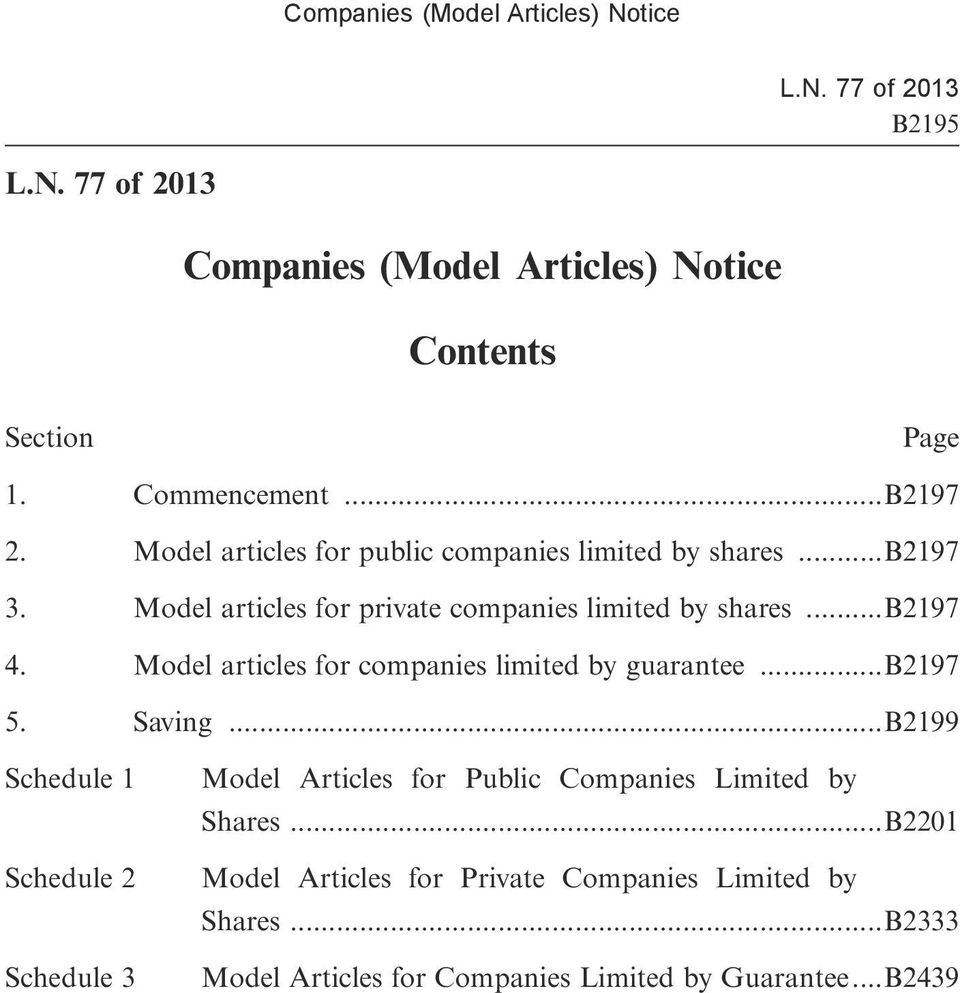
1 B2195 Companies (Model Articles) Notice Contents Section Page 1. Commencement...B Model articles for public companies limited by shares...b Model articles for private companies limited by shares...b Model articles for companies limited by guarantee...b Saving...B2199 Schedule 1 Schedule 2 Schedule 3 Model Articles for Public Companies Limited by Shares...B2201 Model Articles for Private Companies Limited by Shares...B2333 Model Articles for Companies Limited by Guarantee...B2439
2 Section 1 B2197 Companies (Model Articles) Notice (Made by the Financial Secretary under section 78 of the Companies Ordinance (28 of 2012)) 1. Commencement This Notice comes into operation on the day on which section 78 of the Companies Ordinance (28 of 2012) comes into operation. 2. Model articles for public companies limited by shares Schedule 1 prescribes the model articles for public companies limited by shares. Note For information that must be stated in the articles of a public company limited by shares, please see sections 81, 83(1), 84(1) and 85(1) of the Companies Ordinance (28 of 2012). 3. Model articles for private companies limited by shares Schedule 2 prescribes the model articles for private companies limited by shares. Note For information that must be stated in the articles of a private company limited by shares, please see sections 81, 83(1), 84(1) and 85(1) of the Companies Ordinance (28 of 2012). 4. Model articles for companies limited by guarantee Schedule 3 prescribes the model articles for companies limited by guarantee. Note For information that must be stated in the articles of a company limited by guarantee, please see sections 81, 83(1) and 84(2) of the Companies Ordinance (28 of 2012).

3 Section 5 B Saving This Notice does not affect (a) Table A in the First Schedule to the Companies Ordinance 1865 (1 of 1865), as in force from time to time, so far as it applies to an existing company; (b) Table A in the First Schedule to the Companies Ordinance 1911 (58 of 1911), as in force from time to time, so far as it applies to an existing company; (c) Table A in the First Schedule to the predecessor Ordinance, so far as it applies to an existing company; and (d) the articles of an existing company limited by guarantee, whether or not the existing company has a share capital.
4 Schedule 1 B2201 Schedule 1 [s. 2] Model Articles for Public Companies Limited by Shares Contents Article Part 1 Interpretation 1. Interpretation Part 2 Directors and Company Secretary Division 1 Directors Powers and Responsibilities 2. Directors general authority 3. Members reserve power 4. Directors may delegate 5. Committees Division 2 Decision-taking by Directors 6. Directors to take decision collectively 7. Calling directors meetings 8. Participation in directors meetings 9. Quorum for directors meetings 10. Meetings if total number of directors less than quorum 11. Chairing of directors meetings

5 Schedule 1 B2203 Article 12. Voting at directors meetings: general rules 13. Chairperson s casting vote at directors meetings 14. Alternates voting at directors meetings 15. Conflicts of interest 16. Supplementary provisions as to conflicts of interest 17. Proposing directors written resolutions 18. Adoption of directors written resolutions 19. Effect of directors written resolutions 20. Validity of acts of meeting of directors 21. Record of decisions to be kept 22. Directors discretion to make further rules Division 3 Appointment and Retirement of Directors 23. Appointment and retirement of directors 24. Retirement of directors by rotation 25. Retiring director eligible for reappointment 26. Composite resolution 27. Termination of director s appointment 28. Directors remuneration 29. Directors expenses Division 4 Alternate Directors 30. Appointment and removal of alternates 31. Rights and responsibilities of alternate directors

6 Schedule 1 B2205 Article 32. Termination of alternate directorship Division 5 Managing Directors 33. Appointment of managing directors and termination of appointment 34. Powers of managing directors Division 6 Directors Indemnity and Insurance 35. Indemnity 36. Insurance Division 7 Company Secretary 37. Appointment and removal of company secretary Part 3 Decision taking by Members Division 1 Organization of General Meetings 38. General meetings 39. Notice of general meetings 40. Persons entitled to receive notice of general meetings 41. Accidental omission to give notice of general meetings 42. Attendance and speaking at general meetings 43. Quorum for general meetings 44. Chairing general meetings 45. Attendance and speaking by non-members 46. Adjournment
7 Schedule 1 B2207 Article Division 2 Voting at General Meetings 47. General rules on voting 48. Errors and disputes 49. Demanding a poll 50. Number of votes a member has 51. Votes of joint holders of shares 52. Votes of mentally incapacitated members 53. Content of proxy notices 54. Execution of appointment of proxy on behalf of member appointing the proxy 55. Delivery of proxy notice and notice revoking appointment of proxy 56. Effect of member s voting in person on proxy s authority 57. Effect of proxy votes in case of death, mental incapacity, etc. of member appointing the proxy 58. Amendments to proposed resolutions Division 3 Restrictions on Members Rights 59. No voting of shares on which money owed to company Division 4 Application of Rules to Class Meetings 60. Class meetings
8 Schedule 1 B2209 Article Part 4 Shares and Distributions Division 1 Issue of Shares 61. Powers to issue different classes of shares 62. Payment of commissions on subscription for shares Division 2 Interests in Shares 63. Company only bound by absolute interests Division 3 Share Certificates 64. Certificates to be issued except in certain cases 65. Contents and execution of share certificates 66. Consolidated share certificates 67. Replacement share certificates Division 4 Partly Paid Shares 68. Company s lien over partly paid shares 69. Enforcement of company s lien 70. Call notices 71. When call deemed to be made 72. Liability to pay calls 73. When call notice need not be issued 74. Failure to comply with call notice: automatic consequences 75. Notice of intended forfeiture 76. Directors power to forfeit shares
9 Schedule 1 B2211 Article 77. Effect of forfeiture 78. Procedure following forfeiture 79. Surrender of shares Division 5 Transfer and Transmission of Shares 80. Transfer of shares 81. Power of directors to refuse transfer of shares 82. Power of directors to suspend registration of transfer of shares 83. Transmission of shares 84. Transmittees rights 85. Exercise of transmittees rights 86. Transmittees bound by prior notices Division 6 Alteration and Reduction of Share Capital, Share Buy-backs and Allotment of Shares 87. Alteration of share capital 88. Reduction of share capital 89. Share buy-backs 90. Allotment of shares Division 7 Distributions 91. Procedure for declaring dividends 92. Calculation of dividends 93. Payment of dividends and other distributions 94. Deductions from distributions in respect of sums owed to company
10 Schedule 1 B2213 Article 95. No interest on distributions 96. Unclaimed distributions 97. Non-cash distributions 98. Waiver of distributions Division 8 Capitalization of Profits 99. Capitalization of profits Part 5 Miscellaneous Provisions Division 1 Communications to and by Company 100. Means of communication to be used 101. Failure to notify contact details Division 2 Administrative Arrangements 102. Company seals 103. No right to inspect accounts and other records 104. Auditor s insurance 105. Winding up 1. Interpretation (1) In these articles Part 1 Interpretation
11 Schedule 1 B2215 alternate ( ) and alternate director ( ) mean a person appointed by a director as an alternate under article 30(1); appointor ( ) see article 30(1); articles ( ) means the articles of association of the company; associated company ( ) means (a) a subsidiary of the company; (b) a holding company of the company; or (c) a subsidiary of such a holding company; call ( ) see article 70(1); call notice ( ) see article 70(1); distribution recipient ( ) means, in relation to a share in respect of which a dividend or other sum is payable (a) the holder of the share; (b) if the share has 2 or more joint holders, whichever of them is named first in the register of members; or (c) if the holder is no longer entitled to the share by reason of death or bankruptcy or otherwise by operation of law, the transmittee; fully paid ( ), in relation to a share, means the price at which the share was issued has been fully paid to the company; holder ( ), in relation to a share, means the person whose name is entered in the register of members as the holder of the share; mental incapacity ( ) has the meaning given by section 2(1) of the Mental Health Ordinance (Cap. 136); mentally incapacitated person ( ) means a person who is found under the Mental Health Ordinance (Cap. 136) to be incapable, by reason of mental incapacity,
12 Schedule 1 B2217 of managing and administering his or her property and affairs; Ordinance ( ) means the Companies Ordinance (28 of 2012); paid ( ) means paid or credited as paid; partly paid ( ), in relation to a share, means part of the price at which the share was issued remains unpaid; proxy notice ( ) see article 53(1); register of members ( ) means the register of members of the company; transmittee ( ) means a person entitled to a share by reason of the death or bankruptcy of a member or otherwise by operation of law. (2) Other words or expressions used in these articles have the same meaning as in the Ordinance as in force on the date these articles become binding on the company. (3) For the purposes of these articles, a document is authenticated if it is authenticated in any way in which section 828(5) or 829(3) of the Ordinance provides for documents or information to be authenticated for the purposes of the Ordinance. Part 2 Directors and Company Secretary Division 1 Directors Powers and Responsibilities 2. Directors general authority (1) Subject to the Ordinance and these articles, the business and affairs of the company are managed by the directors, who may exercise all the powers of the company.

13 Schedule 1 B2219 (2) An alteration of these articles does not invalidate any prior act of the directors that would have been valid if the alteration had not been made. (3) The powers given by this article are not limited by any other power given to the directors by these articles. (4) A directors meeting at which a quorum is present may exercise all powers exercisable by the directors. 3. Members reserve power (1) The members may, by special resolution, direct the directors to take, or refrain from taking, specified action. (2) The special resolution does not invalidate anything that the directors have done before the passing of the resolution. 4. Directors may delegate (1) Subject to these articles, the directors may, if they think fit, delegate any of the powers that are conferred on them under these articles (a) to any person or committee; (b) by any means (including by power of attorney); (c) to any extent and without territorial limit; (d) in relation to any matter; and (e) on any terms and conditions. (2) If the directors so specify, the delegation may authorize further delegation of the directors powers by any person to whom they are delegated. (3) The directors may (a) revoke the delegation wholly or in part; or (b) revoke or alter its terms and conditions.
14 Schedule 1 B Committees (1) The directors may make rules providing for the conduct of business of the committees to which they have delegated any of their powers. (2) The committees must comply with the rules. Division 2 Decision-taking by Directors 6. Directors to take decision collectively A decision of the directors may only be taken (a) at a directors meeting; or (b) in the form of a directors written resolution. 7. Calling directors meetings (1) Any director may call a directors meeting. (2) The company secretary must call a directors meeting if a director requests it. (3) A directors meeting is called by giving notice of the meeting to the directors. (4) Notice of a directors meeting must indicate (a) its proposed date and time; and (b) where it is to take place. (5) Notice of a directors meeting must be given to each director, but need not be in writing. (6) If a notice of a directors meeting has not been given to a director (the failure) but the director waives his or her entitlement to the notice by giving notice to that effect to the company not more than 7 days after the meeting, the failure does not affect the validity of the meeting, or of any business conducted at it.
15 Schedule 1 B Participation in directors meetings (1) Subject to these articles, directors participate in a directors meeting, or part of a directors meeting, when (a) the meeting has been called and takes place in accordance with these articles; and (b) they can each communicate to the others any information or opinions they have on any particular item of the business of the meeting. (2) In determining whether directors are participating in a directors meeting, it is irrelevant where a director is and how they communicate with each other. (3) If all the directors participating in a directors meeting are not in the same place, they may regard the meeting as taking place wherever any one of them is. 9. Quorum for directors meetings (1) At a directors meeting, unless a quorum is participating, no proposal is to be voted on, except a proposal to call another meeting. (2) The quorum for directors meetings may be fixed from time to time by a decision of the directors, but it must be at least 2, and unless otherwise fixed it is Meetings if total number of directors less than quorum (1) This article applies if the total number of directors for the time being is less than the quorum required for directors meetings. (2) If there is only 1 director, that director may appoint sufficient directors to make up a quorum or call a general meeting to do so. (3) If there is more than one director
16 Schedule 1 B2225 (a) a directors meeting may take place, if it is called in accordance with these articles and at least 2 directors participate in it, with a view to appointing sufficient directors to make up a quorum or calling a general meeting to do so; and (b) if a directors meeting is called but only 1 director attends at the appointed date and time to participate in it, that director may appoint sufficient directors to make up a quorum or call a general meeting to do so. 11. Chairing of directors meetings (1) The directors may appoint a director to chair their meetings. (2) The person appointed for the time being is known as the chairperson. (3) The directors may appoint other directors as deputy or assistant chairpersons to chair directors meetings in the chairperson s absence. (4) The directors may terminate the appointment of the chairperson, or deputy or assistant chairperson at any time. (5) If neither the chairperson nor the deputy or assistant chairperson is participating in a directors meeting within 10 minutes of the time at which it was to start or is willing to chair the meeting, the participating directors may appoint one of themselves to chair it. 12. Voting at directors meetings: general rules (1) Subject to these articles, a decision is taken at a directors meeting by a majority of the votes of the participating directors. (2) Subject to these articles, each director participating in a directors meeting has 1 vote.
17 Schedule 1 B Chairperson s casting vote at directors meetings (1) If the numbers of votes for and against a proposal are equal, the chairperson or other director chairing the directors meeting has a casting vote. (2) Paragraph (1) does not apply if, in accordance with these articles, the chairperson or other director is not to be counted as participating in the decision-making process for quorum or voting purposes. 14. Alternates voting at directors meetings A director who is also an alternate director has an additional vote on behalf of each appointor who (a) is not participating in a directors meeting; and (b) would have been entitled to vote if he or she were participating in it. 15. Conflicts of interest (1) This article applies if (a) a director or an entity connected with the director is in any way (directly or indirectly) interested in a transaction, arrangement or contract with the company that is significant in relation to the company s business; and (b) the director s or the entity s interest is material. (2) The director must declare the nature and extent of the director s or the entity s interest to the other directors in accordance with section 536 of the Ordinance. (3) The director and the director s alternate must neither (a) vote in respect of the transaction, arrangement or contract in which the director or the entity is so interested; nor
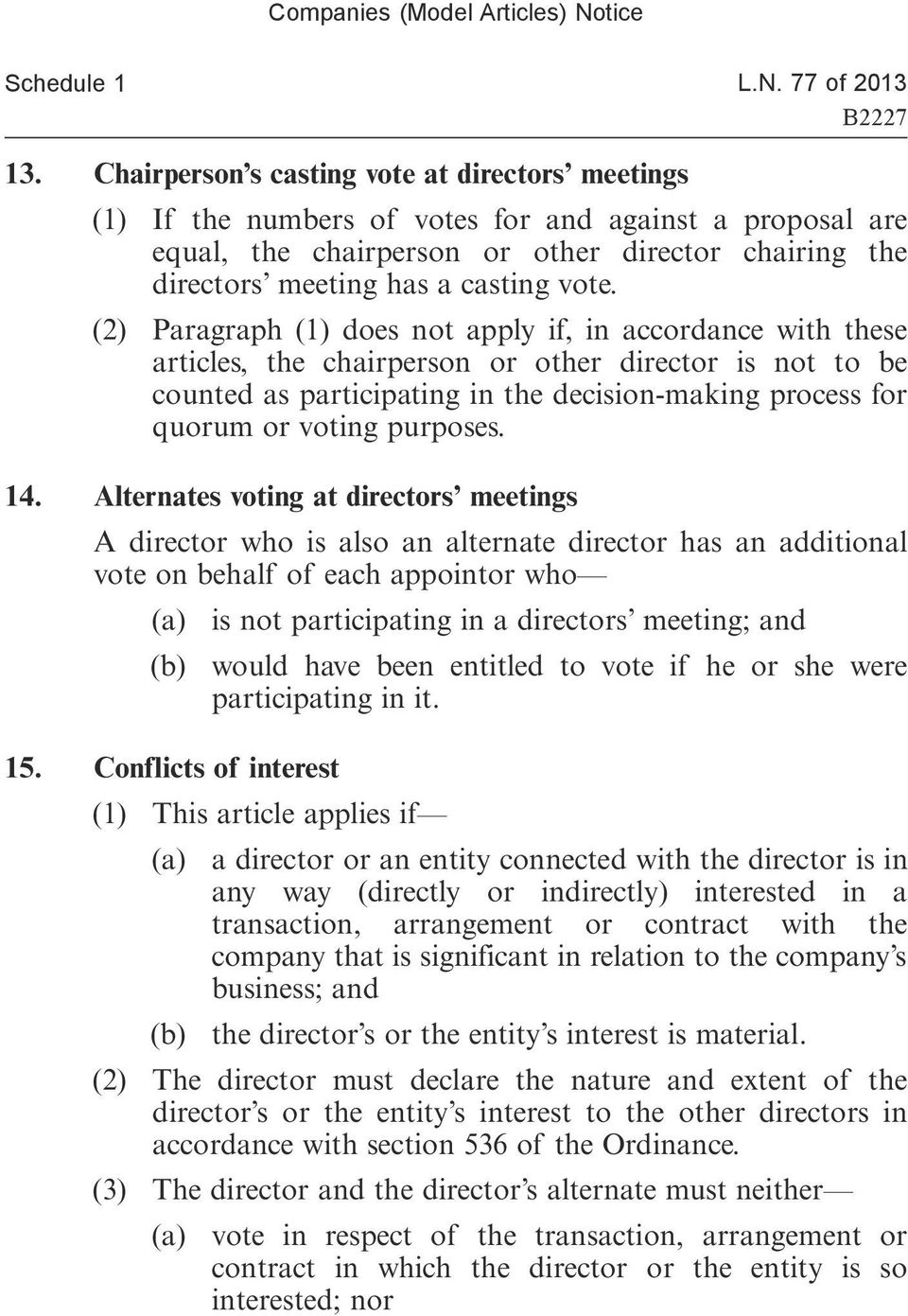
18 Schedule 1 B2229 (b) be counted for quorum purposes in respect of the transaction, arrangement or contract. (4) Paragraph (3) does not preclude the alternate from (a) voting in respect of the transaction, arrangement or contract on behalf of another appointor who does not have such an interest; and (b) being counted for quorum purposes in respect of the transaction, arrangement or contract. (5) If the director or the director s alternate contravenes paragraph (3)(a), the vote must not be counted. (6) Paragraph (3) does not apply to (a) an arrangement for giving a director any security or indemnity in respect of money lent by the director to or obligations undertaken by the director for the benefit of the company; (b) an arrangement for the company to give any security to a third party in respect of a debt or obligation of the company for which the director has assumed responsibility wholly or in part under a guarantee or indemnity or by the deposit of a security; (c) an arrangement under which benefits are made available to employees and directors or former employees and directors of the company or any of its subsidiaries, which do not provide special benefits for directors or former directors; or (d) an arrangement to subscribe for or underwrite shares. (7) A reference in this article to an entity connected with a director has the meaning given by section 486 of the Ordinance. (8) A reference in this article (except in paragraphs (6)(d) and (9)) to a transaction, arrangement or contract includes a proposed transaction, arrangement or contract.

19 Schedule 1 B2231 (9) In this article arrangement to subscribe for or underwrite shares ( ) means (a) a subscription or proposed subscription for shares or other securities of the company; (b) an agreement or proposed agreement to subscribe for shares or other securities of the company; or (c) an agreement or proposed agreement to underwrite any of those shares or securities. 16. Supplementary provisions as to conflicts of interest (1) A director may hold any other office or position of profit under the company (other than the office of auditor) in conjunction with the office of director for a period and on terms (as to remuneration or otherwise) that the directors determine. (2) A director or intending director is not disqualified by the office of director from contracting with the company (a) with regard to the tenure of the other office or position of profit mentioned in paragraph (1); or (b) as vendor, purchaser or otherwise. (3) The contract mentioned in paragraph (2) or any transaction, arrangement or contract entered into by or on behalf of the company in which any director is in any way interested is not liable to be avoided. (4) A director who has entered into a contract mentioned in paragraph (2) or is interested in a transaction, arrangement or contract mentioned in paragraph (3) is not liable to account to the company for any profit realized by the transaction, arrangement or contract by reason of (a) the director holding the office; or (b) the fiduciary relation established by the office.

20 Schedule 1 B2233 (5) Paragraph (1), (2), (3) or (4) only applies if the director has declared the nature and extent of the director s interest under the paragraph to the other directors in accordance with section 536 of the Ordinance. (6) A director of the company may be a director or other officer of, or be otherwise interested in (a) any company promoted by the company; or (b) any company in which the company may be interested as shareholder or otherwise. (7) Subject to the Ordinance, the director is not accountable to the company for any remuneration or other benefits received by the director as a director or officer of, or from the director s interest in, the other company unless the company otherwise directs. 17. Proposing directors written resolutions (1) Any director may propose a directors written resolution. (2) The company secretary must propose a directors written resolution if a director requests it. (3) A directors written resolution is proposed by giving notice in writing of the proposed resolution to each director. (4) Notice of a proposed directors written resolution must indicate (a) the proposed resolution; and (b) the time by which it is proposed that the directors should adopt it. (5) Any decision which a person giving notice of a proposed directors written resolution takes regarding the process of adopting the resolution must be taken reasonably in good faith.

21 Schedule 1 B Adoption of directors written resolutions (1) A proposed directors written resolution is adopted when all the directors who would have been entitled to vote on the resolution at a directors meeting have signed one or more copies of it. (2) Paragraph (1) only applies if those directors would have formed a quorum at the directors meeting. (3) It is immaterial whether any director signs the resolution before or after the time by which the notice proposed that it should be adopted. 19. Effect of directors written resolutions If a proposed directors written resolution has been adopted, it is as valid and effectual as if it had been passed at a directors meeting duly convened and held. 20. Validity of acts of meeting of directors The acts of any meeting of directors or of a committee of directors or the acts of any person acting as a director are as valid as if the directors or the person had been duly appointed as a director and was qualified to be a director, even if it is afterwards discovered that (a) there was a defect in the appointment of any of the directors or of the person acting as a director; (b) any one or more of them were not qualified to be a director or were disqualified from being a director; (c) any one or more of them had ceased to hold office as a director; or (d) any one or more of them were not entitled to vote on the matter in question.
22 Schedule 1 B Record of decisions to be kept The directors must ensure that the company keeps a written record of every decision taken by the directors under article 6 for at least 10 years from the date of the decision. 22. Directors discretion to make further rules Subject to these articles, the directors may make any rule that they think fit about (a) how they take decisions; and (b) how the rules are to be recorded or communicated to directors. Division 3 Appointment and Retirement of Directors 23. Appointment and retirement of directors (1) A person who is willing to act as a director, and is permitted by law to do so, may be appointed to be a director (a) by ordinary resolution; or (b) by a decision of the directors. (2) A director appointed under paragraph (1)(a) is subject to article 24. (3) An appointment under paragraph (1)(b) may only be made to (a) fill a casual vacancy; or (b) appoint a director as an addition to the existing directors if the total number of directors does not exceed the number fixed in accordance with these articles. (4) A director appointed under paragraph (1)(b) must retire from office at the next annual general meeting following the appointment.
23 Schedule 1 B Retirement of directors by rotation (1) At the first annual general meeting, all the directors must retire from office. (2) At every subsequent annual general meeting, one-third of the directors for the time being must retire from office. (3) Paragraphs (1) and (2) are subject to article 33(2). (4) For the purposes of paragraph (2), if the number of directors is not 3 or a multiple of 3, then the number nearest one-third must retire from office. (5) The directors to retire in every year must be those who have been longest in office since their last appointment or reappointment. (6) For persons who became directors on the same day, those to retire must be determined by lot, unless they otherwise agree among themselves. (7) At the annual general meeting at which a director retires, the company may appoint a person to fill the vacated office. (8) A retiring director is regarded as having been reappointed to the office if (a) the company does not appoint a person to the vacated office; and (b) the retiring director has not given notice to the company of the intention to decline reappointment to the office. (9) However, a retiring director is not regarded as having been reappointed to the office if (a) at the meeting at which the director retires, it is expressly resolved not to fill the vacated office; or (b) a resolution for the reappointment of the director has been put to the meeting and lost.
24 Schedule 1 B2241 (10) A person is not eligible for appointment to the office of director at any general meeting unless (a) the person is a director retiring at the meeting; (b) the person is recommended by the directors for appointment to the office; or (c) a member qualified to attend and vote at the meeting has sent the company a notice of the member s intention to propose the person for appointment to the office, and the person has also sent the company a notice of the person s willingness to be appointed. (11) The notice of the member s intention to propose the person for appointment to the office must be authenticated by that member and the notice of the person s willingness to be appointed must be authenticated by that person, and they must be sent to the company in hard copy form or in electronic form and received by the company, at least 7 days before the date of the general meeting. (12) The company may (a) by ordinary resolution increase or reduce the number of directors; and (b) determine in what rotation the increased or reduced number is to retire from office. 25. Retiring director eligible for reappointment A retiring director is eligible for reappointment to the office. 26. Composite resolution (1) This article applies if proposals are under consideration concerning the appointment of 2 or more directors to offices or employments with the company or any other body corporate. (2) The proposals may be divided and considered in relation to each director separately.
25 Schedule 1 B2243 (3) Each of the directors concerned is entitled to vote (if the director is not for another reason precluded from voting) and be counted in the quorum in respect of each resolution except that concerning the director s own appointment. 27. Termination of director s appointment A person ceases to be a director if the person (a) ceases to be a director under the Ordinance or the Companies (Winding Up and Miscellaneous Provisions) Ordinance (Cap. 32) or is prohibited from being a director by law; (b) becomes bankrupt or makes any arrangement or composition with the person s creditors generally; (c) becomes a mentally incapacitated person; (d) resigns the office of director by notice in writing of the resignation in accordance with section 464(5) of the Ordinance; (e) for more than 6 months has been absent without the directors permission from directors meetings held during that period; or (f) is removed from the office of director by an ordinary resolution of the company. 28. Directors remuneration (1) Directors remuneration must be determined by the company at a general meeting. (2) A director s remuneration may (a) take any form; and (b) include any arrangements in connection with the payment of a retirement benefit to or in respect of that director. (3) Directors remuneration accrues from day to day.
26 Schedule 1 B Directors expenses The company may pay any travelling, accommodation and other expenses properly incurred by directors in connection with (a) their attendance at (i) meetings of directors or committees of directors; (ii) general meetings; or (iii) separate meetings of the holders of any class of shares or of debentures of the company; or (b) the exercise of their powers and the discharge of their responsibilities in relation to the company. Division 4 Alternate Directors 30. Appointment and removal of alternates (1) A director (appointor) may appoint as an alternate any other director, or any other person approved by resolution of the directors. (2) An alternate may exercise the powers and carry out the responsibilities of the alternate s appointor, in relation to the taking of decisions by the directors in the absence of the alternate s appointor. (3) An appointment or removal of an alternate by the alternate s appointor must be effected (a) by notice to the company; or (b) in any other manner approved by the directors. (4) The notice must be authenticated by the appointor. (5) The notice must (a) identify the proposed alternate; and
27 Schedule 1 B2247 (b) if it is a notice of appointment, contain a statement authenticated by the proposed alternate indicating the proposed alternate s willingness to act as the alternate of the appointor. (6) If an alternate is removed by resolution of the directors, the company must as soon as practicable give notice of the removal to the alternate s appointor. 31. Rights and responsibilities of alternate directors (1) An alternate director has the same rights as the alternate s appointor in relation to any decision taken by the directors under article 6. (2) Unless these articles specify otherwise, alternate directors (a) are deemed for all purposes to be directors; (b) are liable for their own acts and omissions; (c) are subject to the same restrictions as their appointors; and (d) are deemed to be agents of or for their appointors. (3) Subject to article 15(3), a person who is an alternate director but not a director (a) may be counted as participating for determining whether a quorum is participating (but only if that person s appointor is not participating); and (b) may sign a written resolution (but only if it is not signed or to be signed by that person s appointor). (4) No alternate director may be counted as more than one director for the purposes mentioned in paragraph (3). (5) An alternate director is not entitled to receive any remuneration from the company for serving as an alternate director.
28 Schedule 1 B2249 (6) But the alternate s appointor may, by notice in writing made to the company, direct that any part of the appointor s remuneration be paid to the alternate. 32. Termination of alternate directorship (1) An alternate director s appointment as an alternate terminates (a) if the alternate s appointor revokes the appointment by notice to the company in writing specifying when it is to terminate; (b) on the occurrence in relation to the alternate of any event which, if it occurred in relation to the alternate s appointor, would result in the termination of the appointor s appointment as a director; (c) on the death of the alternate s appointor; or (d) when the alternate s appointor s appointment as a director terminates. (2) Paragraph (1)(d) does not apply if the appointor is reappointed after having retired by rotation at a general meeting or is regarded as having been reappointed as a director at the same general meeting, and in such a case, the alternate director s appointment as an alternate continues after the reappointment. (3) If the alternate was not a director when appointed as an alternate, the alternate s appointment as an alternate terminates if (a) the approval under article 30(1) is withdrawn or revoked; or (b) the company by an ordinary resolution passed at a general meeting terminates the appointment.
29 Schedule 1 B2251 Division 5 Managing Directors 33. Appointment of managing directors and termination of appointment (1) The directors may (a) from time to time appoint one or more of themselves to the office of managing director for a period and on terms they think fit; and (b) subject to the terms of an agreement entered into in any particular case, revoke the appointment. (2) A director appointed to the office of managing director is not, while holding the office, subject to retirement by rotation under article 24. While holding the office, the director must also not be taken into account in determining the rotation of retirement of directors under that article. (3) The appointment as a managing director is automatically terminated if the managing director ceases to be a director for any reason. (4) The directors may determine a managing director s remuneration, whether by way of salary, commission or participation in profits, or a combination of them. 34. Powers of managing directors (1) The directors may entrust to and confer on a managing director any of the powers exercisable by them on terms and conditions and with restrictions they think fit, either collaterally with or to the exclusion of their own powers. (2) The directors may from time to time revoke, withdraw, alter or vary all or any of those powers.
30 Schedule 1 B2253 Division 6 Directors Indemnity and Insurance 35. Indemnity (1) A director or former director of the company may be indemnified out of the company s assets against any liability incurred by the director to a person other than the company or an associated company of the company in connection with any negligence, default, breach of duty or breach of trust in relation to the company or associated company (as the case may be). (2) Paragraph (1) only applies if the indemnity does not cover (a) any liability of the director to pay (i) a fine imposed in criminal proceedings; or (ii) a sum payable by way of a penalty in respect of non-compliance with any requirement of a regulatory nature; or (b) any liability incurred by the director (i) in defending criminal proceedings in which the director is convicted; (ii) in defending civil proceedings brought by the company, or an associated company of the company, in which judgment is given against the director; (iii) in defending civil proceedings brought on behalf of the company by a member of the company or of an associated company of the company, in which judgment is given against the director; (iv) in defending civil proceedings brought on behalf of an associated company of the company by a member of the associated company or by a member of an associated company of the
31 Schedule 1 B2255 associated company, in which judgment is given against the director; or (v) in connection with an application for relief under section 903 or 904 of the Ordinance in which the Court refuses to grant the director relief. (3) A reference in paragraph (2)(b) to a conviction, judgment or refusal of relief is a reference to the final decision in the proceedings. (4) For the purposes of paragraph (3), a conviction, judgment or refusal of relief (a) if not appealed against, becomes final at the end of the period for bringing an appeal; or (b) if appealed against, becomes final when the appeal, or any further appeal, is disposed of. (5) For the purposes of paragraph (4)(b), an appeal is disposed of if 36. Insurance (a) it is determined, and the period for bringing any further appeal has ended; or (b) it is abandoned or otherwise ceases to have effect. The directors may decide to purchase and maintain insurance, at the expense of the company, for a director of the company, or a director of an associated company of the company, against (a) any liability to any person attaching to the director in connection with any negligence, default, breach of duty or breach of trust (except for fraud) in relation to the company or associated company (as the case may be); or (b) any liability incurred by the director in defending any proceedings (whether civil or criminal) taken against the director for any negligence, default, breach of duty
32 Schedule 1 B2257 or breach of trust (including fraud) in relation to the company or associated company (as the case may be). Division 7 Company Secretary 37. Appointment and removal of company secretary (1) The directors may appoint a company secretary for a term, at a remuneration and on conditions they think fit. (2) The directors may remove a company secretary appointed by them. Part 3 Decision-taking by Members Division 1 Organization of General Meetings 38. General meetings (1) Subject to sections 611, 612 and 613 of the Ordinance, the company must, in respect of each financial year of the company, hold a general meeting as its annual general meeting in accordance with section 610 of the Ordinance. (2) The directors may, if they think fit, call a general meeting. (3) If the directors are required to call a general meeting under section 566 of the Ordinance, they must call it in accordance with section 567 of the Ordinance. (4) If the directors do not call a general meeting in accordance with section 567 of the Ordinance, the members who requested the meeting, or any of them representing more than one half of the total voting rights of all of them, may themselves call a general meeting in accordance with section 568 of the Ordinance.
33 Schedule 1 B Notice of general meetings (1) An annual general meeting must be called by notice of at least 21 days in writing. (2) A general meeting other than an annual general meeting must be called by notice of at least 14 days in writing. (3) The notice is exclusive of (a) the day on which it is served or deemed to be served; and (b) the day for which it is given. (4) The notice must (a) specify the date and time of the meeting; (b) specify the place of the meeting (and if the meeting is to be held in 2 or more places, the principal place of the meeting and the other place or places of the meeting); (c) state the general nature of the business to be dealt with at the meeting; (d) for a notice calling an annual general meeting, state that the meeting is an annual general meeting; (e) if a resolution (whether or not a special resolution) is intended to be moved at the meeting (i) include notice of the resolution; and (ii) include or be accompanied by a statement containing any information or explanation that is reasonably necessary to indicate the purpose of the resolution; (f) if a special resolution is intended to be moved at the meeting, specify the intention and include the text of the special resolution; and
34 Schedule 1 B2261 (g) contain a statement specifying a member s right to appoint a proxy under section 596(1) and (3) of the Ordinance. (5) Paragraph (4)(e) does not apply in relation to a resolution of which (a) notice has been included in the notice of the meeting under section 567(3) or 568(2) of the Ordinance; or (b) notice has been given under section 615 of the Ordinance. (6) Despite the fact that a general meeting is called by shorter notice than that specified in this article, it is regarded as having been duly called if it is so agreed (a) for an annual general meeting, by all the members entitled to attend and vote at the meeting; and (b) in any other case, by a majority in number of the members entitled to attend and vote at the meeting, being a majority together representing at least 95% of the total voting rights at the meeting of all the members. 40. Persons entitled to receive notice of general meetings (1) Notice of a general meeting must be given to (a) every member; and (b) every director. (2) In paragraph (1), the reference to a member includes a transmittee, if the company has been notified of the transmittee s entitlement to a share. (3) If notice of a general meeting or any other document relating to the meeting is required to be given to a member, the company must give a copy of it to its auditor (if more than one auditor, to everyone of them) at the same time as the notice or the other document is given to the member.
35 Schedule 1 B Accidental omission to give notice of general meetings Any accidental omission to give notice of a general meeting to, or any non-receipt of notice of a general meeting by, any person entitled to receive notice does not invalidate the proceedings at the meeting. 42. Attendance and speaking at general meetings (1) A person is able to exercise the right to speak at a general meeting when the person is in a position to communicate to all those attending the meeting, during the meeting, any information or opinions that the person has on the business of the meeting. (2) A person is able to exercise the right to vote at a general meeting when (a) the person is able to vote, during the meeting, on resolutions put to the vote at the meeting; and (b) the person s vote can be taken into account in determining whether or not those resolutions are passed at the same time as the votes of all the other persons attending the meeting. (3) The directors may make whatever arrangements they consider appropriate to enable those attending a general meeting to exercise their rights to speak or vote at it. (4) In determining attendance at a general meeting, it is immaterial whether any 2 or more members attending it are in the same place as each other. (5) Two or more persons who are not in the same place as each other attend a general meeting if their circumstances are such that if they have rights to speak and vote at the meeting, they are able to exercise them.
36 Schedule 1 B Quorum for general meetings (1) Two members present in person or by proxy constitute a quorum at a general meeting. (2) No business other than the appointment of the chairperson of the meeting is to be transacted at a general meeting if the persons attending it do not constitute a quorum. 44. Chairing general meetings (1) If the chairperson (if any) of the board of directors is present at a general meeting and is willing to preside as chairperson at the meeting, the meeting is to be presided over by him or her. (2) The directors present at a general meeting must elect one of themselves to be the chairperson if (a) there is no chairperson of the board of directors; (b) the chairperson is not present within 15 minutes after the time appointed for holding the meeting; (c) the chairperson is unwilling to act; or (d) the chairperson has given notice to the company of the intention not to attend the meeting. (3) The members present at a general meeting must elect one of themselves to be the chairperson if (a) no director is willing to act as chairperson; or (b) no director is present within 15 minutes after the time appointed for holding the meeting. (4) A proxy may be elected to be the chairperson of a general meeting by a resolution of the company passed at the meeting.
37 Schedule 1 B Attendance and speaking by non-members (1) Directors may attend and speak at general meetings, whether or not they are members of the company. (2) The chairperson of a general meeting may permit other persons to attend and speak at a general meeting even though they are not 46. Adjournment (a) members of the company; or (b) otherwise entitled to exercise the rights of members in relation to general meetings. (1) If a quorum is not present within half an hour from the time appointed for holding a general meeting, the meeting must (a) if called on the request of members, be dissolved; or (b) in any other case, be adjourned to the same day in the next week, at the same time and place, or to another day and at another time and place that the directors determine. (2) If at the adjourned meeting, a quorum is not present within half an hour from the time appointed for holding the meeting, the member or members present in person or by proxy constitute a quorum. (3) The chairperson may adjourn a general meeting at which a quorum is present if (a) the meeting consents to an adjournment; or (b) it appears to the chairperson that an adjournment is necessary to protect the safety of any person attending the meeting or ensure that the business of the meeting is conducted in an orderly manner. (4) The chairperson must adjourn a general meeting if directed to do so by the meeting.
38 Schedule 1 B2269 (5) When adjourning a general meeting, the chairperson must specify the date, time and place to which it is adjourned. (6) Only the business left unfinished at the general meeting may be transacted at the adjourned meeting. (7) If a general meeting is adjourned for 30 days or more, notice of the adjourned meeting must be given as for an original meeting. (8) If a general meeting is adjourned for less than 30 days, it is not necessary to give any notice of the adjourned meeting. Division 2 Voting at General Meetings 47. General rules on voting (1) A resolution put to the vote of a general meeting must be decided on a show of hands unless a poll is duly demanded in accordance with these articles. (2) If there is an equality of votes, whether on a show of hands or on a poll, the chairperson of the meeting at which the show of hands takes place or at which the poll is demanded, is entitled to a second or casting vote. (3) On a vote on a resolution on a show of hands at a general meeting, a declaration by the chairperson that the resolution (a) has or has not been passed; or (b) has passed by a particular majority, is conclusive evidence of that fact without proof of the number or proportion of the votes recorded in favour of or against the resolution. (4) An entry in respect of the declaration in the minutes of the meeting is also conclusive evidence of that fact without the proof.
39 Schedule 1 B Errors and disputes (1) Any objection to the qualification of any person voting at a general meeting may only be raised at the meeting or adjourned meeting at which the vote objected to is tendered, and a vote not disallowed at the meeting is valid. (2) Any objection must be referred to the chairperson of the meeting whose decision is final. 49. Demanding a poll (1) A poll on a resolution may be demanded (a) in advance of the general meeting where it is to be put to the vote; or (b) at a general meeting, either before or on the declaration of the result of a show of hands on that resolution. (2) A poll on a resolution may be demanded by (a) the chairperson of the meeting; (b) at least 2 members present in person or by proxy; or (c) any member or members present in person or by proxy and representing at least 5% of the total voting rights of all the members having the right to vote at the meeting. (3) The instrument appointing a proxy is regarded as conferring authority to demand or join in demanding a poll on a resolution. (4) A demand for a poll on a resolution may be withdrawn. 50. Number of votes a member has (1) On a vote on a resolution on a show of hands at a general meeting (a) every member present in person has 1 vote; and
40 Schedule 1 B2273 (b) every proxy present who has been duly appointed by a member entitled to vote on the resolution has 1 vote. (2) If a member appoints more than one proxy, the proxies so appointed are not entitled to vote on the resolution on a show of hands. (3) On a vote on a resolution on a poll taken at a general meeting (a) every member present in person has 1 vote for each share held by him or her; and (b) every proxy present who has been duly appointed by a member has 1 vote for each share in respect of which the proxy is appointed. (4) This article has effect subject to any rights or restrictions attached to any shares or class of shares. 51. Votes of joint holders of shares (1) For joint holders of shares, only the vote of the most senior holder who votes (and any proxies duly authorized by the holder) may be counted. (2) For the purposes of this article, the seniority of a holder of a share is determined by the order in which the names of the joint holders appear in the register of members. 52. Votes of mentally incapacitated members (1) A member who is a mentally incapacitated person may vote, whether on a show of hands or on a poll, by the member s committee, receiver, guardian or other person in the nature of a committee, receiver or guardian appointed by the Court. (2) The committee, receiver, guardian or other person may vote by proxy on a show of hands or on a poll.
41 Schedule 1 B Content of proxy notices (1) A proxy may only validly be appointed by a notice in writing (proxy notice) that (a) states the name and address of the member appointing the proxy; (b) identifies the person appointed to be that member s proxy and the general meeting in relation to which that person is appointed; (c) is authenticated, or is signed on behalf of the member appointing the proxy; and (d) is delivered to the company in accordance with these articles and any instructions contained in the notice of the general meeting in relation to which the proxy is appointed. (2) The company may require proxy notices to be delivered in a particular form, and may specify different forms for different purposes. (3) If the company requires or allows a proxy notice to be delivered to it in electronic form, it may require the delivery to be properly protected by a security arrangement it specifies. (4) A proxy notice may specify how the proxy appointed under it is to vote (or that the proxy is to abstain from voting) on one or more resolutions dealing with any business to be transacted at a general meeting. (5) Unless a proxy notice indicates otherwise, it must be regarded as (a) allowing the person appointed under it as a proxy discretion as to how to vote on any ancillary or procedural resolutions put to the general meeting; and (b) appointing that person as a proxy in relation to any adjournment of the general meeting to which it relates as well as the meeting itself.
42 Schedule 1 B Execution of appointment of proxy on behalf of member appointing the proxy If a proxy notice is not authenticated, it must be accompanied by written evidence of the authority of the person who executed the appointment to execute it on behalf of the member appointing the proxy. 55. Delivery of proxy notice and notice revoking appointment of proxy (1) A proxy notice does not take effect unless it is received by the company (a) for a general meeting or adjourned general meeting, at least 48 hours before the time appointed for holding the meeting or adjourned meeting; and (b) for a poll taken more than 48 hours after it was demanded, at least 24 hours before the time appointed for taking the poll. (2) An appointment under a proxy notice may be revoked by delivering to the company a notice in writing given by or on behalf of the person by whom or on whose behalf the proxy notice was given. (3) A notice revoking the appointment only takes effect if it is received by the company (a) for a general meeting or adjourned general meeting, at least 48 hours before the time appointed for holding the meeting or adjourned meeting; and (b) for a poll taken more than 48 hours after it was demanded, at least 24 hours before the time appointed for taking the poll.
43 Schedule 1 B Effect of member s voting in person on proxy s authority (1) A proxy s authority in relation to a resolution is to be regarded as revoked if the member who has appointed the proxy (a) attends in person the general meeting at which the resolution is to be decided; and (b) exercises, in relation to the resolution, the voting right attached to the shares in respect of which the proxy is appointed. (2) A member who is entitled to attend, speak or vote (either on a show of hands or on a poll) at a general meeting remains so entitled in respect of the meeting or any adjournment of it, even though a valid proxy notice has been delivered to the company by or on behalf of the member. 57. Effect of proxy votes in case of death, mental incapacity, etc. of member appointing the proxy (1) A vote given in accordance with the terms of a proxy notice is valid despite (a) the previous death or mental incapacity of the member appointing the proxy; (b) the revocation of the appointment of the proxy or of the authority under which the appointment of the proxy is executed; or (c) the transfer of the share in respect of which the proxy is appointed. (2) Paragraph (1) does not apply if notice in writing of the death, mental incapacity, revocation or transfer is received by the company
44 Schedule 1 B2281 (a) for a general meeting or adjourned general meeting, at least 48 hours before the time appointed for holding the meeting or adjourned meeting; and (b) for a poll taken more than 48 hours after it was demanded, at least 24 hours before the time appointed for taking the poll. 58. Amendments to proposed resolutions (1) An ordinary resolution to be proposed at a general meeting may be amended by ordinary resolution if (a) notice of the proposed amendment is given to the company secretary in writing; and (b) the proposed amendment does not, in the reasonable opinion of the chairperson of the meeting, materially alter the scope of the resolution. (2) The notice must be given by a person entitled to vote at the general meeting at which it is to be proposed at least 48 hours before the meeting is to take place (or a later time the chairperson of the meeting determines). (3) A special resolution to be proposed at a general meeting may be amended by ordinary resolution if (a) the chairperson of the meeting proposes the amendment at the meeting at which the special resolution is to be proposed; and (b) the amendment merely corrects a grammatical or other non-substantive error in the special resolution. (4) If the chairperson of the meeting, acting in good faith, wrongly decides that an amendment to a resolution is out of order, the vote on that resolution remains valid unless the Court orders otherwise.
45 Schedule 1 B2283 Division 3 Restrictions on Members Rights 59. No voting of shares on which money owed to company A member is not entitled to vote at any general meeting unless all calls or other sums presently payable by the member in respect of shares in the company have been paid. Division 4 Application of Rules to Class Meetings 60. Class meetings The provisions of these articles relating to general meetings apply, with any necessary modifications, to meetings of the holders of any class of shares. Part 4 Shares and Distributions Division 1 Issue of Shares 61. Powers to issue different classes of shares (1) Without affecting any special rights previously conferred on the holders of any existing shares or class of shares, the company may issue shares with (a) preferred, deferred or other special rights; or (b) any restrictions, whether in regard to dividend, voting, return of capital or otherwise, that the company may from time to time by ordinary resolution determine. (2) Subject to Division 4 of Part 5 of the Ordinance, the company may issue shares on the terms that they are to be redeemed, or liable to be redeemed, at the option of the company or the holders of the shares.
46 Schedule 1 B2285 (3) The directors may determine the terms, conditions and manner of redemption of the shares. 62. Payment of commissions on subscription for shares (1) If the conditions in paragraph (2) are satisfied, the company may pay a commission to a person under section 148 of the Ordinance. (2) The conditions are that (a) the commission paid or agreed to be paid does not exceed 10% of the price at which the shares in respect of which the commission is paid are issued; (b) if those shares are offered to the public for subscription, the company, before making the payment, discloses the amount or rate of the commission in the prospectus for the public offer, as required under paragraph 7(a)(ii) in Part I of the Third Schedule to the Companies (Winding Up and Miscellaneous Provisions) Ordinance (Cap. 32); and (c) if those shares are not offered to the public for subscription, the company, before making the payment, discloses the amount or rate of the commission in any circular or notice issued by the company inviting subscriptions for those shares, as required under section 148(2)(c)(ii) of the Ordinance. (3) The commission may be paid (a) in cash; (b) in fully paid or partly paid shares; or (c) partly in one way and partly in the other. (4) The company may also on any issue of shares pay a brokerage that is lawful.
47 Schedule 1 B2287 Division 2 Interests in Shares 63. Company only bound by absolute interests (1) Except as required by law, no person is to be recognized by the company as holding any share on any trust. (2) Except as otherwise required by law or these articles, the company is not in any way to be bound by or recognize any interest in a share other than the holder s absolute ownership of it and all the rights attaching to it. (3) Paragraph (2) applies even though the company has notice of the interest. Division 3 Share Certificates 64. Certificates to be issued except in certain cases (1) The company must issue each member, free of charge, with one or more certificates in respect of the shares that the member holds, within (a) 2 months after allotment or lodgment of a proper instrument of transfer; or (b) any other period that the conditions of issue provide. (2) No certificate may be issued in respect of shares of more than one class. (3) If more than one person holds a share, only 1 certificate may be issued in respect of it. 65. Contents and execution of share certificates (1) A certificate must specify (a) in respect of how many shares and of what class the certificate is issued; (b) the amount paid up on them; and (c) any distinguishing numbers assigned to them.
48 Schedule 1 B2289 (2) A certificate must (a) have affixed to it the company s common seal or the company s official seal under section 126 of the Ordinance; or (b) be otherwise executed in accordance with the Ordinance. 66. Consolidated share certificates (1) A member may request the company, in writing, to replace (a) the member s separate certificates with a consolidated certificate; or (b) the member s consolidated certificate with 2 or more separate certificates representing the proportion of the shares that the member specifies. (2) A consolidated certificate must not be issued unless any certificates that it is to replace have first been returned to the company for cancellation. (3) Separate certificates must not be issued unless the consolidated certificate that they are to replace has first been returned to the company for cancellation. 67. Replacement share certificates (1) If a certificate issued in respect of a member s shares is defaced, damaged, lost or destroyed, the member is entitled to be issued with a replacement certificate in respect of the same shares. (2) A member exercising the right to be issued with a replacement certificate (a) may at the same time exercise the right to be issued with a single certificate, separate certificates or a consolidated certificate;
49 Schedule 1 B2291 (b) must return the certificate that is to be replaced to the company if it is defaced or damaged; and (c) must comply with the conditions as to evidence, indemnity and the payment of a reasonable fee that the directors decide. Division 4 Partly Paid Shares 68. Company s lien over partly paid shares (1) The company has a first and paramount lien on any share that is partly paid for all moneys (whether presently payable or not) called or payable at a fixed time in respect of that share. (2) The company also has a first and paramount lien on any share that is partly paid standing registered in the name of a single person for all moneys presently payable by the person or the person s estate to the company. (3) The company s lien on a share extends to any dividend payable in respect of that share. (4) The directors may at any time declare a share to be wholly or in part exempt from this article. 69. Enforcement of company s lien (1) Subject to this article, the company may sell a share in a manner the directors think fit if (a) a notice enforcing a lien (lien enforcement notice) has been issued in respect of that share; and (b) the person to whom the notice was issued has failed to comply with it. (2) A lien enforcement notice (a) may only be issued in respect of a share on which the company has a lien, in respect of which a sum is presently payable;
50 Schedule 1 B2293 (b) must specify the share concerned; (c) must require payment of the sum within 14 days of the notice; (d) must be issued to the holder of the share or to the person entitled to it by reason of the holder s death, bankruptcy or otherwise; and (e) must state the company s intention to sell the share if the notice is not complied with. (3) To give effect to the sale of shares under this article, the directors may authorize any person to transfer the shares to the purchaser, and the purchaser is to be registered as the holder of those shares. (4) The purchaser is not bound to see to the application of the purchase money, and the purchaser s title to the shares is not affected by any irregularity in or invalidity of the process leading to the sale. (5) The net proceeds of the sale (after payment of the costs of sale and any other costs of enforcing the lien) must be applied (a) first, in payment of so much of the sum for which the lien exists as was payable at the date of the lien enforcement notice; (b) second, to the person entitled to the shares at the date of the sale. (6) Paragraph (5)(b) applies (a) only after the certificate for the shares sold has been surrendered to the company for cancellation or a suitable indemnity has been given for any lost certificates; and (b) subject to a lien equivalent to the company s lien on the shares before the sale for any money payable in respect of the shares after the date of the lien enforcement notice.
51 Schedule 1 B2295 (7) A statutory declaration by a director or the company secretary that the declarant is a director or the company secretary and that a share has been sold to satisfy the company s lien on a specified date 70. Call notices (a) is conclusive evidence of the facts stated in it as against all persons claiming to be entitled to the share; and (b) subject to compliance with any other formalities of transfer required by these articles or by law, constitutes a good title to the share. (1) Subject to these articles and the terms on which shares are allotted, the directors may send a notice (call notice) to a member requiring the member to pay the company a specified sum of money (call) that is payable in respect of shares held by the member at the date when the directors decide to send the call notice. (2) A call notice (a) must not require a member to pay a call that exceeds the total sum unpaid on that member s shares; (b) must specify when and how any call to which it relates is to be paid; and (c) may permit or require the call to be paid by instalments. (3) A member must comply with the requirements of a call notice, but is not obliged to pay any call before 14 days have passed since the notice was sent. (4) Before the company has received any call due under a call notice, the directors may, by a further notice in writing to the member in respect of whose shares the call is made (a) revoke the call notice wholly or in part; or
52 Schedule 1 B2297 (b) specify a later time for payment than is specified in the call notice. 71. When call deemed to be made A call is deemed to have been made at the time when the resolution of the directors authorizing the call was passed. 72. Liability to pay calls (1) Liability to pay a call is not extinguished or transferred by transferring the shares in respect of which it is required to be paid. (2) Joint holders of a share are jointly and severally liable to pay all calls in respect of that share. (3) Subject to the terms on which shares are allotted, the directors may, when issuing shares, provide that call notices sent to the holders of those shares may require them (a) to pay calls that are not the same; or (b) to pay calls at different times. 73. When call notice need not be issued (1) A call notice need not be issued in respect of sums that are specified, in the terms on which a share is issued, as being payable to the company in respect of that share (a) on allotment; (b) on the occurrence of a particular event; or (c) on a date fixed by or in accordance with the terms of issue. (2) But if the due date for payment of such a sum has passed and it has not been paid, the holder of the share concerned is
53 Schedule 1 B2299 (a) treated in all respects as having failed to comply with a call notice in respect of that sum; and (b) liable to the same consequences as regards the payment of interest and forfeiture. 74. Failure to comply with call notice: automatic consequences (1) If a member is liable to pay a call or instalment of a call and fails to do so by the date specified for its payment, the member must pay the company interest on the call or instalment from that date until the call or instalment is paid. (2) The interest rate is to be determined by the directors, but must not exceed 10% per annum. (3) The directors may waive the payment of the interest wholly or in part. 75. Notice of intended forfeiture (1) If a member is liable to pay a call or instalment of a call and fails to do so by the date specified for its payment, the directors may, for so long as any part of the call or instalment remains unpaid, serve a notice on the member requiring payment of the part of the call or instalment that is unpaid, together with any interest that may have accrued. (2) The notice must (a) specify a further date (not before the end of 14 days after the date of service of the notice) on or before which the payment required by the notice is to be made; (b) state how that payment is to be made; and (c) state that if the notice is not complied with, the shares in respect of which the call was made will be liable to be forfeited.
54 Schedule 1 B Directors power to forfeit shares If the requirements of the notice of intended forfeiture under article 75 are not complied with, the shares in respect of which the call was made may, before the payment required by the notice has been made, be forfeited by a resolution of the directors to that effect. 77. Effect of forfeiture (1) Subject to these articles, the forfeiture of a share extinguishes (a) all interests in the share, and all claims and demands against the company in respect of it; and (b) all other rights and liabilities incidental to the share between the person whose share it was prior to the forfeiture and the company. (2) If a person s shares have been forfeited (a) the company must send that person a notice that forfeiture has occurred and record it in the register of members; (b) that person ceases to be a member in respect of those shares; (c) that person must surrender the certificate for the shares forfeited to the company for cancellation; (d) that person remains liable to the company for all sums payable by that person under these articles at the date of forfeiture in respect of those shares, including any interest (whether accrued before or after the date of forfeiture); and (e) the directors may waive the payment of those sums wholly or in part or enforce the payment without any allowance for the value of the shares at the time of forfeiture or for any consideration received on their disposal.
55 Schedule 1 B Procedure following forfeiture (1) If a forfeited share is to be disposed of by being transferred, the company may receive the consideration for the transfer and the directors may authorize any person to execute the instrument of transfer. (2) A statutory declaration by a director or the company secretary that the declarant is a director or the company secretary and that a share has been forfeited on a specified date (a) is conclusive evidence of the facts stated in it as against all persons claiming to be entitled to the share; and (b) subject to compliance with any other formalities of transfer required by these articles or by law, constitutes a good title to the share. (3) A person to whom a forfeited share is transferred is not bound to see to the application of the consideration (if any). (4) The person s title to the share is not affected by any irregularity in or invalidity of the process leading to the forfeiture or transfer of the share. (5) If the company sells a forfeited share, the person who held it prior to its forfeiture is entitled to receive from the company the proceeds of the sale, net of any commission, and excluding any amount that (a) was, or would have become, payable; and (b) had not, when the share was forfeited, been paid by that person in respect of the share. (6) Despite paragraph (5), no interest is payable to such a person in respect of the proceeds and the company is not required to account for any money earned on them.
56 Schedule 1 B Surrender of shares (1) A member may surrender any share (a) in respect of which the directors may serve a notice of intended forfeiture under article 75; (b) that the directors may forfeit; or (c) that has been forfeited. (2) The directors may accept the surrender of such a share. (3) The effect of surrender on a share is the same as the effect of forfeiture on that share. (4) A share that has been surrendered may be dealt with in the same way as a share that has been forfeited. Division 5 Transfer and Transmission of Shares 80. Transfer of shares (1) Shares may be transferred by means of an instrument of transfer in any usual form or any other form approved by the directors, which is executed by or on behalf of both the transferor and the transferee. (2) No fee may be charged by the company for registering any instrument of transfer or other document relating to or affecting the title to any share. (3) The company may retain any instrument of transfer that is registered. (4) The transferor remains the holder of a share until the transferee s name is entered in the register of members as holder of it. 81. Power of directors to refuse transfer of shares (1) The directors may refuse to register the transfer of a share if
57 Schedule 1 B2307 (a) the share is not fully paid; (b) the instrument of transfer is not lodged at the company s registered office or another place that the directors have appointed; (c) the instrument of transfer is not accompanied by the certificate for the share to which it relates, or other evidence the directors reasonably require to show the transferor s right to make the transfer, or evidence of the right of someone other than the transferor to make the transfer on the transferor s behalf; or (d) the transfer is in respect of more than one class of shares. (2) If the directors refuse to register the transfer of a share (a) the transferor or transferee may request a statement of the reasons for the refusal; and (b) the instrument of transfer must be returned to the transferor or transferee who lodged it unless the directors suspect that the proposed transfer may be fraudulent. (3) The instrument of transfer must be returned in accordance with paragraph (2)(b) together with a notice of refusal within 2 months after the date on which the instrument of transfer was lodged with the company. (4) If a request is made under paragraph (2)(a), the directors must, within 28 days after receiving the request (a) send the transferor or transferee who made the request a statement of the reasons for the refusal; or (b) register the transfer. 82. Power of directors to suspend registration of transfer of shares The directors may suspend the registration of a transfer of a share
58 Schedule 1 B2309 (a) for any period or periods not exceeding 30 days in each year; or (b) if the period of 30 days for closing the register of members is extended in respect of that year under section 632(3) of the Ordinance, for not more than that extended period. 83. Transmission of shares (1) If a member dies, the company may only recognize the following person or persons as having any title to a share of the deceased member (a) if the deceased member was a joint holder of the share, the surviving holder or holders of the share; and (b) if the deceased member was a sole holder of the share, the legal personal representative of the deceased member. (2) Nothing in these articles releases the estate of a deceased member from any liability in respect of a share that had been jointly held by the deceased member with other persons. 84. Transmittees rights (1) If a transmittee produces evidence of entitlement to the share as the directors properly require, the transmittee may, subject to these articles, choose to become the holder of the share or to have the share transferred to another person. (2) The directors have the same right to refuse or suspend the registration as they would have had if the holder had transferred the share before the transmission. (3) A transmittee is entitled to the same dividends and other advantages to which the transmittee would be entitled if the transmittee were the holder of the share, except that the
59 Schedule 1 B2311 transmittee is not, before being registered as a member in respect of the share, entitled in respect of it to exercise any right conferred by membership in relation to meetings of the company. (4) The directors may at any time give notice requiring a transmittee to choose to become the holder of the share or to have the share transferred to another person. (5) If the notice is not complied with within 90 days of the notice being given, the directors may withhold payment of all dividends, bonuses or other moneys payable in respect of the share until the requirements of the notice have been complied with. 85. Exercise of transmittees rights (1) If a transmittee chooses to become the holder of a share, the transmittee must notify the company in writing of the choice. (2) Within 2 months after receiving the notice, the directors must (a) register the transmittee as the holder of the share; or (b) send the transmittee a notice of refusal of registration. (3) If the directors refuse registration, the transmittee may request a statement of the reasons for the refusal. (4) If a request is made under paragraph (3), the directors must, within 28 days after receiving the request (a) send the transmittee a statement of the reasons for the refusal; or (b) register the transmittee as the holder of the share. (5) If the transmittee chooses to have the share transferred to another person, the transmittee must execute an instrument of transfer in respect of it.
60 Schedule 1 B2313 (6) All the limitations, restrictions and other provisions of these articles relating to the right to transfer and the registration of transfer of shares apply to the notice under paragraph (1) or the transfer under paragraph (5), as if the transmission had not occurred and the transfer were a transfer made by the holder of the share before the transmission. 86. Transmittees bound by prior notices If a notice is given to a member in respect of shares and a transmittee is entitled to those shares, the transmittee is bound by the notice if it was given to the member before the transmittee s name has been entered in the register of members. Division 6 Alteration and Reduction of Share Capital, Share Buy-backs and Allotment of Shares 87. Alteration of share capital The company may by ordinary resolution alter its share capital in any one or more of the ways set out in section 170 of the Ordinance. 88. Reduction of share capital The company may by special resolution reduce its share capital in accordance with Division 3 of Part 5 of the Ordinance. 89. Share buy-backs The company may buy back its own shares (including any redeemable shares) in accordance with Division 4 of Part 5 of the Ordinance.
61 Schedule 1 B Allotment of shares The directors must not exercise any power conferred on them to allot shares in the company without the prior approval of the company by resolution if the approval is required by section 140 of the Ordinance. Division 7 Distributions 91. Procedure for declaring dividends (1) The company may at a general meeting declare dividends, but a dividend must not exceed the amount recommended by the directors. (2) The directors may from time to time pay the members interim dividends that appear to the directors to be justified by the profits of the company. (3) A dividend may only be paid out of the profits in accordance with Part 6 of the Ordinance. (4) Unless the members resolution to declare or directors decision to pay a dividend, or the terms on which shares are issued, specify otherwise, it must be paid by reference to each member s holding of shares on the date of the resolution or decision to declare or pay it. (5) Before recommending any dividend, the directors may set aside out of the profits of the company any sums they think fit as reserves. (6) The directors may (a) apply the reserves for any purpose to which the profits of the company may be properly applied; and (b) pending such an application, employ the reserves in the business of the company or invest them in any investments (other than shares of the company) that they think fit.
62 Schedule 1 B2317 (7) The directors may also without placing the sums to reserve carry forward any profits that they think prudent not to divide. 92. Calculation of dividends (1) All dividends must be (a) declared and paid according to the amounts paid on the shares in respect of which the dividend is paid; and (b) apportioned and paid proportionately to the amounts paid on the shares during any portion or portions of the period in respect of which the dividend is paid. (2) Paragraph (1) is subject to any rights of persons who are entitled to shares with special rights regarding dividend. (3) If a share is issued on terms providing that it ranks for dividend as from a particular date, the share ranks for dividend accordingly. (4) For the purposes of this article, no amount paid on a share in advance of calls is treated as paid on the share. 93. Payment of dividends and other distributions (1) If a dividend or other sum that is a distribution is payable in respect of a share, it must be paid by one or more of the following means (a) transfer to a bank account specified by the distribution recipient either in writing or as the directors decide; (b) sending a cheque made payable to the distribution recipient by post to the distribution recipient at the distribution recipient s registered address (if the distribution recipient is a holder of the share), or (in any other case) to an address specified by the distribution recipient either in writing or as the directors decide;
63 Schedule 1 B2319 (c) sending a cheque made payable to the specified person by post to the specified person at the address the distribution recipient has specified either in writing or as the directors decide; (d) any other means of payment as the directors agree with the distribution recipient either in writing or as the directors decide. (2) In this article specified person ( ) means a person specified by the distribution recipient either in writing or as the directors decide. 94. Deductions from distributions in respect of sums owed to company (1) This article applies if (a) a share is subject to the company s lien under article 68; and (b) the directors are entitled to issue a lien enforcement notice under article 69 in respect of it. (2) Instead of issuing the lien enforcement notice, the directors may deduct from any dividend or other sum payable in respect of the share any sum of money that is payable to the company in respect of that share to the extent that they are entitled to require payment under the lien enforcement notice. (3) The money so deducted must be used to pay any of the sums payable in respect of the share. (4) The company must notify the distribution recipient in writing of (a) the fact and amount of the deduction; (b) any non-payment of a dividend or other sum payable in respect of a share resulting from the deduction; and (c) how the money deducted has been applied.
64 Schedule 1 B No interest on distributions The company may not pay interest on any dividend or other sum payable in respect of a share unless otherwise provided by (a) the terms on which the share was issued; or (b) the provisions of another agreement between the holder of the share and the company. 96. Unclaimed distributions (1) If dividends or other sums are payable in respect of shares and they are not claimed after having been declared or become payable, they may be invested or made use of by the directors for the benefit of the company until claimed. (2) The payment of the dividends or other sums into a separate account does not make the company a trustee in respect of it. (3) A distribution recipient is no longer entitled to a dividend or other sum and it ceases to remain owing by the company, if (a) 12 years have passed from the date on which the dividend or other sum became due for payment; and (b) the distribution recipient has not claimed it. 97. Non-cash distributions (1) Subject to the terms of issue of the share in question, the company may, by ordinary resolution on the recommendation of the directors, decide to pay all or part of a dividend or other distribution payable in respect of a share by transferring non-cash assets of equivalent value (including, without limitation, shares or other securities in any company).
65 Schedule 1 B2323 (2) For paying a non-cash distribution, the directors may make whatever arrangements they think fit, including, if any difficulty arises regarding the distribution (a) fixing the value of any assets; (b) paying cash to any distribution recipient on the basis of that value in order to adjust the rights of recipients; and (c) vesting any assets in trustees. 98. Waiver of distributions (1) Distribution recipients may waive their entitlement to a dividend or other distribution payable in respect of a share by executing to the company a deed to that effect. (2) But if the share has more than one holder or more than one person is entitled to the share (whether by reason of the death or bankruptcy of one or more joint holders, or otherwise), the deed is not effective unless it is expressed to be executed by all the holders or other persons entitled to the share. Division 8 Capitalization of Profits 99. Capitalization of profits (1) The company may by ordinary resolution on the recommendation of the directors capitalize profits. (2) If the capitalization is to be accompanied by the issue of shares or debentures, the directors may apply the sum capitalized in the proportions in which the members would be entitled if the sum was distributed by way of dividend. (3) To the extent necessary to adjust the rights of the members among themselves if shares or debentures become issuable in fractions, the directors may make any arrangements they think fit, including the issuing of fractional certificates or
66 Schedule 1 B2325 the making of cash payments or adopting a rounding policy. Part 5 Miscellaneous Provisions Division 1 Communications to and by Company 100. Means of communication to be used (1) Subject to these articles, anything sent or supplied by or to the company under these articles may be sent or supplied in any way in which Part 18 of the Ordinance provides for documents or information to be sent or supplied by or to the company for the purposes of the Ordinance. (2) Subject to these articles, any notice or document to be sent or supplied to a director in connection with the taking of decisions by directors may also be sent or supplied by the means by which that director has asked to be sent or supplied with such a notice or document for the time being. (3) A director may agree with the company that notices or documents sent to that director in a particular way are to be deemed to have been received within a specified time of their being sent, and for the specified time to be less than 48 hours Failure to notify contact details (1) A member ceases to be entitled to receive notices from the company if (a) the company sends 2 consecutive documents to the member over a period of at least 12 months; and (b) each of those documents is returned undelivered, or the company receives notification that it has not been delivered.
67 Schedule 1 B2327 (2) A member who has ceased to be entitled to receive notices from the company becomes entitled to receive those notices again by sending the company 102. Company seals (a) an address to be recorded in the register of members; or (b) if the member has agreed that the company should use a means of communication other than sending things to such an address, the information that the company needs to use that means of communication effectively. Division 2 Administrative Arrangements (1) A common seal may only be used by the authority of the directors. (2) A common seal must be a metallic seal having the company s name engraved on it in legible form. (3) Subject to paragraph (2), the directors may decide by what means and in what form a common seal or official seal (whether for use outside Hong Kong or for sealing securities) is to be used. (4) Unless otherwise decided by the directors, if the company has a common seal and it is affixed to a document, the document must also be signed by at least 1 director of the company and 1 authorized person. (5) For the purposes of this article, an authorized person is (a) any director of the company; (b) the company secretary; or (c) any person authorized by the directors for signing documents to which the common seal is applied.
68 Schedule 1 B2329 (6) If the company has an official seal for use outside Hong Kong, it may only be affixed to a document if its use on the document, or documents of a class to which it belongs, has been authorized by a decision of the directors. (7) If the company has an official seal for sealing securities, it may only be affixed to securities by the company secretary or a person authorized to apply it to securities by the company secretary No right to inspect accounts and other records A person is not entitled to inspect any of the company s accounting or other records or documents merely because of being a member, unless the person is authorized to do so by (a) an enactment; (b) an order under section 740 of the Ordinance; (c) the directors; or (d) an ordinary resolution of the company Auditor s insurance (1) The directors may decide to purchase and maintain insurance, at the expense of the company, for an auditor of the company, or an auditor of an associated company of the company, against (a) any liability to any person attaching to the auditor in connection with any negligence, default, breach of duty or breach of trust (except for fraud) occurring in the course of performance of the duties of auditor in relation to the company or associated company (as the case may be); or (b) any liability incurred by the auditor in defending any proceedings (whether civil or criminal) taken against the auditor for any negligence, default, breach of duty or breach of trust (including fraud) occurring in the
69 Schedule 1 B2331 course of performance of the duties of auditor in relation to the company or associated company (as the case may be). (2) In this article, a reference to performance of the duties of auditor includes the performance of the duties specified in section 415(6)(a) and (b) of the Ordinance Winding up (1) If the company is wound up and a surplus remains after the payment of debts proved in the winding up, the liquidator (a) may, with the required sanction, divide amongst the members in specie or kind the whole or any part of the assets of the company (whether they consist of property of the same kind or not) and may, for this purpose, set a value the liquidator thinks fair on any property to be so divided; and (b) may determine how the division is to be carried out between the members or different classes of members. (2) The liquidator may, with the required sanction, vest the whole or part of those assets in trustees on trust for the benefit of the contributories that the liquidator, with the required sanction, thinks fit, but a member must not be compelled to accept any shares or other securities on which there is any liability. (3) In this article required sanction ( ) means the sanction of a special resolution of the company and any other sanction required by the Ordinance.
70 Schedule 2 B2333 Schedule 2 [s. 3] Model Articles for Private Companies Limited by Shares Contents Article Part 1 Interpretation 1. Interpretation Part 2 Private Company 2. Company is private company Part 3 Directors and Company Secretary Division 1 Directors Powers and Responsibilities 3. Directors general authority 4. Members reserve power 5. Directors may delegate 6. Committees Division 2 Decision-taking by Directors 7. Directors to take decision collectively 8. Unanimous decisions 9. Calling directors meetings
71 Schedule 2 B2335 Article 10. Participation in directors meetings 11. Quorum for directors meetings 12. Meetings if total number of directors less than quorum 13. Chairing of directors meetings 14. Chairperson s casting vote at directors meetings 15. Alternates voting at directors meetings 16. Conflicts of interest 17. Supplementary provisions as to conflicts of interest 18. Validity of acts of meeting of directors 19. Record of decisions to be kept 20. Written record of decision of sole director 21. Directors discretion to make further rules Division 3 Appointment and Retirement of Directors 22. Appointment and retirement of directors 23. Retiring director eligible for reappointment 24. Composite resolution 25. Termination of director s appointment 26. Directors remuneration 27. Directors expenses Division 4 Alternate Directors 28. Appointment and removal of alternates 29. Rights and responsibilities of alternate directors
72 Schedule 2 B2337 Article 30. Termination of alternate directorship Division 5 Directors Indemnity and Insurance 31. Indemnity 32. Insurance Division 6 Company Secretary 33. Appointment and removal of company secretary Part 4 Decision taking by Members Division 1 Organization of General Meetings 34. General meetings 35. Notice of general meetings 36. Persons entitled to receive notice of general meetings 37. Accidental omission to give notice of general meetings 38. Attendance and speaking at general meetings 39. Quorum for general meetings 40. Chairing general meetings 41. Attendance and speaking by non-members 42. Adjournment Division 2 Voting at General Meetings 43. General rules on voting 44. Errors and disputes
73 Schedule 2 B2339 Article 45. Demanding a poll 46. Number of votes a member has 47. Votes of joint holders of shares 48. Votes of mentally incapacitated members 49. Content of proxy notices 50. Execution of appointment of proxy on behalf of member appointing the proxy 51. Delivery of proxy notice and notice revoking appointment of proxy 52. Effect of member s voting in person on proxy s authority 53. Effect of proxy votes in case of death, mental incapacity, etc. of member appointing the proxy 54. Amendments to proposed resolutions Division 3 Application of Rules to Class Meetings 55. Class meetings Part 5 Shares and Distributions Division 1 Issue of Shares 56. All shares to be fully paid up 57. Powers to issue different classes of shares Division 2 Interests in Shares 58. Company only bound by absolute interests
74 Schedule 2 B2341 Article Division 3 Share Certificates 59. Certificates to be issued except in certain cases 60. Contents and execution of share certificates 61. Consolidated share certificates 62. Replacement share certificates Division 4 Transfer and Transmission of Shares 63. Transfer of shares 64. Power of directors to refuse transfer of shares 65. Transmission of shares 66. Transmittees rights 67. Exercise of transmittees rights 68. Transmittees bound by prior notices Division 5 Alteration and Reduction of Share Capital, Share Buy-backs and Allotment of Shares 69. Alteration of share capital 70. Reduction of share capital 71. Share buy-backs 72. Allotment of shares Division 6 Distributions 73. Procedure for declaring dividends 74. Payment of dividends and other distributions 75. No interest on distributions
75 Schedule 2 B2343 Article 76. Unclaimed distributions 77. Non-cash distributions 78. Waiver of distributions 79. Capitalization of profits Division 7 Capitalization of Profits Part 6 Miscellaneous Provisions Division 1 Communications to and by Company 80. Means of communication to be used 81. Company seals Division 2 Administrative Arrangements 82. No right to inspect accounts and other records 83. Auditor s insurance 84. Winding up 1. Interpretation (1) In these articles Part 1 Interpretation alternate ( ) and alternate director ( ) mean a person appointed by a director as an alternate under article 28(1); appointor ( ) see article 28(1);
76 Schedule 2 B2345 articles ( ) means the articles of association of the company; associated company ( ) means (a) a subsidiary of the company; (b) a holding company of the company; or (c) a subsidiary of such a holding company; distribution recipient ( ) means, in relation to a share in respect of which a dividend or other sum is payable (a) the holder of the share; (b) if the share has 2 or more joint holders, whichever of them is named first in the register of members; or (c) if the holder is no longer entitled to the share by reason of death or bankruptcy or otherwise by operation of law, the transmittee; fully paid ( ), in relation to a share, means the price at which the share was issued has been fully paid to the company; holder ( ), in relation to a share, means the person whose name is entered in the register of members as the holder of the share; mental incapacity ( ) has the meaning given by section 2(1) of the Mental Health Ordinance (Cap. 136); mentally incapacitated person ( ) means a person who is found under the Mental Health Ordinance (Cap. 136) to be incapable, by reason of mental incapacity, of managing and administering his or her property and affairs; Ordinance ( ) means the Companies Ordinance (28 of 2012); paid ( ) means paid or credited as paid; proxy notice ( ) see article 49(1);
77 Schedule 2 B2347 register of members ( ) means the register of members of the company; transmittee ( ) means a person entitled to a share by reason of the death or bankruptcy of a member or otherwise by operation of law. (2) Other words or expressions used in these articles have the same meaning as in the Ordinance as in force on the date these articles become binding on the company. (3) For the purposes of these articles, a document is authenticated if it is authenticated in any way in which section 828(5) or 829(3) of the Ordinance provides for documents or information to be authenticated for the purposes of the Ordinance. 2. Company is private company Part 2 Private Company (1) The company is a private company and accordingly (a) a member s right to transfer shares is restricted in the manner specified in this article; (b) the number of members is limited to 50; and (c) any invitation to the public to subscribe for any shares or debentures of the company is prohibited. (2) The directors may in their discretion refuse to register the transfer of a share. (3) In paragraph (1)(b) member ( ) excludes (a) a member who is an employee of the company; and
78 Schedule 2 B2349 (b) a person who was a member while being an employee of the company and who continues to be a member after ceasing to be such an employee. (4) For the purposes of this article, 2 or more persons who hold shares in the company jointly are to be regarded as 1 member. Part 3 Directors and Company Secretary Division 1 Directors Powers and Responsibilities 3. Directors general authority (1) Subject to the Ordinance and these articles, the business and affairs of the company are managed by the directors, who may exercise all the powers of the company. (2) An alteration of these articles does not invalidate any prior act of the directors that would have been valid if the alteration had not been made. (3) The powers given by this article are not limited by any other power given to the directors by these articles. (4) A directors meeting at which a quorum is present may exercise all powers exercisable by the directors. 4. Members reserve power (1) The members may, by special resolution, direct the directors to take, or refrain from taking, specified action. (2) The special resolution does not invalidate anything that the directors have done before the passing of the resolution.
79 Schedule 2 B Directors may delegate (1) Subject to these articles, the directors may, if they think fit, delegate any of the powers that are conferred on them under these articles (a) to any person or committee; (b) by any means (including by power of attorney); (c) to any extent and without territorial limit; (d) in relation to any matter; and (e) on any terms and conditions. (2) If the directors so specify, the delegation may authorize further delegation of the directors powers by any person to whom they are delegated. (3) The directors may 6. Committees (a) revoke the delegation wholly or in part; or (b) revoke or alter its terms and conditions. (1) The directors may make rules providing for the conduct of business of the committees to which they have delegated any of their powers. (2) The committees must comply with the rules. Division 2 Decision-taking by Directors 7. Directors to take decision collectively (1) A decision of the directors may only be taken (a) by a majority of the directors at a meeting; or (b) in accordance with article 8. (2) Paragraph (1) does not apply if (a) the company only has 1 director; and
80 Schedule 2 B2353 (b) no provision of these articles requires it to have more than one director. (3) If paragraph (1) does not apply, the director may take decisions without regard to any of the provisions of these articles relating to directors decision-taking. 8. Unanimous decisions (1) A decision of the directors is taken in accordance with this article when all eligible directors indicate to each other (either directly or indirectly) by any means that they share a common view on a matter. (2) Such a decision may take the form of a resolution in writing, copies of which have been signed by each eligible director or to which each eligible director has otherwise indicated agreement in writing. (3) A reference in this article to eligible directors is a reference to directors who would have been entitled to vote on the matter if it had been proposed as a resolution at a directors meeting. (4) A decision may not be taken in accordance with this article if the eligible directors would not have formed a quorum at a directors meeting. 9. Calling directors meetings (1) Any director may call a directors meeting by giving notice of the meeting to the directors or by authorizing the company secretary to give such notice. (2) Notice of a directors meeting must indicate (a) its proposed date and time; and (b) where it is to take place. (3) Notice of a directors meeting must be given to each director, but need not be in writing.
81 Schedule 2 B Participation in directors meetings (1) Subject to these articles, directors participate in a directors meeting, or part of a directors meeting, when (a) the meeting has been called and takes place in accordance with these articles; and (b) they can each communicate to the others any information or opinions they have on any particular item of the business of the meeting. (2) In determining whether directors are participating in a directors meeting, it is irrelevant where a director is and how they communicate with each other. (3) If all the directors participating in a directors meeting are not in the same place, they may regard the meeting as taking place wherever any one of them is. 11. Quorum for directors meetings (1) At a directors meeting, unless a quorum is participating, no proposal is to be voted on, except a proposal to call another meeting. (2) The quorum for directors meetings may be fixed from time to time by a decision of the directors and unless otherwise fixed it is Meetings if total number of directors less than quorum If the total number of directors for the time being is less than the quorum required for directors meetings, the directors must not take any decision other than a decision (a) to appoint further directors; or (b) to call a general meeting so as to enable the members to appoint further directors.
82 Schedule 2 B Chairing of directors meetings (1) The directors may appoint a director to chair their meetings. (2) The person appointed for the time being is known as the chairperson. (3) The directors may terminate the appointment of the chairperson at any time. (4) If the chairperson is not participating in a directors meeting within 10 minutes of the time at which it was to start or is unwilling to chair the meeting, the participating directors may appoint one of themselves to chair it. 14. Chairperson s casting vote at directors meetings (1) If the numbers of votes for and against a proposal are equal, the chairperson or other director chairing the directors meeting has a casting vote. (2) Paragraph (1) does not apply if, in accordance with these articles, the chairperson or other director is not to be counted as participating in the decision-making process for quorum or voting purposes. 15. Alternates voting at directors meetings A director who is also an alternate director has an additional vote on behalf of each appointor who (a) is not participating in a directors meeting; and (b) would have been entitled to vote if he or she were participating in it. 16. Conflicts of interest (1) This article applies if
83 Schedule 2 B2359 (a) a director is in any way (directly or indirectly) interested in a transaction, arrangement or contract with the company that is significant in relation to the company s business; and (b) the director s interest is material. (2) The director must declare the nature and extent of the director s interest to the other directors in accordance with section 536 of the Ordinance. (3) The director and the director s alternate must neither (a) vote in respect of the transaction, arrangement or contract in which the director is so interested; nor (b) be counted for quorum purposes in respect of the transaction, arrangement or contract. (4) Paragraph (3) does not preclude the alternate from (a) voting in respect of the transaction, arrangement or contract on behalf of another appointor who does not have such an interest; and (b) being counted for quorum purposes in respect of the transaction, arrangement or contract. (5) If the director or the director s alternate contravenes paragraph (3)(a), the vote must not be counted. (6) Paragraph (3) does not apply to (a) an arrangement for giving a director any security or indemnity in respect of money lent by the director to or obligations undertaken by the director for the benefit of the company; (b) an arrangement for the company to give any security to a third party in respect of a debt or obligation of the company for which the director has assumed responsibility wholly or in part under a guarantee or indemnity or by the deposit of a security;
84 Schedule 2 B2361 (c) an arrangement under which benefits are made available to employees and directors or former employees and directors of the company or any of its subsidiaries, which do not provide special benefits for directors or former directors; or (d) an arrangement to subscribe for or underwrite shares. (7) A reference in this article (except in paragraphs (6)(d) and (8)) to a transaction, arrangement or contract includes a proposed transaction, arrangement or contract. (8) In this article arrangement to subscribe for or underwrite shares ( ) means (a) a subscription or proposed subscription for shares or other securities of the company; (b) an agreement or proposed agreement to subscribe for shares or other securities of the company; or (c) an agreement or proposed agreement to underwrite any of those shares or securities. 17. Supplementary provisions as to conflicts of interest (1) A director may hold any other office or position of profit under the company (other than the office of auditor and if the company has only 1 director, the office of company secretary) in conjunction with the office of director for a period and on terms (as to remuneration or otherwise) that the directors determine. (2) A director or intending director is not disqualified by the office of director from contracting with the company (a) with regard to the tenure of the other office or position of profit mentioned in paragraph (1); or (b) as vendor, purchaser or otherwise.
85 Schedule 2 B2363 (3) The contract mentioned in paragraph (2) or any transaction, arrangement or contract entered into by or on behalf of the company in which any director is in any way interested is not liable to be avoided. (4) A director who has entered into a contract mentioned in paragraph (2) or is interested in a transaction, arrangement or contract mentioned in paragraph (3) is not liable to account to the company for any profit realized by the transaction, arrangement or contract by reason of (a) the director holding the office; or (b) the fiduciary relation established by the office. (5) Paragraph (1), (2), (3) or (4) only applies if the director has declared the nature and extent of the director s interest under the paragraph to the other directors in accordance with section 536 of the Ordinance. (6) A director of the company may be a director or other officer of, or be otherwise interested in (a) any company promoted by the company; or (b) any company in which the company may be interested as shareholder or otherwise. (7) Subject to the Ordinance, the director is not accountable to the company for any remuneration or other benefits received by the director as a director or officer of, or from the director s interest in, the other company unless the company otherwise directs. 18. Validity of acts of meeting of directors The acts of any meeting of directors or of a committee of directors or the acts of any person acting as a director are as valid as if the directors or the person had been duly appointed as a director and was qualified to be a director, even if it is afterwards discovered that
86 Schedule 2 B2365 (a) there was a defect in the appointment of any of the directors or of the person acting as a director; (b) any one or more of them were not qualified to be a director or were disqualified from being a director; (c) any one or more of them had ceased to hold office as a director; or (d) any one or more of them were not entitled to vote on the matter in question. 19. Record of decisions to be kept The directors must ensure that the company keeps a written record of every decision taken by the directors under article 7(1) for at least 10 years from the date of the decision. 20. Written record of decision of sole director (1) This article applies if the company has only 1 director and the director takes any decision that (a) may be taken in a directors meeting; and (b) has effect as if agreed in a directors meeting. (2) The director must provide the company with a written record of the decision within 7 days after the decision is made. (3) The director is not required to comply with paragraph (2) if the decision is taken by way of a resolution in writing. (4) If the decision is taken by way of a resolution in writing, the company must keep the resolution for at least 10 years from the date of the decision. (5) The company must also keep a written record provided to it in accordance with paragraph (2) for at least 10 years from the date of the decision.
87 Schedule 2 B Directors discretion to make further rules Subject to these articles, the directors may make any rule that they think fit about (a) how they take decisions; and (b) how the rules are to be recorded or communicated to directors. Division 3 Appointment and Retirement of Directors 22. Appointment and retirement of directors (1) A person who is willing to act as a director, and is permitted by law to do so, may be appointed to be a director (a) by ordinary resolution; or (b) by a decision of the directors. (2) Unless otherwise specified in the appointment, a director appointed under paragraph (1)(a) holds office for an unlimited period of time. (3) An appointment under paragraph (1)(b) may only be made to (a) fill a casual vacancy; or (b) appoint a director as an addition to the existing directors if the total number of directors does not exceed the number fixed in accordance with these articles. (4) A director appointed under paragraph (1)(b) must (a) retire from office at the next annual general meeting following the appointment; or (b) if the company has dispensed with the holding of annual general meetings or is not required to hold annual general meetings, retire from office before the end of 9 months after the end of the company s
88 Schedule 2 B2369 accounting reference period by reference to which the financial year in which the director was appointed is to be determined. 23. Retiring director eligible for reappointment A retiring director is eligible for reappointment to the office. 24. Composite resolution (1) This article applies if proposals are under consideration concerning the appointment of 2 or more directors to offices or employments with the company or any other body corporate. (2) The proposals may be divided and considered in relation to each director separately. (3) Each of the directors concerned is entitled to vote (if the director is not for another reason precluded from voting) and be counted in the quorum in respect of each resolution except that concerning the director s own appointment. 25. Termination of director s appointment A person ceases to be a director if the person (a) ceases to be a director under the Ordinance or the Companies (Winding Up and Miscellaneous Provisions) Ordinance (Cap. 32) or is prohibited from being a director by law; (b) becomes bankrupt or makes any arrangement or composition with the person s creditors generally; (c) becomes a mentally incapacitated person; (d) resigns the office of director by notice in writing of the resignation in accordance with section 464(5) of the Ordinance;
89 Schedule 2 B2371 (e) for more than 6 months has been absent without the directors permission from directors meetings held during that period; or (f) is removed from the office of director by an ordinary resolution of the company. 26. Directors remuneration (1) Directors remuneration must be determined by the company at a general meeting. (2) A director s remuneration may (a) take any form; and (b) include any arrangements in connection with the payment of a retirement benefit to or in respect of that director. (3) Directors remuneration accrues from day to day. 27. Directors expenses The company may pay any travelling, accommodation and other expenses properly incurred by directors in connection with (a) their attendance at (i) meetings of directors or committees of directors; (ii) general meetings; or (iii) separate meetings of the holders of any class of shares or of debentures of the company; or (b) the exercise of their powers and the discharge of their responsibilities in relation to the company.
90 Schedule 2 B2373 Division 4 Alternate Directors 28. Appointment and removal of alternates (1) A director (appointor) may appoint as an alternate any other director, or any other person approved by resolution of the directors. (2) An alternate may exercise the powers and carry out the responsibilities of the alternate s appointor, in relation to the taking of decisions by the directors in the absence of the alternate s appointor. (3) An appointment or removal of an alternate by the alternate s appointor must be effected (a) by notice to the company; or (b) in any other manner approved by the directors. (4) The notice must be authenticated by the appointor. (5) The notice must (a) identify the proposed alternate; and (b) if it is a notice of appointment, contain a statement authenticated by the proposed alternate indicating the proposed alternate s willingness to act as the alternate of the appointor. (6) If an alternate is removed by resolution of the directors, the company must as soon as practicable give notice of the removal to the alternate s appointor. 29. Rights and responsibilities of alternate directors (1) An alternate director has the same rights as the alternate s appointor in relation to any decision taken by the directors under article 7(1).
91 Schedule 2 B2375 (2) Unless these articles specify otherwise, alternate directors (a) are deemed for all purposes to be directors; (b) are liable for their own acts and omissions; (c) are subject to the same restrictions as their appointors; and (d) are deemed to be agents of or for their appointors. (3) Subject to article 16(3), a person who is an alternate director but not a director (a) may be counted as participating for determining whether a quorum is participating (but only if that person s appointor is not participating); and (b) may sign a written resolution (but only if it is not signed or to be signed by that person s appointor). (4) No alternate director may be counted as more than one director for the purposes mentioned in paragraph (3). (5) An alternate director is not entitled to receive any remuneration from the company for serving as an alternate director. (6) But the alternate s appointor may, by notice in writing made to the company, direct that any part of the appointor s remuneration be paid to the alternate. 30. Termination of alternate directorship (1) An alternate director s appointment as an alternate terminates (a) if the alternate s appointor revokes the appointment by notice to the company in writing specifying when it is to terminate;
92 Schedule 2 B2377 (b) on the occurrence in relation to the alternate of any event which, if it occurred in relation to the alternate s appointor, would result in the termination of the appointor s appointment as a director; (c) on the death of the alternate s appointor; or (d) when the alternate s appointor s appointment as a director terminates. (2) If the alternate was not a director when appointed as an alternate, the alternate s appointment as an alternate terminates if (a) the approval under article 28(1) is withdrawn or revoked; or (b) the company by an ordinary resolution passed at a general meeting terminates the appointment. Division 5 Directors Indemnity and Insurance 31. Indemnity (1) A director or former director of the company may be indemnified out of the company s assets against any liability incurred by the director to a person other than the company or an associated company of the company in connection with any negligence, default, breach of duty or breach of trust in relation to the company or associated company (as the case may be). (2) Paragraph (1) only applies if the indemnity does not cover (a) any liability of the director to pay (i) a fine imposed in criminal proceedings; or (ii) a sum payable by way of a penalty in respect of non-compliance with any requirement of a regulatory nature; or
93 Schedule 2 B2379 (b) any liability incurred by the director (i) in defending criminal proceedings in which the director is convicted; (ii) in defending civil proceedings brought by the company, or an associated company of the company, in which judgment is given against the director; (iii) in defending civil proceedings brought on behalf of the company by a member of the company or of an associated company of the company, in which judgment is given against the director; (iv) in defending civil proceedings brought on behalf of an associated company of the company by a member of the associated company or by a member of an associated company of the associated company, in which judgment is given against the director; or (v) in connection with an application for relief under section 903 or 904 of the Ordinance in which the Court refuses to grant the director relief. (3) A reference in paragraph (2)(b) to a conviction, judgment or refusal of relief is a reference to the final decision in the proceedings. (4) For the purposes of paragraph (3), a conviction, judgment or refusal of relief (a) if not appealed against, becomes final at the end of the period for bringing an appeal; or (b) if appealed against, becomes final when the appeal, or any further appeal, is disposed of.
94 Schedule 2 B2381 (5) For the purposes of paragraph (4)(b), an appeal is disposed of if 32. Insurance (a) it is determined, and the period for bringing any further appeal has ended; or (b) it is abandoned or otherwise ceases to have effect. The directors may decide to purchase and maintain insurance, at the expense of the company, for a director of the company, or a director of an associated company of the company, against (a) any liability to any person attaching to the director in connection with any negligence, default, breach of duty or breach of trust (except for fraud) in relation to the company or associated company (as the case may be); or (b) any liability incurred by the director in defending any proceedings (whether civil or criminal) taken against the director for any negligence, default, breach of duty or breach of trust (including fraud) in relation to the company or associated company (as the case may be). Division 6 Company Secretary 33. Appointment and removal of company secretary (1) The directors may appoint a company secretary for a term, at a remuneration and on conditions they think fit. (2) The directors may remove a company secretary appointed by them.
95 Schedule 2 B2383 Part 4 Decision-taking by Members Division 1 Organization of General Meetings 34. General meetings (1) Subject to sections 611, 612 and 613 of the Ordinance, the company must, in respect of each financial year of the company, hold a general meeting as its annual general meeting in accordance with section 610 of the Ordinance. (2) The directors may, if they think fit, call a general meeting. (3) If the directors are required to call a general meeting under section 566 of the Ordinance, they must call it in accordance with section 567 of the Ordinance. (4) If the directors do not call a general meeting in accordance with section 567 of the Ordinance, the members who requested the meeting, or any of them representing more than one half of the total voting rights of all of them, may themselves call a general meeting in accordance with section 568 of the Ordinance. 35. Notice of general meetings (1) An annual general meeting must be called by notice of at least 21 days in writing. (2) A general meeting other than an annual general meeting must be called by notice of at least 14 days in writing. (3) The notice is exclusive of (a) the day on which it is served or deemed to be served; and (b) the day for which it is given.
96 Schedule 2 B2385 (4) The notice must (a) specify the date and time of the meeting; (b) specify the place of the meeting (and if the meeting is to be held in 2 or more places, the principal place of the meeting and the other place or places of the meeting); (c) state the general nature of the business to be dealt with at the meeting; (d) for a notice calling an annual general meeting, state that the meeting is an annual general meeting; (e) if a resolution (whether or not a special resolution) is intended to be moved at the meeting (i) include notice of the resolution; and (ii) include or be accompanied by a statement containing any information or explanation that is reasonably necessary to indicate the purpose of the resolution; (f) if a special resolution is intended to be moved at the meeting, specify the intention and include the text of the special resolution; and (g) contain a statement specifying a member s right to appoint a proxy under section 596(1) and (3) of the Ordinance. (5) Paragraph (4)(e) does not apply in relation to a resolution of which (a) notice has been included in the notice of the meeting under section 567(3) or 568(2) of the Ordinance; or (b) notice has been given under section 615 of the Ordinance. (6) Despite the fact that a general meeting is called by shorter notice than that specified in this article, it is regarded as having been duly called if it is so agreed
97 Schedule 2 B2387 (a) for an annual general meeting, by all the members entitled to attend and vote at the meeting; and (b) in any other case, by a majority in number of the members entitled to attend and vote at the meeting, being a majority together representing at least 95% of the total voting rights at the meeting of all the members. 36. Persons entitled to receive notice of general meetings (1) Notice of a general meeting must be given to (a) every member; and (b) every director. (2) In paragraph (1), the reference to a member includes a transmittee, if the company has been notified of the transmittee s entitlement to a share. (3) If notice of a general meeting or any other document relating to the meeting is required to be given to a member, the company must give a copy of it to its auditor (if more than one auditor, to everyone of them) at the same time as the notice or the other document is given to the member. 37. Accidental omission to give notice of general meetings Any accidental omission to give notice of a general meeting to, or any non-receipt of notice of a general meeting by, any person entitled to receive notice does not invalidate the proceedings at the meeting. 38. Attendance and speaking at general meetings (1) A person is able to exercise the right to speak at a general meeting when the person is in a position to communicate to all those attending the meeting, during the meeting, any information or opinions that the person has on the business of the meeting.
98 Schedule 2 B2389 (2) A person is able to exercise the right to vote at a general meeting when (a) the person is able to vote, during the meeting, on resolutions put to the vote at the meeting; and (b) the person s vote can be taken into account in determining whether or not those resolutions are passed at the same time as the votes of all the other persons attending the meeting. (3) The directors may make whatever arrangements they consider appropriate to enable those attending a general meeting to exercise their rights to speak or vote at it. (4) In determining attendance at a general meeting, it is immaterial whether any 2 or more members attending it are in the same place as each other. (5) Two or more persons who are not in the same place as each other attend a general meeting if their circumstances are such that if they have rights to speak and vote at the meeting, they are able to exercise them. 39. Quorum for general meetings (1) Two members present in person or by proxy constitute a quorum at a general meeting. (2) No business other than the appointment of the chairperson of the meeting is to be transacted at a general meeting if the persons attending it do not constitute a quorum. 40. Chairing general meetings (1) If the chairperson (if any) of the board of directors is present at a general meeting and is willing to preside as chairperson at the meeting, the meeting is to be presided over by him or her.
99 Schedule 2 B2391 (2) The directors present at a general meeting must elect one of themselves to be the chairperson if (a) there is no chairperson of the board of directors; (b) the chairperson is not present within 15 minutes after the time appointed for holding the meeting; (c) the chairperson is unwilling to act; or (d) the chairperson has given notice to the company of the intention not to attend the meeting. (3) The members present at a general meeting must elect one of themselves to be the chairperson if (a) no director is willing to act as chairperson; or (b) no director is present within 15 minutes after the time appointed for holding the meeting. (4) A proxy may be elected to be the chairperson of a general meeting by a resolution of the company passed at the meeting. 41. Attendance and speaking by non-members (1) Directors may attend and speak at general meetings, whether or not they are members of the company. (2) The chairperson of a general meeting may permit other persons to attend and speak at a general meeting even though they are not (a) members of the company; or (b) otherwise entitled to exercise the rights of members in relation to general meetings.
100 Schedule 2 B Adjournment (1) If a quorum is not present within half an hour from the time appointed for holding a general meeting, the meeting must (a) if called on the request of members, be dissolved; or (b) in any other case, be adjourned to the same day in the next week, at the same time and place, or to another day and at another time and place that the directors determine. (2) If at the adjourned meeting, a quorum is not present within half an hour from the time appointed for holding the meeting, the member or members present in person or by proxy constitute a quorum. (3) The chairperson may adjourn a general meeting at which a quorum is present if (a) the meeting consents to an adjournment; or (b) it appears to the chairperson that an adjournment is necessary to protect the safety of any person attending the meeting or ensure that the business of the meeting is conducted in an orderly manner. (4) The chairperson must adjourn a general meeting if directed to do so by the meeting. (5) When adjourning a general meeting, the chairperson must specify the date, time and place to which it is adjourned. (6) Only the business left unfinished at the general meeting may be transacted at the adjourned meeting. (7) If a general meeting is adjourned for 30 days or more, notice of the adjourned meeting must be given as for an original meeting. (8) If a general meeting is adjourned for less than 30 days, it is not necessary to give any notice of the adjourned meeting.
101 Schedule 2 B2395 Division 2 Voting at General Meetings 43. General rules on voting (1) A resolution put to the vote of a general meeting must be decided on a show of hands unless a poll is duly demanded in accordance with these articles. (2) If there is an equality of votes, whether on a show of hands or on a poll, the chairperson of the meeting at which the show of hands takes place or at which the poll is demanded, is entitled to a second or casting vote. (3) On a vote on a resolution on a show of hands at a general meeting, a declaration by the chairperson that the resolution (a) has or has not been passed; or (b) has passed by a particular majority, is conclusive evidence of that fact without proof of the number or proportion of the votes recorded in favour of or against the resolution. (4) An entry in respect of the declaration in the minutes of the meeting is also conclusive evidence of that fact without the proof. 44. Errors and disputes (1) Any objection to the qualification of any person voting at a general meeting may only be raised at the meeting or adjourned meeting at which the vote objected to is tendered, and a vote not disallowed at the meeting is valid. (2) Any objection must be referred to the chairperson of the meeting whose decision is final. 45. Demanding a poll (1) A poll on a resolution may be demanded
102 Schedule 2 B2397 (a) in advance of the general meeting where it is to be put to the vote; or (b) at a general meeting, either before or on the declaration of the result of a show of hands on that resolution. (2) A poll on a resolution may be demanded by (a) the chairperson of the meeting; (b) at least 2 members present in person or by proxy; or (c) any member or members present in person or by proxy and representing at least 5% of the total voting rights of all the members having the right to vote at the meeting. (3) The instrument appointing a proxy is regarded as conferring authority to demand or join in demanding a poll on a resolution. (4) A demand for a poll on a resolution may be withdrawn. 46. Number of votes a member has (1) On a vote on a resolution on a show of hands at a general meeting (a) every member present in person has 1 vote; and (b) every proxy present who has been duly appointed by a member entitled to vote on the resolution has 1 vote. (2) If a member appoints more than one proxy, the proxies so appointed are not entitled to vote on the resolution on a show of hands. (3) On a vote on a resolution on a poll taken at a general meeting (a) every member present in person has 1 vote for each share held by him or her; and
103 Schedule 2 B2399 (b) every proxy present who has been duly appointed by a member has 1 vote for each share in respect of which the proxy is appointed. (4) This article has effect subject to any rights or restrictions attached to any shares or class of shares. 47. Votes of joint holders of shares (1) For joint holders of shares, only the vote of the most senior holder who votes (and any proxies duly authorized by the holder) may be counted. (2) For the purposes of this article, the seniority of a holder of a share is determined by the order in which the names of the joint holders appear in the register of members. 48. Votes of mentally incapacitated members (1) A member who is a mentally incapacitated person may vote, whether on a show of hands or on a poll, by the member s committee, receiver, guardian or other person in the nature of a committee, receiver or guardian appointed by the Court. (2) The committee, receiver, guardian or other person may vote by proxy on a show of hands or on a poll. 49. Content of proxy notices (1) A proxy may only validly be appointed by a notice in writing (proxy notice) that (a) states the name and address of the member appointing the proxy; (b) identifies the person appointed to be that member s proxy and the general meeting in relation to which that person is appointed;
104 Schedule 2 B2401 (c) is authenticated, or is signed on behalf of the member appointing the proxy; and (d) is delivered to the company in accordance with these articles and any instructions contained in the notice of the general meeting in relation to which the proxy is appointed. (2) The company may require proxy notices to be delivered in a particular form, and may specify different forms for different purposes. (3) If the company requires or allows a proxy notice to be delivered to it in electronic form, it may require the delivery to be properly protected by a security arrangement it specifies. (4) A proxy notice may specify how the proxy appointed under it is to vote (or that the proxy is to abstain from voting) on one or more resolutions dealing with any business to be transacted at a general meeting. (5) Unless a proxy notice indicates otherwise, it must be regarded as (a) allowing the person appointed under it as a proxy discretion as to how to vote on any ancillary or procedural resolutions put to the general meeting; and (b) appointing that person as a proxy in relation to any adjournment of the general meeting to which it relates as well as the meeting itself. 50. Execution of appointment of proxy on behalf of member appointing the proxy If a proxy notice is not authenticated, it must be accompanied by written evidence of the authority of the person who executed the appointment to execute it on behalf of the member appointing the proxy.
105 Schedule 2 B Delivery of proxy notice and notice revoking appointment of proxy (1) A proxy notice does not take effect unless it is received by the company (a) for a general meeting or adjourned general meeting, at least 48 hours before the time appointed for holding the meeting or adjourned meeting; and (b) for a poll taken more than 48 hours after it was demanded, at least 24 hours before the time appointed for taking the poll. (2) An appointment under a proxy notice may be revoked by delivering to the company a notice in writing given by or on behalf of the person by whom or on whose behalf the proxy notice was given. (3) A notice revoking the appointment only takes effect if it is received by the company (a) for a general meeting or adjourned general meeting, at least 48 hours before the time appointed for holding the meeting or adjourned meeting; and (b) for a poll taken more than 48 hours after it was demanded, at least 24 hours before the time appointed for taking the poll. 52. Effect of member s voting in person on proxy s authority (1) A proxy s authority in relation to a resolution is to be regarded as revoked if the member who has appointed the proxy (a) attends in person the general meeting at which the resolution is to be decided; and
106 Schedule 2 B2405 (b) exercises, in relation to the resolution, the voting right attached to the shares in respect of which the proxy is appointed. (2) A member who is entitled to attend, speak or vote (either on a show of hands or on a poll) at a general meeting remains so entitled in respect of the meeting or any adjournment of it, even though a valid proxy notice has been delivered to the company by or on behalf of the member. 53. Effect of proxy votes in case of death, mental incapacity, etc. of member appointing the proxy (1) A vote given in accordance with the terms of a proxy notice is valid despite (a) the previous death or mental incapacity of the member appointing the proxy; (b) the revocation of the appointment of the proxy or of the authority under which the appointment of the proxy is executed; or (c) the transfer of the share in respect of which the proxy is appointed. (2) Paragraph (1) does not apply if notice in writing of the death, mental incapacity, revocation or transfer is received by the company (a) for a general meeting or adjourned general meeting, at least 48 hours before the time appointed for holding the meeting or adjourned meeting; and (b) for a poll taken more than 48 hours after it was demanded, at least 24 hours before the time appointed for taking the poll.
107 Schedule 2 B Amendments to proposed resolutions (1) An ordinary resolution to be proposed at a general meeting may be amended by ordinary resolution if (a) notice of the proposed amendment is given to the company secretary in writing; and (b) the proposed amendment does not, in the reasonable opinion of the chairperson of the meeting, materially alter the scope of the resolution. (2) The notice must be given by a person entitled to vote at the general meeting at which it is to be proposed at least 48 hours before the meeting is to take place (or a later time the chairperson of the meeting determines). (3) A special resolution to be proposed at a general meeting may be amended by ordinary resolution if (a) the chairperson of the meeting proposes the amendment at the meeting at which the special resolution is to be proposed; and (b) the amendment merely corrects a grammatical or other non-substantive error in the special resolution. (4) If the chairperson of the meeting, acting in good faith, wrongly decides that an amendment to a resolution is out of order, the vote on that resolution remains valid unless the Court orders otherwise. Division 3 Application of Rules to Class Meetings 55. Class meetings The provisions of these articles relating to general meetings apply, with any necessary modifications, to meetings of the holders of any class of shares.
108 Schedule 2 B All shares to be fully paid up Part 5 Shares and Distributions Division 1 Issue of Shares No share is to be issued unless the share is fully paid. 57. Powers to issue different classes of shares (1) Without affecting any special rights previously conferred on the holders of any existing shares or class of shares, the company may issue shares with (a) preferred, deferred or other special rights; or (b) any restrictions, whether in regard to dividend, voting, return of capital or otherwise, that the company may from time to time by ordinary resolution determine. (2) Subject to Division 4 of Part 5 of the Ordinance, the company may issue shares on the terms that they are to be redeemed, or liable to be redeemed, at the option of the company or the holders of the shares. (3) The directors may determine the terms, conditions and manner of redemption of the shares. Division 2 Interests in Shares 58. Company only bound by absolute interests (1) Except as required by law, no person is to be recognized by the company as holding any share on any trust. (2) Except as otherwise required by law or these articles, the company is not in any way to be bound by or recognize
109 Schedule 2 B2411 any interest in a share other than the holder s absolute ownership of it and all the rights attaching to it. (3) Paragraph (2) applies even though the company has notice of the interest. Division 3 Share Certificates 59. Certificates to be issued except in certain cases (1) The company must issue each member, free of charge, with one or more certificates in respect of the shares that the member holds, within (a) 2 months after allotment or lodgment of a proper instrument of transfer; or (b) any other period that the conditions of issue provide. (2) No certificate may be issued in respect of shares of more than one class. (3) If more than one person holds a share, only 1 certificate may be issued in respect of it. 60. Contents and execution of share certificates (1) A certificate must specify (a) in respect of how many shares and of what class the certificate is issued; (b) the fact that the shares are fully paid; and (c) any distinguishing numbers assigned to them. (2) A certificate must (a) have affixed to it the company s common seal or the company s official seal under section 126 of the Ordinance; or (b) be otherwise executed in accordance with the Ordinance.
110 Schedule 2 B Consolidated share certificates (1) A member may request the company, in writing, to replace (a) the member s separate certificates with a consolidated certificate; or (b) the member s consolidated certificate with 2 or more separate certificates representing the proportion of the shares that the member specifies. (2) A consolidated certificate must not be issued unless any certificates that it is to replace have first been returned to the company for cancellation. (3) Separate certificates must not be issued unless the consolidated certificate that they are to replace has first been returned to the company for cancellation. 62. Replacement share certificates (1) If a certificate issued in respect of a member s shares is defaced, damaged, lost or destroyed, the member is entitled to be issued with a replacement certificate in respect of the same shares. (2) A member exercising the right to be issued with a replacement certificate (a) may at the same time exercise the right to be issued with a single certificate, separate certificates or a consolidated certificate; (b) must return the certificate that is to be replaced to the company if it is defaced or damaged; and (c) must comply with the conditions as to evidence, indemnity and the payment of a reasonable fee that the directors decide.
111 Schedule 2 B2415 Division 4 Transfer and Transmission of Shares 63. Transfer of shares (1) Shares may be transferred by means of an instrument of transfer in any usual form or any other form approved by the directors, which is executed by or on behalf of both the transferor and the transferee. (2) No fee may be charged by the company for registering any instrument of transfer or other document relating to or affecting the title to any share. (3) The company may retain any instrument of transfer that is registered. (4) The transferor remains the holder of a share until the transferee s name is entered in the register of members as holder of it. 64. Power of directors to refuse transfer of shares (1) Without limiting article 2(2), the directors may refuse to register the transfer of a share if (a) the instrument of transfer is not lodged at the company s registered office or another place that the directors have appointed; (b) the instrument of transfer is not accompanied by the certificate for the share to which it relates, or other evidence the directors reasonably require to show the transferor s right to make the transfer, or evidence of the right of someone other than the transferor to make the transfer on the transferor s behalf; or (c) the transfer is in respect of more than one class of shares. (2) If the directors refuse to register the transfer of a share under paragraph (1) or article 2(2)
112 Schedule 2 B2417 (a) the transferor or transferee may request a statement of the reasons for the refusal; and (b) the instrument of transfer must be returned to the transferor or transferee who lodged it unless the directors suspect that the proposed transfer may be fraudulent. (3) The instrument of transfer must be returned in accordance with paragraph (2)(b) together with a notice of refusal within 2 months after the date on which the instrument of transfer was lodged with the company. (4) If a request is made under paragraph (2)(a), the directors must, within 28 days after receiving the request (a) send the transferor or transferee who made the request a statement of the reasons for the refusal; or (b) register the transfer. 65. Transmission of shares If a member dies, the company may only recognize the following person or persons as having any title to a share of the deceased member (a) if the deceased member was a joint holder of the share, the surviving holder or holders of the share; and (b) if the deceased member was a sole holder of the share, the legal personal representative of the deceased member. 66. Transmittees rights (1) If a transmittee produces evidence of entitlement to the share as the directors properly require, the transmittee may, subject to these articles, choose to become the holder of the share or to have the share transferred to another person.
113 Schedule 2 B2419 (2) The directors have the same right to refuse or suspend the registration as they would have had if the holder had transferred the share before the transmission. (3) A transmittee is entitled to the same dividends and other advantages to which the transmittee would be entitled if the transmittee were the holder of the share, except that the transmittee is not, before being registered as a member in respect of the share, entitled in respect of it to exercise any right conferred by membership in relation to meetings of the company. (4) The directors may at any time give notice requiring a transmittee to choose to become the holder of the share or to have the share transferred to another person. (5) If the notice is not complied with within 90 days of the notice being given, the directors may withhold payment of all dividends, bonuses or other moneys payable in respect of the share until the requirements of the notice have been complied with. 67. Exercise of transmittees rights (1) If a transmittee chooses to become the holder of a share, the transmittee must notify the company in writing of the choice. (2) Within 2 months after receiving the notice, the directors must (a) register the transmittee as the holder of the share; or (b) send the transmittee a notice of refusal of registration. (3) If the directors refuse registration, the transmittee may request a statement of the reasons for the refusal. (4) If a request is made under paragraph (3), the directors must, within 28 days after receiving the request
114 Schedule 2 B2421 (a) send the transmittee a statement of the reasons for the refusal; or (b) register the transmittee as the holder of the share. (5) If the transmittee chooses to have the share transferred to another person, the transmittee must execute an instrument of transfer in respect of it. (6) All the limitations, restrictions and other provisions of these articles relating to the right to transfer and the registration of transfer of shares apply to the notice under paragraph (1) or the transfer under paragraph (5), as if the transmission had not occurred and the transfer were a transfer made by the holder of the share before the transmission. 68. Transmittees bound by prior notices If a notice is given to a member in respect of shares and a transmittee is entitled to those shares, the transmittee is bound by the notice if it was given to the member before the transmittee s name has been entered in the register of members. Division 5 Alteration and Reduction of Share Capital, Share Buy-backs and Allotment of Shares 69. Alteration of share capital The company may by ordinary resolution alter its share capital in any one or more of the ways set out in section 170(2)(a), (b), (c), (d), (e) and (f)(i) of the Ordinance, and section 170(3), (4), (5), (6), (7) and (8) of the Ordinance applies accordingly. 70. Reduction of share capital The company may by special resolution reduce its share capital in accordance with Division 3 of Part 5 of the Ordinance.
115 Schedule 2 B Share buy-backs The company may buy back its own shares (including any redeemable shares) in accordance with Division 4 of Part 5 of the Ordinance. 72. Allotment of shares The directors must not exercise any power conferred on them to allot shares in the company without the prior approval of the company by resolution if the approval is required by section 140 of the Ordinance. Division 6 Distributions 73. Procedure for declaring dividends (1) The company may at a general meeting declare dividends, but a dividend must not exceed the amount recommended by the directors. (2) The directors may from time to time pay the members interim dividends that appear to the directors to be justified by the profits of the company. (3) A dividend may only be paid out of the profits in accordance with Part 6 of the Ordinance. (4) Unless the members resolution to declare or directors decision to pay a dividend, or the terms on which shares are issued, specify otherwise, it must be paid by reference to each member s holding of shares on the date of the resolution or decision to declare or pay it. (5) Before recommending any dividend, the directors may set aside out of the profits of the company any sums they think fit as reserves. (6) The directors may (a) apply the reserves for any purpose to which the profits of the company may be properly applied; and
116 Schedule 2 B2425 (b) pending such an application, employ the reserves in the business of the company or invest them in any investments (other than shares of the company) that they think fit. (7) The directors may also without placing the sums to reserve carry forward any profits that they think prudent not to divide. 74. Payment of dividends and other distributions (1) If a dividend or other sum that is a distribution is payable in respect of a share, it must be paid by one or more of the following means (a) transfer to a bank account specified by the distribution recipient either in writing or as the directors decide; (b) sending a cheque made payable to the distribution recipient by post to the distribution recipient at the distribution recipient s registered address (if the distribution recipient is a holder of the share), or (in any other case) to an address specified by the distribution recipient either in writing or as the directors decide; (c) sending a cheque made payable to the specified person by post to the specified person at the address the distribution recipient has specified either in writing or as the directors decide; (d) any other means of payment as the directors agree with the distribution recipient either in writing or as the directors decide. (2) In this article specified person ( ) means a person specified by the distribution recipient either in writing or as the directors decide.
117 Schedule 2 B No interest on distributions The company may not pay interest on any dividend or other sum payable in respect of a share unless otherwise provided by (a) the terms on which the share was issued; or (b) the provisions of another agreement between the holder of the share and the company. 76. Unclaimed distributions (1) If dividends or other sums are payable in respect of shares and they are not claimed after having been declared or become payable, they may be invested or made use of by the directors for the benefit of the company until claimed. (2) The payment of the dividends or other sums into a separate account does not make the company a trustee in respect of it. (3) A distribution recipient is no longer entitled to a dividend or other sum and it ceases to remain owing by the company, if (a) 12 years have passed from the date on which the dividend or other sum became due for payment; and (b) the distribution recipient has not claimed it. 77. Non-cash distributions (1) Subject to the terms of issue of the share in question, the company may, by ordinary resolution on the recommendation of the directors, decide to pay all or part of a dividend or other distribution payable in respect of a share by transferring non-cash assets of equivalent value (including, without limitation, shares or other securities in any company).
118 Schedule 2 B2429 (2) For paying a non-cash distribution, the directors may make whatever arrangements they think fit, including, if any difficulty arises regarding the distribution (a) fixing the value of any assets; (b) paying cash to any distribution recipient on the basis of that value in order to adjust the rights of recipients; and (c) vesting any assets in trustees. 78. Waiver of distributions (1) Distribution recipients may waive their entitlement to a dividend or other distribution payable in respect of a share by executing to the company a deed to that effect. (2) But if the share has more than one holder or more than one person is entitled to the share (whether by reason of the death or bankruptcy of one or more joint holders, or otherwise), the deed is not effective unless it is expressed to be executed by all the holders or other persons entitled to the share. Division 7 Capitalization of Profits 79. Capitalization of profits (1) The company may by ordinary resolution on the recommendation of the directors capitalize profits. (2) If the capitalization is to be accompanied by the issue of shares or debentures, the directors may apply the sum capitalized in the proportions in which the members would be entitled if the sum was distributed by way of dividend. (3) To the extent necessary to adjust the rights of the members among themselves if shares or debentures become issuable in fractions, the directors may make any arrangements they think fit, including the issuing of fractional certificates or
119 Schedule 2 B2431 the making of cash payments or adopting a rounding policy. Part 6 Miscellaneous Provisions Division 1 Communications to and by Company 80. Means of communication to be used (1) Subject to these articles, anything sent or supplied by or to the company under these articles may be sent or supplied in any way in which Part 18 of the Ordinance provides for documents or information to be sent or supplied by or to the company for the purposes of the Ordinance. (2) Subject to these articles, any notice or document to be sent or supplied to a director in connection with the taking of decisions by directors may also be sent or supplied by the means by which that director has asked to be sent or supplied with such a notice or document for the time being. (3) A director may agree with the company that notices or documents sent to that director in a particular way are to be deemed to have been received within a specified time of their being sent, and for the specified time to be less than 48 hours. 81. Company seals Division 2 Administrative Arrangements (1) A common seal may only be used by the authority of the directors. (2) A common seal must be a metallic seal having the company s name engraved on it in legible form.
120 Schedule 2 B2433 (3) Subject to paragraph (2), the directors may decide by what means and in what form a common seal or official seal (whether for use outside Hong Kong or for sealing securities) is to be used. (4) Unless otherwise decided by the directors, if the company has a common seal and it is affixed to a document, the document must also be signed by at least 1 director of the company and 1 authorized person. (5) For the purposes of this article, an authorized person is (a) any director of the company; (b) the company secretary; or (c) any person authorized by the directors for signing documents to which the common seal is applied. (6) If the company has an official seal for use outside Hong Kong, it may only be affixed to a document if its use on the document, or documents of a class to which it belongs, has been authorized by a decision of the directors. (7) If the company has an official seal for sealing securities, it may only be affixed to securities by the company secretary or a person authorized to apply it to securities by the company secretary. 82. No right to inspect accounts and other records A person is not entitled to inspect any of the company s accounting or other records or documents merely because of being a member, unless the person is authorized to do so by (a) an enactment; (b) an order under section 740 of the Ordinance; (c) the directors; or (d) an ordinary resolution of the company.
121 Schedule 2 B Auditor s insurance (1) The directors may decide to purchase and maintain insurance, at the expense of the company, for an auditor of the company, or an auditor of an associated company of the company, against (a) any liability to any person attaching to the auditor in connection with any negligence, default, breach of duty or breach of trust (except for fraud) occurring in the course of performance of the duties of auditor in relation to the company or associated company (as the case may be); or (b) any liability incurred by the auditor in defending any proceedings (whether civil or criminal) taken against the auditor for any negligence, default, breach of duty or breach of trust (including fraud) occurring in the course of performance of the duties of auditor in relation to the company or associated company (as the case may be). (2) In this article, a reference to performance of the duties of auditor includes the performance of the duties specified in section 415(6)(a) and (b) of the Ordinance. 84. Winding up (1) If the company is wound up and a surplus remains after the payment of debts proved in the winding up, the liquidator (a) may, with the required sanction, divide amongst the members in specie or kind the whole or any part of the assets of the company (whether they consist of property of the same kind or not) and may, for this purpose, set a value the liquidator thinks fair on any property to be so divided; and
122 Schedule 2 B2437 (b) may determine how the division is to be carried out between the members or different classes of members. (2) The liquidator may, with the required sanction, vest the whole or part of those assets in trustees on trust for the benefit of the contributories that the liquidator, with the required sanction, thinks fit, but a member must not be compelled to accept any shares or other securities on which there is any liability. (3) In this article required sanction ( ) means the sanction of a special resolution of the company and any other sanction required by the Ordinance.
123 Schedule 3 B2439 Schedule 3 [s. 4] Model Articles for Companies Limited by Guarantee Contents Article Part 1 Interpretation 1. Interpretation Part 2 Directors and Company Secretary Division 1 Directors Powers and Responsibilities 2. Directors general authority 3. Members reserve power 4. Directors may delegate 5. Committees Division 2 Decision-taking by Directors 6. Directors to take decision collectively 7. Unanimous decisions 8. Calling directors meetings 9. Participation in directors meetings 10. Quorum for directors meetings 11. Meetings if total number of directors less than quorum
124 Schedule 3 B2441 Article 12. Chairing of directors meetings 13. Chairperson s casting vote at directors meetings 14. Alternates voting at directors meetings 15. Conflicts of interest 16. Supplementary provisions as to conflicts of interest 17. Validity of acts of meeting of directors 18. Record of decisions to be kept 19. Directors discretion to make further rules Division 3 Appointment and Retirement of Directors 20. Appointment and retirement of directors 21. Retiring director eligible for reappointment 22. Composite resolution 23. Termination of director s appointment 24. Directors remuneration 25. Directors expenses Division 4 Alternate Directors 26. Appointment and removal of alternates 27. Rights and responsibilities of alternate directors 28. Termination of alternate directorship Division 5 Directors Indemnity and Insurance 29. Indemnity 30. Insurance
125 Schedule 3 B2443 Article Division 6 Company Secretary 31. Appointment and removal of company secretary Part 3 Members Division 1 Becoming and Ceasing to be Member 32. Application for membership 33. Termination of membership Division 2 Organization of General Meetings 34. General meetings 35. Notice of general meetings 36. Persons entitled to receive notice of general meetings 37. Accidental omission to give notice of general meetings 38. Attendance and speaking at general meetings 39. Quorum for general meetings 40. Chairing general meetings 41. Attendance and speaking by non-members 42. Adjournment Division 3 Voting at General Meetings 43. General rules on voting 44. Errors and disputes 45. Demanding a poll 46. Number of votes a member has
126 Schedule 3 B2445 Article 47. Votes of mentally incapacitated members 48. Content of proxy notices 49. Execution of appointment of proxy on behalf of member appointing the proxy 50. Delivery of proxy notice and notice revoking appointment of proxy 51. Effect of member s voting in person on proxy s authority 52. Effect of proxy votes in case of death, mental incapacity, etc. of member appointing the proxy 53. Amendments to proposed resolutions Part 4 Miscellaneous Provisions Division 1 Communications to and by Company 54. Means of communication to be used Division 2 Administrative Arrangements 55. Company seals 56. No right to inspect accounts and other records 57. Auditor s insurance 1. Interpretation (1) In these articles Part 1 Interpretation
127 Schedule 3 B2447 alternate ( ) and alternate director ( ) mean a person appointed by a director as an alternate under article 26(1); appointor ( ) see article 26(1); articles ( ) means the articles of association of the company; associated company ( ) means (a) a subsidiary of the company; (b) a holding company of the company; or (c) a subsidiary of such a holding company; mental incapacity ( ) has the meaning given by section 2(1) of the Mental Health Ordinance (Cap. 136); mentally incapacitated person ( ) means a person who is found under the Mental Health Ordinance (Cap. 136) to be incapable, by reason of mental incapacity, of managing and administering his or her property and affairs; Ordinance ( ) means the Companies Ordinance (28 of 2012); proxy notice ( ) see article 48(1). (2) Other words or expressions used in these articles have the same meaning as in the Ordinance as in force on the date these articles become binding on the company. (3) For the purposes of these articles, a document is authenticated if it is authenticated in any way in which section 828(5) or 829(3) of the Ordinance provides for documents or information to be authenticated for the purposes of the Ordinance.
128 Schedule 3 B2449 Part 2 Directors and Company Secretary Division 1 Directors Powers and Responsibilities 2. Directors general authority (1) Subject to the Ordinance and these articles, the business and affairs of the company are managed by the directors, who may exercise all the powers of the company. (2) An alteration of these articles does not invalidate any prior act of the directors that would have been valid if the alteration had not been made. (3) The powers given by this article are not limited by any other power given to the directors by these articles. (4) A directors meeting at which a quorum is present may exercise all powers exercisable by the directors. 3. Members reserve power (1) The members may, by special resolution, direct the directors to take, or refrain from taking, specified action. (2) The special resolution does not invalidate anything that the directors have done before the passing of the resolution. 4. Directors may delegate (1) Subject to these articles, the directors may, if they think fit, delegate any of the powers that are conferred on them under these articles (a) to any person or committee; (b) by any means (including by power of attorney); (c) to any extent and without territorial limit;
129 Schedule 3 B2451 (d) in relation to any matter; and (e) on any terms and conditions. (2) If the directors so specify, the delegation may authorize further delegation of the directors powers by any person to whom they are delegated. (3) The directors may 5. Committees (a) revoke the delegation wholly or in part; or (b) revoke or alter its terms and conditions. (1) The directors may make rules providing for the conduct of business of the committees to which they have delegated any of their powers. (2) The committees must comply with the rules. Division 2 Decision-taking by Directors 6. Directors to take decision collectively A decision of the directors may only be taken (a) by a majority of the directors at a meeting; or (b) in accordance with article Unanimous decisions (1) A decision of the directors is taken in accordance with this article when all eligible directors indicate to each other (either directly or indirectly) by any means that they share a common view on a matter. (2) Such a decision may take the form of a resolution in writing, copies of which have been signed by each eligible director or to which each eligible director has otherwise indicated agreement in writing.
130 Schedule 3 B2453 (3) A reference in this article to eligible directors is a reference to directors who would have been entitled to vote on the matter if it had been proposed as a resolution at a directors meeting. (4) A decision may not be taken in accordance with this article if the eligible directors would not have formed a quorum at a directors meeting. 8. Calling directors meetings (1) Any director may call a directors meeting by giving notice of the meeting to the directors or by authorizing the company secretary to give such notice. (2) Notice of a directors meeting must indicate (a) its proposed date and time; and (b) where it is to take place. (3) Notice of a directors meeting must be given to each director, but need not be in writing. 9. Participation in directors meetings (1) Subject to these articles, directors participate in a directors meeting, or part of a directors meeting, when (a) the meeting has been called and takes place in accordance with these articles; and (b) they can each communicate to the others any information or opinions they have on any particular item of the business of the meeting. (2) In determining whether directors are participating in a directors meeting, it is irrelevant where a director is and how they communicate with each other. (3) If all the directors participating in a directors meeting are not in the same place, they may regard the meeting as taking place wherever any one of them is.
131 Schedule 3 B Quorum for directors meetings (1) At a directors meeting, unless a quorum is participating, no proposal is to be voted on, except a proposal to call another meeting. (2) The quorum for directors meetings may be fixed from time to time by a decision of the directors, but it must be at least 2, and unless otherwise fixed it is Meetings if total number of directors less than quorum If the total number of directors for the time being is less than the quorum required for directors meetings, the directors must not take any decision other than a decision (a) to appoint further directors; or (b) to call a general meeting so as to enable the members to appoint further directors. 12. Chairing of directors meetings (1) The directors may appoint a director to chair their meetings. (2) The person appointed for the time being is known as the chairperson. (3) The directors may terminate the appointment of the chairperson at any time. (4) If the chairperson is not participating in a directors meeting within 10 minutes of the time at which it was to start or is unwilling to chair the meeting, the participating directors may appoint one of themselves to chair it. 13. Chairperson s casting vote at directors meetings (1) If the numbers of votes for and against a proposal are equal, the chairperson or other director chairing the directors meeting has a casting vote.
132 Schedule 3 B2457 (2) Paragraph (1) does not apply if, in accordance with these articles, the chairperson or other director is not to be counted as participating in the decision-making process for quorum or voting purposes. 14. Alternates voting at directors meetings A director who is also an alternate director has an additional vote on behalf of each appointor who (a) is not participating in a directors meeting; and (b) would have been entitled to vote if he or she were participating in it. 15. Conflicts of interest (1) This article applies if (a) a director is in any way (directly or indirectly) interested in a transaction, arrangement or contract with the company that is significant in relation to the company s business; and (b) the director s interest is material. (2) The director must declare the nature and extent of the director s interest to the other directors in accordance with section 536 of the Ordinance. (3) The director and the director s alternate must neither (a) vote in respect of the transaction, arrangement or contract in which the director is so interested; nor (b) be counted for quorum purposes in respect of the transaction, arrangement or contract. (4) Paragraph (3) does not preclude the alternate from (a) voting in respect of the transaction, arrangement or contract on behalf of another appointor who does not have such an interest; and
133 Schedule 3 B2459 (b) being counted for quorum purposes in respect of the transaction, arrangement or contract. (5) If the director or the director s alternate contravenes paragraph (3)(a), the vote must not be counted. (6) Paragraph (3) does not apply to (a) an arrangement for giving a director any security or indemnity in respect of money lent by the director to or obligations undertaken by the director for the benefit of the company; (b) an arrangement for the company to give any security to a third party in respect of a debt or obligation of the company for which the director has assumed responsibility wholly or in part under a guarantee or indemnity or by the deposit of a security; or (c) an arrangement under which benefits are made available to employees and directors or former employees and directors of the company or any of its subsidiaries, which do not provide special benefits for directors or former directors. (7) A reference in this article to a transaction, arrangement or contract includes a proposed transaction, arrangement or contract. 16. Supplementary provisions as to conflicts of interest (1) A director may hold any other office or position of profit under the company (other than the office of auditor) in conjunction with the office of director for a period and on terms (as to remuneration or otherwise) that the directors determine. (2) A director or intending director is not disqualified by the office of director from contracting with the company (a) with regard to the tenure of the other office or position of profit mentioned in paragraph (1); or
134 Schedule 3 B2461 (b) as vendor, purchaser or otherwise. (3) The contract mentioned in paragraph (2) or any transaction, arrangement or contract entered into by or on behalf of the company in which any director is in any way interested is not liable to be avoided. (4) A director who has entered into a contract mentioned in paragraph (2) or is interested in a transaction, arrangement or contract mentioned in paragraph (3) is not liable to account to the company for any profit realized by the transaction, arrangement or contract by reason of (a) the director holding the office; or (b) the fiduciary relation established by the office. (5) Paragraph (1), (2), (3) or (4) only applies if the director has declared the nature and extent of the director s interest under the paragraph to the other directors in accordance with section 536 of the Ordinance. (6) A director of the company may be a director or other officer of, or be otherwise interested in (a) any company promoted by the company; or (b) any company in which the company may be interested as shareholder or otherwise. (7) Subject to the Ordinance, the director is not accountable to the company for any remuneration or other benefits received by the director as a director or officer of, or from the director s interest in, the other company unless the company otherwise directs. 17. Validity of acts of meeting of directors The acts of any meeting of directors or of a committee of directors or the acts of any person acting as a director are as valid as if the directors or the person had been duly appointed as a director and was qualified to be a director, even if it is afterwards discovered that
135 Schedule 3 B2463 (a) there was a defect in the appointment of any of the directors or of the person acting as a director; (b) any one or more of them were not qualified to be a director or were disqualified from being a director; (c) any one or more of them had ceased to hold office as a director; or (d) any one or more of them were not entitled to vote on the matter in question. 18. Record of decisions to be kept The directors must ensure that the company keeps a written record of every decision taken by the directors under article 6 for at least 10 years from the date of the decision. 19. Directors discretion to make further rules Subject to these articles, the directors may make any rule that they think fit about (a) how they take decisions; and (b) how the rules are to be recorded or communicated to directors. Division 3 Appointment and Retirement of Directors 20. Appointment and retirement of directors (1) A person who is willing to act as a director, and is permitted by law to do so, may be appointed to be a director (a) by ordinary resolution; or (b) by a decision of the directors. (2) Unless otherwise specified in the appointment, a director appointed under paragraph (1)(a) holds office for an unlimited period of time.
136 Schedule 3 B2465 (3) An appointment under paragraph (1)(b) may only be made to (a) fill a casual vacancy; or (b) appoint a director as an addition to the existing directors if the total number of directors does not exceed the number fixed in accordance with these articles. (4) A director appointed under paragraph (1)(b) must (a) retire from office at the next annual general meeting following the appointment; or (b) if the company has dispensed with the holding of annual general meetings or is not required to hold annual general meetings, retire from office before the end of 9 months after the end of the company s accounting reference period by reference to which the financial year in which the director was appointed is to be determined. 21. Retiring director eligible for reappointment A retiring director is eligible for reappointment to the office. 22. Composite resolution (1) This article applies if proposals are under consideration concerning the appointment of 2 or more directors to offices or employments with the company or any other body corporate. (2) The proposals may be divided and considered in relation to each director separately. (3) Each of the directors concerned is entitled to vote (if the director is not for another reason precluded from voting) and be counted in the quorum in respect of each resolution except that concerning the director s own appointment.
137 Schedule 3 B Termination of director s appointment A person ceases to be a director if the person (a) ceases to be a director under the Ordinance or the Companies (Winding Up and Miscellaneous Provisions) Ordinance (Cap. 32) or is prohibited from being a director by law; (b) becomes bankrupt or makes any arrangement or composition with the person s creditors generally; (c) becomes a mentally incapacitated person; (d) resigns the office of director by notice in writing of the resignation in accordance with section 464(5) of the Ordinance; (e) for more than 6 months has been absent without the directors permission from directors meetings held during that period; or (f) is removed from the office of director by an ordinary resolution of the company. 24. Directors remuneration (1) Directors remuneration must be determined by the company at a general meeting. (2) A director s remuneration may (a) take any form; and (b) include any arrangements in connection with the payment of a retirement benefit to or in respect of that director. (3) Directors remuneration accrues from day to day. 25. Directors expenses The company may pay any travelling, accommodation and other expenses properly incurred by directors in connection with
138 Schedule 3 B2469 (a) their attendance at (i) meetings of directors or committees of directors; (ii) general meetings; or (iii) separate meetings of the holders of debentures of the company; or (b) the exercise of their powers and the discharge of their responsibilities in relation to the company. Division 4 Alternate Directors 26. Appointment and removal of alternates (1) A director (appointor) may appoint as an alternate any other director, or any other person approved by resolution of the directors. (2) An alternate may exercise the powers and carry out the responsibilities of the alternate s appointor, in relation to the taking of decisions by the directors in the absence of the alternate s appointor. (3) An appointment or removal of an alternate by the alternate s appointor must be effected (a) by notice to the company; or (b) in any other manner approved by the directors. (4) The notice must be authenticated by the appointor. (5) The notice must (a) identify the proposed alternate; and (b) if it is a notice of appointment, contain a statement authenticated by the proposed alternate indicating the proposed alternate s willingness to act as the alternate of the appointor.
139 Schedule 3 B2471 (6) If an alternate is removed by resolution of the directors, the company must as soon as practicable give notice of the removal to the alternate s appointor. 27. Rights and responsibilities of alternate directors (1) An alternate director has the same rights as the alternate s appointor in relation to any decision taken by the directors under article 6. (2) Unless these articles specify otherwise, alternate directors (a) are deemed for all purposes to be directors; (b) are liable for their own acts and omissions; (c) are subject to the same restrictions as their appointors; and (d) are deemed to be agents of or for their appointors. (3) Subject to article 15(3), a person who is an alternate director but not a director (a) may be counted as participating for determining whether a quorum is participating (but only if that person s appointor is not participating); and (b) may sign a written resolution (but only if it is not signed or to be signed by that person s appointor). (4) No alternate director may be counted as more than one director for the purposes mentioned in paragraph (3). (5) An alternate director is not entitled to receive any remuneration from the company for serving as an alternate director. (6) But the alternate s appointor may, by notice in writing made to the company, direct that any part of the appointor s remuneration be paid to the alternate.
140 Schedule 3 B Termination of alternate directorship (1) An alternate director s appointment as an alternate terminates (a) if the alternate s appointor revokes the appointment by notice to the company in writing specifying when it is to terminate; (b) on the occurrence in relation to the alternate of any event which, if it occurred in relation to the alternate s appointor, would result in the termination of the appointor s appointment as a director; (c) on the death of the alternate s appointor; or (d) when the alternate s appointor s appointment as a director terminates. (2) If the alternate was not a director when appointed as an alternate, the alternate s appointment as an alternate terminates if (a) the approval under article 26(1) is withdrawn or revoked; or (b) the company by an ordinary resolution passed at a general meeting terminates the appointment. Division 5 Directors Indemnity and Insurance 29. Indemnity (1) A director or former director of the company may be indemnified out of the company s assets against any liability incurred by the director to a person other than the company or an associated company of the company in connection with any negligence, default, breach of duty or breach of trust in relation to the company or associated company (as the case may be). (2) Paragraph (1) only applies if the indemnity does not cover
141 Schedule 3 B2475 (a) any liability of the director to pay (i) a fine imposed in criminal proceedings; or (ii) a sum payable by way of a penalty in respect of non-compliance with any requirement of a regulatory nature; or (b) any liability incurred by the director (i) in defending criminal proceedings in which the director is convicted; (ii) in defending civil proceedings brought by the company, or an associated company of the company, in which judgment is given against the director; (iii) in defending civil proceedings brought on behalf of the company by a member of the company or of an associated company of the company, in which judgment is given against the director; (iv) in defending civil proceedings brought on behalf of an associated company of the company by a member of the associated company or by a member of an associated company of the associated company, in which judgment is given against the director; or (v) in connection with an application for relief under section 903 or 904 of the Ordinance in which the Court refuses to grant the director relief. (3) A reference in paragraph (2)(b) to a conviction, judgment or refusal of relief is a reference to the final decision in the proceedings. (4) For the purposes of paragraph (3), a conviction, judgment or refusal of relief (a) if not appealed against, becomes final at the end of the period for bringing an appeal; or
142 Schedule 3 B2477 (b) if appealed against, becomes final when the appeal, or any further appeal, is disposed of. (5) For the purposes of paragraph (4)(b), an appeal is disposed of if 30. Insurance (a) it is determined, and the period for bringing any further appeal has ended; or (b) it is abandoned or otherwise ceases to have effect. The directors may decide to purchase and maintain insurance, at the expense of the company, for a director of the company, or a director of an associated company of the company, against (a) any liability to any person attaching to the director in connection with any negligence, default, breach of duty or breach of trust (except for fraud) in relation to the company or associated company (as the case may be); or (b) any liability incurred by the director in defending any proceedings (whether civil or criminal) taken against the director for any negligence, default, breach of duty or breach of trust (including fraud) in relation to the company or associated company (as the case may be). Division 6 Company Secretary 31. Appointment and removal of company secretary (1) The directors may appoint a company secretary for a term, at a remuneration and on conditions they think fit. (2) The directors may remove a company secretary appointed by them.
143 Schedule 3 B2479 Part 3 Members Division 1 Becoming and Ceasing to be Member 32. Application for membership A person may become a member of the company only if (a) that person has completed an application for membership in a form approved by the directors; and (b) the directors have approved the application. 33. Termination of membership (1) A member may withdraw from membership of the company by giving 7 days notice to the company in writing. (2) Membership is not transferable. (3) A person s membership terminates when that person dies or ceases to exist. Division 2 Organization of General Meetings 34. General meetings (1) Subject to sections 611, 612 and 613 of the Ordinance, the company must, in respect of each financial year of the company, hold a general meeting as its annual general meeting in accordance with section 610 of the Ordinance. (2) The directors may, if they think fit, call a general meeting. (3) If the directors are required to call a general meeting under section 566 of the Ordinance, they must call it in accordance with section 567 of the Ordinance.
144 Schedule 3 B2481 (4) If the directors do not call a general meeting in accordance with section 567 of the Ordinance, the members who requested the meeting, or any of them representing more than one half of the total voting rights of all of them, may themselves call a general meeting in accordance with section 568 of the Ordinance. 35. Notice of general meetings (1) An annual general meeting must be called by notice of at least 21 days in writing. (2) A general meeting other than an annual general meeting must be called by notice of at least 14 days in writing. (3) The notice is exclusive of (a) the day on which it is served or deemed to be served; and (b) the day for which it is given. (4) The notice must (a) specify the date and time of the meeting; (b) specify the place of the meeting (and if the meeting is to be held in 2 or more places, the principal place of the meeting and the other place or places of the meeting); (c) state the general nature of the business to be dealt with at the meeting; (d) for a notice calling an annual general meeting, state that the meeting is an annual general meeting; (e) if a resolution (whether or not a special resolution) is intended to be moved at the meeting (i) include notice of the resolution; and
145 Schedule 3 B2483 (ii) include or be accompanied by a statement containing any information or explanation that is reasonably necessary to indicate the purpose of the resolution; (f) if a special resolution is intended to be moved at the meeting, specify the intention and include the text of the special resolution; and (g) contain a statement specifying a member s right to appoint a proxy under section 596(1) of the Ordinance. (5) Paragraph (4)(e) does not apply in relation to a resolution of which (a) notice has been included in the notice of the meeting under section 567(3) or 568(2) of the Ordinance; or (b) notice has been given under section 615 of the Ordinance. (6) Despite the fact that a general meeting is called by shorter notice than that specified in this article, it is regarded as having been duly called if it is so agreed (a) for an annual general meeting, by all the members entitled to attend and vote at the meeting; and (b) in any other case, by a majority in number of the members entitled to attend and vote at the meeting, being a majority together representing at least 95% of the total voting rights at the meeting of all the members. 36. Persons entitled to receive notice of general meetings (1) Notice of a general meeting must be given to (a) every member; and (b) every director. (2) If notice of a general meeting or any other document relating to the meeting is required to be given to a member,
146 Schedule 3 B2485 the company must give a copy of it to its auditor (if more than one auditor, to everyone of them) at the same time as the notice or the other document is given to the member. 37. Accidental omission to give notice of general meetings Any accidental omission to give notice of a general meeting to, or any non-receipt of notice of a general meeting by, any person entitled to receive notice does not invalidate the proceedings at the meeting. 38. Attendance and speaking at general meetings (1) A person is able to exercise the right to speak at a general meeting when the person is in a position to communicate to all those attending the meeting, during the meeting, any information or opinions that the person has on the business of the meeting. (2) A person is able to exercise the right to vote at a general meeting when (a) the person is able to vote, during the meeting, on resolutions put to the vote at the meeting; and (b) the person s vote can be taken into account in determining whether or not those resolutions are passed at the same time as the votes of all the other persons attending the meeting. (3) The directors may make whatever arrangements they consider appropriate to enable those attending a general meeting to exercise their rights to speak or vote at it. (4) In determining attendance at a general meeting, it is immaterial whether any 2 or more members attending it are in the same place as each other. (5) Two or more persons who are not in the same place as each other attend a general meeting if their circumstances are such that if they have rights to speak and vote at the meeting, they are able to exercise them.
147 Schedule 3 B Quorum for general meetings (1) Two members present in person or by proxy constitute a quorum at a general meeting. (2) No business other than the appointment of the chairperson of the meeting is to be transacted at a general meeting if the persons attending it do not constitute a quorum. 40. Chairing general meetings (1) If the chairperson (if any) of the board of directors is present at a general meeting and is willing to preside as chairperson at the meeting, the meeting is to be presided over by him or her. (2) The directors present at a general meeting must elect one of themselves to be the chairperson if (a) there is no chairperson of the board of directors; (b) the chairperson is not present within 15 minutes after the time appointed for holding the meeting; (c) the chairperson is unwilling to act; or (d) the chairperson has given notice to the company of the intention not to attend the meeting. (3) The members present at a general meeting must elect one of themselves to be the chairperson if (a) no director is willing to act as chairperson; or (b) no director is present within 15 minutes after the time appointed for holding the meeting. (4) A proxy may be elected to be the chairperson of a general meeting by a resolution of the company passed at the meeting.
148 Schedule 3 B Attendance and speaking by non-members (1) Directors may attend and speak at general meetings, whether or not they are members of the company. (2) The chairperson of a general meeting may permit other persons to attend and speak at a general meeting even though they are not 42. Adjournment (a) members of the company; or (b) otherwise entitled to exercise the rights of members in relation to general meetings. (1) If a quorum is not present within half an hour from the time appointed for holding a general meeting, the meeting must (a) if called on the request of members, be dissolved; or (b) in any other case, be adjourned to the same day in the next week, at the same time and place, or to another day and at another time and place that the directors determine. (2) If at the adjourned meeting, a quorum is not present within half an hour from the time appointed for holding the meeting, the member or members present in person or by proxy constitute a quorum. (3) The chairperson may adjourn a general meeting at which a quorum is present if (a) the meeting consents to an adjournment; or (b) it appears to the chairperson that an adjournment is necessary to protect the safety of any person attending the meeting or ensure that the business of the meeting is conducted in an orderly manner. (4) The chairperson must adjourn a general meeting if directed to do so by the meeting.
149 Schedule 3 B2491 (5) When adjourning a general meeting, the chairperson must specify the date, time and place to which it is adjourned. (6) Only the business left unfinished at the general meeting may be transacted at the adjourned meeting. (7) If a general meeting is adjourned for 30 days or more, notice of the adjourned meeting must be given as for an original meeting. (8) If a general meeting is adjourned for less than 30 days, it is not necessary to give any notice of the adjourned meeting. Division 3 Voting at General Meetings 43. General rules on voting (1) A resolution put to the vote of a general meeting must be decided on a show of hands unless a poll is duly demanded in accordance with these articles. (2) If there is an equality of votes, whether on a show of hands or on a poll, the chairperson of the meeting at which the show of hands takes place or at which the poll is demanded, is entitled to a second or casting vote. (3) On a vote on a resolution on a show of hands at a general meeting, a declaration by the chairperson that the resolution (a) has or has not been passed; or (b) has passed by a particular majority, is conclusive evidence of that fact without proof of the number or proportion of the votes recorded in favour of or against the resolution. (4) An entry in respect of the declaration in the minutes of the meeting is also conclusive evidence of that fact without the proof.
150 Schedule 3 B Errors and disputes (1) Any objection to the qualification of any person voting at a general meeting may only be raised at the meeting or adjourned meeting at which the vote objected to is tendered, and a vote not disallowed at the meeting is valid. (2) Any objection must be referred to the chairperson of the meeting whose decision is final. 45. Demanding a poll (1) A poll on a resolution may be demanded (a) in advance of the general meeting where it is to be put to the vote; or (b) at a general meeting, either before or on the declaration of the result of a show of hands on that resolution. (2) A poll on a resolution may be demanded by (a) the chairperson of the meeting; (b) at least 2 members present in person or by proxy; or (c) any member or members present in person or by proxy and representing at least 5% of the total voting rights of all the members having the right to vote at the meeting. (3) The instrument appointing a proxy is regarded as conferring authority to demand or join in demanding a poll on a resolution. (4) A demand for a poll on a resolution may be withdrawn. 46. Number of votes a member has On a vote on a resolution, whether on a show of hands at a general meeting or on a poll taken at a general meeting (a) every member present in person has 1 vote; and
151 Schedule 3 B2495 (b) every proxy present who has been duly appointed by a member entitled to vote on the resolution has 1 vote. 47. Votes of mentally incapacitated members (1) A member who is a mentally incapacitated person may vote, whether on a show of hands or on a poll, by the member s committee, receiver, guardian or other person in the nature of a committee, receiver or guardian appointed by the Court. (2) The committee, receiver, guardian or other person may vote by proxy on a show of hands or on a poll. 48. Content of proxy notices (1) A proxy may only validly be appointed by a notice in writing (proxy notice) that (a) states the name and address of the member appointing the proxy; (b) identifies the person appointed to be that member s proxy and the general meeting in relation to which that person is appointed; (c) is authenticated, or is signed on behalf of the member appointing the proxy; and (d) is delivered to the company in accordance with these articles and any instructions contained in the notice of the general meeting in relation to which the proxy is appointed. (2) The company may require proxy notices to be delivered in a particular form, and may specify different forms for different purposes. (3) If the company requires or allows a proxy notice to be delivered to it in electronic form, it may require the delivery to be properly protected by a security arrangement it specifies.
152 Schedule 3 B2497 (4) A proxy notice may specify how the proxy appointed under it is to vote (or that the proxy is to abstain from voting) on one or more resolutions dealing with any business to be transacted at a general meeting. (5) Unless a proxy notice indicates otherwise, it must be regarded as (a) allowing the person appointed under it as a proxy discretion as to how to vote on any ancillary or procedural resolutions put to the general meeting; and (b) appointing that person as a proxy in relation to any adjournment of the general meeting to which it relates as well as the meeting itself. 49. Execution of appointment of proxy on behalf of member appointing the proxy If a proxy notice is not authenticated, it must be accompanied by written evidence of the authority of the person who executed the appointment to execute it on behalf of the member appointing the proxy. 50. Delivery of proxy notice and notice revoking appointment of proxy (1) A proxy notice does not take effect unless it is received by the company (a) for a general meeting or adjourned general meeting, at least 48 hours before the time appointed for holding the meeting or adjourned meeting; and (b) for a poll taken more than 48 hours after it was demanded, at least 24 hours before the time appointed for taking the poll. (2) An appointment under a proxy notice may be revoked by delivering to the company a notice in writing given by or on behalf of the person by whom or on whose behalf the proxy notice was given.
153 Schedule 3 B2499 (3) A notice revoking the appointment only takes effect if it is received by the company (a) for a general meeting or adjourned general meeting, at least 48 hours before the time appointed for holding the meeting or adjourned meeting; and (b) for a poll taken more than 48 hours after it was demanded, at least 24 hours before the time appointed for taking the poll. 51. Effect of member s voting in person on proxy s authority (1) A proxy s authority in relation to a resolution is to be regarded as revoked if the member who has appointed the proxy (a) attends in person the general meeting at which the resolution is to be decided; and (b) exercises, in relation to the resolution, the voting right that the member is entitled to exercise. (2) A member who is entitled to attend, speak or vote (either on a show of hands or on a poll) at a general meeting remains so entitled in respect of the meeting or any adjournment of it, even though a valid proxy notice has been delivered to the company by or on behalf of the member. 52. Effect of proxy votes in case of death, mental incapacity, etc. of member appointing the proxy (1) A vote given in accordance with the terms of a proxy notice is valid despite (a) the previous death or mental incapacity of the member appointing the proxy; or (b) the revocation of the appointment of the proxy or of the authority under which the appointment of the proxy is executed.
154 Schedule 3 B2501 (2) Paragraph (1) does not apply if notice in writing of the death, mental incapacity or revocation is received by the company (a) for a general meeting or adjourned general meeting, at least 48 hours before the time appointed for holding the meeting or adjourned meeting; and (b) for a poll taken more than 48 hours after it was demanded, at least 24 hours before the time appointed for taking the poll. 53. Amendments to proposed resolutions (1) An ordinary resolution to be proposed at a general meeting may be amended by ordinary resolution if (a) notice of the proposed amendment is given to the company secretary in writing; and (b) the proposed amendment does not, in the reasonable opinion of the chairperson of the meeting, materially alter the scope of the resolution. (2) The notice must be given by a person entitled to vote at the general meeting at which it is to be proposed at least 48 hours before the meeting is to take place (or a later time the chairperson of the meeting determines). (3) A special resolution to be proposed at a general meeting may be amended by ordinary resolution if (a) the chairperson of the meeting proposes the amendment at the meeting at which the special resolution is to be proposed; and (b) the amendment merely corrects a grammatical or other non-substantive error in the special resolution. (4) If the chairperson of the meeting, acting in good faith, wrongly decides that an amendment to a resolution is out of order, the vote on that resolution remains valid unless the Court orders otherwise.
155 Schedule 3 B2503 Part 4 Miscellaneous Provisions Division 1 Communications to and by Company 54. Means of communication to be used (1) Subject to these articles, anything sent or supplied by or to the company under these articles may be sent or supplied in any way in which Part 18 of the Ordinance provides for documents or information to be sent or supplied by or to the company for the purposes of the Ordinance. (2) Subject to these articles, any notice or document to be sent or supplied to a director in connection with the taking of decisions by directors may also be sent or supplied by the means by which that director has asked to be sent or supplied with such a notice or document for the time being. (3) A director may agree with the company that notices or documents sent to that director in a particular way are to be deemed to have been received within a specified time of their being sent, and for the specified time to be less than 48 hours. 55. Company seals Division 2 Administrative Arrangements (1) A common seal may only be used by the authority of the directors. (2) A common seal must be a metallic seal having the company s name engraved on it in legible form. (3) Subject to paragraph (2), the directors may decide by what means and in what form a common seal is to be used.
156 Schedule 3 B2505 (4) Unless otherwise decided by the directors, if the company has a common seal and it is affixed to a document, the document must also be signed by at least 1 director of the company and 1 authorized person. (5) For the purposes of this article, an authorized person is (a) any director of the company; (b) the company secretary; or (c) any person authorized by the directors for signing documents to which the common seal is applied. 56. No right to inspect accounts and other records A person is not entitled to inspect any of the company s accounting or other records or documents merely because of being a member, unless the person is authorized to do so by (a) an enactment; (b) an order under section 740 of the Ordinance; (c) the directors; or (d) an ordinary resolution of the company. 57. Auditor s insurance (1) The directors may decide to purchase and maintain insurance, at the expense of the company, for an auditor of the company, or an auditor of an associated company of the company, against (a) any liability to any person attaching to the auditor in connection with any negligence, default, breach of duty or breach of trust (except for fraud) occurring in the course of performance of the duties of auditor in relation to the company or associated company (as the case may be); or
157 Schedule 3 B2507 (b) any liability incurred by the auditor in defending any proceedings (whether civil or criminal) taken against the auditor for any negligence, default, breach of duty or breach of trust (including fraud) occurring in the course of performance of the duties of auditor in relation to the company or associated company (as the case may be). (2) In this article, a reference to performance of the duties of auditor includes the performance of the duties specified in section 415(6)(a) and (b) of the Ordinance. 16 May 2013 John TSANG Financial Secretary
158 Explanatory Note Paragraph 1 B2509 Explanatory Note This Notice prescribes the model articles of association for (a) public companies limited by shares (section 2 and Schedule 1); (b) private companies limited by shares (section 3 and Schedule 2); and (c) companies limited by guarantee (section 4 and Schedule 3). 2. A company may adopt as its articles of association any or all of the provisions of the model articles prescribed in this Notice for the type of company to which it belongs. On the incorporation of a limited company, the model articles will form the articles of association of the company if the company s registered articles of association do not prescribe any regulations for the company or, if they do so, do not exclude or modify the model articles. 3. While a company is free to adopt as its articles of association any or all of the provisions of the model articles prescribed in this Notice for the type of company to which it belongs, there are certain information that must be stated in the company s articles of association. Under sections 81 to 85 of the Companies Ordinance (28 of 2012), the articles of association of a company to which those sections apply must state the information specified in those sections.
Explanatory Notes to Sample B MODEL ARTICLES OF ASSOCIATION FOR PRIVATE COMPANIES LIMITED BY SHARES
 Explanatory Notes to Sample B MODEL ARTICLES OF ASSOCIATION FOR PRIVATE COMPANIES LIMITED BY SHARES This Model Articles of Association is the Model Articles prescribed in Schedule 2 of the Companies (Model
Explanatory Notes to Sample A. ARTICLES OF ASSOCIATION FOR PRIVATE COMPANIES LIMITED BY SHARES (Simplified Form)
 Explanatory Notes to Sample A ARTICLES OF ASSOCIATION FOR PRIVATE COMPANIES LIMITED BY SHARES (Simplified Form) Sample A is a Simplified Form of Articles of Association for private companies limited by
THE COMPANIES ACT 2006 PRIVATE COMPANY LIMITED BY GUARANTEE AND NOT HAVING A SHARE CAPITAL
 Company Number: 5806226 THE COMPANIES ACT 2006 PRIVATE COMPANY LIMITED BY GUARANTEE AND NOT HAVING A SHARE CAPITAL ARTICLES OF ASSOCIATION OF UNITED KINGDON HYDROGEN AND FUEL CELL ASSOCIATION 1 Defined
PRIVATE COMPANY LIMITED BY GUARANTEE ARTICLES OF EUROCLOUD UK LIMITED
 PRIVATE COMPANY LIMITED BY GUARANTEE ARTICLES OF EUROCLOUD UK LIMITED INDEX TO THE ARTICLES PART 1 INTERPRETATION AND LIMITATION OF LIABILITY 1. Defined terms 2. Liability of members 3. Directors general
Articles of Association
 Articles of Association June 2015 Institute of Financial Accountants The Podium, 1 Eversholt Street, Euston, London, NW1 2DN T: +44 (0)207 554 0730 F: +44(0) 207 554 0731 E: [email protected] www.ifa.org.uk
THE COMPANIES ACT 2006 PRIVATE COMPANY LIMITED BY GUARANTEE ARTICLES OF ASSOCIATION of CORNWALL PARTNERS IN CARE LIMITED
 THE COMPANIES ACT 2006 PRIVATE COMPANY LIMITED BY GUARANTEE ARTICLES OF ASSOCIATION of CORNWALL PARTNERS IN CARE LIMITED PART 1 INTERPRETATION AND LIMITATION OF LIABILITY 1 Defined terms (1) The regulations
2008 No. 3229 COMPANIES. The Companies (Model Articles) Regulations 2008
 STATUTORY INSTRUMENTS 2008 No. 3229 COMPANIES The Companies (Model Articles) Regulations 2008 Made - - - - 16th December 2008 Laid before Parliament 17th December 2008 Coming into force - - 1st October
Private company limited by guarantee. and not having a share capital ARTICLES OF ASSOCIATION
 Private company limited by guarantee and not having a share capital ARTICLES OF ASSOCIATION of WOMEN IN FILM AND TELEVISION (UK) LIMITED (the Company ) () 1. DEFINITIONS AND INTERPRETATIONS 1.1 In these
WELSH AMATEUR ROWING ASSOCIATION LIMITED (the "Company")
 THE COMPANIES ACT 2006 PRIVATE COMPANY LIMITED BY GUARANTEE ARTICLES OF ASSOCIATION OF WELSH AMATEUR ROWING ASSOCIATION LIMITED (the "Company") (Adopted by special resolution passed on 24 th October 2013)
 Company No. 09127533 INCORPORATED UNDER THE COMPANIES ACT 2006 THE COMPANIES ACT 2006 PUBLIC COMPANY LIMITED BY SHARES ARTICLES OF ASSOCIATION of GEORGIA WORLDWIDE PLC Adopted on 16 September 2014 163756-4-9669-v0.6
directors' General Authority and Resolution Writing
 THE COMPANIES ACT 2006 PRIVATE COMPANY NOT HAVING A SHARE CAPITAL MEMORANDUM OF ASSOCIATION of South London Makerspace Each subscriber to this memorandum of association wishes to form a company under the
SAMPLE OF AN INCORPORATION AGREEMENT ADOPTING THE TABLE 1 ARTICLES INCORPORATION AGREEMENT
 APPENDIX A SAMPLE OF AN INCORPORATION AGREEMENT ADOPTING THE TABLE 1 ARTICLES INCORPORATION AGREEMENT We propose to form a company under the Business Corporations Act (BC) under the name of (the Company
Constitution of Powerhouse Ventures Limited
 Constitution of Powerhouse Ventures Limited 100096550/584872.6 INTERPRETATION 1 Defined terms 1.1 In this constitution the following expressions have the following meanings: Act means the Companies Act
Part 10. Directors and Company Secretaries
 Part 10 Division 1 Subdivision 1 Section 453 A4183 Part 10 Directors and Company Secretaries Division 1 Appointment, Removal and Resignation of Directors Subdivision 1 Requirement to have Directors 453.
THE COMPANIES ACT 2006 PUBLIC COMPANY LIMITED BY SHARES ARTICLES OF ASSOCIATION BEOWULF MINING PLC
 Company No 02330496 THE COMPANIES ACT 2006 PUBLIC COMPANY LIMITED BY SHARES ARTICLES OF ASSOCIATION OF BEOWULF MINING PLC Harvey Ingram LLP Solicitors 20 NEW WALK LEICESTER LE1 6TX Telephone 0116 254 5454
1.1 Any regulations made under the legislation containing standard articles of association do not apply to the Company.
 Company Number: 1800000 1 PRELIMINARY COMPANY LIMITED BY SHARES ARTICLES of ASSOCIATION of BRITISH TELECOMMUNICATIONS public limited company (Adopted by a special resolution on 5 August 2010) 1.1 Any regulations
CONSTITUTION OF QUEENSLAND TEACHERS' UNION HEALTH FUND LIMITED ACN 085 150 376
 CONSTITUTION OF QUEENSLAND TEACHERS' UNION HEALTH FUND LIMITED ACN 085 150 376 Approved 30 April 2013 Amended 23 June 2015 CONSTITUTION OF QUEENSLAND TEACHERS' UNION HEALTH FUND LIMITED ACN 085 150 376
Companies Act - Table A Articles of Association of
 Companies Act - Table A Articles of Association of company name 1. In these regulations, unless the context otherwise requires, expressions defined in the Companies Act, or any statutory modification thereof
Constitution of Z Energy Limited
 Constitution of Z Energy Limited INTERPRETATION 1 Defined terms 1.1 In this constitution the following expressions have the following meanings: Act means the Companies Act 1993; ASX means ASX Limited or
Articles: means the Club's articles of association for the time being in force; ASA: means the Amateur Swimming Association;
 CONTENTS ARTICLE 1. Interpretation... 1 2. Object... 2 3. Application of income and capital... 3 4. Winding up... 4 5. Guarantee... 4 6. Directors' general authority... 4 7. Directors may delegate... 4
The Companies Act 2006 Private company limited by guarantee. Articles of association of The Wine and Spirit Trade Association
 The Companies Act 2006 Private company limited by guarantee Articles of association of The Wine and Spirit Trade Association Adopted by Special Resolution dated: 20 th October 2011 1 Table of Contents
Constitution of Caltex Australia Limited ACN 004 201 307 ABN 40 004 201 307. (as adopted at the Company's Annual General Meeting on 24 April 2007)
 Constitution of Caltex Australia Limited ACN 004 201 307 ABN 40 004 201 307 (as adopted at the Company's Annual General Meeting on 24 April 2007) TABLE OF CONTENTS PRELIMINARY...4 1. Definitions and interpretation...4
PRIVATE COMPANY LIMITED BY GUARANTEE AND NOT HAVING A SHARE CAPITAL ARTICLES OF ASSOCIATION
 THE COMPANIES ACT 2006 PRIVATE COMPANY LIMITED BY GUARANTEE AND NOT HAVING A SHARE CAPITAL ARTICLES OF ASSOCIATION OF THE WORLD PROFESSIONAL BILLIARDS AND SNOOKER ASSOCIATION LIMITED (Adopted by special
The Companies Act 2006. Company limited by guarantee and not having a share capital. Articles of Association of Payments UK Management Limited
 The Companies Act 2006 Company limited by guarantee and not having a share capital Articles of Association of Payments UK Management Limited (Adopted by special resolution passed on 17 June 2015) 1 PART
COMPANIES ACT 2006 PRIVATE COMPANY LIMITED BY GUARANTEE AND NOT HAVING A SHARE CAPITAL
 COMPANIES ACT 2006 PRIVATE COMPANY LIMITED BY GUARANTEE AND NOT HAVING A SHARE CAPITAL ARTICLES OF ASSOCIATION of BRITISH INSURANCE BROKERS' ASSOCIATION Incorporated 1 st January 1977 Adopted by special
Constitution of Australian Pharmacy Council Limited
 APPROVED 25 May 2015 Constitution of Australian Pharmacy Council Limited ACN 126 629 785 Australian Pharmacy Council Ltd Level 2 Ethos House 28-36 Ainslie Place Canberra ACT 2601 Australia T 61 2 6262
ARTICLES OF ASSOCIATION OF A PRIVATE COMPANY LIMITED BY GUARANTEE
 ARTICLES OF ASSOCIATION COMPANY NOT HAVING A SHARE CAPITAL MEMORANDUM OF ASSOCIATION OF The Fitzrovia Partnership, Business Improvement District Ltd Each subscriber to this memorandum of association wishes
Constitution. Women Lawyers Association of New South Wales Incorporated #Y02880-30
 Constitution Women Lawyers Association of New South Wales Incorporated #Y02880-30 20th November 2014 Contents 1 Objects of Association 1 1.1 Objects 1 2 Membership 1 2.1 Classes of Members 1 2.2 Ordinary
Constitution. Constitution CEREBRAL PALSY AUSTRALIA. 25 th November 2009
 Constitution Constitution CEREBRAL PALSY AUSTRALIA 25 th November 2009 Contents Table of contents Constitution 1 1 Company s name 1 2 Company s purposes 1 3 Company s powers 1 4 Not for profit status 2
The Companies Acts A PRIVATE COMPANY LIMITED BY GUARANTEE. (not having a share capital) ARTICLES OF ASSOCIATION SPECIAL OLYMPICS GREAT BRITAIN
 The Companies Acts A PRIVATE COMPANY LIMITED BY GUARANTEE (not having a share capital) ARTICLES OF ASSOCIATION of SPECIAL OLYMPICS GREAT BRITAIN PART 1 INTERPRETATION AND LIMITATION OF LIABILITY 1. Defined
THE COMPANIES ACT 2006 PRIVATE COMPANY LIMITED BY GUARANTEE ARTICLES OF ASSOCIATION
 Company number: 4337774 THE COMPANIES ACT 2006 PRIVATE COMPANY LIMITED BY GUARANTEE ARTICLES OF ASSOCIATION OF BRITISH SOCIETY OF DENTAL HYGIENE & THERAPY LIMITED (the "Company") (adopted by special resolution
THE COMPANIES ACT 2006 COMPANY LIMITED BY GUARANTEE AND NOT HAVING A SHARE CAPITAL ARTICLES OF ASSOCIATION SHELTERBOX TRUST. Companies Act 2006
 Company No: 04612652 Charity No: 1096479 THE COMPANIES ACT 2006 COMPANY LIMITED BY GUARANTEE AND NOT HAVING A SHARE CAPITAL ARTICLES OF ASSOCIATION OF SHELTERBOX TRUST Companies Act 2006 Company limited
ARTICLES OF ASSOCIATION DIALOG SEMICONDUCTOR PLC 1. (Adopted by Special Resolution passed on 5 May 2010) PRELIMINARY
 THE COMPANIES ACTS 1985 AND 2006 COMPANY NO. 3505161 A PUBLIC COMPANY LIMITED BY SHARES ARTICLES OF ASSOCIATION Of DIALOG SEMICONDUCTOR PLC 1 (Adopted by Special Resolution passed on 5 May 2010) PRELIMINARY
THE COMPANIES ACT 2006 PRIVATE COMPANY LIMITED BY GUARANTEE
 THE COMPANIES ACT 2006 PRIVATE COMPANY LIMITED BY GUARANTEE ARTICLES OF ASSOCIATION OF THE SOCIETY FOR EXPERIMENTAL BIOLOGY Incorporated on 24 th May 1977 Company no. 01314879 Adopted by Special Resolution
WEIR QUAY COMMUNITY WATERSPORTS
 Company name 1. The Company s name is : Articles of Association of The Weir Quay Community Watersports Hub Club Limited [Edition dated 17 th May 2013] The Weir Quay Community Watersports Hub Club Limited
Articles of Association NATIONAL CHILDREN S ORCHESTRAS OF GREAT BRITAIN
 The Companies Act 2006 Private Company Limited by Guarantee Articles of Association of NATIONAL CHILDREN S ORCHESTRAS OF GREAT BRITAIN Table of Contents 1. Definition... 1 2. Interpretation... 2 3. Eligibility
ARTICLES OF ASSOCIATION OF
 ARTICLES OF ASSOCIATION OF SAMPLE LIMITED 樣 板 有 限 公 司 Incorporated the 13 th day of Au gust, 9. HONG KONG No. [COPY] CERTIFICATE OF INCORPORATION * * * I hereby certify that SAMPLE LIMITED 樣 板 有 限 公 司
CONSTITUTION AUSTRALIAN SECONDARY PRINCIPALS ASSOCIATION LIMITED
 CONSTITUTION of AUSTRALIAN SECONDARY PRINCIPALS ASSOCIATION LIMITED Page 1 of 27 TABLE OF CONTENTS 1. DEFINITIONS AND INTERPRETATION 2 2. EXCLUSION OF REPLACEABLE RULES 4 3. THE COMPANY 4 4. OBJECTS OF
THE COMPANIES ACT 2006 PRIVATE COMPANY LIMITED BY GUARANTEE
 THE COMPANIES ACT 2006 PRIVATE COMPANY LIMITED BY GUARANTEE MEMORANDUM AND ARTICLES OF ASSOCIATION OF ASSOCIATION OF ART HISTORIANS Incorporated under the Companies Act 2006 On 2013 Company no. Hempsons
THE COMPANIES ACT 2006 PRIVATE COMPANY LIMITED BY GUARANTEE ARTICLES OF ASSOCIATION PUBLIC SECTOR AUDIT APPONTMENTS LIMITED
 Company Number 9178094 THE COMPANIES ACT 2006 PRIVATE COMPANY LIMITED BY GUARANTEE ARTICLES OF ASSOCIATION of PUBLIC SECTOR AUDIT APPONTMENTS LIMITED CONTENTS Clause Heading Page PART 1 INTERPRETATION
PRIVATE COMPANY LIMITED BY GUARANTEE
 Company Number: 7180318 PRIVATE COMPANY LIMITED BY GUARANTEE ARTICLES OF ASSOCIATION of LINARO LIMITED (Incorporated in England and Wales on 5 March 2010 under the Companies Act 2006) Adopted by written
Articles of Association. Comité International Radio-Maritime (CIRM) Company Limited by Guarantee. The Companies Act 2006
 Articles of Association Comité International Radio-Maritime (CIRM) Company Limited by Guarantee The Companies Act 2006 1 DEFINITIONS 1.1 Act means the Companies Act 2006; 1.2 AGM means annual general meeting;
THE REGISTRAR-GENERAL'S DEPARTMENT THE COMPANIES ACT, 1963 (ACT 179)
 THE REGISTRAR-GENERAL'S DEPARTMENT THE COMPANIES ACT, 1963 (ACT 179) A Copy of Regulations 8 to 82 in Part I of Table A in the Second Schedule to the Companies Act, 1963 (Act 179) REGULATIONS OF A PRIVATE
Constitution. Foundation and Friends of the Botanic Gardens Limited
 Constitution Foundation and Friends of the Botanic Gardens Limited ACN 159 378 855 (Company) A Company Limited by Guarantee Prolegis Pty Limited Constitution Foundation and Friends of the Botanic Gardens
. \\ \3X S4><o q- pi. Australian Community Philanthropy Ltd. Constitution. A company limited by guarantee
 . \\ \3X S4>
Constitution. Contango Income Generator Limited ACN 160 959 991
 Constitution Contango Income Generator Limited ACN 160 959 991 Level 23 Rialto Towers 525 Collins Street Melbourne Vic 3000 Australia DX 204 Melbourne T +61 3 8608 2000 F +61 3 8608 1000 minterellison.com
Constitution of QBE Insurance Group Limited ABN 28 008 485 014
 The Corporations Act Company limited by shares Registered in the Australian Capital Territory 2 April 2015 Contents General 1 1 Definitions 1 2 Interpretation 2 3 Replaceable Rules 2 4 Transitional 2 Capital
SUMMARY OF THE CONSTITUTION OF THE COMPANY AND CAYMAN ISLANDS COMPANY LAW
 Set out below is a summary of certain provisions of the Memorandum and Articles of Association of the Company and of certain aspects of Cayman Islands company law. The Company was incorporated in the Cayman
ASSOCIATION OF INDEPENDENT LSCB CHAIRS LIMITED ARTICLES OF ASSOCIATION
 ASSOCIATION OF INDEPENDENT LSCB CHAIRS LIMITED ARTICLES OF ASSOCIATION CONTENTS CLAUSE 1. Interpretation... 1 2. Object... 3 3. Powers... 3 4. Not for distribution... 4 5. Winding up... 5 6. Guarantee...
The Companies Act 2006. Company Limited by Guarantee. Articles of Association. Action 21 (2010) A Company Limited By Guarantee
 The Companies Act 2006 Company Limited by Guarantee Articles of Association of Action 21 (2010) A Company Limited By Guarantee The Companies Acts 2006 COMPANY LIMITED BY GUARANTEE Articles of Association
THE COMPANIES ACT 2006 PRIVATE COMPANY LIMITED BY GUARANTEE MEMORANDUM OF ASSOCIATION FOREVER ACTIVE FORUM LIMITED
 THE COMPANIES ACT 2006 PRIVATE COMPANY LIMITED BY GUARANTEE MEMORANDUM OF ASSOCIATION OF FOREVER ACTIVE FORUM LIMITED Each subscriber to this memorandum of association wishes to form a Company under the
Consumer and Business Services. An Example of Rules For an Incorporated Association
 An Example of Rules For an Incorporated Association Associations Incorporation Act 1985 An example of rules This booklet outlines an example set of rules for an incorporated association in accordance with
ARTICLES OF ASSOCIATION RECKITT BENCKISER GROUP PLC. public limited company
 ARTICLES OF ASSOCIATION of RECKITT BENCKISER GROUP PLC public limited company (Articles adopted on 28 August 2007 and amended on 1 May 2008, 6 May 2010, and 3 May 2012) 1. Exclusion of Model Articles The
THE ASSOCIATION OF CHARTERED CERTIFIED FORENSIC ACCOUNTANTS
 THE ASSOCIATION OF CHARTERED CERTIFIED FORENSIC ACCOUNTANTS ACCFA BYLAWS Contents 1. NAME, OFFICE, CORPORATE STATUS AND MISSION & VISION... 3 2. PURPOSES... 3 3. MEMBERSHIP... 4 4. TERMINATION OF MEMBERSHIP...
GUIDANCE FOR MEMBERS CREDITORS COMMITTEES IN BANKRUPTCY
 GUIDANCE FOR MEMBERS OF CREDITORS COMMITTEES IN BANKRUPTCY CONTENTS INTRODUCTION...1 GENERAL...1.1 THE TRUSTEE IN BANKRUPTCY...1.2 THE CREDITORS COMMITTEE...1.3 THE FUNCTIONS OF THE COMMITTEE...2 CONTROL
How To Become A Director Of A Company
 Company Directors' Responsibilities CONTENTS Company Directors' Responsibilities 2 Disqualification 4 The Powers And Duties Of Company Directors 6 Basic Statutory Obligations Of A Company Under The Companies
The Companies Act 1948 2006. Company Limited by Guarantee and not having a Share Capital. Memorandum and Articles of Association
 The Companies Act 1948 2006 Company Limited by Guarantee and not having a Share Capital Memorandum and Articles of Association of The British Parking Association Incorporated the 15 th Day of May 1970
AMENDED BY-LAWS OF STEELCASE INC. Amended as of: April 17, 2014
 AMENDED BY-LAWS OF STEELCASE INC. Amended as of: April 17, 2014 ARTICLE I Offices SECTION 1.01. Offices. The corporation may have offices at such places both within and without the State of Michigan as
Jebel Ali Free Zone Authority JEBEL ALI FREE ZONE AUTHORITY
 JEBEL ALI FREE ZONE AUTHORITY OFFSHORE COMPANIES REGULATIONS 2003 1 Part 1: GENERAL 1 1. Title 8 2. Legislative authority 8 3. Date of enactment and commencement 8 4. Interpretation 8 Part 2: COMPANY FORMATION
THE COMPANIES ACT 2006 PRIVATE COMPANY LIMITED BY GUARANTEE ARTICLES OF ASSOCIATION. - of - Glossop Pyegrove Tennis Club
 THE COMPANIES ACT 2006 PRIVATE COMPANY LIMITED BY GUARANTEE ARTICLES OF ASSOCIATION - of - Glossop Pyegrove Tennis Club Adopted 28 th March 2014 Table of Contents Clause Heading Page No. 1. Defined Terms...
COMPANIES (CONSOLIDATION) ACT 1908
 Commencement 1 April 1909 COMPANIES (CONSOLIDATION) ACT 1908 FIRST SCHEDULE TABLE A. Regulations for management of a company limited by shares. PRELIMINARY 1 In these regulations, unless the context otherwise
THE RULES OF TAFE DIRECTORS AUSTRALIA INCORPORATED A.R.B.N. 600 687 330
 THE RULES OF TAFE DIRECTORS AUSTRALIA INCORPORATED A.R.B.N. 600 687 330 As approved at TDA Annual General Meeting 22 May 2015 1 PART I - PRELIMINARY 5 1.1 Interpretation 5 1.2 Legislative Provisions 5
PROFESSIONAL CORPORATION ARTICLES OF INCORPORATION
 PROFESSIONAL CORPORATION ARTICLES OF INCORPORATION TABLE OF CONTENTS ARTICLE 1 - OFFICERS Page 1.01 Registered Office and Agent 1 1.02 Other Offices 1 ARTICLE 2 - SHAREHOLDERS 2.01 Place of Meetings 1
NRMA INSURANCE GROUP LIMITED ( NIGL ) (ABN
 TRUST DEED Date: 2000 Parties: NRMA INSURANCE GROUP LIMITED ( NIGL ) (ABN 600 90739) of 388 George Street, Sydney, NSW and [Company A] (ABN) of 388 George Street, Sydney, NSW Recitals: A. NIGL wishes to
COLLECTIVE INVESTMENT LAW DIFC LAW No. 2 of 2010
 ---------------------------------------------------------------------------------------------- COLLECTIVE INVESTMENT LAW DIFC LAW No. 2 of 2010 ----------------------------------------------------------------------------------------------
Financial Conduct Authority Corporate governance of the Financial Conduct Authority
 Financial Conduct Authority Corporate governance of the Financial Conduct Authority Adopted by resolution of the Board on 1 April 2013 July 2015 Contents 1. Introduction 3 2 The FCA s Constitution and
THE COMPANIES ACT 1985 A COMPANY LIMITED BY GUARANTEE AND NOT HAVING A SHARE CAPITAL ARTICLES OF ASSOCIATION. - of -
 THE COMPANIES ACT 1985 A COMPANY LIMITED BY GUARANTEE AND NOT HAVING A SHARE CAPITAL ARTICLES OF ASSOCIATION - of - Consortium of European Research Libraries Preliminary 1. (a)the Regulations contained
Part 3. Company Formation and Related Matters, and Re-registration of Company
 Part 3 Division 1 Subdivision 1 Section 66 A3491 Part 3 Company Formation and Related Matters, and Re-registration of Company Division 1 Company Formation Subdivision 1 General Requirements for Formation
The Trust Deed is dated 30 August 2012. The Trust Deed is between the Issuer and the Trustee and provides for the following:
 Summary 1 Trust Deed The Trust Deed is dated 30 August 2012. The Trust Deed is between the Issuer and the Trustee and provides for the following: 1.1 Issue of PERLS VI The Issuer may issue PERLS VI to
Part 4. Share Capital
 Part 4 Division 1 Section 134 A3599 Part 4 Share Capital Division 1 Nature of Shares 134. Nature and transferability of shares (1) A share or other interest of a member in a company is personal property.
[Insert graphic] COMPANIES (INSOLVENCY AND RECEIVERSHIP) ACT 2009 (NO. 2 OF 2009)
![[Insert graphic] COMPANIES (INSOLVENCY AND RECEIVERSHIP) ACT 2009 (NO. 2 OF 2009)](/thumbs/30/14002941.jpg "[Insert graphic] COMPANIES (INSOLVENCY AND RECEIVERSHIP) ACT 2009 (NO. 2 OF 2009)") [Insert graphic] COMPANIES (INSOLVENCY AND RECEIVERSHIP) ACT 2009 (NO. 2 OF 2009) 3 [Insert graphic] COMPANIES (INSOLVENCY AND RECEIVERSHIP) ACT 2009 (NO. 2 OF 2009) PASSED by the National Parliament
[Insert graphic] COMPANIES (INSOLVENCY AND RECEIVERSHIP) ACT 2009 (NO. 2 OF 2009) 3 [Insert graphic] COMPANIES (INSOLVENCY AND RECEIVERSHIP) ACT 2009 (NO. 2 OF 2009) PASSED by the National Parliament
COMPANIES ACT 2006 A PUBLIC COMPANY LIMITED BY SHARES ARTICLES OF ASSOCIATION CALEDONIA INVESTMENTS PLC
 COMPANY NO. 235481 COMPANIES ACT 2006 A PUBLIC COMPANY LIMITED BY SHARES ARTICLES OF ASSOCIATION of CALEDONIA INVESTMENTS PLC (adopted by special resolution passed on 23 July 2009 to take effect on 1 October
BANKING BUSINESS (DEPOSITORS COMPENSATION) (JERSEY) REGULATIONS 2009
 BANKING BUSINESS (DEPOSITORS COMPENSATION) (JERSEY) REGULATIONS 2009 Revised Edition Showing the law as at 1 January 2013 This is a revised edition of the law Banking Business (Depositors Compensation)
XYZ CONSTRUCTION PRIVATE LIMITED
 (THECOMPANIES ACT, 2013) (COMPANY LIMITED BY SHARES) ARTICLES OF ASSOCIATION OF XYZ CONSTRUCTION PRIVATE LIMITED PRELIMINARY 1. Subject as hereinafter provided the Regulations contained in Table 'F' in
b) active member means a member who is in active membership within the provisions of Rule 2.2 and Part 3 of Schedule 1;
 1 Definitions and name 1.1 Definitions In these rules, unless the context otherwise requires: a) Act means the Co-operatives Act 1992; b) active member means a member who is in active membership within
Sample Company Limited ACN 123 456 789. Sample Only. Public Company Limited by Guarantee. Prepared for. Reckon Docs Pty Ltd
 Sample Company Limited ACN 123 456 789 Public Company Limited by Guarantee Prepared for Reckon Docs Pty Ltd Sample Company Limited ACN 123 456 789 Public Company Limited by Guarantee Prepared by: Gateway
Articles of Association of Publishers Licensing Society Limited. Company number: 01575236. (Private company limited by guarantee)
 Articles of Association of Publishers Licensing Society Limited Company number: 01575236 (Private company limited by guarantee) as adopted by written special resolution passed on 25 th November 2014 Contents
[ ] numbers in brackets refer to the clause number in the regulations.
![[ ] numbers in brackets refer to the clause number in the regulations.](/thumbs/26/8771409.jpg "[ ] numbers in brackets refer to the clause number in the regulations.") DMCC COMPANY REGULATIONS (1/03) AT A GLANCE This document sets out to summarise the main Company Rules and Regulations applicable within the DMCC Free Zone. You are recommended to read the full edition
DMCC COMPANY REGULATIONS (1/03) AT A GLANCE This document sets out to summarise the main Company Rules and Regulations applicable within the DMCC Free Zone. You are recommended to read the full edition
Employee Salary Sacrifice Share Plan
 Employee Salary Sacrifice Share Plan Fortescue Metals Group Limited ABN 57 002 594 872 As approved by the Board of directors of Fortescue Metals Group Limited on 31 May 2011. Contents 1. Definitions and
PENSKE AUTOMOTIVE GROUP, INC. Incorporated Under the General Corporation Law of the State of Delaware BYLAWS AS OF 10/23/2013 * * * * *
 PENSKE AUTOMOTIVE GROUP, INC. Incorporated Under the General Corporation Law of the State of Delaware BYLAWS AS OF 10/23/2013 * * * * * ARTICLE I. OFFICES The registered office of PENSKE AUTOMOTIVE GROUP,
Register No: RULES of FC UNITED LTD. Registered under the Industrial and Provident Societies Acts 1965 78
 Register No: RULES of FC UNITED LTD Registered under the Industrial and Provident Societies Acts 1965 78 RULES NAME AND DEFINITIONS 1. The name of the society is to be FC United Limited and it is called
By-laws THE SOCIETY FOR THE STUDY OF ARCHITECTURE IN CANADA LA SOCIÉTÉ POUR L ÉTUDE DE L ARCHITECTURE AU CANADA ARTICLE 1 INTERPRETATION
 By-laws THE SOCIETY FOR THE STUDY OF ARCHITECTURE IN CANADA LA SOCIÉTÉ POUR L ÉTUDE DE L ARCHITECTURE AU CANADA ARTICLE 1 INTERPRETATION 1.01 Definitions. In this By-law and all other By-laws of the Society,
Civil Law (Wrongs) (Proportionate Liability and Professional Standards) Amendment Act 2004
 Australian Capital Territory Civil Law (Wrongs) (Proportionate Liability and Professional Standards) Amendment Act 2004 Contents Page 1 Name of Act 2 2 Commencement 2 3 Legislation amended 2 4 New chapter
ARTICLES OF ASSOCIATION OF ARDENT STEELS LIMITED
 ARTICLES OF ASSOCIATION OF ARDENT STEELS LIMITED Interpretation 1. In these regulations (a) The Company or this Company means Ardent Steels Limited: (b) "the Act" means the Companies Act, 2013. 2. Unless
Short title 1. This Act may be cited as the Accountants Act. Interpretation 2. In this Act, unless the context otherwise requires "accounting
 Short title 1. This Act may be cited as the Accountants Act. Interpretation 2. In this Act, unless the context otherwise requires "accounting corporation" means a company approved as an accounting corporation
CONSTITUTION OF A CHARITABLE INCORPORATED ORGANISATION WITH VOTING MEMBERS OTHER THAN ITS CHARITY TRUSTEES...
 ( Association Model Constitution) Date of constitution: 23 December 2013 CONSTITUTION OF A CHARITABLE INCORPORATED ORGANISATION WITH VOTING MEMBERS OTHER THAN ITS CHARITY TRUSTEES... 1 Name The name of
BYLAWS TEXAS AMBULANCE ASSOCIATION, INC. ARTICLE I OFFICES. Section 1.02 The corporation may change its registered office or change its
 BYLAWS OF TEXAS AMBULANCE ASSOCIATION, INC. ARTICLE I OFFICES Section 1.01 The initial registered office and registered agent of the corporation is as set forth in the Articles of Incorporation. Section
PART 5. DIRECTORS... 10
 LESTER B. PEARSON COLLEGE OF THE PACIFIC AND UNITED WORLD COLLEGES (CANADA) INC. COLLEGE DU PACIFIQUE LESTER B. PEARSON ET COLLEGES DU MONDE UNI (CANADA) INC. BYLAWS ENACTED PURSUANT TO CONTINUANCE UNDER
LAW ON COMMERCIAL ENTERPRISES
 LAW ON COMMERCIAL ENTERPRISES Chapter 1 General Provisions Article 1: Scope This law applies to a partnership and company carrying on business in the Kingdom of Cambodia. A partnership composes of a general
SECONDARY CO-OPERATIVE LIMITED
 Model Statute Co-op Act 2005 / Non-Specific Secondary Co-op v3 SECONDARY CO-OPERATIVE LIMITED NAME 1. The name of the Co-operative is.... SECONDARY CO-OPERATIVE LIMITED. FORM OF CO-OPERATIVE 2. This is
ARTICLES OF ASSOCIATION
 Company Number: 04402220 THE COMPANIES ACT 1985 and THE COMPANIES ACT 2006 COMPANY LIMITED BY GUARANTEE ARTICLES OF ASSOCIATION of NETWORK RAIL LIMITED THE COMPANIES ACT 1985 and THE COMPANIES ACT 2006
- 1 - CATHAY PACIFIC AIRWAYS LIMITED. Corporate Governance Code. (Amended and restated with effect from 3rd March 2014)
 - 1 - CATHAY PACIFIC AIRWAYS LIMITED (Amended and restated with effect from 3rd March 2014) This Code sets out the corporate governance practices followed by the Company. The Board and its responsibilities
AUDIT ACT. 2008 Revised Edition CAP. 32.02
 AUDIT ACT CAP. 32.02 Audit Act CAP. 32.02 Arrangement of Sections AUDIT ACT Arrangement of Sections Section PART 1 PRELIMINARY 7 1 Short title... 7 2 Definitions... 7 PART 2 AUDITOR-GENERAL AND THE AUDIT
2012 CONSOLIDATED TRUST DEED SECTION 1 - NAME
 THE COMMUNITY PATROLS OF NEW ZEALAND CHARITABLE TRUST 2012 CONSOLIDATED TRUST DEED SECTION 1 - NAME 1.1 THE name of the Trust shall be the COMMUNITY PATROLS OF NEW ZEALAND CHARITABLE TRUST. SECTION 2 INTERPRETATION