
Constitution of QBE Insurance Group Limited ABN
|
|
|
- Melissa Baldwin
- 9 years ago
- Views:
Transcription

1 The Corporations Act Company limited by shares Registered in the Australian Capital Territory 2 April 2015

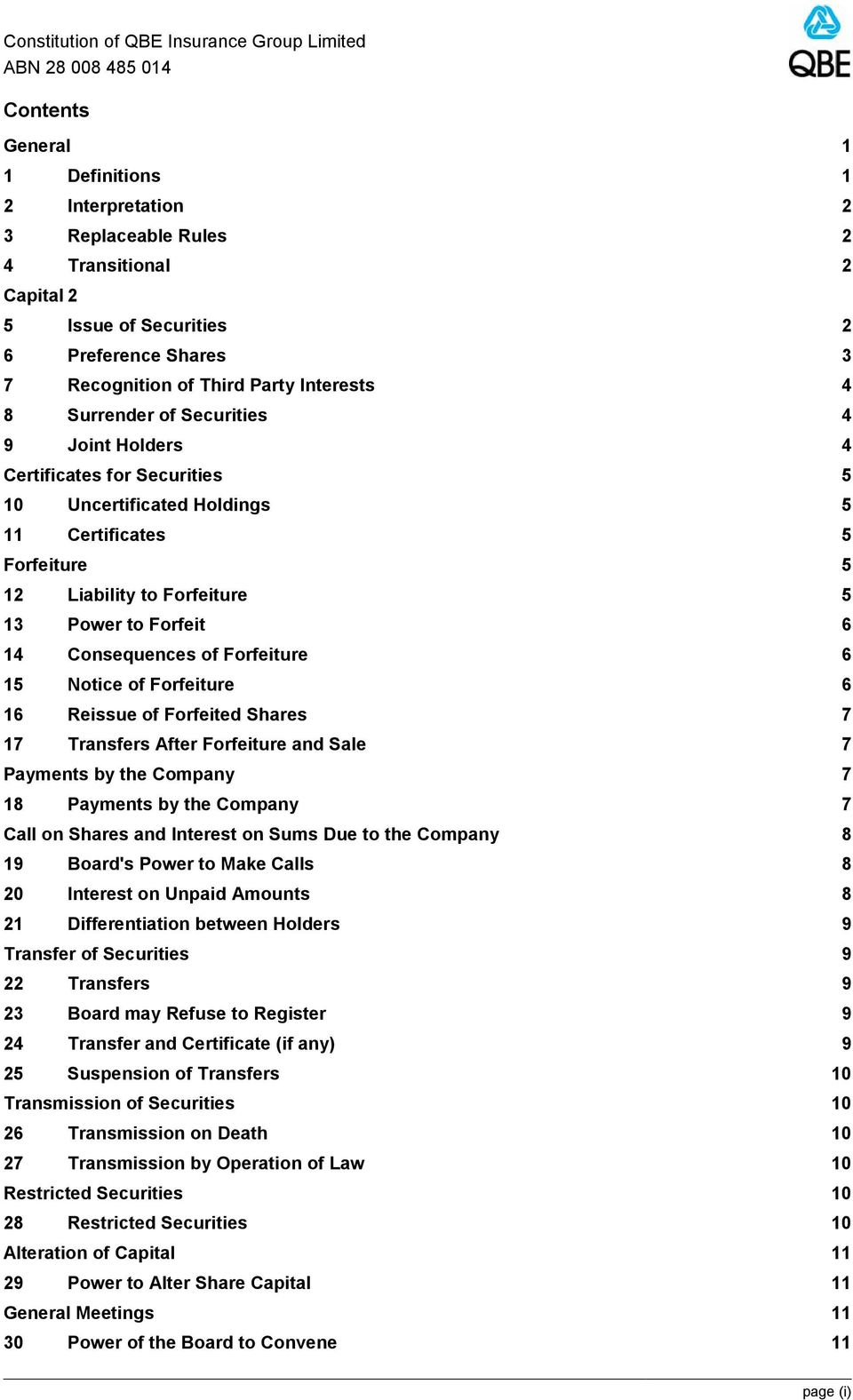
2 Contents General 1 1 Definitions 1 2 Interpretation 2 3 Replaceable Rules 2 4 Transitional 2 Capital 2 5 Issue of Securities 2 6 Preference Shares 3 7 Recognition of Third Party Interests 4 8 Surrender of Securities 4 9 Joint Holders 4 Certificates for Securities 5 10 Uncertificated Holdings 5 11 Certificates 5 Forfeiture 5 12 Liability to Forfeiture 5 13 Power to Forfeit 6 14 Consequences of Forfeiture 6 15 Notice of Forfeiture 6 16 Reissue of Forfeited Shares 7 17 Transfers After Forfeiture and Sale 7 Payments by the Company 7 18 Payments by the Company 7 Call on Shares and Interest on Sums Due to the Company 8 19 Board's Power to Make Calls 8 20 Interest on Unpaid Amounts 8 21 Differentiation between Holders 9 Transfer of Securities 9 22 Transfers 9 23 Board may Refuse to Register 9 24 Transfer and Certificate (if any) 9 25 Suspension of Transfers 10 Transmission of Securities Transmission on Death Transmission by Operation of Law 10 Restricted Securities Restricted Securities 10 Alteration of Capital Power to Alter Share Capital 11 General Meetings Power of the Board to Convene 11 page
3 31 Notice of General Meetings Business of Annual and Other General Meetings Quorum for General Meetings Conduct of General Meetings Acting Chair Adjournment of General Meetings Voting at General Meetings Special Meetings Procedure for Polls No Casting Vote for Chair Representation and Voting of Shareholders Restriction on Voting Rights Form of Proxy Form of Direct Vote Validity of Proxies, Attorneys and Representatives Validity of Direct Votes 18 Appointment, Removal and Remuneration Of Directors Number of Directors Appointment and Removal of Directors No Share Qualification for Directors Retirement of Directors Remuneration of Directors Vacation of Office of Director Retirement Allowance for Directors Directors May Lend to the Company Alternate Directors 21 Powers of the Board and Executives Appointment of Executives Powers of the Board and Managing Director 23 Proceedings of the Board Proceedings of the Board Meetings of the Board by Technology Chair of the Board Directors' Voting Rights and Exercise of Powers Material Personal Interests of Directors Committees of the Board Written Resolutions of Directors Defects in Appointments of Directors 26 Secretaries and Other Officers Secretaries Other Officers 26 Seals 26 page

4 68 Seals and their Use 26 Dividends, Interest and Reserves Reserves Power to Declare or Determine Dividends and Pay Interest Crediting of Dividends Deduction of Unpaid Amounts Distributions in Kind Payment of Distributions 28 Capitalisation of Profits Capitalisation of Profits 29 Service of Documents Service of Documents 30 Winding Up Winding Up 31 Indemnity Indemnity of Officers, Insurance and Access 31 Small Shareholdings Sale of Small Holdings 33 Dividend Reinvestment Plans Dividend Reinvestment Plans 35 Employee Share Plans Employee Share Plans 36 Bonus Share Plan Bonus Share Plan 37 Proportional Takeover Approval Proportional Takeover Approval 38 page

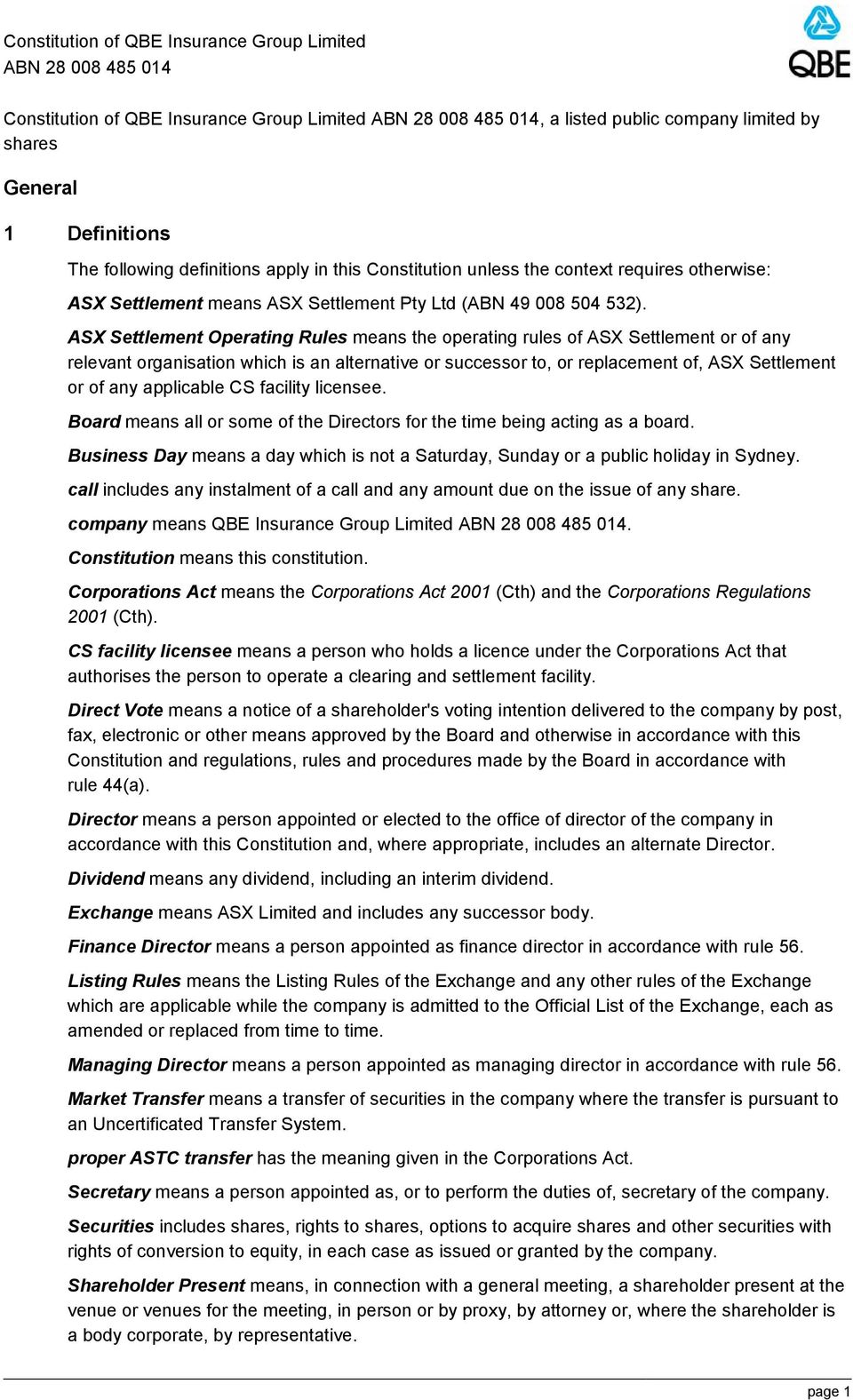
5 Constitution of QBE Insurance Group Limited, a listed public company limited by shares General 1 Definitions The following definitions apply in this Constitution unless the context requires otherwise: ASX Settlement means ASX Settlement Pty Ltd (ABN ). ASX Settlement Operating Rules means the operating rules of ASX Settlement or of any relevant organisation which is an alternative or successor to, or replacement of, ASX Settlement or of any applicable CS facility licensee. Board means all or some of the Directors for the time being acting as a board. Business Day means a day which is not a Saturday, Sunday or a public holiday in Sydney. call includes any instalment of a call and any amount due on the issue of any share. company means QBE Insurance Group Limited. Constitution means this constitution. Corporations Act means the Corporations Act 2001 (Cth) and the Corporations Regulations 2001 (Cth). CS facility licensee means a person who holds a licence under the Corporations Act that authorises the person to operate a clearing and settlement facility. Direct Vote means a notice of a shareholder's voting intention delivered to the company by post, fax, electronic or other means approved by the Board and otherwise in accordance with this Constitution and regulations, rules and procedures made by the Board in accordance with rule 44. Director means a person appointed or elected to the office of director of the company in accordance with this Constitution and, where appropriate, includes an alternate Director. Dividend means any dividend, including an interim dividend. Exchange means ASX Limited and includes any successor body. Finance Director means a person appointed as finance director in accordance with rule 56. Listing Rules means the Listing Rules of the Exchange and any other rules of the Exchange which are applicable while the company is admitted to the Official List of the Exchange, each as amended or replaced from time to time. Managing Director means a person appointed as managing director in accordance with rule 56. Market Transfer means a transfer of securities in the company where the transfer is pursuant to an Uncertificated Transfer System. proper ASTC transfer has the meaning given in the Corporations Act. Secretary means a person appointed as, or to perform the duties of, secretary of the company. Securities includes shares, rights to shares, options to acquire shares and other securities with rights of conversion to equity, in each case as issued or granted by the company. Shareholder Present means, in connection with a general meeting, a shareholder present at the venue or venues for the meeting, in person or by proxy, by attorney or, where the shareholder is a body corporate, by representative. page 1
6 Uncertificated Securities Holding means Securities that under the Corporations Act, the Listing Rules or any Uncertificated Transfer System may be held in uncertificated form. Uncertificated Transfer System means any system operated under the Corporations Act, the Listing Rules or the ASX Settlement Operating Rules that regulates the transfer or registration of, or the settlement of transactions affecting, Securities in uncertificated form and includes CHESS (as defined in the ASX Settlement Operating Rules) as it applies to Securities in certificated and uncertificated form. 2 Interpretation Headings are for convenience only and do not affect interpretation. The following rules of interpretation apply unless any contrary intention appears in this Constitution or the context requires otherwise. (iv) (v) (vi) (vii) The singular includes the plural, and the converse also applies. If a word or phrase is defined, its other grammatical forms have a corresponding meaning. A reference to a person includes a corporation, trust, partnership, unincorporated body or other entity, whether or not it comprises a separate legal entity. A reference to a rule is a reference to a rule of this Constitution. A reference to legislation or to a provision of legislation includes a modification or re-enactment of it, a legislative provision substituted for it and a regulation or statutory instrument issued under it. A word or phrase given a meaning in the Corporations Act has the same meaning in this Constitution. A reference to the Listing Rules or the ASX Settlement Operating Rules is to the Listing Rules or the ASX Settlement Operating Rules in force in relation to the company after taking into account any waiver or exemption which is in force either generally or in relation to the company. 3 Replaceable Rules The replaceable rules contained in the Corporations Act do not apply to the company. 4 Transitional This Constitution supersedes the constitution in force immediately before the adoption of this Constitution. Everything done under any previous constitution of the company continues to have the same operation and effect after the adoption of this Constitution as if properly done under this Constitution. In particular (without limitation) every Director, alternate Director and Secretary in office immediately before the adoption of this Constitution is taken to have been appointed and continues in office under this Constitution. Capital 5 Issue of Securities Subject to the Corporations Act, the Listing Rules, this Constitution and any special rights conferred on the holders of any Securities, the issue of Securities is under the control of page 2

7 the Board, which may issue and cancel Securities and grant options over unissued Securities, on the terms the Board considers appropriate. Without affecting any special rights conferred on the holders of any Securities, any Securities may be issued with preferred, deferred or other special rights, obligations or restrictions, whether in regard to dividends, voting, return of share capital, payment of calls or otherwise, as the Board may determine and on any terms the Board considers appropriate. Unless otherwise provided by the terms of issue, the issue of any new Securities ranking equally with existing Securities is not a variation of the rights conferred on the holders of the existing Securities. 6 Preference Shares If the company at any time proposes to create and issue any preference shares: the preference shares may be issued on the terms that they are, or at the option of either or both the company and the holder are liable, to be redeemed out of profits or the proceeds of a new issue of shares made for the purpose of the redemption, or otherwise as permitted by the Corporations Act; each preference share is to confer on its holder the right to convert the preference share into ordinary shares if and on the basis the Board decides at the time of issue of the preference share; each preference share is to confer on its holder a right to receive a preferential Dividend at the rate or of the amount (which may be subject to an index) and on the basis decided by the Board at the time of issue of the preference share; (e) in addition to the preferential Dividend, each preference share may participate with the ordinary shares in Dividends declared or determined by the Board if and to the extent the Board decides at the time of issue of the preference share; and the preferential Dividend may be cumulative if and to the extent the Board decides at the time of issue of the preference share; each preference share is to confer on its holder: the right on redemption and in a winding up to payment in cash in priority to any other class of shares (except for any class of preference shares ranking equally in the relevant respect with the preference share) of: (A) (B) the amount paid or agreed to be considered as paid on the preference share; and the amount (if any) equal to the aggregate of any Dividends accrued (whether declared or determined or not) but unpaid on the preference share, and of any arrears of Dividends on the preference share; and the right, in priority to any payment of Dividend on any other class of shares (except for any class of preference shares ranking equally in the relevant respect with the preference share), to the preferential Dividend, in each case on the basis the Board decides at the time of issue of the preference share; the preference shares are to confer on the holders the right to a bonus issue or capitalisation of profits in favour of holders of those shares only, if and on the basis the Board decides at the time of issue of the preference shares; page 3

8 (f) (g) (h) a preference share does not confer on its holder any further rights to participate in assets or profits of the company; the holder of a preference share has the same rights as the holders of ordinary shares to receive notices, reports and accounts and to attend and be heard at all general meetings, but is not to have the right (in that capacity) to vote at general meetings except as follows: (iv) on any question considered at a meeting if, at the date of the meeting, a Dividend (or any part of a Dividend) on the preference share is in arrears; on a proposal: (A) (B) (C) (D) to reduce the share capital of the company; that affects rights attached to the preference share; to wind up the company; for the disposal of the whole of the property, business and undertaking of the company; on a resolution to approve the terms of a buy-back agreement; and on any question considered at a meeting held during the winding up of the company; and the company may issue further preference shares ranking equally in all respects with (but not in priority to) other preference shares already issued and the rights of the issued preference shares are not to be taken to have been varied by the further issue. 7 Recognition of Third Party Interests Except as required by law, the company is not bound to recognise a person as holding a Security on any trust. Whether or not it has notice of the rights or interests concerned, the company is not bound to recognise: any equitable, contingent, future or partial claim to, or interest in, any Security or unit of a Security; or any other right in respect of a Security, except an absolute right of ownership of the Security holder or as otherwise provided by this Constitution or by law. 8 Surrender of Securities In its discretion, the Board may accept a surrender of Securities by way of compromise of any question as to whether or not those Securities have been validly issued or in any other case where the surrender is within the powers of the company. Any Securities surrendered may be sold or re-issued in the same manner as forfeited shares. 9 Joint Holders Where two or more persons are registered as the holders of any Securities, they are considered to hold the Securities as joint tenants with benefits of survivorship, subject to the following provisions: the company is not bound to register more than three persons as the holders of the Securities; page 4

9 (e) (f) the joint holders of the Securities are liable severally as well as jointly in respect of all payments which ought to be made in respect of the Securities; on the death of any one of the joint holders, the remaining joint holders are the only persons recognised by the company as having any title to the Securities but the Board may require evidence of death and the estate of the deceased joint holder is not released from any liability in respect of the Securities; any one of the joint holders may give a receipt for any Dividend, bonus or return of capital payable to the joint holders in respect of the Securities; only the person whose name stands first in the Securities register as one of the joint holders of the Securities is entitled, if the company determines to issue certificates for Securities, to delivery of a certificate relating to the Securities or to receive notices from the company and any notice given to that person is considered notice to all the joint holders; and any one of the joint holders may vote at any general meeting of the company in person, or by properly authorised representative, proxy or attorney or by Direct Vote, in respect of the Securities as if that joint holder was solely entitled to the Securities. If more than one of the joint holders tender a vote in person or by properly authorised representative, proxy or attorney or by Direct Vote, only the vote of the joint holder whose name appears first in the Securities register counts. Certificates for Securities 10 Uncertificated Holdings If and for so long as dealings in any Securities take place under an Uncertificated Transfer System: the company need not issue any certificate in respect of Securities held as an Uncertificated Securities Holding; and the Securities register may distinguish between Securities held in certificated form and Securities held as an Uncertificated Securities Holding. 11 Certificates Forfeiture The Board may decide to issue certificates for Securities and to cancel any certificates on issue and to replace lost, destroyed or defaced certificates on issue on the basis and in the form it determines from time to time. 12 Liability to Forfeiture If a shareholder fails to pay when due any sum payable in respect of any shares (including amounts payable on issue, calls, instalments, interest or expenses) the Board may serve a notice on the shareholder requiring payment of the unpaid sum, together with accrued interest and all expenses of the company incurred by reason of the non-payment. page 5

10 The notice must: specify: (A) (B) a time by which payment must be made, which must not be earlier than close of business (local time at the registered office of the company) 14 days after the date of service of the notice; and the required manner of payment; and state that the shares are liable to be forfeited, if payment is not made as required by the notice. 13 Power to Forfeit If the requirements of a notice with respect to a share under rule 12 are not complied with then, subject to the Listing Rules and the ASX Settlement Operating Rules, at any time the share may be forfeited by a resolution of the Board to that effect unless, before the resolution the payment required by the notice is paid together with interest (if determined by the Board) at the rate determined by the Board. 14 Consequences of Forfeiture A person whose shares have been forfeited: (iv) ceases to be a shareholder in respect of the forfeited shares at the time and on the date of the passing of a resolution of the Board approving the forfeiture; has no claims or demands against the company in respect of those shares including any Dividends; has no other rights incident to the shares; and unless otherwise approved by the company in general meeting, remains liable to pay to the company all money that, at the date of forfeiture, was payable by the person to the company in respect of the shares (including, if the Board determines, interest from the date of forfeiture at the rate the Board determines). The Board may enforce the payment of all or any part of the money as it determines. If any amounts due in respect of any shares (including amounts payable on issue, calls, instalments, interest or expenses) are unpaid by the shareholder: the shareholder is not entitled to any rights or privileges as a shareholder; the company is entitled to set off any amount owed by it to the shareholder against the amounts the shareholder owes to it; and the company may refuse to register a transfer of the shares. Nothing in this rule 14 affects any other right or remedy of the company against the shareholder or anyone else. 15 Notice of Forfeiture When any share is forfeited, the company will note it in the share register and notify the affected shareholder. Failure to do so does not invalidate the forfeiture. At any time before any forfeited share is cancelled or reissued, the Board may annul the forfeiture on any conditions it determines. page 6

11 16 Reissue of Forfeited Shares Subject to applicable law and the Listing Rules, the Board may reissue the forfeited shares in any manner it determines and, to the extent permitted by law, with or without any money previously paid on the shares being credited as paid up. Unless otherwise agreed, the acquirer of a reissued share is: discharged from liability for any calls which may have been due before the reissue of the forfeited share; and not bound to see to the application of any money paid as consideration. Subject to the terms of issue of the forfeited shares, the proceeds from the acquisition of the reissued shares must be applied to pay: first, the company's expenses of the reissue; then, any expenses necessarily incurred in respect of the forfeiture; and then, the calls or other sums payable to the company in respect of the forfeited shares that are due and unpaid. The balance, if any, must be paid to the person whose shares were forfeited. 17 Transfers After Forfeiture and Sale The company may: receive the consideration (if any) given for a forfeited share on any sale or disposition of the share; and effect a transfer of the share in favour of the person to whom the share is sold or disposed of. On the completion of the transfer, the transferee is to be registered as the holder of the share and is not bound to see to the application of any money paid as consideration. Payments by the Company 18 Payments by the Company If the law of any place imposes or purports to impose any immediate or future or possible liability on the company to make any payments or empowers any government or taxing authority or government official to require the company to make any payment: (iv) in respect of any Securities held either jointly or solely by any holder; in respect of any transfer of those Securities; in respect of any interest, Dividends, bonuses or other moneys due or payable or accruing or which may become due or payable to the holder by the company on or in respect of any Securities; or for or on account or in respect of any holder of Securities, then rules 18 and 18 apply, in addition to any right or remedy the company may otherwise have. The company is fully indemnified by: the holder; the holder's trustee, executor or administrator; or page 7

12 any person who becomes registered as the holder of the Securities on the distribution of the deceased holder's estate. The company may recover any moneys paid as described in rule 18, which exceeded any Dividend, bonus or other money then due or payable by the company to the holder, together with interest at a rate the Board may determine from time to time from the date of payment to the date of repayment, as a debt due from: the holder; the holder's trustee, executor or administrator; or any person who becomes registered as holder of the Securities on the distribution of the deceased holder's estate. The Board may: exempt a Security from all or part of this rule 18; and waive or compromise all or part of any payment due to the company under this rule 18. Call on Shares and Interest on Sums Due to the Company 19 Board's Power to Make Calls (e) (f) (g) Subject to the terms of issue of any shares and the Listing Rules, the Board may make calls on the relevant shareholders in respect of any money unpaid on the shares. Each shareholder must pay the amount of the call on that shareholder's shares in the manner, by the time or times, and at the place, specified by the Board. The Board may revoke or postpone a call. A call may be required to be paid by instalments. A call is made at the time of or as specified in the resolution of the Board authorising the call. The non-receipt of a notice of a call by, or the accidental omission to give notice of a call to, any shareholder does not invalidate the call. If the Board thinks fit, the company may receive from any shareholder all or any part of the moneys unpaid on all or any of the shares held by that shareholder beyond the sums actually called up and then due and payable either as a loan repayable or as a payment in advance of calls. The company may pay interest on the moneys advanced at the rate and on the terms agreed by the Board and the shareholder paying the sum in advance. 20 Interest on Unpaid Amounts If a sum called or otherwise payable to the company in respect of a share is not paid before or on the day for payment, the person from whom the sum is due must pay: interest on the sum from the due date to the time of actual payment at the rate determined by the Board; and any costs and expenses incurred by the company by reason of non-payment or late payment of the sum. The Board may waive payment of some or all of the interest, costs and expenses under rule 20. page 8

13 21 Differentiation between Holders The Board may differentiate on the issue of shares between the holders as to the amount of calls to be paid and the times of payment. Transfer of Securities 22 Transfers A transfer of any Securities may be effected by: a written transfer in the usual or common form or in any form the Board may prescribe or in a particular case accept, properly stamped (if necessary), being delivered to the company; a proper ASTC transfer, which is to be in the form required or permitted by the Corporations Act or the ASX Settlement Operating Rules; or any other electronic system established or recognised by the Listing Rules in which the company participates in accordance with the rules of that system. Except in the case of a proper ASTC transfer, the transferor is considered to remain the holder of the Securities transferred until the name of the transferee is entered on the Securities register. A proper ASTC transfer is considered recorded in the Securities register and the name of the transferee to be registered as the holder of the Securities comprised in the proper ASTC transfer, as provided in the ASX Settlement Operating Rules. The Board may take any action it determines to comply with the ASX Settlement Operating Rules and may request ASX Settlement to apply a holding lock to prevent a transfer of Securities the subject of the ASX Settlement Operating Rules if the Board determines. The company may do anything necessary or desirable to facilitate participation by the company in any Uncertificated Transfer System. 23 Board may Refuse to Register The Board may refuse to register any transfer of Securities: if the registration of the transfer would result in a contravention of or failure to observe the provisions of any applicable law or the Listing Rules; which are subject to forfeiture; or if permitted to do so under the Listing Rules. The decision of the Board relating to the registration of a transfer is absolute. Failure to give notice of refusal to register any transfer as may be required under the Corporations Act or the Listing Rules does not invalidate the decision of the Board. 24 Transfer and Certificate (if any) Every transfer must be left for registration at the registered office of the company or any other place the Board determines. Unless the Board otherwise determines either generally or in a particular case, the transfer is to be accompanied by the certificate (if any) for the Securities to be transferred. In addition, the transfer is to be accompanied by any other evidence that the Board may require to prove the title of the transferor, the transferor's right to transfer the Securities, execution of the transfer or compliance with page 9
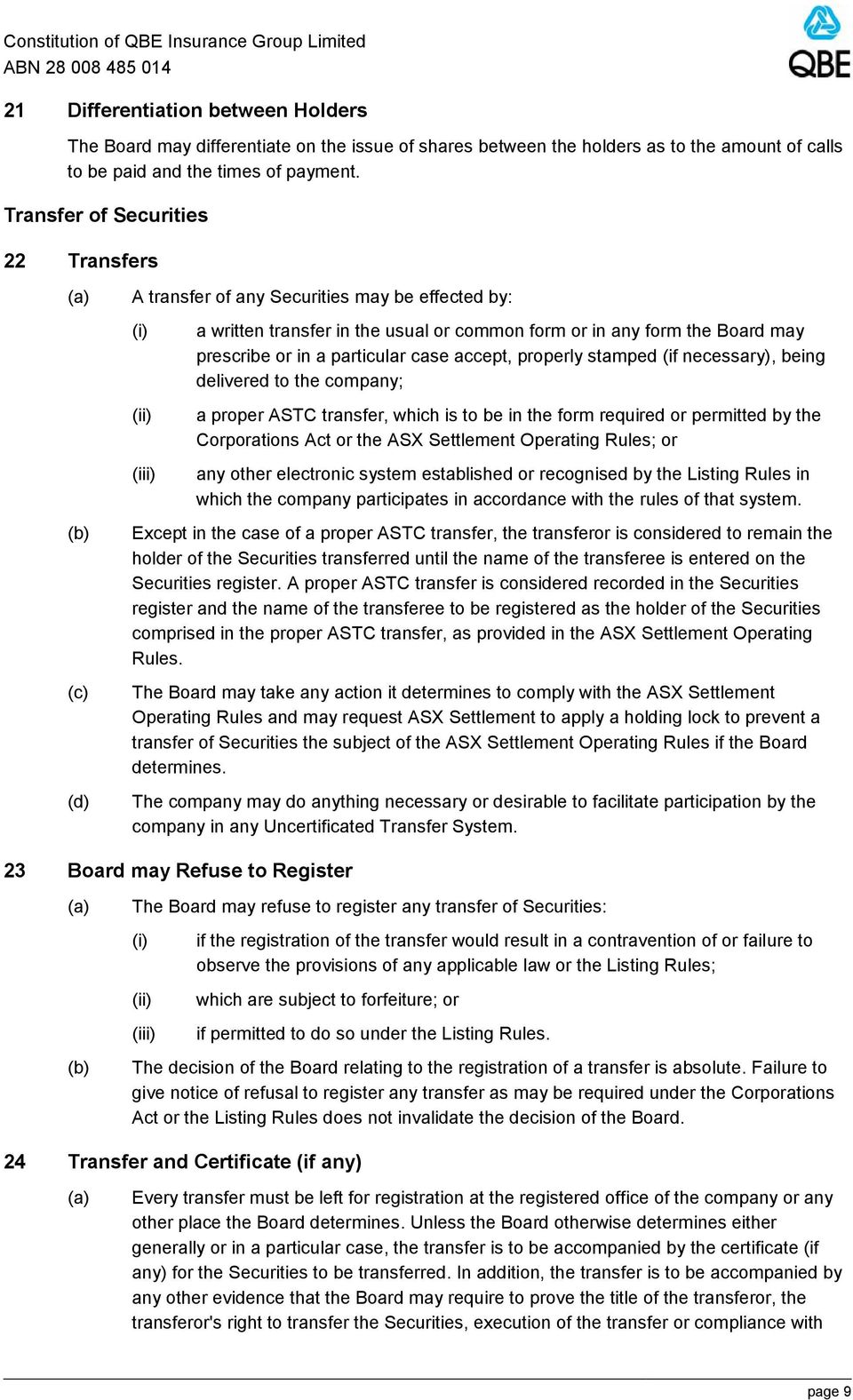
14 the provisions of any applicable laws. The requirements of this rule do not apply in respect of a proper ASTC transfer. Subject to rule 24, the certificate (if any) specifying the Securities in respect of which registration is required must be delivered to the company for cancellation with each application to register the transfer of any Securities or to register any person as the holder in respect of any Securities transmitted to that person by operation of law or otherwise. The certificate is considered to have been cancelled on such registration. Each transfer that is registered may be retained by the company for any period determined by the Board, after which the company may destroy it. Without limiting any other entitlement the company may have to charge fees, the company may, to the extent permitted by the Listing Rules, charge a reasonable fee in relation to any transfer of Securities that is not a Market Transfer or the issue of any certificates for Securities. 25 Suspension of Transfers The registration of transfers of Securities of the company that are not quoted on the Exchange may be suspended at any time and for any period as the Board may from time to time decide. The aggregate of those periods must not exceed 30 days in any calendar year. Transmission of Securities 26 Transmission on Death Where a Security holder dies: the legal personal representatives of the deceased, where the Security holder was a sole holder or a joint holder holding as a tenant in common; and the survivor or survivors, where the Security holder was a joint holder, are the only persons recognised by the company as having any title to the Security holder's interest in the Securities (as the case may be). Subject to the Corporations Act, the Board may require evidence of a Security holder's death as it determines. This rule 26 does not release the estate of a deceased joint holder from any liability in respect of any Security that had been jointly held by the holder with other persons. 27 Transmission by Operation of Law A person (a transmittee) who establishes to the satisfaction of the Board that the right to any Securities has devolved on the transmittee by will or by operation of law may be registered as a holder in respect of the Securities or may (subject to the provisions in this Constitution relating to transfers) transfer the Securities. The Board has the same right to refuse to register the transmittee as if the transmittee was the transferee named in a transfer presented for registration. Restricted Securities 28 Restricted Securities In this rule 28 unless the context requires otherwise: dispose has the meaning given in the Listing Rules. page 10

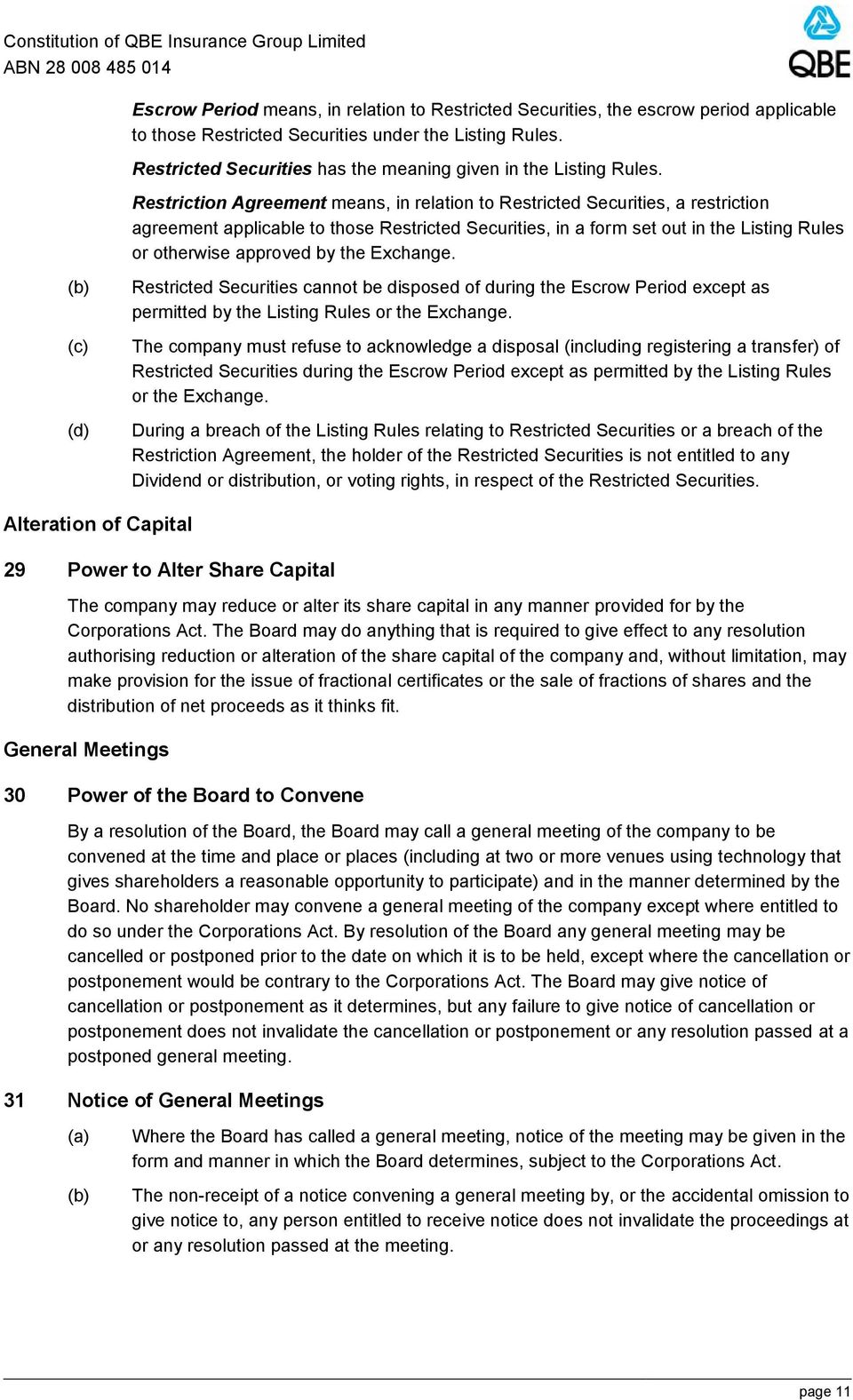
15 Escrow Period means, in relation to Restricted Securities, the escrow period applicable to those Restricted Securities under the Listing Rules. Restricted Securities has the meaning given in the Listing Rules. Restriction Agreement means, in relation to Restricted Securities, a restriction agreement applicable to those Restricted Securities, in a form set out in the Listing Rules or otherwise approved by the Exchange. Restricted Securities cannot be disposed of during the Escrow Period except as permitted by the Listing Rules or the Exchange. The company must refuse to acknowledge a disposal (including registering a transfer) of Restricted Securities during the Escrow Period except as permitted by the Listing Rules or the Exchange. During a breach of the Listing Rules relating to Restricted Securities or a breach of the Restriction Agreement, the holder of the Restricted Securities is not entitled to any Dividend or distribution, or voting rights, in respect of the Restricted Securities. Alteration of Capital 29 Power to Alter Share Capital The company may reduce or alter its share capital in any manner provided for by the Corporations Act. The Board may do anything that is required to give effect to any resolution authorising reduction or alteration of the share capital of the company and, without limitation, may make provision for the issue of fractional certificates or the sale of fractions of shares and the distribution of net proceeds as it thinks fit. General Meetings 30 Power of the Board to Convene By a resolution of the Board, the Board may call a general meeting of the company to be convened at the time and place or places (including at two or more venues using technology that gives shareholders a reasonable opportunity to participate) and in the manner determined by the Board. No shareholder may convene a general meeting of the company except where entitled to do so under the Corporations Act. By resolution of the Board any general meeting may be cancelled or postponed prior to the date on which it is to be held, except where the cancellation or postponement would be contrary to the Corporations Act. The Board may give notice of cancellation or postponement as it determines, but any failure to give notice of cancellation or postponement does not invalidate the cancellation or postponement or any resolution passed at a postponed general meeting. 31 Notice of General Meetings Where the Board has called a general meeting, notice of the meeting may be given in the form and manner in which the Board determines, subject to the Corporations Act. The non-receipt of a notice convening a general meeting by, or the accidental omission to give notice to, any person entitled to receive notice does not invalidate the proceedings at or any resolution passed at the meeting. page 11
16 32 Business of Annual and Other General Meetings The business of an annual general meeting of the company includes: (iv) to receive and consider the accounts and reports required by the Corporations Act to be laid before each annual general meeting; to elect Directors; when relevant, to appoint an auditor and to fix the auditor s remuneration; and to transact any other business that, under this Constitution or the Corporations Act, is required to be transacted at any annual general meeting. The business of an annual general meeting may also include any other business that may be transacted at a general meeting. No person may move at any general meeting either any resolution (except in the form set out in the notice of meeting) or any amendment of any resolution, except with the approval of the Board, with the permission of the chair of the meeting or under the Corporations Act. 33 Quorum for General Meetings No business may be transacted at any general meeting except, subject to rule 34, the election of a chair of the meeting unless a quorum of shareholders is present at the time when the meeting proceeds to business. Except as otherwise provided in this Constitution, three Shareholders Present constitutes a quorum. If there is not a quorum at a general meeting within 30 minutes after the time specified in the notice of the meeting, the meeting is dissolved unless the chair of the meeting or the Board adjourns the meeting to a date, time and place determined by that chair or the Board. If no quorum is present at any adjourned meeting within 30 minutes after the time for the meeting, the meeting is dissolved. 34 Conduct of General Meetings Subject to rule 34, the chair of the Board is entitled to preside as chair at every general meeting. Where a general meeting is held and: there is no chair of the Board; or the chair of the Board is not able to be present at the meeting or is not present within 15 minutes after the time appointed for the meeting, or despite being so present is unable or unwilling to act as chair of the meeting, the deputy chair of the Board is entitled to chair the meeting or, if the circumstances in rule 34 or 34 apply to the deputy chair of the Board, the Directors present may choose one of their number or, in the absence of all Directors or if none of the Directors present wish to act, the Shareholders Present may elect one of their number, to be chair of the meeting. The general conduct of each general meeting of the company and the procedures to be adopted at the meeting are as determined at, during or prior to the meeting by the chair of the meeting. page 12

17 (e) (f) (g) (h) (j) The chair of a general meeting of the company may make rulings without putting the question (or any question) to a vote if that chair considers action is required to ensure the orderly conduct of the meeting. The chair of a general meeting of the company may require the adoption of any procedures that are in that chair s opinion necessary or desirable for the proper and orderly casting or recording of votes at the meeting, whether on a show of hands or on a poll. The chair of a general meeting of the company or a person acting with that chair's authority may require any person who wishes to attend the meeting to comply with searches, restrictions or other security arrangements that chair or a person acting with that chair's authority considers appropriate. The chair of the meeting or a person acting with that chair's authority may refuse entry to any person who does not comply with the arrangements, any person who possesses a recording or broadcasting device without the consent of that chair or a person acting with that chair's authority, or any person who possesses an article which that chair or a person acting with that chair's authority considers to be dangerous, offensive or liable to cause disruption. If at any time the chair of a general meeting of the company considers it necessary or desirable for the proper and orderly conduct of the meeting, that chair may demand the cessation of debate or discussion on any business, question, motion or resolution being considered by the meeting and require the business, question, motion or resolution to be put to a vote of the Shareholders Present. Any determination by the chair of a general meeting in relation to matters of procedure (including any procedural motions moved at, or put to, the meeting) or any other matter arising directly or indirectly from the business is final (including any procedural motions moved at, or put to, the meeting). Any challenge to a right to vote (whether on a show of hands or on a poll) or to a determination to allow or disregard a vote (including in either case a Direct Vote) may only be made at the meeting and may be determined by the chair of the meeting whose decision is final. If a person purports to cast a vote (including a Direct Vote) at or for the purposes of a general meeting in contravention of the Corporations Act or Listing Rules, the chair of the meeting may determine that the vote be disregarded and treated as not having been cast. Nothing contained in this rule 34 limits the powers conferred on a chair of a general meeting by law. 35 Acting Chair If during any general meeting the chair of the meeting acting under rule 34 is unwilling to chair any part of the proceedings, that chair may withdraw during the relevant part of the proceedings and may nominate any person who immediately before the general meeting was a Director or who has been nominated for election as a Director at the meeting to be acting chair of the meeting during the relevant part of the proceedings. On the conclusion of the relevant part of the proceedings the acting chair of the meeting is to withdraw and the chair of the meeting acting under rule 34 is to resume to chair the meeting. Where an instrument of proxy appoints the chair of a general meeting as proxy for the part of the proceedings for which an acting chair of the meeting has been nominated, the instrument of proxy is taken to be in favour of that acting chair for the relevant part of the proceedings. page 13

18 36 Adjournment of General Meetings During the course of a general meeting the chair of the meeting may adjourn the meeting or any business, motion, question or resolution being considered or remaining to be considered by the meeting or any debate or discussion either to a later time at the same meeting or to an adjourned meeting to be held at the time and place determined by that chair. If the chair of a general meeting exercises a right of adjournment of the meeting under this rule 36, that chair has the sole discretion to decide whether to seek the approval of the Shareholders Present to the adjournment and, unless that chair exercises that discretion, no vote may be taken by the Shareholders Present in respect of the adjournment. No business may be transacted at any adjourned general meeting other than the business left unfinished at the meeting from which the adjournment took place. 37 Voting at General Meetings (e) (f) Subject to the requirements of the Corporations Act, any question submitted to a general meeting is decided by a simple majority of votes validly cast on the question at or for the purpose of the meeting. The chair of a general meeting may determine that any question to be submitted to the meeting be determined by a poll without first submitting the question to the meeting to be decided by a show of hands. Unless the chair of a general meeting makes the determination referred to in rule 37, each question submitted to the meeting is to be decided in the first instance by a show of hands. Unless a poll is demanded, a declaration by the chair of a general meeting following a vote on a show of hands at the meeting that a resolution has been passed or lost is conclusive, without proof of the number or proportion of the votes recorded in favour of or against the resolution. At any general meeting, a poll may be demanded by a shareholder in accordance with the Corporations Act (and not otherwise) or by the chair of the meeting. No poll may be demanded on the election of a chair of the meeting or, unless that chair otherwise determines, the adjournment of the meeting. A demand for a poll may be withdrawn. The Board may, subject to law, determine that, at any meeting of shareholders or a class of shareholders, a shareholder who is entitled to attend and vote at that meeting is entitled to give their vote by Direct Vote. 38 Special Meetings All the provisions of this Constitution as to general meetings apply to any special meeting of any class of shareholders that may be held under the operation of this Constitution or the Corporations Act. 39 Procedure for Polls When demanded at a general meeting, a poll may be taken in the manner and at the time that the chair of the meeting directs. The result of a poll may be announced in the manner and at the time (whether during the relevant meeting or afterwards) that the chair of the meeting considers appropriate. page 14

19 The result of a poll is the resolution of the meeting at which the poll was demanded. The demand for a poll does not prevent a meeting from continuing for the transaction of any business other than that on which a poll has been demanded. Subject to rules 36 and 37(e), a poll demanded on any question of adjournment is to be taken at the meeting and without adjournment. 40 No Casting Vote for Chair In the case of an equality of votes on a show of hands or on a poll at or for the purposes of a general meeting of the company, the chair of the meeting does not have a casting vote in addition to any vote to which that chair may be entitled as a shareholder or as a proxy, attorney or properly appointed representative of a shareholder. 41 Representation and Voting of Shareholders Subject to this Constitution and any rights or restrictions for the time being attached to any class or classes of shares: at meetings of shareholders or a class of shareholders each shareholder entitled to attend and vote may: attend and vote in person; or be represented and vote by proxy, by attorney or (where the shareholder is a body corporate) by representative; or if a determination has been made by the Board in accordance with rule 37(f), vote by Direct Vote; a shareholder may only vote by one of the permitted methods in rule 41 in respect of a share although, without limiting rules 45 and 46, a shareholder may attend and participate in a meeting even though the shareholder has previously appointed a proxy or attorney, or has given a Direct Vote, in respect of that meeting; on a show of hands in respect of a resolution: (iv) subject to rules 41 and 41, each Shareholder Present has one vote; where a shareholder has appointed more than one person as representative, proxy or attorney for the shareholder, none of the representatives, proxies or attorneys is entitled to vote; and where a person is entitled to vote because of rule 41 in more than one capacity, that person is entitled only to one vote; and a Direct Vote is not counted; and on a poll in respect of a resolution, subject to rules 41 and 46: every Shareholder Present; and if a determination has been made by the Board in accordance with rule 37(f), every shareholder who gives a Direct Vote, having the right to vote on the resolution has: (iv) one vote for each fully paid share they hold; and in the case of a partly paid share, that fraction of a vote equivalent to the proportion that the amount paid up on that shareholder's share bears to the total amount paid and payable for that share. Amounts paid in advance of a call are ignored when calculating the proportion; and page 15
20 (v) in respect of every shareholder who gives a Direct Vote, their vote is treated as if the shareholder cast the vote in the poll at the meeting, and must be counted accordingly. 42 Restriction on Voting Rights A shareholder is not entitled to vote at a general meeting or to be counted for the purpose of constituting a quorum unless all calls and other sums presently payable by the shareholder in respect of shares have been paid. 43 Form of Proxy A shareholder who is entitled to attend and vote at a meeting of the company may appoint a person as a proxy to attend and vote for the shareholder in accordance with the Corporations Act but not otherwise. A proxy appointed in accordance with the Corporations Act to attend and vote may exercise the rights of the shareholder on the basis and subject to the restrictions provided in the Corporations Act but not otherwise. An appointment of a proxy is valid if it is in accordance with the Corporations Act or in any form (including electronic) that the Board may prescribe or accept. If a proxy appointment is not properly executed or validated, incomplete or unclear, the following provisions apply. Nothing obliges the Board or the company to do anything referred to in those provisions. If the name of the proxy is not included, the name of any Director or Secretary may be inserted by the Secretary on the authority of the Board (which may occur later than the time specified in the relevant notice of meeting for the receipt of proxy appointments). If the appointment has not been duly signed or validated, the company may: (A) (B) return the appointment to the appointing shareholder; and request that the shareholder sign or validate the appointment and return it to the company within a period decided by the Board (which may be later than the time specified in the relevant notice of meeting for the receipt of proxy appointments). If the appointment is otherwise incomplete or unclear, the company may, by written or oral communication, clarify with a shareholder any instruction on the appointment and complete or amend the contents of any appointment to reflect any clarification in instruction received from the shareholder (which completion or amendment may occur later than the time specified in the relevant notice of meeting for the receipt of proxy appointments). For this purpose the shareholder appoints the company as its attorney. Where a notice of meeting provides for electronic lodgement of proxy appointments, an appointment lodged at the electronic address or by the electronic means specified in the notice is taken to have been received at the registered office of the company and validated by the shareholder if there is compliance with the requirements set out in the notice. 44 Form of Direct Vote The Board may, subject to this Constitution, prescribe regulations, rules and procedures in relation to the giving of Direct Votes (including specifying the form, method and timing of giving a Direct Vote at or for the purposes of a meeting in order for the vote to be valid) page 16
21 and for revoking a Direct Vote. Without limitation, such regulations, rules and procedures may permit a shareholder to give a Direct Vote prior to the relevant meeting. The Board must specify in the notice of meeting, or in any document accompanying the notice of meeting or otherwise made available to shareholders for the purpose of the meeting, the form, method and timing of giving a Direct Vote in order for the Direct Vote to be valid. (e) If sent by post or fax, a Direct Vote must be signed by the shareholder or properly authorised attorney or, if the shareholder is a company, either under seal or by a duly authorised officer or attorney. If sent or lodged electronically, a Direct Vote is taken to have been signed if it has been signed or authorised by the shareholder in the manner approved by the Board or specified in the notice of meeting. At least 48 hours (or any shorter period as the Board may permit or specified by the Corporations Act) before the time for holding the relevant meeting, adjourned meeting or a poll at which a person proposes to cast a notice of their voting intention, the company must receive at its registered office or at such other electronic address or by such other electronic means specified for that purpose in the notice of meeting: the Direct Vote; and if relevant, any authority or power under which the Direct Vote was signed or a certified copy of that power or authority if not already lodged with the company. A notice of voting intention is valid if it contains the following information: the shareholder's name and address or any applicable identifying notations such as the holder identification number or similar approved by the Board or specified in the notice of meeting; and the shareholder's voting intention on any or all of the resolutions to be put before the meeting, in respect of which meeting a determination has been made by the Board in accordance with rule 37(f). 45 Validity of Proxies, Attorneys and Representatives A vote exercised in accordance with the terms of a proxy appointment, a power of attorney or other relevant instrument of appointment is valid despite: the previous death or unsoundness of mind of the principal; the revocation of the appointment, power or instrument (or of the authority under which it was made or given); or the transfer of the share in respect of which the appointment, power or instrument is made or given, if no notice in writing of the death, unsoundness of mind, revocation or transfer (as the case may be) has been received by the company at its registered office at least 48 hours (or any shorter period as the Board may permit or specified by the Corporations Act) before the commencement of the meeting or adjourned meeting at which the instrument is used or the power is exercised. A proxy appointment or power of attorney (subject to its terms) is not revoked by the principal attending the relevant meeting unless the principal instructs the company (or at the company's instruction, the company's Securities registry) prior to the meeting that the shareholder wishes to vote in person on any or all of the resolutions to be put before the meeting, in which case the proxy appointment or power of attorney is revoked entirely for that meeting. page 17
22 Voting instructions given by a shareholder to a Director or employee of the company who is held out by the company in material sent to shareholders as willing to act as proxy and who is appointed as proxy (Company Proxy) are valid only if contained in the form of appointment of the Company Proxy. If a shareholder wishes to give a Company Proxy appointed by the shareholder new instructions or variations to earlier instructions, the new or varied instructions are only valid if either they are received at the registered office of the company at least 48 hours before the meeting or adjourned meeting by a notice in writing signed by the shareholder or they are otherwise validated by the shareholder in a manner acceptable to the Board in its discretion prior to the commencement of the meeting. 46 Validity of Direct Votes Where the Board determines that, at a meeting of shareholders or a class of shareholders, shareholders will be entitled to vote by Direct Vote, the following provisions apply: (e) (f) a Direct Vote by a shareholder is not revoked by the shareholder attending the meeting unless the shareholder instructs the company (or at the company's instruction, the company's Securities registry) prior to the meeting that the shareholder wishes to vote in person on any or all of the resolutions to be put before the meeting, in which case the Direct Vote by the shareholder is revoked; a Direct Vote by a shareholder is automatically revoked if the company receives a further valid Direct Vote from the shareholder; a Direct Vote by a shareholder is automatically revoked if, after the Direct Vote is received, the company receives a valid proxy appointment in respect of that shareholder for the relevant meeting; a Direct Vote by a shareholder revokes the authority of a previously provided proxy appointment, power of attorney or other relevant instrument of appointment in respect of that shareholder for the relevant meeting; a Direct Vote by a shareholder is valid even if prior to the vote being counted: the shareholder becomes of unsound mind or dies; subject to rule 46, the shareholder wishes to change their vote; or where the Direct Vote is given on behalf of the shareholder by an attorney, the appointment of the attorney or the authority under which the appointment was made is revoked, if no notice in writing of the relevant event has been received by the company at its registered office at least 48 hours (or any shorter period as the Board may permit or specified by the Corporations Act) before the commencement of the meeting or adjourned meeting to which the Direct Vote relates; and if the chair of the meeting determines it is appropriate, a Direct Vote by a shareholder on a resolution is taken to be a Direct Vote on the resolution as amended. Appointment, Removal and Remuneration Of Directors 47 Number of Directors All Directors are to be natural persons. The number of Directors (not including alternate Directors) must not be less than three nor more than 12 (or, subject to rule 48, such lower number that the Board may page 18
23 determine from time to time in accordance with the Corporations Act, provided that the Board may not reduce the number below the number of Directors in office at the time of the reduction). 48 Appointment and Removal of Directors The company in general meeting may by resolution: appoint any person as a Director either to fill a casual vacancy or as an addition to the Board, provided that the number of Directors (not including alternate Directors) does not exceed the maximum number determined under rule 47; and remove any Director from office. No person other than a retiring Director or a Director vacating office under rule 48 is eligible to be elected a Director at any general meeting unless a notice of the person's candidature (signed by the person) is given to the company at its registered office at least 35 Business Days before the meeting (or, in the case of a meeting that shareholders have requested the Board to call, 30 Business Days). The Board may at any time appoint any person as a Director either to fill a casual vacancy or as an addition to the Board, provided that the number of Directors (not including alternate Directors) does not exceed 12. Any Director appointed under this rule 48 (other than an exempt Managing Director) may hold office only until the end of the next annual general meeting of the company and is then eligible for election at that meeting without needing to give any prior notice of an intention to submit for election. 49 No Share Qualification for Directors Directors are not required to hold shares in the capital of the company. 50 Retirement of Directors Subject to rules 48, 50 and 56, a Director may not hold office for a continuous period in excess of three years or past the conclusion of the third annual general meeting following the Director's last election or re-election, whichever is the longer, without submitting for re-election by the company. If no Director would otherwise be required to submit for election or re-election at an annual general meeting but the Listing Rules require that an election of Directors be held, the Director to retire at the annual general meeting is the Director who has been longest in office since last being elected. As between Directors who were last elected on the same day, the Director to retire is (in default of agreement between them) determined by lot. A retiring Director under this rule 50 is eligible for re-election without needing to give any prior notice of an intention to submit for re-election and holds office as a Director (subject to re-election) until the end of the general meeting at which the Director retires. 51 Remuneration of Directors The Directors are to be paid for their services as Directors. Each non-executive Director is to be paid or provided remuneration for services, of the amount, at the time and in the manner determined by the Board, provided that the aggregate amount or value of the remuneration paid or provided to all non-executive Directors in any year may not exceed the amount last approved by the company in page 19
24 general meeting. Except to the extent otherwise required by the Listing Rules, the expression remuneration in this rule does not include any amount that may be paid by the company under any of rules 51(e), 51(f), 53 and 78. (e) (f) (g) (h) The remuneration to be paid or provided under rule 51 is to be divided among the Directors in the proportions as they may agree or, if they cannot agree, equally among them. The remuneration to which a Director is entitled may be provided to a Director in cash or in any other form as is agreed between the company and the Director. A Director may elect to forgo some or all of the Director s entitlement to cash remuneration in favour of another agreed form of remuneration and vice versa, provided the total cost to the company of that Director s remuneration is not increased above the maximum amount for that Director under rule 51. The Directors are also entitled to be paid or reimbursed for all travelling and other expenses properly incurred by them in attending and returning from any meeting of the Board or of a committee of the Board or any general meeting of the company, or otherwise in connection with the business or affairs of the company. If any Director, with the approval of the Board, performs extra services or makes any special exertions for the benefit of the company, the Board may approve the payment to that Director of special and additional remuneration as the Board determines having regard to the value to the company of the extra services or special exertions. Any special or additional remuneration must not include a commission on or percentage of profits or operating revenue or turnover. An executive Director may be appointed on terms as to remuneration, tenure of office and otherwise as may be determined by the Board. Subject to the Corporations Act, a Director may be engaged by the company in any other capacity (other than auditor) and may be appointed on such terms as to remuneration, tenure of office and otherwise as may be determined by the Board. 52 Vacation of Office of Director In addition to the circumstances in which the office of a Director becomes vacant: under the Corporations Act; and under rules 48 and 50, the office of a Director becomes vacant if the Director: (iv) (v) (vi) becomes of unsound mind or a person whose person or estate is liable to be dealt with in any way under the law relating to mental health; resigns by notice in writing to the company; is absent without the consent of the Board from three consecutive meetings of the Board; or dies. The office of a Director who is an employee of the company or any of its subsidiaries is terminated on the Director ceasing to be employed (but the person concerned is eligible for reappointment or re-election as a Director), unless the Board resolves that the person should remain a Director until the next annual general meeting, in which case that Director is treated as a retiring Director at that annual general meeting under rule 50. page 20
25 53 Retirement Allowance for Directors Subject to the Corporations Act and the Listing Rules, the company may pay, provide or make any payment, pension, retiring allowance or other benefit (whether in the form of Securities, securities in any other corporation or otherwise) to any Director or a director of a subsidiary or any other person in connection with the Director's retirement, resignation from or loss of office or death while in office. Subject to rule 53 the Board may: make contracts or arrangements with a Director or a person about to become a Director or a director of a subsidiary under which the Director or any person nominated by the Director is paid or provided with a payment, pension, retiring allowance or other benefit (whether in the form of Securities, securities in any other corporation or otherwise) on or after the Director or person about to become a Director or a director of a subsidiary ceases to hold office for any reason; and establish any fund or scheme to provide payments, pensions, retiring allowances or other benefits (whether in the form of Securities, securities in any other corporation or otherwise) for: (A) (B) Directors or directors of any subsidiary, on them ceasing to hold office; or any person including a person nominated by the Director or director of a subsidiary, in the event of the Director's or director's death while in office, and from time to time pay to the fund or scheme any sum as the company considers necessary to provide those benefits. Without limiting rules 53 and 53, the company may pay superannuation contributions for each Director to the extent necessary for the avoidance or minimisation of any penalty, charge, tax, or other impost on the company under any applicable legislation which imposes a penalty, charge, tax or other impost on employers if a minimum level of superannuation contributions is not paid for an employee (within the meaning of the legislation). 54 Directors May Lend to the Company Any Director may lend money to the company at interest with or without security or may, for a commission or profit, guarantee the repayment of any money borrowed by the company or underwrite or guarantee the subscription of Securities or securities of any corporation in which the company may be interested without being disqualified in respect of the office of Director and without being liable to account to the company for the commission or profit. 55 Alternate Directors Subject to this Constitution, each Director may appoint any person approved by a majority of the other Directors to act as an alternate Director in the Director's place, either for a stated period or until the happening of a specified event, whenever by absence or illness or otherwise the Director is unable to attend to duties as a Director. The appointment must be in writing and signed by the Director and a copy of the appointment must be given to the registered office of the company or to a meeting of the Board. The appointment takes effect on approval by a majority of the other Directors or, where the approval has been granted, at any later time specified in the appointment. The following provisions apply to any alternate Director: the appointment of the alternate Director is terminated or suspended on receipt at the registered office of the company of notice in writing signed by the Director by whom the alternate Director was appointed; page 21
26 (e) (f) (g) the alternate Director is entitled to receive notice of meetings of the Board and to attend and vote at the meetings if the Director by whom the alternate Director was appointed is not present; the alternate Director is entitled to exercise all the powers (except the power to appoint an alternate Director) and perform all the duties of a Director, to the extent the Director by whom the alternate Director was appointed has not exercised or performed them or they have not been limited by the instrument appointing the alternate Director; the alternate Director is not, unless the Board otherwise determines, (without affecting the right to reimbursement for expenses under rule 51) entitled to receive any remuneration as a Director from the company, and any remuneration (not including remuneration authorised by the Board or reimbursement for expenses) paid to the alternate Director as a Director by the company is to be deducted from the remuneration of the Director by whom the alternate Director was appointed; unless previously terminated, the office of the alternate Director is terminated on the death of, or termination of office by, the Director by whom the alternate Director was appointed; the alternate Director is not to be taken into account in determining the number of Directors; and the alternate Director is, while acting as a Director, responsible to the company for the alternate Director's own acts and defaults and is not the agent of the Director by whom the alternate Director was appointed. Powers of the Board and Executives 56 Appointment of Executives The Board may appoint one or more: executives of the company or any of its subsidiaries to be Directors (subject to the provisions of this Constitution dealing with the appointment of persons as Directors); or Directors as executives of the company and determine the terms of such executive appointments; or persons to be both executives and Directors (subject to the provisions of this Constitution dealing with the appointment of Directors) and determine the terms of such executive appointments. Subject to the terms of any agreement entered into in a particular case, the Board may at any time revoke any appointment made pursuant to this rule 56, with or without cause. The Board may determine that anyone so appointed bears the title Managing Director or Finance Director or any other title the Board determines. An exempt Managing Director is not subject to election and re-election. An exempt Managing Director is the Managing Director or, if there is more than one Managing Director, the Managing Director designated by the Board to be an exempt Managing Director. page 22
27 57 Powers of the Board and Managing Director The business of the company is managed by the Board, which may exercise all powers of the company that are not, by the law or this Constitution, required to be exercised by the company in general meeting. The Board may, on the terms and conditions and with any restrictions as it determines, delegate to a Managing Director any of the powers exercisable by it and may at any time withdraw, suspend or vary any of those powers conferred on the Managing Director. Proceedings of the Board 58 Proceedings of the Board The Board may meet together for the dispatch of business and adjourn and otherwise regulate its meetings as it determines. Until otherwise determined by the Board, three Directors form a quorum. A Director may at any time, and a Secretary upon the request of a Director must, convene a meeting of the Board. A meeting of the Board may also be convened in any other manner determined by the Board from time to time. Notice of meeting of the Board may be given by mail (electronic or otherwise), personal delivery, facsimile transmission or other electronic means to the usual place of business or residence of the Director or at any other address given to a Secretary by the Director or by any technology agreed by all the Directors. 59 Meetings of the Board by Technology For the purposes of the Corporations Act, each Director, by consenting to be a Director (or by reason of the adoption of this Constitution), consents to the use of each of the following technologies for holding a Board meeting: (iv) video; telephone; any other technology which permits each Director to communicate with every other Director; or any combination of these technologies. A Director may withdraw the consent given under this rule in accordance with the Corporations Act. Where the Directors are not all in attendance at one place and are holding a meeting using technology and each Director can communicate with the other Directors: the participating Directors are, for the purpose of every provision of this Constitution concerning meetings of the Board, taken to be assembled together at a meeting and to be present at that meeting; and all proceedings of the Board conducted in that manner are as valid and effective as if conducted at a meeting at which all of the participating Directors were physically present in the one location. page 23
28 60 Chair of the Board The Board may elect one of their number as chair of the Board and another as deputy chair of the Board and may decide the period for which that chair and that deputy chair are to hold office as chair and deputy chair, respectively. Where a meeting of the Board is held and: a chair of the Board has not been elected as provided by rule 60; or the chair of the Board is not able to be present at the meeting or is not present within 15 minutes after the time appointed for the meeting, or despite being so present is unable or unwilling to chair the meeting, the deputy chair of the Board is entitled to chair the meeting or, if the circumstances in rule 60 or rule 60 apply to the deputy chair of the Board, the Directors present may elect one of their number to be chair of the meeting. 61 Directors' Voting Rights and Exercise of Powers (e) (f) (g) (h) Without limiting rule 64, a meeting of the Board of which notice has been given to all Directors and at which a quorum is present, is competent to exercise any of the authorities, powers and discretions for the time being vested in or exercisable by the Board. Nothing in this rule 61 limits the exercise of any authority, power or discretion of the Board which has been delegated by the Board in accordance with law or this Constitution. Subject to this Constitution, questions arising at a meeting of the Board are decided by a majority of votes of Directors present and voting. In the case of an equality of votes at a meeting of the Board, the chair of the meeting does not have a casting vote in addition to that chair's deliberative vote. Subject to the Corporations Act and the Listing Rules, a Director: (iv) who has an interest in a matter may vote in respect of that matter if it comes before the Board and be counted as part of the quorum; may enter into contracts with, or otherwise have dealings with, the company; may hold any other office or place of profit in the company, except as auditor; and may hold any other office or place of profit in any other company, body corporate, trust or entity promoted by the company or in which the company has an interest of any kind. A Director is not disqualified from the Director's office by contracting with the company or any related body corporate of the company in any capacity by reason of holding the office of Director. A Director is not liable to account to the company for any profit realised by any contract, dealings, office or place of profit contemplated by rule 61, by reason only of holding the office of Director or of the fiduciary relationship established by the office of Director. Subject to the Corporations Act and the Listing Rules, a Director or any person who is an associate of a Director may participate in any issue by the company of financial products. Despite having an interest in any contract or arrangement a Director may participate in the execution of any document evidencing or connected with the contract or arrangement, whether by signing, sealing or otherwise. page 24
29 62 Material Personal Interests of Directors In relation to a contract or arrangement in which a Director has a material personal interest: the fact that the Director signed the document evidencing the contract or arrangement will not in any way affect its validity; a contract or arrangement made by the company or any related body corporate with a Director may not be avoided merely because the Director is a party to the contract or arrangement or otherwise interested in it; and the Director will not be liable to account to the company for any profit derived in respect of the contract or arrangement merely because of the Director's office or the fiduciary relationship it entails. Nothing in this rule 62 affects the duty of a Director: who holds any office or possesses any property whereby, directly or indirectly, duties or interests might be created in conflict with the Director's duties or interests as a Director, to declare at a meeting of the Board, the fact and the nature, character and extent of the conflict; or to comply with the Corporations Act. 63 Committees of the Board The Board may delegate any of its powers to committees consisting of any one or more Directors or any other person or persons as the Board thinks fit. In the exercise of delegated powers, any committee formed or person or persons appointed to the committee must conform to any regulations that may be imposed by the Board. A delegate of the Board may be authorised to sub-delegate any of the powers for the time being vested in the delegate. The meetings and proceedings of any committee are to be governed by the provisions of this Constitution for regulating the meetings and proceedings of the Board so far as they are applicable and are not in conflict with or superseded by any regulations made by the Board under rule 63. Nothing in this rule 63 limits the power of the Board to delegate. 64 Written Resolutions of Directors The Board may pass a resolution without a Board meeting being held if all Directors entitled to vote on the resolution (not being less than the number required for a quorum at a meeting of the Board) assent to a document containing a statement that they are in favour of the resolution set out in the document. A Director may signify assent to a document under this rule 64 by signing the document or by notifying a Secretary of the assent of the Director by any technology including fax or . The resolution is passed when the last Director has assented to the document. Separate copies of a document may be used for signing by the Directors if the wording of the resolution and statement is identical in each copy. For the purpose of this rule 64, the references to Directors include any alternate Director appointed by a Director who is not available to assent to the document or is otherwise unable to assent to the document within a reasonable time, but do not include any other alternate Directors. page 25
30 65 Defects in Appointments of Directors All actions at any meeting of the Board or by a committee or by any person acting as a Director are, despite the fact that it is afterwards discovered that there was some defect in the appointment of any of the Directors or the committee or the person acting as a Director or that any of them were disqualified, as valid as if every person had been properly appointed and was qualified and continued to be a Director or a member of the committee. If the number of Directors is reduced below the minimum number fixed under this Constitution, the continuing Directors may act for the purpose of increasing the number of Directors to that number or of calling a general meeting of the company but for no other purpose. Secretaries and Other Officers 66 Secretaries A Secretary of the company holds office on the terms and conditions as to remuneration, and otherwise, as the Board decides. The Board may at any time terminate the appointment of a Secretary. 67 Other Officers The Board may from time to time: create any other position or positions in the company with the powers and responsibilities as the Board may from time to time confer; and appoint any person, whether or not a Director, to any position or positions created under rule 67. The Board may at any time terminate the appointment of a person holding a position created under rule 67 and may abolish the position. Seals 68 Seals and their Use The company may have a common seal and a duplicate common seal. If the company has any such seal: it may only be used with the authority of the Board; and every document to which it is affixed must be signed by a Director and be countersigned by another Director, a Secretary or another person appointed by the Board to countersign that document or a class of documents in which that document is included. Dividends, Interest and Reserves 69 Reserves The Board may, before paying any Dividend to shareholders: set aside any sums as it thinks proper as a reserve, which at the discretion of the Board may be applied for any purpose it decides, including being used in the business of the company or invested in investments selected by the Board (and the Board may vary and deal with those investments as it decides); or page 26
31 carry forward any amount which the Board decides not to distribute or to transfer to a reserve; or carry out the steps in both rules 69 and Power to Declare or Determine Dividends and Pay Interest Subject to any special rights or restrictions attached to any shares, the Board may from time to time declare or determine that a Dividend is payable. The Board may fix the amount, the time for payment and the method of payment of a Dividend. The method of payment may include the payment of cash, the issue of Securities, the grant of options and the transfer of assets, including securities in another corporation (or any combination of them). No Dividend bears interest against the company. 71 Crediting of Dividends Subject to any special rights or restrictions attached to any shares, every Dividend on a share in the company is to be paid as follows, unless otherwise determined by the Board: if the share to which a particular Dividend relates is fully paid and was fully paid during the whole period in respect of which the Dividend is to be paid, that Dividend is equal to the Dividend paid on each other share which was fully paid during the whole period in respect of which the Dividend is to be fully paid; and if the share to which a particular Dividend relates is partly paid, or is fully paid but was not fully paid during the whole of the period in respect of which the Dividend is to be paid, that Dividend is apportioned, and paid proportionately to the amounts paid (not credited) on the share in respect of which the Dividend is to be paid with respect to the issue price of the share (excluding amounts credited) during any part or parts of the period in respect of which the Dividend is to be paid. An amount paid on a share in advance of a call is not taken for the purposes of rule 71 to be paid on the share. Subject to any special rights or restrictions attached to any shares, the Board may from time to time resolve that Dividends are to be paid out of a particular source or particular sources, and in those circumstances the Board may in its absolute discretion: allow each or any shareholder to elect from which specified sources that particular shareholder's Dividend may be paid by the company; and where elections are permitted and any shareholder fails to make an election, identify the particular source from which Dividends are payable. 72 Deduction of Unpaid Amounts The Board may apply any part of any Dividend otherwise payable to a shareholder towards satisfaction of all sums of money presently payable by the shareholder to the company on account of calls or otherwise in relation to shares in the company. 73 Distributions in Kind If the Board has declared or determined to pay a Dividend or if the company is to reduce its capital in accordance with rule 29, wholly or partly by the distribution of specific assets (including page 27
32 by the issue of Securities or other financial products or by the transfer of securities or financial products), the Board may do one or more of the following: (e) (f) if a difficulty arises in regard to that distribution, settle the matter as it determines and fix the value for distribution of the specific assets or any part of those assets; decide that cash payments may be made, and make the payments to any shareholders on the basis of the value fixed by the Board in order to appropriately adjust the rights of all shareholders as the Board determines in its discretion; vest any specific assets in trustees; sell or cause to be sold any specific assets distributed (or which, save for the operation of this rule 73, would otherwise have been distributed) to any shareholders (or group of shareholders) determined by the Board in any way and on such terms as the Board determines in its discretion, including by transferring the assets to a nominee or agent determined by the Board to sell those assets on behalf of such shareholders, and distributing to such shareholders their proportion of the net proceeds of that sale (as determined by the Board); authorise any person to make, on behalf of all the shareholders entitled to any securities or financial products, an agreement with the company (or other relevant body corporate) providing for the issue or transfer to them of any further securities or financial products and, in executing the document, the person acts as agent and attorney for the shareholders; and if the Dividend or reduction of capital is by way of a distribution of shares or other securities in another corporation, then each shareholder is taken to have agreed to become a shareholder or securityholder of that corporation and to have agreed to be bound by the constitution of that corporation. Each shareholder also appoints each Director and each Secretary their agent and attorney to: agree to the shareholder becoming a shareholder or securityholder of that corporation; agree to the shareholder being bound by the constitution of that corporation; and execute any transfer of shares or securities, or other document required to give effect to the distribution of shares or other securities to that shareholder. Nothing in any of paragraphs to (f) above limits anything in any of those other paragraphs. 74 Payment of Distributions Any Dividend, interest or other money payable in cash in respect of Securities may be paid in any manner and by any means determined by the Board, at the sole risk of the intended recipient. Without limiting any other means of payment which the Board may adopt, any payment may be made: by cheque sent through the post directed to: (A) (B) the address of the Security holder as shown in the Securities register or, in the case of joint holders, to the address shown in the Securities register as the address of the joint holder first named in that Securities register; or any other address as the Security holder or joint holders in writing directs or direct; or page 28
33 by electronic funds transfer to an account with a bank or other financial institution nominated by the Security holder or joint holders in writing and acceptable to the company. Without limiting rule 74, if the Board decides to make a payment by electronic funds transfer under rule 74 and an account is not nominated by the shareholder or joint holders in accordance with the requirements of rule 74, the company may hold the amount payable in a separate account of the company until the holder or joint holders nominate an account in accordance with the requirements of rule 74. Payments of Dividends and other distributions by the company may be made in Australian dollars or any other currency determined by the Board in its discretion. Payments in different currencies may be made to different Security holders as determined by the Board in its discretion. If a payment is made in a currency other than Australian dollars the Board may determine in its discretion the appropriate exchange rate and the time of calculation to calculate the amount payable in the relevant currency. The determinations of the Board are, in the absence of manifest error, final. Subject to law, all Dividends unclaimed may be invested or otherwise used by the Board for the benefit of the company until claimed or otherwise disposed of according to law. Capitalisation of Profits 75 Capitalisation of Profits The company in general meeting or the Board may resolve: to capitalise any sum, being the whole or a part of the amount for the time being standing to the credit of any reserve account, profit and loss account or otherwise available for distribution to Security holders; and that the sum referred to in rule 75 be applied, in any of the ways mentioned in rule 76, for the benefit of Security holders in full satisfaction of their interest in the capitalised sum, in the proportions to which those Security holders would have been entitled in a distribution of that sum by way of Dividend or if there is no proportional entitlement, as the Board determines. The ways in which a sum may be applied for the benefit of Security holders under rule 75 are: (iv) in paying up any amounts unpaid on Securities held by Security holders; in paying up in full unissued Securities to be issued to Security holders as fully paid; partly as mentioned in rule 75 and partly as mentioned in rule 75; or any other application permitted by law and the Listing Rules. Where the conditions of issue of a partly paid Security provide, the holder is entitled to participate in any application of a sum under rule 75 to a greater extent than would have been the case had those funds been distributed by Dividend but not to any greater extent than permitted by the terms of issue. The Board may do all things that it considers necessary to give effect to the resolution and, in particular, to the extent it considers necessary to adjust the rights of the Security holders amongst themselves, may: fix the value for distribution of the specific assets or any part of those assets; page 29
34 (iv) issue fractional certificates or make cash payments in cases where Securities become issuable in fractions or determine that fractions may be disregarded or that any fractional entitlements are to be increased to the next whole number; vest any cash or specific assets in trustees on trust for the persons entitled as it determines; and authorise any person to make, on behalf of all the Security holders entitled to any further Securities on the capitalisation, an agreement with the company providing for the issue to them, credited as fully paid up, of any further Securities or for the payment by the company on their behalf the amounts or any part of the amounts remaining unpaid on their existing Securities by the application of their respective proportions of the sum resolved to be capitalised and any agreement made under that authority is effective and binding on all the Security holders concerned. Service of Documents 76 Service of Documents In this rule 76, a reference to a document includes a notice. Subject to the Corporations Act and the Listing Rules: A document may be given by the company to any Security holder by, in the company's discretion: (iv) (v) (vi) serving it on the Security holder personally; sending it by post to the Security holder or leaving it at the Security holder's address as shown in the Securities register or the address nominated by the Security holder to the company for the giving of documents; sending it to the fax number nominated by the Security holder to the company for the giving of documents; sending it to the electronic address nominated by the Security holder to the company for the giving of documents or by other electronic means nominated by the Security holder; if a Security holder nominates any electronic means by which the Security holder may be notified that documents are available and may access documents, sending a notification that the document is available for access, in each case by the relevant electronic means; or serving it in any manner contemplated in this rule 76 on a Security holder's attorney as specified by the Security holder in a notice given under rule 76. By written notice to a Secretary left at or sent to the registered office of the company or the company's Securities registry, a Security holder may request that all documents to be given by the company or the Board be served on the Security holder's attorney at an address, or by the electronic means, nominated in the notice and the company may do so in its discretion. A document may be sent to a Security holder whose address for documents is outside Australia by airmail, air courier or fax or otherwise be sent or made available electronically (including as contemplated by rule 76(v)). Any document sent by post is conclusively considered to have been served at the expiration of 24 hours after the envelope containing the document is posted and, in proving service, it is sufficient to prove that the envelope containing the document was page 30
35 properly addressed and posted. Any document served on a Security holder personally or left at the Security holder s registered address is conclusively considered to have been served when delivered. Any document sent to a Security holder by fax or other electronic means is conclusively considered to have been served when the fax or other electronic transmission is sent. Any document made available to a Security holder by electronic means as contemplated by rule 76(v) is conclusively considered to have been served when notification that the document is available for access by that means is sent. (e) (f) (g) Every person who, by operation of law, transfer or any other means, becomes entitled to be registered as the holder of any Securities is bound by every document that, prior to the person's name and address being entered in the Securities register in respect of the Securities, was properly given to the person from whom the person derived title to those Securities. A document served in accordance with this Constitution is (despite the fact that the Security holder is then dead and whether or not the company has notice of the Security holder's death) conclusively considered to have been properly served in respect of any registered Securities, whether held solely or jointly with other persons by the Security holder, until some other person is registered in the Security holder's place as the holder or joint holder. The service is sufficient service of the document on the Security holder's personal representative and any persons jointly interested with the Security holder in the Securities. Where a Security holder does not have a registered address or where the company has a reason in good faith to believe that a Security holder is not known at the Security holder's registered address, a document is conclusively deemed to be given to the Security holder if the document is exhibited in the registered office of the company for a period of 24 hours (and is conclusively deemed to be duly served at the commencement of that period) unless and until the Security holder informs the company of a new registered address. Winding Up 77 Winding Up Indemnity In a winding up of the company, the liquidator may distribute in specie the whole or any part of the company's property among the shareholders. 78 Indemnity of Officers, Insurance and Access To the extent permitted by law and without limiting the powers of the company, the company indemnifies each person who is, or has been, a director, secretary or other officer of the company or any of its subsidiaries against any liability incurred by that person as a director, secretary or other officer of the company or any of its subsidiaries: other than: (A) (B) a liability (not including legal costs) owed to the company or a related body corporate of the company; or a liability (not including legal costs) for a pecuniary penalty order under section 1317G or a compensation order under section 1317H or 1317HA of the Corporations Act (or a similar provision of the corresponding legislation in another jurisdiction); or page 31
36 (e) (C) a liability (not including legal costs) that is owed to someone (other than the company or a related body corporate) and did not arise out of conduct in good faith; for legal costs incurred in defending an action for a liability incurred as a director, secretary or other officer of the company or any of its subsidiaries if the costs are incurred other than: (A) (B) (C) (D) in defending or resisting civil proceedings in which the person is found to have a liability for which they could not be indemnified under rule 78; or in defending or resisting criminal proceedings in which the person is found guilty; or in defending or resisting proceedings brought by ASIC (or a corresponding regulatory authority in another jurisdiction) or a liquidator for a court order if the grounds for making the order are found by the court to be established; or in connection with proceedings for relief to the person under the Corporations Act (or corresponding legislation in another jurisdiction) in which the court denies the relief. Paragraph (C) does not apply to costs incurred in responding to actions brought by ASIC (or a corresponding regulatory authority in another jurisdiction) or a liquidator as part of an investigation before commencing proceedings for the court order. To the extent permitted by law and without limiting the powers of the company, where the Board considers it appropriate, the company may execute a documentary indemnity in favour of any person who is, or has been, a director, secretary or other officer of the company, any subsidiary of the company, any related body corporate of the company, or any joint venture entity in which the company is involved. The documentary indemnity may be on such terms as the Board considers appropriate and, without limitation, may apply to acts or omissions prior to or after the time of execution of the indemnity. To the extent permitted by law and without limiting the powers of the company, where the Board considers it appropriate, the company may: enter into, and make payments by way of premium in respect of, any contract effecting insurance for the benefit of any person who is, or has been, a director, secretary or other officer of the company, any subsidiary of the company, any related body corporate of the company, or any joint venture entity in which the company is involved; and bind itself in any contract or deed with any such person to do so. Where the Board considers it appropriate, the company may: give a former Director access to certain papers, including documents provided or available to the Board and other papers referred to in those documents; and bind itself in any contract with a Director or former Director to give the access. The benefit of any indemnity previously given to any person in respect of liabilities arising directly or indirectly from facts or circumstances occurring before the adoption of this Constitution is not affected by this Rule 78 or by any previous constitution being superseded. page 32
37 (f) The benefit of the indemnity given in Rule 78 continues, even after Rule 78 or the terms of this Rule 78(f) are modified or deleted, in respect of a liability arising out of acts or omissions occurring prior to the modification or deletion. Small Shareholdings 79 Sale of Small Holdings In this rule 79 unless the context otherwise requires: Divestment Notice means a notice in writing stating or to the effect that the company intends to sell or arrange the sale of the shares of a shareholder unless within the Specified Period (which must be set out in the notice): (A) (B) (C) the shareholding of the shareholder increases to at least a Marketable Parcel and the shareholder notifies the company in writing of the increase; the shares are sold by the shareholder; or the shareholder gives to the company a written notice that the shareholder wishes to retain the shares. Notice Date means the date on which the company sends to a shareholder a Divestment Notice. Sale Period means the period of either seven days following the expiration of the Specified Period or, where rule 79(iv) applies, seven days following the date of receipt by the company of revocation of the notice referred to in rule 79(C). Specified Period means a period of not less than six weeks after the Notice Date, as determined by the Board. The terms Marketable Parcel and Takeover have the same meaning as they are given in the Listing Rules and the terms CHESS Holding, Holding Adjustment and Issuer Sponsored Holding have the same meaning as they are given in the ASX Settlement Operating Rules. Where under this rule 79 powers are conferred on a Secretary the powers may be exercised either by the Secretary or by any person nominated by the Secretary. At the direction of the Board the Secretary may at any time and from time to time (subject to rule 79) send a Divestment Notice on behalf of the company to any shareholder who holds less than a Marketable Parcel of shares in the company. Subject to rule 79, the company may not give more than one Divestment Notice to a particular shareholder in any 12 month period. Where the company has sent to a shareholder a Divestment Notice then, unless within the Specified Period: (A) (B) (C) the shareholding of the shareholder increases to at least a Marketable Parcel and the shareholder has notified the company in writing of the increase; the relevant shares are sold by the shareholder; or the shareholder gives to the company a written notice that the shareholder wishes to retain the relevant shares, page 33
38 the shareholder is deemed to have irrevocably appointed the company as the shareholder s agent to sell the shares the subject of the Divestment Notice during the Sale Period at the price and on the terms determined by a Secretary in the Secretary s sole discretion and to receive the proceeds of sale on behalf of the shareholder. Nothing in this rule obliges the company to sell the shares. For the purposes of the sale, the company may initiate a Holding Adjustment to move all the shares from a CHESS Holding to an Issuer Sponsored Holding or a certificated holding or to take any other action the company considers necessary or desirable to effect the sale. (iv) (v) (vi) (vii) (viii) (ix) (x) Where a shareholder has given to the company notice under rule 79(C) the shareholder may at any time revoke the notice and on revocation the company is constituted the shareholder s agent as provided in rule 79. A Secretary may execute on behalf of a shareholder a transfer of the shares in respect of which the company is appointed agent under rule 79 in the manner and form the Secretary considers necessary and to deliver the transfer to the purchaser. The Secretary may take any other action on behalf of the shareholder as the Secretary considers necessary to effect the sale and transfer of the shares. The company may register a transfer of shares whether or not any certificate for the shares has been delivered to the company. If the shares of two or more shareholders to whom this rule 79 applies are sold to one purchaser, the transfer may be effected by one transfer. If shares are sold under this rule 79, the company must: (A) (B) within a reasonable time after completion of the sale, inform the former shareholder of the sale and the total sale proceeds received by the company; and if any certificate for the shares the subject of the transfer has been received by the company (or the company is satisfied that the certificate has been lost or destroyed or that its production is not essential), within 60 days after completion of the sale, cause the proceeds of sale to be sent to the former shareholder (or, in the case of joint holders, to the holder whose name appeared first in the Securities register in respect of the joint holding). Payment may be made in any manner and by any means as determined by the Board and is at the risk of the former shareholder. The company bears the costs of sale of the transferor of shares sold under this rule 79 (but is not liable for tax on income or capital gains of the former shareholder). All money payable to former shareholders under this rule 79 which is unclaimed for one year after payment may be invested or otherwise made use of by the Board for the benefit of the company until claimed or otherwise disposed of according to law. No money payable under this rule 79 by the company to former shareholders bears interest as against the company. page 34
39 A certificate signed by a Secretary stating that shares sold under this rule 79 have been properly sold discharges the purchaser of those shares from all liability in respect of the purchase of those shares. (e) When a purchaser of shares is registered as the holder of the shares, the purchaser: (A) (B) is not bound to see to the regularity of the actions and proceedings of the company under this rule 79 or to the application of the proceeds of sale; and has title to the shares which is not affected by any irregularity or invalidity in the actions and proceedings of the company. Any remedy of any shareholder to whom this rule 79 applies in respect of the sale of the shareholder s shares is limited to a right of action in damages against the company to the exclusion of any other right, remedy or relief against any other person. On the date on which there is announced a Takeover, the operation of this rule 79 is suspended. Despite rule 79, on the close of the offers under the Takeover the company may invoke the procedures set out in this rule 79. Dividend Reinvestment Plans 80 Dividend Reinvestment Plans The Board may: establish one or more plans under which some or all shareholders may elect: (A) (B) (C) (D) that Dividends to be paid in respect of some or all of the shares from time to time held by the shareholder are to be satisfied by the issue or transfer of fully paid shares; that Dividends from the company not be declared, determined or paid and that instead a payment or distribution other than a Dividend (including, without limitation, an issue of bonus shares, with no amount credited to the share capital account in connection with the issue of those shares) be made by the company; that cash Dividends from the company not be paid and that instead a cash Dividend or payment or other distribution (including, without limitation, an issue or transfer of securities) be received from the company, a related body corporate of the company or any other entity determined by the Board; and to participate in a Dividend selection plan, including but not limited to a plan under which shareholders may elect to receive a Dividend from the company or any related body corporate which is less in amount but franked to a greater extent than the ordinary cash Dividend declared or determined by the company or any related body corporate or to receive a Dividend from the company or any related body corporate which is greater in amount but franked to a lesser extent than the ordinary cash Dividend declared or determined by the company or any related body corporate; page 35
40 (e) (f) on or after establishment of any plan, extend participation in it, in whole or in part, to some or all of the holders of debt obligations of the company in respect of interest on those obligations as if that interest were Dividends; and vary, suspend or terminate the plan. Any plan takes effect in accordance with its terms and the Board may do all things necessary and convenient for the purpose of implementing the plan, including the making of each necessary allotment or transfer of shares and of each necessary appropriation, capitalisation, application, payment and distribution of funds which may lawfully be appropriated, capitalised, applied, paid or distributed for the purpose of the allotment or transfer. For the purpose of giving effect to a plan, appropriations, capitalisations, applications, payments and distributions as referred to in this rule 80 may be made and the powers of the Board under this rule 80 apply and may be exercised (with any adjustments as may be required) even if only some of the shareholders or holders of shares of any class participate in the appropriation, capitalisation, application, payment or distribution. In offering opportunities to shareholders to participate in a plan, the Board may give information that in its opinion may be useful to assist shareholders in assessing the opportunity and making requests to their best advantage. The Directors, the company and its officers are not responsible for, nor are they obliged to provide, any legal, taxation or financial advice in respect of the choices available to shareholders. The Board is under no obligation: to admit any shareholder as a participant in any plan; nor to comply with any request made by a shareholder who is not admitted as a participant in a plan. In establishing and maintaining a plan, the Board may exercise the powers conferred on it by the terms of the plan, by this Constitution or by the Corporations Act. Employee Share Plans 81 Employee Share Plans The Board may, subject to the Listing Rules: implement an employee share plan (on the terms it determines) under which Securities or securities of a related body corporate may be issued or otherwise provided to or for the benefit of any officer (including any Director) or employee of the company or of a related body corporate or affiliate of the company or to a relative of that officer or employee or to a company, trust or other entity or arrangement in which that officer or employee or a relative of that officer or employee has an interest; amend, suspend or terminate any employee share plan implemented by them; and give financial assistance in connection with the acquisition of Securities or securities of a related body corporate under any employee share plan in any manner permitted by the Corporations Act. Rule 81 does not limit the Board's powers to establish an employee share plan or limit the scope or structure of a plan. page 36
41 Bonus Share Plan 82 Bonus Share Plan (e) (f) (g) (h) The Board may: establish and maintain a bonus share plan; and vary, suspend or terminate the plan. For the purposes of the plan, the Board may in its absolute discretion offer to shareholders of the company: an opportunity to participate in the plan in respect of all or some of their shares; and an opportunity to request that, instead of participating in any Dividends in respect of the shares, they have allotted and issued to them shares under the plan credited as fully paid. The Board may under the plan credit shares in the capital of the company as fully paid by capitalising any sum standing to the credit of the company's profit and loss account or otherwise available for distribution and may apply that sum in crediting shares in the company as fully paid up. If a participant in the plan requests that in respect of certain shares the shareholder not be entitled to participate in any Dividend, the Dividend must be taken to relate only to the balance of the shares held by that participant at the time of the record date for the payment of that Dividend. Where the Board has received a request from a participant in the plan in respect of certain shares that shares in the company be allotted and issued to the participant in accordance with the plan and the Board decides in its absolute discretion to comply with that request, the rights attaching to the shares the subject of the request may not be taken to have been varied even though the Dividend is not paid on all of the shares in the class and even though all of the shares in the class do not rank in calculating the number of fully paid shares to be allotted and issued to the participant in accordance with the plan. In offering opportunities to shareholders to participate in the plan, the Board may give information which in their opinion may be useful to assist shareholders in assessing the opportunity and making requests to their best advantage. The Board, the company and its officers are not responsible for, nor are they obliged to provide, any legal or taxation advice in respect of the choices available to shareholders. The Board is under no obligation: to admit any shareholder as a participant in the plan; to comply with any request made by a shareholder who is not admitted as a participant in the plan. In establishing and maintaining the plan, the Board must act in accordance with the provisions of this Constitution and may exercise all or any of the powers conferred on it by this Constitution or by the Corporations Act. page 37
42 Proportional Takeover Approval 83 Proportional Takeover Approval (e) Subject to the Corporations Act and the Listing Rules, the registration of any transfer of shares giving effect to a takeover contract under a proportional takeover bid in respect of shares in a class of shares in the company is prohibited unless and until a resolution to approve the takeover bid is passed in accordance with this rule 83. Subject to rule 83, the only persons entitled to vote on a resolution to approve a proportional takeover bid are those persons who, as at the end of the day on which the first offer under the takeover bid was made, held shares included in the bid class in respect of which the offer was made. Each person entitled to vote has one vote for each share in the relevant class held by the person at that time. Neither the bidder under the takeover bid nor any associate of the bidder is entitled to vote on the resolution. The resolution is to be considered at a meeting convened and conducted by the company of the persons entitled to vote on the resolution. The provisions of this Constitution relating to general meetings apply to the meeting with any modifications the Board decides are required in the circumstances. The resolution is taken to have been passed only if the proportion that the number of votes in favour of the resolution bears to the total number of votes on the resolution is greater than 50%. page 38
Constitution of Caltex Australia Limited ACN 004 201 307 ABN 40 004 201 307. (as adopted at the Company's Annual General Meeting on 24 April 2007)
 Constitution of Caltex Australia Limited ACN 004 201 307 ABN 40 004 201 307 (as adopted at the Company's Annual General Meeting on 24 April 2007) TABLE OF CONTENTS PRELIMINARY...4 1. Definitions and interpretation...4
Constitution. Contango Income Generator Limited ACN 160 959 991
 Constitution Contango Income Generator Limited ACN 160 959 991 Level 23 Rialto Towers 525 Collins Street Melbourne Vic 3000 Australia DX 204 Melbourne T +61 3 8608 2000 F +61 3 8608 1000 minterellison.com
2008 No. 3229 COMPANIES. The Companies (Model Articles) Regulations 2008
 STATUTORY INSTRUMENTS 2008 No. 3229 COMPANIES The Companies (Model Articles) Regulations 2008 Made - - - - 16th December 2008 Laid before Parliament 17th December 2008 Coming into force - - 1st October
Constitution of Z Energy Limited
 Constitution of Z Energy Limited INTERPRETATION 1 Defined terms 1.1 In this constitution the following expressions have the following meanings: Act means the Companies Act 1993; ASX means ASX Limited or
SAMPLE OF AN INCORPORATION AGREEMENT ADOPTING THE TABLE 1 ARTICLES INCORPORATION AGREEMENT
 APPENDIX A SAMPLE OF AN INCORPORATION AGREEMENT ADOPTING THE TABLE 1 ARTICLES INCORPORATION AGREEMENT We propose to form a company under the Business Corporations Act (BC) under the name of (the Company
ARTICLES OF ASSOCIATION RECKITT BENCKISER GROUP PLC. public limited company
 ARTICLES OF ASSOCIATION of RECKITT BENCKISER GROUP PLC public limited company (Articles adopted on 28 August 2007 and amended on 1 May 2008, 6 May 2010, and 3 May 2012) 1. Exclusion of Model Articles The
Companies Act - Table A Articles of Association of
 Companies Act - Table A Articles of Association of company name 1. In these regulations, unless the context otherwise requires, expressions defined in the Companies Act, or any statutory modification thereof
Constitution of Powerhouse Ventures Limited
 Constitution of Powerhouse Ventures Limited 100096550/584872.6 INTERPRETATION 1 Defined terms 1.1 In this constitution the following expressions have the following meanings: Act means the Companies Act
ARTICLES OF ASSOCIATION DIALOG SEMICONDUCTOR PLC 1. (Adopted by Special Resolution passed on 5 May 2010) PRELIMINARY
 THE COMPANIES ACTS 1985 AND 2006 COMPANY NO. 3505161 A PUBLIC COMPANY LIMITED BY SHARES ARTICLES OF ASSOCIATION Of DIALOG SEMICONDUCTOR PLC 1 (Adopted by Special Resolution passed on 5 May 2010) PRELIMINARY
Companies (Model Articles) Notice. Contents
 B2195 Companies (Model Articles) Notice Contents Section Page 1. Commencement...B2197 2. Model articles for public companies limited by shares...b2197 3. Model articles for private companies limited by
Explanatory Notes to Sample A. ARTICLES OF ASSOCIATION FOR PRIVATE COMPANIES LIMITED BY SHARES (Simplified Form)
 Explanatory Notes to Sample A ARTICLES OF ASSOCIATION FOR PRIVATE COMPANIES LIMITED BY SHARES (Simplified Form) Sample A is a Simplified Form of Articles of Association for private companies limited by
Explanatory Notes to Sample B MODEL ARTICLES OF ASSOCIATION FOR PRIVATE COMPANIES LIMITED BY SHARES
 Explanatory Notes to Sample B MODEL ARTICLES OF ASSOCIATION FOR PRIVATE COMPANIES LIMITED BY SHARES This Model Articles of Association is the Model Articles prescribed in Schedule 2 of the Companies (Model
SUNCORP GROUP LIMITED
 SUNCORP GROUP LIMITED ABN 66 145 290 124 EXEMPT EMPLOYEE SHARE PLAN TRUST DEED 5709273/1 TABLE OF CONTENTS 1. PURPOSE... 1 2. DEFINITIONS... 1 3. OPERATION OF THE PLAN... 4 4. HOW THE PLAN WORKS... 4 5.
Constitution. Women Lawyers Association of New South Wales Incorporated #Y02880-30
 Constitution Women Lawyers Association of New South Wales Incorporated #Y02880-30 20th November 2014 Contents 1 Objects of Association 1 1.1 Objects 1 2 Membership 1 2.1 Classes of Members 1 2.2 Ordinary
1.1 Any regulations made under the legislation containing standard articles of association do not apply to the Company.
 Company Number: 1800000 1 PRELIMINARY COMPANY LIMITED BY SHARES ARTICLES of ASSOCIATION of BRITISH TELECOMMUNICATIONS public limited company (Adopted by a special resolution on 5 August 2010) 1.1 Any regulations
MONTEZUMA MINING COMPANY LTD
 AUSTRALIAN SECURITIES & INVESTMENTS COMMISSION A COMPANY LIMITED BY SHARES UNDER THE CORPORATIONS ACT 2001 THE CONSTITUTION OF MONTEZUMA MINING COMPANY LTD SHELF COMPANIES AUSTRALIA 47 Wickham Street EAST
COMPANIES ACT 2006 A PUBLIC COMPANY LIMITED BY SHARES ARTICLES OF ASSOCIATION CALEDONIA INVESTMENTS PLC
 COMPANY NO. 235481 COMPANIES ACT 2006 A PUBLIC COMPANY LIMITED BY SHARES ARTICLES OF ASSOCIATION of CALEDONIA INVESTMENTS PLC (adopted by special resolution passed on 23 July 2009 to take effect on 1 October
Constitution of Australian Pharmacy Council Limited
 APPROVED 25 May 2015 Constitution of Australian Pharmacy Council Limited ACN 126 629 785 Australian Pharmacy Council Ltd Level 2 Ethos House 28-36 Ainslie Place Canberra ACT 2601 Australia T 61 2 6262
THE COMPANIES LAW, CAP. 113 PUBLIC COMPANY LIMITED BY SHARES ARTICLES OF ASSOCIATION ASBISC ENTERPRISES PLC
 THE COMPANIES LAW, CAP. 113 PUBLIC COMPANY LIMITED BY SHARES ARTICLES OF ASSOCIATION OF ASBISC ENTERPRISES PLC Interpretation 1. In these regulations: any law means any Cyprus law in force, other than
NAB Equity Lending. Facility Terms
 NAB Equity Lending Facility Terms This document contains important information regarding the terms and conditions which will apply to your NAB Equity Lending Facility. You should read this document carefully
Constitution. Constitution CEREBRAL PALSY AUSTRALIA. 25 th November 2009
 Constitution Constitution CEREBRAL PALSY AUSTRALIA 25 th November 2009 Contents Table of contents Constitution 1 1 Company s name 1 2 Company s purposes 1 3 Company s powers 1 4 Not for profit status 2
NRMA INSURANCE GROUP LIMITED ( NIGL ) (ABN
 TRUST DEED Date: 2000 Parties: NRMA INSURANCE GROUP LIMITED ( NIGL ) (ABN 600 90739) of 388 George Street, Sydney, NSW and [Company A] (ABN) of 388 George Street, Sydney, NSW Recitals: A. NIGL wishes to
Part 4. Share Capital
 Part 4 Division 1 Section 134 A3599 Part 4 Share Capital Division 1 Nature of Shares 134. Nature and transferability of shares (1) A share or other interest of a member in a company is personal property.
Constitution. Foundation and Friends of the Botanic Gardens Limited
 Constitution Foundation and Friends of the Botanic Gardens Limited ACN 159 378 855 (Company) A Company Limited by Guarantee Prolegis Pty Limited Constitution Foundation and Friends of the Botanic Gardens
Articles of Association
 Articles of Association June 2015 Institute of Financial Accountants The Podium, 1 Eversholt Street, Euston, London, NW1 2DN T: +44 (0)207 554 0730 F: +44(0) 207 554 0731 E: [email protected] www.ifa.org.uk
THE REGISTRAR-GENERAL'S DEPARTMENT THE COMPANIES ACT, 1963 (ACT 179)
 THE REGISTRAR-GENERAL'S DEPARTMENT THE COMPANIES ACT, 1963 (ACT 179) A Copy of Regulations 8 to 82 in Part I of Table A in the Second Schedule to the Companies Act, 1963 (Act 179) REGULATIONS OF A PRIVATE
8 October 2013. Companies Announcement Office ASX Limited Level 45, South Tower, Rialto 525 Collins Street Melbourne VIC 3000.
 8 October 2013 Companies Announcement Office ASX Limited Level 45, South Tower, Rialto 525 Collins Street Melbourne VIC 3000 Dear Sir/Madam, Re: Activation of Dividend Reinvestment Plan Please find attached
Bendigo and Adelaide Bank Limited
 Bendigo and Adelaide Bank Limited ACN 068 049 178 ABN 11 068 049 178 Employee Share Grant Scheme Adopted September 2008; amended February 2010 3.005484354.18 Bendigo and Adelaide Bank Employee Share Grant
ASSOCIATION REGISTERED NUMBER A0025255A
 Foster Care Association of Victoria Inc ASSOCIATION RULES October 2014 ASSOCIATION REGISTERED NUMBER A0025255A Page 1 ABN 30 747 010 099 Regulation TABLE OF PROVISIONS Page PART 1 PRELIMINARY 5 1 Name
DOWNER EDI DIVIDEND REINVESTMENT PLAN TERMS AND CONDITIONS
 1 INTERPRETATION DOWNER EDI DIVIDEND REINVESTMENT PLAN TERMS AND CONDITIONS 1.1 Where used herein, unless the context otherwise requires: a) ASX means ASX Limited ABN 98 008 624 691, or as the context
 Company No. 09127533 INCORPORATED UNDER THE COMPANIES ACT 2006 THE COMPANIES ACT 2006 PUBLIC COMPANY LIMITED BY SHARES ARTICLES OF ASSOCIATION of GEORGIA WORLDWIDE PLC Adopted on 16 September 2014 163756-4-9669-v0.6
COMMERCIAL CREDIT ACCOUNT APPLICATION
 COMMERCIAL CREDIT ACCOUNT APPLICATION *Mandatory field required to process application Please complete the below form in BLOCK LETTERS ONLY ensuring all information is entered with as much detail as possible.
CONSTITUTION [SPORT AUSTRALIA LIMITED]
![CONSTITUTION [SPORT AUSTRALIA LIMITED]](/thumbs/28/12648144.jpg "CONSTITUTION [SPORT AUSTRALIA LIMITED]") CONSTITUTION [SPORT AUSTRALIA LIMITED] ii Contents 1. Definitions and Interpretations... 2 1.1 Definitions... 2 1.2 Interpretation... 4 1.3 Corporations Act... 5 1.4 Headings... 6 2. Objects... 6 3. Powers...
CONSTITUTION [SPORT AUSTRALIA LIMITED] ii Contents 1. Definitions and Interpretations... 2 1.1 Definitions... 2 1.2 Interpretation... 4 1.3 Corporations Act... 5 1.4 Headings... 6 2. Objects... 6 3. Powers...
ARTICLES OF ASSOCIATION OF ARDENT STEELS LIMITED
 ARTICLES OF ASSOCIATION OF ARDENT STEELS LIMITED Interpretation 1. In these regulations (a) The Company or this Company means Ardent Steels Limited: (b) "the Act" means the Companies Act, 2013. 2. Unless
The Companies Act 2006. Company limited by guarantee and not having a share capital. Articles of Association of Payments UK Management Limited
 The Companies Act 2006 Company limited by guarantee and not having a share capital Articles of Association of Payments UK Management Limited (Adopted by special resolution passed on 17 June 2015) 1 PART
Sample Company Limited ACN 123 456 789. Sample Only. Public Company Limited by Guarantee. Prepared for. Reckon Docs Pty Ltd
 Sample Company Limited ACN 123 456 789 Public Company Limited by Guarantee Prepared for Reckon Docs Pty Ltd Sample Company Limited ACN 123 456 789 Public Company Limited by Guarantee Prepared by: Gateway
ST IVES PLC ST IVES LONG TERM INCENTIVE PLAN 2010. Approved by shareholders of the Company on. Adopted by the board of the Company on
 DISPLAY VERSION ST IVES PLC ST IVES LONG TERM INCENTIVE PLAN 2010 Approved by shareholders of the Company on Adopted by the board of the Company on The Plan is a discretionary benefit offered by St Ives
XYZ CONSTRUCTION PRIVATE LIMITED
 (THECOMPANIES ACT, 2013) (COMPANY LIMITED BY SHARES) ARTICLES OF ASSOCIATION OF XYZ CONSTRUCTION PRIVATE LIMITED PRELIMINARY 1. Subject as hereinafter provided the Regulations contained in Table 'F' in
ARTICLES OF ASSOCIATION OF
 ARTICLES OF ASSOCIATION OF SAMPLE LIMITED 樣 板 有 限 公 司 Incorporated the 13 th day of Au gust, 9. HONG KONG No. [COPY] CERTIFICATE OF INCORPORATION * * * I hereby certify that SAMPLE LIMITED 樣 板 有 限 公 司
CONSTITUTION AUSTRALIAN SECONDARY PRINCIPALS ASSOCIATION LIMITED
 CONSTITUTION of AUSTRALIAN SECONDARY PRINCIPALS ASSOCIATION LIMITED Page 1 of 27 TABLE OF CONTENTS 1. DEFINITIONS AND INTERPRETATION 2 2. EXCLUSION OF REPLACEABLE RULES 4 3. THE COMPANY 4 4. OBJECTS OF
Employee Salary Sacrifice Share Plan
 Employee Salary Sacrifice Share Plan Fortescue Metals Group Limited ABN 57 002 594 872 As approved by the Board of directors of Fortescue Metals Group Limited on 31 May 2011. Contents 1. Definitions and
CONSTITUTION OF QUEENSLAND TEACHERS' UNION HEALTH FUND LIMITED ACN 085 150 376
 CONSTITUTION OF QUEENSLAND TEACHERS' UNION HEALTH FUND LIMITED ACN 085 150 376 Approved 30 April 2013 Amended 23 June 2015 CONSTITUTION OF QUEENSLAND TEACHERS' UNION HEALTH FUND LIMITED ACN 085 150 376
DIVIDEND REINVESTMENT PLAN
 DIVIDEND REINVESTMENT PLAN TPG Telecom Limited ABN 46 093 058 069 DRP February 2009 1 Summary of the Rules The TPG Telecom Dividend Reinvestment Plan (DRP or the Plan ) allows shareholders in TPG Telecom
Part 10. Directors and Company Secretaries
 Part 10 Division 1 Subdivision 1 Section 453 A4183 Part 10 Directors and Company Secretaries Division 1 Appointment, Removal and Resignation of Directors Subdivision 1 Requirement to have Directors 453.
State Super Investment Fund
 State Super Investment Fund Consolidated Trust Deed State Super Financial Services Australia Limited (Trustee) This is an unexecuted consolidated working copy of the Trust Deed for the State Super Investment
The Global Voyager Fund Ltd. HIGH YIELD BOND FUND SHARES DIVIDEND REINVESTMENT PLAN TERMS AND CONDITIONS. Dated: 17 September, 2015.
 The Global Voyager Fund Ltd. HIGH YIELD BOND FUND SHARES DIVIDEND REINVESTMENT PLAN TERMS AND CONDITIONS Dated: 17 September, 2015 Dated 17 September, 2015 The Global Voyager Fund Ltd. TABLE OF CONTENTS
ARTICLES OF ASSOCIATION (As adopted by a special resolution passed on 26 November 2014) LAM SOON (HONG KONG) LIMITED
 ARTICLES OF ASSOCIATION (As adopted by a special resolution passed on 26 November 2014) OF LAM SOON (HONG KONG) LIMITED ( 南 順 ( 香 港 ) 有 限 公 司 ) Incorporated the 13th day of May 1961 HONG KONG No. 6733
Trust Deed Uniting Growth Fund. UCA Funds Management Limited ABN 46 102 469 821
 Trust Deed Uniting Growth Fund UCA Funds Management Limited ABN 46 102 469 821 Date: 13 December 2011 Table of Contents 1. Definitions and interpretation 1 1.1 Definitions 1 1.2 Interpretation 5 2. The
THE COMPANIES LAW EXEMPTED COMPANY LIMITED BY SHARES AMENDED AND RESTATED MEMORANDUM OF ASSOCIATION SEASON PACIFIC HOLDINGS LIMITED
 THE COMPANIES LAW EXEMPTED COMPANY LIMITED BY SHARES AMENDED AND RESTATED MEMORANDUM OF ASSOCIATION OF SEASON PACIFIC HOLDINGS LIMITED (adopted by special resolution passed and effected on 22 September,
THE COMPANIES ACT 2006 PRIVATE COMPANY LIMITED BY GUARANTEE ARTICLES OF ASSOCIATION of CORNWALL PARTNERS IN CARE LIMITED
 THE COMPANIES ACT 2006 PRIVATE COMPANY LIMITED BY GUARANTEE ARTICLES OF ASSOCIATION of CORNWALL PARTNERS IN CARE LIMITED PART 1 INTERPRETATION AND LIMITATION OF LIABILITY 1 Defined terms (1) The regulations
COMPANIES ACT 2006 A PUBLIC COMPANY LIMITED BY SHARES ARTICLES OF ASSOCIATION AIR BERLIN PLC. (adopted by special resolution on 107 June 20102012)
 COMPANY NO. 5643814 COMPANIES ACT 2006 A PUBLIC COMPANY LIMITED BY SHARES ARTICLES OF ASSOCIATION OF AIR BERLIN PLC (adopted by special resolution on 107 June 20102012) PRELIMINARY Table A Definitions
THE COMPANIES ACT 2006 COMPANY LIMITED BY GUARANTEE AND NOT HAVING A SHARE CAPITAL ARTICLES OF ASSOCIATION SHELTERBOX TRUST. Companies Act 2006
 Company No: 04612652 Charity No: 1096479 THE COMPANIES ACT 2006 COMPANY LIMITED BY GUARANTEE AND NOT HAVING A SHARE CAPITAL ARTICLES OF ASSOCIATION OF SHELTERBOX TRUST Companies Act 2006 Company limited
WEIR QUAY COMMUNITY WATERSPORTS
 Company name 1. The Company s name is : Articles of Association of The Weir Quay Community Watersports Hub Club Limited [Edition dated 17 th May 2013] The Weir Quay Community Watersports Hub Club Limited
AMENDED AND RESTATED CERTIFICATE OF INCORPORATION DOMTAR CORPORATION
 June 10, 2009 AMENDED AND RESTATED CERTIFICATE OF INCORPORATION OF DOMTAR CORPORATION The corporation was incorporated under the name Weyerhaeuser TIA, Inc. by the filing of its original Certificate of
SHAREHOLDER AGREEMENT. HARRY HENDERSON ( Henderson ) - and - BARBARA YOUNG ( Young ) - and - GRAHAM SMITH ( Smith ) - and -
 SHAREHOLDER AGREEMENT THIS AGREEMENT made, Year ; BETWEEN: HARRY HENDERSON ( Henderson - and - BARBARA YOUNG ( Young - and - GRAHAM SMITH ( Smith - and - MAGNUS CHEMICALS LIMITED (the Corporation The Shareholders
COMPANIES (CONSOLIDATION) ACT 1908
 Commencement 1 April 1909 COMPANIES (CONSOLIDATION) ACT 1908 FIRST SCHEDULE TABLE A. Regulations for management of a company limited by shares. PRELIMINARY 1 In these regulations, unless the context otherwise
Constitution for the. Reitway Global Property Portfolio. Select Asset Management Limited. Consolidated. A registered managed investment scheme
 Consolidated Constitution for the Reitway Global Property Portfolio A registered managed investment scheme Select Asset Management Limited ABN 94 101 103 011 and AFSL No. 223271 Originally dated 1 April
PF2 Loan Note Instrument Standard Form October 2013
 PF2 Loan Note Instrument Standard Form October 2013 Dated 201 [SPV] DEED CONSTITUTING [INSERT INTEREST RATE]% [FIXED] RATE UNSECURED LOAN NOTES [INS ERT YEAR OF FINAL REDEMP TION] Subject to the terms
. \\ \3X S4><o q- pi. Australian Community Philanthropy Ltd. Constitution. A company limited by guarantee
 . \\ \3X S4>
WELSH AMATEUR ROWING ASSOCIATION LIMITED (the "Company")
 THE COMPANIES ACT 2006 PRIVATE COMPANY LIMITED BY GUARANTEE ARTICLES OF ASSOCIATION OF WELSH AMATEUR ROWING ASSOCIATION LIMITED (the "Company") (Adopted by special resolution passed on 24 th October 2013)
SDI Limited A. B. N. 27 008 075 581 EXECUTIVE SHARE OPTION PLAN PLAN RULES
 This document is important and should be read in its entirety. If you do not understand its contents, you should consult your Accountant or other professional adviser. SDI Limited A. B. N. 27 008 075 581
By-laws THE SOCIETY FOR THE STUDY OF ARCHITECTURE IN CANADA LA SOCIÉTÉ POUR L ÉTUDE DE L ARCHITECTURE AU CANADA ARTICLE 1 INTERPRETATION
 By-laws THE SOCIETY FOR THE STUDY OF ARCHITECTURE IN CANADA LA SOCIÉTÉ POUR L ÉTUDE DE L ARCHITECTURE AU CANADA ARTICLE 1 INTERPRETATION 1.01 Definitions. In this By-law and all other By-laws of the Society,
BYE-LAWS OF EPI (HOLDINGS) LIMITED PRELIMINARY
 BYE-LAWS OF EPI (HOLDINGS) LIMITED (as approved by a Special Resolution at the Annual General Meeting held on 22 June 2016) PRELIMINARY 1. The marginal notes to these Bye-Laws shall not be deemed to be
The Trust Deed is dated 30 August 2012. The Trust Deed is between the Issuer and the Trustee and provides for the following:
 Summary 1 Trust Deed The Trust Deed is dated 30 August 2012. The Trust Deed is between the Issuer and the Trustee and provides for the following: 1.1 Issue of PERLS VI The Issuer may issue PERLS VI to
PRIVATE COMPANY LIMITED BY GUARANTEE ARTICLES OF EUROCLOUD UK LIMITED
 PRIVATE COMPANY LIMITED BY GUARANTEE ARTICLES OF EUROCLOUD UK LIMITED INDEX TO THE ARTICLES PART 1 INTERPRETATION AND LIMITATION OF LIABILITY 1. Defined terms 2. Liability of members 3. Directors general
Memorandum of Mortgage
 Memorandum of Mortgage These are the terms and conditions which form part of your mortgage. As this is an important document, please store it in a safe place. Memorandum of Mortgage 2015/4325. Westpac
ARTICLES OF ASSOCIATION DELHI METRO RAIL CORPORATION LTD.
 ARTICLES OF ASSOCIATION OF DELHI METRO RAIL CORPORATION LTD. (THE COMPANIES ACT, 1956) (COMPANY LIMITED BY SHARES) ARTICLES OF ASSOCIATION OF DELHI METRO RAIL CORPORATION LTD. 1. Table A The regulation
Companies Regulations (COR)
 Appendix 9 In this appendix underlining indicates new text and striking through indicates deleted text. N.B. As mentioned in paragraph 7 of this consultation paper, these regulations are made under the
[Insert graphic] COMPANIES (INSOLVENCY AND RECEIVERSHIP) ACT 2009 (NO. 2 OF 2009)
![[Insert graphic] COMPANIES (INSOLVENCY AND RECEIVERSHIP) ACT 2009 (NO. 2 OF 2009)](/thumbs/30/14002941.jpg "[Insert graphic] COMPANIES (INSOLVENCY AND RECEIVERSHIP) ACT 2009 (NO. 2 OF 2009)") [Insert graphic] COMPANIES (INSOLVENCY AND RECEIVERSHIP) ACT 2009 (NO. 2 OF 2009) 3 [Insert graphic] COMPANIES (INSOLVENCY AND RECEIVERSHIP) ACT 2009 (NO. 2 OF 2009) PASSED by the National Parliament
[Insert graphic] COMPANIES (INSOLVENCY AND RECEIVERSHIP) ACT 2009 (NO. 2 OF 2009) 3 [Insert graphic] COMPANIES (INSOLVENCY AND RECEIVERSHIP) ACT 2009 (NO. 2 OF 2009) PASSED by the National Parliament
THIRD AMENDED AND RESTATED CERTIFICATE OF INCORPORATION OF DYNEGY INC. Pursuant to Section 303 of the Delaware General Corporation Law
 THIRD AMENDED AND RESTATED CERTIFICATE OF INCORPORATION OF DYNEGY INC. Pursuant to Section 303 of the Delaware General Corporation Law Dynegy Inc., a corporation duly organized and validly existing under
AMENDED BY-LAWS OF STEELCASE INC. Amended as of: April 17, 2014
 AMENDED BY-LAWS OF STEELCASE INC. Amended as of: April 17, 2014 ARTICLE I Offices SECTION 1.01. Offices. The corporation may have offices at such places both within and without the State of Michigan as
CARLSBERG. Articles of Association. with latest amendments as of 12 March 2009
 CARLSBERG Articles of Association with latest amendments as of 12 March 2009 Carlsberg A/S CVR. NO. 61056416 100, Ny Carlsberg Vej DK-1760 Copenhagen ARTICLES OF ASSOCIATION With latest amendments as of
Please find attached a copy of the following documents which are being mailed to all shareholders:
 ASX release ABN 61 003 184 932 68-72 Lilyfield Road, Rozelle NSW 2039 PO Box 331, Leichhardt NSW 2040 T: +61 2 9555 9922 F: +61 2 9555 9944 www.desane.com.au ASX Code: DGH 2 October 2015 NOTICE OF ANNUAL
COMPANY NOT HAVING A SHARE CAPITAL. Articles of Association for a Charitable Company
 These explanatory notes are for advice and reference only and in no way form part of the text of the Articles of Association. Details about the requirements of the Companies Act 2006 are available from
THE COMPANIES LAW (REVISED) COMPANY LIMITED BY SHARES. MEMORANDUM OF ASSOCIATION (including amendments up to 9 December 2014)
 This is a consolidated version of the Memorandum and Articles of Association not formally adopted by shareholders at a general meeting. The English version shall prevail in case of any discrepancy or inconsistency
LIMITED LIABILITY PARTNERSHIP ACT
 CAP. 30A LAWS OF KENYA LIMITED LIABILITY PARTNERSHIP ACT CHAPTER 30A Revised Edition 2012 [2011] Published by the National Council for Law Reporting with the Authority of the Attorney-General www.kenyalaw.org
DRAFT THE COMPANIES ACT, 2013 COMPANY LIMITED BY SHARES (INCORPORATED UNDER THE COMPANIES ACT, 1913) ARTICLES OF ASSOCIATION
 DRAFT THE COMPANIES ACT, 2013 COMPANY LIMITED BY SHARES (INCORPORATED UNDER THE COMPANIES ACT, 1913) ARTICLES OF ASSOCIATION OF WIPRO LIMITED The following regulations comprised in these Articles of Association
STATUTORY RULES OF NORTHERN IRELAND. 1986 No. 193 MENTAL HEALTH. The Mental Health Review Tribunal (Northern Ireland) Rules 1986
 STATUTORY RULES OF NORTHERN IRELAND 1986 No. 193 MENTAL HEALTH The Mental Health Review Tribunal (Northern Ireland) Rules 1986 Made... 25 th June 1986 Coming into operation... 31 st July 1986 To be laid
directors' General Authority and Resolution Writing
 THE COMPANIES ACT 2006 PRIVATE COMPANY NOT HAVING A SHARE CAPITAL MEMORANDUM OF ASSOCIATION of South London Makerspace Each subscriber to this memorandum of association wishes to form a company under the
THE COMPANIES ACT 2006 PRIVATE COMPANY LIMITED BY GUARANTEE AND NOT HAVING A SHARE CAPITAL
 Company Number: 5806226 THE COMPANIES ACT 2006 PRIVATE COMPANY LIMITED BY GUARANTEE AND NOT HAVING A SHARE CAPITAL ARTICLES OF ASSOCIATION OF UNITED KINGDON HYDROGEN AND FUEL CELL ASSOCIATION 1 Defined
Trust Deed. The Southbank Absolute Return Fund. Level 14 200 Queen Street MELBOURNE VICTORIA 3000 Telephone +61 3 8648 6451. [email protected].
 The Southbank Absolute Return Fund Level 14 200 Queen Street MELBOURNE VICTORIA 3000 Telephone +61 3 8648 6451 [email protected] This page has been left blank intentionally Bryson Legal Pty Limited
Consolidated version of Memorandum of Association and Articles of Association Of Luen Thai Holdings Limited
 Consolidated version of Memorandum of Association and Articles of Association Of Luen Thai Holdings Limited This consolidated version of the memorandum of association and articles of association of Luen
Consumer and Business Services. An Example of Rules For an Incorporated Association
 An Example of Rules For an Incorporated Association Associations Incorporation Act 1985 An example of rules This booklet outlines an example set of rules for an incorporated association in accordance with
A R T I C L E S O F A S S O C I A T I O N X I N G AG XING AG
 A R T I C L E S O F A S S O C I A T I O N OF X I N G AG 1. Name and place of incorporation of the Company 1.1. The name of the Company is: XING AG 1.2. The place of incorporation of the Company is Hamburg.
BELIZE LIMITED LIABILITY PARTNERSHIP ACT CHAPTER 258 REVISED EDITION 2003 SHOWING THE SUBSTANTIVE LAWS AS AT 31ST MAY, 2003
 BELIZE LIMITED LIABILITY PARTNERSHIP ACT CHAPTER 258 REVISED EDITION 2003 SHOWING THE SUBSTANTIVE LAWS AS AT 31ST MAY, 2003 This is a revised edition of the Substantive Laws, prepared by the Law Revision
Trust Deed. Employee Share Purchase Plan Trust. Woolworths Limited ABN 88 000 014 675 Company. Woolworths Custodian Pty Ltd ABN 93 002 940 445 Trustee
 Trust Deed Employee Share Purchase Plan Trust Woolworths Limited ABN 88 000 014 675 Company Woolworths Custodian Pty Ltd ABN 93 002 940 445 Trustee Legal\106560669.1 Contents 1... Definitions and interpretation...1
BENDIGO AND ADELAIDE BANK GROUP
 HomeLend Line of Credit (Unregulated) Home Loan Booklet National Mortgage Market Corporation Pty Ltd ABN 52 006 325 640 120 Harbour Esplanade, Docklands Vic 3008 Phone: 1800 061 091 Fax: (03) 8414 7252
THE COMPANIES ACT 2006 PUBLIC COMPANY LIMITED BY SHARES ARTICLES OF ASSOCIATION BEOWULF MINING PLC
 Company No 02330496 THE COMPANIES ACT 2006 PUBLIC COMPANY LIMITED BY SHARES ARTICLES OF ASSOCIATION OF BEOWULF MINING PLC Harvey Ingram LLP Solicitors 20 NEW WALK LEICESTER LE1 6TX Telephone 0116 254 5454
Receivables Purchase Deed
 Deed Execution version Eastern Goldfields Regional Prison Redevelopment Project Receivables Purchase Deed The State of Western Australia represented by the Minister for Works, a body corporate constituted
ARTICLES OF ASSOCIATION
 Company Number: 04402220 THE COMPANIES ACT 1985 and THE COMPANIES ACT 2006 COMPANY LIMITED BY GUARANTEE ARTICLES OF ASSOCIATION of NETWORK RAIL LIMITED THE COMPANIES ACT 1985 and THE COMPANIES ACT 2006