
Purdue University School of Nursing Safety and Technical Standards Policy
|
|
|
- Shanna Russell
- 10 years ago
- Views:
Transcription
1 Purdue University School of Nursing Safety and Technical Standards Policy Purpose: To validate the academically accepted undergraduate and graduate student s ability to meet cognitive, affective, and psychomotor requirements of the curriculum with or without academic adjustments and/or auxiliary aids and services, consistent with Title II of the Americans with Disabilities Act, as amended, and Section 504 of the Rehabilitation Act of Preamble: The Purdue University School of Nursing (PUSON) will make appropriate academic adjustments to facilitate enrollment and participation of qualified individuals with temporary or permanent disabilities. The School has established technical standards in an effort to provide a framework to balance several competing interests: i. The rights of applicants and students ii. The safety of students, their co-workers and patients iii. The significant clinical component of the School curricula iv. The requirements imposed on the School by the Commission on Collegiate Nursing Education, the accreditation body, and by clinical agency agreements allowing the School to place students in various health care organizations for clinical education. v. The conditions for licensure of School graduates. These competing interests and the nature of nursing educational activities may prevent some prospective students with disabilities and students with disabilities from qualifying for enrollment or continued enrollment and may limit access to the academic program of the School of Nursing. Scope: This policy applies to all prospective and current undergraduate and graduate students in the School of Nursing. Policy: Full acceptance into the School of Nursing is two-tiered and based on two independent processes: 1. Academic acceptance based on established criteria and review of application 2. Receipt and approval of the Safety and Technical Standards form (attached) Current students must continue to meet these safety and technical standards throughout the program. Students who are no longer able to meet the standards MUST notify their academic advisor immediately or face dismissal from the nursing program. If a student s inability to satisfy a technical standard is of a temporary nature, every reasonable effort will be made to rearrange the student s schedule in such a way as to provide the opportunity for satisfactory completion of the curriculum. In some cases, this may require students to extend their plans of study. Procedure: 1. Initial verification a. Admitted students will be asked to complete, sign and date the Safety and Technical Standards Nursing Student Acknowledgement and Consent Form prior to Summer Transition, Advising and Registration (STAR). b. This process does not preclude the student from being evaluated by the Disability Resource Center, Office of Dean of Students.

2 c. Students for whom there is no clear decision point about ability to meet safety and technical standards will be presented to the School of Nursing Admissions Committee for further discovery. 2. Yearly verification a. Current students must continue to meet these safety and technical standards throughout the program. Students who are no longer able to meet the standards MUST notify their academic advisor immediately or face dismissal from the nursing program. 3. Episodic verification a. If a student is injured, becomes ill, or encounters any situation that changes her/his ability to meet the technical standards, the School of Nursing Student Services Office may request health care provider verification of the student s continued ability to meet the standards. b. A copy of the Safety and Technical Standards form and a cover memo for the health care provider to verify that they student can meet the safety and technical standards will be provided to the medical practitioner by the student. c. The student will return the health care provider-completed and signed form to the School of Nursing Student Services Office. d. The Student Affairs Committee will review the verification and evaluate any request for academic adjustments and/or auxiliary aids and services to determine the adequacy of the supporting documentation and the reasonableness of the requested academic adjustments and/or auxiliary aids and services and then follow the same process as outlined for initial verification. e. Until a final decision is made. a student whose ability to meet the safety and technical standards is being considered under this process will not be allowed to participate in clinical courses. Disputing the Decision A continuing student may appeal, in writing, the decision to the Head of the School of Nursing within ten (10) working days from the student s receipt of notice of the decision. The decision of the Head on appeal shall be final. Misrepresentation Any identified misrepresentation, falsification, or material omission of information by the applicant discovered during the acceptance process and deliberation or failure to disclose a change in status may exclude the student from continued clinical or classroom participation or immediate dismissal.

3 Please refer to these descriptors in completing the Safety and Technical Standards Nursing Student Acknowledgement and Consent Form. 1. Essential physical/neurological functions: Nursing students must be able to accurately observe close at hand and at a distance to learn skills and to gather data (e.g., observe an instructor s movements, a patient s gait or verbal response, a chemical reaction, a microscopic image, etc.). Students must possess functional use of the senses that permit such observation. Tactile: Feel vibrations Feel differences in sizes, shapes Detect temperature Feel differences in surface characteristics Detect environmental temperature Visual: See objects up to 20 inches away (e.g., information on a computer screen, skin conditions) See objects up to 20 feet away (e.g., client in a room) See objects more than 20 feet away (e.g., client at end of hall) Use depth perception to distinguish elevation Use peripheral vision Distinguish color (e.g. color codes on supplies, charts, bed) Distinguish color intensity (e.g. flushed skin, skin paleness) Hearing: Hear normal speaking level sounds (e.g. person-toperson report) Hear faint voices Hear faint body sounds (e.g., blood pressure sounds, assessment placement of tubes) Hear in situations when not able to see lips (e.g., when masks are used) Hear auditory alarms (e.g. monitors, fire alarms, call bells) Perceive origin of sound Smell: Detect odors from client (e.g., foul smelling drainage, alcohol breath, etc.) Detect smoke Detect gases or noxious smells Tactile ability sufficient to perform physical assessments, examinations and procedures: palpate pulses, detect fremitus palpate vein identify body landmarks skin turgor, rashes skin temperature check for drafts detect deviations in skin temperature, solutions, and environment Visual acuity sufficient to: Observe changes in skin condition including distinguishing change in skin integrity, breathing patterns (including absence of respiratory movement), and color intensity such as the ability to identify cyanosis. Identification of allergic responses such as skin rashes. Access patient information on computer screens. Read very fine print on medication labels, monitor strips, equipment calibrations Draw up correct quantity of medication into syringe Read accurately IV infusion pump screens, LED output on electronic devices and monitors Distinguish tissue swelling, IV infiltration Assess changes in heart, breath, abdominal, vascular sounds. Take blood pressure Recognize electronic device alarms Monitor multiple patients in an ICU Detect odors exhibited by body fluids which may be indicative of disease processes

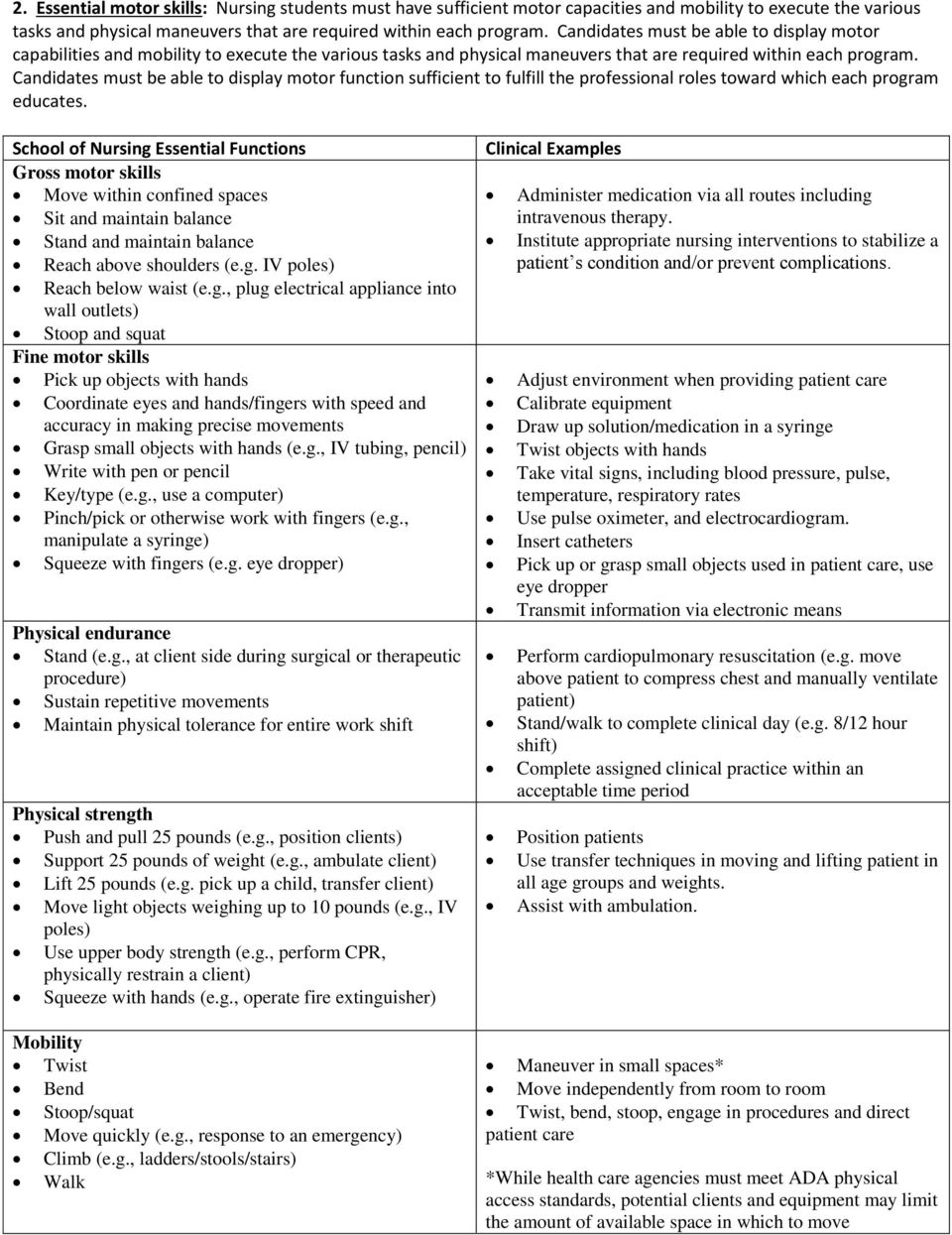
4 2. Essential motor skills: Nursing students must have sufficient motor capacities and mobility to execute the various tasks and physical maneuvers that are required within each program. Candidates must be able to display motor capabilities and mobility to execute the various tasks and physical maneuvers that are required within each program. Candidates must be able to display motor function sufficient to fulfill the professional roles toward which each program educates. Gross motor skills Move within confined spaces Sit and maintain balance Stand and maintain balance Reach above shoulders (e.g. IV poles) Reach below waist (e.g., plug electrical appliance into wall outlets) Stoop and squat Fine motor skills Pick up objects with hands Coordinate eyes and hands/fingers with speed and accuracy in making precise movements Grasp small objects with hands (e.g., IV tubing, pencil) Write with pen or pencil Key/type (e.g., use a computer) Pinch/pick or otherwise work with fingers (e.g., manipulate a syringe) Squeeze with fingers (e.g. eye dropper) Physical endurance Stand (e.g., at client side during surgical or therapeutic procedure) Sustain repetitive movements Maintain physical tolerance for entire work shift Physical strength Push and pull 25 pounds (e.g., position clients) Support 25 pounds of weight (e.g., ambulate client) Lift 25 pounds (e.g. pick up a child, transfer client) Move light objects weighing up to 10 pounds (e.g., IV poles) Use upper body strength (e.g., perform CPR, physically restrain a client) Squeeze with hands (e.g., operate fire extinguisher) Mobility Twist Bend Stoop/squat Move quickly (e.g., response to an emergency) Climb (e.g., ladders/stools/stairs) Walk Administer medication via all routes including intravenous therapy. Institute appropriate nursing interventions to stabilize a patient s condition and/or prevent complications. Adjust environment when providing patient care Calibrate equipment Draw up solution/medication in a syringe Twist objects with hands Take vital signs, including blood pressure, pulse, temperature, respiratory rates Use pulse oximeter, and electrocardiogram. Insert catheters Pick up or grasp small objects used in patient care, use eye dropper Transmit information via electronic means Perform cardiopulmonary resuscitation (e.g. move above patient to compress chest and manually ventilate patient) Stand/walk to complete clinical day (e.g. 8/12 hour shift) Complete assigned clinical practice within an acceptable time period Position patients Use transfer techniques in moving and lifting patient in all age groups and weights. Assist with ambulation. Maneuver in small spaces* Move independently from room to room Twist, bend, stoop, engage in procedures and direct patient care *While health care agencies must meet ADA physical access standards, potential clients and equipment may limit the amount of available space in which to move
5 3. Essential communication skills: Nursing students must be able to communicate effectively and efficiently. Students must be able to process and comprehend written and verbal material. Teach (e.g. client/family about health care) Explain procedures Give oral reports (e.g., report on client s condition to others) Interact with others (e.g., health care workers) Speak on the telephone Influence people Direct activities of others Convey information through writing (e.g., progress notes) Communicate with patients/clients, family members and health care providers regarding the individual s plan of care. Read and comprehend printed materials and documents. Document clearly and correctly on patient s medical record for legal documentation. Transmit information through written documents that use good grammar, syntax, spelling, and punctuation. Access laboratory data via automated information system. Clarify the meaning of non-verbal communication. Use physical touch as a therapeutic non-verbal intervention. Present oral reports Clarify physician orders 4. Essential judgment skills: Nursing students must exercise good judgment and promptly complete all responsibilities required of each program. They must develop mature, sensitive, and effective professional relationships with others. They must be able to tolerate taxing workloads and function effectively under stress. They must be able to adapt to changing environments, display flexibility and function in the face of uncertainties and ambiguities. Concern for others, interpersonal competence and motivation are requisite for all programs. Interpersonal abilities essential to interact with individuals, families, and groups from diverse social, emotional, cultural and intellectual backgrounds Make judgments based on scientific knowledge and thorough assessment of individual patient situations Practice in a manner that is non-judgmental and non-discriminatory Function as a contributing member of an interdisciplinary team Recognize that decision making occurs in an environment of uncertainty and ambiguities Demonstrate capacity to make sound decisions when under stress Deliver nursing care within accepted timeframe allowing others to complete their responsibilities to patients Create climate in which patients feel comfortable and able to make informed decisions about their health care Practice safe care in high stress and/or ambiguous environments such as ICU, Emergency Department, mental health facilities and the community

6 5. Essential intellectual and cognitive skills: Nursing students must be able to measure, calculate, reason, analyze, synthesize, integrate, remember and apply and evaluate information. Creative problem-solving and clinical reasoning require all of these intellectual abilities. In addition, many candidates must be able to comprehend three dimensional relationships and understand the spatial relationship of structure. Reading Read and understand written documents Read and understand English printed documents (e.g. policies, protocols, standards of care) Read measurement marks Arithmetic Competence Read and understand columns of writing (e.g., flow sheet, charts) Use measurement tools recognized as central to the care of patients/clients. Read digital displays Perform dosage calculations in a time frame to Read graphic printouts (e.g., EKG) deliver safe care Calibrate equipment Assess and monitor patient status Convert numbers to and/or from Metric System Read graphs (e.g., vital sign sheets) Tell time Measure time (e.g., count duration of contractions, etc.) Count rates (e.g., drips/minute, pulse) Use measuring tools (e.g., thermometer) Read measurement marks (e.g., measurement tapes, scales, etc.) Add, subtract, multiply, and/or divide whole numbers Compute fractions (e.g., medication dosages) Use a calculator Write numbers in records Analytical Thinking Transfer knowledge from one situation to another Handle multiple tasks and problem solve simultaneously. Process information Assimilate and apply knowledge acquired from Evaluate outcomes multiple learning experiences Problem solve Seek supervision and consultation in a timely Prioritize tasks manner Use long term memory Use short term memory Critical Thinking Identify cause-effect relationships Analyze assessment data in determining Plan/control activities for others nursing diagnoses. Synthesize knowledge and skills Prioritize tasks Sequence information Comprehend and apply abstract concepts

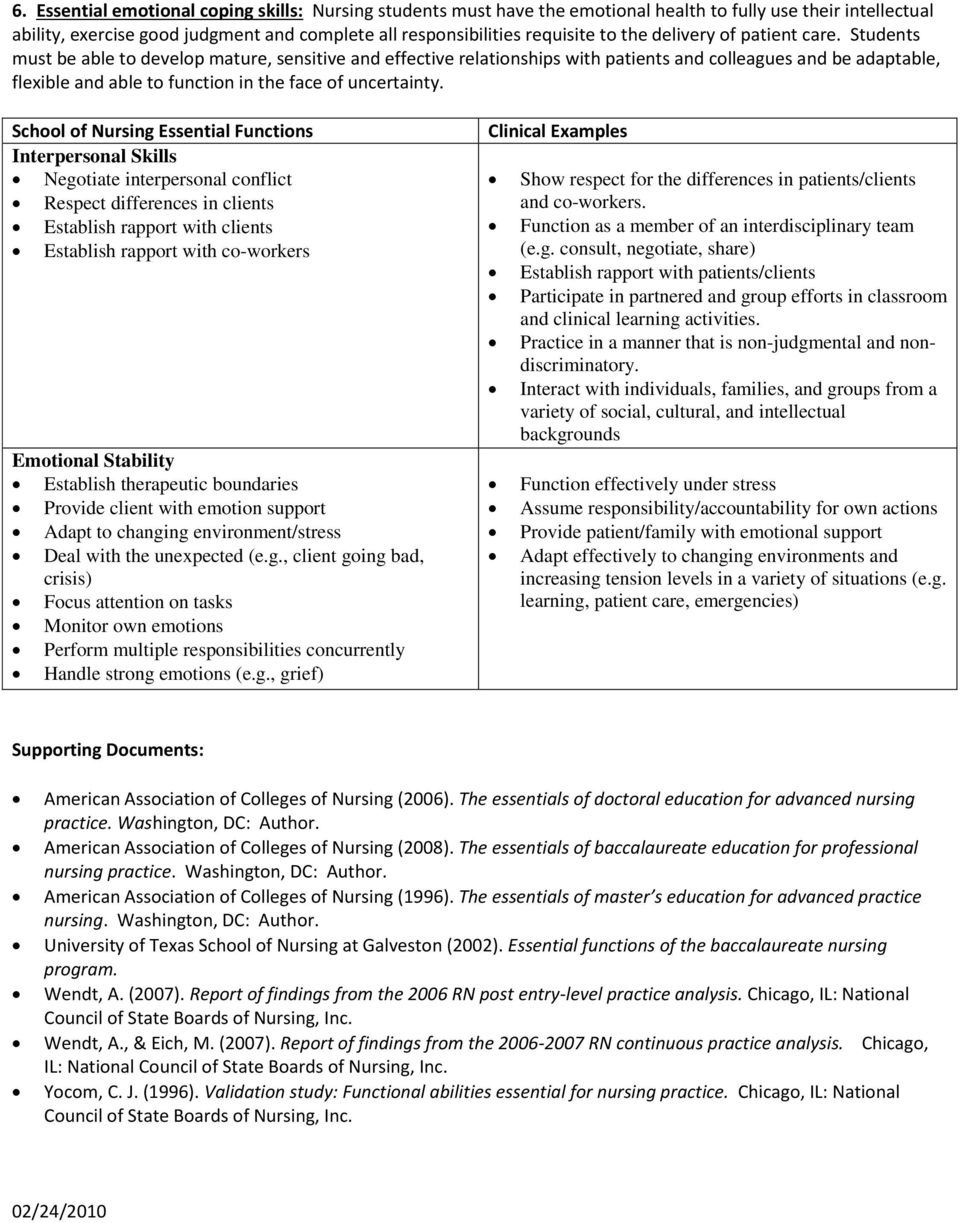
7 6. Essential emotional coping skills: Nursing students must have the emotional health to fully use their intellectual ability, exercise good judgment and complete all responsibilities requisite to the delivery of patient care. Students must be able to develop mature, sensitive and effective relationships with patients and colleagues and be adaptable, flexible and able to function in the face of uncertainty. Interpersonal Skills Negotiate interpersonal conflict Respect differences in clients Establish rapport with clients Establish rapport with co-workers Emotional Stability Establish therapeutic boundaries Provide client with emotion support Adapt to changing environment/stress Deal with the unexpected (e.g., client going bad, crisis) Focus attention on tasks Monitor own emotions Perform multiple responsibilities concurrently Handle strong emotions (e.g., grief) Show respect for the differences in patients/clients and co-workers. Function as a member of an interdisciplinary team (e.g. consult, negotiate, share) Establish rapport with patients/clients Participate in partnered and group efforts in classroom and clinical learning activities. Practice in a manner that is non-judgmental and nondiscriminatory. Interact with individuals, families, and groups from a variety of social, cultural, and intellectual backgrounds Function effectively under stress Assume responsibility/accountability for own actions Provide patient/family with emotional support Adapt effectively to changing environments and increasing tension levels in a variety of situations (e.g. learning, patient care, emergencies) Supporting Documents: American Association of Colleges of Nursing (2006). The essentials of doctoral education for advanced nursing practice. Washington, DC: Author. American Association of Colleges of Nursing (2008). The essentials of baccalaureate education for professional nursing practice. Washington, DC: Author. American Association of Colleges of Nursing (1996). The essentials of master s education for advanced practice nursing. Washington, DC: Author. University of Texas School of Nursing at Galveston (2002). Essential functions of the baccalaureate nursing program. Wendt, A. (2007). Report of findings from the 2006 RN post entry-level practice analysis. Chicago, IL: National Council of State Boards of Nursing, Inc. Wendt, A., & Eich, M. (2007). Report of findings from the RN continuous practice analysis. Chicago, IL: National Council of State Boards of Nursing, Inc. Yocom, C. J. (1996). Validation study: Functional abilities essential for nursing practice. Chicago, IL: National Council of State Boards of Nursing, Inc. 02/24/2010
CSUSB Department of Nursing Central/Essential Functions Statement (Posted 7/14/14)
 CSUSB Department of Nursing Central/Essential Functions Statement (Posted 7/14/14) The CSUSB Department of Nursing (DON) will make appropriate academic adjustments to facilitate enrollment and participation
McHenry County College
 Office Use Only: Prerequisite GPA: TEAS Score: Composite Score: McHenry County College Nursing (RN) Degree Application Applications for Spring semester will be accepted from September 1 through October
Nursing Program Requirements
 Nursing Program Requirements In addition to the College s general admission requirements, applicants to the Nursing Program must meet the following criteria: 1. Be 18 years of age or older. 2. Have a high
Nursing Functional Ability Criteria
 Nursing Functional Ability Criteria The Associate Degree Nursing Program is highly regulated by state and federal law. We have attempted to set objective criteria and specific accommodations that are allowed
To be considered for acceptance into the nursing program, students must have:
 Page 1 of 10 Gordon State College A state college in the University System of Georgia Associate of Science in Nursing return to contents Admission Requirements Applicants must have graduated from high
UNIVERSITY OF COLORADO DENVER COLLEGE OF NURSING. Technical Standards
 UNIVERSITY OF COLORADO DENVER COLLEGE OF NURSING Technical Standards I. Introduction In Spring 2008, the University of Colorado Denver College of Nursing adopted the following technical standards for admission,
Requisite Skills and Abilities to Become a Registered Psychiatric Nurse in B.C.
 Requisite Skills and Abilities to Become a Registered Psychiatric Nurse in B.C. What is the purpose of Requisite Skills and Abilities? Canadians expect the health care system to provide them with safe,
Requisite Skills and Abilities for Becoming a Registered Nurse in Alberta
 Requisite Skills and Abilities for Becoming a Registered Nurse in Alberta May 2011 Approved by the College and Association of Registered Nurses of Alberta (CARNA) in May 2011. Permission to reproduce this
Practical Nursing Program (Fall 2015)
 Return this form to: Admissions and Enrollment Services, Wynn Center, room 1200 Durham Technical Community College For Admissions use only. A10300 Date Practical Nursing Program (Fall 2015) First Name
How To Become A Nurse
 Associate Degree Nursing Program Generic Track APPLICATION INFORMATION We are very pleased you are considering nursing as a career. We welcome your application for admission to the Associate Degree Nursing
IVY TECH COMMUNITY COLLEGE WABASH VALLEY REGION PARAMEDIC SCIENCE PROGRAM INFORMATION AND APPLICATION PACKET
 IVY TECH COMMUNITY COLLEGE WABASH VALLEY REGION PARAMEDIC SCIENCE PROGRAM INFORMATION AND APPLICATION PACKET An accredited CAAHEP program Thank you for your interest in the Paramedic Science program. The
Students are required to undertake placement activities in mixed gender environments which reflect the Australian health care context.
 Introduction to inherent requirements for undergraduate Nursing course These inherent requirements apply to the following course: Bachelor of Nursing The School of Nursing at Avondale College of Higher
Memo. Creighton University College of Nursing. Health Care Providers Amy Cosimano, EdD, RN Assistant Dean for Student Affairs.
 Creighton University College of Nursing Memo To: From: Health Care Providers Amy Cosimano, EdD, RN Assistant Dean for Student Affairs Re: Attestation of Physical Exam and review of the Safety & Technical
Georgia Northwestern Technical College Associate Degree Nursing Program Transition Track APPLICATION INFORMATION
 Transition Track APPLICATION INFORMATION We are very pleased you are considering advancing your education. We welcome your application for admission to the. This information packet will assist you in the
Middle Georgia State University Occupational Therapy Assistant Program ADMISSION REQUIREMENTS
 Middle Georgia State University Occupational Therapy Assistant Program ADMISSION REQUIREMENTS The OTA admission process is separate from the university admission process and is handled through the Occupational
Crystal M. Lange College of Health and Human Services. Nursing Program Application Instructions
 Dear SVSU Nursing Program Applicant: Crystal M. Lange College of Health and Human Services Nursing Program Application Instructions In providing this application to you, the nursing faculty and I share
Dabney S. Lancaster Associate s Degree in Nursing Program Information Packet
 Dabney S. Lancaster Associate s Degree in Nursing Program Information Packet Information Packet Revised August 2015 1 Table of Contents An Overview of the Associate Degree Nursing (ADN) Program... 3 Essential
TECHNICAL STANDARDS FOR ADMISSION, PROGRESSION, AND GRADUATION
 TECHNICAL STANDARDS FOR ADMISSION, PROGRESSION, AND GRADUATION I. Introduction In spring 2008, the University of Colorado, College of Nursing adopted the following technical standards for admission, progression
Dear Prospective Student:
 Dear Prospective Student: We appreciate your interest in the Nursing Program at John Tyler Community College, which offers an Associate of Applied Science (A.A.S.) degree for students who plan to become
Medical Office Assistant
 Career Service Authority Medical Office Assistant Page 1 of 5 GENERAL STATEMENT OF CLASS DUTIES Teams with health care professionals to provide direct patient care to patients/clients in a clinic setting.
Daemen College, Doctor of Physical Therapy Program. Technical Standards and Essential Functions for Physical Therapy Practice
 Daemen College, Doctor of Physical Therapy Program Introduction The physical therapy degree is recognized as a professional degree requiring the development of entry level knowledge and skills in multiple
HEALTH SCIENCES DIVISION PHARMACY TECHNICIAN APPLIED TECHNOLOGY DIPLOMA PROGRAM
 HEALTH SCIENCES DIVISION PHARMACY TECHNICIAN APPLIED TECHNOLOGY DIPLOMA PROGRAM Thank you for your interest in our Pharmacy Technician Diploma Program! Enclosed is the admission packet. It includes information
Licensed Practical Nurse
 Career Service Authority Licensed Practical Nurse Page 1 of 5 GENERAL STATEMENT OF CLASS DUTIES Provides practical nursing care to patients/clients. May be assigned lead functions. DISTINGUISHING CHARACTERISTICS
Respiratory Therapy Program Technical Standards
 Respiratory Therapy Program Technical Standards Technical Standards define the observational, communication, cognitive, affective, and physical capabilities deemed essential to complete this program and
RESPIRATORY THERAPY PROGRAM
 TEXAS SOUTHERN UNIVERSITY COLLEGE OF PHARMACY & HEALTH SCIENCES DEPARTMENT OF HEALTH SCIENCES RESPIRATORY THERAPY PROGRAM Application for Spring 2016 Admission - Deadline NOVEMBER 30, 2015 (Applications
POLK STATE COLLEGE OTA PROGRAM ESSENTIAL REQUIREMENTS FOR THE OCCUPATIONAL THERAPY ASSISTANT PROGRAM
 POLK STATE COLLEGE OTA PROGRAM ESSENTIAL REQUIREMENTS FOR THE OCCUPATIONAL THERAPY ASSISTANT PROGRAM Admission into the Health Sciences Programs at Polk State College is based on academic achievement and
MASON CITY CLINIC, P.C. Page 1 Job Description Credentialed Medical Assistant. MASON CITY CLINIC Job Description
 MASON CITY CLINIC, P.C. Page 1 Job Description Credentialed Medical Assistant MASON CITY CLINIC Job Description Job Title: Credentialed Medical Assistant FLSA Status: Nonexempt Job Code: Employee Group:
Career Service Authority Page 1 of 5 Special Education Teaching Assistant Supervisor
 Career Service Authority Page 1 of 5 Special Education Teaching Assistant Supervisor GENERAL STATEMENT OF CLASS DUTIES Performs supervisory duties over Special Education Teaching Assistants who provide
Anesthesia Technician
 Career Service Authority Anesthesia Technician Page 1 of 5 GENERAL STATEMENT OF CLASS DUTIES Performs technical work assisting an anesthesia care provider with equipment, supplies, drugs, and special procedures
CHECKLIST FOR APPLICATION SECOND DEGREE ACCELERATED BACHELOR OF SCIENCE IN NURSING
 CHECKLIST FOR APPLICATION SECOND DEGREE ACCELERATED BACHELOR OF SCIENCE IN NURSING PLEASE BE SURE THAT YOU HAVE COMPLETED EVERY STEP BELOW, AND THAT YOU HAVE ENCLOSED ALL DOCUMENTS BEFORE SUBMITTING YOUR
Practical Nursing Student Handbook Fall 2013
 Practical Nursing Student Handbook Fall 2013 Reviewed/Revised Annually 0 NORTHAMPTON COMMUNITY COLLEGE NURSING DEPARTMENT PRACTICAL NURSING STUDENT HANDBOOK TABLE OF CONTENTS Academic Recognition 33 Accreditation
Requisite Skills and Abilities
 Becoming a Registered Nurse in New Brunswick: Requisite Skills and Abilities February 2014 (1/12) Mission The Nurses Association of New Brunswick is a professional regulatory organization that exists to
FUNCTIONAL ABILITIES FOR FUNCTIONAL ABILITIES FOR THE ASSOCIATE OF APPLIED SCIENCE DEGREE RADIOGRAPHY
 FUNCTIONAL ABILITIES FOR FUNCTIONAL ABILITIES FOR THE ASSOCIATE OF APPLIED SCIENCE DEGREE RADIOGRAPHY Functional Ability Categories & Representative Activities/Attributes for the Associate Degree Surgical
CHECKLIST FOR APPLICATION TO LPN-BSN PROGRAM AT ASU
 CHECKLIST FOR APPLICATION TO LPN-BSN PROGRAM AT ASU PLEASE BE SURE THAT YOU HAVE COMPLETED EVERY STEP BELOW, AND THAT YOU HAVE ENCLOSED ALL DOCUMENTS BEFORE SUBMITTING YOUR APPLICATION. Deadline: June
Germanna Community College Center for Workforce & Community Education Medical Office Assistant Program Information and Application
 Germanna Community College Center for Workforce & Community Education Medical Office Assistant Program Information and Application Thank you for your interest in the Workforce Medical Office Assistant
How To Be A Medical Flight Specialist
 Job Class Profile: Medical Flight Specialist Pay Level: CG-36 Point Band: 790-813 Accountability & Decision Making Development and Leadership Environmental Working Conditions Factor Knowledge Interpersonal
Dabney S. Lancaster Community College LPN to RN Transition Pathway Course Information Packet
 Dabney S. Lancaster Community College LPN to RN Transition Pathway Course Information Packet Table of Contents LPN to RN Transition Pathway Course Overview; Pathway allowing LPN students to obtain an ADN
TECHNICAL STANDARDS Physician Assistant Program Charles R. Drew University of Medicine and Science
 Medical education requires the accumulation of medical knowledge, acquisition of clinical skills, professional attitudes and behaviors. Successful completion of the program relies on the students ability
Respiratory Care Associate in Science Degree
 2011-12 See your Career Program Advisor to help you get in the right classes. Respiratory Care Associate in Science Degree Set Yourself Up for a Great Career Respiratory therapists are an integral member
Essential Functions for Occupational Therapy Education at Ithaca College
 Essential Functions for Occupational Therapy Education at Ithaca College Introduction All students in the Ithaca College occupational therapy program must be able to perform the essential clinical as well
Nursing Clinical Coordinator
 Career Service Authority Nursing Clinical Coordinator Page 1 of 5 GENERAL STATEMENT OF CLASS DUTIES Performs supervisory functions over professional nursing and support staff in an inpatient unit, specialty
Nursing Program Manager
 Career Service Authority Nursing Program Manager Page 1 of 5 GENERAL STATEMENT OF CLASS DUTIES Manages the operation of a clinical program, federal grant program or other program that involves responsibility
Round Lake Area Schools Community Unit School District #116 JOB CLASSIFICATION DESCRIPTION
 Round Lake Area Schools Community Unit School District #116 JOB CLASSIFICATION DESCRIPTION JOB CLASSIFICATION TITLE: Athletic Trainer DEPARTMENT: Teaching and Learning INCUMBENT NAME: Appendix A, lane
ALABAMA SOUTHERN COMMUNITY COLLEGE Nursing Programs Checklist for Admission
 ALABAMA SOUTHERN COMMUNITY COLLEGE Nursing Programs Checklist for Admission The following items are required for admission consideration and must be completed and turned in by the following dates: FALL
Students Transferring Into Nursing Programs at Central Alabama Community College From Another School of Nursing Program
 Students Transferring Into Nursing Programs at From Another School of Nursing Program What are the minimum requirements to Transfer from another School of Nursing Into CACC s PN or ADN Program? 1. Completed
Associate Degree Nursing Program ADMISSION OVERVIEW 2016
 Associate Degree Nursing Program ADMISSION OVERVIEW 2016 Admission of applicants is competitive. Applicants seeking admission to the fall ADN program must meet the admission requirements as outlined in
This information supersedes all previously published information.
 James Sprunt Community College Practical Nursing Fall 2015 Admission Information and Process Please read all of the information carefully in this packet in order to understand the admission criteria and
Round Lake Area Schools Community Unit School District #116 JOB CLASSIFICATION DESCRIPTION
 Round Lake Area Schools Community Unit School District #116 JOB CLASSIFICATION DESCRIPTION JOB CLASSIFICATION TITLE School Social Worker DEPARTMENT Teaching and Learning INCUMBENT NAME PART I - SUMMARY
Making Application to Nursing at Central Alabama Community College. Be sure your application is complete before the appropriate deadline!
 Making Application to Nursing at Central Alabama Community College What does a complete admission file include? For Nursing Applicants: Application for Admission to Nursing Program Application for Admission/Readmission
Guidelines. Requisite Skills and Abilities for Entry-Level Registered Nurse Practice
 Guidelines Requisite Skills and Abilities for Entry-Level Registered Nurse Practice The Association of Registered Nurses of Newfoundland and Labrador (ARNNL) sets the education and practice standards for
2014 RESPIRATORY THERAPY PROGRAM APPLICANT ADMISSION INFORMATION
 2014 RESPIRATORY THERAPY PROGRAM APPLICANT ADMISSION INFORMATION Application Deadline: March 15, 2014 NOTE: CVCC reserves the right to change curriculum and admission requirements without prior notice.
Career Service Authority. Youth Counselor
 Career Service Authority Youth Counselor Page 1 of 5 GENERAL STATEMENT OF CLASS DUTIES Performs standard level professional work providing individual coaching, conducting behavioral/social/educational
Respiratory Therapy 2014 2015
 Program Information Brief www.dmacc.edu Respiratory Therapy 2014 2015 For all campus information, call 515-964-6200 or 877-863-6222, extension 6200. Call this number to speak with an advisor about the
Becoming a Registered Nurse in Nova Scotia
 Becoming a Registered Nurse in Nova Scotia Requisite Skills & Abilities 1 Introduction and Purpose This document is intended for potential students, family, admission officers, nursing faculty, disability
Clinical Nurse Specialist
 Career Service Authority Clinical Nurse Specialist Page 1 of 5 GENERAL STATEMENT OF CLASS DUTIES Provides advanced professional nursing practice in a recognized specialty field. DISTINGUISHING CHARACTERISTICS