
Family and Parenting Support The role of public services
|
|
|
- Kenneth Moore
- 10 years ago
- Views:
Transcription
1 Family and Parenting Support The role of public services ESN Survey on Family and Parenting Support December 2012 The European Social Network (ESN) brings together people who design, manage and deliver social services in public authorities across Europe. We support the development of effective social policy and social care practice through the exchange of knowledge and experience. The European Social Network is supported by the European Commission
2 Introduction European Social Network (ESN) carried out a survey amongst its members working in children services in August 2012 to assess the support mechanisms provided by family and parenting services across Europe, particularly to evaluate the extent to which this support can help reducing child poverty. ESN wanted to focus on this, because it is an aspect of social services that has been underplayed so far in EU policy discussions. In the survey, ESN tried to assess a number of areas; from factors leading to disadvantage through forms of family support to outcomes measurement. ESN received responses from 17 EU countries: Belgium, Bulgaria, Cyprus, Denmark, Faroe Islands, Finland, France, Germany, Italy, Ireland, Poland, Portugal, Romania, Slovenia, Spain, Sweden, and the UK. The overall picture is that public social services in Europe provide a wide variety of family and parenting support mechanisms from early childcare to health prevention and health promotion measures in the early years to rights, money and housing advice. Other forms of support comprise pre and post-natal parental support, parents communication and relationship skills and specific support for some families mono-parental families and those with economic difficulties. However, ESN members have noted difficulties in delivering comprehensive and coordinated family support with all sectors involved in joint planning and delivery. Furthermore, the threat of public spending cuts that, due to the crisis, have been affecting most preventive services. Main factors contributing to disadvantage in children In the survey ESN asked its members what are the main contributing factors in parents lives that lead children to be disadvantaged. Almost 90% of directors of social services working with children who responded to this survey emphasised alcohol addictions and homelessness as the main factors in parents lives leading children to disadvantage followed by drug addiction (88%) and mental health problems (78%). A third set of factors ranked as being of moderate importance were: parents unemployment (32%), a migrant background and having a single parent (30%). Unemployment, inadequate education and lack of community integration were also cited as contributing factors. This reflects the responsibility of public authorities for specialist child protection and social work services. Forms of parenting support In almost 80% of the 17 countries represented in the survey, parenting support 1 services are foreseen by the legislation. According to most responses (almost 74%), parenting support services are provided in kind, that is to say, through training parents on their resources and competences. According to 72% of respondents, these services are targeted at those who need them more, such as disadvantaged and poor families. In connection with this, almost 1 According to the following definition of parenting support services by Daly (2012), parenting support services must fulfil 3 conditions: a. Parents are the first line target and focus on their parenting role b. Support provide is a service in kind (cash excluded) c. Focus on parents resources and competences 2
3 90% of ESN members who answered the survey responded that parenting support programmes take into account that poverty can pose a stress on parenting. Amongst the support services that public services across Europe provide for disadvantaged families, the three most important forms of support are: early child care, universal child benefits, and targeted measures (such as free education materials, free school meals and free access to leisure and culture). In the area of prevention, ESN members who are regional authorities also design preventive health care and health promotion programmes. The provision of parenting services in most countries is designed and planned based on an evaluation. Soren Frost, Head of Social Innovation at the city of Aarhus (Denmark), confirms that families are assessed by professionals working in social services, and a family action plan is drawn up stating the responsibilities and actions of family and social services. Preventive services In Sweden, parenting support provided by public social services includes individual support for mothers during pregnancy as well as family peer groups. Children s social welfare and health care professionals organize themselves in teams and provide counselling to families through family centres. In the Faroe Islands, support and guidance is provided at home through home visits during pregnancy and after the child s birth. ESN s member in the Faroe Islands, Gigni, the Public Healthcare Authority for Children and Youth, tells us that besides home visits, they also provide physical, socio-psychological and health services both for the child and the entire family. Support and guidance services are provide to all parents from the moment the child is born until they leave school and support is extended to day care professionals and teachers. Services are conceived according to the principle of progressive universalism, that is to say, when a family s needs are higher, the service is more intensive. In Andalusia, Spain, ESN member Regional Ministry of Health and Social Welfare provides a universal programme that monitors children s health in the early years of their lives. It aims at the prevention of illnesses and promotion of healthy life styles as well as the detection of risk factors for children s welfare. Parenting support services across Europe are aware of the importance of an integrated approach in the provision of services, though it is not always achieved. For example, in France multiple services provide parents with help in various ways, whether it is accessing benefits, rights advice, general or specialized health and social services. However, social services at local level are in direct contact with the family and coordinate the different actions of all these services for each family according to their specific needs. In Iceland, municipalities are undertaking interdisciplinary programmes for parents of young children within public health and social services. One of these programmes is The New Child, which aims to prevent health and life risks through an integrated set of support forms: psycho-social, medical, guidance and education to promote the right conditions for the development of the child. The idea behind is to get to know the closest relatives, understand their situation and problems, education and motivation. To do so, there is a general examination of health and skills (physical, psychical, social, psychological 3
4 including how genuine is the attachment and sharing of feelings), work and finances, and lifestyles. To achieve this, it is crucial to have mutual trust and close co-operation with the significant others, especially parents. Though the central focus is the general health service, there is a big emphasis on interdisciplinary teamwork and close cooperation, particularly with social services. Evaluations have been conducted with over 400 families with a satisfaction rate of 70% to 80% and the project has been acknowledged by the WHO. Targeted measures Targeted measures are an important form of parenting support. In Belgium, for example, there are education shops where parents go specifically when they have problems with their children s education. Also in Belgium, since 2010 the Federal Public Service for Social Integration (ESN member) has been providing financial incentives for children of clients of the local public centres for social welfare in order to promote their participation in social, cultural and leisure activities as a measure to reduce child poverty. Some of these measures may be involve educational, psychological or paramedical support. As highlighted in the introduction, parenting support programmes provided by local public social services also comprise parents communication and relationship skills. In Cyprus, a programme has been developed specifically to deal with communication matters to prevent violent behaviour within the family. The programme consists of a series of 13 workshops, which are co-ordinated by specially trained professionals. The groups of approximately 20 parents meet in weekly sessions for two hours. This training aims at promoting mental health skills and improving communication within the family as a way to reduce domestic violence. In Catalonia, Spain, parenting support services include individual activities for parents aimed specifically at improving their self-control, self-esteem, knowledge of children s development, assertive communication and problem solving skills. On the other hand, there are activities involving work with children combining real exercises of relationship and care from which practical results and learning can be assessed. Challenges in providing family and parenting support Coordination and potential integration of key services has been highlighted in their responses as a challenge by ESN members in Spain, Portugal and Scotland. In Portugal, there is not a co-located/integrated provision of parenting support services. Although services exist, they are provided by different agencies, such as education (in regards to targeted measures like school materials and meals), health or social (housing and cash allowances). To tackle the lack of integration, the Scottish Government is investing 18m over three years to support Scotland's local authorities in the delivery of comprehensive and co-ordinated parent and family support, with all sectors involved in joint planning and delivery, including the identification of local needs. In other countries, such as Ireland, local authorities may not have responsibility for child safety & welfare, which would be provided at the national level. Therefore, their provision of services would be limited to counselling, advocacy, advice. However, ESN member, Dublin 4
5 City Council, participates on committees & multi-agency groups to support children s services to potentially disadvantaged groups in the Dublin area. Rationale underlying parenting support and outcomes measurement The main basis for the parenting support programmes designed and provided by ESN members is the reduction of any potential harm to children (55%) followed by the need to building parenting strengths (45%). The three main elements that constitute parenting support interventions are: parents interaction with the child (90%), the improvement of parents knowledge of child development and the improvement of parents problem-solving skills (in 70% of responses). Almost 77% of respondents report that the outcomes of parenting support programmes are assessed both for parents and children: 1. Improvement in the relationship and the interaction between the parent(s) and the child (warmth, attachment, etc.) (70% of responses) 2. Prevention of child abuse, neglect and violence (62% of responses) 3. Improvement of the access to other services for families who may need more than a single intervention (57% of cases) In the case of the child, the first and most important assessed outcome is the improvement of the child s well-being and the emotional and behavioural development of the child (50% of responses in both cases). Participation of parents and children ESN tried to look at whether parenting support programmes provided by our members also foresee the participation of parents and children in the various stages of the programme: identification of needs, strategic planning, design, implementation and evaluation. Over 60% of respondents said that parents are involved in the identification of needs and approximately 45% in the implementation and evaluation phases. However, their participation in strategic planning and design is lower (20% and 12% respectively). As for children s participation, the data is very similar with approx. 40% involving children in identifying needs and 35% involving them in the evaluation phase whilst their participation in strategic planning and implementation is poor (20% and 30% respectively) and in design is very poor (just over 10%). 5
6 Conclusion What are the lessons learned from this exercise? Five main conclusions can be drawn: 1. The provision of family and parenting support services is based on an assessment of needs; hence public social services in Europe provide a wide variety of family and parenting support -from early childcare to health prevention and health promotion in the early years to communication and relationship skills development and specific support for families most at risk. 2. In most cases family support is provided under the idea of progressive universalism when needs are stronger, the provision of services is also stronger. However, it has been noted that public spending cuts have affected many preventive services and are also having an impact on universal services. 3. Local public services may have different roles in regards to family and parenting support services, which affects the provision of such services. In particular difficulties have been identified in delivering comprehensive and coordinated family support with all sectors involved in joint planning and delivery. 4. Outcomes of family and parenting support interventions are assessed in most cases, particularly in regards to the interaction between parents and children, child neglect prevention and the improvement of children s emotional and behavioural development. 5. Local public services try to engage parents and children in family and parenting support programmes, particularly in identifying needs and the implementation and evaluation phases, whilst their participation in strategic planning and design is poor. Annex: Questions from Family and Parenting Support Survey The survey and the assessment of results has been done by Alfonso Lara Montero, Policy and Research Officer, [email protected] 6
7 Annex: Questions from Family and Parenting Support Survey A. Poverty and Disadvantage According to ESN, the definition of poverty should account for the economic and social obstacles that the most disadvantaged children face such as lack of financial means, social exclusion, disability, mental health problems, alternative care, risk of neglect/abuse, undocumented child migrants/asylum-seekers, Roma and traveller children. 1. On a scale of 1 to 5 where 1 is the least important and 5 is the most important, please rate what factors in parents lives lead children to be disadvantaged? Single parents Large Families Having a migrant background Being unemployed Having a low salary Being homeless Poor or insecure housing Mental health problems Physical disabilities A learning disability A drug addiction An alcohol addiction Criminal behavior 2. On a scale of 1 to 5 where 1 is the least important and 5 is the most important, please rate the forms of support that disadvantaged families or families living in poverty have available: Cash allowances Health prevention and promotion programmes Training/re-training programmes Public work programmes Universal child benefits Targeted measures for children (free books and education materials, free school meals, free access to leisure and cultural activities) Early childcare services for children Preventive health care and health promotion programmes Money advice Individual rights advice (e.g. how to access benefits) Housing support 3. Are family support services provided: Separately Jointly 7
8 B. Parenting Support Services According to the following definition of parenting support services by Daly (2012), parenting support services must fulfil 3 conditions a. Parents are the first line target and focus on their parenting role b. Support provide is a service in kind (cash excluded) c. Focus on parents resources and competences 4. Are parenting services foreseen by legislation? 5. Are parenting support services provided: In kind (teaching parents resources and competences) In cash benefits Open to all Targeted at disadvantaged/poor families 6. Family centres (i.e. centres coordinating health, social services and education) have been considered a good way of helping to lift children and families out of poverty. Is this the case in your country/region/municipality? 7. a. If Yes, please tick the features of the model you know: Universal Targeted Free With a fee 8. Do parenting support services take into account if poverty poses a stress on parenting? 9. On a scale of 1 to 5 where 1 is "not at all" and 5 is "to a large extent", please rate the extent to which parenting support services improve parents' ability to cope with poverty 10. What is the main rationale underlying parenting support interventions? Reduction of harm to children Building on parenting strengths 11. On a scale of 1 to 5 where 1 is the least important and 5 is the most important, please rate the most important elements of parenting support interventions: Parents interaction with the child Parents knowledge of child development How parents view themselves as care givers How parents relate to their partners Problem solving skills of parents 8
9 12. On a scale of 1 to 5 where 1 is the least important and 5 is the most important, please rate from 1 to 5 the social and cultural factors that parenting support services tackle: Lack of community integration Degraded physical environment Poor housing Inadequate education Access to employment Unemployment 13. On a scale of 1 to 5, where 1 is "not at all" and 5 is "to a large extent", please rate the extent to which parenting support services take account of cultural/religious differences C. Children's and Parents' participation 14. On a scale of 1 to 5 where 1 is "not at all" and 5 is "to a large extent", please rate the participation of poor or disadvantaged parents in the various stages of parenting support services: Identification of needs Strategic planning Design Implementation Evaluation 15. Where 1 is the most important factor and 5 the least, please rank the participation of poor or disadvantaged children in the various stages of development in parenting support services Identification of needs Strategic planning Design Implementation Evaluation D. Assessment of results 16. Are the outcomes of parenting support services for parents and children assessed? 17. On a scale of 1 to 5 where 1 is the least and 5 is the most measured, please rate the outcomes for parents that are measured at the end of parenting interventions: Improved emotional and mental well-being 9
10 Improved parents supervision skills Improved parents negotiation skills Improved attitudes and feelings RE parenting (e.g. coping/confidence, stress) Improved parents knowledge of child development Improved relationship parent-child (e.g. warmth, attachment) Improved parent-child interaction Prevention of child abuse Improved social network and communication with relatives Improved access to other services 18. On a scale of 1 to 5 where 1 is the least and 5 is the most measured, please rate the outcomes for children that are measured at the end of parenting interventions: Improved children s wellbeing Emotional and behavioural development of child Child s educational development (school readiness, early literacy, numeracy) Improved emotional and mental children s health 10
11
EARLY INTERVENTION AND PREVENTION STRATEGY 2012-15 Summary
 EARLY INTERVENTION AND PREVENTION STRATEGY 2012-15 Summary Plymouth Children, Young People and Families Partnership INTRODUCTION Why do we need early intervention in Plymouth? We know that effective early
TPI: Traffic Psychology International on a common European curriculum for postgraduate education in traffic psychology
 TPI: Traffic Psychology International on a common European curriculum for postgraduate education in traffic psychology Sucha, M.*, Sramkova, L.** DeVol, D.* * TPI - Traffic Psychology International **
PNAE Paediatric Nursing Associations of Europe
 PNAE Paediatric Nursing Associations of Europe Paediatric Nurse Education in Europe A Position Statement by the Paediatric Nursing Associations of Europe (PNAE) Introduction The PNAE network carried out
Planned Healthcare in Europe for Lothian residents
 Planned Healthcare in Europe for Lothian residents Introduction This leaflet explains what funding you may be entitled to if you normally live in Lothian (Edinburgh, West Lothian, Midlothian and East Lothian
3.5 Guidelines, Monitoring and Surveillance of At Risk Groups
 3.5 Guidelines, Monitoring and Surveillance of At Risk Groups 3.5.6 Children of Parents who are Affected by Drug and Alcohol Misuse Background There is overwhelming evidence that the misuse of drugs and
Conwy Children and Young People s Plan Priority Areas
 Conwy Children and Young People s Plan Priority Areas Priority areas as updated in the October 2009 plan review (new and changed priorities are highlighted in blue). For a full copy of the Conwy Children
EUROPE 2020 TARGET: EARLY LEAVERS FROM EDUCATION AND TRAINING
 EUROPE 2020 TARGET: EARLY LEAVERS FROM EDUCATION AND TRAINING By 2020, the share of early leavers from education and training (aged 18-24) should be less than 10% Early school leaving 1 is an obstacle
ANALYSIS OF THE STAKEHOLDER CONSULTATION ON
 ANALYSIS OF THE STAKEHOLDER CONSULTATION ON Science and Technology, the key to Europe s future: guidelines for future European policy to support research COM(353)2004 DG Research, European Commission,
The National Occupational Standards. Social Work. Topss UK Partnership
 The National Occupational Standards for Social Work Topss UK Partnership May 2002.doc &.pdf files edition Every effort has been made to keep the file sizes of this document to a manageable size. This edition
Inquiry into teenage pregnancy. Lanarkshire Sexual Health Strategy Group
 Inquiry into teenage pregnancy Lanarkshire Sexual Health Strategy Group A. Do you have any views on the current policy direction being taken at the national level in Scotland to reduce rates of teenage
The National Health Plan for Young Australians An action plan to protect and promote the health of children and young people
 The National Health Plan for Young Australians An action plan to protect and promote the health of children and young people Copyright 1997 ISBN 0 642 27200 X This work is copyright. It may be reproduced
Management Information. Chief Social Work Officer
 Management Information Lead Officer Name: Paul Woolrich Designation: Service Improvement Manager Tel: 58462 (0131 553 8462) Lead Service Area Support to Children & Young People Last Review Date December
EUROPEAN CITIZENS DIGITAL HEALTH LITERACY
 Flash Eurobarometer EUROPEAN CITIZENS DIGITAL HEALTH LITERACY REPORT Fieldwork: September 2014 Publication: November 2014 This survey has been requested by the European Commission, Directorate-General
Project PESSIS 2 Title: Social Dialogue in the Social Services Sector in Europe
 Project PESSIS 2 Title: Social Dialogue in the Social Services Sector in Europe Location Brussels Date 23 September 2014 Presenter/contact details: Jane Lethbridge, Director, Public Services International
INFORMATION ON THE CHILDREN S RIGHT TO HEALTH IN THE REPUBLIC OF SERBIA PROVIDED BY THE PROTECTOR OF CITIZENS (OMBUDSMAN) OF THE REPUBLIC OF SERBIA
 INFORMATION ON THE CHILDREN S RIGHT TO HEALTH IN THE REPUBLIC OF SERBIA PROVIDED BY THE PROTECTOR OF CITIZENS (OMBUDSMAN) OF THE REPUBLIC OF SERBIA Issue No. 1: Health chalenges related to children a)
PREREQUISITES FOR HEALTH
 Charter The first International Conference on Health Promotion, meeting in Ottawa this 21 st day of November 1986, hereby presents this CHARTER for action to achieve Health for All by the year 2000 and
ERASMUS+ MASTER LOANS
 ERASMUS+ MASTER LOANS Erasmus+ Master Loan: opening up access to more affordable lending for cross-border studies The Erasmus+ programme makes it possible for students who want to take a full Masters level
THE ORGANISATION AND FINANCING OF HEALTH CARE SYSTEM IN LATVIA
 THE ORGANISATION AND FINANCING OF HEALTH CARE SYSTEM IN LATVIA Eriks Mikitis Ministry of Health of the Republic of Latvia Department of Health Care Director General facts, financial resources Ministry
Family benefits Information about health insurance country. Udbetaling Danmark Kongens Vænge 8 3400 Hillerød. A. Personal data
 Mail to Udbetaling Danmark Kongens Vænge 8 3400 Hillerød Family benefits Information about health insurance country A. Personal data Name Danish civil registration (CPR) number Address Telephone number
Definition of Public Interest Entities (PIEs) in Europe
 Definition of Public Interest Entities (PIEs) in Europe FEE Survey October 2014 This document has been prepared by FEE to the best of its knowledge and ability to ensure that it is accurate and complete.
Social Worker Overview The Field - Preparation - Day in the Life - Earnings - Employment - Career Path Forecast - Professional Organizations
 Social Worker Overview The Field - Preparation - Day in the Life - Earnings - Employment - Career Path Forecast - Professional Organizations The Field Social work is a profession for those with a strong
EUROPEAN PARLIAMENT 2014-2019. Committee on Employment and Social Affairs
 EUROPEAN PARLIAMT 2014-2019 Committee on Employment and Social Affairs 22.4.2015 2014/2237(INI) DRAFT REPORT on reducing inequalities with a special focus on child poverty (2014/2237(INI)) Committee on
http://www.bls.gov/oco/ocos060.htm Social Workers
 http://www.bls.gov/oco/ocos060.htm Social Workers * Nature of the Work * Training, Other Qualifications, and Advancement * Employment * Job Outlook * Projections Data * Earnings * OES Data * Related Occupations
Health and long-term care in the European Union
 Special Eurobarometer European Commission Health and long-term care in the European Union Fieldwork: May June 2007 Publication: December 2007 Report Special Eurobarometer 283/ Wave 67.3 TNS Opinion & Social
SWECARE FOUNDATION. Uniting the Swedish health care sector for increased international competitiveness
 SWECARE FOUNDATION Uniting the Swedish health care sector for increased international competitiveness SWEDEN IN BRIEF Population: approx. 9 800 000 (2015) GDP/capita: approx. EUR 43 300 (2015) Unemployment
Below you will find information relevant to CCPS members which has been taken from the Single Outcome Agreement published in June 2009.
 East Ayrshire Below you will find information relevant to CCPS members which has been taken from the Single Outcome Agreement published in June 2009. Information is ordered in the following topic groups:
Scottish Parliament Health and Sport Committee s Inquiry into Teenage Pregnancy in Scotland Evidence from CHILDREN 1 ST
 Scottish Parliament Health and Sport Committee s Inquiry into Teenage Pregnancy in Scotland Evidence from CHILDREN 1 ST February 2013 For over 125 years CHILDREN 1 ST has been working to build a better
Promoting Family Stability in a Down Economy Rae Jean Proeschold-Bell, Ph.D.
 Promoting Family Stability in a Down Economy Rae Jean Proeschold-Bell, Ph.D. Intuitively we know that families matter greatly. Families impact the well-being of their children and are the back-bone of
The Many Facets of Social Work
 The Many Facets of Social Work The scope of social work practice is remarkably wide. Social workers practice not only in the traditional social service agency, but also in elementary schools; in the military;
Walking a Tightrope. Alcohol and other drug use and violence: A guide for families. Alcohol- and Other Drug-related Violence
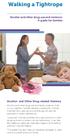 Walking a Tightrope Alcohol and other drug use and violence: A guide for families Alcohol- and Other Drug-related Violence Alcohol and other drug use and family violence often occur together. Families
ERASMUS+ MASTER LOANS
 Ref. Ares(2015)660570-17/02/2015 ERASMUS+ MASTER LOANS Erasmus+ Master Loan: opening up access to more affordable lending for cross-border studies The Erasmus+ programme makes it possible for students
Studying for a PhD in Europe
 - ECOTROS - European Cooperation in Occupational Therapy Research (OTR) & Occupational Science (OS) A project (2004-06) initiated from the European Network of Occupational Therapy in Higher Education (ENOTHE)
WORKPLACE STRESS: a collective challenge WORLD DAY FOR SAFETY AND HEALTH AT WORK 28 APRIL 2016
 WORKPLACE STRESS: a collective challenge WORLD DAY FOR SAFETY AND HEALTH AT WORK 28 APRIL 2016 WHAT IS WORK-RELATED STRESS? Stress is the harmful physical and emotional response caused by an imbalance
Camden Asset Recovery Inter-Agency Network (CARIN)
 Camden Asset Recovery Inter-Agency Network (CARIN) The History, Statement of Intent, Membership and Functioning of CARIN MANUAL CARIN MANUAL Secretariat, Camden Asset Recovery Inter-Agency Network (CARIN)
Crime & Homelessness
 Focus Ireland and PACE Executive Summary Executive Summary Introduction Focus Ireland, a voluntary organisation working with homeless people and PACE, an organisation working with and for ex-offenders
Electricity, Gas and Water: The European Market Report 2014
 Brochure More information from http://www.researchandmarkets.com/reports/2876228/ Electricity, Gas and Water: The European Market Report 2014 Description: The combined European annual demand for electricity,
YOUNG PEOPLE AND DRUGS
 Eurobarometer YOUNG PEOPLE AND DRUGS REPORT Fieldwork: June 2014 Publication: August 2014 This survey has been requested by the European Commission, Directorate-General for Justice and co-ordinated by
Professor Jane Fountain conferences
 Professor Jane Fountain conferences Since 2001: 10 national and 28 international conference presentations, including as an invited / keynote speaker. MAJOR CONFERENCE PRESENTATIONS SINCE 2001 INTERNATIONAL
should be conceived as an entitlement for all children (
 POLICY POSITION Eurochild s recommendations for EU action on early childhood education & care SUMMARY OF EUROCHILD S KEY MESSAGES February 2011 Eurochild welcomes the recent Commission Communication on
'Swampy Territory' The role of the palliative care social worker in safeguarding children of adults who are receiving specialist palliative care
 'Swampy Territory' The role of the palliative care social worker in safeguarding children of adults who are receiving specialist palliative care This qualitative study explores the role of the palliative
The Helsinki Communiqué
 The Helsinki Communiqué on Enhanced European Cooperation in Vocational Education and Training Communiqué of the European Ministers of Vocational Education and Training 1, the European Social partners 2
Cash machine withdrawal in the EU (+Norway and Iceland)
 Cash machine withdrawal in the EU (+Norway and Iceland) Country Is it free of charge to go to a cash machine from a different bank than consumers own to withdraw money? If withdrawal is not free of charge,
EUROPE 2020 TARGET: TERTIARY EDUCATION ATTAINMENT
 EUROPE 2020 TARGET: TERTIARY EDUCATION ATTAINMENT Low tertiary or equivalent education attainment levels create skills bottlenecks in knowledgeintensive economic sectors and hamper productivity, innovation
MARGARET HADDOCK PRESIDENT EUROPEAN UNION FOR SUPPORTED EMPLOYMENT (EUSE) DEPUTY CHIEF EXECUTIVE THE ORCHARDVILLE SOCIETY. Brussels June 2014
 MARGARET HADDOCK PRESIDENT EUROPEAN UNION FOR SUPPORTED EMPLOYMENT (EUSE) DEPUTY CHIEF EXECUTIVE THE ORCHARDVILLE SOCIETY. Brussels June 2014 CONTENT Background of European Union of Supported Employment
Waste. Copenhagen, 3 rd September 2014. Almut Reichel Project Manager Sustainable consumption and production & waste, European Environment Agency
 Waste Copenhagen, 3 rd September 2014 Almut Reichel Project Manager Sustainable consumption and production & waste, European Environment Agency Waste and material resources MAWP Strategic Area 1.9 Objective
Computing our Future Computer programming and coding in schools in Europe. Anja Balanskat, Senior Manager European Schoolnet
 Computing our Future Computer programming and coding in schools in Europe Anja Balanskat, Senior Manager European Schoolnet ABOUT THE SURVEY What do Ministries currently think about the topic? Curricula
Work Experience Schemes: advice for educators on health and safety
 6 Work Experience Schemes: advice for educators on health and safety Summary Many young people benefit from taking part in work experience placements. But work can be hazardous, especially for young people.
Fluoride and Dental Health in Europe
 Fluoride and Dental Health in Europe Dental Health in Europe - A Problem for Disadvataged Groups Report of an EU-funded Conference A conference of dental and public health experts drawn from every Member
Community and Social Services
 Developing a path to employment for New Yorkers with disabilities Community and Social Services Mental Health and Substance Abuse Social Workers... 1 Health Educators... 4 Substance Abuse and Behavioral
Family workers: Tools 1 to 4
 Measuring outcomes in family support: Practitioners Guide Family workers: Tools 1 to 4 Family Support Services Paul Bullen Association of NSW Management Alternatives Pty Ltd www.fssansw.asn.au www.mapl.com.au
Declaration of the Ministerial Conference of the Khartoum Process
 Declaration of the Ministerial Conference of the Khartoum Process (EU-Horn of Africa Migration Route Initiative) Rome, 28 th November 2014 We, Ministers of the following countries: Austria, Belgium, Bulgaria,
CHC52015 Diploma of Community Services
 CHC52015 Diploma of Community Services Release 1 CHC52015 Diploma of Community Services Modification History Release Release 1 Comments This version was released in CHC Community Services Training Package
Application Form: Receptionist / PA to the Senior Leadership Team
 Application Form: Receptionist / PA to the Senior Leadership Team This application form is written in BLACK ink. Please answer the questions in dark blue and return electronically to Lesley Starkes, Finance
Services for children and young people in North Ayrshire 28 October 2013. Report of a pilot joint inspection
 Services for children and young people in North Ayrshire 28 October 2013 Report of a pilot joint inspection Contents 1. Introduction 1 2. Background 1 3. The Community Planning Partnership area 2 4. Particular
THE EVOLUTION AND THE FUTURE ROLE OF THE BRANCH IN DISTRIBUTION OF THE BANKING PRODUCTS AND SERVICES
 Annals of the University of Petroşani, Economics, 11(3), 2011, 15-22 15 THE EVOLUTION AND THE FUTURE ROLE OF THE BRANCH IN DISTRIBUTION OF THE BANKING PRODUCTS AND SERVICES CĂTĂLIN NICOLAE BULGĂREA * ABSTRACT:
Alcohol Consumption in Ireland 1986-2006 A Report for the Health Service Executive
 Alcohol Consumption in Ireland 1986-2006 A Report for the Health Service Executive Prepared by Dr. Ann Hope This report should be referenced: Hope, A. (2007). Alcohol consumption in Ireland 1986-2006.
EUROPEAN AREA OF SKILLS AND QUALIFICATIONS
 EUROPEAN AREA OF SKILLS AND QUALIFICATIONS REPORT Fieldwork: April - May 2014 Publication: June 2014 This survey has been requested by the European Commission, Directorate-General for Education and Culture
CHILDREN, FAMILIES & ALCOHOL USE
 CHILDREN, FAMILIES & ALCOHOL USE Essential Information for Social Workers A BASW Pocket Guide Supported by: Bedford and Luton Purpose of the guide This guide aims to support Social Workers in their practice
Predictors of Adolescents Excessive Internet Use: A Comparison across European Countries Summary Introduction
 Cite as: Blinka, L. & Smahel, D. (2012). Predictors of adolescents excessive Internet use: A comparison across European countries. Proceedings of the 15th European Conference on Developmental Psychology
Keeping European Consumers safe Rapid Alert System for dangerous non-food products 2014
 Keeping European Consumers safe Rapid Alert System for dangerous non-food products 2014 COMPLETE STATISTICS Justice and Consumers Directorate-General for Justice and Consumers Directorate Consumers Unit
Finance information for postgraduate students
 Finance information for postgraduate students Contents Finance information for postgraduate students... 1 Contents... 1 Introduction... 2 Postgraduate tuition fee arrangements... 2 Postgraduate students
Finland must take a leap towards new innovations
 Finland must take a leap towards new innovations Innovation Policy Guidelines up to 2015 Summary Finland must take a leap towards new innovations Innovation Policy Guidelines up to 2015 Summary 3 Foreword
Mental Health Declaration for Europe
 WHO European Ministerial Conference on Mental Health Facing the Challenges, Building Solutions Helsinki, Finland, 12 15 January 2005 EUR/04/5047810/6 14 January 2005 52667 ORIGINAL: ENGLISH Mental Health
Analysis of the determinants of workplace occupational safety and health practice in a selection of EU Member States
 EN Safety and health at work is everyone s concern. It s good for you. It s good for business. Analysis of the determinants of workplace occupational safety and health practice in a selection of EU Member
- Assessment of the application by Member States of European Union VAT provisions with particular relevance to the Mini One Stop Shop (MOSS) -
 - Assessment of the application by Member States of European Union VAT provisions with particular relevance to the Mini One Stop Shop (MOSS) - BACKGROUND The information available on this website relates
Master's in midwifery: challenging the present, protecting the future? Valerie Fleming R.M., Ph.D.
 Master's in midwifery: challenging the present, protecting the future? Valerie Fleming R.M., Ph.D. Master s graduates Demonstrate knowledge and understanding that is founded upon and extends and/or enhances
Fostering Entrepreneurship among young people through education: a EU perspective. Simone Baldassarri Unit Entrepreneurship
 Fostering Entrepreneurship among young people through education: a EU perspective Simone Baldassarri Unit Entrepreneurship Definition of Entrepreneurship Entrepreneurship refers to an individual s ability
The European Union Savings Tax Directive. An historic guide
 The European Union Savings Tax Directive An historic guide Do you have any questions? This guide will tell you more If you are resident in an EU Member State and earn interest on deposits or investments
Swansea Drugs Project
 Swansea Drugs Project Sa f ren ing Supporting d Chi r Safegarding and a u l d g e This booklet is aimed at professionals in the City and County of Swansea who work with children and families where there
Attitudes towards vocational education and training
 Special Eurobarometer 369 European Commission Attitudes towards vocational education and training SUMMARY Special Eurobarometer 369 / Wave EB75.4 TNS opinion & social Fieldwork: June 2011 Publication:
SURVEY ON THE TRAINING OF GENERAL CARE NURSES IN THE EUROPEAN UNION. The current minimum training requirements for general care nurses
 SURVEY ON THE TRAINING OF GENERAL CARE NURSES IN THE EUROPEAN UNION This survey serves as a background document for the discussion of the Commission's legislative proposal to modernize the minimum requirements
Mobility and Young London Annex 2(b): London Continuum Descriptors
 Young London Matters April 2009 Government Office For London Riverwalk House 157-161 Millbank London SW1P 4RR For further information about Young London Matters contact: [email protected]
Basic banking services
 Presentation to the European Parliament by London Economics 25 January 2012 1 Presentation outline Basic facts and benefits 2 and benefits Background Access to basic banking is essential in modern society,
Report. The. Surrey Parent-Infant Mental Health Service
 Report On The Surrey Parent-Infant Mental Health Service Lynda Dawson Health visitor Specialist Cathy Madley-Dowd Health Visitor Specialist Introduction The Parent-Infant Mental Health (PIMH) service is
North Carolina Maternal and Perinatal Substance Abuse Initiative Study: Social Support and DSS Investigation Risk for Child Abuse or Neglect
 North Carolina Maternal and Perinatal Substance Abuse Initiative Study: Social Support and DSS Investigation Risk for Child Abuse or Neglect Sherri L. Green, MSW, LCSW Governor s Institute for Alcohol
Social and Emotional Wellbeing
 Social and Emotional Wellbeing A Guide for Children s Services Educators Social and emotional wellbeing may also be called mental health, which is different from mental illness. Mental health is our capacity
INNOBAROMETER 2015 - THE INNOVATION TRENDS AT EU ENTERPRISES
 Eurobarometer INNOBAROMETER 2015 - THE INNOVATION TRENDS AT EU ENTERPRISES REPORT Fieldwork: February 2015 Publication: September 2015 This survey has been requested by the European Commission, Directorate-General
Appeal to the Member States of the United Nations Early Childhood Development: The Foundation of Sustainable Human Development for 2015 and Beyond
 UNICEF/NYHQ2006-0450/Pirozzi Appeal to the Member States of the United Nations Early Childhood Development: The Foundation of Sustainable Human Development for 2015 and Beyond We, the undersigned, submit
. Alcohol Focus Scotland. Response to Tackling poverty, Inequality and deprivation in Scotland
 . Alcohol Focus Scotland. Response to Tackling poverty, Inequality and deprivation in Scotland Introduction Problem drinking and social groupings. Alcohol prob.lems affect people from all social groups.
ERASMUS+ MASTER LOANS
 ERASMUS+ MASTER LOANS Erasmus+ Master Loan: opening up access to more affordable lending for cross-border studies The Erasmus+ programme makes it possible for students who want to take a full Master's-level
Eating Disorders. Symptoms and Warning Signs. Anorexia nervosa:
 Eating Disorders Eating disorders are serious conditions that can have life threatening effects on youth. A person with an eating disorder tends to have extreme emotions toward food and behaviors surrounding
such as loneliness and computer/ict illiteracy. (see also the staff working paper Ageing well in the information Society )
 Contribution of the European Network of Occupational Therapy in Higher Education to the Debate around the Consultation Paper Europe s Social Reality by Roger Liddle and Fréderic Lerais ENOTHE The European
WELFARE STATES AND PUBLIC HEALTH: AN INTERNATIONAL COMPARISON. Peter Abrahamson University of Copenhagen [email protected]
 WELFARE STATES AND PUBLIC HEALTH: AN INTERNATIONAL COMPARISON Peter Abrahamson University of Copenhagen [email protected] ECLAC,Santiago de Chile, Chile,November 3, 2008 Structure of presentation 1. Health
The education system and lifelong learning in Finland. October 2015 Petri Haltia
 The education system and lifelong learning in Finland October 2015 Petri Haltia FINLAND Population: year 2012: 5,421,827 density: 16/km 2 Area: total 338,424 km 2 water 10 % GDP (nominal) 2011 estimate:
Handout: Risk. Predisposing factors in children include: Genetic Influences
 Handout: Risk The more risk factors to which a child is exposed the greater their vulnerability to mental health problems. Risk does not cause mental health problems but it is cumulative and does predispose
MARS WELLNESS PROGRAMME
 MARS WELLNESS PROGRAMME 1. Organisations involved Mars Poland 2. Description of the case 2.1. Introduction Mars Poland is a subsidiary of the US family-owned business known as Mars Incorporated. The programme