
Citrix XenServer 6.5 Virtual Machine User's Guide. Published Monday, 20 April Edition
|
|
|
- Matthew Barber
- 10 years ago
- Views:
Transcription
1 Citrix XenServer 6.5 Virtual Machine User's Guide Published Monday, 20 April Edition

2 Citrix XenServer 6.5 Virtual Machine User's Guide Copyright 2015 Citrix Systems. Inc. All Rights Reserved. Version: 6.5 Citrix, Inc. 851 West Cypress Creek Road Fort Lauderdale, FL United States of America Disclaimers This document is furnished "AS IS." Citrix, Inc. disclaims all warranties regarding the contents of this document, including, but not limited to, implied warranties of merchantability and fitness for any particular purpose. This document may contain technical or other inaccuracies or typographical errors. Citrix, Inc. reserves the right to revise the information in this document at any time without notice. This document and the software described in this document constitute confidential information of Citrix, Inc. and its licensors, and are furnished under a license from Citrix, Inc. Citrix Systems, Inc., the Citrix logo, Citrix XenServer and Citrix XenCenter, are trademarks of Citrix Systems, Inc. and/or one or more of its subsidiaries, and may be registered in the United States Patent and Trademark Office and in other countries. All other trademarks and registered trademarks are property of their respective owners. Trademarks Citrix XenServer XenCenter

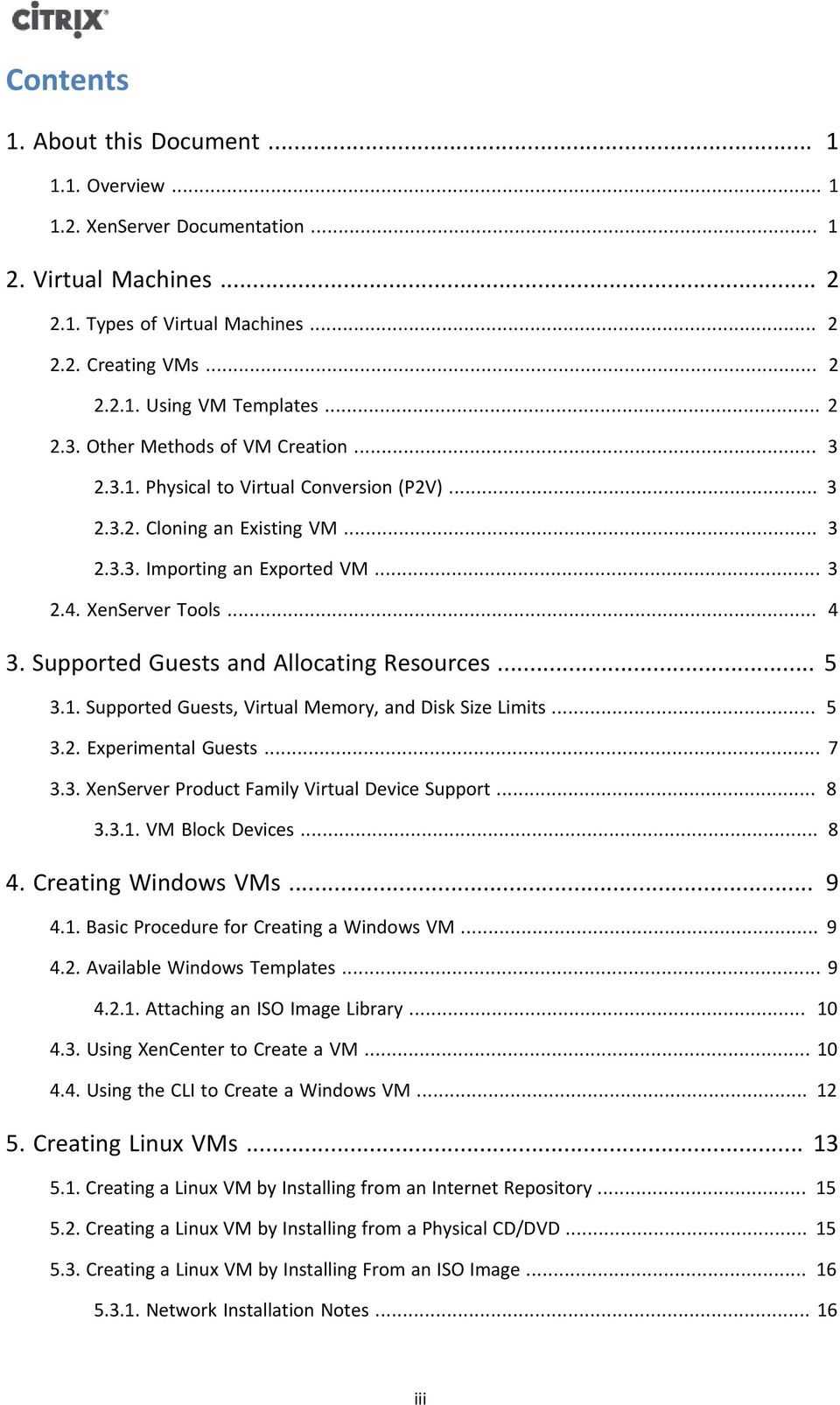
3 Contents 1. About this Document Overview XenServer Documentation Virtual Machines Types of Virtual Machines Creating VMs Using VM Templates Other Methods of VM Creation Physical to Virtual Conversion (P2V) Cloning an Existing VM Importing an Exported VM XenServer Tools Supported Guests and Allocating Resources Supported Guests, Virtual Memory, and Disk Size Limits Experimental Guests XenServer Product Family Virtual Device Support VM Block Devices Creating Windows VMs Basic Procedure for Creating a Windows VM Available Windows Templates Attaching an ISO Image Library Using XenCenter to Create a VM Using the CLI to Create a Windows VM Creating Linux VMs Creating a Linux VM by Installing from an Internet Repository Creating a Linux VM by Installing from a Physical CD/DVD Creating a Linux VM by Installing From an ISO Image Network Installation Notes iii
4 5.4. Advanced Operating System Boot Parameters Installing the Linux Guest Agent Additional Installation Notes for Linux Distributions Additional Debian Notes Apt Repositories Preparing to Clone a Linux VM Machine Name IP address MAC address VM Migration with XenMotion and Storage XenMotion XenMotion and Storage XenMotion XenMotion Storage XenMotion Compatibility Requirements Limitations and Caveats Migrating a VM using XenCenter Live VDI Migration Limitations and Caveats To Move Virtual Disks Updating VMs Updating Windows Operating Systems Updating XenServer Tools for Windows VMs Updating Linux Kernels and Guest Utilities Upgrading to Ubuntu 14.04, RHEL 7 and CentOS 7 Guests vapps Managing vapps in XenCenter Creating vapps Deleting vapps Start and shutdown vapps using XenCenter Importing and Exporting vapps iv

5 9. Advanced Notes for Virtual Machines VM Boot Behavior Persist (XenDesktop - Private Desktop Mode) Reset (XenDesktop - Shared Desktop Mode) Making the ISO Library Available to XenServer Hosts XenServer Tools Windows Volume Shadow Copy Service (VSS) provider Connecting to a Windows VM Using Remote Desktop Time Handling in Windows VMs Time Handling in PV Linux VMs Installing HVM VMs from Reseller Option Kit (BIOS-locked) Media Preparing for Cloning a Windows VM Using VSS Assigning a GPU to a Windows VM (for Use with XenDesktop) Importing the Demo Linux Virtual Appliance Useful Tests Importing and Exporting VMs Supported Formats Open Virtualization Format (OVF and OVA) Selecting OVF or OVA Format Disk Image Formats (VHD and VMDK) XVA Format XVA Version 1 Format Operating System Fixup The Transfer VM Importing VMs Importing VMs from OVF/OVA Importing Disk Images Importing VMs from XVA Exporting VMs Exporting VMs as OVF/OVA v

6 Exporting VMs as XVA A. Windows VM Release Notes A.1. Release Notes A.1.1. General Windows Issues A.1.2. Windows Server A.1.3. Windows A.1.4. Windows Vista B. Linux VM Release Notes B.1. Release Notes B.1.1. Red Hat Enterprise Linux 4.5 to B Preparing a RHEL 4.5 to 4.8 guest for cloning B RHEL Graphical Network Install Support B.1.2. Red Hat Enterprise Linux B Preparing a RHEL 5.x guest for cloning B.1.3. Red Hat Enterprise Linux B.1.4. Red Hat Enterprise Linux B.1.5. CentOS B.1.6. CentOS B.1.7. CentOS B.1.8. CentOS B.1.9. Oracle Linux B Oracle Linux B SUSE Enterprise Linux 10 SP B SUSE Enterprise Linux 10 SP B SUSE Enterprise Linux B SUSE Enterprise Linux 11 SP B Preparing a SLES guest for cloning B Ubuntu B Ubuntu C. Creating ISO Images vi

7 D. Enabling VNC for Linux VMs D.1. Enabling a Graphical Console on Debian Squeeze VMs D.2. Enabling a Graphical Console on Red Hat, CentOS, or Oracle Linux VMs D.2.1. Determining the Location of your VNC Configuration File D.2.2. Configuring GDM to use VNC D.2.3. Firewall Settings D.2.4. VNC Screen Resolution D.2.5. Enabling VNC for RHEL, CentOS, or OEL 6.x VMs D.3. Setting up SLES-based VMs for VNC D.3.1. Checking for a VNC Server D.3.2. Enabling Remote Administration D.3.3. Modifying the xinetd Configuration D.3.4. Firewall Settings D.3.5. VNC Screen Resolution D.4. Checking Runlevels E. Troubleshooting VM Problems E.1. VM Crashes E.1.1. Controlling Linux VM Crashdump Behaviour E.1.2. Controlling Windows VM Crashdump Behaviour E.2. Troubleshooting Boot Problems on Linux VMs vii

8 Chapter 1. About this Document 1.1. Overview This is a guide to using Virtual Machines (VMs) with XenServer, the platform virtualization solution from Citrix. It describes how to create, configure, and manage VMs running on XenServer hosts. This section summarizes the rest of the guide so that you can find the information you need. The following topics are covered: General information about preparing and creating VMs Creating Windows VMs Creating Linux VMs Updating VMs Migrating VMs Creating and using ISO images of vendor media for installing VMs Setting up a network repository of vendor media for installing VMs Troubleshooting VMs 1.2. XenServer Documentation XenServer documentation shipped with this release includes: Release Notes cover known issues that affect this release. XenServer Quick Start Guide provides an introduction for new users to the XenServer environment and components. This guide steps through the installation and configuration essentials to get XenServer and the XenCenter management console up and running quickly. After installation, it demonstrates how to create a Windows VM, VM template and pool of XenServer hosts. It introduces basic administrative tasks and advanced features, such as shared storage, VM snapshots and XenMotion live migration. XenServer Installation Guide steps through the installation, configuration and initial operation of XenServer and the XenCenter management console. XenServer Virtual Machine User's Guide describes how to install Windows and Linux VMs within a XenServer environment. This guide explains how to create new VMs from installation media, from VM templates included in the XenServer package and from existing physical machines (P2V). It explains how to import disk images and how to import and export appliances. XenServer Administrator's Guide gives an in-depth description of the tasks involved in configuring a XenServer deployment, including setting up storage, networking and pools. It describes how to administer XenServer using the xe Command Line Interface. vswitch Controller User's Guide is a comprehensive user guide to the vswitch Controller for XenServer. Supplemental Packs and the DDK introduces the XenServer Driver Development Kit, which can be used to modify and extend the functionality of XenServer. XenServer Software Development Kit Guide presents an overview of the XenServer SDK. It includes code samples that demonstrate how to write applications that interface with XenServer hosts. XenAPI Specification is a reference guide for programmers to the XenServer API. For additional resources, visit the Citrix Knowledge Center. 1

9 Chapter 2. Virtual Machines This chapter provides an overview of how to create Virtual Machines (VMs) using templates. It also explains other preparation methods, including physical to virtual conversion (P2V), cloning templates, and importing previouslyexported VMs. What is a Virtual Machine? A Virtual Machine (VM) is a software computer that, like a physical computer, runs an operating system and applications. The VM is comprised of a set of specification and configuration files and is backed by the physical resources of a host. Every VM has virtual devices that provide the same functionality as physical hardware, and can have additional benefits in terms of portability, manageability, and security. In addition, you can tailor the boot behavior of each VM to your specific requirements - for more information refer to Section 9.1, VM Boot Behavior. XenServer supports guests with any combination of IPv4 or IPv6 configured addresses Types of Virtual Machines In XenServer VMs can operate in one of two modes: Paravirtualized (PV) - the virtual machine kernel uses specific code which is aware it is running on a hypervisor for managing devices and memory. Fully virtualized (HVM) - specific processor features are used to 'trap' privileged instructions which the virtual machine carries out, such that an unmodified operating system can be used. For network and storage access, emulated devices are presented to the virtual machine, or alternatively PV drivers can be used for performance and reliability reasons. In previous XenServer releases all supported Linux distributions have operated in PV mode, and Windows releases in HVM mode. In XenServer 6.5 however, the following newly supported Linux distributions will operate in HVM mode: RHEL 7 CentOS 7 Oracle Linux 7 Ubuntu This is because these VMs can take advantage of the x86 virtual container technologies in newer processors for improved performance. Network and storage access from these guests will still operate in PV mode, using drivers built-in to the kernels Creating VMs Using VM Templates VMs are prepared from templates. A template is a "gold image" that contains all the various configuration settings to instantiate a specific VM. XenServer ships with a base set of templates, which are "raw" VMs, on which you can install an operating system. Different operating systems require different settings in order to run at their best. XenServer templates are tuned to maximize operating system performance. There are two basic methods by which you can create VMs from templates: Using a complete pre-configured template, for example the Demo Linux Virtual Appliance. Installing an operating system from a CD, ISO image or network repository onto the appropriate provided template. 2

10 Chapter 4, Creating Windows VMs describes how to install Windows operating systems onto VMs. Chapter 5, Creating Linux VMs describes how to install Linux operating systems onto VMs Other Methods of VM Creation In addition to creating VMs from the provided templates, there are 3 other methods that you can use to create VMs. 1. Physical to Virtual Conversion (P2V) 2. Cloning an existing VM 3. Importing an exported VM Physical to Virtual Conversion (P2V) Physical to Virtual Conversion (P2V) is the process by which an existing Windows operating system on a physical server its file system, configuration, and so on is converted to a virtualized instance of the operating system. This is then is transferred, instantiated, and started as a VM on the XenServer host Cloning an Existing VM You can make a copy of an existing VM by cloning from a template. Templates are ordinary VMs which are intended to be used as master copies to instantiate VMs from. A VM can be customized and converted into a template; be sure to follow the appropriate preparation procedure for the VM (see Section 9.9, Preparing for Cloning a Windows VM Using VSS for Windows and Section 5.7, Preparing to Clone a Linux VM for Linux). Templates cannot be used as normal VMs. XenServer has two mechanisms for cloning VMs: 1. A full copy 2. Copy-on-Write (CoW) The faster Copy-on-Write (CoW) mode only writes modified blocks to disk. CoW is designed to save disk space and allow fast clones, but will slightly slow down normal disk performance. A template can be fast-cloned multiple times without slowdown. If a template is cloned into a VM and the clone converted back into a template, disk performance can linearly decrease depending on the number of times this has happened. In this event, the vm-copy CLI command can be used to perform a full copy of the disks and restore expected levels of disk performance. Notes for Resource Pools If you create a template on a server where all VM virtual disks are on shared Storage Repositories (SR), the template cloning operation will be forwarded to any server in the pool that can access the shared SRs. However, if you create the template from a VM virtual disk that only has a local SR, then the template clone operation can only execute on the server that can access that SR Importing an Exported VM You can create a VM by importing an existing exported VM. Like cloning, exporting and importing a VM is fast way to create additional VMs of a certain configuration so that you can increase the speed of your deployment. You might, for example, have a special-purpose server configuration that you use many times. Once you have set up a 3

11 VM the way you want it, you can export it, and import it later to create another copy of your specially-configured VM. You can also use export and import to move a VM to a XenServer host that is in another resource pool. For details and procedures on importing and exporting VMs, see Chapter 11, Importing and Exporting VMs XenServer Tools XenServer Tools must be installed for each Virtual Machine (Windows and Linux) in order for the VM to have a fully supported configuration, and to be able to use the XenServer management tools (the xe CLI or XenCenter). A Windows VM will function without them, but performance will be significantly hampered unless the tools are installed. Without the tools being installed, you cannot: Cleanly shut down a VM Cleanly reboot a VM Suspend a VM Migrate a running VM (XenMotion) Use the checkpoint and roll back feature Dynamically adjust the number of vcpus assigned to a running Linux VM- Windows VMs require a reboot for this to take effect For further information about XenServer Tools see Section 9.3, XenServer Tools Warning: Running a VM without installing the XenServer Tools is not a supported configuration. For Windows VMs, installing or upgrading the XenServer Tools can cause the friendly name and identifier of some network adapters to change. Any software which is configured to use a particular adapter may have to be reconfigured following Tools installation or upgrade. In order to maintain a supported configuration, customers should ensure that the XenServer Tools in use by their VMs, matches the latest available version for the XenServer host. For example, some Hotfixes include an updated XenServer Tools ISO which will update the version installed on the host. 4

12 Chapter 3. Supported Guests and Allocating Resources This chapter describes how to allocate resources to your VMs, and the supported guest operating systems. It lists virtual memory and virtual disk size minimums, and describes the differences in virtual device support for the members of the XenServer product family Supported Guests, Virtual Memory, and Disk Size Limits When installing VMs, follow the memory and disk space guidelines of the operating system and any relevant applications, when allocating resources such as memory and disk space. Important: Individual versions of the operating systems may also impose their own maximum limits on the amount of memory supported (for example, for licensing reasons). Warning: When configuring guest memory, do not to exceed the maximum amount of physical memory addressable by your operating system. Setting a memory maximum that is greater than the operating system supported limit may lead to stability problems within your guest. Operating System Minimum RAM Maximum RAM Minimum Disk Space Windows 7, Windows 7 SP1, Windows 8, Windows 8.1 (32-bit) Windows 7, Windows 7 SP1, Windows 8, Windows 8.1 (64-bit) Windows Server 2008 SP2, Windows Server 2008 R2, Windows Server 2008 R2 SP1, Windows Server 2012, Windows Server 2012 R2 (64-bit) Windows Server 2003 SP2, Windows Server 2008 SP2 (32-bit) 1GB 4GB 24GB (40GB or more recommended) 2GB 192GB 24GB (40GB or more recommended) 512MB 192GB 24GB (40GB or more recommended) 512MB 64GB 24GB (40GB or more recommended) Windows Server 2003 SP2 (64-bit) 256MB 192GB 8GB (16GB or more recommended) Windows Vista SP2 (32-bit) 1GB 4GB 24GB (40GB or more recommended) Windows XP SP3 (32-bit) 256MB 4GB 8GB (16GB or more recommended) CentOS (32-bit) 256MB 16GB 8GB CentOS (32-bit) 512MB 16GB 8GB CentOS (64-bit) 512MB 16GB 8GB CentOS (64-bit) 512MB 192GB 8GB CentOS 5.10, 5.11 (32-bit) 512MB 64GB 8GB 5

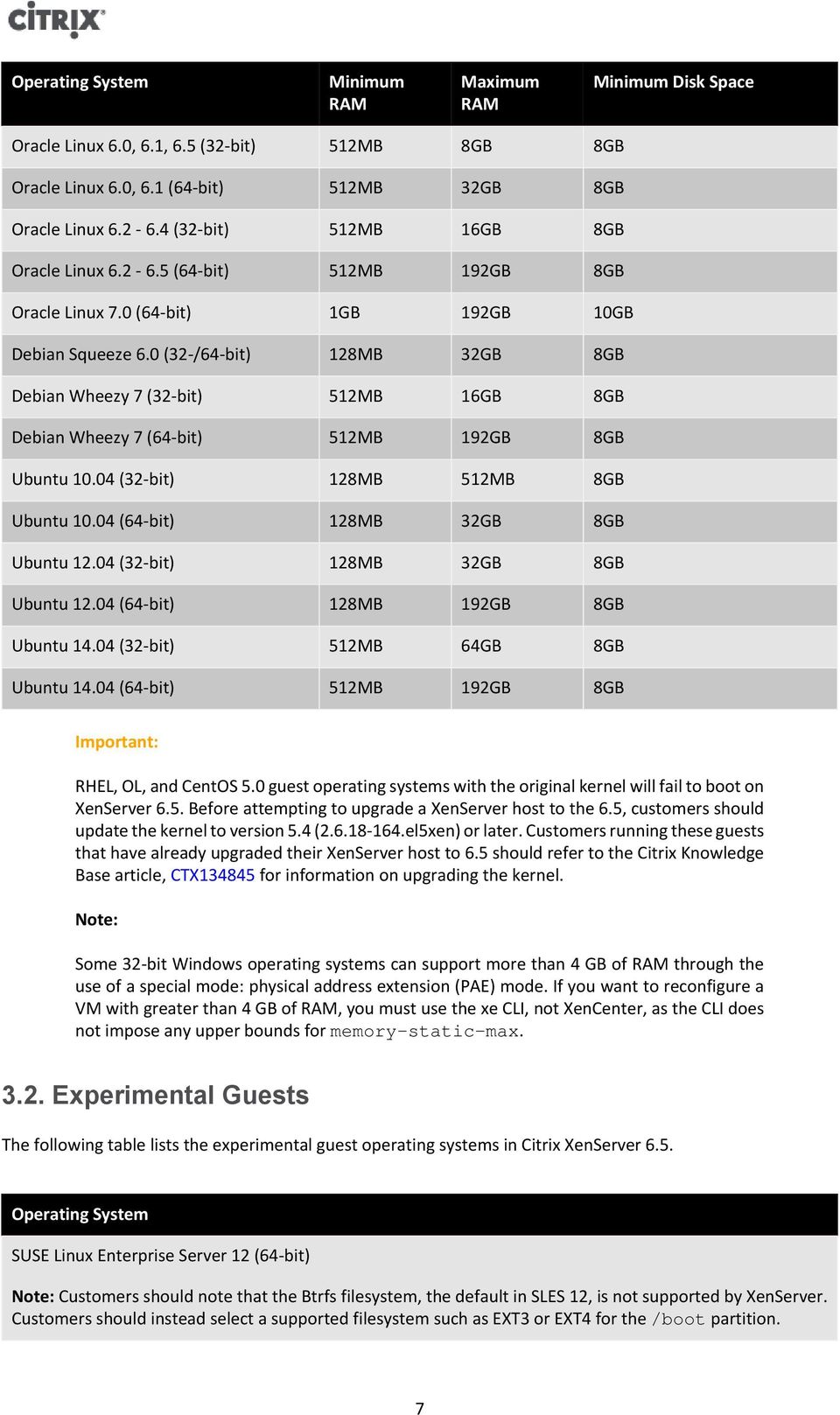
13 Operating System Minimum RAM Maximum RAM Minimum Disk Space CentOS 6.0, 6.1 (32-bit) 512MB 8GB 8GB CentOS 6.0, 6.1 (64-bit) 512MB 32GB 8GB CentOS (32-bit) 512MB 16GB 8GB CentOS (64-bit) 512MB 192GB 8GB CentOS 7.0 (64-bit) 1GB 192GB 10GB Red Hat Enterprise Linux (32- bit) Red Hat Enterprise Linux (32- bit) Red Hat Enterprise Linux (64- bit) Red Hat Enterprise Linux (64- bit) Red Hat Enterprise Linux 5.10, 5.11 (32- bit) 256MB 16GB 8GB 512MB 16GB 8GB 512MB 16GB 8GB 512MB 192GB 8GB 512MB 64GB 8GB Red Hat Enterprise Linux 6.0, 6.1 (32-bit) 512MB 8GB 8GB Red Hat Enterprise Linux 6.0, 6.1 (64-bit) 512MB 32GB 8GB Red Hat Enterprise Linux (32- bit) Red Hat Enterprise Linux (64- bit) 512MB 16GB 8GB 512MB 192GB 8GB Red Hat Enterprise Linux 7.0 (64-bit) 1GB 192GB 10GB SUSE Linux Enterprise Server 10 SP1, SLES 10 SP2, SLES 10 SP3, SLES 10 SP4 (32-bit) SUSE Linux Enterprise Server 10 SP1, SLES 10 SP2, SLES 10 SP3, SLES 10 SP4 (64-bit) SUSE Linux Enterprise Server 11, SLES 11 SP1, SLES 11 SP2, SLES 11 SP3 (32-bit) SUSE Linux Enterprise Server 11, SLES 11 SP1, SLES 11 SP2, SLES 11 SP3 (64-bit) 512MB 16GB 8GB 512MB 192GB 8GB 512MB 64GB 8GB 512MB 192GB 8GB Oracle Linux , 5.10, 5.11 (32-bit) 512MB 64GB 8GB Oracle Linux (64-bit) 512MB 192GB 8GB Oracle Linux 5.8, 5.9 (32-bit) 512MB 16GB 8GB 6

14 Operating System Minimum RAM Maximum RAM Minimum Disk Space Oracle Linux 6.0, 6.1, 6.5 (32-bit) 512MB 8GB 8GB Oracle Linux 6.0, 6.1 (64-bit) 512MB 32GB 8GB Oracle Linux (32-bit) 512MB 16GB 8GB Oracle Linux (64-bit) 512MB 192GB 8GB Oracle Linux 7.0 (64-bit) 1GB 192GB 10GB Debian Squeeze 6.0 (32-/64-bit) 128MB 32GB 8GB Debian Wheezy 7 (32-bit) 512MB 16GB 8GB Debian Wheezy 7 (64-bit) 512MB 192GB 8GB Ubuntu (32-bit) 128MB 512MB 8GB Ubuntu (64-bit) 128MB 32GB 8GB Ubuntu (32-bit) 128MB 32GB 8GB Ubuntu (64-bit) 128MB 192GB 8GB Ubuntu (32-bit) 512MB 64GB 8GB Ubuntu (64-bit) 512MB 192GB 8GB Important: RHEL, OL, and CentOS 5.0 guest operating systems with the original kernel will fail to boot on XenServer 6.5. Before attempting to upgrade a XenServer host to the 6.5, customers should update the kernel to version 5.4 ( el5xen) or later. Customers running these guests that have already upgraded their XenServer host to 6.5 should refer to the Citrix Knowledge Base article, CTX for information on upgrading the kernel. Some 32-bit Windows operating systems can support more than 4 GB of RAM through the use of a special mode: physical address extension (PAE) mode. If you want to reconfigure a VM with greater than 4 GB of RAM, you must use the xe CLI, not XenCenter, as the CLI does not impose any upper bounds for memory-static-max Experimental Guests The following table lists the experimental guest operating systems in Citrix XenServer 6.5. Operating System SUSE Linux Enterprise Server 12 (64-bit) Customers should note that the Btrfs filesystem, the default in SLES 12, is not supported by XenServer. Customers should instead select a supported filesystem such as EXT3 or EXT4 for the /boot partition. 7
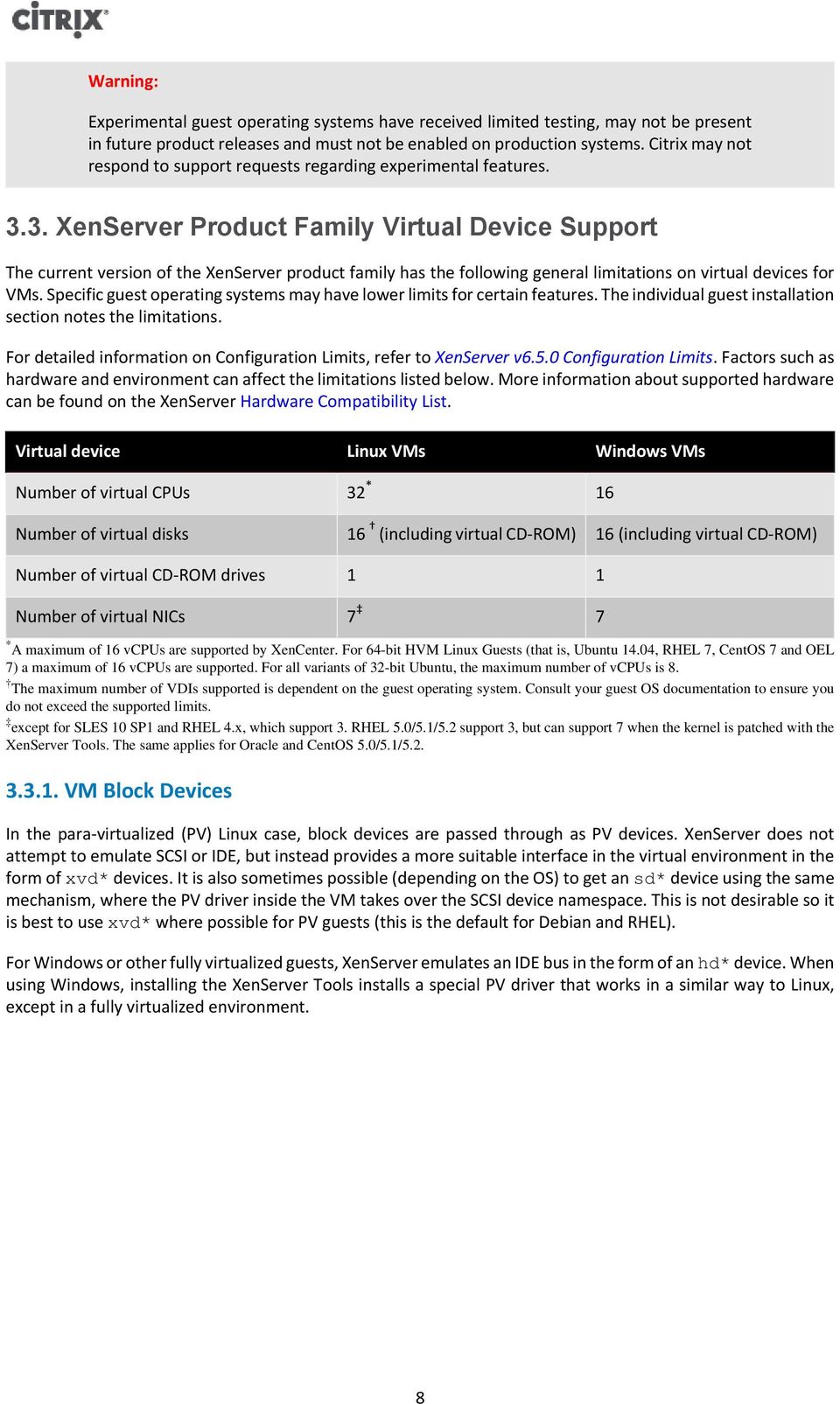
15 Warning: Experimental guest operating systems have received limited testing, may not be present in future product releases and must not be enabled on production systems. Citrix may not respond to support requests regarding experimental features XenServer Product Family Virtual Device Support The current version of the XenServer product family has the following general limitations on virtual devices for VMs. Specific guest operating systems may have lower limits for certain features. The individual guest installation section notes the limitations. For detailed information on Configuration Limits, refer to XenServer v6.5.0 Configuration Limits. Factors such as hardware and environment can affect the limitations listed below. More information about supported hardware can be found on the XenServer Hardware Compatibility List. Virtual device Linux VMs Windows VMs Number of virtual CPUs 32 * 16 Number of virtual disks 16 (including virtual CD-ROM) 16 (including virtual CD-ROM) Number of virtual CD-ROM drives 1 1 Number of virtual NICs 7 7 * A maximum of 16 vcpus are supported by XenCenter. For 64-bit HVM Linux Guests (that is, Ubuntu 14.04, RHEL 7, CentOS 7 and OEL 7) a maximum of 16 vcpus are supported. For all variants of 32-bit Ubuntu, the maximum number of vcpus is 8. The maximum number of VDIs supported is dependent on the guest operating system. Consult your guest OS documentation to ensure you do not exceed the supported limits. except for SLES 10 SP1 and RHEL 4.x, which support 3. RHEL 5.0/5.1/5.2 support 3, but can support 7 when the kernel is patched with the XenServer Tools. The same applies for Oracle and CentOS 5.0/5.1/ VM Block Devices In the para-virtualized (PV) Linux case, block devices are passed through as PV devices. XenServer does not attempt to emulate SCSI or IDE, but instead provides a more suitable interface in the virtual environment in the form of xvd* devices. It is also sometimes possible (depending on the OS) to get an sd* device using the same mechanism, where the PV driver inside the VM takes over the SCSI device namespace. This is not desirable so it is best to use xvd* where possible for PV guests (this is the default for Debian and RHEL). For Windows or other fully virtualized guests, XenServer emulates an IDE bus in the form of an hd* device. When using Windows, installing the XenServer Tools installs a special PV driver that works in a similar way to Linux, except in a fully virtualized environment. 8
16 Chapter 4. Creating Windows VMs Warning: Running a VM without installing the XenServer Tools is not a supported configuration. For more information, see Section 2.4, XenServer Tools. Installing Windows VMs on a XenServer host requires hardware virtualization support (Intel VT or AMD-V) Basic Procedure for Creating a Windows VM The process of installing a Windows on to a VM can be broken down into three steps: selecting the appropriate Windows template installing the Windows operating system installing the paravirtualized device drivers known as the XenServer Tools 4.2. Available Windows Templates Windows operating systems are installed onto VMs by cloning an appropriate template using either XenCenter or the xe CLI, and then installing the operating system. The templates for individual guests have predefined platform flags set which define the configuration of the virtual hardware. For example, all Windows VMs are installed with the ACPI Hardware Abstraction Layer (HAL) mode enabled. If you subsequently change one of these VMs to have multiple virtual CPUs, Windows automatically switches the HAL to multi-processor mode. The available Windows templates are listed below: Template Name Citrix XenApp on Windows Server 2003 (32-bit) Citrix XenApp on Windows Server 2003 (64-bit) Citrix XenApp on Windows Server 2008 (32-bit) Citrix XenApp on Windows Server 2008 (64-bit) Citrix XenApp on Windows Server 2008 R2 (64-bit) Windows 7 (32-bit) Windows 7 (64-bit) Windows 8 (32-bit) Windows 8 (64-bit) Description Used to install Windows Server 2003 SP2 (32-bit). The Server, Enterprise, Data Centre, and SBS editions are supported. This template is specially tuned to optimize XenApp performance. Used to install Windows Server 2003 SP2 (64-bit). The Server, Enterprise, Data Centre, and SBS editions are supported. This template is specially tuned to optimize XenApp performance. Used to install Windows Server 2008 SP2 (32-bit). All editions are supported. This template is specially tuned to optimize XenApp performance. Used to install Windows Server 2008 SP2 (64-bit). All editions are supported. This template is specially tuned to optimize XenApp performance. Used to install Windows Server 2008 R2 and Windows Server 2008 R2 SP1 (64-bit). All editions are supported. This template is specially tuned to optimize XenApp performance. Used to install Windows 7 and Windows 7 SP1 (32-bit). Used to install Windows 7 and Windows 7 SP1 (64-bit). Used to install Windows 8 and Windows 8.1 (32-bit). Used to install Windows 8 and Windows 8.1 (64-bit). 9

17 Template Name Windows Server 2003 (32-bit) Windows Server 2003 (64-bit) Windows Server 2008 (32-bit) Windows Server 2008 (64-bit) Description Used to install Windows Server 2003 SP2 (32-bit). The Server, Enterprise, Data Centre, and SBS editions are supported. Used to install Windows Server 2003 SP2 (64-bit). The Server, Enterprise, Data Centre, and SBS editions are supported. Used to install Windows Server 2008 SP2 (32-bit). All editions are supported. Used to install Windows Server 2008 SP2 (64-bit). All editions are supported. Windows Server 2008 R2 (64-bit) Used to install Windows Server 2008 R2 and Windows Server 2008 R2 SP1 (64-bit). All editions are supported. Windows Server 2012 (64-bit) Windows Server 2012 R2 (64-bit) Windows Vista (32-bit) Used to install Windows Server 2012 (64-bit). Used to install Windows Server 2012 R2 (64-bit). Used to install Windows Vista SP2 (32-bit). The Enterprise edition is supported. Warning: Experimental guest operating systems have received limited testing, may not be present in future product releases and must not be enabled on production systems. Citrix may not respond to support requests regarding experimental features Attaching an ISO Image Library The Windows operating system can be installed either from an install CD in a physical CD-ROM drive on the XenServer host, or from an ISO image. See Appendix C, Creating ISO Images for information on how to make an ISO image from a Windows install CD and make it available for use Using XenCenter to Create a VM To create a Windows 7 (32-bit) VM: The following procedure provides an example of creating Windows 7 (32-bit) VM. The default values may vary depending on the operating system that you choose. 1. On the XenCenter toolbar, click the New VM button to open the New VM wizard. The New VM wizard allows you to configure the new VM, adjusting various parameters for CPU, storage and networking resources. 2. Select a VM template and click Next. Each template contains the setup information needed to create a new VM with a specific guest operating system (OS), and with optimum storage. This list reflects the templates that XenServer currently supports. If the OS that you intend to install on your new VM is compatible only with the original hardware (for example, an OS installation CD that was packaged with a specific computer), check the Copy host BIOS strings to VM box. 10

18 To copy BIOS strings using the CLI, see Section 9.8, Installing HVM VMs from Reseller Option Kit (BIOS-locked) Media 3. Enter a name and an optional description for the new VM. 4. Choose the source of the OS media to install on the new VM. Installing from a CD/DVD is the simplest option for getting started. To do so, choose the default installation source option (DVD drive), insert the disk into the DVD drive of the XenServer host, and choose Next to proceed. XenServer also allows you to pull OS installation media from a range of sources, including a pre-existing ISO library. An ISO image is a file that contains all the information that an optical disc (CD, DVD, and so on) would contain. In this case, an ISO image would contain the same OS data as a Windows installation CD. To attach a pre-existing ISO library, click New ISO library and indicate the location and type of ISO library. You can then choose the specific operating system ISO media from the drop-down list. 5. The VM will run on the installed host. Choose Next to proceed. 6. For a Windows 7 VM, the default is 1 virtual CPU and 2048 MB of RAM. You may also choose to modify the defaults. Select Next to continue. 7. Allocate and configure storage for the new VM. Click Next to select the default allocation (24 GB) and configuration, or you may wish to: a. Change the name, description or size of your virtual disk by clicking Properties. b. Add a new virtual disk by selecting Add. 8. Configure networking on the new VM. Click Next to select the default network interface card (NIC) and configurations, including an automaticallycreated unique MAC address for each NIC, or you may wish to: a. Change the physical network, MAC address or quality-of-service (QoS) priority of the virtual disk by clicking Properties. b. Add a new virtual NIC by selecting Add. 9. Review settings, and then click Finish to create the new VM and return to the Search tab. An icon for your new VM appears under the host in the Resources pane. On the Resources pane, select the VM, and then click the Console tab to see the VM console. 10. Follow the OS installation screens and make your selections. 11. Once the OS installation completes and the VM reboots, install the XenServer Tools. XenServer Tools provide high-speed I/O for enhanced disk and network performance. XenServer Tools must be installed on each VM in order for the VM to have a fully-supported configuration. A VM will function without them, but performance will be significantly hampered. XenServer Tools also enable certain functions and features, including cleanly shutting down, rebooting, suspending and live migrating VMs. Warning: You must install XenServer Tools for each VM. Running VMs without XenServer Tools is not supported. For more information on XenServer Tools see Section 9.3, XenServer Tools. To install XenServer Tools on a Windows VM, the VM must be running the Microsoft.NET Framework Version 4.0 or later. If a VM is running Windows 2003, you need to install the 11
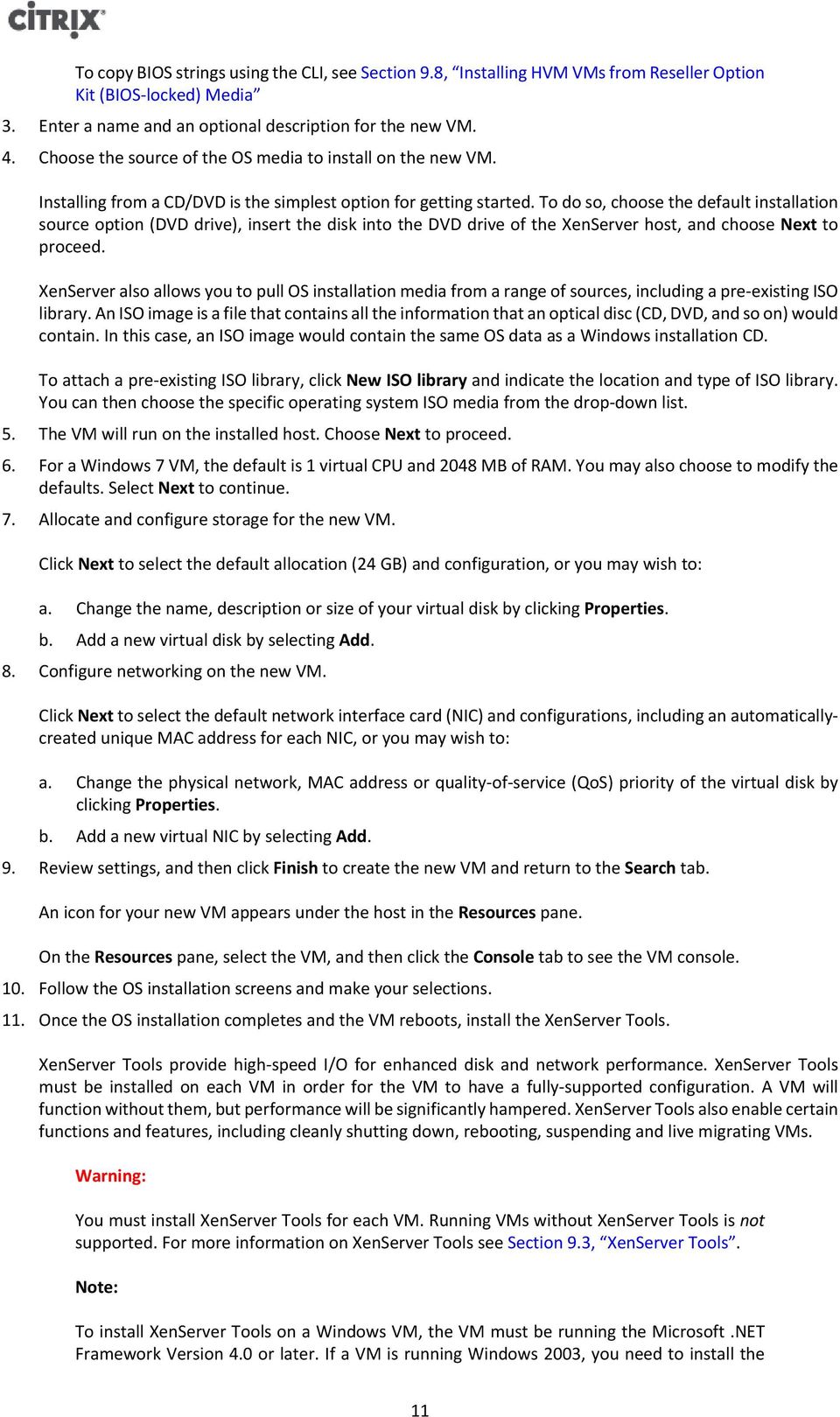
19 Windows Imaging Component (see your vendor documentation for details) before installing XenServer Tools. To install XenServer Tools: a. On the Resources pane, select the XenServer host and then the Search tab. The XenServer Tools not installed blue status text appears next to the new VM. b. Click the text to open the XenServer Tools setup wizard on the VM console. c. Click the Install XenServer Tools button, and then Run Xensetup.exe. d. When prompted, click Yes to allow the program to make changes to the computer. e. Accept the License Agreement, and click Next to continue. f. Choose a destination folder and click Install. g. Select Reboot now, and then Finish to complete the installation Using the CLI to Create a Windows VM This section describes the procedure to create a Windows VM from an ISO repository using the xe CLI. Installing a Windows VM from an ISO Repository Using the CLI 1. Create a VM from a template: xe vm-install new-name-label=<vm_name> template=<template_name> This returns the UUID of the new VM. 2. Create an ISO Storage Repository: xe-mount-iso-sr <path_to_iso_sr> 3. List all of the available ISOs: xe cd-list 4. Insert the specified ISO into the virtual CD drive of the specified VM: xe vm-cd-add vm=<vm_name> cd-name=<iso_name> device=3 5. Start the VM and install the operating system: xe vm-start vm=<vm_name> At this point, the VM console will now be visible in XenCenter. For more information on using the CLI, see Appendix A, Command Line Interface, in the XenServer Administrator's Guide. 12

20 Chapter 5. Creating Linux VMs This chapter discusses how to create Linux VMs, either by installing them or cloning them. This chapter also contains vendor-specific installation instructions. When you want to create a new VM, you must create the VM using a template for the operating system you want to run on the VM. You can use a template Citrix provides for your operating system, or one that you created previously. You can create the VM from either XenCenter or the CLI. This chapter will focus on using the CLI. Customers who wish to create VM of a newer minor update of a Red Hat Enterprise Linux (RHEL release, than is currently supported for installation by XenServer, should install from the latest supported media and then use yum update to bring the VM up to date. This also applies to RHEL derivatives such as CentOS and Oracle Linux. For example, RHEL 5.10 is supported for release with XenServer 6.5; customers who wish to use RHEL v5.11, should first install RHEL v5.10, and then use yum update to update to RHEL You will need to install the XenServer Tools immediately after installing the operating system. For some operating systems, the XenServer Tools includes a XenServer specific kernel, which replaces the kernel provided by the vendor. Other operating systems, such as RHEL 5.x require you to install a specific version of a vendor provided kernel. Warning: Running a VM without installing the XenServer Tools is not a supported configuration, so Citrix recommends that you install the tools immediately after Operating System installation. For more information, see Section 2.4, XenServer Tools. The overview for creating a Linux VM is as following: 1. Create the VM for your target operating system using XenCenter or the CLI. 2. Install the operating system using vendor installation media. 3. Install the XenServer Tools. 4. Configure the correct time and time zone on the VM and VNC as you would in a normal non-virtual environment. XenServer supports the installation of many Linux distributions as VMs. There are three installation mechanisms: 1. Installing from an internet repository 2. Installing from a physical CD 3. Installing from an ISO library Warning: The Other install media template is for advanced users who want to attempt to install VMs running unsupported operating systems. XenServer has been tested running only the supported distributions and specific versions covered by the standard supplied templates, and any VMs installed using the Other install media template are not supported. VMs created using the Other install media template will be created as HVM guests, which may mean that some Linux VMs will use slower emulated devices rather than the higher performance PV drivers. For information regarding specific Linux distributions, see Section 5.6, Additional Installation Notes for Linux Distributions. 13

21 The supported Linux distributions are: Distribution Vendor Install from CD Vendor Install from network repository Notes Debian Squeeze 6.0 (32-/64-bit) X X Debian Wheezy 7 (32-/64-bit) X X Red Hat Enterprise Linux (32-bit) X X Requires installing XenServer Tools after installing RHEL to apply the Citrix RHEL 4.8 kernel. Red Hat Enterprise Linux (32-/64-bit) X X Supported provided you use the 5.4 or later kernel. Red Hat Enterprise Linux (32-/64-bit) X X Red Hat Enterprise Linux 7.0 (64-bit) X X SUSE Linux Enterprise Server 10 SP1, SP2, SP4 (32-/64-bit) X X SUSE Linux Enterprise Server 10 SP3 (32-bit) Supported only if upgrading from SLES 10 SP2 SUSE Linux Enterprise Server 10 SP3 (64-bit) X X SUSE Linux Enterprise Server 11, SP1, SP2, SP3 (32-/64-bit) X X CentOS (32-bit) X X CentOS (32-/64-bit) X X CentOS (32-/64-bit) X X CentOS 7.0 (64-bit) X X Oracle Linux (32-/64-bit) X X Oracle Linux (32-/64-bit) X X Oracle Linux 7.0 (64-bit) X X Ubuntu (32-/64-bit) X Ubuntu (32-/64-bit) X X Ubuntu (32-/64-bit) X X Distributions not present in the above list are not supported. However, distributions that use the same installation mechanism as Red Hat Enterprise Linux (for example, Fedora Core) might be successfully installed using the same template. 14
22 Running 32-bit PV Linux VMs on a host that has more than 128GB of memory is not supported Creating a Linux VM by Installing from an Internet Repository This section shows the xe CLI procedure for creating a Linux VM, using a Debian Squeeze example, by installing the OS from an internet repository. Example: Installing a Debian Squeeze VM from a network repository 1. Create a VM from the Debian Squeeze template. The UUID of the VM is returned: xe vm-install template=<template-name> new-name-label=<squeeze-vm> 2. Specify the installation repository this should be a Debian mirror with at least the packages required to install the base system and the additional packages you plan to select during the Debian installer: xe vm-param-set uuid=<uuid> other-config:install-repository=<path_to_repository> An example of a valid repository path is where <xx> is your country code (see the Debian mirror list for a list of these). For multiple installations Citrix recommends using a local mirror or apt proxy to avoid generating excessive network traffic or load on the central repositories. The Debian installer supports only HTTP and FTP apt repos, NFS is NOT supported. 3. Find the UUID of the network that you want to connect to. For example, if it is the one attached to xenbr0: xe network-list bridge=xenbr0 --minimal 4. Create a VIF to connect the new VM to this network: xe vif-create vm-uuid=<vm_uuid> network-uuid=<network_uuid> mac=random device=0 5. Start the VM; it boots straight into the Debian installer: xe vm-start uuid=<uuid> 6. Follow the Debian Installer procedure to install the VM in the configuration you require. 7. See below for instructions on how to install the guest utilities and how to configure graphical display Creating a Linux VM by Installing from a Physical CD/DVD This section shows the CLI procedure for creating a Linux VM, using a Debian Squeeze example, by installing the OS from a physical CD/DVD. Example: Installing a Debian Squeeze VM from CD/DVD (using the CLI) 1. Create a VM from the Debian Squeeze template. The UUID of the VM is returned: xe vm-install template=<template-name> new-name-label=<vm-name> 2. Get the UUID of the root disk of the new VM: xe vbd-list vm-uuid=<vm_uuid> userdevice=0 params=uuid --minimal 3. Using the UUID returned, set the root disk to not be boo-table: xe vbd-param-set uuid=<root_disk_uuid> bootable=false 4. Get the name of the physical CD drive on the XenServer host: xe cd-list The result of this command should give you something like SCSI 0:0:0:0 for the name-label field. 15
23 5. Add a virtual CD-ROM to the new VM using the XenServer host CD drive name-label parameter as the cd-name parameter: xe vm-cd-add vm=<vm_name> cd-name="<host_cd_drive_name_label>" device=3 6. Get the UUID of the VBD corresponding to the new virtual CD drive: xe vbd-list vm-uuid=<vm_uuid> type=cd params=uuid --minimal 7. Make the VBD of the virtual CD boot-able: xe vbd-param-set uuid=<cd_drive_uuid> bootable=true 8. Set the install repository of the VM to be the CD drive: xe vm-param-set uuid=<vm_uuid> other-config:install-repository=cdrom 9. Insert the Debian Squeeze installation CD into the CD drive on the XenServer host. 10. Open a console to the VM with XenCenter or an SSH terminal and follow the steps to perform the OS installation. 11. Start the VM; it boots straight into the Debian installer: xe vm-start uuid=<uuid> 12. See the sections that follow for instructions on how to install the guest utilities and how to configure graphical display Creating a Linux VM by Installing From an ISO Image This section shows the CLI procedure for creating a Linux VM, by installing the OS from network-accessible ISO. Example: Installing a Linux VM from a Network-Accessible ISO Image 1. Run the command xe vm-install template=<template> new-name-label=<name_for_vm> \ sr-uuid=<storage_repository_uuid> This command returns the UUID of the new VM. 2. Find the UUID of the network that you want to connect to. For example, if it is the one attached to xenbr0: xe network-list bridge=xenbr0 --minimal 3. Create a VIF to connect the new VM to this network: xe vif-create vm-uuid=<vm_uuid> network-uuid=<network_uuid> mac=random device=0 4. Set the install-repository key of the other-config parameter to the path of your network repository. For example, to use as the URL of the vendor media: xe vm-param-set uuid=<vm_uuid> \ other-config:install-repository= 5. Start the VM xe vm-start uuid=<vm_uuid> 6. Connect to the VM console using XenCenter or VNC and perform the OS installation Network Installation Notes The XenServer guest installer allows you to install an operating system from a network-accessible ISO image onto a VM. To prepare for installing from an ISO, make an exploded network repository of your vendor media (not ISO images) and export it over NFS, HTTP or FTP so that it is accessible to the XenServer host administration interface. 16
24 The network repository must be accessible from the control domain of the XenServer host, normally using the management interface. The URL must point to the base of the CD/DVD image on the network server, and be of the form: HTTP FTP ftp://<server>/<path> NFS nfs://<server>/<path> NFS nfs:<server>:/<path> See your vendor installation instructions for information about how to prepare for a network-based installation, such as where to unpack the ISO. Note that when using the NFS installation method from XenCenter, the nfs:// style of path should always be used. When creating VMs from templates, the XenCenter New VM wizard prompts you for the repository URL. When using the CLI, install the template as normal using vm-install and then set the other-config:install-repository parameter to the value of the URL. When the VM is subsequently started, it will begin the network installation process. Warning: When installing a new Linux-based VM, it is important to fully finish the installation and reboot it before performing any other operations on it. This is analogous to not interrupting a Windows installation which would leave you with a non-functional VM Advanced Operating System Boot Parameters When creating a new VM, you can specify advanced operating system boot parameters using XenCenter or the xe CLI. Specifying advanced parameters may be particularly helpful if you are, for example, configuring automated installations of paravirtualized guests. For example, you might use a Debian preseed or RHEL kickstart file as follows. To install Debian using a preseed file: 1. Create a preseed file. For information on creating preseed files, see the Debian documentation for details. 2. Set the kernel command-line correctly for the VM before starting it. This can be done using the New VM wizard in XenCenter or by executing an xe CLI command like the following: xe vm-param-set uuid=<uuid> PV-args=<preseed_arguments> To install RHEL Using a Kickstart File: A Red Hat Kickstart file is an automated installation method, similar to an answer file, you can use to provide responses to the RHEL installation prompts. To create this file, install RHEL manually. The kickstart file is located in /root/anaconda-ks.cfg. 1. In XenCenter, choose the appropriate RHEL template 2. Specify the kickstart file to use as a kernel command-line argument in the XenCenter New VM Wizard, exactly as it would be specified in the PXE config file, for example: 17
25 ks= ksdevice=eth0 3. On the command line, use vm-param-set to set the PV-args parameter to make use of a Kickstart file xe vm-param-set uuid=<vm_uuid> PV-args="ks= ksdevice=eth0" 4. Set the repository location so XenServer knows where to get the kernel and initrd from for the installer boot: xe vm-param-set uuid=<vm_uuid> other-config:install-repository=< To install using a kickstart file without the New VM wizard, you can add the appropriate argument to the Advanced OS boot parameters text box Installing the Linux Guest Agent Although all the supported Linux distributions are natively paravirtualized (and therefore do not need special drivers for full performance), XenServer includes a guest agent which provides additional information about the VM to the host. This additional information includes: Linux distribution name and version (major, minor revision). Kernel version (uname). IP addresses of each Ethernet interface. Total and free memory within the VM. It is important to install this agent and keep it up-to-date (see Chapter 7, Updating VMs) as you upgrade your XenServer host. To install the guest agent: 1. The files required are present on the built-in xs-tools.iso CD image, or alternatively can be installed by using the VM > Install XenServer Tools option in XenCenter. 2. Mount the image onto the guest by running the command: mount -o ro,exec /dev/disk/by-label/xenserver\\x20tools /mnt If mounting the image fails, you can locate the image by running the following: blkid -t LABEL="XenServer Tools" 3. Execute the installation script as the root user: /mnt/linux/install.sh 4. Unmount the image from the guest by running the command: umount /mnt 5. If the kernel has been upgraded, or the VM was upgraded from a previous version, reboot the VM now. CD-ROM drives and ISOs attached to Linux Virtual Machines appear as devices, such as / dev/xvdd (or /dev/sdd in Ubuntu and later) instead of as /dev/cdrom as you might expect. This is because they are not true CD-ROM devices, but normal devices. When the CD is ejected by either XenCenter or the CLI, it hot-unplugs the device from the VM and the device disappears. This is different from Windows Virtual Machines, where the CD remains in the VM in an empty state. 18
26 5.6. Additional Installation Notes for Linux Distributions This following table lists additional, vendor-specific, configuration information that you should be aware of before creating the specified Linux VMs. Important: For detailed release notes on all distributions, see Appendix B, Linux VM Release Notes. Linux Distribution CentOS (32-bit) CentOS (32-/64-bit) Red Hat Enterprise Linux (32-bit) Red Hat Enterprise Linux (32-/64-bit) Oracle Linux (32-/64-bit) Installation Notes For a CentOS 4.x VM, you must install the XenServer Tools, which includes the CentOS 4.8 kernel and fixes issues in the CentOS kernel that prevent XenServer from running correctly. For a CentOS 5.x VM, you must ensure that the operating system is using the CentOS 5.4 kernel or later, which is available from the distribution vendor. Enterprise Linux kernel versions prior to 5.4 contain issues that prevent XenServer VMs from running properly. Upgrade the kernel using the vendor's normal kernel upgrade procedure. For a RHEL 4.x VM, you must install the XenServer Tools, which includes the RHEL 4.8 kernel and fixes issues in the RHEL kernel that prevent XenServer from running correctly. For a RHEL 5.x VM, you must ensure that the operating system is using the RHEL 5.4 kernel ( el5) or later, which is available from the distribution vendor. Enterprise Linux kernel versions prior to 5.4 contain issues that prevent XenServer VMs from running properly. Upgrade the kernel using the vendor's normal kernel upgrade procedure. For an OEL 5.x VM, you must ensure that the operating system is using the OEL 5.4 kernel or later, which is available from the distribution vendor. Enterprise Linux kernel versions prior to 5.4 contain issues that prevent XenServer VMs from running properly. Upgrade the kernel using the vendor's normal kernel upgrade procedure. For OEL bit, the Unbreakable Enterprise Kernel (UEK) does not support the Xen platform. If you attempt to use UEK with this operating system, the kernel fails to boot properly. Debian 6.0 (Squeeze) (32-/64-bit) Debian 7 (Wheezy) (32-/64-bit) When a private mirror is specified in XenCenter this is only used to retrieve the installer kernel. Once the installer is running you will again need to enter the address of the mirror to be used for package retrieval. When a private mirror is specified in XenCenter this is only used to retrieve the installer kernel. Once the installer is running you will again need to enter the address of the mirror to be used for package retrieval. 19
27 Linux Distribution Ubuntu (32-/64-bit) Installation Notes For Ubuntu VMs with multiple vcpus, Citrix strongly recommends that you update the guest kernel to " #64". For details on this issue, see the Knowledge Base article CTX Ubuntu Kernel Bug Affects SMP Operation Additional Debian Notes Apt Repositories For infrequent or one-off installations, it is reasonable to directly use a Debian mirror. However, if you intend to do several VM installations, we recommend that you use a caching proxy or local mirror. Apt-cacher is an implementation of proxy server that will keep a local cache of packages. debmirror is a tool that will create a partial or full mirror of a Debian repository. Either of these tools can be installed into a VM Preparing to Clone a Linux VM Typically, when cloning a VM or a computer, unless you "generalize" the cloned image, attributes unique to that machine, such as the IP address, SID, or MAC address, will be duplicated in your environments. As a result, XenServer automatically changes some virtual hardware parameters when you clone a Linux VM. If you copy the VM using XenCenter, XenCenter automatically changes the MAC address and IP address for you. If these interfaces are configured dynamically in your environment, you might not need to make any modifications to the cloned VM. However, if the interfaces are statically configured, you might need to modify their network configurations. The VM may need to be customized to be made aware of these changes. For instructions for specific supported Linux distributions, see Section B.1, Release Notes Machine Name A cloned VM is another computer, and like any new computer in a network, it must have a unique name within the network domain it is part of IP address A cloned VM must have a unique IP address within the network domain it is part of. Generally, this is not a problem if DHCP is used to assign addresses; when the VM boots, the DHCP server will assign it an IP address. If the cloned VM had a static IP address, the clone must be given an unused IP address before being booted MAC address There are two situations when Citrix recommends disabling MAC address rules before cloning: 1. In some Linux distributions, the MAC address for the virtual network interface of a cloned VM is recorded in the network configuration files. However, when you clone a VM, XenCenter assigns the new cloned VM a different MAC address. As a result, when the new VM is started for the first time, the network does recognize the new VM and does not come up automatically. 2. Some Linux distributions use udev rules to remember the MAC address of each network interface, and persist a name for that interface. This is intended so that the same physical NIC always maps to the same eth<n> interface, which is particularly useful with removable NICs (like laptops). However, this behavior is problematic in the context of VMs. For example, if you configure two virtual NICs when you install a VM, and then shut it down and remove the first NIC, on reboot XenCenter shows just one NIC, but calls it eth0. Meanwhile the VM is deliberately forcing this to be eth1. The result is that networking does not work. 20
28 If the VM uses persistent names, Citrix recommends disabling these rules before cloning. If for some reason you do not want to turn persistent names off, you must reconfigure networking inside the VM (in the usual way). However, the information shown in XenCenter will not match the addresses actually in your network. 21
29 Chapter 6. VM Migration with XenMotion and Storage XenMotion This chapter discusses migrating running VMs using XenMotion and Storage XenMotion and how to move a VMs Virtual Disk Image (VDI) without any VM downtime XenMotion and Storage XenMotion The following sections describe the compatibility requirements and limitations of XenMotion and Storage XenMotion XenMotion XenMotion is available in all versions of XenServer and allows you to move a running VM from one host to another host, when the VMs disks are located on storage shared by both hosts. This allows for pool maintenance features such as High Availability (HA), and Rolling Pool Upgrade (RPU) to automatically move VMs. These features allow for workload levelling, infrastructure resilience, and the upgrade of server software, without any VM downtime. Storage can only be shared between hosts in the same pool. As a result VMs can only be migrated to hosts in the same pool. vgpu and GPU Pass-through is not compatible with XenMotion, Storage XenMotion or VM Suspend. However, VMs using GPU Pass-through or vgpu can still be started any host that has the appropriate resources Storage XenMotion Storage XenMotion must not be used in XenDesktop deployments. Storage XenMotion additionally allows VMs to be moved from one host to another, where the VMs are not located on storage shared between the two hosts. As a result, VMs stored on local storage can be migrated without downtime and VMs can be moved from one pool to another. This enables system administrators to: rebalance VMs between XenServer pools (for example from a development environment to a production environment). upgrade and update standalone XenServer hosts without any VM downtime. upgrade XenServer host hardware. Moving a VM from one host to another preserves the VM state. The state information includes information that defines and identifies the VM as well as the historical performance metrics, such as CPU and network usage Compatibility Requirements When migrating a VM with XenMotion or Storage XenMotion, the new VM host must meet the following compatibility requirements in order for the migration to proceed: XenServer Tools must be installed on each VM that you wish to migrate. The target host must have the same or a more recent version of XenServer installed as the source host. 22
30 For Storage XenMotion, if the CPUs on the source host and target host are different, the target host must provide at least the entire feature set as the source host s CPU. Consequently, it is unlikely to be possible to move a VM between, for example, AMD and Intel processors. For Storage XenMotion, VMs with more than one snapshot cannot be migrated. For Storage XenMotion, VMs with more than six attached VDIs cannot be migrated. The target host must have sufficient spare memory capacity or be able to free sufficient capacity using Dynamic Memory Control. If there is not enough memory, the migration will fail to complete. For Storage XenMotion, the target storage must have enough free disk space (for the VM and its snapshot) available for the incoming VMs. If there is not enough space, the migration will fail to complete Limitations and Caveats XenMotion and Storage XenMotion are subject to the following limitations and caveats: VMs with VDIs located on Integrated StorageLink (isl) SRs cannot be migrated. VMs using PCI pass-through cannot be migrated. VM performance will be reduced during migration. For Storage XenMotion, pools protected by High Availability (HA) should have HA disabled before attempting VM migration. Time to completion of VM migration will depend on the memory footprint of the VM, and its activity, in addition, VMs being migrated with Storage XenMotion will be affected by the size of the VDI and its storage activity. IPv6 Linux VMs require a Linux Kernel greater than Migrating a VM using XenCenter 1. In the Resources pane, select the VM and do one of the following: Right-click and on the shortcut menu, point to Migrate to Server and then select Migrate VM wizard. On the VM menu, point to Migrate to Server and then select Migrate VM wizard. In Folder View, drag the VM onto the destination server. You must be in Folder View to be able to migrate a VM by dragging and dropping it in the Resources pane. 2. From the Destination drop-down list, select a standalone server or a pool. 3. From the Home Server drop-down list, select a server to assign as the home server for the VM and click Next. 4. In the Storage tab, specify the storage repository where you would like to place the migrated VM's virtual disks, and then click Next. The Place all migrated virtual disks on the same SR radio button is selected by default and displays the default shared SR on the destination pool. Click Place migrated virtual disks onto specified SRs to specify an SR from the Storage Repository dropdown list. This option allows you to select different SR for each virtual disk on the migrated VM. 5. From the Storage network drop-down list, select a network on the destination pool that will be used for the live migration of the VM's virtual disks and click Next. Due to performance reasons, it is recommended that you do not use your management network for live migration. 6. Review the configuration settings and click Finish to start migrating the VM. 23
31 6.3. Live VDI Migration Live VDI migration allows the administrator to relocate the VMs Virtual Disk Image (VDI) without shutting down the VM. This enables administrative operations such as: Moving a VM from cheap local storage to fast, resilient, array-backed storage. Moving a VM from a development to production environment. Moving between tiers of storage when a VM is limited by storage capacity. Performing storage array upgrades Limitations and Caveats Live VDI Migration is subject to the following limitations and caveats There must be sufficient disk space available on the target repository. VDIs located on Integrated StorageLink (isl) SRs cannot be migrated. VDIs with more than one snapshot cannot be migrated. IPv6 Linux VMs require a Linux Kernel greater than To Move Virtual Disks 1. In the Resources pane, select the SR where the Virtual Disk is currently stored and then click the Storage tab. 2. In the Virtual Disks list, select the Virtual Disk that you would like to move, and then click Move. 3. In the Move Virtual Disk dialog box, select the target SR that you would like to move the VDI to. Make sure that the SR has sufficient space for another virtual disk: the available space is shown in the list of available SRs. 4. Click Move to move the virtual disk. 24
32 Chapter 7. Updating VMs This chapter discusses updating Windows VMs with updated operating systems, updating XenServer Tools, and updating VMs with new Linux kernel revisions. Upgrades to VMs are typically required when moving to a new version of XenServer. The following are current issues involving upgrading VMs running on XenServer to this version: XenMotion of Windows VMs is not supported until the XenServer Tools are upgraded. Suspend/Resume of Windows VMs is not supported until the XenServer Tools are upgraded. The use of certain anti-virus and firewall applications can crash the Windows VM unless the XenServer Tools are upgraded Updating Windows Operating Systems Warning: Before updating Windows operating systems you must uninstall the XenServer Tools. If they are present during the attempt to update, the update will fail. Windows installation disks typically provide an upgrade option if you boot them on a server which has an earlier version of Windows already installed. You can update the operating system of Windows VMs in a similar way. To uninstall the XenServer Tools 1. From the Start button, select Control Panel. 2. In Windows 2003, select Add or Remove Programs. In Windows Vista, 7, 8, 8.1, 2008, 2008R2, 2012, and 2012R2 select Programs, and then select Programs and Features. 3. Select all of the following items (those listed will depend on your operating system): a. Citrix Tools for Virtual Machines b. Citrix XenServer Tools Installer c. Citrix XenServer Windows Guest Agent d. Citrix XenServer Xen Windows x64 PV Drivers e. Citrix XenServer Xen Windows x86 PV Drivers f. Citrix XenServer WSS Provider 4. In Windows 2003, click the Remove button. In Windows 7 and Vista, from the toolbar above the list of programs, select Uninstall. This removes the XenServer Tools. When the operation completes a message is displayed. Click OK to close the message box. Once the operating system update is complete, reinstall the XenServer Tools just as you would after installing a fresh Windows VM. See Section 9.3, XenServer Tools for details Updating XenServer Tools for Windows VMs The XenServer Tools are available in XenCenter on the built-in xs-tools.iso. On the VM menu, select Install XenServer Tools; this attaches the CD image containing the XenServer Tools to the VM. If Autoplay is enabled 25
33 for the VM CD drive, installation will be started automatically after a few moments. If Autoplay is not enabled, double-click on the CD drive, and select installwizard.msi to begin the XenServer Tools installation. Follow the on-screen prompts to install the new drivers, which will automatically deactivate and upgrade the old drivers Updating Linux Kernels and Guest Utilities The Linux guest utilities can be updated by re-running the Linux/install.sh script from the built-in xstools.iso CD image (see Section 5.5, Installing the Linux Guest Agent ). For yum-enabled distributions CentOS 4 and 5, RHEL 5.4 and higher), xe-guest-utilities installs a yum configuration file to enable subsequent updates to be done using yum in the standard manner. For Debian, /etc/apt/sources.list is populated to enable updates using apt by default. When upgrading, Citrix recommends that you always re-run Linux/install.sh. This script automatically determines if your VM needs any updates and installs if necessary Upgrading to Ubuntu 14.04, RHEL 7 and CentOS 7 Guests Customers who wish to upgrade existing Linux guests to versions which now operate in HVM mode (that is, RHEL 7, CentOS 7, and Ubuntu 14.04) should perform an in-guest upgrade. At this point, the upgraded Guest will only run in PV mode - which is not supported and has known issues. Customers should run the following script to convert the newly upgraded guest to the supported HVM mode. To do this: On the XenServer host, open a local shell, log on as root, and enter the following command: /opt/xensource/bin/pv2hvm <vm_name> or /opt/xensource/bin/pv2hvm <vm_uuid> Restart the VM to complete the process. 26
34 Chapter 8. vapps A vapp is a logical group of one or more related Virtual Machines (VMs) which can be started up as a single entity. When a vapp is started, the VMs contained within the vapp will start in a user predefined order, to allow VMs which depend upon one another to be automatically sequenced. This means that an administrator no longer has to manually sequence the startup of dependant VMs should a whole service require restarting (for instance in the case of a software update). The VMs within the vapp do not have to reside on one host and will be distributed within a pool using the normal rules. The vapp functionality is particularly useful in the Disaster Recovery situation where an Administrator may choose to group all VMs which reside on the same Storage Repository, or which relate to the same Service Level Agreement (SLA). vapps can be created and modified using both XenCenter and the xe CLI. For information on working with vapps using the CLI, see the XenServer Administrator's Guide Managing vapps in XenCenter XenCenter's Manage vapps dialog box allows you to create, delete and modify vapps, start and shutdown vapps, and import and export vapps within the selected pool. When you select a vapp in the list, the VMs it contains are listed in the details pane on the right. To change the name or description of a vapp, add or remove VMs from the vapp, and change the startup sequence of the VMs in the vapp, use the Manage vapps dialog box. Modifying vapps 1. Select the pool and, on the Pool menu, click Manage vapps. Alternatively, right-click in the Resources pane and click Manage vapps on the shortcut menu. 2. Select the vapp and click Properties to open its Properties dialog box. 3. Click the General tab to change the vapp name or description. 4. Click the Virtual Machines tab to add or remove VMs from the vapp. 5. Click the VM Startup Sequence tab to change the start order and delay interval values for individual VMs in the vapp. 6. Click OK to save your changes and close the Properties dialog box. See the XenCenter online help for further details. Press F1 or click Help to display the Help Creating vapps To group VMs together in a vapp follow the procedure: Creating a vapp using XenCenter 1. Select the pool and, on the Pool menu, click Manage vapps. This displays the Manage vapps window. 2. Enter a name for the vapp, and optionally a description, and then click Next. You can choose any name you like, but a descriptive name is usually best. Although it is advisable to avoid having multiple vapps with the same name, it is not a requirement, and XenCenter does not enforce any uniqueness constraints on vapp names. It is not necessary to use quotation marks for names that include spaces. 27
35 3. Choose which VMs to include in the new vapp, and then click Next. You can use the search box to list only VMs with names that include the specified string. 4. Specify the startup sequence for the VMs in the vapp, and then click Next. Value Start Order Attempt to start next VM after Description Specifies the order in which individual VMs will be started up within the vapp, allowing certain VMs to be restarted before others. VMs with a start order value of 0 (zero) will be started first, then VMs with a start order value of 1, then VMs with a start order value of 2, and so on. This is a delay interval that specifies how long to wait after starting the VM before attempting to start the next group of VMs in the startup sequence, that is, VMs with a lower start order. 5. On the final page of the wizard, you can review the vapp configuration. Click Previous to go back and modify any settings, or Finish to create the new vapp and close the wizard. A vapp can span across multiple servers in a single pool, but cannot span across several pools Deleting vapps To delete a vapp follow the procedure: Deleting vapps using XenCenter: 1. Select the pool and, on the Pool menu, click Manage vapps. 2. Select the vapp you want to delete from the list, then click Delete. The VMs in the vapp will not be deleted Start and shutdown vapps using XenCenter To start or shut down a vapp, use the Manage vapps dialog box, accessed from the Pool menu. When you start a vapp, all the VMs within it are started up automatically in sequence. The start order and delay interval values specified for each individual VM control the startup sequence; these values can be set when you first create the vapp and changed at any time from the vapp Properties dialog box or from the individual VM Properties dialog box. To start a vapp 1. Open the Manage vapps dialog box: select the pool where the VMs in the vapp are located and, on the Pool menu, click Manage vapps. Alternatively, right-click in the Resources pane and click Manage vapps on the shortcut menu. 2. Select the vapp and click Start to start all of the VMs it contains. To shut down a vapp 1. Open the Manage vapps dialog box: select the pool where the VMs in the vapp are located and, on the Pool menu, click Manage vapps. Alternatively, right-click in the Resources pane and click Manage vapps on the shortcut menu. 2. Select the vapp and click Shut Down to shut down all of the VMs in the vapp. 28
36 A soft shut down will be attempted on all VMs; if this is not possible, then a forced shut down will be performed. A soft shut down performs a graceful shut down of the VM, and all running processes are halted individually. A forced shut down performs a hard shut down and is the equivalent of unplugging a physical server. It may not always shut down all running processes and you risk losing data if you shut down a VM in this way. A forced shut down should only be used when a soft shut down is not possible Importing and Exporting vapps vapps can be imported and exported as OVF/OVA packages. See Chapter 11, Importing and Exporting VMs for more details. To export a vapp 1. Open the Manage vapps dialog box: on the Pool menu, click Manage vapps. 2. Select the vapp you want to export in the list and click Export. 3. Follow the procedure described in Section , Exporting VMs as OVF/OVA. Exporting a vapp may take some time. To import a vapp 1. Open the Manage vapps dialog box: on the Pool menu, click Manage vapps. 2. Click Import to open the Import wizard. 3. Follow the procedure described in Section , Importing VMs from OVF/OVA. When the import is complete, the new vapp appears in the list of vapps in the Manage vapps dialog box. 29
37 Chapter 9. Advanced Notes for Virtual Machines This chapter provides some advanced notes for Virtual Machines VM Boot Behavior There are two options for the behavior of a Virtual Machine's VDI when the VM is booted: The VM must be shut down before you can make any changes to its boot behavior setting Persist (XenDesktop - Private Desktop Mode) This is the default behaviour on VM boot; the VDI is left in the state it was at the last shutdown. Select this option if you plan to allow users to make permanent changes to their desktops. To do this, shut down the VM, and then enter the following command: xe vdi-param-set uuid=<vdi_uuid> on-boot=persist Reset (XenDesktop - Shared Desktop Mode) On VM boot, the VDI is reverted to the state it was in at the previous boot. Any changes made while the VM is running will be lost when the VM is next booted. Select this option if you plan to deliver standardized desktops that users cannot permanently change. To do this, shut down the VM, and then enter the following command: xe vdi-param-set uuid=<vdi_uuid> on-boot=reset Warning: After making the change to on-boot=reset, any data saved to the VDI will be discarded after the next shutdown/start or reboot 9.2. Making the ISO Library Available to XenServer Hosts To make an ISO library available to XenServer hosts, create an external NFS or SMB/CIFS share directory. The NFS or SMB/CIFS server must allow root access to the share. For NFS shares, this is accomplished by setting the no_root_squash flag when you create the share entry in /etc/exports on the NFS server. Then either use XenCenter to attach the ISO library, or connect to the host console and run the command: xe-mount-iso-sr host:/volume For advanced use, additional arguments to the mount command may be passed. If making a Windows SMB/CIFS share available to the XenServer host, either use XenCenter to make it available, or connect to the host console and run the following command: xe-mount-iso-sr unc_path -t smbfs -o username=myname/myworkgroup The unc_path argument should have back-slashes replaced by forward-slashes. -t cifs can be used for CIFS instead of SMB. For example: xe-mount-iso-sr //server1/myisos -t cifs -o username=johndoe/mydomain xe-mount-iso-sr //server2/iso_share -t smbfs -o username=alice 30
38 After mounting the share, any available ISOs will be available from the Install from ISO Library or DVD drive drop-down list in XenCenter, or as CD images from the CLI commands. The ISO should be attached to an appropriate Windows template XenServer Tools The Citrix paravirtualized network and SCSI drivers (XenServer Tools) provide high performance I/O services without the overhead of traditional device emulation. These drivers replace the emulated devices and provide high-speed transport between Windows and the XenServer product family software. During the installation of a Windows operating system, XenServer uses traditional device emulation to present a standard IDE controller and a standard network card to the VM. This allows Windows to complete its installation using built-in drivers, but with reduced performance due to the overhead inherent in emulation of the controller drivers. If you are working with a VM that does not have XenServer Tools installed, a Tools not installed message in red text will be visible on the General tab in the properties pane. A message will also be displayed here if XenServer has been updated and the VM has an older version of XenServer Tools from an earlier release. In this case, the message displayed is Tools out of date (version x.y installed). For a Windows VM, you can double-click on this text to switch to the VM console, load the Tools ISO, and launch the Tools installation wizard; for Linux VMs, you can double-click on this text to switch to the VM console and load the Tools ISO (however, you must mount the ISO and manually run the installation). After Windows is installed, install the XenServer Tools. These are on an ISO available to the virtual CD-ROM drive of the Virtual Machine. While a Windows VM functions without them, performance is significantly hampered unless these drivers are installed. Running Windows VMs without these drivers is not supported. Some features, such as live relocation across physical hosts, will only work with the PV drivers installed and active. Warning: In order to maintain a supported configuration, customers should ensure that the XenServer Tools in use by their VMs, matches the latest available version for the XenServer host. For example, some Hotfixes include an updated XenServer Tools ISO which will update the version installed on the host. Attach the Windows PV drivers ISO to the VM by using the Install Tools menu in XenCenter, or by directly attaching the built-in xs-tools.iso ISO image on the VM using the CLI. Once the ISO is attached, doubleclick on the installwizard.msi installer executable and follow the on-screen prompts. To silently install the XenServer Tools and to prevent the system from rebooting use: <install_dir> Msiexec.exe Installwizard.msi /quiet /norestart An interactive, but non-silent installation can be obtained by running: <install_dir> Msiexec.exe Installwizard.msi /passive For interactive, silent and passive installations, including those with the /norestart flag, following the next system restart (which may be manually initiated if the / norestart flag is provided) there may be several automated reboots before the XenServer Tools are fully installed. The Windows PV drivers are installed by default in the C:\Program Files\Citrix\XenTools directory on the VM. 31
39 In order to install XenServer Tools on a Windows VM, the VM must be running the Microsoft.NET Framework Version 4.0 or later. If a VM is running Windows 2003, you need to install the Windows Imaging Component (see your vendor documentation for details) before installing XenServer Tools. Warning: Installing or upgrading the XenServer Tools can cause the friendly name and identifier of some network adapters to change. Any software which is configured to use a particular adapter may have to be reconfigured following XenServer Tools installation or upgrade Windows Volume Shadow Copy Service (VSS) provider The Windows tools also include a XenServer VSS provider that is used to quiesce the guest filesystem in preparation for a VM snapshot. The VSS provider is installed as part of the PV driver installation, but is not enabled by default. To enable the Windows XenServer VSS provider 1. Install the Windows PV drivers. 2. Navigate to the directory where the drivers are installed (by default c:\program Files \Citrix\XenTools, or the value of HKEY_LOCAL_MACHINE\Software\Citrix\XenTools \Install_dir in the Windows Registry). 3. Double-click the install-xenprovider.cmd command to activate the VSS provider. The VSS provider is automatically uninstalled when the PV drivers are uninstalled, and need to be activated again upon re-installation. They can be uninstalled separately from the PV drivers by using uninstall-xenprovider.cmd in the same directory Connecting to a Windows VM Using Remote Desktop There are two ways of viewing a Windows VM console, both of which support full keyboard and mouse interactivity. 1. Using XenCenter. This provides a standard graphical console and uses XenServer's in-built VNC technology to provide remote access to your virtual machine console. 2. Connecting using Windows Remote Desktop. This uses the Remote Desktop Protocol technology In XenCenter on the Console tab, there is a Switch to Remote Desktop button. This button disables the standard graphical console within XenCenter, and switches to using Remote Desktop. If you do not have Remote Desktop enabled in the VM, this button will be disabled. To enable it, you will need to install the XenServer Tools (PV drivers) and follow the procedure below to enable it in each VM that you want to connect using Remote Desktop: To Enable Remote Desktop on a Windows VM 1. Open System by clicking the Start button, right-click on Computer, and then select Properties 2. Click Remote settings. If you're prompted for an administrator password, type the password you created during the VM setup. 3. In the Remote Desktop area, click the check box labeled Allow connections from computers running any version of Remote Desktop (Windows 7) or Enable Remote Desktop on this computer (Windows 2003 Server). 32
40 4. If you want to select any non-administrator users that can connect to this Windows VM, click the Select Remote Users button and provide the usernames. Users with Administrator privileges on the Windows domain can connect by default. You will now be able to connect to this VM using Remote Desktop. For more information, see the Microsoft Knowledge Base article, Connect to another computer using Remote Desktop Connection. You cannot connect to a VM that is asleep or hibernating, so make sure the settings for sleep and hibernation on the remote computer are set to Never Time Handling in Windows VMs For Windows guests, time is initially driven from the control domain clock, and is updated during VM lifecycle operations such as suspend, reboot and so on. Citrix recommends running a reliable NTP service in the control domain and all Windows VMs. If you manually set a VM to be 2 hours ahead of the control domain (for example, using a time-zone offset within the VM), then it will persist. If you subsequently change the control domain time (either manually or, if it is automatically corrected, by NTP), the VM will shift accordingly but maintain the 2 hour offset. Changing the control domain time-zone does not affect VM time-zones or offset. It is only the hardware clock setting which is used by XenServer to synchronize the guests. When performing suspend/resume operations or live relocation using XenMotion, it is important to have up-todate XenServer Tools installed, as they notify the Windows kernel that a time synchronization is required after resuming (potentially on a different physical host). Customers who are running Windows VMs in XenDesktop environment MUST ensure that the host clock has the same source as their Active Directory (AD) domain. Failure to synchronize the clocks can cause the VMs to display an incorrect time and cause the Windows PV drivers to crash Time Handling in PV Linux VMs There are two wallclock settings for Linux distributions dependent and independent. Dependent wallclock: Clocks in PV Linux VMs are synchronized to the clock running on the control domain, and cannot be independently altered. This is a convenient mode, as only the control domain needs to be running the Network Time Protocol (NTP) service to keep accurate time across all VMs. Independent wallclock: Clocks in PV Linux VMs are not synchronized to the clock running on the control domain and can be altered. The control domain time is used to set the initial time when the VM boots. 33
41 The following table lists wallclock settings for Linux VMs: Guest OS Dependent wallclock Independent wallclock CentOS 4.x Default Optional CentOS 5.x (32-/64-bit) Default Optional CentOS 6.x (32-/64-bit) Not supported Default CentOS 7.0 (64-bit) Not supported Default Red Hat Enterprise Linux 4.x (32-bit) Default Optional Red Hat Enterprise Linux 5.x (32-/64-bit) Default Optional Red Hat Enterprise Linux 6.x (32-/64-bit) Not supported Default Red Hat Enterprise Linux 7.0 (64-bit) Not supported Default Oracle Linux 5.x (32-/64-bit) Default Optional Oracle Linux 6.x (32-/64-bit) Not supported Default Oracle Linux 7.0 (64-bit) Not supported Default SLES 10.x (32-/64-bit) Default Optional SLES 11.x (32-/64-bit) Default Optional Debian 6 (32-/64-bit) Not supported Default Debian 7 (32-/64-bit) Not supported Default Ubuntu (32-/64-bit) Not supported Default Ubuntu (32-/64-bit) Not supported Default Ubuntu (32-/64-bit) Not supported Default Important: For Linux guests that support dependent wallclock, Citrix recommends enabling independent wallclock setting and using NTP inside the VM. For Linux guests that use an independent wallclock, Citrix highly recommends running a reliable NTP service on the Linux VMs and the XenServer host. Refer to the following section to set the independent wallclock time. To set individual Linux VMs to maintain independent times 1. From a root prompt on the VM, run the command: echo 1 > /proc/sys/xen/independent_wallclock 2. This can be persisted across reboots by changing the /etc/sysctl.conf configuration file and adding: # Set independent wall clock time xen.independent_wallclock=1 3. As a third alternative, independent_wallclock=1 may also be passed as a boot parameter to the VM. 34
42 When installing a new Linux VM, make sure that you change the time-zone from the default UTC to your local value (see Section B.1, Release Notes for specific distribution instructions) Installing HVM VMs from Reseller Option Kit (BIOS-locked) Media HVM VMs can be: BIOS-generic: the VM has generic XenServer BIOS strings; BIOS-customized: the VM has a copy of the BIOS strings of a particular server in the pool; without BIOS strings: immediately after its creation. If a VM does not have BIOS strings set when it is started, the standard XenServer BIOS strings will be inserted into it, and the VM will become BIOS-generic. To allow installation of Reseller Option Kit (BIOS-locked) OEM versions of Windows, onto a VM running on a XenServer host, the BIOS strings of the VM will need to be copied from the host with which the ROK media was supplied. In order to install the BIOS-locked media that came with your host, you will need to follow the steps below: Using XenCenter Click the Copy host BIOS strings to VM check box in the New VM Wizard. Using the CLI 1. Run the vm-install copy-bios-strings-from command and specify the host-uuid as the host from which the strings should be copied (that is, the host that the media was supplied with): xe vm-install copy-bios-strings-from=<host uuid> \ template=<template name> sr-name-label=<name of sr> \ new-name-label=<name for new VM> This returns the UUID of the newly created VM. For example: xe vm-install copy-bios-strings-from=46dd2d13-5aee-40b8-ae2c-95786ef4 \ template="win7sp1" sr-name-label=local\ storage \ new-name-label=newcentos 7cd98710-bf b7-e4ae219799db 2. If the relevant BIOS strings from the host have been successfully copied into the VM, the command vmis-bios-customized will confirm this: xe vm-is-bios-customized uuid=<vm uuid> For example: xe vm-is-bios-customized \ uuid=7cd98710-bf b7-e4ae219799db This VM is BIOS-customized. When you start the VM, it will be started on the physical host from which you copied the BIOS strings. Warning: It is your responsibility to comply with any EULAs governing the use of any BIOS-locked operating systems that you install. 35
43 9.9. Preparing for Cloning a Windows VM Using VSS The only supported way to clone a windows VM is by using the Windows utility sysprep to prepare the VM. sysprep modifies the local computer SID to make it unique to each computer. The sysprep binaries are on the Windows product CDs in the \support\tools\deploy.cab file. The steps that you need to take to clone Windows VMs are: Cloning Windows VMs 1. Create, install, and configure the Windows VM as desired. 2. Apply all relevant Service Packs and updates. 3. Install the XenServer Tools. 4. Install any applications and perform any other configuration. 5. Copy the contents of \support\tools\deploy.cab from the Windows product CD to a new \sysprep folder in the VM. 6. Run sysprep. This will shut down the VM when it completes. 7. Using XenCenter convert the VM into a template. 8. Clone the newly created template into new VMs as required. 9. When the cloned VM starts, it will get a new SID and name, run a mini-setup to prompt for configuration values as necessary, and finally restart, before being available for use. The original, sys-prepped VM (the "source" VM) should not be restarted again after the sysprep stage, and should be converted to a template immediately afterwards to prevent this. If the source VM is restarted, sysprep must be run on it again before it can be safely used to make additional clones. For more information on using sysprep, visit the following Microsoft websites: Windows 7- The Windows Automated Installation Kit (AIK) for Windows 7 Windows Server What Is Sysprep? Assigning a GPU to a Windows VM (for Use with XenDesktop) XenServer allows you to assign a physical GPU in a XenServer host machine to a Windows VM running on the same host. This GPU Pass-Through feature is intended for graphics power users, such as CAD designers, who require high performance graphics capabilities. It is supported only for use with XenDesktop. While XenServer supports only one GPU for each VM, it automatically detects and groups together identical physical GPUs across hosts in the same pool. Once assigned to a group of GPUs, a VM may be started on any host in the pool that has an available GPU in the group. Once attached to a GPU, a VM has certain features that are no longer available, including XenMotion live migration, VM snapshots with memory, and suspend/resume. Assigning a GPU to a VM in a pool does not interfere with the operation of other VMs in the pool. However, VMs with GPUs attached are considered non-agile. If VMs with GPUs attached are members of a pool with HA enabled, those VMs are overlooked by both features and cannot be migrated automatically. GPU Pass-Through is available to Windows VMs only. It can be enabled using XenCenter or the xe CLI. Requirements GPU Pass-Through is supported for specific machines and GPUs. In all cases, the IOMMU chipset feature (known as VT-d for Intel models) must be available and enabled on the XenServer host. Before enabling the GPU 36
44 Pass-Through feature, visit to check the hardware compatibility list. For any further questions regarding the hardware compatibility list, Before Assigning a GPU to a VM Before you assign a GPU to a VM, you need to put the appropriate physical GPU(s) in your XenServer host and then restart the machine. Upon restart, XenServer automatically detects any physical GPU(s). To view all physical GPU(s) across hosts in the pool, use the xe pgpu-list command. Ensure that the IOMMU chipset feature is enabled on the host. To do so, enter the following: xe host-param-get uuid=<uuid_of_host> param-name=chipset-info param-key=iommu If the value printed is false, IOMMU is not enabled, and GPU Pass-Through is not available using the specified XenServer host. To assign a GPU to a Windows VM using XenCenter: 1. Shut down the VM that you wish to assign a GPU. 2. Open the VM properties: right-click the VM and select Properties. 3. Assign a GPU to the VM: Select GPU from the list of VM properties, and then select a GPU type. Click OK. 4. Start the VM. To assign a GPU to a Windows VM using xe CLI: 1. Shut down the VM that you wish to assign a GPU group by using the xe vm-shutdown command. 2. Find the UUID of the GPU group by entering the following: xe gpu-group-list This command prints all GPU groups in the pool. Note the UUID of the appropriate GPU group. 3. Attach the VM to a GPU group by entering the following: xe vpgu-create gpu-group-uuid=<uuid_of_gpu_group> vm-uuid=<uuid_of_vm> To ensure that the GPU group has been attached, run the xe vgpu-list command. 4. Start the VM by using the xe vm-start command. 5. Once the VM starts, install the graphics card drivers on the VM. Installing the drivers is essential, as the VM has direct access to the hardware on the host. Drivers are provided by your hardware vendor. If you try to start a VM with GPU Pass-Through on a XenServer host without an available GPU in the appropriate GPU group, XenServer prints an error message. To detach a Windows VM from a GPU using XenCenter: 1. Shut down the VM. 2. Open the VM properties: right-click the VM and select Properties. 3. Detach the GPU from the VM: Select GPU from the list of VM properties, and then select None as the GPU type. Click OK. 4. Start the VM. To detach a Windows VM from a GPU using the xe CLI: 1. Shut down the VM by using the xe vm-shutdown command. 37
45 2. Find the UUID of the vgpu attached to the VM by entering the following: xe vgpu-list vm-uuid=<uuid_of_vm> 3. Detach the GPU from the VM by entering the following: xe vgpu-destroy uuid=<uuid_of_vgpu> 4. Start the VM by using the xe vm-start command. 38
46 Chapter 10. Importing the Demo Linux Virtual Appliance Citrix provides a fully functional installation of a Demo Linux Virtual Appliance, based on a CentOS 5.5 distribution. This is available for download, in a single xva file from My Citrix. The xva file can be quickly imported into XenCenter to create a fully working Linux Virtual Machine. No additional configuration steps are required. The Demo Linux Virtual Appliance allows a quick and simple VM deployment and can be used to test XenServer product features such as XenMotion, Dynamic Memory Control and High Availability. XenServer Tools are pre installed in the Demo Linux Virtual Appliance and it also includes pre-configured networking connectivity as well as a Web Server for test purposes. Warning: The Demo Linux Virtual Appliance should NOT be used for running production workloads. To Import the Demo Linux Virtual Appliance Using XenCenter 1. Download the Demo Linux Virtual Appliance from the XenServer area of My Citrix. Customers will require a My Citrix account to access this page. If you do not have an account, you can register on the My Citrix home page 2. In the Resources pane, select a host or a Pool, then right-click and select Import. The Import Wizard is displayed. 3. Click Browse and navigate to the location of the downloaded Demo Linux Virtual Appliance xva file on your computer. 4. Click Next. 5. Select the target XenServer host or pool, then click Next. 6. Select a storage repository on which to create the virtual appliance's disk, then click Next. 7. Click Finish to import the virtual appliance. When you first start the VM, you will be prompted to enter a root password. The IP address of the VM will then be displayed. Ensure you record this, as it will be useful for test purposes Useful Tests This section lists some useful tests to carry out to ensure that your Demo Linux Virtual Appliance is correctly configured. 1. Test that you have external networking connectivity. Log in to the VM from the XenCenter console. Run this comment to send ping packets to Google and back: ping -c 10 google.com Other installed networking tools include: ifconfig netstat tracepath 2. Using the IP address displayed on VM boot, test that you can ping the VM from an external computer. 3. Test that the web server is configured. 39
47 In a web browser, enter the VM IP address. The "Demonstration Linux Virtual Machine" page should display. This page shows simple information about the VM mounted disks, their size, location and usage. You can also use the web page to mount a disk. Mounting a disk using the Demonstration Linux Virtual Machine Web Page 1. In XenCenter, add a virtual disk to your VM. Select the VM in the Resources pane, click on the Storage tab, and then click Add. 2. Enter the name of the new virtual disk and, optionally, a description. 3. Enter the size of the new virtual disk. You should make sure that the storage repository (SR) on which the virtual disk will be stored has sufficient space for the new virtual disk. 4. Select the SR where the new virtual disk will be stored. 5. Click Create to add the new virtual disk and close the dialog box. 6. Click the Console tab, and user your normal tools to partition and format the disk as required. 7. Refresh the Demonstration Linux Virtual Machine Web Page, the new disk is displayed. 8. Click Mount. This mounts the disk, and filesystem information is displayed. For more information on adding virtual disks, see the XenCenter help. 40
48 Chapter 11. Importing and Exporting VMs XenServer allows you to import VMs from and export them to a number of different formats. Using the XenCenter Import wizard, you can import VMs from disk images (VHD and VMDK), Open Virtualization Format (OVF and OVA) and XenServer XVA format. You can even import VMs that have been created on other virtualization platforms, such as those offered by VMware and Microsoft. When importing VMs that have been created using other virtualization platforms, it is necessary to configure or "fix up" the guest operating system to ensure that it boots on XenServer. The Operating System Fixup feature in XenCenter aims to provide this basic level of interoperability. For more information, see Section 11.2, Operating System Fixup. Using the XenCenter Export wizard, you can export VMs to Open Virtualization Format (OVF and OVA) and XenServer XVA format. When importing and exporting VMs, a temporary VM the Transfer VM is used to perform the import/export of OVF/OVA packages and disk images. You need to configure networking settings for the Transfer VM in the XenCenter Import and Export wizards. For more information, see Section 11.3, The Transfer VM. You can also use the xe CLI to import VMs from and export them to XenServer XVA format Supported Formats Format Open Virtualization Format (OVF and OVA) Disk image formats (VHD and VMDK) XenServer XVA format XenServer XVA Version 1 format Description OVF is an open standard for packaging and distributing a virtual appliance consisting of one or more VM(s). Virtual Hard Disk (VHD) and Virtual Machine Disk (VMDK) format disk image files can be imported using the Import wizard. Importing a disk image may be appropriate when there is a virtual disk image available, with no OVF metadata associated. XVA is a format specific to Xen-based hypervisors for packaging an individual VM as a single file archive, including a descriptor and disk images. Its file extension is.xva. XVA Version 1 is the original format specific to Xenbased hypervisors for packaging an individual VM as a single file archive, including a descriptor and disk images. Its file extension is ova.xml. Which Format to Use? Consider using OVF/OVA format to: Share XenServer vapps and VMs with other virtualization platforms that support OVF Save more than one VM Secure a vapp or VM from corruption and tampering Include a license agreement Simplify vapp distribution by storing an OVF package in an OVA file 41
49 Consider using XVA format to: Share VMs with versions of XenServer earlier than 6.0 Import and export VMs from a script with a CLI Open Virtualization Format (OVF and OVA) OVF is an open standard, specified by the Distributed Management Task Force, for packaging and distributing a virtual appliance consisting of one or more VM(s). For further details about OVF and OVA formats, see the following: Knowledge Base Article CTX121652: Overview of the Open Virtualization Format Open Virtualization Format Specification In order to import or export OVF or OVA packages, you must be logged in as root or have the Pool Administrator Role Based Access Control (RBAC) role associated with your user account. An OVF Package is the set of files that comprises the virtual appliance. It always includes a descriptor file and any other files that represent the following attributes of the package: Attribute Descriptor (.ovf) Description The descriptor always specifies the virtual hardware requirements of the package. It may also specify other information, including: Descriptions of virtual disks, the package itself, and guest operating systems A license agreement Instructions to start and stop VMs in the appliance Instructions to install the package Signature (.cert) Manifest (.mf) Virtual disks The signature is the digital signature used by a public key certificate in the X.509 format to authenticate the author of the package. The manifest allows you to verify the integrity of the package contents. It contains the SHA-1 digests of every file in the package. OVF does not specify a disk image format. An OVF package includes files comprising virtual disks in the format defined by the virtualization product that exported the virtual disks. XenServer produces OVF packages with disk images in Dynamic VHD format; VMware products and Virtual Box produce OVF packages with virtual disks in Stream-Optimized VMDK format. OVF packages also support other non-metadata related capabilities, such as compression, archiving, EULA attachment, and annotations. When importing an OVF package that has been compressed or contains compressed files, you may need to free up additional disk space on the XenServer host in order to import it properly. 42
50 An Open Virtual Appliance (OVA) package is a single archive file, in the Tape Archive (.tar) format, containing the files that comprise an OVF Package Selecting OVF or OVA Format OVF packages contain a series of uncompressed files, which makes it easier if you want to access individual disk images in the file. An OVA package contains one large file, and while you can compress this file, it does not give you the flexibility of a series of files. Using the OVA format is useful for specific applications for which it is beneficial to have just one file, such as creating packages for Web downloads. Consider using OVA only as an option to make the package easier to handle. Using this format lengthens both the export and import processes Disk Image Formats (VHD and VMDK) Using XenCenter, you can import disk images in the Virtual Hard Disk (VHD) and Virtual Machine Disk (VMDK) formats. Exporting standalone disk images is not supported. To import disk images, you must be logged in as root or have the Pool Administrator Role Based Access Control (RBAC) role associated with your user account. You might choose to import a disk image when a virtual disk image is available without any associated OVF metadata. Situations in which this might occur include: It is possible to import a disk image, but the associated OVF metadata is not readable A virtual disk is not defined in an OVF package You are moving from a platform that does not allow you to create an OVF package (for example, older platforms or images) You want to import an older VMware appliance that does not have any OVF information You want to import a standalone VM that does not have any OVF information When available, Citrix recommends importing appliance packages that contain OVF metadata rather than an individual disk image. The OVF data provides information the Import wizard requires to recreate a VM from its disk image, including the number of disk images associated with the VM, the processor, storage, network, memory requirements and so on. Without this information, it can be much more complex and error-prone to recreate the VM XVA Format XVA is a virtual appliance format specific to XenServer, which packages a single VM as a single set of files, including a descriptor and disk images. The filename extension is.xva. The descriptor (file extension ova.xml) specifies the virtual hardware of a single VM. The disk image format is a directory of files. The directory name corresponds to a reference name in the descriptor and contains 2 files for each 1 MB block of the disk image. The base name of each file is the block number in decimal. The first file contains 1 block of the disk image in raw binary format and does not have an extension. The second file is a checksum of the first file, with the extension.checksum. Important: If a VM is exported from a XenServer host and then imported into another XenServer host with a different CPU type, it may not run properly. For example, a Windows VM created on a XenServer host with an Intel VT Enabled CPU, and then exported, may not run when imported into a XenServer host with an AMD-VTM CPU. 43
51 XVA Version 1 Format XVA Version 1 is the original format specific to Xen-based hypervisors for packaging an individual VM as a single file archive, including a descriptor and disk images. Its file extension is ova.xml. The descriptor (file extension ova.xml) specifies the virtual hardware of a single VM. The disk image format is a directory of files. The directory name corresponds to a reference name in the descriptor and contains 1 file for each 1 GB chunk of the disk image. The base name of each file includes the chunk number in decimal. It contains 1 block of the disk image in raw binary format, compressed with gzip. Important: If a VM is exported from a XenServer host and then imported into another XenServer host with a different CPU type, it may not run properly. For example, a Windows VM created on a XenServer host with an Intel VT Enabled CPU, and then exported, may not run when imported into a XenServer host with an AMD-VTM CPU Operating System Fixup When importing a virtual appliance or disk image created and exported from a virtualization platform other than XenServer, it may be necessary to configure or "fix up" the VM before it will boot properly on a XenServer host. XenCenter includes an advanced hypervisor interoperability feature Operating System Fixup which aims to ensure a basic level of interoperability for VMs that you import into XenServer. You need to use Operating System Fixup when importing VMs from OVF/OVA packages and disk images created on other virtualization platforms. The Operating System Fixup process addresses the operating system device and driver issues inherent when moving from one hypervisor to another, attempting to repair boot device-related problems with the imported VM that might prevent the operating system within from booting in a XenServer environment. This feature is not designed to perform conversions from one platform to another. This feature requires an ISO storage repository with 40 MB of free space and 256 MB of virtual memory. Operating System Fixup is supplied as an automatically booting ISO image that is attached to the DVD drive of the imported VM. It performs the necessary repair operations when the VM is first started, and then shuts down the VM. The next time the new VM is started, the boot device is reset, and the VM starts normally. To use Operating System Fixup on imported disk images or OVF/OVA packages, you must enable the feature on the Advanced Options page of the XenCenter Import wizard and then specify a location where the Fixup ISO should be copied so that XenServer can use it. What Does Operating System Fixup do to the VM? The Operating System Fixup option is designed to make the minimal changes possible to enable a virtual system to boot. Depending on the guest operating system and the hypervisor of the original host, additional configuration changes, driver installation, or other actions might be required following using the Fixup feature. During the Fixup process, an ISO is copied to an ISO SR. The ISO is attached to a VM; the boot order is set to boot from the virtual DVD drive, and the VM boots into the ISO. The environment within the ISO then checks each disk of the VM to determine if it is a Linux or a Windows system. If a Linux system is detected, then the location of the GRUB configuration file is determined and any pointers to SCSI disk boot devices are modified to point to IDE disks. For example, if GRUB contains an entry of /dev/ sda1 representing the first disk on the first SCSI controller, this entry is changed to /dev/hda1 representing the first disk on the first IDE controller. If a Windows system is detected, a generic critical boot device driver is extracted from the driver database of the installed operating system and registered with the operating system. This is especially important for 44
52 older Windows operating systems when the boot device is changed between a SCSI and IDE interface. If certain virtualization tool sets are discovered in the VM, they are disabled to prevent performance problems and unnecessary event messages The Transfer VM The Transfer VM is a built-in VM that only runs during the import or export of a virtual disk image to transfer its contents between the disk image file location and a XenServer storage repository. One Transfer VM runs for each import or export of a disk image. When importing or exporting a virtual appliance with more than one disk image, only one disk image transfers at a time. Running one Transfer VM has the following requirements: Virtual CPU 1 Virtual Memory Storage Network 256 MB 8 MB Reachable by the XenServer host; static or dynamic IP address (dynamic, recommended) The default transfer protocol is iscsi. In which case, the Transfer VM requires an iscsi Initiator on the XenServer host. An alternate transfer protocol is RawVDI. To use the RawVDI transfer protocol: 1. Backup the XenCenterMain.exe.config file, which is located in the installation folder. 2. Using a text editor, open the XenCenterMain.exe.config file. 3. Add the following section group to the configsection: <sectiongroup name="applicationsettings" type="system.configuration.applicationsettingsgroup, System, Version= , Culture=neutral, PublicKeyToken=b77a5c561934e089" > <section name="xenovftransport.properties.settings" type="system.configuration.clientsettingssection, System, Version= , Culture=neutral, PublicKeyToken=b77a5c561934e089" requirepermission="false"/> </sectiongroup> 4. To the end of the file, add the following section: <applicationsettings> <XenOvfTransport.Properties.Settings> <setting name="transfertype" serializeas="string"> <value>uploadrawvdi</value> </setting> </XenOvfTransport.Properties.Settings> </applicationsettings> 5. Save the XenCenterMain.exe.config file. If XenCenter fails to start properly, then check that the new section group and section were added correctly Importing VMs When you import a VM, you effectively create a new VM, using many of the same steps required to provision a new VM, such as nominating a host, and configuring storage and networking. You can import OVF/OVA, disk image, XVA and XVA Version 1 files using the XenCenter Import wizard; you can also import XVA files via the xe CLI. 45
53 Importing VMs from OVF/OVA In order to import OVF or OVA packages, you must be logged in as root or have the Pool Administrator Role Based Access Control (RBAC) role associated with your user account. The XenCenter Import wizard allows you to import VMs that have been saved as OVF/OVA files. The Import wizard takes you through the usual steps needed to create a new VM in XenCenter: nominating a host, and then configuring storage and networking for the new VM. When importing OVF and OVA files, additional steps may be required, such as: When importing VMs that have been created using other virtualization platforms, it is necessary to run the Operating System Fixup feature to ensure a basic level of interoperability for the VM. For more information, see Section 11.2, Operating System Fixup. It is necessary to configure networking for the Transfer VM used to perform the import process. For more information, see Section 11.3, The Transfer VM. Tip: Ensure the target host has enough RAM to support the virtual machines being imported. A lack of available RAM will result in a failed import. See CTX for details on how to resolve this issue. Imported OVF packages appear as vapps when imported using XenCenter. When the import is complete, the new VMs will appear in the XenCenter Resources pane, and the new vapp will appear in the Manage vapps dialog box. To Import VMs from OVF/OVA using XenCenter: 1. Open the Import wizard by doing one of the following: In the Resources pane, right-click, and then select Import on the shortcut menu. On the File menu, select Import. 2. On the first page of the wizard, locate the file you want to import, and then click Next to continue. 3. Review and accept EULAs, if applicable. If the package you are importing includes any EULAs, accept them and then click Next to continue. If no EULAs are included in the package, the wizard will skip this step and advance straight to the next page. 4. Specify the pool or host to which you want to import the VM(s), and then (optionally) assign the VM(s) to a home XenServer host. To select a host or pool, choose from the Import VM(s) to drop-down list. To assign each VM a home XenServer host, select a server from the list in the Home Server. If you wish not to assign a home server, select Don't assign a home server. Click Next to continue. 5. Configure storage for the imported VM(s): select one or more storage repositories on which to place the imported virtual disks, and then click Next to continue. To place all the imported virtual disks on the same SR, select Place all imported VMs on this target SR, and then select an SR from the list. To place the virtual disks of incoming VMs onto different SRs, select Place imported VMs on the specified target SRs. For each VM, select the target SR from the list in the SR column. 6. Configure networking for the imported VMs: map the virtual network interfaces in the VMs you are importing to target networks in the destination pool. The Network and MAC address shown in the list of 46
54 incoming VMs are stored as part of the definition of the original (exported) VM in the export file. To map an incoming virtual network interface to a target network, select a network from the list in the Target Network column. Click Next to continue. 7. Specify security settings: if the selected OVF/OVA package is configured with security features, such as certificates or a manifest, specify the information necessary, and then click Next to continue. Different options appear on the Security page depending on which security features have been configured on the OVF appliance: If the appliance is signed, a Verify digital signature check box appears, automatically selected. Click View Certificate to display the certificate used to sign the package. If the certificate appears as untrusted, it is likely that the either the Root Certificate or the Issuing Certificate Authority is not trusted on the local computer. Clear the Verify digital signature check box if you do not want to verify the signature. If the appliance includes a manifest, a Verify manifest content check box appears. Select this check box to have the wizard verify the list of files in the package. When packages are digitally signed, the associated manifest is verified automatically, so the Verify manifest content check box does not appear on the Security page. VMware Workstation 7.1.x OVF files fail to import if you choose to verify the manifest, as VMware Workstation 7.1.x produces an OVF file with a manifest that has invalid SHA-1 hashes. If you do not choose to verify the manifest, the import is successful. 8. Enable Operating System Fixup: if the VM(s) in the package you are importing were built on a virtualization platform other than XenServer, select the Use Operating System Fixup check box and then select an ISO SR where the Fixup ISO can be copied so that XenServer can access it. For more information about this feature, see Section 11.2, Operating System Fixup. Click Next to continue. 9. Configure Transfer VM networking. Select a network from the list of network interfaces available in the destination pool or host, and then choose to automatically or manually configure the network settings. To use automated Dynamic Host Configuration Protocol (DHCP) to automatically assign networking settings including the IP address, subnet mask and gateway, select Automatically obtain network settings using DHCP. To configure networking settings manually, select Use these network settings, and then enter the required values. You must enter an IP address, but the subnet mask and gateway settings are optional. Click Next to continue. 10. Review the import settings, and then click Finish to begin the import process and close the wizard. Importing a VM may take some time, depending on the size of the VM and the speed and bandwidth of the network connection. The import progress is displayed in the status bar at the bottom of the XenCenter window and on the Logs tab. When the newly-imported VM is available, it appears in the Resources pane, and the new vapp will appear in the Manage vapps dialog box. After using XenCenter to import an OVF package that contains Windows operating systems, you must set the platform parameter. This will vary according to the version of Windows contained in the OVF package: 47
55 For Windows Vista, Server 2008, and later, set the platform parameter to device_id=0002. For example: xe vm-param-set uuid=<vm uuid> platform:device_id=0002 For all other versions of Windows, set the platform parameter to viridian=true. For example: xe vm-param-set uuid=<vm uuid> platform:viridian=true Importing Disk Images The XenCenter Import wizard allows you to import a disk image into a pool or specific host as a VM. The Import wizard takes you through the usual steps needed to create a new VM in XenCenter: nominating a host, and then configuring storage and networking for the new VM. Requirements You must be logged in as root or have the Pool Administrator Role Based Access Control (RBAC) role associated with your user account. DHCP has to be running on the management network XenServer is using. The Import wizard requires local storage on the server on which you are running it. To Import VM(s) from a Disk Image using XenCenter: 1. Open the Import wizard by doing one of the following: In the Resources pane, right-click, and then select Import on the shortcut menu. On the File menu, select Import. 2. On the first page of the wizard, locate the file you want to import, and then click Next to continue. 3. Specify the VM name and allocate CPU and memory resources. Enter a name for the new VM to be created from the imported disk image, and then allocate the number of CPUs and amount of memory. Click Next to continue. 4. Specify the pool or host to which you want to import the VM(s), and then (optionally) assign the VM(s) to a home XenServer host. To select a host or pool, choose from the Import VM(s) to drop-down list. To assign each VM a home XenServer host, select a server from the list in the Home Server. If you wish not to assign a home server, select Don't assign a home server. Click Next to continue. 5. Configure storage for the imported VM(s): select one or more storage repositories on which to place the imported virtual disks, and then click Next to continue. To place all the imported virtual disks on the same SR, select Place all imported VMs on this target SR, and then select an SR from the list. To place the virtual disks of incoming VMs onto different SRs, select Place imported VMs on the specified target SRs. For each VM, select the target SR from the list in the SR column. 6. Configure networking for the imported VMs: map the virtual network interfaces in the VMs you are importing to target networks in the destination pool. The Network and MAC address shown in the list of incoming VMs are stored as part of the definition of the original (exported) VM in the export file. To map an incoming virtual network interface to a target network, select a network from the list in the Target Network column. Click Next to continue. 48
56 7. Enable Operating System Fixup: if the disk image(s) you are importing were built on a virtualization platform other than XenServer, select the Use Operating System Fixup check box and then select an ISO SR where the Fixup ISO can be copied so that XenServer can access it. For more information about this feature, see Section 11.2, Operating System Fixup. Click Next to continue. 8. Configure Transfer VM networking. Select a network from the list of network interfaces available in the destination pool or host, and then choose to automatically or manually configure the network settings. To use automated Dynamic Host Configuration Protocol (DHCP) to automatically assign networking settings including the IP address, subnet mask and gateway, select Automatically obtain network settings using DHCP. To configure networking settings manually, select Use these network settings, and then enter the required values. You must enter an IP address, but the subnet mask and gateway settings are optional. Click Next to continue. 9. Review the import settings, and then click Finish to begin the import process and close the wizard. Importing a VM may take some time, depending on the size of the VM and the speed and bandwidth of the network connection. The import progress is displayed in the status bar at the bottom of the XenCenter window and on the Logs tab. When the newly-imported VM is available, it appears in the Resources pane. After using XenCenter to import a disk image that contains Windows operating systems, you must set the platform parameter. This will vary according to the version of Windows contained in the disk image : For Windows Vista, Server 2008, and later, set the platform parameter to device_id=0002. For example: xe vm-param-set uuid=<vm uuid> platform:device_id=0002 For all other versions of Windows, set the platform parameter to viridian=true. For example: xe vm-param-set uuid=<vm uuid> platform:viridian=true Importing VMs from XVA You can import VMs, templates and snapshots that have previously been exported and stored locally in XVA format (with the.xva file extension) or XVA Version 1 format (with the ova.xml file extension). To do so, you follow the usual steps needed to create a new VM: nominating a host, and then configuring storage and networking for the new VM. Warning: It may not always be possible to run an imported VM that was exported from another server with a different CPU type. For example, a Windows VM created on a server with an Intel VT Enabled CPU, then exported, may not run when imported to a server with an AMD-VTM CPU. To Import VM(s) from XVA Files VM using XenCenter: 1. Open the Import wizard by doing one of the following: 49
57 In the Resources pane, right-click, and then select Import on the shortcut menu. On the File menu, select Import. 2. On the first page of the wizard, locate the file you want to import (.xva or ova.xml), and then click Next to continue. If you enter a URL location (http, https, file, or ftp) in the Filename box, and then click Next, a Download Package dialog box opens and you must specify a folder on your XenCenter host where the file will be copied. 3. Select a pool or host for the imported VM to start on, and then choose Next to continue. 4. Select the storage repositories on which to place the imported virtual disk, and then click Next to continue. 5. Configure networking for the imported VM: map the virtual network interface in the VM you are importing to target a network in the destination pool. The Network and MAC address shown in the list of incoming VMs are stored as part of the definition of the original (exported) VM in the export file. To map an incoming virtual network interface to a target network, select a network from the list in the Target Network column. Click Next to continue. 6. Review the import settings, and then click Finish to begin the import process and close the wizard. Importing a VM may take some time, depending on the size of the VM and the speed and bandwidth of the network connection. The import progress is displayed in the status bar at the bottom of the XenCenter window and on the Logs tab. When the newly-imported VM is available, it appears in the Resources pane. To Import a VM from XVA using the xe CLI: To import the VM to the default SR on the target XenServer host, enter the following: xe vm-import -h <hostname> -u <root> -pw <password> \ filename=<pathname_of_export_file> To import the VM to a different SR on the target XenServer host, add the optional sr-uuid parameter: xe vm-import -h <hostname> -u <root> -pw <password> \ filename=<pathname_of_export_file> sr-uuid=<uuid_of_target_sr> If you wish to preserve the MAC address of the original VM, add the optional preserve parameter and set to true: xe vm-import -h <hostname> -u <root> -pw <password> \ filename=<pathname_of_export_file> preserve=true Importing a VM may take some time, depending on the size of the VM and the speed and bandwidth of the network connection. Once the VM has been imported, the command prompt returns the UUID of the newly-imported VM Exporting VMs You can export OVF/OVA and XVA files using the XenCenter Export wizard; you can also export XVA files via the xe CLI Exporting VMs as OVF/OVA Using the XenCenter Export wizard, you can export one or more VM(s) as an OVF/OVA package. When you export VMs as an OVF/OVA package, the configuration data is exported along with the virtual hard disks of each VM. 50
58 In order to export OVF or OVA packages, you must be logged in as root or have the Pool Administrator Role Based Access Control (RBAC) role associated with your user account. To Export VM(s) as OVF/OVA using XenCenter: 1. Shut down or suspend the VM(s) that you wish to export. 2. Open the Export wizard: in the Resources pane, right-click the pool or host containing the VM(s) you want to export, and then select Export. 3. On the first page of the wizard, enter the name of the export file, specify the folder where you want the file(s) to be saved, and select OVF/OVA Package (*.ovf, *.ova) from the Format drop-down list. Click Next to continue. 4. From the list of available VMs, select the VM(s) that you want to include in the OVF/OVA package, and then click Next to continue. 5. If required, you can add to a previously-prepared End User Licensing Agreement (EULA) document (.rtf,.txt) to the package. To add a EULA, click Add and browse to the file you wish to add. Once you have added the file, you can view the document by selecting it from the EULA files list and then clicking View. EULAs can provide the legal terms and conditions for using the appliance and/or the applications delivered in the appliance. The ability to include one or more EULAs lets you legally protect the software on the appliance. For example, if your appliance includes a proprietary operating system on one or more of its VMs, you may want to include the EULA text from that operating system. The text is displayed and must be accepted by the person who imports the appliance. Attempting to add EULA files that are not in supported formats, including XML or binary files, can cause the import EULA functionality to fail. Select Next to continue. 6. On the Advanced options page, specify a manifest, signature and output file options, or just click Next to continue. a. To create a manifest for the package, select the Create a manifest check box. The manifest provides an inventory or list of the other files in a package and is used to ensure the files originally included when the package was created are the same files present when the package arrives. When the files are imported, a checksum is used to verify that the files have not changed since the package was created. b. To add a digital signature to the package, select the Sign the OVF package check box, browse to locate a certificate, and then enter the private key associated with the certificate in the Private key password field. When a signed package is imported, the user can verify the identity of the creator by using the public key to validate the digital signature. Use a X.509 certificate which you have already created from a Trusted Authority and exported as either a.pem or.pfx file that contains the signature of the manifest file and the certificate used to create that signature. c. To output the selected VMs as a single (tar) file in OVA format, select the Create OVA package (single OVA export file) check box. For more on the different file formats, see Section , Open Virtualization Format (OVF and OVA). d. To compress virtual hard disk images (.VHD files) included in the package, select the Compress OVF files check box. 51
59 When you create an OVF package, the virtual hard disk images are, by default, allocated the same amount of space as the exported VM. For example, a VM that is allocated 26 GB of space will have a hard disk image that consumes 26 GB of space, regardless of whether or not the VM actually requires it. Compressing the VHD files makes the export process take longer to complete, and importing a package containing compressed VHD files will also take longer, as the Import wizard must extract all of the VHD images as it imports them. If both the Create OVA package (single OVA export file) and Compress OVF files options are checked, the result is a compressed OVA file with the file extension.ova.gz. 7. Configure Transfer VM networking. Select a network from the list of network interfaces available in the destination pool or host, and then choose to automatically or manually configure the network settings. To use automated Dynamic Host Configuration Protocol (DHCP) to automatically assign networking settings including the IP address, subnet mask and gateway, select Automatically obtain network settings using DHCP. To configure networking settings manually, select Use these network settings, and then enter the required values. You must enter an IP address, but the subnet mask and gateway settings are optional. Click Next to continue. 8. Review the export settings. To have the wizard verify the exported package, select the Verify export on completion check box. Click Finish to begin the export process and close the wizard. Exporting a VM may take some time, depending on the size of the VM and the speed and bandwidth of the network connection. The export progress is displayed in the status bar at the bottom of the XenCenter window and on the Logs tab. To cancel an export in progress, click on the Logs tab, find the export in the list of events, and click the Cancel button Exporting VMs as XVA You can export an existing VM as an XVA file using the XenCenter Export wizard or the xe CLI. Citrix does recommend exporting a VM to a machine other than a XenServer host, on which you can maintain a library of export files (for example, to the machine running XenCenter). Warning: It may not always be possible to run an imported VM that was exported from another server with a different CPU type. For example, a Windows VM created on a server with an Intel VT Enabled CPU, then exported, may not run when imported to a server with an AMD-VTM CPU. To Export VM(s) as XVA Files using XenCenter: 1. Shut down or suspend the VM that you wish to export. 2. Open the Export wizard: from the Resources pane, right-click the VM which you want to export, and then select Export. 3. On the first page of the wizard, enter the name of the export file, specify the folder where you want the file(s) to be saved, and select XVA File (*.xva) from the Format drop-down list. Click Next to continue. 4. From the list of available VMs, select the VM that you want to export, and then click Next to continue. 52
60 5. Review the export settings. To have the wizard verify the exported package, select the Verify export on completion check box. Click Finish to begin the export process and close the wizard. Exporting a VM may take some time, depending on the size of the VM and the speed and bandwidth of the network connection. The export progress is displayed in the status bar at the bottom of the XenCenter window and on the Logs tab. To cancel an export in progress, click on the Logs tab, find the export in the list of events, and click the Cancel button. To Export VM(s) as XVA Files using the xe CLI: 1. Shut down the VM that you want to export. 2. Export the VM by running the following: xe vm-export -h <hostname> -u <root> -pw <password> vm=<vm_name> \ filename=<pathname_of_file> Be sure to include the.xva extension when specifying the export filename. If the exported VM does not have this extension, and you later attempt to import it using XenCenter, it might fail to recognize the file as a valid XVA file. 53
61 Appendix A. Windows VM Release Notes A.1. Release Notes There are many versions and variations of Windows with different levels of support for the features provided by XenServer. This section lists notes and errata for the known differences. A.1.1. General Windows Issues When installing Windows VMs, start off with no more than three virtual disks. Once the VM and XenServer Tools have been installed you can add additional virtual disks. The boot device should always be one of the initial disks so that the VM can successfully boot without the XenServer Tools. Multiple VCPUs are exposed as CPU sockets to Windows guests, and are subject to the licensing limitations present in the VM. The number of CPUs present in the guest can be confirmed by checking Device Manager. The number of CPUs actually being used by Windows can be seen in the Task Manager. The disk enumeration order in a Windows guest may differ from the order in which they were initially added. This is because of interaction between the PV drivers and the PnP subsystem in Windows. For example, the first disk may show up as Disk 1, the next disk hotplugged as Disk 0, a subsequent disk as Disk 2, and then upwards in the expected fashion. There is a bug in the VLC player DirectX backend that causes yellow to be replaced by blue when playing video if the Windows display properties are set to 24-bit color. VLC using OpenGL as a backend works correctly, and any other DirectX- or OpenGL-based video player works too. It is not a problem if the guest is set to use 16- bit color rather than 24. The PV Ethernet Adapter reports a speed of 1 Gbps in Windows VMs. This speed is a hardcoded value and is not relevant in a virtual environment because the virtual NIC is connected to a virtual switch. The data rate is not limited by the advertised network speed. A.1.2. Windows Server 2003 Windows Server bit does not boot successfully if any virtual disks larger than 2TB (terabytes) in size are attached to the VM. See this article in the Windows Hardware Developer Central website. A.1.3. Windows 7 No known issues A.1.4. Windows Vista Microsoft Vista recommends a root disk of size 20GB or higher. The default size when installing this template is 24GB, which is 4GB greater than the minimum. Consider increasing this. 54
62 Appendix B. Linux VM Release Notes B.1. Release Notes Most modern Linux distributions support Xen paravirtualization directly, but have different installation mechanisms and some kernel limitations. B.1.1. Red Hat Enterprise Linux 4.5 to 4.8 The following issues have been reported to Red Hat and are already fixed in the Xen kernel (which can be installed by using the /mnt/linux/install.sh script in the built-in xs-tools.iso CD image): The Xen kernel in RHEL 4.8 can occasionally enter tickless mode when an RCU is pending. When this triggers, it is usually in synchronize_kernel() which means the guest essentially hangs until some external event (such as a SysRQ) releases it (Red Hat Bugzilla ) Live migration can occasionally crash the kernel under low memory conditions (Red Hat Bugzilla ) Guest kernel can occasionally hang due to other XenStore activity (Red Hat Bugzilla ) RHEL 4.7 contains a bug which normally prevents it from booting on a host with more than 64GiB of RAM (Red Hat Bugzilla ). For this reason XenServer RHEL 4.7 guests are only allocated RAM addresses in the range below 64GiB by default. This may cause RHEL 4.7 guests to fail to start even if RAM appears to be available, in which case rebooting or shutting down other guests can cause suitable RAM to become available. If all else fails, temporarily shut down other guests until your RHEL 4.7 VM can boot. Once you have succeeded in booting your RHEL 4.7 VM, install the XenServer Tools and run the command: xe vm-param-remove uuid=<vm_uuid> param-name=other-config \ param-key=machine-address-size to remove the memory restriction. On some hardware (generally newer systems), the CPU will generate occasional spurious page faults which the OS should ignore. Unfortunately versions of RHEL 4.5 to 4.7 fail to ignore the spurious fault and it causes them to crash (Red Hat Bugzilla ). This has been fixed in our kernel. The RHEL 4 VM templates have been set with the suppress-spuriouspage-faults parameter. This assures that the installation will continue safely to the point that the standard kernel is replaced with the Citrix-provided kernel. There is a performance impact with this parameter set, so, after the VM installation is complete, at the VM command prompt, run the command: xe vm-param-remove uuid=<vm_uuid> other-config: \ param-key=suppress-spurious-page-faults In RHEL 4.5 to 4.7, if a xenbus transaction end command fails it is possible for the suspend_mutex to remain locked preventing any further xenbus traffic. Applying the Citrix RHEL 4.8 kernel resolves this issue. [EXT-5] In RHEL 4.5 to 4.8, use of the XFS filesystem can lead to kernel panic under exceptional circumstances. Applying the Citrix RHEL 4.8 kernel resolves this issue. [EXT-16 ] In RHEL 4.5 to 4.8, the kernel can enter no tick idle mode with RCU pending; this leads to a guest operating system lock up. Applying the Citrix RHEL 4.8 kernel resolves this issue. [EXT-21] In RHEL 4.7, 4.8, VMs may crash when a host has 64GiB RAM or higher configured. Applying the Citrix RHEL 4.8 kernel resolves this issue. [EXT-30] In RHEL 4.5 to 4.8, the network driver contains an issue that can, in rare circumstances, lead to a kernel deadlock. Applying the Citrix RHEL 4.8 kernel resolves this issue. [EXT-45] Additional Notes: 55
63 RHEL 4.7, 4.8, sometimes when there are many devices attached to a VM, there is not enough time for all of these devices to connect and startup fails. [EXT-17] If you try to install RHEL 4.x on a VM that has more than two virtual CPUs (which RHEL 4.x does not support), an error message incorrectly reports the number of CPUs detected. B Preparing a RHEL 4.5 to 4.8 guest for cloning To prepare a RHEL 4.5 to 4.8 guest for cloning (see Section 5.7.3, MAC address ), edit /etc/sysconfig/ network-scripts/ifcfg-eth0 before converting the VM into a template, and remove the HWADDR line. Red Hat recommends the use of Kickstart to perform automated installations, instead of directly cloning disk images (see Red Hat KB Article 1308). B RHEL Graphical Network Install Support To perform a graphical installation, add VNC to the list of advanced OS boot parameters when creating the VM: graphical utf8 vnc You will be prompted to provide networking configuration for the new VM so that VNC communication can be enabled. The standard graphical installer will then be displayed. B.1.2. Red Hat Enterprise Linux 5 XenServer requires that you run the RHEL 5.4 kernel or higher. Older kernels have the following known issues: RHEL bit guest operating systems with their original kernels will fail to boot on XenServer 6.5. Before attempting to upgrade a XenServer host to version 6.5, customers should update the kernel to version 5.4 ( el5xen) or later. Customers running these guests who have already upgraded their host to XenServer 6.5, should refer to CTX for information on upgrading the kernel. During the resume operation on a suspended VM, allocations can be made that can cause swap activity which cannot be performed because the swap disk is still being reattached. This is a rare occurrence. (Red Hat Bugzilla ). Customers running RHEL 5.3 or 5.4 (32/64-bit) should not use Dynamic Memory Control (DMC) as this may cause the guest to crash. If you wish to use DMC, Citrix recommends that customers upgrade to more recent versions of RHEL or CentOS. [EXT-54] In RHEL 5.3, sometimes when there are many devices attached to a VM, there is not enough time for all of these devices to connect and startup fails. [EXT-17] In RHEL 5.0 to 5.3, use of the XFS file system can lead to kernel panic under exceptional circumstances. Applying the Red Hat RHEL 5.4 kernel onwards resolves this issue. [EXT-16] In RHEL 5.2, 5.3, VMs may crash when a host has 64GiB RAM or higher configured. Applying the Red Hat RHEL 5.4 kernel onwards resolves this issue. [EXT-30] In RHEL 5.0 to 5.3, the network driver contains an issue that can, in rare circumstances, lead to a kernel deadlock. Applying the Red Hat RHEL 5.4 kernel onwards resolves this issue. [EXT-45] In previous releases, XenServer included a replacement RHEL 5 kernel that fixed critical issues that prevented RHEL 5 from running effectively as a virtual machine. Red Hat has resolved these issues in RHEL 5.4 and higher. Consequently, XenServer no longer includes a RHEL 5 specific kernel. B Preparing a RHEL 5.x guest for cloning To prepare a RHEL 5.x guest for cloning (see Section 5.7.3, MAC address ), edit /etc/sysconfig/ network-scripts/ifcfg-eth0 before converting the VM into a template and remove the HWADDR line. 56
64 Red Hat recommends the use of Kickstart to perform automated installations, instead of directly cloning disk images (see Red Hat KB Article 1308). B.1.3. Red Hat Enterprise Linux 6 The RHEL 6.0 kernel has a bug which affects disk I/O on multiple virtualization platforms. This issue causes VMs running RHEL 6.0 to lose interrupts. For more information, see Red Hat Bugzilla , ,and Attempts to detach a Virtual Disk Image (VDI) from a running a RHEL 6.1 and 6.2 (32-/64-bit) VM, may be unsuccessful and can result in a guest kernel crash with a NULL pointer dereference at <xyz>error message. Customers should update the kernel to version 6.3 ( el6) or later to resolve this issue. For more information, see Red Hat Bugzilla B.1.4. Red Hat Enterprise Linux 7 After performing a migration or suspend operation, RHEL 7 guests may freeze during resume. For more information, see Red Hat Bugzilla B.1.5. CentOS 4 Please refer to Section B.1.1, Red Hat Enterprise Linux 4.5 to 4.8 for the list of CentOS 4 release notes. B.1.6. CentOS 5 Please refer to Section B.1.2, Red Hat Enterprise Linux 5 for the list of CentOS 5 release notes. B.1.7. CentOS 6 Please refer to Section B.1.3, Red Hat Enterprise Linux 6 for the list of CentOS 6 release notes. B.1.8. CentOS 7 Please refer to Section B.1.4, Red Hat Enterprise Linux 7 for the list of CentOS 7 release notes. B.1.9. Oracle Linux 5 Please refer to Section B.1.2, Red Hat Enterprise Linux 5 for the list of Oracle Linux 5 release notes. B Oracle Linux 6 Oracle Linux 6 guests which were installed on a XenServer host running versions earlier than v6.5, will continue to run the Redhat kernel following an upgrade to v6.5. To switch to the UEK kernel (the default with a clean installation) delete the /etc/pygrub/rules.d/oracle-5.6 file in dom0. You can choose which kernel to use for an individual VM by editing the bootloader configuration within the VM. Please refer to Section B.1.3, Red Hat Enterprise Linux 6 for a list of OEL 6 release notes. B SUSE Enterprise Linux 10 SP1 XenServer uses the standard Novell kernel supplied with SLES 10 SP2 as the guest kernel. Any bugs found in this kernel are reported upstream to Novell and listed below: A maximum of 3 virtual network interfaces is supported. Disks sometimes do not attach correctly on boot. (Novell Bugzilla ). 57
65 B SUSE Enterprise Linux 10 SP3 Due to a defect in the packaging of Novell SUSE Linux Enterprise Server 10 SP3 (32-bit) edition, users will not be able to create a new VM of this edition. As a workaround, you must install SLES 10 SP2 and then upgrade it to SLES SP3 using, for example, "yast" within the VM. For more information, refer to the Novell documentation B SUSE Enterprise Linux 11 XenServer uses the standard Novell kernel supplied with SLES 11 as the guest kernel. Any bugs found in this kernel are reported upstream to Novell and listed below: Live migration of a SLES 11 VM which is under high load may fail with the message An error occurred during the migration process. This is due to a known issue with the SLES 11 kernel which has been reported to Novell. It is expected that kernel update and later from Novell will resolve this issue. B SUSE Enterprise Linux 11 SP2 Creating a SLES 11 SP2 (32-bit) VM can cause the SLES installer or the VM to crash due to a bug in the SLES 11 SP2 kernel. To workaround this issue, customers should allocate at least 1 GB memory to the VM. Note that the amount of assigned memory can be reduced after installing updates to the VM. For more information, see Novell Bugzilla B Preparing a SLES guest for cloning Before you prepare a SLES guest for cloning, ensure that you clear the udev configuration for network devices as follows: cat< /dev/null > /etc/udev/rules.d/30-net_persistent_names.rules To prepare a SLES guest for cloning (see Section 5.7.3, MAC address ): 1. Open the file /etc/sysconfig/network/config 2. Edit the line that reads: FORCE_PERSISTENT_NAMES=yes to FORCE_PERSISTENT_NAMES=no 3. Save the changes and reboot the VM. B Ubuntu On an Ubuntu (64-bit) VM, attempts to set the value of maximum number of vcpus available to a VM (VCPUs-max), higher than the vcpus available during boot (VCPUs-at-startup), can cause the VM to crash during boot. For more information, see Ubuntu Launchpad B Ubuntu Attempts to boot a PV guest may cause the guest to crash with the following error: kernel BUG at /build/ buildd/linux /arch/x86/kernel/paravirt.c:239!. This is caused by improperly calling a non-atomic function from interrupt context. Customers should update the linux-image package to version in order to fix this issue. For more information, see Ubuntu Launchpad
66 Appendix C. Creating ISO Images XenServer can use ISO images of CD-ROM or DVD-ROM disks as installation media and data sources for Windows or Linux VMs. This section describes how to make ISO images from CD/DVD media. Creating an ISO on a Linux computer 1. Put the CD- or DVD-ROM disk into the drive. The disk should not be mounted. To check, run the command: mount If the disk is mounted, unmount the disk. Refer to your operating system documentation for assistance if required. 2. As root, run the command dd if=/dev/cdrom of=/path/cdimg_filename.iso This will take some time. When the operation is completed successfully, you should see something like: records in records out Your ISO file is ready. On a Windows computer Windows computers do not have an equivalent operating system command to create an ISO. Most CDburning tools have a means of saving a CD as an ISO file. One simple and free utility is ISO Recorder. It works on Windows XP SP2/SP3, and Windows Server Once installed, right-click on a CD/DVD drive and select Create image from CD from the context menu. 59
67 Appendix D. Enabling VNC for Linux VMs VMs might not be set up to support Virtual Network Computing (VNC), which XenServer uses to control VMs remotely, by default. Before you can connect with the XenCenter graphical console, you need to ensure that the VNC server and an X display manager are installed on the VM and properly configured. This section describes the procedures for configuring VNC on each of the supported Linux operating system distributions to allow proper interactions with the XenCenter graphical console. CentOS-based VMs should use the instructions for the Red Hat-based VMs below, as they use the same base code to provide graphical VNC access. CentOS 4 is based on Red Hat Enterprise Linux 4, and CentOS 5 is based on Red Hat Enterprise Linux 5. D.1. Enabling a Graphical Console on Debian Squeeze VMs Before enabling a graphical console on your Debian Squeeze VM, ensure that you have installed the Linux guest agent. See Section 5.5, Installing the Linux Guest Agent for details. The graphical console for Debian Squeeze virtual machines is provided by a VNC server running inside the VM. In the recommended configuration, this is controlled by a standard display manager so that a login dialog is provided. 1. Install your Squeeze guest with the desktop system packages, or install GDM (the display manager) using apt (following standard procedures). 2. Install the Xvnc server using apt-get (or similar): apt-get install vnc4server Significant CPU time can be taken by the Debian Squeeze Graphical Desktop Environment, which uses the Gnome Display Manager version 3 daemon. Citrix strongly advises that customers uninstall the Gnome Display Manager gdm3 package and install the gdm package as follows: apt-get install gdm apt-get purge gdm3 3. Set up a VNC password (not having one is a serious security risk) using the vncpasswd command, passing in a filename to write the password information to. For example: vncpasswd /etc/vncpass 4. Modify your gdm.conf file (/etc/gdm/gdm.conf) to configure a VNC server to manage display 0 by extending the [servers] and [daemon] sections as follows: [servers] 0=VNC [daemon] VTAllocation=false [server-vnc] name=vnc command=/usr/bin/xvnc -geometry 800x600 -PasswordFile /etc/vncpass BlacklistTimeout=0 flexible=true 5. Restart GDM, and then wait for the graphical console to be detected by XenCenter: /etc/init.d/gdm restart 60
68 You can check that the VNC server is running using a command like ps ax grep vnc. D.2. Enabling a Graphical Console on Red Hat, CentOS, or Oracle Linux VMs Before setting up your Red Hat VMs for VNC, be sure that you have installed the Linux guest agent. See Section 5.5, Installing the Linux Guest Agent for details. To configure VNC on Red Hat VMs, you need to modify the GDM configuration. The GDM configuration is held in a file whose location varies depending on the version of Red Hat Linux you are using. Before modifying it, first determine the location of this configuration file; this file will then be modified in a number of subsequent procedures in this section. For information on enabling VNC for RHEL, CentOS, or OEL 6.x VMs, see Section D.2.5, Enabling VNC for RHEL, CentOS, or OEL 6.x VMs. D.2.1. Determining the Location of your VNC Configuration File If you are using Red Hat Linux version 4 the GDM configuration file is /etc/x11/gdm/gdm.conf. This is a unified configuration file that contains default values as specified by the provider of your version of GDM in addition to your own customized configuration. This type of file is used by default in older versions of GDM, as included in these versions of Red Hat Linux. If you are using Red Hat Linux version 5 the GDM configuration file is /etc/gdm/custom.conf. This is a split configuration file that contains only user-specified values that override the default configuration. This type of file is used by default in newer versions of GDM, as included in these versions of Red Hat Linux. D.2.2. Configuring GDM to use VNC 1. As root on the text CLI in the VM, run the command rpm -q vnc-server gdm. The package names vncserver and gdm should appear, with their version numbers specified. If these package names are displayed, the appropriate packages are already installed. If you see a message saying that one of the packages is not installed, then you may not have selected the graphical desktop options during installation. You will need to install these packages before you can continue. See the appropriate Red Hat Linux x86 Installation Guide for details regarding installing additional software on your VM. 2. Open the GDM configuration file with your preferred text editor and add the following lines to the file: [server-vnc] name=vnc Server command=/usr/bin/xvnc -SecurityTypes None -geometry 1024x768 -depth 16 \ -BlacklistTimeout 0 flexible=true With configuration files on Red Hat Linux 3 and 4, this should be added above the [server- Standard] section. With configuration files on Red Hat Linux 5, this should be added into the empty [servers] section. 3. Modify the configuration so that the Xvnc server is used instead of the standard X server: If you are using Red Hat Linux 3 or 4, there will be a line just above that reads: 61
69 0=Standard Modify it to read: 0=VNC If you are using Red Hat Linux 5 or greater, add the above line just below the [servers] section and before the [server-vnc] section. 4. Save and close the file. Restart GDM for your change in configuration to take effect, by running the command /usr/sbin/gdm-restart. Red Hat Linux uses runlevel 5 for graphical startup. If your installation is configured to start up in runlevel 3, change this for the display manager to be started (and therefore to get access to a graphical console). See Section D.4, Checking Runlevels for further details. D.2.3. Firewall Settings The firewall configuration by default does not allow VNC traffic to go through. If you have a firewall between the VM and XenCenter, you need to allow traffic over the port that the VNC connection uses. By default, a VNC server listens for connections from a VNC viewer on TCP port n, where n is the display number (usually just zero). So a VNC server setup for Display-0 will listen on TCP port 5900, Display-1 is TCP-5901, and so on. Consult your firewall documentation to make sure these ports are open. You might want to further customize your firewall configuration if you want to use IP connection tracking or limit the initiation of connections to be from one side only. To customize Red Hat-based VMs firewall to open the VNC port 1. For Red Hat Linux 4 and 5, use system-config-securitylevel-tui. 2. Select Customize and add 5900 to the other ports list. Alternatively, you can disable the firewall until the next reboot by running the command service iptables stop, or permanently by running chkconfig iptables off. This can of course expose additional services to the outside world and reduce the overall security of your VM. D.2.4. VNC Screen Resolution If, after connecting to a VM with the graphical console, the screen resolution is mismatched (for example, the VM display is too big to comfortably fit in the Graphical Console pane), you can control it by setting the VNC server geometry parameter as follows: 1. Open the GDM configuration file with your preferred text editor. See Section D.2.1, Determining the Location of your VNC Configuration File for information about determining the location of this file. 2. Find the [server-vnc] section you added above. 3. Edit the command line to read, for example: command=/usr/bin/xvnc -SecurityTypes None -geometry 800x600 where the value of the geometry parameter can be any valid screen width and height. 4. Save and close the file. 62
70 D.2.5. Enabling VNC for RHEL, CentOS, or OEL 6.x VMs If you are using Red Hat Linux version 6, the GDM configuration file is /etc/gdm/custom.conf. This is a split configuration file that contains only user-specified values that override the default configuration. This type of file is used by default in newer versions of GDM, as included in these versions of Red Hat Linux. Before making configuration changes, verify that you have a VNC server installed. Login as root on the text CLI in the VM, and run the command rpm -q tigervnc-server gdm. The package names tigervnc-server and gdm should appear, with their version numbers specified. If you see a message saying that one of the packages is not installed, then you may not have selected the graphical desktop options during installation. You will need to install these packages before you can continue. See the appropriate Red Hat Linux x86 Installation Guide for details regarding installing additional software on your VM. Follow the instructions below to enable graphical console on your RHEL 6.x VMs: 1. Enter the following command to install the inetd service: # yum install -y xinetd 2. Open the GDM configuration file with your preferred text editor and add the following lines to the appropriate sections: [security] DisallowTCP=false [xdmcp] Enable=true 3. Create the xinetd.d file, /etc/xinetd.d/vnc-server-stream: service vnc-server { id = vnc-server disable = no type = UNLISTED port = 5900 socket_type = stream wait = no user = nobody group = tty server = /usr/bin/xvnc server_args = -inetd -once -query localhost -SecurityTypes None \ -geometry 800x600 -depth 16 } 4. Enter the following command to start the inetd service: # service xinetd start 5. Open the file, /etc/sysconfig/iptables and add the following line. Note that the line should be added above the line reading, -A INPUT -j REJECT --reject-with icmp-host-prohibited: -A INPUT -m state --state NEW -m tcp -p tcp --dport j ACCEPT 6. Enter the following command to restart iptables: # service iptables restart 7. Enter the following command to restart gdm: # telinit 3 # telinit 5 63
71 Red Hat Linux uses runlevel 5 for graphical startup. If your installation is configured to start up in runlevel 3, change this for the display manager to be started (and therefore to get access to a graphical console). See Section D.4, Checking Runlevels for further details. D.3. Setting up SLES-based VMs for VNC Before setting up your SUSE Linux Enterprise Server VMs for VNC, be sure that you have installed the Linux guest agent. See Section 5.5, Installing the Linux Guest Agent for details. SLES has support for enabling Remote Administration as a configuration option in YaST. You can select to enable Remote Administration at install time, available on the Network Services screen of the SLES installer. This allows you to connect an external VNC viewer to your guest to allow you to view the graphical console; the methodology for using the SLES remote administration feature is slightly different than that provided by XenCenter, but it is possible to modify the configuration files in your SUSE Linux VM such that it is integrated with the graphical console feature. D.3.1. Checking for a VNC Server Before making configuration changes, verify that you have a VNC server installed. SUSE ships the tightvnc server by default; this is a suitable VNC server, but you can also use the standard RealVNC distribution if you prefer. You can check that you have the tightvnc software installed by running the command: rpm -q tightvnc D.3.2. Enabling Remote Administration If Remote Administration was not enabled during installation of the SLES software, you can enable it as follows: 1. Open a text console on the VM and run the YaST utility: yast 2. Use the arrow keys to select Network Services in the left menu, then Tab to the right menu and use the arrow keys to select Remote Administration. Press Enter. 3. In the Remote Administration screen, Tab to the Remote Administration Settings section. Use the arrow keys to select Allow Remote Administration and press Enter to place an X in the check box. 4. Tab to the Firewall Settings section. Use the arrow keys to select Open Port in Firewall and press Enter to place an X in the check box. 5. Tab to the Finish button and press Enter. 6. A message box is displayed, telling you that you will need to restart the display manager for your settings to take effect. Press Enter to acknowledge the message. 7. The original top-level menu of YaST appears. Tab to the Quit button and press Enter. D.3.3. Modifying the xinetd Configuration After enabling Remote Administration, you need to modify a configuration file if you want to allow XenCenter to connect, or else use a third party VNC client. 1. Open the file /etc/xinetd.d/vnc in your preferred text editor. The file contains sections like the following: 64
72 service vnc1 { socket_type = stream protocol = tcp wait = no user = nobody server = /usr/x11r6/bin/xvnc server_args = :42 -inetd -once -query localhost -geometry 1024x768 -depth 16 type = UNLISTED port = 5901 } 2. Edit the port line to read port = Save and close the file. 4. Restart the display manager and xinetd service with the following commands: /etc/init.d/xinetd restart rcxdm restart SUSE Linux uses runlevel 5 for graphical startup. If your remote desktop does not appear, verify that your VM is configured to start up in runlevel 5. Refer to Section D.4, Checking Runlevels for details. D.3.4. Firewall Settings By default the firewall configuration does not allow VNC traffic to go through. If you have a firewall between the VM and XenCenter, you need to allow traffic over the port that the VNC connection uses. By default, a VNC server listens for connections from a VNC viewer on TCP port n, where n is the display number (usually just zero). So a VNC server setup for Display-0 will listen on TCP port 5900, Display-1 is TCP-5901, etc. Consult your firewall documentation to make sure these ports are open. You might want to further customize your firewall configuration if you want to use IP connection tracking or limit the initiation of connections to be from one side only. To Open the VNC Port on SLES 10.x VMs' Firewall 1. Open a text console on the VM and run the YaST utility: yast 2. Use the arrow keys to select Security and Users in the left menu, then Tab to the right menu and use the arrow keys to select Firewall. Press Enter. 3. In the Firewall screen, use the arrow keys to select the Allowed Services in the left menu. 4. Tab to the Firewall Configuration: Allowed Services fields on the right. Use the arrow keys to select the Advanced button (near the bottom right, just above the Next button) and press Enter. 5. In the Additional Allowed Ports screen, enter 5900 in the TCP Ports field. Tab to the OK button and press Enter. 6. Tab to the Next button and press Enter, then in the Summary screen Tab to the Accept button and press Enter, and finally on the top-level YaST screen Tab to the Quit button and press Enter. 7. Restart the display manager and xinetd service with the following commands: /etc/init.d/xinetd restart rcxdm restart Alternatively, you can disable the firewall until the next reboot by running the rcsusefirewall2 stop command, or permanently by using YaST. This can of course expose additional services to the outside world and reduce the overall security of your VM. 65
73 To Open the VNC Port on SLES 11.x VMs' Firewall 1. Open a text console on the VM and run the YaST utility: yast 2. Use the arrow keys to select Security and Users in the left menu, then Tab to the right menu and use the arrow keys to select Firewall. Press Enter. 3. In the Firewall screen, use the arrow keys to select Custom Rules in the left menu and then press Enter. 4. Tab to the Add button in the Custom Allowed Rules section and then press Enter. 5. In the Source Network field, enter 0/0. Tab to the Destination Port field and enter Tab to the Add button and then press Enter. 7. Tab to the Next button and press Enter, then in the Summary screen Tab to the Finish button and press Enter, and finally on the top-level YaST screen Tab to the Quit button and press Enter. 8. Restart the display manager and xinetd service with the following commands: /etc/init.d/xinetd restart rcxdm restart Alternatively, you can disable the firewall until the next reboot by running the rcsusefirewall2 stop command, or permanently by using YaST. This can of course expose additional services to the outside world and reduce the overall security of your VM. D.3.5. VNC Screen Resolution If, after connecting to a Virtual Machine with the Graphical Console, the screen resolution is mismatched (for example, the VM display is too big to comfortably fit in the Graphical Console pane), you can control it by setting the VNC server geometry parameter as follows: 1. Open the /etc/xinetd.d/vnc file with your preferred text editor and find the service_vnc1 section (corresponding to displayid 1). 2. Edit the geometry argument in the server-args line to the desired display resolution. For example, server_args = :42 -inetd -once -query localhost -geometry 800x600 -depth 16 where the value of the geometry parameter can be any valid screen width and height. 3. Save and close the file. 4. Restart the VNC server: /etc/init.d/xinetd restart rcxdm restart D.4. Checking Runlevels Red Hat and SUSE Linux VMs use runlevel 5 for graphical startup. This section describes how to verify that your VM is configured to start up in runlevel 5 and how to change it if it is not. 1. Check /etc/inittab to see what the default runlevel is set to. Look for the line that reads: id:n:initdefault: If n is not 5, edit the file to make it so. 2. You can run the command telinit q ; telinit 5 after this change to avoid having to actually reboot to switch runlevels. 66
74 Appendix E. Troubleshooting VM Problems Citrix provides two forms of support: free, self-help support on the Citrix Support website and paid-for Support Services, which you can purchase from the Support Site. With Citrix Technical Support, you can open a Support Case online or contact the support center by phone if you experience technical difficulties. The Citrix Support site hosts a number of resources that may be helpful to you if you experience unusual behavior, crashes, or other problems. Resources include: Support Forums, Knowledge Base articles and product documentation. If you experience unusual VM behavior, this chapter aims to help you solve the problem describes where application logs are located and other information that can help your XenServer Solution Provider and Citrix track and resolve the issue. Troubleshooting of installation issues is covered in the XenServer Installation Guide. Troubleshooting of XenServer host issues is covered in the XenServer Administrator's Guide. Citrix recommends that you follow the troubleshooting information in this chapter solely under the guidance of your XenServer Solution Provider or Citrix Support. Vendor Updates: Citrix recommends that VMs are kept up to date with operating system vendor-supplied updates. VM crashed and other failures, may have been fixed by the vendor. E.1. VM Crashes If you are experiencing VM crashes, it is possible that a kernel crash dump can help identify the problem. If the crash is reproducible, follow this procedure to send the crash dumps to Citrix. E.1.1. Controlling Linux VM Crashdump Behaviour For Linux VMs, the crashdump behavior can be controlled through the actions-after-crash parameter. The following are the possible values: Value preserve coredump_and_restart coredump_and_destroy restart destroy Description leave the VM in a paused state (for analysis) record a core dump, then reboot the VM record a core dump, leave VM halted no core dump, just reboot VM (this is the default) no coredump, leave VM halted To enable saving of Linux VM crash dumps 1. On the XenServer host, determine the UUID of the desired VM by running the command: xe vm-list name-label=<name> params=uuid --minimal 2. Change the actions-after-crash value using xe vm-param-set; for example: xe vm-param-set uuid=<vm_uuid> actions-after-crash=coredump_and_restart E.1.2. Controlling Windows VM Crashdump Behaviour For Windows VMs, the core dump behavior cannot be controlled by the actions-after-crash parameter. By default Windows crash dumps are put into %SystemRoot%\Minidump in the Windows VM itself. 67
75 You can configure the VMs dump level by following the menu path My Computer > Properties > Advanced > Startup and Recovery. E.2. Troubleshooting Boot Problems on Linux VMs There is a utility script named xe-edit-bootloader in the XenServer host control domain which can be used to edit the bootloader configuration of a shutdown Linux VM. This can be used to fix problems which are preventing it from booting. To use this script: 1. Run the command xe vm-list to ensure that the VM in question is shut down (the value of power-state will be halted). 2. You can use the UUID as follows: xe-edit-bootloader -u <linux_vm_uuid> -p <partition_number> or the name-label as follows: xe-edit-bootloader -n <linux_vm_name_label> -p <partition_number> The partition number represents the slice of the disk which has the filesystem. In the case of the default Debian template, this is 1 since it is the first partition. 3. You will be dropped into an editor with the grub.conf file for the specified VM loaded. Make the changes to fix it, and save the file, exit the editor, and start the VM. 68
How To Create A Virtual Machine In A Linux Box (Xenserver)
 Citrix XenServer 6.2.0 Virtual Machine User's Guide Published Tuesday, 25 June 2013 1.0 Edition Citrix XenServer 6.2.0 Virtual Machine User's Guide Copyright 2013 Citrix Systems. Inc. All Rights Reserved.
Citrix XenServer 6.0 Virtual Machine Installation Guide. Published Thursday, 15 September 2011 1.0 Edition
 Citrix XenServer 6.0 Virtual Machine Installation Guide Published Thursday, 15 September 2011 1.0 Edition Citrix XenServer 6.0 Virtual Machine Installation Guide Copyright 2011 Citrix Systems. Inc. All
Citrix XenServer 7.0 Virtual Machine User's Guide. Published June 2016 1.0 Edition
 Citrix XenServer 7.0 Virtual Machine User's Guide Published June 2016 1.0 Edition Citrix XenServer 7.0 Virtual Machine User's Guide Copyright 2016 Citrix Systems. Inc. All Rights Reserved. Version: 7.0
Citrix XenServer 5.6 Virtual Machine Installation Guide. Published May 2010 1.0 Edition
 Citrix XenServer 5.6 Virtual Machine Installation Guide Published May 2010 0 Edition Citrix XenServer 5.6 Virtual Machine Installation Guide Copyright 2009 Citrix All Rights Reserved. Version: 5.6 Citrix,
Citrix XenServer 5.6 Feature Pack 1 Quick Start Guide. Published Monday, 17 January 2011 1.2 Edition
 Citrix XenServer 5.6 Feature Pack 1 Quick Start Guide Published Monday, 17 January 2011 1.2 Edition Citrix XenServer 5.6 Feature Pack 1 Quick Start Guide Copyright 2011 Citrix Systems. Inc. All Rights
XenServer Virtual Machine Installation Guide
 XenServer Virtual Machine Installation Guide 5.5.0 Published July 2009 1.0 Edition XenServer Virtual Machine Installation Guide: Release 5.5.0 Published July 2009 Copyright 2009 Citrix Systems, Inc. Xen,
Xen Cloud Platform Virtual Machine Installation Guide
 1 Xen Cloud Platform Virtual Machine Installation Guide Release 0.1 0.1 Published October 2009 0.1 Edition Xen Cloud Platform Virtual Machine Installation Guide Xen Cloud Platform Virtual Machine Installation
XenServer Virtual Machine Installation Guide
 XenServer Virtual Machine Installation Guide 5.0.0 Published September 2008 1.0 Edition XenServer Virtual Machine Installation Guide: Release 5.0.0 Published September 2008 Copyright 2008 Citrix Systems,
XenServer Virtual Machine Installation Guide
 XenServer Virtual Machine Installation Guide 5.0.0 Published April 2009 1.0 Edition XenServer Virtual Machine Installation Guide: Release 5.0.0 Published April 2009 Copyright 2008 Citrix Systems, Inc.
Citrix XenServer Product Frequently Asked Questions
 Citrix XenServer Product FAQ Citrix XenServer Product Frequently Asked Questions Version 4.0.1i Citrix XenServer FAQ 4.01i 2 New Features... 3 Hardware Support... 3 Product Limits... 6 Virtual Machine
Citrix XenServer Workload Balancing 6.5.0 Quick Start. Published February 2015 1.0 Edition
 Citrix XenServer Workload Balancing 6.5.0 Quick Start Published February 2015 1.0 Edition Citrix XenServer Workload Balancing 6.5.0 Quick Start Copyright 2015 Citrix Systems. Inc. All Rights Reserved.
PARALLELS SERVER 4 BARE METAL README
 PARALLELS SERVER 4 BARE METAL README This document provides the first-priority information on Parallels Server 4 Bare Metal and supplements the included documentation. TABLE OF CONTENTS 1 About Parallels
PARALLELS SERVER BARE METAL 5.0 README
 PARALLELS SERVER BARE METAL 5.0 README 1999-2011 Parallels Holdings, Ltd. and its affiliates. All rights reserved. This document provides the first-priority information on the Parallels Server Bare Metal
Citrix XenServer 6.0.2 Emergency Network Reset. Published Wednesday, 29 February 2012 1.0 Edition
 Citrix XenServer 6.0.2 Emergency Network Reset Published Wednesday, 29 February 2012 1.0 Edition Citrix XenServer 6.0.2 Emergency Network Reset Copyright 2012 Citrix Systems. Inc. All Rights Reserved.
Citrix XenServer-6.2 Administration Training
 Citrix XenServer-6.2 Administration Training Course Duration : 20Days Class Duration : 3hours per day ( Fast Track Course duration 7days Per day 8 hours ) Classroom Training Fast-Track Training: - Online
Quick Start Guide for VMware and Windows 7
 PROPALMS VDI Version 2.1 Quick Start Guide for VMware and Windows 7 Rev. 1.1 Published: JULY-2011 1999-2011 Propalms Ltd. All rights reserved. The information contained in this document represents the
Xen Cloud Platform Update
 Xen Cloud Platform Update John Garbutt Senior Software Developer, Cloud, Citrix @johngarbutt What is Xen Cloud Platform? The Xen Hypervisor was designed for the Cloud straight from the outset! What is
What is the difference between XenServer and the open-source Xen Project Hypervisor?
 Citrix XenServer 6.2.0 Technical FAQ Contents Citrix XenServer 6.2.0 FAQ Product Overview Hardware Product Limits Resource Sharing Guest Operating Systems XenCenter Command-line Interface (CLI) VMs Storage
Citrix XenServer 6.5 Quick Start Guide. Published Thursday, 15 January 2015 1.0 Edition
 Citrix XenServer 6.5 Quick Start Guide Published Thursday, 15 January 2015 1.0 Edition Citrix XenServer 6.5 Quick Start Guide Copyright 2015 Citrix Systems. Inc. All Rights Reserved. Version: 6.5 Citrix,
Servervirualisierung mit Citrix XenServer
 Servervirualisierung mit Citrix XenServer Paul Murray, Senior Systems Engineer, MSG EMEA Citrix Systems International GmbH [email protected] Virtualization Wave is Just Beginning Only 6% of x86
Consolidated Monitoring, Analysis and Automated Remediation For Hybrid IT Infrastructures. Goliath Performance Monitor Installation Guide v11.
 Consolidated Monitoring, Analysis and Automated Remediation For Hybrid IT Infrastructures Goliath Performance Monitor Installation Guide v11.5 (v11.5) Document Date: March 2015 www.goliathtechnologies.com
NOC PS manual. Copyright Maxnet 2009 2015 All rights reserved. Page 1/45 NOC-PS Manuel EN version 1.3
 NOC PS manual Copyright Maxnet 2009 2015 All rights reserved Page 1/45 Table of contents Installation...3 System requirements...3 Network setup...5 Installation under Vmware Vsphere...8 Installation under
Citrix XenServer 6.2.0 Installation Guide. Published Wednesday, 10 September 2014 1.0 Edition
 Citrix XenServer 6.0 Installation Guide Published Wednesday, 10 September 2014 0 Edition Citrix XenServer 6.0 Installation Guide Copyright 2013 Citrix Systems. Inc. All Rights Reserved. Version: 6.0 Citrix,
Citrix XenServer Workload Balancing 6.0 Administrator's Guide. Published September 2011 1.0 Edition
 Citrix XenServer Workload Balancing 6.0 Administrator's Guide Published September 2011 1.0 Edition Citrix XenServer Workload Balancing 6.0 Administrator's Guide Copyright 2011 Citrix All Rights Reserved.
The XenServer Product Family:
 The XenServer Product Family: A XenSource TM White Paper Virtualization Choice for Every Server: The Next Generation of Server Virtualization The business case for virtualization is based on an industry-wide
SUSE Linux Enterprise 10 SP2: Virtualization Technology Support
 Technical White Paper LINUX OPERATING SYSTEMS www.novell.com SUSE Linux Enterprise 10 SP2: Virtualization Technology Support Content and modifications. The contents of this document are not part of the
Migrating to ESXi: How To
 ILTA Webinar Session Migrating to ESXi: How To Strategies, Procedures & Precautions Server Operations and Security Technology Speaker: Christopher Janoch December 29, 2010 Migrating to ESXi: How To Strategies,
Converting Linux and Windows Physical and Virtual Machines to Oracle VM Virtual Machines. An Oracle Technical White Paper December 2008
 Converting Linux and Windows Physical and Virtual Machines to Oracle VM Virtual Machines An Oracle Technical White Paper December 2008 Converting Linux and Windows Physical and Virtual Machines to Oracle
Configuring Virtual Blades
 CHAPTER 14 This chapter describes how to configure virtual blades, which are computer emulators that reside in a WAE or WAVE device. A virtual blade allows you to allocate WAE system resources for use
XenClient Enterprise Synchronizer Installation Guide
 XenClient Enterprise Synchronizer Installation Guide Version 5.1.0 March 26, 2014 Table of Contents About this Guide...3 Hardware, Software and Browser Requirements...3 BIOS Settings...4 Adding Hyper-V
Comparing Free Virtualization Products
 A S P E I T Tr a i n i n g Comparing Free Virtualization Products A WHITE PAPER PREPARED FOR ASPE BY TONY UNGRUHE www.aspe-it.com toll-free: 877-800-5221 Comparing Free Virtualization Products In this
A Highly Versatile Virtual Data Center Ressource Pool Benefits of XenServer to virtualize services in a virtual pool
 A Highly Versatile Virtual Data Center Ressource Pool Benefits of XenServer to virtualize services in a virtual pool Stefan Bujack A Highly Versatile Virtual Data Center Ressource Pool Umeå, 27.05.09 Overview
Setup and Installation Guide
 Setup and Installation Guide Release 6.2 Rev A July 2013 NOTICE The information contained in this document is subject to change without notice. UNLESS EXPRESSLY SET FORTH IN A WRITTEN AGREEMENT SIGNED
XenClient Enterprise Upgrade Guide
 XenClient Enterprise Upgrade Guide Version 5.0 August 12, 2013 Table of Contents About this Document...4 Step 1: Get the Updated Software...4 Step 2: Upgrade XenClient Enterprise Synchronizer...4 Step
Copyright 1999-2011 by Parallels Holdings, Ltd. All rights reserved.
 Parallels Virtuozzo Containers 4.0 for Linux Readme Copyright 1999-2011 by Parallels Holdings, Ltd. All rights reserved. This document provides the first-priority information on Parallels Virtuozzo Containers
Configuring XenServer v6.5.0 Service Pack 1 for Graphics
 Contents Introduction... 2 GPU Pass-Through... 2 Guest Support and Constraints... 2 Windows Guests... 2 HVM Linux Guests... 3 NVIDIA GRID vgpu... 3 Available NVIDIA GRID vgpu Types... 4 NVIDIA GRID System
Using VMware Workstation
 VMware Workstation 10 This document supports the version of each product listed and supports all subsequent versions until the document is replaced by a new edition. To check for more recent editions of
Citrix XenServer 6.5 Installation Guide. Published Thursday, 15 January 2015 1.0 Edition
 Citrix XenServer 6.5 Installation Guide Published Thursday, 15 January 2015 0 Edition Citrix XenServer 6.5 Installation Guide Copyright 2015 Citrix Systems. Inc. All Rights Reserved. Version: 6.5 Citrix,
Acronis Backup & Recovery 11.5
 Acronis Backup & Recovery 11.5 Installation Guide Applies to the following editions: Advanced Server Virtual Edition Advanced Server SBS Edition Advanced Workstation Server for Linux Server for Windows
Parallels Cloud Server 6.0 Readme
 Parallels Cloud Server 6.0 Readme Copyright 1999-2012 Parallels IP Holdings GmbH and its affiliates. All rights reserved. Contents About This Document... 3 About Parallels Cloud Server 6.0... 3 What's
How To Install Acronis Backup & Recovery 11.5 On A Linux Computer
 Acronis Backup & Recovery 11.5 Server for Linux Update 2 Installation Guide Copyright Statement Copyright Acronis International GmbH, 2002-2013. All rights reserved. Acronis and Acronis Secure Zone are
Guest Operating System. Installation Guide
 Guest Operating System Installation Guide VMware, Inc. 3145 Porter Drive Palo Alto, CA 94304 www.vmware.com Please note that you will always find the most up-to-date technical documentation on our Web
Installing and Administering VMware vsphere Update Manager
 Installing and Administering VMware vsphere Update Manager Update 1 vsphere Update Manager 5.1 This document supports the version of each product listed and supports all subsequent versions until the document
Parallels Cloud Server 6.0
 Parallels Cloud Server 6.0 Readme September 25, 2013 Copyright 1999-2013 Parallels IP Holdings GmbH and its affiliates. All rights reserved. Contents About This Document... 3 About Parallels Cloud Server
Parallels Virtuozzo Containers 4.7 for Linux Readme
 Parallels Virtuozzo Containers 4.7 for Linux Readme This document provides the first-priority information about Parallels Virtuozzo Containers 4.7 for Linux and supplements the included documentation.
Citrix XenServer Design: Designing XenServer Network Configurations
 Citrix XenServer Design: Designing XenServer Network Configurations www.citrix.com Contents About... 5 Audience... 5 Purpose of the Guide... 6 Finding Configuration Instructions... 6 Visual Legend... 7
In order to upload a VM you need to have a VM image in one of the following formats:
 What is VM Upload? 1. VM Upload allows you to import your own VM and add it to your environment running on CloudShare. This provides a convenient way to upload VMs and appliances which were already built.
XenServer 5.5.0 User Security
 XenServer 5.5.0 User Security 5.5.0 Published July 2009 1.0 Edition XenServer 5.5.0 User Security Published July 2009 Copyright 2008 Citrix Systems, Inc. Xen, XenSource, XenEnterpise, XenServer, XenExpress
Cloud.com CloudStack Community Edition 2.1 Beta Installation Guide
 Cloud.com CloudStack Community Edition 2.1 Beta Installation Guide July 2010 1 Specifications are subject to change without notice. The Cloud.com logo, Cloud.com, Hypervisor Attached Storage, HAS, Hypervisor
How to Test Out Backup & Replication 6.5 for Hyper-V
 How to Test Out Backup & Replication 6.5 for Hyper-V Mike Resseler May, 2013 2013 Veeam Software. All rights reserved. All trademarks are the property of their respective owners. No part of this publication
Virtualization Management the ovirt way
 ovirt introduction FOSDEM 2013 Doron Fediuck Red Hat What is ovirt? Large scale, centralized management for server and desktop virtualization Based on leading performance, scalability and security infrastructure
Citrix XenConvert Guide
 Citrix XenConvert Guide XenConvert 2.0 Revision 1 May 21, 2009 Copyright Use of the product documented in this guide is subject to your prior acceptance of the End User License Agreement. Information in
simplify monitoring Consolidated Monitoring, Analysis and Automated Remediation For Hybrid IT Infrastructures
 simplify monitoring Consolidated Monitoring, Analysis and Automated Remediation For Hybrid IT Infrastructures Simplify Monitoring Installation Guide 11.4 (v11.4) Document Date: February 2015 www.tricerat.com
Installation Guide for Citrix XenServer 5.5
 white paper Installation Guide for Citrix XenServer 5.5 Title: Installation Guide for Citrix XenServer 5.5 Author(s): Xtravirt (Paul Buckle) Target Audience: Technical - Novice Current Revision: 1.0 (Jul
Consolidated Monitoring, Analysis and Automated Remediation For Hybrid IT Infrastructures. Goliath Performance Monitor Installation Guide v11.
 Consolidated Monitoring, Analysis and Automated Remediation For Hybrid IT Infrastructures Goliath Performance Monitor Installation Guide v11.6 (v11.6) Document Date: August 2015 www.goliathtechnologies.com
Citrix XenServer 7 Feature Matrix
 Citrix XenServer 7 Matrix Citrix XenServer 7 Matrix A list of Citrix XenServer 7 features by product edition, including entitlements XenApp and XenDesktop license holders. The most comprehensive application
VMware/Hyper-V Backup Plug-in User Guide
 VMware/Hyper-V Backup Plug-in User Guide COPYRIGHT No part of this publication may be reproduced, stored in a retrieval system, or transmitted in any form or by any means, electronic, mechanical, photocopying,
Citrix XenServer 5.6 OpenSource Xen 2.6 on RHEL 5 OpenSource Xen 3.2 on Debian 5.0(Lenny)
 Installing and configuring Intelligent Power Protector On Xen Virtualized Architecture Citrix XenServer 5.6 OpenSource Xen 2.6 on RHEL 5 OpenSource Xen 3.2 on Debian 5.0(Lenny) 1 Introduction... 3 1. Citrix
Acronis Backup & Recovery 10 Server for Linux. Update 5. Installation Guide
 Acronis Backup & Recovery 10 Server for Linux Update 5 Installation Guide Table of contents 1 Before installation...3 1.1 Acronis Backup & Recovery 10 components... 3 1.1.1 Agent for Linux... 3 1.1.2 Management
VMTurbo Operations Manager 4.5 Installing and Updating Operations Manager
 VMTurbo Operations Manager 4.5 Installing and Updating Operations Manager VMTurbo, Inc. One Burlington Woods Drive Burlington, MA 01803 USA Phone: (781) 373---3540 www.vmturbo.com Table of Contents Introduction
VMware Data Recovery. Administrator's Guide EN-000193-00
 Administrator's Guide EN-000193-00 You can find the most up-to-date technical documentation on the VMware Web site at: http://www.vmware.com/support/ The VMware Web site also provides the latest product
How to Configure Intel X520 Ethernet Server Adapter Based Virtual Functions on Citrix* XenServer 6.0*
 How to Configure Intel X520 Ethernet Server Adapter Based Virtual Functions on Citrix* XenServer 6.0* Technical Brief v1.0 December 2011 Legal Lines and Disclaimers INFORMATION IN THIS DOCUMENT IS PROVIDED
CXS-203-1 Citrix XenServer 6.0 Administration
 Page1 CXS-203-1 Citrix XenServer 6.0 Administration In the Citrix XenServer 6.0 classroom training course, students are provided with the foundation necessary to effectively install, configure, administer,
VMware vcenter Update Manager Administration Guide
 VMware vcenter Update Manager Administration Guide Update 1 vcenter Update Manager 4.0 This document supports the version of each product listed and supports all subsequent versions until the document
Core Protection for Virtual Machines 1
 Core Protection for Virtual Machines 1 Comprehensive Threat Protection for Virtual Environments. Installation Guide e Endpoint Security Trend Micro Incorporated reserves the right to make changes to this
Module 4 - Introduction to XenServer Storage Repositories
 Module 4 - Introduction to XenServer Storage Repositories Page 1 Table of contents Scenario... 3 Exercise 1: Creating an NFS Storage Repository... 4 Exercise 2: Probing an Storage Repository... 9 Exercise
Virtuozzo 7 Technical Preview - Virtual Machines Getting Started Guide
 Virtuozzo 7 Technical Preview - Virtual Machines Getting Started Guide January 27, 2016 Parallels IP Holdings GmbH Vordergasse 59 8200 Schaffhausen Switzerland Tel: + 41 52 632 0411 Fax: + 41 52 672 2010
Xen Virtualization: Xen (source) and XenServer
 Xen Virtualization: Xen (source) and XenServer An introduction to free and commercial methods of creating virtual servers by Mark Sallee, Sys Admin, NCAR " Why Virtualization? Scenario: imagine that you
Universal Management Service 2015
 Universal Management Service 2015 UMS 2015 Help All rights reserved. No parts of this work may be reproduced in any form or by any means - graphic, electronic, or mechanical, including photocopying, recording,
October 2011. Gluster Virtual Storage Appliance - 3.2 User Guide
 October 2011 Gluster Virtual Storage Appliance - 3.2 User Guide Table of Contents 1. About the Guide... 4 1.1. Disclaimer... 4 1.2. Audience for this Guide... 4 1.3. User Prerequisites... 4 1.4. Documentation
Acronis Backup & Recovery 11
 Acronis Backup & Recovery 11 Update 0 Installation Guide Applies to the following editions: Advanced Server Virtual Edition Advanced Server SBS Edition Advanced Workstation Server for Linux Server for
Citrix XenServer 6 Administration
 Citrix XenServer 6 Administration CTX-XS06 DESCRIZIONE: In this Citrix XenServer 6.0 training course, you will gain the foundational knowledge necessary to effectively install, configure, administer, and
SolidFire SF3010 All-SSD storage system with Citrix CloudPlatform 3.0.5 Reference Architecture
 SolidFire SF3010 All-SSD storage system with Citrix CloudPlatform 3.0.5 Reference Architecture 2 This reference architecture is a guideline for deploying Citrix CloudPlatform, powered by Apache CloudStack,
Introduction... 2. GPU Pass-Through... 2. Shared GPU... 2. Guest Support and Constraints... 4. Available NVIDIA GRID vgpu Types...
 Contents Introduction... 2 GPU Pass-Through... 2 Shared GPU... 2 Guest Support and Constraints... 4 NVIDIA GRID vgpu... 5 Available NVIDIA GRID vgpu Types... 5 NVIDIA GRID System Requirements... 5 Preparation
Managing Multi-Hypervisor Environments with vcenter Server
 Managing Multi-Hypervisor Environments with vcenter Server vcenter Server 5.1 vcenter Multi-Hypervisor Manager 1.0 This document supports the version of each product listed and supports all subsequent
NAS 249 Virtual Machine Configuration with VirtualBox
 NAS 249 Virtual Machine Configuration with VirtualBox Configure and run Virtual Machines on ASUSTOR Portal with VirtualBox A S U S T O R C O L L E G E COURSE OBJECTIVES Upon completion of this course you
XenDesktop Implementation Guide
 Consulting Solutions WHITE PAPER Citrix XenDesktop XenDesktop Implementation Guide Pooled Desktops (Local and Remote) www.citrix.com Contents Contents... 2 Overview... 4 Initial Architecture... 5 Installation
Getting Started with VMware Fusion. VMware Fusion for Mac OS X
 Getting Started with VMware Fusion VMware Fusion for Mac OS X 2 Getting Started with VMware Fusion Getting Started with VMware Fusion Item: EN-000189-00 You can find the most up-to-date technical documentation
Acronis Backup & Recovery 10 Server for Linux. Installation Guide
 Acronis Backup & Recovery 10 Server for Linux Installation Guide Table of contents 1 Before installation...3 1.1 Acronis Backup & Recovery 10 components... 3 1.1.1 Agent for Linux... 3 1.1.2 Management
Acronis Backup & Recovery 11.5
 Acronis Backup & Recovery 11.5 Update 2 Installation Guide Applies to the following editions: Advanced Server Server for Windows Virtual Edition Server for Linux Advanced Server SBS Edition Workstation
VMware Horizon FLEX User Guide
 Horizon FLEX 1.1 This document supports the version of each product listed and supports all subsequent versions until the document is replaced by a new edition. To check for more recent editions of this
Novell SUSE Linux Enterprise Virtual Machine Driver Pack
 SLES 10 Virtual Machine Drivers for Windows on Xen Novell SUSE Linux Enterprise Virtual Machine Driver Pack 10 September 10, 2007 SUSE DRIVERS FOR WINDOWS* ON XEN* www.novell.com Legal Notices Novell,
Acronis Backup & Recovery 11
 Acronis Backup & Recovery 11 Update 0 Installation Guide Applies to the following editions: Advanced Server Virtual Edition Advanced Server SBS Edition Advanced Workstation Server for Linux Server for
UltraBac Documentation. UBDR Gold. Administrator Guide UBDR Gold v8.0
 UltraBac Documentation UBDR Gold Bare Metal Disaster Recovery Administrator Guide UBDR Gold v8.0 UBDR Administrator Guide UBDR Gold v8.0 The software described in this guide is furnished under a license
Getting Started with VMware Fusion
 Getting Started with VMware Fusion VMware Fusion for Mac OS X 2008 2012 EN-000933-00 2 Getting Started with VMware Fusion You can find the most up-to-date technical documentation on the VMware Web site
Release Notes. Software Versions and Hardware Supported
 everrun Release Notes NOTE: For the most recent documentation and updates, please log in to the everrun customer web portal and download the latest versions. The link is: http://www.stratus.com/stratus/home/services/customersupport
Storage XenMotion: Live Storage Migration with Citrix XenServer
 Storage XenMotion: Live Storage Migration with Citrix XenServer Enabling cost effective storage migration and management strategies for enterprise and cloud datacenters www.citrix.com Table of Contents
Parallels Server Bare Metal 5.0
 Parallels Server Bare Metal 5.0 Getting Started Guide Copyright 1999-2011 Parallels Holdings, Ltd. and its affiliates. All rights reserved. Parallels Holdings, Ltd. c/o Parallels International GMbH. Parallels
Using VMware Player. VMware Player. What Is VMware Player?
 VMWARE APPLICATION NOTE VMware Player Using VMware Player This document contains the following sections: Work and Play in a Virtual World on page 1 Options and Features in VMware Player on page 4 Installing
Vembu BDR v2.0.2. Release Notes. Major features in v2.0.2. Other features in Vembu BDR. Cloud Disaster Recovery Service. VMware UltraBlaze.
 Vembu BDR v2.0.2 Release Notes Vembu BDR v2.0.2 is now publicly released and is available for production deployments with new features and more bug fixes which improves the stability and performance. Also,
Red Hat enterprise virtualization 3.0 feature comparison
 Red Hat enterprise virtualization 3.0 feature comparison at a glance Red Hat Enterprise is the first fully open source, enterprise ready virtualization platform Compare the functionality of RHEV to VMware
Citrix XenClient 1.0
 White Paper Citrix XenClient Citrix XenClient 1.0 Proof of Concept Implementation Guide www.citrix.com Contents Introduction... 3 Hardware and Software Requirements... 3 Installation and Configuration...
vsphere Web Access Administrator's Guide
 vsphere Web Access Administrator's Guide vsphere Web Access 4.1 ESX 4.1 vcenter Server 4.1 This document supports the version of each product listed and supports all subsequent versions until the document
vsphere Replication for Disaster Recovery to Cloud
 vsphere Replication for Disaster Recovery to Cloud vsphere Replication 6.0 This document supports the version of each product listed and supports all subsequent versions until the document is replaced
Overview... 2. Customer Login... 2. Main Page... 2. VM Management... 4. Creation... 4 Editing a Virtual Machine... 6
 July 2013 Contents Overview... 2 Customer Login... 2 Main Page... 2 VM Management... 4 Creation... 4 Editing a Virtual Machine... 6 Disk Management... 7 Deletion... 7 Power On / Off... 8 Network Management...
VMware Horizon FLEX User Guide
 Horizon FLEX 1.0 This document supports the version of each product listed and supports all subsequent versions until the document is replaced by a new edition. To check for more recent editions of this