
The Evolution from EAI to ESB
|
|
|
- Geoffrey Stone
- 10 years ago
- Views:
Transcription
1 Header 1 The Evolution from EAI to ESB IONA Technologies April 2006

2 The Evolution from EAI to ESB 2 Introduction As an industry leader, IONA is at the forefront of vision and production of enterprise integration technology. IONA's product line is constantly evolving in an ongoing effort to provide users with state-of-the-art enterprise integration capabilities. With the popularization of Service-oriented architecture (SOA) an approach to system design, development and deployment that IONA s CORBA customers have practiced for years a new category of integration products has emerged: the Enterprise Service Bus (ESB). ESB is the software industry s name for the next generation of integration products. ESBs follow in the footsteps of Enterprise Application Integration (EAI) by adopting some of the more effective aspects of EAI technology while improving on EAI in other areas. Although the goals of EAI and ESB are the same, in the area of technical architecture the two products are quite different. The Evolution of EAI Historically, EAI technology was the software industry s first attempt to consolidate all of the disparate middleware solutions in the market into a single product suite. The need for EAI arose as companies sought to exchange information between separate silos of automation. Enterprise wide business initiatives such as customer relationship management (CRM) and enterprise resource planning (ERP) in the 1990 s were the primary drivers for EAI systems. Prior to EAI, the middleware landscape was dominated by an array of protocol stacks (such as CORBA, Tuxedo and MQ) and data formats (XML, XDR, Fixed, Variable, etc). Each of these technologies is largely capable of satisfying the integration needs of an enterprise on its own, but only if the selected protocol and data formats are ubiquitous in the enterprise. Unfortunately, the reality is that large and mid-sized IT shops are inevitably heterogeneous. Figure 1: EAI broker acts as a hub As shown in Figure 1, EAI took a simple, brute force approach to the problem of integrating dissimilar applications. EAI software created a hub that translates data and messages between different applications. The EAI hub used adaptors to reformat all incoming data into a common format called the canonical format that can be understood by the internals of the EAI hub as well as outgoing adaptors. Each adaptor was a substantial piece of software in its own right with multiple layers
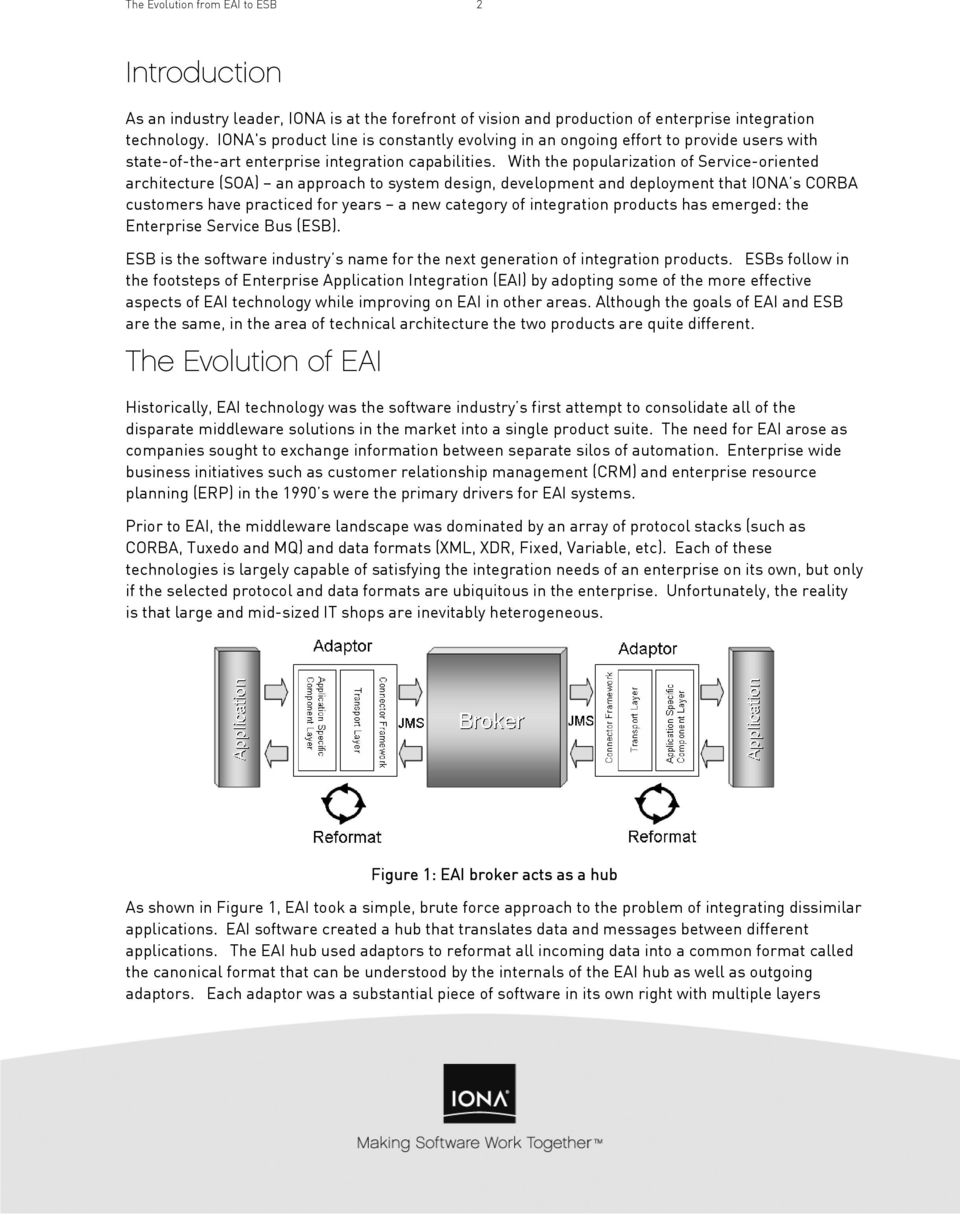
3 The Evolution from EAI to ESB 3 managing application specific interactions and other transport layers managing connectivity to the application and the hub. To implement a connection between EAI components, the EAI hub used an asynchronous message broker, like JMS, for all of its internal integration. In addition to reformatting the message payload, all interactions between applications went through multiple middleware transformations. Furthermore, the quality of services the application might require such as transactional processing and authentication/authorization security functions most often did not survive these transformations. Figure 2: Hub constantly marshalling data As a first generation, EAI was successful in that it provided a solution where none existed before. But there are inherent limitations in the EAI architecture that limit its ability to provide a sustainable enterprise-level solution. As shown in Figure 2, a central hub gives enterprises (or at least certain individuals within the enterprise) the advantage of centralized control. But the cost of constantly marshalling data into and out of these canonical formats creates an additional processing burden that requires the purchase of high-end servers and administrators to manage them. While most EAI solutions will allow you to deploy hubs in a cluster to get some additional scalability, this is only practical and performant to a limited degree and can quickly get quite expensive as you add more dedicated hardware. EAI was vastly superior to hand coding every permutation of middleware and application interface in the enterprise application portfolio. It was a step forward that worked best when the mindset and the focus of the industry was on large-scale monolithic applications that needed to exchange data in support of these enterprise-wide initiatives. Since the first wave of EAI tools, vendors have tried to respond to the shortcomings of EAI in incremental ways. However, by continually adding new features, it made the EAI systems large, inflexible and hard to manage. Over the long term, a better technology was required if the vision of true enterprise integration was to be achieved. The Evolution to ESB The ESB is the next generation of enterprise integration technology, taking over where EAI leaves off. Like EAI, ESB is a technology that allows developers to integrate disparate systems that were created

4 The Evolution from EAI to ESB 4 using different middleware technology. ESB further improves on its EAI predecessor by adopting a more efficient and flexible internal architecture while leveraging the advantages of service orientation. The connection between SOA and ESB is important to understand. SOA represents the policies, practices, and frameworks that enable application functionality to be provided and consumed as sets of services. As shown in Figure 3, a service is a business-complete logical unit of work, accessible programmatically from independently designed contexts via a direct openly documented interface. Services can be invoked, published and discovered, and are abstracted away from the implementation using a single, standards-based form of interface. Application software consists of services and service consumers (clients) in loosely coupled 1-to-1 relationships. Figure 3: Services and SOA SOA has been the software industry s response to the problem of managing large monolithic applications. As one might imagine, this difference in application architecture significantly impacts how application integration is best achieved. As shown in Figure 4, ESBs provide a backplane for integration among service providers and service consumers. New applications developed on modern platforms are inherently service-oriented. However, many existing enterprise applications are not designed with SOA in mind. In these cases, the ESB should provide the ability to expose these applications as services. Many of these EAI products are part of today s computing fabric and will continue to be used to solve integration problems, but for most cases moving forward the ESB has risen as a better alternative for the following reasons:

5 The Evolution from EAI to ESB 5 Figure 4: ESB provides a lightweight distributed architecture Smarter endpoints - The ESB enables architectures in which more intelligence is placed at the point where the application interfaces with the outside world. The ESB allows each endpoint to present itself as a service using standards such as WSDL and obviates the need for a unique interface written for each application. Integration intelligence can be deployed natively on the end-points (clients and servers) themselves. Canonical formats are bypassed in favor of directly formatting the payload to the targeted format. This approach effectively removes much of the complexity inherent in EAI products. Centralized versus distributed Where EAI is a purely hub and spoke approach, ESB is a lightweight distributed architecture. A centralized hub made sense when each interaction among programs had to be converted to a canonical format. An ESB, like IONA s Artix, distributes much more of the processing logic to the end points. This is analogous to the difference between a mainframe and a modern distributed systems architecture. Hubs, like mainframes, can still be used where they make sense architecturally, but they are an option for the developer, not a vendor-mandated requirement. No integration stacks As customers used EAI products to solve more problems, each vendor added stacks of proprietary features wedded to the EAI product. Over time these integration stacks got monolithic and require deep expertise to use. ESBs, in contrast, are a relatively thin layer of software to which other processing layers can be applied using open standards. For example, if an ESB user wants to deploy a particular business process management tool, it can be easily integrated with the ESB using industry standard interfaces such as BPEL for coordinating business processes. The immediate short-term advantage of the ESB approach is that it achieves the same overall effect as the EAI approach, but at a much lower total-cost-of-ownership. These savings are realized not only through reduced hardware and software expenses, but also via labor savings that are realized by using a framework that is distributed and flexible. In addition, an ESB can be deployed incrementally to reduce disruption and migration costs.

6 The Evolution from EAI to ESB 6 Artix - The Extensible ESB IONA offers an ESB for distributed and flexible integration, that also provides owners of EAI systems an incremental solution to migrate to a SOA gradually. The ESB is an architectural step forward, but some of today's ESB products lack all the capabilities that large enterprises require. The vast majority of these products depend on a single protocol (e.g., SOAP), programming language (e.g., Java), messaging transport (e.g., JMS), or deployment architecture (e.g., J2EE application server) that limits their ability to bridge multiple platforms. In addition, many ESBs are marketed by small startups with no experience in complex enterprise integration projects. Artix is an extensible Enterprise Service Bus (ESB) that dramatically reduces operating costs for organizations with complex and heterogeneous IT systems by deploying, managing and securing a service-oriented architecture (SOA) without requiring a centralized hub. Artix uses distributed computing technology to leverage and modernize existing middleware investments to help the Global 2000 deliver products and services to their customers faster and more efficiently. Artix is For incremental SOA adoption Artix creates a network of smart, standards-based endpoints using existing infrastructure so enterprises can begin with low-risk, high-value SOA projects and gradually add services as needed Dynamic and adaptable Artix endpoints are independently configurable so services can be extended, modified and hot deployed without disrupting the rest of the enterprise Technology-neutral Artix is a multi-platform and multi-protocol solution that connects diverse and lightweight endpoints without an expensive and cumbersome centralized server, and without promoting vendor lock-in IONA has a proven track record of delivering mission-critical infrastructure, and has built many of the earliest and largest SOAs for Global 2000 customers, including Credit Suisse, BellSouth, Raymond James & Associates, Marconi, and Deutsche Post (DHL).

7 The Evolution from EAI to ESB 7 Figure 5: Artix distributed architecture The Artix architecture, as shown in Figures 5 and 6, is based on a highly efficient microkernel and a series of plug-ins that allow it to adapt to any combination of middleware and application architecture. This includes adapting to new transport protocols, payload formats, security models, session management, transaction support and resiliency requirements. For integration systems, the Artix plug-in approach to extensibility has two important effects: Intricate or special purpose integration requirements can be addressed with new, specially designed plug-ins. This plug-in approach allows the integration runtime to stay small and fast, while addressing a broad range of integration issues. After the integration has been deployed, changes made to one of the application interfaces, or extensible endpoints, can be made without disrupting the service provided by that endpoint.

8 The Evolution from EAI to ESB 8 Figure 6. Artix Extensible Endpoint Changes in the underlying architecture and infrastructure of the application are transparent to the other participants in the integration. Other features that further define the Artix product are its support for: High performance and small footprint integration with none of the traditional excess network data hops or transformation overhead Protocols and data formats of the dominant middleware and infrastructure - including the SOA platforms of IBM, BEA and Microsoft Standard application platforms of existing enterprise systems: mainframe transactions (IMS/CICS), C++ client/server apps and middleware platforms such as CORBA or BEA's Tuxedo Application styles of existing systems, including publish/subscribe, request/response, and asynchronous applications Emerging security standards of SOA platforms and Web services (WS-Security, Kerberos Tokens, etc.) and the legacy security models of existing enterprise systems Management via existing enterprise management infrastructures, including IBM Tivoli, CA Unicenter and HP OpenView Integration with run-time and development tools of the leading SOA platform suites Artix users find that its extensibility allows them to leverage and extend their existing systems in place, without having to modify them. It allows the building of secure, fault-tolerant systems that are easier to manage and deploy. And the product's extensibility promotes a small footprint, very high performance integration solution, which in turn meets enterprise throughput requirements with significantly reduced overhead.

9 The Evolution from EAI to ESB 9 Summary As with the previous evolution from hand coding to EAI technologies, the evolution of middleware from EAI to ESB is putting greater power and flexibility in the hands of developers and users while reducing the overall costs of building systems. In many ways, the evolution from EAI to ESB has the same motivations as the evolution from monolithic enterprise applications to service-oriented applications. In both cases, users have hit a wall of complexity in which a simpler more flexible approach is essential. IONA is committed to providing the industry with both the thought leadership and product leadership this evolution requires. Global 2000 companies, with their heterogeneous systems and application silos, are using Artix to reduce the complexity within their enterprises. IONA, with its history of delivering high performance, mission-critical applications for over ten years is helping these companies repurpose their current investments and incrementally move towards an open architecture. IONA customers - including BellSouth, AT&T, Marconi, and DHL (Deutsche Post) use an extensible ESB to service-enable existing systems and establish a scalable, adaptable, SOA architecture. They chose Artix for its broad platform support, extensibility, and enterprise quality of service, and today they are building new business applications and process flows on common platforms such as Microsoft s.net Framework, IBM s WebSphere, or BEA WebLogic. In looking to the future, IONA's customers can count on IONA as a business partner that will provide them with the best the industry has to offer, today and tomorrow. IONA Technologies PLC IONA Technologies Inc. IONA Technologies Japan Ltd The IONA Building 200 West Street Akasaka Sanchome Building 7/F Shelbourne Road Waltham MA Akasaka Dublin 4 USA Minato-ku Tokyo Ireland Japan Phone Phone Phone Fax Fax Fax Support: [email protected] Training: [email protected] Sales: [email protected] WWW: Artix, Artix Mainframe, Adaptive Runtime Technology are Trademarks of IONA Technologies PLC. Orbix, Orbix 2000 Notification, and Orbix/E are Registered Trademarks of IONA Technologies PLC. COPYRIGHT NOTICE. No part of this publication may be reproduced, stored in a retrieval system or transmitted, in any form or by any means, photo- copying, recording or otherwise, without prior written consent of IONA Technologies PLC. Copyright IONA Technologies PLC. All rights reserved.

The Enterprise Service Bus
 1 ESBs: Essential Infrastructure for a Successful SOA March 2005 2 at a glance Customers include world s largest firms! 80% of Global Telecom! 70% of Financial Services in Global 100! Blue Chip System
Integration Solutions for Telecom Network Management Systems
 Integration Solutions for Telecom Network Management Systems IONA Technologies PLC August 2004 IONA, IONA Technologies, the IONA logo, Orbix, Orbacus, Artix, Orchestrator, Mobile Orchestrator, Enterprise
Enterprise Service Bus: Five Keys for Taking a Ride
 About this research note: Technology Insight notes describe emerging technologies, tools, or processes as well as analyze the tactical and strategic impact they will have on the enterprise. Enterprise
IBM WebSphere application integration software: A faster way to respond to new business-driven opportunities.
 Application integration solutions To support your IT objectives IBM WebSphere application integration software: A faster way to respond to new business-driven opportunities. Market conditions and business
ARTIX TECHNICAL BRIEF. Progress Artix. Progress Artix. Progress DataDirect. Progress DataXtend. Progress ObjectStore.
 Progress Apama Progress Artix PROGRESS PERSPECTIVE Data Progress Artix Services Progress > DataDirect Progress DataDirect Connect Progress DataXtend ARTIX TECHNICAL Progress OpenEdge Progress ObjectStore
Service Mediation. The Role of an Enterprise Service Bus in an SOA
 Service Mediation The Role of an Enterprise Service Bus in an SOA 2 TABLE OF CONTENTS 1 The Road to Web Services and ESBs...4 2 Enterprise-Class Requirements for an ESB...5 3 Additional Evaluation Criteria...7
What You Need to Know About Transitioning to SOA
 What You Need to Know About Transitioning to SOA written by: David A. Kelly, ebizq Analyst What You Need to Know About Transitioning to SOA Organizations are increasingly turning to service-oriented architectures
So You Want an SOA: Best Practices for Migrating to SOA in the Enterprise. Eric Newcomer, CTO
 So You Want an SOA: Best Practices for Migrating to SOA in the Enterprise Eric Newcomer, CTO Overview First of all: concepts and definitions Change your thinking about your IT environment Including organization
Emerging Technologies Shaping the Future of Data Warehouses & Business Intelligence
 Emerging Technologies Shaping the Future of Data Warehouses & Business Intelligence Service Oriented Architecture SOA and Web Services John O Brien President and Executive Architect Zukeran Technologies
Combining Service-Oriented Architecture and Event-Driven Architecture using an Enterprise Service Bus
 Combining Service-Oriented Architecture and Event-Driven Architecture using an Enterprise Service Bus Level: Advanced Jean-Louis Maréchaux ([email protected]), IT Architect, IBM 28 Mar 2006 Today's business
Delivering a platform-independent based ESB for universal connectivity and transformation in heterogeneous IT environments.
 IBM WebSphere Message Broker To support your IT objectives Delivering a platform-independent based ESB for universal connectivity and transformation in heterogeneous IT environments. The evolution of application
Enterprise Service Bus Defined. Wikipedia says (07/19/06)
 Enterprise Service Bus Defined CIS Department Professor Duane Truex III Wikipedia says (07/19/06) In computing, an enterprise service bus refers to a software architecture construct, implemented by technologies
JBOSS ENTERPRISE SOA PLATFORM AND JBOSS ENTERPRISE DATA SERVICES PLATFORM VALUE PROPOSITION AND DIFFERENTIATION
 JBOSS ENTERPRISE SOA PLATFORM AND JBOSS ENTERPRISE DATA SERVICES PLATFORM VALUE PROPOSITION AND DIFFERENTIATION Service-oriented architecture (SOA) gives enterprises the ability to identify and respond
How To Create A C++ Web Service
 A Guide to Creating C++ Web Services WHITE PAPER Abstract This whitepaper provides an introduction to creating C++ Web services and focuses on:» Challenges involved in integrating C++ applications with
An Oracle White Paper November 2009. Oracle Primavera P6 EPPM Integrations with Web Services and Events
 An Oracle White Paper November 2009 Oracle Primavera P6 EPPM Integrations with Web Services and Events 1 INTRODUCTION Primavera Web Services is an integration technology that extends P6 functionality and
A standards-based approach to application integration
 A standards-based approach to application integration An introduction to IBM s WebSphere ESB product Jim MacNair Senior Consulting IT Specialist [email protected] Copyright IBM Corporation 2005. All rights
BEA AquaLogic Integrator Agile integration for the Enterprise Build, Connect, Re-use
 Product Data Sheet BEA AquaLogic Integrator Agile integration for the Enterprise Build, Connect, Re-use BEA AquaLogic Integrator delivers the best way for IT to integrate, deploy, connect and manage process-driven
Prerequisites for Successful SOA Adoption
 George Feuerlicht University of Technology, Sydney [email protected] 1. INTRODUCTION The adoption of SOA (Service Oriented Architecture) has gained momentum in the past two years, and the predictions
Enterprise Service Bus 101
 Enterprise Service Bus 101 Marty Wasznicky Director, Product Business Development Neudesic Copyright 2010 Neudesic, LLC. All rights reserved. Table of Contents Abstract... 3 Understanding the Enterprise
Achieving business agility and cost optimization by reducing IT complexity. The value of adding ESB enrichment to your existing messaging solution
 Smart SOA application integration with WebSphere software To support your business objectives Achieving business agility and cost optimization by reducing IT complexity. The value of adding ESB enrichment
Service-Oriented Architecture: Analysis, the Keys to Success!
 Service-Oriented Architecture: Analysis, the Keys to Success! Presented by: William F. Nazzaro CTO, Inc. [email protected] www.iconatg.com Introduction Service-Oriented Architecture is hot, but we seem
Motivation Definitions EAI Architectures Elements Integration Technologies. Part I. EAI: Foundations, Concepts, and Architectures
 Part I EAI: Foundations, Concepts, and Architectures 5 Example: Mail-order Company Mail order Company IS Invoicing Windows, standard software IS Order Processing Linux, C++, Oracle IS Accounts Receivable
Service-Oriented Architecture and its Implications for Software Life Cycle Activities
 Service-Oriented Architecture and its Implications for Software Life Cycle Activities Grace A. Lewis Software Engineering Institute Integration of Software-Intensive Systems (ISIS) Initiative Agenda SOA:
Oracle Service Bus. Situation. Oracle Service Bus Primer. Product History and Evolution. Positioning. Usage Scenario
 Oracle Service Bus Situation A service oriented architecture must be flexible for changing interfaces, transport protocols and server locations - service clients have to be decoupled from their implementation.
Service Virtualization andRecycling
 Message Driven SOA -- Enterprise Service Oriented Architecture Service virtualization and component applications Driving reusability and ROI in SOA deployments --- Atul Saini Entire contents Fiorano Software
AquaLogic Service Bus
 AquaLogic Bus Wolfgang Weigend Principal Systems Engineer BEA Systems 1 What to consider when looking at ESB? Number of planned business access points Reuse across organization Reduced cost of ownership
Technical Track Session Service-Oriented Architecture
 Technical Track Session Service-Oriented Architecture Terry Woods Agenda A little history What is Service-Oriented Architecture? How do you build a Service-Oriented Architecture Solution? What is an Enterprise
Enterprise Application Designs In Relation to ERP and SOA
 Enterprise Application Designs In Relation to ERP and SOA DESIGNING ENTERPRICE APPLICATIONS HASITH D. YAGGAHAVITA 20 th MAY 2009 Table of Content 1 Introduction... 3 2 Patterns for Service Integration...
Service Oriented Architecture (SOA) An Introduction
 Oriented Architecture (SOA) An Introduction Application Evolution Time Oriented Applications Monolithic Applications Mainframe Client / Server Distributed Applications DCE/RPC CORBA DCOM EJB s Messages
Introduction to Service-Oriented Architecture for Business Analysts
 Introduction to Service-Oriented Architecture for Business Analysts This course will provide each participant with a high-level comprehensive overview of the Service- Oriented Architecture (SOA), emphasizing
SAP INTEGRATION APPROACHES
 SAP INTEGRATION APPROACHES Best Practices for SAP application integration projects Abstract: One of the most pervasive challenges for SAP shops is integrating SAP to other applications within their organization.
Improve business agility with WebSphere Message Broker
 Improve business agility with Message Broker Enhance flexibility and connectivity while controlling costs and increasing customer satisfaction Highlights Leverage business insight by dynamically enriching
EAI OVERVIEW OF ENTERPRISE APPLICATION INTEGRATION CONCEPTS AND ARCHITECTURES. Enterprise Application Integration. Peter R. Egli INDIGOO.
 EAI OVERVIEW OF ENTERPRISE APPLICATION INTEGRATION CONCEPTS AND ARCHITECTURES Peter R. Egli INDIGOO.COM 1/16 Contents 1. EAI versus SOA versus ESB 2. EAI 3. SOA 4. ESB 5. N-tier enterprise architecture
A Unified Messaging-Based Architectural Pattern for Building Scalable Enterprise Service Bus
 A Unified Messaging-Based Architectural Pattern for Building Scalable Enterprise Service Bus Karim M. Mahmoud 1,2 1 IBM, Egypt Branch Pyramids Heights Office Park, Giza, Egypt [email protected] 2 Computer
A Comprehensive Solution for API Management
 An Oracle White Paper March 2015 A Comprehensive Solution for API Management Executive Summary... 3 What is API Management?... 4 Defining an API Management Strategy... 5 API Management Solutions from Oracle...
Leveraging Service Oriented Architecture (SOA) to integrate Oracle Applications with SalesForce.com
 Leveraging Service Oriented Architecture (SOA) to integrate Oracle Applications with SalesForce.com Presented by: Shashi Mamidibathula, CPIM, PMP Principal Pramaan Systems [email protected] www.pramaan.com
Cape Clear s Enterprise Service Bus (ESB)
 Cape Clear s Enterprise Service Bus (ESB) How Cape Clear Software applies SOA and Web service principles to deliver a proven ESB solution WWW.CAPECLEAR.COM Cape Clear s Enterprise Service Bus (ESB) (May
VALLIAMMAI ENGNIEERING COLLEGE SRM Nagar, Kattankulathur 603203.
 VALLIAMMAI ENGNIEERING COLLEGE SRM Nagar, Kattankulathur 603203. DEPARTMENT OF COMPUTER SCIENCE AND ENGINEERING Year & Semester : II / III Section : CSE Subject Code : CP7028 Subject Name : ENTERPRISE
Enterprise Application Integration (EAI) Architectures, Technologies, and Best Practices
 Enterprise Application Integration (EAI) Architectures, Technologies, and Best Practices Give Your Business the Competitive Edge IT managers have been under increasing pressure to migrate a portfolio of
Attunity Integration Suite
 Attunity Integration Suite A White Paper February 2009 1 of 17 Attunity Integration Suite Attunity Ltd. follows a policy of continuous development and reserves the right to alter, without prior notice,
Parsing a SWIFT Message
 Parsing a SWIFT Message By John Davies IONA Technologies May 2007 Where to Begin As a die-hard programmer of nearly 25 years experience I look at almost everything as a programming challenge. Of the 15
Introduction to Enterprise Service Bus
 Introduction to Enterprise Service Bus Xiaoying Bai Department of Computer Science and Technology Tsinghua University March 2007 Outline ESB motivation and definition Message oriented middleware (MOM)
JBOSS ENTERPRISE APPLICATION PLATFORM MIGRATION GUIDELINES
 JBOSS ENTERPRISE APPLICATION PLATFORM MIGRATION GUIDELINES This document is intended to provide insight into the considerations and processes required to move an enterprise application from a JavaEE-based
What is the NXTware Evolution Server Peter Marquez, Product Marketing ecube Systems
 What is the NXTware Evolution Server Peter Marquez, Product Marketing ecube Systems The NXTware Evolution Server is designed to simplify the integration of your enterprise s software assets, including
WHAT IS BPEL AND WHY IS IT SO IMPORTANT TO MY BUSINESS?
 WHAT IS BPEL AND WHY IS IT SO IMPORTANT TO MY BUSINESS? PUBLISHED FEBRUARY 2012 Written by M.W. Cobban Director Operations and Support SoftCare HealthCare Solutions 1-888-SoftCare (1-888-763-8227) www.softcare.com
SCA-based Enterprise Service Bus WebSphere ESB
 IBM Software Group SCA-based Enterprise Service Bus WebSphere ESB Soudabeh Javadi, WebSphere Software IBM Canada Ltd [email protected] 2007 IBM Corporation Agenda IBM Software Group WebSphere software
IBM Enterprise Service Bus for Healthcare
 IBM Enterprise Service Bus for Enabling new levels of integration and interoperability for today s demanding hospitals and health plans Highlights Integrate data and applications from disparate sources
SOA Myth or Reality??
 IBM TRAINING S04 SOA Myth or Reality Jaqui Lynch IBM Corporation 2007 SOA Myth or Reality?? Jaqui Lynch Mainline Information Systems Email [email protected] Session S04 http://www.circle4.com/papers/s04soa.pdf
Unlocking the Power of SOA with Business Process Modeling
 White Paper Unlocking the Power of SOA with Business Process Modeling Business solutions through information technology TM Entire contents 2006 by CGI Group Inc. All rights reserved. Reproduction of this
Introduction to WebSphere Process Server and WebSphere Enterprise Service Bus
 Introduction to WebSphere Process Server and WebSphere Enterprise Service Bus Course materials may not be reproduced in whole or in part without the prior written permission of IBM. 4.0.3 Unit objectives
EVALUATING INTEGRATION SOFTWARE
 ENSEMBLE WHITE PAPER EVALUATING INTEGRATION SOFTWARE INTRODUCTION We created this white paper to help senior IT leaders and business managers who are evaluating integration software. On the following pages
What s New in Sonic V7.5 Rick Kuzyk
 What s New in Sonic V7.5 Sonic ESB 7.5 Senior Portfolio Specialist 2 What s New in Sonic V7.5 Sonic ESB Timeline Sonic XQ March 2002 World s First Enterprise Service Bus Sonic ESB 6.0 March 2005 Continuous
Orchestrating Web Services: The Case for a BPEL Server. An Oracle White Paper June 2004
 Orchestrating Web Services: The Case for a BPEL Server An Oracle White Paper June 2004 Orchestrating Web Services: The Case for a BPEL Server Executive Overview...3 Business Process Integration Goes Mainstream...3
SOA and Cloud in practice - An Example Case Study
 SOA and Cloud in practice - An Example Case Study 2 nd RECOCAPE Event "Emerging Software Technologies: Trends & Challenges Nov. 14 th 2012 ITIDA, Smart Village, Giza, Egypt Agenda What is SOA? What is
INTEGRATING ESB / BPM / SOA / AJAX TECHNOLOGIES
 INTEGRATING ESB / BPM / SOA / AJAX TECHNOLOGIES ABSTRACT Enterprise Application Integration technologies have been in the market for approx 10 years. Companies deploying EAI solutions have now started
Designing an Enterprise Application Framework for Service-Oriented Architecture 1
 Designing an Enterprise Application Framework for Service-Oriented Architecture 1 Shyam Kumar Doddavula, Sandeep Karamongikar Abstract This article is an attempt to present an approach for transforming
Federal Enterprise Architecture and Service-Oriented Architecture
 Federal Enterprise Architecture and Service-Oriented Architecture Concepts and Synergies Melvin Greer Chief Strategist, SOA / Cloud Computing Certified Enterprise Architect Copyright August 19, 2010 2010
JOURNAL OF OBJECT TECHNOLOGY
 JOURNAL OF OBJECT TECHNOLOGY Online at www.jot.fm. Published by ETH Zurich, Chair of Software Engineering JOT, 2008 Vol. 7 No. 7, September-October 2008 Applications At Your Service Mahesh H. Dodani, IBM,
Research on the Model of Enterprise Application Integration with Web Services
 Research on the Model of Enterprise Integration with Web Services XIN JIN School of Information, Central University of Finance& Economics, Beijing, 100081 China Abstract: - In order to improve business
Getting Started with Service- Oriented Architecture (SOA) Terminology
 Getting Started with - Oriented Architecture (SOA) Terminology Grace Lewis September 2010 -Oriented Architecture (SOA) is a way of designing, developing, deploying, and managing systems it is neither a
IBM WebSphere Enterprise Service Bus, Version 6.0.1
 Powering your service oriented architecture IBM WebSphere Enterprise Service Bus, Version 6.0.1 Highlights Supports a variety of messaging Requires minimal standards including JMS, Version 1.1 programming
Enterprise Integration Architectures for the Financial Services and Insurance Industries
 George Kosmides Dennis Pagano Noospherics Technologies, Inc. [email protected] Enterprise Integration Architectures for the Financial Services and Insurance Industries Overview Financial Services
Service-Oriented Architecture and Software Engineering
 -Oriented Architecture and Software Engineering T-86.5165 Seminar on Enterprise Information Systems (2008) 1.4.2008 Characteristics of SOA The software resources in a SOA are represented as services based
SONIC ESB 7. KEY CAPABILITIES > Connects, mediates and controls. KEY BENEFITS > Creates new processes using
 CONNECT EVERYTHING. ACHIEVE ANYTHING. TM DATASHEET KEY CAPABILITIES > Connects, mediates and controls services, wherever they are deployed > Fast, dependable and secure communications > Transactional failover
Service Oriented Architecture Case: IBM SOA Reference Architecture
 Service Oriented Architecture Case: IBM SOA Reference Architecture Group 6: 0309441 Mikko Seppälä 0275669 Puranen Sami Table of Contents 1 International Business Machines Corporation... 3 2 IBM and Services
Integrating Siebel CRM 8 with Oracle Applications
 Integrating Siebel CRM 8 with Oracle Applications Agenda Corporate Overview Siebel 8.0 New Features Siebel Integration Approaches Integration with Oracle Applications Option 1 Option 2 Pros and Cons Evaluation
SPAN. White Paper. Enterprise Application Integration. Introduction
 SPAN White Paper Introduction Earlier, automation was custom developed. But today, all the tasks are executed through packaged applications that have reduced software development significantly. It makes
Connectivity and integration Executive brief. Optimize the potential of ERP systems through IBM SMART SOA integration strategies.
 Connectivity and integration Executive brief Optimize the potential of ERP systems through IBM SMART SOA integration strategies. Page 2 Contents 2 Executive overview 3 A problem of integration 4 How this
AquaLogic ESB Design and Integration (3 Days)
 www.peaksolutions.com AquaLogic ESB Design and Integration (3 Days) Audience Course Abstract Designed for developers, project leaders, IT architects and other technical individuals that need to understand
IBM Information Management
 IBM Information Management January 2008 IBM Information Management software Enterprise Information Management, Enterprise Content Management, Master Data Management How Do They Fit Together An IBM Whitepaper
Federated single sign-on (SSO) and identity management. Secure mobile access. Social identity integration. Automated user provisioning.
 PingFederate We went with PingFederate because it s based on standards like SAML, which are important for a secure implementation. John Davidson Senior Product Manager, Opower PingFederate is the leading
Event based Enterprise Service Bus (ESB)
 Event based Enterprise Service Bus (ESB) By: Kasun Indrasiri 128213m Supervised By: Dr. Srinath Perera Dr. Sanjiva Weerawarna Abstract With the increasing adaptation of Service Oriented Architecture for
perspective Microservices A New Application Paradigm Abstract
 perspective Microservices A New Application Paradigm Abstract Microservices Architecture is introducing the concept of developing functionality as a number of small self-contained services. This paper
Service-Oriented Integration: Managed File Transfer within an SOA (Service- Oriented Architecture)
 Service-Oriented Integration: Managed File Transfer within an SOA (Service- Oriented Architecture) 2 TABLE OF CONTENTS 1 Increased Demand for Integration: The Driving Forces... 4 2 How Organizations Have
SpiritSoft (SpiritWave)
 Decision Framework, R. Schulte Research Note 9 December 2002 Predicts 2003: Enterprise Service Buses Emerge The enterprise service bus, a new variation of software infrastructure, has added to the range
EnergySync and AquaSys. Technology and Architecture
 EnergySync and AquaSys Technology and Architecture EnergySync and AquaSys modules Enterprise Inventory Enterprise Assets Enterprise Financials Enterprise Billing Service oriented architecture platform
Business Process Management Enabled by SOA
 Business Process Management Enabled by SOA Jyväskylä 8.5.2007 Kimmo Kaskikallio IT Architect IBM Software Brands Five middleware product lines designed to work together Service-Oriented Architecture (SOA)
Service Oriented Architecture
 Service Oriented Architecture Version 9 2 SOA-2 Overview Ok, now we understand the Web Service technology, but how about Service Oriented Architectures? A guiding analogy Terminology excursion Service,
Create a single 360 view of data Red Hat JBoss Data Virtualization consolidates master and transactional data
 Whitepaper Create a single 360 view of Red Hat JBoss Data Virtualization consolidates master and transactional Red Hat JBoss Data Virtualization can play diverse roles in a master management initiative,
Service Oriented Architecture
 Service Oriented Architecture Charlie Abela Department of Artificial Intelligence [email protected] Last Lecture Web Ontology Language Problems? CSA 3210 Service Oriented Architecture 2 Lecture Outline
Service Oriented Architecture (SOA) Architecture, Governance, Standards and Technologies
 Service Oriented Architecture (SOA) Architecture, Governance, Standards and Technologies 3-day seminar Give Your Business the Competitive Edge SOA has rapidly seized the momentum and center stage because
WHITEPAPER. Unlock the value of your.net architecture with MuleSoft. MuleSoft s Anypoint Platform-The Next Generation Integration Solution
 WHITEPAPER Unlock the value of your.net architecture with MuleSoft MuleSoft s Anypoint Platform-The Next Generation Integration Solution Overview For.NET centric organizations, the options available to
JBoss Enterprise Middleware
 JBoss Enterprise Middleware The foundation of your open source middleware reference architecture Presented By : Sukanta Basak Red Hat -- Vital Statistics Headquarters in Raleigh, NC Founded in 1993 Over
5 Steps to Choosing the Right BPM Suite
 5 Steps to Choosing the Right BPM Suite BPM Suites can deliver significant business benefits and a fast ROI but only if you choose the right one By Laura Mooney, Metastorm Copyright 2009, Metastorm Inc.
Pervasive Software + NetSuite = Seamless Cloud Business Processes
 Pervasive Software + NetSuite = Seamless Cloud Business Processes Successful integration solution between cloudbased ERP and on-premise applications leveraging Pervasive integration software. Prepared
1 What Are Web Services?
 Oracle Fusion Middleware Introducing Web Services 11g Release 1 (11.1.1) E14294-04 January 2011 This document provides an overview of Web services in Oracle Fusion Middleware 11g. Sections include: What
WebSphere Integration Solutions. IBM Day Minsk 2014. Anton Litvinov WebSphere Connectivity Professional Central Eastern Europe
 WebSphere Integration Solutions IBM Day Minsk 2014 Ann Litvinov WebSphere Connectivity Professional Central Eastern Europe 1 Agenda 1 Understand vision for ESB capabilities 2 Understand DataPower Basics
How To Understand A Services-Oriented Architecture
 Introduction to Service Oriented Architecture CSCI-5828 Foundations of Software Engineering Ming Lian March 2012 Executive Summary This Executive Summary gives the straight word to the fresh that have
A Quick Introduction to SOA
 Software Engineering Competence Center TUTORIAL A Quick Introduction to SOA Mahmoud Mohamed AbdAllah Senior R&D Engineer-SECC [email protected] Waseim Hashem Mahjoub Senior R&D Engineer-SECC Copyright
Lesson 18 Web Services and. Service Oriented Architectures
 Lesson 18 Web Services and Service Oriented Architectures Service Oriented Architectures Module 4 - Architectures Unit 1 Architectural features Ernesto Damiani Università di Milano A bit of history (1)
CHAPTER 1 INTRODUCTION
 1 CHAPTER 1 INTRODUCTION Internet has revolutionized the world. There seems to be no limit to the imagination of how computers can be used to help mankind. Enterprises are typically comprised of hundreds
E-Business Suite Oracle SOA Suite Integration Options
 Specialized. Recognized. Preferred. The right partner makes all the difference. E-Business Suite Oracle SOA Suite Integration Options By: Abhay Kumar AST Corporation March 17, 2014 Applications Software
Increasing IT flexibility with IBM WebSphere ESB software.
 ESB solutions White paper Increasing IT flexibility with IBM WebSphere ESB software. By Beth Hutchison, Katie Johnson and Marc-Thomas Schmidt, IBM Software Group December 2005 Page 2 Contents 2 Introduction
Modern App Architecture for the Enterprise Delivering agility, portability and control with Docker Containers as a Service (CaaS)
 Modern App Architecture for the Enterprise Delivering agility, portability and control with Docker Containers as a Service (CaaS) Executive Summary Developers don t adopt locked down platforms. In a tale