
How To Trade Cfds
|
|
|
- Tamsin Webster
- 5 years ago
- Views:
Transcription
1 TD 365 Product Disclosure Statement (PDS) 28 th September 2015 Issued by Finsa Pty Limited (ACN ) trading as TD 365, Australian financial services licence no Page 1 of 65
2 Table of Contents - Product Disclosure Statement 1. Important information ASIC Investor Guide: Questions to ask us ASIC Benchmarks: Disclosures to tell you Key Features Main Features of CFDs Benefits of CFDs Risks of CFDs Your Account Trading with TD Trading on TD 365 Platform Trading on the MT4 Platform Orders Fees CFD Examples Client Privacy Client Money Taxation Considerations Dispute Resolution Policy Other information Glossary Page 2 of 65
3 1. Important information 1.1 About this PDS This product disclosure statement (PDS) has been prepared by Finsa Pty Limited (ACN: ), trading under the registered business name of TD 365 (TD 365, we, our, us). This PDS is intended to assist you in making a decision whether to open an Account and trade in the Contracts for Difference or Spread Trades we offer, collectively referred to as CFDs. Before investing with us you should read this document in conjunction with the Client Agreement, the Financial Services Guide (FSG) and the Market Information Sheets and consider whether CFDs are appropriate for you given your personal circumstances, financial objectives and trading experience. TD 365 offers CFDs on the basis of the information contained in this PDS, the FSG, the Client Agreement and the Market Information Sheets. No other information should be relied upon. In the event of any conflict between these documents and any other documents published by TD 365, the PDS and the Client Agreement will prevail to the extent of any inconsistency. Information in this PDS may be updated from time to time. Where such information is not materially adverse to our clients we will contact you directly. A paper copy of any updated information will be provided, on request, without charge. An updated PDS will be provided where such information is materially adverse to our clients. This PDS does not constitute a recommendation or opinion that TD 365's products are appropriate for you. The Australian Securities and Investments Commission (ASIC) takes no responsibility for the contents of this PDS. 1.2 Risk warning CFDs are speculative products which are not suitable for all investors. CFDs enable you to significantly Leverage your investments meaning you are exposed to a much greater risk of financial loss than other types of conventional investments such as share trading. You may incur a loss which is far greater than the amount you invested and you do not own or have any rights to the underlying asset. You should carefully read section 7 (Risks of CFDs) which sets out in detail the risks associated with CFD trading. 1.3 About TD 365 TD 365 is a registered business name of Finsa Pty Ltd which is incorporated in Australia and holds an Australian Financial Services Licence (AFSL) number , issued by ASIC. Our AFSL, and ASIC s regulation of us, applies to our financial services provided to Australian investors only. TradeDirect365 Pty Ltd (ACN: ) is a Corporate Authorised Representative of Finsa Pty Ltd (Authorised Representative Number: ). TradeDirect365 Pty Ltd is authorised to provide financial services on behalf of TD 365. Page 3 of 65
4 TD 365 is authorised under its AFSL to deal in, make a market in and provide general financial product advice on Derivatives, such as CFDs and foreign exchange contracts, for retail and wholesale clients. We and any of our Authorised Representatives are not authorised under our AFSL to provide you with personal financial product advice or to make investment recommendations of any kind. We can provide you with factual market information and information of a general nature, referred to as general advice, about the features of the products we offer but we will not provide you with any advice that takes into account your personal circumstances. 1.4 How to contact us Client Support: (press 2 ) or +61 (0) Dealing: (press 1 ) or +61 (0) [email protected] Address: TD 365 Level 13 Macquarie House 167 Macquarie Street Sydney, NSW Use of CFD Examples All CFD examples in this PDS are made purely to assist you in understanding how CFDs work and to illustrate the mechanics of CFD trading. They should not be construed as us expressing an opinion or recommendation about any of the Underlying instruments used in the CFD examples. All references to monetary values refer to Australian dollars unless stipulated otherwise. 1.6 TD 365 is the issuer of the CFDs it offers The CFDs we offer are "over the counter" (OTC) products, which means that they are not traded on a licensed financial market (such as a stock Exchange). TD 365 acts as the counterparty to your CFD Transactions, which means that we will enter into all CFDs with you as principal, not agent. You will be directly responsible for performing your obligations to us under each CFD Transaction. 1.7 Offer limited to Australia The distribution of this PDS may be restricted in certain jurisdictions outside Australia. Anyone coming into possession of this PDS is required to inform themselves of and observe such restrictions. This PDS does not constitute an offer in any jurisdiction where it would be illegal to make such offers or where such offers are not permitted. 1.8 Glossary Capitalised terms used in this PDS are defined in section 20. Page 4 of 65

5 2. ASIC Investor Guide: Questions to ask us ASIC recommends that all potential investors should ask a CFD provider the following questions in the investor guide entitled Thinking of trading contracts for difference (CFDs)? : What is the financial position of the CFD provider? TD 365 is proprietary company limited by shares. The company is 100% owned by Finsa Investment Limited which is a private limited company incorporated in the United Kingdom. What is the CFD provider s policy on the use of client money? Our industry leading client money policy goes further than what current Australian legislation requires. Client money is held in segregated, designated trust bank accounts with a top tier, Australian authorised deposit-taking institution. Your money is not transferred out of these accounts to fund or hedge our positions or for our use otherwise unless we are legally entitled to it (e.g. to withdraw our fees). Please refer to section 15 for more details. How does the CFD provider determine the prices of CFDs they offer? The price for a FX CFD is derived from a large pool of Liquidity Providers. All futures CFDs prices are derived from the best Bid Price and Ask price in the Underlying markets with a Spread as detailed in the Market Information Sheets. All index and commodity (cash) CFDs prices are derived from the best Bid Price and Ask Price in the Underlying market, adjusted for fair value, with a Spread as detailed in the Market Information Sheets. Please refer to section 5.4 for more details. When processing CFD trades, does the CFD provider enter into a corresponding position in the market for the Underlying asset? TD 365 may or may not choose to hedge a CFD trade with a corresponding trade in the Underlying market and may use other forms of Derivatives to hedge. Page 5 of 65

6 Can the CFD provider change or re-quote the price after you have already placed your Order? TD 365 endeavours to fill Orders at quoted prices but this cannot be guaranteed in times of high market Volatility or when requested trade size significantly surpasses the available size in the Underlying market. If there is little or no trading going on in the Underlying market for an asset, can you still trade CFDs over that asset? TD 365 continues to offer CFDs when there is little trading in the Underlying market but suspends when the Underlying market is suspended. Please refer to section 9.6 for more details. Page 6 of 65

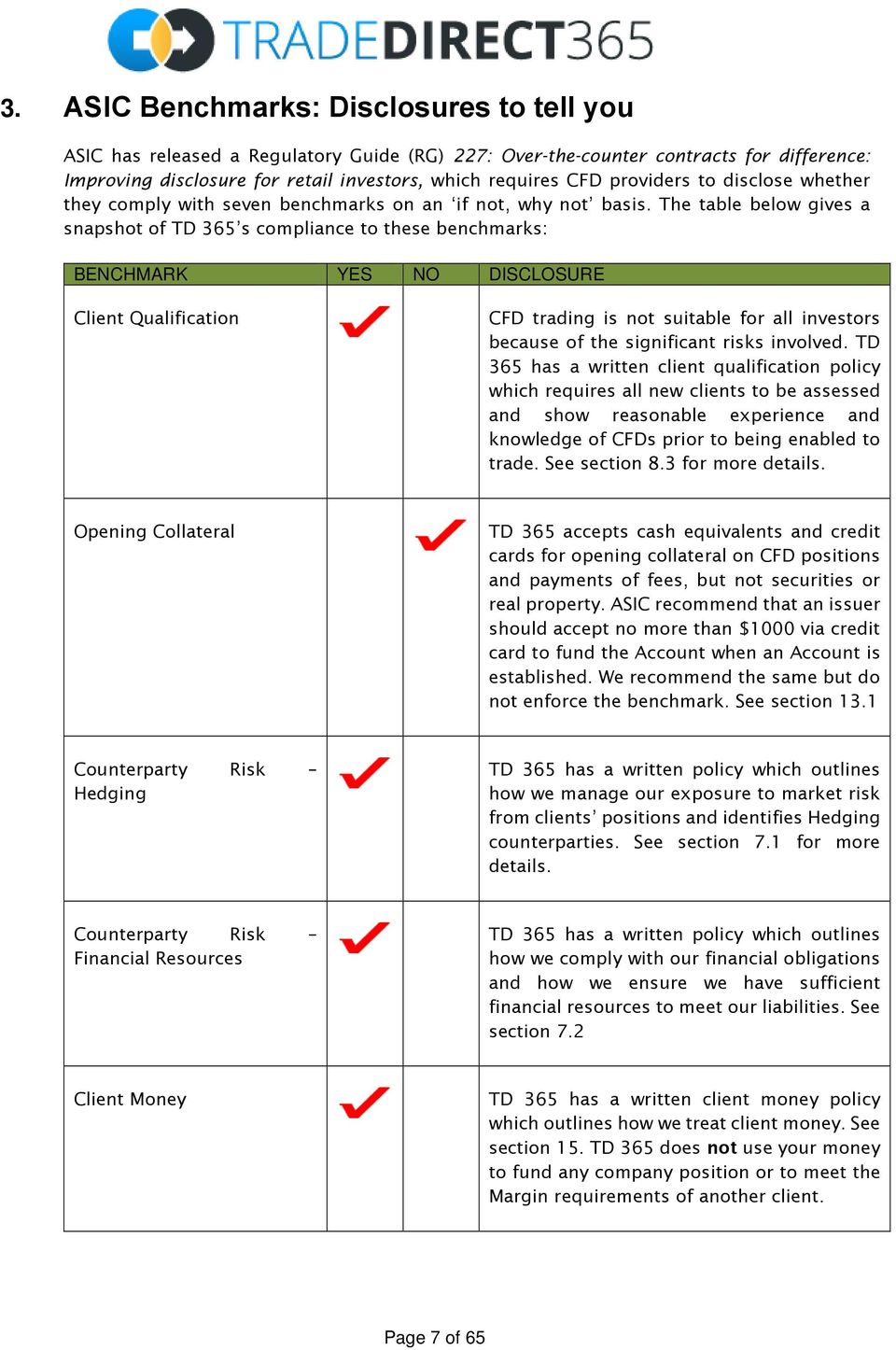
7 3. ASIC Benchmarks: Disclosures to tell you ASIC has released a Regulatory Guide (RG) 227: Over-the-counter contracts for difference: Improving disclosure for retail investors, which requires CFD providers to disclose whether they comply with seven benchmarks on an if not, why not basis. The table below gives a snapshot of TD 365 s compliance to these benchmarks: BENCHMARK YES NO DISCLOSURE Client Qualification CFD trading is not suitable for all investors because of the significant risks involved. TD 365 has a written client qualification policy which requires all new clients to be assessed and show reasonable experience and knowledge of CFDs prior to being enabled to trade. See section 8.3 for more details. Opening Collateral TD 365 accepts cash equivalents and credit cards for opening collateral on CFD positions and payments of fees, but not securities or real property. ASIC recommend that an issuer should accept no more than $1000 via credit card to fund the Account when an Account is established. We recommend the same but do not enforce the benchmark. See section 13.1 Counterparty Risk Hedging TD 365 has a written policy which outlines how we manage our exposure to market risk from clients positions and identifies Hedging counterparties. See section 7.1 for more details. Counterparty Risk Financial Resources TD 365 has a written policy which outlines how we comply with our financial obligations and how we ensure we have sufficient financial resources to meet our liabilities. See section 7.2 Client Money TD 365 has a written client money policy which outlines how we treat client money. See section 15. TD 365 does not use your money to fund any company position or to meet the Margin requirements of another client. Page 7 of 65
8 Suspended or Halted Underlying Assets TD 365 suspends trade on CFDs if the Underlying asset, from which the CFD is derived, is suspended or halted. See section 9.6 Margin Calls Trading in CFDs involves the risk of losing substantially more than the initial investment. TD 365 has a written Margin Call policy which outlines how we mitigate against client debt. See sections 10.3 and 11.4 Page 8 of 65
9 4. Key Features This section outlines the key features of trading CFDs with us. It is only intended to be a summary of the information in this PDS and is not a substitute for reading and understanding the PDS in its entirety. 4.1 What is an OTC CFD? A CFD is a contract under which the parties agree to exchange the difference, in cash, between the opening value and the closing value of the contract. We offer over-the-counter (OTC) CFDs which means that they are not traded or listed on an Exchange. It is a contract between you and us. Please refer to section 5 for more details. 4.2 Why trade CFDs? CFDs allow you to speculate, using Leverage, on the rise and fall of global financial markets without owning the Underlying asset. Please refer to section 6 for more details. 4.3 What are the risks involved in trading CFDs? There are a number of risks associated with trading CFDs which include: losing more money than you have deposited counterparty risk market risk Stop Loss Order risk Order risk operational risk FX risk Please refer to section 7 for more details. 4.4 What CFDs can I trade? We offer CFDs on a number of Underlying assets including: Indices (cash and futures) foreign exchange Commodities (cash and futures) Please refer to section 5.4 for more details. 4.5 How do I open an Account? You can open an Account by completing the Application Form and submitting it to us. We reserve the right to reject an Account application. Please refer to section 8 for more details. 4.6 How much deposit do I need to trade? To open a CFD Transaction you must deposit sufficient funds in your Account to cover the Margin requirement. Please refer to sections 10.3 and 10.4 for more details. Page 9 of 65
10 4.7 How do I open a CFD Transaction? To open a CFD Transaction you would place an Order to either Buy or Sell. You would normally Buy a CFD Transaction if you expect the price of the asset to rise and normally Sell a CFD Transaction if you expect the price of the Underlying asset to fall. Please refer to section 9.1 for more details. 4.8 How do I close an open position? To close an Open Position you would need to place an Order which would result in an equal and opposite trade to your Open Position. Please refer to section 9.2 for more details. 4.9 What types of Orders are there? You may place the following types of Orders with us: Trade Take Profit Order Pending Order Stop Loss Order Trailing Stop Order Please refer to section 12 for more details What is the duration of an Order? There are two types of Order duration options: Good Until Cancelled Good Until Date Please refer to section 12.5 for more details What are the fees associated with trading CFDs? The fees associated with trading CFDs depend on the type of CFD and include: Commission Overnight Financing dealing Spreads bank fees FX balance conversions Please refer to section 13 for more details Does TD 365 have a privacy policy? TD 365 recognises the importance of your privacy and abides by the National Privacy Principles (NPP). Please refer to section 15 for more details. Page 10 of 65
11 4.13 How is my money held by TD 365? Client Money is held in segregated, designated bank accounts with a top tier, Australian authorised deposit-taking institution. It is not transferred out of these accounts to fund positions. Please refer to section 16 for more details What are the tax implications of trading CFDs? The tax implications of trading CFDs will vary depending on your personal circumstances. We do not offer any tax advice. We advise that you obtain independent tax advice. Please refer to section 17 for more details What can I do if I have a complaint? We have clear internal and external complaint resolution procedures. Please refer to section 18 for more details Is there a cooling off period? There is no cooling off period. This means that when TD 365 accepts an Order from you, you do not have the right to opt out. If you change your mind after placing an Order or entering into a CFD Transaction you should either cancel your Order or close your Open Position immediately. Page 11 of 65
12 5. Main Features of CFDs 5.1 What is a CFD? Exchange the Difference A CFD is a contract under which the parties agree to exchange the difference, in cash, between the opening value and the closing value of the contract by reference to the price of an Underlying asset. The amount of realised profit & loss on a CFD will be the difference between the contract value when the CFD is opened and the contract value when the CFD is closed. Events that affect the value of Underlying instruments are generally mirrored in the value of the CFD. Over-the-Counter Derivative A CFD is a type of Derivative, meaning that the price of the CFD is derived from an Underlying instrument. Accordingly, the value of a CFD is determined by the fluctuations in the price of the relevant Underlying instrument at any given time. We offer over-the-counter (OTC) CFDs meaning that they are not traded or listed on an Exchange. Local Currency Contracts for Difference, not Spread Trades, are generally denominated in the local currency of the Underlying instrument to which the CFD Transaction relates and are, therefore, not necessarily denominated in Australian dollars. Leveraged Product CFDs are leveraged financial products meaning that you only have to invest a small percentage of the notional value of the CFD Transaction, referred to as Margin. Leverage magnifies your exposure to the movement in the price of an Underlying instrument. This means that your potential gains or losses from trading CFDs will be much higher than would be the case if you did not use Leverage. It is very important that you understand the power of Leverage and all the risks associated with trading in CFDs, including that you can lose much more than you invested. Therefore, trading in CFDs is not suitable for all investors. The risks of trading in CFDs are outlined in section 7 - Risks of CFDs. Page 12 of 65
13 No Ownership You have no legal or beneficial entitlement to the Underlying instrument to which the CFD Transaction relates nor is there any requirement to deliver or take delivery of such Underlying instrument. 5.2 CFD Provider Models We provide CFDs to our clients using the market maker (MM) model. CFD providers typically offer CFDs to investors using either the direct market access (DMA) model or the market maker (MM) model. Direct Market Access The DMA model gives you access to trade the Underlying instrument on the relevant Exchange from which the CFD is then derived. All CFD Transactions under the DMA model have corresponding trades in the Underlying instrument. Under the DMA model, providers typically charge their clients Commission based on the notional contract value of the CFD. Market Maker The MM model uses the price of the Underlying instrument to derive the price of the CFD that is offered. Trading under the MM model does not necessarily mean that your CFD will be reflected by a corresponding trade in the Underlying instrument. Under the MM model each CFD Transaction creates a direct financial exposure for the provider, which may or may not be hedged in the Underlying instrument. Where the financial exposure is not hedged, the market risk may increase for the market maker. The MM model enables the provider to offer CFDs against synthetic assets, even if there is little Liquidity in the Underlying instrument, which can result in a wider range of products on offer than with the DMA model. Volatility and Illiquidity in the Underlying instrument can affect the pricing of MM CFDs. Please see section 13.3 for further details. The MM model can charge its clients Commission based on the notional contract value or it can incorporate costs and fees in the dealing Spread, which represents the difference in price at which the issuer is prepared to Buy and Sell the CFD. 5.3 Cash CFDs and Future CFDs A cash CFD generally reflects the spot price of the Underlying instrument and is an openended contract. When you trade cash CFDs, there is an Overnight Financing adjustment for Open Positions held Overnight. A future CFD reflects the forward or future price of an Underlying instrument (e.g. a gold Futures Contract) and is subject to an expiry on the Settlement Date and a Roll-over process. Page 13 of 65
14 When you trade a future CFD, there will not be any Overnight Financing adjustments for Open Positions held Overnight. 5.4 What type of CFDs can I trade and how are they priced? You can trade CFDs with us on a number of Underlying instruments including: Index (Cash) CFD An index CFD enables you to speculate on a basket of shares, otherwise known as an index, in one single CFD Transaction. The price of an index (cash) CFD is derived from the forward or future price of an Underlying instrument adjusted for fair value taking into account interest rates and Dividends. The Spread between the Bid Price and Ask Price of an index (cash) CFD is set out in the Market Information Sheets. An index (cash) CFD is an open-ended contract that is not subject to an expiry date. Index (cash) CFDs are subject to Overnight financing charges. Please refer to section 14.1 for a detailed example of an index (cash) CFD. Index (Future) CFD The price of an index (future) CFD is derived from the forward or future price of an Underlying instrument. The Underlying instrument will typically be listed on a futures Exchange. The Spread between the Bid Price and Ask Price of an index (future) CFD is set out in the Market Information Sheets. An index (future) CFD has a specified expiry on the Settlement Date. Please refer to section 14.2 for a detailed example of an index (future) CFD. FX CFD A FX CFD allows you to speculate on the currency markets. An FX CFD is quoted as a currency pair, for instance AUD/USD, the Australian dollar against the US dollar. The first currency listed is referred to as the Base Currency and the exposure is reflected in the second currency quoted, otherwise known as the Quote Currency. The price of an FX CFD is derived from the interbank spot price for currency pairs. We receive a number of price feeds from financial institutions from which we derive a Spread as set out in the Market Information Sheets. An FX CFD is an open-ended contract that is not subject to an expiry date. FX CFDs are subject to Overnight financing charges. Please refer to section 14.3 for a detailed example of an FX CFD. Page 14 of 65
15 Commodity (Cash) CFD Commodity CFDs enable you to speculate on a number of different commodities. The price of a commodity (cash) CFD is derived from the forward or future price of an Underlying instrument adjusted for fair value taking into account interest rates and Dividends. The Spread between the Bid Price and Ask Price of a commodity (cash) CFD is set out in the Market Information Sheets. A commodity (cash) CFD is an open-ended contract that is not subject to an expiry date. Commodity (cash) CFDs are subject to Overnight financing charges. Please refer to section 14.4 for a detailed example of a commodity (cash) CFD. Commodity (Future) CFD The price of a commodity (future) CFD is derived from the forward or future price of an Underlying instrument. The Underlying instrument will typically be listed on a futures Exchange. The Spread between the Bid Price and Ask Price of a commodity (future) CFD is set out in the Market Information Sheets. A commodity (future) CFD has a specified expiry on the Settlement Date. Please refer to section 14.5 for a detailed example of a commodity (future) CFD. Page 15 of 65
16 6. Benefits of CFDs There are a number of reasons why our clients trade CFDs. CFDs are a versatile short term investment tool to increase the power of your capital and can help you diversify an existing portfolio or hedge other assets. Trade World Markets CFDs are a means by which you can gain exposure to the rise and fall of the world s financial markets in one trading Account. These can all be traded online on our Trading Platform. TD 365 offers a wide range of CFDs on Indices, commodities, currencies and interest rates. Shorting CFDs enable you to speculate and profit on the fall in price of the world s financial markets. This is also referred to as Going Short. Leverage CFDs are leveraged Derivatives (also referred to as margined products) that enable you to obtain the economic exposure of owning an Underlying instrument without having to pay the full cost upfront. In other words, you are only required to provide a percentage of the notional contract value of the CFD as collateral. Hedging A Client can use CFDs to hedge exposure that they may have in other financial investments. For example, holders of a particular asset can quickly protect themselves against short term price corrections by Going Short a CFD. This may be a cost effective alternative to the costs that may otherwise be incurred if they were to trade the Underlying instrument. Low transaction Costs The relatively low transaction costs of CFDs mean they are a cost-effective way of gaining the same exposure to the world s financial markets as if you had purchased the Underlying instrument. More information on the costs involved is set out in Section 13 of this PDS. Liquidity As a market maker, TD 365 is able to provide Liquidity in CFD Products when there is limited Liquidity in the Underlying instrument facilitating trading strategies. Page 16 of 65
17 Real Time Streaming Quotes and Charting Our Trading Platform provide clients with real time streaming Quotes for a wide range of CFD Products and charting facilities to formulate and test trading strategies. The Trading Platforms use sophisticated technologies in order to offer you up-to-the-minute quotes. You may check your accounts and positions in real time and you may do so 24 hours a day. Page 17 of 65

18 7. Risks of CFDs Before you start trading with TD 365, you must carefully consider whether trading in CFDs is appropriate for you, based on your personal circumstances, financial objectives, financial needs and trading experience. 7.1 Counterparty risk - Hedging The term Hedging refers to the process where a financial service provider, such as TD 365, reduces financial exposure by entering into a corresponding trade with another entity, referred to as a hedging counterparty. There is a risk that the Hedging counterparty defaults on its obligations to us which could impact on our ability to meet our obligations to you. If we default on our obligations, you may become an unsecured creditor in an administration or liquidation, and you will not have recourse to the Underlying assets in the event of our insolvency. You are indirectly exposed to the risk of default by one or more of our Hedging counterparties. Finsa Pty Limited (Finsa) is the counterparty to all client exposure. Finsa hedges client exposure on a net basis. Each and every trade entered into by the client represents market exposure for Finsa. When one client trades in one direction and another client trades in an equal and opposite direction the market exposure is offset. Finsa follows a model that gives itself the opportunity to offset client trades in the Underlying market. When clients trade in the same direction however, market risk builds up for Finsa, which is then reduced by Hedging in the Underlying market. Finsa hedges its market exposure in the Underlying equity, FX and Derivatives markets. To make these hedges Finsa holds margin with counterparties. In selecting the counterparties, Finsa considers competitive rates, credit rating, efficiency of service, reliability of technology, reputation and financial standing. At the time of this PDS, Finsa s counterparties for hedging are Gain Capital, LMAX and FXCM. We may use other counterparties from time to time. For a full list of counterparties, please visit Finsa s website We can provide a hard copy of that list, free of charge. It is important to note that Finsa s hedging practice may not eliminate risk to clients. Finsa has risk management and compliance systems in place to manage its risks on a realtime basis using bespoke software tools. Market risk is assessed against set limits and when limits are hit, Finsa hedges in the Underlying market with our market counterparties. Finsa has systems in place around monitoring of client positions and liquidations. Finsa s free margin levels with hedging counterparties are monitored at all times, showing how much market movement or increase in client position size can be sustained with the current level of funds. 7.2 Counterparty risk Financial Resources TD 365 is an Australian proprietary company limited by shares. The company is 100% owned by Finsa Investment Limited which is a private limited company incorporated in the United Kingdom. Page 18 of 65
19 TD 365 employs a high level of corporate governance. We produce a range of financial reports on a monthly basis including cash flow projections, a profit & loss statement and a balance sheet. The cash flow projections are prepared for the ensuing 12 month period and updated on a monthly basis, taking into account all the projected costs and revenues of running the business. All the assumptions made in deriving the projections are documented. The cash flow projections, the profit & loss statement and the balance sheet are presented at the monthly board meeting. Projections are approved and the balance sheet is considered to ensure that the company can meet its financial obligations. If it is forecasted that financial resources will fall below trigger levels then remedial action is sanctioned and capital is injected. You can access a summary of our most recent audited financial statement by contacting our Client Support Services on the contact details at the start of this PDS (page 4). Financial markets can be very volatile and market exposure can sometimes have a substantial impact on financial resources. Stress testing is conducted by Finsa to ensure it holds sufficient liquid funds to withstand significant adverse market movements. Finsa s Stress Testing involves analysing the biggest market moves in preceding years and applying an average to each asset class to determine trading limits. 7.3 Client Money risk We hold money you deposit with us in one or more separate segregated client accounts with a top tier, Australian authorised deposit-taking institution (ADI). These accounts are operated as trust accounts and the purpose of the segregation is to hold clients' money separate from our funds. Client money is pooled together in these accounts but it is not used as collateral for Hedging positions even though it is permitted by the Corporations Act In the unlikely event of TD 365 becoming insolvent, deposits lodged in the client accounts would be separate from our funds including funds used to cover open positions and unrealized profits as reconciled on a daily basis. 7.4 Leverage Risk The nature of CFDs means that a relatively small move in the price of the Underlying instrument to which your CFD Transaction relates can cause an immediate and substantial loss to you, including a loss far greater than the amount of your initial investment. 7.5 Order Risk Orders are not guaranteed so reliance on an Order is a risk. It is your responsibility to manage Orders. Any Order which you have placed and have not cancelled may be filled by us and therefore you may incur losses as a result of that Order. Orders to Open are only executed if there are sufficient Trading Resources in your Account to meet Margin requirements. 7.6 Gapping Risk Gapping refers to an occurrence whereby the Quote moves from one price to the next price, through an Order level. This may be because the Underlying instrument to which the CFD Transaction relates has stopped trading and recommences trading at a price below or above a Stop Loss Order level, or may trade in insufficient size as represented by the size of your Page 19 of 65
20 Order, for TD 365 to have been reasonably able to place a trade in the Underlying instrument. When Gapping occurs Orders are executed at the Quote based upon the first price that we are reasonably able to obtain in the Underlying instrument. Accordingly, where you have an Order you must understand the potential impact of Gapping. 7.7 Market Risk The CFDs provided by TD 365 are over-the-counter (OTC) products. This means that they are not traded on a licensed financial market such as an Exchange. Therefore, by trading in OTC CFDs with us you will not have the benefit of some of the advantages of trading on a licensed market, such as having a central clearing house to guarantee our obligations to you. TD 365 continues to offer CFDs when there is little trading in the Underlying instrument but suspends when the Underlying instrument is suspended. If the Underlying instrument is suspended, subject to a change in law or the Underlying instrument delisted, TD 365, in accordance with the Client Agreement, may close related CFD positions at a price based on current and anticipated market conditions as determined by us in good faith. 7.8 Dealing Spread Risk For the majority of CFDs offered we incorporate our charges in the Spread. There may be circumstances in which the Spread that we charge you to close a CFD Transaction maybe greater than the Spread that we charged you to open the CFD Transaction and vice-versa. In such a scenario you may face greater costs in closing a position than anticipated. Dealing Spread may vary depending on Trading Hours as listed in the Market Information Sheets and are subject to change in times of volatile market conditions. 7.9 Foreign Exchange Risk Contracts for Difference, not Spread Trades, are typically denominated in the currency of the relevant Underlying instrument. For instance, if you are trading in a Contract for Difference which had the Wall Street index as its Underlying instrument, it would be in US dollars. Whilst trading in foreign denominated Contracts for Difference you are exposed to foreign exchange risk, which is the risk that the proceeds of the trade will not be worth as much as they would have been at the onset of the CFD Transaction due to an adverse movement in the exchange rate. We convert realised profit and loss from foreign denominated Contracts for Difference back into your Base Currency on the closure of Open Positions Operational Risk Our CFDs are typically traded over the internet which means that you are exposed to the operational risks associated with online trading such as the reliability of your internet connection, the stability of the Trading Platform and the reliability of network connections and computer hardware. Such system, Trading Platform or hardware failure could prevent you from implementing your desired trading strategy and could cause you to suffer loss. In the event of connectivity problems you can contact us immediately to manage your Account by telephone. Page 20 of 65

21 7.11 Volatility Risk Financial markets can be very volatile. Unpredictable events can cause the market for an Underlying instrument to move rapidly on little to no trading activity. In such circumstances it may become very difficult, if not impossible, to execute your Orders according to your instructions or at all, which could cause you to suffer loss. In other circumstances there may be low trading volumes for the Underlying instrument to which the CFD Transaction relates and TD 365, in accordance with the Client Agreement, may limit the size of CFD Transactions that we are able to provide, which presents a risk to you fulfilling your desired trading strategy. Page 21 of 65
22 8. Your Account 8.1 Opening an Account Before trading you should read the contents of this PDS, the FSG and the Client Agreement and decide whether CFD trading is suitable for you. To start trading with TD 365 you have to open an Account with us. To do this you must complete an application form which involves providing us with personal information. We may accept or reject a CFD application in our absolute discretion. On the application form we ask questions relating to your financial position which are intended to help us assess whether you are suitable to trade CFDs. If we decide that you are not suitable then we may reject your application. 8.2 Opening a demo Account If you are in any way unsure as to how CFDs work, we recommend that you apply for a demo Account and trial our Trading Platform prior to opening an Account. The demo Trading Platform mirrors the live Trading Platform and provides you with a virtual cash balance to trade, enabling you to become familiar with the features of the Trading Platform and to make a decision about whether CFD trading is suitable for you or not. 8.3 Client Qualification Policy When completing the application form, TD 365 operates a client qualification policy, which is intended to ensure that new clients are reasonably qualified to trade in CFDs. All new clients are assessed and have to pass a qualification test before they are enabled for trading. The test is designed to assess the understanding of and experience in CFDs. The qualification test consists of a number of questions from the following categories: 1. Previous experience in investing in Derivatives 2. Understanding of the concepts of Leverage, margins and Volatility 3. Understanding of the nature of CFD trading 4. Understanding of the processes and technologies used in trading 5. Preparedness to monitor and manage the risks of trading TD 365 requires clients to correctly answer a certain number of questions in order to pass. If clients pass, they are deemed reasonably qualified to trade in CFDs and their Accounts are then enabled for trading. If clients do not pass, they may be advised to open a demo Account to gain a better understanding of the product in the virtual environment. Once failed clients have placed a certain number of opening trades on the demo platform, they may be deemed to have sufficiently increased their experience of the product to be Page 22 of 65
23 reassessed with a different set of questions. Please note that the assessment undertaken by us is not to be taken as us giving you personal financial product advice that takes into account your personal circumstances, financial situation or needs. 8.4 Base Currency The default currency of your Account will be Australian dollars. Monies received in a different currency from your Base Currency will be converted into the Base Currency at our bank s exchange rate. When you trade a Contract for Difference that is denominated in a currency other than your Base Currency, all financing adjustments are made in that currency and then converted to your Base Currency at our current exchange rate. 8.5 Referring Party Payments TD 365 may enter into arrangements with third parties, such as introducing brokers, who may introduce you to us, or with white label partners, who may provide our services to you through their own brand. A referring party, who refers a client to us, may be compensated by us but any such compensation is paid out of TD 365 funds and are not a cost to you. Page 23 of 65
24 9. Trading with TD Opening a CFD Transaction To open a CFD Transaction you would Buy or Sell, depending on whether you expect the price of the Underlying instrument to rise or fall. If you expect the price of the Underlying instrument to rise then you would Buy, otherwise known as going long. If you expect the price of the Underlying instrument to fall you would Sell, otherwise known as Going Short. 9.2 Closing Open Positions To close an Open Position you would place an Order in the opposite direction to your Open Position and for an equal number of the same CFD Product. For example, if you have a Long Open Position you would Sell an equal number of the same CFD Product in order to close your Open Position and if you held a short Open Position you would Buy an equal number of the same CFD Product in order to close your Open Position. TD 365 is entitled to close Open Positions for a number of reasons including without limitation: Event of default, Force Majeure Event, suspension or de-listing of an Underlying instrument to which a CFD Transaction relates, suspension of an Account and termination of the Client Agreement. Events of default include, for example, where you fail to make a payment or perform your obligations, where you become bankrupt or insolvent or where we have been unable to contact you for urgent instructions. Our rights enable us to terminate or close-out positions, recover amounts owing from you, enforce securities we hold and set off payments, amongst others. 9.3 Trade Confirmations Orders and CFD Transactions are confirmed on-screen. Trade history and all Account CFD Transactions can be viewed in the account area of the Trading Platform. 9.4 Mobile Trading TD 365 may offer Downloaded Mobile Software (DMS) which can be used to assess our services on mobile devices such as the ipad, iphone and Android. The DMS permits you: to place trades on your Account; to place Orders to Open or to amend existing Orders on your Account; to look at live charts of various markets; access to other information relevant to your Account such as your cash balance and Open Positions To place a trade on a particular device you open a trade ticket on the chosen market, select the trade criteria and then press the Buy or Sell button. If the trade is successful you should receive a confirmation ticket, which will appear on your mobile screen, and the details of the trade should then appear in your Account information. Page 24 of 65
25 9.5 Expiry and Roll-over of Open Positions Open Positions in a Future CFD Transaction are subject to expiry on the Settlement Date. This means that they will be automatically closed at that time at the Settlement Price. If you wish to close such an Open Position before it automatically expires you will need to place your Order and have it executed prior to the Last Trading Day. It is also possible to Roll-over an Open Position in a future CFD Transaction. You will need to contact a Dealer by or telephone during Trading Hours before the Last Trading Day in order to obtain a Roll-over Quote. If you choose this option, subject to having sufficient Trading Resources in your Account, the Open Position in the expiring CFD Product is closed at the mid-market price (i.e. with a 50% concession on Spread) and a new CFD Transaction is opened at the current Bid or Ask of the CFD Product for the next Contract Period, accounting for market premiums or discounts, for the same size as the original Open Position. 9.6 Suspensions and De-listings If an Underlying instrument to which a CFD Transaction relates is suspended or has halted trading for whatever reason, we suspend trading in the CFD and we may increase the amount of Margin required to support that Open Position at our reasonable discretion. If the Open Position remains suspended for a time that we think is unacceptable to us in our sole discretion, we may close the Open Position at the Closing Price. If an Underlying instrument to which a CFD Transaction relates has been de-listed, we reserve the right to close all affected Open Positions at the Closing Price at our discretion. 9.7 Corporate Actions and Adjustments Adjustment Events If the Underlying instrument to which your CFD Transaction relates is subject to a corporate action, such as a share split, a bonus share issue, or a rights issue, we will determine what adjustment (if any) should be made to your Account to best preserve the economic equivalent of such CFD Transaction prior to the adjustment event. Dividends If you were to hold a long Open Position in an index (cash) CFD Transaction at the close of Business Day before any of the constituents of the index go ex-dividend then your Account will be credited with 100% of the net Dividend of each ex-dividend constituent on a pro rata basis depending on the index weighting of the ex-dividend constituents. You should note that we would pay a net amount in such a situation. This is net of any withholding taxes, local taxes or other charges that may apply from jurisdiction to jurisdiction. If you were to hold a short Open Position in an index (cash) CFD at the close of business before any of the constituents of the index go ex-dividend then your Account will be debited Page 25 of 65
26 to reflect 100% of the gross Dividend of each ex-dividend constituent on a pro rata basis depending on the index weighting of the ex-dividend constituents. 9.8 Discretion TD 365 may exercise a variety of discretions in respect of your trading in CFD Products, such as closing out an Open Position, re-adjust Margin requirements or re-price Quotes. In exercising such discretions, we will have due regard to our commercial objectives, which will include: maintaining our reputation as a product issuer; responding to competitive market forces; managing all forms of risk including, but not limited to, operational risk, counterparty risk, Liquidity risk and market risk; and complying with our legal obligations as a holder of an Australian financial services licence. Page 26 of 65
27 10. Trading on TD 365 Platform 10.1 Account Information On the TD 365 Platform you can view your Account information on the menu bar above the Trading Platform: Cash Balance The Cash Balance is the amount of cash you have deposited into your Account adjusted for realised profit and loss. Open Position P&L Your Open Position P&L represents the aggregate amount of unrealised profit and loss on all your Open Positions at any one time in your Base Currency. Trading Resources Your Trading Resources represents the amount of cash that you have available at any given time to withdraw from your Account or place an order to open a CFD Transaction. This is calculated by taking the Cash Balance plus Open Position P&L and deducting the Margin in Use. Trading Resources = Cash Balance + Open Position P&L Margin in Use Margin in Use The Margin in Use represents the aggregate amount of Margin being used for all Open Positions at any one time in your Base Currency. Credit From time to time we may offer credit. The value of any credit allocation agreed is listed here Margin Requirements To open a CFD Transaction with us, rather than pay the full contract value for acquiring the Underlying instrument, we deduct Margin from the Cash Balance of your Account. Margin is calculated in the currency of the Underlying instrument. Initial Margin Requirement (IMR) The amount of Margin required to open a position is referred to as the IMR or the Initial Margin Requirement (IMR). The IMR for each CFD Product is set out in the Market Information Sheets. For share CFDs, FX CFDs and some commodity CFDs the IMR is a percentage of the contract value. This varies by CFD Product and is set in relation to the perceived Volatility and Liquidity of the CFD Product. For stock index CFDs and all other CFDs, the IMR is based on a factor Page 27 of 65
28 figure of the contract value. This factor is multiplied by the number of CFDs to derive the required amount of Trading Resources required to open the position. For instance, if the IMR for the Australia 200 CFD is 30 and you want to trade 5 contracts, you would require AU$150 of Trading Resources as the Australia 200 CFD is denominated in AUD. Every Open Position, unless accompanied by a Stop Loss Order, requires you to deposit at least the IMR in your Account in order to open the position and the Trading Platform holds at least the IMR for the position until it is closed. You are not able to open a CFD Transaction unless you have sufficient Trading Resources to meet the IMR. CFD Transaction requests are not part filled. Orders Aware Margin Attaching a Stop Loss Order to an Open Position can result in a reduction to the IMR. When a Stop Loss Order is placed, the system calculates Margin as 100% of the Stop Loss Order plus 20% of the IMR. The system will use this figure as the Margin if it is lower than the IMR. In other words, the most the system will take as Margin is the IMR but will use a lesser amount subject to proximity of an associated Stop Loss Order. It is important to note that a Stop Loss Order set by you is not guaranteed, it is subject to Gapping, an occurrence whereby the Quote moves from one price to the next price, through an Order level. In such circumstances your Stop Loss Order will be executed at the Quote based upon the first price that we are reasonably able to obtain in that Underlying instrument. This is the reason why 20% of the IMR is added to 100% of the Stop Loss Order to calculate Margin, to act as a buffer in the event of Gapping. If a GS Order is placed as opposed to a Stop Loss Order, the system simply calculates the Margin as 100% of the GS Order. This is because there is no Gapping risk if you decide to use a GS Order. The system will still use the IMR if it is a lesser amount than 100% of the GS Order. A Client may set a GS Order at a small premium or operate a Limited Risk Account. Please refer to section 12.3 for more detail. The following three scenarios are used to illustrate how Margin is calculated: Margin calculation when there is no associated Stop Loss Order You decide that the Wall Street Index is going to rise. You Buy 1 Wall Street Index CFD at and do not place an associated Stop Loss Order: CFD Example Long 1 Wall Street Index CFD at (1 CFD equates to USD $1/point) Margin Factor 75 Margin (IMR) USD $1 x 75 = USD $75 Margin Calculation with an associated Stop Loss Order Page 28 of 65
29 Using the above scenario, you decide to place an associated Stop Loss Order at 14950: CFD Example Long 1 Wall Street Index CFD at (1 CFD equates to USD $1/point) Margin Factor 75 Stop Loss Order level Margin Calculation Distance = = 50 20% of Margin Factor = 75 x 20% = 15 Total Margin charged = = 65 Margin USD $1 x 65 = USD $65 (as is less than IMR USD $75) Margin Calculation with a GS Order Following the same scenario, you decide to place a GS Order at as opposed to a Stop Loss Order: CFD Example Long 1 Wall Street Index CFD at (1 CFD equates to USD $1/point) Margin Factor 75 GS Order level Margin Calculation Distance = = 50 Margin USD $1 x 50 = USD $50 (as is less than IMR USD $75) 10.3 The Margin Process You are responsible for monitoring the Margin required to maintain Open Positions at any one time. The Platform uses an automated risk management system to control client liability. This policy works as a Margin Call policy. If the cash on your Account and the value of your Open Positions (and amount of credit where applicable) falls below the Margin required on your Account, you will be required to fund the shortfall. In such circumstances the amount that you would have to pay would be sufficient to ensure that you have covered the Margin required to maintain all the Open Positions on your Account. We may contact you to inform you that you are required to make an additional Margin payment, otherwise known as a Margin Call, but we are not obligated to do so. Our failure to contact you and inform you of a Margin Call in no way negates your obligation to monitor your Open Positions and pay any Margin shortfalls when necessary. Page 29 of 65
30 As per the Client Agreement, we have the right to close out your Open Positions when the equity on your Account [Cash Balance + Open Position P&L (+ Credit where applicable)] falls to or below 20% of the Margin required to support those Open Positions. An example of the Margin process You deposit $1000 into your Account which at an AUD/USD exchange rate of 0.90 equates to USD $900. If you have no Open Positions your trading resources are equal to USD $900. You buy 10 Wall Street 30 CFDs at a price of 15,000. The margin requirement is 75 x 10 = USD $750. If the position is showing no Open Position P&L your percentage funded level is USD $900 divided by USD $750 = 120% If the price of the Wall Street 30 drops to 14985, there is now an open loss of USD $150 and your percentage funded level is USD $750 ( ) divided by USD $750 = 100% If the price of the Wall Street 30 continues to drop to 14925, there is now an open loss of USD $750 and your percentage funded level is USD $150 ( ) divided by USD $750 = 20% and your position may be closed in its entirety. Page 30 of 65
31 11. Trading on the MT4 Platform 11.1 MetaTrader4 MT4 is MetaTrader4 (MT4) is an independent Trading Platform that was developed for trading foreign exchange. This cutting-edge online Trading Platform was designed and developed by MetaQuotesSoftware in 2002 and was one of the first truly programmable Trading Platforms that came complete with its own programming language. MT4 is one of the most innovative, widely recognised and reliable home broker trading applications available. It has established itself as the standard tool of choice by the retail trading community because of its easy to use functionality and reliability. The MT4 platform is a downloadable application which you can add onto your desktop. A link to the software is available on our website. You can trade our CFD Products using the TD 365 Platform or the MT4. If you decide to trade through the MT4 platform, you should note the special features as detailed below, including the margin process and warning thresholds as they are different from the TD 365 Platform. It is your responsibility to familiarise yourself with the operation of this Trading Platform Account Information On the MT4 platform, under the Trade tab, important Account information is displayed under the following headings. All figures are expressed in your Base Currency: Balance This represents the amount of cash you have in your Account. Equity This represents the full value of the Account and is calculated by combining the balance of the Account and the open P&L, which is the aggregate amount of unrealised profit and loss on all your Open Positions at any one time. Equity = Balance +/- open P&L Margin Margin represents the aggregate amount of Margin being used for all Open Positions at any one time. Free Margin Free Margin represents the amount of cash that you have available at any given time to open a CFD Transaction. Free Margin = Equity Margin Page 31 of 65
32 Margin Level Margin Level represents the surplus Trading Resources that you have on your Account and it is expressed as a percentage. It is calculated by dividing Equity by Margin. If Equity equalled Margin then this would be 100% for instance. Margin Level = Equity / Margin 11.3 Margin Requirements To open a CFD Transaction on the MT4 platform with us you are required to hold sufficient Equity to cover the Margin requirement. The amount of Margin required is determined by us and is a percentage of the contract value. The least amount of Margin required per product is listed in the Market Information Sheets and expressed as max Leverage. For instance, if a product has a max Leverage of 100:1 then the minimum Margin requirement would be 1% of the contract value The Margin Process You are responsible for monitoring the Margin required to maintain Open Positions at any one time. The MT4 platform uses an automated risk management system to control client liability. This policy works as a Margin Call policy. The automated risk management system uses Margin Level %, the percentage that reflects the value of the Account in relation to Margin, as a benchmark and takes action when this percentage falls below certain threshold levels. Two threshold levels are set, one that acts as a warning signal when breached and the other closes Open Positions out when breached. The warning threshold maybe set at 100% (ie when Equity = Margin). When Margin Level falls below this level a message appears on the Trading Platform informing you that your Trading Resources are diminishing and that further funding maybe required to prevent Open Positions being closed. The account information tab in the trade tab of the platform changes colour to highlight the warning. The second threshold maybe set at 10%. When Margin Level falls below this level the platform will automatically start closing Open Positions to protect your Account from going into negative Equity. When there is more than one Open Position on your Account the platform selects the position that has incurred the biggest loss as the first position which it closes. Other positions would remain open until the Margin level fell below the threshold level again, at which time the next most offending position would be closed. An example of the Margin process You deposit $2000 into your Account and you have no other Open Positions on your Account. Your Equity therefore equals your Balance at $2000. You believe that the Australian dollar will Page 32 of 65
33 strengthen against the US dollar. The Underlying market price for AUD/USD is and you Buy 1 CFD at The Margin requirement for AUD/USD is 1%of the contract value and so the Margin taken is $ [1.0592x100000x0.01]. When the position is showing no open profit and loss the Margin Level (Equity divided by Margin) equals 189%. The Australian dollar starts to weaken against the USD. Your Equity (Balance +/- Open P&L) starts to fall and the Margin Level falls. When Equity falls to $ , the Margin Level equals 100%. This may be the level at which time the Trading Platform displays a message indicating that your trading resources are diminishing and that further funding maybe required Page 33 of 65
34 12. Orders 12.1 Placing an Order TD 365 may accept an Order via the telephone with a Dealer or on the Trading Platform at any time but it will only execute an Order during Trading Hours. All Orders will either be an instruction to Buy a CFD Transaction at the Ask Price or to Sell a CFD Transaction at the Bid Price. TD 365 will treat all Orders as a Buy or a Sell instruction without reference to whether such Orders are intended to open or close or part close a CFD Transaction. Any Orders made by a Client with reference to opening or closing or part closing a CFD Transaction are not binding on TD 365. It is the Client s responsibility to ensure that an Order actually closes or opens a CFD Transaction Quotes You must ensure you understand the definition of Quote, as it is very important for the correct operation of your Account. If you do not understand any part of its description we strongly recommend that you contact us for an explanation. TD 365 provide Quotes during Trading Hours for each of the CFD Products that it offers. Quotes are based on the price of an Underlying instrument to which the CFD Transaction relates and are sourced directly from the Exchange or, in the case of an FX CFD, from Liquidity Providers. Section 5.4 explains how we derive our prices for our CFD Products. The Quote determines whether an Order has been filled and not the market price of the Underlying instrument. You should note that Quote maybe higher or lower than the price for the relevant Underlying instrument on the Exchange or from the Liquidity Provider due to a number of factors, including without limitation, interest rate costs, Dividends, scrip issues, stock splits, competitor quotes or the weight of client business. A Quote is indicative and may change at any time before an Order is executed. At our discretion, a Quote may differ over the telephone with a Dealer to that which is on the Trading Platform Types of Orders on the TD 365 Platform Trade A Trade is an instruction by you to either Buy or Sell a CFD Transaction at the current Quote. Order to Open An Order to Open is an instruction by you to either Buy or Sell a CFD Transaction at a price outside the current Quote. Page 34 of 65
35 Orders to Open are subject to Gapping. Limit Order A Limit Order is an instruction by you to: Buy a CFD Transaction to close a short Open Position at a price which is lower than the current Quote; or Sell a CFD Transaction to close a long Open Position at a price which is higher than the current Quote. You may set a Limit Order at the following times: (1) when you place a Trade; or (2) when you place an Order to Open which then acts as a contingent take profit instruction to close the Open Position once the Order to Open has been executed; Limit Orders with FINSA are subject to Gapping improvements on market opening. Please note that there is a minimum distance away from the Quote that a Limit Order can be placed. Stop Loss Order A Stop Loss Order is an instruction by you to: Buy a CFD Transaction to close a short Open Position at a price which is higher than the current Quote; or Sell a CFD Transaction to close a long Open Position at a price which is lower than the current Quote. You may set a Stop Loss Order at the following times: (1) when you execute a Trade which then acts as a Stop Loss Order instruction to close the Open Position at a certain level; or (2) when you place an Order to Open which then acts as a contingent Stop Loss Order instruction once the Order to Open has been executed. A Stop Loss Order is not guaranteed and is subject to Gapping. You may amend your Stop Loss Order at any time. Please note that there is a minimum distance away from the Quote that a Stop Loss Order can be placed. Example of a Stop Loss Order You believe that the Australia 200 CFD will fall. FINSA quotes for the current index (future) CFD. You want to Sell 10 CFDs but wish to limit the amount that you can lose on the trade to a 20 point loss and so you set a Stop Loss Order at 4700.You submit the trade request which is accepted. You Sell 10 CFDs at 4680 with a Stop Loss Order set at If the Quote reaches 4700, assuming there is no Gapping, your position will be closed out with a loss of $200 [( )*10]. Page 35 of 65
36 Guaranteed Stop Order (GS Order) A GS Order is an instruction by you to close a CFD position at the exact price that you set, even if Our Quote goes through that price. It is effectively a form of insurance that guarantees your exit price even when a market is experiencing high Volatility or Illiquidity and when the market gaps. There is a small premium that you pay to place a GS Order, please see Section (12.3) for further details. You may set a GS Order at the following times: (1) When you place a Trade which then acts as a guaranteed Stop Loss Order instruction to close the Open Position at a certain level; or (2) When you place an Order to Open which then acts as a contingent GS Order instruction once the Order to Open has been executed. You may only place or amend your GS Orders during Trading Hours. You may also only convert Stop Loss Orders into GS Orders during Trading Hours. Please note that there is a minimum distance away from the Quote that a GS Order can be placed. This information, along with GS charges, is set out in the Market Information Sheets. GS Orders are not carried forward when an Open Position is Rolled-over as per section 9.6. In such cases a new GS Order would have to be placed and new premium paid for the new Open Position. GS Order Example The market price for BHP Billiton is You believe that BHP Billiton will rise and so you Buy 100 CFDs at You are concerned about market Volatility and wish to guarantee the level at which you will exit the trade if the market goes against you. You place a GS Order at The cost of placing the GS Order is $13.26 (100 x x 0.3%). The price of BHP drifts lower and the market closes. Whilst the market is closed there is much negative sentiment in global markets and as a result BHP reopens lower at a price of Your GS Order is executed at the guaranteed level of and you incur a trading loss of $320 [( ) x 100]. If you had set a Stop Loss Order as opposed to a GS Order, the trading loss incurred in closing the position at the first available market price of would be $421 [( ) x 100]. TD 365 Platform Trailing Stop Order A Trailing Stop Order is a type of Stop Loss Order and is an instruction by you to close an Open Position at a price less advantageous than the Quote at the time it is placed but it is designed to track the movement of profitable positions and move accordingly. You may set a Trailing Stop Order at the following times: When you place a Trade which then acts as a Trailing Stop Loss Order instruction to close the Open Position; or When you amend a Stop Loss Order to a Trailing Stop Order Page 36 of 65
37 Trailing Stop Orders are subject to Gapping. Trailing Stop Order Example The market price for the Australia 200 CFD is You believe that the Australia 200 CFD will rise and so you Buy 10 CFDs at You would like the Stop Loss Order affiliated to the position to track a rise in the index and so you opt for a Trailing Stop Order, which is set at You decide on an Increment Size which has to be set at a minimum of 1. In this example let us assume that you decide to set an Increment Size of 10. This means the Order moves in increments of 10. The price of Australia 200 CFD drifts higher. When the Bid Price of Our Quote reaches 4410, the level of the Trailing Stop Order moves up 10 Points, to For every further 10 Point move higher in the Bid Price of Our Quote above 4410 there is a 10 Point move higher in the level of the Trailing Stop Order. The price of the Australia 200 CFD continues to drift higher and the Bid Price of Our Quote reaches a high of 4492, by which time the level of the Trailing Stop Order has moved up to 4440, before the price starts falling. As the Australia 200 CFD price falls, the level of the Trailing Stop Order stays set at the highest level it reached, The price continues to fall and the Bid Price of Our Quote falls to 4440 at which point the Trailing Stop Order is activated and you realise a profit of $400 [( x10] Types of Orders on the MT4 Platform Trade A Trade is an instruction by you to either Buy or Sell a CFD Transaction at the current Quote. Pending Order A Pending Order fulfils the same function as a New Order. It is an instruction by you to either Buy or Sell a CFD Transaction at a price outside the current Quote. There are four types of Pending Order: Buy Stop Order - an Order to open a long CFD Transaction at a price higher than the price at the time of placing the Order. Sell Stop Order - an Order to open a short CFD Transaction at a price lower than the price at the time of placing the Order. Buy Limit Order- an Order to open a long CFD Transaction at a lower price than the price at the time of placing the Order. Sell Limit - an Order to open a short CFD Transaction at a price higher than the price at the time of placing the Order. - Pending Orders are subject to Gapping. Take Profit Order A Take Profit Order is an instruction by you to: Buy a CFD Transaction to close a short Open Position at a price which is lower than the current Quote; or Page 37 of 65
38 Sell a CFD Transaction to close a long Open Position at a price which is higher than the current Quote. You may set a Take Profit Order at the following times: (1) when you place a Trade; or (2) when you place a Pending Order which then acts as a contingent take profit instruction to close the Open Position once the Pending Order has been executed; Take Profit Orders are subject to Gapping. Please note that there is a minimum distance away from the Quote that a Limit Order can be placed. Stop Loss Order A Stop Loss Order is an instruction by you to: Buy a CFD Transaction to close a short Open Position at a price which is higher than the current Quote; or Sell a CFD Transaction to close a long Open Position at a price which is lower than the current Quote. You may set a Stop Loss Order at the following times: (1) when you execute a Trade which then acts as a Stop Loss Order instruction to close the Open Position at a certain level; or (2) when you place a Pending Order which then acts as a contingent Stop Loss Order instruction once the Pending Order has been executed. A Stop Loss Order is not guaranteed and is subject to Gapping. There are no guaranteed Stop Orders offered on the MT4 Trading Platform. You may amend your Stop Loss Order at any time during Trading Hours. Please note that there is a minimum distance away from the Quote that a Stop Loss Order can be placed. MT4 Trailing Stop Order A Trailing Stop Order is a type of Stop Loss Order and is an instruction by you to close an Open Position at a price less advantageous than the Quote at the time it is placed but it is designed to track the movement of profitable positions and move accordingly. You may set, amend and cancel a MT4 Trailing Stop Order on Open Positions at any time during Trading Hours. Trailing Stop Orders are subject to Gapping. A MT4 Trailing Stop Order is not triggered until the Open Position is in profit by the selected distance of the MT4 Trailing Stop Order. Once this distance is reached, a Stop Loss Order is placed which automatically updates in line with favourable movements in price. It is important to note that a MT4 Trailing Stop Loss Order is not stored on the MT4 server but on your computer. You need to be logged into the MT4 Platform to gain the full benefits of a MT4 Trailing Stop Order. These are the scenarios when you disconnect from MT4: Page 38 of 65
39 If you set a MT4 Trailing Stop Order and then log out of MT4 before the market moves in your favour by the distance that you selected, then no Stop Loss Order will be activated. If you set a MT4 Trailing Stop Order and log out of MT4 after the market moves in your favour, triggering the MT4 Trailing Stop Order, the Stop Loss Order will be placed be will not trail the market. It will work as a static Stop Loss Order at the last level that the Stop Loss Order had reached before you logged off. In this scenario, when you log back into MT4, if the Stop Loss Order has not been triggered, it will resume trailing the current market price by the distance you selected when setting the MT4 Trailing Stop Loss Order. MT4 Trailing Stop Order Example The market price for the AUD/USD is You believe that AUD/USD will fall and so you Sell 10 CFDs at You would like the Stop Loss Order affiliated to the position to track a fall in AUD/USD and so you opt for a MT4 Trailing Stop Order, which you place with a distance of 100. This means that no Stop Loss Order is placed until the Ask Price of Our Quote has moved 100 Points in your favour. The price of AUD/USD falls to at which point a Stop Loss Order is placed at , 100 Points higher. The Stop Loss Order moves down in line with a fall in the Ask Price of Our Quote of AUD/USD. The price of the AUD/USD continues to drift lower and the Ask Price of Our Quote reaches a low of , by which time the level of the Stop Loss Order has moved down to , before the price starts rising. As the AUD/USD price rises, the level of the Stop Loss Order stays set at the lowest level it reached, The price continues to rise and the Ask Price of Our Quote rises to at which point the Stop Loss Order is executed and you realise a profit of $236 ([( )*10000]x10) Order Durations Notwithstanding the Order duration types below, an Order will remain in effect until one of the following occurs: (1) it has been cancelled by you or us; or (2) the Order is executed by us; or (3) we no longer provide a Quote for that particular CFD Product. In addition, Limit Orders, Stop Loss Orders and Trailing Stop Orders will no longer be in effect if the Open Position to which such Order relates is closed by you or us or otherwise in accordance with the Client Agreement including as a result of that Open Position expiring or being Rolled-over. Good until Cancelled (GTC) This means that the Order that you have placed will remain in effect until cancelled by you. Orders to Open and Limit Orders default to GTC Orders. Good until Date This means that the Order that you have placed will remain in effect until the end of the date and time that you set. Page 39 of 65
40 12.6 Execution of Orders An Order to Buy will be filled when the Ask Price of the Quote reaches or trades through the level of the Order, namely the price at which we are prepared to Sell CFDs. Similarly an Order to Sell will be filled when the Bid Price of the Quote reaches or trades through the level of the Order, namely the price at which we are prepared to Buy CFDs. No Order is guaranteed and is subject to Gapping which means that your Order may get executed at a worse price compared to the price of your Order. We will not be obliged to execute any Order which would result in you having insufficient Trading Resources to cover the IMR. Page 40 of 65
41 13. Fees This section identifies the different fees that you need to take into account before making a decision to start trading with TD Funding your Account TD 365 accepts payments by: Payment Options Debit card (Visa) Our Charges No charge Debit card (MasterCard) 2% Credit card (Visa and MasterCard) 2% Electronic Funds Transfer (EFT) No Charge BPAY No Charge POLi No Charge International Bank Transfers Up to $15 per transfer All funds must be cleared funds before they will be counted towards your Account. You may also pay fees to the payment provider if you pay by credit card or bank transfer. For instance, your card issuer may treat a payment to us as a cash advance or international transfer (for non-australian cards) and charge you accordingly. It is necessary to check with your card provider to ascertain full details. Benchmark 2 of Regulatory Guide 227, entitled Opening collateral, states that if credit cards are used as opening collateral when establishing an Account then no more than $1000 should be accepted as the initial payment. While TD 365 recommend the same, we do not enforce the benchmark as we believe the capping of a one-off payment is unlikely to act as a protective measure. Clients could quite easily use credit cards for cash advances to fund their Account for instance. We do reiterate however, there is a risk that you may incur a loss which is far greater than the amount you invested, meaning that your returns may not be adequate to pay your credit card obligations. We advise that you take this into account not only when you are using a credit card to make the first ever deposit into your Account but for all credit card deposits Withdrawing cash from your Account Payments made to our clients will typically be via a bank transfer: Page 41 of 65
42 Withdrawal Options Our Charges Processing Domestic Bank Transfers No charge Cut off time is 3pm (Sydney time) and takes between 1 2 working days International Bank Transfers $20 per transfer Cut off time is 3pm (Sydney time) Urgent Domestic Bank Transfers $15 per transfer Cut off time is 3pm(Sydney time) and will leave our account immediately 13.3 Closing Your Account We do not charge termination fees for closing your account, however you will need to close all open positions before closing your account CFD Transaction Fees Commission TD 365 charges Commission on the opening and closing of certain FX CFDs. The Commission charges are calculated in relation to the notional CFD Transaction value. CFD Transaction Value 100,000 FX CFDs at = $102,356 Commission Charge USD $35 per million notional Commission Amount $3.58 [$35 x ] Commission rates for share CFDs are set out in the Market Information Sheets. The maximum Commission charged for a FX CFD is USD $50 per million of notional contract value and the maximum Margin is 100%. We may change our Commission rates at any time but we will provide you with no less than 30 days notice before any changes become effective. Dealing Spread For the majority of CFDs we incorporate Commission in the prices at which we are prepared to trade, otherwise known as the Spread. This is the difference between the level at which we are prepared to Sell CFDs to you and the level at which we are prepared to Buy CFDs from you. The Spread is specified as a number. For example, our Spread during our Trading Hours for Australia 200 CFD may be 1. If we quote it means we are prepared to Sell at 4501 and Buy at Outside our Trading Hours we might widen the Spread to 2 Points. Page 42 of 65
43 Spreads can vary according to the Underlying market and are subject market conditions. We may change our Spreads at any time. Certain markets may have wider Spreads when they are quoted outside the Trading Hours. All of our actual Spreads are stated in the Market Information Sheets as available on our website, Below is a table detailing our maximum Spreads and maximum Margins by product: Maximum Spread Actual Spread Maximum Margin Requirement Actual Margin Requirement Indices 200 Currencies 2000 Commodities 400 See Market Information Sheet See Market Information Sheet See Market Information Sheet 100% 100% 100% See Market Information Sheet See Market Information Sheet See Market Information Sheet Interest on Cash Balances We do not pay interest on any cash balances unless otherwise agreed in writing. FX Balance Conversions and Other FX Conversions When you close an Open Position in a currency other than the Base Currency of your Account, we automatically convert the realised profit and loss into your Base Currency at our current exchange rate. All CFD Transaction fees are also automatically converted from the currency of the Underlying instrument to which the Contract for Difference relates to your Base Currency Overnight Financing All cash CFD Transactions held Overnight incur an Overnight Financing charge. A debit or credit is made to your Account each day you hold a Cash CFD position Overnight, including non-business Days. Generally, if you are long of a Cash CFD Transaction Overnight then you would have to pay a financing charge, and if you are short you may receive a financing rebate. We take the notional CFD Transaction value of a position and calculate a daily interest charge for that position. The formula used to work out financing charges is as follows: Overnight Financing Formula F = [(P/U) x C x I] 365 F = Overnight Financing P = Closing Price U = Unit Risk C = Number of contracts Page 43 of 65
44 I = Applicable interest rate [RFR +/- Financing Spread] Applicable Interest Rate The Applicable Interest Rate is our financing interest rate used to calculate Overnight Financing. The Applicable Interest Rate is calculated by taking the Relevant Financing Rate and adding or subtracting the Financing Spread. Relevant Financing Rate (RFR) The RFR is typically the benchmark cash rate of the country to which the currency of the Underlying instrument of the CFD Transaction relates. For example, the RFR for an Australian based CFD is the Reserve Bank of Australia (RBA) cash rate. It should be noted that the RFR for an FX CFD is different. The RFR for a FX CFD is actually the interest rate differential between the two countries of the two quoted currencies in the FX pair (see below for more detail). Financing Spread The Financing Spread is the interest charged/paid by TD 365 above/below the RFR. The Financing Spread for each CFD Product is listed in the Market Information sheets. We will provide you with no less than 30 days notice of any change in the Financing Spread. Closing Price In order to calculate the Overnight Financing, we use our marked-to-market Closing Price for that end of day. Day Count Overnight Financing is calculated using a 365 day count. Overnight Financing Cash Index Example You Sell 10 Wall Street CFDs, which you hold Overnight. The FED funds rate (the US base rate) is 0.5%. The Closing Price for the Wall Street Index (the DOW) is The Financing Spread is 2.5%. Using the financing equation: F = [(P/U) x C x I] / 365 Where Closing Price, P=10500, Unit Risk U=1, Number of Contracts, C=10, applicable interest rate, I = -2% as worked out by taking the FED funds rate, 0.5%, and subtracting the Financing Spread of 2.5%: F = [(10500/1) x 10 x -2%]/365 = -USD $5.75 The first point to note is that the calculation is in USD because the CFD is denominated in USD. Interest calculations are usually based in the currency of the Underlying instrument on Page 44 of 65
45 which the CFD is derived. The second point to note is that the calculation derives a negative figure. This means that, because of the extremely low current US$ interest rates, although you are short of the CFD and may expect an interest credit, your Account will be debited the equivalent of USD $5.75 in your Base Currency and not credited. Overnight Financing: FX CFDs Although the formula for calculating Overnight Financing (F) is the same for FX CFDs as it is for other CFDs, it is important to note that the RFR is the interest rate differential between the two quoted currencies. When holding an FX CFD there is an interest rate benefit in holding the long currency and a cost in being short of the other currency. We then add or subtract our Financing Spread, which is usually 2.5%. For example, if you go long AUD/USD and the Australian RBA cash rate is 4.5% and the US Fed Funds rate is 0.5% then the RFR will be 4.0%. Our Financing Spread is then added or subtracted depending on whether you are long or short the CFD Transaction. FX example: You Buy 10 CFDs in AUD/USD, which you hold Overnight. The RBA rate is 4.5%, the Fed funds rate is 0.5% and the price of AUD/USD is at the time. Using the financing equation: F = [(P/U) x C x I] /365 Where Closing Price P=0.9258, Unit Risk U=0.0001, Number of Contracts C=10, applicable interest rate, I =[(4.5%-0.5%)-2.5%]/=1.5%, as worked out by taking the RBA rate 4.5%, 0.5%, subtracting the FED funds rate and then subtracting our Financing Spread of 2.5% as it is a Long Position: F = [(0.9258/0.0001)x10 x 1.5%]/365 = USD $3.80 This amount would be calculated at Roll-over and, as it is a positive figure, the equivalent of USD $3.80 in your Base Currency would be credited to your Account. If you had sold in the above example as opposed to Buying, the difference would be that you would pay the interest rate differential plus our Financing Spread of 2.5%: F = [(0.9258/0.0001)x10 x [(0.5%-4.5%)-2.5%]/365 = USD $16.49 This amount would be calculated at Roll-over and, as it is a negative figure, the equivalent of USD $16.49 in your Base Currency would be debited to your Account. Page 45 of 65
46 14. CFD Examples 14.1 Index (Cash) CFD Buy Index (Cash) CFD Australia 200 CFD Applicable Interest Rate: Closing Price each day: 6% (3.5% (RBA Rate. Note, this rate is subject to change) + 2.5%) 4451 (for the purposes of calculating the financing) The Australia 200 CFD is trading at You believe that the Australia 200 Index will rise so you Buy 10 CFDs at Two days later the Quote in the Australia 200 CFD has risen to and you decide to close your position by Selling 10 Australia 200 CFDs at Category Calculation Adjustment Opening CFD Value $44,510 [10 x 4451] Financing Adjustment $[$4451 x 10 x (6%/365)] x 2 $(14.63) Closing CFD Value $44,700 [1000 x 4470] Difference 19 [ ] Realised Profit & Loss $[10 x 19 x $1] or [$44,700 $44,510] $190 Net Profit & Loss $ Index (Future) CFD Sell Index (Future) CFD Australia 200 CFD The Australia 200 CFD is trading at You believe that the Australia 200 index will fall so you Sell 10 CFDs at Two days later the Quote in the Australia 200 CFD has risen to and you decide to close your position by Buying 10 Australia 200 CFDs at Page 46 of 65
47 Category Calculation Adjustment Opening CFD Value $44,500 [10 x 4450] Closing CFD Value $44,710 [1000 x 4471] Difference -21 [ ] Realised Profit & Loss $(210) $(210) [10 x -21 x $1] or [$44,500 $44,710] Net Profit & Loss $(210) 14.2 FX CFD Buy FX CFD AUD/USD AUD RFR: 3.5% USD RFR: 1.00% Financing Spread: -/+ 2.5% Applicable Interest Rate: Closing Price: 0% (for Going Long) or [(3.5%-1.0%-2.5%) The Quote for AUD/USD is You decide to Buy 10 FX CFDs at You hold the position Overnight and the Quote the next day is You decide to close by Selling 100 FX CFDs at Category Calculation Adjustment Opening CFD Value USD $99,900 [0.9990/.0001 x 10] Financing Adjustment [1.0102/.0001 x 10 x (0%/365)] USD $0 Closing CFD Value USD $101,110 [1.0111/ x 10] Difference 121 pips or Page 47 of 65
48 [ ] Realised Profit & Loss USD $1210 USD $1210 [0.0121/ x 10] or [$101,110 - $99,900] Net Profit & Loss USD $1210 Sell FX CFD AUD/USD Using the same example as above, you decide to Sell 10 FX CFDs at You hold the Open Position Overnight and the Quote the next day is You close by Buying 10 FX CFDs at The Applicable Interest Rate is now -5% [1% - 3.5% - 2.5%] Category Calculation Adjustment Opening CFD Value USD$99,890 [0.9989/.0001 x 10] Financing Adjustment USD $[1.0102/.0001 x 10 x (- 5%/365)] USD$(13.84) Closing CFD Value USD$101,120 [1.0112/ x 10] Difference 123 pips or [ ] Realised Profit & Loss USD$ [0.0123/ x 10] or [$101,120 - $99,890] USD$(1230) Net Profit & Loss USD $( ) Page 48 of 65
49 14.3 Commodity (Cash) CFD Sell Commodity (Cash) CFD Gold Applicable Interest Rate: Closing Price each day: - 1.5% (1% (Fed Funds) 2.5%) 1290 (for the purposes of calculating the financing) The Quote for a Gold CFD is You Sell 5 CFDs at You hold the position for 4 days. The price is moving in the wrong direction so you decide to close your Open Position. The Quote is You close your Open Position by Buying 5 CFDs at Although you would normally expect to receive a funding rebate on a short position, in this example the very low US interest rate means that once you deduct the Financing Spread you have a negative Applicable Interest Rate. This means you will actually pay a Financing charge on this Open Position. Category Calculation Adjustment Opening CFD Value USD $63,775 [1275.5/0.1 x 5] Financing Adjustment USD$ [1290/0.1 x 5 x (-1.5%/365)] x 4 USD $(10.60) Closing CFD Value USD $64,550 [1291/0.1 x 5] Difference 155 Points [15.5/0.1] Realised Profit & Loss USD$[5 x 155] USD $(775) Net Profit & Loss USD $(785.60) Page 49 of 65
50 14.4 Commodity (Future) CFD Buy Commodity (Future) CFD Silver The Quote for Silver (March) future CFD is You Buy 20 CFDs at You hold the position until expiry. Your CFD is closed at our Settlement Price of Category Calculation Adjustment Opening CFD Value USD $57,460 [28.73/0.01 x 20] Closing CFD Value USD $59,000 [29.50/0.01 x 20] Difference 77 Points (or 0.77/0.01) Realised Profit & Loss USD $1540 [0.77/0.01 x 20] USD $1540 Net Profit & Loss AUD$1540 Page 50 of 65
51 15. Client Privacy 15.1 Your information To start trading with TD 365 you have to open an Account with us. To do this you must complete an application form, which involves providing us with personal information. By submitting the Application Form you are indicating that you agree to your personal information being collected, used and disclosed in accordance with this privacy statement and our privacy policy. In the course of conducting business with you, we may collect personal information from you such as your name, address, phone number, address, age and information regarding your trading experience and financial standing, products and services you inquire about or trade with us. If you do not provide us with all the information we consider to be compulsory we may be unable or limited in the services or financial products we can provide to you Privacy Act 1988 TD 365 recognises the importance of your privacy and abides by the National Privacy Principles (NPP) contained in the Privacy Act Anti-Money Laundering and Counter-Terrorism Financing Act 2006 As required by the current Anti-money laundering regulations as contained in the Anti-Money Laundering and Counter-Terrorism Financing Act 2006, we are required to collect personal information about you to establish proof of your identity and address details. This process is conducted by cross-referencing information provided by identification verification agencies and the information that you provide on your Application Form. Under the current Anti-money laundering regulations we cannot process your application if you do not provide us with the required proof of your identity and address. You may be asked to supply additional information to support any verification attempts that are initially unsuccessful How we use your information All personal information collated by TD 365 will be used for our internal administration and marketing purposes to establish and support the ongoing administration of your Account, to advise you of new developments relevant to your Account and to comply with Australian laws and regulations. We may disclose your personal information to external parties, who provide services to us in relation to your Account, or to a government or regulatory body (such as ASIC, AUSTRAC or the ATO) or upon a court order, but otherwise, we will not disclose your personal information to any other external parties unless authorised by you or otherwise required by law. We will take reasonable steps to ensure that all information we collect or use is accurate, complete, and up to date and stored in a secured environment and is accessed only by Page 51 of 65
52 authorised personnel with permitted purposes. If you wish to access or modify personal information which we hold about you or request its removal from our records, please contact us using the following contact details: Client Support: (press 2 ) or +61 (0) [email protected] Address: TD 365 Level 13 Macquarie House 167 Macquarie Street Sydney, NSW Privacy Policy At TD 365 we are committed to maintaining the highest standards of integrity in our business and take client s privacy seriously. Please call us to request our full privacy policy. Page 52 of 65
53 16. Client Money Once our checks on your identity have been completed and your Account has been opened, you will need to deposit money into your Account in order to commence trading. This section outlines how we treat Client Money Segregated Account In accordance with the Corporations Act, the Corporations Regulations and the Client Agreement, all client money is held in accounts designed as trust accounts held with an Australian authorised deposit-taking institution. Client money is combined, we do not create a separate account per Client. The Corporations Act permits money held in a client account to be used for the purpose of meeting obligations incurred by TD 365 in connection with margining, guaranteeing, securing, transferring, adjusting or settling dealings in Derivatives such as the CFD Products, by us, including dealings on behalf of people other than a client. However, TD 365 adopts a policy that is more stringent than the Corporations Act requirements in that it does not use the money held in client accounts for Hedging purposes. Please refer to paragraph 15.3 below for more information. Client Money is segregated from any accounts used to hold our own money. Furthermore, any Client Money required to meet Margin requirements is not transferred out of the segregated bank account to fund or hedge Open Positions of another person or used by TD 365. Each Business Day net client profits (realized or unrealized) on trades of the previous Business Day are transferred into the segregated client accounts and net client losses (realized or unrealized) of the previous Business Day are transferred out of the segregated client accounts. Therefore funds held in segregated accounts represent the total amount due and payable to all clients as at the previous Business Day. Payments are only ever made out of the client money accounts to meet withdrawal requests and to pay any net client losses of the previous Business Day or otherwise authorised by law or the Client Agreement. In the event of there being a loss on a client s position which exceeds the relevant client s cash deposit, the loss will be treated as a client debt and will be pursued by TD 365 for recovery. Client debts are excluded from the calculation of net amounts owed to clients and as such do not affect the aggregate client segregated funds held within the client accounts Corporations Act and the Corporations Regulations Under the Corporations Act and the Corporations Regulations, if TD 365 loses its AFS licence, becomes insolvent, merges with another licensee or ceases to carry on some or all of the activities authorised by its AFS licence, client money held by us and the investment of that client money, will be dealt with as follows: (a) money in a client account is held on trust for the persons entitled to it, and is payable in the order set out below; (b) if money in a client account is invested, the investment is likewise held on trust for each person entitled to money in the account; and (c) money in a client account is to be paid in the following order: Page 53 of 65
54 i. money that has been paid into an account in error; ii. payment to each person who is entitled to be paid money from the account; iii. if the money in the account is not sufficient to be paid in accordance with the above paragraphs, the money in the account must be paid in proportion to the amount of each person's entitlement; and iv. if there is money remaining in the account after payments made in accordance with the above paragraphs, that remaining money is payable to TD 365. The rules under reg (6) of the Corporations Regulations, as described above, apply despite anything to the contrary in the Bankruptcy Act 1966, under a law relating to companies, or in the Client Agreement (reg (7) of the Corporations Regulations) Client Money is not used for Hedging Client money is not used for Hedging exposures in the Underlying market and is therefore not used to fund our own cash requirements. Client money is required to meet Margin requirements but it is not transferred out of the segregated account to fund Open Positions Remuneration and Commission payable to TD 365 and other permissible withdrawals Money paid by way of remuneration to TD 365 and money paid as Commission to TD 365 is not client money and will not be deposited, used or withdrawn in accordance with the Corporations Act and Corporations Regulations relating to client money. The Corporations Act and Corporations Regulations also permit the following payments to be made out of the client money account: Payment in accordance with a written direction of a person entitled to it; Defraying brokerage and other proper charges; Payment to a licensee to which the licensee is entitled which includes, without limitation, transaction costs, interest or expenses incurred in respect to amounts owing to us, and all other amounts chargeable or recoverable under the Client Agreement; Payment due to an insurer in connection with an insurance contract; Payment that is authorised by law. TD 365 is entitled to keep hold of your funds in your account to cover negative cash balances, Margin, any funds, including without limitation, credit card payments, unrealised losses and realised losses and any other amounts due under the Client Agreement. We also have the right to deduct, without notice or recourse to you, any monies deposited or credited to your account in error by us. Page 54 of 65
55 16.5 Interest earned on Client Money Unless otherwise agreed, TD 365 retains all interest earned on any of your money held in a client account. In opening an Account with us you agree that you will not earn interest on money you deposit with us. Money held in your Account will not be invested by us. Page 55 of 65
56 17. Taxation Considerations 17.1 General If you trade in CFDs, you may be subject to taxation. This section outlines the main Australian income tax, Capital Gains Tax (CGT) and GST implications of trading in CFDs. The information contained in this section is of a general nature only and is not intended to constitute legal or taxation advice. Ultimately the taxation implications of your investment will depend on your own individual circumstances and TD 365 recommend that you obtain independent professional taxation advice on the full range of taxation implications applicable to your own personal facts and circumstances. Taxation laws are complex in nature and their interpretation and administration may change over the term of your investment. We will not advise you of any changes in taxation laws should they occur. You must take full responsibility for the taxation implications arising from your own investment, and any changes in those taxation implications during the course of your investment. The information in this section is for Australian resident investors only and is based on the taxation laws in Australia current as at the date of this PDS. If you are not an Australian resident, you should consult a taxation advisor in your own jurisdiction to determine the tax consequences of investing in CFDs Income Tax The taxation of CFDs is set out in ATO Tax Ruling TR 2005/15, a copy of which is available at Under TR 2005/15, if you enter into a CFD in the ordinary course of your business or for profit-making purposes, it is likely that any profit derived or loss incurred by you will be included in, or allowed as a deduction from, your assessable income. Any profit or loss arising in respect of a CFD should be included in your assessable income at the time the profit or loss is "realised" for tax purposes. Realisation will generally occur at the time the CFD is closed out. Ordinarily, CFDs would be entered into for a profit making purpose and treated as above. However, where a CFD is not entered into for a profit making purpose, the ATO may consider the Transaction as an unusual form of recreational gambling. Proceeds from recreational gambling are generally not subject to tax unless you are carrying on a business of gambling. In the ATO's view, "recreational gambling" refers to activities involving pure chance, which are recreational in character, and not the more technical legal meaning of wagering or the general meaning of risk taking. Ultimately, the nature of the proceeds an investor derives from trading CFDs will depend upon the particular circumstances of the investor Capital Gains Tax CFDs may constitute a capital gains tax (CGT) asset held by you for the purposes of applying the CGT provisions to any capital gain or capital loss realised by you, depending on the definition of the assets of your trading activity. To the extent that a gain arising as a result of a CGT event in relation to CFDs is included in your assessable income outside the CGT provisions, the capital gain resulting from the CGT event will be reduced. Similarly, to the Page 56 of 65
57 extent that any loss incurred in respect of CFDs is deductible, the deductible amount will not contribute to a capital loss for you. In calculating any capital gain or loss, you will be entitled to take into account the costs of acquiring, holding and disposing of the CFD Goods and Services Tax According to the GST Determination GSTD2005/3 issued on 22 June 2005, the provision, acquisition or disposal of a CFD is considered to be a financial supply. Under the provisions of the A New Tax System (Goods and Services) Tax 1999 and the GST Regulations this means that CFDs are input taxed and carry no GST burden. Consequently no GST should be payable in relation to your trading of CFDs with TD 365. GST may apply to certain fees and costs charged to you. You should obtain your own advice as to whether an input tax credit is available for any such GST, as it will depend on your personal circumstances Financing Rebate Any financing rebate credited to your Account is likely to be treated as assessable income to you at the time it is credited to you. (Please refer to section 12.4) 17.6 Disclosure of ABN and TFN You are not required to disclose your Tax File Number (TFN) or Australian Business Number (ABN) to TD 365. However, if you do not and have not quoted a relevant exemption, we may be required to withhold tax from certain amounts credited to you at the highest marginal rate Expenses Certain expenses incurred by you in connection with trading in CFDs may be deductible to the extent that they are incurred for the purpose of deriving your assessable income. The deductibility of these expenses will depend on your own personal circumstances. You should obtain your own advice as to whether such expenses will be deductible to you. Page 57 of 65
58 18. Dispute Resolution Policy TD 365 has clear internal and external complaint resolution procedures, and we are a member of an independent dispute resolution scheme, the Financial Ombudsman Service (FOS) Internal Resolution In the event of a complaint or a query, you should contact our client support team on (press 2 ) or +61 (0) or by [email protected]. The team have one Business Day to successfully resolve the dispute. If the dispute is not resolved within one Business Day the client support officer will escalate the complaint to the Complaints Officer. You may decide to by-pass the client support team and put your complaint in writing and send it, together with any supporting documentation, directly to the Complaints Officer at the following address: Complaints Officer Finsa Pty Ltd Level 13 Macquarie House 167 Macquarie Street Sydney, NSW Timeframe The Complaints Officer will acknowledge the complaint as soon as practicable and to provide you with the contact details of the person who will be responsible for resolving the complaint. The Complaints Officer has 45 days from the date of the original complaint to resolve the issue. The Complaints Officer will report the findings to you either by phone or in writing External Resolution If the complaint cannot be resolved by our internal complaints procedure of if we fail to resolve the complaint with the 45 day period, you can direct the complaint to the FOS. You can contact the FOS at: Financial Ombudsman Service GPO Box 3 Melbourne Victoria 3001 Phone: or +61 (03) Fax: +61 (03) Website: TD 365 will provide you with a guide to our External Dispute Resolution Scheme once we are notified of any complaint to the FOS. We will assist FOS in its investigation and we are bound by any decision that it makes in regard to the dispute. If you would like more information on how complaints are handled, please contact our client support on +61 (0) Page 58 of 65
59 19. Other information 19.1 How to contact us: Client Support: (press 2 ) or +61 (0) Dealing: (press 1 ) or +61 (0) Fax: +61 (0) [email protected] Address: TD 365 Level 13 Macquarie House 167 Macquarie Street Sydney, NSW Further information The information in this PDS may change. Where that change is not materially adverse to you, we will provide you with the updated information via the website, If you prefer to be provided with a paper copy of that information, please contact us Labour standards and environmental, social and ethical considerations We do not take labour standards or environmental, social or ethical considerations into account when offering CFDs Governing law This PDS, the Client Agreement and all CFD Transactions with TD 365 will be governed and construed in accordance with the laws of the Commonwealth of Australia and be subject to the jurisdiction of the Courts of New South Wales Client Agreement In order to open an Account, you are required to sign the Application Form, under which you agree to be bound by the Client Agreement which is an important legal document containing the terms and conditions which govern our relationship with you. We recommend that you consider seeking independent legal advice before entering into the Client Agreement, as the terms and conditions detailed therein are important and affect your dealings with us. We note the following key terms and conditions in the Client Agreement, many of which have been summarised throughout this PDS. Client representations and warranties Margin obligations Client obligations regarding confirmations (discrepancies) Our rights following a default event Indemnity in favour of us Page 59 of 65
60 Fees and charges Restrictions on assignment of agreement Telephone recordings Governing law (New South Wales) Limitations on liability If you fail to pay or provide security for amounts payable to us, or fail to perform any obligation under the Client Agreement, we have extensive powers under the Client Agreement with you to take steps to protect our position including, for example, power to close-out Positions and to charge default interest. Under the Client Agreement, you also indemnify us for certain losses and liabilities. Further, our liability to you is expressly limited. You should read the agreement carefully to understand these matters Superannuation funds Complying superannuation funds are subject to numerous guidelines and restrictions in relation to their investment activities. These are contained in the Superannuation Industry Supervision Act 1993, the regulations made under that Act, and circulars issued by past and present regulators of superannuation funds, namely the insurance and Superannuation Commission, the Australian Prudential Regulation Authority and the Australian Taxation Office. Some of the issues that should be considered by a trustee of a complying superannuation fund before entering into our CFD Products include: prohibitions on borrowing and charging assets and whether dealing in CFD Products would breach those borrowing and charging prohibitions; the dealing in CFD Products in the context of a complying superannuation fund s investment strategy, together with the fiduciary duties and other obligations owed by trustees of those funds; the necessity for trustees of a complying superannuation fund to be familiar with the risk involved in dealing in CFD Products and the need to have in place adequate risk management procedures to manage the risks associated in dealing in those products; and the consequences of including adverse taxation consequences if a superannuation fund fails to meet the requirements for it to continue to have complying status. Page 60 of 65
61 20. Glossary Account - means the trading account held by you with TD 365 for the purposes of trading CFD Products; Ask/Ask Price - this is the price at which you can Buy CFDs from us. It is always the higher of the two prices quoted and is called the ask or the ask price; Base Currency - refers to the currency denomination of your Account; Base Currency - relates to the first quoted currency in a currency pair, i.e. AUD in AUD/USD; Bid/Bid Price - this is the price at which you can Sell CFDs to us. It is always the lower of the two prices quoted and is called the bid or the bid price; Bonds - the bond market is where participants Buy and Sell debt securities. We quote prices derived from the Underlying futures markets of the relevant contracts; Business Day - means any day on which a particular market (CFD) is quoted by TD 365. Due to the nature of global financial markets TD 365 may continue to operate and offer markets on Australian public holidays; Buy - buying means you go long normally in anticipation of a market rising. You would also make a Buy to close out an existing Sell (short) position; Cash Balance the Cash Balance is the amount of cash you have deposited into your Account adjusted for realised profit and loss CFD Product - refers to a CFD or any other contractual arrangement entered into between you and us, including any transaction liable to Margin; CFD Transaction - means a transaction in a CFD or any other contractual arrangement entered into between you and us including any transaction liable to Margin; Closing Price - means the closing price of the CFD Transaction as determined by TD 365 in good faith based on current and anticipated market conditions; Commission - means the commission, charges or other remuneration in connection with the opening or closing of a CFD Transaction; Commodities - these are markets based on raw or primary products such as gold and oil. Such products are traded on regulated exchanges, in which they are bought and sold in standardised contract sizes. We quote prices derived from the Underlying futures markets of the relevant contracts; Contract Period - means the contract period for a Future CFD as set out in the Market Information Sheets; Contract for Difference - means a contract under which the parties agree to exchange the difference, in cash, between the opening value and the closing value of the contract and is typically denominated in the currency of the Underlying instrument to which it relates; Page 61 of 65
62 Corporate Authorised Representative - means a company authorised in accordance with section 916A or 916B of the Corporations Act to provide a financial service or services on behalf of a Australian Financial Services licensee; Dealer - means an employee or officer of TD 365 and a Related Body Corporate who is able and qualified to accept Orders and enter into CFD Transactions; Derivative - a financial product whose price is derived from an Underlying asset (e.g. a share, currency, commodity or index) and does not give the holder any actual rights to the Underlying asset; Downloaded Mobile Software (DMS) - means downloaded mobile software and means the software used to access TD 365 s service via mobile devices such as iphone, ipad and Android; Dividend - refers to the payment made to shareholders by a company representing the distribution of company profits. Such payments are usually made on a regular basis. If you have an open Buy position on an equity that goes ex-dividend you will be credited with the 100% of the net Dividend. If you have an open Sell position you will be debited 100% of the gross Dividend; Exchange - has the same meaning as "financial market" under section 767A of the Corporations Act and includes any futures, Derivatives or stock exchange or other organised market for Transactions in financial products; Force Majeure Event - means any cause that prevents TD 365 from performing or delaying performance of any or all of its obligations under the Client Agreement which arises from or is attributable to acts or omissions beyond the control of TD 365 including, but not limited to, strikes, industrial action, war, sabotage, terrorist activity, national emergency, blockades or government action, an act of God, a failure of the supply of communications or other infrastructure which prevents an orderly trading market being maintained, or which prevents compliance with the law or the applicable regulatory system, an emergency or exceptional market conditions, the suspension or closure of any index/market/exchange or the abandonment or failure of such index, market or Exchange; Future CFD - means a CFD Transaction in which the Underlying Instrument that relates to is a derivative futures contract traded on an Exchange; Futures Contract - a Futures Contract is an agreement to conduct a trade at some specified time in the future where the price is agreed now. Therefore, it means that the expiry date is at some point in the future. Our futures CFDs are cash settled so you will never be required to actually deliver, or take delivery of, the physical product; Gapping - as defined in section 7.7; Going Long - when you open a Buy position it is referred to as Going Long ; Going Short - when you open a Sell position it is referred to as Going Short ; Hedging - the action of reducing the risk of an outright position in one market by taking an opposite position in a similar or Derivative market e.g. if you had a long (Buy) position in the Australia 200 CFD you might enter a short (Sell) position in the Wall Street CFD. In this case although the hedge would not be exact, it is unlikely that the Australia 200 CFD will move heavily in the opposite direction to the Wall Street (but, of course, this is not impossible); Page 62 of 65
63 Illiquidity - the inability of an asset to be converted into cash quickly, without any price discount and any restriction to the size of trade. Liquidity also refers to a market that is regularly traded; Increment Size - refers to the increment by which a Trailing Stop Order moves in your favour in tracking profitable Open Position; Indices - indices are a customised basket of securities that track a particular market or segment. Each index has its own calculation methodology and its own specific process used to select particular securities. We offer prices on all of the major financial indexes, such as the S&P/ASX 200, UK 100, Germany 30, Wall Street and S&P 500; Last Trading Day - means the last time and date as set out in the Market Information Sheets that you can close an Open Position in a Future CFD; Leverage - means using borrowings or credit to gain a larger exposure to an investment than would be possible by investing only equity or other capital. By using Leverage, clients can Buy or Sell a financial product with substantially less money than the actual full market value of that financial product. A position in a contract with high Leverage stands to make or lose a large amount from a small percentage movement in the Underlying instrument; Limit Order - refers to an Order instruction given to TD 365 to close an Open Position at a price more advantageous to the Client than is available at the time at which the Order is placed; Liquidity - the ability of an asset to be converted into cash quickly, without any price discount and any restriction to the size of trade. Liquidity also refers to a market that is regularly traded; Liquidity Provider - means a bank or other financial institution or third party that provides executable two-way quotes in respect of relevant Underlying Instruments, to which the CFD Products relate, on a continuous and regular basis; Long Position - a client is said to be long if he/she has an open Buy position; Margin - means the amount of Trading Resources required to open a Trade or to maintain an existing position; Margin in Use - represents the aggregate amount of Margin being used for all Open Positions at any one time in your Base Currency; Margin Call - means the additional Margin required to ensure that total Margin is sufficient to cover Open Positions; Market Information Sheets - refers to the document that details all the information and specifications pertaining to all CFD Products offered by us. See Deal Spread under Section 12.4 for more information about Market Information Sheets including where these documents can be located; Non Professional Investor - refers to a person who is not qualified as a Professional Investor; Open Position - means a CFD Transaction that is active and open and has not been closed by you or us or otherwise in accordance with the Client Agreement; Page 63 of 65
64 Open Position P&L - represents the aggregate amount of unrealised profit and loss on all your Open Positions at any one time in your Base Currency; Order - an Order is an instruction to make a Trade at a price that is not currently available in the CFD but might be available at some future time; Overnight - refers to the time at which you are deemed to be holding an Open Position for the purposes of Overnight Financing; Overnight Financing - means a financing adjustment made to your Account when you hold an Open Position Overnight including Overnight on a non-business Day, a Saturday or Sunday and any bank or public holiday; Our Quote - the price quoted by TD 365 via a Trading Platform or over the telephone. All Quotes are based upon an Underlying market that is sourced from either a recognized global Exchange or from a wholesale counterparty; Point - a Point is the general term for the smallest incremental move possible in any market quoted by us. Clients should always be aware of what the Underlying stake or unit risk is for all markets in which they wish to trade; Professional Investor - as defined in the Corporations Act 2001; Quote Currency - relates to the second quoted currency in a currency pair, i.e. USD in AUD/USD; Related Body Corporate - has the meaning given by the Corporations Act 2001; Roll-over or Rolled-over - means the action of closing an Open Position in a Future CFD and then opening a new CFD Transaction in the next available Contract Period; Roll-over Quote - means the Bid Price or Ask Price (as the case maybe) quoted by a Dealer over the telephone, in its sole and absolute discretion, in order to Roll-over an Open Position; Sell - selling means you go short normally in anticipation of a market falling. You would also make a Sell to close out an existing Buy position; Settlement Date - means the expiry date and time of a Future CFD as set out in the Market Information Sheets and where such date is not a Business Day it will be the Business Day immediately preceding the Futures Settlement Date unless otherwise specified in the Market Information Sheets; Settlement Price - refers to the price at which we settle a position on expiry; Short Position - a client is said to be short if he/she has an open Sell position; Spread - is the difference between the Buy and Sell price of TD 365 s quote. A client may Sell at the lower price or Buy at the higher price of the TD 365 s quote; Spread Trade - means a contract under which the parties agree to exchange the difference, in cash, between the opening value and the closing value of the contract and is denominated in Australian Dollars; Trading Hours - means, in respect of each CFD Product, the hours during which we provide a Quote for a particular CFD Product as detailed in the Market Information Sheets; Page 64 of 65
65 Trading Platform - means the electronic trading system TD 365 makes available to the Client via the internet to facilitate trading in CFDs, including without limitation, any online or downloadable trading platform; Trading Resources - represents the amount of cash that you have available at any given time to withdraw from your Account or place an order to open a CFD Transaction; Trading Session - means one or more continuous trading periods within the Trading Hours; Underlying - Means the asset or instrument (generally quoted on a recognised Exchange or, in the case of some markets, is provided by a quoting Liquidity Provider) upon which the price of a CFD, which is offered by TD 365 is derived; and Volatility - A term to describe and quantify the relative movement of a given market in the recent past. A market that moves a great deal is said to be volatile. Page 65 of 65
FENIX FX MARKETS Product Disclosure Statement (PDS) 28 th September 2015
 FENIX FX MARKETS Product Disclosure Statement (PDS) 28 th September 2015 Issued by Finsa Pty Limited (ACN 158065635) trading as Fenix FX Markets, Australian financial services licence no. 422661 Page 1
RUBIX FX MARKETS Product Disclosure Statement (PDS) 5 th October 2015
 RUBIX FX MARKETS Product Disclosure Statement (PDS) 5 th October 2015 Issued by Finsa Pty Limited (ACN 158065635) trading as Rubix FX Markets, Australian financial services licence no. 422661 Page 1 of
Finsa Pty Limited Product Disclosure Statement (PDS) 21 st September 2015
 Finsa Pty Limited Product Disclosure Statement (PDS) 21 st September 2015 Issued by Finsa Pty Limited (ACN 158065635) Australian financial services licence no. 422661 Page 1 of 54 Table of Contents - Product
CAPITAL INDEX PTY LTD Product Disclosure Statement (PDS) 20 th April 2015
 CAPITAL INDEX PTY LTD Product Disclosure Statement (PDS) 20 th April 2015 Issued by Capital Index Pty Limited (ACN 602584887) as an Authorised Representative of Finsa Pty Limited (AFSL no. 422661) Page
TD 365 Product Disclosure Statement (PDS) 17 th September 2013
 TD 365 Product Disclosure Statement (PDS) 17 th September 2013 Issued by Finsa Pty Limited (ACN 158065635) trading as TD 365, Australian financial services licence no. 422661) Table of Contents - Product
Margin FX and CFDs Product Disclosure Statement 26 April 2016
 Margin FX and CFDs 26 April 2016 Issuer: Forex Capital Trading Pty Ltd AFSL No. 306400 and ABN 69 119 086 270 1 P a g e 1. Important Information 1.1 About this PDS This PDS is issued by Forex Capital Trading
Margin FX and CFDs Product Disclosure Statement 26 June 2015
 Margin FX and CFDs 26 June 2015 Issuer: Forex Capital Trading Pty Ltd AFSL No. 306400 and ABN 69 119 086 270 1 P a g e 1. Important Information 1.1 About this PDS This PDS is issued by Forex Capital Trading
Section 1 Important Information... 2. Section 2 Regulatory Guide 227... 2. Section 3 Features... 3. Section 4 How to Trade... 8
 CONTENTS Section 1 Important Information... 2 Section 2 Regulatory Guide 227... 2 Section 3 Features... 3 Section 4 How to Trade... 8 Section 5 Significant Risks... 32 Section 6 Costs, Fees & Charges...
PRODUCT DISCLOSURE STATEMENT CONTRACTS FOR DIFFERENCE
 STA Global Investments Pty Ltd (ACN 158 641 064) Trading as Trade.com Level 29, 66 Goulburn Street Sydney NSW 2000 Australia PRODUCT DISCLOSURE STATEMENT CONTRACTS FOR DIFFERENCE AUSTRALIAN FINANCIAL SERVICES
PRODUCT DISCLOSURE STATEMENT
 PRODUCT DISCLOSURE STATEMENT Margin FX Contracts and CFDs Issuer: Goldland Capital Group Pty Ltd ABN 76 162 331 311 Australian Financial Services Licence No. 436416 Date: 8 September 2015 Page 1 TABLE
PRODUCT DISCLOSURE STATEMENT COMMSEC CFDS
 PRODUCT DISCLOSURE STATEMENT COMMSEC CFDS We re here to help To find out more, call us on 1300 307 853, from 8am Monday to 6am Saturday, email us at [email protected] or visit our website at commsec.com.au.
26 th November, 2014. IC Markets CFDs and FOREX (etoro) PRODUCT DISCLOSURE STATEMENT
 IC Markets CFDs and FOREX (etoro) PRODUCT DISCLOSURE STATEMENT International Capital Markets Pty Limited ABN 12 123 289 109 Australian Financial Services Licence No. 335 692 26 th November, 2014 International
CONTRACTS FOR DIFFERENCE
 PRODUCT DISCLOSURE STATEMENT CONTRACTS FOR DIFFERENCE Halifax Investment Services Limited Australian Financial Services Licence No. 225973 Date 20th October 2014 HALIFAX Product Disclosure Statement 1
DMM FX CONTRACTS FOR DIFFERENCE PRODUCT DISCLOSURE STATEMENT
 DMM FX CONTRACTS FOR DIFFERENCE PRODUCT DISCLOSURE STATEMENT DMM FX Australia Pty Limited ACN 160 659 290 AFSL 437734 Issue Date: 7 November 2015 Version 2.0 Table of Contents Section 1 Important Information
Product Disclosure Statement
 INGOT BROKERS (AUSTRALIA) PTY LTD Product Disclosure Statement Margin FX, CFD s and Futures 18 th October 2015 Ingot Brokers Pty. Ltd. AFSL: 428015 ABN: 87 159 895 431 Level 25, 88 Phillip Street Sydney
Macquarie Contracts for Difference
 Macquarie Contracts for Difference Product Disclosure Statement 15 JUNE 2015 Macquarie Bank Limited. ABN 46 008 583 542. Australian Financial Services Licence No. 237502. 1 This PDS This product disclosure
ARUDA PTY LTD. PRODUCT DISCLOSURE STATEMENT Over- the- Counter Contracts for Difference. Online Trading Facility. Issue Date: 28 May 2012 V5.
 ARUDA PTY LTD PRODUCT DISCLOSURE STATEMENT Over- the- Counter Contracts for Difference Online Trading Facility Issue Date: 28 May 2012 V5. IMPORTANT INFORMATION Financial Services are provided by Aruda
MARGIN FOREIGN EXCHANGE
 PRODUCT DISCLOSURE STATEMENT MARGIN FOREIGN EXCHANGE Halifax Investment Services Limited Australian Financial Services Licence No. 225973 Date 20th October 2014 HALIFAX Product Disclosure Statement 1 IMPORTANT
MARGIN FOREIGN EXCHANGE & CONTRACTS FOR DIFFERENCE PRODUCT DISCLOSURE STATEMENT. AxiCorp Financial Services Pty Ltd ACN 127 606 348 AFSL 318232
 MARGIN FOREIGN EXCHANGE & CONTRACTS FOR DIFFERENCE PRODUCT DISCLOSURE STATEMENT AxiCorp Financial Services Pty Ltd ACN 127 606 348 AFSL 318232 CONTENTS 1. IMPORTANT INFORMATION... 3 2. APPLYING TO TRADE
CFD Disclosure Document Marketmaker TM (DD)
 CMC Markets NZ Limited CFD Disclosure Document Marketmaker TM (DD) 9 March 2013 Company Registration Number 1705324 Table of contents Table of contents 01 Important information 5 1.1 About this DD 1.2
FP MARKETS CONTRACTS FOR DIFFERENCES PRODUCT DISCLOSURE STATEMENT
 FP MARKETS CONTRACTS FOR DIFFERENCES PRODUCT DISCLOSURE STATEMENT Issue Date: 14 January 2013 First Prudential Markets Pty Ltd ABN 16 112 600 281 AFSL 286354 1 FP Markets Contracts For Difference Product
CFD Product Disclosure Statement Next Generation Platform (PDS)
 CMC Markets Asia Pacific Pty Ltd CFD Product Disclosure Statement Next Generation Platform (PDS) 24 January 2015 AFSL No. 238054 and ABN 11 100 058 213 Table of contents Table of contents 1 Important information
OANDA AUSTRALIA PTY LTD PRODUCT DISCLOSURE STATEMENT
 OANDA AUSTRALIA PTY LTD PRODUCT DISCLOSURE STATEMENT Issue Date: 1 August 2014 OANDA Australia Pty Ltd ACN 152 088 349 AFSL 412981 OANDA Australia Pty Ltd ACN 152 088 349 AFSL 412981 1 Table of Contents
COMBINED FINANCIAL SERVICES GUIDE AND PRODUCT DISCLOSURE STATEMENT
 SAXO CAPITAL MARKETS (AUSTRALIA) PTY LTD COMBINED FINANCIAL SERVICES GUIDE AND PRODUCT DISCLOSURE STATEMENT Financial Services Guide PURPOSE AND CONTENT OF THIS FSG This FSG is prepared by Saxo Capital
PRODUCT DISCLOSURE STATEMENT FOREIGN EXCHANGE
 STA Global Investments Pty Ltd (ACN 158 641 064) Trading as Markets.com Level 29, 66 Goulburn Street Sydney NSW 2000 Australia PRODUCT DISCLOSURE STATEMENT FOREIGN EXCHANGE AUSTRALIAN FINANCIAL SERVICES
CMC Markets NZ Limited. Next Generation Platform Risk Warning Notice. 31 May 2015. CMC Markets NZ Limited Risk Warning Notice 1
 CMC Markets NZ Limited Next Generation Platform Risk Warning Notice 31 May 2015 CMC Markets NZ Limited Risk Warning Notice 1 Significant risks of trading CFDs This document sets the major risks that can
CONTRACTS FOR DIFFERENCE
 CLIENT SERVICE AGREEMENT Halifax New Zealand Limited Client Service Agreement Product Disclosure Statement for CONTRACTS FOR DIFFERENCE Halifax New Zealand Limited Financial Services Provider No. 146605
PRODUCT DISCLOSURE STATEMENT Spot Forex, FX Options and CFDs
 GAIN Capital FOREX.com Australia Pty Ltd ACN 138 414 605 Level 1, 62 Pitt Street, Sydney, NSW 2000 PRODUCT DISCLOSURE STATEMENT Spot Forex, FX Options and CFDs AUSTRALIAN FINANCIAL SERVICES LICENCE NO:
CONTRACTS FOR DIFFERENCE IRESS PRODUCT DISCLOSURE STATEMENT
 CONTRACTS FOR DIFFERENCE IRESS PRODUCT DISCLOSURE STATEMENT Issue Date: 1st May 2015 Contents Section 1: Important Information Page 3 Section 2: Key Information Page 5 Section 3: How to Trade Page 12 Section
CFD Disclosure Document - Next Generation Platform (DD)
 CMC Markets NZ Limited CFD Disclosure Document - Next Generation Platform (DD) 28 July 2013 Company Registration Number 1705324 Table of contents Table of contents 1 Important information 6 1.1 About this
OANDA AUSTRALIA PTY LTD PRODUCT DISCLOSURE STATEMENT
 OANDA AUSTRALIA PTY LTD PRODUCT DISCLOSURE STATEMENT Issue Date: 23 March 2016 OANDA Australia Pty Ltd ACN 152 088 349 AFSL 412981 OANDA Australia Pty Ltd ACN 152 088 349 AFSL 412981 1 Table of Contents
PRODUCT DISCLOSURE STATEMENT FOR THE ISSUE OF ASX CFDs BY MORRISON SECURITIES PTY LIMITED
 PRODUCT DISCLOSURE STATEMENT FOR THE ISSUE OF ASX CFDs BY MORRISON SECURITIES PTY LIMITED PART 1 This document is part of a Product Disclosure Statement and is Part 1. The other document which makes up
Product Disclosure Statement
 Product Disclosure Statement Margin Foreign Exchange AND Contracts For Difference (CFD s) Issued 15 of November 2015 by O.C.M. Online Capital Markets Pty Ltd Trading as XTrade ACN 140 899 476 AFSL 343628
AAFX CONTRACTS FOR DIFFERENCES PRODUCT DISCLOSURE STATEMENT
 AAFX CONTRACTS FOR DIFFERENCES PRODUCT DISCLOSURE STATEMENT Issue Date: 7 August 2012 AYERS Alliance Securities Pty Limited ABN 81 149 475 105 AFSL 403070 AAFX_27417-10760-CFD PDS 1 Table of Contents Section
OANDA AUSTRALIA PTY LTD PRODUCT DISCLOSURE STATEMENT
 OANDA AUSTRALIA PTY LTD PRODUCT DISCLOSURE STATEMENT Issue Date: 5 August 2015 OANDA Australia Pty Ltd ACN 152 088 349 AFSL 412981 OANDA Australia Pty Ltd ACN 152 088 349 AFSL 412981 1 Table of Contents
Financial Services Guide (FSG)
 CMC Markets Asia Pacific Pty Ltd Financial Services Guide (FSG) 12 December 2014 AFSL No. 238054 and ABN 11 100 058 213 Table of Contents Table of contents 01 CMC Markets Asia Pacific Pty Ltd 02 Purpose
Macquarie Shorting. Product Disclosure Statement 15 JUNE 2015
 Macquarie Shorting Product Disclosure Statement 15 JUNE 2015 Macquarie Bank Limited. ABN 46 008 583 542. Australian Financial Services Licence No. 237502. 1 This PDS This product disclosure statement (
Invast Financial Services
 Invast Financial Services Financial Services Guide (FSG) for Equities, Spot Forex & CFDs Date: AFSL No 438 283 ABN 48 162 400 035 1 Invast Financial Service Guide (FSG) Purpose and content of this FSG:
PRODUCT DISCLOSURE STATEMENT. ILQ Australia PTY LTD. Margin FX ACN: 159 166 739 AFSL: 424122
 PRODUCT DISCLOSURE STATEMENT Margin FX ILQ Australia PTY LTD ACN: 159 166 739 AFSL: 424122 Address: Level 36, 1 Macquarie Place, Sydney, New South Wales 2000 AU Telephone#: +61 2 8607 8364 International:
PRODUCT DISCLOSURE STATEMENT
 PRODUCT DISCLOSURE STATEMENT EIGHTCAP PTY LTD ABN 73 139 495 944 AFSL 391441 Suite 1913, Level 19, 180 Lonsdale Street, Melbourne, VIC 3000, Australia Phone: 03 8373 4800 Fax: 03 9623 2201 Email: [email protected]
Combined Product Disclosure Statement Financial Services Guide for MahiFX Margin FX Trading
 Combined Product Disclosure Statement Financial Services Guide for MahiFX Margin FX Trading MahiFX Limited ARBN: 152 535 085 AFSL: 414198 Date: 28 August 2013 Version: 3.1 1. About this combined Product
PRODUCT DISCLOSURE STATEMENT
 PRODUCT DISCLOSURE STATEMENT 1 JULY 2014 HIGHLOW MARKETS PTY LTD ACN: 143 553 628 +61 (0) 2 9186 9162 Level 14, Macquarie House, 167 Macquarie Street, Sydney, NSW 2000, Australia Copyright. Audax Legal
CONTRACTS FOR DIFFERENCE
 PRODUCT DISCLOSURE STATEMENT CONTRACTS FOR DIFFERENCE Issue Date 7th January 2014 Version Number 1 You should read all sections of this Product Disclosure Statement before making a decision to acquire
PRODUCT DISCLOSURE STATEMENT
 PRODUCT DISCLOSURE STATEMENT AETOS Capital Group Pty Ltd Updated on 30 October 2015 V20151030 Table of Contents 1. Key information... 2 2. What are we authorised to do?... 3 3. Margin FX contracts... 3
Product Disclosure Statement
 Product Disclosure Statement 1. Contact Details Hantec Markets (Australia) Pty Ltd ACN 129 943 086 Address: Level 38, 2 Park Street Sydney NSW 2000 Australia Website: www.hantecmarkets.com Phone: +612
PRODUCT DISCLOSURE STATEMENT FOR MARGIN FX & CONTRACTS FOR DIFFERENCE
 PRODUCT DISCLOSURE STATEMENT FOR MARGIN FX & CONTRACTS FOR DIFFERENCE This document provides important information about Margined Foreign Exchange and Contracts for Difference contracts to help you decide
Client Acknowledgement. Risk Warning Notice for CFDs
 Please read this document fully. IMPORTANT NOTICE Client Acknowledgement Clients (including account applicants) of CMC Markets Singapore Pte. Ltd. ( CMC Markets ) should be aware of the risks involved
Product Disclosure Statement
 Product Disclosure Statement AND Issued on 10 November 2011 Issued by AVA CAPITAL MARKETS AUSTRALIA Pty Ltd ABN: 72 143 340 907 AFSL: 406684 www.avafx.com.au Please note: except where specified, this Product
Plus500AU Pty Ltd. Product Disclosure Statement
 Plus500AU Pty Ltd Product Disclosure Statement Product Disclosure Statement Our Contact Details Issuer: PLUS500AU Pty Ltd ACN 153 301 681 Address: Level 2, 19-21 Hunter Street Sydney NSW 2000 Australia
Product Disclosure Statement. Binary Options
 Product Disclosure Statement Binary Options TABLE OF CONTENTS 1. Important Information... 3 NOTES AND DISCLAIMER... 3 HOW TO CONTACT US... 3 ELECTRONIC VERSION OF THE PDS... 3 UPDATED INFORMATION... 3
Invast Financial Services Pty Ltd. Financial Services Guide (FSG) For Equities, Spot Forex & CFDs
 Invast Financial Services Pty Ltd Financial Services Guide (FSG) For Equities, Spot Forex & CFDs 18 th July 2013 AFSL No. 438283 ABN 48 162 400 035 You can contact Invast Financial Services ( Invast )
ebridge Online Trading Facility
 Futures Contracts For Difference Product disclosure Statement ebridge Online Trading Facility Issuer: StoneBridge Securities Limited ABN 92 067 161 755 Australian Financial Services Licence No. 238148
CMC Markets Singapore Pte. Ltd. Company Registration Number / UEN: 200605050E. 19 October 2011
 Product Disclosure Statement CMC Markets Singapore Pte. Ltd. Company Registration Number / UEN: 200605050E 19 October 2011 Purpose of this Product Disclosure Statement (PDS) This PDS is dated 19 October
Fenix FX Markets Financial Services Guide (FSG) 28 th September 2015
 Fenix FX Markets Financial Services Guide (FSG) 28 th September 2015 Issued by Finsa Pty Limited (ACN 158065635) trading as Fenix FX Markets under Australian Financial Services Licence no. 422661. 1. INTRODUCTION
MARGIN FOREIGN EXCHANGE AND FOREIGN EXCHANGE OPTIONS
 CLIENT SERVICE AGREEMENT Halifax New Zealand Limited Client Service Agreement Product Disclosure Statement for MARGIN FOREIGN EXCHANGE AND FOREIGN EXCHANGE OPTIONS Halifax New Zealand Limited Financial
Over-the-counter contracts for difference: Improving disclosure for retail investors
 REGULATORY GUIDE 227 Over-the-counter contracts for difference: Improving disclosure for retail investors August 2011 About this guide This guide is for those involved with the issue, sale or advertising
How To Make Money On Direct Fx Trading
 PRODUCT DISCLOSURE STATEMENT CONTRACTS FOR DIFFERENCE & MARGIN FX CONTRACTS DIRECT FX TRADING Pty Ltd ACN 120 189 422 AFSL No. 305 539 Level 2, 19-21 Hunter Street SYDNEY NSW 2000 Page 1 of 36 PRODUCT
Invast. Spot Forex and CFDs. 18 July 2013 AFSL No. 438283 ABN 48 162 400 035
 Invast Financial Services Spot Forex and CFDs Product Disclosure Statement (PDS) MT4, ctrader & ST24 18 July 2013 AFSL No. 438283 ABN 48 162 400 035 You can contact Invast Financial Services ( Invast )
IntroductIon to commsec cfds
 Introduction to CommSec CFDs Important Information This brochure has been prepared without taking account of the objectives, financial and taxation situation or needs of any particular individual. Because
Plus500AU Pty Ltd. Product Disclosure Statement
 Plus500AU Pty Ltd Product Disclosure Statement Product Disclosure Statement Our Contact Details Issuer: PLUS500AU Pty Ltd ACN 153 301 681 Address: Level 19, 1 O Connell Street Sydney NSW 2000 Australia
Contact Details Clients who wish to contact or correspond with Superforex Financial may use the following details:
 Combined Financial Services Guide and Product Disclosure Statement Financial Services Guide Issue Date: 10 February 2014 This Financial Services Guide ( FSG ) is designed to provide you with important
TABLE OF CONTENTS. 1. Important Information... 4 NOTES AND DISCLAIMER... 4 HOW TO CONTACT US... 4 ELECTRONIC VERSION OF THE PDS...
 TABLE OF CONTENTS 1. Important Information... 4 NOTES AND DISCLAIMER... 4 HOW TO CONTACT US... 4 ELECTRONIC VERSION OF THE PDS... 4 UPDATED INFORMATION... 4 TREATMENT OF OVERSEAS APPLICANTS... 4 RESTRICTIONS
Next Generation Platform
 CMC Markets NZ Limited Next Generation Platform Terms and Conditions of Trading 18 July 2015 CMC Markets NZ Limited Terms and Conditions of Trading 1 1 Important information 4 1.1 About this Document 1.2
CMC MARKETS UK PLC. Risk Warning Notice for CFDs. February 2014. Registered in England. Company No. 02448409
 CMC MARKETS UK PLC Risk Warning Notice for CFDs February 2014 Registered in England. Company No. 02448409 Authorised and regulated by the Financial Conduct Authority. Registration No. 173730 CMC Markets
ILQ Australia PTY LTD
 Client agreement ILQ Australia PTY LTD ACN: 159 166 739 AFSL: 424122 RISK DISCLOSURE STATEMENT ELECTRONIC TRADING TERMS AND CLIENT AGREEMENT Last Updated: 30 December, 2013 Client Agreement- Page 1 Risk
NAB Foreign Exchange Transactions. Full Participation FX Solutions Products Product Disclosure Statement
 NAB Foreign Exchange Transactions Full Participation FX Solutions Products Product Disclosure Statement Effective date of issue 3 September 2012 Important information Issuer and contact details This Product
Vanilla Options. Product Disclosure Statement
 Vanilla Options Product Disclosure Statement VANILLA OPTIONS PRODUCT DISCLOSURE STATEMENT Issue Date: 29 June 2015 TABLE OF CONTENTS 1. PURPOSE 2. IMPORTANT INFORMATION 2.1 COPIES 2.2 UPDATES RELATING
Our authorisation and permission details can be found on the FCA website at www.fca.gov.uk.
 is authorised and regulated by the Financial Conduct Authority (FCA), FRN: 595450. We are also regulated under the Market in Financial Instruments Directive (MiFID) in regards to other offices within the
IBFX AUSTRALIA PTY LTD Financial Services Guide ( FSG )
 IBFX AUSTRALIA PTY LTD Financial Services Guide ( FSG ) Last Updated: May 15, 2013 IBFX Australia Pty Ltd Financial Services Guide Page 1 Financial Services Guide Purpose of this Financial Services Guide
1 Introduction. 1.5 Margin and Variable Margin Feature
 Risk Disclosure Spread Betting and CFDs are high risk investments. Your capital is at risk. Spread Betting and CFDs are not suitable for all investors and you should ensure that you understand the risks
Vanilla Options. Product Disclosure Statement. 21 May 2015
 Vanilla Options Product Disclosure Statement Issued by Western Union Business Solutions (Australia) Pty Limited (NZ Branch) (Company Number 3527631, FSP 168204) 21 May 2015 This document provides important
Foreign Exchange and Drafts Transactions. Product Disclosure Statement
 Foreign Exchange and Drafts Transactions Product Disclosure Statement FOREIGN EXCHANGE & DRAFT TRANSACTIONS PRODUCT DISCLOSURE STATEMENT Issue Date: 29 June 2015 TABLE OF CONTENTS 1. PURPOSE 2. IMPORTANT
COMBINED FINANCIAL SERVICES GUIDE AND PRODUCT DISCLOSURE STATEMENT
 E-Trans Australia Pty Ltd AFSL 439303 COMBINED FINANCIAL SERVICES GUIDE AND PRODUCT DISCLOSURE STATEMENT Financial Services Guide Date: 30 April 2014 E-Trans Group Pty Ltd ABN 83 132 970 159 AFSL 439303
Product Disclosure Statement
 Product Disclosure Statement Sumo Forex Limited Level 4, 228 Queen Street, Auckland, 1010, New Zealand Tel: +6498871044 Email: [email protected] 1. Important Information and Disclaimer 1.1 Financial
Content. Executive Summary. What is a CFD? Who are the participants? Advantages of trading CFDs. Features and benefits of CFDs. Reasons for using CFDs
 Corporate Retail Contracts and Investment for Difference Banking Content Executive Summary What is a CFD? Who are the participants? Advantages of trading CFDs Features and benefits of CFDs Reasons for
How To Know The Risks Of Trading A Futures Contract
 Thinking of trading contracts for difference (CFDs)? This guide from the Australian Securities and Investments Commission (ASIC) can help you assess the risks of CFDs. How this booklet can help you This
1 Introduction. 1.5 Leverage and Variable Multiplier Feature
 Risk Disclosure BUX is a trading name of ayondo markets Limited. ayondo markets Limited is a company registered in England and Wales under register number 03148972. ayondo markets Limited is authorised
Plus500AU Pty Limited. Risk Disclosure Notice
 Plus500AU Pty Limited Risk Disclosure Notice Risk Disclosure Notice Trading in margin contracts (including CFDs) involves the potential for profit as well as the risk of loss of your initial investment
Risk Disclosure. Introduction. through Stofs.com falls under the CySEC licence.
 Risk Disclosure Introduction AFX Capital and SuperTradingOnline (STO) are trading names of AFX Capital Markets Ltd. and AFX Markets Ltd. AFX Capital Markets Ltd. is authorised and regulated by the Cyprus
21 JULY 2014 FINANCIAL SERVICE GUIDE BACERA CO PTY LTD ACN 130 877 137 ASFL 328794
 21 JULY 2014 FINANCIAL SERVICE GUIDE 1 BACERA CO PTY LTD ACN 130 877 137 ASFL 328794 1 Purpose of this Financial Services Guide This Financial Service Guide (FSG) is issued by Bacera Co Pty Ltd (Bacera).
Leverate Financial Services Ltd (Regulated by the Cyprus Securities and Exchange Commission License no. 160/11) WARNING AND RISK DISCLOSURES
 Leverate Financial Services Ltd (Regulated by the Cyprus Securities and Exchange Commission License no. 160/11) WARNING AND RISK DISCLOSURES 2014 WARNINGS AND RISK DISCLOSURES The Site and brand name RoyalPip
Product Disclosure Statement
 www.pepperstone.com Product Disclosure Statement Level 5, 530 Collins Street Local Call 1300 033 375 Melbourne VIC Phone +61 3 9020 0155 3000 AUSTRALIA Fax +61 3 8679 4408 Risk Warning : Trading Forex
INFOCUS MANAGED ACCOUNTS
 INFOCUS MANAGED ACCOUNTS Product Disclosure Statement Dated: 22 December 2015 Separately Managed Accounts ARSN 114 818 530 Praemium Australia Limited ABN 92 117 611 784 Australian Financial Services Licence