
Macquarie Shorting. Product Disclosure Statement 15 JUNE 2015
|
|
|
- Imogen Woods
- 9 years ago
- Views:
Transcription
1 Macquarie Shorting Product Disclosure Statement 15 JUNE 2015 Macquarie Bank Limited. ABN Australian Financial Services Licence No

2 This PDS This product disclosure statement ( PDS ) is dated 15 June 2015 and has been prepared by Macquarie Bank Limited (ABN , AFSL number ) ( Macquarie, we or us ). This PDS and the Application Form contain the only terms on which retail clients in Australia will be invited to apply to borrow Shares from Macquarie and short sell them through the Macquarie Prime Facility. To the extent permitted by law, we accept no liability whatsoever for any loss or damage arising from you relying on any other information when investing. Under this PDS, Macquarie invites you to apply to borrow Shares from Macquarie and short sell them through the Macquarie Prime Facility. Your liability Your potential liability under the Macquarie Prime Facility is not limited to the balance deposited in your Macquarie Prime Account or the value of Financial Instruments held through the Macquarie Prime Facility, and we may ask you to pay amounts in excess of these amounts to cover any outstanding monies, especially where you have a Short Position or are leveraged (eg have a Loan Facility or hold contracts for difference). You should read all of this PDS, and any other Transaction Document to which you are a party, carefully and seek professional legal, taxation and financial advice to determine whether any given investment in, or held through, the Macquarie Prime Facility is appropriate for you. In respect of Short Positions and Orders, you should note that: Macquarie does not guarantee the performance, level of income or return of capital from any Short Position entered into using a Macquarie Prime Facility. The Macquarie Prime Facility can allow you to enter into Short Positions that can carry a high level of risk, including loss of more than the capital you invested. Short Positions entered into using a Macquarie Prime Facility may be speculative. Your potential liability on Short Positions is unlimited. This means that you may be liable for more money than you invest and you may lose more than the amount of funds in your Macquarie Prime Account. Your liability is not limited to the funds deposited in your Macquarie Prime Account or Shares in your Sponsorship Account. Before placing an Order, please consider if a Stop-Loss Order or Guaranteed Stop-Loss Order would be appropriate to limit your potential loss. You are responsible for selecting the Share for any Short Position that you take out. As such, the performance of any Short Position will depend mainly on your own investment decisions. Before making any investment decision, you should read and understand this PDS, in particular Section 5 for more detailed information about the significant risks of borrowing Shares and short selling them under this PDS. Offers made in Australia This offer is open to persons receiving this PDS, whether in paper or electronic form, in Australia. This PDS is not an offer or invitation in any place outside Australia where, or to any person to whom, it would be unlawful to make such an offer or invitation. The distribution of this PDS (electronically or otherwise) in any jurisdiction outside Australia may be restricted by law and persons outside Australia who come into possession of this PDS should seek advice on, and observe, any such restrictions. Any failure to comply with such restrictions may constitute a violation of applicable law. Currency of information This PDS is current as at its date (see This PDS above). Macquarie may vary this PDS by issuing a supplementary PDS. Where information changes that is not materially adverse to investors, Macquarie may update the information by posting a notice online at the Prime Website. You may access this information at any time. Alternatively you can call the Prime Client Service Team on Macquarie will provide, on request and without charge, a paper copy of any updates that are posted to the Prime Website or any supplementary PDS ( Updated Information ) to investors. Representations This PDS has been prepared and issued by Macquarie. Potential investors should only rely on information in this PDS. No person, including any distributor of this PDS, is authorised to give any information or to make any representation in connection with our invitation to apply to borrow Shares from Macquarie and short sell them through the Macquarie Prime Facility that is not contained in this PDS. Any information or representation not in this PDS must not be relied on as having been authorised by Macquarie. Nothing in this PDS is an express or implied endorsement or recommendation by Macquarie of an investment in or through the Macquarie Prime Facility or the Shares of any Listed Entity. Electronic copies This PDS is available from us online at the Prime Website. Any person receiving this PDS electronically should note that applications can only be accepted if Macquarie receives a completed Application Form which was included in, or accompanied, by the electronic copy of this PDS. Glossary At the end of this PDS is a Glossary in which various words and phrases used in this PDS are defined. If you do not understand a word or phrase you should refer to the Glossary. Capitalised words that are used in this PDS have the meaning given to those words in the Glossary, unless the context requires otherwise. Unless stated otherwise: (a) all dollar amounts in this PDS are quoted in Australian dollars; and (b) all references to time are to time in Sydney. Further advice recommendation You should not invest using a Macquarie Prime Facility unless you are experienced in equity derivatives and understand the risks of geared investing. You should reach an investment decision only after carefully considering the suitability of Short Positions given your particular circumstances. An investment in a Macquarie Prime Facility, including borrowing and short selling Shares under this PDS, involves financial and other risks. Before making an investment in a Macquarie Prime Facility, you should: carefully read all of this PDS (including the Shorting Agreement in Section 10); seek professional legal, taxation and financial advice to determine whether an investment in, or held through, the Macquarie Prime Facility is appropriate for you; and carefully consider the potential benefits and the risks involved in investing in the Macquarie Prime Facility. As well as considering the risks, you should also consider how any investment in, or held through, the Macquarie Prime Facility fits into your overall investment portfolio. By diversifying your investment portfolio you can reduce your exposure to failure or underperformance of any one investment, counterparty or asset class. 2
3 Contents At a Glance 2 Section 1 Details of Shorting 7 Section 2 Margin 14 Section 3 Fees and Other Costs 16 Section 4 Worked Examples 19 Section 5 Significant Risks You Should Consider 23 Section 6 Taxation Considerations 27 Section 7 Additional Information 30 Section 8 About the Issuer Macquarie Bank Limited 32 Section 9 How to Apply 33 Section 10 Shorting Agreement 34 Section 11 Glossary 39 Section 12 Interpretation 45 1

4 At a Glance This section of the PDS contains the highlights and key features of borrowing Shares from Macquarie and short selling those Shares through your Macquarie Prime Facility. To find information on the topics listed below, see the Section number listed, or document described where applicable. These highlights indicate the kind of information you can find in this PDS, but are not intended to be a complete summary. You should read all of this PDS carefully and seek professional legal, taxation, and financial advice to determine whether an investment made under this PDS is appropriate for you. Is investing in Short Positions suitable for you? Entering into Short Positions is a complex strategy that is only suitable for experienced and sophisticated investors that are able to constantly monitor their Positions. You should consider whether or not Shorting is suitable for you. In particular you should consider whether: you have sufficient liquid assets to be able to post Margin on very short notice; you are an experienced share trader who is familiar with the share market; you have the ability to tolerate a reasonable level of risk; you are confident in your own investment ability and fully understand the way Shorting works, as well as the risks involved in borrowing Shares and short selling them. You should also ensure that you understand that your potential loss on Short Positions may be unlimited. Topic Highlights More information Who is the issuer of this PDS? What is offered? What is shorting? This PDS is issued by Macquarie Bank Limited ( Macquarie ). Macquarie s contact details are set out on the back cover of this PDS. This document sets out how you can borrow Shares from Macquarie and to give Orders relating to Short Positions, including GSL Orders, on the terms described in this PDS, using your Macquarie Prime Facility. This document applies to Shares only (eg ASX-traded shares) and does not apply to other Financial Instruments offered through the Trading Platform that may offer short exposures (such as CFDs). The term to go short describes the act of borrowing a security, such as a Share, and then selling the borrowed security. If you have a Short Position in respect of a security, you will make a gain if the value of the security goes down, but will make a loss if the value of the security goes up. You must eventually buy back the borrowed security and return it to the lender. If you would like to short Shares under the Macquarie Prime Facility, you must agree to the terms of this PDS (including the Shorting Agreement in Section 10) in addition to the Prime Client Agreement and the Macquarie Prime Account PDS. Section 8: About the Issuer Macquarie Bank Limited. Section 1: Details of Shorting. Section 10: Shorting Agreement. Section 10: Shorting Agreement. 2

5 Topic Highlights More information How do you open a Short Position? What other security do I give? How do I close my Short Position? Early Re-Delivery You may decide to open a Short Position if you expect the Value of the relevant Share to go down. Under this PDS, you can open a Short Position by placing an Order to sell Shares on the Trading Platform. If and when your Order is accepted, your Short Position will be created by the following transactions set out in the PDS (including the Shorting Agreement in Section 10 of this PDS): you borrowing the Shares from us; you immediately selling those Shares; and Macquarie crediting the proceeds of the sale of those Shares to your Macquarie Prime Account, as security (known as Re-Purchase Margin ) for your obligations to re-deliver those Shares to us under the Shorting Agreement. This Re-Purchase Margin will be held as cash in your Macquarie Prime Account which you can t withdraw. Please note that the amount of Re-Purchase Margin you are required to give is equal to, and will vary with changes in, the Value of the Shares you have shorted and, at any time, is likely to be significantly larger than any Short Margin (see below). In addition to the Re-Purchase Margin (see above), you will be required to provide a percentage of the Value of your Short Position as Short Margin (that is, cash in your Macquarie Prime Account you can t withdraw) as long as the Position is open. Macquarie and you may agree for you to provide additional security (eg a guarantee and indemnity), if we require. For more information on how Short Margin is held in your Macquarie Prime Account and how Margin works generally, see the Macquarie Prime Account PDS. You can Close-out a Short Position by placing an Order to buy the Shares on the Trading Platform. You may place an Order requesting the Close-out of a Short Position at any time. Your Short Position will only be Closed-out if and when that Order has been accepted. Your Order may be accepted or rejected in whole or in part. Macquarie has the ability to call for early re-delivery of any Shares lent to you under a Stock Loan at any time (which will result in the Closeout of the related Short Position). Macquarie may call for early re-delivery of the Shares lent to you in a variety of circumstances, including where Macquarie has borrowed the Shares from another party and that other party requires Macquarie to re-deliver those Shares or, where, for any other reason, Macquarie is unable or unwilling to continue lending you the relevant Shares under a Stock Loan. Short Positions remaining open on the last Business Day prior to the first anniversary of the date on which the Short Position was entered into will automatically be Closed-out. Section 1: Details of Shorting. Section 2: Margin. Section 10: Shorting Agreement. Prime Client Agreement. Section 1: Details of Shorting. Section 2: Margin. Section 10: Shorting Agreement. Macquarie Prime Account PDS. Section 1: Details of Shorting. Section 10: Shorting Agreement. Prime Client Agreement. Section 1: Details of Shorting. Section 10: Shorting Agreement. 3

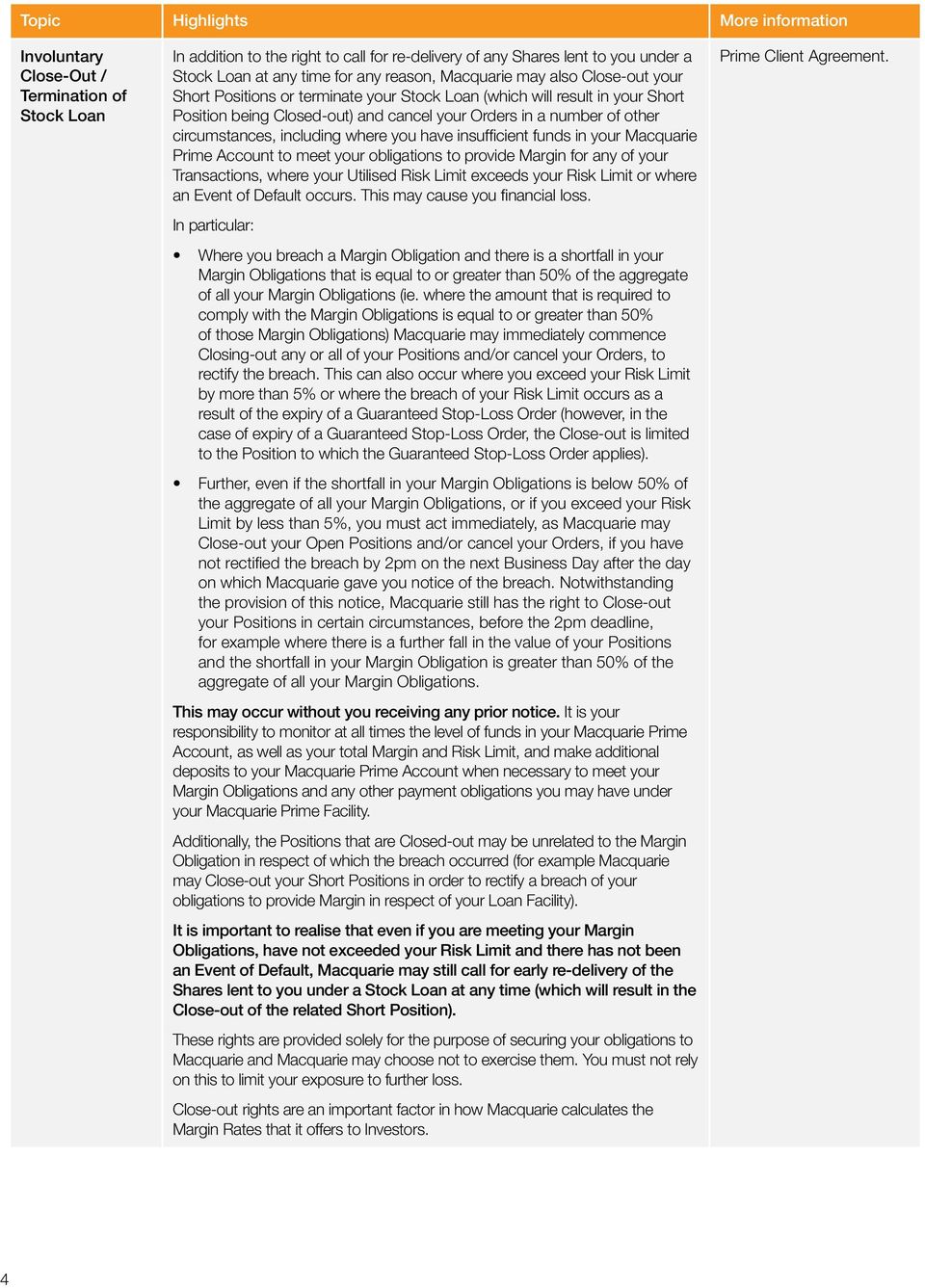
6 Topic Highlights More information Involuntary Close-Out / Termination of Stock Loan In addition to the right to call for re-delivery of any Shares lent to you under a Stock Loan at any time for any reason, Macquarie may also Close-out your Short Positions or terminate your Stock Loan (which will result in your Short Position being Closed-out) and cancel your Orders in a number of other circumstances, including where you have insufficient funds in your Macquarie Prime Account to meet your obligations to provide Margin for any of your Transactions, where your Utilised Risk Limit exceeds your Risk Limit or where an Event of Default occurs. This may cause you financial loss. In particular: Where you breach a Margin Obligation and there is a shortfall in your Margin Obligations that is equal to or greater than 50% of the aggregate of all your Margin Obligations (ie. where the amount that is required to comply with the Margin Obligations is equal to or greater than 50% of those Margin Obligations) Macquarie may immediately commence Closing-out any or all of your Positions and/or cancel your Orders, to rectify the breach. This can also occur where you exceed your Risk Limit by more than 5% or where the breach of your Risk Limit occurs as a result of the expiry of a Guaranteed Stop-Loss Order (however, in the case of expiry of a Guaranteed Stop-Loss Order, the Close-out is limited to the Position to which the Guaranteed Stop-Loss Order applies). Further, even if the shortfall in your Margin Obligations is below 50% of the aggregate of all your Margin Obligations, or if you exceed your Risk Limit by less than 5%, you must act immediately, as Macquarie may Close-out your Open Positions and/or cancel your Orders, if you have not rectified the breach by 2pm on the next Business Day after the day on which Macquarie gave you notice of the breach. Notwithstanding the provision of this notice, Macquarie still has the right to Close-out your Positions in certain circumstances, before the 2pm deadline, for example where there is a further fall in the value of your Positions and the shortfall in your Margin Obligation is greater than 50% of the aggregate of all your Margin Obligations. This may occur without you receiving any prior notice. It is your responsibility to monitor at all times the level of funds in your Macquarie Prime Account, as well as your total Margin and Risk Limit, and make additional deposits to your Macquarie Prime Account when necessary to meet your Margin Obligations and any other payment obligations you may have under your Macquarie Prime Facility. Additionally, the Positions that are Closed-out may be unrelated to the Margin Obligation in respect of which the breach occurred (for example Macquarie may Close-out your Short Positions in order to rectify a breach of your obligations to provide Margin in respect of your Loan Facility). It is important to realise that even if you are meeting your Margin Obligations, have not exceeded your Risk Limit and there has not been an Event of Default, Macquarie may still call for early re-delivery of the Shares lent to you under a Stock Loan at any time (which will result in the Close-out of the related Short Position). These rights are provided solely for the purpose of securing your obligations to Macquarie and Macquarie may choose not to exercise them. You must not rely on this to limit your exposure to further loss. Close-out rights are an important factor in how Macquarie calculates the Margin Rates that it offers to Investors. Prime Client Agreement. 4
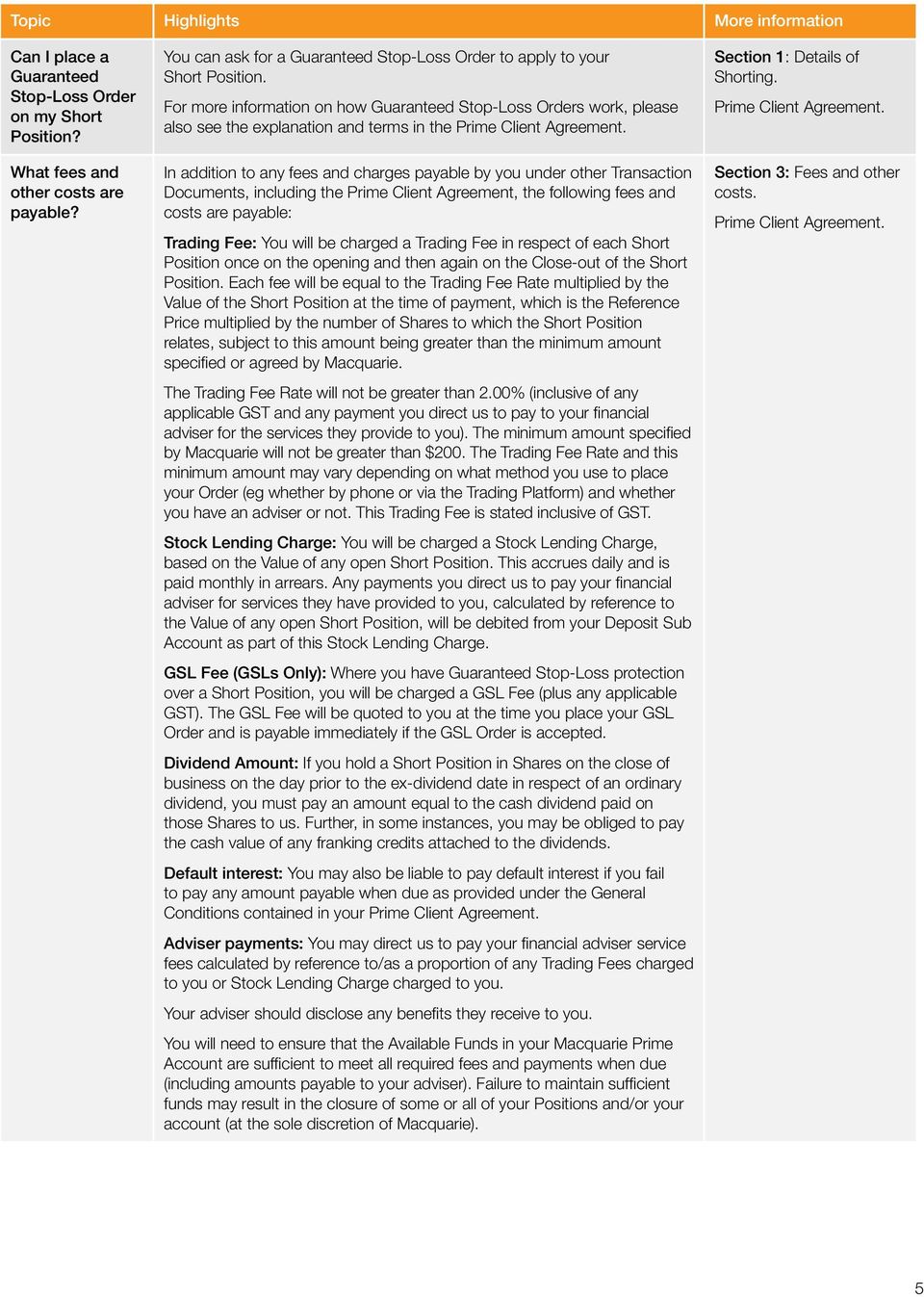
7 Topic Highlights More information Can I place a Guaranteed Stop-Loss Order on my Short Position? What fees and other costs are payable? You can ask for a Guaranteed Stop-Loss Order to apply to your Short Position. For more information on how Guaranteed Stop-Loss Orders work, please also see the explanation and terms in the Prime Client Agreement. In addition to any fees and charges payable by you under other Transaction Documents, including the Prime Client Agreement, the following fees and costs are payable: Trading Fee: You will be charged a Trading Fee in respect of each Short Position once on the opening and then again on the Close-out of the Short Position. Each fee will be equal to the Trading Fee Rate multiplied by the Value of the Short Position at the time of payment, which is the Reference Price multiplied by the number of Shares to which the Short Position relates, subject to this amount being greater than the minimum amount specified or agreed by Macquarie. The Trading Fee Rate will not be greater than 2.00% (inclusive of any applicable GST and any payment you direct us to pay to your financial adviser for the services they provide to you). The minimum amount specified by Macquarie will not be greater than $200. The Trading Fee Rate and this minimum amount may vary depending on what method you use to place your Order (eg whether by phone or via the Trading Platform) and whether you have an adviser or not. This Trading Fee is stated inclusive of GST. Stock Lending Charge: You will be charged a Stock Lending Charge, based on the Value of any open Short Position. This accrues daily and is paid monthly in arrears. Any payments you direct us to pay your financial adviser for services they have provided to you, calculated by reference to the Value of any open Short Position, will be debited from your Deposit Sub Account as part of this Stock Lending Charge. GSL Fee (GSLs Only): Where you have Guaranteed Stop-Loss protection over a Short Position, you will be charged a GSL Fee (plus any applicable GST). The GSL Fee will be quoted to you at the time you place your GSL Order and is payable immediately if the GSL Order is accepted. Dividend Amount: If you hold a Short Position in Shares on the close of business on the day prior to the ex-dividend date in respect of an ordinary dividend, you must pay an amount equal to the cash dividend paid on those Shares to us. Further, in some instances, you may be obliged to pay the cash value of any franking credits attached to the dividends. Default interest: You may also be liable to pay default interest if you fail to pay any amount payable when due as provided under the General Conditions contained in your Prime Client Agreement. Adviser payments: You may direct us to pay your financial adviser service fees calculated by reference to/as a proportion of any Trading Fees charged to you or Stock Lending Charge charged to you. Your adviser should disclose any benefits they receive to you. You will need to ensure that the Available Funds in your Macquarie Prime Account are sufficient to meet all required fees and payments when due (including amounts payable to your adviser). Failure to maintain sufficient funds may result in the closure of some or all of your Positions and/or your account (at the sole discretion of Macquarie). Section 1: Details of Shorting. Prime Client Agreement. Section 3: Fees and other costs. Prime Client Agreement. 5
8 Topic Highlights More information What are the significant risks of short selling? What are the tax consequences of investing in Short Positions? Does this PDS, including the Shorting Agreement, cover short CFDs? How can I obtain further information? The significant risks of short selling Shares include: An adverse movement in the value of your Shares: The value of your investments may go up and down by a material amount, even over a short period of time. Since July 2007 equity markets have generally become more volatile; indeed, over this period, volatility in some markets has been at very high levels. Investing in such highly volatile conditions implies a greater level of risk for investors than an investment in a more stable market. You should carefully consider this additional volatility risk before making any investment. A rise in the value of the Shares the subject of the Short Position: If the Reference Price of a Share the subject of a Short Position moves against you (e.g. the share price rises) your Available Funds may need to be used as additional Short Margin and Re-Purchase Margin, and this could happen any time the Reference Price increases. The value of the Shares may go up or down by a material amount, even over a short period of time. Since July 2007 equity markets have generally become more volatile; indeed, over this period, volatility in some markets has been at very high levels. Investing in such highly volatile conditions implies a greater level of risk for investors than an investment in a more stable market. You should carefully consider this additional volatility risk before making any investment. Unlimited loss: Your potential loss on Short Positions may be unlimited. You may lose more than the amount in your Macquarie Prime Account: Your potential losses on a Short Position may exceed how much Margin is designated to support a Short Position and may even exceed the total funds in your Macquarie Prime Account. There are other significant risks associated with shorting. You should read and understand Section 5 of this PDS prior to applying to borrow Shares from Macquarie and short sell them through the Macquarie Prime Facility. The taxation consequences of borrowing Shares from Macquarie and short selling them through the Macquarie Prime Facility will depend on your personal circumstances and you should obtain independent professional taxation advice. Macquarie does not give taxation advice. This PDS, including the Shorting Agreement in Section 10, does not cover short CFDs or short selling any products other than Shares. If you want to trade short CFDs in your Macquarie Prime Facility, for example, you will need to read, understand and accept the terms of the Macquarie CFD PDS available from the Prime Website. For more information, please contact us by: Telephone: [email protected] Internet: macquarie.com.au/prime Alternatively, you can speak to your financial adviser. Section 5: Significant Risks You Should Consider. Section 6: Taxation for Australian Residents. Macquarie CFD PDS. 6

9 Section 1 Details of Shorting This Section contains a brief summary only of certain material features relating to borrowing Shares from Macquarie and short selling them through the Macquarie Prime Facility. More detailed information relating to borrowing Shares from Macquarie and short selling them through the Macquarie Prime Facility can be found in Section 10 Shorting Agreement and the Prime Client Agreement. 1.1 What do I have to do before I can start short selling Shares? In order to short sell Shares with Macquarie, you must complete and submit online the Application Form available at macquarie.com.au/prime. In addition, to provide the Margin needed to support your Short Positions, you will need to open a Macquarie Prime Facility and Macquarie Prime Account in your name under the terms of the Macquarie Prime Account PDS and Prime Client Agreement. Macquarie will then require that an initial amount of at least $5,000 (current as at the date of this PDS, but subject to change) be deposited in your Macquarie Prime Account, or such other amount that Macquarie may determine from time to time ( Initial Deposit ). Once the Initial Deposit is held in cleared funds in your Macquarie Prime Account, you are able to place Orders and open Short Positions with Macquarie. Please note that Macquarie retains the right to refuse any application to short sell Shares or to open a Macquarie Prime Facility. Risk Limit When you open a Macquarie Prime Facility, we will place a limit on the total exposure to any Financial Instruments (including Short Positions) you are able to enter into using the Macquarie Prime Facility ( Risk Limit ). This Risk Limit will be shared across any Financial Instruments you enter into (not just Short Positions). We retain the right to reject any Orders and/or Close-Out your Positions and/or terminate your Stock Loan (which will result in your Short Positions being Closed-out) in certain circumstance where you have exceeded your assigned Risk Limit. We may refuse to accept an Order in certain circumstances, including if the Order would increase your Utilised Risk Limit over and above your allocated Risk Limit. Additionally, if your Utilised Risk Limit exceeds your Risk Limit, this can lead to serious financial consequences for you, including refusal or cancellation of any Orders, Close-out of any Positions and/ or closure of your Macquarie Prime Facility (see Parts 2.5 and 6.7 of the Prime Client Agreement for more information), as well as us recovering from you any monies that you owe us. At any time, you can view how much of this Risk Limit you have used through your investment activities (the Utilised Risk Limit ). Your Utilised Risk Limit is calculated as the maximum of: (i) the Face Value of all Positions and Orders for all Financial Instruments within your Macquarie Prime Facility less your Net Equity; and (ii) zero. Your Net Equity is the value of all of your Long Positions, less the value of all of your Short Positions (if any), plus your Macquarie Prime Account Balance. Your Macquarie Prime Account Balance is the sum of the Funds Balance and the Blocked Funds in your account. The Funds Balance is equal to all amounts that have been deposited into your Macquarie Prime Account, less any amounts withdrawn/paid out of that account and any Blocked Funds. Your Risk Limit, Utilised Risk Limit, the Face Value of your Positions and Orders and your Net Equity can all be viewed on the Macquarie Trading Platform. If you have an assigned Risk Limit of zero, you are required to use GSL protection on every Short Position that you enter into (see Section below relating to Guaranteed Stop-Loss Orders). If you have a Risk Limit of zero, you should also note that if, at any time, you hold a Short Position that is not subject to GSL protection, including where the GSL Period for that protection has expired, your Short Position may be Closedout. Therefore, if you want to continue holding your Short Position past the end of the GSL Period, it is important that you purchase new GSL protection prior to the expiry of your existing GSL protection. Regardless of your Risk Limit, you must maintain sufficient Available Funds in your Macquarie Prime Account to meet your Margin Obligations (see the Macquarie Prime Account PDS for details). 7

10 1.2 How will my Macquarie Prime Account be affected by my short selling Shares? While you have Positions or Orders in your Macquarie Prime Facility, amounts within your Macquarie Prime Account will be designated as either Available Funds or Margin, depending on your Orders, Positions and market movements. Available Funds are the funds that can be withdrawn from your Macquarie Prime Account or used to meet payment obligations under your Macquarie Prime Facility. In addition to holding sufficient Available Funds in your Macquarie Prime Account (for example to meet any fees and charges associated with your borrowing Shares from Macquarie and short selling them as referred to in Section 3), you are required to make sufficient funds available to support your Margin Obligations on each of your existing Short Positions and on each Order to open a Short Position (being an amount equivalent to that held if the Order was accepted). Such Margin represents security held by Macquarie for your Orders and Short Positions. Your rights to deal with monies to the credit of your Macquarie Prime Account are restricted to your Available Funds (and are also subject to our rights to call due amounts under your Loan Facility, if you have one). Generally, if we hold any monies to the credit of your account as Margin, you will not be able to deal with those monies. It is your responsibility to monitor at all times the level of Available Funds in your Macquarie Prime Account, as well as your Margin Obligations, and make any necessary deposits to ensure that you have sufficient Available Funds in your Macquarie Prime Account to cover any Margin required for Short Positions and Orders for such Positions and any other payment obligations you have under the Transaction Documents. Please refer to Section 2 for a further description as to how Margin for Short Positions and Orders for such Positions is calculated. You should also note that losses on Short Positions are potentially unlimited (see Section 5.1 for more details). 1.3 How do I short sell a Share? You will need to place your Order to short sell a Share through the Trading Platform, electronically or by telephone. We will allow you access to the Trading Platform to do this if we accept your Application to borrow Shares from Macquarie and short sell them through the Macquarie Prime Facility. When you place an Order to open a Short Position, you will need to specify certain information including the type of Order (see Section 1.6), the Share and the number of Shares you wish to borrow and then sell. Your Order will become an open Short Position only if and when Macquarie and the Trading Participant accept your Order in accordance with the Prime Client Agreement. To open a Short Position in respect of a Share the following transactions occur: (a) we lend you the Shares under the Shorting Agreement under a Stock Loan (see Section 1.12); (b) the Shares are sold immediately for their Value; (c) the amount of cash blocked to cover your potential Short Margin is moved from your Deposit Sub-Account to Blocked Funds (see Section 2); and (d) a payment is made to your Macquarie Prime Account from the proceeds of the sale of the Shares. This amount then forms the initial Re-Purchase Margin (see Sections 1.12 and 2). Early Re-delivery In order to offer shares to you under the Stock Loan we may need to borrow shares from another party under a separate stock lending arrangement. Typically, that party has the right to require us to re-deliver any shares we have borrowed at short notice. Macquarie may require you to re-deliver Shares you have borrowed from Macquarie at any time without prior notice, which will mean that your Short Position will be Closed-out. Some examples of where Macquarie may require you to re-deliver Shares you have borrowed from Macquarie include: where Macquarie has borrowed shares from another party in order to lend the Shares to you, and that party has demanded re-delivery of the shares from Macquarie; or where Macquarie requires re-delivery to ensure that the stock lending arrangement is compliant with Section 26BC of the Income Tax Assessment Act (1936) (Cth); or where, for any other reason, Macquarie is unwilling or unable to continue the Short Position. If you fail to re-deliver Shares to Macquarie in the required time you may be liable for Macquarie s costs and expenses in buying replacement shares. Short Positions remaining open on the last Business Day prior to the first anniversary of the date on which the Short Position was entered into will automatically be Closed-out without notice to you. 8

11 1.4 How do I Close-out a Short Position? You may Close-out your Short Position by placing an Order to buy the Shares and that Order being accepted. Your Short Position will Close-out automatically if: a related Stop-Loss Order is accepted by Macquarie and/ or the Trading Participant; or a related GSL Order is triggered. When a Short Position in respect of a Share is Closed-out, the following transactions occur: (a) you buy the Shares for their Value; (b) you deliver the Shares back to us to satisfy your Stock Loan obligation (see Section 1.12); (c) the relevant Re-Purchase Margin will be redesignated as Available Funds, however, we will then immediately debit your Deposit Sub Account in order to satisfy your obligation to pay the Value of the Shares bought; and (d) we will debit the relevant Short Margin from your Blocked Funds and credit the same amount to your Deposit Sub Account. 1.5 Can Macquarie close my Short Positions or stop my ability to short sell Shares without my approval? In some circumstances, Macquarie may Close-out a Short Position or suspend your ability to short sell Shares or terminate your Stock Loan (which will result in your Short Position being Closed-out), including where you exceed the Risk Limit or fail to maintain sufficient Available Funds to meet Margin Obligations or an Event of Default occurs.this may cause you financial loss. The Close-out, suspension or termination may occur without you receiving any prior notice. In light of this, it is your responsibility to monitor at all times the level of funds in your Macquarie Prime Account, as well as your total Margin, and make additional deposits to your Macquarie Prime Account when necessary to meet your Margin Obligations and any payment obligations you may have under your Macquarie Prime Facility. However, as set out in section 1.3 above, Macquarie may require you to re-deliver Shares you have borrowed from Macquarie at any time without prior notice, which will mean that your Short Position will be Closed-out, even if you are meeting your Margin Obligations and have not exceeded your Risk Limit. Short Positions remaining open on the last Business Day prior to the first anniversary of the date on which the Short Position was entered into will automatically be Closed-out without notice to you. See the Shorting Agreement, Prime Client Agreement and Macquarie Prime Account PDS for more details. 1.6 What types of Orders exist? The basic types of Orders you can place when opening, altering or Closing-out a Short Position are set out below. If you have a Risk Limit of zero, you may need to place an Order for a GSL at the same time as your Order (see Section 1.1). This does not apply to an Order to Close-out a Short Position Orders that can open or Close-out a position You can open or Close-out Short Positions using a Limit Order, Market-to-Limit Order, Trigger Order or such other types of Order that we make available from time to time. Limit Order This is an Order to enter into a new Short Position or Closeout an existing Short Position where the relevant Reference Price reaches a specified level (the Limit Price ). If this Order is accepted: where you are selling Shares, the Order may be filled at the prevailing bid price when that price is equal to, or greater than, the Limit Price; or where you are buying Shares, the Order may be filled at the prevailing offer price when that price is equal to, or less than, the Limit Price Limit Orders expire at the end of the Limit Order Period that you select unless cancelled by either party. For example, you decide to place a Limit Order to short sell 500 XYZ Shares at $10.00 per Share. The current bid price (ie the highest price at which someone is prepared to buy an XYZ Share on the ASX) is $9.99. Your Order will not be accepted until another bid is entered into the market at $10.00 or higher, in which case your XYZ Shares are sold at $10.00 per Share until your Order is completely filled. Market-to-Limit Order This is an Order to enter into a new Short Position or Closeout an existing Short Position at the best prevailing price at which the Shares are being bid or offered for sale respectively on the ASX. If there is not a sufficient quantity of the Shares at the best prevailing bid or offer price matching your Market-to- Limit Order, your Order for the remaining quantity will remain unaccepted and will be treated as a Limit Order at that original best prevailing bid or offer price. Market-to-Limit Orders are valid until accepted or cancelled by any party. For example, you decide to place a Market-to-Limit Order to sell 1,000 XYZ Shares and open a Short Position. The best current bid price (ie the highest price at which someone is prepared to buy an XYZ Share on the ASX) is $10.00 per Share. There are 600 XYZ Shares available at this price. Your Order will be filled for 600 XYZ Shares at $10.00 per Share. 9

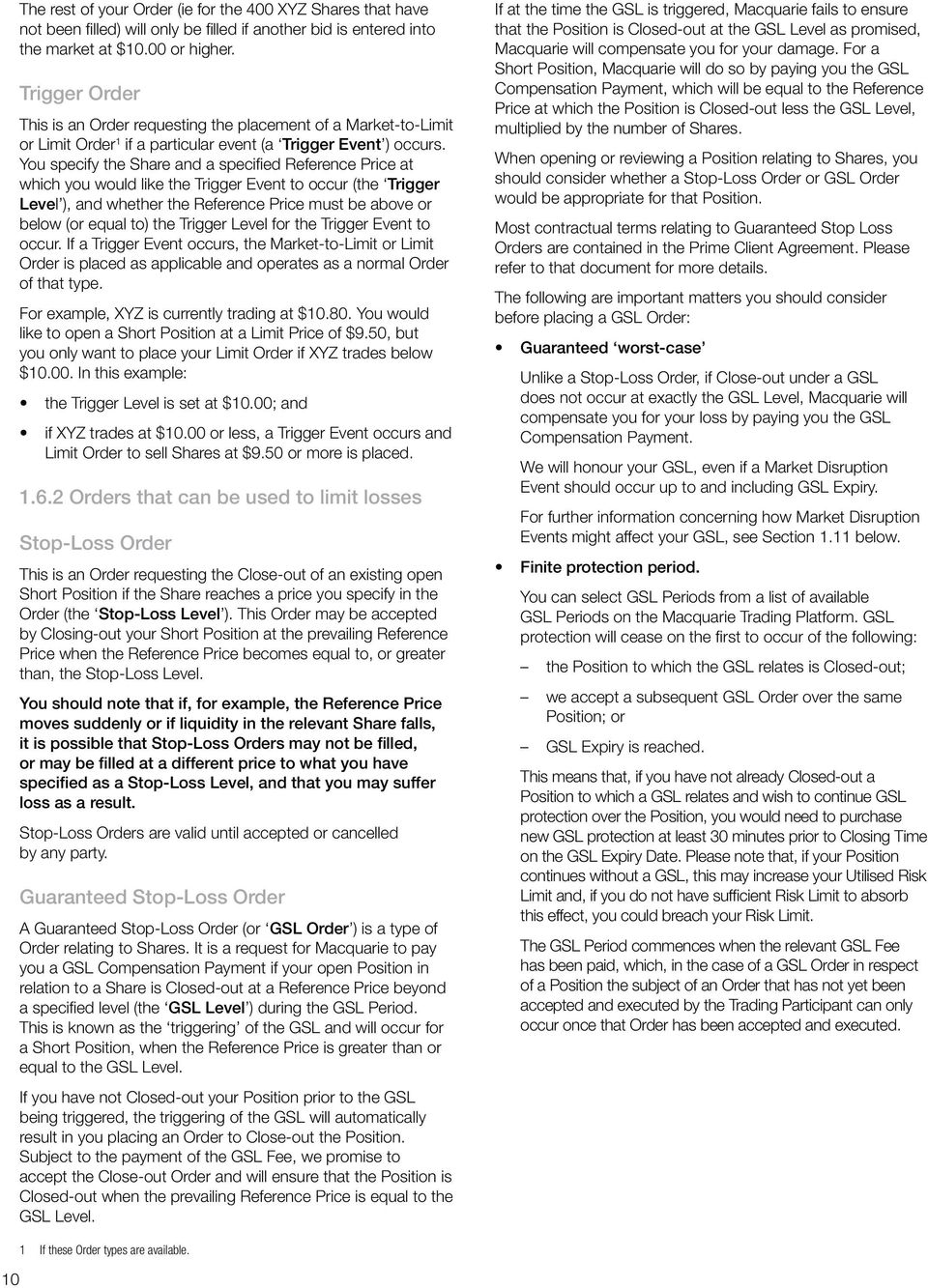
12 The rest of your Order (ie for the 400 XYZ Shares that have not been filled) will only be filled if another bid is entered into the market at $10.00 or higher. Trigger Order This is an Order requesting the placement of a Market-to-Limit or Limit Order 1 if a particular event (a Trigger Event ) occurs. You specify the Share and a specified Reference Price at which you would like the Trigger Event to occur (the Trigger Level ), and whether the Reference Price must be above or below (or equal to) the Trigger Level for the Trigger Event to occur. If a Trigger Event occurs, the Market-to-Limit or Limit Order is placed as applicable and operates as a normal Order of that type. For example, XYZ is currently trading at $ You would like to open a Short Position at a Limit Price of $9.50, but you only want to place your Limit Order if XYZ trades below $ In this example: the Trigger Level is set at $10.00; and if XYZ trades at $10.00 or less, a Trigger Event occurs and Limit Order to sell Shares at $9.50 or more is placed Orders that can be used to limit losses Stop-Loss Order This is an Order requesting the Close-out of an existing open Short Position if the Share reaches a price you specify in the Order (the Stop-Loss Level ). This Order may be accepted by Closing-out your Short Position at the prevailing Reference Price when the Reference Price becomes equal to, or greater than, the Stop-Loss Level. You should note that if, for example, the Reference Price moves suddenly or if liquidity in the relevant Share falls, it is possible that Stop-Loss Orders may not be filled, or may be filled at a different price to what you have specified as a Stop-Loss Level, and that you may suffer loss as a result. Stop-Loss Orders are valid until accepted or cancelled by any party. Guaranteed Stop-Loss Order A Guaranteed Stop-Loss Order (or GSL Order ) is a type of Order relating to Shares. It is a request for Macquarie to pay you a GSL Compensation Payment if your open Position in relation to a Share is Closed-out at a Reference Price beyond a specified level (the GSL Level ) during the GSL Period. This is known as the triggering of the GSL and will occur for a Short Position, when the Reference Price is greater than or equal to the GSL Level. If you have not Closed-out your Position prior to the GSL being triggered, the triggering of the GSL will automatically result in you placing an Order to Close-out the Position. Subject to the payment of the GSL Fee, we promise to accept the Close-out Order and will ensure that the Position is Closed-out when the prevailing Reference Price is equal to the GSL Level. If at the time the GSL is triggered, Macquarie fails to ensure that the Position is Closed-out at the GSL Level as promised, Macquarie will compensate you for your damage. For a Short Position, Macquarie will do so by paying you the GSL Compensation Payment, which will be equal to the Reference Price at which the Position is Closed-out less the GSL Level, multiplied by the number of Shares. When opening or reviewing a Position relating to Shares, you should consider whether a Stop-Loss Order or GSL Order would be appropriate for that Position. Most contractual terms relating to Guaranteed Stop Loss Orders are contained in the Prime Client Agreement. Please refer to that document for more details. The following are important matters you should consider before placing a GSL Order: Guaranteed worst-case Unlike a Stop-Loss Order, if Close-out under a GSL does not occur at exactly the GSL Level, Macquarie will compensate you for your loss by paying you the GSL Compensation Payment. We will honour your GSL, even if a Market Disruption Event should occur up to and including GSL Expiry. For further information concerning how Market Disruption Events might affect your GSL, see Section 1.11 below. Finite protection period. You can select GSL Periods from a list of available GSL Periods on the Macquarie Trading Platform. GSL protection will cease on the first to occur of the following: the Position to which the GSL relates is Closed-out; we accept a subsequent GSL Order over the same Position; or GSL Expiry is reached. This means that, if you have not already Closed-out a Position to which a GSL relates and wish to continue GSL protection over the Position, you would need to purchase new GSL protection at least 30 minutes prior to Closing Time on the GSL Expiry Date. Please note that, if your Position continues without a GSL, this may increase your Utilised Risk Limit and, if you do not have sufficient Risk Limit to absorb this effect, you could breach your Risk Limit. The GSL Period commences when the relevant GSL Fee has been paid, which, in the case of a GSL Order in respect of a Position the subject of an Order that has not yet been accepted and executed by the Trading Participant can only occur once that Order has been accepted and executed If these Order types are available.
13 GSL replacement Throughout the GSL Period, you are able to replace your GSL at a new GSL Level. If you replace your GSL, you will incur no additional GSL Fee provided that: the GSL Percentage in absolute terms, is no less than that specified in the Order for the GSL you are replacing; and the scheduled GSL Expiry Date does not change. Otherwise, you will be charged a GSL Fee equal to what we calculate to be the incremental cost of the new GSL. GSL Orders are only available over a limited number of Shares GSLs can only be placed over Shares approved by us. A list of approved Shares is available on the Prime Website. Additional cost A GSL Fee will be debited from your Macquarie Prime Account when your GSL Order is accepted by us. The amount of the GSL Fee will depend on a number of factors including the Share itself, the GSL Percentage and the length of the GSL Period (see Section 3.3 and the Prime Website for more information on GSL Fees). GSL Order Acceptance We will only accept GSL Orders while the ASX is open, but you are able to submit GSL Orders to the Trading Platform at any time. If the market is not open at the time the GSL Order is submitted, Macquarie may not accept your GSL Order until after the market next opens for business. This also applies for any amendments to or replacements of existing GSLs. Minimum GSL Percentage We retain the right to set a minimum GSL Percentage for all GSL Orders in absolute terms. This minimum GSL Percentage may be altered from time to time by us and will be published on the Prime Website. Adjustment for the amount of any cash dividend If GSL protection is effective on the relevant Share s exdividend date, we may (in our discretion) reduce the GSL Level by an amount equal to the relevant cash dividend. No GSL trigger after normal trading ends If the ASX has ceased normal trading when the Reference Price triggers the GSL (eg where the Reference Price is the price published at the end of the closing auction conducted by the ASX at the end of a Trading Day), your Position will not be Closed-out. If the Reference Price at the beginning of trading on the next Trading Day was still beyond the GSL Level, the GSL would be triggered and GSL protection would apply in the normal way. If your Macquarie Prime Facility is terminated prior to the expiry of the GSL Period for any of your GSLs, Macquarie will refund part of the GSL Fee that you have paid, being the remaining value of the GSL as specified on the Trading Platform on the date of termination. Please note: This PDS and the Prime Trading Terms do not apply to Orders in respect of CFDs (including GSL Orders over CFDs). Please see the Macquarie CFD PDS for further information on Orders relating to CFDs. 1.7 Will my Order be accepted? Your Order may be accepted in whole or in part and may be refused in whole or in part. Set out below are some examples of when your Order may be not accepted: if you have insufficient funds in your Macquarie Prime Account to meet your obligations; trading in the relevant Shares has been suspended or halted for any reason whatsoever and you have not reconfirmed instructions; or a view is taken that the Order is likely to: contribute to a breach of the Corporations Act, ASIC Market Integrity Rules, or ASX Operating Rules; or be inappropriate, unethical or likely to negatively impact on the reputation and integrity of Macquarie or the Trading Participant within the market; or create a disorderly market in the Shares. Even if your Order is accepted, you should note that there is no guarantee that your Order (without limiting the Guaranteed Stop-Loss Order terms) will be filled or executed at a given price or time, or in full. You may cancel an Order (or part of an Order) by notifying us at any time before that Order (or the relevant part of the Order) is accepted (see Condition 2.7 of the Prime Trading Terms). If you place a Share Order which is accepted, the Shares the subject of that Share Order will be bought or sold on your behalf by the Trading Participant. In limited circumstances Macquarie may buy or sell Shares the subject of an Order as principal (that is, when a Order for the purchase or sale of Shares is deemed to have been placed pursuant to the triggering of a Guaranteed Stop-Loss Order and Macquarie determines that your Order to purchase or sell Shares will be executed by Macquarie as principal). Under the Prime Trading Terms, any Share Order you place for a Short Position is taken to be accepted when Macquarie the Trading Participant enters into arrangements to buy or sell Shares to give effect to your Share Order or otherwise recording the transaction concerning the position in its records. Orders (other than Share Orders which are taken to have been given to the Trading Participant) are taken to be accepted when Macquarie executes the Order by entering into arrangements to buy or sell Financial Instruments to give effect to your Order or otherwise recording the transaction concerning the position in its records (see Condition 2.3 of the Prime Trading Terms). 11
14 1.8 Can Macquarie close my Short Positions or Macquarie Prime Facility without my approval? Without limiting our rights under any of the Transaction Documents, in some circumstances we may Close-out a Position or terminate your Stock Loan (which will result in your Short Position being Closed-out) or suspend your use of the Trading Platform, including where you exceed your Risk Limit or fail to maintain Margin. Our rights are set out in Condition 8 of the Prime Trading Terms and Condition 2 of the General Conditions and in Condition 7.1 of the Shorting Agreement. The Close-out, termination or suspension may occur without you receiving any prior notice. In light of this, it is your responsibility to monitor at all times the level of funds in your Macquarie Prime Account, as well as your total Margin and Risk Limit, and make additional deposits to your Macquarie Prime Account when necessary to meet your Margin Obligations and any payment obligations you may have under your Macquarie Prime Facility. Short Positions remaining open on the last Business Day prior to the first anniversary of the date on which the Short Position was entered into will automatically be Closed-out without notice to you. Additionally, as set out in section 1.3 above, Macquarie may require you to re-deliver Shares you have borrowed from Macquarie at any time without prior notice, which will mean that your Short Position will be Closed-out, even if you are meeting your Margin Obligations, have not exceeded your Risk Limit and there is no Event of Default. For more information on what your Risk Limit is, please see Section 1.1. For more information on Margin, please see the Macquarie Prime Account PDS and Section 2 of this PDS. Macquarie may also cancel or amend Positions in the event that Share transactions fail to settle or are cancelled or amended by ASIC or ASX (see Condition 2.6 of the Prime Trading Terms). While a Short Position is open, the Reference Price of the relevant Shares will be equal to the last traded price of the Share on the ASX. However, you should note that there are a number of cases where we will determine Reference Prices in our sole discretion, including when the Share is: undergoing a Potential Adjustment Event (see Section 1.10 below); or otherwise subject to a Market Disruption Event How do Potential Adjustment Events affect my Short Positions? Where a Potential Adjustment Event occurs in relation to a Financial Instrument (like a Share), we may adjust the terms of any Positions, Orders or GSL protection associated with that Financial Instrument or make a payment to or from your Macquarie Prime Account to aim to preserve the economic equivalence of the rights and obligations of the parties immediately prior to such event. For example, we may adjust a Reference Price in relation to Shares you hold or adjust a GSL Level for a GSL Order you have placed. We also have certain other rights that we may exercise where a Potential Adjustment Event occurs in relation to a Financial Instrument. For example, in the case of a Special Dividend, you may be required to pay to us the amount of any Special Dividend (and the cash value of any franking credits associated with such Special Dividend). Also, if a Potential Adjustment Event occurs in relation to a Share and you have a Short Position over that Share, we may require you to re-deliver the Shares borrowed from us under the Shorting Agreement (see Condition 5.2 of the Shorting Agreement). For example, where a takeover offer is announced in respect of the Shares the subject of the Short Position and is nearing completion, we may require you to buy the Shares and re-deliver them to us to Close-out the Short Position. Macquarie s rights in relation to Potential Adjustment Events are set out in the Prime Client Agreement. 1.9 How are Reference Prices determined? If your Share Order in relation to a Short Position is accepted, the Shares will be bought or sold on the ASX on your behalf by the Trading Participant, in which case the Reference Price will be the price at which the Shares are bought or sold on the ASX. In limited circumstances, if you place an Order to buy or sell Shares Macquarie may buy or sell those Shares as principal (see Section 1.7 of this PDS). If this occurs, the Reference Price will be calculated by Macquarie in its sole discretion having regard to the relevant quantities that are bid and offered at various prices on the ASX. 12

15 1.11 How do Market Disruption Events affect Reference Prices and GSLs? An example of a Market Disruption Event is where a Share is subject to a trading halt, and the Listed Entity makes an announcement that an external administrator has been appointed. In this case, it is likely that the true value of the Share is lower than the last traded price on the ASX, and we may determine that the Reference Price is less than the last traded price (and potentially zero). Your GSL for a Short Position will be triggered if a Market Disruption Event occurs and the Reference Price we determine is greater than or equal to the relevant GSL Level. If a GSL reaches GSL Expiry when the relevant Share is subject to a Market Disruption Event, the Reference Price is determined by us in our sole discretion, and may have the effect of causing a GSL to be triggered. If this is the case, we will honour such GSL on the basis of that Reference Price How does the Stock Loan work? A Note on Stock Loans While the expressions borrow, lend and re-deliver are commonly used in the market for stock loans, in fact the title to the Shares borrowed or lent passes from the lender to the borrower (or vice versa on re-delivery of those Shares). For example, under the Shorting Agreement, if Macquarie takes re-delivery of Shares you have borrowed, all title in those Shares passes to Macquarie. This absolute transfer of title under a Stock Loan is what facilitates you being able to short sell the Shares on the ASX under this PDS. While Shares still need to be re-delivered under a Stock Loan (and you will breach your obligations if you do not do so, when required), it does not involve a form of lease, bailment or other loan in the common sense. To create this Margin, when we credit your Macquarie Prime Account with the sale proceeds of the borrowed Share, we will block these funds as Re-Purchase Margin which cannot be drawn on by you unless they are released from being Re- Purchase Margin as explained below. The required amount of Re-Purchase Margin will move up and down with changes in the Reference Price of the borrowed Share that is: if the Reference Price increases, you must provide additional Re-Purchase Margin equal to the increase in the Value of your Short Position. This amount is taken from your Available Funds and blocked as Re-Purchase Margin; or if the Reference Price decreases, we will release part of your Re-Purchase Margin equal to the decrease in the Value of your Short Position. This amount is credited to your Available Funds. When your Short Position is Closed-out, you purchase the Share for its Reference Price and use the Share to meet your obligation to re-deliver the Share under the Stock Loan and we release the Re-Purchase Margin to you on re-delivery of the Share. To the extent that the Re-Purchase Margin is insufficient to purchase the Share for its Reference Price, you will need to have sufficient Available Funds in your Macquarie Prime Account to meet this obligation Who is my Sponsor for the Shares I short sell? The Sponsor is identified in the Prime Client Agreement. The Prime Client Agreement incorporates a CHESS Sponsorship Agreement as well as other terms relevant to your short selling Shares under the Shorting Agreement. As noted in Section 1.3, to open a Short Position in respect of a Share, you must borrow (that is, acquire) that Share from us under the Stock Loan, before immediately selling that Share for its Reference Price. You then have an obligation to re-deliver the borrowed Share to us (see Section 1.4). The Re-Purchase Margin secures this obligation and your other obligations under the Stock Loan 2. 2 In addition to the Re-Purchase Margin, you may also be required to provide Short Margin for the Short Position as Blocked Funds - see Section

16 Section 2 Margin Before opening a Short Position, or placing an Order, you should make sure you understand how the cashflows and Margin Obligations associated with your Macquarie Prime Facility work especially in what circumstances you will need to pay us. You should consult with your stockbroker or financial adviser if you are uncertain as to how Margin or cashflows work. Failure to have sufficient Available Funds to cover your obligations may give rise to an Event of Default giving us certain rights including the right to Close-out your Short Positions or close your Macquarie Prime Facility. Your potential liability for payments is not limited to the balance in your Macquarie Prime Account, and we may ask you to pay amounts in excess of any balance to cover outstanding amounts. Please advise us promptly if you are in financial difficulty. 2.1 What is Margin? We take security from you to cover our financial exposure from your trading activity within your Macquarie Prime Facility (ie security for any potential obligations you may have to meet). For any Orders to open Short Positions, we will require Margin known as Short Margin 3. For any open Short Positions, we will also require Margin known as Re-Purchase Margin. That is: For Orders to open Short Positions: Short Margin For open Short Positions: Short Margin and Re-Purchase Margin This Margin comprises some or all of the cash blocked in your Macquarie Prime Account or held in your Blocked Funds account. It is not a cost as such, but will affect how you deal with the funds in your Macquarie Prime Account (see the Macquarie Prime Account PDS). Your rights to deal with monies to the credit of your Macquarie Prime Account are restricted to your Available Funds (and are also subject to our rights to call due amounts under your Loan Facility, if you have one). Available Funds are the funds that can be withdrawn from your Macquarie Prime Account or used to meet payment obligations under your Macquarie Prime Facility. Generally, if we hold any monies to the credit of your account as Margin, you will not be able to deal with that amount. Margin secures our position; not yours. If you would like to limit your risk of losing money, you should consider a GSL when placing an Order. 2.2 How much Margin do I need? Generally, the Margin for your Short Positions (whatever type) will fluctuate depending on market movements and Margin Rates. The amount of Margin we require you to hold at any time will be published on the Macquarie Trading Platform. We will notify you when you are in breach of your Margin Obligations via the Macquarie Trading Platform and, generally, an to your designated address. However, in some situations, we are able to close-out your Positions, including your Short Positions, or terminate your Stock Loan (which will result in your Short Position being Closed-out) to rectify your breach of a Margin Obligation prior to notifying you of the breach. As a result, it is critical for you to monitor your Positions and ensure you have sufficient Available Funds at all times to meet any changes in your Margin Obligations, including your Re-purchase Margin and Short Margin. Additionally, we can terminate your Stock Loan without prior notice if there is an Event of Default, which includes where you breach your Margin Obligations. The effect of this will be to Close-out your Short Positions. IMPORTANT The amount of Margin may change from time to time and even from minute to minute. It is not limited by the amount you hold in your Deposit Sub-Account at any time. So, you may be required to deposit funds into your Macquarie Prime Account at short, or even without, notice to meet your Margin Obligations. Accordingly, it is vital that you maintain a sufficient buffer of Available Funds at all times to meet any changes. It is your responsibility to monitor at all times the amounts of Available Funds and Margin for your Short Positions and Orders and make additional deposits to your Macquarie Prime Account where necessary. While the re-valuation of your Short Positions for Margin purposes will generally only occur at the end of each Business Day, they may occur more frequently, and calculations of Margin and designation of funds between Available Funds and Margin in your Macquarie Prime Account are made continuously during each Business Day Please note that simply because Macquarie blocks funds in this manner this should in no way be interpreted as indicating that Macquarie or the Trading Participant will accept your Order. Macquarie and the Trading Participant reserve the right to reject any Order in their sole discretion.
17 If, at any time, there are insufficient Available Funds in your Macquarie Prime Account to meet Margin Obligations after allowing for any re-valuation based on prevailing intra-day Reference Prices, one or more of the following may occur in respect of your Macquarie Prime Facility: your Orders may be cancelled - in some cases, without prior notice; open Short Positions may be Closed-out - in some cases, without prior notice; and your Macquarie Prime Facility may be closed - in some cases, without prior notice. Note that the Margin required for a Short Position or Order may be reduced by purchasing GSL protection over that Short Position or an Order to place such a GSL. Additionally, Macquarie has a general discretion to require you to re-deliver Shares you have borrowed from Macquarie at any time without prior notice, which will mean that your Short Position will be Closed-out. This can occur even if you are meeting your Margin Obligations and have not exceeded your Risk Limit. Please refer to Section 4 worked examples of the calculation and maintenance of Margin. 2.3 What are the Margin Rates? This PDS does not specify Margin Rates. This is because the Margin Rate applicable to each Share is determined by reference to a number of variable factors, including the liquidity and volatility of the Share. These rates may change for each Share and will be published by Macquarie from time to time on the Prime Website. Close-out rights are an important factor in how Macquarie calculates the Margin Rates that it offers to Investors. We will give you at least 3 days prior notice of any change to Margin Rates that arise from our reviews of Margin Rates. We may also change Margin Rates at other times and if those changes relate to Margin Rates that apply to your Positions, we will also give you 3 days prior notice. If the changes are to Margin Rates that do not apply to your Positions, we will send you a message in the Online Portal letting you know of the change. That message will be sent at least 3 days prior to when the changes come into effect and you will see that message the first time you access the portal after the message has been sent. However, the time of your receipt of that message will obviously depend on how often you access the Online Portal. Short Margin The formula for determining the Short Margin in respect of any Short Position or Order is set out in the definition of Short Margin in the Glossary in Section 11 of this PDS. The formula refers to the applicable Margin Rate. We may require less Short Margin than the amount indicated by the formula. All Short Margin for Orders are held in the Blocked Orders balance of your Macquarie Prime Account and all Short Margin for any open Short Positions are held in Blocked Funds balance of your Macquarie Prime Account (see the Macquarie Prime Account PDS for more information on these balances). You will be notified of the Short Margin required at the time of your Order for the Short Position and you should ensure that you have sufficient Available Funds in your Macquarie Prime Account to cover this Margin as well as any ongoing Margin Obligations (assuming your Order is accepted). Re-Purchase Margin All Re-Purchase Margin for any open Short Positions is held in the Deposit Sub Account Balance of your Macquarie Prime Account. Further information on the nature of Re-Purchase Margin and how it changes is set out in Sections 1.3 and 1.12 and in the Macquarie Prime Account PDS. 15

18 Section 3 Fees and Other Costs Before applying to borrow Shares from Macquarie and short sell them, or placing an Order for a Short Position, you should make sure you understand the fees and other costs of such an investment. You should consult with your financial adviser or ask Macquarie if you are uncertain as to how the level of fees and costs may affect you. Failure to have sufficient Available Funds to cover fees and other costs may give rise to an Event of Default giving us certain rights, including the right to Close-out your Short Position or close your Macquarie Prime Facility. Your potential liability for fees and other costs is not limited to the balance in your Macquarie Prime Facility and we may ask you to pay amounts in excess of any balance to cover outstanding amounts. Please advise us promptly if you are in financial difficulty. The fees and other costs stated below are subject to change. Current fees and other costs are published on the Prime Website. 3.1 Trading Fee You will be charged a Trading Fee each time you Open or Close-out a Short Position. Whenever you Open a Short Position (that is, sell Shares), the amount you will receive from us will be equal to the Value of the Shares less the applicable Trading Fee. When you Close-out a Short Position (that is, buy Shares), the amount you will pay to us will be equal to the Value of the Shares plus the Trading Fee. In other words, the Trading Fees form part of the amount you have to pay or receive in order to Open or Close-out a Short Position. Trading Fees apply whether Shares are bought or sold on your behalf by the Trading Participant or you buy Shares from, or sell Shares to, us as principal (for example when a GSL triggers). The Trading Fee will be calculated as: The Value of the Short Position at the time of payment (which is the Reference Price multiplied by the number of Shares to which the Short Position relates) multiplied by the Trading Fee Rate applicable at that time; subject to this amount being more than the minimum amount specified or agreed by Macquarie in accordance with the following: How can I place an Order? You can place an Order via the Trading Platform, telephone or, if you have an adviser, through your adviser. How do I find out my Trading Fee Rate and minimum Trading Fee? If you DO NOT have an adviser: As shown on the Prime Website at that time. If you HAVE an adviser: Contact Macquarie and your adviser. The Trading Fee Rate and the minimum amount specified by Macquarie may vary depending on what method you use to place your Order, eg by phone or via the Trading Platform and whether or not you have an adviser and if you have directed us to make payments to your adviser for the services they provide to you. What is the most I will pay as a Trading Fee? The Trading Fee Rate will not be greater than 2.00% (inclusive of any applicable GST). The minimum amount specified or agreed by Macquarie, which will not be greater than $200 (inclusive of any applicable GST). If you have a financial adviser you can direct us in writing to pay fees to your financial adviser for the services they provide to you, payable by you in addition to, but calculated by reference to and forming part of your Trading Fees, provided the rate and minimum amount cannot be more than the maximum levels listed in the table above. Accordingly, the rate and minimum amount of the Trading Fee you will pay may be changed in the future, either by Macquarie or by agreement with you if you direct us to pay service fees to your adviser. Please also note that the Trading Fee you pay may differ from the fee quoted on the Prime Website. Trading Fees (and any payments you direct us to pay to your adviser) are debited from your Macquarie Prime Account at the time your Order is accepted. You will generally be charged GST on Trading Fees. Please refer to Section 4 for worked examples of how the Trading Fee payments are calculated. 16

19 3.2 Stock Lending Charge Where you hold a Short Position, you will pay a Stock Lending Charge. This charge is derived from the Value of your Short Position and the Stock Lending Rate. The Stock Lending Rate for any given Share may fluctuate depending on market conditions, and may reflect the stock borrowing fees payable by Macquarie in hedging its exposure to that Short Position. The current Stock Lending Rate(s) will be available on the Prime Website. Where the Stock Lending Rate for a particular Share changes, Macquarie will use reasonable endeavours to inform any Investors with open Short Positions in that Share. If you have an adviser, you may direct us to pay them for the services they provide you.an additional amount that you nominate, calculated as a proportion of the Value of the Short Position at close of trading for that day can be added to the Stock Lending Rate. Stock Lending Charges are accrued daily and debited from your Macquarie Prime Account monthly in arrears. The daily Stock Lending Charge accrual for a particular Short Position is calculated as follows: SLC = V x SLR / 365 where: SLC = the daily Stock Lending Charge accrual; V = the Value of the Short Position at close of trading for that day; and SLR = the Stock Lending Rate on that day. TY = need Tax guidance. Please refer to Section 4 for a worked example of how Stock Lending Charges are calculated. 3.3 GSL Fee Investors who have Guaranteed Stop-Loss protection in relation to a Short Position will be charged a GSL Fee. The indicative GSL Fee will be calculated by Macquarie and communicated at the time the GSL Order is placed by the Investor and is subject to change.the GSL Fee is calculated and is payable when the GSL Order is accepted by Macquarie. This PDS does not specify the amount of any GSL Fee. This is because the amount of any GSL Fee is determined by reference to a number of variable factors as at the time of the GSL Order, including the market price of the Share, prevailing interest rates, our view on the expected volatility of that price and the length of the GSL Period. Variable Change in variable Effect on GSL Fee over Short Position GSL Percentage Share price volatility Length of GSL Period For the purposes of simplicity, GSL Percentage is taken to be an absolute value in the above table (that is, an indicator of how far the GSL Level is set from the current Reference Price). You will generally be charged GST on GSL Fees. Please refer to Section 4 for an example of the application of a GSL Fee. 3.4 Dividend Amounts If you hold a Short Position in Shares on the close of business on the day prior to the ex-dividend date in respect of an ordinary dividend, you must pay an amount equal to the cash dividend paid on those Shares ( Dividend Amount ) to us. This is because, when you enter into a Short Position, you borrow Shares from us in accordance with the Shorting Agreement, which requires you to pay any Dividend Amount to us while the Shares are borrowed. This amount will be debited from the Available Funds in your Macquarie Prime Account on the ex-dividend date. In certain circumstances, the Dividend Amount payable may include the cash value of the franking credits 4. If this does occur the maximum amount charged for the franking credits will be: ( ) FC = D x t 1 t where: FC = amount included in the Dividend Amount referable to franking credits on the dividend; D = the franked portion of the dividend as declared by the Listed Entity; and t = the corporate tax rate applicable at that time (currently 30%). Please refer to Condition 5.5 of the Shorting Agreement for more information relating to ordinary dividends. Please note that where an ex-date for a Special Dividend occurs with respect to the Shares that are the subject of a Short Position, this will constitute a Potential Adjustment Event, which may result in adjustments being made to your Short Position (see Section 1.10) and/or you being required to pay to us the amount of that Special Dividend. 4 Where you hold a Short Position, Macquarie will seek on a reasonable endeavours basis to borrow Shares offshore to hedge Macquarie s exposure to that Short Position. However, if Macquarie borrows the stock domestically and a dividend is paid on the Share, the relevant Dividend Amount debited from the Available Funds in the Investor s Prime Account may include the value of any related franking credit, as well as the value of the cash dividend. 17
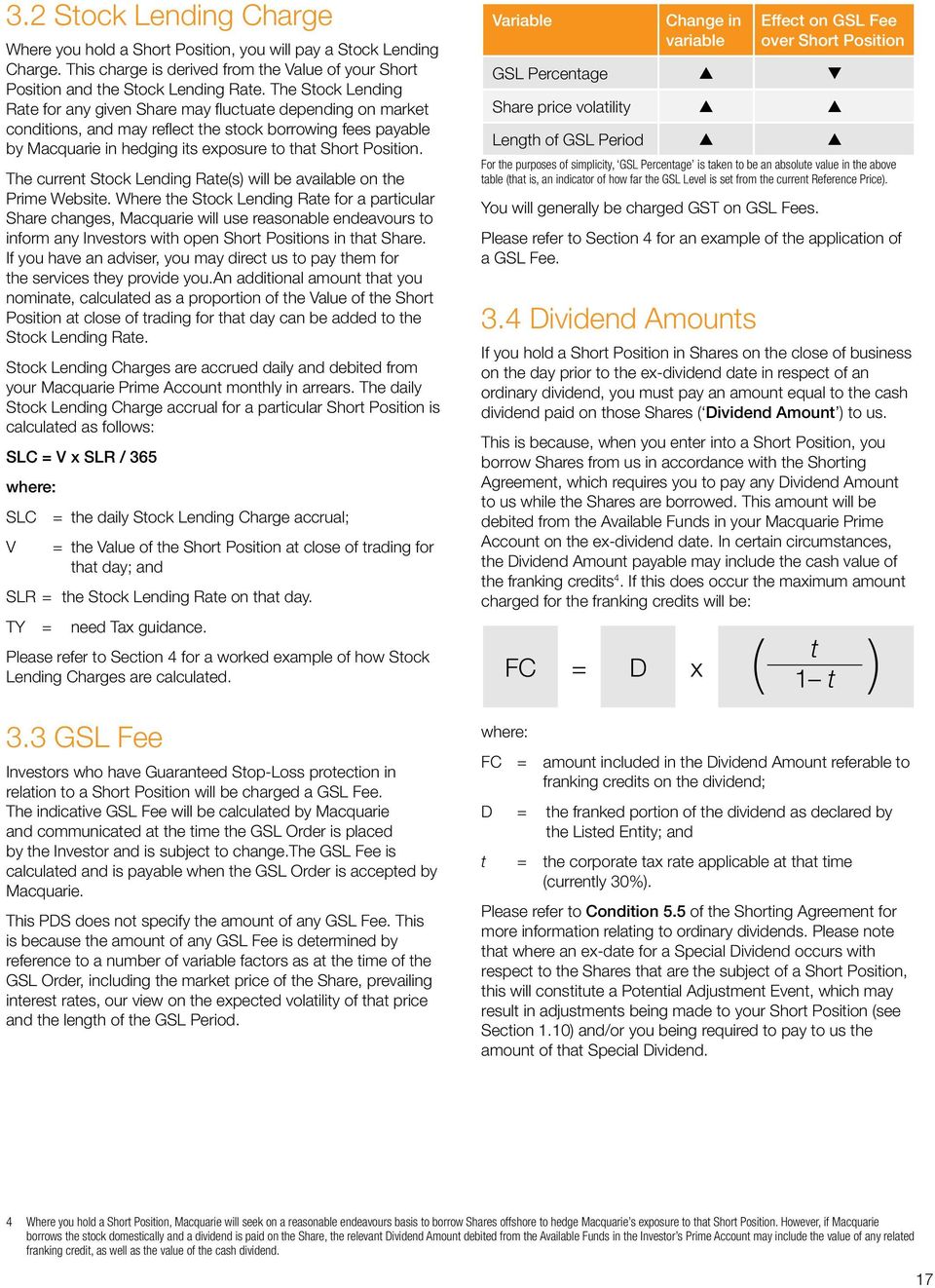
20 3.5 Default interest If you fail to pay when due any amount payable under any of the Transaction Documents, you must pay interest on the amount, from and including the due date, to the date of actual payment (after, as well as before, judgment). All such interest due shall be calculated using the Default Interest Rate, and paid in arrears on each Business Day by Macquarie debiting the funds held in your Macquarie Prime Account. You must advise Macquarie promptly if you are in financial difficulty. For example, if you failed to pay a Stock Lending Charge to Macquarie of $10,000 and the Default Interest Rate was 13.00%, default interest of $ for each calendar day would be debited from your Macquarie Prime Account. 3.7 Goods and Services Tax ( GST ) Unless otherwise stated, fees and costs for supplies made by Macquarie that are expected to be subject to GST are stated inclusive of GST but do not take into account any applicable input tax credits or reduced input tax credits. The availability of input tax credits for Investors in respect of the acquisitions to which such fees relate will depend on each Investor s particular circumstances and it is recommended that you obtain your own independent taxation advice. 3.6 Adviser payments As discussed in Section 3.2 above, you may direct us to pay your adviser for the services they provide to you, calculated by reference to / as a proportion of: (a) the Stock Lending Charges; and (b) the Trading Fees; that you pay, and debited from your Deposit Sub Account together with those fees and charges. If we agree to your direction, we will deduct the applicable amounts you authorise from your Deposit Sub Account and pay the amount directly to your adviser. Any payments you direct us to pay to your adviser may be in addition to any other fees or expenses you may have agreed with your adviser for their services. Your adviser should give you details of their remuneration arrangements. You can terminate your direction to us to pay your adviser on your behalf by giving us 10 days prior written notice. Soft dollar benefits Macquarie or any member of the Macquarie Group may from time to time provide or receive non-monetary benefits, sometimes known as soft dollar benefits.these may be provided to (or received from), for example, financial advisers or brokers, provided they are in compliance with the legal requirements in place from time to time. These benefits may include, but are not restricted to, education and training, information technology software and support, or benefits that are under a prescribed amount. These benefits, when provided, will be paid by us or any member of the Macquarie Group out of their own resources $10,000 x 13% / 365 = $3.56
21 Section 4 Worked Examples This Section provides hypothetical examples of how Short Positions may operate. The Share prices, GSL Fees, dividend rates, interest rates, Margin Rates, fees and charges quoted in the examples are provided for illustrative purposes only and should not be taken as an indication or commitment by Macquarie as to the values of these parameters that will actually apply on a Short Position or an Order. Investors should read and understand the risks set out in Section 5 of this PDS and discuss these matters with their financial adviser before making any investment decision. This example illustrates how the cash flows for a Short Position with a Guaranteed Stop-Loss might work. Summary table of the rates and fees used in this example Margin Rate for Telstra Corporation Limited (TLS) 10.00% Trading Fee Rate 0.12% 7 Stock Lending Rate 2.50%pa Client directed payment on Trading Fee Rate 0.05% Client directed payment on Stock Lending Rate 0.50%pa Timing What happens Description Order is placed, and Order is accepted. The potential Short Margin for your Order is calculated and compared to the amount of Available Funds in your Macquarie Prime Account. If there are sufficient Available Funds, an amount equal to the Short Margin is redesignated from Available Funds to Blocked Orders, and your Order may be accepted. Once the Order has been accepted and a Short Position is opened, the Short Margin held in Blocked Orders is redesignated as Blocked Funds while any Re-Purchase Margin generated from the sale proceeds are blocked in your Deposit Sub Account. John has a Macquarie Prime Facility with $5,000 on deposit in his Macquarie Prime Account and no open Positions or Orders. On 12 May 2009, the current market price for Telstra Corporation Limited (TLS) is $4.70, and John places a Market-to-Limit Order to enter into a Short Position in respect of 4,000 TLS Shares. The Margin Rate for TLS is 10.00%, making the Short Margin on this Order $1, This amount is redesignated from Available Funds to Blocked Orders to Blocked Funds. Re-Purchase Margin equal to the Value of the Short Position is blocked in the Deposit Sub Account of John s Prime Account. The Order is accepted at a price of $4.70. The first instalment of the Trading Fee of 31.96, inclusive of the Client directed payment on Trading Fee Rate is debited from Available Funds 9 John now has an open Short Position over 4,000 TLS Shares with a Value of $18,800. Rates and fees in this example can be increased (within applicable maximum ranges) if you direct us to pay your adviser fees for services they provide you. Your directed payment will be added to applicable fees and debited as one payment from your Deposit Sub Account. 7 Please note for these examples the minimum Trading Fee is set at $ All Trading Fee rates and calculations are inclusive of GST. 8 4,000 x $4.70 x 10.00% = $1, ,000 x $4.70 x (0.12% %) = $
22 Timing What happens Description While your Short Position is open Guaranteed Stop-Loss ( GSL ) protection is purchased Calculation of Short Margin on a Short Position protected by a GSL While your Short Position is open. Required Margin amounts may be calculated continuously, with cash being redesignated between Available Funds and Margin within your Macquarie Prime Account as appropriate. If you have a Short Position, you will be required to pay a Stock Lending Charge on that Short Position. These amounts are calculated and accrued on a daily basis, based on the closing Value of your Short Positions, and paid at the end of the month. You may make a Guaranteed Stop- Loss Order, specifying the GSL Period and the GSL Percentage. The GSL Period commences if and when the GSL Order is accepted by Macquarie and the GSL Fee is paid. A GSL can have the affect of lowering the amount of Short Margin required on a given Short Position. The Stock Lending Charge is again accrued overnight on the Short Position. Before the market closes on 12 May 2009, TLS s price falls to $4.50. John s current Re-Purchase Margin moves to $18, and $800 is credited to his Available Funds. The Blocked Funds on John s Short Position has fallen to $1,800 11, so $80 is redesignated from Short Margin to Available Funds in John s Macquarie Prime Account. John will be charged a Stock Lending Charge equal to 3.00%pa of the Value of the Short Position, including the Client directed payment on Stock Lending Rate. A fee of $ will be accrued on this Position for that calendar day, payable at the end of the month. On 13 May 2009, TLS s price is unchanged, but John has become concerned about the affect of a sudden rise in TLS s price on his Short Position. John places a Guaranteed Stop-Loss Order in respect of his Short Position with a GSL Percentage of 2.222% and a GSL Period of one month, at a cost of 0.75%. The Order is accepted by Macquarie with a GSL Level of $ , and the GSL Fee of $ is debited from John s Macquarie Prime Account. The Short Margin required on John s GSL protected Short Position is reduced to $ The excess Short Margin of $1,400 is redesignated from Blocked Funds to Available Funds. At the close of trading on 13 May 2009, the Value of John s Short Position is unchanged. So again he accrues a Stock Lending Charge of $1.48, including the Client directed payment on Stock Lending Rate for that calendar day, payable at the end of the month. 10 4,000 x $4.50 = $18, ,000 x $4.50 x 10% = $1, $18,000 x (2.50% %) /365 = $ $4.50 x ( ) = $ $18,000 x 0.75% = $ ($ $4.50) x 4,000 = $400 20
23 Timing What happens Description GSL Level is triggered, position is Closed-out At the end of each month. If, at any time during the GSL Period, the Share price is at or beyond the GSL Level, Macquarie will ensure that the Short Position is Closed-out at exactly that GSL Level. Stock Lending Charges that have been accrued on any Short Positions you have had over the month will also be settled through your Macquarie Prime Account. You may also have to pay or receive interest at the end of the month on the balances within your Macquarie Prime Account. Please refer to the Macquarie Prime Account PDS for information on how interest is calculated. On 14 May 2009, TLS s price opens up at $4.70. An amount of $ is redesignated from Available Funds and Blocked Funds to be blocked as Re-Purchase Margin. The GSL is triggered, John s Short Position is Closed-out at the ASX market price of $4.70. The re-purchase of these Shares was funded by the Re-Purchase Margin. The Shares are delivered to Macquarie to satisfy John s Stock Loan obligation. As Macquarie was unable to Close-out John s TLS Short Position at the GSL Level (ie $4.60), Macquarie pays him a GSL Compensation Payment of $ which is credited to his Available Funds. While John was negatively impacted by the increase in the TLS price on 14 May 2009, the GSL Compensation Amount has protected him from suffering more substantial losses. The remaining current balance of Margin is redesignated as Available Funds and a Trading Fee of $ is debited from John s Available Funds. Finally, out of his Macquarie Prime Account, John had to pay $2.96 in Stock Lending Charges to Macquarie that were accrued over the month for the two days he had the Short Position. 17 4,000 x ($ $4.50) = $ ,000 x ($ $4.60) = $ ,000 x $4.60 x (0.12% %) = $
24 John s Macquarie Prime Account will have the following cash flows during May: Change In Balance Of Description Available Funds Re- Purchase Margin Blocked Orders Blocked Funds Available Funds Re- Purchase Margin Blocked Orders Blocked Funds Account Balance Open Balance $5, $5, $5, Market-to-Limit Order. Sell 4,000 TLS Order accepted and filled: Short Position Trade Fee - 1st Instalment TLS price decreases to $4.50 Daily accruals calculated GSL placed@ $4.60. Premuim charged@ 0.75% Blocked Funds decreased by GSL Daily accruals calculated TLS price increases to $4.70 Short Position GSL triggered GSL Compensation Payment Trade Fee - 2nd Instalment Monthly Stock Lending Charge -$1, $1, $3, $1, $5, $ $1, $1, $3, $ $1, $ $31.96 $3, $18, $1, $23, $ $ $80.00 $3, $18, $1, $23, $3, $18, $1, $23, $ $3, $18, $1, $23, $1, $1, $5, $18, $ $23, $5, $18, $ $23, $ $ $ $ $ $23, $ $4, $4, $ $5, $5, $31.28 $5, $5, $2.96 $5, $5,
25 Section 5 Significant Risks You Should Consider All investments involve varying degrees of risk. Short Positions entered into using the Macquarie Prime Facility can carry a high level of risk. Returns received depend on a number of variable factors and may be volatile. In evaluating the merits and suitability of an investment in Short Positions, you should carefully consider the following significant risk factors. This Section does not purport to be a comprehensive summary of all the risks associated with Short Positions or your Macquarie Prime Facility, but highlights particular significant risks that we wish to encourage prospective Investors to discuss in detail with their professional advisers. Your rights and obligations in relation to your Macquarie Prime Facility are contained in a number of separate documents, known as Transaction Documents. Please ensure you read and understand the terms of each of these documents and particularly any significant risk disclosures in each of these documents. You also need to understand the way in which your Transaction Documents interact. If you are unsure about any matter, we urge you to seek independent professional advice. You should not invest using a Macquarie Prime Facility unless you are experienced in equity derivatives and understand the risks of geared investing. You should reach an investment decision only after carefully considering the suitability of Short Positions given your particular circumstances. You should seek independent advice where necessary. As well as considering the risks, you should consider how an investment fits into your overall investment portfolio. By diversifying your portfolio, you can reduce your exposure to any one investment or asset class. 5.1 Potential for unlimited loss This PDS will allow you to take Short Positions in Shares. Your Net Equity within your Macquarie Prime Facility will decrease if the value of the relevant Shares increase. This means that if you do not take out Guaranteed Stop- Loss protection, your potential losses on a Short Position are unlimited and could exceed the amount of money in your Macquarie Prime Account. Gearing can also magnify the level of losses on a Short Position. 5.2 You may lose more money than the amount in your Macquarie Prime Account Your potential losses on a Short Position may be substantial. Your losses may exceed the total funds in your Macquarie Prime Account. Where your liability to us exceeds the funds in your Macquarie Prime Account, we have recourse to you for any outstanding amount as a debt. You may also be liable for default interest. For example, if you held $2,000 in Available Funds in your Macquarie Prime Account and had an open Share Position within your Macquarie Prime Facility with a value of (say) $15,000, if the Reference Price moved against you, you could lose more than the $2,000 in your Macquarie Prime Account. 5.3 Providing Short Margin and Re-Purchase Margin is an ongoing and constant obligation If the Reference Price of a Share the subject of a Short Position moves against you (eg the share price rises), some of your Available Funds may need to be used as additional Short Margin and Re-Purchase Margin. This could happen at any time the Reference Price increases. Further, we may change the Margin Rates for particular Shares from time to time. Either of these events could result in your Available Funds being insufficient to meet Margin requirements and other payment obligations on your Positions and Orders, or on other products traded using your Macquarie Prime Facility. As a result, you may be required to pay substantially more money into your Macquarie Prime Account at short notice or we may Close-out your Position with limited notice or immediately without prior notice in some circumstances (see Section 5.4 for more information). Failure to provide additional Short Margin and Re-Purchase Margin when required could result in, for example: (a) your Orders being cancelled without prior notice; (b) your Short Positions being Closed-out without prior notice; (c) your use of the Trading Platform being terminated - in some cases without prior notice; (d) the balance of your Macquarie Prime Account being insufficient to meet the required level of Short Margin, Re- Purchase Margin or other Margin and we may have recourse to you for any outstanding amount as a debt; and/or (e) default interest being charged. You should note that Short Margin and Re-Purchase Margin are calculated by us on a continuous basis. The amount of Margin may therefore change from time to time and even from minute to minute. It is not limited by the amount you hold in your Deposit Sub-Account at any time. So, you may be required to deposit funds into your Macquarie Prime Account at short, or even without, notice to meet your Margin Obligations. Accordingly, it is vital that you maintain a sufficient buffer of Available Funds at all times to meet any changes. It is your responsibility to monitor, and manage, at all times the level of funds in your Macquarie Prime Account, as well as your Short Margin and Re-Purchase Margin, and make additional payments to your Macquarie Prime Account when necessary. 23
26 5.4 Involuntary Close-out and Termination Under the Transaction Documents, Macquarie may cancel your Orders, Close-out a Position or suspend your use of the Trading Platform in a number of circumstances, including where you have insufficient Available Funds in your Macquarie Prime Account to meet the Short Margin or Re-Purchase Margin or fail to re-deliver Shares to us under a Stock Loan when required. These failures are also Events of Default, which can lead to termination of your Macquarie Prime Facility. This may cause you financial loss. IMPORTANT: Macquarie can in some cases Close-out any or all of your Positions without giving you any prior notice. In particular, where you breach a Margin Obligation and there is a shortfall in your Margin Obligations that is equal to or greater than 50% of the aggregate of all your Margin Obligations (ie. where the amount that is required to comply with the Margin Obligations is equal to or greater than 50% of those Margin Obligations) Macquarie may immediately commence Closing out any or all of your Positions and/or cancel your Orders, to rectify the breach. This can also occur where you exceed your Risk Limit by more than 5% or where the breach of your Risk Limit occurs as a result of the expiry of a Guaranteed Stop-Loss Order (however, in the case of expiry of a Guaranteed Stop-Loss Order, the Close-out is limited to the Position to which the Guaranteed Stop-Loss Order applies). Even if the shortfall in your Margin Obligations is below 50% of the aggregate of all your Margin Obligations, or if you exceed your Risk Limit by less than 5%, you must act immediately, as Macquarie may Close-out your Positions and/or cancel your Orders, if you have not rectified the breach by 2pm on the next Business Day after the day on which Macquarie gave you notice of the breach. Notwithstanding the provision of this notice, Macquarie still has the right to Close-out your Positions in certain circumstances, before the 2pm deadline, for example where there is a further fall in the value of your Positions and the shortfall in your Margin Obligation is greater than 50% of the aggregate of all your Margin Obligations. Additionally, Macquarie is able to immediately, without prior notice to you, terminate your Stock Loan if you are in breach of a Margin Obligation, which will have the effect of Closing-out your Short Position. In order to offer shares to you under the Stock Loan we may need to borrow shares from another party under a separate stock lending arrangement. Typically, that party has the right to require us to re-deliver any shares we have borrowed at short notice. IMPORTANT: You should also be aware that, in addition to the rights outlined above, Macquarie has the ability to call for early re-delivery of any Shares lent to you under a Stock Loan at any time without giving you prior notice. This will result in the immediate Close-out of the related Short Position. Macquarie may call for early re-delivery of the Shares lent to you in a variety of circumstances, including where Macquarie has borrowed the shares from another party and that other party requires Macquarie to re- deliver those Shares or, for any other reason, Macquarie is unable or unwilling to continue lending you the relevant Shares under a Stock Loan. WARNING: You may, at any time, act to reduce your gearing level by contributing additional funds to your Macquarie Prime Account, or by any of the other means detailed in this PDS. Macquarie s rights to Close-out Positions and/or cancel your Orders under the Transaction Documents are provided solely for the purpose of securing your obligations to Macquarie. It is not for your benefit, or to assist you to mitigate any potential losses. Macquarie may exercise its rights at any time when or after Macquarie becomes eligible to exercise these rights. Despite our rights to Close-out your Positions, including in the circumstances identified above, we may not do so. You should not rely on Macquarie exercising these rights to limit your exposure to further loss. Close-out rights are an important factor in how Macquarie calculates the Margin Rates that it offers to Investors. 5.5 Our discretions, indemnities and limitations on liability This PDS (together with other Transaction Documents, like the Prime Client Agreement) confers discretions on us and the Trading Participant which could affect your Orders and Positions. These discretions include the powers to: accept or refuse any Order you place in certain circumstances; set your Risk Limit; close your Macquarie Prime Facility or Close-out any Position in certain circumstances; determine the Reference Price used to enter into or value Positions in certain circumstances; nominate Potential Adjustment Events and determine what adjustments may be appropriate to your Positions and Orders as a result; require you to re-deliver to us Shares borrowed under a Stock Loan; and determine Margin Rates. You do not have the power to direct us or the Trading Participant about the exercise of any discretion. You also indemnify us against certain losses and liabilities relating to the Trading Platform (see your Prime Client Agreement). 24
27 An indemnity is a promise to keep another party harmless and compensate them for any loss or damage (including claims, costs, expenses, liabilities and other losses) which they may suffer as a result of any action covered by the indemnity. Indemnities are often drafted so as to cover a wide range of actions. An obligation to pay under an indemnity may arise without there being a breach of any obligation under the Prime Client Agreement or any other Transaction Document and without the need for Macquarie to prove that there have been any damages. You may have to compensate Macquarie for the entirety of the actual loss it has incurred regardless of whether you had any connection to the action which caused the loss. Further, our liability to you for losses is expressly limited in respect of that Trading Platform (see your Prime Client Agreement). However, as a consumer you have certain rights under certain State and Commonwealth legislation, including the Australian Securities and Investments Commission Act 2001, which can not be excluded, restricted or modified except, in some cases, to a limited extent. The limitations and exclusions in the Prime Client Agreement and other Transaction Documents are subject to the application of these rights. You should read the Terms and Conditions and your Prime Client Agreement carefully to understand these matters and seek legal advice if you are in doubt as to your legal rights. 5.6 No guarantee in relation to Stop-Loss Orders Stop-Loss Orders may not be filled, or may be filled at a different price to that specified by you, for example, if the Reference Price moves suddenly or liquidity changes.you may suffer losses as a result. Investors who are concerned about this risk should consider the use of GSL protection (see Section relating to GSL Orders). 5.7 Our obligations Failure by us to comply with our obligations under the terms of this PDS may result in your investment being worth less than it otherwise would be, or nothing at all. Other than in respect of Re-Purchase Margin and Short Margin, our obligations in respect of a Short Position are not deposit liabilities of Macquarie, and they are not guaranteed by any other party. They are unsecured contractual obligations of Macquarie which will rank equally with Macquarie s other unsecured contractual obligations and with its unsecured debt, other than liabilities mandatorily preferred by law. In this regard, the Banking Act 1959 provides that, in the event of Macquarie becoming unable to meet its obligations, the assets of Macquarie in Australia shall be available to meet its liabilities in relation to protected accounts; certain costs owed to the Australian Prudential Regulatory Authority relating to those accounts; and other types of deposits in priority to all other liabilities of Macquarie including the obligations of Macquarie under any Short Positions. Please refer to Section of the Macquarie Prime Account PDS for more information concerning Macquarie s obligations in respect of Re-Purchase Margin and Short Margin. You must make your own assessment of our ability to perform our obligations. A description of Macquarie is set out in the Macquarie Prime Account PDS to assist you in making this assessment. 5.8 Disruptions to Trading Platform Your ability to operate your Macquarie Prime Facility depends on the continued operation of, among other things, the Trading Platform, your internet connection and your personal computer. A fault, delay or failure of any of these things could result in delays or failures to place Orders or restrict your ability to operate your Macquarie Prime Facility. If this were to occur, you could suffer financial losses. To the extent permitted by law, we do not take any responsibility for any liability incurred in connection with any fault, delay or failure of the Trading Platform or any related infrastructure. However, see the discussion in section 5.5 above with respect to certain statutory rights you may have which cannot be excluded, restricted or modified. If, at any time, you are unable to use the Trading Platform, please call the Prime Client Service Team on Your investment decisions Macquarie does not guarantee the performance of any Position you enter into using the Macquarie Prime Facility. You are responsible for selecting the Financial Instrument for any Position that you enter into. As such, the performance of any Position will depend primarily on your own investment decisions. The Macquarie Prime Facility allows you to enter into Positions that may be speculative, and you may lose more than the total funds in your Macquarie Prime Account. Before placing an Order, please consider if a Stop-Loss Order or Guaranteed Stop-Loss Order would be appropriate to limit your potential loss. Before making an investment decision via your Macquarie Prime Facility, you should consider (in addition to the other risks described in the Transaction Documents): Volatility risk The value of your investments may go up and down by a material amount, even over a short period of time. Since July 2007, equity markets have generally become more volatile; indeed, over this period, volatility in some markets has been at very high levels. Investing in highly volatile conditions implies a greater level of risk for investors than an investment in a more stable market. You should carefully consider this additional volatility risk before making any investment. Concentration / market risk This is the risk that poor performance in the investments common to a particular region, industry, or other grouping, will significantly affect the performance of your overall portfolio. 25
28 Liquidity risk If liquidity is low in a Share, this may affect your Positions and Orders in respect of that Share, including restricting your ability to open or Close-out Positions in respect of that Share as and when you want to General market risk The price of a Share can go up or down. Factors that can affect the price of Shares generally include the changing profitability of companies and industries, interest rates, economic cycles, volume of issuance, investor demand levels, business confidence and government and central bank policies. Trades in Reference Securities on ASX may fail. This occurs where, for example, a person does not receive the shares they purchased (or their sale proceeds) as the vendor (or purchaser) does not meet their obligations. Where these market counterparties fail to meet their obligations, however, this risk will be borne by you. If Macquarie s counterparty fails to deliver Reference Securities, Macquarie may cancel the acceptance of your Order, or retrospectively change the date on which this Order was deemed to have been accepted. ASIC and ASX also have the discretion to cancel or amend market transactions or crossings without the prior approval of Macquarie. Where a market transaction or crossing fails, this risk is borne by you and you are not able to claim compensation from Macquarie in respect of the cancelled or amended transaction. Macquarie may also remove or amend any Positions displayed on the Trading Platform prior to the transaction being cancelled or amended Changes in law including short selling bans Changes in law, including taxation and corporate regulatory laws, practice and policy could adversely impact the returns from any investments you make using the Shorting Agreement and your Macquarie Prime Facility generally. ASIC has from time to time banned covered short selling in particular Shares. If such bans are imposed, then we may prevent you from short selling such Shares through the Trading Platform. As regulation in this area is constantly changing, please ensure you keep informed of any changes to short selling laws which may affect you Potential conflicts of interest Macquarie, other members of the Macquarie Group or their directors, employees or affiliates may buy and sell (whether as principal or agent) financial products related to the Macquarie Prime Facility or the Listed Entities including trading in Shares. In addition, members of the Macquarie Group may from time to time advise any of the Listed Entities in relation to activities unconnected with the Macquarie Prime Facility and which may or may not affect the value of the Listed Entities or Shares. Such relationships and advisory roles may include: acting as manager, underwriter or joint lead manager in relation to the offering or placement of rights, options or other securities including Shares; advising in relation to mergers, acquisitions or takeover offers; and acting as general financial adviser in respect of (without limitation), corporate advice, financing, funds management and property and other services. Macquarie may also have a commercial relationship with various senior executives of a Listed Entity and may sell financial products to, or advise, such senior executives in relation to the Macquarie Prime Facility or matters unconnected with the Macquarie Prime Facility. These activities may have an adverse effect on the value of Positions you take out under a Macquarie Prime Facility Other risks Your rights and obligations in relation to your Macquarie Prime Facility are contained in a number of separate documents, known as Transaction Documents, such as the Macquarie Prime Client Agreement and the Macquarie Prime Account PDS. Please ensure you read and understand the terms of each of these documents and particularly any risk disclosures set out in those documents. You also need to understand the way in which your Transaction Documents interact. If you are unsure about any matter, we urge you to seek independent professional advice Not a regulated market In limited circumstances, Macquarie may buy or sell Shares from or to you as principal. In these circumstances, such trades are not associated with ASX or any other licensed market and do not enjoy the protections available to trades made on those markets, such as the National Guarantee Fund. The National Guarantee Fund may act to protect you in circumstances where Shares are to be purchased or sold on your behalf by the Trading Participant. 26
29 Section 6 Taxation Considerations This summary outlines the main Australian income tax, GST and stamp duty implications for Investors who enter into Short Positions under the Macquarie Prime Facility pursuant to this PDS. The information in this summary is of a general nature only and does not purport to constitute legal or tax advice. Taxation issues are complex and taxation laws, their interpretation and associated administrative practices may change over the term of the Macquarie Prime Facility. Macquarie does not provide financial or tax advice and this PDS cannot address all of the taxation issues which may be relevant to a particular Investor. Each Investor must take full and sole responsibility for their own investments, the associated taxation implications arising from that investment and any changes in those taxation implications during the course of that investment. As the taxation implications for each potential Investor may be different, Macquarie recommends that each prospective Investor obtains their own independent professional taxation advice on the full range of taxation implications applicable to their own individual facts and circumstances. All references in this summary to legislative provisions are to provisions of the Income Tax Assessment Act 1936 or the Income Tax Assessment Act 1997 (together, the Tax Act ). 6.1 Assumptions This summary of taxation implications assumes: (a) you are an Australian resident as defined in section 6(1) of the Tax Act; (b) the Shares are not trading stock of the Investor; (c) the Shares will be quoted on the ASX at all times; (d) a Position will not be entered into or unwound while the Shares are suspended from quotation on the ASX; (e) a Value applied for the purposes of opening a Short Position will be equal to the market value of the Shares at that time; (f) distributions of assessable income will be made in respect of the Shares; (g) all transactions will be denominated in Australian dollars; (h) each of Macquarie and the Investor, and each other entity, will perform and comply with all of its obligations under the Terms and Conditions; and (i) all transactions the Investor enters into with Macquarie will be at prevailing market prices and otherwise on arm s length terms. 6.2 Entry into and Close-out of a Short Position - Investor holds Shares on capital account In order to treat any Short Position as giving rise to capital gains and losses and not income gains and losses, such a Position must be entered into for the purpose of hedging risks associated with other securities held by you on capital account, and not for the purpose of profit-making. If you enter into a Short Position for the purpose of profit making, any capital gain or loss described in this Section 6.2 will be reduced by the amount included in your assessable income or allowed as a deduction as described in Section 6.3 below. On entry into a Short Position, you should realise a capital loss equal to the difference between the Value at which the Shares are disposed of less the Trading Fee incurred, and the sum of the market value of the Shares at the time of acquisition under the Securities Lending Agreement (determined in accordance with the Tax Act) and any other incidental costs of acquisition and disposal. Where the Value of the Shares is equal to the market value for the purpose of the Tax Act, entry into a Short Position will therefore result in a capital loss equal to the Trading Fee and any incidental costs of acquisition and disposal. On Close-out of a Short Position you will acquire Shares with a cost base equal to the sum of: (a) the Value at which the Shares are acquired less any GSL Compensation Payment received; (b) any Trading Fee incurred on Close-out; (c) any non-deductible compensatory payments made under Condition 5.5 or 5.6 of the Shorting Agreement (see Section 6.4); and (d) any other incidental costs. These Shares will be disposed to Macquarie under the Securities Lending Agreement for an amount equal to the market value of the borrowed Shares at the time the Short Position was entered into. This will give rise to a CGT event and a capital gain or loss equal to the difference between these capital proceeds and your cost base in the Shares redelivered under the Securities Lending Agreement set out above. As Short Positions remaining open on the last Business Day prior to the first anniversary of the date on which the Short Position was entered into will automatically be Closed-out, you will realise the capital gains and losses outlined above within a 12 month period. Discount CGT treatment will not be available in respect of any resulting capital gain. 27
30 Any GSL will also be a CGT asset with a cost base equal to the GSL Fee. Close-out of the Short Position or GSL Expiry being reached will result in the ending of this asset and will give rise to a capital loss at that time equal to the GSL Fee. The acquisition of a new GSL will also result in the ending of the original GSL, and will give rise to a capital gain or loss at the time of acquisition of the new GSL equal to the difference between the value of the original GSL at this time and the original GSL Fee. The cost base of your new GSL will be equal to the value of the original GSL at the time of acquisition of the new GSL, plus any additional GSL Fee incurred to acquire the new GSL. 6.3 Entry into and Close-out of a Short Position - Investor holds Shares on revenue account If you enter into a Short Position for the purpose of making a profit from the transaction, you will be required to include the amount of any gain in your assessable income, or will be allowed a deduction for any loss realised upon disposal of the Shares. On entry into a Short Position, you should realise a deductible loss equal to the capital loss described in Section 6.2 above. The amount of any capital loss also realised should be reduced to nil. On Close-out of a Short Position you will realise a net profit or loss equal to the difference between the market value of the borrowed Shares at the time the Short Position was entered into and the sum of the Value at which the Shares are acquired, any Trading Fee incurred on Close-out, and any other incidental costs. The amount of any capital gain also realised should be reduced to nil. As Short Positions remaining open on the last Business Day prior to the first anniversary of the date on which the Short Position was entered into will automatically be Closed-out, you will realise the assessable gains and deductible losses outlined above within a 12 month period. You should not be entitled to a deduction for the amount of any GSL Fee paid to Macquarie. However, if the Position is Closed-out under the GSL, this amount, and any GSL Compensation Payment received should be taken into account in the calculation of your net profit or loss on disposal of the re-delivered Shares. If the GSL expires or is terminated or replaced with a new GSL, you should be entitled to deduct any net loss, or will be assessed on any net gain on the GSL at that time. Any capital gain or loss derived on incurred with respect to the GSL should be reduced to the extent that the amount is assessable or deductible, or taken into account in the net profit or loss calculation in respect of the Shares. 6.4 Holding a Short Position You should be entitled to a deduction for the Short Position FUM Fee, Stock Lending Charge and any compensatory payments incurred under Condition 5.5 or 5.6 of the Shorting Agreement (such as Dividend Amounts) if you enter into the Short Position for a profit-making purpose. Where this is not the case (ie if you treat the Short Position on capital account), to the extent that those amounts are incurred in deriving assessable interest income from the Re-Purchase Margin, or are otherwise incurred in effectively refinancing debt (a negative Loan Sub Account balance) that has been applied for an assessable income-producing purpose, then the amounts should be deductible. That is, deductibility in these circumstances will be dependent upon, and limited by, the extent to which the negative Loan Sub Account balance, against which the Deposit Sub Account balance is offset, is applied for assessable income-producing purposes. To the extent that any Short Position FUM Fee, Stock Lending Charge or compensatory payments are not deductible, those amounts should be included in your cost base in the redelivered Shares. 6.5 Trading Fees Any Trading Fees incurred should not be deductible, but should be included in the calculation of any capital gains and losses, or the amount of any assessable net gain or deductible net loss on disposal of the Shares as outlined above. 6.6 Taxation of Financial Arrangements On 26 March 2009, the Taxation of Financial Arrangements (TOFA) legislation was enacted. Broadly, this legislation affects the taxation of financial arrangements, including the timing of derivation of assessable income, the quantum of a gain or a loss for taxation purposes and also the character of a particular receipt. The TOFA provisions only apply to income years commencing on or after 1 July 2010 unless an election to adopt the TOFA provisions early has been made. Further, the TOFA provisions do not apply to certain investors, including (a) individuals, (b) superannuation entities and managed investment schemes with assets of less than AUD $100,000,000 and (c) other entities with aggregated turnover of less than AUD $100,000,000, financial assets of less than AUD $100,000,000 and assets of less than AUD $300,000,000, unless the investor makes a specific election for the provisions to apply or the arrangement is considered to be a qualifying security for the purposes of the Act. If you have made a specific election for the TOFA provisions to apply, you should obtain independent taxation advice as to the application of the proposed provisions and their implications for the taxation treatment of an investment under the Macquarie Prime Facility. 28
31 6.7 Goods and Services Tax The A New Tax System (Goods and Services Tax) Act 1999 and related legislation impose a goods and services tax ( GST ) on certain supplies. The A New Tax System (Goods and Services Tax) Regulations 1999 identify a range of supplies that are input taxed financial supplies and not subject to GST. The borrowing, transfer, acquisition and re-delivery of Shares on open or Close-out of a Short Position, or the payment of Stock Lending Charges will not be subject to GST. However, amounts on account of GST will be payable by you to your adviser in respect of the Short Position FUM Fee. GST should be chargeable on any Trading Fees and/or GSL Fees that you pay in respect of your short position. The availability of input tax credits in respect of the acquisitions that are subject to GST will depend upon your own personal circumstances and you should obtain your own independent taxation advice. You should also note that, if GST becomes payable by Macquarie in connection with any supply made to you under or in connection with this PDS, Macquarie can require you to pay an additional amount on account of GST. 6.8 Stamp Duty The borrowing, transfer, acquisition and re-delivery of the Shares will not give rise to a stamp duty liability. 29
32 Section 7 Additional Information 7.1 Reporting Each time you open or Close-out a Short Position, or any time a GSL Order is accepted, a trade Confirmation will be provided outlining the details of the transaction. This trade Confirmation will be sent via or will be made available on the Trading Platform. You must provide a valid address as part of your Application. To avoid missing important communications, you should keep us updated of any changes to that address or any of your other details. 7.2 Enquiries and complaints We have procedures for dispute resolution, and they are available to you free of charge. You may make a complaint relating to your Macquarie Prime Account directly to us in writing. We will always acknowledge any complaint promptly and provide a response within no more than 45 days. If the outcome is unsatisfactory, you may be entitled to refer your complaint to: Financial Ombudsman Service GPO Box 3 Melbourne VIC 3001 Telephone: Fax: (03) [email protected] Web: fos.org.au The Financial Ombudsman Service s jurisdiction to hear your complaint will be subject to its rules (please refer to the service s website for more details). Nothing in this PDS is intended to prevent Macquarie from objecting to the referral of a complaint to the service, where appropriate. 7.3 Anti-money laundering regulations If your Application for a Macquarie Prime Facility, including in respect of this PDS, is accepted: (a) You undertake that you will not knowingly do anything to put us, or any of our related bodies corporate (together, the Macquarie Group ) in breach of the Anti-Money Laundering and Counter-Terrorism Financing Act 2006, rules and subordinate instruments ( AML/CTF Laws ). You undertake to notify us if you are, or become, aware of anything that would put us, or any other member of the Macquarie Group, in breach of AML/CTF Laws. (b) If requested by us or any other member of the Macquarie Group, you undertake to provide additional information and assistance, and comply with all reasonable requests, to facilitate our, or any other member of the Macquarie Group s, compliance with AML/CTF Laws in Australia or any equivalent laws in any overseas jurisdiction. (c) You undertake that you are not aware, and have no reason to suspect, that: (i) the money used to fund your investment in or through a Macquarie Prime Facility, including Short Positions, is derived from or related to money laundering, terrorism financing or similar activities ( Illegal Activities ); and (ii) the proceeds of an investment made in connection with your Macquarie Prime Facility, including Short Positions, will fund Illegal Activities. (d) You acknowledge that we, and other members of the Macquarie Group, are subject to AML/CTF Laws. In making an Application pursuant to this PDS, you consent to us and other members of the Macquarie Group disclosing, in connection with AML/CTF Laws, any of your Personal Information (as defined in the Privacy Act 1988 (Cth)) we have. (e) In certain circumstances we, or another member of the Macquarie Group, may be obliged to freeze or block your Macquarie Prime Facility or any investment held under or through that facility where it is, or they are, used in connection with Illegal Activities or suspected Illegal Activities. Freezing or blocking can arise as a result of the monitoring that is required by AML/CTF Laws. If this occurs, neither us, nor any other member of the Macquarie Group, are liable to you for any consequences or losses whatsoever and you agree to indemnify us, and each other member of the Macquarie Group, if we, or any other member of the Macquarie Group, are found liable to a third party in connection with the freezing or blocking of your Macquarie Prime Facility or any investment held under or through that facility. (f) You acknowledge that we, and each other member of the Macquarie Group, retain the right not to provide any financial service or financial product to any person that we, or any other member of the Macquarie Group, decide, in our sole discretion, that we do not wish to supply. 7.4 Ethical considerations In relation to any financial product issued under this PDS, we do not take into account labour standards, environmental, social or ethical considerations. 30
33 7.5 No cooling-off period Please note that no cooling-off rights apply following acceptance of your Application or any Orders made by you. 7.6 Privacy statement We may collect, hold, use and disclose personal information about you. We do this to: process your application, administer and manage the products and services we provide to you, monitor, audit and evaluate those products and services, model and test data, communicate with and market to you, and deal with any complaints or enquiries. We collect and record personal information through our interactions with you and your nominated adviser(s), including by telephone, or online. We may also collect personal information from public sources and third parties including information brokers and our service providers. Without this information, we may not be able to process your application or provide you with an appropriate level of service. We are required or authorised to collect your personal information under various laws including the Anti-Money Laundering and Counter-Terrorism Financing Act, Taxation Administration Act, Income Tax Assessment Act, Corporations Act and the Foreign Account Tax Compliance Act (US), and any similar law of any country, and any related laws designed to implement those laws in Australia. Where you provide us with personal information about someone else you must first ensure that you have obtained their consent to provide their personal information to us based on this Privacy Statement. We may exchange your personal information with other companies in the Macquarie Group, third party service providers that provide execution, clearing and settlement services, as well as our other service providers which are described further in our Privacy Policy. We will supply the adviser(s) nominated on your application form or in a subsequent written communication to us, and their Australian financial services licensee if applicable, with information about your account. We may also disclose personal information to regulatory authorities (e.g. tax authorities in Australia and overseas) in connection with their lawful information requests or to meet our legal obligations in any relevant jurisdiction. The third parties with whom we exchange personal information may operate outside of Australia (this includes locations in the Philippines, India, and the countries specified in our Privacy Policy). Where this occurs, we take steps to protect personal information against misuse or loss. We and other companies in the Macquarie Group may use your personal information to contact you on an ongoing basis by telephone, electronic messages (like ), online and other means to offer you products or services that may be of interest to you, including offers of banking, financial, advisory, investment, insurance and funds management services, unless you change your marketing preferences by telephoning us as set out below or visiting Under the Privacy Act, you may request access to your personal information that we hold. You can contact us to make such a request or for any other reason relating to the privacy of your personal information by telephoning us on or ing [email protected]. Please mark communications to the attention of our Privacy Officer. You may also request a copy of our Privacy Policy which contains further details about our handling of personal information, including how you may access or update your personal information and how we deal with your concerns. The Privacy Policy can also be found via Short position reporting From 1 June 2010, certain holders of short positions over ASX-listed products may be required to report their holdings to the Australian Securities & Investments Commission ( ASIC ). Each Investor should seek their own legal advice as to whether this applies to any Short Positions held by the Investor. It is the responsibility of each Investor to determine (a) if they are required to report any short positions, and (b) to report the actual short positions to ASIC if required. Further information in relation to this reporting obligation is available from ASIC s website: As the regulation in this area may be subject to change, please ensure you keep informed of any changes to short position reporting which may affect you. From time to time, information regarding the reporting requirements may also be posted on the Prime Website: macquarie.com.au/prime. 7.8 Foreign Account Tax Compliance Act (FATCA ) FATCA is United States (US) tax legislation that assists the US Internal Revenue Service (IRS) to identify and collect tax from US residents for tax purposes that invest in certain financial accounts through non-us entities. If you are a US resident for tax purposes, you should note that Macquarie is a `Foreign Financial Institution under FATCA. Macquarie intends to comply with its FATCA obligations, as determined by either the FATCA regulations or any inter-governmental agreement (IGA) entered into by Australia and the US for the purposes of implementing FATCA and any Australian laws and regulations relating to the IGA. As at the date of this Product Disclosure Statement it is expected that Australia will enter into an IGA with the US. It is expected that under these obligations, Macquarie will have to obtain and disclose information about certain investors to the ATO or IRS. In order for Macquarie to comply with its obligations, we will also request that you provide certain information about yourself, including your US Taxpayer Identification Number (if applicable). 31
34 Section 8 About the Issuer Macquarie Bank Limited Macquarie Bank Limited ( Macquarie Bank ) is an authorised deposit-taking institution under s9 of the Banking Act 1959 (Cth). Macquarie Bank is a subsidiary of Macquarie Group Limited ( MQG ). MQG, which is the ultimate parent of the Macquarie Group, is listed on the ASX and is regulated by APRA as a non-operating holding company of an authorised deposit-taking institution. Further information about the Macquarie Group structure and Macquarie Bank is available from macquarie.com.au. Information disclosed to ASX by MQG can be viewed on the ASX website: asx.com.au (listing code MQG). Disclosure obligations Macquarie Bank is a disclosing entity under the Corporations Act and has a continuous disclosure obligation under that Act and the ASX Listing Rules. This means that, subject to certain exceptions, Macquarie Bank must disclose to the ASX any information concerning it that a reasonable person would expect to have a material effect on the price or value of Macquarie Bank s quoted securities (Macquarie Income Securities). Copies of the information disclosed to the ASX can be viewed on the ASX website: asx.com.au (issuer code: MBL). Documents available Macquarie Bank will provide a copy, free of charge, of its most recent publicly available financial reports and interim reports to any person who requests such copies by contacting Macquarie Bank (see the Directory for details). These documents may also be available online at: macquarie.com.au/investorrelations. Updated information You can obtain up-to-date information about Macquarie Bank by referring to: macquarie.com.au/investorrelations. 32
35 Section 9 How to Apply 9.1 Who can apply to borrow Shares and short sell them? When you apply for a Macquarie Prime Facility you must agree to the Macquarie Prime Client Agreement, the Macquarie Prime Account PDS and the Macquarie Shorting PDS. As with a Macquarie Prime Facility, to include borrowing Shares and short selling them as part of your Macquarie Prime Facility you must be either: an Australian resident of 18 years or older; an Australian company; an Australian incorporated body; or an Australian trustee or nominee of another entity, such as a family trust, superannuation fund or Indirect Investment Service operator. Once your application for a Macquarie Prime Facility has been successful you will automatically be able to borrow Shares and short sell them through your Macquarie Prime Facility. Please refer to the Prime Client Agreement for more information on applying for a Macquarie Prime Facility generally. We may require you to provide other supporting documentation before processing your application. We may reject or accept an Application for any reason or without giving any reason, in our sole discretion, and are not liable for any loss arising as a result of an Application being rejected. 9.2 How to Apply The online Application Form is available at the Prime Website. Please refer to the online Application Form for further details. 33
36 Section 10 Shorting Agreement MACQUARIE, THE SPONSOR AND THE INVESTOR AGREE: 1. Interpretation 1.1 Nature of agreement This Shorting Agreement will constitute an agreement between Macquarie, the Sponsor and the Investor regarding the lending of Shares the subject of a Short Position. For the avoidance of doubt, this Shorting Agreement does not apply to any Financial Instruments other than Shares and, in particular, does not apply in any way to short CFDs. 1.2 Definitions The definitions contained in the Glossary set out in Section 11 of this PDS apply to this Shorting Agreement unless the context otherwise requires. 1.3 Use of borrow, lend and re-deliver Notwithstanding the use of expressions such as borrow, lend and re-deliver, which are used to reflect terminology used in the market for transactions of the kind provided for in this Shorting Agreement, title to securities borrowed or lent provided in accordance with this Shorting Agreement will pass from one party to the other (or its agent) as provided for in this Shorting Agreement, the party (or its agent) obtaining such title being obliged to re-deliver equivalent securities. 1.4 General Conditions The General Conditions (of the Prime Client Agreement) apply to this Shorting Agreement. To the extent that there is any inconsistency between the provisions of this Shorting Agreement and the General Conditions, this Shorting Agreement will prevail. 1.5 Macquarie Prime Account The Investor s rights under this Shorting Agreement to place Orders in relation to Short Positions apply only while the Investor maintains an open Macquarie Prime Account. Any closure of the Investor s Macquarie Prime Account immediately suspends all rights of the Investor to place Orders under this Shorting Agreement. 2. Short Orders 2.1 Opening a Short Position (Shares only) If the Investor places an Order for entry into a Short Position relating to Shares, and the Order is accepted, in accordance with this Condition 2 of this Shorting Agreement: (a) (Investor Borrows Shares Firm Commitment): Macquarie will lend the Shares which are the subject of the Order to the Investor on the terms of the Shorting Agreement; (b) (Sale of Shares): the Investor will then immediately sell the Shares which are the subject of the Order for their Value and transfer those Shares to the purchaser; (c) (Short Margin): Macquarie will debit funds from the Investor s Deposit Sub Account and credit those amounts to the Investor s Blocked Funds to satisfy the additional Short Margin required in respect of the Short Position or Order under Condition 4 of this Shorting Agreement; and (d) (Credit to Macquarie Prime Account): Macquarie will (and is directed by the Investor to) apply the proceeds of sale (being the Value of the Shares sold) in satisfaction of the Investor s obligation to lodge the Re-Purchase Margin under the Shorting Agreement, and will credit the Deposit Sub Account with the proceeds of sale and designate and block those proceeds as Re-Purchase Margin accordingly. 2.2 Close-out of a Short Position (Shares only) If the Investor places an Order for the Close-out of a Short Position, and the Order is accepted, in accordance with this Condition 2: (a) (Purchase of Shares by Investor): the Investor will buy the Shares which are the subject of the Order for their Value; (b) (Re-delivery of Shares): the Investor will re-deliver the Shares which are the subject of the Order to Macquarie in accordance with the terms of this Shorting Agreement by transferring those Shares to Macquarie; (c) (Application of purchase price and Re-Purchase Margin): Macquarie will reduce the Re-Purchase Margin in accordance with Condition 3 of this Shorting Agreement and: (i) if the Shares were purchased under the Prime Trading Terms from Macquarie, Macquarie will (and is directed by the Investor to) debit the Investor s Deposit Sub Account and pay the Value to Macquarie pursuant to the Prime Trading Terms; or 34
37 (ii) if the Shares were purchased from a third party pursuant to execution of a Share Order by the Trading Participant, Macquarie will (and is directed by the Investor to) debit the Investor s Deposit Sub Account and pay (or procure the payment of) the Value of the Shares to the Trading Participant for the purpose of satisfying the Investor s payment obligations under the Prime Trading Terms; and (d) (Short Margin) Macquarie will debit an amount representing the Short Margin held in respect of the Short Position from Blocked Funds and will credit the amount to the Investor s Deposit Sub Account. (e) In the event that there are insufficient Available Funds in the Investor s Deposit Sub-Account to make the payments referred to in Condition 2.2(c), the shortfall will be a debt immediately due and payable to Macquarie. 3. Stock Loan 3.1 Stock Loan On accepting an Order for entry into a Short Position in accordance with the Prime Trading Terms, Macquarie will lend to the Investor, and the Investor will borrow, the relevant Shares to which the Order relates (a Stock Loan ). 3.2 Delivery of Shares Subject to the Sponsorship Agreement, in respect of each Stock Loan, Macquarie will deliver, or will procure delivery of, the Shares to the Investor. 3.3 Re-Purchase Margin (a) The Investor must, in respect of each Stock Loan, lodge with Macquarie in the Investor s Macquarie Prime Account (or in accordance with Macquarie s instructions) Re- Purchase Margin equal in value to: (i) the Value of the Shares borrowed under Condition 3.1 of this Shorting Agreement at the time of borrowing; plus (ii) any increase in the Value of the Shares the subject of the Stock Loan (with the effect of decreasing the Available Funds). (b) Macquarie must, in respect of each Stock Loan, reduce the Re-Purchase Margin in the Investor s Macquarie Prime Account to the extent of: (i) the Value of re-delivered Shares in accordance with Condition 5.1 of this Shorting Agreement; and (ii) any decrease in the Value of the Shares the subject of the Stock Loan (with the effect of increasing the Available Funds). (c) Any Re-Purchase Margin: (i) to which Condition 3.3(a) applies will be designated as Re-purchase Margin and blocked in the Deposit Sub Account; and (ii) to which Condition 3.3(b) applies will cease to be designated as Re-purchase Margin and blocked in the Deposit Sub Account. (d) The Investor must maintain sufficient Available Funds to satisfy the Re-Purchase Margin required in respect of all the Investor s Short Positions, including any changes to the required Re-Purchase Margin from time to time. (e) The Investor irrevocably authorises and directs Macquarie to redesignate the Investor s Available Funds as Re- Purchase Margin as required to satisfy the Investor s obligation to lodge Re-Purchase Margin with Macquarie in accordance with this Shorting Agreement. 3.4 Stock Lending Charge The Investor will, in respect of each Stock Loan, pay to Macquarie a Stock Lending Charge. 4. Short Margin (a) The Investor undertakes to comply with any Short Margin requirements pursuant to this Shorting Agreement. (b) The Investor must maintain any Short Margin that applies for the Investor s Short Positions as Blocked Funds in the Macquarie Prime Account. (c) The Investor irrevocably authorises and directs Macquarie to debit the Investor s Deposit Sub Account and credit Blocked Funds for the Short Margin required for the Investor s Short Positions in order to give effect to the requirements for Short Margin under this Shorting Agreement. (d) All Margin Rates: (i) are determined by Macquarie in its sole discretion, (ii) may differ between: (A) particular Financial Instruments; or (B) particular Investors; (iii) will be published by Macquarie on the Prime Website (macquarie.com.au/prime); and (iv) are subject to change. (e) Macquarie may vary the Margin Rates in its sole discretion by publishing the rates as varied on the Prime Website. Macquarie: (i) will review all Margin Rates from time to time and will provide at least 3 days notice of all changes to the Margin Rates arising from that review; (ii) may also vary Margin Rates at any time and if it does so: (A) Macquarie will provide at least 3 days notice of any variation to the Investor if the Investor holds a Position in respect of which the relevant Margin Rate is being varied; 35
38 (B) if the Investor does not hold a position in respect of which the relevant Margin Rate is being varied: (1) Macquarie will send a notice of the change to the Investor in the Trading Platform at least 3 days prior to when the change(s) come into effect; and (2) the notice will be available to the Investor on the first occasion that the Investor logs-in to the Trading Platform after the notice is sent (f) The Short Margin for the Investor s Positions: (i) is calculated by Macquarie; and (ii) is published by Macquarie on the Trading Platform; and (iii) applies to the Investor from the time that the updated Short Margin is reflected on the Trading Platform. (g) The Investor must maintain sufficient Available Funds to satisfy the Short Margin required in respect of all the Investor s Positions at all times, including any change in the required Short Margin from time to time. 5. Re-delivery of Shares 5.1 Re-delivery obligation (a) The Investor undertakes that it will, upon Close-out of a Short Position, purchase and re-deliver securities of the same type and number as the Shares to which the Short Position relates (as adjusted in accordance with Condition 9 of the Prime Trading Terms) by the Repayment Date. Notwithstanding that the securities re-delivered under this Condition 5.1 will not be the same securities as those borrowed under Condition 3.1, the securities to be redelivered under this Condition 5.1 and the securities sold under Condition (b) will be referred to as the Shares. (b) Upon re-delivery of Shares in accordance with Condition 5.1(a) of this Shorting Agreement, Macquarie will redesignate the funds held as Re-Purchase Margin in respect of the relevant Short Position in the Investor s Macquarie Prime Account as Available Funds, as soon as reasonably practicable after the Shares are re-delivered. 5.2 Early re-delivery and Close-out (a) Macquarie may call for the re-delivery of all or any Shares by giving notice on any Business Day of not less than the Standard Settlement Time for such Shares (the Notice Period ), where (i) Macquarie has borrowed shares from another party in order to lend the Shares to you, and that party has demanded re-delivery of the shares from Macquarie; (ii) Macquarie requires re-delivery to ensure that the stock lending arrangement is compliant with Section 26BC of the Income Tax Assessment Act (1936) (Cth); or (iii) Macquarie is unwilling or unable to continue the Short Position for any other reason, whereupon: (iv) the Investor will be deemed to have immediately placed an Order to Close-out the relevant Position in accordance with Condition 2.2 of this Shorting Agreement; and (v) for the purposes of Condition 2.2(b) of this Shorting Agreement, the Investor must re-deliver the Shares to Macquarie not later than the expiry of the Notice Period. (b) Macquarie may Close-out all or any of the Investor s Short Positions in accordance with Condition 8 of the Prime Trading Terms. 5.3 Buy-in rights (a) In the event that the Investor has failed to re-deliver in accordance with the terms of this Shorting Agreement, Macquarie may buy shares on-market to replace the Shares which were required to be re-delivered (referred to in this Condition 5.3 as a buy-in ). (b) Subject to Condition 5.3(c), in the event that, as a result of the failure of the Investor to re-deliver Shares to Macquarie in accordance with this Agreement, a buy-in is exercised by Macquarie or a similar right to buy in is exercised by another stock lender who lent the relevant shares to Macquarie, then, provided that reasonable notice has been given to the Investor of the likelihood of such a buy-in, the Investor must account to Macquarie for the total costs and expenses reasonably incurred by Macquarie as a result of the buy-in. (c) A right to buy-in does not arise under Condition 5.3(b) where the failure of an Investor to re-deliver Shares is due to the action or inaction of Macquarie. 5.4 Termination (a) Subject to Condition 5.4(b) of this Shorting Agreement, the Investor will be entitled, by Closing-out a Short Position in accordance with Condition 2.2 of this Shorting Agreement, to terminate the relevant Stock Loan relating to that Short Position and to re-deliver the relevant Shares due and outstanding to Macquarie in accordance with Macquarie s instructions. (b) The Shorting Agreement shall terminate automatically upon termination of the agreement comprised in the Transaction Documents by Macquarie under Condition 2.3 of the General Conditions or upon closure of the Macquarie Prime Facility by the Investor in accordance with Condition 2.4 of the General Conditions. 5.5 Ordinary Dividends (a) Where Shares have been borrowed under the Stock Loan, and the relevant Listed Entity pays an ordinary cash dividend to holders of the Shares during the borrowing period, the Investor must pay to Macquarie the Dividend Amount in respect of each Share borrowed (and such amount will be debited from the Investor s Available Funds in their Macquarie Prime Account). 36
39 (b) This will occur in relation to any Share borrowed at the close of business on the last day the Share is traded on a cum-dividend basis, and the payment must occur on the first day the Share is quoted on an ex-dividend basis. (c) Macquarie may, at its discretion, determine that the Dividend Amount includes an additional amount up to the value of any franking credits attached to the dividend. Without limiting this discretion, Macquarie may make this determination where Macquarie incurs equivalent costs in hedging its obligations under the Investor s Short Position. Macquarie undertakes to the Investor to use reasonable endeavours to borrow stock offshore to minimise such costs. For the purposes of this Condition 5.5, the maximum amount which may be included in the Dividend Amount in relation to franking credits is: ( ) FC = D x t 1 t where: FC = amount included in the Dividend Amount referable to franking credits on the dividend; D = the franked portion of the dividend as declared by the Listed Entity; and t = the corporate tax rate applicable at that time (currently 30%). (d) If, for any reason, the amount in Australian dollars of a dividend payable by a Listed Entity is not known at the ex-dividend date, including where the foreign currency conversion rate is not known, the amount payable under this Condition 5.5 will be determined by Macquarie acting in good faith. 5.6 Other distributions, rights and options (a) Where, in respect of any Share borrowed, the relevant Listed Entity makes any payment or other distribution (whether in property or money or the issue of a right or option) during the borrowing period, and the last day for qualification for that distribution occurred during the borrowing period, the Investor must pay to Macquarie an amount equal to the value of the distribution, right or option (which will be determined by Macquarie in its discretion) or deliver to Macquarie identical property or an identical bonus share, right or option. (b) Any payment in accordance with Condition 1.1(a) of this Shorting Agreement must be made on the date of such payment or issue, or on such other date as nominated by Macquarie. 5.7 Close-out of Short Positions (a) Where an Investor holds a Short Position open at Closing Time on the last Business Day prior to the first anniversary of the opening of that Position, Macquarie may, without notice to the Investor Close-out that Short Position at the prevailing Reference Price in accordance with Condition 2.2. (b) Any Close-out of a Position in accordance with Condition 5.7 shall not affect the validity of any GSL taken out in respect of the Position. (c) No fee will be payable to Macquarie on the transaction specified at Condition 5.7(a) above. 6. Consideration 6.1 Notifiable consideration For the purposes of the Income Tax Assessment Act 1936 section 26BC(3)(d), it is agreed that: (a) the consideration payable or to be given by the Investor to Macquarie in respect of any delivery of securities pursuant to this Agreement is: (i) the promise by the Investor to Macquarie to re-deliver to Macquarie equivalent securities to the Shares pursuant to Condition 5.1 of this Shorting Agreement; (ii) a fee for the purposes of section 26BC(3)(d)(iv)(A) comprising the Stock Lending Charge required by Condition 3.4 of this Shorting Agreement; and (iii) (other consideration for the purposes of section 26BC(3)(d)(iv)(C) comprising payment by the Investor to Macquarie in the circumstances required by Condition 5.5 and 5.6 of this Shorting Agreement; (b) the consideration does not include any notifiable consideration other than as specified in Condition 6.1(a) of this Shorting Agreement; and (c) this Shorting Agreement constitutes a statement specifying the category concerned and setting out such information as will enable the amount or value of the notifiable consideration to be readily ascertained. 6.2 No disposal Macquarie must not dispose of (by transfer, declaration of trust or otherwise), the right to receive any part of the consideration referred to in Condition 6.1(a) of this Shorting Agreement, but this Condition 6.2 of this Shorting Agreement does not prohibit Macquarie from entering into a transaction under this Shorting Agreement as a nominee. 37
40 7. Events of Default 7.1 Macquarie s rights on default If an Event of Default occurs in respect of the Investor, Macquarie may, without prior notice to the Investor and in addition to any other rights or remedies conferred by a Transaction Document, declare the Stock Loan terminated and on such declaration, the Investor s and Macquarie s delivery and payment obligations (and any other obligations it has under this Shorting Agreement) will be accelerated so as to require performance at the time such Event of Default occurs (the date of which will be the Performance Date for the purposes of this Condition): (a) the Relevant Value of the Shares to be delivered by the Investor will be established in accordance with Condition 7.2 of this Shorting Agreement; and (b) on the basis of the Relevant Value so established, an account will be taken (as at the Performance Date) of what is due from each party to the other and (on the basis that Macquarie s claim against the Investor in respect of delivery of Shares equals the Relevant Value thereof) the sums due from one party will be set off against the sums due from the other and only the balance of the account will be payable (by the party having the claim valued at the lower amount pursuant to the foregoing) and such balance will be payable on the Performance Date. (c) Where the amount of any securities purchased as referred to in Condition 7.3(b) of this Shorting Agreement is not in substantially the same amount as those securities to be valued for the purposes of Condition 7.1 of this Shorting Agreement, the Offer Value of those securities will be ascertained by: (i) dividing the net cost of purchase by the amount of the securities purchased so as to obtain a net unit price; and (ii) multiplying that net unit price by the amount of the Shares. 7.2 Relevant Value For the purposes of Condition 7.1 of this Shorting Agreement, the Relevant Value of the Shares to be delivered by the Investor will, subject to Condition 7.3(b) and (c) of this Shorting Agreement, equal the Offer Value. 7.3 Offer Value (a) For the purposes of Condition 7.1 of this Shorting Agreement, but subject to Conditions 7.3(b) and (c) of this Shorting Agreement, the Offer Value of the Shares will be calculated as at the Closing Time of the ASX on the first Business Day following the Performance Date, or, if the relevant Event of Default occurs outside the normal business hours of the ASX, on the second Business Day following the Performance Date (the Default Valuation Time ). (b) Where Macquarie has, following the occurrence of an Event of Default but prior to the Default Valuation Time, purchased securities forming part of the same issue and being of an identical type and description to those to be delivered by the Investor and in substantially the same amount as those securities, the cost of such purchase, (taking into account all reasonable costs, fees and expenses that would be incurred) will be treated as the Offer Value of the Shares for the purposes of Conditions 7.3(b) and (c) of this Shorting Agreement. 38
41 Glossary In this PDS, unless the context otherwise requires: Accept means, in relation to an Order, the acceptance of that Order in accordance with Condition 2.3(b) of the Prime Trading Terms. Application means an application by the Investor to Macquarie to borrow Shares from Macquarie and to short sell them on the terms set out in this PDS and the Application Form. Application Form means each of the online Application Forms available on the Prime Website and any other form of application or request for a financial service or Financial Instrument an Investor makes in relation to, or through, the Trading Platform, in a form acceptable to Macquarie. ASIC means the Australian Securities and Investments Commission. ASIC Market Integrity Rules means the ASIC/ASX Market Integrity Rules applying to trading on the market and all procedures, directions, decisions, requirements, customs, usages and practices of ASIC, as amended from time to time. ASX means ASX Limited (ABN ) or the stock market conducted by ASX Limited, as the context requires. ASX Listing Rules means the listing rules of the ASX. Written guidance is made available by the ASX at asx.com.au/asx-listing-rules-guidance-notes-and-waivers.htm ASX Operating Rules means the operating rules, procedures, directions, decision, requirements, customs, usages and practices of the ASX. Written guidance is made available by the ASX at asx.com.au ASX Settlement means ASX Settlement Pty Limited (ABN ) or another settlement facility approved to settle securities and other financial product transactions on markets operated by the ASX. Available Funds means at any time the balance of the Deposit Sub Account at that time in the Investor s Macquarie Macquarie Prime Account that is not designated as Margin and blocked in the Deposit Sub Account under a Transaction Document. Benchmark Rate means the interbank overnight cash rate published by the Reserve Bank of Australia from time to time. Blocked Funds has the meaning given to that term in the Macquarie Prime Account PDS. This is where required Short Margin in respect of any open Short Position is held within the Investor s Macquarie Prime Account. Blocked Orders has the meaning given to that term in the Macquarie Prime Account PDS. This is where required Short Margin in respect of any Order to open a Short Position is held within the Investor s Macquarie Prime Account. Business Day means a Trading Day on which commercial banks are open for general business in either Sydney or Melbourne. CFD PDS means the Macquarie CFD product disclosure statement issued by Macquarie, dated on or about 15 March 2015, as amended, supplemented or replaced from time to time. Close-out means the termination, or sale, of all or part of a Position in accordance with the terms under which the Position arose, including the Prime Client Agreement (for Long Positions in Shares), the Macquarie CFD PDS (for CFDs) and Condition 2.2 of the Shorting Agreement (for Short Positions in Shares), and Closing-out will be construed accordingly. Closing Time means the time that trading ceases in the ordinary course of business on the ASX. Confirmation, in relation to a Position, the confirmation prepared by the relevant Macquarie Group entity, confirming the terms of a transaction relating to a Position. Default Interest Rate means: (a) the rate specified as the Default Interest Rate on the Macquarie Prime Website as at the date on which the Investor s Macquarie Prime Account is opened; or (a) if Macquarie has varied that rate under Condition 4(c) of the General Conditions, the rate as so varied. Deposit Account Agreement means the agreement set out in Section 13 of the Macquarie Prime Account PDS. Deposit Sub Account means, in respect of a Macquarie Prime Account, the sub-account maintained under the terms of the Deposit Account Agreement into which amounts, other than Blocked Funds (as defined under the Macquarie Prime Account PDS) and Loan Repayments (as defined under the Macquarie Prime Account PDS), are deposited in accordance with the terms of the Deposit Account Agreement. This is where required Re-Purchase Margin in respect of any open Short Position is held within the Investor s Macquarie Prime Account. Disclosure Document means a product disclosure statement, information memorandum or other document under which a Financial Instrument is offered to an Investor. Dividend Amount has the meaning set out in Section 3.4 of this PDS. Event of Default means in relation to an Investor, each of the following events: (a) the Investor does not, or becomes unable to, pay on time any amount due under an applicable Transaction Document; (b) any event, circumstance or cause beyond the control of Macquarie that has or would be expected to have (as reasonably determined by Macquarie) a material adverse effect on the Investor s ability to perform its obligations under the Transaction Documents; 39
42 Section 11 (c) any property which is subject to a Security Interest in favour of Macquarie becomes subject to another Security Interest not in favour of Macquarie or any Security Interest granted in favour of Macquarie is enforced or becomes enforceable; (d) any change in law or interpretation which makes it unlawful for Macquarie to give effect to a material provision of the Transaction Documents; (e) the Investor s Utilised Risk Limit exceeds the Risk Limit on their Macquarie Prime Facility; (f) where the Investor s Risk Limit is zero, if the Investor is a party to a Short Position that is not subject to Guaranteed Stop-Loss protection; (g) the Investor fails to exercise any rights or perform any obligations under or in relation to any property subject to a Security Interest in favour of Macquarie where such failure has a material impact on the value of property to which the Security Interest applies or materially adversely impacts upon Macquarie s ability to enforce its rights under the Security Interest; (h) the Investor fails to transfer any Financial Instruments in accordance with the Transaction Documents; (i) the Investor fails to duly and punctually perform or comply with any of its obligations (other than those covered by paragraph (a)) or otherwise breaches any of the terms or conditions of an applicable Transaction Document (other than those covered by paragraph (a)) where, in Macquarie s opinion, that failure has a material impact on Macquarie s rights or interests under the applicable Transaction Documents; (j) any representation or warranty made (or repeated) by the Investor or a Guarantor is, or is notified by the Investor or the Guarantor to have been, incorrect or misleading when made (or repeated) where, in Macquarie s opinion, that has a material impact on Macquarie s rights or interests under the applicable Transaction Document; (k) the Investor or a Guarantor is subject to an Insolvency Event; (l) in the case of an Investor who makes an Application in its capacity as a trustee of a trust: (i) the Investor ceases to be the trustee of the trust or any step is taken to appoint another trustee of the trust, in either case without Macquarie s consent; (ii) an application or order is sought or made in any court for: (A) removal of the Investor as trustee of the trust; or (B) property of the trust to be brought into court; or administered by the court or under its control; or (iii) a notice is given or meeting summoned for the removal of the Investor as trustee of the trust or for the appointment of another person as trustee jointly with the Investor; (m) any government, governmental agency, department, commission, or other instrumentality seizes, confiscates, or compulsorily acquires (whether permanently or temporarily and whether with payment of compensation or not) any property of the Investor; (n) any litigation, administrative proceedings or other procedure for the resolution of disputes is commenced in which the title of the Investor to any of the Financial Instruments that are the subject of Positions entered into by or on behalf of that Investor, will be or is reasonably likely to be impeached or the Investor s enjoyment, or Macquarie s rights under the Transaction Documents will be or are reasonably likely to be restrained or otherwise hindered; (o) Macquarie receives any notice from a credit reporting agency or any other credit provider to the Investor which indicates that the Investor is in default under any other financial payment or performance obligation with any other party or that any of the events specified in the foregoing paragraphs of this definition have occurred; (p) there occurs an event which is or may be a Material Adverse Change; (q) a Market Disruption Event occurs in relation to the relevant Financial Instrument; (r) the Investor s Macquarie Prime Account is closed for any reason; (s) the Sponsorship Agreement is terminated in accordance with Condition 2.5 of the Sponsorship Agreement, or the Sponsor notifies Macquarie that it proposes to issue a Sponsor Change Notice in accordance with Condition 8 of the Sponsorship Agreement, (t) the Investor fails to comply with any Margin Obligations; (u) the Investor s Deposit Sub Account Balance falls below the minimum Deposit Sub Account Balance or exceeds the maximum Deposit Sub Account Balance required in accordance with the Macquarie Prime Account PDS; (v) the Investor fails to make the Initial Deposit when required by Macquarie; or (w) any event or circumstance occurs which, with the passing of time, the giving of any notice or the making of any order, would constitute an Event of Default within the meaning of paragraphs (a) to (v) above and in Macquarie s reasonable opinion, the event or circumstance will lead to such Event of Default regardless of any possible action by the Investor. Financial adviser or adviser includes a broker or other financial intermediary. Financial Instrument has the meaning given to that term in the Macquarie Prime Account PDS. General Conditions means the terms and conditions set out in Part 6 of the Prime Client Agreement. GSL Compensation Payment means any liquidated damages payment made by Macquarie to the Investor under Condition 5(h) of the Prime Trading Terms. GSL Expiry means the time 30 minutes prior to the Closing Time on the last Business Day in the relevant GSL Period. GSL Fee means the fee described in Section 3.3 of this PDS. 40
43 GSL Level means where the applicable GSL Order is: (a) in respect of a Market-to-Limit or Limit Order that had not been accepted at the time the GSL Order was accepted: (Reference Price upon opening of Position) (1 + GSL Percentage) (b) in respect of an open Position at the time the GSL Order was accepted: (Reference Price at time of acceptance of GSL Order) (1 + GSL Percentage) GSL Percentage means, where the GSL Order is in respect of a Short Position or an Order to sell a Share, the percentage specified by the Investor in the relevant Order, which must be greater than zero (ie positive). GSL Period means the number of calendar days agreed by the parties for which the GSL protection under Condition 5 of the Prime Trading Terms will apply, commencing when the relevant GSL Fee is received by Macquarie and ending on GSL Expiry. GST means any goods and services tax, consumption tax, value added tax or similar tax, impost or duty imposed under any GST Law. GST Law means the tax imposed by the A New Tax System (Goods and Services Tax) Act 1999 (Cth) and the related imposition Acts of the Commonwealth. Guarantee means the guarantee and indemnity (if any) granted under the Security Arrangements. Guaranteed Stop-Loss or GSL means a binding commitment by Macquarie to pay the Investor the GSL Compensation Payment if a GSL is triggered and Macquarie does not Close-out a Position at the GSL Level. Guaranteed Stop-Loss Order or GSL Order means an offer by an Investor to enter into a Guaranteed Stop-Loss arrangement in respect of a Position in relation to a Share or a Market-to-Limit or Limit Order which relates to a Share. Guarantor means any person(s) identified as such in an Application Form or subsequently subject to the terms of the Guarantee as guarantor. Initial Deposit has the meaning given in Condition 5 of the Deposit Account Agreement. Insolvency Event means in respect of a person, any one of the following: (a) a petition is presented (and not struck out or dismissed within seven Business Days of it being presented) or an effective resolution is passed under the Corporations Act for the winding up of the party or any similar process in relation to the entity; (b) a receiver, receiver and manager, official manager, trustee, administrator or similar official is appointed over all or any substantial part of the assets or undertaking of the person; (c) a liquidator or trustee in bankruptcy is appointed to the person; (d) the person resolving to wind itself up, or otherwise dissolve itself, or gives notice of intention to do so, except to reconstruct or amalgamate while solvent, or is otherwise wound up or dissolved; (e) the person committing an act of bankruptcy; (f) the person stating that it is insolvent or is presumed to be insolvent under any applicable law; (g) as a result of the operation of the Corporations Act the person is taken to have failed to comply with a statutory demand; (h) the entry by the person into a scheme of arrangement or composition with, or assignment for the benefit of, all or any class of its creditors, or a moratorium involving any of them; (i) the person being or stating that it is unable to pay its debts when they fall due; (j) the person dying, ceasing to be of full legal capacity or otherwise becoming incapable of managing its own affairs for any reason; or (k) anything analogous to or of a similar effect to anything described above. Investor means the person to whom Macquarie has provided a Macquarie Prime Facility and who, in addition, has successfully applied to enter into this PDS. Investor Party means each of the Investor, the Guarantor and the provider of any Security Interest in favour, or for the benefit, of Macquarie. Limit Order means an order of that name relating to Shares, the terms of which are described on the Prime Website. Limit Order Period means the period specified by the Investor as the period for which the Limit Order will remain open for acceptance by Macquarie. Limit Price means, in relation to a Limit Order, the Reference Price specified by the Investor at which the Investor has offered to transact in Financial Instruments. Liquidity means, in the context of a Share, the degree of trading activity in the stock market in respect of the Share to satisfy both buyers and sellers of the Share. Listed Entity means, in relation to a Share: (a) which is a security, the company, trust, or combination thereof, in respect of which the security is issued; (b) which is a Warrant or Derivatives Market Contract with an Underlying Instrument that is a security, the company, trust, or combination thereof, in respect of which the security is issued; (c) which is a CUFS, the relevant Foreign Issuer; (d) to which (in the opinion of Macquarie) none of paragraphs (a), (b) or (c) appropriately apply, the entity specified by Macquarie. 41
44 For the purposes of this definition, Warrant, Derivatives Market Contract and Underlying Instrument have the meanings given to them in the ASIC Market Integrity Rules and CUFS and Foreign Issuer have the meanings given to them in the Settlement Rules. For the purposes of any reference in the PDS to the registrar of a Listed Entity, in the case of a Share which is a Warrant, the registrar is the registrar in respect of the Warrant. Loan Agreement means the loan agreement set out in Section 13 of the Macquarie Prime Account PDS. Loan Facility PDS means the Macquarie Prime Loan Facility Product Disclosure Statement dated 15 June Long Position means, in respect of a Financial Instrument, a position entered into in accordance with Condition 3 of the Prime Trading Terms, as adjusted in accordance with Condition 9 of the Prime Trading Terms from time to time. Loan Facility means the loan facility the terms of which are set out in the Loan Agreement. Macquarie, us or we means Macquarie Bank Limited (ABN AFSL Number ) of 1 Shelley Street, Sydney, NSW Macquarie Entity means each of Macquarie, the Trading Participant, the Sponsor and the Nominee. Macquarie Group has the meaning set out in the Prime Client Agreement. Macquarie Group entity means a member of the Macquarie Group. Macquarie Prime Account or Prime Account means the online account offered under the Macquarie Prime Account PDS. Macquarie Prime Account PDS means the Macquarie Prime Account product disclosure statement issued by Macquarie, dated on or about 15 June 2015, as amended, supplemented or replaced from time to time. Macquarie Prime Facility or Prime Facility means the totality of an Investor s rights and obligations in respect of the online investment platform that allows the Investor to buy and sell Financial Instruments, the basic components of which are offered under the Prime Client Agreement and Macquarie Prime Account PDS. Macquarie Trading Platform or Trading Platform means the electronic services provided by Macquarie under the Technology Terms and Conditions, and includes, for the avoidance of doubt, any service provided by a Macquarie Entity which provides electronic access to the online Trading Platform and the online portal. Margin means the funds in an Investor s Macquarie Prime Account which are held, or are required to be held, as security under a Margin Obligation. These funds may be held in the Deposit Sub Account (however, designated as Margin and blocked) or as Blocked Funds as required under the terms of the Margin Obligation. Margin Obligation means an obligation owed to a Macquarie Group entity under an arrangement between the Investor and the Macquarie Group entity under which the Investor provides funds in its Macquarie Prime Account as security for the Investor s, or a third party s, obligations to that Macquarie Group entity, including any Blocked Funds, any Blocked Orders and any amount designated as Re-Purchase Margin under Condition 3.3 of the Shorting Agreement. Margin Rate means, in respect of a type of Margin, the rate at which Macquarie (or another Macquarie Group entity) will use to determine that Margin. Market Disruption Event has the meaning set out in the Prime Client Agreement. Market-to-Limit Order means an order of that name relating to Shares, the terms of which are described on the Prime Website. Material Adverse Change means, in relation to an Investor Party, a change which, in Macquarie s reasonable opinion, has a material adverse effect on the Investor Party s assets, revenue or financial condition, or its ability to perform its respective obligations under the applicable Transaction Documents. Nominee means any Macquarie Group entity from time to time appointed as Macquarie s nominee in respect of any Financial Instrument(s) in accordance with the Transaction Documents. Number of Financial Instruments means the number of Financial Instruments which are the subject of a Position or Order, being the number of Financial Instruments specified in an Order and as subsequently adjusted in accordance with their Product Terms and the Transaction Documents (which will be expressed as a positive number for both Long and Short Positions). Open, in respect of a Short Position, means either; (a) a Position that has not yet been Closed-out; or (b) the act of entering into a new Position, as the context requires. Order means an offer made by an Investor to Macquarie and in the case of a Share Order to the Trading Participant pursuant to Condition 2 of the Prime Trading Terms to Open or Close-out a Position. PDS means this Product Disclosure Statement, incorporating the Shorting Agreement. Position means an economic position under or in respect of a Financial Instrument entered into through the Macquarie Trading Platform and, in respect of a Financial Instrument, means either a Long Position or a Short Position. 42
45 Potential Adjustment Events means, in relation to a Financial Instrument, any one or more of the following (as determined by Macquarie): (a) subdivision, consolidation or reclassification of the Financial Instrument; (b) a distribution or dividend of any Financial Instruments to existing holders by way of bonus, capitalisation or similar issue; (c) a distribution, issue or dividend to existing holders of the Financial Instrument of: (i) Financial Instruments; (ii) other share capital or Financial Instruments granting the right to payment of dividends and/or the proceeds of liquidation of the Listed Entity (or any other entity); (iii) share capital or other Financial Instruments of a different person as a result of a spin-off or other similar transaction; or (iv) any other type of Financial Instruments, rights or warrants or other assets; (d) a Special Dividend; (e) a redemption, cancellation or re-purchase by the Listed Entity or any of its subsidiaries of Financial Instruments, whether out of profits or capital and whether the consideration for such redemption, cancellation or repurchase is cash, Financial Instruments or otherwise; (f) a tender offer, exchange offer or a takeover bid for Financial Instruments or any analogous offer; (g) a consolidation, amalgamation, de-merger, merger or binding share exchange of the Listed Entity with or into another entity or person; (h) the person that issued the Financial Instrument: (i) instituting or having instituted against it by a regulator, supervisor or any similar official with primary insolvency, rehabilitative or regulatory jurisdiction over it in the jurisdiction of its incorporation or organisation or the jurisdiction of its head or home office; (ii) consenting to a proceeding seeking a judgment of insolvency or bankruptcy or any other relief under any bankruptcy or insolvency law or other similar law affecting creditors rights; or (iii) having presented in relation to it a petition for its winding-up or liquidation; and (i) any other event which Macquarie reasonably determines may have a dilutive or concentrative effect on the theoretical value of the Financial Instrument. Prime Client Agreement means the document of that name dated on or about 15 June 2015, as amended, supplemented or replaced from time to time entered into between the Investor, Macquarie and the Sponsor concerning the Macquarie Prime Facility. Prime Trading Terms means the agreement of that name set out in Part 1 of the Prime Client Agreement. Prime Website means the website maintained by the Macquarie Group at the URL, macquarie.com.au/prime (or any replacement website notified to Investors from time to time) and any related or linked pages. Product Terms, in respect of a Financial Instrument, means any terms of issue, any terms of the Disclosure Document and any other terms or provisions (including any implied by legislation, market practice or rules) relating to, applying to, or otherwise affecting, the Financial Instrument. Reference Price means a Reference Price as defined and determined under the Prime Client Agreement. Repayment Date means the date a Short Position, for which there is a Stock Loan, is Closed-out for any reason. Re-Purchase Margin means the amount held in the Investor s Macquarie Prime Account which is held as Margin for the Investor s Short Positions and Orders in accordance with Condition 3.3 of the Shorting Agreement. Risk Limit is the limit of that name described in Section 1.1 of this PDS and Section 1.3 of the Prime Client Agreement. Share Order has the meaning in the Prime Client Agreement. Security Arrangements means the agreement of that name set out in Section 13 of the Macquarie Prime Account PDS. Security Interest includes any mortgage, bill of sale, pledge, deposit, lien, encumbrance, hypothecation, arrangement for the retention of title and any other right, interest, power or arrangement of any nature whatsoever having the purpose or effect of providing security for, or otherwise protecting against default in respect of, the obligations of any person. Settlement Rules means the operating rules, procedures, directions, decisions, requirements, customs, usages and practices of ASX Settlement, or the applicable Settlement System, as amended from time to time. Written guidance is made available by the ASX at asx.com.au Settlement System means, unless otherwise determined by Macquarie, the principal domestic clearance system customarily used for settling trades in the relevant Financial Instruments. Share means any Financial Instrument which is able to be bought or sold on the ASX. Short Margin means the amount held in the Investor s Macquarie Prime Account which is held as Margin for the Investor s Positions and Orders in accordance with Condition 4 of the Shorting Agreement. These amounts are calculated for a Short Position, or an Order to sell Shares that the Investor does not currently hold: 43
46 (a) that is or will be protected by a Guaranteed Stop-Loss: (i) GSL Level Reference Price or Limit Price as applicable x Number of Financial Instruments (b) otherwise, if the Short Position or Order is not protected by a Guaranteed Stop-Loss, an amount calculated as: (i) (ii) in case of Limit Order Number of Financial instruments x Limit Price x Margin Rate for Positions and any other type of Order, an amount calculated as: Value of Financial Instruments x Margin Rate ; or such lesser amount, as Macquarie may determine from time to time. ; or ; or Short Position means, in respect of a Share, a position entered into in accordance with Condition 2.1 of the Shorting Agreement, as adjusted in accordance with Condition 9 of the Prime Trading Terms from time to time. Shorting Agreement means the agreement set out in Section 10 of this PDS. Special Dividend means, in relation to a Financial Instrument, any income or other distribution which Macquarie determines to be attributable to a special or abnormal dividend and includes an issue of bonus Financial Instruments and those dividends or distributions which are described by the relevant entity or person as: (a) special, abnormal, extraordinary or extra; (b) part of a scheme of arrangement or takeover consideration; (c) part of a special distribution involving a return of capital; (d) part of a buy-back, or which are otherwise characterised by the Relevant Exchange as a special dividend (or any other analogous term). Sponsor means Macquarie Equities Limited (ABN ) or any other person as may be nominated by Macquarie from time to time. Sponsorship Agreement means the agreement set out in Part 2 of the Prime Client Agreement. Stock Lending Charge means the charge of that name described in Section 3.2 of this PDS. Stock Lending Rate means, in respect of a Share, the rate applicable to a Stock Loan relating to that Share as described in Section 3.2 of this PDS. Stock Loan has the meaning given in Condition 3.1 of the Shorting Agreement. Standard Settlement Time means three Business Days or such lesser time in which transactions in Australia in shares are customarily required to be settled. Technology Terms and Conditions means the agreement of that name contained in Part 4 of the Prime Client Agreement. Trading Day means a day determined by ASX to be a trading day and notified to market participants being a day other than: (i) a Saturday, Sunday, New Year s Day, Good Friday, Easter Monday, Christmas Day, Boxing Day; and (ii) any other day which ASX declares and publishes is not a trading day. Trading Fee means a fee payable by the Investor to Macquarie calculated in accordance with Section 3.1 of this PDS. Trading Fee Rate means the rate specified by Macquarie as being applicable at the relevant date for calculation of a Trading Fee, as determined in accordance with Section 3.1 of this PDS. Trading Participant means Macquarie Equities Limited ABN or such other entity (being a Trading Participant within the meaning of the ASIC Market Integrity Rules) appointed by Macquarie from time to time. Transaction Document means, in respect of an Investor, each of: (a) the Prime Client Agreement; (b) the Macquarie Prime Account PDS; (c) each Disclosure Document for a Financial Instrument which is the subject of an Order, the terms of which the Investor accepts (including the Macquarie CFD PDS); (d) this PDS; (e) the Loan Facility PDS; (f) any Security Interest; (g) any Confirmation; (h) any Application Form; and (i) any other document that Macquarie and the Investor agree is a Transaction Document from time to time;. Utilised Risk Limit means the amount of an Investor s Risk Limit that has been utilised, as calculated by the formula in Section 1.3 of the Prime Client Agreement or, if Macquarie determines it to be the case, an amount less than that calculated by the formula in Section 1.3 of the Prime Client Agreement. 44
47 Valuation Time means: (a) where the Value is being calculated in respect of a sale or purchase of Shares, the time of that sale or purchase; (b) the Closing Time on each Business Day; and (c) any other time that Macquarie reasonably decides. Value means, in respect of the Financial Instruments which are the subject of a Position or an Order at any Valuation Time, the amount calculated by Macquarie as at the Valuation Time in accordance with the following formula: Reference Price x Number of Financial Instruments 45
48 Section 12 Interpretation The following rules of interpretation apply to this PDS: Incorporation In each Transaction Document, unless the context otherwise requires, the definitions contained in the Glossary apply. Interpretation (generally) In each Transaction Document, unless the context otherwise requires: (a) a reference to an agreement or to any deed, document or instrument includes, respectively, that agreement or that deed, document or instrument as amended, novated, supplemented, varied or replaced from time to time; (b) a reference to any statute, ordinance, code or other law, or to any sections or provisions thereof includes any statutory modification or enactment or any statutory provision substituted therefore and all ordinances, by- laws, regulations and other statutory documents issued thereunder; (c) the singular includes the plural and vice versa; (d) the word person includes a firm, a body corporate, an unincorporated association and a statutory authority; a reference to any party includes a reference to that party s executors, administrators, successors, substitutes (e) and permitted assigns and any person taking by way of novation; (f) a reference to any thing (including any amount) is a reference to the whole or any part of it and a reference to a group of persons is a reference to any one or more of them; (g) a reference to the words including, for example or such as when introducing an example, does not limit the meaning of the words to which the example relates to that example or examples of a similar kind; (h) where any word or phrase is given a defined meaning, any other part of speech or other grammatical form in respect of such word or phrase, has a corresponding meaning; (i) headings are inserted for convenience only and do not affect the interpretation of the relevant document; (j) unless otherwise expressly provided for, a reference to a time in a day are references to the time in Sydney, Australia, on that day; (k) a reference in a Transaction Document to a clause or Condition is a reference to a clause or Condition in that Transaction Document unless otherwise expressly provided; and (l) this document may not be construed adversely to a party because that party prepared it. Mode of transfer of Financial Instruments Subject to the terms of a Transaction Document, Financial Instruments which are to be bought, sold, borrowed, delivered or transferred by the Investor to Macquarie or by Macquarie to the Investor under the Terms and Conditions will be transferred to and from the Sponsorship Account or by such other means as is determined by Macquarie. Rules Any term used in a Transaction Document which is defined in the ASIC Market Integrity Rules, the ASX Operating Rules, or the Settlement Rules has the meaning given to that term in the ASIC Market Integrity Rules, or the ASX Operating Rules, or the Settlement Rules (as the case may be). Confirmations If a Confirmation and a Transaction Document are inconsistent, the Confirmation will prevail to the extent of the inconsistency. Discretion (a) If a Macquarie Group entity has the discretion to require or determine something, consent to something, or act in a certain way under a Transaction Document, then, subject to any restrictions or limitations in the provision of the Transaction Document that gives rise to the discretion or determination, that discretion: (i) will be exercised by the Macquarie Entity in its sole and absolute discretion; (ii) will not be affected or limited in any way by any previous exercise of the discretion or by any failure to previously exercise the discretion. (b) Any determination made by a Macquarie Group entity as to a question of fact will be conclusive with respect to the matter determined, except in the case of error. Tailored terms A Macquarie Group entity does not have to grant the same or equal terms to different Investors. 46
49 Single agreement The parties agree that the Transaction Documents constitute one single agreement between the parties. Each transaction contemplated by a Transaction Document is entered into in reliance on the fact that all Transaction Documents relating to those transactions form a single agreement between the parties, and the parties would not otherwise enter into any transaction contemplated by them. Business Day convention Unless otherwise provided for in a Transaction Document, if the day on or by which a party must do something under a Transaction Document is not a Business Day or Trading Day (as required), the parties agree and confirm that the party may do it on or by the next Business Day or Trading Day (as appropriate) or if that day is in another calendar month, on the previous Business Day or Trading Day. Severability (a) Any part of a Transaction Document which is illegal, void or unenforceable will be ineffective to the extent only of that illegality, voidness or unenforceability, without invalidating the remaining parts of that Transaction Document. (b) If any condition, clause, provision or term of any Transaction Document contains within it any subconditions, sub-clauses, sub-provisions or sub-terms, each of those sub-conditions, sub-clauses, sub-provisions or sub- terms and any combination of any of those subconditions, sub-clauses, sub-provisions or sub-terms is a separate condition, clause, provision or term of the relevant Transaction Document and is to be read as if it was a separately expressed condition, clause, provision or term in that Transaction Document. 47
50 48 This page has been left intentionally blank
51
52 For more information about Macquarie Prime: call us on , or visit macquarie.com.au/prime. Macquarie Prime 1 Shelley Street, Sydney NSW 2000
Macquarie Contracts for Difference
 Macquarie Contracts for Difference Product Disclosure Statement 15 JUNE 2015 Macquarie Bank Limited. ABN 46 008 583 542. Australian Financial Services Licence No. 237502. 1 This PDS This product disclosure
Macquarie Prime Loan Facility
 Macquarie Prime Loan Facility Product Disclosure Statement Contents Section 1 - About Macquarie Bank Limited and the Macquarie Prime Loan Facility 1 Section 2 - Benefits of a Macquarie Prime Loan Facility
PRODUCT DISCLOSURE STATEMENT COMMSEC CFDS
 PRODUCT DISCLOSURE STATEMENT COMMSEC CFDS We re here to help To find out more, call us on 1300 307 853, from 8am Monday to 6am Saturday, email us at [email protected] or visit our website at commsec.com.au.
CONTRACTS FOR DIFFERENCE
 CLIENT SERVICE AGREEMENT Halifax New Zealand Limited Client Service Agreement Product Disclosure Statement for CONTRACTS FOR DIFFERENCE Halifax New Zealand Limited Financial Services Provider No. 146605
PRODUCT DISCLOSURE STATEMENT
 PRODUCT DISCLOSURE STATEMENT Margin FX Contracts and CFDs Issuer: Goldland Capital Group Pty Ltd ABN 76 162 331 311 Australian Financial Services Licence No. 436416 Date: 8 September 2015 Page 1 TABLE
Margin FX and CFDs Product Disclosure Statement 26 June 2015
 Margin FX and CFDs 26 June 2015 Issuer: Forex Capital Trading Pty Ltd AFSL No. 306400 and ABN 69 119 086 270 1 P a g e 1. Important Information 1.1 About this PDS This PDS is issued by Forex Capital Trading
Margin FX and CFDs Product Disclosure Statement 26 April 2016
 Margin FX and CFDs 26 April 2016 Issuer: Forex Capital Trading Pty Ltd AFSL No. 306400 and ABN 69 119 086 270 1 P a g e 1. Important Information 1.1 About this PDS This PDS is issued by Forex Capital Trading
DMM FX CONTRACTS FOR DIFFERENCE PRODUCT DISCLOSURE STATEMENT
 DMM FX CONTRACTS FOR DIFFERENCE PRODUCT DISCLOSURE STATEMENT DMM FX Australia Pty Limited ACN 160 659 290 AFSL 437734 Issue Date: 7 November 2015 Version 2.0 Table of Contents Section 1 Important Information
PRODUCT DISCLOSURE STATEMENT CONTRACTS FOR DIFFERENCE
 STA Global Investments Pty Ltd (ACN 158 641 064) Trading as Trade.com Level 29, 66 Goulburn Street Sydney NSW 2000 Australia PRODUCT DISCLOSURE STATEMENT CONTRACTS FOR DIFFERENCE AUSTRALIAN FINANCIAL SERVICES
PRODUCT DISCLOSURE STATEMENT Spot Forex, FX Options and CFDs
 GAIN Capital FOREX.com Australia Pty Ltd ACN 138 414 605 Level 1, 62 Pitt Street, Sydney, NSW 2000 PRODUCT DISCLOSURE STATEMENT Spot Forex, FX Options and CFDs AUSTRALIAN FINANCIAL SERVICES LICENCE NO:
Section 1 Important Information... 2. Section 2 Regulatory Guide 227... 2. Section 3 Features... 3. Section 4 How to Trade... 8
 CONTENTS Section 1 Important Information... 2 Section 2 Regulatory Guide 227... 2 Section 3 Features... 3 Section 4 How to Trade... 8 Section 5 Significant Risks... 32 Section 6 Costs, Fees & Charges...
Whitehaven Equity Income Fund
 Whitehaven Equity Income Fund ARSN: 166 733 133 Product Disclosure Statement Dated 6 January 2014 Whitehaven Private Portfolios Ltd Investment Manager and Responsible Entity ABN 64 109 808 577; AFSL 300878
FP MARKETS CONTRACTS FOR DIFFERENCES PRODUCT DISCLOSURE STATEMENT
 FP MARKETS CONTRACTS FOR DIFFERENCES PRODUCT DISCLOSURE STATEMENT Issue Date: 14 January 2013 First Prudential Markets Pty Ltd ABN 16 112 600 281 AFSL 286354 1 FP Markets Contracts For Difference Product
CMC Markets NZ Limited. Next Generation Platform Risk Warning Notice. 31 May 2015. CMC Markets NZ Limited Risk Warning Notice 1
 CMC Markets NZ Limited Next Generation Platform Risk Warning Notice 31 May 2015 CMC Markets NZ Limited Risk Warning Notice 1 Significant risks of trading CFDs This document sets the major risks that can
AAFX CONTRACTS FOR DIFFERENCES PRODUCT DISCLOSURE STATEMENT
 AAFX CONTRACTS FOR DIFFERENCES PRODUCT DISCLOSURE STATEMENT Issue Date: 7 August 2012 AYERS Alliance Securities Pty Limited ABN 81 149 475 105 AFSL 403070 AAFX_27417-10760-CFD PDS 1 Table of Contents Section
PRODUCT DISCLOSURE STATEMENT FOR THE ISSUE OF ASX CFDs BY MORRISON SECURITIES PTY LIMITED
 PRODUCT DISCLOSURE STATEMENT FOR THE ISSUE OF ASX CFDs BY MORRISON SECURITIES PTY LIMITED PART 1 This document is part of a Product Disclosure Statement and is Part 1. The other document which makes up
CMC Markets Stockbroking Limited Exchange Traded Options Product Disclosure Statement (PDS)
 CMC Markets Stockbroking Limited Exchange Traded Options Product Disclosure Statement (PDS) 16 May 2011 AFSL No. 246381 and ABN 69 081 002 851 Table of contents Table of contents Part 1 01 General introduction
CONTRACTS FOR DIFFERENCE
 PRODUCT DISCLOSURE STATEMENT CONTRACTS FOR DIFFERENCE Halifax Investment Services Limited Australian Financial Services Licence No. 225973 Date 20th October 2014 HALIFAX Product Disclosure Statement 1
ebridge Online Trading Facility
 Futures Contracts For Difference Product disclosure Statement ebridge Online Trading Facility Issuer: StoneBridge Securities Limited ABN 92 067 161 755 Australian Financial Services Licence No. 238148
CFD Disclosure Document Marketmaker TM (DD)
 CMC Markets NZ Limited CFD Disclosure Document Marketmaker TM (DD) 9 March 2013 Company Registration Number 1705324 Table of contents Table of contents 01 Important information 5 1.1 About this DD 1.2
Macquarie Index Tracking Global Bond Fund Product Disclosure Statement
 Macquarie Index Tracking Global Bond Fund Investment Management 4 July 206 Macquarie Index Tracking Global Bond Fund Product Disclosure Statement Contents. About Macquarie Investment Management Australia
26 th November, 2014. IC Markets CFDs and FOREX (etoro) PRODUCT DISCLOSURE STATEMENT
 IC Markets CFDs and FOREX (etoro) PRODUCT DISCLOSURE STATEMENT International Capital Markets Pty Limited ABN 12 123 289 109 Australian Financial Services Licence No. 335 692 26 th November, 2014 International
Credit Suisse Tailored Loan and Options Facility Terms and Conditions
 Dated 4 June 2013 Issued by Credit Suisse Investment Services (Australia) Limited (ABN 26 144 592 183 AFSL 370450) Credit Suisse Tailored Loan and Options Facility Terms and Conditions 1. OPTIONS FACILITY...
Information Memorandum. Option Enhanced Investment Loan.
 Information Memorandum Option Enhanced Investment Loan. IMPORTANT NOTICES This document is an Information Memorandum (IM) dated 7 March 2011 and relates to the issue of Option Enhanced Investment Loans
CFD Product Disclosure Statement Next Generation Platform (PDS)
 CMC Markets Asia Pacific Pty Ltd CFD Product Disclosure Statement Next Generation Platform (PDS) 24 January 2015 AFSL No. 238054 and ABN 11 100 058 213 Table of contents Table of contents 1 Important information
CONTRACTS FOR DIFFERENCE IRESS PRODUCT DISCLOSURE STATEMENT
 CONTRACTS FOR DIFFERENCE IRESS PRODUCT DISCLOSURE STATEMENT Issue Date: 1st May 2015 Contents Section 1: Important Information Page 3 Section 2: Key Information Page 5 Section 3: How to Trade Page 12 Section
Product Disclosure Statement
 INGOT BROKERS (AUSTRALIA) PTY LTD Product Disclosure Statement Margin FX, CFD s and Futures 18 th October 2015 Ingot Brokers Pty. Ltd. AFSL: 428015 ABN: 87 159 895 431 Level 25, 88 Phillip Street Sydney
CFD Disclosure Document - Next Generation Platform (DD)
 CMC Markets NZ Limited CFD Disclosure Document - Next Generation Platform (DD) 28 July 2013 Company Registration Number 1705324 Table of contents Table of contents 1 Important information 6 1.1 About this
Exchange Traded Options Product Disclosure Statement (PDS)
 CMC Markets Stockbroking Limited Exchange Traded Options Product Disclosure Statement (PDS) 28 June 2013 AFSL No. 246381 and ABN 69 081 002 851 Table of Contents Table of contents Part 1 01 General introduction
ANZ OneAnswer. Investment Portfolio. Incorporated Material
 ANZ OneAnswer Investment Portfolio Incorporated Material 5 May 2008 How do I read this Incorporated Material? This Incorporated Material provides further information and/or specific terms and conditions
VENTURA MANAGED ACCOUNT PORTFOLIOS Product Disclosure Statement
 VENTURA MANAGED ACCOUNT PORTFOLIOS Product Disclosure Statement Ventura Managed Account Portfolios ARSN 601 085 410 Responsible Entity: Ventura Investment Management Limited ABN 49 092 375 258 Australian
INFOCUS MANAGED ACCOUNTS
 INFOCUS MANAGED ACCOUNTS Product Disclosure Statement Dated: 22 December 2015 Separately Managed Accounts ARSN 114 818 530 Praemium Australia Limited ABN 92 117 611 784 Australian Financial Services Licence
PRODUCT DISCLOSURE STATEMENT
 PRODUCT DISCLOSURE STATEMENT 1 JULY 2014 HIGHLOW MARKETS PTY LTD ACN: 143 553 628 +61 (0) 2 9186 9162 Level 14, Macquarie House, 167 Macquarie Street, Sydney, NSW 2000, Australia Copyright. Audax Legal
MARGIN FOREIGN EXCHANGE AND FOREIGN EXCHANGE OPTIONS
 CLIENT SERVICE AGREEMENT Halifax New Zealand Limited Client Service Agreement Product Disclosure Statement for MARGIN FOREIGN EXCHANGE AND FOREIGN EXCHANGE OPTIONS Halifax New Zealand Limited Financial
IntroductIon to commsec cfds
 Introduction to CommSec CFDs Important Information This brochure has been prepared without taking account of the objectives, financial and taxation situation or needs of any particular individual. Because
Integrity Australian Share Fund
 Integrity Australian Share Fund Product Disclosure Statement (PDS) Issued 21 June 2012 Contents 1 About Integrity Investment Management Australia Limited 2 How the Integrity Australian Share Fund works
ARUDA PTY LTD. PRODUCT DISCLOSURE STATEMENT Over- the- Counter Contracts for Difference. Online Trading Facility. Issue Date: 28 May 2012 V5.
 ARUDA PTY LTD PRODUCT DISCLOSURE STATEMENT Over- the- Counter Contracts for Difference Online Trading Facility Issue Date: 28 May 2012 V5. IMPORTANT INFORMATION Financial Services are provided by Aruda
MARGIN FOREIGN EXCHANGE & CONTRACTS FOR DIFFERENCE PRODUCT DISCLOSURE STATEMENT. AxiCorp Financial Services Pty Ltd ACN 127 606 348 AFSL 318232
 MARGIN FOREIGN EXCHANGE & CONTRACTS FOR DIFFERENCE PRODUCT DISCLOSURE STATEMENT AxiCorp Financial Services Pty Ltd ACN 127 606 348 AFSL 318232 CONTENTS 1. IMPORTANT INFORMATION... 3 2. APPLYING TO TRADE
Futures Supplementary Product Disclosure Statement
 Futures Supplementary Product Disclosure Statement Issued by Macquarie Equities Limited (ABN 41 002 574 923 Australian Financial Services Licence No. 237504) Date of issue 27 June 2014 Macquarie Private
Product Disclosure Statement 2 March 2015
 Product Disclosure Statement 2 March 2015 Acorn Capital Microcap Fund Issued by: Australian Unity Funds Management Limited ( AUFM or Responsible Entity ) ABN 60 071 497 115, AFS Licence No. 234454 Section
jbwere exchange traded options
 jbwere exchange traded options Product Disclosure Statement (PDS) Preparation date: 25 February 2014 Issued by: WealthHub Securities Limited This PDS was prepared by: WealthHub Securities Limited, ABN
CONTRACTS FOR DIFFERENCE
 PRODUCT DISCLOSURE STATEMENT CONTRACTS FOR DIFFERENCE Issue Date 7th January 2014 Version Number 1 You should read all sections of this Product Disclosure Statement before making a decision to acquire
nabtrade Exchange Traded Options Product Disclosure Statement (PDS)
 nabtrade Exchange Traded Options Product Disclosure Statement (PDS) WealthHub Securities Limited ABN 83 089 718 249 AFSL No. 230704 GPO Box 4545 Melbourne VIC 3001 Telephone 13 13 80 nabtrade.com.au Preparation
Financial Services Guide (FSG)
 CMC Markets Asia Pacific Pty Ltd Financial Services Guide (FSG) 12 December 2014 AFSL No. 238054 and ABN 11 100 058 213 Table of Contents Table of contents 01 CMC Markets Asia Pacific Pty Ltd 02 Purpose
Walter Scott Global Equity Fund (Hedged) Macquarie Professional Series Product Disclosure Statement
 Investment Management 1 July 2014 Walter Scott Global Equity Fund (Hedged) Walter Scott Global Equity Fund (Hedged) Macquarie Professional Series Product Disclosure Statement This Product Disclosure Statement
Magellan Global Equities Fund (Managed Fund) ARSN 603 395 302 ASX Code MGE
 Magellan Global Equities Fund (Managed Fund) ARSN 603 395 302 ASX Code MGE Product Disclosure Statement 25 February 2015 Issued by Magellan Asset Management Limited ABN 31 120 593 946, AFS Licence No.
Next Generation Platform
 CMC Markets NZ Limited Next Generation Platform Terms and Conditions of Trading 18 July 2015 CMC Markets NZ Limited Terms and Conditions of Trading 1 1 Important information 4 1.1 About this Document 1.2
Product Disclosure Statement
 25 July 2014 Investment Account Powerwrap Investment Account (referred to in this PDS as the Scheme ) a registered Managed Investment Scheme under the Corporations Act 2001 (Cth) (ARSN 137 053 073). Responsible
Analytic Global Managed Volatility Fund Macquarie Professional Series Product Disclosure Statement
 Investment Management 1 July 2014 Analytic Global Managed Volatility Fund Analytic Global Managed Volatility Fund Macquarie Professional Series Product Disclosure Statement This Product Disclosure Statement
OANDA AUSTRALIA PTY LTD PRODUCT DISCLOSURE STATEMENT
 OANDA AUSTRALIA PTY LTD PRODUCT DISCLOSURE STATEMENT Issue Date: 1 August 2014 OANDA Australia Pty Ltd ACN 152 088 349 AFSL 412981 OANDA Australia Pty Ltd ACN 152 088 349 AFSL 412981 1 Table of Contents
Invast Financial Services
 Invast Financial Services Financial Services Guide (FSG) for Equities, Spot Forex & CFDs Date: AFSL No 438 283 ABN 48 162 400 035 1 Invast Financial Service Guide (FSG) Purpose and content of this FSG:
RISK DISCLOSURE STATEMENT PRODUCT INFORMATION
 This statement sets out the risks in trading certain products between Newedge Group ( NEWEDGE ) and the client (the Client ). The Client should note that other risks will apply when trading in emerging
Client Acknowledgement. Risk Warning Notice for CFDs
 Please read this document fully. IMPORTANT NOTICE Client Acknowledgement Clients (including account applicants) of CMC Markets Singapore Pte. Ltd. ( CMC Markets ) should be aware of the risks involved
Straits Times Index.CFD.FAQs.
 Straits Times Index.CFD.FAQs. Co Registration No: 197501035Z CONTRACTS FOR DIFFERENCE (www.phillipcfd.com) U p d a t e d 6 O c t 2 009 Contract Details for Straits Times Index CFD Product Value of 1 Index
Challenger Guaranteed Annuity (Liquid Lifetime)
 Challenger Guaranteed Annuity (Liquid Lifetime) Product Disclosure Statement (PDS) Dated 27 October 2014 Challenger Guaranteed Annuity (SPIN CHG0005AU) Issuer Challenger Life Company Limited (ABN 44 072
ANZ Margin Lending Integrated with E TRADE
 ANZ Margin Lending Integrated with E TRADE The ANZ Margin Loan - Integrated with E TRADE What is margin lending? Benefits of gearing The ANZ Margin Loan is an integrated facility that allows you to trade
HF Markets Europe Ltd. RISKS ASSOCIATED WITH TRANSACTIONS IN DERIVATIVE FINANCIAL INSTRUMENTS (CFDS)
 HF Markets Europe Ltd. RISKS ASSOCIATED WITH TRANSACTIONS IN DERIVATIVE FINANCIAL INSTRUMENTS (CFDS) May 2014 Risks associated with transactions in Derivative Financial Instruments (CFDs) WARNING: It is
Exchange Traded Options Product Disclosure Statement (PDS)
 Bendigo Invest Direct Exchange Traded Options Product Disclosure Statement (PDS) 1 December 2015 A service provided by CMC Markets Stockbroking Limited AFSL No. 246381 and ABN 69 081 002 851 Table of Contents
Product Disclosure Statement
 Product Disclosure Statement Linear Managed Accounts Issuer and Responsible Entity Linear Asset Management Ltd ABN 11 119 757 596 AFSL 304542 Linear Managed Accounts ARSN 128 111 857 Dated 1 July 2014
NAB Equity Lending. Facility Terms
 NAB Equity Lending Facility Terms This document contains important information regarding the terms and conditions which will apply to your NAB Equity Lending Facility. You should read this document carefully
OANDA AUSTRALIA PTY LTD PRODUCT DISCLOSURE STATEMENT
 OANDA AUSTRALIA PTY LTD PRODUCT DISCLOSURE STATEMENT Issue Date: 23 March 2016 OANDA Australia Pty Ltd ACN 152 088 349 AFSL 412981 OANDA Australia Pty Ltd ACN 152 088 349 AFSL 412981 1 Table of Contents
Investors Mutual Equity Income Fund
 Investors Mutual Equity Income Fund ARSN 107 095 438 APIR IML0005AU Contact Details Product Disclosure Statement If you have any questions or would like more information about Investors Mutual Limited
ewrap Investment Additional Information Booklet
 ewrap Investment Additional Information Booklet Issue date: 15 December 2014 About Asgard Asgard Capital Management Ltd ABN 92 009 279 592 AFSL 240695 (Asgard, we, our, and us) is the operator, administrator
How The Margin Lending Facility Works
 product resource Margin Lending The Margin Lending facility is subject to the Terms and Conditions of the Margin Lending Facility ( Agreement ). The Agreement sets out your rights and obligations relating
OANDA AUSTRALIA PTY LTD PRODUCT DISCLOSURE STATEMENT
 OANDA AUSTRALIA PTY LTD PRODUCT DISCLOSURE STATEMENT Issue Date: 5 August 2015 OANDA Australia Pty Ltd ACN 152 088 349 AFSL 412981 OANDA Australia Pty Ltd ACN 152 088 349 AFSL 412981 1 Table of Contents
Content. Executive Summary. What is a CFD? Who are the participants? Advantages of trading CFDs. Features and benefits of CFDs. Reasons for using CFDs
 Corporate Retail Contracts and Investment for Difference Banking Content Executive Summary What is a CFD? Who are the participants? Advantages of trading CFDs Features and benefits of CFDs Reasons for
CMC MARKETS UK PLC. Risk Warning Notice for CFDs. February 2014. Registered in England. Company No. 02448409
 CMC MARKETS UK PLC Risk Warning Notice for CFDs February 2014 Registered in England. Company No. 02448409 Authorised and regulated by the Financial Conduct Authority. Registration No. 173730 CMC Markets
EXCHANGE TRADED OPTIONS PRODUCT DISCLOSURE STATEMENT INTERACTIVE BROKERS LLC ARBN 091 191 141 AFSL 245 574
 EXCHANGE TRADED OPTIONS PRODUCT DISCLOSURE STATEMENT INTERACTIVE BROKERS LLC ARBN 091 191 141 AFSL 245 574 Date of Issue: 12 February 2014 INDEX 1. GENERAL INTRODUCTION 4 1.1 Important Information 4 1.2
CAPITAL INDEX PTY LTD Product Disclosure Statement (PDS) 20 th April 2015
 CAPITAL INDEX PTY LTD Product Disclosure Statement (PDS) 20 th April 2015 Issued by Capital Index Pty Limited (ACN 602584887) as an Authorised Representative of Finsa Pty Limited (AFSL no. 422661) Page
State Street Global Equity Fund ARSN 162 547 784 APIR SST0050AU
 Product Disclosure Statement State Street Global Equity Fund ARSN 162 547 784 APIR SST0050AU Issued 6 October 2015 by State Street Global Advisors, Australia Services Limited ABN 16 108 671 441, AFSL 274900
TD 365 Product Disclosure Statement (PDS) 17 th September 2013
 TD 365 Product Disclosure Statement (PDS) 17 th September 2013 Issued by Finsa Pty Limited (ACN 158065635) trading as TD 365, Australian financial services licence no. 422661) Table of Contents - Product
Exchange Traded Options Product Disclosure Statement and Application Form
 CommSec Adviser Services Phone 1800 252 351 Fax 1300 668 788 Locked Bag 3005 Australia Square NSW 1215 www.commsecadviserservices.com.au [email protected] Exchange Traded Options Date of Issue:
FUTURES PRODUCT DISCLOSURE STATEMENT. INTERACTIVE BROKERS LLC ARBN 091 191 141 AFSL Number: 245 574
 FUTURES PRODUCT DISCLOSURE STATEMENT INTERACTIVE BROKERS LLC ARBN 091 191 141 AFSL Number: 245 574 Date of Issue: 5 February 2015 1 INDEX 1. INTRODUCTION...3 1.1 Important information...3 1.2 Purpose of
Loan Disclosure Statement
 ab Loan Disclosure Statement Risk Factors You Should Consider Before Using Margin or Other Loans Secured by Your Securities Accounts This brochure is only a summary of certain risk factors you should consider
BetaShares Geared U.S. Equity Fund - Currency Hedged (hedge fund) ASX code: GGUS
 BetaShares Geared U.S. Equity Fund - Currency Hedged (hedge fund) ASX code: GGUS ARSN 602 666 615 Annual Financial Report for the period 10 November 2014 to 30 June 2015 BetaShares Geared U.S. Equity Fund
How To Trade Cfds
 TD 365 Product Disclosure Statement (PDS) 28 th September 2015 Issued by Finsa Pty Limited (ACN 158065635) trading as TD 365, Australian financial services licence no. 422661 Page 1 of 65 Table of Contents
Risk Warning Notice for Contracts for Difference ( CFDs ) and Spot Foreign Exchange ( Forex )
 Risk Warning Notice for Contracts for Difference ( CFDs ) and Spot Foreign Exchange ( Forex ) 1. INTRODUCTION 1.1. TradingForex.com is a domain owned and operated by TTCM Traders Trust Capital Markets
PRODUCT DISCLOSURE STATEMENT
 PRODUCT DISCLOSURE STATEMENT EIGHTCAP PTY LTD ABN 73 139 495 944 AFSL 391441 Suite 1913, Level 19, 180 Lonsdale Street, Melbourne, VIC 3000, Australia Phone: 03 8373 4800 Fax: 03 9623 2201 Email: [email protected]
MANAGED ACCOUNTS. Product Disclosure Statement 9 March 2010. Issuer and Responsible Entity Linear Asset Management Ltd ABN 11 119 757 596 AFSL 304542
 MANAGED ACCOUNTS Product Disclosure Statement 9 March 2010 Issuer and Responsible Entity Linear Asset Management Ltd ABN 11 119 757 596 AFSL 304542 Linear Managed Accounts ARSN 128 111 857 This Product
ASX CFDS PRODUCT DISCLOSURE STATEMENT
 ASX CFDS PRODUCT DISCLOSURE STATEMENT YOU ARE WHAT YOU DO Important notes and disclaimers Issued by Commonwealth Securities Limited ABN 60 067 254 399 AFSL 238814 ( CommSec ) Locked Bag 34 Australia Square
Australian Equities Index Fund
 Contents Page 1. About netwealth 2 2. How the Fund works 2 3. Benefits of investing in the Fund 4 4. Risks of managed investment schemes 4 5. How we invest your money 5 6. Fees and costs 6 7. How managed
Fat Prophets Separately Managed Account
 Fat Prophets Separately Managed Account Part A Models and fees Product Disclosure ment Dated: 1 July 2013 Separately Managed Accounts ARSN 114 818 530 Praemium Australia Limited ABN 92 117 611 784 Australian
Northward Equity Income Fund 3
 Northward Equity Income Fund Product disclosure statement ARSN 149 088 497 Dated: 1 July 2014 Contents 1. About Antares Capital Partners Ltd 2 2. How the Northward Equity Income Fund works 2 3. Benefits
COMBINED FINANCIAL SERVICES GUIDE AND PRODUCT DISCLOSURE STATEMENT
 COMBINED FINANCIAL SERVICES GUIDE AND PRODUCT DISCLOSURE STATEMENT This Combined Financial Services Guide and Product Disclosure Statement is in two parts: Part A contains our Financial Services Guide
PROSPECTUS FOR THE ISSUE OF ANZ CAPITAL NOTES 3 TO RAISE $750 MILLION WITH THE ABILITY TO RAISE MORE OR LESS.
 ANZ CAPITAL NOTES 3 PROSPECTUS PROSPECTUS FOR THE ISSUE OF ANZ CAPITAL NOTES 3 TO RAISE $750 MILLION WITH THE ABILITY TO RAISE MORE OR LESS. ISSUER AUSTRALIA AND NEW ZEALAND BANKING GROUP LIMITED (ABN
Module 1 Introduction to CFDs
 Module 1 Introduction to CFDs Course #: Title Topic 1: Why use CFDs?... 3 Introduction... 3 Leveraged exposure... 3 Trade rising or falling markets... 3 Protect a physical position... 4 Pairs trading...
IFP Global Franchise Fund
 Investment Management April 206 IFP Global Franchise Fund Macquarie Professional Series Product Disclosure Statement IFP Global Franchise Fund This Product Disclosure Statement (PDS) is a summary of significant
Risk Disclosure. Introduction. through Stofs.com falls under the CySEC licence.
 Risk Disclosure Introduction AFX Capital and SuperTradingOnline (STO) are trading names of AFX Capital Markets Ltd. and AFX Markets Ltd. AFX Capital Markets Ltd. is authorised and regulated by the Cyprus
Personal Choice Private ewrap Super/Pension
 Personal Choice Private ewrap Super/Pension Product Disclosure Statement PART 1 General Information I 1 July 2014 PERSONAL CHOICE PRIVATE Trustee of Personal Choice Private ewrap Super/Pension and issuer
Australian Share Fund Class A Units
 Australian Share Fund Class A Units Product Disclosure Statement 21 October 2013 Table of Contents 1 About Ellerston Capital Limited 2 How the Ellerston Australian Share Fund works 3 Benefits of Investing
PRODUCT DISCLOSURE STATEMENT FOREIGN EXCHANGE
 STA Global Investments Pty Ltd (ACN 158 641 064) Trading as Markets.com Level 29, 66 Goulburn Street Sydney NSW 2000 Australia PRODUCT DISCLOSURE STATEMENT FOREIGN EXCHANGE AUSTRALIAN FINANCIAL SERVICES
Our authorisation and permission details can be found on the FCA website at www.fca.gov.uk.
 is authorised and regulated by the Financial Conduct Authority (FCA), FRN: 595450. We are also regulated under the Market in Financial Instruments Directive (MiFID) in regards to other offices within the
Product Disclosure Statement (PDS) Issued 12 September 2014
 Product Disclosure Statement (PDS) Issued 12 September 2014 Nikko AM-Tyndall Australian Share Wholesale Fund Contents 1 About Nikko Asset Management Australia Limited 2 How the Nikko AM-Tyndall Australian