
FACULTY OF DENTISTRY
|
|
|
- Kellie Griffin
- 10 years ago
- Views:
Transcription
1 BULLETIN UNIVERSITY OF DEBRECEN MEDICAL AND HEALTH SCIENCE CENTER ACADEMIC YEAR of 2013/2014 FACULTY OF DENTISTRY International Education Center

2

3 Table of Contents WELCOME FROM THE DEAN...2 INTRODUCTION...3 ORGANIZATION STRUCTURE OF THE UNIVERSITY OF DEBRECEN...4 ADMINISTRATIVE UNITS...16 FACULTY OF MEDICINE - DEPARTMENTS OF BASIC SCIENCES...18 FACULTY OF MEDICINE - CLINICAL DEPARTMENTS...25 OTHER DEPARTMENTS...42 UNIVERSITY CALENDAR...46 GENERAL INFORMATION...47 ACADEMIC PROGRAM FOR THE BASIC MEDICINE COURSE...50 ACADEMIC PROGRAM FOR THE SHORT BASIC MEDICINE COURSE...61 ACADEMIC PROGRAM FOR CREDIT SYSTEM...66 SUMMER PRACTICE...89 TITLES OF THESES...90 ACADEMIC PROGRAM FOR THE 1ST YEAR ACADEMIC PROGRAM FOR THE 2ND YEAR ACADEMIC PROGRAM FOR THE 3RD YEAR ACADEMIC PROGRAM FOR THE 4TH YEAR ACADEMIC PROGRAM FOR THE 5TH YEAR REQUIRED ELECTIVE COURSES LIST OF TEXTBOOKS...248

4 CHAPTER 1 CHAPTER 1 WELCOME FROM THE DEAN It is my pleasure to greet the new members of the University of Debrecen, the students of the Faculty of Dentistry. I hope you will enjoy your stay in our country, in our town and at our University. Please keep in mind that education is based on a mutual trust and a very close partnership. On behalf of me and the whole staff I assure you that we will do our best to provide you all the latest theoretical and practical knowledge to make you a successful dentist. In return, you have to make every effort to study efficiently and demonstrate the highest quality clinical knowledge and expertise, ethical behaviour and respect towards your teachers, patients and fellow students during your training. The five years will give you graduate training programs that maximize your dental knowledge. This bulletin is to guide you through your five-year studies. It contains essential information about the educational programs, the course, content and description, the description of the general and special requirements for graduation at our University. However, we reserve the right of modification, eg. in case of the timetable or choosing the place of the lessons according to the current/latest rules and regulations and the decisions of the Senate of the University of Debrecen and the Faculty Council of the Faculty of Dentistry. We expect you to respect your lecturers, student mates, patients and always show an ethical behaviour worthy of a prospective doctor. Last but not least, I would like to draw your attention to the sport and leisure opportunities provided by the University of Debrecen, we hope that the years spent in the country's second largest city are going to give you beautiful memories. I encourage you to read this booklet carefully, and become a unique and competent dentist of your country. Best wishes: the Dean 2

5 CHAPTER 2 INTRODUCTION INTRODUCTION Introduction The Faculty of Dentistry is part of the University of Debrecen and is located in the main campus of the University's Medical and Health Science Center, only 15 minutes from the city center of Debrecen. Debrecen is situated in the eastern part of the country. Hungary is a small, central European country with an area of km². The River Danube divides the country into two: the western part is hilly and the eastern part is mostly flat. The capital is Budapest ( ). The population of Hungary is (For more information please visit: With the population of , this historic city, Debrecen, is the second largest in the country. It is a real university town with over students. The history of higher education dates back as far as the sixteenth century, when the center of science, art and education, the Reformed College was established. This served as a base for the foundation of the University. The University was completed in 1932, in a unique campus form situated in a beautiful forest called Great Forest, (see more about the university and the city at and History of the Faculty The Faculty of Dentistry is one of the youngest faculties at the University of Debrecen, however, dental education dates back as far as At that time it was integrated into the course of the General Medical training program. Though operating under unfavorable conditions, - there was no separate building available-, the School of Dentistry gained considerable reputation over the years both in Hungary and abroad. The first Dentistry students began studying in the academic year The increasing demand to supply North-East Hungary with dentists made it necessary to set up a self-contained dentist training program and a separate, modern 200 sqm building was designated for this purpose. Completed in 1981, it provided suitable conditions for high-quality work with 40 dental units, a lecture hall, a library, a dental and a phantom lab. It became the second building dedicated entirely to Dentistry in the country. The school was subdivided into six units: restorative-, prosthetic-, pediatric dentistry, orthodontics and periodontology. Dental surgery (678 sqm) remained in the original building after the required reconstructions. The year brought about important changes in the life of the Dental Institute: the increasing number of Hungarian students and the introduction of dental training for foreign students in English made extension necessary. In 2003 the Faculty of Dentistry came into being at the University of Debrecen. It is a very important result that the Dentistry program could transform into a faculty at all, since this was the second independent faculty of Dentistry ever established in Hungary, created 50 years after the one in Budapest. In the year 2004, after the Dental Institute became Faculty, a new 2-story, 2100 sqm building opened its door, with 32 dental units in 8 consulting rooms. The big lecture hall can host 100 people and there are three seminar rooms which can seat 50 students each. Parallel to the construction of the new building, reconstruction works took place in the former one. 40 old dental units were replaced and in the phantom lab 36 well-equipped working places were created. The Faculty offers not only undergraduate but postgraduate programs designed to produce specialist practitioners in six disciplines and also offers research training programs (PhD) to produce research scholars of international standing. Specialist postgraduate training is available in the discipline of: restorative and prosthetic dentistry, orthodontics, pediatric dentistry, periodontics, dento-alveolar oral surgery, and maxillofacial oral surgery. The Faculty is responsible for the continuous training of 700 dentists in the region and also attracts numerous applicants from all over the country. To provide equal rights to the disabled and handicapped patients and to maintain good oral health a new wing is designed for treating these special-need patients. The ever increasing number of Hungarian and foreign students made it necessary to extend the working area and facilities. These were the main reasons of the new construction and reconstruction, which started in the year of By the time of 2012 a brand new building with 40 dental units will a wait the students who would like to start their education, a new dento-alveolar and maxillofacial surgery will provide the latest technology for curing patents and among them the disabled ones. These developments assure the highest quality of education, research and treatment. The Faculty has established collaborative links with a number of universities located in Finland, England, Taiwan, Turkey, Sweden, Romania, and Ukraine. 3
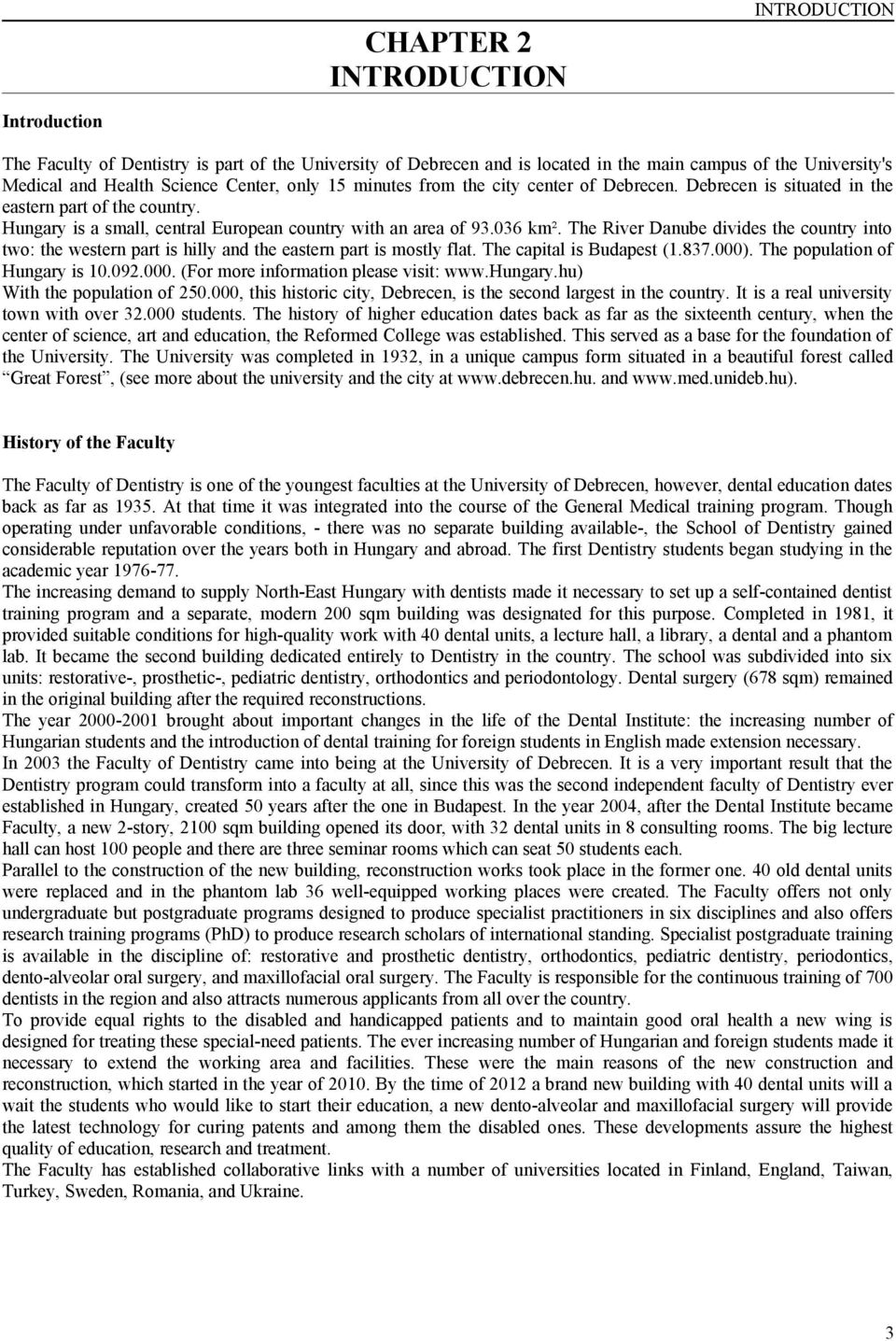
6 CHAPTER 3 CHAPTER 3 ORGANIZATION STRUCTURE OF THE UNIVERSITY OF DEBRECEN RECTOR OF THE UNIVERSITY OF DEBRECEN Rector Zoltán Szilvássy M.D., Ph.D., D.Sc. Address 4032 Debrecen, Egyetem tér 1. Phone Phone/fax [email protected] PRESIDENT OF THE MEDICAL AND HEALTH SCIENCE CENTER President Béla Fülesdi M.D., Ph.D., D.Sc. Address 4032, Debrecen, Nagyerdei krt. 98. Phone Fax [email protected] VICE-PRESIDENTS OF THE MEDICAL AND HEALTH SCIENCE CENTER Vice-President for General Affairs, Dean of the Faculty of Medicine László Mátyus M.D., Ph.D., D.Sc. Address 4032, Debrecen, Nagyerdei krt. 98. Phone Fax [email protected] Vice-President for Clinical Affairs Endre Nagy M.D., Ph.D., D.Sc. Address 4032, Debrecen, Nagyerdei krt. 98. Phone /54166 Fax [email protected] Vice-President for Scientific Affairs Tamás Bíró M.D.,Ph. D.,D.Sc. Address 4032, Debrecen, Nagyerdei krt. 98. Phone Fax [email protected] 4
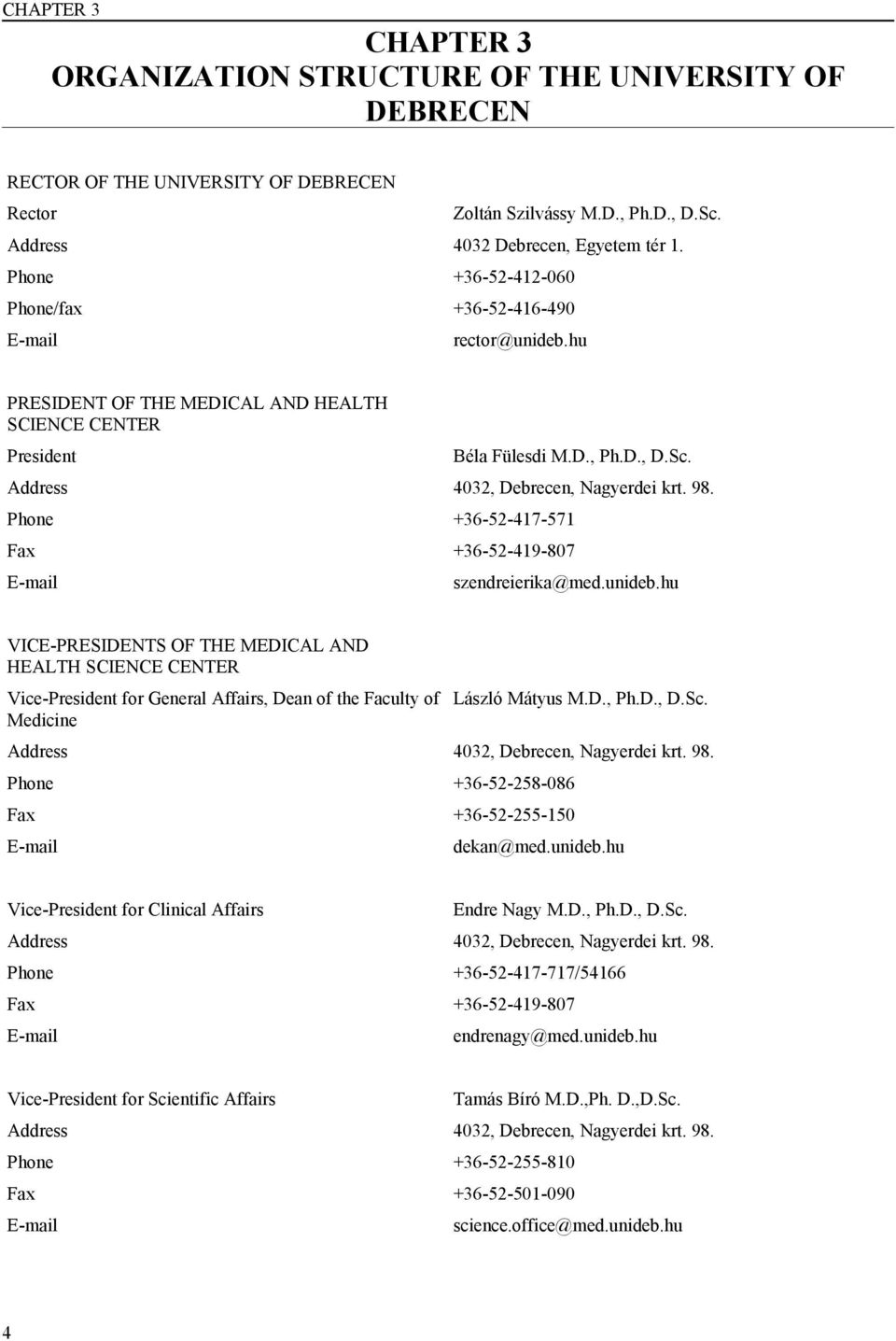
7 ORGANIZATION STRUCTURE OF THE UNIVERSITY OF DEBRECEN Vice-President for Postgraduate Education Róza Ádány M.D., Ph.D., D.Sc. Address 4032, Debrecen, Nagyerdei krt. 98. Phone Fax Vice-President for Strategic Affairs Klára Bíró D.M.D.,MBA.,Ph. D. Address 4032, Debrecen, Nagyerdei krt. 98. Phone Fax VICE-DEANS OF THE FACULTY OF MEDICINE Vice-Dean of Scientific Affairs László Virág M.D.,Ph.D.,D.Sc Address 4032 Debrecen, Nagyerdei krt. 98. Phone Fax Vice-Dean for General Affairs Zoltán Szekanecz M.D.,Ph.D.,D.Sc Address 4032 Debrecen, Nagyerdei krt. 98. Phone Fax Vice-Dean for Educational Affairs Zoltán Papp M.D.,Ph.D.,D.Sc Address 4032 Debrecen, Nagyerdei krt. 98. Phone Fax RECTOR'S OFFICE Address 4010 Debrecen, Egyetem tér 1. Phone Phone/fax DEAN'S OFFICE OF THE FACULTY OF MEDICINE Head Katalin Juhász M.A. Address 4032, Debrecen, Nagyerdei krt
8 CHAPTER 3 Phone/Fax , [email protected] REGISTRAR'S OFFICE Director Csilla Kerékgyártó M.D. Address 4032, Debrecen, Nagyerdei krt. 94. Phone/Fax [email protected] INTERNATIONAL EDUCATION CENTER Director Attila Jenei M.Sc.,Ph.D. Address 4032, Debrecen, Nagyerdei krt. 94. Phone Fax [email protected] FACULTY OF HEALTH Dean Gergely Fábián Ph.D. Address 4400, Nyíregyháza, Sóstói u Phone Fax [email protected] Vice-Dean for Scientific Affairs Imre Semsei DSc. Address 4400 Nyíregyháza, Sóstói út 2-4. Phone Fax [email protected] Vice-Dean for Educational Affairs Attila Sárváry Ph.D. Address 4400 Nyíregyháza, Sóstói út 2-4. Phone Fax [email protected] Vice-Dean for General and Developement Affairs Zsigmond Kósa Ph.D. Address 4400 Nyíregyháza, Sóstói út 2-4. Phone Fax [email protected] 6

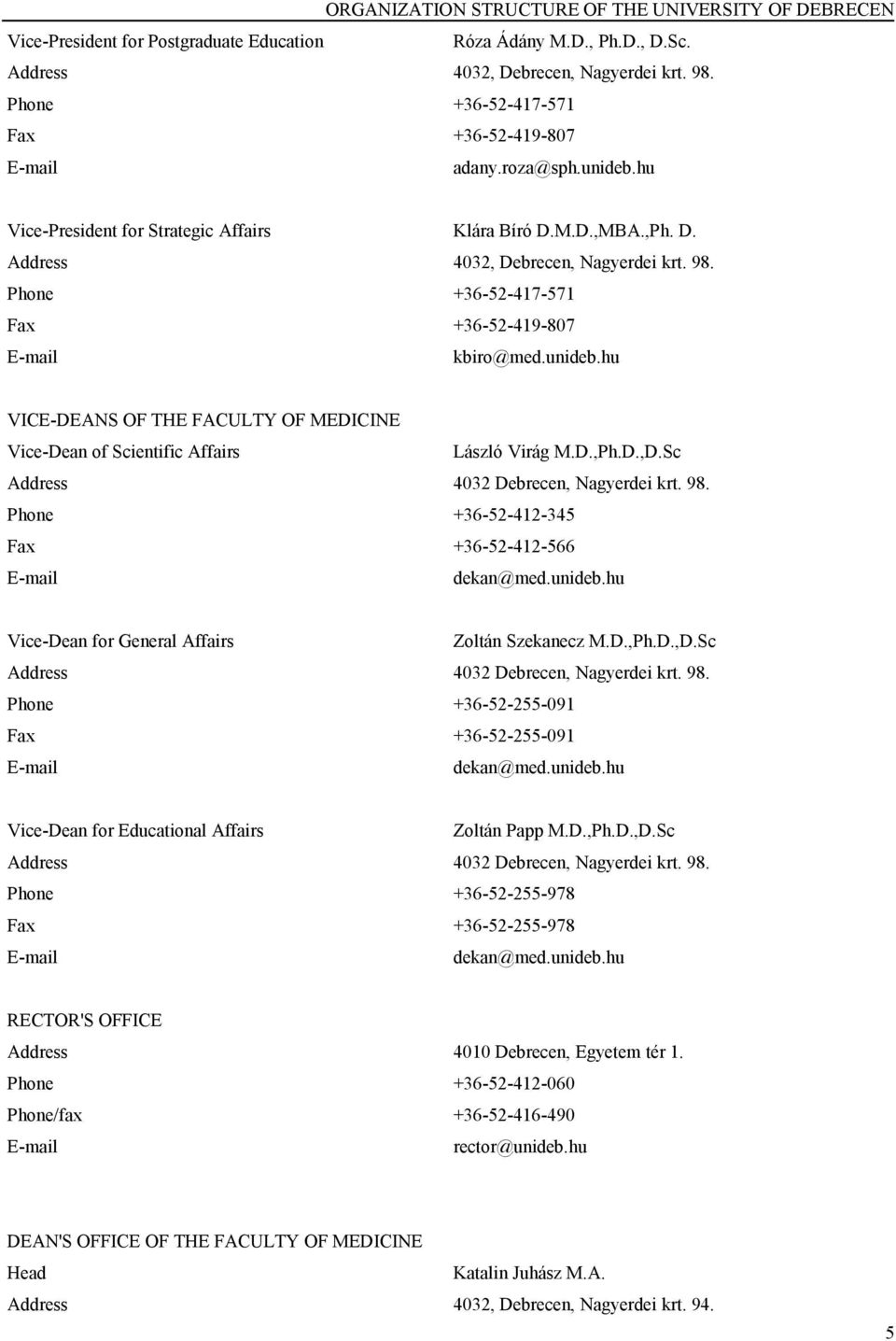
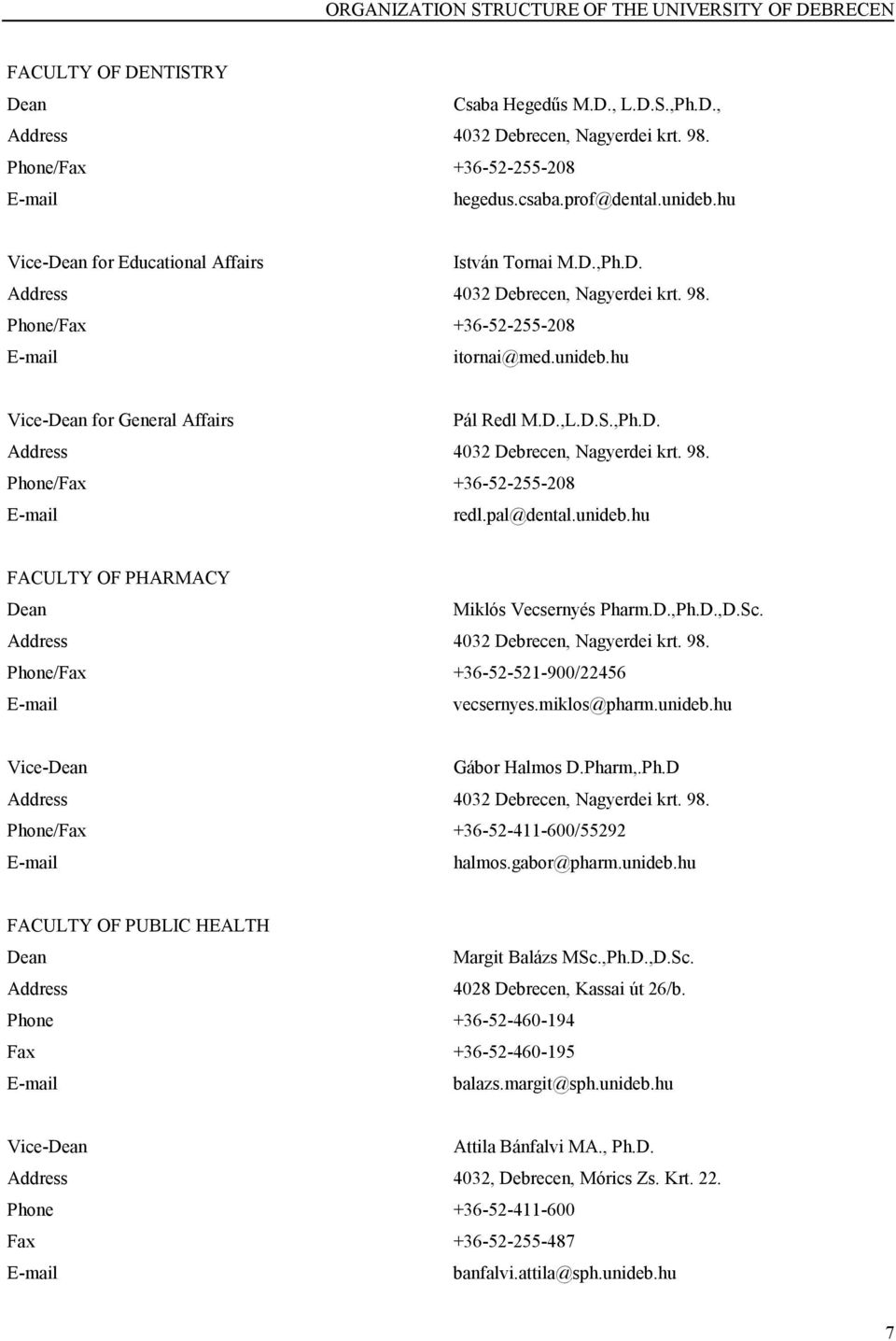
9 ORGANIZATION STRUCTURE OF THE UNIVERSITY OF DEBRECEN FACULTY OF DENTISTRY Dean Csaba Hegedűs M.D., L.D.S.,Ph.D., Address 4032 Debrecen, Nagyerdei krt. 98. Phone/Fax Vice-Dean for Educational Affairs István Tornai M.D.,Ph.D. Address 4032 Debrecen, Nagyerdei krt. 98. Phone/Fax Vice-Dean for General Affairs Pál Redl M.D.,L.D.S.,Ph.D. Address 4032 Debrecen, Nagyerdei krt. 98. Phone/Fax FACULTY OF PHARMACY Dean Miklós Vecsernyés Pharm.D.,Ph.D.,D.Sc. Address 4032 Debrecen, Nagyerdei krt. 98. Phone/Fax / Vice-Dean Gábor Halmos D.Pharm,.Ph.D Address 4032 Debrecen, Nagyerdei krt. 98. Phone/Fax / FACULTY OF PUBLIC HEALTH Dean Margit Balázs MSc.,Ph.D.,D.Sc. Address 4028 Debrecen, Kassai út 26/b. Phone Fax Vice-Dean Attila Bánfalvi MA., Ph.D. Address 4032, Debrecen, Mórics Zs. Krt. 22. Phone Fax
10 CHAPTER 3 FOREIGN MEDICAL STUDENT ASSOCIATION (FMSA) Address 4032 Debrecen, Móricz Zsigmond krt. 22. III.sz. Markusovszky Kollégium Phone /55376 Fax Internet [email protected] KENÉZY LIFE SCIENCES LIBRARY Address 4032 Debrecen, Egyetem tér 1. Phone/Fax , [email protected] Internet 8

11 ORGANIZATION STRUCTURE OF THE UNIVERSITY OF DEBRECEN 9

12 CHAPTER 3 FACULTY OF DENTISTRY Address H-4032 Debrecen, Nagyerdei krt. 98. Phone/Fax Dean, Full Professor Vice-Dean for Educational Affairs, Associate Professor Vice-Dean for General Affairs, Associate Professor Academic Advisor, Clinical Specialist [email protected] [email protected] Csaba Hegedűs, M.D., L.D.S., PhD István Tornai, M.D., PhD Pál Redl, M.D., L.D.S., PhD István Lampé, M.D., L.D.S. Phone/Fax Ext: 56663, Fax: [email protected] Department of Prosthetic Dentistry and Biomaterials Address H-4032 Debrecen, Nagyerdei krt. 98. Phone/Fax Full Professor, Head of Department Csaba Hegedűs, M.D., L.D.S., PhD Assistant Professor Tünde Radics, D.M.D., PhD Tamás Bistey, D.M.D., PhD Assistant Lecturer Rita Mohácsi, D.M.D. Anita Pétercsák, D.M.D. Clinical Specialist István Lampé, M.D., L.D.S. Katalin Bukovinszki, D.M.D. Molecular Biologist Farkas Kerényi M.Sc. Chemist József Bakó M.Sc. Andrea Kuttor M.Sc. Melinda Szalóki M.Sc. Dentist Edit Hrubi D.M.D. Marianna Skaliczki D.M.D. László Póti D.M.D. Academic Advisor István Lampé D.M.D. (ext , 54431; Fax: , [email protected]) 10

13 ORGANIZATION STRUCTURE OF THE UNIVERSITY OF DEBRECEN Department of Restorative Dentistry Address H-4032 Debrecen, Nagyerdei krt. 98. Phone/Fax Full Professor, Head of Department Ildikó Márton, M.D., L.D.S., PhD, D.Sc Associate Professor Barna Kelentey, D.M.D., C.Sc, PhD Assistant Professor Kinga Bágyi, D.M.D., PhD Assistant Lecturer Rita Marincsák, D.M.D. Clinical Specialist Alexander Juhász, D.M.D. Renáta Martos, D.M.D. Clinical Assistant László Nagy, D.M.D. Dentist Bettina Balogh D.M.D. Ágnes Jenei D.M.D. Mária Orosz D.M.D. Liliána Tóth D.M.D. Department of Pediatric Dentistry and Orthodontics Address H-4032 Debrecen, Nagyerdei krt. 98. Phone/Fax /56249 Associate Professor, Head of Department Márta Alberth, M.D., L.D.S., PhD Assistant Professor Judit Nemes, D.M.D., PhD Assistant Lecturer Gabriella Kovalecz, D.M.D. Clinical Specialist Géza Vitályos, D.M.D. Judit Török, D.M.D. Dentist Zsuzsa Papp, D.M.D. Nóra Rácz, D.M.D. Edina Daróczi, D.M.D Viktória Hegedűs D.M.D. 11
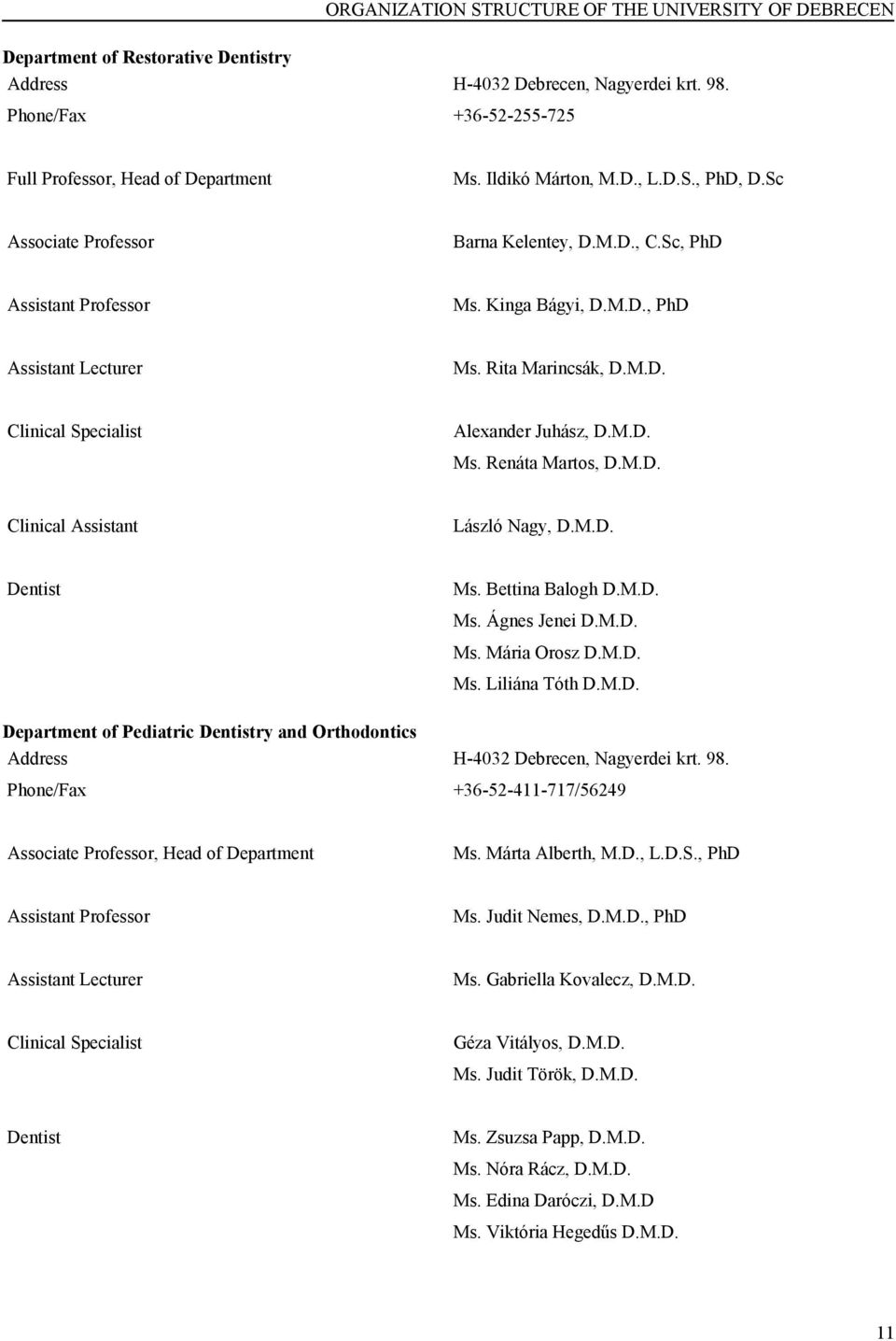
14 CHAPTER 3 Department of Periodontology Address H-4032 Debrecen, Nagyerdei krt. 98. Phone/Fax /55880 Assistant Professor, Head of Department István Varga, D.M.D., PhD Assistant Professor János Angyal, D.M.D., PhD Ildikó Tar, D.M.D., PhD Assistant Lecturer Enikő Gebri, D.M.D. Katinka Hernádi, D.M.D. Dentist Éva Szabó, D.M.D. Andrea Koncz, D.M.D. Nazem Behnam, D.M.D. Department of Oral and Maxillofacial Surgery Address H-4032 Debrecen, Nagyerdei krt. 98. Phone/Fax /55290 Associate Professor, Head of Department Pál Redl, M.D., L.D.S., PhD Assistant Professor Adrienne Szabó, M.D., L.D.S., PhD Assistant Lecturer Róbert Boda, M.D. Levente Lukács, D.M.D. Clinical Assistant Attila Csillik, D.M.D. Etelka D. Tóth D.M.D. Attila Simay M.D. Kálmán Remenyik D.M.D. Candidate Clinical Assistant Levente Czompa M.D. Dóra Horváth M.D. Petronella Révész M.D. Andrei Stelescu M.D. Dentist Máté Kelemen D.M.D. Resident Ferenc Kunka M.D. Sándor Kovách D.M.D. 12
15 ORGANIZATION STRUCTURE OF THE UNIVERSITY OF DEBRECEN Department of Dental Anatomy Address H-4032 Debrecen, Nagyerdei krt. 98. Full Professor, Head of Department Klára Matesz, M.D., PhD, D.Sc Department of Dental Biochemistry Address H-4032 Debrecen, Nagyerdei krt. 98. Full Professor, Head of Department Zsuzsa Szondy, M.D., PhD, D.Sc Associate Professor Attila Jenei, M.Sc., PhD. Department of Dental Physiology and Pharmacology Address H-4032 Debrecen, Nagyerdei krt. 98. Full Professor, Head of Department Péter Nánási, M.D., PhD, D.Sc Department of Oral Microbiology and Pathology Address H-4032 Debrecen, Nagyerdei krt. 98. Associate Professor, Head of Department Balázs Dezső, M.D., PhD Department of Human Surgery and Operative Techniques, Institute of Dental Sciences Address H-4032 Debrecen, Nagyerdei krt. 98. Associate Professor, Head of Department István Juhász, M.D., PhD Department of Dental Medicine Address H-4032 Debrecen, Nagyerdei krt. 98. Associate Professor, Head of Department István Tornai, M.D., PhD Specific dental subject Department of Restorative Dentistry: Odontology, Propedeutics I. (Cariology), Propedeutics II. (Endodontics), Oral Biology, Restorative Dentistry (Cariology and Endodontics) Department of Prosthetic Dentistry: Introduction to the Fixed Prosthodontics, Dental Materials, Propedeutics and Technology of Fixed Prosthodontics, Prosthetic Dentistry, Propedeutics and Technology of Total and Partial Removable Dentures Department of Periodontology: Oral Medicine, Periodontology, Radiology, Dental Radiology Department of Pediatric Dentistry and Orthodontics: Preventive Dentistry, Pediatric Dentistry, Orthodontics Department of Oral and Maxillofacial Surgery: Oral Surgery Propedeutics, Oral Surgery 13

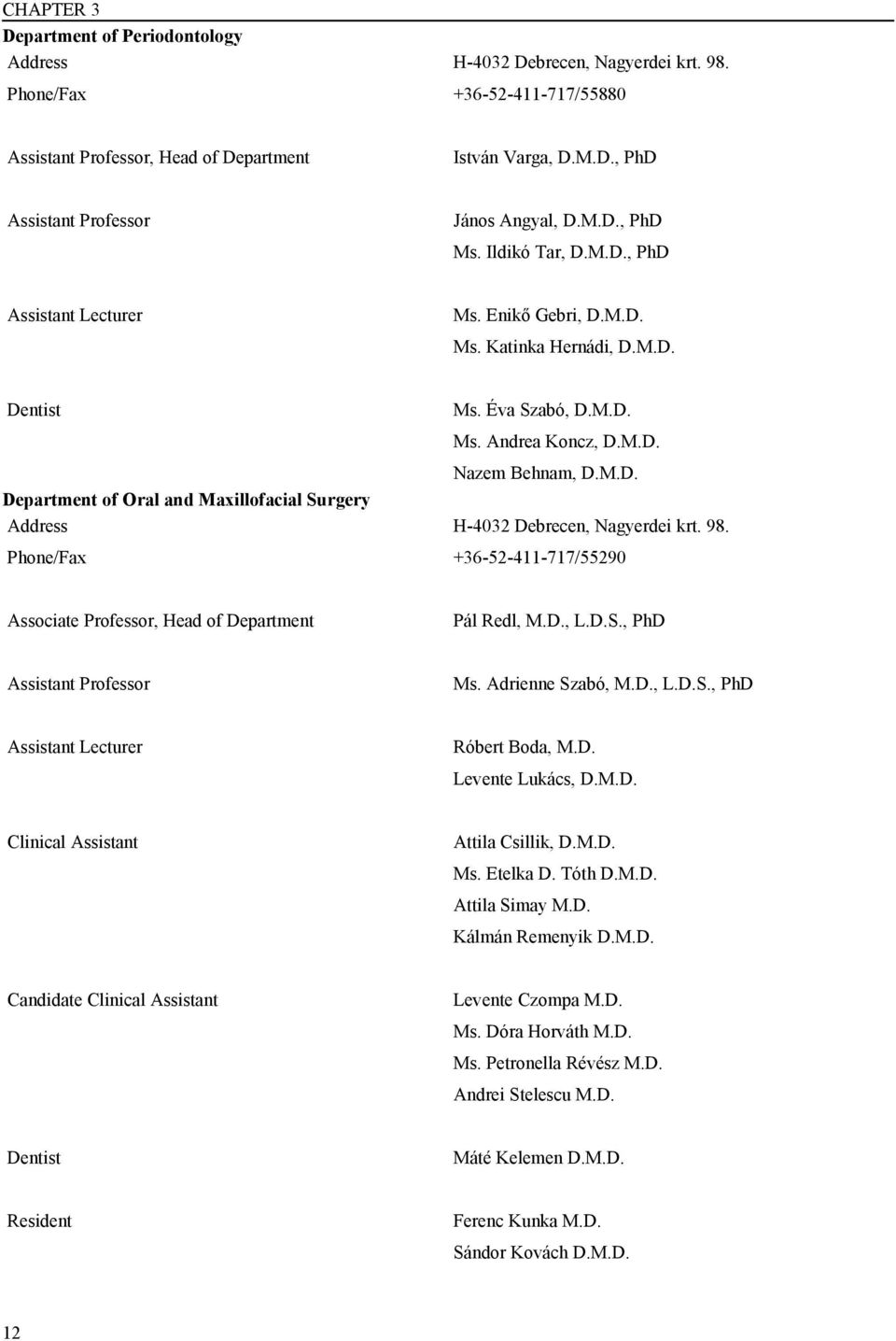
16 CHAPTER 3 Basic and general medical subject coordination Department of Dental Anatomy: Oral Anatomy, Histology and Embriology, Neurobiology, Cell Biology Department of Dental Physiology and Pharmacology: Dental Physiology, Immunology, Dental Pharmacology Department of Dental Biochemistry: Genetics, Biophysics, Medical Chemistry, Biochemistry, Molecular Biology Department of Dental Medicine: Internal Medicine, Pediatrics, Neurology, Psychiatry Department of Oral Pathology and Microbiology: Forensic Medicine, Dental Microbiology, Complex Pathology Department of Human Surgery and Operative Techniques, Institute of Dental Sciences: Obstetrics and Gynecology, Ophthalmology, Otolaryngology, Traumatology, Dermatology, Basic Surgical Techniques 14
17 ORGANIZATION STRUCTURE OF THE UNIVERSITY OF DEBRECEN 15

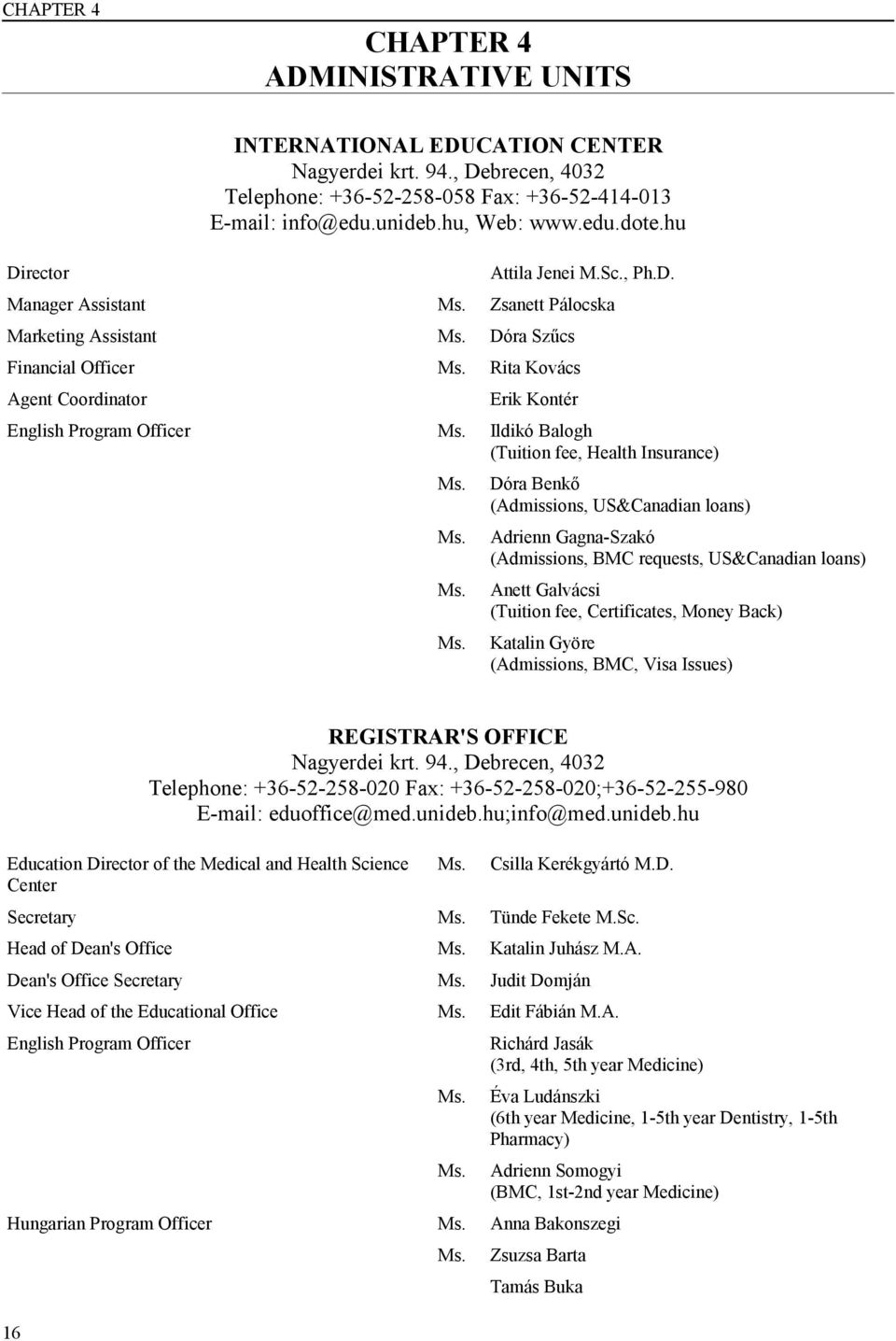
18 CHAPTER 4 CHAPTER 4 ADMINISTRATIVE UNITS Director INTERNATIONAL EDUCATION CENTER Nagyerdei krt. 94., Debrecen, 4032 Telephone: Fax: [email protected], Web: Attila Jenei M.Sc., Ph.D. Manager Assistant Zsanett Pálocska Marketing Assistant Dóra Szűcs Financial Officer Rita Kovács Agent Coordinator Erik Kontér English Program Officer Ildikó Balogh (Tuition fee, Health Insurance) Dóra Benkő (Admissions, US&Canadian loans) Adrienn Gagna-Szakó (Admissions, BMC requests, US&Canadian loans) Anett Galvácsi (Tuition fee, Certificates, Money Back) Katalin Györe (Admissions, BMC, Visa Issues) REGISTRAR'S OFFICE Nagyerdei krt. 94., Debrecen, 4032 Telephone: Fax: ; [email protected];[email protected] Education Director of the Medical and Health Science Center Csilla Kerékgyártó M.D. Secretary Tünde Fekete M.Sc. Head of Dean's Office Katalin Juhász M.A. Dean's Office Secretary Judit Domján Vice Head of the Educational Office Edit Fábián M.A. English Program Officer Richárd Jasák (3rd, 4th, 5th year Medicine) Éva Ludánszki (6th year Medicine, 1-5th year Dentistry, 1-5th Pharmacy) Adrienn Somogyi (BMC, 1st-2nd year Medicine) Hungarian Program Officer Anna Bakonszegi 16 Zsuzsa Barta Tamás Buka
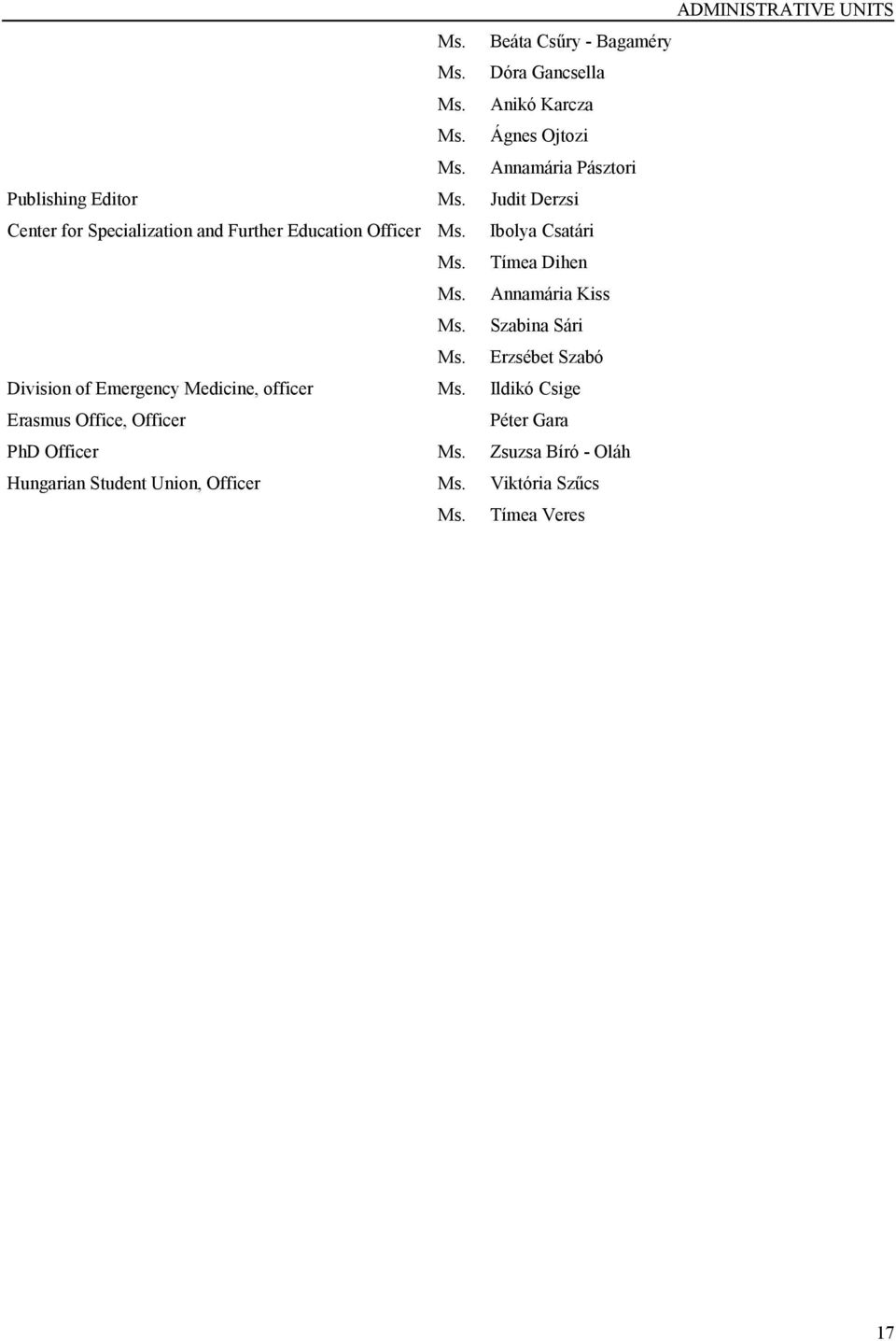
19 ADMINISTRATIVE UNITS Beáta Csűry - Bagaméry Dóra Gancsella Anikó Karcza Ágnes Ojtozi Annamária Pásztori Publishing Editor Judit Derzsi Center for Specialization and Further Education Officer Ibolya Csatári Tímea Dihen Annamária Kiss Szabina Sári Erzsébet Szabó Division of Emergency Medicine, officer Ildikó Csige Erasmus Office, Officer Péter Gara PhD Officer Zsuzsa Bíró - Oláh Hungarian Student Union, Officer Viktória Szűcs Tímea Veres 17
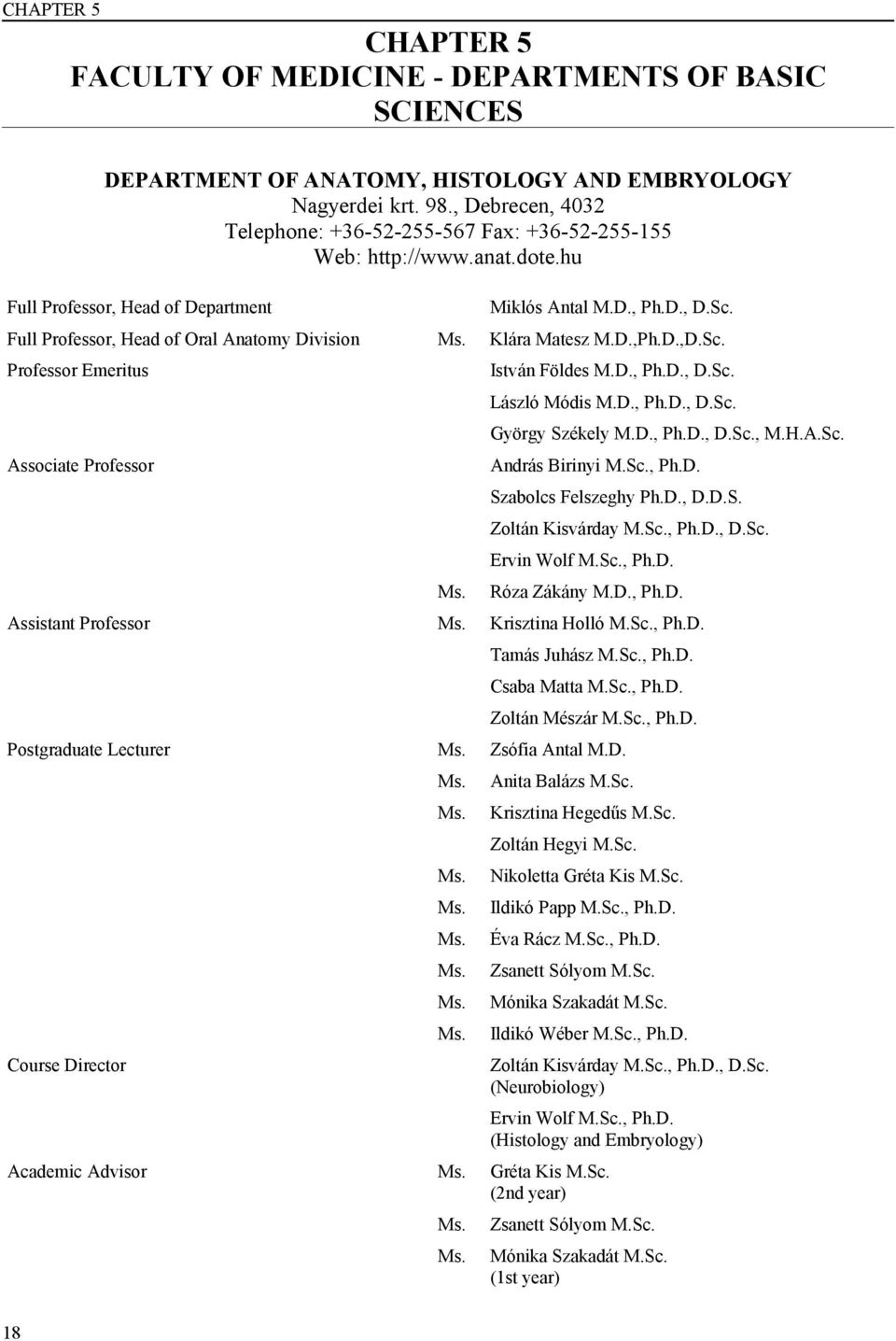
20 CHAPTER 5 CHAPTER 5 FACULTY OF MEDICINE - DEPARTMENTS OF BASIC SCIENCES DEPARTMENT OF ANATOMY, HISTOLOGY AND EMBRYOLOGY Nagyerdei krt. 98., Debrecen, 4032 Telephone: Fax: Web: Full Professor, Head of Department Miklós Antal M.D., Ph.D., D.Sc. Full Professor, Head of Oral Anatomy Division Klára Matesz M.D.,Ph.D.,D.Sc. Professor Emeritus Associate Professor István Földes M.D., Ph.D., D.Sc. László Módis M.D., Ph.D., D.Sc. György Székely M.D., Ph.D., D.Sc., M.H.A.Sc. András Birinyi M.Sc., Ph.D. Szabolcs Felszeghy Ph.D., D.D.S. Zoltán Kisvárday M.Sc., Ph.D., D.Sc. Ervin Wolf M.Sc., Ph.D. Róza Zákány M.D., Ph.D. Assistant Professor Krisztina Holló M.Sc., Ph.D. Tamás Juhász M.Sc., Ph.D. Csaba Matta M.Sc., Ph.D. Zoltán Mészár M.Sc., Ph.D. Postgraduate Lecturer Zsófia Antal M.D. Course Director Anita Balázs M.Sc. Krisztina Hegedűs M.Sc. Zoltán Hegyi M.Sc. Nikoletta Gréta Kis M.Sc. Ildikó Papp M.Sc., Ph.D. Éva Rácz M.Sc., Ph.D. Zsanett Sólyom M.Sc. Mónika Szakadát M.Sc. Ildikó Wéber M.Sc., Ph.D. Zoltán Kisvárday M.Sc., Ph.D., D.Sc. (Neurobiology) Ervin Wolf M.Sc., Ph.D. (Histology and Embryology) Academic Advisor Gréta Kis M.Sc. (2nd year) Zsanett Sólyom M.Sc. Mónika Szakadát M.Sc. (1st year) 18
21 FACULTY OF MEDICINE - DEPARTMENTS OF BASIC SCIENCES DEPARTMENT OF BIOCHEMISTRY AND MOLECULAR BIOLOGY Nagyerdei krt. 98., Debrecen, 4032 Telephone: Fax: [email protected], Web: Full Professor, Head of Department József Tőzsér M.Sc., Ph.D., D.Sc. Head of Dental Biochemistry Division Zsuzsa Szondy M.D., Ph.D., D.Sc. Full Professor Associate Professor Assistant Professor László Fésüs M.D., Ph.D., D.Sc., M.H.A.Sc. László Nagy M.D., Ph.D., M.H.A.Sc. Zoltán Balajthy M.Sc., Ph.D. Mónika Fuxreiter M.Sc., Ph.D. Réka Révészné Tóth M.Sc., Ph.D. István Szatmári M.Sc., Ph.D. Bálint Bálint L. M.D., Ph.D. Éva Csősz M.Sc., Ph.D. Róbert Király M.Sc., Ph.D. Zsolt Sarang M.Sc., Ph.D. Beáta Scholtz M.Sc., Ph.D. Szilvia Tőkés M.Sc., Ph.D. Academic Advisor Szilvia Tőkés M.Sc., Ph.D. ( [email protected], Ext.:64439) DEPARTMENT OF BIOMEDICAL LABORATORY IMAGING SCIENCE Nagyerdei krt. 98., Debrecen, 4032 Telephone: Fax: [email protected], Web: Associate Professor, Head of Department Full Professor College Professor Ervin Berényi M.D., Ph.D. László Góth M.Sc., Ph.D. Béla Szabó M.D., Ph.D. College Associate Professor Réka Révészné Tóth M.Sc., Ph.D. Assistant Lecturer András Jakab M.D., Ph.D. DEPARTMENT OF BIOPHYSICS AND CELL BIOLOGY Nagyerdei krt. 98., Debrecen, 4032 Telephone: Fax: [email protected], Web: Full Professor, Head of Department Full Professor, Head of Division of Biomathematics Full Professor, Head of Division of Biophysics Full Professor, Head of Division of Cell Biology Full Professor János Szöllősi M.Sc., Ph.D., D.Sc. László Mátyus M.D., Ph.D., D.Sc. György Panyi M.D., Ph.D., D.Sc. Gábor Szabó M.D., Ph.D., D.Sc. György Vereb M.D., Ph.D., D.Sc. 19
22 CHAPTER 5 Professor Emeritus Sándor Damjanovich M.D., Ph.D., D.Sc., M.H.A.Sc. Associate Professor Zsolt Bacsó M.D., Ph.D. Attila Jenei M.Sc., Ph.D. Zoltán Krasznai M.Sc., Ph.D. Péter Nagy M.D., Ph.D. Assistant Professor Zsolt Fazekas M.Sc., Ph.D. Katalin Goda M.Sc., Ph.D. Péter Hajdú M.Sc., Ph.D. Lóránt Székvölgyi M.Sc., Ph.D. Zoltán Varga M.Sc., Ph.D. Assistant Lecturer Éva Hegedűs M.Sc., Ph.D. G. Tibor Szántó M.Sc., Ph.D. Academic Advisor Zsolt Fazekas M.Sc., Ph.D. Associate Professor, Head of Department Professor Emeritus DEPARTMENT OF FORENSIC MEDICINE Nagyerdei krt. 98., Debrecen, 4032 Telephone: Fax: [email protected] László Herczeg M.D., Ph.D. László Buris M.D., Ph.D. Assistant Lecturer Beáta Ágnes Borsay M.D. Péter Gergely M.D. Kálmán Rácz M.D. Csaba Turzó M.D. Full Professor, Head of Department Full Professor Professor Emeritus Associate Professor DEPARTMENT OF HUMAN GENETICS Nagyerdei krt. 98., Debrecen, 4032 Telephone: Fax: [email protected], Web: Sándor Biró M.Sc., Ph.D., D.Sc. László Takács M.D., Ph.D., D.Sc., M.H.A.Sc. György Barabás M.Sc., Ph.D., D.Sc. András Penyige M.Sc., Ph.D. Assistant Professor Zsuzsanna Birkó M.Sc., Ph.D. Assistant Lecturer Academic Advisor Dániel Ernő Beyer M.Sc., Ph.D. Judit Keserű M.Sc., Ph.D. Melinda Szilágyi-Bónizs M.Sc., Ph.D. András Penyige M.Sc., Ph.D. (BMC, Biology, Human Genetics) 20
23 FACULTY OF MEDICINE - DEPARTMENTS OF BASIC SCIENCES DEPARTMENT OF IMMUNOLOGY Egyetem tér 1., Debrecen, 4032 Telephone: Fax: Web: Full Professor, Head of Department Éva Rajnavölgyi M.Sc., Ph.D., D.Sc. Associate Professor Attila Bácsi M.Sc., Ph.D. Árpád Lányi M.Sc., Ph.D. Assistant Lecturer Renáta Laczik M.D., Ph.D. Academic Advisor Attila Szabó M.Sc., Ph.D. Árpád Lányi M.Sc., Ph.D. Full Professor, Head of Department Associate Professor DEPARTMENT OF LABORATORY MEDICINE Nagyerdei krt. 98., Debrecen, 4032 Telephone: Fax: [email protected], Web: János Kappelmayer M.D., Ph.D., D.Sc. Péter Antal-Szalmás M.D., Ph.D. István Balogh M.Sc., Ph.D. Zsuzsa Hevessy M.D., Ph.D. Assistant Professor Adrienne Kerényi M.D., Ph.D. Assistant Lecturer Harjit Pal Bhattoa M.D., Ph.D. László Csáthy M.D. Gergely Ivády M.D. Kornél Miszti-Blasius M.D. Academic Advisor Adrienne Kerényi M.D., Ph.D. DEPARTMENT OF MEDICAL CHEMISTRY Egyetem tér 1., Debrecen, 4010 Telephone: Fax: [email protected], Web: medchem.unideb.hu Full Professor, Head of Department László Virág M.D., Ph.D., D.Sc. Full Professor Viktor Dombrádi M.Sc., Ph.D., D.Sc. Ferenc Erdődi M.Sc., Ph.D., D.Sc. Pál Gergely M.Sc., Ph.D., D.Sc., M.H.A.Sc. Associate Professor Péter Bay M.Sc., Ph.D. Csilla Csortos M.Sc., Ph.D. Ilona Farkas M.Sc., Ph.D. Assistant Professor Éva Bakó M.Sc., Ph.D. Edina Bakondi M.Sc., Ph.D. 21
24 CHAPTER 5 Assistant Lecturer Csaba Hegedűs M.D., M.Sc., Ph.D. Andrea Kiss M.Sc., Ph.D. Beáta Lontay M.Sc., Ph.D. Endre Kókai M.Sc., Ph.D. Academic Advisor Éva Bakó M.Sc., Ph.D. Associate Professor, Head of Department Professor Emeritus Associate Professor DEPARTMENT OF MEDICAL MICROBIOLOGY Nagyerdei krt. 98., Debrecen, 4032 Telephone: Fax: [email protected], Web: mikrobiologia.deoec.hu József Kónya M.D., Ph.D. Lajos Gergely M.D., Ph.D., D.Sc. László Majoros M.D., Ph.D. Judit Szabó M.D., Ph.D. György Veress M.Sc., Ph.D. Assistant Professor Eszter Csoma M.Sc., Ph.D. Krisztina Szarka M.Sc., Ph.D. Assistant Lecturer Zsuzsanna Dombrádi M.Sc., Ph.D. Academic Advisor of Faculty of Medicine Academic Advisor of Faculty of Dentistry Academic Advisor of Faculty of Pharmacy Gábor Kardos M.D., Ph.D. György Veress M.Sc., Ph.D. György Veress M.Sc., Ph.D. László Majoros M.D., Ph.D. DEPARTMENT OF PATHOLOGY Nagyerdei krt. 98., Debrecen, 4032 Telephone: Fax: Web: pathol.med.unideb.hu Associate Professor, Head of Department Full Professor Professor Emeritus Associate Professor, Head of Division of Neuropathology Associate Professor Assistant Lecturer 22 Gábor Méhes M.D., Ph.D. Péter Molnár M.D., D.Sc. Szabolcs Gomba M.D., Ph.D. Zoltán Nemes M.D., M.Sc., Ph.D. Tibor Hortobágyi M.D.,Ph.D. Balázs Dezső M.D., Ph.D. Lukács Baráth M.D. László Bidiga M.D. Julia Lisa Cristofari M.D. Csaba Molnár M.D. Györgyike Soós M.D. Sándor Csaba Szász M.D. László Tóth M.D., Ph.D.
25 FACULTY OF MEDICINE - DEPARTMENTS OF BASIC SCIENCES DEPARTMENT OF PHARMACOLOGY AND PHARMACOTHERAPY Nagyerdei krt. 98., Debrecen, 4032 Telephone: Fax: Web: Full Professor, Head of Department Zoltán Szilvássy M.D., Ph.D., D.Sc. Professor Emeritus Judith Gergely Ph.D., D.Sc., D.Pharm. Associate Professor Ilona Benkő M.D., Ph.D. Assistant Professor Róbert Pórszász M.D.,Ph.D.,MBA József Szentmiklósi M.D., Ph.D. Attila Megyeri M.D., Ph.D. Barna Peitl M.D., Ph.D. Zsuzsanna Réka Sári Ph.D., D.Pharm. Assistant Lecturer Ágnes Cseppentő M.D. László Drimba M.D. Rita Kiss M.D. Academic Advisor Ilona Benkő M.D., Ph.D. Róbert Pórszász M.D.,Ph.D.,MBA Full Professor, Head of Department Full Professor, Head of Dental Physiology and Pharmacology Division Professor Emeritus Associate Professor DEPARTMENT OF PHYSIOLOGY Nagyerdei krt. 98., Debrecen, 4012 Telephone: Fax: Web: László Csernoch M.Sc., Ph.D., D.Sc. Péter Nánási M.D., Ph.D., D.Sc. László Kovács M.D.,Ph.D.,D.Sc.,M.H.A.Sc. Tamás Bányász M.D., Ph.D. Tamás Bíró M.D.,Ph.D.,D.Sc. János Magyar M.D.,Ph.D.,D.Sc. Assistant Professor Szilvia Benkő M.Sc., Ph.D. Assistant Lecturer Research Advisor Academic Advisor Balázs Pál M.D.,Ph.D. Norbert Szentandrássy M.D., Ph.D. János Almássy M.Sc., Ph.D. Balázs Horváth M.D.,Ph.D. István Balázs Tóth M.Sc., Ph.D. István Jóna M.Sc., Ph.D., D.Sc. János Magyar M.D., Ph.D., D.Sc. 23
26 CHAPTER 5 24
27 FACULTY OF MEDICINE - CLINICAL DEPARTMENTS CHAPTER 6 FACULTY OF MEDICINE - CLINICAL DEPARTMENTS DEPARTMENT OF ANESTHESIOLOGY AND INTENSIVE CARE Nagyerdei krt. 98, Debrecen, 4032 Telephone: Web: Full Professor, Head of Department Béla Fülesdi M.D., Ph.D., D.Sc. Associate Professor Judit Hallay M.D., Ph.D. Csilla Molnár M.D., Ph.D. Assistant Professor Katalin Herman M.D. Gabriella Szűcs M.D., Ph.D. Assistant Lecturer Krisztina Béczy M.D. Gyöngyi Békési M.D. Marianna Berhés M.D. Ferenc Bodnár M.D. Emese Csoba M.D. Imre Czifra M.D. Marina Czurkó M.D. Róbert Duris M.D. Edit Éberhardt M.D. Irén Erdei M.D. Anita Fagyas M.D. Ágnes Fekete M.D. Annamária Filep M.D. Andrea Fodor M.D. Judit Gál M.D. Zoltán Gyöngyösi M.D. Judit Gyulaházi M.D. Marianna Juhász M.D. Ilona Kobzos M.D. György Koszta M.D. István László M.D. Boglárka Megyeri M.D. Eszter Mihály M.D. Dániel Nagy M.D. Erzsébet Németh M.D. Lívia Orosz M.D. Tünde Palatka M.D. Balázs Pálóczi M.D. 25
28 CHAPTER 6 Csaba Papp M.D. Erika Pető M.D. Adrienn Pongrácz M.D. Éva Simon M.D. Gábor Sira M.D. Péter Síró M.D. Tamás Sotkovszki M.D. Zsuzsanna Spisák M.D. Erzsébet Szászi M.D. Katalin Szatmári M.D. Emil Szelei M.D. Ildikó Szűcs M.D. Béla Tankó M.D. Adrienn Timkó M.D. Zsolt Ungvári M.D. Magdolna Váradi M.D. Györgyi Vass M.D. Tamás Végh M.D. Eszter Vitális M.D. András Zudor M.D. Academic Advisor Boglárka Megyeri M.D. INSTITUTE OF CARDIOLOGY Nagyerdei krt. 98., Debrecen, 4032 Telephone: Fax: Chairman István Édes M.D., Ph.D., D.Sc. Full Professor, Head of Department Associate Professor Department of Cardiology Móricz Zs. krt. 22., Debrecen, 4032 Telephone: Fax: [email protected], Web: István Édes M.D., Ph.D., D.Sc. Zoltán Csanádi M.D., Ph.D. Ida Hegedűs M.D., Ph.D. Zsolt Kőszegi M.D., Ph.D. Assistant Professor Judit Barta M.D., Ph.D. 26 Annamária Bódi M.D., Ph.D. Attila Borbély M.D., Ph.D. Tibor Fülöp M.D., Ph.D. Tibor Szűk M.D., Ph.D.
29 Cardiologist Assistant Lecturer FACULTY OF MEDICINE - CLINICAL DEPARTMENTS László Balogh M.D. Orsolya Bene M.D. Marcel Clemens M.D., Ph.D. Andrea Daragó M.D. Zita Hertelendi M.D., Ph.D. Gáspár Kenéz M.D. Attila Kertész M.D. Csaba Kun M.D. Andrij Leny M.D. László. Nagy D.M.D. Andrea Péter M.D. Ildikó Rácz M.D. Gábor Sándorfi M.D. Gábor. Szabó M.D. László Fülöp M.D., Ph.D. Szabolcs Gergely M.D. Nóra Homoródi M.D. Csaba Jenei M.D. Rudolf Kolozsvári M.D., Ph.D. Erzsébet Lizanecz M.D., Ph.D. Sándor Sipka M.D., Ph.D. Division of Clinical Physiology Móricz Zs. krt. 22., Debrecen, 4032 Telephone: Fax: [email protected], Web: Full Professor, Head of Division Associate Professor Academic Advisor Zoltán Papp M.D., Ph.D., D.Sc. Attila Tóth M.Sc., Ph.D. Attila Tóth M.Sc., Ph.D. ( [email protected]) Divison of Cardiac Surgery Móricz Zs. krt. 22., Debrecen, 4004 Telephone: Fax: Associate Professor, Head of Division Professor Emeritus Chief Physician Clinical Assistant Tamás Szerafin M.D., Ph.D. Árpád Péterffy M.D., D.Sc. Ambrus Horváth M.D. Tamás Maros M.D. Lehel Palotás M.D. József Simon M.D. István Szentkirályi M.D. 27
30 CHAPTER 6 DEPARTMENT OF CLINICAL ONCOLOGY Nagyerdei krt. 98, Debrecen, 4032 Telephone: Fax: Web: Director Zsolt Horváth M.D., Ph.D. Division of Clinical Oncology Nagyerdei krt. 98., Debrecen, 4032 Telephone: Fax: Web: Head of Division Judit Kocsis M.D., Ph.D. Assistant Professor Csilla András M.D., Ph.D. Clinical Specialist Andrea Gonda M.D., Ph.D. Éva Szekanecz M.D., Ph.D. Balázs Juhász M.D. Mónika Mailáth M.D. Judit Tóth M.D. Academic Advisor Csilla András M.D., Ph.D. Head of Division Senior Health Officer Division of Radiotherapy Nagyerdei krt. 98., Debrecen, 4032 Telephone: Fax: József Erfán M.D. Zsolt Adamecz M.D. Graduate Assistant Mária Besenyői M.D. Ádám Dér M.D. Erzsébet Kollák M.D. Adrienn Opauszki M.D. Hilda Urbancsek M.D. Resident Emese Csiki M.D. Manager Assistant Andrea Furka M.D., Ph.D. Erika Hevesi M.D. Imre Szabó M.D.,Ph.D. Erika Szántó M.D. János Nagy Academic Advisor Mária Besenyői M.D. 28
31 FACULTY OF MEDICINE - CLINICAL DEPARTMENTS DEPARTMENT OF DERMATOLOGY Nagyerdei krt. 98., Debrecen, 4032 Telephone: Fax: [email protected], Web: Full Professor, Head of Department Éva Remenyik M.D., Ph.D., D.Sc. Full Professor, Head of Division of Dermatological Allergology Associate Professor, Head of Division of Human Surgery and Op. Techniques Andrea Szegedi M.D., Ph.D., D.Sc. István Juhász M.D., Ph.D. Professor Emerita Irén Horkay M.D., Ph.D., D.Sc. Professor Emeritus János Hunyadi M.D., Ph.D., D.Sc. Assistant Professor Gabriella Emri M.D., Ph.D. Beatrix Irinyi M.D., Ph.D. Éva Szabó M.D., Ph.D. Dániel Törőcsik M.D., Ph.D. Assistant Lecturer Edina Bodnár M.D. Krisztián Gáspár M.D. Borbála Kiss M.D.,Ph.D. Flóra Kiss M.D., Ph.D. Clinical Assistant Irén Erdei M.D. Senior Consultant Zoltán Péter M.D. Academic Advisor of Faculty of Medicine Gabriella Emri M.D., Ph.D. DEPARTMENT OF INFECTIOUS DISEASES AND PEDIATRIC IMMUNOLOGY Nagyerdei krt. 98., Debrecen, 4032 Telephone: Fax: Web: Full Professor, Head of Department László Maródi M.D.,Ph.D.,D.Sc. Associate Professor Melinda Erdős M.D., Ph.D. Assistant Lecturer Vera Gulácsy M.D. Leonóra Méhes M.D. Research Fellow Beáta Tóth M.Sc., Ph.D. Clinical Assistant Pálma Juházs M.D. Academic Advisor Vera Gulácsy M.D. 29
32 CHAPTER 6 INSTITUTE OF INTERNAL MEDICINE Nagyerdei krt. 98., Debrecen, 4032 Telephone: Fax: Full Professor, Head of Institute György Paragh M.D., Ph.D., D.Sc. Full Professor, Head of Center Full Professor Assistant Professor Assistant Lecturer Center for Bone Marrow Transplantation Nagyerdei krt. 98., Debrecen, 4012 Telephone: Fax: [email protected] Miklós Udvardy M.D., Ph.D., D.Sc. Attila Kiss M.D., Ph.D. László Rejtő M.D., Ph.D. Róbert Szász M.D. Research Fellow Marianna Szarvas Secretary Andrea Szőke Center for Thrombosis and Hemostasis Nagyerdei krt. 98., Debrecen, 4012 Telephone: Fax: [email protected] Full Professor, Head of Center Associate Professor Assistant Professor Assistant Lecturer Zoltán Boda M.D.,Ph.D.,D.Sc. János Mikita M.D., Ph.D. Zsolt Oláh M.D. Ágota Schlammadinger M.D., Ph.D. Péter Ilonczai M.D. Full Professor, Head of Division Assistant Professor Division of Angiology Móricz Zs. krt. 22., Debrecen, 4032 Telephone: Fax: Web: Pál Soltész M.D., Ph.D., D.Sc. György Kerekes M.D., Ph.D. Katalin Veres M.D., Ph.D. Chief Physician Franciska Tizedes M.D. Clinical Specialist Orsolya Tímár M.D. Invited Lecturer Renáta Laczik M.D., Ph.D. Clinical Doctor 30 Richárd Veisz M.D. Ervin Sochka M.D.
33 FACULTY OF MEDICINE - CLINICAL DEPARTMENTS Division of Clinical Immunology Nagyerdei krt. 98, Debrecen, 4012 Telephone: Fax: Web: Full Professor, Head of Division Margit Zeher M.D., Ph.D., D.Sc. Full Professor Edit Bodolay M.D., Ph.D., D.Sc. Professor Emeritus Assistant Professor Assistant Lecturer Katalin Dankó M.D.,Ph.D.,D.Sc. Sándor Sipka M.D., Ph.D. Gyula Szegedi M.D., Ph.D., D.Sc., M.H.A.Sc. Zoltán Csiki M.D., Ph.D. Antónia Szántó M.D., Ph.D. Tünde Tarr M.D., Ph.D. Judit Végh M.D., Ph.D. Zoltán Griger M.D., Ph.D. Éva Zöld M.D., Ph.D. Division of Clinical Pharmacology Nagyerdei krt. 98., Debrecen, 4032 Telephone: Fax: Associate Professor, Head of Division Full Professor Assistant Lecturer Miklós Bodor M.D.,Ph.D. Péter Kovács M.D., Ph.D., D.Sc. Sándor Somodi M.D., Ph.D. Division of Dental Medicine Nagyerdei krt. 98., Debrecen, 4032 Telephone: Fax: [email protected] Associate Professor, Head of Division István Tornai M.D.,Ph.D. Zsuzsanna Vitális M.D., Ph.D. Division of Emergency Medicine Nagyerdei krt. 98., Debrecen, 4032 Telephone: [email protected] Associate Professor, Head of Division Assistant Professor István Lőrincz M.D., Ph.D. Zoltán Vincze M.D., Ph.D. 31
34 CHAPTER 6 Full Professor, Head of Division Professor Emeritus Associate Professor Division of Endocrinology Nagyerdei krt. 98., Debrecen, 4032 Telephone: Endre Nagy M.D., Ph.D., D.Sc. András Leövey M.D., Ph.D., D.Sc. Miklós Bodor M.D.,Ph.D. Chief Consultant Judit Boda M.D. Assistant Lecturer Annamária Erdei M.D. Annamária Gazdag M.D. Division of Gastroenterology Nagyerdei krt. 98., Debrecen, 4012 Telephone: Fax: [email protected] Associate Professor, Head of Division Associate Professor Assistant Professor Assistant Lecturer Senior Consultant István Altorjay M.D.,Ph.D. István Tornai M.D.,Ph.D. Károly Palatka M.D., Ph.D. Mária Papp M.D., Ph.D. Zsuzsa Vitális M.D., Ph.D. Tamás Bubán M.D. Csaba Várvölgyi M.D. Full Professor, Head of Division Division of Geriatry Nagyerdei krt. 98, Debrecen, 4012 Telephone: Fax: Web: Gyula Bakó M.D., Ph.D., D.Sc. Clinical Doctor Adrienn Szabó M.D. Division of Haematology Nagyerdei krt. 98, Debrecen, 4012 Telephone: /55152 Fax: [email protected], Web: 2bel.med.unideb.hu Full Professor, Head of Division Full Professor Assistant Professor 32 Árpád Illés M.D., Ph.D., D.Sc. Miklós Udvardy M.D., Ph.D., D.Sc. Péter Batár M.D., Ph.D. Lajos Gergely M.D., Ph.D., D.Sc. Zsófia Miltényi M.D., Ph.D.
35 FACULTY OF MEDICINE - CLINICAL DEPARTMENTS László Rejtő M.D., Ph.D. László Váróczy M.D., Ph.D. Assistant Lecturer Zsófia Simon M.D.,Ph.D. Róbert Szász M.D. Division of Metabolism Nagyerdei krt. 98., Debrecen, 4032 Telephone: Fax: Full Professor, Head of Division of Metabolism Associate Professor Assistant Professor Assistant Lecturer György Paragh M.D., Ph.D., D.Sc. Zoltán Balogh M.D., Ph.D. Miklós Káplár M.D., Ph.D. Dénes Páll M.D., Ph.D. Péter Fülöp M.D., Ph.D. Mariann Harangi M.D., Ph.D. Zoltán Jenei M.D., Ph.D. Éva Katona M.D., Ph.D. Gergely Nagy M.Sc. Full Professor, Head of Division of Nephrology Professor Emeritus Associate Professor Division of Nephrology Nagyerdei krt. 98., Debrecen, 4032 Telephone: Fax: József Balla M.D., Ph.D., D.Sc. György Kakuk M.D., Ph.D. István Kárpáti M.D., Ph.D. János Mátyus M.D., Ph.D. László Újhelyi M.D., Ph.D. Senior Consultant Csilla Trinn M.D. Associate Professor, Head of Division Division of Rare Diseases Nagyerdei krt. 98, Debrecen, 4012 Telephone: /55196 Fax: [email protected], Web: 2bel.med.unideb.hu György Pfliegler M.D., Ph.D. Assistant Lecturer Boglárka Brúgós M.D., Ph.D. Division of Public Health Medicine Nagyerdei krt. 98., Debrecen, 4012 Associate Professor, Head of Division Assistant Lecturer István Kárpáti M.D., Ph.D. Tamás Köbling M.D. 33
36 CHAPTER 6 Full Professor, Head of Division Associate Professor Division of Rheumatology Nagyerdei krt. 98., Debrecen, 4032 Telephone: Fax: [email protected], Web: Zoltán Szekanecz M.D., Ph.D., D.Sc. Sándor Szántó M.D.,Ph.D. Gabriella Szűcs M.D., Ph.D. Assistant Professor Szilvia Szamosi M.D.,Ph.D. Andrea Váncsa M.D., Ph.D. Assistant Lecturer Edit Végh M.D. Full Professor, Head of Department Full Professor Professor Emeritus DEPARTMENT OF NEUROLOGY Móricz Zs. str. 22., Debrecen, 4032 Telephone: Fax: [email protected] László Csiba M.D., Ph.D., D.Sc. István Fekete M.D., Ph.D., D.Sc. Ferenc Mechler M.D., Ph.D., D.Sc. Associate Professor Tünde Csépány M.D., Ph.D. Tünde Magyar M.D., Ph.D. László Oláh M.D., Ph.D. Assistant Professor Judit Boczán M.D., Ph.D. Eszter Hidasi M.D., Ph.D. Bertalan Vámosi M.D. Assistant Lecturer Krisztina Csapó M.D. Klára Fekete M.D. Norbert Kozák M.D. Zsolt Mezei M.D. DEPARTMENT OF NEUROSURGERY Nagyerdei krt. 98., Debrecen, 4032 Telephone: Fax: Full Professor, Head of Department Associate Professor Academic Advisor László Bognár M.D., Ph.D. Álmos Klekner M.D., Ph.D. László Novák M.D., Ph.D. Sándor Szabó M.D., Ph.D. Sándor Szabó M.D., Ph.D. 34
37 FACULTY OF MEDICINE - CLINICAL DEPARTMENTS DEPARTMENT OF NUCLEAR MEDICINE Nagyerdei krt. 98., Debrecen, 4032 Telephone: Fax: [email protected], Web: option=com_content&view=article&id=77&itemid=265 Associate Professor, Head of the Department Head of Radiochemical Center Full Professor Professor Emeritus József Varga M.Sc., Ph.D. Pál Mikecz M.Sc. László Galuska M.D., Ph.D. Lajos Trón M.Sc., Ph.D., D.Sc. Associate Professor Ildikó Garai M.D., Ph.D. Academic Advisor László Balkay M.Sc., Ph.D. Full Professor, Head of Department Full Professor Professor Emeritus Associate Professor Assistant Professor DEPARTMENT OF OBSTETRICS AND GYNECOLOGY Nagyerdei krt. 98., Debrecen, 4032 Telephone: Fax: [email protected] Róbert Póka M.D., Ph.D. Zoltán Hernádi M.D., Ph.D., D.Sc. Zoltán Tóth M.D., Ph.D., D.Sc. Antal Borsos M.D., Ph.D., D.Sc. László Lampé M.D., Ph.D., D.Sc. Ádám Balogh M.D., Ph.D., D.Sc. Attila Jakab M.D., Ph.D. Tamás Szilveszter Kovács M.D., Ph.D. Tamás Major M.D., Ph.D. Péter Szeverényi M.D., Ph.D. Olga Török M.D., Ph.D. László Birinyi M.D., Ph.D. Roland Csorba M.D., Ph.D. Alpár Gábor Juhász M.D., Ph.D. Zoárd Krasznai M.D., Ph.D. János Zatik M.D., Ph.D. Krasznai Zoárd M.D., Ph.D. Assistant Lecturer Tünde Bartha M.D. Péter Daragó M.D. Tamás Deli M.D., Ph.D. István Fekete M.D., Ph.D., D.Sc. János Lukács M.D. Csaba Móré M.D., Ph.D. 35
38 CHAPTER 6 Academic Advisor (IV. Year) Academic Advisor (VI. year) Péter Török M.D. Szilvia Vad M.D., Ph.D. Tamás Szilveszter Kovács M.D., Ph.D. Tamás Major M.D., Ph.D. Division of Gynecological Oncology Nagyerdei krt. 98., Debrecen, 4032 Telephone: Full Professor, Head of Division of Gynecologic Oncology Full Professor Professor Emeritus Assistant Professor Clinical Specialist Róbert Póka M.D., Ph.D. Zoltán Hernádi M.D., Ph.D., D.Sc. László Lampé M.D., Ph.D., D.Sc. Krasznai Zoárd M.D., Ph.D. Zoárd Krasznai M.D., Ph.D. (Clinical Oncologist) Full Professor, Head of Department DEPARTMENT OF OPHTHALMOLOGY Nagyerdei krt. 98., Debrecen, 4032 Telephone: Fax: András Berta M.D., Ph.D., D.Sc. Associate Professor Erzsébet Balázs M.D., Ph.D. Judit Damjanovich M.D., Ph.D. László Módis M.D., Ph.D., D.Sc. Assistant Professor Adrienne Csutak M.D., Ph.D. Assistant Lecturer Mariann Fodor M.D., Ph.D. Ádám Kemény-Beke M.D., Ph.D. Valéria Nagy M.D., Ph.D. Gábor Németh M.D., Ph.D. Lili Takács M.D., Ph.D. Bence Kolozsvári M.D. Gergely Losonczy M.D., Ph.D. Zita Steiber M.D. Éva Surányi M.D. Bernadett Ujhelyi M.D.,Ph.D. Attila Vajas M.D. Academic Advisor Erzsébet Balázs M.D., Ph.D. Judit Damjanovich M.D., Ph.D. 36
39 FACULTY OF MEDICINE - CLINICAL DEPARTMENTS DEPARTMENT OF ORTHOPEDIC SURGERY Nagyerdei krt. 98., Debrecen, 4032 Telephone: Fax: [email protected], Web: Associate Professor, Head of Department Professor Emeritus Assistant Professor Assistant Lecturer Zoltán Csernátony M.D., Ph.D. János Rigó M.D., Ph.D. Kálmán Szepesi M.D., Ph.D., D.Sc. Zoltán Jónás M.D. Tamás Bazsó M.D. Zsolt Hunya M.D. Zoltán Karácsonyi M.D. László Kiss M.D. János Szabó M.D. Csenge Szeverényi M.D. DEPARTMENT OF OTOLARYNGOLOGY AND HEAD AND NECK SURGERY Nagyerdei krt. 98., Debrecen, 4032 Telephone: Head of Department, Associate Professor Full Professor László Tóth M.D., Ph.D. István Sziklai M.D., Ph.D., D.Sc. Associate Professor Ágnes Tóth M.D., Ph.D. Assistant Professor Assistant Lecturer Tamás Batta M.D., Ph.D. Judit Szilvásy M.D., Ph.D. Attila Szűcs M.D.,Ph.D. Tamás Karosi M.D., Ph.D. Zoltán Papp M.D., Ph.D., D.Sc. Erika Pászti M.D. Szilárd Rezes M.D., Ph.D. Andrea Tóth M.D. INSTITUTE OF PEDIATRICS Nagyerdei krt. 98., Debrecen, 4032 Telephone: /55289 Fax: [email protected], Web: Full Professor, Head of Institute Full Professor, Head of Division of Pediatric Haematology and Oncology György Balla M.D., Ph.D., D.Sc. Csongor Kiss M.D., Ph.D., D.Sc. Professor Emerita Éva Oláh M.D., Ph.D., D.Sc. Associate Professor, Head of Division of General Gábor Mogyorósy M.D., Ph.D. 37
40 CHAPTER 6 Pediatrics Associate Professor, Head of Division of Pediatric Emergency Care Associate Professor Béla Nagy M.D., Ph.D., D.Sc. István Csízy M.D., Ph.D. Ilona György M.D., Ph.D. Rita Káposzta M.D., Ph.D. Ilma Korponay-Szabó M.D., Ph.D. Gábor Mogyorósy M.D., Ph.D. Tamás Szabó M.D., Ph.D. Assistant Professor Enikő Felszeghy M.D.,Ph.D. Éva Nemes M.D., Ph.D. István Szegedi M.D., Ph.D. Judit Tóth M.D. Senior Lecturer Andrea Nagy M.D. Assistant Lecturer Erika Bálega M.D. Academic Advisor Ágnes Papp M.D. István Pataki M.D. Edina Mák M.D. Mariann Márki M.D. Katalin Nagy M.D. Petronella Orosz M.D. Tímea Rózsa M.D. Vanda Soltész M.D. Levente Szabó M.D. Anna Szőllős M.D. Krisztina Vasas M.D. Zsuzsa Zele M.D. Tímea Kincső Zoltán M.D. Tamás Szabó M.D., Ph.D. (for GM students - 5th and 6th year) DEPARTMENT OF PHYSICAL MEDICINE AND REHABILITATION Nagyerdei krt. 98. Pf. 103., Debrecen, 4032 Telephone: Fax: [email protected], Web: Head of Department, Associate Professor Zoltán Jenei M.D., Ph.D. Associate Professor Zsuzsanna Vekerdy-Nagy M.D., Ph.D. 38
41 Head of Department FACULTY OF MEDICINE - CLINICAL DEPARTMENTS DEPARTMENT OF PSYCHIATRY Nagyerdei krt. 98., Debrecen, 4012 Telephone: Fax: Ede Frecska M.D., M.A., Ph.D. Associate Professor Anikó Égerházi M.D., Ph.D. Assistant Professor Academic Advisor Roland Berecz M.D., Ph.D. Theodóra Glaub M.D. Sándor Kézi ( [email protected]) DEPARTMENT OF PULMONOLOGY Nagyerdei krt. 98., Debrecen, 4032 Telephone: Fax: Full Professor, Head of Department Mária Szilasi M.D., Ph.D., D.Sc. Assistant Professor László Brugós M.D. Academic Advisor Andrea Fodor M.D. DEPARTMENT OF RADIOLOGY Nagyerdei krt. 98., Debrecen, 4032 Telephone: / Fax: / [email protected], Web: Full Professor, Head of Department Professor Emeritus Associate Professor Assistant Professor Assistant Lecturer József Kollár M.D., Ph.D. Mózes Péter M.D., Ph.D. János Borbély Ph.D. Mózes Péter jr. M.D. Judit Sikula M.D. Botond Karácsonyi M.D. Éva Pásztor M.D. Academic Advisor Judit Sikula M.D. INSTITUTE OF SURGERY Móricz Zs. krt. 22, Debrecen, 4032 Telephone: /55316 Fax: Web: Full Professor, Chairman Full Professor, Head of Division of Gastroenterology - Oncology Associate Professor, Head of Center for Endocrine and Breast Surgery Associate Professor, Head of Division of Vascular Surgery László Damjanovich M.D., Ph.D. László Damjanovich M.D., Ph.D. Ferenc Juhász M.D., Ph.D. Zoltán Galajda M.D.,Ph.D. 39
42 CHAPTER 6 Consultant Surgeon, Head Of Division Of Organ Transplantation Assistant Professor, Head of Center for Thoratics Surgery Professor Emeritus Consultant Surgeon Assistant Professor Assistant Lecturer Academic Advisor László Asztalos M.D. István Takács M.D.,Ph.D. György Balázs M.D., Ph.D., D.Sc. Géza Lukács M.D., Ph.D., D.Sc. Péter Sápy M.D., Ph.D., D.Sc. Sándor Olvasztó M.D. Ferenc Győry M.D. Zsolt Szentkereszty M.D., Ph.D. Miklós Tanyi M.D.,Ph.D. Tamás Dinya M.D. Attila Enyedi M.D. Roland Fedor M.D. János Pósán M.D. Tamás Dinya M.D. Head of Department, Associate Professor Department of Operative Techniques and Surgical Research Móricz Zs. krt. 22., Debrecen, 4032 Telephone: Fax: Web: Norbert Németh M.D.,Ph.D. Full Professor Irén Mikó M.D., Ph.D. Professor Emeritus István Furka M.D.,Ph.D.,D.Sc. Assistant Professor Katalin Pető M.D.,Ph.D. Assistant Lecturer Postgraduate Lecturer Ádám Deák D.V.M., Ph.D. Ferenc Kiss M.D., Ph.D. Zoltán Klárik M.D. Tamás Lesznyák M.D., D.Pharm. Enikő Tóth M.D. Academic Advisor of Faculty of Medicine Irén Mikó M.D., Ph.D. Academic Advisor of Faculty of Dentistry Academic Advisor of Elective Courses Katalin Pető M.D.,Ph.D. Ferenc Kiss M.D., Ph.D. István Furka M.D.,Ph.D.,D.Sc. Ferenc Kiss M.D., Ph.D. 40
43 FACULTY OF MEDICINE - CLINICAL DEPARTMENTS DEPARTMENT OF TRAUMATOLOGY AND HAND SURGERY Bartók Béla út 2-26., Debrecen, 4031 Telephone: , Fax: [email protected], Web: traumatologia.deoec.hu Associate Professor, Head of Department Full Professor Professor Emeritus Hon. Associate Professor Consultant Academic Advisor Béla Turchányi M.D., Ph.D. Károly Fekete M.D., Ph.D. (med.habil) Zoltán Záborszky M.D., Ph.D. Géza Ács M.D. István Szarukán M.D. Ferenc Urbán M.D. DEPARTMENT OF UROLOGY Nagyerdei krt. 98., Debrecen, 4032 Telephone: Fax: [email protected], Web: Associate Professor, Head of Department Professor Emeritus Associate Professor Assistant Professor Chief Physician Assistant Lecturer Responsible for Educational Matters Tibor Flaskó M.D., Ph.D. Csaba Tóth M.D.,Ph.D.,D.Sc. Attila Varga M.D., Ph.D. Csaba Berczi M.D., Ph.D. Antal Farkas M.D., Ph.D. Béla Tállai M.D., Ph.D. László Lőrincz M.D. Mátyás Benyó M.D. Mátyás Benyó M.D. 41
44 CHAPTER 7 CHAPTER 7 OTHER DEPARTMENTS DEPARTMENT OF BEHAVIOURAL SCIENCES, FACULTY OF PUBLIC HEALTH Nagyerdei krt. 98., Debrecen, 4032 Telephone: Fax: Web: Head of Department, Associate Professor Karolina Kósa M.D., M.Sc., Ph.D. Associate Professor, Head of Division of Clinical And Health Psychology Associate Professor, Head of Division of Humanities For Health Care Professor Emeritus Associate Professor Ildikó Kuritár Szabó M.A., Ph.D. Attila Bánfalvi M.A., Ph.D. Péter Molnár M.D., D.Sc. Antal Bugán M.A., Ph.D. Beáta Erika Nagy M.A., Ph.D. Assistant Professor Margit Bóta M.A., Ph.D. Péter Kakuk M.A., Ph.D. Judit Tánczos M.A., Ph.D. Roland Tisljár M.A., Ph.D. Assistant Lecturer Mária Bálint M.A. Sándor Kőmüves M.A., Ph.D. László Nemes M.A., Ph.D. Anett Szabó-Bartha M.A., Ph.D. Academic Advisor Margit Bóta M.A., Ph.D. (3rd year, Med. Psychology, Dentistry) Ilona Csörsz M.A., Ph.D. (4th year, Behav. Medicine and Behav. Med. Sciences) Péter Kakuk M.A., Ph.D. (4th year, Bioetchics) Judit Tánczos M.A., Ph.D. (1st year, Communication) Roland Tisljár M.A., Ph.D. DEPARTMENT OF FAMILY AND OCCUPATIONAL MEDICINE, FACULTY OF PUBLIC HEALTH Nagyerdei krt. 98., Debrecen, 4032 Telephone: Fax: [email protected], Web: Head of Department Professor Emeritus Senior Lecturer 42 Imre Rurik M.D., M.Sc., Ph.D. István Ilyés M.D., M.Sc., Ph.D. Zoltán Jancsó M.D., Ph.D. (part time)
45 Assistant Lecturer Academic Advisor László Róbert Kolozsvári M.D. (part time) Judit Szidor M.D. Hajnalka Tamás M.D. Imre Rurik M.D., M.Sc., Ph.D. OTHER DEPARTMENTS DEPARTMENT OF PREVENTIVE MEDICINE, FACULTY OF PUBLIC HEALTH Kassai út 26/b, Debrecen, 4028 Telephone: Fax: Full Professor, Head of Department Róza Ádány M.D., Ph.D., D.Sc. Associate Professor, Head of Division István Kárpáti M.D., Ph.D. Full professor, Head of Biomarker Analysis Division Margit Balázs M.Sc., Ph.D., D.Sc. Associate Professor, Head of Biostatistics and Epidemiology Division Associate Professor, Head of Health Promotion Division Associate Professor, Head of Dep. of Hygiene and Infection Control Professor Emeritus Associate Professor Assistant Professor János Sándor M.D., Ph.D. Karolina Kósa M.D., M.Sc., Ph.D. Piroska Orosi M.D., Ph.D. Pál Kertai M.D., Ph.D., D.Sc. Balázs Ádám M.D., M.Sc., Ph.D. Helga Bárdos M.D., M.Sc., Ph.D. Sándor Gődény M.D., Ph.D. Sándor Szűcs M.Sc., Ph.D. Ervin Árnyas M.Sc., Ph.D. Assistant Lecturer Éva Bíró M.D. Szilvia Fiatal M.D., Ph.D. Tamás Köbling M.D. Ágnes Molnár M.D., Ph.D. Attila Nagy M.D. Réka Tóth M.Sc., Ph.D. Academic Advisor Szilvia Fiatal M.D., Ph.D. Sándor Szűcs M.Sc., Ph.D. CLINICAL RESEARCH CENTER, MHSC Nagyerdei krt. 98., Debrecen, 4032 Telephone: Fax: Associate Professor, Head of Department Zsuzsanna Bereczky M.D., Ph.D. Professor Emeritus László Muszbek M.D., Ph.D., D.Sc., M.H.A.Sc. Associate Professor Jolán Hársfalvi M.Sc., Ph.D. 43
46 CHAPTER 7 Assistant Lecturer Krisztina Pénzes-Daku M.Sc. Academic Advisor Zsuzsa Bagoly M.D., Ph.D. ( [email protected], Ext.: 54790) DEPARTMENT OF FOREIGN LANGUAGES, MHSC Nagyerdei krt. 98., Debrecen, 4032 Telephone: Fax: [email protected], Web: ilekt.med.unideb.hu Head of Department Judit Lampéné Zsíros M.A., Ph.D. Teacher Anna Balóné Jóna M.A. Academic Advisor Marianna Fodor M.A. Ildikó Gerő M.A. Jusztina J. Nagy M.A. Judit Kovács M.A. Éva Kövesi M.A. Mónika Krasznai M.A. Zsuzsa Lívia Mezei M.A. László Répás M.A. Emőke Takácsné Tóth M.A. László Répás M.A. DEPARTMENT OF PHYSICAL EDUCATION, MHSC Móricz Zs. krt. 22., Debrecen, 4032 Telephone: /54436 Fax: / [email protected] Head of Department Katalin Nagy Varga M.Sc. Lecturer Miklós Magyarits M.A. Ágoston Nagy Ph.D. László Szoó M.Sc. KENÉZY LIFE SCIENCES LIBRARY, UNIVERSITY OF DEBRECEN Egyetem tér 1., Debrecen, 4032 Telephone: Fax: [email protected], Web: Director-general Márta Virágos Ph.D. IT Specialist László Balázs M.Sc. Károly Driszkó M.Sc. Gabriella Harangi M.Sc. Péter Molnár M.Sc. Collection Development Éva Fórián M.Sc. 44
47 OTHER DEPARTMENTS Zsuzsa Kállai M.Sc. Georgina Molnár M.Sc. Head of Circulation Adrienn Éva Varga M.Sc. Head of Reference Margit Polónyi M.Sc. Circulation Leonárd Petró M.A. Adrienn Éva Varga M.Sc. Administrator Ibolya Németi Reference Erika Fejes M.A. Marianna Papp Czappán M.Sc. Copy Shop Ibolya Égerházi Németi Interlibrary Loan Krisztina Papp Jakucs M.Sc. Journals Kornélia Kulcsár M.Sc. Margit Polónyi M.Sc. Reference Librarian, Publications Ildikó Farkas-Rácz M.Sc. Judit Fazekas-Paragh M.Sc. Edit Görögh M.Sc., Ph.D. Reference Librarian, Web Melinda Korpás Szűcs M.Sc. Boglárka Legeza B.Sc. Stack Attendant Ferenc Bacskai Csaba Horváth 45
48 CHAPTER 8 CHAPTER 8 UNIVERSITY CALENDAR UNIVERSITY CALENDAR FOR DENTISTRY PROGRAM 2013/2014 ACADEMIC YEAR CRASH COURSE OF HUNGARIAN LANGUAGE: 26 th August - 6 th September, 2013 OPENING CEREMONY: 8 th September, 2013 DENTISTRY GRADUATION: July, st SEMESTER Year Course Examination Period Basic Medicine Course 9 th September - 20 th December, 2013 (15 weeks) 21,23,30 December in nd January - 7 th February, 2014 (6,5 weeks) 1 st year Dentistry 2 nd year Dentistry 3 rd year Dentistry 4 th year Dentistry 5 th year Dentistry 9 th September - 20 th December, 2013 (15 weeks) 21,23,30 December in nd January - 7 th February, 2014 (6,5 weeks) 2 nd SEMESTER Year Course Examination Period BMC 10 th February - 23 rd May, 2014 (15 weeks) BMC II 13 th January - 27 th June, 2014 (24 weeks) 26 th May - 20 th June 2014 (4 weeks) 30 th June - 18 th July, 2014 (3 weeks) 1 st year Dentistry 2 nd year Dentistry 3 rd year Dentistry 4 th year Dentistry 10 th February 23 rd May, 2014 (15 weeks) 26 th May 11 th July, 2014 (7 weeks) 5 th year Dentistry 10 th February 2 nd May, 2014 (12 weeks) 5 th May 13 th June, 2014 (6 weeks) SUMMER HOSPITAL PRACTICE Year 1 st year Dentistry 2 nd year Dentistry Date 14 th July - 8 th August or 11 th August - 5 th September, 2014 (4 weeks) 3 rd year Dentistry 14 th July - 25 th July or 28 th July - 8 th August, 2014 (2 weeks) 4 th year Dentistry 14 th July - 8 th August or 11 th August - 5 th September, 2014 (4 weeks) DEADLINE OF ENROLLING FOR THE SUMMER PRACTICE IS 18th APRIL,
49 CHAPTER 9 GENERAL INFORMATION GENERAL INFORMATION The student handbook (bulletin) has been designed to help the students to find their way in educational matters. It lists all the courses, credit points, protocols, guidelines, and information. The faculty reserves the right to add or cancel courses, change the times or locations, revise course requirements and schedules. The rules and regulations can be found in detailed form in the syllabus Rules and regulations for English program students. Student enrolled at the University of Debrecen must accept the University rules and requirements. The Faculty is committed to provide the best learning and working environment to all students without discrimination, harassment on the ground of sex, race, disability, religion and belief or national origin. The dental curriculum is special and unique because students perform treatments on patients before getting their doctoral diploma. For the patient safety students must be able to meet the following standards: To treat patient successfully and safely the student must have sufficient motor skill to work with hand and electric instruments. The student must be able to perform palpitation, percussion, auscultation and other diagnostic procedures. The student must have reliable gross and fine muscular movements, senses of touch and vision. The student requires the capability to operate all the dental equipments, both high and low speed hand peaces. The student must be able to take an accurate dental and medical history from the patient. The student must be able to analyze and interpret x-ray and other graphic images which are necessary for the proper diagnosis. Student must be able to perform a visual and tactile dental examination including the observation of the shape, color and abnormalities both extra and intra orally. The students must be able to discuss problems, treatment with the patients, gather and exchange information, give directions during treatment and must be able to give advice to the patients. The student must be able to communicate in oral and in written form and must have the ability to write a patient chart. Student must be able to speak, analyze, synthesize, and integrate and must be able to take oral and written examinations, too. A student must be able to tolerate intellectually and physically the workloads, and to function effectively under stress. The student must have positive personal qualities such as respect, understanding, and concern for others and also must perform a professional doctoral behavior. The Faculty believes that only respect, courtesy and understanding can create and maintain an effective learning and working atmosphere. Interaction based on mutual respect enhances the educational possibilities. Dishonest, unethical, unprofessional behavior, cheating that interferes with teaching, administration or patient care is not tolerated by the Faculty. For proper treatment, infection control and overall hygiene the students must achieve and consistently demonstrate acceptable level of general personal care standards and should dress professionally. A long white laboratory coat must be worn during practical classes. The white coat must be clean and ironed and must not be worn outside the clinical treatment areas. The name badge must be worn when undertaking clinical practical lessons. Budges must be worn in a prominent position where it is clearly visible. Caps, head gears should not be used during patient treatment. Hair should be clean, long-hair should be pinned or held back, so it won t disturb vision, or cause accident. Excessive use of makeup and perfume/aftershave must be avoided. Fingers and fingernails should be clean, trimmed; colored lacquer should not be used during patient treatment. Rings that may compromise clinical protective barriers should not be worn in clinics. Lockers are provided for the protection of students personal belongings. These should not be kept in operation rooms or laboratories. The Faculty however, cannot accept responsibility for loss or theft of property. The cleanliness of the preclinical laboratories is the responsibility of students. When a student completes his or her use of a support area, it should be left in acceptable condition for the next student s use. It is expected that student will exercise care when using school equipment. All equipment failure should be reported immediately. Students must always act in the best interest of the patient. Each student must exhibit professional courtesy toward faculty, supporting staff, fellow students, patients and their relatives. All members of the faculty and administration are available to consult with students on personal and professional matters but only at given hours. Consulting hours can be found on the main, the departmental and the Dean's office information boards. General description of graduate training The education at the faculty of dentistry takes five year which is divided into 10 semesters. The duration of each semester is 15 weeks with the exception of the last semester, which lasts 12 weeks. An academic year consists of two semesters: the fall and spring semesters. No student can be admitted later than 10 days after opening of an academic semester. The requirement for participation through attendance is a critical part of education. The attendance policy is established by the course directory for each course and published in the Bulletin. Excessive absence may result in failing the course. Absence in access of 20% of the total hours in any dental course will result that the student can not 47
50 CHAPTER 9 complete the semester. There is no possibility to compensate the missed practical lessons. The faculty uses the credit system accepted all over the world. The credit sum that the student must achieve by the end of the fifth year is 300 points, comprised of compulsory (80%), required elective (15%) and freely chosen subjects (5%). The students must take into consideration that precondition for the selection of one certain subject might be the successful completion of another. The credit system allows the student to have an individualized learning program. In order to maintain continuity in the curriculum, an absence from the program should not extend more than a week. To get the credit points the student must take required final examination of the course. An absence from an examination will be counted as a grade of 1 (fail). To get the D.D. S diploma the students must complete the prescribed curriculum, pass the necessary examinations, and receive the required 300 credit points, write and defend their thesis and have a successful State Dental Examination part I (written) and Part II (oral). Failure to take the written examination means that part II (oral) can not be taken until the student passes the part I. Courses are categorized into 4 modules (basic, general and preclinical dentistry and general medical and clinical dentistry) as defined by the qualification requirements. Students must complete a certain percentage of the total credit number in each module as prescribed by the Rules and Regulations. Students must earn 285 credits out of the 300 by completing the compulsory, required elective subjects. Subjects of the basic modul: General and dental preclinical modules: Biophysics 5 Basic dentistry modules Biostatistics 2 Odontology Medical Chemistry 9 Preventive Dentistry Anatomy, Histology and Embryology 7 Dental Materials Medical Genetics 2 Introduction to fixed prosthodontics Molecular biology 6 Restorative Dentistry Propedeutics (Cariology, Endodontics) Cell Biology 7 Prosthetics Dentistry Propedeutics First Aid and Reanimation 1 Oral Biology Biochemistry I-II. 13 Radiology and Dental Radiology Dental Physiology I-II. 14 Oral Surgery Propedeutics Neurobiology 8 Psychology 2 Pathology I-II. 11 Clinical Biochemistry I-II. 3 Immunology 3 Surgery 2 Basic Surgical Techniques 1 Bioethics 1 Dental Microbiology 4 General medical modules Clinical dentistry modules Internal medicine I-II 5 Pediatric Dentistry I-IV 6 Dermatology 1 Periodontology I-III. 8 Otolaryngology 1 Prosthetic Dentistry I-IV
51 GENERAL INFORMATION Pharmacology I-II. 7 Oral Surgery I-IV 11 Preventive Medicine 3 Restorative Dentistry I-IV. 18 Traumatology 1 Orthodontics I-II. 3 Oxyology 2 Oral Medicine 2 Pediatrics 2 Neurology 1 Forensic Medicine 1 Ophthamology 1 Obstetrics and Gynecology 1 DEGREE REQUIREMENTS 1. Final comprehensive exam in Behavioral Sciences. The exam requires the completion of the Psychology I-II and the Ethic courses, as well as the completion of 2 required elective courses of Behavioral Sciences. 2. Completion of the Physical Education courses as prescribed by the Curriculum. 3. Completion of the summer practices. 4. Final comprehensive exam of Pathology I. II. and 2 special Pathology required elective courses for dental students. 5. Successful thesis defense. Compulsory final exams for degree Anatomy Biochemistry Dental Physiology II. Pediatric Dentistry II. Orthodontics II. Restorative Dentistry IV. (Cariology and Endodontics) Periodontology III. Prosthetic Dentistry IV. Oral Surgery IV. Behavioral Sciences Pathology II. Pharmacology II. Internal Medicine II. Important exams for qualification of degree Biophysics Medical Chemistry Oral Anatomy, Histology and Embryology Medical Genetics Molecular Biology Cell Biology Neurobiology Dental Microbiology Clinical Biochemistry II. Preventive Medicine Oxyology 49
52 CHAPTER 10 CHAPTER 10 ACADEMIC PROGRAM FOR THE BASIC MEDICINE COURSE Basic Medicine Course (BMC, Premedical Studies) Duration of studies: 1 year (2 semesters) A one year premedical Basic Medicine Course is recommended to those not having sufficient knowledge in Biology, Physics and Chemistry from high school. The requirements in these premedical science subjects are rigorous thus it is recommended that students who need a period of preparation prior to beginning the General Medicine, Dentistry of Pharmacy Program join the Basic Medicine Course. Students successfully completing the course are directly admitted to their chosen program. In addition to the Basic Medicine Course starting each September our University launches a Short BMC in January as well. DEPARTMENT OF BIOPHYSICS AND CELL BIOLOGY Subject: INTRODUCTION TO BIOPHYSICS I. Year, Semester: Basic Medicine Course 1 st Lecture: 60 Seminar: 30 1 st week: Lecture: 1. Introduction to modern physics. Standards of length, mass, time.2. Conversion of units. Useful mathematics. Trigonometry. 2 nd week: Lecture: 3. Motion in one dimension, displacement, velocity, acceleration, motion diagrams.4. Freely falling objects. 3 rd week: Lecture: 5. Vectors and their properties. Components of vectors. Displacement, velocity and acceleration in two dimensions.6. Motion in two dimensions. Relative velocity. 4 th week: Lecture: 7. The laws of motion. Newton's First, Second and Third Law.8. Applications of Newton's Laws. Forces of friction. Self Control Test (First SCT (Chapters 1-3) 5 th week: Lecture: 9. Energy. Work. Kinetic energy and the workenergy theorem. Gravitational potential energy.10. Spring potential energy. System and energy conservation. Power. Work done by varying forces. 6 th week: Lecture: 11. Momentum and impulse. Conservation of momentum.12. Collisions. Elastic and inelastic collisions. 7 th week: Lecture: 13. Angular speed and angular acceleration. Rotational motion under constant angular acceleration.14. Centripetal acceleration. Newtonian gravitation. Kepler's laws th week: Lecture: 15. Torque and the two conditions for equilibrium. The center of gravity.16. Rotational kinetic energy. Angular momentum. Self Control Test (2nd SCT, Chapters 5-7) 9 th week: Lecture: 17. States of matter. Deformation of solids. The Youngs's, shear and bulk modulus.18. Density and pressure. Variation of pressure with depth. Pressure measurements. Buoyant forces and Archimedes's principle. Fluids in motion. 10 th week: Lecture: 19. Temperature and the zeroth law of thermodynamics. Thermometers and temperature scales. Thermal expansion of solids and fluids.20. Macroscopic description of an ideal gas. The kinetic theory of gases. 11 th week: Lecture: 21. Energy in thermal processes. Heat and internal energy.22. Specific heat. Calorimetry. Latent heat and phase change. Self Control Test (3rd SCT, Chapters 7-9) 12 th week: Lecture: 23. The first law of thermodynamics.24. The second law of thermodynamics. Entropy. Refrigerators and heat pumps. 13 th week: Lecture: 25. Elastic potential energy. Hook's law. Simple harmonic motion. Motion of a pendulum.26. Waves. Frequency, amplitude and wavelength. Interference of waves. Reflection of waves. 14 th week: Lecture: 27. Sound. Energy and intensity of sound waves.
53 Shock waves, standing waves.28. Doppler effect. The ear and the principles of hearing. Self Control Test (4th SCT, Chapters 10-13) ACADEMIC PROGRAM FOR THE BASIC MEDICINE COURSE 15 th week: Lecture: 29. Interactive seminar and preparation for ESE.30. Interactive seminar and preparation for ESE. Requirements The program consists of lectures and seminars. Attendance at seminars is compulsory and is recorded. Place of lectures: Life Science Building, room No or 004. Place of seminars: seminar room of the Department of Biophysics and Cell Biology (Life Science Building) 1. Lectures: Attendance to lectures is emphatically recommended. All material covered in lectures is an integral part of the subject and therefore included in the self-control tests and the final exam. Some new concepts and ideas are discussed in the lectures only and are not present in the textbook. 2. Seminars: Topics of the seminars: 1st week: Information about requirements. Introduction to modern physics. 2nd to 29th weeks: The topics of the seminars follow the topics of the lectures with one or two weeks delay. Attendance to seminars is obligatory. With acceptable excuse students may miss maximum 4 (four) seminars. Students missing 5-7 seminars can not be exempted from the End of Semester Examination or Final Examination, regardless their score reached on the Self Control Tests. Students missing 8 (eight) or more seminars are excluded from the class. Students are encouraged to ask questions related to the topic of the lectures discussed, and participate in solving physical problems related to the topic of the seminar. The course ends with a Final Exam (FE) in the summer examination period. Four FE dates will be set during the 4 weeks of the summer examination period. Unsuccessful students may repeat the FE twice (B and C chances). Exemption is offered for students who achieve excellent academic performance during their study on the following base: Students with higher than 75 % average CT result of the 3 best tests and achieve minimum 50% of the CTs offered in the first semester will be exempted from the ESE. One will be exempted from the Final Examination if he/she achieves minimum pass (2) on each of the eight CTs offered in the first and second semester, and the average of the 3 best CTs in both semesters is higher than 75 %. If the result of the first semester ESE is Good (4) or Excellent (5), and the student is exempted (based on the result of the CTs) in the second semester, he or she will be exempted from the FE. Students who could not meet the above described conditions for exemption during the two semesters must sit for the FE from the whole material of the first and second semesters. Control tests, End of Semester Exams, and Final Exams will be assessed as follows. Percentage: Mark fail (1) pass (2) satisfactory (3) good (4) excellent (5) Absence for any reason counts as 0%. Consulting person: Zsolt Fazekas educational manager Consulting hours: Life Science building seminar room Tuesday Wednesday Thursday Friday
54 CHAPTER 10 DEPARTMENT OF HUMAN GENETICS Subject: INTRODUCTION TO BIOLOGY I. Year, Semester: Basic Medicine Course 1 st Lecture: 60 Seminar: 30 1 st week: Lecture: Introduction. Studying Life. The chemistry of life 1. The chemistry of life 2. 2 nd week: Lecture: Macromolecules and the origin of life 1. Macromolecules, and the origin of life 2. Cells: The Working units of life 1. Cells: The Working units of life 2. 3 rd week: Lecture: Cells: The Working units of life 3. The dynamic cell membrane 1. The dynamic cell membrane 2. The dynamic cell membrane 3. 4 th week: Lecture: Energy, enzymes and metabolism 1. Energy, enzymes and metabolism 2. Energy, enzymes and metabolism 3. Pathways that harvest chemical energy 1. 5 th week: Lecture: Pathways that harvest chemical energy 2. Pathways that harvest chemical energy 3. Photosynthesis: Energy from Sunlight 1. Photosynthesis: Energy from Sunlight 2. Self Control Test 6 th week: Lecture: Chromosomes, the cell cycle and cell division 1. Chromosomes, the cell cycle and cell division 2. Chromosomes, the cell cycle and cell division 3. Chromosomes, the cell cycle and cell division 4. 7 th week: Lecture: Genetics: Mendel and beyond 2. Genetics: Mendel and beyond 3. Genetics: Mendel and beyond 4. Genetics: Mendel and beyond 5. 8 th week: Lecture: DNA and it s role in heredity 1. DNA and it s role in heredity 2. DNA and it s role in heredity 3. From DNA to protein: Genotype, Phenotype 1. Self Control Test 9 th week: Lecture: From DNA to protein: Genotype, Phenotype 2. From DNA to protein: Genotype, Phenotype 3. From DNA to protein: Genotype, Phenotype 4. Genetics of viruses and prokaryotes th week: Lecture: Genetics of viruses and prokaryotes 2. Genetics of viruses and prokaryotes 3. Genetics of viruses and prokaryotes 4. The eukaryotic genome and its expression. 11 th week: Lecture: Recombinant DNA and Biotechnology DNA 1. Recombinant DNA and Biotechnology DNA 2. Genome sequencing, molecular biology and medicine 1. Genome sequencing, molecular biology and medicine th week: Lecture: Cellular signaling and communication 1. Cellular signaling and communication 2. The mechanisms of evolution 1. The mechanisms of evolution 2. Self Control Test 13 th week: Lecture: The evolution of genes and genomes 1. The evolution of genes and genomes 2. Bacteria and Archaea. The origin and diversification of the Eukaryote. 14 th week: Lecture: Fungi: pathogens,parasites and plant partners. Animal origins and the evolution of body plan 1. Animal origins and the evolution of body plan 2. Deuterostomate animals. 15 th week: Lecture: Primates and the evolution of Humans. Primates and the evolution of Humans. Differential gene expression in development 1. Differential gene expression in development 2. 52
55 ACADEMIC PROGRAM FOR THE BASIC MEDICINE COURSE Requirements The 2-semester course consists of lectures and seminars. Attendance at the seminars is compulsory. In each semester four Control Tests (CTs) are organized. The first semester of the course ends with an End of Semester Examination (ESE). Three dates will be set for the ESE the during the winter examination period. Unsuccessful students may repeat the ESE twice (B and C chances). Students who fail even the 3rd ESE (C chance) may continue the study in the second semester; however, they lose their chance to be exempted from the final examination. The course ends with a Final Exam (FE) in the summer examination period. Four FE dates will be set during the 4 weeks of the summer examination period. Unsuccessful students may repeat the FE twice (B and C chances). Exemption is offered for students who achieve excellent academic performance during their study on the following base: Students with higher than 75% average CT result of the 3 best tests (out of the four SCT organized in the first semester) will be exempted from the ESE provided the fourth test result is minimum 50% pass (2). One will be exempted from the Final Examination if he/she achieves minimum pass (2) on each of the eight CTs offered in the first and second semester, and the average of the 3 best CTs in both semesters is higher than 75%. If the result of the first semester ESE is Good (4) or Excellent (5), and the student is exempted (based on the result of the SCTs) in the second semester, he or she will be exempted from the FE. Students who could not meet the above described conditions for exemption during the two semesters must sit for the FE from the whole material of the first and second semesters. Control tests, End of Semester Exams, and Final Exams will be assessed as follows. Percentage(%) Mark : fail (1) : pass (2) : satisfactory (3) : good (4) : excellent (5) Absence for any reason counts as 0%. DEPARTMENT OF MEDICAL CHEMISTRY Subject: INTRODUCTION TO MEDICAL CHEMISTRY I. Year, Semester: Basic Medicine Course 1 st Lecture: 60 Seminar: 30 1 st week: Lecture: Introduction to general chemistry. Elements. Symbols for the elements. The SI system of measurement. Atoms. The structure of atoms. Nuclear arithmetic. Molecules and ions, compounds and mixtures. 2 nd week: Lecture: Chemical formulas. Naming chemical compounds. Chemical equations. Avogadro s number and the mole. Atomic, molecular and molar mass relationships. Stoichiometry: chemical arithmetic. Yields of chemical reactions. Empirical and molecular formulas. 3 rd week: Lecture: Light and the electromagnetic spectrum. Atomic spectra. The Bohr model of the hydrogen atom. The quantum mechanical model of the atom. Orbitals and quantum numbers. Quantum mechanics and atomic spectra. 4 th week: Lecture: Electron configurations and the periodic table. Classification of the elements. Representative and transition elements. The sizes of atoms and ions. Ionization energy, electron affinity, electronegativity. 5 th week: Lecture: FIRST CONTROL TESTChemical bonds: metallic, ionic and covalent bonds. Electron-dot structures for molecular compounds and polyatomic ions. 6 th week: Lecture: Single and multiple covalent bonds. Valence bond theory. Molecular shapes: the VSEPR model. Hybridization. Intermolecular forces. 7 th week: Lecture: The gaseous state. Gases and gas pressure. The gas laws. The ideal gas law. Stoichiometric relationships with gases. Kinetic-molecular theory of gases. 53
56 CHAPTER 10 8 th week: Lecture: Liquid and solid states. Phase changes. Evaporation, vapor pressure, boiling point. Solutions and their properties. Concentration of solutions. Units of concentration: molarity, mass percent, molality. Dilution of solutions. Some factors affecting solubility. The chemistry of water. Ions in aqueous solution: electrolytes and nonelectrolytes. 9 th week: Lecture: SECOND CONTROL TEST. Chemical equilibrium. The equilibrium constant factors that alter the composition of an equilibrium mixture. 10 th week: Lecture: Acids and bases. The ph in solutions of strong acids and strong bases. Equilibria in solutions of weak acids. Equilibria in solutions of weak bases. Relation between Ka and Kb. 11 th week: Lecture: Thermochemistry. Energy changes and energy Requirements conservation. Internal energy and state functions. Expansion work. Energy and enthalpy. The thermodynamic standard state. Hess s law. Chemical calculus. 12 th week: Lecture: THIRD CONTROL TEST. Chemical reactions in perspective. Oxidation and reduction. Oxidation state. 13 th week: Lecture: The activity series of the elements. Balancing redox reactions. Galvanic cells. 14 th week: Lecture: Hydrogen. The main group elements. Noble gases.the s-block and p-block metals. The d-block metals. 15 th week: Lecture: FOURTH CONTROL TEST. Summary and discussion. The 2-semester course consists of lectures and seminars. Attendance at the seminars is compulsory. In each semester four Control Tests (CTs) are organized. The first semester of the course ends with an End of Semester Examination (ESE). Three dates will be set for the ESE during the winter examination period. Unsuccessful students may repeat the ESE twice (B and C chances). Students who fail even the 3rd ESE (C chance) may continue the study in the second semester; however, they lose their chance to be exempted from the final examination. The course ends with a Final Exam (FE) in the summer examination period. Four FE dates will be set during the 4 weeks of the summer examination period. Unsuccessful students may repeat the FE twice (B and C chances). Exemption is offered for students who achieve excellent academic performance during their study on the following base: Students with higher than 75 % average CT result of the 3 best tests and achieve minimum 50% of the CTs offeredin the first semester will be exempted from the ESE. One will be exempted from the Final Examination if he/she achieves minimum pass (2) on each of the eight CTs offered in the first and second semester, and the average of the 3 best CTs in both semesters is higher than 75 %. If the result of the first semester ESE is Good (4) or Excellent (5), and the student is exempted (based on the result of the CTs) in the second semester, he or she will be exempted from the FE. Students who could not meet the above described conditions for exemption during the two semesters must sit for the FE from the whole material of the first and second semesters. Control tests, End of Semester Exams, and Final Exams will be assessed as follows. Percentage: Mark : fail (1) : pass (2) : satisfactory (3) : good (4) : excellent (5) Absence for any reason counts as 0%. 54
57 ACADEMIC PROGRAM FOR THE BASIC MEDICINE COURSE DEPARTMENT OF BIOPHYSICS AND CELL BIOLOGY Subject: INTRODUCTION TO BIOPHYSICS II. Year, Semester: Basic Medicine Course 2 nd Lecture: 60 Seminar: 30 1 st week: Lecture: 1. Properties of electric charges. Insulators and conductors. Coulomb's law.2. Electric field. Electric field lines. Electric flux and Gauss's law. 2 nd week: Lecture: 3. Electrical energy and capacitance.4. The parallel plate capacitor. Combinations of capacitors. Energy stored in capacitors. Capacitors with dielectric. 3 rd week: Lecture: 5. Electric current. Current and voltage measurements in circuits. Resistance and Ohm's law.6. Resistivity, temperature variation of resistance. Semiconductors and superconductors. Electrical activity of the heart. Defibrillators. 4 th week: Lecture: 7. Direct current circuits. Resisorts in parallel and series.8. Kirchhoff's rules and complex DC circuits. RC circuits. Conduction of electrical signals by neurons. Self Control Test (1st SCT, Chapters 15-17) 5 th week: Lecture: 9. Magnetism. Megnetic field. Earth's magnetic field. Magnetic force on current carrying conductors. Toque on current loop and electric motors.10. Magnetic field of a long straight wire and Ampere's law. Magnetic field between two parallel conductors. Magnetic field of loops and solenoids. 6 th week: Lecture: 11. Induced emf and magnetic flux. Faraday's law of induction. Motional emf. Lenz's law.12. Generators. Self-inductance RL circuits. 7 th week: Lecture: 13. Alternating current. Resistors, capacitors and inductors in AC circuits.14. The transformer. Properties of electromagnetic waves. The spectrum of electromagnetic waves. 8 th week: Lecture: 15. The nature of light. Reflection, refraction and dispersion.16. Prisms. The rainbow. Huygen's principle. Total internal reflection and its medical applications. Self Control Test (2nd SCT, Chapters 18-21) 9 th week: Lecture: 17. Lenses and mirrors. Flat mirrors. Images formed by spherical mirrors. 18. Thin lenses. Images formed by lenses. Lens aberrations. 10 th week: Lecture: 19. Wave optics. Conditions for interference, polarization of light. Diffraction.20. The camera, the simple magnifier, the compound microscope, the telescope and the eye. 11 th week: Lecture: 21. Quantum physics. Blackbody radiation. Photoelectric effect. Particle theory of light.22. The production and attenuation of X-ray. Characteristic X-ray. Self Control Test (3rd SCT, Chapters 22-25) 12 th week: Lecture: 23. Atomic physics. Early model of the atom. Quantum mechanics and the hydrogen atom. The spin magnetic quantum numbers.24. Lasers and holography. 13 th week: Lecture: 25. Some properties of the nuclei. Binding energy. Radioactivity, the decay processes. Medical application of radioactivity.26. Nuclear reactions. Nuclear fission and fusion. Positron and other antiparticles. Mesons and quarks. Self Control Test (4th SCT, Chapters 26-29) 14 th week: Lecture: Preparation for the final exam. 15 th week: Lecture: Final exam. Requirements The program consists of lectures and seminars. Attendance at seminars is compulsory and is recorded. Place of lectures: Life Science Building Place of seminars: seminar room of the Department of Biophysics and Cell Biology (Life Science Building) 1. Lectures: Attendance to lectures is emphatically recommended. All material covered in lectures is an integral part of the subject and therefore included in the self-control tests and the final exam. Some new concepts and ideas are 55
58 CHAPTER 10 discussed in the lectures only and are not present in the textbook. 2. Seminars: Topics of the seminars: 1st week: Information about requirements. Introduction to modern physics. 2 nd to 29 th weeks: The topics of the seminars follow the topics of the lectures with one or two weeks delay. Attendance to seminars is obligatory. With acceptable excuse students may miss maximum 4 (four) seminars. Students missing 5-7 seminars can not be exempted from the End of Semester Examination or Final Examination, regardless their score reached on the Self Control Tests. Students missing 8 (eight) or more seminars are excluded from the class. Students are encouraged to ask questions related to the topic of the lectures discussed, and participate in solving physical problems related to the topic of the seminar. The course ends with a Final Exam (FE) in the summer examination period. Exemption is offered for students who achieve excellent academic performance during their study term on the following base. In each semester four Self Control Tests (SCTs) are organized. One will be exempted from the Final Examination if he/she achieves minimum 50% on each of the eight SCTs, and the average of the marks of the 3 best SCT in both semesters is higher than 75%. Unsuccessful students may repeat the ESE twice ("B" and "C" chances). Students who fail even the 3rd ESE ("C" chance) may continue the study in the second semester; however, they lose their chance to be exempted from the final examination. If the result of the first semester ESE is Good (4) or Ecxellent (5), and the student is exempted (based on the result of the SCTs) in the second semester, he or she will be exempted from the FE. Students who could not meet the above described conditions for examination during the two semesters must sit for the FE from the whole material of the first and second semesters. If a student successfully passed the exam but is not satisfied with the result may take a repeated "so called improvement exam". In one semester only one improvement exam can be done regardless the number of subjects taken by the student. Control tests and Final Examinations will be assessed as follows. Percentage: Mark : fail (1) : pass (2) : satisfactory (3) : good (4) : excellent (5) Absence for any reason counts as 0%. DEPARTMENT OF FOREIGN LANGUAGES, MHSC Subject: HUNGARIAN LANGUAGE FOR BMC STUDENTS Year, Semester: Basic Medicine Course 2 nd Practical: 36 1 st week: Practical: Introduction, The Hungarian alphabet, Vowel harmony. Greetings. (Köszönések 2. lecke) 2 nd week: Practical: Ki vagy? - Who are you? (1. lecke)számok, Hány óra van? - Numerals, What time is it? (3. lecke) 3 rd week: Practical: Bemutatkozás gyakorlása (dialógusok) Számok. Magyar pénz. Hogy vagy? - Money, How are you? (4., 5. lecke) 4 th week: Practical: Mit csinálsz? - What are you doing? (6. lecke) 56 Verb conjugation 5 th week: Practical: Past tense. Hol voltál tegnap? Mit csináltál múlt héten? - Where were you yesterday? What did you do last week? 6 th week: Practical: Revision. Mid-term test. Self Control Test 7 th week: Practical: Hová mész ma este? - Where are you going tonight? (7. lecke) Hol/Mikor lesz a buli? - Where/When is the party going to be?
59 8 th week: Practical: Mit kérsz? - What would you like? At a buffet. Ordering a pizza. 9 th week: Practical: Kérsz egy kávét? - Would you like a cup of coffee? (9. lecke) Coffee or tea? At a greengrocer's. 10 th week: Practical: Tud/akar/szeret/szeretne gitározni. - ACADEMIC PROGRAM FOR THE BASIC MEDICINE COURSE Can/want/like/would like to play the guitar (10. lecke) Requirements 11 th week: Practical: Revision. 12 th week: Practical: Oral minimum requirement exam. End-term test. Requirements of the language courses (BMC, 1st, 2nd year) Attendance Language class attendance is compulsory. The maximum percentage of allowable absences is 10 % which is a total of 2 out of the 15 weekly classes. The missed classes may be made up only in the same week. Maximally, two language classes may be made up with another group and students have to ask for written permission (via ) 24 hours in advance from the teacher whose class they would like to attend for a makeup because of the limited seats available. Students arriving late for the classes are not allowed to enter the class. Being late is counted as an absence. If the number of absences is more than two, the final signature is refused and the student must repeat the course. Students are required to bring the textbook or other study material given out for the course with them to each language class. Active participation is evaluated by the teacher in every class. If students behaviour or conduct does not meet the requirements of active participation, the teacher may evaluate their participation with a "minus" (-). If a student has 5 minuses, the signature may be refused due to the lack of active participation in classes. Testing, evaluation In each Hungarian language course, students must sit for 2 written language tests and a short minimal oral exam. A further minimum requirement is the knowledge of 200 words per semester announced on the first week. There is a (written or oral) word quiz in the first 5-10 minutes of the class, every week. If a student has 5 or more failed or missed word quizzes he/she has to take a vocabulary exam that includes all 200 words along with the oral exam. The results of word quizzes are added to the average score of the written tests. The oral exam consists of a role-play randomly chosen from a list of situations announced in the beginning of the course. Failing the oral exam results in failing the whole course. The result of the oral exam is added to the average of the mid-term and end-term tests. The minimum requirement for the mid-term and the end-term tests is 50 % each. If a student does not score this much he/she has to repeat the test. Based on the final score the grades are given according to the following table: Final score Grade 0-59 fail (1) pass (2) satisfactory (3) good (4) excellent (5) If the final score is below 60, the student once can take an oral remedial exam covering the whole semester s material. Consultation classes In each language course once a week students may attend a consultation class with one of the teachers of that subject in which they can ask their questions and ask for further explanations of the material covered in that week. These classes are optional. Course book: See the website of the department. Website: Oral exam topics and vocabulary minimum lists are available from the website of the Department of Foreign Languages: ilekt.med.unideb.hu. 57
60 CHAPTER 10 DEPARTMENT OF HUMAN GENETICS Subject: INTRODUCTION TO BIOLOGY II. Year, Semester: Basic Medicine Course 2 nd Lecture: 45 Seminar: 60 1 st week: Lecture: Tissues, Organs and Organ Systems 1. Tissues, Organs and Organ Systems 2. 2 nd week: Lecture: Physiology, Homeostasis and Temperature Regulation. Blood, a fluid tissue 1. Blood, a fluid tissue 2. 3 rd week: Lecture: Circulatory systems 1. Circulatory systems 2. The human circulatory system 1. 4 th week: Lecture: The human circulatory system 2. The lymphatic system. Self Control Test 5 th week: Lecture: Natural Defenses against Disease 1. Natural Defenses against Disease 2. Natural Defenses against Disease 3. 6 th week: Lecture: Nutrition, Digestion and Absorption 1. Nutrition, Digestion and Absorption 2. Nutrition, Digestion and Absorption 3. 7 th week: Lecture: Nutrition, Digestion and Absorption 4. Gas exchange in Animals 1. Gas exchange in Animals 2. 8 th week: Lecture: Salt and Water Balance and Nitrogen Excretion 1. Salt and Water Balance and Nitrogen Excretion 2. Self Control Test Requirements 9 th week: Lecture: Animal Hormones 1. Animal Hormones 2. Animal Hormones th week: Lecture: Animal Hormones 4. Animal Hormones 5. Neurons and Nervous system th week: Lecture: Neurons and Nervous system 2. Neurons and Nervous system 3. Neurons and Nervous system th week: Lecture: Neurons and Nervous system 5. Effectors: making Animals move 1. Self Control Test 13 th week: Lecture: Effectors: making Animals move 2. Effectors: making Animals move 3. Animal reproduction and Animal Development th week: Lecture: Animal reproduction and Animal Development 2. Animal reproduction and Animal Development 3. The human Reproduction System and Sexual Behavior. 15 th week: Lecture: Animal behavior 1. Animal behavior 2. The 2-semester course consists of lectures and seminars. Attendance at the seminars is compulsory. In each semester four Control Tests (CTs) are organized. The first semester of the course ends with an End of Semester Examination (ESE). Three dates will be set for the ESE the during the winter examination period. Unsuccessful students may repeat the ESE twice (B and C chances). Students who fail even the 3rd ESE (C chance) may continue the study in the second semester; however, they lose their chance to be exempted from the final examination. The course ends with a Final Exam (FE) in the summer examination period. Four FE dates will be set during the 4 weeks of the summer examination period. Unsuccessful students may repeat the FE twice (B and C chances). Exemption is offered for students who achieve excellent academic performance during their study on the following base: Students with higher than 75 % average CT result of the 3 best tests (out of the four SCT organized in the first 58
61 ACADEMIC PROGRAM FOR THE BASIC MEDICINE COURSE semester) will be exempted from the ESE provided the fourth test result is minimum 50% pass (2). One will be exempted from the Final Examination if he/she achieves minimum pass (2) on each of the eight CTs offered in the first and second semester, and the average of the 3 best CTs in both semesters is higher than 75 %. If the result of the first semester ESE is Good (4) or Excellent (5), and the student is exempted (based on the result of the SCTs) in the second semester, he or she will be exempted from the FE. Students who could not meet the above described conditions for exemption during the two semesters must sit for the FE from the whole material of the first and second semesters. Control tests, End of Semester Exams, and Final Exams will be assessed as follows. Percentage (%): Mark : fail (1) : pass (2) : satisfactory (3) : good (4) : excellent (5) Absence for any reason counts as 0%. DEPARTMENT OF MEDICAL CHEMISTRY Subject: INTRODUCTION TO MEDICAL CHEMISTRY II. Year, Semester: Basic Medicine Course 2 nd Lecture: 60 Seminar: 30 1 st week: Lecture: The halogens. Compounds of the halogens. Oxygen. Substances with oxygen-oxygen bonds. 2 nd week: Lecture: Sulfur, compounds of sulfur. Industrial acids. Oxoacids. Nitrogen, nitrogen compounds, phosphorus, phosphorus compounds. 3 rd week: Lecture: Carbon and its inorganic compounds. Covalent bonding in organic compounds. 6 th week: Lecture: Aromatic compounds: the structure and properties of benzene and its derivates. Heteroatomic compounds. The reaction of benzene. 7 th week: Lecture: Organic halogen compounds. Alcohols and phenols. 8 th week: Lecture: SIXTH CONTROL TEST. Ethers and organic sulfur compounds. 9 th week: Lecture: Aldehydes, ketones and quinones. Nitrogen containing organic compounds: the structure and properties of amines. Basicity and reactions of amines. 10 th week: Lecture: Heterocyclic amines. Amines of biological importance 11 th week: Lecture: Carboxylic acids: classification and nomenclature. Properties of carboxylic acids. Reactions of carboxylic acids. 4 th week: Lecture: FIFTH CONTROL TEST. Saturated hydrocarbons: alkanes. 12 th week: Lecture: SEVENTH CONTROL TEST. Important 5 th week: carboxylic acids. Carboxylic acid derivatives. Salts and Lecture: Cycloalkanes. Unsaturated hydrocarbons: detergents. alkenes and alkynes. 13 th week: Lecture: Acyl chlorides, anhydrides, esters, amides. 14 th week: Lecture: Stereochemistry. Optical activity: properties of enantiomers and diastereomers. Absolute and realtive configurations. Synthesis of enantiomers. 15 th week: Lecture: EIGHTH CONTROL TEST. Summary and discussion. 59
62 CHAPTER 10 Requirements The 2-semester course consists of lectures and seminars. Attendance at the seminars is compulsory. In each semester four Control Tests (CTs) are organized. The first semester of the course ends with an End of Semester Examination (ESE). Three dates will be set for the ESE during the winter examination period. Unsuccessful students may repeat the ESE twice (B and C chances). Students who fail even the 3rd ESE (C chance) may continue the study in the second semester; however, they lose their chance to be exempted from the final examination. The course ends with a Final Exam (FE) in the summer examination period. Four FE dates will be set during the 4 weeks of the summer examination period. Unsuccessful students may repeat the FE twice (B and C chances). Exemption is offered for students who achieve excellent academic performance during their study on the following base: Students with higher than 75 % average CT result of the 3 tests and achieve minimum 50% of the CTs offered in the first semester will be exempted from the ESE. One will be exempted from the Final Examination if he/she achieves minimum pass (2) on each of the six CTs offered in the first and second semester, and the average of the 3 CTs in both semesters is higher than 75 %. If the result of the first semester ESE is Good (4) or Excellent (5), and the student is exempted (based on the result of the CTs) in the second semester, he or she will be exempted from the FE. Students who could not meet the above described conditions for exemption during the two semesters must sit for the FE from the whole material of the first and second semesters. Control tests, End of Semester Exams, and Final Exams will be assessed as follows. Percentage: Mark fail (1) pass (2) satisfactory (3) good (4) excellent (5) Absence for any reason counts as 0%. 60
63 ACADEMIC PROGRAM FOR THE SHORT BASIC MEDICINE COURSE CHAPTER 11 ACADEMIC PROGRAM FOR THE SHORT BASIC MEDICINE COURSE DEPARTMENT OF BIOPHYSICS AND CELL BIOLOGY Subject: INTRODUCTION TO BIOPHYSICS Year, Semester: Short Basic Medicine Course Lecture: 96 Seminar: st week: Lecture: 1. Introduction to modern physics. Standard of lengths, mass, time. 2. Motion in one dimension, displacement, velocity, acceleration, motion diagrams. 2 nd week: Lecture: 3. Freely falling objects. 4. Motion in two dimensions. Relative velocity. 3 rd week: Lecture: 5. The laws of motion. Newton's First, Second and Third Law. 6. Application of Newton's Laws. Forces of friction. 4 th week: Lecture: 7. Energy. Work. Kinetic energy and the workenergy theorem. Gravitational potential energy. 8. Spring potential energy. System and energy conservation. Power. Work done by varying forces. 5 th week: Lecture: 9. Momentum and impulse. Conservation of momentum. 10. Collisions. Elastic and inelastic collisions. 6 th week: Lecture: 11. Angular speed and angular acceleration. Rotational motion under constant angular acceleration. 12. Centripetal acceleration. 7 th week: Lecture: 13. Torque and the two conditions for equilibrium. The center of gravity. 14. Rotational kinetic energy. Angular momentum. 8 th week: Lecture: 15. States of matter. Deformation of solids. The Youngs s, shear and bulk modulus. 16. Density and pressure. Variation of pressure with depth. Pressure measurements. Buoyant forces and Archimedes s principle. Fluids in motion. 9 th week: Lecture: 17. Temperature and the zeroth law of thermodynamics. Thermometers and temperature scales. Thermal expansion of solids and fluids. 18. Macroscopic description of an ideal gas. The kinetic theory of gases. 10 th week: Lecture: 19. Energy in thermal processes. Heat and internal energy. Specific heat. Calorimetry. Latent heat and phase change. 20. The first law of thermodynamics. 11 th week: Lecture: 21. The second law of thermodynamics. Entropy. Refrigerators and heat pumps. 22. Elastic potential energy. Hook s law. Simple harmonic motion. Motion of a pendulum. 12 th week: Lecture: 23.Waves. Frequency, amplitude and wavelength. Interference of waves. Reflection of waves. 24. Sound. Energy and intensity of sound waves. Shock waves, standing waves. 13 th week: Lecture: 25. Doppler effect. 14 th week: Lecture: 26. Properties of electric charges. Insulators and conductors. Coulomb s law. 27. Electric field. Electric field lines. Electric flux and Gauss s law. 15 th week: Lecture: 28. Electrical energy and capacitance. 29. The parallel plate capacitor. Combinations of capacitors. Energy stored in capacitors. Capacitors with dielectric. 61
64 CHAPTER th week: Lecture: 30. Electric current. Current and voltage measurements in circuits. Resistance and Ohm s law. 31. Resistivity, temperature variation of resistance. Semiconductors and superconductors. Electrical activity of the heart. Defibrillators. 17 th week: Lecture: 32.Direct current circuits. Resistors in parallel and series. 33. Kirchhoff s rules and complex DC circuits. RC circuits. Conduction of electrical signals by neurons. 18 th week: Lecture: 34. Magnetism. Magnetic field. Earth s magnetic field. Magnetic force on current carrying conductors. Torque on a current loop and electric motors. 35. Magnetic field of a long straight wire and Ampere s law. Magnetic field between two parallel conductors. Magnetic field of loops and solenoids. The spectrum of electromagnetic waves. 21 st week: Lecture: 40.The nature of light. Reflection, refraction and dispersion. 41. Prisms. The rainbow. Huygen s principle. Total internal reflection and its medical applications. 22 nd week: Lecture: 42. Lenses and mirrors. Flat mirrors. Images formed by spherical mirrors. 43. Thin lenses. Images formed by lenses. Lens aberrations. 23 rd week: Lecture: 44. Wave optics. Conditions for interference, polarization of light. Diffraction. 45. The camera, the simple magnifier, the compound microscope, the telescope and the eye. 19 th week: Lecture: 36. Induced emf and magnetic flux. Faraday s law of induction. Motional emf. Lenz s law. 37. Generators. Self-inductance RL circuits. 20 th week: Lecture: 38. Alternating current. Resistors, capacitors and inductors in AC circuits. 39. The transformer. Properties of electromagnetic waves. Requirements 24 th week: Lecture: 46. Some properties of the nuclei. Binding energy. Radioactivity, the decay processes. Medical application of radioactivity. 47. Nuclear reactions. Nuclear fission and fusion. Positron and other antiparticles. Mesons and quarks. The course ends with a Final Exam (FE). Exemption is offered for students who achieve excellent academic performance during their study term on the following base. During the term six Self Control Tests (SCTs) are organized. One will be exempted from the Final Examination if he/she achieves minimum pass (2) on each of the six SCTs, and the average of the marks of the 5 best SCTs is higher than 3.5. Three dates will be set for the Final Examinations (FE) during the examination period. Students with higher than 3.5 average mark of the 5 best tests will be exempted from the FE. Students who could not meet the above described conditions for exemption must sit for the FE from the whole material of the semester. Unsuccessful students may repeat the ESE twice ("B" and "C" chances). A student who has successfully passed an exam but is not satisfied with the result may take a repeated (so called "improvement") exam. Only one improvement examination can be done regardless the number of subjects taken by the student. Control tests, End of Semester Exams, and Final Exams will be assesed as follows: Percentage: Mark fail (1) pass (2) satisfactory (3) good (4) excellent (5) Absence counts as 0%. 62
65 ACADEMIC PROGRAM FOR THE SHORT BASIC MEDICINE COURSE Subject: INTRODUCTION TO BIOLOGY Year, Semester: Short Basic Medicine Course Lecture: 96 Seminar: 96 DEPARTMENT OF HUMAN GENETICS 1 st week: Lecture: Introduction; Studying Life, The chemistry of life. 2 nd week: Lecture: Macromolecules and the origin of life; Cells: The Working units of life. 3 rd week: Lecture: Cells: The Working units of life; The dynamic cell membrane. 4 th week: Lecture: Energy, enzymes and metabolism; Pathways that harvest chemical energy. 5 th week: Lecture: Chromosomes, the cell cycle and cell division. 6 th week: Lecture: Chromosomes, the cell cycle and cell division; Genetics: Mendel and beyond. 7 th week: Lecture: Genetics: Mendel and beyond; DNA and it s role in heredity. 8 th week: Lecture: From DNA to protein: Genotype, Phenotype; Genetics of viruses and prokaryotes. 9 th week: Lecture: Genetics of viruses and prokaryotes; The eukaryotic genome and its expression; Recombinant DNA and Biotechnology. 10 th week: Lecture: Recombinant DNA and Biotechnology; Genome sequencing, molecular biology and medicine; Cellular signaling and communication. 11 th week: Lecture: Cellular signaling and communication; The mechanisms of evolution; The evolution of genes and genomes. 12 th week: Lecture: Bacteria and Archaea; Fungi: Recyclers, pathogens,parasites and plant partners. The origin and diversification of the Eukaryotes; Animal origins and the evolution of body plan. 13 th week: Lecture: Tissues, Organs and Organ Systems. 14 th week: Lecture: Physiology, Homeostasis and Temperature Regulation; Blood, a fluid tissue. 15 th week: Lecture: Circulatory systems; The human circulatory system. 16 th week: Lecture: The human circulatory system; The lymphatic system. 17 th week: Lecture: Immunology: gene expression and natural defenses. 18 th week: Lecture: Nutrition, Digestion and Absorption. 19 th week: Lecture: Nutrition, Digestion and Absorption; Gas exchange in Animals. 20 th week: Lecture: Salt and Water Balance and Nitrogen Excretion. 21 st week: Lecture: Animal Hormones. 22 nd week: Lecture: Neurons and Nervous system. 23 rd week: Lecture: Sensory systems; Effectors: How animals get things done. 24 th week: Lecture: Animal reproduction and Animal Development; The human Reproduction System. 63
66 CHAPTER 11 Requirements The program consists of lectures and seminars. Attendance at the seminars is compulsory. In both halves of the program four Control Tests (CTs) are organized. The course ends with a Final Examination (FE). Exemption from the FE is offered for students who achieve excellent academic performance during their study term on the following base. One will be exempted from the FE if he/she achieves minimum pass (2) on each of the eight CTs offered during the program, and the average of the 3 best CTs in both parts is higher than 75 %. Students who could not meet the above described conditions for exemption must sit for the FE from the topics of the entire program. During the 3-week examination period 4 exam dates will be set. Unsuccessful students may repeat the FE twice (B and C chances). Control tests and Final Examinations will be assessed as follows. Percentage (%) Mark fail (1) pass (2) satisfactory (3) good (4) excellent (5) Absence for any reason counts as 0%. DEPARTMENT OF MEDICAL CHEMISTRY Subject: INTRODUCTION TO MEDICAL CHEMISTRY Year, Semester: Short Basic Medicine Course Lecture: 96 Seminar: 96 1 st week: Lecture: L1. Introduction to general chemistry. Elements. Symbols for the elements. The SI system of measurement. L2. Atoms. The structure of atoms. Nuclear arithmetic. Molecules and ions, compounds and mixtures. 2 nd week: Lecture: L1. Chemical formulas. Naming chemical compounds. Chemical equations. Avogadro s number and the mole. Atomic, molecular and molar mass relationships.l2. Stoichiometry: chemical arithmetic. Yields of chemical reactions. Empirical and molecular formulas. 3 rd week: Lecture: L1. Light and the electromagnetic spectrum. Atomic spectra. The Bohr model of the hydrogen atom. The quantum mechanical model of the atom. Orbitals and quantum numbers. L2. Self-control test Self Control Test 4 th week: Lecture: L1. Electron configurations and the periodic table. Classification of the elements. Representative and transition elements.l2. The sizes of atoms and ions. Ionization energy, electron affinity. 5 th week: Lecture: L1. Chemical bonds: metallic, ionic and covalent bonds. Electron-dot structures for molecular compounds and polyatomic ions.l2. Single and multiple covalent bonds. Molecular shapes: the VSEPR model. Valence bond 64 theory. Hybridization. 6 th week: Lecture: L1. Intermolecular forces.l2. First control test 7 th week: Lecture: L1. The gaseous state. Gases and gas pressure. The gas laws. The ideal gas law. Stoichiometric relationships with gases. Kinetic - molecular theory of gases.l2. Liquid and solid states. Phase changes. Evaporation, vapor pressure, boiling point. 8 th week: Lecture: L1. Solutions and their properties. Concentration of solutions. Units of concentration: molarity, mass percent, molality. Dilution of solutions. Some factors affecting solubility.l2. The chemistry of water. Ions in aqueous solution: electrolytes and nonelectrolytes. Reactions in aqueous solution. 9 th week: Lecture: L1. Chemical equilibrium. The equilibrium constant. Factors that alter the composition of an equilibrium mixture.l2. Second control test 10 th week: Lecture: L1. Acids and bases. The ph in solutions of strong acids and strong bases.l2. Equilibria in solutions of weak acids. Equilibria in solutions of weak bases. 11 th week: Lecture: L1. Thermochemistry. Energy changes and
67 energy conservation. Internal energy and state functions. Expansion work. Energy and enthalpy. The thermodynamic standard state. Enthalpies of physical and chemical changes. Hess s law. L2. Oxidation and reduction. Oxidation state. The activity series of the elements. Balancing redox reactions. Galvanic cells. 12 th week: Lecture: L1. Discussion of general chemistry. L2. Third control test 13 th week: Lecture: L1. Introduction to organic chemistry.l2. Saturated hydrocarbons: alkanes. 14 th week: Lecture: L1. Cycloalkanes.L2. Unsaturated hydrocarbons: alkenes and alkynes. 15 th week: Lecture: L1. Aromatic compounds: the structure and properties of benzene.l2. Self - control test Self Control Test 16 th week: Lecture: L1. The reactions of benzene. L2. Heteroaromatic compounds. 17 th week: Lecture: L1. Organic halogen compounds.l2. Alcohols. 18 th week: Lecture: L1. Phenols. Ethers and organic sulfur ACADEMIC PROGRAM FOR THE SHORT BASIC MEDICINE COURSE compounds.l2. Fourth control test Requirements 19 th week: Lecture: L1. Aldehydes, ketones and quinones.l2. Nitrogen containing organic compounds: the structure and properties of amines. Basicity and reactions of amines. 20 th week: Lecture: L1. Heterocyclic amines. Amines of biological importance.l2. Carboxylic acids: classification and nomenclature. 21 st week: Lecture: L1. Properties of carboxylic acids. Reactions of carboxylic acids. Dicarboxylic acids. Unsaturated acids.l2. Fifth control test 22 nd week: Lecture: L1. Carboxylic acid derivatives: esters, fats, lactones, amides, lactams, thiol esters anhydrides, acyl chlorides. L2. Salts and detergents. Substituted carboxylic acids: halo acids, hydroxy acids, keto acids, amino acids. 23 rd week: Lecture: L1. Stereochemistry.L2. Types of isomerism. 24 th week: Lecture: L1. Optical activity: properties of enantiomers and diastereomers.l2. Sixth control test Requirements BMCII The program consists of lectures and seminars. Attendance at the seminars is compulsory. Organized (Self Control Tests (SCT) offered for self evaluation but the results of SCTs will not be used for the evaluation of the students performance.) The course ends with a Final Examination (FE). Exemption from the FE is offered for students who achieve excellent academic performance during their study term on the following base. One will be exempted from the FE if he/she achieves minimum pass (2) on each of the six CTs offered during the program, and the average of the 5 best CTs is higher than 75%. Students who could not meet the above described conditions for exemption must sit for the FE from the topics of the entire program. During the 3-week examination period 4 exam dates will be set. Unsuccessful students may repeat the FE twice (B and C chances). Control tests and Final Examinations will be assessed as follows. Percentage: Mark fail (1) pass (2) satisfactory (3) good (4) excellent (5) Absence for any reason counts as 0%. 65
68 CHAPTER 12 CHAPTER 12 ACADEMIC PROGRAM FOR CREDIT SYSTEM ACADEMIC PROGRAM FOR CREDIT SYSTEM The introduction of the credit system became compulsory in every Hungarian university, including the University of Debrecen by September, The aim of the credit system is to ensure that the students' achievements can be properly and objectively evaluated both quantitatively and qualitatively. A credit is a relative index of cumulative work invested in a compulsory, a required elective or a freely chosen subject listed in the curriculum. The credit value of a course is based upon the number of lectures, seminars and practical classes of the given subject that should be attended or participated in (so called "contact hours"), and upon the amount of work required for studying and preparing for the examination(s). Together with the credit(s) assigned to a particular subject (quantitative index), students are given grades (qualitative index) on passing an exam/course/class. The credit system that has been introduced in Hungary meets the standards of the European Credit Transfer System (ECTS). The introduction of the ECTS promotes student mobility and facilitates more effective organization of students' exchange programs aimed at further education in foreign institutions, and allows recognition of the students' work, studies and achievements completed in various foreign departments by the mother institution. Credit-based training is flexible. It provides a wider range of choice, enables the students to make progress at an individual pace, and it also offers students a chance to study the compulsory or required subjects at a different university, even abroad. Owing to the flexible credit accumulation system, the term "repetition of a year" does not make sense any longer. It should be noted, however, that students do not enjoy perfect freedom in the credit system either, as the system does not allow students to randomly include subjects in their curriculum or mix modules. Since knowledge is based on previous studies, it is imperative that the departments clearly and thoroughly lay down the requirements to be met before students start studying a subject. The general principles of the credit system are the following: 1. Students can be given their degree if, having met other criteria as well, they have collected 300 credits during their studies. Considering the recommended curriculum, this can be achieved in five years. 2. According to the credit regulations, students should obtain an average of 30 credits in each semester. 3. The criterion of obtaining 1 credit is to spend 30 hours (including both contact and non-contact hours) studying the given subject. 4. Credit(s) can only be obtained if students pass the exam of the given subject. 5. Students accumulate the required amount of credits by passing exams on compulsory, required elective and freely chosen subjects. Completion of every single compulsory credit course is one of the essential prerequisites of getting a degree. Courses belonging to the required elective courses are closely related to the basic subjects, but the information provided here is more detailed, and includes material not dealt with in the frame of the compulsory courses. Students do not need to take all required elective courses, but they should select some of them wisely to accumulate the predetermined amount of credits from this pool. Finally, a certain amount of credits should be obtained by selecting from the freely chosen courses, which are usually not related to the basic (and thus mandatory) subjects, but they offer a different type of knowledge , 15 and 5 percent of the total of 300 credits should be accumulated by completing the compulsory, required elective and freely chosen courses, respectively. 7. According to the qualification requirements, professional (compulsory and required elective) courses fall into three modules. The basic module provides the theoretical basis of medicine, and ensures that the necessary practical skills are developed. The preclinical module lays down the foundations of clinical knowledge, while in the clinical module the students are taught clinical medicine, and they attend practical classes to ensure proper command of the medical procedures. The credits accumulated in the different modules for compulsory and required courses should show the following distribution: basic module: , preclinical module: 45-59, clinical module: 25-31, and dental clinical module credits. 8. The pilot curricula show the recommended pacing of compulsory courses. If these courses are carefully supplemented with credits obtained from the necessary number of required elective and freely chosen courses, students 66
69 ACADEMIC PROGRAM FOR CREDIT SYSTEM can successfully accumulate the credits required for their degree within 10 semesters. 9. In the case of two-semester subjects, when students have to pass a final exam, they get higher credits in the semester of the final examination since preparation for a final examinatio takes up more non-contact hours from the students' time. 10. There are 12 compulsory final examinations in the curriculum; therefore one final exam is worth at least 10 credits. 11. The diploma work is worth 20 credits. 12. Regulations concerning the training of students in the credit system prescribe a minimum amount of credits for certain periods as outlined in the Rules and Regulations for English Program Students. 13. Although Physical Education and Summer Internship are not recognized by credits, they have to be completed to get the final degree (see the rules outlined in the Information section about the conditions). 14. Evaluation of the students' achievements needed for grants or applications is described in the Rules and Regulations for English Program Students. 15. Further information is available in the Rules and Regulations for English Program Students. We very much hope that this system of training will contribute to the successful completion of your studies. We wish you good luck with your university studies. 67
70 CHAPTER 12 68
71 ACADEMIC PROGRAM FOR CREDIT SYSTEM Subjects Biophysics Biostatistics Cell Biology First aid and reanimation Hungarian Crash Course Hungarian Language I/1. Hungarian Language I/2. Medical Chemistry Medical Genetics Medical Psychology I. Molecular Biology Odontology Oral Anatomy, Histology and Embryology I. Preventive Dentistry I. Neptun code FOBIF04D1 FOBST04D1 FOSEJ04D2 FOELS06D2 AOG FOHUN01D1 FOHUN02D2 FOKEM04D1 FOGEN04D2 FOPSZ04D1 FOMBI04D2 FOODO02D1 FOANA05D2 FOPRE02D2 Compulsory courses 1. year 1 st semester L S P Exam ESE* 28 ESE 36 AW5 24 AW ESE* 20 AW ESE Crd L S nd semester P Exam 20 ESE* 15 AW5 30 AW5 30 ESE* 10 ESE* 60 ESE* AW5 Crd Prerequisites of taking the subject None None None None None Hungarian Crash Course Hungarian Language I/1. None None None None None None Odontology 69
72 CHAPTER 12 Subjects Biochemistry I. Biochemistry II. Dental Materials Dental Physiology I. Dental Physiology II. Hungarian Language II/1. Hungarian Language II/2. Introduction to the Fixed Prosthodontics Neurobiology (Neuroanatomy, Neurobiochemistry, Neurophysiology) Oral Anatomy, Histology and Embryology II. Summer chairside practice for 1st and 2nd year dental student Neptun code FOBIK07D3 FOBIK08D4 FOANY02D3 FOELE07D3 FOELE08D4 FOHUN03D3 FOHUN04D4 FOTEC02D4 FONEB04D4 FOANA09D3 FO_NYGY_CHAIR SIDE Compulsory courses 2. year 1 st semester L S P Exam ESE ESE ESE 30 AW FE Crd L S nd semester P Exam FE FE 30 AW5 30 AW5 52 ESE* 120 SIGN Crd Prerequisites of taking the subject Medical Chemistry, Molecular Biology Biochemistry I. Biophysics, Medical Chemistry Oral Anatomy,Histology and Embryology I., Biophysics Anatomy, Histology Embriology, Dental Physiology I. Hungarian Language I. Hungarian Language II/1. Dental Materials, Odontology, Oral Anatomy,Histology and Embryology II. Dental Physiology I. Cell Biology, Oral Anatomy,Histology and Embryology I. has to be completed before the 3rd year 70
73 ACADEMIC PROGRAM FOR CREDIT SYSTEM Subjects 3rd year Summer Practice for Dentistry Students Basic Surgical Techniques Bioethics Clinical Biochemistry I. Clinical Biochemistry II. Dental Microbiology Immunology Medical Hungarian I. Medical Hungarian II. Medical Psychology II. Oral Biology Oral Surgery Propedeutics Pathology I. Pathology II. Neptun code FO_NYGY_3RD YEAR FOMUT05D6 FOETI04D6 FOKBK07D5 FOKBK08D6 FOMIK06D5 FOIMM04D5 FOHUN05D5 FOHUN06D6 FOPSZ10D6 FOORA02D5 FOSZS02D6 FOPAT07D5 FOPAT08D6 Compulsory courses 3. year 1 st semester L S P Exam 11 6 AW ESE* ESE 30 AW ESE ESE Crd L S nd semester P Exam 60 SIGN 6 AW5 AW5 6 ESE* 30 FE 20 ESE 35 ESE 45 FE Crd Prerequisites of taking the subject has to be completed before the 4th year Oral Anatomy, Histology and Embryology II, Dental Physiology II. Medical Psychology I. Biochemistry II., Dental Physiology II. Clinical Biochemistry I. Cell Biology, Oral Anatomy,Histology and Embryology II. Biochemistry II., Cell biology Hungarian language II/2. Medical Hungarian I. Medical Psychology I. Odontology, Dental Physiology II., Oral Anatomy, Histology and Embryology II. Oral Anatomy,Histology and Embryology II., Odontology Oral Anatomy,Histology and Embryology II., Neurobiology Pathology I. 71
74 CHAPTER 12 Subjects Periodontology propedeutics I. Periodontology propedeutics II. Propedeutics and Technology of Fixed Prosthodontics Propedeutics and technology of total and partial removable dentures Radiology, Dental Radiology Restorative Dentistry Propedeutics I. (Cariology) Restorative Dentistry Propedeutics II. (Endodontics) Surgery Neptun code FOPAR10D5 FOPAR12D6 FOFPO02D5 FOFPO04D6 FORAD02D6 FOCAR02D5 FOEND02D6 FOSEB04D5 Compulsory courses 3. year (continued) 1 st semester L S P Exam 2 8 AW ESE AW ESE Crd L S 2 nd semester P Exam 15 AW5 60 ESE 23 ESE 45 ESE Crd Prerequisites of taking the subject Odontology, Dental Physiology II. Periodontology propedeutics I. Dental Materials, Introduction to the Fixed Prosthodontics Propedeutics and technology of fixed prosthodontics Biophysics, Pathology I., Oral biology Odontology, Dental Physiology II., Oral Anatomy, Histology and Embryology II. Oral biology, Cariology propedeutics Oral Anatomy, Histology Embryology II. 72
75 ACADEMIC PROGRAM FOR CREDIT SYSTEM Subjects Behavioural Sciences Final Exam Complex Dentistry I. Complex Dentistry II. Complex summer practice for dental student Dental Pharmacology I. Dental Pharmacology II. Dermatology Emergency Medicine Internal Medicine I. Internal Medicine II. Oral Surgery I. Oral Surgery II. Neptun code FOMAG02D7 FOKOMP02D7 FOKOMP04D8 FO_NYGY_COMP LEX FOGYO07D7 FOGYO08D8 FOBOR06D7 FOOXY06D8 FOBEL19D7 FOBEL20D8 FOSZS14D7 FOSZS16D8 Compulsory courses 4. year 1 st semester L S P Exam ESE ESE 15 ESE ESE ESE Crd L S 15 2 nd semester P Exam FE 110 ESE 120 SIGN FE 22 ESE* 30 FE 10 ESE Crd Prerequisites of taking the subject 10 credit point Compulsory Courses: Med. Psychology I-II, Bioethics, Req. Elective Courses: Comm. Skills, Med. Antropology, Med. Sociology, Behavioural Medicine Oral Surg. Prop., Restorative Dent. Prop. II.(Endodontics), Prop. and Technol. of Total and Partial Removable Dentures, Period. Prop.II. Complex Dentistry I. has to be completed before the 5th year Pathology II. Pharmacology I. Pathology II. Pathology II, First Aid and Reanimation Dental Physiology II., Pathology II. Internal Medicine I. Pathology II., Oral Surgery Propedeutics Oral surgery I. 73
76 CHAPTER 12 Subjects Orthodontics I. Orthodontics II. Otolaryngology Periodontology I. Periodontology II. Preventive Dentistry II. Preventive Medicine and Public Health Prosthetic Dentistry I. Prosthetic Dentistry II. Restorative Dentistry I. (Cariology) Neptun code FOFSZ06D7 FOFSZ02D8 FOFUL06D7 FOPAR14D7 FOPAR16D8 FOPRE04D7 FOMEG06D7 FOFPO14D7 FOFPO16D8 FOKON02D7 Compulsory courses 4. year (continued) 1 st semester L S P Exam AW5 15 ESE* ESE 15 AW ESE* ESE ESE Crd L S 1 2 nd semester P Exam 15 FE 10 ESE 10 ESE Crd Prerequisites of taking the subject Restorative Dentistry Propedeutics, Propedeutics and Technology of Total and Partial Removable Dentures II. Orthodontics I. Pathology II. Pathology II., Oral Biology Periodontology I. Preventive Dentistry I., Restorative Dentistry Propedeutics II. (Endodontics) Microbiology, Pathology II. Prop. and Techn. of Total and Partial Removable Dentures, Restorative Dentistry Prop I. together with Restorative Dentistry I. (Cariology) Prosthetic Dentistry I. Restorative Dentistry Propedeutics II. (Endodontics), Prop. and Techn. of Total and Partial Removable Dentures together with Prosthetic Dentistry I. 74
77 ACADEMIC PROGRAM FOR CREDIT SYSTEM Subjects Restorative Dentistry II. (Endodontics) Traumatology Neptun code FOKON04D8 FOTRA04D7 L 5 Compulsory courses 4. year (continued) 1 st semester S P Exam 5 AW5 Crd. 1 L 15 S 2 nd semester P Exam 10 ESE Crd. 1 Prerequisites of taking the subject Restorative Dentistry I. (Cariology) Pathology II., Surgery 75
78 CHAPTER 12 Subjects Complex Dentistry III. Complex Dentistry IV. Forensic Medicine Neurology Obstetrics and Gynecology Ophthalmology Oral Medicine Oral Surgery III. Oral Surgery IV. Pediatric Dentistry I. Pediatric Dentistry II. Pediatrics Periodontology III. Prosthetic Dentistry III. Prosthetic Dentistry IV. Psychiatry Restorative Dentistry III. (Cariology and Endodontics) Neptun code FOKOMP06D9 FOKOMP08D10 FOIGA06D9 FONEU06D9 FOSZU06D9 FOSZE06D9 FOOME02D9 FOSZS18D9 FOSZS20D10 FOGYEF02D9 FOGYEF04D10 FOGYE06D9 FOPAR18D10 FOFPO18D9 FOFPO20D10 FOELM08D9 FOKON06D9 Compulsory courses 5. year 1 st semester L S P Exam ESE ESE ESE 15 AW5 9 6 ESE ESE ESE AW ESE ESE 5 5 ESE ESE Crd L S 2 nd semester P Exam 135 ESE 10 FE 15 FE 10 FE 10 FE Crd Prerequisites of taking the subject Complex Dentistry II. Complex Dentistry III. Pathology II. Pathology II, Neurobiology Pathology II. Pathology II. Pathology II, Dental Pharmacology II. Oral Surgery II. Oral Surgery III. Preventive Dentistry II., Orthodontics II. Pediatric Dentistry I. Pathology II., Dental Pharmacology II. Periodontology II, Oral Medicine Prosthetic Dentistry II. Prosthetic Dentistry III. Medical Psychology II., Neurobiology Restorative Dentistry II. 76
79 ACADEMIC PROGRAM FOR CREDIT SYSTEM Subjects Restorative Dentistry IV. (Cariology and Endodontics) Neptun code FOKON08D10 L Compulsory courses 5. year (continued) 1 st semester S P Exam Crd. L 12 S 2 nd semester P Exam 10 FE Crd. 3 Prerequisites of taking the subject Restorative Dentistry III. 77
80 CHAPTER 12 Subjects Communication Skills Computer Science Latin Language Library System Medical Genomics Neptun code FOKOM44D1-K2 FOINF46D1 FOLAT44D2 FOKON46D1 FOGEN44D2 Required elective courses 1. year 1 st semester L S P Exam 30 AW5 10 AW5 Crd. 2 1 L 16 S 2 nd semester P Exam 30 AW5 30 AW5 4 AW5 Crd Prerequisites of taking the subject None None None None None 78
81 ACADEMIC PROGRAM FOR CREDIT SYSTEM Subjects Advanced Histology Functional Anatomy of Brainstem Functional Anatomy of the Visual System History of Dentistry, Prosthetic Dentistry Compulsory Elective I. Modern biophysical methods in biology and medicine Modern Techniques Allowing the Investigation of Physiological Phenomena Nociceptive Sensory Information Processing at the Level of the Spinal Cord in Health and Disease Problem Based Learning in Physiology Selected Problems of the Neural Control: Modelling of Single Neurons and Neural Networks Neptun code AOG K8 AOG K1 AOG K1 FOFPO42D6 AOMOD42T4 AOKOR42T4 AOG1091A4 AOPEL42T4 AOG K1 Required elective courses 2. year 1 st semester L S P Exam 16 AW5 15 AW5 Crd. 1 2 L S nd semester P Exam AW5 AW5 AW5 AW5 AW5 30 AW5 AW5 Crd Prerequisites of taking the subject Oral Anatomy, Histology and Embryology I. Oral Anatomy, Histology and Embryology II. Oral Anatomy, Histology and Embryology II. Odontology Biophysics, Cell Biology Physiology I. Oral Anatomy, Histology and Embryology II. Dental Physiology I. Oral Anatomy, Histology and Embryology II. 79
82 CHAPTER 12 Subjects Neptun code The Regulatory Role of the Cell Membrane in Physiological and Pathological Conditions AOSEM42T4 Required elective courses 2. year (continued) 1 st semester L S P Exam Crd. L 20 S 2 nd semester P Exam AW5 Crd. 2 Prerequisites of taking the subject Dental Physiology I. 80
83 ACADEMIC PROGRAM FOR CREDIT SYSTEM Subjects Cariology elective I. (Fundamentals of Cariology) Clinical Physiology Clinicopathologic cases demonstration Medical Anthropology Medical Sociology Molecular Mechanism of Diseases Concerning Great Populations Nutritional Bioactivation Oralpathologic cases demonstration Neptun code FOCAR43D5 FOKFI08D6 FOKLP42D6 FOANT44D6 FOSZO04D6 AOG AONUT01T5 FOORP42D6 Required elective courses 3. year 1 st semester L S P Exam 15 AW5 15 ESE 25 AW AW5 Crd L S nd semester P Exam AW5 AW5 AW5 AW5 Crd Prerequisites of taking the subject Odontology, Dental Materials, Intoduction to the Fixed Prosthodontics Pathology I., Dental Physiology II. Pathology I. None Medical Psychology I. Biochemistry II. Biochemistry II. Pathology I. 81
84 CHAPTER 12 Subjects 4-hand treatment Behavioural medicine Cariology elective II.(Diet and nutrition in oral health) Endodontics elective I. Esthetic Dentistry Oral Surgery Elective I. Extraction Practice Pediatric Dentistry Elective I. Radiotherapy in the clinical practice Special problems of cardiovascula r and respiratory pharmacology Surgical care of developmental disorders of the maxillofacial region, Oral Surgery elective II. Thesis consultation I. Thesis consultation II. Neptun code FO4KEZD6 FOMAG43D7 FOCAR44D7 FOENDE42D8 FOEPO42D6 FOSZS42D7 FOGFE42D8 AOSUG42T7 FOKER02D8 FOSSE42D8-K1-S FODIP45D7 FODIP46D8 Required elective courses 4. year 1 st semester L S P Exam 10 AW5 15 AW5 15 AW5 15 AW5 14 AW5 75 AW5 Crd L 18 S nd semester P Exam AW5 AW5 AW5 AW5 AW5 AW5 Crd Prerequisites of taking the subject Restorative Dentistry Propedeutics II., Propedeutics and Technology of Total and Partial Removable Dentures Medical Psychology II. Restorative Dentistry I. (Cariology) Restorative Dentistry Propedeutics II.,Preventive Dentistry I. Propedeutics and technology of total and partial removable dentures Oral Surgery Propedeutics Orthodontics I., Preventive Dentistry II. Biophysics, Radiology Dental Physiology II. Oral Surgery I. None None 82
85 ACADEMIC PROGRAM FOR CREDIT SYSTEM Subjects Cariology elective III. (Esthetics in restorative dentistry) Digital Dentistry Endodontics elective II. (Microscope in dental practice) Oral Surgery Elective III. Pediatric Dentistry Elective II. Praxis management Thesis consultation III. Thesis consultation IV. Neptun code FOCAR46D10 FODIF42D9 FOEND44D9 FOSZS4609 FOGFE44D9 FOPRA42D10 FODIP47D9 FODIP48D10 Required elective courses 5. year 1 st semester L S P Exam 15 AW5 15 AW5 15 AW5 75 AW5 Crd L 12 S nd semester P Exam AW5 AW5 AW5 AW5 Crd Prerequisites of taking the subject Restorative Dentistry III. (Cariology and Endodontics) Prostetic Dentistry II. Restorative Dentistry II. Oral Surgery II. Pediatric Dentistry I. Prosthetic Dentistry III., Restorative Dentistry III. None None 83
86 CHAPTER 12 Department Clinical Research Center, MHSC Department of Anatomy, Histology and Embriology Department of Anatomy, Histology and Embriology Department of Anatomy, Histology and Embriology Department of Behavioural Sciences, Faculty of Public Health Department of Behavioural Sciences, Faculty of Public Health Department of Behavioural Sciences, Faculty of Public Health Department of Behavioural Sciences, Faculty of Public Health Department of Behavioural Sciences, Faculty of Public Health Department of Behavioural Sciences, Faculty of Public Health Subject Platelet Function and Platelet Function Disorders Cumputer human anatomy: musculoskeletal system, extremities Clinical anatomy and plastination I. Clinical anatomy and plastination II. Inborn Sociality - Socialized Individuality: A New Concept Becoming a Doctor: Thematic Self-Awarness Group Evolution and Medicine Human Ethology The Basic Problems of Medicine Madness and Psychiatry (Philosophical Approach) Neptun code AOG AOG1092A2 AOG AOG AOG K8 AOG K10 AOG K8 AOG AOG AOG Freely Chosen Courses Crd. point Semester Nr. of hours Exam AW5 AW5 AW5 AW5 AW5 AW5 AW5 AW5 AW5 AW5 Prerequisites of taking the subject Clinical Biochemistry None grade 4 or 5 in Anatomy I. Anatomy I. None None None None None None Coordinator Zsuzsanna Bereczky M.D., Ph.D. Miklós Antal M.D., Ph.D., D.Sc. Miklós Antal M.D., Ph.D., D.Sc. Miklós Antal M.D., Ph.D., D.Sc. Péter Molnár M.D., D.Sc. Péter Molnár M.D., D.Sc. László Nemes M.A., Ph.D. Péter Molnár M.D., D.Sc. Attila Bánfalvi M.A., Ph.D. Attila Bánfalvi M.A., Ph.D. 84
87 ACADEMIC PROGRAM FOR CREDIT SYSTEM Department Department of Behavioural Sciences, Faculty of Public Health Department of Behavioural Sciences, Faculty of Public Health Department of Behavioural Sciences, Faculty of Public Health Department of Behavioural Sciences, Faculty of Public Health Department of Behavioural Sciences, Faculty of Public Health Department of Behavioural Sciences, Faculty of Public Health Department of Behavioural Sciences, Faculty of Public Health Department of Behavioural Sciences, Faculty of Public Health Department of Behavioural Sciences, Faculty of Public Health Subject Theory of Psychoanalysis and Its Influence on the Concept of Human Being in Medicine Psychic Trauma Theoretical and Methodological Questions of Patient Satisfaction Studies Yoga and Meditation I. Bioethical Cases Intercultural Health Care Jewish Medical Ethics I. Jewish Medical Ethics II. Bioethics on Films Neptun code AOG K8 AOG K1 AOG AOG K1 AOG AOG K1 AOG AOG AOG Freely Chosen Courses Crd. point Semester Nr. of hours Exam AW5 AW5 AW5 AW5 AW5 AW5 AW5 AW5 AW5 Prerequisites of taking the subject None None None None None None None None None Coordinator Attila Bánfalvi M.A., Ph.D. Attila Bánfalvi M.A., Ph.D. Attila Bánfalvi M.A., Ph.D. Péter Molnár M.D., D.Sc. Péter Molnár M.D., D.Sc. Péter Molnár M.D., D.Sc. Attila Bánfalvi M.A., Ph.D. Attila Bánfalvi M.A., Ph.D. Péter Kakuk M.A., Ph.D. 85
88 CHAPTER 12 Department Department of Behavioural Sciences, Faculty of Public Health Department of Behavioural Sciences, Faculty of Public Health Department of Behavioural Sciences, Faculty of Public Health Department of Behavioural Sciences, Faculty of Public Health Department of Biochemistry and Molecular Biology Department of Biochemistry and Molecular Biology Department of Biophysics and Cell Biology Department of Biophysics and Cell Biology Department of Cardiology Department of Cardiology Department of Foreign Languages, MHSC Department of Foreign Languages, MHSC Subject Attachment and Couple Relationships Yoga and Meditation II. Medicine in Art Issues about the Start and End of Life Biochemistry of Apoptosis Retroviral Biochemistry Selected Topics in Cell Biology Physical foundations of biophysics Echocardiography Cardiac interventions Hungarian Language Elective General II. Hungarian Language Elective General I. Neptun code AOG AOG K1 AOG AOG AOG AOG AOG K1 AOG AOG AOG K1 AOG AOG Freely Chosen Courses Crd. point Semester Nr. of hours Exam AW5 AW5 AW5 AW5 AW5 AW5 AW5 AW5 AW5 AW5 AW5 AW5 Prerequisites of taking the subject None None None None Biochemistry II. Molecular Biology Biophysics, Cell Biology None Internal Medicine I., Clinical Physiology Internal Medicine I., Clinical Physiology Hungarian Crash Course Hungarian Crash Course Coordinator Péter Molnár M.D., D.Sc. Péter Molnár M.D., D.Sc. Sándor Kőmüves M.A., Ph.D. Sándor Kőmüves M.A., Ph.D. Zsuzsa Szondy M.D., Ph.D., D.Sc. József Tőzsér M.Sc., Ph.D., D.Sc. György Vereb M.D., Ph.D., D.Sc. György Vámosi M.Sc., Ph.D. Ida Hegedűs M.D., Ph.D. Tibor Szűk M.D., Ph.D. László Répás M.A. László Répás M.A. 86
89 ACADEMIC PROGRAM FOR CREDIT SYSTEM Department Department of Foreign Languages, MHSC Department of Foreign Languages, MHSC Department of Foreign Languages, MHSC Department of Medical Microbiology Department of Medical Microbiology Department of Medical Microbiology Department of Medical Microbiology Department of Medical Microbiology Department of Medical Microbiology Department of Medical Microbiology Department of Medical Microbiology Department of Pathology Department of Pulmonology Subject Hungarian Language Elective - Medical I. Hungarian Language Elective - Medical II. Latin Medical Terminology Tumor viruses and oncogenes Interpretive Clinical Bacteriology and Virology Interesting Issues of Medical Parasitology Fingerprinting of pathogens, methods in epidemiological tracing. Travel and infectious diseases, imported infections Infections spreading from animals to humans. Introduction to Medical Mycology Clinical Mycology Neurodegenerativ diseases Asthma bronchiale Neptun code AOG26108A1-K1 AOG26108A2-K1 AOG AOG AOG AOG FOG FOG FOG AOG AOG AOG AOG Freely Chosen Courses Crd. point Semester Nr. of hours Exam AW5 AW5 AW5 AW5 AW5 AW5 AW5 AW5 AW5 AW5 AW5 AW5 AW5 Prerequisites of taking the subject Completion of 3rd year Medical Hungarian Final exam Hungarian Language Elective Medical I. Latin language Dental Microbiology Dental Microbiology Dental Microbiology Dental Microbiology Dental Microbiology Dental Microbiology I. Dental Microbiology Dental Microbiology Pathology II. Pathology II. Coordinator Judit Kovács M.A. László Répás M.A. László Répás M.A. György Veress M.Sc., Ph.D. József Kónya M.D., Ph.D. Judit Szabó M.D., Ph.D. Gábor Kardos M.D., Ph.D. Gábor Kardos M.D., Ph.D. Krisztina Szarka M.Sc., Ph.D. László Majoros M.D., Ph.D. László Majoros M.D., Ph.D. Péter Molnár M.D., D.Sc. László Brugós M.D. 87
90 CHAPTER 12 Department Department of Pulmonology Division of Clinical Physiology Division of Metabolism Division of Rheumatology Institute of Internal Medicine Institute of Internal Medicine Subject Lung cancer Cellular and molecular pathophysiology of the cardiovascular system Dietetics in the Everyday Practice and Beyond. Nutritional Therapy Reumatology: Research and Clinical Immune intervention therapy in patients with autoimmune diseases Inflammatory bowel diseases: clinical, therapeutical and immunological aspects Neptun code AOG AOG AOG AOG AOG AOG Freely Chosen Courses Crd. point Semester Nr. of hours Exam AW5 AW5 AW5 AW5 AW5 AW5 Prerequisites of taking the subject Pathology II. Clinical Physiology None Internal Medicine II. (Immunology and Rheumatology) Pathology II., Immunology Internal Medicine I. Coordinator Andrea Fodor M.D. Zoltán Papp M.D., Ph.D., D.Sc. György Paragh M.D., Ph.D., D.Sc. Zoltán Szekanecz M.D., Ph.D., D.Sc. Katalin Dankó M.D.,Ph.D.,D.Sc. Zoltán Csiki M.D., Ph.D. 88
91 CHAPTER 13 SUMMER PRACTICE SUMMER PRACTICE Summer chairside practice for 1 st and 2 nd year dental student Objectives of the practice: to get acquainted with the tasks of the dental nurse - Parts of the dental surgery, methods of cleaning up the surgery. - The dental unit. Cleaning and desinfecting the unit. - The tasks of the dental nurse. - Instruments and materials used in dental treatment. - Instruments used by the dental nurse. - Cleaning, desinfecting and maintaining the instruments. - Preparing the instruments and materials before dental treatment. - The task of the dental nurse during treatment. - Administrative tasks. The practice can be fulfilled either after the 1 st or after the 2 nd year in any dental surgery in Hungary or abroad. A certificate about fulfilling the practice is necessary, signed by the summer-practice tutor. Summer practice for 3 rd year students - Taking anamnesis - Patient examination - Inspection - Palpation - Percussion - Taking status - Performance of infiltration and nerve block anaesthesia - Simple tooth-removal - Post extraction advices - Taking out the sutures - Postoperative treatment of intraoral wounds Complex summer practice for 4 th year dental students Prerequsites: Cariology I Endodontics I Prothetic dentistry I Prosthetic dentistry II Oral surgery I Oral surgery II Aim of practice:to practice basic dental treatments according to the patient s needs. - Anamnestic data - Patient examination - Inspection - Palpation - Percussion - Dental status - Diagnosis - Treatment plan - Carry out basic treatment procedures - Local anaesthesia - Theoretical knowledge and manual abilities in the fields of conservative dentistry and endodontics - Theoretical fields of crown- and bridgework, indications and contraindications, improving manual abilities; Total and partial dentures: theory and practice, indications and contraindications, clinical and laboratory phases - Basics in gnatology: anatomy of the TMJ, theoretical and practical aspects of the pathology of the TMJ - Basics in dental technology 89
92 CHAPTER 14 CHAPTER 14 TITLES OF THESES DEPARTMENT OF ANATOMY, HISTOLOGY AND EMBRYOLOGY 1. Title: Inhibition mediated by GABAA and GABAB receptors in the superficial spinal dorsal horn in health and disease 2. Title: Molecular organization of the endogenous cannabinoid signaling apparatus in the superficial spinal dorsal horn in health and disease Tutor: Miklós Antal M.D., Ph.D., D.Sc. DEPARTMENT OF BIOCHEMISTRY AND MOLECULAR BIOLOGY 1. Title: Apoptosis of differentiating adipocytes 2. Title: Development of effective recombinant tissue transglutaminase production systems. Development of assays to test transglutaminase activity. Studying supergtpase tissue transglutaminases. Tutor: László Fésüs M.D., Ph.D., D.Sc., M.H.A.Sc. 3. Title: Investigation of vestibular plasticity in the frog 4. Title: Role of the extracellular matrix in the plasticity of the vestibular system. 5. Title: Termination of the vestibulospinal tract in the rat Tutor: Klára Matesz M.D.,Ph.D.,D.Sc. 6. Title: Correlation of the number and distribution of synapses on the dendritic tree with the postsynaptic potential evoked on the soma: a computer modelling. 7. Title: The correlation between the location and time course of dendritic synapses and the postsynaptic potential on the soma in healthy and diseased neurons. Tutor: Ervin Wolf M.Sc., Ph.D. 8. Title: Dendritic integration of inhibitory and excitatoty cortico-cortical inputsin the primary visual cortex 9. Title: Functional mapping of callosal inputs on the dendritic arbour of neurons in the visual cortex Tutor: Zoltán Kisvárday M.Sc., Ph.D., D.Sc. 10. Title: Investigation of signaling mechanisms that regulate cartilage maturation Tutor: Róza Zákány M.D., Ph.D. 11. Title: Investigation of neuronal network development in the spinal cord Tutor: Zoltán Mészár M.Sc., Ph.D. 12. Title: Identification of genes and proteins which play important role in the induction and maintenance of chronic inflammatory pain. Supervisior: Krisztina Hollo MSc, PhD Tutor: Krisztina Holló M.Sc., Ph.D. 13. Title: Correlative physiological and morphological investigation of propriospinal connections in the spinal dorsal horn Tutor: Zsófia Antal M.D. DEPARTMENT OF ANESTHESIOLOGY AND INTENSIVE CARE 1. Title: Sepsis associated encephalopathy Tutor: Béla Fülesdi M.D., Ph.D., D.Sc Title: Genetic modification of mesenchymal stem cells and differentiation into macrophages. 4. Title: Investigation of the phagocytosis of apoptotic cells 5. Title: The anti-inflammatory role of adenosine A2A receptor. 6. Title: The anti-inflammatory role of membrane-bound TNFalpha 7. Title: The potential role of LXR receptor in the dexamethasone-induced phagocytosis of apoptotic cells. 8. Title: The role of adenosine A3 receptor in mediating anti-inflammatory action of apoptotic cells. 9. Title: The role of transglutaminase 2 in calcium homeostasis. Tutor: Zsuzsa Szondy M.D., Ph.D., D.Sc. 10. Title: The role of retroviral proteases in the retroviral life cycle. Tutor: József Tőzsér M.Sc., Ph.D., D.Sc. 11. Title: The role of tissue transglutaminase in rolling and adhesion of neutrophil granulocytes Tutor: Zoltán Balajthy M.Sc., Ph.D. 12. Title: Saliva biomarkers of oral cancer. Tutor: Beáta Scholtz M.Sc., Ph.D. 13. Title: Production of dendritic cells and macrophages from embryonic stem cells. 14. Title: Transcriptional reprogramming of murine embryonic stem cell progenitors. Tutor: István Szatmári M.Sc., Ph.D. 15. Title: The epigenetic components of transcriptional regulation. Tutor: Bálint Bálint L. M.D., Ph.D. 16. Title: Identification and regulation of the endogenous RXR ligand. Tutor: Ralph Rühl M.Sc., Ph.D. 17. Title: Modification of the enzymatic activity of transglutaminase 2 by site-directed mutagenesis. Therapeutic utilization of modified transglutaminase 2. Tutor: Róbert Király M.Sc., Ph.D.
93 18. Title: Characterization of primary cells from patients with high risk for coeliac disese: immunofluorescent staining, migration assays, mobility assays. 19. Title: The effect of auto-antibodies from coeliac disease patients on the activity of tissue transglutaminase. Epitope mapping of auto-antibodies, development of a specific diagnostic test for coeliac disease, therapeutic applications. Tutor: Ilma Korponay-Szabó M.D., Ph.D. 20. Title: Quantitative proteomic analysis of the tear proteins of diabetic patients. Tutor: Éva Csősz M.Sc., Ph.D. 21. Title: Identification of regulatory SNPs in promoter regions of different species by bioinformatic analyses. Tutor: Endre Barta M.Sc., Ph.D. 22. Title: The role of aim2 protein and native immune response in inhibiting cell proliferation Tutor: Máté Demény M.D.,Ph.D. 23. Title: Alterations in structural properties of the transcription machinery in relation to disease development 24. Title: Molecular factors in cell differentiation 25. Title: Studying the re-programming mechanisms of viral proteins. 26. Title: The role of signaling pathway perturbations in cancer development Tutor: Mónika Fuxreiter M.Sc., Ph.D. Department of Cardiology 1. Title: Electrical treatment modalities in heart failure 2. Title: Novel treatment modalities in atrial fibrillation (catheter ablation, surgery and pacemakers) Tutor: Zoltán Csanádi M.D., Ph.D. 3. Title: Drug-eluting stents Tutor: Zsolt Kőszegi M.D., Ph.D. 4. Title: Cardiovascular aspects of diabets mellitus 5. Title: Left ventricular function of obese patients. Tutor: Tibor Fülöp M.D., Ph.D. 6. Title: Antithrombotic therapy in patients with ischaemic heart disease. Tutor: Tibor Szűk M.D., Ph.D. 7. Title: Supraventicular arrhythmias. Tutor: Csaba Kun M.D. 8. Title: Intensive therapy in acute coronary syndrome. Tutor: Miklós Szokol M.D. 9. Title: The role of echocardiography in staving off complication of myocardial infarction. Tutor: Ildikó Farkas-Rácz M.Sc. TITLES OF THESES 10. Title: Stem cell therapy after myocardial infarction. Tutor: László Balogh M.D. 11. Title: Aspirin - resistency Tutor: Nóra Homoródi M.D. 12. Title: Cardiovascular complications of dermatomyositis. Tutor: Andrea Péter M.D. 13. Title: Secondary prevention after primary PCI. Tutor: László Fülöp M.D., Ph.D. Division of Clinical Physiology 1. Title: Improvement of myocardial inotropy under physiological and pathological conditions Tutor: Zoltán Papp M.D., Ph.D., D.Sc. 2. Title: The role of posttranslational modifications in the contractile regulation of the heart. 3. Title: The role of vanilloid receptors in cardiovascular regulatory mechanisms Tutor: Attila Tóth M.Sc., Ph.D. DEPARTMENT OF BIOPHYSICS AND CELL BIOLOGY 1. Title: Investigation of cell surface distribution of erbb-2 oncoprotein in breast tumor cell lines. 2. Title: Role of tumor stem cells in trastazumab resistant breast tumors Tutor: János Szöllősi M.Sc., Ph.D., D.Sc. 3. Title: Studying the inactivation of voltage gated potassium ion channels in heterologous expression systems. Tutor: György Panyi M.D., Ph.D., D.Sc. 4. Title: Epigenetic regulation of nucleosome-dna cohesion 5. Title: Interactions between ABC transporters and their membrane environment Tutor: Gábor Szabó M.D., Ph.D., D.Sc. 6. Title: Mathematical analysis and computer modelling of the topology of cell surface proteins. 7. Title: Role of MHC in the organization of cell surface proteins Tutor: László Mátyus M.D., Ph.D., D.Sc. 8. Title: Examination of the channel function properties of the P170 multidrug pump by patch-clamp. Tutor: Zoltán Krasznai M.Sc., Ph.D. 9. Title: Cytometry of cytotoxic lymphocytes 10. Title: Physiological roles of the multidrug resistance transporter P-glycoprotein. Tutor: Zsolt Bacsó M.D., Ph.D. 91
94 CHAPTER Title: Elucidation of the catalytic mechanism of ABC transporters Tutor: Katalin Goda M.Sc., Ph.D. 12. Title: 3-dimensional reconstruction of chromosome conformations based on whole-genome contact probability data 13. Title: Histone point mutations affecting epigenetic modifications: impact on chromosome architecture Tutor: Lóránt Székvölgyi M.Sc., Ph.D. 14. Title: Biophysical analysis and functional significance of cell surface protein patterns in T cell-mediated immune responses Tutor: Andrea Dóczy-Bodnár M.Sc., Ph.D. 15. Title: Studying nuclear receptor function by modern microsocpy techniques Tutor: György Vámosi M.Sc., Ph.D. 16. Title: Quantitative investigation of the associations of ErbB proteins using biophysical and molecular biological methods 17. Title: The correlation between the metastatic potential and chemoresistance of breast tumors with the expression level and association state of ErbB proteins Tutor: Péter Nagy M.D., Ph.D. 18. Title: Molecular mechanisms of anticancer immune therapy. 19. Title: Role of molecular interactions between receptor tyrosine kinases and integrins in the therapy resistance of tumors. Tutor: György Vereb M.D., Ph.D., D.Sc. 20. Title: Comparative study on Kv1.3 channels conjugated with fluorescent proteins Tutor: Péter Hajdú M.Sc., Ph.D. 6. Title: Comparison of the effects of different anticoagulation therapies after aortic bioprothesis implantation. Tutor: Lehel Palotás M.D. DEPARTMENT OF LABORATORY MEDICINE 1. Title: Investigation of thrombosis and inflammation in PSGL-1 deficiency. 2. Title: The effect of thrombotic and inflammatoric stimuli on platelet activation Tutor: János Kappelmayer M.D., Ph.D., D.Sc. 3. Title: Functional analysis of antimicrobial fusion proteins 4. Title: Molecular genetic diagnostics of hematological and other malignant diseases Tutor: Péter Antal-Szalmás M.D., Ph.D. 5. Title: Molecular genetic diagnosis of cystic fibrosis 6. Title: Molecular genetic diagnosis of severe inherited disease Tutor: István Balogh M.Sc., Ph.D. 7. Title: Analysis of stem cell mobility during pheripherial stem cell transplantation 8. Title: Application of FXIII-A in the detection of minimal residual disease in acute lymphoblastic leukemia Tutor: Zsuzsa Hevessy M.D., Ph.D. 9. Title: Laboratory diagnostic of osteoporosis Tutor: Harjit Pal Bhattoa M.D., Ph.D. 10. Title: Investigation of G-CSF treatment in PSGL-1 deficient mice 11. Title: Laboratory diagnosis of hereditary spherocytosis Tutor: Kornél Miszti-Blasius M.D. Divison of Cardiac Surgery 1. Title: Evaluation of the antibacterial effect of different skin preparation techniques in cardiac surgery 2. Title: The effect of carbon dioxide deairing during valve surgery - review of the literature Tutor: Tamás Szerafin M.D., Ph.D. 3. Title: Evaluation of the effect of CO2 field-flooding on neurogolical complications in connection with valve surgery Tutor: Tamás Maros M.D. 12. Title: Applications of calculated GFR Tutor: Anna Oláh M.Sc., Ph.D. 13. Title: Detection of minimal residual disease using flow cytometry Tutor: László Csáthy M.D. CLINICAL RESEARCH CENTER, MHSC 1. Title: Function of Factor XIII B subunit. Tutor: László Muszbek M.D., Ph.D., D.Sc., M.H.A.Sc. 4. Title: Mitral valve repair-review of the literature Tutor: István Szentkirályi M.D. 5. Title: Mid-term results of aortic valve sparing operations Tutor: Ambrus Horváth M.D Title: Pathobiochemistry of a frequent bleeding disease (VWD) Tutor: Jolán Hársfalvi M.Sc., Ph.D. 3. Title: Determination of oxidized hemoglobin in human samples by specific antibodies Tutor: Éva Katona M.Sc. 4. Title: Inherited hemostasis disorders; laboratory and
95 molecular genetic aspects 5. Title: New diagnostic methods in Protein S deficiency. Tutor: Zsuzsanna Bereczky M.D., Ph.D. 6. Title: Novel biochemical and clinical aspects of the role of FXIII in fibrinolysis 7. Title: Studies on clopidogrel resistance by up-to-date laboratory methods Tutor: Zsuzsa Bagoly M.D., Ph.D. DEPARTMENT OF DERMATOLOGY 1. Title: Laser hair removal 2. Title: Skin tumors on organ transplant recipients 3. Title: Sunscreens Tutor: Éva Remenyik M.D., Ph.D., D.Sc. 4. Title: Importance of sentinel node dissection in the complex therapy of melanoma 5. Title: Modern moist wound dressings with simultaneous effective antibacterial properties in the treatment of difficult to heal wounds Tutor: István Juhász M.D., Ph.D. 6. Title: Significance of compression therapy in treating venouos leg ulcer Tutor: Zoltán Péter M.D. 7. Title: Clinical and laboratory examinations in the chronic urticaria Tutor: Beatrix Irinyi M.D., Ph.D. 8. Title: New approaches in the classification and therapy of chronic urticaria Tutor: Krisztián Gáspár M.D. 9. Title: Role of lipid environment in the activation of dermal macrophages 10. Title: Skin symptoms with lipid abnormalities Tutor: Dániel Törőcsik M.D., Ph.D. 11. Title: Comorbidities in psoriasis 12. Title: Different treatment modalities in psoriasis Tutor: Andrea Szegedi M.D., Ph.D., D.Sc. 13. Title: Lymphodrainage treatment in Dermatology Tutor: Éva Szabó M.D. DEPARTMENT OF IMMUNOLOGY 1. Title: Phenotypic and functional properties of dendritic cells Tutor: Éva Rajnavölgyi M.Sc., Ph.D., D.Sc. 2. Title: Functional properties of proteins of SLAM receptor family in dendritic cells TITLES OF THESES 3. Title: Identification and functional analysis of adaptor proteins in dendritic cells Tutor: Árpád Lányi M.Sc., Ph.D. 4. Title: Investigation of effects of adjuvant factors released by allergenic materials on epithelial cells 5. Title: Role of reactive oxygen species generated by pollen grains in the pathomechanisms of allergic reactions Tutor: Attila Bácsi M.Sc., Ph.D. 6. Title: Cellular interactions between dendritic cells and CD1 specific T-lymphocytes Tutor: Péter Gogolák M.Sc., Ph.D. 7. Title: Study of non-apoptotic cytotoxic processes during immune response,new way of killing apoptosis resistant tumor cells Tutor: Gábor Koncz M.Sc., Ph.D. DEPARTMENT OF HUMAN GENETICS 1. Title: Characterization of factor-c protein family using sequence databases. 2. Title: Expression of WT1 and its splice variants in different diseases studied by real time PCR. 3. Title: Study of a gene regulating differentiation in bacteria. 4. Title: Study of the WT1 gene in urogenital malformations. Tutor: Sándor Biró M.Sc., Ph.D., D.Sc. 5. Title: Human disease models in animals and lower eukaryotes (review). Tutor: Zsigmond Fehér M.D., Ph.D. 6. Title: Isolation of mono-adp-ribosylated proteins from pro- and eukaryotic cells. Tutor: András Penyige M.Sc., Ph.D. 7. Title: Chromosome-tracking studies in complex diseases. Tutor: György Vargha M.D., Ph.D. 8. Title: Global analysis of the human blood plasma interactome in health and disease. 9. Title: Use of comparative monoclonal antibody proteomics to detect three dimensional conservation relevant to protein function. Tutor: László Takács M.D., Ph.D., D.Sc., M.H.A.Sc. DEPARTMENT OF NEUROLOGY 1. Title: Non-invasive investigation of endothelial dysfunction. Tutor: László Csiba M.D., Ph.D., D.Sc. 2. Title: Chronic cerebrospinal venous insufficiency in Multiple Sclerosis. Tutor: Tünde Csépány M.D., Ph.D. 93
96 CHAPTER Title: Effect of nicotin on cerebral hemodynamics in smokers. Tutor: László Oláh M.D., Ph.D. 4. Title: Cardiovascular risk in sleep apnea. 5. Title: Hypoxic stress and its consequenses in sleep apnea. 6. Title: Obesity and sleep apnea. Tutor: Tünde Magyar M.D., Ph.D. DEPARTMENT OF NEUROSURGERY 1. Title: Desmoplastic medullobalstoma. 2. Title: Epidemiology of brain tumors. Tutor: Sándor Szabó M.D., Ph.D. 3. Title: Current treatment of hydrocephalus. 4. Title: Endoscopic treatment of intracranials cysts. 5. Title: Pediatric low grade gliomas. Tutor: László Novák M.D., Ph.D. 6. Title: Connection of proteoglycans and cell membrane receptors in the peritumoral extracellular matrix Tutor: Álmos Klekner M.D., Ph.D. 7. Title: History of neurosurgical radiosurgery. Tutor: József Dobai M.D. 8. Title: Vertebroplasty. Tutor: Péter Ruszthi M.D. DEPARTMENT OF MEDICAL CHEMISTRY 1. Title: Ser/Thr-specific protein phosphatases in the control of signal transduction of mammalian cells Tutor: Pál Gergely M.Sc., Ph.D., D.Sc., M.H.A.Sc. 2. Title: Molecular biology of protein phosphatases. Tutor: Viktor Dombrádi M.Sc., Ph.D., D.Sc. 3. Title: Interaction of protein phosphatase 1 catalytic subunit with regulatory proteins Tutor: Ferenc Erdődi M.Sc., Ph.D., D.Sc. 4. Title: Mechanism of oxidative stress-induced cell death 5. Title: Mesenchymal Stem Cell differentiation 6. Title: Regulation of cell death pathways Tutor: László Virág M.D., Ph.D., D.Sc. 7. Title: Scaffolding proteins in the endothelium Tutor: Csilla Csortos M.Sc., Ph.D. 8. Title: Functional study of the PPP family of plant protein phosphatases Tutor: Ilona Farkas M.Sc., Ph.D. 9. Title: Investigation of small molecules that influence metabolism. Tutor: Péter Bay M.Sc., Ph.D. 10. Title: Identification of adenosine receptor 2A interacting proteins in macrophages Tutor: Endre Kókai M.Sc., Ph.D. 11. Title: Study of the regulation of neurotransmitter release Tutor: Beáta Lontay M.Sc., Ph.D. 12. Title: Interaction of protein phosphatases with inhibitory molecules Tutor: Andrea Kiss M.Sc., Ph.D. 13. Title: High-Throughput Screening Tutor: Csaba Hegedűs M.D., M.Sc., Ph.D. 14. Title: Molecular biology of calcineurin Tutor: Éva Bakó M.Sc., Ph.D. DEPARTMENT OF NUCLEAR MEDICINE 1. Title: Development of E-learning material for nuclear medicina Tutor: József Varga M.Sc., Ph.D. 2. Title: Posttherapeutic I-131 whole body SPECT/CT in patients with thyroid cancer 3. Title: The role of Tc99m-Tektrotyd SPECT/CT to evaluate metastatic neuroendocrine tumors Tutor: Ildikó Garai M.D., Ph.D. 4. Title: Monte Carlo based simulation of data aquisition of PET scanners Tutor: Sándor Attila Kis M.Sc., Ph.D. 5. Title: Localisation of anatomical regions on CT scans with machine learning methods Tutor: Zoltán Barta M.D. 6. Title: Screening of thyroid malignancy with scintigraphic methods (Tc99m pertechnetate and MIBI) Tutor: Orsolya Sántha M.D. DEPARTMENT OF MEDICAL MICROBIOLOGY 1. Title: Antimicrobial cell-mediated immunity measured by mrna tests Tutor: József Kónya M.D., Ph.D. 2. Title: Evaluation of in vitro efficacy of different new antibiotics against multiresistant bacteria Tutor: Judit Szabó M.D., Ph.D. 3. Title: Role of HPV in head and neck cancers Tutor: Krisztina Szarka M.Sc., Ph.D. 94
97 4. Title: Evaluation of fungicidal effect of antifungal agents using time-kill curves 5. Title: New and older agents in antifungal chemotherapy Tutor: László Majoros M.D., Ph.D. 6. Title: Effects of human papillomavirus oncoproteins on the activity of cytoplasmic kinases in keratinocytes Tutor: Anita Szalmás M.Sc., Ph.D. 7. Title: Molecular epidemiology of aminoglycoside resistance in nosocomial Gram negative bacteria Tutor: Gábor Kardos M.D., Ph.D. 8. Title: Intratypical variation of human papillomaviruses Tutor: György Veress M.Sc., Ph.D. 9. Title: Epidemiological characterisation of clinical MRSA isolates Tutor: Zsuzsanna Dombrádi M.Sc., Ph.D. 10. Title: Prevalance of multidrug-resistant Acinetobacter baumanii in bloodstream infection Tutor: Anita Kozák M.D. DEPARTMENT OF OBSTETRICS AND GYNECOLOGY 1. Title: Clinical trials of new drugs for the treatment of osteoporosis Tutor: Ádám Balogh M.D., Ph.D., D.Sc. 2. Title: Diagnosis and Treatment of Endometrial Cancer 3. Title: Diagnosis and Treatment of Ovarian Cancer 4. Title: Diagnosis and Treatment of Vulvar Cancer 5. Title: Screening /Diagnosis and Treatment of Cervical Cancer Tutor: Zoltán Hernádi M.D., Ph.D., D.Sc. 6. Title: Labour induction Tutor: Tamás Major M.D., Ph.D. 7. Title: Non-invasive prenatal testing for chromosomal aneuploidies Tutor: Olga Török M.D., Ph.D. 8. Title: Efficiency and safety of first line chemotherapy in ovarian cancer 9. Title: Efficiency and safety of second and subsequent line chemotherapy in ovarian cancer 10. Title: Efficiency of HPV vaccination 11. Title: Fetal assessment by biophysical profile 12. Title: Marker studies in ovarian cancer 13. Title: Molecular medicine and ovarian cancer 14. Title: Molecular medicine and prenatal diagnosis 15. Title: Neoadjuvant chemotherapy of cervical cancer 16. Title: Placental atherogenesis 17. Title: Surgical treatment of recurrent ovarian cancer 18. Title: Surgical treatment of vulval cancer 19. Title: The role of inherited and acquired thrombophilia in reproductive health TITLES OF THESES 20. Title: The role of lymphadenectomy in the treatment of endometrial cancer 21. Title: The role of preoperative MRI in cervical cancer 22. Title: Trends in operative delivery Tutor: Róbert Póka M.D., Ph.D. 23. Title: Acceptance of invasive prenatal diagnostic tests 24. Title: Meiotic abnormalities and their clinical significance in human reproduction 25. Title: Role of Doppler ultrasound in antenatal care Tutor: Tamás Szilveszter Kovács M.D., Ph.D. 26. Title: Anovulatory infertility 27. Title: Examination of genetic concerns about the safety of assisted reproduction 28. Title: Role of antimullerian hormone (AMH) in clinical practice 29. Title: Ultrasound dating in pregnancy Tutor: Attila Jakab M.D., Ph.D. 30. Title: Aetiology and pathophysiology of pre-eclampsia 31. Title: Aetiology, prevention and treatment of vaginal infections 32. Title: Management of pre-eclampsia 33. Title: The modern tocolysis 34. Title: The role of prostaglandins in induction of labour Tutor: János Zatik M.D., Ph.D. 35. Title: Advanced Laparoscopy in Gynecology 36. Title: Child sexual abuse 37. Title: Management of female urinary incontinence 38. Title: Minimal invasive therapy in Gynecology Tutor: Roland Csorba M.D., Ph.D. 39. Title: Vaginal Birth After Cesarean Tutor: Alpár Gábor Juhász M.D., Ph.D. 40. Title: Cervical cancer prevention: the role and the future of HPV vaccination besides conventional screening 41. Title: New treatment strategies in ovarian cancer Tutor: Zoárd Krasznai M.D., Ph.D. 42. Title: Role of endoscopy in infertility work-up Tutor: Péter Török M.D. 43. Title: Pregnancy care in PCOS patients 44. Title: Special aspects of pregnancy care in patients with endocrine disorders 45. Title: Thyroid autoimmunity - clinical significance, prevention and treatment in human reproduction Tutor: Tamás Deli M.D., Ph.D. 46. Title: Transvaginal hydrolaparoscopy - a new method 47. Title: Hysteroscopic treatment of different gynecologic pathologies 48. Title: White blood cell function in preeclampsia Tutor: Rudolf Lampé M.D., Ph.D. 49. Title: Contraception in the 21st century Tutor: Balázs Erdődi M.D. 95
98 CHAPTER 14 DEPARTMENT OF PHYSIOLOGY 1. Title: Alterations of [Ca2x]; in pathological conditions Tutor: László Csernoch M.Sc., Ph.D., D.Sc. 2. Title: Electrophysiological properties of mammalian cardiac tissues 3. Title: Regional differences in the electrophysiological properties of cardiomyocytes Tutor: Péter Nánási M.D., Ph.D., D.Sc. 4. Title: Significance of the alterations of the intracellular ion concentrations in the functional properties of neurones. Tutor: Géza Szűcs M.D., Ph.D., D.Sc. 5. Title: Role of afterdepolarization mechanisms in the arrhythmogenesis Tutor: Tamás Bányász M.D., Ph.D. lesion within and around the sella 3. Title: Use of IDH-1 immunohistochemistry in surgical neuropathology Tutor: Péter Molnár M.D., D.Sc. 4. Title: Chromosome copy number and mutant allele density in cancer 5. Title: Expression of Aurora-kinases in lymphoproliferative diseases 6. Title: Mitotic rate and histone phosphorylation in cancer Tutor: Gábor Méhes M.D., Ph.D. 7. Title: Clinicopathological studies in haemorrhagic stroke 8. Title: Clinicopathological studies in ischaemic stroke 9. Title: Molecular pathology of glial brain tumours 10. Title: Pathomechanisms of cell death in neurodegenerative diseases Tutor: Tibor Hortobágyi M.D.,Ph.D. 6. Title: Differential roles of protein kinase C isozymes in different cellular functions 7. Title: Studies on the vanilloid (capsaicin) receptor Tutor: Tamás Bíró M.D.,Ph.D.,D.Sc. 8. Title: Expression and significance of the TASK channels in physiological and pathological conditions Tutor: János Magyar M.D.,Ph.D.,D.Sc. 9. Title: Studies on ion channels incorporated into artificial membranes Tutor: István Jóna M.Sc., Ph.D., D.Sc. Division of Gynecological Oncology 1. Title: Chemotherapy of ovarian cancer 2. Title: Prognostic relevance of HPV-infection in cervical cancer 3. Title: Surgical treatment of HPV-infection 4. Title: The prognostic role of CA-125 in ovarian cancer Tutor: Zoltán Hernádi M.D., Ph.D., D.Sc. 5. Title: Chemotherapy of cervical cancer 6. Title: Epidemiology and therapy of vulvar cancer 7. Title: Epidemiology of metastatic ovarian cancer 8. Title: Follow-up of endometrial cancer patients, analysis of prognostic factors 9. Title: Prothrombotic states in gynaecologic cancer 10. Title: Superoxid anion production of granulocytes in gynecologic cancer Tutor: Róbert Póka M.D., Ph.D. 11. Title: Prognostic factors and treatment of cervical cancer 12. Title: The role of CA125 and HE4 in the follow-up of ovarian cancer Tutor: Krasznai Zoárd M.D., Ph.D. DEPARTMENT OF PATHOLOGY 1. Title: Molecular classification of glial neoplasms 2. Title: Overview of non-adenohypophysaer neoplastic 96 DEPARTMENT OF PHARMACOLOGY AND PHARMACOTHERAPY 1. Title: Cardiovascular risk factors 2. Title: Metabolic link between obesity and insulin resistance Tutor: Zoltán Szilvássy M.D., Ph.D., D.Sc. 3. Title: Optional title in pharmacology 4. Title: Pharmacological and clinical significance of adenosine receptor antagonists Tutor: József Szentmiklósi M.D., Ph.D. 5. Title: New trends in the treatment of diabetes 6. Title: Optional title in pharmacology 7. Title: Pharmacology of herbal remedies 8. Title: Possible pharmacological exploitations of TRPV1 receptors Tutor: Róbert Pórszász M.D.,Ph.D.,MBA 9. Title: Effect of colony stimulating factors or other drugs on bone marrow-derived cell lines 10. Title: How insulin resistance influences drug effects 11. Title: Selected topic in field experimental hematooncology Tutor: Ilona Benkő M.D., Ph.D. 12. Title: Investigation of insulin resistance and its cardiovascular complications 13. Title: Pharmacology of neurogenic inflammation Tutor: Barna Peitl M.D., Ph.D. 14. Title: Optional title on cancer chemotherapy Tutor: Attila Megyeri M.D., Ph.D. 15. Title: Optional title in pharmacology Tutor: Ágnes Cseppentő M.D.
99 16. Title: Optional title on antibacterial chemotherapy Tutor: Zsuzsanna Gál M.Sc., Ph.D. Division of Clinical Oncology 1. Title: New therapic targets in breast cencer treatment 2. Title: Prognostic factors of breast cancer Tutor: Zsolt Horváth M.D., Ph.D. 3. Title: Endocrine therapy of breast cancer Tutor: Judit Kocsis M.D., Ph.D. Division of Radiotherapy 1. Title: Conformal radiotherapy of breast cancer 2. Title: Neoadjuvant radio-chemotherapy of rectal cancer 3. Title: Palliative and supportive care in radiooncology Tutor: Andrea Furka M.D., Ph.D. 4. Title: Detection of lymphedema in breast cancer patients Tutor: Imre Szabó M.D.,Ph.D. DEPARTMENT OF OPHTHALMOLOGY 1. Title: Immunological aspects of corneal transplantation Tutor: László Módis M.D., Ph.D., D.Sc. 2. Title: Intraocular tumors Tutor: Judit Damjanovich M.D., Ph.D. 3. Title: Laser treatment after retinal vein occlusion Tutor: Valéria Nagy M.D., Ph.D. 4. Title: Corneal dystrophies Tutor: Lili Takács M.D., Ph.D. 5. Title: Clinical management of uveitis Tutor: Ádám Kemény-Beke M.D., Ph.D. 6. Title: Contact lens wear and complications Tutor: Beáta Kettesy M.D. 7. Title: Tear components in diabetes Tutor: Adrienne Csutak M.D., Ph.D. 8. Title: Cytokine analysis following penetrating keratoplasty Tutor: Mariann Fodor M.D., Ph.D. 9. Title: Examination of ocular aberrations Tutor: Gábor Németh M.D., Ph.D. 10. Title: Topometric and tomometric measurements in keratoconus Tutor: Bence Kolozsvári M.D. 11. Title: Uveal melanoma Tutor: Zita Steiber M.D. TITLES OF THESES 12. Title: Fluorescein angiographic characteristics of choroidal melanoma Tutor: Éva Surányi M.D. 13. Title: The outcome of intravitreal ranibizumab treatment in relation to baseline CNV characteristics, central retinal thickness, mean change in best corrected visual acuity and treatment-free interval of at least 3 month in age related macular degeneration Tutor: Attila Vajas M.D. 14. Title: IOP changing after intravitreal ranibisumab injection Tutor: Erika Papp M.D. DEPARTMENT OF BEHAVIOURAL SCIENCES, FACULTY OF PUBLIC HEALTH 1. Title: Medicalization and its social context 2. Title: Sandor Ferenczi: Clinical Diary and the philosophy of doctor-patient relationship 3. Title: The changing attitudes towards human phenomena in Western medicine 4. Title: The importance of the point of view of psychoanalysis for a humanistic medicine. Tutor: Attila Bánfalvi M.A., Ph.D. 5. Title: Biological roots of behaviour: the horizon of evolutionary psychology. 6. Title: Culture, health illness: an interdisciplinary analysis. 7. Title: Differential analyses of patient education media and communicational strategies in sociocultural groups and disease groups. (Interdisciplinary research) 8. Title: Emotions and their relation to health. 9. Title: How does the body shape the mind? An interdisciplinary approach to the concept of embodiment 10. Title: Inborn sociality-socialized individuality: the theory and its roots. 11. Title: Non-verbal behaviour: comparative analysis of biological and social aspects. 12. Title: Theory and praxis of junior Bálint groups. Tutor: Péter Molnár M.D., D.Sc. 13. Title: Anxiety, fear and phobia in dentistry 14. Title: Psychological intervention for somatization disorders Tutor: Ilona Csörsz M.A., Ph.D. 15. Title: Ethical and legal issues of genetic research 16. Title: Ethical issues of research in the medical and health sciences 17. Title: Professional ethics and the system of gratitude money in Hungary 18. Title: The ethics of end-of-life decisions Tutor: Péter Kakuk M.A., Ph.D. 19. Title: Applied philosophy in health care 97
100 CHAPTER Title: Ethical problems in clinical practice today Tutor: László Nemes M.A., Ph.D. 21. Title: The differing organizational systems of memory and the types of their possible interactions 22. Title: The neuropsychological organization of communication during the processing of linguistic semantics Tutor: Judit Tánczos M.A., Ph.D. 23. Title: Health Promotion in Workplace 24. Title: Mental Health in School Tutor: Margit Bóta M.A., Ph.D. 25. Title: Evolutionary Psychopathology 26. Title: Humor and Mental Health 27. Title: Life History Strategy elements in mate choice, attachment, and mental health Tutor: Roland Tisljár M.A., Ph.D. DEPARTMENT OF PREVENTIVE MEDICINE, FACULTY OF PUBLIC HEALTH 1. Title: Detection of FXIII gene expression alterations during monocyta/macrophage differentiation 2. Title: Genetic susceptibility to diseases (cardiovascular and malignant) with high public health importance 3. Title: Production and organization of extracellular matrix components in fibroblast/tumor cell cocultures Tutor: Róza Ádány M.D., Ph.D., D.Sc. 4. Title: Characterization of gene expression level of different subtypes of malignant melanoma 5. Title: Characterization of oncogene and tumor supressor gene alterations in human malignant melanomas by fluorescence in situ hybridization 6. Title: Mapping of DNA gains and losses in human solid tumors using comparative genomic hybridization Tutor: Margit Balázs M.Sc., Ph.D., D.Sc. 7. Title: Health behaviour of university students Tutor: Karolina Kósa M.D., M.Sc., Ph.D. 8. Title: Effects of aliphatic alcohols on the functional state of polymorphonuclear leukocytes Tutor: Sándor Szűcs M.Sc., Ph.D. DEPARTMENT OF OTOLARYNGOLOGY AND HEAD AND NECK SURGERY 1. Title: The role of contact endoscopy in the diagnosis of head and neck tumors Tutor: László Tóth M.D., Ph.D. 2. Title: Cochlear implantation 3. Title: Middle ear implantation 4. Title: Pathology and treatment of Cholesteatoma Tutor: István Sziklai M.D., Ph.D., D.Sc Title: Cartillage tympanoplasty Tutor: István Jókay M.D., Ph.D. 6. Title: Methods of reconstruction in head and neck surgery 7. Title: Reconstruction of nasal deformities Tutor: Attila Szűcs M.D.,Ph.D. INSTITUTE OF PEDIATRICS 1. Title: Contemporary evalutation and treatment of medulloblastoma 2. Title: Thalassemia minor in North-East Hungary Tutor: Csongor Kiss M.D., Ph.D., D.Sc. 3. Title: Significance of surfactant proteins Tutor: Béla Nagy M.D., Ph.D., D.Sc. 4. Title: Echocardiographic hemodynamic monitoring in childhood 5. Title: MRI in Pediatric Cardiology Tutor: Gábor Mogyorósy M.D., Ph.D. 6. Title: Hydrocephaly of infants Tutor: Andrea Nagy M.D. 7. Title: IgA nephropathy in childhood Tutor: Tamás Szabó M.D., Ph.D. 8. Title: Fungal infections in malignant hematology Tutor: István Szegedi M.D., Ph.D. 9. Title: Genetic studies using FISH in chronic lymphocytic leukaemia (CLL) Tutor: Anikó Ujfalusi M.D., Ph.D. 10. Title: Experience with tissue adhesives in lip cleft surgery Tutor: Ágnes Magyar M.D. 11. Title: Aldosteron producing suprarenal tumors in children 12. Title: Efficiency of Nordic Walking therapy in the case of obes children regarding motivation for slimming 13. Title: Physiotherapy of diabetic children - prevention of hypoglycemia Tutor: Enikő Felszeghy M.D.,Ph.D. DEPARTMENT OF FAMILY AND OCCUPATIONAL MEDICINE, FACULTY OF PUBLIC HEALTH 1. Title: Evaluation of the primary health care system of...(the country of origin of student). Recommendations for changer. Tutor: Imre Rurik M.D., M.Sc., Ph.D.
101 2. Title: Evaluation of the primary health care system of...(the country of origin of student). Recommendations for changer. Tutor: László Róbert Kolozsvári M.D. VASCULAR BIOLOGY, THROMBOSIS AND HAEMOSTASIS GROUP OF H.A.SC. 1. Title: Alterations of coagulation Factor levels in autoimmune disorders Tutor: László Muszbek M.D., Ph.D., D.Sc., M.H.A.Sc. 2. Title: In silico investigation of blood coagulation factors. Tutor: István Komáromi M.Sc., Ph.D. DEPARTMENT OF PHYSICAL EDUCATION, MHSC 1. Title: Effects of Pilates exercises on the physical abilities Tutor: Katalin Nagy Varga M.Sc. DEPARTMENT OF INFECTIOUS DISEASES AND PEDIATRIC IMMUNOLOGY 1. Title: Principle and practice in the treatment of the lower respiratory tract infections 2. Title: Wiskott-Aldrich syndrome Tutor: Pálma Juházs M.D. 3. Title: C.difficile infection in infectious pediatric cave units 4. Title: Differential diagnosis in bloody diarrhoea of infectious origin Tutor: Leonóra Méhes M.D. 5. Title: Antimicrobial host defense mechanisms in mature newborns 6. Title: Conjugated vaccines in the pediatric practice 7. Title: DNA vaccines 8. Title: Mucocutan candida infections 9. Title: Nosocomial infections in pediatric care units 10. Title: Passive immunization with immunoglobulins 11. Title: Pediatric AIDS Tutor: László Maródi M.D.,Ph.D.,D.Sc. TITLES OF THESES Shwachman-Diamond syndrome 20. Title: Intravenous immunoglobulin therapy in autoimmune disorders 21. Title: Invasive pneumococcal infections in primary immunodeficiency disorders 22. Title: Lyme-disease 23. Title: Pneumococcal polysaccharide vaccines 24. Title: Principle and practice of antimicrobial therapy 25. Title: Selective antipolysaccharide antibody deficiency 26. Title: The clinics, pathomechanism and molecular genetics of Shwachman-Diamond syndrome 27. Title: WHIM syndrome Tutor: Melinda Erdős M.D., Ph.D. 28. Title: Differencial diagnosis of neutropenias 29. Title: Enzyme replacement therapy in Fabry disease 30. Title: Kawasaki-syndrome Tutor: Annamária Székely M.D. DEPARTMENT OF PHYSICAL MEDICINE AND REHABILITATION 1. Title: Assessment of quality of life of people with disabilities or with the risk of disability 2. Title: Treatment of spasticity in children with cerebral palsy Tutor: Zsuzsanna Vekerdy-Nagy M.D., Ph.D. DEPARTMENT OF PSYCHIATRY 1. Title: Evoked potentials in alcoholic patients. Tutor: Theodóra Glaub M.D. 2. Title: Cognitive theory and psychotherapy of psychosis 3. Title: Pharmacological non-compliance in schizophrenia 4. Title: The cognitive psychotherapy and fundamental principles of schema therapy 5. Title: The theory, the aim and use of cognitive-behavior psychotherapy in Obsessive-compulsive disorder Tutor: Anikó Égerházi M.D., Ph.D. 6. Title: Brain imaging in psychiatry. 7. Title: The neurobiology of depression. 8. Title: The psychiatric and psychological sequalae of catastrophic trauma. Post-traumatic stress disorder and post-traumatic growth. Tutor: Ede Frecska M.D., M.A., Ph.D. 12. Title: Familiar hemophagocytic syndromes Tutor: János Sümegi M.D., Ph.D. 13. Title: Antifungal chemotherapy 14. Title: Clinical manifestations in hyper-ige syndrome 15. Title: Complicated varicella infections 16. Title: EBV infection in children 17. Title: Enzyme replacement therapy in Gaucher disease 18. Title: Etiopathology of infections in hyper-igm syndrome 19. Title: Expression and function of mutated proteins in DEPARTMENT OF PULMONOLOGY 1. Title: New perspectives in the treatment of lung cancer. Tutor: Andrea Fodor M.D. 2. Title: New perspectives in the treatment of community acqiured pneumonia Tutor: László Brugós M.D. 99
102 CHAPTER Title: Molecular target therapy of NSCLC Tutor: Tamás Kardos M.D. INSTITUTE OF SURGERY 1. Title: Differentiated thyroid cancer in Graves' disease Tutor: Ferenc Győry M.D. 2. Title: Surgical treatment of bowel obstruction in colorectal diseases Tutor: László Damjanovich M.D., Ph.D. 3. Title: Surgical and endovascular interventions in critical limb ischemia Tutor: Sándor Olvasztó M.D. 4. Title: Opportunistic infections within 6 months of kidney transplantation Tutor: László Asztalos M.D. 5. Title: Surgical treatment of adrenal tumors 6. Title: Surgical treatment of hyperthyroidism complicated with endocrine orbitopathie Tutor: Ferenc Juhász M.D., Ph.D. 7. Title: Surgery of pulmonary metastases 8. Title: Surgical treatment of severe acute pancreatitis Tutor: Zsolt Szentkereszty M.D., Ph.D. 9. Title: Laparoscopic fundoplication Tutor: László Orosz M.D. 10. Title: The role of one-day surgery Tutor: Csaba Bánfi M.D. 11. Title: Histopathologic examination of the carotid plaques regarding their possible prognostic value Tutor: Krisztina Litauszky M.D. 12. Title: Liver resections for metastases of colorectal cancer Tutor: János Pósán M.D. 13. Title: Prevention of bronchial stump insufficiency after lung resections Tutor: István Takács M.D.,Ph.D. 14. Title: The clinical significance of occult malignancies Tutor: Zoltán Garami M.D. 15. Title: Different forms of hereditary colorectal cancer among our patients. Tutor: Miklós Tanyi M.D.,Ph.D. 16. Title: Mesh implantation in the surgical treatment of thoracic defects 17. Title: Surgical treatment of myasthenia gravis Tutor: Attila Enyedi M.D. 18. Title: Assessment of risk factors associated with local 100 recurrency in distal rectal cancer. 19. Title: Assessment of the results of hybrid operations during pelveo-femoral vascular reconstruction. 20. Title: Assessment of tumor regression after neoadjuvant chemo-irradiation in distal rectal cancer. Tutor: Gábor Martis M.D. Department of Operative Techniques and Surgical Research 1. Title: Anesthesia in experimental animals Tutor: Ádám Deák D.V.M., Ph.D. 2. Title: New technical possibilities in surgery Tutor: Andrea Furka M.D., Ph.D. 3. Title: Famous surgeons and famous discoveries Tutor: Irén Mikó M.D., Ph.D. 4. Title: Changes of red blood cell membrane stability in surgical pathophysiological processes 5. Title: Investigation of hemorheological and microcirculatory changes in ischemia-reperfusion, including therapeutical possibilities Tutor: Norbert Németh M.D.,Ph.D. 6. Title: Ischemia-reperfusion injury and its prevention with different methods. Tutor: Katalin Pető M.D.,Ph.D. 7. Title: Chapters from the history of surgical asepsis, antisepsis Tutor: Ferenc Kiss M.D., Ph.D. 8. Title: Tissue engineering in microsurgery Tutor: Enikő Tóth M.D. 9. Title: New methods and techniques in microsurgery Tutor: Zoltán Klárik M.D. DEPARTMENT OF TRAUMATOLOGY AND HAND SURGERY 1. Title: Infection controlling in the traumatology (ÁOK) 2. Title: Surgical and postoperative treatment of the soft tissue and bone injuries in the shoulder girdle (ÁOK) 3. Title: The operative treatment and postoperative physiotherapy of the soft tissue degenerative changes of the shoulder (gyógytornász) Tutor: Ferenc Urbán M.D. 4. Title: Bone and ligament injuries of the hand (ÁOK) 5. Title: Excersises of the physiotherapy in the postoperative treatment of the flexor tendon injuries (gyógytornász) Tutor: István Frendl M.D. 6. Title: The operative treatment and physiotherapy of the adult distal humeral fractured patients in our department
103 (gyógytornász) 7. Title: Up-to-date operative treatment of femoral neck fractures (ÁOK) Tutor: István Szarukán M.D. 8. Title: Fractures of the leg (ÁOK) 9. Title: Physiotherapy after operation of the shoulder instability (gyógytornász) Tutor: András Nagy M.D. 10. Title: Treatment of open fractures (ÁOK) Tutor: Péter Horkay M.D. 11. Title: Operative treatment of severe skull injuries (ÁOK) Tutor: Zoltán Németi M.D. 12. Title: Current concept in operative treatment of proximal tibial fractures (ÁOK) 13. Title: Current treatment of intertrochanteric and subtrochanteric femoral fractures (ÁOK) Tutor: Béla Turchányi M.D., Ph.D. DEPARTMENT OF UROLOGY 1. Title: Laparoscopic operations Tutor: Tibor Flaskó M.D., Ph.D. 2. Title: New challenges in treatment of renal cancer Tutor: Csaba Berczi M.D., Ph.D. 3. Title: Conservative treatment of uronary incontinence 4. Title: Thrombosis prophylaxis for urological surgical procedures Tutor: Mátyás Benyó M.D. INSTITUTE OF INTERNAL MEDICINE 1. Title: Immunotherapy of B cell lymphomas. 2. Title: Safety profile of prolonged rituximab therapy in lymphomas. 3. Title: Targeted therapy in non-hodgkin's lymphomas Tutor: Lajos Gergely M.D., Ph.D., D.Sc. 4. Title: Clinical testing of sinus node function. Tutor: Péter Kovács M.D., Ph.D., D.Sc. 5. Title: Lipid abnormalities in hypothyreoidism. 6. Title: The function of LDL in lipid metabolism Tutor: György Paragh M.D., Ph.D., D.Sc. 7. Title: Diagnostic tests and imaging techniques in endocrinology. Tutor: Endre Nagy M.D., Ph.D., D.Sc. 8. Title: Antiarrhythmic drug treatment. 9. Title: Cardiac arrhythmias in patients end-stage renal failure. 10. Title: Pacemaker treatment and myocardial infarction. 11. Title: Pathophysiology of neurocardiogenic syncope. TITLES OF THESES 12. Title: Rhythm disturbances and the autonomic system of the heart. 13. Title: Ventricular repolarization and drugs. Tutor: István Lőrincz M.D., Ph.D. 14. Title: Investigations of lipoproteins in normo- and hypercholesterinemic patients. Tutor: Judit Boda M.D. 15. Title: Characteristics of rare systemic vasculitides 16. Title: Sjögren's syndrome associated with other autoimmune disease Tutor: Margit Zeher M.D., Ph.D., D.Sc. 17. Title: Effect of physical activity on physiological parameters elderly people 18. Title: Incidence of thyroid diseases in elderly. Tutor: Gyula Bakó M.D., Ph.D., D.Sc. 19. Title: The laboratory diagnosis of glutene sensitive enteropathies. Tutor: Sándor Sipka M.D., Ph.D. 20. Title: Immunoregulatory abnormality in undifferentiated connective tissue disease 21. Title: Vascular involvement in mixed connective tissue disease. 22. Title: Vascular risk factors in undifferentiated connective tissue disease Tutor: Edit Bodolay M.D., Ph.D., D.Sc. 23. Title: Dermato/polymyositis overlap with antiphospolipide syndrome. 24. Title: Genetical study in myositis 25. Title: Improvement of quality of life in polymyositis and dermatomyositis patients by physiotherapy Tutor: Katalin Dankó M.D.,Ph.D.,D.Sc. 26. Title: Plasmapheresis treatment in intensive therapy Tutor: Pál Soltész M.D., Ph.D., D.Sc. 27. Title: Autoimmune disorders and GI tract Tutor: Zsolt Barta M.D., Ph.D. 28. Title: Ischemic colitis. 29. Title: Life quality of Raynaud syndrome Tutor: Zoltán Csiki M.D., Ph.D. 30. Title: The disease course after stent inplantation in peripheral arterial disease Tutor: György Kerekes M.D., Ph.D. 31. Title: Novel therapeutical approaches in multiple myeloma 32. Title: The impact of multi-drug resistance genes in the prognosis of lymphoproliferative disorders Tutor: László Váróczy M.D., Ph.D. 33. Title: Inherited and acquired thrombophilia 34. Title: New direct oral anticoagulants 101
104 CHAPTER Title: Stem cell therapy in peripheral arterial disorders Tutor: Zoltán Boda M.D.,Ph.D.,D.Sc. 36. Title: Gastric cancer: clinics and treatment 37. Title: Gastrointestinal bleeding 38. Title: Gluten sensitive enteropathy 39. Title: Inflammatory bowel diseases. 40. Title: Lymphomas in the gastrointestinal tract. Tutor: István Altorjay M.D.,Ph.D. 41. Title: Langerhans histiocytosis 42. Title: Osteosclerotic myeloma 43. Title: Therapeutic challenges in rare haemostatic disorders Tutor: György Pfliegler M.D., Ph.D. 44. Title: Epidemiology, diagnostics and therapy of chronic hepatitis C 45. Title: Pathomechanism of alcoholic hepatitis 46. Title: Signs, diagnostics and treatment of portal hypertension. 47. Title: Therapeutic options in primary sclerotizing cholangitis 48. Title: Treatment of autoimmune hepatitis Tutor: István Tornai M.D.,Ph.D. 49. Title: A case history of an interesting acute myeloid leukaemia patient in the 2nd Department of Medicine (connection with the literature data) Tutor: Attila Kiss M.D., Ph.D. 50. Title: Chronic neutrophilic leukaemia Tutor: Béla Telek M.D., Ph.D. 51. Title: Therapeutic options of CML Tutor: László Rejtő M.D., Ph.D. 52. Title: Biological treatment of ulcerative colitis Tutor: Károly Palatka M.D., Ph.D. 53. Title: The role of Willebrand factor in various internal diseases. Tutor: Ágota Schlammadinger M.D., Ph.D. 54. Title: Bacterial infection in liver cirrhosis 55. Title: Current therapeutic options of acute pancreatitis Tutor: Zsuzsa Vitális M.D., Ph.D. 56. Title: Diagnosis and treatment of chronic lymphocytic leukemia 57. Title: Novel therapeutic approches in the treatment of multiple myeloma 58. Title: Philadelphia negative chronic myeloproliferative neoplasms - novel genetic and therapeutic improvements 59. Title: Recent advances in the management of chronic ITP Tutor: Péter Batár M.D., Ph.D. 60. Title: Heparin-induced thrombocytopenia Tutor: Zsolt Oláh M.D Title: Are the bacterial infections predictable in liver cirrhosis? 62. Title: Role of serological markers in prediction of disease course and response to therapy in inflammatory bowel diseases. Tutor: Mária Papp M.D., Ph.D. Division of Dental Medicine 1. Title: Alcoholic liver diseases 2. Title: Diagnosis and treatment of primary biliary cirrhosis 3. Title: Diagnostics and therapy of chronic hepatitis B 4. Title: Epidemiology, diagnostics and therapy of chronic hepatitis C 5. Title: Signs, diagnostics and treatment of portal hypertension Tutor: István Tornai M.D.,Ph.D. Division of Rare Diseases 1. Title: Langerhans histiocytosis 2. Title: Osteosclerotic myeloma 3. Title: Therapeutic challenges in rare haemostatic disorders Tutor: György Pfliegler M.D., Ph.D. Division of Haematology 1. Title: Immuno-chemotherapy in B-cell non-hodgkin lymphomas 2. Title: Infections during aggressive therapies in lymphoma patients 3. Title: New monoclonal antibody based therapeutic approaches in the treatment of hematologic malignancies. 4. Title: Next generation sequencing and identification of mutations in lymphomas. New targets in therapy. 5. Title: The role of mirna in the pathogenesis of lymphomas, possible targets for therapy 6. Title: Vaccination based therapies in lymphomas Tutor: Lajos Gergely M.D., Ph.D., D.Sc. 7. Title: Examination of polyneuropathy in multiple myeloma patients treated with bortezomib 8. Title: New treatment approaches in multiple myeloma 9. Title: The role of autologous stem cell transplantation in the treatment of autoimmune disorders 10. Title: Treatment results in our multiple myeloma patients Tutor: László Váróczy M.D., Ph.D. 11. Title: Therapeutic options of CML Tutor: László Rejtő M.D., Ph.D. 12. Title: Diagnosis and treatment of chronic lymphocytic leukemia 13. Title: Novel therapeutic approaches in the treatment of multiple myeloma 14. Title: Philadelphia negative myeloproliferative meoplasms - novel genetic and therapeutic improvements
105 15. Title: Recent advances in the management of chronic ITP Tutor: Péter Batár M.D., Ph.D. Center for Thrombosis and Hemostasis 1. Title: Inherited and acquired thrombophilia 2. Title: New direct oral anticoagulants 3. Title: Stem cell therapy in peripheral arterial disorders Tutor: Zoltán Boda M.D.,Ph.D.,D.Sc. 4. Title: The role of Willebrand factor in various internal diseases Tutor: Ágota Schlammadinger M.D., Ph.D. 5. Title: Heparin-induced thrombocytopenia Tutor: Zsolt Oláh M.D. Division of Gastroenterology 1. Title: Gastric cancer: clinics and treatment 2. Title: Gastrointestinal bleeding 3. Title: Gluten sensitive enteropathy 4. Title: Inflammatory bowel diseases 5. Title: Lymphomas in the gastrointestinal tract Tutor: István Altorjay M.D.,Ph.D. 6. Title: Epidemiology, diagnostics and therapy of chronic hepatitis C 7. Title: Pathomechanism of alcoholic hepatitis 8. Title: Signs, diagnostics and treatment of portal hypertension 9. Title: Therapeutic options in primary sclerotizing cholangitis 10. Title: Treatment of autoimmune hepatitis Tutor: István Tornai M.D.,Ph.D. 11. Title: Biological treatment of ulcerative cholitis Tutor: Károly Palatka M.D., Ph.D. 12. Title: Are the bacterial infections predictable in liver cirrhosis? 13. Title: Role of the serological markers in prediction of disease course and response to therapy in inflammatory bowel diseases Tutor: Mária Papp M.D., Ph.D. 14. Title: Bacterial infection in liver cirrhosis 15. Title: Current therapeutic options of acute pancreatitis Tutor: Zsuzsanna Vitális M.D., Ph.D. Division of Rheumatology 1. Title: Cardiopulmonary manifestation in systemic sclerosis 2. Title: Pulmonary arterial hypertension in systemic sclerosis. Tutor: Gabriella Szűcs M.D., Ph.D. TITLES OF THESES 3. Title: Rheumatology modern diagnostics and therapy. Tutor: Zoltán Szekanecz M.D., Ph.D., D.Sc. 4. Title: Monoclonal gammopathy in rheumatoid arthritis. 5. Title: Role of physiotherapy in the treatment of idiopathic inflammatory myopathy (review) Tutor: Andrea Váncsa M.D., Ph.D. 6. Title: Extra-articular manifestations of ankylosing spondylitis 7. Title: Modern treatment of seronegative spondyloarthritides Tutor: Sándor Szántó M.D.,Ph.D. FACULTY OF DENTISTRY 1. Title: Caries indicates 2. Title: Endodontic treatment in case of special root canal morfology Tutor: László Nagy M.D., Ph.D., M.H.A.Sc. 3. Title: Advanced materials in Dentistry 4. Title: Degradable polymers in Dentistry Tutor: Csaba Hegedűs M.D., M.Sc., Ph.D. 5. Title: Comparison of surgical and non-surgical periodontal therapy 6. Title: Essential oils in periodontal therapy 7. Title: Influences of risk factors on periodontal therapy Tutor: István Varga D.M.D., Ph.D. 8. Title: Caloric restriction and chronic oral inflammatory diseases 9. Title: The implications of the new paradigm of dental caries Tutor: Barna Kelentey D.M.D., Ph.D., C.Sc. 10. Title: Modern rotary root canal enlargement 11. Title: Root canal filling versus implants Tutor: Alexander Juhász D.M.D. 12. Title: Endodontic flare-ups 13. Title: Microscope in endodontics Tutor: Kinga Bágyi D.M.D., Ph.D. 14. Title: Dental erosion 15. Title: Direct esthetical restaurations Tutor: Renáta Martos D.M.D. 16. Title: Composite posts and their clinical application 17. Title: Pcychological analysis of patients with dental allergy Tutor: Tünde Radics D.M.D., Ph.D. 18. Title: Properties of dental impression materials 19. Title: Prosthetic rehabilitation of oral cancer patient Tutor: István Lampé D.M.D. 20. Title: Considerations of full ceramic restorations, concentrating on the types of ceramics 103
106 CHAPTER Title: Polymerisation shrinkage problem in dentistry Tutor: Katalin Bukovinszki D.M.D. 22. Title: CAD CAM technologies 23. Title: Peroxide containing toot whitening techniques Tutor: Tamás Bistey D.M.D., Ph.D. 24. Title: Dental relations of osteoporosis 25. Title: Temporary restorations in prosthetic dentistry Tutor: Rita Mohácsi D.M.D. 47. Title: The role of herpes virus in oral disorders Tutor: Ildikó Tar D.M.D., Ph.D. DEPARTMENT OF PROSTHETIC DENTISTRY AND BIOMATERIALS 1. Title: Possibilities of removing of different type of post and core systems 2. Title: Prevention in prosthetic dentistry Tutor: Anita Pétercsák D.M.D. 26. Title: Cone-beam CT investigations in different areas of clinical dentistry 27. Title: Traditional and digital imaging methods in dental practice Tutor: János Angyal D.M.D., Ph.D. 28. Title: The importance of age groups in pediatric dentistry and prevention 29. Title: The role of nutrition in pediatric carilogy Tutor: Márta Alberth M.D., L.D.S., Ph.D. 30. Title: Space maintenance in the primary and mixed dentition 31. Title: Stainless steel crowns in pediatric dentistry Tutor: Judit Nemes D.M.D., Ph.D. 32. Title: Complex treatment of the oligontic cases 33. Title: Presurgical infant orthopedic treatments Tutor: Judit Török D.M.D. 34. Title: Minor oral surgery in childhood 35. Title: Traumatic injuries in primary dentition Tutor: Gabriella Kovalecz D.M.D. 36. Title: Orthodontic bonding materials 37. Title: Periodontal aspects of orthodontic treatment Tutor: Géza Vitályos D.M.D. 38. Title: Bisphosphonate related pathoses of the maxillofacial region 39. Title: Temporomandibular arthoplasty Tutor: Pál Redl M.D., L.D.S., Ph.D. 40. Title: Actinomycosis in the maxillofacial region 41. Title: Treatment of fractures of edentulous, atrophized mandible Tutor: Adrienne Szabó M.D., Ph.D. 42. Title: Distraction osteogenesis in the maxillofacial region 43. Title: Local flaps on the face Tutor: Róbert Boda M.D. 44. Title: Benign odontogenic tumors 45. Title: Update surgical endodontics Tutor: Enikő Gebri D.M.D. 46. Title: Advanced diagnostic methods in periodontology 3. Title: Drug delivery systems in dentistry 4. Title: Synthesis and analysis of visible light polymerizing biodegradable nanocomposite hydrogels Tutor: József Bakó M.Sc. 5. Title: Application of gold nanoparticles in dentistry 6. Title: Investigations of peptide and dental polymer allergens bindings with SPR instrument. Tutor: Melinda Szalóki M.Sc. DEPARTMENT OF PHARMACOLOGY 1. Title: Optional title in cardiovascular pharmacology. Tutor: Árpád Tósaki Ph.D., D.Sc., D.Pharm. DEPARTMENT OF PHARMACEUTICAL TECHNOLOGY 1. Title: Nanoparticles and their potential for application in bone. 2. Title: The connection between the regulation of the endocrine and the immune system. Tutor: Miklós Vecsernyés Ph.D., D.Pharm. 3. Title: Cosmetical treatment of womens with modern micro/and nanoparticles 4. Title: Labels in the pharmacy 5. Title: Medical Plants of the Bible (medical plants in the Old and New Testament) 6. Title: Modern drug delivery systems 7. Title: Pharmaceutical care in Turkey 8. Title: Role of Religious texts in healing 9. Title: Self-medication in a selected country 10. Title: Significance of the Old Egyptian mumification, potential role in the therapy 11. Title: The Oriental medicines for the world yesterday and today Tutor: Ildikó Bácskay Ph.D., D.Pharm. 12. Title: Polymeric nanoparticles, methods of preparation and their use in therapy 13. Title: The use of Carbopols in the formulation of different dosage forms. 14. Title: The use of sucrose esters in the formulation of different pharmaceutical dosage forms. Tutor: Pálma Fehér D.Pharm. 104
107 15. Title: Medical, economical and social risk of counterfeit drugs 16. Title: Opportunities for the identification of pharmaceutical products 17. Title: Side effects of preservatives on ocular surface 18. Title: Stability problem of TPN solutions Tutor: Judit Váradi Ph.D., D.Pharm. 19. Title: Biopharmaceutics 20. Title: Formulation of delayed-release tablets Tutor: Ferenc Fenyvesi Ph.D., D.Pharm. DEPARTMENT OF PHARMACEUTICAL CHEMISTRY 1. Title: Synthesis of modification of β-lactam antibiotics 2. Title: Synthesis of new teicoplanin aglycon derivatives 3. Title: Withdrawn drugs (literature compilation) Tutor: Pál Herczegh M.Sc., Ph.D., D.Sc. 4. Title: Structure-Activity Relationships and Mode of Action of Beta-lactam Antibiotics (literature compilation) 5. Title: The Evolution and History of Development of anti-hiv Drugs from Chemical Point of View 6. Title: The Problems of Drug Resistance in the Light of New and Recurrent Old Diseases (literature compilation) Tutor: Tamás Gunda M.Sc., Ph.D., D.Sc. TITLES OF THESES 7. Title: Bisphosphonate drugs (literature compilation) 8. Title: Facts about Homeopatia (literature compilation) 9. Title: Synthesis of glycopeptide antibiotic derivatives 10. Title: The history of ristocetin and ristocetin aglycon (literature compilation) Tutor: Ilona Bakai-Bereczki Ph.D. 11. Title: New directions in the development of glycopeptide antibiotics (literature compilation) 12. Title: Novel approaches in the treatment of drug dependence (literature compilation) 13. Title: Synthesis of new glycopeptide derivatives attached to fluorescent heterocycles Tutor: Attila Sipos Ph.D. 14. Title: Sulfated oligosaccharides as inhibitors of angiogenesis, tumor growth, and metastasis saccharides (literature compilation) 15. Title: Synthesis of thio-linked glycomimetics by photoinduced hydrothiolation of glycals Tutor: Anikó Borbás Ph.D. DEPARTMENT OF BIOPHARMACY 1. Title: Any subject from the field of biopharmacy Tutor: Gábor Halmos Ph.D., D.Pharm. 105
108 CHAPTER 15 CHAPTER 15 ACADEMIC PROGRAM FOR THE 1ST YEAR DEPARTMENT OF BEHAVIOURAL SCIENCES, FACULTY OF PUBLIC HEALTH Subject: MEDICAL PSYCHOLOGY I. Year, Semester: 1 st year/1 st semester Lecture: 20 1 st week: Lecture: Behavioural sciences: fields and their role in professional socialization of medical students. Psychology - area, main theories and their relevance to health issues. 2 nd week: Lecture: Person perception and its typical errors. Communication: human ethological foundations. 3 rd week: Lecture: Channels, messages and feed-back processes of face-to-face inter-personal interactions. Empathy: its analysis, appearances, levels; its relation to burnout phenomena. 4 th week: Lecture: Emotions: basic emotions and their psychophysiological concomitants. Human emotions and their relation to health. Hostility and its consequences. 5 th week: Lecture: Competence as an independent motive: origin of the concept, appearance in medical students. Motivation: Maslow's hierarchical model, social penetrance; attachment: theory and pathology. 6 th week: Lecture: Learning: the field. The inborn-acquired Requirements controversies and their outcome. Memory, as a process: characteristics, organization, the "eyewitness effect"; forgetting, motivated forgetting. 7 th week: Lecture: Personality development and its critical periods, environmental effects: a complex view of socialization. E. Erikson's psychosocial theory. Personality: a concise summary of personality theories. 8 th week: Lecture: Persons in relations: group processes, group development and its phases, group cohesion and its sinister effects, 'group thinking' and its appearances in medical decisions. Introducing dynamic psychological schools and their health related relevance. Key concepts; defence mechanisms; transference and counter transference. 9 th week: Lecture: A review of behaviourism; conditioning and learning; social learning theories. Humanistic psychology: the 'third force' and its main figures. Carl Rogers. 10 th week: Lecture: The so called 'eclectic schools' and their importance in prevention/treatment/care processes. Summative review. Medical psychology course objectives: The aim of the course is to familiarize the students with the most important psychological aspects of health and illness, the psychological characteristic of medical profession as well as the healing/caring process. The main schools of psychology are also introduced. The course is ment to give basic knowledge for the purpose of understanding the phenomena of motivation, memory, socialization as far as they are relevant for future medical doctors. This means the first steps toward more specialised courses like medical psychology and behavioural medicine as well as electives to be introduced in the third and fourth academic years. First year students should pass End of Semester Examination (ESE) at the end of the semester. The Department of Behavioural Sciences will adhere to the requirements of the General Academic Regulations and Rules of Examinations. The student must be present at the examination at the designated time. (He/she must explain the reason for any absence from the examination to the Departmental Adviser within 1 days of the day of examination.) 106
109 ACADEMIC PROGRAM FOR THE 1ST YEAR DEPARTMENT OF BIOPHYSICS AND CELL BIOLOGY Subject: BIOPHYSICS Year, Semester: 1 st year/1 st semester Lecture: 26 Seminar: 26 Practical: 16 1 st week: Lecture: 1. Introduction. Electromagnetic waves, thermal radiation, wave-particle duality, Heisenberg uncertainty principle, absorption, spectra of atoms and molecules.2. X- ray, X-ray crystallography. Seminar: Introduction 2 nd week: Lecture: 3. Light absorption and emission. Fluorescence, phosphorescence.4. Absorption spectroscopy, Fluorescence spectroscopy, Application of fluorescence techniques. Seminar: Material related to Lectures 1 and 2. Practical: Week 2-11: Practicals in rotation system. Labs to be performed: (1) Measurement of diffusion constant; (2) Microscopy; (3) Computer tomography and blood pressure measurement; (4) Measurement with a Geiger- Müller counter. Attenuation of nuclear radiation. For detailed information (timetable, protocols, requirements, etc.) see the web page of the Department. 3 rd week: Lecture: 5. Lasers and their application in medicine.6. Optics, optical microscopy, electron microscopy. Seminar: Material related to lectures 3 and 4. Practical: Practicals in rotation system 4 th week: Lecture: 7. Physical properties of sound, ultrasound, Doppler principle.8. Nuclear magnetic resonance (NMR) and electron spin resonance (ESR) Seminar: Material related to lecture 6. Practical: Practicals in rotation system 5 th week: Lecture: 9. Nuclear physics (nuclear binding energy), radioactivity, law of radioactive disintegration, radioactive series.10. Features of nuclear radiation and its interaction with absorbing material. Detection of radiation. Seminar: Material related to lectures 7 and 8. Practical: Practicals in rotation system 6 th week: Lecture: 11. Radiation biophysics: target theory, direct and indirect action of radiation. Dosimetry. Biological effects of radiation.12. Experimental and diagnostic application of isotopes. Accelerators, Gamma camera. Seminar: Material related to lecture 9. Practical: Practicals in rotation system 7 th week: Lecture: 13. Principles of tomographic methods, PET and SPECT. Principles of Computer Tomography (CT).14. Magnetic resonance imaging (MRI), Ultrasound imaging and therapy. Seminar: Material related to lectures 11 and 12 Practical: Practicals in rotation system Self Control Test 8 th week: Lecture: 15. Free enthalpy, chemical potential. Thermodynamic probability, Brownian motion, osmosis.16. Diffusion at the molecular level, statistical interpretation. Fick s I. and II. Law. Seminar: Material related to lectures 13 and 14. Practical: Practicals in rotation system 9 th week: Lecture: 17. The structure of biological membranes. Membrane transport.18. Thermodynamic equilibrium potentials (Nernst, Donnan). Diffusion potential, Goldman- Hodgkin-Katz equation. Seminar: Material related to lectures 15 and 16. Practical: Practicals in rotation system 10 th week: Lecture: 19. Resting potential, action potential, and electrical excitability. Measurement of membrane potential.20. Ion channels (gating, selectivity). Seminar: Material related to lectures 17 and th week: Lecture: 21. The physical background of ECG and EEG.22. The human ear. Mechanism of hearing. The Weber-Fechner law. Seminar: Material related to lectures 19 and th week: Lecture: 23. The human eye. Photoreceptors. The molecular mechanism of vision.24. Information and entropy. Communication systems. Feed back mechanisms. Seminar: Material related to lectures 21 and 22. Practical: Spare lab. Self Control Test 107
110 CHAPTER th week: Lecture: 25. Fluid mechanics, blood circulation.26. Biomechanics. Seminar: Material related to lectures 23 and 24 Practical: Practical exam. Requirements 14 th week: Practical: Practical exam. 1. Lectures Attendance to lectures is emphatically recommended. All material covered in lectures is an integral part of the subject and therefore included in the self-control tests and the final exam. Some new concepts and ideas are discussed in the lectures only and are not present in the textbook. 2. Seminars Attendance to seminars is compulsory, however, a student may miss maximum 7 (seven) seminars. Students may attend the seminars according to their group assignment only. In the seminars, students are encouraged to ask questions related to the topic of the lectures discussed (see timetable of lectures and seminars). Besides, students may prepare short presentations (7-15 minutes) about the topic of the seminars (max. 2 students/seminar). The topic list for short presentations is posted to the web page of the Department. The talks are graded on a scale of 0-3. This grade counts toward the bonus points earned during the semester. Students obtaining less than 3 points for the presentation may prepare an additional one (in the student s own group) given that spots are still available. In this case the better score is considered for bonus points (the two presentations are not cumulative). To get the maximum 3 points for the presentation the followings must be fulfilled: * keeping the allocated time (min. 7, max. 15 min); * good quality of the figures (axis labels, color combinations, appropriate resolution); * good quality of the presentation (reading text from the slides or notes is not acceptable here) * teaching merit of the presentation (too many slides without proper explanation is not accepted here). The presenting student must show up at the beginning of the class to allow time for file uploading and technical arrangements; students arriving late may be denied of the chance to present their work. 3. Practicals Attendance to labs is mandatory. Labs missed (a maximum of 2 is allowed) with acceptable excuse can be completed during the spare practical on week 12 with a written permission (recorded in the lab logbook) of the manager of education (permission is given during the office hours only). Students may attend the practicals according to their group assignment only. For the practicals a separate logbook should be prepared which is graded at the end of the lab on a scale between 0-3. (Getting 0 means that the lab is not accepted and it has to be repeated.) However, the lab tutor may test the students preparation for the practical any time during the practical and based on the result might instruct the student to repeat the lab (scheduling is the same as for absences). At the end of the semester, the grades for your logs and your attitude during labs will be summed up as a Practical Grade (PG) on a scale of 0-3. Detailed requirements of the labs (reading for the labs, instructions for logbook preparation, details of the grading system, etc.) are posted on the webpage of the Department. Practical exam (week 13 or 14): Students can take a lab exam during their regular lab class on week 13 or 14. It is not allowed to repeat the lab exam to improve the grade. The duration of the exam is approximately 30 minutes and students have to perform an experiment based on the semester work, assigned randomly. The examiner checks the record of the experiment and also may ask questions from the labs. The grading will be on a scale of 0-3 (PE grade) based on the record of the experiment, calculations/graphs (concept, work plan, clarity and punctuality are primary consideration) as well as oral performance. Evaluation of the practical part: PG+PE >=3 and PE >0, practical part accepted, exempted from practical exam on the day of the Final Exam. (a practical exam with 0 points has to be repeated regardless of the practical grade) 1 < PG+PE < 3 practical part accepted, practical exam on the day of the Final Exam. PG+PE =< 1, practical part is not accepted, the semester is not accepted. For students who were exempted from attending the practicals, but have to take the lab exam, the exam is evaluated as a pass or fail. 4. Exemptions In order to get full exemption from the biophysics course the student has to write an application to the Educational Office. The Department of Biophysics and Cell Biology does not accept such applications. Applications for exemptions 108
111 ACADEMIC PROGRAM FOR THE 1ST YEAR from part of the courses are handled by the department. The deadline for such applications is Friday on the third week. No application will be considered after this date. The following documents have to be submitted to the study adviser: 1. application with an explanation why the student thinks that he/she is eligible for an exemption; 2. certificates about the courses the student has taken; 3. a reliable description of the curriculum of the courses taken. An application is rejected, accepted, or in most cases students applying for an exemption will be examined by the Biophysics Chairman before granting an exemption. Applicants will be notified whether they have to take such an examination. The deadline for taking such an exam is Friday on week Conditions for signing the lecture book * 7 or fewer absences from seminars; * All labs accepted, PG+PE > Self-control tests There will be 2 self-control tests (SCT) during the semester (week 7 and week 12). None of the SCTs are obligatory. The type of the questions will be similar to those on the final exam (FE). Each SCT will be graded (0-100 %, 0% for absence) and the results of the two SCTs will be averaged (Xave). The missed test is counted as 0% in the calculation of the average. Missed SCTs cannot be made up at a later time. Based on the written tests students may obtain the following bonus points and exceptions from the final exam: i) if X ave is at least 66 points, the student is exempted from part A of the biophysics final exam (see below); ii) according to X ave SCT bonus points earned to the FE are as follows: SCT bonus points SCT bonus points SCT bonus points if >85 see point iii) iii) if Xave is at least 85 the student is eligible for a grade-offering oral exam conducted at the end of the semester, where based on his/her performance grades 4 or 5 can be offered. If the student does not show up in the oral exam or his/her performance is not sufficient on the grade-offering exam, no grades are offered and the student should take the regular written FE during the exam period. 7. Final Examination (FE) Students have three chances (A,B,C) for passing the biophysics final exam in the winter exam period after the semester in which the course was taken. The FE consists of 3 parts: a. A written quiz of 20 minimum requirement questions. One must pass this part to have the written test (part c.) evaluated. Minimum requirement questions and the answers thereto are provided on the website of the Department (biophys.med.unideb.hu). Questions regarding the biophysics labs are not asked in the exam. 16 out of 20 have to be answered correctly in order to pass this part. Exemption from this part of the FE is discussed in 6. i). This part is evaluated as pass or fail, once passed it is valid for further exam chances (B or C chance) of the FE. The result of the minimum requirement questions are not counted into the result of the written test (part c. of the FE). b. A practical exam similar to that explained in section 3. Those reaching PG+PE >=3 and PE >0 are exempted. Practical exam taken in the exam period is evaluated as pass or fail, independent of the practical grade (PG). The result of the practical exam is not counted into the result of the written exam (part c. of the FE). The result of a successful practical exam is valid for further exam chances (B or C chances). c. A written exam (0-100 points) with essays, fill-in-the-missing-phrase type questions, relation analysis and various simple test and multiple-choice questions. This will only be evaluated if part a. and part b. are both passed. However, those failing part a. can still do the practical exam (part b.) on the day of the FE. The total bonus for the semester (SCT bonus points (max. 11) + seminar bonus points (max. 3)) will be added to the score of the written exam ONLY IF a minimum score of 45% is achieved in part c. of the FE. Additional exemptions are in point 6. iii) Evaluation of the FE: Grade is calculated based on the sum of written exam score + bonus points (see conditions for the bonus points above) 109
112 CHAPTER 15 Grade fail (1) pass (2) satisfactory (3) good (4) excellent (5) 85- Written exam score + bonus points Dates, sites and detailed instructions for SCTs and the FE will be announced on the notice board of the Department of Biophysics and Cell Biology and on the educational web site (biophys.med.unideb.hu). 8. Rules for the usage of calculators during self-control tests and the final examination In order to ensure a fair evaluation, to avoid disturbances in the testing room, and to protect the security of the test material the following types of calculators are NOT permitted: - calculators with built-in computer algebra systems (capable of simplifying algebraic expressions) - pocket organizers, handheld or laptop computers - any device capable of storing text. Calculators with a typewriter keypad (so-called QWERTY devices), electronic writing pads and pen-input devices are not allowed either. Calculators with letters on the keys (e.g. for entering hexadecimal numbers or variable names) are permitted as long as the keys are not arranged in QWERTY format. - Calculators or other devices capable of communicating with other devices - Calculators built into wireless phones - Calculators with paper tape or models that make noise In general, students may use any four-function, scientific or graphing calculator except as specified above. However, we reserve the right to prohibit the usage of ANY type of calculator, computer and data storage and retrieval device during some tests if no calculations or only very simple calculations are necessary. Sharing calculators during tests is not allowed, and the test proctor will not provide a calculator. 9. Information for repeaters - if all labs and the practical exam were completed and accepted during the failed semester, the student is exempted from repeating these; - if all labs were completed and accepted during the failed semester without a valid practical exam, the student must do it as a part of the final exam (section 7 b)); - attendance to seminars is compulsory (see point 2); - all exemptions and bonuses obtained during the failed semester (self-control tests, exemption from minimals) are lost; - according to the relevant rules (point 6) self-control tests may be written and exemptions may be obtained again; - in the case of schedule collisions with 2nd year classes we ask students to choose 2nd year groups such that conflicts with the 1st year subjects can be avoided (i.e. the student is still considered to be a 1st year student!). Further information: Zsolt Fazekas, Ph.D., manager of education, Dept. of Biophysics and Cell Biology [email protected] Office hours: The location and time of office hours are posted in the News section of the Department s web page. DEPARTMENT OF BIOPHYSICS AND CELL BIOLOGY Subject: BIOSTATISTICS Year, Semester: 1 st year/1 st semester Seminar: 28 1 st week: Lecture: 1. Introduction, random variables, qualitative variables, quantitative variables, discrete and continuous random variables 2. Counting techniques (permutations and combination), Set theory, definition and properties of probability, conditional probability, Bayes s theorem 2 nd week: Lecture: 3. Descriptive statistics, ordered array, frequency distribution, cumulative frequency distribution, histogram mean, median, mode, range, variance Seminar: Material related to lectures 1 and
113 3 rd week: Lecture: 4. Probability distributions (discrete, continous), Binomial and Poisson distributions Seminar: Material related to lecture 3. 4 th week: Lecture: 5. Normal distribution, standard normal distribution, problems for normal and standard normal distributions Seminar: Material related to lecture 4. 5 th week: Lecture: 6. Sampling, sampling distributions (special focus on SEM and the central limit theorem). Seminar: Material related to lecture 5. 6 th week: Lecture: 7. Hypothesis testing, type I and type II errors Seminar: Material related to lecture 6. Requirements ACADEMIC PROGRAM FOR THE 1ST YEAR 7 th week: Lecture: 8. Statistical tests (z, t and F tests) Seminar: Material related to lecture 7. 8 th week: Lecture: 9. Clinical implications of conditional probability (sensitivity, specificity, positive and negative predictive values) Seminar: Material related to lecture 8. 9 th week: Lecture: 10. Summary Seminar: Material related to lecture th week: Seminar: Material related to lecture 10. Requirements for the Biostatistics course 1. Seminars for all groups (called lectures from here): If a student is present on every lecture, he/she receives 10 bonus points which is added to the result of the final exam and/or the course test according to point 5. Attendance to the lectures will be checked randomly. The student will lose the 10 bonus points, obtainable for attendance to every biostatistics lecture, if he/she misses one of the lectures. No kind of certificate, including a medical certificate, is accepted for the absences. 2. Seminars: The teacher will discuss the material of the lectures in more detail on seminars. Attendance to seminars is compulsory. 3. Exemptions: Applications for exemption from the biostatistics course has to be turned in to the Credit Transfer Committee. Such requests are not accepted by the Biomathematics Division or the Department of Biophysics and Cell Biology. 4. Requirements for signing the lecture book: Maximum 2 absences are allowed from the seminars. If the number of absences from the seminars is more than two, we will not sign the lecture book. 5. Course test and final exam: Students will have a written test on week 14 whose structure and evaluation will be identical to those of the final exam. Based on the results of the course test final grades will be offered. During the exam period there will be usually one exam day/week in biostatistics which will also be a written test. Features of the course test and the final exam: Structure: - part A: biostatistics minimum requirement questions and simple calculations (mean, median, mode, plotting data, SD, SEM, standardizing normal distribution, etc.). Total score of part A is 40 points. - part B: test questions, essay (open) questions, calculations. Total score of part B is 60 points. Evaluation: the student will fail the course test and the final exam if the score of part A without the bonus points obtainable for attendance to the lecture-wise seminars is less than 75%. Grading: if the score of part A without the bonus points is at least 75%, the bonus points will be added to the summed score of parts A and B resulting in the final score (F.S). Based on the F.S. the tests will be graded according to the following table: Final score (F.S.) Grade F.S.< 60 fail (1) 60 F.S.< 70 pass (2) 70 F.S.< 80 satisfactory (3) 80 F.S.< 90 good (4) 90 F.S. excellent (5) A grade of pass or better achieved on the grade-offering test is valid for the final exam. Rules for calculator usage during course tests and the final examination In order to ensure a fair evaluation, to avoid disturbances in the testing room, and to protect the security of the test material the following types of calculators are NOT permitted: - calculators with built-in computer algebra systems (capable of simplifying algebraic expressions) - pocket organizers, handheld or laptop computers - any device capable of storing text. Calculators with a typewriter keypad (so-called QWERTY devices), electronic writing pads and pen-input devices are not allowed either. Calculators with letters on the keys (e.g. for entering hexadecimal numbers or variable names) are permitted as long as the keys are not arranged in QWERTY format. - Calculators or other devices capable of communicating with other devices - Calculators built into wireless phones - Calculators with paper tape or models that make noise In general, students may use any four-function, scientific or 111
114 CHAPTER 15 graphing calculator except as specified above. Sharing calculators during tests is not allowed, and the test proctor will not provide a calculator. DEPARTMENT OF FOREIGN LANGUAGES, MHSC Subject: HUNGARIAN CRASH COURSE Year, Semester: 1 st year/1 st semester Practical: 36 1 st week: Practical: 1 st day:introduction, The Hungarian alphabet, Vowelharmony. Ki vagy? Köszönések. Personal pronouns,conjugation of the verb "lenni".2 nd day:köszönések (Greetings). Magyar nevek, magyar családnevek. Számok (Numbers). Fontos telefonszámok, telefonszámok kiolvasása.3 rd day: Magyar pénz. How many? Ordinal numbers. Hogy vagy? Milyen nyelven beszélsz? Word formation with "-ul, -ül".4 th day: Mit csinálsz? Present tense verbal endings. Adverbs of time. Hová mész ma este? "Lenni" in past and and future. Adverbs of place.5 th day: Mit kérsz? Te vs. ön/maga. Object of thesentence. Revision of previous topics. 2 nd week: Practical: 1 st day: Kérsz egy kávét? Word formation. Plural marker. Tud/akar/szeret/szeretne gitározni. Infinitive. 2 nd day: Milyen idő van ma? "-ik" group verbs. Irregular verbs in the present tense. Postán. Vasútállomáson. Mit eszünk ma este? Double negation. The negative of "van, vannak".3 rd day: Tetszik a ruhád. Possessive. Az emberi test. Nekem van.4 th day: Milyen szeme van?absence of "van, vannak". Comparison.Summary. Practice.5 th day: End course exam. Oral minimal requirement exam : language classes :00 break : language classes Requirements Assessment: five grade evaluation (AW5). Evaluation: Based on a written final test (80 %) + class participation + daily word quizzes (20 %). Passing the oral exam is a minimal requirement for the successful completion of the Hungarian Crash Course. The oral exam consists of a role-play randomly chosen from 7 situations announced in the beginning of the course. Further minimal requirement is the knowledge of 200 words announced at the beginning of the course. STUDENTS WHO DO NOT ATTEND THE HUNGARIAN CRASH COURSE DUE TO THEIR OWN FAULT OR FAIL THE ORAL EXAM HAVE TO TAKE AN EXTRA COURSE FOR AN ADDITIONAL FEE OF 500 USD DURING THE FIRST SEMESTER. DEPARTMENT OF FOREIGN LANGUAGES, MHSC Subject: HUNGARIAN LANGUAGE I/1. Year, Semester: 1 st year/1 st semester Practical: 24 1 st week: Practical: Revision. Pretest. 2 nd week: Practical: Bemutatkozás (Létige ismétlése). 3 rd week: Practical: Foglalkozások (igék, helyragok ismétlése, különös tekintettel az orvosokra) 4 th week: Practical: A családom (birtokos személyragok ismétlése) 5 th week: Practical: Emberek leírása (test) (melléknevek) 6 th week: Practical: Emberek leírása (test) (birtoklás ismétlése) 112
115 7 th week: Practical: Ismétlés. Mid-term test. 8 th week: Practical: Összehasonlítás (fokozás). 9 th week: Practical: Napirend (napok, napszakok, óra ismétlése) ACADEMIC PROGRAM FOR THE 1ST YEAR 11 th week: Practical: Revision. Practising for the oral minimal. 12 th week: Practical: Written End-term Test. Oral minimum exam. Evaluation. 10 th week: Practical: Szabadidő (+ időjárás, gyakoriság) Requirements Attendance Language class attendance is compulsory. The maximum percentage of allowable absences is 10 % which is a total of 2 out of the 15 weekly classes. The missed classes may be made up only in the same week. Maximally, two language classes may be made up with another group and students have to ask for written permission (via ) 24 hours in advance from the teacher whose class they would like to attend for a makeup because of the limited seats available. Students arriving late for the classes are not allowed to enter the class. Being late is counted as an absence. If the number of absences is more than two, the final signature is refused and the student must repeat the course. Students are required to bring the textbook or other study material given out for the course with them to each language class. Active participation is evaluated by the teacher in every class. If students behaviour or conduct does not meet the requirements of active participation, the teacher may evaluate their participation with a "minus" (-). If a student has 5 minuses, the signature may be refused due to the lack of active participation in classes. Testing, evaluation In each Hungarian language course, students must sit for 2 written language tests and a short minimal oral exam. A further minimum requirement is the knowledge of 200 words per semester announced on the first week. There is a (written or oral) word quiz in the first 5-10 minutes of the class, every week. If a student has 5 or more failed or missed word quizzes he/she has to take a vocabulary exam that includes all 200 words along with the oral exam. The results of word quizzes are added to the average score of the written tests. The oral exam consists of a role-play randomly chosen from a list of situations announced in the beginning of the course. Failing the oral exam results in failing the whole course. The result of the oral exam is added to the average of the mid-term and end-term tests. The minimum requirement for the mid-term and the end-term tests is 50 % each. If a student does not score this much he/she has to repeat the test. Based on the final score the grades are given according to the following table: Final score Grade 0-59 fail (1) pass (2) satisfactory (3) good (4) excellent (5) If the final score is below 60, the student once can take an oral remedial exam covering the whole semester s material. Consultation classes: In each language course once a week students may attend a consultation class with one of the teachers of that subject in which they can ask their questions and ask for further explanations of the material covered in that week. These classes are optional. Course book: See the website of the department. Website: Oral exam topics and vocabulary minimum lists are available from the website of the Department of Foreign Languages: ilekt.med.unideb.hu. 113
116 CHAPTER 15 Subject: MEDICAL CHEMISTRY Year, Semester: 1 st year/1 st semester Lecture: 39 Seminar: 58 Practical: 39 DEPARTMENT OF MEDICAL CHEMISTRY 1 st week: Lecture: Introduction to Medical Chemistry. Quantum theory and the atom. Electronic structure and the periodic table. Types of chemical bonds. Covalent bonding and properties of molecules. Seminar: Atoms and elements. Atomic structure. Electronic structure and the periodic table. Periodic perspective. Ionic and metallic bonds. Covalent bond: valence bond theory, hybridization and molecular orbital theory. Practical: Laboratory safety instructions. Chemical calculations. Concentration of solutions. 2 nd week: Lecture: Intermolecular forces. Changes of state. Kineticmolecular theory of gases and liquids. Solutions and colloids. Seminar: Intermolecular forces. The gaseous state. Liquid and solid states. Vapor pressures of liquid solutions and related properties. Freezing point depression. Osmosis. Practical: Laboratory techniques: Laboratory equipments, volumetric apparatus. Filtration. Preparations of solutions. Chemical analysis of drinking-water. 3 rd week: Lecture: Chemical equilibrium. Ionic equilibria. Acid base equilibria. Bronsted Lowry and Lewis theories Seminar: Chemical equilibrium. Equilibrium constant expressions. Le Chatelier's principle.ionic equilibria. Acids and bases. Electrolytes. Buffers. Solubility product. Practical: Quantitative analysis. Acid-base titrations. Paper chromatography. 4 th week: Lecture: Thermochemistry and thermodynamics. Chemical kinetics. Seminar: Thermochemistry: internal energy and enthalpy. Hess' law. Thermodynamics: entropy, free energy and free enthalpy. Chemical kinetics at the molecular level. Reaction rates and rate equations. Reaction mechanisms. Catalysis. Practical: Quantitative analysis. Acid-base titrations. Paper chromatography. 5 th week: Lecture: Electrochemistry. Thermodynamics of redox reactions. Seminar: Oxidation-reduction and electrochemistry. Practical: Ion exchange chromatography and gel filtration. Desalting of a protein solution. Kinetic study of the saponification reaction of ethylacetate. Kinetic analysis of 114 the oxidation of iodide ion using the Landolt-method. 6 th week: Lecture: 1 st Control test. Introduction to organic chemistry. Stereochemistry. Saturated and unsaturated hydrocarbons. Seminar: Separation of chiral molecules. Electron distribution in organic compounds. Saturated and unsaturated hydrocarbons. Practical: Ion exchange chromatography and gel filtration. Desalting of a protein solution. Kinetic study of the saponification reaction of ethylacetate. Kinetic analysis of the oxidation of iodide ion using the Landolt-method. 7 th week: Lecture: Alkynes. Aromatic hydrocarbons.organic halogen compounds. Alcohols and phenols. Seminar: Alkynes. Aromatic hydrocarbons. Heteroaromatic compounds. The mechanism of nucleophilic substitution. Important alcohols and phenols. Practical: Electrometry. Electrometric ph measurement. Determination of buffering capacity. Electrometric titrations. Spectrophotometry. 8 th week: Lecture: Aldehydes and ketones and quinones. Nitrogen containing compounds. Seminar: Aldehydes, ketones, quinones. Ethers. Sulfur containing organic compounds. Nitrogen containing compounds. Practical: Electrometry. Electrometric ph measurement. Determination of buffering capacity. Electrometric titrations. Spectrophotometry. 9 th week: Lecture: Carboxylic acids.amino acids and peptides. Seminar: Carboxylic acid derivatives: esters, thioesters, anhydrides, acyl halides, amides. Amino acids and peptides. Practical: Redox titrations. Iodometric titrations. Titrations with potassium bromate. Enzyme kinetics. Assay of glycogen phosphorylase activity. 10 th week: Lecture: Proteins. Carbohydrates. Seminar: Purification of proteins. Enzymes. Oligosaccharides of glycoproteins. Heteropolysaccharides. Practical: Redox titrations. Iodometric titrations. Titrations with potassium bromate. Enzyme kinetics. Assay of glycogen phosphorylase activity.
117 11 th week: Lecture: 2 nd Control test. Glycolysis and tricarboxylic acid cycle. Lipids. Seminar: Glycolysis and tricarboxylic acid cycle. Lipids. Practical: Qualitative analysis of mono- and disaccharides. Polarimetric analysis of carbohydrates. Quantitative protein analysis. Assay of glucose. 12 th week: Lecture: Nucleotides and nucleic acids. Coordination chemistry. Seminar: Nucleotides and nucleic acids. Coordination chemistry. Practical: Qualitative analysis of mono- and disaccharides. Polarimetric analysis of carbohydrates. Quantitative protein analysis. Assay of glucose. 13 th week: Lecture: Alkaline and alkaline earth metal cations. Transition metals: iron, copper, zinc. Seminar: Alkaline and alkaline earth metal cations. Biological functions of transition metals: Fe, Cu, Zn, Mo, Requirements ACADEMIC PROGRAM FOR THE 1ST YEAR Mn, Au. Practical: Practical exam (for students who have missed a lab or didn t get a signature for a lab). NO LAB 14 th week: Lecture: Toxic metal ions: Hg, Cd, Pb. Platinum complexes in cancer therapy. Natural silicates, and biological functions of silicon. Biological functions of the nonmetallic elements: oxygen, selenium, the nitrogen cycle, halogens. Seminar: Toxic metal ions: Hg, Cd, Pb. Platinum complexes in cancer therapy. Natural silicates, and biological functions of silicon. Biological functions of the nonmetallic elements: oxygen, selenium, the nitrogen cycle, halogens. Practical: NO LAB 15 th week: Lecture: 3 rd Control test. Dentistry Requirements from Medical Chemistry The program consists of lectures, seminars and laboratory practices. Attendance at laboratory practices and seminars is recorded. Students should attend at least 80% of seminars and 100% of laboratory practices. Missed and not accepted practices can be made up by the students on the same week or the next week (if the missed lab is still running and the laboratory teacher permits). If the student fails the practical examination (on week 13), (s)he cannot get exemption from the written part of final examination and her/his final exam will also cover the laboratory practices. Three control tests (general chemistry; organic chemistry; bioorganic and bioinorganic chemistry) covering the topics of lectures and seminars will be written during the semester. Preparation for the tests and exams should be based on the official textbooks, lectures and seminars. Knowledge of the minimal requirements as published on the Department s homepage is not sufficient for the successful completion of control tests/exams. Minimal requirements simply indicate the core knowledge, the lack of which (or any part of it) necessarily results in the student failing the test/exam. Control tests and final exams will be assessed as follows*: Percentage (%)* Mark 0-56 fail (1) pass (2) satisfactory (3) good (4) excellent (5) *Percentage values may slightly vary depending on the actual number of questions in the tests/exams. The final exam consists of a written exam and an oral examination. The written test is composed of multiple choice questions arranged into three modules: general chemistry; organic chemistry; bioorganic and bioinorganic chemistry. The student may get exemption from any module(s) of the final written exam in case (s)he successfully completed the control tests of the corresponding module. Results of control tests and exam modules can be carried to B or C chance exams. The second part of the final exam is an oral exam covering all three modules. Only students who passed the written exam qualify to sit the oral exam. Students who have successfully passed the exam but want to improve their mark are allowed to take one improvement exam. In case the students take the exam in the second semester at the end of an exam course, then all three modules of the exam must be taken and results of previous control tests or exam modules cannot be considered. 115
118 CHAPTER 15 DEPARTMENT OF RESTORATIVE DENTISTRY Subject: ODONTOLOGY Year, Semester: 1 st year/1 st semester Lecture: 15 Practical: 30 1 st week: Lecture: Human dentitions. Nomenclature. Definitions. Practical: Labour health regulations. Introduction to the practical classes. Description of modeling materials and tools. Demonstration of the lecture's theme on skulls, dentures and teeth. 2 nd week: Lecture: Dental symbolic systems. Losses of the teeth (attrition, abrasion anderosion) Practical: Carving of upper central permanent incisor from chalk. 3 rd week: Lecture: Tooth identifiers. Morphology of the maxilla and mandible. Practical: Carving of lower central permanent incisor from chalk. 4 th week: Lecture: Development of teeth. Practical: Carving of upper lateral permanent incisor from wax. 5 th week: Lecture: Eruption of teeth. Practical: Written test. 6 th week: Lecture: The permanent maxillary incisors. Practical: Modelling of upper central and lateral permanentincisors from plasticine. 7 th week: Lecture: The permanent mandibular incisors. The permanent canines. Practical: Carving of upper permanent canince from chalk. 8 th week: Lecture: The maxillary and mandibular premolars. Requirements Practical: Modelling of lower permanent 2 nd incisor and canine from plasticine. 9 th week: Lecture: The permanent maxillary molars. Practical: Modelling of upper 1 st and 2 nd premolar from plasticine. 10 th week: Lecture: The permanent mandibular molars. Practical: Carving of lower 1 st premolar from chalk. 11 th week: Lecture: The deciduous teeth. Practical: Carving of upper permanent 1 st molar crown from wax. Modelling of upper 2 nd permanent molar from plasticine. 12 th week: Lecture: The enamel. Practical: Modelling of lower permanent 1 st molar from plasticine. 13 th week: Lecture: The dentin. Practical: The written test. 14 th week: Lecture: The pulp. Practical: Modelling of lower 1 st primary 1 st molar from plasticine. Practise of tooth identification with extracted teeth. 15 th week: Lecture: The periodontium. Practical: Modelling of upper 1 st primary molar from plasticine. Practise of tooth identification with extracted teeth. Requirements for signing the lecture book: The practices start and finish in accordance with the timetable, arriving late is not allowed. Students are required to stay at the premises of the practical from the beginning to the end of the class and participate actively in the practical work. Missed classes cannot be more than 2 out of the total practice classes. A certification is required for any absences which has to be handed to the leader of the practice course. Missed classes cannot be made up for. 116
119 ACADEMIC PROGRAM FOR THE 1ST YEAR At the end of each practical, students work are evaluated with a grade. During the semester, in accordance with the course requirements there are 2 written tests. Any missed tests result in a fail (1) grade. The results of the 2 written tests and the practice grades impact on the outcome of the semester exam. Examination: at the end of the mid Semester. Materials for exam preparation : official lecture book, lectures and materials of the practicals. DEPARTMENT OF ANATOMY, HISTOLOGY AND EMBRYOLOGY Subject: ORAL ANATOMY, HISTOLOGY AND EMBRYOLOGY I. Year, Semester: 1 st year/2 nd semester Lecture: 25 Practical: 60 1 st week: Lecture: General introduction. Epithelial tissue: covering and lining epithelia. Practical: Anatomy: Anatomical terminology. Commonly used anatomical terms (e.g. bone, joint, muscle, different blood vessels, nerves, parts of the human body). Terms of positions and directions. Schematic drawings of the planes and directions. Osteology: types of bones. Contours and markings of bones Histology: Introduction to microscopy and basic histological methods. Introduction to histological methods. The microscope. Using the microscope: the condensor, focus adjustment. The evaluation and interpretation of histological sections. Always keep in mind: What you can see in the microscope is a thin (almost 2-dimensional) section of a 3-dimensional object. 1. Small intestine (HE) 2 nd week: Lecture: Osteology and arthrology - introduction. The muscular system - general introduction. Innervation of the muscles. Practical: Anatomy:Bones and joints of the upper limb. Make schematic drawings of the major bones (scapula, humerus, ulna, radius): show the characteristic features. Parts of the wrist and hand. Major joints (shoulder, elbow, wrist). Articular surfaces, capsules, ligaments, bursal cavities of the joints. Classification of the synovial joints according to the shape of articular surface. Freedom, axes and planes of movements at synovial joints. Correlation between the shape of the articular surface and the freedom of movements. Function of individual joints: their contribution to the action of the upper limb. Histology: Epithelial tissues: simple covering and lining epithelia. 1. Mesothelium (mesenterium, Silver impregnation) 2. Endothelium (small intestine, HE stain) 3. Simple squamous epithelium, simple cuboidal epithelium (kidney, HE stain) 4. Simple columnar epithelium with microvilli (small intestine, HE stain) 5. Pseudostratified columnar epithelium ciliated (trachea, HE stain) Demonstration: movement of cilia (video). Make schematic drawings of the epithelial tissues. Identify epithelial tissues on the basis of the distribution and form of nuclei at low-power magnification. 3 rd week: Lecture: Epithelial glands. Connective tissue - part one. Practical: Anatomy: Muscles, vessels and nerves of the upper limb: parts one. Surface anatomy of the upper limb. Superficial veins and major cutaneous nerves. Places of the intravenous injections (drawings!). Lymph nodes and lymphatic drainage of the upper limb. Places to palpate the pulse rate on the upper limb. Major muscle groups. Identify deltoid muscle, and the long muscles (with special attention to the biceps brachii, triceps brachii, flexor and extensor digitorum muscles, locations, function, innervation). Muscles, tendons and synovial sheats in the hand (drawings on the synovial sheaths!). Histology: Stratified epithelial tissues. l. Stratified squamous nonkeratinizing epithelium (esophagus, HE stain). 2. Stratified squamous keratinizing epithelium (skin, HE stain). 3. Stratified columnar epithelium (urethra masculina, HE stain). 4. Transitional epithelium: urothelium (ureter, HE stain). 4 th week: Lecture: Connective tissue - part two. Clinical anatomy of the upper limb Practical: Anatomy: Muscles, vessels and nerves of the upper limb: part two. Axillary fossa, medial and lateral bicipital sulci, cubital fossa, palmar region, carpal tunnel. Major arteries, veins 117
120 CHAPTER 15 and nerves. Identify axillary, brachial, radial, ulnar arteries, superficial and deep palmar arches. Organization of the brachial plexus (drawing). Identify radial, median, ulnar nerves! Histology: Glandular epithelium, pigment epithelium l. Sebaceous, sweat and apocrine glands (axillary skin, HE stain) 2. Serous and mucous glands (submandibular gland, HE stain) 3. Serous, mucous glands (sublingual gland, PAS+H stain) 4. Pigment epithelium (retina). 5. Pigment containing cells (skin, methyl-blue) (Classification of exocrine glands on the basis of morphology, mechanism of secretion and their microscopical features, the chemical character of the secretion product. Localization of different types of glands in various organs.) 5 th week: Lecture: Connective tissue - part three Adipose tissue. Cartilage. Practical: Anatomy:Bones and joints of the lower limb. Similarly to the upper limb, make drawings on the major bones of the lower limb (hip bone, femur, tibia, fibula, talus, calcaneus). Structure and biomechanics of the pelvis. Structure and function of the hip joint, knee joint, ankle joint. Histology: Cells of the connective tissue. l. Mesenchyma (umbilical cord, HE stain). 2. Fibroblasts (granular tissue, HE stain). 3. Mast cells (healing wound from rat skin, Toluidin blue stain). 4. Macrophages (Skin, Trypanblue - nuclear fast red stain). Demonstration: l. Plasma cells (lymph node, HE stain). 2. Fibroblasts (tissue culture, H stain). 6 th week: Lecture: Histology of bone. Development and growth of the bone Practical: Anatomy: Muscles, vessels and nerves of the lower limb: part one. Surface anatomy of the lower limb. Superficial veins and major cutaneous nerves. Lymph nodes and lymphatic drainage of the lower limb. Places to palpate the pulse rate on the lower limb. Major muscle groups. Identify gluteus maximus, medius, and the long muscles (with special attention to the quadratus femoris, adductor magnus, triceps surae, location, function, innervation). Places for the intramuscular injections (drawing). Histology: Fibers of the connective tissue. 1. Collagen fibers (large intestine, HE stain). 2. Collagen fibers (large intestine, Azan stain). 3. Elastic fibers (aorta, orcein stain). 4. Reticular fibers (liver, silver impregnation). 5. Collagen and elastic fibers (spermatic cord, Van Gieson and Resorcin- fuchsin) Make distinction between collagen and elastic fibers. Fine 118 structure of collagen fibers. 7 th week: Lecture: Muscular tissue - part one. Muscular tissue - part two. Practical: Anatomy: Muscles, vessels and nerves of the lower limb: part two. Hiatus subinguinalis. Femoral and adductor canal, popliteal fossa. Major arteries, veins and nerves. Identify femoral, popliteal, tibial arteries. Lumbar and sciatic plexus. Find femoral, sciatic, tibial, peroneal nerves. Histology: SELF CONTROL. (Basic histological methods. Epithelial and connective tissues.) 8 th week: Lecture: Spermiogenesis. Oogenesis Structure of the foot Practical: Anatomy: SELF CONTROL.: upper and lower limb. REMEDIAL: 9 week, Monday 8:00 SELF CONTROL: REMEDIAL 9 th week: Lecture: Fertilization, beginning of the pregnancy Clinical anatomy of the lower limb Practical: Anatomy:The skull: part one Parts of the skull: the braincase and the facial skeleton. The bones of the braincase - overview. Main parts of the bones of the braincase. Parts of the braincase: the vault (calvaria) and the cranial base. The structure of the braincase. Histology:The adipose tissue and the cartilage. 1. Fat cells (skin, Osmium + H stain) 2. Hyaline cartilage (trachea, HE stain) 3. Elastic cartilage (epiglottis, orcein stain) 4. Fibrocartilage (knee joint, HE stain) 5. Fibrocartilage (knee joint, Azan stain) 6. Fibrocartilage and hyaline cartilage (knee joint, toluidinblue stain) 7. Intervertebral disc (HE stain)demonstration: White and brown adipose tissues (adrenal gland, HE) 10 th week: Lecture: Gastrulation. The early differentiation of the mesoderm. Histology of the blood vessels Practical: Anatomy:The skull: part two Recapitulation of isolated bones: frontal, temporal, parietal, occipital, sphenoid bones. Superior view of the cranial base. Subdivisions of the internal cranial base: anterior, middle and posterior cranial fossae. Parts and foraminae of the fossae. Make drawings of the fossae. Histology:Histology and development of the bone. l. Cross section of compact bone (Schmorl stain). 2. Longitudinal section of compact bone (Schmorl stain). 3. Intramembranous ossification (skull of a rat, HE stain) 4. Enchondral ossification and the epiphysial plate. (rabbit knee joint, HE stain) 5. Enchondral ossification and the epiphysial plate. (rabbit knee joint, Azan stain)
121 6. Enchondral ossification and the epiphysial plate. (rabbit knee joint, toluidin-blue stain) 11 th week: Lecture: The differentiation of the ectoderm and mesoderm Blood Practical: Anatomy:The skull: part three Inferior aspect of the skull. External cranial base. Vault of the skull (calvaria), sutures, fonticuli (drawings!) Histology:Muscle tissue l. Striated muscle (HE stain). 2. Striated muscle (iron-h stain). 3. The smooth muscle (large intestine) HE stain. 4. The cardiac muscle (HE stain) 5. The cardiac muscle (iron-h stain) Demonstration: Electron micrographs of longitudinal sections of striated muscle. 12 th week: Lecture: The differentiation of the entoderm, the folding of the embryo Bone marrow Practical: Anatomy: The skull: part four Bones of the facial skeleton including the mandible - overview Individual bones: shape, main parts. The structure of the facial skeleton. The orbit, nasal cavity, and paranasal sinuses. Facies malaris. Histology:The microscopic structure of blood vessels. l. Elastic artery (HE stain). 2. Elastic artery (orcein stain). 3. Muscular arteries and veins (HE stain) 4. Large intestine (HE stain) 5. Demonstration: Spermatic cord (van Gieson + resorcin fuchsin stain) ACADEMIC PROGRAM FOR THE 1ST YEAR 13 th week: Lecture: Fetal membranes. Stages of development: embryonic and fetal periods. Twins. Developmental mechanisms The production of blood cells. (The development of myeloid tissue) Practical: Anatomy:Skull part five The pterygopalatine fossa, temporal fossa, infratemporal fossa. The temporomandibular joint, atlantooccipital and atlantoaxial joints. Histology: Blood. Bone marrow. 1. Sinusoids (Hypophysis, HE stain) 2. Bone marrow (HE stain) 3. Peripheral blood smear (May-Grünwald-Giemsa stain) 4. Demonstration: Bone marrow smear (May-Grünwald- Giemsa stain) video 14 th week: Lecture: Development of the skull and the vertebral column Overview of general embryology Practical: Anatomy:Skull: part six. Repetition. Histology:SELF CONTROL (Adipose tissue, cartilage, bone, development and growth of the bone, muscular tissue. The histology of blood vessels, blood and bone marrow. The production of blood cells.) 15 th week: Practical: Anatomy: SELF CONTROL: Bones and joints of the skull. REMEDIAL: on Friday during the practicals of general medical students Histology: SELF CONTROL: REMEDIAL (histology) SELF CONTROL: Embryonic development. Requirements Requirements Anatomy, histology and embryology 1st year, 2nd semester Concerning attendance, the rules written in the Rules and Regulations of the University are valid. The attendance on the seminars and practices and at least 30% of the lectures is compulsory. The presence in practices and seminars will be recorded. The head of the department may refuse to sign the Lecture Book if a student is absent more than twice from practices and seminars (including anatomy, histology and embryology) in one semester even if he/she has an acceptable reason. Compensation of practices and seminars is possible only on the same week at another student s group. The compensation of three practices and/or seminars is allowed (including anatomy, histology and embryology) in one semester. Rules of examinations: Midterm examinations; The dates and topics of the midterm examinations are indicated in the English program Bulletin. The exams cover the topics of lectures, seminars and practices of the semester and include relevant material from official textbooks. The midterm exams will be evaluated with points. Improvement of a failed midterm examination: 119
122 CHAPTER 15 Failed midterm examinations can be improved if the score of the failed midterm examination is between 40 and 59 %. With this restriction the following midterm examinations can be improved: 1. The first anatomy midterm examination: on the 9th week, Monday 8:00 2. The second anatomy midterm exam: on the 15th week, at the time of the second anatomy practical of general med. students 3. Both histology midterm examinations: on the histology practical at the consecutive week. Five grade evaluation of the overall academic performance of the student at the end of the semester: At the end of the semester the overall academic performance (OAP) of the students will be evaluated with a five grade mark (OAP mark) on the basis of the following rules: The performance of the students on the midterm examinations from anatomy, histology and embryology will be evaluated separately on each self control. To obtain a pass or better OAP mark the student has to collect at least 60% of the total score from each anatomy, histology and embryology self controls. If the student does not reach the 60% limit from all parts the OAP mark is fail (1). If the midterm performance of the student is at least 60% from all parts, the scores of the three parts (anatomy, histology, embryology; max. 100% each) will be added and the OAP mark will be calculated on the basis of the following rules: Overall performance Mark on the midterm exams % 2 (pass) % 3 (satisfactory) % 4 (good) % 5 (excellent) End-semester exam at the end of the 2nd semesters The end-semester exam is an oral exam in anatomy and written in histology and embryology, that covers the topics of lectures, seminars and practices of the semester. Those students who have got a pass (2) or better OAP mark may ask the department to accept it as a mark for the endsemester exam. Those students who have got a fail (1) OAP mark have to sit for the end-semester exam, but the student will be examined only from those parts from which he/she did not reach the 60% limit on the midterm examinations. The first exam is an A chance exam. The end-semester oral examination at the end of the 2nd semester consists of the following parts: Oral part: Anatomy. 2 preparations a. upper limb and lower limb b. skull Written part: Embryology Histology I.: microtechnic, epithelial tissue, connective tissue Histology II.: adipose tissue, cartilage, bone, bone formation muscle tissue, blood vessels, red bone marrow, blood) If the student, on the basis of his/her performance on the midterm examinations, earn an exemption (collecting at least 60% of the total score) from one or two parts of the end-semester exam, the results of the midterm examinations will be converted into partial end-semester marks in the following way: Overall performance Mark on the midterm exams 60-69% 2 (pass) 70-79% 3 (satisfactory) 80-89% 4 (good) % 5 (excellent) Registration and postponement: Through the NEPTUN system. 120
123 ACADEMIC PROGRAM FOR THE 1ST YEAR DEPARTMENT OF BIOCHEMISTRY AND MOLECULAR BIOLOGY Subject: MOLECULAR BIOLOGY Year, Semester: 1 st year/2 nd semester Lecture: 42 Seminar: 14 Practical: 10 1 st week: Lecture: Molecular dimensions of life in space and time. Energies governing molecular interactions. Covalent and non-covalent molecular interactions. The importance of water. The molecular organization of the cells. Origin of eukaryotic cells. Cellular compartmentalization. Organization and hierarchy of biological structures. Proteins. Structure and function of proteins. Structural organization of proteins. Protein folding. Techniques for studying proteins structures. Protein evolution. 2 nd week: Lecture: Enzymology. Characterization and classification of enzymes. General features of enzyme action: enzyme specificity, the active site. The transition state theory. Examples of catalytic action: ribonuclease-a, lysozyme, and carboxypeptidase-a. Enzyme kinetics: the Michealis- Menten and Briggs-Haldane kinetics. Definition and determination of KM and vmax. Multisubstrate reactions. Enzyme inhibition: irreversible and reversible inhibition of enzymes. Competitive, non-competitive and uncompetitive inhibition. Regulation of the enzymes by allostery. Medical significance of enzymes. Isoenzymes. DNA and the genome 3 rd week: Lecture: Chemical features of DNA. DNA packaging in prokaryotes and eukaryotes. Histones and nucleosomes. DNA as an information storage material. The central dogma of molecular biology. Definition of the genome. Molecular nature of genes. Coding and noncoding genome sequences. Chromosomal and extrachromosomal genomes in prokaryotes. The gene organization in prokaryotes. Eukaryotic genome. Mitochondrial and nuclear genomes. Gene structure in eukaryotes. Genome evolution. Vertical inheritance and horizontal gene transfer. Extrachromosomal and bacteriophage/virus genomes. Mobile genetic elements. Genome evolution in prokaryotes. Pathogenicity islands. Genome evolution in eukaryotes. Exon-shuffling. Practical: Studies on acidic phosphatase. 4 th week: Lecture: DNA isolation. Enzymatic modifications of DNA molecules. DNA polymerases. Ligases. Nucleases. Restriction endonucleases and DNA methylases. Separation of DNA molecules according to the size. Application of restriction endonucleases. Creating recombinant DNA: vectors, strategy of DNA cloning. Genomic libraries. Practical: Biochemical informatics 5 th week: Lecture: Molecular biological methods relying on DNA- DNA hybridization. Fundamental aspects of nucleic acid hybridization, main steps of the hybridization procedure. Southern-blotting. In situ hybridization. DNA chip. Molecular background of DNA polymerization. Primers. The basics of chemical synthesis of primers. DNApolymerization-based molecular biological methods. Theory of Polymerase Chain Reaction (PCR). DNA sequencing. Genome sequencing projects. Practical: Biochemical informatics 6 th week: Lecture: Prokaryotic and eukaryotic genome replication. Replication initiation. The structure of the replication fork. Replication of leading and lagging DNA strands. Solution for the topological problems caused by the replication process. Problems associated with the replications of noncircular chromosomes; the telomeres and telomerase. Molecular biology of recombination. DNA damaging agents, mutations. Principles of DNA repair. Main types of DNA-repair, the excision repair and removal of noncomplementary nucleotides (mismatch repair).rna and gene expression Practical: Biochemical informatics 7 th week: Lecture: Overview of gene expression and its significance. The chemical features of RNA. Main RNA classes. Principles of RNA polymerization. Reverse transcriptases. Enzymatic modifications of RNA. Ribonucleases. Transcription in prokaryotes. Stages of transcription. Transcription regulation in prokaryotes. The promoter. Transcription factors. Binding of transcription factors to the DNA. The operon Repressors and activators. The mode of operation of the lac and ara operons. Catabolite repression. Practical: Biochemical informatics 8 th week: Lecture: Transcription in eukaryotes. Transcription of mrnas. Stages of eukaryotic transcription. Formation of caps (capping). Excision of introns (splicing), snrnas and the splicosome. The polyadenylation. Alternative splicing. Export of mrna. Quality control of mrna. Transcription and posttranscriptional modifications and transport of 121
124 CHAPTER 15 rrna and trna. Practical: Protein blotting and immunological identification by specific antibodies. 9 th week: Lecture: Regulation of transcription in eukaryotes. Transcription regulation by epigenetic modifications. The role of DNA methylation. The importance of DNA packaging in transcription regulation. The role of histone modifications in DNA packaging. Transcription regulation through regulation of transcription initiation. Regulatory sequences located on the DNA. Promoters and enhancers/silencers. Eukaryotic transcription factors. Practical: Protein blotting and immunological 13 th week: identification by specific antibodies. Lecture: 10 th week: Lecture: Regulating multiple genes at the same time. Gene clusters, isolator sequences. The role of noncoding RNA in regulation of gene expression. Molecular biological methods for studying transcription and transcription regulation. RNA isolation and separation based on size. Northern blotting. Synthesis of cdna. Construction, sequencing and screening of cdna libraries. RT-PCR. Microarray technology. Practical: Protein blotting and immunological identification by specific antibodies. 11 th week: Lecture: Translation. The genetic code. Codons, anticodons and trnas. Loading of trna with amino acids. Wobbliness of the codon-anticodon recognition and its evolutionary significance. Ribosome structure. Biochemistry of protein synthesis. Translation initiation, elongation and termination. Energy balance of the translation process. Comparison of prokaryotic and A, For a signature: eukaryotic translation. Regulation of protein synthesis. Protein maturation. Protein folding. Practical: Studies on phosphatases 12 th week: Lecture: Protein fates. Synthesis and degradation of cytoplasmic and nuclear proteins. Cytoplasmic, nuclear and membrane targeting. The signal recognition particle. Transition of polypeptide chain through the membrane. Posttranslational modifications of the proteins: ubiqutination and the proteasome system. Proteases. Practical: Studies on phosphatases Posttranslational protein modifications: phosphorylation-dephosphorylation, glycosylation, acylation, prenylation, carboxylation and ADPribosylation. Methods for purification, separation and characterization of proteins. Immunochemical methods applied in molecular biology: ELISA, Western blotting, immunofluorescence and immunoprecipitiation. Practical: Studies on phosphatases 14 th week: Lecture: Protein expression systems. Expression libraries. Protein expression in biotechnology. Modification of the genome: transgenesis. Creation and significance of transgenic mice. Gene therapy and its importance. The significance of molecular biology in medicine, the molecular medicine. 15 th week: Self Control Test Requirements Attendance on the lectures is recommended, but not compulsory. Note that getting the bonus points on the seminars will be very difficult without the proper understanding of the material, for which the attendance on the lectures is essential. Students must attend the seminars and may not miss more than three seminars during the semester. In case a student misses more than three, the subject will not be signed. Students can t make up a seminar with another group. The attendance on the seminars will be recorded by the seminar leaders. Each student must give two small presentations during the semester about the material of the previous week lectures. Presentations are scheduled by the seminar leader. Note that you can only give the presentation in your own group. The presenter has to show his or her ability to present the material clearly, focus on the most important parts in a concise manner and answer the questions raised by the audience or the seminar leader. If all presentations are successful, each student may earn up to 12 bonus points. Practicals must be performed, students must do the practicals in their own groups. In case a student misses a practical, the subject will not be signed. If a student cannot participate a practical for a well-justifiable reason he/she should arrange with the laboratory practical tutor to attend the practical with another group. Note that for technical reasons the laboratory runs one particular practical for a limited period: Biochemical Informatics on week 3-6, Western-blot on week 8-10, Study of phosphatases on week 11-13, therefore the students should be sure that they make the arrangements accordingly. The laboratory practical leader through signing the practical "lab-book" of the student acknowledges the acceptance of a practical. Students have to be prepared for the practicals. Please check our homepage to get more information and the schedule of the practicals ( Biology)! For obtaining the signature students need to attend the seminars and attend the three practicals, submit the laboratory 122
125 ACADEMIC PROGRAM FOR THE 1ST YEAR books in the required format. B, For a grade: Control examination tests: During the semester students may choose to write two control tests addressing the curriculum of the lectures and seminars. By writing the two control tests a total of maximum 100 points can be collected (Test 1: 0-50 points and Test 2: 0-50 points). Successful control tests will grant you an offered grade. Grades:2 (pass): points, 3 (satisfactory): points, 4 (good): points and 5 (excellent): points. Form of tests: The control and semester examination tests as well as the improvement exams will be conducted in a written form. The structure of the control tests and the semester examinations is fundamentally similar. They are composed of 40 single choice test questions (one correct answer must be marked among five possible answers). Points will be multipled by 1,25 to get the maximum 50 points. Bad answers are not punished by deduction. Offered grades: By the end of the semester the total score is calculated by adding up the results of the control tests (0-100 points) and the small presentations (0-12 points). The students may or may not accept the offered grade. If one declines the offered grade one must proceed to the semester exam. If one accepts the offered grade, it will be written into the Neptun. Semester exams:the A, B and C exams are all written exams that are conducted in the same format as the control tests. If a student fails the C semester exam the department provides him/her a chance to prove his/her knowledge of molecular biology in an oral exam in front of an official examination committee. If the student passes the oral exam he/she will given a grade 2 (pass). Semester examination tests: After the semester students who are not eligible for or decline the offered grade proceed to semester examination tests. By the tests 50 points can be achieved. Half of the bonus points will be added to the score of the exam, too. The department will provide one examination date per week during the exam period. Improvement of the grade (or offered grade): One may choose and is allowed to take one improvement exam for a fee in the form of a semester exam. The policy of the institute is that one may not worsen the already achieved grade. Please follow the announcements of the department for reviewing the results of the control examination tests. The results will be announced anonymously on the institute web site and on the announcement table of the department (LSB downstairs, 1 st corridor). Exemption from the written part of the final Biochemistry and Molecular Biology exam: Those students who collect at least 210 points during the three semesters taught by the Department of Biochemistry and Molecular Biology and have more than 55 points from each of the three semesters during the course of their Biochemistry and Molecular Biology studies (Molecular Biology, Biochemistry I., Biochemistry II.) will be exempted from having to write a written part of the biochemistry and molecular biology final exam. DEPARTMENT OF BIOPHYSICS AND CELL BIOLOGY Subject: CELL BIOLOGY Year, Semester: 1 st year/2 nd semester Lecture: 30 Seminar: 25 Practical: 20 1 st week: Lecture: 1. Introduction. Cell membrane.2. Membrane transport, ABC-transporters. Seminar: Introduction, preparation for labs, signing up for short presentations. 2 nd week: Lecture: 3. Cytoskeleton I: microtubules.4. Cytoskeleton II: intermedier filaments, actin cytoskeleton. Seminar: Material related to preceding lectures. Practical: See schedule on the web page (labs 1 through 4 in small groups, rotary system). 3 rd week: Lecture: 5. Cellular organelles. Trafficking overview.6. Intracellular membrane systems, lysosome, peroxisome, endoplasmic reticulum. Seminar: Material related to preceding lectures. Practical: See schedule on the web page (labs 1 through 4 in small groups, rotary system). 4 th week: Lecture: 7. The Golgi complex, endo- and exocytosis, protein sorting.8. Ion channels, membrane potential. Seminar: Material related to preceding lectures. Practical: See schedule on the web page (labs 1 through 4 in small groups, rotary system). 5 th week: Lecture: 9. Calcium homeostasis.10. Osmo-, volume and ph regulation. Seminar: Material related to preceding lectures. Practical: See schedule on the web page (labs 1 through 4 in small groups, rotary system). 123
126 CHAPTER 15 6 th week: Lecture: 11. Energetics/mitochondrion.12. Cell-cell contacts. Seminar: Material related to preceding lectures. Practical: See schedule on the web page (labs 1 through 4 in small groups, rotary system). Self Control Test 7 th week: Lecture: 13. The nucleus.14. Structure of chromatin. Seminar: Material related to preceding lectures. Practical: See schedule on the web page (labs 1 through 4 in small groups, rotary system). 8 th week: Lecture: 15. Cell signaling I. General concepts. Nuclear receptors. G-protein coupled receptors.16. Cell signaling II. Receptor tyrosine kinases. The Ras/MAPK, PI3K/Akt and PLC/CaMK pathways. Seminar: Material related to preceding lectures. Practical: See schedule on the web page (labs 1 through 4 in small groups, rotary system). 9 th week: Lecture: 17. Cell signaling III. Pathways to the nucleus. Oncogenes in signaling.18. Cell signaling IV. Cell-cell communication in the nervous and the immune system. Seminar: Material related to preceding lectures. Practical: See schedule on the web page (labs 1 through 4 in small groups, rotary system). 10 th week: Lecture: 19. The nuclear membrane.20. Cell cycle I: Methods, experimental systems. Seminar: Material related to preceding lectures. Practical: See schedule on the web page (spare labs). 11 th week: Lecture: 21. Cell cycle II: Regulation.22. Cell cycle III: Regulation of the G0/G1 transition. Seminar: Material related to preceding lectures. Practical: See schedule on the web page (spare labs). Self Control Test 12 th week: Lecture: 23. Cell fates I: Overview, differentiation24. Cell fates II: Stem cells Practical: See schedule on the web page (labs 1 through 4 in small groups, rotary system). 13 th week: Lecture: 25. Cell fates III: Cell senescence, apoptosis.26. Cell fates IV: Tumor cell biology. Seminar: Material related to preceding lectures. 14 th week: Lecture: 27. Cell fates V: Meiosis.28. Cellular interactions, viruses and bacteria. Seminar: Material related to preceding lectures. Self Control Test Requirements 15 th week: Lecture: 29. Cellular motility.30. Structure of pro- and eukaryotes. Summary Seminar: Material related to preceding lectures. As a student, you are responsible for obtaining the information provided: please read the next paragraphs carefully and also check regularly the website of the Department of Biophysics and Cell Biology for announcements. Recommendation for success in class: This is a key course in your development as a student in medical sciences. Most other courses use material introduced and covered in this course as a starting point, whether it's pharmacology, internal medicine or basic histology. Treat it very seriously and you will be creating a solid foundation of knowledge what you will find very useful for studying other subjects (biochemistry, molecular biology, genetics, pathology, etc.). Expect to work hard. This is a class with a lot of information and there is also the requirement to "see the big picture" within the cell. It is not supposed to be easy. Your textbooks cover a lot of interesting and up-to-date information which you should be prepared to read on a continuous basis, after every lecture and seminar. Lectures: Attendance of lectures is highly indispensable for acquiring the knowledge required to pass! They are your best source of synthesized and structured information. Some new concepts are discussed exclusively at the lectures. Attend the lectures: the more regularly you attend them, the more justified it is to consider yourself a university student. To further facilitate attendance, an attendance bonus system (similar to Biostatistics) will be introduced also in the case of Cell Biology lectures: If a student is present in every lecture, he/she automatically receives 5 bonus points which is added to the result of the final exam score. Attendance will be checked randomly. The student will lose all these (5) bonus points, if he/she is caught missing any one of the lectures at these random checkings. Certificates of any kind, including a medical certificate, will NOT be considered. Seminars: In the seminars, students should ask their questions related to the topic of the lectures discussed (see final timetable of lectures and seminars that will be announced on the week 1. of the semester). Besides, every student (two in each group in every seminar) will give a short presentation on the topic of one of the lectures discussed in the 124
127 ACADEMIC PROGRAM FOR THE 1ST YEAR seminar. The topics will be distributed in the first seminar. The talks are graded on a scale of 0-3. Getting a "0" on the presentation means a failure and the presentation has to be repeated on a new topic, in a seminar of the student's own group. Otherwise everyone is entitled to give 1 presentation only. No lecture book can be signed without getting at least 1 point for the presentation. If the student receives 0 point, he/she must ask for another topic and present it at another seminar. However, no presentation can be done after the end of the study period. Students ending up without any point for the presentation will have to answer assay questions from their presentation topic in the time of the second selfcontrol test. This also involves that they do not have a possibility to take the second self-control test and collect bonus points or to get an offered grade. If a student fails on this written examination, it means that he/she does not get a signature and cannot take the Cell Biology Final Exam. The presentation has to be a free talk, not a reading. The duration of a presentation should not exceed 15 minutes. You have to read the relevant background information from your textbook and make the topic understandable to your fellow students. You should use the lecture material available at the cell biology website to make your presentation easy to follow. You are expected to be ready to present at least 10 slides of the lecture, from those that contain figures/pictures, rather than just explanatory text. Only exceptionally good presentations that clearly present good summaries of the lectures are awarded with 3 points. It is the professor / tutor in the seminar who alone decides the number of bonus points awarded, based on his/her own judgment. The material covered in the presentations is fully part of the SCT-s and the Final Exam. Including extra material obtained through the student s own research in textbooks or the internet will be appreciated, but will not substitute for a clear and detailed knowledge of the lecture/textbook material. Attendance of seminars is compulsory! Missed seminars should be made up during the same week with another group. Please bring your medical record or other document justifying your absence and present it to the study advisor so that your appearance with another group can be taken into consideration. No more than two absences, both justified by appropriate certificates, are accepted. If a student has more than two absences his or her lecture book won t be signed, and consequently he/she is not allowed to take the Final Exam. Books to be studied: 3rd ed. of Essential Cell Biology (Alberts et al.) is the course book recommended as a foundation. It is concise, easy to read and the thorough knowledge of the material contained in its chapters (1, and 11-20, in the 3rd ed.) is absolutely necessary for passing at the Final Exam. The preceding chapters contain explanations for basic molecular concepts: these chapters serve as reference and will not be directly asked in tests, except for certain parts indicated by the lecturer and also published in our website. In addition, there is a lot of additional information presented at lectures, and also discussed in the seminars, which the students are also required to know. The slides presented in lectures will be provided at the department website; however, you must attend the lectures and take notes to be able to interpret them. To read a full-text version of this additional material we recommend two books: Molecular Cell Biology (Lodish et al.) is a good comprehensive source of information relevant to the course. Molecular Biology of the Cell (Alberts et al.) is also a great and very didactic source. Both books are accessible online free of charge at the URLs below. Molecular Cell Biology (ed4): Molecular Biology of the Cell (ed4): These books, in general, serve as reference material. Studying the Essential Cell Biology AND the lecture material (including pages or chapters from any alternative source indicated by the lecturer and posted on the web) suffice to achieve the best score in the tests during and at the end of the semester. Labs: Completing all labs, and writing up the results and their interpretation in a lab log book on the spot is required. You must prepare for the lab before the lab starts. The compulsory preparation for the lab includes the writing of an introduction to your lab logbook BEFORE THE LAB that outlines the problem you will address in the lab and the methods and approaches that are used to answer the question. ONLY HANDWRITTEN, BOUND LAB LOG BOOKS ARE ACCEPTABLE! The student s preparation and their work at lab will be graded by the lab teachers giving 0-3 bonus points. If a student s preparation is considered unacceptable by the tutor (e.g. the handwritten introduction is missing in the lab logbook, etc.), he/she gets 0 point. The average value of the lab bonus points is added to the exam points at the end of the semester. Maximum one practice can be missed, and it must be made up for in the last week. Only medical or official excuses are accepted, after showing the appropriate documents. After completing the lab, the lab tutor should sign on the cover of the log book, certifying your presence at the lab and sign separately for the acceptance of your work. You are eligible for this second signature only if you know what and why you did during the lab and what the result was. You should obtain these two signatures and the grade at the end of the lab and no later. Those who do not have all their labs accepted (after the single (!) make-up lab), are obliged to take a written lab exam covering not only the lab practice itself, but also the theoretical background of the practices in the time of the second self-control test. This also involves 125
128 CHAPTER 15 that they do not have a possibility to take the second self-control test and collect bonus points or to get an offered grade. If a student fails on this written examination, it means that he or she does not get a signature and cannot take the Cell Biology Final Exam. Reading source for the lab and lab schedule: A Cell Biology lab manual written by the members of the department is provided in the Book Store (In Theoretical Building). Additional material is available on the web site. Small groups (subgroups) consist of 3-7 people for doing the various labs in a rotary system are formed in the first seminar. The rotary system is published on the web page and shown on the lab door. If you missed the first seminar you will be put into a subgroup where you fit and you should check your assignment with your fellow students. YOU ARE NOT ALLOWED TO CHANGE SUBGROUPS! Lab questions will be included in the 2nd self-control test as well as in the Final Exam test, to approximately 10% of the total points. Self-control Tests (SCT-s): There are two SCT-s. The dates and topics for SCT-s will be announced on week 1 of the semester. Exact times and locations for each group will be posted during the semester. Types of the SCT questions are akin to the Final Exam questions; i.e. true or false, simple selection, multiple selection, relation analysis, fill in questions or define a definition type questions may be awaited. Essay questions, related to the lab, as well as to chapters of cell biology relevant to their theoretical background, are also part of the Final Exam. Based on the score of the SCTs, you receive bonus points that count towards your grade in the Final Exam. Conversion of SCT points into bonus points for Final Exam: Bonus points based on the score (as a %) of an SCT. No bonus points whatsoever are given below 30%. Above 30%, the bonus points are calculated as 0,05 x score (as a %). For example: if 66% is reached on a SCT, then: 66*0,05=3,3 (which is rounded to 3 bonus points). Maximum 5 bonus points can be earned with each SCT, so totally 10. Writing the SCT-s is highly recommended. If you miss a SCT, you will miss valuable points from your Final Exam score! There is a grade offering as well, for those performing well on SCT-s. Those earning 50 % or more in the average of the two SCT-s, will be offered final grades as follows: points: pass (2) points: satisfactory (3) points: good (4) above 90 points: excellent (5) The points above include the bonus points only if the average of the two SCTs is above 50%. The offered grades will be posted on the Neptun system where students must declare acceptance or refusal. Accepting the grade means exemption from the final exam, so the accepted grade will be entered into the lecture book as the final grade. Students without offered grade must attend the Final Exam (see below). If a student did not accept the offered grade, but his/ her average of the two SCT-s is 60 % or more, he/she does not have to write A-part of the written Final Exam (see later). They got 14 points or the average of the A parts of the two SCTs. Signing the lecture book: The conditions for signing the lecture book are the following: (1) presence at, and acceptance of all the labs or passing the written lab exam, (2) presence at the seminars and (2) minimum 1 point for the presentation at the seminar (see above). This is valid also for those who repeat the subject (for exceptions, see below). Rules concerning repeaters: Attendance of labs is not compulsory if you had all the four labs accepted last year and your lecture book was signed. Please note, however, that questions on the lab will be part of the SCT-s and the Final Exam. Also, please note that since 2003, there is a new lab manual with a lot of information to learn! Attendance of seminars is compulsory. Your short presentation of last year does not have to be repeated if it scored 1 point or more, otherwise you have to redo it. Final Exam: The exam is a written test of two parts (A and B). Part A of the written test is a set of 10 questions addressing the basic concepts listed among the key-words published in our website. These questions will include 5 brief descriptions of basic concepts, and 5 questions of yes/no type. The descriptions should contain 2 valuable and relevant facts/statements on the subject asked, for maximal score (2 points 126
129 ACADEMIC PROGRAM FOR THE 1ST YEAR each; partial points may be considered). It is strongly recommended that the students themselves elaborate a few basic statements for each key-word during the semester, as part of their preparation and studying. The A test has to be completed in 10 minutes. You will need to collect at least 14 points to pass the A test. Those earning below 14 points in part A fail the entire exam without regard to their score on part B, what will not be corrected and scored in this case. The score of a passed A test will be added to the score of part B, thus yielding 14-20% of the total exam points. Part B is a complex test, including two short essays (2x10=20%), fill-in, short answer, multiple choice, relation analysis, sketch-recognition as well as simple choice and yes/no questions (50%). It contains material from the textbook, lectures and seminars. The lab questions are a section of the part B exam (to approximately 10% of the total test points). Summing up your points for the Final Exam: Cell Biology part A written max. 20 points Cell Biology part B written max. 80 points Bonus points will be added only if the score of A+B part alone is above 50%: Cell Biology short presentation bonus max. 3 points Bonus points for lecture attendance 5 points Cell Biology lab bonus points max. 3 points Bonus points based on SCT scores max. 10 points Total max. 121 points Your grade on the Final Exam: below 60% points: fail (1) % points: pass (2) % points: satisfactory (3) % points good (4) above 90% points excellent (5) Repeated exams: On repeated exams during the exam period of the 2nd semester, points earned from SCT-s, lecture attendance, lab points during the current semester and from short presentations are valid throughout. However, all bonuses and merits expire by next spring exam period except for Cell Biology lab points and bonus points for short presentations. Note that all parts have to be repeated on repeated exams, that is, cell biology written part B (including the lab questions), and cell biology written part A with less than 14 points. Important: the test/exam grade earned should reflect the true knowledge of the student. Therefore, if there are doubts whether the result of the written tests (SCTs, A, B, exam) really reflect the true knowledge of the student, the teachers/professors may also ask oral questions so as to be able to give a grade they deem justified. The C chance exam ALWAYS consists of both a written part (similarly to A and B chance exams) and an oral part. The committee summarizes the results of both and decides the grade, not necessarily averaging them. Students may fail even in the case of a relatively high average test score if they fail to show appropriate knowledge of basic concepts at the oral part of the exam. Further information * Head of Division of Cell Biology: Prof. Gábor Szabó, M.D., Ph.D., D.Sc. ([email protected]) * Study advisor from Cell Biology: Zsolt Fazekas Ph.D. ([email protected]) * Info regarding tests, seminars, lectures is posted on the lab door ("Biophysics lab", ground floor, Theoretical Building), the department bulletin board and User names and passwords will be given out at the first cell biology seminar during the first week of the semester. * We offer to keep an contact with the students whenever possible. This is smooth, fast and effective. Please write to [email protected]. * Personal consultation with the study advisor: office hours are posted on the web site and the bulletin board of the Department. For appointments outside office hours please write an
130 CHAPTER 15 Textbook: Alberts et al.: ESSENTIAL CELL BIOLOGY, 3rd edition Garland Publ. Inc., 2009 ISBN CELL BIOLOGY LABORATORY MANUAL Department of Biophysics and Cell Biology, 2003 Material published on the biophys.med.unideb.hu web page. Recommended books: Lodish et al.: MOLECULAR CELL BIOLOGY 6th edition, W. H. Freeman, 2007 ISBN-13: Alberts et al.: MOLECULAR BIOLOGY OF THE CELL 5th edition, Garland Publ. Inc., 2002, ISBN Recommended home sites: Several medicine and biology related textbooks are available online at the following home-site. Recommended books accessible online free of charge can be reached at the following URLs: Lodish et al.: MOLECULAR CELL BIOLOGY (4th ed.): Alberts et al.: MOLECULAR BIOLOGY OF THE CELL (4th ed.): Every online book can be searched electronically for keywords. DEPARTMENT OF FOREIGN LANGUAGES, MHSC Subject: HUNGARIAN LANGUAGE I/2. Year, Semester: 1 st year/2 nd semester Practical: 30 1 st week: Practical: Organization of the course. Pretest 2 nd week: Practical: Revision 3 rd week: Practical: 7. lecke 4 th week: Practical: 7. lecke 5 th week: Practical: 8. lecke 6 th week: Practical: 8. lecke 7 th week: Practical: Revision. Mid-course test th week: Practical: 9. lecke 9 th week: Practical: 9. lecke 10 th week: Practical: 10. lecke 11 th week: Practical: 10. lecke 12 th week: Practical: Revision th week: Practical: Ismétlés: testrészek, panaszok, család
131 14 th week: Practical: Revision. End-term test. ACADEMIC PROGRAM FOR THE 1ST YEAR 15 th week: Practical: Oral minimum requirement exam. Evaluation Requirements Attendance Language class attendance is compulsory. The maximum percentage of allowable absences is 10 % which is a total of 2 out of the 15 weekly classes. The missed classes may be made up only in the same week. Maximally, two language classes may be made up with another group and students have to ask for written permission (via ) 24 hours in advance from the teacher whose class they would like to attend for a makeup because of the limited seats available. Students arriving late for the classes are not allowed to enter the class. Being late is counted as an absence. If the number of absences is more than two, the final signature is refused and the student must repeat the course. Students are required to bring the textbook or other study material given out for the course with them to each language class. Active participation is evaluated by the teacher in every class. If students behaviour or conduct does not meet the requirements of active participation, the teacher may evaluate their participation with a "minus" (-). If a student has 5 minuses, the signature may be refused due to the lack of active participation in classes. Testing, evaluation In each Hungarian language course, students must sit for 2 written language tests and a short minimal oral exam. A further minimum requirement is the knowledge of 200 words per semester announced on the first week. There is a (written or oral) word quiz in the first 5-10 minutes of the class, every week. If a student has 5 or more failed or missed word quizzes he/she has to take a vocabulary exam that includes all 200 words along with the oral exam. The results of word quizzes are added to the average score of the written tests. The oral exam consists of a role-play randomly chosen from a list of situations announced in the beginning of the course. Failing the oral exam results in failing the whole course. The result of the oral exam is added to the average of the mid-term and end-term tests. The minimum requirement for the mid-term and the end-term tests is 50 % each. If a student does not score this much he/she has to repeat the test. Based on the final score the grades are given according to the following table: Final score Grade 0-59 fail (1) pass (2) satisfactory (3) good (4) excellent (5) If the final score is below 60, the student once can take an oral remedial exam covering the whole semester s material. Consultation classes In each language course once a week students may attend a consultation class with one of the teachers of that subject in which they can ask their questions and ask for further explanations of the material covered in that week. These classes are optional. Course book: See the website of the department. Website: Oral exam topics and vocabulary minimum lists are available from the website of the Department of Foreign Languages: ilekt.med.unideb.hu. Subject: MEDICAL GENETICS Year, Semester: 1 st year/2 nd semester Lecture: 30 Practical: 30 DEPARTMENT OF HUMAN GENETICS 1 st week: Lecture: 1. Introduction to molecular genetics and genomics. Thompson: Genetics in Medicine; Ch. # Molecular organization of chromosomes. Thompson: Genetics in Medicine; Ch. # Cytogenetics I. Karyogram, ideogram, banding techniques. Human autosomal trisomies;thompson: 129
132 CHAPTER 15 Genetics in Medicine; Ch. # 5. Practical: Methods of study, required and advised readings. Laboratory safety in biochemical and microbiological laboratories. Study of electron micrographs. Cellular and subcellular structures. The nucleus and chromatin. Cell division. Mitosis and meiosis. single gene disorders. Problems in classical genetics (homework). Practical courses in genetics pp nd week: Lecture: 4. Cytogenetics II. Abnormaliries of the X and Y chromosomes. Structural aberrations of human chromosomes. Genomic imprinting Uniparental disomy. Thompson: Genetics in Medicine; Ch. # Cytogenetics III. Sex determination in humans. Molecular cytogenetics. Thompson: Genetics in Medicine; Ch. # 5.6. The structure of genes. Thompson: Genetics in Medicine; Ch. #3. Practical: Seminar on molecular genetics. Gene structure and function. 3 rd week: Lecture: 7. The function of genes. Gene expression; Thompson: Genetics in Medicine Ch# Bacterial genetics. Gene regulation in prokaryotes Lecture notes on departmantal homepage. 9. Gene regulation in eukaryotes Thompson: Genetics in Medicine; Ch # 3. Practical: Seminar in molecular genetics. Gene regulation. Bacterial genetics. 4 th week: Lecture: 10. Genomics, proteomics, the human genome project. Lecture notes on the departmental homepage. 11. Transmission genetics. genes and alleles. Genotype and phenotype. Monohybrid cross. Mendel's 1 st law. Reciprocal cross and test cross. Autosomal and X-linked genes Thompson: Genetics in Medicine Ch 7; 12. Dihybrid cross. Mendel's 2 nd law. Different types of inheritance. Gene interactions, epistasis, lethal genes. Multiple alleles. Practical: Cytogenetics seminar. Evaluation of karyograms. (homework). 1 st test in extra time. Self Control Test (Thompson: Genetics in Medicine Ch # 1, 2, 3, 4, 5, 6, lectures 1-9, seminars 1-3) 5 th week: Lecture: 13. Dominant and recessive genes: a molecular view. Extranuclear inheritance. Thompson: Genetics in Medicine; Ch # The genetic basis of complex inheritance. Thompson: Genetics in Medicine; Ch # The genetic role of RNA. Lecture notes on departmental homepage. Practical: Mendelian genetics. Pedigree analysis of human th week: Lecture: 16. Mutation and repair. Thompson: Genetics in Medicine; Ch. # Human genetic diversity. DNA polymorphism. Thompson: Genetics in Medicine Ch. # Human genetic diversity. genetics of blood types and MHC. Thompson: Genetics in Medicine Ch. # 9. Practical: Seminar on molecular genetics of genetic diseases. Internet search in databases (homework). 7 th week: Lecture: 19. The molecular, biochemical and cellular basis of genetic diseases I. Thompson: Genetics in Medicine Ch. # The molecular, biochemical and cellular basis of genetic diseases II. Thompson: Genetics in Medicine; Ch. # Population genetics I. Thompson: Genetics in Medicine; Ch. # 9. Practical: Changes in genetic information. 8 th week: Lecture: 22. The treatment of genetic diseases. Thompson: Genetics in Medicine; Ch # Cancer genetics and genomics. Thompson: Genetics in Medicine; Ch # Pharmacogenetics, pharmacogenomics. Ecogenetics and ecpgenomics. Thompson: Genetics in Medicine; Ch #18. Practical: Seminar on recombinant DNA, developmental or oncogenetics. 9 th week: Lecture: Medical genomics lecture 1 Medical genomics lecture 2 Medical genomics lecture 3 Practical: Medical genomics seminar 1. Second genetics test in extra time. Self Control Test (Thompson: Genetics in Medicine Ch 7, 8, 9, 10, 11, 12, Lectures Seminars 4-8.) 10 th week: Lecture: 25. Human gene mapping and disease gene identification I. Thompson: Genetics in medicine; Ch # Human gene mapping and disease gene identification II. Thompson: Genetics in medicine; Ch # Developmental genetics and birth defects. Practical: Medical genomics seminar 2.
133 11 th week: Lecture: 28. Bacterial genetics. Lecture notes on departmental homepage. 29. Prenatal diagnosis. Personalized medicine. Thompson: Genetics in Medicine; Ch. # 15, Genetic counseling and ethical issues. Thompson: Genetics in Medicine; Ch. # 19, 20. Practical: Demonstration of the X chromatin. Practical courses in genetics pp Demonstration of mammalian chromosomes, pp Polytene chromosomes of Drosophila. ACADEMIC PROGRAM FOR THE 1ST YEAR Practical: Detection of a human DNA polymorphism by polymerase chain reaction. Practical courses in Genetics pp and handout from homepage.3 rd test in extra time. Self Control Test (Thompson: Genetics in Medicine, Ch 13, 14, 15, 16, 17, 18, 19, 20. Lectures: 25-30, Practicals: weeks 11-12) 14 th week: Lecture: Medical genomics lectures Practical: Model investigation in population genetics. Problem solving in population genetics (homework). Laboratory manual pp th week: Lecture: Medical genomics lectures 4-6. Practical: Complementation test. The gene concept. Practical courses in genetics. pp th week: Lecture: Medical genomics lectures th week: Lecture: Medical genomics lectures Practical: Induction of beta-galactosidase in E. coli cells. Operons. Practical courses in Genetics pp Requirements Conditions of signing the lecture book: Concerning attendance, the rules are set out in the Rules and Regulations of the University are clear. The presence of students at laboratory practices and seminars is obligatory and will be recorded. Students are responsible for signing the list of attendance. The professor refuses his/her signature in the student's Lecture Book for the semester's course-work in the case of over four weeks of absence, even if the student has an acceptable excuse. If the student is absent from more than two practices or seminars, the semester will be accepted only if he/she passes an examination based on the material covered by the laboratory classes of the semester (labtest). Students have to take notes during lab classes and seminars. The notes are occasionally inspected and signed by the instructors. If 3 or more laboratory or seminar notes are missing, the student must take a labtest to qualify for the signature of the lecture book. Missed laboratory classes may only be made up for in the classes with other groups during the same week. For permission to make up a missed laboratory class please consult the academic advisor. If the student is absent from more than 4 practices and seminars, the signature will be denied and the student has to repeat the semester. During the semester there will be three self-control tests offered in the 4th, 9th and 13th weeks. The questions include multiple choice and short essay questions, figures, pedigrees, definitions, etc. Based on the % average of the three tests a final grade will be offered according to the next table: Percentage (%) Mark pass (2) satisfactory (3) good (4) excellent (5) Attendance of at least two of the tests is obligatory and it is a condition for signing your lecture book. Those students who want a better mark have to take the regular end of semester "A" exam. The result of this ESE is binding, it can be better, the same or worse than the offered mark. Students with lower achievement than 60 % should take the regular ESE. Rules concerning repeaters: Attendance of labs and seminars for those repeaters who have a signed lecture book from the previous year (i.e. they failed, or they are repeaters because they have never taken Genetics exam) is dispensable. Students should register for the subject electronically during the first weeks of the semester. They can take the three midterm tests in order to qualify for an offered grade based on these tests, or they take the regular exam at the end of the semester. Students, who did not earn a signature in the previous year have to register and attend the labs and seminars. Exemption requests: Applications for exemption from the course (based on previous studies at other schools) should be submitted during the first two weeks of the semester. Requests are not accepted after that deadline! Exemption is granted if an "assessment of knowledge" test is passed. The passing limit is 50%. 131
134 CHAPTER 15 End of Semester Exam (regular assessment of your course work): There will be a written examination (ESE) at the end of the semester that covers all the material of the semester taken in the lectures, seminars, and laboratory practices. The examination questions include multiple choice and short essay questions, figures, definitions, etc. The marks are based on the student's performance, expressed in percentage (%) as shown in the table below: Percentage (%) Mark fail (1) pass (2) satisfactory (3) good (4) excellent (5) The percentage values include the student's performance at the ESE as well as the bonus percentage they have obtained by taking the three mid-semester tests, and submitting the homeworks. The bonus percentage is based on the average result of the three mid-semester tests. Absence counts as 0%. Further bonus points (1 points each) are given for the timely and correct completion of the following midterm homeworks: Analysis of human karyograms. Problem solving in genetics. Use of databanks through the Internet. Problem solving in population genetics. Maximum number of bonus points is 14. The submission of home-works is voluntary. Homeworks are not accepted after the submission deadline. As a first task of the examination every student receives 10 basic questions. You have to answer correctly at least 8 of them to qualify for the exam. If you cannot answer correctly the required minimum number of questions your exam is considered unsuccessful. You have to pass this basic question exam only once in a semester. If you have to repeat the semester, you have to repeat the basic question exam, too. Students, who received offered grade do not have to anwer the basic questions. The slides of the lectures and up-to-date information can be found at username: medical_genetics, password: arachnodactylia. Click on "Oktatás" (teaching) and Downloads or Information and Medical genetics. DEPARTMENT OF PEDIATRIC DENTISTRY AND ORTHODONTICS Subject: PREVENTIVE DENTISTRY I. Year, Semester: 1 st year/2 nd semester Seminar: 15 1 st week: Seminar: The history of prevention. Prevention of dental diseases: importance, aim and possibilities. 2 nd week: Seminar: Normal tissues in the oral cavity, anamnesis, steps of patients examination. 3 rd week: Seminar: Caries: clinical signs and symptoms, diagnostic methods. 4 th week: Seminar: The disease of the periodontium, diagnosis and treatment. 5 th week: Seminar: Written test. 6 th week: Seminar: The prevention of periodontal diseases, aims and 132 possibilities. 7 th week: Seminar: The role of oral hygiene in prevention of dental diseases. 8 th week: Seminar: The role of nutrition in prevention of dental diseases. 9 th week: Seminar: The role of fluoride in prevention of dental caries. 10 th week: Seminar: Written examination. 11 th week: Seminar: Other possibilities in caries prevention. The fissure sealing.
135 12 th week: Seminar: Dental health education. 13 th week: Seminar: Different caries indices. ACADEMIC PROGRAM FOR THE 1ST YEAR 14 th week: Seminar: The caries risk and assessment. 15 th week: Seminar: Written test. Requirements Requirements The practical lessons from 4 to 8 can be done outside the university by doing a preventive education program for children (School preventive programs, Dental Screening days, Teddy Maci hospital). Seminars:In the building of the Faculty of Dentistry. Active participation in the seminars (there is no possibility to compensate the missed seminars). With acceptable certificate students may miss seminars, but the ratio of missed seminars cannot exceed 20% even if it is certificated. Five grade (AW5) practical grade There will be a self-control test (SCT) at the end of the semester. The test is obligatory to take and cannot be repeated. The result of the test must be at least 60%, otherwise the grade must be improved as a B or C chance oral exam. Average % Grade below 60 fail (1) pass (2) satisfactory (3) good (4) above 90 excellent (5) Assessment:AW5 five grade proposed marks (involving possibility of failure). Subject: FIRST AID AND REANIMATION Year, Semester: 1 st year/2 nd semester Lecture: 6 Practical: 15 1 st week: Lecture: Definition of first aid ; first aid levels; time factor; behavior of first responder in the field; the emergency call 2 nd week: Lecture: Unconsciousness; airway obstruction; airway opening maneuvers. 3 rd week: Lecture: Death as a process; determining of clinical death; the different oxygen demand of the brain depending on age; establishing unconsciousness or death; assessment of vital signs; assessment of breathing, circulation, pupils and muscle tone 4 th week: Lecture: Reanimation on the spot organization problems; the theory of CPR; complications during the Division of Emergency Medicine CPR; effect, results and success during CPR 5 th week: Practical: Examination of breathing and circulation; the chest-thrust; airway opening maneuvers; the recovery position (Gábor maneuver); one hour 6 th week: Practical: Practicing the ventilation (one hour) 7 th week: Practical: Practicing the chest compression (one hour) 8 th week: Practical: CPR training without equipment (two hours) 9 th week: Practical: CPR training, two-rescuer method (two hours) 133
136 CHAPTER th week: Practical: Bleeding control with direct pressure and pressure point techniques; bandages and fixation; equipments, tools and maneuvers; general rules of provisory injury therapy; pressure bandage for controlling of arterial and venous bleeding on the spot (two hours) 11 th week: Practical: Bandages for head, nose; ears, eyes; chin, body and extremities; practicing the bandages (two hours) 12 th week: Practical: First aid in fractures, luxations, distortions and extended soft-tissue injuries; bandage for fixation with special triangle; Schantz collar; stifneck; Dessault Requirements bandage; fixation of finger and hand fractures; usage of Kramer splint and pneumatic splint (two hours) 13 th week: Practical: CPR training (two hours) Self Control Test 14 th week: Lecture: Burning; first aid in burning diseases; shock 15 th week: Lecture: Intoxication; guideline of poisoning in toxicology; typical intoxications, special signs, first aid Condition of signing the Lecture book: Attendance at practices is compulsory. The tutor may refuse to sign the Lecture book if the student is absent from the practices more than twice in a semester. Missed practices should be made up for after consultation with the practice tutor. Facilities for maximum of 2 make-up practices are available at the Ambulance Station in Debrecen. 134
137 ACADEMIC PROGRAM FOR THE 2ND YEAR CHAPTER 16 ACADEMIC PROGRAM FOR THE 2ND YEAR DEPARTMENT OF ANATOMY, HISTOLOGY AND EMBRYOLOGY Subject: ORAL ANATOMY, HISTOLOGY AND EMBRYOLOGY II. Year, Semester: 2 nd year/1 st semester Lecture: 20 Seminar: 60 Practical: 60 1 st week: Lecture: Topographical anatomy of the head and neck - part one. Topographical anatomy of the head and neckpart two. Topographical anatomy of the oral and nasal cavities. Anatomy, histology and development of the teeth. Seminar: See: practical Practical: Topographical anatomy of the head and neck I- II.a. Topographical anatomy of the head and neck: part one. Surface anatomy: Draw the surface projections and landmarks of the following structures on the cadaver: Head: cutaneous branches of the trigeminal nerve. Branches of the facial nerve on the face and neck. Facial, superficial temporal and external carotid arteries. Retromandibular vein. Parotid gland and parotid duct. Lymph nodes and lymphatic drainage of head. Neck: Triangles of the neck. Superficial veins (ext. jugular vein). Cutaneous branches of the cervical plexus. Position of the hyoid bone, thyroid cartilage, thyroid gland. The carotid sheath (vagina vasorum) and its structures. The site of cricothyrotomy. Surface projection of the apex of the lungs. Relations of the scalene muscles. Lymphatic drainage of the neck. Make schematic drawings of these structures!incise the skin in the midline and peel off laterally. The incision of the facial skin has to be made from the medial part of the orbit down to the philtrum passing round the nose, then continued through the lower lip to the chin. At the neck region a vertical incision has to be made in the midline, from the base of the mandible to the sternum, and a transversal incision along the clavicle. The skin is to be folded laterally. Attention: Branches of the supraclavicular nerves cross the clavicle! b. Dissect the superficial structures: branches of the Vth and VIIth cranial nerves, facial artery and vein, parotid duct, cutaneous branches of the cervical plexus, superficial cervical artery, external jugular vein, triangles of the neck. Careful preparation of the muscles of face. Face: Topography of the parotid gland. Nerves and blood vessels related to the parotid gland. Remove the parotid gland only one side by careful preparation of branches of the facial nerve and blood vessels. Dissection of the frontal and temporal regions. Neck: dissection of the supraclavicular triangle. Spare the sternocleidomastoid muscle. Histology: Repetition of general histology l. Large intestine (HE stain)2. Trachea (HE stain)3. Esophagus (HE stain) 4. Axillary skin (HE stain) 5. Urethra masculina (HE stain) 6. Ureter (HE stain) 7. Granulation tissue (healing wound from rat skin) (HE stain) 8. Knee joint (HE stain) 9. Cardiac muscle (PTAH)10. Blood smear (May-Grünwald- Giemsa stain) 2 nd week: Lecture: Pharynx. Larynx. Development of the face, and oral and nasal cavities. Development of the pharyngeal gut. Seminar: See: practical. Practical: Anatomy: Topographical anatomy of the head and the neck: III-IV.a. Dissection of the submandibular triangle. Continue the dissection of the frontal, temporal and supraclavicular regions. Cut the sternocleidomastoid muscle. At the side of the intact parotid gland dissect the structures which pierce the gland. The parotid gland itself remains in position. b. Carotid triangle and the middle part of the neck. Sulcus lateralis linguae, muscles of the floor of the mouth. Topography of the salivary glands. Dissection of the scalenotracheal fossa. Branches of the subclavian artery. Repetition of the superficial regions of the head and neck. Histology:Lip, tongue and salivary glandsl. Lip (HE stain).2. Tongue (filiform and fungiform papillae) (HE stain).3. Tongue (circumvallate papillae) (HE stain)4. Parotid gland (HE stain)5. Submandibular gland (HE stain)6. Sublingual gland (PAS + H stain) 3 rd week: Lecture: Clinical anatomy of the head and neck- part one. Clinical anatomy of the head and neck- part two. Lymphatic tissue - part one. Lymphatic tissue - part two. Seminar: See: practical Practical: Anatomy: Topographical anatomy of the head and the neck: V-VI.a. Head: Infratemporal fossa. At the side of the removed parotid gland dissect the alveolar nerve and artery from the mandibular canal and remove that half of the mandible. Cut out the masseter, the external and internal pterygoid muscles by careful preparation of the structures between the two pterygoid muscles. Preparation of the inferior alveolar nerve, lingual nerve, chorda tympani, maxillary artery, auriculotemporal nerve, middle meningeal artery, stylohyoid, styloglossus, stylopharyngeus muscles, glossopharyngeal nerve. Remove the lateral plate of the pterygoid process of the 135
138 CHAPTER 16 sphenoid bone. Find the muscles of the soft palate. Overview: blood supply and innervation of the teeth. b. Dissection of the nucheal region from the external occipital protuberance to the 7 th thoracic vertebra. Occipital artery, muscles of the nucheal region from layer to layer. Identify the suboccipital triangle and its elements. Remove all muscles attached to the occipital bone. Make visible the posterior arch of the atlas and exarticulate the atlantooccipital joint. Cut through the alar ligaments and the apical ligament. Bend the head forward. The head remains connected to the body only through the pharynx and esophagus. In the other cadaver, structures related to the pharynx are dissected. Para- and retropharyngeal spaces. Histology: Palatel. Longitudinal section of palate (HE stain)2. Longitudinal section of palate (van Gieson stain)3. Cross section of palate (HE stain)4. Cross section palate (Azan stain)5. Overview: types of mucosal membranes in oral cavity 4 th week: Lecture: Lymphatic tissue-part three. The skin. The hypothalamo-hypophyseal system. Hypophysis and epiphysis. Seminar: See: practical Practical: Anatomy: Topographical anatomy of the head and the neck: VII-VIII.a. Open the posterior wall of the pharynx and investigate the related structures. Study the faucial isthmus. Dissection of the larynx in situ: remove the lamina of the thyroid cartilage the one side and dissect the muscles of larynx. b. Demonstration of the median section of the head and neck. Conclusion of the dissection of the pharynx and larynx. Make a schematic drawing of the median section of the head. Demonstration of the pharynx, larynx, tongue, palatine and lingual tonsil. Make schematic drawings of these structures. Overview: blood supply and innervation of the oral cavity mucosa, tongue and larynx. Histology: Histology of teeth part one 1. Longitudinal section of demineralized tooth (HE stain) 2. Longitudinal section of demineralized tooth (Azan stain) 3. Longitudinal section of mineralized tooth (unstained) 4. Longitudinal section of mineralized tooth (Dimethylmethylene blue stain) Overview: structure of enamel, dentin, cementum 5 th week: Lecture: Thyroid, parathyroid and suprarenal glands. The APUD systemheart - part one. Heart - part two. Seminar: See: practical Practical: Anatomy: Topographical anatomy of the head and the neck: IX-X.a. Repetition of the skull. I. Bones and soft tissue, divisions of nasal and oral cavities. Paranasal sinuses. Repetition of the median section of the head and neck. b. Repetition of the skull. II. Anatomy of the teeth. Temporomandibular joint. Histology: Histology of teeth part two. Periodontal ligaments, alveolar bone1. Longitudinal section of demineralized tooth (HE stain)2. Longitudinal section of demineralized tooth (van Gieson stain)3. Cross section of demineralized tooth with periodontal ligaments, alveolar bone (HE stain)4. Cross section of demineralized tooth with periodontal ligaments, 136 alveolar bone (van Gieson stain)5. Overview: structure of periodontal ligaments, alveolar bone, pulp, gingiva. The tooth support mechanism 6 th week: Lecture: Heart - part three Development of the heart - part one Development of the heart - part twotrachea and lungs Seminar: See: practical Practical: Anatomy: SELF CONTROL a. SELF CONTROL: Topographical anatomy of the head and neck. Oral and nasal cavities, pharynx, larynx. b. SELF CONTROL REMEDIAL: Topographical anatomy of the head and neck. Oral and nasal cavities, pharynx, larynx. Histology: Development of the teeth 1-2. Teeth primordia in the rat's head (HE stain) 3-4. Teeth primordia in the rat's head (Azan stain) 5. Overview: Developmental mechanisms of teeth 7 th week: Lecture: Pleura. Development of the respiratory system Mediastinum. Esophagus Clinical anatomy of the organs of the thorax The structure of the abdominal wall. Seminar: See: practical Practical: Anatomy: Thoracic wall. Thoracic cavity I. a. Bones, joints and muscles of the thorax. Structure of the thoracic wall. Topography of the intercostal spaces. Lymphatic drainage of the breast. Diaphragm. b. Divisions of the thoracic cavity. Mediastinum. Surface projections of the thoracic organs. On the anterior thoracic wall draw the following landmarks: projection lines of the heart and its orifices, the auscultation areas of the cardiac valves, margins of the cardiovascular shadow, projections of the lungs, pleurae and pleural recesses. These drawings are to be transmitted into the body scheme provided in your anatomy schedule handout. Carefully relate the projections to the position of the sternum and ribs in the schematic drawing! Presentation of radiographs. Histology: Lymphatic tissues 1. Lymph node (HE stain) 2. Palatine tonsil (HE stain). 3. Lingual tonsil (HE stain) 4. Skin (HE stain) 5. Demonstration: Cells of the lymph node (video), thymus (HE stain),spleen (HE stain) 8 th week: Lecture: Digestive system - introduction. Development of the primitive gut Stomach Small intestines Large intestine Seminar: See: practical Practical: Anatomy: Thoracic cavity II-III. a. Study of the heart on isolated preparations. Size and position of the heart. Pericardium. External anatomy of the heart. Arteries and veins of the heart. Internal anatomy of the atria and the ventricles of the heart. Types, locations and functions of the heart valves. Layers of the heart wall. The conducting system. Functional aspects of the circulatory system. Pulmonary and systemic circulation. Presentation of radiographs, cardivascular silhoutte. b. Study the trachea, lungs, pleura and its recesses. Remove the lungs and inspect the surfaces, lobes and hilum. Make schematic drawings of the surfaces of the lungs. Dissect bronchopulmonary segments (in one of the lungs) and bronchial arborization (in an other lung).histology:. SELF
139 CONTROL: Histology of lip, tongue, salivary glands, palate, lymphatic tissues, skin. 9 th week: Lecture: Histology of the stomach and the intetines Pancreas. Liver - part one Liver - part two. Portal system Peritoneum. Bursa omentalis Seminar: See: practical Practical: Anatomy: Thoracic cavity IV. Abdominal cavity Ia. Definition and divisions of the mediastinum. Structures of the supracardiac and posterior mediastinum. Presentation of radiographs. Clinical cases. b. Demarcate the regions of the abdominal wall and cavity and draw the surface projections of abdominal organs on the cadaver. These drawings should be introduced in the body scheme in your anatomy schedule handout. Muscles of the abdominal wall. Layers of the abdominal wall. Median abdominal and the inguinal regions, inguinal canal. Inspection and identification of the abdominal organs. Compare the surface projections on the body and in your own drawings with the actual positions of the organs. Isolated organs (stomach, small and large intestines, liver, spleen, pancreas). Presentation of radiographs. Histology: Respiratory system l. Larynx (HE stain) 2. Trachea (HE stain) 3. Lung (HE stain) 4. Demonstration: Lung, the vascular system filled with drawing ink (HE stain) 10 th week: Lecture: Development of the peritoneum and intestines Separation of the body cavities Retroperitoneum Gross anatomy of the kidneys Seminar: See: seminar Practical: Anatomy: Abdominal cavity II-III. a. Peritoneum, peritoneal ligaments, omental bursa. Inspection of isolated kidneys. b. Topography of the stomach, small and large intestines, liver, spleen, pancreas, kidneys, suprarenal glands. Positions of the lesser and greater omentum, omental bursa, mesentery, transverse mesocolon. Arteries (celiac trunk, superior and inferior mesenteric artery). Portal vein. Discussion of the abdominal lymphatic system. Histology: Digestive system - part onel. Stomach (HE stain) 2. Stomach (PAS+H stain) 3. Jejunum (HE stain) 4. Colon (HE stain stain) 5. Appendix (HE stain) 6. Demonstration: Esophagus (HE stain), stomach (GEP cells: silver impregnation and immunohistochemical reaction) 11 th week: Lecture: Structure of the kidneys and urinary system Development of the urinary system Topographical anatomy of the wall of the pelvis and perineal region Male genital organs: testis and epidydimis Seminar: See: practical Practical: Anatomy: Abdominal cavity IV-V. a. Kidneys, suprarenal glands. Dissection of the kidney, demarcate a lobe of the kidney. Make a schematic drawing of the coronal section of a kidney. Topography and sheaths of the kidney. Layers of the retroperitoneal space. Paired visceral and parietal branches of the abdominal aorta. Inferior vena cava and its branches. Lumbar plexus. b. Repetition. ACADEMIC PROGRAM FOR THE 2ND YEAR Clinical cases. Histology: Digestive system - part two l. Liver from pig (HE stain) 2. Human liver (HE stain) 3. Liver from rat (Trypan blue supravital stain + Nuclear fast red stain) 4. Pancreas (HE stain)5. Demonstration: Pancreas (GEP cells: silver impregnation and immunohistochemical reaction) 12 th week: Lecture: Ductus deferens, spermatic cord, seminal vesicle, prostate, scrotum Penis. Mechanism of erection Female genital organs: the ovary Anatomy of the uterine tube and the uterus. Broad ligament. Vagina Seminar: See: practical Practical: Anatomy: True pelvis and perineal region I-II. a. External genital organs - demonstration. Topography of the organs in the true pelvis (in males). Rectum, prostate. b. Topography of the organs in the true pelvis (in females). Ovary, uterine tube, uterus. Demonstration of excised preparations. Blood vessels, peritoneal relations. Broad ligament. Histology: Urogenital system- part one l. Kidney - coronal section (HE stain) 2. Kidney - tangential section (HE stain) 3. Kidney (Vascular infiltration with drawing ink + HE stain) 4. Demonstration: Ureter (HE stain), urinary bladder (HE stain) 13 th week: Lecture: Attachment and peritoneal relations of the uterus. Female external genital organs Structure of the uterus and uterine tube Menstrual cycle and its endocrine regulation Implantation. The pregnant uterus. Placenta - part one Seminar: See: practical Practical: Anatomy: True pelvis and perineal region III- IV.a. Perineal region. Structures of the anal region. Ischiorectal fossa. Urogenital region. and external genital organs. Major nerves and blood vessels. b. Inspection of organs and peritoneum after halving of the pelvis in the median plane. Make schematic drawings of the female and male pelvic organs! Placenta. Sacral plexus. Histology: The urogenital system - part two l. Testis and epididymis (HE stain) 2. Ovary (HE stain) 3. Demonstration: Prostate (Goldner's stain), ovary with corpus luteum (HE stain) 14 th week: Lecture: Placenta - part two. Fetal circulation Development of the blood vessels Development of the genital organs. Subdivision of the cloaca Sexual differentiation. Sexual anomalies of genetic and hormonal origin Seminar: See: practical Practical: Anatomy: True pelvis and perineal region V. SELF CONTROL a. Perineal region. Structures of the anal region. Ischiorectal fossa. Urogenital region. and external genital organs. Major nerves and blood vessels. b. SELF CONTROL: Thoracic cavity, abdominal cavity, pelvis and perineal region Histology: Urogenital system - part three 1. Uterus - proliferative stage (HE stain) 2. Uterus - secretory stage (HE stain) 3. Placenta (HE stain) 4. Demonstration: Pregnant uterus (HE stain) 5. Overview: Fetal circulation 137
140 CHAPTER th week: Lecture: No lecture. Seminar: See: practical Practical: Anatomy: SELF CONTROL a. SELF CONTROL REMEDIAL: Thoracic cavity, Requirements abdominal cavity, pelvis and perineal region b. Histology: SELF CONTROL: Respiratory system, digestive system, urogenital system The lectures are the same given to the medical students. The first hour of the anatomy practicals is seminar held in the dissecting room. Some parts of the histology practicals is seminar. Requirements for Dental Students Anatomy, Histology and Embryology 1st semester 2nd year Concerning attendance, the rules written in the Regulations Governing Admission, Education and Examinations of the Faculty of Medicine, University of Debrecen are valid. The presence in practices, seminars and lectures will be recorded. The head of the department may refuse to accept the academic performance if a student is absent more than four times from practices and seminars (including anatomy, histology and embryology) in one semester even if he/she has an acceptable reason. Compensation of practices and seminars is possible only on the same week at an other student s group. The compensation of three practices and/or seminars is allowed (including anatomy, histology and embryology) in one semester. The program of the lectures, seminars and practices are written in the English Program Bulletin. Rules of the examinations: Midterm examinations; Attendance in the midterm examinations (dates and topics are indicated in the English program Bulletin) is compulsory. The exams cover the topics of lectures, seminars and practices of the semester, and include relevant material from official textbooks. Three anatomy and two histology midterm examinations will be organized with the following topics: Anatomy 1: Gross and topographic anatomy of the head and neck. Anatomy 2: Gross and topographic anatomy including visceral relations of the organs of the thorax., abdomen, pelvis and perineum. Histology 1: Histology of the lip, tongue, salivary glands, teeth, lymphatic tissue, skin. Histology 2: Histology of the respiratory, digestive and the urogenital systems. Evaluation of the midterm examinations: Midterm examinations will be evaluated with points. The midterm examination is successful in case of 60% or better performance. In case of successful midterm examinations the student will be exempted from the corresponding parts of the final practical examination. Improvement of a failed midterm examination: Failed midterm examinations can be improved if the score of the failed midterm examination is between 40 and 59 %. With this restriction the following midterm examinations can be improved: 1. The first and second anatomy midterm examinations; on the week following the examination at the time of the regular anatomy practical. 2. The first histology midterm examination; on the 11th week (on Monday at 8 o clock). Conversion of the successful midterm examination to grades for the end-semester final exam: The achievements on successful midterm examinations are converted to grades for the end-semester final exam on the basis of the following scheme of conversion: % 2 (pass) % 3 (satisfactory) % 4 (good) % 5 (excellent) Final examination at the end of the 1st semester: The final examination consists of a practical and a theoretical part. Practical examination: The exam is an oral examination conducted with the continuous aid of anatomical and histological preparations. The exam consists of the following parts: 1. Anatomy a. Head and neck: (gross and topographic anatomy including visceral relations) b. Visceral organs 1: (gross and topographic anatomy including visceral and skeletal relations of the organs of the thorax, abdomen) 138
141 ACADEMIC PROGRAM FOR THE 2ND YEAR c. Visceral organs 1: (gross and topographic anatomy including visceral and skeletal relations of the organs of pelvis and perineum) 2. Histology (2 slides) a. Histology 1: Histology of the lip, tongue, salivary glands, teeth, lymphatic tissue, skin. b. Histology 2: Histology of the respiratory, digestive and the urogenital system. The parts of the exam will be evaluated separately from each other. The exam is successful if the student pass all five parts successfully. On the B and C examinations the student will be exempted from the parts that have been successfully passed previously. Theoretical examination The exam is an oral examination. The topics of the examination are formulated in a way that student should present a synthetic knowledge from anatomy, histology and embryology. On the B and C examinations the entire examination has to be repeated. Calculation of the mark for the final examination To calculate the mark for the final examination the performance on both the practical and theoretical examinations will be taken into consideration. Registration for the examination: Students are supposed to register for the exam through the NEPTUN system. DEPARTMENT OF BIOCHEMISTRY AND MOLECULAR BIOLOGY Subject: BIOCHEMISTRY I. Year, Semester: 2 nd year/1 st semester Lecture: 42 Seminar: 14 Practical: 30 1 st week: Lecture: Energy in biology. Oxidative phosphorylation. The citric acid cycle and its regulation. The mithocondrial genom. Practical: Safety instructions and fire regulations. Introduction to the practicals. 2 nd week: Lecture: Introduction. Main pathways of the carbohydrate metabolism, central role of glucose. Absorption and transport of monosaccharides. Carbohydrate metabolism in various tissues. Glycolytic pathway. Rapoport-Luebering shunt. Energy production of the glycolytic pathway. Nonphysiological inhibitors of the glycolytic pathway. Shuttle pathways. Cori cycle. Glucose-alanine cycle. Gluconeogenesis. Substrates of the gluconeogenesis. Practical: Determination of the activity of glycolytic enzymes (aldolase, LDH), electrophoresis of LDH. 3 rd week: Lecture: Regulation of the glycolytic pathway in liver and muscle. Regulation of gluconeogenesis. Glycogen in liver and muscle. Degradation and synthesis of glycogen. Regulation of glycogen synthesis and degradation. Metabolism of galactose and fructose. Practical: Determination of the activity of glycolytic enzymes (aldolase, LDH), electrophoresis of LDH. 4 th week: Lecture: Pentose phosphate pathway. Synthesis of disaccharides. Metabolism of glucuronic acid. Inherited diseases in the carbohydrate metabolism. Biochemistry of diabetes mellitus. Pyruvate dehydrogenase complex. Practical: Determination of the activity of glycolytic enzymes (aldolase, LDH), electrophoresis of LDH. 5 th week: Lecture: Organization of lipid structures. Mixed micelles in the digestive tract. Lipoproteins in blood plasma. Covalent interactions between proteins and lipids. Oxidation of fatty acids. Synthesis of fatty acids. Practical: Study on transaminases 6 th week: Lecture: Synthesis of triacyl-glycerol. Lipid metabolism during starvation. Ketone bodies. Practical: Study on transaminases 7 th week: Lecture: The mevalonate metabolic pathway. Synthesis of cholesterol Cholesterol transport in the body. The LDL receptor and its gene. Excretion of cholesterol. Biochemical explanation of elevated blood cholesterol levels. Practical: Study on transaminases 8 th week: Lecture: Steroid hormones. Bile acids. Vitamin D. Eicozanoids. Lipid peroxidation. Synthesis of sphyngolipids and phospholipids 139
142 CHAPTER 16 Practical: Extraction and separation of lipids. Determination of free fatty acids. 9 th week: Lecture: Comparison of the amino acid metabolism with the carbohydrate and lipid metabolisms. Formation and utilisation of the intracellular amino acid pool. Nitrogen balance. Exogenous amino acid sources, digestion of proteins. Amino acid transports. Structure and function of glutathione. Endogenous amino acid sources: intracellular protein breakdown. Common reactions in the amino acid metabolism: fate of the nitrogen. Transaminations and deaminations. Enzymes containing pyridoxal phosphate cofactors, and their mechanism of action: stereoelectronic control. Formation and elimination of ammonia in the body. Nitrogen transport between the tissues. Practical: Extraction and separation of lipids. Determination of free fatty acids. 10 th week: Lecture: The urea cycle and its regulation. Mitochondrial carbamoyl phosphate synthetase. Intracellular glutamine cycle. Decarboxylation and carboxylation reactions in the amino acid metabolism. C1 transfer and transmethylation, related enzyme and vitamin deficiencies. Monooxygenation and dioxygenation reactions. Fate of the carbon skeleton of amino acids: glucogenic and ketogenic amino acids. Degradation of amino acids in the pyruvate pathway. Transport function of alanine. Degradation and synthesis of cysteine. Formation and utilization of PAPS. Degradation and synthesis of serine and glycine. Pathways of threonine degradation. Degradation of amino acids in the - ketoglutarate pathway. Degradation of histidine, histidinemia. Practical: Extraction and separation of lipids. Determination of free fatty acids. 11 th week: Lecture: Degradation and synthesis of proline. Degradation and synthesis of arginine and ornithine, their precursor functions: NO, creatine, polyamines. Aspartate and asparagine degradation and synthesis in the Requirements oxaloacetate pathway. Degradation of amino acids in the succinyl-coa pathway. The vitamine requirements and enzyme deficiencies in the propionyl CoA succinyl CoA conversion. Degradation of isoleucine and valine, related enzyme deficiencies. Comparison of leucine degradation with the degradation of isoleucine and valine. Degradation of lysine and tryptophane, their precursor functions. Carnitine synthesis. Degradation of phenylalanine and tyrosine, related enzyme deficiencies and precursor functions. Synthesis and degradation of cathecolamines. Practical: Evaluation and discussion of the practices. Control test. 12 th week: Lecture: Nucleotide pool. Digestion and absorption of nucleic acids. Sources of atoms in purine ring. De novo synthesis of purine nucleotides. Regulation of purine nucleotide synthesis. Salvage pathways for the purine bases. Degradation of purine nucleotides. Diseases associated with purine nucleotide metabolism. 13 th week: Lecture: De novo synthesis of pyrimidine nucleotides. Regulation of pyrimidine nucleotide synthesis. Salvage pathways for the pyrimidines. Degradation of pyrimidine nucleotides. Nucleoside and nucleotide kinases. Synthesis of deoxythymidilate. Nucleotide coenzyme synthesis (NAD,FAD,CoA). Antitumour and antiviral action of base and nucleoside analogues. Biochemistry of nutrition. Energy requirement. Basic metabolic rate. Energy content of the food. Energy storage and thermogenesis. Biochemical mechanism of obesity. Protein as N and energy source. N balance. Essential amino acids. Protein malnutrition. Vegetarianism. Clinical aspects of protein nutrition. Carbohydrates and lipids. Pathological mechanisms in obesity. Vitamins. Structure, biochemical functions. Relationship between the biochemical functions and the symptoms of deficiency. Essential inorganic elements of the food (metabolism, function, deficiency). Content of Biochemistry I.: Topics of metabolism presented at the lectures (available at the web site, username: student, password:student2013) and discussed during the seminars. At the seminars the lectures of the previous week can be discussed with the lecturer (or with his/her colleague). New scientific information connected to the lectures will also be presented by the lecturers; this material will be asked on the exams, too. In case of the seminars maximum three absences are accepted. Every practical must be performed, if someone is absent because of any serious reason, the missing experiment have to be performed within the three weeks practical period of a particular practical joining to another group (after having a previous appointment with a practical teacher). In case of more than one remedial practical, students can not get any points for that practical. Practicals are not obligatory for repeaters (if they have got signature previously). Requirements for signing the semester participation in each practical, in the seminars and in the obligatory lectures (see the list of the obligatory lectures). Only absence is accepted from the obligatory lectures, in case of more absences the semester won t be accepted. Achievement during the semester will be evaluated in term of points. During the semester points can be collected for the laboratory test (10 points), note book (3 x 5 points) and by the control tests from the material of the lectures (75 points); 2/3 rd of the test questions will be from the listed most important topics of the lecture themes. Control tests consist of test questions and recognition of chemical structures. The list of the chemical structures can be 140
143 ACADEMIC PROGRAM FOR THE 2ND YEAR found in the biochemistry practical guide. Bonus points earned by scientific essay will be added to the total collected points (half of the bonus points can be added to the result of the semester exam). Scientific essay: (which is not obligatory) should be a summary of scientific papers, based on the newest scientific information connected to the material of the lectures (3-6 pages). Only those articles can be used, which were published between 1 st March st August 2013! If the quality of the essay reaches the appropriate level, max. 6 bonus points can be earned (students can get help and advices from the practical teachers). Essays must be submitted at the last manual practical to the practical teachers. The final deadline: 11th week Wednesday. In the first semester grade will be offered on the base of the collected points for all those students, who collected at least 60 points (and reached at least 60% of the practical points!): pass for 60-69,5 points; satisfactory for 70-79,5 points; good for 80-89,5 points; excellent for points. Those students who want to get a better grade can take an exam. Those, who did not collect 60 points have to take a written exam in the exam period. The exam is a written one and consists of 25 test questions from the most important topics (25x1 point), 5 assay questions (4 from the lectures and one from the practicals; 5x5 points). 60% (30 points) is needed to get a passing mark, and the grade increases with every 5 points ( pass, satisfactory, good, excellent). Those students who collect at least 210 points during the three semesters taught by the Department of Biochemistry and Molecular Biology and have more than 55 points from each of the three semesters during the course of their Biochemistry and Molecular Biology studies (Molecular Biology, Biochemistry I., Biochemistry II.) will be exempted from having to write a written part of the final exam. DEPARTMENT OF FOREIGN LANGUAGES, MHSC Subject: HUNGARIAN LANGUAGE II/1. Year, Semester: 2 nd year/1 st semester Practical: 30 1 st week: Practical: Revision. Pretest. 2 nd week: Practical: Mi van a boltban? (ételek, élelmiszerek, többes szám ismétlése) 3 rd week: Practical: Mit veszünk? - What are we going to buy? (tárgyeset ismétlése) 4 th week: Practical: Mit eszünk? - What are we going to eat? (étterem, rendelés ismétlése)i. 5 th week: Practical: Mit eszünk? What are we going to eat? (étterem, rendelés ismétlése) II. 6 th week: Practical: A lakásban - In the flat (helyragok, névutók ismétlése) 7 th week: Practical: Lakást keresek - Looking for a flat 8 th week: Practical: Revision 9 th week: Practical: A városban - In the city (helyragok ismétlése) 10 th week: Practical: Hova megyünk ma este? - Where are we going tonight? (helyragok ismétlése) 11 th week: Practical: Mozi vagy bowling - Cinema or bowling? (comparison) 12 th week: Practical: Hogy jutok oda? - How can I get there? 13 th week: Practical: Utazás - Travelling 14 th week: Practical: Revision. Practice.End-term test. 15 th week: Practical: Oral minimum exam. Evaluation. Requirements Attendance Language class attendance is compulsory. The maximum percentage of allowable absences is 10 % which is a total of 2 141
144 CHAPTER 16 out of the 15 weekly classes. The missed classes may be made up only in the same week. Maximally, two language classes may be made up with another group and students have to ask for written permission (via ) 24 hours in advance from the teacher whose class they would like to attend for a makeup because of the limited seats available. Students arriving late for the classes are not allowed to enter the class. Being late is counted as an absence. If the number of absences is more than two, the final signature is refused and the student must repeat the course. Students are required to bring the textbook or other study material given out for the course with them to each language class. Active participation is evaluated by the teacher in every class. If students behaviour or conduct does not meet the requirements of active participation, the teacher may evaluate their participation with a "minus" (-). If a student has 5 minuses, the signature may be refused due to the lack of active participation in classes. Testing, evaluation In each Hungarian language course, students must sit for 2 written language tests and a short minimal oral exam. A further minimum requirement is the knowledge of 200 words per semester announced on the first week. There is a (written or oral) word quiz in the first 5-10 minutes of the class, every week. If a student has 5 or more failed or missed word quizzes he/she has to take a vocabulary exam that includes all 200 words along with the oral exam. The results of word quizzes are added to the average score of the written tests. The oral exam consists of a role-play randomly chosen from a list of situations announced in the beginning of the course. Failing the oral exam results in failing the whole course. The result of the oral exam is added to the average of the mid-term and end-term tests. The minimum requirement for the mid-term and the end-term tests is 50 % each. If a student does not score this much he/she has to repeat the test. Based on the final score the grades are given according to the following table: Final score Grade 0-59 fail (1) pass (2) satisfactory (3) good (4) excellent (5) If the final score is below 60, the student once can take an oral remedial exam covering the whole semester s material. Consultation classes: In each language course once a week students may attend a consultation class with one of the teachers of that subject in which they can ask their questions and ask for further explanations of the material covered in that week. These classes are optional. Course book: See the website of the department. Website: Oral exam topics and vocabulary minimum lists are available from the website of the Department of Foreign Languages: ilekt.med.unideb.hu. Subject: DENTAL PHYSIOLOGY I. Year, Semester: 2 nd year/1 st semester Lecture: 45 Seminar: 30 Practical: 45 DEPARTMENT OF PHYSIOLOGY 1 st week: Lecture: Introductory remarks. Preparation for laboratory practices. Membrane transport mechanisms. Humoral regulation of cell function I. 2 nd week: Lecture: Electrical properties of the cell membrane Mechanisms underlying the action potential. Neuromuscular junction. Synapse The autonomic nerves. Basic receptor function. 3 rd week: Lecture: Regulation of striated muscle contraction. 142 Smooth muscle physiology. Electrical properties of the heart. Mechanisms of the different types ofarrhythmia; the ECG 4 th week: Lecture: Excitation-contraction coupling in cardiac muscle. Cardiac Ca2+-entry mechanisms. Contractile properties of the heart. Effects of humoral agents and the autonomic nervous system on the heart 5 th week: Lecture: "My heart..."measurement of intracellular Ca2+ concentration. Regulation of cell function II.
145 Practical: 5 th - 8 th week practicals topic: Study of cardiovascular functions in humans. Electrocardiography. Measurement of blood pressure. Analysis of arterial pulse. Examination of heart sounds. Effects of exercise on the ECG and blood pressure. Examination of the cranial nerves. Examination of olfaction, discrimination of tastes, determination of the visual acuity and visual fields, ophthalmoscopy, reactions of pupils to light, accommodation and convergence reactions, examination of ocular movements, motor functions of the fifth and seventh cranial nerves, audiometry, tuning fork tests. Experiments on frog skeletal muscle. Determination of stimulus threshold and supramaximal stimulus amplitude. Study of summation of contractions: staircase phenomenon, tetanus. Study of the twitch-potentiating effect of caffeine. Study of potassium ion- and caffeine contracture. Comparison of contractile parameters of fast and slow skeletal muscle. Computer simulation of the Frank-Starling law. 6 th week: Lecture: Principles of hemodynamics. Features of arterial circulation. Microcirculation. Lymphatic circulation, venous circulation 7 th week: Lecture: Components of vascular tone. The cardiac output and the cardiac cycle. Cardiovascular reflexes I. Requirements ACADEMIC PROGRAM FOR THE 2ND YEAR Cardiovascular reflexes II. 8 th week: Lecture: Humoral control of circulation. Endothelial functions. Integrated regulation of circulation. Pulmonary circulation. Cerebral and coronary circulation 9 th week: Lecture: Splanchnic, cutaneous and muscular circulation. Circulatory shock 10 th week: Lecture: Physiology of the body fluids, homeostasis. Red blood cells, blood types. Blood plasma, jaundice. Hemostasis 11 th week: Lecture: Blood derivatives in human therapy. Mechanics of respiration. Compliance, work of breathing. Gas transport in the blood 12 th week: Lecture: Control of breathing. Integrated response of the cardiovascular and respiratory system. Energetics of muscle contraction. Exercise physiology 1. Signature of Lecture Book Attendance of lectures, laboratory practices and seminars is compulsory. The signature of the Lecture Book may be refused for the semester in case of more than five absences from the seminars and/or more than two absences from the practices. Completion of a missed seminar with a different group is not possible. All missed practices must be must be made up, however this does not reduce the number of absences! Completion of all topic sheets in the Exercise Book, each verified by the signature of the teacher, is also a precondition of the signature of the Lecture Book. If one has six or more lecture absences, the end-semester examination (ESE) may not be substituted with the average test score (see later). Each student must attend seminars with the group specified by the Education Office. For continuous updates on all education-related maters, please check the departmental web-site ( The lectures of Dental Physiology I. are listed at the web site of the Department of Physiology ( 2. Evaluation during the semester The knowledge of students will be tested 3 times per semester in the form of a written test (multiple choice questions). Participation on mid-semester written tests is compulsory. If one wishes to improve on his/her general performance, it is possible to take a make-up (remedial) test on one of the three topics. Note that the calculation of the average score will be based upon the result of the remedial test, even if it is worse than the original score. At the end of the 2nd semester the 1st semester test results will be used to calculate your bonus points. The bonus points are valid only for a given academic year! The calculation of bonus points are detailed at the description of Dental Physiology II. Laboratory practical knowledge of the students will be tested at the end of the first semester as part of the Closing Lab, evaluation with two level marks (accepted or not accepted). As a precondition of attending the Closing Lab, the fully completed Exercise Book (with all the verified topics) must be presented during the Closing Lab. Students are expected to perform the given experiment on their own and must be familiar with theoretical background also. In case of a negative result, the Closing Lab can be repeated, but only once. If the final evaluation of the Closing lab is "Not Accepted", then the student will be given laboratory practical questions on the end-semester examination. 143
146 CHAPTER Examination The first semester is closed by an oral end-semester exam (ESE) covering the topics of all lectures, seminars and laboratory practices of the semester. The list of exam questions is available on the departmental website ( If the final evaluation of the Closing lab is "not accepted", then the student will be given laboratory practical questions, too. It is not compulsory to take the ESE, and a mark based on the average score of mid-semester tests will be offered if - one s average score of the three mid-semester tests is above 60%, and - (s)he successfully completed the Closing Lab, and - (s)he has fewer than 6 lecture absences, and - the Dept. of Physiology signs the lecture book. The mark based on the average score of mid-semester tests is calculated according to the following table: score mark 0 59 %:fail % pass % satisfactory % good % excellent - If one is not satisfied with this result, (s)he may participate in ESE during the examination period. DEPARTMENT OF PROSTHETIC DENTISTRY AND BIOMATERIALS Subject: DENTAL MATERIALS Year, Semester: 2 nd year/1 st semester Lecture: 15 Practical: 30 1 st week: Lecture: Classification of dental materials. Practical: About the practice lessons in general. The instruments used during the practice. 2 nd week: Lecture: Plasters used in dentistry. Thermoplastic materials. Practical: The trial of plasters and waxes used by dental technicians. 3 rd week: Lecture: Basics about metals. Practical: The presentation of casting of metals I. 4 th week: Lecture: Metals used in dentistry. Practical: The presentation of casting metals II. 5 th week: Lecture: Methods for evaluating dental materials. Practical: Mechanical testing of dental polymers I. 6 th week: Lecture: Polymers. Practical: Practical and theoretical test I. Mechanical testing of dental polymers II. 7 th week: Lecture: Plastics used in dentistry. Practical: Fabrication of denture base from polymers. 8 th week: Lecture: Dental filling materials. Practical: introduction and evaluation of dental filling materials. 9 th week: Lecture: Dental cements. Practical: Introduction and evaluation of dental cements. 10 th week: Lecture: Adhesion in dentistry. Practical: Practical and theoretical test II. The trial of dental adhesives. 144
147 11 th week: Lecture: Impression materials. Practical: The trial of impression materials. 12 th week: Lecture: Basics about ceramics. Practical: Application of ceramics in practice. 13 th week: Lecture: Ceramics and tooth colour in dentistry. Practical: The presentation of technical phasis of a ceramic fused to metal crown. Requirements ACADEMIC PROGRAM FOR THE 2ND YEAR 14 th week: Lecture: Secondary materials in prosthetics. Practical: Practical and theoretical test III. Introduction of secondary materials used in prosthetics. 15 th week: Lecture: Biocompatibility, corrosion. Practical: Remedial. Requirements Conditions of signature in the lecture book: All the missed practices must be certificated, but even in certificated cases maximum 3 practices may be missed. There is no possibility to compensate any missed practices. The practices may end with oral or written assessment of the practical work. The final result of the practices will be calculated together with the tests results as final result. Missed practice means 'not-accepted' practice automatically. At least 2 written or oral self-control tests will be held during the semester, according to the time-table at a predefined time and place. More self-control tests can be held without any notification. The result of a missed self-control is 'fail'. The result of one of the self-controls can be improved as a remedial during the 15th week of the semester. Oral or written tests during the semester will be registered as practicals. An opportunity will be provided for checking the test results at a predefined time and place. If the final result of the self-controls reaches the minimum average of 3,51, (3,51-4,5 good; 4,51-5 excellent) will be offered as the grade of the ESE. Students are not obliged to accept the grade offered and may opt for taking an examination. Assessment: ESE (involving possibility of failure). DEPARTMENT OF ANATOMY, HISTOLOGY AND EMBRYOLOGY Subject: NEUROBIOLOGY (NEUROANATOMY, NEUROBIOCHEMISTRY, NEUROPHYSIOLOGY) Year, Semester: 2 nd year/2 nd semester Lecture: 62 Seminar: 14 Practical: 52 1 st week: Lecture: The histology of the nervous system. I. The neuron. The histology of the nervous system. II. The neuroglia. Relations of neurons and neuroglial cells. The development of the nervous system neurohistogenesis. Parts of the nervous system. The development and structure of the spinal cord. Seminar: See practical. Practical: a. Dissection of the brain: part one,: Demonstration of the cerebral hemispheres and lateral ventricles. Flechsig's cut. Demonstration of the cerebral blood vessels and cisterns. Main steps in the dissection: removing of the membranes is followed by surface demonstration. At the right hemisphere a horizontal section is to be made at the level of corpus callosum. The position of the lateral ventricle can be felt on this side. First the central portion of the lateral ventricle, then its frontal and occipital horns are to be opened. After removing the operculum, the insula and the superior temporal gyrus become visible. Establish the position of the temporal horn with the aid of a probe then open the horn. On the left hemisphere the so-called Flechsig's section is made to explore the basal ganglia. Remove the trunk of the corpus callosum, cut and fold back the fornix. Demonstration of the tela choroidea of the 3 rd ventricle. b. Dissection of the brain: part two. The third ventricle, diencephalon. 145
148 CHAPTER 16 Midsagittal section of the brain. Explore the brainstem by removing the remaining parts of the hemisphere. Demonstration of the midbrain. In order to explore the cerebellar nuclei, a section is made directed from the superior cerebellar peduncle to the ventral surface of the cerebellum. Cut out a wedge-shaped part of the cerebellum for the observation of the 4 th ventricle. Make a schematic drawing of the floor of the 4 th ventricle. Demonstration of the pons and the medulla. Histology: Nervous tissue 1. Peripheral nerve (HE stain) 2. Peripheral nerve (OsO4 + H stain) 3. Spinal ganglion (HE stain) 4. Sympathetic ganglion (Bielschowsky's silver method) 5. Neuroglia: Astrocyte from cerebral cortex and medulla (Cajal's gold method) 2 nd week: Lecture: The development and structure of the spinal cord and brain stem. The fourth ventricle. The development and structure of the diencephalon. The third ventricle. The development and structure of the telencephalon. The lateral ventricles. The structure of the cerebral cortex. Seminar: See practical. Practical: Anatomy: a. Dissection of the brain - part three. Gross anatomy of the brain stem and its structures. Cranial nerve nuclei. Attachment of cranial nerves to the brain. Sturcture of the brainstem discussion. b. Dissection of the spinal cord. Opening of the vertebral canal on a separate torso. Gross anatomy of the spinal cord and its structure - discussion. Scalp. Meninges. Blood supply of the brain. Cerebrospinal fluid. Opening of the cranial cavity. Structure of the scalp and vault, meninges. Demonstration: blood supply of the brain. Discussion of the flow of the cerebrospinal fluid. Histology: Spinal cord 1. Spinal cord (HE stain) 2. Spinal cord (Bielschowsky's silver method) 3. Spinal cord (Golgi impregnation) 4. Only for demonstration: b. Frog spinal cord labelled with cobalt lysine 1. dorsal root filling 2. ventral root filling 3. intracellular labelling 3 rd week: Lecture: The structure of the cerebellum. The structure and pathways of the medulla oblongata. The structure and pathways of the pons and mesencephalon. The meninges. Blood circulation and cerebrospinal fluid. Seminar: See practical. Practical: Anatomy: a. Dissection of the brain - part four. Dissection on in situ brain. Follow the instructions given at the dissection of the excised brain. b. Dissection of the brain - part five. Preparation of the brainstem in situ. Cranial and dural exits of the cranial nerves. Histology: Structure of the cerebellar and cerebral cortex. l. Cerebellum (HE stain) 2. Cerebellum (AgNO3 impregnation according to Bielschowsky) 3. Cerebellum (Golgi impregnation) 4. Cerebrum (Nissl stain) 5. Cerebrum (Golgi impregnation) 4 th week: Lecture: The anatomy of the eye. The muscles of the eyeball, conjunctiva, eyelids, lacrimal apparatus. The oculomotor system. The structure of the retina. The visual 146 pathway. The gross anatomy of the middle ear and the inner ear. Seminar: See practical. Practical: Anatomy: a. Dissection of the brain - part six. Conclusion of brain dissections. Structures of the cranial base. Venous sinuses of the dura mater. Cranial exits of the cranial nerves. Review of cranial nerves (n. V)b. Dissection of the brain - part seven. Coronal sections of the brain. Review of cranial nerves (n. VII)Histology: Sense organs: part one l. Eye (HE) 2. Eyelid (HE) 3. Lacrimal gland (HE) 5 th week: Lecture: The vestibular system. The acoustic system. The development of the eye. The taste and olfactory systems. Seminar: See practical. Practical: Anatomy: a. Dissection of the brain - part eight. General review. Review of cranial nerves (n. IX, X, XI, XII)b. Dissection of the visual organs. Dissection of the eye and orbital structures. Review of the visual system and the control of eye movements Dissection of the middle and inner ear. Review of the vestibular and auditory systems Histology: Sense organs: part three. 1. Inner ear (HE) 6 th week: Lecture: The neuronal excitatory process, roles of the ionic channels. (P) Features and significance of the central excitatory and inhibitory synapses. (P) Basic forms of neuronal interaction in the central nervous system, neuronal integration. (P) Practical: Anatomy: a. SELF CONTROL b. Histology: SELF CONTROL Self Control Test 7 th week: Lecture: Metabolism of the central nervous system. (B)Signal propagation and transmission. (B) Postsynaptic mechanisms of neurotransmission. (B) Roles and effects of amine neurotransmitters I. (B) Roles and effects of amine neurotransmitters II. (B) Axonal transport, degeneration, regeneration. (A) Signal transduction in the nervous system. (A) Synaptic and non-synaptic neurotransmission. Interneuronal synapses. Ultrastructure and molecular architecture. (A) Practical: Anatomy: a. SELF CONTROL b. Histology: SELF CONTROL Self Control Test 8 th week: Lecture: Receptors. Primary afferents. Sensory functions of the spinal cord. The somatosensory and viscerosensory systems. 9 th week: Lecture: General characteristics of the receptors, somatoand viscerosensory functions. (P) Physiology of temperature and pain sensation. (P) Neuronal mechanisms of the pain sensation, theoretical background of therapy. (P)
149 10 th week: Lecture: Optics of the vision. Factors determining visual acuity. (P) Retinal mechanisms of the vision. (P) Central processing of the visual information. (P) Physiology of the auditory function. (P) 11 th week: Lecture: Signal generation in sensory organs. (B)Information storage. (B)Somatomotor functions of the spinal cord. The motor endplate. The motor unit. The spinal motor apparatus. (A)Reflex functions of the spinal cord and brain stem. Proprioceptive reflexes and nociceptive reflexes. (A) 12 th week: Lecture: The somatomotor system. The hierarchy of the motor system. The basal ganglia and the cerebellum as Requirements ACADEMIC PROGRAM FOR THE 2ND YEAR parts of the somatomotor system. (A)The visceromotor system. (A)Spinal control of skeletal muscle activity I. (P)Spinal control of skeletal muscle activity II. (P)Vestibular apparatus and movement coordination. (P)Roles of the brain stem and cerebellum in the coordination of movements. (P) Roles of the basal ganglia and cerebral cortex in the coordination of movements. (P)Physiology of taste and smell. (P) 13 th week: Lecture: The monoaminergic system. (A) The limbic system. (A)Central vegetative regulation I. (P) Central vegetative regulation II. (P) EEG, sleep. (P) Learning, memory. (P) The neurobiology course is an integrated one, delivered as a joint effort of three departments (Departments of Anatomy, Histology and Embryology; Biochemistry; Physiology). The educational activities of the Neurobiology course include lectures, seminars and practices. Most of the regulations concerning these activities are specific to the individual departments and will be introduced by the respective educational officers. In the detailed program of the course (which, in fact, corresponds to the list of requirements) as well as here, both the compulsory and suggested textbooks are listed. Note, however, that the requirements of the course include material delivered in the lecture hall only, not necessarily available in the recommended textbooks, while in other cases some information in the suggested textbook is not regarded as part of the exam material. Attendance of the lectures, seminars and practices is compulsory, although one may have five absences from lectures, and four absences from seminars and practices in the following distribution: neuroanatomy and neurohistology: two absences; neurophysiology seminars and practices: two absences. If one collects six or more lecture absences (regardless of the reason of the absences) all the exam advantages are withdrawn without further notice. In the case of three or more absences from either the practices or seminars, the acceptance of the academic performance may be refused. Making up the missed seminars and practices may be possible, but the individual departments determine the actual procedure. In case of the Department of Anatomy, Histology and Embryology, compensation of three missed practices is allowed with make-up classes (including anatomy and histology). During the term, three self-controls (SCs) are organised. If one meets the passing conditions (see below), the end of semester exam may be substituted with the result achieved on the basis of these tests (i.e. exemption of the final exam). The maximum achievable score is 100 points in the following distribution: Neuroanatomy: 50 points, Neurobiochemistry 10 points, Neurophysiology 40 points. The first SC (week 6) is organised by the Department of Anatomy, Histology and Embryology. It has two parts: neurohistology practicum and neuroanatomy oral/practicum. All three departments participate, however, in the second (week 10) and third (week 14) self-controls (both of them are written tests). The first SC can be repeated once, on the 7th week. Either the 2nd or the 3rd SCs may also be repeated on the 15th week, but not both. In this case, all subjects (neuroanatomy, neurophysiology and neurobiochemistry) of either the 2nd or the 3rd SCs have to be repeated and the previously achieved scores are lost. The points collected in the frame of the three SCs will be summed on a subject and departmental basis. If someone collects at least 60 % of the total number of points for all five subjects individually provided by the departments, she/he will be exempted of the end of semester exam (ESE). Please, note that in the case of the Department of Anatomy, Histology and Embryology, the 60 % limit is separately applicable for the neurohistology/neuroembryology practicum, neuroanatomy oral/practicum and the cumulative written score achieved in the frame of the 2nd and 3rd SCs. If someone fails to reach the 60 % in the case of any of the subjects of a department then the student must take the examination on the respective subject(s) during the examination period (the actual dates will be determined later). If someone reaches the 60 % limit of all departmental scores (i.e. all subjects), the ESE result can be calculated the following way: Total number of points score 0 59 points fail; points pass; points satisfactory; points good; points excellent. If someone wishes to improve the result of her/his ESE, it can be done on any of the exam days (registration is required). Please note, that in this case all previous exam results are lost. Details of the self-controls on a departmental basis: Anatomy (neuroanatomy, neurohistology, neuroembryology): The total number of points available in the frame of the first SC: Neurohistology practicum: 10 points, Neuroanatomy oral/practicum: 20 points. If the score of the first SC is less than 60 % (regarding either part of the SC) it can be repeated on the following week. Additional 10 points can be collected, respectively, in the frames of the 2nd and 3rd SCs. The preconditions of the exam exemption: at least 6 points on histology/embryology practicum; at least 12 points on neuroanatomy 147
150 CHAPTER 16 oral/practicum and at least 12 points on the written tests. Biochemistry (neurobiochemistry): Altogether 10 points can be collected in the frames of the 2nd and 3rd SCs. One must have at least 6 points for the exemption. Physiology (neurophysiology): Altogether 40 points can be collected in the frames of the 2nd and 3rd SCs. One must have at least 24 points for the exemption. Four extra points can be collected from neurophysiology practical during the 14th academic week in the frame of a practical examination (held together with the physiology closing lab). In case of a failer on the practical examination there is no possibility for improvement. Nevertheless, the maximum achievable neurophysiology score is 40 points, and the extra 4 points are valid exclusively in the current academic year (Student repeating Neurobiology can also sign up for the end of semester neurophysiology closing lab again). DEPARTMENT OF BIOCHEMISTRY AND MOLECULAR BIOLOGY Subject: BIOCHEMISTRY II. Year, Semester: 2 nd year/2 nd semester Lecture: 45 Seminar: 15 1 st week: Lecture: Levels of eucariotic gene expression. The active chromatin. Regulation of transcription. Regulation at the mrna level. Translational regulation. Posttransational events. Gene therapy. Practical: Introduction to the practicals. 2 nd week: Lecture: Term and levels of regulation. Significance and interrelationship between metabolic, cytokine, hormonal and neuronal regulation. Term and levels of regulation. Significance and interrelationship between metabolic, cytokine, hormonal and neuronal regulation. Forms of external signals. Forms of external signals. Receptors and transducers. Systems increasing the sensitivity of regulation: allosteria, substrate cycle, interconversion cycle, cascades. Signalling pathways of nonpenetrating signals. Ionchannel receptors. Seven transmembrane domain receptors G proteins and GTP-ases. The adenylate cyclase and the phospholipase C signalling pathway. G proteins and GTP-ases. The adenylate cyclase and the phospholipase C signalling pathway. Control of enzyme activity. Practical: Study on blood clotting 3 rd week: Lecture: Other phospholipases. cgmp phosphodiesterase sytem. Signalling via one-hydrophobic domain proteins: the cgmp system. Coupling of tyrosin kinase receptors to the signalling pathways, raf, MAP kinases. Metabolic effects of insuline. Practical: Study on blood clotting 4 th week: Lecture: Signals acting via cytoplasmatic targets : the NO system. Coupling of signalling pathways to the regulation of genes and to the actin filament movement. Nuclear receptors. Signal crosstalks. Practical: Study on blood clotting 5 th week: Lecture: Biochemistry of cell proliferation. Mitotic cascade. M-phase kinase. Products and biochemical function of protooncogenes. Mechanism of oncogene formation. Practical: Fractionation and quantitative determination of plasma proteins. 6 th week: Lecture: Tumor suppressor genes and their biochemical function. Biochemical features of terminal differentiation. Biochemistry of programmed cell death. Practical: Fractionation and quantitative determination of plasma proteins. 7 th week: Lecture: Stress proteins and enzymes in eukariotic cells. Heat shock proteins and their functions under normal circumstances. Hsp 70 and hsp 60 protein families. Role of chaperones and chaperonins. Thermotolerance of the cell. Hsp 90 protein family and their role in the cells. Transcriptional regulation of heat shock genes. Stress signals. Practical: Fractionation and quantitative determination of plasma proteins. 8 th week: Lecture: Biochemistry of the liver. Biotransformation. Biochemical consequences of ethanol consumption. Practical: Study on neurotransmitters 9 th week: Lecture: Biochemistry of the blood. Metabolism of red blood cells. Genetic diseases leading to haemolysis. Hemoglobin; structure, function and regulation. Pathological forms of hemoglobin. Specific biochemical reactions of leukocytes. Leukocytes and inflammation. Serum proteins. Practical: Study on neurotransmitters 148
151 10 th week: Lecture: Uroporphynoids, hem-proteins. Synthesis of hem, regulation of the synthesis in eukariotic cells. Degradation of hem: formation, conjugation and excretion of bile pigments. Hem oxygenase. Disorders in hem metabolism. Iron transport, storage and distribution in the human body. Molecular regulation of the iron level in cells: stability of transferrin receptor and ferritin mrna, IRE binding protein. Risk of the free iron and intracellular hemolysis. Practical: Study on neurotransmitters 11 th week: Lecture: Cellular, humoral and vascular aspects of blood clotting. Structure, activation, adhesion and aggregation of thrombocytes. Classification of blood clotting factors and their role. Factors depending on vitamin K. Practical: Evaluation of the results of practicals. Control test. Visit of the department. 12 th week: Lecture: Contact phase of blood coagulation. Blood clotting in the test tube and in the body. Classification of blood coagulation. Role of thrombocytes and the vascular endothel. Limiting factors, inhibitors and activators of blood coagulation. Fibrinolysis. 13 th week: Lecture: Biochemistry of the extracellular matrix: function and components. Glucosaminoglycans and proteoglycans. Collagens: structure, function and genetic Requirements ACADEMIC PROGRAM FOR THE 2ND YEAR origin. Synthesis of type I. collagen. Macromolecular organization of collagen monomers. Disorders in the synthesis of collagen. Collagenases. Structure and function of elastin. Elastase. Structure and functional domains of fibronectins. Plasma and tissue fibronectins, genetic background: alternative splicing. Receptors of fibronectins: integrins and other type of receptors. Role of fibronectins. Other adhesion proteins (laminin, entactin, thrombospondin, von Willebrand factor, tenascin, etc). 14 th week: Lecture: Molecular determinant of tooth development. Molecular determinants expressed during molar tooth development. Cytodifferentiation during tooth development. Odontoblast differentiation. General interpretation of interactions of mesenchymal cytodifferention for epithelial cells. Growth factors and hormone-like molekules influence dentin and enamel biomineralization. Function of salivary gland, salivary secretation and its neural and hormonal control, signal transduction pathways. 15 th week: Lecture: Functions of salivary proteins. Biochemical mechanism of plaque and salivary calculus formation Composition of saliva: inorganic, organic and macromolecules. Saliva-bacterium interactions in oral microbial ecology. Pathobiochemical effects of salivary molecules degradation. Content of Biochemistry II.: topics of cell- and organ biochemistry presented at the lectures (available at the web site, username: student, password:student2013) and discussed on the seminars. On the seminars the lectures of the previous week can be discussed. New scientific information, connected to the lectures will also be presented on the seminars; this material will be asked on the exams, too. Based on the activity of students on the seminars, the best students can collect 5 bonus points during the semester (ask details from the seminar teachers). In case of the seminars maximum three absences are accepted. There is no practical in this semester! Requirements for signing the subject: participation in the seminars and in the obligatory lectures (see the list of the obligatory lectures on the back page). Only absence is accepted from the obligatory lectures; in case of more absences the semester will not be signed. Achievement during the semester will be evaluated in term of points. During the semester points can be collected by the control tests from the material of the lectures (75 points). Control tests consist of single- and multiple choice test questions. (The control tests contain all together 75 test questions, each for 1 point. The result will be multipled by 1,33 points to get the max. 100 points). Bonus points earned by scientific essay or by seminar activity will be added to the total points collected during the semester (half of these bonus points can be added to the result of the written exam.) Thes scientific essay (which is not obligatory) should be a summary of scientific papers, based on the newest scientific information connected to the material of the lectures (3-6 pages). Only those articles can be used which were published between 1st September th February 2014! If the quality of the essay reaches the appropriate level, max. 6 bonus points can be earned (students can get help and advices from the practical teachers). Essays must be given to the 1 st semester practical teachers until 10th week Wednesday. Those students who finally reach 65 points in this semester, will get further 5 bonus points, those who reach 75 points will get further 8 bonus points that will be added to the results of the written part of the exam. Further bonus points can be collected with good results on the biochemistry competition. Those students, who reaches at least 210 points during the three semesters (Molecular Biology, Biochemistry I., II.), will be exempted from the written part of the final exam (for this exemption at least 55 points must be collected 149
152 CHAPTER 16 separately in each semester). The oral part of the examination starts with one basic question of medical orientation, which should be answered immediately. The list of these questions will be given to students at the beginning of the second semester together with the exam titles of the final exam. After properly answering the medical question, students will have three theoretical questions (from metabolism, from cell- and from organ biochemistry). DEPARTMENT OF FOREIGN LANGUAGES, MHSC Subject: HUNGARIAN LANGUAGE II/2. Year, Semester: 2 nd year/2 nd semester Practical: 30 1 st week: Practical: Revision. 2 nd week: Practical: Felszólító mód. (Imperative) (Ch. 14.) 3 rd week: Practical: Members of a family. (Ch 15.) 4 th week: Practical: Comparative of adjectives. (Ch. 15.) 5 th week: Practical: Possession. (Ch. 16.) 6 th week: Practical: "To have" (Ch. 16.) 7 th week: Practical: Revision. Practice.Mid-term test. 8 th week: Practical: Basic complaints. Body parts (Ch. 17.) 9 th week: Practical: Types of drugs. (Ch. 18.) 10 th week: Practical: Instructions to the patient. Definite/indefinite article. (Ch. 18.) 11 th week: Practical: Giving advice. Healthy lifestyle. (Ch. 19.) 12 th week: Practical: Describing diseases. Expressions of probability, bossibility etc. (Ch. 20.) 13 th week: Practical: Describing diseases 2. (Ch. 20.) 14 th week: Practical: Revision. Mid-term test. 15 th week: Practical: Oral minimal exam. Evaluation. Requirements Attendance Language class attendance is compulsory. The maximum percentage of allowable absences is 10 % which is a total of 2 out of the 15 weekly classes. The missed classes may be made up only in the same week. Maximally, two language classes may be made up with another group and students have to ask for written permission (via ) 24 hours in advance from the teacher whose class they would like to attend for a makeup because of the limited seats available. Students arriving late for the classes are not allowed to enter the class. Being late is counted as an absence. If the number of absences is more than two, the final signature is refused and the student must repeat the course. Students are required to bring the textbook or other study material given out for the course with them to each language class. Active participation is evaluated by the teacher in every class. If students behaviour or conduct does not meet the requirements of active participation, the teacher may evaluate their participation with a "minus" (-). If a student has 5 minuses, the signature may be refused due to the lack of active participation in classes. Testing, evaluation In each Hungarian language course, students must sit for 2 written language tests and a short minimal oral exam. A further minimum requirement is the knowledge of 200 words per semester announced on the first week. There is a (written or oral) word quiz in the first 5-10 minutes of the class, every week. If a student has 5 or more failed or missed word quizzes he/she has to take a vocabulary exam that includes all 200 words along with the oral exam. The results of word quizzes are added to the average score of the written tests. 150
153 ACADEMIC PROGRAM FOR THE 2ND YEAR The oral exam consists of a role-play randomly chosen from a list of situations announced in the beginning of the course. Failing the oral exam results in failing the whole course. The result of the oral exam is added to the average of the mid-term and end-term tests. The minimum requirement for the mid-term and the end-term tests is 50 % each. If a student does not score this much he/she has to repeat the test. Based on the final score the grades are given according to the following table: Final score Grade 0-59 fail (1) pass (2) satisfactory (3) good (4) excellent (5) If the final score is below 60, the student once can take an oral remedial exam covering the whole semester s material. Consultation classes: In each language course once a week students may attend a consultation class with one of the teachers of that subject in which they can ask their questions and ask for further explanations of the material covered in that week. These classes are optional. Course book: See the website of the department. Website: Oral exam topics and vocabulary minimum lists are available from the website of the Department of Foreign Languages: ilekt.med.unideb.hu. Subject: DENTAL PHYSIOLOGY II. Year, Semester: 2 nd year/2 nd semester Lecture: 33 Seminar: 22 DEPARTMENT OF PHYSIOLOGY 1 st week: Lecture: Neural regulation of gastrointestinal functions Endocrine and paracrine regulation of gastrointestinal functions Motor functions of the gastrointestinal tract 2 nd week: Lecture: Secretion of saliva and gastric juice Exocrine functions of pancreas, liver and intestines Absorption of nutrients 3 rd week: Lecture: Food intake and its regulation Energy balance Regulation of body temperature 4 th week: Lecture: Stem cell 5 th week: Lecture: Quantitative description of kidney functions Glomerular filtration Tubular transports 6 th week: Lecture: Urinary concentration & dilution Water-balance, osmoregulation Control of body fluid volume 7 th week: Lecture: Acid-base balanceacid-base disturbances, Ca2+ homeostasis I. K-homeostasis, Micturition 8 th week: Lecture: Ca2+ homeostasis II., Physiology of bone Hormones of the skin 9 th week: Lecture: General principles of endocrinology Hypothalamus-pituitary system, Growth hormone The hormones of adrenal medulla 10 th week: Lecture: The thyroid gland The hormones of adrenal cortex The hormones of pancreatic islets 11 th week: Lecture: Regulation of the function of pancreatic isletsgeneral principles in the regulation of gonadal funktions Female & Male gonadal functions 151
154 CHAPTER 16 Requirements 1. Signature of Lecture Book Attendance of lectures and seminars is compulsory. The signature of the Lecture Book may be refused for the semester in case of more than four absences from the seminars The completion of a missed seminar with a different group is not possible. In cases of more than four lecture absences these special advantages are withdrawn (see below). Each student must attend seminars with the group specified by the Education Office. For continuous updates on all education-related maters, please check the departmental web-site ( The lectures of Dental Physiology II. are listed at the web site of the Department of Physiology ( 2. Evaluation during the semester The knowledge of students will be tested 3 times during the 2nd semester in the form of a written test (multiple choice questions). Participation on mid-semester written tests is compulsory and the results of all mid-semester tests will be presented to the examiner during the final exam. During this semester there will be no remedial test. We do not provide any possibilities to improve or make-up for missed tests.. 3. Examination The second semester is closed by the final exam (FE), which is composed of a written test plus an oral section, covering the topics of all lectures, seminars and laboratory practices of the full academic year. The result of the exam is failed if the student fails either on the written part or on the oral part. The list of exam questions is available on the departmental website ( phys.dote.hu). Depending on the average result of the five self-controls of 2013/2014 academic year, the following special advantages are granted: The average score of the six mid term tests (three in the first term and three in the second semester) is calculated. (If one took the end-semester examination, the calculation of his/her average is detailed below.) a). If the average score is 80% or higher, there is no need to take the written part of the final exam, and only the oral examination will be performed. b). If the average score is between 70% and 80%, 10 bonus points will be added to the result of the written part of the final examination. c). If the average score is between 60% and 70%, 5 bonus points will be awarded. - If the Department of Physiology refuses to sign the lecture book or in cases of more than four lecture absences these special advantages are withdrawn! - If the result of the written examination together with the bonus points does not reach the 60% limit, the examination attempt will be regarded as a failed exam, without giving the chance to perform the oral part. If one took the end-semester examination during the 2013/2014 academic year, the mark of the oral exam is converted into percentage scores in the following way (each 1st term self-control will be replaced with these percentage scores): - If the end-semester examination was taken in order to improve on an otherwise valid grade, the conversion is: 2: 69%; 3: 79%; 4: 89%, and 5: 100%. - If the examination was attempted because no score could be offered (i.e. one had to take the exam), the conversion is: 2: 65%; 3: 75%; 4: 85%; 5: 95%. DEPARTMENT OF PROSTHETIC DENTISTRY AND BIOMATERIALS Subject: INTRODUCTION TO THE FIXED PROSTHODONTICS Year, Semester: 2 nd year/2 nd semester Lecture: 15 Practical: 30 1 st week: Lecture: Gnathology. Occlusion in natural dentition. Occlusion theories. Practical: Introduction of practices, requirements of the subject. 2 nd week: Lecture: Built up of TMJ. Tooth contact in prosthodontics. 152 Practical: Examination of arches and occlusion. Marking the lines on casts. 3 rd week: Lecture: Articulators. Mounting of casts into articulators. Practical: Mounting of casts into articulators. The use of articulators.
155 4 th week: Lecture: Positions of the mandible. Practical: Occlusal wax up of a molar. 5 th week: Lecture: Movement of the mandible. Pathways of movements. Practical: Preparation of the occlusal surfaces of casts. Occlusal wax up of lower arch. 6 th week: Lecture: Chewing. Practical: Occlusal wax up of lower arch. ACADEMIC PROGRAM FOR THE 2ND YEAR and types of crowns. Practical: Occlusal wax up of upper arch. 11 th week: Lecture: Preparations of molar and premolar teeth for full veneer crown. Practical: Carving of molar s preparation from gypsum. 12 th week: Lecture: Preparations of frontal teeth for full veneer crown. Practical: Carving of premolar s preparation from gypsum. 7 th week: Lecture: Fixed prosthesis and their indications. Practical: Occlusal wax up of lower arch. 13 th week: Lecture: Making of the gypsum model. Practical: Carving of incisors preparation from gypsum. 8 th week: Lecture: Gnathology in clinical practice. Practical: Written self control. Occlusal wax up of upper arch. Self Control Test 9 th week: Lecture: Instruments used for tooth preparations. Practical: Occlusal wax up of upper arch. 10 th week: Lecture: General aspects of tooth preparation. Indication Requirements The students are required to attend the practices. Lectures: As given in the timetable (time and place). Practices: In the building of Faculty of Dentistry (Phantom lab.) 14 th week: Lecture: Making the wax patern. Practical: Written self control. Self Control Test 15 th week: Lecture: Discussion. Practical: Practical self control. Self Control Test Conditions of signature in the lecture book: - Active participation on the practices (there is no possibility to compensate the missed practices). With acceptable certificate students may miss practices, but the ratio of missed practices cannot exceed 1 practice, even it is certificated. - The student practical work is evaluated at the end of each practice. The result can be: accepted, or not accepted. - Missed practise is not-accepted. - The number of accepted practices must be above 70% of practices. Five grade (AW5) practical grade evaluation: The final AW5 marks are decided according to the marks given during the semester. At least 2 written or oral self-control tests will be held during the semester, the pre annunciation of which is not obligatory for the department. Any self-control test with a failed (1) result can be repeated once during the semester, in a given time. If the student fails to improve the result, the final AW5 grade is "failed" (1), and the grade must be improved during the examination period, as a "B" or "C" chance. FACULTY OF DENTISTRY Subject: SUMMER CHAIRSIDE PRACTICE FOR 1ST AND 2ND YEAR DENTAL STUDENT Year, Semester: 2 nd year/2 nd semester Practical:
156 CHAPTER 17 CHAPTER 17 ACADEMIC PROGRAM FOR THE 3RD YEAR DEPARTMENT OF FOREIGN LANGUAGES, MHSC Subject: MEDICAL HUNGARIAN I. Year, Semester: 3 rd year/1 st semester Practical: 30 1 st week: Seminar: Bevezetés, általános ismétlés 2 nd week: Seminar: A fogászat rövid története 3 rd week: Seminar: Kik és hogyan lettek fogorvosok? 4 th week: Seminar: Szájápolás története 5 th week: Seminar: Az első fogpótlások 6 th week: Seminar: Ki találta fel a fogkefét? 7 th week: Seminar: Mid term test 8 th week: Seminar: Fájdalomcsillapítás, altatás 9 th week: Seminar: Fogászati eszközök 10 th week: Seminar: Az emberi fog szerkezete 11 th week: Seminar: A fogak fejlődése, rágás 12 th week: Seminar: A fogak számozása 13 th week: Seminar: Ismétlés Requirements 14 th week: Seminar: Gyakorlás 15 th week: Seminar: End term test Attendance The attendance is compulsory for the language classes. The maximum ratio of allowable absences is 10 % which is a maximum of 2 out of the weekly classes. The missed classes may be made up only in the same week. Maximum three language classes are allowed to be made up with an other group and students have to ask for a written permission (in e- mail) in advance from the teacher whose class they would like to attend for a make up because of the limited seats available.. Students arriving late for the classes are not allowed to enter the class. Being late is counted as an absence. If the number of absences is more than two, the signature is refused and the student has to repeat the course. Students are required to bring the textbook or other study material given out for the course with themselves to each language class for active participation. Students are not allowed to take Medical Hungarian course before entering 3rd year. Students in the 4th, 5th, or 6th year have to pay an additional tuition fee of 500 USD per semester for taking mandatory Hungarian language courses. These students are organized into a separate group from the 3rd year students. Testing, evaluation In Medical Hungarian course, students have to sit for a mid-term and an end-term written language tests and 2 short minimum requirement oral exams. Further minimum requirement is the knowledge of 200 words in each semester announced on the first week. Every week there is a (written or oral) word quiz from 20 words in the first 5-10 minutes of the class. If a student has 5 or more failed or missed word quizzes he/she has to take a vocabulary exam from all the 200 words along with the oral minimum exam. The results of word quizzes are added to the average score of the written tests.the oral minimum exam consists of a role-play randomly chosen from a list of situations announced in the beginning of the course. Failing the oral minimum results in failing the whole course. The result of the oral minimum exam is added to the average of the mid-term and end-term tests. The minimum requirement for the mid-term and the end-term tests is 40 % each. If a student does not reach this score he/she has to repeat the test. Based on the final score the grades are given according to the following table: 154
157 Final score Grade 0-59 fail (1) pass (2) satisfactory (3) good (4) excellent (5) ACADEMIC PROGRAM FOR THE 3RD YEAR If the final score is below 60 the student once can take an oral remedial exam covering the material of the whole semester. Consultation classes In each language course once a week students may attend a consultation class with one of the teachers of that subject in which they can ask their questions and ask for further explanations of the material covered in that week. These classes are optional for the students. Coursebook: Website: Vocabulary minimum lists and further details are available on the website of the Department of Foreign Languages: ilekt.med.unideb.hu. Subject: IMMUNOLOGY Year, Semester: 3 rd year/1 st semester Lecture: 38 Seminar: 8 Practical: 2 DEPARTMENT OF IMMUNOLOGY 1 st week: binding. Lecture: 1. Introduction, immunology and other disciplines2. Design principles of the immune system3. 5 th week: Mechanisms of innate immune recognition4. Effector Lecture: 17. Molecular basis of antigen recognition by T- mechanisms of innate immunity cells18. Antigen processing and presentation19. Seminar: Cells and molecules involved in immune Requirements and consequences of T-lymphocyte mechanisms. activation20. Effector functions of T-lymphocytes 2 nd week: Lecture: 5. Characteristics of acquired immunity, clonal selection theory6. Organization of the lymphoid organs and tissues7. Tissue stem cells8. Circulation of the lymph, antigen recognition sites in the immune system Seminar: Characteristics of antigens and pathogens, inflammation and acute-phase response. 3 rd week: Lecture: 9. Genetic background of the variability of antigen recognizing receptors10. Antigen-independent development of B-lymphocytes 11. Antigen-dependent development of B-lymphocytes12. Molecular basis of antigen recognition by B-cells and antibodies Seminar: Characteristics and effector functions of antibodies, application of antibodies forimmunological techniques. 4 th week: Lecture: 13. Activation of B-lymphocytes, development and function of antibody isotypes 14. Structure of proteins encoded by the major histocompatibility gene complex (MHC)15. Genetics of MHC molecules16. Functions of MHC molecules Seminar: Functions of the complement system, methods based on secondary interaction following antigen-antibody 6 th week: Lecture: 21. Regulatory T-lymphocytes 22. Development of T-lymphocytes 23. Generation of central tolerance24. Mechanisms of peripheral immunological tolerance 7 th week: Lecture: 25. Generation of immunological memory26. Regulation of the immune responses27. Infectious diseases28. Immune responses to extracellular pathogens 8 th week: Lecture: 29. Immune responses to intracellular pathogens30. Inherited immune deficiencies I (B cell deficiencies) 31. Inherited immune deficiencies II (T cell deficiencies)32. Mechanisms of allergic reactions Self Control Test 9 th week: Lecture: 33. Hypersensitivity reactions I34. Hypersensitivity reactions II35. Mechanisms involved in the development of autoimmune diseases 36. Characteristics of some autoimmune diseases 10 th week: Lecture: 37. Tumor immunology, tumor antigens and immune responses against tumors 38. Tumor escape 155
158 CHAPTER 17 mechanisms, immune therapy against tumors 39. Immune reactions following tissue and organ transplantation 40. The immunological aspects of bone marrow transplantation Requirements Participation in the Seminars and the Practical Courses is obligatory. The Department shall refuse to sign the students' Lecture book if they are absent from more than two practices or seminars in a semester. Students can make up for a missed seminar or practice with another group only within the same week. The 1st oral exam exemption test is held during week 8 and includes the topics of Basic Immunology and Seminars (1-4 weeks). The date of the 2nd oral exam exemption test is on week 11 and includes the topics of Immune Pathology. 0 score of any of the oral exam exemption tests due to absence or to low performance would not be accepted and the final grade would not be offered. A final grade will be offered based on the average results of the two oral exam exemption tests which are accepted over 51%. If the average of scores of the two oral exam exemption tests does not reach 51% of the total score an exam will have to be taken during the exam period. This exam consists of a written entry test and an oral exam. If a student has an average result over 51%, but she/he does not accept the offered grade, she/he can take an oral exam during the exam period. In the oral exam the final grade can be better or worse than the offered grade. DEPARTMENT OF LABORATORY MEDICINE Subject: CLINICAL BIOCHEMISTRY I. Year, Semester: 3 rd year/1 st semester Lecture: 11 Practical: 6 1 st week: Lecture: 1. Introduction: pathobiochemistry, clinical chemistry, laboratory diagnostics 2. Different levels of laboratory diagnostics (reference values, requesting test, interpretation of results) 2 nd week: Lecture: 3. Pathochemistry and laboratory signs of cell damage 4. Pathobiochemistry of inflammation 10 th week: Lecture: 5. History of blood transfusion, blood group serology Practical: Hematology I. Blood sampling, anticoagulation. Preparation of blood smears, staining. 11 th week: Lecture: 6. Biochemistry, inheritance and antigens of Requirements ABO blood group system and its clinical significance 7. Biochemistry, inheritance and antigens of Rh blood group system and its clinical significance 12 th week: Lecture: 8. Other blood group system (Kell, Kidd, Duffy, MN, Ss, Ii) 14 th week: Practical: Transfusiology: ABO and Rh blood group determination. 15 th week: Practical: Detection of irregular antibodies: antibody screening and compatibility testing. Participation in practicies is obligatory. In case of further absences practicies should be made up for by attending the practicals with another group on the same week, or a medical certificate needs to be presented. Please note that strictly only a maximum of 3 students are allowed to join another group to make up for an absence. Requirements for signing the Lecture book: The Department may refuse to sign the Lecture book if the student is absent from practicies. Assessment: At the end of the first and second semester there is a written examination (test) assessed by a five grade evaluation. Requirements for examinations: The examination is based on the lecture and practical material (Practicals in Laboratory Medicine, eds.: János Kappelmayer and László Muszbek, 2010) as well as the relevant chapters from the textbook of Marshall and S.K. Bangert: Clinical Chemistry (7 th edition, 2012). 156
159 ACADEMIC PROGRAM FOR THE 3RD YEAR DEPARTMENT OF MEDICAL MICROBIOLOGY Subject: DENTAL MICROBIOLOGY Year, Semester: 3 rd year/1 st semester Lecture: 30 Practical: 30 1 st week: Lecture: 1. The science of microbiology. Major groups of microorganisms. Prokaryotic taxonomy and cell structure. 2. Morphology and physiology of bacteria. Bacterial genetics. Pathogenesis and infection. Practical: Laboratory safety instructions. Bacterial morphology: unstained and stained specimens. 16. Dentoalveolar infections. Practical: Mycobacteria. 9 th week: Lecture: 17. Principles of medical mycology. 18. Oral mycoses. Practical: Anaerobic infections. Spirochetes. 2 nd week: Lecture: 3. Host defenses against bacteria. 4. Immunization, vaccines. Practical: Collection of clinical samples. Culture of bacteria. Anaerobic cultures. 3 rd week: Lecture: 5. Sterilization and disinfection. 6. Principles of chemotherapy. Practical: Examination of biochemical activity of bacteria. 4 th week: Lecture: 7. Gram positive cocci (Staphylococcus, Streptococcus). 8. Gram positive rods (Corynebacterium, Lactobacillus). Practical: Sterilization and disinfection. 5 th week: Lecture: 9. Neisseria, Bordetella, Actinobacillus. 10. Actinomyces, acid fast bacteria (Mycobacterium, Nocardia). Practical: Determination of antibiotic sensitivity of bacteria. 6 th week: Lecture: 11. Anaerobic bacteria, spirochaetes. 12. The oral microflora. Practical: Microbiological diagnostics: immunological and molecular methods. 7 th week: Lecture: 13. The dental plaque. 14. Dental caries. Practical: Diagnostics Gram positive and Gram negative cocci. Bacillus genus. 8 th week: Lecture: 15. Periodontal diseases. 10 th week: Lecture: 19. Antifungal chemotherapy. 20. Protozoal diseases, oral protozoal flora. Practical: Enterobacteriaceae. 11 th week: Lecture: 21. The structure and classification of viruses. 22. Replication strategies of viruses. Practical: Diagnosis of fungal infections. 12 th week: Lecture: 23. Host defenses against viruses. 24. Virus vaccines, antiviral drugs. Practical: Protozoal diagnostics, chemotherapy of protozoal infections. 13 th week: Lecture: 25. Herpesviruses. 26. Hepatitis viruses. Practical: Diagnosis of viral infections. 14 th week: Lecture: 27. Human papillomavirus, poxviruses, adenoviruses, viral enteritides. 28. Influenza, paramyxoviruses, picornaviruses, rubella, arbo- and roboviruses. Practical: Diagnosis of viral infections relevant in dentistry. 15 th week: Lecture: 29. Human immunodeficiency virus, human tumor viruses. 30. Cross-infections in dentistry. Practical: Consultation. 157
160 CHAPTER 17 Requirements Participation in the practical courses is obligatory. The Department may refuse to sign the students' Lecture book if they are absent from more than two practices or seminars in a semester. At the end of the semester the student is required to take a final examination (consists of a written entry test and an oral examination) based on the whole material (lectures, practices and book) taught in the Microbiology for Dentistry course. Subject: PATHOLOGY I. Year, Semester: 3 rd year/1 st semester Lecture: 33 Practical: 45 DEPARTMENT OF PATHOLOGY 1 st week: Lecture: -INTRODUCTION TO ANATOMICAL PATHOLOGY-SURGICAL PATHOLOGY: METHODS AND REPORTING Practical: Introduction 2 nd week: Lecture: -ADAPTATION AT CELLULAR LEVEL- MORPHOLOGY OF THE REVERSIBLE CELL INJURY AND CELL DEATH (SWELLING, FATTY CHANGE AND NECROROSIS) Practical: 1. Myocardial infarction. 2. Gangrene in the lower extremity. 3. Fat necrosis in the pancreas. 4. Casesous necrosis (lymphadenitis tuberculosa). 3 rd week: Lecture: -ABNORMAL GLYCOGEN AND PROTEIN ACCUMULATION. STORAGE DISEASES. AMYLOIDOSIS. PIGMENTS-TISSUE REGENERATION. REPARATION AND WOUND HEALING. CALCIFICATION Practical: 5. Fatty liver. 6. Fatty liver (Oil-Red-O staining).7. Cholesterolosis in the gallbladder mucosa.8. Atrophia brunea cordis (brown atrophy). 4 th week: Lecture: -HAEMORRHAGE, THROMBOSIS, EMBOLISM. DISSEMINATED INTRAVASCULAR COAGULATION-EDEMA. HYPERAEMIA.CONGESTION, SHOCK Practical: 9. Simplex endometrial hyperplasia. 10. Atrophia + hyperplasia endometrii. 11. Nodular hyperplasia of the prostate gland. 12. Bile stasis in the liver due to extrahepatic bile duct obstruction. 5 th week: Lecture: -MORPHOLOGIC PATTERNS OF THE ACUTE INFLAMMATORY RESPONSE-THE ROLE OF MACROPHAGES IN INFLAMMATION. GRANULOMATOSUS INFLAMMATION Practical: 13. Amyloidosis in the kidney with Congo red staining. 14. Seborrhoeic keratosis of the skin with melanin hyperpigmentation. 15. Hemosiderosis (Prussian blue) Arterial thrombus. 17. End stage lesion in Buerger s disease. 6 th week: Lecture: -DYSPLASIA, PRENEOPLASTIC CONDITIONS-CHARACTERISTICS OF TUMOR CELL POPULATIONS (CLONALITY, HETEROGENEITY AND PROGRESSION) Practical: 18. Necrosis of the small bowel due to incarceration. 19. Nutmeg liver. 20. Hemorrhagic infact in the lung 21. Pulmonary edema. 7 th week: Lecture: -CHARACTERISTICS OF BENIGN AND MALIGNANT TUMORS. DIFFERENTIATION AND ANAPLASIA-TUMOR DIGNITY. PROLIFERATION. GRADING AND STAGING Practical: 22. Acute suppurative appendicitis. 23. Purulent meningitis. 24. Septic abscesses in the myocardium due to systemic fungal infection (PAS). 25. Chronic non-specific salpingitis. 8 th week: Lecture: -DIAGNOSTIC IMMUNHISTOCHEMISTRY. MARKERS OF DIFFERENTIATION-PROGNOSTIC AND PREDICTIVE TUMOR MARKERS Practical: 26. Tuberculous lymphadenitis. 27. Foreign body granulomas. 28. Subcutaneus rheumatoid nodule. 29. Organized pneumonia. 9 th week: Lecture: -MECHANISMS OF LOCAL AND DISTANT TUMOR SPREAD. ANGIOGENESIS-THE BIOLOGY OF TUMOR GROWTH. HEREDITY IN CANCER Practical: 30. Hypersensitiv vasculitis. 31. Polyarteritis nodosa in the skin. 32. Synoviti chronica. Rheumatoid arthritis. 33. Polymyositis. 34. SLE lymphadenopathy. 10 th week: Lecture: -OPPORTUNISTIC INFECTIONS EFFECTS OF NEOPLASIA SYSTEMIC (CACHEXIA, IMMUNOSUPPRESSION. PARANEOPLASTIC SYNDROMES)-HUMORAL AND CELLULAR
161 IMMUNOPATHOLOGICAL MECHANISMS Practical: 35. Gaucher s disease. 36. Gouty tophus. 37. Signet ring cell carcinoma in the stomach (PAS). 38. Metastatic carcinoma of the ovary (Krukenberg tumor). 11 th week: Lecture: -IMMUNODEFICIENCIES. TUBERCULOSIS- THE PATHOLOGY OF TRANSPLANTATION. AUTOIMMUNITY Practical: 39. Condyloma. 40. Bowen s disease (intraepithelial squamous cell carcinoma of the vulva). 41. Keratoacanthoma. 42. Squamous cell carcinoma of the penis. 12 th week: Lecture: -SYSTEMIC AUTOIMMUNE DISEASES (SLE, SJÖGREN S, RA, SS)-VASCULITIS Practical: 43. Basall-cell carcinoma of the face. 44. Compound nevus. 45. Superficial-spreading malignant melanoma. 46. Nodular-type malignant melanoma. 13 th week: Lecture: -MONO- AND POLYGENIC DISORDERS Requirements ACADEMIC PROGRAM FOR THE 3RD YEAR -PATHOLOGY OF THE LYMPHATIC SYSTEM Practical: 47. Leiomyoma with bizarre foci. 48. Schwannoma. 49. Neurofibroma. 50. Embryonal rhabdomyosarcoma (botryoid type). 14.week 14 th week: Lecture: -MALIGNANT LYMPHOMAS-LEUKEMIAS Practical: 51. Toxoplasma-lymphadenitis 52. Focal infiltration by chronic lymphocytic leukemia of the bone marrow. 53. Follicular lymphoma. 54. Diffuse large B-cell lymphoma 15 th week: Lecture: -AML. CHRONIC MYELOPROLIFERATIVE DISORDERS -MYELODYSPLASIA. ANAEMIAS Practical: 55. Gastric lymphoma of mucosa associated lymphoid tissue (MALT) origin. 56. Classical Hodgkinlymphoma. 57. Extramedullary hematopoesis. Class revision. Validation of semester in Pathology: Missing two practicals (histopathology and gross pathology together) is tolerable. Intracurricular replacement of histopathological and/or gross pathological classes is possible on the same week. Examination: On the 15th week written and practical exams on both semester (these exams are parts of the ESE and FE - the student is released from the written and/or practical part of ESE or FE if her/his evaluation is: pass). In case of failure student can repeat these parts of the exam during the exam period. At the end of the 1st semester the student is required to take End of Semester Examination (ESE) based on the material taught in the semester. Exam consists of: written, practical exam (15th week) and theoretical parts. The student gets 10 minimal questions (can be found on the Department's website). On the 2nd semester four questions from the 1st and the 2nd semester minimals a 6 dentistry questions. The student has to reach 70% to pass this part of the exam. The practical exam takes place in the autopsy room. An acceptable result in the practical exam is mandatory to apply for the oral part. During the theoretical exam 3 titles are to be worked out and presented orally and one photo about a slide (with different magnifications) has to be described and diagnosed also orally. The knowledge of students is assessed on a five-grade evaluation scale. At the end of the 2nd semester the student is required to the take Final Exam (FE). Exam consists of: written, practical (15th week) and theoretical parts. The practical exam is same as above. During the theoretical exam three titles are to be worked out (one from the material of the 1st semester, one from the material of the 2nd semester, and one dentistry topic). One photo about a slide (with different magnifications) has to be described and diagnosed (from the whole year dentistry slides included). At least a (2) level of gross pathological examination and recognition of the histopathological alteration achieved in the course of a previous unsuccessful examination are acceptable without repeating on the next (B or C chance) examination. For further information: 159
162 CHAPTER 17 DEPARTMENT OF PERIODONTOLOGY Subject: PERIODONTOLOGY PROPEDEUTICS I. Year, Semester: 3 rd year/1 st semester Lecture: 2 Practical: 8 11 th week: Lecture: Anatomy and physiology of periodontium Practical: Periodontal examination (case history, clinical examination, radiography) 12 th week: Practical: Tooth surface deposits, bacterial biofilm 13 th week: Lecture: Etiology and pathogenesis of periodontal diseases Practical: Oral hygiene, motivation, disclosing agents, plaque and gingival indices 14 th week: Practical: Hand instrumentation, scaling technique for hand instrumentation DEPARTMENT OF PROSTHETIC DENTISTRY AND BIOMATERIALS Subject: PROPEDEUTICS AND TECHNOLOGY OF FIXED PROSTHODONTICS Year, Semester: 3 rd year/1 st semester Lecture: 15 Practical: 60 1 st week: Lecture: Tooth preparation for crown. Practical: Demonstration of tooth preparation. Preparation of molar tooth in hand. 2 nd week: Lecture: Clinical phases of full veneer crown. Practical: Demonstration of tooth preparation. Preparation of premolar and canines in hand. 3 rd week: Lecture: Laboratory phases of full veneer crown. Practical: Tooth preparation in phantom head. Self control I. Self Control Test 4 th week: Lecture: Instruments used by the technician. Practical: Tooth preparation in phantom head. 5 th week: Lecture: Working with cast and die. Practical: Preparation for bridge. Impression making. Making the removable die. 6 th week: Lecture: Impression making techniques. Soft tissue management. Practical: Making of wax pattern of bridge. Part I th week: Lecture: Basics of fixed partial denture. Practical: Making of wax pattern of bridge. Part II. 8 th week: Lecture: Clinical and laboratory phases of fixed partial denture. Practical: Investment, casting. Preparation in phantom head. 9 th week: Lecture: Possible mistakes during of the clincal phases of fabrication of fixed prosthesis. Practical: Processing of the framework. Part I. 10 th week: Lecture: Provisional restorations. Practical: Processing of the framework. Part II. 11 th week: Lecture: Possible mistakes during of fabrication of fixed prosthesis. Practical: Making a provisional restoration. 12 th week: Lecture: Severely destroyed and periodontally weakened teeth (inlay, onlay). Practical: Preparation for inlay. Self control II. Self Control Test
163 13 th week: Lecture: Post and core restorations. Practical: Tooth preparation in phantom head. Impression making. 14 th week: Lecture: Mistakes of preparation. Requirements ACADEMIC PROGRAM FOR THE 3RD YEAR Practical: Tooth preparation in phantom head. 15 th week: Lecture: Consultation. Practical: Tooth preparation in phantom head. The students are required to attend the practices. Lectures: As given in the timetable (time and place) Practices: In the building of Faculty of Dentistry (Phantom lab.) Conditions of signature in the lecture book: - The ratio of missed practices cannot exceed 20%, even it is certificated. - There is no possibility to compensate the missed practices. - The practical work will be evaluated at the end of each practice separately, as 'accepted' or 'not-accepted'. The number of accepted practices must be above 50% of practices. - Missed practice is 'not-accepted'. - At least 2 written or oral self-control tests will be held during the semester, according to the time-table. More selfcontrol tests can be held without any notification. The result of the missed self-control is 'fail'. - The result of one of the self-controls can be improved as a remedial during the 15th week of the semester. - If the result of the self-controls reaches the minimum average of 3,51, (3,51-4,5 good; 4,51-5 excellent) will be offered as the grade of the ESE. Students are not obliged to accept the grade offered and may opt for taking an examination Assessment: ESE (involving possibility of failure). DEPARTMENT OF RESTORATIVE DENTISTRY Subject: ORAL BIOLOGY Year, Semester: 3 rd year/1 st semester Lecture: 15 Seminar: 15 1 st week: Lecture: Craniofacial development. Seminar: Video on craniofacial development. 2 nd week: Lecture: Amelogenesis. Seminar: Written test. The mineral component of dentine and enamel. 3 rd week: Lecture: Dentinogenesis. Seminar: The fibres and extracellular matrix in calcified tissues. 4 th week: Lecture: Pain due to dentin sensitivity. Seminar: Dentin permeability. 5 th week: Lecture: Tooth displacement, jaw remodelling. Seminar: Cementogenesis. 6 th week: Lecture: Development of the dental pulp. Pulp matrix. Seminar: Blood and nerve supply to the pulp. 7 th week: Lecture: Eruption. Seminar: Discussion of the eruption. 8 th week: Lecture: The salivary glands. Seminar: Composition of saliva. 9 th week: Lecture: The gingival crevice. Gingival crevicular fluid (GCF). Seminar: Dental plaque and calculus. 10 th week: Lecture: Temporomandibular joint (TMJ). Seminar: Discussion of the TMJ. 11 th week: Lecture: Mastication and deglutition. Seminar: Speech. 161
164 CHAPTER th week: Lecture: Oral mucosa. Oral sensation. Seminar: Taste. 13 th week: Lecture: Nutrition and diet in relation to oral health. Seminar: Vitamins. Seminar: Toxic effects of fluoride. 15 th week: Lecture: The general concept of ageing. The ageing mouth. Seminar: Effects of ageing in relation to the mouth (hard and soft tissues, oral functions). 14 th week: Lecture: Metabolism of fluoride. Requirements Requirements for signing the lecture book: The practices start and finish in accordance with the timetable, arriving late is not allowed. Students are required to stay at the premises of the practical from the beginning to the end of the class and participate actively in the practical work. Missed classes cannot be more than 2 out of the total practice classes. A certification is required for any absences which has to be handed to the leader of the practice course. Missed classes cannot be made up for. At the end of each practical student is given a grade. During the semester, in accordance with the course requirements there is 1 written test. Any missed tests result in a fail (1) grade. The results of the written test and the practice grades impact on the outcome of the semester exam. Examination: at the end of the mid Semester. Materials for exam preparation : official lecture book, lectures and materials of the practicals. Requirements for taking up the subject: Odontology, Dental Physiology II, Anatomy, histology embriology II DEPARTMENT OF RESTORATIVE DENTISTRY Subject: RESTORATIVE DENTISTRY PROPEDEUTICS I. (CARIOLOGY) Year, Semester: 3 rd year/1 st semester Lecture: 15 Practical: 45 1 st week: Lecture: Dental caries caracteristics, hystopathology. Handpieces, hand instruments, burs. (used in Phantom lab) Practical: Subject, aims and methods of propedeutics. Labour health regulations and rules of the Phantom lab. Handing out the instruments. Introduction of Fantom head. Practice in drilling. Positions. 2 nd week: Lecture: Black's cavity and caries classification, nomenclature. Basic rules of cavity preparation. Practical: Introduction of dental materials. Mixing, insertion and usage of the dental materials in practice. 3 rd week: Lecture: Preparation of cavity class I. for amalgam restoration. Lower and upper premolar and molar cases. Practical: Preparation of cavity class I. for amalgam restoration th week: Lecture: Preparation of cavity class II. for amalgam restoration. Lower and upper premolar and molar cases. Practical: Preparation of cavity class II. for amalgam restoration. 5 th week: Lecture: Matrices, retainers, wedge placement. Separation of the teeth. The protective role of liners and bases. Practical: Placement of liners and bases. Amalgam restoration in cavity class I. case. Matrices and retainers. 6 th week: Lecture: Amalgam restorations in cavity class I. II. cases. Finishing, polishing of amalgam restorations. Practical: Amalgam restoration in cavity class II. case. Finishing, polishing the amalgam restiorations.
165 7 th week: Lecture: Preparation of cavity class V., IV. for amalgam restoration. Lower and upper premolar and molar cases. Amalgam restorations in cavity class V., VI. cases Practical: Preparation of cavity class V. for amalgam restoration. Placement of amalgam in cavity class V. cases. 8 th week: Lecture: Preparation for composite restorations. Conventional, modified conventional, and minimal invasive preparation techniques. Practical: Mirror using techniques. Insertion of temporary restorative material. Cavity preparation in real tooth, removal of the caries. 9 th week: Lecture: Preparation of cavity class III., IV., V. for composite restorations. Lower and upper incisor, canine cases. Practical: Preparation of cavity class III., IV., V. for composite restorations. 10 th week: Lecture: Preparation of cavity class I., II., VI. for composite restorations. Lower and upper premolar molar cases. Practical: Preparation of cavity class I., II., for composite restorations. Requirements ACADEMIC PROGRAM FOR THE 3RD YEAR 11 th week: Lecture: Classification of comosites. Adhezive technique. Adhesion on the enamel surface. Composite restoration in cavity class III., IV. cases. Practical: Composite restoration in cavity class III., V. 12 th week: Lecture: Composite restoration in cavity class I., II., V., VI. cases. Practical: Composite restoration in cavity class I., II. 13 th week: Lecture: Self control test. Practical: Composite restoration in cavity class IV. 14 th week: Lecture: Diagnostic possibilities of dental caries. Practical: Amalgam and composite restorations in real teeth. Removal of the caries. 15 th week: Lecture: Registration of dental status, documentation. Making a problem orientated treatment plan. Practical: Practical exam. Examination: Five grade (AW5) practical grade evaluation. Materials for exam preparation: official lecture book, lectures and materials of the practicals. Requirements for signing the lecture book: * You must attend at least 30% of the lectures, any absences are registered by the lecturer on an official registry form. * During the semester in accordance with the course requirements there is 1 written test that takes place during a lecture. There is a chance of improvement of this written test on the 15th week of the semester. There can be more tests without any previous notification during the practices. The results of these impact on the evaluation of the daily work. Result of any missed tests conclude to a fail (1) grade. * The practices start and finish in accordance with the timetable, arriving late is not allowed. * Students are required to stay at the premises of the practical from the beginning to the end of the class and participate actively in the practical work. * Missed classes cannot be more than 20% of the total practice classes. * A certification is required for any absences which has to be handed to the leader of the practice course. * Missed classes cannot be made up for. * At the end of each practical, student s work is evaluated with a grade. For signing a lecture book it is required to have more than 50% passed (2) grades. * Any missed practices result in a fail grade. * On the 15th week student is required to take a practical exam. Grade formation: The average of the grades of the 15 week practice classes ( including the written tests during the practices), the result of the written test taken during a lecture and the result of the practical exam are all form part of AW5 grade. Requirements for taking up the subject: Odontology, Dental Physiology II, Anatomy, histology embryology II 163
166 CHAPTER 17 Subject: SURGERY Year, Semester: 3 rd year/1 st semester Lecture: 15 Practical: 30 1 st week: Lecture: The history of surgery. Asepsis, antisepsis. Desinfection. Practical: Presentation of the clinic. Structure and working system of the surgical department. 2 nd week: Lecture: Operations. Postagression syndrome, pathophysiological relations of surgical interventions. Recognition and treatment of postoperative complications. Practical: Visit at the operation room and sterilization unit. 3 rd week: Lecture: Anesthesia. Postoperative care. Clinical aspects of bleeding, transfusion. Practical: Transfusiology in practice. INSTITUTE OF SURGERY 4 th week: Lecture: Burns and other thermal injuries. Types of wounds. Wound healing. Wound dressings. Practical: At the Department of Dermatology. Presentation of patients with burns. 5 th week: Lecture: Principles of vascular surgery. Thrombosis and embolism. Practical: Peripheral venous catheterization. Catheters. Different types of injections. Prevention of postoperative thrombosis in practice. 6 th week: Lecture: Surgical infections. Aerob and anaerob infections. Viral infections. Practical: Treatment of infected wounds (incision, drainage, wound dressing). 7 th week: Lecture: Antibiotics in surgery. Surgical oncology. Practical: Practice on the wards, presentation of patients. 8 th week: Lecture: First aid. Resuscitation. Shock. Requirements Practical: Visit at the Intensive Care Unit. 9 th week: Lecture: Organ transplantation. Practical: Practice on the wards, presentation of patients. 10 th week: Lecture: Head and neck surgery. Endocrine and breast surgery. Practical: Treatment of wounds. Wound dressing. Demonstration of different types of bandages. Suture and clip removals. 11 th week: Lecture: Thoracic surgery. Surgical aspects of esophageal and mediastinal diseases. Practical: At the thoracic surgical ward. Presentation of patients. 12 th week: Lecture: Surgical diseases of the stomach and the intestines. Hernias. Practical: Video presentation of different types of operations (I). 13 th week: Lecture: Diseases of the pancreas liver and biliary tract. Acute abdomen Peritonitis. Practical: Video presentation of different types of operations (II). 14 th week: Lecture: Basic cardiac surgery. Practical: Visit at the cardiac surgery center of the Department of Cardiology. 15 th week: Lecture: Kidney, prostate and urinary bladder. Practical: Case presentations. Discussion. At the end of the semester the Head of the Department signs the Lecture Book confirming that the student has fulfilled the requirements of the course. The Head of the Department may refuse to sign the Lecture Book if the student was absent from more than two practices during the semester without an acceptable reason. Missed practices must be compensated. The student should pass an examination (ESE) at the end of the semester. 164
167 ACADEMIC PROGRAM FOR THE 3RD YEAR DEPARTMENT OF BEHAVIOURAL SCIENCES, FACULTY OF PUBLIC HEALTH Subject: BIOETHICS Year, Semester: 3 rd year/2 nd semester Lecture: 6 Seminar: 9 1 st week: Seminar: What is bioethics? Introduction to ethics. The foundation of dental ethics. Virtues, values, and norms in dentistry. Moral and legal regulation of the medical practice. The Hippocratic Oath. The Declarations of The Word Medical Association. International Principles of Ethics for the Dental Profession. Moral theories: Deontological (duty) theories, W.D. Ross: prima facie duties Consequentialist (teleological) theorie. Types of Utilitarianism. Social Contract Theory. The development of bioethics. 2 nd week: Seminar: Bioethics and the four principles: beneficence, non-maleficence, respect for autonomy, justice. Confidence and truth-telling. Paternalism: conflicts between beneficence and autonomy (case illustrates in p. 62). The principle of double effect. The new ethos of patient autonomy. Autonomous persons and autonomous choices. Competence. Normative Principles of Dental Ethics: cases analysis (case 1., case 6. pp ). 3 rd week: Seminar: The dentist-patient relationship. The basis of the dentist-patient relationship. Inform consent and refusal. The proxy consent. The elements of informed consent: disclosure of information, comprehension of information, voluntariness. The therapeutic privilege (case for Requirements discussion in pp ). Truth-telling. Rules of Privacy (case illustrates in p. 58). Patient's rights. 4 th week: Seminar: Abortion and ethics of human reproductive technologies. 5 th week: Seminar: Death and dying. Euthanasia. What is death? Right to die or right to life? Aggressiveness of treatment. Patient autonomy and death with dignity. Withholding treatment. Suicide and ethics. Hospice movement. (Student's reports) 6 th week: Seminar: Issues in organ transplantation. Organs for Transplant: donation or Payment? Ethical problems in human and animal experimentation. Randomized clinical trials. Dental Research (in pp ). 7 th week: Seminar: Justice, welfare, and health care. Allocation of Resources. 8 th week: Seminar: Case analysis, written ethical workup. Marks will be given to the ethical workup. A 5 scale practical mark will be given based on the ethical analysis done in the seminar of the seventh week and the written answers to questions which will be assigned to students at seminars during the year. The index will only be signed if the condition of seminar attendance is met. Teachers in Bioethics: László Nemes, Ph.D., Péter Kakuk, Ph.D. DEPARTMENT OF BEHAVIOURAL SCIENCES, FACULTY OF PUBLIC HEALTH Subject: MEDICAL PSYCHOLOGY II. Year, Semester: 3 rd year/2 nd semester Lecture: 15 Practical: 20 1 st week: Lecture: Medical psychology as a discipline. Psychological determinants of health and disease concepts. 2 nd week: Lecture: The development of the behavioural sciences in dentistry. Behavioral foundations of dentistry. Types of behavioural interventions. 165
168 CHAPTER 17 3 rd week: Lecture: Pain: psychological and sociocultural aspects. Measuring pain. Types of pain. Pain Management strategies. 4 th week: Lecture: Fear and anxiety in dentistry. Definition, measurement, origins and development of dental fear and anxiety. 5 th week: Lecture: Stress and coping in dentistry. The concept of stress. Measuring stresses in life. Sources of dentists stress. Stress in dental students. Suicide among dentists. 6 th week: Lecture: Approaches to doctor-patient interaction. The dentist-patient relationship and its models and dimensions. Initial meeting with a patient. Satisfaction among patients and dentists. 7 th week: Lecture: Oral habits and their management. Etiology and Requirements development of thumb and finger sucking. Psychoanalytic and learning theory models. Prevalence and possible explanations. Methods of controlling sucking habits. The oral cavity. Bruxism. 8 th week: Lecture: Compliance with health care recommendations. Assessing adherence. Determinants of adherence. Resources and noncompliant behaviour. 9 th week: Lecture: Special issues in dentistry: family violence, aging, dying, death, and bereavement. The helper attitude and the burnout syndrome. 10 th week: Lecture: Hypnosis in dentistry. Background and history of hypnosis in dentistry. Therapeutic uses of hypnosis in dentistry. The use of hypnosis in pediatric dentistry. Hypnosis as an operative aid in dentistry. Hypnosis as an aid in patient management. Requirements for signing the lecture book: By signing the Lecture Book the Department confirms that the student has met the academic requirements of the course and this enables him/her to take the examination. The Head of the Department may refuse to sign the Lecture Book if a student: is absent more than twice from practices or seminars of the same subject in a semester even if he/she has an acceptable reason. The way of compensation of absences: students will be given appropriate psychological material and will be asked to elaborate on it properly. Evaluation: third year students should pass End of Semester Examination (ESE) at the end of the first semester. The Department of Behavioural Sciences will adhere to the requirements of the General Academic Regulations and Rules of Examinations. The student must be present and the examination at the designated time. (He/she must explain the reason for any absence from the examination to the Departmental Adviser within 1 days of the day of examination.) DEPARTMENT OF FOREIGN LANGUAGES, MHSC Subject: MEDICAL HUNGARIAN II. Year, Semester: 3 rd year/2 nd semester Practical: 30 1 st week: Seminar: Introduction, orientation 2 nd week: Seminar: Revision 3 rd week: Seminar: Utasítások a betegnek 4 th week: Seminar: Panaszok 5 th week: Seminar: Gyakori panaszok, tünetek 6 th week: Seminar: Gyermekfogászat 7 th week: Seminar: Gyermekfogászati kezelés 8 th week: Seminar: Oral exam 9 th week: Seminar: Gyerekkori fogszabályozás 10 th week: Seminar: Felnőttkori fogszabályozás 166
169 11 th week: Seminar: A szájsebészeten 12 th week: Seminar: A protetikusnál 13 th week: Seminar: A parodontológusnál Requirements ACADEMIC PROGRAM FOR THE 3RD YEAR 14 th week: Seminar: A konzerváló fogászati rendelésen 15 th week: Seminar: Oral exam, evaluation Attendance The attendance is compulsory for the language classes. The maximum ratio of allowable absences is 10 % which is a maximum of 2 out of the weekly classes. The missed classes may be made up only in the same week. Maximum three language classes are allowed to be made up with an other group and students have to ask for a written permission (in e- mail) in advance from the teacher whose class they would like to attend for a make up because of the limited seats available.. Students arriving late for the classes are not allowed to enter the class. Being late is counted as an absence. If the number of absences is more than two, the signature is refused and the student has to repeat the course. Students are required to bring the textbook or other study material given out for the course with themselves to each language class for active participation. Students are not allowed to take Medical Hungarian course before entering 3rd year. Students in the 4th, 5th, or 6th year have to pay an additional tuition fee of 500 USD per semester for taking mandatory Hungarian language courses. These students are organized into a separate group from the 3rd year students. Testing, evaluation In Medical Hungarian course, students have to sit for a mid-term and an end-term written language tests and 2 short minimum requirement oral exams. Further minimum requirement is the knowledge of 200 words in each semester announced on the first week. Every week there is a (written or oral) word quiz from 20 words in the first 5-10 minutes of the class. If a student has 5 or more failed or missed word quizzes he/she has to take a vocabulary exam from all the 200 words along with the oral minimum exam. The results of word quizzes are added to the average score of the written tests.the oral minimum exam consists of a role-play randomly chosen from a list of situations announced in the beginning of the course. Failing the oral minimum results in failing the whole course. The result of the oral minimum exam is added to the average of the mid-term and end-term tests.the minimum requirement for the mid-term and the end-term tests is 40 % each. If a student does not reach this score he/she has to repeat the test. Based on the final score the grades are given according to the following table: Final score Grade 0-59 fail (1) pass (2) satisfactory (3) good (4) excellent (5) If the final score is below 60 the student once can take an oral remedial exam covering the material of the whole semester. Consultation classes In each language course once a week students may attend a consultation class with one of the teachers of that subject in which they can ask their questions and ask for further explanations of the material covered in that week. These classes are optional for the students. Coursebook: Website: Vocabulary minimum lists and further details are available on the website of the Department of Foreign Languages: ilekt.med.unideb.hu. DEPARTMENT OF LABORATORY MEDICINE Subject: CLINICAL BIOCHEMISTRY II. Year, Semester: 3 rd year/2 nd semester Lecture: 10 Practical: 6 167
170 CHAPTER 17 1 st week: Lecture: 1. Coagulopathies, (general introduction), haemophilias. 2. von Willebrand disease 3. Other coagulopathies, platelet function disorders 2 nd week: Lecture: 4. Inherited thrombophilias 5. Acquired thrombophilias 6. Prethrombotic state, thromboembolias, consumption coagulopathies Practical: Laboratory diagnostics of coagulopathias 3 rd week: Practical: Laboratory diagnostics of Thrombophilia. Laboratory monitoring of anticoagulant therapy 4 th week: Practical: Laboratory diagnostics of platelet function disoerders. Laboratory monitoring of antiplatelet therapy 5 th week: Lecture: 7. Pathogenesis and pathomechanism of diabetes mellitus. 6 th week: Lecture: 8. Laboratory diagnostics of diabetes mellitus 9. Pathobiochemistry and clinical biochemistry of the acute complications of diabetes mellitus 7 th week: Lecture: 10. Laboratory diagnostics of acute coronary syndrome I. 8 th week: Lecture: 11. Laboratory diagnostics of acute coronary syndrome II. Requirements Participation in practices is obligatory. In case of further absences practicies should be made up for by attending the practicals with another group on the same week, or a medical certificate needs to be presented. Please note that strictly only a maximum of 3 students are allowed to join another group to make up for an absence. Requirements for signing the Lecture book: The Department may refuse to sign the Lecture book if the student is absent from practices. Assessment: At the end of the first and second semester there is a written examination (test) assessed by a five grade evaluation. Requirements for examinations: The examination is based on the lecture and practical material (Practicals in Laboratory Medicine, eds.: János Kappelmayer and László Muszbek, 2010) as well as the relevant chapters from the textbook of Marshall and S.K. Bangert: Clinical Chemistry (7th edition, 2012). DEPARTMENT OF ORAL AND MAXILLOFACIAL SURGERY Subject: ORAL SURGERY PROPEDEUTICS Year, Semester: 3 rd year/2 nd semester Lecture: 15 Practical: 35 1 st week: Lecture: Anatomy of the maxillofacial region Practical: Introduction to Oral Surgery Department. 2 nd week: Lecture: Examination of the oral surgical patient Practical: Complementary examination methods 3 rd week: Lecture: Imaging techniques in oral surgery I. Practical: Imaging techniques in oral surgery II. 4 th week: Lecture: Local anaesthetics, pharmacology Practical: Introduction of the local anaesthetic methods 5 th week: Lecture: Complications of local anaesthesia Practical: Introduction of the local anaesthetic methods 6 th week: Lecture: TEST Practical: Practice of technics of examination and local anaesthesia 7 th week: Lecture: Oral surgery instruments Practical: Oral surgery instruments 8 th week: Lecture: Indications and techniques of dental extraction, upper teeth Practical: Practice of technics of examination and local anaesthesia, upper teeth extraction, instruments 168
171 9 th week: Lecture: Indications and techniques of dental extraction, lower teeth Practical: Practice of technics of examination and local anaesthesia, dental extraction, instruments 10 th week: Lecture: Complications of dental extraction Practical: Practice of technics of examination and local anaesthesia, dental extraction, instruments 11 th week: Lecture: Basic techniques in oral surgery Practical: Practice of technics of examination and local anaesthesia, dental extraction, instruments 12 th week: Lecture: Asepsis, antisepsis, sterility, sterilization in oral surgery Requirements ACADEMIC PROGRAM FOR THE 3RD YEAR Practical: Practice of technics of examination and local anaesthesia, dental extraction, instruments 13 th week: Lecture: TEST Practical: Visit to the Central Sterilization Unit. Methods of sterilization 14 th week: Lecture: Final consultation Practical: Practical assessment 15 th week: Lecture: Practice of technics of examination and local anaesthesia, dental extraction, instruments Practical: Remedial TEST Students are required to attend the practices. Lectures: As given in the timetable (time and place) Practices: In the building of the Faculty of Dentistry Conditions of signature in the lecture book: Active participation in the practices (there is no possibility to compensate for missed practices), any delays on the practices are not permitted. With acceptable certificate students may miss practices, but the ratio of missed practices cannot exceed 20%, even if it is certificated. Assessment: ESE (involving possibility of failure). There are two tests and one remedial during the semester. The results of the two best tests are calculated into the end semester grade. End semester exam contains two titles: A title-practical and B title-theoretical. The exam always starts with the practical title. Students failing in the practical part cannot continue the exam. The practical exam includes patient s examination, instrumentation and demonstration of techniques of local anaesthesia. Compulsory reading: Szabó Gy.: Oral and Maxillofacial Surgery Semmelweiss Publishing House Budapest, 2004., ISBN: Recommended Books: Peterson: Contemporary oral and maxillofacial surgery Mosby Prerequisites: Anatomy, Odontology. 169
172 CHAPTER 17 Subject: PATHOLOGY II. Year, Semester: 3 rd year/2 nd semester Lecture: 49 Practical: 45 DEPARTMENT OF PATHOLOGY 1 st week: Lecture: -OPHTALMIC PATHOLOGY. CEREBROVASCULAR DISEASES-INFECTIVE DISEASES OF THE CNS-TUMORS OF THE CNS Practical: 63. Nephropathia diabetica 64. Crescentic glomerulonephritis. 65. Thrombosis of the coronary artery and myocardial infarction. 66. Nodularis laryngealis. 67. Nasal polyp. 68. Hyalin membrane disease in the neonatal lung. 2 nd week: Lecture: -NEURODEGENERATIVE DISEASES I. DEMENTIAS-NEURODEGENERATIVE DISEASES II. MOVEMENT DISORDERS-DISEASES OF THE PERIPHERAL NERVES AND SKELETAL MUSCLES (INCL. TUMORS) Practical: 69. Obstructive alveolitis. 70. Bronchopneumonia complicated by lung abscesses. 71. Asthmatic bronchitis. 72. Fibrosing alveolitis. 73. Anthracopneumoconiosis. 3 rd week: Lecture: -SOFT TISSUE TUMORS.-MELANOCYTIC AND EPITHELIAL SKIN TUMORS-DISEASES AFFECTING TUBULI AND INTERSTITIUM. KIDNEY STONES. HYDRONEPHROSIS Practical: 74. Eosinophil granuloma in the lung. 75. Boeck's sarcoidosis in the lung. 76. Squamous cell carcinoma in the bronchus. 77. Intrabronchial carcinoid tumor. 4 th week: Lecture: -GLOMERULAR DISEASES-CYSTIC DISEASES AND TUMORS OF THE KIDNEY- PATHOLOGY OF THE URINARY TRACT Practical: 78. Ulcus chronicum pepticum ventriculi.79. Zollinger-Ellison syndrome in the stomach. 80. Crohn's disease (regional ileitis). 81. Ulcerative colitis. 5 th week: Lecture: -HYPERPLASIA AND CARCINOMA OF THE PROSTATE DIABETES MELLITUS ARTERIOSCLEROSIS. HYPERTENSION AND HYPERTENSIVE VASCULAR DISEASE Practical: 82. Hyperplastic polyp in the stomach. 83. Colon adenocarcinoma based on a polyp. 84. Mucinous adenocarcinoma of the large bowel. 85. Liver cirrhosis with hepatocellular carcinoma. 86. Islet-cell tumor of the pancreas. 6 th week: Lecture: -ISCHEMIC HEART DISEASE, CORONARY 170 HEART DISEASE-CARDIOMYOPATHIES. MYOCARDITIS-DISEASES OF THE ENDOCARDIUM AND CARDIAC VALVES.-Maldevelopment and aquired disorders of teeth. Practical: D1. Follicular cyst of the maxilla. D2. Keratin cyst of the mandibule. D3. Thyreoglossal cyst. D4. Brachiogenic cyst. D5. Mucokele. 7 th week: Lecture: -CONGENITAL HEART DISEASES. VENOUS AND LYMPHATIC VESSELS DISORDERS- INTERSTITIAL LUNG DISEASE-CHRONIC OBSTRUCTIVE PULMONARY DISEASES-Caries and Pulpitis Practical: D6. Dental plaque. Chronic periodontitis. D7. Fissural and cervical caries. D8. Premolar coronal caries. Polypoid pulpitis. D9. Radicular cyst. D10. Chronic osteomyelitis of the mandibule. 8 th week: Lecture: -TUMORS OF THE LUNG AND PLEURA- ARDS. PNEUMONIA. PULMONARY EMBOLISMS- BENIGN PRENEOPLASTIC AND NEOPLASTIC LESIONS IN ORAL CAVITY. DISEASES OF SALIVARY GLANDS-White spot diseases and benign and premalignant leukoplakias of oral mucosa. Practical: D11. Hyperplastic gingivitis. D12. Traumatic ulcus. D13. Pyogenic granuloma. D14. Epulis. D15. Leukemic ulceronecrotic stomatitis. 9 th week: Lecture: -ESOPHAGEAL DISEASES. GASTRITIS. GASTRODUODENAL ULCERS-GASTRIC TUMORS- MALDEVELOPMENT OF INTESTINE. MEGACOLON. CIRCULATORY INTESTINAL LESIONS-Oral and odontogenic tumors. Practical: D16. Miliary tuberculosis of the tongue. D17. Lichen planus. D18. Lupus erythematosus. D19. Pemphigus vulgaris. 10 th week: Lecture: -ENTERITIS, ENTEROCOLITIS. MALABSORPTION. INFLAMMATORY BOWEL DISEASES (IBD)-COLORECTAL CANCER-INTRA- AND EXTRAHEPATIC BILIARY TRACT DISEASES.- Ulcerous and vesiculobullons oral mucosa lesions. Practical: D22. Solar cheilitis. D23. Leukoparakeratosis. D25. Planocellular papilloma. D27. Planocellular carcinoma of the tongue. D28. Basocellular carcinoma. 11 th week: Lecture: -VIRAL HEPATITIS. DRUG INDUCED
173 LIVER DISEASES. ACUTE AND CHRONIC HEPATIC FAILURE-LIVER CIRRHOSIS-TUMORS AND CIRCULATORY DISORDERS OF THE LIVER-Diseases of the tongue. Granulomatons oral disorders. Practical: D29. Melanoma malignum. D30. Lymphangioma. D31. Lipofibroma. D32. Granular cell schwannoma. D33. Schwannom. 12 th week: Lecture: -INBORN ERRORS OF METABOLISM AND PEDIATRIC LIVER DISEASES-THE PATHOLOGY OF THE PANCREAS. THE PATHOLOGY OF THE APPENDIX-PATHOLOGY OF THE THYROID AND PARATHYROID-Periodontitis. Oral connective tissue diseases. Wound healig. Practical: D34. Osteoma. D35. Fibrous dysplasia.d36. Cementifying fibroma. D37. Ameloblastoma of the mandibule. D38. Cementoma. 13 th week: Lecture: -PATHOLOGY OF THE ADRENALS - TESTICULAR TUMORS - NON-NEOPLASTIC AND ACADEMIC PROGRAM FOR THE 3RD YEAR PRENEOPLASTIC CONDITIONS OF THE BREAST- Bone diseases of the maxilla and mandible. Practical: D39. Sialolithiasis; Chronic sialoadenitis. D40. Sjögren syndrome. D41. Adenolymphoma (Warthintumor). D42. Pleomorphic adenoma. D43. Adenoid cystic carcinom. 14 th week: Lecture: -BREAST CANCER-UTERINE TUMORS- TUMORS OF THE OVARIUM Practical: CLASS REVISION I. 15 th week: Lecture: -PATHOLOGY OF THE PREGNANCY. PATHOMORPHOLOGICAL ASPECTS OF MOST REQUENT OF DISEASES OF THE NEWBORN-NON- NEOPLASTIC LESIONS OF THE BONES. PATHOLOGY OF JOINTS-BONE TUMORS Practical: CLASS REVISION II. Requirements Validation of semester in Pathology: Missing two practicals (histopathology and gross pathology together) is tolerable. Intracurricular replacement of histopathological and/or gross pathological classes is possible on the same week. Examination: On the 15th week written and practical exams on both semester (these exams are parts of the ESE and FE - the student is released from the written and/or practical part of ESE or FE if her/his evaluation is: pass). In case of failure student can repeat these parts of the exam during the exam period. At the end of the 1st semester the student is required to take End of Semester Examination (ESE) based on the material taught in the semester. Exam consists of: written, practical exam(15th week) and theoretical parts. The student get 10 minimal questions (can be found on the Department's website). On the 2nd semester 4 questions from the 1st and the 2nd semester minimals a 6 dentistry questions. The student has to reach 70% to pass this part of the exam. The practical exam takes place in the autopsy room. An acceptable result in the practical exam is mandatory to apply for the oral part. During the theoretical exam 3 titles are to be worked out and presented orally and one photo about a slide (with different magnifications) has to be described and diagnosed also orally. The knowledge of students is assessed on a five-grade evaluation scale. At the end of the 2nd semester the student is required to the take Final Exam (FE). Exam consists of: written, practical (15th week) and theoretical parts. The practical exam is same as above. During the theoretical exam 3 titles are to be worked out (one from the material of the 1st semester, one from the material of the 2nd semester, and one dentistry topic). One photo about a slide (with different magnifications) has to be described and diagnosed (from the whole year dentistry slides included). At least a (2) level of gross pathological examination and recognition of the histopathological alteration achieved in the course of a previous unsuccessful examination are acceptable without repeating for the next (B or C chance) examination. For further information: 171
174 CHAPTER 17 DEPARTMENT OF PERIODONTOLOGY Subject: PERIODONTOLOGY PROPEDEUTICS II. Year, Semester: 3 rd year/2 nd semester Lecture: 2 Practical: 15 1 st week: Lecture: Ultrasonic and sonic scalers Practical: Examination of patients with periodontal disease 2 nd week: Practical: Motivation, disclosing agents 3 rd week: Practical: Oral hygiene-toothbrushes 4 th week: Practical: Oral hygiene-interdental cleaning 5 th week: Practical: Chemical plaque control Practical: Diagnosis of periodontal lesions 9 th week: Practical: Treatment planning 10 th week: Practical: Case reports th week: Practical: Case reports th week: Practical: Case reports th week: Practical: Case reports 4. 6 th week: Practical: Scaling technique for ultrasonic instrumentation 14 th week: Practical: Patient risk assessment 7 th week: Practical: Scaling technique for hand instrumentation 15 th week: Practical: Supportive periodontal therapy 8 th week: Lecture: Diagnosis and treatment planning DEPARTMENT OF PERIODONTOLOGY Subject: RADIOLOGY, DENTAL RADIOLOGY Year, Semester: 3 rd year/2 nd semester Lecture: 18 Practical: 23 1 st week: Lecture: /Department of Radiotherapy/ Imaging methods in radiology (X-ray, CT, MRI). Seminar: Demonstration of radiological equipment. Practical: Demonstration of radiological equipment. 2 nd week: Lecture: /Department of Radiotherapy/ The thorax (lung and heart). Seminar: Paranasal sinuses. Radiology of the jaw and the TMJ. Practical: Paranasal sinuses. Radiology of the jaw and the TMJ. 3 rd week: Lecture: /Department of Radiotherapy/ The diseases of the bones. 172 Seminar: Radiological diagnosis of the chest diseases. Practical: Radiological diagnosis of the chest diseases. 4 th week: Lecture: /Department of Radiotherapy/ Gastrointestinal radiology. Seminar: Radiological diagnosis in musculosceletal diseases. Practical: Radiological diagnosis in musculosceletal diseases. 5 th week: Lecture: /Department of Radiotherapy/ X-ray diagnostic of the tumours on the head and neck region. Seminar: Radiological diagnosis in gastroenterology. Practical: Radiological diagnosis in gastroenterology.
175 6 th week: Lecture: 1. /Faculty of Dentistry/ Principles of Radiographic Technique. Intraoral projections: periapical, interproximal, occlusal. Short cylinder bisecting angle technique, Long cone paralleling technique: standardised X-rays. Basic steps: Position of patient's head, tube position, film position. Radiology for the child patient, local specialities. Tomography in dental diganostics, indication. 2. /Faculty of Dentistry/ The diseases of the urinary tract. Practical: 1. Periapical exporures /shots. Periapical X-rays of the upper and lower teeth groups - position of the patient's head, the film and the tube. 2. /Department of Radiotherapy/ Radiological diagnosis of liver and pancreas lesions. 7 th week: Lecture: 1. X-ray image of a tooth. Radiographic anatomy of teeth. Radiographic anatomy of the maxilla and the mandible. Floor of the antrum: thickness of bone between antrum and the apex of root. Radiographic image of developing teeth. Caries: indication of radiography, diagnostics failure. Abrasion. 2. /Department of Radiotherapy/ CT and MR diagnostic of the brain diseases. Practical: 1. Crown exposures on different film types - position of patient's head. 2. /Department of Radiotherapy/ Radiological diagnosis of the brain diseases. 8 th week: Lecture: 1. Developmental anomalies. Differences in shape, size. Supernumery and supplemental teeth (hypodontia, hyperodontia). Delayed erruption. Tooth retention. Retention of deciduous teeth. Persistance of deciduous teeth. Gemination. 2. /Department of Radiotherapy/ Principles of radiotherapy. Practical: 1. Occlusal exposures. Upper and lower teeth groups - positioning the head. 2. /Department of Radiotherapy/ Radiological diagnosis of the urinary tract. 9 th week: Lecture: 1. /Department of Radiotherapy/ Clinical X-ray diagnosis. X-rays of fillings, inlays. Crowns, bridges, prosthesises. X-rays concerning the root canal treatment. Practical: 1. Localizing procedures 2 and more directional exposures (Mesio- and distoexcentric shots). 2. /Department of Radiotherapy/ Events in traumatology. ACADEMIC PROGRAM FOR THE 3RD YEAR 10 th week: Lecture: Inflammation of the apical periodontium. Acute apical inflammation. Chronical apical inflammation. Diagnostic errors in periodontitis. Practical: 1. Radiographic technique: tomography of the patient's head. 2. /Department of Radiotherapy/ CT examinations of the skull and the jaw and mandible. 11 th week: Lecture: Diseases of the marginal periodontium. Periodontitis disease of a certain tooth. Practical: 1. X-ray film processing, finishing. -Developing. -Rinsing. -Fixing. -Washing, Drying. -Reduction and intesification. 2. /Department of Radiotherapy/ Angiography. Protocols in interventional radiology. 12 th week: Lecture: Absorption of teeth, hypercementosis. External resorption. Internal resorption. Exostosis, inostosis. Cysts odontogenic/nonodontogenic. Practical: 1. Examination and evaluation of the X-ray. 2. /Department of Radiotherapy/ Radiology of the facial bone lesions. 13 th week: Lecture: Tumors osteolytic / osteoblastic or odontogenic / nonodontogenic. Diseases of the salivary glands. Practical: 1. Protection against radiation. The patients r. protection, - Somatic r.p., - Genetic r.p. The doctors, assistants r.p., - Distance r.p., - Protecting walls. 2. /Department of Radiotherapy/ Radiotherapical equipment and protocol. 14 th week: Lecture: Injuries of teeth, maxilla, mandibule. X-rays of fractures of the maxilla/mandible. X-rays of extracted teeth. Fractures of roots, alveolar processes. Practical: /Department of Radiotherapy/ Radiotharaphy of head and neck tumors. 15 th week: Lecture: Focus of infection. Errors before, during, after the making an X-ray. Practical: /Department of Radiotherapy/ Practice in reading radiological films. Requirements The students are required to attend the seminars. The Department may refuse to sign the students' Lecture book if they are absent from more than 20% of all seminar lessons in a semester. Lectures and seminars: as given in the timetable (time and place). Conditions of signature in the lecture book: - participation in seminars - no more absence than 20% - meeting of the minimum requirements - doing the written tests - maximum two compensated absence 173
176 CHAPTER 17 Assessment: end of semester examination combined with general Radiology. Oral Radiology exam can be taken from the 15th week of the semester. General Radiology exam can be taken only after successfully completing Oral Radiology. (Ten of the lectures are about Dental Radiology, 23 of the practicals are about Dental Radiology) Place of practicals: Dept. of Oral Radiology, Faculty of Dentistry. Dental Radiology Lectures and Practical lessons: from the 6th week in the building of the Faculty of Dentistry. DEPARTMENT OF PROSTHETIC DENTISTRY AND BIOMATERIALS Subject: PROPEDEUTICS AND TECHNOLOGY OF TOTAL AND PARTIAL REMOVABLE DENTURES Year, Semester: 3 rd year/2 nd semester Lecture: 15 Practical: 60 1 st week: Lecture: Impressions for total dentures. Preliminary impression and cast. Practical: Sumpression for total dentures in phantomhead. Making casts. 2 nd week: Lecture: Basic clinical anatomy. Practical: Making casts. Clinical anatomy, identifying anatomical parts of the cast. 3 rd week: Lecture: Final impression and cast. Practical: Video about final impression. Materials used for final impression. 4 th week: Lecture: Centric relation position. Occlusal rims. Practical: Determining the borderline of the denture on the cast. Fabricating occlusal rims. 5 th week: Lecture: Arranging artificial teeth. Try-in. Processing the denture. Practical: Fabricating occlusal rims. Determining the centric relation position in the phantom-head. 6 th week: Lecture: Clinical aspects of total denture treatment. Patient examination, detentional factors for total denture. Practical: Arranging artificial teeth I. Self Control Test 7 th week: Lecture: Total denture treatment: discussion. Clinical and technical phases of the treatment. Practical: Arranging artificial teeth II. 8 th week: Lecture: Causes and consequences of partially edentoulism. Classification of the partially edentulous ridges I. 174 Practical: Test. 9 th week: Lecture: Classification of the partially edentalous ridges II. Practical: Impressions for partial dentures in the phantomhead. Making casts. 10 th week: Lecture: Removable partial dentures. Components of the removable partial denture and function of the parts. Practical: Fabricating occlusal rims for the partially edentulous phantom-head. 11 th week: Lecture: Support and anchorage of the denture. Clasp retention. Practical: Determining the centric relation position in the partially edentulous phantom-head. Self Control Test 12 th week: Lecture: Removable partial denture treatment. Clinical and technical phases. Basics of treatment plan decisions. Practical: Test. 13 th week: Lecture: Mixed prosthodontics. Special attachments. Practical: Planning of the partial denture, wzx-pattern. Demonstration of technical phases. 14 th week: Lecture: Maintenance of the denture. Patient instructions. Repair of dentures. Practical: Denture repair. 15 th week: Lecture: Consultation. Practical: Remedial test.
177 The students are required to attend the practices. Lectures: As given in the timetable (time and place). Practices: In the building of Faculty of Dentistry (Phantom lab.). ACADEMIC PROGRAM FOR THE 3RD YEAR Requirements Conditions of signature in the lecture book: - The ratio of missed practices cannot exceed 20%, even if it is certificated. - There is no possibility to compensate the missed practices. - The practical work will be evaluated at the end of each practice separately, as accepted or 'not-accepted'. The number of accepted practices must be above 50% of practices. - Missed practise is 'not-accepted'. - At least two written or oral self-control tests will be held during the semester, according to the timetable. More selfcontrol tests can be held without any notification. The result of the missed self-control is 'fail'. - The result of one of the self-controls can be improved as a remedial during the 15th week of the semester. - If the result of the self-controls reaches the minimum average of 3,51 (3,51-4,5 good; 4,51-5 excellent) it will be offered as the grade of the ESE. Students are not obliged to accept the offered grade and may opt for taking an examination. Assessment: ESE (involving possibility of failure). DEPARTMENT OF RESTORATIVE DENTISTRY Subject: RESTORATIVE DENTISTRY PROPEDEUTICS II. (ENDODONTICS) Year, Semester: 3 rd year/2 nd semester Lecture: 15 Practical: 45 1 st week: Lecture: Anatomy of the teeth (upper and lower: number, localization and shape of the roots and root canals). Practical: Root canal morphology of the upper teeth. 2 nd week: Lecture: Morphology of the pulp chamber and the root canal system (accessory root canals, apical delta and apical foramens). Practical: Root canal morphology of the lower teeth. 3 rd week: Lecture: Preservation of pulp vitality (direct and indirect pulp capping). Practical: Pulp capping methods. 4 th week: Lecture: The purpose, indications, contraindications and steps of the root canal treatment. Access cavity preparation (upper and lower teeth). Practical: Access cavity preparation. 5 th week: Lecture: Endodontic instruments. X-rays during endodontic treatment. Practical: The usage of the different endodontic hand instruments. Working length determination. 6 th week: Lecture: The role, objectives and principles of the chemomechanical preparation of the root canal system. Standardized technique and step-back preparation. Practical: Practice of shaping and cleaning of the root canal: standardized technique and step-back preparation. 7 th week: Lecture: Microbiology of the root canal system. Rubber dam isolation Practical: Written exams. Rubber dam application. 8 th week: Lecture: Different materials in the root canal system: irrigation materials, intracanal medicaments and root canal filling materials (classification). Practical: Root canal irrigation, drying and intracanal medicament (materials and methods). 9 th week: Lecture: Root canal obturation (classification). Lateral compaction. Practical: Lateral compaction. 10 th week: Lecture: Removing of root canal filling materials. Practical: Removing ofroot canal filling materials. 11 th week: Lecture: Reconstruction of endodontically treated teeth (intrapulpal pins). Practical: Reconstruction of endodontically treated teeth with intrapulpal pins. 175
178 CHAPTER th week: Lecture: Endodontic surgery: retrograde root canal filling Practical: Written exam. Endodontic surgery: retrograde root canal filling. 13 th week: Lecture: Medical history, patient assessment, treatment plan, pulp diagnostic in endodontics. Documentation. Practical: Medical history, patient assessment, treatment plan, pulp diagnostic in endodontics. Documentation. 14 th week: Lecture: Written exam Practical: Preparation of curved and / or narrow root canals 15 th week: Lecture: Consultation / remedial written exam Practical: Consultation Requirements Examination: exam from the whole III. year syllabus. Materials for exam preparation : official lecture book, lectures and materials of the practicals. Requirements for signing the lecture book: * You must attend at least 30% of the lectures, any absences are registered by the lecturer on an official registry form. * During the semester in accordance with the course requirements there is 1 written test that takes place during a lecture. There can be more tests without any previous notification during the practicals. The results of these impact on the evaluation of the daily work. Result of any missed tests conclude to a fail (1) grade. * The practices start and finish in accordance with the timetable, arriving late is not allowed. * Students are required to stay at the premises of the practical from the beginning to the end of the class and participate actively in the practical work. * Missed classes cannot be more than 20% of the total practice classes. * A certification is required for any absences which has to be handed to the leader of the practice course. * Missed classes cannot be made up for. * At the end of each practical, student s work is evaluated with a grade. For signing a lecture book it is required to have more than 50% passed (2) grades. * Any missed practices result in a fail (1) grade. Grade formation * If the average of the whole year s practices (30 weeks), the result of the 2 tests and any other tests reach the minimum 3,51 and above to 4,5, the achieved grade is good. The average 4,51 or above conclude to an excellent grade. The achieved grade is offered to the student as an examination grade. * The student is not obliged to take the offered grade and can ask to take the examination. Requirements for taking up the subject: Oral biology, Cariology propedeutics I. Department of Operative Techniques and Surgical Research Subject: BASIC SURGICAL TECHNIQUES Year, Semester: 3 rd year/2 nd semester Lecture: 5 Seminar: 7 Practical: 6 1 st week: Lecture: The role of operative professions in medicine. Surgical deontology. Surgical armamentarium. Seminar: Classification and handling of the surgical instruments. Tools' order on the instrumental tables. Maintenance of surgical instruments. (2 hours) nd week: Lecture: Surgical sutures, suture materials. Seminar: Conventional hand suturing and knotting techniques. Suture materials in practice. (2 hours) 3 rd week: Lecture: Preparation for operation personnel: scrubbing, gowning, gloving. Isolation. Operating room environment.
179 Seminar: Preparation for operation personnel. Isolation of the operative field. (1 hour) Practical: Scrubbing. Wound closure with different suture techniques on biomodels. (2 hours) 4 th week: Lecture: Types of bleeding. Different methods of surgical hemostasis. Vein preparation and cannulation. Injection techniques and blood sampling. Preparation techniques in the region of the neck. Bioplasts and tissue adhesives. Seminar: Application of surgical tissue adhesives and bioplasts - video demonstration. (1 hour) Practical: Ligatures on gauze model. Demonstration and practising of vein preparation/cannulation, preparation of infusion set, blood sampling and injection techniques (i.m., Requirements ACADEMIC PROGRAM FOR THE 3RD YEAR i.v.) on phantom models. (2 hours) 5 th week: Lecture: Surgical incisions. Conicotomy, tracheostomy. Seminar: Video-demonstration of median/paramedian laparotomy, conicotomy and tracheostomy. (1 hour) Practical: Conicotomy on phantom model. Wound closure with different suture techniques on surgical training models. Vein preparation/cannulation, preparation of infusion set, blood sampling and injection techniques (i.m., i.v.) on phantom models. (2 hours) Self Control Test Prerequisite:Anatomy, histology and embryology, Dental Physiology II. The lectures and seminars/practices are built on each other. Consequently, it is difficult to make up missed classes. The make-up of the first 3 practices is obligatory. Compensation for missed seminars should be paid according to the Rules and Regulations of the University of Debrecen. If the student is absent from two seminars/practices in a semester (without any acceptable reason), the Department will may refuse to sign the Lecture Book. Performance is assessed on the five-grade scale (AW5) and it is based on the work through the curriculum and the completion of the final written test at the end of the course. FACULTY OF DENTISTRY Subject: 3RD YEAR SUMMER PRACTICE FOR DENTAL STUDENT Year, Semester: 3 rd year/2 nd semester Practical:
180 CHAPTER 18 CHAPTER 18 ACADEMIC PROGRAM FOR THE 4TH YEAR Subject: DERMATOLOGY Year, Semester: 4 th year/1 st semester Lecture: 15 DEPARTMENT OF DERMATOLOGY 1 st week: Lecture: Dermatology in oral medicine. Structure of skin. 2 nd week: Lecture: Primary and secondary lesions. 3 rd week: Lecture: Dermatologic surgery. 4 th week: Lecture: Papulosquamous dermatoses. 5 th week: Lecture: Autoimmune bullosus diseases. Connective tissue diseases. 6 th week: Lecture: Skin Tumors. 7 th week: Lecture: Viral dermatoses. Epizoonozes. 8 th week: Lecture: Allergic skin diseases. 9 th week: Lecture: Photodermatoses. 10 th week: Lecture: Bacterial skin diseases. (tuberculosis, leprosy, pyoderma) 11 th week: Lecture: Mycology-Dermatomycoses. 12 th week: Lecture: Vasculitis. Postthromobotic syndrome. 13 th week: Lecture: STD. 14 th week: Lecture: Role of infectious foci, alopecias. 15 th week: Lecture: Seborrhoic diseases. Role of local therapy in dermatology. Requirements - Presence of the students will be recorded (in the form of a presence sheet). - It is compulsory to attend the lectures (no possibility for compensation). - Only those missed lectures will be accepted where written notes (medical, legal, etc.) are presented. - The lecture book will not be signed in case of more than 2 missed lectures. - During the lectures medical knowledge will be provided which may not be available elsewhere. These topics will be asked during the exams. - The final exam is an oral exam about theoretical issues. DEPARTMENT OF ORAL AND MAXILLOFACIAL SURGERY Subject: ORAL SURGERY I. Year, Semester: 4 th year/1 st semester Lecture: 15 Practical: 10 1 st week: Lecture: Oral surgery treatment of coagulopathic patients. 2 nd week: Lecture: Surgical treatment of tooth-eruption disorders. 178
181 3 rd week: Lecture: Dentoalveolar surgery 4 th week: Lecture: Odontogenic and non-odontogenic inflammations of the head and neck region and their treatment I. 5 th week: Lecture: Odontogenic and non-odontogenic inflammations of the head and neck region and their treatment II. 6 th week: Lecture: Antibiotics in oral surgery. 7 th week: Lecture: Test. 8 th week: Lecture: Pathology and therapy of head and neck cysts I. ACADEMIC PROGRAM FOR THE 4TH YEAR 10 th week: Lecture: Diseases of the maxillary sinus and their treatment. 11 th week: Lecture: Diseases of the salivary glands and their treatment. 12 th week: Lecture: Preprosthetic surgery I. 13 th week: Lecture: Dysgnathias and their treatment. 14 th week: Lecture: Test. 15 th week: Lecture: Final consultation. 9 th week: Lecture: Pathology and therapy of head and neck cysts II. Requirements Lecture Requirements Lectures: As given in the timetable (time and place). Practices: In the building of the Oral and Maxillofacial Surgery Department. Conditions of signature in the lecture book. Active participation on the special practices, any delays are not permitted. Students being late for the special practices cannot join the practice. All of the absences should be certified in a credible way. Any make ups on the special pracitices are permitted in case of certified absence. Without certification and compensation of the missed practice students won t get signature. Results of the two midterm written tests are calculated in the 5 AW end semester grade. Students who do not write a test automatically get a fail. Assessment: 5Aw practical grade, calculated from the results of the 2 mid-term written tests, if the average of the 2 written tests is less than 1,51, remedial test should be written, which contains the complete material of the 1st semester of the 4th year. Student, who fail to write the remedial test or get a fail, cannot receive the signature of the subject. DEPARTMENT OF OTOLARYNGOLOGY AND HEAD AND NECK SURGERY Subject: OTOLARYNGOLOGY Year, Semester: 4 th year/1 st semester Lecture: 15 1 st week: Lecture: Anatomy of external and middle ear. Examination of the external and middle ear. Significance, physiology of the auditory tube. Subjective hearing tests (Tuning fork tests, treshold audiometry). 2 nd week: Lecture: Symptoms of ear diseases. Inflammatory 179
182 CHAPTER 18 processes of external ear. Injuries of external ear. Ear vax. Acute suppurative otitis media. 3 rd week: Lecture: Anatomy and physiology of larynx. Diagnosis of laryngeal diseases. 4 th week: Lecture: Symptoms of upper respiratory strictures. Tracheotomy. Conicotomy. Trauma of the larynx. Acute inflammatory diseases of the larynx. Oedema laryngis. 5 th week: Lecture: Symptoms of laryngeal cancers. Therapy of the laryngeal cancers. Foreign bodies of the larynx and trachea. 6 th week: Lecture: Anatomy of the oral cavity and the pharynx. Physiology and examination of the oral cavity and pharynx. Mechanical and chemical injuries of the oral cavity and pharynx. Foreign bodies. 7 th week: Lecture: Hyperplasy ot the lymphoepithelial organs of the pharynx. Indications of tonsillectomy and adenotomy. Ludwig's angina, peritonsillar abscess, tonsillar sepsis. Acute inflammatory diseases of the Waldeyer's ring. Herpangina, angina monocytotica, angina ulceromembranacea, angina agranulocytotica. Soor. 8 th week: Lecture: Chronic inflammatory diseases of the Waldeyer's ring. Indication and contraindication of tonsillectomy. Juvenile anginofibroma. Malignant diseases of the pharynx. 9 th week: Lecture: Anatomy and function of the nasal cavity and the paranasal sinuses. Examination of the nasal cavity and the paranasal sinuses. Smell disturbances. Sleep apnoe syndrome. 10 th week: Lecture: Trauma and inflammatory disorders of the external nose. Epistaxis and its management. Trauma of the paranasal sinuses and frontobasal region 11 th week: Lecture: Obstruction of the nasal cavity. Inflammatory diseases of the nasal cavity. Inflammatory diseases of the paranasal sinuses. 12 th week: Lecture: Tumors of the nasal cavity and the paranasal sinuses. Differential diagnosis of the diseases of the nasal cavity and paranasal sinuses. 13 th week: Lecture: Anatomy, physiology and examination of the oesophagus. Injuries of the oesophagus. Anatomy and examination of the neck. Anatomy, physiology and function of salivary glands. Examination methods of the salivary glands. 14 th week: Lecture: Inflammatory diseases of the salivary glands. Tumors of the salivary glands. Differential diagnosis of neck masses. Foreign bodies in the ear, nose and phaynx. 15 th week: Lecture: Differential diagnosis of the headache. Requirements Attendance at seminars is compulsory. Missed seminars should be made up for by the student at the later date to be discussed their tutor. Lecture book will be signed if every missed seminars substituted. DEPARTMENT OF PEDIATRIC DENTISTRY AND ORTHODONTICS Subject: ORTHODONTICS I. Year, Semester: 4 th year/1 st semester Lecture: 15 Practical: 15 1 st week: Lecture: Subject and role of orthodontics. Basic knowledge and terminology in orthodontics. 2 nd week: Lecture: Etiology: genetic and non-genetic anomalies rd week: Lecture: Relationship between dysfunction and orthodontic anomalies. 4 th week: Lecture: Diagnostic procedure of orthodontic anomalies I. Angle s Classification.
183 ACADEMIC PROGRAM FOR THE 4TH YEAR 5 th week: Lecture: Diagnostic procedure of orthodontic anomalies II. (Functional diagnostic examination) 6 th week: Lecture: Diagnostic procedure of orthodontical anomalies III. (X-ray) 7 th week: Lecture: Test. 8 th week: Lecture: Start and duration of the othodontic treatments Self Control Test 9 th week: Lecture: Development of primary teeth, change of teeth, development of dental arches. 11 th week: Lecture: Postnatal development of upper and lower jaws. 12 th week: Lecture: History of orthodontic appliances. Classification of appliances. 13 th week: Lecture: Removable appliances: I. Active and passive plates. 14 th week: Lecture: Removable appliances: II. Functional jaworthopaedics. 15 th week: Lecture: Test. 10 th week: Lecture: Intrauterine development of cranium. Requirements Propedeutics and technology of total and partial removable dentures Endodontics Propedeutics The student should be able to: special documentation, take impressions and wax bite, examine orthodontic patients, to set up proper diagnosis, analyze studycasts models and radiographs, know medical and technical steps for fabrication of removable orthodontic appliances, know removable orthodontic appliances and their usage in praxis. Lectures: As given in the timetable (time and place). Practices: In the building of Faculty of Dentistry. Conditions of signature in the lecture book: Active participation in the practices (there is no possibility to compensate the missed practices). With acceptable certificate students may miss one practice (5 hours). Five grade (AW5) practical grade evaluation: The final AW5 marks are decided according to the marks given during the semester. 2 written tests will be held during the semester. The average mark of the 2 written tests will give the final mark. If it is less than 1,51 than the grade is "failed" (1) and the grade must be improved during the examination period, as a "B" or "C" chance. Assessment of course work: five grade (AW5). DEPARTMENT OF PEDIATRIC DENTISTRY AND ORTHODONTICS Subject: PREVENTIVE DENTISTRY II. Year, Semester: 4 th year/1 st semester Seminar: 15 1 st week: Practical: Oral status and indices 2 nd week: Practical: Caries risk assessment 3 rd week: Practical: Fissure sealing 4 th week: Practical: Preventive programs for pregnant women 181
184 CHAPTER 18 5 th week: Practical: Preventive programs for kindergartens 6 th week: Practical: Preventive programs for elementary school children 7 th week: Practical: Preventive programs for adolescents 8 th week: Practical: Preventive programs for adults 9 th week: Practical: Preventive care in conservative dentistry 11 th week: Practical: Preventive care in orthodontics 12 th week: Practical: Preventive care in oral surgery 13 th week: Practical: Preventive care in periodontology 14 th week: Practical: Preventive care in pediatric dentistry 15 th week: Practical: Test (written exam) 10 th week: Practical: Preventive care in prosthetic dentistry Requirements Seminars: In the building of the Faculty of Dentistry, Thursday , Room 209. Conditions of signing the lecture book: - Active participation in the seminars - With acceptable written certificate students may miss 2 seminars (there is no possibility to compensate the missed seminars). Five grade (AW5) practical grade evaluation: The average of the mark given for the presentation held during the semester, and the self-control test written at the end will give the final mark of the semester (involving possibility of failure). Subject: PERIODONTOLOGY I. Year, Semester: 4 th year/1 st semester Lecture: 15 Practical: 10 DEPARTMENT OF PERIODONTOLOGY 1 st week: Lecture: Dental calculus, bacterial plaque and other deposits. The role of bacterial plaque and other local factors in the etiology of periodontal diseases. Microbiology of periodontal disease. 2 nd week: Lecture: Orthodontics lectures 3 rd week: Lecture: Etiology of periodontal diseases: the role of systemic factors. 4 th week: Lecture: Pathogenesis of periodontal diseases. Role of the immune system. 5 th week: Lecture: Written exam. 6 th week: Lecture: Clinical diagnosis of periodontal disease in general. 7 th week: Lecture: National holiday. 8 th week: Lecture: Progression of periodontal disease. Classification of periodontal disease. 9 th week: Lecture: Written exam. 10 th week: Lecture: Orthodontics lectures. 182
185 11 th week: Lecture: Gingivitis: Clinical features and diagnosis Periodontitis: Clinical features and diagnosis. ACADEMIC PROGRAM FOR THE 4TH YEAR 14 th week: Lecture: Emergencies in periodontology. 12 th week: Lecture: Gingival enlargement. Desquamative gingivitis. 13 th week: Lecture: Early onset and rapidly progressing periodontitis. Refractory periodontitis. Requirements 15 th week: Lecture: Advanced diagnostic methods in periodontology. Consultation. Lectures: As given in the timetable (time and place). Practices: In the building of Faculty of Dentistry (Dept. of Periodontology) Conditions of signature in the lecture book: - Active participation in the practices (there is no possibility to compensate the missed practices). - Students may miss practices with acceptable certificate, but the ratio of missed practices cannot exceed 20%, even if it is certificated. - The practical work will be evaluated at the end of each practice separately as 'accepted' or 'not-accepted'. - The number of accepted practices must be above 80% of practices. - Missed practice is not-accepted. - Students have to fulfill the minimum practical requirements of the subject. - The minimum practical requirements of the subject will be handed out in the first week of the semester. - Each of the written tests should be passed during the semester. Assessment: End of Semester Exam. DEPARTMENT OF PHARMACOLOGY AND PHARMACOTHERAPY Subject: DENTAL PHARMACOLOGY I. Year, Semester: 4 th year/1 st semester Lecture: 30 Seminar: 15 1 st week: Lecture: Drug receptors and pharmacodymamics 1.Drug receptors and pharmacodynamics 2. Seminar: Prescription writing. 2 nd week: Lecture: Pharmacokinetics 1.Pharmacokinetics 2. Seminar: Prescription writing. 3 rd week: Lecture: Pharmacology of adrenoceptors 1.Pharmacology of adrenoceptors 2. Seminar: Prescription writing. 4 th week: Lecture: Pharmacology of adrenoceptors 3.Cholinergic drugs 1. Seminar: Prescription writing. 5 th week: Lecture: Cholinergic drugs 2.Antihypertensive agents 1. Seminar: Prescription writing. 6 th week: Lecture: Antihypertensive agents 2.ACE inhibitors. Seminar: WRITTEN EXAMINATION. 7 th week: Lecture: Antianginal drugs.agents used in hyperlipidemia. Seminar: Prescription writing. 8 th week: Lecture: Drugs used in congestive heart failure. Antiarrhythmic agents. Seminar: Prescription writing. 9 th week: Lecture: General anesthetics. Local anesthetics 1. Seminar: Prescription writing. 10 th week: Lecture: Local anesthetics 2.Local anesthetics 3. Seminar: Prescription writing. 183
186 CHAPTER th week: Lecture: Opioid analgesics. Non-opioid analgesics and antipyretics 1. Seminar: WRITTEN EXAMINATION. 12 th week: Lecture: Non-opioid analgesics and antipyretics 2.Nonsteroidal anti-inflammatory drugs 1. Seminar: Prescription writing. 13 th week: Lecture: Non-steroidal anti-inflammatory drugs 2.Antiasthmatic drugs. Requirements Seminar: Prescription writing 14 th week: Lecture: Drugs used in disorders of coagulation, Antianemic agents. Diuretics. Seminar: WRITTEN EXAMINATION. 15 th week: Lecture: Drugs acting on the gastrointestinal tract 1.Drugs acting on the gastrointestinal tract 2. Seminar: Prescription writing. Attendance at seminars is compulsory. The Department may refuse to sign the student's Lecture Book if he/she is absent from more than two seminars. The current knowledge of the students will be tested twice in each semester by a written test. Participation is compulsory, the results of the tests are recorded and will be presented to the examiner during the End of Semester Examination (ESE) and the Final Examination (FE). At the end of the 1st semester the students are required to take the ESE (written and oral), based on the material taught in the semester. At the end of the 2nd semester the students are required to take the written and oral FE, based on the material taught in Pharmacology in both semesters. DEPARTMENT OF PREVENTIVE MEDICINE, FACULTY OF PUBLIC HEALTH Subject: PREVENTIVE MEDICINE AND PUBLIC HEALTH Year, Semester: 4 th year/1 st semester Lecture: 30 Seminar: 26 Practical: 4 1 st week: Lecture: 1. The history, scope and methods of public health and preventive medicine, major public health issues in developing and developed countries 2. Introduction to human ecology Seminar: 1-2. Principles of prevention 2 nd week: Lecture: 3. Air pollution and health4. Water pollution and health Seminar: 3-4. Demographic methods to study the health status of the population 3 rd week: Lecture: 5. Health effect of the occupational environment. I. Physical hazards 6. Health hazards of ionising radiation and radioactive substances Seminar: 5-6. Occupational health and safety in dentist practice 4 th week: Lecture: 7. Health effects of the occupational environment. II. Toxicology of inorganic industrial toxicants 8. Health effects of the occupational environment. III. Toxicology of organic solvents and 184 pesticides Practical: 7-8. Chemical and microbiological examination of drinking water (laboratory practice for small groups) 5 th week: Lecture: 9. The general effect of environmental pollution 10. Lifestyle and health Practical: Chemical and microbiological examination of drinking water (laboratory practice for small groups) 6 th week: Lecture: 11. Healthy nutrition. Nutritional deficiency disorders 12. Food poisoning Seminar: Mercury toxicity, case study 7 th week: Lecture: 13. Public health consequences of substance abuse14. Social factors and health Seminar: Health promotion 8 th week: Lecture: 15. Epidemiology of respiratory diseases16. Epidemiology of skeletal and dental diseases I Seminar: Health education
187 9 th week: Lecture: 17. Public health problems of disadvantaged people18. Introduction into the general epidemiology of non-communicable diseases Seminar: Epidemiological measures 10 th week: Lecture: 19. Epidemiology of neoplastic diseases20. Epidemiology of cardiovascular diseases Seminar: Epidemiological studies 11 th week: Lecture: 21. Epidemiology of skeletal and dental diseases II22. General epidemiology of communicable diseases Seminar: Preventive strategies 12 th week: Lecture: 23. Epidemiology of respiratory infectious diseases24. Infection Control in Dental Health-Care Settings Requirements ACADEMIC PROGRAM FOR THE 4TH YEAR Seminar: WHO/HFA database 13 th week: Lecture: 25. Communicable diseases transmitted through the skin 26. Epidemiology of sexually transmitted diseases and AIDS Seminar: Reporting and control of communicable diseases, vaccination 14 th week: Lecture: 27. Epidemiology of viral hepatitis28. Health policy principles Seminar: Sterilization and disinfection 15 th week: Lecture: 29. Health care systems of developed countries 30. Needs, demands and use of health services Seminar: Central sterilization Unit of the Medical University (visit) Requirements for signing the lecture book Attendance of lectures is highly recommended. Attendance of the seminars, practices and visits is obligatory. The head of the department may refuse to sign the lecture book, if a student is absent more than two times from seminars (including practices and visits) during the semester even if he/she has an acceptable excuse. Requirements for the final examthe final exam involves written and oral sections covering the topics of all lectures, seminars and practices of the subject. The oral exam covers the topics of all seminars and practices of the semester. The written exam consists of multiple choice test questions related to Environmental Health, Epidemiology and Health Policy. The final exam is assessed on the basis of the average of four marks and it is failed if either the oral or any part (Environmental Health, Epidemiology, Health Policy) of the written exam is graded unsatisfactory. Students should repeat only those section(s) of the final exam that has/have been previously unsuccessful. In this case the final exam is graded according to the average of the passing marks obtained on the first and repeated exams. Course description The course covers the main areas of public health: environmental health including the health consequences of air and water pollution, occupational and nutritional health; the principles of epidemiology, the epidemiology and control of communicable and non-communicable diseases. Special attention is given on the main topics underlying nutritional disorders and deficiencies, health hazards of dental practice, epidemiology of dental caries and oral diseases, and preventive strategies. Requirements To acquire knowledge about the principles and the most important issues of environmental health, communicable and non-communicable diseases and health policy. Methods of education The education of the subject is based on lectures, seminars, practices and visits. The practical adaptation of the topics of lectures are highly promoted by seminars. Students will learn about the major public health issues in developing and developed countries and organisation of public health services. The practices are closely related to the environmental health part of the course. Students will learn how to calculate the most important indicators for the measurement of morbidity and mortality. In addition, the epidemiology of communicable and non-communicable diseases will be discussed in detail during the epidemiology seminars. Prerequisite microbiology, pathology II. 185
188 CHAPTER 18 DEPARTMENT OF PROSTHETIC DENTISTRY AND BIOMATERIALS Subject: COMPLEX DENTISTRY I. Year, Semester: 4 th year/1 st semester Lecture: 5 Practical: st week: Lecture: General nursery procedure in the dental surgery Practical: 1-15 week: Complex dental treatment: restorative, periodontial and extraction procedures according to patients needs. The minimum requirements declared by the departments to be fulfilled. General nursering procedures during treatments. 2 nd week: Lecture: Nursery procedures during restorative treatment 3 rd week: Lecture: Nursery procedures during prosthetic treatment 4 th week: Lecture: Extraction related nursery procedures 5 th week: Lecture: Nursery procedure during periodontial treatment Requirements Assessment: End semester exam. The mark given on the basis of the student s term-time practical performance will be offered as mark of the end semester exam. The marks can be improved during exam period. Conditions of signature in the lecture book: -Completion of the required minimum. -Active participation on the practices (there is no possibility to compensate the missed practices). -The practices begin/end according to the timetable, delay is not permitted. Attendance can only be accepted if the student is present at the venue from the beginning until the end of the practice. -With acceptable certificate students may miss practices, but the ratio of missed practices (included the assistant practices as well) cannot exceed 20 %, even it is certificated. -The practical work will be evaluated with grades. The final grade is calculated on basis of the average results of the term-time practices. -The student s performance provided on general practices will be evaluated twice during the semester. In case the performance is not-acceptable, the student will be warned. Students with two warnings shall not be given signature in the lecture book. -With failed final practical grade based on the student s term-time practical performance the signature will be rejected. Prerequisites: Propedeutics and technology of total and partial removable dentures, Endodontics propedeutics, Oral surgery propedeutics DEPARTMENT OF PROSTHETIC DENTISTRY AND BIOMATERIALS Subject: PROSTHETIC DENTISTRY I. Year, Semester: 4 th year/1 st semester Lecture: 15 Practical: 10 1 st week: Lecture: Planning and preparation I. 2 nd week: Lecture: Planning and preparation II. 186
189 3 rd week: Lecture: Clinical procedures of fixed prosthodontics I. 4 th week: Lecture: Clinical procedures of fixed prosthodontics II. 5 th week: Lecture: Clinical procedures of fixed prosthodontics III. 6 th week: Lecture: Clinical procedures of fixed prosthodontics IV. 7 th week: Lecture: Clinical procedures of fixed prosthodontics V. 8 th week: Lecture: Porcelain fused to metal FPDs. 9 th week: Lecture: Polimer covered FPDs. Assessment: End of semester examination. Requirements ACADEMIC PROGRAM FOR THE 4TH YEAR 10 th week: Lecture: Laboratory procedures I. 11 th week: Lecture: Laboratory procedures II. 12 th week: Lecture: Laboratory procedures III. 13 th week: Lecture: Luting agents. 14 th week: Lecture: Postoperative care. 15 th week: Lecture: Consultation. The student s knowledge will be assessed regularly on the practices. The AW5 mark given on the basis of the student s term-time practical performance will be considered at the ESE grade. Conditions of signature in the lecture book: Active participation on the practices (there is no possibility to compensate the missed practices). The practices begin/end according to the timetable, delay is not permitted. Attendance can only be accepted if the student is present at the venue from the beginning until the end of the practice. The signature in the lecture book will be refused in cases of absences from more than 50% of any special practice. All the absences must be certificated. DEPARTMENT OF RESTORATIVE DENTISTRY Subject: RESTORATIVE DENTISTRY I. (CARIOLOGY) Year, Semester: 4 th year/1 st semester Lecture: 15 Practical: 10 1 st week: Lecture: Modern possibilities in dental caries diagnostics. underlying diseases. Endocarditis prophylaxis. Antibioutcs in dental practice. 2 nd week: Lecture: Isolation of operative field. Absolute and relative isolation. Rubber dam placement. 3 rd week: Lecture: Morfology of the teeth. The physiology of occlusion with special focus on restorative dentistry. 4 th week: Lecture: Dental treatments of patients with chronic 5 th week: Lecture: Special types of cavity preparations: tunnel, box only. Complex preparation for composites in case of a complex caries lesion. 6 th week: Lecture: Complex preparation for amalgam restorations. Pins and occlusal coverage with amalgam. Bonded amalgam restorations. 187
190 CHAPTER 18 7 th week: technique. Lecture: Adhesive technique I. Dentin adhesion. Generations of adhesives. 8 th week: Lecture: Adhesive technique II. Types of composites. Available products and their usage. 9 th week: Lecture: Layering techniques, light curing possibilities to reduce polimerization shrinkage and improve marginal seal. Rebonding. Polishing of composites. 10 th week: Lecture: Up to date matrice systems. 11 th week: Lecture: Treatment of cervical lesions. Modern sandwich Requirements 12 th week: Lecture: Written test. 13 th week: Lecture: Chairside direct composite inlay, onlay. 14 th week: Lecture: Dental treatments in elderly. Caries of the roots, treatment options. 15 th week: Lecture: Case presentations./ Consultation. Examination: exam at the end of the mid semester. Materials for exam preparation : official lecture book, lectures and materials of the special practicals. Requirements for signing the lecture book: * You must attend at least 30% of the lectures, any absences are registered by the lecturer on an official registry form. * During the semester, in accordance with the course requirements there is one written test that takes place during a lecture. There is a chance of improvement of this written test on the 15th week of the semester. Result of any missed tests conclude to a fail (1) grade. * Special practicals: o The practices start and finish in accordance with the timetable, arriving late is not allowed. o Students are required to stay at the premises of the practial from the beginning to the end of the class and participate actively in the practical work. o Absences,in theory, are not allowed. o In reasoned cases, for certified absences the department ensure make up classes on a previously agreed date during the semester. o A certification is required for any absences which has to be handed to the leader of the practice course. o At each practical student s work is evaluated with a grade by the practice course leader based on the student s knowledge on theory, practical work and manuality. o At the end of the semester, student is given a grade for his/her mid term work based on the average of the grades given during the semester. Grade formation The result of the test and the grades of the special practicals can impact on the grade of the oral exam. Requirements for taking up the subject: Endodontics propedeutics.prop. and techn. of total and partial removable dentures, Prosthetic Dentistry I. Special practices (4th 1st semester) 2x5 lessons 1. Relative and absolute isolation in dentistry. 2. Diagnostic test in endodontics. 188
191 ACADEMIC PROGRAM FOR THE 4TH YEAR DEPARTMENT OF TRAUMATOLOGY AND HAND SURGERY Subject: TRAUMATOLOGY Year, Semester: 4 th year/1 st semester Lecture: 5 Practical: 5 1 st week: Lecture: Fracture healing. Basic principles of conservative and operative fracture treatment. Practical: 1-5 week clinical practice. Moderators: (István Szarukán M.D., Péter Horkay M.D.) 2 nd week: Lecture: Wounds, wound healing. Closed and open soft tissue injuries. 3 rd week: Lecture: Severe injuries. Traumatic, haemorrhagic shock. Requirements Diagnostics and treatment of head, chest and abdominal injuries. 4 th week: Lecture: Bone and soft tissue injuries of the upper limb. Diagnostics, conservative and operative treatment. 5 th week: Lecture: Bone and soft tissue injuries of the lower limb. Diagnostics, conservative and operative treatment. Location of lectures and practices: Kenézy Hospital, Department of Traumatology and Hand Surgery. We strongly advise to participate in the lectures. Participation in the practices is obligatory. In one semester one absent is acceptable, but the students have to come to the trauma duty to compensate it (confirmed and signed by the chief of the trauma duty). In case of not justified absent, the lecture book will not signed, and the student can not go to the exam. The lecture book will be signed the week before the exam period, at the secretariat office of the Department of Trauma and Hand Surgery. Type of the exam: test. The Bulletin and Schedule can be found at the website of Department Trauma and Hand Surgery ( Subject: INTERNAL MEDICINE I. Year, Semester: 4 th year/1 st semester Lecture: 15 Practical: 15 Division of Dental Medicine 1 st week: Lecture: Stomatology and internal medicine (Dr. I. Tornai) Practical: History taking, physical examination (Department of Internal Medicine building B). 4 th week: Lecture: Angina pectoris (Dr. I. Hegedűs) Practical: Examination of cardiac patients (Dept. Cardiology) 2 nd week: Lecture: 5 th week: Symptoms and diagnostic procedures in Lecture: Myocardial infarction (Dr. Zs. Kőszegi) cardiology (Dr. I. Tornai) Practical: Examination of cardiac patients (Dept. Practical: History taking, physical examination Cardiology) ( Department of Internal Medicine building B) 6 th week: 3 rd week: Lecture: Infective endocarditis (Dr. I. Tornai) Lecture: Acquired valvular and congenital heart diseases Practical: Patients with cardiac, venous and arterial (Dr. Zs. Vitális) disorders (Department of Internal Medicine building B) Practical: History taking, physical examination (Department of Internal Medicine building B) 189
192 CHAPTER 18 7 th week: Lecture: Arrhythmias, pacemaker treatment (Dr. I. Tornai) Practical: Patients with cardiac, venous and arterial disorders (Department of Internal Medicine building B) 8 th week: Lecture: Cardiac failure, antithrombotic treatment in cardiology (Dr. I. Tornai) Practical: Patients with cardiac, venous and arterial disorders (Department of Internal Medicine) 9 th week: Lecture: Hypertension (Dr. I. Tornai) Practical: Patients with cardiac, venous and arterial disorders (Department of Internal Medicine) 10 th week: Lecture: Venous thromboembolic disorders (Prof. Z. Boda) Practical: Patients with cardiac, venous and arterial disorders (Department of Internal Medicine building B) 11 th week: Lecture: Arterial thromboses (Prof. Z. Boda) Practical: Patients with cardiac, venous and arterial disorders (Department of Internal Medicine building B) 12 th week: Lecture: Pneumonias, tuberculosis, lung cancer (Dr. A. Fodor) Practical: Patients with pulmonary disorders (Dept. Pulmonology) 13 th week: Lecture: COPD, respiratory failure (Dr. A. Fodor) Practical: Patients with pulmonary disorders (Dept. Pulmonology) 14 th week: Lecture: Glomerulonephritis, pyelonephritis (Dr. I. Tornai) Practical: Patients with renal disorders (Department of Internal Medicine building A) 15 th week: Lecture: Renal failure (Dr. I. Tornai) Practical: Patients with renal disorder (Department of Internal Medicine building A) DEPARTMENT OF BEHAVIOURAL SCIENCES, FACULTY OF PUBLIC HEALTH Subject: BEHAVIOURAL SCIENCES FINAL EXAM Year, Semester: 4 th year/2 nd semester Requirements The final examination of behavioural sciences covers all the materials of medical psychology, bioethics, medical anthropology, medical sociology and behavioural medicine. In the written A exam 100 test questions should be solved. All of the students must solve the medical psychological and bioethical tests but only two subjects tests should be chosen from medical anthropology, medical sociology and behavioural medicine. Evaluation of the final examination grade: 0-50% fail, 51%-60% pass, 61%-70% satisfactory, 71%-80% good, 81%-100% excellent. In the case of B and C oral exams the students have to answer an item on the list of questions in front of a teachers board. Readings for Final Exam on Medical Psychology and Behaviour Medicine Csabai, M. and Molnar, P.(2000):. Springer, Budapest. Communication chapter Readings for Final Exam on Medical Anthropology Helman, Cecil, G.(2007): Culture, Health and Illness. Hodder Arnold, London. (different editions are available) The body: cultural definitions of anatomy and physiology Doctor-patient interaction 190
193 ACADEMIC PROGRAM FOR THE 4TH YEAR Gender and reproduction Pain and culture Culture and pharmacology: drugs, alcohol and tobacco Cross-cultural psychiatry (Titles of chapters can slightly difer in different editions.) + HANDOUTS - Readings for Final Exam on Biothics Handouts: in Microsoft word and Pdf. format - Jay E. Kantor(1989): Medical Ethics ofr Physicians-in-Training.Plenum, NY and London. Readings for Final Exam on Medical Sociology Armstron, D.(1994): Sociology as applied to medicine. Butterworth-Heinemann, Oxford. Seniro, M. and Viveash, B. (1997): Health and illness. Skills-based sociology. Macmillan, London. Bowling, A. (1998): Measuring Health. Measuring disease. Ballmoor, University Press. DEPARTMENT OF ORAL AND MAXILLOFACIAL SURGERY Subject: ORAL SURGERY II. Year, Semester: 4 th year/2 nd semester Lecture: 15 Practical: 10 1 st week: Lecture: Maxillofacial traumatology, soft tissue and tooth injuries, pathology of fractures 2 nd week: Lecture: Diagnosis and treatment of mandible fractures I. 3 rd week: Lecture: Diagnosis and treatment of mandible fractures II. 4 th week: Lecture: Central and lateral midface fractures and their treatment. 5 th week: Lecture: TMJ diseases. 6 th week: Lecture: Test 7 th week: Lecture: Neurological diseases of the face 9 th week: Lecture: Benign tumours 10 th week: Lecture: Odontogenic tumour 11 th week: Lecture: Craniofacial surgery 12 th week: Lecture: Differencial diagnosis of facial pain 13 th week: Lecture: Pre Test consultation 14 th week: Lecture: Test. 15 th week: Lecture: Final consultation. 8 th week: Lecture: Developmental anomalies of maxillofacial region Requirements Lectures: As given in the timetable (time and place). Practices: In the building of the Oral and Maxillofacial Surgery Department. Conditions of signing of the lecture book Active participation on the special practices, any delays are not permitted. Students being late for the special practices cannot join to the practice. All of the absences should be certified in a credible way. Any make ups on the special 191
194 CHAPTER 18 pracitices are permitted in case of certified absence. Without certification and compensation of the missed practice students won t get signature. Results of the two midterm written tests are to be calculated in the 5 AW end semester grade. Students who do not write a test automatically get a fail. Assessment: End Semester Examination, which contains the material of the 1st and 2nd semester of the 4th year. Practices for the 4th year dental students: 1. Patient examination techniques (inspection, palpation, intra and extraoral accurate examination, documentation). 2. Lymphatic node examination. 3. Examination of TMJ. 4. Local anesthesia (infi ltrative and nerve block anaesthesia). 5. Extraction, treatment after extraction, giving instructions to the patient. 6. Treating complications after extraction. 7. Assistance during dento-alveolar surgery. 8. Dento-alveolar surgery. DEPARTMENT OF PEDIATRIC DENTISTRY AND ORTHODONTICS Subject: ORTHODONTICS II. Year, Semester: 4 th year/2 nd semester Lecture: 15 Seminar: 1 Practical: 15 1 st week: Lecture: Treatment of Angle class I. anomalies. Local and general anomalies. 2 nd week: Lecture: Treatment of Angle class II. anomalies. 3 rd week: Lecture: Treatment of Angle class III. anomalies. 4 th week: Lecture: Elements of fixed appliances. 5 th week: Lecture: Types and characters of orthodontic archwires. 6 th week: Lecture: Multiband systems (edgewise, light-wire, twinwire). 7 th week: Lecture: Headgear, facebow, quad helix, hyrax and temporary anchorage devices 8 th week: Lecture: Extraction in orthodontics. 9 th week: Lecture: Adult treatment in orthodontics. 10 th week: Lecture: Orthodontic treatment by missing teeth. 11 th week: Lecture: Complex therapy of cleft lip and palate. 12 th week: Lecture: Ambulant surgical interventions in orthodontics. 13 th week: Lecture: Prevention of orthodontic anomalies. 14 th week: Lecture: Retention and recidive in orthodontics. 15 th week: Lecture: Final consultation. 192
195 ACADEMIC PROGRAM FOR THE 4TH YEAR Requirements Orthodontics I Lectures: As given in the timetable (time and place). Practices: In the building of Faculty of Dentistry. Conditions of signature in the lecture book: Active participation on the practices (there is no possibility to compensate the missed practices). With acceptable certificate students may miss one practice (5 hours). Assessment: Final exam (oral). Obligarory literature: Material of the lessons, practices and seminar Declan Millett: Orthodontics and Pediatric Dentistry Compulsory literature: Proffit: Contemporary Orthodontics Subject: PERIODONTOLOGY II. Year, Semester: 4 th year/2 nd semester Lecture: 15 Practical: 10 DEPARTMENT OF PERIODONTOLOGY 1 st week: Lecture: Treatment of periodontal diseases: goals, steps 2 nd week: Lecture: Cause-related therapy: Oral hygiene. 3 rd week: Lecture: Cause-related therapy: Scaling and root planing 4 th week: Lecture: Surgical Phase of periodontal therapy: Gingivectomy 5 th week: Lecture: Surgical phase of periodontal therapy: Flap procedures. 6 th week: Lecture: Surgical phase of periodontal therapy: Mucogingival surgery. 7 th week: Lecture: Treatment of furcation-involved teeth. Guided tissue regeneration. Growth factors and biochemical means. 9 th week: Lecture: Connection between periodontology and other subdisciplines. 10 th week: Lecture: Effectiveness of periodontal therapy. Maintenance phase. 11 th week: Lecture: Chemical plaque-controll. Drugs in periodontology. 12 th week: Lecture: Trauma from occlusion. 13 th week: Lecture: Written exam. 14 th week: Lecture: Biological and clinical aspects of dental implants. Diagnosis and treatment of peri-implant disease. 15 th week: Lecture: Epidemiology of periodontal diseases. 8 th week: Lecture: Written exam 193
196 CHAPTER 18 Requirements Clinical practice on periodontology 4th year: 1. Examination of periodontium 1.1. Physical examination a) Taking previous medical history - the patients complaint(s) b) Inspection - healthy periodontium - distinction from the diseased c) Clinical examination of periodontium - periodontal probing; probing depth, pocket depth, definition of loss of attachment and their relationship d) Periodontal charting and recording - definition and periodontal indices 2. Treatment of periodontal disorders in dental practice 2.1. Instruction and motivation of patients a) Disclosing agents and their application in practice b) Demonstration of different tooth brushing methods on model 2.2. Causative treatment of periodontal disorders: Scaling and root planning, curettage a) Instruments and their usage (hand, rotational and ultra sound scalers; instruments for polishing, polishing pastes, maintenance of instruments) b) Therapy assessment: results, failures, follow up 2.3. Periodontal surgery Indications and of contraindications of periodontal surgery, post surgical treatments 3. Medicaments in periodontal therapy a) Chemical plaque control b) Antibiotics in periodontics c) Subgingival irrigation d) Periodontal dressings, tissue adhesives in practice e) Treatment of root hypersensitivity. Special oral hygiene aids, instruments 4. Periodontal aspects of implantology Lectures: As given in the timetable (time and place). Practices: In the building of Faculty of Dentistry. Conditions of signature in the lecture book: - Active participation on the practices (there is no possibility to compensate the missed practices). - With acceptable certificate students may miss practices, but the ratio of missed practices cannot exceed 20%, even if it is certificated. - The practical work will be evaluated at the end of each practice separately, as 'accepted' or 'not-accepted'. - The number of accepted practices must be above 80% of practices. - Missed practise is not-accepted. - Students have to fulfill the minimum practical requirements of the subject. - The minimum practical requirements of the subject will be handed out on the first week of the semester. - Each of the tests, written during the semester should be passed. Five grade (AW5) practical grade evaluation: The final AW5 marks are decided according to the marks (test and practical) given during the semester. At least 2 written self-control tests will be held during the semester, the pre-annunciation of which is not obligatory for the department. In case of "failed" (1) result the grade must be improved during the examination period, as a "B" or "C" chance. Assessment of course work: five grade (AW5). 194
197 ACADEMIC PROGRAM FOR THE 4TH YEAR DEPARTMENT OF PHARMACOLOGY AND PHARMACOTHERAPY Subject: DENTAL PHARMACOLOGY II. Year, Semester: 4 th year/2 nd semester Lecture: 30 Seminar: 15 1 st week: Seminar: Prescription writing. Lecture: Introduction to central nervous system. Antipsychotics. Seminar: Prescription writing. 2 nd week: Lecture: Antidepressant agents. Pharmacological management of parkinsonism. Seminar: Prescription writing. 3 rd week: Lecture: Sedative-hypnotic drugs 1.Sedative-hypnotic drugs 2. Seminar: Prescription writing. 4 th week: Lecture: Antiepileptic drugs. The alcohols. Seminar: Prescription writing. 5 th week: Lecture: Principles and mechanisms of antibiotic therapy. Penicillins 1. Seminar: WRITTEN EXAMINATION. 6 th week: Lecture: Penicillins 2.Cephalosporins. Seminar: Prescription writing 7 th week: Lecture: Macrolides. Clindamycin. Seminar: Prescription writing. 8 th week: Lecture: Tetracyclines and chloamphenicol. Aminoglycosides. 9 th week: Lecture: Sulfonamides. Quinolones and fluoroquinolones. Seminar: Prescription writing. 10 th week: Lecture: Antiviral agents. Antifungal agents. Seminar: Prescription writing. 11 th week: Lecture: Immunotherapy. Antineoplastic drugs. Seminar: WRITTEN EXAMINATION. 12 th week: Lecture: Anticaries agents. Antiplaque and antigingivitis drugs. Seminar: Prescription writing. 13 th week: Lecture: Antiseptics and disinfectants. Drugs for medical emergencies 1. Seminar: Consultation. 14 th week: Lecture: Drugs for medical emergencies 2.Drugs for medical emergencies 3. Seminar: WRITTEN EXAMINATION. 15 th week: Lecture: Toxicological aspects of dental practice 1.Toxicological aspects of dental practice 2. Seminar: Consultation. Requirements Attendance at seminars is compulsory. The Department may refuse to sign the student's Lecture Book if he/she is absent from more than two seminars. The current knowledge of the students will be tested twice in each semester by a written test. Participation is compulsory, the results of the tests are recorded and will be presented to the examiner during the End of Semester Examination and the Final Examination. At the end of the 1st semester the students are required to take the End of Semester Examination (written and oral), based on the material taught in the semester. At the end of the 2nd semester the students are required to take the written and oral Final Examination, based on the material taught in Pharmacology in both semesters. 195
198 CHAPTER 18 DEPARTMENT OF PROSTHETIC DENTISTRY AND BIOMATERIALS Subject: COMPLEX DENTISTRY II. Year, Semester: 4 th year/2 nd semester Lecture: 5 Practical: st week: Lecture: 1-5 week: Case presentation Practical: 1-15 week: Complex dental treatment: restorative, periodontial and extraction procedures according to patients needs. The minimum requirements Requirements declared by the departments to be fulfilled. General nursering procedures during treatments. Assessment: End semester exam. Mark given on the basis of the student s term-time practical performance will be offered as mark of the end semester exam. The marks can be improved during exam period. Conditions of signature in the lecture book: -Completion of the required minimum. -Active participation on the practices (there is no possibility to compensate the missed practices). -The practices begin/end according to the timetable, delay is not permitted. Attendance can only be accepted if the student is present at the venue from the beginning until the end of the practice. -With acceptable certificate students may miss practices, but the ratio of missed practices (included the assistant practices as well) cannot exceed 20 %, even it is certificated. -The practical work will be evaluated with grades. The final grade is calculated on basis of the average results of the term-time practices. -The student s performance provided on general practices will be evaluated twice during the semester. In case the performance is not-acceptable, the student will be warned. Students with two warnings shall not be given signature in the lecture book. -With failed final practical grade based on the student s term-time practical performance the signature will be rejected. Prerequisites: Complex Dentistry I. DEPARTMENT OF PROSTHETIC DENTISTRY AND BIOMATERIALS Subject: PROSTHETIC DENTISTRY II. Year, Semester: 4 th year/2 nd semester Lecture: 15 Practical: 10 1 st week: Lecture: Total dentures: patient examination, examination of soft and hard tissues, diagnosis, treatment plan. 2 nd week: Lecture: Impression techniques, determination of the centric relation position, usage of the facebow. 3 rd week: Lecture: Statical and esthetic considerations of arranging artificial teeth. 4 th week: Lecture: Denture delivering and oral hygiene for total 196 denture patients. 5 th week: Lecture: Definition of removable partial prosthodontics, types of partial dentures, parts of partial dentures. Support and anchorage of the denture. 6 th week: Lecture: Components of a removable denture. Casted clasp systems. 7 th week: Lecture: Clinical procedures of constructing a removable partial denture step by step. Reaction of oral mucosa to
199 bearing the base of a denture. Insertion, counselling, complaints and adjustments, refitting. Procedures and repairs. 8 th week: Lecture: Temporomandibular disorders and their treatments I. 9 th week: Lecture: Temporomandibular disorders and their treatments II. 10 th week: Lecture: Precision attachments for partial dentures. 11 th week: Lecture: Mechanical principles of the partial denture Requirements Assessment: End of semester examination. design. Requirements ACADEMIC PROGRAM FOR THE 4TH YEAR 12 th week: Lecture: Biomechanical aspects of wearing a removable partial denture. 13 th week: Lecture: Principles of planning a removable partial denture. 14 th week: Lecture: Dental laboratory relations. 15 th week: Lecture: Consultation. The student s knowledge will be assessed regularly on the practices. The AW5 mark given on the basis of the student s term-time practical performance will be considered at the ESE grade. Conditions of signature in the lecture book: Active participation on the practices (there is no possibility to compensate the missed practices). The practices begin/end according to the timetable, delay is not permitted. Attendance can only be accepted if the student is present at the venue from the beginning until the end of the practice. The signature in the lecture book will be refused in cases of absences from more than 50% of any special practice. All the absences must be certificated. Practices for the 4th year dental students: 1. Examination of the Patient Treatment Planning, General Considerations in Selecting the Prosthesis 2. Crowns 2.1 Full Cast Crowns 2.2 Acrilic Faceted full Metal Crowns 2.3 Porcelain Fused to Metal Crowns 2.4 All Ceramic Crowns 2.5 Temporary All Acrilic Crown 2.6 Telescopic Crowns 3. Posts 3.1 Temporary Dowel-Crown Prosthodontics 3.2 Fix Dowel-Ferrule Prosthodontics 3.3 Pinlay 4. Fixed Prosthodontics 4.1 Types of Fixed Prostheses Cast Bridges Acrilic Facetted Bridges Porcelain Fused to Metal Bridges Temporary Acrilic Bridge Telescopic Bridge 4.2 Tooth Preparation Tooth Preparation without Shoulder Tooth Preparation with Shoulder 4.3 Techniques of Impression Making (two-piece imp., wash-away etc.) Impressions with Silicon Based Materials Impressions with Polysulphide and Polyaether Based Impression Materials 197
200 CHAPTER Impression Making on the Opposite Arch 4.4 Bite Registration 4.5 Choise of the Right Tooth Color 4.6 Protection of the Prepared Teeth 4.7 Metal Framework Try-on 4.8 Cementation of the Fixed Prosthesis 5. Removable Dentures 5.1. Total denture 5.2. Partial denture Complex summer practice for 4th year dental students: Prerequsites: Cariology I, Endodontics I, Prothetic dentistry I, Prosthetic dentistry II, Oral surgery I, Oral surgery II. Aim of practice: to practice basic dental treatments according to the patient's needs: 1. Anamnestic data 2. Patient examination 2.1. Inspection 2.2. Palpation 2.3. Percussion) 3. Dental status 4. Diagnosis 5. Treatment plan 6. Carry out basic treatment procedures 6.1. Local anaesthesia 6.2. Theoretical knowledge and manual abilities in the fields of conservative dentistry and endodontics 6.3. Theoretical fields of crown- and bridgework, indications and contraindications, improving manual abilities; Total and partial dentures: theory and practice, indications and contraindications, clinical and laboratory phases 6.4. Basics in gnathology: anatomy of the TMJ, theoretical and practical aspects of the pathology of the TMJ 6.5. Basics in dental technology. DEPARTMENT OF RESTORATIVE DENTISTRY Subject: RESTORATIVE DENTISTRY II. (ENDODONTICS) Year, Semester: 4 th year/2 nd semester Lecture: 15 Practical: 10 1 st week: Lecture: The pulp and periapical area: anatomy and histology. The dentin-pulp complex. The principles of endodontology 2 nd week: Lecture: The patients requiring endodontic treatment history, patient examination, diagnosis. Establishment of endodontic diagnosis. 3 rd week: Lecture: The biology of dental pulp: pathology, symptoms and therapy. 4 th week: Lecture: The periapical area: pathology, symptoms and therapy. 5 th week: Lecture: Guidelines in endodontics th week: Lecture: Modern concepts and methods in the course of shaping the root canal (hand and rotary instruments). 7 th week: Lecture: Different materials in endodontics: irrigation materials, intracanal medicaments and root filling materials. 8 th week: Lecture: Obturation techniques I.: cold techniques. Evaluation of the root canal filling. 9 th week: Lecture: Obturation techniques II.: warm techniques. Evaluation of the root canal filling. 10 th week: Lecture: Root canal treatment: problems, failures and complications. Flare-ups in endodontics.
201 11 th week: Lecture: Endodontic revision (surgical and non-surgical retreatment). 12 th week: Lecture: Restoration of endodontically treated teeth. 13 th week: Lecture: Traditional and microsurgical techniques in Requirements ACADEMIC PROGRAM FOR THE 4TH YEAR endodontic surgery. 14 th week: Lecture: Written exam 15 th week: Lecture: Consultation / remedial written exam Examination: exam at the end of the semester Materials for exam preparation : official lecture book, lectures and materials of the special practicals. Requirements for signing the lecture book: * You must attend at least 30% of the lectures, any absences are registered by the lecturer on an official registry form. * During the semester in accordance with the course requirements there is one written test that takes place during a lecture. There is a chance of improvement of this written test on the 15th week of the semester. Result of any missed tests conclude to a fail grade. * Special practicals: o The practices start and finish in accordance with the timetable, arriving late is not allowed. o Students are required to stay at the premises of the practial from the beginning to the end of the class and participate actively in the practical work. o Absences, in theory, are not allowed. o In reasoned cases, for certified absences the department ensure make up classes on a previously agreed date during the semester. o A certification is required for any absences which has to be handed to the leader of the practice course. o At each practical student s work is evaluated with a grade by the practice course leader based on the student s knowledge on theory, practical work and manuality. o At the end of the semester, student is given a grade for his/her term work based on the average of the grades given during the semester. Grade formation The result of the test and the grades of the special practicals can impact on the grade of the oral exam. Requirements for taking up the subject: Restorative dentistry I.(Cariology I). Special practices 4th 2nd semester) 2x5 lessons 1. Rotary instrumentation (MTwo and ProTaper) and obturation. 2. Class IV cavity preparation and composite filling with parapulpal pin. Subject: INTERNAL MEDICINE II. Year, Semester: 4 th year/2 nd semester Lecture: 30 Practical: 30 1 st week: Lecture: a. Disorders of the esophagus: reflux, tumors. b. Disorders of the stomach: ulcer, gastritis Practical: Patients with gastrointestinal and hepatological disorders (Department of Internal Medicine building B) Division of Dental Medicine 2 nd week: Lecture: a. Disorders of the bowel system: malabsorption, irritable bowel, IBDb. Viral hepatitis Practical: Patients with gastrointestinal and hepatological disorders (Department of Internal Medicine building B) 199
202 CHAPTER 18 3 rd week: Lecture: a. Non-viral chronic liver diseases. b. Cirrhosis hepatic, liver transplantation Practical: Patients with gastrointestinal and hepatological disorders (Department of Internal Medicine building B) 4 th week: Lecture: a. Disorders of the gall bladder, obstructive jaundiceb. Disorders of the pancreas Practical: Patients with hematological disorders and bleedings (Department of Internal Medicine building B) 5 th week: Lecture: a. Coagulopathiesb. Thrombocytopenias, thrombocytopathies. Practical: Patients with hematological disorders and bleedings (Department of Internal Medicine building B) 6 th week: Lecture: a. DIC, TTP, HUS. b. Bleedings induced by antithrombotics, dental aspects. Practical: Patients with hematological disorders or thrombosis (Department of Internal Medicine building B) 7 th week: Lecture: a. Acute leukaemias b. Anemias, transfusion Practical: Patients with hematological and bleeding disorders (Department of Internal Medicine building B) 8 th week: Lecture: a. Chronic myeloproliferative disorders. b. Chronic lymphoproliferative disorders. Practical: Patients with hematological and bleeding disorders (Department of Internal Medicine building B) 9 th week: Lecture: a. Disorders of the hypophysis and adrenal gland. b. Disorders of the thyroid gland. 10 th week: Lecture: a. Disorders of the parathyroid gland, osteoporosis, osteomalatia. b. Disorders of the lipid metabolism, obesity, gout. Practical: Patients with endocrinological disorders and diabetes mellitus (Department of Internal Medicine building A) 11 th week: Lecture: a. Diabetes mellitus. b. Rheumatoid arthritis, degenerative joint disorders. Practical: Patients with endocrinological disorders and diabetes mellitus (Department of Internal Medicine building A) Patients with immunological disorders (3 rd Medicine). Dept. 12 th week: Lecture: a. Systemic autoimmune disorders: SLE, Sjögren sy., systemic sclerosis, etc. b. Systemic autoimmune disorders: vasculitis, Behcet sy, etc. Practical: Patients with immunological disorders (3 rd Dept. Medicine). 13 th week: Lecture: a. Immunodeficiencies, AIDS, immunosuppressive therapy. b. Atopic disorders, anaphylaxis. Practical: Patients with immunological disorders (3 rd Dept. Medicine). 14 th week: Lecture: a. Shock, collapse, electrolyte therapy. b. Toxicology. Practical: Intensive care unit (3 rd Dept. Medicine). Requirements 15 th week: Lecture: a. Bacterial and viral oropharyngeal and nasal infections. b. Dental infections and the disorders of the oral cavity. Antibiotic treatment, dental aspects. Practical: Patients with febrile, infective disorders (3 rd Dept. Medicine). Participation in the lectures is recommended, the practicals are obligator. Following the first semester an end of semester exam (ESE) is necessary. Final Exam (FE) is compulsory at the end of the 2 nd semester. Signature of the lecture book is denied after two missing practicals. 200
203 Subject: EMERGENCY MEDICINE Year, Semester: 4 th year/2 nd semester Lecture: 22 Practical: 22 1 st week: Lecture: General approach of emergency care, urgency levels, transportation trauma, etc. Practical: Initial assessment and treatment with the airway, breathing, circulation, dissability, exposure, (ABCDE) approach in emergency medicine. Practical approach of emergency medicine. Prehospital Managament. Airway management. Symptoms of airway obstruction. 2 nd week: Lecture: Cardiac arrest, levels of cardiopulmonary resuscitation, basic life support, professional basic life support, advanced life support, post resuscitation care. Practical: BLS. 3 rd week: Lecture: Cardiac rhythm disturbances. Hypertensive emergencies. Syncope, endocrine, metabolic and acid-base emergencies. Practical: Delivery in the field. Gastric lavage. Safe defibrillation. AEDs, manual defibrillators. Division of Emergency Medicine 4 th week: Lecture: Chest pain, acute coronary syndromes, pulmonary embolism, aortic dissection. Practical: Indications and limitations of peripheral vein maintaining. The vein puncture. The intraosseous way. Central vein catheterization 5 th week: Lecture: Shock. Acute severe allergic manifestations, anaphylaxis. Respiratory failure. Practical: CPR practice. ACADEMIC PROGRAM FOR THE 4TH YEAR 6 th week: Lecture: Stroke, headache, subarachnoid hemorrhage, convulsions, acute confusional state, coma. Practical: The position of emergency care. Pre-hospital specialties. Diagnostic and therapeutic specialties. 7 th week: Lecture: Poisoning Psychiatric emergencies. Practical: Wound care. Care of different bleedings. Techniques of fixation. Laying positions. 8 th week: Lecture: Abdominal pain. Gastrointestinal tract bleeding. Vomiting and diarrhea. Obstetric and gynecologic emergencies. Practical: Rautek maneuvers. Rapid trauma survey. 9 th week: Lecture: Trauma of the head, vertebral column, chest, abdomen and extremities. The multiply injured patient). Management of mass causalities. Practical: Electrical accidents, burning, smoke inhalation, drowning, disorders due to heat and cold. 10 th week: Lecture: Pediatric emergencies -cardiac arrest in childhood, acute circulatory and respiratory failure, seizures, etc. Practical: Consultation. 11 th week: Lecture: Disaster medicine. Conception of the mass accident disaster. Organisation of rescue in the field. Practical: CPR consultation practice. Requirements Requirements for signing the lecture book: For obtaining the signature at the end of the semester, you are required to attend all practices. In case of absence, you have to do the practice at a chosen time. Written excuse is not accepted. Concerning the supplementary practice you have to contact your physician responsible for the practices. Facilities for maximum. Two complementary practices are available at the Ambulance station in Debrecen. If somebody has more than 2 missed practices, (s)he will get no signature. Evaluation: The students write a test every week about previous week lectures topic. The final examination consists of an oral and a practical part. The condition of the oral exam is to pass the practical one. You can register for the exam before the beginning of the examination period. In case you fail to register for the exam, we consider you to have failed the "A" examination and you have to retake the examination ("B" exam). Your representative is required to ask for the examination time facilities last week of the semester. 201
204 CHAPTER 18 FACULTY OF DENTISTRY Subject: COMPLEX SUMMER PRACTICE FOR DENTAL STUDENT Year, Semester: 4 th year/2 nd semester Practical:
205 ACADEMIC PROGRAM FOR THE 5TH YEAR CHAPTER 19 ACADEMIC PROGRAM FOR THE 5TH YEAR Subject: FORENSIC MEDICINE Year, Semester: 5 th year/1 st semester Seminar: 15 Practical: 15 DEPARTMENT OF FORENSIC MEDICINE 1 st week: Lecture: Forensic Odontology as a discipline and other related forensic sciences (Forensic Pathology, Forensic Anthropology). Practical: Every week's practical topic is the same as the lecture's topic. 2 nd week: Lecture: Determinig identification (facial, dental, oral, dental structure, super-imposition technique, report on dental findings). 3 rd week: Lecture: Age determination (development of tooth, deciduous and adult teeth, Gustafson method) 4 th week: Lecture: DNA techniques (dental application). 5 th week: Lecture: Mass diaster management (forensic odontologic consideration). 6 th week: Lecture: Report on wounds (general/ surgical/description, wound characteristics, healing process, consequences). 7 th week: Lecture: Bite marks (human and other, examing, reporting, evaluating). 8 th week: Lecture: Child abuse (dentistry's role in reporting and preventing). 9 th week: Lecture: Evaluation of malpractice cases in forensic dentistry. 10 th week: Lecture: Civil and criminal case involvment. Effective medical testifying. 11 th week: Lecture: Dental jurisprudence. Courtroom practice. Dental report on personal injuries. 12 th week: Lecture: Case evaluation. Description of teeth (systematic charting, morphology, marking schemes, caries, filling, missing teeth, bridges, prostheses). 13 th week: Lecture: Death body evaluation on the scene or in the autopsy room (external description, case report). 14 th week: Lecture: Techniques in Forensic Odontology (forensic photography, computer assisted identification). 15 th week: Lecture: An overview on the study of Forensic Odontology. Subject: NEUROLOGY Year, Semester: 5 th year/1 st semester Lecture: 10 Practical: 10 DEPARTMENT OF NEUROLOGY 1 st week: Lecture: Meningeal signs. Examination of cerebrospinal fluid, meningitis, causes of increased cell number and protien content, interpretation of bloody CSF. Infectious diseases of central nervous system. 2 nd week: Lecture: Anatomy and examination of cranial nerves I- 203
206 CHAPTER 19 XII, I: temporal epilepsy; II: visual field defects, papillaoedema; III-IV-VI: gaze disturbances, diplopia, anisocoria, pathway of pupilla reflex, hemianopic pupillary reaction, cortical blindness. 3 rd week: Lecture: Anatomy and examination of cranial nerves I- XII, V: everything; VII: central and peripheral facial palsy, ageusia, innervation of salivatory glands, herpes zoster geniculi; VIII: peripheral and central type of dizziness, tinnitus, Bell's palsy. 4 th week: Lecture: Anatomy and examination of cranial nerves I- XII, IX-X: glossopharyngeus neuralgia, dysphagia, dysarthria; XI: torticollis; XII: central and peripheral hypoglossus lesion. Bulbar and pseudobulbar signs. Torticollis. 5 th week: Lecture: Motor system, -power -muscle tone -involuntory movements. Epilepsy. 6 th week: Lecture: Sensory system, -disturbance of deep sensation -disturbance of superficial sensation. Tumors of the nervous system. 7 th week: Lecture: Reflexes, -physiological reflexes, -pathological reflexes, -pyramidal signs -primitive reflexes. Autoimmune dieases of nervous system. 8 th week: Lecture: Coordination. Trauma of central nervous system. 9 th week: Lecture: Aphasias (sensory, motor), Gnostic functions, apraxias (anosognosia, dressing apraxia). Stroke 10 th week: Lecture: Headache, facial pain. DEPARTMENT OF OBSTETRICS AND GYNECOLOGY Subject: OBSTETRICS AND GYNECOLOGY Year, Semester: 5 th year/1 st semester Lecture: 15 1 st week: Lecture: History taking and examinations 2 nd week: Lecture: Conception and pregnancy 3 rd week: Lecture: Labor and delivery 4 th week: Lecture: Puerpirium 5 th week: Lecture: Abortion and ectopic pregnancy 6 th week: Lecture: Disorders of early pregnancy 7 th week: Lecture: Emergency gynecology 8 th week: Lecture: Abnormal uterine bleeding 9 th week: Lecture: Fertility controll 10 th week: Lecture: Menopause 11 th week: Lecture: Infertility 12 th week: Lecture: Endometriosis 13 th week: Lecture: Screening of cervical carcinoma and HPV 14 th week: Lecture: Gynecological infectology 15 th week: Lecture: Gynecological oncology 204
207 Subject: OPHTHALMOLOGY Year, Semester: 5 th year/1 st semester Lecture: 9 Practical: 6 1 st week: Lecture: Visual acuity. Refractive errors. 2 nd week: Lecture: Visual field. Color vision. 3 rd week: Lecture: Eyelids. Lacrimal Apparatus. 4 th week: Lecture: Orbit. 5 th week: Lecture: Conjunctiva, cornea. 6 th week: Lecture: Red Eye. 7 th week: Lecture: Lens. Vitreous. 8 th week: Lecture: Uvea. ACADEMIC PROGRAM FOR THE 5TH YEAR DEPARTMENT OF OPHTHALMOLOGY 9 th week: Lecture: Retina. Requirements 10 th week: Lecture: Optic nerve, neuroophthalmology. 11 th week: Lecture: Glaucoma. 12 th week: Lecture: Intraocular Tumors. 13 th week: Lecture: Ocular Trauma. 14 th week: Lecture: Strabismus. 15 th week: Lecture: Commonly Used Eye Medications. Conditions of signing the Lecture book: Concerning attendance, the rules laid out in the Rules and Regulations of the University are clear. Attendance at lectures are compulsory. The Head of the Department may refuse to sign the Lecture book if the student is absent from the lectures. At the end of the semester the student is required to take the final examination (FE), which has a theoretical part. The student has to register for the FE two weeks before the requested date. The secretary of the Department helps with registration. 5 days a week are appointed for examinations with the exceptions (e.g. the last Friday in every month) indicated. Rescheduling of the registered days, or application for registration can only be made in person. DEPARTMENT OF ORAL AND MAXILLOFACIAL SURGERY Subject: ORAL SURGERY III. Year, Semester: 5 th year/1 st semester Lecture: 15 Practical: 10 1 st week: Lecture: Precancerosis. 2 nd week: Lecture: Malignant tumors in general. 4 th week: Lecture: Cancer of the bucca, the gingiva and the tongue.cancer of the floor of the mouth and the maxillary sinus. 3 rd week: Lecture: Lip cancer and its treatment. Head and neck malignancies. 5 th week: Lecture: Tumour metastases, RND. 205
208 CHAPTER 19 6 th week: Lecture: Radiotherapy and chemotherapy of malignant tumours. 7 th week: Lecture: Complex therapy, reconstructive surgery of the head and neck region. 8 th week: Lecture: Test. 9 th week: Lecture: Differential diagnosis of swellings of the neck. 10 th week: Lecture: General anaesthesia in the dental practice. 11 th week: Lecture: Implantology I. 12 th week: Lecture: Implantology II. 13 th week: Lecture: Preoperative perspectives of oral surgery operations, feeding. 14 th week: Lecture: Test. 15 th week: Lecture: Final consultation Requirements Lectures: As given in the timetable (time and place). Practices: In the building of the Oral and Maxillofacial Surgery Department. Active participation on the special practices, any delays are not permitted. Students being late for the special practices cannot join the practice. All of the absences should be certified in a credible way. Any make ups on the special pracitices are permitted in case of certified absence. Without certification and compensation of the missed practice students won t get signature. Students who do not write a test automatically get a fail. Assessment: 5Aw practical grade, calculated from the results of the 2 mid-term written tests, if the average of the 2 written tests is less than 1,51, remedial test should be written, which contains the complete material of the 1st semester of the 5th year. Student, who fail to write the remedial test or get a fail, cannot receive the signature of the subject. DEPARTMENT OF PEDIATRIC DENTISTRY AND ORTHODONTICS Subject: PEDIATRIC DENTISTRY I. Year, Semester: 5 th year/1 st semester Lecture: 15 Practical: 15 1 st week: Lecture: Introduction to Pediatric Dentistry. Practical: The methods of examination, instrumentation, treatment planning 2 nd week: Lecture: Pain control, topical and local anesthesia, minor oral surgery in childhood. Practical: Describe the normal anatomic structures of oral cavity of the infant 3 rd week: Lecture: Etiology of dental caries and its characteristics in 206 childhood. Epidemiological indices. Practical: Discuss and recognise common developmental disturbances of the teeth 4 th week: Lecture: Caries in the primary dentition, diagnosis, treatment. Practical: Classify common oral lesions and infections by clinical features 5 th week: Lecture: Caries and related diseases, diagnosis and treatment.
209 ACADEMIC PROGRAM FOR THE 5TH YEAR Practical: Discuss etiological factors influencing the 10 th week: formation of dental caries in children Lecture: Common structural disturbances of the teeth. Practical: Carry out successful pulpectomy Recognize and 6 th week: treat dental injuries Fabricate a simple splinting device Lecture: Endodontic treatment in childhood.the treatment of the immature permanent teeth. Practical: Develop an individualized oral health care program for the child patient 7 th week: Lecture: Traumatic injuries to the teeth and supporting tissues. Practical: Do step by step amalgam filling in posterior primary and permanent teeth 8 th week: Lecture: Prosthetic dentistry for children. Practical: Identify and distinguish morphologic differences in the primary teeth 9 th week: Lecture: Common growth and developmental anomalies of the teeth. Practical: Do the specific cavity preparation indicated in primary posterior teeth, dependent on the restorative material usedextract primary toothuse the several clinical procedures available for pulp care 11 th week: Lecture: Periodontology in pediatric dentistry. Practical: Fabricate a space maintainer Restore an anterior primary and permanent tooth with composite restorative material 12 th week: Lecture: Oral manifestation of infective diseases. Practical: Restore a fractured incisor with composite materialcarry out a successful apexification 13 th week: Lecture: Oral manifestation of systemic diseases. Practical: To seal fissures 14 th week: Lecture: Oral syndromes in childhood. Practical: Use preventive methods 15 th week: Lecture: Differential diagnosis of oral mucosal lesions. Requirements Lectures:As given in the timetable (time and place). Practices:In the building of Faculty of Dentistry, Department of Pediatric Dentistry. Friday , Room 209 Conditions of signing the lecture book: - Active participation in the practices - With acceptable written certificate students may miss 1 practical lesson (5 hours), there is no possibility to compensate the missed practices Five grade (AW5) practical grade evaluation: During the semester we evaluate the practical work with grades. The semester ends with a written examination (test). The result of the test must be at least 60% to pass. The average of the practical grade and the test result will give the AW5 practical mark. The grade can be improved as a "B" or "C" chance oral exam. Assessment: 5 grade (AW5) practical mark. Subject: ORAL MEDICINE Year, Semester: 5 th year/1 st semester Lecture: 15 Practical: 10 DEPARTMENT OF PERIODONTOLOGY 1 st week: Lecture: Principles of diagnosis of oral mucosal diseases. Changes of oral mucosa without real diseases. Variations of the healthy oral mucosa. (Fordyce-spot: line alba; geographic tongue, fissurated tongue, sublingual varicositas coated tongue, median rhomboid glossitis. Subject and importance of oral medicine. Dental care of patients suffering from systemic diseases. 207
210 CHAPTER 19 2 nd week: Lecture: Mucosal diseases I. Ulcerative, bullous & vesicular disorders. 10 th week: Lecture: Orafacial complaints without physically detectable disorders. (Burning mouth syndrome, subjective xerostomy, dysgeusia etc.). 3 rd week: Lecture: Mucosal diseases II. White and red lesions. 11 th week: Lecture: Diseases of salivary glands 4 th week: Lecture: Mucosal diseases III. Other disorders with different discolorations 12 th week: Lecture: Stomatological symptoms of systemic disorders I. Cardiovascular and respiratory system. 5 th week: Lecture: Oral malignant tumors. Gingival hyperplasia. 6 th week: Lecture: Oral benign tumors. 7 th week: Lecture: Diseases of the tongue. 8 th week: Lecture: Diseases of the temporomandibular joint. 9 th week: Lecture: Written exam. 13 th week: Lecture: Stomatological symptoms of systemic disorders II. Gastrointestinal tract and renal diseases. 14 th week: Lecture: Stomatological symptoms of systemic disorders III. Hematological diseases, and dental care of patients with hemostasis disorders. 15 th week: Lecture: Stomatological symptomps of endocrinological and immunological diseases. Consultation. Requirements Lectures: As given in the timetable (time and place) Practices: In the building of the Faculty of Dentistry (Dept. of Period.) Conditions of signature in the lecture book: - Active participation on the practices (there is no possibility to compensate the missed practices). - With acceptable certificate students may miss practices, but the ratio of missed practices cannot exceed 20%, even if it is certificated. - The practical work will be evaluated at the end of each practice separately, as 'accepted' or 'not-accepted'. - The number of accepted practices must be above 80% of practices. - Missed practise is not-accepted. - Students have to fulfil the minimum practical requirements of the subject. - The minimum practical requirements of the subject will be handed out on the first week of the semester. - Each of the tests, written during the semester should be passed. Assessment: ESE. DEPARTMENT OF PROSTHETIC DENTISTRY AND BIOMATERIALS Subject: COMPLEX DENTISTRY III. Year, Semester: 5 th year/1 st semester Lecture: 5 Practical: st week: Lecture: General nursery procedure in the dental surgery Practical: 1-15 week: Complex dental treatment: restorative, periodontial and extraction procedures according to patients needs. The minimum requirements declared by the departments to be fulfilled. General 208 nursering procedures during treatments 2 nd week: Lecture: Nursery procedures during restorative treatment
211 3 rd week: Lecture: Nursery procedures during prosthetic treatment 4 th week: Lecture: Extraction related nursery procedures Requirements ACADEMIC PROGRAM FOR THE 5TH YEAR 5 th week: Lecture: Nursery procedure during periodontial treatment Assessment: End semester exam. The mark given on the basis of the student s term-time practical performance will be offered as mark of the end semester exam. The marks can be improved during exam period. Conditions of signature in the lecture book: -Completion of the required minimum. -Active participation on the practices (there is no possibility to compensate the missed practices). -The practices begin/end according to the timetable, delay is not permitted. Attendance can only be accepted if the student is present at the venue from the beginning until the end of the practice. -With acceptable certificate students may miss practices, but the ratio of missed practices (included the assistant practices as well) cannot exceed 20 %, even it is certificated. -The practical work will be evaluated with grades. The final grade is calculated on basis of the average results of the term-time practices. -The student s performance provided on general practices will be evaluated twice during the semester. In case the performance is not-acceptable, the student will be warned. Students with two warnings shall not be given signature in the lecture book. -With failed final practical grade based on the student s term-time practical performance the signature will be rejected. Prerequisites: Complex Dentistry II. DEPARTMENT OF PROSTHETIC DENTISTRY AND BIOMATERIALS Subject: PROSTHETIC DENTISTRY III. Year, Semester: 5 th year/1 st semester Lecture: 15 Practical: 10 1 st week: Lecture: Rigid and elastic impression materials. 2 nd week: Lecture: Advanced impression materials. 3 rd week: Lecture: Working cast and dies. 4 th week: Lecture: Polimers in dentistry. Techniques for producing dentures made of polimers. 5 th week: Lecture: Adhesive materials used in prosthetic dentistry. 6 th week: Lecture: Metal alloys used in dentistry. 7 th week: Lecture: Dental ceramics. 8 th week: Lecture: Biocompatibility and corrosion. 9 th week: Lecture: CAD / CAM systems in dentistry. 10 th week: Lecture: TMI disorders. 11 th week: Lecture: Removing post and core restorations. 12 th week: Lecture: Making the final prosthetic plan. 13 th week: Lecture: Design and fabrication of fixed-and-partial 209
212 CHAPTER 19 denture combinations. 14 th week: Lecture: Complex and multidisciplinary prosthodontic treatment. 15 th week: Lecture: Advanced technologies and materials used in prosthetic dentistry. Requirements Requirements Assessment: End of semester examination. The student s knowledge will be assessed regularly on the practices. The AW5 mark given on the basis of the student s term-time practical performance will be considered at the ESE grade. Conditions of signature in the lecture book: Active participation on the practices (there is no possibility to compensate the missed practices). The practices begin/end according to the timetable, delay is not permitted. Attendance can only be accepted if the student is present at the venue from the beginning until the end of the practice. The signature in the lecture book will be refused in cases of absences from more than 50% of any special practice. All the absences must be certificated. Subject: PSYCHIATRY Year, Semester: 5 th year/1 st semester Lecture: 5 Practical: 5 DEPARTMENT OF PSYCHIATRY 1 st week: Lecture: Examination of a psychiatric patient Psychopathology. Practical: Classification of illnesses. 2 nd week: Lecture: Anxiety disorders. Practical: Affective illnesses. 4 th week: Lecture: Organic psychosyndromes. Border territory of dentistry and psychiatry. 5 th week: Lecture: Schizophrenia. Pharmacotherapy. Practical: Border territory of dentistry and psychiatry. 3 rd week: Lecture: Alcohol and drug. Requirements Psychiatric titles of first term: 1. Basic points in psychopathology. 2. Classification in psychiatry. Nosological systems. 3. The psychiatric interview. 4. Alcoholismus chronicus. 5. Anxiety disorders. 6. Affective illnesses. 7. Schizophrenia. 8. Organic psychosyndromes. 9. Questions from the border territory of dentistry and psychiatry. 10. Psychotherapy and psychopharmacotherapy. 210
213 ACADEMIC PROGRAM FOR THE 5TH YEAR DEPARTMENT OF RESTORATIVE DENTISTRY Subject: RESTORATIVE DENTISTRY III. (CARIOLOGY AND ENDODONTICS) Year, Semester: 5 th year/1 st semester Lecture: 15 Practical: 10 1 st week: Lecture: Up-to date preparation techniques: Laser, oscillating instruments, chemical. Mechanical caries removal, airabrasion in restorative dentistry. 2 nd week: Lecture: Dentin-hypersensitivity and treatment options. 3 rd week: Lecture: Erosion. Causes, manifestations in oral cavity, diagnosis making and its therapy. 4 th week: Lecture: Bleaching of vital and non-vital teeth. 5 th week: Lecture: Modern concepts and methods in the course of shaping the root canal. 6 th week: Lecture: Modern obturation materials - a comparative evaluation. 7 th week: Lecture: Pulp-periodontal interrelationship. 8 th week: Lecture: Microscope in endodontics. 9 th week: Lecture: Written exam 10 th week: Lecture: Case presentation 11 th week: Lecture: Case presentation. 12 th week: Lecture: Case presentation. 13 th week: Lecture: Case presentation. 14 th week: Lecture: Case presentation. 15 th week: Lecture: Case presentation/ Consultation Requirements Examination: exam at the end of the mid semester Materials for exam preparation : official lecture book, lectures and materials of the special practicals. Requirements for signing the lecture book: * You must attend at least 30% of the lectures, any absences are registered by the lecturer on an official registry form. * During the semester, in accordance with the course requirements there is one written test that takes place during a lecture. There is a chance of improvement of this written test on the 15th week of the semester. Result of any missed tests conclude to a fail (1) grade. ENDODONTICS CASESTUDY PRESENTATION During a casestudy, student is required to present the case of his/her own patient treated with kofferdam isolation. Presentation requirements: * Promptly filled and signed endodontic form without any missing details * Evaluable radiology documentation * Logically built up presentation on computer The mandatory endodontics casestudy is planned according to previously agreed date and is presented in sequence order. Missing the presentation of casestudy results in the refusal of signing the lecture book. * Special practicals: o The practices start and finish in accordance with the timetable, arriving late is not allowed. o Students are required to stay at the premises of the practical from the beginning to the end of the class and participate actively in the practical work. o Absences, in theory, are not allowed. o In reasoned cases, for certified absences the department ensure make up classes for students on a previously agreed 211
214 CHAPTER 19 date during the semester. o A certification is required for any absences which has to be handed to the leader of the practice course. o At the end of each practical student s work is evaluated with a grade based on the knowledge of his/her theory, practice work and manuality. o At the end of the semester, student is given a grade for his/her mid term work based on the average of the grades given during the semester. Grade formation The result of the test and the grades of the special practicals can impact on the grade of the oral exam. Requirements for taking up the subject: Endodontics II. Special practice (5th 1st semester) 2x5 lessons: 1. Rotary instrumentation II. (ProTaper). 2. Tooth build-up with pulpal pin Subject: PEDIATRICS Year, Semester: 5 th year/1 st semester Lecture: 15 Practical: 15 1 st week: Lecture: The field of pediatrics, growth and development. Practical: Infrastructure of the Department of Pediatrics, pediatric history taking. 2 nd week: Lecture: Fluid and electrolyte homeostasis. Metabolic disorders. Practical: Physical examination - Infants Department. 3 rd week: Lecture: Infant feeding, feeding disorders, vomiting in infants. Practical: Perinatal Intensive Care Unit. 4 th week: Lecture: Gastrointestinal disorders. Practical: Infants Department - Nursing and feeding. 5 th week: Lecture: Upper respiratory tract disease. Practical: Department of Pulmonology - Examination of patients, assessment of chest X-ray pictures. 6 th week: Lecture: Contagious infectious diseases in children. Pediatric AIDS. Practical: Emergency Unit - Examination of patients, assessment of astrup test. 7 th week: Lecture: Disorders of dentition, tongue anomalies. Practical: Infants Department - Examination of patients, prophylaxis and treatment of rickets. INSTITUTE OF PEDIATRICS 8 th week: Lecture: Buccal disorders. Tonsillopharyngeal diseases. Practical: Department of Pulmonology - Examination of patients. 9 th week: Lecture: Oral manifestation of malignant diseases. Disorders of orofacial lymph nodes. Practical: Department of Hematology - Examination of patients. 10 th week: Lecture: Diseases of salivary glands. Dysphagia. Practical: Department of Pediatric Internal Diseases - Urinalysis. 11 th week: Lecture: Disorders of the hematopoietic system. Practical: Department of Hematology - Transfusion. 12 th week: Lecture: Lower respiratory tract diseases. Practical: Department of Pulmonology - Examination of patients. 13 th week: Lecture: Disorders of the circulation. Practical: Department of Cardiology - Examination of patients, assessment of ECG. 14 th week: Lecture: Neuroinfections. Practical: Department of Pediatric Internal Disorders - Febrile and epileptic seizures. 212
215 15 th week: health. Lecture: Disorders of the kidneys. Practical: Checking skills in developing physical examinations of pediatric patients, assessment of oral Requirements ACADEMIC PROGRAM FOR THE 5TH YEAR Requirements for signing the lecture book: Attendance on practices are mandatory. In case of more than one absence, the signature of the lecture book will be refused. In case of documented serious disease or other reasonable cause, it can be discussed with the senior lecturer in charge for the dental English curriculum. Absences should be made up, compensation will be arranges individually by the senior tutors of the groups. Development of proper skills in pediatric patient's examinations, assessment of the clinical science of pediatric diseases involving the head and neck region with a special emphasis on the oral cavity is expected by the senior tutors on the last (15th week's) practice. Requirements of the examination: Obtaining signature of the lecture book. Prearranged exam appointment strictly within the exam period as given by the Department of Education (to be obtained from the secretary of the Department, students are kindly requested to come to do the exam in a group of 5-20 students in an exam day; changes in the exam schedule should be made at least 24 hours - 1 working day - prior to the scheduled exam). Type of examination: Colloquium type end-semester exam (ESE), two titles (3 questions). DEPARTMENT OF ORAL AND MAXILLOFACIAL SURGERY Subject: ORAL SURGERY IV. Year, Semester: 5 th year/2 nd semester Lecture: 12 Practical: 10 1 st week: Lecture: 1 st week - 12 th week topic: Case presentation Requirements Conditions of signature in the lecture book: Active participation on the special practices, any delays are not permitted. Students being late for the special practices cannot join the practice. All of the absences should be certified in a credible way. Any make ups on the special pracitices are permitted in case of certified absence. Without certification and compensation of the missed practice students won t get signature. One Power Point presentation during the semester is compulsory for every student. There are attendance lists on the lectures. Students failing the presentation or missing over 30% of lectures cannot get signature. Assesment: Final Exam Compulsory reading: Szabó Gy.: Oral and Maxillofacial Surgery Semmelweiss Publishing House Budapest, 2001., ISBN: Recommended Books: R.A. Cawson: Essentials of Oral Pathology and Oral Medicine Churchill Livingstone 1998., ISBN: P.W. Booth, S.A. Schendel, J.E. Hausamen: Maxillofacial Surgery Churchill Livingstone 1999., ISBN: Peterson, Ellis, Hupp, Tucker: Contemporary Oral and Maxillofacial Surgery Mosby, 2003., ISBN
216 CHAPTER 19 DEPARTMENT OF PEDIATRIC DENTISTRY AND ORTHODONTICS Subject: PEDIATRIC DENTISTRY II. Year, Semester: 5 th year/2 nd semester Lecture: 12 Practical: 15 1 st week: Lecture: Conscious sedation. Child-dentist relationship. Child management. Structure of the dental consultation. Parents and their influence on dental treatment. Practical: 1. Know the methods of examination, instrumentation, treatment planning. 2. Describe the normal anatomic structures of oral cavity of the infant. 3. Discuss and recognize common developmental disturbances of the teeth. 2 nd week: Lecture: The importance of age groups in preventive dentistry and in pediatric dentistry. Practical: 4. Classify common oral lesions and infections by clinical features.5. Discuss etiological factors influencing the formation of dental caries in children.6. Develop an individualized oral health care program for the child patient. 3 rd week: Lecture: The role of preventive dentistry in child management. The latest methods and future trends in prevention. Practical: 7. Do step by step amalgam filling in posterior primary and permanent teeth. 8. Identify and distinguish morphologic differences in the primary teeth. 9. Do the specific cavity preparation indicated in primary posterior teeth, dependent on the restorative material used. 4 th week: Lecture: Risk groups and caries risk assessment. Practical: 10. Extract primary tooth. 11. Use the several clinical procedures available for pulp care. 12. Carry out successful pulpectomy. 5 th week: Lecture: Dental fear and anxiety. Practical: 13. Recognize and treat dental injuries 14. Fabricate a simple splinting device 6 th week: Lecture: Children with special care and need. Practical: 15. Fabricate a space maintainer 16. Restore an anterior primary and permanent tooth with composite restorative material 7 th week: Lecture: Pharmacology in pediatric dentistry. Practical: 17. Restore a fractured incisor with composite material.18. Carry out a successful apexificatio. 8 th week: Lecture: Child abuse and neglect. Practical: 19. To seal fissures 20. Use preventive methods 9 th week: Lecture: Orthodontic pediatric interface. 10 th week: Lecture: Minimal invasive dentistry. 11 th week: Lecture: The latest methods and dental materials in pediatric dentistry I. 12 th week: Lecture: The latest methods and dental materials in pediatric dentistry II. Requirements Conditions of signature in the lecture book: Active participation in the practices (there is no possibility to compensate the missed practices). Students may miss practices with acceptable certificate, but the ratio of missed practices cannot exceed 20%, even it is certificated (1 practical lesson). Assessment: Final Exam. The final exam consists of a written and oral part for everyone. The oral exam can be taken only if the student collects at least 60% in the written part. In case the oral exam is unsuccessful but the written part was accepted, the written part must not be repeated on the B or C exam. 214
217 Subject: PERIODONTOLOGY III. Year, Semester: 5 th year/2 nd semester Lecture: 12 Practical: 10 ACADEMIC PROGRAM FOR THE 5TH YEAR DEPARTMENT OF PERIODONTOLOGY 1 st week: Lecture: Introductory lecture. analysis. 2 nd week: Lecture: 2 nd - 12 th week topic: Case presentation and Requirements Lectures: As given in the timetable (time and place). Case presentation and analysis: The aim of case presentations is to know all details and associations concerning the patients. Each student has to present the previous medical history and the results of physical examination, X-ray one of his/her own patient/s. Students must establish a detailed diagnosis. Questions and therapeutical alternatives are also discussed. List of the names presenting the cases will be announced on the information board during the first week. Practices: In the building of the Faculty of Dentistry (Periodontology Department). Periodontology practices: A) Case presentation and analysis. The aim of case presentations is to know all details and associations concerning the patients. Each student presents the history and the results of physical examination, X-ray one of his/her own patients. Students must establish a detailed diagnosis. Questions and therapeutical alternatives are also discussed. Conditions of signature in the lecture book: Active participation on the practices (there is no possibility to make up the missed practices). Students may miss practices with acceptable certificate, but the ratio of missed practices cannot exceed 20 %, even it is certificated. The practical work will be evaluated at the end of each practice separately, as 'accepted' or 'not-accepted'. The number of accepted practices must be above 80% of practices. Missed practise is not-accepted. Students have to fulfil the minimum practical requirements of the subject. The minimum practical requirements of the subject will be handed out on the first week of the semester. If the required cases are not presented during the lectures, the signature of the lecture book will be refused. Assessment: final exam. 1. Physical examination a) Taking previous medical history - the patients complaint(s) b) Inspection - healthy periodontium - distinction from the diseased c) Clinical examination of periodontium - periodontal probing; probing depth, pocket depth, definition of loss of attachment and their relationship d) Periodontal charting and recording - definition of periodontal indices 2. Treatment of periodontal disorders in dental practice 2. 1 Instruction and motivation of patients a) Disclosing agents and their application in practice b) Demonstration of different tooth brushing methods on model 2. 2 Causative treatment of periodontal disorders: Scaling and root planning, curettage a) Instruments and their usage (hand, rotational and ultra sound scalers; instruments for polishing, polishing pastes, maintenance of instruments) b) Therapy assessment: results, failures, follow up 2. 3 Periodontal surgery Indications and contraindications of periodontal surgery, post surgical treatments 3. Medicaments in periodontal therapy a) Chemical plaque control b) Antibiotics in periodontics c) Subgingival irrigation d) Periodontal dressings, tissue adhesives in practice e) Treatment of root hypersensitivity Special oral hygiene aids, instruments 4. Periodontal aspects of implantology Treatment of patients in practice. B) Includes the examination and treatment of the patients during the complex dental practices (prosthetic dentistry, pediatric dentistry, restorative dentistry). 1. Examination of the patient: 1. 1 Physical examination: a. ) History taking - complaints of the patients. b. ) Inspection - separating the healthy and sick periodontium. c. ) Clinical examination - using the periodontal probe. d. ) Registration of the periodontal status, periodontal indices. 2. Periodontal treatments in practice: 2. 1 Motivating, private tuition of the patient: a. ) Plaque staining. b. ) Demonstration of different tooth brushing techniques Scaling, polishing, curettage: a. ) presentation of the instruments (hand used, rotating, ultrasonic instruments use and care). b. ) assessment of the treatment. Surgical treatments (indications, contraindications, post operative treatments). 3. Drug use in periodontal therapy: 1. Examination of the periodontium a. ) chemical plaque control. b. ) antibiotics. c. ) subgingival irrigation. d. ) treatment of root hypersensitivity. 4. Periodontal aspects of dental implants (use of special oral hygienic instruments). 215
218 CHAPTER 19 DEPARTMENT OF PROSTHETIC DENTISTRY AND BIOMATERIALS Subject: COMPLEX DENTISTRY IV. Year, Semester: 5 th year/2 nd semester Lecture: 5 Practical: st week: Lecture: 1-5 week: Case presentation Practical: 1-15 week: Complex dental treatment: restorative, periodontial and extraction procedures according to patients needs. The minimum requirements Requirements declared by the departments to be fulfilled. General nursering procedures during treatments Assessment: End semester exam. The mark given on the basis of the student s term-time practical performance will be offered as mark of the end semester exam. The marks can be improved during exam period. Conditions of signature in the lecture book: -Completion of the required minimum. -Active participation on the practices (there is no possibility to compensate the missed practices). -The practices begin/end according to the timetable, delay is not permitted. Attendance can only be accepted if the student is present at the venue from the beginning until the end of the practice. -With acceptable certificate students may miss practices, but the ratio of missed practices (included the assistant practices as well) cannot exceed 20 %, even it is certificated. -The practical work will be evaluated with grades. The final grade is calculated on basis of the average results of the term-time practices. -The student s performance provided on general practices will be evaluated twice during the semester. In case the performance is not-acceptable, the student will be warned. Students with two warnings shall not be given signature in the lecture book. -With failed final practical grade based on the student s term-time practical performance the signature will be rejected. Presrequisites: Complex Dentistry III. DEPARTMENT OF PROSTHETIC DENTISTRY AND BIOMATERIALS Subject: PROSTHETIC DENTISTRY IV. Year, Semester: 5 th year/2 nd semester Lecture: 12 Practical: 10 1 st week: Lecture: Treatment plan considerations for periodontically involved abutement teeth. 2 nd week: Lecture: Difficulties when fabricating fixed prosthesis. 4 th week: Lecture: Complications in mixed prosthodontic cases. 5 th week: Lecture: Patient instructions and patient care for total denture patients. 3 rd week: Lecture: Difficulties when fabricating removable replacements. 6 th week: Lecture: 6 th - 12 th week: Case presentations. 216
219 ACADEMIC PROGRAM FOR THE 5TH YEAR Requirements Assessment: Final exam. The student s knowledge will be assessed regularly on the practices. The AW5 mark given on the basis of the student s term-time practical performance will be considered at the final exam grade. Conditions of signature in the lecture book: Active participation on the practices (there is no possibility to compensate the missed practices). The practices begin/end according to the timetable, delay is not permitted. Attendance can only be accepted if the student is present at the venue from the beginning until the end of the practice. The signature in the lecture book will be refused in cases of absences from more than 50% of any special practice. All the absences must be certificated. DEPARTMENT OF RESTORATIVE DENTISTRY Subject: RESTORATIVE DENTISTRY IV. (CARIOLOGY AND ENDODONTICS) Year, Semester: 5 th year/2 nd semester Lecture: 12 Practical: 10 1 st week: Lecture: Microscop and magnifiers. Minimal invasive non preparation treatment options. 2 nd week: Lecture: Esthetic direct restorations I. (Diastema closure, form corrections, smile design.) 3 rd week: Lecture: Esthetic direct restorations II. (Cavity class IV. direct composite veneer.) 4 th week: Lecture: Root resorption (classification and treatment). 5 th week: Lecture: Treatment of fractured teeth (crown and root fractures). 6 th week: Lecture: The importance of follow-up in endodontics (wound healing and repair following endodontic Requirements therapy).focal infection theory. 7 th week: Lecture: Written exam 8 th week: Lecture: Case presentation 9 th week: Lecture: Case presentation 10 th week: Lecture: Case presentation 11 th week: Lecture: Case presentation 12 th week: Lecture: Case presentation / Consultation Examination: Final Examination Materials for exam preparation: official lecture book, lectures and materials of the special practicals. Requirements for signing the lecture book: * You must attend at least 30% of the lectures, any absences are registered by the lecturer on an official registry form. * During the semester, in accordance with the course requirements there is one written test that takes place during 217
220 CHAPTER 19 a lecture. There is a chance of improvement of this written test on the 12th week of the semester. Result of any missed tests conclude to a fail (1) grade. ENDODONTICS CASESTUDY PRESENTATION During a casestudy, student is required to present the case of his/her own patient treated with kofferdam isolation. Presentation requirements: * Promptly filled and signed endodontic form without any missing details * Evaluable radiology documentation * Logically built up presentation on computer The mandatory endodontics casestudy is planned according to previously agreed date and is presented in sequence order. Missing the presentation of casestudy results in the refusal of signing the lecture book. * Special practicals: o The practices start and finish in accordance with the timetable, arriving late is not allowed. o Students are required to stay at the premises of the practial from the beginning to the end of the class and participate actively in the practical work. o Absences, in theory, are not allowed. o In reasoned cases, for certified absences the department ensure make up classes for students on a previously agreed date, during the semester. o A certification is required for any absences which has to be handed to the leader of the practice course. o At the end of each practical student s work is evaluated with a grade based on the knowledge of his/her theory, practice work and manuality. o At the end of the semester, student is given a grade for his/her term work based on the average of the grades given during the semester. Grade formation The result of the test and the grades of special practicals can impact on the grade of the oral exam. Requirements for taking up the subject: Endodontics III. Special practice (2nd semester) 2x5 lessons: 1. Chair-side direct composite inlay 2. Rotary instrumentation III. (WaveOne). Thermoplastic obturation (Obtura II.) 218
221 CHAPTER 20 REQUIRED ELECTIVE COURSES REQUIRED ELECTIVE COURSES DEPARTMENT OF ANATOMY, HISTOLOGY AND EMBRYOLOGY Subject: ADVANCED HISTOLOGY Year, Semester: 2 nd year/1 st semester Seminar: 16 Written exam. Requirements DEPARTMENT OF ANATOMY, HISTOLOGY AND EMBRYOLOGY Subject: FUNCTIONAL ANATOMY OF BRAINSTEM Year, Semester: 2 nd year/2 nd semester Seminar: 16 1 st week: Seminar: 1. Organization of the brainstem - overview 2 nd week: Seminar: 2. Positions and organization of eye moving nuclei 3 rd week: Seminar: 3. Control of jaw movement and facial expression. Organization of the sensory trigeminal system. 4 th week: Seminar: 4. Deglutition and phonation: the ambiguus nucleus. The accessory and hypoglossal nucleus. Cranial parasympathetic outflow. 5 th week: Seminar: 5. Central vestibulocochlear system. 6 th week: Seminar: 6. Selected clinical cases. 7 th week: Seminar: 7. Selected clinical cases. 8 th week: Seminar: 8. Selected clinical cases. Requirements Written exam The course aims to provide a comprehensive overview of the visual system. In addition to this, special emphasis will be made on the relationship between structure and function along the visual pathway. The topics will include clinical aspects as well as recent results from the field of visual neuroscience. 219
222 CHAPTER 20 DEPARTMENT OF ANATOMY, HISTOLOGY AND EMBRYOLOGY Subject: FUNCTIONAL ANATOMY OF THE VISUAL SYSTEM Year, Semester: 2 nd year/2 nd semester Seminar: 16 1 st week: Seminar: Functional anatomy of the retina: Intra-retinal connections, photo-transduction, light adaptation, receptive field types. 2 nd week: Seminar: Color processing: Color theory and signaling mechanisms in the retina, blue cones and the konicellular system, interactions between color channels. 3 rd week: Seminar: The role of thalamus in vision: Receptive field interactions, synaptic connections and network organization, firing modes of thalamic neurons, information transfer, EEG. 4 th week: Seminar: The structure of the visual cortex: Neuron types and connections, transmitter specific connections in the cortex, synaptology of cortical neurons 5 th week: Seminar: Information processing in the visual cortex and receptive field characteristics: The origin of orientation selectivity, modeling of orientation selectivity. 6 th week: Seminar: Functional mapping of the visual cortex: Mapping tools, mapping of visual modalities, functional maps and their relationship by correlation analysis. 7 th week: Seminar: Visual processing in higher order visual cortical areas: V1, V2, V3 and higher, dorsal and ventral streams in the mammalian visual cortex, retinal prosthesis and clinical applications for restoring vision. 8 th week: Seminar: Plasticity and learning in the visual cortex. Requirements Written exam The course aims to provide a comprehensive overview of the visual system. In addition to this, special emphasis will be made on the relationship between structure and function along the visual pathway. The topics will include clinical aspects as well as recent results from the field of visual neuroscience. DEPARTMENT OF ANATOMY, HISTOLOGY AND EMBRYOLOGY Subject: NOCICEPTIVE SENSORY INFORMATION PROCESSING AT THE LEVEL OF THE SPINAL CORD IN HEALTH AND DISEASE Year, Semester: 2 nd year/2 nd semester Seminar: 18 1 st week: Seminar: afferents. 1. Nociceptors and nociceptive primary 2 nd week: Seminar: 2. Chemical neuroanatomy of synaptic contacts between nociceptive primary afferents and secondary 220 sensory spinal neurons. 3 rd week: Seminar: 3. Morphology, synaptology, and chemical neuroanatomy of the spinal dorsal horn.
223 4 th week: Seminar: 4. Propriospinal and projection systems of the spinal dorsal horn. 5 th week: Seminar: 5. Endogeneous pain attenuation system of the central nervous system. 6 th week: Seminar: 6. Chemical reorganization of the spinal dorsal horn in inflammatory and neuropathic pain conditions. REQUIRED ELECTIVE COURSES 7 th week: Seminar: 7. Opioid and cannabinoid mechanisms in acute and chronic pain. 8 th week: Seminar: 8. Pain in the clinical practice. 9 th week: Seminar: 9. Pain management and attenuation in the clinical practice. Written exam Requirements DEPARTMENT OF ANATOMY, HISTOLOGY AND EMBRYOLOGY Subject: SELECTED PROBLEMS OF THE NEURAL CONTROL: MODELLING OF SINGLE NEURONS AND NEURAL NETWORKS Year, Semester: 2 nd year/2 nd semester Seminar: 12 1 st week: Seminar: 1. Role of modelling in acquisition of scientific knowledge, fundamental neuron models. 2 nd week: Seminar: 2. Case study: analysis of synaptic efficiency and dendritic impulse propagation in spinal motoneurons. 3 rd week: Seminar: 3. Case study: motor control at the level of motoneurons, analysis of propriospinal connections of spinal motoneurons. 4 th week: Seminar: 4. Case study: Analysis of the rostro-caudal Written exam Requirements distribution of synaptic drive to motoneurons in the tadpole during swimming. 5 th week: Seminar: 5. Case study: Control of swimming frequency in the central pattern generator. 6 th week: Seminar: 6. Case study: rostro-caudal, bilateral and intrasegmental coordination during swimming; why the tadpole swims forward and not backward. DEPARTMENT OF BEHAVIOURAL SCIENCES, FACULTY OF PUBLIC HEALTH Subject: BEHAVIOURAL MEDICINE Year, Semester: 4 th year/1 st semester Lecture: 10 1 st week: Lecture: Health illness representations. 2 nd week: Lecture: Perceived control in health changes. 221
224 CHAPTER 20 3 rd week: Lecture: Role of personality in changes of health status. 4 th week: Lecture: Psychosocial aspects of hospitalisation. 5 th week: Lecture: Psychologically demanding treatments and their control. 6 th week: Lecture: Common psychological reactions to hospitalisation. 7 th week: Lecture: Children in hospital. 8 th week: Lecture: Chronically ill patient and his/her illness. 9 th week: Lecture: The stigmatised patient. 10 th week: Lecture: Social support. Requirements Fourth year students should pass the exam at the end of the first semester (AW5). This examination includes the materials of the lectures. Materials of all lecture will be given to students before the examination. The Department of Behavioural Sciences will adhere to the requirements of the Rules and Regulations for English Program Students. The student must be present and take the examination at the designated time. (He/she must explain the reason for any absence from the examination to the Departmental Adviser within 1 days of the day of examination.) DEPARTMENT OF BEHAVIOURAL SCIENCES, FACULTY OF PUBLIC HEALTH Subject: COMMUNICATION SKILLS Year, Semester: 1 st year/1 st semester Practical: 30 1 st week: Lecture: Introduction. Appointment of the semester. 2 nd week: Lecture: Elements of communication. Communicational channels. 3 rd week: Lecture: Verbal and non-verbal communication. 4 th week: Lecture: Empathy. Problems of empathy. Psychophysiology of empathy. Active listening. 5 th week: Lecture: Interpersonal skills and style of communication. 6 th week: Lecture: Anxiety/Assertivity/Agression in communication. 7 th week: Lecture: Conflict management. The difference between feedback and criticism. 8 th week: Lecture: Doctor-patient communication. The role of confidence th week: Lecture: Field practice. 10 th week: Lecture: Field practice. 11 th week: Lecture: Movie. 12 th week: Lecture: Discussion the experiences about the movie. 13 th week: Lecture: Exam (Introduction to medical psychology). Discussion of the results. 14 th week: Lecture: Presentation of the field study. Feedback for the presenters. 15 th week: Lecture: Presentation of the field study. Feedback for the presenters. Feedback for the teacher. Deadline of giving the essay. Closing the semester.
225 Requirements REQUIRED ELECTIVE COURSES Aims: Introducing and recognizing fundamental characteristics of human communication and developing basic knowledge, skills and attitudes which are most important in doctor patient relationship. This course serves as a basis for the continuation of third year studies of more specific communicational knowledge needs for healing and curing in the field of medical practice. Framework and process of learning: In form of small-group learning discussions, role-plays, observational tasks will be introduced by which students can be active participants in learning by acquiring not only theoretical issues. Because teachers guide semi-structured seminars, student will be facilitated to give feedback, express opinions and propose available topics, which could build into to learning process. During first seminars individual learning objectives can be elaborated together with teacher and classmates and can be achieved alongside the main objectives of the whole group. Standpoints of the observational task of communication class: For the purpose of developing so called observational skills, a special task will be introduced. Students will be requested to watch systematically human behaviours at different places where one can perceive various forms of formal and informal communication (two weeks will be given for completing observations instead of attending seminars during this period. Seminars will be continued after two weeks break). Sensitivity toward relating phenomena can be enhanced by these observational tasks. Several places of health case system, like wards, surgeries for outpatients, waiting rooms or other places like libraries, the campus where many human interactions can be observed are available. Students will be asked to prepare a presentation and deliver it in front of the group. (Presentations will be held on the following week after finishing observations) and write an essay on the basis of their experience (volume: 4-5 pages, relevant theoretical background can be embedded. Deadline of giving in is the second week following the presentations). The presentation will be given for the whole group and classmates will give feedback using structured criteria-system (see formative Assessment table on the back of the sheet. Presentation skills, proper use of nonverbal communicational channels can be assessed by which improvement of personal communicational skills can be facilitated. After completed observational task the basic verbal communicational skills will be practiced using role-plays (or simulated patients- at given groups). Main forms of possible doctor-patient conversations can be discussed, as history taking, problem-, supportive-, and bad-new-conversations. Oral Presentation: Formative Assessment Skills and Qualities Content/Text Answers the question/deals effectively with the task. Demonstrates appropriate skills inanalysis / synthesis / evaluation / application etc. Use of evidence/examples etc. Structure/Logic Forecasting e.g. introduction. Sign positing e.g. beginning and end of subtopics, key points/foci (highlighting important points) linking, sequencing, summarising, closure i.e. concluding. Delivery/Presentation Voice (intonation, emphasis, pace, pauses, and silences). Eye contact; posture, mannerisms, appearance, rapport with audience, timing etc. Audio Visual Aids. Handling Questions Responding engaging others in discussion, managing the audience (e.g. encouragement, constructive feedback). Knowledge, depth or answer DEPARTMENT OF BEHAVIOURAL SCIENCES, FACULTY OF PUBLIC HEALTH Subject: MEDICAL ANTHROPOLOGY Year, Semester: 3 rd year/1 st semester Seminar: 15 1 st week: Seminar: "Roots" and "shoots" of medical anthropology: the web of basic concepts. 223
226 CHAPTER 20 2 nd week: Seminar: Historical - cultural determination of medical concept of man. 3 rd week: Seminar: Medical knowledge: cultural and epistemological background of its legitimity. 4 th week: Seminar: Post-modern knowledge and concept of man in medicine: a critical-interpretive approach to medical anthropology. 5 th week: Seminar: Doctor-patient interaction: a cultural anthropological aspect. 6 th week: Seminar: Explanatory models and illness narratives explaining doctor-patient bonds. 7 th week: Seminar: Cultural definition of anatomical and physiological concepts. the concepts of alternative medicine. 9 th week: Seminar: Death and dying: anthropology of loss and bereavement. 10 th week: Seminar: Biological and social death in Western societies. 11 th week: Seminar: Rituals and their relation to health. 12 th week: Seminar: Ethnomedicine and its European school. 13 th week: Seminar: The concept of man in medicine: a text analysis. 14 th week: Seminar: The nature of the scientific basis in medical knowledge: a test analysis. 15 th week: Seminar: Concluding discussion. 8 th week: Seminar: Medical treatments vs. alternative treatments: Requirements Participating in seminars, giving a presentation on a given topic. Evaluation: Based on the activity at seminars and on a 14th week test. Course Objectives and Course Outline: The object of medical anthropology is the human being, as he/she appears in the context of health and disease, in the healing processes and in the health-care system. The basic method of medical anthropology is historic-hermeneutical in the sense that man is investigated by this discipline in historical and crosscultural relations; it is an integrative study and in this role it uses the contributions of different forms of knowledge (philosophical anthropology, social philosophy, cultural anthropology, psychoanalysis, sociology, etc.); the problems of health-illness is discussed in socio-economic dynamics; it deals with biomedical approach as a cultural product and in this way it draws the attention to the relation between individual experience, cultural meaning and social structure. The medical anthropology semester consists of 15 hours seminar; these are organized in two-hour seminars in every second week. Method: Every student should actively participate by presenting a short lecture on a chosen topic (possibly in groupwork). One hour from the 15 hour course will be reserved for tutorial discussion with the instructor during the preparation period. Every student should read a given paper for every seminar and is expected to put the presenters questions concerning the topic a few days before the seminar. The seminars can only be successful, if students participate actively in the discussions. Requirement for the AW5 evaluation: Passing the last week test/essay, which is based on the course textbook, the compilation of readings and seminar discussions. DEPARTMENT OF BEHAVIOURAL SCIENCES, FACULTY OF PUBLIC HEALTH Subject: MEDICAL SOCIOLOGY Year, Semester: 3 rd year/2 nd semester Lecture: 7 Seminar: 8 224
227 1 st week: Lecture: I 8 th week: Seminar: Introduction to Medical Sociology. 9 th week: Seminar: Social Inequalities and Health. 10 th week: Seminar: Sociology of Medical Knowledge. 11 th week: Seminar: Quality of Life. Requirements REQUIRED ELECTIVE COURSES 12 th week: Seminar: Social Aspects of Health and Illness. 13 th week: Seminar: Medicalization. 14 th week: Seminar: Social Aspects of Doctor-Patient Relationship. 15 th week: Seminar: End of Course Test Requirements. Making a presentation is prerequisite for the end of course test. DEPARTMENT OF BIOCHEMISTRY AND MOLECULAR BIOLOGY Subject: MOLECULAR MECHANISM OF DISEASES CONCERNING GREAT POPULATIONS Year, Semester: 3 rd year/1 st semester Lecture: 25 1 st week: Lecture: Introduction to molecular medicine 2 nd week: Lecture: Genomic medicine 3 rd week: Lecture: Diabetes 4 th week: Lecture: Obesity 5 th week: Lecture: Vitamin D and immune defects 6 th week: Lecture: Cancer I. 7 th week: Lecture: Cancer II. 8 th week: Lecture: Cancer II. 9 th week: Lecture: Osteoporosis 10 th week: Lecture: Immune deficiencies Attendance on the lectures is compulsory. Requirements DEPARTMENT OF BIOCHEMISTRY AND MOLECULAR BIOLOGY Subject: NUTRITIONAL BIOACTIVATION Year, Semester: 3 rd year/1 st semester Lecture: 10 Seminar:
228 CHAPTER 20 DEPARTMENT OF BIOPHYSICS AND CELL BIOLOGY Subject: COMPUTER SCIENCE Year, Semester: 1 st year/1 st semester, 1 st year/2 nd semester Practical: 30 1 st week: Practical: Exemption Tests. 2 nd week: Practical: Exemption Tests. 3 rd week: Practical: Word processor programs, MS Word I. 4 th week: Practical: Word processor programs, MS Word II. 5 th week: Practical: Spreadsheets programs, MS Excel I. 6 th week: Practical: Spreadsheets programs, MS Excel II. 7 th week: Practical: Spreadsheets programs, MS Excel III. 8 th week: Practical: Spreadsheets programs, MS Excel IV. 9 th week: Practical: Computerised presentation, MS PowerPoint. 10 th week: Practical: Fundamentals and basic concepts of informatics. 11 th week: Practical: Logical and physical realization of networks. 12 th week: Practical: Internet. 13 th week: Practical: Summary. 14 th week: Practical: Test I. 15 th week: Practical: Test II. Requirements The acquisition of fundamental theoretical and practical knowledge from the function of the modern personal computers. Course description: PC architecture, operating systems, file management, network knowledge, internet and its opportunities of application, word processor, spreadsheet, the usage of presentational programs, the achievement of scientific databases and its use. A maximum of 4 absences are allowed during the semester to receive a signature (we recommend to use as few as possible, in case an emergency comes up). This is taken very seriously! Missing more than 4 classes automatically means losing the chance to pass the course. There will be a test at the end of the semester for the grade. Note: Please do not submit exemption request from the informatics course, even if you studied informatics before coming to Debrecen. Please do the exemption test instead. No exemption will be given without passing the exemption test. WORD 1. File, save, save as, print 2. Page setup, paper size, orientation, margins, manual setting of margins 3. Selecting text, mouse, keyboard, shift, control, home, end, pgup, pgdown, select all 4. Editing text, copy, paste, paste special, cut, move, clipboard, undo, redo 5. Searching text, find, replace 6. Formatting font, font size, typeface, bold, italic, underline F4.super/subscript, customize menu, inserting symbols 7. Formatting paragraph, line spacing, indentation (left, right, first line, hanging), alignment, 8. Tabs: left, center 9. Page numbers, header, footer, page break 10. Bulleted, numbered list 226
229 11. Tables, borders 12. Inserting pictures, layout REQUIRED ELECTIVE COURSES EXCEL 1. Entering data (difference b/w text & numbers), autofill series (numbers, days, months, etc.), adjusting column width 2. Editing: copy, paste, move, inserting/deleting lines/rows, selecting non-adjacent rows/columns (Ctrl) 3. Entering formulas (=), symbols for mathematical operations (+-*/^EXP()), copying cells with formulas, relative/absolute reference 4. Using functions, statistical functions: average, stdev, count, sqrt, countif, if, calculating SEM, etc. 5. Creating charts: bar chart, scatter plot, error bars, labels 6. Formatting charts: colors, symbols, axis scaling, chart title, axis title 7. Data sorting by one or more criteria, filters 8. (Statistical tests (F-test (equal variance test), t-test assuming equal/unequal variances)) POWERPOINT 1. Entering text, inserting figures / drawing objects 2. Editing: selecting multiple objects, resizing, rotating, copy, paste, move, undo, redo 3. Colors: background (templates), line, fill 4. Alignment, grouping, order (front/back), arranging objects (distribute horiz. / vert.) 5. Slide sorter, slide show 6. Slide transitions, animations DEPARTMENT OF BIOPHYSICS AND CELL BIOLOGY Subject: MODERN BIOPHYSICAL METHODS IN BIOLOGY AND MEDICINE Year, Semester: 2 nd year/2 nd semester Lecture: 24 4 th week: Lecture: Theoretical background and principles of application of fluorescence spectroscopy to study the structure of proteins, nucleic acids and that of the cell membrane. Molecular biological applications of fluorescence: quantitative PCR, molecular beacons, capillary- and next generation sequencing strategies, single-molecule real-time genome sequencing. 5 th week: Lecture: Medical applications of NMR and MRI. 6 th week: Lecture: Modern microscopic methods for structural and functional characterization of cells. Theoretical background of fluorescence microscopy and image processing. Generation of scanning and wide-field images. Detectors, analog/digital conversion and digital storage of images. Digital image analysis: principles and biological applications. Principles of confocal microscopy. High resolution non-linear optical microscopy. 7 th week: Lecture: Structure of the cell membrane, functional consequences of the mobility (lateral and rotational movement) of proteins in the membrane. Novel models for the structure of the cell membrane. 8 th week: Lecture: LSC - Laser-Scanning Cytometry (imaging cytometry, slide-based imaging cytometry). Limitations of the flow cytometry and microscopy. Comparing flow cytometry, confocal microscopy and laser-scanning cytometry. How does laser-scanning cytometry work? Strength and limitations of the laser-scanning cytometry. Laser scanning-cytometry in cell biology and clinical research. 9 th week: Lecture: Principles and applications of flow cytometry. Structure of a flow cytometer and its application fields: immunogenetics, receptor and antigen research and diagnostics, DNA and cell cycle analysis, measurement of membrane potential, membrane permeability and determination of cytosolic ph and ion concentrations, application of fluorescence resonance energy transfer to determine protein associations. (FCET). 10 th week: Lecture: Modern electrophysiological techniques. Passive and active electrical properties of the cell membrane, structure and function of ion channels. Principles and application of the patch clamp technique: recording ionic currents and membrane potential. 227
230 CHAPTER th week: Lecture: Test Requirements Conditions for signing the lecture book:attending 5 lectures out of 7. Attention! Lecture books are handled exclusively by the study advisor during the dedicated office hours! Type of examination:practical grade, 5 levels Examination:Written test. The exam is during the 8 th lecture. Repeated/improved exam:during the examination period, one occasion, written test. DEPARTMENT OF FOREIGN LANGUAGES, MHSC Subject: LATIN LANGUAGE Year, Semester: 1 st year/2 nd semester Practical: 30 1 st week: Seminar: Introduction into medical terminology; Greek and Latin origins of nomenclature. 2 nd week: Seminar: Directional terms. Adjectives. 3 rd week: Seminar: Body parts. The dictionary form of Latin nouns. 4 th week: Seminar: Latin and Greek parallels. Suffixes. 5 th week: Seminar: The skeleton. Plural forms. 6 th week: Seminar: Skeleton II. Formation of adjectives. 7 th week: Seminar: Revision. Mid-term test. 9 th week: Practical: The oral cavity and the teeth. Latin numerals. 10 th week: Practical: Joints. Complex adjectives. 11 th week: Practical: Word formation: nouns from verbs. 12 th week: Practical: Muscles. 13 th week: Practical: Prefixes. 14 th week: Practical: Revision. End term test 15 th week: Practical: Evaluation 8 th week: Practical: Regions. Formation of adjectives. Requirements Requirements of the Latin language courses Attendance The attendance is compulsory for the language classes. The maximum ratio of allowable absences is 10 % which is a maximum of 2 out of the weekly classes. The missed classes may be made up only in the same week. Maximum three language classes are allowed to be made up with an other group and students have to ask for a written permission (in e- mail) in advance from the teacher whose class they would like to attend for a make up because of the limited seats available.. Students arriving late for the classes are not allowed to enter the class. Being late is counted as an absence. If the number of absences is more than two, the signature is refused and the student has to repeat the course. Students are required to bring the textbook or other study material given out for the course with themselves to each language class for active participation. Testing, evaluation In each language course, students have to sit for 2 written language tests. 228
231 REQUIRED ELECTIVE COURSES Further minimum requirement is the knowledge of 300 words in each semester announced on the first week. Every week there is a (written or oral) word quiz from 30 words in the first 5-10 minutes of the class. If a student has 5 or more failed or missed word quizzes he/she has to take a vocabulary exam from all the 300 words on the last week of the semester. The results of word quizzes are added to the average score of the written tests. The minimum requirement for the mid-term and the end-term tests is 40 % each. If a student does not reach this score he/she has to repeat the test. Based on the final score the grades are given according to the following table: Final score Grade 0-59 fail (1) pass (2) satisfactory (3) good (4) excellent (5) If the final score is below 60, the student once can take an oral remedial exam covering the material of the whole semester. Consultation classes In each language course once a week students may attend a consultation class with one of the teachers of that subject in which they can ask their questions and ask for further explanations of the material covered in that week. These classes are optional for the students. Coursebook: Website:Minimum vocabulary lists and further details are available on the website of the Department of Foreign Languages: ilekt.med.unideb.hu Subject: MEDICAL GENOMICS Year, Semester: 1 st year/2 nd semester Lecture: 16 Practical: 4 DEPARTMENT OF HUMAN GENETICS 9 th week: Lecture: 1. Medical genome biology: relevance and history. 2. Application of genome biology for pharmaceutical and biotechnological research. 3. Introduction into bioinformatics. DNA sequence comparison, sequence data management and analysis. Practical: 1. Sequence alignment practical. 2. Browsing databases for human disease genes. 10 th week: Practical: 3. Association of DNA polymorphisms with complex diseases. 4. Using the public gene expression databases. 12 th week: Lecture: 4. Gene expression pattern changes in disease. The use of DNA microarrays in medical diagnosis. 5. Practical and technical aspects of gene expression analysis. 6. Immuno-proteomics, methods and applications. 13 th week: Lecture: 7. Technologies for testing human genome sequence and proteome variability. 8. Systems biology and medical diagnostics. Biotechnology. 9. Bioinformatics II. Protein sequence comparison, motifs, prediction of 3D structure, multiple sequence alignments. 14 th week: Lecture: 10. Modern genetic maps. 11. Genome databases, gene ontology. Genome analysis, practical examples. 12. Evolutionary genome biology. 15 th week: Lecture: Genomescan technology, global genetic association and its relevance to multigenic diseases. 15. Nanotechnology and medicine. Minimum requirements of the signature: Electronic registration through Neptun. Requirements 229
232 CHAPTER 20 Active participation on week 9 and 10 medical genomics seminars proved with signed attendance-sheets. Those, who do not meet these requirements, cannot take the examination. It is very much recommended to attend the medical genomics lectures during week 9 and and to take notes.to encourage the attendance of the lectures we give 1 bonus point for 1 attendance, which is proved by a signed attendance-sheet. Since there are 10 occasions (5 double and 5 single lectures), you may earn 10 bonus points altogether. These are percentage points that will be added to the result of the examination. Only those students are eligible to sign the attendance-sheet and get bonus points, who registered for the subject Medical genomics electronically. Those students, who want to receive bonus points have to take at least a one page handwritten lecture note of the lecture in question. The note may be checked by teachers any time. The bonus points can be used only during the end-of-semester examination period (2013 May-July), cannot be transferred to the next school-year. Students, who manipulate the attendance sheets will be denied signature in this semester. Second year students may also register for medical genomics, they can even take the examination with their valid signature in their lecture book, even if they did not pass last year. Students not having a signature in the lecture book and/or in the Neptun, have to attend classes to earn a signature. Students, who got signature can register for an examination through the Neptun. Without registration it is not possible to take the examination. Evaluation of the exam (AW5, assessment of work): fail (1), pass (2), satisfactory (3), good (4), excellent (5). Repeated examinations are possible according to general university rules. Lectures will be held at times and locations given for medical genetics lectures, during week 9 and Practical: week 9-10, in a basement computer room of the Educational Center, according to the advertised timetable. (When possible, the seminars will be held the same time as the medical genetics seminars/practicals.) For further details see username: medical_genomics, password: neurofibromatosis. Click on "Oktatás", Downloads/Information, Medical genomics. DEPARTMENT OF ORAL AND MAXILLOFACIAL SURGERY Subject: ORAL SURGERY ELECTIVE I. EXTRACTION PRACTICE Year, Semester: 4 th year/1 st semester Practical: 15 1 st week: Lecture: Tooth extraction phantom lab 2 nd week: Lecture: Tooth extraction phantom lab 3 rd week: Lecture: TEST Self Control Test 4 th week: Lecture: Tooth extraction phantom lab Complications of tooth extraction and their treatment I. Requirements 5 th week: Lecture: Tooth extraction phantom lab Complications of tooth extraction and their treatment II. Oral surgical treatment of patients receiving chemo-and radiation therapy 6 th week: Lecture: TEST Consultation Self Control Test Requirements: Lectures: As given in the timetable (time & place) Seminars: In the building of Faculty of Dentistry Conditions of signature in the lecture book: Active participation on the seminars (there is no possibility to compensate the missed seminars). With acceptable certificate students may miss an occasion, but the ratio of missed seminars cannot exceed 20 %, even it is certificated. Five grade (AW5) practical grade evaluation: The final AW5 marks are calculated from the results of the 2 written self control tests. Conditions for credit points are participation on at least 80% of seminars and a practical grade of pass or better. 230
233 REQUIRED ELECTIVE COURSES DEPARTMENT OF ORAL AND MAXILLOFACIAL SURGERY Subject: ORAL SURGERY ELECTIVE II. Year, Semester: Lecture: 15 DEPARTMENT OF ORAL AND MAXILLOFACIAL SURGERY Subject: ORAL SURGERY ELECTIVE III. Year, Semester: 5 th year/1 st semester Lecture: 15 DEPARTMENT OF ORAL AND MAXILLOFACIAL SURGERY Subject: SURGICAL CARE OF DEVELOPMENTAL DISORDERS OF THE MAXILLOFACIAL REGION, ORAL SURGERY ELECTIVE II. Year, Semester: 4 th year/2 nd semester Seminar: 15 1 st week: Seminar: Discussion, registration 2 nd week: Seminar: Development and growth of the craniofacial region 3 rd week: Seminar: Genetics of the orofacial clefts, their classification 4 th week: Seminar: Surgical treatment of patients with cleft lip and palate 5 th week: Seminar: Complex management of patients with cleft lip and palate 6 th week: Seminar: Orthodontic care of patients with cleft lip and palate 7 th week: Seminar: Nonsyndromic craniosynostosis Self Control Test 9 th week: Seminar: Dysgnathiák: clinical evaluation and preoperative treatment planning, Orthodontic treatment 10 th week: Seminar: Principles of mandibular orthognatic surgery 11 th week: Seminar: Principles of maxillary orthognatic surgery 12 th week: Seminar: Orthognatic surgery in patients with cleft lip and palate 13 th week: Seminar: Distraction osteogenesis 14 th week: Seminar: Test Self Control Test 15 th week: Seminar: Final consultation 8 th week: Seminar: Test 231
234 CHAPTER 20 Requirements Conditions of signature in the lecture book: Lectures: As given in the timetable (time & place) Seminars: In the building of Faculty of Dentistry Conditions of signature in the lecture book: Active participation on the seminars (there is no possibility to compensate the missed seminars). With acceptable certificate students may miss an occasion, but the ratio of missed seminars cannot exceed 20 %, even it is certificated. Five grade (AW5) practical grade evaluation: The final AW5 marks are calculated from the results of the 2 written self control tests. Conditions for credit points are participation on at least 80% of seminars and a practical grade of pass or better DEPARTMENT OF PATHOLOGY Subject: CLINICOPATHOLOGIC CASES DEMONSTRATION Year, Semester: 3 rd year/2 nd semester Lecture: 20 1 st week: Lecture: Interesting clinicopathologic cases with slides and video demonstration (10 times/2hrs/t., start: 6 th week) Requirements Interesting clinicopathologic cases with slides and video demonstration (10 times/2hrs/t.) Start: 6th week DEPARTMENT OF PATHOLOGY Subject: ORALPATHOLOGIC CASES DEMONSTRATION Year, Semester: 3 rd year/2 nd semester Lecture: 20 1 st week: Lecture: Interesting oralpathologic cases with slides and video demonstration (10 times/2hrs/t., start: 6 th week) Requirements Interesting oralpathologic cases with slides and video demonstration (10 times/2hrs/t.) Start: 6th week 232
235 REQUIRED ELECTIVE COURSES DEPARTMENT OF PEDIATRIC DENTISTRY AND ORTHODONTICS Subject: PEDIATRIC DENTISTRY ELECTIVE I. Year, Semester: 4 th year/2 nd semester Seminar: 15 1 st week: Lecture: Introduction to pediatric dentistry I. 2 nd week: Lecture: Introduction to pediatric dentistry I. II. 3 rd week: Lecture: Patient chart and role of dental screening. 4 th week: Lecture: Oral diagnosis and treatment planning. 5 th week: Lecture: Oral diagnosis and treatment planning II 6 th week: Lecture: Infection control 7 th week: Lecture: Accurate oral status assessment in case of primary, mixed and permanent dentitions 8 th week: Lecture: Fissure sealing 9 th week: Lecture: Fluoride modalities 10 th week: Lecture: Class I preparation in primary teeth 11 th week: Lecture: Class II cavity preparation in primary teeth, marix placement and wedging 12 th week: Lecture: Pulpotomy in primary tooth Self Control Test 13 th week: Lecture: Crown build up and preparation for NICR crowns 14 th week: Lecture: Apexification 15 th week: Lecture: Splinting in case traumatic injuries Requirements Practices: In the building of the Faculty of Dentistry, Department of Pediatric Dentistry. Conditions of signature in the lecture book: Active participation in the practices (there is no possibility to make up the missed practices). Students may miss practices with acceptable certificate, but the ratio of missed practices cannot exceed 20%, even it is certificated. Assessment: Assessment of course work, 5 grade (AW5). DEPARTMENT OF PEDIATRIC DENTISTRY AND ORTHODONTICS Subject: PEDIATRIC DENTISTRY ELECTIVE II. Year, Semester: 5 th year/2 nd semester Seminar: 12 1 st week: Lecture: Praxis management in pediatric dentistry. Organizing the dental screening. 2 nd week: Lecture: Anamnesis, patient charts, dental screening in pediatric dentistry. 233
236 CHAPTER 20 3 rd week: Lecture: Common dental materials and instruments used in pediatric dentistry. 4 th week: Lecture: Infection control and ergonomics in the pediatric dentistry. 5 th week: Lecture: Speech development and pediatric dentistry. 6 th week: Lecture: Minimal invasive dentistry. 7 th week: Lecture: Problem Based Learning, case analysis. 8 th week: Lecture: Problem Based Learning, case analysis. 9 th week: Lecture: Problem Based Learning, case analysis. 10 th week: Lecture: Problem Based Learning, case analysis. 11 th week: Lecture: Problem Based Learning, case analysis. 12 th week: Lecture: Written test. Requirements Conditions of signature in the lecture book: Active participation in the seminars (there is no possibility to make up the missed seminars). Assessment: AW5 five grade proposed marks (involving possibility of failure) Five grade (AW5) practical grade evaluation: The course ends with a written test. If it is less than 1.51 than the grade is failed (1) and the grade must be improved during the examination period, as a B or C chance. DEPARTMENT OF PERIODONTOLOGY Subject: PERIODONTOLOGY ELECTIVE I. Year, Semester: Lecture: 15 DEPARTMENT OF PHARMACOLOGY AND PHARMACOTHERAPY Subject: SPECIAL PROBLEMS OF CARDIOVASCULAR AND RESPIRATORY PHARMACOLOGY Year, Semester: 4 th year/2 nd semester Lecture: 18 DEPARTMENT OF PHYSIOLOGY Subject: MODERN TECHNIQUES ALLOWING THE INVESTIGATION OF PHYSIOLOGICAL PHENOMENA Year, Semester: 2 nd year/2 nd semester Lecture: 30 1 st week: Lecture: The lectures are listed at the web site of the Department of Physiology ( 234
237 Requirements REQUIRED ELECTIVE COURSES 1. Signature of Lecture Book Lecture attendance may be followed up by the Department. The lecture will not be delivered if 5 or fewer students show up. Nevertheless, the lecture material is going to be asked in the final assessment. The lectures of the credit course are listed at the web site of the Department of Physiology ( 2. Evaluation during the semester None. 3. Examination At the end of the course a written final assessment will be organized in the form of multiple choice questions. The result of this assessment will determine the verification mark of the credit course using the following conversion table: % - Failed Pass % - Satisfactory % - Good % - Excellent There will be no remedial test or any other way to improve the final score. DEPARTMENT OF PHYSIOLOGY Subject: PROBLEM BASED LEARNING IN PHYSIOLOGY Year, Semester: 2 nd year/2 nd semester Practical: 30 Requirements PROBLEM BASED LEARNING (PBL) CREDIT COURSE 1. The course can be done in the second semester between the 3rd and the 11th week. Students must have a tutor, who can be any of professors, not just his/her own lab teacher but only with pre-arrangement. It is the professional liability of a professor to accept or reject tutoring an applicant. 2. Admission requirements: - satisfactory or better grade at the first semester Physiology course; - passing the closing lab and the permission of the education officer. - Special rule: only the tutor can sign up the student for the program. 3. There are three different program types: project work, journal club and laboratory visit. Two students should prepare one PBL report in the project work. In the journal club and laboratory visit programs students work individually. 4. Participants of the program should prepare a written report based on the results of project work or laboratory visit. The report should be submitted to the education officer in PDF form until the end of the program. The evaluation of written report or performance on the journal club will be made using a five grade scale (Grade 1-5). 5. The list and a short description of topics can be found in the practical Hall of the department. 6. Deadline for signing up for the program is the end of the second week. 7. Detailed information for the program can be accessed on the website of the Department ( DEPARTMENT OF PHYSIOLOGY Subject: THE REGULATORY ROLE OF THE CELL MEMBRANE IN PHYSIOLOGICAL AND PATHOLOGICAL CONDITIONS Year, Semester: 2 nd year/2 nd semester Lecture: 20 1 st week: Lecture: The lectures are listed at the web site of the Department of Physiology ( 235
238 CHAPTER 20 Requirements 1. Signature of Lecture Book Attendance at lectures is suggested. Lecture attendance may be registered by the Department. The lecture will not be delivered if 5 or fewer students show up. Nevertheless, the lecture material is going to be asked in the frame of the final assessment. The lectures of credit course are listed at the web site of the Department of Physiology ( 2. Evaluation during the semester None 3. Examination At the end of the course a written final assessment will be organized, using test (multiple choice) questions. If somebody missed the test or want to improve his/her results, an extra test will be provided on the first week of the exam period. There is no further possibility to get mark, if somebody miss both possibilities his/her mark will be Failed. The result of the assessment will determine the verification mark of the credit course using the following conversion table: % - Failed Pass % - Satisfactory Good % - Excellent DEPARTMENT OF PROSTHETIC DENTISTRY AND BIOMATERIALS Subject: ESTHETIC DENTISTRY Year, Semester: 4 th year/1 st semester Lecture: 15 1 st week: Lecture: Introduction to Esthetics Morphopsychology and Facial Esthetics Esthetic Smile Landmarks and Proportions of the Face Treatment planning, Documentation in Esthetic Dentistry 2 nd week: Lecture: Esthetics and Its relationship to Function I. Esthetics and Its relationship to Function II. Morphologic Changes During a Lifetime 3 rd week: Lecture: Metal-Ceramic and All-Ceramic Crows and Requirements Bridges Periodontal Esthetic Surgery Oral and Maxillofacial Esthetic Surgery 4 th week: Lecture: Tooth Color Science, Tooth Color Analysis, Bleaching Methods All-Ceramic Inlays and Onlays Ceramic Veneers Esthetics in Implantology 5 th week: Lecture: Self control Self Control Test Lectures: Contact person Dr. Tunde Radics Deadline of registration for the subject: the end of the second week of the first semester of the Academic Year 2013/2014 With acceptable certificate students may miss seminars, but the ratio of missed seminars cannot exceed 20 %, even it is certificated. Five grade (AW5) practical grade evaluation: The final AW5 marks are decided according to the marks given during the semester. At least 2 written or oral self control tests will be held during the semester, the pre annunciation of which is not obligatory for the department. Any self-control test with a failed (1) result can be repeated once during the semester, in a given time. If the student fails to improve the result, the final AW5 grade is failed (1), and the grade must be improved during the examination period, as a B or C chance. Assessment: AW5 236
239 REQUIRED ELECTIVE COURSES DEPARTMENT OF PROSTHETIC DENTISTRY AND BIOMATERIALS Subject: HISTORY OF DENTISTRY, PROSTHETIC DENTISTRY COMPULSORY ELECTIVE I. Year, Semester: 2 nd year/1 st semester Lecture: 15 1 st week: Lecture: Introduction to the history of dentistry. 2 nd week: Lecture: The ancient Orient. Egypt, Mesopotamia, Palestine and Syria. India. 3 rd week: Lecture: The far east: China, Japan. 4 th week: Lecture: Pre-Columbian America: Aztec, Maya, Inca culture. 5 th week: Lecture: Greco-Roman medicine. 6 th week: Lecture: Aftermath of antiquity in east and west. 7 th week: Lecture: The world of Islam. 8 th week: Lecture: High and late middle ages in Europe. Self-control test Self Control Test Requirements 9 th week: Lecture: Awakening of natural sciences. 10 th week: Lecture: The 18 th century. 11 th week: Lecture: Dentistry in the industrial ages. Prosthetics. 12 th week: Lecture: Conservative dentistry. Self-control test Self Control Test 13 th week: Lecture: Dental surgery. Orthodontics. 14 th week: Lecture: Research and teaching. 15 th week: Lecture: Self-control test. Evaluation. Self Control Test Requirements: Lectures: Contact person Dr. Tamas Bistey Deadline of registration for the subject: the end of the second week of the first semester of the Academic Year 2013/2014 The required minimum number of attendants is 10. Conditions of signature in the lecture book: Five grade (AW5) practical grade evaluation: The final AW5 marks are decided according to the marks given during the semester. At least 2 written or oral self control tests will be held during the semester, the pre annunciation of which is not obligatory for the department. Any self-control test with a failed (1) result can be repeated once during the semester, in a given time. If the student fails to improve the result, the final AW5 grade is failed (1), and the grade must be improved during the examination period, as a B or C chance. Assessment: AW5 237
240 CHAPTER 20 DEPARTMENT OF PROSTHETIC DENTISTRY AND BIOMATERIALS Subject: PRAXIS MANAGEMENT Year, Semester: 5 th year/2 nd semester Lecture: 12 1 st week: Lecture: Course introduction. What is a dental practice? 2 nd week: Lecture: Performance and achievement. Stress management. 3 rd week: Lecture: Locating, designing a dental office. 4 th week: Lecture: Financing a dental practice. Dental insurance. 5 th week: Lecture: Stock control. 6 th week: Lecture: Equipment and maintenance. 7 th week: Lecture: Staff management. The working team. 8 th week: Lecture: Time management. 9 th week: Lecture: The appointment book. 10 th week: Lecture: Painless paperwork. 11 th week: Lecture: Quality management. 12 th week: Lecture: Summary: How to professionally market your dental practice? Assessment: AW5 Requirements DEPARTMENT OF RESTORATIVE DENTISTRY Subject: CARIOLOGY ELECTIVE I.(FUNDAMENTALS OF CARIOLOGY) Year, Semester: 3 rd year/1 st semester Seminar: 15 1 st week: Seminar: Morfology of the teeth. 2 nd week: Seminar: Morfology of the teeth. 3 rd week: Seminar: Dental hand instruments. Self Control Test 4 th week: Seminar: Restorations step by step. Video demonstration. 5 th week: Seminar: Restorations step by step. Video demonstration. Self Control Test 6 th week: Seminar: Restorations step by step. Video demonstration. 7 th week: Seminar: Restorations step by step. Video demonstration. 8 th week: Seminar: Computerised monitoring system in propedeutics. 9 th week: Seminar: Computerised monitoring system in propedeutics. 10 th week: Seminar: Computerised monitoring system in propedeutics. 238
241 11 th week: Seminar: Computerised monitoring system in propedeutics. 12 th week: Seminar: Examination of the patients. Registration of the dental status. 13 th week: Seminar: Examination of the patients. Registration of the dental status. Requirements Seminar: 15 The module is taught provided at least 5 students sign up for it. For information about the module contact: Dr. Martos Renata REQUIRED ELECTIVE COURSES 14 th week: Seminar: Examination of the patients. Registration of the dental status. 15 th week: Seminar: Self-control test Requirements for signing the lecture book: - To attend seminars on a regular basis (there is no place for making up for missed classes.) - Absences are required to be officially certified which cannot be more than 2 seminars. - To take the final test of the seminar. The student who does not take this grade offering test his/her lecturebook will be refused to be signed. Examination: Assessment of work on the 5 grade scale The method of formation of the assesment of work grade: Based on the result of the final test we follow the below conversion to define the grade: Achieved result in % Grade % fail (1) % pass (2) % satisfactory (3) % good (4) % excellent (5) Retake of the final test is not allowed. If the final test is below 40% (pass),then the mid semester grade is a fail. This can be amended with B and C exam chances in the exam period. DEPARTMENT OF RESTORATIVE DENTISTRY Subject: CARIOLOGY ELECTIVE II.(DIET AND NUTRITION IN ORAL HEALTH) Year, Semester: 4 th year/2 nd semester Seminar: 15 1 st week: Seminar: Nutrition as the foundation of general and oral health. 2 nd week: Seminar: Adequate diet. Energy balance and weight control 3 rd week: Seminar: Nutritions and dietary supplements. I. 4 th week: Seminar: Nutritions and dietary supplements. II. 5 th week: Seminar: conditions. Nutrition implication in chronic heath 6 th week: Seminar: Nutrition in the growth and development of oral structures. 7 th week: Seminar: Diet, nutrition and teeth. 239
242 CHAPTER 20 8 th week: Seminar: Nutrition and the periodontium. 9 th week: Seminar: Immune compromising conditions and oral lesions. 10 th week: Seminar: Nutrition concerns for the dentally compromised patient: oral surgery, orthodontics. 11 th week: Seminar: Nutrition concerns for the dentally compromised patient: dentures, dysphagia, tempomandibular disorders. 12 th week: Seminar: Nutrition in pregnancy, infancy, childhood and adulthood. 13 th week: Seminar: The older patient. 14 th week: Seminar: Principles of diet screening, assessment and guidance. 15 th week: Seminar: How medications and herbal remedies can affect nutrition, diet and oral health. Requirements No of Seminars: 15 For information about the module contact: Dr. Kelentey Barna The module is taught provided at least 5 students sign up for it. Requirements for signing the lecture book: - To attend seminars on a regular basis (there is no place for making up for missed classes) - Absences are required to be officially certified which cannot be more than 2 seminars. - To take the final test of the seminar. The student who does not take this grade offering test his/her lecturebook will be refused to be signed. Examination: Assessment of work on the 5 grade scale The method of formation of the assessment of work grade: Based on the result of the final test we follow the below conversion to define the grade: Achieved result in % Grade % fail (1) % pass (2) % satisfactory (3) % good (4) % excellent (5) Retake of the final test is not allowed. If the final test is below 40%(pass),then the mid semester grade is a fail. This can be amended with B and C exam chances in the exam period. DEPARTMENT OF RESTORATIVE DENTISTRY Subject: CARIOLOGY ELECTIVE III. (ESTHETICS IN RESTORATIVE DENTISTRY) Year, Semester: 5 th year/2 nd semester Seminar: 12 1 st week: Seminar: Esthetics. Morfology of anterior and posterior teeth, Characteristics in different ages, Primary, secondary and tertiary anatomies. Bioemulation. Direct or indirect technique. Advantages, disadvantages nd week: Seminar: Nature of color, four dimensions of color. Dentin effects, enamel effects. Importance of costumised shade tabs. 3 rd week: Seminar: Restorative materials with high esthetics.
243 Predictable results. Polishability, sculptability, wear resistance, fracture resistance. Efficient and predictable results. Effects appearance. Type of isolations. Complementary materials, and instruments. Finishing, polishing. Curing and composite placement technique for reducing stress in composite material. 4 th week: Seminar: Shade selection, color mathing restoration. Traditional, alternative and histological layering technics, C.E.B.L 5 th week: Seminar: Direct posterior restoration, centripital layering 6 th week: Seminar: Wax-up, mock-up, the silicon key. Polychromatic anatomical stratification technique (Vanini) 7 th week: Seminar: Direct veneers, Componeer system, Diastema closure. Form-corrections. Treatment options of more Requirements No of Seminars: 12 The module is taught provided at least 5 students sign up for it. For information about the module contact: Dr. Martos Renáta REQUIRED ELECTIVE COURSES severe cases. The importance of multidisciplinary treatment. Case reports. 8 th week: Seminar: Models of communication between doctor and patient. Role plays 9 th week: Seminar: Introduction to medical communication. 10 th week: Seminar: Importance of metacommunication. Role plays 11 th week: Seminar: Doctor patients cooperation. Providing management plan and explanation. Role plays 12 th week: Seminar: Self control test Requirements for signing the lecture book: - To attend seminars on a regular basis (there is no place for making up for missed classes.) - Absences are required to be officially certified which cannot be more than 2 seminars. - To take the final test of the seminar. The student who does not take this grade offering test his/her lecture book will be refused to be signed. Examination: Assessment of work on the 5 grade scale The method of formation of the assessment of work grade: Based on the result of the final test we follow the below conversion to define the grade: Achieved result in % Grade % fail (1) % pass (2) % satisfactory (3) % good (4) % excellent (5) Retake of the final test is not allowed. If the final test is below 40%(pass),then the mid semester grade is a fail. This can be amended with B and C exam chances in the exam period. DEPARTMENT OF RESTORATIVE DENTISTRY Subject: ENDODONTICS ELECTIVE I. Year, Semester: 4 th year/1 st semester Seminar:
244 CHAPTER 20 1 st week: Seminar: Endodontic guidelines I. 2 nd week: Seminar: Endodontic guidelines II. 3 rd week: Seminar: One-visit endodontics I. 4 th week: Seminar: One-visit endodontics II. 5 th week: Seminar: Avulsion I. 6 th week: Seminar: Avulsion II. 7 th week: Seminar: Endodontic adjuncts I. 8 th week: Seminar: Endodontic adjuncts II. 9 th week: Seminar: Endodontic adjuncts III. 10 th week: Seminar: Endodontic adjuncts IV. 11 th week: Seminar: Endodontic case presentation I. 12 th week: Seminar: Endodontic case presentation II. 13 th week: Seminar: Endodontic monoblocks I. 14 th week: Seminar: Endodontic monoblocks II. 15 th week: Seminar: Test Requirements Seminar: 15 The module is taught provided at least 5 students sign up for it. For information about the module contact: Dr. Juhász Alexander Requirements for signing the lecture book: - To attend seminars on a regular basis (there is no place for making up for missed classes.) - Absences are required to be officially certified which cannot be more than 2 seminars. - To take the final test of the seminar. The student who does not take this grade offering test his/her lecture book will be refused to be signed. Examination: Assessment of work on the 5 grade scale The method of formation of the assessment of work grade: Based on the result of the final test we follow the below conversion to define the grade: Achieved result in % Grade % fail (1) % pass (2) % satisfactory (3) % good (4) % excellent (5) Retake of the final test is not allowed. If the final test is below 40%(pass),then the mid semester grade is a fail. This can be amended with B and C exam chances in the exam period. 242
245 REQUIRED ELECTIVE COURSES DEPARTMENT OF RESTORATIVE DENTISTRY Subject: ENDODONTICS ELECTIVE II. (MICROSCOPE IN DENTAL PRACTICE) Year, Semester: 5 th year/1 st semester Seminar: 15 1 st week: Seminar: Microscopy from the beginning (history, magnification, illumination, types). The dental microscopes. I. 2 nd week: Seminar: Microscopy from the beginning (history, magnification, illumination, types). The dental microscopes. II. 3 rd week: Seminar: Ergonomics in dentistry. I. 9 th week: Seminar: Dental microscope in endodontic and restorative dentistry. I. 10 th week: Seminar: Dental microscope in endodontic and restorative dentistry. II. 11 th week: Seminar: Dental microscope in the other fields of dentistry. I. 4 th week: Seminar: Ergonomics in dentistry. II. 5 th week: Seminar: Musculoskeletal Disorders (MSDs) in dentistry. I. 6 th week: Seminar: Musculoskeletal Disorders (MSDs) in dentistry. II. 7 th week: Seminar: Four handed treatment. I. 8 th week: Seminar: Four handed treatment. II. Requirements Seminar: 15 The module is taught provided at least 5 students sign up for it. For information about the module contact: Dr. Bágyi Kinga 12 th week: Seminar: Dental microscope in the other fields of dentistry. II. 13 th week: Seminar: Digital photodocumentation and the dental operating microscope. I. 14 th week: Seminar: Digital photodocumentation and the dental operating microscope. II. 15 th week: Seminar: Writing test. Requirements for signing the lecture book: - To attend seminars on a regular basis (there is no place for making up for missed classes.) - Absences are required to be officially certified which cannot be more than 2 seminars. - To take the final test of the seminar. The student who does not take this grade offering test his/her lecturebook will be refused to be signed. Examination: Assessment of work on the 5 grade scale The method of formation of the assessment of work grade: Based on the result of the final test we follow the below conversion to define the grade: Achieved result in % Grade % fail (1) % pass (2) % satisfactory (3) 243
246 CHAPTER % good (4) % excellent (5) Retake of the final test is not allowed. If the final test is below 40%(pass),then the mid semester grade is a fail. This can be amended with B and C exam chances in the exam period. Subject: CLINICAL PHYSIOLOGY Year, Semester: 3 rd year/2 nd semester Lecture: 17 Seminar: 18 1 st week: Lecture: Introduction, cellular and molecular factors ofpathologic cardiac excitability. Seminar: 1. The basics of ECG. 2 nd week: Lecture: Pathologic contractile function of the heart(contractile proteins, intracellular Ca2+-homeostasis andcardiac pumping). Seminar: 2. ECG diagnosis of arrhytmias I. 3 rd week: Lecture: Myocardial ischemia, myocardial infarction and newischemic syndromes (hibernation, preconditioning, stunning). Seminar: 3. ECG diagnosis of arrhytmias II. 4 th week: Lecture: Cardiac hypertrophy and failure. Seminar: 4. Conduction disorders, ECG signs of volume and pressure overload. 5 th week: Lecture: Heart failure (molecular pathophysiology). Seminar: 5. Angina pectoris, myocardial infarction. 6 th week: Lecture: Endothelium, smooth muscle, vessels. Seminar: 6. Exercise stress test ECG, Holter ECG. 7 th week: Lecture: Hypertension. Seminar: 7. Electronic pacemakers, mechanisms of arrhythmias. 8 th week: Lecture: Cellular and molecular background of cardiovascular drugs. Seminar: 8. ECG signs of electrolyte disorders, differential diagnostics, practicing. Division of Clinical Physiology 9 th week: Lecture: Stem cells in cardiovascular medicine. Seminar: 9. Evaluation of ECG recordings. Self Control Test (Self control test (Bonus points for the exam can be collected during the written mid-semester clinical physiology test during the 9th week.) 10 th week: Lecture: Cellular and molecular elements of the respiratory system with clinical significance. Seminar: Evaluation of ECG recordings. 11 th week: Lecture: Clinical physiology of the respiratory system. Seminar: Echocardiography I., standard views, normal values. 12 th week: Lecture: Clinical physiology of nutrition and metabolism I. Seminar: Echocardiography II., consequences of myocardial infarction, stress echocardiography, TEE. 13 th week: Lecture: Clinical physiology of nutrition and metabolism II. Seminar: Respiratory function tests. 14 th week: Lecture: Clinical physiology of the nervous system I. Seminar: Cardiac catheterisation. 15 th week: Lecture: Clinical physiology of the nervous system II. Seminar: Consultation. Self Control Test ( Result of the 9th and 15th weeks tests will form the basis for a recommended final mark) 244
247 REQUIRED ELECTIVE COURSES Requirements Students are expected to attend lectures and obliged to attend seminars. The Department may refuse to sign the students' Lecture Book if a student is absent from more than two seminars. The successful oral mid-semester ECG test (during the 10th week of the second semester) is also a requirement for the signature of the students' Lecture Book. Third year students are invited to participate in two written mid-semester tests ("Assessment of the work" (AW)) during the 9 th and 15 th weeks of the second semester organized by the Division of Clinical Physiology. Results of these tests will form the basis for a recommended final mark. Single choice test questions (a single correct or a single false answer should be chosen out of five possibilities) will address students' proficiency from the material of all lectures and seminars. If a final grade cannot be offered, written exams will be performed during the examination period. Failed exams are repeated in the written test (B chance) and in an oral test (C chance). Students may also improve their mark in an oral exam. Lecture Books are signed by the head of the Division of Clinical Physiology. Division of Radiotherapy Subject: RADIOTHERAPY IN THE CLINICAL PRACTICE Year, Semester: 4 th year/1 st semester Lecture: 14 1 st week: Seminar: Indication, contraindication of radiotherapy neoadjuvant, adjuvant, palliative treatment 2 nd week: Seminar: Equipment in radiotherapy 5 th week: Seminar: Brachytherapy 6 th week: Seminar: Isotope therapy, eye plaque brachytherapy 3 rd week: Seminar: Teletherapy 4 th week: Seminar: Special teletherapy techniques Requirements 7 th week: Seminar: The role of localization of tumor spreeding, lymphnode regions and risk organs The goal is to get to know the process and clinical considerations of radiotherapy (indications, contraindications, equipments). Subject: 4-HAND TREATMENT Year, Semester: 4 th year/2 nd semester Seminar: 10 FACULTY OF DENTISTRY Subject: DIGITAL DENTISTRY Year, Semester: 5 th year/1 st semester Seminar: 15 FACULTY OF DENTISTRY 245
248 CHAPTER 20 1 st week: Seminar: Basics of digital database processing 2 nd week: Seminar: Basic science of CAD CAM technology 3 rd week: Seminar: 3D Reconstructions from Few Projections in Oral Radiology 4 th week: Seminar: Denoising and Contrast Enhancement in Dental Radiography 5 th week: Seminar: An Objective Registration Method for Mandible Alignment 6 th week: Seminar: A New Software Environment for 3D-Time Series Analysis 7 th week: Seminar: Visualization and Modelling in Dental Implantology 8 th week: Seminar: Requirements for a Universal Image Analysis Tool in Dentistry and Oral and Maxillofacial Surgery 9 th week: Seminar: Digital Library for Dental Biomaterials 10 th week: Seminar: Rapid Prototyping and Dental Applications 11 th week: Seminar: Intraoral impression systems, and scanner systems in dentistry 12 th week: Seminar: CAD CAM in prosthetic dentistry 13 th week: Seminar: Software Support for Advanced Cephalometric Analysis in Orthodontics 14 th week: Seminar: Virtual Dental Patient: A 3D Oral Cavity Model and its Use in Haptics-Based Virtual Reality. Cavity Preparation in Endodontics 15 th week: Seminar: Consultation Subject: THESIS CONSULTATION I. Year, Semester: 4 th year/1 st semester Seminar: 75 FACULTY OF DENTISTRY Subject: THESIS CONSULTATION II. Year, Semester: 4 th year/2 nd semester Seminar: 75 FACULTY OF DENTISTRY Subject: THESIS CONSULTATION III. Year, Semester: 5 th year/1 st semester Seminar: 75 FACULTY OF DENTISTRY 246
249 Subject: THESIS CONSULTATION IV. Year, Semester: 5 th year/2 nd semester Seminar: 75 REQUIRED ELECTIVE COURSES FACULTY OF DENTISTRY KENÉZY LIFE SCIENCES LIBRARY, UNIVERSITY OF DEBRECEN Subject: LIBRARY SYSTEM Year, Semester: 1 st year/1 st semester Practical: 10 1 st week: Practical: Introduction to the Library and library use: - Traditional services (registration, rules of library usage, loans, reading room, computer lab). - Electronic services (the Library's home page, online catalogs, anatomy databases and links). 2 nd week: Practical: Electronic Information Resources: - Electronic journals (EBSCO A-to-Z, Science Direct). - EBSCOhost Research Data-bases. - Link collections. 3 rd week: Practical: Databases: - Medline. - Impact Factors. 4 th week: Practical: Evidence Based Medicine Synopsis of information retrieval 5 th week: Practical: Test Class attendance Requirements 247
250 CHAPTER 21 BMC Introduction to Biophysics I.: Serway/Vuille: College Physics. 8th edition. Brooks/Cole Cengage Learning, ISBN: Gáspár R.: Physics for BMC students. University of Debrecen Introduction to Medical Chemistry I.: McMurry, J., Fay, R.C.: Chemistry. 6th edition. Pearson Education, ISBN: Introduction to Biology I.: Sadava, Hillis, Heller, Berenbaum: Life: The Science of Biology. 9th edition. Sinauer Associates, ISBN: Introduction to Medical Chemistry II.: McMurry, J., Fay, R.C.: Chemistry. 6th edition. Pearson Education, ISBN: F., Erdődi, Cs., Csortos: Organic Chemistry for Premedical Students. University of Debrecen, Introduction to Biology II.: Sadava, Hillis, Heller, Berenbaum: Life: The Science of Biology. 9th edition. Sinauer Associates, ISBN: English for BMC students: Soars, John and Liz: Headway - Pre-Intermediate Students' Book and Workbook. The 3rd edition. Oxford,. Hungarian Language for BMC students: Marschalkó, Gabriella: Hungarolingua Basic Level 1. Debreceni Nyári Egyetem, Introduction to Biophysics II.: Serway/Vuille: College Physics. 8th edition. Brooks/Cole Cengage Learning, ISBN: Gáspár R.: Physics for BMC students. University of Debrecen 248 CHAPTER 21 LIST OF TEXTBOOKS SBMC Introduction to Biology: Sadava, Hillis, Heller, Berenbaum: Life: The Science of Biology. 9th edition. Sinauer Associates, ISBN: Introduction to Medical Chemistry : McMurry, J., Fay, R.C.: Chemistry. 6th edition. Pearson Education, ISBN: F., Erdődi, Cs., Csortos: Organic Chemistry for Premedical Students. University of Debrecen, Introduction to Biophysics: Serway/Vuille: College Physics. 8th edition. Brooks/Cole Cengage Learning, ISBN: st year Hungarian Crash Course: Marschalkó, Gabriella: Hungarolingua Basic Level 1. Debreceni Nyári Egyetem, Odontology: B.G. Jansen van Rensburg: Oral Biology. Quintessence, ISBN: M. M. Ash: Wheeler's Dental Anatomy, Physiology, and Occlusion. Elsevier Science, ISBN: Medical Psychology I.: Segerstrale, U., Peter Molnár: Nonverbal Communication: Where Nature Meets Culture. Lawrence Erlbaum Mahwah N.J., Alan Stoudemire: Human Behavior. An Introduction for Medical Students. J.B. Lippincott Company, Philadelphia, Márta Csabai and Péter Molnár: Medical Psychology. Background material. Reprint University of Debrecen, Medical Chemistry : McMurry, J., Fay, R.C.: Chemistry. 6th edition. Pearson Education, ISBN: Gergely, P.: Organic and Bioorganic Chemistry for Medical Students. 3rd edition. Medical and Health Science Center, University of Debrecen, Gergely, P.: Introduction to Bioinorganic Chemistry for Medical Students.
251 Medical and Health Science Center, University of Debrecen, Ed. Dombrádi, V.: Laboratory Practicals in Medical Chemistry. Medical and Health Science Center, University of Debrecen, Computer Science: Greg Perry: Microsoft Office ISBN: Biostatistics: Wayne W. Daniel: Biosatatistics: a foundation for analysis in the health sciences. 7th edition. John Wiley and Sons, New York, ISBN: Biophysics: Damjanovich S., J. Fidy, J. Szöllősi : Medical Biophysics. 1st edition. Medicina, ISBN: Oral Anatomy, Histology and Embryology I.: K. L. More: Clinically Oriented Anatomy. 4th edition. Lippincott Williams &Wilkins, ISBN: Sobotta: Atlas of Human Anatomy I.-II.. 14th edition. Urban & Schwarzenberg,. ISBN: T. W. Sadler: Langman's Medical Embriology. 12th edition. Lippincott Williams &Wilkins, ISBN: Ross, M.H., Romrell, L.J., Kaye, G.I.: Histology. A Text and Atlas. 5th edition. Lippincott Williams & Wilkins, ISBN: D.J. Johnson: Anatomy for Dental Students. Oxford University Press, ISBN: B.K.B. Berkovitz, G.R. Holland, B.J. Moxham: A Color Atlas and Text of Oral Anatomy. 2nd edition. Mosby-Wolfe, ISBN: Molecular Biology : Alberts et al.: Molecular Biology of the Cell. 5th edition. Garland Public Inc., T. Á. Brown: Genomes. 3rd edition. Garland Public Inc.,. ISBN: Ed. László Fésüs: Biochemistry and Molecular Biology on-line Syllabus Volume I.: Molecular Biology, URL: First aid and reanimation : The St. John Ambulance Association and Brigade, The British Red Cross society: First Aid Manual. Dorling Kisnerdsley Ltd., ISBN: József Betlehem: First Things to Be Done in Emergencies Providing First Aid for Health Professionals. LIST OF TEXTBOOKS Medicina Könyvkiadó Zrt., Preventive Dentistry I. : N. O. Harrais, F. Garcia-Godoy: Primary Preventive Dentistry. 7th edition. Prentice Hall, ISBN: Cell Biology: Alberts et al.: Molecular Biology of the Cell. 5th edition. Garland Public Inc., Alberts et al.: Essential Cell Biology. 3rd edition. Garland Public Inc., ISBN: Cell Biology Laboratory Manual. Department of Biophysics and Cell Biology, Lodish et al.: Molecular Cell Biology. 4th edition.. Medical Genetics: Robert L. Nussbaum, Roderick R. McInnes, Huntington F. Willard, Ada Hamosh: Thompson and Thompson Genetics in Medicine. 7th edition. Saunders Elsevier, ISBN: Practical Courses in Genetics. University Medical School of Debrecen, Hartl D. L.: Essential Genetics: A Genomics Perspective. 5th edition. Jones & Bartlett Publishers, ISBN: Thomas D. Gelehrter, Francis S. Collins, David Ginsburg: Principles of Medical Genetics. 2nd. Williams and Wilkins, ISBN: Tom Strachan, Andrew P. Read: Human Molecular Genetics. 3rd. Garland Science, ISBN: Eberhard Passarge: Color Atlas of Genetics. 2nd edition. Georg Thieme Verlag, ISBN: Latin Language: Répás, László - Bóta, Balázs: E-learning site for students of Medical terminology. URL: Medical Genomics: Campbell, A. M., Heyer, L. J.: Discovering genomics, proteomics and bioinformatics. Pearson Education Inc.,. ISBN: nd year Oral Anatomy, Histology and Embryology II.: K.L. More: Clinically Oriented Anatomy. 6th edition. Lippincott Williams &Wilkins, ISBN: Sobotta: Atlas of Human Anatomy I.-II.. 249
252 CHAPTER 21 14th edition. Urban & Schwarzenberg,. ISBN: T. W. Sadler: Langman's Medical Embriology. 12th edition. Lippincott Williams &Wilkins, ISBN: Ross, M.H., Romrell, L.J., Kaye, G.I.: Histology. A Text and Atlas. 5th edition. Lippincott Williams & Wilkins, ISBN: D.J. Johnson: Anatomy for Dental Students. Oxford University Press, ISBN: B.K.B. Berkovitz, G.R. Holland, B.J. Moxham: A Color Atlas and Text of Oral Anatomy. 2nd edition. Mosby-Wolfe, ISBN: Biochemistry I.: Thomas M. Devlin: Textbook of Biochemistry with Clinical Correlations. 6th edition. Wiley-Liss, Lubert Stryer: Biochemistry. 6th edition. W.H. Freeman and Company, Ed. László Fésüs: Biochemistry and Molecular Biology on-line Syllabus Volume II.: Metabolism, URL: Dental Materials: W. J. O'Brien: Dental Materials and Their Selection. Qiuntessence Publishing Co., ISBN: Dental Physiology I.: A. Fonyó: Principles of Medical Physiology. Medicina Publishing House, Hungary, ISBN: Physiological Practice, A Laboratory Guide. 2nd (revised) edition J. B. West: Best and Taylor's Physiological Basis of Medical Practice. 12th edition. Williams & Wilkins, A.C. Guyton, J. E. Hall: Textbook of Medical Physiology. 11th edition. W.B. Saunders Co., ISBN: W. F. Ganong: Review of Medical Physiology. 18th edition. Prentice-Hall International Inc., R. M. Berne, M. N. Levy: Principles of Physiology. 4th edition. V. C. Mosby Co., ISBN: R. F. Shmidt, G. Thews: Human Physiology. 2nd edition. Springer-Verlag, Exercise Book. revised edition Biochemistry II.: Thomas M. Devlin: Textbook of Biochemistry with Clinical Correlations. 6th edition. Wiley-Liss, Lubert Stryer: Biochemistry. 6th edition. W.H. Freeman and Company, Ed. László Fésüs: Biochemistry and Molecular Biology on-line Syllabus Volume III.: Cell- and Organ 250 Biochemistry, URL: Introduction to the Fixed Prosthodontics: Lang. Nikolaus P. nad Gripp, Alfred and Grendelmeier Alex: Wax-Up for functional Occlusion. Qiuntessence Publishing Co.,. ISBN: Harry C Lundeen : Introduction to occlusal anatomy bound. L&J Press, Shillingburg, Herbert T.;Wilson, Edvin L.; Morrison, Jack T.: Guide to Occlusal Waxing. Quintessence, Dental Physiology II.: A. Fonyó: Principles of Medical Physiology. Medicina Publishing House, Hungary, ISBN: J. B. West: Best and Taylor's Physiological Basis of Medical Practice. 12th edition. Williams & Wilkins, A.C. Guyton, J. E. Hall: Textbook of Medical Physiology. 11th edition. W.B. Saunders Co., ISBN: W. F. Ganong: Review of Medical Physiology. 18th edition. Prentice-Hall International Inc., R. M. Berne, M. N. Levy: Principles of Physiology. 4th edition. V. C. Mosby Co., ISBN: R. F. Shmidt, G. Thews: Human Physiology. 2nd edition. Springer-Verlag, Neurobiology (Neuroanatomy, Neurobiochemistry, Neurophysiology): K. L. More: Clinically Oriented Anatomy. 4th edition. Lippincott Williams &Wilkins, ISBN: Sobotta: Atlas of Human Anatomy I.-II.. 14th edition. Urban & Schwarzenberg,. ISBN: T. W. Sadler: Langman's Medical Embriology. 12th edition. Lippincott Williams &Wilkins, ISBN: A. Fonyó: Principles of Medical Physiology. Medicina Publishing House, Hungary, ISBN: Haines, D.E.: Fundamental Neuroscience Haines. 3rd edition. Churchill Livingstone, ISBN: Snell, R.E.: Clinical Neuroanatomy for Medical Students. 5th edition. Lippincott Williams & Wilkins,. ISBN: L. Komáromy: The Dissection of the Brain. A Topographical and Technical Guide Medicina,. ISBN: Ross, M.H., Romrell, L.J., Kaye, G.I.: Histology. A Text and Atlas.
253 5th edition. Lippincott Williams & Wilkins, ISBN: Physiology Practice. A Laboratory Guide. revised edition Physiology Practice. Exercise Book. revised edition Biochemistry and Molecular Biology, Sillabus, Volume III. Chapter IX.. 3rd edition Exercise Book. 2nd (revised) edition Functional Anatomy of the Visual System: Eric R. Kandel, MD (winner of the Nobel Prize in 2000); James H. Schwartz, MD, PhD; Thomas M. Jessell, PhD; Steven A. Siegelbaum, PhD; and A. J. Hudspeth, PhD: Principles of Neural Science. Fifth Edition ISBN: 13: Gordon M. Shepherd : The Synaptic Organization of the Brain. Edition: ISBN: -10: X. Selected problems of the neural control: Modelling of single neurons and neural networks: Christof Koch and Idan Segev: Methods in Neuronal Modeling, From Synapses to Networks. MIT Press, Cambridge, Massachusetts, and London, England, 1991.,. ISBN: ISBN X. Latin medical terminology: Répás, L.: Basics of Medical Terminology. Répás László, Répás, László - Bóta, Balázs: E-learning site for students of Medical terminology. URL: Modern biophysical methods in biology and medicine: Damjanovich S., J. Fidy, J. Szöllősi : Medical Biophysics. 1st edition. Medicina, ISBN: rd year Pathology I.: Kumar-Abbas-Fausto-Mitchell: Basic Pathology. 8th edition. WB Saunders, ISBN: Zoltán Nemes: Histopathological Practicals Zoltán Nemes: The Technique of Gross Pathological Description R.A.Cawson: Essentials of Oral Pathology and Oral Medicine. Churchill Livingstone, ISBN: J. V. Soames and J. C. Southam: Oral Pathology. 3rd. Oxford University Press,. LIST OF TEXTBOOKS Clinical Biochemistry I.: W.J. Marshall and S.K. Bangert: Clinical Chemistry. 6th edition. Mosby Elsevier Ltd., ISBN: Hoffbrand A.V., Pettit J.E.: Essential Haematology. 3rd edition. Blackwell Sciences, ISBN: János Kappelmayer and László Muszbek: Practicals in laboratory medicine. Debrecen, Immunology: Janeway CA and Travers P.: Immunbiology. Garland Science,. Fred S. Rosen: Case studies in immunology. 3rd Parham, P.: The Immune System. Third Edition. Garland Science, ISBN: Abbul K. Abbas, Andrew H. Lichtman, Shiv Pillai: Basic Immunology. Fourth Edition. Elsevier,. ISBN: Dental Microbiology: Levinson: Review of Medical Microbiology and Immunology. 12th edition. McGraw Hill, ISBN: Lajos Gergely: Diagnostic Medical Microbiology, Laboratory Exercises Ferenc D. Tóth : Microbiology for Dentistry Vol. I., II.. University of Debrecen, Surgery: Doherty: Current Surgical Diagnosis and Treatment. 13th edition. McGraw-Hill-Companies, ISBN: Ed. Peter J.Morris and Donald A.Malt: Oxford Textbook of Surgery. Oxford University Press, ISBN: Restorative Dentistry Propedeutics I. (Cariology): Roberson T.M, Heymann, H.O., Swift E.J.: Sturdevant's Art and Science of Operative Dentistry. Mosby, ISBN: Jean-Francois Roulet, Nairn H.F. Wilson, Massimo Fuzzi : Advances in Operative Dentistry. Quintessence, ISBN: D.B. Ferguson : Oral Bioscience. Harcourt, ISBN: James B. Summitt, J. William Robbins,Thomas J. Hilton, Richard S. Schwartz, Jose Dos Santos Jr.: Fundamentals of Operative Dentistry: A Contemporary Approach.. Quintesences Publishing Co, Inc, ISBN: 10:
254 CHAPTER 21 Propedeutics and Technology of Fixed Prosthodontics: H. T. Shillingburg, S. Hobo, L. D. Whitsett, R. Jacobi, S. E. Brackett: Fundamentals of Fixed Prosthodontics. Qiuntessence Publishing Co.,. ISBN: X. Rosenstiel S.F., Land M.F., J.Fujimoto : Contemporary Fixed Prosthodontics. Mosby, ISBN: X. Zarb-Bolender : Prosthodontic Treatment for Edentulous Patients.. Mosby, ISBN: Medical Hungarian I.: Dr. Paragh György & Dr. Hajnal Judit: 1. Tessék mondani! Cariology elective I.(Fundamentals of Cariology): Roberson T.M, Heymann, H.O., Swift E.J.: Sturdevant's Art and Science of Operative Dentistry. Mosby, ISBN: James B. Summitt, J. William Robbins,Thomas J. Hilton, Richard S. Schwartz, Jose Dos Santos Jr.: Fundamentals of Operative Dentistry: A Contemporary Approach.. Quintesences Publishing Co, Inc, ISBN: 10: Jean-Francois Roulet, Nairn H.F. Wilson, Massimo Fuzzi : Advances in Operative Dentistry. Quintessence, ISBN: D.B. Ferguson : Oral Bioscience. Harcourt, ISBN: Oral Biology: B.G. Jansen van Rensburg: Oral Biology. Quintessence, ISBN: D.B. Ferguson : Oral Bioscience. Harcourt, ISBN: Medical Anthropology: Helman C.G.: Culture, Health and Illness. An Introduction to Health Professionals. Butterworth-Heinemann, Thomas M. Johnson and Carolyn F. Sargent: Medical Anthropology. A Handbook of Theory and Method. Greenwood Press, Byron J. Good: Medicine, Rationality, and Experience. An Anthropological Perspective. Cambridge University Press, Medical Psychology II.: Csabai, M. and Molnar, P.: Health, Illness and Care. A Textbook of Medical Psychology.. Springer, Budapest, Ayer, William A.: Psychology and dentistry: mental health aspects of patient cacre The Haworth Press, Inc., Alan Stoudemire: Human Behavior. An Introduction for Medical Students. J.B. Lippincott Company, Philadelphia, Edward P. Sarafino: Health Psychology: Biopsychosocial Interactions. Wiley, Bioethics: Seedhouse, D.: Ethics: The Heart of Health Care. John Wiley and Sons, Chichester, Raanan Gillon, Ann Lloyd: Principles of Health Care Ethics. John Wiley and Sons, Chichester, Wear, S.: Informed Consent. Patient Autonomy and Physician Beneficence Within' Clinical Medicine. Kluwer Academic Publishers, Bruce D. Weinstein : Dental Ethics. Lea&Febiger Philadelphia, Macklin, R., : Mortal Choices, Ethical Dilemmas in Modern Medicine. Houghton Mifflin Co., Monagle, J.F. Thomasa, D.C. : Medical Ethics. A Guide for Health Professionals Rockville. Maryland Aspen Publishers, Terrence, F. Ackerman, Carson Strong : A Casebook of Medical Ethics. Oxford University Press, Roy W. Perett : Buddhism, euthanasia and the sanctity of life. Journal of Medical Ethics, Medical Sociology: Barry, A.-M. - Yuill, Ch. (Eds.): Understanding Health. A Sociology Introduction.. SAGE, Armstrong, D.: A New History of Identity. A Sociology of Medical Knowledge. Palgrave, Pathology II.: Kumar-Abbas-Fausto-Mitchell: Basic Pathology. 8th edition. WB Saunders, ISBN: Zoltán Nemes: Histopathological Practicals Zoltán Nemes: The Technique of Gross Pathological Description J. V. Soames and J. C. Southam: Oral Pathology. 3rd. Oxford University Press,. R.A.Cawson: Essentials of Oral Pathology and Oral Medicine. Churchill Livingstone, ISBN: Clinical Biochemistry II.: W.J. Marshall and S.K. Bangert: Clinical Chemistry. 6th edition. Mosby Elsevier Ltd., ISBN: Hoffbrand A.V., Pettit J.E.: Essential Haematology.
255 3rd edition. Blackwell Sciences, ISBN: János Kappelmayer and László Muszbek: Practicals in laboratory medicine. Debrecen, LIST OF TEXTBOOKS Pathway. Quintessence,. ISBN: Alan B. Carr, Glen P. McGivney, David T. Brown: McCracken's Removable Partial Prosthodontics. 11 th. Mosby,. ISBN: Basic Surgical Techniques: H.E. Grewe: Grewe's Manual of Basic Surgical Skills. An Introduction to Surgical Procedures. B.C. Decker Inc., ISBN: G.R. McLatchie, D.J. Leaper: Oxford Handbook of Operative Surgery. Oxford University Press, ISBN: Mikó I., Furka I.: Basic Surgical Techniques, Faculty of Medicine. 3rd enlarged edition. Debrecen University Press, ISBN: Restorative Dentistry Propedeutics II. (Endodontics): G. Bergenholtz, P. H. Bindslev, C. Reit : Textbook of Endodontology. Blackwell-Munksgaard, ISBN: Beer, R., Baumann, Michael A., Kim, Syngcuk : Endodontology/ Color Atlas of Dental Medicine. Thieme Publishing Group, ISBN: M.Manoque, S. Patel, R.Walker : The Principles of Endodontics R. Beer, M.A. Baumann, A.M. Kielbasse: Pocket Atlas of Endodontics. Thieme, ISBN: Radiology, Dental Radiology: S.C.White, M.J.Pharoah : Oral Radiology Principles and Interpretation. Mosby, ISBN: Mason R. Bourne S. : A Guide to Dental Radiography. Oxford University Press, Oral Surgery Propedeutics: Gy. Szabó: Oral and Maxillofacial Surgery. Alapítvány a Száj- Arc- és Állcsontsebészeti Betegségek Gyógyításáért, Peterson: Contemporary Oral and Maxillofacial Surgery. Mosby, Propedeutics and technology of total and partial removable dentures: R. M. Basker, J. C. Davenport : Prosthetic Treatment of the Edentulous Patient. 4th edition. Blackwell-Munksgaard, ISBN: Zarb-Bolender : Prosthodontic Treatment for Edentulous Patients.. Mosby, ISBN: Michael I. MacEntee: The Complete Denture, A Clinical Medical Hungarian II.: Dr. Paragh György & Dr. Hajnal Judit: 1. Tessék mondani! Clinical Physiology: S.J., Ganong, W.F.: Pathophysiology of Disease. An Introduction to Clinical Medicine. McGraw Hill, ISBN: X. Houghton A.R., Gray D.: Making Sense of the ECG. Hodder Arnold, ISBN: Dale Davis: Quick and Accurate 12-Lead ECG Interpretation. ISBN: David R. Ferry: Basic Electrocardiography in Ten Days. ISBN: Cellular and molecular pathophysiology of the cardiovascular system: Opie L.H.: The Heart, Physiology, from cell to circulation. Lippincott-Raven Publishers, Bers, D.M.: Excitation-contraction coupling and cardiac contractile force. Kluver Academic Publishers, Latin medical terminology: Répás, L.: Basics of Medical Terminology. Répás László, Répás, László - Bóta, Balázs: E-learning site for students of Medical terminology. URL: 4 th year Behavioural medicine: Csabai, M. and Molnar, P.: Health, Illness and Care. A Textbook of Medical Psychology.. Springer, Budapest, Jane Ogden: Health Psychology. Open University Press, Friedman, H.S., DiMatteo, M.R.: Health Psychology. Prentice-Hall Inc., Synder, J.J.: Health Psychology and Behavioral Medicine. Prentice-Hall Inc., Restorative Dentistry I. (Cariology): Jean-Francois Roulet, Nairn H.F. Wilson, Massimo Fuzzi : Advances in Operative Dentistry. Quintessence, ISBN: D.B. Ferguson : Oral Bioscience. Harcourt, ISBN: James B. Summitt, J. William Robbins,Thomas J. Hilton, 253
256 CHAPTER 21 Richard S. Schwartz, Jose Dos Santos Jr.: Fundamentals of Operative Dentistry: A Contemporary Approach.. Quintesences Publishing Co, Inc, ISBN: 10: Roberson T.M, Heymann, H.O., Swift E.J.: Sturdevant's Art and Science of Operative Dentistry. Mosby, ISBN: Oral Surgery I.: R.A.Cawson: Essentials of Oral Pathology and Oral Medicine. Churchill Livingstone, ISBN: Gy. Szabó: Oral and Maxillofacial Surgery. Alapítvány a Száj- Arc- és Állcsontsebészeti Betegségek Gyógyításáért, Peterson: Contemporary Oral and Maxillofacial Surgery. Mosby, Orthodontics I. : Declan T. Millett, Richard Welbury : Orthodontics and Paediatric Dentistry. Churchill Livingstone, ISBN: W.R. Proffit : Contemporary Orthodontics. Mosby Year Book, ISBN: Graber, T.M., Vanarsdall, R.L. : Orhodontics, Current Principles and Techniques. 2nd edition. Mosby Year Book, ISBN: Periodontology I.: T. G. Wilson, K.S. Kornman : Fundamentals of Periodontics. 2nd edition. Quintessence Books, ISBN: Lindhe J. - 2 Volumes: Clinical Periodontology and Implant Dentistry. 5th edition. Wiley-Blackwell, ISBN: Rateitschak, K. H. : Periodontology. 2nd edition. Thieme, Michael G. Newman, Henry Takei, Fermin A. Carranza: Carranza's Clinical Periodontology. 9th ISBN: Prosthetic Dentistry I. : W. J. O'Brien: Dental Materials and Their Selection. Qiuntessence Publishing Co., ISBN: H. T. Shillingburg, S. Hobo, L. D. Whitsett, R. Jacobi, S. E. Brackett: Fundamentals of Fixed Prosthodontics. Qiuntessence Publishing Co.,. ISBN: X. Rosenstiel S.F., Land M.F., J.Fujimoto : Contemporary Fixed Prosthodontics. Mosby, ISBN: X. R. M. Basker, J. C. Davenport : Prosthetic Treatment of the Edentulous Patient. 4th edition. Blackwell-Munksgaard, ISBN: Zarb-Bolender : Prosthodontic Treatment for Edentulous Patients Mosby, ISBN: Dental Pharmacology I.: Katzung B.G.: Basic and Clinical Pharmacology. 10th edition. McGraw-Hill, Yagiela JA, Neidle EA, Dowd FJ. : Pharmacology and Therapeutics for Dentistry. Mosby, Gage T.W., Pickett F.A.: Mosby's Dental Drug Reference. 6th edition. Mosby, Otolaryngology : István Sziklai: Oto-Rhino-Laryngology. Dermatology : Gordon C. Sauer: Manual of skin diseases. 8th edition. J.B. Lippincott Company, Philadelphia, Traumatology : Mark R. Brinker: Review of Orthopaedic Trauma. W. B. Saunders Company, David J. Dandy - Dennis J. Edwards: Essential Ortopaedics and Trauma. Churchill Livingstone, Internal Medicine I.: Scully, C, Cawson, R. A. : Medical Problems in Dentistry. 4th edition. Wright, Wray, D., Lowe, GDO, Dagg, JH, Felix, DH, Scully, C. : Textbook of general and oral medicine.. Churchill Livingstone, Hungarian Language Elective - Medical I.: Győrffy Mária: 2. "Mi a panasz?". Idióma Bt. Pécs, ISBN: Cardiac interventions: Nguyen T.N. : Practical Handbook of Advanced Interventional Cardiology. Echocardiography: Feigenbaum: Echocardiography. Preventive Medicine and Public Health: R.J. Donaldson, L.J. Donaldson: Essential Public Health Medicine. 2nd edition (Revised). Petroc Press, ISBN: X. Oral Surgery Elective I. Extraction
257 Practice: Szabó Gy.: Oral and Maxillofacial Surgery. Semmelweiss Publishing House, Budapest, ISBN: R. A. Cawson : Essentials of Oral Pathology and Oral Medicine. Churchill Livingstone, ISBN: Peterson: Contemporary Oral and Maxillofacial Surgery. Mosby, Radiotherapy in the clinical practice: K.S. Clifford Chao, Carlos A. Perez, Luther W. Brady: Radiation oncology Management Decisions. Lippincott-Raven, ISBN: C.A.Perez, L.W.Brady, E.C.Halperin, R.K.Schmidt- Ullrich: Principles and Practice of Radiation Oncology. 4th edition. Lippincott Williams & Wilkins,. ISBN: Endodontics elective I.: G. Bergenholtz, P. H. Bindslev, C. Reit : Textbook of Endodontology. Blackwell-Munksgaard, ISBN: R. Beer, M.A. Baumann, A.M. Kielbasse: Pocket Atlas of Endodontics. Thieme, ISBN: Beer, R., Baumann, Michael A., Kim, Syngcuk : Endodontology/ Color Atlas of Dental Medicine. Thieme Publishing Group, ISBN: M.Manoque, S. Patel, R.Walker : The Principles of Endodontics Restorative Dentistry II. (Endodontics): G. Bergenholtz, P. H. Bindslev, C. Reit : Textbook of Endodontology. Blackwell-Munksgaard, ISBN: Beer, R., Baumann, Michael A., Kim, Syngcuk : Endodontology/ Color Atlas of Dental Medicine. Thieme Publishing Group, ISBN: M.Manoque, S. Patel, R.Walker : The Principles of Endodontics R. Beer, M.A. Baumann, A.M. Kielbasse: Pocket Atlas of Endodontics. Thieme, ISBN: Oral Surgery II. : R.A.Cawson: Essentials of Oral Pathology and Oral Medicine. Churchill Livingstone, ISBN: Gy. Szabó: Oral and Maxillofacial Surgery. Alapítvány a Száj- Arc- és Állcsontsebészeti Betegségek Gyógyításáért, Peterson, Ellis, Hupp, Tucker : Contemporary Oral and Maxillofacial Surgery. Mosby, ISBN: LIST OF TEXTBOOKS Orthodontics II. : Declan T. Millett, Richard Welbury : Orthodontics and Paediatric Dentistry. Churchill Livingstone, ISBN: W.R. Proffit : Contemporary Orthodontics. Mosby Year Book, ISBN: Periodontology II. : T. G. Wilson, K.S. Kornman : Fundamentals of Periodontics. 2nd edition. Quintessence Books, ISBN: Lindhe J. - 2 Volumes: Clinical Periodontology and Implant Dentistry. 5th edition. Wiley-Blackwell, ISBN: Rateitschak, K. H. : Periodontology. 2nd edition. Thieme, Michael G. Newman, Henry Takei, Fermin A. Carranza: Carranza's Clinical Periodontology. 9th ISBN: Prosthetic Dentistry II. : W. J. O'Brien: Dental Materials and Their Selection. Qiuntessence Publishing Co., ISBN: H. T. Shillingburg, S. Hobo, L. D. Whitsett, R. Jacobi, S. E. Brackett: Fundamentals of Fixed Prosthodontics. Qiuntessence Publishing Co.,. ISBN: X. Rosenstiel S.F., Land M.F., J.Fujimoto : Contemporary Fixed Prosthodontics. Mosby, ISBN: X. R. M. Basker, J. C. Davenport : Prosthetic Treatment of the Edentulous Patient. 4th edition. Blackwell-Munksgaard, ISBN: Zarb-Bolender : Prosthodontic Treatment for Edentulous Patients.. Mosby, ISBN: Emergency Medicine: Michael Clancy, Colin Robertson, Colin Graham, Jonathan Wyatt, Robin Illingworth: Oxford Handbook of Emergency Medicine. 4. Oxford, ISBN: Internal Medicine II.: Scully, C, Cawson, R. A. : Medical Problems in Dentistry. 4th edition. Wright, Wray, D., Lowe, GDO, Dagg, JH, Felix, DH, Scully, C. : Textbook of general and oral medicine.. Churchill Livingstone, Cellular and molecular pathophysiology of the cardiovascular system: Opie L.H.: The Heart, Physiology, from cell to circulation. Lippincott-Raven Publishers,
258 CHAPTER 21 Bers, D.M.: Excitation-contraction coupling and cardiac contractile force. Kluver Academic Publishers, Cariology elective II.(Diet and nutrition in oral health) : James B. Summitt, J. William Robbins,Thomas J. Hilton, Richard S. Schwartz, Jose Dos Santos Jr.: Fundamentals of Operative Dentistry: A Contemporary Approach.. Quintesences Publishing Co, Inc, ISBN: 10: Roberson T.M, Heymann, H.O., Swift E.J.: Sturdevant's Art and Science of Operative Dentistry. Mosby, ISBN: Jean-Francois Roulet, Nairn H.F. Wilson, Massimo Fuzzi : Advances in Operative Dentistry. Quintessence, ISBN: D.B. Ferguson : Oral Bioscience. Harcourt, ISBN: Hungarian Language Elective - Medical II.: Győrffy Mária: 2. "Mi a panasz?". Idióma Bt. Pécs, ISBN: Latin medical terminology: Répás, L.: Basics of Medical Terminology. Répás László, Répás, László - Bóta, Balázs: E-learning site for students of Medical terminology. URL: 5 th year Restorative Dentistry III. (Cariology and Endodontics): G. Bergenholtz, P. H. Bindslev, C. Reit : Textbook of Endodontology. Blackwell-Munksgaard, ISBN: Beer, R., Baumann, Michael A., Kim, Syngcuk : Endodontology/ Color Atlas of Dental Medicine. Thieme Publishing Group, ISBN: M.Manoque, S. Patel, R.Walker : The Principles of Endodontics R. Beer, M.A. Baumann, A.M. Kielbasse: Pocket Atlas of Endodontics. Thieme, ISBN: James B. Summitt, J. William Robbins,Thomas J. Hilton, Richard S. Schwartz, Jose Dos Santos Jr.: Fundamentals of Operative Dentistry: A Contemporary Approach.. Quintesences Publishing Co, Inc, ISBN: 10: Jean-Francois Roulet, Nairn H.F. Wilson, Massimo Fuzzi : Advances in Operative Dentistry. Quintessence, ISBN: D.B. Ferguson : Oral Bioscience. Harcourt, ISBN: Pediatric Dentistry I.: R.R. Welbury, M:S: Duggal, M-T Hosey: Pediatric Dentistry. 3rd edition. Oxford University Press, ISBN: A. Cameron, R. Widmer : Handbook of Pediatric Dentistry. 3rd. Mosby Elsevier, ISBN: Oral Medicine: Laskaris, George : Pocket Atlas of Oral Diseases. Thieme Medical Publishers, ISBN: x. W.R. Tyldesley : A Colour Atlas of Oro-Facial Diseases. Wolfe Publishing Ltd, Oral Surgery III.: R.A.Cawson: Essentials of Oral Pathology and Oral Medicine. Churchill Livingstone, ISBN: Gy. Szabó: Oral and Maxillofacial Surgery. Alapítvány a Száj- Arc- és Állcsontsebészeti Betegségek Gyógyításáért, Peterson, Ellis, Hupp, Tucker : Contemporary Oral and Maxillofacial Surgery. Mosby, ISBN: P.W. Booth, S.A. Schendel, J.E. Hausamen : Maxillofacial Surgery. Churchill Livingstone, ISBN: Ophthalmology : Hollwich F.: Ophthalmology. Gerg Thieme Verlag, Stuttgart, ISBN: Neurology : Mumenthaler: Neurology Neurology. URL: Pediatrics: Richard E. Berman & Robert M.: Nelson Essentials of Pediatrics. 4th edition. W.B. Saunders Co., Prosthetic Dentistry III. : W. J. O'Brien: Dental Materials and Their Selection. Qiuntessence Publishing Co., ISBN: H. T. Shillingburg, S. Hobo, L. D. Whitsett, R. Jacobi, S. E. Brackett: Fundamentals of Fixed Prosthodontics. Qiuntessence Publishing Co.,. ISBN: X. Rosenstiel S.F., Land M.F., J.Fujimoto : Contemporary Fixed Prosthodontics. Mosby, ISBN: X. A.H.Geering, M.Kundert, C.C.Kelsey : Color Atlas of Dental Medicine: Complete Denture and Overdenture
259 Prosthetics. Thieme Medical Publishers, ISBN: Zarb-Bolender : Prosthodontic Treatment for Edentulous Patients.. Mosby, ISBN: Cardiac interventions: Nguyen T.N. : Practical Handbook of Advanced Interventional Cardiology Echocardiography: Feigenbaum: Echocardiography Hungarian Language Elective - Medical I.: Győrffy Mária: 2. "Mi a panasz?". Idióma Bt. Pécs, ISBN: Endodontics elective II. (Microscope in dental practice): Rick Schmidt, Martin Boudro: The Dental Microscope (Why andhow). Restorative Dentistry IV. (Cariology and Endodontics): Jean-Francois Roulet, Nairn H.F. Wilson, Massimo Fuzzi : Advances in Operative Dentistry. Quintessence, ISBN: D.B. Ferguson : Oral Bioscience. Harcourt, ISBN: Roberson T.M, Heymann, H.O., Swift E.J.: Sturdevant's Art and Science of Operative Dentistry. Mosby, ISBN: R. Beer, M.A. Baumann, A.M. Kielbasse: Pocket Atlas of Endodontics. Thieme, ISBN: M.Manoque, S. Patel, R.Walker : The Principles of Endodontics James B. Summitt, J. William Robbins,Thomas J. Hilton, Richard S. Schwartz, Jose Dos Santos Jr.: Fundamentals of Operative Dentistry: A Contemporary Approach.. Quintesences Publishing Co, Inc, ISBN: 10: G. Bergenholtz, P. H. Bindslev, C. Reit : Textbook of Endodontology. Blackwell-Munksgaard, ISBN: Oral Surgery IV.: R.A.Cawson: Essentials of Oral Pathology and Oral Medicine. Churchill Livingstone, ISBN: Gy. Szabó: Oral and Maxillofacial Surgery. Alapítvány a Száj- Arc- és Állcsontsebészeti Betegségek LIST OF TEXTBOOKS Gyógyításáért, Peterson, Ellis, Hupp, Tucker : Contemporary Oral and Maxillofacial Surgery. Mosby, ISBN: P.W. Booth, S.A. Schendel, J.E. Hausamen : Maxillofacial Surgery. Churchill Livingstone, ISBN: Pediatric Dentistry II.: R.R. Welbury, M:S: Duggal, M-T Hosey: Pediatric Dentistry. 3rd edition. Oxford University Press, ISBN: A. Cameron, R. Widmer : Handbook of Pediatric Dentistry. 3rd. Mosby Elsevier, ISBN: Periodontology III. : T. G. Wilson, K.S. Kornman : Fundamentals of Periodontics. 2nd edition. Quintessence Books, ISBN: Lindhe J. - 2 Volumes: Clinical Periodontology and Implant Dentistry. 5th edition. Wiley-Blackwell, ISBN: Rateitschak, K. H. : Periodontology. 2nd edition. Thieme, Prosthetic Dentistry IV.: W. J. O'Brien: Dental Materials and Their Selection. Qiuntessence Publishing Co., ISBN: H. T. Shillingburg, S. Hobo, L. D. Whitsett, R. Jacobi, S. E. Brackett: Fundamentals of Fixed Prosthodontics. Qiuntessence Publishing Co.,. ISBN: X. Rosenstiel S.F., Land M.F., J.Fujimoto : Contemporary Fixed Prosthodontics. Mosby, ISBN: X. R. M. Basker, J. C. Davenport : Prosthetic Treatment of the Edentulous Patient. 4th edition. Blackwell-Munksgaard, ISBN: Zarb-Bolender : Prosthodontic Treatment for Edentulous Patients.. Mosby, ISBN: Cellular and molecular pathophysiology of the cardiovascular system: Opie L.H.: The Heart, Physiology, from cell to circulation. Lippincott-Raven Publishers, Bers, D.M.: Excitation-contraction coupling and cardiac contractile force. Kluver Academic Publishers, Hungarian Language Elective - 257
260 CHAPTER 21 Medical II.: Győrffy Mária: 2. "Mi a panasz?". Idióma Bt. Pécs, ISBN: Latin medical terminology: Répás, L.: Basics of Medical Terminology. Répás László, Répás, László - Bóta, Balázs: E-learning site for students of Medical terminology. URL: Cariology elective III. (Esthetics in restorative dentistry): Jordy Manauta, Anna Salat: Layers: An Atlas of Composite Resin Stratification (Hardcover) ISBN: Pilling János: Medical Communication. Medicina Könyvkiadó, ISBN:
1 ST YEAR DENTISTRY PROGRAM 1 st semester COMPULSORY COURSES Subject Code Name of the subject Name of professor
 1 ST YEAR DENTISTRY PROGRAM 1 st semester FOKEM04D1 Medical Chemistry Prof. Pál Gergely FOBIF04D1 Biophysics Prof. Rezső Gáspár FOPSZ04D1 Medical Psychology Dr. Attila Bánfalvi FOODO02D1 Odontology FOHUN01D1
BULLETIN UNIVERSITY OF DEBRECEN MEDICAL AND HEALTH SCIENCE CENTER. ACADEMIC YEAR of 2012/2013 FACULTY OF MEDICINE. International Education Center
 BULLETIN UNIVERSITY OF DEBRECEN MEDICAL AND HEALTH SCIENCE CENTER ACADEMIC YEAR of 2012/2013 FACULTY OF MEDICINE International Education Center Table Of Contents INTRODUCTION...2 ORGANISATION STRUCTURE...6
ENGLISH PROGRAM BULLETIN FACULTY OF PHARMACY
 ENGLISH PROGRAM BULLETIN FACULTY OF PHARMACY 1 CHAPTER 1 CHAPTER 1 INTRODUCTION MISSION STATEMENT OF THE UNIVERSITY OF DEBRECEN MEDICAL AND HEALTH SCIENCE CENTER The aim of the Medical and Health Science
MEDICINE BASIC AND PRE-CLINICAL MODULE
 ER=ination BASIC AND PRE-CLINICAL MODULE 2014/20151st year, 1st (fall) semester (9001AK_N_2013) AOK-KUA011 Anatomy, Histology and Embryology I. Dept. of Anatomy Prof. András Mihály 2 - ination 5 - AOK-KUA012
Szent István Egyetem. 2100 Gödöll, Páter Károly u. 1., Tudástranszfer Központ (GPS: 47.596149, 19.361354) Szent István University
 8. Magyar Nemzeti és Nemzetközi Lifelong Learning Konferencia 8 th Hungarian National and International Lifelong Learning Conference Szent István Egyetem 2100 Gödöll, Páter Károly u. 1., Tudástranszfer
SUGGESTED STUDY PLAN. Department and Head of Department
 Code DENTISTRY BASIC MODULE (semesters 1-4) 2014/2015 1st year fall, 1st semester Compulsory Subjects FOG-MA011 Anatomy for Dental Students 1 Department of Anatomy Prof. András Mihály 2 - Examination 2
F I K U S Z C O N F E R E N C E
 F I K U S Z C O N F E R E N C E T E C H N I C A L P R O G R A M November 3, 2006 (Friday) 9.00-10.00 Registration Hall 10.00-10.10 Opening Ceremony F19 10.10-10.40 10.40-11.10 Industry and Sciences in
Programme Schedule YRS 2015
 SZENT ISTVÁN UNIVERSITY GÖDÖLLŐ, FACULTY OF ECONOMIC- AND SOCIAL SCIENCES SZENT ISTVÁN UNIVERSITY GÖDÖLLŐ, PHD SCHOOL OF MANAGEMENT AND BUSINESS ADMINISTRATION J. SELYE UNIVERSITY, FACULTY OF ECONOMICS
HUSK 0801/1.6.1/0003. Tanuljunk egymástól! / Učme sa jeden od druhého!
 Members of the Editorial Board: Hungary István Mezei (project manager) Tamás Hardi Bálint Koós Slovakia Dušan Barabas (project manager) Michal Gallay Viktória Kandráčová Maps edited by: Máté Mády Translation
MENTORING INT N E T R E NA N T A I T O I N O A N L L STU T D U E D N E TS T GUIDE FOR STUDENTS
 UNIVERSITY OF SZEGED Faculty of Medicine Faculty of Dentistry Faculty of Pharmacy Szeged, Hungary TÁMOP 4.1.1. C-13./1/KONV-2014-0001 Az élettudományi-klinikai felsőoktatás gyakorlatorientált és hallgatóbarát
Clinical Pharmacology Unit Ist. Department of Internal Medicine 1083-BUDAPEST, HUNGARY Korányi Sándor u. 2/a.
 SEMMELWEIS UNIVERSITY Faculty of Medicine I. Department of Internal Medicine Director: Prof.Dr. Szathmári Miklós 1083. Budapest, Korányi Sándor u. 2/a. HUNGARY Tel: +36-1-210-0279 Fax: +36-1-313-0250 e-mail:
Humboldt College for. Protection of the Environment and Climate
 Program Humboldt College for Protection of the Environment and Climate Thursday, the 21 th of October 2010 H-940 0 Sopron Cházár András tér 1, Building P Opening Address: Large Lecture Room of the Faculty
Programme Schedule YRS 2012
 Szent István University Gödöllı PhD School of Management and Business Administration Programme Schedule Breakthrough Points of World Economy in the 21st Century YRS 2012 12-14 November, 2012 Szent István
Biostatistics Credit 15 5 10 1. Integrated and Interdisciplinary Training 2/7 Credit 24 24 1
 1st Year Hours SEMESTER I Exam or credit Total Lecture Seminar Classes ECTS Anatomy 1/2* Credit 100 20 80 9 Biophysics Exam 55 15 10 30 4 First Aid in Emergency Situations Credit 20 6 4 10 1 Histology
Making the Dictionary. The Electronic Version
 Proper terminology preparation is essential to efficient translation, especially when more than one translator works on a single project. Before starting the translation, each translator should receive
IME-META 7TH ADVANCED TRAINING AND CONFERENCE ON HEALTH ECONOMICS
 IME-META 7TH ADVANCED TRAINING AND CONFERENCE ON HEALTH ECONOMICS Is the crisis an opportunity or a curse? BEST WESTERN HOTEL HUNGARIA (1074 BUDAPEST, RÁKÓCZI ÚT 90. CONFERENCE FLOOR) 19-20.JUNE 2013 DRAFT
ENERGY ARBITRATION COURT ROLL OF ARBITRATORS
 ENERGY ARBITRATION COURT ROLL OF ARBITRATORS PRESIDENT: MEMBERS OF THE BOARD: Dr. Faludi Zoltán Dr. Berzeviczi Attila Dr. Grmela Zoltán Dr. Lajer Zsolt Dr. Szentkereszty Ákos ARBITRATORS: 1. Dr. Balog
ATTORNEYS (June 2008)
 ATTORNEYS (June 2008) Embassy of the United States American Citizens Services 1054 Budapest Szabadsag ter 12. +36-1-475-4164 [email protected] This list of lawyers and law firms is provided by the
2014 / INSTITUE OF APPLIED ARTS
 2014 / INSTITUE OF APPLIED ARTS CLICKABLE IMRESSUM: Electronic illustration BA program: Nikolett Mária Andráska 6 Viktória Antal 7 Krisztián Bajusz 8 Gabriella Berta 9 Eszter Both 10 Dóra Chikán 11 Annamária
PROGRAM. 8:30 9:20 Registration Location: Hall, Babeș-Bolyai University, Sfântu Gheorghe
 PROGRAM International Conference NATURA ECON 4 Environmental Dynamics under the Impact of Economic Trends Realities and Perspectives 7 th March 2014, Sfântu Gheorghe, Romania 8:30 9:20 Registration Location:
R O L L O F A R B I T R A T O R S (June 1, 2011 May 31, 2014)
 R O L L O F A R B I T R A T O R S (June 1, 2011 May 31, 2014) Dr. KECSKÉS, László President of the Court of Arbitration attached to the Hungarian Chamber of Commerce and Industry, Professor and Head of
School of Nursing and Midwifery. School of Nutritional Sciences and Dietetics
 ABOUTTUMS Tehran University of Medical Sciences is the oldest and most well-known medical center in Iran. It is one of the country s top research universities which accepts applications from the most qualified
15-17th October. conference program. CONFESSIONALITY AND UNIVERSITY IN THE MODERN WORLD 20th Anniversary of Károli University
 15-17th October conference program CONFESSIONALITY AND UNIVERSITY IN THE MODERN WORLD 20th Anniversary of Károli University Welcome to the CONFESSIONALITY AND UNIVERSITY IN THE MODERN WORLD 20th Anniversary
University of Szeged Faculty of Dentistry
 University of Szeged Faculty of Dentistry State Board Examination Information sheet English Language Dental Medicine Program 2016 REQUIREMENTS FOR THE DOCTOR OF DENTAL MEDICINE DIPLOMA 2 A student is entitled
+ 30 hours continuous laboratory practice for secondary school students. Friday and Saturday, 12 13 June, 2015
 Sic itur ad astra. SZEGED SCIENTISTS ACADEMY 4th Meeting of Nobel Laureates and Talented Students in Szeged + 30 hours continuous laboratory practice for secondary school students Friday and Saturday,
Members of the Hungarian Section of The Combustion Institute 2011, before June
 Members of the Hungarian Section of The Combustion Institute 2011, before June Name: István Barótfi Spec.: bioenergetics, protection of environment Company/Affil.: Szent István University, Gödöllő Address:
Authors Czebe, András Erdős, Csaba Fehér, Júlia
 Czebe, András began his legal studies in 2009 at Law and Political Sciences where he is currently a senior student. He is known for his student research activities and publications in the area of criminal
UNIVERSITY OF MALTA FACULTY OF DENTAL SURGERY BSc. (Hons) DENTAL TECHNOLOGY COURSE YEAR I 2015-16 MAY-JUNE 2016 SESSION OF EXAMINATIONS
 Faculty of Dental Surgery FINAL TIMETABLE As per 19 th May BSc. (Hons) DENTAL TECHNOLOGY COURSE YEAR I 2015-16 MAY-JUNE SESSION OF EXAMINATIONS Thursday 26 th May DNS1007 Anatomy and Physiology of the
András Jósa Teaching Hospital Nyíregyháza, HUNGARY
 Nyíregyháza, HUNGARY Hungary lies in the heart of Europe population about 10 million people member of European Union is the second largest health care unit in Hungary, the leader health care service provider
Dalhousie University 2014/2015 Enrolment Statistics - Enrolment by Faculty 1 and Field of Study as of December 1 (Headcounts) December 1, 2014
 Dalhousie Agriculture Agricultural Business 45 4 49 49 40 9 49 49 Agricultural Economics 13 3 16 16 7 4 11 11 Agriculture 1 3 4 22 23 45 53 11 64 113 33 13 46 55 10 65 111 Animal Science 139 5 144 144
Jordan University of Science and Technology (JUST) http://www.just.edu.jo/
 Jordan University of Science and Technology (JUST) http://www.just.edu.jo/ Dr. Mahmoud Al Refaei JUST Campus One of the biggest in region. It covers more than 100 hectares Located in Irbid city, in the
Timetable of Hungarian and Latin classes for students in the English Programme Spring Semester, Academic Year 2014/ 2015
 Timetable of Hungarian and Latin classes for students in the English Programme Spring Semester, Academic Year 2014/ 2015 General Medicine & Dentistry Year I Hungarian Language 1. Balogh Erzsébet Wed.10-12
Expert-Quality Congress&Travel Agency
 Exper t-quality. Expert-Quality Congress&Travel Agency One of the oldest congress organiser of Hungary introduces itself! After decades of trying for rejuvenation we got a new period again int he recent
Courses offered by the University
 1. Ph. D. (all faculties) UNDERGRADUATE COURSES SRI RAMACHANDRA UNIVERSITY Porur, Chennai - 600 116. Courses offered by the University 2. MBBS (Bachelor of Medicine & Bachelor of Surgery) 3. BDS (Bachelor
How To Choose A National Team
 DÖNTŐ 10m PUSKA Nő 030/A302/05 Rk Bib No Name Nat 1st Comp. Stage 2nd Competition Stage - Elimination Total Remarks 1 2108 BANYAC Tatjana 97 NOVI SAD 1790 2 60.0 80.3 100.4 121.2 142.0 162.2 182.6 9.3
Good Clinical Practice (GCP) Course
 7th Good Clinical Practice (GCP) Course 21-22 November, 2011 Szeged, Hungary PRELIMINARY PROGRAM 1 Dear Colleagues, We are pleased to welcome you to Szeged to take part in the 7 th Good Clinical Practice
History of Veterinary Medicine. Veterinary Schools. Directors. Names of the school. History of Hungarian Veterinary. Medicine
 History of Hungarian Veterinary Medicine History of Veterinary Medicine 13. History of the Hungarian Veterinary Medicine Large epidemics In the 18th century 200 000 cattle, 400 000 sheep died Cattle plague
Campaign Participation May 10, 2012
 Campaign Participation May 10, 2012 *Note: "Other Departments" reflects a combined total of departments within the Division having 5 or less employees. Division/Departments % Participation Memorial Art
Szegedi Tudományegyetem
 9. Magyar Nemzeti és Nemzetközi Lifelong Learning Konferencia 9 th Hungarian National and International Lifelong Learning Conference Szegedi Tudományegyetem 2013. április 18-19. Rektori Hivatal 6720 Szeged,
Nyíregyházi Fiskola. College of Nyíregyháza, Hungary PROGRAM / PROGRAMME
 4. Magyar Nemzeti és Nemzetközi Lifelong Learning Konferencia 4 th Hungarian National and International Lifelong Learning Conference Nyíregyházi Fiskola College of Nyíregyháza, Hungary PROGRAM / PROGRAMME
Primary Care Clinics
 Primary Care Clinics Name / Address Tel / Fax / Web Hours Services FirstMed Centers 224-9090 (24 hs) M-Fri: 08.00-20.00 Family medicine, OB/GYN, laboratory, Hattyúház Sat: 08.00-14.00 pharmacy, x-ray,
MINISTRY OF AGRICULTURE OF HUNGARY DEPARTMENT FOR EU AND FAO AFFAIRS
 MINISTRY OF AGRICULTURE OF HUNGARY DEPARTMENT FOR EU AND FAO AFFAIRS DRAFT SCENARIO Knowledge Exchange and Coordination Workshop on Agricultural Biotechnology Organisers: Gödöllő, 27-29 October 2015 Ministry
Call for Papers. Nationhood in the Carpathian Region Hungarians and their Neighbours Sociological Perspectives
 Hungarian Sociological Association Babeş -Bolyai University Call for Papers Nationhood in the Carpathian Region Hungarians and their Neighbours Sociological Perspectives Joint Conference of the Hungarian
RESEARCH PAPERS FROM THE FIELD OF ECONOMIC SCIENCE. Editorial Board: Head: János SZLÁVIK. Members:
 PERIODICA OECONOMICA OCTOBER 2010 VOL. 3, ISSUE 1 RESEARCH PAPERS FROM THE FIELD OF ECONOMIC SCIENCE Editorial Board: Head: János SZLÁVIK Members: J. Markham COLLINS Erzsébet H. KACSÓ István KÁDEK Tibor
Resolution No. 3/2010. (12.03.) of the General Meeting: Resolution No. 4/2010. (12.03.) of the General Meeting:
 Attachment no. 2. to the announcement dd. December 3, 2010 Resolution No. 3/2010. (12.03.) of the General Meeting: The General Meeting has accepted the proposal of the Board of Directors and the written
HACETTEPE UNIVERSITY
 08.04.2015 16 135 OF 2015 The decree of Institute Committee dated 17.02.2015 and with number 1-02 of 2015 and the decree of University Education Commission about as of 2015-2016 Academic Year Fall Term,
General Medicine Program Dentistry Program
 UNIVERSITY OF PÉCS MEDICAL SCHOOL admission and academic bulletin for prospective international students of the English-language Programs General Medicine Program Dentistry Program 2015/2016 UNIVERSITY
ALLOPATHY MEDICAL DEGREES GRADUATE MBBS
 ALLOPATHY MEDICAL DEGREES MBBS PG DIPLOMA (WITH BASIC DEGREE AS MBBS) IN SPECIALTY/SUPER SPECIALTY Diploma in Oto-Rhino-Laryngology Diploma in Radio-Diagnosis Diploma in Radio Therapy Diploma in Medical
KÁROLY RÓBERT COLLEGE GYÖNGYÖS. Challenges and Prospects for Innovation between 2014-2020
 KÁROLY RÓBERT COLLEGE GYÖNGYÖS Challenges and Prospects for Innovation between 2014-2020 15th International Scientific Days 30 31 March, 2016 2nd Call 1 SCIENTIFIC COMMITTEE Chair Dinya László CSc, Professor,
Dr. Mária Judit Molnár, M.D., Ph.D., D.Sc.
 , M.D., Ph.D., D.Sc. Position(s) and Title(s) Vice-Rector for Scientific Affairs, Doctor of the Hungarian Academy of Sciences Professor of Neurology, Psychiatry and Clinical Genetics Director of the Institute
Miklós Szendrői Franklin H. Sim (Eds.) Color Atlas of Clinical Orthopedics
 Miklós Szendrői Franklin H. Sim (Eds.) Color Atlas of Clinical Orthopedics Miklós Szendrői Franklin H. Sim (Eds.) Color Atlas of Clinical Orthopedics Miklós Szendrői 1113 Budapest Franklin Sim Mayo Clinic
17th Building Services, Mechanical and Building Industry Days Exhibition and International Conference HURO WORKSHOPS 13-14-15 October, 2011
 HURO S 13-14-15 October, 2011 MECHATRONICS MECHATRONICS MECHATRONICS MECHATRONICS EPRAS 13th October 10.00 10.15 Eugen Ioan GERGELY, Alexandru GACSÁDI, Zoltán Conference opening (AULA Tamás NAGY, main
MeSH Tree Structures - 2015
 MeSH Tree Structures - 2015 H2 - HEALTH OCCUPATIONS SON ITAPUCOC HTLAHE - 2H H2 Acupuncture H2.04 Allied H2.10 Audiology H2.10.150 Medical Laboratory Science H2.10.450 J1.897. Occupational Therapy H2.10.500
HEAT ENGINES AND ENVIRONMENTAL PROTECTION
 8 th INTERNATIONAL CONFERENCE ON HEAT ENGINES AND ENVIRONMENTAL PROTECTION May 28 30, 2007 Hotel Uni, Balatonfüred, Hungary SECOND ANNOUNCEMENT Supported by: Hungarian Power Companies Ltd. Hungarian Chamber
First Annual Cold War History Research Center International Student Conference at Corvinus University of Budapest
 First Annual Cold War History Research Center International Student Conference at Corvinus University of Budapest 15-16 July, 2010 Budapest, Közraktár utca 4-6. Room C102 PROGRAM Day 1 The Cold War in
FACULTY OF BUSINESS AND ECONOMICS
 DEAN: PROF. DR. JÓZSEF ULBERT TEL: +36/72/501-551 EXT 23155 FAX: +36/72/501-553 E-MAIL: [email protected] ERASMUS COORDINATOR: MS. JUDIT TROMBITÁS TELEFON: +36/72/501-599 /EXT 23160 FAX: +36/72/501-553
Hungarian Animation CONTACT GUIDE 2010
 Hungarian Animation CONTACT GUIDE 2010 IMPRESSUM Published/Copyright by: MEDIA Desk Hungary Information Office of the MEDIA Programme H-1068 Budapest Városligeti fasor 38. Tel: +36 1 413-1269, +36 1 413-1270
Hungarian Combustion Meeting HCM2006
 Hungarian Combustion Meeting HCM2006 October 06, 2006 University of Szeged, Study and Information Centre Organised by the Hungarian Section of The Combustion Institute Hungarian Combustion Meeting HCM2006
Degree Requirements. uc confers the following degrees:
 Degree Requirements All academic programs at UC are composed of a core curriculum consisting of a systematic and rigorous sequence of courses in the student s major, and a complementary curriculum which
Admissions...713/500-5116 Alumni Relations...713/500-5065 Continuing Medical Education...713/500-5249 Educational Programs...
 fact book The University of Texas Health Science Center at Houston in the Texas Medic I-45 59 Lyndon B. Johnson Gen Hospital I-10 I-10 Rice University Campus Downtown Houston 59 Texas Medical Center I-45
7 th Good Clinical Practice (GCP) Course
 7 th Good Clinical Practice (GCP) Course 21-22 November, 2011 Szeged, Hungary Dear Colleagues, We are pleased to welcome you to Szeged to take part in the 7 th Good Clinical Practice Course organized by
Mesenchymal stem cells of dental origin as promising tools for neuroregeneration
 Mesenchymal stem cells of dental origin as promising tools for neuroregeneration Gábor Varga Department of Oral Biology Faculty of Dentistry Semmelweis University, Budapest, Hungary Sections of tooth undergoing
POSTGRADUATE CLINICAL TRAINING PROGRAMS BIOMEDICAL SCIENCES DIVISION GRADUATE PROGRAMS
 52 The student may select, with the approval of the Committee for the Clinical Component, another course among the primary areas of the Junior Internship, or in areas such as Surgery, Psychiatry, and Emergency
Crossing Boundaries. Migration, Amalgamation, and Transgression in American Literature, History, and Culture
 Crossing Boundaries Migration, Amalgamation, and Transgression in American Literature, History, and Culture 10 th Biannual Conference of the Hungarian Association for American Studies (HAAS10) Friday 30
List of subjects for Ph.D in Maharashtra University of Health Sciences, Nashik (Annexure - A) Sr. No. 1 Anatomy MS/MD/M.Sc.
 List of subjects for Ph.D in Maharashtra University of Health Sciences, Nashik (Annexure - A) Sr. 1 Anatomy MS/MD/M.Sc. Medical 2 Medical Genetics 3 Physiology 4 Sports Medicine 5 Biophysics 6 Reproductive
EUROPE 25 25 Twenty five years Evaluating the past and forecasting the future
 EUROPE 25 25 Twenty five years Evaluating the past and forecasting the future Summer University draft program 21 June 3 July 2015 University of Pannonia, Kőszeg Centre Europe House, Chernel street 14,
Medical University of Warsaw www.wum.edu.pl. prof. Bożena Werner Deputy Dean for the English Division
 Medical University of Warsaw www.wum.edu.pl prof. Bożena Werner Deputy Dean for the English Division MEDICAL UNIVERSITY of WARSAW Over 200 years of tradition in teaching medicine: 1809 Academy of Medicine
CURRICULUM OVERVIEW - 5-YEAR DDS PROGRAM. /Examination (total) GROSS ANATOMY Prof. Małgorzata Bruska, Chair and Department of
 CURRICULUM OVERVIEW - 5-YEAR DDS PROGRAM FIRST YEAR Course Course coordinator Chair/Department GROSS ANATOMY Prof. Małgorzata Bruska, 150 50 100 0 11 Examination MD, Anatomy BIOPHYSICS Marek Tuliszka,
MUHIMBILI UNIVERSITY OF HEALTH AND ALLIED SCIENCES APPLICATION FOR POSTGRADUATE DEGREE STUDIES FOR ACADEMIC YEAR 2016/2017
 MUHIMBILI UNIVERSITY OF HEALTH AND ALLIED SCIENCES APPLICATION FOR POSTGRADUATE DEGREE STUDIES FOR ACADEMIC YEAR 2016/2017 Applications are invited from the public for postgraduate degree studies in the
DRAFT. Select VHA ENTERPRISE STANDARD TITLE:??
 Select VHA ENTERPRISE STANDARD TITLE:?? Choose from: ACUPUNCTURE CONSULT ACUPUNCTURE NOTE ADDENDUM ADDICTION PSYCHIATRY ADDICTION SEVERITY INDEX NOTE ADDICTION PSYCHIATRY ADMINISTRATIVE NOTE ADDICTION
IV. SÁRKÁNY-ARANYTÍZ INTERNATIONAL MASTER TOURNAMENT AND III. BUDAPEST OPEN. Supporters: Secretary of State for Sports
 IV. SÁRKÁNY-ARANYTÍZ INTERNATIONAL MASTER TOURNAMENT AND III. BUDAPEST OPEN Supporters: Secretary of State for Sports Welcoming of Máriusz Révész, the President of the Budapest Chess Federation heading
MUHIMBILI UNIVERSITY OF HEALTH AND ALLIED SCIENCES APPLICATION FOR POSTGRADUATE DEGREE PROGRAMMES FOR ACADEMIC YEAR 2013/2014
 MUHIMBILI UNIVERSITY OF HEALTH AND ALLIED SCIENCES APPLICATION FOR POSTGRADUATE DEGREE PROGRAMMES FOR ACADEMIC YEAR 2013/2014 Applications are invited from the public for the programmes indicated below
Elenco dei periodici elettronici in Ovid Full text
 Academic Medicine Addictive Disorders & Their Treatment Advances in Anatomic Pathology Age & Ageing AIDS AIDS Patient Care & Stds AJN, American Journal of Nursing Alzheimer Disease & Associated Disorders
EVALUATION AND ACCREDITATION SYSTEM FOR VETERINARY SCHOOLS IN EUROPEAN COUNTRIES
 European Association of Establishments for Veterinary Education (EAEVE) EVALUATION AND ACCREDITATION SYSTEM FOR VETERINARY SCHOOLS IN EUROPEAN COUNTRIES Prof. László Fodor Symposium on the Improvement
Pannon Egyetem. 8200 Veszprém, Wartha Vince u. 1. Polinszky Terem és O épület. University of Pannonia
 7. Magyar Nemzeti és Nemzetközi Lifelong Learning Konferencia 7 th Hungarian National and International Lifelong Learning Conference Pannon Egyetem 8200 Veszprém, Wartha Vince u. 1. Polinszky Terem és
MUHIMBILI UNIVERSITY OF HEALTH AND ALLIED SCIENCES APPLICATION FOR POSTGRADUATE DEGREE STUDIES FOR ACADEMIC YEAR 2015/2016
 MUHIMBILI UNIVERSITY OF HEALTH AND ALLIED SCIENCES APPLICATION FOR POSTGRADUATE DEGREE STUDIES FOR ACADEMIC YEAR 2015/2016 Applications are invited from the public for postgraduate degree studies in the
MUHIMBILI UNIVERSITY OF HEALTH AND ALLIED SCIENCES APPLICATION FOR POSTGRADUATE DEGREE PROGRAMMES FOR ACADEMIC YEAR 2014/2015
 MUHIMBILI UNIVERSITY OF HEALTH AND ALLIED SCIENCES APPLICATION FOR POSTGRADUATE DEGREE PROGRAMMES FOR ACADEMIC YEAR 2014/2015 Applications are invited from the public for the programmes indicated below
2016 Admissions Guide: Doctoral Program of Medicine. Graduate School of Medicine, the University of Tokyo
 This English version is a courtesy translation. Only the Japanese version is final. 2016 Admissions Guide: Doctoral Program of Medicine Graduate School of Medicine, the University of Tokyo 平 成 2 8 年 度
VI. DIALECT SYMPOSIUM DIALECTOLOGICAL RESEARCHES AFTER THE MILLENIUM SZOMBATHELY, 2-4. SEPTEMBER 2015 PROGRAM. 2. September 2015 (Wednesday)
 VI. DIALECT SYMPOSIUM DIALECTOLOGICAL RESEARCHES AFTER THE MILLENIUM SZOMBATHELY, 2-4. SEPTEMBER 2015 PROGRAM 2. September 2015 (Wednesday) Location: Ceremonial Hall of the County Hall (Szombathely, Berzsenyi
FIRST INTERNATIONAL WORKING CONFERENCE ON COMPETITIVENESS RESEARCH MARCH 8-9, 2012 BUDAPEST, HOTEL GELLERT CONFERENCE TIMETABLE
 FIRST INTERNATIONAL WORKING CONFERENCE ON COMPETITIVENESS RESEARCH MARCH 8-9, 2012 BUDAPEST, HOTEL GELLERT CONFERENCE TIMETABLE MARCH 8 9.00 9.30 Registration 9.30 12.40 Plenary session 10.50 11.20 Coffee
SAMI 2007 Final Program
 SAMI 2007 Final Program January 25, Thursday 8:00 9:00 Registration Hour 9:00 9:20 Opening Ceremony 9:20 10:00 Plenary Session Session Chair: Imre J. Rudas Geometric Theory and Control of Linear Parameter
8 th Central European Orthopaedic Congress
 8 th Central European Orthopaedic Congress June 16-17, 2010 Pécs, Hungary A N N O U N C E M E N T www.asszisztencia.hu www.ortopedtarsasag.hu 1 ANNOUNCEMENT 2 8 TH CENTRAL EUROPEAN ORTHOPAEDIC CONGRESS
KÁROLY RÓBERT COLLEGE GYÖNGYÖS. Challenges and Prospects for Innovation between 2014-2020
 KÁROLY RÓBERT COLLEGE GYÖNGYÖS Challenges and Prospects for Innovation between 2014-2020 15 th International Scientific Days 30-31 March, 2016 1 st Invitation 1 SCIENTIFIC COMMITTEE Chairperson Dinya László
Knowledge Transfer, Small and Medium-Sized Enterprises, and Regional Development in Hungary
 Knowledge Transfer, Small and Medium-Sized Enterprises, and Regional Development in Hungary Edited by Imre Lengyel JATEPress, University of Szeged Hungary, 2003 Editor and contributors, 2003 First published
MUHIMBILI UNIVERSITY OF HEALTH AND ALLIED SCIENCES LATE APPLICATION FOR POSTGRADUATE DEGREE STUDIES FOR ACADEMIC YEAR 2015/2016
 MUHIMBILI UNIVERSITY OF HEALTH AND ALLIED SCIENCES LATE APPLICATION FOR POSTGRADUATE DEGREE STUDIES FOR ACADEMIC YEAR 2015/2016 Applications are invited from the public for postgraduate degree studies
Whither Europe? Evaluating the past and forecasting the future
 Whither Europe? Evaluating the past and forecasting the future 20 th Summer University of ISES draft program 21 June 3 July 2015, Kőszeg Centre Europe House, Chernel street 14, Kőszeg, Hungary 21 June,
Realization and construction of establishments that will serve people for centuries, and help them to make their life more comfortable.
 COMPANY BROCHURE OUR MAIN ACTIVITIES General construction Building, bridges, tunnel, Highway, road, airport, sport and playground construction Reinforced concrete structures Special underground works Tunneling
XXIV Chief Executive Officers
 ATTRACTIONS AND CHOICES What are the intentions of the heads of the national companies? What ways and development paths can they see in front of them? They always have to make decisions and plans taking