
Health Care Reform Act: Who s Paying the Bill?
|
|
|
- Marianna Jenkins
- 10 years ago
- Views:
Transcription
1 Health Care Reform Act: Who s Paying the Bill? Walter Miller Schwabe, Williamson & Wyatt P.C. 800 Willamette Street, Suite 600 Eugene, OR (541) [email protected]

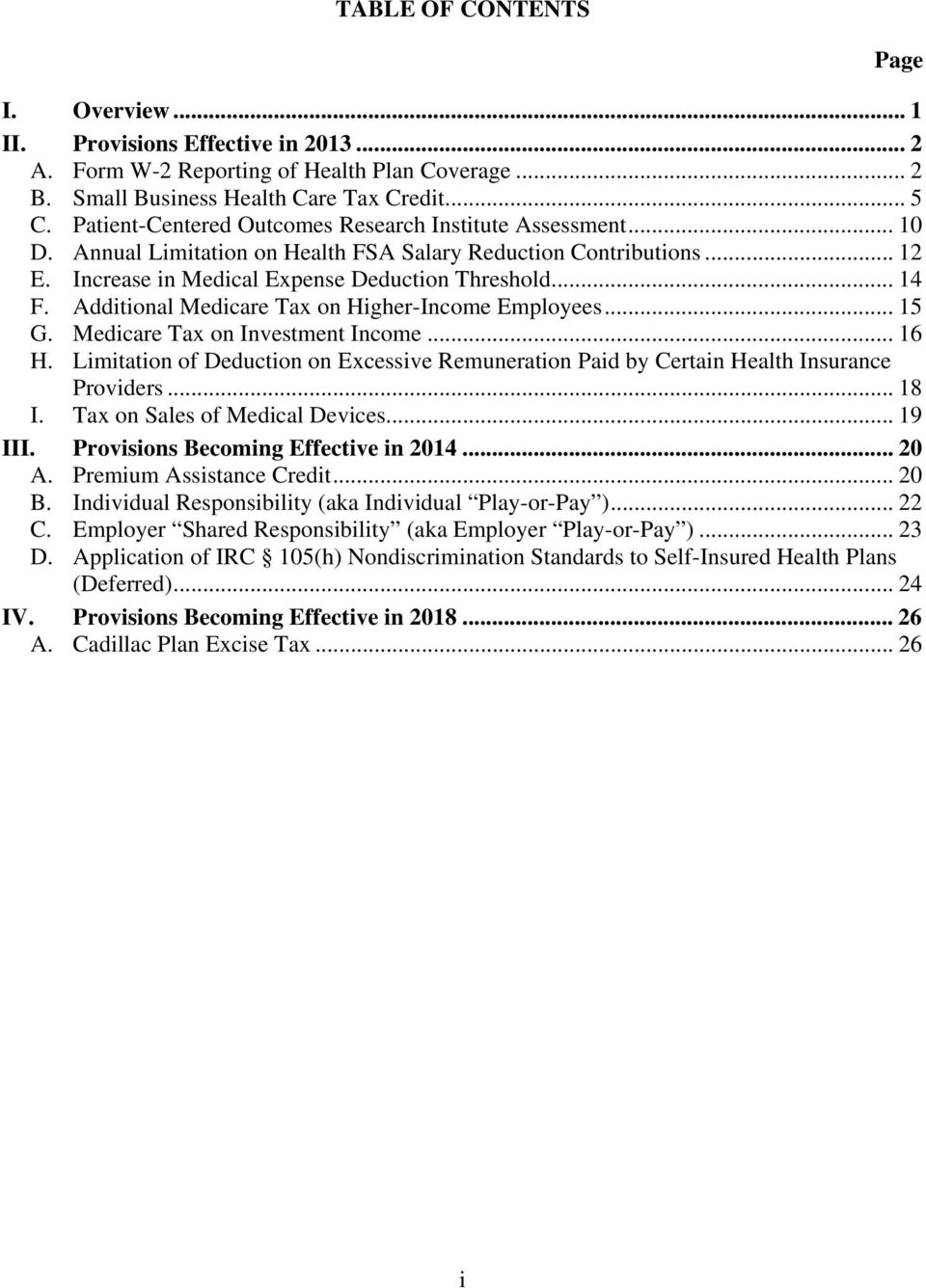
2 TABLE OF CONTENTS Page I. Overview... 1 II. Provisions Effective in A. Form W-2 Reporting of Health Plan Coverage... 2 B. Small Business Health Care Tax Credit... 5 C. Patient-Centered Outcomes Research Institute Assessment D. Annual Limitation on Health FSA Salary Reduction Contributions E. Increase in Medical Expense Deduction Threshold F. Additional Medicare Tax on Higher-Income Employees G. Medicare Tax on Investment Income H. Limitation of Deduction on Excessive Remuneration Paid by Certain Health Insurance Providers I. Tax on Sales of Medical Devices III. Provisions Becoming Effective in A. Premium Assistance Credit B. Individual Responsibility (aka Individual Play-or-Pay ) C. Employer Shared Responsibility (aka Employer Play-or-Pay ) D. Application of IRC 105(h) Nondiscrimination Standards to Self-Insured Health Plans (Deferred) IV. Provisions Becoming Effective in A. Cadillac Plan Excise Tax i
3 I. Overview The Patient Protection and Affordable Care Act ( PPACA ) was signed into law on March 23, It was amended a few days later by the Health Care and Education Reconciliation Act of 2010 ( HCERA ). The two acts of legislation are now referred to collectively as the Affordable Care Act. The principal objective of the Affordable Care Act is to rein in runaway health care costs. Secondarily, it provides new entitlements for individuals covered under individual and employersponsored group health plans. When enacted, the price tag for the health care reform measures was estimated to be $940 billion over the next decade. If all goes as planned, efficiencies in the delivery and availability of health care, as well as reductions in the levels of reimbursements to Medicaid and Medicare, will offset much of these costs. Nevertheless, a principal source of funding for these health care reform measures are new fees and other assessments, including increased taxes imposed upon higherincome taxpayers. Against that introduction, the tax implications of the Affordable Care Act are summarized below. As is noted, many of the provisions of the Affordable Care Act became effective immediately upon enactment of the law; others will become effective in later years

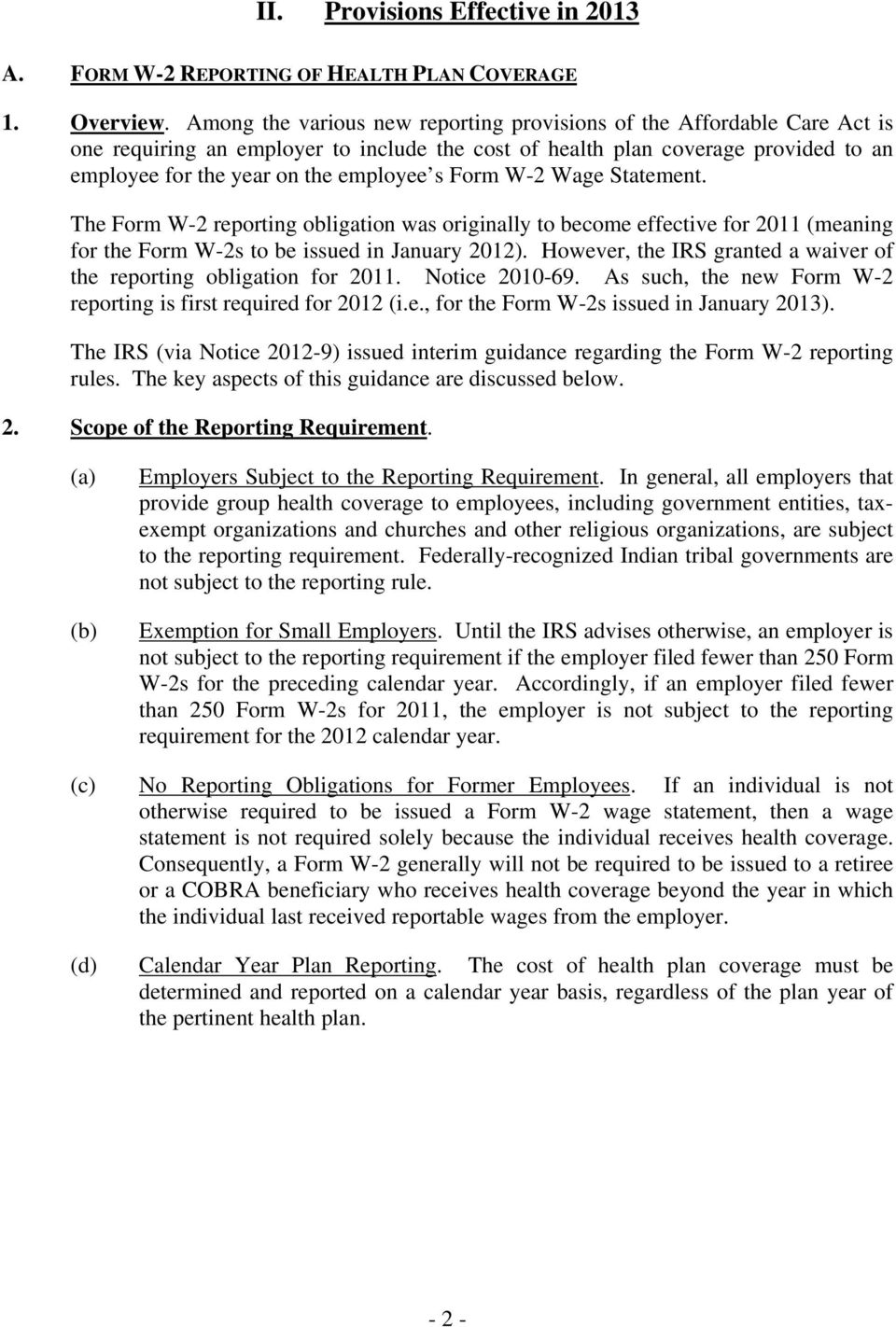
4 II. Provisions Effective in 2013 A. FORM W-2 REPORTING OF HEALTH PLAN COVERAGE 1. Overview. Among the various new reporting provisions of the Affordable Care Act is one requiring an employer to include the cost of health plan coverage provided to an employee for the year on the employee s Form W-2 Wage Statement. The Form W-2 reporting obligation was originally to become effective for 2011 (meaning for the Form W-2s to be issued in January 2012). However, the IRS granted a waiver of the reporting obligation for Notice As such, the new Form W-2 reporting is first required for 2012 (i.e., for the Form W-2s issued in January 2013). The IRS (via Notice ) issued interim guidance regarding the Form W-2 reporting rules. The key aspects of this guidance are discussed below. 2. Scope of the Reporting Requirement. (a) (b) (c) (d) Employers Subject to the Reporting Requirement. In general, all employers that provide group health coverage to employees, including government entities, taxexempt organizations and churches and other religious organizations, are subject to the reporting requirement. Federally-recognized Indian tribal governments are not subject to the reporting rule. Exemption for Small Employers. Until the IRS advises otherwise, an employer is not subject to the reporting requirement if the employer filed fewer than 250 Form W-2s for the preceding calendar year. Accordingly, if an employer filed fewer than 250 Form W-2s for 2011, the employer is not subject to the reporting requirement for the 2012 calendar year. No Reporting Obligations for Former Employees. If an individual is not otherwise required to be issued a Form W-2 wage statement, then a wage statement is not required solely because the individual receives health coverage. Consequently, a Form W-2 generally will not be required to be issued to a retiree or a COBRA beneficiary who receives health coverage beyond the year in which the individual last received reportable wages from the employer. Calendar Year Plan Reporting. The cost of health plan coverage must be determined and reported on a calendar year basis, regardless of the plan year of the pertinent health plan
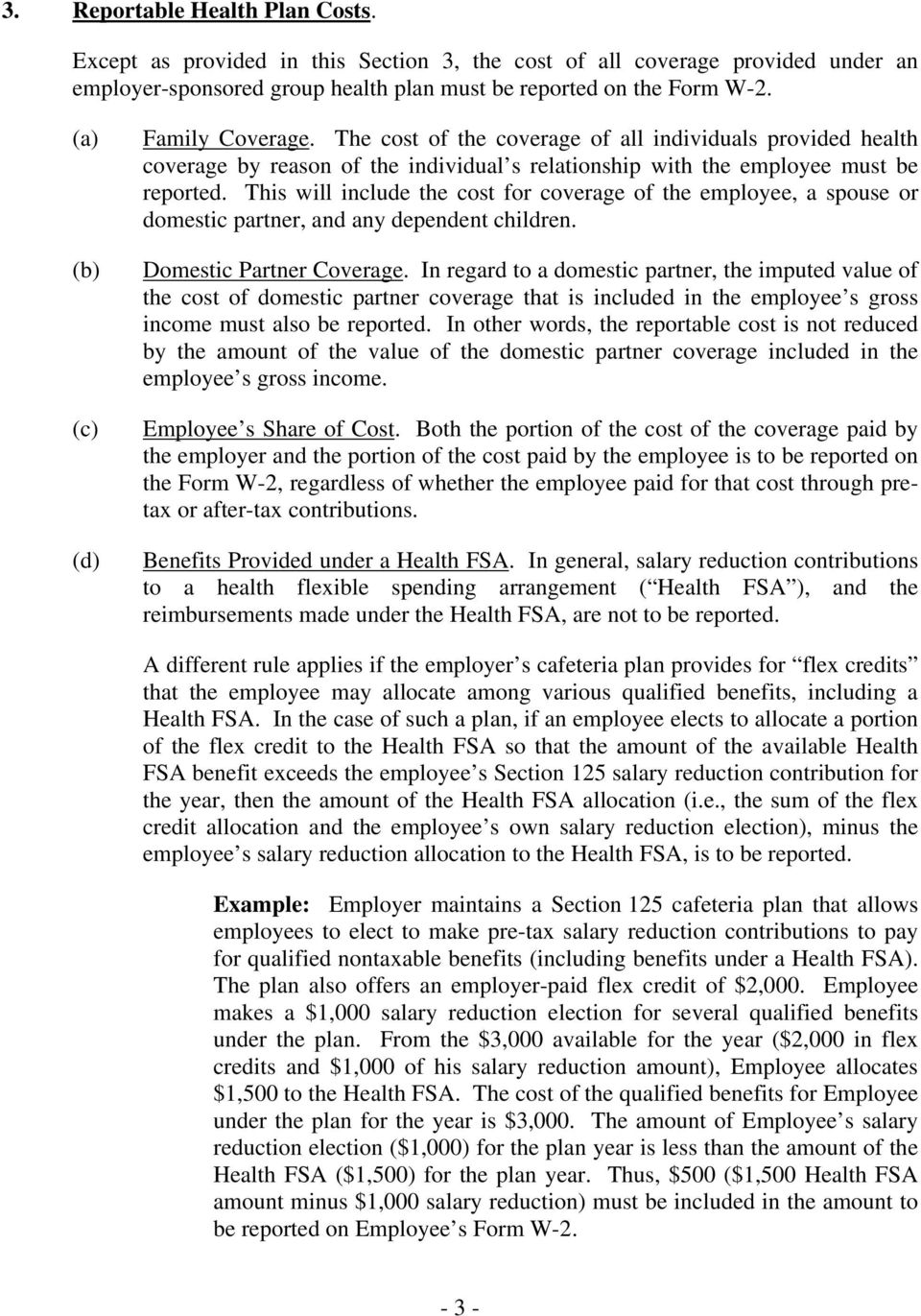
5 3. Reportable Health Plan Costs. Except as provided in this Section 3, the cost of all coverage provided under an employer-sponsored group health plan must be reported on the Form W-2. (a) (b) (c) (d) Family Coverage. The cost of the coverage of all individuals provided health coverage by reason of the individual s relationship with the employee must be reported. This will include the cost for coverage of the employee, a spouse or domestic partner, and any dependent children. Domestic Partner Coverage. In regard to a domestic partner, the imputed value of the cost of domestic partner coverage that is included in the employee s gross income must also be reported. In other words, the reportable cost is not reduced by the amount of the value of the domestic partner coverage included in the employee s gross income. Employee s Share of Cost. Both the portion of the cost of the coverage paid by the employer and the portion of the cost paid by the employee is to be reported on the Form W-2, regardless of whether the employee paid for that cost through pretax or after-tax contributions. Benefits Provided under a Health FSA. In general, salary reduction contributions to a health flexible spending arrangement ( Health FSA ), and the reimbursements made under the Health FSA, are not to be reported. A different rule applies if the employer s cafeteria plan provides for flex credits that the employee may allocate among various qualified benefits, including a Health FSA. In the case of such a plan, if an employee elects to allocate a portion of the flex credit to the Health FSA so that the amount of the available Health FSA benefit exceeds the employee s Section 125 salary reduction contribution for the year, then the amount of the Health FSA allocation (i.e., the sum of the flex credit allocation and the employee s own salary reduction election), minus the employee s salary reduction allocation to the Health FSA, is to be reported. Example: Employer maintains a Section 125 cafeteria plan that allows employees to elect to make pre-tax salary reduction contributions to pay for qualified nontaxable benefits (including benefits under a Health FSA). The plan also offers an employer-paid flex credit of $2,000. Employee makes a $1,000 salary reduction election for several qualified benefits under the plan. From the $3,000 available for the year ($2,000 in flex credits and $1,000 of his salary reduction amount), Employee allocates $1,500 to the Health FSA. The cost of the qualified benefits for Employee under the plan for the year is $3,000. The amount of Employee s salary reduction election ($1,000) for the plan year is less than the amount of the Health FSA ($1,500) for the plan year. Thus, $500 ($1,500 Health FSA amount minus $1,000 salary reduction) must be included in the amount to be reported on Employee s Form W
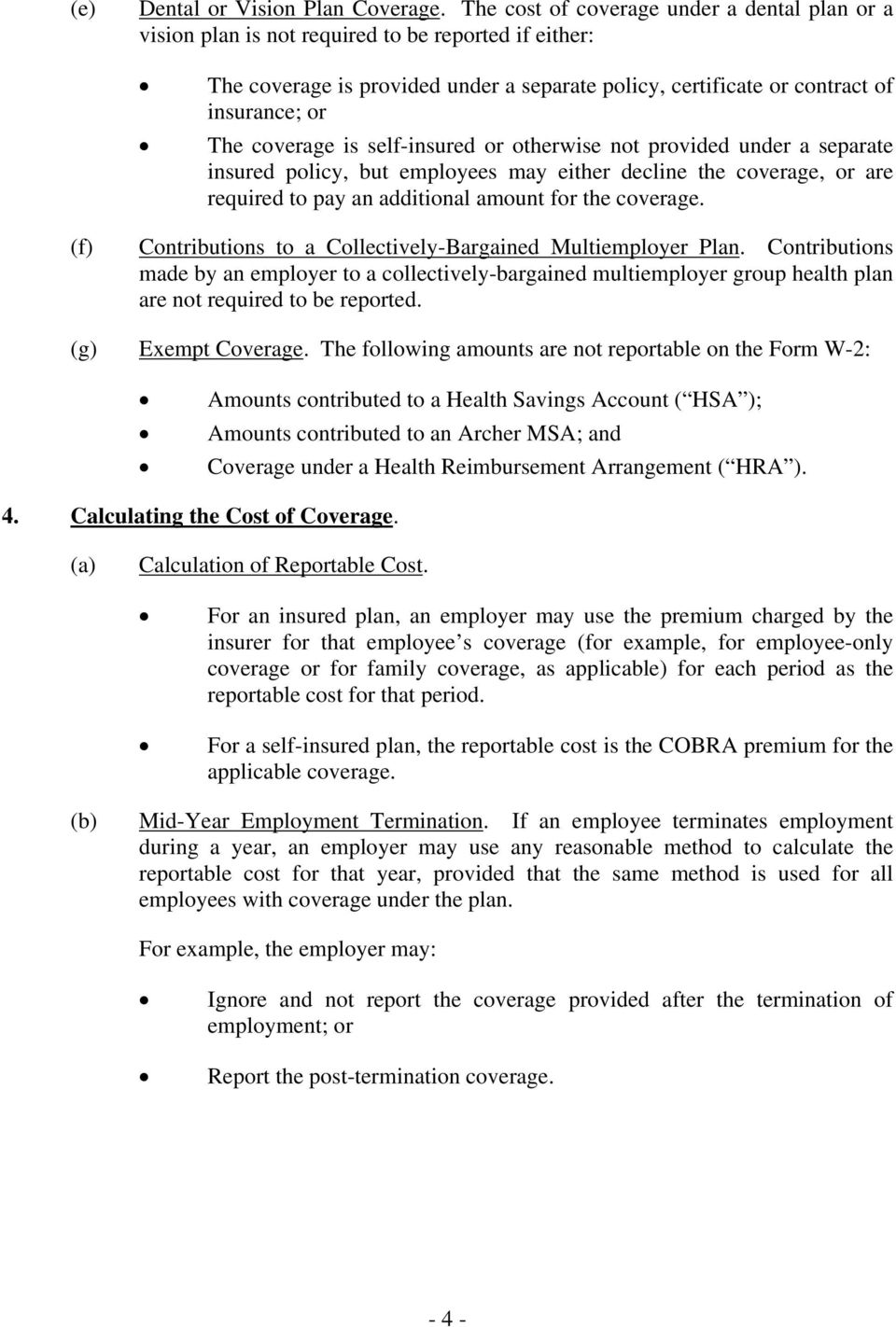
6 (e) Dental or Vision Plan Coverage. The cost of coverage under a dental plan or a vision plan is not required to be reported if either: The coverage is provided under a separate policy, certificate or contract of insurance; or The coverage is self-insured or otherwise not provided under a separate insured policy, but employees may either decline the coverage, or are required to pay an additional amount for the coverage. (f) (g) Contributions to a Collectively-Bargained Multiemployer Plan. Contributions made by an employer to a collectively-bargained multiemployer group health plan are not required to be reported. Exempt Coverage. The following amounts are not reportable on the Form W-2: Amounts contributed to a Health Savings Account ( HSA ); Amounts contributed to an Archer MSA; and Coverage under a Health Reimbursement Arrangement ( HRA ). 4. Calculating the Cost of Coverage. (a) Calculation of Reportable Cost. For an insured plan, an employer may use the premium charged by the insurer for that employee s coverage (for example, for employee-only coverage or for family coverage, as applicable) for each period as the reportable cost for that period. For a self-insured plan, the reportable cost is the COBRA premium for the applicable coverage. (b) Mid-Year Employment Termination. If an employee terminates employment during a year, an employer may use any reasonable method to calculate the reportable cost for that year, provided that the same method is used for all employees with coverage under the plan. For example, the employer may: Ignore and not report the coverage provided after the termination of employment; or Report the post-termination coverage
7 (c) Mid-Year Changes in Coverage. The reportable cost for an employee receiving coverage under the plan is the sum of the reportable costs for each period (such as a month) during the year as determined under the method used by the employer. Example: Employer X determines that the monthly reportable cost under a group health plan for employee-only coverage for the calendar year 2012 is $500, and that the monthly reportable cost under the same group health plan for employeeplus-spouse coverage for the calendar year 2012 is $1,000. Employee is employed by Employer X for the entire calendar year Employee had employee-only coverage under the group health plan from January 1, 2012 through June 30, 2012, and then had employee-plus-spouse coverage from July 1, 2012 through December 31, Under these facts, the 2012 reportable cost under the plan for Employee is $9,000 (($500 x 6) + ($1,000 x 6)). Official Guidance: IRC 6051; IRS Notices and B. SMALL BUSINESS HEALTH CARE TAX CREDIT Small employers that provide health care coverage to their employees and that meet certain requirements ( qualified employers ) may be eligible for a federal income tax credit for health insurance premiums they pay on behalf of their employees. The credit is available only for the payments of premiums to a plan for which benefits are provided under an insurance policy. The credit is not available for contributions made to a selfinsured health plan. The credit is available through It will also be available for any two consecutive years after 2013, but only for premiums paid for insurance policies purchased through a state-sponsored Exchange. 1. Employers Eligible for the Credit. In order to be a qualified employer for a tax year, the following conditions must be satisfied: The employer must have fewer than 25 full-time equivalent employees ( FTEs ) for the tax year; The average annual wages of its employees for the year must be less than $50,000 per FTE; and The employer must pay health care premiums under a qualifying arrangement. A nongovernmental, tax-exempt employer that is exempt from tax under Code Section 501(a) can be a qualified employer. An employer that is an agency or instrumentality of the federal government, or of a state, local or Indian tribal government, is not a qualified employer unless it is a Section 501(c) tax-exempt organization (such as a school, library or animal shelter)

8 Contributions made by an employer to a collectively-bargained multiemployer plan that are used to pay premiums for health insurance coverage for covered employees are treated as payment of health insurance premiums by the employer for purposes of the credit. However, in order to be eligible for the credit, 100% of the cost of coverage for all employees covered by the multiemployer plan must be paid from employer contributions, and not by employees. In addition, if the employer contributions to the multiemployer plan are used to pay additional benefits, such as group-term life insurance, the employer must allocate the contributions among the benefits. Only the amount allocable to health insurance premiums can be claimed as a credit. 2. Qualifying Arrangements. A tax credit for premiums paid by the employer will be allowed only if the premiums are paid pursuant to a qualifying arrangement. A qualifying arrangement is one in which the employer pays premiums for each employee enrolled in health care coverage in an amount equal to a uniform percentage (not less than 50%) of the premium cost of the coverage. If the plan covers only employees (and not spouses or dependents), the plan will meet the qualifying arrangement standard if the employer pays at least 50% of the premium cost for each employee enrolled in the plan. If the plan provides for additional tiers of coverage, such as family coverage, the standard will be met if the employer payment satisfies one of the following standards: A uniform percentage (not less than 50%) of the premium cost for each employee (if any) enrolled in self-only coverage; A uniform amount that is no less than the amount the employer would have paid toward self-only coverage for each employee (if any) enrolled in self plus one coverage; A uniform amount that is no less than the amount the employer would have paid toward self-only coverage for each employee (if any) enrolled in family coverage; or A uniform amount that is no less than the amount the employer would have paid toward self-only coverage for each employee (if any) enrolled in any other tier of coverage (figured separately for each tier). Additional rules apply if the employer offers more than one plan, or if the insurance carrier does not bill on a composite basis. If an employer offers more than one type of coverage, such as a medical plan and a separate dental plan, each plan must separately satisfy the qualifying arrangement requirements in order for the premiums payable to that plan to be claimed as a credit. A credit cannot be claimed for employer contributions made to a health reimbursement arrangement ( HRA ), health flexible spending arrangement ( FSA ), or health savings account ( HSA )

9 3. Premiums Taken into Account. If an employer pays only a portion of the premiums for the coverage provided to employees under a plan, with employees paying the rest, only the portion of the premiums paid by the employer is considered for purposes of calculating the credit. Any premium paid pursuant to a salary reduction arrangement under a Section 125 cafeteria plan is treated as paid by the employee, rather than the employer, and thus is not eligible for the credit. In addition, the amount of an employer s premium payments that is taken into account for purposes of the credit is capped by the premium payments the employer would have made if the average premium for the small group market in the state in which the employer offers coverage were substituted for the actual premium. For example, if an employer pays 80% of the premiums for coverage provided to employees, and the employees pay the other 20%, the premium amount that is taken into account for purposes of calculating the tax credit is the lesser of: 80% of the total actual premiums paid; or 80% of the premiums that would have been paid for the coverage if the average premium for the small group market in the state were substituted for the actual premium. The average small group market premium for each state is reported on the Form 8941 for the applicable year. 4. Credit Limit. Through 2013, the maximum credit for a taxable employer is 35% of the employer s recognizable premium expenses. After 2013, the credit increases to 50% (subject to additional restrictions). Through 2013, the maximum credit that is taken into account for a tax-exempt qualified employer is 25% of the employer s premium expenses. After 2013, the credit increases to 35% (subject to additional restrictions). In all regards, the amount of the credit available to a tax-exempt employer cannot exceed the sum of: The total amount of federal income and Medicare (i.e., hospital insurance) tax the employer is required to withhold from employees wages for the year; plus The employer s share of Medicare tax on employees wages for the year. 5. Phase Out of Credit. The amount of the otherwise available tax credit is reduced, and potentially phased out completely, if the number of the employer s FTEs exceeds 10, or if average annual wages exceed $25,000. If the number of FTEs exceeds 10, the reduction is determined by multiplying the otherwise applicable credit amount by a fraction, the numerator of which is the number of FTEs in excess of 10 and the denominator of which is

10 If average annual wages exceed $25,000, the reduction is determined by multiplying the otherwise applicable credit amount by a fraction, the numerator of which is the amount by which average annual wages exceed $25,000 and the denominator of which is $25,000. For an employer with both more than 10 FTEs and average annual wages exceeding $25,000, the reduction in the credit amount is equal to the sum of the amount of the two reductions. This sum may reduce the credit to zero for some employers with fewer than 25 FTEs and average annual wages of less than $50, Calculating FTEs. The number of an employer s FTEs for a year is determined by dividing: The total hours of service for which the employer pays wages to employees during the year (but not more than 2,080 hours for any employee) by 2,080. The result, if not a whole number, is then rounded to the next lowest whole number (unless the result is less than one, in which case it is rounded up to one FTE). To calculate the total number of hours of service which must be taken into account for an employee for the year, the employer may use any of the following methods: (a) (b) (c) Determine actual hours of service from records of hours worked and hours for which payment is made or due, including hours for paid leave; Use a days-worked equivalency whereby the employee is credited with 8 hours of service for each day for which the employee would be required to be credited with at least one hour of service under method (a) above; or Use a weeks-worked equivalency whereby the employee is credited with 40 hours of service for each week for which the employee would be required to be credited with at least one hour of service under method (a) above. An employer may apply different methods for different classifications of employees, if the classifications are reasonable and consistently applied, and may also change the method from year to year. 7. Determination of Average Annual Wages. An employee s average annual wages for a year are determined by first dividing: (a) (b) The total wages paid by the employer during the employer s tax year to employees who perform services for the employer during the tax year; by The number of the employer s FTEs for the year. The result is then rounded down to the nearest $1,000 (if not otherwise a multiple of $1,000)

11 Wages for this purpose means wages as defined for purposes of the Federal Insurance Contributions Act ( FICA ) (without regard to the wage base limitation). 8. Exclusion of Owners. Sole proprietors, partners in a partnership, 2% shareholders of S corporations, and 5% owners of other businesses are not considered employees for purposes of the credit. The wages or hours of these business owners and partners are not counted in determining either the number of FTEs or the amount of average annual wages, and premiums paid on their behalf are not counted in determining the amount of the credit. In addition, an employee who is a family member of any of the business owners or partners, or a member of such a business owner s or partner s household, is not considered an employee for purposes of the credit. Thus, neither the wages nor the hours of the family member are counted in determining the number of FTEs or the amount of average annual wages, and premiums paid on the family member s behalf are not counted in determining the amount of the credit. For this purpose, a family member includes a spouse, a child (or grandchild); a sibling or step-sibling; a parent (or grandparent); a stepparent; a niece or nephew; an aunt or uncle; or a son-in-law, daughter- in-law, father-inlaw, mother-in-law, brother-in-law or sister-in-law. 9. Controlled Group Aggregation. Members of a controlled group are treated as a single employer for purposes of the credit. Consequently, all employees of the controlled group, and all wages paid to employees by the controlled group, are counted in determining whether any member of the controlled group is a qualified employer. 10. Claiming the Credit. An employer (other than a tax-exempt employer) claims the credit on the employer s annual income tax return, with an attached Form 8941 showing the calculation of the credit. The credit can be used to offset an employer s AMT liability for the year, subject to certain limitations based on the amount of an employer s regular tax liability, AMT liability and other allowable credits. The unused credit may be carried back five years (increased from one year by the Small Business Jobs Act of 2010), or carried forward up to 20 years. A tax-exempt employer claims the refundable credit by filing a Form 990-T with an attached Form 8941 showing the calculation of the claimed credit. For a tax-exempt employer, the credit is a refundable credit. An employer s allowable deduction for health insurance premiums is reduced by the amount of the credit. Official Guidance: IRC 45R, IRS Notices and ; Form
12 C. PATIENT-CENTERED OUTCOMES RESEARCH INSTITUTE ASSESSMENT 1. Overview. The Affordable Care Act provides for the creation of the Patient-Centered Outcomes Research Institute ( PCORI ). The PCORI is a stand-alone, nonprofit corporation that is separate from any agency of the U.S. Government. The PCORI is to be funded by new fees imposed on health insurance policies and selfinsured group health plans. The assessments are to be used to fund comparative clinical effectiveness research, the results of which may be used by consumers and policymakers to make informed health-related decisions. 2. Effective Date and Duration of Fee Assessment. The annual comparative effectiveness fee initially becomes payable for the first plan year ending on or after October 1, 2012, and will continue to be imposed through plan years ending on or before September 30, In other words, for a calendar year plan, the fee will first be assessed for the current plan year ending December 31, The fee will then continue to be imposed for subsequent plan years, with the final fee assessed for the plan year ending December 31, Amount of Fee. The fee is calculated on the basis of the average number of lives covered under the plan for the applicable plan year. (See Section H below.) For the first plan year, the fee is $1 multiplied by the average number of covered lives. Thereafter, the multiplier increases to $2 per the average of covered lives. 4. Covered Plans. Except as discussed below, all group health insurance policies and selfinsured group health plans, including health reimbursement arrangements ( HRAs ), are subject to the comparative effectiveness fee. 5. Retiree-Only Plans. Self-insured plans that cover only retirees are exempt from many of the provisions of the ACA and other federal laws governing group health plans. This exemption does not apply for purposes of the comparative effectiveness fee. Therefore, retiree-only plans are subject to the fee. 6. Exempt Plans. The following plans are not subject to the fee: Excepted dental and vision care plans (i.e., separate dental or vision insurance policies, or self-insured benefits that require a separate election and employee contribution); Health care FSAs that qualify as excepted benefits (i.e., FSAs for which an employer contribution is not made); Health Savings Accounts ( HSAs ); Employee Assistance Plans ( EAPs ), disease management programs and wellness programs that do not provide significant benefits in the nature of medical care; and

13 Insurance policies and plans that are designed to principally cover employees who are working and residing outside of the United States (i.e., expatriate policies). 7. Dual Self-Insured Plans. If an employer sponsors two or more self-insured plans that have the same plan year (such as a self-insured medical plan and an HRA), then all of the self-insured plans will be treated as a single plan, and thus will be subject to a single fee. 8. Dual Insured and Self-Insured Coverage. An employer may offer both an insured medical plan and a self-insured plan (such as an HRA) covering the same employees. In such a case, the insurer will pay the fee with respect to individuals covered under the insured medical plan, but the employer, as plan sponsor, must also pay a fee for employees covered under the self-insured HRA. 9. Calculation of Fee. The fee imposed on the plan sponsor of a self-insured plan is based on the average number of lives covered under the plan for the plan year. The proposed regulations allow an employer to choose among three methods to determine the average number of covered lives. (a) (b) Actual Count Method. A plan sponsor may determine the average number of lives covered under the plan for the plan year by calculating the total of the lives covered for each day of the plan year, and dividing that total by the number of days in the plan year. Snapshot Method. Under the snapshot method, the average number of lives is calculated by adding the total number of lives covered on a specific date during the first, second or third month of each quarter, as selected by the employer (or multiple dates in each quarter if an equal number of dates is used for each quarter), and dividing the total by the number of dates on which a count was made. Note: For purposes of applying the snapshot method, the number of lives covered under a plan on a specific date may be determined on the basis of either: (a) (b) The actual number of lives covered on the date; or The sum of: (i) (ii) The number of participants with self-only coverage on the date; plus The number of participants with coverage other than self-only coverage on the date multiplied by (c) Form 5500 Method. The Form 5500 method is the simplest of the three. In order to use the Form 5500 method for a plan year, the applicable Form 5500 must be filed by the due date for the payment of the comparative effectiveness fee assessment filing for the plan year. (i) For the typical plan providing coverage that is not limited to self-only coverage (e.g., family coverage), the average number of lives is equal to
14 the sum of the number of participants reported for the beginning of the plan year and the number reported for the end of the plan year. (ii) If a plan provides only self-only coverage, the average number of covered lives is the sum of the total number of participants at the beginning and at the end of the plan year, as reported on the Form 5500, divided by 2. Note: A plan sponsor may change the method from one plan year to the next. (d) Special HRA Rule. For purposes of determining the average number of lives under an HRA, only participants are taken into account. Therefore, the multiplier for dependents will not apply. 10. Timing of Reporting and Payment. An employer must report and pay the fee via IRS Form 720 by July 31 of each year. The filing will cover the plan year that ended during the preceding calendar year. In other words, by July 31, 2013, an employer with a calendar year plan will need to file the Form 720 and pay the fee assessment for the plan year ending December 31, Party Responsible for Fee Payment. In the case of an insured plan, the fee will be reported and paid by the insurer. For self-insured plans, the fee is reported and paid by the plan sponsor. In the case of a self-insured health plan established by a voluntary employees beneficiary association ( VEBA ), the trustee of the VEBA is deemed to be the plan sponsor responsible for the payment of the fee. 12. Prohibition against Payment of Fees from Plan Assets. The preamble to the final regulations states that because the comparative effectiveness fee is imposed on the plan sponsor, rather than the plan itself, the fee generally does not qualify as a permissible expense of the plan for purposes of ERISA. Therefore, the fee typically must be paid by the employer sponsoring the plan. Nevertheless, the preamble to the regulation further provides that this prohibition may not apply in limited situations, and that the Department of Labor will provide guidance on payment of the fee in the near future. Official Guidance: IRC 4375, 4376 and 4377; IRS Regulations , and D. ANNUAL LIMITATION ON HEALTH FSA SALARY REDUCTION CONTRIBUTIONS 1. Overview. The Affordable Care Act amended IRC 125 to provide that in order for a health flexible spending arrangement (a health FSA ) to be a qualified benefit under a cafeteria plan, the maximum amount that an employee can elect to contribute to the health FSA account on a salary reduction basis for a taxable year is $2,500. If a cafeteria plan does not expressly impose this contribution restriction, the plan fails to be a qualified cafeteria plan within the meaning of IRC 125. In that event, amounts contributed to the cafeteria plan must be included in the employee s taxable wages

15 The $2,500 limitation is indexed to CPI-U for years beginning after December 31, 2013, with any increase that is not a multiple of $50 rounded to the next lowest multiple of $ IRS Guidance. In Notice , the IRS issued guidance as to the application of the new annual limits. This guidance is outlined below. (a) (b) (c) (d) (e) Annual Limitation Period. The statute holds that an annual limitation applies on the basis of an undefined taxable year. The IRS guidance holds that the term taxable year refers to the plan year of the cafeteria plan, as this is the period for which salary reduction elections are made. Initial Limitation Period. The $2,500 limit first applies for the plan year that begins on or after January 1, Effect of Short Plan Year. An employer may change the plan year of a cafeteria plan for a valid business purpose. If a cafeteria plan has a short plan year (that is, fewer than 12 months) that begins after 2012, the $2,500 limit must be prorated based on the number of months in that short plan year. Application of Limit on Employee-by-Employee Basis. The $2,500 annual limit on salary reduction contributions to a health FSA applies on an employee-byemployee basis. Thus, $2,500 (as indexed for inflation) is the maximum salary reduction contribution each employee may make for a plan year. Consistent with this rule, if both spouses are eligible to elect salary reduction contributions to a health FSA, each spouse may elect to make salary reduction contributions of up to $2,500 (as indexed for inflation) to his or her health FSA, even if both participate in the same health FSA sponsored by the same employer. Aggregation of Plans of Related Employers. All employers that are treated as a single employer under Section 414(b), (c), or (m) (relating to controlled groups and affiliated service groups) are treated as a single employer for purposes of the $2,500 limit. Accordingly, if an employee participates in multiple cafeteria plans offering health FSAs maintained by members of a controlled group or affiliated service group, the employee s total health FSA salary reduction contributions for a plan year under all of the cafeteria plans must be limited to $2,500 (as indexed for inflation). In contrast, an employee employed by two or more employers that are not members of the same controlled group may elect up to $2,500 (as indexed for inflation) under each employer s health FSA. Note: The IRS has not provided guidance on the application of the annual limit of the plans if the related employers have different plan years. (f) No Limit on Flex Credits. The annual $2,500 health FSA limit applies only to salary reduction contributions, and not to employer non-elective contributions, sometimes called flex credits. For example, if an employer contributes a $500 flex credit to each employee s health FSA for the 2013 plan year, each employee may still elect to make salary reduction contributions of $2,500 to a health FSA for that plan year
16 (g) Effect on Post-Plan Year Grace Period Elections. If a cafeteria plan provides for a grace period (which can be no longer than 2½ months) for a plan year, unused salary reduction contributions to the health FSA for the plan year that are carried over into the grace period do not count against the $2,500 limit applicable for the subsequent plan year. Example. Employer X offers a calendar year cafeteria plan that includes a health FSA with a grace period of 2½ months. For the 2012 plan year, the plan provides that employee salary reduction contributions for the health FSA are limited to $5,000. Effective for the 2013 plan year, the plan provides that employee salary reduction contributions to the health FSA are limited to $2,500. Some employees have unused amounts from their 2012 health FSA salary reduction contributions that remain available during the grace period in the first 2½ months of In this situation, the availability during the grace period of amounts attributable to the2012 health FSA salary reduction contributions does not cause Employer X s cafeteria plan to fail to satisfy the $2,500 limit. (h) Required Plan Amendment. A cafeteria plan offering a health FSA must be amended to expressly impose the $2,500 limit (or, at the employer s option, a lower limit specified in the plan). The amendment must be adopted on or before December 31, It must be made effective retroactive for plan years beginning after December 31, Official Guidance: IRC 125(i); IRS Notice E. INCREASE IN MEDICAL EXPENSE DEDUCTION THRESHOLD Individuals currently are allowed an itemized deduction for unreimbursed medical expenses, but only to the extent that such expenses exceed 7.5% of their adjusted gross income ( AGI ). For purposes of the alternative minimum tax ( AMT ), medical expenses are currently deductible only to the extent that they exceed 10% of AGI. The Affordable Care Act increases the threshold for the itemized deduction for unreimbursed medical expenses from 7.5% of AGI to 10% of AGI for regular income tax purposes. The Act does not change the AMT treatment of the itemized deduction for medical expenses. The increase is generally effective for taxable years beginning on or after January 1, However, through 2016, if either the taxpayer or the taxpayer s spouse attains age 65 before the end of the taxable year, the increase does not apply, and the threshold remains at 7.5% of AGI. Official Guidance: IRC

17 F. ADDITIONAL MEDICARE TAX ON HIGHER-INCOME EMPLOYEES 1. Overview. The Federal Insurance Contributions Act ( FICA ) imposes a payroll tax on employers based on the amount of wages paid to an employee during the year. The tax imposed is composed of two parts: (a) the Old Age, Survivors, and Disability Insurance ( OASDI ) tax equal to 6.2% of covered wages up to the taxable wage base ($113,700 in 2013); and (b) the hospital insurance (Medicare) tax amount equal to 1.45% of covered wages. A compensation limit does not apply to the Medicare tax. The tax is assessed against all compensation. In addition to the tax on employers, each employee is subject to FICA taxes equal to the amount of tax imposed on the employer. The employee portion of the FICA tax must be withheld and remitted to the Treasury Department by the employer. The Self-Employment Contributions Act ( SECA ) imposes taxes on the net income from self-employment of self-employed individuals. The rate of the OASDI portion of SECA taxes is equal to the combined employee and employer OASDI FICA tax rates (i.e., 12.4%), and applies to self-employment income up to the FICA taxable wage base. The rate of the Medicare portion is the same as the combined employer and employee Medicare rates (i.e., 2.9%). There is no cap on the amount of self-employment income to which the Medicare rate applies. 2. Additional Medicare Tax. The Affordable Care Act increases the employee portion of the Medicare tax by an additional tax of 0.9% on wages received in excess of the applicable income threshold. In the case of a married couple filing jointly, this Additional Medicare Tax is based on the combined wages of the employee and the employee s spouse. The threshold amount is established by the following table: Filing Status Threshold Amount Married filing jointly $250,000 Married filing separately $125,000 Single $200,000 Head of household (with qualifying person) $200,000 Qualifying widow(er) with dependent child $200,000 As under current law, the employer is required to withhold the additional Medicare tax on wages. However, in determining the employer s requirement to withhold and liability for the tax, only wages that the employee receives from the employer in excess of $200,000 for a year are taken into account. An employer is required to begin withholding Additional Medicare Tax for the pay period in which it pays wages in excess of $200,000 to an employee. There is no requirement that an employer notify its employee when it begins withholding Additional Medicare Tax

18 3. Additional SECA Tax. This same additional tax applies to the Medicare portion of SECA tax on self-employment income in excess of the threshold amount. Thus, an additional tax of 0.9% is imposed on a self-employed individual having self-employment income in excess of the threshold amount. 4. Wages from Multiple Affiliates. If an employee is performing services for multiple members of a controlled group of companies, and each affiliate is an employer of the employee with regard to the services the employee performs for that affiliate, the wages paid by the payor on behalf of each affiliate should be combined only if the payor is a common paymaster. The wages are not combined for purposes of the $200,000 withholding threshold if the payor is not a common paymaster. 5. Other Special Rules. (a) (b) (c) Imputed Cost of Group-Term Life Insurance. The imputed cost of group-term life insurance coverage in excess of $50,000 is subject to FICA taxes, including Medicare taxes. Accordingly, to the extent that, in combination with other wages the imputed cost exceeds $200,000, it is also subject to Additional Medicare Tax. Nonqualified Deferred Compensation. An employer calculates wages for purposes of withholding Additional Medicare Tax from nonqualified deferred compensation ( NQDC ) in the same way that it calculates wages for withholding the existing Medicare tax from NQDC. Thus, if an employee defers wages under a nonqualified deferred compensation plan and the NQDC is taken into account as wages for FICA tax purposes under the special timing rule described in the IRS FICA tax regulations, the NQDC would likewise be taken into account under the special timing rule for purposes of determining an employer s obligation to withhold Additional Medicare Tax. Noncash Fringe Benefits. The value of noncash fringe benefits must be taken into account, with Additional Medicare Taxes withheld, if applicable. 6. Effective Date. The Additional Medicare Tax rules apply to remuneration received on or after January 1, Official Guidance: IRC 3101, 3102, 1401, 1402, 164; Proposed IRS Regulations (12/5/12); IRS Q&As G. MEDICARE TAX ON INVESTMENT INCOME In addition to buttressing Medicare through the additional tax on higher-income employees, the Affordable Care Act imposes a new Medicare tax on net investment income. The provision applies to taxable years beginning on or after January 1, Tax on Individual. In the case of an individual, the tax is 3.8% of the lesser of: A taxpayer s net investment income; or
19 The excess of the taxpayer s modified adjusted gross income over a threshold amount. The threshold amount is $250,000 in the case of a joint return or surviving spouse, $125,000 in the case of a married individual filing a separate return, and $200,000 in any other case. Modified adjusted gross income is adjusted gross income increased by the amount excluded from income as foreign earned income under IRC 911(a)(1) (net of the deductions and exclusions disallowed with respect to foreign earned income). 2. Tax on Estate or Trust. In the case of an estate or trust, the Medicare tax is 3.8% of the lesser of: Undistributed net investment income; The excess of adjusted gross income (as defined in IRC 67(e)) over the dollar amount at which the highest income tax bracket applicable to an estate or trust for the tax year begins. The Medicare tax does not apply to a trust: That is exempt from tax under IRC 501; That is a charitable remainder trust that is exempt from tax under IRC 664; or If all of its unexpired interests are devoted to charitable purposes. 3. Investment Income. For purposes of the Medicare tax, net investment income is investment income reduced by the deductions properly allocable to such income. Investment income is the sum of: Gross income from interest, dividends, annuities, royalties, and rents (other than income derived from any trade or business to which the tax does not apply); Other gross income derived from any business to which the tax applies; and Net gain (to the extent taken into account in computing taxable income) attributable to the disposition of property other than property held in a trade or business to which the tax does not apply. Investment income does not include distributions from a qualified retirement plan or amounts subject to SECA tax. Gross income does not include items which are excluded from gross income under the general income tax rules, such as interest on tax-exempt bonds, veterans benefits, and the portion of the proceeds from the sale of a principal residence that is excluded gain
20 4. Trades or Businesses. In the case of a trade or business, the Medicare tax applies if the trade or business is a passive activity with respect to the taxpayer, or the trade or business consists of trading financial instruments or commodities. The Medicare tax does not apply to other trades or businesses conducted by a sole proprietor, partnership, or S corporation. Income, gain, or loss on working capital is not treated as derived from a trade or business. Official Guidance: IRC 1411; Proposed IRS Regulations (12/5/12); IRS FAQs H. LIMITATION OF DEDUCTION ON EXCESSIVE REMUNERATION PAID BY CERTAIN HEALTH INSURANCE PROVIDERS 1. Overview. The Affordable Care Act denies a deduction by a covered health care provider for remuneration attributable to services performed by an applicable individual to the extent that such remuneration exceeds $500,000. The deduction limitation applies without regard to whether such remuneration is paid during the taxable year or a subsequent taxable year. Thus, for example, in the case of remuneration that relates to services that an applicable individual performs during a taxable year, but that is not deductible until a later year, such as nonqualified deferred compensation, the unused portion (if any) of the $500,000 limit for the year is carried forward until the year in which the compensation is otherwise deductible, and the remaining unused limit is then applied to the compensation. In determining whether the remuneration of an applicable individual for a year exceeds $500,000, all remuneration from all members of any controlled group of corporations, other businesses under common control, or affiliated service groups, are aggregated. 2. Definitions. An insurance provider is a covered health insurance provider if at least 25% of the insurance provider s gross premium income from health business is derived from health insurance plans. Self-insured plans are excluded from the definition of covered health insurance provider. Applicable individuals include all officers, employees, directors, and other workers or service providers (such as consultants) performing services for or on behalf of a covered health insurance provider. Thus, the limitation on the deductibility of remuneration from a covered health insurance provided is not restricted to a small group of officers and covered executives, but instead generally applies to remuneration of all employees and service providers. Moreover, if an individual is an applicable individual with respect to a covered health insurance provider for any taxable year, the individual is treated as an applicable individual for all subsequent taxable years (and is treated as an applicable individual for purposes of any subsequent taxable year for purposes of the special rule for deferred remuneration). 3. Effective Date. The provision deduction restriction is effective for remuneration paid in taxable years beginning after 2012, with respect to services performed after Official Guidance: IRC 162(m)(6)

21 I. TAX ON SALES OF MEDICAL DEVICES 1. Excise Tax. An excise tax equal to 2.3% of the sale price is imposed on the sale of any taxable medical device by the manufacturer, producer, or importer of such device. The tax applies to sales made on or after January 1, Taxable Medical Devices. For purposes of the tax, a taxable medical device is any device (as defined in Section 201(h) of the Federal Food, Drug, and Cosmetic Act) intended for humans. The excise tax does not apply to eyeglasses, contact lenses, hearing aids, and any other medical device that is generally purchased by the general public at retail. 3. Tax upon Transfer of Title. If title to, or ownership of, a taxable article passes from the manufacturer to a transferee by operation of law (such as through an inheritance or as part of the sale of a business), or as a result of any non-taxable transaction, the excise tax attaches to the sale of the article by the transferee to the same extent and in the same manner as if the transferee were the manufacturer of the article. 4. Exemption for Articles for Resale. The tax does not apply to the sale of taxable medical devices for use by the purchaser for further manufacture (or for resale by the purchaser to a second purchaser for further manufacture) or for export (or for resale for export). An article is sold for use in further manufacture if the article is sold for use by the purchaser as material in the production of, or as a component part of, another taxable article. To make a tax-free sale for further manufacture or export, the manufacturer, the first purchaser, and in some cases the second purchaser, must be registered by the IRS. A manufacturer or purchaser applies for registration by filing a Form 637, Application for Registration (For Certain Excise Tax Activities), in accordance with the instructions on the form. 5. Exempt Articles. The IRS is authorized to exempt specific medical devices from the tax if the device is generally sold at retail establishments (including over the internet) to individuals for their personal use. Examples of items likely to be exempt are bandages and tipped applicators, pregnancy test kits, diabetes testing supplies, denture adhesives and snake bite kits. Also, devices intended for use exclusively in veterinary medicine are not taxable medical devices. 6. Form 720 Reporting. The medical device excise tax is a manufacturers excise tax to be reported on Form 720, Quarterly Federal Excise Tax Return. Official Guidance: IRC 4191 and 4221; Final Regulations and (12/5/2012); Notice ; IRS FAQs
22 III. Provisions Becoming Effective in 2014 A. PREMIUM ASSISTANCE CREDIT 1. Overview. The Affordable Care Act establishes a premium assistance credit for eligible individuals and families who purchase health insurance through a state-sponsored insurance Exchange. These Exchanges are to be made available by The premium assistance credit is a refundable tax credit, and may also be payable in advance directly to the insurer. The premium assistance credit is designed to operate as follows: An eligible individual enrolls in a plan offered through an Exchange, and reports his or her income to the Exchange; The individual receives a premium assistance credit based on income, and the Department of Treasury pays the premium assistance credit amount directly to the insurance plan in which the individual is enrolled; The individual then pays to the plan in which he or she is enrolled the dollar difference between the premium assistance credit amount and the total premium charged for the plan. Initial eligibility for the premium assistance credit is based on the individual s income for the tax year ending two years prior to the enrollment period. Individuals or married couples who experience a change in marital status or other household circumstance, incur a decrease in income of more than 20 percent, or receive unemployment insurance, may update their eligibility information or request a redetermination of their tax credit eligibility. 2. Eligibility for Credit. The premium assistance credit is available for individuals (single or joint filers) with household incomes between 100% and 400% of the Federal poverty level ( FPL ) for the family size involved who do not receive affordable health insurance through an employer or a spouse s employer. For 2012, % of FBL means between $23,050 and $92,200 (for a family of four). Household income is defined as the sum of: (a) (b) The taxpayer s modified adjusted gross income; plus The aggregate modified adjusted gross incomes of all other individuals taken into account in determining that taxpayer s family size (but only if such individuals are required to file a tax return for the applicable year). Modified adjusted gross income is defined as adjusted gross income increased by the amount (if any) normally excluded by IRC 911 (the exclusion from gross income for citizens or residents living abroad), plus any tax-exempt interest received or accrued during the tax year
23 To be eligible for the premium assistance credit, taxpayers who are married must file a joint return. Individuals who are listed as dependents on a return are ineligible for the premium assistance credit. Generally, an employee who is offered minimum essential coverage under an employerprovided health insurance plan is not eligible for the premium assistance credit for health insurance purchased through a State Exchange. However, if the coverage offered to the employee is unaffordable, or if the plan is not expected to cover on average at least 60% of incurred expenses, the employee may be eligible for the premium assistance credit, but only if the employee declines to enroll in the coverage offered by the employer. Unaffordable is defined as coverage with a premium required to be paid by the employee that is 9.5% or more of the employee s household income, based on the type of coverage applicable (e.g., individual or family coverage). 3. Procedures for Determining Eligibility. For purposes of the premium assistance credit, individuals must provide information from their tax return from two years prior to an Exchange during the open enrollment period for coverage during the next calendar year. For example, if an individual applies for a premium assistance credit for 2014, the individual must provide a tax return from 2012 during the 2013 open enrollment period occurring in 2013 for the 2014 plan year. To assist individuals and families who did not file a tax return in the prior tax year, the Department of Health and Human Services ( HHS ) will establish alternative income documentation that may be provided to determine income eligibility for the premium assistance credit. An employer must be notified if one of its employees is determined to be eligible for a premium assistance credit because the employer does not provide minimal essential coverage through an employer-sponsored plan, or the employer does offer such coverage but it is not affordable. The notice must include information about the employer s potential liability for play-or-pay penalty payments under IRC 4980H. (See Section C of this Part III for a discussion of the employer play-or-pay obligations.) 4. Tax Return Reconciliation. The amount of advance premium assistance is required to be reconciled with the allowable refundable credit on the individual s federal tax return for the year of coverage. Any adjustment to tax resulting from the difference between the advance premium assistance and the allowable refundable tax credit will be assessed as additional tax or a reduction in tax on the taxpayer s tax return. 5. Effective Date. The premium assistance credit applies for taxable years ending beginning on or after January 1, Official Guidance: IRC 36B; Proposed IRS Regulation 1.36B
24 B. INDIVIDUAL RESPONSIBILITY (AKA INDIVIDUAL PLAY-OR-PAY ) 1. Overview. Effective as of 2014, individuals will be required to have health insurance providing minimum essential health coverage for themselves and their dependents. If they do not, they will be subject to a federal penalty tax. Minimum essential coverage can include coverage provided under: A government-sponsored plan, such as Medicare or Medicaid; An employer-sponsored plan; or An individual medical insurance policy. 2. Penalty. Individuals who fail to maintain minimum essential coverage may be required to pay a penalty for each month of noncompliance. The penalty will be the greater of either (a) or (b) below. (a) A prescribed percentage of the individual s applicable income. (i) Applicable income is defined as the amount by which an individual s household income exceeds the applicable filing threshold for the applicable tax year. In turn, the filing threshold equals the personal exemption amount for the year (doubled for those married filing jointly), plus the standard deduction amount. (ii) The prescribed percentage will be 1.0% in 2014, 2.0% in 2015, and 2.5% thereafter. (b) A flat dollar amount assessed on each taxpayer and any dependents (e.g., each family member). The annual flat dollar amount will be phased in: $95 in 2014, $325 in 2015, and $695 in 2016 and beyond (adjusted for inflation). The penalty is assessed for each taxpayer and any dependents without minimum essential health coverage. The penalty applies to any period in which the coverage is not maintained, and is determined monthly. The amount is reduced by one-half for dependents under the age of 18. The total family penalty is capped at 300% of the annual flat dollar amount. Any penalty that taxpayers are required to pay for themselves or their dependents must be included in their return for the taxable year. Individuals who file joint returns are jointly liable for the penalty
25 3. Exempt Individuals. Certain categories of individuals will be exempt from the individual mandate, including those with qualifying religious exemptions, individuals serving in a health care sharing ministry, individuals not lawfully present in the United States, and incarcerated individuals. No penalty will be imposed on individuals without coverage for less than three months (with only one period of three months allowed in a year), or members of Indian tribes. Qualifying individuals who would otherwise be subject to the mandate, but who are residing outside of the United States, as well as bona fide residents of any possession of the United States will be considered to have minimum essential coverage and therefore not be subject to the penalty. Official Guidance: IRC 5000A C. EMPLOYER SHARED RESPONSIBILITY (AKA EMPLOYER PLAY-OR-PAY ) 1. Overview. The Affordable Care Act does not require an employer to provide group health plan coverage to its employees. However, what it does provide is that, beginning in 2014, employers with at least 50 full-time equivalents will face penalties if one or more of their full-time employees receive a premium assistance credit for coverage under an Exchange either because the employer does not offer coverage, or the employer offers coverage that is not deemed to be affordable. 2. Scope of Mandate. The new mandate applies only to an applicable large employer. For this purpose, an employer is an applicable large employer for a year if it has the equivalent of at least 50 full-time employees during the preceding calendar year. Fulltime employees are those working on average 30 or more hours per week. The full-time equivalent status of part-time employees (i.e., those working less than 30 hours per week) is determined by taking their total number of monthly hours worked divided by 120. Example: Assume that an employer has 35 full-time employees, plus 20 parttime employees who all work 24 hours per week (96 hours per month). These part-time employees hours would be treated as equivalent to 16 full-time employees, based on the following calculation: 20 employees x 96 hours / 120 = 1920 / 120 = 16. Thus, in this example, the employer would be considered a large employer, based on a total full-time equivalent count of 51 (i.e., 35 full-time employees plus 16 full-time equivalents based on part-time hours). However, for purposes of applying any penalties, part-time employees are not included; only the actual 35 full-time employees would be taken into account. 3. Potential Tax Penalties. The potential penalty assessment against a large employer differs as between an employer that offers no coverage, and an employer that offers coverage which is either inadequate or unaffordable
26 4. Penalty for Large Employers Not Offering Coverage. In 2014, the annual penalty assessed to employers who do not offer health coverage to their full-time employees and dependents will be equal to the number of full-time employees (minus 30) multiplied by 1/12 of $2,000. For purposes of the penalty, only actual full-time employees, and not full-time equivalents, are taken into account. After 2014, the penalty payment amount will be indexed by a premium adjustment percentage for the calendar year. Example A. A large employer with 50 full-time employees does not offer health coverage, and one or more full-time employees receive a premium assistance credit for Exchange coverage. The penalty is simply the number of full-time employees minus 30, times $2,000 (assuming annual amounts). Thus the employer s annual penalty in 2014 would be (50-30) x $2,000, or $40, Penalty for Large Employers Offering Coverage. An employer that does offer health coverage will also be subject to a different penalty if at least one full-time employee obtains a premium assistance credit for an Exchange policy because the employee s required contribution exceeds 9.5% of the employee s household income, or the plan offered by the employer pays on average less than 60% of covered expenses. In 2014, the monthly penalty assessed to the employer for each full-time employee who receives a premium tax credit will be 1/12 of $3,000 for any applicable month. However, the total penalty for an employer would be limited to the no coverage penalty (i.e., the total number of full-time employees minus 30, multiplied by 1/12 of $2,000 for any applicable month). After 2014, the penalty amounts are to be indexed by a premium adjustment percentage for the calendar year. Example B. An employer with 50 full-time employees offers coverage, but one or more full-time employees receive premium assistance credits for Exchange coverage. The number of full-time employees receiving the credit is used in the penalty calculation for the employer. The penalty is the lesser of the following: The number of full-time employees minus 30, multiplied by $2,000 = $40,000 for the employer with 50 full-time employees (i.e., 50 minus 30, multiplied by $2,000); or The number of full-time employees who receive credits for Exchange coverage, multiplied by $3,000. D. APPLICATION OF IRC 105(h) NONDISCRIMINATION STANDARDS TO SELF-INSURED HEALTH PLANS (DEFERRED) IRC 105(h) provides that a self-insured health plan may not discriminate in favor of highly-compensated individuals as to either the eligibility to participate in the plan, or as to the type or level of benefits provided under the plan. Previously, insured health plans were not governed by any nondiscrimination principles for tax purposes
27 The Affordable Care Act extends the IRC 105(h) self-insured health plan nondiscrimination principles to insured health plans (which includes both medical and dental plans). It does so in an unusual manner. Instead of merely extending IRC 105(h) to insured plans, it incorporates by reference certain ERISA provisions of the Affordable Care Act. These provisions in turn provide that rules similar to the rules prescribed in IRC 105(h) are to apply to such insured group health plans. The manner in which the nondiscrimination rules have been extended also results in differences in the penalties for noncompliance. If a self-insured plan fails to comply with IRC 105(h), a highly-compensated individual is required to include in income any benefits received that were not also made available to rank-and-file employees. Therefore, the individual is penalized. In contrast, if an insured group health plan fails to comply with the nondiscrimination standards, the employer is subject to an excise tax penalty of $100 per day, per individual discriminated against. Thus, the employer, rather than the individual, pays the penalty for each nonhighly compensated individual who was not eligible for the benefit offered to the highlycompensated group. In addition, under the insured plan nondiscrimination rules, a participant or the Department of Labor may bring a civil action to compel the plan to provide nondiscriminatory benefits. The nondiscrimination standards for insured group health plans were scheduled to become effective for plan years beginning on or after September 23, 2010 (i.e., January 1, 2011 for a calendar year plan). However, because regulatory guidance is essential to the operation of the statutory provisions, the Treasury Department, as well as the Departments of Labor and Health and Human Services (collectively, the Departments ), decided that an insured plan s compliance will not be required until after regulations or other administrative guidance of general applicability has been issued. In order to provide employers maintaining insured plans with sufficient time to implement any changes required as a result of the regulations or other guidance, the Departments anticipate that the guidance will not apply until plan years beginning a specified period after issuance. Official Guidance: IRC 9815 (incorporating by reference 2716 of the Public Health Service Act); IRS Notice
28 IV. Provisions Becoming Effective in 2018 A. CADILLAC PLAN EXCISE TAX 1. Overview. Effective for plan years beginning on and after January 1, 2018, an excise tax will be imposed if the aggregate value of employer-sponsored health insurance coverage for an employee (including a retiree, former employee, surviving spouse and any other insured individual) exceeds a threshold amount. Dental and vision care insurance is not considered. The tax is equal to 40% of the aggregate value that exceeds the threshold amount. For 2018, the threshold amount is $10,200 for individual coverage and $27,500 for family coverage, multiplied by a prescribed health cost adjustment percentage, and increased by an age and gender adjusted factor premium amount (as defined below). The health cost adjustment percentage is designed to increase the thresholds in the event that the actual growth in the cost of U.S. health care between 2010 and 2018 exceeds the projected growth for that period. In the case of an insured plan, the excise tax is imposed on the insurer. In the case of a self-insured group health plan, the excise tax is paid by the entity that administers benefits under the plan or arrangement (i.e., the third-party administrator). If the employer acts as the administrator of a self-insured group health plan, the excise tax is paid by the employer. Employer-sponsored health insurance coverage is health coverage under any group health plan offered by an employer to an employee without regard to whether the employer provides the coverage (and thus the coverage is excludable from the employee s gross income) or the employee pays for the coverage with after-tax dollars. 2. Amount Subject to the Excise Tax and Reporting Requirement. The amount subject to the excise tax on high cost employer-sponsored health insurance coverage for each employee is the sum of the aggregate premiums for health insurance coverage, the amount of any salary reduction contributions to a Health FSA for the taxable year, and the dollar amount of employer contributions to an HSA or an Archer MSA, minus the dollar amount of the threshold. The threshold amounts are increased for an individual who has attained age of 55, who is non-medicare eligible and receiving employer-sponsored retiree health coverage, or who is covered by a plan sponsored by an employer the majority of whose employees covered by the plan are engaged in a high-risk profession or employed to repair or install electrical and telecommunications lines. For these individuals, the threshold amount in 2018 is increased by (1) $1,650 for individual coverage or $3,450 for family coverage and (2) the age and gender adjusted excess premium amount. In future years, the additional $1,650 and $3,450 amounts are indexed to the CPI-U
29 3. High-Risk Professions. Employees considered to be engaged in a high-risk profession for whom the increased coverage threshold applies are: Law enforcement officers; Employees who engage in fire protection activities; Individuals who provide out-of-hospital emergency medical care (including emergency medical technicians, paramedics, and firstresponders); Individuals whose primary work is longshore work; and Individuals engaged in the construction, mining, agriculture (not including food processing), forestry, and fishing industries. The increased threshold will also apply to a retiree with at least 20 years of employment in a high-risk profession. Official Guidance: IRC 4980I PDX/122134/175709/WWM/
Small Employer Health Care Tax Credit: Questions & Answers (Q&A)
 Brought to you by Seubert & Associates Small Employer Health Care Tax Credit: Questions & Answers (Q&A) The Patient Protection and Affordable Care Act (ACA) provides a tax credit to certain small employers
Tax Implications of Health Care Reform
 Tax Implications of Health Care Reform Presented by: Art Sparks, CPA Partner Certified Public Accountants Summary Summary The Patient Protection and Affordable Care Act (PPACA) and the companion Health
IRS Issues Guidance on Mandatory Form W-2 Informational Reporting of Employer-Sponsored Health Coverage
 IRS Issues Guidance on Mandatory Form W-2 Informational Reporting of Employer-Sponsored Health Coverage By Seth Perretta, Joel Wood and Matthew Fornataro of Crowell & Moring LLP On March 29, 2011, the
Health Care Reform and Tax Implications
 IMPACT OF HEALTH CARE REFORM ON INDIVIDUAL AND SMALL BUSINESS TAXES ATLANTA ASHEVILLE BIRMINGHAM CHICAGO DALLAS DENVER JACKSONVILLE LOS ANGELES MELBOURNE MEMPHIS MIAMI MINNEAPOLIS NEW YORK ORLANDO PHOENIX
Answers about. Health Care REFORM. for your business
 Answers about Health Care REFORM for your business Since the time of its enactment in 2010, the health care reform law has remained controversial at least in part due to a constitutional challenge to the
ABC Company 123 Main Street Anywhere, USA 12345 www.sampleabccompany.com 800.123.4567
 WHAT HEALTH CARE REFORM MEANS FOR YOUR BUSINESS Your promotional imprint here and/or back cover. ABC Company 123 Main Street Anywhere, USA 12345 www.sampleabccompany.com 800.123.4567 The Patient Protection
Small Business Health Care Tax Credit
 Small Business Health Care Tax Credit Frequently Asked Questions Small Business Health Care Tax Credit This information is only intended as a high-level guide and is not to be relied upon as actuarial,
Health FSA-HRA-HSA Comparison Chart
 Revised December 2014 Health FSA-HRA-HSA Comparison Chart Health Flexible Spending Internal Revenue Code source Section 125 (cafeteria plans) applies to an arrangement where employees have a choice among
SUMMARY OF GUIDE CONTENTS... 1 HIGHLIGHTS OF TAX-ADVANTAGED PLANS... 2 EMPLOYEE SALARY REDUCTION PLANS... 5
 This Guide is for informational and educational purposes only. It does not constitute legal advice or a comprehensive guide to issues to be considered by employers in establishing tax-advantaged benefits
The Income Tax Effects of Health Care Reform on Small Businesses and Real Estate Investors
 The Income Tax Effects of Health Care Reform on Small Businesses and Real Estate Investors BY J. RUSSELL HARDIN, PH.D. INTRODUCTION IF REAL ESTATE INVESTORS AND SMALL BUSINESS OWNERS intend to maximize
Health Law Update: Health Savings Account Provisions in the Medicare Prescription Drug Improvement and Modernization Act of 2003
 Health Law Update: Health Savings Account Provisions in the Medicare Prescription Drug Improvement and Modernization Act of 2003 This Update summarizes the provisions of the Medicare Prescription Drug,
Small Business Health Care Tax Credit: Presented by Maureen O Gara-Adford, CPA & David Fox, Senior Accountant
 Small Business Health Care Tax Credit: Presented by Maureen O Gara-Adford, CPA & David Fox, Senior Accountant Today s Speakers Maureen O Gara-Adford, CPA Practicing CPA since 1989 Managing partner since
Health Savings Accounts
 Health Savings Accounts I. What Are HSAs and Who Can Have Them? What is an HSA? An HSA is a tax-exempt trust or custodial account established exclusively for the purpose of paying qualified medical expenses
Interim Guidance on Informational Reporting to Employees of the Cost of Their Group Health Insurance Coverage
 Part III Administrative, Procedural, and Miscellaneous Interim Guidance on Informational Reporting to Employees of the Cost of Their Group Health Insurance Coverage Notice 2011-28 I. PURPOSE This notice
Health-Care Reform. Begley Insurance Group, Inc. Mary Angelo 5225 Old Orchard Rd. Skokie, IL 60077 800-867-7074
 Begley Insurance Group, Inc. Mary Angelo 5225 Old Orchard Rd. Skokie, IL 60077 800-867-7074 Health-Care Reform August 14, 2012 Page 1 of 8, see disclaimer on final page One primary goal of the Patient
Questions and Answers for the Additional Medicare Tax
 Questions and Answers for the Additional Medicare Tax On Nov. 26, 2013, the IRS issued final regulations (TD 9645) implementing the Additional Medicare Tax as added by the Affordable Care Act (ACA). The
Eligibility. Sue Sieger, ACFCI, CAS. Senior Compliance Consultant Employee Benefits Corporation [email protected].
 Eligibility 1 Sue Sieger, ACFCI, CAS Senior Compliance Consultant Employee Benefits Corporation [email protected] The material provided in this webinar is by Employee Benefits Corporation and is for
HEALTH CARE REFORM FOR BUSINESSES
 HEALTH CARE REFORM FOR BUSINESSES Grandfathered Health Plans. We will start with information on health plans that were in existence on March 23, 2010 (i.e., the enactment date of the Affordable Care Act).
Frequently Asked Questions
 Frequently Asked Questions What is a Health Savings Account (HSA)? A Health Savings Account (HSA) is an alternative to traditional health insurance; it is a savings product that offers a different way
National Health Insurance Reform
 JANUARY2011 National Health Insurance Reform Impact Year by Year With the passage of National Health Insurance Reform it is crucial that employers and plan sponsors have clear information about the impact
W-2 Reporting Requirement
 Revised January 2012 Notice 2012-9 provides guidance on W-2 reporting requirement IRS Issues New Guidance on Health Care Reform s The Internal Revenue Service (IRS) recently issued IRS Notice 2012-9, which
I don t have health insurance, can I get an HSA? Unfortunately, you cannot establish and contribute to an HSA unless you have coverage under a HDHP.
 FREQUENTLY ASKED QUESTIONS (Information obtained from US Treasury HSA website) HSA Basics What is a Health Savings Account ( HSA )? A Health Savings Account is an alternative to traditional health insurance;
Your guide to health care reform provisions
 Your guide to health care reform provisions February 2014 edition Since the Patient Protection and Affordable Care Act (PPACA) was enacted in March 2010, businesses have been impacted by federal health
Health care reform at-a-glance. August 2014
 Health care reform at-a-glance August 2014 Employer mandate Shared responsibility payment for failing to offer coverage to at least 95%* of all fulltime employees (FTE) and children if any FTE gets subsidy
IRS NOTICE 2015-87: ADDITIONAL GUIDANCE ON HRAS, ACA REPORTING, HEALTH FSA CARRYOVERS AND MORE
 Attorneys at Law Friday, January 29, 2016 IRS NOTICE 2015-87: ADDITIONAL GUIDANCE ON HRAS, ACA REPORTING, HEALTH FSA CARRYOVERS AND MORE By: Gabriel S. Marinaro, Esq. In December of 2015, the IRS issued
Tax Implications of the Affordable Care Act
 Year-by-Year Guide Tax Implications of the Affordable Care Act 1 Year-by-Year Guide: Tax Implications of the Affordable Care Act Introduction The Patient Protection and Affordable Care Act, commonly referred
How To Pass The Health Care Bill
 Timeline/Summary of Tax s in the Health Reform Laws Effective Date Retrospective to Enactment Health professionals State loan repayment tax relief. Excludes from gross income payments made under any State
Health Reimbursement Arrangements
 Health Reimbursement Arrangements Health Reimbursement Arrangements (HRAs) are plans designed to help employers and employees lower health care costs. Allowed under sections 105 and 106 of the Internal
Introduction. Healthcare Reform Reference Guide. Release Date: 7.29.10. General Questions Exchanges Adult Dependents Grandfathering Early Retirees
 q individual market q small group market Small Business Tax Credits Small Business Wellness Grants q large group market Blue Cross and Blue Shield companies are committed to working with the Administration
ADDITIONAL MEDICARE TAX ON EARNED INCOME
 Assisting Family Lawyers With Navigating the 2013 Tax Changes Under the Patient Protection Care Act (PPACA) and the Health Care and Education Reconciliation ACT (HCERA) On June 28, 2012, the United States
Health Savings Accounts
 HSAs Health Savings Accounts 2014 and 2015 Limits Questions & Answers What is a Health Savings Account (HSA)? An HSA is a tax-exempt trust or custodial account established for the purpose of paying medical
What s News in Tax Analysis That Matters from Washington National Tax
 What s News in Tax Analysis That Matters from Washington National Tax Health Insurance Companies and Employers: There s a New Fee to Consider A new fee may apply to issuers of health insurance policies
Introduction. Affordable Care Act Overview of Changes
 Introduction Affordable Care Act Overview of Changes Presented by: Tim Dillingham, CLU Benefit Resource Group, Inc. 201 E Broad Street, Suite 1 Linden, MI 48451 810-735-6500 810-735-6610 (fax) [email protected]
Health care reform at-a-glance. December 2013
 December 2013 Employer mandate Play or pay penalty for failing to offer coverage to at least 95% of all full-time employees (FTE) and children if any FTE gets subsidy in exchange $2,000 (indexed) times
Small Business Tax Credit for Employee Health Expenses
 Small Business Tax Credit for Employee Health Expenses Summary: Provides a sliding scale tax credit to small employers with fewer than 25 employees and average annual wages of less than $40,000 that purchase
Health Care Reform New Restrictions on Tax-Favored Health Coverage for HRAs, FSAs, Premium Payment or Reimbursement Plans, and Cafeteria Plans
 Caring For Those Who Serve 1901 Chestnut Avenue Glenview, Illinois 60025-1604 1-800-851-2201 www.gbophb.org November 21, 2013 [updated July 29, 2015] Health Care Reform New Restrictions on Tax-Favored
Gleim CPA Review Updates to Regulation 2013 Edition, 1st Printing September 2013
 Page 1 of 11 Gleim CPA Review Updates to Regulation 2013 Edition, 1st Printing September 2013 NOTE: Text that should be deleted is displayed with a line through the text. New text is shown with a blue
HEALTH CARE ACT TAX OVERVIEW INDIVIDUALS. Expanded Medicare taxes and other changes make planning critical
 HEALTH CARE ACT TAX OVERVIEW INDIVIDUALS Expanded Medicare taxes and other changes make planning critical 1 The agenda The health care act s tax impact on individuals Medicare tax increase on earned income
Small Business Health Care Tax Credit
 Small Business Health Care Tax Credit Small Business Health Tax Credit Began in 2010 Helps small businesses and tax-exempt organizations afford the cost of covering their employees Specifically targeted
The Patient Protection and Affordable Care Act
 Private Wealth Management Products & Services March 2010 The Patient Protection and Affordable Care Act Health care act includes variety of tax changes President Obama signed the Patient Protection and
http://www.iwpubs.com/articlemanagement/articlemanagementarticlepreview.asp?isarc...
 Page 1 of 6 7 Things To Know About Employer-Provided Health Insurance October, 2013 Benefits Pro No one agrees on the exact numbers, but it s a safe bet to say that over the next few years millions of
Employer-Shared Responsibility
 Affordable Care Act Planning to Deal with the Pay-or-Play Penalties Effective January 1, 2015 Anne Hydorn Hanson Bridgett LLP Telephone: (415) 995-5893 Email: [email protected] Judy Boyette Hanson
HEALTH REFORM AND MULTIEMPLOYER PLAN COVERAGE 2014 AND BEYOND
 WWW.BKLAWYERS.COM HEALTH REFORM AND MULTIEMPLOYER PLAN COVERAGE 2014 AND BEYOND ABA SECTION OF LABOR AND EMPLOYMENT LAW EMPLOYEE BENEFITS COMMITTEE MID- WINTER MEETING 201 BLITMAN & KING LLP Franklin Center,
Self-funded Employer s Guide. Transitional Reinsurance Fee and Patient-Centered Outcomes Research Institute Fee
 Self-funded Employer s Guide Transitional Reinsurance Fee and Patient-Centered Outcomes Research Institute Fee To fund some of the changes mandated by the Affordable Care Act (ACA), several new taxes and
Table of contents. 2 Federal income tax rates. 12 Required minimum distributions. 4 Child credits. 13 Roths. 5 Taxes: estates, gifts, Social Security
 2015 Tax Guide Table of contents 2 Federal income tax rates 4 Child credits 5 Taxes: estates, gifts, Social Security 6 Rules on retirement plans 8 Saver s credit 12 Required minimum distributions 13 Roths
Health savings account Q&As
 Health savings account Q&As What are HSAs and who can have them? 1. What is a Health Savings Account (HSA) and how does it work? An HSA is a tax-advantaged account established to pay for qualified medical
HCR Bulletin. Guidance Issued on PPACA Market Reform Application to HRAs, FSAs, Individual Policy Premium Arrangements and EAPs.
 HCR Bulletin Guidance Issued on PPACA Market Reform Application to HRAs, FSAs, Individual Policy Premium Arrangements and EAPs Summary Employers will generally be prevented from using individual accounts,
Legislative Brief: HEALTH SAVINGS ACCOUNT (HSA) ELIGIBILITY
 EmPowerHR Legislative Brief: HEALTH SAVINGS ACCOUNT (HSA) ELIGIBILITY Many employers offer high deductible health plans (HDHPs) to control premium costs, and pair this coverage with health savings accounts
Defined Contribution Approach to Benefit Planning
 Defined Contribution Approach to Benefit Planning 1 Sue Sieger, ACFCI, CAS Senior Compliance Consultant Employee Benefits Corporation [email protected] The material provided in this webinar is by
Key Provisions of 2010 Healthcare Reform Legislation for Small (under 50) Employers. By Alice Eastman Helle. October 2013 Update
 Key Provisions of 2010 Healthcare Reform Legislation for Small (under 50) Employers By Alice Eastman Helle October 2013 Update The sweeping healthcare reform legislation enacted in 2010 is exceedingly
Selected Employer Provisions in the Patient Protection and Affordable Care Act and the Health Care and Education Reconciliation Act of 2010
 Selected Employer Provisions in the Patient Protection and Affordable Care Act and the Health Care and Education Reconciliation Act of 2010 This chart outlines, in depth, selected provisions in the Patient
Health Care Reform: What to Expect in 2013 2014. Employee Benefits Series. Health Care Reform 2015 COMPLIANCE CHECKLIST
 Health Care Reform: What to Expect in 2013 2014 Employee Benefits Series Health Care Reform 2015 COMPLIANCE CHECKLIST This checklist is designed to help employers who sponsor group health plans review
Plan Comparison Chart
 To help you understand the differences between FSAs, HRAs, and HSAs, please review the chart below. It will assist in deciding which account would complement the health plans your organization offers.
Christy Tinnes, Brigen Winters and Christine Keller, Groom Law Group, Chartered
 Preparing for Health Care Reform A Chronological Guide for Employers This Article provides an overview of the major provisions of health care reform legislation affecting employers and explains the requirements
Instructions for Form 8889 Health Savings Accounts (HSAs)
 2009 Instructions for Form 8889 Health Savings Accounts (HSAs) Department of the Treasury Internal Revenue Service Section references are to the Internal can contribute to your HSA. However, contributions