
Employer-Shared Responsibility
|
|
|
- Jeffrey Austin
- 10 years ago
- Views:
Transcription
1 Affordable Care Act Planning to Deal with the Pay-or-Play Penalties Effective January 1, 2015 Anne Hydorn Hanson Bridgett LLP Telephone: (415) Judy Boyette Hanson Bridgett LLP Telephone: (415) September 23, Employer-Shared Responsibility 3 Large Employers Must Play or Pay Prior to health care reform, no employers were required to offer health coverage to employees Employer mandate: beginning January 1, 2015, possible penalty tax on certain Large Employers (called Applicable Large Employers - ALEs) Penalty tax applies to all employers: private, governmental, for-profit, and non-profit Individual mandate went into effect January 1,

2 Play or Pay Effective Dates 4 Play or pay rules originally effective January 1, 2014 One year reprieve granted for all affected employers delay to January 1, 2015 Final IRS regulations published on February 12, 2014 Additional one-year reprieve for employers with full-time equivalent employees now effective January 1, 2016, but special conditions apply to take advantage of delay For large employers with 100+ full-time equivalent employees still became effective January 1, 2015 Special (and extremely complicated) transition rules for non-calendar year plans Employers with Fewer than 100 FTEs Additional one-year implementation delay for employers with full-time equivalent employees must comply effective January 1, 2016 Special conditions apply for relief Must base measurement of FTEs on 2014 data Beginning February 9, 2014 through December 31, 2014, the employer could not reduce the hours or size of the workforce to take advantage of the delay (workforce reductions for bona fide business reasons not included) Must not eliminate or materially reduce the coverage offered as of February 9, 2014 (special rules about what it means to not eliminate or materially reduce coverage) Required certification that conditions are met 5 Who is an Applicable Large Employer? 6 Applicable Large Employer (ALE) for current calendar year if in prior calendar year period, averaged at least 50 full-time employees (or full-time equivalents FTEs) Special transition 2014 look-back period for determining 2015 status (any consecutive 6-month period, if desired) Full time = avg. at least 30 hours of service per week or 130 hours of service per month (part-time is anything less) Common law definition of employee applies (excludes leased employees, independent contractors, sole proprietors, partners, and 2% S corporation shareholders); definition hard to apply Must count all hours of service for which employee is paid or entitled to pay including for paid time off (e.g., vacation, sick etc. no limit) All employees of a controlled group are counted to determine whether each entity within the controlled group is an ALE 2

3 Special Rule for Seasonal Workers 7 General rule seasonal workers are taken into account for purposes of determining ALE status Who is a seasonal worker? Workers who perform labor or services on a seasonal basis Retail workers employed exclusively during holiday seasons (final regulations intentionally do not indicate specific holidays or length of holiday season) Employers can apply a reasonable good faith interpretation of that term to define who is a seasonal worker for determining large employer status If you have 50+ FTEs for 120 days or less during the previous year only because you counted seasonal workers, not an ALE for the current calendar year New Rule: Certain Veterans Excluded 8 July 2015 New legislation: Surface Transportation and Veterans Health Care Choice Improvement Act of 2015 Exempts individuals (solely for determining ALE status) in any month for which they have medical coverage through (1) any uniformed services (including TRICARE), or (2) certain Veterans Affairs health care programs Applies for months beginning after December 31, Counting Full-Time Employees Step 1 Step 2 Step 3 Total FT employees per month + Total FTEs per month Total PT hours for month, divided by 120 Example: 40 part-timers at 90 hours per month (3,600 total hours) = 30 FTEs Is average of monthly total in Step 1 50? No: you are not a Large Employer Yes: go to Step 3 Was monthly total 50 for 120 or fewer days (or four calendar months) AND total would be < 50 if seasonal workers were excluded? Yes: you are not a Large Employer No: you are a Large employer 3

4 Newly Large Employers 10 Some employers will transition from a small employer to a large employer due to an expansion in number of employees Final rules provide that if employee not offered coverage at any time during prior calendar year because employer was not an ALE in prior year, you must offer coverage on or before April 1 of the first year you are an ALE to avoid penalties for January through March This transition is available only once so if an employer drops below 50 and then grows again no grace period 11 Penalty A Basics: Failure to Offer Penalty Employer fails to offer 95% (70% in 2015 only) of its fulltime employees and their dependents group health coverage that provides minimum essential coverage, and Receives certification that at least one full-time employee is enrolled in an Exchange AND eligible for a federal subsidy PENALTY $2,000 X [the number of full-time employees less the first 30 (80 in 2015 only)] First 30 (80 in 2015 only) employees are disregarded for purposes of calculating the tax Penalty amount adjusted for inflation beginning 2015 Who is a Dependent? 12 Son, daughter, adopted child, or child placed for adoption up to age 26 Final regulations: removed stepchildren and foster children from definition excluded children who are not U.S. citizens or nationals, unless a resident of U.S., Canada, or Mexico confirmed that the term dependent does not include a spouse clarified that a child is dependent through the end of the month he or she turns age 26 Employers may rely on the employee s representation about children and their ages 4

5 13 What is Minimum Essential Coverage? Group health coverage provided by an employer to its employees Very broad excludes HIPAA excepted benefits such as certain stand-alone dental and vision policies or salary reduction only health FSAs Who Can Get a Federal Subsidy? 14 Subsidy may be available if: you have household income between 100% and 400% of the federal poverty line 2 person family income up to $63,720 (2015) 4 person family income up to $97,000 6 person family income up to $130,280 you are not eligible for Medicaid (or other government-sponsored programs like CHIP) you are not eligible for employer-provided coverage or are eligible for employer-provided coverage, but it is not of minimum value or affordable Penalty A: 2016 Example 15 Large Employer fails to provide minimum essential coverage to 95% of its full-time employees (and dependents), and receives certification that at least one fulltime employee is enrolled in an Exchange and qualifies for federal assistance In 2016, employer has 1000 full-time and 20 part-time employees Penalty does not apply to part-timers or first 30 full-timers Penalty = $1,940,000 ($2,000* X 970) *as adjusted for inflation 5

6 16 Penalty B Basics: Inadequate or Unaffordable Coverage Employer offers 95% of its full-time employees (and their dependents) minimum essential coverage, but coverage does not provide minimum value or is unaffordable, and Receives certification that at least one full-time employee is enrolled in an Exchange and eligible for a federal subsidy PENALTY the lesser of: $3,000 X [the number of full-time employees receiving federal assistance], or the amount calculated under Penalty A Penalty amount adjusted for inflation beginning Penalty B: Minimum Value Minimum-value test Plan provides minimum value if it covers at least 60% of benefit costs Methodologies Minimum value calculator Design-based safe harbor checklists Actuarial certification IRS proposed regulations must also cover substantial hospitalization and physician services 18 Penalty B: Affordability General rule: affordable if employee contribution for selfonly coverage of the employer s lowest cost plan that provides minimum value does not exceed 9.5% of employee s household income Three safe harbor methods under which employers can test the 9.5% to determine affordability 6
![full-time employees receiving federal assistance], or the amount calculated under Penalty A Penalty amount adjusted for inflation beginning 2015 17 Penalty B: Minimum Value Minimum-value test Plan](/docs-images/57/6649518/images/page_6.jpg "provides minimum value if it covers at least 60% of benefit costs Methodologies Minimum value calculator Design-based safe harbor checklists Actuarial certification IRS proposed regulations must also")
7 19 Penalty B: Affordability Safe Harbors Safe Harbor #1: Employee s W-2 wages For full-year offers of coverage, 9.5% of the amount that is equal to W-2 Box 1 wages determined after the end of the calendar year on an employee-by-employee basis Required employee contribution for coverage during the year must remain consistent amount or percentage of W-2 wages no employer discretionary adjustments to contributions permitted Special adjustments for partial-year offers of coverage Penalty B: Affordability Safe Harbors Safe Harbor #2: Rate of Pay Hourly Employees For each month, compare employee contribution to 9.5% of the amount that is equal to 130 hours multiplied by the lower of (a) the employee s hourly rate of pay as of the first day of the coverage period (generally the first day of the plan year), or (b) the employee s lowest hourly rate of pay during the calendar month Non-Hourly Employees For each month, compare employee contribution to 9.5% of amount that is equal to employee s monthly salary as of the first day of the coverage period If monthly salary is reduced (including due to a reduction in work hours), the employer cannot use this safe harbor method Penalty B: Affordability Safe Harbors Safe Harbor #3: Federal Poverty Line 9.5% of amount that is equal to the federal poverty line for a single individual for the calendar year divided by 12 Example: 2015 poverty line for a single individual = $11,770 (9.5% of $11,770)/12 = $93.18 Employee s monthly contribution for self-coverage cannot exceed $

8 22 Penalty B: 2016 Example Large Employer provides minimum essential coverage that doesn t meet minimum value or affordability tests, and receives certification that at least one full-time employee is enrolled in an Exchange and qualifies for federal subsidies In 2016, Large Employer offers coverage to 1000 full-time employees, of whom 20 enroll in Exchange and receive a federal subsidy Penalty = lesser of $60,000 ($3,000* 20) or $1,940,000 ($2,000* x 970) *as adjusted for inflation Measuring Full-Time 23 ACA focus is on full-time employees Full time = avg. at least 30 hours of service per week or 130 hours of service per month (part-time is anything less) For non FT employees (e.g., part-time or variable hour), can determine status using look-back measurement very complex rules (or can use month-by-month measurement) Must count all hours of service for which employee is paid or entitled to pay, including paid time off (e.g., vacation, sick etc. no limit) Final rules exclude bona fide volunteers If full-time during look-back measurement period, offer coverage for future stability period Recordkeeping is crucial Measurement, Administrative, & Stability Periods 24 There are generally three different periods that apply when measuring employee status Measurement Period (MP) the look back period during which you record hours and measure status Administrative Period (AP) the period you use for administering the results and offering coverage (e.g., open enrollment) Stability Period (SP) the period that a FT employee must be offered coverage, regardless of their FT or PT status during that period Measurement period must be 3-12 months employer chooses Each measurement period has a corresponding stability period for offering coverage MPs 6 months or less must have SPs of 6 months MPs longer than 6 months must have equal SPs May have differing MPs and SPs for salaried versus hourly, different states, represented and non-represented, separate bargaining units, and different large employers within a controlled group 8

9 Simple MP and SP examples 25 MP is 3 months SP is 6 months MP is 5 months SP is 6 months MP is 9 months SP is 9 months MP is 12 months SP is 12 months Measurement and Administration 26 If the period of coverage immediately followed the measurement period, there would be no time to: Notify the employee of coverage availability Let the employee make health care elections Implement payroll changes for premium deductions An administrative period or AP is available before coverage must be offered Up to 90 days after the end of the measurement period Employers can fit the AP with open enrollment 27 Example 12 Month Measurement Period Reasons for Choosing You choose 12 months for administrative simplicity Fits with one open enrollment per year If 6 months, could need 2 open enrollments/year Example MP (measure) Oct 15 Oct 14 AP (administer) Oct 15 Dec 31 SP (offer coverage) Jan 1 Dec 31 9

10 Basic Questions Employers Need to Answer 28 Are you an Applicable Large Employer? Who is a full time employee? How will you measure average hours worked for each employee? How you will deal with new hires in determining full time status? What coverage is offered to each full time employee? What is the value of that coverage? What is the cost of the coverage to each full time employee compared to his/her earnings? Are you subject to either of the two tax penalties? Are you better off from a financial standpoint paying the penalties? How will you report the required information to the IRS and others? Very Complex but don t panic 29 Many technical and complex rules relating to variable hour, part-time, staffing agency, and other types of employees There are ways to approach for determining strategy Enforced by IRS 30 Annual report by each employer to IRS beginning 2015 Includes: substantial information including name, address, SSN of every full time employee with coverage and months of coverage Annual information to each FT employee Information by Exchange to IRS IRS will use as basis for penalties Employer can challenge, but you will need records for this Detailed regulations, draft instructions, and FAQs 10

11 31 Information Reporting Overview 32 The Affordable Care Act added two new sections to the Internal Revenue Code: 6055 and 6056 In a nutshell: new information reporting to the IRS and individuals about health care coverage Why? Help the IRS enforce individual and employer mandates Code Section 6055 (Providers) IRS enforcement of the individual mandate (individual shared responsibility) Code Section 6056 (Large Employers) IRS enforcement of the employer mandate (employer shared responsibility) 6055 & 6056 who is eligible for federal premium assistance at the Exchange? Reporting is mandatory First information returns cover health care provided in 2015; information due to IRS and individuals early 2016 Many, many details beyond the information presented today 33 Individual Mandate IRC Section 6055 Providers of Coverage Applies to: Insurers Small employers with self-insured plans Large employers with self-insured plans* File on the B-Series (Forms 1094-B and 1095-B) 1094-B = Transmittal Form to the IRS 1095-B = Statement to Covered Individual Employer Mandate IRC Section 6056 Large Employers Applies to: Large employers with insured plans Large employers with self-insured plans* File on the C-Series (Form 1094-C and 1095-C) 1094-C = Transmittal Form to the IRS 1095-C = Statement to Employee *As a provider of coverage, Large Employers who provide coverage under a self-insured plan combine 6055 reporting with 6056 reporting on the C-Series forms 11

12 6055: Individual Shared Responsibility (Individual Mandate) Individuals mandated to have minimum essential coverage or pay a tax penalty Reported on individual s federal income tax return Collected in the same manner as income tax owed to the IRS Minimum essential coverage examples Government-sponsored coverage (Medicare, Medicaid, CHIP, and TRICARE) Qualifying employer-sponsored health coverage (excludes HIPAA excepted benefits such as certain stand-alone dental and vision policies or salary reduction only health FSAs) Individual market health coverage (e.g., Exchange coverage) Section 6055 Reporting Applies to Providers of Coverage 35 Requires any person who provides minimum essential coverage to an individual during a calendar year to report health care coverage information to the IRS, and also provide a written statement to the individual Generally applies to: Plan sponsors of self-insured health plans Insurers with respect to insured plans, including those offered by employers, but not insured plans on the Exchange Other entities that provide minimum essential coverage Allows individuals to establish, and the IRS to verify, the months in the year individuals were enrolled in minimum essential coverage and whether an individual is responsible for an individual tax penalty Insurers, and sponsors of self-insured health plans who are not applicable large employers (less than an average of 50 full-time equivalent employees), generally report information on Form 1094-B (transmittal form) and Form 1095-B (the employee statement) Plan Sponsors of Self-Insured Plans Who is the plan sponsor that must report? Single employer with a self-insured group health plan the single employer Plan maintained by more than employer each participating employer Multi-employer plan the association, committee, joint board of trustees, or other representatives who establish or maintain the plan Employers who only sponsor an insured plan do not have a reporting requirement under Section The insurance carrier is responsible in that case. Employers who offer self-insured coverage and are also a large employer subject to the employer-shared responsibility rules (i.e., subject to both sections 6055 and 6056) combine the reporting in one form under Section 6056 (Form 1095-C)

13 Section 6055 Reporting What Must Employers Report? 37 Name, address, and employer s EIN number Responsible person s name, address, and taxpayer ID number (TIN) or birth date if reasonable efforts to obtain TIN not successful (responsible person = primary insured) The name and TIN (or birth date) of each individual covered under the plan (i.e., including covered dependents) and the months for which the individual was enrolled in coverage and entitled to receive benefits In addition to this information, a provider must provide a contact person and contact information on the statement that the provider gives to the individual

14 Section 6056 Reporting Applies to Applicable Large Employers 40 ALEs report information on Form 1094-C (transmittal form) and Form 1095-C (the return/statement) 1094-C and 1095-C provided to IRS 1095-C also provided to employees Requires an ALE to report information about whether it offers minimum essential coverage to its full-time employees, including various information about their enrollment in health care coverage Allows the IRS to enforce and administer the employer-shared responsibility rules (penalty taxes), and make determinations about an individual s eligibility for a federal subsidy (premium tax credit) for Exchange coverage ALEs who offer self-insured plans combine their 6055 reporting obligations with 6056 reporting on Series-C forms Special Rule for Governmental Employers General rule: ALE members who are part of an aggregated ALE under the controlled group rules must separately file and use their own EINs for reporting. Special rule: ALE members that are agencies or units of a government can designate another related governmental unit to report on their behalf; for example, a special district in California could designate another governmental agency in California to report on its behalf. The designated reporting agency assumes responsibility for timely and accurate reporting, but the ALE member retains liability for potential penalty taxes. The designation must be in writing, identify the category of employees for which the designated agency is responsible for reporting, and be signed by both the ALE member and the designated reporting agency, among other requirements. The parties must make or revoke the designation before the deadline for filing the returns or furnishing the statements. 41 Overview of the 1094-C Transmittal Form 42 Part I Identifying information about ALE Member; number of forms being transmitted with transmittal Part II Whether transmittal is the authoritative transmittal for the ALE If authoritative: total number of forms filed for ALE; whether ALE member is part of an aggregated ALE; and certifications of eligibility for simplified alternative reporting methods and transitional relief Part III Completed only for authoritative transmittals Indicate whether ALE member offered minimum essential coverage to substantially all of its full-time employees and their dependents for the entire 12 calendar months or for only specific months Provide full-time employee counts, and total employee counts by month Part IV Information about other ALE members, if part of an aggregated ALE 14

15
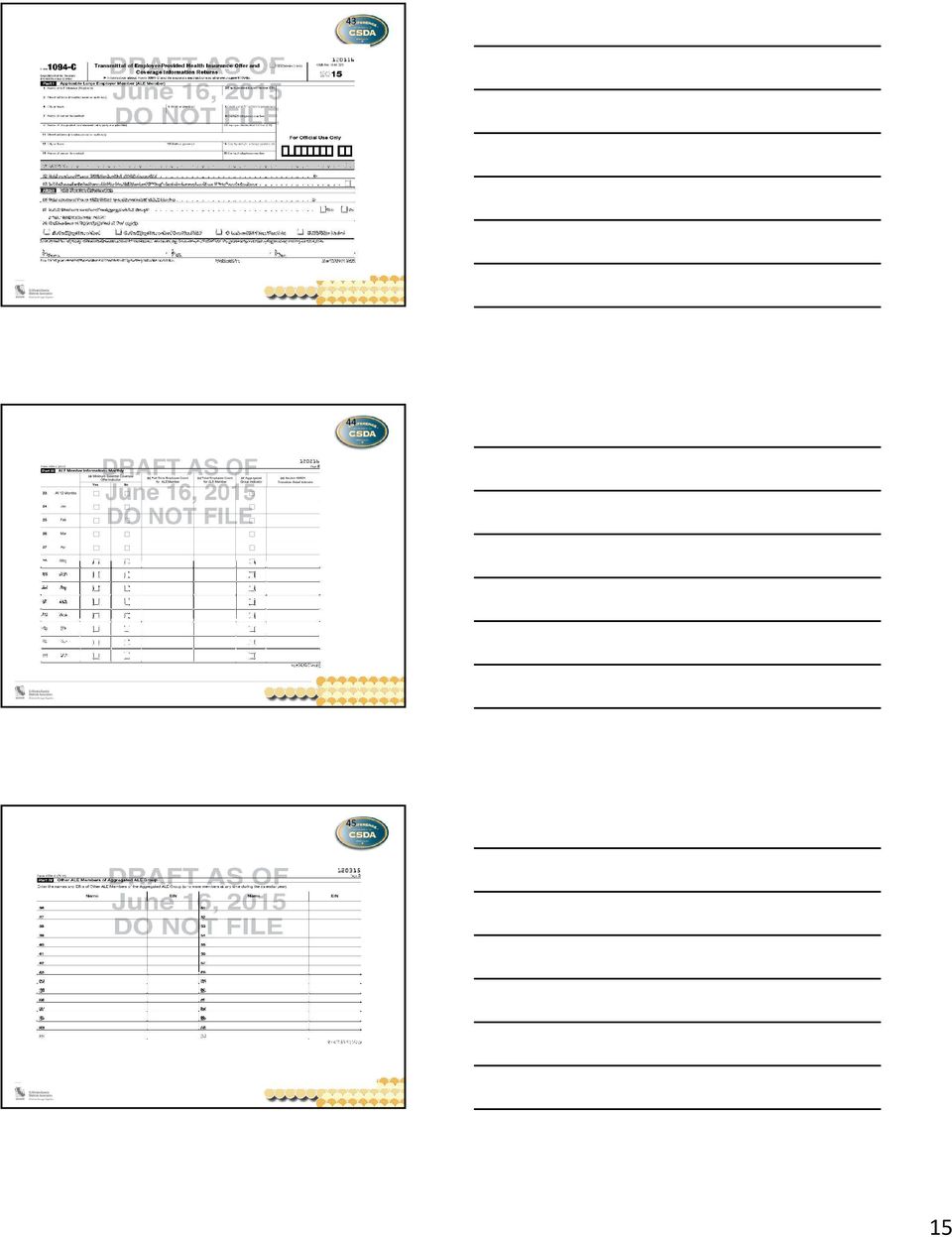
16 Section 6056 Reporting: General Method and Three Alternative Methods General Method Report all information required on Form 1094-C (transmittal) and 1095-C (return/employee statement) for each employee If an ALE cannot use one of the alternatives with respect to an employee, it must use the General Method Alternative Methods Alternative 1: Qualifying Offer Method Alternative 2 (2015 Only): Qualifying Offer Method Transition Relief Alternative 3: 98% Offer Method Use of Alternative Methods Alternative Methods are optional but are designed to minimize cost and administrative burden Using alternative methods, if eligible, can potentially reduce the amount of required reported information to the IRS and/or individuals ALEs who qualify to use these alternative methods for any or all of its employees, certify so on the return transmittal form (Form 1094-C) 46 Section 6056 Reporting What Must ALEs Report under the General Method? 47 Name, address, and employer s EIN number Name and telephone number of the employer s contact person The calendar year for which information is being reported A certification by calendar month as to whether the employer offered its FT employees and their dependents the opportunity to enroll in minimum essential coverage The months during the calendar month for which coverage was available Each FT employee s share of the lowest cost monthly premium (self-only) for coverage providing minimum value by calendar month The number of FT employees the employer had for each month during the calendar year The name, address, and TIN of each FT employee during the calendar year and the months, if any, during which the employee was covered under the plan Additional information is to be provided using certain indicator codes on the forms Overview of the 1095-C Statement Part I Identifying information about employee and employer Part II Information about employee s offer and coverage for each month of the year by indicator code (Code Series 1) Employee share of lowest cost premium for self-only minimum value coverage Safe harbors and other employer relief by indicator code (Code Series 2) Part III (Self-Insured Coverage) If employer provides self-insured coverage, the names and tax-payer identification numbers for all covered individuals through employee s enrollment Months of coverage May be used to report coverage for non-employees to meet 6055 reporting requirements for those individuals 48 16

17 49 Reporting Due Dates 50 Applicable Large Employers and Employers Providing Self Insurance Provide employees with statements (Form 1095-B or 1095-C) by February 1, 2016, but generally are due January 31 of each subsequent year. Provide IRS with applicable Forms 1094 and 1095 by February 29 or March 31, 2016 (if file electronically). Employers may use third party administrators to file the returns and furnish statements to employees but this does not transfer any liability to the third party administrator for failure to report or provide information. Penalties for Non-Compliance Penalties may apply if: you fail to file with the IRS and/or fail to furnish to the employee a timely return, or you fail to include all information required to be shown, or you include incorrect information. The amount of the penalty is based on when you file and/or furnish the correct information return. Short term relief from reporting penalties related to incorrect or incomplete information provided for the 2015 calendar year returns to allow additional time to develop appropriate procedures, collection of data and compliance, but reporting entities must be able to show that they have made good faith efforts no similar good faith penalty relief for untimely filing CAUTION incorrect reporting may also result in an incorrect IRS penalty assessment under the employer shared responsibility rules 51 17

18 Reporting Penalties 52 What Should Employers Do Now? 53 Start preparing to comply with reporting requirements as soon as possible Begin learning the information reporting rules early and determine the scope that applies to you Review applicable forms and instructions Read related FAQs on the IRS website Attend trainings, as needed Adopt a process for collecting needed 2015 data (including social security numbers of employees and dependents) for reporting required information about full-time employees and covered individuals Work with IT and your vendors/third party administrators to ensure proper systems and reporting mechanisms are in place 54 Cadillac Tax 18

19 Cadillac Tax High-Cost Coverage Tax 55 Effective 2018 No small employer exception Applies to tax-exempt and government entities No excepted benefits tax is not a market reform Means applies to retiree-only plans 40% excise tax on the aggregate cost of employer-sponsored health care coverage exceeding certain annual dollar thresholds $10,200 for individual coverage and $27,500 for family coverage Thresholds are higher for plans covering retirees and workers in high-risk jobs (construction, fire protection, law enforcement, etc.) Subject to future indexing IRS issuing guidance and seeking public comments in anticipation of releasing future regulations Legislation introduced in Congress to repeal the tax Cadillac Tax High-Cost Coverage Tax 56 Who Calculates the Cadillac Tax? Employer calculates the tax based on all coverage Use costs of coverage paid by employer and paid by employee through salary deduction, cafeteria plan, or with after-tax dollars Who Pays the Cadillac Tax? Each coverage provider is responsible for paying pro-rata share of tax for any excess Employer or plan administrator pays for self-insured coverage Failure to accurately calculate the tax results in a tax penalty for the employer: 100% of the additional amount owed as a penalty, plus underpayment interest But coverage provider still pays the remaining tax owed Employees do not directly pay the tax But likely will be reflected in higher premiums and/or cost control actions by employer sponsor Cadillac Tax High-Cost Coverage Tax 57 Why was the Cadillac Tax included in ACA? Revenue Generation According to IRS guidance, 75% of scored revenue from ACA was based on the presumption that employers will provide cheaper plans and raise taxable wages, resulting in increased tax revenue Control health care costs by reducing demand for high cost coverage Potential trickle down to employees Employers may stop offering Cadillac plans Plan designs may change (e.g. higher deductibles and copays) to reduce premium costs to below the threshold for the tax Insurers may pass on the cost in higher premiums Employers may stop or cut back contributions to health and flexible spending accounts 19

20 58 QUESTIONS? 59 QUESTIONS? 20

IRS Releases 2015 Forms and Instructions for 6055/6056 Reporting
 IRS Releases 2015 Forms and Instructions for 6055/6056 Reporting Background Under the Patient Protection and Affordable Care Act (ACA), individuals are required to have health insurance while applicable
Employer Reporting of Health Coverage Code Sections 6055 & 6056
 Brought to you by Hickok & Boardman HR Intelligence Employer Reporting of Health Coverage Code Sections 6055 & 6056 The Affordable Care Act (ACA) created new reporting requirements under Internal Revenue
Patient Protection and Affordable Care Act Compliance Checklist for Employers
 October, 2014 Patient Protection and Affordable Care Act Compliance Checklist for Employers Under the Employer Mandate in the Affordable Care Act, effective January 1, 2015, employers with 50 or more full-time
Treasury, IRS Release Final Rules on Employer Information Reporting Requirements Under Health Care Law
 March 6, 2014 Treasury, IRS Release Final Rules on Employer Information Reporting Requirements Under Health Care Law The Department of the Treasury and the IRS late yesterday (March 6, 2014) released long
PENALTIES Employer Shared Responsibility under the Affordable Care Act (ACA)
 PENALTIES Employer Shared Responsibility under the Affordable Care Act (ACA) What employers need to know to make informed decisions about ACA compliance. Employer Shared Responsibility Under the employer
Legislative Brief: 2015 COMPLIANCE CHECKLIST. Laurus Strategies
 Laurus Strategies Legislative Brief: 2015 COMPLIANCE CHECKLIST The Affordable Care Act (ACA) has made a number of significant changes to group health plans since the law was enacted over four years ago.
Heffernan Benefit Advisors Presents Health Care Reform: What Non-Profits Need to Know. The session will begin shortly
 Heffernan Benefit Advisors Presents Health Care Reform: What Non-Profits Need to Know The session will begin shortly Sound should come through your speakers when the session begins Verify that the volume
Affordable Care Act (ACA) Violations Penalties and Excise Taxes
 Brought to you by The Insurance Exchange Affordable Care Act (ACA) Violations Penalties and Excise Taxes The Affordable Care Act (ACA) includes numerous reforms for group health plans and creates new compliance
Employer-Sponsored Coverage Reporting Requirements
 Under ACA rules, all employers that offer self-insured health plans must report new, detailed information on every individual covered under their health plan. There are reporting requirements for self-insured
How To Report Health Insurance To The Irs
 ACA REPORTING WEBINAR QUESTIONS AND ANSWERS The following questions on ACA reporting requirements to the IRS were collected at a series of webinars offered by ThinkHR. Introduction The Affordable Care
Summary of Provisions Affecting Employer-Sponsored Insurance
 JULY 2014 AFFORDABLE CARE ACT Summary of Provisions Affecting Employer-Sponsored Insurance Much of the public discussion about the Affordable Care Act (ACA) has focused on the expansion of coverage to
To enforce these penalties and properly administer the premium tax credits, ACA imposes two annual reporting requirements on employers.
 Employer Health Coverage Reporting Requirements for 2015 Summary The Affordable Care Act (ACA) includes reporting requirements for health care coverage in 2015. The reports will give information to the
IRS Issues Drafts of Individual Responsibility Reporting Forms
 IRS Issues Drafts of Individual Responsibility Reporting Forms The following is a summary of draft forms. Some of this information may change when final forms, and the instructions, are released. In order
The Affordable Care Act: Summary of Employer Requirements
 The Affordable Care Act: Summary of Employer Requirements February 2013 Disclaimer Any US tax advice contained herein was not intended or written to be used, and cannot be used, for the purpose of avoiding
Employer Tax Penalties Linked to Employees Receiving Tax Credits. Calculation of Non-deductible Excise Taxes Under IRC 4380H
 Washington Council Employer Tax Penalties Linked to Employees Receiving Tax Credits Employers will face taxes under IRC 4980H if they do not offer minimum essential coverage or if the coverage they offer
Health Care Reform: 2015 Refresher of the Affordable Care Act (ACA)
 Health Care Reform: 2015 Refresher of the Affordable Care Act (ACA) Brought to you by Aon Presented by: Ryan Comstock & Shawna Brown This information is provided for informational purposes only and is
Q&A from Assurex Global Webinar. Employer ACA Reporting Requirements. Q: Where will these forms come from? will the IRS provide them?
 Q&A from Assurex Global Webinar Employer ACA Reporting Requirements Questions Q: Where will these forms come from? will the IRS provide them? A: IRS has provided draft Forms 1094 and 1095 along with draft
Wells Insurance. 2015 ACA Compliance Update
 Wells Insurance 2015 ACA Compliance Update Wells Insurance Today s Agenda Cost-Saving Strategies Deadlines & Implications for you Plan Design Changes Reinsurance Fees Employer Penalty Rules Reporting of
Key Considerations in Avoiding and Calculating Penalties Pursuant to the Employer Shared Responsibility Mandate
 and Calculating Penalties Pursuant to the Employer Shared Compliance Practice of Arthur J. Gallagher & Co. As a preliminary step, employers must determine if their organization is subject to the mandate.
Employer s Guide To Health Care Reform
 Employer s Guide To Health Care Reform A nonprofit independent licensee of the Blue Cross Blue Shield Association National strength. Local focus. Individual care. SM As part of our commitment to being
Potential Penalties for Employers under the Pay or Play Rules
 The Affordable Care Act (ACA) brings many changes to employers and health plans. One such change essentially amounts to a requirement for some employers to offer a certain level health care to their employees
Advantage Payroll Services Presents. March 24, 2015 Presenter: Jessica Stelfox, MBA, PHR
 (c )A dv an ta ge Pa yr ol l Se rv ic es 20 15 Advantage Payroll Services Presents March 24, 2015 Presenter: Jessica Stelfox, MBA, PHR We encourage you to benefit from resources and information provided
Two New Reporting Requirements Beginning in 2016 But Are Important Now
 Two New Reporting Requirements Beginning in 2016 But Are Important Now Recently, the IRS published final regulations implementing two new information reporting requirements under ACA that are first due
Health Care Reform Employer Shared Responsibility Provisions
 Health Care Reform Employer Shared Responsibility Provisions Safe Harbor Qualification This document provides an overview of the employer shared responsibility (ESR) provisions of the Affordable Care Act
IRS Form 1095-C: Indicator Codes for Lines 14, 15, and 16
 IRS Form 1095-C: Indicator Codes for Lines 14, 15, and 16 Form 1095-C, Part II, Line 14: Indicator Code Series 1 for Offer of Coverage 1A. Qualifying Offer: Minimum essential coverage providing minimum
The Insurance Mandates of the Affordable Care Act
 1 A. Affordable Care Act Individual Mandate The Insurance Mandates of the Affordable Care Act 1. All citizens of the United States are subject to the individual mandate as are all permanent residents and
Health care reform for large businesses
 FOR PRODUCERS AND EMPLOYERS Health care reform for large businesses A guide to what you need to know now DECEMBER 2013 CONTENTS 2 Introduction Since 2010 when the Affordable Care Act (ACA) was signed into
School District Obligations Under the New Federal Health Care Law: Is Your District Going to Play or Pay the Penalty?
 TM MISSOURI SCHOOL BOARDS ASSOCIATION HELPING SCHOOL BOARDS SUCCEED School District Obligations Under the New Federal Health Care Law: Is Your District Going to Play or Pay the Penalty? Click to jump to
Small Employer Health Care Tax Credit: Questions & Answers (Q&A)
 Brought to you by Seubert & Associates Small Employer Health Care Tax Credit: Questions & Answers (Q&A) The Patient Protection and Affordable Care Act (ACA) provides a tax credit to certain small employers
Health Care Law Implementation: What Nonprofits Need to Know WELCOME!
 Health Care Law Implementation: What Nonprofits Need to Know WELCOME! Health Care Law Implementation: What Nonprofits Need to Know (PPACA) Health Care Law Implementation: What Nonprofits Need to Know Heather
IRS Guidance on Employer Shared Responsibility Penalty
 Brought to you by Hammitt Benefits Group IRS Guidance on Employer Shared Responsibility Penalty Beginning in 2014, the Affordable Care Act (ACA) imposes pay or play requirements on large employers to help
Health Care Reform: What to Expect in 2013 2014. Employee Benefits Series. Health Care Reform 2015 COMPLIANCE CHECKLIST
 Health Care Reform: What to Expect in 2013 2014 Employee Benefits Series Health Care Reform 2015 COMPLIANCE CHECKLIST This checklist is designed to help employers who sponsor group health plans review
Shared Responsibility: What It Means for Your Business
 Shared Responsibility: What It Means for Your Business The provisions of the Affordable Care Act (ACA) apply to nearly all companies in the United States. The ways they apply, however, can be different
Navigating the Employer Mandate
 Navigating the Employer Mandate The Employer Mandate is the Health Care Reform provision that requires all employers with 50 or more full time equivalent employees to offer a certain level of health insurance
The Affordable Care Act: What Public Employers Need to be Doing Now
 The Affordable Care Act: What Public Employers Need to be Doing Now April 30, 2014 J. Richard Johnson IPMA-HR Webinar Copyright 2014 by The Segal Group, Inc. All rights reserved. 1 ACA Update Discussion
IRS NOTICE 2015-87: ADDITIONAL GUIDANCE ON HRAS, ACA REPORTING, HEALTH FSA CARRYOVERS AND MORE
 Attorneys at Law Friday, January 29, 2016 IRS NOTICE 2015-87: ADDITIONAL GUIDANCE ON HRAS, ACA REPORTING, HEALTH FSA CARRYOVERS AND MORE By: Gabriel S. Marinaro, Esq. In December of 2015, the IRS issued
The Patient Protection and Affordable Care Act ( ACA ) and Your Facility
 The Patient Protection and Affordable Care Act ( ACA ) and Your Facility By Christine Garrity: Chief Administrative Officer & General Counsel for The Professional Golfers' Association of America President
COMMENTARY. The Affordable Care Act: Considerations for Employers with Unionized Workers JONES DAY
 March 2014 JONES DAY COMMENTARY The Affordable Care Act: Considerations for Employers with Unionized Workers The Affordable Care Act ( ACA ) infuses new complexities into collective bargaining negotiations
ACA Employer Mandate: The Ultimate Guide
 ACA Employer Mandate: The Ultimate Guide Table of Contents Are you ready? WHO needs to comply? WHAT forms do you need to file to comply? WHEN do you need to file the forms? WHERE do you get the forms?
School District Obligations Under the New Federal Health Care Law:
 A special thanks to the following who provided technical assistance in drafting this guidance: Leza Conliffe National School Boards Association Ken Mason Spencer Fane Britt & Browne LLP Don Tatman Tatman
Your guide to health care reform provisions
 Your guide to health care reform provisions February 2014 edition Since the Patient Protection and Affordable Care Act (PPACA) was enacted in March 2010, businesses have been impacted by federal health
American employers need prompt action on these six significant challenges. We urge Congress and the administration to address them now.
 In June 2014, the Board of Directors of the American Benefits Council (the Council) approved a long-term public policy strategic plan, A 2020 Vision: Flexibility and the Future of Employee Benefits. It
AFFORDABLE CARE ACT REPORTING
 AFFORDABLE CARE ACT REPORTING Introduction The Affordable Care Act (ACA) requires the State of Missouri to offer health insurance to full time equivalent employees. The ACA also generally requires individual
What s Ahead for 2015: Preparing Your Group Health Plan for the Employer Mandate
 What s Ahead for 2015: Preparing Your Group Health Plan for the Employer Mandate May 14, 2014 1 Speakers Moderator: Lisa A. Tavares, Partner Speakers: Thora A. Johnson, Partner Harry I. Atlas, Partner
HEALTH & WELFARE PLAN LUNCH GROUP
 HEALTH & WELFARE PLAN LUNCH GROUP October 1, 2015 ALSTON & BIRD LLP One Atlantic Center 1201 W. Peachtree Street Atlanta, GA 30309-3424 (404) 881-7885 E-mail: [email protected] 2015 All Rights Reserved
Healthcare Reform Provisions Unique to Small Employers/Financial and Other Benefits Concerns for All Employers (updated May 2, 2014)
 /Financial and Other Benefits Concerns for All Employers (updated May 2, 2014) Lisa L. Carlson, J.D., Area Senior Vice President, Compliance Counsel Gallagher Benefit Services, Inc. While most healthcare
Small Business Health Care Tax Credit
 Small Business Health Care Tax Credit Frequently Asked Questions Small Business Health Care Tax Credit This information is only intended as a high-level guide and is not to be relied upon as actuarial,
ABC Company 123 Main Street Anywhere, USA 12345 www.sampleabccompany.com 800.123.4567
 WHAT HEALTH CARE REFORM MEANS FOR YOUR BUSINESS Your promotional imprint here and/or back cover. ABC Company 123 Main Street Anywhere, USA 12345 www.sampleabccompany.com 800.123.4567 The Patient Protection
What Employers Need to Know about the Final ACA Reporting Forms
 What Employers Need to Know about the Final ACA Reporting Forms We highly recommend that you download the slides prior to the webinar at http://ow.ly/lccoh (case sensitive) Laura Kerekes, SPHR, SHRM-SCP
Guidance issued on employer shared responsibility requirements
 Guidance issued on employer shared responsibility requirements The shared responsibility requirements are one of the most significant provisions that employers need to address under the Affordable Care
MEMORANDUM. March 5, 2014. IRS Final Rule on the Affordable Care Act s Employer Mandate
 2120 L Street, NW, Suite 700 T 202.822.8282 HOBBSSTRAUS.COM Washington, DC 20037 F 202.296.8834 MEMORANDUM To: From: Re: Tribal Health Clients Hobbs, Straus, Dean & Walker LLP IRS Final Rule on the Affordable
FAQ. Affordable Care Act s Employer Mandate: Deciding Whether Your Organization Should Pay or Play FAQ
 FAQ Affordable Care Act s Employer Mandate: Deciding Whether Your Organization Should Pay or Play Editor s Note: On April 17, 2013, WorldatWork hosted the second webinar of a three-part town-hall series
IRS Issues Guidance on Mandatory Form W-2 Informational Reporting of Employer-Sponsored Health Coverage
 IRS Issues Guidance on Mandatory Form W-2 Informational Reporting of Employer-Sponsored Health Coverage By Seth Perretta, Joel Wood and Matthew Fornataro of Crowell & Moring LLP On March 29, 2011, the
Affordable Care Act FAQ
 Affordable Care Act FAQ Based on regulatory guidance issued as of March 2014 and subject to change. Contents General ACA Questions... 1 ACA Marketplace... 1 ACA Employer Shared Responsibility... 2 ACA
IRS Eases Employers Into Employer Mandate
 IRS Eases Employers Into Employer Mandate February 2014 The Treasury and Internal Revenue Service (IRS) released final regulations on the employer mandate under the Patient Protection and Affordable Care
Answers about. Health Care REFORM. for your business
 Answers about Health Care REFORM for your business Since the time of its enactment in 2010, the health care reform law has remained controversial at least in part due to a constitutional challenge to the