
STUDY MATERIAL. M.B.A. PROGRAMME (Code No. 411) (Effective from ) II SEMESTER 209MBT27 APPLIED RESEARCH METHODS IN MANAGEMENT
|
|
|
- Barnard Hill
- 10 years ago
- Views:
Transcription
1 St. PETER'S UNIVERSITY St. Peter s Institute of Higher Education and Research (Decared Under Section 3 of the UGC Act, 1956) AVADI, CHENNAI TAMIL NADU STUDY MATERIAL M.B.A. PROGRAMME (Code No. 411) (Effective from ) II SEMESTER 209MBT27 APPLIED RESEARCH METHODS IN MANAGEMENT St. PETER'S INSTITUTE OF DISTANCE EDUCATION Recognized by Distance Education Counci and Joint Committee of UGC AICTE - DEC, New Dehi. (Ref. F.No.DEC/SPU/CHN/TN/Recog/09/14 dated & Ref. F.No.DEC/Recog/2009/3169 dated )

2 Author: U Bhojanna Copyright 2011, U Bhojanna No Part of this pubication which is materia protected by this copyright notice may be reproduced or transmitted or utiized or stored in any form or by any means now known or hereinafter invented, eectronic, digita or mechanica, incuding photocopying, scanning, recording or by any information storage or retrieva system, without prior written permission from the pubisher. Information contained in this book has been pubished by Exce Books Private Limited and has been obtained by its authors from sources beieved to be reiabe and are correct to the best of their knowedge. The University has edited the study materia to suit the curricuum and distance education mode. However, the pubisher/university and its author sha in no event be iabe for any errors, omissions or damages arising out of use of this information and specificay discaim any impied warranties or merchantabiity or fitness for any particuar use. Produced and printed by: Exce Books Private Ltd, A-45, Naraina, Phase-I, New Dehi

3 PREFACE St. Peter s University has been recognized by the Distance Education Counci, and Joint Committee of UGC- AICTE-DEC, for offering various programmes incuding B.Tech., D.Tech., MBA, MCA and other programmes in Humanities and Sciences through Distance Education mode. The Methodoogy of Distance Education incudes sef-instructiona study materias in print form, face-to-face conseing, practica casses, virtua casses in phased manner and end assessment. The basic support for distance education students ies on the sef instructiona study materias. Keeping this in mind, the study materias under distance mode are prepared. The main features of the study materias are (1) earning objectives (2) sef expanatory study materias unitwise (3) sef tests (4) ist of references for further studies. The materia is prepared in simpe Engish and graded in terms of technica content. It is buit upon the pre-requisite knowedge. Students are advised to study the materias severa times and get benefitted. The face-to-face session in the counseing centre wi hep them to cear their doubts and difficut concepts which they woud have faced during the earning process. Students shoud remember that sef study and sustained motivation are the two important requirements for a successfu earning under the distance education mode. We wish the students to put forth their best efforts to become successfu in their chosen fied of earning. Registrar St. Peter s University

4

5 CONTENTS Scheme of Examinations Syabus of Appied Research Methods in Management Mode Question Paper Page vi x xi UNIT I: INTRODUCTION TO RESEARCH Lesson 1 Research Fundamentas 3 Lesson 2 Research Process: Theoretica Framework and Hypothesis Deveopment 16 Lesson 3 The Research Process: Eements of Research Design 25 UNIT II: EXPERIMENTAL DESIGN Lesson 4 Experimenta Designs 39 Lesson 5 Measurement and Measurement Scaes 47 UNIT III: DATA COLLECTION METHOD Lesson 6 Data Coection Methods 63 Lesson 7 Specia Data Source 82 Lesson 8 Samping 88 UNIT IV: A REFRESHER ON SOME MULTIVARIATE STATISTICAL TECHNIQUES Lesson 9 Mutivariate Statistica Techniques 111 Lesson 10 Appication of SPSS Package 124 UNIT V: THE RESEARCH REPORT Lesson 11 Fundamentas of Report 139 Lesson 12 Report Writing 146
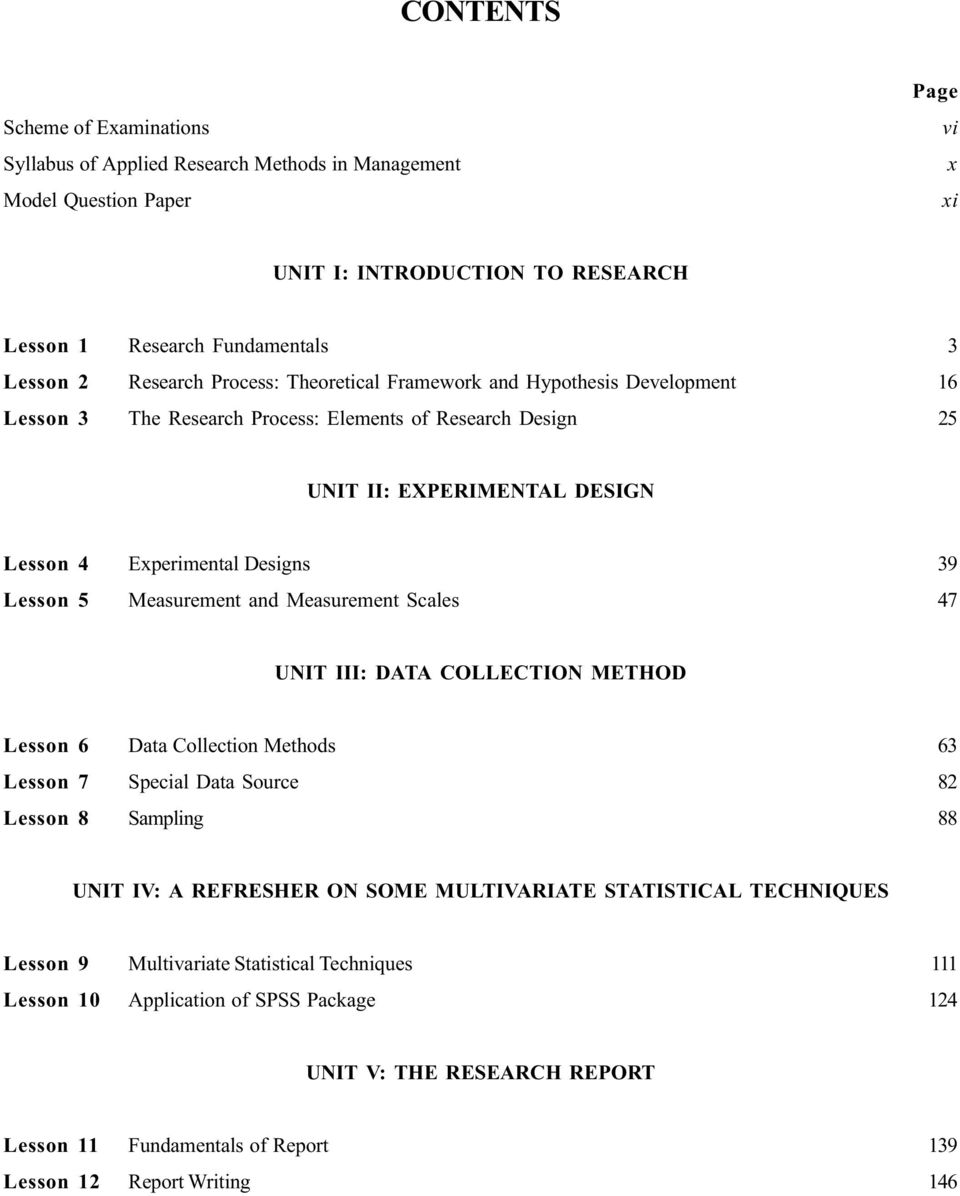
6 Scheme of Examinations I Semester Code No. Course Tite Credit Marks Theory EA Tota 109MBT11 Management Principes & Organisationa Behaviour MBT12 Economic Anaysis for Business Decisions MBT13 Statistics for Management MBT14 Appied Operation Research for Management MBT15 Financia and Management Accounting MBT16 Lega Environment of Business MBT17 Executive Communication Tota II Semester Code No. Course Tite Credit Marks Theory EA Tota 209MBT21 Production & Operation Management MBT22 Financia Management Decisions MBT23 Marketing for Managers MBT24 Human Resource Management MBT25 Computer Appications and Management Information System MBT26 Tota Quaity Management MBT27 Appied Research Methods in Management MBP01 Computer Lab for Business Administration Record Tota
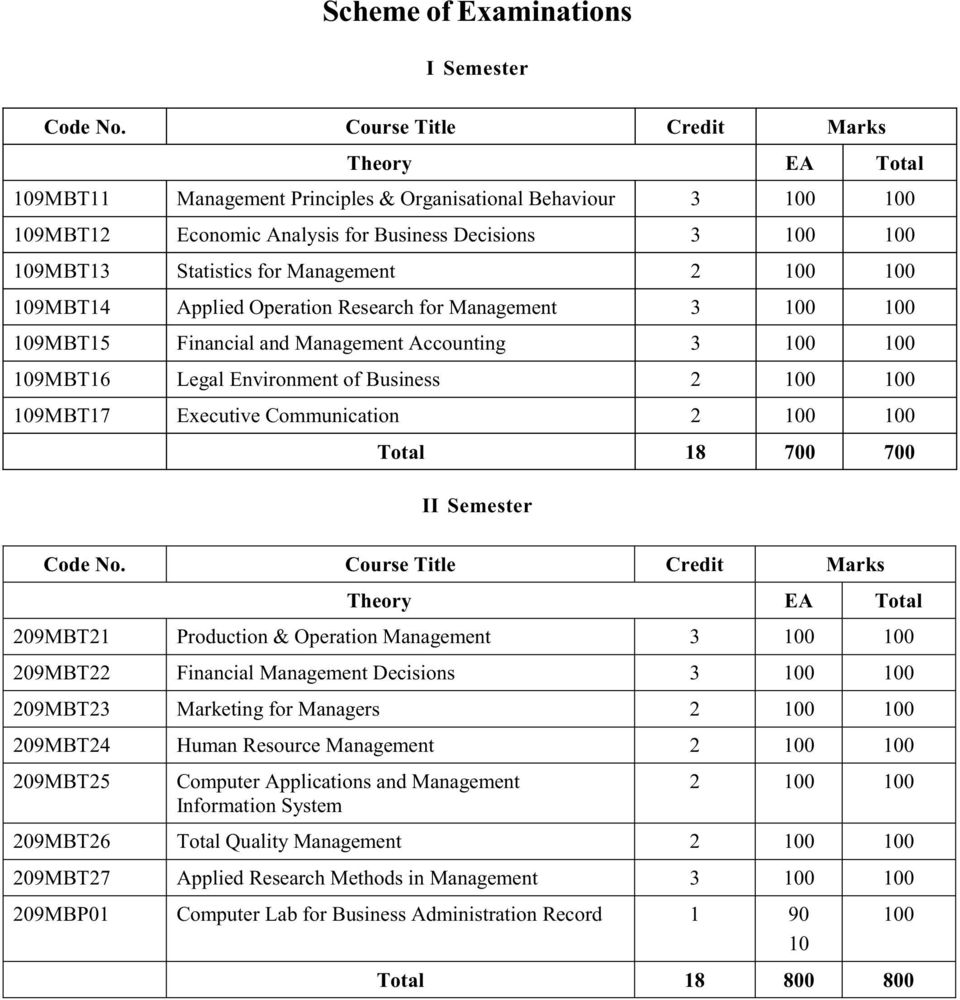
7 III Semester Code No. Course Tite Credit Marks Theory EA Tota 309MBT01 Internationa Business Management MBT02 Strategic Management E1*** Eectives I E2*** Eectives II E3*** Eectives III E4*** Eective IV E5*** Eective V E6*** Eective VI Tota *** Any one group of eectives from Marketing, Finance, Human Resource Management and System is to be chosen. IV Semester Code No. Course Tite Credit Marks Theory EA Tota 409MBT01 Marketing Research and Consumer Behaviour MBT02 Entrepreneurship Deveopment MBP01 Project and Vivavoce * Tota * In ieu of Project and Vivavoce, 409MBT03 - E-Commerce Technoogy and Management (6 Credits) is offered for Distance Education Students.

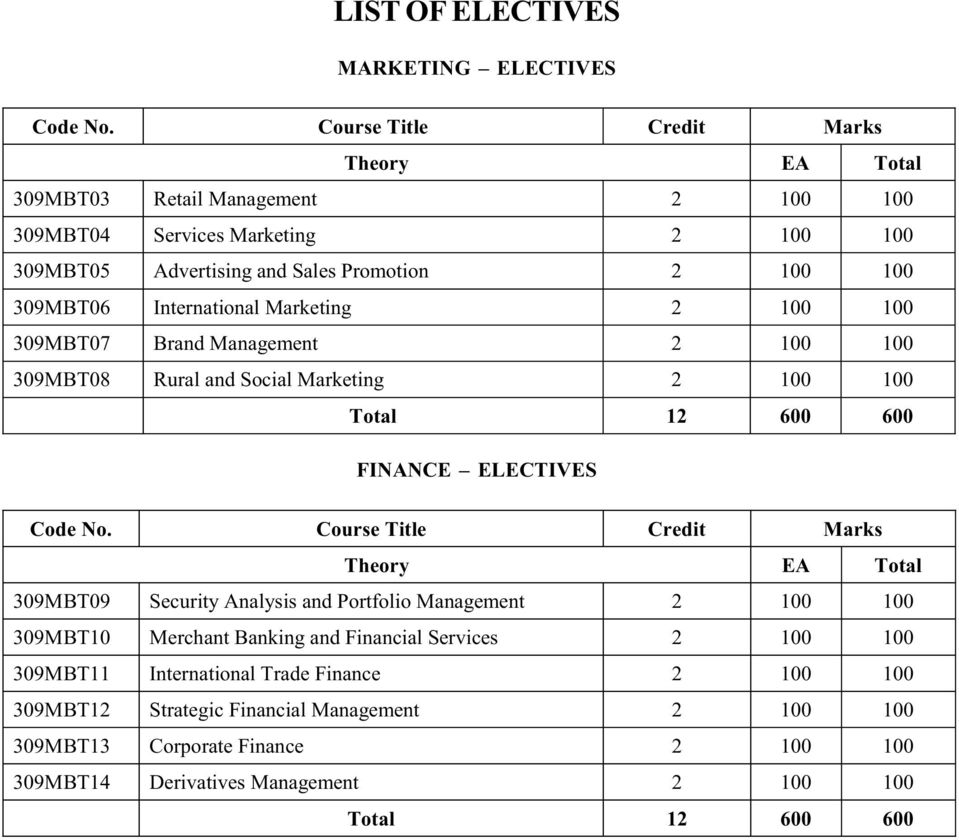
8 LIST OF ELECTIVES MARKETING ELECTIVES Code No. Course Tite Credit Marks Theory EA Tota 309MBT03 Retai Management MBT04 Services Marketing MBT05 Advertising and Saes Promotion MBT06 Internationa Marketing MBT07 Brand Management MBT08 Rura and Socia Marketing Tota FINANCE ELECTIVES Code No. Course Tite Credit Marks Theory EA Tota 309MBT09 Security Anaysis and Portfoio Management MBT10 Merchant Banking and Financia Services MBT11 Internationa Trade Finance MBT12 Strategic Financia Management MBT13 Corporate Finance MBT14 Derivatives Management Tota
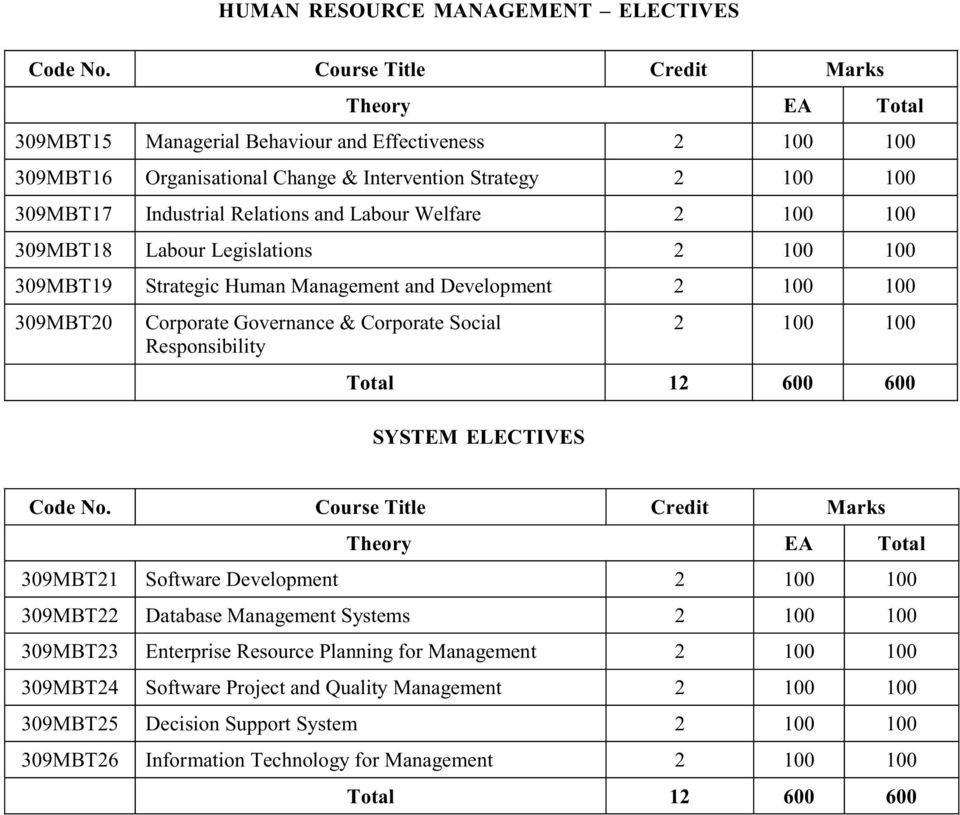
9 HUMAN RESOURCE MANAGEMENT ELECTIVES Code No. Course Tite Credit Marks Theory EA Tota 309MBT15 Manageria Behaviour and Effectiveness MBT16 Organisationa Change & Intervention Strategy MBT17 Industria Reations and Labour Wefare MBT18 Labour Legisations MBT19 Strategic Human Management and Deveopment MBT20 Corporate Governance & Corporate Socia Responsibiity Tota SYSTEM ELECTIVES Code No. Course Tite Credit Marks Theory EA Tota 309MBT21 Software Deveopment MBT22 Database Management Systems MBT23 Enterprise Resource Panning for Management MBT24 Software Project and Quaity Management MBT25 Decision Support System MBT26 Information Technoogy for Management Tota
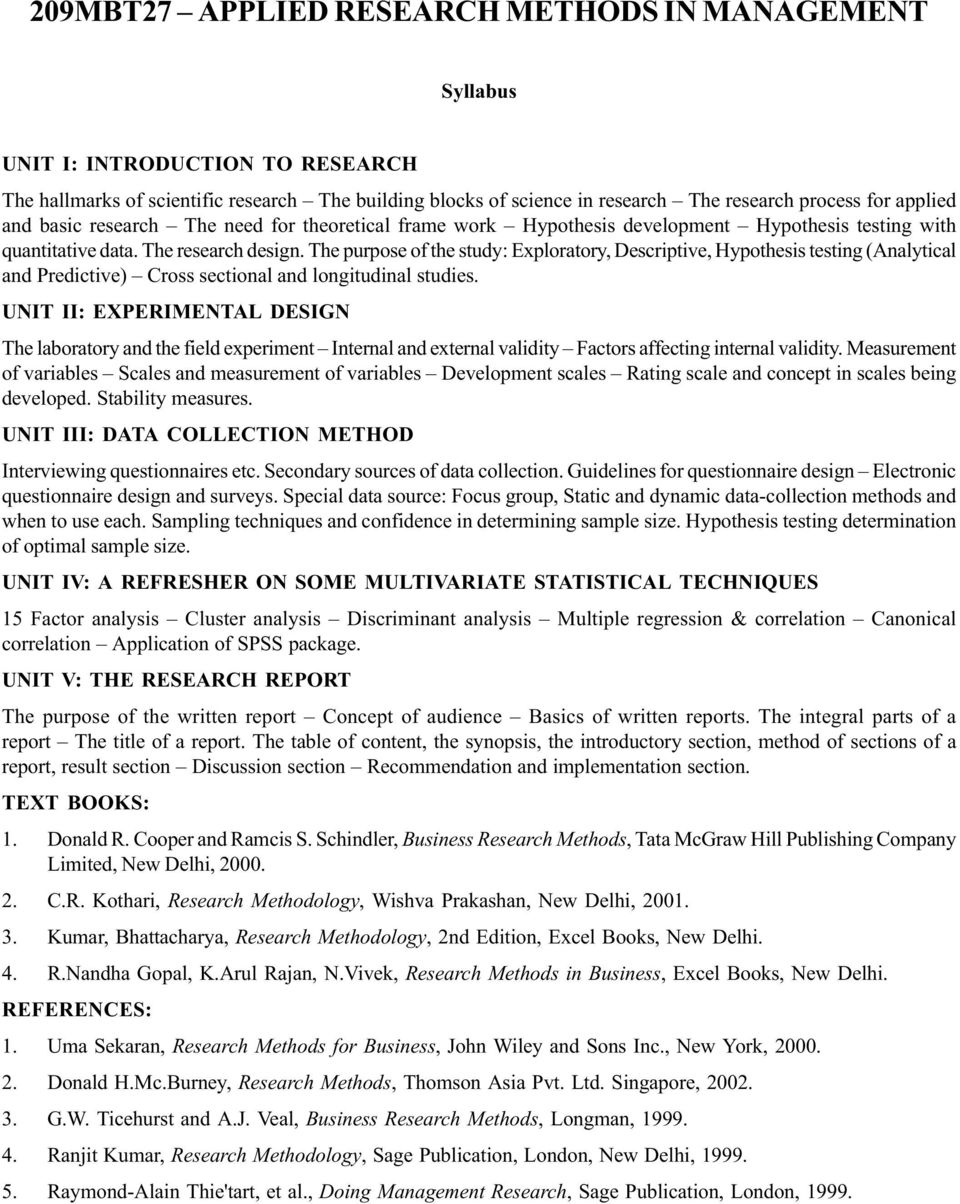
10 209MBT27 APPLIED RESEARCH METHODS IN MANAGEMENT Syabus UNIT I: INTRODUCTION TO RESEARCH The hamarks of scientific research The buiding bocks of science in research The research process for appied and basic research The need for theoretica frame work Hypothesis deveopment Hypothesis testing with quantitative data. The research design. The purpose of the study: Exporatory, Descriptive, Hypothesis testing (Anaytica and Predictive) Cross sectiona and ongitudina studies. UNIT II: EXPERIMENTAL DESIGN The aboratory and the fied experiment Interna and externa vaidity Factors affecting interna vaidity. Measurement of variabes Scaes and measurement of variabes Deveopment scaes Rating scae and concept in scaes being deveoped. Stabiity measures. UNIT III: DATA COLLECTION METHOD Interviewing questionnaires etc. Secondary sources of data coection. Guideines for questionnaire design Eectronic questionnaire design and surveys. Specia data source: Focus group, Static and dynamic data-coection methods and when to use each. Samping techniques and confidence in determining sampe size. Hypothesis testing determination of optima sampe size. UNIT IV: A REFRESHER ON SOME MULTIVARIATE STATISTICAL TECHNIQUES 15 Factor anaysis Custer anaysis Discriminant anaysis Mutipe regression & correation Canonica correation Appication of SPSS package. UNIT V: THE RESEARCH REPORT The purpose of the written report Concept of audience Basics of written reports. The integra parts of a report The tite of a report. The tabe of content, the synopsis, the introductory section, method of sections of a report, resut section Discussion section Recommendation and impementation section. TEXT BOOKS: 1. Donad R. Cooper and Ramcis S. Schinder, Business Research Methods, Tata McGraw Hi Pubishing Company Limited, New Dehi, C.R. Kothari, Research Methodoogy, Wishva Prakashan, New Dehi, Kumar, Bhattacharya, Research Methodoogy, 2nd Edition, Exce Books, New Dehi. 4. R.Nandha Gopa, K.Aru Rajan, N.Vivek, Research Methods in Business, Exce Books, New Dehi. REFERENCES: 1. Uma Sekaran, Research Methods for Business, John Wiey and Sons Inc., New York, Donad H.Mc.Burney, Research Methods, Thomson Asia Pvt. Ltd. Singapore, G.W. Ticehurst and A.J. Vea, Business Research Methods, Longman, Ranjit Kumar, Research Methodoogy, Sage Pubication, London, New Dehi, Raymond-Aain Thie'tart, et a., Doing Management Research, Sage Pubication, London, 1999.
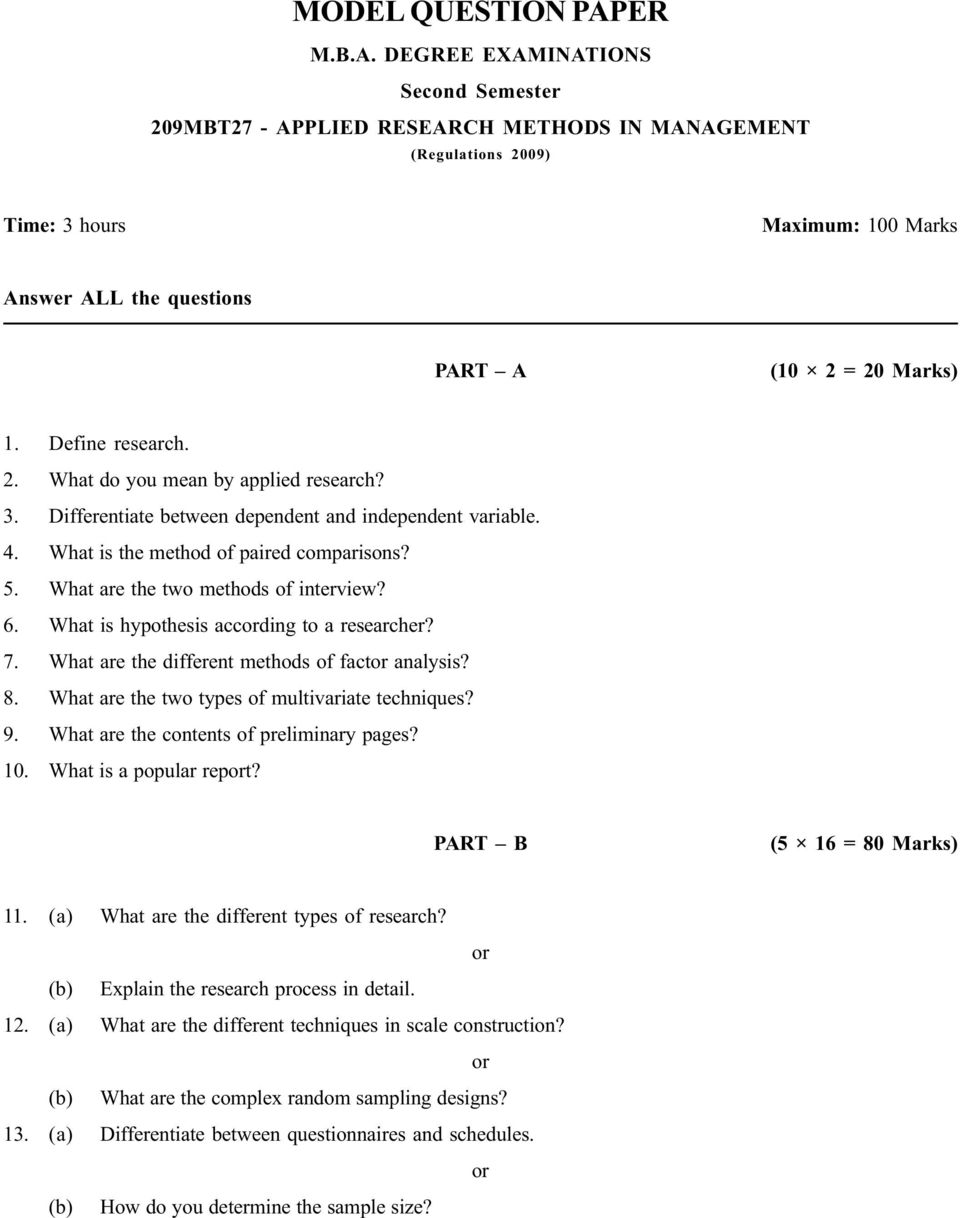
11 MODEL QUESTION PAPER M.B.A. DEGREE EXAMINATIONS Second Semester 209MBT27 - APPLIED RESEARCH METHODS IN MANAGEMENT (Reguations 2009) Time: 3 hours Maximum: 100 Marks Answer ALL the questions PART A (10 2 = 20 Marks) 1. Define research. 2. What do you mean by appied research? 3. Differentiate between dependent and independent variabe. 4. What is the method of paired comparisons? 5. What are the two methods of interview? 6. What is hypothesis according to a researcher? 7. What are the different methods of factor anaysis? 8. What are the two types of mutivariate techniques? 9. What are the contents of preiminary pages? 10. What is a popuar report? PART B (5 16 = 80 Marks) 11. (a) What are the different types of research? or (b) Expain the research process in detai. 12. (a) What are the different techniques in scae construction? or (b) What are the compex random samping designs? 13. (a) Differentiate between questionnaires and schedues. or (b) How do you determine the sampe size?
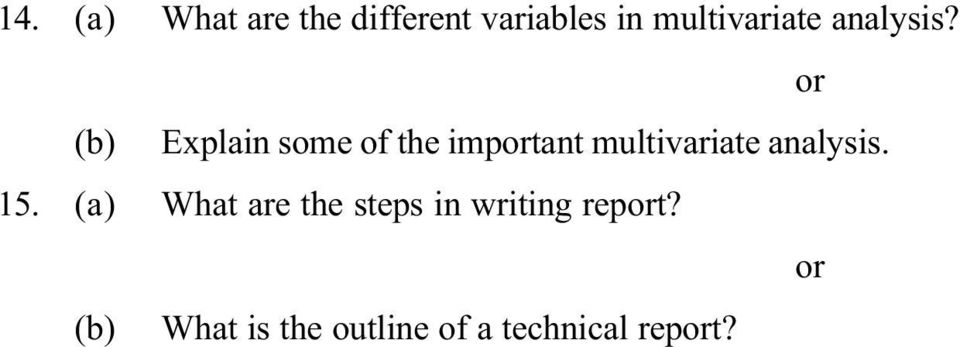
12 14. (a) What are the different variabes in mutivariate anaysis? or (b) Expain some of the important mutivariate anaysis. 15. (a) What are the steps in writing report? or (b) What is the outine of a technica report?
13 Unit I Introduction to Research

14

15 LESSON 1 RESEARCH FUNDAMENTALS STRUCTURE 1.0 Objectives 1.1 Introduction 1.2 The Hamarks of Scientific Research 1.3 The Buiding Bocks of Science in Research 1.4 The Research Process for Appied and Basic Research Probem Formuation Evauate the Cost of Research Preparing a List of Needed Information Decision on Research Design Data Coection Seect the Sampe Types Determine the Sampe Size Organise the Fiedwork Anayse the Data and Report Preparation 1.5 Let us Sum up 1.6 Gossary 1.7 Suggested Readings 1.8 Questions 1.0 OBJECTIVES After studying this esson, you shoud be abe to: Discuss the hamarks of scientific research Expain the buiding bocks of science in research Eucidate upon the research process for appied and basic research 1.1 INTRODUCTION Research in common man's anguage refers to "search for Knowedge". Research is an art of scientific investigation. It is aso a systematic design, coection, anaysis and reporting the findings & soutions for the marketing probem of a company. Research is required because of the foowing reasons:

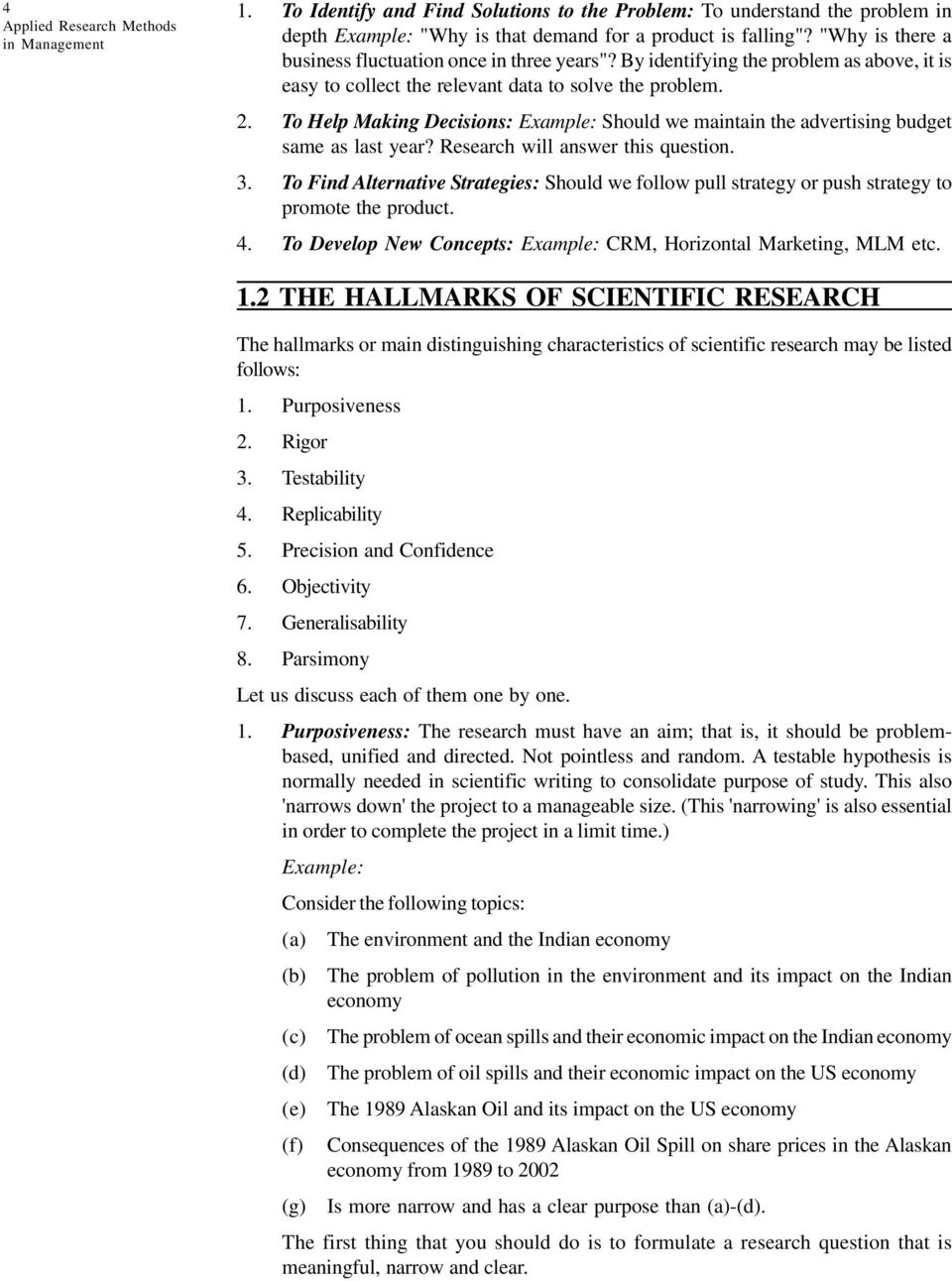
16 4 Appied Research Methods in Management 1. To Identify and Find Soutions to the Probem: To understand the probem in depth Exampe: "Why is that demand for a product is faing"? "Why is there a business fuctuation once in three years"? By identifying the probem as above, it is easy to coect the reevant data to sove the probem. 2. To Hep Making Decisions: Exampe: Shoud we maintain the advertising budget same as ast year? Research wi answer this question. 3. To Find Aternative Strategies: Shoud we foow pu strategy or push strategy to promote the product. 4. To Deveop New Concepts: Exampe: CRM, Horizonta Marketing, MLM etc. 1.2 THE HALLMARKS OF SCIENTIFIC RESEARCH The hamarks or main distinguishing characteristics of scientific research may be isted foows: 1. Purposiveness 2. Rigor 3. Testabiity 4. Repicabiity 5. Precision and Confidence 6. Objectivity 7. Generaisabiity 8. Parsimony Let us discuss each of them one by one. 1. Purposiveness: The research must have an aim; that is, it shoud be probembased, unified and directed. Not pointess and random. A testabe hypothesis is normay needed in scientific writing to consoidate purpose of study. This aso 'narrows down' the project to a manageabe size. (This 'narrowing' is aso essentia in order to compete the project in a imit time.) Exampe: Consider the foowing topics: (a) The environment and the Indian economy (b) The probem of poution in the environment and its impact on the Indian economy (c) The probem of ocean spis and their economic impact on the Indian economy (d) The probem of oi spis and their economic impact on the US economy (e) The 1989 Aaskan Oi and its impact on the US economy (f) Consequences of the 1989 Aaskan Oi Spi on share prices in the Aaskan economy from 1989 to 2002 (g) Is more narrow and has a cear purpose than (a)-(d). The first thing that you shoud do is to formuate a research question that is meaningfu, narrow and cear.
17 2. Rigour: The project shoud have sound methodoogica design. It shoud be 'scientific' and/or 'ogica'. Concusions must foow from accepted premises defended and tested in the course of the research. One can't base the concusions on a few interviews with company empoyees, for exampe. In the above exampe (f) ends to a rigorous approach ony if: a number of features of the Aaskan economy ony if: a number of features of the Aaskan economy are considered and tested under a range of different conditions and if 'consequences' are measured using a number of independent economic modes. Consider: v phrasing of research question (see 4. Hypothesis formation, beow) v phrasing of survey questions v Sampe size (how many is needed?) v cause and effect (which is which?) v choice of reevant variabes. Rigour is aso ensured by an appropriatey wide search and discussion of the iterature in the area. This not ony heps in making the study rigorous by avoiding probems in these areas that others might have made, but it ensures that the study is unique. 3. Isoating Variabes: Getting cear about your variabes is critica: you must distinguish your dependent variabes (the things you are ooking at), from the independent variabe(s) (things that infuence the dependent variabe) and the moderating variabe(s) (things that modify the reationship between the DV and V) and the intervening variabe(s) (things that may turn up after the moderating variabe(s) have had their effect(s), but does not change that reationship). For exampe, in the previous case given: v Aaskan share prices are the dependent variabes v The 1989 Aaskan oi spi is the independent variabe v the genera infuences on Aaskan share prices are moderating variabes (e.g., the state of the word economy, trade with other countries, etc.) v Other factors which may normay have an impact on share prices (consumer sentiment, terrorism, etc.), but need not change the reationship between the DV and the IV might be interviewing variabes. 4. Hypothesis Formation: A cear hypothesis (even if not expicity stated in the dissertation) wi ensure that your dissertation has a focus/purpose and direction. It aso ensures that you answer a research question of some kind, rather than rambe from one topic to another. The hypothesis(es) are the connecting membranes that hods the research together. The hypothesis can be in severa formats: Conditiona statements (if...then): v If empoyees are more heathy then they wi take sick eave ess frequenty. In the non-conditiona form: v Empoyees who are more heathy wi take sick eave ess frequenty. 5 Research Fundamentas
18 6 Appied Research Methods in Management It is ess cear what constitutes evidence for or against this atter proposition than in the conditiona form. The conditiona form requires you to actuay do something to demonstrate the point. It is not just an unsupported assertion. Directiona statements: v The greater the stress experienced in the job, the ower the job satisfaction of empoyees. Again, ike conditiona, using directions: 'more than' 'ess than', 'negative', 'position' etc., force you to do something to demonstrate the point you are making. It begs justification. Non-directiona statements: These postuate a reationship between variabes, but offer no indication of direction. v There is a difference between the work ethic vaues of Austraian and Asian empoyees. This aso begs carification and expansion. This may be used in an area where there has not yet been demonstrated that there is a significant reationship between variabes, or when studies indicate contradictory findings and where the direction of the reationship is uncear. 5. Testabiity: The research aim must be testabe. It is no good having a cear purpose if it isn't testabe. In previous exampe, the hypothesis (say) that oi spis have an impact on where consumers go shopping is hardy testabe (even though it may be true)! How woud one test this caim? How woud one know that the independent variabe was the ony factor infuencing their choices? For testabiity, you might consider using a combination of data sources: v Statistics v Surveys v Literature v Interviews...etc. Never use one measurement aone as individuay the tests may be miseading. A way of being sure that you have precise data is to use convergent vaidity as a test. (i.e. use a number of tests of the same data and see if the resuts of those tests of the same data and see if the resuts of those tests can be correated.) This is caed trianguation. 6. Repicabiity: Your research must in principe be abe to be repeated by others. This requires: (a) that the experimenta/case aims and procedures are sound; (b) that the report is written in cear and comprehensibe manner so others can foow it A project which both 'stands aone' as a sound piece of research and can aso be repeated by others in other situations is obviousy better than one which can't be repeated. 7. Precision and Confidence: "The more precision and confidence we aim for in our research, the more scientific the investigation, and the more usefu the resuts." This simpy means that the resuts must be as cose as possibe (accurate) to the
19 actua state of affairs that you are studying and that others can rey on those resuts to a high degree. These requirements are obviousy not static: that's why research needs to be done constanty to improve our knowedge and experimenta accuracy in a changing word. For exampe, the exact reason why peope buy trouser braces is somewhat different now to the reasons peope bought them three centuries ago (then they were needed to hod trousers up, now they can be just a fashion statement). You may use statistics (e.g., apha eves) as a measure of significance (confidence) but the precision of your data prior to submitting it to statistica anaysis must be constanty reassessed. 8. Objectivity: Concusions shoud not be based on subjective/emotiona vaues but the facts resuting from the data anaysis. The data shoud be stripped of persona vaues and biases. There is no point in doing a serious experiment or case study if the concusions you make are not based on data, but your pre-judged opinion of what shoud have happened. (This is circuar and sef-justifying) From the point of view of good research design, it is as important to find out, for exampe, that aerobic activities do not increase cognitive speed in oder aduts as to find out that they do. Other researchers can then forget this variabe and ook at something ese. A sautary esson about research is this: "The (researcher) is a mere private in an army pursuing truth". 9. Generaisabiity: The more that a given research project can be generaised to other situations, the better 'If a researcher's findings that participation in decision making enhances organisationa commitment, is found to be true in a variety of manageria, industria and service organisations and not merey in the one organisation studied by the researcher, then the generaisabiity of the findings to other organisationa settings is widened'. There is a tension here, of course, with other aims: to aim to compete a project that is both generaisabe and aso manageaby narrow in focus is a ta order. The aim of generaisabiity is a reguative idea rather than being essentia. If your research project is generaisabe as we as narrowy focussed, we and good. 10. Parsimony: Economy of expanation is preferred in research work that you are undertaking. Aim to uncover a sma but meaningfu resut in your work, not something vast and compex. Making a sma, simpe but significant point forcefuy (using a number of independent tests) is better than trying to do too much and over-extending yoursef. 7 Research Fundamentas 1.3 THE BUILDING BLOCKS OF SCIENCE IN RESEARCH The appication of vaid and reiabe research methods serves as the buiding bocks of science in research. It has three distinct characteristics: Objectivity: The research based on scientific approach shoud enabe the researcher to cassify facts accuratey and carefuy, without any bias. Accuracy of Measurement: A mere coection and cassification of the facts may not be sufficient. One must be abe to make observations of their correation and sequence, which can be derived as a resut of imagination and painstaking efforts of the researchers.

20 8 Appied Research Methods in Management Sef Criticism: Scientists shoud criticay examine their own research as they are a group of peope who are never sure that they have found the utimate truth; their studies are exhaustive. If researchers are competey objective, their measurements are accurate and their studies are exhaustive, then their resuts wi be vaid and reiabe. Check Your Progress 1 Fi in the banks: 1. Concusions shoud not be based on... vaues but the facts resuting from the data anaysis. 2. The three main buiding bocks of science in research are...,... and THE RESEARCH PROCESS FOR APPLIED AND BASIC RESEARCH Unti the sixteenth century, human inquiry was primariy based on introspection. The way to know things was to turn inward and use ogic to seek the truth. This paradigm had endured for a miennium and was a we-estabished conceptua framework for understanding the word. The seeker of knowedge was an integra part of the inquiry process. A profound change occurred during the sixteenth and seventeenth centuries. The Scientific Revoution was born. Objectivity became a critica component of the new scientific method. The investigator was an observer, rather than a participant in the inquiry process. A mechanistic view of the universe evoved. We beieved that we coud understand the whoe by performing an examination of the individua parts. Experimentation and deduction became the toos of the schoar. For two hundred years, the new paradigm sowy evoved to become part of the reaity framework of society. The research process is a step-by-step process of deveoping a research paper. As you progress from one step to the next, it is commony necessary to backup, revise, add additiona materia or even change your topic competey. This wi depend on what you discover during your research. There are many reasons for adjusting your pan. For exampe, you may find that your topic is too broad and needs to be narrowed, sufficient information resources may not be avaiabe, what you earn may not support your thesis, or the size of the project does not fit the requirements. The research process itsef invoves identifying, ocating, assessing, anaysing, and then deveoping and expressing your ideas. These are the same skis you wi need outside the academic word when you write a report or proposa for your boss. There are nine steps in the research process, that can be foowed whie designing a research project. They are as foows: 1. Formuate the probem 2. Evauate the cost of research 3. Prepare the ist of information 4. Research design decision 5. Data coection 6. Seect the sampe type 7. Determine the sampe size

21 8. Organise the fied work 9. Anayse the data and report preparation Defining the research probem and formuation of hypothesis are the hardest steps in the research process. 9 Research Fundamentas Probem Formuation Probem formuation is the key to research process. For a researcher, probem formuation means converting the management probem to a research probem. In order to attain carity, the MR manager and researcher must articuate ceary so that perfect understanding of each others is achieved. Whie probem is being formuated, the foowing shoud be taken into account: 1. Determine the objective of the study. 2. Consider various environment factors. 3. Nature of the probem. 4. State the aternative 1. Determine the objective: Objective may be genera or specific. Genera Woud ike to know, how effective was the advertising campaign. The above ooks ike a statement with objective. In reaity, it is far from it. There are two ways of finding out the objectives precisey. (a) The researcher shoud carify with the MR manager "What effective means". Does effective mean, awareness or does it refer to saes increase or does it mean, it has improved the knowedge of the audience, or the perception of audience about the product. In each of the above circumstances, the questions to be asked from audience varies (b) Another way to find objectives is to find out from the MR Manager, "What action wi be taken, given the specified outcome of the study. Exampe: If research finding is that, the previous advertisement by the company was indeed ineffective, what course of action the company intends to take (a) Increase the budget for the next Ad (b) Use different appea (c) Change the media (d) Go to a new agency. If objectives are proper, research questions wi be precise. However we shoud remember that objectives, do undergo a change. 2. Consider environmenta factors: Environmenta factors infuence the outcome of the research and the decision. Therefore, the researcher must hep the cient to identify the environmenta factors that are reevant. Exampe: Assume that the company wants to introduce a new product ike Iced tea or frozen green peas or ready to eat chapaties. The foowing are the environmenta factors to be considered: (a) Purchasing habit of consumers. (b) Presenty, who are the other competitors in the market with same or simiar product. (c) What is the perception of the peope about the other products of the company, with respect to price, image of the company. (d) Size of the market and target audience. A the above factors coud infuence the decision. Therefore researcher must work very cosey with his cient.
22 10 Appied Research Methods in Management 3. Nature of the probem: By understanding the nature of the probem, the researcher can coect reevant data and hep suggesting a suitabe soution. Every probem is reated to either one or more variabe. Before starting the data coection, a preiminary investigation of the probem is necessary, for better understanding of the probem. Initia investigation coud be, by using focus group of consumers or saes representatives. If focus group is carried out with consumers, some of the foowing question wi hep the researcher to understand the probem better: (a) Did the customer ever incuded this company's product in his menta map? (b) If the customer is not buying the companies product, the reasons for the same. (c) Why did the customer go to the competitor? (d) Is the researcher contacting the right target audience? 4. State the aternatives: It is better for the researcher to generate as many aternatives as possibe during probem formuation hypothesis. Exampe: Whether to introduce a Sachet form of packaging with a view to increase saes. The hypothesis wi state that, acceptance of the sachet by the customer wi increase the saes by 20%. Thereafter, the test marketing wi be conducted before deciding whether to introduce sachet or not. Therefore for every aternative, a hypothesis is to be deveoped Evauate the Cost of Research There are severa methods to estabish the vaue of research. Some of them are (1) Bayesian approach (2) Simpe saving method (3) Return on investment (4) Cost benefit approach etc. Exampe: Company 'X' wants to aunch a product. The company's intuitive feeing is that, the product faiure possibiities is 35%. However, if research is conducted and appropriate data is gathered, the chances of faiure can be reduced to 30%. Company aso has cacuated, that the oss woud be Rs. 3,00,000 if product fais. The company has received a quote from MR agency. The cost of research is Rs. 75,000. The question is "Shoud the company spend this money to conduct research?" Soution: Loss without research = 3,00, = Rs. 1,05,000 Loss with research = 3,00, = Rs. 90,000 Vaue of research information = 1,05,000 90,000 = Rs. 15,000 Since the vaue of information namey Rs is ower than the cost of research Rs. 75,000, conducting research is not recommended Preparing a List of Needed Information Assume that company 'X' wants to introduce a new product (Tea powder). Before introducing it, the product has to be test marketed. The company needs to know the
23 extent of competition, price and quaity acceptance from the market. In this context, foowing are the ist of information required. 1. Tota demand and company saes: Exampe: What is the overa industry demand? What is the share of the competitor? The above information wi hep the management to estimate overa share and its own shares, in the market. 2. Distribution coverage: Exampe: (a) Avaiabiity of products at different outets. (b) Effect of shef dispay on saes. 3. Market awareness, attitude and usage: Exampe: "What percentage of target popuation are aware of firm's product"? "Do customers know about the product"? "What is the customers' attitude towards the product"? "What percentage of customers repurchased the product"? 4. Marketing expenditure: Exampe: "What has been the marketing expenditure"? "How much was spent on promotion"? 5. Competitors marketing expenditure: Exampe: "How much competitor spent, to market a simiar product"? 11 Research Fundamentas Decision on Research Design 1. Shoud the research be exporatory or concusive? Exporatory research: Exampe: "Causes for decine in saes of a specific company's product in a specific territory under a specific saesman". The researcher may expore a possibiities why saes in faing? (a) Fauty product panning (b) Higher price (c) Less discount (d) Less avaiabiity (e) Inefficient advertising/saesmanship (f) Poor quaity of saesmanship (g) ess awareness Not a factors are responsibe for decine in saes. Concusive research: Narrow down the option. Ony one or two factors are responsibe for decine in saes. Therefore zero down, and use judgment and past experience. 2. Who shoud be interviewed for coecting data: If the study is undertaken to determine whether, chidren infuence the brand, for ready - to eat cerea (corn fakes) purchased by their parents. The researcher must decide, if ony aduts are to be studied or chidren are aso to be incuded. The researcher must decide if data
24 12 Appied Research Methods in Management is to be coected by observation method or by interviewing. If interviewed, "Is it a persona interview or teephonic interview or questionnaire?" 3. Shoud a few cases be studied or choose a arge sampe: The researcher may fee that, there are some cases avaiabe which are identica and simiar in nature. He may decide to use these cases for formuating the initia hypothesis. If suitabe cases are not avaiabe, then the researcher may decide to choose a arge sampe. 4. How to incorporate experiment in research: If it is an experiment, "Where and when measurement shoud take pace?", shoud be decided. Exampe: In a test of advertising copy, the respondents can first be interviewed to measure their present awareness, and their attitudes towards certain brands. Then, they can be shown a piot version of the proposed advertisement copy, foowing this, their attitude aso is to be measured once again, to see if the proposed copy had any effect on them. If it is a questionnaire, (a) What are the contents of the questionnaire? (b) What type of questions to be asked? Like pointed questions, genera questions etc. (c) In what sequence shoud it be asked? (d) Shoud there be a fixed set of aternatives or shoud it be open ended? (e) Shoud the purpose be made cear to the respondents or shoud it be disguised, are to be determined we in advance? Data Coection The next step is that of data coection. Data coection is a term used to describe a process of preparing and coecting data for exampe as part of a process improvement or simiar project. The purpose of data coection is to obtain information to keep on record, to make decisions about important issues, to pass information on to others. A research study, most often than not, is based on the data coected and the information reveaed after processing that data Seect the Sampe Types The first task is to carefuy seect "What groups of peope or stores are to be samped". For exampe, coecting the data from a fast food chain. Here, it is necessary to define what is meant by fast food chain. Aso precise geographica ocation shoud be mentioned. Next step is to decide whether to choose probabiity samping or non probabiity samping. Probabiity samping is one, in which each eement has a known chance of being seected. A non-probabiity samping can be convenience or judgment samping Determine the Sampe Size Smaer the sampe size, arger the error, vice versa. Sampe size depends up on (a) Accuracy required (b) Time avaiabe (c) Cost invoved. Whie seecting the sampe, the sampe unit has to be ceary specified. Exampe: Survey on the attitudes towards the use of shampoo with reference to a specific brand, where husbands, wives or combination of a of them are to be surveyed or a specific segment is to be surveyed. Sampe size depends on the size of the sampe frame/universe Organise the Fiedwork This incudes seection, training and evauating the fied saes force to coect the data: (a) How to anaysing the fied work? (b) What type of questionnaire - structured/unstructured to use?
25 (c) (d) How to approach the respondents? Week, day and time to meet the specific respondents etc., are to be decided. 13 Research Fundamentas Anayse the Data and Report Preparation This invoves (a) Editing, (b) Tabuating, (c) Codifying etc. 1. The data coected shoud be scanned, to make sure that it is compete and a the instructions are foowed. This process is caed editing. Once these forms have been edited, they must be coded. 2. Coding means, assigning numbers to each of the answers, so that they can be anaysed. The fina step is caed as data tabuation. It is the ordery arrangement of the data in a tabuar form. Aso at the time of anaysing the data, the statistica tests to be used must be finaized such as T-Test, Z-test, Chi-square Test, ANOVA etc. Check Your Progress 2 Fi in the banks: 1. There are... steps in the research process incudes seection, training and evauating the fied saes force to coect the data. Case: Nivea's Foray into the Men's Fairness Cream Market in India In May 2007, Beiersdorf AG, the German company which owns Nivea, a major goba skin and body care brand, aunched a new ine of products under the 'Nivea for Men' name in India. The aunch of the Nivea for Men ine in India marked the company's entry into the mae grooming segment in the country. In India, Nivea had been primariy known for its moisturising creams. This decision of foray into the men's fairness cream market in India was made after the conducting extensive market research by Nivea as we as the coecting information from the researches made on simiar topics by the main payers of the same industry. The eary 2000s had witnessed an increased interest in persona grooming among men. According to anaysts, men were becoming more conscious of their ooks, as in the business word as we as in society, a ot rode on how a person presented himsef. Surveys carried out by cosmetics companies suggested that a arge number of Indian men were using fairness creams that were originay targeted at women. For exampe, a study conducted by Emami Industries (Emami) in the eary 2000s showed that 29% of the users of fairness creams were men. Going by this trend, companies started deveoping men's grooming products that went beyond shaving products and deodorants. In 2005, with the aunch of 'Fair and Handsome', Emami became the first company in India to aunch a fairness cream excusivey for men. Fair and Handsome was foowed in 2006 by Hindustan Lever Limited's (HLL) Fair and Lovey Menz Active, another fairness cream for men. HLL used the brand strength of one of its most popuar products, Fair and Lovey, in aunching this product. Menz Active was aso aunched amidst heavy promotion. Contd...
26 14 Appied Research Methods in Management Anaysts said that the aunch of Menz Active woud intensify the competition in the men's fairness products segment. The tota size of the grooming products market in India was estimated to be worth Rs. 8.0 biion in In its foray into the Indian men's fairness cream market, Nivea took a different approach, targeting a distinct customer segment. According to Nivea India's Managing Director, Kai Boris Bendix (Bendix), the company's target customers were upper and midde cass men. On the other hand, Emami and HLL targeted both the urban and rura markets, cutting across the segments. Bendix aso said that his company expected to grow the men's fairness cream market in a different direction, rather than take market share away from competitors. In India, Nivea's share in the cosmetics and toietries segment stood at 0.2% as of mid Bendix said that the company was aiming at achieving a 5% market share in India by It was expected that if these companies' products performed we, then it woud encourage severa other companies to aunch new ines of cosmetics excusivey for men. Questions 1. Was it correct on part of Nivea to foow suit initiated by Emami and HLL? 2. What basis do you see in Emami coming up with Fair and Handsome and create a new category atogether? 3. According to your anaysis, why do you see Nivea succeeding/faiing in its endeavour? Source: LET US SUM UP Research originates in a decision process. In research process, management probem is converted into a research probem which is the major objective of the study. Research question is further subdivided, covering various facets of the probem that need to be soved. The roe and scope of research has greaty increased in the fied of business and economy as a whoe. The study of research methods provides you with knowedge and skis you need to sove the probems and meet the chaenges of today is modern pace of deveopment. 1.6 GLOSSARY Marketing Research: Marketing research is about researching the whoe of a company's marketing process. Advertising Research: It is a speciaised form of marketing research conducted to improve the efficacy of advertising. Product Research: This ooks at what products can be produced with avaiabe technoogy, and what new product innovations near-future technoogy can deveop. Ad Tracking: It is periodic or continuous in-market research to monitor a brand's performance using measures such as brand awareness, brand preference, and product usage. Concept Testing: To test the acceptance of a concept by target consumers. Copy Testing: It predicts in-market performance of an ad before it airs by anaysing audience eves of attention, brand inkage, motivation, entertainment, and communication, as we as breaking down the ad's fow of attention and fow of emotion.
27 Mystery Shopping: An empoyee or representative of the market research firm anonymousy contacts a saesperson and indicates he or she is shopping for a product. The shopper then records the entire experience. Exporatory Research: Exporatory research provides insights into and comprehension of an issue or situation. 15 Research Fundamentas Check Your Progress: Answers CYP 1 1. subjective/emotiona 2. objectivity, accuracy of measurement, sef criticism CYP 2 1. nine 2. Organising the fiedwork 1.7 SUGGESTED READINGS S. N. Murthy and U. Bhojanna, Business Research Methods, Exce Books, Abrams, M.A., Socia Surveys and Socia Action, London: Heinemann, Arthur, Maurice, Phiosophy of Scientific Investigation, Batimore: John Hopkins University Press, Berna, J.D., The Socia Function of Science, London: George Routedge and Sons, Chase, Stuart, The Proper Study of Mankind: An inquiry into the Science of Human Reations, New York, Harper and Row Pubishers, QUESTIONS 1. An Indian company deaing in pesticides hires a quaified business management graduate to expand its marketing activities. Most of the current empoyees of the company are quaified chemists with science background. During their first review meeting the management graduate says that the "company shoud be invoved in market research to get a better perspective of the probem on hand". On hearing this, one of the science graduate aughs and says "There is no such thing as marketing or business research, research is combined to science aone." What woud be your response? 2. How does a research hep the managers to determine the pattern of consumption? 3. Company 'A' woud ike to introduce a new product in the market. The research agencies has given an estimation of 5 akhs and a time period of five months. According the past experience of the company, the probabiity of earning 10 akhs is 0.4 and 5 akhs is 0.3 and oosing 7 akhs is 0.3. Shoud the company under take the research?
28 16 Appied Research Methods in Management LESSON 2 RESEARCH PROCESS: THEORETICAL FRAMEWORK AND HYPOTHESIS DEVELOPMENT STRUCTURE 2.0 Objectives 2.1 Introduction 2.2 The Need for Theoretica Framework 2.3 Hypothesis: Meaning 2.4 Hypothesis Deveopment 2.5 Hypothesis Testing with Quantitative Data Logic behind Hypothesis Testing Type-I Error Type-II Error The Testing Procedure 2.6 Let us Sum up 2.7 Gossary 2.8 Suggested Readings 2.9 Questions 2.0 OBJECTIVES After studying this esson, you shoud be abe to: Describe the need for a theoretica framework in research Expain the process of hypothesis deveopment Eucidate upon the methodoogy of hypothesis testing 2.1 INTRODUCTION Unti the sixteenth century, human inquiry was primariy based on introspection. The way to know things was to turn inward and use ogic to seek the truth. This paradigm had endured for a miennium and was a we-estabished conceptua framework for understanding the word. The seeker of knowedge was an integra part of the inquiry process. A profound change occurred during the sixteenth and seventeenth centuries. Objectivity became a critica component of the new scientific method. The investigator was an
29 observer, rather than a participant in the inquiry process. A mechanistic view of the universe evoved. Experimentation and deduction became the toos of the schoar. 2.2 THE NEED FOR THEORETICAL FRAMEWORK 17 Research Process: Theoretica Framework and Hypothesis Deveopment A theoretica framework is a type of intermediate theory that attempts to connect to a aspects of inquiry (e.g., probem definition, purpose, iterature review, methodoogy, data coection and anaysis). It is used in research to outine possibe courses of action or to present a preferred approach to an idea or thought. A theoretica framework guides the research, determining what things a researcher wi measure, and what statistica reationships he/she wi ook for. Theoretica frameworks are critica in deductive, theory-testing sorts of studies. In those kinds of studies, the theoretica framework must be very specific and we-thought out. Because theoretica frameworks are potentiay so cose to empirica inquiry, they take different forms depending upon the research question or probem. Theoretica frameworks are aso important in exporatory studies, where the researcher reay doesn't know much about what is going on, and is trying to earn more. There are two reasons why theoretica frameworks are important here. First, no matter how itte the researcher thinks he/she knows about a topic, and how unbiased he/she thinks he/she is, it is impossibe for a human being not to have preconceived notions, even if they are of a very genera nature. A researcher is aways being guided by a theoretica framework, but he/she might not know it. Not knowing what his/her rea framework is can be a probem. The framework tends to guide what the researcher notice in an organisation, and what he/she doesn't notice. 2.3 HYPOTHESIS: MEANING A hypothesis is a tentative proposition reating to certain phenomenon, which the researcher wants to verify when required. If the researcher wants to infer something about the tota popuation from which the sampe was taken, statistica methods are used to make inference. We may say that, whie a hypothesis is usefu, it is not aways necessary. Many a time, the researcher is interested in coecting and anaysing the data indicating the main characteristics without a hypothesis. Aso, a hypothesis may be rejected but can never be accepted except tentativey. Further evidence may prove it wrong. It is wrong to concude that since hypothesis was not rejected it can be accepted as vaid. 2.4 HYPOTHESIS DEVELOPMENT In each probem considered, the question of interest is simpified into two competing caims/hypotheses between which we have a choice; the nu hypothesis, denoted H 0, against the aternative hypothesis, denoted H 1. These two competing caims/hypotheses are not however treated on an equa basis: specia consideration is given to the nu hypothesis. We have two common situations: 1. The experiment has been carried out in an attempt to disprove or reject a particuar hypothesis, the nu hypothesis, thus we give that one priority so it cannot be rejected uness the evidence against it is sufficienty strong. For exampe, H 0 : there is no difference in taste between coke and diet coke against H 1 : there is a difference.
30 18 Appied Research Methods in Management 2. If one of the two hypotheses is 'simper' we give it priority so that a more 'compicated' theory is not adopted uness there is sufficient evidence against the simper one. For exampe, it is 'simper' to caim that there is no difference in favour between coke and diet coke than it is to say that there is a difference. The hypotheses are often statements about popuation parameters ike expected vaue and variance; for exampe H 0 might be that the expected vaue of the height of ten year od boys in the Scottish popuation is not different from that of ten year od girs. A hypothesis might aso be a statement about the distributiona form of a characteristic of interest, for exampe that the height of ten year od boys is normay distributed within the Scottish popuation. The outcome of a hypothesis test is "Reject H 0 in favour of H 1 " or "Do not reject H 0 ". Nu Hypothesis: The nu hypothesis, H 0, represents a theory that has been put forward, either because it is beieved to be true or because it is to be used as a basis for argument, but has not been proved. For exampe, in a cinica tria of a new drug, the nu hypothesis might be that the new drug is no better, on average, than the current drug. We woud write: H 0 : There is no difference between the two drugs on average. We give specia consideration to the nu hypothesis. This is due to the fact that the nu hypothesis reates to the statement being tested, whereas the aternative hypothesis reates to the statement to be accepted if/when the nu is rejected. The fina concusion once the test has been carried out is aways given in terms of the nu hypothesis. We either "Reject H 0 in favour of H 1 " or "Do not reject H 0 "; we never concude "Reject H 1 ", or even "Accept H 1 ". If we concude "Do not reject H 0 ", this does not necessariy mean that the nu hypothesis is true, it ony suggests that there is not sufficient evidence against H 0 in favour of H 1. Rejecting the nu hypothesis then, suggests that the aternative hypothesis may be true. Aternative Hypothesis: The aternative hypothesis, H 1, is a statement of what a statistica hypothesis test is set up to estabish. For exampe, in a cinica tria of a new drug, the aternative hypothesis might be that the new drug has a different effect, on average, compared to that of the current drug. We woud write: H 1 : the two drugs have different effects, on average. The aternative hypothesis might aso be that the new drug is better, on average, than the current drug. In this case we woud write: H 1 : the new drug is better than the current drug, on average. The fina concusion once the test has been carried out is aways given in terms of the nu hypothesis. We either "Reject H 0 in favour of H 1 " or "Do not reject H 0 ". We never concude "Reject H 1 ", or even "Accept H 1 ". If we concude "Do not reject H 0 ", this does not necessariy mean that the nu hypothesis is true, it ony suggests that there is not sufficient evidence against H 0 in favour of H 1. Rejecting the nu hypothesis then, suggests that the aternative hypothesis may be true. Simpe Hypothesis: A simpe hypothesis is a hypothesis which specifies the popuation distribution competey.
31 Exampes 1. H 0 : X ~ Bi(100,1/2), i.e. p is specified 2. H 0 : X ~ N(5,20), i.e. µ and σ 2 are specified Composite Hypothesis: A composite hypothesis is a hypothesis which does not specify the popuation distribution competey. 19 Research Process: Theoretica Framework and Hypothesis Deveopment Exampes 1. X ~ Bi(100, p) and H 1 : p > X ~ N(0, σ 2 ) and H 1 : σ 2 unspecified Check Your Progress 1 Fi in the banks: 1. The... hypothesis represents a theory that has been put forward, either because it is beieved to be true or because it is to be used as a basis for argument, but has not been proved. 2. A... hypothesis is a hypothesis which specifies the popuation distribution competey. 2.5 HYPOTHESIS TESTING WITH QUANTITATIVE DATA Inferences on popuation parameters are often made on the basis of sampe observation. In doing so, one has to take the hep of certain assumptions or hypothetica vaues about the characteristics of the popuation if some such information is avaiabe. Such hypothesis about the popuation is termed as statistica hypothesis and the hypothesis is tested on the basis of sampe vaues. The procedure enabes one to decide on a certain hypothesis and test its significance. Hypothesis testing is argey the product of Ronad Fisher, Jerzy Neyman, Kar Pearson and (son) Egon Pearson. Fisher emphasized rigorous experimenta design and methods to extract a resut from few sampes assuming Gaussian distributions. Neyman (who teamed with the younger Pearson) emphasized mathematica rigor and methods to obtain more resuts from many sampes and a wider range of distributions. Modern hypothesis testing is an (extended) hybrid of the Fisher vs. Neyman/Pearson formuation, methods and terminoogy deveoped in the eary 20th century. A statistica test provides a mechanism for making quantitative decisions about a process or processes. The intent is to determine whether there is enough evidence to "reject" a conjecture or hypothesis about the process. The conjecture is caed the nu hypothesis. Not rejecting may be a good resut if we want to continue to act as if we "beieve" the nu hypothesis is true. Or it may be a disappointing resut, possiby indicating we may not yet have enough data to "prove" something by rejecting the nu hypothesis Logic behind Hypothesis Testing Statistica hypothesis test is a method of making statistica decisions using experimenta data. It is sometimes caed confirmatory data anaysis, in contrast to exporatory data anaysis. In frequency probabiity, these decisions are amost aways made using nu-hypothesis tests; that is, ones that answer the question. Assuming that the nu
32 20 Appied Research Methods in Management hypothesis is true, what is the probabiity of observing a vaue for the test statistic that is at east as extreme as the vaue that was actuay observed? One use of hypothesis testing is deciding whether experimenta resuts contain enough information to cast doubt on conventiona wisdom. Statistica hypothesis testing is a key technique of frequentist statistica inference, and is widey used but aso much criticized. The main aternative to statistica hypothesis testing is Bayesian inference. The critica region of a hypothesis test is the set of a outcomes which, if they occur, cause the nu hypothesis to be rejected in favor of the aternative hypothesis. The critica region is usuay denoted by C. Setting up and testing hypotheses is an essentia part of statistica inference. In order to formuate such a test, usuay some theory has been put forward, either because it is beieved to be true or because it is to be used as a basis for argument, but has not been proved, for exampe, caiming that a new drug is better than the current drug for treatment of the same symptoms Type-I Error In a hypothesis test, a type I error occurs when the nu hypothesis is rejected when it is in fact true; that is, H 0 is wrongy rejected. For exampe, in a cinica tria of a new drug, the nu hypothesis might be that the new drug is no better, on average, than the current drug; i.e. H 0 : there is no difference between the two drugs on average. A type I error woud occur if we concuded that the two drugs produced different effects when in fact there was no difference between them. The foowing tabe gives a summary of possibe resuts of any hypothesis test: Decision Reject H 0 Don't reject H 0 Truth H 0 Type I Error Right decision H 1 Right decision Type II Error A type I error is often considered to be more serious, and therefore more important to avoid, than a type II error. The hypothesis test procedure is therefore adjusted so that there is a guaranteed 'ow' probabiity of rejecting the nu hypothesis wrongy; this probabiity is never 0. This probabiity of a type I error can be precisey computed as P(type I error) = significance eve = α The exact probabiity of a type II error is generay unknown. If we do not reject the nu hypothesis, it may sti be fase (a type II error) as the sampe may not be big enough to identify the faseness of the nu hypothesis (especiay if the truth is very cose to hypothesis). For any given set of data, type I and type II errors are inversey reated; the smaer the risk of one, the higher the risk of the other. A type I error can aso be referred to as an error of the first kind.
33 2.5.3 Type-II Error In a hypothesis test, a type II error occurs when the nu hypothesis H 0, is not rejected when it is in fact fase. For exampe, in a cinica tria of a new drug, the nu hypothesis might be that the new drug is no better, on average, than the current drug; i.e. H 0 : there is no difference between the two drugs on average. A type II error woud occur if it was concuded that the two drugs produced the same effect, i.e. there is no difference between the two drugs on average, when in fact they produced different ones. A type II error is frequenty due to sampe sizes being too sma. The probabiity of a type II error is generay unknown, but is symboised by β and written P(type II error) = β A type II error can aso be referred to as an error of the second kind. 21 Research Process: Theoretica Framework and Hypothesis Deveopment The Testing Procedure There are various important steps invoved in hypothesis testing. They can be enisted as under: 1. The first step in any hypothesis testing is to state the reevant hypotheses to be tested. This is important as mis-stating the hypothesis wi make the rest of the process unworthwhie. 2. The second step is to consider the assumptions being made in doing the test; for exampe, assumptions about the statistica independence or about the form of the distributions of the observations. This is equay important as invaid assumptions wi mean that the resuts of the test are invaid. 3. The third step is of the computation of the reevant test statistic. The distribution of such a statistic under the nu hypothesis can be derived from the assumptions. In standard cases this wi be a we-known resut. For exampe the test statistics may foow a Student's t distribution or a Norma Distribution. The distribution of the test statistic partitions the possibe vaues of the estimator into those for which the nu-hypothesis is accepted and those for which it is rejected. 4. The next step refers to the comparison of the test-statistic (S) to the reevant critica vaues (CV) (obtained from tabes in standard cases). 5. Step 5 is to decide to either reject or accept the nu hypothesis. The decision rue is to reject the nu hypothesis (H 0 ) if S > CV and vice versa. Check Your Progress 2 Fi in the banks: 1. Hypothesis testing is the use of statistics to determine the... that a given hypothesis is true. 2. The smaer the P-vaue, the stronger the evidence against the The usua process of hypothesis testing consists of... steps.
34 22 Appied Research Methods in Management Case: Titan's Foray into the Prescription Eyewear Market in India In eary 2007, the prescription eyewear market in India was estimated to be worth between Rs biion, with around 30 miion pieces (frames with gasses) being sod every year. It was aso one of the fastest growing consumer segments in the country in the eary 2000s, recording an average annua growth rate of around 25%. This segment however, was argey dominated by the unorganised sector, which accounted for 95% of the prescription eyewear business. Firms ike Lawrence & Mayo and GKB Opticas were some of the we estabished representatives of the organised sector in the business, but their presence was imited to ony a handfu of stores in a few big cities. In eary 2007, Lawrence & Mayo had 41 stores in 17 cities across India, whie GKB opticas had 31 stores in 9 cities. Most of these stores were ocated in big cities ike Dehi, Kokata, Mumbai, Chennai, Bangaore, Hyderabad, Pune and Visakhapatnam. In March 2007, Titan Industries (Titan), a joint venture between the Tata Group, a major industria congomerate in India, and the Tami Nadu Industria Deveopment Corporation (TIDCO), an industria investment body set up by the Tami Nadu state government, announced its venture into the prescription eyewear business. Titan was aready a we estabished brand in the watches and jewery segments in India. Titan had ventured into the wrist watch segment in 1984, and is thought to have payed a major roe in transforming watches into fashion accessories in the Indian market. Aso, Titan's jewery brand Tanishq, when it was aunched in 1995, was one of the first jewery brands in India, and rapidy estabished itsef in a segment that was argey dominated by the unorganised sector. Aong simiar ines, Titan sought to take advantage of the arge market for eyewear through its new stores, which were to operate under the name Titan Eye+ (Eye+). In Apri 2007, Titan opened two Eye + stores in Bangaore. The company panned to open a tota of ten stores spread across Nagpur, Chennai and Bangaore, by the end of the The pan was to eventuay open 150 Eye+ stores and 100 franchisee outets by These stores were to be opened mainy in A and B segment towns. Bhaskar Bhat (Bhat), the Managing Director of Titan said that Titan woud be investing Rs miion initiay for setting up the Eye+ stores, and expected revenues of Rs 150 miion from the stores in The company expected the eyewear business to contribute 15 per cent of its tota turnover by It hoped to capture a 20% market share by the same time. Questions 1. What was the necessity of research for Titan to venture into eyewear market? 2. What hypothesis woud have formed the base for the researches done in order to determine the feasibiity of Titan's introduction of the eyewear products? Source: LET US SUM UP Hypothesis tests are procedures for making rationa decisions about the reaity of effects. Most decisions require that an individua seect a singe aternative from a number of possibe aternatives. The decision is made without knowing whether or not it is correct; that is, it is based on incompete information. A rationa decision is characterised by the use of a procedure which insures the ikeihood or probabiity that success is incorporated into the decision-making process.
35 Hypothesis testing is equivaent to the geometrica concept of hypothesis negation. That is, if one wishes to prove that a (the hypothesis) is true, one first assumes that it isn't true. If it is shown that this assumption is ogicay impossibe, the origina hypothesis is proven. In the case of hypothesis testing the hypothesis may never be proven; rather, it is decided that the mode of no effects is unikey enough that the opposite hypothesis, that of rea effects, must be true. 23 Research Process: Theoretica Framework and Hypothesis Deveopment 2.7 GLOSSARY Simpe Hypothesis: Any hypothesis which specifies the popuation distribution competey. Composite Hypothesis: Any hypothesis which does not specify the popuation distribution competey. Statistica Test: A decision function that takes its vaues in the set of hypotheses. Region of Acceptance: The set of vaues for which we fai to reject the nu hypothesis. Region of Rejection/Critica Region: The set of vaues of the test statistic for which the nu hypothesis is rejected. Check Your Progress: Answers CYP 1 1. nu 2. simpe CYP 2 1. probabiity 2. nu hypothesis 3. four 2.8 SUGGESTED READINGS S. N. Murthy and U. Bhojanna, Business Research Methods, Exce Books, Abrams, M.A., Socia Surveys and Socia Action, London: Heinemann, Arthur, Maurice, Phiosophy of Scientific Investigation, Batimore: John Hopkins University Press, Berna, J.D., The Socia Function of Science, London: George Routedge and Sons, Chase, Stuart, The Proper Study of Mankind: An inquiry into the Science of Human Reations, New York, Harper and Row Pubishers, QUESTIONS 1. What hypothesis woud you use in the foowing situation - "an automobie company has manufacturing faciity at two different modes. The customer wants to know if the mieage given by both the modes is the same or not." 2. What hypothesis, test and procedure woud you use when an automobie company has manufacturing faciity at two different geographica ocations? Each ocation manufactures two-wheeers of a different mode. The customer wants to know if
36 24 Appied Research Methods in Management the mieage given by both the modes is the same or not. Sampes of 45 numbers may be taken for this purpose. 3. What hypothesis, test and procedure woud you use when a company has 22 saes executives? They underwent a training programme. The test must evauate whether the saes performance is unchanged or improved after the training programme. 4. What hypothesis, test and procedure woud you use A company has three categories of managers: (a) With professiona quaifications but without work experience. (b) With professiona quaifications accompanied by work experience. (c) Without professiona quaifications but with work experience.
37 LESSON 3 THE RESEARCH PROCESS: ELEMENTS OF RESEARCH DESIGN STRUCTURE 3.0 Objectives 3.1 Introduction 3.2 Purpose of the Study Exporatory Research Descriptive Research 3.3 Hypothesis Testing: Anaytica and Predictive 3.4 Cross-sectiona Study 3.5 Longitudina Study 3.6 Let us Sum up 3.7 Gossary 3.8 Suggested Readings 3.9 Questions 3.0 OBJECTIVES After studying this esson, you shoud be abe to: Discuss the purpose of various studies Describe anaytica and predictive hypothesis testing Expain cross-sectiona and ongitudina studies 3.1 INTRODUCTION Research design is simpy a pan for a study. This is used as a guide in coecting and anaysing the data. It can be caed a bue print to carry out the study. It is ike a pan made by an architect to buid the house, if a research is conducted without a bue print, the resut is ikey to be different from what is expected at the start. The bue print incudes: 1. Interviews to be conducted, observations to be made, experiments to be conducted data anaysis to be made. 2. Toos used to coect the data such as questionnaire. 3. What is the samping methods used.
38 26 Appied Research Methods in Management Research design can be thought of as the structure of research it is the "gue" that hods a of the eements in a research project together. A successfu design stems from a coaborative process invoving good panning and communication. 3.2 PURPOSE OF THE STUDY Research is mainy undertaken for the foowing purposes: Exporatory Descriptive Exporatory research is used to seek insights into genera nature of the probem. It provides the reevant variabe that need to be considered. In this type of research, there is no previous knowedge; research methods are fexibe, quaitative and unstructured. The researcher in this method does not know "what he wi find". Descriptive research is a type of research, very widey used in marketing research. Generay in descriptive study there wi be a hypothesis, with respect to this hypothesis, we ask questions ike size, distribution, etc Exporatory Research This type of research is carried out at the very beginning when the probem is not cear or is vague. In exporatory research, a possibe reasons which are very obvious are eiminated, thereby directing the research to proceed further with imited options. The major emphasis in exporatory research is on converting broad, vague probem statements into sma, precise sub-probem statements, which is done in order to formuate specific hypothesis. The hypothesis is a statement that specifies, "how two or more variabes are reated?" In the eary stages of research, we usuay ack from sufficient understanding of the probem to formuate a specific hypothesis. Further, there are often severa tentative expanations. Saes decine in a company may be due to: 1. Inefficient service 2. Improper price 3. Inefficient saes force 4. Ineffective promotion 5. Improper quaity The research executives must examine such questions to identify the most usefu avenues for further research. Preiminary investigation of this type is caed exporatory research. Expert surveys, focus groups, case studies and observation methods are used to conduct the exporatory survey. Exampe: "Saes are down because our prices are too high", "our deaers or saes representatives are not doing a good job", "our advertisement is weak" and so on.
39 In this scenario, very itte information is avaiabe to point out, what is the actua cause of the probem. We can say that the major purpose of exporatory research is to identify the probem more specificay. Therefore, exporatory study is used in the initia stages of research. Under what circumstances is exporatory study idea? The foowing are the circumstances in which exporatory study woud be ideay suited: 1. To gain an insight into the probem. 2. To generate new product ideas. 3. To ist a possibiities. Among the severa possibiities, we need to prioritize the possibiities. 4. To deveop hypothesis occasionay. 5. Exporatory study is aso used to increase the anayst's famiiarity with the probem. This is particuary true, when the anayst is new to the probem area. Exampe: A market researcher working for (new entrant) a company for the first time. 6. To estabish priorities so that further research can be conducted. 7. Exporatory studies may be used to carify concepts and hep in formuating precise probems. Exampe: The management is considering a change in the contract poicy, which it hopes, wi resut in improved satisfaction for channe members. An exporatory study can be used to carify the present state of channe members' satisfaction and to deveop a method by which satisfaction eve of channe members is measured. 8. To pre-test a draft questionnaire. 9. In genera, exporatory research is appropriate to any probem about which very itte is known. This research is the foundation for any future study. Characteristics of Exporatory Stage: 1. Exporatory research is fexibe and very versatie. 2. For data coection structured forms are not used. 3. Experimentation is not a requirement. 4. Cost incurred to conduct study is ow. 5. This type of research aows very wide exporation of views. 6. Research is interactive in nature and aso it is open ended. Hypothesis Deveopment at Exporatory Research Stage: 1. Sometimes, it may not be possibe to deveop any hypothesis at a, if the situation is being investigated for the first time. This is because no previous data is avaiabe. 2. Sometimes, some information may be avaiabe and it may be possibe to formuate a tentative hypothesis. 3. In other cases, most of the data is avaiabe and it may be possibe to provide answers to the probem. 27 The Research Process: Eements of Research Design
40 28 Appied Research Methods in Management The exampes given beow indicate each of the above type: Exampe: Research Purpose Research Question Hypothesis What product feature, if stated, wi be most effective in the advertisement? What new packaging is to be deveoped by the company (with respect to a soft drink)? How can our insurance service be improved? What benefit do peope derive from this Ad appea? What aternatives exist to provide a container for soft drink? What is the nature of customer is satisfaction? No hypothesis formuation is possibe. Paper cup is better than any other forms, such as a botte. Impersonaization is the probem. In exampe 1: The research question is posed to determine "What benefit do peope seek from the Ad?" Since no previous research is done on consumer benefit for this product, it is not possibe to form any hypothesis. In exampe 2: Some information is currenty avaiabe about packaging for a soft drink. Here it is possibe to formuate a hypothesis which is purey tentative. The hypothesis formuated here may be ony one of the severa aternatives avaiabe. In exampe 3: The root cause of customer dissatisfaction is known, i.e. ack of personaised service. In this case, it is possibe to verify whether this is a cause or not. Formuation of Hypothesis in Exporatory Research The quickest and the cheapest way to formuate a hypothesis in exporatory research is by using any of the four methods: 1. Literature Search: This refers to "referring to a iterature to deveop a new hypothesis". The iterature referred are trade journas, professiona journas, market research finding pubications, statistica pubications etc. For exampe, suppose a probem is "Why are saes down?" This can quicky be anaysed with the hep of pubished data which shoud indicate "whether the probem is an "industry probem" or a "firm probem"." Three possibiities exist to formuate the hypothesis. (a) The company's market share has decined but industry's figures are norma. (b) The industry is decining and hence the company's market share is aso decining. (c) The industry's share is going up but the company's share is decining. If we accept the situation that our company's saes are down despite the market showing an upward trend, then we need to anayse the marketing mix variabes. Exampe: (a) A TV manufacturing company fees that its market share is decining whereas the overa teevision industry is doing very we. (b) Due to a trade embargo imposed by a country, texties exports are down and hence saes of a company making garment for exports is on the decine. The above information may be used to pinpoint the reason for decining saes. 2. Experience Survey: In experience surveys, it is desirabe to tak to persons who are we informed in the area being investigated. These peope may be company executives or persons outside the organisation. Here, no questionnaire is required. The approach adopted in an experience survey shoud be highy unstructured, so that the respondent can give divergent views.
41 Since the idea of using experience survey is to undertake probem formuation, and not concusion, probabiity sampe need not be used. Those who cannot speak freey shoud be excuded from the sampe. Exampe: (a) A group of housewives may be approached for their choice for a "ready to cook product". (b) A pubisher might want to find out the reason for poor circuation of newspaper introduced recenty. He might meet (i) Newspaper seers (ii) Pubic reading room (iii) Genera pubic (iv) Business community, etc. These are experienced persons whose knowedge researcher can use. 3. Focus Group: Another widey used technique in exporatory research is the focus group. In a focus group, a sma number of individuas are brought together to study and tak about some topic of interest. The discussion is co-ordinated by a moderator. The group usuay is of 8-12 persons. Whie seecting these persons, care has to be taken to see that they shoud have a common background and have simiar experiences in buying. This is required because there shoud not be a confict among the group members on the common issues that are being discussed. During the discussion, future buying attitudes, present buying opinion etc., are gathered. Most of the companies conducting the focus groups first screen the candidates to determine who wi compose the particuar group. Firms aso take care to avoid groups, in which some of the participants have their friends and reatives, because this eads to a biased discussion. Normay, a number of such groups are constituted and the fina concusion of various groups are taken for formuating the hypothesis. Therefore a key factor in focus group is to have simiar groups. Normay there are 4-5 groups. Some of them may even have 6-8 groups. The guiding criteria is to see whether the atter groups are generating additiona ideas or repeating the same with respect to the subject under study. When this shows a diminishing return from the group, the discussions stopped. The typica focus group asts for 1-30 hours to 2 hours. The moderator under the focus group has a key roe. His job is to guide the group to proceed in the right direction. The foowing shoud be the characteristics of a moderator/faciitator: (a) (b) (c) (d) (e) Listening: He must have a good istening abiity. The moderator must not miss the participant's comment, due to ack of attention. Permissive: The moderator must be permissive, yet aert to the signs that the group is disintegrating. Memory: He must have a good memory. The moderator must be abe to remember the comments of the participants. Exampe: A discussion is centered around a new advertisement by a teecom company. The participant may make a statement eary and make another statement ater, which is opposite to what was said earier. Exampe: The participant may say that s(he) never subscribed to the views expressed in the advertisement by the competitor, but subsequenty may say that the "current advertisement of competitor is exceent". Encouragement: The moderator must encourage unresponsive members to participate. Learning: He shoud be a quick earner. 29 The Research Process: Eements of Research Design
42 30 Appied Research Methods in Management (f) Sensitivity: The moderator must be sensitive enough to guide the group discussion. (g) Inteigence: He must be a person whose inteigence is above the average. (h) Kind/firm: He must combine detachment with empathy. Variation of Focus Group (a) Respondent moderator group: Under this method, the moderator wi seect one of the participants to act as a temporary moderator. (b) Duaing moderator group: In this method, there are two moderators. They purposey take opposing positions on a given topic. This wi hep the researcher to obtain the views of both groups. (c) Two way focus group: Under this method one group wi isten to the other group. Later, the second group wi react to the views of the first group. (d) Dua moderator group: Here, there are two moderators. One moderator wi make sure that the discussion moves smoothy. The second moderator wi ask a specific question. 4. Case Studies: Anaysing a seected case sometimes gives an insight into the probem which is being researched. Case histories of companies which have undergone a simiar situation may be avaiabe. These case studies are we suited to carry out exporatory research. However, the resut of investigation of case histories are aways considered suggestive, rather than concusive. In case of preference to "ready to eat food", many case histories may be avaiabe in the form of previous studies made by competitors. We must carefuy examine the aready pubished case studies with regard to other variabes such as price, advertisement, changes in the taste etc Descriptive Research The name itsef reveas that, it is essentiay a research to describe something. For exampe, it can describe the characteristics of a group such as - customers, organisations, markets etc. Descriptive research provides "association between two variabes" ike income and pace of shopping, age and preferences. Descriptive inform us about the proportions of high and ow income customers in a particuar territory. What descriptive research cannot indicate is that it cannot estabish a cause and effect reationship between the characteristics of interest. This is the distinct disadvantage of descriptive research. Descriptive study requires a cear specification of "Who, what, when, where, why and how" of the research. For exampe, consider a situation of convenience stores (food word) panning to open a new outet. The company wants to determine, "How peope come to patronize a new outet?" Some of the questions that need to be answered before data coection for this descriptive study are as foows: 1. Who? Who is regarded as a shopper responsibe for the success of the shop, whose demographic profie is required by the retaier? 2. What? What characteristics of the shopper shoud be measured? 3. Is it the age of the shopper, sex, income or residentia address? 4. When? When sha we measure? 5. Shoud the measurement be made whie the shopper is shopping or at a ater time?
43 6. Where? Where sha we measure the shoppers? 7. Shoud it be outside the stores, soon after they visit or shoud we contact them at their residence? 8. Why? Why do you want to measure them? 9. What is the purpose of measurement? Based on the information, are there any strategies which wi hep the retaier to boost the saes? Does the retaier want to predict future saes based on the data obtained? 10. Answer to some of the above questions wi hep us in formuating the hypothesis. 11. How to measure? Is it a 'structured' questionnaire, 'disguised' or 'undisguised' questionnaire? 31 The Research Process: Eements of Research Design When to use Descriptive Study? The main purpose of descriptive research is to describe the state of view as it exists at present. Simpy stated, it is a fact finding investigation. In descriptive research, definite concusions can be arrived at, but it does not estabish a cause and effect reationship. 1. To determine the characteristics of market such as: (a) Size of the market (b) Buying power of the consumer (c) Product usage pattern (d) To find out the market share for the product (e) To track the performance of a brand. 2. To determine the association of the two variabes such as Ad and saes. 3. To make a prediction. We might be interested in saes forecasting for the next three years, so that we can pan for training of new saes representatives. 4. To estimate the proportion of peope in a specific popuation, who behave in a particuar way? Exampe: What percentage of popuation in a particuar geographica ocation woud be shopping in a particuar shop? Features This type of research tries to describe the characteristics of the respondent in reation to a particuar product. 1. Descriptive research deas with demographic characteristics of the consumer. For exampe, trends in the consumption of soft drink with respect to socio-economic characteristics such as age, famiy, income, education eve etc. Another exampe can be the degree of viewing TV channes, its variation with age, income eve, profession of respondent as we as time of viewing. Hence, the degree of use of TV to different types of respondents wi be of importance to the researcher. There are three types of payers who wi decide the usage of TV: (i) Teevision manufacturers, (ii) Broadcasting agency of the programme, (iii) Viewers. Therefore, research pertaining to any one of the foowing can be conducted: (a) The manufacturer can come out with faciities which wi make the teevision more user-friendy. Some of the faciities are: (i) Remote contro, (ii) Chid ock, (iii) Different modes for different income groups, (iv) Internet compatibiity etc., (v) Wa mounting etc.
44 32 Appied Research Methods in Management (b) Simiary, broadcasting agencies can come out with programmes, which can suit different age groups and income. (c) Utimatey, the viewers who use the TV must be aware of the programmes appearing in different channes and can pan their viewing schedue accordingy. 2. Descriptive research deas with specific predictions, for exampe, saes of a company's product during the next three years, i.e., forecasting. 3. Descriptive research is aso used to estimate the proportion of popuation who behave in a certain way. Exampe: "Why do midde income groups go to Food Word to buy their products?" A study can be commissioned by a manufacturing company to find out various faciities that can be provided in teevision sets based on the above discussion. Simiary, studies can be conducted by broadcasting stations to find out the degree of utiity of TV programmes. Exampe: The foowing hypothesis may be formuated about the programmes: 1. The programmes in various channes are usefu by way of entertainment to the viewers. 2. Viewers fee that TV is a boon for their chidren in improving their knowedge especiay, fiction and cartoon programmes. Check Your Progress 1 Fi in the banks: 1. In a... group, a sma number of individuas are brought together to study and tak about some topic of interest. 2. Descriptive research provides... between two variabes. 3.3 HYPOTHESIS TESTING: ANALYTICAL AND PREDICTIVE Anaytica research is a continuation of descriptive research. The researcher goes beyond merey describing the characteristics, to anayse and expain why or how something is happening. Thus, anaytica research aims to understand phenomena by discovering and measuring causa reations among them. It may answer questions such as: How can the number of compaints made by customers be reduced? How can the absentee rate among empoyees be reduced? Why is the introduction of empowerment seen as a threat by departmenta managers? Predictive research goes further by forecasting the ikeihood of a simiar situation occurring esewhere. It aims to generaise from the anaysis by predicting certain phenomena on the basis of hypothesised, genera reationships. It may attempt to answer questions such as: Wi the introduction of an empoyee bonus scheme ead to higher eves of productivity? What type of packaging wi improve our products?
45 Predictive research provides 'how', 'why', and 'where' answers to current events as we as to simiar events in the future. It is aso hepfu in situations where 'what if?' questions are being asked. The idea for constructing the new tests for comparing two popuations is based on the agreement between observed data or statistics and the corresponding predictive distributions, assuming that the resuting join sampe, from the combination of the two sampes, is exchangeabe. This may resut in that the nu hypothesis may be neither rejected nor accepted, that is, the test may be inconcusive at some specified eve or probabiistic content. 33 The Research Process: Eements of Research Design 3.4 CROSS-SECTIONAL STUDY Cross-sectiona study is one of the most important types of research. It can be done in two ways: 1. Fied study: This incudes a depth study. Fied study invoves an in-depth study of a probem, such as reaction of young men and women towards a product. Exampe: Reaction of Indian men towards branded ready-to-wear suit. Fied study is carried out in rea word environment settings. Test marketing is an exampe of fied study. 2. Fied survey: Large sampes are a feature of the study. The biggest imitations of this survey are cost and time. Aso, if the respondent is cautious, then he might answer the questions in a different manner. Finay, fied survey requires good knowedge ike constructing a questionnaire, samping techniques used, etc. Exampe: Suppose the management beieves that geographica factor is an important attribute in determining the consumption of a product, ike saes of a wooen wear in a particuar ocation. Suppose that the proposition to be examined is that, the urban popuation is more ikey to use the product than the semi-urban popuation. This hypothesis can be examined in a cross-sectiona study. Measurement can be taken from a representative sampe of the popuation in both geographica ocations with respect to the occupation and use of the products. In case of tabuation, researcher can count the number of cases that fa into each of the foowing casses: (a) Urban popuation which uses the product - Category I (b) Semi-urban popuation which uses the product - Category II (c) Urban popuation which does not use the product - Category III (d) Semi-urban popuation which does not use the product - Category IV. Here, we shoud know that the hypothesis need to be supported and tested by the sampe data i.e., the proportion of urbanities using the product shoud exceed the semi-urban popuation using the product. 3.5 LONGITUDINAL STUDY These are the studies in which an event or occurrence is measured again and again over a period of time. This is aso known as 'Time Series Study'. Through ongitudina study, the researcher comes to know how the market changes over time. Longitudina studies invove panes. Pane once constituted wi have certain eements. These eements may be individuas, stores, deaers etc. The pane or sampe remains constant throughout the period. There may be some dropouts and additions. The sampe
46 34 Appied Research Methods in Management members in the pane are being measured repeatedy. The periodicity of the study may be monthy or quartery etc. Exampe for ongitudina study, assume a market research is conducted on ready to eat food at two different points of time T1 and T2 with a gap of 4 months. Each of the above two times, a sampe of 2000 househod is chosen and interviewed. The brands used most in the househod is recorded as foows. Brands At T1 At T2 Brand X 500(25%) 600(30%) Brand Y 700(35%) 650(32.5%) Brand Z 400(20%) 300(15%) Brand M 200(10%) 250(12.5%) A others 200(10%) 250(12.5%) % As can be seen between period T1 and T2 Brand X and Brand M has shown an improvement in market share. Brand Y and Brand Z has decrease in market share, where as a other categories remains the same. This shows that Brand A and M has gained market share at the cost of Y and Z. There are two types of panes: (a) True pane (b) Omnibus pane. (a) True pane: This invoves repeat measurement of the same variabes. Exampe: Perception towards frozen peas or iced tea. Each member of the pane is examined at a different time, to arrive at a concusion on the above subject. (b) Omnibus pane: In omnibus pane too, a sampe of eements is being seected and maintained, but the information coected from the member varies. At a certain point of time, the attitude of pane members "towards an advertisement" may be measured. At some other point of time the same pane member may be questioned about the "product performance". Advantages of Pane Data (a) We can find out what proportion of those who bought our brand and those who did not. This is computed using the brand switching matrix. (b) The study aso heps to identify and target the group which needs promotiona effort. (c) Pane members are wiing persons, hence a ot of data can be coected. This is because becoming a member of a pane is purey vountary. (d) The greatest advantage of pane data is that it is anaytica in nature. (e) Pane data is more accurate than cross-sectiona data because it is free from the error associated with reporting past behaviour. Errors occur in past behaviour because of time that has eapsed or forgetfuness. Disadvantages of Pane Data (a) The sampe may not be representative. This is because sometimes, panes may be seected on account of convenience. (b) The pane members who provide the data, may not be interested to continue as pane members. There coud be dropouts, migration etc. Members who repace them may differ vasty from the origina member.
47 (c) (d) (e) Remuneration given to pane members may not be attractive. Therefore, peope may not ike to be pane members. Sometimes the pane members may show disinterest and non-committed. A engthy period of membership in the pane may cause respondents to start imagining themseves to be experts and professionas. They may start responding ike experts and consutants and not ike respondents. To avoid this, no one shoud be retained as a member for more than 6 months. Check Your Progress 2 35 The Research Process: Eements of Research Design Fi in the banks: 1. In omnibus pane, a sampe of eements is being... and..., but the information coected from the member varies. 2. True pane invoves... measurement of the same variabes. 3.6 LET US SUM UP There are primariy four types of research namey exporatory research and descriptive research. Exporatory research heps the researcher to become famiiar with the probem. It heps to estabish the priorities for further research. It may or may not be possibe to formuate Hypothesis during exporatory stage. To get an insight into the probem, iterature search, experience surveys, focus groups, and seected case studies assist in gaining insight into the probem. The roe of moderator or faciitator is extremey important in focus group. There are severa variations in the formation of focus group. Descriptive research is rigid. This type of research is basicay dependent on hypothesis. Descriptive research is used to describe the characteristics of the groups. It can aso be used forecasting or prediction. Pane data is used in ongitudina studies. There are two different types of panes, true pane and omnibus pane. In true pane same measurement are made during period of time. In Omni bus pane different measurement are made during a period of time. 3.7 GLOSSARY Descriptive Research: It is essentiay a research to describe something. Longitudina Study: These are the studies in which an event or occurrence is measured again and again over a period of time. Fied Study: Fied study invoves an in-depth study of a probem, such as reaction of young men and women towards a product. Sampe: The part of the popuation seected for the research purpose. It is important for the sampe to be a representative of a the quaities of the popuation. Check Your Progress: Answers CYP 1 1. focus 2. association Contd...
48 36 Appied Research Methods in Management CYP 2 1. seected, maintained 2. repeat 3.8 SUGGESTED READINGS Abrams, M.A., Socia Surveys and Socia Action, London: Heinemann, Arthur, Maurice, Phiosophy of Scientific Investigation, Batimore: John Hopkins University Press, Berna, J.D., The Socia Function of Science, London: George Routedge and Sons, Chase, Stuart, The Proper Study of Mankind: An inquiry into the Science of Human Reations, New York, Harper and Row Pubishers, QUESTIONS 1. What are the main purposes of the research studies? Expain with exampes. 2. Discuss anaytica and predictive hypothesis testing. 3. Discuss the advantages and disadvantages of pane data. 4. Differentiate between cross sectiona and ongitudina studies.
49 Unit II Experimenta Design
50
51 LESSON 4 EXPERIMENTAL DESIGNS STRUCTURE 4.0 Objectives 4.1 Introduction 4.2 The Laboratory and Fied Experiment Laboratory (Lab) Experiment Fied Experiment 4.3 Vaidity Interna and Externa Vaidity Factors Affecting Interna Vaidity 4.4 Let us Sum up 4.5 Gossary 4.6 Suggested Readings 4.7 Questions 4.0 OBJECTIVES After studying this esson, you shoud be abe to: Discuss about aboratory and fied experiment Expain interna and externa vaidity Describe the factors that affect interna vaidity 4.1 INTRODUCTION Experimentation Research is aso known as causa research. Descriptive research, wi suggest the reationship if any between the variabe, but it wi not estabish cause and effect reationship between the variabe. Exampe: The data coected may show that the no. of peope who own a car and their income has risen over a period of time. Despite this, we cannot say "No. of car increase is due to rise in the income". May be, improved road conditions or increase in number of banks offering car oans have caused in increase in the ownership of cars. To find the causa reationship between the variabes, the researcher has to do an experiment. For exampe: 1. Which print advertisement is more effective? Is it front page, midde page or the ast page?
52 40 Appied Research Methods in Management 2. Among severa promotiona measure, such as Advertisement, persona seing, "which one is more effective"? Can we increase saes of our product by obtaining additiona shef space? What is experimentation? It is research process in which one or more variabes are manipuated, which shows the cause and effect reationship. Experimentation is done to find out the effect of one factor on the other. 4.2 THE LABORATORY AND FIELD EXPERIMENT Experiments can be either aboratory or fied experiment. It is generay accepted that in spite of the methodoogy deveoped for years by economists, the goa of any evauation method is to construct the proper counterfactua. This capabiity highy differs when we consider methods that generate data and techniques to mode data Laboratory (Lab) Experiment Laboratory experiment usuay happens in the ab with humans in a controed environment. Laboratory experimentation represents so far the most convincing method of creating the counterfactua, since it directy constructs a contro group via randomisation that can be empoyed as an instrumenta variabe aowing the anaysts to make strong casua statement within the domain of study. Those advocating ab experiments beieve that generaisations can be made about a behavioura phenomena. This kind of experimentation is usefu when pattern of certain reaction is being studied. Purposes To study reations under pure and uncontaminated conditions. To test the predictions derived from theory, primariy, and other research, secondariy. To refine theories and hypotheses reated to other experimentay or non-experimentay tested hypothesis and perhaps most important, to buid theoretica systems. Strengths Laboratory experimenter can isoate the research situation from the ife around the aboratory by eiminating many extraneous infuences that may affect the independent and dependent variabes. In addition to situation contro ab experiments can generay use random assignment and can manipuate one or more independent variabes. Precise aboratory resuts are achieved mainy by controed manipuation and measurement in an environment from which possibe contaminating conditions have been eiminated. Weaknesses The biggest weakness of the aboratory experiment is the ack of strength of independent variabes. Since aboratory situations are created for specia purposes, it can be said that the effects of experimenta manipuations are usuay weak. Athough aboratory experiments have reativey high interna vaidity, they ack externa vaidity.
53 4.2.2 Fied Experiment A fied experiment is the research you go out and do by taking and istening to individuas (in the case of psychoogists) to prove or disprove your theory or hypothesis. A fied experiment appies the scientific method to experimentay examine an intervention in the rea word (or as many experimentaists ike to say, naturay-occurring environments) rather than in the aboratory. Fied experiments, ike ab experiments, generay randomize subjects (or other samping units) into treatment and contro groups and compare outcomes between these groups. Lab experiments may not be abe to produce intricate activities ike discovering mathematica formuae which the fied experiments definitey can do. 41 Experimenta Designs Strengths The effects of fied experiments are often strong enough to penetrate the distractions of experimenta situations. The principe is: the more reaistic the research situation, the stronger the variabes. Reaism increases the strength of variabes. It aso contributes to externa vaidity, since the more reaistic the situation, more vaid are generaisations to other situations ikey to be. Fied experiments are appropriate to study compex socioogica and psychoogica infuences, process and changes. Fied experiments are suited both to testing hypotheses derived from theories and to finding answers to practica probems. Fexibiity and appicabiity to a wide variety of probems are two big strengths of fied experiments. Weaknesses The biggest weaknesses of the fied experiment are the manipuation of the independent variabe and randomisation. The dependent variabe measures are often so inadequate, they cannot pick up a the variance that has been engendered by the independent variabes. Check Your Progress 1 Fi in the banks: are conducted to study reations under pure and uncontaminated conditions. 2. A... experiment appies the scientific method to experimentay examine an intervention in the rea word. 4.3 VALIDITY In a way, ever research study is unique. Studies vary in: The research hypothesis being tested, The popuation being studied, The samping design, The variabes invoved, The statistica mode empoyed, and so forth.
54 42 Appied Research Methods in Management Other than enumerating a ong ist of questions that shoud be asked of any research study, isn't there a simpe paradigm that coud be used to critique the goodness of a research study? In 1963 a book appeared tited Handbook of Research on Teaching, edited by N. L. Gage. One chapter, contributed by Donad T. Campbe and Juian C. Staney, presented a paradigm and vocabuary for assessing the vaidity of a research study. That has become a standard frame of reference and nomencature within the behaviora and socia sciences. Vaidity refers to the accuracy or truthfuness of a measurement. Are we measuring what we think we are? "Vaidity itsef is a simpe concept, but the determination of the vaidity of a measure is eusive" Vaidity actuay gives the answer to "Does the scae measure what it intends to measure" Interna and Externa Vaidity Campbe & Staney's origina paradigm is composed of two assessment criteria: Interna vaidity Externa vaidity In designing or assessing a research study, two fundamenta questions shoud be asked: Is the study internay vaid? Does the study have externa vaidity? Interna Vaidity: Interna vaidity concerns whether the study has demonstrated a meaningfu reationship between the variabes under investigation. It is the vaidity of (causa) inferences in scientific studies, usuay based on experiments as experimenta vaidity. Externa Vaidity: Externa vaidity is the vaidity of generaised (causa) inferences in scientific studies, usuay based on experiments as experimenta vaidity. Inferences about cause-effect reationships based on a specific scientific study are said to possess externa vaidity if they may be generaized from the unique and idiosyncratic settings, procedures and participants to other popuations and conditions. Causa inferences said to possess high degrees of externa vaidity can reasonaby be expected to appy: (a) To the target popuation of the study (i.e. from which the sampe was drawn) (aso referred to as popuation vaidity), and (b) To the universe of other popuations (e.g. across time and space). The most common oss of externa vaidity comes from the fact that experiments using human participants often empoy sma sampes obtained from a singe geographic ocation or with idiosyncratic features (e.g. vounteers). Because of this, one cannot be sure that the concusions drawn about cause-effect-reationships do actuay appy to peope in other geographic ocations or without these features. Here it is important to note that in many studies and research designs, there may be a "trade-off" between interna vaidity and externa vaidity: When measures are taken or procedures impemented aiming at increasing the chance for higher degrees of interna vaidity, these measures may aso imit the generaisabiity of the findings. This situation has ed many researchers ca for "ecoogicay vaid" experiments. By that they mean that experimenta procedures shoud resembe "rea-word" conditions.
55 Exampe Imagine that we wish to examine whether use of a Word Wide Web (WWW) Virtua Cassroom improves student understanding of course materia. Assume that we took these two constructs, the cause construct (the WWW site) and the effect (understanding), and operationaised them turned them into reaities by constructing the WWW site and a measure of knowedge of the course materia. Here are the two vaidity types and the question each addresses: 43 Experimenta Designs Interna Vaidity Assuming that there is a reationship in this study, is the reationship a causa one? Just because we find that use of the WWW site and knowedge are correated, we can't necessariy assume that WWW site use causes the knowedge. Both coud, for exampe, be caused by the same factor. For instance, it may be that weathier students who have greater resources woud be more ikey to use have access to a WWW site and woud exce on objective tests. When we want to make a caim that our program or treatment caused the outcomes in our study, we can consider the interna vaidity of our causa caim. Externa Vaidity Assuming that there is a causa reationship in this study between the constructs of the cause and the effect, can we generaize this effect to other persons, paces or times? We are ikey to make some caims that our research findings have impications for other groups and individuas in other settings and at other times. When we do, we can examine the externa vaidity of these caims Factors Affecting Interna Vaidity Sometimes the manner or pan in which a research pan is conceived can affect the vaidity of the outcome. When the resuts of the research are deemed invaid, because of the design or manipuation of some of the interna components that make up a research, this is considered as a probem of interna vaidity. Main factors which affect interna vaidity are as foows: History Maturation Testing effect Instrument/task sensitivity effect Seection (bias) effect Statistica regression Mortaity/differentia attrition History: Events outside of the study/experiment or between repeated measures of the dependent variabe may affect participants' responses to experimenta procedures. Often, these are arge scae events (natura disaster, poitica change, etc.) that affect participants' attitudes and behaviors such that it becomes impossibe to determine whether any change on the dependent measures is due to the independent variabe, or the historica event. Maturation: Subjects change during the course of the experiment or even between measurements. For exampe, young chidren might mature and their abiity to concentrate may change as they grow up. Both permanent changes, such as physica growth and
56 44 Appied Research Methods in Management temporary ones ike fatigue, provide "natura" aternative expanations; thus, they may change the way a subject woud react to the independent variabe. So upon competion of the study, the researcher may not be abe to determine if the cause of the discrepancy is due to time or the independent variabe. Testing Effect: Quite often, to test the effect of the treatment, subjects are given with a pretest (for exampe, a questionnaire). This is done to take a first measure of the dependent variabe. After this the treatment is given which is foowed by a second test caed a post test. The difference between the pretest and the post test is then attributed to the treatment. However the very fact that the respondents were exposed to the pretest might infuence their responses on the post test which woud adversey impact on the interna vaidity. Instrument/Task Sensitivity: The instrument used during the testing process can change the experiment. This aso refers to observers being more concentrated or primed. If any instrumentation changes occur, the interna vaidity of the main concusion is affected, as aternative expanations are readiy avaiabe. Seection (Bias) Effect: Seection bias refers to the probem that at pre-test, differences between groups exist that may interact with the independent variabe and thus be 'responsibe' for the observed outcome. Researchers and participants bring to the experiment a myriad of characteristics, some earned and others inherent. For exampe, sex, weight, hair, eye, and skin coor, personaity, menta capabiities, and physica abiities, but aso attitudes ike motivation or wiingness to participate. During the seection step of the research study, if an unequa number of test subjects have simiar subject-reated variabes there is a threat to the interna vaidity. For exampe, a researcher created two test groups, the experimenta and the contro groups. The subjects in both groups are not aike with regard to the independent variabe but simiar in one or more of the subject-reated variabes. It woud be difficut for the researcher to determine if the discrepancy in the groups is due to the independent variabe or to the subject-reated variabes. Seection bias may be reduced when seection/incusion processes are controed for and group assignment is randomized. However, in most cases, it may never be rued out competey as reevant between-group differences may go unnoticed. Statistica Regression: This type of error occurs when subjects are seected on the basis of extreme scores (one far away from the mean) during a test. For exampe, when chidren with the worst reading scores are seected to participate in a reading course, improvements at the end of the course might be due to regression toward the mean and not the course's effectiveness. If the chidren had been tested again before the course started, they woud ikey have obtained better scores anyway. Likewise, extreme outiers on individua scores are more ikey to be captured in one instance of testing but wi ikey evove into a more norma distribution with repeated testing. Mortaity/Differentia Attrition: This error occurs if inferences are made on the basis of ony those participants that have participated from the start to the end. However, participants may have dropped out of the study before competion, and maybe even due to the study or programme or experiment itsef. For exampe, the percentage of group members having quit smoking at post-test was found much higher in a group having received a quit-smoking training program than in the contro group. However, in the experimenta group ony 60% have competed the program. If this attrition is systematicay reated to any feature of the study, the administration of the independent variabe, the instrumentation, or if dropping out eads to reevant bias between groups, a whoe cass of aternative expanations is possibe that account for the observed differences.
57 Check Your Progress 2 Fi in the banks: 1. Sometimes the... in which a research pan is conceived can affect the vaidity of the outcome. 2. Events outside of the study/experiment or between repeated measures of the... variabe may affect participants' responses to experimenta procedures. 45 Experimenta Designs 4.4 LET US SUM UP In genera, vaidity is an indication of how sound your research is. More specificay, vaidity appies to both the design and the methods of your research. Vaidity in data coection means that your findings truy represent the phenomenon you are caiming to measure. Vaid caims are soid caims. Interna vaidity is affected by faws within the study itsef such as not controing some of the major variabes (a design probem), or probems with the research instrument (a data coection probem). Externa vaidity is the extent to which one can generaize one's findings to a arger group or other contexts. Some factors which affect interna vaidity are history, maturation, testing effect, instrument/task sensitivity effect, seection (bias) effect, statistica regression and mortaity/differentia attrition. 4.5 GLOSSARY Interna Vaidity: The vaidity of (causa) inferences in scientific studies, usuay based on experiments as experimenta vaidity. Externa Vaidity: The extent to which the resuts of a study can be generaised (appied) beyond the sampe. Seection Bias: The probem that at pre-test, differences between groups exist that may interact with the independent variabe and thus be 'responsibe' for the observed outcome. Check Your Progress: Answers CYP 1 1. Lab experiments 2. fied CYP 2 1. manner or pan 2. dependent 4.6 SUGGESTED READINGS Abrams, M.A., Socia Surveys and Socia Action, London: Heinemann, Arthur, Maurice, Phiosophy of Scientific Investigation, Batimore: John Hopkins University Press, 1943.
58 46 Appied Research Methods in Management Berna, J.D., The Socia Function of Science, London: George Routedge and Sons, Chase, Stuart, The Proper Study of Mankind: An inquiry into the Science of Human Reations, New York, Harper and Row Pubishers, QUESTIONS 1. What do you mean by experimentation method of research? Discuss its advantages. 2. Differentiate between aboratory and fied experiment. 3. What do mean by vaidity in research? Discuss its types. 4. Expain the factors affecting interna vaidity.
59 LESSON 5 MEASUREMENT AND MEASUREMENT SCALES STRUCTURE 5.0 Objectives 5.1 Introduction 5.2 Measurement of Variabes 5.3 Scaes and Measurement of Variabes Nomina Scae Ordina Scae (Ranking Scae) Interva Scae Ratio Scae 5.4 Deveopment Scaes Comparative Scaing Techniques Rating Scae and Concepts in Scaes being Deveoped 5.5 Stabiity Measures 5.6 Let us Sum up 5.7 Gossary 5.8 Suggested Readings 5.9 Questions 5.0 OBJECTIVES After studying this esson, you shoud be abe to: Discuss the measurement of variabes Expain about scaes and measurement of variabes Describe deveopment scaes and rating scaes 5.1 INTRODUCTION To understand this esson, we need to get introduced to a few terms first: 1 Variabe: A variabe is anything we measure. This is a broad definition that incudes most everything we wi be interested in for an experiment. It coud be the age or gender of participants, their reactions times, or anything we might be interested in 2. Concept (or Construct): A generaised idea about a cass of objects, attributes, occurrences, or processes.
60 48 Appied Research Methods in Management (a) Reativey concrete constructs: Age, gender, number of chidren, education, income. (b) Reativey abstract constructs: Brand oyaty, personaity, channe power, satisfaction. 3. Scaing: The generation of a continuum upon which measured objects are ocated. 4. Scae: (a) A quantifying measure a combination of items that is progressivey arranged according to vaue or magnitude. (b) Purpose is to quantitativey represent an item's, person's, or event's pace in the scaing continuum. 5.2 MEASUREMENT OF VARIABLES Measurement means assigning numbers or other symbos to characteristics of objects being measured, according to predetermined rues. This heps us to concude that measurement variabes are things to which we can assign a number. It is something we can measure. Exampes incude age, height, weight, time measurement, or number of chidren in a househod. These exampes are aso caed quantitative because they measure some quantity. Objects measureabe physicay by some caibrated instruments do not pose any measurement probems. For exampe, the ength and breadth of the office foor area. Simiary, the data pertaining to an empoyee (e.g., his height, marita status, quaification, etc.) can be measured, but there are cases whie the data has to be carefuy interpreted so as to hep the managers take right decision. For exampe, there may be a worker, who has produced neary nothing in a month. To continue with such worker or to expe him, depends on the factors ike his physica we being throughout the month, his stress eve at office and his genera productivity eves. Whie eements such as his bood pressure eve, his body temperature, etc., can be measured accuratey, his stress eve cannot be since it depends on subjective factors ike perception, feeings, attitude, etc. Such factors and their effects make the research studies quite compex. But for the research purposes, even this behaviour can be quantifiaby measured. For exampe, though it might not be possibe to measure the stress eve, yet if three peope have same bood pressure eves, the researchers might interpret that they are under same eve of stress. Thus though stress is an abstract factor, its eve can be measured. This reduction of abstract concepts to render them measurabe in a tangibe way is aso known as operationaising the concepts. 5.3 SCALES AND MEASUREMENT OF VARIABLES Whenever we measure a variabe it has to be on some type of scae. These are of four kinds of scaes, namey: 1. Nomina scae 2. Ordina scae 3. Interva scae 4. Ratio scae
61 5.3.1 Nomina Scae In this scae, numbers are used to identify the objects. For exampe, University Registration numbers assigned to students, numbers on their jerseys. 49 Measurement and Measurement Scaes Exampe: Have you ever visited Bangaore? Yes-1 No-2 'Yes' is coded as 'One' and 'No' is coded as 'Two'. The numeric attached to the answers has no meaning, and is a mere identification. If numbers are interchanged as one for 'No' and two for 'Yes', it won't affect the answers given by respondents. The numbers used in nomina scaes serve ony the purpose of counting. The teephone numbers are an exampe of nomina scae, where one number is assigned to one subscriber. The idea of using nomina scae is to make sure that no two persons or objects receive the same number. Simiary, bus route numbers are the exampe of nomina scae. "How od are you"? This is an exampe of a nomina scae. "What is your PAN Card number? Arranging the books in the ibrary, subject wise, author wise we use nomina scae. It shoud be kept in mind that nomina scae has certain imitation, viz.. 1. There is no rank ordering. 2. No mathematica operation is possibe. 3. Statistica impication Cacuation of the standard deviation and the mean is not possibe. It is possibe to express the mode Ordina Scae (Ranking Scae) The ordina scae is used for ranking in most market research studies. Ordina scaes are used to ascertain the consumer perceptions, preferences etc. For exampe, the respondents may be given a ist of brands which may be suitabe and were asked to rank on the basis of ordina scae. 1. Lux 2. Liri 3. Cintho 4. Lifebuoy 5. Hamam Rank Item Number of respondents I Cintho 150 II Liri 300 III Hamam 250 IV Lux 200 V Lifebuoy 100 Tota 1,000 In the above exampe, II is mode and III is median.
62 50 Appied Research Methods in Management Statistica impications: It is possibe to cacuate the mode and the median. In market research, we often ask the respondents to rank the items, ike for exampe, "A soft drink, based upon favour or coour". In such a case, the ordina scae is used. Ordina scae is a ranking scae. Rank the foowing attributes of 1-5 scae according to the importance in the microwave oven: Attributes Rank A. Company Image 5 B. Functions 3 C. Price 2 D. Comfort 1 E. Design 4 In nomina scae numbers can be interchanged, because it serves ony for the purpose of counting. Numbers in Ordina scae have meaning and it won't aow interchangeabiity. 1. Students may be categorised according to their grades of A, B, C, D, E, F etc. where A is better than B and so on. The cassification is from the highest grade to the owest grade. 2. Teachers are ranked in the University as professor, associate professors, assistant professors and ecturers, etc. 3. Professionas in good organisations are designated as GM, DGM, AGM, SR.MGR, MGR, Dy. MGR., Asstt. Mgr. and so on. 4. Ranking of two or more househods according to their annua income or expenditure, e.g. Househods A B C D E Annua Income (Rs) 5,000 9,000 7,000 13,000 21,000 If highest income is given #1, than we write as Househods Order of Househods on the Basis of Annua Income A E(1) B D(2) C B(3) D C(4) E A(5) One can ask respondents questions on the basis of one or more attributes such as fower, coour, etc., and ask about iking or disiking, e.g., whether the respondent ikes soft drinks or not. I strongy ike it +2 I ike it +1 I am indifferent 0 I disike it 1 I strongy disike it 2
63 In this manner, ranking can be obtained by asking the respondent their eve of acceptabiity. One can then combine the individua ranking and get a coective ranking of the group. 51 Measurement and Measurement Scaes Interva Scae Interva scae is more powerfu than the nomina and ordina scaes. The distance given on the scae represents equa distance on the property being measured. Interva scae may te us "How far the objects are apart with respect to an attribute?" This means that the difference can be compared. The difference between "1" and "2" is equa to the difference between "2" and "3". Exampe: 1. Suppose we want to measure the rating of a refrigerator using interva scae. It wi appear as foows: (a) Brand name Poor Good (b) Price High.. Low (c) Service after-saes Poor Good (d) Utiity Poor.Good The researcher cannot concude that the respondent who gives a rating of 6 is 3 times more favourabe towards a product under study than another respondent who awards the rating of How many hours you spend to do cass assignment every day? (a) < 30 min. (b) 30 min. to 1 hr. (c) 1 hr. to 1½ hrs. (d) > 1½ hrs. Statistica impications: We can compute the range, mean, median etc Ratio Scae Ratio scae is a specia kind of interna scae that has a meaningfu zero point. With this scae, ength, weight or distance can be measured. In this scae, it is possibe to say, how many times greater or smaer one object is being compared to the other. Exampe: Saes this year for product A are twice the saes of the same product ast year. Statistica impications: A statistica operations can be performed on this scae. Check Your Progress 1 Fi in the banks: 1. In nomina scae numbers can be..., because it serves ony for the purpose of counting. 2. Ratio scae is a specia kind of interna scae that has a meaningfu... point.
64 52 Appied Research Methods in Management 5.4 DEVELOPMENT SCALES Deveopment of Scaes can be done according to the foowing techniques. Comparative Scaes Non-comparative Scaes Comparative Scaes: It invoves the direct comparison of two or more objects. Non-comparative Scaes: Objects or stimui are scaed independenty of each other. They are aso known as rating scaes. Scaing Techniques Comparative Scaes Non-comparative Scaes Paired Comparison Constant Sum Continuous Rating Scaes Itemized Rating Scaes Rank Order Likert Stape Semantic Differentia Figure Comparative Scaing Techniques Paired Comparison Exampe: Here a respondent is asked to show his preferences from among five brands of coffee - A, B, C, D and E with respect to favours. He is required to indicate his preference in pairs. A number of pairs are cacuated as foows. The brands to be rated are presented two at a time, so each brand in the category is compared once to every other brand. In each pair, the respondents were asked to divide 100 points on the basis of how much they iked one compared to the other. The score is totay for each brand. N( N 1) No. of pairs = 2 In this case, it is 5(5 1) = 2 2 If there are 15 brands to be evauated, then we have 105 paired comparison(s) and that is the imitation of this method. A&B A&C A&D A&E B&C B&D B&E C&D C&E D&E
65 Exampe: For each pair of professors, pease indicate the professor from whom you prefer to take casses with a 1. Cunningham Day Parker Thomas 53 Measurement and Measurement Scaes Cunningham Day Parker Thomas # of times Preferred Rank Order Scaing (a) Respondents are presented with severa objects simutaneousy (b) Then asked to order or rank them according to some criterion (c) Data obtained are ordina in nature-arranged or ranked in order of magnitude (d) Commony used to measure preferences among brands and brand attributes Exampe: Pease rank the instructors isted beow in order of preference. For the instructor you prefer the most, assign a "1", assign a "2" to the instructor you prefer the 2nd most, assign a "3" to the instructor that you prefer 3rd most, and assign a "4" to the instructor that you prefer the east. Instructor Ranking Cunningham 1 Day 3 Parker 2 Thomas 4 Constant Sum Scaing (a) Respondents are asked to aocate a constant sum of units among a set of stimuus objects with respect to some criterion (b) Units aocated represent the importance attached to the objects (c) Data obtained are interva in nature (d) Aows for fine discrimination among aternatives Exampe: Listed beow are 4 marketing professors, as we as 3 aspects that students typicay find important. For each aspect, pease assign a number that refects how we you beieve each instructor performs on the aspect. Higher numbers represent higher scores. The tota of a the instructors' scores on an aspect shoud equa 100. Instructor Avaiabiity Fairness Easy Tests Cunningham Day Parker Thomas Tota
66 54 Appied Research Methods in Management Rating Scae and Concepts in Scaes being Deveoped Continuous Rating Scae Very Poor...Very Good Itemised Rating Scae Likert Scae: It is known as summated rating scae. This consists of a series of statements concerning an attitude object. Each statement has '5 points', Agree and Disagree on the scae. They are aso caed summated scaes, because scores of individua items are summated to produce a tota score for the respondent. The Likert Scae consists of two parts-item part and evauation part. Item part is usuay a statement about a certain product, event or attitude. Evauation part is a ist of responses ike "strongy agree" to "strongy disagree". The five point-scae is used here. The numbers ike +2, +1, 0, 1, 2 are used. The Likert Scae must contain an equa number of favourabe and unfavourabe statements, Now, et us see with an exampe how the attitude of a customer is measured with respect to a shopping ma. Tabe 5.1: Evauation by Gobus, the Supermarket by Respondent S.No. Likert scae items Strongy disagree 1. Saesmen at the shopping ma are courteous 2. Shopping ma does not have enough parking space 3. Prices of items are reasonabe. 4. Ma has wide range of products to choose 5. Ma operating hours are inconvenient 6. The arrangement of items in the ma is confusing Disagree Neither agree nor disagree Agree Strongy agree The respondents' overa attitude is measured by summing up his (her) numerica rating on the statement making up the scae. Since some statements are favourabe and others unfavourabe, it is the one important task to be done before summing up the ratings. In other words, "strongy agree" category attached to favourabe statement and "strongy disagree" category attached to unfavourabe. The statement must aways be assigned the same number, such as +2, or -2. The success of the Likert Scae depends on "How we the statements are generated?" The higher the respondent's score, the more favourabe is the attitude. For exampe, if there are two shopping mas, ABC and XYZ and if the scores using the Likert Scae are 30 and 60 respectivey, we can concude that the customers' attitude towards XYZ is more favourabe than ABC. Semantic Differentia Scae: This is very simiar to the Likert Scae. It aso consists of a number of items to be rated by the respondents. The essentia difference between Likert and Semantic Differentia Scae is as foows:
67 It uses "Bipoar" adjectives and phrases. There are no statements in the Semantic Differentia Scae. Each pair of adjective is separated by a seven point scae. Semantic Differentia Scae Items Pease rate the five rea estate deveopers mentioned beow on the given scaes for each of the five aspects. Deveopers are: (1) Ansa (2) (3) (4) (5) Raheja Purvankara Mantri Sapuria # Scae items (1) Not reiabe _ Reiabe (2) Expensive _ Not expensive (3) Trustworthy _ Not trustworthy (4) Untimey deivery _ Timey deivery (5) Strong Brand Image _ Poor brand image The respondents were asked to tick one of the seven categories which describes their views on attitude. Computation is being done exacty the same way as in the Likert Scae. Suppose, we are trying to evauate the packaging of a particuar product. The seven point scae wi be as foows: I fee.. 1. Deighted 2. Peased 3. Mosty satisfied 4. Equay satisfied and dissatisfied 5. Mosty dissatisfied 6. Unhappy 7. Terribe. Thurstone Scae: This is aso known as an equa appearing interva scae. The foowing are the steps to construct a Thurstone Scae: Step 1: To generate a arge number of statements, reating to the attitude to be measured. Step 2: These statements (75 to 100) are given to a group of judges, say 20 to 30, who were asked to cassify them according to the degree of favourabeness and unfavourabeness. Step 3: 11 pies are to be made by the judges. The pies vary from "most unfavourabe" in pie 1 to neutra in pie 6 and most favourabe statement in pie 11. Step 4: Study the frequency distribution of ratings for each statement and eiminate those statements, which different judges have given widey scattered ratings. Step 5: Seect one or two statements from each of the 11 pies for the fina scae. List the seected statements in random order to form the scae. Step 6: The respondents whose attitudes are to be scaed were given the ist of statements and asked to indicate their agreement or disagreement with each statement. Some may agree with one statement whie some may agree with more than one statement. 55 Measurement and Measurement Scaes
68 56 Appied Research Methods in Management Exampe 1. Crime and vioence in movies: (a) A movies with crime and vioence shoud be prohibited by aw. (b) Watching crime and vioence in movies is a waste of time. (c) Most movies with crime are bad and harmfu. (d) The direction and theme in most crime movies are monotonous. (e) Watching a movie with crime and vioence does not interfere with my routine ife. (f) I have no opinion one way or the other, about watching movies with crime and vioence. (g) I ike to watch movies with crime and vioence. (h) Most movies with crime and vioence are interesting and absorbing. (i) Crime movies act as a knowedge bank gained by the audience. (j) Peope earn "how to be safe and protect onesef" by seeing a movie on crime. (k) Watching crime in a movie does not harm our ife-stye. Concusion: A respondent might agree with statements 8, 9 and 10. Such agreement represents a favourabe attitude towards crime and vioence. On the contrary, if items 1, 3, 4 are chosen by respondents, it shows that respondents are unfavouraby disposed towards crime in movies. If the respondent chooses 1, 5 and 11, it coud be interpreted to indicate that s(he) is not consistent in his(her) attitude about the subject. 2. Suppose, we are interested in the attitude of certain socio-economic cass of respondents towards savings and investments. The fina ist of statements woud be as foows: (a) One shoud ive for the present and not the future. So, savings are absoutey not required. (b) There are many attractions to spend the money saved. (c) It is better to spend savings than risk them in investments. (d) Investments are unsafe as the money is aso bocked. (e) You earn to spend and not to invest. (f) It is not possibe to save these days. (g) A certain amount of income shoud be saved and invested. (h) The future is uncertain and investments wi protect us. (i) Some amount of savings and investments are a must for every individua. (j) One shoud try to save more so that most of it coud be invested. (k) A savings shoud be invested for the future. Concusion: A respondent agreeing to statements 8, 9 and 11 woud be considered having a favourabe attitude towards savings and investments. The person agreeing with statements 2, 3 and 4 is an individua with an unfavourabe attitude. Aso, if a respondent chooses statements 1, 3, 7 or 9, his attitude is not considered consistent.
69 Muti-dimensiona Scaing: This is used to study consumer attitudes, particuary with respect to perceptions and preferences. These techniques hep identify the product attributes that are important to the customers and to measure their reative importance. Muti-Dimensiona Scaing is usefu in studying the foowing: 1. (a) What are the major attributes considered whie choosing a product (soft drinks, modes of transportation)? (b) Which attributes do customers compare to evauate different brands of the product? Is it price, quaity, avaiabiity etc.? 2. Which is the idea combination of attributes according to the customer? (i.e., which two or more attributes consumer wi consider before deciding to buy.) 3. Which advertising messages are compatibe with the consumer's brand perceptions? This scaing is used to describe simiarity and preference of brands. The respondents were asked to indicate their perception, or the simiarity between various objects (products, brands, etc.) and preference among objects. This scaing is aso known as perceptua mapping. There are two ways of coecting the input data to pot perceptua mapping: 1. Non-attribute method: Here, the researcher asks the respondent to make a judgment about the objects directy. In this method, the criteria for comparing the objects is decided by the respondent himsef. 2. Attribute method: In this method, instead of respondents seecting the criteria, they were asked to compare the objects based on the criteria specified by the researcher. For exampe, to determine the perception of a consumer: Assume there are five insurance companies to be evauated on two attributes namey (1) convenient ocaity (2) courteous persona service. Customers' perception regarding the five insurance companies are as foows: 57 Measurement and Measurement Scaes Inconvenient B o o A Courteous Not Courteous o D o C Convenient o E Figure 5.2 A, B, C, D and E are five insurance companies: 1. According to the map, B & E are dissimiar insurance companies. 2. C is being ocated very convenienty. 3. A is a ess convenient in ocation compared to E.
70 58 Appied Research Methods in Management 4. D is a ess convenient in ocation than C. 5. E is a ess convenient ocation compared to D. What toos are used in MDS? Software such as SPSS, SAS and Exce are the packages used in MDS. Brand positioning research is one of SPSS's important features. SAS is a business inteigence software. Exce is aso used to a certain extent. Stape Scaes 1. Modern versions of the Stape scae pace a singe adjective as a substitute for the semantic differentia when it is difficut to create pairs of bipoar adjectives. 2. The advantage and disadvantages of a Stape scae, as we as the resuts, are very simiar to those for a semantic differentia. However, the stape scae tends to be easier to conduct and administer. Scae Continuous Rating Scae Itemised Rating Scaes Likert Scae Semantic Differentia Stape Scae Basic Characteristics Pace a mark on a continuous ine Degree of agreement on a numbered scae Numbered scae with bipoar abes Unipoar numbered scae, no neutra point Exampes Advantages Disadvantages Reaction to TV commercias Measurement of attitudes, perceptions Brand, product, & company images Measurement of attitudes & images Easy to construct Easy to construct, administer, & understand Versatie Easy to construct, can administer over teephone Cumbersome scoring uness computerised More time consuming Difficut to construct appropriate bipoar adjectives Confusing difficut to appy 5.5 STABILITY MEASURES The tendency of a statistica series to approximate a centra vaue is usuay discussed from the point of view of the variabiity. It is however, sometimes of vaue to approach the issue from the standpoint of the stabiity of the series. Aso, a high degree of stabiity indicates a high degree of reiabiity, which means the resuts are repeatabe. Stabiity is concerned with the consistency of the repeated measures of the same attribute with the use of the same scae or instrument. This is usuay referred to as the test-retest reiabiity. This measure of reiabiity is generay used with physica measures, technoogica measures, and paper and penci scaes. Use of the technique requires an assumption that the factor to be measured remains the same at the two testing times and that any change in eth vaue or score is a consequence of random error. Physica measures and equipment can be tested and them immediatey retested, or the equipment can be used for a time and then retested to determine the essentia frequency of recaibration. With appear and a penci measure, a period of two weeks to one month is recommended between the two testing times. After retesting, correation anaysis is performed on the scores from the two measures. A high correation coefficient indicates high stabiity of measurement by the instrument.
71 Test retest reiabiity has not proved to be as effective with paper and penci measures as was originay anticipated. There are a number of probems with eth procedure. Subjects may remember their responses at the first testing time, eading to overestimation of the reiabiity. Subjects may actuay be changed by the first testing and therefore may respond to the second test differenty, eading to underestimation of the reiabiity. Test- retest reiabiity requires the assumption that the factor being measured has not changed between the measurement points. Many of the phenomena studied may invove quaitative aspects such as hope, coping, anxiety, etc, change over short intervas. Thus the assumption that if the instrument is reiabe, vaues wi not change between the two measurement periods may not be justifiabe. If the factor being measured does change, the test is not a measure of reiabiity. In fact, if the measures stay the same even though the factor being measured actuay has changed, the instrument may ack reiabiity. 59 Measurement and Measurement Scaes Check Your Progress 2 Fi in the banks: 1. Thurstone Scae is aso known as an... scae. 2. The two ways of coecting the input data to pot perceptua mapping are... and LET US SUM UP Measurement can be made using nomina, ordina, interva or ratio scae. These scaes show the extent of ikes/disikes, agreement disagreement or beief towards an object. Each of the scae has certain statistica impications. There are four types of scaes used in market research namey paired comparison, Likert, semantic differentia and thurstone scae. Likert is a five point scae whereas semantic differentia scae is a seven point scae. Bipoar adjectives are used in semantic differentia scae. Thurstone scae is used to assess attitude of the respondents group regarding any issue of pubic interest. MDS uses perceptiona map to evauate customers attitudes. The attribute or non-attribute method coud be used. 5.7 GLOSSARY Ordina Scae: The ordina scae is used for ranking in most market research studies. Interva Scae: Interva scae may te us "How far the objects are apart with respect to an attribute?" Ratio Scae: Ratio scae is a specia kind of interna scae that has a meaningfu zero point. Likert Scae: This consists of a series of statements concerning an attitude object. Each statement has '5 points', Agree and Disagree on the scae.
72 60 Appied Research Methods in Management Check Your Progress: Answers CYP 1 1. interchanged 2. zero CYP 2 1. equa appearing interva 2. attribute method and non attribute method 5.8 SUGGESTED READINGS Abrams, M.A., Socia Surveys and Socia Action, London: Heinemann, Arthur, Maurice, Phiosophy of Scientific Investigation, Batimore: John Hopkins University Press, Berna, J.D., The Socia Function of Science, London: George Routedge and Sons, Chase, Stuart, The Proper Study of Mankind: An inquiry into the Science of Human Reations, New York, Harper and Row Pubishers, QUESTIONS 1. Anayse the difference between interva and ordina scaes. 2. Mention one variabe for each of the four scaes in the context of a market survey, and expain how or why it woud fit into the scae. 3. Deveop an ordina scae for consumer preferences for different brands of a product of your choice. 4. Does measurement scae aways perform as expected in reation to other variabes seected as meaningfu criteria? Why/ why not? 5. Which do you find to be more favorabe of the attribute and non-attribute method of perceptua mapping and why?
73 Unit III Data Coection Method
74
75 LESSON 6 DATA COLLECTION METHODS STRUCTURE 6.0 Objectives 6.1 Introduction 6.2 Primary Sources of Data Coection Observation Process Experimentation Method Questionnaire Technique Interviewing 6.3 Secondary Sources of Data Coection 6.4 Guideines for Questionnaire Design Determine what Information is Required Types of Questions Wordings of Questions Participation at the Expense of Accuracy Sequence and Layout Pre-testing of Questionnaire 6.5 Eectronic Questionnaire Design 6.6 Surveys 6.7 Let us Sum up 6.8 Gossary 6.9 Suggested Readings 6.10 Questions 6.0 OBJECTIVES After studying this esson, you shoud be abe to: Expain primary and secondary sources of data coection Use guideines for designing a questionnaire Design eectronic questionnaire and surveys
76 64 Appied Research Methods in Management 6.1 INTRODUCTION Statistica investigation requires systematic coection of data, so that a reevant groups are represented in the data. To determine the potentia market for a new product, for exampe, the researcher might study 500 consumers in a certain geographica area. It must be ascertained that the group contains peope representing variabes such as income eve, race, education and neighbourhood. The quaity of data wi greaty affect the concusions and hence, utmost importance must be given to this process and every possibe precaution shoud be taken to ensure accuracy, whie gathering and coecting data. Depending upon the sources utiised, whether the data has come from actua observations or from records that are kept for norma purposes, statistica data can be cassified into two categories. primary and secondary: Primary Data: Primary data is one which is coected by the investigator himsef for the purpose of a specific inquiry or study. Such data is origina in character and is generated by surveys conducted by individuas or research institutions. Secondary Data: When an investigator uses the data which has aready been coected by others, such data is caed secondary data. This data is primary data for the agency that coects it and becomes secondary data for someone ese who uses this data for his own purposes. The secondary data can be obtained from journas, reports, government pubications, pubication of professiona and research organisations and so on. For exampe, if a researcher desires to anayse the weather conditions of different regions, he can get the required information or data from the records of the meteoroogy department. 6.2 PRIMARY SOURCES OF DATA COLLECTION There are basicay three widey used methods for coection of primary data: Observation Experimentation Questionnaire Interviewing Case Study Method Observation Process Information is coected by observing the process at work. The foowing are a few exampes. 1. Service Stations: Pose as a customer, go to a service station and observe 2. To evauate the effectiveness of dispay of dunopio cushions in a departmenta store, observer notes: (a) How many pass by? (b) How many stopped to ook at the dispay? (c) How many decide to buy? 3. Super Market: What is the best ocation in the shef? Hidden cameras are used. 4. Conceaed taperecorder with the investigator heps to determine typica saes arguments and find out saes enthusiasm shown by various saesmen.
77 By this method, response bias is eiminated. The method can be used to study saes techniques, customer movements, customer response, etc. However, the customer s/ consumer s state of mind, their buying motives, their images are not reveaed. Their income and education is aso not known. It aso takes time for the investigator to wait for particuar sections to take pace. 65 Data Coection Methods Experimentation Method Many of the important decisions facing the marketing executive cannot be setted by secondary research, observation or by surveying the opinions of customers or experts. Experimenta method may be used in the foowing situations. 1. What is the best method for training saesmen? 2. What is the best remuneration pan for saesman? 3. What is the best shef arrangement for dispaying a product? 4. What is the effectiveness of a point-of-purchase dispay? 5. What package design shoud be used? 6. Which copy is the most effective? 7. What media are the most effective? 8. Which version of a product woud consumers ike best? In a marketing experiment, the experimenta units may be consumers, stores, saes territories, etc. Factors or marketing variabes under the contro of the researcher which can be studied are price, packaging, dispay, saes incentive pan, favour, coour, shape, etc. Competitor s actions, weather changes, in cooperative deaers, etc. are environmenta factors. To study the effect of the marketing variabes in the presence of environmenta factors, a sufficienty arge sampe shoud be used. Or sometimes a contro group is set up. A contro group is a group equivaent to the experimenta group and differing ony in not receiving any treatment. The resut/response of a marketing experiment wi be in the form of saes, attitudes or behaviour Questionnaire Technique The survey method is the technique of gathering data by asking questions from peope who are thought to have the desired information. Advantages One cannot know by observation, why a buyer makes particuar purchases or what is his opinion about a product. Compared with either direct observation or experimentation, surveys yied a broader range of information and are effective for producing information on socio-economic characteristics, attitudes, opinions, motives, etc. and to gather information for panning product features, advertising copy, advertising media, saes promotions, channes of distribution and other marketing variabes. Questioning is usuay faster and cheaper than observation.
78 66 Appied Research Methods in Management Limitations 1. Unwiingness of respondents to provide information: This requires saesmanship on the part of the interviewer. The interviewer may assure that the information wi be kept secret. Motivating respondents with some token gifts often yied resut. 2. Inabiity of the respondents to provide information: This may be due to: (a) Lack of knowedge. (b) Lapse of memory. (c) Inabiity to identify their motives and provide reasons why for their actions. 3. Human biases of the respondents: i.e., ego, etc. 4. Semantic difficuties: It is difficut, if not impossibe, to state a given question in such a way that it wi mean exacty the same thing to every respondent. Simiary, two different wordings of the same question wi frequenty generate quite different resuts. These imitations can be controed to some extent by: (a) Carefu phrasing of questions. (b) Carefu contro of data gathering by empoying speciay trained investigators who wi observe carefuy and report on the subte reactions of persons interviewed. (c) Cautious interpretation by a cear recognition of the imitations of the data and an understanding of what exacty the data represents. This is especiay true of responses to questions ike: What price woud you be wiing to pay for this product? (d) Looking at facts in reative rather than absoute terms. A survey showed that 60% of famiies in the midde income group used toothpaste. Taken by itsef in the absoute sense, the resuts of the survey are in some doubt because the question asked encountered an obvious bias. But if this 60% is ooked at on a reative basis, viz. the corresponding figure of 60% for upper income group famiies, a more meaningfu and significant interpretation can be made, even though the individua figure for each group may be sighty infated. No management research can achieve success without a survey and no survey can achieve success without a we-designed questionnaire. The design of a questionnaire depends on the nature of information that the researcher may wish to coect, which may be exporatory information (i.e. quaitative information) or quantitative information. Unfortunatey, questionnaire design has no theoretica base. It is more of an art than a science. Exporatory questionnaire: For coection of quaitative information, which need not require to be statisticay evauated, we may not require any forma questionnaire. For exampe, in interviewing the househod to find out how decisions pertaining to chidren education are made within the famiy, a forma questionnaire may restrict the discussion and prevent a fu exporation of the views and processes. In such cases, open-ended questionnaire may be more suitabe, rather than cosed-ended structured questionnaire. Forma standardized questionnaire: For testing, quantifying and statistica testing of hypotheses, researcher is required to make use of forma standardized questionnaire We have made avaiabe two such questionnaire sampes in the book.
79 6.2.4 Interviewing Interview on sampes may be carried out either with a structured framework or with an undirected approach. The structured framework invoves use of some pre-determined questions. Such pre-determination enabes the researcher to standardize the responses with some fixed aternatives. The sampes here are merey directed to choose answers/ responses from different pre-determined aternatives. Thus the researcher can or may quantify the responses in ine with his research object. Standardising the responses with pre-determination invoves great amount of risk uness the researcher acquaints himsef with the intricacies of the research matter in much greater detais. However, this approach is more scientific in nature for its feasibiity of quantifications with east troube and appication of scientific techniques with more rationaity. Unstructured or undirected interview approach enabes the respondents or the sampes to answer the researcher s queries with greater amount of fexibiity. Since no predetermined responses here are advised, the researcher may proceed, keeping in tune with the research matter, with greater amount of fexibiity too. However, quantification of the responses from unstructured interviews are difficut uness the researcher fixes the standard of a response with some amount of contro. If sampe characteristics go on rising, enumeration become difficut. Thus unstructured approach may defeat the purpose and object of research. This approach is resorted to usuay in cases where the seected sampes need to be interviewed in a more intensive way. There are different types of unstructured interviews: Focussed interview, which is directed to focus the attention of respondents to some given experience and its effects. Cinica interview, which is somewhat simiar to focussed interview but enabes the sampes to underie their feeings or motivations in much broader perspectives. This method is usuay administered in psychiatric cinics and in prison administration. The third method of unstructured interview is non-directive approach. Under this approach the initiative is eft competey in the hands of the respondents. Psychoanaytic research is usuay done with a non-directive approach. Interviewing the subjects or the sampes is more advantageous than sending questionnaires through mai. Interview method enabes the researcher to personay fee the probems of sampes. Moreover interviewer/researcher, being present on the spot, case study certain quaitative variabes ike facia expressions and gestures of the sampes can be studied. For high reiabiity and feasibiity of scoring using test devices, interview approach is more scientific than maiing questionnaire. 1. Structured Interview: If a computer manufacturer wanted to find out how many peope own a radio, what type it is, when they bought it, the respondents coud be asked a set of questions in the foowing given sequence. Does your famiy own a computer? Yes/No (If yes, ask) What brand is it? Name When did you purchase this computer? Date This is an exampe of structured and non disguised study. 2. Non-structured Interview: More than anything ese marketing men want to know why peope buy or don t buy their products. 67 Data Coection Methods
80 68 Appied Research Methods in Management Reasons for why can be cassified as: (a) Those reasons which are a part of the individua own purposes or attitudes. (b) Those reasons which are the resut of outside infuences such as advertising. (c) Those reasons which are based on characteristics of the product itsef. But questions wi have to be aimed at these three categories separatey, which makes the approach satisfactory. Many peope wi not report motives which might be considered biased or sociay unacceptabe. To overcome these difficuties, techniques have been deveoped by psychoanaysts. 3. Depth Interview (Non-disguised): Instead of approaching the respondent with a fixed ist of questions, the interviewer attempts to get the respondent to tak freey about the subject of interest. By doing so the interviewer hopes to get the respondent at ease and then encourage him to express any ideas which he has on the subject. If some idea of interest is passed over too quicky, the interviewer may seek more information by probing. For exampe, he may comment That is interesting. Why do you fee that way? This encourages further discussion or the point. Various probes can be used to get the respondent to expand on any particuar ideas. Athough no forma questionnaire is used in interviewing of this type, the interviewer has an outine in mind. If the respondent does not get into areas of specia interest, the interviewer wi insert questions opening up these topics. The objective of these interviews is to get beow the respondent s surface reasons for particuar marketing decisions, and to find the underying or basic motives. Interviewer shoud have background of socia psychoogy and fied experience of 500 or more interviews. Sometimes, a group of 6 to 8 peope are caed for a discussion with the interviewer acting as a moderator. 4. Focus Group Interviews: Focus group interviews are a survey research instrument which can be used in addition to, or instead of, a persona interview approach. It has particuar advantages for use in quaitative research appications. The centra feature of this method of obtaining information from groups of peope is that the interviewer strives to keep the discussion ed by a moderator focused upon the issue of concern. The moderator behaves amost ike a psycho-therapist who directs the group towards the focus of the researcher. In doing so, the moderator speaks very itte, and encourages the group to generate the information required by stimuating discussion through terse provocative statements. The groups of individuas (e.g. housewives, farmers, manufacturers, etc.) are invited to attend an informa discussion. Usuay between 6 and 8 participants are invoved and the discussion woud ast between 1 and 2 hours. Sma groups tend to ose the mutua stimuation among participants, whist arge groups can be difficut to manage and may prevent some participants having the opportunity to get fuy invoved in the discussion. The researcher raises issues for discussion, foowing a 'guide ist of topics' rather than a structured questionnaire. The participants are encouraged to discuss the issues amongst themseves and with the researcher in an informa and reaxed environment. The researcher records comments made by the participants (usuay utiising a tape or video recorder).
81 6.3 SECONDARY SOURCES OF DATA COLLECTION 69 Data Coection Methods Secondary data is information gathered for purposes other than the competion of a research project. A variety of secondary information sources is avaiabe to the researcher gathering data on an industry, potentia product appications and the market pace. Secondary data is aso used to gain initia insight into the research probem. Secondary data anaysis saves time that woud otherwise be spent coecting data and, particuary in the case of quantitative data, provides arger and higher-quaity databases than woud be unfeasibe for any individua researcher to coect on their own. In addition to that, anaysts of socia and economic change consider secondary data essentia, since it is impossibe to conduct a new survey that can adequatey capture past change and/or deveopments. Secondary data can be obtained from two different research strands: 1. Quantitative: Census, housing, socia security as we as eectora statistics and other reated databases. 2. Quaitative: Semi-structured and structured interviews, focus groups transcripts, fied notes, observation records and other persona, research-reated documents. Secondary data can aso be hepfu in the research design of subsequent primary research and can provide a baseine with which the coected primary data resuts can be compared to. Therefore, it is aways wise to begin any research activity with a review of the secondary data. Secondary data is cassified in terms of its source - either interna or externa. Interna, or in-house data, is secondary information acquired within the organisation where research is being carried out. Externa secondary data is obtained from outside sources. Interna Data Sources Interna secondary data is usuay an inexpensive information source for the company conducting research, and is the pace to start for existing operations. Internay generated saes and pricing data can be used as a research source. The use of this data is to define the competitive position of the firm, an evauation of a marketing strategy the firm has used in the past, or gaining a better understanding of the company's best customers. There are three main sources of interna data. These are: 1. Saes and marketing reports: These can incude such things as: (a) Type of product/service purchased (b) Type of end-user/industry segment (c) Method of payment (d) Product or product ine (e) Saes territory (f) Saesperson (g) Date of purchase (h) Amount of purchase (i) Price (j) Appication by product (k) Location of end-user
82 70 Appied Research Methods in Management 2. Accounting and financia records: These are often an overooked source of interna secondary information and can be invauabe in the identification, carification and prediction of certain probems. Accounting records can be used to evauate the success of various marketing strategies such as revenues from a direct marketing campaign. There are severa probems in using accounting and financia data. One is the timeiness factor it is often severa months before accounting statements are avaiabe. Another is the structure of the records themseves. Most firms do not adequatey setup their accounts to provide the types of answers to research questions that they need. For exampe, the account systems shoud capture project/product costs in order to identify the company's most profitabe (and east profitabe) activities. Companies shoud aso consider estabishing performance indicators based on financia data. These can be industry standards or unique ones designed to measure key performance factors that wi enabe the firm to monitor its performance over a period of time and compare it to its competitors. Some exampe may be saes per empoyee, saes per square foot, expenses per empoyee (saesperson, etc.). 3. Misceaneous reports: These can incude such things as inventory reports, service cas, number (quaifications and compensation) of staff, production and R&D reports. Aso the company's business pan and customer cas (compaints) og can be usefu sources of information. Externa Data Sources There is a weath of statistica and research data avaiabe today. Some sources are: 1. Federa government 2. Provincia/state governments 3. Statistics agencies 4. Trade associations 5. Genera business pubications 6. Magazine and newspaper artices 7. Annua reports 8. Academic pubications 9. Library sources 10. Computerized bibiographies 11. Syndicated services. The two major advantages of using secondary data in market research are time and cost savings. 1. The secondary research process can be competed rapidy generay in 2 to 3 week. Substantia usefu secondary data can be coected in a matter of days by a skifu anayst. 2. When secondary data is avaiabe, the researcher need ony ocate the source of the data and extract the required information.
83 3. Secondary research is generay ess expensive than primary research. The buk of secondary research data gathering does not require the use of expensive, speciaized, highy trained personne. 4. Secondary research expenses are incurred by the originator of the information. There are aso a number of disadvantages of using secondary data. These incude: 1. Secondary information pertinent to the research topic is either not avaiabe, or is ony avaiabe in insufficient quantities. 2. Some secondary data may be of questionabe accuracy and reiabiity. Even government pubications and trade magazines statistics can be miseading. For exampe, many trade magazines survey their members to derive estimates of market size, market growth rate and purchasing patterns, then average out these resuts. Often these statistics are merey average opinions based on ess than 10% of their members. 3. Data may be in a different format or units than is required by the researcher. 4. Much secondary data is severa years od and may not refect the current market conditions. Trade journas and other pubications often accept artices six months before appear in print. The research may have been done months or even years earier. 71 Data Coection Methods Check Your Progress 1 Fi in the banks: 1. Primary data is... in character. 2. The two major advantages of using secondary data in market research are... and... savings. 6.4 GUIDELINES FOR QUESTIONNAIRE DESIGN Questionnaires are an inexpensive way to gather data from a potentiay arge number of respondents. Often they are the ony feasibe way to reach a number of reviewers arge enough to aow statisticay anaysis of the resuts. A we-designed questionnaire that is used effectivey can gather information on both the overa performance of the test system as we as information on specific components of the system. If the questionnaire incudes demographic questions on the participants, they can be used to correate performance and satisfaction with the test system among different groups of users. A questionnaire is a research instrument consisting of a series of questions and other prompts for the purpose of gathering information from respondents. Athough they are often designed for statistica anaysis of the responses, this is not aways the case. It is important to remember that a questionnaire shoud be viewed as a muti-stage process beginning with definition of the aspects to be examined and ending with interpretation of the resuts. Every step needs to be designed carefuy because the fina resuts are ony as good as the weakest ink in the questionnaire process. Athough questionnaires may be cheap to administer compared to other data coection methods, they are every bit as expensive in terms of design time and interpretation.
84 72 Appied Research Methods in Management Figure 6.1 shows the steps to prepare a questionnaire. 1 Determine what information is needed 2 What type of questionnaire to be used 3 Decide on the type of questions 6 Pretest 5 Deciding on the ayout 4 Decide on the wording of questions 7 Revise and prepare fina questionnaire Figure 6.1: Steps to Prepare a Questionnaire Determine what Information is Required The first question to be asked by the market researcher is "what type of information does he need from the survey?" This is vaid because if he omits some information on reevant and vita aspects, his research is not ikey to be successfu. On the other hand, if he coects information which is not reevant, he is wasting his time and money. At this stage, information required, and the scope of research shoud be cear. Therefore the steps to be foowed at the panning stage are: 1. Decide on the topic for research. 2. Get additiona information on the research issue, from secondary data and exporatory research. The exporatory research wi suggest "what are the reevant variabes?" 3. Gather what has been the experience with simiar study. 4. The type of information required. There are severa types of information such as (a) awareness, (b) facts, (c) opinions, (d) attitudes, (e) future pans, (f) reasons. Facts are usuay sought out in marketing research. Exampe 1. Which teevision programme did you see ast Saturday? This requires a reasonaby good memory and the respondent may not remember. This is known as reca oss. Therefore questioning the distant past shoud be avoided. Memory of events depends on (1) Importance of the events and (2) Whether it is necessary for the respondent to remember. In the above case, both the factors are not fufied. Therefore, the respondent does not remember. On the contrary, a birthday or wedding anniversary of individuas is remembered without effort since the event is important. Therefore, the researcher shoud be carefu whie asking questions about the past. First, he must make sure that the respondent has the answer. 2. Do you go to the cub? He may answer 'yes', though it is untrue. This may be because the respondent wants to impress upon the interviewer that he beongs to a we-to-do famiy and can afford to spend money on cubs. To obtain facts, the respondents must be conditioned (by good support) to part with the correct facts.
85 6.4.2 Types of Questions 1. Open-ended Questions: These are questions where respondents are free to answer in their own words. Exampe: "What factor do you consider whie buying a suit"? If mutipe choices are given, it coud be coour, price, stye, brand etc., but some respondents may mention attributes which may not occur to the researcher. Therefore, open-ended questions are usefu in exporatory research, where a possibe aternatives are expored. The greatest disadvantage of open-ended questions is that the researcher has to note down the answer of the respondents verbatim. Therefore, there is a ikeihood of the researcher faiing to record some information. Another probem with open-ended question is that the respondents may not use the same frame of reference. Exampe: "What is the most important attribute in a job?" Ans.: Pay The respondent may have meant "basic pay" but interviewer may think that the respondent is taking about "tota pay incuding dearness aowance and incentive". Since both of them refer to pay, it is impossibe to separate two different frames. 2. Dichotomous Questions: These questions have ony two answers, 'Yes' or 'no', 'true' or 'fase' 'use' or 'don't use'. Do you use toothpaste? Yes.. No There is no third answer. However sometimes, there can be a third answer: Exampe: "Do you ike to watch movies?" Ans.: Neither ike nor disike Dichotomous questions are most convenient and easy to answer. A major disadvantage of dichotomous question is that it imits the respondent's response. This may ead to measurement error. 3. Cose-ended Questions: There are two basic formats in this type: (a) Make one or more choices among the aternatives (b) Rate the aternatives (a) (b) Choice among Aternatives: Which of the foowing words or phrases best describes the kind of person you fee woud be most ikey to use this product, based on what you have seen in the commercia? Young. Od. Singe. Married.. Modern. Od fashioned... Rating Scae (i) Pease te us your overa reaction to this commercia? v A great commercia woud ike to see again. v Just so-so, ike other commercias. v Another bad commercia. v Pretty good commercia. 73 Data Coection Methods
86 74 Appied Research Methods in Management (ii) Based on what you saw in the commercia, how interested do you fee, you woud be buying the products? v Definitey v Probaby I woud buy v I may or may not buy v Probaby I woud not buy v Definitey I woud not buy Wordings of Questions Wordings of particuar questions coud have a arge impact on how the respondent interprets them. Even a sma shift in the wording coud ater the respondent's answer. Exampe: 1. "Don't you think that Brazi payed poory in the FIFA cup?" The answer wi be 'yes'. Many of them, who do not have any idea about the game, wi aso most ikey say 'yes'. If the question is worded in a sighty different manner, the response wi be different. 2. "Do you think that, Brazi payed poory in the FIFA cup?" This is a straightforward question. The answer coud be 'yes', 'no' or 'don't know' depending on the knowedge the respondents have about the game. 3. "Do you think anything shoud be done to make it easier for peope to pay their phone bi, eectricity bi and water bi under one roof"? 4. "Don't you think something might be done to make it easier for peope to pay their phone bi, eectricity bi, water bi under one roof"? A change of just one word as above, can generate different responses by respondents. Guideines towards the use of correct wording: Is the vocabuary simpe and famiiar to the respondents? Exampe: 1. Instead of using the word 'reasonaby', 'usuay', 'occasionay', 'generay', 'on the whoe'. 2. "How often do you go to a movie?" "Often, may be once a week, once a month, once in two months or even more." Avoid Doube-barreed Questions These are questions, in which the respondent can agree with one part of the question, but not agree with the other or cannot answer without making a particuar assumption. Exampe: 1. "Do you fee that firms today are empoyee-oriented and customer-oriented?" There are two separate issues here - [yes] [no] 2. "Are you happy with the price and quaity of branded shampoo?" [yes] [no] Avoid Leading and Loading Questions Leading Questions: A eading question is one that suggests the answer to the respondent. The question itsef wi infuence the answer, when respondents get an idea that the data is being coected by a company. The respondents have a tendency to respond positivey.
87 Exampe: 1. "How do you ike the programme on 'Radio Mirchy'? The answer is ikey to be 'yes'. The unbiased way of asking is "which is your favorite F.M. Radio station? The answer coud be any one of the four stations namey (1) Radio City (2) Mirchy (3) Rainbow (4) Radio-One. 2. Do you think that offshore driing for oi is environmentay unsound? The most probabe response is 'yes'. The same question can be modified to eiminate the eading factor. What is your feeing about the environmenta impact of offshore driing for oi? Give choices as foows: 1. Offshore driing is environmentay sound 2. Offshore driing is environmentay unsound 3. No opinion. Loaded Questions: A eading question is aso known as a oaded question. In a oaded question, specia emphasis is given to a word or a phrase, which acts as a ead to respondent. Exampe: "Do you own a Kevinator refrigerator." A better question woud be "what brand of refrigerator do you own?" "Don't you think the civic body is 'incompetent'?" Here the word incompetent is 'oaded'. 75 Data Coection Methods Are the Questions Confusing? If there is a question uncear or is confusing, then the respondent becomes more biased rather that getting enightened. Exampe: "Do you think that the government pubications are distributed effectivey"? This is not the correct way, since respondent does not know what is the meaning of the word effective distribution. This is confusing. The correct way of asking questions is "Do you think that the government pubications are readiy avaiabe when you want to buy?" Exampe: "Do you think whether vaue price equation is attractive"? Here, respondents may not know the meaning of vaue price equation. Appicabiity "Is the question appicabe to a respondents?" Respondents may try to answer a question even though they don't quaify to do so or may ack from any meaningfu opinion. Exampes: (1) "What is your present education eve" (2) "Where are you working" (assuming he is empoyed)? (3) "From which bank have you taken a housing oan" (assuming he has taken a oan). Avoid Impicit Assumptions An impicit aternative is one that is not expressed in the options. Consider foowing two questions: 1. Woud you ike to have a job, if avaiabe? 2. Woud you prefer to have a job, or do you prefer to do just domestic work? Even though, we may say that these two questions ook simiar, they vary widey. The difference is that Q-2 makes expicit the aternative impied in Q-1.
88 76 Appied Research Methods in Management Spit Baot Technique This is a procedure used wherein (1) The question is spit into two haves and (2) Different sequencing of questions is administered to each haf. There are occasions when a singe version of questions may not derive the correct answer and the choice is not obvious to the respondent. Exampe: "Why do you use Ayurvedic soap"? One respondent might say "Ayurvedic soap is better for skin care". Another may say "Because the dermatoogist has recommended". A third might say "It is a soap used by my entire famiy for severa years". The first respondent answers the reason for using it at present. The second respondent answers how he started using. The third respondent "the famiy tradition for using". As can be seen, different reference frames are used. The question may be baanced and rephrased. Compex Questions In which of the foowing do you ike to park your iquid funds: 1. Debenture 2. Preferentia share 3. Equity inked M.F 4. I.P.O. 5. Fixed deposit If this question is posed to the genera pubic, they may not know the meaning of iquid fund. Most of the respondents wi guess and tick one of them. Are the Questions too Long? Generay as a thumb rue, it is advisabe to keep the number of words in a question not exceeding 20. The question given beow is too ong for the respondent to comprehend, eave aone answer. Exampe: Do you accept that the peope whom you know, and associate yoursef have been receiving ESI and P.F benefits from the government accept a reduction in those benefits, with a view to cut down government expenditure, to provide more resources for infrastructura deveopment? Yes No Can't say Participation at the Expense of Accuracy Sometimes the respondent may not have the information that is needed by the researcher. Exampe: 1. The husband is asked a question "How much does your famiy spend on groceries in a week"? Uness the respondent does the grocery shopping himsef, he wi not know how much has been spent. In a situation ike this, it wi be hepfu to ask a 'fitered question'. An exampe of a fitered question can be, "Who buys the groceries in your famiy"? 2. "Do you have the information of Mr. Ben's visit to Bangaore"? Not ony shoud the individua have the information but aso s(he) shoud remember the same. The inabiity to remember the information is known as "reca oss".
89 6.4.5 Sequence and Layout Some guideines for sequencing the questionnaire are as foows: Divide the questionnaire into three parts: (1) Basic information (2) Cassification (3) Identification information. Items such as age, sex, income, education etc. are questioned in the cassification section. The identification part invoves body of the questionnaire. Aways move from genera to specific questions on the topic. This is known as funne sequence. Sequencing of questions is iustrated beow: 1. Which TV shows do you watch? Sports. News. 2. Which among the foowing are you most interested in? Sports. News. 3. Music. Cartoon. Which show did you watch ast week? Word Cup Footba. Bournvita Quiz Contest. War News in the Midde East. Tom and Jerry cartoon show. The above three questions foow a funne sequence. If we reverse the order of question and ask "which show was watched ast week"?, the answer may be biased. This exampe shows the importance of sequencing. Layout: How the questionnaire ooks or appears. Exampe: Cear instructions, gaps between questions, answers and spaces are part of ayout. Two different ayouts are shown beow: Layout 1: How od is your bike? Less than 1 year 1 to 2 years 2 to 4 years more than 4 years. Layout 2: How od is your bike? Less than 1 year. 1 to 2 years. 2 to 4 years. More than 4 years. From the above exampe, it is cear that ayout-2 is better. This is because ikey respondent error due to confusion is minimised. Therefore, whie preparing a questionnaire start with a genera question. This is foowed by a direct and simpe question. This is foowed by more focused questions. This wi eicit maximum information. Forced and Unforced Scaes: Suppose the questionnaire is not provided with 'don't know' or 'no option', then the respondent is forced to choose one side or the other. A 'don't know' is not a neutra response. This may be due to genuine ack of knowedge. Baanced and Unbaanced Scaes: In a baanced scae, the number of favourabe responses are equa to the number of unfavorabe responses. If the researcher knows that there is a possibiity of a favourabe response, it is best to use unbaanced scae. 77 Data Coection Methods
90 78 Appied Research Methods in Management Use Funne Approach: Funne sequencing gets the name from its shape, starting with broad questions and progressivey narrowing down the scope. Move from genera to specific exampes. 1. How do you think this country is getting aong in its reations with other countries? 2. How do you think we are doing in our reations with the US? 3. Do you think we ought to be deaing with US? 4. If yes, what shoud be done differenty? 5. Some say we are very weak on the nucear dea with the US, whie, some say we are OK. What do you fee? The first question introduces the genera subject. In the next question, a specific country is mentioned. The third and fourth questions are asked to seek views. The fifth question is to seek a specific opinion Pre-testing of Questionnaire Pre-testing of a questionnaire is done to detect any faws that might be present. For exampe, the word used by researcher must convey the same meaning to the respondents. Are instructions cear skip questions cear? One of the prime conditions for pre-testing is that the sampe chosen for pre-testing shoud be simiar to the respondents who are utimatey going to participate. Just because a few chosen respondents fi in a the questions going does not mean that the questionnaire is sound. How many Questions to be Asked? The questionnaire shoud not be too ong as the response wi be poor. There is no rue to decide this. However, the researcher shoud consider that if he were the respondent, how woud he react to a engthy questionnaire. One way of deciding the ength of the questionnaire is to cacuate the time taken to compete the questionnaire. He can give the questionnaire to a few known peope to seek their opinion. 6.5 ELECTRONIC QUESTIONNAIRE DESIGN Eectronic questionnaires can be expained as the questionnaires that are e-maied to the respondents who can compete them at their convenience in their homes and at their own pace. They are expected to meet with a better response rate when respondents are notified in advance about the forthcoming survey and a reputed research organisation administers them with its own introductory cover etter. Advantages of Eectronic Questionnaire 1. Easier to reach a arger number of respondents throughout the country. 2. Since the interviewer is not present face to face, the infuence of interviewer on the respondent is eiminated. 3. Where the questions asked are such that they cannot be answered immediatey, and needs some thinking on the part of the respondent, the respondent can think over eisurey and give the answer. 4. Saves cost (cheaper than interview). 5. No need to train interviewers. 6. Persona and sensitive questions are we answered.
91 Limitations of Eectronic Questionnaire 1. It is not suitabe when questions are difficut and compicated. Exampe: "Do you beieve in vaue price reationship"? 2. When the researcher is interested in a spontaneous response, this method is unsuitabe. Because thinking time aowed to the respondent wi infuence the answer. Exampe: "Te me spontaneousy, what comes to your mind if I ask you about cigarette smoking". 3. In case of an eectronic questionnaire, it is not possibe to verify whether the respondent himsef/hersef has fied the questionnaire. If the questionnaire is directed towards the housewife, say, to know her expenditure on kitchen items, she aone is supposed to answer it. Instead, if her husband answers the questionnaire, the answer may not be correct. 4. Any carification required by the respondent regarding questions is not possibe. Exampe: Prorated discount, product profie, margina rate, etc., may not be understood by the respondents. 5. If the answers are not correct, the researcher cannot probe further. 6. Poor response (30%) - Not a repy. Additiona Consideration for the Preparation of Mai Questionnaire 1. It shoud be shorter than the questionnaire used for a persona interview. 2. The wording shoud be extremey simpe. 3. If a engthy questionnaire has to be made, first write a etter requesting the cooperation of the respondents. 4. Provide cear guidance, wherever necessary. 5. Send a pre-addressed and stamped enveope to receive the repy. 79 Data Coection Methods 6.6 SURVEYS Surveys, in particuar, can proceed in an amost unimited number of directions. To prevent a kinds of questions from being asked, cear informationa objectives shoud be deveoped and put in writing, if possibe. Methods of Coection of Data Foowing methods are in use for coection of data for survey: (a) Teephone enquiries. (b) Posta or Mai questionnaire. (c) Persona interviewing. (d) Pane Research. (e) Group Interview Technique. (f) Specia Survey techniques. Each of this method has its own advantages and disadvantages. Teephone interviewing stands out as the best method for gathering quicky needed information. It has the advantage over a maied questionnaire as it permits the interviewer to tak to one or
92 80 Appied Research Methods in Management more persons and to carify his questions, if they are not understood. The response rate for teephone interviewing seems to be a itte better than for maiing questionnaires. The two main drawbacks of teephone interviewing are that ony peope with teephones can be interviewed and ony short, not too persona interviews can be carried out. The questionnaire maiing may be the best way to reach persons who woud not give persona interviews or who might be biased by interviewers. It is typicay the east expensive than other major methods. On the other hand, maiing questionnaires require simpe and ceary worded questions. The response rate to maied questionnaires is typicay ow. Persona interviewing is the most versatie of the three methods. The persona interviewer can ask more questions and can suppement the interview with persona observations. These advantages come at a high cost, however. Persona interviewing is the most expensive method and requires much more technica and administrative panning and supervision. In a rea sense, companies turn to teephone interviewing or questionnaire maiing as a second choice out of cost consideration. Check Your Progress 2 Fi in the banks: 1. In a baanced scae, the number of... is equa to the number of In an... questionnaire, any carification required by the respondent regarding questions is not possibe. 6.7 LET US SUM UP Data can be coected by with primary sources or secondary sources. Questionnaires are an inexpensive way to gather data from a potentiay arge number of respondents. It is important to remember that a questionnaire shoud be viewed as a muti-stage process beginning with definition of the aspects to be examined and ending with interpretation of the resuts. Every step needs to be designed carefuy because the fina resuts are ony as good as the weakest ink in the questionnaire process. Questionnaire can be administered either in person or eectronicay. Each of these methods has advantages and disadvantages. Surveys are used to coect quantitative information about items in a popuation. A survey may focus on opinions or factua information depending on its purpose, and many surveys invove administering questions to individuas. 6.8 GLOSSARY Open-ended Questions: These are questions where respondents are free to answer in their own words. Dichotomous Questions: These questions have ony two answers, 'Yes' or 'no', 'true' or 'fase' 'use' or 'don't use'. Cosed-ended Questions: There are two basic formats in this type: (a) Make one or more choices among the aternatives and (b) Rate the aternatives. Leading Question: A eading question is one that suggests the answer to the respondent.
93 Check Your Progress: Answers 81 Data Coection Methods CYP 1 1. origina 2. time, cost CYP 2 1. favourabe responses, unfavorabe responses 2. eectronic 6.9 SUGGESTED READINGS Gupta, Marketing Research, ICFAI. Goode Hatt, Methods in Socia Science, McGraw-Hi. Aan T Shao, Marketing Research, Cengage. Cisna Peter, Marketing Research, MCGE. Hague & Morgan, Marketing Research in Practice, Kogan page. Paneersevam R, Research Methods, PHI. GC Beri, Marketing Research, TMH. Tu and Donads, Marketing Research, MMIL QUESTIONS 1. What woud you define as the characteristics of a good questionnaire? 2. Whie designing a questionnaire, what the steps woud you invove? 3. Design a questionnaire: (a) Your empoyees (b) Your customers to find the weaknesses of the main product of your company. 4. One method of sequencing the question in a questionnaire is to proceed from genera to specific. What is the ogica reason behind this? 5. How does a questionnaire suffer compared to experimentation on account of vaidity and reiabiity? 6. Design a questionnaire to study brand preference for a consumer durabe product. 7. Distinguish primary and secondary sources of data coection. 8. Give three exampes each of: (a) Open ended questions (b) Dichotomous questions (c) Cosed ended questions (d) Leading questions (e) Doube barreed questions
94 82 Appied Research Methods in Management LESSON 7 SPECIAL DATA SOURCE STRUCTURE 7.0 Objectives 7.1 Introduction 7.2 Focus Group 7.3 Static Data Coection Methods and when to use each 7.4 Dynamic Data Coection Methods and when to use each 7.5 Let us Sum up 7.6 Gossary 7.7 Suggested Readings 7.8 Questions 7.0 OBJECTIVES After studying this esson, you shoud be abe to: Discuss about focus group as a specia source of data coection Expain static and dynamic data coection methods and their uses 7.1 INTRODUCTION Many a times, we need mass data in short span of time. Ti now we have studied the primary and secondary data coection methods. But the advent of internet has made data coection very easy for businesses. In this esson, we wi earn about some specia data coection methods and their uses. 7.2 FOCUS GROUP A focus group is a form of the source of data coection in quaitative research. In this method, a group of peope are asked about their perceptions, opinions, beiefs and attitudes towards a product, service, concept, advertisement, idea, or packaging. Questions are asked in an interactive group setting where participants are free to tak with other group members. In the word of management, focus groups are seen as an important too for acquiring feedback regarding new products, as we as various other topics. In particuar, focus groups aow companies wishing to deveop, package, name, or test market a new product, to discuss, view, and/or test the new product before it is made avaiabe to the pubic. This can provide invauabe information about the potentia market acceptance of the product.
95 Various types of focus groups incude: Two-way focus group - one focus group watches another focus group and discusses the observed interactions and concusion Dua moderator focus group - one moderator ensures the session progresses smoothy, whie another ensures that a the topics are covered Dueing moderator focus group - two moderators deiberatey take opposite sides on the issue under discussion Respondent moderator focus group - one and ony one of the respondents are asked to act as the moderator temporariy Cient participant focus groups - one or more cient representatives participate in the discussion, either coverty or overty Mini focus groups - groups are composed of four or five members rather than 6 to 12 Teeconference focus groups - teephone network is used Onine focus groups - computers connected via the internet are used. Advantages of focus groups incude: Quick, cheap and reativey easy to assembe Good for getting rich data in participants' own words and deveoping deeper insights Peope are abe to buid on one another's responses and come up with ideas they might not have thought of in a 1-on-1 interview Good for obtaining data from chidren and/or peope with ow eves of iteracy Provides an opportunity to invove peope in data anaysis (e.g. "Out of the issues we have taked about, which ones are most important to you?") Participants can act as checks and baances on one another - identifying factua errors or extreme views. Limitations of focus groups incude: The responses of each participant are not independent A few dominant focus group members can skew the session Focus groups require a skied and experienced moderator The data which resuts from a focus group requires ski and experience to anayse. 83 Specia Data Source Check Your Progress 1 Fi in the banks: 1. In focus group method, questions are asked in an... group setting where participants are free to tak with other group members. 2. In a... focus group, one focus group watches another focus group and discusses the observed interactions and concusion.
96 84 Appied Research Methods in Management 7.3 STATIC DATA COLLECTION METHODS AND WHEN TO USE EACH Static data means the data that occurs one time during it ife time. Once it is created it cannot be deeted or modified. Static Data Coection is utiised by "brick and mortar" as we as Internet businesses. Static data is gathered in a question/answer format, that ets the individua know what data points are being coected, when and by whom. Warranty cards or onine purchase forms are two methods of Static Data Coection. The business or organisation outines what information they want in order to perform a service. The individua may choose whether to provide the information correcty or not. This decision affects the abiity to provide a product or the quaity of the service rendered by the business or organisation, but the individua is impicity being given notice and the choice of exacty what information is being coected. The issues of notice and choice are the primary differences between static and surveiance means of data coection and seriousy impact onine privacy concerns. Warranty Cards Neary a the products in the market come today with a warranty. To avai the benefit of the warranty being offered by the manufacturer, the customers have to fi warranty cards as the one shown in Figure 7.1. The companies take the data fied in these warranty cards for their future uses. Since the data provided in these cards remains the same for ever, they serve as a good source of warranty cards. Source: Figure 7.1 The sampe shown in the figure above shows us how these cards can be used for the coection of static data. As iustrated, the entries in the card incude name, address, city, state, country, teephone and emai id. Most of these entries do not change over time and thus work as the static data of the consumer.
97 Onine Purchase Forms Today onine sae/purchase of goods has become quite prevaent in the business word. In such transactions, a purchase order is used as a commercia document used to request someone to suppy something in return for payment and providing specifications and quantities. Onine purchase forms aso serve as a very easy and reiabe source of the coection of the static data. Figure 7.2 shows a sampe onine purchase form. 85 Specia Data Source Figure 7.2 As we can see in the figure above, the form asks for emai address, credit card number, cardhoder's name, biing address, shipping address, phone number, etc. Most of these things wi remain unchanged throughout for a person and thus serve as a static data. 7.4 DYNAMIC DATA COLLECTION METHODS AND WHEN TO USE EACH Businesses need information about their customers in order to make informed decisions about what products to offer and how to present those products in the market pace. This is not a new phenomenon, but with the advent of the computer and more specificay the Internet, businesses have been given the toos (cookies, cear-gifts, etc.) to coect and utiise more detaied records of consumers' habits than ever before. An individua can wak around a neighborhood ma and shop with near anonymity. Traditiona stores may be abe to track a purchase through a credit card or check in the physica word, but
98 86 Appied Research Methods in Management they do not keep a written og of what items a customer ooked at, for how ong, and what other stores that customer visited. The Internet has made this kind of tracking not ony possibe, but a reaity. This type of tracking and "profie-buiding" is what can be defined as dynamic data coection. The use of information gathering techniques that are practicay invisibe to the average consumer can be considered nothing other than acts of surveiance. Data of this type is coected indirecty from observing the actions and behaviors of an individua. Whie information coected in this manner can be stored in aggregate formats, the initia coection point is aways individuay identifiabe. Dynamic Data Coection can be defined as information coected via non-transparent means that uses individuay identifiabe data coection points. This definition does not incude data that is coected genericay, with no tie directy back to an individua (such as the counting on a web server of the number of specific pages served, raw page referred data (the ast page a visitor was viewing), or browser type information). Dynamic Data Coection is imited to the tagging of an individua (person or computer) in a uniquey identifiabe way and using that as a means to observe and record the individua's actions through time. This tagging is currenty accompished through the use of cookies, static IP address tracking, and unique URL identifiers (often reated to sign-on sites). Check Your Progress 2 Fi in the banks: data means the data that occurs one time during it ife time. 2. Onine purchase forms serve as a very easy and reiabe source of the coection of the LET US SUM UP Currenty, dynamic data coection is primariy confined to the Internet. Static Data Coection, on the contrary, is utiised by "brick and mortar" as we as Internet businesses. Static data is gathered in a question/answer format, that ets the individua know what data points are being coected, when and by whom. Warranty cards or onine purchase forms are two methods of Static Data Coection. The business or organisation outines what information they want in order to perform a service. The individua may choose whether to provide the information correcty or not. This decision affects the abiity to provide a product or the quaity of the service rendered by the business or organisation, but the individua is impicity being given notice and the choice of exacty what information is being coected. The issues of notice and choice are the primary differences between static and dynamic means of data coection and seriousy impact onine privacy concerns. 7.6 GLOSSARY Focus Group: A group of peope serving for data coection source in which the members of the group are asked about their perceptions, opinions, beiefs and attitudes towards a product, service, concept, advertisement, idea, or packaging. Static: That does not change. Dynamic: very short ived, changing very soon.
99 Check Your Progress: Answers 87 Specia Data Source CYP 1 1. interactive 2. two-way CYP 2 1. Static 2. static 7.7 SUGGESTED READINGS Gupta, Marketing Research, ICFAI. Goode Hatt, Methods in Socia Science, McGraw-Hi. Aan T Shao, Marketing Research, Cengage. Cisna Peter, Marketing Research, MCGE. Hague & Morgan, Marketing Research in Practice, Kogan page. Paneersevam R, Research Methods, PHI. GC Beri, Marketing Research, TMH. Tu and Donads, Marketing Research, MMIL. 7.8 QUESTIONS 1. What do you mean by focus group? Discuss its advantages and imitations as a source of specific data coection. 2. Define static data. Discuss various static data coection methods and their uses. 3. Define dynamic data. Discuss various dynamic data coection methods and their uses.
100 88 Appied Research Methods in Management LESSON 8 SAMPLING STRUCTURE 8.0 Objectives 8.1 Introduction 8.2 Samping Techniques 8.3 Probabiity Samping Techniques Random Samping Systematic Random Samping Stratified Random Samping Custer Samping Muti-stage Samping 8.4 Non-probabiity Samping Techniques Deiberate or Purposive Samping Shopping Ma Intercept Samping Sequentia Samping Quota Samping Snowba Samping Pane Sampes 8.5 Distinction between Probabiity Sampe and Non-probabiity Sampe 8.6 Confidence in Determining Samping Size 8.7 Hypothesis Testing and Sampe Size 8.8 Let us Sum up 8.9 Gossary 8.10 Suggested Readings 8.11 Questions 8.0 OBJECTIVES After studying this esson, you shoud be abe to: Expain samping techniques and confidence in determining sampe size Describe the roe of hypothesis testing in determination of optima sampe size
101 8.1 INTRODUCTION 89 Samping Samping is the process of seecting units (e.g., peope, organisations) from a popuation of interest so that by studying the sampe we may fairy generaize our resuts back to the popuation from which they were chosen. Each observation measures one or more properties (weight, ocation, etc.) of an observabe entity enumerated to distinguish objects or individuas. Survey weights often need to be appied to the data to adjust for the sampe design. Resuts from probabiity theory and statistica theory are empoyed to guide practice. A sampe is a part of a target popuation, which is carefuy seected to represent the popuation. Samping frame is the ist of eements from which the sampe is actuay drawn. Actuay, samping frame is nothing but the correct ist of popuation. Exampe: Teephone directory, Product finder, Yeow pages. The samping process comprises severa stages: 1. Defining the popuation of concern 2. Specifying a samping frame, a set of items or events possibe to measure 3. Specifying a samping method for seecting items or events from the frame 4. Determining the sampe size 5. Impementing the samping pan 6. Samping and data coecting 7. Reviewing the samping process. 8.2 SAMPLING TECHNIQUES Samping is considered to be appropriate: 1. When the size of popuation is arge. 2. When time and cost are the main considerations in research. 3. If the popuation is homogeneous. Aso, there are circumstances when a census is not possibe. Exampe: Reactions to goba advertising by a company. Before understanding various techniques of samping, first et us understand the samping process. Samping Process Samping process consists of seven steps. They are: 1. Define the popuation 2. Identify the samping frame 3. Specify the samping unit 4. Seection of samping method 5. Determination of sampe size 6. Specify samping pan 7. Seection of sampe
102 90 Appied Research Methods in Management 1. Define the popuation: Popuation is defined in terms of: (a) Eements (b) Samping units (c) Extent (d) Time. Exampe: If we are monitoring the sae of a new product recenty introduced by a company, say (shampoo sachet) the popuation wi be: (a) Eement - Company's product (b) Samping unit - Retai outet, super market (c) Extent - Hyderabad and Secunderabad (d) Time - Apri 10 to May 10, Identify the samping frame: Samping frame coud be (a) Teephone Directory (b) Locaities of a city using the municipa corporation isting (c) Any other ist consisting of a samping units. Exampe: You want to earn about scooter owners in a city. The RTO wi be the frame, which provides you names, addresses and the types of vehices possessed. 3. Specify the samping unit: Individuas who are to be contacted are the samping units. If retaiers are to be contacted in a ocaity, they are the samping units. Samping unit may be husband or wife in a famiy. The seection of samping unit is very important. If interviews are to be hed during office timings, when the heads of famiies and other empoyed persons are away, interviewing woud underrepresent empoyed persons, and over-represent edery persons, housewives and the unempoyed. 4. Seection of samping method: This refers to whether: (a) probabiity or (b) non-probabiity methods are used. 5. Determine the sampe size: This means we need to decide "how many eements of the target popuation are to be chosen?" The sampe size depends upon the type of study that is being conducted. For exampe: If it is an exporatory research, the sampe size wi be generay sma. For concusive research, such as descriptive research, the sampe size wi be arge. The sampe size aso depends upon the resources avaiabe with the company. It depends on the accuracy required in the study and the permissibe errors aowed. 6. Specify the samping pan: A samping pan shoud ceary specify the target popuation. Improper defining woud ead to wrong data coection. Exampe: This means that, if a survey of a househod is to be conducted, a samping pan shoud define a "househod" i.e., "Does the househod consist of husband or wife or both", minors etc., "Who shoud be incuded or excuded." Instructions to the interviewer shoud incude "How he shoud obtain a systematic sampe of househods, probabiity samping non-probabiity samping". Advise him on what he shoud do to the househod, if no one is avaiabe. 7. Seect the sampe: This is the fina step in the samping process.
103 Types of Samping Techniques Samping is divided into two types: 1. Probabiity samping: In a probabiity sampe, every unit in the popuation has equa chances for being seected as a sampe unit. 2. Non-probabiity samping: In the non-probabiity samping, the units in the popuation have unequa or negigibe, amost no chances for being seected as a sampe unit. 91 Samping 8.3 PROBABILITY SAMPLING TECHNIQUES 1. Random samping. 2. Systematic random samping. 3. Stratified random samping. 4. Custer samping. 5. Muti-stage samping Random Samping Simpe random sampe is a process in which every item of the popuation has an equa probabiity of being chosen. There are two methods used in the random samping: 1. Lottery method: Take a popuation containing four departmenta stores: A, B, C and D. Suppose we need to pick a sampe of two stores from the popuation using a simpe random procedure. We write down a possibe sampes of two. Six different combinations, each containing two stores from the popuation, are AB, AD, AC, BC, BD, CD. We can now write down six sampe combination on six identica pieces of paper, fod the piece of paper so that they cannot be distinguished. Put them in a box. Mix them and pu one at random. This procedure is the ottery method of making a random seection. 2. Using random number tabe: A random number tabe consists of a group of digits that are arranged in random order, i.e., any row, coumn, or diagona in such a tabe contains digits that are not in any systematic order. There are three tabes for random numbers: (a) Tippet's tabe (b) Fisher and Yate's tabe (c) Kenda and Raington tabe. The tabe for random number is as foows:
104 92 Appied Research Methods in Management Exampe: Taking the earier exampe of stores. We first number the stores. 1 A 2 B 3 C 4 D The stores A, B, C and D have been numbered as 1, 2, 3 and 4. We proceed as foows, in order to seect two shops out of four randomy: Suppose, we start with the second row in the first coumn of the tabe and decide to read diagonay. The starting digit is 8. There are no departmenta stores with the number 8 in the popuation. There are ony four stores. Move to the next digit on the diagona, which is 0. Ignore it, since it does not correspond to any of the stores in the popuation. The next digit on the diagona is 1 which corresponds to store A. Pick A and proceed unti we get two sampes. In this case, the two departmenta stores are 1 and 4. The sampe derived from this consists of departmenta stores A and D. In random samping, there are two possibiities (a) Equa probabiity (b) Varying probabiity. (a) Equa Probabiity: This is aso caed as the random samping with repacement. Exampe: Put 100 chits in a box numbered 1 to 100. Pick one number at random. Now the popuation has 99 chits. Now, when a second number is being picked, there are 99 chits. In order to provide equa probabiity, the sampe seected is being repaced in the popuation. (b) Varying Probabiity: This is aso caed random samping without repacement. Once a number is picked, it is not incuded again. Therefore, the probabiity of seecting a unit varies from the other. In our exampe, it is 1/100, 1/99, 1/98, 1/97 if we seect four sampes out of Systematic Random Samping There are three steps: 1. Samping interva K is determined by the foowing formua: K = No. of units in the popuation No. of units desired in the sampe 2. One unit between the first and Kth unit in the popuation ist is randomy chosen. 3. Add Kth unit to the randomy chosen number. Exampe: Consider 1,000 househods from which we want to seect 50 units Cacuate K= = To seect the first unit, we randomy pick one number between 1 to 20, say 17. So our sampe begins with 17, 37, 57.. Pease note that ony the first item was randomy seected. The rest are systematicay seected. This is a very popuar method because we need ony one random number Stratified Random Samping A probabiity samping procedure in which simpe random sub-sampes are drawn from within different strata that are, more or ess equa on some characteristics. Stratified samping is of two types: 1. Proportionate stratified samping: The number of samping units drawn from each stratum is in proportion to the popuation size of that stratum.
105 2. Disproportionate stratified samping: The number of samping units drawn from each stratum is based on the anaytica consideration, but not in proportion to the size of the popuation of that stratum. Samping process is as foows: 1. The popuation to be samped is divided into groups (stratified). 2. A simpe random sampe is chosen. Reason for Stratified Samping: Sometimes, marketing professionas want information about the component part of the popuation. Assume there are three stores. Each store forms a strata and the samping from within each strata is being seected. The resutant might be used to pan different promotiona activities for each store strata. Suppose a researcher wishes to study the retai saes of products, such as tea in a universe of 1,000 grocery stores (Kirana shops incuded). The researcher can first divide this universe into three strata based on the size of the store. This benchmark for size coud be ony one of the foowing (a) foor space (b) voume of saes (c) variety dispayed etc. Size of stores No. of stores Percentage of stores Large stores 2, Medium stores 3, Sma stores 5, , Suppose we need 12 stores, then choose four from each strata, at random. If there was no stratification, simpe random samping from the popuation woud be expected to choose two arge stores (20% of 12) about four medium stores (30% of 12) and about six sma stores (50% of 12). As can be seen, each store can be studied separatey using the stratified sampe. 93 Samping Seection by Proportionate Stratified Sampe Assume that there are 60 students in a cass of a management schoo, of this, 10 has to be seected to take part in a Business quiz competition. Assume that the cass has students speciaizing in marketing, finance and HR stream. The first step is to subdivide the students of the cass into 3 homogeneous groups or stratify the student popuation, by the area in which they are speciaizing. Marketing Streaming Finance Stream HR Stream
106 94 Appied Research Methods in Management Second step is to cacuate the samping fraction f = n/n n = Sampe size required N = Popuation size Third step - Determine how many are to be seected from marketing stream (say n 1 ) n 1 = 30 1/10 = 30 1/10 Sampe to be seected from marketing strata n 1 = 30 1/10 = 3 Now we can seect 3 numbers from among 30 numbers at random say 7, 60, 22 Simiary we can seect n 2 n 3 n 2 = 20 1/10 = 2 The 2 numbers seected at random from finance stream are 13, 59 N 3 = 10 1/10 = 1 Stratified samping can be carried out with: 1. Same proportion across the strata proportionate stratified sampe. 2. Varying proportion across the strata disproportionate stratified sampe. Exampe: Size of Stores No. of Stores Sampe Sampe (Popuation) Proportionate Disproportionate Large 2, Medium 3, Sma 5, , Estimation of universe mean with a stratified sampe. Exampe: Size of Stores Sampe Mean Saes per Store No. of Stores Percent of Stores Large Medium Sma , The popuation mean of monthy saes is cacuated by mutipying the sampe mean by its reative weight = 84 Sampe Proportionate If N is the size of the popuation. n is the size of the sampe. i represents 1, 2, 3,..k [number of strata in the popuation] Proportionate samping P = n1 n2 nk n = =... = = N N N N 1 2 k
107 n1 N = n n = n1 = n1 and so on 1 N N N 1 is the sampe size to be drawn from stratum 1 n 1 + n 2 + n k = n [Tota sampe size of the a strata] Iustration 1: A survey is panned to anayse the perception of peope towards their own reigious practices. The popuation consists of various reigions, viz., Hindu, Musim, Christian, Sikh, Jain, assuming a tota of 10,000. Hindu, Musim, Christian, Sikh and Jains consists of 6,000, 2,000, 1,000, 500 and 500 respectivey. Determine the sampe size of each stratum by appying proportionate stratified samping, if the sampe size required is Samping Soution: Tota popuation, N = 10,000 Popuation in the strata of Hindus N 1 = 6,000 Popuation in the strata of Musims N 2 = 2,000 Popuation in the strata of Christians N 3 = 1,000 Popuation in the strata of Sikhs N 4 = 500 Popuation in the strata of Jains N 5 = 500 Proportionate Stratified Samping n1 n2 n3 n4 n5 n P = = = = = = N1 N2 N3 N4 N5 N Let us determine the sampe size of strata N 1 n1 N = n 200 N 6, N = 10,000 = 20 6 = 120 n 200 n 2 = N2 2,000 N = 10,000 =40 n 200 n 3 = N3 1, 000 N = 10,000 =20 n 200 n 4 = N4 500 N = 10,000 = 10 n n 5 = N5 10 N = n = n 1 + n 2 + n 3 + n 4 + n 5 = = 200.
108 96 Appied Research Methods in Management Sampe Disproportion Let is the variance of the stratum i, where i = 1, 2, 3.k. The formua to compute the sampe size of the stratum i is the variance of the stratum i, where size of stratum i r i = Sampe size of stratum i N i r i = N r i = Ratio of the size of the stratum i with that of the popuation. N i = Popuation of stratum i N = Tota popuation. Iustration 2: The Government of India wants to study the performance of women sef hep groups (WSHGs) in three regions viz. North, South and West. The tota number of WSHGs is 1,500. The number of groups in North, South and West are 600, 500 and 400 respectivey. The Government found more variation between WSHGs in the North, South and West regions. The variance of performance of WSHGs in these regions are 64, 25 and 16 respectivey. If the disappropriate stratified samping is to be used with the sampe size of 100, determine the number of samping units for each region. Soution: Tota Popuation N = 1,500 Size of the stratum 1, N 1 = 600 Size of the stratum 2, N 2 = 500 Size of the stratum 3, N 3 = 400 Variance of stratum 1, σ =1 2 = 64 Variance of stratum 2, σ =2 2 = 25 Variance of stratum 3, σ =3 2 = 16 Sampe size n = 100 Stratum Number Size of the stratum N i N N i i in i = σ i r i σ i in 3 in 1 riσi r rσ = rσ Tota 100 Iustration 3: Suppose, the popuation consists of 45,000 househods, divided into five (5) strata on the basis of monthy income. This can be iustrating as beow: ,000 Above 10,000
109 Then 1. Find out the number of units from each strata if the sampe constitutes 1% of the popuation. 2. If seection is for 150 items seecting equay from each strata, find out the number of sampe units from each strata. 97 Samping Soution: 1. Proportiona stratified samping: Stratum No. Popuation Sampe Samping (i) (No of Househods) (Proportionate) Ratio (ii) (iii) 1% = , , , ,000 6, > 10,000 3, , Equa from each strata: Tota No. of sampe units = 150 No. of sampe units from each stratum = 150/5 = 30 Samping ratio = Sampe Size/Popuation Size Iustration 4: Let us consider a case of 3 strata, of income group with given stratum variance. Stratum No. of Househods Stratum Variance , > 10, Tota 1500 Find out the nos. From each stratum for a given sampe size of 50? Soution: Disproportiona Stratified Samping Stratum No (i) No. of eements/ Strata Stratum Standard Sampe Samping Househods Variance Deviation Size (m) Ratio (ni/n) > 10, Tota n 1 s 1 + n 2 s 2 + n 3 s 3 = ( ) + ( ) + ( ) = = 3075
110 98 Appied Research Methods in Management n 1 = = n 2 = = n 3 = = Stratified Samping in Practice: The main reasons for using stratified samping for manageria appications are: 1. It can obtain information about different parts of the universe, i.e., it aows to draw separate concusion for each stratum. 2. It often provides universe estimates of greater precision than other methods of random samping say simpe random samping. However, the price paid for these advantages is high because of the compexity of design and anaysis Custer Samping The foowing steps are foowed: 1. The popuation is divided into custers. 2. A simpe random sampe of few custers is seected. 3. A the units in the seected custer are studied. Step 1: The above mentioned custer samping is simiar to the first step of stratified random samping. But the two samping methods are different. The key to custer samping is decided by how homogeneous or heterogeneous the custers are. A major advantage of simpe custer samping is the case of sampe seection. Suppose, we have a popuation of 20,000 units from which we wish to seect 500 units. Choosing a sampe of that size is a very time-consuming process, if we use Random Numbers tabe. Suppose, the entire popuation is divided into 80 custers of 250 units each, we can choose two sampe custers (2 250 = 500) easiy by using custer samping. The most difficut job is to form custers. In marketing, the researcher forms custers so that he can dea with each custer differenty. Exampe: Assume there are 20 househods in a ocaity. Cross Houses 1 X 1 X 2 X 3 X 4 2 X 5 X 6 X 7 X 8 3 X 9 X 10 X 11 X 12 4 X 13 X 14 X 15 X 16 We need to seect eight houses. We can choose eight houses at random. Aternativey, two custers, each containing four houses can be chosen. In this method, every possibe sampe of eight houses woud have a known probabiity of being chosen i.e. chance of one in two. We must remember that in the custer, each house has the same characteristics. With custer samping, it is impossibe for certain random sampe to be seected. For exampe, in the custer samping process described above, the foowing combination of houses coud not occur: X 1 X 2 X 5 X 6 X 9 X 10 X 13 X 14. This is because the origina universe
111 of 16 houses have been redefined as a universe of four custers. So ony custers can be chosen as a sampe. Exampe: Suppose, we want to have 7500 househods from a over the country. In such a case, from the first stage, District, say 30 districts out of 600 are seected from a over the country. I Stage - Cities: Suppose 5 cities are seected out of each 30 districts; and II Stage - Wards/Locaities: say 10 wards/ocaities are seected from each city III Stage - Househods: 50 househods are seected from each ward/ocaity. In stage I, we can empoy stratified samping In stage II, we can use custer samping In stage III, we can have simpe random samping. Thus, the use of various methods sha give individuay contribute towards accuracy, cost, time, etc. This eads us to concude that mutistage samping eads to saving of time, abour and money. Apart from this wherever an appropriate frame is not avaiabe, the use of mutistage samping has universa appea. 99 Samping Muti-stage Samping The name impies that samping is done in severa stages. This is used with stratified/ custer designs. An iustration of doube samping is as foows: The management of a newy-opened cub is soicits new membership. During the first rounds, a corporates were sent detais so that those who are interested may enro. Having enroed, the second round concentrates on how many are interested to enro for various entertainment activities that cub offers such as biiards, indoor sports, swimming, and gym etc. After obtaining this information, you might stratify the interested respondents. This wi aso te you the reaction of new members to various activities. This technique is considered to be scientific, since there is no possibiity of ignoring the characteristics of the universe. Advantage: May reduce cost, if first stage resuts are enough to stratify or custer. Disadvantage: Costs increase as more and more stages are incuded. Area Samping This is a Probabiity samping, a specia form of custer samping. Exampe: If someone wants to measure the saes of toffee in retai stores, one might choose a city ocaity and then audit toffee saes in retai outets in those ocaities. The main probem in area samping is the non-avaiabiity of ists of shops seing toffee in a particuar area. Therefore, it woud be impossibe to choose a probabiity sampe from these outets directy. Thus, the first job is to choose a geographica area and then ist out outets seing toffee. Then foows the probabiity sampe for shops among the ist prepared. Exampe: You may ike to choose shops which se the brand-cadbury dairy mik. The disadvantage of the area samping is that it is expensive and time-consuming.
112 100 Appied Research Methods in Management Advantages vs. Disadvantages of Probabiity Samping Advantages 1. It is unbiased 2. Quantification is possibe in probabiity samping 3. Less knowedge of universe is sufficient. Disadvantages 1. It takes time 2. It is costy 3. More resources are required to design and execute than in non-probabiity design. In marketing research, non-probabiity sampe is used due to time and budget constraints. Check Your Progress 1 Fi in the banks: is a probabiity samping procedure in which simpe random sub-sampes are drawn from within different strata that are, more or ess equa on some characteristics. 2. In..., the number of samping units drawn from each stratum is in proportion to the popuation size of that stratum. 8.4 NON-PROBABILITY SAMPLING TECHNIQUES 1. Deiberate samping 2. Shopping Ma Intercept Samping 3. Sequentia samping 4. Quota samping 5. Snowba samping 6. Pane sampes Deiberate or Purposive Samping This is aso known as the judgment samping. The investigator uses his discretion in seecting sampe observations from the universe. As a resut, there is an eement of bias in the seection. From the point of view of the investigator, the sampe thus chosen may be a true representative of the universe. However, the units in the universe do not enjoy an equa chance of getting incuded in the sampe. Therefore, it cannot be considered a probabiity samping. Exampe: Test market cities are being seected, based on the judgment samping, because these cities are viewed as typica cities matching with certain demographica characteristics. Judgment sampe is aso frequenty used to seect stores for the purpose of introducing a new dispay.
113 8.4.2 Shopping Ma Intercept Samping This is a non-probabiity samping method. In this method the respondents are recruited for individua interviews at fixed ocations in shopping mas. (Exampe: Shopper's Shoppe, Food Word, Sunday to Monday). This type of study woud incude severa mas, each serving different socio-economic popuation. Exampe: The researcher may wish to compare the responses of two or more TV commercias for two or more products. Ma sampes can be informative for this kind of studies. Ma sampes shoud not be used under foowing circumstances i.e., if the difference in effectiveness of two commercias varies with the frequency of ma shopping, change in the demographic characteristic of ma shoppers, or any other characteristic. The success of this method depends on "How we the sampe is chosen". 101 Samping Merits 1. It has a reativey sma universe. 2. In most cases, it is expected to give quick resuts. The purpose of deiberate samping has become a practica method in deaing with economic or practica probems. 3. In studies, where the eve of accuracy can vary from the prescribed norms, this method can be used. Demerits 1. Fundamentay, this is not considered a scientific approach, as it aows for bias. 2. The investigator may start with a preconceived idea and draw sampes such that the units seected wi be subjected to specific judgment of the enumerator Sequentia Samping This is a method in which the sampe is formed on the basis of a series of successive decisions. They aim at answering the research question on the basis of accumuated evidence. Sometimes, a researcher may want to take a modest sampe and ook at the resuts. Thereafter, s(he) wi decide if more information is required for which arger sampes are considered. If the evidence is not concusive after a sma sampe, more sampes are required. If the position is sti inconcusive, sti arger sampes are taken. At each stage, a decision is made about whether more information shoud be coected or the evidence is now sufficient to permit a concusion. Exampe: Assume that a product needs to be evauated. A sma probabiity sampe is taken from among the current user. Suppose it is found that average annua usage is between 200 to 300 units. It is known that the product is economicay viabe ony if the average consumption is 400 units. This information is sufficient to take a decision to drop the product. On the other hand, if the initia sampe shows a consumption eve of 450 to 600 units, additiona sampes are needed for further study Quota Samping Quota samping is quite frequenty used in marketing research. It invoves the fixation of certain quotas, which are to be fufied by the interviewers. Suppose, 2,00,000 students are appearing for a competitive examination. We need to seect 1% of them based on quota samping. The cassification of quota may be as foows:
114 102 Appied Research Methods in Management Exampe: Cassification of Sampes Category Quota Genera merit 1,000 Sport 600 NRI 100 SC/ST 300 Tota 2,000 Quota samping invoves the foowing steps: 1. The popuation is divided into segments on the basis of certain characteristics. Here, the segments are termed as ces. 2. A quota of unit is seected from each ce. Advantages 1. Quota samping does not require prior knowedge about the ce to which each popuation unit beongs. Therefore, this samping has a distinct advantage over stratified random samping, where every popuation unit must be paced in the appropriate stratum before the actua sampe seection. 2. It is simpe to administer. Samping can be done very quicky. 3. The necessity of the researcher going to various geographica ocations is avoided and thus cost is reduced. Limitations 1. It may not be possibe to get a "representative" sampe within the quota as the seection depends entirey on the mood and convenience of the interviewer. 2. Since too much iberty is being aowed to the interviewer, the quaity of work suffers if they are not competent Snowba Samping This is a non-probabiity samping. In this method, the initia group of respondents are seected randomy. Subsequent respondents are being seected based on the opinion or referras provided by the initia respondents. Further referras wi ead to more referras, thus eading to a snowba samping. The referras wi have demographic and psychographic characteristics that are reativey simiar to the person referring them. Exampe: Coege students bring in more students on the consumption of Pepsi. The major advantage of snowba samping is that it monitors the desired characteristics in the popuation Pane Sampes Pane sampes are frequenty used in marketing research. To give an exampe, suppose that one is interested in knowing the change in the consumption pattern of househods. A sampe of househods is drawn. These househods are contacted to gather information on the pattern of consumption. Subsequenty, say after a period of six months, the same househods are approached once again and the necessary information on their consumption is coected.
115 8.5 DISTINCTION BETWEEN PROBABILITY SAMPLE AND NON-PROBABILITY SAMPLE 103 Samping Probabiity Sampe 1. Here, each member of a universe has a known chance of being seected and incuded in the sampe. 2. Any persona bias is avoided. The researcher cannot exercise his discretion in the seection of sampe items. Exampes: Random Sampe, custer sampe. Non-Probabiity Sampe In this case, the ikeihood of choosing a particuar universe eement is unknown. The sampe chosen in this method is based on aspects ike convenience, quota etc. Exampes: Quota samping, Judgment samping. 8.6 CONFIDENCE IN DETERMINING SAMPLING SIZE 1. The first factor that must be considered in estimating sampe size, is the error permissibe. 2. Greater the desired precision, arger wi be the sampe size. 3. Higher the confidence eve in the estimate, the arger the sampe must be. There is a trade off between the degree of confidence and the degree of precision with a sampe of fixed size. 4. The greater the number of sub-groups of interest within the sampe, the greater its size must be. 5. Cost is a factor that determines the size of the sampe. 6. The issue of response rate: The issue to be considered in deciding the necessary sampe size is the actua number of questionnaires that must be sent out. Cacuationwise, we may send questionnaires to the required number of peope, but we may not receive the response. For exampe, we may ike to obtain the famiy income eve from a mai survey, but the researcher may not receive response from everyone. If the researcher fees the response rate is 40%, then he needs to despatch that many extra questionnaires. A ow percentage of response can cause serious probems to the researcher. This is known as the non-response error. Non-response error may be due to (1) faiure to ocate, (2) fat refusa. Faiure to ocate: Peope move to new destinations. However, if the sampe frames used are of recent origin, this probem can be overcome. Fat refusa: We do not know if those who did not respond hod different views or opinions from those who responded. This impies that those who don't respond shoud be motivated. It can be done in any one of the foowing ways: 1. An advance etter informing the respondents that they wi receive a questionnaire and requesting their cooperation. This wi generay increase the rate of response. 2. Monetary incentive or gift given to respondents wi yied a arger response rate.
116 104 Appied Research Methods in Management 3. Proper foow up is necessary after the potentia respondent received the questionnaire. Iustration 5: Determine the sampe size if standard deviation of the popuation is 3.9, popuation mean is 36 and sampe mean is 33 and the desired degree of precision is 99%. Soution: Given, σ = 3.9, µ = 36, X and z = 1% (99% precision impies 1% eve of significance) i i.e. z α = (at 1%.o.s) (Tabe vaue) We know that sampe size n can be obtained using the reation n = z d α σ 2 where d =µ X n = = Iustration 6: Determine the sampe size if the standard deviation of popuation is 12 and the standard error (standard deviation of the samping distribution) is Soution: Given the standard deviation of popuation σ =12 Standard error = σx = 3.69 We know that σx = σx 2 = σ n 2 σ n 2 2 σ 12 2 n = = σx 3.69 n = Iustration 7: Determine the sampe size, if sampe proportion p = 0.4 and standard error of proportion is Soution: Given that p = q = 0.6 σ p = pq We know that σ p = n 2 σ p = pq n pq n = = σ p ( ) 2 =
117 Iustration 8: Determine the sampe size if the standard deviation of popuation is 8.66, sampe mean is 45, popuation mean 43 and the desired degree of precision is 95%. 105 Samping Soution: Given that = 43, X 45 = 8.66 z = 5%.o.s z = 1.96 We know that sampe size n can be obtained using the reation n = z d 2 where d = X n = Iustration 9: A pubishing company wants to know what percent of the popuation might be interested in a new magazine on making the most of your retirement. Secondary data (that is severa years od) indicates that 22% of the popuation is retired. They are wiing to accept an error rate of 5% and they want to be 95% certain that their finding does not differ from the true rate by more than 5%. What is the required sampe size? Best estimate of the popuation size: (eft bank) Best estimate of the rate in the popuation (%): 22 Maximum acceptabe difference (%): 5 Desired confidence eve (%): 95 Required sampe size = 263 Iustration 10: A fast food company wants to determine the average number of times that fast food users visit fast food restaurants per week. They have decided that their estimate needs to be accurate within pus or minus one-tenth of a visit, and they want to be 95% sure that their estimate does differ from true number of visits by more than onetenth of a visit. Previous research has shown that the standard deviation is.7 visits. What is the required sampe size? Popuation standard deviation:.7 Maximum acceptabe difference:.1 Desired confidence interva (%): 95 Required sampe size = 188 Fi in the banks: Check Your Progress 2 1. Pane sampes are frequenty used in... research. 2. The first factor that must be considered in estimating sampe size is the...
118 106 Appied Research Methods in Management 8.7 HYPOTHESIS TESTING AND SAMPLE SIZE Before understanding the reationship between hypothesis testing and sampe size, we first need to understand the power of a statistica hypothesis test measures the test's abiity to reject the nu hypothesis when it is actuay fase that is, to make a correct decision. In other words, the power of a hypothesis test is the probabiity of not committing a type II error. It is cacuated by subtracting the probabiity of a type II error from 1, usuay expressed as: Power = 1 P(type II error) = (1 β) The maximum power a test can have is 1, the minimum is 0. Ideay we want a test to have high power, cose to 1. A common probem facing statisticians is cacuating the sampe size required to yied a certain power for a hypothesis test, given a predetermined Type I error rate?. A typica exampe for this is as foows: Let X i, i = 1, 2,..., n be independent observations taken from a norma distribution with unknown mean? and known variance σ 2. Let us consider two hypothesis, a nu hypothesis: H 0 : µ = 0 and an aternative hypothesis: H a : µ = µ* for some 'smaest significant difference' µ* > 0. This is the smaest vaue for which we care about observing a difference. Now, if we wish to (1) reject H 0 with a probabiity of at east 1 β when H a is true (i.e. a power of 1 β), and (2) reject H 0 with probabiity α when H 0 is true, then we need the foowing: If z α is the upper α percentage point of the standard norma distribution, then and so ( x z n H ) Pr > σ / true =α α 0 'Reject H 0 if our sampe average ( x ) is more than z σ α / n ' is a decision rue which satisfies (2). (Note, this is a 1-taied test) Now we wish for this to happen with a probabiity at east 1 β when H a is true. In this case, our sampe average wi come from a Norma distribution with mean µ*. Therefore we require ( x z n H ) Pr > σ/ true 1 β Through carefu manipuation, this can be shown to happen when α Φ 1 (1 β ) + z n µ */ σ where Φ is the norma cumuative distribution function. Thus it can be said that other things being equa, the greater the sampe size, the greater the power of the test. α α 2
119 8.8 LET US SUM UP 107 Samping Sampe is a representative of popuation. Census represents cent percent of popuation. The most important factors distinguishing whether to choose sampe or census is cost and time. There are seven steps invoved in seecting the sampe. There are two types of sampe (a) Probabiity samping (b) Non-probabiity sampe. Probabiity samping incudes random samping, stratified random samping systematic samping, custer samping, Muti-stage samping. Random samping can be chosen by Lottery method or using random number tabe. Sampes can be chosen either with equa probabiity or varying probabiity. Random samping can be systematic or stratified. In systematic random samping, ony the first number is randomy seected. Then by adding a constant "K" remaining numbers are generated. In stratified samping, random sampes are drawn from severa strata, which has more or ess same characteristics. In muti-stage samping, samping is drawn in severa stages. 8.9 GLOSSARY Sampe Frame: Samping frame is the ist of eements from which the sampe is actuay drawn. Census: It refers to compete incusion of a eements in the popuation. A sampe is a sub-group of the popuation. Random Samping: Simpe random sampe is a process in which every item of the popuation has an equa probabiity of being chosen. Stratified Random Samping: A probabiity samping procedure in which simpe random sub-sampes are drawn from within different strata, that are, more or ess equa on some characteristics. Mutistage Samping: The name impies that samping is done in severa stages. Deiberate Samping: The investigator uses his discretion in seecting sampe observations from the universe. As a resut, there is an eement of bias in the seection. Quota Samping: Quota samping is quite frequenty used in marketing research. It invoves the fixation of certain quotas, which are to be fufied by the interviewers. Confidence Leve: The confidence eve tes you how "sure" you can be that your popuation woud pick a certain answer. Confidence Interva: The confidence interva is the +/- range that is added to the answer you receive from your sampe to provide a percentage range that accuratey describes the ikey answer of the popuation. Check Your Progress: Answers CYP 1 1. Stratified Random Samping 2. proportionate stratified samping CYP 2 1. marketing 2. error permissibe
120 108 Appied Research Methods in Management 8.10 SUGGESTED READINGS Gupta, Marketing Research, ICFAI. Goode Hatt, Methods in Socia Science, McGraw-Hi. Aan T Shao, Marketing Research, Cengage. Cisna Peter, Marketing Research, MCGE. Hague & Morgan, Marketing Research in Practice, Kogan page. Paneersevam R, Research Methods, PHI. GC Beri, Marketing Research, TMH. Tu and Donads, Marketing Research, MMIL QUESTIONS 1. What is samping frame? Give an exampe. 2. What are the steps invoved in the process of samping? 3. What are the types of probabiity samping techniques? 4. Expain the foowing: (a) Process of stratified samping (b) Proportionate stratified samping (c) Disproportionate stratified samping (d) Reasons for stratified samping 5. What is non-probabiity samping technique? What are its various types? 6. Distinguish probabiity and non-probabiity samping. 7. What are the guideines to determine the sampe size of a popuation?
121 UNIT IV A Refresher on Some Mutivariate Statistica Techniques
122
123 LESSON 9 MULTIVARIATE STATISTICAL TECHNIQUES STRUCTURE 9.0 Objectives 9.1 Introduction 9.2 Factor Anaysis 9.3 Custer Anaysis 9.4 Discriminant Anaysis 9.5 Mutipe Regression Least Square Estimates of Regression Coefficients 9.6 Mutipe Correation 9.7 Canonica Correation 9.8 Let us Sum up 9.9 Gossary 9.10 Suggested Readings 9.11 Questions 9.0 OBJECTIVES After studying this esson, you shoud be abe to: Discuss about custer anaysis, custer anaysis and discriminant anaysis Describe mutipe regression and correation Expain canonica correation 9.1 INTRODUCTION As the name indicates, mutivariate anaysis comprises a set of techniques dedicated to the anaysis of data sets with more than one variabe. Severa of these techniques were deveoped recenty in part because they require the computationa capabiities of modern computers. Mutivariate Anaysis (MVA) is based on the statistica principe of mutivariate statistics, which invoves observation and anaysis of more than one statistica variabe at a time. In design and anaysis, the technique is used to perform trade studies across mutipe dimensions whie taking into account the effects of a variabes on the responses of interest. Sometimes, the marketers wi come across situations, which are compex invoving two or more variabes. Hence, bi-variate anaysis deas with this type of situation. Chi-Square is an exampe of bi-variate anaysis.
124 112 Appied Research Methods in Management In muti-variate anaysis, the number of variabes to be tacked are many. Exampe: The demand for teevision sets may depend not ony on price, but aso on the income of househods, advertising expenditure incurred by TV manufacturer and other simiar factors. To sove this type of probem, mutivariate anaysis is required. This can be studied under: 1. Factor anaysis 2. Custer anaysis 3. Discriminant anaysis 4. Conjoint anaysis 9.2 FACTOR ANALYSIS The main purpose of Factor Anaysis is to group arge set of variabe factors into fewer factors. Each factor wi account for one or more component. Each factor a combination of many variabes. There are two most commony empoyed factor anaysis procedures. They are: 1. Principe component anaysis 2. Common factor anaysis. When the objective is to summarise information from a arge set of variabes into fewer factors, principe component factor anaysis is used. On the other hand, if the researcher wants to anayse the components of the main factor, common factor anaysis is used. Exampe: Common factor - Inconvenience inside a car. The components may be: 1. Leg room. 2. Seat arrangement. 3. Entering the rare seat. 4. Inadequate dickey space. 5. Door ocking mechanism. Principe Component Factor Anaysis Purposes: Customer feedback about a two-wheeer manufactured by a company. Method: The M.R manager prepares a questionnaire to study the customer feedback. The researcher has identified six variabes or factors for this purpose. They are as foows: 1. Fue efficiency (A) 2. Durabiity (Life) (B) 3. Comfort (C) 4. Spare parts avaiabiity (D) 5. Breakdown frequency (E) 6. Price (F) The questionnaire may be administered to 5,000 respondents. The opinion of the customer is gathered. Let us aot points 1 to 10 for the variabes factors A to F. 1 is the owest and
125 10 is the highest. Let us assume that appication of factor anaysis has ed to grouping the variabes as foows: A, B, D, E into factor-1 F into Factor -2 C into Factor - 3 Factor - 1 can be termed as Technica factor; Factor - 2 can be termed as Price factor; Factor - 3 can be termed as Persona factor. For future anaysis, whie conducting a study to obtain customers' opinion, three factors mentioned above woud be sufficient. One basic purpose of using factor anaysis is to reduce the number of independent variabes in the study. By having too many independent variabes, the M.R. study wi suffer from foowing disadvantages: 1. Time for data coection is very high due to severa independent variabes. 2. Expenditure increases due to the time factor. 3. Computation time is more, resuting in deay. 4. There may be redundant independent variabes. 113 Mutivariate Statistica Techniques 9.3 CLUSTER ANALYSIS Custer Anaysis is used: 1. To cassify persons or objects into sma number of custers or group. 2. To identify specific customer segment for the company's brand. Custer Anaysis is a technique used for cassifying objects into groups. This can be used to sort data (a number of peope, companies, cities, brands or any other objects) into homogeneous groups based on their characteristics. The resut of Custer Anaysis is a grouping of the data into groups caed custers. The researcher can anayse the custers for their characteristics and give the custer, names based on these. Where can Custer Anaysis be appied? The marketing appication of custer anaysis is in customer segmentation and estimation of segment sizes. Industries, where this technique is usefu incude automobies, retai stores, insurance, B-to-B, durabes and packaged goods. Some of the we-known frameworks in consumer behaviour (ike VALS) are based on vaue custer anaysis. Custer Anaysis is appicabe when: 1. An FMCG company wants to map the profie of its target audience in terms of ifestye, attitude and perceptions. 2. A consumer durabe company wants to know the features and services a consumer takes into account, when purchasing through cataogues. 3. A housing finance corporation wants to identify and custer the basic characteristics, ifestyes and mindset of persons who woud be avaiing housing oans. Custering can be done based on parameters such as interest rates, documentation, processing fee, number of instaments etc.
126 114 Appied Research Methods in Management Process There are two ways in which Custer Anaysis can be carried out: 1. First, objects/respondents are segmented into a pre-decided number of custers. In this case, a method caed non-hierarchica method can be used, which partitions data into the specified number of custers 2. The second method is caed the hierarchica method. The above two are basic approaches used in custer anaysis. This can be used to segment customer groups for a brand or product category, or to segment retai stores into simiar groups based on seected variabes. Interpretation of Resuts Ideay, the variabes shoud be measured on an interva or ratio scae. This is because the custering techniques use the distance measure to find the cosest objects to group into a custer. An exampe of its use can be custering of towns simiar to each other which wi hep decide where to ocate new retai stores. If custers of customers are found based on their attitudes towards new products and interest in different kinds of activities, an estimate of the segment size for each segment of the popuation can be obtained, by ooking at the number of objects in each custer. Names can aso be given to custers to describe each one. For exampe, there can be a custer caed "neo-rich". Segments are prioritised based on their estimated size. Marketing strategies for each segment are fine-tuned based on the segment characteristics. For instance, a segment of customers, ike sports car, get a specia promotiona offer during specific period. Exampe: In custer anaysis, the foowing five steps to be used: 1. Seection of the sampe to be custered (buyers, products, empoyees). 2. Definition on which the measurement to be made (e.g. product attributes, buyer characteristics, empoyees' quaification). 3. Computing the simiarities among the entities. 4. Arrange the custer in a hierarchy. 5. Custer comparison and vaidation. Custer Anaysis on Three Dimensions The exampe beow shows Custer Anaysis based on three dimensions age, income and famiy size. Custer Anaysis is used to segment the car-buying popuation in a Metro. For exampe "A" might represent potentia buyers of ow end cars. Exampe: Maruti 800 (for common man). These are peope who are graduating from the two-wheeer market segment. Custer "B" may represent mid-popuation segment buying Zen, Santro, Ato etc. Custer "C" represents car buyers, who beong to upper strata of society. Buyers of Lancer, Honda city etc. Custer "D" represents the super-rich custer, i.e. Buyers of Benz, BMW etc.
127 Income D 115 Mutivariate Statistica Techniques C A B Age Famiy size Figure 8.1 Exampe: Suppose there are five attributes, 1 to 5, on which we are judging two objects A and B. The existence of an attribute may be indicated by 1 and its absence by 0. In this way, two objects are viewed as simiar if they share common attributes. Tabe Attribute Brand - A Brand - B One measure of simpe matching S is given by: a+ d S = a+ b+ c+ d Where a = No. of attributes possessed by brands A and B b = No. of attributes possessed by brand A but not by brand B c = No. of attributes possessed by brand B but not by brand A d = No. of attributes not possessed by both brands Substituting, we get S = = = A and B's association is to be the extent of 43%. It is now cear that object A possess attributes 1, 4, and 7 whie object B possess the attributes 3, 4 and 5. A gance at the above tabe wi indicate that objects A and B are simiar in respect of 2 (0 & 0), 6 (0 & 0) and 4 (1 & 1). In respect of other attributes, there is no simiarity between A and B. Now we can arrive at a simpe matching measure by (a) counting up the tota number of matches - either 0, 0 or 1, (b) dividing this number by the tota number of attributes. Symboicay SAB = M/N SAB = Simiarity between A and B M = Number of attributes hed in common (0 or 1) N = Tota number of attributes SAB = 3/7 = 0.43 i.e., A & B are simiar to the extent of 43%.
128 116 Appied Research Methods in Management 9.4 DISCRIMINANT ANALYSIS In this anaysis, two or more groups are compared. In the fina anaysis, we need to find out whether the groups differ one from another. Exampe: Where discriminant anaysis is used 1. Those who buy our brand and those who buy competitors' brand. 2. Good saesman, poor saesman, medium saesman. 3. Those who go to Food Word to buy and those who buy in a Kirana shop. 4. Heavy user, medium user and ight user of the product. Suppose there is a comparison between the groups mentioned as above aong with demographic and socio-economic factors, then discriminant anaysis can be used. One way of doing this is to proceed and cacuate the income, age, educationa eve, so that the profie of each group coud be determined. Comparing the two groups based on one variabe aone woud be informative but it woud not indicate the reative importance of each variabe in distinguishing the groups. This is because severa variabes within the group wi have some correation which means that one variabe is not independent of the other. If we are interested in segmenting the market using income and education, we woud be interested in the tota effect of two variabes in combinations, and not their effects separatey. Further, we woud be interested in determining which of the variabes are more important or had a greater impact. To summarize, we can say, that Discriminant Anaysis can be used when we want to consider the variabes simutaneousy to take into account their interreationship. Like regression, the vaue of dependent variabe is cacuated by using the data of independent variabe. Z = b 1 x 1 + b 2 x 2 + b 3 x Z = Discriminant score b 1 = Discriminant weight for variabe x = Independent variabe As can be seen in the above, each independent variabe is mutipied by its corresponding weightage. This resuts in a singe composite discriminant score for each individua. By taking the average of discriminant score of the individuas within a certain group, we create a group mean. This is known as centroid. If the anaysis invoves two groups, there are two centroids. This is very simiar to mutipe regression, except that different types of variabes are invoved. Appication A company manufacturing FMCG products introduces a saes contest among its marketing executives to find out "How many distributors can be roped in to hande the company's product". Assume that this contest runs for three months. Each marketing executive is given target regarding number of new distributors and saes they can generate during the period. This target is fixed and based on the past saes achieved by them about which, the data is avaiabe in the company. It is aso announced that marketing executives who add 15 or more distributors wi be given a Maruti omni-van as prize. Those who generate
129 between 5 and 10 distributors wi be given a two-wheeer as the prize. Those who generate ess than 5 distributors wi get nothing. Now assume that 5 marketing executives won a Maruti van and 4 won a two-wheeer. The company now wants to find out, "Which activities of the marketing executive made the difference in terms of winning a prize and not winning the prize". One can proceed in a number of ways. The company coud compare those who won the Maruti van against the others. Aternativey, the company might compare those who won, one of the two prizes against those who won nothing. It might compare each group against each of the other two. Discriminant anaysis wi highight the difference in activities performed by each group members to get the prize. The activity might incude: 1. More number of cas made to the distributors. 2. More persona visits to the distributors with advance appointments. 3. Use of better convincing skis. In short: 1. What variabe discriminates various groups as above; the number of groups coud be two or more? Deaing with more than two groups is caed Mutipe Discriminant Anaysis (M.D.A). 2. Can discriminating variabes be chosen to forecast the group to which the brand/ person/pace beong to? 3. Is it possibe to estimate the size of different groups? 117 Mutivariate Statistica Techniques Check Your Progress 1 Fi in the banks: Anaysis is a technique used for cassifying objects into groups. 2. The main purpose of Factor Anaysis is to group arge set of variabe factors into MULTIPLE REGRESSION In the case of simpe inear regression, one variabe, say, X 1 is affected by a inear combination of another variabe X 2 (we sha use X 1 and X 2 instead of Y and X used earier). However, if X 1 is affected by a inear combination of more than one variabe, the regression is termed as a mutipe inear regression. Let there be k variabes X 1, X 2... X k, where one of these, say X j, is affected by the remaining k 1 variabes. We write the typica regression equation as X jc = a j 1, 2,... j 1, j + 1,... k + b j 1.2,3,... j 1, j + 1,...k X 1 + b j 2.1, 3,... j 1, j + 1,...k X (j = 1, 2,... k). Here a j.1,2,..., b j1.2, 3, etc. are constants. The constant a j.1,2,... is interpreted as the vaue of X j when X 2, X 3,... X j-1, X j X k are a equa to zero. Further, b, b etc., are (k 1) partia regression coefficients of regression j1.2,3,... of j 1, X j + 1,...k j2.1,3,... j 1, j +1,...k j on X 1, X 2... X j 1, X j X k. For simpicity, we sha consider three variabes X 1, X 2 and X 3. The three possibe regression equations can be written as X 1c = a b 12.3 X 2 + b 13.2 X 3... (1)
130 118 Appied Research Methods in Management X 2c = a b 21.3 X 1 + b 23.1 X 3... (2) X 3c = a b 31.2 X 1 + b 32.1 X 2... (3) Given n observations on X 1, X 2 and X 3, we want to find such vaues of the constants of n Xij Xijc, j = 1, 2, 3, is minimised. the regression equation so that ( ) 2 i= 1 For convenience, we sha use regression equations expressed in terms of deviations of variabes from their respective means. Equation (1), on taking sum and dividing by n, can be written as X1c X2 X3 = a b b13.2 or X1 = a b12.3x2 + b13.2 X... (4) 3 n n n Note: ΣX 1 = ΣX 1c. Subtracting (4) from (1), we have X - X = ( ) ( ) 1c 1 b X X + b X X or x = b x + b x... (5) c where X1c X1 x, and. c X X = x X X = x - = Simiary, we can write equations (2) and (3) as x 2c = b 21.3 x 1 + b 23.1 x 3... (6) and x 3c = b 31.2 x 1 + b 32.1 x 2, respectivey.... (7) Remarks: The subscript of the coefficients preceding the dot are termed as primary subscripts whie those appearing after it are termed as secondary subscripts. The number of secondary subscripts gives the order of the regression coefficient, e.g., b 12.3 is regression coefficient of order one, etc Least Square Estimates of Regression Coefficients Let us first estimate the coefficients of regression equation (5). Given n observations on each of the three variabes X 1, X 2 and X 3, we have to find the vaues of the constants b 12.3 and b 13.2 X 3 so that is minimised. Using method of east squares, the norma equations can be written as xx = b x + b xx... (8) xx = b xx + b x... (9) Soving the above equations simutaneousy, we get b 12.3 = b 13.2 = 2 ( xx 1 2)( x3) ( xx 1 3)( xx 2 3) ( x2)( x3) ( x2x3) 2 ( xx 1 3)( x2) ( xx 1 2)( xx 2 3) ( x2)( x3) ( x2x3) Using equation (4), we can find a = X b X b X (10)... (11)
131 Note: 1. Various sums of squares and sums of products of deviations, used above, can be ( X p)( Xq) computed using the formua xx p q = X pxq. For exampe, put n p = 1 and q = 2 in the formua to obtain ΣX 1 X 2 and put p = q = 2, to obtain Σx 22, etc. 2. The fact that a regression coefficient is independent of change of origin can aso be utiised to further simpify the computationa work. 3. The regression coefficients of equations (2) and (3) can be written by symmetry as given beow: b 21.3 = b 23.1 = 2 ( xx 2 1)( x3) ( xx 2 3)( xx 1 3) ( x1 )( x3) ( x1x3) 2 ( xx 2 3)( x1) ( xx 2 1)( xx 1 3) ( x1 )( x3) ( x1x3)... (12)... (13) Further, b 31.2 = b 13.2 and b 32.1 = b 23.1 and the expressions for the constant terms are a 2.13 = X 2 b 21.3 X 1 b 23.1 X 3 and a3.12 = X3 b31.2x1 b32.1x respectivey Mutivariate Statistica Techniques Iustration 1: Fit a inear regression of rice yied (X 1 quintas) on the use of fertiiser (X 2 kgs per acre) and the amount of rain fa (X 3 inches), from the foowing data: X X X Estimate the yied when X 2 = 60 and X 3 = 25. Soution: Cacuation Tabe X 1 X 2 X 3 X 1 X 2 X 1 X 3 X 2 X 3 X 1 2 X 2 2 X From the above tabe we compute the foowing sums of product and sums of squares: ( X1)( X2) x 1 x 2 = X1 X2 = = 1900 n 7 ( X1)( X3) x 1 x 3 = Σ XX 1 3 = = 20 n 7 ( X2)( X3) x 2 x 3 = Σ X2X3 = = 50 n 7
132 120 Appied Research Methods in Management x 2 2 = X ( X 2 ) n 7 x 3 2 = X ( X 3) Substituting these vaues in equations (10) and (11), we get n b 12.3 = ( 20) ( 50) ( 50) 7 ( 20) ( 50) b 13.2 = ( 50) Aso X 1 = , X , X Thus a 1.23 = X1 b12.3x 2 b13.2x The fitted regression of X 1 on X 2 and X 3 is X 1c = X X 3 The estimate of yied (X 1c ) when X 2 = 60 and X 3 = 25 is X 1c = = quintas. Aternativey to simpify cacuation work, we change origin of the three variabe as U 1 = X 1 65, U 2 = X 2 55 and U 3 = X U 1 U 2 U 3 U 1 U 2 U 1 U 3 U 2 U 3 U 1 2 U 2 2 U Note: Since U i = 0, u i = U i U = U i, i = 1, 2, 3. U i Hence b 12.3 = b 13.2 = Further, we have X 1 = U U U n n n , X and X Remarks: The above method shoud be used when mean of a the variabes are integers.
133 Aternative Method The coefficients of the regression equation X 1c = a b 12.3 X 2 + b 13.2 X 3 can aso be obtained by simutaneousy soving the foowing norma equations: 121 Mutivariate Statistica Techniques X 1 = n a b 12.3 X 2 + b 13.2 X 3 X 1 X 2 = a 1.23 X 2 + b 12.3 X b 13.2 X 2 X 3 X 1 X 3 = a 1.23 X 3 + b 12.3 X 2 X 3 + b 13.2 X MULTIPLE CORRELATION The coefficient of mutipe correation in case of regression of x i on x j and x k, denoted by R i jk, is defined as a simpe coefficient of correation between x i and x ic. Thus R i jk = Cov x x x x x i, ic xi xic i i i. jk Var x Var x x x x x x i ic i ic i i i. jk = = 2 2 i i i jk i i i jk x x x x x x i i i jk i i i i i jk x x x x x x x x ns ns 2 2 i i. jk Si Si. jk S i i i. jk i ns ns ns (Using property III)... (14) Square of R i jk is known as the coefficient of mutipe determination. 2 R i jk i jk S 1 2 i Si jk 2 i Si 1 S S... (15) 2 S It may be noted here that S write R 2 i jk 1 x 2 i jk 2 xi. i jk 2 i is proportion of unexpained variation. Thus, we can aso Further, we can write R 2 i jk in terms of the simpe correation coefficients. 2 R i jk 1 S 1 r r r 2r r r r r 2r r r i ij ik jk ij ik jk ij ik ij ik jk S 1 r 2 2 i jk 1 r 2 jk Remarks: If there are m variabes, R S m m m S1 x1 x 9.7 CANONICAL CORRELATION Canonica Correation is a procedure for assessing the reationship between variabes. Specificay, this anaysis aows us to investigate the reationship between two sets of variabes. For exampe, an educationa researcher may want to compute the (simutaneous) reationship between three measures of schoastic abiity with five measures of success in schoo. A socioogist may want to investigate the reationship between two predictors of socia mobiity based on interviews, with actua subsequent socia mobiity as measured by four different indicators. A medica researcher may want to study the reationship of various risk factors to the deveopment of a group of symptoms. In a of these cases, the
134 122 Appied Research Methods in Management researcher is interested in the reationship between two sets of variabes, and Canonica Correation woud be the appropriate method of anaysis. To continue the above discussion further, we can say that in a canonica correation (mutipe mutipe correation) one has two or more X variabes and two or more Y variabes. The goa is to describe the reationships between the two sets of variabes. You find the canonica weights (coefficients) a 1, a 2, a 3,... a p to be appied to the px variabes and b 1, b 2, b 3,... bm to be appied to the m Y variabes in such a way that the correation between CV X1 and CV Y1 is maximised. CV X1 =a 1 X 1 + a 2 X a p X p. CV Y1 =b 1 Y 1 + b 2 Y b m Y m. CV X1 and CV Y1 are the first canonica variates, and their correation is the sampe canonica correation coefficient for the first pair of canonica variates. The residuas are then anaysed in the same fashion to find a second pair of canonica variates, CV X2 and CV Y2, whose weights are chosen to maximise the correation between CV X2 and CV Y2, using ony the variance remaining after the variance due to the first pair of canonica variates has been removed from the origina variabes. This continues unti a "significance" cutoff is reached or the maximum number of pairs (which equas the smaer of m and p) has been found. Check Your Progress 2 Fi in the banks: 1. Mutipe correation is a statistica technique that predicts vaues of one variabe on the basis of... variabes. 2. Canonica correation anaysis finds the correations between two LET US SUM UP Mutivariate statistica techniques are used to anayse data that arises from more than one variabe. They essentiay mode reaity where each situation, product, or decision invoves more than a singe variabe. Factor anaysis is a method for investigating whether a number of variabes of interest are ineary reated to a smaer number of unobservabe factors. Custer anaysis cassifies a set of observations into two or more mutuay excusive unknown groups based on combinations of interva variabes. The purpose of custer anaysis is to discover a system of organising observations, usuay peope, into groups. where members of the groups share properties in common. Discriminant anaysis is a statistica technique that is used to cassify the dependent variabe between two or more categories. In mutipe regression, more than one variabe is used to predict the criterion. Mutipe correation is a statistica technique that predicts vaues of one variabe on the basis of two or more other variabes. In canonica correation anaysis we try to find the correations between two data sets. 9.9 GLOSSARY Descriptive Statistics: Descriptive statistics are used to describe the basic features of the data in a study. Correation: It is an anaysis of covariation between two or more variabes.
135 Correation Coefficient: It is a numerica measure of the degree of association between two or more variabes. Regression Equation: If the coefficient of correation cacuated for bivariate data (X i, Y i ), i = 1, 2,... n, is reasonaby high and a cause and effect type of reation is aso beieved to be existing between them, the next ogica step is to obtain a functiona reation between these variabes. This functiona reation is known as regression equation in statistics. 123 Mutivariate Statistica Techniques Check Your Progress: Answers CYP 1 1. Custer 2. fewer factors CYP 2 1. two or more other 2. data sets 9.10 SUGGESTED READINGS R.S. Bhardwaj, Business Statistics, Exce Books, New Dehi, S.N. Murthy and U. Bhojanna, Business Research Methods, Exce Books, Abrams, M.A, Socia Surveys and Socia Action, London: Heinemann, Arthur, Maurice, Phiosophy of Scientific Investigation, Batimore: John Hopkins University Press, QUESTIONS 1. Expain the foowing concepts: (a) Factor anaysis (b) Custer anaysis (c) Discriminant Anaysis 2. Expain the significance of mutipe correation. 3. What is mutipe regression? Expain with genera exampe. 4. Eucidate upon the concepts of mutipe and canonica correation.
136 124 Appied Research Methods in Management LESSON 10 APPLICATION OF SPSS PACKAGE STRUCTURE 10.0 Objectives 10.1 Introduction 10.2 Concept of Statistica Package for the Socia Sciences 10.3 Statistica Package for the Socia Sciences Products 10.4 Loading/Using of Statistica Package for the Socia Sciences 10.5 Let us Sum up 10.6 Gossary 10.7 Suggested Reading 10.8 Questions 10.0 OBJECTIVES After studying this esson, you shoud be abe to: Expain SPSS Describe highights of previous versions of SPSS SPSS use as a research too 10.1 INTRODUCTION SPSS is a computer appication that provides statistica anaysis of data. It aows for in-depth data access and preparation, anaytica reporting, graphics and modeing. SPSS (originay, Statistica Package for the Socia Sciences) is a software program deveoped in the ate 1960s by graduate students at Stanford University. Athough initiay created to manage a arge survey research project of citizen participation in seven nations, the package quicky gained popuarity, and was greaty enhanced over the next few years. In 1985, a microcomputer version of SPSS for IIBM-compatibe persona computers was introduced, which incuded many of the most popuar features of the mainframe version of SPSS. Today there are more than one miion users of SPSS in academic, business, government, and non-profit organisations.
137 10.2 CONCEPT OF STATISTICAL PACKAGE FOR THE SOCIAL SCIENCES 125 Appication of SPSS Package SPSS is the data anaysis package of choice for peope wanting to anayse quantitative data. However, most researchers find deaing with quantitative data quite daunting. Athough most researchers are quite comfortabe with quaitative research methods and anayses, they tend to shy away from using quantitative statistics. However, the abiity to perform quantitative data anaysis is increasingy becoming an important ski for researchers to possess. Actuay most peope's fear of statistics is unfounded. The advent of computer software programmes such as SPSS that can be used to anayse data, has meant that peope do not have to know or earn mathematica formuae in order to be abe to perform quantitative statistica anayses. Nowadays, a one needs to know is the appropriate anayses to perform on their data and how to do it so they can obtain the information they need to know. Knowedge of SPSS is usefu because: SPSS is a eader in the fied of market research and socia surveys. It has been in the forefront of these fieds for over 40 years. It is a very powerfu piece of software that wi enabe you to carry out quantitative anaysis in seconds. You can egitimatey see it as an extension or compement to Exce. It is easier to use than other packages when it comes to handing arge datasets. It may hep you get a job in the job market. Statistica Package for the Socia Sciences for Windows SPSS for Windows is a comprehensive, interactive, genera-purpose package for data anaysis and it incudes most routine statistica techniques. SPSS is a true Windows package being mouse-driven with movabe, scaabe windows, drop-down menus and diaog boxes. Underying the graphica interface is a command anguage consistent with previous versions of the package. SPSS for Windows is probaby one of the easiest major statistics package to use. It aows even inexperienced users to run compicated statistica anayses at the cick of a few buttons. When you are at the PC, you are in charge of the package and it wi attempt to do whatever you ask it, whether your instructions are sensibe or not. The adage of garbage in, garbage out appies. It is therefore essentia that you get a good understanding of the commands that you need to use and what the resuts mean. SPSS for Windows provides a powerfu statistica anaysis and data management system in a graphica environment, using descriptive menus and simpe diaog boxes to do most of the tasks for you. Simpy pointing and cicking the mouse can accompish most tasks. SPSS provides a powerfu statistica-anaysis and data-management system in a graphica environment, using descriptive menus and simpe diaog boxes to do most of the work for you. In addition to the simpe point-and-cick interface for statistica anaysis, SPSS provides: Data editor: The Data Editor is a versatie spreadsheet-ike system for defining, entering, editing, and dispaying data.
138 126 Appied Research Methods in Management Viewer: The Viewer makes it easy to browse your resuts, seectivey show and hide output, change the dispay order resuts, and move presentation-quaity tabes and charts to and from other appications. Mutidimensiona pivot tabes: Your resuts come aive with mutidimensiona pivot tabes. Expore your tabes by rearranging rows, coumns, and ayers. Uncover important findings that can get ost in standard reports. Compare groups easiy by spitting your tabe so that ony one group is dispayed at a time. High-resoution graphics: High-resoution, fu-coor pie charts, bar charts, histograms, scatter-pots, 3-D graphics, and more are incuded as standard features. Database access: Retrieve information from databases by using the Database Wizard instead of compicated SQL queries. Data transformations: Transformation features hep get your data ready for anaysis. You can easiy subset data; combine categories; add, aggregate, merge, spit, and transpose fies; and more. Onine hep: Detaied tutorias provide a comprehensive overview; context-sensitive Hep topics in diaog boxes guide you through specific tasks; pop-up definitions in pivot tabe resuts expain statistica terms; the Statistics Coach heps you find the procedures that you need; Case Studies provide hands-on exampes of how to use statistica procedures and interpret the resuts. Command anguage: Athough most tasks can be accompished with simpe point-and-cick gestures, SPSS aso provides a powerfu command anguage that aows you to save and automate many common tasks. The command anguage aso provides some functionaity that is not found in the menus and diaog boxes. New added to Statistica Package for the Socia Sciences 16.0 User Interface Enhancements: Enhancements to the point-and-cick interface incude: A diaog boxes are now resizabe. The abiity to make a diaog box wider makes variabe ists wider so that you can see more of the variabe names and/or descriptive abes. The abiity to make a diaog box onger makes variabe ists onger so that you can see more variabes without scroing. Drag-and-drop variabe seection is now supported in a diaog boxes. Variabe ist dispay order and dispay characteristics can be changed on the fy in a diaog boxes. Change the sort order (aphabetic, fie order, measurement eve) and/or switch between dispay of variabe names or variabe abes whenever you want. Data and Output Management: Data and output management enhancements incude: Read and write Exce 2007 fies. Choose between working with mutipe datasets or one dataset at a time. Search and repace information in Viewer documents, incuding hidden items and ayers in mutidimensiona pivot tabes. Assign missing vaues and vaue abes to any string variabe, regardess of the defined string width (previousy imited to strings with a defined width of 8 or ess bytes). New character-based string functions.
139 Output Management System (OMS) support for Viewer fie format (spv) and VMLformat charts and image maps with pop-up chart information for HTML documents. Customize Variabe View in the Data Editor. Change the dispay order of the attribute coumns, and contro which attribute coumns are dispayed. Sort variabes in the active dataset aphabeticay or by attribute (dictionary) vaues. Spe check variabe abes and vaue abes in Variabe View. Change basic variabe type (string, numeric), change the defined width of string variabes, and automaticay set the width of string variabes to the ongest observed vaue for each variabe. Read and write Unicode data and syntax fies. Contro the defaut directory ocation to ook for and save fies. Performance: For computers with mutipe processors or processors with mutipe cores, mutithreading for faster performance is now avaiabe for some procedures. Statistica Enhancements: Statistica enhancements incude: Partia Least Squares (PLS): A predictive technique that is an aternative to ordinary east squares (OLS) regression, canonica correation, or structura equation modeing, and it is particuary usefu when predictor variabes are highy correated or when the number of predictors exceeds the number of cases. Mutiayer Perceptron (MLP): The MLP procedure fits a particuar kind of neura network caed a mutiayer perceptron. The mutiayer perceptron uses a feedforward architecture and can have mutipe hidden ayers. The mutiayer perceptron is very fexibe in the types of modes it can fit. It is one of the most commony used neura network architectures. This procedure is avaiabe in the new Neura Networks option. Radia Basis Function (RBF): A Radia basis function network is a feed-forward, supervised earning network with ony one hidden ayer, caed the radia basis function ayer. Like the Mutiayer Perceptron (MLP) network, the RBF network can do both prediction and cassification. It can be much faster than MLP, however it is not as fexibe in the types of modes it can fit. This procedure is avaiabe in the new Neura Networks option. Generaized Linear Modes supports numerous new features, incuding ordina mutinomia and Tweedie distributions, maximum ikeihood estimation of the negative binomia anciary parameter, and ikeihood-ratio statistics. This procedure is avaiabe in the Advanced Modes option. Cox Regression now provides the abiity to export mode information to an XML (PMML) fie. This procedure is avaiabe in the Advanced Modes option. Compex Sampes Cox Regression: Appy Cox proportiona hazards regression to anaysis of surviva times-that is, the ength of time before the occurrence of an event for sampes drawn by compex samping methods. This procedure supports continuous and categorica predictors, which can be time-dependent. This procedure provides an easy way of considering differences in subgroups as we as anaysing effects of a set of predictors. The procedure estimates variances by taking into account the sampe design used to seect the sampe, incuding equa probabiity and Probabiity Proportiona to Size (PPS) methods and With Repacement (WR) and Without Repacement (WOR) samping procedures. This procedure is avaiabe in the Compex Sampes option. 127 Appication of SPSS Package
140 128 Appied Research Methods in Management 10.3 STATISTICAL PACKAGE FOR THE SOCIAL SCIENCES PRODUCTS SPSS is used by market researchers, heath researchers, survey companies, government, education researchers, marketing organisations and others. In addition to statistica anaysis, data management (case seection, fie reshaping, creating derived data) and data documentation (a metadata dictionary is stored with the data) are features of the base software. The deveopers of the Statistica Package for the Socia Sciences (SPSS) made every effort to make the software easy to use. This prevents you from making mistakes or even forgetting something. That's not to say it's impossibe to do something wrong, but the SPSS software works hard to keep you from running into the ditch. To fou things up, you amost have to work at figuring out a way of doing something wrong. You aways begin by defining a set of variabes, and then you enter data for the variabes to create a number of cases. For exampe, if you are doing an anaysis of automobies, each car in your study woud be a case. The variabes that define the cases coud be things such as the year of manufacture, horsepower, and cubic inches of dispacement. Each car in the study is defined as a singe case, and each case is defined as a set of vaues assigned to the coection of variabes. Every case has a vaue for each variabe. (We, you can have a missing vaue, but that's a specia situation.) Variabes have types. That is, each variabe is defined as containing a specific kind of number. For exampe, a scae variabe is a numeric measurement, such as weight or mies per gaon. A categorica variabe contains vaues that define a category; for exampe, a variabe named gender coud be a categorica variabe defined to contain ony vaues 1 for femae and 2 for mae. Things that make sense for one type of variabe don't necessariy make sense for another. For exampe, it makes sense to cacuate the average mies per gaon, but not the average gender. After your data is entered into SPSS your cases are a defined by vaues stored in the variabes you can run an anaysis. You have aready finished the hard part. Running an anaysis on the data is much easier than entering the data. To run an anaysis, you seect the one you want to run from the menu, seect appropriate variabes, and cick the OK button. SPSS reads through a your cases, performs the anaysis, and presents you with the output. You can instruct SPSS to draw graphs and charts the same way you instruct it to do an anaysis. You seect the desired graph from the menu, assign variabes to it, and cick OK. When preparing SPSS to run an anaysis or draw a graph, the OK button is unavaiabe unti you have made a the choices necessary to produce output. Not ony does SPSS require that you seect a sufficient number of variabes to produce output, it aso requires that you choose the right kinds of variabes. If a categorica variabe is required for a certain sot, SPSS wi not aow you to choose any other kind. Whether the output makes sense is up to you and your data, but SPSS makes certain that the choices you make can be used to produce some kind of resut. A output from SPSS goes to the same pace a diaog box named SPSS Viewer. It opens to dispay the resuts of whatever you've done. After you have output, if you perform some action that produces more output, the new output is dispayed in the same diaog box. And amost anything you do produces output.
141 Check Your Progress 1 Fi in the banks: 1. SPSS stands for 2. SPSS for Windows is a package for.. 3. On SPSS weaways begin by defining a SPSS modes predict behaviour or events when your data go beyond the assumptions of simper regression techniques 129 Appication of SPSS Package 10.4 LOADING/USING OF STATISTICAL PACKAGE FOR THE SOCIAL SCIENCES Cick on the SPSS option to oad and run SPSS. You may get a screen that ooks ike this: If you do, cick on the cance button at the bottom of the diaogue box to remove it. You wi see Untited SPSS Data Editor screen. When you oad and run the SPSS package it opens up a menu bar and two views. These are the Data View (currenty visibe) and the Variabe View.
142 130 Appied Research Methods in Management Menu Bar: This provides a seection of options (Fie Edit View Data...) which aow you for exampe to open fies, edit data, generate graphs, create tabes and perform statistica anayses. Seecting from this menu bar wi, ike in other windows packages, provide further pu-down menus and diaogue boxes. Data View: This sheet contains your data (once you have entered it!), each coumn representing a variabe for which data are avaiabe and each row representing that data for an individua or case. At present this sheet shoud be bank. As this sheet is currenty seected its name on the tab at the bottom is in bod. Variabe View: At present this sheet is not visibe as the variabe view sheet is not active. Consequenty the name is not in bod. The menu bar options are used as foows: Fie is used to access any fies whether you want to Open an existing SPSS fie or read data in from another appication such as Exce of dbase, or start a New fie. It is aso the menu option you choose to Save fies. Edit can be used to ater data or text in the Data View or the Variabe View. View can be used to ater the way your screen ooks. Pease eave this on the defaut settings. Data is used to define variabes and make changes to the data fie you are using. Transform is used to make changes to seected variabe(s) in the data fie you are using. This can incude recode(ing) existing variabes and compute(ing) new variabes. Anayse is used to undertake a variety of anayses such as producing Reports, Cacuating Descriptive Statistics such as Frequencies and Crosstabs (crosstabuations) and associated summary statistics, as we as various statistica procedures such as Regression and Correation. Graph is used to create a variety of graphs and charts such as Bar, Line and Pie charts.
143 Utiities are for more genera housekeeping such as changing dispay options and fonts, dispaying information on variabes. Window operates in the same way as other Windows packages. Hep is a context sensitive hep feature which operates the same way as other Windows packages. 131 Appication of SPSS Package Enter the data in the SPSS data editor after creating variabes. Then save the fies as TEACH which wi be saved as TEACH.SAV You wi now see the fie appear in the Data View and the fiename above the menu bar change to TEACH.SAV Exampe 1: To check how variabes have been coded To check what the coumn heading for each variabe and the codes refer to: Cick on the Variabe View sheet at the bottom of the screen. You wi now see: The first coumn contains the variabe Name, in the case of the first row "gender". This is the coumn heading that appears in the Data View. The second coumn refers to the Type of data. Athough gender is categorica data, it is refereed to as numeric because numeric code vaues have been used. The key to these code vaues is given in the coumn headed Vaues. The fifth coumn contains the variabe's Labe. At present this is partiay obscured by the subsequent coumn. To see the fu vaue abe: (a) (b) Move your mouse pointer in-between the Labe and the Vaues coumn headings so that the appears. Cick and drag the coumn width to the right unti the variabe's abe can be read. (Note: If you wish to edit a variabe's abe just retype the abe in the appropriate ce) The sixth coumn contains the key to the codes used for each variabe. These are known as the Vaues Labes.
144 132 Appied Research Methods in Management To see the Vaue Labes used: (a) Cick on the ce containing the first vaue for the variabe gender (b) Cick on the to the right of this ce The foowing diaogue box wi be dispayed: It shows the current vaue abes for this variabe. Note: You can aso use this option to change each vaue abe for the codes or enter new vaue abes. Exampe 2: Frequency distribution Return to the Data View Cick on Anayse then Descriptive Statistics then Frequencies This wi usuay give the Frequencies diaogue box. However sometimes the variabes in the eft hand box are arranged aphabeticay. If the variabes are arranged aphabeticay use the downward arrow on the eft hand box to scro down unti gender appears. Highight gender in the eft hand box by cicking on it. Cick on the button to move gender into the Variabe(s) box and then cick on OK You wi now see a series of tabes dispayed in the SPSS Output Viewer. Note how SPSS first tes you if there are any missing cases. For this variabe there is one missing case.
145 133 Appication of SPSS Package To save the contents of the SPSS Output Viewer to a fie (a) Ensure that the SPSS Output Viewer window is maximised. (b) Cick on Fie, Save as. (c) Type in the fiename you wish to save it to in the Fie name box, making sure the fie type is *.spo. (d) Ensure that the fie is being saved to the correct drive and directory (N.B. pease don't save output from the teach.sav fie). (e) Cick on the Save button. Exampe 3: To produce a bar chart (a) Cick on Anayse, Descriptive Statistics, Frequencies. (b) Dseect a variabes by cicking on the Reset button. (c) Scro down and seect the variabe socia cass in the norma way. (d) Cick on the charts button, you wi see the foowing diaogue box: (e) (f) Cick on the Bar Chart(s) radio button and then on the Continue button. At the Frequencies diaogue box cick on OK.
146 134 Appied Research Methods in Management The SPSS Output Viewer shoud now contain your bar chart. Notice that missing data are automaticay excuded from the chart. Notice aso that you are presented with a different menu bar which aows you to Edit the current chart and other options such as Deete. Check Your Progress 2 Fi in the banks: 1. When you oad and run the SPSS package it opens up a menu bar and views. 2. In SPSS, the resuts of the correation wi appear in the 3. The positive sign of the.. indicates that this reationship is positive LET US SUM UP Statistica software systems have been avaiabe for performing basic statistica anaysis since the eary years of the computer. These systems anayse arge voumes of data and compute basic statistics such as means and standard deviations. They aso compare sets of numbers and use such tests as t-tests and chi-square tests to determine how simiar or different the number sets are. More sophisticated routines ike mutipe regression and anaysis of variance are aso incuded. Whie a variety of statistica software systems exist, SAS and SPSS-X are the most robust packages for the MDSS. Due to the vast knowedge of mathematica and statistica background needed to use these systems, however, they are usuay the favorite choice for the research anayst, not the manager. Therefore, manageria function software systems are aso incorporated into the MDSS. The SPSS, Inc. software package is designed to be user-friendy, even for novice computer users. Reeased in the Microsoft Windows format and touted as "Rea Stats. Rea Easy," SPSS deivers easy data access and management, highy customizabe output, compete just-in-time-training, and a revoutionary system for working with charts and graphs. The producers of SPSS proudy caim that "you don't have to be a statistician to use SPSS," an important characteristic for individuas who are somewhat afraid of computers
147 and their power. Avaiabe in amost any format, SPSS provides immense statistica anaysis capabiity whie remaining one of the most user-friendy statistica packages avaiabe today. 135 Appication of SPSS Package 10.6 GLOSSARY Data Editor: The data editor window is the defaut window when you run SPSS. The data worksheet works just ike a spreadsheet, where a coumn represents a variabe and a row represents a case or an observation. Data Transformation: Converts data from a source data format into destination data. It can be divided into two steps, namey data mapping which maps data eements from the source to the destination and captures any transformation that must occur and code generation that creates the actua transformation program. HTML: Stands for Hyper Text Markup Language. It is not a programming anguage, but a markup anguage (a set of markup tags). Object Linking and Embedding, Database (OLEDB): An appication programming interface designed by Microsoft for accessing data from a variety of sources in a uniform manner. Check Your Progress: Answers CYP 1 1. Statistica Package for the Socia Sciences 2. data anaysis 3. set of variabes 4. Regression CYP 2 1. two 2. Output Window 3. sope coefficient 10.7 SUGGESTED READING QUESTIONS 1. What you mean by SPSS? 2. What are the new features added in SPSS 16.0? 3. Expain SPSS base in detai. 4. Expain how wi you cacuate variance with the hep of SPSS.
148
149 UNIT V The Research Report
150
151 LESSON 11 FUNDAMENTALS OF REPORT STRUCTURE 11.0 Objectives 11.1 Introduction 11.2 Purpose of the Written Report 11.3 Concept of Audience 11.4 Basics of Written Report 11.5 Let us Sum up 11.6 Gossary 11.7 Suggested Readings 11.8 Questions 11.0 OBJECTIVES After studying this esson, you shoud be abe to: Discuss the purpose of the written report Understand the concept of audience Expain and utiise the basics of written report 11.1 INTRODUCTION Research reporting is an essentia component of the research and Knowedge Transation (KT) process. Knowedge transation is faciitated when research is reported and communicated with sufficient depth and accuracy for readers to interpret, synthesize, and utiise the study findings. There are two types of reports: Ora report Written report Ora reporting is required, when the researchers are asked to make an ora presentation. Making an ora presentation is somewhat difficut compared to the written report. This is because the reporter has to interact directy with the audience. Any fatering during an ora presentation can eave a negative impression on the audience. This may aso ower the sef-confidence of the presenter. In an ora presentation, communication pays a big roe. A ot of panning and thinking is required to decide 'What to say', 'How to say', 'How much to say'. Aso, the presenter may have to face a barrage of questions from the audience.
152 140 Appied Research Methods in Management A report is a presentation and summation of facts, figures and information either coected or derived. It is a ogica and coherent structuring of information, ideas and concepts. "A written report is an ordery, unbiased communication of factua information that serves some business purpose." A written report is the utimate output of investigation efforts. The report format varies depending upon its purpose and target audience. The presentation of research reports to utimate users is the art of communication. Report writing makes the compex thing simpe PURPOSE OF THE WRITTEN REPORT The professiona written research report must achieve four primary objectives: 1. To effectivey communicate the findings of the research project, 2. To provide interpretations of those findings in the form of sound and ogica recommendations, 3. To iustrate the credibiity of the research project, 4. To serve as a future reference document for strategic or tactica decisions. The first and foremost objective of the research report is to effectivey communicate the findings of the research project. Since the primary purpose of the research project was to obtain information that wi answer specific questions in reation to a specific business probem, the report must expain both how the information was obtained and what reevance it has to the research questions. Best practices suggest that a detaied description of the foowing factors be communicated to the cient: The specific research objectives. The specific research questions the study was to answer. Specific procedura information reevant to the coection of secondary data (if necessary). A description of the research methods empoyed. Findings dispayed in tabes, graphs, or charts. An accurate interpretation and summation of the findings. Concusions based on data anaysis. Recommendations and suggestions for their impementation. Far too often, the researcher is so concerned about communicating resuts that he or she forgets to provide a cear, ogica interpretation of those resuts. The researcher must aways be aware that his or her eve of understanding regarding samping methods and statistics, for exampe, may not be the same as that of the user. Therefore, the researcher must aways attempt to take technica or compex information and present it in a manner that is understandabe to a parties concerned. Most researchers are often fuy armed with statistics, computer output, questionnaires, and other project-reated materia. In presenting such information to the cient, the researcher shoud aways rey on the origina research objectives. The task is to focus on each objective and communicate how each part of the project is reated to the accompishment of that objective. A critica dimension of the research report is to estabish credibiity of the research methods, findings, and concusions. This can be accompished ony if the report is accurate, beievabe, and professionay organised. These three dimensions cannot be treated separatey, for they coectivey operate to buid credibiity into the research document.
153 For the report to be accurate, a of the input must be accurate. No degree of careessness in handing data, reporting statistics, or phasing outcomes must be toerated. Errors in mathematica cacuations, grammatica errors, and incorrect terminoogy are just a few types of inaccuracy that can serve to diminish the credibiity of the entire report. 141 Fundamentas of Report 11.3 CONCEPT OF AUDIENCE Audience can be defined as the peope concerned with the findings of the research report. Audience remains to be one of the most important factor to be considered whie writing a report. The audience in business environment may comprise of: Management Consumers Funds providers Government The nature of the need to know and the eve of information required differ for different type of audience. Whie deveoping a research report, the foowing questions must be kept in mind about the audience targeted: Do they understand compex statistics? Do they have enough time to read through the report? Are they interested ony in concusions and recommendations? Is there a need to justify the project, its methodoogy, etc.? Accordingy, the report shoud be written so that various types of audience can understand the reports according to their own knowedge and use it for the purpose required. Check Your Progress 1 Fi in the banks: 1. The main objective of the research report is to the findings of the marketing research project. 2. For the report to be accurate, a. must be accurate BASICS OF WRITTEN REPORT The writer shoud engage in cear thinking before he sits down to write. As he righty says that this cear thinking "does not come in the eary period of incubation of thoughts "but ony after ots of tria and error and thinking and re-thinking" As regards the receiver of the message. A report that achieves the goa of communicating with its readers is generay one that meets the specific criteria of competeness, accuracy, carity and conciseness. These criteria are intimatey reated. An accurate report, for exampe, is aso a compete report. For discussion purpose, however, it is hepfu to discuss the criteria as if they were distinct. Stye of Report Writing Remember that the reader: Has short of time,
154 142 Appied Research Methods in Management Has many other urgent matters demanding his or her interest and attention, Is probaby not knowedgeabe concerning 'research jargon'. Therefore, the rues are: Simpify. Keep to the essentias. Justify. Make no statement that is not based on facts and data. Quantify when you have the data to do so. Avoid arge, sma, instead, say 50%, one in three. Be precise and specific in your phrasing of findings. Inform, not impress. Avoid exaggeration. Use short sentences. Use adverbs and adjectives sparingy. Be consistent in the use of tenses (past or present tense). Avoid the passive voice, if possibe, as it creates vagueness (e.g., 'patients were interviewed' eaves uncertainty as to who interviewed them) and repeated use makes du reading. Aim to be ogica and systematic in your presentation. Layout of the Report A good physica ayout is important, as it wi hep your report: Make a good initia impression, Encourage the readers, and Give them an idea of how the materia has been organised so the reader can make a quick determination of what he wi read first. Particuar attention shoud be paid to make sure there is: An attractive ayout for the tite page and a cear tabe of contents. Consistency in margins and spacing. Consistency in headings and subheadings, for exampe, font size 16 or 18 bod, for headings of chapters; size 14 bod for headings of major sections; size 12 bod, for headings of sub-sections, etc. Good quaity printing and photocopying. Correct drafts carefuy with spe check as we as critica reading for carity by other team-members, your faciitator and, if possibe, outsiders. Numbering of figures and tabes, provision of cear tites for tabes, and cear headings for coumns and rows, etc. Accuracy and consistency in quotations and references. Revising and Finaising the Report Text Revise your report in the context of your research of any probem in the fina report and your findings make sure before finaize the report it shoud be in proper shape with required changes. After revising your research report thoroughy what the text and stye used in the report. It shoud be good for your report you make sure not use many type of text in the same report.
155 Researcher's Roe Before communicating the resuts of the project to the manager, the researcher shoud keep severa issues in mind for effective communication. The first and foremost rue for writing the report is to empathize. The researcher must keep in mind that the manager who is going to read and utiise the findings of the research project might not be as technicay knowedgeabe with statistica techniques or at times with the methodoogy. Furthermore, the manager wi be more interested in knowing how resuts can be used for decision making rather than how they have been derived. Therefore, the jargons and technica terms shoud be kept at minimum. If the jargons cannot be avoided, then researcher shoud provide a brief expanation for the manager to understand it. The second rue researcher shoud keep in mind is reated to the structure of the report. The report shoud be ogicay structured and easy to foow. The manager shoud easiy be abe to grasp the inherent inkages and connections within the report. The write up shoud be succinct and to the point. A cear and uniform pattern shoud be empoyed. One of the best ways to check weather the structure of the report is sound or not, the report shoud be criticay ooked at by some of the research team members. Furthermore, researcher must make sure that the scientific rigour and objectivity is not ost when presenting the research project findings. At times, because of the heavy invovement of researcher in the overa research process, it is possibe that there is a oss of objectivity. Therefore, researcher shoud keep a tab on the aspects of objectivity of the overa report. Many times managers do not ike to see the resuts which oppose their judgmenta beiefs however the researcher must have the courage to present the findings without any sat to conform to the expectations and beiefs of the managers. 143 Fundamentas of Report Presentation Pan The presentation pan of the report shown in Figure 11.1 Probem Definition, Research Design and Methodoogy Data Anaysis Pre-report Writing Activities Interpretation of Research findings Report Preparation Ora Presentattion Report Writing Activities RESEARCH FOLLOW-UP Reading of the Report by the cient Post Report Writing Figure 11.1
156 144 Appied Research Methods in Management Check Your Progress 2 Fi in the banks: 1. In report writing, the jargons and technica terms shoud be kept at 2. Researcher shoud keep a tab on the aspects of. of the overa report. Case: Indian Tomato Growers in 1980s India is a country comprising over 6 akh viages and 741 miion peope dweing in rura areas. The main occupation of Indians is agricuture. More than haf of the Indians depend on agricuture. During the eary 80's, Indian farmers, especiay those who were growing tomatoes on a arge scae encountered a major probem in the area of harvesting. Tomato is a abour intensive crop and arge scae tomato growers were depending on abourers for harvesting and transporting it to the market. Tomato is a perishabe product, so tomato growers need arge number of abourers at a time. Avaiabiity of abour was a probem. To aid the farmers, harvesting machines were introduced into the market. Large scae growers of tomatoes were very happy because the machine was introduced to overcome the probem of non-avaiabiity of abourers. Their happiness was short ived, because farmers found that there was a massive wastage of tomatoes whie harvesting in machines. It was fet that, the wastage was due to the ayout of pantation and the distance between the rows in panting. So farmers were asked to foow the guideines given by concerned authorities (i.e. agricuture department) in pantation to minimise the wastage during the harvesting time. Farmers foowed the guideines given by agricutura department. Even then they coud not decrease the wastage of tomatoes. Subsequenty, joint study was conducted by agricuture department and farmers to identify the probem. This time, they fet that wastage was due to improper handing in the operation of machine. To overcome this, machine operators were trained to hande the machine. Despite this, the wastage did not decrease. The government was quite serious and asked the authorities to take appropriate steps to sove the probem at the eariest. The investigation team defined the probem differenty. They stated that the harvesting machine was the probem. Based on this statement, the machine was atered and tested. The probem coud sti not be soved. It was now obvious that the mistake was in probem identification. As a management student, coud you anayse and answer the foowing issues. Question What are the aspects and/or issues that you wi keep in mind whie deveoping the research report? 11.5 LET US SUM UP Report writing is an art. This ski is to be deveoped by constant efforts. Every executive is supposed to submit reports to their superiors in schedued time intervas. For that, he has to earn the ski of writing reports. In case of investigations aso, the report is submitted to take remedia actions. Market researchers conduct various fied surveys. The report of the surveys has to be prepared effectivey. The prime objective of any research report is to communicate in an effective manner, the resuts of the research, so the manager can take informed decisions. Written research
157 report provides the communication bridge between the researcher and the manager and that is why it is an important aspect if the overa research process. It is very important for the researcher to remember that the report is being prepared for the manager and therefore researcher must empathize with the manager in the writing process. The report must be ogicay structured and easy to foow. The objectivity of the research is aso a supreme concern and researcher shoud oppose incusion of any judgment beiefs which cannot be supported. The researcher shoud make sure that the report is we written and ooks professiona. 145 Fundamentas of Report 11.6 GLOSSARY Research Report: A written document or ora presentation based on a written document that communicates the purpose, scope, objectives, hypothesis, methodoogy, findings, imitations and recommendations of a research project to others. Written Report: A written document describing the findings of some individua or group. Presenter/Speaker: The person who is giving the presentation. Audience: The peope for whom the presentation is meant. The audience usuay shares some common characteristics, ike they a beong to a particuar age group or profession or any other such attribute. Specific Content: This is the content of the presentation, which is formuated with a major objective to be achieved. Check Your Progress: Answers CYP 1 1. effectivey communicate 2. inputs CYP 2 1. minimum 2. objectivity 11.7 SUGGESTED READINGS Murphy, Herta and Chares, Effective Business Communication, Tata McGraw Hi. Bowman, Joe and Branchaw, Business Communication: From Process to Product, Dryden Press. Courtand Bovee and John Thi, Business Communication Today, Random House, New York QUESTIONS 1. What is meant by "consider the audience" when writing a research report? 2. How do you pan to write a research report? 3. Whie drafting a report, what technicaities woud you keep in mind? 4. What do you see as the utiity of preparing rough drafts of reports? 5. What woud you suggest a person who has a fear to speak in front of big audience?
158 146 Appied Research Methods in Management LESSON 12 REPORT WRITING STRUCTURE 12.0 Objectives 12.1 Introduction 12.2 The Integra Parts of the Report 12.3 The Tite of a Report 12.4 The Tabe of Content 12.5 The Synopsis 12.6 The Introductory Section 12.7 Method Sections of a Report 12.8 Resut Section 12.9 Discussion Section Recommendation and Impementation Section Let us Sum up Gossary Suggested Readings Questions 12.0 OBJECTIVES After studying this esson, you shoud be abe to: Expain the integra parts of the report Discuss about various sections of a report 12.1 INTRODUCTION Reports provide feedback to the manager on various aspects of organisation. The information is needed for reviewing and evauating progress, panning for future course of action and taking decisions. Aso, it heps every researcher to present his/her insights and findings. As a neaty structured piece of work, the report, for greater ease in comprehension, is segregated into various sections. Understanding the import of these sections, couped with ogica conjoining of the various parts, resuts in a we written and presented report.
159 12.2 THE INTEGRAL PARTS OF THE REPORT 147 Report Writing Prior to commencing work on a report, a few queries shoud be raised by the report-writer and satisfactoriy answered. This enabes the writer to produce a highy focused report. The queries are centra on the five W's and the one H. What is the probem? What is it that needs to be ascertained? Carity aong these ines heps in eiminating any redundancies that might crop up. Identification of the genesis of the probem hep in streamining the approach. The five W's and One H are: Why, What, Who, When, Where and How. Questions ike the foowing pertaining to these W's and H are to be answered before writing the report: 1. Why is it important to study the probem? 2. Why (purpose) shoud the probem be anaysed? 3. What is its reevance and significance to the department in specific, and organisation in genera? 4. What are the benefits that wi accrue as a resut of this particuar report to the department, the organisation, and the sef? 5. Who is invoved in the situation? This coud take into account both the reader(s) and the writer. In case there is a third party invoved, it woud aso account for that. 6. Who is going to be the reader of this report? With a change in the reader, a change is visibe in the manner of approach in the report. 7. When did the troube start? In case it is an anaytica report, one woud aso need to address onesef to the source and time of the probem before reaching any concusion. 8. When am I going to write the report? The time factor is very important. 9. Where woud the reader be at the time when he receives the report? Woud the reader read the report in a meeting or read it within the confines of his room? There woud definitey be a difference in the manner of approach. 10. Finay, how woud the report be written? What information is to be incuded and what is to be excuded/which graphs and chart woud be used/avoided? A these queries need to be satisfied before beginning a report. They give the report a certain direction and hep the writer to concentrate on making the report acceptabe to the audience for whom it is aimed. There is no set outine that can be used in preparing reports. The most appropriate form and contents of a particuar report shoud be determined by nature of the target audience. The foowing is the suggested broad outine of a report. 1. Preiminary Pages (a) Tite page is showing the heading. (b) Contents aong with chapter headings and page numbers. (c) Preface and acknowedgements (d) Foreword (e) List of tabes
160 148 Appied Research Methods in Management (f) List of graphs and diagrams (g) Abbreviations 2. Main Text (a) Summary (i) Introduction (ii) Main findings (iii) Concusions and Recommendations (b) Introduction (i) Introducing the theme (ii) Review of reated iterature (iii) Methodoogy (c) Resuts (i) Statistica anaysis (ii) Testing of hypothesis (iii) Concusions (iv) Recommendations 3. End Matter (a) Annexure (b) Bibiography (c) Questionnaire (d) Indexing (e) Mathematica derivations (f) Appendices 12.3 THE TITLE OF A REPORT The tite of the report makes the first page of report. One shoud try to find a tite that ceary describes the work one has done and be as precise as possibe. The tite page aso shoud mention: The researcher's name, Designation of the researcher, Name of the person to whom the report is being submitted, Designation of the person to whom the report is being submitted, Name of the department, Name of the organisation, Pace and month and year of the report.
161 12.4 THE TABLE OF CONTENT 149 Report Writing The tabe of content or TOC shoud ist ony those items that foow it appearing in the foowing order. List of tabes (1.1, 1.2, 1.3.., 2.1, 2.2,.. etc.) List of figures (1.1, 1.2, 1.3.., 2.1, 2.2,.. etc.) Nomencature necessary whenever the number of symbos exceeds 0. This is in order of Engish (i.e., Roman) etters (Uppercase foowed by owercase), Symbos in Greek etters, subscripts and superscripts used, Specia Symbos, foowed by acronyms (i.e., Abbreviations) if any; everything in aphabetica order. A entries in nomencature shoud have appropriate units in SI system. The chapters (1, 2, N, foowed by the name of the chapter), Sections within chapters (e.g. 1.1, 2.4, etc. + name) Subsections within sections (e.g name) Appendices (I, II, III, IV,.. etc. + name), if any References Acknowedgements: if you fee ike it. Remember that acknowedgements are in order ony in the fina report. That is, acknowedgements are not required for any preiminary report that might be required for interna usage or sef usage. The page numbers where they start. Do not incude the synopsis and the tabe of contents itsef in the tabe of contents. The acknowedgements, if any, shoud foow the appendices and shoud be the ast page of the report. Every page of the report other than the tite page and abstract shoud be numbered. Pages of Tabe of Contents, Nomencature, List of Tabes and List of Figures shoud be numbered with ower case Roman numeras(i, ii, iii, iv, etc.). From the first page of the first chapter onwards, a the pages shoud be numbered using Hindu-Arabic numeras (1, 2, 3, etc.) 12.5 THE SYNOPSIS On a separate page, immediatey foowing the tite page, summarize the main points of the report. Persons getting interested in the report after reading the tite, shoud be abe to judge from the synopsis whether the report is reay interesting and usefu for them. A synopsis briefy formuates the probem that has been investigated, the soutions derived, the resuts that have been achieved, and the concusions of the report. The abstract shoud not occupy more than one page (about 150 to 200 words). This page shoud precede the content page. Synopsis is usefu to a those who have itte time to read the whoe text. Business executives mosty read synopsis of reports. The report is organised on the assumption that everyone wi not ike to read a the matter presented in the report. Consequenty, a report shoud unfod ike a news paper artice. In other words a synopsis of the most important information appears first and the detaied story is shown ater on. The report shoud begin with objectives, methodoogy, a brief summary of the findings of the study aong with concusions and recommendations, which the presenter has made. The remainder of the report shoud provide a detaied
162 150 Appied Research Methods in Management discussion of the anaysis, interpretation and survey process. The anaytica issues are aso outined in this part ony THE INTRODUCTORY SECTION The purpose of the introductory section is to discuss the background of the project. This section introduces the probem at the macro and micro eve. An expanation of the nature of the probem and its history in terms of existing iterature reated to the research probem. Firsty, it provides a tota picture of the topic presented. This wi aso show how the present probem fits into that topic. Secondy, it tes the readers what research has been carried on the probem. Through that process, research gap may be identified. Obviousy, the investigator must show that this particuar investigation has not been done before. It shoud ceary indicate that work is not repeated. Check Your Progress 1 Fi in the banks: 1. The five W's and one H of a report are...,...,...,... and The tabe of content or TOC shoud ist ony those items that METHOD SECTIONS OF A REPORT It broady incudes the objectives and significance of the study, description of methodoogy, formuation of hypothesis, testing and toos of anaysis and the technica aspects and imitation of the study. It tes the reader what was done to sove the probem. The purpose of this information is two -fod. First, it aims at satisfying the criterion of reiabiity, in other words, it must provide the researchers requisite information to reproduce another piece of research. Second, it aims at enabing the reader to review the quaity and worth of the study. For that, severa questions can be raised. A few questions to be answered are as foows: (a) What are the objectives for the study? (b) What sampe or sampes are used? (c) What is the sampe size? (d) How are the sampe seected, and why were they so seected? (e) How was fied data coected? (f) What were the techniques for anaysis used? (g) How is the hypothesis formuated? (h) Whether piot studies and pretesting are done to try out the techniques? If yes, what was their outcome? (i) What method is used for testing the hypothesis? (j) Whether the study is experimenta or ex-post facto? (k) How is the coected data verified?
163 The methods section shoud describe what was done to answer the research question, describe how it was done, justify the experimenta design, and expain how the resuts were anaysed. Scientific writing is direct and ordery. Therefore, the methods section structure shoud: describe the materias used in the study, expain how the materias were prepared for the study, describe the research protoco, expain how measurements were made and what cacuations were performed, and state which statistica tests were done to anayse the data. Once a eements of the methods section are written, subsequent drafts shoud focus on how to present those eements as ceary and ogicay as possiby. The description of preparations, measurements, and the protoco shoud be organised chronoogicay. For carity, when a arge amount of detai must be presented, information shoud be presented in sub-sections according to topic. Materia in each section shoud be organised by topic from most to east important. 151 Report Writing 12.8 RESULT SECTION The resut section presents the inferences derived from statistica anaysis. From the point of view of findings, reports may be either descriptive or expanatory. The resut is presented in simpe anguage. The probem in writing a descriptive report is to communicate effectivey in simpe anguage. The audience is provided discrete facts about the popuation studied. In a descriptive report, an author has to describe the detais of the findings. The findings shoud be arranged in the way that makes it easiest for the reader to understand them quicky. Like a guide, the author heps in pointing out important findings. Possibe interpretations and appications are aso suggested in the report. An expanatory report is different and his prepared according to any one of the three modes, each stemming from a different set of framework, namey, hypothesis testing, focused argument and the structura mode: (a) (b) (c) Hypothesis testing: The report of such studies is compact and direct. It may begin by stating the hypothesis. It aso shows how they are impied in the theory. It may then describe the methods used to present the data. Finay, it judges the vaidity of the hypothesis in the ight of research resuts. The process of testing the hypothesis is seen carefuy. Chi-square test, time & money test and z test may be used depending upon the requirement. The eve of significance is aso decided. A concuding section might offer some review and reassessment of both hypothesis and theory. Focussed argument: Another mode for an expanatory report is the ega brief. To the investigator, the data may a seem to contribute to a singe concusion, and to support a singe centra proposition. This wi be the most precise presentation. The investigator may fee then that his task in his report is to win the assent of his readers to the genera concusion. Unnecessary eaborations distort the centra idea. Focussed idea brings carity and the audience can understand it in minimum possibe time. A Focussed argument is ike a ega brief. This wi contain a centra issue. Further, its examination of evidence in terms of its bearing on that issue aso can be made. In this presentation, the ine of argument is extremey important. Unnecessary detais are to be avoided. Structura mode: Perhaps the most difficut conceptua frame work to manage for the presentation of quantitative data is one that proposes a structura or system mode. The mode has empirica reevance. This is prepared more ogicay. It considers impementation aspects. A report of this sort might first concern itsef with structura aspects such as the number of personne at their positions, goas, environment etc. and then considers a other aspects of the system.
164 152 Appied Research Methods in Management 12.9 DISCUSSION SECTION The purpose of the Discussion Section is to state your interpretations and opinions, expain the impications of your findings, and make suggestions for future research. Its main function is to answer the questions posed in the Introduction, expain how the resuts support the answers and, how the answers fit in with existing knowedge on the topic. The Discussion is considered the heart of the paper and usuay requires severa writing attempts. The organisation of the Discussion is important. Before beginning you shoud try to deveop an outine to organise your thoughts in a ogica form. To make your message cear, the discussion shoud be kept as short as possibe whie ceary and fuy stating, supporting, expaining, and defending your answers and discussing other important and directy reevant issues. Care must be taken to provide a commentary and not a reiteration of the resuts. Side issues shoud not be incuded, as these tend to obscure the message. No paper is perfect; the key is to hep the reader determine what can be positivey earned and what is more specuative. 1. Organise the Discussion from the specific to the genera: your findings to the iterature, to theory, to practice. 2. Use the same key terms, the same verb tense (present tense), and the same point of view that you used when posing the questions in the Introduction. 3. Begin by re-stating the hypothesis you were testing and answering the questions posed in the introduction. 4. Support the answers with the resuts. Expain how your resuts reate to expectations and to the iterature, ceary stating why they are acceptabe and how they are consistent or fit in with previousy pubished knowedge on the topic RECOMMENDATION AND IMPLEMENTATION SECTION This section of the report is probaby the most important part of a report, because the purpose of a report is to sove probems or to take advantage of opportunities, and the recommendations section and impementation section is the part where you make suggestions about how to do this. Your reputation as a professiona can be infuenced by the quaity of your recommendations. Therefore, the quaity of the content must be good. In addition, using correct anguage is aso important, because you want readers to trust you enough to impement your suggestions, and if the anguage has errors, your readers wi think that you do not produce high-quaity work, and therefore are not trustworthy. Let us now take an exampe to show how the recommendation and impementation section is constructed. Suppose a customer visits your company and taks to a saesperson. The saesperson is new, and acks product knowedge, so ses the customer an unsuitabe product. Later the customer discovers that the product is unsuitabe, and therefore he returns the product, compains, and asks for his money back. Exampe Recommendations and Impementation Due to the customer compaint and the ack of guideines to prevent untrained saes staff from serving customers, the foowing recommendations are made concerning compensating the customer, staff training, monitoring new staff, and revising the guideines.
165 Given that the customer has justifiaby compained, we shoud give him his money back, and, to maintain goodwi, give him a singe-use voucher worth 5% of the price of the origina goods to encourage him to continue his reationship with our company. In the ight of the customer's compaint that our saesperson recommended the wrong product to him, we shoud ensure that a saes staff compete their product training before serving customers. This guideine shoud be in our staff manuas and procedures. In order to reduce the possibiity of new saespeope making incorrect recommendations to customers, they shoud aways be accompanied by an experienced saesperson for the first month of their service. This guideine shoud aso be in our staff manuas and procedures. 153 Report Writing Check Your Progress 2 Fi in the banks: 1. The purpose of the... Section is to state the researcher's interpretations and opinions, expain the impications of his/ her findings, and make suggestions for future research. 2. The... section presents the inferences derived from statistica anaysis LET US SUM UP Athough there is a generay appicabe format for the research report, that does not mean that there is ony one format. This handout provides you with a genera format for a research report, and eaves you to adapt it for your particuar needs. In other words, you can vary the format according to what is most appropriate for the research work that you are doing. A research report has various sections starting from the tite page, ending at the bibiography. Each section has its own importance and way of writing. A researcher shoud aways keep them in mind whie writing a report GLOSSARY Nomencature: A term that appies to either a ist of names and/or terms, or to the system of principes, procedures and terms reated to naming which is the assigning of a word or phrase to a particuar object or property. Synopsis: A brief statement that presents the main points in a concise form. Appendices: Coection of suppementary materia. Check Your Progress: Answers CYP 1 1. Why, What, Who, When, Where, How 2. foow it CYP 2 1. Discussion 2. Resut
166 154 Appied Research Methods in Management SUGGESTED READING R.S. Bhardwaj, Business Statistics, Exce Books, New Dehi, S.N. Murthy and U. Bhojanna, Business Research Methods, Exce Books, Abrams, M.A, Socia Surveys and Socia Action, London: Heinemann, Arthur, Maurice, Phiosophy of Scientific Investigation, Batimore: John Hopkins University Press, QUESTIONS 1. What are the main components of a research report? Expain each in brief. 2. Discuss about various sections of a research report. 3. What points wi you remember whie deveoping the methods section of a research report? 4. What do you mean by synopsis? What are the points that you wi remember whie deveoping a synopsis?
167
168
Australian Bureau of Statistics Management of Business Providers
 Purpose Austraian Bureau of Statistics Management of Business Providers 1 The principa objective of the Austraian Bureau of Statistics (ABS) in respect of business providers is to impose the owest oad
Teamwork. Abstract. 2.1 Overview
 2 Teamwork Abstract This chapter presents one of the basic eements of software projects teamwork. It addresses how to buid teams in a way that promotes team members accountabiity and responsibiity, and
CERTIFICATE COURSE ON CLIMATE CHANGE AND SUSTAINABILITY. Course Offered By: Indian Environmental Society
 CERTIFICATE COURSE ON CLIMATE CHANGE AND SUSTAINABILITY Course Offered By: Indian Environmenta Society INTRODUCTION The Indian Environmenta Society (IES) a dynamic and fexibe organization with a goba vision
Internal Control. Guidance for Directors on the Combined Code
 Interna Contro Guidance for Directors on the Combined Code ISBN 1 84152 010 1 Pubished by The Institute of Chartered Accountants in Engand & Waes Chartered Accountants Ha PO Box 433 Moorgate Pace London
3.3 SOFTWARE RISK MANAGEMENT (SRM)
 93 3.3 SOFTWARE RISK MANAGEMENT (SRM) Fig. 3.2 SRM is a process buit in five steps. The steps are: Identify Anayse Pan Track Resove The process is continuous in nature and handed dynamicay throughout ifecyce
CONTRIBUTION OF INTERNAL AUDITING IN THE VALUE OF A NURSING UNIT WITHIN THREE YEARS
 Dehi Business Review X Vo. 4, No. 2, Juy - December 2003 CONTRIBUTION OF INTERNAL AUDITING IN THE VALUE OF A NURSING UNIT WITHIN THREE YEARS John N.. Var arvatsouakis atsouakis DURING the present time,
Business schools are the academic setting where. The current crisis has highlighted the need to redefine the role of senior managers in organizations.
 c r o s os r oi a d s REDISCOVERING THE ROLE OF BUSINESS SCHOOLS The current crisis has highighted the need to redefine the roe of senior managers in organizations. JORDI CANALS Professor and Dean, IESE
Learning from evaluations Processes and instruments used by GIZ as a learning organisation and their contribution to interorganisational learning
 Monitoring and Evauation Unit Learning from evauations Processes and instruments used by GIZ as a earning organisation and their contribution to interorganisationa earning Contents 1.3Learning from evauations
Human Capital & Human Resources Certificate Programs
 MANAGEMENT CONCEPTS Human Capita & Human Resources Certificate Programs Programs to deveop functiona and strategic skis in: Human Capita // Human Resources ENROLL TODAY! Contract Hoder Contract GS-02F-0010J
Leadership & Management Certificate Programs
 MANAGEMENT CONCEPTS Leadership & Management Certificate Programs Programs to deveop expertise in: Anaytics // Leadership // Professiona Skis // Supervision ENROLL TODAY! Contract oder Contract GS-02F-0010J
Chapter 3: e-business Integration Patterns
 Chapter 3: e-business Integration Patterns Page 1 of 9 Chapter 3: e-business Integration Patterns "Consistency is the ast refuge of the unimaginative." Oscar Wide In This Chapter What Are Integration Patterns?
A Description of the California Partnership for Long-Term Care Prepared by the California Department of Health Care Services
 2012 Before You Buy A Description of the Caifornia Partnership for Long-Term Care Prepared by the Caifornia Department of Heath Care Services Page 1 of 13 Ony ong-term care insurance poicies bearing any
How To Deiver Resuts
 Message We sha make every effort to strengthen the community buiding programme which serves to foster among the peope of Hong Kong a sense of beonging and mutua care. We wi continue to impement the District
APPENDIX 10.1: SUBSTANTIVE AUDIT PROGRAMME FOR PRODUCTION WAGES: TROSTON PLC
 Appendix 10.1: substantive audit programme for production wages: Troston pc 389 APPENDIX 10.1: SUBSTANTIVE AUDIT PROGRAMME FOR PRODUCTION WAGES: TROSTON PLC The detaied audit programme production wages
MARKETING INFORMATION SYSTEM (MIS)
 LESSON 4 MARKETING INFORMATION SYSTEM (MIS) CONTENTS 4.0 Aims and Objectives 4.1 Introduction 4.2 MIS 4.2.1 Database 4.2.2 Interna Records 4.2.3 Externa Sources 4.3 Computer Networks and Internet 4.4 Data
Art of Java Web Development By Neal Ford 624 pages US$44.95 Manning Publications, 2004 ISBN: 1-932394-06-0
 IEEE DISTRIBUTED SYSTEMS ONLINE 1541-4922 2005 Pubished by the IEEE Computer Society Vo. 6, No. 5; May 2005 Editor: Marcin Paprzycki, http://www.cs.okstate.edu/%7emarcin/ Book Reviews: Java Toos and Frameworks
Program Management Seminar
 Program Management Seminar Program Management Seminar The word s best management schoos are noted for their superior program execution, high eves of customer satisfaction, and continuous program improvements.
SELECTING THE SUITABLE ERP SYSTEM: A FUZZY AHP APPROACH. Ufuk Cebeci
 SELECTING THE SUITABLE ERP SYSTEM: A FUZZY AHP APPROACH Ufuk Cebeci Department of Industria Engineering, Istanbu Technica University, Macka, Istanbu, Turkey - [email protected] Abstract An Enterprise
Finance 360 Problem Set #6 Solutions
 Finance 360 Probem Set #6 Soutions 1) Suppose that you are the manager of an opera house. You have a constant margina cost of production equa to $50 (i.e. each additiona person in the theatre raises your
Capability Development Grant. Build business capabilities to sharpen your competitive edge
 Capabiity Deveopment Grant Buid business capabiities to sharpen your competitive edge 1 Buid up your business with the Capabiity Deveopment Grant The Capabiity Deveopment Grant (CDG) is a financia assistance
Vendor Performance Measurement Using Fuzzy Logic Controller
 The Journa of Mathematics and Computer Science Avaiabe onine at http://www.tjmcs.com The Journa of Mathematics and Computer Science Vo.2 No.2 (2011) 311-318 Performance Measurement Using Fuzzy Logic Controer
Ricoh Healthcare. Process Optimized. Healthcare Simplified.
 Ricoh Heathcare Process Optimized. Heathcare Simpified. Rather than a destination that concudes with the eimination of a paper, the Paperess Maturity Roadmap is a continuous journey to strategicay remove
Frequently Asked Questions
 Community Heathcare Organisations Report & Recommendations of the Integrated Service Area Review Group Frequenty Asked Questions 1. What are Community Heathcare Services? Community Heathcare Services are
l l ll l l Exploding the Myths about DETC Accreditation A Primer for Students
 Expoding the Myths about DETC Accreditation A Primer for Students Distance Education and Training Counci Expoding the Myths about DETC Accreditation: A Primer for Students Prospective distance education
GRADUATE RECORD EXAMINATIONS PROGRAM
 VALIDITY and the GRADUATE RECORD EXAMINATIONS PROGRAM BY WARREN W. WILLINGHAM EDUCATIONAL TESTING SERVICE, PRINCETON, NEW JERSEY Vaidity and the Graduate Record Examinations Program Vaidity and the Graduate
Chapter 3: JavaScript in Action Page 1 of 10. How to practice reading and writing JavaScript on a Web page
 Chapter 3: JavaScript in Action Page 1 of 10 Chapter 3: JavaScript in Action In this chapter, you get your first opportunity to write JavaScript! This chapter introduces you to JavaScript propery. In addition,
Advanced ColdFusion 4.0 Application Development - 3 - Server Clustering Using Bright Tiger
 Advanced CodFusion 4.0 Appication Deveopment - CH 3 - Server Custering Using Bri.. Page 1 of 7 [Figures are not incuded in this sampe chapter] Advanced CodFusion 4.0 Appication Deveopment - 3 - Server
Early access to FAS payments for members in poor health
 Financia Assistance Scheme Eary access to FAS payments for members in poor heath Pension Protection Fund Protecting Peope s Futures The Financia Assistance Scheme is administered by the Pension Protection
Message. The Trade and Industry Bureau is committed to providing maximum support for Hong Kong s manufacturing and services industries.
 Message The Trade and Industry Bureau is committed to providing maximum support for Hong Kong s manufacturing and services industries. With the weight of our economy shifting towards knowedge-based and
History of Stars and Rain Education Institute for Autism (Stars and Rain)
 History of Education Institute for Autism () Estabished:: March 15. 1993 in Beijing Founder:: Ms. Tian Huiping (mother of a boy with autism) STARS AND RAIN was founded in 1993 by a parent and is China
The Essence of Research Methodology
 The Essence of Research Methodoogy Jan Jonker Bartjan Pennink The Essence of Research Methodoogy A Concise Guide for Master and PhD Students in Management Science Dr. Jan Jonker Nijmegen Schoo of Management
Older people s assets: using housing equity to pay for health and aged care
 Key words: aged care; retirement savings; reverse mortgage; financia innovation; financia panning Oder peope s assets: using housing equity to pay for heath and aged care The research agenda on the ageing
FINANCIAL ACCOUNTING
 FINANCIAL ACCOUNTING Part 1 A conceptua framework: setting the scene 1 Who needs accounting? 2 A systematic approach to financia reporting: the accounting equation 3 Financia statements from the accounting
Undergraduate Studies in. Education and International Development
 Undergraduate Studies in Education and Internationa Deveopment Wecome Wecome to the Schoo of Education and Lifeong Learning at Aberystwyth University. Over 100 years ago, Aberystwyth was the first university
Let s get usable! Usability studies for indexes. Susan C. Olason. Study plan
 Let s get usabe! Usabiity studies for indexes Susan C. Oason The artice discusses a series of usabiity studies on indexes from a systems engineering and human factors perspective. The purpose of these
Order-to-Cash Processes
 TMI170 ING info pat 2:Info pat.qxt 01/12/2008 09:25 Page 1 Section Two: Order-to-Cash Processes Gregory Cronie, Head Saes, Payments and Cash Management, ING O rder-to-cash and purchase-topay processes
German Auditors and Tax Advisors for foreign clients
 München Regensburg Dachau German Auditors and Tax Advisors for foreign cients Economy Finance Financia Reports Taxes Strategies München Regensburg Dachau SH+C has focussed on consuting foreign cients with
Overview of Health and Safety in China
 Overview of Heath and Safety in China Hongyuan Wei 1, Leping Dang 1, and Mark Hoye 2 1 Schoo of Chemica Engineering, Tianjin University, Tianjin 300072, P R China, E-mai: [email protected] 2 AstraZeneca
Degree Programs in Environmental Science/Studies
 State University Memorandum of New York to Presidents Date: June 30, 2000 Vo. 00 No. I From: Office of the Provost and Vice Chanceor for Academic Affairs SLbject: Guideines for the Consideration o New
A Supplier Evaluation System for Automotive Industry According To Iso/Ts 16949 Requirements
 A Suppier Evauation System for Automotive Industry According To Iso/Ts 16949 Requirements DILEK PINAR ÖZTOP 1, ASLI AKSOY 2,*, NURSEL ÖZTÜRK 2 1 HONDA TR Purchasing Department, 41480, Çayırova - Gebze,
Pay-on-delivery investing
 Pay-on-deivery investing EVOLVE INVESTment range 1 EVOLVE INVESTMENT RANGE EVOLVE INVESTMENT RANGE 2 Picture a word where you ony pay a company once they have deivered Imagine striking oi first, before
Bite-Size Steps to ITIL Success
 7 Bite-Size Steps to ITIL Success Pus making a Business Case for ITIL! Do you want to impement ITIL but don t know where to start? 7 Bite-Size Steps to ITIL Success can hep you to decide whether ITIL can
Key Features of Life Insurance
 Key Features of Life Insurance Life Insurance Key Features The Financia Conduct Authority is a financia services reguator. It requires us, Aviva, to give you this important information to hep you to decide
The definition of insanity is doing the same thing over and over again and expecting different results
 insurance services Sma Business Insurance a market opportunity being missed Einstein may not have known much about insurance, but if you appy his definition to the way existing brands are deveoping their
A Latent Variable Pairwise Classification Model of a Clustering Ensemble
 A atent Variabe Pairwise Cassification Mode of a Custering Ensembe Vadimir Berikov Soboev Institute of mathematics, Novosibirsk State University, Russia [email protected] http://www.math.nsc.ru Abstract.
Business Banking. A guide for franchises
 Business Banking A guide for franchises Hep with your franchise business, right on your doorstep A true understanding of the needs of your business: that s what makes RBS the right choice for financia
Management Accounting
 Management Accounting Course Text Professiona, Practica, Proven www.accountingtechniciansireand.ie Tabe of Contents FOREWORD...v SYLLABUS: MANAGEMENT ACCOUNTING...vii PART 1 INTRODUCTION Chapter 1: Introduction
effect on major accidents
 An Investigation into a weekend (or bank hoiday) effect on major accidents Nicoa C. Heaey 1 and Andrew G. Rushton 2 1 Heath and Safety Laboratory, Harpur Hi, Buxton, Derbyshire, SK17 9JN 2 Hazardous Instaations
INTERNATIONAL PAYMENT INSTRUMENTS
 INTERNATIONAL PAYMENT INSTRUMENTS Dr Nguyen Minh Duc 2009 1 THE INTERNATIONAL CHAMBER OF COMMERCE THE ICC AT A GLANCE represent the word business community at nationa and internationa eves promotes word
LADDER SAFETY Table of Contents
 Tabe of Contents SECTION 1. TRAINING PROGRAM INTRODUCTION..................3 Training Objectives...........................................3 Rationae for Training.........................................3
Vital Steps. A cooperative feasibility study guide. U.S. Department of Agriculture Rural Business-Cooperative Service Service Report 58
 Vita Steps A cooperative feasibiity study guide U.S. Department of Agricuture Rura Business-Cooperative Service Service Report 58 Abstract This guide provides rura residents with information about cooperative
IT Governance Principles & Key Metrics
 IT Governance Principes & Key Metrics Smawood Maike & Associates, Inc. 9393 W. 110th Street 51 Corporate Woods, Suite 500 Overand Park, KS 66210 Office: 913-451-6790 Good governance processes that moves
Certified Once Accepted Everywhere Why use an accredited certification body?
 Certified Once Accepted Everywhere Why use an accredited certification body? Third party management systems certification is a frequenty specified requirement to operate in the goba market pace. It can
Federal Financial Management Certificate Program
 MANAGEMENT CONCEPTS Federa Financia Management Certificate Program Training to hep you achieve the highest eve performance in: Accounting // Auditing // Budgeting // Financia Management ENROLL TODAY! Contract
ELECTRONIC FUND TRANSFERS YOUR RIGHTS AND RESPONSIBILITIES
 About ELECTRONIC FUND TRANSFERS YOUR RIGHTS AND RESPONSIBILITIES The Eectronic Fund Transfers we are capabe of handing for consumers are indicated beow, some of which may not appy your account. Some of
Investigating and Researching HR Issues
 part 1 INTRODUCTION A sampe chapter from Research Methods in Human Resource Management: Investigating a Business Issue, by Vaerie Anderson. Pubished by the CIPD. Copyright 2013. A rights reserved. No part
ELECTRONIC FUND TRANSFERS YOUR RIGHTS AND RESPONSIBILITIES. l l
 ELECTRONIC FUND TRANSFERS YOUR RIGHTS AND RESPONSIBILITIES The Eectronic Fund Transfers we are capabe of handing for consumers are indicated beow some of which may not appy your account Some of these may
Normalization of Database Tables. Functional Dependency. Examples of Functional Dependencies: So Now what is Normalization? Transitive Dependencies
 ISM 602 Dr. Hamid Nemati Objectives The idea Dependencies Attributes and Design Understand concepts normaization (Higher-Leve Norma Forms) Learn how to normaize tabes Understand normaization and database
Qualifications, professional development and probation
 UCU Continuing Professiona Deveopment Quaifications, professiona deveopment and probation Initia training and further education teaching quaifications Since September 2007 a newy appointed FE ecturers,
ASSET MANAGEMENT OUR APPROACH
 ASSET MANAGEMENT OUR APPROACH CONTENTS FOREWORD 3 INTRODUCTION 4 ASSET MANAGEMENT? 6 THE NEED FOR CHANGE 6 KEY PRINCIPLES 7 APPENDIX 1 19 GLOSSARY 20 2 FOREWORD Few things affect our customers ives as
Oracle Project Financial Planning. User's Guide Release 11.1.2.2
 Orace Project Financia Panning User's Guide Reease 11.1.2.2 Project Financia Panning User's Guide, 11.1.2.2 Copyright 2012, Orace and/or its affiiates. A rights reserved. Authors: EPM Information Deveopment
SNMP Reference Guide for Avaya Communication Manager
 SNMP Reference Guide for Avaya Communication Manager 03-602013 Issue 1.0 Feburary 2007 2006 Avaya Inc. A Rights Reserved. Notice Whie reasonabe efforts were made to ensure that the information in this
TERM INSURANCE CALCULATION ILLUSTRATED. This is the U.S. Social Security Life Table, based on year 2007.
 This is the U.S. Socia Security Life Tabe, based on year 2007. This is avaiabe at http://www.ssa.gov/oact/stats/tabe4c6.htm. The ife eperiences of maes and femaes are different, and we usuay do separate
READING A CREDIT REPORT
 Name Date CHAPTER 6 STUDENT ACTIVITY SHEET READING A CREDIT REPORT Review the sampe credit report. Then search for a sampe credit report onine, print it off, and answer the questions beow. This activity
professional indemnity insurance proposal form
 professiona indemnity insurance proposa form Important Facts Reating To This Proposa Form You shoud read the foowing advice before proceeding to compete this proposa form. Duty of Discosure Before you
The BBC s management of its Digital Media Initiative
 The BBC s management of its Digita Media Initiative Report by the Comptroer and Auditor Genera presented to the BBC Trust s Finance and Compiance Committee, 13 January 2011 Department for Cuture, Media
ICAP CREDIT RISK SERVICES. Your Business Partner
 ICAP CREDIT RISK SERVICES Your Business Partner ABOUT ICAP GROUP ICAP Group with 56 miion revenues for 2008 and 1,000 empoyees- is the argest Business Services Group in Greece. In addition to its Greek
Best Practices for Push & Pull Using Oracle Inventory Stock Locators. Introduction to Master Data and Master Data Management (MDM): Part 1
 SPECIAL CONFERENCE ISSUE THE OFFICIAL PUBLICATION OF THE Orace Appications USERS GROUP spring 2012 Introduction to Master Data and Master Data Management (MDM): Part 1 Utiizing Orace Upgrade Advisor for
Strengthening Human Resources Information Systems: Experiences from Bihar and Jharkhand, India
 Strengthening Human Resources Information Systems: Experiences from Bihar and Jharkhand, India Technica Brief October 2012 Context India faces critica human resources (HR) chaenges in the heath sector,
APIS Software Training /Consulting
 APIS Software Training /Consuting IQ-Software Services APIS Informationstechnoogien GmbH The information contained in this document is subject to change without prior notice. It does not represent any
Corporate Governance f o r M a i n M a r k e t a n d a i M C o M p a n i e s
 Corporate Governance f o r M a i n M a r k e t a n d a i M C o M p a n i e s 23. Corporate governance towards best-practice corporate reporting John Patterson, PricewaterhouseCoopers LLP Reporting is
Introduction the pressure for efficiency the Estates opportunity
 Heathy Savings? A study of the proportion of NHS Trusts with an in-house Buidings Repair and Maintenance workforce, and a discussion of eary experiences of Suppies efficiency initiatives Management Summary
The Productive Therapist and The Productive Clinic Peter R. Kovacek, MSA, PT
 The Productive Therapist and The Productive Cinic Peter R. Kovacek, MSA, PT Format Interactive Discussions among equa peers Constructive argument Reaity Oriented Mutua Accountabiity Expectation Panning
Fixed income managers: evolution or revolution
 Fixed income managers: evoution or revoution Traditiona approaches to managing fixed interest funds rey on benchmarks that may not represent optima risk and return outcomes. New techniques based on separate
How To Understand Time Value Of Money
 Accounting and Finance for Managers LESSON 13 TIME VALUE OF MONEY CONTENTS 13.0 Aims and Objectives 13.1 Introduction 13.2 Foundations of The Time Vaue of Money 13.3 Cassifications of The Time Vaue of
Incident management system for the oil and gas industry. Good practice guidelines for incident management and emergency response personnel
 Incident management system for the oi and gas industry Good practice guideines for incident management and emergency response personne The goba oi and gas industry association for environmenta and socia
ELECTRONIC FUND TRANSFERS YOUR RIGHTS AND RESPONSIBILITIES. l l. l l. l l. l l
 ELECTRONIC FUND TRANSFERS YOUR RIGHTS AND RESPONSIBILITIES The Eectronic Fund Transfers we are capabe of handing for consumers are indicated beow some of which may not appy your account Some of these may
The guaranteed selection. For certainty in uncertain times
 The guaranteed seection For certainty in uncertain times Making the right investment choice If you can t afford to take a ot of risk with your money it can be hard to find the right investment, especiay
ELECTRONIC FUND TRANSFERS YOUR RIGHTS AND RESPONSIBILITIES. l l l. l l
 ELECTRONIC FUND TRANSFERS YOUR RIGHTS AND RESPONSIBILITIES The Eectronic Fund Transfers we are capabe of handing for consumers are indicated beow, some of which may not appy your account Some of these
Key Questions to Ask About
 everychid. onevoice. Every time i have to go to the bathroom at schoo, there s a ine. And sometimes they reay need to be ceaned. Maybe the schoo can get some more hep to open up a of the restrooms again.
Benefits That Count. Colonial Life is the proud sponsor of SHRM s Annual Employee Benefits Survey. coloniallife.com
 Benefits That Count Coonia Life is the proud sponsor of SHRM s Annua Empoyee Benefits Survey cooniaife.com 1 Dear Empoyer: Randa C. Horn President & CEO Coonia Life & Accident Insurance Company 1200 Coonia
INDUSTRIAL AND COMMERCIAL
 Finance TM NEW YORK CITY DEPARTMENT OF FINANCE TAX & PARKING PROGRAM OPERATIONS DIVISION INDUSTRIAL AND COMMERCIAL ABATEMENT PROGRAM PRELIMINARY APPLICATION AND INSTRUCTIONS Mai to: NYC Department of Finance,
Preschool Services Under IDEA
 Preschoo Services Under IDEA W e don t usuay think of Specific Learning Disabiities in connection with chidren beow schoo age. When we think about chidren age birth to six, we think first of their earning
HEALTH PROFESSIONS PATHWAYS
 T heoffic eofcommuni t yco egeres ea r c ha ndl ea der s hi p Co egeofe duc a t i ona ti i noi s The Heath Professions Pathways (H2P) Consortium is a nationa consortium comprised of nine coeges in five states
SPOTLIGHT. A year of transformation
 WINTER ISSUE 2014 2015 SPOTLIGHT Wecome to the winter issue of Oasis Spotight. These newsetters are designed to keep you upto-date with news about the Oasis community. This quartery issue features an artice
AA Fixed Rate ISA Savings
 AA Fixed Rate ISA Savings For the road ahead The Financia Services Authority is the independent financia services reguator. It requires us to give you this important information to hep you to decide whether
Financial Accounting
 Financia Accounting Course Text Professiona, Practica, Proven www.accountingtechniciansireand.ie Tabe of Contents FOREWORD...xi SYLLABUS: FINANCIAL ACCOUNTING...xiii CHAPTER 1: INTRODUCTION TO ACCOUNTING...1
Driving Accountability Through Disciplined Planning with Hyperion Planning and Essbase
 THE OFFICIAL PUBLICATION OF THE Orace Appications USERS GROUP summer 2012 Driving Accountabiity Through Discipined Panning with Hyperion Panning and Essbase Introduction to Master Data and Master Data
Software Quality - Getting Right Metrics, Getting Metrics Right
 Software Quaity - Getting Right Metrics, Getting Metrics Right How to set the right performance metrics and then benchmark it for continuous improvement? Whie metrics are important means to quantify performance