
CGE Analysis of the Current Australian Tax System
|
|
|
- Bernard Warren
- 10 years ago
- Views:
Transcription
1 KPMG Econtech CGE Analysis of the Current Australian Tax System Final Report 26
2 Inherent Limitations This report has been prepared as outlined in the Engagement Letter from KPMG Econtech to Commonwealth Treasury dated 6 February The services provided in connection with this engagement comprise an advisory engagement which is not subject to Australian Auditing Standards or Australian Standards on Review or Assurance Engagements, and consequently no opinions or conclusions intended to convey assurance have been expressed. No warranty of completeness, accuracy or reliability is given in relation to the statements and representations made by, and the information and documentation provided by Commonwealth Treasury as part of the process. KPMG Econtech have indicated within this report the sources of the information provided. We have not sought to independently verify those sources unless otherwise noted within the report. KPMG Econtech is under no obligation in any circumstance to update this report, in either oral or written form, for events occurring after the report has been issued in final form. The findings in this report are subject to unavoidable statistical variation. While all care has been taken to ensure that the statistical variation is kept to a minimum, care should be taken whenever using this information. This report only takes into account information available to KPMG Econtech up to the date of this report and so its findings may be affected by new information. Should you require clarification of any material, please contact us. The findings in this report have been formed on the above basis. Third Party Reliance This report is solely for the purpose set out in contract and is for Commonwealth Treasury s information. This report has been prepared at the request of Commonwealth Treasury in accordance with the terms of KPMG Econtech s Engagement letter dated 6 February Other than our responsibility to Commonwealth Treasury, neither KPMG Econtech nor any member or employee of KPMG Econtech undertakes responsibility arising in any way from reliance placed by a third party on this report. Any reliance placed is that party s sole responsibility. Forecasting Disclaimer In the course of our work, projections have been prepared on the basis of assumptions and methodology which have been described in our report. It is possible that some of the assumptions underlying our projections may not materialise. Nevertheless, we have applied our professional judgement in making these assumptions, such that they constitute an understandable basis for estimates and projections. Beyond this, to the extent that certain assumptions do not materialise, then you will appreciate that our estimates and projections of achievable results will vary. i
3 CONTENTS Executive Summary 1 1 Introduction Overview of the Australian Tax System The Structure of this Report 13 2 Key Literature 14 3 The Cost and Incidence of Taxes The Excess Burden of Taxation Using MM900 to Estimate the Excess Burden of Australian Taxes The Incidence of Taxes Using MM900 to Estimate the Incidence of Australian Taxes 24 4 The MM900 Model Over-arching Assumptions Households Labour Supply versus Leisure Consumption versus Saving Pattern of Consumption Producers Low and High Skilled Labour Structures and Other Capital Land Natural Resources and Other Generators of Economic Rents Government Sector Foreign Sector 38 5 Results Summary of Excess Burden Results Summary of Incidence Results Detailed results Petroleum Resource Rent Tax Land tax and Municipal rates Company Income Tax Resource Royalties and Crude Oil Excise Labour income tax Payroll tax GST Tobacco Excise Alcohol taxes Import duties Luxury Car Tax Fuel excise Motor Vehicle taxes Conveyancing duties Stamp duties other than real property 79 ii

4 Insurance taxes Gambling taxes 81 6 References 83 Appendix A Detailed Methodology by Individual Tax 85 A.1 Petroleum Resource Rent Tax 85 A.2 Land Taxes and Municipal Rates 87 A.3 Company Income Tax 90 A.4 Crude Oil Excise and Resource Royalties 95 A.5 Labour income tax 97 A.6 Payroll tax 105 A.7 GST 107 A.8 Tobacco Excise 109 A.9 Alcohol Taxes 111 A.10 Import Duties 114 A.11 Luxury Car Tax 115 A.12 Fuel Excise 119 A.13 Motor Vehicle Taxes 121 A.14 Conveyancing Stamp Duties 124 A.15 Stamp Duties Other than on Real Property 127 A.16 Insurance Taxes 129 A.17 Gambling Taxes 131 Appendix B Modelling Taxes with Partial Coverage 133 Appendix C Industry Impacts 134 Appendix D MM900 Parameters 137 iii

5 Executive Summary Background In May 2008, the Treasurer announced an extensive review into Australia s tax and transfer system (the Henry Review). Governments aim to raise tax revenue in a way that meets their funding needs, while paying regard to the three principles of good tax design: simplicity (keeping administration and compliance costs low); equity (or fairness, which is partly a subjective judgement); and economic efficiency. KPMG Econtech was commissioned to model the existing tax system against the third aim of economic efficiency, although the modelling also provides some insights into equity. Most taxes result in losses of economic efficiency by distorting economic behaviour. For example, most taxes reduce incentives to work or invest, or distort consumption patterns. This leads to losses in consumer welfare that can be compared to the amount of revenue that is being raised. An efficient tax system relies on taxes that result in relatively low losses in consumer welfare per dollar of revenue raised (excess burden). With this in mind, the Treasury commissioned KPMG Econtech to undertake a rigorous economic analysis of the economic costs of the Australian tax system. For this, KPMG Econtech has estimated the economic inefficiencies, or the excess burdens, that arise from Australia s major federal, state and local taxes. This report also examines the economic incidence of each tax, or how the final burden is shared between various sources of real income (labour, capital, land rents and other economic rents). The results for each tax have been estimated using KPMG Econtech s computable general equilibrium (CGE) model, MM900. MM900 has been constructed by further developing our existing MM600 model specifically for this study. MM900 goes well beyond previous Australian modelling in capturing the economic effects of the tax system on the Australian economy. It distinguishes 19 different major taxes at the Federal, State and Local levels. For each tax, it identifies the true tax base as closely as possible, and aims to capture the main behavioural responses to the tax s imposition. The modelling also allows for certain negative externalities in consumption that may justify certain specific taxes. MM900 contains a fine level of detail. For example, in MM900 the economy produces 889 different products, which represents eight times as much product detail as other comparable models. This allows the model to more accurately capture the application of certain productbased taxes. For example, MM900 treats beer, wine and spirits as separate substitutable products within one broad group. Less disaggregated models aggregate all alcohol products together, and therefore miss the excess burdens that arise from taxing closely substitutable alcoholic beverages at different rates. Another example of the fine level of detail in MM900 is that each of the 109 industries uses up to six different primary factors (or types of labour, capital and fixed factors). The different fixed factors include land and natural resources, allowing for much more robust modelling of the effects of taxes based on the value of land or the value of natural resource use. 1
6 In addition, in comparison to earlier studies, this analysis incorporates a more comprehensive analysis of the behavioural responses to each tax. In MM900, taxes can cause households to change their supply of labour and their levels and patterns of spending. Taxes can cause businesses to change their choices between the six primary factors of production, affecting employment, investment and valuations of land and natural resources. Finally, taxes can affect the propensity to import and export each of the model s 889 products. These behavioural responses to taxes, by impairing the functioning of the economy, can reduce consumer welfare. In MM900, these welfare losses are captured appropriately by using a utility function in which households derive welfare or utility from leisure, saving and consumption of products, and then deriving all household behaviour from that same utility function. Other comparable models include more ad hoc elements in modelling household behaviour. This modelling approach leads to a more robust analysis of the economic inefficiency of particular taxes as well as their economic incidence.. Key Results on Efficiency This analysis shows that some of Australia s taxes are much more inefficient than others. This variation is explained mainly by two economic principles. The mobility principle recognises that the excess burden of a tax is higher, the higher the mobility of its tax base. When a tax is applied to a highly mobile tax base, that tax base is likely to shrink, distorting economic activity. The narrowness principle recognises that the excess burden of a tax is likely to be higher, the narrower the tax base. A narrow tax base may make it possible to respond to a tax by shifting to untaxed close substitutes. Such shifts add to economic inefficiency and reduce the revenue yield. Taxes on goods and services with consumption externalities are exceptions to this. For example, although the base of the tobacco excise is narrow, shifting consumption away from tobacco entails a social benefit, so tobacco excise is expected to have a low excess burden. Chart A illustrates the variations in inefficiency between taxes using a selection of six out of the 19 taxes that are modelled. The inefficiency of a tax is measured by its marginal excess burden. This refers to the effects of a small increase in a tax from its existing level, and is calculated as the ratio of the loss in consumer welfare relative to the net gain in government revenue. Put more simply, it is the economic harm expressed in cents per dollar of additional revenue. The mobility principle is clearly reflected in the modelling results. Petroleum Resource Rent Tax (PRRT) is modelled to have a marginal excess burden of zero, because it is applied to a tax base that is assumed to be completely immobile oil resources. Similarly, municipal rates have a marginal excess burden of only two cents of welfare loss per additional dollar of revenue raised because they are applied to land, which is also completely immobile. Municipal rates only generate an excess burden to the extent that they are applied non-uniformly to different land users, distorting the pattern of land use. At the other extreme, company income tax is modelled to have a high marginal excess burden of 40 cents in the dollar of additional revenue, because it is applied to capital, which is highly mobile. This high mobility is generated by the international competition for funds. The economic incidence of the remaining three taxes shown in Chart A falls mainly on labour. Labour has an intermediate level of mobility, and so under the mobility principle these taxes 2

7 would be expected to have medium excess burdens. However, the narrowness principle leads their excess burdens to vary. Payroll tax has a relatively narrow base because, under the small business exemption provision, it applies to only around one-half of labour income. This provision provides an exemption from payroll tax on the first tranche of labour income for small and large business alike, undermining revenue raising, while doing little to reduce disincentive effects. This narrowness of the payroll tax base leads to a high marginal excess burden of 41 cents in the dollar. Chart A Marginal Excess Burden of Major Australian Taxes (cents of consumer welfare loss per dollar of additional revenue) PRRT Municipal rates GST Labour income tax Corporate income tax Payroll tax Source: KPMG Econtech estimates from MM900 Personal income tax (as applied to labour income) also narrows the tax base, although to a lesser degree. The progressive rate structure provides an exemption from tax on income earned up to the tax-free threshold, and beyond that lower marginal tax rates are applied at lower incomes than at higher incomes. This narrowing of the tax base (compared with a flat rate tax) leads to a medium marginal excess burden of 24 cents in the dollar of revenue. Of course there are compelling equity reasons for the progressive nature of the personal income tax scale, but its efficiency implications should still be understood. The GST can also be analysed alongside taxes on labour income. Taxes on labour income and GST both act as a disincentive to supply labour, by reducing the purchasing power of the additional pay earned from a given amount of additional labour. Labour income tax does this by removing tax from the additional pay, while GST does this by reducing the purchasing power of that pay through raising consumer prices. The GST has a relatively broad base, applying to close to 70 per cent of consumer spending. This breadth helps keep its marginal excess burden low, at 8 cents per dollar of additional revenue raised. Also contributing to this favourable result is the gain in the terms-of-trade associated with applying GST to some expenditures of international tourists. 3

8 These results are closely in line with those found by Johansson et al. in a 2008 study for the OECD. They used both theory and empirical evidence to conclude that recurrent taxes on immovable property (particularly residential property) are the least distortive tax instrument in terms of reducing long-run GDP per capita (Johansson et al., 2008, p7). Broad based consumption taxes, such as the GST, are found to be the second least distortive, followed by personal income taxes and then corporate income taxes. This is the same as our ranking implicit in Chart A. Table A below presents more detail on the relative efficiency of each of Australia s taxes. It presents the marginal excess burdens (MEB) and average excess burdens (AEB) for each of the taxes modelled for this study. As noted above, the marginal excess burden is the economic harm from a small increase in the tax, expressed in cents per dollar of additional revenue. The average excess burden is a similar measure, being the economic harm from introducing the whole tax, expressed in cents per dollar of additional revenue. The marginal excess burden is useful for considering the impact of small changes in the tax, while the average excess burden is useful for considering the impact of abolishing the tax. 4

9 Table A: Marginal and average excess burdens of Australian taxes (cents of consumer welfare per dollar of revenue) Rating Tax MEB AEB Low Tobacco excise a Low Import duties b -3-7 Low Petroleum resource rent tax c 0 0 Low Municipal rates 2 1 Low GST 8 6 Low Land taxes d 8 6 Low Alcohol excise and WET a 9 7 Medium Fuel taxes Medium Stamp duties other than real property e Medium Luxury car tax f 20 9 Medium Labour income tax High Conveyancing stamp duties g High Motor vehicle registration h High Motor vehicle stamp duties h, i High Corporate income tax High Payroll tax Very High Insurance taxes Very High Royalties and crude oil excise Very High Gambling taxes j Source: KPMG Econtech s MM900 model estimates Notes to Table 5.1: a. The excess burden for tobacco excise and alcohol tax will be influenced by the assumptions for externalities associated with tobacco and alcohol consumption. b. The low (negative) excess burden estimate for import tariffs is an under-estimate in some contexts. It refers to the efficiency of import tariffs post the tariff reductions scheduled for 1 January Those reductions mean that all import tariffs will be five per cent or less, apart from a tariff of 10 per cent on clothing. These rates are below a theoretical optimal tariff of around 11 per cent (based on average export demand elasticities in MM900 of around -10), so such low rates of tariff are not distorting. However, Australia has had much higher import tariffs in the past, which were highly distorting. Further, the notion of an optimal tariff ignores the risk that other countries will impose tariffs in retaliation, leading to welfare losses for Australia. 5

10 c. The zero excess burden for the PRRT rests on the assumption that it is designed so that it only taxes the excess profits of petroleum extractors, which they derive from access to a natural resource which is in limited supply. d. The estimate of the excess burden for land tax does not take into account that the rate structure is progressive because of the exemptions for land holdings under a certain threshold value and an increasing tax rate for higher valued land holdings. Also, the data for land tax collections by industry was highly aggregated and does not reflect the full extent of the variability of land tax paid by industry. The excess burden may therefore be an underestimate. e. The excess burden estimates for stamp duties other than on real property are likely to be under-estimates because there are a number of distortions from these stamp duties that are not readily amenable to CGE modelling. For example, these stamp duties may reduce the frequency of transactions. f. The excess burden estimates for luxury car tax are likely to be under-estimates, because the modelling does not capture the point that the luxury car tax distorts the choice between luxury and non-luxury cars. g. The excess burden estimates for conveyancing duties have a downward bias because there are a number of distortions from conveyancing duties that are not readily amenable to CGE modelling, such as the distortion between renting and buying housing. h. The excess burdens for motor vehicle registration and motor vehicle stamp duties are only for the proportion of those taxes paid by businesses. This is because motor vehicle taxes paid by households do not appear in inputoutput tables used to construct the model. The impact that this has on the size of the excess burden is ambiguous. i. The excess burden estimates of motor vehicle stamp duties are likely to be under-estimates because there are a number of distortions from motor vehicle stamp duties that are not readily amenable to CGE modelling. For example, motor vehicle stamp duties may lead to less frequent motor vehicle transactions. j. The excess burden estimates for gambling taxes are likely to be over-estimates if there are negative externalities of gambling, which have not been taken into account. k. The excess burden of state taxes (excluding land tax and resource royalties) have a conservative bias, because any economic cost arising from differences in tax regimes between the states has not been taken account of in the modelling. Key Results on Incidence While excess burdens give information about the size of the overall cost to the economy of taxation, the question of who actually bears the burden of taxes is also important. In considering the burden of taxes, it has long been appreciated that there is an important distinction between who has the liability to government for a tax, and therefore carries its impact, and who bears its final burden after all economic adjustments, and therefore bears its incidence. It is the incidence of a tax, not its impact, which matters for economic analysis, and often they are different. The concept of mobility of a tax base is important for determining the incidence of a tax, just as it is important for determining the efficiency of a tax. Highly mobile primary factors of production are unlikely to bear much of the final incidence of a tax. Rather, they are likely to partly move to lower taxed alternative uses. This partial withdrawal of supply from the original use generates a shortage that is likely to push up its price for that use, partly or wholly offsetting the tax impost on the mobile factor. The incidence of the tax will then be passed on to other factors of production. In contrast, completely immobile factors of production have no scope for passing on taxes, so when they carry the impact of a tax, they will also bear its final incidence. The importance of the mobility principle can be seen in Table B below, which shows the final incidence for each of the 19 taxes under reference. The results in the table identify where most of the incidence of each tax falls, based on model simulations. The simulations involved abolishing a tax, and observing the impacts on consumer prices and different sources of private 6

11 income. The full numerical results of the incidence analysis are contained in the main body of the report. Each of the columns in Table B corresponds to the different ways that the incidence of a tax can be borne. For example, a tax may reduce the nominal income from any of the primary factors of production: labour; land; other fixed factors; or capital. Or it may also be transmitted into higher prices, reducing real incomes. Table B reveals that none of the taxes have their main incidence falling on capital. This result comes about because of the highly internationally mobile nature of capital. The mobility of capital means that rather than accepting any burden of the tax, capital will move to alternative uses in which the prevailing global after-tax rate of return can be obtained. Table B shows that the final incidence of a large number of taxes falls mainly on consumer prices. These taxes can be divided into two categories. The first is the group of taxes which are levied on consumption directly. This group includes the GST, excise duties and taxes on fuel, insurance and gambling. In this case, the party carrying the impact of the tax, consumers, is the same as the party bearing its final incidence. The second category is taxes that are not levied on consumption directly, yet have their final incidence on consumer prices. Thus, the party carrying the impact of the tax is different to the party bearing its final incidence. These taxes include payroll tax and business motor vehicle taxes. 7

12 Table B Final Incidence or Burden of Each Major Tax (Long run) Tax labour land other rents capital Tobacco excise Import duties X X Petroleum resource rent tax X Municipal rates X GST X Land taxes X Alcohol excise and WET Fuel taxes Stamp duties other than real property Luxury car tax Labour income tax Conveyancing stamp duties Motor vehicle registration Motor vehicle stamp duties X X X X X X X X Corporate income tax X X X Payroll tax Insurance taxes Royalties and crude oil excise Gambling taxes X X X X X Source: KPMG Econtech estimates from MM900 Note: The table shows the party that bears the main portion of the final incidence for each tax. 8

13 Such taxes that increase consumer prices can be thought of as having their final incidence on labour. Higher consumer prices decrease the purchasing power of the wage, reducing the return to work. Similarly, labour income tax (i.e. personal income tax applied to labour income) reduces the incentive to work, but through the different channel of reducing the after-tax wage. Therefore, the results from Table B show that labour bears the main incidence for the majority of Australian taxes either directly through labour income or indirectly through consumer prices. Labour bears much of the final incidence of Australian taxes because, in contrast to capital, labour is relatively immobile. For example, payroll tax has its impact on employers, but its final incidence is on labour. Payroll tax increases the cost of employing labour, and since prices are equal to the marginal cost of production, firms must pass this cost on. This will either be through decreased nominal wages or increased consumer prices. In MM900, firms pass the cost of payroll tax on, in the form of higher consumer prices 1. This, in turn, reduces the real wage that labour receives, and in response, labour supply falls. This fall creates a shortage of labour that will push up the wage that employers must pay. However, households supply of labour has a low responsiveness to the after-tax real wage, and so the fall in labour supply is relatively small. Thus, the increase in the wage offsets only a small part of the initial increase in consumer prices, and labour is left to bear the main burden of payroll tax in the form of higher prices and lower real wages. Land and other fixed factors also bear the burden of a number of taxes. These factors of production are on the opposite end of the spectrum to capital, with their supply completely fixed. When a tax is applied to any of these fixed factors, such as petroleum resource rent tax to oil resources, municipal rates or land tax to land, the supply does not fall in response to the lower rate of return. With no change in supply, the pre-tax price of fixed factors will not change. Instead, the after-tax return that owners of the fixed factors are able to receive falls by the full amount of the tax. Company income tax has a more complex incidence. Company income tax is applied to profits, or return to capital, land and other fixed factors, spreading its impact three ways. The fixed supply of land and other fixed factors means that they will bear the full incidence of the company tax that is applied to them, as described above. However, capital will not bear the incidence of company tax that is applied to it. Instead, the supply of capital will fall until the increase in its pre-tax return fully offsets the increase in company income tax. This process may take several years so that returns to capital fall initially, but ultimately the higher cost of capital will be passed on to consumers in the form of lower real wages. In MM900, this is transmitted through higher prices 2. This means that part of the final incidence of company income tax is borne by labour. It is not borne by capital because it is highly mobile, at least in the long run. Resource royalties and crude oil excise are applied to the output of mining industries rather than to the profits derived from the natural resources used in mining industries. However, these natural resources, as fixed factors, still bear some of the incidence of these taxes. In the same way as company tax, the mobility of capital means that it will not bear the incidence of resource 1 The incidence of payroll tax is transmitted through higher prices rather than a lower nominal wage because the nominal wage is the numeraire in MM900. However, the choice of numeraire does not affect the real outcome of the model, which is that the real wage falls in response to a payroll tax and so labour bears the final incidence. 2 The incidence of company income tax is transmitted through higher prices rather than a lower nominal wage because the nominal wage is the numeraire in MM900. However, the choice of numeraire does not affect the real outcome of the model, which is that the real wage falls in response to a company income tax and so labour bears part of the final incidence. 9

14 royalties and crude oil excise. When some of the capital in mining industries is withdrawn, this reduces the productivity of natural resources, leading to lower rents for those natural resources. The higher cost of capital also flows through into consumer prices, lowering the real wage and implying that labour also bears some of the incidence. In summary, while the impacts of our taxes are widespread, most of their final incidence falls on labour through a reduction in the real wage either directly in the case of labour income tax, or indirectly through higher consumer prices. The remaining incidence falls on the fixed factors of land and natural resources. However, these fixed factors are ultimately owned by households either directly, or through the corporate veil as shareholders. So in the end consumers bear most of the burden of the tax system. Since consumers bear the final burden of virtually all taxes, an informed approach to tax design should not focus superficially on who carries the initial impact. Rather it should focus on the three principles of good tax design efficiency (choosing taxes that keep excess burdens low see Table A); equity (but with judgements based on who bears the final burden of a tax see Table B); and simplicity. 10
15 1 Introduction In May 2008, the Treasurer announced an extensive review into Australia s tax and transfer system (the Henry Review). Governments aim to raise tax revenue in a way that meets their funding needs, while paying regard to the three principles of good tax design: simplicity (keeping administration and compliance costs low); equity (or fairness, which is partly a subjective judgement); and economic efficiency. KPMG Econtech was commissioned to model the existing tax system against the third aim of economic efficiency, although the modelling also provides some insights into equity. Most taxes result in losses of economic efficiency by distorting economic behaviour. For example, certain taxes reduce incentives to work or invest, or distort consumption patterns. This leads to losses in consumer welfare that can be compared to the amount of revenue that is being raised. An efficient tax system relies on taxes that result in relatively low losses in consumer welfare per dollar of revenue raised (excess burden). With this in mind, the Treasury commissioned KPMG Econtech to undertake a rigorous economic analysis of the economic costs of the Australian tax system. For this, KPMG Econtech has estimated the economic inefficiencies, or the excess burdens, that arise from Australia s major federal, state and local taxes. This report also examines the economic incidence of each tax, or where the final burden falls which may be on consumer prices, or various types of income (labour, capital, land rents and other economic rents). The results for each tax have been estimated using KPMG Econtech s computable general equilibrium (CGE) model, MM900. MM900 has been constructed by further developing our existing MM600 model specifically for this study. MM900 goes well beyond previous Australian modelling in capturing the economic effects of the tax system on the Australian economy. It does this by distinguishing 19 different major taxes at the Federal, State and Local levels. Further, for each tax, the model identifies the true tax base as closely as possible, and aims to capture the main behavioural responses to the tax s imposition. Some of the important features of MM900 are listed below. MM900 contains 109 industries producing 889 products. This is around eight times as many products as other models, so that economic impacts of selective taxes on individual products such as fuel, alcohol, tobacco and gambling taxes can be captured more fully. MM900 has a more detailed treatment of primary factors. The model recognises not only capital and labour, but also land and natural resources as primary factors of production in each industry. This allows for more appropriate modelling of the economic impacts of taxes on land (land taxes and municipal rates) and taxes on natural resources (the existing petroleum resource rent tax and other potential resource rent taxes). In MM900, particular attention has been paid to the structure of taxes. For example, the modelling of the application of payroll tax to labour inputs takes into account the economic impacts of the small business exemption. The modelling also recognises that the progressive nature of personal income tax adds to work disincentives (while accepting the compelling equity argument for such progressivity). 11

16 The modelling allows for negative externalities that may justify certain narrowly-based taxes. These include negative externalities from consumption of alcohol and tobacco. The GST is modelled in fine detailed in MM900. That is, MM900 identifies the individual GST treatment for each of the 889 products - taxable, GST-free or exempt. 1.1 Overview of the Australian Tax System There are currently around 125 taxes in Australia levied at the national, state and local government level (Treasury, 2008). These taxes have two broad aims. First, taxes are levied to raise government revenues to meet government spending requirements, which is often referred to as the revenue-raising requirement. Second, some taxes are levied to alter the behaviour of firms and households in a welfareimproving way. Alcohol and tobacco excises are examples of this. The structure of the Australian tax system affects the operation of businesses, households and governments. Therefore, Australia s tax-transfer system forms an integral part of the economic structure through its influence on decisions of: saving; consuming; investing; and working. The combined revenues of federal, state and local governments in Australia was around $350 billion in 2007/08, or more than 30 per cent of the national Gross Domestic Product (GDP). Chart 1.1 shows that Australia s tax mix is heavily reliant on income tax revenue from both businesses and individuals, with these taxes making up 55 per cent of total revenue. The next most important revenue source is GST, accounting for a further 13 per cent. The efficiency of these taxes will therefore be important for assessing the overall efficiency of our tax system. Chart 1.1 Government Revenue Composition 12% Personal income tax 4% 5% 4% 36% Company income tax GST Excises and levies 7% Payroll tax Property taxes 13% 19% Taxes on financial and capital transactions Other taxes Source: ABS Taxation Revenue, Australia, 2007/08, cat. no , Canberra. 12

17 1.2 The Structure of this Report This report is structured as follows. Section 2 sets the context of this report by comparing its scope and methodology to other studies into the efficiency and incidence of taxes. Section 3 describes costs of Australian taxes and who pays them. It explains the concepts of the excess burden and incidence of taxation, and how they are measured in this report. Section 4 describes the key features of MM900 that makes it the most appropriate tool to conduct this comprehensive evaluation. Section 5 presents the results and a discussion of the excess burdens and incidence of each tax. Section 6 includes the references used in the report. Appendix A provides details on the modelling methodology for each tax individually. For each tax, this section includes: a description of the tax; a literature review of previous studies into the impact of this type of tax; theoretical and modelling issues pertinent to estimating the excess burdens and incidence of the tax; and considering these issues, it then describes KPMG Econtech s modelling approach. Appendix B includes technical details on modelling taxes with partial coverage. Appendix C provides tables identifying the industries most impacted by each tax. Appendix D provides additional detail in relation to the MM900 model. 13
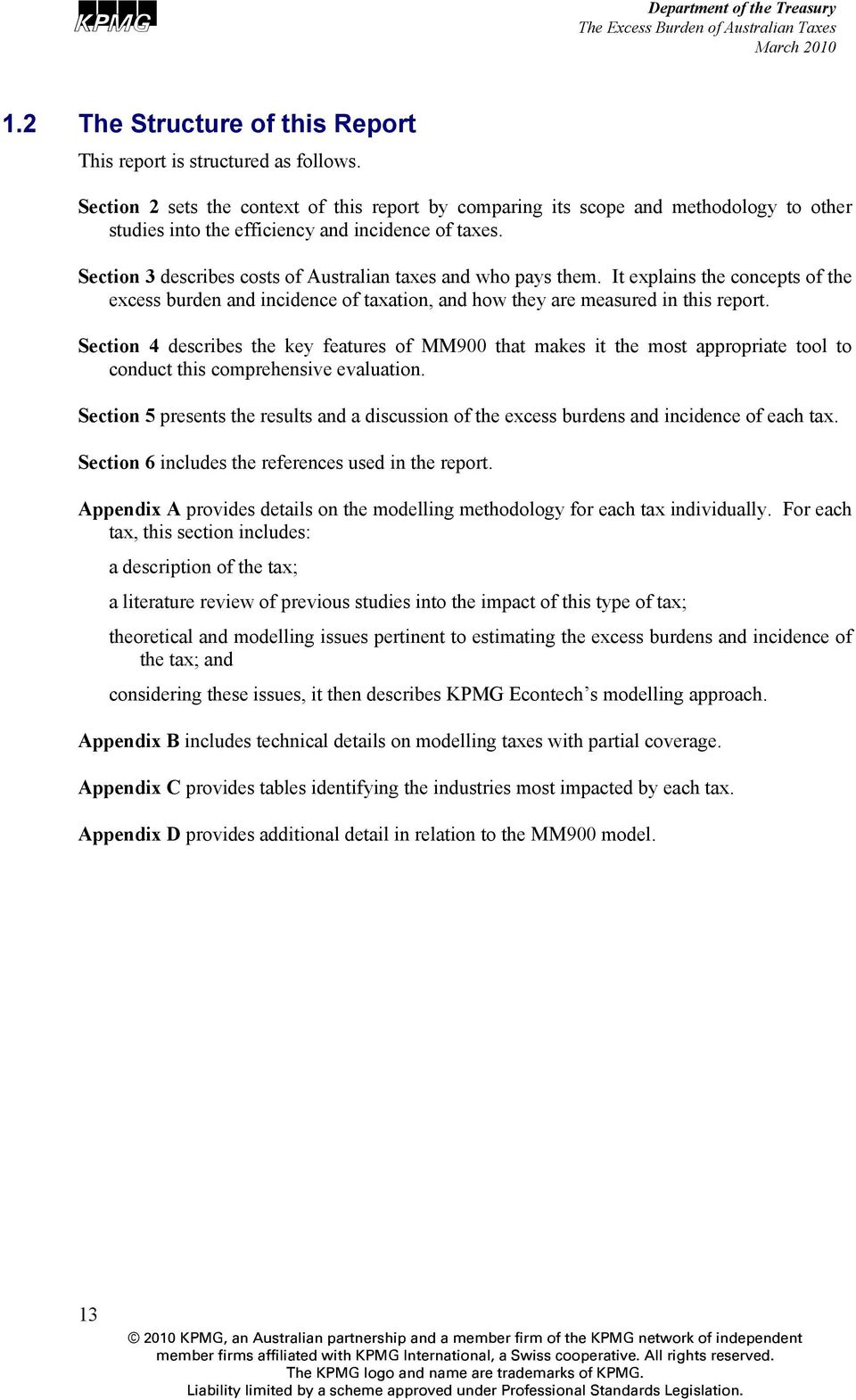
18 2 Key Literature There have been a number of theoretical and applied studies surrounding the excess burden and incidence of different taxes. This literature analyses a broad range of taxes in a number of countries, and helps to develop an idea of the likely excess burden of the major Australian taxes. This study goes further than any previous study done in the Australian context. It analyses 19 of the major Australian taxes in a consistent framework, allowing policy makers to easily compare their economic costs. It is also a more detailed modelling than has been undertaken in the past, with the model identifying the base of each tax to a high level of precision, and a large range of behavioural responses are taken into account. In a 2008 study for the OECD, Johansson et al. examine the efficiency of a number of taxes commonly used among OECD countries. They determined a ranking of taxes that is similar to the results of this study, although their conclusions are necessarily less specific because of the cross-country nature of the study. They conclude from theory and empirical evidence that recurrent taxes on immovable property (particularly residential property) are the least distortive tax instrument in terms of reducing long-run GDP per capita (Johansson et al., 2008, p7). Broad based consumption taxes, such as the GST, are found to be the second least distortive, followed by personal income taxes and then corporate income taxes. These findings are summarised in Table 2.1 below. Table 2.1 Tax Ratings from OECD study (a) Rating Low Low Medium Tax Immovable property tax Consumption taxes Personal income taxes High Corporate income taxes (a) ratings by KPMG Econtech based on rankings from the OECD study These rankings give the same qualitative results of the relative efficiency for each tax as the estimates made with MM900 in this report. A range of both state and local government level taxes are investigated in a 1998 report by the Productivity Commission (PC). The PC report includes a partial equilibrium assessment of the efficiency costs (marginal excess burdens) of a number of state taxes. The partial equilibrium approach focuses only on the impact of the tax in one market the market in which the tax is levied. This means that the effects of a tax in one market on the consumption and tax collections in other markets will not be taken into account. Therefore, such estimates of efficiency costs of taxes will be incomplete. For example, as a tax on labour, payroll tax may reduce employment which in turn will reduce income derived from labour. As consumption falls in line with incomes, tax collections from consumption-type taxes will also fall. This second-round loss of tax revenue is an additional cost of payroll tax, which a partial equilibrium estimation will not capture. Conversely, the computable general equilibrium (CGE) model used in this study means that all second round effects are taken into account. 14
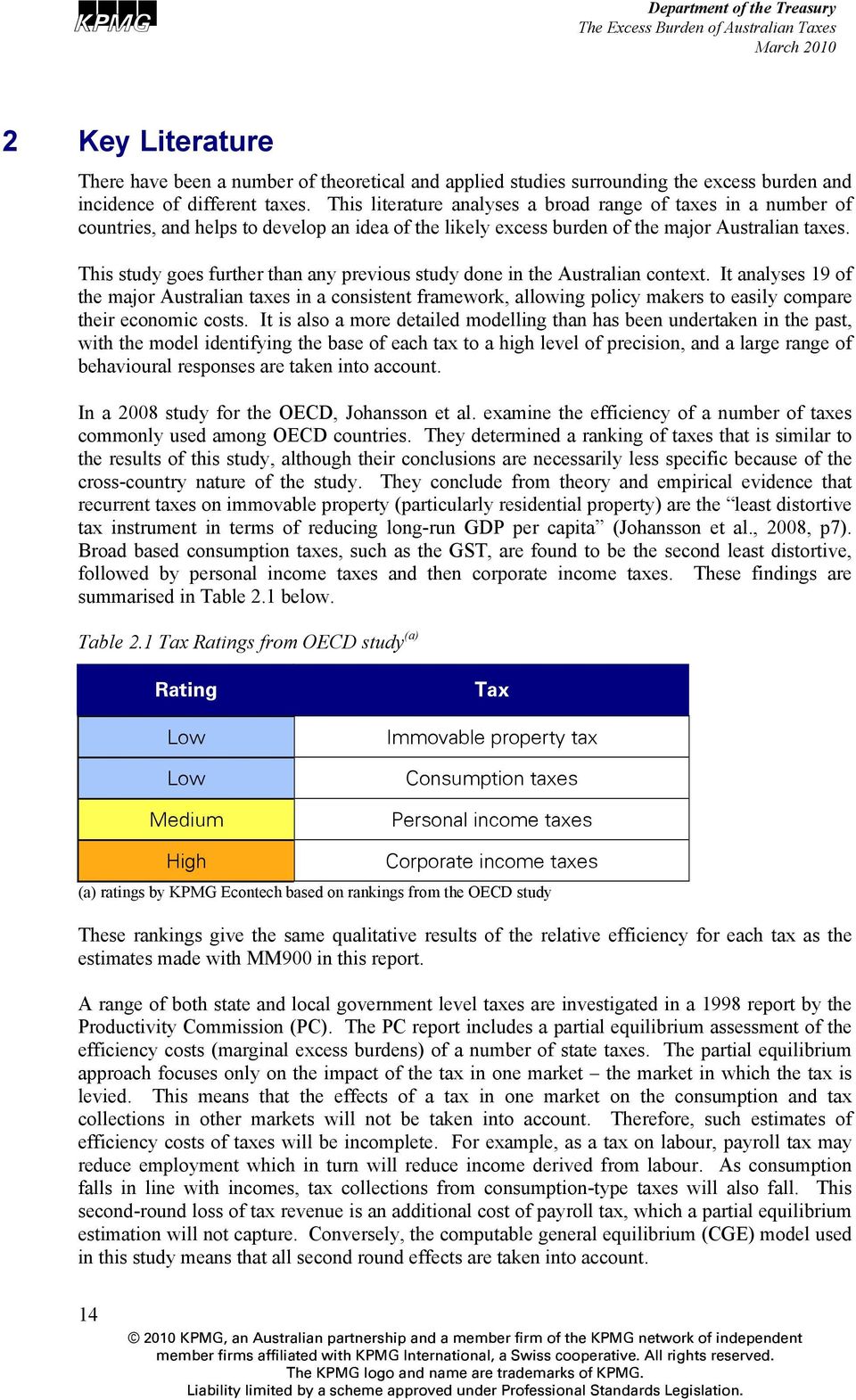
19 The Centre for International Economics (CIE) conducted a qualitative analysis of state taxes, focusing on those levied on businesses (CIE, 2009). The report identifies state taxes as having high deadweight losses, partly because of the narrow bases of some state taxes, such as payroll tax. Rather than assessing each tax individually, as is done in this study, the CIE study estimates the economic impact of introducing a number of tax reforms concurrently. Using the MMRF model, they model the impacts of reducing a number of state taxes and replacing the lost revenue through an increase in the GST. The CIE modelling finds that this tax policy switch leads to an increase in GDP and consumption. This indicates that the package of state taxes has a higher economic cost than the GST. However, the results of the CIE study do not allow an assessment of the relative inefficiencies of each individual tax. The CIE findings are broadly in line with the results of the current analysis, which finds that GST has a lower economic cost per unit of revenue raised than many state taxes. However, features of the MMRF model used by CIE will result in some differences between the results of the CIE study and this study. For example, the modelling of payroll tax and land tax is more sophisticated in the MM900 than the MMRF. MM900 treats land as a fixed factor, as explained in section , including distinguishing between residential, urban and rural land, and has a detailed modelling of the payroll tax, as explained in Appendix A, section A.2. Access Economics has also conducted a CGE analysis of states taxes, for the Financial Industry Council of Australia (2008). Their rankings for the efficiency of these taxes are included in the table below. Table 2.2 Tax Ratings from Access Economics study (a) Rating Low Low Low Medium Medium Medium Medium Tax Municipal rates Land Tax Gambling tax Payroll tax Conveyancing Duty Insurance tax Motor Vehicle tax (a) ratings by KPMG Econtech based on rankings from the Access Economics study Similar to the results in this study, Access Economics find a low excess burden of taxes on land. The remainder of their excess burden rankings are low compared to this study. While the current report does not include the consideration of any potential externalities from gambling, the Access Economics report does. This means that the Access Economics ranking for gambling taxes is much lower. 15

20 The more sophisticated treatment of payroll tax in the MM900 model includes the impact of the small business exemption, which contributes to the excess burden by reducing the revenue raising ability of the tax, as discussed in section 5.3. The lower excess burden ranking for conveyancing duty, insurance tax and motor vehicle tax reflects the smaller amount of choices that are available in the model used by Access Economics, the Monash Multi-Regional Forecasting Model. MM900 s more comprehensive coverage of economic decisions improves the estimates of excess burdens, as discussed in Section 4. Baylor and Beauséjour (2004) use a CGE model of the Canadian economy to estimate the marginal excess burden of a number of different taxes. Their results are broadly in line with both the literature and this study. They estimate that corporate income tax has a high economic cost, at 37 cents per dollar of tax revenue. This is followed by personal income tax, at 32 cents per dollar of tax revenue. Consumption taxes have the smallest economic costs, at 13 cents per dollar of tax revenue. Baylor and Beauséjour s estimation of the cost of payroll tax (15 cents per dollar of tax revenue) is in line with our estimate of the cost of a payroll tax if the small business exemption were removed, which again is discussed in section 5.3. A further comparison of Baylor and Beauséjour s results with the KPMG Econtech estimates is contained in chapter 5 of this report. Studies focused on estimating the economic costs of particular taxes are also widely available. The results of some of these studies are compared with the results in this study in Section 5. However, estimating the efficiency of all taxes in a consistent framework, rather than using a series of separate studies, will be the most appropriate way to compare the relative economic costs of different Australian taxes. This study therefore builds on the work of the authors mentioned above, and forms the most extensive study of the efficiency of Australian taxes to date. The contributions of this report to the literature are summarised briefly below. This study uses a computable general equilibrium model, giving quantitative results which are consistent with qualitative research that has been undertaken by the OECD. The general equilibrium nature of the model used takes into account both how all markets within the economy interact as well as the constraints on the macro-economy. The separate analysis of each tax allows policy makers to compare all taxes on a consistent basis. It is the most thorough analysis done to date, in capturing where taxes impact on the economy, and how it responds. 16

21 3 The Cost and Incidence of Taxes As background to the results on the efficiency and incidence of each tax presented in section 5, this section explains the importance and meaning of the concepts of tax efficiency and incidence, the main drivers, and how they have been modelled. For any tax, it is usually straightforward to assess the amount of revenue that is collected and from whom. But that only gives a superficial view of the tax system. Most taxes distort economic incentives giving rise to excess burdens economic costs over and above the amount of revenue that is raised. Further, taxes may lead to economic responses such as price increases that mean that the party who bears the economic incidence or final burden of the tax, is different from the party who pays the tax. In assessing the merit of any tax, understanding its economic incidence and excess burden is fundamental. This section explains these concepts and how they have been modelled. This study estimates the excess burdens arising from Australian federal, state and local taxes. Most taxes carry some excess burden. For example, certain taxes reduce incentives to work or invest, or distort consumption patterns, adversely impacting on economic performance and ultimately on consumer welfare. This excess burden can be compared to the amount of revenue that is being raised to assess the degree of economic inefficiency that each tax entails. The study also identifies the incidence of (or who really pays ) each tax. The party paying a tax, and so carrying its impact, is sometimes different from the party who actually bears the final burden or incidence of a tax, after economic responses. For example, while company tax is collected from businesses, a business may pass the burden of the tax on to households through higher prices or lower wages. In that case, while the business would carry the impact of the tax, households would bear its economic incidence. Understanding the incidence of a tax is an important step in assessing its implications for equity. However, further analysis is also required, linking the incidence of a tax to the situations of different types of households. This distribution analysis is outside of the scope of this study. Further, good tax design is not only about economic efficiency and equity of taxes, but also their simplicity. Taxes are considered to be simple when they involve low administration costs for tax collectors and low compliance costs for taxpayers. An assessment of the simplicity of each tax is also outside of the scope of this study. MM900, KPMG Econtech s CGE model of the Australian economy, was used to estimate the excess burden and incidence of key Federal, State and Local taxes. The excess burden results show, for every dollar in tax revenue raised, the additional cost to consumers in excess of that dollar. The incidence results show how the economic incidence of each tax is spread between consumer prices and various types of income (labour, capital, land rents and other economic rents). The remainder of this section discusses in further detail the excess burden and economic incidence of taxes and how these have been modelled. Section 3.1 looks more closely at the excess burden of taxation, section 3.2 discusses how excess burdens have been modelled, section 3.3 discusses the economic incidence of taxes, and section 3.4 explains how incidence has been modelled. 17
22 3.1 The Excess Burden of Taxation Most taxes change the behaviour of households, firms and/or the foreign sector. These changes in behaviour create distortions in economic activity. Taxation may influence behaviours in the following ways. Households may change their level of consumption, their consumption patterns or the amount that they work. Firms may change what they produce or how they produce it. The foreign sector may demand less of Australia s exports or supply Australia with fewer imports. The excess burden of taxation is a measure of the economic costs associated with these distortions. More specifically, the excess burden is defined as the reduction in welfare 3 from imposing or raising a tax, after the additional tax revenue has been returned to individuals as a lump-sum payment. The higher the tax rate, the higher will be the reduction in welfare. Moreover, if the tax rate increases, the excess burden increases at a greater rate. In fact, the excess burden of a tax is generally roughly proportional to the square of the tax rate 4. Figure 3.1 below illustrates the excess burden of a tax in a market that has variable producer and consumer prices. Figure 3.1 Excess Burden of a Distorting Tax (a) No Tax (b) Distorting Tax Price Price Supply Supply q* = p* CS PS Demand q = p + t p CS TR PS DWL Demand Quantity Q* Q T Q* Quantity Figure 3.1(a) shows a partial equilibrium model with no taxes. In this case, an equilibrium will be reached at the point where the demand and supply schedules intersect (at Q*). Here, the marginal value of the last unit consumed is equal to the marginal cost of the last unit supplied. 3 Technically speaking, welfare is defined as the collective level of utility of Australian households, where the utility of each household is determined by the commodities and leisure they consume. 4 This is because if, for example, the tax rate is doubled, then it is likely that not only will the loss in economic activity approximately double, but also the gap between the marginal value and marginal cost of that activity will also approximately double. 18
23 When a tax is imposed, as in Figure 3.1(b), it raises the price paid by consumers and lowers the price received by producers. This drives a wedge between the marginal value and the marginal cost and, consequently, reduces market activity. The size of this wedge, the Deadweight loss (DWL) shown in Figure 3.1(b), is the loss to consumer and producer surplus that is not recouped as tax revenue. This can be thought of as the welfare loss associated with the tax. The implication is that, in practice, raising a dollar of tax revenue usually creates a welfare loss (a positive excess burden). This report expresses the excess burden (EB) per unit of additional tax revenue, as shown in Box 3.1. Box 3.1: Definition of Excess Burden Δwelfare EB Δtax revenue Where: (a) the change in welfare is defined as the amount of (lump sum) compensation required after the tax change to restore the consumer s utility back to its original level. (b) the change in tax revenue from the tax increase is defined as the amount of the lump sum transfer back to consumers financed by the tax increase. This is equal to the total change in tax revenue, including any changes in revenue stemming from changes in other markets. As indicated above, the change in welfare is the compensation required to restore the consumer s utility back to its original level. For this purpose, it is assumed that the revenue raised by the tax is returned to the consumer as a non-distorting or lump sum transfer, so that the consumer does not directly lose any income from the change in the tax. This means that the change in welfare only arises from the distortions to economic behaviour generated by the tax. This measure of the change in welfare is known as the compensating variation (CV). In the MM900 model, the CV can be interpreted as the real change in consumption 5, saving and leisure enjoyed by the consumer. The change in tax revenue from the tax increase is defined as the amount of the lump sum transfer to consumers that would be financed by the tax increase, while keeping the budget in balance, and given fixed government expenditures. This will reflect both the additional revenue from the tax whose rate is increased, as well as any second round effects on tax revenues (due to impacts on tax bases). There are two types of excess burden that can be measured. The marginal excess burden (MEB) is defined as the additional welfare loss imposed by increasing a particular tax by a small amount, divided by the change in government revenue. The MEB is useful for considering small reforms of the current system or ways of raising additional revenue within the existing tax framework. 5 The model uses a generalised linear expenditure system utility function, in which households derive utility from consumption of products, saving and leisure. It specifies an essential level of consumption for each product. The consumer then maximises their utility by choosing how to allocate the remainder of their full income. 19
24 The average excess burden (AEB) is defined as the total welfare loss from imposing a particular tax, expressed as a proportion of total revenue raised by that tax. These measures are useful for considering the abolition of a certain tax. A concept related to the excess burden is the marginal cost of funds, which is one plus the marginal excess burden. This gives the cost to the economy of raising an additional dollar in tax revenue, if the revenue were not returned to consumers. The marginal cost of funds exceeds one dollar because it takes into account that raising a dollar of revenue also entails an excess burden. To be worthwhile, the value to the community of a public spending program must exceed the marginal cost of funds. 3.2 Using MM900 to Estimate the Excess Burden of Australian Taxes Estimating the Marginal Excess Burden and Average Excess Burden for each Tax The MM900 model has been constructed so that both the change in welfare and the change in tax revenue are standard outputs of the model. Thus, MM900 estimates the numerator and denominator of the excess burden formula. This allows the excess burden of each tax to be calculated and compared (see section 5 of this report). As noted above, MM900 uses a measure of the change in welfare known as the compensating variation (CV), while the change in tax revenue is measured by the transfer payment to consumers that can be financed from the tax change, while keeping the budget in balance. For each tax, two versions of the excess burden have been simulated in MM900. Specifically, the Marginal Excess Burden (MEB) is estimated by simulating in MM900 a small (five per cent) increase in the tax being considered and performing the excess burden calculations. The Average Excess Burden (AEB), on the other hand, is estimated by simulating in MM900 the abolition of the tax being considered, and performing the excess burden calculation. When a tax is imposed, it impacts upon behaviour not only in the taxed market, but also in other related markets. For example, in the case of two goods that are gross substitutes, the imposition of a tax on one good will cause consumers to reallocate their consumption spending from the taxed good towards the untaxed good. CGE models like MM900 are designed so as to pick up these related market effects. CGE models also identify other second round effects, such as changes in aggregate consumption due to changes in consumers income. Related market effects impact on the MEB and the AEB when the tax affects activity and tax collections in other distorted markets. The features of MM900 relevant to modelling the excess burden of taxes are described in Section 4. Excess Burden in MM900 Some of Australia s taxes are thought to be more inefficient than others. This is because of two economic principles. The mobility principle recognises that the excess burden of a tax is higher, the higher the mobility of its tax base. When a tax is applied to a highly mobile tax base, that tax base is likely to shrink, distorting economic activity. The narrowness principle recognises that the excess burden if a tax is likely to be higher, the narrower is the tax base. A narrow tax 20
25 base may make it possible to respond to a tax by shifting to untaxed close substitutes. Such shifts add to economic inefficiency and reduce the revenue yield. Under the mobility principle, resource rent taxes and land taxes would be expected to have low excess burdens. This is because they are assumed to be applied to immobile tax bases natural resources and land. MM900 treats both land and natural resources as completely immobile. At the other extreme, company income tax is expected to have a high marginal excess burden, because it is applied to capital, which is highly mobile. This high mobility is generated by the international competition for funds. In fact, in MM900, capital is treated as perfectly mobile. Labour has an intermediate level of mobility, and so under the mobility principle taxes can fall on it, such as payroll tax or personal income tax as applied to labour income, would be expected to have medium excess burdens. However, the narrowness principle adds another dimension to the analysis. Payroll tax has a relatively narrow base because, under the small business exemption provision that is modelled in MM900, it applies to only around one-half of labour income. On the other hand, the GST has a broader base, applying to close to 70 per cent of consumer spending in MM900. Narrowing a tax base tends to make a tax less efficient. Estimating the Excess Burden from Non-Uniformity A tax may have a high excess burden for one of two reasons. First, it may have a high excess burden because of its inherent nature, which might indicate that the tax should be abolished. On the other hand, it may have a high excess burden because it is implemented in a non-uniform way that narrows the tax base, which might indicate that the base of the tax should be broadened. It is important to be able to distinguish these two cases of high excess burden, because the appropriate policy responses are different. Non-uniformity in a tax may arise in a number of different ways, which can be illustrated through three examples. For payroll tax, there is a tax-free threshold or small business exemption. For alcohol taxation, closely-substitutable products are taxed at different rates. Finally, for the GST, some products are taxable, some are exempt, and some are GST-free. In MM900, simulations were conducted to identify the contribution of non-uniformity in taxes to their excess burdens. For each tax, this involved beginning with the baseline scenario in which the tax is in place, and conducting two simulations. In the first simulation, the tax is abolished. In the second simulation, the tax is reformed, by replacing it with a uniform tax that is designed to raise the same amount of revenue. The difference in consumer welfare between the tax abolition scenario and the baseline scenario shows the excess burden of the tax. The difference in consumer welfare between the reform scenario and the baseline scenario shows the excess burden due to the non-uniformity of the tax. The difference between these excess burdens shows the excess burden due to the inherent nature of the tax. Thus, this procedure allows us to dissect the excess burden of a tax into the component due to any nonuniformity in its application and the component due to its inherent nature. This procedure was applied to three different non-uniform taxes - payroll tax, GST and alcohol taxes. The results allow us to understand the different efficiency gains that could be made by either reforming or abolishing each tax. 21
26 Modelling State Taxes In this study, state taxes are modelled at the national level, using a weighted average of the regimes across states. This methodology provides a reasonable overall estimate for the efficiency of the state tax in question. However, there is potentially some downward bias in the excess burden estimates for some state taxes. The differences between states in their tax regimes may distort a firm s choice of location, adding to the excess burden, and the modelling results will not take this into account. 3.3 The Incidence of Taxes While excess burdens give information about the size of the overall cost of taxation, the question of who actually bears the burden of taxes is also important for tax analysis. The party who is liable to government for a tax carries its impact. However, some taxes lead to economic responses, such as price increases, that mean that the party or parties who bear the economic incidence or final burden of a tax may be different from the party carrying the initial impact. That is, economic incidence is concerned with who ultimately bears the cost of the tax. The cost of a tax is borne by a group when the tax changes the income that they receive or the prices that they face. When a tax is imposed in a market it either: raises the price paid by users; lowers the price received by sellers; or both. These price changes will flow through the economy, and alter the return to the different factors of production. Incidence can therefore be measured by considering the changes in prices of goods and services and changes in income from each factor of production. The economic incidence of each tax depends on the characteristics of each market. The panels in Figure 3.2 show three different markets, and how the demand and supply elasticities affect the incidence of taxes using partial equilibrium analysis. In general, the side of the market which is relatively price insensitive (inelastic) will bear more of the tax. In each case, without any tax, the market-clearing price would be P *. However, a tax drives a wedge between the price that consumers pay, P c, and the price that suppliers receive, P P. The deviation of P c and P P from P * indicates the effect on prices of introducing each tax. 22
27 Figure 3.2: Economic incidence (a) relatively elastic demand and supply Price Supply P c P * P P Panel (a) shows a taxed market with elastic demand and supply curves. When a tax is applied in this market, both the price that consumers pay and the price that producers receive will change. Therefore, the incidence of a tax in this market will fall on both consumers and producers. Q (b) perfectly elastic supply Price P c P P = P * Q (c) perfectly inelastic supply Price Supply P c = P * P P Q Demand Quantity Supply Demand Demand Panel (b) shows a taxed market with a perfectly elastic supply curve. This is representative of a market with perfect competition, and which does not use factors of production which are fixed in supply 6. Under perfect competition, suppliers of the good are already producing at minimum average cost when there is no tax. Therefore, they will not reduce their prices when a sales tax is introduced because this will reduce their profits below the required rate of return. Instead, the full incidence of the tax is passed on to consumers in the form of higher prices. Panel (c) of Figure 2 shows a taxed market with a perfectly inelastic supply curve. In MM900, this is representative of the market for a fixed factor of production, such as residential land. With a fixed supply of land, its value to users (or marginal product) will be determined only by demand (at P * ). No user will be willing to pay an amount higher than P *, even after a tax is applied. Therefore, the owners of residential land must bear the full incidence of any tax in this market, in the form of a lower return for ownership of their land. 6 Under perfect competition, all firms will produce at minimum average cost and receive zero profits. They exit and enter an industry until demand is satisfied and price is equal to marginal cost. This gives the flat supply curve for any commodity, at a price equal to marginal cost. A fixed factor of production would imply increasing marginal costs to the industry, which would result in an upward sloping supply curve, even under perfect competition. 23
28 The simple analysis above only reveals part of the story. In the analysis above, the incidence of the tax is determined by considering only the market to which the tax is applied. While this partial equilibrium analysis is instructive, a more in-depth investigation of the incidence of taxes would use a general equilibrium approach and consider all of the flow-on impacts to other parts of the economy. For example, a tax on labour income will reduce the return to labour, having an impact on labour supply. This would reduce incomes in the economy, and impact on the demand for goods and services. Thus, in turn, the demand for other factors of production may also be reduced, reducing the income derived from them. At the same time, the increased labour costs would lead to a switch away from labour intensive production technologies towards production technologies more intensive in the other factors of production. As a general equilibrium model, MM900 traces the impact of a tax in one market to all parties across the whole economy. In this way, both the direct and indirect impacts of a tax can be fully taken into account. The following section describes the methodology in more detail. 3.4 Using MM900 to Estimate the Incidence of Australian Taxes To analyse the incidence of a tax, agents in the economy must first be divided into groups. Since this study is concerned with the welfare of Australian households, the incidence analysis divides domestic households into groups. This allows some understanding of the distributional effects of taxes on different types of domestic households. Groups typically used in incidence analysis include (Metcalf and Fullerton, 2002): consumers (as opposed to producers); owners of each of the factors of production; groups of individuals with different levels of income; groups of individuals living in different regions; and intergenerational groups. The choice of groups will depend on the type of model used. This study divides households into two sets of groups, as discussed below. Firstly, the incidence of each tax on owners of the different factors of production is analysed. Second, the incidence of each tax on individuals with different levels of income is considered. A key observation is that Australian households are simultaneously consumers and producers. Households derive welfare from their consumption of goods and services, which in turn, depends on their income as owners of factors of production including labour, capital, land and other fixed factors. Therefore, any change to either consumer prices or factor incomes will affect overall welfare. It follows that distinguishing between the incidence on consumers and producers would not be a meaningful analysis. Therefore, this study divides households according to their ownership of the factors of production labour, capital, land and non-land fixed factors. Different taxes will have different 24
29 impacts on the income derived from each of these factors of production. Changes in factor incomes after a tax is introduced will indicate where among the groups of households the incidence falls. MM900 results can be used to identify these changes. The variables of interest are listed in Table 3.1 below. Table 3.1 Identifying Tax Incidence Agent Labour Owners of capital Owners of residential land Owners of rural land Owners of urban land Owners of non-land fixed factors of production e.g. natural resources Variable indicating tax incidence Change in after-tax labour income Change in after-tax private capital income Change in after-tax private residential land income Change in after-tax private rural land income Change in after-tax private urban land income Change in after-tax private income from other economic rents Examining the dollar changes in these types of income when a tax is introduced will show which groups the incidence of the tax falls on. This may give some indication as to the impact on different socio-economic groups. The above analysis shows changes in nominal, private, after-tax incomes, before allowing for any changes in consumer prices. In reality, some taxes result in changes in consumer prices, which must be taken into account in determining the effect on real incomes. This requires some estimate of the percentage change in the cost-of-living. However, spending patterns vary between households, which means that percentage impacts on the cost-of-living can vary from one household to the next. To give some indication of this variation, this report uses two different measures of the cost of living. These are the price of essential consumption and the price of non-essential consumption. MM900 identifies a basket of goods and services that is considered essential consumption. Consumers will always consume this same basket of goods and services, no matter the price of each good. After they have purchased this basket, they then choose how to spend the remainder of their income, depending on both the relative prices of each product and their overall income. This extra consumption is termed non-essential consumption. 7 The essential and non-essential baskets have different mixes of the same goods and services. For example, food is more important in the essential basket while recreation is more important in the non-essential basket. 7 Consumption decisions are explained in more detail in section
30 The spending of poorer households will be dominated by essential consumption, while spending of richer households will be dominated by non-essential consumption. Hence, other things being equal, any tax which, in percentage terms, increases the price of essential consumption more than it increases the price of non-essential consumption will have a greater proportional impact on poorer households. Such a tax can be considered a regressive tax. Conversely, any tax which, in percentage terms, increases the price of essential consumption less than it increases the price of non-essential consumption will have a greater proportional impact on richer households. Such a tax can be considered a progressive tax. Therefore, percentage price changes for both essential and non-essential consumption are reported as part of the incidence analysis. Here progressivity is implicitly defined relative to consumption levels, but it can also be defined relative to income levels. A full analysis of the equity of a tax would also involve an analysis of the changes in nominal factor incomes summarised in Table 3.1 against information on the sources of factor incomes for different types of households. For example, if poorer households rely relatively more on labour income and richer households more on capital income, the relative impact of a tax on labour and capital income would also influence its equity. Importantly, the analysis from MM900 will be a long-run analysis. Long-run results may look different to results from a short-run analysis, mainly because some prices take time to adjust in response to tax changes. For example, an increase in the company tax rate may initially lower a firm s profits if they do not have the ability to change their prices straight away. However, in the long run, as lower profits lead to a withdrawal of capital and tighter supply conditions, firms will be able to adjust their prices upward and pass the tax burden on to consumers. In any general equilibrium model, all prices are determined in relative terms, but expressed in nominal terms. To do this conversion to nominal terms, one good is chosen to be the numeraire. This good has a set fixed price, and all other prices can be expressed relative to that fixed price. In MM900, the average nominal wage has been chosen as the numeraire. Although the choice of numeraire does not affect the modelling results in real terms, it does need to be taken into account in interpreting nominal price changes. Tax Incidence in MM900 In the long run, the economic incidence of most Australian taxes can be expected to fall largely on Australian labour, and this is also the case in MM900. To understand this conclusion, there are three issues to consider in turn. The first issue is the extent to which the incidence of Australian taxes might fall on foreigners rather than Australians. As a relatively small part of the world economy, Australia is generally considered to be close to being a price taker on world markets. This implies that Australian taxes applied in world markets can be expected to have little impact on prevailing world prices. Rather, such taxes will largely be absorbed on the Australian side of the market, will little or none of the incidence being borne by foreigners through changed world prices. In MM900, Australia is a price taker for capital and imports, and is close to being a price taker for most exports. This means that the incidence of import duty on imports, company tax on capital, and other Australian taxes will fall largely on Australians, not foreigners. Given that most of the incidence of our taxes can be expected to fall on Australians, the next issue is the extent to which that incidence falls on the incomes of Australian factors of 26
31 production. MM900 makes the common assumption that production occurs under constant returns to scale and perfect competition. This implies that the entire value of production is distributed to the factors of production labour, capital, land and other fixed factors without any leakage. It follows that the incidence of production-related taxes is borne fully by factors of production. Given that the incidence of our taxes falls largely on Australian factors of production, the final issue is identifying how that incidence is shared between those factors of production capital, labour, land and other fixed factors. This depends on their relatively mobility. Immobile factors of production cannot move to avoid a tax, while mobile factors can. As already noted, capital is highly mobile internationally, as it seeks out higher rates of return. In that environment, it is common to assume that Australia is a price taker in world capital markets, and that approach is followed in MM900. This means that foreign investors don t ultimately bear a burden from Australian taxes; rather taxes that impact on capital limit investment and are ultimately passed on into higher prices, reducing real incomes for other factors of production, especially labour. Capital bears none of the burden of the tax system in MM900. In contrast, land and other fixed factors of production are completely immobile in MM900. This means they bear the full burden of any taxes that are applied to them. It also means they cannot avoid the burden of taxes that are passed on to them. However, fixed factors are less important as factors of production than either labour or capital, so they bear a relatively small share of the tax burden. Labour is generally considered to have a low degree of mobility, and this is also the case in MM900. This means that the incidence of taxes on labour falls largely on labour, although a small part of it is shifted to fixed factors. It also means that labour, as the major factor of production, also bears the largest share of the incidence of other taxes, with the exception of taxes that are applied to fixed factors. Hence, labour bears most of the incidence of the tax system in MM900, through reduced real wages. This reduction comes about through reduced after tax nominal wages, in the case of personal income tax, and through increased consumer prices, in the case of a wide range of other taxes. 8 In summary, the incidence of most Australian taxes can be expected to fall largely on labour. This reflects the common modelling assumptions of perfect competition with constant returns to scale, and that Australia is (almost) a price taker in world trade and capital markets. However, land and natural resources bear some of the incidence of the tax system, and when taxes are applied directly to them they bear the full incidence. 8 The incidence of most taxes borne by labour is transmitted through higher prices rather than a lower nominal wage because the nominal wage is the numeraire in MM900. However, the choice of numeraire does not affect the real outcome of the model, which is that the real wage falls in response to a wide range of taxes and so labour bears the final incidence. 27
32 4 The MM900 Model While section three explained the nature and significance of the concepts of tax efficiency and incidence, this section outlines the economic model that has been used for the tax simulations. It completes the groundwork needed for section 5, where the modelling results are presented for the efficiency and incidence of each tax. KPMG Econtech s MM900 model is the latest edition of our detailed computable general equilibrium (CGE) model of the Australian economy focussing on tax analysis. The first edition, MM303, was developed for the South Australian Department of Treasury and Finance in the late 1990s to assist it in participating in a developing debate on indirect tax reform. That debate culminated in the introduction of the New Tax System (NTS) in July In the lead up to the introduction of the NTS, MM303 was further developed to MM600+ to assist the Australian Competition and Consumer Commission (ACCC) in its price surveillance work. For this study for the Federal Treasury, MM600+ has been re-developed as MM900, extending its tax analysis capabilities from indirect taxes to also include direct taxes. This development process has meant that MM900 goes well beyond other Australian modelling in capturing the economic effects of the tax system on the Australian economy. It does this by distinguishing 19 different major taxes at the Federal, State and Local levels. Further, for each tax, the model identifies the true tax base as closely as possible, and aims to capture the main behavioural responses to the tax s imposition. The modelling also allows for certain negative externalities in consumption that may justify certain specific taxes. A key feature of MM900 is its fine level of detail. MM900 contains even a finer level of product detail than MM600+. For example, in MM900 the economy produces 889 different products (i.e. about 900 products), which represents eight times as much product detail as other comparable models. This allows the model to more accurately capture the application of certain product-based taxes. As noted in Han (1998), a greater level of detail will also lead to a smaller amount of aggregation bias in CGE estimates of excess burdens. The greater the product detail, the more distortions the model will pick up, and the better the estimates of the excess burdens. For example, MM900 treats beer, wine and spirits as separate substitutable products within one broad group. Less disaggregated models aggregate all alcohol products together, and therefore miss the excess burdens that arise from taxing closely substitutable alcoholic beverages at different rates. MM900 includes a detailed treatment of consumer s responses to taxes that cause relative price changes. MM900 does this by specifying a two-tier consumer demand system covering the 889 products in the model. First, the consumer decides between 17 different broad groups of products using a linear expenditure system. Second, and importantly, MM900 also allows for substitution within these 17 broad groups, between individual products, with the degree of substitutability able to vary from one group to the next, adding extra sophistication. This detail in consumer decisions means that MM900 will produce high quality estimates of excess burdens. 28
33 MM900 also contains a fine level of detail in modelling production processes. Each of the 109 industries use up to six different primary factors (or types of labour, capital and fixed factors), compared with two primary factors in MM600. The different fixed factors include land and natural resources, allowing for much more robust modelling of the effects of taxes based on the value of land or the value of natural resource use. In addition, in comparison to earlier studies, MM900 incorporates a more comprehensive analysis of the behavioural responses to each tax. In MM900, taxes can cause households to change their supply of labour and their levels and patterns of spending. Taxes can cause businesses to change their choices between the six primary factors of production, affecting employment, investment and valuations of land and natural resources. Finally, taxes can affect the propensity to import and export each of the model s 889 products. These behavioural responses to taxes, by impairing the functioning of the economy, can reduce consumer welfare, that is, give rise to excess burdens on households. Capturing these welfare losses accurately requires that the modelling of household behaviour is underpinned by a consistent treatment of consumer welfare. In MM900, this occurs by using a utility function in which a representative household derives welfare or utility from leisure, saving and consumption of products, and then deriving all household behaviour from that same utility function. Other comparable models include more ad hoc elements in modelling household behaviour. In summary, by better capturing where taxes impact on the Australian economy, how it responds, and how these responses flow through to change consumer welfare, MM900 is uniquely well suited to the analysis of the excess burdens of Australian taxes. MM900 is also carefully designed to capture the economic incidence of each tax. This involves recognising that, as a relatively small part of the world economy, Australia in close to being a price taker in world trade markets. It also means taking into account that natural resources and land are completely immobile, capital is highly mobile, and labour has a low degree of mobility. Other comparable models have more limited or no treatments of natural resources and land. The following sections systematically summarise the main features of MM900, emphasising those that are most pertinent to this tax study. It begins by noting the main, over-arching assumptions, and then moves on to summarise the behaviour of the economic agents in the model households, producers, government and the foreign sector. 4.1 Over-arching Assumptions In keeping with most long-run CGE models, in MM900 economic agents engage in optimising behaviour, markets are in equilibrium and the government and private sectors live within their means. Long-run Horizon MM900 refers to a long-run equilibrium, after the economy has fully responded to shocks. For example, stocks of capital in each industry have fully adjusted. This long-run focus is important 29
34 for tax policy, because good tax policy is based on the lasting effects of tax policy changes, not the transitional effects. Optimising behaviour Economic agents engage in optimising behaviour. In MM900, this means that a representative business in each of the 109 industries chooses inputs and outputs to maximise profit under perfect competition subject to a production technology with constant returns to scale. It also means that a representative household maximises utility, which depends on leisure, saving and consumption of products, subject to a budget constraint. This focus on consumer utility is important for drawing conclusions about how individual taxes affect consumer welfare. Equilibrium In keeping with MM900 s long-run horizon, all markets are assumed to have achieved equilibrium. This includes markets for the six factors of production low-skilled labour, highskilled labour, structures, other capital, land, and other fixed factors and markets for the 889 products (goods and services) that are produced. Government Budget constraint Governments must always pay their way in the long run. For simplicity, in MM900 the government is assumed to always balance its budget. To achieve this, a budget policy instrument must be selected that, instead of being an input to the model, automatically adjusts to balance the budget. For this study, a hypothetical lump sum tax/transfer is chosen as the swing instrument, because the efficiency of any tax is traditionally assessed against a lump sum tax, which by definition is perfectly efficient. Hence, when a change in a tax rate is simulated in this study, the potential impact on the budget balance is automatically neutralized through a change in lump sum tax. Any change in consumer welfare can then be attributed to economic distortions associated with the tax that has been changed. This approach to tax efficiency analysis is standard in the literature. Private Budget constraint Private saving behaviour must also be sustainable in the long run. As explained further below, the private propensity to save is constant in MM900. Based on that saving rate, together with the return to savings and the growth rate of the economy, the model then deduces the level of private assets. Remaining assets are owned by the foreign sector and are supplied perfectly elastically at the world required rate of return on capital. In the long run, the stock of foreign liabilities (just like the stock of private assets) must also grow at the same rate as GDP, requiring a particular current account deficit. In MM900, the exchange rate adjusts to deliver that current account deficit (external balance). 30
35 4.2 Households In MM900, a representative household maximises utility, which depends on leisure, saving and current consumption of products, subject to a budget constraint. This is an important development from MM600, in which utility only depended on consumption of products. While MM900 is a static model, saving generates utility on the basis that it represents future consumption of products. This approach leads to a Generalised Linear Expenditure System, which includes relationships for labour supply, total consumption expenditure, and its spread across 889 products. These three sets of relationships are now discussed in turn, beginning with the labour supply choice Labour Supply versus Leisure In MM900 households face a choice in dividing the time in which they could be working, between work and discretionary leisure, whereas in MM600 the labour supply was fixed. Under the MM900 utility maximising approach, the amount of time they devote to work depends on the after-tax real wage that is available from working, and their real full income, which is the potential income they could receive if they take no discretionary leisure. MM900 makes full allowance for the taxes that influence this work-leisure choice. For example, higher labour income tax directly reduces the real after-tax wage, reducing the economic return to work. This leads to lower labour supply, but higher leisure. Lower labour supply leads to lower incomes, reducing levels of consumption and saving. Many other taxes reduce the economic return to work, as measured by the real after-tax wage, by increasing consumer prices. Put another way, higher consumer prices reduce the consumer purchasing power generated by a given work effort. GST and sin taxes on alcohol, tobacco and gambling have obvious effects on consumer prices. Other taxes, such as company tax and payroll tax, have different tax bases, but ultimately are also likely to be largely passed on into higher consumer prices or lower wages. All of these taxes act as a disincentive to work by reducing real after-tax wages. They also have other disincentive effects that are captured in MM900. Importantly, explicitly including leisure in the analysis helps to make the excess burden estimates more robust. For example, increasing labour income tax (or many other taxes) will reduce the after-tax real wage and reduce labour supply. While reduced labour supply will reduce utility as lower labour incomes lead to lower consumption and saving, this will be partly offset by the utility derived from increased leisure. Without the inclusion of leisure in the utility function, the excess burden of labour income tax would be overstated. This will also be true for other taxes that reduce real after-tax wages, such as GST, sin taxes, payroll tax, company tax etc. Given the amount of labour that households choose to supply, they will receive a certain income. The next choice is how to divide this income between consumption and saving. 31
36 4.2.2 Consumption versus Saving Modelling saving behaviour poses an issue for long run models such as MM900. In particular, saving (i.e. sacrificing present consumption for future consumption) can appear artificially attractive. This is because, if saving rates are increased, long-run model results will show the gain in future consumption, but not the sacrifice of present consumption. To avoid this problem, the private propensity to save is constant in MM900, as a consequence of the deliberate design of the household s utility function. In particular, saving generates utility on the basis that it represents future consumption of the same products that are consumed in the present. Allowing for saving and the utility it brings is an important development in moving from MM600+ to MM900. Incorporating saving in the analysis of household behaviour, just like incorporating leisure, helps to make the estimates of excess burden more robust. In particular, foregoing leisure for the income from additional work allows additional consumption and saving, and it is important that both of these lead to higher utility if leisure is not to appear artificially attractive. At the same time, assuming a constant propensity to save means that MM900 is not useful for estimating excess burdens for taxes that mainly distort the propensity to save. These taxes include personal income tax on income from assets and taxes on superannuation earnings and benefits. Having determined the split of income between consumption and saving, the next choice is how to divide consumption between the various products Pattern of Consumption Similar to MM600, MM900 allocates total consumption expenditure between products using a two-tier consumer demand system, corresponding to a Generalised Linear Expenditure System. In MM900 there are 889 products and the two tiers are as follows. In the first tier, the consumer decides between 17 different broad groups of commodities in a Linear Expenditure System. In the second tier, MM900 allows for substitution between individual products within these 17 broad groups, with the degree of substitutability able to vary from one group to the next, adding extra sophistication. This detail in consumer decisions means that MM900 will produce high quality estimates of excess burdens. For example, MM900 treats beer, wine, spirits as separate products, and they are all substitutable in consumption. Less disaggregated models treat all alcohol products as a single product group, and will therefore miss the excess burden that arises from taxing substitutable alcoholic beverages at different rates. In short, MM900 includes a detailed treatment of consumers responses to taxes which cause relative price changes, and so generates more robust estimates of excess burdens. 32
37 4.3 Producers In MM900, production occurs in 109 industries that produce 889 products. Within each industry, a representative business operating under perfect competition chooses inputs and outputs to maximise profit subject to a production technology. Apart from the unusually large number of products in MM900, this approach is typical of CGE models. For its production, each industry uses products produced by other industries as well as primary factors of production. In MM600, the two primary factors of production of labour and capital were recognised and treated as substitutable this is typical of CGE models. However, in MM900 the number of primary factors is extended from two to six. As discussed further below, this extension is important for robustly modelling the excess burden and economic incidence of certain taxes, such as resource rent taxes, land tax, municipal rates, and motor vehicle registration. In each industry, the demand for the six primary factors is modelled in a two-tier approach based on a nested CES production function. In the first tier, the representative producer chooses a mix of the three broad primary factors labour, capital and fixed factors taking into account their relative prices. In the second tier, for each broad primary factor, they choose a mix between two types. For example, for labour, they choose a mix between low skilled labour and high skilled labour, taking into account their relative prices. These mixes vary from one industry to the next. The six primary factors, which are now discussed in turn, are as follows: low-skilled labour; high-skilled labour; capital structures; capital other; land; and other fixed factors such as natural resources. Demand for these six primary factors is driven by producer decisions. In the following discussion of each primary factor, each explanation of how producer behaviour determines demand is followed by an explanation of supply, and how an equilibrium is achieved in which supply and demand are balanced Low and High Skilled Labour Labour is divided into two types, low skilled and high skilled. This is equivalent to dividing labour into a heads aspect, which keeps track of the number of people who are employed and a quality aspect, which determines the average productivity of labour in each industry. The reason for dividing labour into skilled and unskilled labour is so that the model can account for both labour input in terms of the number of people, or total employment, as well as effective labour input, or the total productivity of labour. Following profit maximizing behaviour, the representative producer in each industry generates a demand for low skilled labour and high skilled labour. This demand depends on the prices of 33
38 low skilled and high skilled labour, the prices of other inputs, and industry production. These demands are aggregated over industries to determine the total demand for low skilled labour and the total demand for high skilled labour. This raises the question of how this demand for low skilled and high skilled labour is balanced with supply. The supply of labour is determined by household behaviour in the way described in section The mix of that supply between low skilled and high skilled labour is held fixed as an input to the model. The wage for low skilled labour relative to the wage for high skilled labour then adjusts until the mix of demand matches the fixed mix of supply. Total labour demand equals total labour supply in MM900 by virtue of Walras Law. That Law states that, when considering any particular market, if all other markets in an economy are in equilibrium, then that specific market must also be in equilibrium. The average wage is not determined by the model but rather is fixed as the numeraire. The idea here is that in any general equilibrium model, all prices are determined in relative terms, but expressed in nominal terms. To do this conversion to nominal terms, one good is chosen to be the numeraire. This good has a set fixed price, and all other prices can be expressed relative to that fixed price. In MM900, the average nominal wage has been chosen as the numeraire. Although the choice of numeraire does not affect the modelling results in real terms, it does need to be taken into account in interpreting nominal price changes Structures and Other Capital Physical capital is split into two different types. These are: structures - residential and other; and other capital, which is all other capital goods, such as motor vehicles, machinery and computers. Structures include residential structures, which are only used by the ownership of dwellings industry (in producing housing services) and other structures such as commercial buildings and engineering construction, which are used by all of the other 108 industries in the model. Other capital is also used by all of the other 108 industries in the model. Other capital covers all capital other than structures, and includes motor vehicles, computers, machinery etc, and has a fixed composition. Following profit maximizing behaviour, the representative producer in each industry generates a demand for structures and other capital. This demand depends on the prices of the services of structures and other capital, the prices of other inputs, and industry production. These demands are aggregated over industries to determine the total demand for structures and the total demand for other capital. This raises the question of how this demand for structures and other capital is balanced with supply. In MM900, an industry can access as much capital as it needs so long as it can achieve the after tax rate of return required by international investors. This perfect elasticity of capital supply means that the required after tax rate of return on capital is effectively fixed on world capital 34
39 markets in the long run. Stocks of structures and other capital adjust in each industry until this rate of return is achieved. As noted, it is the after tax rate of return on capital that is determined on world capital markets and governs the terms on which capital is supplied to Australia. This means that any tax that is put on capital in Australia will ultimately increase the required before tax rate of return to offset the tax impost. Capital will flow out of the country until its greater scarcity achieves the increase in its before tax rate of return. The resulting lower capital intensity of production will reduce the marginal productivity, and therefore the incomes, of other factors of production, including labour, land and other fixed factors of production Land MM900 includes land as a fixed factor, which is an unusual feature in CGE models of the Australian economy. This feature was developed to enhance the estimates of the excess burden of land tax and municipal rates. Specifically, MM900 has the following three types of land: 1. rural land, which is land used only by sectors within the agriculture, forestry, fishery and mining industries; 2. residential land, which is land used only by the ownership of dwellings industry; and 3. urban land, which is used by all other industries. Following profit maximizing behaviour, the representative producer in each industry generates a demand for land services. This demand depends on the rental price of land, the prices of other inputs, and industry production. These demands are then aggregated to determine the total demand for rural land, for residential land, and for urban land. This raises the question of how this demand for each of the three types of land is balanced with supply. The total supply of each of the three types of land is fixed, which reflects the overall availability of land in the economy and somewhat mimics zoning legislations. This implies that the price of each of the three types of land will adjust until total demand is reconciled with the fixed supply. Any tax placed on a type of land will not change the supply of that land. With the fixed supply of land to the market, the land rents that users will be prepared to pay will be unaffected by the tax. This means that the burden of the tax will be fully borne by the land owners Natural Resources and Other Generators of Economic Rents The zero profit assumption is a common assumption in economic modelling. However, in reality, excess returns do exist in some industries. These excess returns can arise as a result of factors such as access to a natural resource (such as petroleum or minerals deposits), monopoly power, branding, patents or barriers to entry. In MM900, these excess returns are modelled as a return on a fixed factor, that is as a rent. To identify the excess returns in an industry, the rate of return on capital in each industry was examined. When this return has consistently been greater than the normal rate of return on 35
40 capital, then the industry may be making excess returns 9. Further, the idea that any particular industry would systematically make excess returns has been subject to a reality check. This was done by examining whether factors that generally lead to excess returns, such as access to a natural resource or barriers to entry, appear to be present for that industry. The following industries are identified as having excess returns that, for modelling purposes, are attributed to a fixed factor: Coal; Oil and gas; Iron ore; Non-ferrous metal ores; Beer; Banking; and Non-bank finance. Each of these seven industries is assumed to use a different fixed factor. The remaining 102 industries use no fixed factor. Following profit maximizing behaviour, the representative producer in each of the seven industries with a fixed factor generates a demand for fixed factor services. This demand depends on the rental price of the fixed factor, the prices of other inputs, and industry production. This raises the question of how demand for each of the seven fixed factors is balanced with supply. The total supply of each fixed factor is fixed, which reflects the overall availability of natural resources and other fixed factors in the economy. This implies that the price of each of the seven types of fixed factors will adjust until total demand is reconciled with the fixed supply. Any tax placed on a type of fixed factor will not change the supply of that fixed factor. With the fixed supply of the fixed factor to the market, the rent that users will be prepared to pay for use of the fixed factor will be unaffected by the tax, and will continue to reflect the fixed factor s marginal productivity. This means that the burden of the tax will be fully borne by the fixed factor owners. This inclusion of fixed factors is particularly useful for measuring the excess burden of the Petroleum Resource Rent Tax, which is intended to be a tax on the above normal profits of the oil extraction industry. 9 Industries making excess returns have been identified in the following way. First, a normal rate of return of return for each of the 109 industries in MM900 has been estimated using employment data and an estimate of output per employee in each industry. Next, the actual GOS according to the national accounts was compared to the estimate of the normal rate of return. Where the actual GOS was significantly larger than the estimate, then it is considered that the industry may be making excess returns. 36
41 4.4 Government Sector Government sector spending accounts for part of final demand for various products, and is financed by taxes. Table 4.1 shows the 19 key taxes in MM900 that are analysed in this study. These include a range of Federal, State and Local taxes. The table divides the key taxes into three groups, according to how they appear in MM900. These are general taxes (that are applied at a single rate), industry taxes (that can be varied from one industry to the next), and product taxes (that can be varied from one product to the next and even between different categories of end users of a product). Some specific comments on particular taxes can be made. Table 4.1 Key Taxes General By industry By product Labour income tax Payroll tax GST Corporate income tax Land taxes Alcohol excise and WET Municipal rates Tobacco excise Resource rent tax Luxury car tax Motor vehicle registration Import duties Fuel taxes Royalties and crude oil excise Gambling taxes Conveyancing stamp duties Motor vehicle stamp duties Stamp duties (other) Insurance taxes Labour income tax refers to personal income tax as it applies to labour income. Other personal income tax, which is collected from non-labour income such as interest income, is much smaller in magnitude, and is not explicitly modelled in MM900. As explained in section 4.2.2, this is because the main excess burden from personal income tax on non-labour income (such as income from assets) is likely to be through its influence on private saving, but the private saving rate is fixed in MM900. Hence, MM900 is not designed to capture the excess burden from personal income tax as it applies to non-labour income. Company income tax is modelled in MM900. In addition, the reduction in personal income tax collections from the claiming of franking credits is also taken into account. In modelling payroll tax in each industry, the small business exemption is taken into account. The model allows for resource rent tax to be applied at any rate in most sectors of the mining sector. In constructing the model, resource rents were identified for: the coal industry; the oil and gas industry; the iron ore industry; and the non-ferrous metal ores industry. In the baseline scenario of the existing tax system, the existing petroleum resource rent tax is applied in the oil and gas industry, while in the other three industries resource rents are not taxed. The model also 37
42 identifies economic rents in some other industries the banking industry, the non-bank finance industry, and the beer industry. The model assumes that GST is applied at a single, specified rate, which is 10 per cent in the baseline scenario of the existing tax system. However, GST status (taxable, GST-free or exempt) is set product-by-product, separately for both residents and foreign tourists visiting Australia. In modelling fuel taxes, separate account is also taken of fuel subsidies that partly offset fuel taxes. In simulating the model for this study, when fuel taxes are altered, associated fuel subsidies are altered in the same proportion. 4.5 Foreign Sector Australia s interactions with the global economy are important for the domestic economy. As a small country, Australia is generally considered to be close to being a price taker on world markets. In MM900, Australia is a price taker for capital and imports, and is close to being a price taker for most exports. In a world of highly mobile capital, Australia is assumed to be a price taker in world capital markets. This means that the world supplies capital to Australia at a fixed real after-tax rate of return. On the demand side, as explained in section 4.3.2, industries generate demand for structures and other capital following profit-maximizing behaviour. They do not differentiate between local and foreign owned capital. The supply of local-owned capital is determined by saving behaviour, while remaining capital demands are met by foreign-owned capital. Similarly, the rest of the world supplies Australia, as a small open economy, with as much imports as demanded at the world price i.e. supply is perfectly elastic. On the demand side, consumers and producers perceive imported and locally produced goods to be different from one another, and choose their mix of imported and locally produced goods and services depending on their relative prices. For exports, Australia s status as a small open economy is again recognised, but this time by assuming export demand is highly elastic but not perfectly elastic. That is, Australia is close to being a price taker, but has a small degree of pricing power. This pricing power may arise through product differentiation or by supplying a large share of the world market. For most goods, export demand elasticities in MM900 are set to a very responsive -12. For goods where Australia is considered to have some market power, export demand elasticities are lower. The smallest elasticity is for wool, where the value is -4, in recognition of our large share of the world market. The same elasticity is used for tourism, which takes into account the product differentiation between the tourism services that Australia offers compared with those offered by other countries. All trade elasticities used in MM900 are reported in Appendix C. On the supply side of export markets, in CGE models with perfect competition and constant returns to scale, commodity supply is also elastic. The combination of highly elastic export demand and supply commonly leads to problems because small shifts on either side of the market can lead to large changes in export volumes. 38
43 Some models attempt to overcome this by making export demand less responsive to price changes. However, this is not reflective of Australia s position as a small open country. For a more realistic approach, MM900 incorporates two features. First, MM900 includes fixed factors of land and natural resources. This reduces the flexibility in export supply of agricultural and mining products in a realistic way. Second, MM900 introduces some friction between supplying domestic and export markets. Intuitively, this friction may arise because some exported commodities are tailor made for export, or are more narrowly defined than the corresponding home commodity. For example, Australian consumers may eat all types of apples, but Australia may only export Fuji apples to Japan. Thus, there will be a cost involved in switching from supplying the domestic market to supplying the export market. This reduces flexibility in supplying the export market. Australian taxes applied in world markets can be expected to have little impact on prevailing world prices. Rather, such taxes will largely be absorbed on the Australian side of the market. Taxes on foreign capital will increase the before tax rate of return on capital in Australia, and accordingly reduce the demand for foreign capital, as discussed in section Taxes on imports will have no influence on the world price, and instead raise the price that Australian consumers pay for imports and therefore reduce their demand for them. Likewise taxes on exports will have little effect on the price that foreign consumers will pay because export demand is highly elastic. Instead, they will reduce the price that Australian producers receive and therefore reduce export supply. 39
44 5 Results This section presents the results of this study. For each tax, the results are reported in terms of the economic cost of the tax and the economic incidence or who ultimately pays the tax. These concepts were explained in section 3, while the model used to generate the results was summarised in section 4. For ease-of-reference, Box 5.1 on the following pages summarises the information from section 3 on the concepts and measurement of the excess burden and economic incidence of a tax. It also explains how to interpret the detailed, tax-by-tax results of economic incidence that are reported throughout this section. 40
45 Box 5.1 Measures of the economic cost and incidence of taxes The excess burden of a tax measures the cost of each tax over and above the revenue raised. These costs arise because taxes may distort incentives to work and invest, as well as production methods and consumption patterns. The marginal excess burden (MEB) is the cost arising from a small increase in the tax rate. The average excess burden (AEB) is the full cost arising at the existing tax rate, starting from a situation without the tax. The MEB and AEB are measured as cents of economic cost per dollar of revenue raised. See sections 3.1 and 3.2 for more a detailed explanation of excess burdens and how they are measured. The incidence of a tax refers to who ultimately bears the burden of each tax. The party who is liable to government for a tax carries its impact. However, some taxes lead to changes in the economy that mean that the party who is liable for the tax is different from the party who actually bears the final burden or incidence of the tax. For example, while company tax is a liability of businesses, so they carry its impact, a business may pass the burden of the tax on to households through higher prices or lower wages, so that households bear its incidence. See sections 3.3 and 3.4 for more a detailed explanation of incidence and how it is measured. Interpreting the incidence tables The incidence results for each tax are reported throughout this section in the form of tables. The interpretation of these tables can be understood by using the table for labour income tax, which appears below, as an example. Table 5.10 Incidence of Introducing Labour Income Tax (nominal changes) change in $m Tax revenue: a 109,422 Change in private income by source: After tax labour income -149,505 After tax private capital income -6,349 After tax private land income - residential -583 After tax private land income - rural -835 After tax private land income - urban -1,585 After tax private other rent income -1,240 Transfers -3,084 Change in total private income: -163,179 % change Change in total private income: -19.0% Change in prices: Price essential consumption -1.4% Price non-essential consumption -1.4% 41
46 Notes to table 5.10: a. Tax Revenue is the net revenue from introducing the tax. It includes any offsetting revenue losses from changes to other tax bases. It is measured by the fall in lump sum tax revenue that is required to keep the budget in balance given the income tax collections. b. The changes in the table are in nominal terms. In MM900, all prices are expressed relative to the nominal wage (the numeraire). However, the incidence of taxes depends on the real impacts, so care should be taken when interpreting the nominal results. Thus, with a fixed nominal wage, an increase in consumer prices can be interpreted as a reduction in the real wage. c. Changes in capital and transfers are included only for completeness, and do not have policy implications. The amount of revenue raised from labour income tax is shown in the top row of the table. This amount refers to the year 2009/10, but under a normalised economy. This normalised economy abstracts from the strength of Australia s mining exports and terms of trade growth since 2004/05. It also removes the effects of the global financial crisis. As such, revenue generated from this process will not align with projected outcomes for the 2009/10 financial year and the actual tax collected will differ from the amount shown in the table. A key observation for each tax is whether the incidence will be felt through lower nominal income or higher prices or some combination. This can be ascertained by comparing the percent fall in nominal total private income with the percent rise in consumer prices. For labour income tax, the main incidence is felt through nominal private income, which is 19.0 per cent lower as a result of labour income tax. This is slightly offset through consumer prices, which in fact are lower, not higher, as a result of labour income tax. For taxes where the incidence is felt mainly through lower incomes, the table can then be used to show what types of income mainly bear this incidence. Specifically, where the incidence is felt through lower incomes, the table shows how the total fall in nominal private income, expressed in $ millions, is distributed across different types of income. This information can then be matched to the types of incomes of different households, to ascertain how different households are affected, which would assist in making judgements about the equity of the tax. In this case, the table shows that most of the reduction in nominal private income is through a large fall in labour income, implying that the incidence of the tax is mainly borne by households who supply labour. Changes in incomes from labour, the three types of land and other rent are of most interest for incidence analysis. Other rent refers to income from sources of economic rent other than land, such as natural resources, barriers to entry or brand names. Changes in capital income and transfers are included only for completeness. They reflect specific model assumptions, and do not carry policy implications. Any changes in capital income only reflect the assumption of a fixed propensity to save for Australian households. As total income (which includes the value of net government transfers) changes, savings and domestically owned capital stock will change in the same proportion. Since the rate of return to capital is fixed on international capital markets, any change in private capital income only reflects changes in the capital stock owned by Australian residents. Likewise, changes in transfers from overseas only reflect the assumption that these transfers are fixed as a share of nominal GDP. Therefore, the movements in incomes from capital ownership and transfers will move with incomes generally. They are not closely linked to the nature of the tax under consideration, and do not have policy implications. 42
47 While the incidence of labour income tax is felt through lower nominal incomes, for many other taxes the incidence is felt mainly through higher consumer prices. The table reports two different measures of the change in consumer prices, which refer to baskets of essential consumption and non-essential consumption. This is so the relative burden on households with different levels of income can then be examined. In the table above, labour income tax leads to prices of essential and non-essential consumption falling by the same amount of 1.4 per cent, implying a neutral result. However, for some taxes, the percentage rise in the price of essential consumption may be larger than for non-essential consumption. This would affect low-income households more than high-income households, because essential consumption will make up a higher proportion of the budgets of lower income households. Hence, a comparison of the percentage impacts of these two different measures of consumer prices assists with judgements about the equity of a tax. In any general equilibrium model, all prices are determined in relative terms, but expressed in nominal terms. To do this conversion to nominal terms, one good is chosen to be the numeraire. This good has a set fixed price, and all other prices can be expressed relative to that fixed price. In MM900, the average nominal wage has been chosen as the numeraire. Although the choice of numeraire does not affect the modelling results in real terms, it does need to be taken into account in interpreting nominal price changes. For example, a fall in the real wage could come about through either a reduction in the nominal wage or an increase in consumer prices. In MM900, it will always be the latter, because the nominal wage is fixed. Therefore, any price increases reported in the incidence tables can simply be interpreted as a fall in the real wage. 43
48 5.1 Summary of Excess Burden Results The efficiency cost of each tax is reported in Table 5.1 below, which contains KPMG Econtech s estimates of the marginal and average excess burden of each of the 19 Australian taxes in this study. It shows that some of Australia s taxes are much more inefficient than others. Excess burden estimates range from negative values (indicating a welfare improving tax) to almost 100 cents (indicating that for every dollar of revenue raised, there is an additional dollar of welfare loss). Table 5.1: Marginal and average excess burdens of Australian taxes (cents of consumer welfare per dollar of revenue) Rating Tax MEB AEB Low Tobacco excise a Low Import duties b -3-7 Low Petroleum resource rent tax c 0 0 Low Municipal rates 2 1 Low GST 8 6 Low Land taxes d 8 6 Low Alcohol excise and WET a 9 7 Medium Fuel taxes Medium Stamp duties other than real property e Medium Luxury car tax f 20 9 Medium Labour income tax High Conveyancing stamp duties g High Motor vehicle registration h High Motor vehicle stamp duties h, i High Corporate income tax High Payroll tax Very High Insurance taxes Very High Royalties and crude oil excise Very High Gambling taxes j Source: KPMG Econtech s MM900 model estimates 44
49 Notes to Table 5.1: a. The excess burden for tobacco excise and alcohol tax will be influenced by the assumptions for externalities associated with tobacco and alcohol consumption. b. The low (negative) excess burden estimate for import tariffs is an under-estimate in some contexts. It refers to the efficiency of import tariffs post the tariff reductions scheduled for 1 January Those reductions mean that all import tariffs will be five per cent or less, apart from a tariff of 10 per cent on clothing. These rates are below a theoretical optimal tariff of around 11 per cent (based on average export demand elasticities in MM900 of around -10), so such low rates of tariff are not distorting. However, Australia has had much higher import tariffs in the past, which were highly distorting. Further, the notion of an optimal tariff ignores the risk that other countries will impose tariffs in retaliation, leading to welfare losses for Australia. c. The zero excess burden for the PRRT rests on the assumption that it is designed so that it only taxes the excess profits of petroleum extractors, which they derive from access to a natural resource which is in limited supply. d. The estimate of the excess burden for land tax does not take into account that the rate structure is progressive because of the exemptions for land holdings under a certain threshold value and an increasing tax rate for higher valued land holdings. Also, the data for land tax collections by industry was highly aggregated and does not reflect the full extent of the variability of land tax paid by industry. The excess burden may therefore be an underestimate. e. The excess burden estimates for stamp duties other than on real property are likely to be under-estimates because there are a number of distortions from these stamp duties that are not readily amenable to CGE modelling. For example, these stamp duties may reduce the frequency of transactions. f. The excess burden estimates for luxury car tax are likely to be under-estimates, because the modelling does not capture the point that the luxury car tax distorts the choice between luxury and non-luxury cars. g. The excess burden estimates for conveyancing duties have a downward bias because there are a number of distortions from conveyancing duties that are not readily amenable to CGE modelling, such as the distortion between renting and buying housing. h. The excess burdens for motor vehicle registration and motor vehicle stamp duties are only for the proportion of those taxes paid by businesses. This is because motor vehicle taxes paid by households do not appear in inputoutput tables used to construct the model. The impact that this has on the size of the excess burden is ambiguous. i. The excess burden estimates of motor vehicle stamp duties are likely to be under-estimates because there are a number of distortions from motor vehicle stamp duties that are not readily amenable to CGE modelling. For example, motor vehicle stamp duties may lead to less frequent motor vehicle transactions. j. The excess burden estimates for gambling taxes are likely to be over-estimates if there are negative externalities of gambling, which have not been taken into account. k. The excess burden of state taxes (excluding land tax and resource royalties) have a conservative bias, because any economic cost arising from differences in tax regimes between the states has not been taken account of in the modelling. As discussed in section 3.2, the variation in economic efficiency between taxes is mainly explained by two economic principles. The mobility principle recognises that the excess burden of a tax is higher, the higher the mobility of its tax base. When a tax is applied to a highly mobile tax base, that tax base is likely to shrink, distorting economic activity. The narrowness principle recognises that the excess burden of a tax is likely to be higher, the narrower the tax base. A narrow tax base may make it possible to respond to a tax by shifting to untaxed close substitutes. Such shifts add to economic inefficiency and reduce the revenue yield. The mobility principle is clearly reflected in the modelling results. Petroleum Resource Rent Tax (PRRT) is modelled to have a marginal excess burden of zero, because it is applied to a tax 45
50 base that is assumed to be completely immobile oil resources. Similarly, municipal rates have a marginal excess burden of only two cents of welfare loss per additional dollar of revenue raised because they are applied to land, which is also completely immobile. Municipal rates only generate an excess burden to the extent that they are applied non-uniformly to different land users, distorting the pattern of land use. At the other extreme, company income tax is modelled to have a high marginal excess burden of 40 cents in the dollar of additional revenue, because it is applied to capital, which is highly mobile. This high mobility is generated by the international competition for funds. The excess burdens of the remaining taxes are mostly associated with the response they cause in labour. Labour has an intermediate level of mobility, and so under the mobility principle these taxes would be expected to have medium excess burdens. However, the narrowness principle leads their excess burdens to vary. Payroll tax has a relatively narrow base because, under the small business exemption provision, it applies to only around one-half of labour income. This provision provides an exemption from payroll tax on the first tranche of labour income for small and large business alike, undermining revenue raising, while doing little to reduce disincentive effects. This narrowness of the payroll tax base leads to a high marginal excess burden. Personal income tax (as applied to labour income) also has a narrowed tax base, although to a lesser degree. The progressive rate structure provides an exemption from tax on income earned up to the tax-free threshold, and beyond that lower marginal tax rates are applied at lower incomes than at higher incomes. This narrowing of the tax base 10 (compared with a flat rate tax on all labour income) leads to a medium marginal excess burden, as shown in Table 5.1 below. Of course there are compelling equity reasons for the progressive nature of the personal income tax scale, but its efficiency implications should still be understood. The GST can also be analysed alongside taxes on labour income. Taxes on labour income and GST both act as a disincentive to supply labour, by reducing the purchasing power of the additional pay earned from a given amount of additional labour. Labour income tax does this by removing tax from the additional pay, while GST does this by reducing the purchasing power of that pay through raising consumer prices. The GST has a relatively broad base, applying to close to 70 per cent of consumer spending. This breadth helps keep its marginal excess burden low. Also contributing to this favourable result is the gain in the terms-of-trade associated with applying GST to some expenditures of international tourists. These results are closely aligned with those found by Johansson et al. in a 2008 study for the OECD. This OECD study used both theory and empirical evidence to conclude that recurrent taxes on immovable property (particularly residential property) are the least distortive tax instrument in terms of reducing long-run GDP per capita (Johansson et al., 2008, p7). Broad based consumption taxes, such as the GST, are found to be the second least distortive, followed by personal income taxes and then corporate income taxes. This is the same as the ranking implicit in the results of this study, as shown in Table 5.1 above. 10 This narrowing of the tax base can also be thought of as having an average rate of tax that is lower than the marginal rate of tax. While the marginal tax rate determines the distortionary impact of the tax, the average tax rate determines the revenue. Thus, the higher the marginal rate compared to the average rate, the higher will be the excess burden. 46
51 5.2 Summary of Incidence Results As discussed in section 3.3, while excess burdens give information about the size of the overall cost to the economy of taxation, the question of who actually bears the burden of taxes is also important. In considering the burden of taxes, it has long been appreciated that there is an important distinction between who has the liability to government for a tax, and therefore carries its impact, and who bears its final burden after all economic adjustments, and therefore bears its incidence. It is the incidence of a tax, not its impact, that matters for economic analysis, and often they are different. The concept of mobility of a tax base is important for determining the incidence of a tax, just as it is important for determining the efficiency of a tax. Highly mobile primary factors of production are unlikely to bear much of the final incidence of a tax. Rather, they are likely to partly move to lower taxed alternative uses. This partial withdrawal of supply from the original use generates a shortage that is likely to push up its price for that use, partly or wholly offsetting the tax impost on the mobile factor. The incidence of the tax will then be passed on to other factors of production. In contrast, completely immobile factors of production have no scope for passing on taxes, so when they carry the impact of a tax, they will also bear its final incidence. The importance of the mobility principle can be seen in Table 5.2 on the following page, which shows the final incidence for each of the 19 taxes under reference. The results in the table identify where most of the incidence of each tax falls, based on model simulations. The simulations involved abolishing each tax in turn, and observing the impacts on consumer prices and different sources of private income. Each of the columns in Table 5.2 corresponds to the different ways that the incidence of a tax can be borne. For example, a tax may reduce the nominal income from any of the primary factors of production: labour; land; other fixed factors; or capital. Or it may also be transmitted into higher prices, reducing real incomes. 47
52 Table 5.2: Final Incidence or Burden of Each Major Tax (Long run) Tax labour land other rents capital Tobacco excise Import duties X X Petroleum resource rent tax X Municipal rates X GST X Land taxes X Alcohol excise and WET Fuel taxes Stamp duties other than real property Luxury car tax Labour income tax Conveyancing stamp duties Motor vehicle registration Motor vehicle stamp duties X X X X X X X X Corporate income tax X X X Payroll tax Insurance taxes Royalties and crude oil excise Gambling taxes X X X X X Source: KPMG Econtech estimates from MM900 Note: The table shows the party that bears the main portion of the final incidence for each tax. 48
53 Table 5.2 reveals that none of the taxes have their main incidence falling on capital. This result comes about because of the highly internationally mobile nature of capital. The mobility of capital means that rather than accepting any burden of the tax, capital will move to alternative uses in which the prevailing global after-tax rate of return can be obtained. Table 5.2 also shows that the final incidence of a large number of taxes falls on labour. For many taxes, this is transmitted through consumer prices in MM900, which causes a reduction in the real wage. Taxes which increase consumer prices can be divided into two categories: those levied on consumption directly; and those that are not directly levied on consumption but still increase consumer prices in MM900. The group of taxes which are levied on consumption directly includes the GST, excise duties, luxury car tax and taxes on fuel, insurance and gambling. In this case, the party carrying the impact of the tax (consumers) is the same as the party bearing its final incidence. The group of taxes that are not levied on consumption directly, yet increase consumer prices include payroll tax, stamp duties and business motor vehicle taxes. For these taxes, the party carrying the impact of the tax is different to the party bearing its final incidence. For example, payroll tax has its impact on employers, but its final incidence is on labour, transmitted through higher consumer prices. Payroll tax increases the cost of employing labour, and since prices are equal to the marginal cost of production, firms must pass this cost on. This will be through either nominal wages or increased consumer prices. In MM900, firms pass the cost of payroll tax on, in the form of higher consumer prices 11. This, in turn, reduces the real wage that labour receives, and in response, labour supply will fall. This fall creates a shortage of labour that will push up the wage that employers must pay. However, households supply of labour has a low responsiveness to the after-tax real wage, and so the fall in labour supply is relatively small. Thus, the increase in the wage offsets only a small part of the initial increase in consumer prices, and labour is left to bear the main burden of payroll tax in the form of higher prices. Such taxes that increase consumer prices can be thought of as having their final incidence on labour. Higher consumer prices decrease the purchasing power of the wage, reducing the return to work. Similarly, labour income tax (i.e. personal income tax applied to labour income) reduces the incentive to work, but through the different channel of reducing the after-tax nominal wage. Therefore, the results from Table 5.2 show that labour bears the main incidence for the majority of Australian taxes either directly through nominal labour income or indirectly through consumer prices. Labour bears much of the final incidence of Australian taxes because, in contrast to capital, labour is relatively immobile. Turning to the remaining taxes in Table 5.2, the burden of petroleum resource rent tax, municipal rates and land tax all fall on land and other fixed factors. Land and other fixed factors are on the opposite end of the spectrum to capital, with their supply completely fixed. This means that when a tax is applied to either of these fixed factors (such as petroleum resource rent tax to oil resources, and municipal rates or land tax to land), the supply does not fall in response to the lower rate of return. With no change in supply, the pre-tax return to these fixed 11 The incidence of payroll tax is transmitted through higher prices rather than a lower nominal wage because the nominal wages is the numeraire in MM900. However, the choice of numeraire does not affect the real outcome of the model, which is that the real wage falls in response to a payroll tax and so labour bears the final incidence. 49
54 factors will not change. Instead, the after-tax return that owners of the fixed factors are able to receive falls by the full amount of the tax. Thus, the burden of these taxes falls on the owners of the fixed factors. Company income tax has a more complex incidence. Company income tax applies to company profits, or a company s return to capital, land and other fixed factors. As such, company tax spreads its impact three ways. The fixed supply of land means that the owners of this factor will bear the full incidence of the company tax that is applied to the return on land, as described above. Similarly, the fixed supply of other fixed factors will bear the full incidence of the company tax that is applied to the return on other fixed factors, as described above. In contrast, capital will not bear the incidence of company tax that is applied to returns to capital. Instead, the supply of capital will fall until the increase in its pre-tax return fully offsets the increase in company income tax. This process may take several years so that returns to capital fall initially, but ultimately the higher cost of capital will be passed on to consumers in the form of higher prices. Higher prices reduce the real wage, so part of the final incidence of company income tax is borne by labour. It is not borne by capital because it is highly mobile, at least in the long run. Resource royalties and crude oil excise are applied to the output of mining industries rather than just the profits derived from the natural resources used in mining industries. That is, resource royalties and crude oil excise applies to both the return to capital and the return to other fixed factors (natural resources), spreading its impact two ways. First, in the same way as company tax, the mobility of capital means that it will not bear the incidence of resource royalties and crude oil excise. Instead, the supply of capital will fall until the increase in its pre-tax return fully offsets the increase in tax. The higher cost of capital flows through into consumer prices, implying that labour bears some of the incidence. Second, as some of the capital in mining industries is withdrawn, this reduces the productivity of the natural resources, leading to lower rents for those natural resources. Thus the natural resources, as fixed factors, will bear some of the incidence of these taxes. In summary, while the impacts of our taxes are widespread, most of their final incidence falls on labour either directly (in the case of labour income tax), or indirectly (through higher consumer prices). The remaining incidence falls on the fixed factors of land and natural resources. However, these fixed factors are ultimately owned by households either directly, or through the corporate veil as shareholders. So in the end consumers bear most of the burden of the tax system. Since consumers bear the final burden of virtually all taxes, an informed approach to tax design shouldn t focus superficially on who carries the initial impact. Rather it should focus on the three principles of good tax design efficiency (choosing taxes that keep excess burdens low see Table 5.1); equity (but with judgements based on who bears the final burden of a tax see Table 5.2); and simplicity. 50
55 5.3 Detailed results The following is a detailed description of the excess burden and incidence results for each tax. A more comprehensive discussion of the definition, modelling issues and methodology of each tax can be found in the corresponding sections in Appendix A Petroleum Resource Rent Tax As expected, the PRRT has an excess burden of zero. This is in line with the mobility principle, which recognises that taxes on immobile factors will have low economic costs. The PRRT is modelled as a tax on oil and gas natural resources, which are assumed to be in fixed supply. This methodology rests on the assumption that the PRRT is designed so that it only taxes the excess profits of petroleum extractors, which they derive from access to a natural resource which is limited in supply. If only these excess profits are taxed, then the investment decisions of petroleum extractors will not be distorted 12. This means that economic activity will not be distorted and the tax base for PRRT will not shrink. The incidence of the PRRT is also a result of the immobile nature of the natural resources on which it is levied. Since there is no change in the supply of oil resources, their pre-tax price will not change. Instead, the after-tax return that owners of the resources are able to receive falls by the full amount of the tax. Table 5.1 below shows that income from other rent, which in this case is excess profits from the ownership of oil resources, bears the incidence of PRRT. Table 5.1 Incidence of PRRT change in $m Tax revenue: a 1,398 Change in private income by source: After tax labour income 0 After tax private capital income 0 After tax private land income - residential 0 After tax private land income - rural 0 After tax private land income - urban 0 After tax private other rent income -1,218 Transfers -180 Change in total private income: -1,398 % change Change in total private income: -0.2% Change in prices: Price essential consumption 0.0% Price non-essential consumption 0.0% Source: MM900, KPMG Econtech estimates 12 See Appendix A1 for further discussion of this argument. 51
56 Notes to Table 5.1: a. Tax Revenue is the net revenue from introducing the tax. It includes any offsetting revenue losses from changes to other tax bases. It is measured by the fall in lump sum tax revenue that is required to keep the budget in balance given the PRRT collections. b. The changes in the table are in nominal terms. In MM900, all prices are expressed relative to the nominal wage (the numeraire). However, the incidence of taxes depends on the real impacts, so care should be taken when interpreting the nominal results. Thus, with a fixed nominal wage, an increase in consumer prices can be interpreted as a reduction in the real wage. c. Changes in income from capital and transfers are included only for completeness, and do not have policy implications Land tax and Municipal rates The excess burdens of land tax and municipal rates are also low. This is because, like PRRT, these taxes are applied to a fixed factor (in this case land), which is immobile. As discussed in section 4.3.3, the three types of land (residential, urban and rural) are each assumed to be in fixed supply. KPMG Econtech estimates the marginal excess burden of land taxes to be 8 cents in the dollar, and the average excess burden to be 6 cents in the dollar. In comparison, the marginal excess burden of municipal rates is estimated at 2 cents in the dollar, and the average excess burden at 1 cent in the dollar. The lower excess burden for municipal rates compared to land tax is driven by its comparatively lower effective rate. However, there are a number of factors that give a downward bias to the excess burden estimates of for land tax and municipal rates, as explained below. There is a progressive land tax system in place in most states, which includes tax rates that increase with the value of land holdings and a tax-free threshold. This narrows the base for land tax and contributes to the excess burden. MM900 only takes this progressivity into account to the extent that it leads to different average rates of land tax for different industries. It does not explicitly model this progressivity, and so the excess burden for land tax may be an underestimate. Moreover, as explained in section 4.3, each type of land (rural, urban and residential) is fixed in the long run. However, if re-zoning were considered a possibility, each type of land would be substitutable for the other to some extent, and only the total quantity of land would be fixed. Increasing the substitution possibilities for land would increase the excess burden estimates from the model. However, in the case of rural and urban land, each type is used by a variety of different industries, which compete for the use of the fixed supply of land. Some of these industries face different rates of municipal rates or land tax on their use of land, due partly to the progressive rate structures. Thus, the industries facing lower rates will have a cost advantage over industries facing higher rates. This will distort the distribution of land between industries toward those facing lower tax rates. These different tax rates are particularly important for land tax and contribute to its excess burden. However, the data used for land tax collections by industry is only available at an aggregated level, and so all of the variation in tax rates between industries cannot be included in the modelling, adding to the downward bias of the excess burden estimates. 52
57 The impact of the uneven application of land tax on its efficiency can be demonstrated by comparing the AEB of the current land tax (as estimated in MM900) with the AEB of a hypothetical land tax that is applied uniformly across all land. The rate of this uniform land tax has been chosen so as to raise the same amount of revenue as the current land tax system. Table 5.2 below compares the AEB of these two forms of land tax. As expected, a uniform land tax is more efficient than the current land tax system (as shown by a lower AEB). Table 5.2 AEB of the actual and uniform land tax Rating Tax AEB Low Uniform Land tax 0 Low Actual Land tax 6 Source: MM900, KPMG Econtech estimates The AEB of a uniform land tax is zero. This is in line with the mobility principle, which recognises that taxes on immobile factors will have low economic costs. It confirms that any economic costs from land tax arise through differential rates across industries and the progressivity of land tax. The incidence results reported in Tables 5.3 and 5.4 below support the finding of Metcalf and Fullerton that any inelastically-supplied factor of production bears the full burden of a tax on that factor. Like PRRT, the incidence of land tax and municipal rates fall on the income derived from the immobile factor that they tax. This incidence of land tax falls mostly on urban land, because agricultural industries and residential land are exempt from land tax. Table 5.3 Incidence of Land Tax change in $m Tax revenue: a 3,229 Change in private income by source: After tax labour income 14 After tax private capital income 0 After tax private land income - residential -2 After tax private land income - rural -72 After tax private land income - urban -2,706 After tax private other rent income -41 Transfers -418 Change in total private income: -3,225 % change Change in total private income: -0.5% Change in prices: Price essential consumption 0.0% Price non-essential consumption 0.0% Source: MM900, KPMG Econtech estimates Notes: 53
58 a. Tax Revenue is the net revenue from introducing the tax. It includes any offsetting revenue losses from changes to other tax bases. It is measured by the fall in lump sum tax revenue that is required to keep the budget in balance given the land tax collections. b. The changes in the table are in nominal terms. In MM900, all prices are expressed relative to the nominal wage (the numeraire). However, the incidence of taxes depends on the real impacts, so care should be taken when interpreting the nominal results. Thus, with a fixed nominal wage, an increase in consumer prices can be interpreted as a reduction in the real wage. c. Changes in income from capital and transfers are included only for completeness, and do not have policy implications. Table 5.4 shows that the incidence of municipal rates is more evenly spread between the different land types, because users of most types of land pay municipal rates. However, the incidence falls mostly on residential land because it faces a higher rate than other types of land. Table 5.4 Incidence of Municipal Rates change in $m Tax revenue: a 8,836 Change in private income by source: After tax labour income 2 After tax private capital income 13 After tax private land income - residential -5,860 After tax private land income - rural -866 After tax private land income - urban -1,698 After tax private other rent income 49 Transfers -366 Change in total private income: -8,726 % change Change in total private income: -1.2% Change in prices: Price essential consumption 0.0% Price non-essential consumption 0.0% Notes: a. Tax Revenue is the net revenue from introducing the tax. It includes any offsetting revenue losses from changes to other tax bases. It is measured by the fall in lump sum tax revenue that is required to keep the budget in balance given the municipal rates collections. b. The changes in the table are in nominal terms. In MM900, all prices are expressed relative to the nominal wage (the numeraire). However, the incidence of taxes depends on the real impacts, so care should be taken when interpreting the nominal results. Thus, with a fixed nominal wage, an increase in consumer prices can be interpreted as a reduction in the real wage. c. Changes in income from capital and transfers are included only for completeness, and do not have policy implications Company Income Tax Unlike PRRT and taxes on land, company income tax is estimated to have a high excess burden. The MEB is estimated to be 40 cents per dollar of tax revenue and the AEB is estimated to be 23 cents per dollar of tax revenue. This result is mostly because it is applied to capital, which is highly mobile. However, there are three main factors contributing to the high excess burden of company income tax. 54
59 Foreign capital is highly mobile. This study uses the standard assumption that capital is highly mobile internationally and the supply of foreign capital to Australia very sensitive to its rate of return. Thus, when company tax is increased, the required pre-tax rate of return increases, leading to a fall in (foreign) investment. Capital is substitutable for other factors of production. When company tax increases the cost of capital relative to other factors of production, such as labour, firms substitute away from using capital and towards labour. This leads to production technologies that are more costly than would otherwise be the case. Franking credits reduce the overall revenue collections. This is because individuals can receive personal income tax credits when they receive income in the form of dividend payments. However, MM900 does not capture the domestic saving arguments in favour of franking credits. Previous estimates of the excess burden of company tax have also estimated it to be relatively high. Table 5.5 compares some of these earlier estimates with the findings of this study. Table 5.5 Estimates of the excess burden of company tax Authors MEB KPMG Econtech (2009) (Australia) 40 Diewert and Lawrence (2002) (Australia) Baylor and Beauséjour (2004) (Canada) 37 In 2002, Diewert and Lawrence estimated the marginal excess burden of business taxes at per cent, lower than the KPMG Econtech estimate. This compares to a larger value found by Baylor and Beauséjour in 2004, who estimated that the marginal excess burden of company income tax in Canada was 37. These are comparable to the estimates from MM900. As discussed in section 4.5, MM900 assumes that the international supply of capital is perfectly mobile, which contributes to the excess burden for company income tax. This assumption implies that no increase in the return to capital is required to attract additional investment into Australia. If this assumption were relaxed, then the excess burden of company tax would be smaller. To test the sensitivity of the AEB for company income tax to the elasticity of supply of foreign capital, the AEB simulation for company income tax has been repeated, but assuming that capital is less internationally mobile. That is, it assumes that to increase foreign investment in Australia, an increase in the rate of return to capital is required. Specifically, this scenario sets the elasticity of supply of foreign capital so that to double foreign assets share of total assets a 50 basis points increase in the rate of return is required. The results in Table 5.6 below show that reducing the elasticity of supply for foreign finds has only a small effect on the AEB estimates. However, this alteration does change its ranking from high to medium. 55
60 Table 5.6 Sensitivity analysis for the mobility of foreign capital Rating Capital Mobility AEB High Perfect capital mobility 23 Medium Less than perfect capital mobility 19 Source: MM900, KPMG Econtech estimates As mentioned above, the substitutability of capital and other factors of production is also important for determining the excess burden of company income tax. An analysis has been undertaken to understand the sensitivity of the excess burden estimates to changes in these parameters. After a consideration of the literature, MM900 sets the elasticity of substitution between the broad categories of factors of production (capital, labour and fixed factors) at The results in Table 5.7 show that altering this parameter only has a small effect on the AEB estimates. Importantly, the AEB does not change its ranking as a high excess burden tax. Table 5.7 Sensitivity analysis for elasticity of factor substitution Rating Elasticity of factor substitution AEB High High High Source: MM900, KPMG Econtech estimates As with taxes applied to natural resources and land, the incidence of company tax reflects the mobility of the factor to which it is applied. However, company income tax has a more complex incidence. Company income tax is applied to profits, or return to capital, land and other fixed factors, spreading its impact three ways. As discussed above, the fixed supply of land and other fixed factors means that they will bear the full incidence of the company tax that is applied to them, as seen in Table 5.8 in losses in income to rural and urban land and other rent. However, capital is highly mobile internationally and will not bear the incidence of company tax that is applied to it. Instead, foreigners will withdraw their investment from Australia, and this increased scarcity of capital means that the productivity of capital will increase. The supply of capital will continue to fall until the increase in its pre-tax return fully offsets the increase in company income tax. These results are consistent with Kelly and Grazini (2005) who note that For a small capital importing country, if capital is perfectly mobile between countries but labour (the other factor of production) is immobile Taxing the domestic source capital income of foreigners causes them to reduce their investment in the country until the marginal post-tax rate of return equals the (unchanged) returns available from investing elsewhere. Foreigners after-tax returns are therefore unaffected, so they do not bear the cost of the tax. 13 Many studies assume an elasticity of substitution elasticity of 1, which would imply a Cobb-Douglas production function. However, other econometric studies estimate a lower value for this parameter. The value of 0.75 represents a compromise between these two approaches. 56
61 This process may take several years so that returns to capital fall initially, but ultimately the higher cost of capital will be passed on. In MM900, this cost is passed on in the form of higher prices, as can be seen in Table This reduces the real wage, so part of the final incidence of company income tax is borne by labour. It is not borne by capital because capital is highly mobile, at least in the long run. Table 5.8 Incidence of Company Income Tax change in $m Tax revenue: a 35,297 Change in private income by source: After tax labour income -3,877 After tax private capital income 3,446 After tax private land income - residential 304 After tax private land income - rural -4,735 After tax private land income - urban -7,054 After tax private other rent income -7,853 Transfers 13,648 Change in total private income: -6,122 % change Change in total private income: -0.9% Change in prices: Price essential consumption 5.4% Price non-essential consumption 5.7% Source: MM900, KPMG Econtech estimates Notes: a. Tax Revenue is the net revenue from introducing the tax. It includes any offsetting revenue losses from changes to other tax bases. It is measured by the fall in lump sum tax revenue that is required to keep the budget in balance given the company income tax collections. b. The changes in the table are in nominal terms. In MM900, all prices are expressed relative to the nominal wage (the numeraire). However, the incidence of taxes depends on the real impacts, so care should be taken when interpreting the nominal results. Thus, with a fixed nominal wage, an increase in consumer prices can be interpreted as a reduction in the real wage. c. Changes in income from income from capital and transfers are included only for completeness, and do not have policy implications. 14 The incidence of company income tax is transmitted through higher prices rather than a lower nominal wage because the nominal wages is the numeraire in MM900. However, the choice of numeraire does not affect the real outcome of the model, which is that the real wage falls in response to a company income tax and so labour bears the final incidence. 57
62 5.3.4 Resource Royalties and Crude Oil Excise The analysis of resource royalties and crude oil excise is similar to that of company tax. These taxes are mostly levied on production volumes or values of the mining sector. Resource royalties and crude oil excise have a very high excess burden. KPMG Econtech estimates the marginal excess burden of royalties and crude oil excise to be 70 cents in the dollar, and the average excess burden to be 50 cents in the dollar. The very high excess burden for these taxes does not compare favourably to the low excess burden for petroleum resource rent tax. This is because the resource royalties and crude oil excise are based on production volumes or values - which depend on factors that are mobile, capital and labour, as well as on returns to immobile natural resources. Thus, the mobility of capital is again an important factor contributing to the very high excess burden for resource royalties and crude oil excise. The mining sector is capital intensive, and when its output is taxed the rate of return to this capital is affected. Thus, as with company tax, resource royalties and crude oil excise cause capital to flow out of the sector and this reduces productivity, increasing the cost of production. However, the mining sector is also highly trade exposed. This means that the sector has limited scope to increase its prices in response to resource royalties and crude oil excise. Instead, there is a contraction in production volumes, particularly from the more marginally profitable mining operations, contributing to the very high excess burden. As well as taxing the returns to mobile factors of production, particularly capital, resource royalties and crude oil excise also taxes the returns to immobile factors, natural resources. Taxing immobile factors would be an offsetting factor to the excess burden of resource royalties and crude oil excise. The mobility of the factors producing mining output is also important for understanding the incidence of resource royalties and crude oil excise. As with company income tax, capital owners will not bear the incidence. Instead, it will be passed on to the immobile factors as seen in Table 5.9 in the loss of rent income. For mining, natural resources are an important immobile factor, and bear much of the incidence. To a lesser extent, the rural land used by the mining industry also bears some incidence. 15 Most of the incidence is also passed through to higher prices, reducing real incomes. These results can be seen in Table 5.9 below. 15 As discussed in section 4.3 rural land is used by mining industries, but also by agriculture, forestry and fishing industries. It is assumed that the land used by mining is perfectly substitutable between all of these industries. Resource royalties and crude oil excise act as a tax on rural land used by the mining industry, but does not affect land used by the agricultural industry. This distorts the distribution of land use away from mining and towards agriculture, contributing to the excess burden of resource royalties and crude oil excise. If rural land was less substitutable between the mining and agriculture sectors, then the excess burden would be smaller. 58
63 Table 5.9 Incidence of Resource Royalties and Crude Oil Excise change in $m Tax revenue: a 3,381 Change in private income by source: After tax labour income -135 After tax private capital income 252 After tax private land income - residential 19 After tax private land income - rural -115 After tax private land income - urban 32 After tax private other rent income -1,175 Transfers -128 Change in total private income: -1,251 % change Change in total private income: -0.2% Change in prices: Price essential consumption 0.5% Price non-essential consumption 0.5% Source: MM900, KPMG Econtech estimates Notes: a. Tax Revenue is the net revenue from introducing the tax. It includes any offsetting revenue losses from changes to other tax bases. It is measured by the fall in lump sum tax revenue that is required to keep the budget in balance given the resource royalties and crude oil excise tax collections. b. The changes in the table are in nominal terms. In MM900, all prices are expressed relative to the nominal wage (the numeraire). However, the incidence of taxes depends on the real impacts, so care should be taken when interpreting the nominal results. Thus, with a fixed nominal wage, an increase in consumer prices can be interpreted as a reduction in the real wage. c. Changes in income from capital and transfers are included only for completeness, and do not have policy implications Labour income tax Personal income tax as it applies to labour 16, ( labour income tax 17 ) is one of the three main taxes applied directly or indirectly to labour, with the other two being payroll tax and GST. Labour has an intermediate level of mobility, and so under the mobility principle taxes on labour would be expected to have medium excess burdens. However, the narrowness principle also plays a roll in determining the excess burdens of taxed levied on labour. The base of labour income tax is narrowed through its progressive rate structure, which provides an exemption from tax on income earned up to the tax-free threshold. Also, beyond that threshold, lower marginal tax rates are applied at lower incomes than at higher incomes. This narrowing of the tax base 18 (compared with a flat rate labour income tax) leads to a medium 16 This tax does not include personal income tax as it applies to income from savings, because (as explained in section 4.2) the savings decisions of households are modelled as a constant proportion of household income. 17 The tax includes personal income tax paid out of wages, the Medicare levy, fringe benefits tax and tax on employer superannuation contributions. 18 This narrowing of the tax base can also be thought of as having an average rate of tax that is lower than the marginal rate of tax. While the marginal tax rate determines the distortionary impact of the tax, the average tax rate determines the revenue. Thus, the higher the marginal rate compared to the average rate, the higher will be the excess burden. 59
64 excess burden. KPMG Econtech estimates the AEB for labour income tax to be 16 and the MEB to be 24. Of course there are compelling equity reasons for the progressive nature of the personal income tax scale, but its efficiency implications should still be understood. The labour supply modelling in MM900 takes into account that the marginal and average rates of tax on labour have different impacts on the labour supply decision. These can be summarised as follows. How many hours an individual chooses to work, or the intensive margin of labour supply choice, depends on marginal tax rates. Whether an individual chooses to participate in the labour force or not, or the extensive margin of labour supply, depends on average tax rates. The progressive nature of personal income tax means that marginal tax rates are higher than average tax rates. Thus, including both the intensive and extensive choice in the modelling gives a higher, and more credible, excess burden for labour income tax than would otherwise be case. The responsiveness of labour supply to after-tax real wage is an important determinant of the excess burden of labour income tax. The excess burden estimates reported above have the compensated labour supply elasticity set at 0.2, so that when the real wage increases by 1 per cent and full real income is unchanged, total labour supply increases by 0.2 per cent. A survey of 65 labour economists conducted by Fuchs et al. (1998) found that modern consensus estimates of labour force elasticity, while still low, are generally non-zero. The study estimated that the labour supply elasticity was of mean 0.1 and median zero for men and mean 0.45 and median 0.3 for women. The value of 0.2 used in MM900 is in line with these estimates. A sensitivity analysis has been conducted to illustrate the impacts of using a different value for the labour supply elasticity on the AEB estimates. The results are reported in the table below. Table 5.10 Sensitivity analysis for elasticity of labour supply Rating Elasticity of Labour Supply AEB Medium Medium Medium Source: MM900, KPMG Econtech estimates If the elasticity of labour supply were set to 0.1, then the estimate of the AEB falls from 16 cents per dollar of tax revenue to 9 cents per dollar of tax revenue. Likewise, if the labour supply is set to a higher value, of 0.3, then the estimate of the AEB rises to 21. This implies that the more responsive labour supply is to the after tax real wage, the higher the economic costs of labour income tax. Even with this range of AEB estimates, labour income tax still falls largely within the medium excess burden category. Ranking labour income tax as having a medium excess burden is in line with the ranking for labour tax given in the OECD study Tax and Economic Growth (2008). Table 5.11 compares 60
65 the KPMG Econtech estimate of the MEB of labour income taxes with estimates from previous studies. The variation in the estimates can largely be accounted for by the different types of models used in each study. The KPMG Econtech estimate is toward the upper end of the estimates for Australia, reflecting that MM900 takes into account that the marginal and average rate have a different impact on labour supply. Table 5.11 Comparison of excess burden estimates for labour income tax Authors MEB KPMG Econtech (2010, current study) Australia 24 Diewert and Lawrence (1995) New Zealand 18 Han (1996) Australia Campbell and Bond (1997) Australia Baylor and Beauséjour (2004) Canada 32 Diewert and Lawrence (1995) use a small scale CGE model to estimate the marginal excess burden of labour income tax in New Zealand. They estimate it to be 18 cents in the dollar. This study was the first to use key parameters calculated from consistently specified statistical models of the economy being examined. Their estimate of the excess burden is smaller than that from MM900; partly because they use only the average rate of tax rather than taking into account the different effects of the marginal and average rate. Similarly, Han (1996) also uses a small scale econometric general equilibrium model to estimate the marginal excess burden of wage taxes, and estimates a similar value for the MEB of labour income tax of 15 to 19 cents in the dollar. Again, Han uses only the average rate of tax on wages, and finds a smaller excess burden than the estimate from MM900. Campbell and Bond (1997) use a partial equilibrium model to estimate the excess burden of the Australian labour tax. They estimate the marginal excess burden of Australia s labour income tax and transfer system to be within the range cents in the dollar. The model takes into account the different effects of marginal and average rates of tax on labour supply from each income decile. The range in their estimate comes from whether the uncompensated or compensated elasticity of labour supply is used. Baylor and Beausejour (2004) use a dynamic GGE model of the Canadian economy, and produce a relatively high estimate of the excess burden of labour income tax. This may be associated with the high responsiveness of labour supply to the real wage in their model. The incidence results for labour income taxes are reported in Table 5.12 below, and show that labour bears the burden of labour income taxes. This is linked to the relatively low responsiveness of labour supply to after-tax real wages. Labour income tax reduces the after tax real wage that workers receive. This discourages labour supply, adding to the fall in after-tax labour income reported in Table
66 Table 5.12 Incidence of Introducing Labour Income Tax change in $m Tax revenue: a 109,422 Change in private income by source: After tax labour income -149,505 After tax private capital income -6,349 After tax private land income - residential -583 After tax private land income - rural -835 After tax private land income - urban -1,585 After tax private other rent income -1,240 Transfers -3,084 Change in total private income: -163,179 % change Change in total private income: -19.0% Change in prices: Price essential consumption -1.4% Price non-essential consumption -1.4% Source: MM900, KPMG Econtech estimates Notes: a. Tax Revenue is the net revenue from introducing the tax. It includes any offsetting revenue losses from changes to other tax bases. It is measured by the fall in lump sum tax revenue that is required to keep the budget in balance given the labour income tax collections. b. The changes in the table are in nominal terms. In MM900, all prices are expressed relative to the nominal wage (the numeraire). However, the incidence of taxes depends on the real impacts, so care should be taken when interpreting the nominal results. Thus, with a fixed nominal wage, an increase in consumer prices can be interpreted as a reduction in the real wage. c. Changes in income from capital and transfers are included only for completeness, and do not have policy implications Payroll tax Unlike personal income tax (as it applies to labour), payroll tax is levied on the employer side of the market. However, it is also a tax on labour, and the intermediate mobility of labour therefore plays a role in determining the size of the excess burden of payroll tax. However, payroll tax has a higher excess burden than labour income tax. The marginal excess burden of the current payroll tax system is estimated to be at 41 cents in the dollar, and the average excess burden at 22 cents in the dollar. This high excess burden comes about largely because of the narrowness of the base for payroll tax, as explained below. In each state, businesses do not pay payroll tax on the part of labour income which falls under a certain threshold. This narrows the base of payroll tax so that it applies to only around one-half of labour income. This non-uniform application of the payroll tax raises the excess burden for two main reasons. The threshold reduces tax collections, making the average rate of payroll tax less, without affecting the marginal rate for businesses above the threshold. While businesses decisions to employ an extra person are affected by the higher marginal rate of tax, government revenue is determined by the lower average rate of tax on the total wage-bill. Thus, while 62
67 the revenue raising ability of payroll tax is undermined, little is done to reduce disincentive effects. This leads to a high excess burden. The payroll tax threshold distorts business choice of their size, so businesses will be inefficiently small. This raises the per unit cost of production and results in a welfare loss. Table 5.13 compares KPMG Econtech s results with some estimates of the marginal excess burden of Australian payroll taxes from earlier studies. Table 5.13 Estimates of the MEB of payroll tax Author MEB KPMG Econtech (2009) 41 Productivity Commission (1998) 3-12 Han (1998) 11 The marginal excess burden estimate from MM900 is much larger than the estimates by PC and Han. This is because the estimates from MM900 take into account the costs arising from the non-uniform application of the tax, while the other studies do not. Instead, both the Productivity Commission (PC) and Han use only the lower average payroll tax rate to estimate the effects on both employment decisions and revenues. The results reported by the PC ranges across businesses operating from just below the payroll tax threshold through to firms facing the top rate. However, for each business size, the PC used average payroll tax rates only, rather than separately estimating the impact of average and marginal rates on revenue and incentives. This means that, in the PC estimates, smaller businesses will have a lower average tax rate, and so they will also have a lower estimated excess burden. However, this result is not representative of the larger distortionary impact that payroll tax will have on smaller businesses compared to larger businesses, because of the high effective marginal rate of tax. Table 5.14 below compares the average excess burden from the current payroll tax system to that of a hypothetical uniform payroll tax. The uniform payroll tax rate has been chosen so as to raise the same amount of revenue as the current payroll tax. As expected, a uniform payroll tax is more efficient than the current payroll tax system (as shown by a lower AEB). Table 5.14 AEB of the actual and uniform payroll tax Rating Tax AEB Medium Uniform Payroll tax 13 High Actual Payroll Tax 22 Source: KPMG Econtech s MM900 model estimates A common view of payroll tax is that the incidence falls on businesses. However, MM900 results show that the incidence of payroll tax falls largely on labour income. In MM900, this is 63
68 in the form of higher prices, which lead to lower real wages. As shown in Table 5.15, consumer prices are more than 3 per cent higher as a result of the payroll tax. Table 5.15 Incidence of Payroll Tax change in $m Tax revenue: a 16,043 Change in private income by source: After tax labour income -2,668 After tax private capital income 2,215 After tax private land income - residential 173 After tax private land income - rural 401 After tax private land income - urban 768 After tax private other rent income 444 Transfers 1,378 Change in total private income: 2,710 % change Change in total private income: 0.4% Change in prices: Price essential consumption 3.3% Price non-essential consumption 3.4% Source: MM900, KPMG Econtech estimates Note: a. Tax Revenue is the net revenue from introducing the tax. It includes any offsetting revenue losses from changes to other tax bases. It is measured by the fall in lump sum tax revenue that is required to keep the budget in balance given the payroll tax collections. b. The changes in the table are in nominal terms. In MM900, all prices are expressed relative to the nominal wage (the numeraire). However, the incidence of taxes depends on the real impacts, so care should be taken when interpreting the nominal results. Thus, with a fixed nominal wage, an increase in consumer prices can be interpreted as a reduction in the real wage. c. Changes in income from capital and transfers are included only for completeness, and do not have policy implications. Payroll tax has its impact on employers, but, as with labour income tax, its final incidence is on labour. Payroll tax increases the cost of employing labour, and since prices are equal to the marginal cost of production, firms must pass this cost on. This will be either through decreased nominal wages or higher consumer prices. On MM900, firms pass the cost of payroll tax on in the form of higher prices 19. This, in turn, reduces the real wage that labour receives, and in response, labour supply will fall, as reflected in the reduction in nominal labour income in Table This fall creates a shortage of labour that will push up the wage that employers must pay. However, households supply of labour has a low responsiveness to the after-tax real wage, and so the fall in labour supply is relatively small. Thus, the increase in the wage offsets only a small part of the initial increase in consumer prices, and labour is left to bear the main burden of payroll tax in the form of higher prices. 19 The incidence of payroll tax is transmitted through higher prices rather than a lower nominal wage because the nominal wages is the numeraire in MM900. However, the choice of numeraire does not affect the real outcome of the model, which is that the real wage falls in response to a payroll tax and so labour bears the final incidence. 64
69 5.3.7 GST The GST can also be analysed alongside taxes on labour income tax. Taxes on labour income and GST both act as a disincentive to supply labour, by reducing the purchasing power of the additional pay earned from a given amount of additional labour. While labour income tax does this by removing tax from the additional pay, GST does this by reducing the purchasing power of that pay through raising consumer prices. However, unlike labour income tax and payroll tax, the GST has a relatively broad base, applying to close to 70 per cent of consumer spending. This breadth helps keep its marginal excess burden low. Specifically, KPMG Econtech estimates the marginal excess burden of GST to be 8 cents in the dollar, and the average excess burden to be 6 cents in the dollar. Also contributing to this favourable result is the gain in the terms-of-trade associated with applying GST to some expenditures of international tourists. Unlike most other exports, the volume of international tourist expenditure is not very sensitive to changes in prices, because tourism to Australia is considered to be a differentiated product. Thus, a GST on the services provided to international tourists provides revenue while only prompting a relatively small economic cost. This result is in line with the OECD (2008) study which finds a broad based consumption tax to have a low distortionary impact. Table 5.16 compares other estimates of the excess burden of the GST with the findings of this study. Table 5.16 Estimates of the excess burden of Consumption Taxes / GST Authors MEB KPMG Econtech (2009) Australia 8 Deiwert and Lawrence (1994) New Zealand 14 Baylor and Beauséjour (2004) Canada 13 Diewert and Lawrence use a small-scale general equilibrium model to estimate that the MEB of consumption taxes in New Zealand is 14 cents in the dollar. This is higher than the estimate from MM900 because it includes not only the GST, but also incorporates other indirect taxes, except import duties and property taxes. However, unlike MM900, the model used only identifies four consumption goods: motor vehicles, general consumption, housing and leisure. This limits its ability to take into account the different rates of tax on different products and the efficiency costs that this causes. Thus, Diewert and Lawrence s higher estimate of the MEB is likely to come mainly from the high effective tax rate on general consumption (which is 32 per cent). Using a GCE model of the Canadian economy, Baylor and Beauséjour (2004) estimate a marginal excess burden of consumption taxes of 13 cents per dollar of tax revenue for Canada. This result is higher than the estimate from MM900, largely because of the more elastic labour supply in Baylor and Beauséjour s model. Despite the GST having a very broad base, under the Australian system there are some nonuniformities in the way GST is applied. Some products are zero rated, such as food and health care, meaning that consumers do not pay GST on these products and producers do not pay any GST on their inputs into these products. These zero rating provisions are made in an effort to 65
70 achieve certain equity aims. Other products, such as some financial services, are input taxed because of difficulties identifying the true value added of the service. These zero ratings and exemptions mean that the base of GST is somewhat narrowed. This carries with it an efficiency cost which can be estimated. As with payroll tax, a hypothetical GST which applies evenly to all products and raises the same revenue is simulated using MM900. The uniform GST needed to achieve this was 7 per cent lower than the current rate of 10 per cent. The AEB of this uniform GST is shown in Table 5.17 below. Table 5.17 AEB of the actual and uniform GST Rating Tax AEB Low Uniform GST 0 Low Actual GST 6 Source: KPMG Econtech s MM900 model estimates The uniform GST has an average excess burden of zero, implying that the entire excess burden of the actual tax comes from the exemptions and zero-rating of various products. Under a uniform GST, the choice between consuming different goods and services is not altered. This means that the main distortion from a uniform GST is that the real wage is reduced as consumer prices rise. Offsetting this negative distortion is the positive impact on the terms-of-trade from applying GST to some expenditures of international tourists, as explained above. According to Harding et al. (2004), the GST is designed to ultimately fall on domestic consumers, not on domestic industry or foreign households. Thus, for the GST, the party carrying the impact of the tax, consumers, is the same as the party bearing its final incidence. That is, the incidence of GST is on consumer prices. This reduces the purchasing power of after-tax wages, having an impact on labour supply and nominal labour income. These results can be seen in Table 5.18 below. 66
71 Table 5.18 Incidence of GST change in $m Tax revenue: a 42,092 Change in private income by source: After tax labour income -6,761 After tax private capital income 4,847 After tax private land income - residential 454 After tax private land income - rural -295 After tax private land income - urban -484 After tax private other rent income -95 Transfers 1,283 Change in total private income: -1,052 % change Change in total private income: -0.2% Change in prices: Price essential consumption 6.5% Price non-essential consumption 7.2% Source: MM900, KPMG Econtech estimates Note: a. Tax Revenue is the net revenue from introducing the tax. It includes any offsetting revenue losses from changes to other tax bases. It is measured by the fall in lump sum tax revenue that is required to keep the budget in balance given the GST collections. b. The changes in the table are in nominal terms. In MM900, all prices are expressed relative to the nominal wage (the numeraire). However, the incidence of taxes depends on the real impacts, so care should be taken when interpreting the nominal results. Thus, with a fixed nominal wage, an increase in consumer prices can be interpreted as a reduction in the real wage. c. Changes in income from capital and transfers are included only for completeness, and do not have policy implications. The results reported in Table 5.18 show that the GST has a higher impact on households with higher incomes. The price of essential consumption is 6.5 per cent higher in the presence of the GST, while the price of non-essential consumption is 7.2 per cent higher. This is because the basket of essential goods and services includes a higher proportion of fresh food, health and education expenditures, which are zero rated, compared to the basket of non-essential goods and services. 67
72 The remaining taxes to be analysed are either levied on the consumption of specific goods and services, or on the use of specific goods, services and capital items in the production process. Thus, while the principles of mobility and narrowness still apply to the excess burden estimates of these taxes, other factors also become relatively important. For example, if there are social costs associated with the consumption of a particular good, then a tax may be welfare improving. On the other hand, if the use of a good is very price sensitive, then changes in taxes are likely to lead to changes in consumption patterns which, in turn, leads to a higher excess burden Tobacco Excise The excess burden of tobacco excise is driven by the social costs associated with tobacco use. This study has assumed that these social costs are higher than the current level of tobacco excise. See Appendix A8 for further discussion about these assumptions. KPMG Econtech estimates that tobacco excise has negative marginal and average excess burdens of -8 and -23 respectively. This means that tobacco excise is welfare improving because it reduces consumption closer to the level where the net benefits to smokers are equal to the costs to non-smokers. The main incidence of Tobacco excise falls on consumer prices. Tobacco excise increases the price of essential consumption more than the price of non-essential consumption. As shown in Table 5.19(on the following page), the price of essential consumption is higher by 1.7 per cent in the presence of the tobacco excise, while the price of non-essential consumption is only 0.3 per cent higher. This is because tobacco products make up a higher proportion of the essential than the non-essential basket. This means that tobacco excise impacts on the budgets of poorer households more than the budgets of richer households. Table 5.19 Incidence of Tobacco Excise change in $m Tax revenue: a 7,485 Change in private income by source: After tax labour income -753 After tax private capital income 922 After tax private land income - residential 23 After tax private land income - rural -81 After tax private land income - urban -53 After tax private other rent income -25 Transfers 285 Change in total private income: 319 % change Change in total private income: 0.0% Change in prices: Price essential consumption 1.7% Price non-essential consumption 0.3% 68
73 Source: MM900, KPMG Econtech estimates Notes to Table 5.19: a. Tax Revenue is the net revenue from introducing the tax. It includes any offsetting revenue losses from changes to other tax bases. It is measured by the fall in lump sum tax revenue that is required to keep the budget in balance given the tobacco excise collections. b. The changes in the table are in nominal terms. In MM900, all prices are expressed relative to the nominal wage (the numeraire). However, the incidence of taxes depends on the real impacts, so care should be taken when interpreting the nominal results. Thus, with a fixed nominal wage, an increase in consumer prices can be interpreted as a reduction in the real wage. c. Changes in income from capital and transfers are included only for completeness, and do not have policy implications Alcohol taxes Like tobacco taxes, social costs associated with alcohol consumption tend to reduce the excess burden estimates for alcohol taxes. However, non-uniformities in tax rates on different beverages tend to increase the excess burden estimates. Combining these two considerations, KPMG Econtech estimates a low marginal excess burden of 9 cents in the dollar, and a low average excess burden of 7 cents in the dollar from the alcohol excise. The social costs of alcohol consumption are taken into account by MM900. More specifically, this study assumes that externalities per litre of alcohol consumed are such that the alcohol excise rate per litre of alcohol on packaged beer appropriately accounts for the externalities of alcohol consumption. Thus, the modelling would be expected to show a welfare improvement from the taxation of beer products. This result for beer would moderate any excess burden resulting from alcohol products which have a tax rate that is higher than justified by the externality. However, as noted above, there is a second factor which increases the excess burden for alcohol excise and WET that alcohol taxes are not uniform in their application. Different alcoholic beverages are close substitutes for each other, meaning that different tax rates on different alcohol products will cause consumers to adjust their consumption choices. Consumers will tend to substitute away from beverages with a high rate of tax and towards beverages with a low rate. This distortion of consumer choices reduces their welfare and adds to the size of the excess burden. As discussed in section 4.2.3, MM900 treats beer, wine and spirits as separate products, and identifies a separate tax rate for each. Given that the different alcoholic beverages are all substitutable for each other, this detail improves the accuracy of the excess burden estimates for alcohol taxes. As a further step, the impact of the non-uniformity in alcohol tax rates on the excess burden estimates has been examined. As was done for payroll tax and GST, this involved first simulating a hypothetical tax which was applied at a uniform per unit of alcohol rate across all alcohol products but raised the same amount of revenue as the current alcohol excise and WET. Table 5.20 below shows the AEB of this hypothetical tax compared to the AEB of the actual alcohol excise and WET. 69
74 Table 5.20 AEB of the actual and uniform alcohol excise and WET Rating Tax AEB Low Uniform Alcohol excise and WET 0 Low Actual Alcohol excise and WET 7 Source: MM900, KPMG Econtech estimates The results in Table 5.18 show that a uniform alcohol tax would result in a zero excess burden. If the uniform tax rate aligned with (or was less than) the externality from alcohol consumption, then the tax would be welfare enhancing and we would expect a negative AEB. However, the uniform tax rate which collects revenue equivalent to the current alcohol taxes is higher than the welfare enhancing level assumed in the model. This results in an offsetting welfare loss because alcohol is taxed more than other goods and services. The overall outcome is a zero excess burden under a uniform alcohol tax, implying that the positive excess burden of the current alcohol taxes can be attributed to the varied tax rates (per litre of alcohol) across products. The incidence of alcohol excise and WET is similar to that of tobacco excise, as shown in Table Again, the incidence is on consumer prices, with a larger part of that incidence falling on low-income households than high-income households. This is because alcohol consumption makes up a higher proportion of the budgets of low-income households. Table 5.21 Incidence of Alcohol Excise and WET change in $m Tax revenue: a 5,778 Change in private income by source: After tax labour income -660 After tax private capital income 701 After tax private land income - residential 22 After tax private land income - rural -47 After tax private land income - urban -51 After tax private other rent income -30 Transfers 224 Change in total private income: 159 % change Change in total private income: 0.0% Change in prices: Price essential consumption 1.2% Price non-essential consumption 0.7% Source: MM900, KPMG Econtech estimates Note: a. Tax Revenue is the net revenue from introducing the tax. It includes any offsetting revenue losses from changes to other tax bases. It is measured by the fall in lump sum tax revenue that is required to keep the budget in balance given the alcohol excise and WET collections. b. The changes in the table are in nominal terms. In MM900, all prices are expressed relative to the nominal wage (the numeraire). However, the incidence of taxes depends on the real impacts, so care should be taken when interpreting the nominal results. Thus, with a fixed nominal wage, an increase in consumer prices can be interpreted as a reduction in the real wage. c. Changes in income from capital and transfers are included only for completeness, and do not have policy implications. 70
75 Import duties Import duties have a low (negative) excess burden. Specifically, the marginal excess burden is estimated at -3 cents in the dollar, and the average excess burden is estimated at -7 cents in the dollar. These low (negative) excess burden estimates are under-estimates in some contexts. They refer to the efficiency of import tariffs post the tariff reductions scheduled for 1 January These reductions mean that all import tariffs will be five per cent or less, apart from a tariff of 10 per cent on clothing. These tariff rates are below a theoretical optimal tariff of around 11 per cent (based on average export demand elasticities in MM900 of around -10), so such low rates of tariff are not distorting. However, Australia has had much higher import tariffs in the past, which were highly distorting. Further, the notion of an optimal tariff ignores the risk that other countries will impose or maintain tariffs in response, leading to welfare losses for Australia. Table 5.22 compares earlier estimates of the marginal excess burden of trade taxes with the findings of this study. Table 5.22 Marginal excess burden of Tariffs Author MEB KPMG Econtech (2009) Australia -3 Han (1996) Australia Diewert and Lawrence (1993) New Zealand 4 Han s estimates of the MEB of tariffs are very different to KPMG Econtech s estimates. It is likely that this is related to the assumed level of tariff that has been modelled in the baseline. If the baseline import tariffs are well above optimal levels, the resulting MEB will be high. However, the estimates of Diewert and Lawrence (1993) support the low excess burden estimated using MM900. The incidence results for tariffs are small, reflecting their low rates. Table 5.23 shows that this incidence is transferred mainly through prices, with tariffs at the 2010 levels resulting in prices being 0.4 percent higher than would otherwise be the case (compared to the almost zero change in nominal incomes). 71
76 Table 5.23 Incidence of Import Duties change in $m Tax revenue: a 2,888 Change in private income by source: After tax labour income -433 After tax private capital income 302 After tax private land income - residential 21 After tax private land income - rural -133 After tax private land income - urban -13 After tax private other rent income -138 Transfers 61 Change in total private income: -334 % change Change in total private income: 0.0% Change in prices: Price essential consumption 0.4% Price non-essential consumption 0.4% Source: MM900, KPMG Econtech estimates Note: a. Tax Revenue is the net revenue from introducing the tax. It includes any offsetting revenue losses from changes to other tax bases. It is measured by the fall in lump sum tax revenue that is required to keep the budget in balance given the import duties collections. b. The changes in the table are in nominal terms. In MM900, all prices are expressed relative to the nominal wage (the numeraire). However, the incidence of taxes depends on the real impacts, so care should be taken when interpreting the nominal results. Thus, with a fixed nominal wage, an increase in consumer prices can be interpreted as a reduction in the real wage. c. Changes in income from capital and transfers are included only for completeness, and do not have policy implications Luxury Car Tax KPMG Econtech estimates that there is a medium level excess burden from the luxury car tax (LCT). Specifically, the marginal excess burden is estimated at 20 cents in the dollar, and the average excess burden is estimated at 9 cents in the dollar. This is reflects two main factors. Notwithstanding its statutory rate of 33 per cent, the effective average LCT rate is low, at 2.6 per cent for locally made luxury cars and 7.9 per cent for imported luxury cars. The lower effective rate for locally made cars is because Australian made luxury cars tend to be sold at lower prices than imported luxury cars, and thus attract less LCT. However, while the modelling does take into account the different effective tax rate on locally made and imported luxury cars, the results are likely to understate the excess burden of the LCT. This is because the modelling does not capture the distortion that the LCT causes between the choice of luxury and non-luxury cars. This is because the model does not identify luxury and non-luxury cars as separate products. As a consumption/sales tax, the incidence of luxury car tax is on consumer prices. As shown in Table 5.24 below, LCT raises the price of non-essential consumption more than the price of essential consumption. This affects the budgets of high-income households more than low 72
77 income households because vehicles make up a higher proportion of the consumption of richer households. Table 5.24 Incidence of LCT change in $m Tax revenue: a 1,484 Change in private income by source: After tax labour income -288 After tax private capital income 134 After tax private land income - residential 11 After tax private land income - rural -115 After tax private land income - urban -2 After tax private other rent income -100 Transfers 13 Change in total private income: -346 % change Change in total private income: 0.0% Change in prices: Price essential consumption 0.1% Price non-essential consumption 0.3% Source: MM900, KPMG Econtech estimates Note: a. Tax Revenue is the net revenue from introducing the tax. It includes any offsetting revenue losses from changes to other tax bases. It is measured by the fall in lump sum tax revenue that is required to keep the budget in balance given the LCT collections. b. The changes in the table are in nominal terms. In MM900, all prices are expressed relative to the nominal wage (the numeraire). However, the incidence of taxes depends on the real impacts, so care should be taken when interpreting the nominal results. Thus, with a fixed nominal wage, an increase in consumer prices can be interpreted as a reduction in the real wage. c. Changes in income from capital and transfers are included only for completeness, and do not have policy implications Fuel excise Fuel excise is a tax on the use of fuels by households and businesses. It has a medium excess burden, in spite of its narrow base. This is because demand for fuels is not very responsive to prices. Specifically, KPMG Econtech estimates the marginal excess burden of fuel excise to be 19 cents in the dollar, and the average excess burden to be 15 cents in the dollar. However, the excess burden of fuel excise may be overstated to the extent that there are social and environmental costs of fuel consumption. These externalities may be reduced as fuel excise curbs fuel consumption, which would improve welfare. The externalities of fuel use have not been taken into account in this study. As with luxury car tax, fuel excise has its incidence on consumer prices, as shown in Table However, for this tax, low income households are more affected than high income households. Specifically, fuel excise raises the price of essential consumption by 2.3 per cent, but only raises the price on non-essential consumption by 1.3 per cent. This result comes about because fuel is 73
78 considered a necessity, and therefore makes up a higher proportion of poorer households budgets. Table 5.25 Incidence of Fuel Excise change in $m Tax revenue: a 10,739 Change in private income by source: After tax labour income -1,137 After tax private capital income 1,309 After tax private land income - residential 50 After tax private land income - rural -110 After tax private land income - urban -74 After tax private other rent income -116 Transfers 418 Change in total private income: 341 % change Change in total private income: 0.0% Change in prices: Price essential consumption 2.3% Price non-essential consumption 1.3% Source: MM900, KPMG Econtech estimates Note: a. Tax Revenue is the net revenue from introducing the tax. It includes any offsetting revenue losses from changes to other tax bases. It is measured by the fall in lump sum tax revenue that is required to keep the budget in balance given the fuel excise collections. b. The changes in the table are in nominal terms. In MM900, all prices are expressed relative to the nominal wage (the numeraire). However, the incidence of taxes depends on the real impacts, so care should be taken when interpreting the nominal results. Thus, with a fixed nominal wage, an increase in consumer prices can be interpreted as a reduction in the real wage. c. Changes in income from capital and transfers are included only for completeness, and do not have policy implications Motor Vehicle taxes A third class of taxes associated with motor vehicles is motor vehicle registration and motor vehicle stamp duties. This study only considers the components of these two motor vehicle taxes that fall on businesses, not households, because only the business components appear as indirect taxes in the ABS input-output tables. While these are both taxes on the ownership of motor vehicles, and both have high excess burdens, the nature of these taxes are quite different. Business motor vehicle registration is paid annually, and is therefore a tax on business ownership of vehicles (making it a tax on other capital ). As a tax on capital, the excess burden of motor vehicle registration is high. Like any capital, the use of motor vehicles is price sensitive. By reducing the returns to motor vehicles, motor vehicle registration therefore causes a shift in production technologies away from motor vehicle use and towards other factors of production, including labour, land, fixed factors and structures. This distortion is a cost to the economy because production technologies are no longer at minimum cost. This leads to a high excess burden for motor vehicle registration fees, with an MEB of 37 cents in the dollar, and an AEB of 32 cents in the dollar. 74
79 The excess burden of stamp duties on business motor vehicle registration is also high. Unlike registration fees, stamp duties are only applied on a change of ownership of motor vehicles i.e. transactions in vehicles. Stamp duties on motor vehicles directly raise the costs of investing in motor vehicles. This higher replacement cost of capital also shifts business incentives away from using motor vehicles and towards other factors of production. As a tax on transactions, an additional distortion of stamp duties is that it would cause businesses to make less frequent purchases of motor vehicles. This would lead to fewer adjustments in their vehicle stock, and less than optimal production technologies. However, this type of distortion is not readily amenable to CGE modelling and is not included in MM900. Therefore, the excess burden estimates for motor vehicle stamp duties are likely to be underestimates. Despite this, the excess burden for stamp duties is still high, estimated at 38 cents in the dollar for both the MEB and AEB. The incidence of motor vehicle registration and of stamp duties is shown in Tables 5.26 and 5.27 respectively. Both of these taxes increase the cost of using motor vehicles in production. Since capital is highly mobile, it will not bear the incidence of the tax. Instead, the use of motor vehicles in production will fall until the rate of return increases to fully offset the tax. As with other taxes on capital, then, the incidence is passed through to households in the form of higher prices. Higher consumer prices lower the purchasing power of the wage, so that ultimately the incidence of motor vehicle taxes fall on labour. Since most industries use motor vehicles, the price increase is spread broadly across the economy, increasing the price of essential and nonessential consumption in equal proportions. Table 5.26 Incidence of Motor Vehicle Registration change in $m Tax revenue: a 1,655 Change in private income by source: After tax labour income -191 After tax private capital income 191 After tax private land income - residential 16 After tax private land income - rural -59 After tax private land income - urban -1 After tax private other rent income -13 Transfers 20 Change in total private income: -38 % change Change in total private income: 0.0% Change in prices: Price essential consumption 0.3% Price non-essential consumption 0.3% Source: MM900, KPMG Econtech estimates Note: a. Tax Revenue is the net revenue from introducing the tax. It includes any offsetting revenue losses from changes to other tax bases. It is measured by the fall in lump sum tax revenue that is required to keep the budget in balance given the motor vehicle registration collections. b. The changes in the table are in nominal terms. In MM900, all prices are expressed relative to the nominal wage (the numeraire). However, the incidence of taxes depends on the real impacts, so care should be taken when interpreting the nominal results. Thus, with a fixed nominal wage, an increase in consumer prices can be interpreted as a reduction in the real wage. 75
80 c. Changes in income from capital and transfers are included only for completeness, and do not have policy implications. Table 5.27 Incidence of Motor Vehicle Stamp Duties change in $m Tax revenue: a 924 Change in private income by source: After tax labour income -111 After tax private capital income 115 After tax private land income - residential 10 After tax private land income - rural -11 After tax private land income - urban 6 After tax private other rent income -9 Transfers 52 Change in total private income: 53 % change Change in total private income: 0.0% Change in prices: Price essential consumption 0.2% Price non-essential consumption 0.2% Source: MM900, KPMG Econtech estimates Note: a. Tax Revenue is the net revenue from introducing the tax. It includes any offsetting revenue losses from changes to other tax bases. It is measured by the fall in lump sum tax revenue that is required to keep the budget in balance given the motor vehicle stamp duty collections. b. The changes in the table are in nominal terms. In MM900, all prices are expressed relative to the nominal wage (the numeraire). However, the incidence of taxes depends on the real impacts, so care should be taken when interpreting the nominal results. Thus, with a fixed nominal wage, an increase in consumer prices can be interpreted as a reduction in the real wage. c. Changes in income from capital and transfers are included only for completeness, and do not have policy implications. 76
81 Conveyancing duties Like motor vehicle stamp duties, conveyancing duties are taxes on transactions in residential and commercial property and are applied to the combined value of the land and building. Their excess burden arises from three main distortions. 1. Conveyancing duties drive a wedge between the prices that producers or developers of property receive and that which purchasers pay. Specifically, the prices that producers receive will be lower than the prices that purchasers pay and property development will be lower than otherwise would have been the case. 2. Conveyancing duties increase the cost of purchasing property, and some households or businesses (who would not otherwise have rented) may switch to renting. This would lower their welfare. 3. The presence of conveyancing duties leads property owners to adjust their property consumption less frequently. This would lead to a welfare reduction because property owners would be less willing to change their ownership as their needs change. KPMG Econtech estimates the marginal excess burden of conveyancing duties to be high, with an MEB at 34 cents in the dollar, and an AEB at 31 cents in the dollar. In MM900, conveyancing duties raise the cost of investing in new residential and non-residential structures. For businesses, the higher replacement cost of capital also shifts business incentives away from using structures and towards using other factors of production. For households purchasing residential buildings, the increased cost of investment will also lower their housing consumption in favour of other forms of consumption. However, standard CGE models do not capture the second and third distortions listed above, as discussed further in Appendix A14. This means that the estimates from MM900 will be underestimates of the true excess burden of conveyancing duties. The incidence results for conveyancing stamp duties are shown in Table 5.25 on the following page. They show that the main incidence of conveyancing duties is on consumer prices rather than nominal incomes. For businesses, as with other taxes on capital, structures will not bear the incidence of conveyancing duties. Rather, the use of structures will fall to offset the tax. The incidence is then passed through to consumers in the form of higher prices. This lowers the purchasing power of the wage, so that ultimately the incidence falls on labour. The incidence of conveyancing duties on properties purchased by households is more direct, flowing straight to increased prices. Thus, Table 5.28 shows that conveyancing duties have a higher burden on the price of essential spending than the price of non-essential spending. That is, residential property makes up a higher proportion of the budget of poorer households. In the modelling, the incidence of conveyancing duties is not shared with land because it is modelled as a tax on investment in residential and commercial structures (which is a flow), 77
82 rather than on land (which is a stock). In reality, land is included in the base of conveyancing duties (alongside buildings) and so some of the incidence would be shared with landowners 20. Table 5.28 Incidence of Conveyancing Duties change in $m Tax revenue: a 12,399 Change in private income by source: After tax labour income -1,385 After tax private capital income 1,569 After tax private land income - residential 438 After tax private land income - rural 2 After tax private land income - urban -18 After tax private other rent income -58 Transfers 338 Change in total private income: 885 % change Change in total private income: 0.1% Change in prices: Price essential consumption 2.8% Price non-essential consumption 2.2% Source: MM900, KPMG Econtech estimates Note: a. Tax Revenue is the net revenue from introducing the tax. It includes any offsetting revenue losses from changes to other tax bases. It is measured by the fall in lump sum tax revenue that is required to keep the budget in balance given the conveyancing duty collections. b. The changes in the table are in nominal terms. In MM900, all prices are expressed relative to the nominal wage (the numeraire). However, the incidence of taxes depends on the real impacts, so care should be taken when interpreting the nominal results. Thus, with a fixed nominal wage, an increase in consumer prices can be interpreted as a reduction in the real wage. c. Changes in income from capital and transfers are included only for completeness, and do not have policy implications. 20 Modelling conveyancing stamp as also being a tax on land may also affect the size of the excess burden estimates. On the one hand, it may contribute to the size of the excess burden because conveyancing duty would be applied to land at different rates for different industries. This would involve an economic cost (see the discussion about the uneven application of land tax in section ). On the other hand, this may be offset because land is an immobile factor, and so including land in the base of conveyancing duties may lower the excess burden of conveyancing stamp duties. 78
83 Stamp duties other than real property Other stamp duties are largely taxes on financial transactions, including on shares, leases, and mortgages. Many of these stamp duties are being phased out as part of the Intergovernmental Agreement on Federal Financial Relations. As discussed above for conveyancing stamp duties, there will be economic costs associated with the nature of stamp duties on other than real property as taxes on transactions. For example, these stamp duties may cause financial transactions to take place less frequently. There may be welfare costs associated with this because adjustments to share holdings, leases and mortgages would be less responsive to market conditions. These stamp duties raise the price of the financial services on which they are levied. The consumption of many financial services is highly sensitive to their price, so other stamp duties will lead to reduced demand for the financial services on which they are levied. This leads to a medium excess burden for stamp duties other than on real property. Specifically, KPMG Econtech estimates the MEB and AEB of other stamp duties to both be 18 cents per dollar of tax revenue. The incidence of stamp duties other than on real property is on consumer prices as shown in Table This is because the duty paid by businesses is passed through into prices. Further, the duty paid on services consumed by households is in the form of higher prices. Table 5.29 Incidence of Stamp Duties Other than on Real Property change in $m Tax revenue: a 659 Change in private income by source: After tax labour income -109 After tax private capital income 73 After tax private land income - residential 6 After tax private land income - rural 0 After tax private land income - urban -8 After tax private other rent income -25 Transfers 22 Change in total private income: -40 % change Change in total private income: 0.0% Change in prices: Price essential consumption 0.1% Price non-essential consumption 0.1% Source: MM900, KPMG Econtech estimates 79
84 Notes to Table 5.29: a. Tax Revenue is the net revenue from introducing the tax. It includes any offsetting revenue losses from changes to other tax bases. It is measured by the fall in lump sum tax revenue that is required to keep the budget in balance given the stamp duty other than on real property collections. b. The changes in the table are in nominal terms. In MM900, all prices are expressed relative to the nominal wage (the numeraire). However, the incidence of taxes depends on the real impacts, so care should be taken when interpreting the nominal results. Thus, with a fixed nominal wage, an increase in consumer prices can be interpreted as a reduction in the real wage. c. Changes in income from capital and transfers are included only for completeness, and do not have policy implications Insurance taxes The excess burden of insurance taxes is very high. This is for two reasons. First, insurance taxes are applied to a narrow base - insurance services. By applying insurance taxes to this service, this increases the price of these services relative to other goods and services, and leads to inefficiently low consumption of insurance services. Moreover, insurance taxes have a high effective rate. An important consideration is that while the statutory tax base is typically the value of premiums, the true cost of insurance services to policyholders is the value of premiums net of benefits, which is a much smaller tax base. This smaller tax base means that the effective rates of tax are far higher than the statutory rates. 21 Specifically, KPMG Econtech estimates the MEB of insurance taxes to be 67 cents per dollar of revenue, and the AEB to be 47 cents per dollar of revenue. The incidence of insurance taxes also falls on prices. These taxes increase the cost of production in industries that use insurance, and also increase the cost of insurance to households. Insurance tax leads to higher consumer prices for insurance services, and for the output of industries that use insurance - eroding the real wage. For household consumption of insurance, there is a larger impact on households with higher incomes, mainly because they consume proportionally more insurance services. This can be seen in Table 5.30 below, which reports that insurance taxes cause the price of non-essential consumption to be 0.3 per cent higher, while causing the price of essential consumption to be 1.3 per cent higher. 21 For example, consider a statutory rate of insurance tax that is set at 10 per cent of premiums. If the gross benefits paid are 50 per cent of the premiums paid, then the effective rate of insurance tax will be double the statutory rate - at 20 per cent of the net value of insurance services (premiums minus payouts). 80
85 Table 5.30 Incidence of Insurance Taxes change in $m Tax revenue: a 3,902 Change in private income by source: After tax labour income -894 After tax private capital income 436 After tax private land income - residential 39 After tax private land income - rural -8 After tax private land income - urban -86 After tax private other rent income 152 Transfers 149 Change in total private income: -213 % change Change in total private income: 0.0% Change in prices: Price essential consumption 0.3% Price non-essential consumption 1.3% Source: MM900, KPMG Econtech estimates Note: a. Tax Revenue is the net revenue from introducing the tax. It includes any offsetting revenue losses from changes to other tax bases. It is measured by the fall in lump sum tax revenue that is required to keep the budget in balance given the insurance tax collections. b. The changes in the table are in nominal terms. In MM900, all prices are expressed relative to the nominal wage (the numeraire). However, the incidence of taxes depends on the real impacts, so care should be taken when interpreting the nominal results. Thus, with a fixed nominal wage, an increase in consumer prices can be interpreted as a reduction in the real wage. c. Changes in income from capital and transfers are included only for completeness, and do not have policy implications Gambling taxes Gambling taxes have a very high excess burden. This is because they are applied at high rates and because the negative social costs associated with gambling have not been taken into account in this analysis. Incorporating any social costs of gambling would lower the excess burden because it would then reflect social benefits associated with a tax-influenced reduction in gambling. However, it is unclear to what extent gambling taxes are effective in addressing gambling externalities. Thus, the excess burden estimates for gambling taxes presented here may be over-estimates. The MEB is estimated to be 92 cents per dollar of tax revenue, and the AEB is estimated to be 54 cents per dollar of tax revenue. The incidence of gambling taxes, like other consumption taxes, falls on consumer prices (as shown in Table 5.31 below). Gambling taxes raise the price of non-essential consumption more than the price of essential consumption, because gambling makes up a higher proportion of wealthier households expenditure. 81
86 Table 5.31 Incidence of Gambling Taxes change in $m Tax revenue: a 5,475 Change in private income by source: After tax labour income -1,135 After tax private capital income 582 After tax private land income - residential 36 After tax private land income - rural -61 After tax private land income - urban -121 After tax private other rent income -4 Transfers 155 Change in total private income: -548 % change Change in total private income: -0.1% Change in prices: Price essential consumption 0.5% Price non-essential consumption 1.7% Source: MM900, KPMG Econtech estimates Note: a. Tax Revenue is the net revenue from introducing the tax. It includes any offsetting revenue losses from changes to other tax bases. It is measured by the fall in lump sum tax revenue that is required to keep the budget in balance given the gambling tax collections. b. The changes in the table are in nominal terms. In MM900, all prices are expressed relative to the nominal wage (the numeraire). However, the incidence of taxes depends on the real impacts, so care should be taken when interpreting the nominal results. Thus, with a fixed nominal wage, an increase in consumer prices can be interpreted as a reduction in the real wage. c. Changes in income from capital and transfers are included only for completeness, and do not have policy implications. 82
87 6 References ABS (Australian Bureau of Statistics, Real Estate Services Australia, 2002/03, Cat no Access Economics, 2008, Analysis of State Tax Reform, Financial Industry Council of Australia Chaloupka and Warner, 1999, The economics of smoking, Working paper 7047, National Bureau of Economic Research, Massachusetts. CIE, 2009, State Business Tax Reform, Centre for International Economics. Clarke H. and Prentice D., 2009, A Conceptual Framework for the Reform of Taxes Related to Roads and Transport, School of Economics, La Trobe University. Commonwealth Grants Commission, 2007, State Finance Inquiries, 2007 Update Report, ume_2/09_insurance_tax/insurance_tax., August 2008, Architecture of Australia s Tax and Transfer System. Diewert W and Lawrence D, 1994, The Marginal Costs of Taxation in New Zealand, New Zealand Business Round Table, Swan Consultants, Canberra. Diewert W and Lawrence D, 1995, The Excess Burden of Taxation in New Zealand, Agenda, Volume 2, Number 1, pp Diewert W and Lawrence D, 2002, The Deadweight Costs of Capital Taxation in Australia, Efficiency in the Public Sector edited by Kevin J. Fox, Kluwer Academic Publishers. Econtech, 1998, Payroll Tax: is it as good as a VAT or as bad as a sales tax?, prepared for the Australian Chamber of Commerce and Industry. Freebairn, John, Compulsory Superannuation and Labour Market Responses, Australian Economic Papers, Blackwell Publishing, vol. 37(1), pages 58-70, March. Federal Chamber of Automotive Industry, 2008, Submission to the Senate Economics Committee: Inquiry into the Tax Laws Amendment (Luxury Car Tax) Bill Fuchs, Victor R.; Alan B. Krueger; James M. Poterba; "Economists Views about Parameters, Values, and Policies: Survey Results in Labor and Public Economics," Journal of Economic Literature, vol. 36, September Fullerton, Don; Yolanda Kodrzycki Henderson, 1989, The Marginal Excess Burden of Different Capital Tax Instruments, in The Review of Economics and Statistics, Vol. 71, No. 3 (August 1989), pp Fuss and Gupta, 1981, A Cost Function Approach to the Estimation of Minimum Efficient Scale, Returns to Scale, and Suboptimal Capacity: With an Application to Canadian Manufacturing, European Economic Review, 15(2), pp Görg H., Molana H. and Montagna C., 2007, Foreign Direct Investment Tax Competition and Social Expenditure, Leverhulme Centre for Research on Globalisation and Economic Policy, The University of Nottingham. 83
88 Han, Sang-Hee, 1998, Efficiency Costs of State Taxes, Paper presented to the 27 th Annual Conference of Economists. Harberger, A. C. The Incidence of the Corporation Income Tax Journal of Political Economy, 1962, 70(3), pp Hinchy, M., Fisher, B. and Wallace, N., 1989, Mineral Taxation and Risk in Australia, ABARE Discussion Paper 89.8, AGPS, Canberra. Hogan, L., 2007, Mineral Resource Taxation in Australia, ABARE Research Report. Jha, Raghbendra., 1998, Modern Public Economics, Routledge. Johansson, Hardy, Arnold, Brys and Vartia, 2008, Tax and Economic Growth, Economics Department Working Paper No. 620, Organisation for Economic Co-operation and Development (OECD). Kelly, James; Robert Graziani, International Tax and Treaties Division, 2005, Australian Treasury, International Trends in Company Tax Rates implications for Australia s company income tax, Laux, F., 2000, Addiction as a market failure: using rational addiction results to justify tobacco regulation, Journal of Health Economics, 19, pp Metcalf, G. and Fullerton, D., 2002, The Distribution of Tax Burdens: An Introduction, NBER Working Paper OCED, 2007, Tax Effects on Foreign Direct Investment: Recent Evidence and Policy Analysis, OECD Tax Policy Studies, No. 17. OECD, 2008, Policy Brief: Tax effects on Foreign Direct Investment. Gabbitas, O. and Eldridge, D., 1998, Directions for State Tax Reform, Productivity Commission Staff Research Paper, AusInfo, Canberra. Rutherford, T. and Paltsev, S., 1999, From an Input-Output Table to a General Equilibrium Model: Assessing the Excess Burden of Indirect Taxes in Russia, Department of Economics, University of Colorado, USA. Sandmo, 1983, A., Progressive taxation, redistribution and labour supply, Scandinavian Journal of Economics, vol. 85, pp The Treasury, 2008, Architecture of Australia s Tax Transfer System, Townsend, J, 1996, Price and Consumption of Tobacco, British Medical Bulletin, 52 (no.1) pp Young D. J. and Bielinska-Kwapisz A., 2003, Alcohol Consumption, Beverage Prices and Measurement Error, Journal of Studies on Alcohol, vol. 64, pp
89 Appendix A Detailed Methodology by Individual Tax This appendix provides further detail to support the modelling results presented in Section 5 of the report. For each tax, it presents three items. First, it gives a definition of the tax, providing enough detail for the efficiency analysis. Second, any economic theory surrounding the expected excess burden results, as well as modelling issues are discussed. This section draws on the literature and the approach of other authors. Third, the modelling approach adopted in this study and the reasons for this approach are described in detail. Fourth, where relevant, it outlines how the model result relates to the true excess burden of the tax. A.1 Petroleum Resource Rent Tax Definition Petroleum resource rent tax (PRRT) is applied to taxable company profits derived from the extraction of crude oil, condensate, sales gas, natural gas, LPG and ethane products from Australian territorial waters. The North West Shelf and the Joint Petroleum Development Area in the Timor Sea are both exempt from PRRT. Taxable profit is defined as the excess of revenues over deductible expenditure, which includes expenditure associated with exploration activities undertaken in other areas by the taxpayer, and can be carried forward. Deductible expenditure also includes costs such as development and operating costs. PRRT is levied at 40 percent of the profits from a petroleum project. The PRRT is not applied to profits from downstream activities such as refineries or facilities for transporting the products. The PRRT is designed to only apply to excess or super profits. Normal profits are excluded by applying an annual uplift factor in carrying forward the losses typically incurred in the initial phase of a project. Modelling issues and literature review The oil and gas extraction industry can be said to be earning economic rents from its ownership of a factor of production which is fixed in supply: oil and gas reserves. That is, the industry is able to make profits in excess of the normal rate of return on capital which is available in other industries. According to Hinchy, Fisher and Wallace (1989) if only economic rents are taxed, then the tax will create no distortion on a firm s behaviour. This is because, in most cases, firms will undertake a project only if it results in positive economic rents. Provided the economic rent is 85
90 positive before and after the tax is levied, the firm will still decide to undertake the activity. That is, imposing a tax on positive economic rents only reduces the magnitude of the rent, and will not change the firm s behaviour. To the extent that firms do not change their behaviour, the PRRT may be considered a non-distortionary tax. However, resource taxes have the potential to have a distortionary effect on exploration activities. This distortion is associated with the risks involved in mineral exploration activity. When firms choose which site to explore, they have limited information on the actual nature and content of the site to be explored, and must take into account the risks of exploring in different areas. Usually, the firm will have to consider multiple exploration projects with differing expected economic rents. The firm will rank these projects based on their expected economic rents after adjusting for their risks, and choose the projects with the highest expected rent. A tax is symmetric in its treatment of profits and losses when firms pay a percentage of their profits in tax, but in the event they make a loss, they also receive the same percentage of their loss in the form of a rebate. Under a symmetric resource tax, the expected value of a discovery is reduced by the tax rate, but the expected loss from failure to discover is also reduced by the same proportion. Therefore, the relative riskiness of different projects would be preserved after the tax is imposed, and there would be no impact on exploration activities. The PRRT has minimal asymmetry because exploration costs can be offset from current profits on other mining projects of the firm. This offset can also be deferred to the future so that the firm can claim a deduction once they begin making positive profits. Therefore, the exploration disincentive effect is expected to be minimal from the PRRT. Modelling Approach As discussed in Section 4, the inclusion of fixed factors in MM900 enhances the estimates of the excess burdens of taxes such as the petroleum resource rent tax. The fixed factor will introduce positive rents into the model, and taxes on those rents will simply erode them, rather than reduce the industry s ability to achieve the normal rate of return to capital. This results in no distortions to production choices. MM900 simulation In MM900, PRRT is modelled as a tax on the part of the GOS for the oil and gas industry which represents the return to a fixed factor. This will imply a zero excess burden for the PRRT, since it will simply be a transfer of surplus from the oil and gas industry to the government sector. To estimate the excess burdens, the effective tax rate is altered and the changes in welfare and tax revenues compared. This is done using the following simulations. The marginal excess burden of PRRT is estimated by simulating a small (5 per cent) increase in the effective PRRT rate. To estimate the average excess burden of PRRT, the PRRT is abolished (by setting the effective rate to 0 per cent). 86
91 A.2 Land Taxes and Municipal Rates Definition Broadly speaking, there are two types of taxes on land: land tax and municipal rates. Land taxes are levied on the commercial use of land, including rental properties. All states and territories (except the Northern Territory) levy land tax on the unimproved value of holdings of land, excluding principal residences. Land used for primary production is exempt. Most states have a progressive land tax system and a tax-free threshold. Municipal rates are levied by local governments and the ACT government. Most types of land are subject to rates, and the rate charged can vary between different uses. The average rate varies across jurisdictions, with councils in areas of lower land values generally tending to charge higher rates (, 2008). While all industries pay some municipal rates, most revenue comes from rates levied on the private ownership of dwellings. Modelling issues and literature review The traditional view of land tax is that it is an efficient form of taxation. This rests upon the assumption that land is in fixed supply (PC, 1998). A perfectly vertical supply curve implies that there is no excess burden resulting from a tax on land. That is, no decisions of resource allocation are affected by the existence of land tax. In reality, as noted above, land taxes and municipal rates are not applied widely and uniformly, but differ across different uses, and are progressive in nature. Thus, inefficiencies may arise because of this uneven application. For example: agricultural landowners are exempt from land tax, which may cause a bias towards agricultural production rather than production in other industries; owner-occupiers are exempt from land tax in most states, which may cause a bias towards owning rather than renting; and the progressivity of land tax provides an incentive for smaller land holdings. As explained in the modelling section below, MM900 focuses on the first distortion in the list above. This is because feeding the owning/renting decision into consumer welfare is difficult in CGE models. Also, the progressive nature of land tax is not modelled in MM900. Thus, the excess burden for land tax will be an underestimate. Modelling Approach In MM900, land tax and municipal rates are levied as separate taxes on the value of land used in each industry. As discussed in section 4.3, MM900 incorporates three types of land (rural, residential and industrial) which are perfectly substitutable between industries that use the same type of land, and are not substitutable between industries that do not use the same type of land. 87
92 However, each of the three types of land is fixed in supply and can only be used by a fixed number of industries. When the use of any one of the three types of land is taxed at a uniform rate, it will not change the supply of that type of land or the behaviour of industries which are using that land. The marginal productivity of that type of land will not change due to the tax, and there will only be a reduction of the return to the owners of that type of land. That is, land tax can be considered a lump sum tax with no distortionary effects. Distortions arise when taxes on one type of land are not uniform across the industries using that land. This is because land is perfectly substitutable between industries which use the same type of land, and therefore the supply of land for any one of the 109 industries (except ownership of dwellings) is perfectly elastic. For example, if the Furniture industry is exempt from paying tax on their use of urban land, and other users of urban land must pay a positive rate of land tax, then owners of urban land will prefer to lease their land to the Furniture industry rather than to any other industry. Arbitrage will ensure that the rate of return received by urban land owners from leasing their land to the Furniture industry is the same as the rate of return from leasing their land to any other urban land user. This process means that the Furniture industry will have a lower cost of land inputs, lowering their costs. This will lower the price of Furniture relative to other goods and services, and result in consumption of Furniture products greater than the efficient level. Therefore, the excess burden of tax on land depends on the way it is applied across industries. The excess burdens of land tax and municipal rates are modelled separately. The model will pick up a distortion in the way that the use of rural and urban land is distributed between the different industries using those land types. Land tax is zero for residential land used for a principal residence and for agricultural industries. Both the mining industries and agricultural industries use rural land, but only the mining industries pay land tax. Land tax will therefore raise the costs of mining industries relative to the costs of agricultural industries, causing a shift away from mining and towards agriculture. Likewise, for users of urban land, effective land tax rates are different for the different industries. This stems from the effect of thresholds and the increasing marginal rates on land tax payment. Municipal rates are applied mostly to ownership of dwellings, but also to other industries. The model identifies differences in effective rates between industries. This stems from the variation in rates between councils and industries. MM900 will pick up a distortion from the different effective rates of tax across industries using each of the types of land. The data used to construct land use, land tax and municipal rates by industry in MM900 was at an aggregated level. This means that a number of the more detailed industries in MM900 will have the same effective rates of land tax and municipal rates. This will work to lower the excess burden results obtained from the model, and understate the actual excess burden of land tax and municipal rates. Moreover, as explained in section 4.3, each type of land (rural, urban and residential) is fixed in the long run. However, if re-zoning were considered a possibility, each type of land would be substitutable for the other to some extent, and only the total quantity of land would be fixed. Increasing the substitution possibilities for land would increase the excess burden estimates from the model. 88
93 MM900 simulation Land tax and municipal rates are simulated separately. For each tax, to estimate the excess burdens, the effective tax rate is altered and the changes in welfare and tax revenues compared. This is done using the following simulations. Examining the excess burden of municipal rates is undertaken in two stages, as follows. The marginal excess burdens of municipal rates is estimated by simulating a small (5 per cent) increase in the effective tax rates. To estimate the average excess burdens of municipal rates, municipal rates are abolished (by setting the effective tax rates to 0 per cent). Our efficiency analysis of Land Tax is further partitioned to show the separate contributions to the inefficiency measures from a uniform tax on land and the departures from uniformity in Australia s land taxes. Thus, examining the excess burden of Land Tax is undertaken in three stages, as follows. The efficiency cost of the non-uniformity in land tax application is isolated by modelling the case where land tax is applied at a uniform rate (to achieve the same revenue) and comparing the simulated economic welfare in this case to simulations of the current system. The marginal excess burdens of land tax is estimated by simulating a small (5 per cent) increase in the effective tax rates. To estimate the average excess burdens of land tax, land tax is abolished (by setting the effective tax rates to 0 per cent). 89
94 A.3 Company Income Tax Definition The main business income tax in Australia is company tax, which is levied on the taxable income of Australian companies at a rate of 30 per cent. The tax applies to incorporated and unincorporated associations, limited partnerships and some corporate unit trusts. Special rates apply to pooled development funds, certain classes of life insurance companies, credit unions and not for profit organisations.. Companies receive deductions because of capital depreciation. In most cases, the depreciation rate applied for tax purposes is higher than the economic rate of depreciation, meaning that the effective rate of tax paid is lower than the statutory rate. Research and development concessions are also available. There are links between the personal income tax system and the company tax system. For example, Australian residents are able to offset their personal income tax liability with the company tax already paid on the dividends that they receive from ownership of Australian shares. This is done through the imputation system. Foreign companies operating in Australia are subject to Australia s company tax. A few foreign countries offer tax credits for tax paid overseas. Australian equity investments held by foreigners are subject to company tax. Modelling issues and literature review International company tax rates are often one factor that is considered when policy makers set the company tax rate for a particular country. This is because, with capital becoming increasingly mobile internationally, company tax rates are seen to be important determinants of the relative competitiveness of a country as an investment destination. As discussed in the Treasury s publication, Architecture of Australia s Tax and Transfer System, there is a trend towards lower company tax rates among OECD countries. According to the Treasury, since 2001, the unweighted average company tax rate for the OECD countries has decreased by around six percentage points. International capital mobility also has important implications for the efficiency of company income taxes. If capital is mobile internationally, then the supply of investment funds to Australia will be highly elastic, and this will mean that company taxes will have significant distortions. This is because company tax will reduce the attractiveness of Australia as a destination for international investment funds. Kelly and Grazini (2005) list the potential welfare benefits from reducing company tax, including: if Australia s capital stock increases, (there will be) greater labour income through increased productivity and possibly employment; and positive externalities or spill-overs associated with FDI which improve labour and capital productivity, and hence labour and (residents ) capital income. However, they also note that the capital income from any FDI will accrue to the foreign investors and Australian residents will only capture a portion of this, as tax revenue. 90
95 Generally the supply of foreign investment funds to Australia is assumed to be perfectly elastic. This reflects traditional neo-classical theory, which indicates that capital stocks adjust so that the after tax returns on investments are equalised across countries. Under this analysis, an increase in the Australian corporate tax rate would reduce investment into Australia, increasing the before tax rate of return. This exit of capital would continue until the after tax rate of return was restored to equality with the rest of the world. However, there are a number of factors that may make the supply of foreign investment funds to Australia less than perfectly elastic. In recent years, the new economic geography framework has challenged the assumption of perfectly elastic capital supply (OECD, 2007). This thinking has emphasised the role of self-reinforcing business concentration (agglomeration) economies (OECD 2007, p10). Other factors affecting the overall responsiveness of international investment to company income tax rates will include the following (Kelly and Grazini 2005, pp ): economic rents certain economic rents can be obtained in Australia that are not available elsewhere, such as natural resources and proximity to final markets; sunk costs existing investments may be locked in ; other taxes such as tariffs; labour market conditions; and profit shifting which is a practice mainly of multinational corporations. FDI is also attracted to countries offering benefits such as access to markets and profit opportunities; a predictable and non-discriminatory legal and regulatory framework; macroeconomic stability; skilled and responsive labour markets; and well-developed infrastructure. All of these factors will influence the long-term profitability of a project (OECD 2008). Thus, tax is only one element that impacts on international investment decisions, which may limit the extent to which capital supply responds to changes in the company tax rate. Görg et al (2007) found that countries with higher taxes and higher social welfare spending are actually more successful in attracting overseas investment. The study analysed data from 18 OECD countries over a 14-year period and found that perceptions about the host country s economic and social environment are key to the choice of location for many multinationals. Investment decisions depend on the combination of taxation and the provision of public goods and services that host countries can offer because of taxation. An unfavourable tax differential may lead to more (and not less) investment flowing into a country. The presence of these factors in the Australian market may mean that the responsiveness of foreign investment funds is less than perfectly elastic. The tax treatment of funds invested into Australia by foreign governments will also be important for the elasticity of supply of foreign funds. Australia sources its investment mostly from the US and the UK, which together make up around 50 per cent of foreign investment in Australia, as shown in chart A.1. The tax regimes in these countries will therefore have most influence on the elasticity with which investment funds are supplied to Australia. 91
96 Chart A.1 Foreign investment (flow) in Australia by source, 2008 (per cent of total) 30% 25% 24.8% 24.3% 20% 15% 10% 5% 5.2% 3.3% 1.6% 0% United Kingdom United States of America Japan Hong Kong (SAR of China) New Zealand Source: ABS, International investment position, Cat no Table 2 Traditionally, both the US and UK have offered tax credits for Australian company tax paid on income their residents earn through Australian dividends. Under this system, if the Australian company tax rate is higher than in the foreign country, increases in the Australian company tax rate are likely to flow through to the cost of capital, discouraging foreign investment. However, if the rate of company income tax in Australia is below the rate in the foreign country, any increase in the Australian company tax may be partly offset for the foreign investor by increased tax credits in the investor s home country. In this case, the tax revenue would be partly transferred from the foreign Treasury to the Australian Treasury. There would also be no change in the costs of investing in Australia for foreign individuals, and thus no response in the investment funds supplied from these countries. The only change would be to Australian government revenue. However, more recently, for portfolio investment, the UK and Japan have been moving away from the tax credit system and towards an exemption system, under which income earned on foreign investments (that is, investments in Australia) is exempt from tax. Moreover, although a tax credit system is still in place in the US, it may not be very effective - since there are numerous tax-planning measures that companies can undertake to minimise their tax liabilities. Given that there are factors both working to raise and lower the elasticity of the supply of foreign funds into Australia, as pointed out in a study by the OECD (2008), determining the sensitivity of foreign investment into Australia is an empirical issue. A study by the OECD (2008) examined 31 empirical studies, including times series, cross section, panel data and discrete choice model studies, and developed a meta sample of 427 tax elasticities. These elasticities were regressed on variables relating to the underlying characteristics of the empirical studies (tax data, foreign capital data, and various control 92
97 variables) to explore the systematic impact of the study characteristics on the size of the reported elasticities. The results are summarised below: Table A.1: Responsiveness of cross-boarder investment to changes in company tax Types of studies Semi-elasticity Ordinary elasticity Mean Median Std Dev Mean Median Std Dev Time series Cross section Panel data Discrete choice All Source: OCED 2008 Note: The semi-elasticity measures the percentage change in FDI in response to a 1 percentage point change in the tax rate (e.g. a decline from 30% to 29%), defined as ln(fdi)/ t. The ordinary elasticity measures the percentage change in FDI in response to a 1 per cent change in the tax rate (e.g. a decline from 30% to 29.7%), defined as ln(fdi)/ ln(t). As shown in the table above, studies examining cross-border flows suggest that, on average, Foreign Direct Investment (FDI) decreases by 0.75 per cent following a 1 percent increase in the tax rate on FDI. There is a wide range of estimates with most studies finding decreases in the range of 0 per cent to 5 per cent. This variation partly reflects differences between the industries and countries being examined, or the time periods concerned. Some recent studies find, for example, that FDI is becoming increasingly sensitive to taxation, reflecting the increasing mobility of capital as non-tax barriers to FDI are removed (OECD 2008). As alluded to in the table above, although considerable research has been undertaken into the responsiveness of international investment to company tax, these studies suffer from problems with data and in disentangling tax effects from other influences Kelly and Grazini (2005). However, one conclusion that Kelly and Grazini (2005) do make after considering the available evidence, is that cross-border investments are significantly influenced by company tax, though this is difficult to quantify, and this influence is increasing over time. The elasticities that are used in MM900 are discussed below. Modelling Approach As noted in Section 4, MM900 assumes that the private propensity to save is constant. This is both to ensure that the level of domestic saving is sustainable and to avoid the problem that saving can appear artificially attractive in CGE models. The model then deduces the level of private savings (or assets) that is consistent with that saving rate. 93
98 Fixed domestic savings means that any tax on the return to resident savings, such as company tax, will not have any impact on local investment levels. Therefore, the impact of company tax on foreign investment in Australia will drive the estimate of the excess burden of company taxation from MM900. As discussed above, the excess burden of company tax is influenced by the elasticity of the supply of foreign investment funds. However, the available empirical studies are inconclusive as to the actual value of this elasticity. The main results in this study assume that the elasticity of supply of foreign investment funds is perfectly elastic. In addition, a further simulation was run to test the sensitivity of the main results to this assumption. MM900 simulation Company tax is a direct tax in MM900 which drives a wedge between the after tax required rate of return on international capital markets and the before tax rate of return. Initially, the effective tax paid on business income in the model is 33.7 per cent of net operating surplus (which is GOS minus capital depreciation). As mentioned above, our efficiency analysis of company tax is further partitioned to show the impact on the inefficiency measures if the supply of foreign investment funds is slightly inelastic. That is, a third scenario assumes a less mobile foreign capital market - where to double the share of assets made up by foreign assets, would require a 50 basis point increase in the rate of return on foreign investment. Thus a third scenario has been added below. To estimate the excess burdens, the effective tax rate is altered and the changes in welfare and tax revenues compared. This is done using the following simulations. The marginal excess burden of company tax is estimated by simulating a 5 per cent (or 1.7 percentage points) increase in the effective company tax rate. Traditional assumption (supply of foreign investment funds is perfectly elastic) - to estimate the average excess burden of company tax, company tax is abolished (by setting the effective tax rate to 0 per cent). Sensitivity assumption (supply of foreign investment funds is slightly less than perfectly elastic) again, to estimate the average excess burden of company tax, company tax is abolished (by setting the effective tax rate to 0 per cent). 94
99 A.4 Crude Oil Excise and Resource Royalties Crude oil excise and resource royalties are modelled together, because they have similar incentive effects on resource companies. This is because they can both be modelled as production taxes. Definition The crude oil excise is levied using a progressive rate scale on the value of crude oil production from onshore petroleum projects and the North West Shelf. The excise is collected on a per barrel basis, and the first 30 million barrels are exempt. There is also an annual exemption of 3.1 million barrels once the 30 million barrel limit has been reached. States and territories levy a range of resource royalties on the extraction of various natural resources. These may be levied as ad valorem taxes on the value of production, or a constant amount per physical unit of production. Mineral royalties tend to be applied to the output of mining activity rather than to the profit earned from mining. Some royalties are calculated on an ad valorem basis, that is, as a proportion of the gross invoice value of the mineral less any allowable deductions (WA Department of Mines and Petroleum). Ad valorem taxes generally apply to high value mining activity. Low value commodities, such as clay and sand, tend to have royalties calculated on a volumetric basis. Resource royalties contribute significantly to the revenues of some state governments, particularly Western Australia and Queensland. For example, the amount of mineral and petroleum royalties collected by Queensland in was estimated to be $3.3 billion. For the same year, in Western Australia, royalty collection was estimated at $2.6 billion, and in New South Wales it was $1.4 billion. Modelling issues and literature review An important distinction between the PRRT and the taxes in this section (crude oil excise and resource royalties) is that, while PRRT is applied to excess profits, the taxes in this section are applied to production values or volumes. The response to a tax on production in the different mining sectors will depend on the characteristics of each industry. In general, a tax on production will create a wedge between producer and consumer prices, creating a reduction in production and consumption and causing a deadweight loss. However, some mining sectors own fixed factors, from which they derive positive economic rents. Therefore, the owners of the fixed factor may bear some of the tax, through a reduction in their economic rents, reducing the size of the excess burden. Since the crude oil excise and resource royalties are mostly levied on an output basis, and accordingly there are minimal allowances for offsetting losses in the event of unsuccessful 95
100 exploration activity, this tax can be considered asymmetrical. Therefore, unlike PRRT, the crude oil excise and resource royalties can be expected to have distortionary effects on exploration activity. Since mining is a highly trade exposed industry, miners have little scope to increase their prices in response to royalties. Instead, they will respond via a contraction in production volumes. This contraction will be particularly important for the more marginal operations in the industry. Modelling Approach Both the crude oil excise and resource royalties are simulated together, so that the total effect of the regime can be examined. They are simulated as production taxes on the relevant commodities, calculated as an effective ad valorem rate. MM900 simulation To estimate the excess burdens, the effective tax rate is altered and the changes in welfare and tax revenues compared. This is done using the following simulations. The marginal excess burden of crude oil excise and royalties is estimated by simulating a small (5 per cent) increase in the effective crude oil excise and royalties rate. To estimate the average excess burden of crude oil excise and royalties, these taxes are abolished (by setting the effective tax rates to 0 per cent). 96
101 A.5 Labour income tax The excess burdens for all taxes on labour income are modelled together. These taxes include: personal income tax (including Medicare levy); fringe benefits tax; and superannuation taxes which are applied to employer superannuation contributions. These taxes are modelled together for two main reasons. First, they are all associated with the same economic distortions (work-leisure choice). Second, they all have the same base (income that individuals earn from supplying labour). This study concentrates on personal income tax on income derived from labour, rather than from non-labour sources (such as taxes on interest earnings). MM900 treats the private propensity to save as fixed, as explained in section of the report. This means that MM900 is not designed to assess the distortionary effects of taxes on the income derived from savings. Definition Personal Income Tax Personal income tax applies to the nominal income earnings of individuals, assessed across the financial year. It raises significant revenue for the Federal Government, and accounts for the largest share of Australian taxation revenue, at 36 percent in 2007/08. Australian citizens pay personal income tax on income earned at home and abroad. Foreigners pay income tax on income earned in Australia, although in some cases they may receive a credit for this tax in their own jurisdiction. In estimating income tax liabilities, deductions for expenses are generally allowed. There are a broad range of deductions/concessions which reduce the amount of taxable income. Generally, these concessions cover activities which are incurred in carrying out a business activity or used in the process of earning income. An individual s taxable income is calculated by subtracting their deductions and personal losses from their assessable income. Income from sole traders, partnerships and trusts is attributable to the individual. In addition to basic income tax, a Medicare Levy on personal income earned is payable at a rate of 1.5 percent of taxable income. Low-income earners are exempt from this levy. Personal income tax is a progressive tax because the marginal and average rates of tax increase as earnings increase. The rates for 2009/10 are shown in the table below. The progressive nature of the tax addresses equity and redistributive concerns. 97
102 Table A.2: 2009/10 Personal Income Tax Scales Taxable income ($) Marginal rate (%) ,001-35, ,001-80, , , , Fringe benefits tax Fringe benefits tax (FBT) is designed to ensure that a tax concession cannot be gained by providing fringe benefits rather than monetary income. Without FBT, payment of fringe benefits in place of monetary income could result in avoidance of personal income tax. It could also result in avoidance of GST, in cases where the fringe benefit is a GST-taxable supply and the business is eligible to claim GST input tax credits. As a result, most fringe benefits (i.e. non-monetary income) are subject to FBT. The FBT is designed to ensure that the individual taxpayer (who is on the top marginal rate of personal income tax) is indifferent between purchasing the benefit out of their own after-tax income or receiving it as a fringe benefit. An efficient FBT should try to achieve this goal, because this will not add any extra distortion to the individual s choices. Where the fringe benefit is a supply that is not subject to GST, the amount of fringe benefit tax payable is equivalent to the saving in personal income tax. The FBT amount for this type of fringe benefit is calculated as follows. 1 FBT = fringe benefit amount FBT (1 FBT rate) rate In this formula, the fringe benefit amount is the value of the total taxable fringe benefits paid to the individual. The FBT rate appearing in the formula is currently 46.5 per cent, which corresponds to the top marginal rate of personal income tax, inclusive of the Medicare Levy 22. The complete expression applying to the fringe benefit amount is known as the gross up rate, and is when evaluated at the current FBT rate of 46.5 per cent (as shown below). The gross up rate is used to adjust the value of the taxable fringe benefits so they are equivalent to 22 We assume that employees with incomes below the top tax bracket will not choose to take their compensation in the form of fringe benefits, or that they use the employee contribution method to generate an equivalent tax outcome for their marginal tax rate. 98
103 the gross value, not the net (of tax) value. This is similar to how personal income tax applies the income tax rate is applied to the gross income payments. Gross up rate = 1 (1 FBT = rate) Where the fringe benefit is a supply that is subject to GST, the FBT payable is higher, so that it is not only equivalent to the saving in personal income tax, but also includes the saving in GST. The saving in GST arises if the employer can claim a GST input-tax credit. The formula for the FBT amount in this case is as follows. FBT rate + GST rate FBT fringe benefit amount FBT (1 FBT rate) (1 + GST rate) FBT rate rate Using the current GST rate of 10 per cent, the gross-up rate is higher than before at (as shown below), as it is making an adjustment for both personal income tax and GST. Gross up rate = (1 FBT FBT rate + GST rate rate) (1 + GST rate) FBT rate = While the FBT is applied to most goods or services that are provided in lieu of income, a number of benefits are exempt from fringe benefits tax. These include benefits under the value of $300 and on-site childcare or canteen facilities. There are also concessions for various other fringe benefits. The most notable of these is the concession for motor vehicles. Concessions also apply to fringe benefits paid to employees of various philanthropic and non-profit organisations. Superannuation taxes When assessing the efficiency of labour income taxes, it is also important to take into account the tax treatment of labour income that is paid in the form of employer contributions to superannuation. These contributions are currently taxed at the concessional rate of 15 per cent, rather than at the individual s personal marginal income tax rate. Thus, one effect of this tax concession is to reduce the overall effective rate of tax on labour income. 99
104 There are three stages in superannuation: 1. the contributions to a superannuation fund (including those made by an individual and those made the employer on behalf of the individual); 2. the earnings obtained by the fund; and 3. withdrawals from the fund. Australia adopts the TTE system. Under this system, tax is imposed on the first two stages of superannuation, and the third stage is exempt where a person is 60 years or older, Superannuation taxes can have two distortionary effects. First, the extent of tax on employer superannuation contributions will affect the after-tax wage that the individual receives. In particular, the contributions tax rate of 15 per cent is less than the average marginal rate of personal income tax that applies to other forms of labour income. This lessens distortions to the work/leisure choice. The 15 per cent concessional tax rate applies to both compulsory (9 per cent) and salary-sacrifice employer contributions. Second, concessional taxation of voluntary superannuation contributions and earnings increases the after-tax return to such savings. 23 This is because less tax is deducted on income deposited into superannuation, which may increase the incentive to save. A tax rate of 15 per cent applies to both salary-sacrifice contributions and to earnings obtained by the fund. This section considers the first effect, the impact on the work-leisure choice of the concessional tax treatment of employer superannuation contributions. The second effect is not considered because distortions to individual saving decisions are outside of the scope of the modelling. Modelling issues and literature review Taxes on labour income drive a wedge between the wage received by employees and the wage paid by employers. This section discusses the economic distortions and the important model parameters that determine the size of the excess burden. As noted above, the excess burden from FBT and tax on employer superannuation contributions comes from the same distortions as from personal income tax. Thus, the comments in this section apply to personal income tax, FBT and taxes on employer superannuation contributions (all now labelled under the banner of labour income ). Taxes on labour income alter individuals decisions about the number of hours worked, labour force participation, saving decisions, investment in education and human capital, and can also encourage an underground economy for labour. Taxes on labour income also increase the labour costs paid by employers. This leads to a substitution away from labour in production and towards capital inputs, which are now relatively cheaper. In this way, a labour income tax will lead to an inefficiently low labour to capital ratio. 23 Since SG is compulsory, changing its tax treatment cannot alter savings decisions. 100
105 MM900 does take account of the effects of labour income tax on hours worked and labour force participation; as well as the substitutability of labour and capital for firms. However, it does not take into account the effects of labour taxes on investment in education and human capital or on the underground economy for labour. The Australian personal income tax system is a progressive system, with individuals whose income falls into a higher tax bracket facing higher marginal and average tax rates. This progressivity means that the excess burden is higher than would otherwise be the case. While the marginal rate of tax will impact on the individual s decision of how many hours of labour to supply (the intensive margin); the average rate of tax will impact on the individual s decision of whether to participate in the labour force or not (the extensive margin). In a model with many individuals facing different wage rates, the aggregate labour supply response to an increase the progressivity of the tax regime (holding tax revenue constant) will depend on the relative sizes of the effect on the different employee groups e.g. full-time, parttime, second income earners. Based on a model developed by Sandmo 1983, Jha concludes the following in Modern Public Economics (1998): With an increase in the progression with total tax revenue held constant, everyone faces a higher marginal tax rate. The substitution effect from this will make everyone work less. However, the average tax rate falls for people with low incomes and rises for people with high incomes. The income effect will make the less well-off work less (consume more leisure) and the more well-off work more. If this positive income effect on the more well off outweighs the negative income effect on the less well off, as well as the negative substitution effect for everyone, the supply of labour in the economy will actually rise. A sufficient condition for labour supply to fall under such an increase in progressivity is that the substitution effects are larger than the income effects. This would imply that those with higher incomes must have a lower income elasticity of labour supply than those with low incomes 24. This is a reasonable assumption to make for the purposes of this study. Indeed, growth regressions undertaken for an OECD study indicate that a progressive income tax system leads to lower GDP per capita (Johansson et al., 2008). Johansson et al. note that, for the average OECD country in 2004, if the marginal tax rate were to decrease by 5 percentage points (decreasing the progressivity of labour income tax), there would be an estimated 1 per cent increase in GDP per capita in the long-run. Therefore, it is important to take the progressivity of the Australian labour income tax system into account when estimating the excess burdens of the system. Overall, taxes on labour income lead to individuals reducing their labour supply. The elasticity of labour supply with respect to the wage determines how large this response is. Australian labour demand and supply elasticities have been estimated by several authors, as listed below. 24 This is reasonable considering that lower income earners may be more likely to have higher elasticities of labour supply. For example, they may be more likely to be more marginally engaged members of the labour force, such as second earners in the household. 101
106 Table A.3: Elasticities of labour supply with respect to the after tax wage Author Uncompensated elasticity Compensated elasticity Apps and Savage (1989) 0.12 for males 0.16 for females Stacey and Downes (1995) 0.2 Campbell and Bond (1997) Han (2003) 0.21 In line with these estimates, the uncompensated elasticity of labour supply in MM900 has been set at 0.2. That is, when the real after tax wage increases by 1 per cent, and real full income is held constant, overall labour supply will increase by 0.2 per cent. A survey of 65 labour economists conducted by Fuchs et al. (1998) found that modern consensus estimated of labour force elasticity, while still low, are generally non-zero. The study estimated that the labour supply elasticity was of mean 0.1 and median zero for men and mean 0.45 and median 0.3 for women. The value of 0.2 used in MM900 is in line with these estimates. Modelling Approach Rationale for modelling personal income tax, FBT and tax on SG together As noted above, personal income taxes on labour income, taxes on fringe benefits and taxes on employer superannuation contributions can all be considered taxes on labour income. That is, labour income includes the before tax value of monetary income, fringe benefits and employer superannuation contributions. The tax revenue includes revenue from wage taxes, FBT and taxes on employer superannuation contributions. The rationale for modelling these three taxes together is outlined below. Pre-tax labour income is equal to the marginal product of labour. Holding this marginal product constant, a tax on any form of labour income will mean that the take home earnings of an employee are reduced. This will affect the employee s labour supply decision. FBT aims to achieve the same results (incentives and revenues) as if the good or service were purchased by the employee (out of their after-tax income), rather than by the employer. This 102
107 point is best understood by first making two provisional assumptions 25 : 1. that fringe benefits are only received by employees who face the top marginal rate of personal income tax (which is the rate FBT is levies at); and 2. there are no concessional FBT treatments. Under these assumptions, there are no incentives for individuals to receive their income in the form of fringe benefits as opposed to monetary income. Also, FBT payments will represent the amount of tax (personal income tax and GST) that the employee would have paid, had the benefits been provided to them in cash instead of in kind. Therefore, FBT can be considered as a component of the personal income tax system. That is, personal income tax and FBT should be considered as the one tax for modelling purposes. It follows that, from an economic perspective, FBT should be regarded as an additional component of the overall compensation of employees. Likewise, FBT revenue should be reallocated as additional components of personal income tax and GST revenues. For modelling purposes, we have reallocated all FBT revenues to personal income tax 26. Similarly, tax on employer superannuation contributions are also grouped with taxes on labour income. The effective tax rate on labour income in the model is calculated as follows: personal income tax + FBT + contributions tax on employer superannuation contributions Labour Income The numerator represents all forms of tax paid on labour income. The denominator represents the before tax value of all forms of labour earnings. The definitions of these terms and the data sets used for the calculation are listed below: Personal income tax is based on the amount of personal income tax paid by employees on wages and salaries, which is derived from the Federal Budget figures. This has then been grossed up to take into account tax paid on the income from the labour supplied by those who are not employees (and thus do not appear in the budget figures). These non-employee workers are those supplying labour in unincorporated businesses as either self-employed or part of a family businesses. It is assumed that these individuals pay tax at the same rate as all other employees. FBT are fringe benefit tax collections, drawn from the ATO Taxation Statistics. Tax on employer superannuation contributions estimates were provided by the Treasury. 25 While these two assumptions may not be appropriate in all cases, they are useful approximations for modelling purposes. We would expect most taxpayers who participate in the fringe benefits scheme to be in the top income bracket because it is not tax-effective for other kinds of taxpayers to participate. This is because, as described above, fringe benefits are taxed at the top marginal personal income tax rate. However, the second assumption may be less appropriate, because, there are a number of concessions for certain fringe benefits. 26 For parsimony, no reallocation of FBT revenue is made to GST. This reallocation would involve identifying how much GST would be paid on each of the 889 products in MM900 if fringe benefits were purchased by the employee rather than the employer. The proportion of FBT that would need to be redistributed is small, at an average of 8.2 per cent between 2004/05 and 2007/08. This is equivalent to 1 per cent of GST revenue. Given the small proportion of FBT and GST revenues that this redistribution would involve, the redistribution has not been made for this study. 103
108 Labour income refers to the return to all labour supplied, including employment of employees and non-employees. The ABS total compensation of employees data includes the relevant pre-tax values of monetary income, reportable fringe benefits and superannuation income which is paid to employees. This data was then grossed up to take into account that some of the labour supplied in the economy is not from employees. This grossing up process means that the income earned on labour supplied by those working in unincorporated businesses as either self-employed or part of a family businesses is included in total labour income. Labour supply As highlighted in the literature review, there are three main determinants of the excess burden of labour income taxes: the progressivity of the labour income tax system; the elasticity of labour supply in response to marginal and average tax rates; and the substitutability of labour and capital. In MM900, the modelling of labour supply and demand takes these three things into account. As discussed above, the Australian income tax system is progressive, with higher marginal tax rates for individuals whose income falls within higher income brackets. This has implications for the modelling approach. An individual s marginal labour supply decisions are based on the marginal rate of income tax (MTR), whereas their decision to participate in the labour market is affected by the average rate of income tax (ATR). MM900 takes both effects into account by putting equal weights on the ATR and MTR in modelling labour supply. The MTR is modelled as the ATR times a factor of 1.5, which is greater than unity because of the progressivity of the personal income tax rate scale. MM900 simulation Labour income taxes are a direct tax in MM900 which drives a wedge between the price that employers pay for labour and the wages that individuals receive. Initially, this direct tax is set to the effective ATR estimated under the model baseline of 19.3 per cent. To estimate the excess burdens, this effective tax rate is altered and the changes in welfare and tax revenues compared. The excess burdens of taxes on labour income are then estimated using the following simulations. The marginal excess burden of labour income taxes is estimated by simulating a 5 per cent (or 0.97 percentage points) increase in the effective labour income tax rate. The progressivity of labour income tax remains unchanged (so that the tax liability at each wage level would increase by the same proportion), with no change in the ratio of the average to the marginal tax rate. To estimate the average excess burden of labour income taxes, these taxes are abolished (by setting the effective tax rate on labour to 0 per cent). The excess burden of personal income tax is strongly influenced by the parameters in the labour supply function. 104
109 A.6 Payroll tax Definition Payroll tax is levied on employers for the total monthly payments made to employees as wages and salaries above the tax-free threshold. Wages and salaries generally include all peripheral payments such as bonuses, fringe benefits and employer superannuation contributions. Payroll tax rates and tax-free thresholds differ across states, although there are currently arrangements in place to harmonise taxes across states and territories. The following table outlines state payroll tax rates and thresholds effective 1 July Table A.4 Payroll taxes State Rate (%) Annual wages threshold ($'000) New South Wales Victoria Queensland South Australia Western Australia Tasmania Australian Capital Territory Northern Territory As shown in Table A.4, the states with higher thresholds, such as Tasmania and the Territories, tend to have higher rates in order to maintain revenue-raising ability. Modelling issues and literature review A broad-based payroll tax is expected to have a similar excess burden to a broad-based GST. This is because the incidence of both taxes falls on labour. However, in practice, around one-half of the payroll tax base is lost because of the small business exemption. This undermines the revenue-raising ability of payroll tax but does little to reduce its disincentive effects. Further, while this exemption applies to all businesses, it provides a relatively larger cost saving to small business (when calculated on a per unit of output basis). Treating small businesses more favourably compared to large businesses creates an incentive for these businesses to remain smaller than the optimal size. This incentive may bring an efficiency cost to the economy. That is, if the tax concession for being small outweighs any costs savings from economies of scale, smaller companies may proliferate in an industry where it would be more technically efficient to have fewer, but larger, companies. 105
110 As noted above, there are differences in payroll tax systems across states, which may provide incentives for businesses to locate in states which offer lower payroll tax liabilities. This distortion may contribute to the excess burden of payroll tax, but has not been included in the modelling for this study. Modelling approach Using a methodology first developed by Econtech in 1998 (Econtech, 1998), MM900 accounts for the bias in favour of small firm size by modelling the choice of firm size for the representative firm in each industry. The representative firm selects its size to minimise unit costs, and the small business exemption from payroll tax distorts this choice. In modelling the technically efficient size, it is assumed that for the representative business in each industry the need for primary factors (i.e. capital and labour), F, depends on its level of output, Q, according to the following equation. F = Q + a.(qc Q) + a.q.ln(q/qc) For technical efficiency, Q=QC. The sensitivity of efficiency to variations in Q away from QC is given by the parameter a. Fuss and Gupta (1981) analysed 91 Canadian manufacturing industries and found that there was an average loss of efficiency of about 4 per cent from operating at one-half of the technically efficient scale. Using that result, in MM900 the parameter a has been set to equal 0.13 in each industry. The technically efficient business size, QC, was then set separately for each industry so that the model correctly predicts industry payroll tax collections. This involves using the corollary of the fact that industries dominated by small businesses do not pay much payroll tax because of the tax-free threshold. MM900 simulation To show the contribution of the small business exemption to this excess burden, the study also simulates a hypothetical payroll tax which is applied evenly to all business sizes, but with a lower tax rate such that it generates the same payroll tax revenue as the current system. To estimate the excess burdens, the effective payroll tax rate is altered and the changes in welfare and tax revenues compared. This is done using the following simulations. The efficiency cost of the small business exemption is isolated by modelling the case where there is a zero payroll tax threshold, but the rate is lowered to achieve the same revenue collections 27. This is then compared to simulations of the current system. The marginal excess burden of the current system of payroll taxation is found by modelling a small (5 per cent) increase in the tax rate. The average excess burden is found by modelling the abolition of payroll tax (by setting the tax rate to 0 per cent). 27 This revenue neutrality is achieved by ensuring the overall tax collections in the economy are the same under the current and uniform payroll tax systems. This takes into account that the economy (and therefore tax revenues in different markets) may respond to changes in the payroll tax. 106
111 A.7 GST Definition The Goods and Services Tax (GST) is a broad based value-added tax, which is payable on most goods and services consumed in Australia. The GST is applied at a rate of 10 percent of the selling price payable on the supply or importation of goods and services. It is levied on businesses at all stages of production, although businesses can usually gain credit for GST paid on inputs. The credits of GST paid on business inputs mean that the GST is only actually paid by final consumers of goods and services. That is, the GST does not cascade through all stages of the production process. GST zero ratings apply to a small number of essential goods and services. These are goods and services falling in categories such as health, education, basic food, and charitable supplies. Some other goods and services, such as financial services and residential rents, are input-taxed. Input-taxed industries pay GST on their inputs and cannot claim a GST credit, but no GST is charged when the industry s service is sold. Modelling issues and literature review Across OECD countries, the mix of taxes on goods and services has moved notably towards general consumption taxes, such as the GST, as noted in a report for the OECD by Johansson et al. (2008). This is largely because of the high levels of efficiency these taxes. Johansson et al. suggest that general consumption taxes are the least distortive taxes after recurrent taxes on immovable property. For example, the GST applies at the same rate to most goods, having minimal impacts on the consumption patterns of households. Also, the GST applies at the same rate to current and future consumption, so that there will be no impacts on saving decisions. However, that is not to say that there are no welfare costs of a GST. The GST lowers the purchasing power of real after-tax wages, which may reduce household incentives to supply labour. If GST were uniformly applied across all goods and services, then the excess burden would come only from this distortion to the work-leisure choice. However, the Australian GST treats some goods differently. As described above, some categories, such as food, are GST free and others are input taxed. This non-uniform tax treatment will have additional efficiency costs. Modelling approach In MM900, the GST is modelled separately for each of the 889 products. The high level of product disaggregation makes the model ideal for comprehensive modelling of different GST treatments, including zero-rated and input taxed 28. MM900 s allowance of a wide range of price-sensitive choices also enhances the model s estimation of the excess burden of the GST. 28 Despite this high level of detail, not all of the detail in the GST system can reasonably be included in an economic model. Therefore, because some detail is necessarily lost because of the detail of the data, there will be some aggregation of products, leading to a lower estimate of the excess burden. Nevertheless, MM900 represents the most comprehensive modelling of the GST to date. 107
112 MM900 simulation Our efficiency analysis of GST is partitioned to show the separate contributions to the inefficiency measures from a uniform tax on consumption and the departures from uniformity in Australia s GST. Examining the excess burden of GST is undertaken in three stages, as follows. The efficiency cost of the non-uniformity in GST application is isolated by modelling the case where GST is applied at a uniform rate (lower than 10 per cent to achieve the same revenue 29 ) and comparing the simulated economic welfare in this case to simulations of the current system. The marginal excess burden of the current GST regime is estimated by simulating an increase in the GST rate by 5 per cent in the current regime. The average excess burden of the current GST regime is estimated by simulating the effect of abolishing the GST (by setting the tax rate to 0 per cent). 29 This revenue neutrality is achieved by ensuring the overall tax collections in the economy are the same under the current and uniform GST systems. This takes into account that the economy (and therefore tax revenues in different markets) may respond to changes in the GST. 108
113 A.8 Tobacco Excise Definition Tobacco is taxed on either a per stick basis for cigars and cigarettes, or on a weight basis for all other products. The tax payable is $0.248 per stick or $ per kilogram. As with alcohol taxes, tobacco excises both raise revenue and alter consumer behaviour to take account of externalities. Modelling issues and literature review Tobacco consumption has a negative externality on society a cost that is not factored into its consumption decisions. Tobacco externalities include costs such as extra costs of health services to primary smokers as well as second hand smokers, costs of fires caused by tobacco smoking and loss of real output not borne by the smoker (Townsend, 1996). The imposition of a tax on tobacco consumption can correct behaviour so that it takes into account the externality and therefore produce a net benefit to society (Abelson, 2008). The tax can reduce the quantity of the commodity consumed, and move the market towards the socially optimal quantity. The appropriate rate for a Pigovian tax, such as this, is that which results in a level of consumption where the marginal cost to society of that consumption is equal to the marginal benefit. 30 However, even if the excise imposed induced the consumer to take account of these social costs when deciding their level of tobacco consumption, it is sometimes argued that smokers will still fail to internalise all of the costs of tobacco consumption. Some authors argue that costs that smoking behaviour imposes on smokers themselves are by far the largest social costs of smoking. For example, juvenile smokers may not take into account the costs that tobacco consumption imposes on their future adult selves. Also, adult smokers may be irrational and underestimate the present and future costs of their smoking behaviour (Laux, 2000). Therefore, the social costs of tobacco consumption on society and individuals are uncertain and contestable. However, Chaloupka and Warner (2000) suggest that the social costs per pack could easily mount toward several dollars [US]. Likewise, Laux (2000) produced a conservative estimate of the externalities of smoking, including health costs (but exclusive of addiction effects), of up to three dollars [US] per pack of cigarettes. Although the true level of these social costs is uncertain, including externalities in the modelling leads to a more appropriate estimate of the excess burden of tobacco excise. This study uses an estimate of tobacco consumption externalities provided by the Treasury at 110 per cent of the current excise, or approximately 27 cents per stick. For a pack with 20 sticks, this equates to $5.46 per pack. 30 For a discussion about using taxes to take account of externalities, see Box 9.1 in the Treasury s Architecture of Australia s tax and transfer system. This can be found at 109
114 Since the externality is assumed to be larger than the current excise, increasing the tobacco excise will lead to a welfare improvement. This is because the tax reduces consumption to bring it closer to the socially optimal level. Another factor that will mean that there will be only a low excess burden associated with the tobacco excise is that the price elasticity of demand is very low. As quoted in Abelson (2008), the price elasticity of demand for tobacco is about -0.4 (Department of Health, UK, 1994). A low price elasticity such as this, will mean that any change in the price (with the imposition of a tax) will not illicit much of a change in consumption. Modelling Approach MM900 includes the product cigarettes, cigars, cheroots and tobacco, on which the tobacco excise is imposed. This means that the MM900 model can specifically target the tobacco excise. As noted above, it is assumed here that externalities of tobacco consumption are 110 per cent of the current excise, or around $0.27 for each stick. MM900 simulation To estimate the excess burdens, the effective tax rate is altered and the changes in welfare and tax revenues compared. This is done using the following simulations. The marginal excess burden of tobacco excise is estimated by modelling a small (5 per cent) increase the excise rate. To estimate the average excess burdens of tobacco excise, the tobacco excise is abolished (by setting the excise rate to 0 per cent). 110
115 A.9 Alcohol Taxes Definition Broadly speaking, alcohol taxes vary according to the type of alcohol product in question. The four main categories are: beer, wine, spirits, and ready to drink products (RTDs). Excise taxes apply to beer and spirits and are levied on a per litre of alcohol basis. Taxes on beer vary according to strength and whether it is bottled or draught. Taxes on spirits are higher than for beer and are largely uniform, with a slightly lower rate applying to brandy. RTDs attract the same rate of taxation per litre of alcohol as spirits. Wine is subject to a wine equalisation tax (WET) which is levied at 29 per cent of the wholesale price. Unlike the excise applied to beer and spirits, the WET is independent of the quantity of alcohol contained in the product. Further, there is a rebate for producers for the first $500,000 of applicable WET. This rebate is particularly important for small-scale wine producers. Alcohol taxes are designed to both raise revenue and alter consumer behaviour. If taxes reduce alcohol consumption, then any externalities associated with the consumption of alcohol may also be reduced. Modelling issues and literature review There are externalities associated with the consumption of alcohol these externalities relate to the cost on society from alcohol consumption that is not factored into the decisions of individuals. The existence of such externalities may justify higher taxation of alcohol relative to other consumption goods and services. The alcohol excise and the WET are Pigovian-type taxes, which increase the costs that individuals must pay for alcoholic beverages to reduce their consumption of these beverages. The appropriate rate for a Pigovian tax is that which results in a level of consumption where the marginal cost to society of alcohol consumption is equal to the marginal benefit. There will be a welfare loss from alcohol taxes to the extent that alcohol taxes are above this rate. 31 It may also be argued that the current alcohol taxes in Australia do not satisfy the criterion for an appropriate Pigovian tax. This is because the current tax rates vary according to type of alcohol. However, the externality from alcohol consumption is more likely to depend on the amount of alcohol consumed, rather than the type of alcohol consumed. Thus, it follows that the rate of alcohol excise and effective rate of WET should be the same per litre of alcohol for all types of alcoholic beverages. As described above, for each different alcohol product there is a different rate of alcohol tax per litre of alcohol. This differential tax treatment will cause distortions to the choice of alcoholic beverages, as they are highly substitutable for each other. This distortion will also tend to 31 For a discussion about using taxes to take account of externalities, see Box 9.1 in the Treasury s Architecture of Australia s tax and transfer system. This paper can be found at: 111
116 reduce the effectiveness of alcohol excise and WET as taxes on externalities, because consumer behaviour will change so that the overall alcohol tax paid will be reduced. Thus, the magnitude of the excess burden of alcohol taxes will be dependent on two things: the elasticities of substitution between both alcohol and non-alcohol products, and between the different types of alcohol products; and the externalities from alcohol consumption relative to the taxes. For elasticities, a number of authors have estimated the Australian and international price and income elasticities for different types of alcohol. Their estimates show that beer and wine consumption are relatively price inelastic, while spirits consumption is relatively more price elastic. Table A.5: Own price elasticities of alcohol consumption Selvanathan KPMG Wagenaar et and Econtech Murphy Clements al Selvanathan Beverage Australia Australia Australia International Australia Beer Wine Spirits RTDs Note: Selvanathan and Selvanathan estimates are conditional elasticities the elasticities of different types of alcohol consumption, given that total alcohol consumption is fixed. The social costs of alcohol consumption are uncertain. However, on advice from the Treasury, this study assumes that the alcohol excise rate per litre of alcohol on packaged beer appropriately accounts for the externalities of alcohol consumption. Further explanation of the treatment of alcohol externalities can be found below. Modelling Approach As discussed in Section 4.2, MM900 models the substitution possibilities between the different forms of alcohol, and thus takes into account the excess burden from substitution between different alcohol products. The alcohol products in MM900 are shown in Table A.6 on the following page. As explained in Section 4.2, decisions about consumption of goods and services in MM900 are made in two tiers. MM900 has an overall alcohol consumptions group, which is one of the 17 consumption categories in the first tier of the decision making process. At this level, the compensated price elasticity of demand for alcoholic beverages is -0.3, which makes overall alcohol consumption relatively price inelastic. Likewise, the income elasticity is 0.6, which indicates alcohol consumption is relatively income inelastic. 112
117 For the second tier of consumption decisions - the decision between the seven different alcohol products - the elasticity of substitution is high. Thus, while alcohol consumption overall is relatively price and income inelastic, the choice between each type of alcoholic beverage is relatively price sensitive. Table A.6 MM900 Alcohol product detail MM900 products - alcoholic beverages Beer, ale and stout, packaged Beer, ale and stout, bulk Malt (excl malt extract) Sparkling wines and other beverage wines of fresh grapes (excl vermouth) Whisky, brandy, rum, gin and fortified spirits; other distilled alcoholic beverages (incl. liquers and mixed drinks) Vermouth and distillation wine Wine, spirits and tobacco products n.e.i. Notes: 1. Malt and Vermouth and distillation wine are not considered to have consumption externalities because they are not consumed as alcoholic beverages. 2. Wine, spirits and tobacco products n.e.i includes wine products such as coolers. The externalities from alcohol consumption are assumed to be constant per litre of alcohol. Since MM900 models the real consumption value for each alcohol product, rather than the litres of alcohol consumed, the litres of alcohol per dollar spent on each of the MM900 products needed to be calculated for the base year. This was done using detailed information on average retail prices and the total litres of alcohol consumed for each product. As expected, cheaper products (such as packaged beer and wine) have higher alcohol content per dollar spent than more expensive products such as spirits and draught beer. MM900 simulation As discussed in Section 3.2, the excess burden stemming from the non-uniformity in alcohol taxes has also been modelled for this analysis. The efficiency cost of the non-uniformity in alcohol excise application is isolated by modelling the case where the alcohol excise is applied at a uniform rate across all alcohol products, which raises the same level of revenue 32. This is then compared to simulations of the current system. The marginal excess burden of the current system of alcohol taxation is found by modelling a small (5 per cent) increase in each of the existing tax rates for alcohol excise and WET. The average excess burden is found by modelling the abolition of alcohol excise and WET (by setting the tax rates to 0 per cent). 32 This revenue neutrality is achieved by ensuring the overall tax collections in the economy are the same under the current and uniform alcohol tax systems. This takes into account that the economy (and therefore tax revenues in different markets) may respond to changes in the alcohol tax. 113
118 A.10 Import Duties Definition Tariffs are duties imposed on the import into Australia of various goods and services. These mostly apply to textiles, clothing and footwear, passenger motor vehicles, and a range of other goods such as foods, chemicals, industrial supplies, machinery and equipment, and household electrical goods. Over time, in line with decreasing trade barriers around the world, Australia has reduced its tariff rates, most recently on 1 January Those reductions mean that all import tariffs will be five per cent or less, apart from a tariff of 10 per cent on clothing. The estimated excess burdens in this study are in relation to this post 2010 tariff regime. Modelling issues and literature review Tariffs are usually associated with protection for domestic industries. Indeed, most Australian tariffs started as a form of protection for domestic producers. Further, Australia has had high import tariffs in the past, which were highly distorting. The model estimate of the excess burden for import tariffs is an under-estimate in some contexts. This is because the tariff rates in the model are below a theoretical optimal (i.e. efficient) rate of tariff of around 11 per cent (based on average export demand elasticities in MM900 of around -10). The optimal tariff argument suggests that, in an economy with market power, the Government can influence the terms of trade in its favour by using tariffs, so as to achieve a higher level of social welfare. In MM900, the restriction in trade from higher tariffs reduces the supply of Australian exports on world markets, leading to slightly higher export prices. This is mainly in areas where Australia has some power on world markets, such as wool and some mining products. However, this optimal tariff assumption ignores the risk that other countries may respond by imposing or maintaining import tariffs of their own. Such a response can mean that Australia is worse off, not better off, from imposing import tariffs. Modelling approach MM900 s product disaggregation allows it to take into account the additional excess burdens that arise from variations in tariff rates within broader industry categories. That is, all tariffs are applied on a product by product basis, thereby picking up a large number of distortions in consumer and producer choices. MM900 simulation The excess burdens of tariffs are estimated using the following simulations. The marginal excess burden of import tariffs is found by modelling a small (5 per cent) increase the rate. To estimate the average excess burden import tariffs are abolished (by setting the effective tax rates to 0 per cent). 114
119 A.11 Luxury Car Tax Definition The luxury car tax (LCT) is payable on cars above a certain value. In 2007/08 the threshold was $57,123, with the tax levied at a rate of 25 percent. The luxury car tax was raised to 33 percent in 2008/09, with the threshold also slightly higher at $57,180. The tax applies to the value of the price of the vehicle excluding GST. According to the ATO, the luxury car tax payable on a vehicle is calculated as follows: 10 LCT ( purchase value of car threshold) LCT 11 rate Vehicles are exempt from LCT if they are: over two years old at the time of supply; prescribed emergency vehicles; subject to GST and specially fitted out for carrying wheelchairs; a motorhome or campervan; or a commercial vehicle not designed for the principle purpose of carrying passengers. A special concession was also introduced in 2008/09 for cars classified as fuel-efficient. Modelling issues and literature review According to the Federal Chamber of Automotive Industry (FCAI), the number of vehicles sold in Australia subject to the luxury car tax in 2007 was 11 per cent. Using this figure, KPMG Econtech estimates that over 110,000 new cars sold in 2007 fell under the definition of a luxury car (i.e. with its price exceeding the luxury car tax threshold). The FCAI also gives details on the number of sales of the top twenty luxury cars for 2007, as shown in Table A.7. The Australian models are highlighted in bold italics. The number of sales included in Table A.7 represents around 60 per cent of the number of luxury cars sold in Using the assumption that all Australian made luxury cars are accounted for in the FCAI data, KPMG Econtech estimates that around 13 per cent of the total luxury car sales (or 14,000 cars) were of Australian-made vehicles. This means that the majority, around 87 per cent, of cars attracting the luxury car tax were imported. 115
120 Table A.7 Vehicle sales exceeding luxury car tax threshold, 2007 Rank Model Group Sales (vehicles) 1 Toyota Landcruiser Wagon BMW 3 Series Toyota Prado Holden Commodore Mercedes-Benz C-Class Mitsubishi Pajero BMW X Lexus RX Lexus IS BMW 3 Series Coupe/Conv Mercedes-Benz M-Class Holden Caprice/Statesman Ford Territory Mercedes-Benz E-Class Volvo XC Ford Falcon Ford Fairlane BMW 5 Series Toyota Kluger Land Rover Discovery 1482 Total Source: FCAI, 2008 A different picture emerges when the value of these cars is considered. Australian-made luxury cars tend to be sold at lower prices than imported luxury cars. For example, in 2007 the highest priced Australian-made luxury car was the Holden Caprice/Statesman, which had a recommended retail price of $70, The relatively low prices charged for Australian-made luxury cars means that the share of LCT revenue collected from sales of Australian-made vehicles is smaller than the Australian-made share of the total number of luxury vehicle sales. Using price data from the Red Book, KPMG Econtech estimates that around 4 per cent of LCT revenue is collected from Australian-made cars. The proportion of luxury car tax collected from sales of Australian made luxury cars was calculated using data from the FCAI submission 34, federal government budget statements and the red book, as shown in the following table. 33 This price is the price provided to the Red Book by the manufacturer and excludes additional costs (such as options, dealer delivery, stamp duty, and other government charges) that may apply. 34 Federal Chamber of Automotive Industry, Submission to the Senate Economics Committee: Inquiry into the Tax Laws Amendment (Luxury Car Tax) Bill 2008, July
121 Table A.8 Australian made luxury cars data 2007 Sales subject Model Group to LCT (vehicles) Price guide ($) LCT revenue ($m) Holden Commodore 4,556 54, Holden Caprice/Statesman 4,005 70, Ford Territory 2,080 56, Ford Falcon 1,687 44, Ford Fairlane 1,581 65, Source: Sales: FCAI, 2008 Price guide: Red Book Notes: Price guide refers to the price provided to the Red Book by a manufacturer and excludes costs, such as options, dealer delivery, stamp duty, and other government charges, that may apply. The prices quoted are for the following models: Holden Commodore: 2007 Holden Commodore SS V VE Colden Caprice/Statesman: 2007 Holden Caprice WM Ford Territory: 2007 Ford Territory Ghia SY Ford Falcon: 2007 Ford Falcon XR6 Turbo BF Mk 11 Ford Fairlane: 2007 Ford Fairlane G8 BF LCT revenue is calculated by adding the dealer charge to the price guide, calculating the LCT paid per vehicle and then multiplying by the number of vehicles sold. The sales and prices shown are 2007 prices and the LCT rate and threshold used were for the 2007/08 regime. That is, the following formula was used 35 : LCT revenue ( price guide + dealer charges 57,123) sales In most cases, KPMG Econtech assumed that the value for dealer and other charges to be added to the price guide was $2,000. This is consistent with the assumption used by the Senate Standing Committee on Economics report of However, for the Holden Commodore and the Ford Falcon, the price guide plus $2,000 were sill less than the luxury car tax threshold. To overcome this, KPMG Econtech made the simplifying assumption that the dealer charges on these models brought the pre-lct value to $58,000. The estimated total LCT revenue collected from sales of Australian-made cars in 2007/08 is $17 million. According to the 2009/10 budget papers, LCT revenue collected in 2007/08 was $464 million. Therefore, LCT revenue collected from sales of Australian-made cars was 4 per cent of total LCT revenue in 2007/ The LCT rate of 25 per cent was used because the data refers to the year The Senate, Standing Committee on Economics, Tax Laws Amendment (Luxury Car Tax) Bill 2008; A new Tax System (Luxury Car Tax Imposition-General) Amendment Bill 2008; A New Tax System (Luxury Car Tax Imposition-Customs) Amendment Bill 2008; A New Tax System (Luxury Car Tax Imposition-Excise) Amendment Bill 2008, 28 August
122 Modelling Approach Ideally the LCT would be modelled as a sales tax applied to the sale of luxury cars. However, the ABS IO tables do not separately identify luxury cars. Instead it applies the luxury car tax as a sales tax on the product Finished motor vehicles with less than 10 person capacity, which includes luxury and non-luxury cars. Because of this, using a sales tax approach will not capture the distortion arising from substitution between luxury cars and non-luxury cars, and will only capture the distortion arising from substitution between car and non-car products. As a compromise, MM900 treats LCT as both a tax on imported cars and a tax on the sale of domestically produced cars. Around 96 per cent of the luxury car tax revenue comes from purchases of imported cars. Modelling part of the LCT as a tariff will capture the distortion between imported and nonimported vehicles. (This brings the model closer to capturing the distortion between luxury and non-luxury cars than if the LCT was modelled as a sales tax on all cars.) The rest of the LCT is attributable to sales of locally made vehicles. This is applied as a sales tax in the model, and will capture the distortion between car and non-car products. Also, because MM900 pools both luxury and non-luxury cars into the one product, the effective LCT rate on Finished motor vehicles with less than 10 person capacity is less than the effective LCT rate that would be on luxury cars. This is because the tax only covers a proportion of the base identified in the model. This would tend to understate the excess burden of LCT, since the welfare loss increases exponentially with the tax rate. To overcome this, the full rate of tax on luxury cars is applied as a model input, and the changes in welfare and tax obtained as model outputs are then scaled back using an appropriate coverage factor. This can be demonstrated algebraically using a simple linear demand and supply system (provided in Appendix B). Applying the coverage factor to the outputs of the model, rather than to the tax rate fed into the model, avoids understatement of the welfare change and provides a reasonable estimate of the excess burden associated with these taxes. It should be noted that this is not a perfect solution, as it does not take into account any additional distortion that might arise from substitution between luxury versus non-luxury cars. MM900 simulation For imported luxury cars, the effective rate is estimated to be around 7.9 per cent. For domestically produced luxury cars, the effective rate is estimated to be around 2.6 per cent. The simulation was then run using the following steps: 1. simulate a baseline with a 7.9 per cent tariff on car imports and a 2.6 per cent sales tax on domestically produced cars; 2. simulate 5 per cent changes in these rates to find the marginal excess burden; 3. simulate the abolition of the 7.9 per cent tariff and 2.6 per cent sales tax to find the average excess burden; 4. scale down the estimated excess burdens to take account of the partial coverage, as discussed above. 118
123 A.12 Fuel Excise Definition Liquid fuels, chiefly petrol and diesel, are subject to an excise of cents per litre. Fuel tax credits can be obtained for various off road uses and for on-road use by heavy vehicles. Aviation fuels for domestic flights are subject to an excise of around 3 cents per litre, but international flights are exempt. Fuel tax credits are provided for fuel used for some off-road uses, which are mostly in primary industry. Heavy vehicles travelling on a public road are entitled to a full fuel tax credit. However, they are charged the road user charge, which is 21.7 cents per litre. Modelling issues and literature review Fuel excises can be viewed as performing three different functions. The first is to raise revenue. The second is a charge for services provided by government, which is the provision of roads and other government services to transport. The third is to correct for negative externalities associated with fuel use. According to a 2009 paper by Clarke and Prentice, all three of these functions have been raised when discussing the features of the fuel excise system. Clarke and Prentice (2009) also estimate the external costs from fuel use in Australia. They note that 2005 air pollution costs due to vehicular travel were $2.7 billion. This includes premature morbidity costs ( taking the value of an individual life to be $1.3 million ) and morbidity costs of $0.8 billion ( where a healthy year of life lost due to disability is valued at $50,000 ). Further, the study estimated that the cost from congestion was $9.4 billion for the 8 capital cities in These costs include private time costs, extra business time costs, extra vehicle operating costs and extra pollution costs. This KPMG Econtech study focuses on the excess burden of fuel taxes excluding these externalities. Modelling Approach In MM900, fuel taxes are modelled as taxes on products. The fuels identified in MM900 which are subject to excise taxes are shown in Table A.9 below. The fuel tax credit (minus the road user charge) is included in the model as a subsidy on Petroleum and coal products n.e.i., which is mostly diesel. 119
124 Table A.9 MM900 fuel products MM900 product Automotive petrol; gasolene refining or blending; motor spirit (incl aviation spirit) Kerosene (incl kerosene type jet fuel) Petroleum and coal products n.e.i. Major fuel in this product Petrol Jet fuel Diesel MM900 simulation The excess burdens of the fuel excise are estimated using the following simulations. The marginal excess burden of fuel excise is found by modelling a small (5 per cent) increase the rate of excise and the fuel tax credit subsidy on diesel. The average excess burden is found by modelling the abolition of fuel excise and the fuel tax credit subsidy on diesel (by setting both taxes to 0 per cent). 120
125 A.13 Motor Vehicle Taxes Definition The states and territories impose a variety of taxes on vehicle registration and vehicle sales. Some states have different fees for business vehicles. Motorcycles have separate flat fees. The several motor vehicle taxes that apply when purchasing, selling and registering a vehicle can be summarised as the following. Vehicle registration fees apply at the initial registration of a vehicle and for annual renewals. The fees charged are dependent on the type of vehicle, with larger fees for various types of heavy vehicles. Charges for third party insurance indemnify vehicle owners and drivers who are legally liable for personal injury to any other party in the event of a motor vehicle accident. These charges are called Compulsory Third Party Insurance, Transport Accident Charge or Green Slips. Some states provide the insurance directly and include the insurance charges as part of the registration fee. Others require that each registered driver takes out their own third party insurance. The charge applied depends on the type of vehicle (its sitting and carrying capacity), its intended use and the accident risk levels of the zones where the vehicle is located. Motor Vehicle Duty fees (stamp duty) are payable on registering a new vehicle or transferring a vehicle. The duty charged depends primarily on the value of the vehicle. While the registration fees and stamp duty are considered a tax, third party insurance can be considered a user charge 37. These also include the TAC and the administration fee paid on transfer. Modelling issues and literature review Motor vehicle transfer duty will have efficiency costs by lowering the frequency and size of motor vehicle transactions. These costs would increase the size of the excess burden, but are not taken into account in this analysis. This is because CGE models are not readily amenable to measuring the welfare effects of transaction size and frequency. Modelling Approach In MM900, motor vehicle taxes paid by businesses are recorded in two places; as production taxes and as product taxes. This treatment stems from the way the ABS has recorded the taxes in their IO data. Motor vehicle registration fees paid by businesses are recorded as production taxes. This is appropriate because they are recurring payments made every year on the stock of vehicles, rather than the flow of new vehicles. More specifically, registrations paid by businesses are 37 A user charge is where the government charges directly for the cost of providing a particular good or service. For a more detailed discussion on user charges, please see the Treasury s Architecture of Australia s tax and transfer system. This is available at 121
126 applied to the value of other capital 38 in each of the 109 industries in the model. Other capital is a composite capital good which is made up of all capital goods except structures. As explained in section 4.3, while the other capital factor of production is a mix of various capital goods, its composition is the same across industries. However, in MM900, increasing motor vehicle registration fees will have a larger impact the higher the intensity of motor vehicle use in that industry. For example, in the Road Transport industry, motor vehicle registration fees amount to 29 percent of the GOS from other capital. This compares to 2 percent for Retail Services. In this way, motor vehicle registrations will make up a higher proportion of total costs in industries which have a higher reliance on motor vehicles. Therefore, increasing registration fees will more heavily affect these industries than those which have a lower reliance on motor vehicles. An increase in motor vehicle registration fees will increase the cost of production in industries which pay registration fees. This will be passed on to consumers through increased prices and reduce the demand for the output of those industries. For industries, increasing registration fees will also lead to substitution away from the use of other capital and towards the use of the other factors of production. Turning to stamp duties, those paid by businesses are recorded as taxes on the gross fixed capital formation on the products Motor vehicles with less then 10 person capacity and Motor scooters and motor cycles. Increasing stamp duties will increase the cost of investment in other capital. For industries, the increased cost of investment will lead to a substitution away from other capital and towards the use of the other factors of production. The increase in stamp duties will also flow through to a higher cost of production for industries, raising the prices that consumers pay. This will have a larger impact on prices in industries which have a higher reliance on other capital. Consumers will reduce their demand for those goods whose relative price has increased. However, as discussed above, the estimated excess burden of stamp duties on motor vehicles is likely to be an under-estimate. This is because CGE models are not readily amenable to modelling the welfare impacts of changes in transaction size and frequency. The data used in constructing MM900 did not include the motor vehicle registration or motor vehicle stamp duties paid by households. Therefore, the excess burden of motor vehicle taxes paid by households is not modelled. The impact of this on the overall estimated excess burden of motor vehicle taxes is ambiguous. It will depend on whether excess burden of imposing the taxes on households are smaller or larger than the excess burden of imposing the taxes in businesses. MM900 simulation In this analysis, business motor vehicle registration fees are examined separately to business stamp duties. That is, two sets of simulations are run to estimate the average and marginal excess burdens for each type of motor vehicle tax. 38 See section 4.3 for details on the definition of other capital. 122
127 Examining the excess burden of business motor vehicle registration fees and the excess burden of business stamp duties are both undertaken in two stages, as follows. The marginal excess burdens of each motor vehicle tax is separately estimated by simulating a small (5 per cent) increase in the effective tax rates. To estimate the average excess burdens of each motor vehicle tax, each motor vehicle tax is separately abolished (by setting the effective tax rates to 0 per cent). 123
128 A.14 Conveyancing Stamp Duties Definition Conveyancing stamp duty is a transaction-based tax. Each state levies a stamp duty on the transfer of both residential and commercial property. This duty is paid on the sale price of a property. Different rates and thresholds apply to transfers of different types of property. Concessions apply to first home buyers and other groups. Modelling issues Much of the literature concentrates on how conveyancing duties affect the residential housing market. For example, Kim (2003) addresses the effects of property transaction taxes on housing consumption. Kim (2003) uses a multi-period model to estimate the effect of a property transaction tax on households, and finds that the home-ownership rate is sensitive to the conveyancing duty rate. He notes that transaction taxes produce three main distortions. 1. The tax drives a wedge between producer and consumer prices of housing. This means that the price of housing that consumers pay exceeds the price developers/builders receive, and the accommodation services are inefficiently low. 2. As a result of conveyancing duties, some households will switch to renting. 3. The presence of the conveyancing duties causes homeowners to adjust their housing consumption less frequently. As noted in Han (1998), if conveyancing stamp duty rates increase, the frequency of transactions will tend to fall, while the value per transaction will tend to increase. This implies that the increase in tax revenue will be less than proportional to the increase in tax rates when all other things are equal. Using an econometric model, Leigh (2009) finds evidence that support these impacts. He finds that an increase in the conveyancing duty rate lowers housing turnover. Specifically, a 10 percent increase in the duty rate leads to a 4 to 5 per cent decline in turnover in the medium to long run. He also finds that an increase in the conveyancing duty rate leads to lower house prices. O Sullivan, Sexton and Sheffrin (1993) also discuss the distortions on home ownership arising from a property transaction tax. They develop a theoretical partial equilibrium model to show that a transfer tax decreases mobility and increases the likelihood of home ownership for infrequent movers at the expense of frequent movers. This is because a property transaction cost is equivalent to an increase in real moving costs. However, in estimating the excess burden of conveyancing duty modelling the welfare from owning a home as different to the welfare from renting that same home is problematic. Therefore, the authors assume that society places no value on residential stability (O Sullivan et al. 1993, p123). 124
129 Modelling approach Conveyancing duties will: 1. drive a wedge between producer and consumer prices of property; 2. cause some people to switch to renting rather than owning their property; and 3. will cause people to adjust their property consumption less frequently. Standard CGE models do not capture the second and third distortions, because the distortion between renting and buying is not readily amenable to CGE modelling. The impacts that these distortions have on welfare is also difficult to model. The ABS treats conveyancing stamp duties as a tax on real estate agent services in the inputoutput tables. In particular, conveyancing duties are treated by the ABS as a tax paid on gross fixed capital formation (GFCF) (or investment) in real estate services. This is because GFCF of real estate services includes services associated with transferring ownership of real estate, such as sales commissions. (ABS, Concepts Sources and Methods) Therefore, in MM900, conveyancing stamp duties are modelled as a tax on investment in residential and commercial structures 39. Modelling conveyancing stamp duties as a tax on investment in residential and commercial structures (which is a flow) means that the value of land (which is a stock) is excluded from the base of the tax 40. In MM900, conveyancing duties raise the cost of investment in residential and non-residential structures. In response, they shift production technologies away from using structures and towards other factors of production. Conveyancing duties will also raise the cost of output from industries which use structures, which will be passed onto consumers. The price impact will be higher for industries with a higher reliance on structures, and consumer demand for their outputs will fall accordingly. There is a downward bias on the excess burden estimates for conveyancing duties because there are a number of distortions that the model does not take into account. These distortions relate to the nature of conveyancing duties as a transactions tax, as discussed above. Further, MM900 does not take into account the excess burden created by progressive rate structures or concessions (such as any first home buyers concessions). 39 The investment good for residential and non-residential structures includes a fixed proportion of real estate services. Therefore, a tax in GFCF in real estate services is equivalent to a tax on investment in residential and nonresidential structures. 40 The effect that this would have on excess burden estimates is ambiguous. This is because conveyancing duties would be applied to different industries at different rates, which would add to the excess burden, but including land in the base would lower the excess burden, due to its immobility. 125
130 MM900 simulation Examining the excess burden of conveyancing stamp duties is undertaken in two stages, as follows. The marginal excess burden of conveyancing stamp duties is estimated by simulating a small (5 per cent) increase in the effective tax rates. To estimate the average excess burden of conveyancing stamp duties, this tax is abolished (by setting the effective tax rates to 0 per cent). 126
131 A.15 Stamp Duties Other than on Real Property Definition The states and territories levy stamp duty on a range of transactions including a range of financial transactions, leases and mortgages, and hire purchase agreements. Modelling issues The economic costs of stamp duties on other than real property come from two main sources: Stamp duties on other than real property will drive a wedge between producer and consumer prices. This will lead to inefficiently low consumption and production of the services on which they are levied. There will also be economic costs associated with the nature of stamp duties on other than real property, as taxes on transactions. For example, these stamp duties may cause financial transactions to take place less frequently. There may be welfare costs associated with this because adjustments to share holdings, leases and mortgages would be less responsive to market conditions. MM900 takes into account the first source of excess burden. It does not take the costs associated with transaction size frequency into account, because CGE modelling is not readily amenable to modelling the welfare impacts of these distortions. Modelling Approach In the input-output tables, stamp duties (other than on conveyancing of property) are treated as a tax on business inputs. The products in MM900 which are defined as incurring stamp duties in this category are shown in Table A
132 Table A.10 MM900 products MM900 Product - other stamp duties Bank services nec Money market corporations - explicit charges Finance services nec Financial asset investors Security broking and dealing services Services to finance and investment nec (incl imputed charge) Property operator and developer services Employment placement and contract staff services (excl casting agency service) MM900 simulation Examining the excess burden of stamp duties (other than on conveyancing of property) is undertaken in two stages, as follows. The marginal excess burden of stamp duties (other than on conveyancing of property) is estimated by simulating a small (5 per cent) increase in the effective tax rates. To estimate the average excess burden of stamp duties (other than on conveyancing of property), this tax is abolished (by setting the effective tax rates to 0 per cent). 128
133 A.16 Insurance Taxes Definition All states impose taxes on insurance premiums. Coverage of particular insurance classes is neither universal nor consistent across states. For example, NSW and the ACT are the only two states to impose a health insurance levy. Further, some states have particular concessions (for example, NSW has a concessional rate for a range of products). Others states have insurance exemptions (for example, WA has no duty on life insurance and NSW and ACT exempt compulsory third party insurance on motor vehicles). 41 Rates of insurance tax in each state are consistent across types of insurance. Broadly, there are three types of insurance taxes: 1. tax on compulsory third party (CTP) insurance; 2. tax on general and life insurance; and 3. insurance companies contribution to fire brigades. The base for the second type of insurance tax includes the premiums from general and life insurance excluding premiums from CTP, employers' liability insurance, reinsurance and revenue from fire insurance levies. Modelling issues The excess burden of insurance taxes come from two main sources: They are applied to a narrow base - insurance services. By applying insurance taxes to this service, this increases the price of insurance relative to other goods and services, and leads to inefficiently low consumption of insurance services. Insurance taxes have a high effective rate. An important consideration is that while the statutory tax base is typically the value of premiums, the true cost of insurance services to policyholders is the value of premiums net of benefits, which is a much smaller tax base. This smaller tax base means that the effective rates of tax are far higher than the statutory rates. 42 MM900 takes into account both of these distortions. However, the modelling methodology does not take into account any variation in insurance tax systems between states. Thus, the excess burden estimate for insurance taxes may be under-estimates. 41 Commonwealth Grants Commission, For example, consider a statutory rate of insurance tax 10 per cent of premiums. If the gross benefits paid are 50 per cent of the premiums paid, then the effective rate of insurance tax will be double the statutory rate at 20 per cent of the net value of insurance services (premiums minus payouts). 129
134 Modelling Approach These taxes are treated in the input-output tables as a tax on insurance service products, shown in Table A.11. Table A.11 MM900 insurance products MM900 Product - insurance Life insurance and superannuation fund services ( ) Fire and industrial special risks insurance services Houseowner and household insurance services Motor vehicle comprehensive and compulsory third party insurance services Public liability, product liability and professional indemnity insurance services Travel insurance services Employers liability insurance services Insurance services nec. MM900 simulation Examining the excess burden of insurance tax is undertaken in two stages, as follows. The marginal excess burden of insurance tax is estimated by simulating a small (5 per cent) increase in the effective tax rates. To estimate the average excess burden of insurance tax, this tax is abolished (by setting the effective tax rates to 0 per cent). 130
135 A.17 Gambling Taxes Definition The states levy a range of taxes on gambling activities. These are usually levied on total turnover of gambling activity less payouts. Gambling activities may include government or private lotteries, gaming machines, casinos, racing, plus others such as internet gambling and keno. Modelling issues and literature review According to Smith (1999), there has been a dramatic increase in government revenue in the gambling sector, mostly through casino gambling taxation revenue. The spread of gaming machines in clubs and hotels has also contributed to large gambling revenue increases. Gambling taxes are applied at high rates, and so are likely to have high efficiency costs. However, there may be some justification for these high rates of tax. For example, there may be social costs that could be addressed through taxation. Gambling taxes may decrease the demand for gambling and therefore reduce any externalities. However, it is unclear to what extent any social costs can be addressed through taxation, and regulation is often considered a more effective means of reducing externalities. There may also be economic rents available in the gambling industry. In this case, gambling taxes may be considered efficient. Modelling Approach The product detail for gambling available in MM900 is shown in Table A.12. This high level of detail means that MM900 is able to distinguish between the different forms of gambling, and pick up the excess burden arising from the wide differences in the average tax rates for each product. For example, taxes on casinos are captured in the casinos operation category; and poker machine taxes are captured in the clubs categories. Table A.12 MM900 Gambling Products MM900 Products - gambling Lottery Operation Casinos operation Gambling services nec Totalisator agency services Margin - restaurant, hotel and licensed club services Net losses from gambling - clubs 131
136 MM900 simulation Examining the excess burden of gambling taxes is undertaken in two stages, as follows. The marginal excess burden of gambling taxes is estimated by simulating a small (5 per cent) increase in the effective tax rates. To estimate the average excess burden of gambling taxes, these taxes are abolished (by setting the effective tax rates to 0 per cent). 132
137 Appendix B Modelling Taxes with Partial Coverage In cases where a tax only covers a proportion of the base identified in the model, the full rate of tax should be applied as a model input, and the changes in welfare and tax obtained as model outputs should be scaled back using an appropriate coverage factor. This can be demonstrated algebraically using the example of a simple linear demand and supply system. As shown in the equations below, the tax revenue, R, is simply the tax rate t multiplied by the actual base of the tax, B true. The dead-weight loss, DWL, which measures the welfare loss from the tax, is proportional to the square of the tax rate in a linear, partial equilibrium model. Thus, it is equal to some constant, k, multiplied by the square of the tax rate and the true base of the tax. R = t B true DWL = k t 2 B true When the actual tax base, B true, covers only a proportion, α, of tax base identified in the model, B model, the relationship can be written as follows. B true = α B model The correct results for the revenue yield and the DWL will be obtained by applying the full tax rate to the model base, and then scaling the model outputs back by the coverage factor of α, as proven below. R = α DWL model model true ( t B ) = t( α B ) = t B 2 model 2 model 2 true = α( k t B ) = k t ( α B ) = k t B If instead the coverage factor is applied to the model input for the tax rate, the revenue yield will be correct but the DWL will be understated by the coverage factor, as shown below. R = DWL model model true ( α t) B = t ( α B ) = t B 2 model 2 2 model 2 model 2 true = k ( α t) B = k ( α t ) B = α k t ( α B ) = α k t B So it is best to apply the coverage factor to the outputs of the model, not the tax rate fed into the model, to avoid understatement of the welfare change. This is not a perfect solution as it does not take into account any additional distortion that might arise from substitution within the modelled tax base between the taxed and untaxed components (e.g. luxury versus non-luxury cars). However, this would require further model disaggregation to fully isolate the true tax base. 133
138 Appendix C Industry Impacts This appendix provides additional detail for the incidence results for each tax. It shows the change in GDP from each industry for the introduction of each tax. Table AC 1 Industry impacts of the introduction of taxes (per cent change in GDP by industry) Petroleum Resource Rent Tax Land Tax Municipal Rates Company Income Tax Resource Royalties and Crude Oil Excise Source: KPMG Econtech, MM900 estimates Note: Tax revenue is in 2009/10 terms, but under a normalised economy. This normalised economy abstracts from the strength of Australia s mining exports and terms of trade growth since 2004/05, and removes the effects of the global financial crisis. As such, revenue shown in the table will not align with projected outcomes for the 2009/10 financial year. 134 Labour Income Tax Payroll Tax GST Tax Revenue ($ million) 1,398 3,229 8,836 35,297 3, ,422 16,043 42,092 Agriculture, Forestry & Fishing 0.0% 0.2% -0.5% -3.1% 2.3% -3.8% -0.1% -1.2% Mining 0.0% -0.2% 0.6% -10.4% -7.5% -3.0% -0.2% -1.4% Manufacturing 0.0% -0.1% -0.1% -5.4% 0.6% -5.1% -0.3% -2.2% Electricity, Gas & Water 0.0% 0.2% 0.2% -4.4% -0.2% -4.0% -0.4% -0.8% Construction 0.0% 0.0% 0.0% -8.7% -0.6% -4.0% 0.1% -1.7% Wholesale and Retail Trade 0.0% 0.0% -0.1% -3.6% 0.0% -4.5% -0.4% -1.9% Transport 0.0% 0.0% 0.0% -4.8% 0.0% -4.9% -0.4% -3.2% Finance and Insurance 0.0% -0.1% -0.1% -4.2% -0.1% -6.2% -1.1% -0.5% Government Admin. & Defence 0.0% 0.0% 0.0% -0.5% 0.0% -0.6% 0.2% -0.1% Education 0.0% 0.0% 0.0% -0.2% 0.3% -2.6% 0.4% -0.4% Ownership of Dwellings 0.0% 0.0% 0.0% -1.5% -0.1% -3.9% -0.5% -1.3% Other 0.0% 0.0% 0.0% -3.4% 0.0% -3.9% -0.1% -1.4% Total 0.0% 0.0% 0.0% -4.1% -0.3% -4.2% -0.3% -1.5%
139 Table AC 2 Industry impacts of the introduction of taxes (per cent change in GDP by industry) Tobacco Excise Alcohol Taxes Import Duties Luxury Car Tax Fuel Excise Motor Vehicle Registration Motor Vehicle Stamp Duties Conveyancing Duties Tax Revenue ($ million) 7,485 5,778 2, ,739 1, ,399 Agriculture, Forestry & Fishing -0.5% -0.4% -0.5% -0.1% -0.4% -0.6% -0.2% -0.1% Mining -0.2% 0.0% -1.2% -0.2% -1.1% -0.3% -0.3% -1.6% Manufacturing -0.5% -0.3% 0.3% 0.0% -0.6% -0.4% -0.2% -0.9% Electricity, Gas & Water 0.0% -0.1% -0.1% 0.0% -0.2% -0.2% -0.1% -0.4% Construction 0.0% 0.0% -0.2% 0.0% -0.3% -0.2% -0.1% -3.5% Wholesale and Retail Trade -0.4% -0.1% -0.4% 0.0% -0.3% -0.3% -0.2% -0.4% Transport -0.2% -0.4% -0.6% -0.1% -1.5% -0.4% -0.2% -0.8% Finance and Insurance 0.2% 0.1% 0.0% 0.0% 0.1% -0.1% -0.1% -1.0% Government Admin. & Defence 0.0% 0.0% 0.0% 0.0% 0.0% 0.0% 0.0% -0.1% Education 0.0% -0.1% -0.1% 0.0% -0.2% -0.1% 0.0% 0.0% Ownership of Dwellings 0.2% 0.2% 0.0% 0.0% 0.1% -0.1% -0.1% -4.1% Other -0.1% -0.2% -0.1% -1.4% -0.2% -0.2% -0.1% -0.6% Total -0.1% -0.1% -0.2% 0.0% -0.3% -0.3% -0.1% -1.2% Source: KPMG Econtech, MM900 estimates Note: Tax revenue is in 2009/10 terms, but under a normalised economy. This normalised economy abstracts from the strength of Australia s mining exports and terms of trade growth since 2004/05, and removes the effects of the global financial crisis. As such, revenue shown in the table will not align with projected outcomes for the 2009/10 financial year. 135
140 Table AC 3 Industry impacts of the introduction of taxes (per cent change in GDP by industry) Stamp Duties Other Than Real Property Insurance Taxes Gambling Taxes Tax Revenue ($ million) 659 3,902 5,475 Agriculture, Forestry & Fishing 0.0% -0.1% -0.4% Mining 0.0% -0.1% 0.0% Manufacturing 0.0% 0.0% 0.0% Electricity, Gas & Water 0.0% 0.0% -0.2% Construction -0.1% -0.2% 0.0% Wholesale and Retail Trade 0.0% 0.0% 0.4% Transport 0.0% 0.0% -0.1% Finance and Insurance -0.3% -2.2% 0.3% Government Admin. & Defence 0.0% 0.0% 0.0% Education 0.0% 0.0% 0.0% Ownership of Dwellings 0.0% 0.1% 0.3% Other 0.0% -0.1% -0.9% Total 0.0% -0.2% -0.2% Source: KPMG Econtech, MM900 estimates Note: Tax revenue is in 2009/10 terms, but under a normalised economy. This normalised economy abstracts from the strength of Australia s mining exports and terms of trade growth since 2004/05, and removes the effects of the global financial crisis. As such, revenue shown in the table will not align with projected outcomes for the 2009/10 financial year. 136
141 Appendix D MM900 Parameters This appendix provides information on the detail contained in MM900. This attachment contains the following details: key substitution elasticities in production in MM900 (Table C.1); consumer demand parameters and the implied price and income elasticities for each MM900 group (Table C.2); and MM900 Industry/Product Classifications and Trade Elasticities (Table C.3). As indicated above, Table C.1 provides a list of the key substitution elasticities in production in MM900. Table C.1 Key substitution elasticities in production Substitution Possibility Elasticity of Substitution Labour Capital Fixed factors 0.75 Labour: low skilled high skilled 1.25 Capital: structures other capital 0.5 Fixed factors: land other fixed factors
142 MM900 also identifies 17 broad groups of consumption of goods and services. These groups are listed in Table C.2 below, and correspond to the data collected in the ABS national accounts. The consumer demand parameters, γ i and β i, are estimated in MM900 using quarterly national accounts data. They are set out in Table C.2 below, along with the implied price and income elasticities for each group. As expected, consumer demand for the following groups is income inelastic: food; cigarettes & tobacco; gas, electricity & fuel; fares; and operation of motor vehicles. Equally, consumer demand for the following groups is income elastic: communications, financial services; and the purchase of vehicles. Table C.2 Consumer demand parameters budget income comp. β γ share elast. price v Food % Cigarettes and tobacco % Alcoholic beverages % Clothing and footwear % Rent and other dwelling services % Electricity, gas and other fuel % Furnishings and household equipment % Health % Purchase of vehicles % Operation of vehicles % Transport services % Communications % Recreation and culture % Education services % Hotels, cafes and restaurants % Insurance and other financial services % Other goods and services % Source: KPMG Econtech estimation, MM900, 2009 Notes: β is the marginal budget shares for each broad consumption group, Σ β i = 1 γ is the essential consumption levels for each broad consumption group ν is the intra-group substitution parameter 138
143 MM900 contains 109 industries producing 889 products, as detailed in Table C3 (below). The table also shows the trade elasticities for each product. The column headed import demand contains Armington import elasticities. These refer to the elasticity of substitution between imported and locally produced product. The column headed export supply contains elasticities of transformation. These refer to the elasticity of transformation of local producers between supplying product to the local and export markets. The column headed export demand contains export demand elasticities. Table C.3 Industry/Product Classification and Trade Elasticities Industry Product Import Export Export Demand Supply Demand Other agriculture Plant nurseries (incl turf) Other agriculture Cut flower and flower seeds Other agriculture Potatoes Other agriculture Beans, french and runner; peas, green or blue Other agriculture Cabbages, brussels sprouts, cauliflowers and headed broccoli Other agriculture Carrots Other agriculture Lettuces Other agriculture Onions - white and brown Other agriculture Tomatoes Other agriculture Mushroom spawn and vegetables for seed Other agriculture Grapes - table Other agriculture Grapes - wine Other agriculture Grapes for drying Other agriculture Apples - fresh and sun-dried Other agriculture Pears and quinces - fresh and sun-dried Other agriculture Stone fruit - fresh and sun-dried Other agriculture Kiwi fruit Other agriculture Bananas - fresh and sun-dried Other agriculture Pineapples - fresh and sun-dried Other agriculture Citrus fruit - fresh and sun-dried Other agriculture Orchard fruit nec - fresh and sun-dried Other agriculture Almonds and macadamias Other agriculture Strawberries Grains Wheat (incl spelt) and meslin, unmilled (incl 0122 part) Grains Barley, unmilled (incl 0122 part) Grains Oats, unmilled (incl 0122 part)
144 Industry Product Import Export Export Demand Supply Demand Grains Rice, in the husk (incl 0122 part) Grains Grain, sorghum (incl 0122 part) Grains Oilseeds (incl 0122 part) Grains Lupins (white or yellow) for grain Grains Legumes for grain nec (incl 0122 part); forage products Grains Cereal grains nec (incl 0122 part) Sheep Sheep and lambs (incl 0122 part, 0123 part) Sheep Wool (shorn and dead) (incl 0122 part, 0123 part) Beef cattle Cattle and calves (incl 0122 part, 0123 part) Dairy cattle Whole milk, chilled but otherwise untreated Dairy cattle Dairy cattle Poultry Poultry, for slaughtering Poultry Eggs Poultry Egg laying hens Pigs Pigs Other agriculture Horse studs Other agriculture Deer farming Other agriculture Unblended honey and beeswax Other agriculture Pet breeding and live animals nec Other agriculture Sugar cane for planting Other agriculture Sugar cane for crushing Other agriculture Cotton (excl ginned) n/a Other agriculture Tobacco Other agriculture Grass, lucerne and clover seed Other agriculture Beverage and spice crops Other agriculture Agriculture nec Other agriculture Natural rubber Other agriculture Mushrooms & other vegetables, fresh or chilled, n.e.i.; Edible nuts, berries & small fruit n.e.i.; Hay, cereal grasses & fodder Services to agriculture; hunting and trapping Services to agriculture; hunting and trapping Services to agriculture; hunting and trapping Services to agriculture; hunting and trapping Sheep shearing services n/a Aerial agricultural services n/a Skins and pieces, raw n/a Other services to agriculture n.e.i Forestry and logging Natural gums nes Forestry and logging Forestry and services to forestry
145 Industry Product Import Export Export Demand Supply Demand Forestry and logging Softwoods - conifers Forestry and logging Hardwoods, brushwoods, scrubwoods, etc, hewn timber and timber nec (incl firewood) Forestry and logging Forest products nec Commercial fishing Rock lobsters Commercial fishing Prawns Commercial fishing Finfish trawling Commercial fishing Line fishing Commercial fishing Oysters and other aquatic invertebrates nec, live, fresh or chilled Commercial fishing Commercial fishing Coral and similar, shells of molluscs, crustaceans; natural animal sponges; algae, fresh or dried Farmed fish, crustaceans and molluscs; freshwater fish Commercial fishing Services to fishing nec Coal Black coal (all types incl briquettes) Coal Brown coal-lignite (incl briquettes) Oil and gas Crude oil (incl. condensate) Oil and gas Liquefied natural gas Oil and gas Natural gas (in the gaseous state) Oil and gas Liquefied petroleum gases - natural; coal gas & similar, other than petroleum gases & other gaseous hydrocarbons nec Iron ores Iron ore (incl treatment; excl pelletising) Iron ores Iron ores n.e.i Non-ferrous metal ores Bauxite Non-ferrous metal ores Copper concentrates, oxides and ores Non-ferrous metal ores Gold bullion and ores Non-ferrous metal ores Beneficiated ilmenite, ilmenite and leucoxene concentrates Non-ferrous metal ores Zircon concentrate and mineral sand ores nec Non-ferrous metal ores Silver and zinc ores Non-ferrous metal ores Other non-ferrous metallic ores and concentrates n.e.i. Other mining Gravel Other mining Sand Other mining Dimension stone Other mining Pebbles, gravel, broken or crushed stone, macadam; tarred macadam; granules, chippings and powder of stone Other mining Limestone (incl shell and coral) Other mining Salt
146 Other mining Industry Product Gypsum; anhydrite; calcareous stone of a kind used for the manufacture of lime or cement (excluding limestone) Import Export Export Demand Supply Demand Other mining Silica Other mining Chemical and fertilizer minerals nec Other mining Other non-metallic minerals n.e.i Services to mining Petroleum exploration (own account) Services to mining Mineral exploration (own account) Services to mining Mineral exploration services nec Services to mining Other mining services n.e.i Meat and meat products Fresh meat, chilled or frozen (excl kangaroo or horse meat, other than for human consumption) Meat and meat products Meat and meat products Fresh kangaroo or horse meat, other than for human consumption Casings, bungs, weasands and runners (incl gut materials for further processing) Meat and meat products Edible offals (excl poultry offals) Meat and meat products Meat (excl fresh) for human consumption Meat and meat products Blood meal (milled or screened dried blood) for use as stock or poultry feed Meat and meat products Inedible meat or meat offal flours, meals and pellets; greaves Meat and meat products Other animal products nec Meat and meat products Poultry, slaughtered Meat and meat products Smallgoods (incl crumbed lamb cutlets, uncanned corned beef, frankfurters, saveloys and salami) Meat and meat products Dairy products Animal fats & oils (excludes refined); Raw skins & hides; Dried, salted or smoked pigmeat (includes canned) Liquid skim milk, not concentrated or sweetened Dairy products Flavoured whole milk drinks Dairy products Other liquid whole milk (incl pasteurised milk), not concentrated or sweetened Dairy products Dairy products Cream (incl thickened), not concentrated or sweetened Sour cream, yoghurt and other cultured milk products Dairy products Ice cream and frozen confections Dairy products Buttermilk (excl cultured) and skim milk (excl liquid skim milk) Dairy products Calf food of processed milk products Dairy products Butter Dairy products Whey and whey cream
147 Industry Product Import Export Export Demand Supply Demand Dairy products Cheese and curd Dairy products Milk based food preparations (incl malt extracts and milk based mixes) Dairy products Dairy products n.e.i Fruit and vegetable products Jams Fruit and vegetable products Fruit juices, single strength or concentrated Fruit and vegetable products Dried fruit (excl sun-dried) Fruit and vegetable products Vegetables, frozen Fruit and vegetable products Vegetables, prepared or preserved (incl dried or shelled)(excl frozen); pickles and chutney Fruit and vegetable products Tomato pulp, puree and paste Fruit and vegetable products Vegetable juices (incl mixtures)(excl tomato); mixtures of vegetable and fruit juices Fruit and vegetable products Fruit and vegetable products Fruit and vegetable products Soup and homogenised food preparations including fruit, vegetables, meat or composites thereof Sauces (excl worcestershire and apple); vinegar (excl wine vinegar) Fruit and vegetable based health, invalid or baby preparations Fruit and vegetable products Dried roots, tubers and vegetables Fruit and vegetable products Fruit and vegetable products n.e.i Oils and fats Oil-cake and other solid residues, resulting from the extraction of vegetable fats or oils Oils and fats Margarine Oils and fats Oils & Fats n.e.i Flour mill products and cereal foods Flour mill products and cereal foods Flour mill products and cereal foods Flour mill products and cereal foods Flour mill products and cereal foods Flour mill products and cereal foods Flour mill products and cereal foods Flour mill products and cereal foods Flour mill products and cereal foods Flour mill products and cereal foods Wheat and other cereal flours (excl selfraising) Wheat bran for human consumption (excl for breakfast food) Flour mill products nec, for human consumption Starch of wheat and corn Glucose, glucose syrup (incl dextrose) and modified starches (incl dextrins) Wheat gluten Cereal foods (incl breakfast foods) Flour (self raising) Prepared baking powders; jelly crystals; custard powder Rice, semi-milled or wholly milled
148 Industry Flour mill products and cereal foods Flour mill products and cereal foods Product Import Export Export Demand Supply Demand Pasta Cereal groats, meals and pellets for human consumption; cereal germs; other worked cereal grains; mixes and doughs for preparation of bakers wares Bakery products Bread and bread rolls Bakery products Meat pies Bakery products Cakes, pastries and crumpets Bakery products Biscuits and biscuit crumbs; rusks; ice cream cones and wafers; unleavened bread Other food products Raw sugar Other food products Refined sugar in solid form (incl brown sugar)(excl icing sugar) Other food products Icing sugar and molasses (incl treacle) Confectionery Chocolate confectionery (excl chocolate coated biscuits and white chocolate) Confectionery Cocoa paste, powder, butter, fat or oil Confectionery Chewing gum, white chocolate and other confectionery not containing cocoa Confectionery Crystallised, drained and glace fruit, nuts and peel Other food products Rock lobster and crayfish (incl tails), chilled Other food products Rock lobster and crayfish (incl tails), frozen (incl boiled and frozen) Other food products Other food products Other food products Other food products Other food products Crustaceans and molluscs, chilled, dried or salted Crustaceans, molluscs & aquatic invertebrates, frozen or otherwise prepared (incl cooked, canned, bottled or crumbed) Extracts and juices of fish, crustaceans, molluscs or other aquatic invertebrates (incl abalone) Frozen fish, fish fillets and fish meat; fish loaf, cake, balls and paste; smoked fish; fish fingers; caviar Inedible flours, meals, pellets & other products nec of fish, crustaceans & molluscs or other aquatic invertebrates Other food products Dog and cat food (excl canned) Other food products Dog and cat food, canned Other food products Bran, sharps and other residues (excl rice, wheat and rye), for animal feed Other food products Other food products Prepared animal and bird feeds nec (incl poultry pellets, crumbles and mash) Cereal groats, meals, pellets and other cereal products nec, other than for human consumption
149 Industry Product Import Export Export Demand Supply Demand Other food products Coffee and tea, including substitutes Other food products Yeast and yeast extracts Other food products Potato crisps and flakes Other food products Nuts, roasted Other food products Ice Other food products Spices Other food products Flavouring essences, industrial Other food products Prepared meals (incl TV dinners), of meat or meat offal Other food products Peanut butter and other nut butters, pastes and purees; apricot, peach or plum stones and kernels Other food products Other food products n.e.i. (adjusted) Soft drinks, cordials and Natural water nec syrups Soft drinks, cordials and syrups Soft drinks, cordials and syrups Soft drinks, cordials and syrups Soft drinks, cordials and syrups Mineral waters and aerated waters, sweetened or flavoured, canned Mineral waters and aerated waters, sweetened or flavoured, bottled Cordials and syrups; powder flavours for soft drinks; concentrated cordial extracts Soft drinks, cordials and syrups n.e.i Beer and malt Beer, ale and stout, packaged Beer and malt Beer, ale and stout, bulk Beer and malt Malt (excl malt extract) Wine, spirits and tobacco products Wine, spirits and tobacco products Wine, spirits and tobacco products Wine, spirits and tobacco products Wine, spirits and tobacco products Wine, spirits and tobacco products Textile fibres, yarns and woven fabrics Textile fibres, yarns and woven fabrics Textile fibres, yarns and woven fabrics Textile fibres, yarns and Sparkling wines and other beverage wines of fresh grapes (excl vermouth) Whisky, brandy, rum, gin and fortified spirits; other distilled alcoholic beverages (incl liquers and mixed drinks) Vermouth and distillation wine Wine, spirits and tobacco products n.e.i Cigarettes, cigars, cheroots and tobacco Waste from manufacture of food and tobacco Wool, scoured (degreased but not carded, combed or carbonised) Wool grease and fatty substances derived from wool grease (incl lanolin) Textured, high tenacity, single, synthetic or artificial yarns (incl elastomeric)(excl sewing & multiple or cabled) Other synthetic/artificial filament yarn; sewing thread or elastomeric yarn of artificial
150 woven fabrics Industry Textile fibres, yarns and woven fabrics Textile fibres, yarns and woven fabrics Textile fibres, yarns and woven fabrics Textile fibres, yarns and woven fabrics Textile fibres, yarns and woven fabrics Textile fibres, yarns and woven fabrics Textile fibres, yarns and woven fabrics Textile fibres, yarns and woven fabrics Textile fibres, yarns and woven fabrics Textile fibres, yarns and woven fabrics Textile fibres, yarns and woven fabrics Textile fibres, yarns and woven fabrics Textile fibres, yarns and woven fabrics Textile fibres, yarns and woven fabrics Textile products Textile products Textile products Textile products Textile products Textile products Product filament or staple fibres Man-made textile staple fibres processed for spinning Elastomeric yarn of cotton, wool or fine animal hair (containing polyurethane or similar thread, excl rubber thread) Broadwoven fabric of artificial filaments or artificial staple fibres (excl pile or chenille) Broadwoven fabric of continuous synthetic fibres (excl pile or chenille) Broadwoven fabric of discontinuous synthetic fibres (excl pile or chenille) Blankets & travelling rugs (excl electric or woollen); table linen (excl cotton) & interior furnishings, woven nec Narrow woven textile fabrics (incl tape) (excl bias binding); tyre cord fabric of high tenacity yarn Towels (incl tea towels) and face washers of cotton terry towelling or similar cotton terry fabrics Import Export Export Demand Supply Demand Other woven fabrics of cotton (excl narrow) Woollen or worsted yarn Woollen blankets and rugs (excl electric) Labels and badges, textile, with printed lettering or design Textile finishing nec Textile fibres, yarns and woven fabrics n.e.i Textile quilted prods, hose/tubing, narrow fabrics, nonwovens, (bonded & yarn fabrics), transmission & conveyor belts Textile interior furnishing articles (incl bed & table linen nec) (excl curtains, floor coverings & woven articles) Textile tarpaulins (incl canvas), sails, tents, annexes, pnuematic mattresses and motor vehicle covers Blinds and awnings of textile fabrics (incl canvas) and woven textile materials (incl cotton) Textile life jackets, life-belts, sleeping bags and other made-up textile products nec Carpets and other textile floor coverings (incl felt, mats and matting other than coir or sisal)(excl underfelt) Textile products Underfelt and other felt products (excl floor
151 Industry Textile products Product coverings, headwear or clothing) Rope and cable (excl wire), cordage (excl tyre cord yarn), twine or net products Import Export Export Demand Supply Demand Textile products Wadding, cotton wool, gauze and bandages Textile products Bags, sacks and packets of textile or canvas Textile products Floor-cloths, dishcloths, dusters and similar cleaning cloths Textile products Articles of bonded fibre or yarn fabrics (excl labels & badges); tapestries, parachutes, made up textile articles nec Textile products Special fabrics nec Textile products Waste from manufacture of textile products Textile products Textile products n.e.i Knitting mill products Hosiery (incl pantyhose, stockings, tights and socks) Knitting mill products Knitting mill products Pullovers, jumpers, sweaters and cardigans - knitted Knitted or crocheted pile fabrics (excl elastic or elastomeric) Knitting mill products Knitted or crocheted fabric nec Knitting mill products Curtains in the piece (incl continuous), knitted or crocheted Knitting mill products Clothing Clothing Clothing Knitted articles nec, fabric knitted at the same establishment Dustcoats, mens and boys trousers (excl suit), shorts, jeans, overalls and work shirts, textile (excl waterproof) Men's & boys' suits or uniforms (incl trousers for suits & uniforms), coats & jackets, textile (excl waterproof) Men's and boys' textile fabric capes, cloaks, ensembles and breeches, other than knitted Clothing Mens and boys T-shirts and tank tops Clothing Mens and boys woven shirts (with collars) Clothing Mens and boys knitted shirts (with collars) Clothing Mens and boys outer nightwear (incl dressing gowns, robes, etc) Clothing Clothing Clothing Waterproof, plastic or rubber trousers, overalls, coats and jackets Plastic (unsupported film) clothing other than waterproof Wetsuits and other rubber clothing nec (incl gloves)(excl headgear) Clothing Womens and girls shirts and blouses Clothing Womens and girls T-shirts and tank tops Clothing Womens and girls outer nightwear (incl dressing gowns, robes etc)
152 Clothing Clothing Clothing Industry Product Foundation garments (incl brassieres, corsets and girdles) Knitted sleepwear (incl pyjamas and nightdresses) and infants clothing Woven sleepwear (incl pyjamas and nightdresses) and infants clothing Import Export Export Demand Supply Demand Clothing Underwear Clothing Hats and other headgear (excl safety, rubber or plastic) Clothing Clothing Clothing Clothing Clothing Clothing Safety headgear; textile belts for clothing; plastic clothing accessories (excl belts and disposable gloves) Fur and sheepskin articles, (incl clothing) (excl headwear, footwear, handbags, purses and toys) Swimwear; knitted sweatsuits, tracksuits, jogging suits, leisure suits and jumpsuits Safety eyewear (industrial or sporting)(incl goggles) Clothing (incl leather) and clothing accessories nec Belts for clothing (exclude plastic, leather or rubber) Clothing Other womens' and girls' outer clothing n.e.i Footwear Footwear with uppers and outer soles of rubber or plastic (incl waterproof footwear) (excl thongs, sports footwear) Footwear Footwear Footwear with uppers of leather and outer soles of rubber or plastic (excl sports footwear) Footwear with uppers of leather and outer soles of leather or composition leather (excl sports footwear) Footwear Footwear n.e.c Footwear Soles of or cut from rubber or rubber composition and parts of footwear nec (excl plastic heels) Footwear Rubber footwear n.e.i Leather and leather products Leather, vegetable or chrome tanned (incl re-tanned), dressed or finished; chamois leathers Leather and leather products Leather (excl dressed or finished) Leather and leather products Raw hides and skins, pickled or otherwise preserved Leather and leather products Leather and leather products Tanned or dressed skins, with hair or wool retained (incl sheepskin rugs) Handbags, suitcases, bags, travel sets for personal toilet articles, purses, key cases, wallets and billfolds (excl paper) Leather and leather products Saddlery and harness, of any material;
153 Industry Sawmill products Sawmill products leather articles nec Product Undressed sawn timber (incl treated) from logs sawn at same establishment (excl impregnated sleepers or resawn) Treated wood in the rough (excl sawn timber, dressed or undressed); impregnated railway sleepers Import Export Export Demand Supply Demand Sawmill products Ground bark Sawmill products Shooks (not assembled into articles) Sawmill products Woodchips, softwood Sawmill products Woodchips, hardwood Sawmill products Resawn/seasoned timber (incl kiln dried) from timber already sawn at another unit (excl sleepers, palings & shingles) Sawmill products Sawmill products Dressed timber and mouldings of a thickness up to and including 6mm Dressed timber and mouldings of a thickness exceeding 6mm Other wood products Veneers Other wood products Plywood Other wood products Fibreboard (excl fibre paperboard and particle board) Other wood products Cellular wood panels Other wood products Particle board (incl laminated) and similar board of wood or other ligneous materials Other wood products Other boards manufactured from wood nec Other wood products Doors, wooden Other wood products Roof trusses, wooden Other wood products Wooden wall and window (incl complete with glass) frames Other wood products Other wooden builders joinery and carpentry Other wood products Parquetry strips etc., assembled into panels; shingles and shakes Other wood products Other wood products Other wood products Other wood products Pallets, cases, boxes, crates, drums, casks and barrels, wooden Frames, wooden (incl for paintings, photographs, mirrors, etc) Wooden tools, tool bodies & handles; cork articles (incl agglomerated)(excl gaskets for motor vehicles) Moulding boxes, patterns, bases; moulds for metal (excl ingot), glass, mineral materials, rubber or plastics Other wood products Waste from manufacture of wood products Other wood products Other wood products n.e.i Pulp, paper and paperboard Paper and paperboard, coated, impregnated, covered, surface-coloured,
154 Industry surface-decorated nec Product Import Export Export Demand Supply Demand Pulp, paper and paperboard Paper and paperboard, uncoated nec Pulp, paper and paperboard Wood pulp n.e.i.; Newsprint, copying paper and other paper stock n.e.i. Paper containers and products Paper containers and products Paper containers and products Paper containers and products Paper containers and products Paper containers and products Paper containers and products Paper containers and products Printing and services to printing Printing and services to printing Printing and services to printing Printing and services to printing Printing and services to printing Printing and services to printing Printing and services to printing Printing and services to printing Printing and services to printing Printing and services to printing Printing and services to printing Solid paperboard containers Paper bags, packets and sacks (incl paper multiwall bags) (excl bags of composite material) Toilet, tissues, serviettes, towels & similar paper for household & sanitary purposes, in sheets or perforated rolls Paper and paperboard trays, dishes, plates, cups, cones, egg containers and box files Paper festival, carnival or other entertainment articles (incl conjuring tricks, novelties, Christmas decorations) Other paper, paper pulp or paperboard products (incl wallpaper and liquid activated gummed or adhesive paper) Waste from manufacture of paper and paper products Paper containers and products n.e.i Envelopes, paper (excl commission printing) Paper labels, printed or imprinted (excl commission printing) Letter & correspondence cards (excl printed or illustrated); boxes, parcels, wallets & writing compendiums of paper Printed or illustrated postcards; printed cards bearing personal greetings or messages Exercise books, writing pads, registers, account books, diaries and other stationery (excl commission printing) Board games Books (incl atlases & touring guides), maps, charts, plans, sheet music printed not published by this establishment Newspapers, journals and periodicals printed but not published by this establishment Trade advertising material or commercial catalogues; other printed matter nec Security printed material (incl stamps, cheque books, banknotes, share documents and airline tickets) Composed type, prepared printing plates/cylinders, lithographic stones or other
155 Industry Printing and services to printing Publishing; recorded media and publishing Publishing; recorded media and publishing Publishing; recorded media and publishing Publishing; recorded media and publishing Publishing; recorded media and publishing Publishing; recorded media and publishing Publishing; recorded media and publishing Petroleum and coal products Product impressed media for use in printing Import Export Export Demand Supply Demand Printing trade services nec Newspapers, printing or publishing; periodicals (excl bound) published once a week or more Newspapers - advertising sales Magazines and bound periodicals publishing; periodicals published less than weekly Other periodicals - advertising sales Books, sheet music, maps, atlases, touring guides, charts, plans or other printed articles (eg art prints) publishing Books, maps and sheet music - advertising sales Pre-recorded audio, video tapes, computer tapes or disks, compact disks and records, manufactured or published Automotive petrol; gasolene refining or blending; motor spirit (incl aviation spirit) Petroleum and coal products Kerosene (incl kerosene type jet fuel) Petroleum and coal products Liquefied petroleum gas produced at refineries Petroleum and coal products Petroleum and coal products Petroleum and coal products Lubricating, heavy petroleum & bituminous oils; solvents; topped/enriched crude, refinery products nec for processing Paper, composite paper and paperboard impregnated, covered or laminated with tar, bitumen or asphalt Bituminous mixtures and other articles of asphalt or similar materials Petroleum and coal products Petroleum and coal products n.e.i Basic chemicals Ammonia aqua or urea, fertiliser grade; ammonium sulphate Basic chemicals Mixed fertilisers Basic chemicals Ground phosphate Basic chemicals Fertilisers nec Basic chemicals Synthetic rubber Basic chemicals Polyvinyl chloride Basic chemicals Polypropylene Basic chemicals Polyvinyl acetate & synthetic resins nec (excl adhesives) in primary forms, not mixed/compounded (excl regranulated) Basic chemicals Carbon black Basic chemicals Rosin and resin acids, and derivatives
156 Industry Basic chemicals Basic chemicals Basic chemicals Basic chemicals Basic chemicals Basic chemicals Product thereof, rosin spirit and rosin oils; run gums Plasticiser;Mixed alkylbenzenes and alkylnaphthalenes nec; other chemical products and preparations Other alcohols, phenols, phenol-alcohols and derivatives; fatty acids (purity less than 90%) Carboxylic, monocarboxylic & polycarboxylic acids and derivatives (excl pharmaceutical goods) Nitrogen-function compounds (excl saccharin) Organo-inorganic compounds; heterocyclic compounds; nucleic acids Ethers, alcohol peroxides, ether peroxides, epoxides, acetals & hemiacetals & derivatives & organic chemicals nec Import Export Export Demand Supply Demand Basic chemicals Urea, other than fertiliser grades Basic chemicals Other inorganic acids and inorganic oxygen compounds of non-metals (excl industrial gases) Basic chemicals Refined salt other than cooking or table salt Basic chemicals Artificial graphite; colloidal or semi-colloidal graphite; preparations based on carbon in form of semi-manufactures Basic chemicals Radioactive elements, isotopes and compounds; alloys, dispersions, ceramic products and mixtures Basic chemicals Other inorganic industrial chemicals nec Basic chemicals Miscellaneous basic chemical products n.e.c. Basic chemicals Other fertilisers; Industrial Gases; Polymers n.e.i.; Acids n.e.i.; Pigments and other colouring agents n.e.i Other chemical products Safety fuses, detonating fuses or caps Paints Architectural & decorative paints (incl coatings for use on buildings), enamels & clears (excl heavy duty coatings) Paints Paints Automotive paints (incl primer & undercoats), enamels, lacquers (excl heavy duty coatings & bituminous mastics) Industrial paints (incl primer, undercoats, finishing coats and heavy duty coats), enamels and clears Paints Filler or putty, caulking compound Paints Other paints (incl marine coatings) and other allied products (incl thinners, wood stains, paint and varnish remover) Medicinal and pharmaceutical products, pesticides Saccharin
157 Industry Medicinal and pharmaceutical products, pesticides Medicinal and pharmaceutical products, pesticides Medicinal and pharmaceutical products, pesticides Medicinal and pharmaceutical products, pesticides Medicinal and pharmaceutical products, pesticides Medicinal and pharmaceutical products, pesticides Medicinal and pharmaceutical products, pesticides Product Barrier creams and toilet lanolin; sunscreening preparations Baby napkins (excl textile), sanitary towels and tampons of paper or cellulose wadding Pharmaceutical goods, for human use (excl wadding, gauze, bandages and surgical sutures) Import Export Export Demand Supply Demand Animal feed supplements Other veterinary products Insecticides, pesticides and seed dressings Agricultural and pastoral chemicals nec Soap and other detergents Candles and tapers Soap and other detergents Soap and soap based products Soap and other detergents Toothpaste and other dentifrices Soap and other detergents Laundry bleach Soap and other detergents Disinfectants (incl phenyl) Soap and other detergents Anionic, cationic and other organic surface active agents (excl soap) Soap and other detergents Scouring preparations and abrasive cleaners Soap and other detergents Surface-active washing or cleaning preparations nec Soap and other detergents Other soap and detergents n.e.i Cosmetics and toiletry preparations Cosmetics and toiletry preparations Cosmetics and toiletry preparations Cosmetics and toiletry preparations Hair shampoo, conditioner, sprays, colouring and other hairdressing preparations Aftershave & shaving preparations; lipstick, eye makeup; beauty cream or lotions; face lotions & powders Hand cream or lotions (excl barrier & medicated cream); nail polishes & other nail care preparations Perfume, deodorants, bath salts, depilatories, talcum powder and other preparations nec Other chemical products Inks Other chemical products Adhesives (excl bituminous) and glues Other chemical products Surface cleaning and degreasing preparations (incl oven and stove cleaners) Other chemical products Other cleaning polishes, creams and waxes nec
158 Industry Other chemical products Product Natural gums, outputs of Manufacturing Industries (ie substances derived from vegetable products) Import Export Export Demand Supply Demand Other chemical products Other chemical products nec Other chemical products Pyrotechnic devices; Insect waxes; Gelatine; Natural gums Rubber products Tyres, rubber nec (incl retreaded tyres) Rubber products Camel-back strips for retreading rubber tyres Rubber products Rubber gloves, mittens and mitts Rubber products Rubber belting (incl V belts) Rubber products Rubber sheets, strips, plates, rods, profile shapes and primary forms (excl cellular) Rubber products Sponge and foam rubber Rubber products Other rubber products Rubber products Waste from manufacture of rubber and rubber products Rubber products Pneumatic rubber tyres for vehicles; Rubber tubes, pipes & hose (include pneumatic); Rubber Mattresses Plastic products Plastic bottles Plastic products Plastic tubes, pipes and hoses Plastic products Self-adhesive plastic plates, film, foil, tape, strip and other flat shapes Plastic products Plastic products Plastic products Plastic products Plastic products Flexible plastic strip, plates, film, foil, tape and sheet (excl self-adhesive) Plastic-coated, pressure-sensitive, gummed or adhesive paper and paperboard Textile fabrics (excl tyre cord) impregnated, coated, covered or laminated with plastics Rigid fibre reinforced plastic articles (incl rigid plastic sheets, swimming pool shells and tanks) Foam and sponge plastic sheets, plates and strip (incl foam insulation and padding) Plastic products Plastic foam products nec Plastic products Plastic fittings for tubes, pipes and hoses (incl joints, elbows and flanges) Plastic products Plastic products Plastic products Plastic products Plastic products Plastic taps, cocks, valves and similar attachments Plastic wall or ceiling coverings (excl tiles) and other plastic builders' hardware Plastic drums, drum linings, boxes, cases, crates & packaging accessories. (incl stoppers, lids, caps & seals) Artificial guts (sausage casing) of hardened protein or of cellulosic materials Other plastic injection moulded products (excl toys and games)
159 Industry Product Import Export Export Demand Supply Demand Plastic products Other plastic products nec Plastic products Glass and glass products Plastic belting; Plastic bags; Plastic table and kitchenware; Other plastic floor coverings, wall or ceiling tiles Safety glass (incl windscreens and laminated sheet glass) Glass and glass products Rear-view mirrors for vehicles Glass and glass products Glassware nec Glass and glass products Sheet glass n.e.i.; Glass containers Ceramic products Clay bricks (excl refractory bricks) Ceramic products Refractory products (incl bricks, cement and clay) Ceramic products Ceramic products Ceramic roofing, flooring and wall tiles (incl terracotta) Tableware, ornamental pottery and domestic ware nec Ceramic products Ceramic goods nec Ceramic products Ceramic sanitary ware n.e.i Cement, lime and concrete slurry Plaster and other concrete products Cement, lime and concrete slurry Cement, lime and concrete slurry Plaster and other concrete products Plaster and other concrete products Plaster and other concrete products Other non-metallic mineral products Other non-metallic mineral products Other non-metallic mineral products Other non-metallic mineral products Other non-metallic mineral products Other non-metallic mineral products Lime, quick, hydrated, slaked and agricultural Plaster boards, sheets, panels, tiles, cornices and other articles of plaster (excl ornamental) Ready mixed concrete and mortar n/a Cement, lime and concrete slurry n.e.i Concrete, cement, fibrous-cement or artificial stone pipes; concrete box culverts Concrete, cement and artificial stone bricks, blocks, building boards and tiles Plaster and other concrete products n.e.i Worked monumental or building stone Glass fibre and glass wool products Ground limestone Ground clays (excl colours); andalusite, kyanite & sillimanite; mullite; chamotte & dinas earths Ground minerals & fluorspar (excl abrasives, dust & powders of natural & synthetic precious or semi-precious stones) Cement, lime and plaster nec Other non-metallic mineral Crushed slag
160 products Industry Other non-metallic mineral products Other non-metallic mineral products Iron and steel Iron and steel Product Import Export Export Demand Supply Demand Other non-metallic mineral products Mineral wool; Ground non-metalic minerals n.e.i.; Non-refractory mortars and concretes n.e.i. Basic iron, pig iron, sponge iron and spiegeleisen; iron or steel granules and powders Iron or steel primary forms (incl ingots) and semi-finished products Iron and steel Alloy steel flat-rolled products Iron and steel Iron and steel bars, rods, angles, shapes and sections (incl sheet piling) Iron and steel Iron and steel Iron or steel rails, rail fastenings or other rail accessories Light oils obtained as a by-product from metallurgical coke, other than benzol, grease oils, toluole and xylole Iron and steel Benzole, other than from petroleum Iron and steel Gas from coke works or blast furnaces Iron and steel Iron or steel expanded metal Iron and steel Waste from manufacture or further processing of iron and steel (incl slag, dross, sealings and scrap steel) Iron and steel Iron and steel Iron and steel Iron and steel Iron and steel Cast iron or cast steel steam, gas and water fittings other than domestic (incl taps, cocks and valves) Iron or steel chain (other than articulated link chain) and other cast and forged articles of iron or steel Iron or steel seamless tubes or pipes (excl cast or forged) Iron or steel tubes, pipes, hollow profiles and fittings (excl cast iron or seamless) Steel steam, gas and water fittings other than domestic (incl taps, cocks and valves)(excl cast steel) Iron and steel Iron and steel n.e.i Basic non-ferrous metal and Alumina products Basic non-ferrous metal and products Basic non-ferrous metal and products Basic non-ferrous metal and products Basic non-ferrous metal and products Aluminium alloys and aluminium recovery (from alumina smelted at the same unit) Aluminium secondary recovery from purchased scrap Silver and platinum primary and secondary recovery (excl from purchased scrap) Silver and platinum secondary recovery from purchased scrap
161 Industry Basic non-ferrous metal and products Basic non-ferrous metal and products Basic non-ferrous metal and products Basic non-ferrous metal and products Basic non-ferrous metal and products Basic non-ferrous metal and products Basic non-ferrous metal and products Basic non-ferrous metal and products Basic non-ferrous metal and products Basic non-ferrous metal and products Basic non-ferrous metal and products Basic non-ferrous metal and products Basic non-ferrous metal and products Structural metal products Product Copper, brass lead and zinc secondary recovery from purchased scrap Nickel and tin secondary recovery from purchased scrap Basic precious metals (excl silver and platinum) secondary recovery from purchased scrap Antimony and other non-ferrous basic metals nec secondary recovery from purchased scrap Import Export Export Demand Supply Demand Other non-ferrous metal alloys Aluminium and aluminium alloy bars, rods (incl wire rod) and profiles (incl decking and cladding) Aluminium foil Rolled, drawn or extruded aluminium pipes, tubes, plates, sheets, strip & wire products; aluminium powders & flakes Copper;copper alloy, nickel, lead, zinc and tin rolled, extrudedand semi-finished products Powders, wastes & scrap of tungsten, molybdenum, tantalum, magnesium, cobalt, cadmium, titanium, zirconium & thallium Non-ferrous metal castings, diecastings and forgings Metal wastes and scraps nec (excl scrap steel and aluminium) Basic non-ferrous metal and products n.e.i Fabricated & prefabricated construction steel (incl scaffolding, perforated plate & ready made parts for structures) Structural metal products Reinforcing steel rods or bars Structural metal products Reinforcing welded steel mesh Structural metal products Aluminium/aluminium framed doors (incl roller/concertina) & windows (incl glass); door/window frames; roller grilles Structural metal products Aluminium combined door-window units Structural metal products Architectural aluminium products (excl sheet metal), for building nec Structural metal products Other articles of aluminium nec (incl ladders) Structural metal products Aluminium or aluminium framed prefabricated buildings Structural metal products Iron or steel window-frames Structural metal products Metal (excl aluminium) door or door frames Structural metal products Wooden fire doors
162 Industry Structural metal products Sheet metal products Product Iron, steel or aluminium fire doors; fabricated iron or steel stairs, balustrades and other architectural products Metal cylinders (incl aerosol containers) for compressed or liquified gas Import Export Export Demand Supply Demand Sheet metal products Metal containers nec Sheet metal products Sheet metal ducting Sheet metal products Sheet metal sanitary ware Sheet metal products Sheet metal stoppers, caps, lids, capsules for bottles, threaded bungs, bung covers, seals & packing accessories nec Sheet metal products Sheet metal products Sheet metal products Sheet metal products Sheet metal reservoirs, vats, tanks and similar containers of a capacity exceeding 300 litres Sheet metal vats, tanks and milk and cream cans of a capacity not exceeding 300 litres Sheet metal non-electric tableware, kitchenware or other household articles and parts (excl sanitary ware) Sheet metal machine guards (not designed for use with a particular machine) Sheet metal products Sheet metal products nec Fabricated metal products Metal hand tools (excl gardening or power operated or pneumatic) Fabricated metal products Cutlery, kitchen ware and table ware (excl solid silver or gold); household tools nec Fabricated metal products Cutlery nec, non-precious metal Fabricated metal products Knives and cutting blades, for machines or for metal working, wood working etc, mechanical appliances Fabricated metal products Wire stranded, cables, cordage, ropes, plaited bands and slings (excl electrically insulated slings) Fabricated metal products Springs (incl leaves for springs) Fabricated metal products Nails, tacks, staples, spiked cramps, studs, spikes & pins (incl drawing & cotter pins) (excl metallic dowel pins) Fabricated metal products Woven or linked wire fabric (excl mattress supports) Fabricated metal products Welded wire fabric (excl reinforcing) Fabricated metal products Iron or steel wire gates (cross-sectional dimension of wire 16mm or less) Fabricated metal products Sewing machine needles and other parts and accessories for sewing machines (incl furniture, bases and covers) Fabricated metal products Iron or steel articulated link chain and parts Fabricated metal products Iron or steel hand sieves and hand riddles Fabricated metal products Domestic metal wire products; copper cloth, grill, netting and fencing; barbed wire; other
163 Industry Fabricated metal products Fabricated metal products Fabricated metal products wire products Product Metal nuts, bolts (incl expansion), screws, rivets, washers, dowel pins, masonry anchors and turnbuckles Non-ferrous metal steam, gas and water fittings other than domestic (incl taps, cocks and valves) Tube or pipe fittings (excl valves) (eg couplings, elbows, sleeves), of copper or nickel (incl alloys) or aluminium Import Export Export Demand Supply Demand Fabricated metal products Munitions and ammunition (incl cartridges) Fabricated metal products Super heated water boilers & steam generators (incl parts) (excl central heating); condensers for vapour power units Fabricated metal products Fabricated metal products Fabricated metal products Fabricated metal products Fabricated metal products Non-electric hot water or low pressure steam central heating boilers Iron, steel or aluminium vats, tanks, capacity exc. 300 litres and containers for compressed or liquified gas Plate iron, steel and aluminium vats and tanks, capacity not exc. 300 litres (excl with mechanical or thermal equipment) Aluminium venetian blinds (incl plastic coated) Metal blinds and awnings (excl aluminium venetian blinds) Fabricated metal products Gas or water meters Fabricated metal products Metal freight containers (excl stock crates) Fabricated metal products Fire extinguishers Fabricated metal products Television antennae parts Fabricated metal products Prefabricated chimney stacks and livestock yarding equipment Fabricated metal products Solid fuel portable barbecues Fabricated metal products Articles, tungsten, molybdenum, tantalum, magnesium, cobalt, cadmium, titanium, zirconium and thallium (incl wrought) Fabricated metal products Fabricated metal products Non-electric lamps and lighting fittings (incl pressure and gas lanterns) Woven wire, link mesh or wire spring mattress supports (excl upholstered) Fabricated metal products Cigarette and other lighters Fabricated metal products Fabricated metal products nec Fabricated metal products Metal hand tools (including accessories & attachments); Fencing wire n.e.i.; Locks; Firearms Motor vehicles and parts; other transport equipment Motor vehicles and parts; other transport equipment Finished motor vehicles with less than 10 persons capacity Finished motor vehicles with 10 or more person capacity
164 Industry Motor vehicles and parts; other transport equipment Motor vehicles and parts; other transport equipment Motor vehicles and parts; other transport equipment Motor vehicles and parts; other transport equipment Motor vehicles and parts; other transport equipment Motor vehicles and parts; other transport equipment Motor vehicles and parts; other transport equipment Motor vehicles and parts; other transport equipment Motor vehicles and parts; other transport equipment Motor vehicles and parts; other transport equipment Motor vehicles and parts; other transport equipment Motor vehicles and parts; other transport equipment Motor vehicles and parts; other transport equipment Motor vehicles and parts; other transport equipment Motor vehicles and parts; other transport equipment Motor vehicles and parts; other transport equipment Motor vehicles and parts; other transport equipment Motor vehicles and parts; other transport equipment Motor vehicles and parts; other transport equipment Motor vehicles and parts; other transport equipment Product Finished trucks, truck type vehicles, utilities and panel vans Import Export Export Demand Supply Demand Engines nec, for motor vehicles or tractors Cranks, crank & cam shafts, gears and flywheels (associated with the manufacture of complete vehicles or engines) Motor vehicle and truck bodies (coachwork) Agricultural self loading and unloading semitrailers (incl tippers) Other semi-trailers for the transport of goods & materials (incl tankers, vans, transporters, stock crates & jinkers) Trailers for the transport of goods and materials (incl box trailers, boat trailers and horse floats) Other trailers & semi-trailers nec (excl for the transport of goods & materials, & domestic type camper trailers) Body panels for trucks and buses Parts nec, for motor vehicle trailers and semi-trailers Motor vehicle and truck air conditioners Motor vehicle apparatus for making, breaking, protecting & making connections to/in electrical circuits (excl wiring) Motor vehicle, tractor or motor cycle starting, heaters, demisters, windscreen wipers; lighting/signalling equipment Motor vehicle, tractor and motor cycle filament lamps and sealed beam lamps Motor vehicle & tractor gauges, revolution & production counters, speed indicators, thermostats & similar instruments Motor vehicle transmission assemblies (excl associated with the manufacture of complete vehicles/engines) Cylinder blocks, pistons, connecting rods, valves (excl associated with the manufacture of complete vehicles/engines) Fuel, lubricating or cooling medium pumps (excl associated with the manufacture of complete vehicles or engines) Cranks, cam shafts, gears and flywheels (excl associated with the manufacture of complete vehicles/engines) Motor vehicle, tractor and truck gaskets (excl associated with the manufacture of complete vehicles or engines)
165 Industry Motor vehicles and parts; other transport equipment Motor vehicles and parts; other transport equipment Ships and boats Ships and boats Product Motor vehicle parts and equipment nec (excl associated with motor vehicle manufacturing) Import Export Export Demand Supply Demand Motor vehicle body panels Vessels, 50 tonnes gross and over (incl floating structures) Small boats (incl rowing or sail), yachts and canoes under 5 tonnes displacement (excl inflatables) Ships and boats Boats & other vessels for pleasure & sport 5 & under 50 tonnes (excl inflatables, canoes, surfboards/ sailboards) Ships and boats Cruise ships, ferry and excursion boats, and other vessels under 50 tonnes nec for the transport of persons and goods Ships and boats Repairing and servicing ( ) Railway equipment Locomotives and trams (incl underframes); railway rolling stock Railway equipment Repairing and servicing (2823) Aircraft Aircraft and aircraft parts (including repair & servicing) Motor vehicles and parts; other transport equipment Motor vehicles and parts; other transport equipment Motor vehicles and parts; other transport equipment Photographic and scientific equipment Photographic and scientific equipment Photographic and scientific equipment Photographic and scientific equipment Photographic and scientific equipment Photographic and scientific equipment Photographic and scientific equipment Photographic and scientific equipment Photographic and scientific equipment Transport equipment, parts and accessories nec Motor scooters and motor cycles Incomplete motor vehicles n.e.i.; Caravans, camper trailers and similar vehicles; Vehicle electric motors n.e.i.; Wiring harnesses for vehicles Objective lenses; filters and other mounted optical elements Ophthalmic instruments and appliances Spectacle and contact lenses Surgical, medical equipment and appliances (incl artificial joints, limbs or eyes, pacemakers & needles or syringes) Watches (incl metal watch straps), watch cases, clocks and parts X-ray equipment and parts or accessories Demonstrational (other than suitable for other purposes) instruments, apparatus and models Surveying, physical or chemical analysis and other measuring, checking and testing instruments, appliances and parts Other photographic and scientific equipment n.e.i
166 Industry Product Import Export Export Demand Supply Demand Electronic equipment Photocopying machines and parts Electronic equipment Electronic equipment Electronic equipment Electronic equipment Electronic machines with a calculating device (incl cash registers, postage-franking & ticket machines) & parts Other data processing machine parts and accessories (excl carrying case and covers) Typewriters, word processors, addressing machines, EFTPOS machines, coin counting machines and other office machinery Money-changing, cigarette, food, beverage and other automatic goods vending machines Electronic equipment Office machines, parts and accessories nec Electronic equipment Electrical line, telephone and telegraph equipment (excl headphones) Electronic equipment Telecommunication equipment parts Electronic equipment Television receiving sets Electronic equipment Radio receiving sets (incl car radios and clock radios) Electronic equipment Electronic equipment Record playing (excl coin or disc operated), sound and video recording and reproducing equipment Other audio and video equipment and parts and accessories Electronic equipment Static converters (incl rectifiers) Electronic equipment Electric or electronic alarm systems and parts Electronic equipment Electronic equipment and parts nec Electronic equipment Other electronic equipment n.e.i Household appliances Domestic gas, solid fuel, oil or spirit fired stoves, ovens and ranges Household appliances Domestic refrigerators and freezers Household appliances Domestic room air conditioners and coolers (excl fans) Household appliances Household appliances Household appliances Household appliances Compressors for refrigerating and air conditioning equipment Domestic fans (incl table, floor, wall, window, ceiling or roof) Sewing machines, vacuum cleaners, floor polishers, food mixers & other electromechanical domestic appliances & parts Electric water heaters or hot water systems and parts Household appliances Other household appliances n.e.i Other electrical equipment Uninsulated copper and aluminium stranded wire, ropes, cables, plaited bands and slings Other electrical equipment Co-axial cable and other co-axial electric conductors
167 Industry Other electrical equipment Product Cable (excl co-axial or insulated optical fibre), wire and strip Import Export Export Demand Supply Demand Other electrical equipment Insulated optical fibre cable Other electrical equipment Other wet cell batteries (excl automotive) Other electrical equipment Electric light or lamp bulbs or tubes (incl filament or fluorescent) (excl automotive) Other electrical equipment Incandescent light fittings Other electrical equipment Ultra-violet or infra-red apparatus (excl sealed beam lamp units and units for ultraviolet or infra-red lamps) Other electrical equipment Other electrical equipment Cold, discharge, arc (excl units for arc lamps) and other electric lights, torches and fittings nec (excl automotive) Illuminated signs, name-plates and signplates having a permanently fixed light source Other electrical equipment Transformers Other electrical equipment Electric motors and generators (exclude automotive) Other electrical equipment Other electrical equipment Other electrical equipment Other electrical equipment Electrical welding (incl arc) base metal wire, rods, tubes, plates and electrodes Electrical apparatus to switch, protect/connect circuits (incl boards & cabinets equipped with such)(excl inductors) Fluxes and other preparations (incl pickling preparations, powders and pastes) for soldering, brazing or welding Inductors (incl chokes, ballasts used with lighting apparatus and current limiting regulators) Other electrical equipment Electric motor and generator parts Other electrical equipment Electric soldering and welding (incl arc) irons, guns and other machines, apparatus and parts Other electrical equipment Industrial or laboratory electric furnaces and ovens Other electrical equipment Electric heating resistors (excl carbon) Other electrical equipment Mechanical (incl electro-mechanical) signalling, safety or traffic control equipment; railway or tramway fixtures Other electrical equipment Electrical insulators nec and other electrical equipment and parts nec Other electrical equipment Other electrical equipment n.e.i Agricultural, mining and construction machinery, lifting and material handling equipment Agricultural, mining and construction machinery, lifting and material handling Ploughing, seeding and planting equipment and parts (excl hand tools) Harvesting, threshing and haymaking machinery (incl straw or fodder balers or agricultural mowers)
168 equipment Industry Agricultural, mining and construction machinery, lifting and material handling equipment Agricultural, mining and construction machinery, lifting and material handling equipment Agricultural, mining and construction machinery, lifting and material handling equipment Agricultural, mining and construction machinery, lifting and material handling equipment Agricultural, mining and construction machinery, lifting and material handling equipment Agricultural, mining and construction machinery, lifting and material handling equipment Agricultural, mining and construction machinery, lifting and material handling equipment Agricultural, mining and construction machinery, lifting and material handling equipment Agricultural, mining and construction machinery, lifting and material handling equipment Agricultural, mining and construction machinery, lifting and material handling equipment Agricultural, mining and construction machinery, lifting and material handling equipment Agricultural, mining and construction machinery, lifting and material handling equipment Agricultural, mining and construction machinery, lifting and material handling equipment Other machinery and equipment Product Import Export Export Demand Supply Demand Agricultural wheeled tractors (excl crawler) Agricultural or horticultural mechanical appliances & parts for projecting, dispersing or spraying liquids or powders Other machines and parts for projecting liquids and powders (excl industrial spray guns and steam blasting) Dairy machinery Agricultural and horticultural machinery and parts nec Construction and earthmoving wheeled tractors Front end shovel loaders; mechanical shovels, excavators & shovel loaders with a 360 degree revolving superstructure Bulldozers & other moving, grading, scraping, excavating, compacting or extracting construction machinery nec Bodies and cabs for construction vehicles Buckets, shovels, grabs, grips, blades and other construction and earthmoving machinery parts Machinery for crushing, grinding, mixing or kneading earth, stones, ores or other mineral substances in solid form Mineral substances sorting, screening, separating, washing, mixing or kneading machinery and parts Mining or drilling machinery and parts (incl coal or rock cutters, boring, sinking or tunnelling machinery) Non-domestic cooking or heating machinery for food or drinks
169 Industry Other machinery and equipment Other machinery and equipment Other machinery and equipment Other machinery and equipment Other machinery and equipment Other machinery and equipment Other machinery and equipment Other machinery and equipment Other machinery and equipment Agricultural, mining and construction machinery, lifting and material handling equipment Agricultural, mining and construction machinery, lifting and material handling equipment Agricultural, mining and construction machinery, lifting and material handling equipment Agricultural, mining and construction machinery, lifting and material handling equipment Agricultural, mining and construction machinery, lifting and material handling equipment Other machinery and equipment Other machinery and equipment Other machinery and equipment Other machinery and equipment Product Cream separators; bakery machinery (excl ovens) and other food and beverage processing machinery and parts Distilling/rectifying plant; heat exchange units; centrifuges nec; gas liquefying or beverages filtering machinery Machinery for can and bottle washing, packing, wrapping, canning, bottling and sealing of food and drink Other food and beverage processing machinery and parts n.e.c. Gas welding and cutting equipment (excl filler welding rods) Converters, ingot moulds and ladles, casting machines, metal-rolling mills and rolls and parts Machining centres & other wood & metal working machinery & parts nec (excl saw blades, metal moulds & dies) Import Export Export Demand Supply Demand Metal dies, die sets and moulds Metal work and tool holders, heads for machine tools, and other machine tool accessories and parts Wheeled tractors (excl crawler, agricultural, construction and earthmoving) Conveyors, continuous-action, for goods & materials (excl those specially designed for underground use) Hoists, cranes and other lifting, loading or unloading machinery Materials handling equipment parts nec Other agricultural, mining and construction machinery, lifting and material handling equipment n.e.i. Pumps and pumping machinery (incl petrol bowsers and air or gas compressors) Pump and compressor parts nec Complete air conditioning units nec (incl packaged units, ducting etc) Space heating equipment nec (incl parts) Other machinery and Hydraulic and pneumatic motors and parts
170 equipment Industry Other machinery and equipment Other machinery and equipment Other machinery and equipment Other machinery and equipment Other machinery and equipment Other machinery and equipment Other machinery and equipment Other machinery and equipment Other machinery and equipment Other machinery and equipment Other machinery and equipment Other machinery and equipment Other machinery and equipment Other machinery and equipment Other machinery and equipment Other machinery and equipment Other machinery and equipment Other machinery and equipment Other machinery and equipment Prefabricated buildings Product Industrial machinery and parts for textile manufacture and treatment industries (excl industrial sewing machines) Office type sheet fed printing machinery, accessories and parts Import Export Export Demand Supply Demand Printing machinery and parts Machine-tools for working materials other than metal, wood; laser machine tools; hand tools with self-contained motor Preparing or making up tobacco machinery and parts; bakery and biscuit ovens; dryers for agricultural products Other textile, apparel and leather production machinery and parts nec (incl industrial sewing machines) Non-electric industrial and laboratory furnaces, ovens (other than bakery or biscuit) and incinerators and parts Dishwashing machines other than household Engines nec, turbines and water wheels and parts Motorised tanks and other armoured fighting vehicles and parts Roundabouts, swings, shooting galleries and fairground amusements Oil filters, petrol filters and air intake filters for internal combustion engines Industrial machinery and equipment nec Parts for centrifuges (incl centrifugal dryers); parts for liquid or gas filtering or purifying machinery Parts for hand tools with self-contained nonelectric motors Parts for industrial dryers or for rubber, plastics/hot glass working machines; special purpose machinery & parts nec Parts nec for industrial spray guns, rolling (excl for metals or glass) and other industrial machinery and equipment Repairing and servicing ( , , 2869) Other machinery and equipment n.e.i Complete prefabricated metal or metal framed (other than aluminium) buildings and other transportable buildings Prefabricated buildings Prefabricated and transportable buildings
171 Industry nec Product Import Export Export Demand Supply Demand Furniture Complete and assembled domestic seating Furniture Complete and assembled wooden or predominantly wooden domestic furniture (excl seating) Furniture Furniture Furniture Complete and assembled wooden or predominantly wooden non-domestic furniture nec Complete and assembled non-domestic seats (excl wooden, predominantly wooden or sheet metal) Unassembled or partly assembled wooden furniture or shelving and parts Furniture Parts of passenger transport seats Furniture Unassembled large scale sheet metal storage structures and shelving Furniture Furniture Sheet metal medical, dental, surgical or veterinary furniture Sheet metal office or desk equipment other than furniture Furniture Other sheet metal furniture nec (incl parts) Furniture Mattress supports (excl unupholstered woven wire, link mesh, wire springs and those of or stuffed with rubber) Furniture Furniture Mattresses (excl water-mattresses and those of or stuffed with rubber) Pillows, cushions, bolsters, bean bags and stuffed mattress protectors (excl those of or stuffed with rubber) Furniture Water mattresses Furniture Base metal office or desk equipment other than furniture (excl sheet metal) Furniture Furniture Furniture Furniture Furniture Furniture Complete and assembled metal or predominantly metal (other than sheet metal) domestic furniture (excl seating) Complete and assembled other domestic furniture not elsewhere specified (excl wooden or metal) Other medical, dental, surgical or veterinary furniture and parts (other than sheet metal) Other complete and assembled nondomestic furniture nec Unassembled large scale fabricated metal storage structures and shelving (other than sheet metal) Unassembled or partly assembled furniture and parts nec (excl wood and sheet metal) Furniture Other furniture n.e.i Other manufacturing Badges, coins and medals, sheet metal
172 Industry Other manufacturing Product Imitation jewellery (excl incorporating precious metal except as plating or as minor constituents)(excl watch straps) Import Export Export Demand Supply Demand Other manufacturing Toys (excl fur or leather) Other manufacturing Other articles for funfair or table games (incl billiards, snooker or pool, pintables articles and accessories) Other manufacturing Other manufacturing Other manufacturing Other manufacturing Sporting equipment and accessories (incl fishing gear and gloves specially designed for use in sport) Paint brushes or rollers, accessories and parts Hair brushes, nail brushes, toothbrushes (excl electric) and other brushes for personal use Advertising signs, name-plates and signplates (excl electric) Other manufacturing Umbrellas Other manufacturing Musical instruments (incl parts and accessories) Other manufacturing Metal (other than precious) statuettes and other ornaments Other manufacturing Manufacturing nec Other manufacturing Jewellery and other articles of precious metal; Writing implements; Other floor covering of hard fibre Electricity supply Electricity Gas supply Margin - gas distribution n/a Water supply; sewerage and drainage services Water, sewerage and drainage Residential building construction Residential building construction Residential building construction (4111, 4112) Repair and maintenance of residential buildings (4111, 4112) n/a n/a Other construction Non-residential building construction (4113) n/a Other construction Repair and maintenance of non-residential buildings (4113) Other construction Other construction Road and bridge construction (excl repair and maintenance) (4121) Road and bridge repair and maintenance (4121) n/a n/a Other construction Non-building construction nec (4122) n/a Other construction Repair and maintenance of non-building n/a construction nec (4122) Construction trade services Trade services repair and maintenance n/a Construction trade services Other construction trade services n/a Wholesale trade Margin - wholesaling services n/a Wholesale trade Non-margin - wholesaling services (excl n/a
173 Industry Product repairing and servicing) Import Export Export Demand Supply Demand Wholesale trade Wholesale commission on sales n/a Wholesale mechanical repairs Wholesale mechanical repairs Other wholesale repairs Tractors, agricultural or construction machinery repairing and servicing (4611 part) n/a Car audio repairs n/a Business machines and equipment repairing and servicing (4613 part, 4614 part, 4615 part) Other wholesale repairs Wholesale repairing and servicing nec (4539 part, 4612 part, 4619 part, 47 part) n/a Retail trade Margin - retailing services n/a Retail trade Non-margin - retailing services (excl n/a repairing and servicing) Retail trade Takeaway food Retail trade Retail commission on sales (new) n/a Retail mechanical repairs Motor vehicle, outboard motor and lawn mower repairing and servicing Other retail repairs Household electrical appliances repairing and servicing (5261 part) n/a Other retail repairs Retail repairing and servicing nec (52 part) n/a Accommodation, cafes and restaurants Accommodation, cafes and restaurants Accommodation, cafes and restaurants Accommodation, cafes and restaurants Margin - restaurant, hotel and licensed club services (5720 part, 5730 part, 5740 part) Meal preparation and presentation (5730 part, 5740 part) n/a Accommodation services (5710) Net losses from gambling - clubs n/a Road transport Margin - road freight transport services n/a Road transport Non-margin - road freight transport n/a Road transport Bus and tramway transport services Road transport Road passenger transport services nec Rail, pipeline and other transport Margin - railway freight transport services n/a Rail, pipeline and other transport Rail, pipeline and other transport Water transport Non-margin - railway freight transport services nec n/a Railway passenger transport services Margin - ocean and inland water freight transport services n/a Water transport Water transport n.e.i Air and space transport Margin - air freight transport services n/a Air and space transport Air and space transport n.e.i. (excl margin) Rail, pipeline and other Margin - pipeline transport services n/a
174 transport Industry Rail, pipeline and other transport Product Import Export Export Demand Supply Demand Transport services nec n/a Services to transport; storage Parking services n/a Services to transport; storage Services to road transport nec n/a Services to transport; storage Margin - services to water transport ( ) n/a Services to transport; storage Travel and tourist agency services n/a Services to transport; storage Road freight forwarding n/a Services to transport; storage Forwarding agency services (excl road freight forwarding) n/a Services to transport; storage Customs agency services; services to transport nec (6644, 6649) n/a Services to transport; storage Storage n/a Services to transport; storage Services to transport n.e.i Communication services Postal services Communication services Courier services n/a Communication services Domestic telecommunication services Communication services Overseas telecommunication services Banking Bank services - Financial intermediation services indirectly measured Banking Bank services nec Non-bank finance Building society services - Financial n/a intermediation services indirectly measured Non-bank finance Building society services nec n/a Non-bank finance Credit union services - Financial n/a intermediation services indirectly measured Non-bank finance Credit union services nec n/a Non-bank finance Money market corporations - Financial n/a intermediation services indirectly measured Non-bank finance Money market corporations - explicit charges n/a Non-bank finance Finance services - Financial intermediation n/a services indirectly measured Non-bank finance Finance services nec Non-bank finance Financial asset investors n/a Insurance Life insurance and superannuation fund services ( ) n/a Insurance Health insurance services n/a Insurance Fire and industrial special risks insurance services Insurance Insurance Houseowner and household insurance services Motor vehicle comprehensive and compulsory third party insurance services n/a n/a
175 Insurance Industry Product Public liability, product liability and professional indemnity insurance services Import Export Export Demand Supply Demand n/a Insurance Margin - marine insurance services n/a Insurance Non-margin - marine insurance services; n/a aviation hull/cargo insurance Insurance Travel insurance services n/a Insurance Employers liability insurance services n/a Insurance Insurance services nec Services to finance, investment and insurance Security broking and dealing services Services to finance, investment and insurance Services to finance, investment and insurance Services to finance and investment nec (incl imputed charge) Services to insurance n/a Ownership of dwellings Ownership of dwellings Other property services Property operator and developer services Other property services Real estate agent services Other property services Agricultural or pastoral property broking, leasing, renting or valuing n/a Other property services Non-financial asset investors n/a Other property services Motor vehicle hire Other property services Ship and boat leasing or hire (except on a financial lease basis) n/a Other property services Caravan, car trailer, box trailer or horse trailer hire Other property services Transport equipment leasing nec n/a Other property services Plant leasing, hiring and renting services nec Scientific research, technical and computer services Research services Scientific research, technical and computer services Scientific research, technical and computer services Scientific research, technical and computer services Scientific research, technical and computer services Scientific research, technical and computer services Scientific research, technical and computer services Scientific research, technical and computer services Scientific research, technical and computer services Architectural services Quantity surveying services Meteorology services n/a Technical services nec Data processing services Information storage and retrieval Computer maintenance services Computer consultancy services Scientific research, technical Scientific research, technical and computer
176 Industry and computer services Legal, accounting, marketing and business management services Legal, accounting, marketing and business management services Legal, accounting, marketing and business management services Legal, accounting, marketing and business management services Legal, accounting, marketing and business management services Legal, accounting, marketing and business management services Legal, accounting, marketing and business management services Other business services services n.e.i. Product Import Export Export Demand Supply Demand Legal services Accounting services Advertising services Commercial art and display services n/a Market research services Business administrative services Business management services Employment placement and contract staff services (excl casting agency service) n/a Other business services Typing, copying and mailing services n/a Other business services Security and investigative services (except police) Other business services Pest control services n/a Other business services Contract packing services nec n/a Other business services Collecting and credit reporting services n/a Other business services Other business services n.e.i Government administration Federal government administrative services n/a Government administration State government administrative services n/a Government administration Local government administrative services n/a Government administration Judicial services n/a Defence Defence services n/a Education School, post-school and educational services nec Health services Hospital and nursing home services Health services Medical services (8621, 8622, 8631) Health services Dental services Health services Optometry and optical dispensing; health services nec (8632, 8635, 8636, 8639) n/a Health services Ambulance services Health services Community health centre services (medical n/a and paramedical) Health services Veterinary services
177 Industry Product Import Export Export Demand Supply Demand Community services Child care services Community services Community care services (8721, 8722, 8729) Motion picture, radio and television services Motion picture, radio and television services Motion picture, radio and television services Motion picture, radio and television services Motion picture, radio and television services Libraries, museums and the arts Libraries, museums and the arts Libraries, museums and the arts Libraries, museums and the arts Libraries, museums and the arts Libraries, museums and the arts Libraries, museums and the arts Libraries, museums and the arts Libraries, museums and the arts Sport, gambling and recreational services Sport, gambling and recreational services Sport, gambling and recreational services Sport, gambling and recreational services Sport, gambling and recreational services Sport, gambling and recreational services Sport, gambling and recreational services Sport, gambling and recreational services Sport, gambling and recreational services n/a Motion picture production n/a Film hiring services n/a Motion picture theatre services Radio and television station services ( ) Pay TV n/a Library, museum and art gallery services Zoological and botanical services Recreational parks and gardens operation n/a Music and theatre production operation Sound recording studios operation Performing arts venue operation Casting agency operation n/a Services to the arts nec n/a Libraries, museums and the arts n.e.i Horse and dog racing operation Sports grounds and similar facilities operation nec n/a Ski slope and similar services n/a Sports and services to sports nec n/a Lottery operation Casinos operation Gambling services nec Totalisator agency services Recreation services nec
178 Industry Product Import Export Export Demand Supply Demand Personal services Television and video hire n/a Personal services Personal and household goods hiring nec n/a Personal services Laundry and dry-cleaning services Personal services Photographic film processing Personal services Photography services nec n/a Personal services Funeral directing services n/a Personal services Crematoria and cemetery services Personal services Hairdressing and beauty salon services Personal services Personal services nec Other services Religious organisations n/a Other services Services to students at post-secondary institutions by their sports and student unions n/a Other services Police services n/a Other services Other services n.e.i Personal services Domestic services of private household employees n/a
Economic Analysis of the Impacts of Using GST to Reform Taxes
 Economic Analysis of the Impacts of Using GST to Reform Taxes This report was prepared for Disclaimers Inherent Limitations This report has been prepared as outlined in the engagement letter of July 2011
National Disability Insurance Scheme (NDIS): Funding the Unfunded Commitment
 National Disability Insurance Scheme (NDIS): Funding the Unfunded Commitment prepared for the Insurance Council of Australia April 2012 NDIS is currently a $6.5 billion per annum unfunded commitment this
SUBMISSION TO THE SOUTH AUSTRALIAN STATE TAX REVIEW
 SUBMISSION TO THE SOUTH AUSTRALIAN STATE TAX REVIEW 1 April 2015 INTRODUCTION The Insurance Council of Australia (ICA) welcomes the opportunity of providing a submission to the Inquiry into the South Australian
HANDOUTS Property Taxation Review Committee
 HANDOUTS Property Taxation Review Committee Legislative Services Agency September 1, 2004 Criteria For Good Proposals for Property Tax Reform Dr. Thomas Pogue, University of Iowa DISCLAIMER The Iowa General
Overview - State Tax Review Discussion Paper
 Overview - State Tax Review Discussion Paper FEBRUARY 2015 WWW.YOURSAY.SA.GOV.AU Why Are We Reviewing Our State Tax System? South Australia is already a great place to live and we value that as a community.
5 Taxes on consumption
 5 Taxes on consumption The federal government applies a number of different indirect taxes, primarily targeted at consumers, including sales taxes, excise duties and import tariffs. 35 Taxes on consumption
The Elasticity of Taxable Income: A Non-Technical Summary
 The Elasticity of Taxable Income: A Non-Technical Summary John Creedy The University of Melbourne Abstract This paper provides a non-technical summary of the concept of the elasticity of taxable income,
Tax: Are we paying our fair share?
 Australian Council of Social Service Tax: Are we paying our fair share? The effects of the current tax mix on contributions to the tax system ACOSS Tax Talk No 1 January 2015 1 Who we are ACOSS is the
CHAPTER 6 GST, PAYROLL AND LAND TAX
 CHAPTER 6 GST, PAYROLL AND LAND TAX MAIN POINTS > > State and Territory governments have broad power to tax but raise only about 18 per cent of total tax revenue. This imbalance has existed since the federation.
Payroll Tax, Tourism and Hospitality Industry in Australia
 Re:think Response to the tax discussion paper MAY 2015 Page 1 RESTAURANT & CATERING AUSTRALIA Restaurant & Catering Australia (R&CA) is the national industry association representing the interests of 35,000
Quantity of trips supplied (millions)
 Taxes chapter: 7 1. The United tates imposes an excise tax on the sale of domestic airline tickets. Let s assume that in 2010 the total excise tax was $6.10 per airline ticket (consisting of the $3.60
The impact on the UK economy of a reduction in fuel duty
 The impact on the UK economy of a reduction in fuel duty Report for Fair Fuel UK March 2012 Centre for Economics and Business Research Ltd. Unit 1, 4 Bath Street, London EC1V 9DX t: 020 7324 2850 f: 020
CHAPTER 11. AN OVEVIEW OF THE BANK OF ENGLAND QUARTERLY MODEL OF THE (BEQM)
 1 CHAPTER 11. AN OVEVIEW OF THE BANK OF ENGLAND QUARTERLY MODEL OF THE (BEQM) This model is the main tool in the suite of models employed by the staff and the Monetary Policy Committee (MPC) in the construction
Macau SAR Tax Profile
 Macau SAR Tax Profile Produced in conjunction with the KPMG Asia Pacific Tax Centre Updated: June 2015 Contents 1 Corporate Income Tax 1 2 Income Tax Treaties for the Avoidance of Double Taxation 5 3 Indirect
STATE TAX REVIEW DISCUSSION PAPER
 9 April 2015 Department of Treasury and Finance State Tax Review GPO Box 1045 ADELAIDE SA 5001 www.yoursay.sa.gov.au STATE TAX REVIEW DISCUSSION PAPER Insurance Australia Group (IAG) welcomes the opportunity
2 Voluntary retirement module specification
 2 Voluntary retirement module specification As part of its research on Superannuation Policy for Post-Retirement the Commission has developed a model referred to as the Productivity Commission Retirement
Company tax issues facing New Zealand
 Company tax issues facing New Zealand Background paper for Session 4 of the Victoria University of Wellington Tax Working Group October 2009 Prepared by the Policy Advice Division of the Inland Revenue
The Tax Benefits and Revenue Costs of Tax Deferral
 The Tax Benefits and Revenue Costs of Tax Deferral Copyright 2012 by the Investment Company Institute. All rights reserved. Suggested citation: Brady, Peter. 2012. The Tax Benefits and Revenue Costs of
Company Income Tax and Other Taxes
 Company Income Tax and Other Taxes Company Taxation Arrangements The company tax rate (also known as the corporate) is 30%. The treatment of business expenditure for the mining and petroleum industries
Project LINK Meeting New York, 20-22 October 2010. Country Report: Australia
 Project LINK Meeting New York, - October 1 Country Report: Australia Prepared by Peter Brain: National Institute of Economic and Industry Research, and Duncan Ironmonger: Department of Economics, University
CONGRESS OF THE UNITED STATES CONGRESSIONAL BUDGET OFFICE CBO. The Distribution of Household Income and Federal Taxes, 2008 and 2009
 CONGRESS OF THE UNITED STATES CONGRESSIONAL BUDGET OFFICE Percent 70 The Distribution of Household Income and Federal Taxes, 2008 and 2009 60 50 Before-Tax Income Federal Taxes Top 1 Percent 40 30 20 81st
Small Medium Enterprises Total Tax Contribution Report. Commissioned by the Department of the Treasury December 2009
 Small Medium Enterprises Total Tax Contribution Report Commissioned by the Department of the Treasury December 2009 1.0 Executive Summary This study analyses the impact of Australia s taxation system on
. In this case the leakage effect of tax increases is mitigated because some of the reduction in disposable income would have otherwise been saved.
 Chapter 4 Review Questions. Explain how an increase in government spending and an equal increase in lump sum taxes can generate an increase in equilibrium output. Under what conditions will a balanced
Labour Market Responses to the Abolition of Compulsory Superannuation. by Louise Carter 1
 Labour Market Responses to the Abolition of Compulsory Superannuation by Louise Carter 1 Economics Program School of Economics and Commerce University of Western Australia Abstract: This paper aims to
Notes on indifference curve analysis of the choice between leisure and labor, and the deadweight loss of taxation. Jon Bakija
 Notes on indifference curve analysis of the choice between leisure and labor, and the deadweight loss of taxation Jon Bakija This example shows how to use a budget constraint and indifference curve diagram
DOING BUSINESS IN AUSTRALIA. Presented by Sean Urquhart Tax Partner at Nexia Australia T: 61 2 9251 4600 E: [email protected].
 DOING BUSINESS IN AUSTRALIA Presented by Sean Urquhart Tax Partner at Nexia Australia T: 61 2 9251 4600 E: [email protected] DISCLAIMER The material contained in this publication is in the nature
Regulation impact statement Unincorporated small business tax discount
 Regulation impact statement Unincorporated small business tax discount Contents Background... 1 1. The problem... 1 2. Case for government action/objective of reform... 2 3. Policy options... 3 Option
3) The excess supply curve of a product we (H) import from foreign countries (F) increases as B) excess demand of country F increases.
 International Economics, 8e (Krugman) Chapter 8 The Instruments of Trade Policy 8.1 Basic Tariff Analysis 1) Specific tariffs are A) import taxes stated in specific legal statutes. B) import taxes calculated
Tax Subsidies for Health Insurance An Issue Brief
 Tax Subsidies for Health Insurance An Issue Brief Prepared by the Kaiser Family Foundation July 2008 Tax Subsidies for Health Insurance Most workers pay both federal and state taxes for wages paid to them
Corporate Income Taxation
 Corporate Income Taxation We have stressed that tax incidence must be traced to people, since corporations cannot bear the burden of a tax. Why then tax corporations at all? There are several possible
I. Introduction to Taxation
 University of Pacific-Economics 53 Lecture Notes #17 I. Introduction to Taxation Government plays an important role in most modern economies. In the United States, the role of the government extends from
An Evaluation of the Possible
 An Evaluation of the Possible Macroeconomic Impact of the Income Tax Reduction in Malta Article published in the Quarterly Review 2015:2, pp. 41-47 BOX 4: AN EVALUATION OF THE POSSIBLE MACROECONOMIC IMPACT
9 Taxing goods and services
 9 Taxing goods and services Outline This section examines the current Australian system of taxing goods and services. Key points Historically, taxes on goods and services raised revenue relatively simply
OECD PROJECT ON FINANCIAL INCENTIVES AND RETIREMENT SAVINGS Project Outline 2014-2016
 OECD PROJECT ON FINANCIAL INCENTIVES AND RETIREMENT SAVINGS Project Outline 2014-2016 The OECD argues in favour of complementary private pension savings to boost overall saving for retirement. Financial
FISCAL INCENTIVES AND RETIREMENT SAVINGS Project Outline 2014-2015
 FISCAL INCENTIVES AND RETIREMENT SAVINGS Project Outline 2014-2015 The OECD argues in favour of complementary private pension savings to boost overall saving for retirement. Financial incentives may be
Total Tax Contribution of the UK banking sector
 www.pwc.co.uk Total Tax Contribution of the UK banking sector A publication prepared by PwC for the British Bankers Association September 2015 Table of Contents Foreword... 4 Executive summary... 5 Purpose
Econ 101: Principles of Microeconomics
 Econ 101: Principles of Microeconomics Chapter 7: Taxes Fall 2010 Herriges (ISU) Ch. 7: Taxes Fall 2010 1 / 25 Outline 1 The Excise Tax 2 The Benefits and Costs of Taxation 3 Tax Fairness versus Tax Efficiency
TAXING CONSUMPTION...273
 D Taxing consumption D TAXING CONSUMPTION...273 Broad-based consumption taxes are efficient... 273 Consumption is a sustainable and stable base... 274 A broad-based consumption tax should be part of a
Jobs and Growth Effects of Tax Rate Reductions in Ohio
 Jobs and Growth Effects of Tax Rate Reductions in Ohio BY ALEX BRILL May 2014 This report was sponsored by American Freedom Builders, Inc., a 501(c)4 organization. The author is solely responsible for
GOVERNMENT EXPENDITURE & REVENUE SCOTLAND 2013-14 MARCH 2015
 GOVERNMENT EXPENDITURE & REVENUE SCOTLAND 2013-14 MARCH 2015 GOVERNMENT EXPENDITURE & REVENUE SCOTLAND 2013-14 MARCH 2015 The Scottish Government, Edinburgh 2015 Crown copyright 2015 This publication is
25*$1,6$7,21)25(&2120,&&223(5$7,21$1''(9(/230(17
 25*$1,6$7,21)25(&2120,&&223(5$7,21$1''(9(/230(17 7D[3ROLF\5HIRUPVLQ,WDO\ &(175()257$;32/,&
Project Evaluation Guidelines
 Project Evaluation Guidelines Queensland Treasury February 1997 For further information, please contact: Budget Division Queensland Treasury Executive Building 100 George Street Brisbane Qld 4000 or telephone
Estimated company tax, MRRT, carbon tax and royalties expenses for the minerals sector. Report prepared for the Minerals Council of Australia
 Estimated company tax, MRRT, carbon tax and royalties expenses for the minerals sector Report prepared for the Minerals Council of Australia September 2013 Dr John Kunkel Deputy Chief Executive Minerals
Q UANTITATIVE E CONOMICS & S TATISTICS AUGUST 25, 2005. Virginia Taxes Paid by Manufacturers
 Q UANTITATIVE E CONOMICS & S TATISTICS AUGUST 25, 2005 Virginia Taxes Paid by Manufacturers $16 $14 $12 $10 $8 $6 $12.5 $12.2 $10.7 $10.8 $4 $2 $0 19992000200120022003 Introduction This study provides
Pricing in a Competitive Market with a Common Network Resource
 Pricing in a Competitive Market with a Common Network Resource Daniel McFadden Department of Economics, University of California, Berkeley April 8, 2002 I. This note is concerned with the economics of
ASSIGNMENT 1 ST SEMESTER : MACROECONOMICS (MAC) ECONOMICS 1 (ECO101) STUDY UNITS COVERED : STUDY UNITS 1 AND 2. DUE DATE : 3:00 p.m.
 Page 1 of 13 ASSIGNMENT 1 ST SEMESTER : MACROECONOMICS (MAC) ECONOMICS 1 (ECO101) STUDY UNITS COVERED : STUDY UNITS 1 AND 2 DUE DATE : 3:00 p.m. 19 MARCH 2013 TOTAL MARKS : 100 INSTRUCTIONS TO CANDIDATES
Alternative infrastructure funding and financing
 Alternative infrastructure funding and financing Research Paper (commissioned by the Queensland Government) 21 March 2016 Department Of Infrastructure, Local Government and Planning This page intentionally
A super waste of money
 A super waste of money Redesigning super tax concessions April 2015 ISSN 1836-9014 Matt Grudnoff Policy Brief About TAI The Australia Institute is an independent public policy think tank based in Canberra.
1 The Terrace, PO Box 3724, Wellington 6140 Tel: (04) 472-2733 Email: [email protected]
 1 The Terrace, PO Box 3724, Wellington 6140 Tel: (04) 472-2733 Email: [email protected] Document: Aligning the Tax Rates on PIEs and Other Investments Author: [Inland Revenue] Date:
READING 11: TAXES AND PRIVATE WEALTH MANAGEMENT IN A GLOBAL CONTEXT
 READING 11: TAXES AND PRIVATE WEALTH MANAGEMENT IN A GLOBAL CONTEXT Introduction Taxes have a significant impact on net performance and affect an adviser s understanding of risk for the taxable investor.
CAPITAL CHARGE RATE AND CHANGES TO THE INCENTIVE REGIME
 DH 6-2-1 21 December 2000 Treasury Circular 2000/16 Unrestricted Distribution Chief Executives Directors of Finance/Chief Accountants Contact for Enquiries: Treasury Vote Teams CAPITAL CHARGE RATE AND
SUPPLEMENTARY GREEN BOOK GUIDANCE
 SUPPLEMENTARY GREEN BOOK GUIDANCE ADJUSTING FOR TAXATION IN PFI vs PSC COMPARISONS 1 INTRODUCTION 1.1 This guidance looks at the differential tax receipts that arise from the use of the Private Finance
Effective Federal Income Tax Rates Faced By Small Businesses in the United States
 Effective Federal Income Tax Rates Faced By Small Businesses in the United States by Quantria Strategies, LLC Cheverly, MD 20785 for Under contract number SBAHQ-07-Q-0012 Release Date: April 2009 This
The Expatriate Financial Guide to
 The Expatriate Financial Guide to Australian Tax Facts Australia Introduction Tax Year Assessment Basis Income Tax Taxation in Australia is mostly at a national/federal level with property taxes (council
South Australia - the best place to do business. Government response to the State Tax Review
 2015 16 STATE BUDGET South Australia - the best place to do business Government response to the State Tax Review PREMIER S STATEMENT SOUTH AUSTRALIA IS THE PLACE WHERE PEOPLE AND BUSINESS THRIVE That is
MACROECONOMIC ANALYSIS OF VARIOUS PROPOSALS TO PROVIDE $500 BILLION IN TAX RELIEF
 MACROECONOMIC ANALYSIS OF VARIOUS PROPOSALS TO PROVIDE $500 BILLION IN TAX RELIEF Prepared by the Staff of the JOINT COMMITTEE ON TAXATION March 1, 2005 JCX-4-05 CONTENTS INTRODUCTION... 1 EXECUTIVE SUMMARY...
ECON4620 Public Economics I Second lecture by DL
 ECON4620 Public Economics I Second lecture by DL Diderik Lund Department of Economics University of Oslo 9 April 2015 Diderik Lund, Dept. of Econ., UiO ECON4620 Lecture DL2 9 April 2015 1 / 13 Outline
The Economic Impacts of Reducing. Natural Gas and Electricity Use in Ontario
 The Economic Impacts of Reducing Natural Gas and Electricity Use in Ontario Prepared for Blue Green Canada July 2013 Table of Contents Executive Summary... i Key Findings... i Introduction...1 Secondary
TAX CARD 2015 GREECE. Table of Contents
 GREECE TAX CARD TAX CARD 2015 GREECE Table of Contents 1. Individuals 1.1 Personal Income Tax 1.1.1 Employment and Pension Income 1.1.2 Income from Individual Practices and Freelance Professions 1.1.3
PENSIONS POLICY INSTITUTE. Tax relief for pension saving in the UK
 Tax relief for pension saving in the UK This report is sponsored by Age UK, the Institute and Faculty of Actuaries, Partnership and the TUC. The PPI is grateful for the support of the following sponsors
Setting up your Business in SINGAPORE Issues to consider
 SINGAPORE is commerce, industry, heritage, culture and entertainment all rolled into a little island of slightly over 700 square kilometres with a population of 5.4 million. Here at the crossroads of Asia,
The Circular Flow of Income and Expenditure
 The Circular Flow of Income and Expenditure Imports HOUSEHOLDS Savings Taxation Govt Exp OTHER ECONOMIES GOVERNMENT FINANCIAL INSTITUTIONS Factor Incomes Taxation Govt Exp Consumer Exp Exports FIRMS Capital
EXTERNAL DEBT AND LIABILITIES OF INDUSTRIAL COUNTRIES. Mark Rider. Research Discussion Paper 9405. November 1994. Economic Research Department
 EXTERNAL DEBT AND LIABILITIES OF INDUSTRIAL COUNTRIES Mark Rider Research Discussion Paper 9405 November 1994 Economic Research Department Reserve Bank of Australia I would like to thank Sally Banguis
Chapter 6: Value Added Tax A Major Replacement Alternative
 Chapter 6: Value Added Tax A Major Replacement Alternative Introduction In its authorizing legislation, the Legislature required the Committee to be guided by the principle of neutrality in developing
SPEECH BY MINISTER OF FINANCE MR NHLANHLA NENE. South Africa s tax system and the tax reform agenda for 2015 and beyond BER Conference
 SPEECH BY MINISTER OF FINANCE MR NHLANHLA NENE South Africa s tax system and the tax reform agenda for 2015 and beyond BER Conference VENUE: Balalaika Hotel, Sandton DATE: 12 June 2015 Good morning and
THE DISTRIBUTIONAL EFFECTS OF AN INCREASE IN SELECTED FEDERAL EXCISE TAXES. Staff Working Paper. January 198? The Congress of the United States
 THE DISTRIBUTIONAL EFFECTS OF AN INCREASE IN SELECTED FEDERAL EXCISE TAXES Staff Working Paper January 198? The Congress of the United States Congressional Budget Office This study was prepared at the
Spring 2014 State Revenue Forecast
 Revenue Sources Book 2014 Spring Department of Revenue COMMISSIONER S OFFICE Angela M. Rodell, Commissioner April 7, 2014 The Honorable Sean Parnell, Governor of Alaska P.O. Box 110001 Juneau, Alaska 99811-0001
Electricity network services. Long-term trends in prices and costs
 Electricity network services Long-term trends in prices and costs Contents Executive summary 3 Background 4 Trends in network prices and service 6 Trends in underlying network costs 11 Executive summary
Executive Summary The Macroeconomic Effects of an Add-on Value Added Tax
 The Macroeconomic Effects of an Add-on Value Added Tax Prepared for the National Retail Federation Prepared by Drs. Robert Carroll, Robert Cline, and Tom Neubig Ernst & Young LLP and Drs. John Diamond
1.0 Summary 3. 2.0 Introduction 4. 3.0 Reasons Against Imposing Stamp Duty on GST 5
 Property Council of Australia Stamp Duty and the GST A Submission to the Tasmanian Government: May 2000 Table of Contents 1.0 Summary 3 2.0 Introduction 4 3.0 Reasons Against Imposing Stamp Duty on GST
MEASURING INCOME FOR DISTRIBUTIONAL ANALYSIS. Joseph Rosenberg Urban-Brookings Tax Policy Center July 25, 2013 ABSTRACT
 MEASURING INCOME FOR DISTRIBUTIONAL ANALYSIS Joseph Rosenberg Urban-Brookings Tax Policy Center July 25, 2013 ABSTRACT This document describes the income measure the Tax Policy Center (TPC) uses to analyze
CHAPTER 4 SIMULATED IMPACT OF THE SAFEGUARD MEASURES
 CHAPTER 4 SIMULATED IMPACT OF THE SAFEGUARD MEASURES Introduction The request letter asked the Commission to provide an analysis of the economy-wide effects of the safeguard remedies using appropriate
Inflation. Chapter 8. 8.1 Money Supply and Demand
 Chapter 8 Inflation This chapter examines the causes and consequences of inflation. Sections 8.1 and 8.2 relate inflation to money supply and demand. Although the presentation differs somewhat from that
Fact Sheets: Business Bearing the Burden 2012
 Fact Sheets: Business Bearing the Burden 2012 The Size and Impact of State and Territory Government Business Taxes: The IPA State Business Tax Calculator Julie Novak Senior Fellow January 2013 IPA State