
LIBRARY FACULTY HANDBOOK EVALUATION AND PROMOTION
|
|
|
- Maude Perkins
- 10 years ago
- Views:
Transcription
1 LIBRARY FACULTY HANDBOOK EVALUATION AND PROMOTION 2015 Library Faculty Evaluation Committee Pete Bursi, Dunwoody Kip Cates, Newton Lora Mirza, Chair Melissa Roberts, Clarkston Sofia Slutskaya, Decatur

2 Table of Contents Annual Evaluation of Library Faculty: General Information Library Faculty Job Description 3 Board of Regents Policy on Evaluation of Faculty.. 4 Georgia Perimeter College Policy on Faculty Evaluation 6 Annual Evaluation of Library Faculty: Overview and Implementation Tables Library Faculty Evaluation Overview. 7 Implementation Timetable for Library Faculty NOT SEEKING PROMOTION. 8 Implementation Timetable for Library Faculty SEEKING PROMOTION 11 Performance Review: Semester Profile, Goals for the Coming Year and Course Materials Library Faculty Semester Profile 13 Library Faculty Goals for the Coming Year 15 Course Materials for Librarians Teaching LIST or other Academic Courses.. 16 Performance Review: Midyear and Annual Classroom Observation.. 17 Mid-Year and Annual Review Evaluation of First-Year Library Faculty.. 22 Alignment of the Faculty Evaluation with GPC s Strategic Plan 23 Georgia Perimeter College Library Faculty Evaluation Form 27 Library Faculty Rebuttal of Annual Performance Review.. 36 Promotion Georgia Perimeter College Philosophy on Promotion. 37 Georgia Perimeter College Criteria for Promotion for Library Faculty. 38 Promotion to Assistant Professor.. 39 Promotion to Associate Professor. 40 Promotion to Professor. 41 Promotion Application Process 42 Promotion Review Process. 43 Report of the Peer Committee Form Report of the Promotion and Tenure Panel Form. 47 Fillable Forms 2

3 ANNUAL EVALUATION OF LIBRARY FACULTY GENERAL INFORMATION LIBRARY FACULTY JOB DESCRIPTION Nature of Work The Library Faculty must provide high quality service within their area of responsibility; work cooperatively and collaboratively with faculty, staff, and students; remain accountable to co-workers and supervisors; utilize technology efficiently; work toward enhancing the learning process for students; and remain current in their discipline. Library Faculty members are expected to devote a minimum of 40 hours per week to the institution. Library Faculty must carry out their duties in a professional, ethical, and collegial manner that enhances the mission of the institution. The Library Faculty function under the general direction of the Director of Library Services or the Coordinator of Technical Services (Library Director/Coordinator). Illustrative Examples of Work Responsible for particular areas of library service under the supervision of a Director of Library Services or Coordinator of Library Technical Services such as: cataloging, circulation, collection development and management, instructional design, interlibrary loan, library automation systems, library instruction, reference, non-print collection, and serials and microfilm collection and management. Maintains high level of excellence in all assigned tasks. Prepares and teaches courses in the LIST program and completes all other duties commensurate with teaching a credit-bearing course. Maintains a weekly on-campus schedule. Library Faculty with reference and circulation desk duties maintain scheduled desk hours as assigned. Counsels students regarding library resources for use in class assignments. Attends official college functions. Assumes committee responsibilities as assigned. Pursues professional development. Provides instruction in the use of equipment applicable to library services such as computers, photocopiers, and V-card machines. Illustrative examples are not meant to be inclusive of all job responsibilities or to imply that all illustrative examples are included in each library faculty member s responsibilities. Desirable Knowledge, Abilities and Skills 1. Possesses thorough knowledge of discipline. 2. Is able to consistently provide quality work. 3. Is familiar with College policies and procedures and applicable Regents policies and procedures. 4. Demonstrates willingness to communicate with students, faculty, staff, and administration in a professional manner. 5. Initiates projects and makes decisions when necessary. 6. Applies appropriate technology in all areas of responsibility. 3

4 BOARD OF REGENTS POLICY ON EVALUATION OF FACULTY POLICY Evaluation of Faculty Each institution shall establish definite and stated criteria, consistent with Regents' policies and the statutes of the institution, against which the performance of each faculty member will be evaluated. The evaluation shall occur at least annually and shall follow stated procedures as prescribed by each institution. Each institution, as part of its evaluative procedures, will utilize a written system of faculty evaluations by students, with the improvement of teaching effectiveness as the main focus of these student evaluations. The evaluation procedures may also utilize a written system of peer evaluations, with emphasis placed on the faculty member's professional development. In those cases in which a faculty member's primary responsibilities do not include teaching, the evaluation should focus on excellence in those areas (e.g., research, administration) where the individual's major responsibilities lie. Institutional policies and procedures shall ensure that each faculty member will receive a written report of each evaluation and that the results of the evaluation will be reflected in the faculty member's annual salary recommendations. Institutions will ensure that the individuals responsible for conducting performance evaluations are appropriately trained to carry out such evaluations (BR Minutes, , p. 50; , p. 36; May, 1996, p. 52). Each institution shall conduct in-depth pre-tenure reviews of all faculty in their third year of progress toward tenure. The criteria established for promotion and tenure, emphasizing excellence in teaching, shall be used as the focus for these reviews. The institution shall develop pre-tenure review policies, as well as any subsequent revisions (BR Minutes, April 1996, p ; May 1996, p. 52; February 2007). Institutions employing graduate teaching and/or laboratory assistants shall develop procedures to (a) provide appropriate training to support and enhance these assistants' teaching effectiveness, (b) conduct regular assessments, based on written procedures and including results of student and faculty evaluations, of each assistant's teaching effectiveness and performance, and (c) assess competency in English and, if needed, provide training in English language proficiency. Senior administrators shall be evaluated by the administrator's supervisor, using a performance management instrument which emphasizes leadership qualities, management style, planning and organizing capacities, effective communication skills, accountability for diversity efforts and results, and success at meeting goals and objectives. All senior administrators shall be evaluated by their subordinates (one level down) at least once every five years. Evaluation results will be the basis for the senior administrator's development plan. Each institution shall conduct post-tenure reviews of all tenured faculty members. Each faculty member is to be reviewed five years after the most recent promotion or personnel action, and reviews shall continue at five-year intervals unless interrupted by a further review for promotion. Administrators who have tenure and who also have some teaching responsibilities will not be subject to post-tenure review as long as a majority of their duties are administrative in nature. At such time as an administrator may return full-time to the faculty, she/he will be placed into the post-tenure review cycle and will be evaluated under those guidelines as a faculty member in the fifth year following the return to the faculty and at subsequent five year intervals (BR Minutes, August 2007). The institution president shall review and approve institutional post-tenure review policies, as well as any subsequent revisions. These institutional policies must conform to the institution's mission and to System procedures for post-tenure review. Institutional policies also shall address cases in which a tenured faculty member's performance is deemed unsatisfactory (BR Minutes, April 1996, p ; May 1996, p. 52; February 2007). 4

5 PROCEDURES (Memoranda from Chancellor to Presidents, 6/22/81, 12/15/86) The following steps should be made a part of all faculty evaluation systems: 1. The immediate supervisor will discuss with the faculty member in a scheduled conference the content of that faculty member s annual written evaluation. 2. The faculty member will sign a statement to the effect that he/she has been apprised of the content of the annual written evaluation. 3. The faculty member will be given the opportunity to respond in writing to the annual written evaluation, with this response to be attached to the evaluation. 4. The immediate supervisor will acknowledge in writing his/her receipt of this response, noting changes, if any, in the annual written evaluation made as a result of either the conference or the faculty member s written response. This acknowledgement will also become a part of the records. Last Updated: 04/02/2002 5

6 GEORGIA PERIMETER COLLEGE POLICY ON FACULTY EVALUATION In keeping with Board of Regents Policy, GPC has adopted the Annual Performance Review of Faculty described herein. To ensure that faculty are aware of the expectations of their supervisor and are informed of their progress as members of GPC faculty, evaluations are completed on an annual basis. This evaluation, which serves as an evaluation of progress and a discussion of expectations for the future, focuses on the objectives and goals of the individual and of the College. Because the results of this evaluation will be the sole determiner of the annual merit pay award made to each faculty member, the College recognizes the need for a consistent system for evaluating its faculty. However, the College also recognizes the diversity among its faculty and has, therefore, adopted a system of evaluation that values that diversity, asserts that progress may occur in many directions, and recognizes that many types of activities make valuable contributions to the College s success and growth. All faculty members will be evaluated annually on the following components of their performance: performance effectiveness, teaching effectiveness (if applicable), practices and performance, service, and professional activities. Librarians at different points in their careers often find that they want or need to direct more effort to one component or another of their responsibilities. Any academic year in which a leave is taken for three or more weeks in one semester or six or more weeks in an academic year cannot count as a year s service for purposes of promotion. Merit pay will not be awarded for any academic year in which leave is take for three or more weeks in one semester or six or more weeks in an academic year. 6

7 LIBRARY FACULTY EVALUATION OVERVIEW The Library Faculty Evaluation establishes criteria for evaluating the performance of each full-time library faculty member. The criteria are based on the position description for full-time library faculty members. Salary increases for these faculty members shall be awarded on merit. The Faculty Evaluation uses these broad categories: Performance Effectiveness Teaching Effectiveness (if applicable) Practices and Performance Service Professional Activities The Board of Regents receives an annual appropriation from the General Assembly for all phases of its operations. This appropriation may be increased or decreased by the Legislature or the Governor during the period of any fiscal year. Expenditures for operation of the University System are therefore necessarily contingent upon legislative appropriations. In the event that the General Assembly or the Governor at any time reduces the amount of funds appropriated to the Board, the compensation of all employees and other operating expenses may as a consequence be correspondingly reduced. It shall, however, be the intent of the Board to maintain current salary commitments in so far as possible to every employee and the Board will exert its composite influence and best efforts to that end. (Academic Affairs Handbook, Section ). 7

8 Timetable for Library Faculty NOT SEEKING Promotion The library faculty evaluation period begins January 1 and ends December 31, Timetables below go through Spring Semester 2016.* SPRING SEMESTER 2015 Completion of evaluation process from previous year is in blue. Beginning of building materials portfolio for next year s evaluation is in black. Due Jan. 23, 2015 Feb. The 2- Departmerary Mar. 27, 2015 Action Any librarian teaching a course submits a copy of the syllabus for the course to the Library Director. Syllabi for all courses for the current semester shall be on file in the director s office. Library Director completes the Faculty Evaluation form from the previous evaluation year. The Directors also complete a first semester review for new librarian faculty. The Library Directors may meet jointly with the Executive Director of Library Services to discuss all the annual reviews for the librarians to ensure consistency in evaluation. Library Director holds individual discussions with each faculty member concerning performance. The Library Directors send faculty evaluations to the Executive Director of Library Services for signature. Student evaluations are administered during spring semester. March 30, 2015 The Executive Director of Library Services signs and submits evaluations to the Director of Faculty Services. Recommendations for merit increases should be sent to the Vice President of Academic Affairs. The library faculty member updates and submits the LIBRARY FACULTY SEMESTER PROFILE with Service, Professional Activities, or other items that were added, deleted, or modified during the semester. May-Aug The library faculty member updates the Materials Portfolio that is maintained in the faculty member s office by adding materials that were used during the semester. Library Directors complete a librarian faculty mid-year review and hold individual discussions with librarian faculty members. This document remains in the department, (except if applying for promotion). 8

9 Summer Semester 2015 (if applicable) Due Jun. 8, 2015 Action Any librarian teaching a course submits a copy of the syllabus for the course to the Library Director. Syllabi for all courses for the current semester shall be on file in the director s office. July 17, 2015 The librarian faculty member submits the LIBRARY FACULTY SEMESTER PROFILE with Service, Professional Activities for the semester, to the Library Director. The librarian faculty member updates the Materials Portfolio that is maintained in the faculty member s office by adding materials used during the semester. Fall Semester 2015 Due Sept. 1, 2015 Oct. 5, 2015 Nov. 2, 2015 Dec. 4, 2015 Action Any librarian teaching a course submits a copy of the syllabus for the course to the Library Director. Syllabi for all courses for the current semester shall be on file in the director s office. The librarian faculty member completes and submits the FACULTY SEMESTER PROFILE to the Library Director. (Optional) Librarian Faculty complete and submit Evaluation of Supervisor Form (available on HR website under Performance Management link). ation%20of%20supervisor.pdf If there are changes, faculty member submits an updated LIBRARY FACULTY SEMESTER PROFILE. The faculty member updates the Materials Portfolio that is maintained in the faculty member s office by adding materials used during the semester. 9

10 Apr Apr. 17, 2015 May 1, 2015 Aug. 3 Aug. 21, 2015 Aug. 21, 2015 Aug , 2015 Aug. 31 Sept. 11, 2015 Sept. 14, 2015 Sept. 18, 2015 Sept. 18 Oct. 2, 2015 Oct. 5 Oct. 16, 2015 Oct. 16, 2015 Oct. 23, 2015 Oct. 30, 2015 Nov. 2, 2015 Jan. 15, 2016 Timetable for Library Faculty SEEKING Promotion* Selection of Promotion and Tenure Panel members for academic year. Selection of Peer Committee Members and Committee Chair by Departments. Eligibility lists for promotion sent to Executive Director of Library Services. Deadline to submit Intent to Apply for Promotion Form with Office of Academic Affairs for librarian faculty seeking promotion on May 1, 2015 is 5 p.m. Sharepoint access is open to librarian faculty to upload promotion portfolios (details begin on pg. 37 of librarian evaluation handbook). Librarian faculty Sharepoint access closes at 5 p.m. on Aug. 21, Meeting for members of the Peer Committees. Library Director uploads letters of recommendation into Sharepoint for librarian faculty seeking promotion. Peer review of portfolios. Department- or Campus-based Peer Committee makes recommendations of support or denial. Chair of Peer Committee uploads all reports into SharePoint no later than 5 p.m. The Promotion and Tenure Panel meets for review of criteria and elects a chair. Library Director reviews promotion portfolios and writes letters of support or denial. Library Director uploads all reports into SharePoint no later than 5 p.m. on Oct. 2, Executive Director of Library Services reviews portfolios, writes letters of support or denial, and uploads letters into SharePoint. Deadline for uploading reports is Oct. 16, 2015 at 5pm. Executive Director of Library Services notifies librarian faculty and Vice President for Academic Affairs in writing of intention to recommend or not recommend for promotion. Final date for librarian faculty appeal of the decision of the Executive Director of Library Services. This must be submitted in writing to the Executive Director of Library Services. Executive Director of Library Services will write a letter endorsing the appeal or explaining a denial within 5 working days after receipt of the appeal. Executive Director of Library Services sends letter of response to librarian faculty AND uploads a copy of the response into SharePoint. Promotion & Tenure Panel reviews portfolios. Panel may request an interview with candidate to clarify issues of concern. The Panel makes a recommendation of support or denial and adds recommendations to the files. Promotion & Tenure Panel completes work and uploads reports no later than 5 p.m. on January 16,

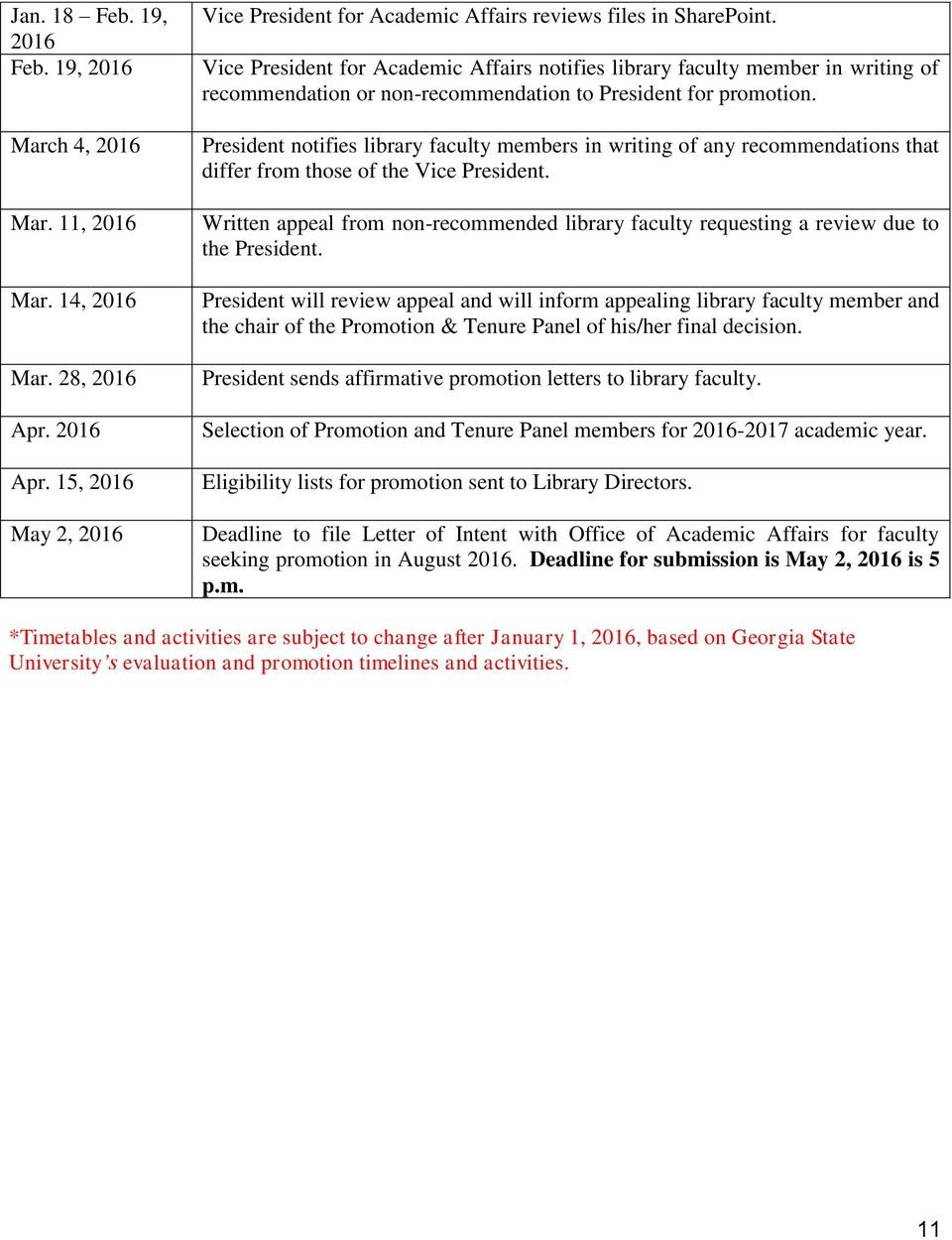
11 Jan. 18 Feb. 19, 2016 Feb. 19, 2016 March 4, 2016 Mar. 11, 2016 Mar. 14, 2016 Mar. 28, 2016 Apr Apr. 15, 2016 May 2, 2016 Vice President for Academic Affairs reviews files in SharePoint. Vice President for Academic Affairs notifies library faculty member in writing of recommendation or non-recommendation to President for promotion. President notifies library faculty members in writing of any recommendations that differ from those of the Vice President. Written appeal from non-recommended library faculty requesting a review due to the President. President will review appeal and will inform appealing library faculty member and the chair of the Promotion & Tenure Panel of his/her final decision. President sends affirmative promotion letters to library faculty. Selection of Promotion and Tenure Panel members for academic year. Eligibility lists for promotion sent to Library Directors. Deadline to file Letter of Intent with Office of Academic Affairs for faculty seeking promotion in August Deadline for submission is May 2, 2016 is 5 p.m. *Timetables and activities are subject to change after January 1, 2016, based on Georgia State University s evaluation and promotion timelines and activities. 11
12 LIBRARY FACULTY SEMESTER PROFILE NAME: SEMESTER: YEAR DEPARTMENT: CAMPUS: PERFORMANCE EFFECTIVENESS AREAS (other than teaching academic courses) Please check those which apply. Cataloging Circulation Collection development and management (including electronic resources) --Selection --Acquisitions --Maintenance Instructional design Interlibrary loan Library automation systems Library instruction Non-print collection Reference service Research guides Serials and microfilm collection and management Supervision Technology Support Other: Other: If desired, the faculty member may list details relating to the checked performance effectiveness areas, or any noteworthy related accomplishments. Use extra sheet if needed. 12

13 TEACHING SCHEDULE (for Academic Courses including LIST) COURSE REFERENCE NO. COURSE NAME AND SECTION COURSE MEETING COURSE MEETING TIME (CRN) (Ex. LIST ) DAYS FROM TO SERVICE List committees and other service, including involvement with students, at Georgia Perimeter College or elsewhere. Use extra sheet if needed. PROFESSIONAL ACTIVITIES List professional organizations, conferences attended, presentations given, presentations attended, workshops, courses and other discipline-related activities. Use extra sheet if needed. 13

14 PRACTICES AND PERFORMANCE Attends campus, departmental and discipline meetings, and official college functions. (List campus, departmental, discipline, and official college functions attended.) Use extra sheet if needed. LIBRARY DIRECTOR S COMMENTS GOALS FOR THE COMING YEAR No later than the second week of spring semester, attach a separate sheet of paper and describe your goals for the coming year. In each area, describe the goal you plan to attain, the activities that you will undertake to achieve that goal, the methods you will use to evaluate your efforts, and the resources that you require to achieve the goals. All librarians must prepare a plan that includes performance effectiveness and either service or professional development. For those faculty teaching LIST courses, in addition to the above, goals should be included for teaching effectiveness. Library Faculty Member s Signature Library Director s Signature Revised 6/18/12 14

15 COURSE MATERIALS For Librarians Teaching LIST, Other Academic Courses, and Providing Library Instruction Each faculty member shall maintain a Course Materials Portfolio on file in his or her office that provides examples of teaching style and course materials. The course materials should be kept in a three-ring binder. Each faculty member shall update the Course Materials Portfolio at least once each semester to keep it current. Faculty members need to retain materials that they intend to submit in their promotion portfolios. Faculty members are required to give their Library Director a current syllabus of each course they teach at the beginning of each term. Library Directors have the prerogative to ask to see the portfolio whenever they have a need. Examples of course materials that might be included are: (For any course materials that are not original, the source should be stated) Course syllabi for all courses for current academic year mandatory Assignments Projects Writing activities Case studies Laboratory activities Problem-solving sets Examples of exercises using active learning Study guides Concept maps Quizzes and exams Support materials Annotated bibliographies Web page addresses or first pages of pertinent web addresses CD-ROMs Samples of grading and feedback to students Description of uses of instructional technology Description of revisions of materials Brief explanations of materials and their uses The Course Materials Portfolio will be reviewed by the Library Director at the Mid-Year Review and at the Annual Review. It may also be reviewed by the Promotion and Tenure Committee. 15

16 ANNUAL PERFORMANCE REVIEW OF FACULTY CLASSROOM OBSERVATION For Librarians Teaching LIST, Other Academic Courses, and Providing Library Instruction Because Georgia Perimeter College values excellence in teaching, all faculty will have their classroom and library instruction teaching observed periodically. Satisfactory classroom observations are expected. Classroom observations will be an important component of the Faculty Review Process. Classroom observations and the discussions associated with them should also be used as an opportunity for faculty development. During the first term that a librarian teaches, the librarian s class will be observed by the Library Director. The Library Director also should check the course syllabi, course materials, and other information and documentation as necessary. After the first observation, classes taught by librarians will be observed annually for the first three years. After the first three observations, classes will be observed once every three years. Faculty members applying for a personnel action (i.e., promotion) must be observed within the year prior to the application for that personnel action. The observations should be discussed with the faculty member within two weeks of the observation. At that time, all forms dealing with the observation should be signed and copies provided to the faculty member. The originals should remain on file in the department in a secured location. If a faculty member wants additional observations, the Library Director should make arrangements for those observations. Distance learning classes must be observed in addition to face-to-face classes. Online Library Directors will observe a distance learning class for faculty who teach both. For distance learning courses, at numbers 11 and 12 on the classroom observation form, communicates should be substituted for speaks. 16

17 Interaction Course Design and Delivery Needsimprovement Expected Exceptional Not Observed CLASSROOM OBSERVATION FORM Instructor: Time: : Observer: Course : Number of students present: Number of students enrolled: Topic Covered: Type of class: Face-to-face On-line Hybrid Descriptors Comments 1. Presents material appropriate to course objectives 2. Presents material appropriate to student knowledge 3. Includes examples or illustrations to clarify concepts 4. Uses instructional aids where appropriate 5. Uses instructional time efficiently 6. Delivers lesson in a logical manner 7. Summarizes major concepts and checks for understanding 8. Provides up-to-date goals/ objectives 9 Uses instructional methods effectively 10. Communicates the material with a sense of enthusiasm 11. Speaks about content with authority 12. Speaks clearly 13. Encourages student involvement 14. Demonstrates respect for students 15. Clarifies content when students fail to understand 16. Responds constructively to students Attach additional comments on separate sheets if necessary. Faculty member signature*:: Library Director s signature:: *Faculty member s signature indicates that this review form has been discussed with the faculty member and does not imply agreement with the conclusions. 17

18 POST-CLASSROOM OBSERVATION REVIEW Name: : Observer: Course: Topic covered: of post-observation review: Summary of observation (add additional pages as necessary) Attachments: Faculty Member s Signature*: : _ Observer s Signature: : _ Library Director s Signature: : _ * Faculty member s signature indicates that this review has been discussed with the faculty member and does not imply agreement with the conclusions. 18

19 MID-YEAR AND ANNUAL LIBRARIAN REVIEW The Mid-Year Faculty Review, to be held by the end of the spring semester, provides an opportunity for the faculty member and the Director/Supervisor to discuss Performance Areas Effectiveness, Teaching (if applicable), Practices and Performance, Service, and Professional Development. If the librarian is teaching a class, at this meeting the faculty member s course materials portfolio also should be reviewed and discussed. Using the GPC evaluation form as a guide, each library faculty member will submit to his or her Library Director a description of performance effectiveness, service, and professional activities during that semester. To indicate his or her assessment of the library faculty member s performance at this point, the Library Director will write a brief narrative (one paragraph or so) for each area: performance effectiveness, practices and performance, service, and professional activities. That is, does the faculty member appear to be on target for what is expected? Are there any areas that need improvement? Does it appear at this point that a faculty member s work in some area(s) may lead to an exceptional rating during the final review? The mid-year review process is intended to provide a forum for discussion about any potential areas of concern, helping the faculty member to make improvements before the end of the calendar year. After the discussion, the Director/Supervisor will complete the GPC Library Faculty Evaluation form. This document remains in the department files and provides a reference for the annual faculty review. A copy is also given to the faculty member. For librarians applying for promotion, the mid-year review will be submitted at the time of application to complete the number of semesters of review required. A. PERFORMANCE EFFECTIVENESS AREAS Suggested topics for discussion regarding performance effectiveness at the mid-year review are listed below. Topics may include, but are not limited to: Cataloging Circulation Collection development and management (including electronic resources) --Selection --Acquisitions --Maintenance Instructional design Interlibrary loan Library automation systems Library instruction Non-print collection Reference service Research guides Serials and microfilm collection and management Supervision Technology Support Other: 19

20 TEACHING EFFECTIVENESS (Librarians Teaching Courses for Credit) In order to demonstrate teaching effectiveness, faculty members need to show not only what they do, but how what they do enhances student learning. Effective teaching results in students developing thinking processes and learning skills and information that will lead to mastery of the course outcomes. Suggested topics for discussion regarding teaching effectiveness at the mid-year review are listed below. Topics may include, but are not limited to: 1. Syllabi Course syllabi are clearly written, complete, accurate, distributed on time and cover content as specified by the Common Course Outline. 2. Course Materials Assignments are designed to enable the students to master the course outcomes. Assessments are designed to demonstrate that students have developed thinking processes and have learned skills and information that show mastery of the course content. 3. Student Evaluations and Feedback Student evaluations are satisfactory. Student comments, if received, show that the students believe the course and professor have made a positive impact on their learning. 4. Classroom Observations Classroom observations reveal satisfactory classroom management skills. Faculty-student interactions are appropriate and encourage learning. Classroom environment/atmosphere is conducive to learning. Discussions are designed to enhance student learning of the course outcomes. 5. Enrollments Class enrollments are within norms for courses taught. Drops and withdrawals are within norms. 6. Grades Grade distributions are within norms for courses taught. 7. Office hours Faculty member is available to students during posted office hours. 8. Methodology Faculty member uses appropriate teaching methodology in the instruction process. 9. Advising Faculty member performs advising duties assigned. C. SERVICE Suggested topics for discussion regarding service at the mid-year review are listed below. Topics may include, but are not limited to: 1. Faculty member participates in committees and service to the College, Campus, and/or Discipline. 2. Faculty member contributes to the academic development of students outside the library. 20

21 D. PROFESSIONAL ACTIVITIES Suggested topics for discussion regarding professional activities at the mid-year review are listed below. Topics may include, but are not limited to: 1. Faculty member participates in professional organizations. 2. Faculty member attends conferences. 3. Faculty member participates in discipline-related activities. 4 Faculty member participates in educational opportunities such as workshops or courses. E. PRACTICES AND PERFORMANCE Suggested topics for discussion regarding practices and performance at the mid-year review are listed below. Topics may include, but are not limited to: 1. Faculty member responds to requests for information. 2. Faculty member communicates in a timely fashion. 3. Faculty member follows established college policies and procedures. 4. Faculty member attends campus, departmental, and discipline meetings. 5. Faculty member attends official college functions. 6. Faculty member relates to students, faculty, staff and administrators in a professional manner. 7. Faculty member maintains records. The Annual Faculty Review is held after the end of fall semester. This is the final evaluation for the year that will provide information for merit raises and promotion decisions. Using the GPC evaluation form as a guide, each library faculty member will submit to his or her Library Director a description of performance effectiveness, teaching (if applicable), service, and professional activities during that year. The Library Director completes the Faculty Evaluation form after the end of the fall semester. All Library Directors and the Executive Director, Center for Teaching and Learning will meet jointly to discuss all the annual reviews for the library faculty members to ensure consistency in evaluation. Library Directors then hold individual discussions with each faculty member concerning performance. EVALUATION OF FIRST-YEAR LIBRARY FACULTY Because the Librarian Annual Review covers a calendar year and is completed at the end of fall term, librarians joining the institution in the fall will not have worked during the spring portion of that evaluation period and, therefore, will not have a complete report. However, the Library Director must evaluate the performance of new librarians to support a recommendation for contract renewal. New librarians will be required to turn in a Librarian Semester Profile at the beginning of their first semester and will begin a materials portfolio. New library faculty members will be evaluated by the Library Director at the end of fall semester. 21
22 ALIGNMENT OF THE FACULTY EVALUATION WITH GPC S STRATEGIC PLAN Library Faculty: This section appears in the Faculty Evaluation Handbook and is copied below in its entirety. Some parts apply to classroom faculty only. In each category for evaluation (Teaching Effectiveness, Practices and Performance, Service, and Professional Activities), what is expected in faculty performance is aligned with GPC s Strategic Goals as indicated at the top of each section. A faculty member can, however, address additional action items under these goals by choices they make in activities they pursue as a faculty member. Following is a comprehensive guide of what faculty activities support each of the strategic goals of the College: WE WILL STRENGTHEN STUDENT SUCCESS Actions to strengthen Student Success Ways in which faculty strengthen Student Success Support teaching excellence Serve as a mentor Serve on P&T committees Improve academic advising processes Offer ideas to improve advising Attend advising training sessions Develop an Academic Master Plan Serve on AMP committee Address goals and actions in plan Create a process to review and evaluate the relevancy and responsiveness of our curriculum Offer ideas to improve curriculum Redesign courses for relevancy Study needs of students and prepare courses that respond to those needs Expand awareness of opportunities for students and faculty to become involved in college life, civically engaged in the community, and aware of local, national, and global perspectives Serve as club advisor Assist Student Life with activities Promote activities on campus Oversee service learning activities Coordinate internships or other civic engagement projects Internationalize your courses 22
23 WE WILL CREATE AND FOSTER A CULTURE OF TEAMWORK, LEADERSHIP, QUALITY SERVICE AND CONTINUOUS IMPROVEMENT Actions to create and foster our culture Ways in which faculty foster our culture Establish an office of customer service Support efforts of OCS Conduct college-wide open forum discussions Participate in open forums Enhance the services we offer to our students Serve on Student Services committee Develop a methodology to review and revise college policies and procedures Offer ideas to improve policies Offer revised procedures Identify and implement a rapid process improvement strategy Participate in a RPI Examine and adjust organizational structures Serve on organizational committees Offer ideas to improve structures Develop and implement a comprehensive safety and security plan Serve on safety and security committee or Emergency training Provide quality professional, faculty and staff development Participate in (or conduct) faculty development workshops, seminars, or programs Align our performance management process to the college strategic plan Ensure all committees are relevant to the Strategic Plan 23
24 WE WILL ENHANCE THE ECONOMIC, SOCIAL, AND CULTURAL VITALITY OF OUR COMMUNITIES Actions to enhance our communities Establish an office of civic engagement to link the college s human capital with the needs of our communities through service learning, internship and experiential learning opportunities Ways in which faculty enhance our communities Support service learning, internship, and experiential learning programs Participate in civic engagement programs Foster strategic partnerships through the continuation of community open forums Assist colleagues and administrators at community open forums Identify potential strategic partners Develop additional Transfer Admission Guarantees Be knowledgeable about and up-to-date on TAGs Develop educational partnerships with institutions abroad Communicate interest in faculty exchanges to CIE Encourage faculty, staff, and students to be more active in global education initiatives Participate in Study Abroad Support events with global focus Prepare students for careers in Georgia s critical areas Advise students about career opportunities and job fairs Seek external funding opportunities to support college initiatives Identify funding opportunities to College Foundation Effectively communicate to the community the role and contributions made by the college. Speak to community groups Share GPC mission and goals 24
25 WE WILL EXPAND ACCESS AND ENROLLMENT CAPACITY Actions to expand access and enrollment Maximize the use of facilities Ways in which faculty expand access and enrollment Teach hybrid classes Incorporate icollege in classes Contribute to course redesign efforts Schedule classes to meet the needs of all learners Teach overloads at night or on weekends Implement energy conservation Join efforts for a greener college Continue to expand our access to learners worldwide Teach online classes Increase access to financial assistance Support College Foundation Serve as scholarship sponsor Enhance recruitment efforts and target underrepresented groups Volunteer to help recruiters Identify under-served areas Improve services to students that promote their success. Provide effective advising Participate in orientations 25
26 Georgia Perimeter College Library Faculty Evaluation Form The evaluation of library faculty will draw on multiple sources of information, which may include, but are not limited to, observations of service; reports, guides, and other materials developed by the faculty member. Name Performance Effectiveness GPC Strategic Goal #1 We will strengthen student success (supports teaching) Areas Needs Improvement Expected Performance Exceeds Expectations Exceptional Comments Depending on one s job description, one or more of these will be addressed. Cataloging Performs complex copy cataloging of library materials accurately using accepted standards. Performs original cataloging of library materials accurately, using accepted standards. Performs catalog database maintenance functions on a regular schedule. Completes routine and assigned tasks/projects in a timely and accurate manner. Circulation Consistently demonstrates and applies knowledge of College and standard library circulation practices and procedures. Demonstrates effective use of circulation software and student information systems applicable to management of circulation. Assures that students, faculty, and staff receive services in a courteous and professional manner. Contributes to the development of circulation policies by recognizing the need for changes in policies that leads to implementation. 26 Revised 6/18/2012
27 Areas Needs Improvement Expected Performance Exceeds Expectations Exceptional Comments Circulation (contd.) Completes routine and assigned tasks/projects in a timely and accurate manner. Collection development and management (including electronic resources) Reads and evaluates a variety of reviewing media to identify items that are appropriate to the collection. Selects material within the budget. Deselects items using appropriate library standards. Demonstrates good overall understanding of collection management principles and techniques. Instructional design and maintenance Regularly creates, updates, and maintains the campus or overall library web pages. Completes routine and assigned tasks/projects in a timely and accurate manner. Interlibrary loan Demonstrates knowledge of interlibrary loan systems and expedites requests in an efficient and timely manner. Library instruction Organizes instruction in a logical sequence and proactively and clearly communicates to students. Uses appropriate delivery methods and materials to enhance student learning. Establishes dynamic lesson framework using new and effective ways to provide instruction. Manages the Ex Libris integrated library system, generates regular reports, and implements enhancements to the system in a timely manner. Analyzes and resolves problems proficiently. Revised 6/18/12 27
28 Areas Needs Improvement Expected Performance Exceeds Expectations Exceptional Comments Library systems Coordinates and troubleshoots patron loads and other recurring issues on a regular basis. Effectively manages electronic resources, LibGuides, and main webpages for the libraries. Non-print services Demonstrates proficient knowledge of Media Scheduling software. Assures that students, faculty, and staff receive services in a courteous and professional manner. Completes routine and assigned tasks/projects in a timely and accurate manner. Reference service Adheres to scheduled reference desk hours and works effectively with the reference team. Assures that students, faculty, and staff receive information and guidance in a courteous and professional manner. Demonstrates substantial knowledge of reference sources and services. Research guides Creates practical and effective instructional guides and handouts. Designs creative userfriendly online tutorials. Serials and microfilm collection and management Accurately manages serials and microfilm collections and maintains serial holdings. Analyzes the strengths and weakness of the serial holdings of the libraries. Appropriately manages full or part-time staff. Effectively oversees hiring, training, scheduling, and performance evaluations if requested to do so. 28 Revised 6/18/12
29 Elements Needs Improvement Expected Performance Exceeds Expectations Exceptional Comments Conscientiously provides procedural guidance and training for staff. Collaboratively creates and maintains campus library reference and/or circulation desk schedule on a regular basis. Assures that library staff provide students, faculty, and staff with quality services in a courteous and professional manner. Teaching: Library instruction Organizes instruction in a logical sequence and proactively and clearly communicates to students. Uses appropriate delivery methods and materials to enhance student learning. Establishes dynamic lesson framework using new and effective ways to provide instruction. Technology support Troubleshoots problems with equipment and software in a timely manner. Other: Other: Revised 6/18/12 29
30 Teaching Effectiveness GPC Strategic Goal #1 We Will Strengthen Student Success (supports teaching excellence, addresses goals and actions in Academic Master Plan) Elements Needs Improvement Expected Performance (examples) Exceeds Expectations Exceptional (examples) Comments Course Design Organizes instruction in a logical sequence in accordance with identified course outcomes. Articulates progression of concepts effectively to students. Develops clear syllabus; pro-actively and clearly communicates to students if changes are made to syllabus. Establishes dynamic course framework leading to new and innovative ways to provide instruction including specific plans to evaluate the effectiveness of the course design. Designs assignments to enable students to master concepts. Designs appropriate delivery technique. Updates and improves course materials to maximize learning. Course delivery Establishes clear expectations for the students. Uses appropriate delivery methods & materials to enhance student learning. Promotes or facilitates learning including ability to motivate students, generate enthusiasm, and encourage critical thinking. Creates an atmosphere that fosters a respectful and open learning environment. Engages students in learning beyond established expectations. Employs a variety of teaching methods to accommodate individual differences to meet course outcomes appropriately. Summarizes major concepts and checks for understanding. Implements innovative learning materials for an assigned course. 30 Revised 6/18/12
31 Elements Needs Improvement Expected Performance (examples) Exceeds Expectations Exceptional (examples) Comments Assessment Aligns assessment with course objectives. Administers assessments in an effective manner. Conducts assessments that effectively measure the attainment of intended course outcomes. Provides relevant, timely feedback, including suggestions for improvement. Maintains high academic expectations and grading standards. Goes beyond the scope of expected in evaluating student progress on a continuous basis. Increases understanding of student learning outcomes; increases retention/course pass rates makes a difference, without compromising academic standards. 31 Revised 6/18/12
32 Practices and Performance GPC Strategic Goal #2 We will create and foster a culture of teamwork, leadership, quality service, and continuous improvement (supports fostering a supportive culture) Elements Needs Improvement Expected Performance (examples) Exceeds Expectations Exceptional (examples) Comments Knowledge/ ability to answer patrons questions Possesses requisite knowledge of own discipline and awareness of others in order to appropriately direct students. Provides comprehensive advice in one s area of expertise. Availability/ Access Meets assigned classes and labs promptly at the scheduled times. Is available to students during posted office hours. Responds to requests for information in a timely manner. Devotes significant time beyond scheduled class/lab/office hours to provide students additional instruction. Record Management Maintains appropriate student records and reports required information according to posted deadlines. Submits reports or other documents on or before due dates. Collegiality Attends campus, departmental and discipline meetings, and official college functions. Relates to students, faculty, staff, and administrators in a professional manner. Voluntarily assumes additional responsibilities as needed by the department, discipline, college, etc. (without reassigned time) 32 Revised 6/18/12
33 Service GPC Strategic Goal #1 GPC Strategic Goal #2 GPC Strategic Goal #3 We will strengthen student success (supports expanding awareness of opportunities for students and faculty to become involved in college life, civically engaged in the community) We will create and foster a culture of teamwork, leadership, quality service and continuous improvement (supports the services we offer to our students) We will enhance the economic, social, and cultural vitality of our communities (supports effectively communicating to the community the role and contributions made by the college) Elements Needs Improvement Expected Performance (examples) Exceeds Expectations Exceptional (examples) Comments College Committee Participation Actively contributes to committees and service at the College. Devises and submits actionable, effective solutions to address problems discussed during meetings. Chairs major collegewide committee or taskforce, ensuring that tasks are completed in a timely manner. Leads an assessment project for the discipline. Student and community service Contributes to the academic development of students outside the library by attending events honoring or recognizing students, serving as club advisor; or by other involvement with students. Participates in community service related to the discipline or to the College mission when possible. Leads and coordinates student and/or community events related to the discipline or to the College mission. Revised 6/18/12 33
34 Professional Activities GPC Strategic Goal #1 GPC Strategic Goal #2 We Will Strengthen Student Success We will create and foster a culture of teamwork, leadership, quality service and continuous improvement Elements Needs Improvement Expected Performance (examples) Exceeds Expectations Exceptional (examples) Comments Current knowledge in discipline Stays abreast of latest topics and changes related to discipline. Maintains membership in professional organizations. Publishes books or professional papers in refereed journals to expand relevant knowledge base. Attends professional conferences Participates in other discipline-related activities (e.g., performances and exhibits) to expand relevant knowledge base. Participates in educational opportunities such as faculty development workshops or courses, attends presentations etc. Library Faculty Member s Signature Library Director s Signature Revised 6/18/12 34
35 LIBRARY FACULTY REBUTTAL OF ANNUAL PERFORMANCE REVIEW Faculty evaluations by Library Directors (under oversight of the Executive Director, Center for Teaching and Learning) must be signed and dated by the faculty member and the Library Director at the time of evaluation. The faculty member s signature indicates review of the evaluation only. (Failure to sign the evaluation by the faculty member could become grounds for disciplinary action.) A faculty member who wishes to rebut an evaluation by a Library Director should follow the procedure outlined below. 1. The faculty member should review and discuss the evaluation with the Library Director before the evaluation is placed in the personnel file. 2. If the faculty member disagrees with the evaluation, the faculty member may write a memorandum of rebuttal or explanation of any parts of the evaluation with which there is disagreement. Within five (5) working days of the evaluation conference, the faculty member should send the memorandum to the Library Director with copies to the Executive Director, Center for Teaching and Learning. 3. Upon receipt of a memorandum of rebuttal from a faculty member, the Library Director will acknowledge receipt in writing. 4. The faculty member, in addition, may request a joint conference with the Executive Director, Center for Teaching and Learning and the Library Director. Any changes in the annual evaluation made as a result of either the conference or the faculty member's written rebuttal will be a joint decision of the Library Director and the Assistant Vice President and must be noted in writing by the Library Director. This written acknowledgment of change will be appended to the original evaluation, and all copies become a part of the evaluation record along with the memorandum of rebuttal. The faculty member will be notified of the decision within five (5) working days. 5. If the faculty member is dissatisfied with the outcome of the rebuttal, the faculty member has five working days to appeal the evaluation and any changes that have been noted to the Vice President for Academic Affairs. The decision of the Vice President for Academic Affairs is final. 6. The evaluation, the memorandum of rebuttal, the Library Director s response, and a summary of the conference/decision with the Executive Director, Center for Teaching and Learning, if any, and any changes to the evaluation that have been noted, will become a part of the faculty member s portfolio. 7. In addition to signing and dating the evaluation form, the faculty member is required to sign and date any attachments and return the signed evaluation and any attachments to the Library Director. 8. The Library Director will provide the faculty member with a copy of the evaluation, including any changes that have been noted. The Library Director will keep a copy of the evaluation and submit the original files through the Executive Director, Center for Teaching and Learning to the Vice President for Academic Affairs. 9. The Vice President for Academic Affairs will submit all completed annual evaluations of faculty to the Human Resources Department where they will become a part of the faculty member s permanent file. 35
36 PROMOTION GEORGIA PERIMETER COLLEGE PHILOSOPHY ON PROMOTION Rank at Georgia Perimeter College should indicate not only a faculty member s length of service at an institution, it must also reflect the contributions of the faculty member to the College as they relate to the College s mission and values. As stated in the Board of Regents guidelines for promotion: POLICY CRITERIA FOR PROMOTION Each University System institution shall establish clearly stated promotion criteria and procedures that emphasize excellence in teaching for all teaching faculty. These policies will be submitted to the Senior Vice Chancellor for Academic Affairs for review. 1. Minimum for all three types of institutions in all professorial ranks: a. Superior teaching b. Outstanding service to the institution c. Academic achievement d. Professional growth and development Noteworthy achievement in all four of the above need not be demanded, but should be expected in at least two. A written recommendation should be submitted by the head of the department concerned setting forth the reasons for promotion. The faculty member's length of service with an institution shall be taken into consideration in determining whether or not the faculty member should be promoted. Last Updated: 04/15/2002 These guidelines set out qualitative measure for classroom faculty performance. For library faculty at Georgia Perimeter College, promotion criteria and procedures emphasize excellence in performance effectiveness. 36
37 GEORGIA PERIMETER COLLEGE CRITERIA FOR PROMOTION FOR LIBRARY FACULTY Minimum for librarians at Georgia Perimeter College in all professorial ranks: a. Superior performance effectiveness (including teaching, if applicable) b. Outstanding service to the institution c. Academic achievement d. Professional growth and development Noteworthy achievement in all four of the above need not be demanded, but should be expected in at least two. A written recommendation should be submitted by the head of the department concerned setting forth the reasons for promotion. The faculty member's length of service with an institution shall be taken into consideration in determining whether or not the faculty member should be promoted. It is important to distinguish between eligibility criteria and the criteria used for recommending a faculty member for promotion. Eligibility implies a base level of performance allowing a faculty member to apply for promotion. Furthermore, eligibility should be based on completed years. Criteria for promotion should be based upon standards of excellence appropriate to the rank in question and should increase with increasing rank. 37
38 Promotion to Assistant Professor Criteria for Promotion: Although we promote Instructors to the rank of Assistant Professor, the rank of Assistant Professor is de facto an entry level rank. As such, promotion to Assistant Professor should be based upon evidence of significant growth and development as a Librarian Instructor. Eligibility: Candidates should have three (3) or more consecutive years* as a full-time librarian instructor at GPC, and three (3) or more years of expected performance at GPC. When a faculty member receives a doctorate he/she is immediately considered eligible for promotion to Assistant Professor and may apply at the next review date. Degree/experience requirements: Earned doctorate in the field, or terminal degree in the discipline as defined by a national professional body, granted by a regionally accredited university. The degree requirement must be met by the date on which formal request for consideration is submitted to the Library Director. Or Master s degree plus thirty (30) semester graduate hours beyond the Master s degree in an appropriate field, and six fully-evaluated semesters of full-time library experience at GPC as an Instructor in a full-time position. Or Master s degree and award of at least two exceptional ratings in performance effectiveness over a period of ten fully-evaluated consecutive* semesters at GPC as a Librarian Instructor in a full-time librarian position. Full-time library faculty experience is defined as an entire academic year on a library faculty contract. * Consecutive years may include years before and after approved medical leaves, leaves of absence without pay, and professional enhancement leaves. 38
39 Promotion to Associate Professor Criteria for Promotion: Promotion to Associate Professor indicates a faculty member s long-term commitment to the institution, and the institution s recognition of that faculty member s senior status. As such, promotion to Associate Professor should be based upon evidence of sustained accomplishment and demonstrated commitment to the institution and profession. Eligibility: Candidates should have six years of full-time college librarian experience. At least five years must be at the Assistant Professor rank at GPC in consecutive* years as a full-time library faculty member at GPC and ten (10) or more semesters at GPC or more years of expected performance in all four categories for all items, with no stipulation of needs improvement as an Assistant Professor. Faculty applying for promotion to Associate Professor should have received two or more ratings of exceptional in performance effectiveness, service, and professional activities which help to demonstrate sustained accomplishment and dedicated performance to the institution Degree/Experience Requirements: Earned doctorate in the field, or terminal degree in the discipline as defined by a national professional body, granted by a regionally accredited university. The degree requirement must be met by the date on which formal request for consideration is submitted to the Library Director. Or Master s degree plus thirty (30) semester graduate hours in an appropriate field. Or Master s degree and award of two or more exceptional ratings in performance effectiveness for the three most recent evaluations. Full-time library faculty experience is defined as an entire academic year on a library faculty contract. * Consecutive years may include years before and after approved medical leaves, leaves of absence without pay, and professional enhancement leaves. 39
40 Promotion to Professor Criteria for Promotion: Achieving the rank of Professor is a highly distinguished accomplishment for a senior faculty member, in recognition of truly exceptional performance beyond the expectations of the Associate Professor. As such, promotion to Full Professor should be based upon evidence of attaining the status of master librarian, notable scholar, and distinguished leader in the profession or at the institution. Eligibility: Because of the exceptional nature of promotion to Professor, the criteria for eligibility should be more rigorous than eligibility criteria for other ranks. Candidates must have eight years of successful full-time college librarian experience with at least five (5) or more consecutive* years at the Associate Professor rank at GPC as a full-time library faculty member at GPC. Candidates must have ten or more years of above average performance (two or more ratings of exceptional for each of the five most recent evaluations in performance effectiveness, service, and professional activities, and expected in practices and performance). Faculty applying for promotion to Professor should have received ratings of exceptional in performance effectiveness, service, and professional activities which help to demonstrate attaining the status of master librarian, notable scholar, and distinguished leader in the profession or at the institution. Degree/Experience Requirements: Earned doctorate in the field granted by a regionally accredited university. The degree requirement must be met by the date on which formal request for consideration is submitted to the Library Director. Full-time library faculty experience is defined as an entire academic year on a library faculty contract. Criteria for promotion should be based upon standards of excellence appropriate to the rank in question and should increase with increasing rank. Thus there is no set number of exceptional ratings required. Instead, a faculty member needs to demonstrate through their ratings and portfolio for promotion that they have earned the rank for which they are applying. * Consecutive years may include years before and after approved medical leaves, leaves of absence without pay, and professional enhancement leaves. 40
41 Promotion Application Process To apply for promotion, the faculty member must submit a promotion portfolio. Promotion portfolios should provide primary and secondary evidence of excellence in performance effectiveness, service, and professional activities. At a minimum they should contain: 1. A letter of application making the case for promotion 2. Annual evaluations from the previous five years at GPC. 3. A current curriculum vitae 4. Documentation consisting of evidence of: a. Excellence in librarianship (in areas such as reference service, information literacy, collection development, creation of guides and tutorials, cataloguing, among others) b. Excellence in service (such as committee work and other service to the department, college, and community) c. Excellence in Professional Activities/activities (such as examples of publications, presentations, grants, performances, projects, etc.) 5. At least three letters of support, including one from a full-time librarian at GPC and at least one from another peer inside of Georgia Perimeter College are required. Librarians also may include letters from peers outside of GPC. Faculty members should inform their colleagues of the criteria that should be addressed in the letters. The authors of the letters send their letters to the faculty member in a sealed envelope with their signature across the closure at the back of the envelope. Colleagues writing letters of support should address how the librarian demonstrates some or all (as appropriate) of the following: Exceptional performance Outstanding service to the institution Academic achievement Professional growth and development 6. Qualitative evaluation of performance effectiveness (including evaluations/observations and student evaluations and classroom observations if teaching.) 7. Goals for the next five years. 41
42 Promotion Review Process 1. Once the promotion portfolio is submitted, the faculty member will be evaluated by a layered process. The reviewers include a Peer Committee, Library Director, Executive Director, Center for Teaching and Learning and the Promotion and Tenure Panel. Their recommendations are forwarded to the Vice President for Academic Affairs who reviews the recommendations and submits a recommendation to the President. The Library Peer Review Committee is comprised of a minimum of three (3) and a maximum of five (5) full-time library faculty chosen by the library faculty member s department on his or her campus. If there are not a sufficient number of librarians in the campus library department, then the Chair of the Committee may ask a full-time librarian or librarians from another campus or from other campuses to serve. The Promotion and Tenure Panel is formed as follows: Faculty will vote for all tenured faculty and librarians at GPC whom they would find acceptable serving on the panel. The Academic Division Deans and Vice President for Academic Affairs will select 21 faculty from the group voted by the faculty as a whole to serve on the panel. 2. The librarian submits the promotion portfolio to the Library Director, who forwards the portfolio to a department- or campus-based Peer Committee. 3. The department- or campus-based Peer Committee reviews the portfolio and, using the form provided, sends a written recommendation of support or denial to the Library Director with a copy included in the portfolio. 4. The Library Director writes a letter of support or denial based on his/her independent review. The Library Director s letter is included in the portfolio and forwarded to the Executive Director, Center for Teaching and Learning. 5. The Executive Director, Center for Teaching and Learning reviews all documentation and writes a letter of support or denial to the faculty member. A copy of the letter is included in the portfolio. Procedure for non-recommendation: a. The Executive Director, Center for Teaching and Learning notifies the faculty member in writing of his/her intention not to recommend the faculty member for promotion. b. The faculty member may appeal the decision in writing following these guidelines: 1) The faculty member must submit a written appeal to the Executive Director, Center for Teaching and Learning by date in the Implementation Timetable for Faculty Seeking Promotion and /or Tenure for the current academic year. 2) The written appeal (in the form of a summary statement with supporting evidence) must identify the specific criteria to be reconsidered. 42
43 c. In the event of a written appeal, the Executive Director, Center for Teaching and Learning must review the letter and documentation and respond in writing to the faculty member either endorsing the appeal or explaining a denial. In the case of a denial, the letter to the faculty member will include specific reasons for the denial. 6. The Executive Director, Center for Teaching and Learning forwards all materials to the collegewide Promotion and Tenure Panel. 7. The Promotion and Tenure Panel reviews the portfolio. At this point, the Panel may request individual or joint interviews with the candidate and Library Director/Supervisor to clarify issues of concern. The Panel makes a written recommendation of support or denial to the Vice President for Academic Affairs. 8. The Vice President for Academic Affairs writes a letter of support or denial and forwards the application, including all letters and appeal documents, if any, to the College President. 9. The College President approves or denies promotion. 10. If the President does not wish to endorse an affirmative recommendation by the Vice President, then the President will notify the faculty member in writing with a copy to the Vice President within four (4) working days of receipt of the Vice President s recommendation. 11. Any faculty member receiving an adverse recommendation on promotion and/or tenure from the Vice President for Academic Affairs or from the President has a right to a review by a Promotion and Tenure Review panel, appointed by the President. The purpose of the Promotion and Tenure Review Panel is to provide additional information to the President concerning a faculty member s appeal to an adverse recommendation by the Vice President for Academic Affairs regarding promotion. The Executive Director, Center for Teaching and Learning, a faculty representative (from the same discipline group as the appellant), and the chair of the Promotion and Tenure Panel will comprise the review panel. 12. Faculty members who wish a review of an adverse recommendation on promotion must submit a letter to the President requesting a review. The letter must meet the following guidelines: a. The letter must state the basis of the review. b. The letter should designate a faculty member from the same division as the appellant whom the appellant wishes to include in the review and who has agreed to serve in that capacity. The faculty member should also indicate if she/he wishes to appear before the Promotion and Tenure Review Panel. c. The letter must be received by the President according to the Implementation Timetable for Faculty Seeking Promotion and/or Tenure. 13. After considering the evidence presented in the review, the President will make a decision within five (5) working days of the review and write a letter to the faculty member, the chair of the Promotion and Tenure Committee, the Executive Director, Center for Teaching and Learning, and the Vice President for Academic Affairs informing them of the President s final decision. 43
44 14. A faculty member dissatisfied with the decisions of the President may appeal to the Board of Regents in accordance with the policies of the Board. 44
45 Report of the Peer Committee Promotion Review Library faculty member: By majority vote, the panel finds that the library faculty member is Recommended for promotion to Not recommended for promotion to Attach a summary of the library faculty member s performance in each of the following areas: A. Superior performance effectiveness B. Outstanding service to the institution C. Academic achievement D. Professional growth and development Attach a narrative statement of one page in length, addressing each of the four areas above with regard to meeting the criteria for promotion to the rank for which the applicant is applying. A nonrecommendation requires a statement describing deficiencies and recommendations for improvement. Signatures of the Peer Committee: Chair of Committee 45
46 Report of the Promotion and Tenure Panel Promotion Review Library faculty member: By majority vote, the panel finds that the library faculty member is Recommended for promotion to Not recommended for promotion to Attach a summary of the library faculty member s performance in each of the following areas: A. Superior performance effectiveness B. Outstanding service to the institution C. Academic achievement D. Professional growth and development Attach a narrative statement of one page in length, addressing each of the areas with regard for meeting the criteria for promotion to the rank for which the applicant is applying. A nonrecommendation requires a statement describing deficiencies and recommendations for improvement. Chair of Promotion and Tenure Panel (Members of Panel sign attached pages.) 46
47 Name of Library Faculty Member: Signatures of Members of the Promotion and Tenure Committee: 47
48 48
SCHOOL OF NURSING FACULTY EVALUATION PROCEDURES AND CRITERIA FOR RETENTION, PROMOTION, TENURE, AND PERIODIC REVIEW
 SCHOOL OF NURSING FACULTY EVALUATION PROCEDURES AND CRITERIA FOR RETENTION, PROMOTION, TENURE, AND PERIODIC REVIEW This document is to be used in conjunction with the UA Board of Regents policies, University
University Of Alaska Anchorage College Of Health Department Of Human Services. Criteria and Guidelines For Faculty Evaluation
 University Of Alaska Anchorage College Of Health Department Of Human Services Criteria and Guidelines For Faculty Evaluation This document is to be used in conjunction with the UNAC and UAFT Collective
Department of History Policy 1.1. Faculty Evaluation. Evaluation Procedures
 Approved: 2/23/099 Department of History Policy 1.1 Faculty Evaluation Evaluation Procedures 1. The Department of History will evaluate all tenured and non-tenure faculty by March 1 of each academic year
Salt Lake Community College ASSOCIATE DEAN (AD) MODEL PROCEDURES
 PURPOSE: Salt Lake Community College values and endorses strong and effective academic leadership, and first tier academic leadership, Associate Deans (ADs), are the foundation for strong and effective
Appendix D: Faculty Evaluation Form Second/Third Year Appointments
 Appendix D: Faculty Evaluation Form Second/Third Year Appointments Introduction This form lists criteria dean/supervisors will use to evaluate whether or not expectations have been met in the second-year
Guidelines for Massachusetts Early Educator Preparation Programs Participating in the Early Childhood Educator Scholarships Program.
 Guidelines for Massachusetts Early Educator Preparation Programs Participating in the Early Childhood Educator Scholarships Program Background The Departments of Higher Education and Early Education and
Ph.D. in Adult Education Graduate Handbook
 Ph.D. in Adult Education Graduate Handbook Department of Lifelong Education, Administration, and Policy College of Education 1 November 2010 University of Georgia, Athens, Georgia 1 TABLE OF CONTENTS Program
DEPARTMENT OF MARKETING COLLEGE OF BUSINESS ADMINSTRATION POLICY ON REAPPOINTMENT, TENURE, AND PROMOTION (RTP)
 Approved by Academic Affairs May 2010 DEPARTMENT OF MARKETING COLLEGE OF BUSINESS ADMINSTRATION POLICY ON REAPPOINTMENT, TENURE, AND PROMOTION (RTP) I. DEPARTMENT OF MARKETING RTP POLICY A. Preamble B.
Faculty Evaluation and Performance Compensation System Version 3. Revised December 2004
 Faculty Evaluation and Performance Compensation System Version 3 Revised December 2004 2 SUMMARY OF MAJOR CHANGES FROM EVALUATION SYSTEM, VERSION 1, 2003-2004, TO EVALUATION SYSTEM, VERSION 2, 2004-2005
Assessment & Evaluation Master s Certificate and Master s Degree. Program Handbook
 Assessment & Evaluation Master s Certificate and Master s Degree Program Handbook College of Education Education Foundations & Leadership http://www.uakron.edu/education/academic-programs/efl/programs/assess-eval/
Doctor of Education Higher Education with Concentration in Community College Administration Program Handbook
 Doctor of Education Higher Education with Concentration in Community College Administration Program Handbook College of Education Graduate Education and Research Texas Tech University Box 41071 Lubbock,
Graduate Certificate in University Teaching Handbook
 Graduate Certificate in University Teaching Handbook Contents Overview of Graduate Certificate in University Teaching... 2 Program Overview... 2 Why a Graduate Certificate in University Teaching at Concordia?...
School of Social Work Stephen F. Austin State University
 School of Social Work Stephen F. Austin State University Policy Revisions: Policy and Procedure for Awarding Promotion, Tenure, and Merit This policy and procedure for awarding promotion, tenure, and merit
Academic/Instructional Methodologies and Delivery Systems. Classroom Instruction
 Academic/Instructional Methodologies and Delivery Systems ITT Technical Institutes are institutes of higher learning that are committed to offering quality undergraduate and continuing education locally,
Texas Southern University
 Texas Southern University College of Education Bylaws 2012 [Type text] 2 College of Education Bylaws Preamble Texas Southern University was founded in 1927 and became a state institution in 1947. Texas
Model for Instructional Improvement. Teacher Evaluation
 Model for Instructional Improvement Teacher Evaluation Implemented 2008-09 Revised August 15, 2011 Table of Contents Vision and Mission Statements... 2 Teacher Evaluation Philosophy... 2 Purpose... 3 Objectives...
KU School of Education Graduate Student Handbook
 KU School of Education Graduate Student Handbook 2011-2012 Graduate Student Responsibility All graduate students are responsible for informing themselves of requirements of the Graduate School as stated
Libraries and Educational Technologies Professional & Performance Development Form Library Faculty Self Evaluation
 Libraries and Educational Technologies Professional & Performance Development Form Library Faculty Self Evaluation Name Job Title Personal Information Division: Libraries & Educational Technologies Performance
MPH Program Policies and Procedures Manual
 MPH Program Policies and Procedures Manual Curriculum and Advising Academic Advising Academic advisors are appointed by the chairs, in consultation with the MPH Director Curriculum Decisions All changes
WHEELOCK COLLEGE FACULTY DEVELOPMENT AND EVALUATION PROGRAM
 WHEELOCK COLLEGE FACULTY DEVELOPMENT AND EVALUATION PROGRAM REVISED SPRING 2011 TABLE OF CONTENTS Development And Evaluation Process: Tenure Track Faculty... 4 Overview Of Mentoring And Evaluation Process
Kristen Reilly, Instructor/Accounting Department Internship Coordinator
 TO: FROM: Accounting Students Kristen Reilly, Instructor/Accounting Department Internship Coordinator SUBJECT: Accounting Department Internship Program DATE: Fall 2013 The Accounting Internship Program
Department of Art and Design Governance Document Approved 4-9-2003
 Department of Art and Design Governance Document Approved 4-9-2003 I. Preamble The Faculty of the Department of Art and Design subscribes to the principles of shared governance, as elaborated by the Faculty
Internship Manual Educational Specialist (EdS) Florida Gulf Coast University
 Internship Manual Educational Specialist (EdS) Florida Gulf Coast University 2 Table of Contents The College of Education Vision... 3 The College of Education Mission... 3 Purpose of the Internship...
Ph.D. Counselor Education and Supervision 2014 2015 Program Guidebook
 Ph.D. Counselor Education and Supervision 2014 2015 Program Guidebook NOTE: 1) This guidebook is subject to change. If it does, students will be notified via email and will be provided with the revised
University of Delaware College of Health Sciences Department of Behavioral Health and Nutrition
 University of Delaware College of Health Sciences Department of Behavioral Health and Nutrition GUIDELINES FOR PROMOTION, TENURE AND REVIEW I. INTRODUCTION The mission of the Department of Behavioral Health
DOCTOR OF PHILOSOPHY (Ph.D.) DEGREE PROGRAMS IN EDUCATIONAL ADMINISTRATION with an emphasis in HIGHER EDUCATION ADMINISTRATION
 DOCTOR OF PHILOSOPHY (Ph.D.) DEGREE PROGRAMS IN EDUCATIONAL ADMINISTRATION with an emphasis in HIGHER EDUCATION ADMINISTRATION Department of Educational Leadership & Policies College of Education University
COLLEGE OF WILLIAM AND MARY ANTHROPOLOGY GRADUATE PROGRAM PROCEDURES
 1 COLLEGE OF WILLIAM AND MARY ANTHROPOLOGY GRADUATE PROGRAM PROCEDURES TABLE OF CONTENTS PROGRAM OVERVIEW 2 ADMINISTRATIVE STRUCTURE. 2 ADMISSION TO THE PROGRAM 3 Page MASTER OF ARTS 1. Introduction. 4
Salary Document. College of Applied Sciences and Technology Ball State University 2015-2016. Approved by CAST Salary Committee: 4-15-15
 Salary Document College of Applied Sciences and Technology Ball State University 2015-2016 Approved by CAST Salary Committee: 4-15-15 I. Statement of Purpose SALARY DOCUMENT COLLEGE OF APPLIED SCIENCES
BACHELOR OF BUSINESS ADMINISTRATION DEGREE TECHNOLOGY MANAGEMENT. Culinary Management and Tourism & Resort Marketing INTERNSHIP MANUAL
 BACHELOR OF BUSINESS ADMINISTRATION DEGREE in TECHNOLOGY MANAGEMENT Culinary Management and Tourism & Resort Marketing INTERNSHIP MANUAL Revised 10/2012 1 INTRODUCTION Your internship will allow you to
Faculty Rank and Tenure Plan
 Faculty Rank and Tenure Plan 1. Purpose 2. Policy General Procedures 3. Definition of Terms 4. Administration Procedures for Rank 5. Minimum Rank Requirements (including Ranking Table) 6. Assignment of
Commendable (C): Rating for faculty whose performance clearly and consistently exceeds requirements in principal professional responsibilities.
 DEPARTMENT CHAIR S ANNUAL EVALUATION OF FACULTY PERFORMANCE J. WHITNEY BUNTING COLLEGE OF BUSINESS Faculty Member Name: Calendar Year: Department Chair Name: This evaluation is to be completed by the department
Howard College of Arts & Science Faculty Assembly Governance Document 1
 Howard College of Arts & Science Faculty Assembly Governance Document 1 (Submitted to and approved by the Board of Trustees on Sept. 7, 2001) GOVERNANCE OF THE FACULTY ASSEMBLY OF THE HOWARD COLLEGE OF
Engineering Technology Department Bylaws 2011
 Engineering Technology Department Bylaws 2011 ARTICLE l. DEPARTMENTAL MEMBERSHIP 1.1 Membership in the Engineering Technology Department consists of all persons holding academic rank in the department.
M. CRITERIA FOR FACULTY EVALUATION
 faculty evaluation/1 M. CRITERIA FOR FACULTY EVALUATION 1. General Criteria: The professional lives of college faculty members traditionally have been characterized by expectations in the broad categories
ELIZABETH CITY STATE UNIVERSITY Graduate Faculty Policy
 Page 1 of 6 ELIZABETH CITY STATE UNIVERSITY Graduate Faculty Policy Preamble This policy shall govern graduate faculty membership at Elizabeth City State University (ECSU). The provisions of this policy
Strengthening the Role of Part-Time Faculty in Community Colleges
 Strengthening the Role of Part-Time Faculty in Community Colleges EXAMPLE JOB DESCRIPTION FOR PART-TIME FACULTY: Valencia College - Job Description and Essential Competencies Valencia College Job Description:
G E N E R A L I N F O R M A T I O N F O R G R A D U A T E S T U D E N T S
 G E N E R A L I N F O R M A T I O N F O R G R A D U A T E S T U D E N T S This supersedes previous announcements by the Department of Philosophy. All regulations are to be interpreted in conformity with
COUNSELING FACULTY EVALUATION PROCEDURES FOR RETENTION, PROMOTION, TENURE AND PERIODIC REVIEW
 COUNSELING FACULTY EVALUATION PROCEDURES FOR RETENTION, PROMOTION, TENURE AND PERIODIC REVIEW 1. THE COUNSELING FACULTY REVIEW PROCESS The steps in the review process are as follows: Step 1 (For Advising
Graduate Student HANDBOOK. Rehabilitation Counseling Program
 Graduate Student HANDBOOK Rehabilitation Counseling Program 2014-2015 Dear Rehabilitation Counseling Students, On behalf of the Rehabilitation Counseling faculty, staff, and second year students, I would
DEPARTMENT OF NURSING C.W.POST CAMPUS LONG ISLAND UNIVERSITY UNDERGRADUATE STUDENT HANDBOOK
 DEPARTMENT OF NURSING C.W.POST CAMPUS LONG ISLAND UNIVERSITY UNDERGRADUATE STUDENT HANDBOOK C.W. POST CAMPUS DEPARTMENT OF NURSING UNDERGRADUATE STUDENT HANDBOOK TABLE OF CONTENTS MISSION STATEMENT FOR
MASTER of SCIENCE in Kinesiology (MSc) A handbook for students and supervisors
 MASTER of SCIENCE in Kinesiology (MSc) A handbook for students and supervisors Revised November 2008 2 Preface This handbook is intended as an information guide to the Master of Science in Kinesiology
DUAL ENROLLMENT ARTICULATION AGREEMENT BETWEEN. NORTH FLORIDA COMMUNITY COLLEGE and HOME EDUCATION STUDENTS
 DUAL ENROLLMENT ARTICULATION AGREEMENT BETWEEN NORTH FLORIDA COMMUNITY COLLEGE and HOME EDUCATION STUDENTS Pursuant to s.1007.271 (13), F.S., the dual enrollment program is available for an eligible home
South Georgia State College Distance Learning Policy
 South Georgia State College Distance Learning Policy Mission The South Georgia College Mission remains that of a commitment to excellence in education to promote critical thinking and higher levels of
100 Graduate Faculty Handbook
 100 Graduate Faculty Handbook 101 Introduction Graduate education is an integral component of Armstrong Atlantic State University (herein Armstrong). Armstrong s graduate programs provide graduate education
Oklahoma State University Policy and Procedures
 Oklahoma State University Policy and Procedures ANNUAL FACULTY APPRAISAL AND DEVELOPMENT PROGRAM 2-0112 ACADEMIC AFFAIRS September 2015 POLICY 1.01 A review of faculty activities and accomplishments for
POLICIES CONCERNING ADJUNCT FACULTY
 APPENDIX 2.A POLICIES CONCERNING ADJUNCT FACULTY The University recognizes the benefit both to the University and to students of instruction by adjunct faculty. The university also recognizes that it cannot
Graduate Programs Manual Shawnee State University
 Graduate Programs Manual Shawnee State University INTRODUCTION The following is a guide to graduate programs at Shawnee State University (SSU). SSU retains the right to change its course offerings, academic
Mechanical Engineering Program. Policies and Procedures
 Mechanical Engineering Program Policies and Procedures For M.S. and Ph.D. Degrees in Mechanical Engineering At the University of California, Merced Submitted by: Ashlie Martini Chair of the Mechanical
St. Joseph s College Education Department Handbook for Student Teachers Cooperating Teachers College Supervisors
 St. Joseph s College Education Department Handbook for Student Teachers Cooperating Teachers College Supervisors Brooklyn Campus Long Island Campus 245 Clinton Avenue 155 West Roe Boulevard Brooklyn, NY
Bioengineering Ph.D. Student Handbook For Entrance in 2015 Fall or Later
 Bioengineering Ph.D. Student Handbook For Entrance in 2015 Fall or Later 1. Introduction The process of receiving a Ph.D. in Bioengineering from the University of Missouri can be divided into several distinct
In order to assist and guide faculty members preparing for tenure evaluations, the competencies to be considered are in three categories:
 Jerry and Vickie Moyes College of Education TENURE DOCUMENT Approved by Faculty Senate April 16, 2009 Introduction The purpose of this document is to outline the criteria and the procedures used to evaluate
UMD Department of Mechanical and Industrial Engineering
 UMD Department of Mechanical and Industrial Engineering Indices and Standards for Tenure and Promotion to Professor as Required by Section 7.12 of the Board of Regents Policy on Faculty Tenure (June 10,
Ch. 354 PROFESSIONAL EDUCATORS 22 CHAPTER 354. PREPARATION OF PROFESSIONAL EDUCATORS GENERAL PROVISIONS GENERAL CATEGORY PROGRAM DESIGN
 Ch. 354 PROFESSIONAL EDUCATORS 22 CHAPTER 354. PREPARATION OF PROFESSIONAL EDUCATORS Sec. 354.1. Definitions. 354.2. Purpose. GENERAL PROVISIONS GENERAL 354.11. Minimum requirements for approval. 354.12.
Business Psychology Department 2014 2015 Program Guidebook
 Business Psychology Department 2014 2015 Program Guidebook PhD Business Psychology (IO and Consulting Track) MA Industrial/Organizational Psychology (Internship, Thesis, and ARP Tracks) PhD Organizational
WESTERN MICHIGAN UNIVERSITY COLLEGE OF AVIATION POLICY STATEMENT
 WESTERN MICHIGAN UNIVERSITY COLLEGE OF AVIATION POLICY STATEMENT It is the right, the responsibility, and the privilege of University faculties to participate in the governance of their departments. Fundamentally,
Master of Arts in Higher Education (both concentrations)
 Higher Education Dickinson Hall, Room 419 (501) 569-3267 Master of Arts and Doctor of Education The Master of Arts in Higher Education is designed for those individuals who are interested in entering or
Online Learning Policies & Procedures. La Roche College
 Online Learning Policies & La Roche College 2012 Table of Contents INTRODUCTION... 1 DEFINITIONS... 1 I. COURSE DEVELOPMENT... 2 A. Course Material Development... 2 B. Online Course Approval... 2 C. Online
The Standards of Good Practice for Education Abroad The Forum on Education Abroad May 2007
 The Standards of Good Practice for Education Abroad The Forum on Education Abroad May 2007 DEFINITION OF TERMS Education Abroad Program (or Program) In-classroom and out-of-classroom related activities
University of Georgia Bylaws of the College of Public Health
 University of Georgia Bylaws of the College of Public Health ARTICLE 1. The Faculty of the College of Public Health Section 1. The Faculty The Faculty of the College of Public Health (CPH) shall consist
The School of Education & Human Services The University of Michigan Flint Standards and Criteria for Promotion and Tenure
 The School of Education & Human Services The University of Michigan Flint Standards and Criteria for Promotion and Tenure Introduction The primary mission of the University of Michigan Flint is to be the
COLLEGE OF HEALTH AND HUMAN SERVICES School of Nursing. Guidelines for Promotion, Tenure and Reappointment (Effective May, 2007)
 COLLEGE OF HEALTH AND HUMAN SERVICES School of Nursing Guidelines for Promotion, Tenure and Reappointment (Effective May, 2007) Attached are the documents related to the role and responsibilities of the
Doctor of Philosophy Program Handbook
 Higher Education Doctor of Philosophy Program Handbook College of Education Graduate Education and Research Texas Tech University Box 41071 Lubbock, TX 79409-1071 (806) 742-1997 Fax (806) 742-2197 www.educ.ttu.edu
Master of Public Health Program Goals, and Objectives September 2006
 Goals for Teaching (), Learning (Students), Research, Service, and Operations Mission: The DMU-MPH program serves humanity through advancing and disseminating core public health knowledge through teaching,
DEPARTMENT OF POLITICAL SCIENCE MICHIGAN STATE UNIVERSITY
 DEPARTMENT OF POLITICAL SCIENCE MICHIGAN STATE UNIVERSITY PH.D. HANDBOOK Last Updated, September 2010 1 INTRODUCTION One of the main missions of the Department of Political Science at MSU is the education
0. PROGRAM DESCRIPTION
 0. PROGRAM DESCRIPTION DATA SUPPLIED BY PROGRAM Official U of S Program URL: Provide the URL for the graduate program, or department website that introduces the graduate degree, and provides information
ENGLISH DEPARTMENT GRADUATE HANDBOOK UNIVERSITY OF TEXAS AT ARLINGTON JANUARY 2015
 ENGLISH DEPARTMENT GRADUATE HANDBOOK UNIVERSITY OF TEXAS AT ARLINGTON JANUARY 2015 2 TABLE OF CONTENTS General Information...3 Academic Calendar...4 Forms...4 Registering for Courses...4 General Courses...4
GRADUATE PROGRAM REVIEW POLICY. Texas Southern University
 GRADUATE PROGRAM REVIEW POLICY Texas Southern University The Purposes of Graduate Program Review Graduate program review at Texas Southern University exists to ensure that programs are functioning at the
Department of Environmental Science, Policy, and Geography Bylaws. Article I. The Department of Environmental Science, Policy and Geography
 Department of Environmental Science, Policy, and Geography Bylaws Passed: 1 December 2006 Revised: February, 2007; February, 2008; April, 2008; August, 2008; October 8th, 2009; The Department of Environmental
INSTITUTIONAL ACCREDITATION SELF STUDY GUIDE INTRODUCTION
 INSTITUTIONAL ACCREDITATION SELF STUDY GUIDE INTRODUCTION Degree granting institutions in New York State may designate the New York State Board of Regents and the Commissioner of Education as their nationally
Laney Graduate School Curricular Revision Guidelines. Updated September 2012
 Laney Graduate School Curricular Revision Guidelines Updated September 2012 Contents 1. Courses... 3 1.1. Credit Hour Determination... 3 1.2. Revisions to Existing Courses... 3 1.3. New Course Proposals...
Student Handbook. Georgia State University
 Student Handbook The Doctoral Program in Educational Psychology Georgia State University Department of Educational Psychology and Special Education This document has been prepared as an overview for the
McNeese State University. Academic Program Review. Standards for Graduate and Undergraduate Programs
 McNeese State University Academic Program Review Standards for Graduate and Undergraduate Programs Rev. and updated 2012 Approved Academic Advisory Council, Dec 17, 2012 1 Contents Overview... 3 Candidates
Professional Education Competence Program
 Professional Education Competence Program PEC Program Purpose Statement: OVERVIEW The Highlands County Professional Education Competence (PEC) Program, aligned with the Florida Educator Accomplished Practices
Part III. Self-Study Report Template
 Part 3 Ministry Of Education And Higher Education Directorate General of Higher Education Part III Self-Study Report Template LABE SELF-STUDY QUESTIONNAIRE http://www.labe.org.lb General Instructions Introduction
Appendix A Components for the Review of Institutions of Higher Education
 Appendix A Components for the Review of Institutions of Higher Education Appendix A: Components for the Review of Institutions of Higher Education The PI 34 requirements for program approval are organized
Requirements for a Graduate Degree (M.S. or Ph.D.) in Oceanography at the University of Maine
 Requirements for a Graduate Degree (M.S. or Ph.D.) in Oceanography at the University of Maine Mission Statement The University of Maine's Oceanography Program creates and communicates integrated understanding
Southwest Texas Junior College Distance Education Policy
 Southwest Texas Junior College Distance Education Policy I. Institutional Policies A. Mission To provide quality education to students who prefer or require an alternative classroom setting. To accomplish
TENURE AND PROMOTION CRITERIA DEPARTMENT OF ELECTRICAL ENGINEERING
 1. GENERAL TENURE AND PROMOTION CRITERIA DEPARTMENT OF ELECTRICAL ENGINEERING The evaluation of candidates for tenure, promotion, and annual evaluation is based upon: (i) teaching, (ii) scholarship, and
NORTHEASTERN UNIVERSITY College of Social Sciences and Humanities Department of History REGULATIONS GOVERNING GRADUATE STUDY IN HISTORY
 NORTHEASTERN UNIVERSITY College of Social Sciences and Humanities Department of History REGULATIONS GOVERNING GRADUATE STUDY IN HISTORY Applicable to Students Matriculating in September 2014 The Department
Criminal Justice Internship Handbook CRJU 3398
 Criminal Justice Internship Handbook CRJU 3398 Department of Sociology and Criminal Justice Contact: Prof. Peter Fenton Office Phone 470 578-2292 [email protected] PREPARING FOR YOUR INTERNSHIP Read
Department of Physical Medicine and Rehabilitation Promotion and Tenure Guidelines
 02 02 10 DRAFT 1 Department of Physical Medicine and Rehabilitation Promotion and Tenure Guidelines For all general information on Promotion and Tenure, refer to the School of Medicine s Office of Faculty
POLICIES AND PROCEDURES FOR CONTINUING EDUCATION APPROVAL. Ohio Physical Therapy Association
 POLICIES AND PROCEDURES FOR CONTINUING EDUCATION APPROVAL Ohio Physical Therapy Association Table of Contents Sections Page A: Standards for Review and Approval..1 B: Application for Continuing Education
How To Run An Nhshl Graduate Group
 Graduate Group in Nursing Science & Health-Care Leadership Bylaws Administrative Home: Betty Irene Moore School of Nursing Approved by Graduate Council: May 6, 2009 ARTICLE I. OBJECTIVE The Nursing Science
PROPOSAL TO IMPLEMENT A NEW ACADEMIC PROGRAM (Major, Minor, Master s, Dual Degree, or Certificate)
 PROPOSAL TO IMPLEMENT A NEW ACADEMIC PROGRAM (Major, Minor, Master s, Dual Degree, or Certificate) New academic programs must be approved by the AAC/Grad Council, Faculty Plenary, VPAA, Board of Trustees,
Master of Public Administration Program Department of Political Science Valdosta State University
 PADM 7900: Portfolio Guidelines Capstone Seminar In Public Administration Master of Public Administration Program Department of Political Science Valdosta State University Valdosta, Georgia 31698-0058
The current (2015-2016) Marketing Ph.D. Committee consists of Greg M. Allenby (Committee Chair), Xiaoyan Deng, Nino Hardt, and Rebecca Walker Reczek.
 Marketing Ph.D. Program Handbook 1. Marketing Ph.D. Program Structure and Committees Graduate Faculty and the Marketing Ph.D. As a doctoral student, you are enrolled in the Graduate School of the Ohio