
General Information. the ratio between the total indirect expenses and some direct cost base.
|
|
|
- Nancy Gallagher
- 10 years ago
- Views:
Transcription
1 These guidelines include information related to: General Information A. Definition of Indirect Costs B. Types of Indirect Rates C. Determination of Indirect Cost Rates and Cost Allocation D. Submissions of Indirect Cost Proposals E. Approval of Indirect Cost Proposals F. Indirect Cost Negotiation Agreement G. Disputes H. Reimbursement of Indirect Costs I. Retention of Records A. Definition for Indirect Costs Indirect costs are incurred for common or joint objectives and cannot be readily identified with a particular grant, contract or other activity of the organization. Reimbursement of indirect costs on DOL programs will generally be made through the mechanism of an indirect cost rate. An indirect cost rate is: a device for determining fairly and conveniently, within the boundaries of sound administrative cost principles, what proportion of indirect cost each one of the entity programs or funding sources should bear. the ratio between the total indirect expenses and some direct cost base. An indirect cost rate is established on the basis of an indirect cost proposal and supporting documentation submitted by an organization to the DOL, Division of Cost Determination. B. Types of Indirect Rates A variety of indirect cost rates are available, such as provisional, final, predetermined and fixed, which are described below: 1. Provisional Rate: A temporary rate established for a future prospective period of time to permit budgeting, obligations, and payment of funds by awarding agencies until such time as the actual indirect costs can be determined and a final rate is established. Provisional rates are subject to adjustment by issuance of a final rate based on actual indirect costs incurred for the period (usually the organization's fiscal year). 2. Final Rate: A final indirect cost rate is established after an organization's actual costs for a given accounting period (normally its fiscal year) are known. Once established, a final indirect cost rate is used to adjust the indirect costs initially claimed based on provisional rates in grant/contract expenditure reports. The adjustment to actual costs is effective for the period in which the actual costs have been incurred and therefore cannot be determined until the end of the period. The use of provisional/final rates will likely result in final audited expenditures being higher or lower than reported for awards that terminate during the organization's fiscal year. A final rate may be issued as a provisional rate in the ensuing year, adjusted for anticipated changes in funding levels or costs.

2 3. Predetermined Rate: A permanent rate established for a specified current or future period and is not subject to adjustment. A predetermined rate may be used on awards where there is reasonable assurance that the rate is not likely to exceed a rate based on the organization's actual costs; 4. Fixed Rates with carry-forward: A permanent rate established for a future prospective period of time to permit budgeting, obligations, and payment of funds by awarding agencies. Actual costs are determined by the organization's accounting system and the difference between fixed and actual is carried forward to a future period (usually the organization's fiscal year) in order to adjust the fixed rate for any over or under recovery. The provisional/final rate is preferable for most organizations for the following reasons: 1. Actual indirect costs are allocated to program objectives in the year incurred, creating accurate cost information; 2. There are no prior year indirect costs carried into a future year burden new or continuing funding; 3. All indirect costs are properly funded in the fiscal year incurred, creating no profit or loss for the organization; 4. The organization's accounting system must determine actual costs each year, a capability that ultimately must exist to synchronize accounting, budgeting, and cost allocation; and 5. The actual cost of services or programs is determined annually and is therefore available for purposes of internal management and informed budgeting. C. Determination of Indirect Cost Rates and Cost Allocation Non Profits - The three basic methods for calculating indirect cost rates under OMB Circular A- 122 are the: Simplified, Multiple Rate, and Direct Allocation methods. Specific instructions on the computation of indirect cost rates with the conditions on when to use each method are contained in OMB Circular A-122, Attachment A. Examples of the Simplified and Direct Allocation methods are shown on Exhibits D and F in Section III in our website. OMB Circular A-122 also provides for the use of Special Indirect Cost Rates. A single indirect cost rate for all activities of the organization may not be appropriate when work under the Federal program is conducted in an offsite location and the level of administrative support is different than other programs. For Profits Most for profit organizations use the Simplified method. These organizations can follow Exhibit D, if applicable, using the guidelines available in OMB Circular A-122. Non Profits For an organization that receives more than $10 million in Federal funding of direct costs in a fiscal year, a breakout of the indirect costs into two components; Facilities and Administration, as defined below, is required. The rate shall be stated as a percentage which

3 the amount of Facilities and Administration is, of the applicable distribution base used for each component. Each indirect cost rate negotiation agreement shall identify the development of each indirect cost pool component as well as the overall indirect cost rate. 1. "Facilities" is defined as depreciation and use allowances on buildings, equipment and capital improvements; interest on debt associated with certain buildings, equipment and capital improvements; and operations and maintenance expenses. 2. "Administration" is defined as general administration and general expenses such as the director's office, accounting, personnel, library expenses and all other types of expenditures not listed specifically under one of the subcategories of "Facilities", (including cross allocations from other pools, where applicable). When a grantee uses the Direct Allocation method to calculate indirect cost rates and rents the facilities used to operate Federal programs, then a breakout of the above indirect cost components is not required. This policy has been adopted since the majority of the rental costs, as well as other facilities/administration costs, would be direct charged to Federal programs. D. Submissions of Indirect Cost Proposals Prior to the preparation of an indirect cost rate proposal and supporting documentation, the following cost principles should be review to determine if the costs proposed are reasonable, allowable, and allocable to the Federal government: Non-profit organizations OMB Circular A-122 For-profit organizations Federal Acquisition Regulations (Part 31) An indirect cost proposal, together with supporting documentation listed in Section II.C. must be developed and submitted on an annual basis to DCD no later than six months after the close of the non-profit organization's fiscal year, unless an exception is approved by the DCD. For organizations with no prior approved indirect cost rate, the proposal must be submitted no later than three months after the effective date of the DOL award. The indirect cost rate proposal is to be submitted to the DCD office that covers the geographical region in which the organization is located (see Appendix V for addresses, telephone, and fax numbers). E. Approval of Indirect Cost Proposals Unless different arrangements are agreed to by the agencies concerned, the Federal agency with the largest dollar value of awards with an organization will be designated as the cognizant agency for the negotiation and approval of the indirect cost rates. The DCD will negotiate and approve indirect cost rates when the DOL is the cognizant Federal agency. Indirect costs can only be charged to a grant or contract based on an Indirect Cost Negotiation Agreement approved by DCD. The approval of indirect costs by OCD is not intended to identify the circumstances or dictate the extent of Federal participation in the financing of particular grants or contracts. F. Indirect Cost Negotiation Agreement The approval will be formalized by a rate agreement signed by the Chief, DCD (or its designee) and an authorized representative of the organization. Each agreement will include: 1. The approved rate(s) and information directly related to the use of the rates, e.g., type of rate, effective period, and distribution base;
4 2. The treatment of fringe benefits as either direct and/or indirect costs, or an approved fringe benefit rate; 3. General terms and conditions; and 4. Special remarks, e.g., composition of the indirect cost pool. A sample copy of the agreement used by the DOL is shown as Appendix IV of this Guide. G. Disputes When the DCD and a grantee/contractor cannot reach an agreement on an acceptable indirect cost rate, the DCD will make a unilateral determination of the rate(s) and will notify the organization. The DCD or the program/contract officer will advise the organization of its right to appeal the determination and the appeal procedures to follow. Organizations are required to prepare and submit their initial indirect cost rate proposals and supporting documentation when requested to support the distribution of any indirect costs claimed. After the initial submission, organizations are required to submit a final indirect cost rate proposal and/or cost allocation plan to the cognizant Federal agency within 180 days after expiration of their fiscal year. H. Reimbursement of Indirect Costs Reimbursement of indirect cost is subject to the availability of funds, statutory and administrative restrictions, and the approval of the DOL Grant/Contract Officer or authorized representative. For non-profit organizations - indirect costs must comply with the requirements established in OMB Circular A-122, Attachment A, on reasonableness, allocability, allowability, consistency, applicable credits and other criteria. For profit organizations indirect costs must comply with the requirements established in FAR Part 31. Some DOL grants and contracts include ceilings on the reimbursement of indirect costs and/or administrative costs. When the amount otherwise allocable as indirect costs exceeds the amount allowable under the terms and conditions of the grant/contract agreement, the excess amount may be used to satisfy cost-sharing or matching requirements. However, the differences may not be shifted to another Federal grant or contract unless specifically authorized by legislation. I. Retention of Records In accordance with the provisions of the FAR (Subpart for profit organizations) and OMB Circular A-110 (Subpart C ) Uniform Administrative Requirements for Grants and Agreements with Institutions of Higher Education, Hospitals, and other Non-Profit Organizations, provides that records shall be retained for 3 years as follows: If the indirect cost rate proposal, cost allocation plan, or other computation is to be submitted to the Federal Government (or to the grantee) to form the basis for negotiation of a rate(s), then the 3-year retention period for its supporting records starts from the date of such submission. If the above types of documents are not required to be submitted to the Federal Government for negotiation purposes, then the 3-year retention period for its supporting records starts from the end of the fiscal year (or other accounting period) covered by the indirect cost rate proposal, cost allocation plan, or other computation. If any litigation, claim or audit is started before the expiration of the 3-year period, the records

5 shall be retained until all litigations, claims or audit findings involving the records have been resolved. Guidelines for Preparing Indirect Cost Rate Proposals These guidelines include information related to: A. Basic Steps B. Indirect Cost Allocation Bases C. Indirect Cost Rate Proposal Documentation D. Indirect Cost Proposal Review Procedures E. Administration Limits and Indirect Cost Claims A. Basic Steps Prior to the preparation of an indirect cost rate proposal and supporting documentation, the cost principles established by OMB Circular A-122 for grantees or the Federal Acquisition Regulations (Part 31) should be thoroughly reviewed. The entity will then be ready to prepare an indirect cost rate proposal based on the following steps: 1. Organization Review Obtain organization chart(s) and any information or material explaining the various services and/or functions for each unit. If no organizational chart(s) formally exist, prepare a "roughed-out" chart as well as the description of the various services performed by each unit shown on the chart. Determine which units are indirect (administrative) functions of the organization. Determine the services that are allowable and allocable to Federal grants and Contracts, under OMB Circular A-122, and FAR Part Review Federal and Non-Federal Funding Review the "Federal and Non-Federal Outlays" to determine programs being funded; verify with the appropriate staff. Prepare a list of all funded programs in detail as to the amount or percent of reimbursement of direct and indirect cost and any restrictions or references to statutes or regulations. Determine at what organizational level the various funded programs apply. Illustrate the list of funded programs on a copy of the organization chart. Contact the Federal agency which provides the most funds regarding the procedures for the submission, review and approval of indirect cost rates. 3. Review the Accounting Structure

6 Obtain a chart of accounts or some accounting listing of the way in which the actual dollars expended can be related to various programs and/or organization structure. Reconcile the accounting structure to the organization chart. Determine changes to implement an indirect cost rate system of billing. 4. Prepare a Cost Policy Statement Develop a written policy that outlines the costs considered as direct, the costs considered to be indirect, and the rationale to support those costs. A model cost policy statement in Appendix II. 5. Prepare an Indirect Cost Proposal Determine which method is best for the organization, i.e., direct cost allocation or simplified and whether special indirect cost rates are required. In selecting the appropriate method, the non-profit organization should consider the following: a. Organizational structure b. Level of Federal funding c. Reports generated from their accounting system d. Availability of data on square footage, number of transactions, employees, purchase orders, etc. e. Additional effort and cost required to achieve a greater degree of accuracy. Prepare the indirect cost rate proposal following the examples shown in Section III. Obtain signed Certificate of Indirect Costs from Executive Director or other designated official (refer to Appendix III). Compile all remaining documentation required by the cognizant Federal agency. Reconcile the indirect cost rate proposal to the audited financial statements. Any differences need to be explained. 6. Obtain Cognizant Agency Approval Present proposal to cognizant agency; note differences if any; document meeting and/or telephone conversations, and approval. Make any agreed upon changes. Receive approved/executed rate agreement. 7. Implementation

7 If necessary, obtain modification to Federal agreement. Prepare claims using the lower of either the approved rate, or the ceiling rate for your grant or contract. Maintain documentation for audit purposes. B. Indirect Cost Rate Allocation Bases The following allocation bases are examples only for use when indirect costs are allocated to benefiting cost objectives by means of an indirect cost rate. 1. Direct salaries and wages including (or excluding) all fringe benefits. 2. Direct salaries and wages including vacation, holiday, sick pay, and other paid absences but excluding all other fringe benefits. 3. Total direct cost excluding (if applicable) capital expenditures (buildings, individual items of equipment; alterations and renovations), subawards or that portion of each subaward in excess of $25,000 and flow-through funds. 4. Total direct costs excluding (if applicable) capital expenditures (buildings, individual items of equipment; alterations and renovations); subawards or that portion of each subaward in excess of $25,000; rental/maintenance of off-site activities; student (enrollee) tuition payments and student support costs (e.g. student aid, stipends, dependency allowances, scholarships, fellowships). 5. Modified total direct costs consisting of salaries and wages, fringe benefits, materials and supplies, services, travel, and subawards up to $25,000 each or all subawards. NOTE: The cost of equipment purchases, major renovation or subcontract costs may vary considerably from program to program which causes the indirect cost to be allocated in a disproportionate amount to the benefit derived. Therefore, such costs will be excluded from the base when a total direct cost is being used. 6. For commercial entities, total costs less G&A expenses. The selection of an appropriate allocation method is based upon the commonality of costs to all cost objectives. In general, a correlation exists between the incurrence of administrative effort with the expenditures for direct labor. In most cases, a direct labor base will produce an equitable distribution of indirect costs. However, where the ratio of direct labor to total direct costs varies significantly from program to program, an "adjusted" total direct cost base should be used in allocating costs to benefiting programs. C. Indirect Cost Rate Proposal Documentation The following information is required on an annual basis from non-profit and commercial organizations that claim indirect costs on cost reimbursable contracts or grants with the U.S. Department of Labor. 1. Organization Profile a. A chart showing the organizational structure during the period for which the proposal applies, along with a functional statement noting the duties and/or responsibilities of all units that comprise the organization. (Once this is submitted, only revisions need be submitted with subsequent proposals.)
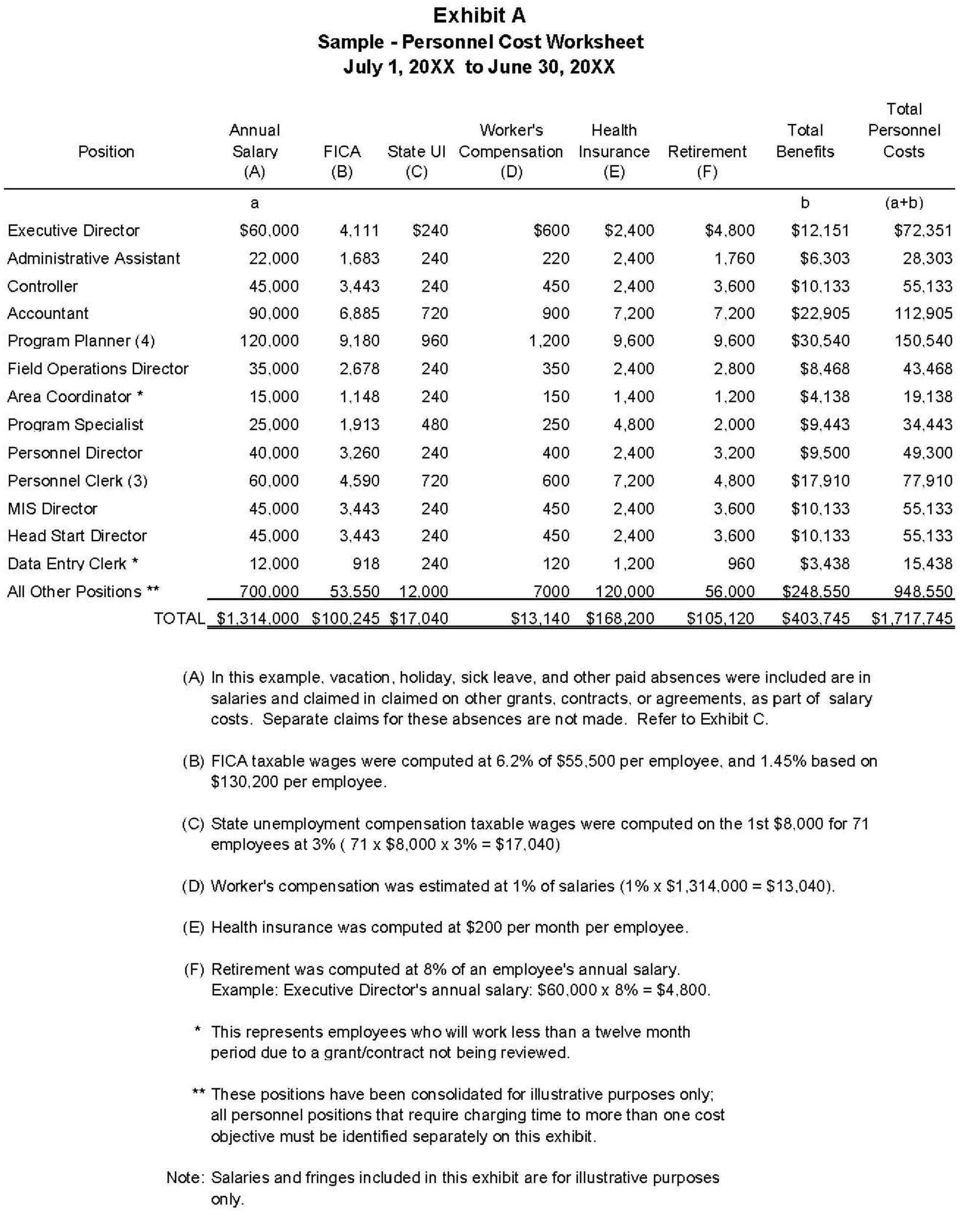
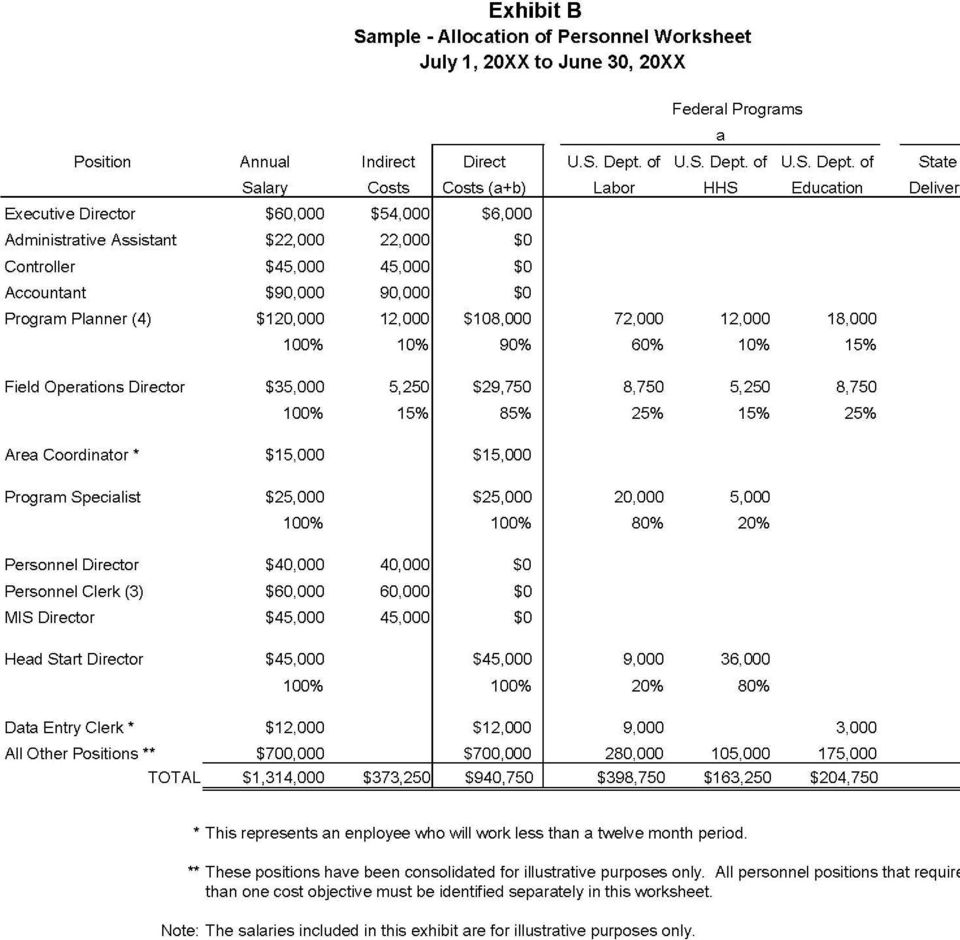
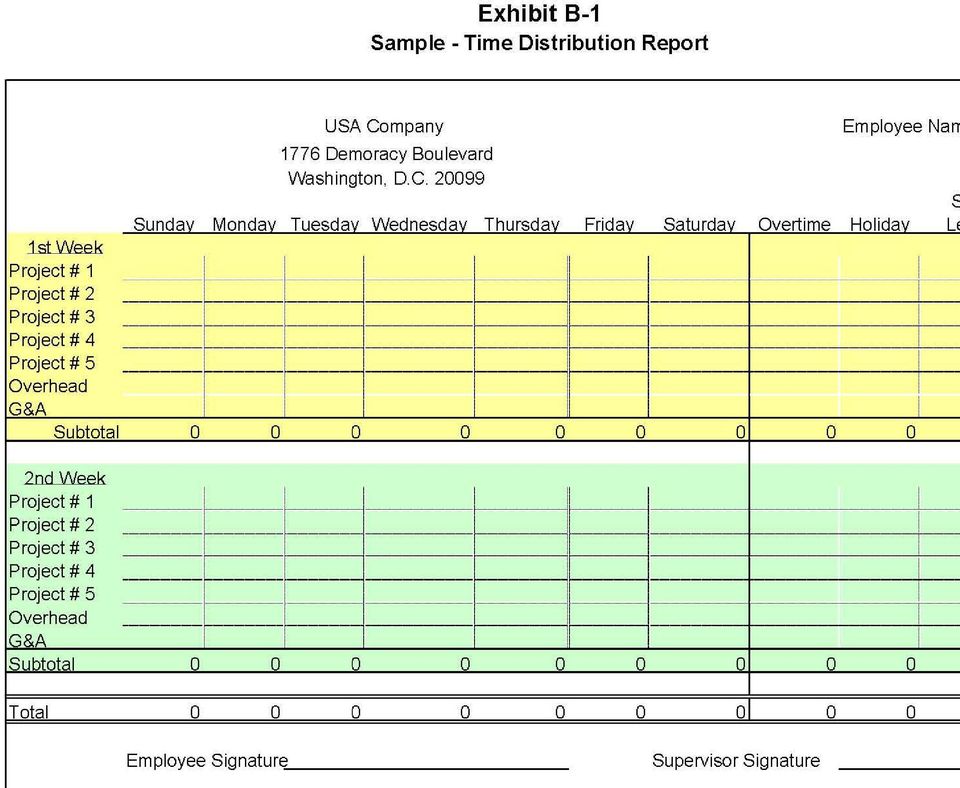
8 b. A copy of the financial data [financial statement (certified, if appropriate), budgets, accounting reports, etc.] upon which the rate is based. c. A listing of directly awarded grants and contracts by Federal agency, total dollar amount, period of performance, and the indirect cost limitations (if any) applicable to each, such as, ceiling rates or amounts restricted by administrative or statutory regulations. 2. Cost Policy Statement The purpose of the Cost Policy Statement (CPS) is to establish an unambiguous understanding between a contractor/grantee and the Federal Government as to what costs will be charged directly and what costs will be charged indirectly. The Division of Cost Determination requires that an up-to-date CPS be reviewed by its Cost Negotiators as part of the cost determination process when the indirect cost rate proposal is negotiated. Therefore, contractor/grantees are required to submit a CPS with their first proposal. Subsequent proposals need only identify changes that are being made to the initial CPS. If the contractor/grantee is not proposing any changes, the following suggested language should be included in the transmittal letter when a proposal is submitted: [ABC Non-Profit/Commercial Organization] hereby confirms that no changes to its accounting policies and practices as set forth in its Cost Policy Statement dated [September 13, 1997] have been made. An example of a CPS is shown in Appendix II. 3. Personnel Costs Worksheet A sample of a personnel costs worksheet is presented as Exhibit A in Section III. When preparing a Provisional Indirect Cost Proposal, current approved budget figures should be used in the preparation of the personnel costs worksheet. When a Final Indirect Cost Proposal is prepared, actual personnel costs should be used in preparation of this Exhibit. Actual personnel costs should be documented in accordance with OMB Circular A-122, Attachment B, paragraph 7.m. (1) through (4), and the FAR. 4. Allocation of Personnel Worksheet This document reflects the estimated/actual salary costs for each Federal and Non-Federal cost objective. The percentage of time per position should be spread under the appropriate cost objective, making sure that 100 percent is allocated for each position. The grantee/contractor must maintain a time distribution system for use by employees whose time is charged to more than one cost objective. Documented payrolls should be maintained supporting whether the salaries and wages were directly or indirectly charged.

9 An example of an Allocation of Personnel Worksheet is shown in Exhibit B. An example of an acceptable time distribution report is shown in Exhibit B Statement of Employee Benefits This document should contain the estimated/actual costs of the items in the employee fringe benefit pool. Employee (fringe) benefits should follow the salary of the individual and are a consideration in the determination of the reasonableness of the compensation. Fringe benefits should be accrued in the period incurred, including accrued leave if employees have an irrevocable right to be compensated during employment or upon termination of employment. Generally, the cost of annual leave is recognized when it is earn by the employee, and holiday and other types of leave are considered a cost to the extent of actual compensation to employees. An example of a Statement of Employee Benefits is shown in Exhibit C. 6. Statement of Total Costs This document should contain all line items of costs included in the entities chart of accounts with applicable columns for direct costs (by cost center), indirect costs, (overhead, G&A, etc.) and unallowable costs (if applicable). The total costs should reconcile to the entities financial statements. If the reconciliation is not clear, the entity should provide a separate schedule supporting the difference. Examples of Statement of Total Costs are shown in Exhibits D of F, as applicable, for the simplified method or direct allocation method, respectively. 7. Statement of Indirect Costs This document should contain all line items of costs included in the indirect cost pool(s), the applicable allocation base(s), and the resulting indirect cost rate(s). The allocation base should be traceable to the statement of total costs. If it is not clearly traceable, an additional schedule should be provided to supporting the reconciliation. Examples of Statement of Total Costs are shown in Exhibits E of G, as applicable, for the simplified method or direct allocation method, respectively. 8. Certificate of Indirect Costs a. No proposal to establish indirect cost rates shall be acceptable unless such costs have been certified by the non-profit or profit organization. A "Certificate of Indirect Costs" must be signed on behalf of the organization by an individual at a level no lower than executive director or chief financial officer of the organization that submits the proposal. b. The required certificate is shown in Appendix III. D. Indirect Cost Proposal - Review Procedures Some of the most likely issues to be raised by the DCD cost negotiator during the review of the indirect cost proposal submitted by an organization result from the following
10 procedures used by the cost negotiator. By keeping these procedures in mind when preparing the indirect cost rate proposal, organizations should be able to anticipate the type of issues that may be raised during negotiations. This should help in preparing documentation to justify the approaches taken. Determine that the applicable cost principles (stated in the Circulars or the FAR) were followed. Review the organization chart for a visual picture of the flow of responsibility, identification of areas of common costs, and the location of those areas in which federally-funded activity exists Perform a mathematical verification of the proposal. Determine that the proposal reconciles with the supporting audit, official budget or financial statement. Review the financial report for any indication of activities which may have been omitted from the indirect cost proposal, i.e., the omission of restricted fund costs or the existence of an affiliated organization receiving supportive service from the parent organization. Determine that the cost centers in the indirect cost pool pertain to functions that are supportive of all direct activity. Determine that costs that are statutorily unallowable or for reasons of nonallocability have been eliminated from the indirect cost pool. Determine whether these unallowable or non-allocable items should be added to the distribution base. Determine that "pass-through" funds have been excluded from the base. Determine that all personal service costs eliminated from the indirect cost pool have been added to the base. Review the analysis of direct costs for the determination of: a. Consistency in charging specific items of cost. b. The selection of an appropriate base for allocating indirect costs. Review the contract/grant budget and payments or contractor/grantee records for a determination of: (if deemed feasible under the circumstances) a. The direct funding of indirect costs. b. Any limitations placed upon the full recovery of indirect costs, i.e. ceiling rates or amounts. c. Total Federal funds involved. Check with the appropriate Federal Program Manager for any problems he/she may be aware of relating to the charging of costs. E. Administration Limits and Indirect Cost Claims

11 Various DOL funding instruments have statutory or regulatory limitations on the costs of "administration". The costs of administration are those portions of reasonable, necessary and allowable costs associated with the overall program management and administration and which are not directly related to the provision of services to participants or otherwise allocable to the program cost objectives/categories. These costs can be both personnel and non-personnel and both direct and indirect. Therefore, the statutory or regulatory limitation affects the combined claims for indirect costs and direct administration costs. Generally, direct administration costs differ from indirect charges in that the latter are considered organization-wide costs. Examples of functions that are classified as direct "administration" are as follows: Overall program management, program coordination, and office management functions, including the salaries and related costs of the executive director, project director, project evaluator when directly allocated. Preparing program plans, budgets schedules, and related amendments. Monitoring of programs, projects, subrecipients and related systems and processes. Developing systems and procedures, including management information systems, for assuring compliance with program requirements. Preparing reports and other documents related to the program requirements. Evaluating program results against stated objectives; and Performing administration services such as program specific payroll, accounting, auditing or legal activities. Examples of non-labor costs for direct administration include: Costs for goods and services required for administration of the program, including such goods and services as the rental or purchase of equipment, utilities, office supplies, postage, and rental and maintenance of office space. Travel costs incurred for official business in carrying out program management and administrative activities. Sample Exhibits to support Indirect Cost Proposals Exhibits Description Page Numbers Exhibit A Sample Personnel Cost Worksheet Page 2

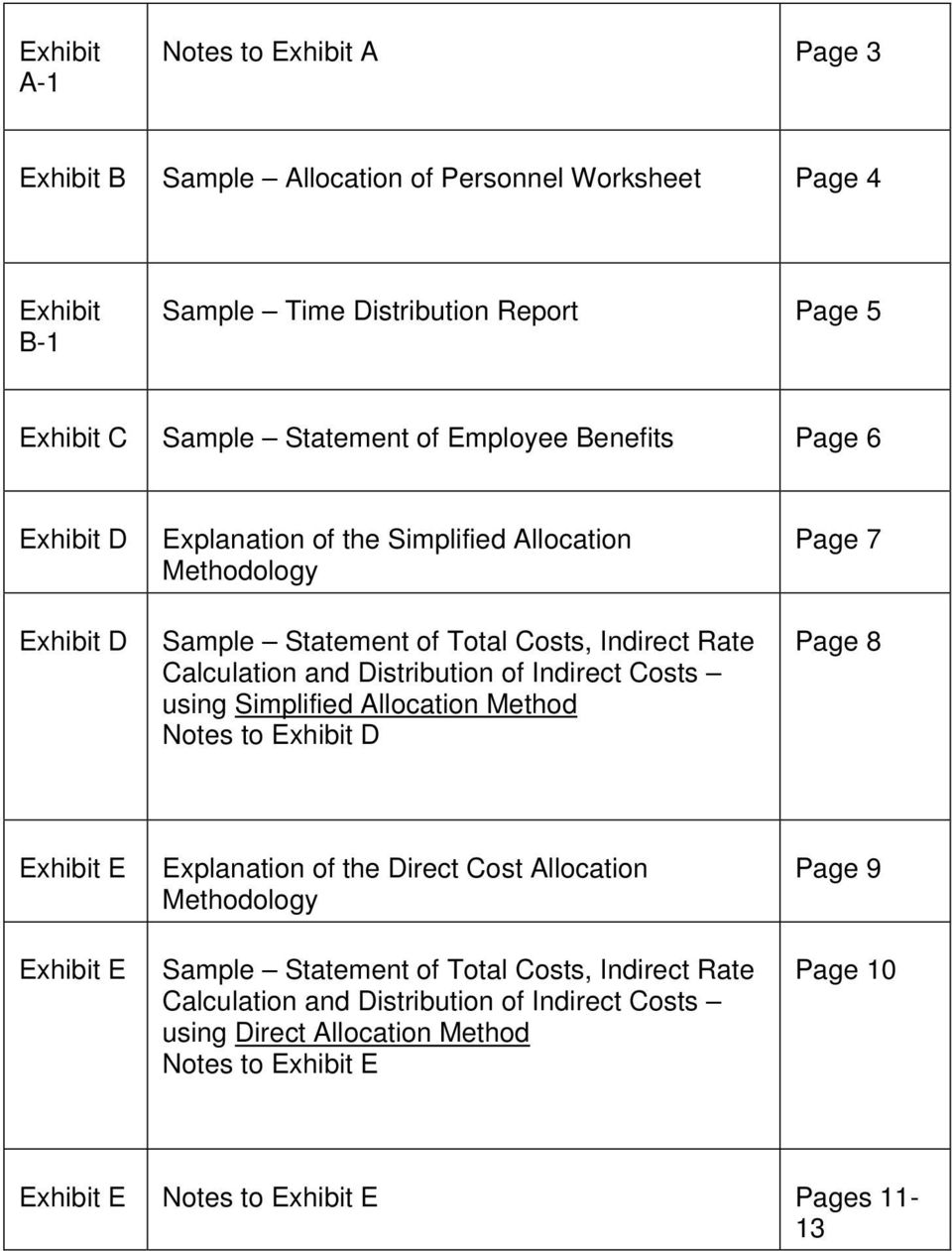
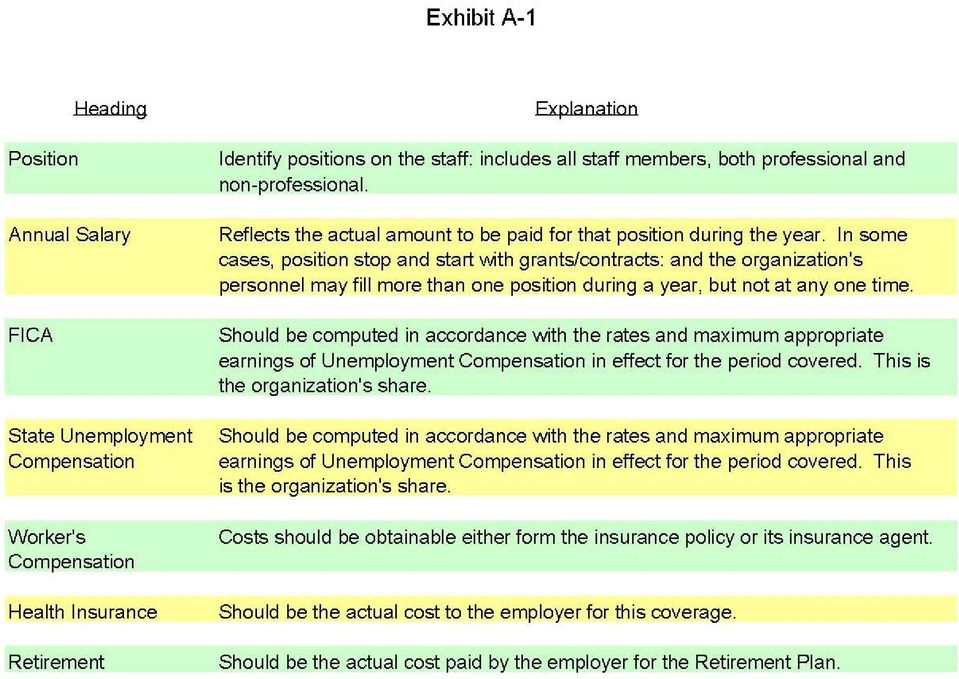
12 Exhibit A-1 Notes to Exhibit A Page 3 Exhibit B Sample Allocation of Personnel Worksheet Page 4 Exhibit B-1 Sample Time Distribution Report Page 5 Exhibit C Sample Statement of Employee Benefits Page 6 Exhibit D Exhibit D Explanation of the Simplified Allocation Methodology Sample Statement of Total Costs, Indirect Rate Calculation and Distribution of Indirect Costs using Simplified Allocation Method Notes to Exhibit D Page 7 Page 8 Exhibit E Exhibit E Explanation of the Direct Cost Allocation Methodology Sample Statement of Total Costs, Indirect Rate Calculation and Distribution of Indirect Costs using Direct Allocation Method Notes to Exhibit E Page 9 Page 10 Exhibit E Notes to Exhibit E Pages 11-13
13
14
15
16
17 Exhibit D SAMPLE Indirect Cost Proposal

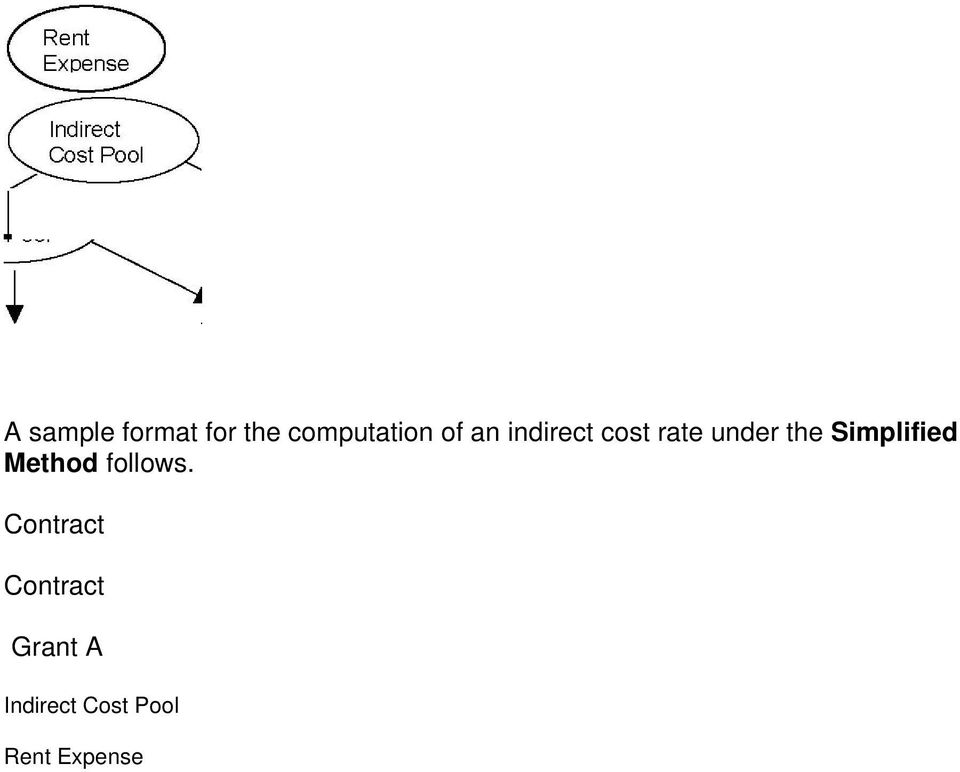
18 Simplified Allocation Method The Simplified Method is used whenever the major functions of an organization benefit from its indirect costs to approximately the same degree. The allocation of indirect costs may be accomplished by: (1) classifying the total cost for the base period (usually the organization s fiscal year) as either direct or indirect and (2) dividing the total allowable indirect costs (net of applicable credits) by an equitable distribution base. The result of this process is an indirect cost rate which is used to distribute indirect costs to individual Federal financial assistance programs and contracts. The rate should be expressed as the percentage which the total amount of allowable indirect costs bears to the base selected. This method may also be used where: (1) the organization has only one major function encompassing a number of individual projects or activities, and may be used (2) where the level of Federal awards to that organization is relatively small. Both the direct costs and the indirect costs shall exclude capital expenditures and unallowable costs. However, unallowable costs must be included in the direct cost base (if they represent activities to which the indirect costs are properly allocable). The distribution base may be: (1) total direct costs (excluding capital expenditures and other distorting items, such as flow-through funds, the portion of each subaward in excess of $25,000, etc.), (2) direct salaries and wages, (3) total costs less G&A expenses (commercial contractors), (4) another base which results in an equitable distribution. Under the Simplified Method, for example, rent expense would be entirely classified as indirect costs and distributed to benefiting activities on one of the bases described above. A pictorial of this example is shown below:

19 A sample format for the computation of an indirect cost rate under the Simplified Method follows. Contract Contract Grant A Indirect Cost Pool Rent Expense
20 Exhibit E SAMPLE Indirect Cost Proposal Direct Allocation Method The Direct Allocation Method is used by organizations that treat all costs as direct costs except

21 general administration and general expenses. These organizations generally separate their costs into three (3) basic categories: (1) general administration and general expenses, (2) fund raising, and (3) other direct functions (including projects performed under Federal awards). Joint costs, such as depreciation, rental expense, operation and maintenance facilities, telephone expenses, and the like are prorated individually as direct costs to each category and to each award or other activity using a base most appropriate to the particular cost being prorated. A pictorial example of the proration of rental expense is shown below: * Note that the only rent expense allocated to the indirect pool is the indirect portion of re rent expense as a whole. Under this method, indirect costs consist exclusively of general administration and general expenses. In all other respects, the organization s indirect cost rates shall be computed in the same manner as that described in Exhibit D. This method is acceptable provided each joint cost is prorated using a base which accurately measures the benefits provided to each award or other activity. A listing of suggested allocation bases is included in Exhibit F-2. A sample format for the computation of an indirect cost rate under the Direct Allocation Method follows.
22 Grant A Contract Contract Rent Expense Indirect Cost Pool
23 Notes to Exhibit E (1) These adjustments eliminate capital expenditures and unallowable costs identified in OMB Circular A-122, Attachment B from the indirect cost pool. Capital expenditures include the cost of land and expenditures which materially increase the value or useful life of buildings and equipment. Examples of unallowable costs include entertainment expense, lobbying, bad debts or
24 allowances for doubtful accounts, fines and penalties, losses on Federal or non-federal projects, provisions for contingencies, and charitable contributions. Also, the costs included in the indirect cost pool (as well as direct costs) shall be net of applicable credits (OMB Circular A-122, Attachment A, paragraph 5). (2) As shown in this example, the following items are excluded from the computation when using total direct costs as the base, because their inclusion distorts the assessment of indirect costs (OMB Circular A-122, Attachment A, paragraph D.2.c.). a. The portion of subcontract costs in excess of $25,000 each. As a general rule, the organization and OCD agree that only the first $25,000 of each subcontract, subgrant and professional service agreement should be included in the distribution base. This recognizes that grantees/contractors expend a minimal amount of indirect costs on subcontracts. b. Equipment and other capital expenditures, such as major renovations, alterations and improvements. c. Participant support costs. This represents payments for stipends, travel allowances and registration fees paid to participants (but not employees) in connection with training projects. d. Payments to participating agencies, e.g. OJT contractors, (flow-through- funds). If the organization is significantly involved in the administration or oversight of the participating agencies, a special rate might be necessary for that activity. (3) As stated in OMB Circular A-122, Attachment A, paragraph D.2.c., the distribution base may be direct salaries and wages, total direct cost, or another base which results in an equitable distribution to all activities that receive benefit from the indirect cost pool. If the organization's unallowable activities include salaries, occupy space, and benefit from the organization's indirect cost, they should be included in the direct cost allocation base for the purpose of determining the indirect cost rate and be allocated their share of the organization's indirect costs. For example, lobbying, fund raising, and services provided to members are unallowable as indirect costs; however, since these activities benefit from those costs classified as allowable indirect costs, they must be included in the base used to calculate the indirect cost rate. (Refer to OMB Circular A-122, Attachment A, Paragraphs B.3. & B.4.). From the example provided on Exhibit D, the data can be used to compute either an indirect cost rate based on direct salaries and wages including applicable fringe benefits, or an indirect cost rate based on total direct costs. (Refer to Exhibit E). Since most nonprofit organizations receiving grants are labor intensive, using a distribution base of direct salaries and wages including applicable fringe benefits is most often recommended by OCD. Exhibit E Suggested Allocation Bases The following are suggested allocation bases that might be used to direct charge joint costs to Federal awards and other activities of the organization. The allocation base selected by the nonprofit organization or commercial organization must be: (1) reasonable and consistently applied,
25 (2) supported by accurate and current data, (3) appropriate to the particular cost being distributed, and (4) must result in an accurate measure of the benefits provided to each activity of the organization. TYPE OF SERVICE Accounting Auditing Budgeting Building lease management Data processing Disbursing service Employees retirement system administration Insurance management service Legal services Mail and messenger Motor pool costs including automotive management Office machines and equipment maintenance repairs Office space use and related costs(heat, light, janitor service, etc.) Organization and management services Payroll services Personnel administration Printing and reproduction Procurement service Local telephone Health services SUGGESTED BASIS FOR ALLOCATION Number of transactions processed. Direct audit hours. Direct hours of identifiable services of employees of central budget. Number of leases. System usage. Number of checks or warrants issued. Number of employees contributing. Dollar value of insurance premiums. Direct hours. Number of documents handled or service employees served. Miles driven and/or days used. Direct hours. Sq. ft. of space occupied. Number of employees. Number of employees. Number of employees. Direct hours, job basis, pages printed, etc. Number of transactions processed. Number of telephone instruments. Number of employees.
26 Fidelity bonding program Employees subject to bond or penalty amounts. NOTE: Any method of allocation can be used which will produce and equitable and rational distribution of costs. A. lntroduction APPENDIX IV COMMON INDIRECT COST PROBLEMS This section presents examples of some of the more common problems in organizations disclosed by OIG audits. The problems are summarized below under the following broad categories: 1. Timekeeping Systems 2. Consistent Treatment and Specific Identification of Costs 3. Costs of "Unallowable Activities" Credits 4. Indirect Cost Allocation Base 5. Expressly Unallowable Costs 6. Inter-organizational Transfers and Related-party Transactions
27 7. Lease Incentives and Advance Understandings 8. Budget Limitations Unsupported B. Selected Examples of Problems 1. Timekeeping Systems To be allowable, labor costs, whether charged directly or indirectly to DOL grants/contracts, must be based on accurate time sheets reflecting the actual activities of all employees. The time sheets must account for the "total activity" for which employees are compensated and which are required in fulfillment of their obligations to the organization. In many cases, a timekeeping system was either not used at all or was used for payroll purposes onlv (time and attendances and not for labor distribution purposes. 2. Consistent Treatment and Specific Identification of Costs To be allowable under DOL grants/contracts, costs must be treated consistently on all programs of the organization. OIG audits have disclosed numerous instances in which non-profit organizations have charged DOL grants and/or contracts, either directly or indirectly, for (1) costs specifically identifiable with programs and activities other than its DOL awards, (2) costs which were not treated consistently with other costs incurred for the same purpose in like circumstances. 3. Costs of "Unallowable Activities" Problems disclosed by recent OIG audits which related to so-called "unallowable activities" can usually be categorized in two areas. (1) First, not all costs associated with "unallowable activities" were properly charged as costs to the final cost objectives for such activities. (2) Second, because not all such costs were direct charged to "unallowable activfties" cost objectives, an appropriate share of indirect costs was not allocated to these "unallowable activities." As a result, DOL and other Federal grants and contracts were allocated a disproportionate share of the organization's indirect costs. OMB Circular A-122, Attachment A, paragraphs B.3 and B.4 provides that the costs of certain "unallowable activities" must be treated as direct costs (e.g., charged to separate final cost objectives) and allocated an equitable share of the organization's indirect costs. Examples of unallowable activities include: services to members, maintenance of membership rolls, public relations, lobbying, and fund raising. Even if an organization's own activities, non-dol/non-government grants and/or contracts provided for little or no reimbursement of indirect costs, the full share of indirect costs must be allocated to such grants/contracts in accordance with OMB Circular A-122, Attachment A, paragraph A.4.b., which states that any costs allocable to other cost objectives may not be shifted to a Federal award to "overcome funding deficiencies." 4. Credits
28 OIG audits have disclosed that a number of non-profit organizations failed to reduce the total costs claimed under DOL grants/contracts by the amount of credits applicable to costs charged either directly or indirectly to the DOL grants/contracts. These credits were generated through various transactions, including fees for conferences held for the benefit of DOL programs, building rental operations, insurance credits or adjustments, data processing and office services performed for others, etc. All receipts, refunds and adjustments applicable to direct costs charged to DOL grants/contracts must be credited to the DOL grants/contracts and those applicable to indirect costs must be credited to the appropriate indirect cost pools. 5. Indirect Cost Allocation Base To meet the benefits received test, the allocation base must allocate indirect costs to all programs equitably. To ensure that this test is met, organizations must continuously evaluate whether the allocation base elements among all of its programs is proportionate to the benefits to be received from the indirect costs. Many organizations use total direct personnel costs (salaries/wages, plus fringe benefit costs) as the allocation base to allocate indirect costs to their grants/contracts and other programs. Another cost allocation base commonly used is modified total direct costs. In most instances, one of the above bases may allocate indirect costs in reasonable proportion to relative benefits received by the various cost objectives. In some cases, they may result in allocating a disproportionate share of the organizations' indirect costs to DOL grants. Use of an inappropriate base which does not allocate indirect costs on the basis of relative benefits received could result in substantial questioned costs. 6. Expressly Unallowable Costs Indirect costs that are "expressly unallowable" are spelled out in OMB Circular A122, Attachment B, Selected Items of Cost A partial list of some of the more common examples of expressly unallowable indirect costs include: Contributions Entertainment costs Fund raising Lobbying Professional service costs Public information service costs Bad Debts Legal Costs 7. Inter-Organizational Transfers and Related-Party Transactions Supplies and services acquired from affiliates, related parties, and organizations under common control, must be based on the actual costs of the organizations providing the supplies and services. OIG audits disclosed that some organizations charged, directly or indirectly to DOL grants/contracts, the "costs" of supplies and services which included "profits" and/or other mark-ups added by the affiliates, related parties, and/or organizations under common
29 control. 8. Lease Incentives and Advance Understandings To be allowable, costs related to building or office leases must comply with OMB Circular A-122, Attachment A, paragraph A.2. In addition, a net present value (NPV) computation must be made to ensure that the present value of the total allowable lease expense does not exceed the total present value of the lease payments a grantee/contractor makes to its lessor. Also, non-profit organizations should enter into advance understandings with DOL with regard to capital leases and gains to be realized under capital leases in accordance with Attachment A, paragraph A.6. In times of an oversupply of office space in certain metropolitan areas, developers/ owners may offer various incentives to prospective tenants to get them to sign longterm leases, including substantial cash payments. OIG audits disclosed that nonprofit organizations are not accounting for the lease incentives in accordance with generally accepted accounting principles (GAAP), nor are they computing rent expense utilizing the NPV concept. 9. Budget Limitations Non-profit organizations must adhere to any budget limitations incorporated into their grants/contracts. DOL grants/contracts limit reimbursements to grantees/contractors by incorporating a special clause titled "Budget Line Item Flexibility." This clause provides that no single line item of direct cost shall be increased or decreased in excess of 20 percent of the budget provided the total estimated cost of the grant/contract is not exceeded. The clause further provides that no increase in wages, salaries, and fringe benefits line items (including the mixture, number of hours or wages of personnel paid under the grant/contract) is permitted without the prior review and approval of the DOL Grant/Contracting Officer. If a contract/grant specifically includes a ceiling rate(s), the indirect cost rate(s) or amount(s) which are indicated in the organization's indirect rate cost agreement, will be subject to the ceilings stipulated in the contract/grant agreement. The ceiling rate or the rate(s) cited in the organization's indirect rate cost agreement whichever is lower, will be used to determine the maximum allowable indirect cost on the contract or grant agreement. The grantee/contractor must submit a proposal to establish a final rate within six months after their fiscal year end. Billings and charges to Federal awards must be adjusted if the final rate varies from the provisional rate. If the final rate is greater than the provisional rate and there are no funds available to cover the additional indirect costs, the organization may not recover all indirect costs. Conversely, if the final rate is less than the provisional rate, the organization will be required to pay back the difference to the funding agency. 10. Unsupported Costs To be allowable, all direct costs and indirect costs must be adequately supported by source documentation which clearly shows the purposes and circumstance of the cost incurrences. For example, canceled checks, credit card invoices and travel agents' invoices alone are not sufficient to determine whether the costs are chargeable as direct costs or indirect costs, and whether DOL grants/contracts received the benefit of the cost incurrences. In order to determine whether a cost is allowable under or allocable to a DOL
30 grant/contract, the purpose and circumstance of the cost incurrence must be established. OIG audits disclosed that a large number of non-profit organizations did not have adequate documentation to support the allowability/allocability of the costs claimed or proposed. Also, verbal approval from a Contracting/Grant Officer is insufficient documentation for supporting costs under a contract/grant. Any modifications to a contract/grant must be in writing and signed by both the Contracting/Grant Officer and the contractor/grantee. SECTION V TYPICAL QUESTIONS FROM GRANTEES/CONTRACTORS AND DCD ANSWERS The following 19 questions are typically asked by organizations. The questions could be grouped on the following subjects: A. Indirect rates: 1, 2, 3, 4, 5, 16 B. Individual elements of costs: 6, 7, 8, 9, 10, 11, 12, 13, C. Audits: 8, 14 D. Technical assistance, adequate proposals, and DCD concerns: 15, 17, 18, What do we do if some grants/contracts do not provide for any indirect costs or provide for indirect cost rates that are lower than those established, provisional or final? All indirect costs, using the approved rate, must be allocated to all grants/contracts regardless of any restrictions or funding limitations. Any allocable indirect costs that exceed any administrative or statutory restrictions on a specific Federal grant/contract may not be shifted to other Federal grants/contracts, unless specifically authorized by legislation. Non-Federal revenue sources must be used to pay for these unrecovered costs. 2. Will DOL assist grantees/contractors in obtaining proper approval of the indirect cost rate from other Federal agencies and State and local units of Government? The Division of Cost Determination, DOL, will be available to explain to other organizations the methodology used in development of the grantee's/contractor's indirect cost rate. However, the funding of indirect costs is subject to approval of Government authorized representatives and contracting officers of the respective organization. Under most circumstances, other Federal agencies will recognize and pay a grantee/contractor's approved indirect cost rate. The Cognizant Federal Agency cannot, however, require States or units of local Government to recognize
31 an approved indirect cost rate. 3. Our grant with DOL totals $500,000 and includes a provisional indirect cost rate of 10%. Our actual, final indirect cost rate is 13%. Will DOL provide us with additional grant funds due to our higher indirect cost rate? DOL will not provide your organization with additional grant funds due to a higher final indirect cost rate than the established provisional rate. However, a grant modification may be allowed to transfer budgeted direct costs to the indirect cost category due to the increased indirect costs. This would be subject to the terms and conditions of the grant agreement, e.g. approval of grant officer, indirect cost ceilings, administrative cost limitations. 4. In the event that a grantee/contractor underexpends the total grant/contract but exceeds the ceiling placed on the indirect cost by DOL, can the excess indirect cost be recovered? No. The ceiling on the indirect cost was included in the agreement to limit the amount of grant/contract funds used for indirect cost purposes by the grantee/contractor. This condition was known by the grantee/contractor before any grant/contract funds were expended. 5. Can our indirect cost rate proposal be based only on Federal funds since it only represents 15% of our total revenue? No. Your indirect cost rate proposal must be accompanied by a schedule of costs incurred for all projects, Federal and non-federal, and the amount of the proposed allocation base must tie-in with the applicable direct cost base for all projects. 6. Is the cost of accrued annual leave allowable under OMB Circular A-122? OMB Circular A-122, Attachment A, Paragraph 2E, states "To be allowable under an award, costs must be determined in accordance with generally accepted accounting principles". The Financial Accounting Standards Board issued Financial Accounting Standard Number 43 "Accounting for Compensated Absences" to establish uniformity in the accounting for annual leave pay. This standard requires employers to accrue during each accounting period the liability for compensated absences earned by employees during that period provided that all of the following conditions are met: 1. The employer's obligation relating to employees' rights to receive compensation for future absences is attributable to employee's services already rendered; 2. The obligation relates to rights that vest or accumulate;
32 3. Payment of compensation is probable; and 4. The amount can be reasonably estimated. The accrual of annual leave does not result in increased costs, but allows recognizing the cost in the proper accounting period to improve actual cost determination. In general, compensated absences are to be accrued in the period in which they are earned rather than when they are paid. In order for accrued leave to be an allowable cost, the personnel policies of the organization must comply with the Financial Standard Number What is the difference between bid and proposal costs and fund raising costs and how does a grantee/contractor treat such costs in its indirect cost proposal? Bid and proposal costs represent the salaries, consultant fees, printing, postage, travel, etc. associated with an organization's preparation of bids, proposals and applications to perform specific tasks for remuneration under potential Federal and non-federal grants, contracts or other agreements. An organization should treat bid and proposal expenses as allowable indirect costs subject to any limitations imposed by the Cognizant Federal agency. Fund raising costs represent the salaries, consultant fees, printing, postage, travel, etc. associated with an organization's requests to private institutions or individuals for donation of funds for non-specific purposes. Fund raising costs are unallowable for Federal reimbursement purposes. However, this activity (cost objective) shall be allocated an appropriate share of indirect costs. Accordingly, fund raising costs are to be included in the distribution base used to compute an organization's indirect cost rate. 8. Can the audit costs under OMB Circular A-133 be recovered? A-133 allows audit costs to be recovered as either direct or indirect costs in accordance with applicable cost principles. However, there is no special appropriation for audit costs. To recover audit costs, the organization must build them into the specific grant/contract documents (if direct) or into the overhead proposal (if indirect). 9. If the grantee's policy is to capitalize equipment under the $5,000 threshold specified in A-122, do they need Federal approval prior to directly charging the grant with the cost of equipment? No. The grantee is allowed to directly charge the Federal grant with the cost of equipment under the $5,000 threshold without obtaining prior Federal approval.
33 This direct cost is usually classified as supplies in the reporting of Federal grant expenditures and, if applicable, must be in compliance with any budget limitations. 10. A grantee has contracted to update its computer network with its affiliates for a total cost of $50,000. Since each component; i.e., monitor, printer, personal computer, software, modem, etc., costs less than the $5,000 per unit threshold specified in A-122, can this "equipment" be charged to the indirect cost pool? No. The components of the computer network make it useable for the purpose for which it was acquired and therefore establishes the "system" as a capital expenditure. Accordingly, this equipment can be appropriately charged to Federal grants either as a direct or indirect cost, on the basis of depreciation or a use allowance as specified in A A grantee purchased a building in September, 1994 and refinanced its mortgage in September, Can the grantee now charge Federal programs with the interest incurred on this mortgage? No. Interest on debt incurred to finance or refinance assets acquired before or required after September 29, 1995, is not allowable. 12. When is a grantee required to prepare a cash flow statement prior to claiming interest expense on Federal programs? A cash flow statement is to be prepared on an annual basis for debt arrangements over $1 million, unless an initial equity contribution to the asset purchase equals 25% or more. A non-profit organization shall reduce claims for interest expense by an amount equal to imputed interest earnings on excess cash flow, which is to be calculated in accordance with Paragraph 23.a.(1)(f)(ii) of Circular A What is required of a grantee that sells its facilities and decides to rent office space in another facility at less cost to its Federal programs? Substantial relocation of Federally-sponsored activities from a facility financed by indebtedness, the cost of which was funded in whole or part through Federal reimbursements, to another facility prior to the expiration of a period of 20 years, requires notice to the Federal cognizant agency for possible adjustment to future space costs charged to Federal programs. 14. What is the relationship of OMB Circular A-122, Cost Principles for Non- Profit Organizations and OMB Circular A-133, Audits of Institutions of Higher Education and Other Non-Profit Institutions in regard to indirect
34 costs? The compliance supplement for OMB Circular A-133 incorporates OMB Circular A-122. It sets forth the major compliance requirements that should be considered in an organization-wide audit of non-profit institutions receiving Federal assistance. The compliance supplement contains general requirements that shall be considered in all financial and compliance audits. Failure to comply with the general requirements could have a material impact on an organization's financial statements. One of these general requirements is presented in Appendix VII to OMB Circular A-133, "Allowable Costs/Cost Principles." According to this requirement, the auditor is responsible for auditing direct and indirect costs to determine whether costs claimed are in compliance with OMB Circular A Can transactions with an affiliate affect allowable costs? Yes. A problem may arise in transactions between parent organizations and their affiliates when the parent organization has an equity interest in the affiliate. When an equity interest exists, any profits made by the affiliate improve the equity interest of the parent. If an affiliate sells a good or service to the parent and the selling price includes a profit to the affiliate, the parent's equity interest in the affiliate has been increased. If the parent then includes the purchase price as a direct or indirect charge to a Federal award, it has violated the OMB Circular A- 122 cost principle that charges will be at cost and not include a profit factor. For example, suppose your organization (the parent) obtains accounting services from an affiliate and the parent organization has an equity interest in the affiliate. The fee that the parent pays to the affiliate must be based on the cost incurred by the affiliate and the fee may not include a profit to the affiliate. If the fee does include a profit factor to the affiliate, the allowable part of the fee is limited to that portion which represents the cost to the affiliate exclusive of any profit factor. This principle works in reverse as well. When an organization provides a good or service to an affiliate, the full cost of providing that good or service must be recovered from the affiliate and an appropriate credit must be applied to the indirect cost pool. 16. What is the period of time that an indirect cost rate agreement covers? A provisional indirect cost rate is negotiated to cover a one year period. However, because of the time lapse between the submission and approval of a rate,
35 provisional rates are usually established by DOL for a two year period. A final indirect cost rate agreement is negotiated to cover one fiscal year period after which a new final indirect cost rate must be negotiated for the subsequent fiscal year. 17. When a grantee/contractor is required by DOL to submit a closeout package prior to negotiating a final indirect cost rate, what is the procedure? The grantee/contractor should prepare the closeout package using the approved provisional indirect cost rate and include a statement indicating that a provisional indirect cost rate was used pending negotiations of a final indirect cost rate. Upon receipt of a final indirect cost rate, an amended final closeout will be submitted. 18. What can the submitting organizations do to help the Federal Cognizant Agency facilitate their review of an indirect cost rate proposal? If there are any questions concerning any aspect of the proposal, call the Federal cognizant agency rate negotiator to resolve the issue prior to formal submission. Also, if during a prior negotiation you agreed to take corrective action(s) on any issues, you must disclose the status of your action(s). Finally, you must inform the cognizant agency about all significant organizational or accounting changes and their impact. If these actions are taken, it could save time in getting the proposal negotiated. 19. What are some of the concerns the Federal agencies have about grantee/contractor submissions of indirect cost rate proposals? The primary concern of Federal agencies is the receipt of incomplete documentation. Indirect cost proposals do not provide sufficient detail to explain the functions and the benefits associated with the costs being allocated. An additional concern to Federal agencies is an indirect cost proposal that is not reconcilable to a budget or a financial statement and contains no explanation of the difference.
36
37
38
39 Appendix II SAMPLE: Cost Policy Statement (CPS) for Indirect Cost Proposal The following CPS is intended to be used as guidance for organizations that seek reimbursement for indirect costs under Federal awards. This model assumes that ABC Organization uses A. the direct allocation basis to charge individual elements of costs. That is, in addition to direct costs, ABC has in place accounting procedures which enable it to direct charge some costs that would otherwise be considered indirect costs (see, for example, the description below on how the photocopy costs are charged). B. the direct salaries and wages including applicable fringe benefits, to allocate the indirect cost pool.
40 * * * * * * * * * * * * * * * * * * * * * * * * * * * * * * * * * * * * * * * * * * * * * * * * * * * * * * * * * COST POLICY STATEMENT ABC ORGANIZATION I. General Accounting Policies A. Basis of Accounting - Accrual Basis B. Fiscal Period - July 1 through June 30 C. Allocation Basis for Individual Cost Elements - Direct Allocation Basis D. Indirect Cost Rate Allocation Base-Direct Salaries and Wages including applicable Fringe Benefits. E. If ABC Organization needed a fringe benefit rate, it would describe its fringe benefit allocation base at this point. F. ABC maintains adequate internal controls to insure that no cost is charged both directly and indirectly to Federal contracts or grants. A description of the accounting system software would be describe at this point. G. ABC accumulates all indirect costs and revenues in accounts titled, "Indirect Cost-Expense" and "Indirect Cost-Revenue" respectively. II. Description of Cost Allocation Methodology A. Salaries and Wages 1. Direct Costs - The majority of ABC's employees direct charge their salary costs since their work is specifically identifiable to specific grants, contracts, or other activities of the organization such as lobbying, fund raising or providing services to members. The charges are supported by auditable labor distribution reports which reflect the actual activities of employees. 2. Indirect Costs - The following staff charge 100% of their salary costs indirectly: - Office Business Manager - Secretary/Receptionist 3. Mixed Charges - The following employees may charge their salary costs to both direct and indirect activities: - Executive Director - Administrative Assistant The distinction between direct and indirect is primarily based on functions performed. For example, when the positions shown are performing functions that are necessary and beneficial to all
41 B. Fringe Benefits C. Travel programs they are indirect. When functions are specific to one or more programs they are direct because they do not benefit all programs. Auditable labor distribution records which reflect the actual activities of employees are maintained to support the mix of direct/indirect charges. The time records are certified by the Executive Director, or designee. ABC contributes to the following fringe benefits for its employees: 1. unemployment insurance, 2. worker's compensation, 3. F.I.C.A., health insurance, 4. and matching contributions to a defined benefit pension plan. Treatment of Fringe Benefits: ABC's accounting system tracks fringe benefit costs by individual employee and charges those costs directly or indirectly in the same manner as salary and wage costs are recorded. ABC does not need to have a fringe benefit rate established. Treatment of Paid Absences - Release time costs (vacation leave earned, sick leave used, and holiday pay) are considered part of salary costs. Consequently, separate claims for release time costs are not made. ABC's accounting system records release time as a direct or indirect cost in the same manner that salary costs are recorded. Vacation leave earned but not used during each fiscal period is recorded as a cost in the period earned. Travel costs may be charged as either direct or indirect costs depending on the purpose of the trip. For example: The Executive Director of Company ABC travels to a regional office to give employees a quarterly update. This trip is indirect in nature and should be charged as an indirect cost. However, if the Executive Director of Company ABC travels to a regional office to perform a specific task for a contract, the trip would be considered a direct cost. D. Board Expenses Board expenses charged on an indirect basis are for travel to/from Board meetings (limited to expenses allowed under the Federal Travel Regulations) and an annual fee of $250 paid to each Board member. Other Board expenses are absorbed by ABC and are not charged either directly or indirectly to Federal contracts or grants. E. Supplies and Material
42 To the maximum extent possible, office supplies and materials are direct charged to the contract/grant which uses the supplies or materials. Supplies and materials used by staff who are engaged in indirect activities will be charged on an indirect basis. F. Occupancy Expenses G. Utilities Rent - ABC occupies space it leases from Lessor Corporation. The lease provides for equal monthly payments during the term of the lease. Monthly lease costs are allocated, based on: square footage, directly and indirectly as follows: 1. Direct Costs - The cost of space occupied by staff whose salaries are directly charged is charged directly. 2. Indirect Costs - The cost of space occupied by staff whose salaries are indirectly charged is charged indirectly. The cost of space for staff whose salaries are charged on a mixed basis will be allocated on a mixed basis in the same ratio as their salaries are allocated. The cost of space required for common areas (hallways, restrooms, and ABC's conference room) will be accounted for as an indirect cost. ABC has developed a floor plan which identifies what areas are designated as direct and indirect charge space (based on square footage). ABC's lease includes the cost of all utilities except electricity. The cost of electricity is charged directly and indirectly in the same ratio as its space costs are charged. H. Communications 1. A log is maintained of all fax transmissions. The cost of fax services is charged either directly or indirectly based upon whether a direct or indirect activity benefits from the transmission. 2. Long distance telephone calls are charged either directly or indirectly based upon whether a direct or indirect activity benefits from the transmission. 3. Local telephone service costs are prorated to direct and indirect charges based upon the number of telephone instruments assigned to ABC. Each telephone instrument is identified to either an indirect or a direct activity. For example: ABC has 50 telephone instruments assigned to it: (1) Nine (9) of the 50 instruments are assigned to the program funded by HHS. Therefore, 9/50ths of the monthly local service telephone charges are direct charged to the HHS grant.
43 (2) Five (5) of the instruments are assigned to indirect staff. Therefore, 5/50ths of the monthly local service charges are charged indirectly. No telephone instruments are charged on a mixed basis since the costs incurred on that basis are immaterial in amount. 4. ABC uses a meter system for postage charges. The postage meter has been programmed to identify the specific program or activity to charge costs against. Express mail costs are also specifically identified to the program or activity incurring the cost. I. Photocopying and Printing ABC maintains a photocopy activity log. From this log, ABC is able to prorate its photocopy expenses to each program based on the specific volume of copies made for each program. Administrative personnel will record copies made to the benefiting program to the maximum extent practical. In situations where the photocopies being made by administrative personnel cannot be identified to a specific program and the matter being copied relates to the activities of ABC in general, the cost of such copies will be charged to the "Indirect Cost-Expense" account. Printing expenses are charged to the benefiting activity. J. Outside Services ABC incurs outside services costs for its annual audit, legal fees, and for staff development specialists. K. Capital Items 1. The cost of the annual audit is charged indirectly. 2. In general, legal fees are charged directly to the benefiting program or activity. 3. Legal fees that are not identifiable to specific direct programs are charged indirectly. Capital expenditures are charged directly to programs only in cases where a contract or grant specifically authorizes such charges. No capital item is charged indirectly. The cost of capital items is purchased with non-federal funds are recovered through depreciation charges. ABC's capitalization threshold is $500. L. Depreciation The cost of capital items purchased with non-federal funds which are used in a manner which benefits Federal programs is recovered through depreciation charged. ABC recovers the cost of capital items using straight line depreciation methods in accordance with generally accepted accounting principles. Depreciation is charged indirectly.
44 M. Service to Members The cost of activities performed primarily as a service to members, clients, or the general public are classified as direct costs and bear their fair share of indirect costs. These activities include: 1. maintenance of membership rolls, 2. subscriptions, 3. publications, and related functions, providing services and information to members, legislative or administrative bodies, or the public; 4. promotion, lobbying, and other forms of public relations; 5. meetings and conferences except those held to conduct the general administration of ABC Organization; 6. maintenance, protection, and investment of special funds not used in operation of ABC; and administration of group benefits on behalf of members or clients including life and hospital insurance, annuity or retirement plans, financial aid, etc. N. Unallowable Costs ABC recognizes that the following costs, as defined in A-122, are unallowable charges to Federal awards and has internal controls in place to insure that such costs are not charged to Federal awards: 1. advertising and public relations, 2. entertainment/alcoholic beverages, 3. capital expenditures, 4. defense claims by the Federal Government, 5. interest, 6. lobbying and fund raising. Signature Date Title ABC Organization 1111 Main Street City, USA APPENDIX III CERTIFICATE OF INDIRECT COSTS I have reviewed the indirect cost proposal dated. This is to certify that: 1. All costs included in the proposal(s) submitted on to establish provisional, final, or fixed indirect cost rate(s), for the period,
45 through are allowable in accordance with the requirements of grants/contracts to which they apply and with the Federal cost principles; i.e., (please check those applicable cost principles): OMB Circular A-87, Cost Principles for State, Local and Federally recognized Indian Tribal Governments. OMB Circular A-122, Cost Principles for Non-Profit Organizations Federal Acquisition Regulation (FAR), Subpart 31.2, Cost Principles for Commercial Organizations. 2. This proposal does not include any costs which are unallowable under applicable Federal cost principles. For example: advertising, contributions and donations, bad debts, entertainment costs, fines and penalties, general government expenses, and defense of fraud proceedings; 3. The requirements standards on lobbying costs for non-profit (A-122) and commercial (FAR) organizations have been compiled with for the fiscal year ended, and 4. All costs included in this proposal are properly allocable to U.S. Department of Labor grants/contracts on the basis of a beneficial or casual relationship between the expenses incurred and the agreements to which they are allocated in accordance with applicable Federal cost principles. Subject to the provisions of the Program Fraud Civil Remedies Act of 1986, (31 USC 3801 et seq.), and the Department of Labor's implementing regulations, (29 CFR Part 22), the False Claims Act (18 USC 287 and 31 USC 3729); and the False Statements Act (18 USC 1001), I declare to the best of my knowledge the foregoing is true and correct. Grantee/Contractor: Signature: Name of Authorized Official: Title: Date: COMMERCIAL ORGANIZATION INDIRECT COST NEGOTIATION AGREEMENT ORGANIZATION: DATE: August 23, 2004 ABC Organization FILE REFERENCE: This th Street, N.W., replaces the agreement dated Washington, D. C April 15, 2003 The indirect cost rate(s) contained herein are for use on contracts with the Department of Labor to which Federal Acquisition Regulations, Part 31.2 applies, subject to the
46 limitations contained in Section II, A, below. SECTION I: RATES EFFECTIVE PERIOD TYPE FROM TO RATE* LOCATION APPLICABLE TO Overhead - Offsite Office Final %(a) ALL ALL Final %(a) ALL ALL Final %(a) ALL ALL Final %(a) ALL ALL Provisional %(a) ALL ALL G&A Final %(b) ALL ALL Final %(b) ALL ALL Final %(b) ALL ALL Final %(b) ALL ALL Provisional %(b) ALL ALL Provisional %(b) ALL ALL BASE: (SEE SPECIAL REMARKS) (a) Total direct salaries and wages including applicable fringe benefits (b) Total costs less G&A expenses TREATMENT OF FRINGE BENEFITS: Fringe benefits applicable to direct salaries and wages are treated as a direct cost. TREATMENT OF PAID ABSENCES: Vacation, holiday, sick leave and other paid absences are included in salaries and wages and are claimed on grants, contracts and other agreements as part of the normal cost for salaries and wages. Separate claims for these absences are not made. SECTION II: GENERAL A. LIMITATIONS: Use of the rate(s) contained in the Agreement is subject to all statutory or administrative limitations and is applicable to a given contract only to
47 the extent that funds are available. Acceptance of the rate(s) agreed to herein is predicated upon the following conditions: (1) that no costs other than those incurred by the contractor or allocated to the contractor via an approved central service cost allocation plan were included in its indirect cost pool as finally accepted and that such incurred costs are legal obligations of the contractor and are allowable under the governing cost principles, (2) that the same costs that have been treated as indirect costs have not been claimed as direct costs, (3) that similar types of costs have been accorded consistent treatment, and (4) that the information provided by the contractor which was used as a basis for acceptance of the rate(s) agreed to herein is not subsequently found to be materially inaccurate. The elements of indirect cost and the type of distribution base(s) used in computing provisional rates are subject to revision when final rates are negotiated. Also, the rates cited in this Agreement are subject to audit. B. CHANGES: The contractor is required to provide written notification to the indirect Cost Negotiator prior to implementing any changes which could affect the applicability of the approved rates. Changes in the indirect cost recovery plan, which may result from changes such as the method of accounting or organizational structure, require the prior written approval of the Division of Cost Determination (DCD). Failure to obtain such prior written approval may result in cost disallowance. C. NOTIFICATION TO FEDERAL AGENCIES: A copy of this document is to be provided by this organization to other Federal funding sources as a means of notifying them of the Agreement contained herein. D. SPECIAL REMARKS: 1. Indirect costs charged to Federal contracts by means other than the rate(s) cited in this Agreement should be adjusted to the applicable rate cited herein and be applied to the appropriate base to identify the proper amount of indirect costs allocable to the program. 2. Contracts providing for ceilings as to the indirect cost rate(s) or amount(s) which are indicated in Section I above, will be subject to the ceilings stipulated in the contract. The ceiling rate or the rate(s) cited in this Agreement, whichever is lower, will be used to determine the maximum allowable indirect cost on the contract. 3. Administrative costs consists of all Direct and Indirect costs associated with
48 the management of an organization=s programs. Organizations should refer to their contracts/grants terms and specific program legislation for the applicable definition of AAdministrative and any related limitations. 4. ABC Organization indirect pools are comprised of the following elements: Off-site Overhead Pool: Salaries, Applicable fringes, Insurance, Supplies, Printing & Duplicating, Telephone-voice, Telephone-data, Temporary Staff, Training & Education, Miscellaneous. General & Administrative Pool: Salaries, Applicable fringes, B&P Labor Applicable Fringes, Applied OH on B&P, Other B&P Costs, Accounting, Advertising, Board Expenses, Computer Processing Charges, Computer Supplies, Depreciation (F&E), Depreciation (computers), Dues & Subscriptions, Equipment & Furniture Rental, Insurance, Legal Expenses, Maintenance/repairs, Meetings, Miscellaneous/other, Office Rent, Office Supplies, Postage & Shipping, Printing & Duplicating, Recruiting, Taxes & Licenses, Telephone-voice, Telephone-data, Temporary Staff. Intentionally Left Blank ACCEPTANCE
49 BY THE ORGANIZA BY THE COGNIZANT AGENCY ON BEHALF OF THE FEDERAL GOVERNM ABC Organization (Grantee/Contractor) U.S. DEPARTMENT OF LABOR (Government Agency) (Signature) (Name) (Title) (Date) (Signature) Victor M. Lopez (Name) Chief, Division of Cost Determination (Title) August 23, 2004 (Date) Negotiated By: Victor Lopez Telephone No.: INDIRECT COST RATE AGREEMENT NONPROFIT ORGANIZATION ORGANIZATION: DATE: August 23, 2004 ABC Organization FILE REF: This replaces th Street, N.W., the agreement dated Washington, D. C April 15, 2003 The rates approved in this Agreement are for use on grants, contracts, and other
50 agreements with the Federal Government to which OMB Circular No. A-122 applies, subject to the conditions in Section II, A, below. The rates were negotiated by ABC Organization and the U.S. Department of Labor in accordance with the authority contained in Attachment A, Section E.2 (a), of the Circular. SECTION I: RATES EFFECTIVE PERIOD TYPE FROM TO RATE* LOCATION APPLICABLE TO INDIRECT COST: Final 7/1/00 6/30/ % All All Programs Final 7/1/01 6/30/ % All All Programs Provisional 7/1/02 6/30/ % All All Programs Provisional 7/1/03 6/30/ % All All Programs * BASE: (SEE SPECIAL REMARKS) Total direct costs excluding capital expenditures (buildings, individual items of equipment; alterations and renovations), and that portion of each sub-award in excess of $25,000. TREATMENT OF FRINGE BENEFITS: Fringe benefits applicable to direct salaries and wages are treated as direct costs. TREATMENT OF PAID ABSENCES: Sick leave, holiday, and other paid absences are included in salaries and wages and are claimed on grants, contracts and other agreements as part of the normal cost for salaries and wages. Separate claims for these absences are not made. Vacation pay is accrued and charged the same as other fringe benefits.
51 SECTION I: RATES A. LIMITATIONS: Use of the rate(s) contained in the Agreement is subject to all statutory or administrative limitations and is applicable to a given grant or contract only to the extent that funds are available. Acceptance of the rate(s) agreed to herein is predicated upon the following conditions: (1) that no costs other than those incurred by the grantee/ contractor or allocated to the grantee/contractor via an approved central service cost allocation plan were included in its indirect cost pool as finally accepted and that such incurred costs are legal obligations of the grantee/ contractor and allowable under the governing cost principles, (2) that the same costs that have been treated as indirect costs have not been claimed as direct costs, (3) that similar types of costs have been accorded consistent treatment, and (4) that the information provided by the grantee/contractor which was used as a basis for acceptance of the rate(s) agreed to herein is not subsequently found to be materially inaccurate. The elements of indirect cost and the type of distribution base(s) used in computing provisional rates are subject to revision when final rates are negotiated. Also, the rates cited in this Agreement are subject to audit. B. CHANGES: The grantee/contractor is required to provide written notification to the indirect cost negotiator prior to implementing any changes which could affect the applicability of the approved rates. Changes in the indirect cost recovery plan, which may result from changes such as the method of accounting or organizational structure, require the prior written approval of the Division of Cost Determination (DCD). Failure to obtain such prior written approval may result in cost disallowance. C. NOTIFICATION TO FEDERAL AGENCIES: A copy of this document is to be provided by this organization to other Federal funding sources as a means of notifying them of the Agreement contained herein. D. PROVISIONAL-FINAL RATES: The grantee/contractor must submit a proposal to establish a final rate within six months after their fiscal year end. Billings and charges to federal awards must be adjusted if the final rate varies from the provisional rate. If the final rate is greater than the provisional rate and there are no funds available to cover the additional indirect costs, the organization may not cover all indirect costs. Conversely, if the final rate is less than the provisional
52 rate, the organization will be required to pay back the difference to the funding agency. Indirect costs allocable to a particular award or other cost objective may not be shifted to other Federal awards to overcome funding deficiencies, or to avoid restrictions imposed by law or by the terms of the award. E. SPECIAL REMARKS: 1. Indirect costs charged to Federal grants/contracts by means other than the rate(s) cited in this Agreement should be adjusted to the applicable rate(s) cited herein and be applied to the appropriate base to identify the proper amount of indirect costs allocable to the program. 2. Contracts/grants providing for ceilings as to the indirect cost rate(s) or amount(s) which are indicated in Section I above, will be subject to the ceilings stipulated in the contract or grant agreements. The ceiling rate or the rate(s) cited in this Agreement, whichever is lower, will be used to determine the maximum allowable indirect cost on the contract or grant agreement. 3. The indirect cost pool consists of its allocable share of the following administrative expenses (all costs identifiable to a specific contract or grant are charged directly): 1) Salaries; a. 100% indirect- President, Executive Director, Administrative Assistant, Personnel Staff, Office Services, Accounting, Network Support, Receptionist. b. The remaining salaries are charged either to direct or indirect costs by individual time sheets. 2) Employee fringe benefits for indirect employees- FICA, Unemployment Insurance, Workers Compensation, health insurance, pension, long term disability, and life insurance. Vacation pay is accrued and charged like other fringe benefits. 3) Professional fees & contract services 4) Supplies & materials 5) Telephone 6) Postage and shipping 7) Occupancy 8) Rental & maintenance of equipment 9) Printing & publication, visual aids 10) Travel 11) Training and educational assistance costs
53 12) Depreciation and amortization costs ACCEPTANCE BY THE ORGANIZA BY THE COGNIZANT AGENCY ON BEHALF OF THE FEDERAL GOVE ABC Organization (Grantee/Contractor) U.S. DEPARTMENT OF LABOR (Government Agency) (Signature) (Name) (Title) (Date) (Signature) Victor M. Lopez (Name) Chief Division of Cost Determination (Title) August 23, 2004 (Date) Negotiated By: Victor Lopez Telephone No.: APPENDIX V
54 A. NATIONAL OFFICE DIVISION OF COST DETERMINATION LISTING OF ADDRESSES AND TELEPHONES As of August 23, 2004 Address: 200 Constitution Ave., N.W., Room S-1510 Washington, D.C Main office number: (202) Fax: (202) Chief: Cost Negotiators: Victor M. Lopez address: (202) Casimer Carros address: (202) Melanie Inguillo address: (202) Damon Tomchick address: (202) B. LISTING OF DOL REGIONAL COST NEGOTIATORS Region Address States Covered
55 I, II, & III Cost Negotiator: Stephen Cosminski address: P.O. Box 509 Perkasie, PA Tel: (215) Fax: (215) Connecticut, Maine, Massachusetts, New Hampshire, Vermont, Rhode Island, New York, New Jersey, Pennsylvania, Puerto Rico, Delaware, Maryland, Virginia, West Virginia, Virgin Islands IV Cost Negotiator: Philip Zahnd e- mail address: 111 Zahnd Way Florence, Alabama Alabama, Florida, Georgia, Kentucky, Mississippi, North Carolina, South Carolina, and Tennessee Tel: (256) Fax: (256) V & VII Cost Negotiator: Ronald Goolsby address: [email protected] 230 South Dearborn Street 10th Floor Chicago, Illinois Tel: (312) Fax: (312) Illinois, Indiana, Iowa, Kansas, Michigan, Minnesota, Missouri, North Dakota, South Dakota, Nebraska, Ohio, and Wisconsin VI Cost Negotiator: Carol McKone e- mail address: [email protected] Arkansas, Louisiana, Kentucky, Oklahoma, Texas, Colorado, Nevada, Arizona, Wyoming & New Mexico P.O. Box Ft. Worth, Texas Tel: (817) Fax: (817)
56 VIII & X Cost Negotiator: Arthur Campbell address: [email protected] P.O. Box 3433 Renton, WA Tel: (425) Fax: (425) Alaska, Idaho, Oregon, Washington, Montana, Utah, California, & Hawaii
A Guide for Indirect Cost Rate Determination
 A Guide for Indirect Cost Rate Determination Based on the Cost Principles and Procedures Required by OMB Circular A-122 (2 CFR Part 230) for Non-profit Organizations and by the Federal Acquisition Regulation
A Guide for Indirect Cost Rate Determination
 A Guide for Indirect Cost Rate Determination Based on the Cost Principles and Procedures Required by OMB Circular A-122 (2 CFR Part 230) for Non-profit Organizations and by the Federal Acquisition Regulation
SECTION III. Examples of Exhibits to Support Indirect Cost Rate Proposals
 SECTION III Examples of Exhibits to Support Indirect Cost Rate Proposals SECTION III Examples of Exhibits to Support Indirect Cost Rate Proposals Index Exhibits Description Page Numbers Exhibit A Personnel
Indirect Cost Rate Agreement Guide for Non-Profit Organizations
 U.S. Department of Veterans Affairs Homeless Providers Grant and Per Diem Program Indirect Cost Rate Agreement Guide for Non-Profit Organizations Based on the Cost Principles and Procedures Required under
DEPARTMENT OF FINANCE AND ADMINISTRATION-POLICY 03
 DEPARTMENT OF FINANCE AND ADMINISTRATION-POLICY 03 Policy 3-Uniform Reporting Requirements and Cost Allocation Plans for Subrecipients of Federal and State Grant Monies (Revised 12/97) Introduction to
Program Policy Guidance OSHC-2011-06
 U.S. DEPARTMENT OF HOUSING AND URBAN DEVELOPMENT Office of Sustainable Housing and Communities WASHINGTON, DC 20410-0050 Date: April 13, 2011 Program Policy Guidance OSHC-2011-06 Subject: Indirect Cost
CIRCULAR NO. A-122 Revised May 10, 2004
 TO THE HEADS OF EXECUTIVE DEPARTMENTS AND ESTABLISHMENTS SUBJECT: Cost Principles for Non-Profit Organizations CIRCULAR NO. A-122 Revised May 10, 2004 1. Purpose. This Circular establishes principles for
Overview of Federal Cost Allocation & Indirect Cost Rates (2 CFR Part 200) for The State of Washington
 Overview of Federal Cost Allocation & Indirect Cost Rates (2 CFR Part 200) for The State of Washington Presented by: MGT of America, Inc. Bret Schlyer, Director [email protected] 316-214-3163 Cost Principles
REVIEW GUIDE FOR NON PROFIT ORGANIZATION S INDIRECT COST PROPOSALS
 REVIEW GUIDE FOR NON PROFIT ORGANIZATION S INDIRECT COST PROPOSALS U.S. DEPARTMENT OF HEALTH AND HUMAN SERVICES PROGRAM SUPPORT CENTER DIVISION OF COST ALLOCATION 2003 TABLE OF CONTENTS PAGE I. Introduction...
AN INTRODUCTION TO FINANCIAL MANAGEMENT FOR GRANT RECIPIENTS
 AN INTRODUCTION TO FINANCIAL MANAGEMENT FOR GRANT RECIPIENTS National Historical Publications and Records Commission National Archives www.archives.gov/nhprc June 17, 2015 Table of Contents USE OF THE
Capital Area Council of Governments FY 2015 Cost Allocation Plan
 Capital Area Council of Governments FY 2015 Cost Allocation Plan The Capital Area Council of Governments uses the cost allocation method prescribed in OMB Circular A 87, Department of Health and Human
FINANCIAL MANAGEMENT GUIDE FOR NON-PROFIT ORGANIZATIONS
 FINANCIAL MANAGEMENT GUIDE FOR NON-PROFIT ORGANIZATIONS NATIONAL ENDOWMENT FOR THE ARTS OFFICE OF INSPECTOR GENERAL SEPTEMBER 2008 Questions about this guide may be directed to the National Endowment for
SAMPLE INDIRECT COST PROPOSAL FORMAT FOR NONPROFIT ORGANIZATIONS
 SAMPLE INDIRECT COST PROPOSAL FORMAT FOR NONPROFIT ORGANIZATIONS A. INTRODUCTION Name of Organization (nonprofit) is a nonprofit located in Anytown, USA. The nonprofit administers a variety of programs
Allowable and Unallowable Costs Reference Guide Description Allowable Unallowable
 1 Advertizing and Public Relations 200.421 Advertizing and Public relations costs for: Advertizing and Public relations costs for: The term advertising costs means the costs of advertising media and corollary
The University of Georgia Service Center Policy
 TABLE OF CONTENTS The University of Georgia Service Center Policy 1. INTRODUCTION... 4 2. SCOPE... 4 2.1. Recharge Activities... 4 2.2. Service Centers... 4 2.3. Specialized Service Centers... 4 3. INTENT....
Frequently Asked Questions (FAQ s)
 Questions about Cognizance: Frequently Asked Questions (FAQ s) 1. How can I determine who is my cognizant agency responsible to establish my indirect cost rate(s)? For commercial, for-profit companies
Cost Allocation Cost Pooling & Time Distribution
 Cost Allocation Cost Pooling & Time Distribution Objectives Cost Allocation Cost Pooling Cost Allocation Plans Time Distribution Common Compliance Findings The process used to distribute costs to a final
The Environmental Careers Organization Reported Outlays for Five EPA Cooperative Agreements
 OFFICE OF INSPECTOR GENERAL Attestation Report Catalyst for Improving the Environment The Environmental Careers Organization Reported Outlays for Five EPA Cooperative Agreements Report No. 2007-4-00065
Federal Register / Vol. 70, No. 168 / Wednesday, August 31, 2005 / Rules and Regulations 51927
 Federal Register / Vol. 70, No. 168 / Wednesday, August 31, 2005 / Rules and Regulations 51927 occurs, the governmental unit should be guided by the requirements in Appendix C to this part relating to
CHAPTER 7 COST PRINCIPLES
 CHAPTER 7 COST PRINCIPLES 7101. Cost Principles. (a) Definitions. (1) Actual Costs are all direct and indirect costs which have been incurred for services rendered, supplies delivered, or construction
COLLEGE AND UNIVERSITY COST IDENTIFICATION AND ALLOCATION
 NATIONAL ASSOCIATION OF COLLEGE AND UNIVERSITY BUSINESS OFFICERS COLLEGE AND UNIVERSITY COST IDENTIFICATION AND ALLOCATION INTRODUCTION... 2 FINANCIAL / FUND ACCOUNTING...2 WHY FUND ACCOUNTING?... 2 WHAT
AUDIT TIPS FOR MANAGING DISASTER-RELATED PROJECT COSTS
 AUDIT TIPS FOR MANAGING DISASTER-RELATED PROJECT COSTS Department of Homeland Security Office of Inspector General September 2012 I. Introduction The Department of Homeland Security (DHS), Office of Inspector
NEW YORK STATE DEPARTMENT OF ENVIRONMENTAL CONSERVATION DIVISION OF ENVIRONMENTAL REMEDIATION
 NEW YORK STATE DEPARTMENT OF ENVIRONMENTAL CONSERVATION DIVISION OF ENVIRONMENTAL REMEDIATION TECHNICAL ASSISTANCE GRANTS STATE ASSISTANCE CONTRACT RECORD KEEPING AND PAYMENT GUIDE 1.0 ACCOUNTING SYSTEM
FULL COST METHODOLOGY MODEL
 FULL COST METHODOLOGY MODEL This cost methodology model was developed using concepts from two State Auditor's Office (SAO) reports, Guide To Implement the Competitive Cost Review Program, October 1992
Procedures and Guidelines for External Grants and Sponsored Programs
 Definitions: Procedures and Guidelines for External Grants and Sponsored Programs 1. Grant and Contract Financial Administration Office (Grants Office): The office within the Accounting Operations Area
FREQUENTLY ASKED QUESTIONS THE CLOSEOUT PROCESS. What should the grantee have completed in preparation for and during closeout?
 FREQUENTLY ASKED QUESTIONS THE CLOSEOUT PROCESS Where can I find DOL/ETA s closeout regulations? What are the definitions of closeout terms? What is a grant lifecycle? What are the standard closeout procedures?
UNIVERSITY OF OKLAHOMA/NORMAN CAMPUS OFFICE OF RESEARCH SERVICES Procedures Guide. Recharge Center Operations
 UNIVERSITY OF OKLAHOMA/NORMAN CAMPUS OFFICE OF RESEARCH SERVICES Procedures Guide Recharge Center Operations Overview 3 Establishing a Recharge Center 3 Information that Will Need to be Determined 3 Rate
10/30/2015. Procurement Under the New Requirements. Why This Session Is Needed. Lesson Overview & Module Objectives. Changes to conflict of interest
 Requirements Procurement under the New Requirements 1 1 Why This Session Is Needed New provisions in Uniform Guidance Changes to conflict of interest requirements in Uniform Guidance Distinctions between
Air Force Research Laboratory Grants Terms and Conditions September 2009 Awards to International Educational Institutions and Non-Profit Organizations
 Air Force Research Laboratory Grants Terms and Conditions September 2009 Awards to International Educational Institutions and Non-Profit Organizations PART I. Article 1. Administrative Information and
U.S. Fish and Wildlife Service Financial Assistance Business Process Indirect Costs and Negotiated Indirect Cost Rate Agreements
 U.S. Fish and Wildlife Service Financial Assistance Business Process Indirect Costs and Negotiated Indirect Cost Rate Agreements Definitions Term Cognizant agency for indirect costs Direct costs Indirect
EXECUTIVE SUMMARY BACKGROUND
 EXECUTIVE SUMMARY BACKGROUND Title XIX of the Social Security Act (the Act) established the Medicaid program to pay for the medical assistance costs of certain individuals and families with limited incomes
FOUR TESTS OF ALLOWABILITY: An allowable cost must pass all four tests, otherwise it is unallowable.
 COST POLICY A critical responsibility in the post award administration of sponsored projects is to ensure that all costs charged are ALLOWABLE, ALLOCABLE and REASONABLE under the approved budget and the
OMB. Uniform Guidance
 2014 OMB Uniform Guidance Assessing the OMB Uniform Guidance: Major Changes and Impacts The Office of Management and Budget (OMB) consolidated the federal government s guidance on Uniform Administrative
Incurred Cost Submissions. John S. Sroka, CPA Acquisition Cost/Price Analyst
 Incurred Cost Submissions John S. Sroka, CPA Acquisition Cost/Price Analyst Incurred Cost Proposals Allowable cost and payment clause requires the submission (FAR 52.216-7) Requires a signed certification
Audit Guide for Consulting Services Cost Rates. March 11, 2015
 Audit Guide for Consulting Services Cost Rates March 11, 2015 Columbus Regional Airport Authority Audit Guide for Consulting Services Cost Rates TABLE OF CONTENTS: History... 3 Page Purpose and Objectives...
REQUEST FOR PROPOSALS FOR DISASTER RECOVERY ADMINISTRATIVE SERVICES
 REQUEST FOR PROPOSALS FOR DISASTER RECOVERY ADMINISTRATIVE SERVICES Notice is hereby given that the Santa Rosa County Board of County Commissioners is calling for and requesting proposals from qualified
CONTRACTOR S ACCOUNTING HANDBOOK
 CONTRACTOR S ACCOUNTING HANDBOOK Table of Contents INTRODUCTION... 4 A. ACCOUNTING AND FINANCIAL REPORTING... 4 1.0 Basis of Accounting... 4 1.1 Cash Basis... 5 1.2 Accrual Basis... 5 1,3 Accruals... 5
Instructions for the Automated Administrative Budget Sponsors of Day Care Homes and Sponsors of Unaffiliated Centers
 CHILD CARE FOOD PROGRAM (CCFP) Instructions for the Automated Administrative Budget Sponsors of Day Care Homes and Sponsors of Unaffiliated Centers The automated administrative budget is available on the
UNION COUNTY Workforce Development Board
 UNION COUNTY Workforce Development Board Cost Allocation Plan PY 2015 DRAFT Antonio Rivera, MSW, Director 10 Elizabethtown Plaza, 4 th FL. Elizabeth, New Jersey 07207 This page was inten-onally le1 blank.
ACCOUNTING AND AUDITING GUIDELINES. Table of Contents 11.1 MDT POLICIES AND PROCEDURES...11-1
 Table of Contents Section Page 11.1 MDT POLICIES AND PROCEDURES...11-1 11.1.1 General...11-1 11.1.2 Cognizant Indirect Cost Rate Review...11-1 11.1.3 Contract Compliance Audit...11-3 11.1.3.1 Objective...11-3
CHAPTER 53 COST ACCOUNTING STANDARDS
 CHAPTER 53 COST ACCOUNTING STANDARDS A. REQUIREMENTS 0F COST ACCOUNTING SYSTEMS 1. The Defense Business Operations Fund shall have a cost estimating and cost accounting system or, as needed, systems specifically
Timekeeping Case Study #1 [OIG Audit Report No. 11 15]
![Timekeeping Case Study #1 [OIG Audit Report No. 11 15]](/thumbs/27/10491628.jpg "Timekeeping Case Study #1 [OIG Audit Report No. 11 15]") Timekeeping Case Study #1 [OIG Audit Report No. 11 15] Finding: 1. This local government grantee claimed $8,940 of site supervisor salaries in January 2009 for work performed in December 2008. It provided
Timekeeping Case Study #1 [OIG Audit Report No. 11 15] Finding: 1. This local government grantee claimed $8,940 of site supervisor salaries in January 2009 for work performed in December 2008. It provided
Accounting System Requirements
 Accounting System Requirements Further information is available in the Information for Contractors Manual under Enclosure 2 The views expressed in this presentation are DCAA's views and not necessarily
Master Document Audit Program. Version 4.7, dated November 2015 B-1 Planning Considerations
 Activity Code 10110 Version 4.7, dated November 2015 B-1 Planning Considerations A-133 Audit Audit Specific Independence Determination Members of the audit team and internal specialists consulting on this
Preparing a Budget for a Research Grant Proposal. Office of Sponsored Projects Faculty Education Working Group http://www.dartmouth.
 Preparing a Budget for a Research Grant Proposal Office of Sponsored Projects Faculty Education Working Group http://www.dartmouth.edu/~osp Table of Contents 1. SOLICITATIONS 2. THE PURPOSE & IMPORTANCE
Supportive Housing Program (SHP) Self-Monitoring Tools
 Supportive Housing Program (SHP) Self-Monitoring Tools U.S. Department of Housing and Urban Development Office of Community Planning and Development Table of Contents INTRODUCTION...1 TOOL 1 MEASURING
INSTRUCTION NUMBER 7640.02 August 22, 2008
 Department of Defense INSTRUCTION NUMBER 7640.02 August 22, 2008 IG DoD SUBJECT: Policy for Follow-up on Contract Audit Reports References: See Enclosure 1 1. PURPOSE. This Instruction: a. Reissues DoD
Housing Opportunities for Persons with AIDS (HOPWA) Financial Management Training for HOPWA Grantees March 2013
 Housing Opportunities for Persons with AIDS (HOPWA) Financial Management Training for HOPWA Grantees March 2013 Office of HIV/AIDS Housing Acknowledgements This guidance material was prepared by ICF
FINANCIAL MANAGEMENT MANUAL
 LAKE MICHIGAN AIR DIRECTORS CONSORTIUM FINANCIAL MANAGEMENT MANUAL This manual is the exclusive property of Lake Michigan Air Directors Consortium 9501 West Devon Avenue, Suite 701 Rosemont, Illinois 60018
Thompson Publishing Group, Inc. Audio Conference June 6, 2006 Troubleshooting Subrecipient Monitoring: Review of Pass-Through Entity Responsibilities
 What is Monitoring? A definition from the Department of Health and Human Services Grants Policy Directive: Monitoring - A process whereby the programmatic and business management performance aspects of
Agreement Number: F.E.I.D. Number: Procurement Number: D.M.S. Catalog Class Number:
 Page 1 of 9 Agreement Number: F.E.I.D. Number: Procurement Number: D.M.S. Catalog Class Number: This Master University Agreement ( Agreement ), entered into this day of, ( Effective Date ), between the
under Federal Grants/Cooperative Agreements and Cost Reimbursement Contracts (Rev. 7/15/14)
 CHARGING OF DIRECT and INDIRECT COSTS under Federal Grants/Cooperative Agreements and Cost Reimbursement Contracts (Rev. 7/15/14) Direct Costs are those costs which are allowed to be reimbursed under federal
Provisional Billing Rates. Beth Citeroni Acquisition Cost/Price Analyst
 Provisional Billing Rates Beth Citeroni Acquisition Cost/Price Analyst Definition FAR 42.701 Provisional rate or billing rate is an established temporary indirect rate applicable to a specified period
CHAPTER 23. Contract Management and Administration
 Date Issued: June 12, 2009 Date Last Revised: September 28, 2015 CHAPTER 23. Contract Management and Administration Table of Contents CHAPTER 23. Contract Management and Administration... 23-1 23.1 Policy...
ATSU Financial Management Plan for Administration of Grants and Contracts
 ATSU Financial Management Plan for Administration of Grants and Contracts Overview ATSU is committed to maintaining a financial management system that provides accurate, current, and full disclosure of
MODULE DESCRIPTIONS. A Brief Introduction to SMART Training (20 minutes)
 MODULE DESCRIPTIONS A Brief Introduction to SMART Training (20 minutes) This module introduces the SMART theme for the series of training modules on developing and implementing sound financial management
Indiana Department of Child Services (DCS)
 Indiana Department of Child Services (DCS) Child Placing Agency (CPA) 2015 Cost Report Instructions Published: February 16, 2015 Table of Contents INTRODUCTION... 4 CPA COST REPORT OVERVIEW... 4 COST REPORTING...
United States Chemical Safety and Hazard Investigation Board
 United States Chemical Safety and Hazard Investigation Board Audit of Financial Statements As of and for the Years Ended September 30, 2005 and 2004 Submitted By Leon Snead & Company, P.C. Certified Public
AUDIT OF NASA GRANTS AWARDED TO THE PHILADELPHIA COLLEGE OPPORTUNITY RESOURCES FOR EDUCATION
 JULY 26, 2012 AUDIT REPORT OFFICE OF AUDITS AUDIT OF NASA GRANTS AWARDED TO THE PHILADELPHIA COLLEGE OPPORTUNITY RESOURCES FOR EDUCATION OFFICE OF INSPECTOR GENERAL National Aeronautics and Space Administration
APPENDIX B BUDGETARY TREATMENT OF LEASE-PURCHASES AND LEASES OF CAPITAL ASSETS
 APPENDIX B BUDGETARY TREATMENT OF LEASE-PURCHASES AND LEASES OF CAPITAL ASSETS This Appendix provides instructions on the budgetary treatment of lease-purchases and leases of capital assets consistent
ILLINOIS DEPARTMENT OF HUMAN SERVICES INSTRUCTIONS FOR GRANT REPORT
 ILLINOIS DEPARTMENT OF HUMAN SERVICES INSTRUCTIONS FOR GRANT REPORT Page 1 of 2: Grant Report for the period July 1 ST through June 30 TH Enter the agency name and FEIN (Federal Employment Identification
SAMPLE CONSTRUCTION COMPANY. FINANCIAL STATEMENT AND SUPPLENTARY INFORMANTION For the Year Ended December 31, 2011
 FINANCIAL STATEMENT AND SUPPLENTARY INFORMANTION For the Year Ended December 31, 2011 The financial statement, prepared by an independent Certified Public Accountant, is essential for bonding purposes.
DoD Financial Management Regulation Volume 12, Chapter 5 September 1996 CHAPTER 5 GRANTS AND COOPERATIVE AGREEMENTS
 CHAPTER 5 GRANTS AND COOPERATIVE AGREEMENTS 0501 OVERVIEW 050101. Purpose. This chapter prescribes the guidance to be followed by DoD Components to account for and control grants and cooperative agreements.
Geen Awards - Costs Explained
 THE HENRY M. JACKSON FOUNDATION FOR THE ADVANCEMENT OF MILITARY MEDICINE, INC. OFFICE OF SPONSORED PROGRAMS QUICK REFERENCE GUIDE TO ALLOWABLE COSTS UNDER FEDERALLY-SPONSORED AWARDS This Guide provides
Incomplete or insufficient notices shall be deemed to be filed when an amended or corrected notice is received at the above address.
 Filing of Notice Notice to the Attorney General of intent to acquire or dispose of the assets of a hospital under the provisions of Article 15 of Chapter 7 of Title 31 of the Official Code of Georgia Annotated
How To Audit An Educational Institution
 March 26, 2015 13(1) CHAPTER 13 Table of Contents Paragraph Page 13-000 Audits at Educational Institutions, Nonprofit Organizations, and Federally Funded Research and Development Centers (FFRDCs) 13-001
Presentation of Simplified Method for Preparing the Facilities and Administrative Cost Rate Proposal. Jason Guilbeault, Senior Consultant
 Presentation of Simplified Method for Preparing the Facilities and Administrative Cost Rate Proposal Jason Guilbeault, Senior Consultant MAXIMUS, 2014 Agenda 1. What is the Facilities and Administrative
Conference Call #1-888-494-4032 Access Code #9786079493 A Training Session Given to DHS Providers October, 2014
 DHS Mission: To assist our customers to achieve maximum self-sufficiency, independence and health through the provision of seamless, integrated services for individuals, families and communities. Conference
TABLE OF CONTENTS CHAPTER 9
 TABLE OF CONTENTS CHAPTER 9 Purpose...1 Balance Sheet Accounts...1 Assets...1 Cash...1 Accounts Receivable...2 Accounts Receivable Allowances...4 Loans and Notes Receivable...4 Loans and Notes Allowances...5
Policy No: F&A 03-15 Approved by Council: June 26, 2013 Resolution: 2013.12.16. The policy should assist in:
 Treasury Department Policy Section: Finance & Accounting Content Updated: Supersedes Policy: Policy No: F&A 03-15 Approved by Council: June 26, 2013 Resolution: 2013.12.16 Pages: 1 of 11 GENERAL ACCOUNTS
WEATHERIZATION ASSISTANCE PROGRAM FINANCIAL MANAGEMENT 2 CFR PART 200 AND PART 910 KNOW YOUR REQUIREMENTS TRAINER S MANUAL THREE HOUR WORKSHOP
 WEATHERIZATION ASSISTANCE PROGRAM FINANCIAL MANAGEMENT 2 CFR PART 200 AND PART 910 KNOW YOUR REQUIREMENTS TRAINER S MANUAL THREE HOUR WORKSHOP Financial Management for Department of Energy Weatherization
OPPORTUNITIES INDUSTRIALIZATION CENTERS OF AMERICA, INC. Financial Statements. June 30, 2012 and 2011. With Independent Auditors' Reports
 OPPORTUNITIES INDUSTRIALIZATION CENTERS OF AMERICA, INC. Financial Statements June 30, 2012 and 2011 With Independent Auditors' Reports Table of Contents June 30, 2012 and 2011 Independent Auditors' Report...
TOPIC ACCOUNTING PRINCIPLES SUB-SECTION 03.00.00 SUB-SECTION INDEX REVISION NUMBER 99-004
 Page 1 of 1 TOPIC ACCOUNTING PRINCIPLES SUB-SECTION 03.00.00 SECTION ISSUANCE DATE JUNE 30, 1999 SUB-SECTION INDEX REVISION NUMBER 99-004 03 Accounting Principles 10 Organization Structure of State Government
Illustrative Financial Statements Prepared Using the Financial Reporting Framework for Small- and Medium-Entities
 Illustrative Financial Statements Prepared Using the Financial Reporting Framework for Small- and Medium-Entities Illustrative Financial Statements This component of the toolkit contains sample financial
GRANTS MANAGEMENT. After completing the module, you will have a working knowledge of the:
 MODULE 4 LEARNING OBJECTIVES: GRANTS MANAGEMENT After completing the module, you will have a working knowledge of the: Components of grants management Reporting requirements Financial regulations Administrative
93.994 MATERNAL AND CHILD SERVICES BLOCK GRANT TO THE STATES
 APRIL 2011 93.994 MATERNAL AND CHILD SERVICES BLOCK GRANT TO THE STATES State Project/Program: SCHOOL NURSE FUNDING INITIATIVE U. S. Department of Health and Human Services Health Resources and Services
GUIDELINES AND STANDARDS FOR COST RECOVERY
 GUIDELINES AND STANDARDS FOR COST RECOVERY Comprehensive Collection Program Effective July 1, 2012, Penal Code section 1463.007 under Senate Bill 857 (Stats. 2010, ch. 720), amends the standards by which
Report of independent certified public accountants in accordance with Government Auditing Standards and Circular A-133 State of Hawaii, Department of
 Report of independent certified public accountants in accordance with Government Auditing Standards and Circular A-133 State of Hawaii,, June 30, 2004 2 C O N T E N T S REPORT OF INDEPENDENT CERTIFIED
CHAPTER 2. 2-000 Preaward Surveys of Prospective Contractor Accounting Systems
 CHAPTER 2 2-000 Preaward Surveys of Prospective Contractor Accounting Systems 2-101 Preaward Survey Overview A preaward survey is an evaluation, usually made by the cognizant contract administration office,
THE DCAA AUDIT BECOMING DCAA COMPLIANT
 THE DCAA AUDIT Created to oversee government spending on behalf of the American tax-payer, the Defense Contract Audit Agency (DCAA) is responsible for supervising all Department of Defense (DoD) contracts.