
Self-Study for Doctoral Graduate Programs
|
|
|
- Dorthy White
- 10 years ago
- Views:
Transcription
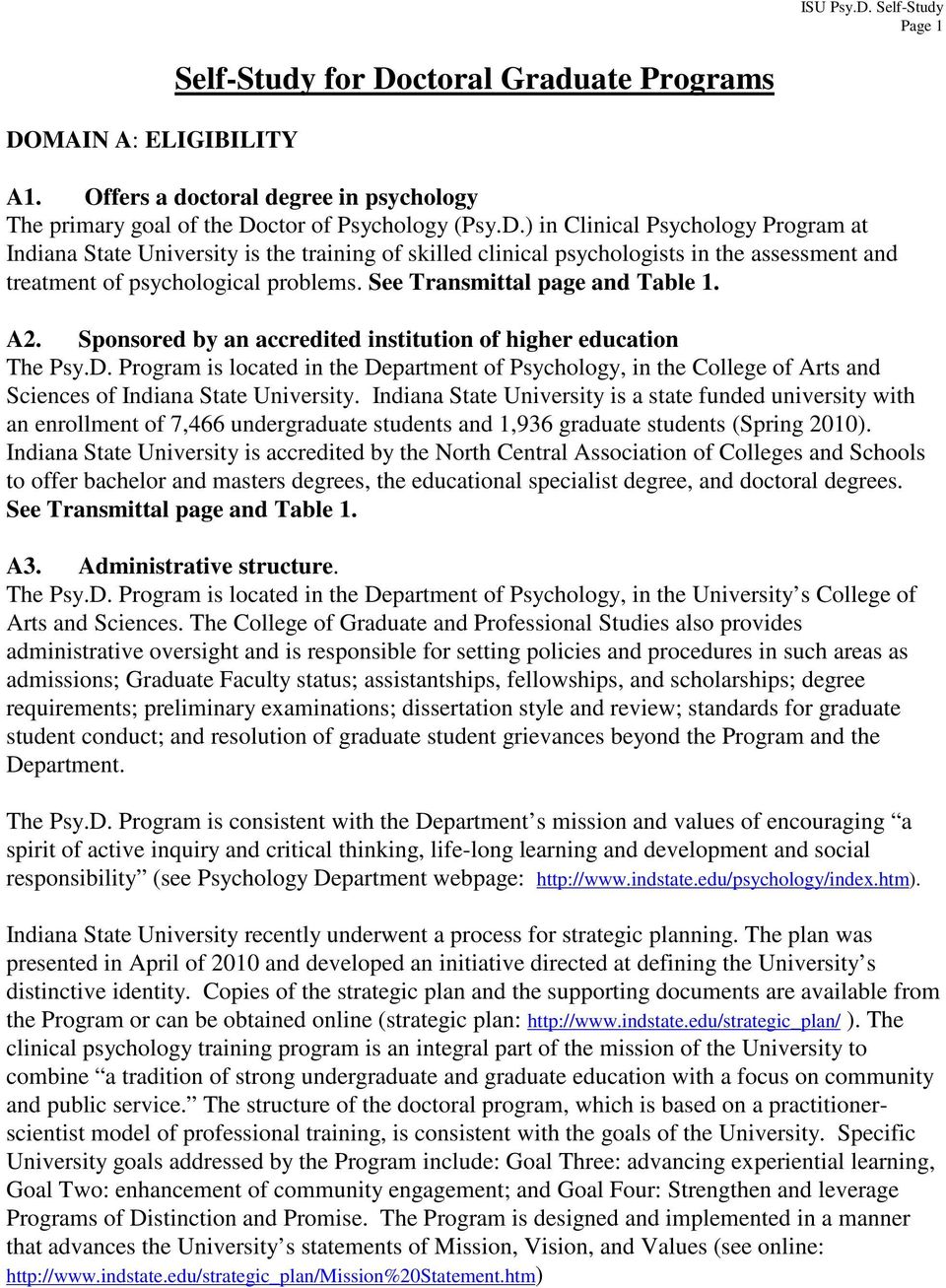
1 Page 1 DOMAIN A: ELIGIBILITY Self-Study for Doctoral Graduate Programs A1. Offers a doctoral degree in psychology The primary goal of the Doctor of Psychology (Psy.D.) in Clinical Psychology Program at Indiana State University is the training of skilled clinical psychologists in the assessment and treatment of psychological problems. See Transmittal page and Table 1. A2. Sponsored by an accredited institution of higher education The Psy.D. Program is located in the Department of Psychology, in the College of Arts and Sciences of Indiana State University. Indiana State University is a state funded university with an enrollment of 7,466 undergraduate students and 1,936 graduate students (Spring 2010). Indiana State University is accredited by the North Central Association of Colleges and Schools to offer bachelor and masters degrees, the educational specialist degree, and doctoral degrees. See Transmittal page and Table 1. A3. Administrative structure. The Psy.D. Program is located in the Department of Psychology, in the University s College of Arts and Sciences. The College of Graduate and Professional Studies also provides administrative oversight and is responsible for setting policies and procedures in such areas as admissions; Graduate Faculty status; assistantships, fellowships, and scholarships; degree requirements; preliminary examinations; dissertation style and review; standards for graduate student conduct; and resolution of graduate student grievances beyond the Program and the Department. The Psy.D. Program is consistent with the Department s mission and values of encouraging a spirit of active inquiry and critical thinking, life-long learning and development and social responsibility (see Psychology Department webpage: Indiana State University recently underwent a process for strategic planning. The plan was presented in April of 2010 and developed an initiative directed at defining the University s distinctive identity. Copies of the strategic plan and the supporting documents are available from the Program or can be obtained online (strategic plan: ). The clinical psychology training program is an integral part of the mission of the University to combine a tradition of strong undergraduate and graduate education with a focus on community and public service. The structure of the doctoral program, which is based on a practitionerscientist model of professional training, is consistent with the goals of the University. Specific University goals addressed by the Program include: Goal Three: advancing experiential learning, Goal Two: enhancement of community engagement; and Goal Four: Strengthen and leverage Programs of Distinction and Promise. The Program is designed and implemented in a manner that advances the University s statements of Mission, Vision, and Values (see online:
2 Page 2 For the Fall 2010 semester, the Department of Psychology has an enrollment of approximately 256 undergraduate majors, 6 graduate students in the masters in general psychology program, and 41 graduate students in the Psy.D. Program. The Program is represented in the institution s budget and the budget and resources provided are sufficient for the Program to achieve its goals (see Domain C). A4. Length of the program and residency requirements. The Psy.D. Program requires a minimum of four years of full-time on-campus study and completion of a full-time one year internship in the fifth year. A5. Position on inclusion, training, and respect for cultural and individual diversity Indiana State University is committed to inclusion and respect for people from diverse ethnic, cultural, and racial backgrounds and individual diversity. This is reflected in its values statement, commitment to affirmative action, and a comprehensive set of policies that foster inclusion and ensure protection of individual rights and ensure due process. The Program has a comprehensive plan to promote diversity and inclusion in the faculty and admitted students. Training advances cultural through specific course work and infusion of content throughout the curriculum. Specific efforts are directed at providing supervised practicum and experiences that address the needs of the local community where low income and poverty and lack of support services are significant difficulties. These efforts are discussed throughout the self-study and particularly when Domain D is discussed. The Program s Diversity Plan is in Appendix D1. A6. Policies and Procedures See Table A.6 below and Appendix A Attachments Table A.6 (Required Table) Item Document in which policy appears Appendix / Page #(s) Student selection 1. Psy.D. Program Guide, p. 2: Admission to the Program 2. Psy.D. Program brochure and application materials 3. Department web page: Admission Requirements for the Clinical Psy.D. Program: 4. College of Graduate and Professional Studies website and catalog: Doctor of Psychology Admission Requirements and Appendix A1, p.2 Appendix A2

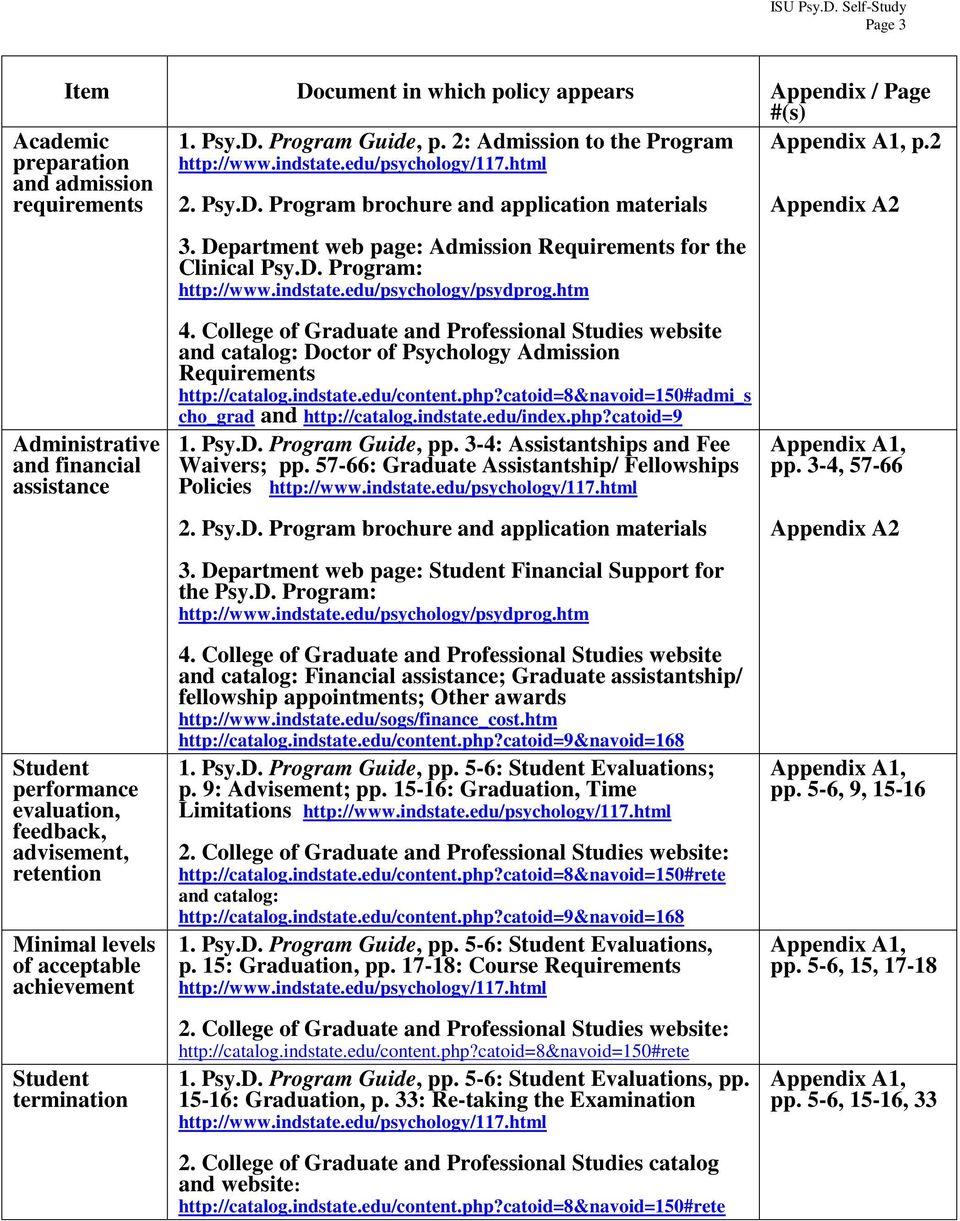
3 Page 3 Item Document in which policy appears Appendix / Page #(s) Academic 1. Psy.D. Program Guide, p. 2: Admission to the Program Appendix A1, p.2 preparation and admission requirements 2. Psy.D. Program brochure and application materials Appendix A2 Administrative and financial assistance Student performance evaluation, feedback, advisement, retention Minimal levels of acceptable achievement Student termination 3. Department web page: Admission Requirements for the Clinical Psy.D. Program: 4. College of Graduate and Professional Studies website and catalog: Doctor of Psychology Admission Requirements cho_grad and 1. Psy.D. Program Guide, pp. 3-4: Assistantships and Fee Waivers; pp : Graduate Assistantship/ Fellowships Policies 2. Psy.D. Program brochure and application materials 3. Department web page: Student Financial Support for the Psy.D. Program: 4. College of Graduate and Professional Studies website and catalog: Financial assistance; Graduate assistantship/ fellowship appointments; Other awards Psy.D. Program Guide, pp. 5-6: Student Evaluations; p. 9: Advisement; pp : Graduation, Time Limitations 2. College of Graduate and Professional Studies website: and catalog: 1. Psy.D. Program Guide, pp. 5-6: Student Evaluations, p. 15: Graduation, pp : Course Requirements 2. College of Graduate and Professional Studies website: 1. Psy.D. Program Guide, pp. 5-6: Student Evaluations, pp : Graduation, p. 33: Re-taking the Examination 2. College of Graduate and Professional Studies catalog and website: Appendix A1, pp. 3-4, Appendix A2 Appendix A1, pp. 5-6, 9, Appendix A1, pp. 5-6, 15, Appendix A1, pp. 5-6, 15-16, 33
4 Due process Grievance policies for students and faculty 1. Psy.D. Program Guide, pp. 6-8: Grievance Policy and Procedures 2. College of Graduate and Professional Studies catalog and website: 1. Psy.D. Program Guide, pp. 6-8: Grievance Policy and Procedures) 2. University Handbook: ISU Psy.D. Self-Study Page 4 Appendix A1, pp. 6-8 Appendix A1, pp. 6-8 DOMAIN B: PROGRAM PHILOSOPHY, OBJECTIVES, AND CURRICULUM PLAN B1a. Description of educational philosophy and training model The practitioner-scientist model of clinical training on which the Program is based has as its foundation the development of practicing clinical psychologists who possess, value, and pursue: 1. Excellence in clinical practice, 2. A spirit of active inquiry and critical thought, 3. A commitment to the development and application of new knowledge in the field, 4. An active sense of social responsibility, 5. An appreciation and respect for the significant impact of cultural and individual differences in all aspects of practice and inquiry, and 6. An enduring commitment to personal and professional development. The Program follows an educational philosophy that was originally grounded in the recommendations of the Joint Council on Professional Education of Psychologists (JCPEP). The Program is tightly structured and has a clear sequence in which coursework, experiential program elements, and practica/fieldwork build sequentially (see typical program sequence in Program Guide, Appendix A1, pp ). As a consequence, the Program is not able to accommodate persons applying with the anticipation of transferring more than 9 hours of prior graduate work. Furthermore, all students are full-time and are in residence for four years before internship. As noted above, the location of the Program in a university department of psychology introduces resources and shapes expectations for faculty and students that foster an emphasis on applied research as the foundation of practice. The Program philosophy has also been influenced by both the National Council of Schools and Programs of Professional Psychology (NCSPP) (Peterson, R. L., Peterson, D. R., Abrams, J. C., & Stricker, G., 1997) and the concepts of the local clinical scientist articulated by Stricker and Trierweiler (1995). The competencies articulated in the NCSPP model have informed the approach adopted by the Program. The local clinical scientist model is a core element in how the Program approaches the integration of science and practice in training and the professional identity of our graduates.

5 Page 5 The influences noted above have led the Program to articulate a Practitioner-Scientist model that reflects the Program s emphasis on applied training and research as a foundation of practice and the requirement that students complete a dissertation. The Program is located in a university department of psychology that allows for a class size of 8-10 students per year and for student support through assistantships, fellowships, and tuition waivers. Students are in small classes that build cohesion among classmates, foster socialization and group learning, and allow for close supervision and guidance by program faculty. B1b. Description of how training is sequential, cumulative, and graded in complexity Students follow a structured sequence in progressing through the program that is sequential, cumulative, and graded in complexity (See Program Guide, Appendix A1, pp ). First year students take coursework in core areas of psychology, foundations of assessment and treatment, and introduction to professional issues and ethics. They begin clinical work by participating in the group supervision and observation of clinical services provided in the Psychology Clinic, and through practice in assessment and treatment as part of their courses. They also begin training in research by participating in faculty research team meetings, and their assistantship usually involves research. In the second year, students continue to complete core coursework and foundational clinical courses, and they begin practicum, providing assessment and treatment to patients in the Psychology Clinic. They continue participation on faculty research teams and their assistantship may involve research or teaching. Third year students complete advanced courses in assessment, treatment, professional issues in psychology, and ethics. They begin to develop their dissertation topic and proposal, and complete seminars. They continue seeing patients in the Psychology Clinic and some students begin clinical field placements. At the end of the third year, students complete preliminary examinations. Fourth year students take courses in supervision and consultation, program administration and evaluation, and seminars. They continue to work on their dissertations. They work in field placements and apply for internships. Students in the fifth year complete internship and their dissertations. Description of model, goals, objectives, and the means by which an integration of science and practice is achieved The Program achieves the goals and objectives of the practitioner-scientist model by training students who are prepared to practice research-informed clinical psychology at the entry level through demonstration they have met the following goals: 1. Knowledge of the core areas of psychology, with particular emphasis on those areas which form the foundation for clinical practice; 2. Knowledge, skill, and dispositions that form the foundation for the integration of scientific methodology and psychological measurement into clinical psychology and professional practice; 3. Knowledge, skill, and supporting attitudes and values for in assessment and diagnosis as a foundation for intervention, including assessment of abilities, personality, and diagnosis of psychopathology;

6 Page 6 4. Knowledge, ability, and supporting attitudes and values that are the foundation for competent interventions to treat a range of mental health and adjustment disorders; 5. Knowledge and associated attitudes and values related to ethical, legal, and professional issues that affect professional practice and research; the integration of professional ethics as an essential element in professional work; and commitment to continued professional and personal development; 6. Knowledge, skills, and sensitivity to issues of cultural and individual diversity in professional work and relationships with patients, organizations, and colleagues; and 7. Foundation knowledge and skills in supervision, consultation, and program development and administration. In addition to achieving the above goals, students may acquire specialized skills and follow professional interests through elective courses, specialized practica and internship placements, and the selection of research topics. Course offerings and faculty interests provide the opportunity for students to pursue emphasis in areas of service to children and adolescents, forensic and correctional applications, and health psychology. ever, the program focuses on the development of a foundation of broad based (generalist) skills in clinical psychology and prepares graduates for practice in a wide variety of professional settings and for specialization through post-doctoral study. Table B.2 (Required Table) Goal #1: Students will acquire knowledge of the core areas of psychology, with particular emphasis on those areas which form the foundation for clinical practice. Objectives for Goal #1: Students demonstrate knowledge of: 1) Biological Basis of Behavior, 2) Social Basis of Behavior, 3) History and Systems, 4) Human Development and Individual Differences Competencies Expected for these Objectives: Demonstration of knowledge of core areas of psychology Appendix & Page Number for Evaluation Tools Used for each Competency (if applicable): Outcomes are Measured and Minimum Thresholds for Achievement for these Objectives/Competencies: Grade of B- or higher on coursework in the relevant area and maintenance of a 3.5 GPA; passing performance on the Examination for Professional Practice of Psychology (EPPP) Goal #2: Students will acquire knowledge, skill, and dispositions that form the foundation for the integration of scientific methodology and psychological measurement into clinical psychology and professional practice. Objectives for Goal #2: Students demonstrate knowledge of statistical analysis and research design, evaluate strengths and weaknesses of alternative research designs, design a doctoral research project (i.e., dissertation), and apply knowledge of statistical analysis and research methodology to the evaluation of research in clinical and core areas of psychology Competencies Expected for these Objectives: capacity to design research, perform statistical analyses, and evaluate methods and findings in published research in areas relevant to clinical psychology and foundation areas. Appendix & Page Number for Evaluation Tools Used for each Competency (if applicable): Program Guide: Appendix A1, pp ; Student Evaluation Form: Appendix B1 Outcomes are Measured and Minimum Thresholds for Achievement for these
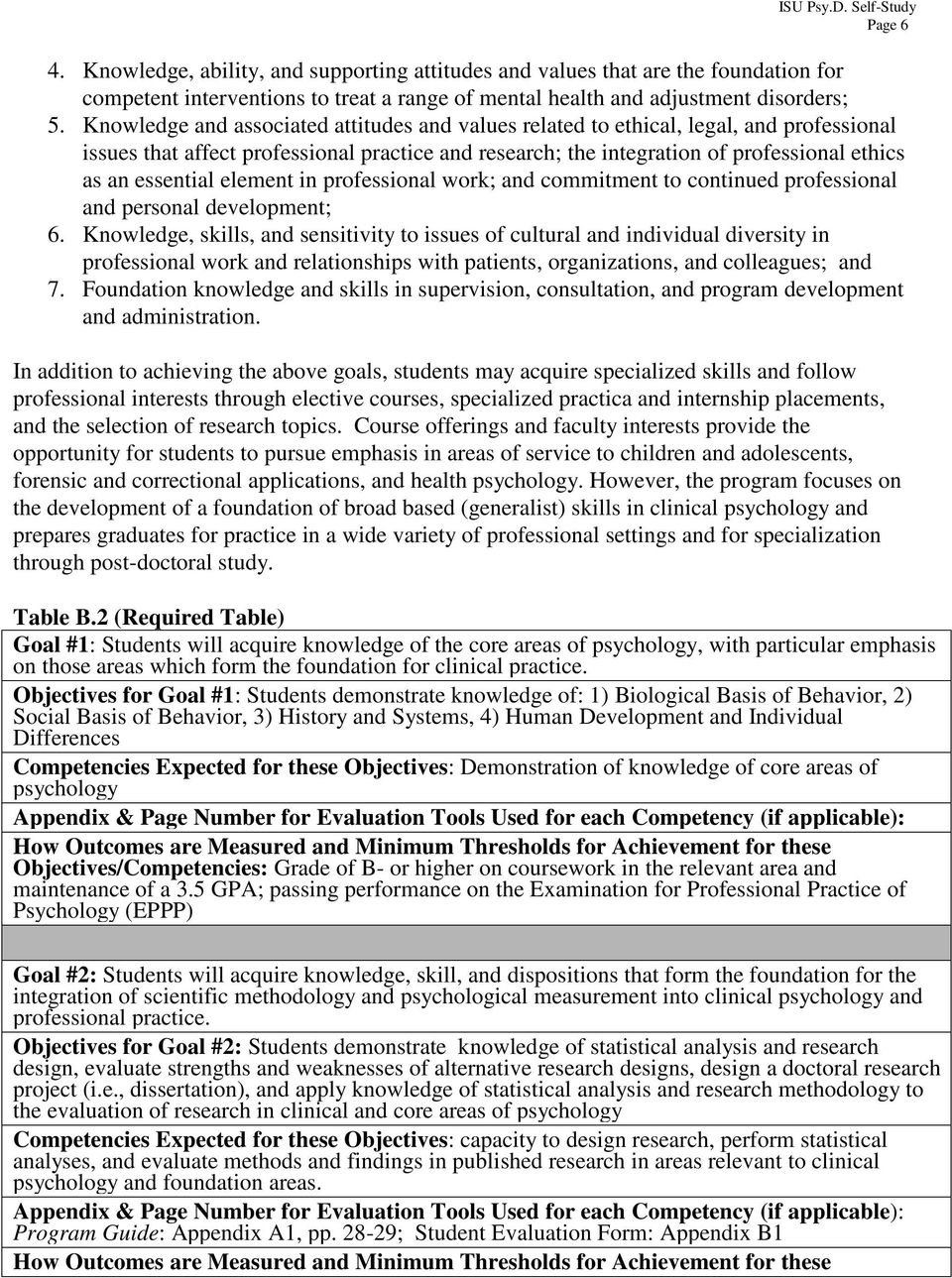
7 Page 7 Objectives/Competencies: In order to demonstrate basic proficiency in research skills associated with conferring the masters degree, the student submits a portfolio that contains documentation endorsed by a member of the graduate faculty that the student has done work of a substantial nature that demonstrates basic proficiency in each skill specified in the portfolio outline. Documentation and summaries must be provided for each of the following research skills: 1) conducting a literature review and summarizing and assessing the status of knowledge in the area reviewed, and drawing conclusions from the results of the literature review; 2) designing and planning a research study using appropriate methodologies to accomplish the goals of the study; 3) participating in the collection and preparation of data from a research study; 4) analyzing, with appropriate statistical techniques, data from a research study; 5) presenting data from a research study through written and graphic means; 6) making inferences, drawing conclusions, and assessing the implications of a set of research data and presenting them in writing. Students must pass the didactic courses in research and statistics and with a grade of B- or above; students present and defend their dissertation proposal and the final project; the dissertation is assessed and approved by the Doctoral Committee; students knowledge of measurement as it applies to professional applications in the preliminary examinations; students performance on research related activities on assistantship in bi-annual student evaluations conducted by the faculty. Goal #3: Students will acquire knowledge, skill, and supporting attitudes and values for in assessment and diagnosis as a foundation for intervention, including assessment of abilities, personality, and diagnosis of psychopathology. Objectives for Goal #3: Students demonstrate assessment and intervention skills that include: 1. Diagnostic interviewing including: a. Initial diagnostic interview; b. Psychosocial interview adult; c. Psychosocial interview for a child or adolescent; d. Mental status examination 2. Development of rapport with adults and children in order to effectively conduct assessments 3. Conduct assessments with due consideration to such variables as gender, race, ethnicity, socioeconomic status, religion, and other aspects of individual difference which are clinically relevant 4. Appropriately apply diagnostic criteria 5. Conduct behaviorally oriented assessments in order to plan interventions 6. Conduct cognitive-behaviorally oriented assessments in order to plan interventions 7. Administer, interpret and report findings from assessments of intelligence for persons from at least two different developmental periods 8. Administer, interpret and report findings using two self-report measures of personality 9. Administer, interpret and report findings using projective tests 10. Integrate findings from a variety of sources into coherent assessments and provide appropriate recommendations and diagnoses based upon them Competencies Expected for these Objectives: demonstrate the capacity to routinely perform the above skills with minimum of supervision Appendix & Page Number for Evaluation Tools Used for each Competency (if applicable): Program Guide: Appendix A1, pp ; Student Evaluation Form: Appendix B1; Placement Progress Report: Appendix B2; Internship Evaluation Form: Appendix B3 Outcomes are Measured and Minimum Thresholds for Achievement for these Objectives/Competencies: Grades (B- or above) in assessment courses and practicum; student evaluations (ratings of acceptable performance or above) student s progress is evaluated at least twice yearly by psychology faculty; portfolio students are to submit statements, and/or work samples where appropriate, for each of the objectives listed above; evaluations of students by placement and internship supervisors (ratings of acceptable performance or above); preliminary examination performance (passing grade) for this content area. Goal #4: Knowledge, ability, and supporting attitudes and values that are the foundation for
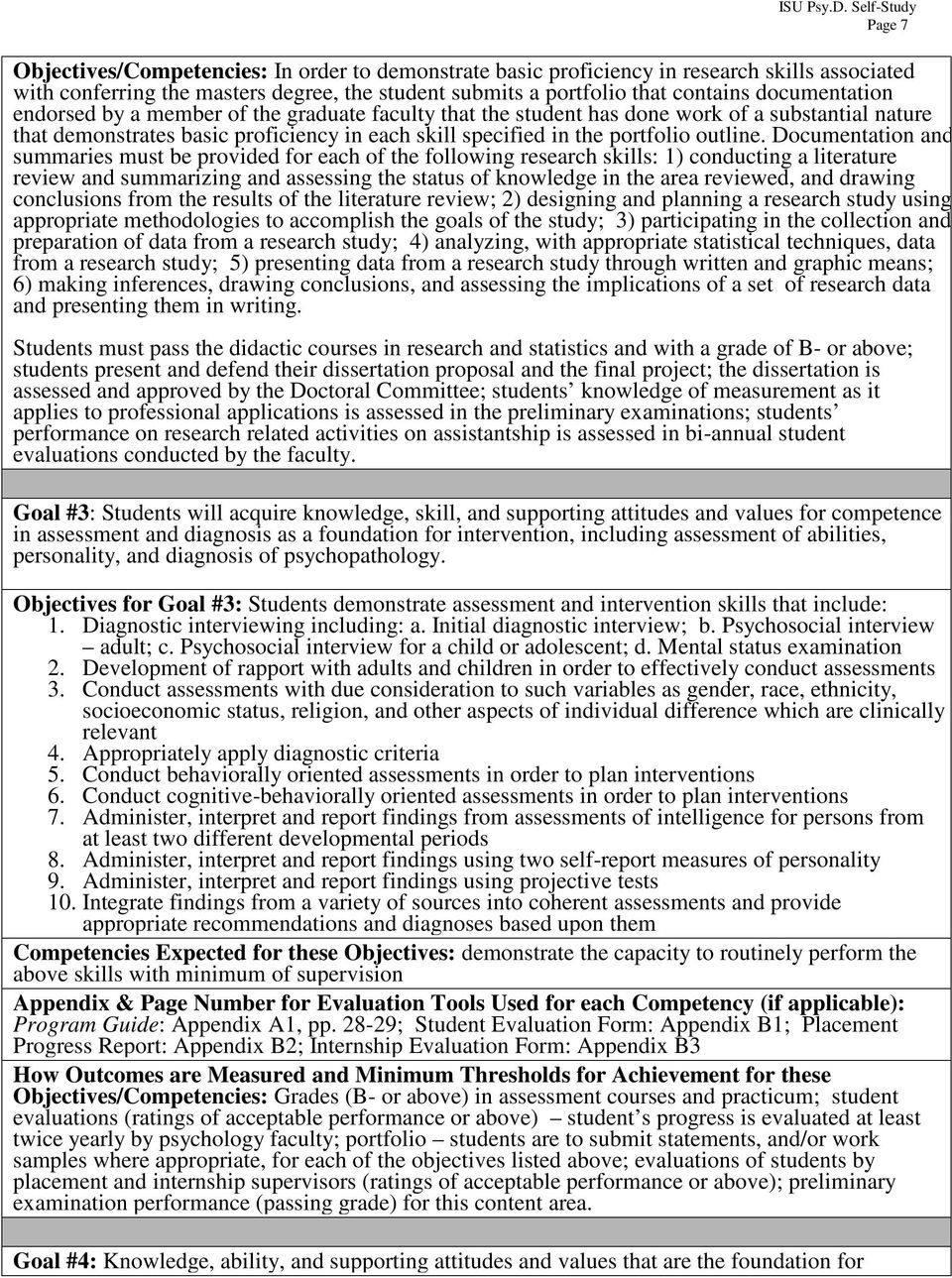
8 Page 8 competent interventions to treat a range of mental health and adjustment disorders. Objectives for Goal #4: Students are able to demonstrate intervention skills that include: 1. Use effective listening and communications skills to articulate an empathic and effective therapeutic relationship 2. Implement at least three empirically supported interventions 3. Conduct assessments and interventions with sensitivity to issues of professional ethics and code of conduct 4. Appropriately use consultants and adjunctive services 5. Appropriately seek and participate in clinical supervision Competencies Expected for these Objectives: Appropriately seek and participate in clinical supervision, demonstrate the capacity to routinely perform the other skills with minimum supervision Appendix & Page Number for Evaluation Tools Used for each Competency (if applicable): Program Guide: Appendix A1, pp ; Student Evaluation Form: Appendix B1; Placement Progress Report: Appendix B2; Internship Evaluation Form: Appendix B3 Outcomes are Measured and Minimum Thresholds for Achievement for these Objectives/Competencies: Grades (B- or above) in psychotherapy and intervention courses and practicum; student evaluations (ratings of acceptable performance or above) - students progress is evaluated at least twice yearly by psychology faculty; portfolio students are to submit statements, and/or work samples where appropriate, for each of the objectives listed above; evaluations of students by placement and internship supervisors (ratings of acceptable performance or above); preliminary examination (passing grade) performance on questions addressing this content area. Goal #5: Knowledge, ability, and associated attitudes and values related to ethical and professional conduct in practice and research. Objectives for Goal #5: Students are able to demonstrate knowledge, attitudes, values, and dispositions associated with ethical and professional practice and participation in the profession. Competencies Expected for these Objectives: 1. Knowledge of ethical/professional codes, standards and guidelines. 2. The integration of professional ethics as an essential element in professional work. 3. Knowledge of statutes, rules, regulations and case law relevant to the practice of psychology. 4. Ability to recognize and analyze ethical and legal issues across the range of professional activities in the practicum setting. 5. Demonstrates commitment to ethical practice in clinical activities and research. 6. Timeliness in completing professional tasks (e.g., evaluations, notes, reports). 7. Demonstrates an organized, disciplined approach to writing and maintaining notes and records. 8. Ability to seek and use resources that support and maintain healthy functioning and management of personal distress 9. Commitment to continued professional and personal development. Appendix & Page Number for Evaluation Tools Used for each Competency (if applicable): Student Evaluation Form: Appendix B1; Placement Progress Report: Appendix B2; Internship Evaluation Form: Appendix B3 Outcomes are Measured and Minimum Thresholds for Achievement for these Objectives/Competencies: Grades (B- or above) in relevant coursework and aspects of practicum and field placement that address ethics and professional issues; student evaluations (ratings of acceptable performance or above) - students progress is evaluated at least twice yearly by psychology faculty; preliminary examination (passing grade) performance on questions addressing this content area. Goal #6: Knowledge, skills, and sensitivity to issues of cultural and individual diversity in professional work and relationships with patients, organizations, and colleagues
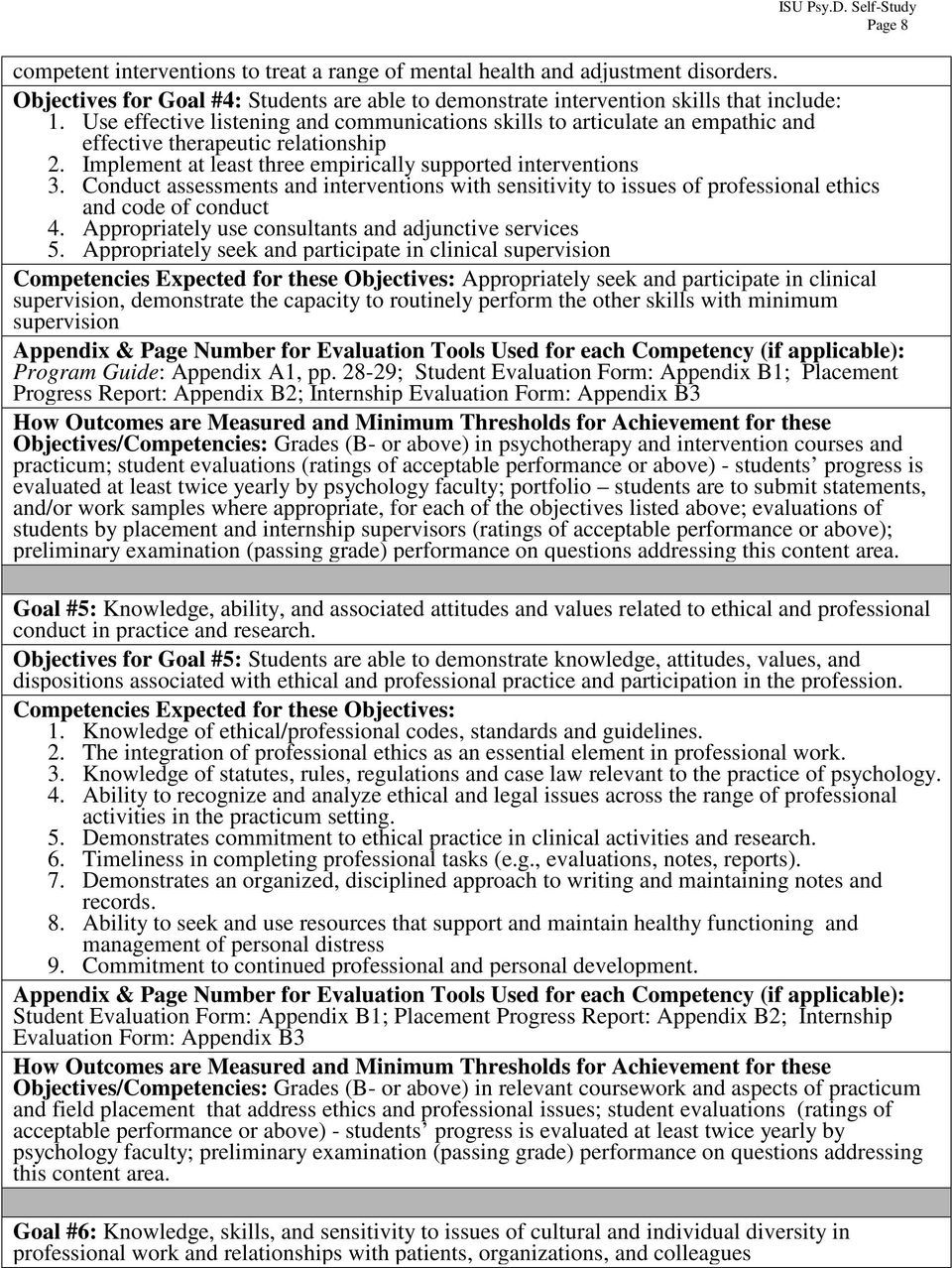
9 Page 9 Objectives for Goal #6: 1. Students will acquire knowledge about the nature and impact of diversity in different clinical and professional situations. 2. Students will acquire ability to work effectively with diverse others in assessment, treatment and consultation. 3. Students will acquire knowledge, understanding and skill that will allow them to effectively practice in a manner sensitive to cultural, individual, and role differences including those based on age, gender, gender identity, race, ethnicity, culture, national origin, religion, sexual orientation, disability, language, and socioeconomic status. Competencies Expected for these Objectives: 1. Students will demonstrate a willingness to examine their personal values attitudes, assumptions, behaviors, and values related to cultural and individual diversity. 2. Students will be sensitive to and consider the impact of diversity in their coursework including clinical and core courses, and seminars 3. Students will consider the impact of diversity in the selection and interpretation of assessment techniques 4. Students will be sensitive and responsive to issues of diversity in treatment. 5. Students will address issues of diversity in conducting and evaluating research. Appendix & Page Number for Evaluation Tools Used for each Competency (if applicable): Student Evaluation Form: Appendix B1 Outcomes are Measured and Minimum Thresholds for Achievement for these Objectives/Competencies: Grades (B- or above) in aspects of coursework, practicum and fieldwork that address diversity and practice in a pluralistic society; student evaluations (ratings of acceptable performance or above) students progress is evaluated at least twice yearly by psychology faculty; preliminary examination (passing grade) performance on questions addressing this content area. Goal #7: Foundation knowledge and skills in supervision, consultation, and program development and administration. Objectives for Goal #7: 1. Students will demonstrate knowledge of fundamental approaches, techniques and skills of supervision and consultation. 2. Students will demonstrate understanding of key concepts and processes of supervision and consultation 3. Students will demonstrate basic skills in supervision. 4. Students will develop knowledge of foundations of program administration and evaluation (e.g. funding and budgeting, personnel management, program development and evaluation, legal issues, and government relation). Competencies Expected for these Objectives: 1. Students will demonstrate a foundational knowledge of clinical supervision (e.g. goal setting, evaluation, building the supervision relationship, and solving problems). 2. Students will demonstrate ability to implement supervision strategies such as teaching, mentoring, coaching, consulting; documenting supervision; and employing specialized techniques, such as using video in supervision. 3. Students will demonstrate knowledge of ethical, legal, multicultural, and crisis management issues. 4. Students will supervise students in earlier years of the program under faculty supervision. 5. Students will demonstrate knowledge of program administration and evaluation. Appendix & Page Number for Evaluation Tools Used for each Competency (if applicable): Program Guide: Appendix A1, pp ; Student Evaluation Form: Appendix B1; Placement Progress Report: Appendix B2; Internship Evaluation Form: Appendix B3 Outcomes are Measured and Minimum Thresholds for Achievement for these Objectives/Competencies: Grades (B- or above) in courses on supervision and consultation, and program development and administration; student evaluations (ratings of acceptable performance or above) - students progress is evaluated at least twice yearly by psychology faculty; preliminary
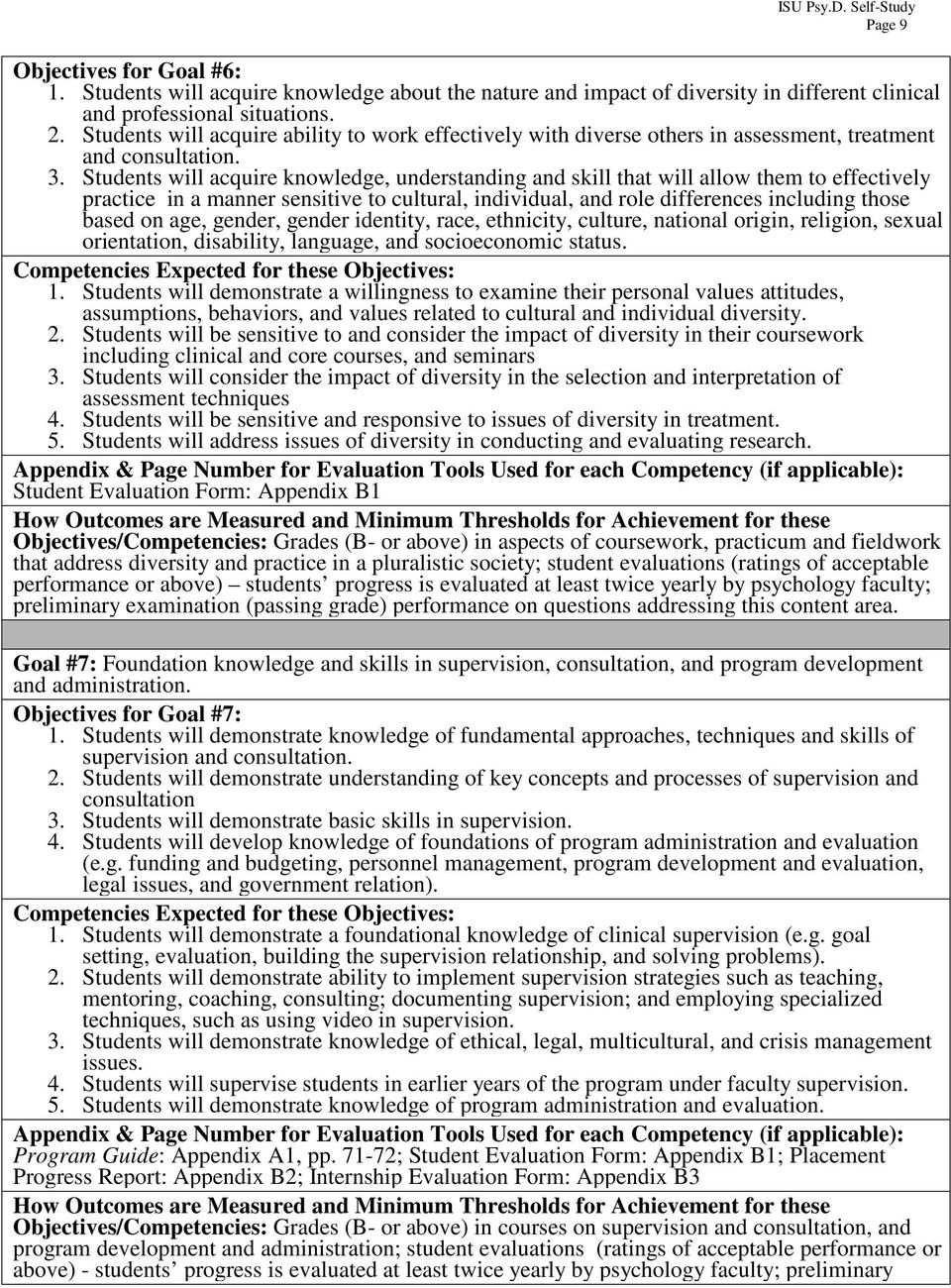
10 examination (passing grade) performance on questions addressing this content area. ISU Psy.D. Self-Study Page 10 Table B.3 (Required Table) Syllabi and readings for classroom courses are in Appendix B3 Curriculum Biological aspects of behavior Required 1. PSY 608: Biopsychology - 3 hrs Academic/ 2. PSY 658: Clinical Psychopharmacology - 3 hrs Training (Also: PSY 668: Advanced Psychopathology - 3 hours; biological theories and treatment of psychopathology) Grades in the courses; performance on preliminary examinations; performance of graduates on the Examination for Professional Practice of Psychology (EPPP) Curriculum Required Academic/ Training Curriculum Required Academic/ Training Curriculum Required Academic/ Training Curriculum Required Academic/ Training Cognitive aspects of behavior 1. PSY 603: Learning and Cognition - 3 hrs (Also: PSY 665B: Behavior Therapy - 3 hrs; this course has a large cognitive component) Grades in the courses; performance on preliminary examinations; performance of graduates on the EPPP Affective aspects of behavior 1. PSY 603: Learning and Cognition - 3 hrs 2. PSY 668: Advanced Psychopathology - 3 hrs 3. PSY 662: Personality - 3 hrs Grades in the courses; performance on preliminary examinations; performance of graduates on the EPPP Social aspects of behavior 1. PSY 607: Social Basis of Individual Behavior - 3 hrs Grades in the course; performance of graduates on the EPPP History and systems of psychology 1. PSY 615: History and Foundations of Clinical Psychology 1 hr 2. PSY 521: History and Systems of Psychology - 2 hrs Grades in the courses; performance of graduates on the EPPP

11 Page 11 Curriculum Required Academic/ Training Curriculum Required Academic/ Training Curriculum Required Academic/ Training Curriculum Required Academic/ Training Psychological measurement 1. PSY 664A: Ability Assessment - 3 hrs + 1 hr PSY 696 (Practicum) associated with the course 2. PSY 664B: Projective Personality Assessment - 2 hrs + 1 hr PSY 696 (Practicum) associated with the course 3. PSY 664C: Objective Personality Assessment -3 hrs 4. PSY 676: Advanced Assessment and Treatment - 3 hrs Grades in the courses; performance on preliminary examinations; performance of graduates on the EPPP Research methodology 1. PSY 602: Theoretical and Methodological Foundations of Psychology - 3 hrs 2. PSY 680: Appraisal of Research in Clinical Psychology - 3 hrs 3. PSY 604: Advanced Statistics - 3 hrs 4. PSY 799: Dissertation - 12 hrs Grades in the courses; performance on research-related activities on assistantship is assessed in the bi-annual student evaluations conducted by the faculty; knowledge of research methods as it applies to professional applications in the preliminary examinations; students present and defend their dissertation proposal and the final dissertation which are assessed and approved by the Doctoral Committee; performance of graduates on the EPPP In order to demonstrate basic proficiency in research skills associated with conferring the masters degree, the student submits documentation endorsed by a member of the Graduate Faculty that he or she has done work of a substantial nature that demonstrates basic proficiency in research skills (see Program Guide, pp , Appendix A1) Techniques of data analysis 1. PSY 604: Advanced Statistics - 3 hrs 2. PSY 602: Theoretical and Methodological Foundations of Psychology - 3 hrs 3. PSY 680: Appraisal of Research in Clinical Psychology - 3 hrs 4. PSY 799: Dissertation - 12 hrs Grades in the courses; performance on research-related activities on assistantship is assessed in the bi-annual student evaluations conducted by the faculty; students present and defend their dissertation proposal and the final dissertation; the dissertation proposal and the final dissertation are assessed and approved by the Doctoral Committee; performance of graduates on the EPPP As part of the research requirements for the masters degree, students must submit documentation endorsed by a member of the Graduate Faculty for research skills specific to data analysis research skills (see Program Guide, pp , Appendix A1). Individual differences in behavior 1. PSY 662: Personality - 3 hrs 2. PSY 668: Advanced Psychopathology - 3 hrs 3. EPSY 621: Development through the Lifespan 3 hrs (or PSY 566: Human
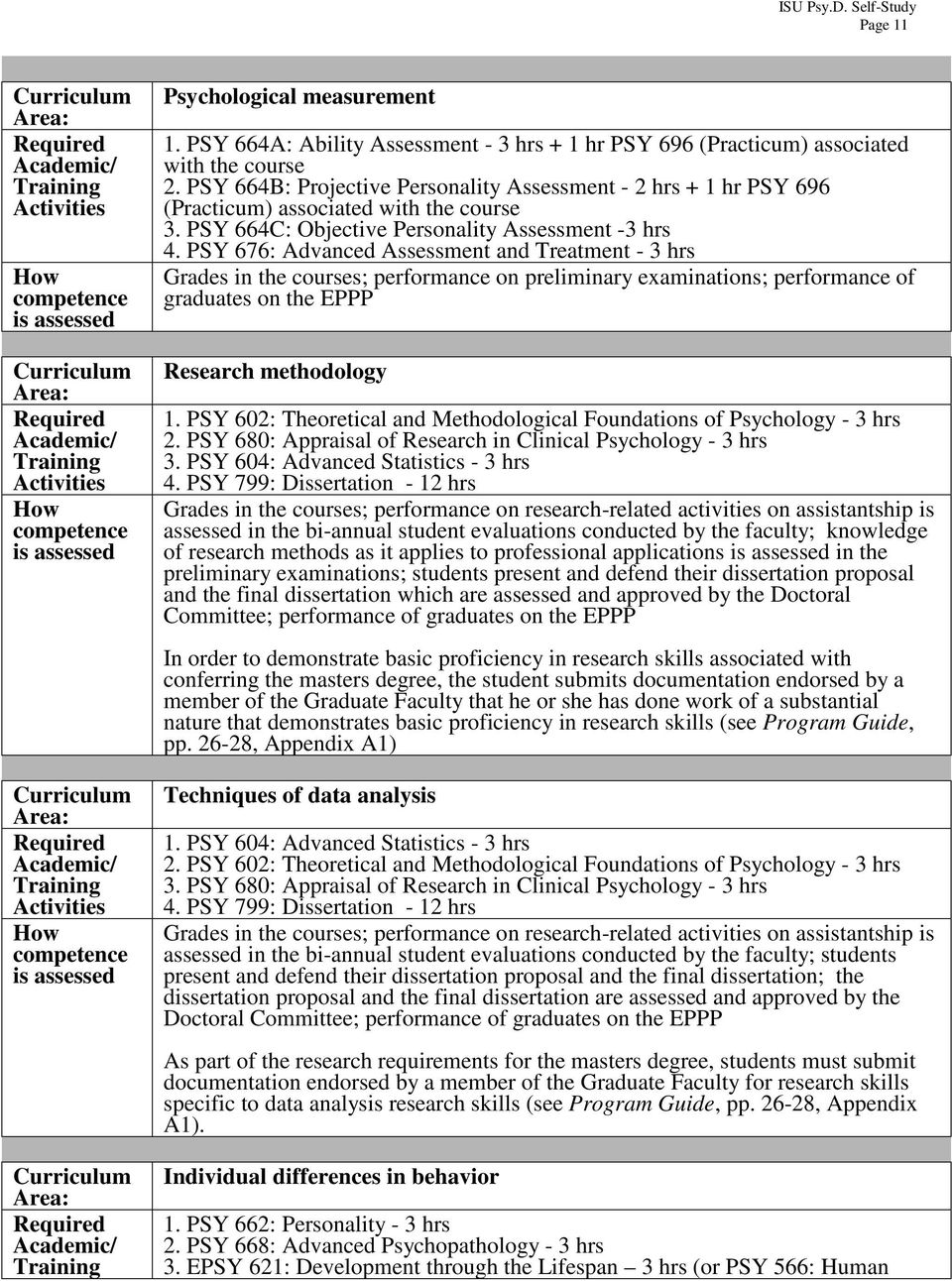
12 Page 12 Curriculum Required Academic/ Training Curriculum Required Academic/ Training Curriculum Required Academic/ Training Curriculum Required Academic/ Training Ontogeny - 3 hrs when offered*) Grades in the courses; performance on preliminary examinations; performance of graduates on the EPPP Human development 1. EPSY 621: Development through the Lifespan 3 hrs (or PSY 566: Human Ontogeny - 3 hrs when offered*) (Also: PSY 664A: Ability Assessment - 3 hrs: cognitive development and performance across the lifespan) Grades in the courses; performance of graduates on the EPPP Dysfunctional behavior or psychopathology 1. PSY 668: Advanced Psychopathology - 3 hrs (Also: PSY 664A: Ability Assessment - 3 hrs: childhood psychopathology, cognitive disorders, effect of psychopathology on cognitive functioning and PSY 662: Personality - 3 hrs: personality disorders) Grades in the courses; performance on preliminary examinations; performance of graduates on the EPPP Professional standards and ethics All didactic and practicum courses incorporate consideration of professional and research ethics where relevant. Professional conduct, issues and ethics are explicitly addressed in the following courses: 1. PSY 663: Professional Clinical Psychology - 3 hrs 2. PSY 615: History and Foundations of Clinical Psychology - 1 hr In addition, students in the first year observe the clinical work of advanced students and faculty. Students in the second and third years enroll in PSY 696, Clinical Practicum, and see clients in the Psychology Clinic. Students in their fourth year enroll in PSY 796, Clinical Placement, and complete a minimum of 500 hours of supervised field placement. Students in their fifth year complete a full time clinical internship (PSY 784). Professional conduct, issues and ethics are addressed in practicum, placement, and internship. Grades in the courses; students are evaluated twice a year by the faculty, twice a year on placement and on internship, and professional standards and ethics are addressed in these evaluations; performance on preliminary examinations; performance of graduates on the EPPP Theories and methods of assessment and diagnosis 1. PSY 668: Advanced Psychopathology - 3 hrs 2. PSY 664A: Ability Assessment - 3 hrs + 1 hr PSY 696 (Clinical Practicum) associated with the course 3. PSY 664B: Projective Personality Assessment - 2 hrs + 1 hr PSY 696 (Clinical
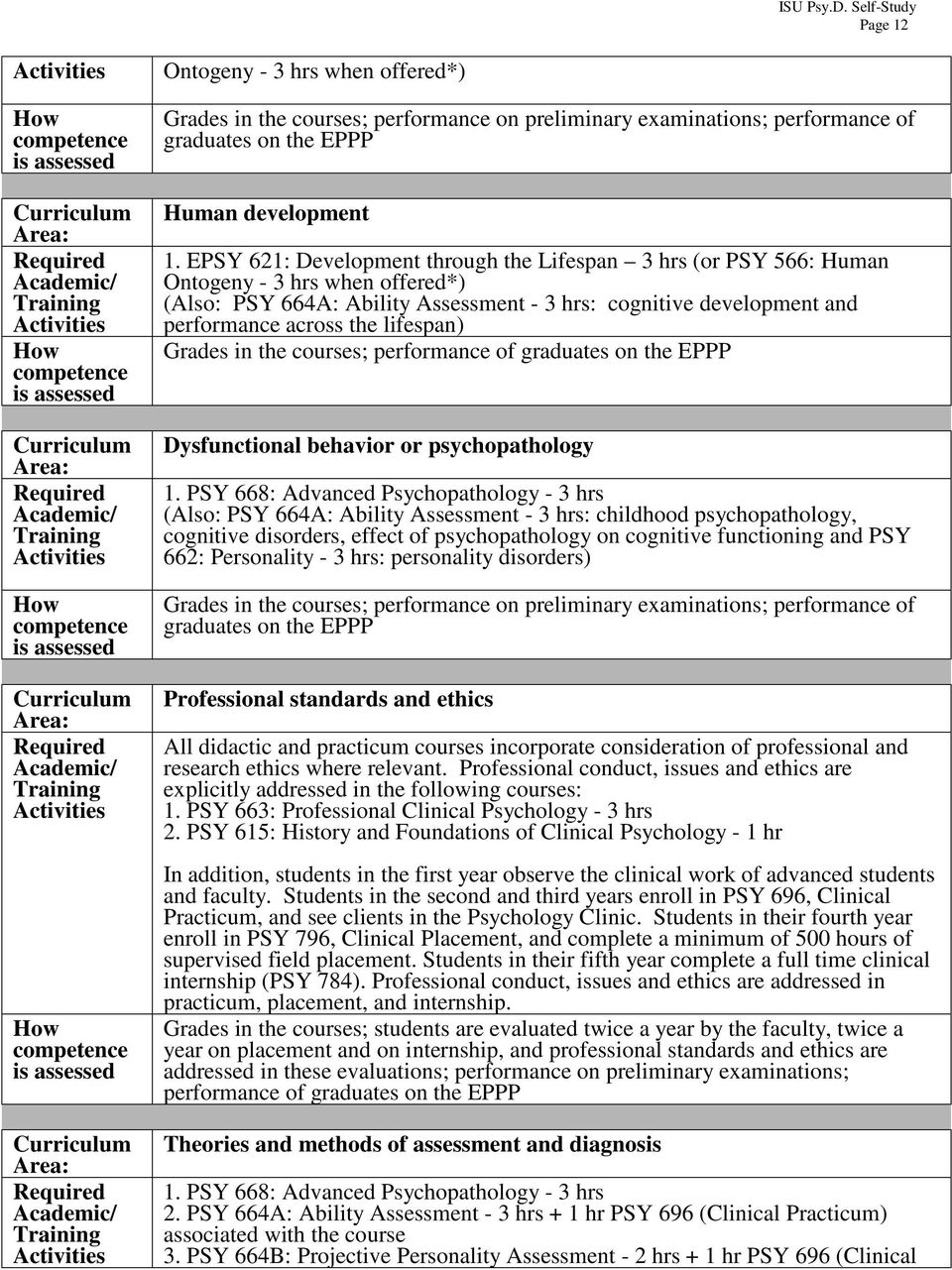
13 Page 13 Practicum) associated with the course 4. PSY 664C: Objective Personality Assessment -3 hrs 5. PSY 665A: Foundations of Psychotherapy - 3 hrs 6. PSY 676: Advanced Assessment and Treatment - 3 hrs 7. COUN 666: Multicultural Counseling - 3 hrs (or PSY 627: Clinical Practice in the Pluralistic Society - 3 hrs when offered*) Curriculum Required Academic/ Training Curriculum In addition, first year students administer, score and interpret tests, and write reports as part of the assessment sequence (PSY 664A, B, C). Second and third year students enroll in PSY 696: Clinical Practicum 6 hrs (1 hr per semester) and see clients in the Psychology Clinic. Fourth year students enroll in PSY 796: Clinical Placement 2 hrs (1 hr per semester during the fourth year). Some third year students also complete a clinical placement, but do not enroll in PSY 796. Students complete a minimum of 500 hours of supervised fieldwork. Students in their fifth year complete a full time one year long clinical internship and enroll in 1 hr of PSY 784: Clinical Internship (during the spring semester). Supervised application of assessment and diagnosis is a part of practicum, placement, and clinical internship. Grades in the courses; students are evaluated twice a year by the faculty, and twice a year on placement and internship, and knowledge and skill in assessment and diagnosis are addressed in these evaluations; performance on preliminary examinations; performance of graduates on the EPPP As part of requirements for the masters degree, students must demonstrate basic proficiency in assessment and diagnosis. (see Program Guide, pp , Appendix A1) Theories and methods of effective intervention 1. PSY 665A: Foundations of Psychotherapy - 3 hrs 2. PSY 665B: Behavior Therapy - 3 hrs 3. PSY 676: Advanced Psychological Assessment and Treatment - 3 hrs 4. COUN 666: Multicultural Counseling - 3 hrs (or PSY 627: Clinical Practice in the Pluralistic Society - 3 hrs when offered*) 5. PSY 671: Supervision and Consultation - 3 hrs In addition, first year students conduct practice interviews in PSY 665A, and behavior therapy and cognitive therapy techniques in PSY 665B. Second and third year students enroll in PSY 696: Clinical Practicum 6 hrs (1 hr per semester) and see clients in the Psychology Clinic. Fourth year students enroll in PSY 796: Clinical Placement 2 hrs (1 hr per semester during the fourth year). Some third year students also complete a clinical placement, but do not enroll in PSY 796. Students in their fifth year complete a full time one year long clinical internship and enroll in 1 hr of PSY 784: Clinical Internship (during the spring semester only). Supervised psychotherapy is a part of practicum, placement, and internship. Grades in the courses; students are evaluated twice a year by the faculty, and twice a year on placement and internship, and knowledge and skill in the use of effective interventions are addressed in these evaluations; performance on preliminary examinations; performance of graduates on the EPPP As part of requirements for the masters degree students must demonstrate basic proficiency in knowledge and skill in the use of effective interventions (see Program Guide, pp , Appendix A1) Theories and methods of consultation

14 Page 14 Required Academic/ Training Curriculum Required Academic/ Training Curriculum Required Academic/ Training Curriculum Required Academic/ Training 1. PSY 671: Supervision and Consultation - 3 hrs Grades in the course; students are evaluated twice a year by the faculty, and knowledge and use of consultation is addressed in the evaluation; performance of graduates on the EPPP As part of requirements for the masters degree students must submit documentation, endorsed by a member of the Clinical Faculty, that he or she demonstrates basic proficiency in the appropriate use of consultants and adjunctive services (see Program Guide, pp , Appendix A1). Theories and methods of supervision 1. PSY 671: Supervision and Consultation - 3 hrs Grades in the course; students are evaluated twice a year by the faculty, and participation and response to supervision is addressed in the evaluation; Performance of graduates on the EPPP As part of requirements for the masters degree, students must submit documentation, endorsed by a member of the Clinical Faculty, that he or she demonstrates basic proficiency in appropriately seeking and participating in clinical supervision (see Program Guide, pp , Appendix A1) Theories and methods of evaluating the efficacy of interventions 1. PSY 665A: Foundations of Psychotherapy - 3 hrs 2. PSY 665B: Behavior Therapy - 3 hrs 3. PSY 676: Advanced Psychological Assessment and Treatment - 3 hrs 4. COUN 666: Multicultural Counseling - 3 hrs (or PSY 627: Clinical Practice in the Pluralistic Society - 3 hrs: when offered*) 5. PSY 680: Appraisal of Research in Clinical Psychology - 3 hrs 6. PSY 671: Supervision and Consultation - 3 hrs 7. PSY 674: Program Administration and Evaluation - 3 hrs Grades in the courses; students are evaluated twice a year by the faculty, and knowledge and use of methods of evaluating the efficacy of treatment progress are addressed in the evaluation; performance of graduates on the EPPP Issues of cultural and individual diversity that are relevant to all of the above All didactic and practicum courses incorporate consideration of issues of diversity and individual differences where relevant. Issues of cultural and individual differences and diversity are explicitly addressed in the following course: 1. COUN 666: Multicultural Counseling - 3 hrs (or PSY 627: Clinical Practice in the Pluralistic Society - 3 hrs when offered*) In addition, first year students observe the clinical work of advanced students and faculty. Second and third year students enroll in PSY 696: Clinical Practicum 6 hrs (1 hr per semester) and see clients in the Psychology Clinic. Fourth year students enroll in PSY 796: Clinical Placement 2 hrs (1 hr per semester during

15 Page 15 the fourth year). Some third year students also complete a clinical placement, but do not enroll in PSY 796. Students in their fifth year complete a full time one year long clinical internship and enroll in 1 hr of PSY 784: Clinical Internship (during the spring semester only). Issues of cultural and individual differences and diversity are addressed as part of supervision for practicum, placement, and internship. Also, issues of cultural and individual differences and diversity are incorporated in courses. There are specific efforts to address the development of knowledge and sensitivity to diversity that are incorporated into the Program s processes that are discussed under Domain D. Grades in the courses; students are evaluated twice a year by the faculty, and knowledge and understanding of cultural and individual diversity are addressed in the evaluation; performance on preliminary examinations; performance of graduates on the EPPP As part of requirements for the masters degree, students must submit documentation, endorsed by a member of the Clinical Faculty, that he or she demonstrates basic proficiency in conducting assessments with due consideration to such variables as gender, race, ethnicity, socioeconomic status, religion, and other aspects of individual difference which are clinically relevant (see Program Guide, pp , Appendix A1). Curriculum Attitudes essential for lifelong learning, scholarly inquiry, and professional problem-solving Required 1. PSY 663: Professional Clinical Psychology - 3 hrs Academic/ 2. PSY 615: History and Foundations of Clinical Psychology - 1 hr Training 3. PSY 680: Appraisal of Research in Clinical Psychology - 3 hrs Grades in the courses; students are evaluated twice a year by the faculty, and professional behavior and attitudes are addressed in the evaluation; performance on preliminary examinations; performance of graduates on the EPPP *Syllabus is not provided since the course has not been offered recently B3. Exemptions. The courses listed above are required. The Program allows a maximum of 9 credit hours to be transferred for courses taken at an accredited doctoral degree granting institution. The Program requires that the courses received a grade of A, were taken within the past four years, are judged to be comparable to a required Indiana State University course, and the student can demonstrate requisite skills. The student may be asked to take written or oral examinations over course content or demonstrate applicable skills. Transfer credit is not typically granted for core clinical courses. See the Program Guide for further detail (Appendix A1, pp. 2-3). The MS degree is not a requirement of the Psy.D. Program, but students are strongly encouraged to obtain a masters degree. It enhances the student s credentials and makes the student a more attractive candidate to clinical placements and internships. Virtually all students in the Program choose to obtain the masters degree. The masters degree portfolio also provides a structure for the evaluation of competencies, as Psy.D. students must demonstrate acceptable levels of basic proficiency in both research and clinical skills. Basic proficiency indicates that the individual possess the knowledge, skill, and associated values and attitudes to perform a task under direct supervision. If a student does not pursue the MS, it is because he or she entered the program with a masters degree, and he or she is still required to document and demonstrate acceptable levels of
16 Page 16 basic proficiency in the specified clinical areas. B3a. Electronic media. The University uses Blackboard (Blackboard Academic Suite), an Internet-based coursemanagement system, for the delivery of on-line courses and materials. The majority of courses in the University and the Program use some form of electronically mediated education methods to supplement traditional classroom instruction. The University designates these as Hybrid courses in that they consist of traditional face-to-face classroom instruction supplemented by the provision of additional learning resources via the Internet. In nearly all courses, the Internet component includes providing on-line copies of materials distributed in class (i.e., the syllabus, handouts, assignments) and supplementary materials (e.g, articles, supplementary notes and guides). In a few courses, the Internet is also used to administer and score quizzes and exams (i.e., PSY 604: Advanced Statistics) and for discussion boards (i.e., PSY 784: Clinical Internship). Blackboard also facilitates communication between the instructor and the students via s and announcements. Only two courses in the Program are delivered entirely via the Internet. One is EPSY 621: Development through the Lifespan 3 hrs, an alternative course to PSY 566: Human Ontogeny - 3 hrs, to meet the requirement for a course in human development. The other is an elective course (PSY 654: Neuropsychology), which had been taught as a traditional seminar but was offered as a distance education course for the first time in Spring B3b-d. Identification, Privacy, and Fees associated with verification The University has a set of procedures and policies for student identification, and to protect the security and privacy of electronically-delivered courses. First, applicants to graduate programs in the University are required to provide their name, date of birth, social security number, country of citizenship and educational records and transcripts. Students admitted to the Psy.D. Program are asked to present two forms of picture identification during the new student orientation prior to beginning classes. There are no fees associated with student identification. Upon admittance to the University, students receive an online account. Students are required to provide their university identification number (provided on their letter of acceptance from the University), their date of birth, and the last four digits of their social security number to activate their Sycamore Login. Students select a password to protect the privacy of their account. To enroll in a Blackboard Hybrid or Distance Education course, students login to the MYIU portal. To participate in a Blackboard Hybrid or Distance Education course, students and faculty login with their university identification number and password. Only the instructor and students who have formally enrolled in the course have access to the online portion of the course. The Blackboard Academic Suite is maintained by the University s Office of Information Technology, with support services provided by the Center for Instruction, Research and Technology. The OIT is responsible for policies and procedures related to technology on campus, including maintaining the security and privacy of the University s electronic media and Blackboard. There are frequent upgrades to Blackboard to assure the integrity of the system.

17 Page 17 B4a-d Practicum Training Sites. First year students administer, score, and interpret tests, and write reports as part of the assessment sequence; conduct practice interviews for the therapy courses; observe the clinical work of advanced students and participate in group supervision. Second and third year students enroll in practicum and see clients in the Psychology Clinic for assessment and therapy. Clients are from the community and present with a variety of issues typically seen in an outpatient setting. Students are assigned to a vertical team of 3-4 students and supervised by the Clinical Faculty. All sessions are video-recorded for supervision purposes; students are evaluated biannually; and clinical competencies are documented for assessment and therapy, including empirically supported interventions, for the masters degree portfolio. In addition to individual supervision, the team meets for 1 hour of group supervision for case presentations, discussion, and presentation of didactic material (e.g., readings, training videotapes). Further description of practicum can be found in the Program Guide (pp ; Appendix A1) and the Clinic Manual (Appendix A3). Fourth year students enroll in placement and complete a minimum of 500 hours of supervised fieldwork. Some third year students also complete a clinical placement based on a determination by the Clinical Faculty that they are ready. The Program has placement policies and procedures (see Program Guide, pp.19-21, 34-39, Appendix A1) that include criteria for student eligibility, site selection and eligibility; a placement training plan; monitoring clinical activities and evaluating performance on placement; and maintaining contact between the on-site supervisors and the Program. A list of placement settings can be found in Table 2. For further discussion of practicum and placement training, see section C3f of the self-study. DOMAIN C: PROGRAM RESOURCES C1. Core Faculty, General-Experimental Faculty, and Adjunct Faculty Table 3 summarizes information for all core faculty and associated faculty for the Program, and abbreviated curriculum vitae are provided in Appendix C2. The Department of Psychology has the full-time equivalent of 11 faculty members. All of the full-time lines are tenured or tenuretrack and members of the Graduate Faculty. Currently there are six members of the Clinical Faculty, who are the core faculty of the Program. All must be qualified as Graduate Faculty by the College of Graduate and Professional Studies, hold doctorates in clinical psychology with APA-accredited internships, and be licensed as Psychologists by the State of Indiana. Clinical Faculty are expected to be endorsed as Health Service Providers in Psychology by the Indiana Psychology Board before tenure. The Clinical Faculty has responsibility for the Program. This responsibility is exercised through the Clinical Committee under the leadership of the Director of Clinical Training (DCT) who holds an ABPP in Clinical Psychology. The DCT is assisted by the Program Director and the Clinic Director. Both the DCT and Program Director have regular faculty appointments. The Clinic Director position was recently re-conceptualized as a full-time professional staff position held by a doctoral level psychologist. (See Appendix C1 for a summary of the administrative operation of the Program).

18 Page 18 In addition to exercising responsibility for the Program, the Clinical Faculty provide instruction in clinical courses, supervise practica in the Psychology Clinic for the first three years of the students' training, and serve as the students' advisors and directors for their dissertations. All Clinical Faculty are engaged in research programs in areas of clinical application that support the goals and objectives of the Program, and all have presented or published with students. The Clinical Faculty is very actively involved in state and national professional psychology organizations and two hold leadership positions. All Clinical Faculty have engaged in clinical practice in the local community (group practices or community mental health center) or in the Faculty Practice Plan through the Psychology Clinic. Practicing psychologists from the community with adjunct appointments provide an additional pool of instructors for selected courses. These adjunct faculty include a Doctor of Pharmacy who instructs Clinical Psychopharmacology, a psychologist who is Director of Clinical Services at a community mental health center who instructs Program Administration and Evaluation, and a neuropsychologist who is a faculty member at another university and instructs the neuropsychology course. In addition, several psychologists in the community who are graduates of the program have taught assessment, psychotherapy, and psychopathology courses when the regular Clinical Faculty instructor was on sabbatical. The Department s five other faculty lines are members of the General-Experimental Faculty. All are members of the University s Graduate Faculty. They provide support for the Program by teaching courses in the psychology core of the Program, such as social psychology, cognitive psychology, biopsychology, and research methods. They also support the Program by serving on and chairing dissertation committees, and participating in various committees that address issues related to the general psychology core and research components of the Program. A member of the General-Experimental Faculty is represented on the Preliminary Examination Committee. One of the members of the General-Experimental Faculty chairs the Department. The teaching load for Graduate Faculty in the Department is three courses each semester. The DCT and the Program Director are granted a one-course reduction in load each semester due to their administrative appointments. Clinical Faculty usually instruct one graduate course, one undergraduate course, and supervise a practicum team of three to four supervisees. The usual teaching load for faculty not involved in clinical supervision is three courses. One of these courses is usually a small laboratory course or specialized seminar. The load of Program faculty allows them to effectively attend to the instruction, supervision, and advisement needs of the students and maintain an active commitment to professional, scholarly, and service. The Department is committed to promoting the continuing development of the faculty as high quality teachers, researchers, and professional psychologists. This commitment is inherent in the system of evaluation. The Department evaluation policies facilitate growth and productivity, are flexible, and encourage excellence. In the Department's view, a faculty member's performance is best evaluated in the context of her or his total contribution to Department, University, community, and profession. The system of evaluation is summarized in the Department's policy and procedures for retention and tenure, promotion, Graduate Faculty appointment, and salary increases. These policies and procedures provide for regular evaluations of each faculty member's

19 Page 19 instruction and supervision, scholarly and research contributions, and contributions to service. The Chair of the Department meets with each faculty member to discuss his or her professional and career progress and to determine his or her need for resources that would facilitate his or her further development. The Department and the Program have pursued a policy of affirmative diversification and a commitment to insure that female professional role models are available to our students. It is the position of the Program faculty that all students must have the opportunity to interact with students and faculty from diverse backgrounds in order for them to develop sensitivity, awareness, appreciation, and respect for cultural and individual differences. Descriptions of program elements to achieve this are presented in the section of the self-study addressing Domain D. Efforts to have a diverse and inclusive faculty and staff can be seen in the results of the last General-Experimental Faculty hiring, which was filled by an Asian-American woman, and the person hired to be Clinic Director last August, who was an African-American woman. Although the latter individual left the University in January, the new Clinic Director is also a woman. C2. Students (See Tables 4-9) The process of student selection is described in the Program Guide (Appendix A1, p.2). The process is designed to identify outstanding applicants who are committed to pursuing a career in professional practice and who also show a background and interest in applied research. Furthermore, there is strong investment in ongoing efforts to develop a diverse group of students. Approximately 8 to 10 are admitted to the Program each year, which provides an excellent opportunity for close interaction with Clinical Faculty throughout the Program. Students are selected based on GRE scores, GPA (undergraduate and graduate grades), three letters of recommendation, personal statements, significant accomplishments, and interviews. Each application file is reviewed by two Clinical Faculty members, and approximately 40% of applicants are invited for an in-person interview, although the opportunity for a phone interview is provided to applicants who cannot come to campus. Prerequisites for admission are a minimum of 24 undergraduate credit hours in psychology at an accredited university or college including coursework in Abnormal Psychology, Research Methods or Experimental Psychology, Learning or Cognition, Personality, and Statistics. Applicants should have completed the prerequisites before beginning the program. An undergraduate GPA of at least 3.0 or graduate GPA (at least 9 hours) of 3.5 on a 4.0 scale is expected. GRE scores from exams taken within the last five years are required. Verbal and quantitative GRE scores of 575 or above are preferred, with neither score below 500. The GRE advanced test in psychology is not required. Indiana State University does not discriminate on the basis of race, sex, sexual orientation, religion, handicap, veteran status, or age. The department actively recruits students from diverse backgrounds. Examination of information regarding student statistics and professional activities (Table 4a), demographics (Table 4b), and educational history (Table 5) reveals that the Program has been successful in attracting well qualified and prepared applicants and has made progress in the area of increasing the diversity of students in the Program. In addition, students make satisfactory progress through the program (Tables 6 and 7), are successful in gaining APA approved, funded
20 Page 20 internships (Tables 4c and 8), and complete substantive dissertations (Table 8). Graduates of the Program are successful in obtaining employment (Table 9). C3a-e. Additional training resources The University has supported the Psy.D. Program throughout its development by providing space, equipment, faculty, student support, clerical and secretarial support, and technical support. There is also adequate budgeting for materials, supplies, postage, telephone and travel. The Program also has access to other facilities and services within the University such as audiovisual and media services, telecommunications, conference and event facilities and planning services, computing and data analysis facilities and support, graphic design and teaching material preparation, and library materials and services. Virtually all facilities throughout campus are accessible to handicapped persons. The Department and Psychology Clinic have no barriers to access, and the Clinic provides handicapped parking and restroom facilities. Students in the first and second year receive full-time (20 hours per week) assistantship/fellowship stipends (currently $7000) each academic year, and students in the thirdyear either remain on assistantship/fellowship or move into a paid community placement. All fourth year students complete fieldwork in paid community placements. Students receive a scholarship (fee waiver) for up to 18 hours per academic year. Students entering in fall 2010 will pay fees of approximately $4450 for non-residents and $2800 for Indiana residents for the academic year. 43 The Program has been provided with outstanding physical facilities which meet all instructional, clinical, administrative, and research needs. The Psychology Department is housed in the B wing of Root Hall. The lower level of the Department has four laboratory suites, faculty research carrels, classroom space for the Department, and storage. All classrooms are equipped for computer-aided instruction (e.g., Powerpoint). The first floor of the Psychology Department is occupied by the Psychology Clinic. The facilities for the Psychology Clinic are excellent. There are eight sound-proof therapy rooms (2 are configured to also allow test administration) each with its own individualized observation room, microphone and video-recording (DVD) equipment. There is also a playroom, a conference room, a group room, one testing room with a connecting observation room, a laboratory for behavioral observations with video-recording equipment, a clinical research suite, a small conference/work room, student work areas, and storage. The design effectively separates areas used for administrative and instructional aspects of the Clinic from areas used for clinical services. All equipment is kept up-to-date. The Clinic staff has computers with local access network (LAN) access and printers. The Clinic also has a copy machine, fax machine for confidential transmissions, and shredder. There are three computers in the Clinic student workroom, another computer in an adjoining room, all connected to a high speed printer, and two more computers in the back workroom for student use. The Program has purchased a system for electronic record keeping and scheduling (Titanium), and Clinic computers are isolated from the Internet to protect confidentiality of the records. The Program also pays for subscription to an on-line service to allow students to keep
21 Page 21 track of their clinical hours (Time2Track). The Clinic maintains a reference library of books, videotapes and DVDs, and a supply of current tests and assessment materials. Clinical Faculty may submit requests for specialized tests, equipment, books, and other training materials, and these requests are almost always granted. The Clinic has a computer for on-line administration, scoring, and interpretation for psychological tests through NCS, and a portable computer for administering continuous performance tests and other uses off-campus. There are also portable recording and playback units that can be used for clinical and instructional purposes. There is a second set of mailboxes in the Clinic for Clinical Faculty and clinical students for confidential material. The Clinic has a lounge with refrigerator and microwave oven, and the Psychology Graduate Student Organization (PGSO) is given space to run a small store with snacks. The second floor of the Department is occupied by departmental, student, and faculty offices and houses additional faculty research carrels. In addition to faculty office space, each member of the Department is assigned either a carrel or a laboratory suite. All faculty have computers in their offices and are interconnected with the University network, other computing services, and the library through a local area network (LAN). Wireless connection to the University is also available throughout the campus including the Psychology Department. All students in the Program are provided office space. Mailboxes are provided for faculty and students. The Department has two full-time secretaries. These positions are supplemented by undergraduate work-study students who aid with clerical work. The Psychology Clinic is staffed by a full-time secretary and a full time Clinic Director. The Clinic Director is a doctoral level psychologist who oversees the operation of the Clinic, provides clinical services and supervision, and assists with administration of the Program. These positions are supplemented by graduate assistants who are assigned to the Clinic. The Department has adequate resources for equipment and supplies for teaching, research, and clinical needs. A photocopier and a high speed printer are located in the Department. The Department has a risograph, shredder, fax machine, and speakerphone for conference calls. The Department also has a large format printer (42 ) for high quality posters for professional presentations. Each faculty member has and voice mail, and Clinical Faculty have video players (and/or computers that play DVDs) in their offices for supervision. The second floor lounge is equipped with a refrigerator, microwave oven, oven and stove. The University's main library, Cunningham Memorial Library, provides materials including serial publications and books. The library also provides computerized data base searches (e.g., PsycINFO, PsycARTICLES, PubMed, Medline, ERIC, etc.), electronic full-text for many journals, and interlibrary loan services. The library further supports research and instruction through reference assistance, on-line tutorials, and research support services. Students have access to the Computer Center and computer clusters at a variety of locations on campus 24 hours a day. The Department maintains a computer lab in the basement of Root Hall which has 12 computers connected to a high-speed printer. Each student is given an account and can access and the network from on or off campus. The University s Office of Information Technology (OIT) provides consultation and technical support for faculty and
22 Page 22 student computer and software problems and questions, research and statistical analyses, webbased projects, technology-enhanced classrooms, and electronic course delivery and management (i.e., Blackboard). They also provide free training workshops for students, staff and faculty and maintain a Help Desk for assistance. The Center for Instruction, Research and Technology (CIRT) provides additional technological support. The University has site licenses for the major word-processing, data management, statistical, and online survey programs. The College of Graduate and Professional Studies provides support for grant development and scholarships for students enrolled in courses on campus. Financial assistance is provided to most graduate students through assistantships and fellowships. The Office of Financial Aid assists with student loans. The Office of Sponsored Programs also provides support for faculty and student research, including training and assistance in project development and grant applications. It also offers small grants to support faculty and student travel and other research expenses. Students may receive medical care through the Student Health Center. A student health insurance policy is available for students to purchase, or students may use their own insurance. Counseling services are available through the Student Counseling Center. The University also provides a range of recreational, fitness, and sport facilities. The new Student Recreational Center is a stateof-the-art facility that is open to students, staff, and faculty, and there are additional indoor facilities at the arena as well as outdoor facilities. A list of colloquia, guest lectures, workshops, and special events arranged by the Program since the last site visit is presented in Appendix C3. In addition to those offered by the Department, the Department co-sponsors continuing education workshops with the Social Work Department and Hamilton Center, the local community mental health center. These workshops are partially funded by a grant and are offered for a fee to professionals in the community, but are free to ISU students and faculty. Additional guest lectures, workshops, and conferences are sponsored by Center for the Study of Health, Religion, and Spirituality, which is housed in the Department, and are also free to students and faculty. Students may apply for Clinic funds, up to $100 per year, to cover a portion of their registration and travel fees to conferences. Faculty may also apply for Clinic funds for travel and training. Additional funds are available to the Faculty through the Program of Distinction funds. Travel money is also provided to the Faculty through the Department and University. C3 f Practicum Training Sites. Supervision of the practicum training in the Psychology Clinic is performed by the Clinical Faculty who have a team of 3-4 students. The Clinic Director is now a full-time professional staff position, and once licensed, the individual will also provide clinical supervision. Students are assigned to vertically organized teams composed of second and third year students, and first year students rotate through the teams. A description of policies and procedures related to practicum is contained in the Program Guide (Appendix A1, pp.19-20) and the Clinic Manual (Appendix A3). Students are rotated each academic year to a new supervisor. In the spring semester, students are asked to rank their choice of supervisor for next year from among those supervisors with whom they have not worked in the past. The Program Director, DCT, and Clinic Director make initial assignments taking into consideration student preferences. Students are evaluated
23 twice a year by the Faculty, including their clinical supervisor, and faculty supervision is evaluated twice a year by the students through the course evaluation process (i.e., PGSO evaluations). ISU Psy.D. Self-Study Page 23 The policies and procedures for assigning students and coordinating training with field placements are presented in the Program Guide (Appendix A1, pp , 34-39). The DCT, in coordination with the Clinic Director and Program Director, arranges a presentation in which supervisors from the placements meet with students and describe the training available. Students apply to the placement sites and interview for available positions. Both students and placements submit rankings and the DCT matches the students and placements on the basis of the ratings and submits them for approval to the Clinical Faculty. Placements must offer an array of clinical services and the student must receive at least an hour of individual supervision a week from a fully licensed (i.e., HSPP) clinical psychologist. A placement training plan is developed by the student and the supervisor at the site and submitted to the DCT. The activities on placement are documented by students using Time2Track, and evaluations are completed on the student's performance twice a year through forms sent to the supervisors by the Program. Close communication is maintained with the sites by the DCT via personal contacts and s. Using some of the funding from the Lilly grant, communication and coordination between the Program and the practicum supervisors is being enhanced through the use of Blackboard. The site will provide supervisors with information about the Program, placement policies and forms, announcements, articles and materials on supervision, and the opportunity to earn continuing education credit by completing quizzes on the material. Further information on practicum training sites is provided in Domain B4. A list of external practicum settings can be found in Table 2. C4 Consortium The Program is exploring the possibility of developing a consortium arrangement with several mental health facilities in the area for an internship. ever, this is still in the initial discussion phases. DOMAIN D: CULTURAL AND INDIVIDUAL DIFFERENCES AND DIVERSITY Introduction One of the stated goals of the Doctor of Psychology Program is to train practicing psychologists who have an appreciation and respect for the significant impact of cultural and individual differences in all aspects of practice and inquiry. The Program pursues this goal through a commitment to affirmative diversification and through a program policy and action plan that addresses our commitment to incorporating diversity and individual differences in all aspects of the Program (see Appendix D1: Diversity Policy; also in the Program Guide, pp. 8, 73-75, Appendix A1). The Department s efforts must be considered in the context of the University s overall commitment that is reflected in policies and special programming. The University Handbook (see website contains the University s policies and
24 Page 24 structures regarding affirmative action. It contains sections that address the Affirmative Action Committee (Section I, p. 19) as well as the Affirmative Action Policy (Section H, pg. 1-11). University programs include the African-American Cultural Center, the Woman s Studies Program, and the Office of Diversity. In addition a Council on Diversity was established in 2008 to assist with development of policy related to diversity and to offer recommendations that increase cultural and gender diversity at ISU ( annual report: ) The Department s commitment to affirmative diversification is mentioned under Domain C. It is the position of the clinical faculty that all students, particularly majority students, benefit from the opportunity to interact with students and faculty from diverse backgrounds to facilitate development of sensitivity, awareness, appreciation and respect for cultural and individual differences. Two of the ways the Program works to bring this about are 1) recruitment of faculty and students who are ethnically, culturally and individually diverse and 2) the development of a supportive climate that insures that persons from diverse racial, ethnic and cultural, and personal backgrounds will remain and thrive within the Program. D1. Efforts to attract and retain a diverse faculty and student body. Indiana State University has set a goal of attracting and retaining a diverse student body at both the undergraduate and graduate levels. University-wide, 19% of the students at ISU are minorities, with the largest minority group composed of African American students (12% of student population). Despite a relative lack of ethnic diversity in the community, there is a great deal of ethnic diversity on the ISU campus and among our undergraduate Psychology majors. At the graduate level, we actively recruit diverse applicants for our Psy.D. Program through participation at graduate career fairs at academic institutions with diverse student populations. Approximately 40% of applicants to the Psy.D. program are invited for an in-person interview. Strong applicants from diverse backgrounds are particularly encouraged to attend the in-person interview in order to make connections with current Psy.D. students and to gain familiarity with the community. We have been successful in recruiting and retaining several excellent students from diverse backgrounds over the past several years. Currently of the 32 students on campus, 72% (23) are women, and 9% (3) are from non-majority cultural and racial backgrounds (1 is African American, 1 is Hispanic, 1 is Asian). Additionally, 2/3 students who will be on Internship in are from non-majority cultural and racial backgrounds. The Department reflects the University s commitment to the recruitment of woman and minorities for faculty and staff positions. Advertising for these positions emphasizes the University s commitment to affirmative action and also encourages applications from women and minority candidates. Faculty positions are advertised in the APA Monitor, APS Observer, as well as several listservs in order to recruit a broad and diverse pool of applicants. Our efforts resulted in the hiring of an Asian-American woman for the General-Experimental Faculty three years ago, our last faculty search. We also hired an African-American woman as Clinic Director last year. Although the individual is no longer employed at the University, she made significant efforts to reach out to the minority community. The new Clinic Director hired this summer is a woman. She is fluent in Spanish and plans to continue the efforts to increase the diversity of clients and training experiences for students. Currently, 3 of the 6 core faculty in the Psy.D.
25 Page 25 Program are women, 2 of the Department s 5 experimental faculty are women, and one is Asian- American. Means by which a supportive and encouraging learning environment is established. The Program works to foster a sense of inclusion for all graduate students and faculty through several means. First, we include student representation on all major committees that make decisions related to graduate student issues (e.g., general faculty meetings, clinical faculty meetings, search committees). Second, the DCT meets with PGSO members approximately once a semester to discuss questions or issues of concern. The Psychology Graduate Student Organization (PGSO) is the representative group of graduate students in our department. Agenda items for meetings with the DCT are most often developed by PGSO officers through communication with the graduate students. Third, we have a Diversity Training Committee, composed of two core faculty members and two Psy.D. graduate student members. The Diversity Training Committee (DTC) is charged with monitoring all aspects of the Program with regards to diversity issues. In addition to evaluating and improving upon the Program s current level of curriculum, policy, and training related to diversity, this group monitors and advocates on behalf of students from diverse backgrounds. Members of the DTC also promote an open door policy to encourage any faculty or student with concerns regarding inclusion to consult a member of the Diversity Training Committee (DTC). One faculty member and one student member of the DTC attended the 2009 National Multicultural Conference and Summit in Washington, DC. D2. Training in Cultural and Individual Diversity. Training in cultural and individual diversity is infused throughout the curriculum of the Psy.D. Program. Students at all stages of the program are encouraged to participate in community outreach events such as the Minority Health Fair and Community Health Fairs held annually. Approximately 4-6 students have participated in each event over the past five years by providing screenings and information for depression and stress, taking referrals for the ISU Psychology Clinic, and providing information on community resources. Students have also had the opportunity to attend several diversity focused presentations and workshops. The Psychology Department, in conjunction with the Center for the Study of Health, Religion and Spirituality as well through a collaboration with the local mental health center (Hamilton Center) and Department of Social Work has sponsored several diversity related speakers on campus in the past several years (see Appendix D2). In the first year of the Program, students are exposed to readings, discussion, and practica experience with student volunteers from diverse backgrounds. When enlisting student volunteers for practica from introductory Psychology courses, we request that students indicate gender, age and ethnicity on the sign-up sheet. Graduate students are encouraged to select volunteers of different sex, age and ethnicity over the course of various practicum experiences. First year students also conduct a Person in Culture interview with an International student enrolled in ISU s intensive English as a second language program (Interlink Program). Psy.D. students are also interviewed by the Interlink student, and both students complete a paper and brief presentation on the experience. In the second year of the Program, students are exposed to clinical work with diverse clients either directly or indirectly through team supervision. In addition, second and third year students
26 Page 26 have the opportunity to provide community outreach services, including child social skills groups and adult parenting education, at a community center located near campus in a ethnically diverse neighborhood. These services are coordinated and supervised by two core faculty members that have ongoing involvement with the community center. The Psychology Clinic has also developed an agreement with the ISU Counseling Center in which, as they reached services levels that pressed their resources, they make an effort to refer clients from diverse backgrounds. In this way the Clinic has significantly increased the number of clients from ethnic minority groups. In the third year of the Program, students take a required course entitled Multicultural Counseling (Counseling Psychology 666). This course includes both didactic and experiential components and addresses assessment, treatment and overall cultural in working with individuals from various ethnic minority and other diverse groups (e.g., LGBT, physically handicapped). Students begin field placement in their third and/or fourth years of the Program and are exposed to a wider range of clients from diverse ethnic and socioeconomic groups. In addition to these specific experiences, all courses taught in the Psy.D. Program are expected to include discussion and readings, as appropriate, relevant to aspects of diversity. The Diversity Training Committee (DTC) reviews syllabi for all courses taught in the Psy.D Program every 3-4 years and provides feedback to faculty related to coverage of diversity as indicated in the syllabi. The most recent review by the DTC was completed in Spring of 2010 (Appendix D3). Students in the fourth year of the Program continue to gain experience with clients from diverse groups while on placement. In addition, fourth year students are enrolled in a year-long peer supervision course and also provide peer supervision to second year students. The supervision course content includes significant discussion of cultural and individual differences that influence the supervisory relationship. In addition, it is often the case that factors associated with cultural differences (e.g. in the supervisory dyad and/or supervisee/client dyad) are a topic of focus in the class and group supervision of supervision. Finally, fourth year students are enrolled as observers in a Blackboard course in which fifth year students (on Internship) are required to participate. Students on internship are asked to comment on their experiences in working with diverse groups while on internship. By participating as observers to the online presentation and discussion, fourth year students gain understanding of diversity related issues and clinical interventions that their peers on internship are experiencing/implementing. In addition to clinical work related to diversity, a number of Psy.D. students are involved in diversity-focused dissertation research. Currently, 6 Psy.D. students are working on or have completed LGBT-focused dissertation projects and one student is developing a project focused on feminism. Five other students have developed and/or completed dissertations related to ethnic diversity. Means by which the Program assesses in diversity. Students and faculty are surveyed using the Diversity Training Goals Survey (See Appendix D4) every 4-5 years. The last survey was conducted in Spring of Comparing results of the 2004 and 2009 survey, students in 2009 endorsed higher levels of agreement on items related to training/exposure to applied and non-applied materials on diversity, awareness of individual cultural identity and bias, active sense of social responsibility, and change in awareness and
27 Page 27 attitudes in regard to personality values related to diversity. There was, however, a slight decrease in student report of speakers/workshops relevant to diversity issues in applied practice. This decrease likely reflects a modest decrease over the past 2-3 years in speakers/presentations focused specifically on ethnic/cultural diversity concurrent with an increase in speakers/workshops related to Religion/Spirituality (sponsored by the Center for the Study of Health, Religion and Spirituality). Student responses to the 2009 survey also suggests a slight decline in exposure to culturally diverse assessment and therapy clients, particularly among upper level students which could reflect changes in ethnic/cultural diversity among clients seen at community placements. One initiative developed as a result of the 2009 survey results has been to increase opportunities for community service with diverse groups. As mentioned, second and third year students currently have the opportunity to work with children and parents at a community center that serves predominantly low income and ethnically diverse clients. Several clinical students have been involved in conducting anger management and social skills groups for children, as well as parenting groups for adults at this community center. In order to encourage student involvement in these community based interventions, students enrolled in practicum are allowed to count community based activities as one client in their expected caseload. It is expected that additional opportunities to work with diverse clients in a community setting will develop in the near future as community outreach is a primary goal of the Clinic Director position which was recently filled (new director starting in Fall 2010). A second initiative has been the development of a Blackboard site devoted to presenting information on diversity-related speakers, workshops, courses and community events. All Psy.D. students and faculty are enrolled as users for the Diversity Related Events in the Wabash Valley Blackboard web site. Students to integrate knowledge and skill in cultural and individual differences and diversity in their professional work as part of the students core clinical skills (see Program Guide, pp , Appendix A1 and student evaluation forms, Appendix B1). Discussion of cultural and individual differences is also a frequent focus of discussion and feedback in both faculty and peer supervision. Feedback to faculty related to diversity training comes primary through the DTC syllabi review. Currently, the majority of syllabi for core clinical courses (81%) include at least moderate coverage of diversity, as defined by having at least 3-5 readings and scheduled lecture/discussion that is diversity focused. An area of growth for faculty related to coverage of diversity in course syllabi is to include better linkage between diversity focused readings and discussion and goals for the course. Faculty are provided with written feedback by the DTC on coverage of diversity in their course syllabi approximately every 3 years. DOMAIN E: STUDENTS-FACULTY RELATIONS E1. Rights of Students. The program protects the rights of the students through a number of formal and informal processes. Formally, the Faculty adheres to the APA Ethical Principals and the Code of Conduct
28 Page 28 in guiding relationships with students and colleagues. Furthermore, there are clear policies stated in the University Handbook ( regarding issues such as student faculty relationships, due process, affirmative action, and sexual harassment. The Department has formal policies and procedures for research and teaching assistants/fellows (see Program Guide, Appendix A1, pp ). The Program also has a Grievance Policy and Procedures that is contained in the Program Guide (Appendix A1, pp. 6-8). Students are informed of the policies and procedures at least annually by the DCT. In addition, the APA Ethical Principals and the Code of Conduct are reviewed in a number of courses as relevant, and are explicitly addressed during the first semester in PSY 615 (History and Foundation of Clinical Psychology) and during the third year in PSY 663 (Professional Clinical Psychology). Students provide input to the program through the Psychology Graduate Student Organization (PGSO). They are empowered through participation in Departmental and Program committees and decisions. PGSO also provides written evaluations of graduate courses. The input and representation offered by PGSO is discussed in Domain C. Informally, there are a number of social gatherings at key times throughout the year (Fall picnic, Winter holiday party, Spring brunch for students leaving on internship) and faculty-student intramural teams (e.g., softball). The goal of the Clinical Faculty is to develop a sense that students and faculty are engaged in a common enterprise in which the success of each is inextricably linked to the success of the other. The Program has policies and procedures to ensure student involvement in Program and Departmental decisions. The Clinical Committee is charged with the review and evaluation of all aspects of the clinical training program including formulating basic policies and goals, establishing operating procedures, supervising and placing students, modifying the Program, and operating the Department's Psychology Clinic. Decisions are generally based upon consensus and there are two student members of the Clinical Committee who share one vote. The student members are elected by PGSO. Students are included in all deliberations and vote on all issues except those involving personnel issues and evaluation of individual students. Student members are also selected by PGSO to represent the students at the Department faculty meetings and all Program and Department committees, except the Preliminary Examination Committee and the Personnel Committee. Students participate on search committees and the Admissions Committee, and input is solicited regarding personnel decisions. The graduate admissions procedures are described earlier in the self-study (Domain C2), but it is important to note that virtually all students and faculty in the Department participate in interviewing and evaluating candidates for admission to the Program. In addition to representation on search committees, students are also actively involved in the process of selecting and evaluating new faculty members who are hired by the Department. E2. Faculty Accessibility, Guidance and Supervision. The Program faculty is accessible to students and this is ensured by a number of policies and procedures. First, each student is assigned an advisor upon admission to the Program. The initial advisor serves until the student selects a Committee Chair and members of the Doctoral
29 Page 29 Committee. If the Committee Chair is not a member of the Clinical Faculty, the student selects one of the Clinical Faculty on the Committee to serve as advisor. There are limits on the number of Committees on which a faculty member can serve (4 per cohort) and the number they may chair (2 per cohort) to ensure that faculty have adequate time to supervise the dissertation. Therefore, it is important to select a chairperson early in the student s program. In order to facilitate the selection of a chairperson, the students have the opportunity to be exposed to the research interests of the faculty in their first semester and to serve on faculty members practicum and research teams. These procedures are explained in the Program Guide (Appendix A1, p.41). The Graduate College s website provides a list of Dissertation responsibilities of the student, the Committee Chairperson, and the Committee members: The Department expects faculty to post weekly office hours and to be available during those times. Contact with faculty is a natural part of the Program through class work, practicum supervision, and faculty research teams. Clinical supervisors meet with students weekly for one hour of individual supervision and another hour of group supervision (with their 3-4 supervisees). There are also a number of Program requirements that are designed to facilitate completion of the Program in a timely manner. As noted above, first year students serve on faculty practicum and research teams to help in identification of a chairperson and to develop ideas for a dissertation topic. Students are expected to identify a chairperson by the end of their second year. Completion of the dissertation proposal is a requirement of the Psychology 680 (Appraisal of Research in Clinical Psychology) course which is taken in the fall semester of the third year. The proposal must be successfully defended prior to accepting an internship in the spring of the fourth year. The student s advisor (or their clinical supervisor) provides feedback regarding the twice-annual student evaluations. The advisor plays a central role in the selection of elective courses, the development of the dissertation, and selection of internship sites. The advisor also reviews and approves the documentation in the portfolio that the student has demonstrated basic proficiency in the required research and clinical skills to receive the masters degree. The advisor also participates in the development, implementation, and review of remediation plans for students who are placed on probation. More formally, meetings with the Committee occur at key points in the students program, including oral defense of the preliminary examinations, dissertation proposal, and the dissertation final defense. All of the members of the Clinical Faculty are licensed, or in the process of becoming licensed, and are expected to be endorsed as Health Service Providers in Psychology before obtaining tenure. All clinical faculty engage in professional practice and/or research and professional service in areas related to their research and professional interests and teaching responsibilities (see Faculty Brief Vita, Appendix C2). E3. Respect for Cultural and Individual Diversity. The Program has a Policy on Diversity (Appendix D1) that is in the Program Guide (Appendix A1, pp. 8, 73-75) and is discussed under Domain D. In addition to formal policies, the Program is
30 Page 30 committed to developing an atmosphere of inclusion and all efforts are made to support students in their efforts to complete the course of study. E4. Informing Students of Policy and Procedures and Providing Feedback. New students are given an orientation to the Program in the first week of their first semester. They are given a copy (printed copy, computer disk, or flashdrive) of the Program Guide (Appendix A1) and the Clinic Manual (see Appendix A3) and/or directed to the on-line documents: psydprog.htm. Hard copies of both documents are also available in the Psychology Clinic workroom. Students are involved in all revisions and informed of changes in the Program Guide. At the beginning of the year, the DCT, Program Director, and/or Clinic Director meets with each cohort and provides a written summary list of academic, research and clinical expectations and requirements for the coming year (see Appendix E.1) and answers any questions. The system by which students are evaluated and the process of probation and remediation are contained in the Program Guide (Appendix A1, pp. 5-6) Each student in the first four years of the Program is evaluated each semester by the faculty in a number of areas including academic performance, clinical performance (assessment, therapy, supervision, professionalism), and assistantship duties (Appendix B1). The evaluation process is initiated by the Director of Clinical Training and Program Director, who distribute an evaluation form to all Department Faculty (or directs them to a secure website that contains the rating forms). Faculty rate students on a four-point scale (exceeds expectations, meets expectations, needs some attention, weakness). Summary data is then compiled and comments provided for those areas rated as needing attention or as a weakness. A student evaluation meeting is then called by the Director of Clinical Training who invites all Department Faculty to attend. A student may attend the meeting during the time he or she is evaluated. At that meeting, evaluations are discussed and written commentaries addressing strengths, weaknesses, and recommendations are formulated. The student s current practicum supervisor or advisor meets with the student to provide feedback regarding the summary data and written commentaries. The student and advisor sign the evaluation form and it is forwarded to the Director of Clinical Training for his or her signature. A copy of the evaluation is retained in the student's file. If the student's performance in the program is deemed problematic with respect to academic, clinical, professional, or ethical concerns, the student may be placed on probation by the Clinical Faculty. If a student is placed on probation, members of the faculty will work with the student to develop a remediation plan for areas that need remediation and the time period allotted for remediation. These procedures are reviewed with students who are placed on probation by the DCT, who oversees each step in the process. If sufficient progress is not made on these recommendations the student may be expelled from the program or given an extension of probation. E5. Summary Record of Student Complaints or Grievances since the Last Site Visit and System for Maintaining Student Records and Records of Complaints. In early January of 2010, several students approached the Acting DCT about various
31 Page 31 inappropriate behaviors on the part of the Clinic Director that occurred the first two weeks of the spring semester. The individual was hired as full-time Clinic Director in August 2009 but no similar complaints were reported to the DCT or the Department Chairperson during the fall 2009 semester. Prior to that time, the position was held on a part-time basis by a Clinical Faculty member as an administrative appointment. Upon being presented with these concerns, the Acting DCT asked the DCT, who was on sabbatical but present in the department, to join the meeting with the students. On the same day, the DCT was also approached by a staff member voicing similar concerns. A meeting was immediately scheduled with the Department Chairperson. Just prior to that meeting, additional students approached the Acting DCT and other faculty reporting that the Clinic Director violated the confidentiality of student evaluations. The DCT and Acting DCT informed the Department Chairperson that it appeared that were serious violations of the APA Ethical Principals and the Code of Conduct, as well as the policies stated in the University Handbook, on the part of the Clinic Director. The Department Chairperson contacted the Dean of the College of Arts and Sciences and the Office of Affirmative Action. Due to the serious nature of the concerns, the Provost put the individual on immediate leave at that time. The Chair of the Department, the Dean of the College of Arts and Sciences, the Provost, and the Office of Affirmative Action then each investigated the complaints. Based on the findings, the Provost made the decision to terminate the individual s employment with the University and a letter was sent to the person at the end of the next week. Letters were also sent by the Department Chairperson and the Office of Affirmative Action regarding their findings. The individual did not respond to any of the letters sent by the University and did not provide an explanation of the behaviors nor appeal the job termination. Once the matter was considered closed by the University, a meeting was scheduled in early February by the DCT, Acting DCT, and Department Chairperson with the students to provide an opportunity for discussion. The Program has a system for maintaining student records for current and past students. Student records are kept in a locked file cabinet in a locked room in the Clinic. Records include application materials (i.e., transcripts, letters of recommendation, personal statements, GRE scores, resumes, letters of acceptance and other correspondence); evaluations (i.e., twice yearly evaluations by the faculty, placement supervisors, and internship programs); schedule of study and grades received for courses; approval forms (i.e., report of the masters degree competencies, preliminary examination performance, dissertation proposal defense, dissertation defense); letters of financial support and assistantship appointments; placement plans and agreements; as well as other documentation as necessary (i.e., letters and remediation plans for students on probation). The masters degree portfolios with documentation of research and clinical proficiencies are also maintained in a separate file cabinet. Records of complaints and grievances against the Faculty and staff are maintained by the Department and the University. DOMAIN F: PROGRAM SELF-ASSESSMENT AND QUALITY ENHANCEMENT F1(a) and (b). Self-Assessment and Effectiveness.
32 Page 32 The program has systematic processes to collect data to demonstrate that it has achieved its goals and objectives and to make decisions regarding the progress of individual students, performance of faculty, and the effectiveness of the training program. The processes are stated in the Program s Assessment Plan (Appendix F1) and are summarized in the required tables (Tables B.2, B.3, and Tables 1-9). These tables address the means by which the Program s goals are achieved and the manner in which each element, and state the minimum acceptable level of performance. The plan includes the means by which the program uses proximal and distal measures to demonstrate that it meets the stated goals and objectives, and to demonstrate that students achieve the stated competencies. The Program documents each student s progress and maintains files that contain transcripts of grades; portfolios; bi-annual evaluations by the Faculty, and ratings of performance on field placement and internship. The Clinical Faculty reviews student progress in the program biannually and provides feedback to each student. In addition to the assessment of each student, critical program outcomes are assessed as described in the Program s Assessment Plan (Appendix F1). Data from the Assessment Plan is reviewed on an ongoing basis and are used as a foundation for program revisions. Students have direct input through the Psychology Graduate Student Organization (PGSO). PGSO represents the students regarding suggestions, requests, and concerns about any aspect of the program. PGSO also conducts course and practicum evaluations. A student representative from PGSO also attends meetings of the Clinical Faculty (except during evaluations concerning individual students) to represent the students, which assists in making decisions about program-related issues. F1(b). Monitoring Outcome. Tables 8-10 present student outcome data. All graduates have exceeded the minimum acceptable levels of performance as specified in Tables B.2 and B.3. F1c. Modifications in the Program The Clinical Faculty has pursued continuous quality improvement based on the assessments and systematic reviews. The Clinical Committee takes primary responsibility for monitoring the internal and external environment and reviewing the data from the Program s system of selfassessment. Changes are generally initiated by this group. ever, student, departmental, College of Arts and Sciences, College of Graduate and Professional Studies, and University input and participation is solicited and coordinated. The Program has remained substantially the same since the last accreditation visit. ever, the process of self-evaluation and fine-tuning is ongoing. The following changes have been implemented since the last site visit. The Behavior Therapy course has incorporated more of a cognitive component and the name is being changed to Cognitive-Behavioral Therapy to reflect the content. Practice in peer supervision was added to the Supervision course. The third course in the psychotherapy sequence, Treatment Planning and Interventions, is no longer required as it was felt the material was covered in practicum and other courses. A higher percentage of third year students are on placement. The Program purchased and implemented a program for electronic record keeping in the Clinic (Titanium) and for students to keep track of their clinical hours (Time2Track). A more regular schedule of elective courses was developed.
33 Page 33 F2(a) Manner self-evaluation is conducted to ensure that Program elements are consistent with the Department s and University s Mission and Goals. The DCT meets as needed with the chairperson of the Department of Psychology and informs him of developments in the program and coordinates administration. The Clinical Committee reports activities to the Department Faculty who review and confirm policy, programmatic, and curricular changes. The Clinical Committee coordinates course offerings through the Curriculum Committee and faculty issues through the Personnel Committee. All program elements that affect core psychology courses are discussed with the general faculty. Issues that affect all graduate students in the Department are coordinated with the Director of the Master s Program. The College of Arts and Sciences and the College of Graduate and Professional Studies review curriculum and course changes. Hiring, tenure, and promotion decisions are also reviewed at the College and University levels, and Graduate Faculty appointments are reviewed by the Graduate College. The College of Graduate and Professional Studies also oversees aspects of admissions, assignment of assistantships and fellowships, preliminary examinations, and requirements for dissertations and graduation. A committee of the Graduate Council hears academic appeals. Program Faculty have participated in leadership positions in the development of the University s recently adopted Strategic Plan (see: ) The Program has contributed to the goals stated in the plan through its emphasis on experiential learning, community engagement, and its designation as a Program of Promise. As a Program of Promise, we were awarded funds to enhance faculty development, expand the use of technology in the Psychology Clinic (e.g., electronic record keeping), and implement distance learning systems to develop closer contacts with and among students on internship, and with the field work supervisors. F2(b and c) Description of how the program s mission is consistent with local, regional, and national needs for psychological services; how information about the roles in which graduates function inform ongoing evaluation of the program; and the strength or deficiencies noted by various sources. Students have opportunities to work in field placements in mental health outreaches serving rural areas and in rural health settings. Settings range from inpatient, to outpatient health and community mental health, to private practice, providing students experiences with a wide range of patient groups. The generalist training model adopted by the program has allowed students to move into a wide range of internship, post-doctoral training, and employment settings (see Tables 8 & 9). Students have been successful in obtaining accredited internships and postdoctoral positions, and they are able to effectively fill a range of roles and openings throughout the country. A significant number of students remain in state and offer services in Indiana, but we would like to retain a greater number in state. F2(d) Scientific and professional knowledge as a basis for practice Program development is fostered by the sensitivity of program faculty to new scientific developments and changes in professional practice. Members of the Department s faculty are
34 Page 34 active in the professional and scientific organizations of psychology, and regularly attend and present at meetings (see Table 3c and Appendix C2: Faculty brief curriculum vitae). Students are encouraged to join organizations and attend and present at meetings and participate in activities (see Table 4a). Financial support is provided from the Department s budget for colloquia and for faculty travel to conferences. Additional funds are also available through the Psychology Clinic for bringing in speakers, and for faculty and students to attend workshops. The Department sponsors colloquia and meetings, and has a partnership with a community mental health center and the Department of Social Work to offer continuing education programs. These programs are available to professionals in the community and are free to faculty and students. The Program offers a Professional Development Program and is also approved for CEU (see Appendix C3). All of these activities ensure that faculty and students are in contact with the latest developments in their areas. Funds for travel for professional development were also provided from the Program of Promise grant. F2(e) Graduates job placements and career paths. Information in Table 9 demonstrates that graduates job placements and career paths are appropriate and consistent with the goals of the Program. Issues highlighted by the Committee at the time of last review and program response. The last review indicated that the program should develop more systematic contacts with supervisors in field placement settings. Initially, this was done by the DCT visiting and calling field supervisors. Later, the efforts were directed toward having the program director of a group of field placements (community mental health center satellite sites), who is an adjunct faculty member, coordinate with the field supervisors and process field work issues with students as part of a year-long course. Currently, enhancement of oversight of field placements is being pursued by implementing an Internet-based program that will allow the Program to maintain contact with placement supervisors. It will also providing programming for students on placement, and offer continuing education credits for supervisors who complete online training in supervision offered by the Program. Additional Documentation of Self Assessment Additional documentation relevant to the Program s assessment and efforts towards quality enhancement is provided in Appendix F2 (minutes from Clinical Faculty meetings), Appendix F3 (Forms for course and practicum evaluations conducted by the Psychology Graduate Student Organization), and Appendix F4 (survey of Program graduates). Course and practicum evaluations and surveys of Program graduates will be available during the site visit. DOMAIN G: PUBLIC DISCLOSURE G1. Accurately Described in Documents. The following materials containing descriptions of the program are included in the indicated appendices: Program Brochure (Appendix A2); Program description in Graduate Study in Psychology (Appendix G1); Psy.D. Program Guide (Appendix A1. Program descriptions are also posted online on the Department s webpage ( and in the University s Graduate Catalog (
35 Page 35 Program Brochures are distributed by the College of Graduate and Professional Studies at recruitment events and mailed by the College and Department to students asking for information regarding the Program. Potential applicants who request admissions materials are directed to the Department s website that includes the description of the Program, admission requirements, and application forms and materials ( The Program Description in Graduate Study in Psychology is sent to the publisher when requested. The Psy.D. Program Guide is available online and hard copies are available in the Psychology Clinic and in the Department Office. The address and phone number of the Committee on Accreditation is included on the Program documents. G 2. Information for Students The above materials provide information about the Program, its goals, and objectives. Applicants are given a full description of the admissions process, characteristics of successful applicants, and the length and structure of the program. They are also informed about costs and financial support. In addition, the Program s website ( includes a page with information for prospective students including expenses and support for resident (instate) and non-resident (out of state) students, attrition and graduation rates, internship placement data, time to graduate, and licensure status of graduates (Appendix G2). DOMAIN H: RELATIONS WITH ACCREDITING BODY H1. Adherence to COA policies The program has adhered to the COA s published policies and procedures, has provided annual reports to the COA in a timely manner, and has consistently adhered to the G&P. The changes in faculty and progress on suggestions by the COA were described in annual reports. H2. Changes in Institution There have not been any changes in the program or the University that have negatively influenced the quality of the doctoral program, the faculty, or the students experiences. There are no changes that are foreseeable that would have a significant impact on the Program. The Program was designated as a program of promise and was provided funds that were used for faculty development and to develop web-based programs enhance integration of field placements and internship into on campus training. The Program has monitored revisions in the policies and procedures of the COA and taken steps to meet the policies promulgated. The Program has attended to the requests for information and promptly paid annual fees.
Academic Program: Doctoral Program in Clinical Psychology. Graduate or Undergraduate: Graduate Date: October 10, 2003
 Academic Program: Doctoral Program in Clinical Psychology Graduate or Undergraduate: Graduate Date: October 10, 2003 Coordinator of the Program: Kenneth W. Sewell Person completing this form: Kenneth W.
Western Carolina University Program Assessment Plan Program: School Psychology College of Education and Allied Professions
 Western Carolina University Program Assessment Plan Program: School Psychology College of Education and Allied Professions Assessment Plan for 2006-2007 Primary Contact: Candace H. Boan, Ph.D. Associate
UAF-UAA Joint PhD Program in Clinical-Community Psychology with Rural, Indigenous Emphasis Outcomes Assessment Goals, Objectives, and Benchmarks
 Page 1 of 16 UAF-UAA Joint PhD Program in Clinical-Community Psychology with Rural, Indigenous Emphasis Outcomes Assessment Goals,, and Benchmarks Mission The PhD Program in Clinical-Community Psychology
Psychology. Forensic Psychology Master of Science (M.S.)
 University of North Dakota 1 Psychology http://www.und.edu/dept/psych/ Bradley, Derenne, De Young, Ferraro, Grabe, Holm, Kehn, Kelly, King, Legerski, Looby, McDonald, Miller, Peters, Petros, Plumm, Poltavski,
DEPARTMENT OF PSYCHOLOGY Ph.D. in Clinical Psychology 90 SEMESTER HOURS
 DEPARTMENT OF PSYCHOLOGY Ph.D. in Clinical Psychology 90 SEMESTER HOURS Program Coordinator: Ellen Koch, Ph.D. 301G Science Complex Ypsilanti, MI 48197 Ph: 734-487-0189 [email protected] Objectives The
2015-2016 PROGRAM GUIDE PSY.D. PROGRAM IN CLINICAL PSYCHOLOGY
 2015-2016 PROGRAM GUIDE PSY.D. PROGRAM IN CLINICAL PSYCHOLOGY CH 1: INTRODUCTION... 5 Overview Of The Program... 5 Admission To The Program... 7 Residency Requirements And Transfer Credit... 8 Assistantships
American International College PSYCHOLOGY. Doctor of Education in Educational
 American International College 1 PSYCHOLOGY Doctor of Education in Educational cognition Doctor of Education in Educational Psychology The Doctor of Education in Educational Psychology (EdD) program provides
Applied Behavior Analysis, M.S.Ed.
 Applied Behavior Analysis, M.S.Ed. 1 Applied Behavior Analysis, M.S.Ed. COLLEGE OF EDUCATION (http://education.temple.edu) About the Program The mission of the Master of Science in Education program in
Masters of Science in Clinical Psychology: MFT & LPCC Program Information Packet
 Masters of Science in Clinical Psychology: MFT & LPCC Program Information Packet Department of Psychology One Washington Square San Jose CA 95192-0120 psych.sjsu.edu/grad/clinical Dear Prospective Student,
102-1-12. Educational requirements. (a) Definitions. (1) ``Core faculty member'' means an individual who is part of the program's teaching staff and
 102-1-12. Educational requirements. (a) Definitions. (1) ``Core faculty member'' means an individual who is part of the program's teaching staff and who meets the following conditions: (A) Is an individual
Counselor Education CAREER COUNSELING, CLINICAL MENTAL HEALTH COUNSELING, AND SCHOOL COUNSELING
 Counselor Education CAREER COUNSELING, CLINICAL MENTAL HEALTH COUNSELING, AND SCHOOL COUNSELING Dr. Peggy Whiting, Coordinator Counselor Education Program Program Telephone: (919) 530-6182 Fax: (919) 530-5328
National Standards. Council for Standards in Human Service Education. http://www.cshse.org 2013 (2010, 1980, 2005, 2009)
 Council for Standards in Human Service Education National Standards ASSOCIATE DEGREE IN HUMAN SERVICES http://www.cshse.org 2013 (2010, 1980, 2005, 2009) I. GENERAL PROGRAM CHARACTERISTICS A. Institutional
Psychology. Forensic Psychology Master of Science (M.S.)
 University of North Dakota 1 Psychology http://www.und.edu/dept/psych/ Bradley, Derenne, De Young, Ferraro, Grabe, Holm, Kehn, Kelly, King, Legerski, Looby, McDonald, Miller, Peters, Petros, Plumm, Poltavski,
Master of Arts, Counseling Psychology Course Descriptions
 Master of Arts, Counseling Psychology Course Descriptions Advanced Theories of Counseling & Intervention (3 credits) This course addresses the theoretical approaches used in counseling, therapy and intervention.
M.A. Counseling Psychology 2015 2016 Program Guidebook
 M.A. Counseling Psychology 2015 2016 Program Guidebook NOTE: 1) This guidebook is subject to change. If it does, students will be notified via email and will be provided with the revised version. 2) Policies
INDIANA STATE UNIVERSITY Counseling Psychology Accreditation Self-Study May 2010
 INDIANA STATE UNIVERSITY Counseling Psychology Accreditation Self-Study May 2010 1 2 Transmittal Pages Doctoral Programs: Self-Study Report for 2010 Note: Please include all required signatures Currently
M.Ed. COUNSELING AND GUIDANCE School Counseling and Community Counseling
 College of Education M.Ed. COUNSELING AND GUIDANCE School Counseling and Community Counseling The Counseling and Guidance Program prepares qualified counselors who can work with diverse populations and
School Psychologist Graduate Program: Frequently Asked Questions by Applicants
 Brooklyn College of the City University of New York Department of School Psychology, Counseling and Leadership School Psychologist Graduate Program Room 1107 James Hall 2900 Bedford Avenue Brooklyn, New
Doctoral Study in Applied Developmental Psychology
 Doctoral Study in Applied Developmental Psychology Department of Psychology University of New Orleans College of Sciences New Orleans, LA With a Ph.D. in Applied Developmental Psychology from the University
MASTER OF EDUCATION 1. MASTER OF EDUCATION DEGREE (M.ED.) (845) 575-3028 [email protected]
 MASTER OF EDUCATION 1 MASTER OF EDUCATION DEGREE (M.ED.) (845) 575-3028 [email protected] MISSION AND OBJECTIVES The Teacher Education programs offered by Marist College are integrally linked
TEXAS A&M UNIVERSITY CLINICAL PSYCHOLOGY DOCTORAL TRAINING PROGRAM CURRICULUM Revised 5/15/2013
 TEXAS A&M UNIVERSITY CLINICAL PSYCHOLOGY DOCTORAL TRAINING PROGRAM CURRICULUM Revised 5/15/2013 Students must confirm directly with the Office of Graduate Studies (OGS) and the Department of Psychology
OKLAHOMA STATE UNIVERSITY. School of Applied Health and Educational Psychology
 OKLAHOMA STATE UNIVERSITY School of Applied Health and Educational Psychology Doctorate in Educational Psychology Option: Counseling Psychology Overview The Counseling Psychology Program leading to the
PSYD DEGREE REQUIREMENTS
 Dysfunctional behavior and psychopathology; Historical and philosophical context of psychology; Lifespan development; Professional ethics and standards; Psychological measurement; Social bases of behavior;
SCHOOL PSYCHOLOGY 95. DIRECTOR, SCHOOL PSYCHOLOGY PROGRAM William Robelee, Psy.D. (845) 575-3000, ext. 6016 bill.robelee@marist.
 SCHOOL PSYCHOLOGY 95 DIRECTOR, SCHOOL PSYCHOLOGY PROGRAM William Robelee, Psy.D. (845) 575-3000, ext. 6016 [email protected] MISSION AND OBJECTIVES Today s school psychologists must function as effective
Counseling Psychology, M.Ed.
 Counseling Psychology, M.Ed. 1 Counseling Psychology, M.Ed. COLLEGE OF EDUCATION (http://www.temple.edu/education) About the Program The Counseling Psychology program offers a 60-credit master's degree
School Psychology PsyD Program Information for Applicants
 School Psychology PsyD Program Information for Applicants PROGRAM OVERVIEW William James College offers a doctoral degree (PsyD) in school psychology that prepares practitioners to assume leadership roles
National Standards. Council for Standards in Human Service Education. http://www.cshse.org 2013 (2010, 1980, 2005, 2009)
 Council for Standards in Human Service Education National Standards BACCALAUREATE DEGREE IN HUMAN SERVICES http://www.cshse.org 2013 (2010, 1980, 2005, 2009) I. GENERAL PROGRAM CHARACTERISTICS A. Institutional
Psychology Courses (PSYCH)
 Psychology Courses (PSYCH) PSYCH 545 Abnormal Psychology 3 u An introductory survey of abnormal psychology covering the clinical syndromes included in the diagnostic classification system of the American
Outcomes Data School Psychology EdS Program
 Outcomes Data School Psychology EdS Program Programs goals and their associated objectives of the program were designed to be consistent with our philosophy and the 2010 approved National Association of
Master of Science in Education Counseling
 Program Director Matthew Paylo 3312 Beeghly Hall (330) 941-3264 [email protected] Program Description Master of Science in Education Counseling The counseling program prepares individuals as professional
Doctor of Philosophy in Counseling Psychology
 Doctor of Philosophy in Counseling Psychology Program Description Objectives The program aims to develop competent and effective academicians and practitioners in counseling psychology by: a. Exposing
Department of Psychology. Clinical Psychology Program Handbook
 Department of Psychology Clinical Psychology Program Handbook August, 2014 2 Table of Contents Introduction... 4 Overview of the Program... 4 Educational Philosophy and Training Model... 5 Psychology Department...
Ph.D. Counselor Education and Supervision 2014 2015 Program Guidebook
 Ph.D. Counselor Education and Supervision 2014 2015 Program Guidebook NOTE: 1) This guidebook is subject to change. If it does, students will be notified via email and will be provided with the revised
Doctorate in Clinical Psychology (PsyD)
 Doctorate in Clinical Psychology (PsyD) Sequential Core Courses and Clinical Training Sequence The PsyD curriculum provides for in-depth study in several mandatory content areas. It should be noted that
Education and Counseling (M.A.Ed.)
 III: Influencing Literacy Instruction and Leadership RDG 5320 Diversity and Multicultural Education RDG 5330 Leadership in Reading RDG 5610 Diagnosis, Assessment, Instruction, and Practicum in Reading
OKLAHOMA STATE UNIVERSITY. School of Applied Health and Educational Psychology. Ed.S. in Education Specialist in School Psychology Program
 OKLAHOMA STATE UNIVERSITY School of Applied Health and Educational Psychology Ed.S. in Education Specialist in School Psychology Program Introduction Thank you for your interest in the School Psychology
YALE CLINICAL PSYCHOLOGY: TRAINING MISSION AND PROGRAM STRUCTURE RESEARCH TRAINING
 YALE CLINICAL PSYCHOLOGY: TRAINING MISSION AND PROGRAM STRUCTURE The Clinical Psychology Program at Yale University aspires to educate the next generation of leading academic and research psychologists
Counselor Education COLLEGE OF EDUCATION AND HUMAN SERVICES. Master of Science in Education. 136 / Graduate Catalog 2015-2016 Chapter 2
 136 / Graduate Catalog 2015-2016 Chapter 2 Counselor Education http://epse.ehs.siu.edu/ COLLEGE OF EDUCATION AND HUMAN SERVICES Graduate Faculty: Asner-Self, Kimberly K., Associate Professor, Ed.D., George
Program Assessment Report. Unit Psychology Program name: Clinical Psychology MA Completed by David Grilly May 2007
 Program Assessment Report Unit Psychology Program name: Clinical Psychology MA Completed by David Grilly May 2007 This is a two year M.A. professional program in clinical psychology, which consists of
GUIDELINES AND PRINCIPLES FOR ACCREDITATION OF PROGRAMS IN PROFESSIONAL PSYCHOLOGY 1G&P APA OFFICE OF PROGRAM CONSULTATION & ACCREDITATION
 GUIDELINES AND PRINCIPLES FOR ACCREDITATION OF PROGRAMS IN PROFESSIONAL PSYCHOLOGY 1 APA OFFICE OF PROGRAM CONSULTATION & ACCREDITATION Copyright 2013 by the American Psychological Association All Rights
Millersville University School Psychology Student Portfolio. This is most current information. Please check with faculty for updates.
 1 Millersville University School Psychology Student Portfolio This is most current information. Please check with faculty for updates. 1 2 Portfolio Process The School Psychology Certification Program
SCHOOL PSYCHOLOGY PROGRAM
 SCHOOL PSYCHOLOGY PROGRAM THE UNIVERSITY OF ALABAMA Handbook of General Program Policies and Procedures ON-CAMPUS PROGRAM ONLY * For new students entering the on-campus program in 2015 School Psychology
HAWAII PACIFIC UNIVERSITY
 HAWAII PACIFIC UNIVERSITY PROGRAM OVERVIEW DEPARTMENT OF PSYCHOLOGY MASTER OF ARTS IN CLINICAL MENTAL HEALTH COUNSELING The Clinical Mental Health Counseling Master s Degree Program (CMHC-MA) is a post-baccalaureate
B2aiii. Acquiring knowledge and practicing principles of ethical professional practice.
 PhD Degrees in the Clinical and Social Sciences Department Program Learning Objectives, Curriculum Elements and Assessment Plan Degree title: PhD in Clinical Psychology This degree in the Department of
Psychology Courses (PSYCH)
 Psychology Courses (PSYCH) PSYCH 545 Abnormal Psychology 3 u An introductory survey of abnormal psychology covering the clinical syndromes included in the diagnostic classification system of the American
School Psychology Program Goals, Objectives, & Competencies
 RUTGERS SCHOOL PSYCHOLOGY PROGRAM PRACTICUM HANDBOOK Introduction School Psychology is a general practice and health service provider specialty of professional psychology that is concerned with the science
Howard University Clinical Psychology PhD Program Frequently Asked Questions
 Howard University Clinical Psychology PhD Program Frequently Asked Questions SUMMARY OF FAQs I. CLINICAL PSYCHOLOGY PHD PROGRAM FAQs 1. Is the program APA Accredited? 2. Who is the Director of Clinical
How To Teach School Psychology
 Standards for Graduate Preparation of School Psychologists 2010 INTRODUCTION The mission of the National Association of School Psychologists (NASP) is to represent school psychology and support school
2015-2016. University of Houston Victoria. Counseling Psychology Graduate Student Handbook D E P A R T M E N T O F A R T S & S C I E N C E S
 2015-2016 University of Houston Victoria Counseling Psychology Graduate Student Handbook D E P A R T M E N T O F A R T S & S C I E N C E S Welcome and Overview Welcome to the UHV Masters Program in Counseling
Saybrook University. School of Clinical Psychology. LIOS MA Counseling Program in Seattle 2014/2015 - Course Descriptions
 Saybrook University School of Clinical Psychology LIOS MA Counseling Program in Seattle 2014/2015 - Course Descriptions PSYCHOLOGY COUNSELING COURSES RES 1026L Information Competency and Library Use This
Master of Science in Mental Health Counseling Advanced Certificate in Mental Health Counseling
 Advanced Certificate in Mental Health Counseling Program Overview The program at St. John Fisher College educates students to provide therapeutic mental health interventions in the community. This program
Summary of Clinical Program Coursework Requirements
 Program Curriculum Overview Students must confirm directly with the Office of Graduate and Professional Studies (OGAPS) and the Department of Psychology Director of Graduate Studies registration requirements
MASTER OF SCIENCE IN EDUCATION AND CERTIFICATION OPTIONS
 Overview MASTER OF SCIENCE IN EDUCATION (INSTRUCTIONAL LEADERSHIP) AND CERTIFICATION OPTIONS Neumann University s graduate program leading to the Master of Science in Education: Instructional Leadership
GRADUATE DEGREE REGULATIONS
 Graduate Regulations-Spring 2014 1 GRADUATE DEGREE REGULATIONS DEPARTMENT OF PSYCHOLOGY UNIVERSITY OF FLORIDA GRADUATE DEGREE REGULATIONS 1 I. GENERAL INFORMATION 2 A. Graduate Advisor/Supervisory Committee.
Counseling (MA) Degrees. Program Description. Learning Outcomes. Counseling (MA)
 This program offered by College of Arts & Sciences Program Description The mission of the Webster University graduate professional counseling degree program is to provide high-quality learning experiences
2014-15 Spring 2015. Master of Arts in counseling degree programs Handbook. And Certificates of Graduate Study
 2014-15 Spring 2015 Master of Arts in counseling degree programs Handbook And Certificates of Graduate Study School of Psychology & Counseling 1000 Regent University Drive Virginia Beach, VA 23464 regent.edu/acad/schcou
2014-15 Revised September 2014
 2014-15 Revised September 2014 Master of Arts in Counseling Degree Program Handbook And Certificates of Graduate Study School of Psychology & Counseling 1000 Regent University Drive Virginia Beach, VA
Counseling Psychology Program Goals, Objectives, and Competencies
 Counseling Psychology Program Goals, Objectives, and Competencies Consistent with our Scientist-Practitioner Training Model and philosophy, below is a summary of our overarching program goals along with
R A P P H A N N O C K A R E A C O M M U N I T Y S E R V I C E S B O A R D T R A IN IN G PROGRAM IN PROFE SSIO N A L P S YCHOLOGY B R O C H U R E
 R A P P H A N N O C K A R E A C O M M U N I T Y S E R V I C E S B O A R D T R A IN IN G PROGRAM IN PROFE SSIO N A L P S YCHOLOGY B R O C H U R E 2 0 14-2 015 Internship Program in Professional Psychology
Counseling, Educational Psychology, and Foundations
 Mississippi State University 1 Counseling, Educational Psychology, and Foundations Department Head: Dr. David Morse Graduate Coordinator (COE): Dr. Charles Palmer Graduate Coordinator (EPY): Dr. Carlen
Educational Psychology Program
 Educational Psychology Program School Psychology Specialization 2015 2016 DOCTORAL STUDENT HANDBOOK 1 Texas Tech University Table of Contents School Psychology in Texas... 3 Vision Statement and Specialization
MASTER OF SCIENCE IN EDUCATION AND CERTIFICATION OPTIONS
 Overview MASTER OF SCIENCE IN EDUCATION (INSTRUCTIONAL LEADERSHIP) AND CERTIFICATION OPTIONS Neumann University s graduate program leading to the Master of Science in Education: Instructional Leadership
CLINICAL COMPETENCY EXAMINATION GUIDELINES
 CLINICAL COMPETENCY EXAMINATION GUIDELINES 2013-2014 Nova Southeastern University Center for Psychological Studies Revised: April 2011 1 Clinical Competency Examination All Psy.D. candidates are required
Doctorate of Education (Ed.D.) in Counselor Education and Supervision. Admission to the Program
 Minnesota State University, Mankato Department of Counseling and Student Personnel Doctorate of Education (Ed.D.) in Counselor Education and Supervision ADMISSIONS INFORMATION AND FORMS The Doctorate of
INFORMATION PACKET FOR PROSPECTIVE STUDENTS
 SPECIALIST-LEVEL PROGRAM IN SCHOOL PSYCHOLOGY INFORMATION PACKET FOR PROSPECTIVE STUDENTS Updated: October 2013 College of Social Justice and Human Service Department of School Psychology, Higher Education
School Psychology Area Requirements
 School Psychology Area Requirements Graduate study in the School Psychology Program at the University of Wisconsin-Madison is a degree program leading to a Doctor of Philosophy (PhD) in Educational Psychology.
CLINICAL PSYCHOLOGY (PSY.D./DOCTORAL LEVEL)
 CLINICAL PSYCHOLOGY (PSY.D./DOCTORAL LEVEL) Department of Clinical Psychology Program Contact Information Cheryll Rothery, Psy.D., ABPP, Graduate Program Chair and Director of Clinical Training Program
PSYD PROGRAM IN CLINICAL PSYCHOLOGY
 PSYD PROGRAM IN CLINICAL PSYCHOLOGY Program Handbook 2013-2014 This handbook has been prepared as part of and in conjunction with the Medaille College Policy Manuals, Volumes I through VII; detailed or
Graduate Programs in Education and Human Development
 Graduate Programs in Education and Human Development Department of Curriculum and Instruction Two master s degree options and a doctorate degree are offered in Curriculum and Instruction. The Master of
NATIONAL RECOGNITION REPORT Preparation of School Psychologists
 NATIONAL RECOGNITION REPORT Preparation of School Psychologists Note: NCATE recognition of this program is dependent on the review of the program by representatives of the National Association of School
1. List proposed program changes related to merging, splitting, renaming or modifying a program. Community Counseling and School Counseling.
 Proposal to Modify the MA in School Counseling Department of Counseling Prepared and Submitted by Department of Counseling DATE: November, 2013 SEHS COI Approved: December 3, 2013 1. List proposed program
Ed.S. School Psychology 2014 2015 Program Guidebook
 Ed.S. School Psychology 2014 2015 Program Guidebook NOTE: 1) This guidebook is subject to change. If it does, students will be notified via email and will be provided with the revised version. 2) Policies
Assessment Coordinator: Bill Freese 214 Reid Hall 994 3072
 MSU Departmental Assessment Plan 2009 2010 Department: Education Department Head: Dr. Joanne Erickson Assessment Coordinator: Bill Freese 214 Reid Hall 994 3072 Degrees/Majors/Options Offered by Department
DEPARTMENT OF EDUCATIONAL LEADERSHIP, COUNSELING, AND POSTSECONDARY EDUCATION STUDENT OUTCOMES, COMPETENCIES, AND METHODS OF ASSESSMENT
 DEPARTMENT OF EDUCATIONAL LEADERSHIP, COUNSELING, AND POSTSECONDARY EDUCATION STUDENT OUTCOMES, COMPETENCIES, AND METHODS OF ASSESSMENT SCHOOL AND MENTAL HEALTH COUNSELING I. Departmental Philosophy The
Behavioral Mental Health Care Career Guide P199, Dr. Patton Part 3. Decisions about License & Degree Program
 Behavioral Mental Health Care Career Guide P199, Dr. Patton Part 3. Decisions about License & Degree Program All licensed mental health care professionals no matter whether they are generalists or specialists
Doctor of Psychology (PsyD) Supplemental Program Information
 Doctor of Psychology (PsyD) Supplemental Program Information INTEGRATED PROFESSIONAL SEMINAR The Integrated Professional Seminar (IPS) is a key component of the program. This composite of courses spanning
Master s in Educational Psychology. School Counseling Track
 Master s in Educational Psychology School Counseling Track Student Handbook Summer 2013 Table of Contents Introduction 3 TAMU School Counseling Mission 3 Student Contract 4 School Counseling Track Faculty
Guidelines for Massachusetts Early Educator Preparation Programs Participating in the Early Childhood Educator Scholarships Program.
 Guidelines for Massachusetts Early Educator Preparation Programs Participating in the Early Childhood Educator Scholarships Program Background The Departments of Higher Education and Early Education and
DOCTOR OF PROFESSIONAL COUNSELING OF PROFESSIONAL COUNSELING
 DOCTOR OF PROFESSIONAL COUNSELING OF PROFESSIONAL COUNSELING DOCTOR Introduction The Doctor of Professional Counseling (DPC) is a clinical doctorate designed to meet the career advancement goals of professional
- 1 - MASTER OF ARTS, CLINICAL PSYCHOLOGY - COUNSELING SPECIALIZATION 2
 MASTER OF ARTS, CLINICAL PSYCHOLOGY - COUNSELING SPECIALIZATION 2 ADMISSION REQUIREMENTS 2 TOEFL, International Credentials, and International Students 2 Applicant Notification 2 POLICIES 3 Transfer of
DEPARTMENT OF EDUCATION SCHOOL PSYCHOLOGY PROGRAM
 DEPARTMENT OF EDUCATION SCHOOL PSYCHOLOGY PROGRAM PRACTICUM 2015-2016 The Practicum To the Student: This handbook is intended to address some initial questions you may have regarding field placements.
M.S./Ed.S. School Psychology Candidate Requirements
 M.S./Ed.S. School Psychology Candidate Requirements Fall 1 Courses Hours MHS 5400 Introduction to Counseling Theories and Techniques 4 *SPS 5055 Foundations of School Psychology 3 *SPS 5191 Assessment
College of Social Justice and Human Service
 College of Social Justice and Human Service Graduate Programs The College of Social Justice and Human Service offers flexible programs leading to a range of master s, educational specialist, and doctoral
Core Competencies of Clinical Psychology
 Foundational Competencies Core Competencies of Clinical Psychology Graduate Students Must Meet These Competencies at the "Meets Expectations" Level or Better Reflective Practice/Self-Assessment: Practices
Program Overview. General Training Approach and Specialization: Both MA and Ph.D programs have four broad training objectives:
 Program Overview The M.A. and Ph.D. programs in Clinical Psychology at The University of Tulsa train students to do what psychologists actually do in today s society: ethically apply knowledge of psychological
The College of Saint Elizabeth Report Narrative
 Program Overview and Mission The College of Saint Elizabeth Report Narrative The College of Saint Elizabeth has been recognized as a leader in teacher education since its founding over 100 years ago. In
Master of Library and Information Science (MLIS)
 St. Catherine University 1 Master of Library and Information Science (MLIS) Mission The Master of Library and Information Science (MLIS) program at St. Catherine educates students in the principles, practices
Doctor of Education Higher Education with Concentration in Community College Administration Program Handbook
 Doctor of Education Higher Education with Concentration in Community College Administration Program Handbook College of Education Graduate Education and Research Texas Tech University Box 41071 Lubbock,
Developmental Psychology Program Graduate Degree Requirements: Outline Revised 10/21/14 REQUIRED DEVELOPMENTAL COURSEWORK
 1 Developmental Psychology Program Graduate Degree Requirements: Outline Revised 10/21/14 The doctoral program in developmental psychology is structured so that all requirements for the degree can be completed
Stephen F. Austin State University
 Stephen F. Austin State University Department of Human Services School Counselor Education Program Information Packet Revised January 2016 1 THE DEPARTMENT OF HUMAN SERVICES Stephen F. Austin State University,
This program is offered entirely ONLINE throughout the United States and in approved international locations.
 West Virginia University 1 Special Education Degrees Offered Master of Arts in Special Education Doctor of Education with a major in Special Education MASTER OF ARTS IN SPECIAL EDUCATION OVERVIEW The graduate
PSYD CURRICULUM AND COURSE DESCRIPTIONS
 PSYD CURRICULUM AND COURSE DESCRIPTIONS 0999A D The Evolving Professional This sequence begins with practice in the acquisition of the growth oriented counseling skills necessary for working with individuals,
CHADRON STATE COLLEGE. Department of Counseling, Psychology, and Social Work. Counseling Program. Graduate Student Handbook
 CHADRON STATE COLLEGE Department of Counseling, Psychology, and Social Work Counseling Program Graduate Student Handbook Revised 2008 1 INTRODUCTION The Chadron State College Department of Counseling,