
Crime and Justice in Colorado 2006
|
|
|
- Gary Fowler
- 10 years ago
- Views:
Transcription
1 Crime and Justice in Colorado 2006 June 2007 Prepared by: Office of Research and Statistics Kerry Lowden, Report Project Manager Kim English, Research Director Linda Harrison, Senior Statistical Analyst Diane Pasini-Hill, Manager, Special Projects Pat Lounders, Research Specialist Division of Criminal Justice Jeanne M. Smith, Director Colorado Department of Public Safety Peter A. Weir, Executive Director Office of Research and Statistics Division of Criminal Justice 700 Kipling Street, Suite 1000 Denver, CO This project was supported by Grant No.2004-DB- BX-0033 awarded by the Bureau of Justice Assistance through DCJ s Office of Adult and Juvenile Justice Assistance. The U.S. Bureau of Justice Assistance is a component of the federal Office of Justice Programs, which also includes the Bureau of Justice Statistics, the National Institute of Justice, the Office of Juvenile Justice and Delinquency Prevention, and the Office for Victims of Crime. Points of view or opinions in this document are those of the authors and do not represent the official position or policies of the United States Department of Justice.

2 CJ CO 06 Crime and Justice in Colorado ii
3 Table of contents Page 1 Section 1: Introduction 2 Colorado vs. nationwide 5 Section 2: The criminal event 6 The criminal event 13 Characteristics of the most serious crimes 24 What do we know about victims of crime? 27 Section 3: Adults in the criminal justice system 28 Crime funnel 29 Adult cases processed through Colorado s criminal justice system 35 Adult violent vs. property arrests 36 Who gets arrested? 37 The district attorney s job is to prosecute criminals 41 Right to counsel and methods for providing indigent criminal defense 42 Colorado case filings 43 County courts 44 Who gets prosecuted? 46 How are criminal cases disposed? 47 Who is found guilty? 48 Were they convicted as charged? 50 Adult placements 51 Colorado criminal code penalties 53 Where do they go once convicted? 54 Characteristics of who goes where 56 How many people are under correctional supervision? 57 District court probation in Colorado 58 Community corrections 60 Colorado s prison system 62 Incarceration rates 64 Average length of time in prison 66 Prison and parole populations in the years to come 68 Daily cost of adult placements 70 Colorado justice system expenditures 73 Section 4: Juveniles in the juvenile justice system 74 Juvenile cases processed through Colorado s juvenile justice system 80 Juvenile arrests 86 Juvenile violent vs. property arrests 87 Who gets arrested? 88 Who gets prosecuted? 91 How are juvenile delinquency petitions disposed? 93 Who gets adjudicated? 94 Were they found guilty of their original charges? 96 Juvenile placements 97 Colorado sentencing for youth 98 Where do they go once adjudicated? 99 Characteristics of who goes where 101 DYC placement: Average daily population 104 DYC s Continuum of Care Initiative 106 Juvenile commitment population and parole caseload forecasts 107 Daily cost of juvenile placements 108 Risk factors for youth violence 109 Section 5: Recidivism 110 Defining recidivism in Colorado 111 Recidivism of offenders on probation in FY Drug offenders on probation: 3-year follow-up 118 Women on probation: 3-year follow-up 121 Recidivism of committed youth discharged in FY Recidivism of community corrections offenders iiicrime and Justice in Colorado

4 CJ CO 06 Crime and Justice in Colorado Table of contents Page 127 Recidivism at 12 and 24 months year recidivism of DOC inmates released in Section 6: Special population focus: Sex offenders 132 Colorado is considered a leader in sex offender management policies and practices. Why? 136 The containment approach for managing sex offenders 139 Colorado prison s therapeutic community for sex offenders reduces recidivism 144 Do residency restrictions help prevent sex crimes? 146 Sexual assault against women: Childhood exposure to domestic violence as a risk factor 149 Predicting the future dangerousness of sex offenders 197 Number of adult arrests by county, Number of juvenile arrests by county, Crime type detail: specific crimes included in categories in Table Section 7: Special features 154 Children of incarcerated parents 156 Criminal behavior is linked to low school achievement 160 Childhood abuse and neglect and later criminal behavior 164 School violence 166 Trends in drug use among high school students and youth 169 Methamphetamine use in Colorado 174 Principles of drug abuse treatment for criminal justice populations 176 Preliminary outcomes of domestic violence offenders treated in Colorado 180 Offenders with mental illness in prison administrative segregation 183 Section 8: Furthermore 185 Number of adult arrests by index crimes, Number of juvenile arrests by index crimes, iv
5 Figures Page Figure Section 1: Introduction Gender: Colorado and nationwide, Race: Colorado and nationwide, Origin: Colorado and nationwide, Juvenile population by race: Colorado and nationwide, Age: Colorado and nationwide, Educational attainment: Colorado and nationwide, Unemployment: Colorado and nationwide, Section 2: The criminal event Nationwide: Four measures of all violent crime FBI clearance rates, Colorado s violent vs. property crime rates, Nationwide: National Victimization Survey (NCVS) violent crime trends, Homicide victimization, Colorado and U.S. homicide rates, Colorado and US firearm related death rates, National rape rates: National Crime Victimization Survey (NCVS), Colorado forcible rape offenses, Colorado burglary offenses, Colorado motor vehicle theft offenses, U.S. violent crime rates by race of victim, Section 3: Adults in the criminal justice system The crime funnel in Adult criminal justice system flowchart Colorado adult violent and property arrest rates, Colorado adult violent arrest rates, Colorado adult property arrest rates, Colorado arrestee gender, Colorado filings: District court, FY Colorado filings: County court, FY Gender, Colorado criminal cases closed Age group by gender, Colorado criminal cases closed in Dispositions of Colorado criminal cases closed in Dispositions of Colorado criminal cases closed in 2006 by gender Gender, Colorado criminal case convictions in Age group by gender, Colorado criminal case convictions, Adult placements Age of offender by placement for Colorado criminal cases closed in Placement by gender of offenders convicted in Colorado criminal cases closed in Colorado incarceration rates, FY Estimated average months spent in Colorado prisons by crime category: Offenders released in FY Estimated average months spent in Colorado prisons by felony class: Offenders released in FY Actual and projected Colorado inmate populations Colorado domestic parole, actual and projected caseload Colorado justice system expenditures by type, adjusted for inflation: Percent change Crime rate per 1000 Coloradans and justice system expenditures cost per Colorado household , adjusted for inflation Colorado crime rate and incarceration rate per 100,000 population vcrime and Justice in Colorado

6 CJ CO 06 Crime and Justice in Colorado Figures Page Figure Section 4: Juveniles in the juvenile justice system Juvenile justice system flowchart Female percent of juvenile arrests: Violent crimes, national data, Female percent of juvenile arrests: Property crimes, national data, Juvenile arrest rates for violent arrests vs. property arrests, Colorado adult arrest rates for violent arrests, Juvenile arrest rates for property arrests, Colorado juvenile arrests, gender, Colorado juvenile delinquency petitions filed FY 2002 to FY Colorado juvenile delinquency petitions filed FY 2006 by type of case Colorado juvenile delinquency petitions disposed in 2006: Gender Colorado juvenile delinquency petitions disposed in 2006: Age at filing Dispositions of Colorado juvenile delinquency cases closed in Dispositions of Colorado juvenile delinquency cases closed in 2006 by gender Dispositions of Colorado juvenile delinquency cases closed in 2006 by ethnicity Dispositions of Colorado juvenile delinquency cases closed in 2006 by age at filing Colorado juvenile delinquency adjudications and deferred adjudications in 2006: Gender Colorado juvenile delinquency adjudications and deferred adjudications in 2006: Age Juvenile placements Placements for 2006 Colorado juvenile delinquency adjudications Average age for 2006 Colorado juvenile delinquency adjudications Gender of offenders by select placements for 2006 Colorado juvenile delinquency adjudications Race of juvenile offenders by placement for 2006 Colorado delinquency adjudications Division of Youth Corrections: Average daily population by placement Section 5: Recidivism Pre-discharge recidivism: DYC, FY Post-discharge recidivism: DYC, FY Services received by offenders in community corrections, FY Three-year return-to-prison rates for offenders released, Section 6: Special population focus: Sex offenders Revocation rates of sex offenders released to parole between April 1, 1993 and July 30, Sex offenders discharging from parole vs. discharging directly from prison: Arrest for a violent felony at 1 year Two developmental pathways of sexual abusers: Colorado DOC study Section 7: Special features What dropouts believe would improve students chances Prevalence of behaviors that contribute to violence, Colorado Youth Risk Behavior Survey (YRBS), Marijuana use by 12th graders, by perceived risk, Students reporting past month use of any illicit drug, (8th, 10th, and 12th graders combined) Treatment admissions by primary drug type, Methamphetamine treatment admissions, by method of consumption, vi
7 Figures Page Figure Decreased brain metabolism in a drug abuser / Decreased heart metabolism in a heart disease patient Treatment outcomes of domestic violence offenders Reasons for unsuccessful discharge from domestic violence treatment Five-year prevalence rates of offenders with mental illness (OMI) in administrative segregation viicrime and Justice in Colorado
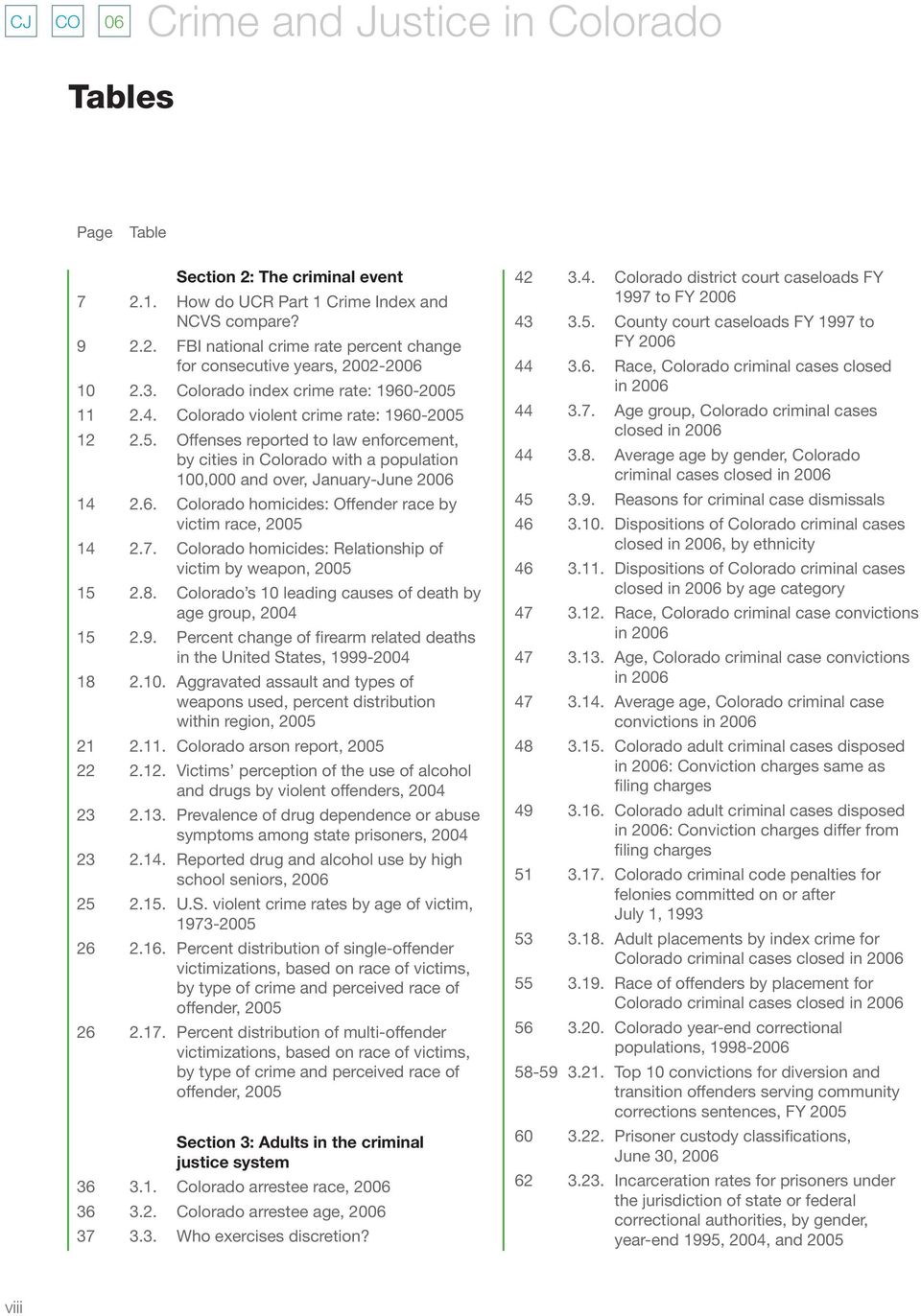
8 CJ CO 06 Crime and Justice in Colorado Tables Page Table Section 2: The criminal event How do UCR Part 1 Crime Index and NCVS compare? FBI national crime rate percent change for consecutive years, Colorado index crime rate: Colorado violent crime rate: Offenses reported to law enforcement, by cities in Colorado with a population 100,000 and over, January-June Colorado homicides: Offender race by victim race, Colorado homicides: Relationship of victim by weapon, Colorado s 10 leading causes of death by age group, Percent change of firearm related deaths in the United States, Aggravated assault and types of weapons used, percent distribution within region, Colorado arson report, Victims perception of the use of alcohol and drugs by violent offenders, Prevalence of drug dependence or abuse symptoms among state prisoners, Reported drug and alcohol use by high school seniors, U.S. violent crime rates by age of victim, Percent distribution of single-offender victimizations, based on race of victims, by type of crime and perceived race of offender, Percent distribution of multi-offender victimizations, based on race of victims, by type of crime and perceived race of offender, 2005 Section 3: Adults in the criminal justice system Colorado arrestee race, Colorado arrestee age, Who exercises discretion? Colorado district court caseloads FY 1997 to FY County court caseloads FY 1997 to FY Race, Colorado criminal cases closed in Age group, Colorado criminal cases closed in Average age by gender, Colorado criminal cases closed in Reasons for criminal case dismissals Dispositions of Colorado criminal cases closed in 2006, by ethnicity Dispositions of Colorado criminal cases closed in 2006 by age category Race, Colorado criminal case convictions in Age, Colorado criminal case convictions in Average age, Colorado criminal case convictions in Colorado adult criminal cases disposed in 2006: Conviction charges same as filing charges Colorado adult criminal cases disposed in 2006: Conviction charges differ from filing charges Colorado criminal code penalties for felonies committed on or after July 1, Adult placements by index crime for Colorado criminal cases closed in Race of offenders by placement for Colorado criminal cases closed in Colorado year-end correctional populations, Top 10 convictions for diversion and transition offenders serving community corrections sentences, FY Prisoner custody classifications, June 30, Incarceration rates for prisoners under the jurisdiction of state or federal correctional authorities, by gender, year-end 1995, 2004, and 2005 viii
9 Tables Page Table Women under the jurisdiction of state or federal correctional authorities, year-end 1995, 2004, and Fall 2006 adult inmate actual and projected Colorado prison population DCJ 10-year prison population projection first-year error rate Daily cost of adult probation in Colorado, FY Daily cost of community corrections in Colorado, FY Daily cost of the Colorado Department of Corrections offender population, FY 2006 Section 4: Juveniles in the juvenile justice system Percent of total estimated juvenile arrests that were female, and percent change in male and female total arrests State arrest rates for juveniles, Arrest of juveniles under 18 per 100,000 juveniles ages 10-17, Percent change in juvenile arrests , by gender, national data Female percent of juvenile arrests, 2003, national data Female percent of juvenile arrests: Other crimes, national data, Colorado juvenile arrests by race, Colorado juvenile arrests by age, Colorado juvenile delinquency petitions disposed in 2006: Race Colorado juvenile delinquency petitions disposed in 2006: Average age at filing Colorado juvenile delinquency adjudications and deferred adjudications in 2006: Race Colorado juvenile delinquency adjudications and deferred adjudications in 2006: Average age Adjudicated as charged: Colorado juvenile delinquency cases terminated in Adjudicated of a charge other than original filing charge: Colorado juvenile delinquency cases disposed in Juvenile placements by adjudication crime for 2006 Colorado juvenile delinquency adjudications Race of offenders by placement and gender for 2006 Colorado juvenile delinquency adjudications Juvenile commitment average daily population (ADP) forecast, June 30, 2006-June 30, Juvenile parole average daily caseload (ADC) forecast, June 30, 2006-June 30, Daily cost of juvenile probation, FY Daily cost of the Division Youth Corrections placements, FY 2006 Section 5: Recidivism Risk level and supervision outcomes of juveniles on probation in Colorado whose case terminated in FY Risk level and supervision outcomes of adult probationers whose case terminated in FY LSI score categories for designation of risk/need Race of adult drug offenders sentenced to probation Most serious conviction charge for adult drug offenders on probation Recidivism crime of adult drug offenders sentenced to probation Recidivism and criminal history of drug offenders on probation Recidivism and average LSI risk/needs scores of drug offenders on probation Race of women sentenced to probation Most serious conviction charge for women on probation Recidivism crime of women sentenced to probation Recidivism and criminal history of women on probation Recidivism and average LSI risk/needs scores of women on probation ixcrime and Justice in Colorado
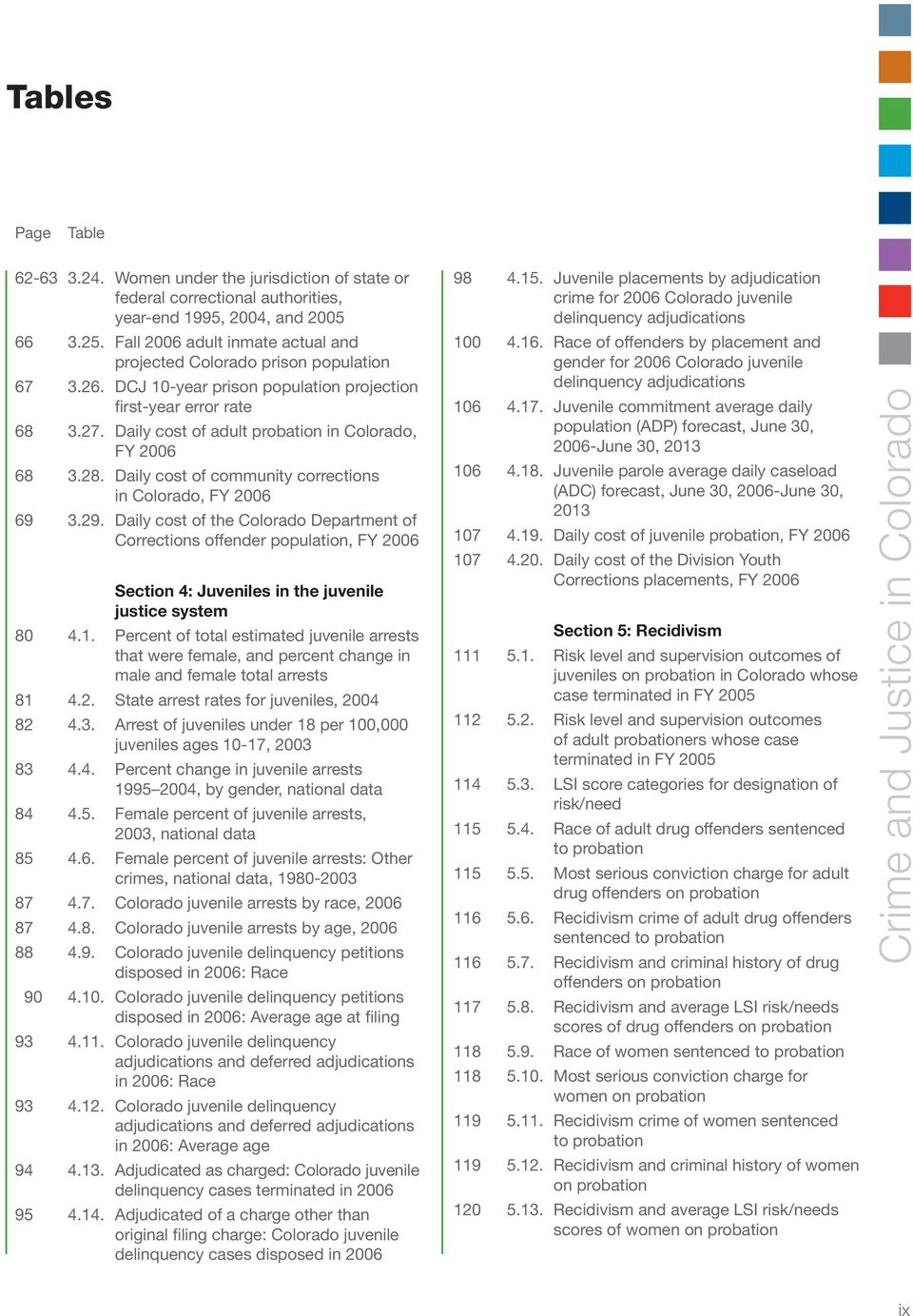
10 CJ CO 06 Crime and Justice in Colorado Tables Page Table Description of clients terminated from community corrections programs, FY 2000 to FY Specialized programming seems to lower recidivism rates Summary of recidivism findings presented in this section Section 6: Special population focus: Sex offenders Colorado Sex Offender Treatment and Management Program New arrest is correlated with fewer months in treatment Highlights of research findings of domestic violence and sexual assault Section 7: Special features Colorado education facts by race/ethnic groups, 1998, 2002, Criminal activity by age Tobacco, alcohol and other drug use, Colorado Youth Risk Behavior Survey (YRBS), Percentages of persons aged 12 or older reporting past year methamphetamine use: Top 18 States Demographic characteristics of clients admitted to treatment in Colorado, January-December Prior domestic violence treatment did not affect outcome Employment status at crime and successful versus unsuccessful domestic violence treatment discharge Domestic violence treatment status by gender Domestic violence treatment discharge status Significant predictors of administrative segregation Axis I diagnosis for mentally ill inmates Comparison of the average length of stay in administrative segregation by mental illness status x

11 Acknowledgements This report was funded by Justice Assistance Grant (JAG) grant number 24DB19642 from the U.S. Department of Justice, Bureau of Justice Assistance, Colorado Division of Criminal Justice, and obtained with approval by the Colorado JAG Board. We are grateful for the support of the JAG Board over many years. We would like to thank the many researchers who contributed to this report. Without the data analyzed and published by criminal justice researchers across the state and nation, this report would be slim indeed. In particular, we are grateful for the work of our colleagues at the Bureau of Justice Statistics in the U. S. Department of Justice. We are also grateful to research staff from following agencies: the Division of Probation Services in the Judicial Branch; Division of Youth Corrections (DYC); Department of Corrections (DOC); Colorado Bureau of Investigations (CBI); the Colorado Integrated Criminal Justice Information System (CICJIS); the Office of Adult and Juvenile Justice Assistance, Division of Criminal Justice; and the Office of Community Corrections, Division of Criminal Justice. We would also like to thank Dominique Simons for contracting with us to work on this report. We are most grateful to John Patzman and Bill Webster of 1000 Robots Design for their hard work and creative graphic design. We would like to thank our Division Director, Jeanne Smith, for her support of our work. We are also very grateful for the support of the Executive Director of the Department of Public Safety, Peter Weir. Despite all the assistance and support we have received, we alone are responsible for this report and any omission or errors that remain. Office of Research and Statistics Division of Criminal Justice Colorado Department of Public Safety June 2007 xicrime and Justice in Colorado

12 CJ CO 06 Crime and Justice in Colorado xii

13 Section 1: Introduction The Office of Research and Statistics, located in the Colorado Division of Criminal Justice, presents to the state this comprehensive picture of the criminal and juvenile justice systems. Relying heavily on graphics and a non-technical format, it brings together a wide variety of data from multiple sources, including DCJ s own databases, the Colorado Bureau of Investigation, the Colorado Judicial Branch, the Department of Corrections, and the Division of Youth Corrections. A local perspective on crime and justice is provided: twenty-six years of arrest data from all counties in the state are summarized in Section 8 of the report using data from the Colorado Bureau of Investigation. The most recent data available are presented here. Depending on the data source, the latest dates vary between 2000 and This report attempts to assist the state as it seeks to appreciate the complexity of the crime problem and the criminal justice system response.

14 CJ CO 06 Section 1 Colorado vs. nationwide It is useful to compare the information in this report with a few basic state and national reference points. Figure 1.1. Gender: Colorado and nationwide, 2005 Colorado ranked 22nd in the percentage of the population that was white. Maine was the highest at 96.6 percent. Hawaii was last at 24.9 percent. Colorado was ranked 34th for the percentage of their population that was black or African American. Washington D.C. was the highest at 56.8 percent, while Idaho was the lowest at 0.4 percent. Source: US Census Bureau. Colorado ranked fourth in the nation in 2005 in the ratio of males to females. Alaska had the highest male to female ratio. The District of Columbia had the lowest male to female ratio. Figure 1.3. Origin: Colorado and nationwide, 2005 Source: US Census Bureau. Nearly one in five Coloradoans was of Hispanic or Latino origin in Figure 1.2. Race: Colorado and nationwide, 2005 Figure 1.4. Juvenile population by race: Colorado and nationwide, 2002 Note: These categories reflect the method used by the U.S. Census Bureau to depict race. Source: US Census Bureau. Source: U.S. Department of Justice, Office of Justice Programs, Juvenile Offenders and Victims: 2006 National Report available at Ninety-seven percent of Coloradoans associated themselves with one specific race. About two percent identified themselves with two or more races. In 2002, over 90 percent of Colorado s juvenile population (ages 0-17 years old) identified themselves as either white or Hispanic.

15 Figure 1.5. Age: Colorado and nationwide, 2005 Figure 1.6. Educational attainment: Colorado and nationwide, 2005 Source: US Census Bureau. In 2005, Colorado was higher than the national average in the percentage of the population that was under 14 years old and between ages 20 and 54. Colorado ranked 47th in percentage of population 65 and older. Florida was the highest at 16.6 percent. Alaska was last at 6.6 percent. Colorado s median age is 34.7 which is younger than the national median age of In 2005, Colorado ranked 3rd in the proportion of the population holding a bachelor s degree or higher degrees, behind Washington D.C. and Massachusetts. Figure 1.7. Unemployment: Colorado and nationwide, Source: US Census Bureau. Note: Unemployment rates are percentages of available labor force. Source: US Department of Labor, Bureau of Labor Statistics. 3Introduction
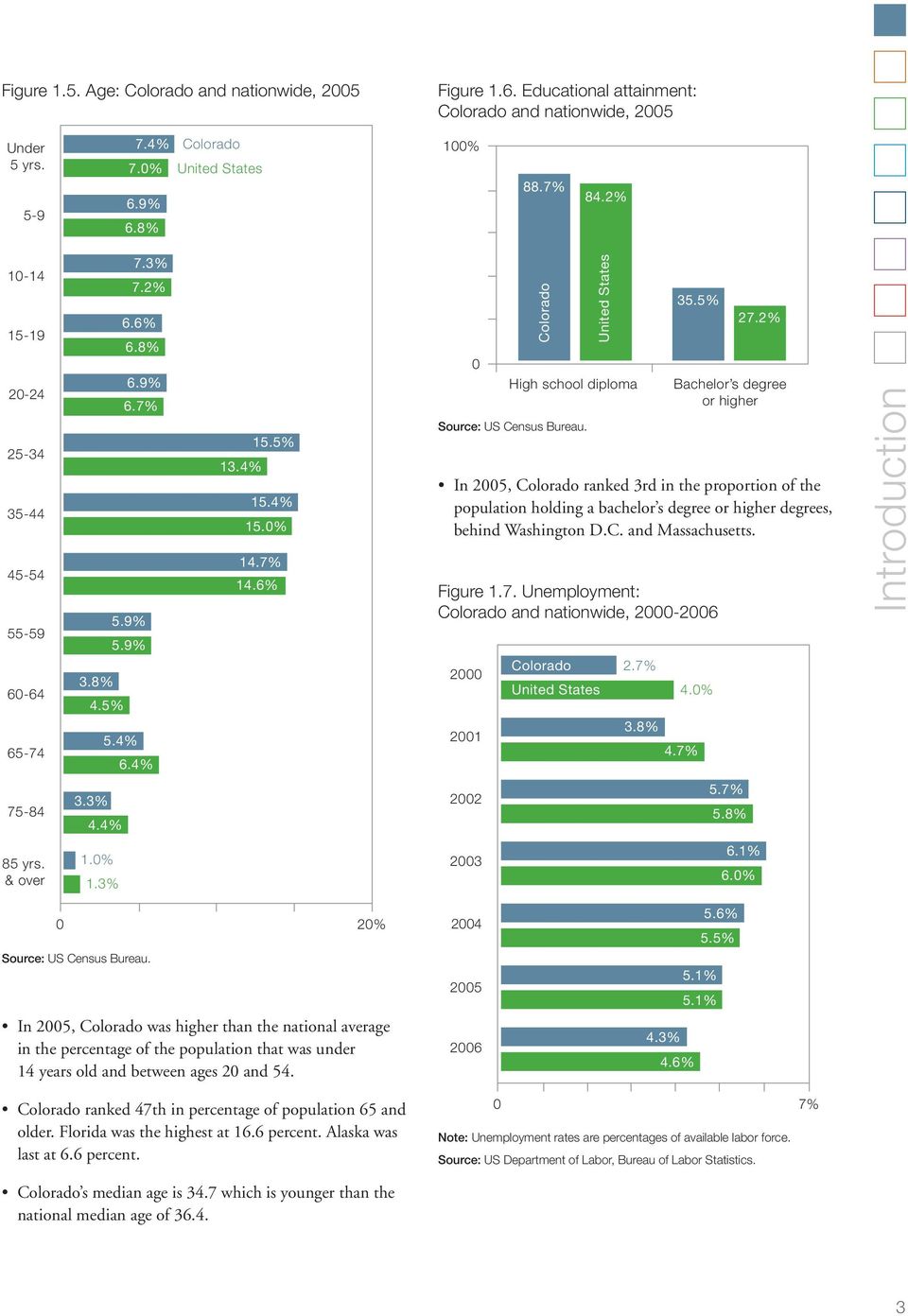
16 CJ CO 06 Section 1 In 2006, Colorado and Connecticut were ranked 23rd in average unemployment rate. Hawaii has the lowest unemployment rate of 2.4 percent, while Michigan had the highest at 6.9 percent. The unemployment rate in Colorado increased 59 percent from 2000 (2.7 percent) to 2006 (4.3 percent). 4
17 Section 2: The criminal event This section presents an overview of crime in Colorado and the nation using data that addresses such questions as: What is a crime? What do crime rates really measure? What is the difference between a felony and a misdemeanor? What are some common crimes? Data from multiple sources are used to answer questions such as: When and where does most crime occur? What do we know about school crimes? What are the characteristics of the most serious crimes? What do we know about drug related crimes? We also examine special topics such as crime victims, intimate partner violence, and family violence and sexual assault.
18 CJ CO 06 Section 2 The criminal event What is a crime? Crimes are acts and behaviors defined by law for which a formally sanctioned punishment is specified. What is included in the definition of a crime varies across federal, state and local jurisdictions. Accurately and consistently defining a crime is the first step toward the goal of obtaining accurate crime statistics. How do violent and property crimes differ? Violent crime refers to events such as homicide, rape and assault that may result in injury to a person. Robbery is also considered a violent crime because it involves the use or threat of force against a person. Violent crimes account for approximately 22 percent of all crimes perpetrated against those over the age of 12, according to the 2005 National Crime Victimization Survey published by the U.S. Bureau of Justice Statistics. Property crimes are unlawful acts with the intent of gaining property but do not involve the use or threat of force against an individual. Larceny, burglary and motor vehicle theft are examples of property crimes. Sources of crime reporting: UCR and NCVS These two sources of crime information, UCR and NCVS, concentrate on measuring certain well-defined crimes. The UCR s Part One Index and the NCVS do not include all possible criminal events. Both data sources use commonly understood definitions rather than legal definitions of crime. The UCR data reflect crimes known to law enforcement and are typically reported by the FBI as offenses and arrests. The NCVS data reflect crime victimization experiences of individuals over the age of 12 living in thousands of U.S. households. These two sources of crime information are described in detail below. The UCR Part One Index shows trends in eight major crimes. In 1927, the International Association of Chiefs of Police (IACP) formed a committee to create a uniform system for gathering police statistics. The goal was to develop a national system of statistics that would overcome variations in the way crimes were defined in different parts of the country. The FBI s UCR program began in 1929 by collecting data on seven major crimes: homicide, forcible rape, robbery, aggravated assault, burglary, larceny-theft, and motor vehicle theft. Arson was added as the eighth UCR index offense in Crimes in the index were selected based on seriousness, frequency of occurrence and likelihood of coming to the attention of police, and are used as the basis for measuring crime. Participation in the UCR Program is voluntary on the part of law enforcement agencies. In 2001, 90 percent of the U.S. population lived in UCR reporting districts. UCR data are reported by local law enforcement agencies to the Colorado Bureau of Investigation (CBI). The CBI analyzes the data for its Crime in Colorado report and also transmits it to the FBI to be included in national statistics. Since crime is a sociological phenomenon influenced by a variety of factors, the FBI discourages data users from ranking agencies and using the data as a measurement of law enforcement effectiveness. The NCVS The National Crime Victimization Survey began in 1973 to provide information about crimes that might not be reported to police. It also was developed to provide detailed information from crime victims and victimization trends over time. The survey was significantly redesigned and updated in 1993 to improve the questions and broaden the scope of crimes measured. The NCVS collects data twice each year from 42,000 households (or 76,000 people). Each household stays in the sample for three years, and new households are rotated into the sample on an ongoing basis. The U.S. Census Bureau conducts individual interviews on behalf of the U.S. Bureau of Justice Statistics, the agency mandated to manage the Survey. Thus, 160,000 interviews are conducted annually of persons age 12 or older. Crimes suffered by individuals and households when those crimes were committed against victims age 12 and over are the events counted by the NCVS. The NCVS collects detailed information on the frequency and nature of the crimes of rape, sexual assault, personal robbery, aggravated and simple assault, household burglary, theft and motor vehicle theft. It does not measure homicide or commercial crimes (such as burglaries of stores). The information collected includes information about victims (age, sex, race, ethnicity, marital status, income, and education level), offenders when known (sex, race, approximate age and victim-offender relationship) and the crime (time, place, use of weapons, nature of injury and economic consequences). Questions include experiences of victims with the criminal justice system, and self-protective measures used by the victim. The NCVS was designed to complement the UCR program, but the two sources of crime data have important 6
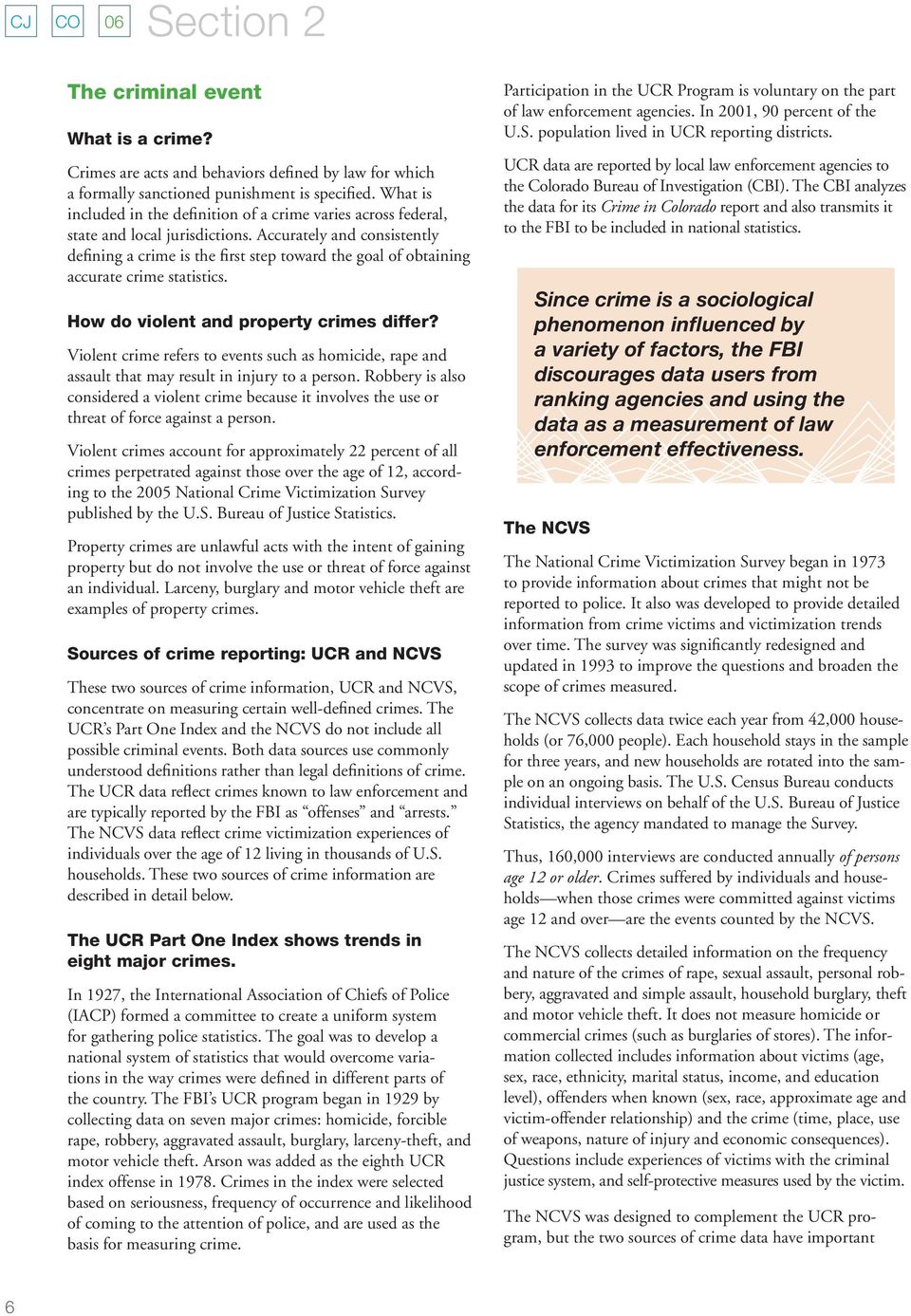
19 Total serious violent crime The number of homicides recorded by police plus the number of rapes, robberies, and aggravated assaults from the victimization survey whether or not they were reported to the police. Victimizations reported to the police The number of homicides recorded by police plus the number of rapes, robberies, and aggravated assaults from the victimization survey that victims said were reported to the police. Crimes recorded by the police The number of homicides, forcible rapes, robberies, and aggravated assaults included in the Uniform Crime Reports of the FBI excluding commercial robberies and crimes that involved victims under age 12. Arrests for violent crimes The number of persons arrested for homicide, forcible rape, robbery or aggravated assault as reported by law enforcement agencies to the FBI. differences. The two programs measure an overlapping but non-identical set of crimes. The NCVS includes crimes both reported and not reported to law enforcement and it excludes crimes against children under the age of 12, wheras UCR data reflect only offenses reported to the police. Unlike the NCVS, the UCR data includes information on Figure 2.1. Nationwide: Four measures of all violent crime Table 2.1. How do the UCR Part 1 Crime Index and the NCVS compare? Offenses measured: Uniform Crime Reports (UCR) Part 1 Index Crimes Homicide Rape Robbery (Personal and Commercial) Assault (Aggravated) Burglary (Commercial and Household) Larceny (Commercial and Household) Motor Vehicle Theft Arson Notes: The serious violent crimes included are rape, robbery, aggravated assault, and homicide. Because of changes made to the victimization survey, data prior to 1992 are adjusted to make them comparable to data collected under the redesigned methodology. Estimates for 1993 and beyond are based on collection year while earlier estimates are based on data year. Source: National Crime Victimization Survey and Uniform Crime Reports available at Bureau of Justice Statistics glance/cv2.htm. homicide, arson, commercial crimes and crime against children under the age of 12. In addition, the NCVS is based on a sample and so a margin of error exists, as with all samples. The UCR includes actual counts of offenses reported by law enforcement jurisdictions. National Crime Victimization Survey (NCVS) Rape/Sexual Assault Robbery (Personal) Assault (Simple and Aggravated) Burglary (Household) Larceny (Personal and Household) Motor Vehicle Theft Vandalism Scope: Crimes reported to police in most jurisdictions. Crimes reported and not reported to police; committed against victims age 12 or older; data are for the nation as a whole. Collection method: Police department reports to FBI. Survey interview. Data are obtained annually from a nationally representative sample of 77,200 households, comprised of nearly 134,000 persons on the frequency, characteristics and consequences of criminal victimization in the United States. Kinds of information: Crime counts, persons arrested, crime clearances, law enforcement officers killed and assaulted and characteristics of homicide victims. Details about victims (age, race, sex, education, income, and relationship to offender) and crimes (time and place of occurrence, whether reported to police, use of weapons, economic consequences). Sponsor: Department of Justice, Federal Bureau of Investigation Department of Justice, U.S. Census Bureau Note: The UCR measures all reported crime; Part 1 of the Crime Index includes the offenses reported in this table. Source: Federal Bureau of Investigation and the Bureau of Justice Statistics, U.S. Department of Justice. The Criminal Event
20 CJ CO 06 Section 2 What are clearance rates? To be included in crime statistics, the act must be reported to law enforcement. Not all crimes are reported to police agencies, and not all reported crime results in an arrest. Consequently, crime statistics collected by law enforcement agencies typically fall into two categories: information on known offenses and persons arrested by police departments. An offense is cleared by arrest or solved for crime reporting purposes when at least one person is (1) arrested, or (2) charged with the commission of the offense and turned over to the court for prosecution (whether following arrest, court summons, or police notice-to-appear). Also, although no physical arrest is made, a clearance by arrest can be claimed when the offender is a person under 18 years of age and is cited to appear in juvenile court or before other juvenile authorities. Several crimes may be cleared by the arrest of one person, or the arrest of many persons may clear only one crime. Further, if several persons are involved in the commission of a crime and only one is arrested and charged, the crime is listed as cleared by arrest. If the other persons involved in the crime are arrested at a later date, no record will be made of a clearance by arrest since the offense was already cleared following the arrest of the first person. The number of offenses and not the number of persons arrested are counted in the clearances recorded by law enforcement. According to the Federal Bureau of Investigation, approximately half of the nation s violent crimes and between 16 and 18 percent of nonviolent crimes are cleared by arrest. These figures have remained stable for decades. In 2005, two out of three murders and 41 percent of rapes were Figure 2.2. FBI clearance rates, 2005 Note: In its calculations, the FBI s Uniform Crime Report counts the number of offenses that are cleared, not the number of arrestees. Source: Crime in the United States Department of Justice Federal Bureau of Investigation, September cleared by arrest but only 13 percent of burglaries and 13 percent of motor vehicle thefts were cleared. Law enforcement agencies in the nation s smallest cities, those with less than 10,000 inhabitants, had the highest percentage of clearances for several offense types 58.6 percent of violent crimes, 43.8 percent of forcible rapes, 36.0 percent of robbery offenses, 65.1 percent of aggravated assaults, 16.4 percent of larceny-thefts, and 23.9 percent of motor vehicle thefts. Colorado law enforcement agencies discontinued reporting clearance rates to the Colorado Bureau of Investigation in Clearance rates in Colorado are therefore only available from local agencies when those data are recorded. How much crime is therein Colorado? In 2005, a total of 225,134 adult arrests were made by law enforcement agencies in Colorado, according to the Colorado Bureau of Investigation. Another 47,596 arrests of juveniles occurred. Between 2004 and 2005, the number of homicides decreased by almost 15 percent, numbering 170 victims. Seventy percent of the homicide victims were male; 73 percent of the perpetrators were male. The relationship between the victim and the perpetrator was unknown in 43 percent of homicide cases, but of those cases when the relationship was documented, the victim and the offender knew each other in 79 percent of the cases, according the the Colorado Bureau of Investigation Supplemental Homicide Report. In 2005, 109 of the 170 victims were killed with a firearm and 28 were killed with a knife. Apart from homicide, all other index crimes increased in Colorado in Burglaries accounted for about 52 percent of the index crimes reported in Colorado, with nearly 34,000 reported in Motor vehicle thefts increased about 10 percent between 2004 and 2005, with more than 25,000 vehicles reported stolen. Serious assault was the most common major offense reported in Colorado in 2005, followed by burglary. A total of 39,003 assaults and 33,750 burglaries were reported in Colorado in 2005, an increase from the prior year of 11.5 percent and 6.5 percent, respectively. Burglaries accounted for 51 percent of the major offenses reported to law enforcement, and half of these were forced entries. Where does most crime occur in Colorado and nationwide? In 2005, the latest year for which data are available, about a quarter of incidents of violent crime occurred at or near the victim s home.

21 Common locales for violent crimes were on streets other than those near the victim s home (19 percent), at school (12 percent), or at a commercial establishment (8 precent). About half occurred within a mile from home and 76 percent within five miles. Only 4 percent of victims of violent crime reported that the crime took place more than fifty miles from their home. Twenty-two percent of victims of violent crime reported being involved in some form of leisure activity away from home at the time of their victimization. Twenty-two percent said they were at home, and another 19 percent mentioned they were at work or traveling to or from work when the crime occurred. Source: When does most crime occur? Nationwide, in 2005, 53 percent of violent crimes occured during the day. This is the same proportion of violent crimes occuring during the day that victims reported in However, some crimes exhibited different patterns. For example, according to the National Crime Victimization Survey (NCVS), almost two-thirds of rapes/sexual assaults occurred at night 6 p.m. to 6 a.m. One out of four sexual assaults occurred while the victim was at home according to this national data. Source: Is crime increasing or decreasing? Overall, crime rates remain relatively low. Nationwide and in Colorado, crime in 2003 was at its lowest point since It can be expected that rates will increase following a period of significant decline. In the past few years in Colorado, serious crime rates varied somewhat. Homicide rates remained relatively stable since 1996, totalling between 150 and 200 per year, and decreasing between 2004 and But forcible rape rates generally increased in the past decade, as have motor vehicle thefts. Burglary and robbery remained relatively stable over the past decade, increasing slightly in the past few years. According to the Federal Bureau of Investigation (FBI), law enforcement agencies nationwide reported an increase of 1.3 percent in the number of violent crimes brought to their attention in 2006 when compared to figures reported for The violent crime category includes murder, forcible rape, robbery, and aggravated assault. The number of index property crimes in the United States from January to June of 2006 decreased 2.9 percent when compared to data from the same time period in Property crimes include burglary, larceny-theft, and motor vehicle theft. Arson is also a property crime, but data for arson are not included in property crime totals. Figures for 2006 indicate that arson increased 1.8 percent when compared to 2005 figures for the same time period. The violent crime rate remains at a near-historic low. Table 2.2. FBI national crime rate percent change for consecutive years, Years Violent crime Murder Forcible rape Robbery From 1960 to 1970, the national violent crime rate per 100,000 population (as measured by FBI index crimes of manslaughter, forcible rape, robbery and aggravated assault) rose 126 percent. From 1970 to 1980 the violent crime rate rose 65 percent. From 1980 to 1990 it rose 23 percent. Then, between 1990 and 2001, it dropped 25 percent nationally, and by 50% in Colorado. In Colorado, the overall crime rate has (index crimes reported to law enforcement), has increased about four percent overall in recent years. Property crimes in Colorado have increased about two percent but aggravated assault increased 17 percent between 2003 and The 2003 rate was at its lowest since1972. In 2002 the U.S. violent crime rate was at the lowest level ever recorded. The violent crime rate increased to a peak in 1981 interrupted only by a 1-year decline in For the following five years until 1986, the rate decreased. From 1986 to 1993 Agg. assault Property crime Burglary Larceny/ theft Motor veh. theft 2003/ / / / Source: Federal Bureau of Investigation, Crime in the United States 2006 Preliminary Annual Uniform Crime Report, Table 3 available at Arson 9The Criminal Event
22 CJ CO 06 Section 2 Table 2.3. Colorado index crime rate: Year Population Index offense rate* ,753, ,781, ,907, ,961, ,966, ,969, ,977, ,975, ,048, ,100, ,207, ,283, ,357, ,437, ,496, ,534, ,583, ,619, ,670, ,772, ,878, ,963, ,045, ,139, ,178, ,231, ,267, ,296, ,290, ,317, ,294, ,377, ,470, ,566, ,656, ,747, ,823, ,893, ,971, ,056, ,301, ,417, ,501, ,547, ,601, ,665, Notes: *The index offense rate represents the violent and property crime rates. State offense totals are based on data from all reporting agencies and estimates for unreported areas. Rates are the number of reported offenses per 100,000 population. Source: FBI, Uniform Crime Reports, prepared by the National Archive of Criminal Justice Data available at Search/Crime/State/StateCrime.cfm. the rate of violent crime increased to a level slightly below the 1981 peak. A decline in the violent crime rate began in 1994 and continued through 2002 to the lowest level ever recorded. The crime rate, as recorded by local law enforcement agencies and reported to the FBI, has increased slightly in recent years but findings from the National Crime Victimization Survey show stable or slight declines across most crime types. Figure 2.3. Colorado s violent vs. property crime rates, Notes: State offense totals are based on data from all reporting agencies and estimates for unreported areas. Rates are the number of reported offenses per 100,000 population. Source: FBI, Uniform Crime Reports, prepared by the National Archive of Criminal Justice Data available at the Bureau of Justice Statistics Data Online Figure 2.4. Nationwide: National Victimization Survey (NCVS) violent crime trends, Notes: Estimates for 1993 and beyond are based on collection year while earlier estimates are based on data year. Rape does not include sexual assault. Rates per 1,000 population. Source: National Crime Victimization Survey and Uniform Crime Reports. Homicide rates for 2005 are estimated based on 2005 Preliminary Annual Release; data available at the Bureau of Justice Statistics usdoj.gov/bjs/glance/viort.htm. 10
23 Table 2.4. Colorado violent crime rate: Year Population Violent crime rate Murder and non-negligent manslaughter rate Forcible rape rate Robbery rate Aggravated assault rate ,753, ,781, ,907, ,961, ,966, ,969, ,977, ,975, ,048, ,100, ,207, ,283, ,357, ,437, ,496, ,534, ,583, ,619, ,670, ,772, ,878, ,963, ,045, ,139, ,178, ,231, ,267, ,296, ,290, ,317, ,294, ,377, ,470, ,566, ,656, ,747, ,823, ,893, ,971, ,056, ,301, ,417, ,501, ,547, ,601, ,665, Notes: State offense totals are based on data from all reporting agencies and estimates for unreported areas. Rates are the number of reported offenses per 100,000 population. Source: FBI, Uniform Crime Reports, prepared by the National Archive of Criminal Justice Data available at The Criminal Event 11
24 CJ CO 06 Section 2 Table 2.5. Offenses reported to law enforcement, by cities in Colorado with a population 100,000 and over, January-June 2006 City Year Population* Violent crime Murder Forcible rape Robbery Agg. assault Arvada , , Aurora ,888 1, ,855 1, ,023 Centennial , , Colorado Springs ,482 1, , ,807 2, ,267 Denver ,552 4, ,429 2, ,465 4, ,280 2,652 Fort Collins , , Lakewood , , Pueblo , , Thornton , , Westminster , , City Year Population* Property crime Burglary Larceny/ theft Motor veh. theft Arson** Arvada ,983 3, , ,932 3, , Aurora ,888 14,718 2,474 9,502 2, ,855 12,804 2,469 8,292 2, Centennial ,607 2, , ,100 1, , Colorado Springs ,482 19,605 3,668 14,162 1, ,807 18,071 3,346 12,936 1, Denver ,552 33,853 7,341 18,506 8, ,465 26,266 6,543 13,376 6, Fort Collins ,727 4, , ,446 4, , Lakewood ,259 8,445 1,273 5,738 1, ,331 6,995 1,182 4,710 1, Pueblo ,057 6,981 1,525 4, ,452 6,317 1,453 4, Thornton ,487 4, , ,171 4, , Westminster ,211 5, , ,071 4, , Notes: *The 2006 population figures are FBI estimates based on provisional data from the U.S. Census Bureau. **The FBI does not publish arson data unless it receives 6 months data from either the agency or the state for 2005 and/or Source: Federal Bureau of Investigation, Crime in the United States 2006 Preliminary Annual Uniform Crime Report, Table 4 available at 12
25 Characteristics of the most serious crimes Homicide Causing the death of another person without legal justification or excuse. Facts Homicide is the least frequent violent crime. 1 A special analysis of FBI data for the years found that blacks are disproportionately represented as both homicide victims and offenders. The victimization rates for blacks were 6 times higher than those for whites. The offending rates for blacks were 7 times higher the rates for whites. Source: Homicide trends in the United States by James Alan Fox and Marianne W. Zawitz, available at bjs/homicide/homtrnd.htm Homicide rates recently declined to levels last seen in the late 1960s. In fact, in 2000, the national homicide rate was at its lowest point since Nationwide, the homicide rate has been declining since However, in 2006, murder increased 0.3 percent. 3 In 2005 there were 170 homicide victims in Colorado. Figure 2.5. Homicide victimization, Note: Rate per 100,000 population. Source: FBI, Uniform Crime Reports, available at About 33 percent of female murder victims compared to 4 percent of the males were killed by an intimate partner. In 2005, a firearm was used in 64 percent of Colorado homicides. A knife was used in 16 percent of homicides. Non-whites compared to whites are at a greater risk of being a homicide victim. Thirty-one percent of homicides followed arguments. Circumstances surrounding the crime were unknown for 42 percent of homicides. Figure 2.6. Colorado and U.S. homicide rates, The Criminal Event In Colorado, the relationship between the victim and the perpetrator remained unknown or unreported in 43.5 percent of the 170 homicides reported to CBI in For cases when the relationship was known, about 19 percent were strangers. 1 Bureau of Justice Statistics, Key Facts at a Glance, available from 2 Bureau of Justice Statistics, Key Facts at a Glance, available from 3 Federal Bureau of Investigation, Crime in the United States 2006 Preliminary Annual Uniform Crime Report, available at Notes: Rates are the number of reported offenses per 100,000 population. State offense totals are based on data from all reporting agencies and estimates for unreported areas. The murder and nonnegligent homicides that occurred as a result of the events of September 11, 2001 are not included. Sources: FBI, Uniform Crime Reports, prepared by the National Archive of Criminal Justice Data available at Bureau of Justice Statistics jp.usdoj.gov/dataonline/search/crime/state/statebystate.cfm. 13
26 CJ CO 06 Section 2 Table 2.6. Colorado homicides: Offender race by victim race, 2005 Victim race Offender race Asian Black White Unknown Total American Indian Asian Black White Unknown Total Note: There can be multiple victims and/or offenders involved in one incident, so the total number in the table exceeds the number of total homicides in 2005 Source: Colorado Bureau of Investigation, Supplemental Homicide Report, Table 2.7. Colorado homicides: Relationship of victim by weapon, 2005 Relationship of victim Blunt object Weapon Firearm Handgun Knife Motor vehicle Other weapon Unknown Acquaintance Boyfriend/girlfriend Child/stepchild Friend Other family member Parent/stepparent Spouse/common law/ ex-spouse Stepsibling Stranger Unknown Total Total Note: There can be multiple victims and/or offenders involved in one incident, so the total number in the table exceeds the number of total homicides in Source: Colorado Bureau of Investigation, Supplemental Homicide Report, Figure 2.7. Colorado and US firearm-related death rates, Note: Rate per 100,000 population. Source: National Center for Health Statistics, National Vital Statistics System; available at the Centers for Disease Control and Prevention 14
27 Table 2.8. Colorado s 10 leading causes of death by age group, 2004 Age groups Rank < All ages Congenital Anomalies 103 Short Gestation 57 SIDS 45 Maternal Pregnancy Comp. 29 Placenta Cord Membranes 20 Neonatal Hemorrhage 19 Bacterial Sepsis 14 Circulatory System Disease 14 Intrauterine Hypoxia 14 Unintentional Injury 13 Unintentional Injury 16 Homicide 7 Congenital Anomalies 4 Septicemia 3 Heart Disease 2 Malignant Neoplasms 2 Influenza & Pneumonia 1 Unintentional Injury 16 Malignant Neoplasms 9 Congenital Anomalies 2 Heart Disease 2 Homicide 2 Benign Neoplasms 1 Influenza & Pneumonia 1 Menigitis 1 Unintentional Injury 14 Suicide 11 Malignant Neoplasms 7 Heart Disease 3 Homicide 3 Cerebrovascular 2 Chronic Low. Respiratory Disease 2 Benign Neoplasms 1 Diabetes Mellitus 1 Influenza & Pneumonia 1 Unintentional Injury 248 Suicide 103 Homicide 56 Malignant Neoplasms 16 Heart Disease 11 Congenital Anomalies 8 Chronic Low. Respiratory Disease 2 Complicated Pregnancy 2 Influenza & Pneumonia 2 Anemias 1 Unintentional Injury 217 Suicide 133 Malignant Neoplasms 54 Homicide 47 Heart Disease 29 Congenital Anomalies 10 Diabetes Mellitus 10 Cerebrovascular 8 Liver Disease 8 HIV 6 Unintentional Injury 274 Malignant Neoplasms 168 Suicide 168 Heart Disease 139 Liver Disease 56 Homicide 35 HIV 33 Cerebrovascular 27 Diabetes Mellitus 27 Viral Hepatitis 13 Malignant Neoplasms 593 Heart Disease 377 Unintentional Injury 280 Suicide 198 Liver Disease 137 Cerebrovascular 75 Diabetes Mellitus 57 Chronic Low. Respiratory Disease 55 Viral Hepatitis 36 HIV 32 Malignant Neoplasms 1,131 Heart Disease 627 Chronic Low. Respiratory Disease 196 Unintentional Injury 161 Cerebrovascular 121 Liver Disease 100 Diabetes Mellitus 95 Suicide 95 Influenza & Pneumonia 41 Septicemia 35 Heart Disease 4,876 Malignant Neoplasms 4,216 Chronic Low. Respiratory Disease 1,628 Cerebrovascular 1,403 Alzheimer s Disease 901 Unintentional Injury 571 Influenza & Pneumonia 543 Diabetes Mellitus 506 Atherosclerosis 428 Nephritis 343 Malignant Neoplasms 6,196 Heart Disease 6,079 Chronic Low. Respiratory Disease 1,899 Unintentional Injury 1,810 Cerebrovascular 1,638 Alzheimer s Disease 912 Suicide 797 Diabetes Mellitus 696 Influenza & Pneumonia 637 Atherosclerosis 445 The Criminal Event Source: National Center for Health Statistics, National Vital Statistics System available at the Centers for Disease Control and Prevention Table 2.9. Percent change of firearm related deaths in the United States, State 2004 Death rate Percent Change State 2004 Death rate Percent Change State 2004 Death rate Percent Change Massachusetts % Washington % North Carolina % Hawaii % Utah % Kentucky % Rhode Island % Illinois % Oklahoma % New Jersey % California % South Carolina % Connecticut % Pennsylvania % West Virginia % New York % Kansas % Wyoming % New Hampshire % Texas % Montana % Minnesota % Michigan % Tennessee % Iowa % Oregon % Arkansas % Maine % Florida % New Mexico % North Dakota % Virginia % Arizona % Nebraska % Colorado % Alabama % Wisconsin % Indiana % Mississippi % Delaware % Maryland % Nevada % Ohio % Idaho % Alaska % South Dakota % Missouri % Louisiana % Vermont % Georgia % District of Columbia % Note: Rate per 100,000 population. Source: National Center for Health Statistics, National Vital Statistics System; available at the Centers for Disease Control and Prevention 15
28 CJ CO 06 Section 2 Forcible rape Unlawful sexual penetration by force or without legal or factual consent regardless of the victim s age, or not forcibly or against the person s will where the victim is incapable of giving consent. Only forcible rapes where the victim is a female are counted under this category. Figure 2.8. National rape rates: National Crime Victimization Survey (NCVS), ,797 or 91.2% of the rapes were reported as completed forcible rapes, and 174 or 8.8% of the rapes were reported as attempted offenses. 5 Figure 2.9. Colorado forcible rape offenses, Source: Crime in Colorado, 2005, at major%20crime/rape.htm. Note: The National Crime Victimization Survey redesign was implemented in 1993; the area with the lighter shading is before the redesign and the darker area after the redesign. The data before 1993 are adjusted to make them comparable with data collected since the redesign. Rate per 1,000 persons age 12 and over. Source: National Crime Victimization Survey, Criminalization Victimization, Bureau of Justice Statistics, available at bjs/glance/rape.htm. Facts A 1998 confidential survey of a sample of 1,802 Colorado men and women by the Department of Public Health and Environment found that 14 percent of women and 2 percent of men reported experiencing a completed rape at some point in their life. 4 The 1998 Colorado study estimated that fewer than 16 percent of rapes were reported to law enforcement. According to the Colorado Bureau of Investigation s Crime in Colorado, 2005, a total of 1,971 forcible rapes were reported by law enforcement agencies in Colorado in 2005, a 5.4% increase in forcible rapes over Forcible rape accounted for 3.0% of the major offenses reported in Colorado in Colorado Sexual Assault Prevention Program and the Colorado Coalition Against Sexual Assault (1999). Sexual Assault in Colorado: Results of a 1998 Statewide Survey. Colorado Department of Public Health and Environment, Injury Epidemiology Program, Denver, Colorado. The National Violence Against Women (NVAW) study found that 21.6 percent of rape victims were younger than age 12 when they were first raped, and 32.4 percent were ages 12 to In the NVAW, 19.1percent of women and 12.9 percent of men who were raped since their 18th birthday said their rape was reported to the police. The Rape In America study found that only 22 percent of the women were raped by strangers: 7,8 9 percent were raped by a husband or ex-husband 11 percent were raped by their father / stepfather 10 percent were raped by a boyfriend 16 percent were raped by other relatives 5 Crime in Colorado, 2005, available at major%20crime/rape.htm. 6 Tjaden, P. and Thoennes, N. (2006). Extent, Nature and Consequences of Rape Victimization: Findings from the National Violence Against Women Survey, National Institute of Justice and the Center for Disease Control. Research in Brief from the National Institute of Justice. Report available from the National Criminal Justice Reference Service, Report NCJ Kilpatrick, D.G., Edmunds, C.N., & Seymour, A. (1992). Rape in America: A Report to the Nation. National Center for the Victims of Crime Center and the Medical University of South Carolina Treatment Center. Charleston, South Carolina. 8 Tjaden, P. and Thoennes, P. (2000). Full Report of the Prevalence, Incidence, and Consequences of Violence Against Women: Findings From the National Violence Against Women Survey, National Institute of Justice and the Center for Disease Control. Report available from the National Criminal Justice Reference Service, Report NCJ
29 29 percent were raped by other non-relatives 3 percent refused to answer In a study by trained interviewers, 4,023 adolescents were asked about a range of sexual acts including unwanted penetration and sexual touching. The sexual assault prevalence rate in this study of adolescents was1.8 for lifetime victimization. Other lifetime rape prevalence rates reported by adolescents were as follows: 9 Whites: 6.7percent Blacks: 13.1 percent Hispanics: 10.0 percent Native Americans: 15.7 percent Asians: 6.5 percent Girls: 13.0 percent Boys: 3.4 percent In addition, 74% of the adolescent victims reported that the crime involved someone they knew: 32.5 percent friends 21.1 percent family members (fathers or stepfathers, brothers or step, sisters or step, grandparents, other relatives 23.2 percent strangers Most of the assaults occurred in the victim s home or neighborhood: 30.5 percent in victim s home 23.5 percent in victim s neighborhood 15.4 percent at victim s school child protective services were notified, 5 percent told school authorities, and1.3 percent reported to other authorities. Overall, however, 86 percent did not report the assault. Robbery Unlawful taking or attempted taking of property that is in the immediate possession of another, by force or threat of force. Facts Only 13 percent of the adolescents interviewed reported the sexual assault to the police. Between 2004 and 2005, robbery rates increased 4.4 percent nationally 10 and 6.4 percent in Colorado. 11 Then in 2006, national robbery rates increased 6.0 percent. 12 The National Crime Victimization Survey (NCVS) found the victimization rate (per 1,000 persons age 12 or older) was 2.1 in 2004 and 2.6 in Robberies accounted for 5.9 percent of the major offenses reported in Colorado in A firearm was used in 42.3 percent of Colorado robberies in 2004, a notable increase from 2003 when a firearm was used in one-third of the robberies. 15 Nationwide in 2005, most robberies (44.1 percent) were committed on streets or highways. 16 The Criminal Event The National Violence Against Women (NVAW) study found that 3 percent of total rapes resulted in a conviction and 2 percent of total rapes resulted in incarceration (Tjaden and Thoennes, 2006). Only 13 percent of the adolescents reported the sexual assault to the police. In some cases, reports were made to multiple authorities: 5.8 percent reported that officials at 9 Kilpatrick,D.G.,Saunders, B.E., and Smith, D.W. (2003). Youth Victimization: Prevalence and Implications. National Institute of Justice, U.S. Department of Justice. Report available from the National Criminal Justice Reference Service, Report NCJ According to the FBI, the average dollar value of property stolen per robbery offense in 2005 was $1,230. By location type, bank robbery had the highest average dollar value taken $4,169 per offense. 10 Federal Bureau of Investigation, Crime in the United States, 2005, available at 11 Colorado Bureau of Investigation, Crime in Colorado 2005, available at 12 Federal Bureau of Investigation, Crime in the United States 2006 Preliminary Annual Uniform Crime Report, available at 13 Catalano, S.M. (2006). Criminal Victimization, Bureau of Justice Statistics, U.S. Department of Justice. Report available from the National Criminal Justice Reference Service, Report NCJ Colorado Bureau of Investigation, Crime in Colorado 2005, available at 15 Colorado Bureau of Investigation, Crime in Colorado 2005, available at 16 Federal Bureau of Investigations Crime in the United States 2005, available at 17
30 CJ CO 06 Section 2 The National Crime Victimization Survey (NCVS) found that about 52 percent of robberies were reported to police in 2005; 70 percent of women reported the crime compared to 46 percent of men. Robberies involving strangers were reported by 48 percent whereas those involving nonstrangers were reported by 71 percent of victims. 17 The NCVS found robbery was less likely to have been reported to the police when the victim thought the offender was a gang member. 18 Assault Unlawful intentional inflicting, or attempted inflicting, of injury upon the person of another. Aggravated assault involves serious bodily injury or unlawful threat or attempt to inflict bodily injury or death by means of a deadly dangerous weapon with or without actual infliction of injury. Simple assault is the unlawful intentional inflicting of less than serious bodily injury without a deadly or dangerous weapon or an attempt or threat to inflict bodily injury without a deadly weapon. Facts In looking at 2- and 10-year national trends, the FBI reported that the number of aggravated assaults in 2005 increased 1.8 percent from the 2004 figures but declined 16.8 percent from the 1996 figures. 19 After increasing for a few years in the early 1990s, the assault (which includes aggravated and simple assault, and intimidation) rate in Colorado was lower in 2003 than it was in Between 2004 and 2005 in Colorado, the assault offense rate increased almost 10 percent while the arrest rate declined 17 percent. 20 The 2005 National Crime Victimization Survey (NCVS) found that 62 percent of aggregated assaults and 42 percent of simple assaults were reported to police. Women were more likely than men to report assaults, and assaults resulting in injury were more likely to be reported than those without injury. 21 Burglary Unlawful entry of any fixed structure, vehicle, or vessel used for a residence, industry, or business, with or without force, with the intent to commit a felony or a theft. Facts Between 1994 and 2000, household burglaries decreased nationwide by over 40 percent. Between 2004 and 2005, burglaries increased about 1 percent nationally. 22 Household burglary victimizations remained stable between 2004 and 2005, according to the National Crime Victimization Survey (NCVS). 23 Table Aggravated assault and types of weapons used, percent distribution within region, 2005 Region Total all weapons* Firearms Knives or cutting instruments Other weapons (clubs, blunt objects, etc.) Personal weapons (hands, fists, feet, etc.) Total 100.0% 21.0% 18.9% 35.1% 25.0% Northeast 100.0% 15.6% 20.4% 33.3% 30.7% Midwest 100.0% 21.3% 17.0% 33.1% 28.6% South 100.0% 22.7% 19.9% 36.1% 21.3% West 100.0% 20.0% 17.6% 35.1% 27.3% Note: *Due to rounding, the percentages may not add up to 100 percent. Source: Federal Bureau of Investigation, Crime in the United States, Bureau of Justice Statistics (2006). Criminal Victimization in the United States, 2005 Statistical Tables. Table 93. Report available from the National Criminal Justice Reference Service, Report NCJ Bureau of Justice Statistics (2003), Special Report: Reporting crime to the police, Report available from the National Criminal Justice Reference Service, Report NCJ Federal Bureau of Investigation, (2006). Crime in these United States, Available at aggravated_assault.html. 20 Colorado Bureau of Investigation, Crime in Colorado, Available at arrest.htm. 21 Bureau of Justice Statistics (2006). Criminal Victimization in the United States, 2005 Statistical Tables. Table 93. Report available from the National Criminal Justice Reference Service, Report NCJ Federal Bureau of Investigation, (2006). Crime in these United States, Available at 23 Catalano, S.M. (2006). Criminal Victimization, Bureau of Justice Statistics, U.S. Department of Justice. Report available from the National Criminal Justice Reference Service, Report NCJ
31 Figure Colorado burglary offenses, without force and without deceit, with intent to permanently deprive the owner of the property. Larceny includes pocket picking and purse snatching. Facts Source: Colorado Bureau of Investigation (2006). Crime in Colorado The burglary rate in Colorado in 2003 was one-third the rate it was in 1980, but the rate increased 6.5 percent between 2004 and Burglary accounted for 52 percent of major crimes reported in Colorado in Forced entries accounted for half of the burglary reports; for the remainder of the burglaries, entry was unlawful but not forced. 25 The National Crime Victimization Survey (NCVS) found that 56 percent of the nation s burglaries were reported to police in 2005; 75 percent of victims reported burglaries with forced entry while 47 percent reported burglaries without forced entry. 26 Burglary accounted for 52 percent of major crimes reported in Colorado in Forced entries accounted for half of the burglary reports; for the remainder of the burglaries, entry was unlawful but not forced. Larceny and theft rates in Colorado went down by 36 percent between1980 and 2002; between 2004 and 2005 rates increased 3.7 percent. 27 Nationally, from 2004 to 2005 the rate of larceny-thefts declined 3.2 percent. Between 1996 and 2005, the rate declined 23.3 percent. 28 In 2005, the FBI reported that the average value for property stolen during the commission of a larceny-theft was $764 per offense. In 2005, the FBI reported that the average value for property stolen during the commission of a larceny-theft was $764 per offense. Nationwide, two-thirds of all property crime involved theft and larceny. 29 The National Crime Victimization Survey (NCVS) found that 32 percent of completed thefts are reported to police. As the value of the loss increases, victims are more likely to report the crime to police: 53 percent of victims with a loss greater than $250 reported the crime to law enforcement. 30 Just over one-fourth (29 percent) of the Anglo victims in the NCVS survey and 20 percent of the Black respondents told researchers that they did not report the crime because the object was recovered or the offender was otherwise unsuccessful. 31 The Criminal Event Larceny-theft Unlawful taking or attempted taking of property other than a motor vehicle from the possession of another, by stealth, 24 Colorado Bureau of Investigation (2006). Crime in Colorado: Available at 25 Colorado Bureau of Investigation (2006). Crime in Colorado: Available at 26 Bureau of Justice Statistics (2006). Criminal Victimization in the United States, 2005 Statistical Tables. Table 93a. 27 Colorado Bureau of Investigation (2006). Crime in Colorado: Available at offense.htm. 28 Federal Bureau of Investigation, (2006). Crime in these United States, Available at larceny-theft.html. 29 Federal Bureau of Investigation, (2006). Crime in these United States, Available at larceny-theft.html. 30 Bureau of Justice Statistics (2006), Criminal Victimization in the United States, 2005 Statistical Tables, Table 93a. Report available from the National Criminal Justice Reference Service, Report NCJ Bureau of Justice Statistics (2006), Criminal Victimization in the United States, 2005 Statistical Tables. Table 105. Report available from the National Criminal Justice Reference Service, Report NCJ
32 CJ CO 06 Section 2 Motor vehicle theft Unlawful taking or attempted taking of a self-propelled road vehicle owned by another, with the intent of depriving the owner of it permanently or temporarily. Figure Colorado motor vehicle theft offenses, Facts In 2005 in Colorado, 25,315 motor vehicle thefts were reported to law enforcement, an 8.4 percent increase over the prior year. Motor vehicle thefts (MVT) accounted for 38.9 percent of the major offenses reported in Colorado. Automobiles accounted for 81percent of the vehicles stolen, and trucks or buses accounted for 12 percent of the vehicles stolen (1 percent were classified as other vehicle ) in Colorado. 32 Nationwide, MVTs in 2005 decreased slightly when compared with data for It decreased 4.7 percent in The National Crime Victimization Survey (NCVS) found victimization rates for MVTs per 1,000 households to be at its lowest rate (8.4) in 2005 since the year that the survey commenced, in 1973 (19.1). 35 Source: Colorado Bureau of Investigation (2006). Crime in Colorado The highest crime reporting rate by victims is for completed MTVs (versus attempted MTVs): in 2005, 92.4 percent of victims reported the crime to police, according to the National Crime Victimization Study. The National Crime Victimization Survey (NCVS) found victimization rates for MVTs per 1,000 households to be at its lowest rate (8.4) in 2005 since the year that the survey commenced, in 1973 (19.1). The highest crime reporting rate by victims is for completed MTVs (versus attempted MTVs): in 2005, 92.4 percent of victims reported the crime to police, according to the National Crime Victimization Study Colorado Bureau of Investigation (2006). Crime in Colorado: Available at motor_vehicle_theft.htm. 33 Federal Bureau of Investigation, (2006). Crime in these United States, Available at motor_vehicle_theft.htm. 34 Federal Bureau of Investigation, Crime in the United States 2006 Preliminary Annual Uniform Crime Report, available at ucr/06prelim/index.htm. 35 Bureau of Justice Statistics (2006). National Crime Victimization Survey: Property Crime Trends, Available from gov/bjs/glance/tables/proptrdtab.htm. 36 Bureau of Justice Statistics (2006), Criminal Victimization in the United States, 2005 Statistical Tables. Table 93a. Report available from the National Criminal Justice Reference Service, Report NCJ Arson Intentional damaging or destruction or attempted damaging or destruction by means of fire or explosion of the property without the consent of the owner, or of one s own property or that of another by fire or explosives with or without the intent to defraud. According to the Insurance Information Institute, great strides have been made in fighting arson over the past two decades. Church arson is classified as a federal crime and a coalition of federal agencies are allied against church arson. More fire fighters and police officers have basic training in arson detection than they did in decades past. Insurers have set up a computerized database of property claims to help identify suspicious fires and insurance companies have special units to investigate suspected arson. State laws now allow a free exchange of information between insurers and law enforcement agencies eliminating the threat of civil suits for libel or violation of privacy. New computer modeling programs enable fire investigators to better understand the dynamics of arson fires From 20
33 Facts Nationwide, arsons involving structures (residential, storage, public, etc.) accounted for 43.6 percent of the total number of arson offenses. Mobile property was involved in 29.0 percent of arsons. The rest were arsons of other types of property. 38 According to the FBI, the average value loss per arson offense in 2005 was $14,910. Arson of industrial and manufacturing structures resulted in the highest average dollar losses (an average of $356,324 per arson). Nationally, in 2005, the number of arson offenses declined 2.7 percent when compared to arson data from the previous year according to the FBI, and increased 1.8 percent in According to the National Fire Protection Association (NFPA), in 2005 there were 31,500 intentionally set structure fires, down 13.7 percent from the prior year. In 1996 there were 52,500 such fires. 40 In 2005 intentionally set structure fires cost $664 million in property damage, down 7 percent from $714 million in These fires killed 315 civilians, according to NFPA. 41 The loss of property due to arson crimes in Colorado in 2005 was estimated at $4,134,222.00, a significant decrease from $10,457, in In Colorado, anyone can call 89-ARSON to reach the arson hotline 24-hours a day to provide tips to help arson investigators. Arson crimes are hard to solve nationwide, only 18 percent of cases were cleared (closing a case either by an arrest or by a preponderance of the evidence) in Vandalism is the leading cause of arson. An Insurance Research Council study suggests only 14 percent of arson suspects are motivated by a desire to defraud an insurance company but other studies find it higher. Between 20 and 25 percent of arson fires are drug-related Federal Bureau of Investigation, (2006). Crime in these United States, Available at 39 Federal Bureau of Investigation, Crime in the United States 2006 Preliminary Annual Uniform Crime Report, available at ucr/06prelim/index.htm. 40 From 41 From Children are responsible for almost half of the arson fires set in the United States. 45 Arson crimes are hard to solve nationwide, only 18 percent of cases were cleared (closing a case either by an arrest or by a preponderance of the evidence) in Table Colorado arson report, 2005 Property classification Number of offenses Value of property loss Single family 161 $1,776, Multi family 61 $484, Storage facility 29 $41, Industrial/manufacturing 1 $ Commercial 35 $371, Community or public 65 $51, All other structures 63 $330, Motor vehicles 227 $637, Other mobile property 13 $64, All other property 665 $375, Total 1,365* $4,134, Note: *The total includes 45 attempted arsons. Source: Colorado Bureau of Investigation, Crime in Colorado 2005 report available at co.us/dr/cic2k5/supplemental_reports/arson.htm. Motives for Arson: Most industry observers point to profit as the primary motive for setting fires, and have commented on the increased use of arson by organized crime and drug dealers, according to the Insurance Information Institute. An Insurance Research Council study found that the most frequent motive for arson in the voluntary market for residential insurance was vandalism. Fifty-three percent of the fires the IRC studied cited vandalism as the motive behind setting the fires. Fraud was the motive in 14 percent of the fires, followed by revenge, accounting for 12 percent of the fires, concealment of another crime, 6 percent, and pyromania, a mental illness, accounted for 3 percent of the fires. Twelve percent cited other factors. 46 The Criminal Event 42 Colorado Bureau of Investigation, Crime in Colorado, Available at 43 From 44 From 45 From 46 From 21
34 CJ CO 06 Section 2 Drug-related crime Among state prisoners in 2004, according to a Bureau of Justice Statistics survey of prisoners, property (30 percent) and drug offenders (26 percent) were more likely to commit their crimes for drug money than were violent (10 percent) and public-order offenders (7 percent). In federal prisons property offenders (11 percent) were less than half as likely as drug offenders (25 percent) to report drug money as a motive in their offenses. 47 In 2004, 17 percent of state prisoners and 18 percent of federal inmates said they committed their current offense to obtain additional money to buy drugs. These percentages represent a slight increase for federal prisoners (16 percent in 1997) and a slight decrease for state prisoners (19 percent in 1997). In 2004, 17 percent of state prisoners and 18 percent of federal inmates said they committed their current offense to obtain additional money to buy drugs. Among both state and federal prisoners, white inmates were at least 20 times more likely than black inmates to report recent methamphetamine use. Table Victims perception of the use of alcohol and drugs by violent offenders, 2004 Perception Percent of victims of violent crime Alcohol only 18.4% Alcohol and drugs 5.0% Alcohol or drugs 1.1% Drugs only 5.0% No drugs or alcohol 26.9% Don t know 43.1% Total 100.0% Source: Bureau of Justice Statistics, Criminal Victimization in the United States, 2004, Statistical Tables, Table 32, NCJ , June In 2004 nearly a third of state and a quarter of federal prisoners committed their offense under the influence of drugs, unchanged since the last survey of inmates undertaken in Among both state and federal prisoners, white inmates were at least 20 times more likely than black inmates to report recent methamphetamine use. 48 Female inmates (17 percent) were more likely than males (10 percent) to report use of methamphetamines in the month before their offense, according to the BJS survey. Violent offenders (6 percent) were half as likely to use methamphetamines as either drug (19 percent) or property (13 percent) offenders. Violent offenders in state prison (50 percent) were less likely than drug (72 percent) and property (64 percent) offenders to have used drugs in the month prior to their offense. 49 Drug and alcohol use is common in criminal populations One in 4 violent offenders in prison in 2004 committed their offenses while they were under the influence of drugs. 50 Drug offenders (44 percent) were most likely to have committed their crimes while using drugs, followed by property offenders (39 percent), according to the BJS survey. Half of drug dependent or abusing inmates in state prisons reported three or more prior sentences, according to the BJS survey. Drug dependent or abusing inmates in state prisons (14 percent) were twice as likely as other inmates (6 percent) to report being homeless during the year before admission to prison. They also reported lower levels of employment in the month prior to admission (68 percent compared to 78 percent of other inmates). 47 Bureau of Justice Statistics, Drugs and Crime Facts, available at 48 Mumola, C.J. and Karberg, J.C. (2006). Drug Use and Dependence, State and Federal Prisoners, Bureau of Justice Statistics, U.S. Department of Justice, NCJ Mumola, C.J. and Karberg, J.C. (2006). Drug Use and Dependence, State and Federal Prisoners, Bureau of Justice Statistics, U.S. Department of Justice, NCJ Mumola, C.J. and Karberg, J.C. (2006). Drug Use and Dependence, State and Federal Prisoners, Bureau of Justice Statistics, U.S. Department of Justice, NCJ
35 Table Prevalence of drug dependence or abuse symptoms among state prisoners, 2004 Abuse symptoms Failure to fulfill major role obligations Lose job; job/school problems, such as missing too much work/school, being demoted at work, dropping out of school; not taking care of children Continued use in hazardous situations Used in situations that increased chances of getting hurt, like driving, swimming, using machinery or walking in unsafe area Drug-related legal problems Arrested or held by police due to drug use Recurrent social or interpersonal problems Arguments/problems/physical fights with spouse, intimate, family or friends Percent of state prison inmates in BJS survey 26.3% 34.4% 23.2% 44.7% Dependence symptoms Tolerance Usual drugs had less effect; or used more drugs to get the wanted effect Withdrawal Bad aftereffects from cutting down or stopping drugs, such as shaking, feeling nervous, anxious, sick to stomach, or taking drugs to get over any bad after effects Compulsive use More drug use or using for longer periods than intended Impaired control More than once wanted to cut down/tried to cut down but couldn t Time spent obtaining, using, recovering Spent a lot of time using drugs or getting over the bad after-effects Neglect of activities Gave up on activities of interest/importance, like work, school, hobbies, or associating with family and friends Continued use despite problems Continued to use drugs even though it was causing emotional or psychological problems. Percent of state prison inmates in BJS survey 33.7% 28.6% 32.2% 32.4% 29.7% 26.5% 35.7% The Criminal Event Note: The BJS survey of prison inmates in 2004 included questions to measure the prevalence of substance dependence or abuse as defined in the Diagnostic Statistical Manual-IV. Source: Mumola, C.J. and Karberg, J.C. (2006). Drug Use and Dependence, State and Federal Prisoners, Bureau of Justice Statistics, U.S. Department of Justice, NCJ Table Reported drug and alcohol use by high school seniors, 2006 Substance Used within the last: 12 months* Used within the last: 30 days Alcohol Marijuana Other opiates Stimulants Sedatives Tranquilizers Cocaine Hallucinogens Inhalants Steroids Heroin Note: *Including the last month. Source: Press release: Teen drug use continues down in 2006, particularly among older teens; but use of prescription-type drugs remains high, University of Michigan News and Information Services, December 21,
36 CJ CO 06 Section 2 What do we know about victims of crime? 51 In 2005, 14 percent of the nation s households (16 million households) experienced one or more violent or property victimizations as measured by the National Crime Victimization Survey (NCVS).These crimes included rape/sexual assault, robbery, aggravated and simple assault committed against a household member age 12 or over. In 1994, 25 percent of all U.S. households experienced a violent or property crime. By 2002 the percentage of households victimized had dropped to 15 percent, and by 2005 it was 14 percent. In 2005, 18 percent of households headed by Hispanics experienced one or more crimes, compared to 13 percent of non-hispanics. About 3 percent of households in 2005 had a member age 12 or older who experienced one or more violent crimes. Simple assault was the type of violent crime experienced by most households. In 2005, 12 percent of households had a member age 12 or older that experienced one or more property crimes. Crime measures were purse snatching and pocket picking, household burglary, motor vehicle theft, and theft. Theft was the most frequent type crime experienced. About 1 in 10 households in 2005 experienced property theft, the most frequently encountered property crime. Compared to other regions, households in the west were more likely to be victims of crimes measured by the NCVS. Who are victims of crime? examined are burglary, motor vehicle theft, and property theft. The survey is a collaborative effort between the U.S. Bureau of Justice Statistics and the Census Bureau. In general, the younger the person, the more likely they were to experience a violent crime. 52 The FBI s Uniform Crime Report shows that in 2005, 88% of murder victims were age 18 or older. Of all murder victims, 45 percent were 20 to 34 years old. In 2005, per every 1,000 persons in that racial group, 27 blacks, 20 whites and 14 persons of other races sustained a violent crime. Black, white, and other races experienced about the same rates of rape/sexual assault. Hispanic households had motor vehicle theft rates at 19 per 1,000 compared to 7 per 1,000 for non-hispanics, according to the 2005 NCVS. In 2005, households with an annual income less than $7,500 were burglarized at rates higher than those of households with larger incomes. Persons in households with an annual income of less than $7,500 have higher rates of assault than persons in households with higher income levels. Men were twice as likely as women to be the victim of a carjacking in Hispanic households had motor vehicle theft rates of 19 per 1,000 compared to 7 per 1,000 for non-hispanics, according to the 2005 NCVS. The risk of victimization depends on a combination of factors. Much of our understanding of victimization comes from the National Crime Victimization Survey (NCVS), an ongoing (since 1973) nationally representative survey of 77,200 households in which 134,000 individuals age 12 or older were interviewed. For the 2005 NCVS data presented here, the response rate was 90.7 percent for eligible households and 84.3 percent of eligible individuals. Violent crimes included in the report are rape, sexual assault, robbery, aggravated assault and simple assault. Property crimes 51 Klaus, P. (2007). Crime and the Nation s Households, Bureau of Justice Statistics, U.S. Department of Justice. Report available from the National Criminal Justice Reference Service, Report NCJ Bureau of Justice Statistics, Victim Characteristics, available at 24
37 Table U.S. violent crime rates by age of victim, Age of victim The Criminal Event Notes: Rates per 1,000 population. Violent crimes included are homicide, rape, robbery, and both simple and aggravated assault. Because of changes made to the victimization survey, data prior to 1992 are adjusted to make them comparable to data collected under the redesigned methodology. Estimates for 1993 and beyond are based on collection year while earlier estimates are based on data year. Due to changes in the methods used, these data differ from earlier versions. Source: Rape, robbery, and assault data are from the National Crime Victimization Survey (NCVS). The homicide data are collected by the FBI s Uniform Crime Reports Supplementary Homicide Reports (SHR). The National Crime Victimization Survey and Uniform Crime Reports are available at the Bureau of Justice Statistics 25
38 CJ CO 06 Section 2 Figure U.S. violent crime rates by race of victim, Notes: Rates per 1,000 population. Violent crimes included are homicide, rape, robbery, and both simple and aggravated assault. Because of changes made to the victimization survey, data prior to 1992 are adjusted to make them comparable to data collected under the redesigned methodology. Estimates for 1993 and beyond are based on collection year while earlier estimates are based on data year. Due to changes in the methods used, these data differ from earlier versions. Sources: Rape, robbery, and assault data are from the National Crime Victimization Survey (NCVS). The homicide data are collected by the FBI s Uniform Crime Reports (UCR) Supplementary Homicide Reports, obtained from reports from law enforcement agencies. Homicide estimates for 2005 are based on 2005 Preliminary Annual Release data, available at the Bureau of Justice Statistics bjs/glance/race.htm. Table Percent distribution of single-offender victimizations, based on race of victims, by type of crime and perceived race of offender, 2005 Perceived race of the offender Type of crime and race of victim Number of single-offender victimizations White Black Other Not known and not available Total Crimes of violence White only 3,201, % 13.5% 9.8% 27.7% 100.0% Black only 507, % 63.5% 5.6%* 20.5% 100.0% Completed violence White only 916, % 14.3% 9.8% 24.7% 100.0% Black only 192, %* 69.7% 0.0%* 25.6% 100.0% Attempted/threatened violence White only 2,285, % 13.2% 9.8% 29.0% 100.0% Black only 315, % 59.7% 9.1%* 17.3% 100.0% Note: *Estimate is based on about 10 or fewer sample cases. Source: U.S. Department of Justice, Bureau of Justice Statistics, Criminal Victimization in the United States, 2005 Statistical Tables, table 42, available at Table Percent distribution of multi-offender victimizations, based on race of victims, by type of crime and perceived race of offender, 2005 Perceived race of the offender Type of crime and race of victim Number of multiple-offender victimizations All white All black All other Mixed races Not known and not available Total Crimes of violence* White only 717, % 20.6% 10.9% 19.7% 10.0% 100.0% Black only 267, %** 73.0% 1.2%** 14.0% 7.4%** 100.0% Note: *Includes data on rape and sexual assault, not shown separately. **Estimate is based on about 10 or fewer sample cases. Source: U.S. Department of Justice, Bureau of Justice Statistics, Criminal Victimization in the United States, 2005 Statistical Tables, table 48, available at 26
39 Section 3: Adults in the criminal justice system This section describes the complex entity referred to as the criminal justice system. The idea that there is a system involving law enforcement, courts, jails, and corrections evolved in the late 1960s. This system was defined for the first time in the final report of the President s Commission on Law Enforcement and the Administration of Justice in The Commission defined an entity with independent and interdependent agencies organizations that often had overlapping jurisdictions and conflicting objectives. The Commission studied criminal justice in the states for over two years and in its multiplevolume report made hundreds of recommendations for integrating the various elements of the criminal justice system. The Commission s recommendations included enhancing training and education to increase professionalism, and the development of transparent policies that described the methods used to make case processing decisions. Most of the Commission s recommendations were incorporated into the federal 1968 Safe Streets Act. With the passage of the Safe Streets Act, federal funding to implement improvements in local criminal justice practices began flowing to each state. The President s Commission recommended and the 1998 Safe Streets Act mandated the creation of state planning agencies that would set priorities for criminal justice improvement. The Commission emphasized the need for research to guide criminal justice planning at the state and local levels. The Division of Criminal Justice is the state-level criminal justice planning agency in Colorado. The Office of Research and Statistics (ORS) represents the research effort described in that original 1968 Crime Act. Central questions that the ORS targets in its research include the following: How are cases processed through the criminal justice system? Where are the decision points? What factors affect decisions regarding court case filings, prosecutions, convictions and sentencing? Do jurors understand complex DNA evidence? How can this information best be communicated to decision makers? 27
40 CJ CO 06 Section 3 Crime funnel Figure 3.1. The crime funnel in 2005 Notes: * Population includes anyone over the age of 10 years old. Population data are reported for calendar years. Population estimates are based upon the 2000 census. ** The statewide offense totals are from *** The arrests are from **** The UCR index crimes include murder, forcible rape, other sex offenses, robbery, aggravated assault, other assaults, burglary, larceny, auto theft, and arson. The index crime arrests are from calendar year ***** Filings include district criminal (CR) and juvenile delinquency (JD). ****** These numbers are for district court only (CR and JD cases). Estimate based on data from CJASS. The estimate is based on date of sentencing. Sources: Population Colorado State Department of Local Affairs available at Offense Colorado Bureau of Investigations, Crime in Colorado Arrest Colorado Bureau of Investigations, Crime in Colorado Filings Colorado Judicial Branch Annual Statistical Report Fiscal Year 2006 available at Convictions Data extracted from CICJIS/CJASS and analyzed by DCJ s Office of Research and Statistics. Probation Colorado Judicial Branch Annual Statistical Report Fiscal Year 2006 available at courts.state.co.us/panda/statrep/pandaannualsindex.htm. Department of Corrections Colorado Department of Corrections Statistical Bulletin, Admission and Release Trends, Bulletin OPA 07-07, October 25, 2006 available at Juvenile Detention Colorado Department of Human Services, Division of Youth Corrections. Management Reference Manual, Fiscal Year Juvenile Commitment Colorado Department of Human Services, Division of Youth Corrections. Management Reference Manual, Fiscal Year
41 Adult cases processed through Colorado s criminal justice system Figure 3.2. Adult criminal justice system flowchart Adults in the Criminal Justice System Source: Adapted from Appendix A Flowchart of Colorado s Adult Correctional System, Legislative Council Staff, January
42 CJ CO 06 Section 3 The criminal justice system is a complex process that involves multiple agencies with different purposes, policies, decision makers and jurisdictions. Much of the system is defined in statute. Figure 3.2, combined with the information on the following five pages, provides a general description of how criminal cases move through the system in Colorado. Community Offense Report to Law Enforcement Arrest /Summons C.R.S. through C.R.S. A peace officer may arrest a person when: there is a warrant commanding that the person be arrested; any crime has been or is being committed by such person in the peace officer s presence; or the peace officer has probable cause to believe that the offense was committed by the person to be arrested. Pre-trial Alternatives/Pre-trial Investigation (3) C.R.S. Pre-trial service programs in the District Attorney s office establish procedures for screening arrested persons. The programs provide information to the judge to assist in making an appropriate bond decision. The programs may also include different methods and levels of community based supervision as a condition of pretrial release. It is at this stage that the judge decides what, if any, pretrial release is appropriate. Jail C.R.S. Lawfully committed persons and prisoners are housed in a county jail for detention, safekeeping, and confinement. Each county in the state is required to maintain a jail except counties with populations of less than 2,000. Bond/Bail C.R.S., et seq All persons are eligible for bond except: (a) for capital offenses when proof is evident or presumption is great; or (b) when, after a hearing held within 96 hours of arrest, the court finds reasonable proof that a crime was committed and finds that the public would be placed in significant peril if the accused were released on bail and such person is accused in any of the following cases: (I) a crime of violence while on probation or parole resulting from the conviction of a crime of violence; (II) a crime of violence while on bail pending the disposition of a previous crime of violence charge for which probable cause has been found; (III) a crime of violence after two previous felony convictions, or one previous felony conviction if the conviction was for a crime of violence in Colorado or any other state when the crime would have been a felony if committed in Colorado which, if committed in this state, would be a felony; (IV) a crime of possession of a weapon by a previous offender; (c) when a person has been convicted of a crime of violence at the trial court level and such person is appealing the conviction or awaiting sentencing for the conviction and the court finds that the public would be placed in significant peril if the convicted person were released on bail. Released on Recognizance (1)(a) C.R.S. A defendant may be released from custody upon execution of a personal recognizance bond which is secured only by the personal obligation of the defendant. Advisement (or First Appearance) C.R.S. At the first appearance of the defendant in court, the court informs the defendant of the following: (a) that they need make no statement, and any statement made can and may be used against the defendant; (b) the right to counsel; (c) the right to the appointment of counsel or to consult with the public defender; (d) that any plea must be voluntary and not the result of influence or coercion; (e) the right to bail; whether the law allows bail, and the amount of bail that has been set by the court. (f) the right to a jury trial; and (g) the nature of the charges. 30
43 Grand Jury Indictment C.R.S., et seq C.R.S., et seq C.R.S., et seq Guilty Plea >>> Proceed to Sentencing C.R.S. The court or a district attorney may convene a grand jury to investigate a crime and to return an indictment. Colorado statutes allow county grand juries, judicial district grand juries, and statewide grand juries to be impaneled. District Attorney (DA) Information Filing C.R.S. In all cases where an accused is in county court concerning the commission of a felony and is bound over and committed to jail or is granted bail, the district attorney is responsible for filing an information in the district court alleging the accused committed the criminal offense described in the information. If the district attorney decides not to file charges, he is to file in district court a written statement containing the reasons for not doing so. Preliminary Hearing C.R.S. and C.R.S. Every person charged with a class 1, 2, or 3 felony and every person accused of a class 4, 5, or 6 felony which requires mandatory sentencing or is a crime of violence or is a sexual offense has the right to demand and receive a preliminary hearing in order to determine whether probable cause exists to believe that the defendant committed the charged offense. Dispositional Hearing C.R.S. and C.R.S. Persons charged with a class 4, 5, or 6 felony, except those requiring mandatory sentencing or which are crimes of violence or sexual offenses, must participate in a dispositional hearing for the purposes of case evaluation and potential resolution. Arraignment C.R.S. through C.R.S. At the time of arraignment the defendant may enter one of the following pleas: a) guilty; b) not guilty; c) nolo contendere (no contest) with the consent of the court; or d) not guilty by reason of insanity, in which event a not guilty plea may also be entered. Deferred Sentencing or Deferred Judgment C.R.S. After a defendant has pled guilty and the court and DA have agreed, the court may defer sentencing or judgment by continuing the case for up to four years from the date the felony plea was entered (two years from the date the misdemeanor plea was entered). The period may be extended for up to 180 days if failure to pay restitution is the sole condition of supervision which has not been fulfilled and the defendant has shown a future ability to pay. During the period of deferred sentencing, the court may place the defendant under the supervision of the probation department. Upon full compliance with conditions of probation and stipulations agreed to by the defendant and the DA, the plea of guilty previously entered into is withdrawn and the charges dismissed with prejudice. Upon a violation of a condition of probation or a breach of the stipulation, the court must enter judgment and impose a sentence on the guilty plea. Trial or Plea Bargain Trial: C.R.S. through C.R.S., C.R.S. through C.R.S. The right of a person who is accused of an offense other than a non-criminal traffic infraction or a municipal ordinance violation to have a trial by jury is inviolate and a matter of substantive due process of law. If the defendant is not brought to trial within six months from the date of the not guilty plea, he or she is to be discharged from custody if he/ she has not been admitted to bail, and the pending charges are to be dismissed. The defendant may not be indicted again, informed against, or committed for the same offense. If a continuance has been granted for the defense, the period is extended for an additional six months. If the prosecuting attorney is granted a continuance, the trial can be delayed up to six months only if certain circumstances are met which are noted in Section (6), C.R.S. Every person accused of a felony has the right to be tried by a jury of 12 whose verdict must be unanimous. A person may waive the right to a jury trial except in the case of class 1 felonies. Plea Bargain: C.R.S., et seq Adults in the Criminal Justice System Not Guilty Plea >>> Proceed to Trial C.R.S. The district attorney may engage in plea discussions to reach a plea agreement in those instances where it appears that the effective administration of criminal justice will be served. The DA should only engage in plea discussions in the presence of the defense attorney. When a plea has been 31
44 CJ CO 06 Section 3 reached, the prosecutor informs the court of the terms of the plea agreement and the recommended penalty. The court then advises the defendant that the court exercises independent judgment in deciding whether to grant charge and sentence concessions made in the plea agreement and that the court may sentence the defendant in a manner that is different than that discussed in the plea discussions. The court may then concur or not concur with the proposed plea agreement. Pre-Sentence Investigation C.R.S. Following each felony (other than a class 1) conviction, or upon court order in a misdemeanor conviction, the probation officer conducts an investigation and makes a written report to the court before sentencing. Presentence reports include a substance abuse assessment or evaluation. The report also includes, but is not limited to, the following information: family background, educational history, employment record, past criminal record including any past juvenile delinquency record involving unlawful sexual behavior, an evaluation of alternative dispositions available, a victim impact statement, and such other information that the court may require. Copies of the report, including any recommendations, are given to the prosecutor and the defense attorney no less than 72 hours prior to the sentencing hearing. Sentencing C.R.S. The trial court has the following alternatives in imposing a sentence: grant probation; imprisonment for a definite period of time or even death (which is a separate finding of appropriateness by the jury); the payment of a fine or to a term of imprisonment or to both a term of imprisonment and the payment of a fine; any other court order authorized by law; or payment of costs. Non-violent offenders may be sentenced to probation, community corrections, home detention, or a specialized restitution and community service program. Community Service, Restitution, and Fines Community service: C.R.S. Offenders may be court ordered to perform community or useful public service which will be monitored. Restitution: C.R.S., et seq Every order of conviction of a felony, misdemeanor, petty, or traffic misdemeanor offense shall include consideration of restitution. Fines: C.R.S., et seq Fees and fines are given out when there has been a conviction or adjudication to cover the costs of prosecution, the amount of the cost of care, and any fine imposed. County Jail C.R.S., et seq Offenders convicted of a misdemeanor offense are punishable by fine or imprisonment. A term of imprisonment for a misdemeanor is not served in a state correctional facility unless the sentence is served concurrently with a term of conviction for a felony. The court may also sentence an offender to a term of jail and probation (Section , C.R.S.), to a term of jail and work release (Section , C.R.S.), or to a term of jail and a fine (Section , C.R.S.). Probation C.R.S., et seq Offenders are eligible for probation with the following exceptions: (1) those convicted of a class 1 felony or class 2 petty offense; (2) those who have been convicted of two prior felonies in Colorado or any other state; and (3) those convicted of a class 1, 2 or 3 felony within the last ten years in Colorado or any other state. Eligibility restrictions may be waived by the sentencing court upon the recommendation of the DA. In considering whether to grant probation, the court may determine that prison is a more appropriate placement for the following reasons: (1) there is an undue risk that the defendant will commit another crime while on probation; (2) the defendant is in need of correctional treatment; (3) a sentence to probation will unduly depreciate the seriousness of the defendant s crime or undermine respect for law; (4) past criminal record indicates that probation would fail to accomplish its intended purpose; or (5) the crime and the surrounding factors do not justify probation. Intensive Supervision Probation (ISP) C.R.S. The court may sentence an offender who is otherwise eligible for probation and who would otherwise be sentenced to the DOC to ISP if the court determines that the offender is not a threat to society. Offenders on ISP receive the highest level of supervision provided to probationers including highly restricted activities, daily contact between the offender and the probation officer, monitored curfew, home visitation, employment visitation and monitoring, and drug and alcohol screening. 32
45 Home Detention C.R.S. 12 months any time after the date on which the youth has 12 months remaining to complete the determinate sentence. Home detention is an alternative correctional sentence in which a defendant convicted of a felony (except a class 1 felony) is allowed to serve the sentence or term of probation at home or another approved residence. Home detention programs require the offender to stay at the residence at all times except for approved employment, court-ordered activities, and medical appointments. A sentencing judge may sentence an offender to a home detention program after considering several factors such as the safety of the victims and witnesses and the public at large, the seriousness of the offense, the offender s prior criminal record, and the ability of the offender to pay for the costs of home detention and provide restitution to the victims. Community Corrections C.R.S. Any district court judge may refer an offender convicted of a felony to a community corrections program unless the offender is required to be sentenced as a violent offender. The court may also refer an offender to community corrections as a condition of probation. Any offender sentenced by the court to community corrections must be approved by the local community corrections board for acceptance into the program. Prison C.R.S., et seq Persons convicted of felony offenses are subject to a penalty of imprisonment for a length of time that is specified in statute corresponding to the felony class for which the offender was convicted. Sentence to Prison which is Suspended for the Youthful Offender System (YOS) C.R.S. Certain juveniles tried and sentenced as adults may be sentenced to the YOS as an alternative to a sentence to prison. In order to sentence a juvenile to the YOS, the court must first impose a sentence to the DOC which is then suspended on the condition that the youthful offender completes a sentence to the YOS, including a period of community supervision. A sentence to the YOS is a determinate sentence of not less than two years nor more than six years; except that a juvenile convicted of a class 2 felony may be sentenced for a determinate period of up to seven years. The DOC will also place the youth under community supervision for a period of not less than six months and up to Unsuccessful Completion Back to sentencing. Successful Completion Back to the community. Parole Board C.R.S., et seq The Parole Board consists of seven members appointed by the Governor and confirmed by the Senate. The board considers all applications for parole and conducts parole revocation hearings. If the board refuses parole, the board must reconsider parole every year thereafter until parole is granted or the offender is discharged. For class 1 or 2 crimes of violence, class 3 sexual assault, habitual offenders, and sex offenders, the board has to review parole once every three years. Local Community Corrections Board C.R.S. Local community corrections boards are the governing bodies of community corrections programs. Locally elected officials appoint community corrections boards. These boards authority includes the following: to approve or disapprove the establishment and operation of a community corrections program; to enter into contracts to provide services and supervision for offenders: to accept or reject any offender referred for placement in a community corrections facility: the authority to reject an offender after placement in a community corrections program: to establish and enforce standards for the operation of a community corrections program; and to establish conditions for the conduct of offenders placed in community corrections programs. Parole/Intensive Supervision Programs C.R.S. and C.R.S. Offenders sentenced for class 2, 3, 4, 5, or 6 felonies are eligible for parole after serving 50 percent of their sentence, less earned time. Offenders convicted for more serious crimes, as defined by statute, are required to serve 75 percent of their sentence less earned time before being eligible for parole. DOC inmates who have no more than 180 days until their PED are eligible for placement in ISP. In addition, offenders in a community corrections facility who have met residential program requirements and who have no more than 180 days until their PED are eligible for ISP. Adults in the Criminal Justice System 33
46 CJ CO 06 Section 3 Revocation C.R.S. A parolee who violates the conditions of parole may have their parole revoked. Such violations include a warrant for the parolees arrest, commission of a new offense, belief that the parolee has left the state, refusal to appear before the board to answer charges of violations, or testing positive for an illegal or unauthorized substance. After the arrest or summons of the parolee, a complaint will be filed by the parole office. A parole hearing relating to the revocation will be held. If the board determines that a violation of a condition or conditions of parole has been committed the board will either revoke parole, continue it in effect, or modify the conditions of parole. Successful Discharge The offender successfully completes the conditions of parole or community corrections and is free to reintegrate into the community. Source: Adapted from Appendix A Flowchart of Colorado s Adult Correctional System, Legislative Council Staff, January 2001 p
47 Adult violent vs. property arrests Figure 3.3. Colorado adult violent and property arrest rates, Sources: Arrest Data: Colorado Bureau of Investigations Annual Reports, Population Data: Colorado State Demographer Office, Department of Local Affairs. In Colorado, violent arrests on average make up 25% of all the arrests. Over the last 25 years, violent and property arrests in Colorado have decreased. Violent arrests have dropped almost 24 percent, while property arrests have decreased 39 percent. Figure 3.4. Colorado adult violent arrest rates, Notes: Rates are per 100,000 adults. Violent arrests include homicide, forcible rape, robbery, and aggravated assault. Property arrests include larceny-theft, burglary, motor vehicle theft, and arson. Note: Rates are per 100,000 adults. Sources: Arrest Data: Colorado Bureau of Investigations Annual Reports, Population Data: Colorado State Demographer Office, Department of Local Affairs. According to the FBI s Crime in the United States, 2005 report, the nationwide violent arrest rate was per 100,000 inhabitants. Colorado had a lower rate of violent arrests per 100,000 people. The nationwide arrest rate for property crimes was per 100,000 inhabitants in Colorado had a higher rate of property arrests (601.6 per 100,000 people) than the national rate. Aggravated assaults make up the vast majority of violent crime arrests. Except for aggravated assault, arrests for violent crimes are relatively rare in Colorado. All major violent crime arrest rates in Colorado have declined since Figure 3.5. Colorado adult property arrest rates, Note: Rates are per 100,000 adults. Larcenies and thefts make up the vast majority of property crimes. Larceny/theft arrest rates in Colorado have declined significantly since the late 1980s. Note the differences in scale used in the figures on this page. Sources: Arrest Data: Colorado Bureau of Investigations Crime in Colorado, Population Data: Colorado State Demographer Office, Department of Local Affairs. Adults in the Criminal Justice System 35
48 CJ CO 06 Section 3 Who gets arrested? The following figures display demographic information on adults arrested in Colorado during calendar year The data were extracted from the Colorado Bureau of Investigation s Colorado Criminal History database via the Colorado Justice Analytics Support System (CJASS) and analyzed by DCJ s Office of Research and Statistics. This data source differs from that used to compile the annual Crime in Colorado statistics, and the data presented here generally represent arrests involving more serious crimes. Figure 3.6. Colorado arrestee gender, 2006 (N=29,254) Source: Arrest data were extracted from the Colorado Bureau of Investigation s Colorado Criminal History (CCH) data via the CICJIS/CJASS and analyzed by DCJ s Office of Research and Statistics. Table 3.2. Colorado arrestee age, 2006 (N=29,254) Adult arrestee age Percent % % % % % % % Total 100.0% Adult arrestee gender Average age Women 31.6 Men 32.2 Total 32.1 Source: Arrest data were extracted from the Colorado Bureau of Investigation s Colorado Criminal History (CCH) data via the CICJIS/CJASS and analyzed by DCJ s Office of Research and Statistics. The average age of arrested adults in 2006 was Just under half (49.0 percent) of all adult arrestees were under the age of 30. Female arrestees tended to be slightly younger than male, with an average age of 31.6 years for women compared to 32.2 years for men. Most arrestees were male (83.3 percent) and were white (82.7 percent) in Table 3.1. Colorado arrestee race, 2006 (N=29,254) Race Percent Asian 1.0% Black 15.2% American Indian 1.1% White 82.7% Total 100.0% Source: Arrest data were extracted from the Colorado Bureau of Investigation s Colorado Criminal History (CCH) data via the CICJIS/CJASS and analyzed by DCJ s Office of Research and Statistics. Hispanic individuals are not broken out in the arrest data available, and are included in the white category. 36
49 The district attorney s job is to prosecute criminals Table 3.3. Who exercises discretion? These criminal justice officials... Police Prosecutors Judges or magistrates Correctional officials Paroling authorities The American prosecutor is unique in the world 1 The American prosecutor is a public prosecutor representing the people in matters of criminal law. Traditionally, European societies viewed crimes as wrongs against an individual whose claims could be pressed through private prosecution. The prosecutor in the United States is usually a local official, reflecting the development of autonomous local governments in the colonies. As an elected official, the local prosecutor is responsible only to the voters. Prosecution is the function of representing the government in criminal cases After the police arrest a person suspected to have committed a crime, the prosecutor coordinates the government s response to crime from the initial screening, when the prosecutor decides whether or not to press charges, through trial and, in some instances, at the time of sentencing, by the presentation of sentencing recommendations. Prosecutors have been accorded much discretion in carrying out their responsibilities. They make many of the decisions Must often decide whether or not or how to... Enforce specific laws Investigate specific crimes Search people, vicinities, buildings Arrest or detain people File charges or petitions for adjudications Seek indictments Drop cases Reduce charges Set bail or conditions for release Accept pleas Determine delinquency Dismiss charges Impose sentence Revoke probation Assign to type of correctional facility Award privileges Punish for disciplinary infractions Determine date and conditions of parole Revoke parole Source: The Justice System, Bureau of Justice Statistics, U.S. Department of Justice available at 1 The Justice System, Bureau of Justice Statistics, U.S. Department of Justice available at that determine whether or not a case will proceed through the criminal justice process. Most felony cases in Colorado are prosecuted by district attorneys The primary duty of the district attorney in Colorado is to appear on behalf of the state, the people, or any county in the district in all indictments, actions and proceedings filed in district court. The district attorney will also prosecute cases that are transferred to the district from another by a change of venue. A district attorney is elected in each of Colorado s 22 judicial districts to prosecute criminal cases on behalf of the state (the people). The district attorney is a part of the executive branch of government. Deputy district attorneys may be appointed by the district attorney to assist with the duties of the office. The state attorney general and the U.S. attorneys also prosecute cases in the state The attorney general prosecutes and defends all suits relating to matters of state government except those that involve the legislative branch. The attorney general is elected by the people and is a member of the governor s cabinet. Federal prosecution is the responsibility of 94 U.S. attorneys who are appointed by the president. Adults in the Criminal Justice System 37
50 CJ CO 06 Section 3 Discretion is exercised throughout the criminal justice system The responsibility to respond to most crime rests with state and local governments. Police protection is primarily a function of cities and towns. Corrections are primarily a function of state governments. Most justice personnel are employed at the local level. Discretion is an authority conferred by law to act in certain conditions or situations in accordance with an official s or an official agency s own considered judgment and conscience. 1 Discretion is exercised throughout the government. It is a part of decision making in all government systems from mental health to education, as well as criminal justice. The limits of discretion vary from jurisdiction to jurisdiction. Concerning crime and justice, legislative bodies have recognized that they cannot anticipate the range of circumstances surrounding each crime, anticipate local mores, and enact laws that clearly encompass all conduct that is criminal and all that is not. 2 Therefore, persons charged with the day-to-day response to crime are expected to exercise their own judgment within limits set by law. Basically, they must decide whether to take action where the situation fits in the scheme of law, rules, and precedent which official response is appropriate. 3 To ensure that discretion is exercised responsibly, government authority is often delegated to professionals. Professionalism requires a minimum level of training and orientation, which guide officials in making decisions. The professionalism of policing is due largely to the desire to ensure the proper exercise of police discretion. The limits of discretion vary from state to state and locality to locality. For example, some state judges have wide discretion in the type of sentence they may impose. In recent years other states have sought to limit the judges discretion in sentencing by passing mandatory sentencing laws that require prison sentences for certain offenses. Source: Bureau of Justice Statistics, U.S. Department of Justice available at 1 Pound, Roscoe (1960). Discretion, dispensation and mitigation: The problem of the individual special case, New York University Law Review, Vol. 35, pages LaFave, Wayne R. (1965). Arrest: The decision to take a suspect into custody. Little, Brown & Co., Boston, pp Memorandum of June 21, 1977, from Mark Moore to James Vorenberg, Some abstract notes on the issue of discretion. As cited in The Justice System, Bureau of Justice Statistics, U.S. Department of Justice available at A criminal action may be commenced in several ways A criminal action for violation of any statute may be commenced in one of the following ways: Return of an indictment by a grand jury Filing of information in district court Filing of a felony complaint in county court Whatever the method of accusation, the state must demonstrate at this stage that there is probable cause to support the charge Colorado law provides a simple and expeditious method for the prosecution of misdemeanor and petty offenses in county court. A summons and complaint can be issued by a police officer for a misdemeanor or petty offense. The summons and complaint directs the defendant to appear in county court at a stated date and time. Or a summons can be issued after a complaint is filed in county court. A trial may be held upon appearance of the defendant before the judge or the case is set for trial as soon as possible. Judgments of the county court in a criminal action under the simplified procedure may be appealed to district court. When a person is arrested for a class two petty offense (a minor offense) the arresting officer may issue a penalty assessment notice. If the defendant wishes to acknowledge his guilt, he may pay the specified fine in person or by mail if he chooses not to acknowledge guilt; he shall appear in court as required by the notice. Small claims courts are divisions of county court. Individuals are allowed to argue their own cases and to have speedy decisions on civil matters involving no more than $7,500. Court sessions are held during the day or evening to accommodate the public. There are no jury trials in small claims courts, and 38
51 magistrates sometimes hear these cases rather than a judge. No plaintiff may file more than two claims per month or eighteen claims per year in small claims court. The decision to charge is solely at the prosecutor s discretion Once an arrest is made and the case is referred to the district attorney, most district attorneys screen cases to determine whether the case merits prosecution. The district attorney may refuse to prosecute, for example, because of insufficient evidence. The district attorney has the power to dismiss cases or to decide which of several possible charges to press in a prosecution. The decision to charge is not reviewable by any other branch of government. Some prosecutors accept almost all cases for prosecution; others screen out many cases. Once charges are filed, a case may be terminated only by official action The prosecutor can drop a case after making efforts to prosecute, or the court can dismiss the case on motion of the defense on grounds that the government has failed to establish that the defendant committed the crime charged. The prosecution may also recommend dismissal, or the judge may take the initiative in dismissing a case. A dismissal is an official action of the court. What are the most common reasons for rejection or dismissal? Many criminal cases are rejected or dismissed because of: Evidence problems that result from a failure to find sufficient physical evidence that links the defendant to the offense. Witness problems that arise, for example, when a witness fails to appear, gives unclear or inconsistent statements, is reluctant to testify, or is unsure of the identity of the offender. Prosecutive merit wherein the prosecutor decides not to prosecute certain cases based on the merit of the case. For example, some cases referred to the district attorney are more appropriately handled as civil, petty or misdemeanor matters. Due process problems that involve violations of the Constitutional requirements for seizing evidence and for questioning the accused. Due process problems also result from excessive delays in filing the case. Combination with other cases, for example, when the accused is charged in several cases and the prosecutor prosecutes all of the charges in a single case. Cases are often dismissed if the defendant pleads guilty in another case. Fugitives from another jurisdiction may have their case dismissed if the other jurisdiction prosecutes. Pretrial diversion that occurs when the prosecutor and the court agree to drop charges when the accused successfully meets the conditions for diversion, such as completion of a treatment program. There are many reasons a case is dismissed by the prosecutor, including lack of evidence to pursue the case, dropping charges when a defendant is found guilty in another case, and when a jury finds a defendant not guilty. The Fourth Amendment prohibits unreasonable searches and seizures in the collection of evidence Under the exclusionary rule, evidence obtained in violation of the Fourth Amendment may not be used in criminal proceedings against the accused. Both the police and prosecutors drop cases based on what they find is improperly obtained evidence. Most of the cases with due process problems are rejected prior to filing. Nationally, these types of cases account for approximately 2 percent of the cases that are rejected. Fewer than 1 percent of the cases filed in Colorado are rejected or dismissed because of due process or constitutional problems. Do jurors understand a DNA expert s intricate analysis and testimony of complex DNA evidence? Researchers suggest five ways to facilitate juror understanding of DNA evidence: Distribute juror notebooks that contain copies of the expert s slides, overheads, and charts; a glossary of technical terms; a list of the issues presented by the DNA evidence; and blank paper for note taking. Distribute a checklist or inference chart listing the issues presented by the DNA evidence and provide a step-bystep pathway for the jurors resolution of those issues. Adults in the Criminal Justice System 39
52 CJ CO 06 Section 3 Provide a brief, straightforward explanation of forensic DNA without burdening jurors with nonessential technical details about the analysis. Some deliberating jurors complained about technical overload of essentially uncontested matters. Allay fears of contamination even in cases where there is no evidence it has occurred. A significant number of jurors believed sample contamination was a problem despite the total lack of evidence or argument by defense counsel to suggest it occurred. Encourage jurors to weigh the probative value of the DNA evidence linking the defendant to the crime with the value of other nonscientific evidence. Jurors attempt to combine both types of information to arrive at an opinion regarding guilt, but are unsure how to do so. Attorneys and experts should present simple, understandable approaches to considering the value of different types of evidence. Sources: Dann, B.M., Hans, V.P. Kaye, D. H. (2006). Can Jury Trial Innovations Improve Juror Understanding of DNA Evidence? National Institute of Justice Journal, Issue No Available at Dann, B.M., Hans, V.P. Kaye, D.H., Testing the Effects of Selected Jury Trial Innovations on Juror Comprehension of Contested mtdna Evidence, final report submitted to the National Institute of Justice, Washington, DC: August 2005 (NCJ ), available at pdffiles1/nij/grants/ pdf. In 2005, a quarter of the prosecutor s offices participated in or served on a state or local homeland security task force, with a third having staff that attended homeland security training. 60 percent of prosecutors in 2005 litigated a variety of crimes related to computer and electronic commerce fraud (felony or misdemeanor), a 20 percent increase compared to In 2005, 70 percent of prosecutors had at least one case involving the transmission of child pornography, an increase of 40 percent compared to Approximately 70 percent of the prosecutors nationwide litigated an identity theft case in 2005, an increase of 50 percent since Source: Bureau of Justice Statistics, National Survey of Prosecutors Questionnaire. Available at gov/bjs/pros.htm. 40
53 Right to counsel and methods for providing indigent criminal defense The Sixth Amendment to the U.S. Constitution establishes the right to counsel in federal criminal prosecution. Through a series of landmark decisions by the U.S. Supreme Court, the right to counsel was extended to all criminal prosecutions, state or federal, felony or misdemeanor, that carry a sentence of imprisonment. States and localities use several methods for delivering indigent criminal defense services: Public defender programs Assigned counsel programs Contract attorneys The federal system also has several types of programs to deliver indigent criminal defense: Public defender organizations Community defender organizations Panel attorneys The right of one charged with crime to counsel may not be deemed fundamental and essential to fair trials in some countries, but it is in ours. Gideon v. Wainwright, 372 U.S. 335 (1963). In a report prepared by the Bureau of Justice Statistics from a variety of data sources, 2 researchers found that, in both federal and large state courts, conviction rates were the same for defendants represented by publicly financed and private attorneys. Approximately 9 in 10 federal defendants and 3 in 4 state defendants in the 75 largest counties were found guilty, regardless of type of attorney. However, of those found guilty, higher percentages of defendants with publicly financed counsel were sentenced to incarceration. Of defendants found guilty in federal district courts, 88 percent with publicly financed counsel and 77 percent with private counsel received jail or prison sentences; in large state courts 71 percent with public counsel and 54 percent with private attorneys were sentenced to incarceration. Indigent criminal defense programs in the largest 100 counties received an estimated 4.2 million cases in About 80 percent were criminal cases, 8 percent juvenile related, 2 percent civil, and 9 percent other types of cases dealing with issues such as juvenile dependency, abuse and neglect, and contempt. Public defenders handled 82 percent of the 4.2 million cases in these counties, court appointed private attorneys 15 percent and contract attorneys 3 percent. The public defender system in Colorado This system is comprised of 21 trial offices located throughout the state that handle felony and misdemeanor cases in Colorado s state and county courts. The system also has a centralized appellate office that handles felony appeals from every jurisdiction in the state, as well as a state-wide administrative office. According to the State Public Defender s Office website, the office employs approximately 203 trial attorneys, 25 appellate attorneys, 56 secretaries and 70 investigators. The Colorado State Public Defender s Office was recognized for its program structure in 1998 by The Economist magazine as one of only two public defense systems in the United States that has successfully implemented a structure allowing for zealous client advocacy in a cost-effective manner. Criminal defense organizations and court administration officials from many countries, including Russia, Japan, Egypt, and New Zealand, have traveled to meet with Colorado officials to learn more about the organization. 3 Adults in the Criminal Justice System 2 Harlow, C.W. (2000). Defense Counsel in Criminal Cases. Bureau of Justice Statistics, U.S. Department of Justice. NCJ Data are from the Administrative Office of the U.S. Courts Federal Defender Services ( ), 1998 Administrative Office of the U.S. Courts Criminal Master File, BJS State Court Processing Statistics (1992, 1994, and 1996), BJS National Survey of State Court Prosecutors (1990, 1992, and 1994), 1996 Survey of Inmates in Local Jails, and 1997 Surveys of Inmates in State and Federal Correctional Facilities. 3 For more information go to 41
54 CJ CO 06 Section 3 Colorado case filings Figure 3.7. Colorado filings: District court, FY 2006 District courts Criminal cases make up a quarter (25 percent) of the district court filings. There were 189,415 case filings at the district court level (excluding water cases) during FY This is 24.7 percent increase over the last ten years. The greatest area of increase has been with civil cases. Colorado s district courts terminated 186,392 cases during FY Table 3.4. Colorado district court caseloads FY 1997 to FY 2006 Source: Colorado Judicial Branch Annual Statistical Report Fiscal Year 2006 Chart 2 available at arfiles/chart1-2.pdf. Case class FY 97 FY 98 FY 99 FY 00 FY 01 FY 02 FY 03 FY 04 FY 05 FY 06 Civil New cases filed 33,434 40,389 38,848 39,161 37,235 41,349 43,976 51,846 55,465 60,546 Cases terminated* 33,825 43,442 37,969 38,783 36,817 41,277 4,300 50,777 54,912 59,146 Criminal New cases filed 33,867 38,815 37,538 35,770 36,860 39,147 41,257 42,427 45,405 46,501 Cases terminated* 41,680 36,455 38,880 36,037 35,071 37,621 39,725 40,588 42,569 46,127 Domestic relations New cases filed 31,819 32,179 31,855 32,318 31,068 32,166 31,771 30,826 31,063 32,481 Cases terminated* 39,426 35,030 38,934 33,146 31,468 33,719 32,282 31,510 31,197 32,316 Juvenile New cases filed 37,540 38,905 37,214 36,601 34,481 35,691 36,362 36,078 34,851 33,709 Cases terminated* 59,908 37,062 35,616 40,434 35,910 35,409 35,902 35,561 33,546 32,960 Mental health New cases filed 3,840 4,139 4,142 4,141 4,216 4,229 4,330 4,528 5,021 4,653 Cases terminated* 3,803 3,804 4,149 4,544 4,290 4,194 4,405 4,308 4,782 4,679 Probate New cases filed 11,432 11,412 11,714 11,605 11,360 11,655 11,762 11,653 11,706 11,525 Cases terminated* 11,768 9,742 9,888 18,618 11,577 13,675 11,946 13,562 12,989 11,164 Total New cases filed 151, , , , , , , , , ,415 Cases terminated* 190, , , , , , , , , ,392 Note: *Termination levels have fluctuated over the past several years as districts have continued to address issues created by computer conversion. In some instances, conversion caused previously terminated cases to reopen, resulting in a temporary inflated termination count at the time districts reclosed them. Source: Colorado Judicial Branch Annual Statistical Reports Fiscal Years 2005 and 2006 Table
55 County courts Figure 3.8. Colorado filings: County court, FY 2006 Almost a third (32 percent) of the county court filings were for civil cases. In FY 2006, Colorado county courts had 556,136 cases filed. During the past ten years, county court filings have increased 17.7 percent with the greatest area of increase occurring in civil filings. Colorado s county court terminated 536,244 cases during FY Table 3.5. County court caseloads FY 1997 to FY 2006 (Does not include Denver county court) Case class FY 97 FY 98 FY 99 FY 00 FY 01 FY 02 FY 03 FY 04 FY 05 FY 06 Civil New cases filed 119, , , , , , , , , ,244 Cases terminated* 116, , , , , , , , , ,714 Infractions New cases filed 82,963 68,184 64,018 70,094 70,090 69,800 74,947 82, , ,386 Cases terminated* 85,288 71,789 66,127 70,776 73,560 72,824 73,597 82, , ,440 Misdemeanors New cases filed 69,125 70,271 69,932 73,853 72,354 72,973 74,367 74,779 72,607 75,703 Cases terminated* 75,431 70,347 73,182 76,011 71,727 75,212 72,932 74,168 71,386 74,938 Small claims New cases filed 17,349 16,650 1,588 15,568 14,961 15,591 15,438 14,292 13,588 13,380 Cases terminated* 16,907 1,646 16,747 17,174 14,587 15,624 15,036 15,113 14,005 13,329 Traffic New cases filed 169, , , , , , , , , ,155 Cases terminated* 180, , , , , , , , , ,823 Felony complaints** New cases filed 14,345 21,097 20,301 2,010 13,445 21,285 18,833 17,554 18,137 21,268 Cases terminated* 14,345 21,097 20,301 2,010 13,445 21,285 18,833 17,206 18,126 21,268 Total New cases filed with felony complaints Cases terminated with felony complaints* Cases terminated w/out felony complaints* Source: Colorado Judicial Branch Annual Statistical Report Fiscal Year 2006 Chart 4 available at arfiles/chart3-4.pdf. 472, , , , , , , , , , , , , , , , , , , , , , , , , , , , , ,244 Adults in the Criminal Justice System Notes: *Termination levels have fluctuated over the past several years as districts have continued to address issues created by computer conversion. In some instances, conversion caused previously terminated cases to reopen, resulting in a temporary inflated termination count at the time districts reclosed them. **Felony complaints represent the number of criminal cases, docketed as (CR), that begin in county court. The processing of felony cases varies between locations. The counties processing criminal cases hear advisements. Some counties do preliminary hearings in county court before moving the case to district court for completion of the felony process. The case can also be reduced to a misdemeanor and remain in county court. The cases retain the same docket number in either county or district court. Source: Colorado Judicial Branch Annual Statistical Reports Fiscal Years 2005 and 2006 Table 23 available at pandaannualsindex.htm. 43
56 CJ CO 06 Section 3 Who gets prosecuted? Either by information with an arrest warrant, information subsequent to an arrest or a summons in lieu of an arrest, the district attorney makes a determination regarding whether the case merits prosecution in district court. If so, a case filing is initiated. The information below represents 58,223 Colorado district court criminal cases closed in Because it takes an average of 6-8 months between arrest and case closing, many of these individuals will have been arrested and filed on prior to Filing data were extracted from the Judicial Department s Integrated Colorado Online Network (ICON) information management system via the Colorado Integrated Criminal Justice Information System (CICJIS) Criminal Justice Analytics Support System (CJASS) and analyzed by DCJ s Office of Research and Statistics. Figure 3.9. Gender, Colorado criminal cases closed in 2006 (N=57,643) Source: Filing data extracted from the Judicial Department s information management system (ICON) via CICJIS/CJASS and analyzed by DCJ s Office of Research and Statistics. The majority of adults filed on in 2006 were male (77 percent) and white (76 percent). The majority of adults with cases closed in district court in 2006 were white (76 percent). African Americans comprised the second largest ethnic group at 12 percent, while Hispanic individuals made up 11 percent. Note that data concerning Hispanics are available in the filing data extracted from the Judicial Department s data but are not available from CBI. CBI includes individuals of Hispanic ethnicity in with the white race category, as directed by the FBI. Table 3.6. Race, Colorado criminal cases closed in 2006 (N=57,633) Race Percent Asian 0.8% Black 11.7% Hispanic 10.5% American Indian 0.7% Other 0.5% White 75.8% Total 100.0% Source: Filing data extracted from the Judicial Department s information management system (ICON) via CICJIS/CJASS and analyzed by DCJ s Office of Research and Statistics. Table 3.7. Age group, Colorado criminal cases closed in 2006 (N=58,076) Age group Percent <18 0.3% % % % % % % % Total 100.0% Source: Filing data extracted from the Judicial Department s information management system (ICON) via CICJIS/CJASS and analyzed by DCJ s Office of Research and Statistics. Table 3.8. Average age by gender, Colorado criminal cases closed in 2006 (N=58,076) Gender Average age Median Females 31.4% 29.0% Males 30.9% 28.0% Total 31.0% 29.0% Source: Filing data extracted from the Judicial Department s information management system (ICON) via CICJIS/CJASS and analyzed by DCJ s Office of Research and Statistics. In 2006, over half of these adults with criminal court cases were between the ages of 18 and 29. The average age of adults charged with a crime in district court in 2006 was 31, with a median age of
57 A very small number of individuals under the age of 18 were prosecuted in the criminal (adult) court in Colorado. Female offenders tended to be slightly older than male offenders. Figure Age group by gender, Colorado criminal cases closed in 2006 (N=57,611) Source: Filing data extracted from the Judicial Department s information management system (ICON) via CICJIS/CJASS and analyzed by DCJ s Office of Research and Statistics. Table 3.9 displays reasons for dismissal on a sample of dismissed cases. In one-third of the cases, no reason for dismissal was identified. In 38 percent of the dismissals, the defendant had either plead guilty or was yet to be prosecuted in another court or state. In 8 percent of the cases, a witness either failed to appear or could not be located. A jury found the defendant not guilty in 5 percent of the cases reviewed. Table 3.9. Reasons for criminal case dismissals Gender Count Percent DA dismissed, no reason given % Dismissed due to plea agreement in another case DA dismissed Nolle Prosequi (insufficient evidence, couldn t prove case or DA found defendant to be innocent) DA dismissed because couldn t locate witness or witness failed to appear Defendant found incompetent to proceed, placed in state mental health facility % % % Jury found not guilty 9 5.1% Dismissed and charges filed under another case or in another court 9 5.1% 3 1.7% Extradited to another state 2 1.1% Set for future hearings 2 1.1% Dismissed in the interest of justice 2 1.1% Victim didn t want to press charges 1 0.6% Suicide 1 0.6% Deferred prosecution 1 0.6% Jury mistrial and new trial set for future 1 0.6% Dismissed and will be amended 1 0.6% Dismissed DA gave 30 days to file alias or dismissed 1 0.6% DA requested more time 1 0.6% Total % Source: Based on review of a random sample of 175 criminal cases that were dismissed in This represents 2.5% of criminal cases dismissed that year. Adults in the Criminal Justice System 45
58 CJ CO 06 Section 3 How are criminal cases disposed? The prosecution of a case may result in several outcomes. A finding of guilty results in a conviction. If charges are dropped or a finding of not guilty is reached, the case results in no conviction. Alternatively, a deferred judgment may be given. This is an arrangement in which a defendant pleads guilty and is supervised by probation or by diversion in the district attorney s office. If the terms of the deferral are successfully completed, the guilty plea is withdrawn and the case is dismissed. Figure Dispositions of Colorado criminal cases closed in 2006 (N=58,223) Source: Filing data extracted from the Judicial Department s information management system (ICON) via CICJIS/CJASS and analyzed by DCJ s Office of Research and Statistics. Figure Dispositions of Colorado criminal cases closed in 2006 by gender (N=47,104) In 2006, men were convicted more often than women (72.0 percent versus 65.0 percent). Women were also afforded the opportunity of a deferred judgment more often than male defendants (17.6 percent versus 9.4 percent). Table Dispositions of Colorado criminal cases closed in 2006, by ethnicity (N=47,078) Ethnicity No conviction Deferral Conviction Total Asian 16.6% 15.0% 68.4% 100.0% Black 19.2% 8.2% 72.7% 100.0% Hispanic 14.0% 10.1% 75.9% 100.0% American Indian 17.0% 6.9% 76.0% 100.0% Other 37.9% 10.4% 51.7% 100.0% White 18.7% 11.9% 69.4% 100.0% Source: Filing data extracted from the Judicial Department s information management system (ICON) via CICJIS/CJASS and analyzed by DCJ s Office of Research and Statistics. In 2006, the prosecution of black, Hispanic and American Indian defendants resulted in a conviction more often than for white or Asian defendants. Asian and white defendants were given a deferred judgment more often than were defendants of other ethnicities. Table Dispositions of Colorado criminal cases closed in 2006 by age category (N=47,372) Age No conviction Deferral Conviction Total < % 6.6% 42.6% 100.0% % 14.1% 69.7% 100.0% % 9.3% 71.9% 100.0% % 9.3% 71.4% 100.0% % 9.8% 71.0% 100.0% % 8.7% 70.6% 100.0% % 11.2% 69.5% 100.0% % 12.6% 65.8% 100.0% Source: Filing data extracted from the Judicial Department s information management system (ICON) via CICJIS/CJASS and analyzed by DCJ s Office of Research and Statistics. Source: Filing data extracted from the Judicial Department s information management system (ICON) via CICJIS/CJASS and analyzed by DCJ s Office of Research and Statistics. Once filed, most cases result in a conviction (70.2 percent). Only 18.6 percent result in no conviction. In 2006, defendants between the ages of 18 and 24 and those 50 and over were given deferred judgments more often than those in other age categories. However, prosecutions of those between 18 and 24 result in no conviction the least often of any age category. 46
59 Who is found guilty? Hispanic individuals made up 11 percent of adults convicted. Once a prosecution has been initiated in court, it will be disposed of by a dismissal, a conviction, or a deferred judgment. A conviction or a deferred judgment result from a guilty or no contest plea, or a guilty finding by the judge or a jury. Even though a deferred judgment that is successfully completed eventually results in a dismissal, these cases are included here because the defendant has acknowledged responsibility for the crime, and is still expected to complete sentencing requirements. These proportions very closely match those of prosecutions. The average age of adults convicted in 2006 was Just over half of adults convicted were between the ages of 18 and 29. The largest age category of criminal convictions is the 18 to 24 age group. The information presented below represents adults who were either convicted or received a deferred judgment in a Colorado district court during Table Age, Colorado criminal case convictions in 2006 (N=47,372) Figure Gender, Colorado criminal case convictions in 2006 (N=47,104) Source: Filing data extracted from the Judicial Department s information management system (ICON) via CICJIS/CJASS and analyzed by DCJ s Office of Research and Statistics. The majority of adults convicted in 2006 in Colorado were men (77 percent), though only half of the adult population is male. The majority of adults convicted were white (75 percent). African Americans comprised the second largest ethnic group of adults convicted (12 percent), although they make up only 4 percent of the population. Table Race, Colorado criminal case convictions in 2006 (N=47,078) Race Percent Asian 0.9% Black 11.5% Hispanic 11.1% American Indian 0.7% Other 0.4% White 75.4% Total 100.0% Age group Percent <18 0.2% % % % % % % % Total 100.0% Table Average age, Colorado criminal case convictions in 2006 (N=47,372) Gender Average age Median Females 31.3% 29.0% Males 30.7% 28.0% Total 30.8% 28.0% Figure Age group by gender, Colorado criminal case convictions, 2006 (N=47,084) Adults in the Criminal Justice System Source: Filing data extracted from the Judicial Department s information management system (ICON) via CICJIS/CJASS and analyzed by DCJ s Office of Research and Statistics. Source: Table 3.13, Table 3.14, Figure 3.14: Filing data extracted from the Judicial Department s information management system (ICON) via CICJIS/ CJASS and analyzed by DCJ s Office of Research and Statistics. 47
60 CJ CO 06 Section 3 Were they convicted as charged? The tables below depict the final outcomes of cases closed with a conviction in Table 3.15 displays the most serious crime category that a person was originally charged with, and whether or not they were convicted of that charge. Table 3.16 displays the proportions of those convicted of a different charge, and whether they were convicted of another violent offense or a non-violent offense. For example, if a person was charged with murder, but convicted of aggravated assault, the case would appear in the chart under the original charge of homicide, but under the other violent crime conviction category. If a person was charged with homicide and convicted of homicide the case would appear in the table under convicted as charged. In this analysis, the violent charges examined include homicide, sexual assault, aggravated assault and robbery. Non-violent charges include burglary, theft, motor vehicle theft, arson, and drug offenses. In addition, all violent charges and all non-violent charges were placed in separate categories and include additional crime types. Convictions of men and women were examined separately. Women are substantially less likely to be convicted of homicide charges than men. Of the violent crimes, sexual assault charges are most likely to result in a sexual assault conviction (as shown in Table 3.15). Those who were charged with a drug crime were most likely to be convicted as charged (79.1 percent overall). Of the non-violent offenders, those charged with burglary were least likely to be convicted as charged. Table Colorado adult criminal cases disposed in 2006: Conviction charges same as filing charges Convicted as charged: Percent of total convictions Original charge Total N convictions Women Men Total Violent charges Homicide % 54.5% 53.4% Sexual assault 1, % 63.4% 63.4% Robbery % 50.8% 50.3% Assault 6, % 55.2% 54.6% All violent crimes* 10, % 63.3% 62.3% Non-violent charges Burglary 3, % 42.6% 42.0% Theft 8, % 52.8% 54.9% Motor vehicle theft 1, % 64.1% 63.6% Arson % 45.9% 52.9% Drug 12, % 79.2% 79.1% All non-violent** 25, % 64.8% 65.5% Notes: *In addition to the violent crimes listed, other violent crimes include sex crimes other than sexual assault, weapons charges, kidnap, cruelty to animals, and rioting. **In addition to the non-violent crimes listed, other non-violent crimes include extortion, trespass, forgery, fraud, escape, bribery, vehicular eluding, contributing to the delinquency of a minor, destruction of wildlife, false reporting, impersonating an officer, perjury, organized crime, tampering, eavesdropping, misdemeanors, unspecified inchoate crimes. Source: Filing data extracted from the Judicial Department s information management system (ICON) via CICJIS/CJASS and analyzed by DCJ s Office of Research and Statistics. 48
61 Table Colorado adult criminal cases disposed in 2006: Conviction charges differ from filing charges Other violent crime conviction: Percent of total convictions Non-violent crime conviction: Percent of total convictions Original charge Women Men Total Women Men Total Violent charges Homicide 40.4% 39.8% 39.8% 15.8% 5.7% 6.8% Sexual assault 9.7% 12.1% 12.0% 29.0% 24.5% 24.6% Robbery 16.8% 24.7% 23.8% 36.3% 24.5% 25.9% Assault 7.8% 7.6% 7.6% 40.7% 37.2% 37.8% All violent crimes* 9.3% 10.1% 10.0% 35.7% 26.6% 27.7% Non-violent charges Burglary 0.4% 0.1% 0.1% 61.8% 57.3% 57.9% Theft 0.0% 0.0% 0.0% 41.2% 47.2% 45.1% Motor vehicle theft 0.0% 0.0% 0.0% 38.1% 35.9% 36.4% Arson 0.0% 0.0% 0.0% 28.6% 54.1% 47.1% Drug 0.0% 0.0% 0.0% 21.3% 20.8% 20.9% All non-violent** 0.1% 0.0% 0.0% 32.6% 35.2% 34.5% Notes: *In addition to the violent crimes listed, other violent crimes include sex crimes other than sexual assault, weapons charges, kidnap, cruelty to animals, and rioting. ** In addition to the non-violent crimes listed, other non-violent crimes include extortion, trespass, forgery, fraud, escape, bribery, vehicular eluding, contributing to the delinquency of a minor, destruction of wildlife, false reporting, impersonating an officer, perjury, organized crime, tampering, eavesdropping, misdemeanors, unspecified inchoate crimes. Source: Filing data extracted from the Judicial Department s information management system (ICON) via CICJIS/CJASS and analyzed by DCJ s Office of Research and Statistics. As shown in Table 3.16, 40.4 percent of women charged with homicide were convicted of another violent crime; 15.8 percent were convicted of a non-violent crime. It is common for offenders to be convicted of a different crime category other than the one they were originally charged with. This occurs slightly more often with female offenders than with males (as shown in Table 3.16). In almost one-quarter (24.6 percent) of sexual assault cases, the conviction charge is a non-sex, non-violent crime, as shown above. Of the violent offenders, those who were charged with robbery were least likely to be convicted as charged. Those charged with assault were the most likely to be convicted of a non-violent offense. Those with homicide charges were most likely to be convicted of another violent offense. Adults in the Criminal Justice System 49
62 CJ CO 06 Section 3 Adult placements Once an offender is convicted, the courts will impose a sentence. Sentences vary from payment of a fine to granting probation to imprisonment. Below you will find these and several additional placements. For a description of these placements refer back to the adult criminal justice system flowchart which can be found on page 29. Figure Adult placements Source: Adapted from Appendix A, Flowchart of Colorado s Adult Correctional System, Legislative Council Staff, January Placement decisions Criminogenic Need There are two basic types of criminal risk factors: (1) static, which cannot be changed (e.g., criminal history, age), and (2) dynamic, which are malleable. Dynamic risk factors are frequently conceptualized as criminogenic needs because they are amenable to change and are appropriate targets for intervention and case management. These risk/needs factors include criminal attitudes, thinking and values, antisocial peer associations, problems with substance abuse and lack of selfcontrol. Change in these areas of an offender s life can reduce criminal behavior. There are also non-criminogenic needs, that is, factors that research has not linked with criminal conduct. These include anxiety and low self-esteem. Reinforcement Reinforcement increases prosocial behavior so that it will be repeated in the future. Behavioral treatment programs emphasize the use of three general types of reinforcers: (1) Tangible (money, material goods), (2) Activities (sports, music, TV, socialization), and (3) Social (attention, approval, praise). Research has found positive reinforcement to be many times more effective than punishment. 50
63 Colorado criminal code penalties The Colorado District Attorneys Council prepared the following table that applies to all sentences which were committed on or after July 1, Sentencing laws have been changed many times by the General Assembly, but the overall structure of the sentencing ranges has remained constant since the early 1980s. Table Colorado criminal code penalties for felonies committed on or after July 1, 1993 Presumptive range Exceptional circumstances Class Minimum Maximum Minimum Maximum Mandatory parole 1 Life imprisonment Death Life imprisonment Death 2 8 Years $5000 fine 24 Years $1,000,000 4 Years 48 Years 5 Years 3 4 Years $3000 fine 12 Years $750,000 2 Years 24 Years 5 Years Extraordinary risk crime 4 Years $3000 fine 16 Years $750,000 2 Years 32 Years 5 Years 4 2 Year $2000 fine 6 Years $500,000 1 Year 12 Years 3 Years Extraordinary risk crime 2 Years $2000 fine 8 Years $500,000 1 Year 16 Years 3 Years 5 1 Year $1000 fine 3 Years $100,000 6 Months 6 Years 2 Years Extraordinary risk crime 1 Year $1000 fine 4 Years $100,000 6 Months 8 Years 2 Years 6 1 Year $1000 fine Extraordinary risk crime 18 Months $100,000 6 Months 3 Years 1 Year 1 Year $1000 fine 2 Years $100,000 6 Months 4 Years 1 Year Crimes that present an extraordinary risk of harm to society shall include the following: 1. Aggravated robbery, section Child abuse, section Unlawful distribution, manufacturing, dispensing, sale, or possession of a controlled substance with the intent to sell, distribute, manufacture, or dispense, section (Note not simple possession) 4. Any crime of violence as defined in section Stalking, section (4) 6. Sale of materials to manufacture controlled substances, section (effective July 1, 2004) * Section requires a court sentencing a person convicted of a felony on or after July 1, 1979, to impose a definite term of incarceration with the range established for the class of felony of which the person was convicted. If the court finds the extraordinary mitigating or aggravating circumstances are present to support a longer or shorter sentences that that permitted by the presumptive range, it may impose a definite term of incarceration within a range of the minimum presumptive sentence to twice the maximum presumptive sentence. In addition to the definite term of incarceration, a period of parole supervision is mandatory for persons convicted of class 2, 3, 4, and 5 felonies committed on or after July 1, The mandatory period of parole supervision for persons convicted of felonies committed between July 1, 1979 and July 1, 1984, is one year, for persons convicted of felonies committed on and after July 1, 1984 and before July 1, 1985, is three years, and for person convicted of felonies committed on and after July 1, 1985, and is a period not to exceed five years. (Section (4) and (7) and Section as it existed prior to 1984 repeal and reenactment of Article 22.5 of Title 17. For the text and the former section, see Session Laws of 1979, page 668, or the 1983 Supplement to the 1978 Repl. Volume 8, Colorado Revised Statute). Release on parole of person serving terms of life imprisonment for class 1 felonies committed on or after July 1, 1979 will remain within the discretion of the parole board. (Section (5)(a)). (Section (1)(b). Those convicted and serving terms of life imprisonment for class 1 felonies committed on or after July 1, 1990, are not parole eligible. Copyright 1990 by Colorado District Attorney s Council. Adults in the Criminal Justice System 51
64 CJ CO 06 Section 3 Table Colorado criminal code penalties, felonies committed on or after July 1, 1993 (cont.) Crimes subject to the indeterminate sentencing provisions of section (offenses committed on or after November 1, 1998) 1. Sexual assault, section Sexual assault in the first degree, section as it existed prior to July 1, Sexual assault in the second degree, section as it existed prior to July 1, Felony unlawful sexual contact, section (2) 5. Felony sexual assault in the third degree, section (2) as it existed prior to July 1, Sexual assault on a child, section Sexual assault on a child by a person in a position of trust, section Aggravated sexual assault on a client by a psychotherapist, section (1) 9. Enticement of a child, section Incest, section Aggravated incest, section Patronizing a prostituted child, section Attempt, conspiracy, or solicitation to commit any of these offenses if such attempt, conspiracy, or solicitation would constitute a class 2,3, or 4 felony. Unlawful sexual behavior requiring sex offender registration 1. Sexual assault, Sexual assault in the first degree as it existed prior to July 1, 2000, Sexual assault in the second degree as it existed prior to July 1, 2000, Unlawful sexual contact, Sexual assault in the third degree as it existed prior to July 1, 2000, Sexual assault on a child, Sexual assault on a child by a person in a position of trust, Aggravated sexual assault on a client by a psychotherapist, Enticement of a child, Incest, Aggravated incest, Trafficking in children, Sexual exploitation of children, Procurement of a child for sexual exploitation, Keeping a place of child prostitution, Pimping of a child, Inducement of child prostitution, Patronizing a prostituted child, Engaging in sexual conduct in a penal institution, Promotion of obscenity to a minor and wholesale promotion of obscenity to a minor, Any offense for which the underlying factual bases involves any of these offenses 22. Attempt, conspiracy, or solicitation to commit any of these offenses 52
65 Where do they go once convicted? Table 3.18 displays sentences received according to conviction crime for adult convictions in The other category includes sentencing options not listed, such as community service, fines and restitution payments. The YOS category refers to the Youthful Offender System, a sentencing option for juveniles tried and convicted as adults. YOS is a prison program that emphasizes education and programming (see sidebar). Note that work release is included under the jail category. The majority of homicide cases closed in 2006 received a DOC sentence (84 percent). Just over half of sexual assault cases (55 percent) went to DOC. Most non-violent and drug convictions in 2006 received a probation sentence, which may or may not have included some jail time. Table Adult placements by index crime for Colorado criminal cases closed in 2006* Crime Prob ISP* Jail** Prob & jail Comm corr YOS DOC Other Total Homicide 3.7% 0.0% 0.7% 6.4% 1.5% 3.7% 83.9% 0.0% 99.9% Sexual assault 7.9 % 17.5 % 2.7 % 14.3 % 1.6 % 0.1 % 55.3 % 0.4 % 99.8% Aggravated assault 36.7 % 2.4 % 2.7 % 18.0 % 3.6 % 0.9 % 34.1 % 1.6 % 100.0% Robbery 15.2 % 2.2 % 0.5 % 8.2 % 5.2 % 5.0 % 62.9 % 0.7 % 99.9% Burglary 36.3 % 2.9 % 2.3 % 14.9 % 9.5 % 0.3 % 31.6 % 2.2 % 100.0% Theft 53.6 % 2.1 % 2.2 % 12.7 % 7.7 % 0.0 % 17.6 % 4.0 % 99.9% Motor vehicle theft 36.7 % 2.9 % 2.8 % 15.0 % 10.7 % 0.0 % 31.4 % 0.6 % 100.0% Arson 51.0 % 9.8 % 3.9 % 15.7 % 0.0 % 0.0 % 17.6 % 2.0 % 100.0% Drugs 50.1 % 2.8 % 2.4 % 12.4 % 8.1 % 0.0 % 21.8 % 2.3 % 99.9% Total N 19,082 1,009 3,834 5,872 2, ,121 1,372 42,554 Note: Rows do not total 100 percent as sentencing was not complete on all cases closed in *Intensive supervision probation. **Jail sentences represented here include only those resulting from a direct sentence and do not include those given as a condition of probation. Source: Filing data extracted from the Judicial Department s information management system (ICON) via CICJIS/CJASS and analyzed by DCJ s Office of Research and Statistics. Youthful Offender System A special session of the Colorado state General Assembly held in the fall of 1993 charged the Colorado Department of Corrections with developing and implementing a specialized program for violent juvenile offenders who were charged and convicted as adult felons. This program is called the Youthful Offender System (YOS). Prior analysis 1 of a sample of all youth sentenced on either a delinquency adjudication or a conviction in criminal court found that those sentenced to YOS had the largest proportion (98 percent) of persons with convictions of crimes defined as crimes of violence (murder, kidnap, robbery, assault and burglary per C.R.S ). Less than one in four juvenile offenders (23.5 percent) who were sentenced to a DYC commitment was convicted of these types of crimes. Education contributes to public safety Residents who discharged from YOS after completing secondary education were significantly more likely to remain crime free following release. 2 Those who did not obtain a GED or diploma were found to be: 3.8 times more likely to be revoked from YOS to prison. 1.6 times more likely to have a felony filing within 2 years of discharge. 2.7 times more likely to return to prison with a new conviction following discharge. 1 Di Trolio, E., Madden Rodriguez, J., English, K., and Patrick, D. (2002). Evaluation of the Youthful Offender System (YOS) in Colorado: A Report of Findings per C.R.S Colorado Division of Criminal Justice, Office of Research and Statistics available at: Rosky, J., Pasini-Hill, D., Lowden, K., Harrison, L., English, K. (2004). Evaluation of the Youthful Offender System (YOS) in Colorado: A Report of Findings per C.R.S Colorado Division of Criminal Justice, Office of Research and Statistics. Available at: Adults in the Criminal Justice System 53
66 CJ CO 06 Section 3 Characteristics of who goes where Figures 3.16 and 3.17 and Table 3.20 (following page) display demographic information on the sentences resulting from Colorado criminal cases closed in Figure Age of offender by placement for Colorado criminal cases closed in 2006 (N=47,372) The largest proportion of offenders is sentenced to regular probation (43.9 percent for women, and 30.7 percent for men). Women are far less likely than men to be sentenced to any type of incarceration, including prison, jail, or probation with jail. However, a larger percentage of women are sent to community corrections than of men. Corrections placement decisions are usually driven by two factors: the crime of conviction and the offender s criminal history. Asian individuals are more likely to be sentenced to regular probation than any other ethnic group, as can be seen in Table Black offenders are most likely to receive a prison sentence, at 23.3 percent, followed by American Indians at 20.2 percent. Only 16.2 percent of all offenders are sent to prison (Table 3.19). Note: *Intensive supervision probation. Source: Filing data extracted from the Judicial Department s information management system (ICON) via CICJIS/CJASS and analyzed by DCJ s Office of Research and Statistics. Jail sentences, including probation sentences with jail, are given to Hispanic and American Indian offenders more often than any other group at 20.0 and 19.3 percent respectively. Figure Placement by gender of offenders convicted in Colorado criminal cases closed in 2006 (N=47,104) 50% 43.9% Probation DOC Probation & jail 8.7% 8.7% Jail Comm Corr ISP* 30.7% Probation 18.5% DOC Probation & jail Jail 10.8% 7.5% Comm Corr ISP* 4.1% 4.4% 1.4% 3.7% 1.9% 0% Women Men Note: *Intensive supervision probation. Source: Filing data extracted from the Judicial Department s information management system (ICON) via CICJIS/CJASS and analyzed by DCJ s Office of Research and Statistics. Depending on the placement, the average age of offenders sentenced in 2006 ranged from 29.9 and Younger offenders were typically sentenced to probation, while older offenders were more likely to receive a prison sentence. This likely reflects the offender s criminal history: younger offenders have had less time compared to older offenders to accumulate this history. 54
67 Table Race of offenders by placement for Colorado criminal cases closed in 2006 (N=47,078) Race Prob ISP* Jail** Prob & jail Comm cor DOC Other Total Asian 40.2% 0.6% 4.3% 7.8% 3.7% 14.8% 28.5% 100.0% Black 32.5% 2.2% 6.0% 6.8% 4.3% 23.3% 24.9% 100.0% Hispanic 36.0% 1.7% 7.7% 12.3% 2.7% 17.7% 21.9% 100.0% American Indian 31.6% 1.7% 6.7% 12.6% 2.5% 20.2% 24.7% 100.0% Other 26.8% 2.7% 5.7% 5.4% 1.3% 9.7% 48.3% 100.0% White 33.5% 1.7% 6.7% 10.6% 4.0% 15.0% 28.5% 100.0% Total 33.7% 1.8% 6.7% 10.3% 3.9% 16.2% 27.5% 100.0% Note: *Intensive supervision probation. **Jail sentences represented here include only those resulting from a direct sentence and do not include those given as a condition of probation. Source: Filing data extracted from the Judicial Department s information management system (ICON) via CICJIS/CJASS and analyzed by DCJ s Office of Research and Statistics. Adults in the Criminal Justice System 55
68 CJ CO 06 Section 3 How many people are under correctional supervision? National figures 4 In 2005, over 7 million people in the United States were on probation, in jail or prison, or on parole at yearend, according to the Bureau of Justice Statistics. That amounts to 3.2 percent of all U.S. adult residents or 1 in every 32 adults. State and federal prison authorities had 1,446,269 under jurisdiction (1,259,905 in state custody and 179,220 in federal custody) inmates at year-end Local jails held or supervised 747,529 people awaiting trial or serving a sentence at midyear An additional 71,905 people under jail supervision were serving their sentence in the community. Colorado figures 5 In Colorado, over 86,100 people were on probation, in community corrections, or under the jurisdiction of the Colorado Department of Corrections on December 31, Over 32,000 people were under the jurisdiction of the Colorado Department of Corrections at year-end At the end of 2006, almost 30 percent of the DOC population was on parole. The parole population has increased almost 17 percent from Over 50,000 offenders were serving time on probation in Colorado at year-end Approximately 4,000 offenders from probation and DOC were serving time in 35 residential, community-based halfway houses on December 31, Table Colorado year-end correctional populations, Probation Community corrections YOS DOC Parole 12/31/06 50,081 3, ,350 9,551 12/31/05 Not available 3, ,336 8,196 12/31/04 Not available 3,594 Not available 20,144 Not available 12/31/03 42,877 3, ,454 6,559 12/31/02 Not available 3, ,551 6,215 12/31/01 41,927 3, ,150 5,733 12/31/00 39,355 3, ,539 5,500 12/31/99 Not available 3, ,372 5,263 12/31/98 41,142 3, ,966 5,254 Source: Colorado Judicial Branch, Division of Probation Services. Colorado Department of Public Safety, Division of Criminal Justice, Office of Community Corrections. Colorado Department of Corrections. 4 Bureau of Justice Statistics (2006). Prisoners in U.S. Department of Justice. Available at: 5 Colorado Judicial Branch, Division of Probation Services. Colorado Department of Public Safety, Division of Criminal Justice, Office of Community Corrections. Colorado Department of Corrections. 56
69 District court probation in Colorado 6 The Colorado Judicial Branch is responsible for administering adult and juvenile probation for the state s 22 judicial districts. In FY 2006 there were 23 district court probation departments with 53 separate probation offices throughout the state. District court probation officers work within a range of regular and intensive supervision programs that refer probationers to educational, treatment and skill-building programs. Regular (non-specialized) probation programs supervise offenders with less serious criminal records, while the more intense specialized programs have been designed to address the risk and needs of more serious offenders. Specialized programs include adult intensive supervision (AISP), juvenile intensive supervision (JISP), the female offender program High Risk Offender Programs Adult Intensive Supervision Probation (AISP) Implemented in 1982, the Adult Intensive Supervision Probation program is a community sentencing alternative to incarceration for high-risk adult offenders. The program is designed to deliver intensive case management, including daily contact between the offender and the supervising officer, increased levels of drug testing, curfews, electronic monitoring, home visits by the officer, employment or educational/vocational efforts and required attendance in treatment, as deemed necessary. Each AISP officer s caseload is capped at 25 offenders. Juvenile Intensive Supervision Probation (JISP) This program was implemented in 1991 as a community sentencing option for high-risk juvenile offenders. This is an intensive case management approach that includes monitoring of school progress, referral for remedial educational assistance, frequent home visits by the supervising officer, electronic monitoring, drug testing, skill building and treatment services, as required. A maximum of 18 offenders are assigned to each JISP officer. Female Offender Program (FOP) The Female Offender Program began as a pilot project funded by a federal grant in It is designed to intervene in the lives of high risk, substance abusing female offenders. Based on the positive results from the pilot program, the General Assembly provided state funding in The program is designed to deliver intensive, female-specific programming and case (FOP), and sex offender intensive supervision for adults (SOISP). These programs offer targeted assessments and case evaluations, offense-specific treatment, electronic monitoring, cognitive skills training, educational assessment, and literacy and employment programs. Without these specific probation programs, many higher risk offenders likely would be prison bound. In FY 1996 the Colorado Division of Probation Services initiated the use of private probation for the supervision of adult offenders. Private probation agencies currently supervise low-risk adult offenders, allowing state probation officers to focus their supervision efforts on the more timeconsuming higher-risk offenders. As of June 30, 2006 there were 9,434 offenders being supervised by private probation in Colorado. management. It includes frequent contacts with the supervising officer, skill building, regular employment or vocational/educational efforts, drug testing, home visits by the officer, electronic monitoring and participation in treatment, as necessary. The program was terminated in FY 2004 as a result of required budget reductions following severe state revenue shortfalls, but it was re-funded by the General Assembly in FY FOP probation officers are located in 10 judicial districts, and each are assigned a caseload of no more than 30 female offenders. Sex Offender Intensive Supervision Probation This program is designed to provide the highest level of supervision to adult sex offenders who are placed on probation. In FY 1998, this program was initially created in statute for lifetime supervision cases. But a statutory change made in FY 2001 mandated SOISP for all felony sex offenders convicted on or after July 1, Colorado adopted a model of containment in the supervision and management of sex offenders. 7 Depending on the offender, elements of containment may include severely restricted activities, daily contact with a probation officer, curfew checks, home visitation, employment visitation and monitoring, drug and alcohol screening, and/or sex offense specific treatment to include the use of polygraph testing to ensure supervision compliance. SOISP consists of three phases, each with specific criteria that must be met prior to a reduction in the level of supervision. The program design includes a capped caseload of 25 offenders per SOISP officer. Source: Adapted from information provided in the Judicial Branch Fiscal Year 2006 Annual Statistical Report available at courts.state.co.us/panda/statrep/pandaannualsindex.htm. Adults in the Criminal Justice System 6 Adapted from information provided in the Judicial Branch Fiscal Year 2006 Annual Statistical Report available at statrep/pandaannualsindex.htm. 7 For more information about this model, see English, K., Pullen, S., and Jones, L. (1996). Management of Adult Sex Offenders: A Containment Approach. American Probation and Parole Association, Lexington, KY. Other articles and publications on this model are available from DCJ s Office of Research and Statistics. 57
70 CJ CO 06 Section 3 Community corrections 8 Colorado s community corrections is an organization of specific halfway house facilities that provide residential and non-residential services to convicted offenders. Colorado has 35 residential and 24 non-residential operations. These programs provide an intermediate sanction at the front end of the system between probation and prison, and reintegration services at the end of the system between prison and parole. Community corrections placements allow offenders access to community resources, including treatment and employment opportunities, while living in a staff secure correctional setting. 9 These facilities, often referred to as programs, receive state funds but are based and operated in local communities. Offenders can be referred to community corrections by the sentencing judge or by officials at the Department of Corrections (DOC). The judicial placement is considered a diversion from prison, and these cases are called diversion clients. The DOC placement of offenders in halfway houses serves as a method of transitioning prisoners back into the community and these cases are referred to as transition clients. Diversion clients are responsible to the probation department while transition clients are under the jurisdiction of the DOC s Division of Adult Parole and Community Corrections. Both diversion and transition clients are housed together and participate in programming together. While the two types of clients are subject to a few differences in policies from their host agency, they are required to abide by the same sets of house rules and are subject to similar consequences when rules are broken. Per statute, each jurisdiction has a community corrections board, appointed by the county commissioners, to screen offender referrals and to oversee the operation of the facilities. Board members typically consist of both criminal justice professionals and citizens. In some locales, county governments operate their own community corrections facilities; in others, the local boards contract with private corporations that own and operate the programs. Regardless of the source of the referral, each case is individually reviewed and approved for placement in the local halfway house. Cases not approved by the board are returned to the 8 Adapted from Hetz-Burrell, N. and English, K. (2006). Community Corrections in Colorado: A Study of Program Outcomes and Recidivism, FY00-FY04. Colorado Division of Criminal Justice, Office of Research and Statistics, Denver, CO. 9 The facilities are non-secure, however, each provides 24-hour staffing. Each offender must sign out and in as they leave and return to the facility, and staff monitor the location of off-site offenders by field visits and telephone calls. Several facilities use electronic monitoring and a few programs use geographic satellite surveillance to track offenders when they are away from the halfway house. judge or DOC for alternative placement. Programs also have the authority to refuse placement. Offenders in community corrections are expected to pay for much of their treatment in the community. In addition, offenders are expected to pay $17 per day for room and board, plus make other efforts to pay court costs, restitution, child support and other fines and fees. Community based programs help offenders especially those released from prison return successfully to the community by providing the positive structure of a controlled living environment while the offender learns or re-learns the transportation system, acquires current identification, and becomes employed. Table Top 10 convictions for diversion and transition offenders serving community corrections sentences, FY 2005 Rank Top 10 crimes: DIVERSION MEN N % of total population 1 Drug related % 2 Theft % 3 Burglary % 4 Assault % 5 Forgery % 6 Driving related % 7 Fraud % 8 Sex assault % 9 Robbery % 10 Crimes against children % Rank Top 10 crimes: TRANSITION MEN N % of total population 1 Drug related % 2 Theft % 3 Burglary % 4 Assault % 5 Escape % 6 Robbery % 7 Driving related % 8 Forgery % 9 Homicide % 10 Fraud % Table continued next page. 58
71 Table Top 10 convictions for diversion and transition offenders serving community corrections sentences, FY 2005 (Continued from previous page) Rank Top 10 crimes: ALL WOMEN More than one-third of community corrections offenders were convicted of a drug-related crime in FY Theft, burglary, assault, and forgery account for another 45 percent of the conviction crimes of offenders in community corrections. Two-thirds of women in community corrections were convicted of a drug or theft crime. N % of total population* 1 Drug related % 2 Theft % 3 Assault % 4 Escape % 5 Burglary % 6 Fraud % 7 Crimes against children % 8 Driving related % 9 Robbery % 10 Homicide % Note: Percentages do not total 100%, as not all offenders are included in these crime categories. Source: Colorado Community Corrections Annual Statistical Report Fiscal Year , Figure F. Available at Annual%20Report% %20FINAL.pdf. Adults in the Criminal Justice System 59
72 CJ CO 06 Section 3 Colorado s prison system 10 The mission of the Colorado Department of Corrections (DOC) is to manage offenders in controlled environments of prisons, community-based facilities and parole programs and provide work and self-improvement opportunities to assist offenders in community reintegration, according to its web site. In FY 2006, 29,839 offenders (21,438 inmates; 213 in the Youthful Offender System; and 8,816 under parole supervision) were under the jurisdiction of the DOC. This was a 7.2 percent increase from the prior year. Since 1985 the prison population has increased 498 percent. When an adult offender is sentenced to the Department of Corrections, the first stop is the Denver Reception and Diagnostic Center (DRDC). Here the offender will undergo a complete evaluation of medical, dental, mental health, and personal needs, along with academic and vocational testing, and custody level recommendation. This occurs prior to placement at one of the Department s permanent prison facilities. In 2006 there were 30 correctional facilities throughout the state. Twenty-four of these facilities are operated by the state, while an additional six are privately owned and under contract with the state. These facilities represent 5 different security levels and house offenders with a designated custody classification. There are five custody levels: minimum, minimum-restricted, medium, close, and administrative segregation. Custody levels are determined through the use of rating instruments. Table 3.23 displays the prison population as of June 30, 2006 in the different custody classifications. Table Prisoner custody classifications, June 30, 2006 Security level Percent Ad. seg/max/close 21.8% Medium 24.8% Restricted-minimum 24.4% Minimum 29.0% Total 100.0% Source: Rosten, K. (2007). Statistical Report Fiscal Year Colorado Department of Corrections, Colorado Springs, CO, available at: doc.state.co.us/statistics/pdfs/opareports/statreports/2006complete.pdf. Level 1 Designated boundaries, but not necessarily perimeter fencing. Inmates classified as minimum may be incarcerated in level 1 facilities. Level II Designated boundaries include a single or double perimeter fence, and the perimeter is patrolled periodically. Inmates classified as minimum restrictive and minimum may be incarcerated in level II facilities. Level III Include towers, a wall or double perimeter fencing with razor wire, and detention devices. The perimeter of the facility is continuously patrolled. Inmates classified at medium or lower classifications may be incarcerated at level III facilities. Level IV Include towers, a wall or double perimeter fencing with razor wire, and detention devices. The perimeter is continuously patrolled and inmates classified as close and lower classification levels may be incarcerated at level IV facilities. Inmates of higher classification can be housed at level IV facilities but not on a long-term basis. Level V Include towers or stun-lethal fencing and controlled sally ports, double perimeter fencing with razor wire and detection devices or equivalent security architecture. These facilities represent the highest security level and are capable of accommodating all classification levels. Adapted from Rosten, K. (2007). Statistical Report Fiscal Year Colorado Department of Corrections, Colorado Springs, CO, available at: OPAReports/STATReports/2006Complete.pdf. Offenders serving sentences for a current nonviolent offense make up 57.9 percent of the prison population. Drug offenses are the most prevalent offense, and these crimes account for 27.6 percent of female and 18.2 percent of male inmates. Drug offenses, theft, and escape are the most frequent offenses for which women are serving sentences whereas drugs, escape and assault are the most frequent crimes for the men in prison. 10 Adapted from Rosten, K. (2007). Statistical Report Fiscal Year Colorado Department of Corrections, Colorado Springs, CO, available at: Complete.pdf. 60
73 Parole 11 Parole is a type of release from prison. The terms probation and parole are often used interchangably, but in Colorado probation is administered by the court system and parole is administered by corrections and follows a prison sentence. Colorado statutes provide for both discretionary and mandatory parole periods. Mandatory parole, established in 1993, required a parole period for all offenders on their first release from prison. This initiative also eliminated earn time awards while on parole for offenders sentenced for crimes committed on or after July 1, Discretionary parole occurs when an independent seven-member board appointed by the Governor and confirmed by the Colorado Senate makes the decision to parole an offender. In the event that a parolee violates the conditions of parole, the parolee is arrested and required to appear at an evidentiary hearing before the parole board or an administrative law judge (when the offender is on Interstate Parole). The board or administrative law judge determines guilt or innocence regarding the alleged parole violation. If the offender is found guilty, the board will impose sanctions (i.e. revoke parole, continue it in effect, or modify the conditions of parole). Adults in the Criminal Justice System 11 Information in part from the Colorado Department of Corrections website, the parole and community page, available at secure/combo/frontend/index.php/contents/view/
74 CJ CO 06 Section 3 Incarceration rates Figure Colorado incarceration rates, FY average of 435. The state s incarceration rate grew an average of 2.6 percent across the other states between 1995 and 2005, and in Colorado it increased 6.8 percent. The female incarceration rate was 11.5 in Colorado in 2005 compared to 4.5 percent across all states. 12 Note: Rate is per 100,000 adults. Source: Colorado Department of Corrections Statistical Reports. In 2005, Colorado s incarceration rate was approximately 5 percent higher than the national average: the Colorado rate was 457 per 100,000 residents versus a national state For 2005, the Colorado DOC reports an incarceration rate of per 100,000 population and BJS reports an incarceration rate of 457 for Colorado. This discrepancy is most likely due to variation between the size of the DOC population at the time of each calculation along with differences between the U.S. Census Bureau s population numbers and the annual updates of those figures by the Colorado Division of Local Affairs. The BJS numbers are presented here to allow for state by state comparisons. Table Incarceration rates for prisoners under the jurisdiction of state or federal correctional authorities, by gender, year-end 1995, 2004, and 2005 Incarceration rate* 12/31/95 12/31/04 12/31/05 % change % change Males % 1.0% Females % 1.6% Total % 1.0% Note: *The number of prisoners with a sentence of more than 1 year, per 100,000 residents on December 31, Source: Beck, A. and Harrison, P. (2006). Prisoners in Bureau of Justice Statistics, U.S. Department of Justice, Washington, D.C. NCJ Table 5 available at Table Women under the jurisdiction of state or federal correctional authorities, year-end 1995, 2004, and 2005 Region and Number of female inmates % change Average annual Incarceration rate, jurisdiction % increase * U.S. total 107, ,822 68, % 4.6% 65 Federal 12,422 12,164 7, % 5.3% 7 State 95,096 92,658 61, % 4.5% 58 Table continued on next page. 12 Beck, A. and Harrison, P. (2006). Prisoners in Bureau of Justice Statistics, U.S. Department of Justice, Washington, D.C. NCJ
75 Table Women under the jurisdiction of state or federal correctional authorities, by state, year-end 1995, 2004, and 2005 (Continued from previous page) Region and Number of female inmates % change Average annual Incarceration rate, jurisdiction % increase * Northeast 9,202 8,910 8, % 0.9% 28 Connecticut 1,489 1, % 4.3% 43 Maine % 13.6% 17 Massachusetts % 1.9% 12 New Hampshire % 2.0% 20 New Jersey 1,449 1,470 1, % 1.0% 32 New York 2,802 2,789 3, % -2.5% 28 Pennsylvania 2,029 1,827 1, % 3.1% 32 Rhode Island % 3.9% 10 Vermont % 13.2% 30 Midwest 16,855 16,545 10, % 4.5% 50 Illinois 2,725 2,750 2, % 2.2% 42 Indiana 1,884 1, % 7.8% 59 Iowa % 6.5% 53 Kansas % 4.1% 49 Michigan 2,111 2,113 1, % 1.4% 41 Minnesota % 10.8% 23 Missouri 2,511 2,507 1, % 7.9% 84 Nebraska % 7.2% 44 North Dakota % 18.2% 49 Ohio 3,260 3,185 2, % 1.6% 55 South Dakota % 10.3% 90 Wisconsin 1,352 1, % 10.4% 45 South 45,140 44,789 27, % 5.1% 75 Alabama 1,965 1,748 1, % 4.3% 79 Arkansas 1, % 8.1% 78 Delaware % 4.5% 44 Florida 6,153 5,660 3, % 5.3% 67 Georgia 2,893 3,436 2, % 3.6% 63 Kentucky 2,004 1, % 10.6% 90 Louisiana 2,309 2,386 1, % 5.0% 99 Maryland 1,097 1,180 1, % 0.2% 35 Mississippi 1,786 1, % 8.5% 107 North Carolina 2,589 2,430 1, % 4.0% 42 Oklahoma 2,455 2,484 1, % 3.1% 129 South Carolina 1,514 1,562 1, % 3.8% 64 Tennessee 2,022 1, % 12.2% 66 Texas 13,506 13,958 7, % 5.5% 97 Virginia 2,668 2,706 1, % 4.9% 69 West Virginia % 14.0% 52 West 23,899 22,414 14, % 5.2% 66 Alaska % 6.7% 57 Arizona 2,896 2,765 1, % 7.3% 85 California 11,667 11,188 9, % 2.5% 62 Colorado 2,120 1, % 11.5% 91 Hawaii % 8.9% 70 Idaho % 14.1% 110 Montana % 12.2% 75 Nevada % 5.9% 78 New Mexico % 9.1% 63 Oregon 1, % 8.1% 55 Utah % 13.5% 45 Washington 1,455 1, % 6.3% 45 Wyoming** % 7.7% 88 Adults in the Criminal Justice System Notes: *The number of female prisoners with sentences of more than 1 year per 100,000 women U.S. residents. **Growth from 1995 to 2005 may be slightly overestimated due to a change in reporting from custody to jurisdiction counts. Source: Beck, A. and Harrison, P. (2006). Prisoners in Bureau of Justice Statistics, U.S. Department of Justice, Washington, D.C. NCJ Table 6 available at 63
76 CJ CO 06 Section 3 Average length of time in prison Figure Estimated average months spent in Colorado prisons by crime category: Offenders released in FY 2006 (N=6181) Only offenders who were actually released are included in this analysis so that actual time spent in prison can be calculated. It is important to note that this approach will always underestimate actual length of stay (LOS) because the group of those releasing is overrepresented by those who have been convicted of less serious crimes. Those with the longest lengths of stay are underrepresented in the analysis because fewer of them are released. At the end of FY 2006, there were 826 offenders serving life sentences. Almost half (398) of these were without the possibility of parole. An additional two offenders were under a death sentence. 14 Figure Estimated average months spent in Colorado prisons by felony class: Offenders released in FY 2006 (N=6180) Note: *See footnote 16. All figures are based on preliminary data and are considered estimates. Actual FY 2006 releases totaled Six individuals had missing required data elements and are excluded. Releases of 2767 individuals who had been previously returned to prison on a technical parole violation are excluded. Lengths of stay are rounded to the nearest whole month. Source: Data provided by the Office of Planning and Analysis, Colorado Department of Corrections, October 27, 2006, analysis by Colorado Division of Criminal Justice, Office of Research and Statistics. Note: All figures are based on preliminary data and are considered estimates. Actual FY 2006 releases totaled Seven individuals were missing required data and are excluded. Releases of 2767 individuals who had been previously returned to prison on a technical parole violation are excluded. Lengths of stay are rounded to the nearest whole month. Source: Data provided by the Office of Planning and Analysis, Colorado Department of Corrections, October 27, 2006, analysis by Colorado Division of Criminal Justice, Office of Research and Statistics. There were 19,792 men and 2,220 women, totaling 22,012 people incarcerated at the end of FY This number excludes 219 youth in DOC s Youthful Offender System Colorado Department of Corrections Monthly Population and Capacity Report June Available at: MonthlyReport/MonthlyPages/June06.htm. 14 Colorado Department of Corrections Office of Planning and Analysis Statistical Bulletins. Available at: pdfs/opabulletins/obul0702.pdf. 64
77 At the end of FY 2006, approximately 975 sex offenders were incarcerated with indeterminate sentences, which could be as long as a life sentence. By March 31, 2007, this number increased to 1, Eighty percent (7,183) of the prison releases described in these tables were releases to parole. Average length of stay increases with the severity of the conviction felony class. Following homicide, those in the robbery/extortion categories have the longest sentences, averaging approximately 63 months. Those with sex assault charges follow closely, at 58 months. Those with other 16 offenses have the shortest incarceration periods, averaging 23 months. The range of time served in all categories is extremely broad, reflecting the very wide sentencing ranges defined in statute. In FY 2006, 56 inmates died while in prison. 17 For greater detail and a breakout of crimes included in each of these categories along with associated felony classes see Page 261 in Section 8. Adults in the Criminal Justice System 15 Colorado Department of Corrections Office of Planning and Analysis Statistical Bulletins. Available at: pdfs/opabulletins/obul0702.pdf and Statistics/pdfs/OPABulletins/Obul0715.pdf. 16 Other offenses include: arson, bribery, criminal mischief, contributing to the delinquency of a minor, motor-vehicle related crimes (DOJ, leaving scene of an accident, eluding), stalking, weapons-related crimes, contraband, and intimidation, retaliation, or tampering of a witness or evidence. 17 Colorado Department of Corrections Monthly Population and Capacity Report as of June Available at: Statistics/MonthlyReport/MonthlyPages/June06.htm. 65
78 CJ CO 06 Section 3 Prison and parole populations in the years to come The Colorado Division of Criminal Justice is mandated by the General Assembly to prepare population projections annually for purposes of state budget planning. 18 These projections provide a perspective of how the prison population is growing, and how many inmates will need to be accommodated in the future. The DCJ projection model incorporates census data with other information concerning the age, gender, offense profile of new prison commitments, length of stay in prison, and the profile of prisoners carried over from the previous year. In addition, other factors that may influence prison population growth such as arrest and conviction rates, new legislation, policy changes and court decisions are incorporated into the projection model. Figure Actual and projected Colorado inmate populations The Colorado adult prison population is expected to grow 31.8 percent between November 2006 and June 2013, from an actual population of 22,332 to a projected population of 29,443 offenders. The number of men in prison is expected to increase 26.2 percent between November 2006 and June 2013, from 20,018 to 25,267. Source: Harrison, L. and English, K. (2006). Colorado Division of Criminal Justice Adult Prison and Parole Population Projections, Community Corrections Projections, and Juvenile Commitment and Parole Population Projections. Colorado Division of Criminal Justice, Office or Research and Statistics, Denver, CO. Report available at The number of women in prison is expected to increase an extraordinary 80.5 percent between November 2006 and June 2013, from 2,314 to 4,176. While the overall prison population growth rate is expected to decline, the proportion of the total prison population represented by females is expected to continue to grow. The Colorado adult prison population is expected to grow 31.8 percent between November 2006 and June 2013, from an actual population of 22,332 to a projected population of 29,443 offenders. DCJ s projection model has been quite accurate: at the end of FY 2006, the 2005 DCJ projections erred by 0.5 percent. 19 In the last ten years, the error averaged 1.4 percent (see Table 3.27). Table Fall 2006 adult inmate actual and projected Colorado prison population Prison total Male population Female population 1993* 9,242 8, * 10,005 9, * 10,669 10, * 11,577 10, * 12,590 11, * 13,663 12,647 1, * 14,726 13,547 1, * 15,999 14,733 1, * 16,833 15,493 1, * 18,045 16,539 1, * 18,846 17,226 1, * 19,569 17,814 1, * 20,221 18,255 1, * 22,012 19,792 2, ,889 20,497 2, ,880 21,309 2, ,865 22,059 2, ,937 22,813 3, ,072 23,629 3, ,309 24,484 3, ,443 25,267 4,176 Note: *Represents actual data. Source: Harrison, L. and English, K. (2006). Colorado Division of Criminal Justice Adult Prison and Parole Population Projections, Community Corrections Projections, and Juvenile Commitment and Parole Population Projections. Colorado Division of Criminal Justice, Office or Research and Statistics, Denver, CO. Report available at 18 Pursuant to (m) C.R.S. 19 This error rate was misreported in the 2006 DCJ prison population report as 1.05%. The actual error was 0.51%. 66
79 The number of women in prison is expected to increase an extraordinary 80.5 percent between November 2006 and June 2013, from 2,314 to 4,176. Table DCJ 10-year prison population projection first-year error rate Fiscal year end (FYE) Projected population Actual population Percent difference ,610 12, % ,803 13, % ,746 14, % ,875 15, % ,833 17, % ,569 18, % ,295 18, % ,961 19, % ,221 20, % ,901 22, % Source: Harrison, L. and English, K. (2006). Colorado Division of Criminal Justice Adult Prison and Parole Population Projections, Community Corrections Projections, and Juvenile Commitment and Parole Population Projections. Colorado Division of Criminal Justice, Office or Research and Statistics, Denver, CO. Report available at The parole population is also expected to grow significantly. The total number of offenders on parole is expected to increase 61.7 percent, from 6,551 in July 2006 to 10,590 in July Between 1991 and 2003, the average length of stay (ALOS) on parole steadily increased from 13.4 months in FY 1999 to 15.8 months in FY However, the parole ALOS began to decline over the following three years, to 15.2 months in FY 2004, 15.1 months in FY 2005 and 14.4 in FY Many legislative changes enacted in the past 20 years contributed to the increase in the average parole length of stay, but in 2003 Senate Bill 252 repealed the requirement of an additional year of parole when a parolee was revoked to prison. It is possible that this decrease reflects the early impact of this legislation, which is expected to continue to contribute to a decline in length of stay on parole. Figure Colorado domestic parole, actual and projected caseload DCJ s projection model has been quite accurate: at the end of FY 2006, the 2005 DCJ projections erred by 0.5 percent. Source: Harrison, L. and English, K. (2006). Colorado Division of Criminal Justice Adult Prison and Parole Population Projections, Community Corrections Projections, and Juvenile Commitment and Parole Population Projections. Colorado Division of Criminal Justice, Office or Research and Statistics, Denver, CO. Report available at Adults in the Criminal Justice System 20 Data provided by Office of Planning and Analysis, October 29, 2003, Colorado Department of Corrections. 21 Data provided by Office of Planning and Analysis, October 27, 2006, Colorado Department of Corrections. 67
80 CJ CO 06 Section 3 Daily cost of adult placements Probation costs Table Daily cost of adult probation in Colorado, FY 2006 Type of supervision Cost* FY 2006 year-end caseload Regular probation $ ,534 Intensive supervision probation (ISP) Sex offender intensive supervision probation (SOISP) There were 37,408 adult offenders on probation in Colorado as of June 30, Regular probation, Intensive Supervision Probation, and the Female Offender Program include all costs for administrative and supervisory personnel, treatment, dollars and electronic home monitoring (EHM). The Sex Offender Intensive Supervision Program costs include sex offender treatment, polygraphs, GPS, assessments, and some administrative and supervisory personnel. While on probation, offenders pay millions of dollars in court fees, restitution, fines, supervision fees and related expenses, not to mention state and federal taxes when they are employed. Community corrections costs $7.35 1,656 $ Female offender program (FOP) $ Note: *The cost figures were based on the standing caseload for each probation program as of March 30, Source: Colorado Judicial Branch, Division of Probation Services. Colorado Judicial Branch Annual Statistical Report FY 2006 Tables 34 and 92. The regular community corrections per diem of $35.39, the cost that the state pays halfway houses per offender per day, covers room and board, some hygiene products and other basic daily needs. It also pays for staff and costs associated with maintaining the facility. Enhanced per diem rates are provided for the seriously mentally ill, and this funding allows some treatment, clothing, medications and bus tokens (things that they would not normally think of for themselves). Enhanced per diem is also provided to the Women s Remediation Program. These are women on parole for domestic violence or substance abuse who are experiencing problems or are in an inappropriate living arrangement and are at risk for being regressed to DOC. Offenders pay the facility as much as $17.00 per day as their portion of the costs. Many community corrections offenders also pay restitution, court costs and supervision fees, child support, fees for services, and state and federal taxes when they are employed. Table Daily cost of community corrections in Colorado, FY 2006 Type of program Cost Enhanced cost* Prison costs 22 Average daily population Residential bed (Transition) $ ,267 Residential bed (Diversion) $ ,402 Non-residential (Diversion) $4.80 1,106 Residential parole $ Residential ISP $ Day reporting $7.93 ** Special populations Sex offender $35.39 *** Residential IRT Diversion $35.39 $ Residential IRT Transition $35.39 $ Women s remediation $35.39 $ Mental health $35.39 $ TC enhanced $35.39 $13.52 **** TC day treatment $ Notes: *The enhanced costs are in addition to the per diem costs of $ **Day reporting is the number of slots available. The Division of Criminal Justice, Office of Community Corrections funds 175 slots. ***Sex offenders are not tracked separately on any census or reporting system. ****TC enhanced ADP is not categorized separately. It is reported with the residential transition and diversion numbers. Source: Division of Criminal Justice, Office of Community Corrections. Division of Criminal Justice, Office of Research and Statistics, Detail Report of Correctional Populations for the period ending June 30, 2006 available at According to DOC staff, there are different factors that go into the annual costs of inmates. These are: 22 Rosten, K. (2007). Statistical Report Fiscal Year Colorado Department of Corrections, Colorado Springs, CO, available at: Complete.pdf. 68
81 Institution costs (maintenance, housing, medical, utilities, food service, laundry, superintendent sub-program, mental health, inmate pay, and case management costs); A portion of the management costs (executive director and inspector general s sub-programs); A portion of the support services sub-programs (business operations, personnel, offender services, transportation, communication, training, information technology, and facility services); Inmate programs (education, recreation, labor, drug & alcohol programs, sex offender treatment programs, and volunteers). Parole costs include supervision plus a portion of management and support services. In FY 2006, the average daily population under DOC s jurisdiction increased 7.2% to 29,837. DOC reports that the annual cost for a YOS placement ($75,803) is more than double the annual cost of an adult inmate ($27,588). According to DOC, the supervision of four offenders on intensive supervision parole is less expensive than incarcerating one inmate for one year. Table Daily cost of the Colorado Department of Corrections offender population, FY 2006 Type of supervision Daily cost FY 2006 year-end population/ caseload Male inmate ,792 Female inmate ,220 YOS inmate Parole ,365 Parole ISP Source: Colorado Department of Corrections, Monthly Population and Capacity Report as of June 30, Available at: Statistics/MonthlyReport/MonthlyPages/June06.htm. Adults in the Criminal Justice System 69
82 CJ CO 06 Section 3 Colorado justice system expenditures Since 1980, the Bureau of Justice Statistics has collected historical data extracted from the Census Bureau s Annual Government Finance Survey and Annual Survey of Public Employment. This study series includes national and state-by-state estimates of government expenditures and employment for the following justice categories: police protection, all judicial (including prosecution, courts, and public defense), and corrections. 23 In FY 2004, federal, state, and local governments spent an estimated $193 billion for police protection, corrections, and judicial and legal activities, a 4 percent increase over the previous year. Per capita expenditure across the three government types and criminal justice functions was approximately $660. Federal government spent more than $34 billion on direct expenditures for criminal and civil justice in FY State governments spent over $61 billion and local governments spent over $97 billion. Expenditures for each of the major criminal justice functions (police, corrections, judicial) have steadily increased each year. Figure 3.23 displays the percentage of increase in justice system expenditures by function for Colorado from 1982 through These figures have been adjusted for inflation. 24 Between 1982 and 2003 the judicial/legal system realized the lowest rate of increase: 129 percent increase since 1982, after adjusting for inflation. The increase in police protection expenditures has exceeded that of the judicial system only since Since 1982, the increase in this area has been 154 percent, after adjusting for inflation. The corrections system has realized the highest rate of increase in criminal justice expenditures: 403 percent increase in expenditures since 1982, after adjusting for inflation. The corrections system has realized the highest rate of increase in criminal justice expenditures: 403 percent increase in expenditures since 1982, after adjusting for inflation. Figure Colorado justice system expenditures by type, adjusted for inflation: Percent change Note: 2001 figures used were estimated using average of 2000 and 2002 due to aberrant results. Justice expenditure data are not available for 2003 as the Census Bureau s Finance Survey did not support state by type estimates. For 2004 and beyond, these data will return. However, these data were not yet available at the time of this report. Source: U.S. Dept. of Justice, Bureau of Justice Statistics. Expenditure and Employment Data for the Criminal Justice System (see Footnote 23). Overall justice system expenditures in Colorado have grown in opposition to the decrease in the crime rate, as shown in Figure As shown, the crime rate in Colorado fell from 7,080 per 1,000 residents in 1982 to 4,353 per 1,000 residents in 2002, a decrease of 38.5 percent. Conversely, the estimated cost of justice expenditures has almost doubled, from $371 to $713 per Colorado household, after adjusting for inflation. 23 Expenditure Data for , 1995, 1998, 2001: U.S. Dept. of Justice, Bureau of Justice Statistics. Expenditure And Employment Data For The Criminal Justice System [United States]: CJEE EXTRACTS FILES [Computer files]. Survey conducted by U.S. Dept. of Commerce, Bureau of the Census. ICPSR ed. Ann Arbor, MI: Inter-University Consortium for Political and Social Research [producer and distributor]. Expenditure Data , 1996, 1997, 1999, 2000, 2002, 2003: Sourcebook of Criminal Justice Statistics Online. Available at: [Accessed February 13, 2007]. 24 Value Deflation: Calculated using (base year CPI/current year CPI)*current year expenditures. Consumer Price Index (CPI) data obtained from the Colorado Legislative Council at: lcsstaff/lcs/focus/2006/06consumerpriceindex.pdf (2/14/2007). 70
83 Figure Crime rate per 1000 Coloradans and justice system expenditures cost per Colorado household , adjusted for inflation Note: 2001 figures used were estimated using average of 2000 and 2002 due to aberrant results. Justice expenditure data are not available for 2003 as the Census Bureau s Finance Survey did not support state by type estimates. For 2004 and beyond, these data will return. However, these data were not yet available at the time of this report. Household data ( only). Colorado Department of Local Affairs, Colorado Economic and Demographic Information System. Available: [Accessed 2/15/2007]; estimated using 3-yr average ( ) population/household; state offense totals are based on data from all reporting agencies and estimates for unreported areas. Rates are per 100,000 population. Sources: U.S. Dept. of Justice, Bureau of Justice Statistics. Expenditure and Employment Data for the Criminal Justice System (see footnote 23) and FBI, Uniform Crime Reports, prepared by the National Archive of Criminal Justice Data available at the Bureau of Justice Statistics Data Online Figure Colorado crime rate and incarceration rate per 100,000 population Notes: State offense totals are based on data from all reporting agencies and estimates for unreported areas. Rates are the number of reported offenses per 100,000 population. Sources: FBI, Uniform Crime Reports, prepared by the National Archive of Criminal Justice. Data available at the Bureau of Justice Statistics Data Online at Colorado Department of Corrections Statistical Reports. While many argue that the crime rate fell BECAUSE of the incarceration rate, this statement was most accurate in the 1990s. During that period, research suggests that for approximately every 10 percent increase in the incarceration rate, crime rates fell by 2-3 percent. This finding, however, is contradicted by some neighborhood-based studies that found crime significantly increased in areas where incarcerations rates were highest. Further, after many years of increased incarceration this impact on crime diminishes. This can be seen today as crime rates climb somewhat despite continued increases in the incarceration rate, in Colorado and nationwide (see figure above). Adults in the Criminal Justice System 71
84 CJ CO 06 Section 3 72
85 Section 4: Juveniles in the juvenile justice system It is unclear exactly how many juveniles come to the attention of law enforcement. Many times police departments handle juvenile misbehavior informally, particularly with younger children. However, as misbehavior becomes more frequent or more serious, the cases are most likely to be formally processed through the justice system. The juvenile system is more complicated than the adult system. Social services, family court, foster care systems, and other entities often play a role in juvenile justice system cases. Research has found that youth at-risk of delinquent behavior are likely to have delinquent friends, few positive role models, be unsupervised after school, have problems at school, and have few life (home and school) successes. Forty years of research on conduct disorder has identified many of the risk factors associated with problem behavior, but solutions require a coordinated response from multiple systems (health, social services, and community-based programs). Few resources are devoted to building on the knowledge gained from this research, much of which has been summarized by the Institutes of Medicine. What kinds of crimes do youth commit? Who are the youth in Colorado that get arrested and have cases filed in court? Who gets prosecuted, and who gets convicted? Once convicted, what happens then? What do we know about aftercare and re-entry as these pertain to juveniles? What are the costs of juvenile placements? 73
86 CJ CO 06 Section 4 Juvenile cases processed through Colorado s juvenile justice system Figure 4.1. Juvenile justice system flowchart Source: Colorado Legislative Council. Figure adapted from the March 15, 2005 version by Frank Minker, Division of Youth Corrections. 74
87 The juvenile justice system is a complex process that involves multiple agencies with different objectives and mandates. The community s response to juveniles with problem behaviors involves the youth s parents and sometimes the school system; it may involve the family court, and the first response is often a diversion program. The juvenile court system was created early in the 20th century based on the philosophy that children are inherently different from adults, and that the role of the state should be protecting and rehabilitating young offenders. In recent years, concerns about juvenile violence--despite actual reductions in violent crime by youth--have led to tougher juvenile crime legislation and a greater reliance on incarceration as a response to delinquency. Nevertheless, the juvenile justice system allows many opportunities to divert youth from further case processing. Community Offense Report to Law Enforcement Juvenile Arrest/Summons C.R.S. Juveniles may be taken into temporary custody by law enforcement when a lawful warrant has been executed or without a court order if reasonable grounds exist to believe that a juvenile has committed a delinquent act. Detention Screening (94.5) C.R.S., C.R.S, C.R.S, and Colorado Rules Juvenile Procedure #3.7 Detention screening provides the initial information to determine whether a juvenile should be held in detention. The screener uses a statewide detention screening and assessment tool, the Juvenile Detention Screening and Assessment Guide. The guide uses a decision tree format that is based on the identification of factors that contribute to a juvenile s risk of out-of-home placement and on criteria that matches youth needs with the most appropriate placements. Colorado uses a continuum of detention placements: released to a parent, guardian, or other legal custodian with services, electronic monitoring or tracking; admitted to detention, temporary holding or a shelter facility pending notification to the court and a detention hearing. Detention Facility C.R.S. Detention is the temporary care of a juvenile in a physically restrictive facility. A juvenile may be held if the intake screener determines that the juvenile s immediate welfare or the protection of the community requires physical restriction. A juvenile may also be admitted to a detention facility if a law enforcement agency requests that the juvenile be detained because the alleged act would constitute a serious or violent felony if committed by an adult. Temporary Holding Facility C.R.S. This type of facility provides a holding area for juveniles from the time the juvenile is taken into custody until a detention hearing is held. This option is used if it has been determined that the juvenile requires a staff-secure or physically-secure setting. Staff-Secure Facility (101.5) C.R.S. A staff secure facility is a group facility or home at which the juvenile is continuously under supervision and all services including education and treatment are provided. The doors to the outside in this type of facility may or may not be locked. Shelter (1) C.R.S. A shelter provides temporary care of a juvenile in a physically unrestricted facility. Juveniles placed there are those whom the screener or court has assessed must be removed from, or are unable to return to their homes but do not require physical restriction. Release to Parents or Guardian (3) C.R.S. The juvenile has been released to the care of the juvenile s parents or responsible adult. The release of the juvenile may be made without restriction or upon a written promise that the juvenile will appear in court. Electronic monitoring or trackers may also be used to maintain supervision. Release with Services C.R.S. Juveniles who are released with preadjudication services may have conditions attached to their release like: periodic telephone communication and visits with the preadjudication Juveniles in the Juvenile Justice System 75
88 CJ CO 06 Section 4 service agency; home visits; drugs testing; visits to the juveniles school; undergo treatment or counseling; electronic monitoring; participate in work release programs, or day reporting. Detention Hearing C.R.S. If an intake screener has assessed that a juvenile is to be detained after the arrest, the court must hold a detention hearing within 48 hours, excluding weekends or holidays, from the time the juvenile is taken into temporary custody. The hearing is held to determine whether the juvenile should be released or detained further. At the close of the detention hearing, one of the following orders would be issued: 1) Release to the custody of a parent or guardian without the posting of bail; 2) Placed in a shelter facility; 3) Released upon posting bail; 4) Released with services. Bail C.R.S. Security, in the form of money or property, deposited with the court to insure the appearance of the juvenile at a specific future time and place. Preliminary Investigation by the District Attorney (DA) C.R.S. The intake unit of the district attorney s office reviews law enforcement or probation officer referrals and decides whether to divert the case from formal filing, file charges, request an informal adjustment, and/or direct file to the criminal court. Informal Adjustment C.R.S. A type of disposition used primarily for the first time offender, which does not involve a court hearing. If the juvenile admits the facts of the allegation (with parental consent), the child may be supervised for a period without being adjudicated. Juvenile Diversion C.R.S. An alternative to a petition being filed, the district attorney may agree to allow a juvenile to participate in a diversion program. If the juvenile successfully meets the contract conditions and does not re-offend during the contract period, charges are dropped. Filing of Petition (3) (E) (V) C.R.S., C.R.S. through C.R.S When a court orders further detention of the juvenile or placement in a preadjudication service program after a detention hearing, the district attorney shall file a petition alleging the juvenile to be a delinquent within 72 hours after the detention hearing, excluding weekends and holidays. Direct Filing in Criminal Court C.R.S. Juveniles may be direct filed upon in adult district court if they are 14 years old and older and are alleged to have committed a class 1 or 2 felony or committed a crime of violence; used, possessed, or threatened to use a deadly weapon; committed vehicular assault or homicide; is considered to be a habitual juvenile offender; or is 16 years old or older and have been adjudicated a delinquent during the previous two years. Advisement Hearing C.R.S. The advisement hearing is the first hearing after a petition has been filed. At this time, the court advises the juvenile and the responsible person of their constitutional and legal rights. The juvenile and his/her legal guardian may request counsel or the court may appoint counsel. Preliminary Hearing C.R.S. The preliminary hearing is conducted to determine whether probable cause exists to believe that the delinquent act declared in the petition was committed. If the court determines that probable cause exists, the finding is recorded and an adjudicatory trial is scheduled. If probable cause does not exist, a delinquent petition is dismissed and the juvenile is discharged. Entry of Plea C.R.S. The defendant will enter one of the following pleas: a) guilty or b) not guilty a. Plea of Not Guilty>>>Proceed to Adjudicatory Trial b. Plea of Guilty>>>Proceed to Sentencing 76
89 Deferred Adjudication Commitment C.R.S. The juvenile has agreed with the district attorney to enter a plea of guilty, which waives the right to a speedy trial and sentencing. Upon accepting the guilty plea, the court may continue the case for a period not to exceed one year from the date of entry of the plea. The juvenile may be placed under the supervision of probation and with additional conditions of supervision imposed. If the juvenile complies with all the conditions of supervision, their plea will be withdrawn and the case dismissed with prejudice. If the juvenile fails to comply with the terms of supervision, the court shall enter an order of adjudication and proceed to sentencing. Adjudicatory Trial C.R.S., et seq At the adjudicatory trial the court considers whether the allegations of the petition are supported by evidence beyond a reasonable doubt. Jury trials are granted by special request and only in cases where commitment is a sentencing option. If the juvenile is found not guilty, the court dismisses the petition and discharges the juvenile from any previous detention or restrictions. If the juvenile is found guilty, the court then proceeds to sentencing or directs that a separate sentencing hearing be scheduled within 45 days of the adjudicatory trial. Pre-sentence Investigation C.R.S. Pre-sentence investigations are required only for youth with felony adjudications, but can be requested with other adjudications. The reports may include details of the offense; victim statements; amount of restitution requested; criminal, education, employment, and substance abuse history; description of family and peer relationships; programs available in the juvenile s judicial district; review of placement and commitment criteria; and disposition and treatment recommendations. Sentencing C.R.S. The court may impose any or a combination of the following sentences as appropriate: commitment to DHS; county jail; detention; placement of custody with a relative or suitable person; probation; community accountability program; placement with social services or in a hospital; fines; restitution; or in a treatment program. Any sentence may also include conditions for the parent/guardian, pursuant to , C.R.S. If the sentence includes school attendance, a notice to the school is required. The court may commit a juvenile to the department of human services for a determinate period of up to two years if the juvenile is adjudicated for an offense that would constitute a felony or a misdemeanor if committed by an adult; except if the juvenile is younger than twelve years of age and is not adjudicated an aggravated juvenile offender, the court may commit the juvenile to the department of human services only if the juvenile is adjudicated for an offense that would constitute a class 1, class 2, or class 3 felony if committed by an adult. County Jail (2) C.R.S. The court may sentence a person who is eighteen years of age or older on the date of a sentencing hearing to the county jail for a period not to exceed six months or to a community correctional facility or program for a period not to exceed one year, which may be served consecutively or in intervals, if he or she is adjudicated a juvenile delinquent for an act committed prior to his or her eighteenth birthday. Detention C.R.S The court may sentence any juvenile adjudicated for an offense that would constitute a class 3, class 4, class 5, or class 6 felony or a misdemeanor if committed by an adult to detention for a period not to exceed forty-five days. Custody with a Relative or Suitable Person C.R.S. The court may place the juvenile in the legal custody of a relative or other suitable person. The court may impose additional conditions like placing the juvenile on probation or under other protective supervision. Probation C.R.S., C.R.S., and C.R.S. When a juvenile is sentenced to probation, the court may impose additional conditions like: placing the juvenile in the intensive supervision program (JISP); participate in a supervised work program; or being sentenced to the county jail for those juveniles eighteen years of age or older at the time of sentencing. The jail sentence should not exceed ninety days; except when a sentence may be up to one hundred eighty days if the court orders the juvenile released for school attendance, job training, or employment. Juveniles in the Juvenile Justice System 77
90 CJ CO 06 Section 4 Community Accountability Program C.R.S The court may sentence the juvenile to participate in the community accountability program. This sentence shall be a condition of probation and shall be for higher risk juveniles who would have otherwise been sentenced to detention or out-of-home placement or committed to the department of human services. Also this sentence shall be conditioned on the availability of space in the community accountability program and on a determination by the division of youth corrections that the juvenile s participation in the program is appropriate. In the event that the division of youth corrections determines the program is at maximum capacity or that a juvenile s participation is not appropriate, the juvenile shall be ordered to return to the sentencing court for another sentencing hearing. Social Services C.R.S. The court may place legal custody of the juvenile in the county department of social services. Hospital C.R.S. The court may order that the juvenile be examined or treated by a physician, surgeon, psychiatrist, or psychologist or other special care by placing the juvenile in a hospital or other. A juvenile will not be placed in a mental health facility until the juvenile has received a mental health hospital placement prescreening resulting in a recommendation that the juvenile be placed in a facility for an evaluation. No order for a seventy-two-hour treatment and evaluation shall be entered unless a hearing is held and evidence indicates that the prescreening report is inadequate, incomplete, or incorrect and that competent professional evidence is presented by a mental health professional that indicates that mental illness is present in the juvenile. Placement in any mental health facility shall continue for such time as ordered by the court or until the professional person in charge of the juvenile s treatment concludes that the treatment or placement is no longer appropriate. Fines/Restitution Fines: C.R.S. The court may impose a fine of not more than three hundred dollars. Restitution: C.R.S. If the court finds that a juvenile who receives a deferred adjudication or who is adjudicated a juvenile delinquent has damaged or lost the personal property of a victim, or has caused personal injury to the victim as a result of the delinquent act, the court will require the juvenile to make restitution. Treatment Program C.R.S. Any juvenile who has been adjudicated for the commission of cruelty to animals, in which the underlining factual basis included knowing or intentional torture or torment of an animal which needlessly injures, mutilates, or kills an animal, may be ordered to complete an anger management treatment program or any other treatment program deemed appropriate by the court. Community Referral and Review C.R.S. Prior to placement of a juvenile in a residential community placement, the juvenile community review board shall review the case file of the juvenile. A decision regarding residential community placement shall take into consideration the results of the objective risk assessment by the department of human services, the needs of the juvenile, and the criteria established by the juvenile community review board based on the interests of the community. Community Placement Parole and Transitional Services (1)(b) C.R.S., C.R.S, et seq. The Juvenile Parole Board has the authority to grant, deny, defer, suspend, or revoke the parole of a juvenile. The Board is made up of nine part-time members who are appointed by the Governor and confirmed by the Senate. Members are chosen from the Department of Human Services, the Department of Public Safety, the Department of Education, and the Department of Labor and Employment. One member is a local elected official and four members are citizens. Juveniles committed to the department of human services there is a mandatory parole period of six months; however parole can be extended if a juvenile committed one or more offenses that would constitute a felony if committed by an adult (i.e. incest, aggravated incest, child abuse, etc.), or if special circumstance have been found to exist parole can be extended up to 15 months. 78
91 Parole Revocation C.R.S. Parole Discharge (9) C.R.S. A juvenile parolee who violates the conditions of parole, may have their parole revoked. Such violations include a warrant out for the parolees arrest, a new offense has been committed, belief that the parolee has left the state, refusal to appear before the board to answer charges of violations, or testing positive for an illegal or unauthorized substance. After the arrest or summons of the parolee, the parole officer can request a preliminary hearing. A hearing relating to the revocation will be held. If the hearing panel determines that a violation of a condition(s) of parole has been committed, they will hear further evidence related to the disposition of the parolee. At the conclusion of the hearing, the hearing panel will advise the parties of its findings and recommendations and of their right to request a review before the board. If a review before the board is not requested or the right to review is waived, the findings and recommendations of the hearing panel, if unanimous, shall become the decision of the juvenile parole board. Unsuccessful Completion If a juvenile does not complete the sentence successfully, the youth will be sent back for re-sentencing. The board may discharge a juvenile from parole after the juvenile has served the mandatory parole period of six months but prior to the expiration of his or her period of parole supervision when it appears to the board that there is a reasonable probability that the juvenile will remain at liberty without violating the law or when such juvenile is under the probation supervision of the district court, in the custody of the department of corrections, or otherwise not available to receive parole supervision. Successful Completion The juvenile successfully completes their sentence and is free to integrate back into the community. Sources: Colorado Revised Statutes Pertaining to Criminal Law 2006 with Rules of Criminal Procedure and Rules of Evidence by the Colorado District Attorneys Council; Colorado s Three-Year Juvenile Justice Plan , Office of Juvenile Justice, Colorado Division of Criminal Justice available at Juveniles in the Juvenile Justice System 79
92 CJ CO 06 Section 4 Juvenile arrests and 34 percent of juvenile property crime index arrests. Table 4.1. Percent of total estimated juvenile arrests that were female, and percent change in male and female total arrests Most serious offense % total juvenile female arrests % change % change % change Violent crime index 19% -31% -5% -1% Murder and nonnegligent manslaughter 9% -63% -8% 0% Forcible rape 3% -22% -10% 0% Robbery 10% -44% -5% 0% Aggravated assault 24% -23% -6% -2% Property crime index 34% -40% -15% -3% Burglary 12% -39% -15% -4% Larceny-theft 42% -38% -14% -2% Motor vehicle theft 17% -53% -21% -9% Arson 14% -34% -10% -3% Non-index Other assaults 33% 8% 7% 1% Forgery and counterfeiting 34% -47% -31% 5% Fraud 36% -35% -29% -2% Embezzlement 37% -21% -46% -12% Stolen property (buying, receiving, possessing) 17% -49% -49% -4% Vandalism 14% -32% -32% -4% Weapons (carrying, possessing, etc) 11% -30% 11% 6% Prostitution and commercialized vice 72% 36% 44% 7% Sex offense (except forcible rape and prostitution) 9% 12% -3% 0% Drug abuse violations 17% -4% -6% -2% Liquor law violations 35% -4% -22% -5% Drunkenness 23% -30% -23% -4% Disorderly conduct 32% -2% 7% 2% Source: Snyder, H.N. (2006). Juvenile Arrests Office of Juvenile Justice and Delinquency Prevention, Office of Justice Programs, U.S. Department of Justice, Washington, D.C.; Crime in the United States 2004, Tables 29, 32, 34, 36, 38, and 40. Arrest estimates were developed by the National Center for Juvenile Justice. Nationwide, juveniles were involved in 12 percent of all violent crimes cleared in 2004, the most recent year for which data are available. Specifically, 5 percent of homicides, 12 percent of forcible rapes, 14 percent of robberies, and 12 percent of aggravated assaults. In 2004, law enforcement agencies nationwide made an estimated 60,450 juvenile arrests for aggravated assault. Between 1995 and 2004, the annual number of such arrests fell 23 percent. In 2004, females accounted for 30 percent of all juvenile arrests, 19 percent of juvenile violent crime index arrests, In 2004, youth under the age of 15 accounted for about one-third of all violent and property crime arrests. Nationwide, juvenile arrests for violence in 2004 were the lowest since Nationwide, juvenile arrests for violence in 2004 were the lowest since
93 Table 4.2. State arrest rates for juveniles, juvenile arrest rate State Reporting coverage Violent crime index Property crime index Drug abuse Weapons United States 77% Alabama 88% Alaska 97% Arizona 97% Arkansas 53% California 94% Colorado 86% Connecticut 83% Delaware 91% District of Columbia 0% NA NA NA NA Florida 100% Georgia 36% Hawaii 87% Idaho 91% Illinois 73% Indiana 73% Iowa 85% Kansas 71% Kentucky 25% Louisiana 70% Maine 100% Maryland 100% Massachusetts 72% Michigan 93% Minnesota 70% Mississippi 51% Missouri 83% Montana 0% NA NA NA NA Nebraska 93% Nevada 97% New Hampshire 76% New Jersey 97% New Mexico 76% New York 51% North Carolina 71% North Dakota 81% Ohio 68% Oklahoma 97% Oregon 95% Pennsylvania 86% Rhode Island 100% South Carolina 16% South Dakota 55% Tennessee 82% Texas 99% Utah 64% Vermont 84% Virginia 87% Washington 76% West Virginia 58% Wisconsin 72% Wyoming 97% Notes: NA=Arrest counts were not available for this state in the FBI s Crime in the United States, Arrest rates for jurisdictions with less than complete reporting may not be representative of the entire state. Rates were classified as Data not available when law enforcement agencies with jurisdiction over more than 50 percent of the state s population did not report. Source: Snyder, H.N. (2006). Juvenile Arrests Office of Juvenile Justice and Delinquency Prevention, Office of Justice Programs, U.S. Department of Justice, Washington, D.C. Authors analysis of arrest data from the FBI s Crime in the United States, 2004 and population data from the National Center for Health Statistics estimates of the July 1, 2000 July 1, 2003, United States resident population from the vintage 2004 postcensal series by year, county, age, sex, race, and Hispanic origin. Juveniles in the Juvenile Justice System 81
94 CJ CO 06 Section 4 Table 4.3. Arrest of juveniles under 18 per 100,000 juveniles ages 10-17, 2003 State # of agencies Reporting percent Arrest of juveniles under 18 per 100,000 juveniles ages Violent crime index Robbery Aggravated assault Other assault Weapons Alabama % Alaska 28 97% Arizona 93 96% Arkansas % California % Colorado % Connecticut 90 65% Delaware % District of Columbia 0 0% Florida % Georgia % Hawaii 3 100% Idaho % Illinois 1 23% Indiana % Iowa % Kansas 0 48% Kentucky 13 26% Louisiana % Maine % Maryland % Massachusetts % Michigan % Minnesota % Mississippi 81 48% Missouri % Montana 52 60% Nebraska % Nevada 34 0% New Hampshire % New Jersey % New Mexico 24 55% New York % North Carolina % North Dakota 61 85% Ohio % Oklahoma % Oregon % Pennsylvania % Rhode Island % South Carolina 83 13% South Dakota 25 86% Tennessee % Texas % Utah 86 72% Vermont 51 77% Virginia % Washington % West Virginia % Wisconsin 3 76% Wyoming 64 95% United States % Notes: 2004 data were not available at time of printing. NA = Arrest counts were not available for this state in the FBI s Crime in the United States Arrest rates for jurisdictions with less than complete reporting may not be representative of the entire state. Rates were classified as Data not available when law enforcement agencies with jurisdiction over more than 50% of their state s population did not report. Source: Snyder, H.N. and Sickmund, M Juvenile Offenders and Victims: 2006 National Report. U.S. Office of Juvenile Justice and Delinquency Prevention available at Authors analysis of arrest data from the FBI s Crime in the United States 2003 and population data from the National Center for Health Statistics estimates of the July 1, 2000 July 1, 2003, United States resident population from the vintage 2003 postcensal series by year, county, age, sex, race, and Hispanic origin. 82
95 Colorado s overall juvenile violent index crime arrest rate in 2003 was about 20 percent below the national average (231 compared to 291 per 100,000 youth age 10-17). Colorado had a much higher weapons arrest rate and a slightly higher non-aggravated assault rate, compared to the national average in Colorado s overall juvenile property crime arrest rate in 2003 was 30 percent above the national average. While Colorado s juvenile burglary arrest rate was below the national average in 2003, arrest rates for larceny, motor vehicle theft and vandalism were considerably higher than the national average. In 2004, 30 percent of juvenile arrests involved females 1 Between 1994 and 2004, arrests of juvenile females generally increased more (or decreased less) than male arrests in most offense categories. Table 4.4. Percent change in juvenile arrests , by gender, national data Female Male Violent crime index -11% -35% Aggravated assault -3% -28% Simple assault 31% -1% Property crime index -21% -46% Burglary -26% -41% Larceny-theft -19% -47% Motor vehicle theft -47% -54% Vandalism -8% -35% Weapons -1% -32% Drug abuse violations 29% -8% Liquor law violations 17% -13% DUI 69% 11% Disorderly conduct 33% -13% Source: Snyder, H.N. (2006). Juvenile Arrests Office of Juvenile Justice and Delinquency Prevention, Office of Justice Programs, U.S. Department of Justice, Washington, D.C.; Crime in the United States 2004, Table 33 (updated 2/17/2006). 1 Snyder, H.N. (2006). Juvenile Arrests Office of Juvenile Justice and Delinquency Prevention, Office of Justice Programs, U.S. Department of Justice, Washington, D.C. A caution about the data Although juvenile arrest rates may largely reflect juvenile behavior, comparisons of juvenile arrest rates across jurisdictions should be made with caution because many other factors can affect the magnitude of arrest rates. Arrest rates are calculated by dividing the number of youth arrests made in the year by the number of youth living in the jurisdiction. In general, jurisdictions that arrest a relatively large number of nonresident juveniles would have higher arrest rates than jurisdictions where resident youth behave similarly. For example, jurisdictions (especially small ones) that are vacation destinations or that are centers for economic activity in a region may have arrest rates that reflect the behavior of nonresident youth more than that of resident youth. Other factors that influence arrest rates in a given area include the attitudes of citizens toward crime, the policies of local law enforcement agencies, and the policies of other components of the justice system. Finally, in many counties, not all law enforcement agencies report their arrest data to the FBI; because a county s rate is based on data from reporting agencies, that rate may not accurately reflect the entire county s actual arrest rate (e.g., when a large urban police department does not report). Source: Snyder, H.N. and Sickmund, M Juvenile Offenders and Victims: 2006 National Report. U.S. Office of Juvenile Justice and Delinquency Prevention., U.S. Department of Justice, Washington, D.C. Similar gender differences also occurred in arrest trends for adults. Between 1994 and 2003, adult male arrests for aggravated assault fell 15 percent while female arrests rose 17 percent. Also, while adult male arrests for simple assault fell 5 percent between 1994 and 2003, adult female arrests rose 31 percent. Therefore, the disproportionate growth in female assault arrests was related to factors that affect both juveniles and adults. In 2003, with the exception of larceny-theft, the percentage of juvenile arrests that involved a female was similar in central cities, in suburbs, and in other communities, outside cities and suburbs. Juveniles in the Juvenile Justice System 83
96 CJ CO 06 Section 4 Table 4.5. Female percent of juvenile arrests, 2003, national data Most serious offense Central cities Suburban areas Other All offenses 30% 28% 28% Aggravated assault 24% 22% 20% Simple assault 33% 32% 31% Burglary 13% 10% 11% Larceny-theft 40% 36% 27% Drug abuse 18% 17% 21% Weapons 10% 11 % 11% Vandalism 14% 13% 14% Runaways 59% 58% 57% Source: Snyder, H.N. (2005). Juvenile Arrests Office of Juvenile Justice and Delinquency Prevention, Office of Justice Programs, U.S. Department of Justice, Washington, D.C; Crime in the United States 2003, Tables 45, 51, 57, and 63. Nationally, law enforcement agencies refer approximately two-thirds of all arrested youth to a court with juvenile jurisdiction for further processing. As with law enforcement, the court may decide to divert some juveniles away from the formal justice system to other agencies for service. Source: Snyder, H.N. and Sickmund, M Juvenile Offenders and Victims: 2006 National Report. U.S. Office of Juvenile Justice and Delinquency Prevention, page 152, from the 2000 Law Enforcement Management and Statistics data collection by B.J.S. Crime rates for girls have been rising since about 1990 Violent crime arrests of girls increased over 60 percent between 1990 and Girls arrested for aggravated assaulted, as a percentage of juvenile arrests, increased 64 percent between 1990 and Figure 4.2. Female percent of juvenile arrests: Violent crimes, national data, Source: Snyder, H.N. and Sickmund, M Juvenile Offenders and Victims: 2006 National Report. U.S. Office of Juvenile Justice and Delinquency Prevention available at 84
97 Figure 4.3. Female percent of juvenile arrests: Property crimes, national data, Between 2002 and 2003, violent and property arrest rates of girls as a percentage of juvenile arrests, declined slightly or stabilized. Source: Snyder, H.N. and Sickmund, M Juvenile Offenders and Victims: 2006 National Report. U.S. Office of Juvenile Justice and Delinquency Prevention available at Table 4.6. Female percent of juvenile arrests: Other crimes, national data, Year Other assaults Vandalism Weapons Prostitution & commercialized vice For arrests involving prostitution, drug abuse and running away, female arrest rates in 2003 were at 1980 levels. Drug abuse Liquor law violation Curfew and loitering Running away % 7.9% 5.6% 68.5% 16.6% 22.8% 23.1% 58.5% % 8.1% 5.8% 69.7% 16.0% 23.0% 21.6% 53.6% % 8.2% 6.6% 69.6% 16.2% 23.4% 22.2% 58.1% % 8.3% 6.4% 68.6% 16.2% 25.3% 23.5% 57.9% % 8.5% 6.3% 69.5% 15.0% 25.6% 23.7% 57.9% % 8.4% 6.8% 69.7% 14.6% 26.5% 24.7% 57.3% % 9.0% 6.4% 65.1% 14.0% 25.6% 25.5% 57.7% % 8.9% 7.2% 67.8% 13.1% 27.0% 25.0% 57.2% % 8.7% 6.8% 64.4% 12.3% 26.8% 25.5% 55.6% % 9.0% 6.5% 59.8% 11.4% 27.9% 25.7% 56.0% % 8.4% 6.3% 54.3% 11.1% 28.1% 27.2% 56.3% % 8.3% 6.5% 52.8% 10.4% 27.7% 26.8% 56.7% % 8.5% 7.3% 52.1% 10.4% 28.4% 26.9% 56.8% % 9.6% 8.0% 54.4% 10.7% 28.4% 28.0% 57.2% % 10.3% 8.1% 48.8% 11.8% 28.8% 28.9% 56.9% % 10.7% 8.3% 47.7% 12.2% 28.8% 29.6% 57.4% % 11.0% 8.4% 52.4% 12.8% 29.6% 29.3% 57.2% % 11.7% 9.4% 54.0% 13.2% 29.9% 30.0% 58.1% % 12.1% 9.4% 50.3% 13.7% 30.1% 30.5% 58.2% % 12.0% 9.4% 53.6% 14.4% 31.0% 30.5% 59.2% % 12.5% 10.3% 54.8% 14.5% 31.4% 31.3% 58.8% % 13.0% 10.8% 69.1% 15.4% 32.2% 31.0% 59.4% % 13.5% 11.0% 66.6% 16.1% 33.7% 31.3% 59.8% % 13.8% 11.1% 68.7% 16.5% 35.0% 30.3% 58.7% Juveniles in the Juvenile Justice System Source: Snyder, H.N. and Sickmund, M Juvenile Offenders and Victims: 2006 National Report. U.S. Office of Juvenile Justice and Delinquency Prevention available at 85
98 CJ CO 06 Section 4 Juvenile violent vs. property arrests Figure 4.4. Juvenile arrest rates for violent arrests vs. property arrests, Figure 4.5. Colorado adult arrest rates for violent arrests, Juvenile violent arrests on average make up less than 10 percent of all arrests in Colorado. Note: Rates are per 100,000 juveniles.violent arrests include homicide, forcible rape, robbery, and aggravated assault. Property arrests include larceny-theft, burglary, motor vehicle theft, and arson. Sources: Arrest Data: Colorado Bureau of Investigations Annual Reports, Population Data: Colorado State Demographer Office, Department of Local Affairs. Over the last twenty-five years, violent and property arrests in Colorado have decreased. Violent arrests have fallen 21 percent to 98.8 per 100,000 residents, while property arrests have declined by 63 percent to per 100,000 residents. According to the FBI s Crime in the United States, 2005 report, juveniles (under 18 years of age) accounted for 15.3 percent of all the people arrested in Juveniles accounted for 15.8 percent of people arrested for violent crimes, and 26 percent of arrests for property crimes. Aggravated assaults make up a majority of juvenile violent arrests both nationally and in Colorado. Aggravated assault arrests of juveniles peaked dramatically in the early 1990s but have since fallen below the rate seen in Figure 4.6. Juvenile arrest rates for property arrests, Note: Rates are per 100,000 juveniles. Sources: Arrest Data: Colorado Bureau of Investigations Annual Reports, Population Data: Colorado State Demographer Office, Department of Local Affairs. Aggravated assault arrests of juveniles peaked dramatically in the early 1990s but have since fallen below the rate seen in Note the differences in scale used in the figures on this page. Note: Rates are per 100,000 juveniles. Sources: Arrest Data: Colorado Bureau of Investigations Annual Reports, Population Data: Colorado State Demographer Office, Department of Local Affairs. Juveniles are arrested very often for larceny-theft offenses. Historically, juveniles are highly involved in arson offenses. According to the Crime in the United States, 2005 report from the FBI, 48.6 percent of the people arrested for arson in 2005 were juveniles. And of those, 59.4 percent were under the age of
99 Who gets arrested? Arrest data were extracted from the Colorado Bureau of Investigation s Colorado Criminal History database by means of the Colorado Justice Analytics Support System (CJASS). This data source differs from that used to compile CBI s annual Crime in Colorado report statistics, and include only arrests in which a fingerprint was taken, which will generally include only arrests involving more serious crimes. The demographic characteristics of juveniles arrested in 2006 reflect those of adults. The average age of juveniles arrested was 15.2 years. The median age was Male and female juvenile arrestees did not differ in age, unlike adult arrestees. Black juveniles represented 18.6 percent of all juvenile arrestees in Colorado in 2006 although blacks represent only about 4 percent of the state population. Figure 4.7. Colorado juvenile arrests by gender, 2006 (N=3217) Source: Arrest data were extracted from the Colorado Bureau of Investigation s Colorado Criminal History (CCH) data via the CICJIS/CJASS and analyzed by DCJ s Office of Research and Statistics. In 2006, most arrested youth in Colorado were male (80.7 percent) and 79.4 percent were white. Table 4.7. Colorado juvenile arrests by race, 2006 (N=3217) Race Percent Asian 0.7% Black 18.6% American Indian 1.3% White 79.4% Total 100.0% Source: Arrest data were extracted from the Colorado Bureau of Investigation s Colorado Criminal History (CCH) data via the CICJIS/CJASS and analyzed by DCJ s Office of Research and Statistics. Table 4.8. Colorado juvenile arrests by age, 2006 (N=3217) Juvenile arrestee age Percent <13 6.9% % % % % Total 100.0% Juvenile arrestee gender Age Female 15.2 Male 15.2 Total 15.2 Source: Arrest data were extracted from the Colorado Bureau of Investigation s Colorado Criminal History (CCH) data via the CICJIS/CJASS and analyzed by DCJ s Office of Research and Statistics. In Colorado in 2006, increasing age corresponded with increasing numbers of arrests. Half (49.8 percent) of all juveniles arrested were 16 or 17 years of age. More 13 and 14 year olds were arrested in 2003 than scored Advanced on reading CSAP (9,043 versus 8,463). 2 Juveniles in the Juvenile Justice System Black juveniles represented 18.6 percent of all juvenile arrestees in Colorado in 2006 although blacks represent only about 4 percent of the state population. 2 Colorado Education Index,Report Card 2006, available at reportcardcolorado.com/files/reportcard_2006.pdf. 87
100 CJ CO 06 Section 4 Who gets prosecuted? When a juvenile is accused of a crime in Colorado, the criminal process is very different than in adult court. The juvenile crime is called an act of delinquency and requires juvenile court intervention to deal with the delinquency. The district attorney decides whether to dismiss the matter, to handle the matter informally, or whether to file a delinquency petition in court. An adjudicatory trial then takes place to determine whether the allegations of the delinquency petition are supported by the evidence. Figure 4.8. Colorado juvenile delinquency petitions filed FY 2002 to FY 2006 The crime types involved with delinquency filings varied little over the past three years. Data concerning juvenile delinquency cases were extracted from the Judicial Department s Integrated Colorado Online Network (ICON) information management system by means of the Colorado Integrated Criminal Justice Information System s (CICJIS) Criminal Justice Analytics Support System (CJASS) and analyzed by DCJ s Office of Research and Statistics. The information below is taken from 16,961 Colorado juvenile court petitions disposed, or were concluded with a finding in calendar year In many cases, these individuals were arrested and filed on prior to Figure Colorado juvenile delinquency petitions disposed in 2006: Gender (N=16,579) Source: Colorado Judicial Department Annual Reports FY Figure 4.9. Colorado juvenile delinquency petitions filed FY 2006 by type of case (N=14,926) Source: Colorado Judicial Department Annual Report FY The number of juvenile delinquency cases filed statewide in Colorado in FY 2006 decreased over the past five years. The most common single crime filed in juvenile delinquency cases in FY 2006 was theft, followed by assault. Source: Data were extracted from the Judicial Department s information management system (ICON) via the CICJIS/CJASS and analyzed by DCJ s Office of Research and Statistics. The majority of juveniles in 2006 with cases filed in district courts were male (79 percent) and white (73 percent). Table 4.9. Colorado juvenile delinquency petitions disposed in 2006: Race (N=16,485) Race Percent Asian 0.8% Black 12.2% Hispanic 13.2% American Indian 0.8% Other 0.3% White 72.6% Total 100.0% Source: Data were extracted from the Judicial Department s information management system (ICON) via the CICJIS/CJASS and analyzed by DCJ s Office of Research and Statistics. 88
101 What is conduct disorder? Children with conduct disorder repeatedly violate the personal or property rights of others and the basic expectations of society. A diagnosis of conduct disorder is likely when symptoms continue for 6 months or longer. Conduct disorder is known as a disruptive behavior disorder because of its impact on children and their families, neighbors, and schools. Another disruptive behavior disorder, called oppositional defiant disorder, may be a precursor of conduct disorder. A child is diagnosed with oppositional defiant disorder when he or she shows signs of being hostile and defiant for at least 6 months. Oppositional defiant disorder may start as early as the preschool years, while conduct disorder generally appears when children are older. Oppositional defiant disorder and conduct disorder are not co-occurring conditions. What are the signs of conduct disorder? Symptoms of conduct disorder include: Aggressive behavior that harms or threatens other people or animals; Destructive behavior that damages or destroys property; Lying or theft; Truancy or other serious violations of rules; Early tobacco, alcohol, and substance use and abuse; and Precocious sexual activity. Children with conduct disorder or oppositional defiant disorder also may experience: Higher rates of depression, suicidal thoughts, suicide attempts, and suicide; What are the signs of conduct disorder? Academic difficulties; Poor relationships with peers or adults; Sexually transmitted diseases; Difficulty staying in adoptive, foster, or group homes; and Higher rates of injuries, school expulsions, and problems with the law. How common is conduct disorder? Conduct disorder affects 1 to 4 percent of 9- to 17-year-olds, depending on exactly how the disorder is defined (U.S. Department of Health and Human Services, 1999). The disorder appears to be more common in boys than in girls and more common in cities than in rural areas. Who is at risk for conduct disorder? Research shows that some cases of conduct disorder begin in early childhood, often by the preschool years. In fact, some infants who are especially fussy appear to be at risk for developing conduct disorder. Other factors that may make a child more likely to develop conduct disorder include: Early maternal rejection; Separation from parents, without an adequate alternative caregiver; Early institutionalization; Family neglect; Abuse or violence; Parental mental illness; Parental marital discord; Large family size; Crowding; and Poverty. What help is available for families? Although conduct disorder is one of the most difficult behavior disorders to treat, young people often benefit from a range of services that include: Training for parents on how to handle child or adolescent behavior. Family therapy. Training in problem solving skills for children or adolescents. Community-based services that focus on the young person within the context of family and community influences. Source: U.S. Department of Health and Human Services, Substance Abuse and Mental Health Services Administration, at Juveniles in the Juvenile Justice System 89
102 CJ CO 06 Section 4 The majority of juveniles in court were white (72.6 percent). Hispanic juveniles represented 13.2 percent, and African American juveniles represented 12.2 percent of juvenile court cases that closed in Six percent of juveniles in court in 2006 were under age 13. Figure Colorado juvenile delinquency petitions disposed in 2006: Age at filing (N=16,755) Source: Data were extracted from the Judicial Department s information management system (ICON) via the CICJIS/CJASS and analyzed by DCJ s Office of Research and Statistics. Six percent of juveniles in court in 2006 were under age 13. Two-thirds (66.5 percent) of juveniles filed on were between the ages of 15 and 17. Situations do occur in which a crime was committed by an individual aged 17 or under, but who has reached the age of 18 by the time an arrest or a court filing actually takes place. There is very little difference in the age distribution of male and female juveniles in court. The average age for both groups is Table Colorado juvenile delinquency petitions disposed in 2006: average age at filing (N=16,755) Gender Average age Median Females Males Total The average age of juveniles filed on in district courts in 2006 was just over 15, with a median age of 16. Source: Data were extracted from the Judicial Department s information management system (ICON) via the CICJIS/CJASS and analyzed by DCJ s Office of Research and Statistics. 90
103 How are juvenile delinquency petitions disposed? A juvenile delinquency petition may have several outcomes. A finding of guilty results in adjudication. If charges are dropped or a finding of not guilty is reached, the case is dismissed. Alternatively, a deferred adjudication may be given. This is an arrangement in which a juvenile pleads guilty and is placed under probation supervision. If the supervision period is successfully completed, the guilty plea is withdrawn and the case is dismissed without the youth incurring an official record of adjudication. Figure Dispositions of Colorado juvenile delinquency cases closed in 2006 by gender (N=16,579) 75% % Male Female 27.2% 17.6% 13.0% 53.9% 59.8% Figure Dispositions of Colorado juvenile delinquency cases closed in 2006 (N=16,961) Source: Data were extracted from the Judicial Department s information management system (ICON) via the CICJIS/CJASS and analyzed by DCJ s Office of Research and Statistics. Fewer juvenile delinquency cases result in adjudication (58.3 percent) than adult cases resulted in a conviction (70.2 percent). In 2006 slightly more juveniles were afforded a deferral than were adults (13.9 percent compared to 11.2 percent). Over a quarter of juvenile delinquency cases were dismissed. The court is most likely to grant a deferred adjudication when the offender presents with a minor crime or a minimal history of delinquent behavior. 0% Dismissal Deferral Adjudication Source: Data were extracted from the Judicial Department s information management system (ICON) via the CICJIS/CJASS and analyzed by DCJ s Office of Research and Statistics. In 2006, as with adult filings, males were adjudicated more often than females (59.8 percent versus 53.9 percent). Females were also afforded the opportunity of a deferred adjudication more often than males (17.6 percent versus 13.0 percent). The court is most likely to grant a deferred adjudication when the offender presents with a minor crime or a minimal history of delinquent behavior. Figure Dispositions of Colorado juvenile delinquency cases closed in 2006 by ethnicity (N=16,485) Juveniles in the Juvenile Justice System Source: Data were extracted from the Judicial Department s information management system (ICON) via the CICJIS/CJASS and analyzed by DCJ s Office of Research and Statistics. 91
104 CJ CO 06 Section 4 The prosecution of black and Hispanic juveniles resulted in an adjudication more often than for juveniles in other ethnic groups in Deferred adjudications were given to American Indian juveniles more often than to juveniles in any other ethnic group (22.7 percent). Black juveniles were least likely to receive a deferred adjudication (5.0 percent). Figure Dispositions of Colorado juvenile delinquency cases closed in 2006 by age at filing (N=16,755) Source: Data were extracted from the Judicial Department s information management system (ICON) via the CICJIS/CJASS and analyzed by DCJ s Office of Research and Statistics. As demonstrated in Figure 4.15, the proportion of cases dismissed declined as the age of juveniles increased. This likely was linked to a more lengthy criminal history of the older juveniles. Similarly, the proportion of cases resulting in a deferred adjudication also declined with increasing age. The proportion of cases dismissed declines as the age of juveniles in district court increases. This likely is linked to a more lengthy criminal history of the older juveniles. SB 94 Colorado Senate Bill (SB 94) was signed into law on June 5, 1991 as the General Assembly recognized the increasing demands for secure detention and commitment capacity for delinquent youth. This became the impetus for the Division of Youth Corrections (DYC) SB 94 Program. The General Assembly intended DYC to develop a broader array of less restrictive detention options, including community-based services, since these would be more cost effective than only building and maintaining state-run facilities. SB 94 also emphasized serving more youth in their own communities with the expectation that this approach would result in better outcomes for youth and communities. According to the most recent evaluation by the Tri-West Group, the SB 94 Program has been successful in accomplishing the General Assembly s vision over the last 14 years, reducing the use of secure detention in DYC facilities. DYC also promotes ongoing detention reform through efforts to broaden and implement more appropriate use of the detention continuum by focusing on two key concepts. The first is that detention is a status, and not a place, and the second is that detention consists of a continuum of options, only one of which is secure confinement. In carrying out these objectives, the SB 94 Program also supports the Children s Code that seeks to balance the needs of young persons with concern for the safety of all members of society. According to the evaluation, the SB 94 Program faced two continuing major system changes in FY The first was that this was the third fiscal year of the statutory cap on the use of juvenile detention beds. Although Judicial District SB 94 Programs again successfully managed to their caps, it is clear that the strain of doing so has markedly increased. The second area of major system change is the opportunity provided by funding increases allocated by the General Assembly. In FY 2006, funding for the SB 94 Program was increased about 17% from the FY 2005 level. This significantly offset the multi-year budget cuts that began in FY Source: TriWest Group. (2006). Senate Bill 94 Evaluation for FY 2006, for the Colorado Department of Human Services, Office of Children, Youth and Family Services, Division of Youth Corrections. TriWest Group, Boulder, CO. Available at cdhs.state.co.us/dyc/pdfs/sb94_2006_annual_report.pdf. 92
105 Who gets adjudicated? According to the Children s Code of the Colorado Revised Statutes ( ), adjudication is the determination by the court that it has been proven that the juvenile has committed a delinquent act or that a juvenile has pled guilty to committing a delinquent act. The adjudication may be deferred, in which case the juvenile pleads guilty and is sentenced. If the sentence is successfully completed, the guilty plea is withdrawn and the case is dismissed without the youth incurring an official record of adjudication. The data in this section includes both adjudications and deferred adjudications. The majority of juveniles adjudicated were white (71.3 percent). Hispanic juveniles represented 14.7 percent, and Black juveniles represented 12.0 percent of juvenile adjudications. Figure Colorado juvenile delinquency adjudications and deferred adjudications in 2006: Age (N=12,131) Figure Colorado juvenile delinquency adjudications and deferred adjudications in 2006: Gender (N=12,022) Source: Data were extracted from the Judicial Department s information management system (ICON) via the CICJIS/CJASS and analyzed by DCJ s Office of Research and Statistics. The majority of juveniles adjudicated were male (79.1 percent) and white (71.3 percent). Table Colorado juvenile delinquency adjudications and deferred adjudications in 2006: Race (N=11,979) Race Percent Asian 0.8% Black 12.0% Hispanic 14.7% American Indian 0.9% Other 0.3% White 71.3% Total 100.0% Note: Age refers to the age of the juvenile at the time of filing. The average age at the time of filing of the juveniles who were adjudicated is slightly older (15.4 years) than the average age of all juveniles filed on (15.3 years). The average filing age of juveniles adjudicated was 15 years and 4 months, with a median age of 16. Six percent of juveniles adjudicated were under the age of 13. Over two-thirds (67.6 percent) of juveniles adjudicated were ages 15 through 17. Table Colorado juvenile delinquency adjudications and deferred adjudications in 2006: Average age (N=12,131) Gender Average age Median Females Males Total Note: Age refers to the age of the juvenile at the time of filing. Source: Data were extracted from the Judicial Department s information management system (ICON) via the CICJIS/CJASS and analyzed by DCJ s Office of Research and Statistics. Source: Data were extracted from the Judicial Department s information management system (ICON) via the CICJIS/CJASS and analyzed by DCJ s Office of Research and Statistics. Juveniles in the Juvenile Justice System Source: Data were extracted from the Judicial Department s information management system (ICON) via the CICJIS/CJASS and analyzed by DCJ s Office of Research and Statistics. 93
106 CJ CO 06 Section 4 Were they found guilty of their original charges? The table below depicts the dispositions of juvenile delinquency cases terminated in Table 4.13 displays the most serious crime category that a juvenile was originally charged with and whether they were adjudicated under that charge. Table 4.14 displays the proportions of those adjudicated under a different charge, and whether that charge was another violent offense or a non-violent offense. For example, if a juvenile was charged with homicide, but found guilty of aggravated assault, the case would appear in the chart as a homicide charge but under the violent crime adjudication category (which excludes the original charge). If a person was charged with homicide and found guilty of homicide the case would appear in the table under found guilty as charged. In this analysis, the violent charges examined include homicide, sexual assault, aggravated assault and robbery. Non-violent charges include burglary, theft, motor vehicle theft, arson, and drug offenses. Adjudications of males and females are examined individually. Over half of all juveniles adjudicated in 2006 were adjudicated of the crime classification for which they were originally charged, with the exception of juveniles charged with homicide. Only 2 of the 8 juveniles charged with homicide and subsequently adjudicated were actually found guilty of homicide. Sexual assault was the violent crime most likely to be adjudicated as charged. With the exception of homicide, females were less likely than males to be adjudicated as charged for violent crimes. Females were more likely than males to be adjudicated as charged for motor vehicle theft, arson, and drug offenses. Overall, juvenile drug offenders were the most likely to be adjudicated as charged in Table Adjudicated as charged: Colorado juvenile delinquency cases terminated in 2006 Found guilty as charged: percent of total adjudications Original charge Total N adjudications Females Males All Violent charges Homicide* % 28.6% 33.3% Sexual assault % 65.4% 64.8% Robbery % 56.3% 55.7% Assault % 53.0% 52.3% All violent crimes** 1, % 64.2% 63.0% Non-violent charges Burglary 1, % 52.9% 52.2% Theft 1, % 54.8% 54.4% Motor vehicle theft % 67.1% 67.9% Arson % 63.5% 65.6% Drug % 76.4% 78.1% All non-violent crimes*** 3, % 58.8% 59.4% Notes: *The 3 sustained homicide charges included criminally negligent homicide and manslaughter. The 6 dismissed homicide charges included 4 counts of attempted murder 1, 1 of attempted murder 2 and 1 of attempted manslaughter. **In addition to the violent crimes listed, other violent crimes include sex crimes other than sexual assault, weapons charges, kidnap, cruelty to animals, and rioting. ***In addition to the non-violent crimes listed, other non-violent crimes include trespass, fraud, escape, vehicular eluding, tampering, contributing to the delinquency of a minor, bribery, destruction of wildlife, false reporting, misdemeanors, unspecified inchoate crimes. Source: Data were extracted from the Judicial Department s information management system (ICON) via the CICJIS/CJASS and analyzed by DCJ s Office of Research and Statistics. 94
107 Table Adjudicated of a charge other than original filing charge: Colorado juvenile delinquency cases disposed in 2006 Other violent crime adjudication: Percent of total adjudications Non-violent crime adjudication: Percent of total adjudications Original charge Females Males All Females Males All Violent charges Homicide* 0.0% 42.9% 33.3% 50.0% 28.6% 33.3% Sexual assault 12.5% 5.7% 5.9% 37.5% 28.9% 29.2% Robbery 9.1% 12.2% 11.8% 39.4% 31.5% 32.5% Assault 8.0% 5.9% 6.3% 42.9% 41.1% 41.5% All violent crimes** 7.6% 5.8% 6.1% 37.8% 29.9% 30.9% Non-violent charges Burglary 0.0% 0.0% 0.0% 53.7% 47.1% 47.8% Theft 0.0% 0.0% 0.0% 47.2% 45.2% 45.6% Motor vehicle theft 0.0% 0.0% 0.0% 29.6% 32.9% 32.1% Arson 0.0% 0.0% 0.0% 25.0% 36.5% 34.4% Drug 0.0% 0.0% 0.0% 17.1% 23.6% 21.9% Any non-violent crimes*** 0.0% 0.0% 0.0% 38.0% 41.2% 40.6% Notes: *The 3 sustained homicide charges included criminally negligent homicide and manslaughter. The 6 dismissed homicide charges included 4 counts of attempted murder 1, 1 of attempted murder 2 and 1 of attempted manslaughter. **In addition to the violent crimes listed, other violent crimes include sex crimes other than sexual assault, weapons charges, kidnap, cruelty to animals, and rioting. ***In addition to the non-violent crimes listed, other non-violent crimes include trespass, fraud, escape, vehicular eluding, tampering, contributing to the delinquency of a minor, bribery, destruction of wildlife, false reporting, misdemeanors, unspecified inchoate crimes. Source: Data were extracted from the Judicial Department s information management system (ICON) via the CICJIS/CJASS and analyzed by DCJ s Office of Research and Statistics. Among juveniles in 2006 sexual assault was the violent crime most likely to be adjudicated as charged (Table 14.13). Juveniles in the Juvenile Justice System 95
108 CJ CO 06 Section 4 Juvenile placements Once a juvenile is adjudicated, the courts may impose any combination of the following sentences: commitment to Department of Human Services (Division of Youth Corrections); county jail; detention; placement of custody with a relative or suitable person; probation; community accountability program; placement with social services or in a hospital; fine; restitution; or in a treatment program. Any sentence may also include conditions for the parent/guardian, pursuant to , C.R.S. If the sentence includes school attendance, a notice to the school is required. For a description of these juvenile placements, please refer back to the flowchart of juveniles through Colorado s juvenile justice system (Figure 4.1). Figure Juvenile placements Source: Figure adapted from the March 15, 2005 version by Frank Minker, Division of Youth Corrections. 96
109 Colorado sentencing for youth Colorado sentencing options for youth C.R.S (2) Judge may sentence as special offender ( ) (a) Mandatory sentence offender (b) Repeat juvenile offender (1) Court may enter decree imposing any or a combination, as appropriate: (a) Commitment to DHS ( ) (b) County Jail ( ) (c) Detention ( ) (d) Placement of custody with a relative or suitable person ( ) (e) Probation ( ) ( through ) (f) Community Accountability Program ( ) unfunded option (g) Placement with social services ( ) (h) Placement in hospital ( ) (i) Fine ( ) (j) Restitution ( ) (k) Anger management treatment or any other appropriate treatment program ( ) (c) Violent offender (d) Aggravated juvenile offender (3) Sentence may include parent conditions ( ) (4) If sentence includes school attendance-notice to school is required (5) If placement out of the home-court to consider criteria of , evaluation of , and (5). Source: State of Colorado, Juvenile Justice System Flowchart prepared by Frank Minkner revised 3/15/2005. Juveniles in the Juvenile Justice System 97
110 CJ CO 06 Section 4 Where do they go once adjudicated? The data presented here represent sentences for juveniles adjudicated as delinquent or who received a deferred adjudication in Sentencing placements are shown by index crimes. The other category includes sentencing options not listed, such as community service, fines, electronic home monitoring and restitution payments. The majority of adjudicated youth received a probation sentence in Table Juvenile placements by adjudication crime for 2006 Colorado juvenile delinquency adjudications (N=11,448) Crime Prob JISP Jail Prob & jail Prob with detention Detention only Commitment Other Total Murder 50.0% 50.0% 100.0% Sexual assault 69.5% 9.4% 2.3% 0.8% 6.6% 10.2% 1.2% 100.0% Agg. assault 49.3% 6.9% 1.9% 2.5% 15.7% 3.2% 18.2% 2.3% 100.0% Robbery 40.0% 17.0% 0.7% 3.0% 17.8% 3.7% 17.8% 100.0% Burglary 62.4% 6.8% 1.0% 2.0% 11.8% 0.9% 11.0% 4.1% 100.0% Theft 65.9% 5.2% 3.2% 0.9% 9.2% 2.3% 9.8% 3.5% 100.0% Motor vehicle theft 58.0% 8.1% 1.1% 1.4% 10.6% 3.4% 15.7% 1.7% 100.0% Arson 66.1% 1.6% 8.0% 6.5% 8.1% 9.7% 100.0% Drugs 67.0% 5.0% 1.0% 1.8% 11.5% 2.6% 8.1% 3.0% 100.0% All crimes 68.8% 4.5 % 1.9% 1.0% 9.7% 2.4% 8.0% 3.7% 100.0% Total N ,448 Source: Data were extracted from the Judicial Department s information management system (ICON) via the CICJIS/CJASS and analyzed by DCJ s Office of Research and Statistics. The majority of adjudicated youth received a probation sentence in Figure Placements for 2006 Colorado juvenile delinquency adjudications (N=11,448) All of the juveniles adjudicated on homicide charges in juvenile court received a probation sentence in Juveniles charged with homicide and certain other violent crimes may be charged as adults in the district court, and are therefore included in Table 3.18 in Section 3. In certain circumstances, an individual may have reached the age of 18 by the time a disposition in a juvenile delinquency filing is reached. Such an individual may then receive a sentence including time in jail. 80% 80 0% % Probation 2006 JISP 4.5% Probation w/ detention 9.7% Detention only 2.4% DYC 8.0% Other* 5.6% Note: * Other includes community service, fines, restitution and jail. Source: Data were extracted from the Judicial Department s information management system (ICON) via the CICJIS/CJASS and analyzed by DCJ s Office of Research and Statistics. 98
111 Characteristics of who goes where Figure Average age for 2006 Colorado juvenile delinquency adjudications (N=10,723) Probation JISP 15.5 The average age of adjudicated juveniles varied very little by placement. Those sentenced to DYC tended to be oldest, at 15.8 years. Those sentenced to regular probation averaged 15.3 years of age. In 2006 adjudicated female juvenile offenders were more likely to get a probation sentence than males. Detention & prob Detention only 15.8 Source: Data were extracted from the Judicial Department s information management system (ICON) via the CICJIS/CJASS and analyzed by DCJ s Office of Research and Statistics. Commitment Males were much more likely to receive a residential placement than females. Overall in 2006, white juvenile offenders were the most likely to receive community sentences than sentences of confinement. Adjudicated African American juveniles in 2006 were most likely to receive sentences to juvenile intensive supervision probation (JISP) and long-term confinement than regular probation. Fewer females had detention and commitment sentences than males, but equal proportions of African American male and female juveniles were sent to detention in However, far fewer black female juveniles received a commitment sentence than black males. This difference likely reflects the seriousness of the crime or the offender s criminal history, or both. Hispanic males in 2006 were just as likely to be sent to detention as black males, but Hispanic females were much less likely than black females to receive this sentence. Both male and female black juveniles were most likely in 2006 to receive sentences to JISP rather than regular probation, compared to youth of other ethnicities. Juvenile intensive supervision probation (JISP) is an important out-of-confinement placement for many adjudicated juveniles. Figure Gender of offenders by select placements for 2006 Colorado juvenile delinquency adjudications (N=10,618) Note: Other sentencing options are excluded. Source: Data were extracted from the Judicial Department s information management system (ICON) via the CICJIS/CJASS and analyzed by DCJ s Office of Research and Statistics. Juveniles in the Juvenile Justice System 99
112 CJ CO 06 Section 4 Table Race of offenders by placement and gender for 2006 Colorado juvenile delinquency adjudications (N=11,213) Asian Black Hispanic American Indian Other White N Females Probation 90.0% 67.9% 77.5% 75.0% 85.7% 81.1% 1,853 JISP 3.6% 2.6% 1.0% 34 Probation & detention 10.0% 15.7% 10.3% 8.3% 6.8% 193 Detention only 2.0% 2.6% 1.5% 39 Commitment 4.8% 2.9% 4.2% 3.2% 77 Other 6.0% 4.1% 12.5% 14.3% 6.4% 144 Total 100.0% 100.0% 100.0% 100.0% 100.0% 100.0% Males Probation 63.6% 58.2% 64.2% 76.0% 63.4% 70.1% 5,993 JISP 6.5% 7.2% 6.1% 1.3% 4.8% 469 Probation & detention 9.1% 14.4% 15.4% 8.0% 13.3% 8.3% 904 Detention only 5.2% 3.4% 2.8% 4.0% 2.3% 225 Commitment 7.8% 12.3% 8.6% 10.7% 20.0% 8.3% 786 Other 7.8% 4.5% 2.9% 3.3% 6.2% 480 Total 100.0% 100.0% 100.0% 100.0% 100.0% 100.0% Combined Probation 66.7% 60.0% 66.6% 75.8% 69.2% 72.5% 7,854 JISP 5.7% 6.6% 5.4% 1.0% 4.0% 503 Probation & detention 9.2% 14.6% 14.5% 8.1% 10.3% 8.0% 1,099 Detention only 4.6% 3.1% 2.8% 3.0% 2.1% 266 Commitment 6.9% 10.9% 7.6% 9.1% 15.4% 7.2% 867 Other 6.9% 4.8% 3.1% 3.0% 5.1% 6.2% 624 Total 100.0% 100.0% 100.0% 100.0% 100.0% 100.0% N 87 1,375 1, ,939 11,213 Source: Data were extracted from the Judicial Department s information management system (ICON) via the CICJIS/CJASS and analyzed by DCJ s Office of Research and Statistics. Figure Race of juvenile offenders by placement for 2006 Colorado delinquency adjudications (N=11,213) Note: *American Indian and Asian juveniles are combined with Other for this analysis. Source: Data were extracted from the Judicial Department s information management system (ICON) via the CICJIS/CJASS and analyzed by DCJ s Office of Research and Statistics. 100
113 DYC placements: Average daily population The Division of Youth Corrections Detention FY 2006 was the second full year of operation under the new legislatively-mandated detention cap (see sidebar). This cap limits the maximum statewide average daily detention population (ADP) to 479. Since ADP is an average value, and the maximum possible value is 479, the detention ADP must always remain below the legislatively mandated limit. Between FY 1990 and FY 1999, the detention ADP grew by 61.7 percent. Beginning in FY 2000, this number began to decline each year through FY 2004, with the rate of decline increasing each year. However, the ADP has grown over the past two years, to at the end of FY The growth in ADP is due to an increase in length of stay (LOS) as admissions have steadily declined every year since FY The detention LOS increased by 10.2 percent over the last two years to 14.1 days. These shifts were anticipated with the introduction of the cap on ADP. The DYC detention average daily population has increased in recent years because the average length of stay has increased. Nevertheless, the cap has reduced the detention population from 602 in FY 1999 to 426 at the end of FY The highest ADP observed was in FY 1999, prior to the implementation of the cap. New admissions to detention for FY 2006 were at the lowest observed over the past 10 years, at 10,698. This represents 22.5 percent of Colorado juvenile arrests. Unduplicated detention clients totaled 7,215. This represents 1.4 percent of the year old Colorado population. Commitment The Division of Youth Corrections embarked upon the Continuity of Care (CofC) Initiative during FY One of the expected outcomes of the initiative is the The mission of the Division of Youth Corrections is to protect, restore, and improve public safety through a continuum of services and programs that accomplish the following: Effectively supervise juvenile offenders, Promote offender accountability to victims and communities, and Build skills and competencies of youth to become responsible citizens. The Division of Youth Corrections is responsible for management of residential facilities and community alternative programs that serve and treat youth aged years who have demonstrated delinquent behavior. Programs and services administered by or under contract with the Division serve over 8,000 youth per year throughout Colorado in intensive secure units, medium care units, secure detention, staff secure facilities and non-secure community residential programs. DYC also provides assessment services for committed youth at four facilities, and nonresidential services to youth in community settings, or on parole. During FY 2006, 9,058 youth were served in DYC programs (this is an unduplicated count of individual youth) as follows: 7,215 youth were served in detention programs, 2,404 youth were served in residential commitment programs, and 1,863 youth were served in parole services. Source: Division of Youth Corrections available at gradual reduction of commitment ADP as youth transition from residential placements into the community. The impact of the CofC Initiative is reflected in the growth rate of last year s commitment ADP. The average daily residential population (ADP) experienced a diminutive decrease from youth in FY 2005 to 1,453.4 youth in FY Prior to last year, it had not been since FY 1987 that a negative growth rate was observed in commitment ADP. Juveniles in the Juvenile Justice System 101
114 CJ CO 06 Section 4 During FY 2006, new commitments decreased by 1.8 percent to 933. For the past 10 years, the number of new commitments has varied widely between 750 and 950 each year. In FY 2006, the ADP of youth receiving assessments increased 28.1 percent to Likewise, the ADP of youth in secure placement increased by 48.9 percent to 523.1, while youth in staff-supervised placement decreased 0.5 percent to ADP. The population of youth in community placement decreased by 18.5 percent in FY 2006 to a five-year low of The 933 new commitments represent 0.2 percent of the year old Colorado population, and 6.3 percent of Colorado s almost 15,000 juvenile court filings in FY Clients served increased by 8.7 percent in FY 2006, the largest increase since FY The 3,233 clients served in FY 2006 represent 0.6 percent of the year old Colorado population, and 21.7 percent of the FY 2006 juvenile court filings. The average length of stay in residential commitment has slowly declined over the past four fiscal years, from 19.5 in FY 2004 to 18.2 months in FY This decline followed an increase of 25.8 percent (from 15.5 to 19.5 months) over the prior three fiscal years. Figure Division of Youth Corrections: Average daily population by placement Detention Capitation Senate Bill was signed into law on May 1, This legislation established a cap or limit of 479 on the number of State funded detention beds. This legislation was implemented on October 1, 2003, mandating that the detention ADP can never exceed 479. Each of the State s 22 judicial districts has been allocated a portion of the 479 beds. Statutory language provides that districts may borrow beds within an established catchment area. Statutes also mandate that districts have procedures in place for emergency release of detained youth in the event that a district is unable to borrow a bed. FY 2006 was the second full year of operation under the new cap. Prior to the capacity limit, local jurisdictions were given substantial discretion as to which youth could be admitted into detention. Currently, local jurisdictions still have this level of discretion, but now it must be balanced by the reality of a finite number of allocated beds. As a result, detention is now experiencing a marked reduction in usage particularly in the admission of truants, status offenders, and other less serious offenders. Source: Division of Youth Corrections January 2007 Management Reference Manual available at state.co.us/dyc/pdfs/mrm0506_final.pdf. Parole The average parole daily caseload (ADC) increased 4.0 percent from at the end of FY 2005 to for FY This is the first increase observed in the past 5 years. Source: Division. of Youth Corrections Management Reference Manuals available at FY 2006 was the second full year following the implementation of Senate Bill , which shortened the mandatory parole length from nine to six months. This legislation was effective May 1, Since that time, the average length of stay (LOS) on parole declined steadily from 8.0 months in FY 2004 to 7.1 months in FY 2005 to 6.4 months in FY This decline may have stabilized, as year-to date parole LOS rose slightly to 6.8 months as of March Eighty-two percent of youth were discharged from parole into their homes (including foster homes, step parents, 102
115 Since the passage of SB , shortening the mandatory parole period to 6 months, the average parole LOS has consistently exceeded 6 months. For many high-risk youth, the Parole Board has the statutory authority to extend parole for 90 days if determined to be within the best interest of the juvenile and the public to do so or for an additional 15 months if there is a finding of special circumstances for youth adjudicated for certain offenses such as violent and sexual offenses ( (5)(a)(I), (II) C.R.S.). spouses, singe parents, etc.) during FY Thirteen percent discharged directly into adult jail or prison. Parole populations are expected to grow as a result of DYC s Continuity of Care Initiative. The DYC intends to identify appropriate youth in residential placement who can be served in less restrictive environments, and to establish community-based services that address criminogenic needs. This plan is will likely to generate an increase in Parole Board referrals and ultimately and increase in the parole ADC. Source for detention, commitment and parole ADP discussions: Division of Youth Corrections annual Management Reference Manuals and Monthly Population Reports prepared by the DYC Research and Evaluation Unit, available at The average daily DYC population as of April 2007 was 2,374.4 youth. This figure includes all youth served in detention, commitment, and parole. This is slightly less than the population at this time last year, at 2, Source: March 2006 and 2007 Monthly Population Reports prepared by the DYC Research and Evaluation Unit. Blueprints for Violence Prevention The Center for the Study and Prevention of Violence (CSPV) at the University of Colorado at Boulder designed and launched the Blueprints for Violence Prevention Initiative in 1996 to identify and replicate effective youth violence prevention programs across the Nation. The Initiative, which was at first funded by the Colorado Division of Criminal Justice, the Centers for Disease Control and Prevention, and the Pennsylvania Commission on Crime and Delinquency, identified 11 prevention and intervention programs that meet a strict scientific standard of program effectiveness. Program effectiveness is based on an initial review by CSPV and a final review by and recommendations from an advisory board comprising six experts in the field of violence prevention. The 11 model programs, or Blueprints, have been proven to be effective in reducing adolescent violent crime, aggression, delinquency, and substance abuse and predelinquent childhood aggression and conduct disorders. Another 18 programs have been identified as promising. To date, more than 600 programs have been reviewed, and CSPV continues to look for additional programs that meet the rigorous selection criteria. For further information, go to blueprints/model/overview.html. Juveniles in the Juvenile Justice System 103
116 CJ CO 06 Section 4 DYC s Continuum of Care Initiative 3 The Division of Youth Corrections was authorized in 2006 by the General Assembly to deploy funds in ways that would optimize the availability of the most effective services in the most appropriate settings to meet the rehabilitation needs of juvenile offenders in the Division s custody. This allows DYC enhanced flexibility in providing community-based wrap-around services after transitioning youth from residential to non-residential settings. The legislative footnote authorizing the flexible use of funding states the following: It is the intent of the General Assembly that up to 10 percent of the General Fund appropriation to this line may be used to provide treatment, transition, and wrap-around services to youths in the Division of Youth Correction s system in residential and non-residential settings. The Continuum of Care Initiative is organized around the following empirically-based principles of effective practice: Risk Principle: Target intensive services on higher risk youth. Need Principle: Treat risk factors associated with offending behavior. Treatment Principle: Employ evidence-based treatment approaches as available. Responsivity Principle: Use individualized case management to tailor treatments to meet special needs. Quality Assurance Principle: Monitor implementation quality and treatment fidelity. Central to the Continuum of Care Initiative is the implementation of a state-of-the-art, evidence-based risk assessment instrument. To ensure accurate and targeted information to support individualized case planning, the Division identified an empirically-based risk assessment instrument, the Washington State Juvenile Risk Assessment. This assessment tool was modified and renamed the Colorado Juvenile Risk Assessment (CJRA) for use in Colorado. The recently implemented CJRA will provide case managers with individualized assessment information regarding the specific criminogenic risks and needs relating to each youth s offending behavior. This information will be used to match youth, through individualized case management, to programs that most directly target the specific risk and need areas that are leading the youth to criminal behavior. Training for the case managers emphasizes individualized case management that prioritizes matching youth to appropriate supervision and treatment services. The CJRA provides an overall score related to risk for reoffending and also provides a detailed analysis of the specific risk and protective factors that may contribute to a youth s success or failure while under supervision. Versions of this instrument are in use in over a dozen states. The CJRA was piloted and all case managers were trained in Full scale implementation took place July 1, The CJRA provides an overall score related to risk for reoffending and also provides a detailed analysis of the specific risk and protective factors that may contribute to a youth s success or failure while under supervision. Versions of this instrument are in use in over a dozen states. 3 TriWest Group. (2006). Continuum of Care Initiative Baseline Report Fiscal Year and July-August Colorado Department of Human Services Office of Youth and Family Services Division of Youth Corrections. TriWest Group, Boulder, CO. 104
117 Aftercare and reentry of juvenile offenders Aftercare programs are intended to prepare juvenile offenders to successfully return to their communities after serving a period of secure confinement in a training school, juvenile correctional facility, or other secure institution. Rand Corporation researchers demonstrated that any gains made by juvenile offenders in correctional facilities quickly evaporate following release because youth are often released back to disorganized communities where it is easy to slip back into the old habits that resulted in arrest in the first place (Deschenes and Greenwood, 1998). Successful interventions focus on individuallevel change. A comprehensive aftercare model integrates two distinct fields of criminological research - intervention research and community restraint research - to better prepare youths for their return to the community. Intervention strategies in an aftercare model focus on changing individual behavior and thereby preventing further delinquency. Community restraint, on the other hand, refers to the amount of surveillance and control over offenders while they are enrolled in the community. Specific examples of community restraint are activities such as contact with parole officers or other correctional personnel, urine testing for use of illegal substances, electronic monitoring, employment verification, intensive supervision, house arrest and residence halfway houses. The Center for the Study and Prevention of Violence at the University of Colorado, Boulder, has identified the following types of programs as evidence-based for individual behavior change: Self Control/Social Competency* Individual counseling** Behavioral Modeling/Modification Multiple Services Restitution with Probation/Parole Wilderness/Adventure Methadone Maintenance The combination of cognitive therapy and behavioral therapy has proven highly beneficial and it can be applied in many aftercare settings. The distinctive features of Cognitive-Behavioral Therapy are as follows: It is the most evidence-based form of psychotherapy. It is active, problem focused, and goal directed. In contrast to many talk therapies, CBT emphasizes the present, concentrating on what the problem is and what steps are needed to alleviate it. It is easy to measure. Since the effects of the therapy are concrete (i.e., changing behaviors) the outcomes tend to be quite measurable. It provides quick results. If the person is motivated to change, relief can occur rapidly. Notes: The studies reviewed provide consistent empirical evidence that CBT is associated with significant and clinically meaningful positive changes, particularly when therapy is provided by experienced practitioners (Waldron and Kaminer, 2004). CBT has been successfully applied across settings (e.g., schools, support groups, prisons, treatment agencies, community-based organizations, churches) and across ages and roles (e.g., students, parents, teachers). It has been shown to be relevant to people with differing abilities and from a diverse range of backgrounds. *Only with cognitive-behavioral methods (Wilson et al., 2001). **Only with non-institutionalized juvenile offenders (Lipsey and Wilson, 1998). Sources: Deschenes, E.P., and Greenwood, P.W. (1998). Alternative placements for juvenile offenders: Results from the evaluation of the Nokomis Challenge Program. Journal of Research in Crime and Delinquency 35(3): ; University of Colorado at Boulder. (1998). Blueprints for Violence Prevention. Institute of Behavioral Science, Boulder, CO. Office of Juvenile Justice and Delinquency Prevention, Model Program website available at: htm#vocational_references; Waldron, H.B. and Kaminer, Y.. (2004). On the Learning Curve: The Emerging Evidence Supporting Cognitive-Behavioral Therapies for Adolescent Substance Abuse. Society for the Study of Addiction 99: Juveniles in the Juvenile Justice System 105
118 CJ CO 06 Section 4 Juvenile commitment population and parole caseload forecasts The Office of Research and Statistics, Division of Criminal Justice, is mandated to provide projections of the DYC commitment and parole populations every year. 4 These projections are published each December. The Continuum of Care (CofC) Initiative, approved by the General Assembly and implemented in FY 2006, allows the Division of Youth Corrections to apply a portion of funds appropriated for residential placements to provide nonresidential treatment, transition and wraparound services to committed youth and youth on parole. 5 Due to the expected impact of this initiative, the current projections predict very slow or negative growth in the commitment average daily population (ADP) between fiscal years 2007 and 2010, ranging from 0.55 percent in the current year to a maximum of 2.08 percent in FY The growth rate of the commitment population is expected to increase after FY 2010, to 2.97 percent in FY 2011, 3.70 percent in FY 2012, and 2.97 in FY The juvenile parole population has experienced widely varied growth over the past ten years due to multiple factors. Prior to 1997, the parole average daily caseload (ADC) was relatively stable with a slight decline. In 1997 mandatory one-year parole terms were implemented. Subsequently, ADC grew at a rapid rate from July 1994 to July In 2001, the mandatory parole term was lowered to nine months, 6 after which ADC declined rapidly through August In 2003 the mandatory parole term was further lowered to six months, 7 resulting in a continuing decline. The ADC dropped significantly until May 2004, then began growing again at a very moderate rate. In contrast to the commitment population, the Continuum of Care Initiative is expected to result in an increase of the juvenile parole ADC. DCJ s 2006 forecast estimates growth between two and nine percent over the next seven fiscal years. The monthly ADC is expected to increase by 9.76 percent by the end of FY Growth is expected to drop to 6.12 percent in FY 2008, and to stabilize at 2.05 percent to 5.54 percent over the following five years. Table 4.18 displays the historical year-end ADC fluctuations from FY 1996 through FY 2006 and the projected growth through FY Table Juvenile commitment average daily population (ADP) forecast, June 30, June 30, 2013 Fiscal year (FY) YTD ADP forecast Percent annual growth 2006* % % % % % % % % Note: *Actual population. Source: Harrison, L. and English, K. (2006). Colorado Division Of Criminal Justice Adult Prison And Parole Population Projections, Community Corrections Projections, and Juvenile Commitment and Parole Population Projections. Colorado Division of Criminal Justice, Office or Research and Statistics, Denver, CO. Report available at Table Juvenile parole average daily caseload (ADC) forecast, June 30, 2006-June 30, 2013 Fiscal year (FY) YTD ADP forecast Percent annual growth 2006* % % % % % % % % Note: *Actual data. Source: Harrison, L. and English, K. (2006). Colorado Division of Criminal Justice Adult Prison And Parole Population Projections, Community Corrections Projections, and Juvenile Commitment and Parole Population Projections. Colorado Division of Criminal Justice, Office or Research and Statistics, Denver, CO. Report available at For more information regarding juvenile commitment and parole population projections, please visit the Colorado Division of Criminal Justice, Office of Research and Statistics, website at for a full copy of this report. 4 Pursuant to Cm, C.R.S. 5 For more information concerning the Continuum of Care Initiative, contact the Colorado Division of Youth Corrections at (303) Senate Bill , effective July 1, Senate Bill , effective May 1,
119 Daily cost of juvenile placements Division of Youth Corrections (DYC) costs Probation costs Table Daily cost of juvenile probation, FY 2006 Type of supervision Cost* Caseload as of June 30, 2006 Regular juvenile probation $4.94 7,187 Juvenile intensive supervision probation (JISP) $ Note: *The cost figures were based on the standing caseload for each probation program as of March 30, Source: Colorado Judicial Branch, Division of Probation Services. Colorado Judicial Branch Annual Statistical Reports FY2006 Tables 34 and 92. On June 30, 2006, there were 7,682 juvenile offenders on probation regular or intensive supervision probation (JISP) in Colorado. Regular juvenile probation and JISP costs include expenses for administrative and supervisory personnel, treatment, dollars and electronic home monitoring (EHM). Table Daily cost of the Division Youth Corrections placements, FY 2006 Type of supervision Cost Average daily population Detention $ Commitment $ ,453.4 Juvenile parole $ Source: Division of Youth Corrections. Division of Youth Corrections Fiscal Year Management Reference Manual. Denver, CO. The cost-per-day information in the table above is based on actual FY 2006 costs at facility capacity. The cost includes, among other things, safety and security, intervention, treatment, supervision, food and lodging, assessment, education and medical expenses, and overhead allocations for administration. The daily cost of the parolee population ($12.98 per day) includes case management salary, allocated administrative costs, contracted treatment, and transition and parole services to monitor the youth s progress relevant to their individual case. Juveniles in the Juvenile Justice System 107
120 CJ CO 06 Section 4 Risk factors for youth violence 8 Risk factors increase the likelihood that a young person will become violent. Risk factors are not direct causes of youth violence. Instead, risk factors contribute to youth violence. Individual risk factors History of violent victimization or involvement Attention deficits, hyperactivity, or learning disorders History of early aggressive behavior Involvement with drugs, alcohol, or tobacco Low IQ Poor behavior control Deficits in social cognitive or informationprocessing abilities High emotional distress History of treatment for emotional problems Antisocial beliefs and attitudes Exposure to violence and conflict in the family Family risk factors Authoritarian childbearing attitudes Harsh, lax, or inconsistent disciplinary practices Low parental involvement Low emotional attachment to parents or caregivers Low parental education and income Parental substance abuse or criminality Poor family functioning Poor monitoring and supervision of children Protective factors Protective factors can act as buffers between young people and the risks of becoming violent. These factors exist at various levels. Protective factors have not been studied as extensively or rigorously as risk factors. Identifying and understanding protective factors are equally as important as researching risk factors. Individual protective factors Intolerant attitude toward deviance High IQ or high grade point average Positive social orientation Religiosity Family protective factors Connectedness to family or adults outside of the family Ability to discuss problems with parents Perceived parental expectations about school performance are high Frequent shared activities with parents Consistent presence of parent during at least one of the following: when awakening, when arriving home from school, at evening mealtime, and when going to bed Involvement in social activities Peer/school protective factors Commitment to school Involvement in social activities Peer/school risk factors Association with delinquent peers Involvement in gangs Social rejection by peers Lack of involvement in conventional activities Poor academic performance Low commitment to school and school failure Community risk factors Diminished economic opportunities High concentration of poor residents High level of transiency High level of family disruption Low levels of community participation Socially disorganized neighborhoods 8 Centers for Disease Control available at References Anderson MA, Kaufman J, Simon TR, Barrios L, Paulozzi L, Ryan G, et al. (2001). School-associated violent deaths in the United States, Journal of the American Medical Association 286: Centers for Disease Control and Prevention, National Center for Injury Prevention and Control. (2006). Web-based Injury Statistics Query and Reporting System (WISQARS). Available at Centers for Disease Control and Prevention. (2004). Youth risk behavior surveillance United States, 53, Department of Health and Human Services (DHHS). (2001). Youth violence: a report of the Surgeon General. Available at library/youthviolence/toc.html. Lipsey MW, Derzon JH. (1998). Predictors of violent and serious delinquency in adolescence and early adulthood: a synthesis of longitudinal research. In: Loeber R, Farrington DP, editors. Serious and violent juvenile offenders: risk factors and successful interventions. Sage Publications, Thousand Oaks, CA., Mercy J, Butchart A, Farrington D, Cerdá M. (2002). Youth violence. In: Krug E, Dahlberg LL, Mercy JA, et al., editors. The world report on violence and health. World Health Organization, Geneva Switzerland, Nansel TR, Overpeck M, Pilla RS, Ruan WJ, Simons-Morton B, Scheidt P. (2001). Bullying behaviors among US youth: prevalence and association with psychosocial adjustment. Journal of the American Medical Association 285(16), Resnick MD, Ireland M, Borowsky I. (2004). Youth violence perpetration: what projects? What predicts? Findings from the National Longitudinal Study of Adolescent Health. Journal of Adolescent Health 35, 424, e1-e
121 Section 5: Recidivism Recidivism rates refer to the proportion of offenders who commit a subsequent crime following contact with the justice system. What do we know about recidivism rates for adults and juveniles in Colorado? How do these rates vary across sentencing placements? What are the characteristics of offenders who continue their criminal behavior compared to those who do not? Recidivism figures are always difficult to compare across studies because of differences in methodology. Even minor changes in the population selected, in the time period under study, in data available for analysis can affect the findings in important ways. Here are some things to keep in mind when reviewing recidivism studies: More serious offender populations usually have higher recidivism rates. The longer the follow-up, the higher the failure rate, but the majority of offenders who reoffend do so within the first year. Community supervision programs may increase the failure rate (due to increased surveillance) or they can decrease the failure rate (when services and assistance enhance outcomes). It is possible to predict the risk of recidivism of groups of offenders by using well-researched assessment tools. While these instruments have limitations, they offer significant improvements and advantages over guessing about future risk. 109
122 CJ CO 06 Section 5 Defining recidivism in Colorado Recidivism describes the tendency to relapse into criminal behavior, or the commission of a subsequent crime following contact with the justice system. Measuring recidivism requires that the later criminal activity be documented in official justice records. Recidivism rates reported by researchers often vary considerably depending on the study method used, the offender group studied, the definition of recidivism, the quality and availability of recidivism data (often referred to as outcome data), and the length of the follow-up period. In general, researchers in Colorado use two definitions of recidivism: Pre-Discharge Recidivism: A court filing or adjudication for a new felony or misdemeanor offense that occurred prior to discharge of the offender s sentence. This refers to failure during the sentence (or program) placement, usually either from probation, community corrections, incarceration, or parole. Often technical violations of the conditions of supervision are also included as failure events. Post-Discharge Recidivism: A court filing or adjudication for a new felony or misdemeanor offense that occurred within a defined period of time, usually one or two years, following discharge from the sentence. This measure taps a period when the individual is no longer under jurisdiction of the justice system. Additional information is also important when considering recidivism: How serious is the population being studied? More serious offenders can be expected to have higher recidivism rates. Studies show that the risk factors that led to the initial criminal behavior are generally the same factors that contribute to recidivism. For this reason, past criminal behavior is a strong predictor of future criminal behavior. Interrupting this cycle requires interventions that are based on an understanding of the characteristics of offenders who do and do not return to crime. Research shows that offenders who participate in well-delivered and empirically-based services that address their specific needs are more likely to stay crime-free. How many offenders failed the placement not due to a new crime but as a result of a technical violation alone? Technical violations generally result in more restrictive and expensive placements and have a significant impact on overall costs yet these behaviors may not threaten public safety. What are the characteristics of offenders who succeed and fail in placements? This information can assist in program development efforts to reduce recidivism rates. 110
123 Recidivism of offenders on probation in FY 2005 In January 2007, the Division of Probation Services (DPS) published its 11th annual recidivism report. 1 This report presents both probation supervision outcomes and oneyear recidivism (new felony or misdemeanor filing) rates. Historically, recidivism rates only vary by one or two percentage points from year to year. Juveniles 2 Probation success rates varied by level of risk presented by the offender. Those considered higher risk are supervised more intensely. Over one-third (37.1 percent) of juveniles on probation were classified as minimum risk, and 93.1 percent of these offenders successfully completed their sentence in FY Program completion/pre-discharge outcomes In FY 2005, 68.1 percent of juveniles successfully terminated from probation supervision. This was quite consistent with the prior year in which the success rate was 68.8 percent percent of youth failed probation due to technical violations. 6.2 percent of juveniles failed for criminal behavior while under supervision that resulted in a new adjudication or conviction. Risk level of juveniles on probation is associated with case outcome: less than 2 percent (1.8) of the minimum risk youth were filed on for a new crime compared to 13.0 percent of the maximum risk youth. Technical violations also varied according to risk level. Nearly half (48.7 percent) of the 466 juveniles in the Juvenile Intensive Supervision Program (JISP) in FY 2005 successfully completed the program; 39.1 failed with a technical violation and 12.2 percent received court filings for new offenses. 6.2 percent of juveniles failed for criminal behavior while under supervision that resulted in a new adjudication or conviction. Recidivism Table 5.1. Risk level and supervision outcomes of juveniles on probation in Colorado whose case terminated in FY 2005 (N=3,543) Outcome Risk level Proportion of total Success TV* New crime Total Admin. 25.1% 51.0% 41.0% 7.6% 100.0% Minimum 37.5% 93.1% 5.1% 1.8% 100.0% Medium 28.1% 77.7% 17.2% 5.1% 100.0% Maximum 9.3% 44.0% 43.0% 13.0% 100.0% Overall** 100.0% 68.1% 25.7% 6.2% 100.0% Notes: *Technical Violation. **These numbers exclude 37 unclassified offenders. Source: Adapted from Schlessinger, K. (January 15, 2007). Pre-release termination and post-release recidivism rates of Colorado s Probationers: FY 2005 Releasees. Colorado Division of Probation Services, Research and Evaluation Unit, Denver, Colorado. 1 Schlessinger, K. (January 15, 2007). Pre-release termination and postrelease recidivism rates of Colorado s Probationers: FY2005 Releases. Research and Evaluation Unit, Division of Probation Services, Colorado Judicial Department. Denver, Colorado. This report includes outcomes of offenders serving sentences with private probation agencies under contract with the Division of Probation Services. 2 Ibid. 111
124 CJ CO 06 Section 5 In FY 2005, 83.4 percent of 3,574 juveniles who successfully completed probation remained crime-free in the following 12 months. Nearly one-third (32.7 percent) of the adults in the study were considered minimum risk, and only 1.8 percent of this lower risk group was convicted of a new crime while under supervision. Only 5.2 percent of the adult probationers were categorized at the highest risk level, and 21.9 percent of this group was convicted of a new crime. Recidivism one year later: Juveniles In FY 2005, 83.4 percent of 3,574 juveniles who successfully completed probation remained crime-free in the following 12 months percent received a new court filing for subsequent criminal behavior percent of the 92 youth in the JISP program remained crime-free after one year. Adults 3 Program completion/pre-discharge outcomes Of the 19,957 adult probationers in FY 2005, 61.3 percent successfully completed probation, compared to 62.6 percent in FY percent failed probation due to technical violations. In FY 2005, 6.1 percent of adults on probation were convicted of a new criminal offense while serving a probation sentence. In FY 2005, 6.1 percent of adults on probation were convicted of a new criminal offense while serving a probation sentence percent of the 38 adult probationers in the Female Offender Program (FOP) in FY 2005 successfully completed the program; 31.6 failed with a technical violation and 10.5 percent received court filings for new offenses. The FOP was discontinued in FY 2004 due to budget reductions and was reinstated in FY Recidivism one year later: Adults In FY 2005, 92.0 percent of 12,233 adults who successfully completed regular probation remained crime-free after one year percent of those classified as maximum risk and completed supervision remained crime free in the 12 months after probation ended. Table 5.2. Risk level and supervision outcomes of adult probationers whose case terminated in FY 2005 (N=10,910) 1 year outcome Risk level Proportion of total Success TV* New crime Total Admin. 20.3% 30.8% 62.2% 7.1% 100.0% Minimum 47.0% 91.7% 6.5% 1.8% 100.0% Medium 27.0% 77.8% 16.2% 5.9% 100.0% Maximum 8.7% 38.4% 39.8% 21.9% 100.0% Overall** 100.0% 61.3% 32.6% 6.1% 100.0% Notes: *Technical Violation. **These numbers exclude 1,323 unclassified offenders. Source: Adapted from Schlessinger, K. (January 15, 2007). Pre-release termination and post-release recidivism rates of Colorado s Probationers: FY 2005 Releasees. Research and Evaluation Unit, Division of Probation Services, Colorado Judicial Department. Denver, Colorado. 3 Ibid. 112
125 Risk level, which is usually measured in part by the extent of the individual s prior offending history, significantly drives outcomes. Those considered higher risk are supervised more intensely and can be expected to fail at higher rates. This is generally the population with the greatest need for services in addition to supervision. Overall, 8.2 percent of adults successfully completing probation in FY 2005 received a new court filing for misdemeanor or felony crimes during the following year percent of 76 offenders who completed a specialized probation program remained crime free after one year. Recidivism 113
126 CJ CO 06 Section 5 The Level of Service Inventory (LSI) 4,5 is one of the most common classification tools used with adult offenders. The LSI is used in a variety of correctional contexts across the United States to guide decision-making. In Colorado, the LSI is used in probation, community corrections, prison, and parole to develop supervision and case management plans and to determine placement in correctional programs. In some states, the LSI is used to make institutional assignments and release from institutional custody decisions. It may be the most used instrument: In a 1999 study, researchers found that 14% of the agencies surveyed in a national study were using the LSI with another 6% planning on implementing it in the near future. 6 The instrument is perhaps the most researched correctional risk/needs assessment and, from the first validation study in 1982, it has continued to show consistent predictive validity for a range of correctional outcomes. 7 The LSI assessment is administered via a structured interview. Supporting documentation should be collected from family members, employers, case files, drug tests, and other relevant sources. 8 The instrument includes 54 items that measure ten components of risk and need. The components measured are: Criminal history, Education and employment, Financial, Family and marital relationships, Residential accommodations, 4 Andrews, D.A. and Bonta, J. (1995). The Level of Service Inventory- Revised. Multi-Health Systems, Toronto. 5 The information provided and studies referenced pertaining to the LSI also apply to the LSI-r. 6 Jones, D.A., Johnson, S., Latessa, E.J., and Travis, L.F. (1999). Case classification in community corrections: Preliminary findings from a national survey. Topics in Community Corrections, National Institute of Corrections, U.S. Department of Justice. Washington, D.C. 7 Andrews, D.A. (1982). The Level of Supervision Inventory (LSI): The first follow-up. Ontario Ministry of Correctional Services. Toronto; Andrews, D.A., Dowden, C., and Gendreau, P. (1999). Clinically relevant and psychologically informed approaches to reduced re-offending: A meta-analytic study of human service, risk, need, responsivity and other concerns in justice contexts. Carleton University, Ottawa. 8 Andrews, D.A. and Bonta, J. (1995). The Level of Supervision Inventory-Revised. Multi-Health Systems. Toronto. Leisure and recreation activities, Companions, Alcohol and drug problems, Emotional and personal, and Attitudes and orientations. The LSI predicts recidivism, but perhaps more importantly, it also provides information pertaining to offender needs. Re-assessment every six months allows for an examination of whether the offender s need level was improved by the intervening programming. Probation and DOC apply differing score paradigms for determining levels of risk and need for their respective individual populations. Table 5.3. LSI score categories for designation of risk/need RISK/NEED category Probation DOC Low Medium High LSI total score (Raw score) Percent chance of recidivism within one year (based on total score) 0 to 5 9% 6 to 10 20% 11 to 15 25% 16 to 20 30% 21 to 25 40% 26 to 30 43% 31 to 35 50% 36 to 40 53% 41 to 45 58% 46 to 50 69% 50 to 54 <70% Source: Andrews, D.A. and Bonta, J. L. (2003). Level of Supervision Inventory-Revised. U.S. Norms Manual Supplement. Multi Health Systems. Toronto. 114
127 Drug offenders on probation: 3-year follow-up 9 DCJ researchers analyzed recidivism data on 13,253 adult drug offenders sentenced to probation in district court (excluding county court) between January 1, 2000 and June 30, The sample selection criteria included adults initially sentenced to probation with a drug conviction in district court. Offenders sentenced to community corrections were excluded. Few new crimes are committed by adult drug offenders on probation. Probation appears to be a good placement for many drug offenders. DCJ researchers found that only one in nine offenders received a new court filing in the first year of supervision. The purpose of the study was to describe characteristics of these offenders, including their most serious conviction charge, their most serious recidivism crime, and differences between the groups that did and did not receive a new district court filing for new criminal behavior. This analysis does not include non-crime outcomes such as technical violations. However, 125 offenders had a recidivism crime of escape (data not presented). These escapes were mainly the result of a probation revocation to community corrections, prison, jail or work release and subsequent escape. In addition, note that some crimes occurred during the probation sentence and others after supervision terminated. Table 5.4. Race of adult drug offenders sentenced to probation (n=13,253) Race/ethnicity Percent White 71.6% Black 11.8% Hispanic 15.6% Other 1.0% Total 100.0% Source: Data represent 13,253 convicted drug offenders sentenced to probation between January1, 2000 and June 30, Data were extracted from the Colorado Judicial Department s information management system (ICON) via CICJIS/CJASS and analyzed by DCJ s Office of Research and Statistics. About five percent of the sample was convicted on a nondrug charge that was more serious than the drug charge: 4.3 percent of cases were convicted of other non-violent charges; another 1.0 percent was convicted of a more serious violent crime. The average age of drug offenders at sentencing was 31.2 years. Three out of four drug offenders were men. The average probation sentence received was 2.25 years. Table 5.5. Most serious conviction charge for adult drug offenders on probation (N=13,253) Crime type Percent Drugs 94.7% Other non-violent* 4.3% Assault (aggravated & simple) 0.7% Violent** 0.3% Total 100.0% Recidivism Over 13,253 drug offenders were convicted of felony drug charges and were sentenced to probation in the 66 months between Jan 1, 2000 and June 30, Drug offenders sentenced to probation rarely had a more serious conviction charge than the drug charge. Notes: * Other non-violent includes criminal trespass, theft, fraud, motor vehicle theft, escape, extortion, burglary, and misc. non-violent crimes. ** Other violent includes kidnap, sex crimes, weapons, other non-violent and miscellaneous inchoate crimes. Source: Data represent 13,253 drug offenders sentenced to probation between January1, 2000 and June 30, Data were extracted from the Colorado Judicial Department s information management system (ICON) via CICJIS/CJASS and analyzed by DCJ s Office of Research and Statistics. 9 Researchers at the Division of Criminal Justice collaborated with colleagues at the Division of Probation Services to conduct a recidivism study of two groups of adult offenders sentenced to probation between January 1, 2000 and June 30, 2005: drug offenders and female offenders. Sample and recidivism data were extracted from the Judicial Department s information management system (ICON) using the CICJIS Colorado Justice Analytics Support System (CJASS) and analyzed by DCJ s Office of Research and Statistics. 10 Since this analysis excluded county court cases, 97 percent of the cases included in the analysis were felonies. The remaining 3 percent were misdemeanors. 115
128 CJ CO 06 Section 5 Recidivism outcomes of adult drug offenders sentenced to probation 88.0 percent remained crime-free at 12 months post-sentence percent remained crime free at 24 months post-sentence percent remained crime free at 36 months post-sentence. Time to failure The average time to a new court filing was 390 days. Half of the recidivating group was arrested in the first 8 months following sentencing. What was the recidivism crime? Over half of the new crimes were not drug offenses (see Table 5.6) percent were charged with a drug offense as their most serious crime at filing. Table 5.6. Recidivism crime of adult drug offenders sentenced to probation (N=2,604) Crime type Percent Drugs 43.1% Theft 11.4% Fraud 10.4% Assault (aggravated & other) 8.6% Escape* 4.8% Burglary 6.1% MV theft 3.5% Other violent** 6.6% Other non-violent*** 5.5% Total 100.0% Notes: *Most escape charges were incurred by offenders revoked from probation and placed in a more restrictive placement (such as community corrections or work release) from which they escaped. ** Other violent includes murder, kidnap, rape, other sex crime, robbery, weapons, and other violent crimes. *** Other non-violent includes criminal trespass, arson, alcohol, miscellaneous motor vehicle, miscellaneous inchoate crimes, and other non-violent. Source: Data represent 13,253 drug offenders sentenced to probation between January 1, 2000 and June 30, Filing data were extracted from the Colorado Judicial Department s information management system (ICON) via CICJIS/CJASS and analyzed by DCJ s Office of Research and Statistics. What were the characteristics of drug offenders on probation that reoffended? The Division of Probation Services uses the 54-item Level of Service Inventory (LSI) to assess each offender s needs and risk level (see sidebar on page 114). The LSI is an assessment tool that measures both risk to reoffend while also providing important information about the offender s need for services and programming that, if addressed, has been shown to reduce the probability of recidivism. Probation considers an LSI score of 29 or above to be high risk. The average LSI score of drug offenders who did not recidivate was 24.2, statistically significantly lower than the average of 26.9 for those who did commit a new crime (p<.001). About half (48.4 percent) of the drug offenders who did not recidivate were unemployed at the time of assessment compared to 58.8 percent of those who recidivated percent of the drug offenders who did not commit a recidivism crime had prior convictions, compared to 82.7 percent of those who committed a new crime. Probation considers an LSI score of 29 or above to be high risk. Table 5.7. Recidivism and criminal history of drug offenders on probation (N=10,377) Criminal history at first LSI-r* Percentage of study sample with: No new filing (8,038) New filing (2,339) Had prior convictions 72.7% 82.7% Arrested under age % 31.5% Ever incarcerated 42.0% 54.4% Escape history institution 2.2% 4.9% Ever punished for institutional misconduct Probation/parole suspended/ revoked 4.2% 8.5% 31.4% 43.3% Record of assault/violence 33.7% 43.9% Note: *See sidebar explaining LSI, page 114. Source: Data represent 13,253 drug offenders sentenced to probation between January1, 2000 and June 30, Filing data were extracted from the Colorado Judicial Department s information management system (ICON) via CICJIS/CJASS and analyzed by DCJ s Office of Research and Statistics. 116
129 Based on LSI scores, the drug offenders on probation who recidivated had greater needs for services than those who did not recidivate. LSI subscores in all domains were consistently higher for the recidivists than for the non-recidivists. The largest differences were observed in the areas of criminal history, education/employment, and alcohol/drug problems. Table 5.8. Recidivism and average LSI risk/needs scores of drug offenders on probation (N=10,377) LSI-r subscale scores* (score range) Average LSI sub-score No new filing (8,038) New filing (2,339) Average overall score Criminal history (0-10) Education/employment (0-10) Financial (0-2) Family/marital (0-4) Accommodation/housing (0-3) Leisure/recreation (0-2) Companions (0-5) Alcohol/drug problems (0-9) Emotional/personal (0-5) Attitude/orientation (0-4) Recidivism Notes: *See sidebar explaining LSI, page 114. The size of the group differences presented in the mean scores reflects the score range and so is relative for each subscale; scores across subscales cannot be compared since differences will be greater where the score range is greater. Source: Data represent 13,253 drug offenders sentenced to probation between January1, 2000 and June 30, Filing data were extracted from the Colorado Judicial Department s information management system (ICON) via CICJIS/CJASS and analyzed by DCJ s Office of Research and Statistics. 117
130 CJ CO 06 Section 5 Women on probation: 3-year follow-up 11 DCJ researchers analyzed recidivism data on 10,198 women sentenced to probation between January 1, 2000 and June 30, The purpose of the study was to describe characteristics of these women, including their most serious conviction charge, their most serious recidivism crime, and differences between the groups that did and did not receive a new felony or misdemeanor court filing for new criminal behavior. Few new crimes were committed by women on probation. Probation appears to be a good placement for many female offenders. DCJ researchers found that only one in ten women received a new court filing in the first year of supervision. This analysis does not include non-crime outcomes such as technical violations. Note that 84 women had a recidivism crime of escape. These escapes were often the result of a probation revocation that resulted in a sentence to community corrections, prison, jail or work release from which the person escaped. Note also that some crimes occurred during the probation sentence, and others after supervision terminated. Table 5.9. Race of women sentenced to probation Race/ethnicity Percent White 79.9% Black 10.1% Hispanic 8.1% Other 1.9% Total 100.0% Source: Data represent 10,198 women sentenced to probation between January1, 2000 and June 30, Filing data were extracted from the Colorado Judicial Department s information management system (ICON) via CICJIS/CJASS and analyzed by DCJ s Office of Research and Statistics. Over 10,000 women were sentenced to probation in the 66 months between Jan 1, 2000 and June 30, Just over half of the women were charged with a drug or theft crime. Approximately 27 percent were charged with fraud or assault. The average age of the women at sentencing was 32. The majority of the women received 2-year probation sentences. Table Most serious conviction charge for women on probation (N=10,198) Crime type Percent Drugs 28.8% Theft 27.2% Fraud 13.5% Assault 13.8% Other violent* 1.1% Other non-violent** 15.6% Total 100.0% Notes: * Other violent includes murder, kidnap, rape, other sex crime, robbery, weapons and other violent crimes. **Other non-violent includes extortion, burglary, criminal trespass, forgery, motor vehicle theft, escape, arson, alcohol, miscellaneous motor vehicle, miscellaneous misdemeanors, miscellaneous inchoate crimes, and other non-violent. Source: Data represent 10,198 women sentenced to probation between January1, 2000 and June 30, Filing data were extracted from the Colorado Judicial Department s information management system (ICON) via CICJIS/CJASS and analyzed by DCJ s Office of Research and Statistics. Crime outcomes of women sentenced to probation 89.1 percent remained crime-free at 12 months post-sentence percent remained crime free at 24 months post-sentence percent remained crime free at 36 months post-sentence. 11 Researchers at the Division of Criminal Justice collaborated with colleagues at the Division of Probation Services to conduct a recidivism study of two groups of adult offenders sentenced to probation between January 1, 2000 and June 30, 2005: drug offenders and female offenders. This group was selected based on gender. Data were extracted and analyzed by DCJ researchers using the CICJIS Criminal Justice Analytics Support System (CJASS). Time to failure The average time to new court filing was 384 days. Half of the recidivating group was arrested in the first 9 months following sentencing. 118
131 Over the three-year follow-up period, about 20 percent of the women on probation were filed on for a new criminal offense. The average LSI score of women who did not recidivate was 23.4, significantly lower than the average of 29.1 for those who did commit a new crime (p<.001). Unemployment was not linked to recidivism: Two-thirds of the women who did not recidivate were unemployed at the time of assessment compared to 51.7 percent of those who recidivated. What was the recidivism crime? In general, the recidivism crime distribution reflects the original crime distribution, with about half being prosecuted for new drug or theft crimes percent were charged with fraud and 17.2 percent were charged with a violent crime. Table Recidivism crime of women sentenced to probation (N=1,785) Crime type Percent Drugs 27.3% Theft 24.1% Fraud 19.2% Escape 4.7% Violent* 17.3% Other non-violent** 7.4% Total 100.0% 63 percent of the women who did not recidivate had prior convictions, compared to nearly 9 out of 10 (85 percent) of those who did commit a new crime. Table Recidivism and criminal history of women on probation Criminal history at first LSI-r* Percentage of study sample with: No new filing (6,052) New filing (1,631) Had prior convictions 63.3% 85.0% Arrested under age % 25.2% Ever incarcerated 31.2% 51.0% Escape history institution 1.8% 4.0% Ever punished for institutional misconduct Probation/parole suspended/ revoked 3.7% 8.5% 26.9% 50.8% Record of assault/violence 32.8% 41.3% Recidivism Notes: * Violent includes murder, kidnap, rape, other sex crime, robbery, weapons, and other violent crimes. ** Other non-violent includes criminal trespass, arson, alcohol, miscellaneous motor vehicle, miscellaneous inchoate crimes, and other non-violent. Source: Data represent 10,198 women sentenced to probation between January 1, 2000 and June 30, Filing data were extracted from the Colorado Judicial Department s information management system (ICON) via CICJIS/CJASS and analyzed by DCJ s Office of Research and Statistics. Notes: *See sidebar explaining LSI, page 114. All items in this table were found to be statistically significantly different at p<.001. Source: Data represent 10,198 women sentenced to probation between January 1, 2000 and June 30, Filing data were extracted from the Colorado Judicial Department s information management system (ICON) via CICJIS/CJASS and analyzed by DCJ s Office of Research and Statistics. What were the characteristics of the women on probation who reoffended? The Division of Probation Services uses the 54-item Level of Service Inventory (LSI) to assess each offender s needs and risk level (see sidebar on page 114). The LSI is an assessment tool that measures both risk to reoffend while also providing important information about the offender s need for services and programming that, if addressed, has been shown to reduce the probability of recidivism. Probation considers an LSI score of 29 or above to be high risk. The women on probation who recidivated had greater needs for services than those who did not recidivate. Women who recidivated had greater needs in every area measured by the LSI. Women who recidivated had significantly more prior criminal involvement. Women with problems in the areas of education and employment were significantly more likely to commit a new crime. Women with housing problems and alcohol/drug problems were more likely to commit new crimes. 119
132 CJ CO 06 Section 5 Table Recidivism and average LSI risk/needs scores of women on probation LSI-r subscale scores* (score range) Average LSI sub-score No new filing (6,052) New filing (1,631) Average overall score Criminal history (0-10) Education/employment (0-10) Financial (0-2) Family/marital (0-4) Accommodation (0-3) Leisure/recreation (0-2) Companions (0-5) Alcohol/drug problems (0-9) Emotional/personal (0-5) Attitude/orientation (0-4) Women who recidivated had significantly greater needs in every area measured by the LSI. Notes: *See sidebar explaining LSI, page 114. The size of the group differences presented in the mean scores reflects the score range and so is relative for each subscale; scores across subscales cannot be compared since differences will be greater where the score range is greater. Source: Data represent 10,198 women sentenced to probation between January 1, 2000 and June 30, Filing data were extracted from the Colorado Judicial Department s information management system (ICON) via CICJIS/CJASS and analyzed by DCJ s Office of Research and Statistics. 120
133 Recidivism of committed youth discharged in FY 2005 In January 2007, the Research and Evaluation Unit of the Division of Youth Corrections (DYC) published its annual recidivism report. 12 The DYC presents information on pre-discharge recidivism (a court filing for a new felony or misdemeanor offense that occurred prior to discharge) and 12-month post-discharge recidivism (a court filing for a new felony or misdemeanor offense that occurs within one year of discharge). A total of 831 youth (88.9 percent were male) were discharged from DYC between July 1, 2004 and June 30, percent of youth discharged in FY 2005 received a new felony or misdemeanor filing prior to discharge. Program completion/pre-discharge outcomes Overall, 86.5 percent of those who received new court filings were found guilty. Slightly fewer girls failed than might be expected: 11.1 percent study group was female but only 8.9 percent of those who received a new filing were female. DYC reports that pre-discharge recidivism rates were at a five-year highpoint, but improvements in the data could explain the increase. Figure 5.1. Pre-discharge recidivism: DYC, FY 2005* Recidivism This analysis refers to youth who receive new court filings while on DYC parole status or residential out-of-home placement. Parole is a period of supervision that follows the residential placement. All youth in the study were required to serve at least 6 months on parole percent of youth discharged in FY 2005 received a new felony or misdemeanor filing prior to discharge. The Southern Region 13 had the highest recidivism rate at 43.1 percent. In FY 2005, 83 percent of the population committed to DYC was assessed as having substance abuse service needs. 12 Division of Youth Corrections (2007). Recidivism Evaluation of Committed Youth Discharged in Fiscal Year Office of Children, Youth and Family Services, Colorado Department of Human Services. Denver, Colorado. 13 DYC has a regionalized management structure dividing the state into four management regions, each with defined catchment areas. For further information see Note: *Data were unavailable for FY Source: Division of Youth Corrections (2007). Recidivism Evaluation of Committed Youth Discharged in Fiscal Year Colorado Department of Human Services, Office of Children, Youth and Family Services. Denver, Colorado. DYC researchers found that 23.1 percent of new filings were for felony property offenses. Recidivism one year later Nearly thirty-eight percent (37.9%) of youth discharged in FY 2005 received a new felony or misdemeanor filing within one year of discharge from DYC. The Northeast Region had a reoffending rate of 44.5 percent. Overall, 80.2 percent were convicted of a new charge. Post-discharge recidivism rates have increased slightly since a low in FY 2000 but have remained relatively stable the last two years. 121
134 CJ CO 06 Section 5 Thirty-eight percent (37.9%) of youth discharged in FY 2005 received a new felony or misdemeanor filing within one year of discharge from DYC. Figure 5.2. Post-discharge recidivism: DYC, FY 2005* Note: *Data were unavailable for FY Source: Division of Youth Corrections (2007). Recidivism Evaluation of Committed Youth Discharged in Fiscal Year Colorado Department of Human Services, Office of Children, Youth and Family Services. Denver, Colorado. DYC researchers found that 25.7 percent of post-discharge filings were for felony property crimes. Males were almost twice as likely to receive a post-discharge filing for a new offense (40.1 percent) than females (20.7 percent). Fewer girls failed post-discharge than might be expected: 11.1 percent of the study group was female but only 6.0 percent of those who received a new court filing were female. It follows, then, that males were statistically more likely than females to receive a new filing for a felony or misdemeanor post-discharge. Youth who were employed or enrolled in school at the time of discharge were significantly less likely to have received a new filing within one year of discharge. Youth who obtained a poor or unsatisfactory parole adjustment rating were significantly more likely to recidivate following discharge compared to youth with a satisfactory or excellent rating. Youth who received new filings were significantly younger at their first adjudication compared to those who did not recidivate. Likewise, youth with more prior contacts with the juvenile justice system (as measured by prior detention admissions and prior adjudications) were more likely to recidivate when compared with youth with no prior contacts. Youth who were employed or enrolled in school at the time of discharge were significantly less likely to have received a new filing within one year of discharge. 122
135 Recidivism of community corrections offenders In May 2006, DCJ s Office of Research and Statistics published a recidivism study of offenders who terminated from community corrections between FY 2000 and FY The study examined the outcomes of 21,796 offenders who terminated from the community corrections system in Colorado between July 1, 1999 and June 30, 2004 (Fiscal Years 2000 through 2004). Program outcomes include successful termination or unsuccessful termination due to behaviors that resulted in technical violations, escaping/ absconding, or committing a new crime while living in the halfway house ( pre-discharge outcomes). Recidivism was measured as a new misdemeanor or felony filing at 12 and 24 months and included filings in both district and county courts. Most offenders who completed community corrections transition to nonresidential probation or parole supervision. Success rates for community corrections clients increased consistently between 1989 and 2003, a period during which programs managed increasingly more serious offenders, as measured by their criminal history. This positive trend ended in FY 2004 when the success rate dropped to 56.1 percent from a high of 63.1 percent the previous year. 15 Offenders can be referred to community corrections by the sentencing judge or by officials at the Department of Corrections (DOC). The judicial placement is considered a diversion from prison. The DOC placement of offenders in halfway houses serves as a method of transitioning prisoners back into the community. Diversion: Program completion Between FY 2000 and FY 2003, approximately 58.8 percent of diversion offenders successfully completed their stay in community corrections. In FY 2004 the success rate dropped to 52.2 percent. One in four diversion offenders was terminated from community corrections for a technical violation; one in five was terminated for escape. Between FY 2000 and FY 2004, less than 2 percent of diversion offenders committed new crimes while they were in a halfway house. Table Description of clients terminated from community corrections programs, FY 2000 to FY 2004 (n=20,655) Description Gender Diversion 51.6% (10,665) Transition 48.4% (9,990) Male 79.7% 82.5% Female 20.3% 17.5% Total 100.0% 100.0% Race Caucasian 56.2% 50.1% African American 17.6% 24.0% Hispanic 23.6% 23.3% Other 2.6% 2.6% Total 100.0% 100.0% Other Employed at program termination 76.4% 80.0% High school degree or higher at program termination 66.6% 75.6% Married 18.9% 23.4% Mean age 31.8 yrs yrs. Mean criminal history score* Mean LSI** Recidivism 14 Hetz-Burrell, N. and English, K. (2006). Community Corrections in Colorado: A Study of Program Outcomes and Recidivism, FY Office of Research and Statistics, Division of Criminal Justice, Department of Public Safety. Denver, Colorado. 15 Several conditions likely contributed to the decrease in success rates between FY 03 and FY 04, but changes in the offenders themselves cannot account for the difference. For example, the average LSI score for transition offenders increased slightly from 27.6 to 28.09, and this difference is statistically significant at p<.01 (data not presented). However, a significant increase in LSI scores occurred for Diversion offenders between FY 00 and FY 01 and program failure rates remained unchanged, suggesting that small differences even when statistically significant do not affect overall program outcomes. State budget cuts in FY 03 that directly affected offenders by increasing the fees they paid to the halfway house and decreasing services in the community likely played a significant role in the reduction in the success rate. For more information, please see the full report, available at 05_06.pdf. Notes: Clients who did not have the opportunity to complete the program for reasons such as transfer, program rejection, or death were excluded from this analysis. *The ORS Criminal History Score is an index of an offender s past adjudications, convictions, placements, and revocations. Collapsed scores range from 0 to 4, with 0 representing virtually no prior involvement in criminal activity and 4 reflecting very serious offending histories. See Footnote 16 for the exact calculation. 16 ** The mean Level of Supervision Inventory (LSI) is a risk and needs assessment. See sidebar on page 114. Source: Data. The Office of Research and Statistics analyzed data obtained from offender termination forms provided to DCJ s Office of Community Corrections. 16 Calculation of criminal history score: Number of juvenile adjudications x (.5) + Number of placements in DYC x (1) + number of adult felony convictions x (1) + number of adult prior violent arrests x (1.5) + number of adult probation revocations x (.75) + number of adult parole revocations x (2). 123
136 CJ CO 06 Section 5 Successful program (pre-discharge) completion rates in FY 2004 ranged from 40 percent to 73 percent across 30 halfway houses. 17 Escape rates for African Americans (18.5 percent) and Hispanics (17.2 percent) were nearly 30 percent higher than the escape rate for Whites (12.9 percent). Older offenders were more likely to successfully complete community corrections and younger offenders were more likely to fail the program due to technical violations and escapes. Transition: Program completion As with diversion, success rates for transition significantly declined between FY 2003 and FY 2004, although transition offenders were more likely than diversion offenders to successfully complete the program. 18 Success rates for transition clients dropped from 67.2 percent to 60.1 percent in FY and FY 2004, respectively percent of transition offenders were terminated from community corrections for a technical violation in FY 2004; 15.2 percent were terminated for escape. Between FY 2000 and FY 2004, less than 2 percent of transition offenders committed new crimes while they were in a halfway house. Who succeeds and who fails in community corrections? Those who failed in community corrections tended to have average LSI scores (see sidebar on page 114) of 30 or higher, meaning that they had high needs for services. Employed offenders were more than three times more likely to succeed in the program compared to those who were unemployed (71.9 percent compared to 20.0 percent). Women succeeded at a slightly higher rate than men (64.3 to 60.5 percent, respectively). Also, women (19.2 percent) had a lower percentage of technical violations than men (22.8 percent). Those with more education at termination were more likely to successfully complete the community corrections program. Those who had not completed high school were significantly more likely to fail. 17 Three newer halfway house programs are not included in these figures because of the low number of offenders that have terminated from their program. 18 State budget cuts in FY 03 included an eight percent reduction in the reimbursement rate paid to community corrections programs and a 25 percent increase in the subsistence fees required of offenders participating in community corrections. Escape rates and technical violations were greatly reduced sometimes by half for offenders who participated in substance abuse, mental health, sex offender, domestic violence, cognitive, family, or budget services. Diversion Diversion offenders particularly benefited from cognitive programming: those who received this service succeeded at a rate of 63.9 percent (men) and 64.0 percent (women) compared to 48.1 percent (men) and 51.3 percent (women). Diversion offenders who participated in family services had a success rate of 65.6 percent compared to 52.2 percent for the group overall. Participation in domestic violence programs improved outcomes for diversion offenders by 8 percentage points. Offenders participating in budgeting programs succeeded at a rate of 61.7 percent compared to 52.2 percent overall. Transition Transition offenders who participated in family services had a success rate of 73.7 compared to 60.1 percent for the group overall. Transition offenders participating in education programs were significantly more likely to succeed and less likely to escape. Transition offenders participating in mental health programs improved success rates by 8 percentage points. Participation in domestic violence programs improved outcomes for transition offenders by 8 percentage points. Offenders participating in budgeting programs improved success rates by nearly 10 percentage points, on average. 124
137 Community Corrections in Colorado refers to a system of specific halfway house facilities that provide residential and non-residential services to convicted offenders. This system of 33 halfway houses, often referred to as programs, receive state funds but are based and operated in local communities. These programs provide an intermediate residential sanction at the front end of the system between probation and prison, or reintegration services at the tail end of the system between prison and parole. Community corrections placements allow offenders access to community resources, including treatment and employment opportunities, while living in a staff secure correctional setting. The facilities are non-secure, however, each provides 24- hour staffing. Each offender must sign out and in as they leave and return to the facility, and staff monitor the location of off-site offenders by field visits and telephone calls. Several facilities use electronic monitoring and a few programs use geographic satellite surveillance to track offenders when they are away from the halfway house. Diversion clients are responsible to the probation department while transition clients are under the jurisdiction of the DOC s Division of Adult Parole and Community Corrections. Both diversion and transition clients are housed together and participate in programming together. While the two types of clients are subject to a few differences in policies from their host agency, they are required to abide by the same sets of house rules and are subject to similar consequences when rules are broken. Per statute, each jurisdiction has a community corrections board, appointed by the county commissioners, to screen offender referrals and to oversee the operation of the facilities. Board members typically consist of both criminal justice professionals and citizens. In some locales, county governments operate their own community corrections facilities; in others, the local boards contract with private corporations that own and operate the programs. Regardless of the source of the referral (from the courts or from the Department of Corrections), each case is reviewed by members of the board and must be approved for placement in the local halfway house. Cases not approved by the board return to the judge or DOC for an alternative placement. Programs can also reject clients that have been referred for placement. The state community corrections system also provides services to nonresidential clients. These are diversion clients who have successfully completed the residential components of the program. Non-residential placement continues until the diversion sentence is completed. Transition programming does not include non-residential status, however, most DOC clients release to parole status when completing their stay in the halfway house. Offenders are expected to pay for much of their treatment in the community. In addition, offenders are currently required to pay up to $17/day for room and board, plus make efforts to pay court costs, restitution, child support, and other fines and fees. The state reimburses local programs at a rate identified in statute, and legislation is required to modify the per diem reimbursement rate. The state reimburses the local boards which, in turn, reimburse the facility, on a per offender/per day basis. At the time of this writing, the state per diem rate is $ The state pays a higher per diem for three special populations. The facility serving the DOC mental health population gets an additional $32.53 for offenders with a mental health diagnosis. An additional $17.52 is paid for offenders in Intensive Residential Treatment (IRT). The program serving female offenders in the women s remediation program receives an additional $16.75 per day. There is no additional per diem for sex offenders although all convicted sex offenders are mandated to participate in treatment and specialized supervision. Recidivism 125
138 CJ CO 06 Section 5 The more services offenders obtained during their time in residential community corrections, the more likely they were to successfully complete the residential program. Unfortunately, fewer offenders received services over the time period of the study summarized here. While the number of offenders in community corrections remained fairly constant, with approximately 4,000 offenders terminating each year between FY 2000 and FY 2004, the proportion participating in each type of service declined substantially. Figure 5.3. Services received by offenders in community corrections, FY (1) (2) (3) (4) (5) (6) (7) (8) (9) Substance abuse services provided (1) Cognitive services provided (2) Financial services provided (3) Employment services provided (4) Mental health services provided (5) Domestic violence services provided (6) Academic services provided (7) Family services provided (8) Sex offender services provided (9) Source: Hetz-Burrell, N. and English, K. (2006). Community Corrections in Colorado: A Study of Program Outcomes and Recidivism, FY Office of Research and Statistics, Division of Criminal Justice, Department of Public Safety. Denver, Colorado. Figure 2, page 36. The Office of Research and Statistics analyzed data obtained from offender termination forms provided to DCJ s Office of Community Corrections. 126
139 Recidivism at 12 and 24 months Recidivism was defined as a new felony or misdemeanor court filing within 12 months and 24 months of successful program completion. Filings in both district and county courts were included. Of all offenders who successfully completed community corrections in this five-year period, 85 percent remained crime-free after being at risk for 12 months and 75 percent remained crime-free after being at risk for 24 months. Offenders were twice as likely to recidivate upon completion of a community corrections program if they did not release to a community supervision program. Post-release supervision of offenders leaving a halfway house is critical: offenders were twice as likely to recidivate without supervision upon completion of a community corrections program. What are the characteristics of those who commit new crimes? Offenders completing specialized therapeutic communities and women-only programs had significantly lower recidivism rates than the other community corrections facilities that did not offer specialized programming, even though those in specialized programs tended to have more serious offending histories. Men recidivated at a significantly higher rate than women (in 24 months, 26.2 to 18.6 percent respectively). Over two years, African Americans (26.1 percent) and Hispanics (27.6 percent) recidivated at higher rates than Whites (23.2 percent). Offenders with more education had lower recidivism rates. Offenders releasing to Intensive Supervision Parole recidivated at a significantly lower rate than those released to other placements. Transition offenders released to regular parole recidivated at a higher rate than those released to other placements. Recidivism The 24 month recidivism rate increased from 23.9 to 26.8 between FY 2000 and FY 2004, respectively, a statistically significant increase. During the 24 months following program completion, transition clients (25.5 percent) recidivated at slightly higher rates than diversion clients (23.8 percent). In addition to the crime related outcomes presented in recidivism studies, it is important to note that offenders in halfway houses across the state paid more than $2.6 million in state taxes and approximately $6.7 million in federal taxes between FY 2000 and FY They earned more than $115 million and paid over $36 million in room and board during that period. Recidivism rates ranged from 4.8 percent to 21.6 percent within 12 months across 30 halfway houses. Table Specialized programming seems to lower recidivism rates Program type % recidivated within 12 months % all other halfway house 1 year out % recidivated within 24 months % all other halfway house 2 years out Therapeutic communities (TC s) 7.9% 15.0% 17.1% 25.7% Male TC 8.8% 14.7% 20.7% 25.3% Female TC 4.8% 14.7% 10.1% 25.3% Mental health TC 8.2% 14.7% 15.0% 25.4% Female programs only 10.6% 15.1% 17.9% 26.1% Source: Hetz-Burrell, N. and English, K. (2006). Community Corrections in Colorado: A Study of Program Outcomes and Recidivism, FY Office of Research and Statistics, Division of Criminal Justice, Department of Public Safety. Denver, Colorado. Table 17, page 45. The Office of Research and Statistics analyzed data obtained from offender termination forms provided to DCJ s Office of Community Corrections. 127
140 CJ CO 06 Section 5 3-year recidivism of DOC inmates released in 2002 In December 2006, the Office of Planning and Analysis at the Colorado Department of Corrections published a recidivism study of offenders who returned to prison for either new criminal activity or a technical violation within 3 years of release. 19 Offenders sentenced to the Youthful Offender System were not included in the December 2006 publication. Nearly half (49.7 percent) of inmates released in 2002 returned to prison in Colorado within 3 years. Figure 5.4. Three-year return-to-prison rates for offenders released, DOC uses return-to-prison within 3 years as the measure of recidivism. Nearly half (49.7 percent) of inmates released in 2002 returned to prison in Colorado percent of women returned and 50.0 percent of men returned percent of those released on mandatory parole in 2002 returned to prison within 3 years compared to 52.6 percent of those released on discretionary parole. Only about 15 percent of these returns were for new felony convictions; the remainder of returns was for technical violations percent of those who discharged their sentence returned to prison for new felony convictions. Those who return to prison were more likely to be nonwhite and were younger, by about 2.4 years on average, compared to those who did not return within 3 years. Offenders with moderate or high mental health needs were more likely to return to prison. The majority of offenders return to prison on technical violations. A parolee is about three times more likely to return to prison for a technical violation than for a new crime. The one-year return to prison rate for 2004 releases was 40.8 percent. Source: Rosten, K., Barr, B., and Mersman, K. (2006). Recidivism and cumulative return rates, Calendar Years Office of Planning and Analysis, Colorado Department of Corrections. Colorado Springs, CO. The report is available at RecidBulletin.pdf. 19 Rosten, K., Barr, B., and Mersman, K. (2006). Recidivism and cumulative return rates, Calendar Years Office of Planning and Analysis, Colorado Department of Corrections. Colorado Springs, CO. The report is available at RecidBulletin.pdf. 128
141 Table Summary of recidivism findings presented in this section Study population Follow-up period Measure of recidivism Recidivism rate (%) Notes Juvenile Probation 20 Regular probation During supervision Technical violation 25.7% New adjudication 6.2% 1 1 year post-termination New adjudication 16.6% Intensive supervision probation During supervision Technical violation 39.1% New adjudication 12.2% 1 1 year post-termination New adjudication 10.0% 1 Adult Probation 21 Regular probation During supervision Technical violation 32.6% New misd/felony conviction 6.1% 2 1 year post-termination New misd/felony filing 8.0% 2 Intensive supervision probation During supervision Technical violation 34.4% New misd/felony conviction 13.6% 2 1 year post-termination New misd/felony filing 1.4% 2,4 Female offender program During supervision Technical violation 31.6% New misd/felony conviction 10.5% 2 1 year post-termination New misd/felony filing 0.0% 2,5 Women on probation 22 1 year post-sentencing New felony filing 10.9% 6 2 years post-sentencing New felony filing 16.1% 6 3 years post-sentencing New felony filing 19.3% 6 Drug offenders on probation 23 1 year post-sentencing New felony filing 12.0% 6 2 years post-sentencing New felony filing 17.9% 6 3 years post-sentencing New felony filing 21.2% 6 Division of Youth Corrections 24 Commitments During commitment New misd/felony filing 39.1% 2,3 1 year post-termination New misd/felony filing 37.9% Recidivism Department of Corrections 25 All releases 1 year post-discharge Return to prison 40.8% 7 3 years post-release Return to prison 49.7% 7 Mandatory parole 3 years post-release Technical violation 49.6% New felony conviction 15.4% 8 Discretionary parole 3 years post-release Technical violation 39.6% New felony conviction 13.0% 8 Sentence discharges 3 years post-release New felony conviction 24.3% 8 Community Corrections 26 Diversion During program Technical violation 25.3% New misd/felony filing 1.6% 2 2 years post-discharge New misd/felony filing 23.8% 2 Transition During program Technical violation 23.4% New misd/felony filing 1.3% 2 2 years post-discharge New misd/felony filing 25.5% 2 Notes: 1. Adjudicated for misdemeanor or felony filing district or county court. 5. Only 38 cases in FY 2004 due to budget cuts. 2. New filing in district or county court. 6. New filing in district court (county court filings excluded). 3. Includes both residential and parole status. 7. Returns may be due to either a technical parole violation 4. This represents 1 person out of 69. or a new felony conviction. 8. New felony conviction resulting in a return to prison. 20 Schlessinger, K. (January 15, 2007). Pre-release termination and postrelease recidivism rates of Colorado s Probationers: FY2005 Releases. Research and Evaluation Unit, Division of Probation Services, Colorado Judicial Department. Denver, Colorado. 21 Ibid. 22 Division of Criminal Justice, Office of Research and Statistics. Special analysis conducted for this publication on specific populations sentenced to probation between January 1, 2000 and June 30, Ibid. 24 Division of Youth Corrections (2007). Recidivism Evaluation of Committed Youth Discharged in Fiscal Year Office of Children, Youth and Family Services. Colorado Department of Human Services Denver, CO. 25 Rosten, K., Barr, B., and Mersman, K. (2006). Recidivism and cumulative return rates, Calendar Years Office of Planning and Analysis, Colorado Department of Corrections. Colorado Springs, CO. The report is available at RecidBulletin.pdf. 26 Hetz-Burrell, N. and English, K. (2006). Community Corrections in Colorado: A Study of Program Outcomes and Recidivism, FY Office of Research and Statistics, Division of Criminal Justice, Colorado Department of Public Safety. Denver, Colorado. 129
142 CJ CO 06 Section 5 130
143 Section 6: Special population focus: Sex offenders Many special populations have unique characteristics and service needs and present particular challenges to correctional professionals. Women, offenders with mental illness, youthful offenders, drug abusers, older offenders these are examples of types of correctional population with special needs. In recent years, sex offenders have received considerable attention from both the public and policy makers. Genuine fear of sex crimes combined with the fact that most sex offenders assault people they know sometimes makes it difficult to develop thoughtful and useful policies for managing this population. This section highlights information about sex offender policies, practices, and research in Colorado. Specifically, it contains the following: The Colorado Sex Offender Management Board (SOMB) The containment approach for managing sexual offenders The prison treatment program for sex offenders Do residence restrictions protect the public? Domestic violence as a risk factor for rape The Colorado Sex Offender Risk Assessment Scale (SORS) 131
144 CJ CO 06 Section 6 Colorado is considered a leader in sex offender management policies and practices. Why? This section begins by introducing the reader to the Colorado Sex Offender Management Board, which plays a pivotal role in providing expertise and important policy direction for the safe management of adults and juveniles who have sexually offended. Statewide Sex Offender Management Board In 1992, the Colorado General Assembly passed legislation (Section through Section C.R.S.) which created a Sex Offender Management Board (SOMB) to develop standards and guidelines for the assessment, evaluation, treatment and behavioral monitoring of sex offenders. The SOMB consists of a multidisciplinary group representing sex crime victims, district attorneys, polygraph examiners, state and county social services, out-of-home placements, community corrections, probation, parole, public schools, Department of Corrections, judges, defense attorneys, district attorneys, mental health professionals, the Division of Youth Corrections, and law enforcement. Working together, the group developed and continually updates the Standards and Guidelines for Assessment, Evaluation, Treatment and Behavioral Monitoring of Adult Sex Offenders along with the Standards and Guidelines for the Evaluation, Assessment, Treatment and Supervision of Juveniles who have Committed Sexual Offenses (see the juvenile and adult Standards and Guidelines sections below). Based on research, the Standards and Guidelines for both adults and juveniles are comprehensive, thoughtfully developed documents that are evidence-based and clinically relevant. The SOMB has been meeting monthly for more than 15 years. While other states have replicated this concept, Colorado is the longest running state-level policy board, formed to ensure that treatment practices are consistent across the state and to require treatment programs and approaches to prioritize offender accountability and responsibility. Because the SOMB operates with a structured yet open, inclusive format, the meetings draw at least as many professional visitors as members. Much work is done in subcommittees reviewing treatment provider applications, updating sections of the Standards and Guidelines, and reviewing special issues such as offender contact with children. With the exception of the Application Subcommittee, visitors are typically important members of these subcommittees. The SOMB has been meeting monthly for more than 15 years. While other states have replicated this concept, Colorado is the longest running state-level policy board, formed to ensure that treatment practices are consistent across the state and to require treatment programs and approaches to prioritize offender accountability and responsibility. The adult Standards and Guidelines The Standards and Guidelines for Assessment, Evaluation, Treatment and Behavioral Monitoring of Adult Sex Offenders 1 were first published in January The Standards and Guidelines apply to adult sexual offenders under the jurisdiction of the criminal justice system. The Standards are designed to establish a basis for systematic management and treatment of adult sex offenders. The legislative mandate of the SOMB and the primary goals of the Standards are to improve community safety and protect victims. Special sections of the Standards address sex offenders with developmental disabilities and the supervision of offenders under the indeterminate (lifetime) sentence statute. These Standards and Guidelines are based on the best practices known today for managing and treating sex offenders. To the extent possible, the Board has based the Standards on current research in the field. Materials from knowledgeable professional organizations also have been used to guide the Standards. In the body of the document, standards are denoted by the use of the term shall ; guidelines are distinguished by the use of the term should. The Standards and Guidelines were updated in 1998 and 1999 to address gaps identified during implementation and to keep the Standards and Guidelines current with the developing literature in the field of sex offender management. The current version, revised in 2004, is undergoing significant revision by the SOMB to ensure consistency with available research. 1 Colorado Sex Offender Management Board. (2004r). The Standards and Guidelines for Assessment, Evaluation, Treatment and Behavioral Monitoring of Adult Sex Offender, Colorado Division of Criminal Justice, Department of Public Safety. Denver, CO. Available at co.us/odvsom/sex_offender/so_pdfs/adultsdjune2004.pdf. 132
145 The Standards and Guidelines is an important document, and reflects considerable expertise amassed in Colorado and represented by members of the Sex Offender Management Board. The publication reflects hours of study combined with careful and thoughtful discussions by members of the SOMB. It is a best practice resource and is used by treatment providers and other sex offender management professionals not only in Colorado but across the nation. The Colorado Sex Offender Management Board has revised its nearly 200-page Adult Standards and Guidelines four times and has published multiple studies and reports. Minnesota and Illinois, along with other states, relied heavily on Colorado s work to develop standards of practice. The juvenile Standards and Guidelines Section , C.R.S., passed in 2000, required the SOMB to develop and prescribe a standardized set of procedures for the evaluation and identification of juvenile sex offenders. The legislative mandate to the SOMB was to develop and implement methods of intervention for juvenile sex offenders, recognizing the need for standards and guidelines specific to these youth. Consequently, the Standards and Guidelines for the Evaluation, Assessment, Treatment and Supervision of Juveniles who have Committed Sexual Offenses 2 was published in 2 Colorado Sex Offender Management Board. (2004). Standards and Guidelines for the Evaluation, Assessment, Treatment and Supervision of Juveniles who have Committed Sexual Offenders. Colorado Division of Criminal Justice, Department of Public Safety. Available at co.us/odvsom/sex_offender/juveniles.html Adherence to the Standards and Guidelines is required for juveniles who are on probation or parole, committed to the Department of Human Services, in the custody of county human services, or out-of-home placement for sexual offending or abusive behavior. Juveniles with deferred adjudications and those whose charges that include an underlying factual basis of a sexual offense are also subject to the juveniles Standards and Guidelines. The SOMB recommends that these Standards and Guidelines be used with juveniles and families who are seeking intervention regarding sexually abusive behavior that has been disclosed through self-report or evaluation even if these cases are not formally designated as sex offenses. Additionally, as part of its attention to juveniles with sexual behavior problems, the SOMB collaborated with local communities and the state Department of Education to develop a guide for schools. 3 Contributing to research Research undertaken in Colorado and elsewhere on the treatment and management of sex offenders has served as the foundation of the Standards and Guidelines. In the early years of the SOMB, DCJ s Office of Research and Statistics had a federal research grant to identify best practices nationally for managing adult sex offenders. This study, eventually published by the American Probation and Parole Association, served as the foundation for the Standards and Guidelines. 4 The SOMB recommends that these Standards and Guidelines be used with juveniles and families who are seeking intervention regarding sexually abusive behavior that has been disclosed through self-report or evaluation even if these cases are not formally designated as sex offenses. 3 Colorado Sex Offender Management Board and the Department of Education. (2003). Reference Guide for School Personnel Concerning Juveniles Who Have Committed Sexually Abusive and Offending Behavior. Colorado Division of Criminal Justice, Department of Public Safety. Denver, CO. Available at SchoolRef2003.pdf. 4 English, K., Pullen, S., and Jones, L. (Eds.). (1996). Management of Adult Sex Offenders: A Containment Approach. American Probation and Parole Association. Lexington, KY. Special Population Focus: Sex Offenders 133
146 CJ CO 06 Section 6 Other research that has been vital to understanding how best to manage this population and has contributed to SOMB decision-making includes the following: A second national study that focused on the use of the polygraph examination with sex offenders. 5 Research at the Colorado DOC on information learned from polygraph testing of sex offenders in treatment. 6 The impact of the lifetime supervision statute is tracked annually by probation, DOC and the SOMB. 7 An important study conducted for the Colorado General Assembly regarding the living arrangements of sex offenders in the community serves as a resource to many states concerned about the management of sex offenders, 8 and resulted in the publication by the SOMB of Living Arrangements Guidelines for Sex Offenders in the Community. 9 Many other studies, including two studies of juveniles with sexual behavior problems, belong to this list, establishing the importance of research in the management of sex offenders in Colorado. The field of sex offender management is an evolving one. As new research becomes available, programs get evaluated, and clinical understanding advances, the SOMB is positioned to update its Standards and Guidelines, include new stakeholders, debate new controversies, and provide information to policy makers. 5 English, K., Jones, L., Pasini-Hill, D., Patrick, D., & Cooley-Towell, S. (2000). The value of polygraph testing in sex offender management. Final research report submitted to the National Institute of Justice for grant number D97LBVX0034. Denver, CO: Colorado Division of Criminal Justice, Office of Research and Statistics; English, K., Jones, L., Patrick, D., and Pasini-Hill, D. (2003). Sex Offender Containment: Use of the Postconviction Polygraph. Annals of the New York Academy of Sciences, Vol. 989: ; English, K., Jones, L., Pasini-Hill, D. Patrick, D. (2000). The Second National Telephone Survey on the Community Management of Adult Sex Offenders, Appendix B. The Value of the Post-Conviction Polygraph. National Institute of Justice, U.S. Department of Justice, Washington, D.C. 6 Simons, D., Tyler, C., and Heil, P. (2005, November). Childhood risk factors associated with crossover offending. Poster presented at the 24th Annual Association for the Treatment of Sexual Abusers Research and Treatment Conference in Salt Lake City, Utah; Ahlmeyer, S., Heil, P., McKee, B., & English, K. (2000). The impact of polygraphy on admissions of victims and offenses in adult sexual offenders. Sexual Abuse: A Journal of Research and Treatment, 12, ; Heil, P., Ahlmeyer, S., and Simons, D. (2003). Crossover sexual offenses. Sexual Abuse: A Journal of Research and Treatment. 15(4), ; Simons, D., Heil, P., Ahlmeyer, S. (2003). Impact of Incentives and Therapist Attitudes on Polygraph Results. Presentation to the Association for the Treatment of Sexual Abusers, 22 Annual Research and Treatment Conference in St. Louis, Missouri; Simons, D., Heil, P., English, K. (2004). Utilizing polygraph as a risk prediction/treatment progress assessment tool. Presentation to the Association for the Treatment of Sexual Abusers, 23rd Annual Research and Treatment Conference. Albuquerque, N.M. 7 This is an annual report jointly published by the Department of Corrections, the Judicial Branch and the Colorado Division of Criminal Justice and is available at Annual%20Report% pdf. 8 Sex Offender Management Board. (2004). Report on Safety Issues Raised by Living Arrangements for Location of Sex Offenders in the Community. Colorado Division of Criminal Justice. Denver, CO. 9 Available at Living%20Arrangements%20Guidelines-SOMB.pdf. Implementation of the adult Standards and Guidelines A study undertaken by DCJ in 2003 found that significant efforts were actively underway in jurisdictions across the state to ensure the safe management of adult sex offenders and that these efforts were guided by the description of policies and procedures in the Standards and Guidelines. 10 Some of the findings are summarized below. During telephone interviews, 92 percent of 64 treatment providers and 98 percent of 110 probation and parole officers said that the Standards and Guidelines were useful in their work with adult sex offenders. Both groups valued the Standards and Guidelines for standardizing management practices and for being based on research. During telephone interviews conducted for the study, 92 percent of 64 treatment providers and 98 percent of 110 probation and parole officers said that the Standards and Guidelines were useful in their work with adult sex offenders. Both groups valued the Standards and Guidelines for standardizing management practices and for being based on research. Nearly ten percent of supervising officers, one-third of therapists, and two-thirds of polygraph examiners said they had served on a SOMB subcommittee; many more had attended meetings of the SOMB over the years. Fifty-three pre-sentence investigation reports prepared by supervising probation officers and reviewed by researchers were found to provide excellent descriptions of offenders, particularly in the areas of criminal history, substance abuse, and education. Forty-five Mental Health Sex Offense-Specific Evaluation reports reviewed by researchers were found to be comprehensive and thorough. While gathering complete information about each offender is difficult, it is necessary in the development of a comprehensive treatment and supervision plan. For these reasons, obtaining and sharing this information among professionals is one of the key goals of the containment approach. The need for training, the lack of clarification of a few of the Standards and Guidelines, and the loss of supervising officers resulting from state budget reductions and the corresponding 10 Lowden, K., English, K., Hetz, N., and Harrison, L. (2003). Process Evaluation of the Colorado Sex Offender Management Board Standards and Guidelines A REPORT OF FINDINGS. Office of Research and Statistics, Colorado Division of Criminal Justice, Department of Public Safety. Denver, CO. Available at 134
147 excessive caseloads were mentioned during interviews with researchers as barriers to full implementation of the Standards and Guidelines. However, many professionals described a variety of ways they sought to overcome impediments to implementation. As a result of the study, the SOMB s training subcommittee expanded its efforts, and the SOMB issued a single standard revision 11 to clarify one of the issues raised in interviews. 12 Implementation of the juvenile Standards and Guidelines According to a 2006 national study of prison sex offender treatment programs in 2006, only seven of 44 states that participated in the survey have prison programs that are guided by state treatment standards. The treatment programs at the Department of Corrections and the Division of Youth Services both are subject to the SOMB s Standards DCJ s Sex Offender Management unit received a grant from the U.S. Department of Justice (Bureau of Justice Assistance) to conduct a systematic implementation assessment of the juvenile Standards and Guidelines. As part of this project, representatives from eleven of Colorado s judicial districts provided detailed information to the SOMB regarding which juvenile Standard and Guidelines have been most successfully implemented, which ones have significant barriers to implementation, and what professionals need in order to fully implement them. The assessment survey identified generally strong implementation in the areas of probation s pre-sentence investigations, probation officer training, offense specific assessments and treatment services, well functioning multidisciplinary teams, and the proper use of specialized conditions of probation and parole. The assessment also found that the polygraph was generally being used appropriately. Surveys and interviews also identified needs in the following areas: case documentation and information sharing; timely and adequate training for various stakeholders including human service workers, judges, and magistrates; individualization of treatment services to meet developmental needs; a need for greater focus on the promotion of health and normalizing activities for youth that have committed sexual offenses; and more work in the area of victim-related issues in terms of training on victimization, contact with victims, and victim representation on multidisciplinary teams. Project participants also identified challenges and barriers that included resource constraints, limited specialized treatment capacities, systemic barriers to implementing a continuum of services Standard and Guideline 5.7 required additional clarification, and the SOMB provided details to 5.7 ( Sex Offenders Contact with Victims and Potential Victims ) in the following document available at: 12 A copy of the full report is available at FINALSOMB.pdf. 13 Pyle, J. (in progress). Juvenile Standards Implementation Assessment Project. Prepared on behalf of the Sex Offender Management Board. Colorado Division of Criminal Justice, Department of Public Safety. Denver, CO. Sexually Violent Predators In 1999, the Colorado General Assembly passed legislation ( through C.R.S.) that mandated the SOMB to establish protocols and procedures for the identification and community notification of sexually violent predators. The Sex Offender Management Board developed these criteria based on the governing philosophy of public safety, current research in the field, and its Guiding Principles that emphasize offender accountability and victim safety. (See Predicting the future dangerousness of sex offenders section on page 149.) Why is Colorado a leader in sex offender management? Statewide Sex Offender Management Board since Its value for multidisciplinary collaboration. It holds victim and community safety as paramount objectives. Research and best practice. Standards of practice for those working with Adults, including the developmentally disabled, Offenders with lifetime sentences, Prisoners, and Juveniles. Recognition that the field of best practices continues to evolve. Special Population Focus: Sex Offenders 135
148 CJ CO 06 Section 6 The containment approach for managing sex offenders A very specific strategy for the treatment, supervision, monitoring, and risk management of sex offenders is frequently referred to as the containment approach. Some jurisdictions in Colorado have been using this approach since the early 1980s, and the approach has been used statewide for at least ten years. The containment approach emerged in the 1980s when traditional methods of managing adult sex offenders were replaced with creative strategies that emphasized individualized case management and multidisciplinary teams. Jurisdictions across the country began using variations of this approach which was first documented by researchers at the Colorado Division of Criminal Justice in Managing Adult Sex Offenders: A Containment Approach, a final product in a federally-funded research study. 14 The containment approach is a very specific case management tactic, a five-part model process that captured the consistent program elements found by researchers during an extensive field study in multiple states. It can be conceptualized as follows: 1. A philosophy that values public safety, victim protection, and reparation for victims as the paramount objectives of sex offender management; 2. Implementation strategies that rely on agency coordination, multidisciplinary partnerships, and job specialization; 3. Multiple, interrelated strategies that hold sex offenders accountable through the combined use of both the offenders internal controls (learned through intense 14 English, K., Pullen, S., & Jones, L. (Eds.) (1996). Managing adult sex offenders: A containment approach. Lexington, KY: American Probation and Parole Association; English, K., Jones, L., Pasini-Hill, D., Patrick, D., & Cooley-Towell, S. (2000). The value of polygraph testing in sex offender management. Final research report submitted to the National Institute of Justice for grant number D97LBVX0034. Denver, CO; English, K., Jones, L., Patrick, D., and Pasini-Hill, D. (2003). Sex Offender Containment: Use of the post-conviction polygraph. Annals of the New York Academy of Sciences, Vol. 989: treatment), external criminal justice controls (probation, parole, law enforcement registration, etc.) and the use of the polygraph to monitor internal controls and compliance with external controls; 4. Development and implementation of informed public policies to create and support consistent practices; and 5. Quality control mechanisms, including program monitoring and evaluation, that ensure prescribed policies and practices are delivered as planned. Within this framework multiple agencies cooperate and collaborate to develop and implement policies and protocols that focus on community safety. Multidisciplinary policy groups, case management teams consisting of treatment providers, polygraph examiners, and supervising probation or parole officers, job specialization that promotes expertise and increased communication, consistent public policy development. Such efforts have been underway in Colorado for many years. Within this framework adopted formally by Colorado in the form of the mandates and undertakings of the Sex Offender Management Board (SOMB), and by many local communities across the state multiple agencies cooperate and collaborate to develop and implement policies and protocols that focus on community safety. Since the officer represents the criminal justice agency responsible for the offender, he or she generally convenes the case management team. Supervising officers depend on a variety of information tools including collateral contacts (with an offender s family members, employer, and victim therapist, for example), home visits, surveillance officers, electronic monitoring and urinalysis testing for drug use. Polygraph testing is one technology in this varied set of tools that is used to improve the management of sex offenders. The integration of polygraph testing with treatment and supervision never used as a tool on its own remains at the core of the case management component of the containment approach. All convicted sex offenders sentenced to probation are subject to the containment approach, as specified by the Division of Probation Services. Convicted sex 136
149 offenders in prison can participate in containment-oriented treatment, and those granted parole release into containment provided by the Department of Corrections parole supervision teams. supervision, and 988 were on non-intensive but specialized supervision. In F Y2006, 108 were revoked. Of these, 11offenders were charged with committing new felony crimes and six were revoked for new misdemeanors. 17 This appears to be an effective method to prevent new crimes. Convicted sex offenders on probation or parole supervision across the state are closely monitored and participate in specialized treatment and regular polygraph examinations. Effectiveness of the containment model Several studies around the nation have been conducted examining the effectiveness of containment approach practices. They are summarized below. A 2004 study of the living arrangements of 130 sex offenders in Colorado during the first 15 months of supervision 15 (see Do residency restrictions help prevent sex crimes? on page 144) found that 41 percent of problematic offender behaviors were discovered by the offender s disclosure during a polygraph examination or treatment, or detection by the supervising probation officer. Note that this sample consisted of serious offenders: 60 percent of the offenders in this study were high-risk, and another 32 percent were mediumrisk. Urinalysis testing, treatment absences, and failure to appear at scheduled appointments with the supervising officer accounted for another 27 percent of violations. 16 Thirteen offenders in this study (10 percent) self-reported new hands-off sex crimes (voyeurism, indecent exposure) in the 15 months of study. No hands-on sex offenses were detected during the study. Clearly, close monitoring of these offenders results in obtaining information that would otherwise remain unknown. In FY 2006, Colorado s district court probation officers supervised 1,904 adult sex offenders; 916 were on intensive 15 Colorado Division of Criminal Justice (2004). Report on safety issues raised by living arrangements for and location of sex offenders in the community. Colorado Division of Criminal Justice, Department of Public Safety. Denver, Colorado. Available at SO_Pdfs/FullSLAFinal01.pdf. 16 Other violations were discovered because someone familiar with the offender notified the therapist or supervising officer of problem behaviors (other group members, employers, victim advocate), reflecting the value of collateral contacts; violations were also discovered by GPS monitoring and computer surveillance. Source: Dethlefsen, A. (2007). Additional analyses on the living arrangements study sample (see Footnote 8). Sex Offender Management Unit, Colorado Division of Criminal Justice, Department of Public Safety. Denver, CO. Additionally, DCJ researchers evaluated the sex offender treatment program at the Colorado Department of Corrections. 18 (see Colorado prison s therapeutic community for sex offenders reduces recidivism on page 139). This program employed intense treatment with polygraph testing in the institution and, when paroled, the offenders participated in treatment, supervision, and polygraph testing in the community. Researchers found that 84 percent of the offenders who participated in the therapeutic community component of sex offender treatment in the institution successfully completed parole versus only 52 percent of the offenders who had not participated in institutional treatment. By the third year following parole discharge, 21 percent of the offenders who had participated in institutional treatment were arrested for a felony or misdemeanor crime versus 42 percent of the offenders who had not participated in treatment. Note the measure was arrest for any type of crime. A preliminary study of the containment approach in Framingham, Massachusetts produced promising results. Of the 159 sex offenders managed under containment between Several analyses by DCJ researchers and probation analysts have found that approximately 10 percent of sex offenders under supervision in Colorado are arrested for a new sex offense while under criminal justice supervision and treatment. The new crime is typically a hands-off crime such as voyeurism. Revocation rates range from percent, depending on the study. 17 Information was not available about the type of new offense. Source: Division of Probation Services, (2007). Special analysis. State Court Administrators Office, Judicial Branch. Denver, CO. 18 Lowden, K., Hetz, N., Patrick, D., Pasini-Hill, D., English, K., and Harrison, L. (2003). Evaluation of Colorado s Prison Therapeutic Community for Sex Offenders: A Report of Findings. Office of Research and Statistics, Colorado Division of Criminal Justice, Denver, CO. Special Population Focus: Sex Offenders 137
150 CJ CO 06 Section and 2005, 17 were still actively under supervision, 84 successfully completed supervision and 58 had returned to custody. Perhaps most importantly, only eight offenders had been arrested for new crimes, none of which were for sex offenses. 19 The containment approach is a victim-safety focused, multiagency, collaborative approach to managing offenders. The Maricopa County (AZ) has been using the containment approach since An evaluation of the program involving 419 probationers with an average 36-month follow-up period found 2.2 percent of the offenders were arrested for a new sexual offense and 13.1 percent were arrested for a new criminal offense. 20 This appears to compare favorably to the Losel et al. (2005) meta-analysis that found average sexual recidivism rates of 11.1 percent and criminal recidivism rates of 22.4 percent for treated offenders over an average five-year follow-up. 21 A study of the Jackson County (OR) probation and parole program also found support for the containment approach. 22 Comparing outcome data on offenders in the Jackson County program with a comparison group from a nearby county, researchers found that offenders who stayed in treatment with polygraph testing and specialized supervision for at least one year were 40 percent less likely than those in the comparison group to be convicted of a new felony. The Jackson County program dates back to The goal is to go the extra mile to obtain detailed information from the offender since sex crimes occur in secret and few victims report the crimes. A study of containment implemented by probation agencies in several counties in Illinois concluded the following: all specialized probation programs should be based on the containment approach and should include (a) at least three unannounced random field visits per offender every month, (b) a full-disclosure polygraph and a maintenance polygraph exam every six months, and (c) a tight partnership between probation officers and treatment providers that includes probation officers appearing at random times at the treatment site to check on offenders attendance. 23 In sum, the containment approach is a victim-safety focused, multi-agency, collaborative approach to managing offenders. Team members (supervising officers, treatment providers, and polygraph examiners, at a minimum) often go beyond the boundaries of their job descriptions for the sake of pubic safety. A study of sex offender programs in several Illinois counties concluded all specialized probation programs should be based on the containment approach. (Stalans, 2004). 19 Walsh, M. (2005). Overview of the IPSO program Intensive Parole for Sex Offenders in Framingham Massachusetts. Presentation by the parole board chair to the National Governor s Association policy meeting on sexual offenders. November 15, San Francisco, CA. 20 Hepburn, J., and Griffin, M. (2002). An analysis of risk factors contributing to the recidivism of sex offenders on probation. Report Submitted to the Maricopa Count Adult Probation Department and the National Institute of Justice. 21 Losel, F., & Schmucker, M. (2005). The effectiveness of treatment for sexual offenders: A comprehensive meta-analysis. Journal of Experimental Criminology 1, England, K. A., Olsen, S., Zakrajsek, T., Murray, P., and Ireson, R. (2001). Cognitive/behavioral treatment for sexual offenders: An examination of recidivism, Sexual Abuse: A Journal of Treatment and Practice, Vol. 13, No. 4, Stalans, L. (2004). Adult sex offenders on community supervision: A review of recent assessment strategies and treatment. Criminal Justice and Behavior 31(5),
151 Colorado prison s therapeutic community for sex offenders reduces recidivism Specialized treatment of sex offenders is a critical public safety tool. In 2003, the Colorado Division of Criminal Justice conducted an evaluation of the sex offender therapeutic community (TC) at the Colorado Department of Corrections (DOC) to assess whether the interventions for this dangerous population were effective. 24 In 2003, the Colorado Division of Criminal Justice conducted an evaluation of the sex offender therapeutic community (TC) at the Colorado Department of Corrections. To accomplish this goal, the evaluation focused on two primary questions. 1. Are the fundamental components of the TC firmly grounded in theory and best practices? 2. Are outcomes for sex offenders who receive Sex Offender Treatment and Monitoring Program (SOTMP) services better than outcomes for sex offenders who do not receive these services? To answer these questions, researchers from the Office of Research and Statistics, Division of Criminal Justice reviewed the literature, examined 578 offender files, interviewed therapeutic staff and offenders, attended and quantitatively rated 67 treatment groups, conducted focus groups with inmates, and analyzed new arrests, court filings, and prison incarcerations on over 3,000 sex offenders. While this study was published in 2003, the findings are expected to remain consistent as long as the program delivers services as it did in 2002 and These findings are summarized here. SOTMP description Successful participation in the Sex Offender Treatment and Management Program (SOTMP) treatment program requires offender participation in three treatment phases. The first is a general mental health education program that 24 Lowden, K., Hetz, N., Patrick, D., Pasini-Hill, D., English, K., and Harrison, L. (2003). Evaluation of Colorado s Prison Therapeutic Community for Sex Offenders: A Report of Findings. Office of Research and Statistics, Colorado Division of Criminal Justice, Denver, CO. By the time an offender enters the TC, it is not uncommon that they have already participated in at least one year of sex offender education/treatment. lasts at least 16 session-hours. Next is Phase 1, a six-month program that meets two hours/day, four days/week for six months. It should be noted that this is significantly more intense than treatment provided to sex offenders serving sentences in the community, although community programs are usually longer than 6 months. Because offenders commonly drop out of Phase I and then start it again before completing it, they often log between 8 and 12 months in Phase I. Finally, once an offender successfully completes Phase I, he is eligible to enter Phase II, or the therapeutic community. This phase was the main focus of the study. The therapeutic community To be consistent with best practices, the SOTMP TC program was designed to be a cognitive behavioral program that operates within a therapeutic community. In TCs, inmates are housed together in a therapeutic milieu where they live and work with others who are working on similar treatment issues. For theoretical reasons described below, the SOTMP TC model was modified from the traditional substance abuse format in order to accommodate specific treatment issues unique to sex offenders while maximizing treatment efficacy. The SOTMP TC model was modified from a traditional format to accommodate treatment issues unique to sex offenders. In a traditional TC, the key agent of change is the community itself. Consequently, TC members are expected to act in ways that influence attitudes, perceptions, and behaviors of fellow participants, creating a psychologically healthy environment. The traditional substance abuse TC model requires senior peers to have direct influence over new members of the treatment community. But this is problematic for sex offenders. Sex offenders evaluate relationships in terms of who has more power and they tend to have deficits in establishing authentic and power-equivalent relationships. Therefore, the SOTMP TC was modified to reflect a peer Special Population Focus: Sex Offenders 139
152 CJ CO 06 Section 6 Table 6.1. Colorado Sex Offender Treatment and Management Program Component Mental health core curriculum Phase I Phase II Description Voluntary group that meets a minimum of 16 session hours and provides education on fundamental mental health concepts. An intense educational program that meets for 2 hours, 4 days per week, for 6 months. Inmates must admit to committing a sex offense, see sex offending as a current problem, and must be willing to discuss it in the context of treatment. Occurs within a modified therapeutic community and is the final component of the prison SOTMP. The TC is a 96-bed program within a minimum-security prison in Canon City. The TC has 5 clearly defined successive levels of treatment. The primary mode of treatment is cognitive behavioral group therapy, which is based on the psychological principle that thinking leads to behavior, so modifying thoughts, attitudes, and reasoning will improve problemsolving and assist clients in developing new noncriminal behaviors. Source: Adapted from Lowden, K., Hetz, N., Patrick, D., Pasini-Hill, D., English, K., and Harrison, L. (2003). Evaluation of Colorado s Prison Therapeutic Community for Sex Offenders: A Report of Findings. Office of Research and Statistics, Colorado Division of Criminal Justice, Denver, CO. Criteria for sex offenders with lifetime sentences to receive a recommendation from SOTMP staff for placement in the community Lifetime Supervision with 2 years or less minimum prison sentence: 1) Actively participating in treatment and applying what he/she is learning; 2) Completed a non-deceptive polygraph assessment of his or her deviant sexual history - any recent monitoring polygraph esams must also be non-deceptive; 3) Participated in a comprehensive sex offense-specific evaluation and have a SOTMP approved individual treatment plan; 4) No institutional acting out behavior within the last year. Lifetime Supervision with 2 to 6 years minimum prison sentence: 1) Actively participating in treatment and applying what he/ she is learning; 2) Completed a non-deceptive polygraph assessment of his or her deviant sexual hitory & any recent monitoring polygraph exams must also be non-deceptive; 3) Parcticing relapse prevention with no institutional acting out behaviors within the pst year; 4) Defined and documented his/her sexual offense cycle; 5) Identified, at a minimu, one approved support person who has attended family/support education and has reviewed and received a copy of the offender s personal change contract; 6) Compliant with any DOC psychiatric recommendations for medication which may enhance his/her ability to benefit from treatment and reduce his/her risk of reoffense; and 7) Able to be supervised in the community without presnting an undue threat. Offenders with 6 years or more minimum prison sentence: 1) Actively participaing inphase II treatment and applying what he/she is learning; 2) Completed a non-deceptive polygraph assessment of his/her deviant sexual history & any recent monitoring polygraph esams must also be non-deceptive; 3) Completed a comprehensive personal change contract that is approved by the SOTMP team; 4) Identified, at a minimum, one approved support person who has attended family/support education and has reviewed and received a copy of the offender s personal change contract; 5) Practicing relapse prevention with no institutional acting out behaviors within the past year; 6) Compliant with any DOC psychatric recommendations for medication which may enhance his or her ability to benefit from treatment and or reduce his or her risk of reoffense. 140
153 monitoring system where senior members are expected to serve as role models who actively reflect the values of the community, but they maintain relationships based on equality, not power. This is a critical program modification, and it promotes important individual-level awareness and change in the program participants. A central therapeutic function is learning and fostering responsible and constructive social behavior. Participation in the TC requires that offenders agree to be accountable for their own behaviors as well as the behaviors of their peers. A central therapeutic function is learning and fostering responsible and constructive social behavior. Participation requires that offenders agree to be accountable for their own behaviors as well as the behaviors of their peers. The nature of the TC environment strengthens the standard sex offender treatment model, as it promotes personal responsibility and a sense of community. In addition, successful participation in the SOTMP involves progress in treatment and completing specific treatment tasks. The number of tasks that each offender must complete to receive a community placement recommendation are based on the length of the offender s minimum prison sentence and lifetime supervision standards set by the Colorado Sex Offender Management Board. Are the fundamental components of the TC firmly grounded in theory and best practices? The study revealed that the philosophy and theoretical underpinnings of the SOTMP TC treatment approach were well documented in both the SOTMP Program Manual and its Resource Guide. The tenets in these documents indicated that the TC program was indeed grounded in theory and research Lowden, K., Hetz, N., Patrick, D., Pasini-Hill, D., English, K., and Harrison, L. (2003). Evaluation of Colorado s Prison Therapeutic Community for Sex Offenders: A Report of Findings. Office of Research and Statistics, Colorado Division of Criminal Justice, Denver, CO. Page 10. The study revealed that the philosophy and theoretical underpinnings of the SOTMP TC treatment approach were well documented in both the SOTMP Program Manual and its Resource Guide. The tenets in these documents indicated that the TC program was indeed grounded in theory and research. Are outcomes for sex offenders who receive Sex Offender Treatment and Monitoring Program (SOTMP) services better than outcomes for sex offenders who do not receive these services? Over 3,000 sex offenders released from the Colorado DOC between April 1993 and July 30, 2002 were included in the outcome analysis. Sex offenders were assigned to one of three treatment groups: 1. No treatment, which included all of those who participated in less than 30 calendar days of Phase I treatment. 2. Phase I included those with more than 30 days in Phase I and no Phase II treatment 3. Phase II (TC) included those who completed Phase I and participated in Phase II treatment for more than 30 days. The treatment groups in this study contained everyone who participated in that phase of treatment for at least 30 days whether or not they dropped out or were terminated after 30 days. This method makes the findings more significant. A common criticism of many sex offender treatment efficacy studies is that subjects are eliminated from the sample if they drop out of or are terminated before they complete the program. Because those that drop out or are terminated The treatment groups in this study contained everyone who participated in that phase of treatment for at least 30 days whether or not they dropped out or were terminated after 30 days. This method makes the findings more significant. The DCJ evaluation findings of the benefit of the SOMTP can be viewed with greater confidence because the problem inmates were not excluded from analysis. Special Population Focus: Sex Offenders 141
154 CJ CO 06 Section 6 typically have higher recidivism rates than offenders who do not participate in any treatment, excluding these problem clients skews the treated sample. Then it becomes unclear if the positive outcomes are due to sample bias or due to the treatment. Therefore, the DCJ evaluation findings of the benefit of the SOMTP can be viewed with greater confidence because the problem inmates were not excluded from analysis. Finding: Participation in treatment was significantly associated with success on parole. An analysis of the parole completion/revocation rates of 1,585 sex offenders released to parole between 1993 and 2002 indicated that nearly half of the offenders who did not receive treatment were revoked back to prison. This rate was three times higher than the group who received both Phase I and Phase II treatment and two times higher than the group who only received Phase I treatment. Figure 6.1. Revocation rates of sex offenders released to parole between April 1, 1993 and July 30, 2002 Study Findings Participation in treatment was significantly associated with success on parole. The length of time that an offender participated in treatment was significantly related to positive outcomes after release from prison. Sex offenders who had NOT had treatment and who were discharged from parole were at least eight times more likely to get arrested for a violent crime during the first year out than those who had participated in Phase I and Phase II (TC) treatment. Source: Lowden, K., Hetz, N., Patrick, D., Pasini-Hill, D., English, K., and Harrison, L. (2003). Evaluation of Colorado s Prison Therapeutic Community for Sex Offenders: A Report of Findings. Office of Research and Statistics, Colorado Division of Criminal Justice, Denver, CO. Table 16 on page 113. Finding: The length of time that an offender participates in treatment was significantly related to positive outcomes after release from prison. Each additional month spent in the TC increased the likelihood of success upon release by one percent (12 percent per year). Table 6.2. New arrest is correlated with fewer months in treatment New felony or serious misdemeanor arrests Follow-up period: 12 months Follow-up period: 24 months Follow-up period: 36 months Average months in TC treatment* No arrest 27.4 New arrest 19.3 No arrest 30.1 New arrest 20.1 No arrest 30.1 New arrest 17.5 Notes: *Time in the Therapeutic Community is preceded by, on average, 8-12 months in Phase 1 sex offender treatment and general mental health educational programming. Differences in treatment time were also found for new sex crime arrests and new violent crime arrests. Source: Lowden, K., Hetz, N., Patrick, D., Pasini-Hill, D., English, K., and Harrison, L. (2003). Evaluation of Colorado s Prison Therapeutic Community for Sex Offenders: A Report of Findings. Office of Research and Statistics, Colorado Division of Criminal Justice, Denver, CO, Table 29 on page
155 Finding: Sex offenders who have NOT had treatment and who were released on parole are at least 8 times more likely to get arrested for a violent crime during the first year out than those who have participated in Phase I and Phase II (TC) treatment. Figure 6.2. Sex offenders discharging from parole vs. discharging directly from prison: Arrest for a violent felony at 1 year In a final summary of the study, the evaluators said this about the Colorado Department of Corrections: The DOC is to be applauded for institutionalizing a program that targets a most dangerous offender population for intensive offense-specific treatment delivered according to best practices. The citizens of the state of Colorado are safer because of the effectiveness of the SOTMP. 26 Source: Lowden, K., Hetz, N., Harrison, L., Patrick, D., English, K., Pasini- Hill, D. (2003). Evaluation of Colorado s Prison Therapeutic Community for Sex Offenders: A Report of Findings. Office of Research and Statistics, Colorado Division of Criminal Justice, Denver, CO. Tables 17 & 18 on pages 114 & 116. Special Population Focus: Sex Offenders 26 Page 135 in Lowden, K., Hetz, N., Harrison, L., Patrick, D., English, K., Pasini-Hill, D. (2003). Evaluation of Colorado s Prison Therapeutic Community for Sex Offenders: A Report of Findings. Office of Research and Statistics, Colorado Division of Criminal Justice, Denver, CO. 143
156 CJ CO 06 Section 6 Do residency restrictions help prevent sex crimes? Approximately 22 states and hundreds of municipalities have passed statutes or ordinances prohibiting convicted sex offenders from living within specified distances of schools, daycare centers, and other places where children congregate. But there is no evidence that residency restrictions prevent repeat sex crimes. 27 There is evidence, however, that these laws encourage sex offenders to disappear. 28 In fact, those who originally advocated for the law are now actively working to rescind it. Several studies on the topic are described below. The Colorado Division of Criminal Justice evaluated the impact of residency restrictions implemented in some cities in the state. 29 The study stemmed from the fact that, for twenty years, a few sex offender treatment programs required higher risk program participants to live together and actively use treatment principles during their interactions as housemates. In approximately 2003, four offenders in the same treatment program went together to register with local law enforcement. This registration effort alerted the clerk that four offenders were living at the same address and alarm followed. Eventually this resulted in many cities passing one-sex-offender-to-a-household ordinances. The General Assembly requested that the Sex Offender Management Board undertake a study of these shared living arrangements (SLAs) to better understand this local issue. The study found the following: There is no evidence that residency restrictions prevent repeat sex crimes. 27 Nieto, M., & Jung, D. (2006). The Impact of Residency Restrictions on Sex Offenders and Correctional Management Practices: A Literature Review (Report No. CRB06-008). California Research Bureau, Sacramento, CA; Levenson, J., and Cotter, L. (2005). The impact of sex offender residence restrictions: 1,000 feet from danger or one step from absurd? International Journal of Offender Therapy and Comparative Criminology 49(2), Sheriff Don Zeller from Linn County, Iowa reported that his county had 435 sex offenders registered in 2002 when the state residency restriction law first went into effect. The sheriff knew the location of about 90 percent from the registration requirement, but after the residency law was enacted, he said nearly half went underground. We know where 50 to 55 percent of them are now...the law created an atmosphere that these individuals can t find a place to live. National Public Radio broadcast, April 25, 2006, as cited in Neito and Jung (2006). 29 Colorado Division of Criminal Justice (2004). Report on safety issues raised by living arrangements for and location of sex offenders in the community. Colorado Division of Criminal Justice, Department of Public Safety. Denver, Colorado. Four out of five offenders living in the SLAs were considered high-risk. 30 A case study of 100 offenders revealed that the location of their residence was not linked to the location of their sex crime. The SLAs offered crime control equal to work release at the county jail. 31 Those living in these SLAs were significantly less likely to have revocations filed or to be rearrested for a new crime. When they did violate conditions of supervision, the time to detection was significantly shorter. The Colorado study found that residency was not linked to the location of the crime. Further, the study found that structured Shared Living Arrangements (SLAs), where offenders on probation or parole who shared a therapist, shared a supervising officer, and lived together, actually improved public safety. The Minnesota Department of Corrections (2007) studied the potential deterrent effect of residency restrictions by analyzing the sexual reoffense patterns of all 224 recidivists released between 1990 and 2002 who were reincarcerated for a sex crime prior to None of 224 sex offenses would likely have been deterred by a residency restrictions law. Two-thirds (65 percent) of the offenders knew their victim in advance of the crime (family member, co-worker, spouse, friend, acquaintance). The other 35 percent of sex offenders met their victims by approaching them on the street, meeting them in a bar, or breaking into the victim s home; 15 of these victims were children. Twenty-eight offenders initiated victim contact within one mile of their own residence, 21 within 0.5 miles 30 Risk was measured by the probation or parole risk/supervision level instrument. 31 Available at FullSLAFinal01.pdf. 32 Minnesota Department of Corrections. (2007). Residential Proximity and Sex Offense Recidivism in Minnesota. MNDOC, St. Paul, MN. Available at Proximity.pdf. 144
157 (2,500 feet), and 16 within 0.2 miles (1,000 feet). A juvenile was the victim in 16 of the 28 cases. But none of the 16 cases involved offenders who established victim contact near a school, park, or other prohibited area. Instead, the 16 (57 percent) of the offenders against children typically used a ruse to gain access to their victims, who were often their neighbors. Boundary or buffer zones around schools, parks or similar areas would have had little impact on the 224 sex offenses examined by Minnesota researchers. The results indicated that what matters with respect to sexual recidivism was most often social or relationship proximity. A little more than half (N = 113) of the 224 cases were collateral contact offenses in that they involved offenders who gained access to their victims through another person, typically an adult. Second, even when offenders established direct contact with victims, they were unlikely to do so close to where they lived. This may be due mostly to the fact that offenders are more likely to be recognized within their own neighborhoods. Boundary or buffer zones around schools, parks, or similar areas would have had little impact on the 224 sex offenses examined by Minnesota researchers. The results indicated that what matters with respect to sexual recidivism was most often social or relationship proximity. Most sexual offenses occur in the victim s home, the perpetrator s home, or the home of a neighbor or friend. 33 The Minnesota Department of Corrections (2003) also studied sex offender living arrangements in relation to reoffense with the highest risk offenders. Similar to Colorado s 2004 study reviewed above, they found the following: No negative effects from high-risk sex offenders living with another sex offender. This arrangement appeared to increase the supervising officer s ability to closely supervise the offenders. No evidence that proximity to parks or schools had played a role in any of the known reoffenses. Further, probation and parole officers in Colorado monitor the offender s residential location. In fact, Colorado Probation s Guidelines for Adult Sex Offender Management (SOISP, Non-SOISP, and Presentence) clearly state that the supervising officer has the final authority to approve residence, employment, or school. Individualized case management and monitoring is more likely to protect the public than broad residence restriction policies. In sum, boundary zones and residency restrictions are unlikely to increase public safety. Special Population Focus: Sex Offenders 33 Bureau of Justice Statistics. (2007). Criminal Victimization in the United States, 2005 Statistical Tables. U.S. Department of Justice available at 145
158 CJ CO 06 Section 6 Sexual assault against women: Childhood exposure to domestic violence as a risk factor Domestic violence is often reported in the childhood experiences of sex offenders, especially rapists. Researchers contend that continued exposure to a social environment characterized by hostility towards women, and where women are presented as inferior and undervalued, may promote and maintain attitudes supportive of sexual offending. In 2005, 2,744 children received shelter for exposure to domestic violence in Colorado. 34 According to the Report of the American Psychological Association Presidential Task Force on Violence and the Family (1996), a child s exposure to the father abusing the mother is the strongest risk factor for transmitting violent behavior from one generation to the next. 35 Research from the Colorado Department of Corrections (CDOC) Rapists were more likely to witness domestic violence in childhood In a study of 269 incarcerated sexual offenders, 36 researchers and clinical staff at the Colorado DOC s Sex Offender Treatment and Management Program found that, as compared to child sexual abusers, rapists were more likely to report witnessing domestic violence and most (88%) of the perpetrators consisted of male caregivers (data not presented). Another study of 314 sexual offenders by CDOC researchers found two pathways of sexual offending. Additional analyses of rapists and child sexual abusers 37 indicated that child sexual abusers were more likely to report experiencing a childhood characterized by heightened sexuality, whereas rapists were more likely to report experiences characteristic of violence. The following discussion describes these findings in more detail. Table 6.3. Highlights of research findings of domestic violence and sexual assault Source N Finding Jankowski, Leitenberg, Henning and Coffey (1999) Spaccarelli, Bowden, Coatsworth, and Kim (1997) Straus, Gelles, and Steinmetz (1980) N = 1576 N = 210 N = 2,143 Males who witnessed their fathers abusing their mothers were more likely than males without such a history to exhibit dating aggression. Sexually aggressive adolescents were more than three times as likely as nonviolent adolescents to have been exposed to severe parental violence. Observing inter-parental aggression was a greater risk factor for engaging in violence against women than was experiencing physical abuse as an adolescent. Source: Jankowski, M., Leitenberg, H., Henning, K., and Coffey, P. (1999). Intergenerational transmission of dating aggression as a function of witnessing only same-sex parents vs. opposite-sex parents vs. both parents as perpetrators of domestic violence. Journal of Family Violence, 14, ; Spaccarelli, S., Bowden, B., Coatsworth, J. D., and Kim, S. (1997). Psychosocial correlates of male sexual aggression in chronic delinquent sample. Criminal Justice and Behavior, 24, 71-94; Straus, M., Gelles, R. J., and Steinmetz, S. K. (1980). Behind closed doors: Violence in the American family. Doubleday Press, Garden City, NJ. 34 Colorado Department of Human Services. (2005). Domestic abuse assistance program statistics for calendar year. Available at org/publications/daap_final_statistics_2005.pdf. 35 American Psychological Association Presidential Task Force on Violence and the Family. (1996). Violence and the family. Washington, D.C. 36 Simons, D., Wurtele, S. K., & Durham, R. L. (in press). Developmental experiences of child sexual abusers and rapists. Child Abuse & Neglect; Simons, D. (2006). Childhood victimization of sexual abusers: Making sense of the findings. ATSA Forum, 18, The sex offenders were in prison treatment and subject to polygraph testing on their sexual crimes. Offenders who reported 80 percent or more adult victims were designated as adult oriented rapists, and those who reported 80 percent or more child victims were designated as child sexual abusers. Source: Simons, D., Durham, R. L., Wurtele, S.K., &Ahlmeyer, S. (2003, October). Developmental antecedents of differential sexual offending (Paper presented at the 22nd Annual Association for the Treatment of Sexual Abusers Research and Treatment Conference in St. Louis, Missouri). 146
159 Developmental experiences of child sexual abusers The developmental experiences of child sexual abusers can be statistically described as a sexual path. Many child sexual abusers reported a sexual childhood, characterized by a combination of developmental factors such as child sexual abuse, anxious attachment bonds, early exposure to pornography, emotional abuse, and early patterns of masturbation. In this group of offenders, a sexually abusive childhood was related to less empathy as an adult for children in abusive situations. Less empathy for children in abusive situations increased the likelihood of a sexual interest in children, which in turn, significantly increased the number of child victims. Figure 6.3. Two developmental pathways of sexual abusers: Colorado DOC study Early exposure to porn Child molesters Victim of emotional abuse Engaged in frequent masturbation Sexual childhood Low empathy for children in abusive situations Sexual interest in children Higher number of child victims Victim of sexual abuse Manifested anxious attachment Developmental experiences of adult rapists In contrast to child sexual abusers, the developmental experiences of rapists can be described as a violent path. Figure 6.3 details rapists reported experiences of a violent childhood, which was characterized by physical abuse, emotional abuse, avoidant attachment bonds, witnessing domestic violence, and exposure to violent media. Rapists were also more likely than child sexual abusers to have experienced multiple types of violence. The DOC study suggests that it is not one type of abuse but the combination of adverse experiences that seems to lead to low empathy for women in abusive situations. Witnessed domestic violence Victim of emotional abuse Rapists Exposure to violent media Violent childhood Low empathy for women in abusive situations Hostile attitudes and power Higher number of adult victims Victim of physical abuse Manifested avoidant attachment Special Population Focus: Sex Offenders Note: N=314 sex offenders in treatment at the Colorado Department of Corrections. Source: Simons, D., Durham, R. L., Wurtele, S.K., & Ahlmeyer, S. (2003). Developmental antecedents of differential sexual offending. Paper presented at the 22nd Annual Association for the Treatment of Sexual Abusers Research and Treatment Conference in St. Louis, Missouri. 147
160 CJ CO 06 Section 6 How does childhood exposure to violence affect future behavior? The relationship between domestic violence and the development of violent behavior is best understood from the perspective of Social Learning Theory. 38 Social Learning Theory asserts that aggression is a learned behavior acquired indirectly through observation or directly through experience. Habitual exposure or experience of abuse leads to an individual becoming desensitized to violence. Consequently, the person displays aggressive behaviors. Research on the effects of domestic violence on children indicates that in comparison to children who have not witnessed domestic violence in the home children who have observed parental violence: 1. Tend to be more aggressive and demonstrate behavior problems in school; 2. Display internalizing behavior problems such as depression, suicidal behaviors, anxiety, fear, phobias, insomnia, and low self-esteem; 3. Demonstrate impaired abilities to concentrate, difficulty with school work, and lower scores on measures of verbal, motor, and cognitive skills. 39 Legal system s response to children exposed to domestic violence The following recommendations are examples of legal responses to the problem of domestic violence Mandatory judicial training on domestic violence and its effects on children, for the benefit of assisting judges in educating offenders about benefits of treatment. 2. Child development training for police officers to assist in obtaining data from child witnesses in domestic violence evidence collection; screening for child abuse and neglect; and developing interviewing strategies to avoid multiple interviews with children. 3. Multidisciplinary team approaches, which often include police departments, domestic violence services providers, child advocates, and mental health professionals. 4. Supervised visitation centers to provide a safe place for victims of domestic violence (often called Child Advocacy Centers). Courts, law enforcement agencies and schools may implement programs to improve interventions with children exposed to domestic violence. Useful programs contain the following components: Assessments of the impact of domestic violence on children involved in dependency and neglect cases. 2. Treatment protocols for mothers and children. 3. Support for mothers during the child protective services investigation process. 4. The use of advocates to assist women with obtaining restraining orders, developing safety plans, and finding housing. 38 Bandura, A. (1972). Aggression: A social learning analysis. Prentice Hall, Englewood Cliffs, NJ. 39 Fantuzzo, J. W., & Mohr, W. K. (1999). Prevalence and effects of child exposure to domestic violence. Domestic Violence and Children, 9, Lemon, N. K. D. (1999). The legal system s response to children exposed to domestic violence. Domestic Violence and Children, 9, Lemon, N. K. D. (1999). The legal system s response to children exposed to domestic violence. Domestic Violence and Children, 9,
161 Predicting the future dangerousness of sex offenders Actuarial instrument Background Per statute C.R.S., the Division of Criminal Justice is mandated to develop, implement, and track a system for identifying Sexually Violent Predators. In 1997, the Office of Research and Statistics (ORS) within DCJ began work to develop a method by which sexually violent predators could be delineated from less dangerous sex offenders. Researchers worked with members of the Sex Offender Management Board (SOMB) and a research subcommittee to design and implement an actuarial risk assessment tool applicable to adult sex offenders throughout the Colorado criminal justice system called the Colorado Adult Sex Offender Risk Assessment Scale (SORS). The following statistically selected 10-item SORS scale was implemented statewide on July 1, 1999, when the Sexually Violent Predator (SVP) law went into effect. 42 A prior adult felony A prior juvenile felony Failed 1st or 2nd grade Not employed Drugged victim during crime Not sexually aroused during crime Used a weapon Scored 20 or more on a denial scale Scored 20 or more on a deviance scale Scored 20 or below on a motivation scale Study sample and data collection The risk scale development sample included 494 adult male sex offenders who were on probation, on parole, in community corrections, or incarcerated (and in sex offender treatment at the Department of Corrections) between December 1996 and November Offenders who had left Colorado, those who died with no time at risk, those who were incarcerated continuously since the time of the original study, and those who could not be located were removed from subsequent analysis, leaving a sample of 405. Data from the Colorado Criminal Information Center 42 See English, K., Retzlaff, P. and Kleinsasser, D. (2002). The Colorado Sex Offender Risk Scale. Journal of Child Sexual Abuse, 11, Of the 494 offenders in the original study, 218 were on probation, 47 on parole, and 224 in prison. Approximately 30 of those on probation or parole were in a community corrections facility. An actuarial instrument is a risk assessment tool that is developed on and for a specific population using statistical models to predict group probabilities, not individuallevel risk. Developing an actuarial tool requires detailed information on every case in the study, including the outcome of interest. In the criminal justice arena actuarial risk is often used to predict offender recidivism and places offenders into specific risk categories. (CCIC) were used to identify and obtain information on new arrests. Failure to register as a sex offender, failure to appear in court, and technical violations are excluded as recidivism crimes. Researchers collected data at 12 and 30 months post treatment admission. Using new crimes as the only outcome measure, therefore, was not possible since those in the sample used to develop the SORS committed too few new crimes within the time frame of the study. Thus, the scale was developed to predict treatment and supervision failure which is a more common outcome early on. Offenders scoring four or more (the high-risk group) on the 10-item SORS were found to be significantly more likely to fail supervision/treatment than those scoring less than four (the low-risk group). Because longer follow-up periods are required for studies of this type, 44 and given time limitations for outcome measures Why is risk assessment important? The overestimation of the dangerousness of an offender, also called a false positive, may result in the overexpenditure of treatment and management resources. On the other hand, UNDER estimating the dangerousness of an offender, also called a false negative, places the community at greater risk. Unfortunately, neither can be entirely avoided without compromising the other. This is the challenge in risk assessment. 44 Only cases with a minimum of 5 years at risk in the community were included in this analysis. Special Population Focus: Sex Offenders 149
162 CJ CO 06 Section 6 in the development of the SORS, follow-up analyses were recently conducted by the ORS on the offenders in the original sample. The majority of the study sample has now had nine or more years at risk in the community, making new sexual and violent arrests viable outcome measures against which the validity of the SORS can be assessed. The recent follow-up analysis confirmed that those scoring four or more were seven times as likely to fail treatment/ supervision as the low-risk group. 45 The recent study also found that treatment and supervision failure was correlated with new arrest, indicating that failure in the first few years of supervision/treatment was statistically linked with rearrest in this sample of sex offenders. This relationship was not found in the original study because, again, too few people were rearrested after 12 and 30 months to conduct reliable analysis. Further, analysis revealed that those offenders scoring four or more on the SORS were 2.84 times as likely as those scoring 0-3 to be arrested for a new violent crime within five years. Time to new arrest Only cases that were at risk for a minimum of five years, and only arrests occurring within those five years, were studied in the recent analysis presented above. Because another indicator of risk is the amount of time passing prior to a new arrest, a statistical technique called survival analysis was used to compare time to new arrest and arrest-free time for the higher-risk group to that of the lower-risk group. Survival analysis is a set of statistical procedures used to discover relationships between variables and outcome events incorporating the passage of time until the outcome event occurs. One of the most valuable features of survival analysis is the ability to statistically manage the varying lengths of time that participants have been free in the community and at risk to reoffend. Survival analyses are particularly suited to studies of recidivism because those who offend sooner are more of a public safety threat. Reoffending early is an indication of their inability to maintain a pro-social lifestyle. Survival analysis can also indicate when an offender is at highest risk to reoffend, information that can be useful in the management of sex offenders. two and a half years, which likely correlates with the endpoint of the probation or parole supervision period. After this point, the high-risk group fails at a much faster rate than the low-risk group. 46 Survival analysis Survival analysis is a set of statistical procedures used to discover relationships between variables and outcome events incorporating the passage of time until the outcome event occurs. One of the most valuable features of survival analysis is the ability to statistically manage the varying lengths of time that participants have been free in the community and at risk to reoffend. Survival analyses are particularly suited to studies of recidivism because those who offend sooner are more of a public safety threat. Reoffending early is an indication of their inability to maintain a pro-social lifestyle. Survival analysis can also indicate when an offender is at highest risk to reoffend, information that can be useful in the management of sex offenders. Conclusion The Colorado Adult Sex Offender Risk Scale (SORS) was found in this analysis to predict new violent crime. The scale appears to better predict new violent arrests than new sexual arrest probably because violent crimes are also almost twice as likely to be reported to law enforcement compared to sexual crimes. In addition, research has found that only 43 percent of reported sex crimes against adults results in an arrest. 47 This further underscores the measurement problems associated with predicting sex crimes. Finally, the use of violent crime as an outcome measure is reasonable given that these crimes have a significant impact on public safety and, in the case of sex offenders, may have a sexual component or motivation as well. 48 The survival analysis indicated that individuals scoring four or more on the SORS were rearrested for violent crimes at a faster rate than were those who scored below four. The difference becomes apparent at approximately 45 OR=7.089, P< Harrison, L. and English, K. (2007). Colorado Adult Sex Offender Risk Scale (SORS): Nine Year Follow-Up. Elements of Change, 11(1). Division of Criminal Justice, Colorado Department of Public Safety. 150
163 Actuarial Risk Assessment Challenges Issues confounding actuarial risk assessment for sexual offenders include insensitive measures of recidivism and hesitancy on the part of many victims to report such crimes. Research shows that approximately 30 percent of sexual assault victims are under the age of 12, and these victims are least likely to report the crime to law enforcement. 1 General population studies have established that sexual victimization is rarely reported. 2 Even if an arrest is made, the use of prosecution or conviction data as an indicator of 1 Kilpatrick, D., Edmonds, C., & Seymour, A. (1992). Rape in America: A report to the nation. Charleston, S.C.: Medical University of South Carolina, National Victim Center and Crime Victims Research and Treatment Center. 2 Catalano, S. M. (2005). Criminal Victimization, 2004 (NCJ ). Washington, D.C.: U.S. Bureau of Justice Statistics, Office of Justice Programs, Department of Justice; Finklehor, David, Hoteling, G.T., Lewis, I.A., & Smith, C. (1990). Sexual abuse in a national survey of adult men and women: Prevalence, characteristics, and risk factors. Child Abuse and Neglect, 14, 12-28; Kilpatrick, D., Edmonds, C., & Seymour, A. (1992). Rape in America: A report to the nation. Charleston, S.C.: Medical University of South Carolina, National Victim Center and Crime Victims Research and Treatment Center; London, K., Bruck, M., Ceci, S.J., Shuman, D.W. (2005). Disclosure of child sexual abuse: What does the research tell us about the ways that children tell? Psychology, Public Policy and Law, 10(1), ; Tjaden, P. & Thoennes, N. (2006). Extent, Nature, and Consequences of Rape Victimization: Findings from the National Violence Against Women Survey. Washington, D.C.: National Institute of Justice, U.S. Department of Justice. reoffense is hampered by a variety of factors, including administrative policies, surveillance priorities, availability of witnesses (particularly when these are young children), and the circumstances of the offender. 3 Consequently, many sex offenders may appear to be nonrecidivists when, by virtue of the characteristics associated with the very topic of interest new sex crime only three percent of the rapes of adult women result in conviction; 4 this is lower, of course, for victims who are children. 3 Elliott, D.S. (1994). Serious violent offenders: Onset, developmental course, and termination The American Society of Criminology 1993 Presidential Address. Criminology, 32(1).; Geerken, M. R. (1994). Rap sheets in criminological research: Considerations and caveats. Journal of Quantitative Criminology, 10, 3-21.; Kitsuse, J.I. & Cicourel, A.V. (1963). A Note on the Uses of Official Statistics. Social Problems, Vol. 11, No. 2.; Morris, N., & Hawkins, G. (1970). The Honest Politician s Guide to Crime Control. Chicago, IL: University of Chicago Press. 4 Tjaden, P. & Thoennes, N. (2006). Extent, Nature, and Consequences of Rape Victimization: Findings from the National Violence Against Women Survey. Washington, D.C.: National Institute of Justice, U.S. Department of Justice. Special Population Focus: Sex Offenders 47 Tjaden, P. & Thoennes, N. (2006). Extent, Nature, and Consequences of Rape Victimization: Findings from the National Violence Against Women Survey. Washington, D.C.: National Institute of Justice, U.S. Department of Justice. 48 Quinsey, V.L., Harris, G.T., Rice, M.E. & Cormier, C.A. (1998). Violent Offenders: Appraising and Managing Risk. American Psychological Association. Washington, D.C. 151
164 CJ CO 06 Section 6 152
165 Section 7: Special Features Crime is a complex social problem that cannot be understood without a broad base of information. This section provides brief discussions of a variety of issues relevant to criminal and juvenile justice in Colorado. Children of incarcerated parents Criminal behavior is linked to low school achievement Childhood abuse and neglect and later criminal behavior School violence Trends in drug use among high school students and youth Methamphetamine use in Colorado Why do people involved in the criminal justice system continue abusing drugs? Principles of drug abuse treatment for criminal justice populations Preliminary outcomes of domestic violence offenders treated in Colorado Offenders with mental illness in prison administrative segregation 153
166 CJ CO 07 Section 7 Children of incarcerated parents Children of incarcerated parents are seven times more likely to become involved in the juvenile and adult criminal justice system (Gabel and Shinkledecker, 1993). Lacking the support of families, schools, and other community institutions, they often do not develop values and social skills leading to the formation of successful relationships. On any given day in the United States, there are over two million minor children with an incarcerated parent. About three quarters of all female prisoners and two thirds of all male prisoners are parents with an average of 2.4 and 2.0 children each, respectively. Eighty-five percent of the children who have a mother in prison are under the age of 10. Another six percent of women entering prison are pregnant. Although there are no statistics specific to Colorado, using these averages obtained from national statistics from the Bureau of Justice Statistics (Greenfeld and Snell, 1999), Bosley, Donner, McLean, and Toomey-Hale (2002) estimated at least 2,500 children in Colorado have a mother in prison and 13,000 children in Colorado have a father in prison. In total, a minimum of 15,500 children currently have a parent in prison. Certainly, a much larger number have experienced the incarceration of a parent at some point in their lives. Activities in Colorado addressing parental incarceration The Colorado Criminal Justice Reform Coalition published a handbook, Parenting From Prison, and over 15,000 copies were distributed to inmates and parolees in Abundant Life Baptist Church and True Light Baptist Church in Denver both provide after-school programs for children of incarcerated parents. The Colorado Office of Child Support Enforcement works with the Department of Corrections to enable prisoners to use money from personal inmate accounts to pay child support. This reinforces the message to parents that incarceration does not mitigate their child support responsibilities. The Colorado Division of Child Welfare trains caseworkers to understand that these children require that their families receive special services designed to help break the parents cycle of recidivism and prevent children from following in their parents footsteps. The Division of Child Welfare identifies the following caseworker activities as key components of providing services to this population of youth: Work collaboratively to find services to enable the parent who is incarcerated to assist in addressing child safety and permanency. Know what services are available inside the prison and how to access them. Use personal contacts at the prison as well as any printed material to discover any special services, such as substance abuse treatment, parenting classes, or educational opportunities (Katz, 1998). Know the requirements for participation and support the parent in meeting those requirements as appropriate. Collaborate with other organizations to provide services not available within the prison. Other community groups may be able to provide such services as transportation to the facility, support for caregivers, or support for the parent. Work with prison case managers to provide coordinated services for children and parents. Work with the correctional staff around holistic planning and service provision so that permanency planning services and rehabilitation services are complementary in preparing the parent for eventual reentry into the community. Support the parent and caregiver in working together to meet the needs of the child. For instance, suggest that the caregiver consult with the parent about how to address the child s behavior problems or what supplies are needed for school. Empower the parent who is incarcerated to make decisions or influence decision-making such as who should care for the children or what services will fit best for his or her situation. When kin take on parenting responsibilities, it might be beneficial to help parents in prison identify outside support resources so that they do not inadvertently overload the kin caregiver. Engage in family group decision-making to bring all the key individuals to one place to creatively problem-solve and make joint decisions for the children. Further, the American Correctional Association, the American Humane Association, and the Child Welfare League of America have made the issue of children having incarcerated parents an organizational priority. The numbers of books and resources addressing this issue have increased significantly since the mid-1990s when female incarceration rates began to escalate. The U.S. Department of Health and Human Services (DHH) recommends mentoring as a successful approach to increasing positive outcomes for this at-risk juvenile population. For over 30 years, the Family and Youth Services Bureau (FYSB) within the Administration for Children and Families (ACF) in DHH has provided grants at the local level to community and faith-based organizations serving a population of vulnerable youth, including runaway, homeless, and street youth. 154
167 Sources: Bosley, B., Donner, C., McLean, C., and Toomey-Hale, E, (Eds.) (2002). Parenting From Prison A Resource Guide for Parents Incarcerated in Colorado. Parenting from Prison Guide Committee. Denver, Colorado. Colorado Child Welfare Handbook, Colorado Department of Human Services, May 1, 1998, Revised: January 1, 2004 (Appendix K). Available at Welfare/rules_regs /handbook /Appendix%20K.htm. Greenfeld, L. and Snell, D. (1999). Prisoners in Bureau of Justice Statistics Bulletin, Office of Justice Programs, U.S. Dept. of Justice. Washington, D.C. Gabel and Shinkledecker. (July, 1993). Characteristics of Children Whose Parents Have Been Incarcerated. Hospital and Community Psychiatry. National Institute of Corrections (Feb. 2002). Services for Families of Prison Inmates: Special Issues in Corrections. U.S. Department of Justice. Longmont, Colorado. Parke, R. and Clark, K.A. (2002). Effects of Parental Incarceration on Young Children. U.S. Department of Health and Human Services. Washington, D.C. Administration for Children and Families, U.S. Department of Health and Human Services. Available at Special Features 155
168 CJ CO 07 Section 7 Criminal behavior is linked to low school achievement Nearly one-third of all public high school students and nearly one-half of all African American, Hispanic and Native American youth fail to graduate from public high school with their class. 1 Additionally, dropouts are more likely than high school graduates to be unemployed, in poor health, living in poverty, on public assistance, and be single parents with children who also drop out of high school. 2 Dropouts are more likely than high school graduates to be unemployed, in poor health, living in poverty, on public assistance, and be single parents with children who also drop out of high school. A new cost-benefit study estimates that each new high school graduate would yield a public benefit of $209,000 in higher government revenues and lower government spending for an overall investment of $82,000, divided between the costs of powerful educational interventions and additional years of school attendance leading to graduation. The net economic benefit to the public purse is therefore $127,000 per student and the benefits are 2.5 times greater than the costs. 3 In fact, the government would reap $45 billion in extra tax revenues and reduced costs in public health, crime, and welfare payments if the number of high school dropouts among 20-year olds in the U.S. today, which numbers more than 700,000 individuals, were cut in half. 4 How does Colorado rank? A new national database developed by the U.S. Department of Education ranks Colorado graduation rates much lower than previously recorded. The high school graduation rate for was 73 percent statewide, according to the National Center for Education Statistics and the Education Research Center. For every 100 students in Colorado in the 9th grade, 91 enter 10th grade, 85 enter 11th grade, 78 enter 12th grade and 73 graduate. Specifically, Denver County graduates only 46.8 percent of every 100 students that enter the 9th grade, according to Education Week Magazine. In addition: Colorado ranks 37th among the 50 states for funding K-12. Colorado ranks 42nd in the nation for Hispanic graduation rates. Colorado ranks 48 out of 50 in funding for higher education. 5 Table 7.1. Colorado education facts by race/ethnic groups, 1998, 2002, 2003 Public school student enrollment Percent of total Year White Hispanic Black Asian Amer. Indian Total % 19.9% 5.6% 2.7% 1.2% 100.0% % 24.3% 5.7% 3.0% 1.2% 100.0% % 25.3% 5.8% 3.1% 1.2% 100.0% Graduation rate Dropout rate per 100,000 in this age group (2002 rates include alternative schools) Source: Data and Research Unit, Colorado Department of Education, available at 1 Bridgeland, J.M., DiIulio, J. J., Morison, K.B. (2006). The Silent Epidemic: Perspectives of High School Dropouts calculations based on Harlow, C. W. (revised 2003). Education and Correctional Populations. Bureau of Justice Statistics Special Report. Department of Justice. Washington, DC: U.S. Available at: 2 Available at: 3 Henry Levin, H., Belfield, C., Muennig, P., Rouse, C. (2007). The Costs and Benefits of an Excellent Education for All of America s Children, Center for Cost-Based Studies, Columbia University, available at 4 Henry Levin, H., Belfield, C., Muennig, P., Rouse, C. (2007). The Costs and Benefits of an Excellent Education for All of America s Children, Center for Cost-Based Studies, Columbia University, available at 5 State Accountability Report School Year, Colorado Education Index. Available at: pdf. Also see 156
169 For every 100 students in Colorado in the 9th grade, 91 enter 10th grade, 85 enter 11th grade, 78 enter 12th grade and 73 graduate. (Source: Dropouts are more than eight times as likely to be in jail or prison as high school graduates. Table 7.2. Criminal activity by age 20 Dropout rates effect on crime Dropouts are more than eight times as likely to be in jail or prison as high school graduates. 6 Studies show that the lifetime cost to the nation for each youth who drops out of school and later moves into a life of crime and drugs ranges from $1.7 to $2.3 million. 7 The relationship between crime and education is clearest when looking at dropout status and incarceration: although they constitute less than 20% of the overall population, dropouts make up over 50% of the state prison inmate population. 8 Overall serious crime rates are reduced by 10-20% with a high school education. This reduction in crime is assumed to have a corresponding effect on incarceration rates and societal costs. Certain groups particularly black males are disproportionately represented in the prison system, and are disproportionately undereducated. Victims bear most of the costs of crime, but these are not (directly) counted in the public s balance sheet. From the public perspective, there are four main costs: criminal justice system costs for policing and for trials and sentencing; incarceration costs (including parole and probation); state-funded victim costs (medical care and from lost tax revenues); and expenditures of government crime prevention agencies. 9 6 Bridgeland, J.M., DiIulio, J. J., Morison, K.B. (2006). The Silent Epidemic: Perspectives of High School Dropouts calculations based on Harlow, C. W. (revised 2003). Education and Correctional Populations. Bureau of Justice Statistics Special Report. Department of Justice. Washington, DC: U.S. Available at: 7 Snyder, H. and Sickmund, M. (1999). Juvenile Offenders and Victims: 1999 National Report. Office of Juvenile Justice and Delinquency, U.S. Department of Justice. Washington, D.C. 8 Bonczar, T.P. (2003). Prevalence of Imprisonment in the U.S. Population, BJS Special Report, Bureau of Justice Statistics, U.S. Department of Justice. Washington, D.C. NCJ Henry Levin, H., Belfield, C., Muennig, P., Rouse, C. (2007). The Costs and Benefits of an Excellent Education for All of America s Children, Center for Cost-Based Studies, Columbia University, available at Crime type Number of crimes Impact from high school education Murder 1-20% Rape % Violent offenses 32-20% Property offenses % Drug offenses % Notes: Crimes per 1,000 high school dropouts. Violent crime includes robbery and aggravated assault. Property crime includes burglary, larceny-theft, arson, and motor vehicle theft. The share of total arrests by high school dropouts is based on incarceration rates. Sources: Levin, Belfield, Muennig, and Rouse (2007). The Costs and Benefits of an Excellent Education for All of America s Children, Center for Cost-Based Studies, Columbia University, available at CBCSE.org; UCR (2004) adjusted for undersurvey; Wolf and Harlow (2003); Lochner and Moretti (2004). Using Bureau of Justice Statistics data and survey information, researchers at Columbia University calculated the public cost per crime and per arrest for each of five crime types (see Table 7.2). Each crime imposes costs in terms of policing, government programs to combat crime, and state-funded victim costs. Each arrest also imposes costs in terms of trials, sentencing, and incarceration. The costs per crime and arrest vary according to the type of crime (mainly because of differences in prison sentences). The average cost-savings from reduced criminal activity was $26,600 per offender. 10 More 13 and 14 year olds were arrested in 2003 than scored Advanced on the reading CSAP (9,043 versus 8,463) Henry Levin, H., Belfield, C., Muennig, P., Rouse, C. (2007). The Costs and Benefits of an Excellent Education for All of America s Children, Center for Cost-Based Studies, Columbia University, available at 11 State Accountability Report School Year, Colorado Education Index. Available at: pdf. Special Features 157
170 CJ CO 07 Section 7 A word from dropouts and students Dropouts want to learn in non-traditional ways. Dropouts want learning to be interesting. Figure 7.1. What dropouts believe would improve students chances 65% Opportunities with real-world learning (internships, service learning, etc.) to make classroom more relevant Better teachers who keep classes interesting Smaller classes with more individual instruction 70% 71% 71% 75% 81% 81% Better communication between parents and school, get parents more involved Parents making sure their kids go to school every day Increase supervision at school: ensure students attend classes 85% Source: Bridgeland, J.M., DiIulio, J. J., Morison, K.B. (2006). The Silent Epidemic: Perspectives of High School Dropouts, a report by Civic Enterprises in association with Peter D. Hart Research Associates for the Bill & Melinda Gates Foundation, report available at net/pdfs/thesilentepidemic3-06.pdf. The Silent Epidemic: The 10-point plan 1 The Bill and Malinda Gates Foundation asked the Peter D. Hart Research Associates to speak with public high school dropouts to better understand what the researchers concluded is America s Silent Epidemic. Researchers gathered information from more than 500 students in 25 different locations; they reviewed the literature, and they offered recommendations to students, parents, schools, and policymakers Support accurate graduation and dropout data: Schools and communities cannot adequately address the dropout problem without an accurate account of it. The National Governors Association established a 50-state compact to ensure a common definition for high school graduation rates. States and school districts should set benchmarks for raising graduation rates and should monitor progress toward such goals. 2. Establish early warning systems to support struggling students: Research shows that you can predict with 66% accuracy a student in elementary school who will go on to drop out from high school. Because dropping out of school is a slow process of disengagement for most students, we have an opportunity to identify and address early indicators that signal the need for more support for students to stay in school. High schools need to develop early warning systems to help them identify students who are in need of extra academic or other supports and to have strong partnerships with elementary and middle schools to ensure students stay on track. 3. Provide adult advocates and student supports: Students need adult advocates who can help identify academic and personal challenges early and get students the support they need. Schools need to connect to communities in ways that offer a wide range of supplemental services and intensive Continued next page. 158
171 Continued from previous page. assistance strategies for struggling students attendance monitoring, school and peer counseling, mentoring, tutoring, double class periods, internships, service learning, summer school programs, after school programs, and more with strong adult advocates who can help identify academic and personal crises early and get students the support they need from schools and communities. 4. Support parent engagement and individualized graduation plans: Research shows that parents engagement in their children s school lives results in multiple benefits to the students, such as improved school attendance, educational performance, classroom behavior, and emotional well-being. Schools should also develop an individualized graduation plan for each student, have the expectation that students will graduate ready for college and the workforce and regularly communicate with parents about progress towards completing such a plan. 5. Establish a rigorous college and work preparatory curriculum for high school graduation: Students taking a rigorous core curriculum in high school are better prepared to succeed in college and in the workforce than students taking less challenging coursework. States and schools need to have high standards for all students and tie high school graduation requirements to the expectations of colleges and employers. 6. Provide supportive options for struggling students to meet rigorous expectations: Student learning needs and styles differ widely; in response, states and districts should develop support options that allow all students to graduate from high school prepared for college and the workplace. These choices may include 9th grade academies that support entering freshmen, second chance schools where student dropouts can continue earning course credit, and other entirely new school models that combine personalized learning environments with high expectations. 7. Raise compulsory school age requirements under state laws: Over the last decade, many states have raised their compulsory school age from 16 to 18, recognizing that a high school education is the minimum required to compete in today s global economy. Research supports the relationship between raising the compulsory school age and reducing the dropout rate. 8. Expand college level learning opportunities in high school: Dual enrollment, early college programs, and Advanced Placement (AP) programs allow high school students to earn credit toward high school and college simultaneously. States and school districts should expand access to these programs. 9. Focus the research and disseminate best practices: The Government Accountability Office noted that while states and school districts have implemented numerous interventions designed to increase high school graduation rates, there has been too little focus at the national level to evaluate and disseminate existing research and best practices. Clearinghouses of well-evaluated best practices should be established to assist states and schools. 10. Make increasing high school graduation and college and workforce readiness a national priority: Local, state and federal policymakers, educators and students should be brought together with experts and innovators through national and state summits, regional and local conferences and public forums in schools and communities to discuss the incidence of, causes of and solutions to the dropout epidemic. 1 From 2 The researchers conducted four focus groups of ethnically and racially diverse 16-to 24-year-olds in Philadelphia and Baltimore in August In September and October 2005, interviews were conducted primarily face to face with 467 ethnically and racially diverse students aged 16 through 25 who had dropped out of public high schools in 25 different locations in large cities, suburbs and small towns. These locations were selected from high dropout rate areas with a significant degree of geographic and demographic variation. Sixty-seven percent of the sample consisted of city residents and the remainder were from the suburbs (14 percent) or small towns and rural areas (17 percent). Special Features 159
172 CJ CO 07 Section 7 Childhood abuse and neglect and later criminal behavior Groundbreaking work by criminologist Cathy Widom, conducted in the early and mid-1990s, documented the relationship between child abuse and neglect and later criminal behavior. Widom (1995) reported that, in general, people who experience any type of maltreatment during childhood whether sexual abuse, physical abuse, or neglect were more likely than people who were not maltreated to be arrested later in life. This is true for juvenile as well as adult arrests. Twenty-six percent of the people who were abused and/or neglected were later arrested as juveniles, compared with only 16.8 percent of the people who were not. The figures for adults also indicate a greater likelihood of arrest among people who were maltreated during childhood. Twenty-six percent of the people who were abused and/or neglected were later arrested as juveniles, compared with only 16.8 percent of the people who were not. Differences between those who were abused and/or neglected and those who were not were particularly noteworthy for specific crime types. Consider the following findings: 14.3 percent of the people who were abused or neglected as children were later charged with property crimes as juveniles, while this was true for only 8.5 percent of the controls. More than 8 percent of the individuals abused or neglected as children were arrested for these offenses as adults, compared to only 5.2 percent of the control group. A similar difference in the rate of property crime arrests was found among adults. Experiencing any type of abuse/neglect in childhood increases the risk for sex crimes: 12 Among sexually abused children, the odds of being arrested for a sex crime as an adult were 4.7 times higher than the control group; among physically abused children the odds were about 4 times higher, and among neglected children, the odds of 12 Note that sex crimes in this study include prostitution, incest, child molestation, rape, sodomy, assault and battery with intent to gratify, peeping, public indecency, criminal deviant conduct, and contributing to the delinquency of a minor. a subsequent arrest for a sex crime was 2.2 times that of the control group. Among children who were sexually abused, the odds of being arrested for prostitution as an adult are 27.7 times higher than for the control group. Among children who were sexually abused, the odds of being arrested for prostitution as an adult are 27.7 times higher than for the control group. The link between early childhood sexual abuse and later delinquent and adult criminal behavior is not inevitable. Although it is clear that individuals who were sexually abused in childhood are at increased risk of arrest as juveniles and adults, many do not become delinquents or adult criminals. In fact the majority of the sexually abused children in this study do not have an official criminal history as adults. Long-term consequences of childhood sexual abuse may be manifest across a number of domains of psychological distress and dysfunction, but not necessarily in criminal behavior. Delinquency and criminality represent only one possible type of outcome of childhood sexual abuse. A number of researchers have described depression, anxiety, self-destructive behavior, and low self-esteem among adults who were sexually abused in childhood. It is relevant to note that additional research has demonstrated that youths who engage in high levels of antisocial behavior are much more likely than other youths to have a biological parent who also engages in antisocial behavior. This association is believed to reflect both the genetic transmission of predisposing temperament and the maladaptive parenting of antisocial parents. Prevention and intervention Several effective programs and strategies to prevent youth violence have been developed and tested in recent years. For pre-school children, the Nurse Home Visitation Program, partly funded by the National Institute of Mental Health (NIMH), is a 20-year model of research in which nurses visit mothers beginning during pregnancy and continuing through their child s second birthday to improve pregnancy outcomes, promote children s health and development, and to strengthen families economic self-sufficiency. This pro- 160
173 The National Institute of Mental Health has summarized findings from early childhood research on trauma that suggest that traumatic stress can result in failure of biologic systems essential to a person s management of stress response, arousal, memory, and personal identity. These system failures can affect functioning long after acute exposure to the trauma has ended. One might expect that the consequences of trauma can be even more profound and long lasting when they influence the physiology, behavior, and mental life of a developing child or adolescent. gram, currently underway in New York, Colorado, 13 and Tennessee, appears to benefit high-risk families, particularly low-income unmarried women, reducing rates of childhood injury, child abuse and neglect, and other risk factors for early-onset antisocial behavior in children. Long-term follow-up of the children in two of the studied locations indicated that by age 15, the following positive outcomes were documented: Compared to a randomly assigned comparison group, participants had fewer Behavioral problems related to the use of drugs and alcohol, Fewer instances of running away, Fewer arrests and convictions, and Fewer sexual partners. The NIMH notes on its website devoted to child and adolescent violence that Hawaii s Healthy Start Program is designed to prevent child abuse and neglect and promote child health and development in newborns of families classified as highly stressed and/or at risk for child abuse and neglect. Following a successful pilot study, this program is now operating statewide and has inspired adaptations in 13 The well-known program in Colorado is located at the University of Colorado Health Sciences Center in Denver. other locations. The program uses a home visitation model to help family members cope with the challenges of child rearing, to teach effective parenting and problem-solving skills, and to link families to necessary services such as childcare, income and nutritional assistance, and pediatric primary care. After two years of service, mothers reported improved parenting efficacy, decreased parenting stress, more use of non-violent discipline, better linkage with Prenatal and Infancy Nurse Home Visitation Program The Prenatal and Infancy Nurse Home Visitation Program is operated by the University of Colorado Health Sciences Center. This evidence-based program, and two others like it, has been the subject of several evaluations, including one that followed participants for 15 years. Economists estimate that mothers averted from crime by this program produce a cost benefit per participant (benefits minus costs) of $14,283. Economists estimate that children averted from later criminal behavior produce a cost benefit per participant of $12,822, for a total savings of at least $27,000 per intervention; this is higher when more than one child per mother is involved. This program has been tested in urban and rural settings with both white and African American families. Program cost is estimated at approximately $3,200 per family. The University of Colorado Center for the Prevention of Violence reports the following additional outcomes: 79% fewer verified reports of child abuse or neglect; 44% fewer maternal behavioral problems due to alcohol and drug abuse; 69% fewer maternal arrests; 60% fewer instances of running away on the part of children; 56% fewer arrests on the part of children; 56% fewer days of alcohol consumption on the part of children. Source: Aos, S., Miller, M. and Drake, E. (2006). Evidence-Based Public Policy Options to Reduce Future Prison Construction, Criminal Justice Costs, and Crime Rates. Washington State Institute for Public Policy, Olympia, Washington; University of Colorado, Center for the Study and Prevention of Violence, at Special Features 161
174 CJ CO 07 Section 7 Parenting training can help Parental behavior can also either increase or decrease an adolescent s risk for delinquency and other problem behaviors (Elliott, Huizinga, and Menard, 1989; Loeber and Stouthamer Loeber, 1986; Patterson et al., 1992; Sampson and Laub, 1993; Simons et al., 1998; Simons, Chao, and Conger, 2001). Volumes of research indicate that supportive parent child relationships, positive discipline methods, close monitoring and supervision, parental advocacy for their children, and parental pursuit of needed information and support (Huizinga, Loeber, and Thornberry, 1995; Bry, 1996; Alvarado and Kumpfer, 2000) consistently buffer youth against problem behaviors. The following specific factors have all been found to influence delinquent behavior: Antisocial behavior of parents (Slavin and Rainer, 1990; Henggeler, 1989); Unsupportive parents (Conger and Simons, 1997; Sampson and Laub, 1993; Gottfredson and Hirschi, 1990); Physical and emotional abuse (Doerner, 1987); Parent child involvement, parental supervision, and parental rejection (Loeber and Stouthamer Loeber, 1986; Cernkovich and Giordano, 1987); And parental monitoring, parenting techniques, and caretaker discipline toward children (Steinberg, 1990; Snyder and Patterson, 1987). Consequently, parent training is considered by the federal Office of Juvenile Justice and Delinquency Prevention to be a core response to juvenile behavior problems. Parent training programs are administered in a variety of ways including behavioral parent training, parent education, parent support groups, in-home parent education or parent aid, and parent involvement in youth groups. Numerous researchers have found that parent training helps reduce aggressive, antisocial, and delinquent behavior among children (Dumas, 1989; Satterfield et al., 1987; Tremblay et al., 1991; Tremblay et al., 1992; Kazdin, Siegel, and Bass, 1992). For instance, the Parent Child Development Center Program is an intervention that targets low-income families in which mothers are the primary caregivers of children ages 2 months to 3 years. The intervention includes a broad range of support services for mothers and children. Mothers are educated in socioemotional, intellectual, and physical aspects of infant and child development; receive training in home management; and become familiar with community resources. Several evaluations of this program found that participating 3-year-old children showed increases in IQ and cognitive ability and that more positive interactions occurred between program mothers and children (Bridgeman et al., 1981; Johnson and Walker, 1987; Johnson and Breckenridge, 1982; Johnson, 1991). pediatric care, and decreased injury due to partner violence in the home, as compared with a control group. The Administration on Children, Youth and Families (ACYF) and the NIMH have awarded several research grants as the core component of a new young children s mental health research initiative. This initiative is designed to develop and test applications of theory-based research or state-of-the-art techniques for the prevention, identification, and/or treatment of children s mental health disorders within a Head Start context. Among these are projects to develop screening tools for identifying behavior problems in preschool children, to test the effectiveness of research-based classroom interventions for very young children with serious disruptive behavior problems, and to assess the mental health needs of this vulnerable population. NIMH summarizes that, as important as the problem of violence is, there will be no quick, inexpensive, and fail-safe solution. Recent years have witnessed a strong growth in our understanding of the risk factors and processes that contribute to and shape child and adolescent antisocial behavior. Yet gaps remain in our scientific understanding of how child, family, school/community, and peer factors interact, and which are the most appropriate targets for prevention and early intervention in different settings. We are also learning that being at risk does not doom any one child to become violent; conversely, the apparent absence of certain risk does not necessarily protect any one child from problem behavior. The development of serious behavior problems is best understood as a dynamic interaction between child predispositions and various influences on children s lives 162
175 (family, peer, and school/community) that change over critical periods of development. Successful programs that produce long-term sustained effects may need to involve long-term intense interventions to target the multiple factors that can lead to negative outcomes such as family conflict, depression, social isolation, school failure, substance abuse, delinquency, and violence. According to NIMH, the fundamental premise of some of these interventions interventions that separate youth with problem behaviors challenges the policies, programs, and procedures that currently bring problem youth together. Continued research is needed to determine the most appropriate targets for prevention and early intervention that will produce lasting change. Answers are emerging about which programs are most successful, but assessments need to be made about their costs, as well as if they will work for all groups of children and adolescents. Sources: Alvarado, R., and K. Kumpfer. (2000). Strengthening America s Families. Report. U.S. Department of Justice, Office of Juvenile Justice and Delinquency Prevention. Washington, DC. Aos, S. Phipps, P., Barnoski, R., and Leib, R. (May, 2001). The Comparative Costs and Benefits of Programs To Reduce Crime, Version 4.0, Washington State Institute for Public Policy. Olympia, Washington. Browne, A., and Finkelhor, D. (1986). Impact of Sexual Abuse: A Review of the Research, Psychological Bulletin, 99: Cernkovich, S.A., and P.C. Giordano. (1987). Family Relationships and Delinquency. Criminology 25(2): Child and Adolescent Violence Research at the National Institute of Mental Health (2000). Archived publication. An overview that summarizes research into the causes, diagnosis, prevention, and treatment of child and adolescent violence. Available at Conger, R.D., and S.L. Simons. (1997). Life-Course Contingencies in the Development of Adolescent Antisocial Behavior: A Matching Law Approach. In T.P. Thornberry (ed.). Development Theories of Crime and Delinquency: Advances in Criminological Theory, Vol. 7. New Brunswick, N.J.: Transaction, Dumas, J.E. (1989). Treating Antisocial Behavior in Children: Child and Family Approaches. Clinical Psychology Review, 9: Elliott, Delbert S., James Alexander, Christie Pugh, and Bruce Parsons. (1998). Blueprints for Violence Prevention, Functional Family Therapy. Center for the Study and Prevention of Violence, University of Colorado. Boulder, Colo. Elliott, D. S.; D. Huizinga; and S. Menard. (1989). Multiple Problem Youth: Delinquency Substance Use, and Mental Health Problems. New York: Springer Verlag. Gottfredson, Michael, and Travis Hirschi. (1990). A General Theory of Crime. Palo Alto, Calif.: Stanford University Press. Huizinga, D.; R. Loeber; and T.P. Thornberry. (1995). Recent Findings from the Program of Research on the Causes and Correlates of Delinquency. U.S. Department of Justice, Office of Justice Programs, OJJDP. Washington, DC. Johnson, Dale L. (1991). Primary Prevention of Behavior Problems in Young Children: The Houston Parent Child Development Center. In R. Price, E.L. Cohen, R.P. Lorion, and J. Ramoa McKay (eds.). Fourteen Ounces of Prevention. American Psychological Association, Johnson, Dale L., Breckenridge, J.N. (1982). The Houston Parent Child Development Center and the Primary Prevention of Behavior Problems in Young Children. American Journal of Community Psychology, 10: Johnson, Dale L., Walker, T. (1987). Primary Prevention of Behavior Problems in Mexican American Children. American Journal of Community Psychology, 15: Kazdin, A.E.; T.C. Siegel; and D. Bass. (1992). Cognitive Problem-Solving Skills Training and Parent Management Training in the Treatment of Antisocial Behavior in Children. Journal of Consulting and Clinical Psychology, 60: Loeber, R., and T.J. Dishion. (1984). Boys Who Fight at Home and School: Family Conditions Influencing Cross-Setting Consistency Journal of Consulting and Clinical Psychology 52(5): Loeber, R., and M. Stouthamer Loeber. (1986). Family Factors as Correlates and Predictors of Juvenile Conduct Problems and Delinquency. In M. Tonry and N. Morris (eds.). Crime and Justice: An Annual Review of Research, Vol. 7. Chicago, Ill.: University of Chicago Press, Patterson, G.R.; J.B. Reid; and T.J. Dishion. (1992). Antisocial Boys: A Social Interactional Approach, Vol. 4. Eugene, Ore.: Castalia. Sampson, Robert J., and John H. Laub. (1993). Crime in the Making: Pathways and Turning Points Through Life. Cambridge, Mass.: Harvard University Press. Satterfield, J.H.; B.T. Satterfield; and A.M. Schell. (1987). Therapeutic Interventions to Prevent Delinquency in Hyperactive Boys. Journal of the American Academy of Child and Adolescent Psychiatry, 26: Slavin, L., and K. Rainer. (1990). Gender Differences in Emotional Support and Depressive Symptoms Among Adolescents: A Prospective Analysis. American Journal of Community Psychology 18(3): Snyder, J., and G. Patterson. (1987). Family Interactions and Delinquent Behavior. In H.C. Quay (ed.). Handbook of Juvenile Delinquency. New York: John Wiley & Sons, Stanton, M.D., and T. Todd. (1982). Principles and Techniques for Getting Resistant Families Into Treatment. In M.D. Stanton and T. Todd (eds.), The Family Therapy of Drug Abuse and Addiction. New York: Guilford. Steinberg, L. (1990). Authoritative Parenting and Adolescent Adjustment Across Varied Ecological Niches. Madison, Wis.: National Center of Effective Secondary Schools. Tremblay, R.E.; J. McCord; H. Boileau; P. Charlebois; C. Gagnon; M. LeBlanc; and S. Larivee. (1991). Can Disruptive Boys Be Helped to Become Competent? Psychiatry, 54: Tremblay, R.E.; F. Vitaro; L. Bertrand; H., LeBlanc; H., Beauchesne; H., Boileau; and L. David. (1992). Parent and Child Training to Prevent Early Onset of Delinquency: The Montreal Longitudinal-Experimental Study. In J. McCord and R.E. Tremblay (eds.). Preventing Antisocial Behavior: Interventions From Birth Through Adolescence. New York: Guilford Press. Widom, Cathy Spatz, (October 1992). The Cycle of Violence, Research in Brief, Washington, D.C.: U.S. Department of Justice, National Institute of Justice. Widom, C. S., and Ames, M. A. (1994). Criminal Consequences of Childhood Sexual Victimization, Child Abuse and Neglect, 18: Special Features 163
176 CJ CO 07 Section 7 School violence The Center for Disease Control has been surveying adolescents in high schools since The project is called the National Youth Risk Behavior Survey (NYRBS). In 2003, the NYRBS obtained thousands of completed questionnaires from 153 schools. Nearly 1,500 students in Colorado completed questionnaires in Nationwide, in percent of students reported that they had carried a weapon (e.g., a gun, knife, or club) on school property for at least one of the 30 days preceding the survey. This compares to 5.4 percent of Colorado students. Nearly 8 percent in the national survey reported that they had been threatened or injured with a weapon on school property in 2005 compared to 7.6 percent of Colorado students. These findings are similar to those reported in the 2003 survey. Nationwide, 13.6 percent of high school students reported that they had been in a physical fight on school property one or more times during the 12 months preceding the survey, compared to 21.1 percent of Colorado students. In 2005, 6.0 percent of students reported that they had not gone to school on one or more of the 30 days preceding the survey because they felt they would be unsafe at school or on their way to or from school; in Colorado 4.3 percent of students reported this concern. The FBI s Criminal Justice Information Services Division is preparing a study examining crime in the nation s schools. The objective of the FBI s study is to examine the characteristics of the offenders and arrestees involved in crimes at school and college locations (hereafter referred to as schools) based on the data reported to the FBI s Uniform Crime Reporting Program by state and local law enforcement agencies that submitted incident-based data Currently, approximately 20 percent of the nation s law enforcement agencies voluntarily report incident based crime data to the FBI. Preliminary findings from this study include the following: An analysis of known characteristics of school crime offenders reported during the 5-year period revealed the following: Most offenders (38.0 percent) were 13 to 15 years old. Offenders comprising the second largest age group (30.7 percent) were 16 to 18 years old, followed by those offenders aged 19 years or older (18.2 percent) and those 10 to 12 years old (11.0 percent). Offenders 9 years of age and under accounted for 2.1 percent of the offenders. Males accounted for 76.7 percent of offenders who committed school crimes. When examining victim-to-offender relationships, acquaintance was the most frequently reported relationship type for crime in schools, occurring in 52.1 percent of the instances in which the relationship was known, followed by otherwise known (not related) at 24.5 percent. Where weapon type was known, the weapon type most frequently reported was personal weapons (hands, fists, and feet, etc.), which comprised 77.5 percent of weapons used in school incidents. Knives accounted for 8.6 percent of the weapon total and guns, 2.7 percent. Arrestee data revealed the following: Overall, the most common offense in which arrestees were involved was simple assault, followed by drug/narcotic violations, which together accounted for more than half (52.2 percent) of the total offenses for which persons were arrested. Among the violent offenses in schools for which persons were arrested, 95 percent were assaults, i.e., simple assault, aggravated assault, and intimidation. Source: Federal Bureau of Investigation, Synopsis of Crime in Schools and Colleges: A Study of National Incident-Based Reporting System (NIBRS) Data (study forthcoming), available at schoolviolence.pdf. Weapons Nationwide, 18.5 percent of students reported that they had carried a weapon (e.g., a gun, knife, or club) on one or more days of the 30 days preceding the survey, slightly higher than the 17 percent reported by Colorado students. Nationwide and in Colorado, were significantly more likely to carry a weapon than females. In Colorado, 8.1 percent of boys (compared to 17 percent in 2003) and less than 1 percent of girls (compared to 1.6 percent in 2003) said they carried a gun on at least one occasion in the last 30 days. Nationwide, 35.9 percent of students reported that had been in a physical fight one or more times during the 12 months preceding the survey, compared to 32 percent in Colorado; 3.6 percent reported receiving injuries during a fight in the national survey compared to 3.8 percent of Colorado students. Source: and 164
177 Facts about comprehensive school health education: Students who participate in health education classes that use effective curricula increase their health knowledge and improve their health skills and behaviors. Students who participate in health education classes that use effective curricula decrease risky behaviors relative to the program. Reading and math scores of third and fourth grade students who received comprehensive health education were significantly higher than those who did not receive comprehensive health education. Comprehensive health education and social skills programs for high-risk students will improve school and test performance, attendance and school connectedness. In addition, this success was still apparent six years later. Source: eightcomponents.htm. In the fall of 2006, Colorado participated in a national School Health Profiles survey conducted by the Centers for Disease Control and Prevention. The purpose of this survey is to improve school health programs. Responses from 232 school principals indicated that 39 percent of schools require 2 or more health education courses and 27 percent have a health education coordinator. Figure 7.2. Prevalence of behaviors that contribute to violence, Colorado Youth Risk Behavior Survey (YRBS), 2005 Source: Shupe, Alyson, Health-Related Behaviors of Colorado Adolescents: Results from the Youth Risk Behavior Survey, 2005, Colorado Department of Public Health and Environment, available at Special Features For more information, go to cdeprevention/download/pdf/highlights_principal_survey.pdf. Source: Colorado Department of Public Health and Environment, 2005 Youth Risk Behavior Survey, available at yrbs2006final.pdf 165
178 CJ CO 07 Section 7 Trends in drug use among high school students and youth 14 National Data Since 1975, the Monitoring the Future (MTF) survey has studied annually the extent of drug use among 12th-graders. The survey was expanded in 1991 to include 8th- and 10th-graders. It is funded by NIDA and is conducted by the University of Michigan s Institute for Social Research. The goal of the survey is to collect data on past month, past year, and lifetime 15 drug use among students in these grade levels. The 32nd annual study was conducted during Decreases or stability in abuse patterns were noted for most drugs from 2005 to Below are the key findings, based on data from the 2006 MTF and, in some instances, from other recent MTF survey data. For individual drugs, a decrease or increase is noted only if statistically significant; other trends are considered stable and are not highlighted below. Positive trends: Any illicit drug Since the peak years of drug abuse in the mid-1990s, there have been decreases among all three grades in the any illicit drug category. Based on 2006 data, past year abuse has fallen by 37 percent among 8thgraders since the peak year in The peak year for past year abuse among 10th- and 12th-graders was 1997; since then, past year prevalence has fallen by 25 percent among 10th-graders and by 14 percent among 12th-graders. Combining all three grades, past month abuse for any illicit drug has dropped by 23 percent since Marijuana Lifetime marijuana abuse decreased among 10th-graders, from 34.1 percent in 2005 to 31.8 percent in Past year prevalence of marijuana abuse fell by 36 percent among 8th-graders since their peak year of abuse (1996), by 28 percent among 10th-graders, and 18 percent among 12th-graders since their peak year of abuse (1997). 14 Source: National Institute on Drug Abuse, U.S. Departments of Health, 15 Lifetime refers to use at least once during a respondent s lifetime. Past year refers to use at least once during the year preceding an individual s response to the survey. Past month refers to use at least once during the 30 days preceding an individual s response to the survey. Daily refers to an individual s drug use 20 or more times in the 30 days prior to the survey, except for cigarettes, where the definition is one or more cigarettes per day in the 30 days prior to the survey. 16 For the 2006 MTF, 48,460 students in a nationally representative sample of 410 public and private schools were surveyed about lifetime, past year, past month, and daily use of drugs, alcohol, and cigarettes and smokeless tobacco. The latest data are available at Colorado youth Table 7.3. Tobacco, alcohol and other drug use, Colorado Youth Risk Behavior Survey (YRBS), 2005 Substance use Percent Ever tried ecstasy 6.9% Ever tried methamphetamine 4.0% Ever tried inhalants 9.8% Current cocaine use 2.7% Ever used cocaine 8.1% Currently use marijuana 22.7% Ever used marijuana 42.4% Binge drinking 30.6% Currently use alcohol 47.4% Ever had >1 drink of alcohol 75.9% Currently smoke cigarettes 18.7% Note: This table contains information specific to Colorado youth, obtained from the Colorado Youth Risk Behavior Survey (YRBS). The YRBS is one component of the Youth Risk Behavior Surveillance System developed by the Centers for Disease Control and Prevention (CDC) in collaboration with representatives from multiple federal, state, and local departments of education and health. The YRBS is a self-administered, anonymous questionnaire conducted every other year. Students in grades 9-12 who are attending public schools are eligible for participation. Public high schools in Colorado are randomly selected by CDC to participate in the survey process. Source: Shupe, Alyson. (2005). Health-Related Behaviors of Colorado Adolescents: Results from the Youth Risk Behavior Survey. Colorado Department of Public Health and Environment, available at cdphe.state.co.us/hs/pubs/yrbs2006final.pdf. Methamphetamine Past year and past month abuse of methamphetamine decreased among 10th-graders from 2005 to 2006 (2.9 percent to 1.8 percent for past year; 1.1 percent to 0.7 percent for past month). Among 12th-graders, perceived risk of harm from trying crystal methamphetamine ( ice ) increased from 54.6 percent in 2005 to 59.1 percent in Prescription drugs Past year abuse of OxyContin decreased among 12th-graders for the first time since its inclusion in the survey in 2002, from 5.5 percent in 2005 to 4.3 percent in Perception of harm from trying sedatives/barbiturates once or twice increased among 12th-graders, from 24.7 percent in 2005 to 28.0 percent in 2006 (this question is asked only of 12th-graders). This issue is is discussed further under Negative Trends. Inhalants After some increases in recent years, there were no significant changes from 2005 to 2006 in the proportion of students in the 8th, 10th, and 12th grades reporting lifetime, past year, or past month abuse of inhalants. 166
179 Among 12th-graders, perceived risk of harm from trying crystal methamphetamine ( ice ) increased from 54.6 percent in 2005 to 59.1 percent in Cigarettes/nicotine Lifetime abuse of cigarettes decreased among 10th- and 12th-graders from 2005 to 2006 (38.9 percent to 36.1 percent for 10th-graders; 50.0 percent to 47.1 percent for 12th-graders). Past year abuse of bidis (small, flavored cigarettes from India) decreased among 12th-graders, from 3.3 percent in 2005 to 2.3 percent in 2006 (this question was asked only of 12th-graders from 2005 to 2006). Crack cocaine Past year abuse of crack decreased for 10th-graders, from 1.7 percent in 2005 to 1.3 percent in Heroin Among 8th-graders, past month heroin abuse decreased, from 0.5 percent in 2005 to 0.3 percent in Perceived risk of harm from using heroin once or twice or occasionally increased among 12th-graders from 2005 to Among 10th-graders, perceived availability of heroin fell, from 19.3 percent in 2005 to 17.4 percent in but at relatively high levels for each grade. Despite a drop in past year abuse of OxyContin among 12th-graders in 2006, abuse among 8th-graders has nearly doubled since 2002 (from 1.3 percent in 2002 to 2.6 percent in 2006). 18 (See also Positive Trends.) MDMA (Ecstasy) From 2005 to 2006, the percentage of 8th-graders who saw great risk in using MDMA once or twice decreased (40.0 percent to 32.8 percent) as well as using occasionally (60.8 percent to 52.0 percent). Also, disapproval of MDMA use decreased among 8thgraders from 2005 to 2006 for trying once or twice (75.0 percent to 66.7 percent) and taking occasionally (77.9 percent to 69.8 percent). Hallucinogens From 2005 to 2006, the percentage of 8th-graders decreased who perceived risk of harm from taking LSD regularly (44.0 percent to 40.0 percent) and who disapproved of using LSD once or twice (58.5 percent to 53.9 percent). Race/ethnicity differences key findings for 2006: (Observed differences between categories have not been evaluated for statistical significance.) Among African-American, Hispanic, and white 12thgraders, whites have the highest rates of past year illicit drug abuse. Special Features MDMA (Ecstasy) Among 10th-graders, perceived availability of MDMA decreased from 30.2 percent in 2005 to 27.4 percent in 2006 (see also Negative Trends). Anabolic steroids Among 12th-graders, perceived risk of steroid abuse increased, from 56.8 percent in 2005 to 60.2 percent in 2006 (this question is asked only of 12thgraders). Alcohol Lifetime and past year abuse of alcohol decreased for 12th-graders from 2005 to 2006 (75.1 percent to 72.7 percent for lifetime; 68.6 percent to 66.5 percent for past year). 17 Negative trends: Prescription drugs Past year abuse of OxyContin and Vicodin, first measured in 2002, continued at levels that raise concern. Past year abuse of Vicodin was 3.0 percent among 8th-graders, 7.0 percent among 10th-graders, and 9.7 percent among 12th-graders in 2006, remaining stable 17 For information on the health effects of alcohol, visit the Web site of the National Institute on Alcohol Abuse and Alcoholism at Prevalence of past month alcohol abuse is higher among Hispanic 8th-graders than their white or African- American counterparts. Gender effects key findings for 2006: (Observed differences between categories have not been evaluated for statistical significance.) Past year use of any illicit drug is roughly the same for males and females in the 8th, 10th, and 12th grades. Use of any illicit drug other than marijuana is slightly higher among females than males in the 8th and 10th grades, but is higher among males in the 12th grade. Marijuana abuse is more prevalent among males than females in all three grades. There is a continuing pattern of higher abuse rates of OxyContin and Vicodin among males compared with females in the 12th grade. 18 For more information on the misuse or nonmedical use of pain medications or other prescription drugs, please visit and click on Prescription Medications under Drugs of Abuse. 167
180 CJ CO 07 Section 7 Drugs that continue to show a clear gender difference in prevalence of abuse are anabolic steroids and smokeless tobacco (both are more likely to be abused by males than females) and amphetamines and methamphetamine (which are more likely to be abused by females). Research shows that drug use decreases when drugs are perceived as harmful. For more information on prevention, see NIDA s most recent edition of Preventing Drug Use among Children and Adolescents: A Research-Based Guide for Parents, Educators, and Community Leaders, at Figure 7.3. Marijuana use by 12th graders, by perceived riskof harm, % Declines and increases from 2005 to 2006: (Reported differences are statistically significant.) Females Past year abuse of methamphetamine declined among 10th grade females, from 3.0 percent in 2005 to 2.0 percent in Past year abuse of MDMA among 12th grade females increased, from 2.7 percent in 2005 to 4.0 percent in % 20% Past year use Perceived risk of harm Males Declines were noted among 10th grade males in past year abuse of methamphetamine, from 2.6 percent in 2005 to 1.7 percent in Declines were noted among 12th grade males for past year abuse of any illicit drug, from 42.1 percent in 2005 to 37.5 percent in 2006; marijuana, from 37.6 percent in 2005 to 32.7 percent in 2006; OxyContin, from 7.4 percent in 2005 to 5.3 percent in 2006; amphetamines, from 9.1 percent in 2005 to 7.4 percent in 2006; and ice, from 2.5 percent in 2005 to 1.5 percent in Declines also were noted among 12th grade males for past month prevalence of alcohol abuse, from 50.7 percent in 2005 to 47.3 percent in 2006; binge drinking, from 33.4 percent in 2005 to 29.8 percent in 2006; cigarette abuse, from 24.8 percent in 2005 to 22.4 percent in 2006; daily smoking, from 14.6 percent in 2005 to 12.0 percent in 2006; and smoking a pack or more per day, from 8.0 percent in 2005 to 6.2 percent in Source: National Institute on Drug Abuse, U.S. Departments of Health, 0% Figure 7.4. Students reporting past month use of any illicit drug, (8th, 10th, and 12th graders combined) 2006 Source: 2006 Monitoring the Future Survey, University of Michigan, with funding from the National Institute on Drug Abuse. 168
181 Methamphetamine use in Colorado Extent of the problem In recent years, methamphetamine (meth) use in Colorado has become an increasingly serious problem. In comparison to other illicit drugs, in 2005 methamphetamine was ranked first in the number of poison control center calls, second in statewide and Denver area treatment admissions, and third in quantity of drug seizures, according to the Community Epidemiology Work Group (CEWG). 19 With respect to drug-induced deaths, the general category of stimulants and methamphetamines was ranked as fourth most frequent. In FY 2005, of the 78,575 discharges from treatment, and detoxification services, 5 percent (4,246) consisted of methamphetamine users. Of the 15,572 first-time drug users discharged from treatment, 17 percent (3,003) reported methamphetamine to be their primary drug, according to the Colorado Department of Human Services Alcohol and Drug Abuse Division (ADAD). 20 In comparison to other illicit drugs, in 2005 methamphetamine was ranked first in the number of poison control center calls, second in statewide and Denver area treatment admissions, and third in quantity of drug seizures, according to the Community Epidemiology Work Group (CEWG). In 2005, the rate of self-reported methamphetamine use in Colorado was particularly high in comparison to other states, according to the National Survey on Drug Use and Health (NSDUH). 21 The NSDUH report presented estimates of past year methamphetamine use among persons aged 12 or older in each of the 50 States and the District of Columbia. Based on annual averages of the combined 2002, 2003, 2004, and 2005 NSDUH data, Colorado was ranked 19 Community Epidemiology Work Group. (2006). Epidemiologic Trends in Drug Abuse Advance Report, National Institute on Drug Abuse. Available at http: // 20 Hoxworth, Tamara. (2006). Patterns and Trends in Drug Abuse in Denver and Colorado: January-December Report prepared for the Colorado Community Epidemiology Work Group (CEWG). Available at cdhs.state.co.us/adad/pdfs/drugtrendscewgdec05.pdf. 21 National Survey on Drug Use and Health, SAMHSA, U.S. Department of Health and Human Services. Available at samhsa.gov/catalog/results.aspx?h=drugs&topic=131. While the number of laboratory closures has increased dramatically since 2002, there has been an increase in the supply of Mexican methamphetamine to compensate for the loss of local production. 16th in terms of self-reported methamphetamine use during the past year. Rates of past year use among persons aged 12 or older were the highest among the neighboring states of Wyoming, New Mexico, Arizona, and Nebraska and lowest among states in the Northeast (Connecticut, Maryland, New Jersey, and New York). The overall findings indicate that methamphetamine use is more prevalent in the west (1.2 percent) in comparison to the midwest (0.5 percent), South (0.5 percent), and northeast (0.1 percent) (the numbers in parentheses are prevalence rates for the total population in those states). Table 7.4. Percentages of persons aged 12 or older reporting past year methamphetamine use: Top 18 states* State Percentage Nevada 2.02% Montana 1.47% Wyoming 1.47% Idaho 1.24% Nebraska 1.24% Oregon 1.24% Arkansas 1.23% Arizona 1.22% New Mexico 1.16% California 1.13% North Dakota 1.13% South Dakota 1.12% Hawaii 1.09% Colorado 1.07% Iowa 1.07% Washington 1.03% Utah 0.94% Kansas 0.92% Source: Methamphetamine Trend Analysis, March, Alcohol and Drug Abuse Division, Colorado Department of Human Services. Available at MethamphetamineTrendAnalysis.pdf. * Average Percentages over the years 2002, 2003, 2004, Special Features 169
182 CJ CO 07 Section 7 Trend analysis Nationally, the Substance Abuse and Mental Health Service Association (SAMHSA) in the U.S. Department of Health and Human Services) reports that from 1993 through 2003, the rate of admissions for the treatment of methamphetamine abuse increased from 13 to 56 admissions per 100,000 people aged 12 or older. In Colorado, admissions for stimulant use (i.e., cocaine and methamphetamine) have steadily increased from 1992 to In contrast, treatment admissions for alcohol have significantly decreased, whereas admissions for marijuana use have remained relatively stable. Stimulants were the primary substance of abuse in 30% of Colorado treatment admissions in 2004, according to ADAD. In 2003, methamphetamine exceeded cocaine in illicit drug treatment admissions and has since remained second to marijuana. 22 Stimulants were the primary substance of abuse in 30% of Colorado treatment admissions in 2004, according to ADAD. Potential reasons for the increase in methamphetamine use Methamphetamine is a central nervous system stimulant that has a high potential for abuse and physical dependence. Long-term use can result in physical problems such as weight loss, decayed teeth, skin lesions, stroke, and heart attack. Methamphetamine users also may experience psychological symptoms such as paranoia, hallucinations, and irritability as well as behavioral symptoms such as aggression and isolation. According to the Center for Disease Control (CDC), methamphetamine is highly addictive because the drug directly affects the brain and spinal cord by interfering with the normal release and uptake of neurotransmitters (chemicals that nerve and brain cells produce to communicate with each other). The use of methamphetamine causes the release of large quantities of neurotransmitters, especially dopamine. This, in turn, causes increased heart rate, blood pressure, self-confidence, energy, and alertness. These effects, in addition to suppressing appetite and enhancing sexual arousal, are reported by users as their motivation for using methamphetamine. Side effects often reported by users consist of sleeplessness, talkativeness, teeth grinding, and compulsive behavior. Long-term use can result in physical problems such as weight loss, decayed teeth, skin lesions, Figure 7.5. Treatment admissions by primary drug type, Source: Methamphetamine Trend Analysis, March, Alcohol and Drug Abuse Division, Colorado Department of Human Services. Available at 22 Methamphetamine Trend Analysis, March, Alcohol and Drug Abuse Division, Colorado Department of Human Services. Available at MethamphetamineTrendAnalysis.pdf. 170
183 Figure 7.6. Methamphetamine treatment admissions, by method of consumption, Source: Methamphetamine Trend Analysis, March, Alcohol and Drug Abuse Division, Colorado Department of Human Services. Available at stroke, and heart attack. Methamphetamine users also may experience psychological symptoms such as paranoia, hallucinations, and irritability as well as behavioral symptoms such as aggression and isolation. Long-term use of methamphetamine leads to reduced levels of dopamine production, which in turn causes cravings and requires additional doses to increase dopamine levels. This cycle leads to addiction. According to the National Institutes of Health, as compared to cocaine, methamphetamine causes more than a three-fold release of dopamine in the brain and it takes less time to be metabolized. If smoked, it can produce a high for 8 to 24 hours, whereas smoking cocaine produces a high for approximately 30 minutes. In Colorado, there has been a strong upward trend in smoking methamphetamine. As indicated from treatment admission data, smoking has increased from 12 percent of methamphetamine treatment admissions in 1992 to 63 percent in From 2000 through 2004, among those admitted to treatment facilities, injecting methamphetamine has decreased from 34 percent of treatment admissions to 21 percent and inhaling the drug has decreased from 21 percent to 12 percent. From 2000 through 2004, among those admitted to treatment facilities, injecting methamphetamine has decreased from 34 percent to 21 percent and inhaling the drug has decreased from 21 percent to 12 percent. The methamphetamine user in Colorado Although there is no typical methamphetamine user, some trends have been reported in Colorado. In its 2006 report on methamphetamine trends, ADAD compared the demographic characteristics of methamphetamine users with other illicit drug and alcohol users. With the exception of other opiates, females are more likely to receive treatment for methamphetamine in comparison to other substances. From 2000 through 2005, female treatment admissions for methamphetamine have remained fairly stable, between 44 to 50 percent. Researchers suggest that the popularity of methamphetamine use among females may be due to the effects of increased energy and weight loss. With respect to race, methamphetamine treatment admissions in 2005 reflected the distribution of race across the state. But the prevalence of white treatment admissions for methamphetamine decreased from 88 percent in 2000 to 81 percent in 2005 while treatment admissions for Hispanics increased from eight percent to 14 percent during this same time period. Young adults (ages 18 to 25) are more likely to be admitted for methamphetamine treatment than youths (ages 12 to 17) and adults (35 or older). In 2005, the average age of methamphetamine users admitted to treatment was 30, and 31 percent were younger than 25. Source: Methamphetamine Trend Analysis, March, Alcohol and Drug Abuse Division, Colorado Department of Human Services. Available at danalysis.pdf. Special Features 171
184 CJ CO 07 Section 7 Table 7.5. Demographic characteristics of clients admitted to treatment in Colorado, January-December 2005 Characteristics Alcohol in combination % Cocaine % Heroin % Other opiates % Marijuana % Methamphetamine & (Other) Stimulants* % All other % Total (N=24,418) 9,478 2,754 1, ,196 4, Gender Male Female Race/ethnicity White African-American Hispanic Other Age at admission 17 and younger to to to to and older Note: *Includes other stimulants (e.g., Ritalin, etc.) and amphetamines (Benzedrine, Dexedrine, Desoxyn, etc.). Source: Drug/Alcohol Coordinated Data System, CDHS, ADAD. 172
185 Why do people involved in the criminal justice system continue abusing drugs? The answer to this perplexing question spans basic neurobiological, psychological, social, and environmental factors. The repeated use of addictive drugs eventually changes how the brain functions. Resulting brain changes, which accompany the transition from voluntary to compulsive drug use, affect the brain s natural inhibition and reward centers, causing the addict to use drugs in spite of the adverse health, social, and legal consequences. Craving for drugs may be triggered by contact with the people, places, and things associated with prior drug use, as well as by stress. Forced abstinence without treatment does not cure addiction. Abstinent individuals must still learn how to avoid relapse, including those who have been incarcerated and may have been abstinent for a long period of time. Potential risk factors for released offenders include pressures from peers and even family members to return to drug use and a criminal lifestyle. Tensions of daily life violent associates, few opportunities for legitimate employment, lack of safe housing, even the need to comply with correctional supervision conditions can also create stressful situations that can precipitate a relapse to drug use. Is continued drug abuse a voluntary behavior? The initial decision to take drugs is mostly voluntary. However, when drug abuse takes over, a person s ability to exert self control can become seriously impaired. Brain imaging studies from drug-addicted individuals show physical changes in areas of the brain that are critical to judgment, decisionmaking, learning and memory, and behavior control. Scientists believe that these changes alter the way the brain works, and may help explain the compulsive and destructive behaviors of addiction. Figure 7.7. Decreased brain metabolism in a drug abuser Healthy brain Diseased brain/ cocaine abuser Decreased heart metabolism in a heart disease patient High Low Special Features Research on how the brain is affected by drug abuse promises to help us learn much more about the mechanics of drug-induced brain changes and their relationship to addiction. Research also reveals that with effective drug abuse treatment, individuals can overcome persistent drug effects and lead healthy, productive lives. Source: National Institute on Drug Abuse (2006). Principles of Drug Abuse Treatment for Criminal Justice Populations, U.S. Departments of Health, available at podat_cj/faqs/faqs2.html. Healthy heart Diseased heart Addiction is similar to other diseases, such as heart disease. Both disrupt the normal, healthy functioning of the underlying organ, have serious harmful consequences, are preventable, treatable, and if left untreated, can last a lifetime. Source: From the laboratories of Drs. N. Volkow and H. Schelbert. Source: National Institute on Drug Abuse (2006). The Science of Addiction. U.S. Departments of Health, gov/scienceofaddiction/addiction.html. 173
186 CJ CO 07 Section 7 Principles of drug abuse treatment for criminal justice populations 1. Drug addiction is a brain disease that affects behavior. Drug addiction has well-recognized cognitive, behavioral, and physiological characteristics that contribute to continued use of drugs, despite the harmful consequences. Scientists have also found that chronic drug abuse alters the brain s anatomy and chemistry and that these changes can last for months or years after the individual has stopped using drugs. This transformation may help explain why addicts are at a high risk of relapse to drug abuse even after long periods of abstinence, and why they persist in seeking drugs despite deleterious consequences. 2. Recovery from drug addiction requires effective treatment, followed by management of the problem over time. Drug addiction is a serious problem that can be treated and managed throughout its course. Effective drug abuse treatment engages participants in a therapeutic process, retains them in treatment for an appropriate length of time, and helps them learn to maintain abstinence over time. Multiple episodes of treatment may be required. Outcomes for drug abusing offenders in the community can be improved by monitoring drug use and by encouraging continued participation in treatment. 3. Treatment must last long enough to produce stable behavioral changes. In treatment, the drug abuser is taught to break old patterns of thinking and behaving and to learn new skills for avoiding drug use and criminal behavior. Individuals with severe drug problems and co-occurring disorders typically need longer treatment (e.g., a minimum of 3 months) and more comprehensive services. Early in treatment, the drug abuser begins a therapeutic process of change. In later stages, he or she addresses other problems related to drug abuse and learns how to manage the problem. 4. Assessment is the first step in treatment. A history of drug or alcohol use may suggest the need to conduct a comprehensive assessment to determine the nature and extent of an individual s drug problems; establish whether problems exist in other areas that may affect recovery; and enable the formulation of an appropriate treatment plan. Personality disorders and other mental health problems are prevalent in offender populations; therefore, comprehensive assessments should include mental health evaluations with treatment planning for these problems. 5. Tailoring services to fit the needs of the individual is an important part of effective drug abuse treatment for criminal justice populations. Individuals differ in terms of age, gender, ethnicity and culture, problem severity, recovery stage, and level of supervision needed. Individuals also respond differently to different treatment approaches and treatment providers. In general, drug treatment should address issues of motivation, problem solving, skill-building for resisting drug use and criminal behavior, the replacement of drug using and criminal activities with constructive nondrug-using activities, improved problem solving, and lessons for understanding the consequences of one s behavior. Treatment interventions can facilitate the development of healthy interpersonal relationships and improve the participant s ability to interact with family, peers, and others in the community. 6. Drug use during treatment should be carefully monitored. Individuals trying to recover from drug addiction may experience a relapse, or return, to drug use. Triggers for drug relapse are varied; common ones include mental stress and associations with peers and social situations linked to drug use. An undetected relapse can progress to serious drug abuse, but detected use can present opportunities for therapeutic intervention. Monitoring drug use through urinalysis or other objective methods, as part of treatment or criminal justice supervision, provides a basis for assessing and providing feedback on the participant s treatment progress. It also provides opportunities to intervene to change unconstructive behavior determining rewards and sanctions to facilitate change, and modifying treatment plans according to progress. 7. Treatment should target factors that are associated with criminal behavior. Criminal thinking is a combination of attitudes and beliefs that support a criminal lifestyle and criminal behavior. These can include feeling entitled to have things one s own way; feeling that one s criminal behavior is justified; failing to be responsible for one s actions; and consistently failing to anticipate or appreciate the consequences of one s behavior. This pattern of thinking often contributes to drug use and criminal behavior. Treatment that provides specific cognitive skills training to help individuals recognize errors in judgment that lead to drug abuse and criminal behavior may improve outcomes. 174
187 8. Criminal justice supervision should incorporate treatment planning for drug abusing offenders, and treatment providers should be aware of correctional supervision requirements. The coordination of drug abuse treatment with correctional planning can encourage participation in drug abuse treatment and can help treatment providers incorporate correctional requirements as treatment goals. Treatment providers should collaborate with criminal justice staff to evaluate each individual s treatment plan and ensure that it meets correctional supervision requirements as well as that person s changing needs, which may include housing and childcare; medical, psychiatric, and social support services; and vocational and employment assistance. For offenders with drug abuse problems, planning should incorporate the transition to community-based treatment and links to appropriate postrelease services to improve the success of drug treatment and re-entry. Abstinence requirements may necessitate a rapid clinical response, such as more counseling, targeted intervention, or increased medication, to prevent relapse. Ongoing coordination between treatment providers and courts or parole and probation officers is important in addressing the complex needs of these re-entering individuals. 9. Continuity of care is essential for drug abusers re-entering the community. Those who complete prison-based treatment and continue with treatment in the community have the best outcomes. Continuing drug abuse treatment helps the recently released offender deal with problems that become relevant only at re-entry, such as learning to handle situations that could lead to relapse; learning how to live drug-free in the community; and developing a drug-free peer support network. Treatment in prison or jail can begin a process of therapeutic change, resulting in reduced drug use and criminal behavior postincarceration. Continuing drug treatment in the community is essential to sustaining these gains. 10. A balance of rewards and sanctions encourages prosocial behavior and treatment participation. When providing correctional supervision of individuals participating in drug abuse treatment, it is important to reinforce positive behavior. Nonmonetary social reinforcers such as recognition for progress or sincere effort can be effective, as can graduated sanctions that are consistent, predictable, and clear responses to noncompliant behavior. Generally, less punitive responses are used for early and less serious noncompliance, with increasingly severe sanctions issuing from continued problem behavior. Rewards and sanctions are most likely to have the desired effect when they are perceived as fair and when they swiftly follow the targeted behavior. 11. Offenders with co-occurring drug abuse and mental health problems often require an integrated treatment approach. High rates of mental health problems are found both in offender populations and in those with substance abuse problems. Drug abuse treatment can sometimes address depression, anxiety, and other mental health problems. Personality, cognitive, and other serious mental disorders can be difficult to treat and may disrupt drug treatment. The presence of co-occurring disorders may require an integrated approach that combines drug abuse treatment with psychiatric treatment, including the use of medication. Individuals with either a substance abuse or mental health problem should be assessed for the presence of the other. 12. Medications are an important part of treatment for many drug abusing offenders. Medicines such as methadone and buprenorphine for heroin addiction have been shown to help normalize brain function, and should be made available to individuals who could benefit from them. Effective use of medications can also be instrumental in enabling people with co-occurring mental health problems to function successfully in society. Behavioral strategies can increase adherence to medication regimens. 13. Treatment planning for drug abusing offenders who are living in or re-entering the community should include strategies to prevent and treat serious, chronic medical conditions, such as HIV/AIDS, hepatitis B and C, and tuberculosis. The rates of infectious diseases, such as hepatitis, tuberculosis, and HIV/AIDS are higher in drug abusers, incarcerated offenders, and offenders under community supervision than in the general population. Infectious diseases affect not just the offender, but also the criminal justice system and the wider community. Consistent with federal and state laws, drug-involved offenders should be offered testing for infectious diseases and receive counseling on their health status and on how to modify risk behaviors. Probation and parole officers who monitor offenders with serious medical conditions should link them with appropriate healthcare services, encourage compliance with medical treatment, and reestablish their eligibility for public health services (e.g., Medicaid, county health departments) before release from prison or jail. Source: National Institute on Drug Abuse, Principles of Drug Abuse Treatment for Criminal Justice Populations: A Research-Based Guide (2006). Special Features 175
188 CJ CO 07 Section 7 Preliminary outcomes of domestic violence offenders treated in Colorado In 2005, 2,744 children received shelter for exposure to domestic violence (DV) in Colorado. According to the Report of the American Psychological Association Presidential Task Force on Violence and the Family (1996), a child s exposure to the father abusing the mother is the strongest risk factor for transmitting violent behavior from one generation to the next. Fifteen years ago the American Medical Association reported that family violence costs the nation from $5 to $10 billion annually in medical expenses, police and court costs, shelters and foster care, sick leave, absenteeism, and non-productivity. 23 A child s exposure to the father abusing the mother is the strongest risk factor for transmitting violent behavior from one generation to the next. In 2006, the research committee of the Colorado Domestic Violence Offender Management Board (DVOMB) published a study of offenders in court-ordered domestic violence treatment. 23 Council on Scientific Affairs, American Medical Association. (1992). Violence against women: relevance for medical practitioners. JAMA, 267, Domestic Violence Offender Management Board. (2006). Preliminary report on the findings from the Domestic Violence Offender Management Board Data Collection Project: An analysis of offenders in court-ordered treatment. Colorado Division of Criminal Justice, Department of Public Safety. Denver, CO. This effort provides a unique snapshot of 5,145 domestic violence offenders who participated in court-ordered treatment in Colorado. In 2006, the research committee of the Domestic Violence Offender Management Board (DVOMB), which is administered within the Colorado Division of Criminal Justice, published a study of offenders in court-ordered domestic violence treatment with service providers under the purview of the DVOMB. 24 The research committee was comprised of representatives from the DVOMB, DVOMB-approved treatment providers, community corrections, the Division of Probation Services, victim services, and research staff of the Sex Offender Management Board. The committee developed a data collection form that providers would complete and send to the DVOMB on each offender who was terminated from treatment between September 1, 2004 through April 30, Over 200 DVOMB-approved providers completed the instrument on more than 5,000 offenders who were discharged from domestic violence treatment. This effort provides a unique snapshot of 5,145 domestic violence offenders who participated in court-ordered treatment in Colorado. Further, analysis of these data allowed for a description of the offenders who successfully completed treatment. Definitions Domestic violence. A domestic violence offender in Colorado is defined as any person who has been convicted of, pled guilty to, or received a deferred judgment or prosecution for any domestic violence offense ( C.R.S.). However, if a crime is found by the court to include an act of domestic violence as defined as an act or threatened act of violence upon a person with whom the actor is or has been involved in an intimate relationship ( (1), C.R.S.), the court may identify the underlying factual basis of the crime as domestic violence. Treatment. The specialized treatment for domestic violence is assumed to conform to the DVOMB Standards for the Treatment of Court Ordered Domestic Violence Offenders. 25 The Standards were developed according to best practice as defined by empirical research, and are intended to hold offenders accountable for their actions and treatment providers accountable for the intervention services they deliver. The ultimate goal of the Standards, and of treatment, is to increase the safety of victims of domestic violence. The ultimate goal of treatment and of the Standards for the Treatment of Court Ordered Domestic Violence Offenders, and of treatment, is to increase the safety of victims of domestic violence. 25 Published by the Colorado Division of Criminal Justice, and available at Final%20Edits pdf. 176
189 Characteristics of domestic violence offenders in treatment The majority of offenders were men (81 percent) and more than 67 percent of offenders were between the ages of 25 and 44. White offenders were disproportionately underrepresented, given that 80 percent of the state population is white: half (56 percent) of the offenders were white, 11 percent were black, 30 percent were Hispanic, and one percent were Asian or Native American. Two-thirds (68 percent) were employed full-time at the time of offense. Another 10 percent were employed part-time. Two-thirds (64 percent) of the offenders in court-ordered treatment successfully completed the program, according to this study. Figure 7.8. Treatment outcomes of domestic violence offenders The most common crime classification of offenses was misdemeanors (88 percent) and the majority of offenses of record consisted of assault (45 percent), harassment (33 percent), and criminal mischief (8 percent). Nearly half (42 percent) reported having used a substance (drugs or alcohol) at the time of the offense. Two-thirds of the group was sentenced to probation. Nearly 800 (797) of the 5,145 of the group were given deferred sentences or diversion status. Two percent of the group was in community corrections halfway houses. A small group (7 percent) received minimal supervision (not actively monitored by a probation officer but required to comply with court ordered conditions). The majority of offenders (69 percent) reported no prior domestic violence treatment. About one-quarter (27 percent) of the group also participated in substance abuse counseling, and seven percent took parenting classes. Seven of the individuals also were in sex offender treatment. Notes: Administrative discharge (n = 261) is given when the offender is unable to continue in the program because of moving out of state, getting referred to another treatment program, etc.; Unsuccessful (n = 1,552) is given when the offender violates the conditions of the offender contract, and/or violates the terms and conditions of the responsible criminal justice agency; Successful discharge (n = 3,172) is given when the offender completes the treatment program and fulfills the offender contract. Source: Domestic Violence Offender Management Board. (2006). Preliminary report on the findings from the Domestic Violence Offender Management Board Data Collection Project: An analysis of offenders in court-ordered treatment. Colorado Division of Criminal Justice, Department of Public Safety. Denver, CO. Two percent of the group that entered court-ordered domestic violence treatment reoffended with a known new domestic assault during the time they spent in treatment. Special Features Characteristics of offenders successfully discharged from treatment Treatment standards require the DVOMB service provider to consult with the responsible criminal justice agency and the victim or victim s advocate/therapist prior to discharging the offender. The collaborative information is used to determine whether the offender is given a successful discharge, an administrative discharge, or an unsuccessful discharge from treatment. Only seven percent (104) of those who unsuccessfully completed the program were terminated for a new domestic violence crime. This represents 2 percent of the entire group that entered treatment. However, treatment providers may not know about new assaults, particularly among those who rarely or never attend the program. Over half (59 percent) of those who unsuccessfully completed treatment were terminated for excessive absences, and 29 percent were terminated for lack of payment (note that there could be multiple reasons for each offender). Thirteen 177
190 CJ CO 07 Section 7 percent of those who failed never attended the program and another eight percent were terminated for lack of participation in the treatment process. Figure 7.9. Reasons for unsuccessful discharge from domestic violence treatment in domestic violence treatment before were no more or less likely to complete treatment. This is an interesting finding because, for example, substance abuse studies show that multiple doses of treatment seem to have a cumulative effect and tend to improve the outcomes of drug addicts. 26 Table 7.6. Prior domestic violence treatment did not affect outcome Prior DV treatment Successful discharge Yes 472 (61%) No 2,385 (71%) Unsuccessful discharge 296 (39%) 984 (29%) Total 768 (100%) 3,369 (100%) Source: Domestic Violence Offender Management Board. (2006). Preliminary report on the findings from the Domestic Violence Offender Management Board Data Collection Project: An analysis of offenders in court-ordered treatment. Colorado Division of Criminal Justice, Department of Public Safety. Denver, CO. Offenders who were employed full-time at the time of the assault were significantly more likely to successfully complete treatment. This finding is consistent with many other criminology studies that show the value of employment in improving program outcomes and reducing recidivism. A larger proportion of those employed part-time failed the program. Table 7.7. Employment status at crime and successful versus unsuccessful domestic violence treatment discharge Notes: N = 5,145. Offenders could be terminated for multiple reasons. Source: Domestic Violence Offender Management Board. (2006). Preliminary report on the findings from the Domestic Violence Offender Management Board Data Collection Project: An analysis of offenders in court-ordered treatment. Colorado Division of Criminal Justice, Department of Public Safety. Denver, CO. Prior domestic violence treatment participation had no significant impact on the successful outcome of the current treatment. Employment status Successful discharge Unsuccessful discharge Full time* 2328 (73%) 881 (57%) Part time 262 (8%) 195 (12%) Unemployed 361 (11%) 377 (24%) Retired 34 (1%) 4 (<1%) Public assistance 45 (1%) 24 (1%) Homemaker 46 (1%) 22 (1%) Student 52 (1%) 19 (1%) Other 177 (4%) 72 (4%) Total 3128 (100%) 1522 (100%) Notes: *Includes active military. Source: Domestic Violence Offender Management Board. (2006). Preliminary report on the findings from the Domestic Violence Offender Management Board Data Collection Project: An analysis of offenders in court-ordered treatment. Colorado Division of Criminal Justice, Department of Public Safety. Denver, CO. Additional analyses provided insight into those who unsuccessfully terminated treatment. Offenders who had been 26 National Institute on Drug Abuse. (2006). Principles of Drug Abuse Treatment for Criminal Justice Populations a Research-Based Guide. National Institutes of Health, U.S. Department of Health and Human Services. Washington, D.C. Available at PODAT/PODATIndex.html. 178
191 Domestic violence offenders who were employed full-time at the time of the assault were significantly more likely to successfully complete treatment. Offenders who received minimal supervision were more likely to successfully complete treatment in comparison to offenders who received community supervision and offenders who received community corrections supervision. This is likely due to the fact that those on minimal supervision were considered by probation and judges to be the lowest risk population. Female offenders were successfully discharged from treatment significantly more frequently than male offenders. Table 7.8. Domestic violence treatment status by gender Discharge Male Female Successful 2,499 (63%) 656 (68%) Administrative 101 (3%) 34 (4%) Unsuccessful 1361 (34%) 271 (28%) Total 3,961 (100%) 957 (100%) Source: Domestic Violence Offender Management Board. (2006). Preliminary report on the findings from the Domestic Violence Offender Management Board Data Collection Project: An analysis of offenders in court-ordered treatment. Colorado Division of Criminal Justice, Department of Public Safety. Denver, CO. Table 7.9. Domestic violence treatment discharge status Summary This study represents a significant step in describing the court-ordered domestic violence offender population and their treatment outcomes. It is also the first time reoffense for another domestic assault during the treatment period has been known on a large sample of Colorado offenders. All of these pieces of information have been previously unknown, and the DVOMB project provides critical baseline data for documenting offenders who were court-ordered into domestic violence treatment. Prior DV treatment Successful discharge Unsuccessful discharge Total Minimal supervision * 262 (79%) 70 (21%) 332 (100%) Community supervision 3160 (67%) 1560 (33%) 4720 (100%) Deferred sentence Day reporting Diversion Home detention Intensive supervision probation Parole Intensive supervision parole Supervised private probation Supervised state probation Denver County probation Municipal probation Community corrections supervision 52 (58%) 38 (42%) 90 (100%) Diversion community corrections Transition community corrections Work release ** Other *** 68 (66%) 35 (34%) 103 (100%) Special Features Notes: *Minimal supervision may include supervision by the courts, by district attorneys, or out-of state unsupervised probation. **Work release is a jail sentence and is often used as a condition of regular probation. In many judicial districts, work release is managed by the local community corrections provider through a contract with the local sheriff. ***Other may include such entities as the Department of Social Services, Federal Probation, or the State Hospital. Source: Domestic Violence Offender Management Board. (2006). Preliminary report on the findings from the Domestic Violence Offender Management Board Data Collection Project: An analysis of offenders in court-ordered treatment. Colorado Division of Criminal Justice, Department of Public Safety. Denver, CO. 179
192 CJ CO 07 Section 7 Offenders with mental illness in prison administrative segregation 27 To combat violence and serious disruptions, prison systems have developed the use of administrative segregation. Nationally, the use of administrative segregation has increased over the years in both state and federal prisons, which has raised concern among many humanitarian groups due to its potential for psychological damage. 28 Many individuals and groups believe that administrative segregation constitutes cruel or unusual punishment as there is often a lack of windows, 24-hour lighting, lack of outdoor exercise, limited contact, denial of reading materials, and/or other meaningful activity. 29 Administrative segregation, or solitary confinement, is a controlled environment that emphasizes safety and security. It differs from punitive segregation, disciplinary segregation, or segregation, due to the length of stay. The latter are timelimited responses to a disciplinary action after due process and a finding of guilt. Most administrative segregation facilities confine inmates to their cells for 23 hours a day with exercise and personal hygiene restricted for 1 hour, personal contact is kept to a minimum, and visitations are allowed on a limited basis. Release procedures vary, but behavior compliance with institutional rules are typically the conditions under which an offender may be released from administrative segregation. 30 Court findings of the use of administrative segregation with the mentally ill The constitutionality of administrative segregation has been challenged several times in the courts. Overall, courts have deemed administrative segregation as unsuitable for inmates with developmental disabilities or mental illnesses. The following court cases have ruled that the use of administrative segregation with offenders with mental illness is a violation of the 8th Amendment regarding cruel and unusual punishment. Madrid vs. Gomez (1995) finding: California state officials were in violation of the 8th amendment because the extended 27 This description has been excerpted from O Keefe, M. (2005). Analysis of Colorado s Administrative Segregation. Technical Report. Office of Planning and Analysis, Colorado Department of Corrections. Colorado Springs, CO. 28 Human Rights Watch (2000). Out of sight: Super-maximum security confinement in the United States. Human Rights Watch, 12, Human Rights Watch (2000). Out of sight: Super-maximum security confinement in the United States. Human Rights Watch, 12, National Institute of Corrections. (1999). Supermax prisons: Overview and general considerations. National Institute of Corrections, Bureau of Prisons, U. S. Department of Justice. Longmont, CO. The constitutionality of administrative segregation has been challenged several times in the courts. Overall, courts have deemed administrative segregation as unsuitable for inmates with developmental disabilities or mental illnesses. housing of mentally ill inmates in administrative segregation exacerbated their current medical condition. 31 Ruiz vs. Johnson (1999) finding: A Texas judge ruled that extreme deprivations and repressive conditions of the administrative segregation units were considered cruel and unusual punishment for the mentally ill. 32 DOC studies the use of administrative segregation in Colorado Colorado s use of administrative segregation in prison is greater than the national average. In 1998, Colorado Department of Corrections (DOC) reported 5.6% of its prison population was housed in administrative segregation in comparison to the national average of 1.8%. 33 As a result of this finding, the DOC s Office of Planning and Analysis analyzed of the use of administrative segregation in Colorado prisons. The purpose of this study was to examine the characteristics of offenders in administrative segregation. The Colorado DOC s Office of Planning and Analysis analyzed the use of administrative segregation in Colorado prisons. The study compared 981 administrative segregation inmates to the overall prison population (16,171), excluding community corrections. Administrative segregation inmates were identified through classification levels on June 30, This study obtained demographic information, criminal his- 31 Madrid v. Gomez, 889 F. Supp (N.D. Cal. 1995). 32 Ruiz v. Johnson, 37F. Supp. 855 (S.D. Tex. 1999). 33 O Keefe, M. (2005). Analysis of Colorado s Administrative Segregation. Technical Report. Office of Planning and Analysis, Colorado Department of Corrections. Colorado Springs, CO. 180
193 tory, psychological assessments, and needs assessment data from information found within the DOC database. Parts of the study are summarized here. Definition. In Colorado, the definition of offenders with mental illness (OMI) consists of individuals who have been diagnosed with the disorders characterized by perceptual distortions or mood disorders, which require frequent treatment and monitoring. Specifically, the following disorders qualify a classification of OMI: bipolar mood disorder, major depressive disorder, depressive disorder not otherwise specified, dysthymia, paranoid/delusional disorders, schizophrenic disorders, shizophreniform disorder, shizo-affective disorder, psychotic disorder not otherwise specified, induced psychotic disorder, brief reactive psychosis, dissociative identity disorder, post-traumatic stress disorder, and cluster A personality disorders (schizoid, schizotypal, and paranoid). Prevalence of use of administrative segregation with OMIs Offenders with mental illness were 1.53 times more likely to be placed in administrative segregation in comparison to offenders without a mental illness. However, being a member of a security threat group (STG) was the strongest predictor of administrative segregation membership. These individuals were 4.5 times more likely to be placed in administrative segregation. Additionally, violent, Hispanic, or single inmates were at greater odds of such a placement than inmates without such characteristics. Table Significant predictors of administrative segregation Variable Odds ratio STG involvement 4.5 Violent offender 2.43 Hispanic 1.91 OMI 1.53 Single 1.47 # of punitive segregations 1.19 LSI-R 1.04 Schizotypal 0.99 Offenders with mental illness were 1.53 times more likely to be placed in administrative segregation in comparison to offenders without a mental illness. Offenders with mental illness in administrative segregation also were found to have more serious psychiatric symptoms in comparison to the mentally ill in the general population. These symptoms may create behavior management problems that lead to administrative segregation. Table Axis I diagnosis for mentally ill inmates Diagnosis Population Ad seg Drug use/dependence 25% 25% Major depression/ depressive disorders 17% 11% Bipolar disorders 16% 15% Dysthymic disorders 11% 13% Schizophrenia/ psychotic disorders 9% 11% Anxiety disorders/ptsd/phobias 8% 6% Alcohol use/dependence 6% 0% Other disorders 4% 9% Sexual and gender identity disorders Disorders usuallly diagnosed in childhood 3% 4% 1% 2% Note: N = 4,317. Sample size reflects diagnoses rather than inmates, inmates may have multiple diagnoses. Diagnoses are obtained from the American Psychiatric Association Diagnostic and Statistical Manual-IV categories. Source: O Keefe, M. (2005). Analysis of Colorado s Administrative Segregation. Technical Report. Office of Planning and Analysis, Colorado Department of Corrections. Colorado Springs, CO. Table Comparison of the average length of stay in administrative segregation by mental illness status OMI (N=210) Other (N=137) No diagnosis (N=634) (16.22) (13.95) (19.86) Special Features Note: N = 17,152. STG means security threat group. LSI-R is the Level of Service Inventory (described in the Recidivism Section) which is a semi-structured interview that assesses criminal risk. Source: O Keefe, M. (2005). Analysis of Colorado s Administrative Segregation. Technical Report. Office of Planning and Analysis, Colorado Department of Corrections. Colorado Springs, CO. Note: N = 981. Median and (standard deviation) are presented. Source: O Keefe, M. (2005). Analysis of Colorado s Administrative Segregation. Technical Report. Office of Planning and Analysis, Colorado Department of Corrections. Colorado Springs, CO. 181
194 CJ CO 07 Section 7 Researchers at DOC analyzed a 5-year trend of the prevalence of OMIs serving sentences under administrative segregation. The analysis found a significant increase in the proportion of the OMI group serving time in administrative segregation between June 1999 to June The researchers note that this finding coincides with a dramatic decline in mental health professionals and rehabilitation programs as a result of state budget cuts. Figure Five-year prevalence rates of OMI in administrative segregation Note: N = 17,152. J = June and D = December/Year. Source: O Keefe, M. (2005). Analysis of Colorado s Administrative Segregation. Technical Report. Office of Planning and Analysis, Colorado Department of Corrections. Colorado Springs, CO. The 40 percent increase between FY 2001 and FY 2004 in the proportion of offenders with mental illness serving time in administrative segregation in Colorado prisons coincides with state tax revenue shortfalls and subsequent budget cuts to state agencies. 182
195 Section 8: Furthermore Number of adult arrests by index crimes, Number of juvenile arrests by index crimes, Number of adult arrests by county, Number of juvenile arrests by county, Crime type by average time spent in prison for offenders released in fiscal year
196 CJ CO 07 Section 8 184
197 Number of adult arrests by index crimes, Colorado adult violent arrests, Colorado adult non-violent arrests, Population # Arrests Rate* ,096,878 4, ,159,370 4, ,230,331 4, ,291,745 4, ,327,091 4, ,362,460 4, ,388,632 5, ,407,569 5, ,408,110 5, ,417,146 6, ,437,182 7, ,497,030 7, ,579,930 7, ,667,855 7, ,749,189 6, ,824,583 6, ,894,909 5, ,966,572 5, ,048,002 5, ,135,003 6, ,226,707 5, ,304,177 5, ,362,741 5, ,424,509 5, ,479,053 5, ,535,892 5, Population # Arrests Rate* ,096,878 20, ,159,370 20, ,230,331 22, ,291,745 22, ,327,091 23, ,362,460 24, ,388,632 24, ,407,569 24, ,408,110 24, ,417,146 23, ,437,182 23, ,497,030 23, ,579,930 23, ,667,855 22, ,749,189 22, ,824,583 23, ,894,909 23, ,966,572 22, ,048,002 21, ,135,003 20, ,226,707 20, ,304,177 20, ,362,741 21, ,424,509 20, ,479,053 22, ,535,892 21, Furthermore * Rate per 100,000 adults. Violent Crime: Murder and non-negligent manslaughter, forcible rape, robbery, and aggravated assault. Sources: Arrest Data Colorado Bureau of Investigation Annual Reports, Population Data Colorado State Demographer s Office, Department of Local Affairs. * Rate per 100,000 adults. Non-Violent Crime: Burglary, larceny-theft, and motor vehicle theft. Sources: Arrest Data Colorado Bureau of Investigation Annual Reports, Population Data Colorado State Demographer s Office, Department of Local Affairs. 185
198 CJ CO 07 Section 8 Colorado adult murder and non-negligent manslaughter arrests, Colorado adult forcible rape arrests, Population # Arrests Rate* ,096, ,159, ,230, ,291, ,327, ,362, ,388, ,407, ,408, ,417, ,437, ,497, ,579, ,667, ,749, ,824, ,894, ,966, ,048, ,135, ,226, ,304, ,362, ,424, ,479, ,535, * Rate per 100,000 adults. Sources: Arrest Data Colorado Bureau of Investigation Annual Reports, Population Data Colorado State Demographer s Office, Department of Local Affairs. Population # Arrests Rate* ,096, ,159, ,230, ,291, ,327, ,362, ,388, ,407, ,408, ,417, ,437, ,497, ,579, ,667, ,749, ,824, ,894, ,966, ,048, ,135, ,226, ,304, ,362, ,424, ,479, ,535, * Rate per 100,000 adults. Sources: Arrest Data Colorado Bureau of Investigation Annual Reports, Population Data Colorado State Demographer s Office, Department of Local Affairs. 186
199 Colorado adult robbery arrests, Colorado adult aggravated assault arrests, Population # Arrests Rate* ,096, ,159, ,230, ,291, ,327, ,362, ,388, ,407, ,408, ,417, ,437, ,497, ,579, ,667, ,749, ,824, ,894, ,966, ,048, ,135, ,226, ,304, ,362, ,424,509** ,479, ,535, Population # Arrests Rate* ,096,878 3, ,159,370 3, ,230,331 3, ,291,745 3, ,327,091 3, ,362,460 3, ,388,632 4, ,407,569 3, ,408,110 4, ,417,146 5, ,437,182 6, ,497,030 5, ,579,930 5, ,667,855 5, ,749,189 5, ,824,583 4, ,894,909 4, ,966,572 4, ,048,002 4, ,135,003 4, ,226,707 4, ,304,177 4, ,362,741 4, ,424,509 3, ,479,053 4, ,535,892 4, Furthermore * Rate per 100,000 adults. Sources: Arrest Data Colorado Bureau of Investigation Annual Reports, Population Data Colorado State Demographer s Office, Department of Local Affairs. * Rate per 100,000 adults. Sources: Arrest Data Colorado Bureau of Investigation Annual Reports, Population Data Colorado State Demographer s Office, Department of Local Affairs. 187
200 CJ CO 07 Section 8 Colorado adult burglary arrests, Colorado adult larceny-theft arrests, Population # Arrests Rate* ,096,878 3, ,159,370 3, ,230,331 3, ,291,745 3, ,327,091 2, ,362,460 3, ,388,632 3, ,407,569 2, ,408,110 2, ,417,146 2, ,437,182 2, ,497,030 2, ,579,930 2, ,667,855 2, ,749,189 2, ,824,583 1, ,894,909 1, ,966,572 1, ,048,002 1, ,135,003 1, ,226,707 1, ,304,177 1, ,362,741 2, ,424,509 2, ,479,053 2, ,535,892 2, * Rate per 100,000 adults. Sources: Arrest Data Colorado Bureau of Investigation Annual Reports, Population Data Colorado State Demographer s Office, Department of Local Affairs. Population # Arrests Rate* ,096,878 16, ,159,370 15, ,230,331 17, ,291,745 18, ,327,091 19, ,362,460 20, ,388,632 20, ,407,569 20, ,408,110 20, ,417,146 19, ,437,182 19, ,497,030 19, ,579,930 19, ,667,855 19, ,749,189 18, ,824,583 20, ,894,909 19, ,966,572 18, ,048,002 18, ,135,003 17, ,226,707 16, ,304,177 16, ,362,741 17, ,424,509 16, ,479,053 18, ,535,892 17, * Rate per 100,000 adults. Sources: Arrest Data Colorado Bureau of Investigation Annual Reports, Population Data Colorado State Demographer s Office, Department of Local Affairs. 188
201 Colorado adult motor vehicle theft arrests, Colorado adult arson arrests, Population # Arrests Rate* ,096,878 1, ,159, ,230,331 1, ,291,745 1, ,327,091 1, ,362,460 1, ,388,632 1, ,407,569 1, ,408,110 1, ,417,146 1, ,437,182 1, ,497,030 1, ,579,930 1, ,667,855 1, ,749,189 1, ,824,583 1, ,894,909 1, ,966,572 1, ,048,002 1, ,135,003 1, ,226,707 1, ,304,177 1, ,362,741 1, ,424,509 1, ,479,053 1, ,535,892 1, Population # Arrests Rate* ,096, ,159, ,230, ,291, ,327, ,362, ,388, ,407, ,408, ,417, ,437, ,497, ,579, ,667, ,749, ,824, ,894, ,966, ,048, ,135, ,226, ,304, ,362, ,424, ,479, ,535, Furthermore * Rate per 100,000 adults. Sources: Arrest Data Colorado Bureau of Investigation Annual Reports, Population Data Colorado State Demographer s Office, Department of Local Affairs. * Rate per 100,000 adults. Sources: Arrest Data Colorado Bureau of Investigation Annual Reports, Population Data Colorado State Demographer s Office, Department of Local Affairs. 189
202 CJ CO 07 Section 8 Colorado adult weapon violation arrests, Colorado adult drug violation arrests, Population # Arrests Rate* ,096,878 2, ,159,370 2, ,230,331 3, ,291,745 3, ,327,091 3, ,362,460 3, ,388,632 3, ,407,569 2, ,408,110 2, ,417,146 2, ,437,182 2, ,497,030 2, ,579,930 2, ,667,855 3, ,749,189 3, ,824,583 2, ,894,909 2, ,966,572 2, ,048,002 2, ,135,003 2, ,226,707 2, ,304,177 1, ,362,741 1, ,424,509 1, ,479,053 1, ,535,892 1, * Rate per 100,000 adults. Sources: Arrest Data Colorado Bureau of Investigation Annual Reports, Population Data Colorado State Demographer s Office, Department of Local Affairs. Population # Arrests Rate* ,096,878 4, ,159,370 5, ,230,331 6, ,291,745 5, ,327,091 6, ,362,460 6, ,388,632 6, ,407,569 6, ,408,110 7, ,417,146 8, ,437,182 6, ,497,030 6, ,579,930 7, ,667,855 8, ,749,189 1, ** ,824,583 9, ,894,909 14, ,966,572 15, ,048,002 16, ,135,003 18, ,226,707 16, ,304,177 15, ,362,741 15, ,424,509 15, ,479,053 16, ,535,892 17, * Rate per 100,000 adults. ** Data is unavailable for the year Sources: Arrest Data Colorado Bureau of Investigation Annual Reports, Population Data Colorado State Demographer s Office, Department of Local Affairs. 190
203 Number of juvenile arrests by index crimes, Colorado juvenile violent arrests, Colorado juvenile non-violent arrests, Population # Arrests Rate* ,648 1, , , ,963 1, ,963 1, ,353 1, ,878 1, ,016 1, ,250 1, ,774 1, ,683 1, ,908 1, ,930 1, ,195 1, ,896 1, ,495 1, ,007,597 1, ,029,383 1, ,054,498 1, ,081,003 1, ,108,822 1, ,137,224 1, ,149,694 1, ,161,963 1, ,173,947 1, ,186,568 1, Population # Arrests Rate* ,648 16, ,588 15, ,319 15, ,963 16, ,963 16, ,353 16, ,878 15, ,016 15, ,250 14, ,774 15, ,683 16, ,908 16, ,930 16, ,195 14, ,896 15, ,495 16, ,007,597 15, ,029,383 16, ,054,498 14, ,081,003 13, ,108,822 12, ,137,224 11, ,149,694 11, ,161,963 9, ,173,947 9, ,186,568 9, Furthermore * Rate per 100,000 juveniles. Violent Crime: Murder and non-negligent manslaughter, forcible rape, robbery, and aggravated assault. Sources: Arrest Data Colorado Bureau of Investigation Annual Reports, Population Data Colorado State Demographer s Office, Department of Local Affairs. * Rate per 100,000 juveniles. Non-Violent Crime: Burglary, larceny-theft, and motor vehicle theft. Sources: Arrest Data Colorado Bureau of Investigation Annual Reports, Population Data Colorado State Demographer s Office, Department of Local Affairs. 191
204 CJ CO 07 Section 8 Colorado juvenile murder and non-negligent manslaughter arrests, Colorado juvenile forcible rape arrests, Population # Arrests Rate* , , , , , , , , , , , , , , , , ,007, ,029, ,054, ,081, ,108, ,137, ,149, ,161, ,173, ,186, * Rate per 100,000 juveniles. Sources: Arrest Data Colorado Bureau of Investigation Annual Reports, Population Data Colorado State Demographer s Office, Department of Local Affairs. Population # Arrests Rate* , , , , , , , , , , , , , , , , ,007, ,029, ,054, ,081, ,108, ,137, ,149, ,161,963** ,173, ,186, * Rate per 100,000 juveniles. Sources: Arrest Data Colorado Bureau of Investigation Annual Reports, Population Data Colorado State Demographer s Office, Department of Local Affairs. 192
205 Colorado juvenile robbery arrests, Colorado juvenile aggravated assault arrests, Population # Arrests Rate* , , , , , , , , , , , , , , , , ,007, ,029, ,054, ,081, ,108, ,137, ,149, ,161, ,173, ,186, Population # Arrests Rate* , , , , , , , , , ,774 1, ,683 1, ,908 1, ,930 1, ,195 1, ,896 1, ,495 1, ,007, ,029, ,054, ,081, ,108, ,137, ,149, ,161,963** ,173, ,186, Furthermore * Rate per 100,000 juveniles. Sources: Arrest Data Colorado Bureau of Investigation Annual Reports, Population Data Colorado State Demographer s Office, Department of Local Affairs. * Rate per 100,000 juveniles. ** The 2005 population is a projected population total. Sources: Arrest Data Colorado Bureau of Investigation Annual Reports, Population Data Colorado State Demographer s Office, Department of Local Affairs. 193
206 CJ CO 07 Section 8 Colorado juvenile burglary arrests, Colorado juvenile larceny-theft arrests, Population # Arrests Rate* ,648 3, ,588 3, ,319 3, ,963 2, ,963 2, ,353 2, ,878 2, ,016 2, ,250 2, ,774 2, ,683 2, ,908 2, ,930 1, ,195 1, ,896 1, ,495 1, ,007,597 1, ,029,383 1, ,054,498 1, ,081,003 1, ,108,822 1, ,137,224 1, ,149,694 1, ,161,963 1, ,173, ,186, * Rate per 100,000 juveniles. Sources: Arrest Data Colorado Bureau of Investigation Annual Reports, Population Data Colorado State Demographer s Office, Department of Local Affairs. Population # Arrests Rate* ,648 11, ,588 10, ,319 10, ,963 11, ,963 12, ,353 12, ,878 11, ,016 11, ,250 11, ,774 11, ,683 12, ,908 13, ,930 12, ,195 11, ,896 12, ,495 13, ,007,597 12, ,029,383 12, ,054,498 11, ,081,003 10, ,108,822 9, ,137,224 8, ,149,694 8, ,161,963 7, ,173,947 7, ,186,568 7, * Rate per 100,000 juveniles. Sources: Arrest Data Colorado Bureau of Investigation Annual Reports, Population Data Colorado State Demographer s Office, Department of Local Affairs. 194
207 Colorado juvenile motor vehicle theft arrests, Colorado juvenile arson arrests, Population # Arrests Rate* ,648 1, ,588 1, , , ,963 1, ,353 1, ,878 1, ,016 1, ,250 1, ,774 1, ,683 1, ,908 1, ,930 1, ,195 1, , , ,007, ,029,383 1, ,054,498 1, ,081,003 1, ,108,822 1, ,137,224 1, ,149,694 1, ,161,963 1, ,173, ,186, Population # Arrests Rate* , , , , , , , , , , , , , , , , ,007, ,029, ,054, ,081, ,108, ,137, ,149, ,161, ,173, ,186, Furthermore * Rate per 100,000 juveniles. Sources: Arrest Data Colorado Bureau of Investigation Annual Reports, Population Data Colorado State Demographer s Office, Department of Local Affairs. * Rate per 100,000 juveniles. Sources: Arrest Data Colorado Bureau of Investigation Annual Reports, Population Data Colorado State Demographer s Office, Department of Local Affairs. 195
208 CJ CO 07 Section 8 Colorado juvenile weapon violation arrests, Colorado juvenile drug violation arrests, Population # Arrests Rate* , , , , , , , , , , , , ,930 1, ,195 1, ,896 1, , ,007, ,029,383 1, ,054,498 1, ,081, ,108, ,137, ,149, ,161, ,173, ,186, * Rate per 100,000 juveniles. Sources: Arrest Data Colorado Bureau of Investigation Annual Reports, Population Data Colorado State Demographer s Office, Department of Local Affairs. Population # Arrests Rate* ,648 1, ,588 1, ,319 1, , , ,353 1, , , , , , , , ,195 1, , ** ,495 2, ,007,597 3, ,029,383 3, ,054,498 4, ,081,003 3, ,108,822 3, ,137,224 4, ,149,694 3, ,161,963 3, ,173,947 3, ,186,568 3, * Rate per 100,000 juveniles. ** Data is unavailable for the year Sources: Arrest Data Colorado Bureau of Investigation Annual Reports, Population Data Colorado State Demographer s Office, Department of Local Affairs. 196
209 Number of adult arrests by county, YEAR MURDER/ MANSLAUGHTER FORCIBLE RAPE OTHER SEX OFFENSES ROBBERY AGGRAVATED ASSAULT VIOLENT ARREST TOTALS BURGLARY LARCENY/ THEFT MOTOR VEHICLE THEFT ARSON NON-VIOLENT ARREST TOTALS DRUG VIOLATIONS ADAMS COUNTY ALAMOSA COUNTY Furthermore 197
210 CJ CO 07 Section 8 Number of adult arrests by county, YEAR MURDER/ MANSLAUGHTER FORCIBLE RAPE OTHER SEX OFFENSES ROBBERY AGGRAVATED ASSAULT VIOLENT ARREST TOTALS BURGLARY LARCENY/ THEFT MOTOR VEHICLE THEFT ARSON NON-VIOLENT ARREST TOTALS DRUG VIOLATIONS ARAPAHOE COUNTY* ARCHULETA COUNTY
211 Number of adult arrests by county, YEAR MURDER/ MANSLAUGHTER FORCIBLE RAPE OTHER SEX OFFENSES ROBBERY AGGRAVATED ASSAULT VIOLENT ARREST TOTALS BURGLARY LARCENY/ THEFT MOTOR VEHICLE THEFT ARSON NON-VIOLENT ARREST TOTALS DRUG VIOLATIONS BACA COUNTY BENT COUNTY Furthermore 199
212 CJ CO 07 Section 8 Number of adult arrests by county, YEAR MURDER/ MANSLAUGHTER FORCIBLE RAPE OTHER SEX OFFENSES ROBBERY AGGRAVATED ASSAULT VIOLENT ARREST TOTALS BURGLARY LARCENY/ THEFT MOTOR VEHICLE THEFT ARSON NON-VIOLENT ARREST TOTALS DRUG VIOLATIONS BOULDER COUNTY* BROOMFIELD COUNTY Unreported
213 Number of adult arrests by county, YEAR MURDER/ MANSLAUGHTER FORCIBLE RAPE OTHER SEX OFFENSES ROBBERY AGGRAVATED ASSAULT VIOLENT ARREST TOTALS BURGLARY LARCENY/ THEFT MOTOR VEHICLE THEFT ARSON NON-VIOLENT ARREST TOTALS DRUG VIOLATIONS CHAFFEE COUNTY CHEYENNE COUNTY Furthermore 201
214 CJ CO 07 Section 8 Number of adult arrests by county, YEAR MURDER/ MANSLAUGHTER FORCIBLE RAPE OTHER SEX OFFENSES ROBBERY AGGRAVATED ASSAULT VIOLENT ARREST TOTALS BURGLARY LARCENY/ THEFT MOTOR VEHICLE THEFT ARSON NON-VIOLENT ARREST TOTALS DRUG VIOLATIONS CLEAR CREEK COUNTY CONEJOS COUNTY Unreported Unreported 1997 Unreported Unreported Unreported 2004 Unreported 2005 Unreported 202
215 Number of adult arrests by county, YEAR MURDER/ MANSLAUGHTER FORCIBLE RAPE OTHER SEX OFFENSES ROBBERY AGGRAVATED ASSAULT VIOLENT ARREST TOTALS BURGLARY LARCENY/ THEFT MOTOR VEHICLE THEFT ARSON NON-VIOLENT ARREST TOTALS DRUG VIOLATIONS COSTILLA COUNTY Unreported Unreported CROWLEY COUNTY Furthermore 203
216 CJ CO 07 Section 8 Number of adult arrests by county, YEAR MURDER/ MANSLAUGHTER FORCIBLE RAPE OTHER SEX OFFENSES ROBBERY AGGRAVATED ASSAULT VIOLENT ARREST TOTALS BURGLARY LARCENY/ THEFT MOTOR VEHICLE THEFT ARSON NON-VIOLENT ARREST TOTALS DRUG VIOLATIONS CUSTER COUNTY DELTA COUNTY
217 Number of adult arrests by county, YEAR MURDER/ MANSLAUGHTER FORCIBLE RAPE OTHER SEX OFFENSES ROBBERY AGGRAVATED ASSAULT VIOLENT ARREST TOTALS BURGLARY LARCENY/ THEFT MOTOR VEHICLE THEFT ARSON NON-VIOLENT ARREST TOTALS DRUG VIOLATIONS DENVER COUNTY DOLORES COUNTY Furthermore 205
218 CJ CO 07 Section 8 Number of adult arrests by county, YEAR MURDER/ MANSLAUGHTER FORCIBLE RAPE OTHER SEX OFFENSES ROBBERY AGGRAVATED ASSAULT VIOLENT ARREST TOTALS BURGLARY LARCENY/ THEFT MOTOR VEHICLE THEFT ARSON NON-VIOLENT ARREST TOTALS DRUG VIOLATIONS DOUGLAS COUNTY EAGLE COUNTY
219 Number of adult arrests by county, YEAR MURDER/ MANSLAUGHTER FORCIBLE RAPE OTHER SEX OFFENSES ROBBERY AGGRAVATED ASSAULT VIOLENT ARREST TOTALS BURGLARY LARCENY/ THEFT MOTOR VEHICLE THEFT ARSON NON-VIOLENT ARREST TOTALS DRUG VIOLATIONS EL PASO COUNTY ELBERT COUNTY Furthermore 207
220 CJ CO 07 Section 8 Number of adult arrests by county, YEAR MURDER/ MANSLAUGHTER FORCIBLE RAPE OTHER SEX OFFENSES ROBBERY AGGRAVATED ASSAULT VIOLENT ARREST TOTALS BURGLARY LARCENY/ THEFT MOTOR VEHICLE THEFT ARSON NON-VIOLENT ARREST TOTALS DRUG VIOLATIONS FREMONT COUNTY GARFIELD COUNTY
221 Number of adult arrests by county, YEAR MURDER/ MANSLAUGHTER FORCIBLE RAPE OTHER SEX OFFENSES ROBBERY AGGRAVATED ASSAULT VIOLENT ARREST TOTALS BURGLARY LARCENY/ THEFT MOTOR VEHICLE THEFT ARSON NON-VIOLENT ARREST TOTALS DRUG VIOLATIONS GILPIN COUNTY GRAND COUNTY Furthermore 209
222 CJ CO 07 Section 8 Number of adult arrests by county, YEAR MURDER/ MANSLAUGHTER FORCIBLE RAPE OTHER SEX OFFENSES ROBBERY AGGRAVATED ASSAULT VIOLENT ARREST TOTALS BURGLARY LARCENY/ THEFT MOTOR VEHICLE THEFT ARSON NON-VIOLENT ARREST TOTALS DRUG VIOLATIONS GUNNISON COUNTY HINSDALE COUNTY
223 Number of adult arrests by county, YEAR MURDER/ MANSLAUGHTER FORCIBLE RAPE OTHER SEX OFFENSES ROBBERY AGGRAVATED ASSAULT VIOLENT ARREST TOTALS BURGLARY LARCENY/ THEFT MOTOR VEHICLE THEFT ARSON NON-VIOLENT ARREST TOTALS DRUG VIOLATIONS HUERFANO COUNTY JACKSON COUNTY Unreported Furthermore 211
224 CJ CO 07 Section 8 Number of adult arrests by county, YEAR MURDER/ MANSLAUGHTER FORCIBLE RAPE OTHER SEX OFFENSES ROBBERY AGGRAVATED ASSAULT VIOLENT ARREST TOTALS BURGLARY LARCENY/ THEFT MOTOR VEHICLE THEFT ARSON NON-VIOLENT ARREST TOTALS DRUG VIOLATIONS JEFFERSON COUNTY KIOWA COUNTY
225 Number of adult arrests by county, YEAR MURDER/ MANSLAUGHTER FORCIBLE RAPE OTHER SEX OFFENSES ROBBERY AGGRAVATED ASSAULT VIOLENT ARREST TOTALS BURGLARY LARCENY/ THEFT MOTOR VEHICLE THEFT ARSON NON-VIOLENT ARREST TOTALS DRUG VIOLATIONS KIT CARSON COUNTY LA PLATA COUNTY Furthermore 213
226 CJ CO 07 Section 8 Number of adult arrests by county, YEAR MURDER/ MANSLAUGHTER FORCIBLE RAPE OTHER SEX OFFENSES ROBBERY AGGRAVATED ASSAULT VIOLENT ARREST TOTALS BURGLARY LARCENY/ THEFT MOTOR VEHICLE THEFT ARSON NON-VIOLENT ARREST TOTALS DRUG VIOLATIONS LAKE COUNTY LARIMER COUNTY
227 Number of adult arrests by county, YEAR MURDER/ MANSLAUGHTER FORCIBLE RAPE OTHER SEX OFFENSES ROBBERY AGGRAVATED ASSAULT VIOLENT ARREST TOTALS BURGLARY LARCENY/ THEFT MOTOR VEHICLE THEFT ARSON NON-VIOLENT ARREST TOTALS DRUG VIOLATIONS LAS ANIMAS COUNTY LINCOLN COUNTY Furthermore 215
228 CJ CO 07 Section 8 Number of adult arrests by county, YEAR MURDER/ MANSLAUGHTER FORCIBLE RAPE OTHER SEX OFFENSES ROBBERY AGGRAVATED ASSAULT VIOLENT ARREST TOTALS BURGLARY LARCENY/ THEFT MOTOR VEHICLE THEFT ARSON NON-VIOLENT ARREST TOTALS DRUG VIOLATIONS LOGAN COUNTY MESA COUNTY
229 Number of adult arrests by county, YEAR MURDER/ MANSLAUGHTER FORCIBLE RAPE OTHER SEX OFFENSES ROBBERY AGGRAVATED ASSAULT VIOLENT ARREST TOTALS BURGLARY LARCENY/ THEFT MOTOR VEHICLE THEFT ARSON NON-VIOLENT ARREST TOTALS DRUG VIOLATIONS MINERAL COUNTY MOFFAT COUNTY Furthermore 217
230 CJ CO 07 Section 8 Number of adult arrests by county, YEAR MURDER/ MANSLAUGHTER FORCIBLE RAPE OTHER SEX OFFENSES ROBBERY AGGRAVATED ASSAULT VIOLENT ARREST TOTALS BURGLARY LARCENY/ THEFT MOTOR VEHICLE THEFT ARSON NON-VIOLENT ARREST TOTALS DRUG VIOLATIONS MONTEZUMA COUNTY MONTROSE COUNTY
231 Number of adult arrests by county, YEAR MURDER/ MANSLAUGHTER FORCIBLE RAPE OTHER SEX OFFENSES ROBBERY AGGRAVATED ASSAULT VIOLENT ARREST TOTALS BURGLARY LARCENY/ THEFT MOTOR VEHICLE THEFT ARSON NON-VIOLENT ARREST TOTALS DRUG VIOLATIONS MORGAN COUNTY OTERO COUNTY Furthermore 219
232 CJ CO 07 Section 8 Number of adult arrests by county, YEAR MURDER/ MANSLAUGHTER FORCIBLE RAPE OTHER SEX OFFENSES ROBBERY AGGRAVATED ASSAULT VIOLENT ARREST TOTALS BURGLARY LARCENY/ THEFT MOTOR VEHICLE THEFT ARSON NON-VIOLENT ARREST TOTALS DRUG VIOLATIONS OURAY COUNTY PARK COUNTY
233 Number of adult arrests by county, YEAR MURDER/ MANSLAUGHTER FORCIBLE RAPE OTHER SEX OFFENSES ROBBERY AGGRAVATED ASSAULT VIOLENT ARREST TOTALS BURGLARY LARCENY/ THEFT MOTOR VEHICLE THEFT ARSON NON-VIOLENT ARREST TOTALS DRUG VIOLATIONS PHILLIPS COUNTY PITKIN COUNTY Furthermore 221
234 CJ CO 07 Section 8 Number of adult arrests by county, YEAR MURDER/ MANSLAUGHTER FORCIBLE RAPE OTHER SEX OFFENSES ROBBERY AGGRAVATED ASSAULT VIOLENT ARREST TOTALS BURGLARY LARCENY/ THEFT MOTOR VEHICLE THEFT ARSON NON-VIOLENT ARREST TOTALS DRUG VIOLATIONS PROWERS COUNTY PUEBLO COUNTY
235 Number of adult arrests by county, YEAR MURDER/ MANSLAUGHTER FORCIBLE RAPE OTHER SEX OFFENSES ROBBERY AGGRAVATED ASSAULT VIOLENT ARREST TOTALS BURGLARY LARCENY/ THEFT MOTOR VEHICLE THEFT ARSON NON-VIOLENT ARREST TOTALS DRUG VIOLATIONS RIO BLANCO COUNTY RIO GRANDE COUNTY Furthermore 223
236 CJ CO 07 Section 8 Number of adult arrests by county, YEAR MURDER/ MANSLAUGHTER FORCIBLE RAPE OTHER SEX OFFENSES ROBBERY AGGRAVATED ASSAULT VIOLENT ARREST TOTALS BURGLARY LARCENY/ THEFT MOTOR VEHICLE THEFT ARSON NON-VIOLENT ARREST TOTALS DRUG VIOLATIONS ROUTT COUNTY SAGUACHE COUNTY
237 Number of adult arrests by county, YEAR MURDER/ MANSLAUGHTER FORCIBLE RAPE OTHER SEX OFFENSES ROBBERY AGGRAVATED ASSAULT VIOLENT ARREST TOTALS BURGLARY LARCENY/ THEFT MOTOR VEHICLE THEFT ARSON NON-VIOLENT ARREST TOTALS DRUG VIOLATIONS SAN JUAN COUNTY SAN MIGUEL COUNTY Furthermore 225
238 CJ CO 07 Section 8 Number of adult arrests by county, YEAR MURDER/ MANSLAUGHTER FORCIBLE RAPE OTHER SEX OFFENSES ROBBERY AGGRAVATED ASSAULT VIOLENT ARREST TOTALS BURGLARY LARCENY/ THEFT MOTOR VEHICLE THEFT ARSON NON-VIOLENT ARREST TOTALS DRUG VIOLATIONS SEDGWICK COUNTY SUMMIT COUNTY
239 Number of adult arrests by county, YEAR MURDER/ MANSLAUGHTER FORCIBLE RAPE OTHER SEX OFFENSES ROBBERY AGGRAVATED ASSAULT VIOLENT ARREST TOTALS BURGLARY LARCENY/ THEFT MOTOR VEHICLE THEFT ARSON NON-VIOLENT ARREST TOTALS DRUG VIOLATIONS TELLER COUNTY WASHINGTON COUNTY Unreported Furthermore 227
240 CJ CO 07 Section 8 Number of adult arrests by county, DRUG VIOLATIONS NON-VIOLENT ARREST TOTALS ARSON MOTOR VEHICLE THEFT LARCENY/ THEFT BURGLARY VIOLENT ARREST TOTALS AGGRAVATED ASSAULT ROBBERY OTHER SEX OFFENSES FORCIBLE RAPE MURDER/ MANSLAUGHTER YEAR WELD COUNTY* YUMA COUNTY Notes: *Several cities fall within two or more counties. For reporting purposes the cities law enforcement agencies totals are included under only one county (i.e. Aurora PD and Littleton PD included within Arapahoe County; Brighton PD, Thornton PD, and Westminster PD included within Adams County; Erie PD included within Boulder County; and Johnstown PD included within Weld County). Arrests made by the Colorado State Patrol (CSP), the Division of Gaming, the Colorado Department of Corrections (DOC), and the Colorado Attorney General were not included in the arrest totals. Not able to determine which county the arrest fell in. The arrest data are made up of reportable crimes by the law enforcement ageneis within the county. Caution should be used when comparing counties and years. Law enforcement agencies did not always report their arrests annually. The violent arrest total includes murder/manslaughter, forcible rape, other sex offenses, robbery, and aggravated assault. The property arrest total includes burglary, larceny-theft, motor vehicle theft, and arson. Source: Colorado Bureau of Investigations, Crime in Colorado, Annual Reports
241 Number of juvenile arrests by county, YEAR MURDER/ MANSLAUGHTER FORCIBLE RAPE OTHER SEX OFFENSES ROBBERY AGGRAVATED ASSAULT VIOLENT ARREST TOTALS BURGLARY LARCENY/ THEFT MOTOR VEHICLE THEFT ARSON NON-VIOLENT ARREST TOTALS DRUG VIOLATIONS ADAMS COUNTY* ALAMOSA COUNTY Furthermore 229
242 CJ CO 07 Section 8 Number of juvenile arrests by county, YEAR MURDER/ MANSLAUGHTER FORCIBLE RAPE OTHER SEX OFFENSES ROBBERY AGGRAVATED ASSAULT VIOLENT ARREST TOTALS BURGLARY LARCENY/ THEFT MOTOR VEHICLE THEFT ARSON NON-VIOLENT ARREST TOTALS DRUG VIOLATIONS ARAPAHOE COUNTY* ARCHULETA COUNTY
243 Number of juvenile arrests by county, YEAR MURDER/ MANSLAUGHTER FORCIBLE RAPE OTHER SEX OFFENSES ROBBERY AGGRAVATED ASSAULT VIOLENT ARREST TOTALS BURGLARY LARCENY/ THEFT MOTOR VEHICLE THEFT ARSON NON-VIOLENT ARREST TOTALS DRUG VIOLATIONS BACA COUNTY BENT COUNTY Furthermore 231
244 CJ CO 07 Section 8 Number of juvenile arrests by county, YEAR MURDER/ MANSLAUGHTER FORCIBLE RAPE OTHER SEX OFFENSES ROBBERY AGGRAVATED ASSAULT VIOLENT ARREST TOTALS BURGLARY LARCENY/ THEFT MOTOR VEHICLE THEFT ARSON NON-VIOLENT ARREST TOTALS DRUG VIOLATIONS BOULDER COUNTY* BROOMFIELD COUNTY
245 Number of juvenile arrests by county, YEAR MURDER/ MANSLAUGHTER FORCIBLE RAPE OTHER SEX OFFENSES ROBBERY AGGRAVATED ASSAULT VIOLENT ARREST TOTALS BURGLARY LARCENY/ THEFT MOTOR VEHICLE THEFT ARSON NON-VIOLENT ARREST TOTALS DRUG VIOLATIONS CHAFEE COUNTY CHEYENNE COUNTY Furthermore 233
246 CJ CO 07 Section 8 Number of juvenile arrests by county, YEAR MURDER/ MANSLAUGHTER FORCIBLE RAPE OTHER SEX OFFENSES ROBBERY AGGRAVATED ASSAULT VIOLENT ARREST TOTALS BURGLARY LARCENY/ THEFT MOTOR VEHICLE THEFT ARSON NON-VIOLENT ARREST TOTALS DRUG VIOLATIONS CLEAR CREEK COUNTY CONEJOS COUNTY Unreported Unreported 1997 Unreported Unreported 2001 Unreported Unreported 2004 Unreported 2005 Unreported 234
247 Number of juvenile arrests by county, YEAR MURDER/ MANSLAUGHTER FORCIBLE RAPE OTHER SEX OFFENSES ROBBERY AGGRAVATED ASSAULT VIOLENT ARREST TOTALS BURGLARY LARCENY/ THEFT MOTOR VEHICLE THEFT ARSON NON-VIOLENT ARREST TOTALS DRUG VIOLATIONS COSTILLA COUNTY Unreported Unreported CROWLEY COUNTY Furthermore 235
248 CJ CO 07 Section 8 Number of juvenile arrests by county, YEAR MURDER/ MANSLAUGHTER FORCIBLE RAPE OTHER SEX OFFENSES ROBBERY AGGRAVATED ASSAULT VIOLENT ARREST TOTALS BURGLARY LARCENY/ THEFT MOTOR VEHICLE THEFT ARSON NON-VIOLENT ARREST TOTALS DRUG VIOLATIONS CUSTER COUNTY DELTA COUNTY
249 Number of juvenile arrests by county, YEAR MURDER/ MANSLAUGHTER FORCIBLE RAPE OTHER SEX OFFENSES ROBBERY AGGRAVATED ASSAULT VIOLENT ARREST TOTALS BURGLARY LARCENY/ THEFT MOTOR VEHICLE THEFT ARSON NON-VIOLENT ARREST TOTALS DRUG VIOLATIONS DENVER COUNTY DOLORES COUNTY Furthermore 237
250 CJ CO 07 Section 8 Number of juvenile arrests by county, YEAR MURDER/ MANSLAUGHTER FORCIBLE RAPE OTHER SEX OFFENSES ROBBERY AGGRAVATED ASSAULT VIOLENT ARREST TOTALS BURGLARY LARCENY/ THEFT MOTOR VEHICLE THEFT ARSON NON-VIOLENT ARREST TOTALS DRUG VIOLATIONS DOUGLAS COUNTY EAGLE COUNTY
251 Number of juvenile arrests by county, YEAR MURDER/ MANSLAUGHTER FORCIBLE RAPE OTHER SEX OFFENSES ROBBERY AGGRAVATED ASSAULT VIOLENT ARREST TOTALS BURGLARY LARCENY/ THEFT MOTOR VEHICLE THEFT ARSON NON-VIOLENT ARREST TOTALS DRUG VIOLATIONS EL PASO COUNTY ELBERT COUNTY Furthermore 239
252 CJ CO 07 Section 8 Number of juvenile arrests by county, YEAR MURDER/ MANSLAUGHTER FORCIBLE RAPE OTHER SEX OFFENSES ROBBERY AGGRAVATED ASSAULT VIOLENT ARREST TOTALS BURGLARY LARCENY/ THEFT MOTOR VEHICLE THEFT ARSON NON-VIOLENT ARREST TOTALS DRUG VIOLATIONS FREMONT COUNTY GARFIELD COUNTY
253 Number of juvenile arrests by county, YEAR MURDER/ MANSLAUGHTER FORCIBLE RAPE OTHER SEX OFFENSES ROBBERY AGGRAVATED ASSAULT VIOLENT ARREST TOTALS BURGLARY LARCENY/ THEFT MOTOR VEHICLE THEFT ARSON NON-VIOLENT ARREST TOTALS DRUG VIOLATIONS GILPIN COUNTY GRAND COUNTY Furthermore 241
254 CJ CO 07 Section 8 Number of juvenile arrests by county, YEAR MURDER/ MANSLAUGHTER FORCIBLE RAPE OTHER SEX OFFENSES ROBBERY AGGRAVATED ASSAULT VIOLENT ARREST TOTALS BURGLARY LARCENY/ THEFT MOTOR VEHICLE THEFT ARSON NON-VIOLENT ARREST TOTALS DRUG VIOLATIONS GUNNISON COUNTY HINSDALE COUNTY
255 Number of juvenile arrests by county, YEAR MURDER/ MANSLAUGHTER FORCIBLE RAPE OTHER SEX OFFENSES ROBBERY AGGRAVATED ASSAULT VIOLENT ARREST TOTALS BURGLARY LARCENY/ THEFT MOTOR VEHICLE THEFT ARSON NON-VIOLENT ARREST TOTALS DRUG VIOLATIONS HUERFANO COUNTY JACKSON COUNTY Unreported Furthermore 243
256 CJ CO 07 Section 8 Number of juvenile arrests by county, YEAR MURDER/ MANSLAUGHTER FORCIBLE RAPE OTHER SEX OFFENSES ROBBERY AGGRAVATED ASSAULT VIOLENT ARREST TOTALS BURGLARY LARCENY/ THEFT MOTOR VEHICLE THEFT ARSON NON-VIOLENT ARREST TOTALS DRUG VIOLATIONS JEFFERSON COUNTY KIOWA COUNTY
257 Number of juvenile arrests by county, YEAR MURDER/ MANSLAUGHTER FORCIBLE RAPE OTHER SEX OFFENSES ROBBERY AGGRAVATED ASSAULT VIOLENT ARREST TOTALS BURGLARY LARCENY/ THEFT MOTOR VEHICLE THEFT ARSON NON-VIOLENT ARREST TOTALS DRUG VIOLATIONS KIT CARSON COUNTY LA PLATA COUNTY Furthermore 245
258 CJ CO 07 Section 8 Number of juvenile arrests by county, YEAR MURDER/ MANSLAUGHTER FORCIBLE RAPE OTHER SEX OFFENSES ROBBERY AGGRAVATED ASSAULT VIOLENT ARREST TOTALS BURGLARY LARCENY/ THEFT MOTOR VEHICLE THEFT ARSON NON-VIOLENT ARREST TOTALS DRUG VIOLATIONS LAKE COUNTY LARIMER COUNTY
259 Number of juvenile arrests by county, YEAR MURDER/ MANSLAUGHTER FORCIBLE RAPE OTHER SEX OFFENSES ROBBERY AGGRAVATED ASSAULT VIOLENT ARREST TOTALS BURGLARY LARCENY/ THEFT MOTOR VEHICLE THEFT ARSON NON-VIOLENT ARREST TOTALS DRUG VIOLATIONS LAS ANIMAS COUNTY LINCOLN COUNTY Furthermore 247
260 CJ CO 07 Section 8 Number of juvenile arrests by county, YEAR MURDER/ MANSLAUGHTER FORCIBLE RAPE OTHER SEX OFFENSES ROBBERY AGGRAVATED ASSAULT VIOLENT ARREST TOTALS BURGLARY LARCENY/ THEFT MOTOR VEHICLE THEFT ARSON NON-VIOLENT ARREST TOTALS DRUG VIOLATIONS LOGAN COUNTY MESA COUNTY
261 Number of juvenile arrests by county, YEAR MURDER/ MANSLAUGHTER FORCIBLE RAPE OTHER SEX OFFENSES ROBBERY AGGRAVATED ASSAULT VIOLENT ARREST TOTALS BURGLARY LARCENY/ THEFT MOTOR VEHICLE THEFT ARSON NON-VIOLENT ARREST TOTALS DRUG VIOLATIONS MINERAL COUNTY MOFFAT COUNTY Furthermore 249
262 CJ CO 07 Section 8 Number of juvenile arrests by county, YEAR MURDER/ MANSLAUGHTER FORCIBLE RAPE OTHER SEX OFFENSES ROBBERY AGGRAVATED ASSAULT VIOLENT ARREST TOTALS BURGLARY LARCENY/ THEFT MOTOR VEHICLE THEFT ARSON NON-VIOLENT ARREST TOTALS DRUG VIOLATIONS MONTEZUMA COUNTY MONTROSE COUNTY
263 Number of juvenile arrests by county, YEAR MURDER/ MANSLAUGHTER FORCIBLE RAPE OTHER SEX OFFENSES ROBBERY AGGRAVATED ASSAULT VIOLENT ARREST TOTALS BURGLARY LARCENY/ THEFT MOTOR VEHICLE THEFT ARSON NON-VIOLENT ARREST TOTALS DRUG VIOLATIONS MORGAN COUNTY OTERO COUNTY Furthermore 251
264 CJ CO 07 Section 8 Number of juvenile arrests by county, YEAR MURDER/ MANSLAUGHTER FORCIBLE RAPE OTHER SEX OFFENSES ROBBERY AGGRAVATED ASSAULT VIOLENT ARREST TOTALS BURGLARY LARCENY/ THEFT MOTOR VEHICLE THEFT ARSON NON-VIOLENT ARREST TOTALS DRUG VIOLATIONS OURAY COUNTY PARK COUNTY
265 Number of juvenile arrests by county, YEAR MURDER/ MANSLAUGHTER FORCIBLE RAPE OTHER SEX OFFENSES ROBBERY AGGRAVATED ASSAULT VIOLENT ARREST TOTALS BURGLARY LARCENY/ THEFT MOTOR VEHICLE THEFT ARSON NON-VIOLENT ARREST TOTALS DRUG VIOLATIONS PHILLIPS COUNTY PITKIN COUNTY Furthermore 253
266 CJ CO 07 Section 8 Number of juvenile arrests by county, YEAR MURDER/ MANSLAUGHTER FORCIBLE RAPE OTHER SEX OFFENSES ROBBERY AGGRAVATED ASSAULT VIOLENT ARREST TOTALS BURGLARY LARCENY/ THEFT MOTOR VEHICLE THEFT ARSON NON-VIOLENT ARREST TOTALS DRUG VIOLATIONS PROWERS COUNTY PUEBLO COUNTY
267 Number of juvenile arrests by county, YEAR MURDER/ MANSLAUGHTER FORCIBLE RAPE OTHER SEX OFFENSES ROBBERY AGGRAVATED ASSAULT VIOLENT ARREST TOTALS BURGLARY LARCENY/ THEFT MOTOR VEHICLE THEFT ARSON NON-VIOLENT ARREST TOTALS DRUG VIOLATIONS RIO BLANCO COUNTY RIO GRANDE COUNTY Furthermore 255
268 CJ CO 07 Section 8 Number of juvenile arrests by county, YEAR MURDER/ MANSLAUGHTER FORCIBLE RAPE OTHER SEX OFFENSES ROBBERY AGGRAVATED ASSAULT VIOLENT ARREST TOTALS BURGLARY LARCENY/ THEFT MOTOR VEHICLE THEFT ARSON NON-VIOLENT ARREST TOTALS DRUG VIOLATIONS ROUTT COUNTY SAGUACHE COUNTY
269 Number of juvenile arrests by county, YEAR MURDER/ MANSLAUGHTER FORCIBLE RAPE OTHER SEX OFFENSES ROBBERY AGGRAVATED ASSAULT VIOLENT ARREST TOTALS BURGLARY LARCENY/ THEFT MOTOR VEHICLE THEFT ARSON NON-VIOLENT ARREST TOTALS DRUG VIOLATIONS SAN JUAN COUNTY SAN MIGUEL COUNTY Furthermore 257
270 CJ CO 07 Section 8 Number of juvenile arrests by county, YEAR MURDER/ MANSLAUGHTER FORCIBLE RAPE OTHER SEX OFFENSES ROBBERY AGGRAVATED ASSAULT VIOLENT ARREST TOTALS BURGLARY LARCENY/ THEFT MOTOR VEHICLE THEFT ARSON NON-VIOLENT ARREST TOTALS DRUG VIOLATIONS SEDGWICK COUNTY SUMMIT COUNTY
271 Number of juvenile arrests by county, YEAR MURDER/ MANSLAUGHTER FORCIBLE RAPE OTHER SEX OFFENSES ROBBERY AGGRAVATED ASSAULT VIOLENT ARREST TOTALS BURGLARY LARCENY/ THEFT MOTOR VEHICLE THEFT ARSON NON-VIOLENT ARREST TOTALS DRUG VIOLATIONS TELLER COUNTY WASHINGTON COUNTY Unreported Furthermore 259
272 CJ CO 07 Section 8 Number of juvenile arrests by county, DRUG VIOLATIONS NON-VIOLENT ARREST TOTALS ARSON MOTOR VEHICLE THEFT LARCENY/ THEFT BURGLARY VIOLENT ARREST TOTALS AGGRAVATED ASSAULT ROBBERY OTHER SEX OFFENSES FORCIBLE RAPE MURDER/ MANSLAUGHTER YEAR WELD COUNTY* YUMA COUNTY Notes: *Several cities fall within two or more counties. For reporting purposes the cities law enforcement agencies totals are included under only one county (i.e. Aurora PD and Littleton PD included within Arapahoe County; Brighton PD, Thornton PD, and Westminster PD included within Adams County; Erie PD included within Boulder County; and Johnstown PD included within Weld County). Arrests made by the Colorado State Patrol (CSP), the Division of Gaming, the Colorado Department of Corrections (DOC), and the Colorado Attorney General were not included in the arrest totals. Not able to determine which county the arrest fell in. The arrest data are made up of reportable crimes by the law enforcement ageneis within the county. Caution should be used when comparing counties and years. Law enforcement agencies did not always report their arrests annually. The violent arrest total includes murder/manslaughter, forcible rape, other sex offenses, robbery, and aggravated assault. The property arrest total includes burglary, larceny-theft, motor vehicle theft, and arson. Source: Colorado Bureau of Investigations, Crime in Colorado, Annual Reports
273 Crime type detail: specific crimes included in categories in Table Crime Category Detail description Min felony class Max felony class HOMICIDE 1 5 1ST DEGREE MURDER 1 2 2ND DEGREE MURDER 2 3 2ND DEGREE MURDER - HEAT OF PASSION 4 4 CHILD ABUSE-DEATH 2 2 CHILD ABUSE-DEATH NEGLIGENCE 3 3 HOMICIDE-CRIMINALLY NEGLIGENT 5 5 HOMICIDE-VEHICULAR 3 4 MANSLAUGHTER 4 5 MANSLAUGHTER-HEAT OF PASSION DEATH 3 3 ASSAULT, KIDNAP 2 6 1ST DEGREE ASSAULT 3 4 1ST DEGREE ASSAULT(PASSION) 5 5 2ND DEGREE ASSAULT 4 5 2ND DEGREE ASSAULT(PASSION) 6 6 2ND DEGREE ASSAULT-SERIOUS INJURY DURING ANOTHER CRIME 3 4 3RD DEGREE ASSAULT (AT-RISK) 6 6 ASSAULT/ESCAPE(FELONY) 3 3 CHILD ABUSE-SERIOUS INJURY 3 3 CHILD ABUSE-SERIOUS INJURY NEGLIGENCE 4 5 ENTICEMENT OF A CHILD 4 4 KIDNAPPING 1ST DEGREE (UNHARMED) 3 3 KIDNAPPING 2ND DEGREE 2 5 MENACING 5 6 TRAFFICKING IN CHILDREN 3 3 VEHICULAR ASSAULT 5 6 VEHICULAR ASSAULT-UNDER INFLUENCE OF ALC/DRUGS 4 4 SEX ASSAULT 0 6 AGGRAVATED INCEST 3 4 INCEST 4 4 INDECENT EXPOSURE TO A PERSON < 15 YRS. (3RD CONVICTION) 6 6 PANDERING A CHILD 3 3 PROMOTION OF OBSCENITY TO A MINOR 6 6 PROSTITUTION KNOWLEDGE BEING INFECTED 5 5 SEX OFFENDER-FAILURE TO REGISTER 6 6 SEX OFFENDER-FAILURE TO REGISTER SECOND OFFENSE 5 5 SEXUAL ASSAULT 0 5 SEXUAL ASSAULT 1ST DEGREE 2 4 SEXUAL ASSAULT 2ND DEGREE 4 5 SEXUAL ASSAULT 3RD DEGREE 4 5 Furthermore 261
274 CJ CO 07 Section 8 Crime type detail: specific crimes included in categories in Table Crime Category Detail description Min felony class Max felony class SEXUAL ASSAULT 3RD DEGREE - ATRISK 6 6 SEXUAL ASSAULT ON A CHILD BY ONE IN POSITION OF TRUST 3 4 SEXUAL ASSAULT ON A CHILD BY ONE IN POSITION OF TRUST-VICTIM 4 5 SEXUAL ASSAULT ON CHILD 3 5 SEXUAL ASSAULT-CAUSES SUBMISSION OF THE VICTIM 4 5 SEXUAL ASSAULT-INCAPABLE OF APPRAISING VICTIM S CONDUCT 5 5 SEXUAL ASSAULT-VICTIM LESS THAN 15 YRS AND ACTOR 4 YRS OLDER 5 5 SEXUAL CONDUCT IN PENAL INSTITUTION 6 6 SEXUAL CONTACT UNLAWFUL 5 5 SEXUAL CONTACT-KNOWS THE VICTIM DOES NOT CONSENTS 5 5 SEXUAL CONTACT-VICTIM IS PHYSICALLY HELPLESS 5 5 SEXUAL EXPLOITATION CHILD 3 4 SOLICITATION CHILD PROSTITUTION 3 3 ROBBERY, EXTORTION 3 5 AGGRAVATED ROBBERY 3 5 AGGRAVATED ROBBERY DRUGS 3 3 CRIMINAL EXTORTION 4 5 ROBBERY 4 5 ROBBERY FROM AT-RISK 3 4 BURGLARY 3 6 1ST DEGREE BURGLARY 3 4 2ND DEGREE BURGLARY 4 5 2ND DEGREE BURGLARY OF DRUGS 3 3 2ND DEGREE BURGLARY OF DWELLING 3 5 3RD DEGREE BURGLARY 5 6 POSSESSION OF BURGLARY TOOLS 5 6 THEFT, FORGERY, FRAUD, MVT 3 6 2ND DEGREE AGG MOTOR VEHICLE THEFT 5 5 AGGRAVATED MOTOR VEHICLE THEFT <$15K 4 5 AGGRAVATED MOTOR VEHICLE THEFT > $15K 3 5 AGGRAVATED MOTOR VEHICLE THEFT-2ND DEG >=$15K 5 6 AGGRAVATED MOTOR VEHICLE THEFT-2ND DEG >=$500 <$15K 6 6 COMPUTER CRIME >500<15k 4 4 COMPUTER CRIME >500<15K 5 5 CRIMINAL IMPERSONATION 6 6 CRIMINAL POSSESSION FORGERY DEVICE 6 6 DEFRAUDING SECURED DEBTOR 5 5 FALSE DECLARATION-CUSTOMER 5 6 FALSE INFORMATION PAWNBROKER 5 6 FORGERY 5 6 FRAUD AND OTHER PROHIBITED CONDUCT-SECURITIES 3 3 FRAUD BY CHECK 5 6 POSSESSION 1ST DEGREE FORGED INSTRUMENT
275 Crime type detail: specific crimes included in categories in Table Crime Category Detail description Min felony class Max felony class POSSESSION FINANCIAL TRANS DEVICE 6 6 THEFT > $15K 3 5 THEFT >$500<$ THEFT >$500<$15000 (TWICE) 4 4 THEFT from A PERSON 5 5 THEFT FROM A PERSON 6 6 THEFT FROM AT-RISK <$ THEFT FROM AT-RISK >$ THEFT OF MEDICAL RECORDS/INFORMATION 6 6 THEFT RECEIVING > $15K 3 4 THEFT RECEIVING >$500<$ THEFT RENTAL PROPERTY >$400<$ UNAUTHORIZED USE OF FINANCIAL DEVICE >500 <15K 5 6 DRUG 2 6 CONTROL SUBSTANCE FRAUD & DECEIT 5 6 CONTROL SUBSTANCE FRAUD & DECEIT (REPEAT) 4 5 CONTROL SUBSTANCE VIOLATIONS DEG CULTIVATE MARIJUANA 4 4 DIST/MANF/DISP/SALE I-II 3 4 DIST/MANF/DISP/SALE III 4 4 DIST/MANF/DISP/SALE I-II(REPEAT) 2 4 DIST/MANF/DISP/SALE IV 5 6 DIST/MANF/DISP/SALE MARIJ 4 5 DIST/MANF/DISP/SALE MARIJ (REPEAT) 4 4 IMITATION CONTROL SUBSTANCE 5 5 MONEY LAUNDERING 3 3 POSS MARIJUANA >=8 OZ 5 6 POSS MARIJUANA >=8 OZ (REPEAT) 4 5 POSS MARIJUANA >1OZ<8OZ (REPEAT) 6 6 POSSESSION II 4 5 POSSESSION I-II 3 5 POSSESSION III 4 4 POSSESSION I-II (REPEAT) 2 3 POSSESSION I-IV 1 GRAM OR LESS 6 6 POSSESSION I-IV 1 GRAM OR LESS PRIOR CONVICTION 4 5 POSSESSION IV 5 6 POSSESSION IV (REPEAT) 5 5 TRANSFER/DISPENSE > 1OZ TO < UNLAWFUL POSSESSION OF MATERIALS TO MAKE METHAMPHETAMINE 4 4 UNLAWFUL USE OF CONTROL SUBSTANCE 5 6 UNLAWFUL USE OF MARIJUANA IN DETENTION FACILITY 6 6 Furthermore 263
276 CJ CO 07 Section 8 Crime type detail: specific crimes included in categories in Table Crime Category Detail description Min felony class Max felony class ESCAPE 2 6 AIDING ESCAPE 4 4 ATTEMPTED ESCAPE 4 4 ATTEMPTED ESCAPE WHILE IN CUSTODY AND HELD FOR OR CHARGED 5 6 ATTEMPTED ESCAPE WHILE IN CUSTODY FOLLOWING CONVICTION 4 5 ESCAPE 2 6 ESCAPE INSANITY LAW 5 6 ESCAPE PURSUANT TO EXTRADITION 5 5 VIOLATION OF BAIL BOND 6 6 OTHER 2 6 1ST DEGREE ARSON 3 4 1ST DEGREE CRIMINAL TRESPASSING 5 6 2ND DEGREE ARSON 4 4 2ND DEGREE CRIMINAL TRESPASSING 4 4 3RD DEGREE ARSON 4 4 3RD DEGREE CRIMINAL TRESPASSING 5 6 4TH DEGREE ARSON 5 5 ACCESSORY TO CRIME-HARBORING AFELON 4 5 AGGRAVATED CRIMINAL MISCHIEF 3 4 ATTEMPT TO INFLUENCE PUBLIC SERVANT 4 4 BRIBERY 3 3 CONTRIBUTING DELINQUENCY MINOR 4 5 CRIMINAL LIBEL 6 6 CRIMINAL MISCHIEF 4 5 CRIMINAL NEGLIGENCE-AT-RISK 6 6 DISARMING PEACE OFFICER 5 6 DRIVING AFTER JUDGEMENT 6 6 ENDANGERING PUBLIC TRANSPORTATION 3 3 FAILURE OR REFUSAL TO LEAVE PREMISES OR PROP. UPON REQUEST 4 4 FALSE REPORT EXPLOSIVES 6 6 HABITUAL DOMESTIC VIOLENCE 5 5 HARASSMENT-STALKING 2ND OR SUBSEQUENT OFFENSE 4 5 HARASSMENT-STALKING FIRST OFFENSE 5 6 HARASSMENT-STALKING WHILE TEMPORARY RESTRAINING ORDER 4 4 HAZARDOUS WASTE DISPOSAL WITHOUT PERMIT 4 4 ILLEGAL DISCHARGE OF FIREARM 5 5 INTIMIDATION WITNESS/VICTIM 4 4 INTRODUCTION CONTRABAND 1ST DEGREE 4 5 INTRODUCTION CONTRABAND 2ND DEGREE 6 6 LEAVING SCENE OF ACCIDENT RESULTING IN DEATH 4 4 LEAVING SCENE OF ACCIDENT RESULTING IN SERIOUS BODILY INJURY 5 5 ORGANIZED CRIME CONTROL ACT
277 Crime type detail: specific crimes included in categories in Table Crime Category Detail description Min felony class Max felony class POSS ILLEGAL/DANG WEAPON 5 5 POSS ILLEGAL/DANG WEAPON (REPEAT) 6 6 POSS WEAPON PREVIOUS OFFENDER 5 6 POSS/USE/EXPL OR INCEND DEVICES 4 4 POSSESSION CONTRABAND 1ST DEGREE 5 6 POSSESSION OF HANDGUN BY JUVENILE (TWICE) 5 5 PROCURING FOOD OR ACCOMMODATIONS TO DEFRAUD 6 6 PUBLIC ASSIST FRAUDULENT ACTS >$500<$15K 4 4 RETALIATION AGAINST VICTIM/WITNESS 3 4 TAMPERING WITH PHYSICAL EVIDENCE 6 6 TAMPERING WITH WITNESS/VICTIM 4 4 UNAUTHORIZED RESIDENCY BY PAROLEE FROM ANOTHER STATE 5 5 UNLAWFUL CARRYING OR POSSESSION OF A WEAPON-SCHOOL 6 6 VEHICULAR ELUDING 5 6 VEHICULAR ELUDING-BODILY INJURY 4 5 VEHICULAR ELUDING-DEATH 3 3 Furthermore Source: Data provided by Office of Planning and Analysis, October 27, 2006, Colorado Department of Corrections, analysis by Colorado Division of Criminal Justice, Office of Research and Statistics. 265
278 CJ CO 07 Section 8 266
3 Sources of Information about Crime:
 Crime Statistics 3 Sources of Information about Crime: 1-UCR: Uniform Crime Report 2-NCVS: National Crime Victimization Survey 3-SRS: Self-Report Surveys UCR: Crime statistics are collected by branches
Crime in Missouri 2012
 Crime in Missouri MISSOURI STATE HIGHWAY PATROL RESEARCH AND DEVELOPEMENT DIVISION STATISTICAL ANALYSIS CENTER FOREWORD This publication is produced by the Missouri State Highway Patrol, Statistical Analysis
In 2014, U.S. residents age 12 or older experienced
 U.S. Department of Justice Office of Justice Programs Bureau of Justice Statistics Revised September 29, 2015 Criminal Victimization, 2014 Jennifer L. Truman, Ph.D., and Lynn Langton, Ph.D., BJS Statisticians
During 2010, U.S. residents age 12 or
 U.S. Department of Justice Office of Justice Programs Bureau of Justice Statistics National Crime Victimization Survey Criminal Victimization, 2010 Jennifer l. truman, Ph.D., BJS Statistician During 2010,
TENNESSEE BUREAU OF INVESTIGATION 901 R.S. Gass Boulevard Nashville, Tennessee 37216-2639 (615) 744-4000 TDD (615) 744-4001
 Bill Haslam Governor TENNESSEE BUREAU OF INVESTIGATION 901 R.S. Gass Boulevard Nashville, Tennessee 37216-2639 (615) 744-4000 TDD (615) 744-4001 Mark Gwyn Director June 22, 2015 Ladies and Gentlemen: The
In 2013, U.S. residents age 12 or older experienced
 U.S. Department of Justice Office of Justice Programs Bureau of Justice Statistics Revised 9/19/2014 Criminal Victimization, 2013 Jennifer L. Truman, Ph.D., and Lynn Langton, Ph.D., BJS Statisticians In
Statistics on Women in the Justice System. January, 2014
 Statistics on Women in the Justice System January, 2014 All material is available though the web site of the Bureau of Justice Statistics (BJS): http://www.bjs.gov/ unless otherwise cited. Note that correctional
Chapter 938 of the Wisconsin statutes is entitled the Juvenile Justice Code.
 Juvenile Justice in Wisconsin by Christina Carmichael Fiscal Analyst Wisconsin Chapter 938 of the Wisconsin statutes is entitled the Juvenile Justice Code. Statute 938.1 of the chapter states that it is
Overall, 67.8% of the 404,638 state
 U.S. Department of Justice Office of Justice Programs Bureau of Justice Statistics Special Report April 2014 ncj 244205 Recidivism of Prisoners Released in 30 States in 2005: Patterns from 2005 to 2010
Sex Offenses and Offenders: An Analysis of Data on Rape and Sexual Assault
 Sex Offenses and Offenders: An Analysis of Data on Rape and Sexual Assault Lawrence A. Greenfeld, Bureau of Justice Statistics, Office of Justice Programs, U.S. Department of Justice Copyright 1997 Bureau
Arrests in Wisconsin 2010
 Wisconsin Office of Justice Assistance 1 S. Pinckney Street, Suite 615 Madison, WI 53703 Scott Walker Governor Arrests in Wisconsin 2010 July 2011 Arrests in Wisconsin 2010 i 07/2011 Wisconsin Statistical
Adult Criminal Justice Case Processing in Washington, DC
 Adult Criminal Justice Case Processing in Washington, DC P. Mitchell Downey John Roman, Ph.D. Akiva Liberman, Ph.D. February 2012 1 Criminal Justice Case Processing in Washington, DC P. Mitchell Downey
Mercyhurst College Civic Institute. An Overview of the Erie County Criminal Justice System
 Mercyhurst College Civic Institute An Overview of the Criminal Justice System January 2005 Erika Brown, Research Analyst Art Amann, Director Table of Contents Table of Contents...1 Introduction...2 Methodology...2
Sex Offenses and Offenders
 U.S. Department of Justice Office of Justice Programs Report pages 24, 25, and 34 revised 2/6/97 Bureau of Justice Statistics An Analysis of Data on Rape and Sexual Assault Sex Offenses and Offenders About
Violent Victimization of College Students, 1995-2002
 U.S. Department of Justice Office of Justice Programs Bureau of Justice Statistics Special Report National Crime Victimization Survey January 25, NCJ 26836 Violent Victimization of College Students, By
CRIMINAL STATISTICS REPORTING REQUIREMENTS
 CRIMINAL STATISTICS REPORTING REQUIREMENTS April 2014 California Department of Justice Kamala D. Harris, Attorney General California Justice Information Services Division Bureau of Criminal Information
TEXAS CRIME ANALYSIS 2
 2011 CRIME IN TEXAS TEXAS CRIME ANALYSIS 2 CRIME MEASUREMENTS Crime affects every Texan in some fashion. To gain a measurement of crime trends, Texas participates in the Uniform Crime Reporting (UCR) program.
CAMPUS SECURITY INFORMATION ANNUAL CAMPUS SECURITY REPORT-TULSA
 CAMPUS SECURITY INFORMATION ANNUAL CAMPUS SECURITY REPORT-TULSA The following statistics are provided as part of the requirement under the Student Right- To Know and Campus Security Act, Public Law 101-542,
ONDCP. Drug Policy Information Clearinghouse FACT SHEET John P. Walters, Director www.whitehousedrugpolicy.gov 1-800-666-3332. Drug-Related Crime
 Executive Office of the President Office of National Drug Control Policy ONDCP March 2000 Drug Policy Information Clearinghouse FACT SHEET John P. Walters, Director www.whitehousedrugpolicy.gov 1-800-666-3332
Criminal Victimization in the United States, 2008 Statistical Tables
 U.S. Department of Justice Office of Justice Programs Bureau of Justice Statistics Criminal Victimization in the United States, 2008 Statistical Tables National Crime Victimization Survey Table of contents
Taking a Bite Out of Crime: 46 Years of Utah Crime Statistics
 Taking a Bite Out of Crime: 46 Years of Utah Crime Statistics August 15, 2008 The 2008 Utah Priorities Survey revealed Crime & Security to be the sixth-highest issue of concern for Utah residents. Specifically,
African American Males in the Criminal Justice System
 African American Males in the Criminal Justice System Purpose and Background The purpose of this report is to examine the experience of African American males in the criminal justice system. The focus
FAQ: Crime Reporting and Statistics
 Question 1: What is the difference between the Part I and Part II offenses in Uniform Crime Reports (UCR)? Answer 1: Uniform crime reports (UCR) divide offenses into two categories: Part I offenses and
Arizona Crime Trends: A System Review. Arizona Criminal Justice Commission. Statistical Analysis Center Publication. October
 Arizona Criminal Justice Commission Statistical Analysis Center Publication Our mission is to sustain and enhance the coordination, cohesiveness, productivity and effectiveness of the Criminal Justice
CRIMINAL JUSTICE TRENDS
 CRIMINAL JUSTICE TRENDS Presented at the Criminal Justice Estimating Conference Held July 28, 2015 (Web Site: http://edr.state.fl.us) Table of Contents Criminal Justice Trends i Accuracy of the February
The Illinois Uniform Crime Reporting Program
 INTRODUCTION 1 The Illinois Uniform Crime Reporting Program The Illinois Uniform Crime Reporting (I-UCR) Program was developed in 1971 and implemented on January 1, 1972. The Illinois State Police was
Lifetime Likelihood of Going to State or Federal Prison
 U.S. Department of Justice Office of Justice Programs Bureau of Justice Statistics Special Report March 1997, NCJ-160092 Lifetime Likelihood of Going to State or Federal Prison By Thomas P. Bonczar and
Chapter TEXAS CRIME ANALYSIS
 Chapter 2 TEXAS CRIME ANALYSIS 2007 CRIME IN TEXAS TEXAS CRIME ANALYSIS 2 CRIME MEASUREMENTS Crime affects every Texan in some fashion. To gain a measurement of crime trends, Texas participates in the
For the 10-year aggregate period 2003 12, domestic violence
 U.S. Department of Justice Office of Justice Programs Bureau of Justice Statistics Special Report APRIL 2014 NCJ 244697 Nonfatal Domestic Violence, 2003 2012 Jennifer L. Truman, Ph.D., and Rachel E. Morgan,
CRIMINAL JUSTICE GLOSSARY
 CRIMINAL JUSTICE GLOSSARY ACQUITTAL: a judgment of a court, based either on the verdict of a jury or a judicial officer, that the defendant is not guilty of the offense(s) for which he or she was tried.
Crime Trends in the City of East Palo Alto
 Crime Trends in the City of East Palo Alto November 2010 By Sarah Lawrence and Gregory Shapiro UC Berkeley School of Law Acknowledgements The Berkeley Center for Criminal Justice gratefully acknowledges
Table. (Click on the table number to go to corresponding table)
 Table Number Table Name (Click on the table number to go to corresponding table) Narrative 04.01 Actual Index Offenses Known to the Police, by County: 1993 to 2007 04.02 Actual Index Offenses Known to
Abuse of elderly victims age 65 or older can take
 U.S. Department of Justice Office of Justice Programs Bureau of Justice Statistics Special Report JUNE 2012, NCJ 238546 National Incident-Based Reporting System Violent Crime against the Elderly Reported
Crime in Montana. 2004-2005 Report. Published by the Montana Board of Crime Control Statistical Analysis Center
 Crime in Montana 2004-2005 REPORT MBCC MONTANA BOARD OF CRIME CONTROL Crime in Montana 2004-2005 Report Published by the Montana Board of Crime Control Statistical Analysis Center William Mercer, Chair
CRIMINAL JUSTICE TRENDS
 CRIMINAL JUSTICE TRENDS Presented at the Criminal Justice Estimating Conference Held February 27, 2015 (Web Site: http://edr.state.fl.us) Table of Contents Criminal Justice Trends i Accuracy of the November
2009 Florida Prison Recidivism Study Releases From 2001 to 2008
 2009 Florida Prison Recidivism Study Releases From 2001 to 2008 May 2010 Florida Department of Corrections Walter A. McNeil, Secretary Bureau of Research and Data Analysis [email protected]
Crime in Delaware 2008-2012. An Analysis of Serious Crime in Delaware. Thomas F. MacLeish Director. Authors: Jim Salt Barbara J.
 Crime in Delaware 2008-2012 An Analysis of Serious Crime in Delaware Thomas F. MacLeish Director Authors: Jim Salt Barbara J. Hicklin This report is supported by the State Justice Statistics Grant Number
CRIMINAL JUSTICE TRENDS
 Palm Beach County Criminal Justice Commission Research and Planning Unit Annual Planning Meeting March 25, 2013 CRIMINAL JUSTICE TRENDS G:\DATA\Research & Planning\APM\APM 2013 Data assembled and maintained
8 Interpreting Crime Data and Statistics
 8 Interpreting Crime Data and Statistics Rachel Boba T he goal of this chapter is to provide knowledge of how to appropriately apply and interpret statistics relevant to crime analysis. This chapter includes
Crime in Arkansas 2001
 State of Arkansas Mike Huckabee Governor Arkansas Crime Information Center Crime in Arkansas A publication of the Statistical Analysis Center Special Services Division Arkansas Crime Information Center
Truth in Sentencing. Highlights. State prisons, 1996 First releases 62 mo All. sentence. time served Violent. 85 mo offenders 45 mo New admissions
 U.S. Department of Justice Office of Justice Programs Bureau of Justice Statistics Special Report Truth in Sentencing January 99, NCJ 170032 in State Prisons By Paula M. Ditton Doris James Wilson BJS Statisticians
CORRELATES AND COSTS
 ANOTHER LOOK AT MENTAL ILLNESS AND CRIMINAL JUSTICE INVOLVEMENT IN TEXAS: CORRELATES AND COSTS Decision Support Unit Mental Health and Substance Abuse Services Another Look at Mental Illness and Criminal
Juvenile Justice. CJ 3650 Professor James J. Drylie Chapter 3
 Juvenile Justice CJ 3650 Professor James J. Drylie Chapter 3 Measuring Juvenile Crime Fears related to juvenile crime reached new heights in the past two decades Fear remains high despite falling juvenile
Key Crime Analysis Data Sources. Crime
 Part 2 Processes of Crime Analysis coming into the police agency, but those dispatched to or initiated by officers. Because of the vast information contained in a CAD system, information is often purged
Special Report Substance Abuse and Treatment, State and Federal Prisoners, 1997
 U.S. Department of Justice Office of Justice Programs Bureau of Justice Statistics Special Report Substance Abuse and Treatment, and Prisoners, 1997 January 1999, NCJ 172871 By Christopher J. Mumola BJS
DELAWARE COUNTY TREATMENT COURT APPLICATION
 DELAWARE COUNTY TREATMENT COURT APPLICATION Please read each question carefully before answering. Failure to complete this form accurately will delay the processing of your application. False or misleading
Arrest in the United States, 1990-2010 Howard N. Snyder, Ph.D., BJS Statistician
 U.S. Department of Justice Office of Justice Programs Bureau of Justice Statistics Pat terns & Trends Arrest in the United States, 199-21 Howard N. Snyder, Ph.D., BJS Statistician Highlights The number
Within populations that face longstanding historical disadvantage, antisocial behaviors among
 Antisocial Behaviors and the Criminal Justice System 87 antisocial behaviors and the criminal justice system Within populations that face longstanding historical disadvantage, antisocial behaviors among
Historical Data. Historical Data 33
 Historical Data Historical Data 33 Introduction to Historical Data The arrival of the new millennium provides an opportunity to reflect on the past and consider the challenges of the future. The 2 th century
Overview of Federal Criminal Cases
 Overview of Federal Criminal Cases Fiscal Year 2012 Glenn R. Schmitt Jennifer Dukes Office of Research and Data The United States Sentencing Commission 1 received information on 84,360 federal criminal
GAO. JUVENILE JUSTICE Juveniles Processed in Criminal Court and Case Dispositions. Report to Congressional Requesters
 GAO United States General Accounting Office Report to Congressional Requesters August 1995 JUVENILE JUSTICE Juveniles Processed in Criminal Court and Case Dispositions GAO/GGD-95-170 GAO United States
Domestic Assaults by Juvenile Offenders
 U.S. Department of Justice Office of Justice Programs Office of Juvenile Justice and Delinquency Prevention J. Robert Flores, Administrator November 2008 Office of Justice Programs Innovation Partnerships
California s Criminal Justice System. A Primer
 California s Criminal Justice System A Primer January 2013 Legislative Analyst s Office California s Criminal Justice System A Primer Mac Taylor, Legislative Analyst January 2013 Contents Introduction...3
BJS. Homicide Trends in the United States, 1980-2008 Annual Rates for 2009 and 2010. Contents. Overview
 U.S. Department of Justice Office of Justice Programs Bureau of Justice Statistics November 211, NCJ 23618 PAT TERNS & TRENDS Homicide Trends in the United States, 198-28 Annual Rates for 29 and 21 Alexia
Governor Jennifer M. Granholm,
 Analyses of Crime, Community Corrections, and Sentencing Policies Governor Jennifer M. Granholm, Senate Majority Leader Michael D. Bishop, and Speaker of the House Andy Dillon requested intensive technical
Removal of Youth in the Adult Criminal Justice System: A State Trends Update. Rebecca Gasca on behalf of Campaign for Youth Justice
 Removal of Youth in the Adult Criminal Justice System: A State Trends Update Rebecca Gasca on behalf of Campaign for Youth Justice Juvenile Court founded in 1899 to create a separate justice system for
Probation is a penalty ordered by the court that permits the offender to
 Probation and Parole: A Primer for Law Enforcement Officers Bureau of Justice Assistance U.S. Department of Justice At the end of 2008, there were 4.3 million adults on probation supervision and over 800,000
Using Data to Inform Evidence-Based Decision Making. January 8, 2013
 Using Data to Inform Evidence-Based Decision Making January 8, 2013 1 New York State Criminal Justice System 500 local police agencies arrest 600,000 annually. 62 locally elected county district attorneys
Colorado Legislative Council Staff
 Colorado Legislative Council Staff Room 029 State Capitol, Denver, CO 80203-1784 (303) 866-3521 FAX: 866-3855 TDD: 866-3472 MEMORANDUM October 9, 2012 TO: Interested Persons FROM: Hillary Smith, Research
CRIMINAL JUSTICE TRENDS January 2012
 Palm Beach County Criminal Justice Commission Research and Planning Unit CRIMINAL JUSTICE TRENDS January 2012 C:\Users\dkukec\Documents\My Documents 1 Crime Trends Reported and Recorded Crime Other Sources
Evaluation of the Colorado Short Term Intensive Residential Remediation Treatment (STIRRT) Programs
 Evaluation of the Colorado Short Term Intensive Residential Remediation Treatment (STIRRT) Programs Christine M. Shea Adams, Ph.D. Linda Harrison, M.S. Kim English, M.A. Colorado Division of Criminal Justice
In 2009, approximately 572,000 nonfatal violent crimes
 U.S. Department of Justice Office of Justice Programs Bureau of Justice Statistics Special Report March 2011 ncj 233231 Workplace Violence, 1993-2009 National Crime Victimization Survey and the Census
Criminal Justice 101. The Criminal Justice System in Colorado and the Impact on Individuals with Mental Illness. April 2009
 Criminal Justice 101 The Criminal Justice System in Colorado and the Impact on Individuals with Mental Illness April 2009 Acronyms DOC = Department of Corrections DYC = Division of Youth Corrections DCJ
Most states juvenile justice systems have
 BRIEF I Setting the Stage: Juvenile Justice History, Statistics, and Practices in the United States and North Carolina Ann Brewster Most states juvenile justice systems have two main goals: increased public
What is Domestic Violence?
 Reentry in the State of Connecticut: Partners in Progress February 24-26, 2009 Rachelle Giguere and Becki Ney What is Domestic Violence? The Centers for Disease Control (CDC) defines intimate partner violence
Victims of Crime Act
 Victims of Crime Act PURPOSE Recognizing the state's concern for victims of crime, it is the purpose of the Victims of Crime Act [31-26-1 NMSA 1978] to assure that: A. the full impact of a crime is brought
Published annually by the California Department of Justice California Justice Information Services Division Bureau of Criminal Information and
 Published annually by the California Department of Justice California Justice Information Services Division Bureau of Criminal Information and Analysis Criminal Justice Statistics Center 2011 Juvenile
2010 CRIMINAL CODE SENTENCING PROVISIONS. Effective July 29, 2010
 010 CRIMINAL CODE SENTENCING PROVISIONS Effective July 9, 010-0- GENERAL CRIMES SENTENCING RANGES Class NON-DANGEROUS OFFENSES ( 13-70) First Offense ( 13-70(D)) MIT* MIN P MAX AGG* 3 4 5 10 1.5 3.5 3.5
College Safety Offices. www.ecc.edu 716-851-1ECC
 College Safety Offices North Campus Spring Student Center Room 5 Phone 85-4 South Campus Building 5 Room 5 Phone 85-6 City Campus Main Building Room Phone 85- For emergencies call 76-7-4545 or 9 www.ecc.edu
Proposition 5. Nonviolent Offenders. Sentencing, Parole and Rehabilitation. Statute.
 Proposition 5 Nonviolent Offenders. Sentencing, Parole and Rehabilitation. Statute. SUMMARY This measure (1) expands drug treatment diversion programs for criminal offenders, (2) modifies parole supervision
Domestic Violence Offenders in Missouri
 MISSOURI STATE HIGHWAY PATROL Domestic Violence Offenders in Missouri A Study on Recidivism Eric Chambers & Mark Krispin March 2011 Contents I. BACKGROUND... 5 II. METHODOLOGY... 5 III. ANALYSIS OF ARRESTS
Criminal Offenses - On campus
 2014 Campus Safety and Security Survey Institution: Colorado Springs Campus (439701005) Criminal Offenses - On campus For each of the following criminal offenses, enter the number reported to have occurred
Fact Sheet: Drug-Related Crime
 U.S. Department of Justice Office of Justice Programs Bureau of Justice Statistics DEPARTMENT OFJUSTICE OFFICEOF JUSTICE PROGRAMS BJA NIJ OJJDP OVC BJS Drugs & Crime Data Fact Sheet: Drug-Related Crime
Prosecutors in State Courts, 2007 - Statistical Tables
 U.S. Department of Justice Office of Justice Programs Bureau of Justice Statistics 2007 National Census of State Court Prosecutors December 2011, NCJ 234211 Prosecutors in State Courts, 2007 - Statistical
A Decade of Truth-In- Sentencing in Virginia
 A Decade of Truth-In- Sentencing in Virginia A decade ago, Virginia abolished parole and adopted truth-in-sentencing for convicted felons. Over 200,000 criminals have been punished under noparole laws.
How To Save Money On Drug Sentencing In Michigan
 Drug Policies in the State of Michigan Economic Effects Executive Summary News Walker: Keep reforming drug laws Home» Publications» Drug Policies in the State of Michigan Economic Effects» Drug Policies
http://www.bjs.gov/content/pub/ascii/fvsv9410.txt[3/15/2013 2:30:57 PM]
![http://www.bjs.gov/content/pub/ascii/fvsv9410.txt[3/15/2013 2:30:57 PM]](/thumbs/24/2871300.jpg "http://www.bjs.gov/content/pub/ascii/fvsv9410.txt[3/15/2013 2:30:57 PM]") U.S. Department of Justice Office of Justice Programs Bureau of Justice Statistics ----------------------------------------------------- This file is text only without graphics and many of the tables.
U.S. Department of Justice Office of Justice Programs Bureau of Justice Statistics ----------------------------------------------------- This file is text only without graphics and many of the tables.
Re-validation of the Nonviolent Offender Risk Assessment Instrument: Study Update
 Re-validation of the Nonviolent Offender Risk Assessment Instrument: Study Update Current Instrument 3 Refined Risk Assessment Instrument: Significant Factors in Assessing Risk Relative Degree of Importance
Criminal Justice Quarterly Report January 2009-March 2009
 t y Cr i m n u o C g r u b M eck len inal t te r a M e Justi c s Criminal Justice Quarterly Report January 2009-March 2009 July 2009 Report prepared by the County Manager s Office 1 Introduction and Overview
Performance Metrics for Community Corrections
 Performance Metrics for Community Corrections February 2015 State of California Board of State and Community Corrections 600 Bercut Drive Sacramento CA 95811 www.bscc.ca.gov Performance Metrics in Community
Chapter SECTION OPENER / CLOSER: INSERT BOOK COVER ART. Section 3.1 What Is a Crime?
 Chapter 3 SECTION OPENER / CLOSER: INSERT BOOK COVER ART Section 3.1 Chapter 3 What Criminal Is a Crime? Law Section 3.1 Section 3.2 Particular Crimes Why It s Important Learning the essence of criminal
Human Trafficking in the Uniform Crime Reporting (UCR) Program
 Human Trafficking in the Uniform Crime Reporting (UCR) Program This marks the first report from the national UCR Program s Human Trafficking Data Collection. The limited data from the first year of collection
Colorado Legislative Council Staff Fiscal Note STATE and LOCAL FISCAL IMPACT. Date: Bill Status: Fiscal Analyst:
 Colorado Legislative Council Staff Fiscal Note STATE and LOCAL FISCAL IMPACT Drafting Number: Prime Sponsor(s): LLS 15-0042 Rep. Saine; McCann Sen. Cooke; Johnston Date: Bill Status: Fiscal Analyst: House
Thirty-six years of Weapon and Serious Violent Offending in Ohio: How Data Can Inform Policy (Final Report)
 Thirty-six years of Weapon and Serious Violent Offending in Ohio: How Data Can Inform Policy (Final Report) Deanna L. Wilkinson, Ph.D., Associate Professor The Ohio State University, Department of Human
FACT SHEET. Views from the National Council on Crime and Delinquency. Youth Under Age 18 in the Adult Criminal Justice System. Christopher Hartney
 June 26 FACT SHEET Views from the National Council on Crime and Delinquency Youth Under Age 18 in the Adult Criminal Justice System Christopher Hartney Negative Impacts on Youth Processed in the Adult
Tennessee Council of Juvenile and Family Court Judges Quarterly Summary Report Based on Number of Reported Cases January - March 2016
 General characteristics of these cases follow: Referral Reasons Before Amended Charges: Each case may include up to 5 referral reasons therefore the number of total referral reasons, referral sources,
Tennessee Council of Juvenile and Family Court Judges Quarterly Summary Report Based on Number of Reported Cases January - March 2016
 General characteristics of these cases follow: Referral Reasons Before Amended Charges: Each case may include up to 5 referral reasons therefore the number of total referral reasons, referral sources,
Juvenile Offenders Crime Victims Rights Law Enforcement Responsibilities
 Juvenile Offenders Crime Victims Rights Law Enforcement Responsibilities Crime Victims Rights when involving a Juvenile Offender are the same as if the offender were an adult in cases of -- felony grade
The Substance Abuse Felony Punishment Program: Evaluation and Recommendations
 The Substance Abuse Felony Punishment Program: Evaluation and Recommendations Criminal Justice Policy Council Prepared for the 77 th Texas Legislature, 2001 Tony Fabelo, Ph.D. Executive Director The Substance
Marijuana in Massachusetts. Arrests, Usage, and Related Data
 Marijuana in Massachusetts Arrests, Usage, and Related Data Jon Gettman, Ph.D. The Bulletin of Cannabis Reform www.drugscience.org 10/19/2009 1 Introduction This state report is part of a comprehensive