
PRIMERGY BX Blade Server Systems. RemoteView Management Blade User Interface Description
|
|
|
- Sarah Osborne
- 10 years ago
- Views:
Transcription
1 PRIMERGY BX Blade Server Systems RemoteView Management Blade User Interface Edition November 2007

2 Comments Suggestions Corrections The User Documentation Department would like to know your opinion of this manual. Your feedback helps us optimize our documentation to suit your individual needs. Feel free to send us your comments by to Certified documentation according to DIN EN ISO 9001:2000 To ensure a consistently high quality standard and user-friendliness, this documentation was created to meet the regulations of a quality management system which complies with the requirements of the standard DIN EN ISO 9001:2000. cognitas. Gesellschaft für Technik-Dokumentation mbh Copyright and Trademarks Copyright 2007 Fujitsu Siemens Computers GmbH. All rights reserved. Delivery subject to availability; right of technical modifications reserved. All hardware and software names used are trademarks of their respective manufacturers.

3 Contents 1 Introduction Notational Conventions Target Group PRIMERGY BX Blade Server Systems - Overview The Blade Server Concept Blade Server Management Features of the RemoteView Management Blade Redundancy of the RemoteView Management Blade Console Redirection Telnet interface Entering the console mode Console main menu Management Agent Management Agent Information Management Blade System Information Server Blade Server Blade Control Information Server Blade Information ServerBlade CPU Server Blade Memory Server Blade Voltage Table Server Blade Temperature Server Blade NIC Information Server Blade Watch Dog Switch Blade Username and Password Blue Screen Event Log Management Blade Event Log RemoteView Management Blade

4 Contents Server Blade Event Log Server Blade Power On/Off Event Log Enable Management Blade Wrap Around Event Log Enable Set System Default Server Blade CMOS Backup/Restore Switch Blade Configuration Backup/Restore Deployment Power Consumption PPP and Modem Setting Emergency Management Port Console Redirection TFTP Update Logout Reboot Management Blade System Information Dump Web user interface Overview System Property System Event Log Event Log Alarm handler Environment/Maintenance Firmware Update Power Supply UPS Chassis Fans Reset Management Blade LAN Interface Internet Protocol Domain Name Server HTTP Telnet NTP SSL Duplex Mode RemoteView Management Blade
5 Contents SNMP Interface SNMP Communities SNMP Trap Destination Console Redirection KVM Switch for Local IP Filters for Telnet, HTTP and SNMP System Information User Accounts Deployment Table PPP and Modem Setting Management Blade Switch Blade Switch Blade Info Backup/Restore Adv. KVM Blade Adv. KVM Blade Info Adv. KVM Blade Configuration Global Viewer Requirements Global Viewer Control Elements Global Viewer Operating Tasks Adv. KVM Blade Update Server Blade Recovery Automatic Server Restart (ASR) Auto Configuration Power Control Boot Option Blade Info Blade Info Memory Module Voltage Temperature Related publications Index RemoteView Management Blade

6

7 1 Introduction The PRIMERGY BX Blade Server Systems accommodate two hotswapable, redundant RemoteView management blades: an integrated management solution for complete remote administration of the blade server system. For a complete feature list, see section Features of the RemoteView Management Blade on page 10. Figure 1: RemoteView management blade Further information is provided on the PRIMERGY ServerBooks CD: PRIMERGY BX300 Blade Server System Operating Manual PRIMERGY BX600 Blade Server System Operating Manual PRIMERGY Server Systems RemoteDeploy PRIMERGY BX Blade Server Systems LAN Switch Blade ServerView User Guide I For further information on updating BX components please refer to the Operating Manual of your BX system. RemoteView Management Blade 7

8 Notational Conventions Introduction 1.1 Notational Conventions The following notational conventions are used in this manual: V Caution I This symbol points out hazards that can lead to personal injury, loss of data, or damage to equipment. This symbol highlights important information and tips. Ê italic <italic> fixed font semi-bold fixed font [Key symbols] Table 1: Notational conventions This symbol refers to a step that you must carry out in order to continue with the procedure. Commands, menu items, names of buttons, options, file names, and path names are written in italic letters in text. Marked variables that must be replaced by current values. System output is written using a fixed font. Commands to be entered through the keyboard are written in a semi-bold fixed font. Keys are presented according to their representation on the keyboard. If capital letters are to be entered explicitly, then the Shift key is shown, e.g. [SHIFT] - [A] for A. If two keys need to be pressed at the same time, then this is indicated by placing a hyphen between the two key symbols. If there are references to text or sections of text in this manual, then the chapter or section heading is placed in the reference, and the page stated refers to the page on which the chapter or section begins. 1.2 Target Group This manual is intended for system administrators, network administrators, and service technicians that have a basic knowledge of hardware and software. The manual informs the reader of the fundamentals of blade server monitoring and documents the requirements for the use of the RemoteView management blade. 8 RemoteView Management Blade

9 2 PRIMERGY BX Blade Server Systems - Overview In this chapter an overview is given of the blade server system. The concept underlying this system is explained, and its major features are described. Furthermore, the system component is described that enables the user to communicate with the system. 2.1 The Blade Server Concept A traditional server is a device that includes a multitude of components to do many different jobs at the same time. Servers like this are distinguished by the number of CPUs they use, the number of hard disks that can be plugged in, and the number of PCI cards that can be used to connect them to other devices such as external storage systems or networks. Further development has made it necessary to treat the issues of CPU power and storage capacity separately. Rack optimized servers enable the system administrator to make adjustments in both fields according to the level that is needed. At the next step, the blade server concept is reached, where I/O functions, too, are separated from the CPU. A blade server system typically consists of a number CPU boards, known as server blades, together with some switch blades, which are the I/O modules, and finally a redundantly configured pair of RemoteView management blades, enabling the user to monitor and control the system on the whole. All data traffic moving to and from the system is handled via TCP/IP over a LAN cable. The outsourcing of the power supply unit and the use of low-voltage CPUs help to reduce the size of a server blade. Thus, a high density is achieved for the system with very little power consumption compared to traditional servers. RemoteView Management Blade 9
10 Blade Server Management BX Blade Server System Overview 2.2 Blade Server Management When performing administrative tasks for the blade server system, the user relies on functions provided by a system component called the RemoteView management blade. There are two RemoteView management blades in a blade server system, in order to ensure redundancy. The user gets access to the functions provided by the RemoteView management blade, either via a web user interface, or via a console menu using the Telnet protocol. Both ways of communication are described in more detail in the next two chapters of this manual (see chapter Telnet interface and chapter Web user interface ) Features of the RemoteView Management Blade Within the blade server system the RemoteView management blade is equipped with a number of features, which are described in this section. Controller The RemoteView management blade is equipped with a Qlogic Zircon V2 controller. Supported programs The RemoteView management blade is compliant with IPMI (Internet Protocol Multicast Iniative) 1.0. It supports schemes like FRU (Field replaceable Units), SEL (System Event Log), and SDR (Sensor Data Records). It also allows the configuration of a watchdog timer. Communication with the server blades The RemoteView management blade communicates with the server blades via an I 2 C bus. An IPMB interface is provided to support the user, when performing hardware monitoring tasks for the server blades. Communication with the switch blades To enable communication with the switch blades, a CLI interface is provided. It allows to configure settings of the switch blades, such as the IP address, the IP mask, or the IP gateway address. 10 RemoteView Management Blade

11 BX Blade Server System Overview Blade Server Management Hardware monitoring The hardware monitoring functions provided by the RemoteView management blade include: Monitoring voltage and temperature of each server blade via the IPMB interface Monitoring the status of the system fans Monitoring intrusion into the system fans, i. e. if they have been opened, and other impacts on air flow conditions Setting the the system fans to an optimum speed Monitoring the status ot the power supply modules Monitoring the temperature of the switch blades via the I 2 C bus Event repository To store messages on events that occur in the system environment, the RemoteView management blade is equipped with an event repository, providing a 16 KB access EEPROM. Auto configuration The management function auto configuration is used to back up system parameters to a ROM, which is located on the management blade. It also provides the possibility to restore these paramters if required. This reduces the risk if system configuration data have been corrupted or lost. SSL (Secure Socket Layer) The Manager Blade provides SSL for network data privacy for Telnet as well as for HTTP connections. RemoteView Management Blade 11

12 Blade Server Management BX Blade Server System Overview Redundancy of the RemoteView Management Blade Of the two RemoteView management blades within the blade server system, one will take over the role of the master, who is in charge of the server management, while the other one will remain in a standby status as a redundant component. The two components have the same IP address, but their MAC adresses differ from each other. When the system is powered up, it depends on which of the two RemoteView management blade first outputs a heartbeat. This is then the one that will be the master. The master blade and the redundant blade communicate symmetrically with each other via a TX/RX serial interface. As soon as the master fails to work properly, for instance, when unplugged by the system administrator, the standby component will take over control of the server management. Fail-over scenario When the redundant RemoteView management blade takes over control from the master, it will behave according to the following scenario: Issue an ICMP broadcast ping to update the ARP table and switch the IP filtering table, in order to adjust them with regard to the new MAC address Define a proprietary protocol in L2, which is used for remote communication If communication between master and redundant component via the serial interface has broken down, these components can continue to communicate by sending IP broadcast packages, using the MAC addresses Console Redirection When using the console redirection feature, the management of the blade server system may be executed in remote control mode. To support this mode, the RemoteView management blade acts as the console redirection agent. The KVM (Keyboard/Video/Mouse) input is captured and sent to the RemoteView management blade. The RemoteView management blade will in turn send this input to a server blade, where the appropriate actions will be executed. 12 RemoteView Management Blade

13 BX Blade Server System Overview Blade Server Management With the adv. KVM blade, advanced server management functions are available, such as graphic mode console redirection and remote USB CD-ROM and floppy disk emulation (PRIMERGY BX600 only). RemoteView Management Blade 13

14

15 3 Telnet interface Within the blade server system a console menu is provided for server management, using the Telnet protocol. A number of configuration activities can be performed via this menu, e. g. IP address configuration or hardware status monitoring. The menu is described in this chapter. 3.1 Entering the console mode To enter the console mode a connection from a PC to the serial port of the blade server system has to be established first. For this purpose a RS232 cable (null modem cable) is used. An RX/TX signal will then be exchanged via this cable. After the connection has been established, the HyperTerminal option is called up on the PC. The parameters for this option are to be set as follows: Baud rate Parity bits None Data bits 8 Stop bits 1 Flow control None Terminal type VT100 The console mode can also be entered via LAN. In this case, the Telnet client is called up, and the login procedure is performed using the management blade IP address. RemoteView Management Blade 15

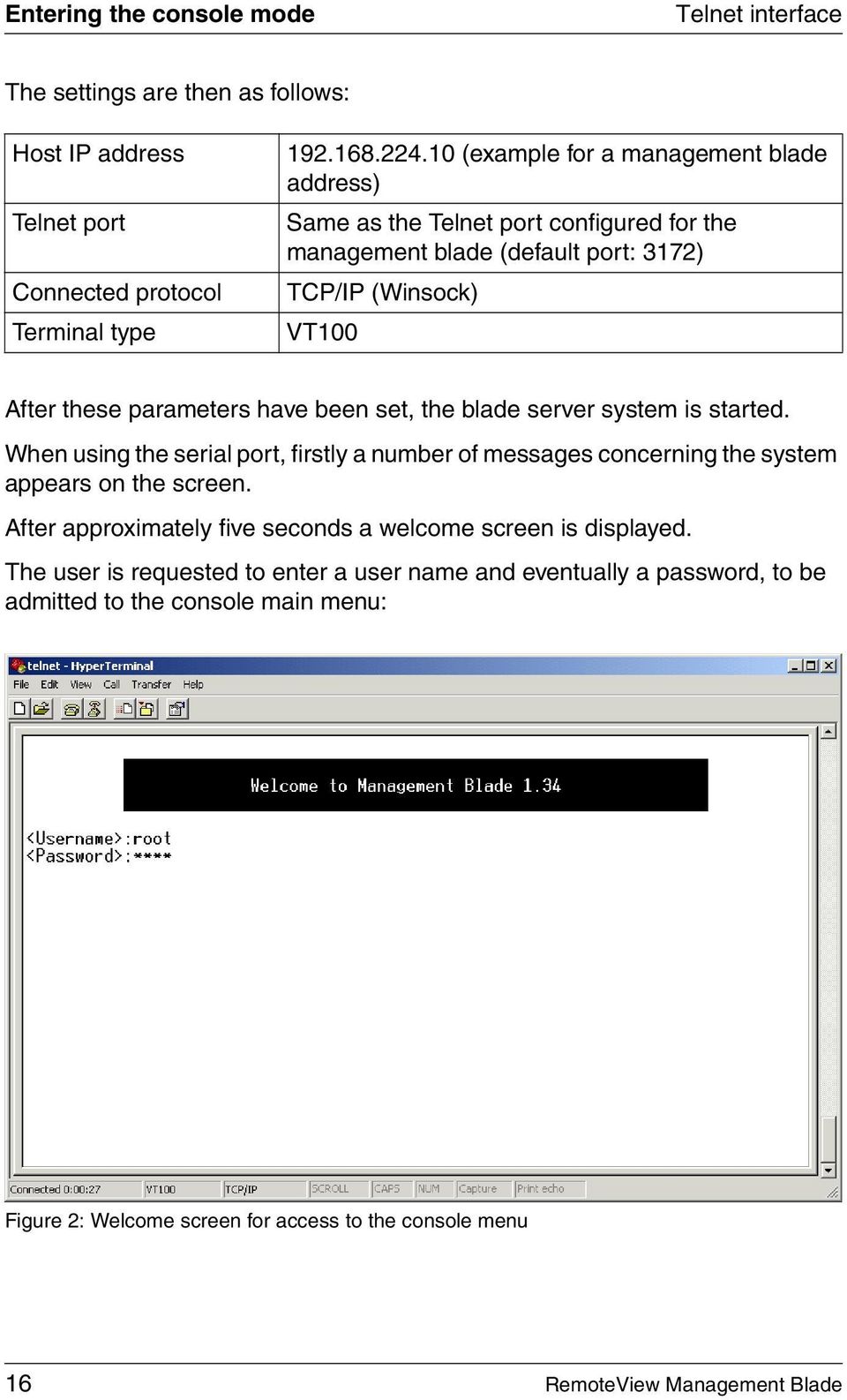
16 Entering the console mode Telnet interface The settings are then as follows: Host IP address Telnet port Connected protocol Terminal type (example for a management blade address) Same as the Telnet port configured for the management blade (default port: 3172) TCP/IP (Winsock) VT100 After these parameters have been set, the blade server system is started. When using the serial port, firstly a number of messages concerning the system appears on the screen. After approximately five seconds a welcome screen is displayed. The user is requested to enter a user name and eventually a password, to be admitted to the console main menu: Figure 2: Welcome screen for access to the console menu 16 RemoteView Management Blade
17 Telnet interface Console main menu 3.2 Console main menu The console main menu looks like this: Figure 3: Console main menu There are seven items in the console main menu: Management Agent (see 3.3 on page 19) This item provides several options for the management of the whole blade server system, including management blades and switch blades. Emergency Management Port (see 3.4 on page 55) This item provides an interface to send IPMI messages to a management blade in case of an emergency. It can also be used for debugging purposes. Console Redirection (see 3.5 on page 57) This item is used to configure the console redirection mode. The selected console redirection target will be active after the next boot. TFTP Update (see 3.6 on page 59) This item is used to update the management blade firmware. RemoteView Management Blade 17

18 Console main menu Telnet interface Logout (see 3.7 on page 61) This item is used to logout from the system. Reboot Management Blade (see 3.8 on page 61) This item is used to perform a reboot of the system. The reboot is executed immediately. System Information Dump (see 3.9 on page 62) This item is used to display consecutive lists of information. The items of the console main menu are described in more detail in the following sections. 18 RemoteView Management Blade
19 Telnet interface Management Agent 3.3 Management Agent The following items provided in the Management Agent sub-menu for server management: Management Agent Information (see on page 20) Management Blade (see on page 24) System Information (see on page 26) Server Blade (see on page 28) Switch Blade (see on page 35) Username And Password (see on page 37) Blue Screen (see on page 38) Event Log (see on page 38) Set System Default (see on page 41) Server Blade CMOS Backup/Restore (see on page 43) Switch Blade Configuration Backup/Restore (see on page 45) Deployment (see on page 46) Power Consumption (see on page 49) PPP and Modem Setting (see on page 51) RemoteView Management Blade 19

20 Management Agent Telnet interface Management Agent Information This item provides several options to configure and display parameters of the management agent, such as the network IP address, Telnet and SMTP parameters, or date and time. There are options that are used to set a single parameter, while others are used to set more than one. For the former group of parameters their current values are displayed, too. Altogether, the menu for these options looks like this: Figure 4: Agent Information menu 20 RemoteView Management Blade

21 Telnet interface Management Agent These options are used to perform the following activities: Option Set Management Agent IP Address Set Management Agent Network Mask Set Management Agent Gateway Set Management Agent Default Route Set Management Agent DHCP Configure Set Time Zone Set Management Agent Date Time Set Management Agent Timeout Agent System Info Management Agent Administrative URL Automatically Adjust Clock for Daylight Saving Changes Agent HTTP Configuration of the management blade IP address. Configuration of the management blade IP network mask. Configuration of the management blade IP gateway address. Configuration of the default route: LAN or PPP. Configuration of the auto-assigned IP address mask and enabling of the gateway via DHCP. Configuration of the time zone for the management blade, which is selected from a time zone table. Configuration of date and time for the management blade. Configuration of the time-out value for login to the console menu. Settings used in SNMP for the management blade: system name system location system contact Display of the home page URL for the management blade. Configuration of the adjustment for daylight saving changes (enable/disable, start date, end date). See also section Daylight Saving Time Format Example on page 82. Configuration of the HTTP settings, including port number assignment, HTTP protocol enabling/disabling and HTTP SSL security control. RemoteView Management Blade 21
22 Management Agent Telnet interface Option Agent SNMP Agent Telnet Agent DNS Agent SMTP Agent NTP Agent NIC Duplex Mode Configuration of the SNMP settings, including SNMP enabling/disabling, selecting an SMNP community string and a destination from the SNMP trap table. Configuration of the Telnet server settings, including Telnet port assignment and Telnet enabling/disabling. Configuration of the DNS server address and enabling/disabling DNS support. Configuration of the SMTP settings for mail sending, including SMTP enabling/ disabling, SMTP sender, SMTP relay server and mail user account. Configuration of the NTP (network time protocol) service. You can enable or disable the NTP service, set the NTP server s IP address and choose the Sync Mode: Sync Afterwards Only if the management blade time is ahead of NTP server time, the management blade syncs the time from NTP server. Sync Always The management blade always syncs the time from NTP server, no matter whether the NTP server time is behind or ahead of management blade. Setting of the management blade s NIC duplex mode (full duplex or half duplex). Execution Mode displays the current duplex mode, Setting Mode allows you to specify which duplex mode should be active after the next reset. 22 RemoteView Management Blade
23 Telnet interface Management Agent Option Change Management Role To Slave Change the role of the master management blade to slave (only displayed if there are two management blades installed). RemoteView Management Blade 23
24 Management Agent Telnet interface Management Blade Within the blade server management system there are two management blades. One of them is active as the master of the server management system. The other one is in standby mode to ensure the availability of the system. A number of parameters relating to the management blades is displayed to the user, showing their current values (see next figure): Figure 5: Management Blade menu The following parameters are displayed: Management Blade Run Mode Management Blade Status Management Blade Manufacture Displays whether the management blade is run in master mode or slave (standby) mode. Displays the health status of the management blade. A message will be displayed if this status is disturbed. Displays the name of the manufacturer of the management blade. 24 RemoteView Management Blade
25 Telnet interface Management Agent Management Blade Manufacture Date Management Blade Serial Number Management Blade Product Name Management Blade Model Name Management Blade Hardware Version Management Blade Firmware Version Management MAC Address Displays the date of manufacture for the management blade. Displays the serial number of the management blade. Displays the product name of the management blade. Displays the name of the management blade model. Displays the hardware version of the management blade. Displays the firmware version of the management blade. Displays the NIC physical address of the management blade. RemoteView Management Blade 25
26 Management Agent Telnet interface System Information The System Information option provides information on all components of the blade server management system, such as power supply, fans, temperature, KVM (= keyboard/video/mouse). The menu for this option looks like this: Figure 6: System Information menu The menu offers the following subordinate options to the user: System Control Information System Power Supply Displays the number of system fans, power supply groups and temperature sensors, as well as the status of all system components, excepting CPU blades and switch blades. Displays information on the power supply units. 26 RemoteView Management Blade
27 Telnet interface Management Agent System Fan System Temperature System Chassis Table System UPS System KVM System LED Control NIC Status Detection Turn on/off all server blades Displays information on the number and status of the system fans, including parameters like nominal speed, current speed, speed threshold and failure reaction. A fan test is also provided, supporting the fan life time monitor. Displays information on the system temperature, including current value, warning level, critical level, sensor status and critical temperature reaction. Displays information on the system chassis, including the chassis serial number and if there has been any intrusion into the inside of the chassis. Displays chassis UPS (uninterruptable power supply) information, including UPS number, vendor, type, IP address, connect port, and SNMP community. Specifies, which server blade should get accessed via KVM. Displays the status of the system control: on, off, or blinking. Detect whether the network signal of the management blade s NIC is ok or fail. NIC Status Detection enable If management blade NIC detection is fail for the master and ok for the slave, the master sends out an event log message and the roles of the management blades are changed. The role change takes place after the NIC Detection Timeout has expired. NIC Status Deteiction disable The NIC Status Detection is disabled. Turns on or turns off all server blades. RemoteView Management Blade 27
28 Management Agent Telnet interface Server Blade The Server Blade option provides information on the server blades, i. e. information on CPUs, memory modules, voltage, temperature, CMOS configuration and watchdog timers. The menu for this option looks like this: Figure 7: Server Blade menu Server Blade Control Information This option enables the user to set the following parameters: Server Power Set server power: (1) on (2) off (3) power-cycle (4) reset (5) NMI (6) force off 28 RemoteView Management Blade
29 Telnet interface Management Agent Set Server Maximum Restart Retries Server LED Control Server CPU Mode Configuration of the maximum number for server restart retries. If the failure count reaches this value, the configured reaction will be executed. Configuration of the LED control at the front of the blade server: blinking or off. Configuration of the CPU mode: battery or performance mode. If the parameter is set to battery mode, this will save electric power. Server Administrative URL Configuration of an URL address for the server Server Blade Information This option displays some information on the server blade parameters. The following parameters are included: Server Blade Status Displays the server blade health status. Server Blade Manufacture Displays server blade manufacture vendor information. Server Blade Manufacture Date Server Blade Serial Number Server Blade Product Name Server Blade Product Version Displays server blade manufacture date information. Displays server blade serial number information. Displays server blade product name information. Displays server blade product version information. Server Blade Model Name Displays server blade model name information. Server Blade Hardware Version Server Blade BIOS Version Number of CPU Socket Displays server blade hardware version information. Displays server blade BIOS version information. Displays how many CPU sockets are available on the server blade. RemoteView Management Blade 29
30 Management Agent Telnet interface Number of Memory Socket ServerBlade OS Type ServerBlade OS Version Server Blade BMC Firmware Version Server Blade PCI Add-In Card Server Blade FC Daughter Card Displays server blade memory information. Displays the OS platform currently running on the server blade. Displays the version of the OS currently running on the server blade. Displays server blade BMC firmware version. Displays whether a PCI card is installed. Displays whether a FC (Fibre Channel) daughter card is installed (only relevant for BX600 Blade Server Systems) ServerBlade CPU This option displays some information on the server blade CPU parameters. The following parameters are included: CPU Type CPU Frequency CPU Step Displays the CPU type. Displays the CPU frequency. Displays the CPU stepping. 30 RemoteView Management Blade
31 Telnet interface Management Agent CPU Status Display the CPU status. The values displayed will be: - OK - NOT_PRESENT - ERROR - CRITICAL - CPU Name CPU Socket Designation CPU Manufacturer CPU Clock MISSING_TERMINATION Displays the CPU name. Displays the CPU socket designation. Displays information on the CPU manufacturer. Displays the CPU clock Server Blade Memory This option provides information on the server blade memory. The information is displayed in two tables: Table Server Blade Memory Information Table Server Blade Memory Modules Table Displays information on the total size of the memory, as well as on the error count, the error reset record and the error count start time. Displays the status of each memory module, together with memory type and error information. RemoteView Management Blade 31
32 Management Agent Telnet interface Server Blade Voltage Table This option provides information on the server voltage. The following parameters are displayed: Server Voltage Designation Server Voltage Status Server Voltage Minimum Value Server Voltage Maximum Value Server Voltage Current Value Server Voltage Nominal Value Displays the voltage designation for the server blade. Displays the voltage status for the server blade. The values displayed will be: - NOT_AVAILABLE - OK - TOO_LOW - TOO_HIGH Displays the minimum voltage value for the server blade. Displays the maximum voltage value for the server blade. Displays the current voltage value for the server blade. Displays the nominal voltage value for the server blade Server Blade Temperature This option provides information on the server temperature. Some of the parameters displayed can also be set by the user: Server Temperature Sensor Designation Server Temperature Sensor Status Displays the designation of the temperature sensor for the server blade. Displays the status of the temperature sensor. The values displayed will be: - SENSOR_DISABLED - SENSOR_FAIL - WARNING_TEMP_WARM - CRITICAL_TEMP_WARM - NOT-AVAILABLE 32 RemoteView Management Blade
33 Telnet interface Management Agent Server Temperature Upper Warning Level Server Temperature Upper Critical Level Server Temperature Lower Warning Level Server Temperature Lower Critical Level Server Temperature Current Value This parameter can be set to configure the upper warning level of the temperature sensor for the server blade. This parameter can be set to configure the upper critical level of the temperature sensor for the server blade. This parameter can be set to configure the lower warning level of the temperature sensor for the server blade. This parameter can be set to configure the lower critical level of the temperature sensor for the server blade. Displays the current temperature value for the server blade. RemoteView Management Blade 33
34 Management Agent Telnet interface Server Blade NIC Information This option displays the NIC1 and NIC2 physical addresses of the server blade Server Blade Watch Dog This option is used to configure the watchdog timers for the server blade. There are two timers that can bet set here: Timer Server Blade Software Watchdog This timer is used to monitor the operation system and the software applications. A watchdog timer agent that resets the timer must be implemented in the operation system. When the time-out is reached, a time-out routine will be started. Server Blade Boot Watchdog This timer is used to monitor the server blade POST. It will be reset by the BIOS in periods configured within the POST code. When the time-out is reached, a time-out routine will be started. 34 RemoteView Management Blade
35 Telnet interface Management Agent Switch Blade The Switch Blade option is used to display information on the switch blades that are part of the blade server system. The menu for this option looks like this: Figure 8: Switch Blade menu The following parameters are displayed: Administrative URL Switch Blade Status Switch Blade Manufacture Switch Blade Manufacture Date Displays the URL of the switch blade. Displays the status of the switch blade. This status can be retrieved by the management blade via a CLI command. Displays information on the manufacturer of the switch blade. Displays the manufacturing date for the switch blade. RemoteView Management Blade 35
36 Management Agent Telnet interface Switch Blade Serial Number Switch Blade Product Name Switch Blade Model Name Switch Blade Hardware Version Switch Blade Firmware Version Switch Blade MAC Address Switch Blade IP Address Switch Blade Subnet Mask Switch Blade Gateway Switch Blade IP Address Setting Value Switch Blade Subnet Mask Setting Value Switch Blade Gateway Setting Value Apply Network Setting Switch Blade LED Control Reboot Switch Blade Displays the serial number of the switch blade. Displays the product name of the switch blade. Displays the name of the switch blade model. Displays the version of the switch blade hardware. Displays the version of the switch blade firmware. Displays the MAC address of the management port for the switch blade. Displays the current IP address of the management port for the switch blade. Displays the current subnet mask of the management port for the switch blade. Displays the current gateway of the management port for the switch blade. Specifies a new IP address of the management port for the switch blade. Specifies a new Subnet Mask of the management port for the switch blade. Specifies a new Gateway of the management port for the switch blade. Activates the specified setting values (IP, Subnet, Gateway) - either immediately or - if the UART Port is used by another user - as soon as this port is available. For example: If another user runs console redirection at the moment, the settings will not be changed until the console redirection has been completed. Sets the LED of the switch blade off or blinking. Reboots the switch blade. 36 RemoteView Management Blade
37 Telnet interface Management Agent Username and Password The Username and Password option is used to change and display information on the access rights of individual users. A user is selected via his or her user ID. The menu for this option looks like this: Figure 9: Username and Password menu The following actions can be performed via this menu: Change Username Change Password User Permission A username may only be changed by the administrator. A password may be changed by the administrator or by the user that has been assigned this password. User permissions may only be changed by the administrator. RemoteView Management Blade 37
38 Management Agent Telnet interface Blue Screen The Blue Screen option is available, if the operating system used supports the blue screen feature, as provided by UART (Windows 2000). The option will then display which server blades are currently in blue screen status Event Log The Event Log option is used to display the events that have been logged on the management blade and the server blades. The menu for this option looks like this: Figure 10: Event Log menu Information is displayed for: Events that were logged on the management blade event log Events that were logged on a server blade event log 38 RemoteView Management Blade
39 Telnet interface Management Agent Management Blade Event Log This sub-option is used to display the events that have been logged on the management blade event log. The following parameters are displayed: All Event Informational Event Minor Event Major Event Critical Event Clear All Entries All events that have been logged on the management blade. The informational events that have been logged on the management blade. The minor events that have been logged on the management blade. The major events that have been logged on the management blade. The critical events that have been logged on the management blade. This parameter is used to clear all events from the management blade event log Server Blade Event Log This sub-option is used to display the events that have been logged on a server blade event log. After a server blade has been selected, the following parameters are displayed: All Event Informational Event Minor Event Major Event All events that have been logged on the server blade. The informational events that have been logged on the server blade. The minor events that have been logged on the server blade. The major events that have been logged on the server blade. RemoteView Management Blade 39
40 Management Agent Telnet interface Critical Event Clear All Entries The critical events that have been logged on the server blade. This parameter is used to clear all events from a server blade event log Server Blade Power On/Off Event Log Enable This option is used to specify, whether power on/off events for the server blades should be listed in the event log Management Blade Wrap Around Event Log Enable This option is used to specify, whether the wrap-around functionality for the event log should be used or not. enable When the event log repository is full, new event log entries replace the old ones beginning with the first event log entry. disable When the event log repository is full, no event log entries are written any longer. 40 RemoteView Management Blade
41 Telnet interface Management Agent Set System Default The Set System Default option is used to restore the default values. The menu for this option looks like this: Figure 11: Set System Default menu RemoteView Management Blade 41
42 Management Agent Telnet interface The following parameters can be set: Set Config Default Set Username/Password Default Set CMOS Backup Default Set Deployment Default Set Switch Blade Config Default The configuration of the management blade is set to the default values. V Please note that all configured values are lost and the management blade has to be configured newly after using this option. All configured user names with the exception of root are deleted. The password for the user root is set to the default ( root ). All switch blade configuration backups and all server blade BIOS backups are deleted. The deployment parameters (see section Deployment on page 46) are set to the default values. All switch blade configuration backups are deleted. 42 RemoteView Management Blade
43 Telnet interface Management Agent Server Blade CMOS Backup/Restore This option is used to backup and restore server blade BIOS parameters. The server blade must be powered on before backup/restore processing. If the backup is successful, the backup file will be displayed in the CMOS backup file table. After selecting the server blade whose BIOS is to be backed up or whose backup file is to be restored, the Server CMOS Configure option is displayed: Figure 12: Server CMOS Configure menu RemoteView Management Blade 43
44 Management Agent Telnet interface The following parameters are displayed: CMOS Control CMOS Configure Restore Target Server CMOS ID With BIOS Version Server CMOS ID With Mac Address Backup Date Time Specifies the backup/restore policy: backup The BIOS parameters of the selected server blade are backed up. smart-restore After the slot id, BIOS version and MAC address have been verified, the backup file of the selected server blade is restored. force-restore The backup file is restored without verification. Specifies the server blade whose BIOS parameters are to be restored. Displays the CMOS ID with BIOS version. Displays the CMOS ID with MAC address Displays date and time of the backup file generation. 44 RemoteView Management Blade
45 Telnet interface Management Agent Switch Blade Configuration Backup/Restore This option is used to backup/restore the configuration values of the management blade. Figure 13: Switch Blade Configuration Backup/Restore The following parameters are displayed: Backup/Restore Control View Backup Configuration Auto Restore Enable Specifies whether a backup process or a restore process is to be started. Displays the stored backup configuration values. Specifies whether after a hot-swap action the new management blade is to be configured automatically according the stored backup configuration values. RemoteView Management Blade 45
46 Management Agent Telnet interface Deployment This option is used to display or set the deployment configuration of the server blades. The menu for this option looks like this: Figure 14: Deployment menu The following parameters are displayed: Chassis ID Slot ID MAC Address_1 / _2 IP Address_1 / _2 Subnet Mask_1 / _2 Serial number of the blade server chassis. Identification of the server blade slot. If no server blade is plugged in, no MAC address is available. The slot id is the only way to assign and store slot related system information. This is useful for hot replace functionality. MAC addresses of the server blade s two LAN ports. IP addresses of the server blade s two LAN ports. Subnet masks of the server blade s two LAN ports. 46 RemoteView Management Blade
47 Telnet interface Management Agent Default Gateway_1 / _2 Default gateways of the server blade s two LAN ports. Hostname Hostname for cloning purpose. Allows the clone agent to patch the right hostname into OS image during cloning process. Master Image Reference Status of Blade Automatic Recovery URL in UNC notification (but in ASCII) of the remote image file (with the extensions of *.img, *.cfg, *.txt): \\server-name\subpath\ img-name Current status of the server blade. Possible values:!!bitte genau prüfen, die Werte sind in der Spec nicht explizit beschrieben und an der Oberfläche nicht testbar!! power-down stand by system boot failure booting online Specifies whether after the hot-replacement of a server blade deployment activities should be started automatically. false true After the hot-replacement of a server blade no automatic deployment activities should be started. After the hot-replacement of a server blade RemoteDeploy is triggered to check in the server list, whether the old MAC address was assigned to a backup image. If so, the backup image is used for automatically cloning the new CPU blade (assumed the same HW is used). If there is no backup image, another check is made whether a master image is assigned to, and if so, this master image is used for cloning. RemoteView Management Blade 47
48 Management Agent Telnet interface Status of Cloning LAN status of slot Specifies the status of the cloning process: not-cloned The server blade does not contain a valid configuration of an OS. cloning The cloning process is running. The status will switch to cloned when the process will have been completed. cloned The assigned image was successfully cloned. empty-slot When a new server blade is plugged in, the IP settings defined in the deployment parameter table are NOT used. You have to configure the IP settings manually. It is recommended to set the LAN Status of Slot to preset-slot afterwards. preset-slot The settings defined in the deployment parameter table are the reference for the LAN configuration. If a new or already installed blade is plugged in, these values are used for the installation/adaptation. 48 RemoteView Management Blade
49 Telnet interface Management Agent Power Consumption The menu for this option looks like this: Figure 15: Power Consumption menu The following parameters are displayed: Power Budget Control Threshold Base Consumption Total Consumption Remaining Displays the max. active power of the redundant power supply. Power consumption of the base system: The base system includes four switch blades, two management blades and all fan moduls. Current power consumption of the whole blade server system (including server blades). Difference between Power Budget Control Thershold and current Total Consumption. System Power Unit Status Table Displays the max. active power and the voltage range of the power supply units. RemoteView Management Blade 49
50 Management Agent Telnet interface Server Blade Power Consumption Table Set Power Budget Control Displays the current power consumption value of each server blade. dynamic The power control dynamically takes into account the current actual power consumption. static The power control statically takes into account the worst case power consumption. 50 RemoteView Management Blade
51 Telnet interface Management Agent PPP and Modem Setting The menu for this option looks like this: Figure 16: PPP and Modem Setting menu RemoteView Management Blade 51
52 Management Agent Telnet interface The following parameters are displayed: Fastest COM Port Baud Rate Hardware Flow Control Modem Initial String Type User Define Initial String PPP Enable The following COM Port Baud Rates are supported: bps bps bps bps (default value) I If you use no modems but a direct cable connection, only the default value bps is supported. If you choose PPP Enable to be enable and use modems for connecting, the maximum baud rate is bps. The default value disable is recommended for connections via LAN. Enable Hardware Flow Control to avoid buffer overflows for connections via modem. The default is standard modem. The management blades support 56 K standard modems. In general this default value will work successfully. If any non-standard modem is used, you need to specify a User Define Initial String for initializing the modem. Here you can specify any AT command your modem supports. The default is disable. If you set enable the PPP protocol is used with the setting specified in PPP Connection Type. 52 RemoteView Management Blade
53 Telnet interface Management Agent PPP Connection Type PPP Dial-out Phone Mode Possible values: direct (default value) Direct connection via the COM port (no modem used). dial-out If a modem is installed and PPP Enable is set to enable, the dial-out phone number is used to establish a PPP connection. dial-in If a modem is installed and PPP Enable is set to enable, the management blade waits for an incoming call. callback If a modem is installed and PPP Enable is set to enable the management blade checks the authentication of incoming calls and uses the dial-out phone number to call back. callback extension In difference to callback, the specified dial-out phone number isn t used: The remote caller is prompted to specify his modems phone number after the incoming call has been authenticated. Possible values: - touch tone (default value) - pulse dialing RemoteView Management Blade 53
54 Management Agent Telnet interface PPP Dial-out Phone Number PPP IP Address PPP Remote IP Address PPP/Modem States If PPP Connection Type is set to dial-out, the management blade uses this phone number to dial out. Max length: 32. I You can set commas (, ) between the digits to cause one second delays during dialing. PPP IP address of the management blade (default: ). PPP IP address of the remote side (default: ). Displays the PPP connection and modem status: modem ready A modem is plugged in the management blade s COM port. null modem cable A null modem cable is plugged in the management blade s COM port. normal cable A 9-pin pass through cable or no connection media is connected to the management blade s COM port. try to dial-out PPP dial-out process is running. PPP on-line PPP connection has been established. 54 RemoteView Management Blade
55 Telnet interface Emergency Management Port 3.4 Emergency Management Port The Emergency Management Port (EMP) provides a basic range of remote server management with virtually no additional cost. It operates on top of the management blade firmware. Commands for IPMI messages can be sent directly via the EMP agent. The following facilities are provided: Server power up/down System reset Viewing of critical event logs stored in the non-volatile memory (NVRAM) System Event Log (SEL): logging of all critical server events, to be used for server monitoring and management Sensor Data Records (SDR): listing of all sensor fields programmed in the firmware of the Baseboard Management Controller (BMC), to be used for server monitoring and management Field Replaceable Units (FRU): listing of all replaceable components of the system by serial number RemoteView Management Blade 55
56 Emergency Management Port Telnet interface The starting page for these option looks like this: Figure 17: Starting page for Emergency Management Port option 56 RemoteView Management Blade
57 Telnet interface Console Redirection 3.5 Console Redirection There is one console port (serial port interface) within the blade server system. Console redirection can be configured for server blades or switch blades. The menu for this option looks like this: Figure 18: Console Redirection menu There is a sub-option of console redirection for server blades and one for switch blades. Furthermore, a return hotkey can be configured: Sub-option Console Redirection Server Blade Console Redirection Switch Blade This option is used to configure a server blade for console redirection. This option is used to configure a switch blade for console redirection. RemoteView Management Blade 57
58 Console Redirection Telnet interface Sub-option Set Return Hotkey This option is used to configure a return hotkey. To do this, a character from A-Z is chosen, excluding M. The hotkey to exit console redirection and return to the previous mode is then Ctrl + the character that has been set here, e. g. Ctrl + R. The default character used for the return hotkey is Q. 58 RemoteView Management Blade
59 Telnet interface TFTP Update 3.6 TFTP Update The TFTP Update option is used to perform an update of the management blade firmware. I For further information on updating BX components please refer to the Operating Manual of your BX system. The menu for this option looks like this: Figure 19: TFTP Update menu RemoteView Management Blade 59
60 TFTP Update Telnet interface The following parameters can be set: Agent Update IP Address TFTP Server IP Address Server Blade BIOS Image File Name Server Blade BMC Image File Name Management Blade Image File Name Management Blade Update Enable Setting of an agent IP address. I The IP address to be supplied in the field Agent Update IP Address is only temporarily used. Enter any IP address which is not used in the LAN segment of the server. Setting of an IP address for the TFTP server. Setting of a file and path name for the BIOS image. Setting of a file and path name for the BMC image. Setting of a file and path name for the management blade image. Upgrading of the management blade firmware. The default value for this parameter is disable. After setting the parameter to enable, the TFTP server must be started, and the management blade must be rebooted. The update will then be performed as the system powers up. Update Server Blade BIOS Table Upgrading of the Server Blade BIOS. This option is used to enable/disable the update and to display the TFTP status. Update Server Blade BMC Table Upgrading of the Server Blade BMC firmware. This option is used to enable/disable the update and to display the TFTP status. 60 RemoteView Management Blade
61 Telnet interface Logout 3.7 Logout This option is provided to perform a logout from the Telnet console menu. 3.8 Reboot Management Blade This option is provided to perform the reboot of a management blade. The reboot is executed using a Zircon internal reset logic module. RemoteView Management Blade 61
62 3.9 System Information Dump This option is used to display the event logs of management blades or server blades and to display consecutive lists of configuration/status information. The menu for this option looks like this: Figure 20: System Information Dump menu The following parameters are displayed: System Configuration/Status SEL for Management Blade Server Blade Configuration/Status SEL for Server Blade Displays a consecutive list of system information, e.g. status, IP address, MAC address and firmware version of the switch blades. Displays the management blade event log. Displays a consecutive list of information about the server blades, e.g. status, BIOS version, BMC firmware version, OS type and OS version. Displays the server blade event log.
63 4 Web user interface On the web server an interactive and user-friendly web user interface, known as web console, is provided for server management. It does not depend on any special operating system for a platform. Login to this interface is made via the web browser. The options of this interface are explained in this chapter. 4.1 Overview After login has been made successfully, a home page is displayed to the user, giving an overview over the system configuration, i.e. the installed components and their actual states. The navigation frame on the left side of the window shows options applying to the system properties, by which the system configuration may be modified, as well as options for working with the different kinds of blades that are embedded into the system. Altogether, the options of the web user interface have been arranged into the following main groups: System Property (see 4.2 on page 66) Management Blade (see 4.3 on page 85) Switch Blade (see 4.4 on page 86) Adv. KVM Blade 1 (see 4.5 on page 88) Server Blade (see 4.6 on page 98) In the Server Blade and Switch Blade groups there is a sub-directory displayed for every blade. Thus, the user may see at a glance how many blades there are currently embedded in the system. The figure next page shows the home page of the web user interface of the BX300, giving an overview over its options (the BX600 has some slightly modified hardware components): 1 PRIMERGY BX600 only RemoteView Management Blade 63
64 Overview Web user interface Figure 21: Home page of the web user interface for a BX300 system 64 RemoteView Management Blade
65 Web user interface Overview Standard icons There are icons displayed on the pages of the web user interface, so that the user may perform some standard actions like scrolling, or using the help function. These icons are also displayed on the other pages of the web user interface. The meaning of these icons are as follows: Display a help page. Go to the upper part of the page. Go to the lower part of the page. Refresh the page. Go to the home page (if currently on another page). RemoteView Management Blade 65
66 System Property Web user interface 4.2 System Property By working with the option System Property the user can apply changes to the system configuration. The settings of the system configuration that can be modified by the user have been grouped into six fields. Corresponding to these are the following options: System Events Log (see on page 66) Environment/Maintenance (see on page 69) LAN Interface (see on page 76) SNMP Interface (see on page 79) Console Redirection (see on page 80) System Information (see on page 82) User Accounts (see on page 82) Deployment Table (The parameters are very similar to those of the corresponding Telnet option, thus you can refer to the description in on page 46). PPP and Modem Setting (The parameters are very similar to those of the corresponding Telnet option, thus you can refer to the description in on page 51) System Event Log The System Event Log option provides information on events that happened on the system. Alarms can be configured for events in such a way that an is sent whenever an event of a certain kind occurs. The option comprises two sub-options: Event Log Alarm Handler 66 RemoteView Management Blade
67 Web user interface System Property Event Log This option displays all system events to the user. The events displayed can be filtered according to the blade system that they are related to, or to the error type. The events are shown in the following format: Option Time stamp Error type Error code Content Month day year. Informational event, minor event, major event, critical event. Error code with class. Error message description. There is a Clear all entries option, which will clear all entries from the event repository. The user is prompted to confirm this action, before it is executed Alarm handler This option is used to configure the s that are sent as alarms after an event has occurred on the system and to configure the event log. The following parameters are configured for an To From Host Subject Administrator name Phone number Mail receiver address. Mail sender address. SMTP server address (IP address or host name). Mail subject (Read only, PRIMMAIL). System administrator name. System administrator phone number. Error Forwarding Here you select which topics should be considered for error forwarding and specify the minimum error level to entail forwarding. RemoteView Management Blade 67
68 System Property Web user interface Server Blade Power On/Off Event Log Enable This option is used to specify, whether power on/off events for the server blades should be listed in the event log. Management Blade Wrap Around Event Log Enable This option is used to specify, whether the wrap-around functionality for the event log should be used. enable When the event log repository is full, new event log entries replace the old ones beginning with the first event log entry. disable When the event log repository is full, no event log entries are written any longer. 68 RemoteView Management Blade
69 Web user interface System Property Environment/Maintenance This option is used to adjust the settings of the environment modules. These modules monitor power supply, chassis and fans of the system. The system administrator can configure a reaction to be executed when a critical threshold value is reached for a module. There are the following sub-options: Firmware Update Power Supply UPS Chassis Fans Reset Management Blade Firmware Update This option is used to perform firmware updates for the blade server system. The upgrades are performed via the TFTP service. There are three different kinds of updates: Management blade Server blade BMC Server blade BIOS I For further information on updating BX components please refer to the Operating Manual of your BX system. RemoteView Management Blade 69
70 System Property Web user interface Management Blade BMC Update To perform a management blade BMC update, the following parameters can be set: TFTP Server IP Address Agent Update IP Address Boot Image File Name TFTP Upgrade Enable Address of the TFTP server providing the image file for the management blade firmware. Setting of an agent IP address. I The IP address to be supplied in the field Agent Update IP Address is only temporarily used. Enter any IP address which is not used in the LAN segment of the server. File name for the management blade image file. This parameter is set to enable the TFTP update for the management blade system. Server Blade BMC Update To perform a server blade BMC update, the following parameters can be set: TFTP Server IP Address Boot Image File Name Address of the TFTP server providing the image file for the management blade firmware. Path and file name for the management blade image file. Select in the list on the right side of the window the server blades you want to be updated and click on the [ADD>>] button. They are moved into the update list on the right side. You can remove server blades from the update list by selecting them and clicking on the [DEL<<] button. 70 RemoteView Management Blade
71 Web user interface System Property Server Blade BIOS Update To perform a server blade BIOS update, the following parameters can be set: TFTP Server IP Address Boot Image File Name Address of the TFTP server providing the image file for the management blade firmware. Path and file name for the management blade image file. Select in the list on the right side of the window the server blades you want to be updated and click on the [ADD>>] button. They are moved into the update list on the right side. You can remove server blades from the update list by selecting them and clicking on the [DEL<<] button Power Supply This option contains a number of displays indicating states and faults regarding the power supply of the system. On delivery, the BX600 is usually set up for power supply redundancy of This means that two power supply units (PSUs) are available for powering the complete blade server system unit. The third and fourth PSUs serve as redundant PSUs. In the maximum configuration (maximum configuration per server blade), it may be necessary to change the power supply redundancy from to In this case, the fourth PSU serves as the redundant one. You can configure this setting the System Power Supply Redundancy Mode parameter, see below. The following parameters are displayed: Power Switch Group status Power Redundancy Turns on, turn off or shuts down gracefully the blade server system. Current status of the power supply modules. If there is only one module installed, degraded mode will be indicated. Indicates whether redundant power supply is assured. RemoteView Management Blade 71
72 System Property Web user interface System Power Supply Redundancy Mode Fan1 fault Fan2 fault Fan3 fault Thermal High fault OVP12V fault UVP12V fault OCP12V fault Current Share fault PWOK status EPOW status AC Range status With this parameter the power supply redundancy mode is set to 2+1 or 3+1. Default is 2+1. I This function is available as of management firmware Release >= 2.11 and if four PSUs are installed. Rotational speed status of fan 1. The value displayed for this parameter will either be ok or fail. If fail is displayed the rotational speed is below 1500 RPM (+ 200). Rotational speed status of fan 2. The value displayed for this parameter will either be ok or fail. If fail is displayed the rotational speed is below 2700 RPM (+ 200). Rotational speed status of fan 3. The value displayed for this parameter will either be ok or fail. If fail is displayed the rotational speed is below 2700 RPM (+ 200). Ambient temperature of the system. The value displayed for this parameter will either be ok or fail. If fail is displayed the ambient temperature is over 60 C (+ 5). Over voltage protection in 12V output. The value displayed for this parameter will either be ok or fail. Under voltage protection in 12V output. The value displayed for this parameter will either be ok or fail. Over current protection in 12V output. The value displayed for this parameter will either be ok or fail. Current share. The value displayed for this parameter will either be ok or fail. Power O. K. signal. The value displayed for this parameter will either be ok or not ok. Early Power Off Warning signal. The value displayed for this parameter will either be ok or not ok. AC range. The value displayed for this parameter will either be V or V or V. 72 RemoteView Management Blade
73 Web user interface System Property Temperature Life Time Life Time Limited Count OVP 12V fault reaction OCP 12V fault reaction Server Blade Power Switch Ambient temperature for the system. Displays the total working time of the battery (hours) since the latest click on the Reset button. Configures a max value for the battery working time. Specifies the reaction to an over voltage fault in 12V output: continue or shutdown-and-poweroff. Specifies the reaction to an over current fault in 12V output: continue or shutdown-and-poweroff. Powers on/off all server systems sequentially UPS Displays chassis UPS (uninterruptable power supply) information, including Number of installed UPSs, UPS number, vendor, type, Agent IP Address, connect port, and SNMP community. RemoteView Management Blade 73
74 System Property Web user interface Chassis This option displays information on the chassis status of the blade system, including front fans panel and rear fans panel. In addition, the environment temperature is displayed for the system. A reaction can be configured to be executed whenever this temperature reaches a critical threshold value. The following parameters are displayed and can be set: System LED Door Status (BX300) Rear Fan Door Status (BX600) Ambient Temperature Controls the System LED: on, off or blinking. Intrusion status of fan panels. The value displayed will either be closed or open. Ambient temperature as detected by the sensors of the system. A reaction may be selected for each sensor to be executed whenever this temperature reaches a critical threshold value. The location of the sensors is as follows: 1: Located at the right of the middle plane housing 2: Located at the center of the middle plane housing 3: Located at the left of the middle plane housing 4: Located at the right of the front fans panel 5 to 8: Located at the switch blades 1 to 4 9 to 10: Located at the PSUs 1 and 2 10 to 11 (only BX600): Located at the PSUs 3 and 4 74 RemoteView Management Blade
75 Web user interface System Property Fans This option displays all fans that have been integrated into the system. The fans are numbered, with the fan located at the left most of the modules being counted as the first one, while looking at the front side of the system. The following parameters can be set: Fans fail reaction control Fans Test Fans Life Time Counter Fans Limited Count These parameters are used to select a reactions in case of fan failures (continue or shutdown-and-poweroff). This parameter is used to set the time for the daily testing of the fan performance. Displays the total working time of the fan since the latest click on the Reset button. Configures a max value for the fan working time Reset Management Blade This option is used to reboot the management blade. The reboot does not impact the operation of the blade system. RemoteView Management Blade 75
76 System Property Web user interface LAN Interface Within the management blade system a network service is provided, including web server, telnet interface, send mail facilities and DNS service. The option LAN Interface is used to handle the network configuration setting. For this purpose several sub-options are offered, which are grouped in the following way: Internet Protocol Domain Name Server HTTP Telnet NTP SSL Duplex Mode Internet Protocol This option is used to configure the IP address for the management blade. The configuration may be carried out manually, or automatically using the DHCP service. The following parameters can be set: Use DHCP IP Address Subnet Mask Gateway Default Route This parameter is set to enable or disable the DHCP service. IP address for the management blade. Subnet mask of the IP address for the management blade. IP gateway address. Specifies the default route: LAN or PPP. 76 RemoteView Management Blade
77 Web user interface System Property Domain Name Server This option is used to configure the Domain Name Server for the management blade. Actually, there are two server systems provided to perform this service: DNS Server 1 and DNS Server 2. The following parameters can be set: DNS Server 1 DNS Server 2 IP address of the first server system for the DNS service. IP address of the second server system for the DNS service HTTP This option is used to configure a HTTP port. There is one parameter to be set: HTTP Port HTTP port number Telnet This option is used to configure the Telnet interface. The following parameters can be set: Port Telnet port number. Default: Drop Time Time-out for the Telnet connection. Default: 900 seconds. After the time-out has elapsed, the user will have to perform another login. RemoteView Management Blade 77
78 System Property Web user interface NTP This option is used to configure the NTP (network time protocol) service. You can enable or disable the NTP service, set the NTP server s IP address and choose the Sync Mode: Sync Afterwards Only if the management blade time is ahead of NTP server time, the management blade syncs the time from NTP server. Sync Always The management blade always syncs the time from NTP server, no matter whether the NTP server time is behind or ahead of management blade, SSL This option is used to enable/disable SSL for HTTP or Telnet connections Duplex Mode This option is used to configure the management blade s NIC duplex mode. It should be full duplex or half duplex. Execution Mode Displays the current execution mode. Setting Mode Specifies which duplex mode should be active after the next reset. 78 RemoteView Management Blade
79 Web user interface System Property SNMP Interface To configure the SNMP interface two sub-options are used: SNMP Communities SNMP Trap Destination SNMP Communities The SNMP Communities option is used to show existing SNMP communities, as well as to add and delete communities. After the option has been selected, the SNMP communities table is displayed. By typing in a community name and clicking the New Community button, a new community is added to those already existing. The maximum number of communities in the table is five. An existing community is deleted from the table by selecting its name, marking the field Delete and submit with the [Apply] button SNMP Trap Destination The SNMP Trap Destination option is used to show existing SNMP trap destinations, as well as to add and delete destinations. After the option has been selected, the SNMP trap destination table is displayed. By typing in a destination address and clicking the New Trap Destination button, a new destination is added to those already existing. The maximum number of destinations in the table is five. An existing destination is deleted from the table by selecting its name, marking the field Delete and submit with the [Apply] button. RemoteView Management Blade 79
80 System Property Web user interface Console Redirection The console redirection option is used to perform KVM (= Keyboard/Video/Mouse) switching. There are two sub-options: KVM Switch for Local IP Filters for Telnet, HTTP and SNMP I For controlling console redirection via adv. KVM blade on PRIMERGY BX600 see section Adv. KVM Blade on page KVM Switch for Local Within the blade system for server management there are three ways to switch KVM (Keyboard/Video/Mouse) locally. One is by pressing the switch button at the front end of the system, the second is switching via a keyboard hotkey sequence, and the third one is to switch via the web or telnet user interface. If KVM switching is performed via the web user interface, the following parameter is to be set: Select KVM Used to perform a KVM switch IP Filters for Telnet, HTTP and SNMP To perform a remote KVM switch, a new IP address is made known to the system. An existing IP address can be deleted from the selecting table. The following parameters can be set: IP Filter For Telnet/HTTP/SNMP New Allowed IP Used to select an IP address for Telnet/HTTP/SNMP connection filtering that is to be deleted. Used to enter a new IP address, which is added to the IP addresses known to the system. I Note that the number 255 has a function similar to a wildcard character: 80 RemoteView Management Blade
81 Web user interface System Property If for example the IP filter list contains the IP filter , the system handles all possible IP addresses as known. An IP filter like would handle all IP addresses beginning with as known. RemoteView Management Blade 81
82 System Property Web user interface System Information This option contains agent information, daylight saving time, controller time, and time-zone configuration. Daylight Saving Time Format Example Start Date Example: M03.5.0/02 M03 March (Month 03; range: M01-M12) 5 last week (range: 1-5) 0 Sunday (range: 0-6) 02 2:00 o'clock am (range: 00-23) Meaning: set the clock ahead one hour at 02:00 am on the Sunday of the last week of the third month. End Date Example: M10.4.1/03 M10 October (Month 10; range: M01-M12) 4 the fourth week (range: 1-5) 1 Monday (range: 0-6) 03 3:00 o'clock am (range: 00-23) Meaning: set the clock back one hour at 03:00 am on the Monday of the fourth week of the tenth month User Accounts Within the server management facilities there is a user database provided to enable user authentication control. New user accounts are added to this database via the Add New User Account option. There is a static root user, who has full authorization to perform any activities in the user database and cannot be deleted. The default password for this root user is root. 82 RemoteView Management Blade
83 Web user interface System Property When adding a new user account via the Add New User Account option the following parameters are to be set: Name Password Confirm password Permissions User name. User password. This field is used to confirm the password entered above. The user access rights are set by clicking the options explained below: Read Only The user cannot change any settings except the password. Modify values The user can change any setting, but is not allowed to add a new user account. Configure users The user can change any setting, and is also allowed to add a new user account. Reset/Switch off The user can switch the system on/off. Access EMP via CLI The user can access the Emergency Management Port via CLI. I The following settings refer to the adv. KVM blade, which is only supported by the PRIMERGY BX600. Adv. KVM User (incl KVM configuration rights) The user can configure the adv. KVM blade and access the server blades marked below. blade 1... blade 10 The user can access the marked server blades via Global Viewer. KVM perm expiration date Indicates the date when the adv. KVM blade user permissions expire Deployment Table This option is used to display and to set the deployment configuration for each server blade. The particular server blade can be selected from a pull-down list. The parameters are very similar to those of the corresponding Telnet option, thus you can refer to the description in on page 46). RemoteView Management Blade 83
84 System Property Web user interface PPP and Modem Setting This option is used to configure the settings for PPP connections and to configure the modem. The parameters are very similar to those of the corresponding Telnet option, thus you can refer to the description in on page 51). 84 RemoteView Management Blade
85 Web user interface Management Blade 4.3 Management Blade The Management Blade option is used to display the number of management blades that have been embedded into the blade system for server management. There are up to two management blades in the system. One of these plays the master role for server management, and the other one is there to ensure redundancy. It is essential that there is at least one management blade installed to handle server management. If there are two management blades, one of them will be selected for the master role in the boot phase. Both management blades will then start to boot up at the same time. The management blade that is the first to have its heartbeat detected will be the master. The following parameters can be displayed or set: Play Role Manufacture Produce Date Serial Number Product Number Model Name MAC Address Firmware Version Hardware Version Change Management Blade Role Present role of the management blade: Master or redundant management blade. Information on the manufacturer of the management blade. Date of management blade production. Serial number of the management blade. Product number of the management blade. Name of the management blade model. NIC address of the management blade. Version of the management blade firmware. Version of the management blade hardware. Used to change the present role of the management blade from master to slave, i. e. from controlling to redundant management blade. RemoteView Management Blade 85
86 Switch Blade Web user interface 4.4 Switch Blade The Switch Blade option is used to display the number of switch blades that have been embedded into the blade system for server management. There are two GB NIC ports for each server blade, which connect to two separate switch blades. This has been arranged to ensure LAN connection redundancy. Up to four switch blades can be installed into the blade system for server management. In each switch blade there are 10 ports for interconnection to the server blades and three ports for outbound links Switch Blade Info The following parameters are displayed for information on a switch blade: Located LED Manufacture Produce Date Serial Number Product Number Model Name Board Version Firmware Version Network Setting Mac Address URL IP Address Switch on/off the located LED. Information on the manufacturer of the switch blade. Date of switch blade production. Serial number of the switch blade. Product number of the switch blade. Name of the switch blade model. Version of the switch blade board. Version of the switch blade firmware. Information on the network setting for the switch blade, including the URL address of its web home page. NIC address of the switch blade. URL address of the web home page for the switch blade. Setting Value: Specifies a new IP address for the switch blade. Current Value: Displays the current IP address of the switch blade. 86 RemoteView Management Blade
87 Web user interface Switch Blade Subnet Mask Gateway Address Apply Reload Setting Value: Specifies a new subnet mask for the switch blade. Current Value: Displays the current subnet mask of the switch blade. Setting Value: Specifies a new gateway for the switch blade. Current Value: Displays the current gateway of the switch blade. Activates the specified setting values (IP, Subnet, Gateway) - either immediately or - if the UART Port is used by another user - as soon as this port is available. For example: If another user runs console redirection at the moment, the settings will not be changed until the console redirection has been completed. Refreshes the page. After applying the IP setting values you can use Reload to check whether the new settings are active already Backup/Restore This option is used to backup/restore the configuration values of the management blade. Backup/Restore View Backup File Auto Restore Specifies whether a backup process or a restore process is to be started. Displays the stored backup configuration values. Specifies whether after a hot-swap action the new management blade is to be configured automatically according the stored backup configuration values. RemoteView Management Blade 87
88 Adv. KVM Blade Web user interface 4.5 Adv. KVM Blade This option is used to administrate the adv. KVM blade. The adv. KVM blade is one of two types of KVM switch that can be installed in a PRIMERGY BX600 system unit. Both KVM switches - the standard KVM blade and the adv. KVM blade - provide VGA and PS2 keyboard and mouse pass-through connection to the server blades for local administration. The adv. KVM blade additionally provides the following features: Web-based console redirection in graphic mode using the OSX application Global Viewer, see page 90. Remote USB CD-ROM emulation Remote USB floppy disk emulation Remote boot via emulated USB devices Management-blade-controlled user authentication For information on installing and connecting the adv. KVM blade, please see the operating manual PRIMERGY BX600 Basic Unit Adv. KVM Blade Info The following parameters are displayed to provide information on the adv. KVM blade: Adv. KVM blade Manufacture Adv. KVM blade Manufacture Date Adv. KVM blade Serial Number Adv. KVM blade Product Name Adv. KVM blade Model Name Adv. KVM blade Hardware Version Information on the manufacturer of the adv. KVM blade. Date of adv. KVM blade production Serial number of the adv. KVM blade Product number of the adv. KVM blade Name of the adv. KVM blade model Version of the adv. KVM blade hardware 88 RemoteView Management Blade
89 Web user interface Adv. KVM Blade Adv. KVM Blade Configuration This option is used to configure the network settings for the adv. KVM blade and to launch the redirection of a server blade console. The network configuration may be carried out manually, or automatically using the DHCP service. The following parameters can be set: Use DHCP (For KVM IP Address) KVM IP Address KVM Gateway KVM Subnet Mask KVM HTTP Port This parameter is set to enable or disable the DHCP service. IP address for the adv. KVM blade. IP address of the gateway. Subnet mask of the IP address for the adv. KVM blade. Basic HTTP port of the adv. KVM blade. This port and the three subsequent ports will be occupied by the adv. KVM blade when launched. KVM Redirection [Launch] Used to start the redirection of a server blade console. Adv. KVM had been launched by <user>[<date> <time>] indicates that the server blade console redirection has already been launched by user at date and time. RemoteView Management Blade 89
90 Adv. KVM Blade Web user interface Global Viewer For the redirection of a server blade VGA screen, the adv. KVM blade provides the Global Viewer. The Global Viewer is an OSX application that will be downloaded from the adv. KVM blade when the user selects KVM Redirection launch from the KVM Configuration menu. Via a drop-down menu, Global Viewer provides all the functions needed to select the server blades and emulated volumes and to configure the video screen redirection Requirements Global Viewer requires the Microsoft Windows operating system running on the client computer. Internet Explorer must be used for the management blade web user interface session when launching Global Viewer. Also make sure that ActiveX controls are enabled on the client computer before launching Global Viewer. I For safety reasons it is recommended to restrict ActiveX controls to trusted sites. Proceed as follows to add the adv. KVM blade to the trusted sites and to enable ActiveX controls for the trusted sites. Ê Go to the Internet Explorer menu Tools - Internet Options - Security. Ê Ê Ê Ê Ê Ê Ê Select Trusted sites. Click Sites to open the Trusted sites menu. Enter into the field Add this site to the zone, where address is the IP address of the adv. KVM blade. Click the Add button to confirm the entry. Click the Close button to exit the Trusted sites menu. Select Custom Level. Enable all the security options for downloading and executing ActiveX controls. On the server blade to be redirected, the mouse pointer acceleration must be disabled. This is necessary for the synchronization of the server blade mouse and the client computer mouse. The settings for this purpose depend on the operating system of the redirected server blade. 90 RemoteView Management Blade
91 Web user interface Adv. KVM Blade If Windows is running on the server blade, select the mouse properties menu from the control panel. Win2000: Ê Go to the Motion menu. Ê Deactivate the mouse pointer acceleration. Ê Set the mouse speed to the default of 50%. Win2003/WinXP: Ê Enter the Pointer Options menu. Ê Disable Enhance pointer precision. If a Linux X Window session is running on the server blade, enter the command xset m 1. It is recommended that you insert this command in the /etc/profile of the server blade to automate this setting. Use the following statement for this setting: if [ $DISPLAY ] ; then xset m 1 fi I When installing RedHat or SuSE Linux on a server blade via adv. KVM blade, you should use a text mode, keyboard-based installation program instead of a graphical installation program. This is why mouse synchronization is not feasible during that phase. I You must disable mouse pointer acceleration for each server blade that is to be redirected via adv. KVM blade. RemoteView Management Blade 91
92 Adv. KVM Blade Web user interface Global Viewer Control Elements This section describes the control elements of the Global Viewer user interface. Drop-down menu The Global Viewer drop-down menu provides the following functions: File Exit Close the Global Viewer Session HotKey (Fullscreen Ctrl-Enter Alt-Escape Alt-F4 Alt-Space Alt-SysReq Alt- TabCtrl-Escape Ctrl-Tab Print Screen Ctrl-Alt-Backspace Ctrl-Alt-Delete Ctrl- Alt-Escape Ctrl-Alt-F1 Ctrl-Alt-F2... Ctrl-Alt-F10) Emulate entering reserved key codes by pointing to the appropriate menu item Control KVM Switch (Blade 1 Blade 2... Blade 10) Select the server blade to be redirected. The selected server blade is indicated by a check mark. Empty slots are indicated by grayed-out menu items. Control USB Switch (Blade 1 Blade 2... Blade 10) Select the server blade to be connected with emulated USB devices (floppy and/or CD-ROM). Grayed-out menu items indicate empty slots. The selected server blade is indicated by a check mark. Pointing to a selected server blade again causes the USB devices to be unplugged 92 RemoteView Management Blade
93 Web user interface Adv. KVM Blade Control Image Response Time (Fast High Middle Low) Select the video image response time. Higher frame rates require more LAN bandwidth. Control Image Sampling (4:1:1 4:4:4). Select the color depth. The default value is 4:1:1 and requires lower bandwidth. Control Image Quality (Best High Better Normal) Select the image quality (sharpness, etc.). Better quality requires more LAN bandwidth or results in lower frame rates. Control Connection timeout setting Timeout for reconnecting Global Viewer if the connection would be lost. The default timeout value is 30 seconds. Control Mouse Sync Synchronize the mouse pointer between client and server blade. Storage USB CDROM CDROM Emulation Select a CD-ROM drive of the client to be connected to the selected server blade as an emulated USB device. Select No Emulation for no CD-ROM emulation. Storage USB Floppy Floppy Emulation Select a floppy drive of the client or HDD stored floppy image. The contents of the selected floppy or floppy image will be loaded into the adv. KVM blade. Then the adv. KVM blade is able to emulate the floppy for the selected server blade. Select No Emulation for no floppy emulation. Storage USB Floppy Mount Floppy Drive Plug in the emulated USB floppy drive. The selected server blade gets access to the floppy image stored in the adv. KVM blade. The text of the menu item toggles to Unmount Floppy Drive. Storage USB Floppy Unmount Floppy Drive Unplug the emulated USB floppy drive. Now the local USB floppy drive can be accessed by the server blade. The text of the menu item toggles to Mount Floppy Drive. Storage USB Floppy Save Image To Save the contents of the emulated floppy. This will cause the floppy image to be saved from the adv. KVM blade to a selected floppy drive or as an image file to the specified file on an HDD of the client. RemoteView Management Blade 93
94 Adv. KVM Blade Web user interface Video Brightness Opens a menu for adjusting the brightness of the Global Viewer window by means of scale bars for base signal and red, green and blue separately. Video Contrast Opens a menu for adjusting the contrast of the Global Viewer window by means of scale bars for base signal and red, green and blue separately. Video Auto Adjust Video settings will be adjusted automatically. This will require ten seconds, during which Global Viewer will be locked. Video Load Default Setting The factory settings will be loaded. Video Save Configuration The current video settings will be stored permanently. Help About Displays the Global Viewer firmware version. 94 RemoteView Management Blade
95 Web user interface Adv. KVM Blade Status bar Multi-function region for printing miscellaneous messages. 2 These fields enable the user to enter reserved key code sequences using a combination of mouse clicking and pressing a key. A left click on Ctrl, Alt and/or Shift emulates toggling the corresponding key. Activated keys are highlighted. 3 A left click in this field will synchronize the local and remote mouse pointers. 4 In this field the video settings of the redirected screen are displayed Global Viewer Operating Tasks User authentication Accessing the KVM redirection via the adv. KVM blade is restricted to the users defined via the management blade account administration, see section User Accounts on page 82. To start the KVM redirection proceeed as follows: Ê Select the menu Adv. KVM blade - KVM Configuration, see page 89. Ê Click launch. The Global Viewer Authentication menu appears. Ê Enter the Username and Password defined via the menu System Property Console Redirection User Accounts. The Global Viewer window opens with the redirected console of the server blade selected in the last session. RemoteView Management Blade 95
96 Adv. KVM Blade Web user interface Synchronizing the mouse To operate the redirected console smoothly, you must synchronize the mouse pointer of server blade ( ) with the mouse pointer of the management client ( ). V CAUTION! Make sure that mouse pointer acceleration is disabled on the server blade to be redirected, see section Requirements on page 90. With mouse pointer acceleration enabled, mouse synchronization is not feasible. There are four ways to synchronize the mouse: Select Control Mouse Sync from the Global Viewer drop-down menu. Left-click in the Sync. Mouse field of the Global Viewer status bar. Double-click the left and right mouse buttons simultaneously. Move the mouse pointer over any boundary (menu bar, scroll bar or status bar) of the activated Global Viewer window. I You must synchronize the mouse every time you activate the Global Viewer window. How to select a server blade for console redirection Ê Ê Select the menu Control KVM Switch. Select the server blade to be redirected. How to select a server blade for USB volume emulation Ê Ê Select the menu Control USB Switch. Select the server blade to be connected to a CD-ROM drive or floppy disk drive of the remote client via USB volume emulation. How to specify a remote CD-ROM drive to be connected to a server blade Ê Ê Ê Select the menu Storage CDROM Emulation. Select the CD-ROM drive to be emulated as a remote USB volume. If no CD-ROM drive is to be emulated, select No Emulation. 96 RemoteView Management Blade
97 Web user interface Adv. KVM Blade How to specify a remote floppy disk drive to be connected to a server blade Ê Ê Ê Ê Ê Select the menu Storage USB Floppy Floppy Emulation. Select the floppy disk drive or the floppy disk image to be emulated as a remote USB volume of a server blade. The selected floppy disk drive or floppy disk image will be copied into the memory of the adv. KVM blade to be emulated as a remote USB floppy of a specified server blade until the end of the Global Viewer session. To connect the emulated USB floppy drive to a selected server blade you must execute the function Mount Floppy Drive, see below. Select Mount Floppy Drive to emulate plugging the remote floppy in the specified server blade. Select Unmount Floppy Drive to emulate unplugging the remote floppy from the specified server blade. Select Save Image to... to save the emulated floppy from the adv. KVM blade to the specified floppy drive or an image file on a hard disk Adv. KVM Blade Update This option is used to perform a firmware update for the adv. KVM blade. The upgrade is performed via the TFTP service. The current adv. KVM blade firmware version is printed at the top of the menu. To perform an adv. KVM blade update, you can set the following parameters: Image Name TFTP Server IP Address Update Firmware Firmware Update Status File name of the adv. KVM blade image file. Address of the TFTP server providing the image file for the adv. KVM blade firmware. Used to start the firmware update process. Used to display the progress of the update process in a new window. RemoteView Management Blade 97
98 Server Blade Web user interface 4.6 Server Blade The web user interface for server management provides a number of options to display information on the server blades that have been embedded into the system. The maximum number of server blades that can be embedded is 20 for BX300 Systems and 10 for BX600 Systems. In front of each server blade system that is displayed on the web page there is an icon showing the power status of the server blade and the KVM (= Keyboard/Video/Mouse) location. The following icons are used for this purpose: Means that the server blade is in power off state. Means that the server blade is in power on state. Means that the server blade is in power off state and KVM is located at this blade. Means that the server blade is in power on state and KVM is located at this blade. There are two parameters that can be set to activate or deactivate the server blades collectively: Turn on all server blades Turn off all server blades Power on all server blades sequentially. Power off all server blades sequentially. 98 RemoteView Management Blade
99 Web user interface Server Blade Recovery The recovery options provided by the system for server management have been arranged into four groups: Automatic Server Restart (ASR) Auto Configuration Power Control Boot Option Automatic Server Restart (ASR) Using this option the Boot Watchdog timer can be enabled or disabled and a time-out can be configured. When the time-out has been reached, the Watchdog Action is executed. The restart is retried until the boot is successful or until the value Maximum restart retries is reached Auto Configuration There is one parameter that can be set to backup the CMOS configuration of the server blades, and another one to restore it: CMOS Backup Used to generate a backup of the BIOS parameters for the server blade. The server blade must be powered up, before the backup can be generated. If the backup has been generated successfully, it will appear in the CMOS file selecting table. CMOS Restore Used to restore the server blade parameters. To do this, a CMOS file is selected and the Restore Policy parameter is set. If the special option smart Restore is selected, the server blade parameters will be restored with MAC address and slot ID. RemoteView Management Blade 99
100 Server Blade Web user interface Power Control Using this option, the power on/off procedure can be configured for the server blades. It is then performed according to a schedule table, instead of having power on and off performed manually Boot Option Using this option, a boot option can be selected for the server blade. If the PXE boot option is selected, the server blade will try to boot up from the PXE server Blade Info The Blade Info options have been arranged into four groups: Blade Info Memory Module Voltage Temperature This option is used to display information on the server blades and their configuration Blade Info The following parameters are displayed: Blade Status Server LED OS Type OS Version Model Serial Number BIOS Version Displays the server blade health status. Configuration of the LED control at the front of the blade server: blinking or off. Displays the OS platform currently running on the server blade. Displays the version of the OS currently running on the server blade. Name of the server blade model. Serial number of the server blade. Version of the server blade BIOS. 100 RemoteView Management Blade
101 Web user interface Server Blade Firmware Version KME Version Hardware Version Product Name Product Version Manufacture Date PCI Add-In Card FSC Daughter Card Processors Network Interface Card Version of the server blade firmware. Version of the keyboard/mouse emulation. Displays server blade hardware version information. Displays server blade product name information. Displays server blade product version information. Displays server blade manufacture date information. Displays whether a PCI card is installed. Displays whether a FC (Fibre Channel) daughter card is installed (only relevant for BX600 Blade Server Systems). Information on the CPUs, including type, frequency, CPU stepping, and socket type. Displays physical addresses and IP address of the server blade s network interface cards Memory Module The following parameters are displayed: Status Module Size Type Speed Displays the status of the memory module. Possible values: ok or not-available. Displays memory module size. Displays the type of the memory module (e.g. ECC.DIMM.SDRAM). Displays the speed of the memory module (e.g. 133). Socket Designation Displays the designation of the memory module (e.g. DIMM1). RemoteView Management Blade 101
102 Server Blade Web user interface Voltage This option is used to display a voltage summary of the server blade Temperature This option is used to display a voltage summary of the server blade. 102 RemoteView Management Blade
103 Related publications PRIMERGY manuals are available in PDF format on the ServerBooks CD. The ServerBooks CD is part of the ServerStart Bundle delivered with each server system. The PDF files for the manuals can also be downloaded free of charge from the Internet. The overview page showing the online documentation available in the Internet can be found via the URL: I You will find further useful information in the documentation for your operating system. [1] PRIMERGY BX 300 Blade Server System Operating Manual [2] PRIMERGY BX600 Basic Unit Operating Manual [3] PRIMERGY BX Blade Server Systems LAN Switch Blade - User Interface User Guide [4] RemoteDeploy User Manual [5] BIOS-Setup Reference Manual [6] ServerStart User Guide [7] RemoteView User Guide [8] ServerView User Guide RemoteView Management Blade 103
104
105 Index A Adv. KVM blade 88 Configuration 89 Console redirection 96 features 88 Firmware update 97 Info 88 Remote USB CDROM Emulation 96 Remote USB Floppy drive Emulation 97 User authentication 95 Alarm handler 67 ASR 99 Auto Configuration 11, 99 Automatic Server Restart 99 B BIOS Update 71 Blade Info 100 blade server concept 9 blade Server Management 10 Blue Screen command 38 Blue Screen option 38 BMC Update 70 Boot Option 100 BX300 Blade Server System Overview 9 C Chassis option 74 CMOS Backup/Restore 43 Communities 79 concept blade server 9 Console main menu 17 console mode entering 15 Console redirection 12, 80, 96 Adv. KVM blade 96 menu 57 Controller 10 D Daylight Saving Time 82 Deployment menu 46 Deployment Table option 83 Domain Name Server option 77 Duplex Mode option 78 E Emergency Management Port option 55 Environment/Maintenance option 69 Error Forwarding 67 Event Log 67 Management Blade 39 Server Blade 39 Event Log menu 38 Event repository 11 F Fail-over scenario 12 Fans option 75 Features RemoteView management blade 10 Firmware update Adv. KVM blade 97 Firmware Update option 69 G Global Viewer 90, 96 Console redirection 96 Drop-down menu 92 launch 89 Mouse synchronization 90, 96 Operating tasks 95 Requirements 90 Status bar 95 User authentication 95 H Hardware monitoring 11 RemoteView Management Blade 105
106 Index HTTP option 77 I Internet Protocol option 76 IP Filter 80 K KVM Redirection launch 89 KVM Switch for Local 80 L LAN Interface 76 Logout option 61 M Management Agent Information 20 Management Agent menu 19 Management Blade Event Log 39 Management Blade menu 24 Management Blade option 85 Management Blade Wrap Around Event Log Enable 68 Memory Module 101 Modem Setting 51 Mouse synchronization 90, 96 N NIC Information 34 Notational Conventions 8 notational conventions 8 NTP option 78 O Overview BX300 Blade Server System 9 web user interface 63 P Password 37 Power Consumption menu 49 Power Control 100 Power Redundancy 71 Power Supply option 71 PPP and Modem Setting menu 51 PPP and Modem Setting option 84 Programs supported 10 R Reboot Management Blade option 61 Recovery 99 Redundancy 12 Remote IP Filter 80 RemoteView Management Blade reduncancy 12 Reset Management Blade 75 S Server Blade 98 Server Blade BIOS Update 71 Server Blade BMC Update 70 Server Blade CMOS Backup/Restore menu 43 Server Blade Control Information 28 Server Blade Event Log 39 Server Blade Information 29 Server Blade Memory 31 Server Blade menu 28 Server Blade NIC Information 34 Server Blade Power On/Off Event Log Enable 68 Server Blade Temperature 32 Server Blade Voltage Table 32 Server Blade Watch Dog 34 ServerBlade CPU 30 Set System Default menu 41 SNMP Communities 79 SNMP Interface 79 SNMP Trap Destination 79 SSL 11, 21 SSL option 78 Standard icons 65 Supported programs 10 Switch Blade Backup/Restore 87 Switch Blade Configuration Backup/ Restore menu RemoteView Management Blade
107 Index Switch Blade menu 35 Switch Blade option 86 System Events Log 66 System Information 82 System Information Dump option 62 System Information menu 26 System Property option 66 T Target Group 8 Telnet interface 15 Telnet option 77 Temperature 102 TFTP Update menu 59 Trap Destination 79 U UPS option 73 User Accounts 82 Username and Password menu 37 V Voltage 102 W Watch Dog 34 Web user interface 63 RemoteView Management Blade 107
108
PRIMERGY BX900 Blade Server Systems
 User Guide - English PRIMERGY BX900 Blade Server Systems ServerView Management Blade User Interface Description December 2014 Certified documentation according to DIN EN ISO 9001:2008 To ensure a consistently
Gigabyte Management Console User s Guide (For ASPEED AST 2400 Chipset)
 Gigabyte Management Console User s Guide (For ASPEED AST 2400 Chipset) Version: 1.4 Table of Contents Using Your Gigabyte Management Console... 3 Gigabyte Management Console Key Features and Functions...
Gigabyte Content Management System Console User s Guide. Version: 0.1
 Gigabyte Content Management System Console User s Guide Version: 0.1 Table of Contents Using Your Gigabyte Content Management System Console... 2 Gigabyte Content Management System Key Features and Functions...
This chapter explains a preparation for the use of RemoteControlService.
 ServerView User's Guide (For RemoteControlService) Areas Covered Before Reading This Manual This section explains the notes for your safety and conventions used in this manual. Chapter 1 Overview of RemoteControlService
Remote Supervisor Adapter II. User s Guide
 Remote Supervisor Adapter II User s Guide Remote Supervisor Adapter II User s Guide Note: Before using this information and the product it supports, read the general information in Appendix B, Notices,
Network Management Card. User Manual
 User Manual 1 Contents Contents 2 Chapter 1 Overview 3 1.1 NMC package contents 4 1.2 NMC CD Resources 4 1.3 Features 4 1.4 NMC Applications 5 Chapter 2 NMC parameters setting via serial COM port 6 2.1
Understanding DRAC/MC Alerts
 Understanding DRAC/MC Alerts The Dell Remote Access Controller/Modular Chassis (DRAC/MC) provides various alerting mechanisms by which administrators can monitor and manage the components within a Dell
Prestige 324. Prestige 324. Intelligent Broadband Sharing Gateway. Version 3.60 January 2003 Quick Start Guide
 Prestige 324 Intelligent Broadband Sharing Gateway Version 3.60 January 2003 Quick Start Guide 1 Introducing the Prestige The Prestige is a broadband sharing gateway with a built-in four-port 10/100 Mbps
Exploring the Remote Access Configuration Utility
 Exploring the Remote Access Configuration Utility in Ninth-Generation Dell PowerEdge Servers The Remote Access Configuration Utility supports local and remote server management in ninth-generation Dell
Prestige 324 Quick Start Guide. Prestige 324. Intelligent Broadband Sharing Gateway. Version V3.61(JF.0) May 2004 Quick Start Guide
 Prestige 324 Intelligent Broadband Sharing Gateway Version V3.61(JF.0) May 2004 Quick Start Guide 1 1 Introducing the Prestige The Prestige is a broadband sharing gateway with a built-in four-port 10/100
Dominion KX II-101-V2
 Dominion KX II-101-V2 Quick Setup Guide Thank you for your purchase of the Dominion KX II-101-V2, the economical, full-featured, single-port digital KVM-over-IP device. For details on using the KX II-101-V2,
ServerView System Monitor
 User Guide - English FUJITSU Software ServerView Suite ServerView System Monitor (Part of ServerView Agents for Windows and Linux) Edition May 2015 Comments Suggestions Corrections The User Documentation
Connecting the DG-102S VoIP Gateway to your network
 Contents of Package: DG-102S VoIP Station Gateway Power adapter CD-ROM, including User s Manual Quick Install Guide Requirements: RS-232 Console Cable Two RJ-45 CAT-5 Straight-Through Cables For more information
Installation ServerView ESXi CIM Provider V6.12
 Installation Guide - English FUJITSU Software ServerView Suite Installation ServerView ESXi CIM Provider V6.12 VMware vsphere Hypervisor server (ESXi) as of version 4.0 Edition February 2013 Comments Suggestions
McAfee Firewall Enterprise
 Hardware Guide Revision C McAfee Firewall Enterprise S1104, S2008, S3008 The McAfee Firewall Enterprise Hardware Product Guide describes the features and capabilities of appliance models S1104, S2008,
IMM2 Configurations User's Guide Version 1.0 (Jan 2013)
 Integrated Management Module II IMM2 Configurations User's Guide Version 1.0 (Jan 2013) Table of Contents Table of Contents... I 1 Introduction... 1 1.1 Definitions... 1 1.2 Related Documents... 1 2 Help
Manual. IP Sensor and Watchdog IPSW2210. I P S W 2 2 1 0 M a n u a l P a g e 1. Relay Output. Power input. 12VDC adapter LED Indicators. 2 Dry.
 IP Sensor and Watchdog IPSW2210 Manual Relay Output Power input 12VDC adapter LED Indicators 1 wire 2 Dry Output Green : Power Yellow: Link temperature & humidity contact inputs LED indicator sensor input
User Guide - English. FUJITSU Software ServerView Suite. Local Service Panels. Local Service Concept (LSC)
 User Guide - English FUJITSU Software ServerView Suite Local Service Panels Local Service Concept (LSC) Edition February 2013 Comments Suggestions Corrections The User Documentation Department would like
3.1 RS-232/422/485 Pinout:PORT1-4(RJ-45) RJ-45 RS-232 RS-422 RS-485 PIN1 TXD PIN2 RXD PIN3 GND PIN4 PIN5 T+ 485+ PIN6 T- 485- PIN7 R+ PIN8 R-
 MODEL ATC-2004 TCP/IP TO RS-232/422/485 CONVERTER User s Manual 1.1 Introduction The ATC-2004 is a 4 Port RS232/RS485 to TCP/IP converter integrated with a robust system and network management features
SNMP Web card. User s Manual. Management Software for Uninterruptible Power Supply Systems
 SNMP Web card User s Manual Management Software for Uninterruptible Power Supply Systems Table of Contents 1. Overview... 3 1.1 Introduction... 3 1.2 Features... 3 1.3 Overlook... 3 1.4 Installation and
USER MANUAL GUIMGR Graphical User Interface Manager for FRM301/FRM401 Media Racks
 USER MANUAL GUIMGR Graphical User Interface Manager for FRM301/FRM401 Media Racks CTC Union Technologies Co., Ltd. Far Eastern Vienna Technology Center (Neihu Technology Park) 8F, No. 60 Zhouzi St. Neihu,
ServerView Integration Pack for Microsoft SCCM
 User Guide - English FUJITSU Software ServerView Suite ServerView Integration Pack for Microsoft SCCM Edition July 2012 Comments Suggestions Corrections The User Documentation Department would like to
User s Manual TCP/IP TO RS-232/422/485 CONVERTER. 1.1 Introduction. 1.2 Main features. Dynamic DNS
 MODEL ATC-2000 TCP/IP TO RS-232/422/485 CONVERTER User s Manual 1.1 Introduction The ATC-2000 is a RS232/RS485 to TCP/IP converter integrated with a robust system and network management features designed
User s Manual UPS SERIES. Network Interface Card UPS-IPCARD. I-00453 Rev B
 User s Manual UPS SERIES Network Interface Card UPS-IPCARD I-00453 Rev B TABLE OF CONTENTS INTRODUCTION............................................................. 3-4 INSTALLATION GUIDE.......................................................
User Guide - English. ServerView Suite. DeskView and ServerView Integration Pack for Microsoft SCCM
 User Guide - English ServerView Suite DeskView and ServerView Integration Pack for Microsoft SCCM Edition June 2010 Comments Suggestions Corrections The User Documentation Department would like to know
System Area Manager. Remote Management
 System Area Manager Remote Management Remote Management System Area Manager provides remote management functions for its managed systems, including Wake on LAN, Shutdown, Restart, Remote Console and for
Network Management Card
 Network Management Card AP9617 AP9618 AP9619 Installation and Quick-Start Manual How to Avoid Equipment Damage Disconnect UPS power You do not need to turn off a Symmetra or a Silcon model UPS to install
User s Manual Network Management Card
 User s Manual Network Management Card RMCARD202 Intelligent Network Management Card allows a UPS system to be managed, monitored, and configured Version 1.0 E-K01-SNMP005-0 TABLE OF CONTENTS Introduction
NetProbe Lite. Web Based 8 Channel Sensor Collector. User Manual. Version 1.2
 NetProbe Lite Web Based 8 Channel Sensor Collector User Manual Version 1.2 Copyright Information Copyright 2004-2005, Mega System Technologies, Inc. All rights reserved. Reproduction without permission
Command Line Interface User Guide for Intel Server Management Software
 Command Line Interface User Guide for Intel Server Management Software Legal Information Information in this document is provided in connection with Intel products. No license, express or implied, by estoppel
Prestige 314 Read Me First
 Prestige 314 Read Me First Console WAN 10M PORT Prestige Rear Panel Connections CONNECTION Use an RS-232 console cable. Use the cable that came with your broadband modem. LAN 10/100M Port Number COMPUTER
IP Power Stone 4000 User Manual
 IP Power Stone 4000 User Manual Two Outlet Remote AC Power Controller Multi Link, Inc. 122 Dewey Drive Nicholasville, KY 40356 USA Sales and Tech Support 800.535.4651 FAX 859.885.6619 techsupport@multi
T3 Mux M13 Multiplexer
 T3 Mux M13 Multiplexer User Manual [Type the abstract of the document here. The abstract is typically a short summary of the contents of the document. Type the abstract of the document here. The abstract
ZyWALL 5. Internet Security Appliance. Quick Start Guide Version 3.62 (XD.0) May 2004
 ZyWALL 5 Internet Security Appliance Quick Start Guide Version 3.62 (XD.0) May 2004 Introducing the ZyWALL The ZyWALL 5 is the ideal secure gateway for all data passing between the Internet and the LAN.
NEC Express5800 Series NEC ESMPRO AlertManager User's Guide
 NEC Express5800 Series NEC ESMPRO AlertManager User's Guide 7-2006 ONL-4152aN-COMMON-128-99-0606 PROPRIETARY NOTICE AND LIABILITY DISCLAIMER The information disclosed in this document, including all designs
Cisco S380 and Cisco S680 Web Security Appliance
 QUICK START GUIDE Cisco S380 and Cisco S680 Web Security Appliance 1 Welcome 2 Before You Begin 3 Document Network Settings 4 Plan the Installation 5 Install the Appliance in a Rack 6 Plug In the Appliance
IPMI overview. Power. I/O expansion. Peripheral UPS logging RAID. power control. recovery. inventory. Hugo Caçote @ CERN-FIO-DS
 Intelligent Platform Management Interface IPMI Server Management IPMI chronology PROMOTERS 1998 IPMI v1.0 2001 IPMI v1.5 2004 IPMI v2.0 IPMI overview power control Power monitor Rack Mount alert Blade
Broadband Router ESG-103. User s Guide
 Broadband Router ESG-103 User s Guide FCC Warning This equipment has been tested and found to comply with the limits for Class A & Class B digital device, pursuant to Part 15 of the FCC rules. These limits
Expert Power Control NET 4x 8212 / 8213
 2010 Gude Analog- und Digitalsysteme GmbH 2010 Gude Analog- und Digitalsysteme GmbH 23.08.2010 Content 3 Table of content Kapitel 1 Security Advise 5 Kapitel 2 Description 5 Kapitel 3 Hardware 6 3.1 Content
IPMI Configuration User Guide
 IPMI Configuration User Guide Version 1.0 Published November 2013 Copyright 2013 ASRockRack INC. All rights reserved. Contents Introduction... 5 Chapter 1 Remote Control Environment Setup... 5 1.1 Network
SNMP Web Management. User s Manual For SNMP Web Card/Box
 SNMP Web Management User s Manual For SNMP Web Card/Box Management Software for Off-Grid Inverter Version: 1.2 Table of Contents 1. Overview... 1 1.1 Introduction... 1 1.2 Features... 1 1.3 Overlook...
SNMP-1000 Intelligent SNMP/HTTP System Manager Features Introduction Web-enabled, No Driver Needed Powerful yet Easy to Use
 SNMP-1000 Intelligent SNMP/HTTP System Manager Features Monitors system fans, temperature, voltage, power supply, CPU fan, CPU temperature, Vcore, watchdog timer etc. Stand alone system monitoring, no
Server Management with Lenovo ThinkServer System Manager
 Server Management with Lenovo ThinkServer System Manager For next-generation Lenovo ThinkServer systems Lenovo Enterprise Product Group Version 1.0 September 2014 2014 Lenovo. All rights reserved. LENOVO
IPMI Coniguration Guide
 IPMI Coniguration Guide 1. Introduction of Megarac SP... 2 2. Megarac SP GUI Overview... 3 1 1. Introduction of Megarac SP Megarac SP allows remote access of computers with BMC (Baseboard Management Controllers)
Vantage RADIUS 50. Quick Start Guide Version 1.0 3/2005
 Vantage RADIUS 50 Quick Start Guide Version 1.0 3/2005 1 Introducing Vantage RADIUS 50 The Vantage RADIUS (Remote Authentication Dial-In User Service) 50 (referred to in this guide as Vantage RADIUS)
HP ProLiant ML150 System Monitor User Guide
 HP ProLiant ML150 System Monitor User Guide November 2003 Contents Introduction... 1 MSM Features...1 Installing MSM... 3 Installing MSM Server on the Server...3 Installing MSM Console on a Client PC...3
1 Serial RS232 to Ethernet Adapter Installation Guide
 Installation Guide 10/100 Mbps LED (amber color ) Link/Activity LED (green color ) 1. Introduction Thank you for purchasing this 1-port RS232 to Ethernet Adapter (hereinafter referred to as Adapter ).
CounterACT 7.0 Single CounterACT Appliance
 CounterACT 7.0 Single CounterACT Appliance Quick Installation Guide Table of Contents Welcome to CounterACT Version 7.0....3 Included in your CounterACT Package....3 Overview...4 1. Create a Deployment
AST2150 IPMI Configuration Guide
 AST2150 IPMI Configuration Guide Version 1.1 Copyright Copyright 2011 MiTAC International Corporation. All rights reserved. No part of this manual may be reproduced or translated without prior written
Starting a Management Session
 Management Software AT-S63 Starting a Management Session AT-S63 Version 2.2.0 for the AT-9400 Layer 2+ Switches AT-S63 Version 3.0.0 for the AT-9400 Basic Layer 3 Switches 613-000817 Rev. A Copyright 2007
Note: This case study utilizes Packet Tracer. Please see the Chapter 5 Packet Tracer file located in Supplemental Materials.
 Note: This case study utilizes Packet Tracer. Please see the Chapter 5 Packet Tracer file located in Supplemental Materials. CHAPTER 5 OBJECTIVES Configure a router with an initial configuration. Use the
User s Manual. Remote Management Card RMCARD202. Intelligent Remote Management Card allows a UPS system to be managed, monitored, and configured
 User s Manual Remote Management Card RMCARD202 Intelligent Remote Management Card allows a UPS system to be managed, monitored, and configured Version 1.2 TABLE OF CONTENTS Introduction 1 Installation
Chapter 4 Management. Viewing the Activity Log
 Chapter 4 Management This chapter describes how to use the management features of your NETGEAR WG102 ProSafe 802.11g Wireless Access Point. To get to these features, connect to the WG102 as described in
Intel N440BX Server System Event Log (SEL) Error Messages
 Intel N440BX Server System Event Log (SEL) Error Messages Revision 1.00 5/11/98 Copyright 1998 Intel Corporation DISCLAIMERS Information in this document is provided in connection with Intel products.
Prestige 650R-31/33 Read Me First
 Prestige 650R-31/33 Read Me First Prestige Rear Panel Connections PORT DSL CONSOLE LAN 10/100M POWER Connect to a telephone jack using a telephone wire. CONNECTION Connect to a serial port (COM port) on
Chapter 3 Management. Remote Management
 Chapter 3 Management This chapter describes how to use the management features of your ProSafe 802.11a/g Dual Band Wireless Access Point WAG102. To access these features, connect to the WAG102 as described
Overview of ServerView Windows Agent This chapter explains overview of ServerView Windows Agent, and system requirements.
 ServerView User s Guide (For Windows Agent) Areas Covered - Before Reading This Manual This section explains the notes for your safety and conventions used in this manual. Chapter 1 Overview of ServerView
Managed Appliance Installation Guide
 Managed Appliance Installation Guide Introduction The CrashPlan PROe managed appliance is a fully managed system that requires minimal user maintenance. This guide is intended to assist you in installing,
ServerView Inventory Manager
 User Guide - English FUJITSU Software ServerView Suite ServerView Inventory Manager ServerView Operations Manager V6.21 Edition October 2013 Comments Suggestions Corrections The User Documentation Department
SNMP-1 Configuration Guide
 SNMP-1 Configuration Guide You must configure the Net Logic Card before it can operate properly. You have two methods to configure the Net Logic Card: Using telnet or terminal. Using Telnet 1. Make sure
SIP Proxy Server. Administrator Installation and Configuration Guide. V2.31b. 09SIPXM.SY2.31b.EN3
 SIP Proxy Server Administrator Installation and Configuration Guide V2.31b 09SIPXM.SY2.31b.EN3 DSG, DSG logo, InterPBX, InterServer, Blaze Series, VG5000, VG7000, IP590, IP580, IP500, IP510, InterConsole,
RN-XV-RD2 Evaluation Board
 RN-XV-RD2 Evaluation Board 2012 Roving Networks. All rights reserved. -1.01Version 1.0 9/28/2012 USER MANUAL OVERVIEW This document describes the hardware and software setup for Roving Networks RN-XV-RD2
Barracuda Link Balancer Administrator s Guide
 Barracuda Link Balancer Administrator s Guide Version 1.0 Barracuda Networks Inc. 3175 S. Winchester Blvd. Campbell, CA 95008 http://www.barracuda.com Copyright Notice Copyright 2008, Barracuda Networks
BlackHawk for MAC Software User Guide
 BlackHawk for MAC Software User Guide Products: BLK-DH2 Series and BLK-HD Series DVRs Please read this manual before using your software, and always follow the instructions for safety and proper use. Save
LotWan Appliance User Guide USER GUIDE
 LotWan Appliance User Guide USER GUIDE Copyright Information Copyright 2014, Beijing AppEx Networks Corporation The description, illustrations, pictures, methods and other information contain in this document
1. Installing and configuring APC UPS Management
 1. Installing and configuring APC UPS Management 1.1. Objectives and Overview In this lab, you will learn how to install and configure the APC UPS power management suite and the Web/SNMP Management Card.
SecureLinx Spider Duo Quick Start Guide
 SecureLinx Spider Duo Quick Start Guide SecureLinx Spider Duo Quick Start Guide SecureLinx Spider Duo QUICK START GUIDE CONTENTS Overview... 2 What s In The Box... 3 Installation and Network Settings...
C440GX+ System Event Log (SEL) Messages
 C440GX+ System Event Log (SEL) Messages Revision 0.40 4/15/99 Revision Information Revision Date Change 0.40 4/15/99 Changed BIOS Events 0C EF E7 20, 0C EF E7 21 to 0C EF E7 40, 0C EF E7 41 Disclaimers
How to deploy console cable to connect WIAS-3200N and PC, to reset setting or check status via console
 System s web management can also be accesses via WAN port as long as the administrator uses an IP address listed in Management IP Address List setting. If both WAN and LAN ports are unable to reach web
Environmental Monitoring Unit
 Environmental Monitoring Unit AP9312TH AP9312THi User s Guide Contents Environmental Monitoring Unit Managing the Unit............................ 1 Introduction.................................. 1 Available
English ETERNUS CS800 S3. Backup Exec OST Guide
 English ETERNUS CS800 S3 Backup Exec OST Guide Edition April 2012 Comments Suggestions Corrections The User Documentation Department would like to know your opinion on this manual. Your feedback helps
First Steps. Remote Access Gateway IGW/922. with DIL/NetPC ADNP/9200
 Remote Access Gateway IGW/922 with DIL/NetPC ADNP/9200 First Steps SSV Embedded Systems Dünenweg 5 D-30419 Hannover Phone: +49 (0)511/40 000-0 Fax: +49 (0)511/40 000-40 E-mail: [email protected] Document
VTO6xxx. IP door stations. User manual
 VTO6xxx IP door stations User manual Table of Contents 1 Product Appearance 2 Basic Function Introduction 2.1 Call Manager Center 2.2 Call User 2.2.1 Connecting Status 2.2.2 Calling Status 2.3 Monitor
ACP ThinManager Tech Notes Troubleshooting Guide
 ACP ThinManager Tech Notes Troubleshooting Guide Use the F1 button on any page of a ThinManager wizard to launch Help for that page. Visit www.thinmanager.com/technotes/ to download the manual, manual
R&S AFQ100A, R&S AFQ100B I/Q Modulation Generator Supplement
 I/Q Modulation Generator Supplement The following description relates to the Operating Manuals, version 03 of R&S AFQ100A, and version 01 of R&S AFQ100B. It encloses the following topics: LXI features,
Web-based Management Utility
 MicroBlade Web-based Management Utility USER S MANUAL Revison.0b MicroBlade Web-based Management Utility USER S MANUAL The information in this USER S MANUAL has been carefully reviewed and is believed
Dell Network Management Card. User's Guide. w w w. d e l l. c o m s u p p o r t. d e l l. c o m
 Dell Network Management Card User's Guide w w w. d e l l. c o m s u p p o r t. d e l l. c o m Notes and Warnings NOTE: A NOTE indicates important information that helps you make better use of your software.
Prestige 310. Cable/xDSL Modem Sharing Router. User's Guide Supplement
 Prestige 310 Cable/xDSL Modem Sharing Router User's Guide Supplement Domain Name Support Enhanced WAN Setup Remote Node Support PPPoE Support Enhanced Unix Syslog Setup Firmware and Configuration Files
Securely manage data center and network equipment from anywhere in the world.
 LES1516A LES1532A LES1548A Secure Server with Cisco Pinout Securely manage data center and network equipment from anywhere in the world. To download the user manual, this quick start guide, and software
Command Line Interface User s Guide
 Management Software AT-S85 and AT-S97 Command Line Interface User s Guide AT-MCF2000 Media Converter Series Version 1.3.0 613-000789 Rev. A Copyright 2007 Allied Telesis, Inc. All rights reserved. No part
Broadband Phone Gateway BPG510 Technical Users Guide
 Broadband Phone Gateway BPG510 Technical Users Guide (Firmware version 0.14.1 and later) Revision 1.0 2006, 8x8 Inc. Table of Contents About your Broadband Phone Gateway (BPG510)... 4 Opening the BPG510's
Product Description... 1 Internal Management Features... 3 Front Panel... 5 Watchdog Features... 7
 Contents Introduction--1 Product Description.................................. 1 Internal Management Features........................... 3 Front Panel........................................ 5 Watchdog
Hardware Monitoring with the new Nagios IPMI Plugin
 Hardware Monitoring with the new Nagios IPMI Plugin Werner Fischer Technology Specialist Thomas-Krenn.AG LinuxTag 2010 Berlin, 10.06.2010 Agenda 1) About Thomas Krenn 2) IPMI basics 3) Nagios IPMI Sensor
Configuring and Using AMT on TS140 and TS440
 Configuring and Using AMT on TS140 and TS440 Lenovo ThinkServer TS Series Servers Lenovo Enterprise Product Group Version 1.0 September 17, 2013 2013 Lenovo. All rights reserved. LENOVO PROVIDES THIS PUBLICATION
Welcome. Unleash Your Phone
 User Manual Welcome Unleash Your Phone For assistance with installation or troubleshooting common problems, please refer to this User Manual or Quick Installation Guide. Please visit www.vonage.com/vta
Ethernet Port Quick Start Manual
 Ethernet Port Quick Start Manual THIS MANUAL CONTAINS TECHNICAL INFORMATION FOR THE ETHERNET PORT OF EDI SIGNAL MONITORS with Ethernet Version 1.5 firmware. DETAILS OF THE ECCOM OPERATION ARE DESCRIBED
HighPoint RAID Management User s Guide
 HighPoint RAID Management User s Guide Revision: 1.0 Date: August 2009 HighPoint Technologies, Inc. HighPoint RAID Management User s Guide 1 - HighPoint RAID Management Utilities (HRM) Installation The
MAX T1/E1. Quick Start Guide. VoIP Gateway. Version 1.0
 MAX T1/E1 TM VoIP Gateway Quick Start Guide Version 1.0 Contents INTRODUCTION 1 Hardware Needed Software Needed 1 1 NET2PHONE MAX SET UP Hardware Set Up Software Set Up Set Up Internet Protocol (IP) Address
Prestige 202H Plus. Quick Start Guide. ISDN Internet Access Router. Version 3.40 12/2004
 Prestige 202H Plus ISDN Internet Access Router Quick Start Guide Version 3.40 12/2004 Table of Contents 1 Introducing the Prestige...3 2 Hardware Installation...4 2.1 Rear Panel...4 2.2 The Front Panel
Unified Access Point Administrator's Guide
 Unified Access Point Administrator's Guide Product Model: DWL-3600AP DWL-6600AP DWL-8600AP Unified Wired & Wireless Access System Release 2.0 November 2011 Copyright 2011. All rights reserved. November
System Admin Module User Guide. Schmooze Com Inc.
 Schmooze Com Inc. Chapters Overview Using the Module DDNS DNS Email Setup FTP Server Intrusion Detection License Network Settings Notification Settings Port Management Power Options Storage Time Zone Updates
SNMP Manager User s Manual
 SNMP Manager User s Manual Table of Contents 1. Introduction...2 2. SNMP Manager Install, Quick Start and Uninstall...2 2.1. Software Installation...2 2.2. Software Quick Start...2 2.3. Software Uninstall...2
Configuring the Network Automation Engine (NAE)
 Technical Bulletin Issue Date March 31, 2003 Configuring the Network Automation Engine (NAE) Configuring the Network Automation Engine (NAE)...3 Introduction... 3 Key Concepts... 5 NAE System Configuration
Reboot the ExtraHop System and Test Hardware with the Rescue USB Flash Drive
 Reboot the ExtraHop System and Test Hardware with the Rescue USB Flash Drive This guide explains how to create and use a Rescue USB flash drive to reinstall and recover the ExtraHop system. When booting
HP A-IMC Firewall Manager
 HP A-IMC Firewall Manager Configuration Guide Part number: 5998-2267 Document version: 6PW101-20110805 Legal and notice information Copyright 2011 Hewlett-Packard Development Company, L.P. No part of this
.Trustwave.com Updated October 9, 2007. Secure Web Gateway Version 11.0 Setup Guide
 .Trustwave.com Updated October 9, 2007 Secure Web Gateway Version 11.0 Setup Guide Legal Notice Copyright 2012 Trustwave Holdings, Inc. All rights reserved. This document is protected by copyright and
Firmware version: 1.10 Issue: 7 AUTODIALER GD30.2. Instruction Manual
 Firmware version: 1.10 Issue: 7 AUTODIALER GD30.2 Instruction Manual Firmware version: 2.0.1 Issue: 0.6 Version of the GPRS transmitters configurator: 1.3.6.3 Date of issue: 07.03.2012 TABLE OF CONTENTS
SyAM Software, Inc. Server Monitor Desktop Monitor Notebook Monitor V3.2 Local System Management Software User Manual
 SyAM Software, Inc. Server Monitor Desktop Monitor Notebook Monitor V3.2 Local System Management Software User Manual Revision A August 2006 1 2006 SyAM Software, Inc. All rights reserved. SyAM Software
Management Software. User s Guide AT-S84. For the AT-9000/24 Layer 2 Gigabit Ethernet Switch. Version 1.1. 613-000368 Rev. B
 Management Software AT-S84 User s Guide For the AT-9000/24 Layer 2 Gigabit Ethernet Switch Version 1.1 613-000368 Rev. B Copyright 2006 Allied Telesyn, Inc. All rights reserved. No part of this publication