
Simulations of Sizing and Comfort Improvements for Residential Forced-Air Heating and Cooling Systems
|
|
|
- Helen Hodge
- 10 years ago
- Views:
Transcription
1 Simulations of Sizing and Comfort Improvements for Residential Forced-Air Heating and Cooling Systems May 2002 Walker, I., Degenetais, G. and Siegel, J. Energy Performance of Buildings Group Lawrence Berkeley National Laboratory Berkeley, CA 1
2 Table of contents LBNL ACKNOWLEDGEMENTS... 3 INTRODUCTION... 4 REGCAP SIMULATION MODEL... 4 COMPARISON BETWEEN MEASURED DATA AND REGCAP SIMULATIONS... 7 WEATHER DATA AND HOUSE/SYSTEM FEATURES CLIMATE HOUSE AND SYSTEM FEATURES SIMULATIONS COOLING SYSTEM SPECIFICATIONS HEATING SYSTEM SPECIFICATIONS SIMULATION RESULTS: COOLING PULLDOWN TIME CHANGING THE TIME THAT THE AIR-CONDITIONING SYSTEM IS TURNED ON TONS AT THE REGISTER (TAR) CYCLE LENGTH, HUMIDITY CONTROL AND CYCLIC LOSSES PEAK DEMAND AND POWER CONSUMPTION THERMOSTAT STRATEGY OPTIMIZING GOOD RESIZED SYSTEM THERMOSTAT STRATEGY EFFECTS OF MOVING DUCTS FROM THE ATTIC TO THE CONDITIONED SPACE EQUIPMENT PERFORMANCE SIMULATION RESULTS: HEATING CONCLUSIONS REFERENCES APPENDIX 1. SIMPLIFYING ASSUMPTIONS FOR REGCAP APPENDIX 2: CALIFORNIA CLIMATE ZONES APPENDIX 3: MEAN ALTITUDE AND LATITUDE OF EACH CLIMATE ZONE APPENDIX 5: PEAK AND DESIGN WEATHER DATA FOR EACH CLIMATE ZONE APPENDIX 6: PLAN AND DIMENSIONS OF THE HOUSE APPENDIX 7: DETAILS OF HOUSE DESCRIPTION USED AS INPUT TO REGCAP APPENDIX 8: ACCA MANUAL J FURNACE SIZING SUMMARY

3 ACKNOWLEDGEMENTS LBNL This study was sponsored by the California Institute for Energy Efficiency (CIEE) through the U.S. Department of Energy. The research reported here was funded by the California Institute for Energy Efficiency (CIEE), a research unit of the University of California. Publication of research results does not imply CIEE endorsement of or agreement with these findings, nor that of any CIEE sponsor. The Energy performance of Buildings Group of Lawrence Berkeley National Laboratory developed this project for the Pacific Gas and Electric Company under Contract S9902A, to support PG&E s energy efficiency programs in new and existing residential buildings. The Project manager for PG&E is Lance Elberling (with the assistance of Marshall Hunt). The authors would like to thank Jennifer McWilliams and Darryl Dickerhoff of the Energy Performance of Buildings Group for their technical assistance and support. 3

4 INTRODUCTION LBNL In many parts of North America residential HVAC systems are installed outside conditioned space. This leads to significant energy losses and poor occupant comfort due to conduction and air leakage losses from the air distribution ducts. In addition, cooling equipment performance is sensitive to air flow and refrigerant charge that have been found to be far from manufacturers specifications in most systems. The simulation techniques discussed in this report were developed in an effort to provide guidance on the savings potentials and comfort gains that can be achieved by improving ducts (sealing air leaks) and equipment (correct air-flow and refrigerant charge). The simulations include the complex air flow and thermal interactions between duct systems, their surroundings and the conditioned space. They also include cooling equipment response to air flow and refrigerant charge effects. Another key aspect of the simulations is that they are dynamic - which accounts for cyclic losses from the HVAC system and the effect of cycle length on energy and comfort performance. To field test the effect of changes to residential HVAC systems requires extensive measurements to be made for several months for each condition tested. This level of testing is often impractical due to cost and time limitations. Therefore the Energy Performance of Buildings Group at LBNL developed a computer simulation tool that models residential HVAC system performance. This simulation tool has been used to answer questions about equipment downsizing, duct improvements, control strategies and climate variation so that recommendations can be made for changes in residential construction and HVAC installation techniques that would save energy, reduce peak demand and result in more comfortable homes. Although this study focuses on California climates, the simulation tool could easily be applied to other climates. This report summarizes the simulation tool and discusses the significant developments that allow the use of this tool to perform detailed residential HVAC system simulations. The simulations have been verified by comparison to measured results in several houses over a wide range of weather conditions and HVAC system performance. After the verification was completed, more than 350 cooling and 450 heating simulations were performed. These simulations covered a range of HVAC system performance parameters and California climate conditions (that range from hot dry deserts to cold mountain regions). The results of the simulations were used to show the large increases in HVAC system performance that can be attained by improving the HVAC duct distribution systems and by better sizing of residential HVAC equipment. The simulations demonstrated that improved systems can deliver improved heating or cooling to the conditioned space, maintain equal or better comfort while reducing peak demand and the installed equipment capacity (and therefore capital costs). This study concentrated on an extreme location for HVAC systems: in the attic (where it is hot during the cooling operation and cold during heating operation). This is the most difficult location to model because the attic has extreme diurnal temperature changes due to solar radiation and is sensitive to other weather conditions because of high ventilation rates. Other more thermally stable duct locations (such as crawlspaces and garages) will be studied in future work. This study was based on a simulation program (REGCAP) that was used to systematically analyze heating and cooling performance for residential buildings. This program has been used and validated in previous studies (Walker et al. 2001, Siegel et al and Walker et al. 1998). The simulated house is based on the standard house defined by the California Energy Commission (CEC 1998 and 1999) for the California State Energy Code (known as Title 24) compliance. Sixteen different climate zones of California (also defined by CEC) were used as the climate data for the simulations. REGCAP SIMULATION MODEL The REGCAP (short for REGister CAPacity) model was developed because existing models of residential HVAC system performance either have too many simplifying assumptions (e.g., proposed ASHRAE Standard 152P, ASHRAE (2001)), or do not adequately model the ventilation, thermal and moisture performance of the ducts and the spaces containing ducts. The attic thermal and air flow elements were developed from existing models outlined and validated previously by Wilson and Walker (1991 and 1992). Additional validation of the attic ventilation and thermal model has been discussed in Forest and Walker (1993a) and (1993b). A key attribute for the REGCAP simulation tool that makes it unique is that the ventilation air flow rates are calculated from building envelope leakage parameters, weather data and calculations of wind shelter effects, rather than requiring these air flow rates to 4

5 be known by the user of the simulation. Previous studies discussed in the above references showed how the capability of calculating attic air flow rates is essential in determining the attic air temperatures, which in turn is very important when determining the HVAC system losses. The model does not explicitly include any moisture transport phenomena. This is mainly due to the lack of verified models of moisture performance for buildings in general and specifically, those that can be used based on the simple information available for a house. For example, we could not find a simple verified model for air conditioner moisture performance (particularly one that would include the transient effects required in our modeling). Although the attic model has the capability to determine the moisture content of the attic air based on outdoor, indoor and attic wood conditions (Forest and Walker (1993a) and (1993b)), there is no equivalent model for indoor air moisture, mostly due to large unknowns in the hydroscopic performance of the house furnishings and the large impact occupants have on indoor moisture. Lastly, the houses tested for verification purposes were in dry climates. The air flow modeling in REGCAP combines ventilation models for the house and attic with duct, register, and leakage flows using a mass balance of air flowing in and out of the house, attic and duct system. The thermal modeling uses a lumped heat capacity approach so that transient effects are included. The ventilation and thermal models interact because the house and attic ventilation rates are dependent on house and attic air temperatures, and the energy transferred by the duct system depends on the attic and house temperatures. For air flows, the house and attic are both treated as single zones. Most attic spaces are of open construction and a single zone is a good assumption. Houses tend to be compartmentalized by interior partitions and if doors are closed between rooms the house will have several linked interior zones. This study focused on predicting heat and air movement for individual rooms, then this would be a concern, but when determining overall values for the whole house the single zone approach is adequate. In addition, the extra information on the flow resistance of all the flow pathways between all the rooms of the house is almost impossible to determine - so the required input information for a more complex model is generally unknown. One significant aspect of the single zone assumption is that it ignores heat transfer through the ducts when the air handler is off that is transported by air flow through the ducts from room to room. This is generally not a problem for this study because it is a very small part of the load for the whole house. Some simple calculations show that the room-to-room flows through attic ducts contribute less than 100 W to the house load. Note that REGCAP does include air flows (and the associated heat transfer) between the house and the attic through the duct leaks when the air handler system is off. The equipment model (Proctor (1999)) for REGCAP is based on manufacturers performance data. The capacity and power consumption change with the outside weather conditions, flow rate across the evaporator coil, and the return air conditions. Additional information regarding air conditioner performance changes due to incorrect system charge and system air flow have been adapted from laboratory data (Rodriguez et al. (1995)). The output from the airflow and thermal models are used together with weather data to determine the air conditioner performance. For example, the capacity of the air conditioner is decreased as the outdoor temperature increases, and refrigerant change and air flow across the evaporator decrease. The temperature change across the evaporator coil is determined from the volumetric flow rate through the coil (the system fan flow) and the calculated capacity of the equipment. Due to the limited data available and the possible changes in equipment performance for specific air conditioner equipment, the equipment performance algorithms are as simple as possible and assume that the various effects combine independently. Field measurements on houses with a range of systems in different climates have been used to verify the predictive ability of the equipment model (Siegel et al. (2000)). For the verification studies, the measured system thermostat switch points were used in order to avoid differences in the real and modeled thermostat performance obscuring the comparisons of measured and modeled results. For the simulations, the thermostat model is a simple on/off setpoint with a deadband of ±1 C. The thermal model uses a lumped heat capacity approach in which the attic, house and HVAC system are split into 16 nodes (plus the outside conditions and the equipment capacity). These nodes are illustrated in Figure 1. Heat is transferred between the nodes by air motion (for the air nodes), convection (between air and surfaces), radiation (between surfaces in the attic, solar effects and night time exterior surface cooling) and conduction (between nodes in contact with each other). REGCAP uses gaussian elimination on the set of energy balance equations for each node to determine the node temperatures. The attic is modeled as a gable-ended structure with two pitched roof decks plus gable ends. The two separate surfaces are used to allow for differential solar heating depending on roof orientation. To reduce the input data burden, REGCAP uses simple correlations based on field measurements in attics to correlate the attic floor area and roof pitch to determine the geometry used in the attic heat transfer calculations and the thermal mass of the attic 5

6 wood. REGCAP uses a simple single node/zone model for estimating house loads because the model is focused on HVAC system performance rather than building envelope performance. In addition, without detailed house and site information. a more complex house thermal model was not justifiable. Future work will include more sophisticated models of house performance that focus on the coupling to the thermal mass of the house structure. Attic ventilation 3 Outer Outer Trusses/joists + 4 Inner 2 +2 Inner Attic Air Supply leaks Return leaks 14 Supply 11 Return Duct Duct 8 Attic Floor 15 Supply Air 12 Return Air + 7 House Ceiling Ceiling flows Supply House ventilation Return + 16 House Air + 13 House Material Figure 1. Nodes for thermal model The model is able to use single nodes for the supply and return duct branches because all the supply and all the return ducts are in the same space: the attic. If some ducts were in other locations (e.g., a crawlspace) then additional nodes would be required to account for heat transfer to these other spaces. The use of a single node per duct location is not a large source of uncertainty because the temperature changes within the supply or return ducts are smaller than the other temperature differences active in the heat transfer calculations. As the verification results show, a single modeled supply air temperature is very close to the average of the measured supply temperatures. This single node approach for separate supply and return ducts has also been successfully used by other researchers and thermal distribution system experts, e.g., ECOTOPE (1997) and in a draft ASHRAE Standard for thermal distribution system efficiency (ASHRAE Standard 152P (2001)). In order to investigate the effects of system cycling, equipment capacity and alternative thermostat settings, the timestep for the simulations in this study was set to one minute. Parametric tests showed that shorter timesteps produce too much computational burden for no significant improvement in time response and longer timesteps are too coarse to differentiate the detailed system performance changes (e.g., the changes in cyclic behavior for reduced capacity systems). The attic surfaces experience both natural and forced convection. The forced convection is based on empirical relations developed from standard Nusselt relationships and linearized (by Ford (1982)) over the range of temperatures seen in residential buildings. The velocities for exterior surfaces are based on the exterior wind speed at eaves height. The interior velocities are based on the ventilation air flows and the size of holes through which the 6

7 ventilation air passes. This assumption for interior velocities is physically more realistic and gives higher velocities for attic interior surfaces than the traditional plug flow assumption used by Ford (1982) and Burch and Luna (1980). The natural convection coefficient uses the same length scale as for forced convection and a standard Nusselt relationship (Holman (1981)). Fortunately, changes in the heat transfer coefficient due to surface orientation do not significantly affect the attic heat transfer and a coefficient based on a single orientation (taken from Fuji and Imura (1972)) can be used. The total heat transfer coefficient is determined from the cube root of the sum of the forced and natural heat transfer coefficients cubed. This makes the larger of the two coefficients most dominant, whilst maintaining a smooth transition from one to the other. For the house the internal convection heat transfer coefficient is fixed at 7 W/m 2 K. This value is based on the correlation given in ASHRAE Fundamentals, Chapter 3 (ASHRAE (1997)) that is not very sensitive to internal air flow velocities. Details of additional simplifying assumptions in REGCAP are given in Appendix 1. The general input data requirements for REGCAP are: DUCTS: surface area, location, leakage, insulation, register and air handler flows EQUIPMENT: manufacturers performance data, refrigerant charge, and evaporator airflow ENVELOPE: leakage, thermal properties CLIMATE: Temperature, windspeed and direction, humidity ratio, solar radiation The REGCAP output includes: DUCTS: energy flows at the registers and losses to unconditioned space EQUIPMENT: operating condition capacity and efficiency ENVELOPE: Thermal losses and ventilation flows The simulations were run for 24 hour periods corresponding to a design day and a peak day. The design day is the day most like the design conditions. There are many definitions of peak operating conditions. In this study, the peak day is the hottest (for cooling) or coldest (for heating) day of the year. The heating calculations were run for 36 hours. The additional 12 hours for heating allows for a full night of simulations to be run (when heating loads are highest). COMPARISON BETWEEN MEASURED DATA AND REGCAP SIMULATIONS To validate the REGCAP simulations, this study used measured data from three different sites: Palm Springs, Sacramento and Las Vegas. These homes have an average floor area of 1500 ft 2 (140 m 2 ) and have ducts located in the attic. Other houses used previously to validate REGCAP have cathedralized attics and are discussed in Seigel et al The validation measurements consisted of diagnostic tests to characterize the house and duct system combined with several days of continuous measurement of air temperatures and relative humidities, power consumption and weather data. The diagnostic tests included: envelope leakage, duct leakage, register air flows, air handler air flows, refrigerant charge, duct surface area, and other data required as model input (e.g., equipment capacity and efficiency ratings). The continuous measurements included energy flows at each register and between the return and supply plenum (based on temperature and relative humidity), temperature and relative humidity in each room, the duct location(s) and outside, direct and diffuse solar radiation, wind speed, wind direction, power consumption of equipment and house infiltration rate (using a constant injection tracer gas system). The houses were operated so that the cooling equipment was not turned on until about 3:00 p.m. with the house (and duct system) heating up during the day. This mode of operation is a popular method of reducing energy costs by not conditioning the house when there are no occupants during the day and then having the air conditioner pull down the interior temperature to the desired indoor temperature in the afternoon before the occupants return to the house. This mode of operation tests the ability of REGCAP to predict highly dynamic HVAC system and house performance. The comparisons between measured and predicted results focus on the house, attic, supply, and return air temperatures. In general, REGCAP gives temperatures close to the measured values (typically within ± 2 C (± 3.6 F)). The equipment model predicts capacity very closely for all sites (within 4% of measured values), but tends to uniformly underpredict the power consumption by about 10%. The differences between measured and predicted values are mainly due to model simplifications and do not significantly change the building load or the predicted HVAC system performance. 7
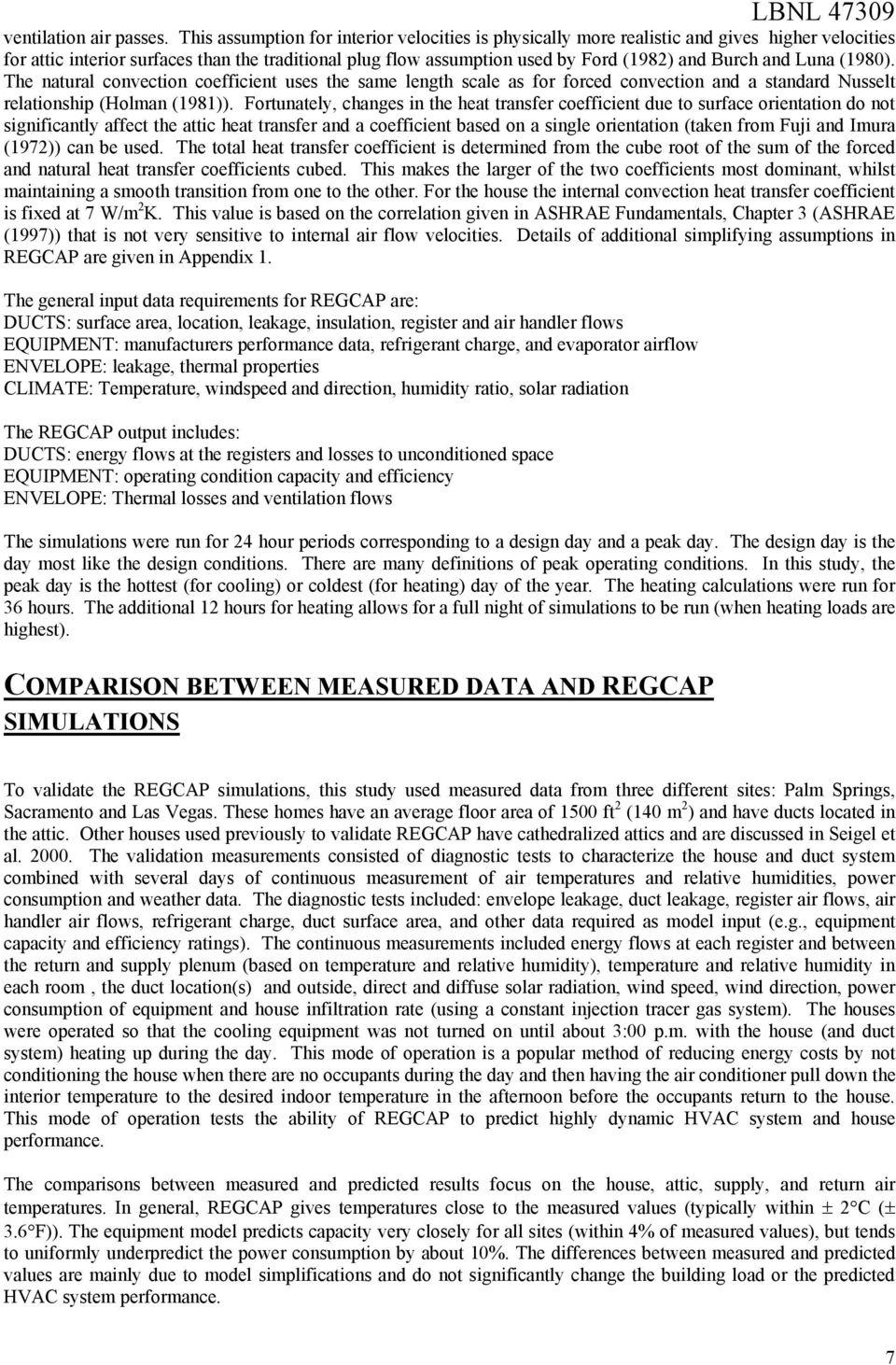
8 House temperature: The average absolute difference between the predicted and the measured data is different from simulation to simulation, but in most houses it was in the range of 1 to 2 C (2 to 4 F). Observations of the many simulation results and some additional parametric work have shown that these differences are mainly due to two of the REGCAP assumptions for the house thermal model. Firstly, the coupling between the house thermal mass and the house air is significant and not modeled with sufficient sophistication (The simulation results show that the house thermal mass may be too high.). Secondly, the effects of solar radiation may be under predicted. Unfortunately, there is no simple method of dealing with these problems at present, however, future work will concentrate on these issues. An example comparison is shown in Figure 2. There are high peak house air temperatures in the simulation results when the air conditioner first turns on. These peaks are due to the hot air in the ducts being blown into the house. This peak does not appear in measured data because of several issues. First, when the air handler is off, the predicted supply air temperature is higher than the measured supply air temperature. So, when the air handler turns on, the predicted temperature of air blown in to the house is too high. For the measured data, the peak is also reduced because the measured data is a five minute time average. Additional simulations with five minute time step have shown that this peak does not appear with longer averaging times, however the five minute time step leads to unacceptable compromises in estimates of cyclic or dynamic effects. Figure 2: Comparison measured and predicted house temperature Attic temperature: The simulation results show average differences of about 3 C (5.4 F) between measured and predicted temperature. This is a reasonable difference given the highly variable attic temperatures because it is only about 7% of the 40K attic temperature swing. The simulations are good at reproducing the large diurnal fluctuations in attic temperatures, as shown in Figure 3. The main reasons for the temperature differences are poor estimates of exterior radiation effects (solar gains during the day and radiative cooling at night). This hypothesis is confirmed by the study of other sites for which measured data are lower than predicted data in the morning before sunrise and the opposite happens once the sun shines. Factors such as the emissivity, the absorptivity of the roof material or the amount of cloud cover are not perfectly known and this uncertainty in model input contributes to these differences. 8

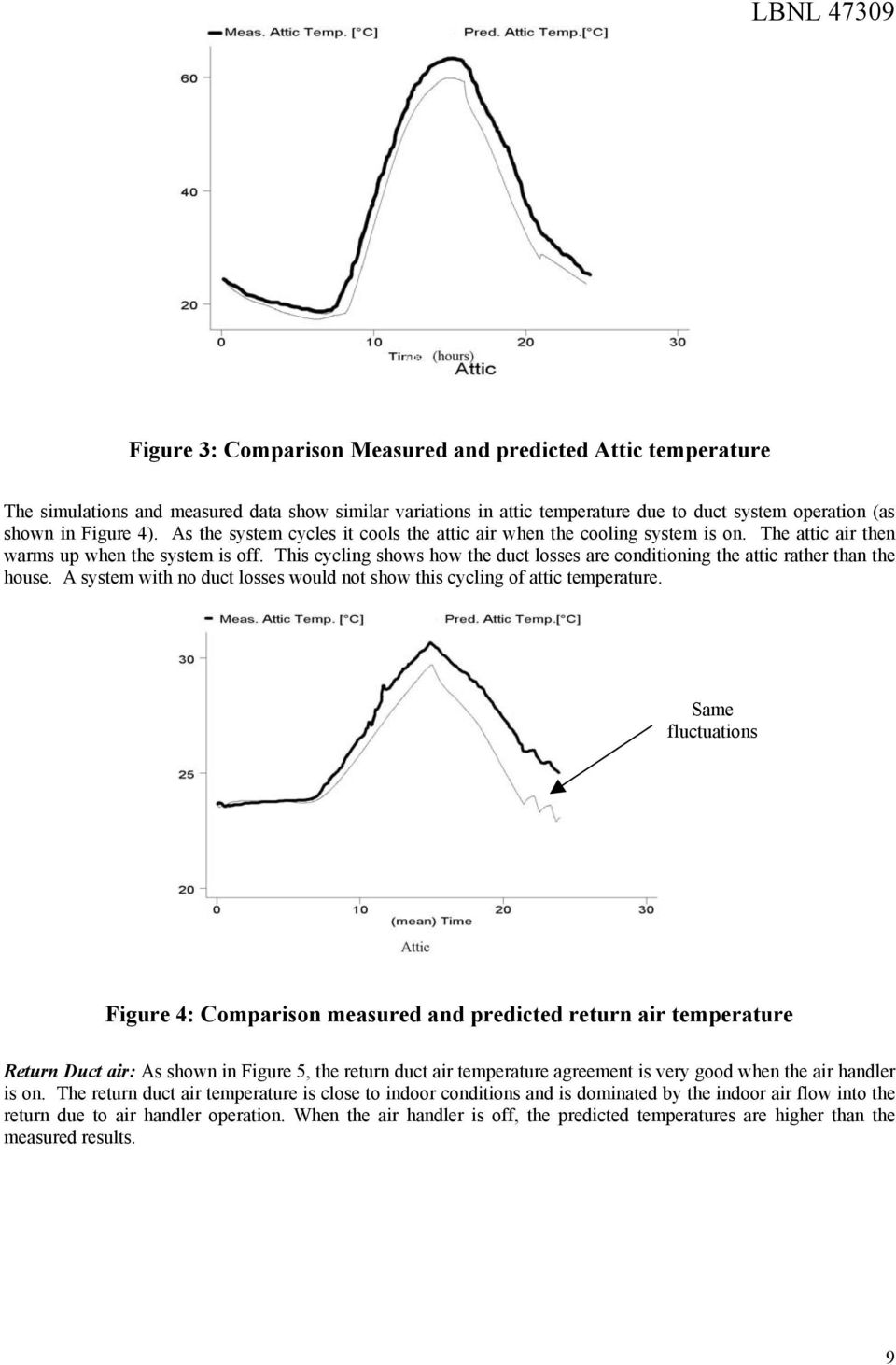
9 Figure 3: Comparison Measured and predicted Attic temperature The simulations and measured data show similar variations in attic temperature due to duct system operation (as shown in Figure 4). As the system cycles it cools the attic air when the cooling system is on. The attic air then warms up when the system is off. This cycling shows how the duct losses are conditioning the attic rather than the house. A system with no duct losses would not show this cycling of attic temperature. Same fluctuations Figure 4: Comparison measured and predicted return air temperature Return Duct air: As shown in Figure 5, the return duct air temperature agreement is very good when the air handler is on. The return duct air temperature is close to indoor conditions and is dominated by the indoor air flow into the return due to air handler operation. When the air handler is off, the predicted temperatures are higher than the measured results. 9
10 Figure 5: Comparison measured and predicted return air temperature Supply duct air: Figure 6 shows that the Supply duct air has the same behavior as return duct air, with good agreement when the air handler is on but not when it is off. The high temperatures for the supply and return duct simulations with the air handler off are due to strong coupling to the hot attic air temperature and radiation exchange with the interior attic surfaces. In addition, any air flows from room-to-room through ducts when the air handler is off will cool the duct air and these multi-zone effects are not taken into account in the simulation. REGCAP only calculates the flow of air passing from the attic to the house or from the house to the attic through duct and ceiling leaks. It should be noted that these errors when the air handler is off do not affect the results when the air handler turns on, and do not have a significant effect on the overall building load or system losses. With the air handler on, the heat transfer is dominated by the air handler flows and equipment operation. Figure 6: Comparison measured and predicted supply air temperature Power consumption: In most cases, measured data were about 300 W greater than predicted data, or about 10% of the total power consumption. Detailed investigations have shown that this is a result of the equipment model under predicting the actual power consumption. We are continuing to develop the equipment model to reduce these effects. 10

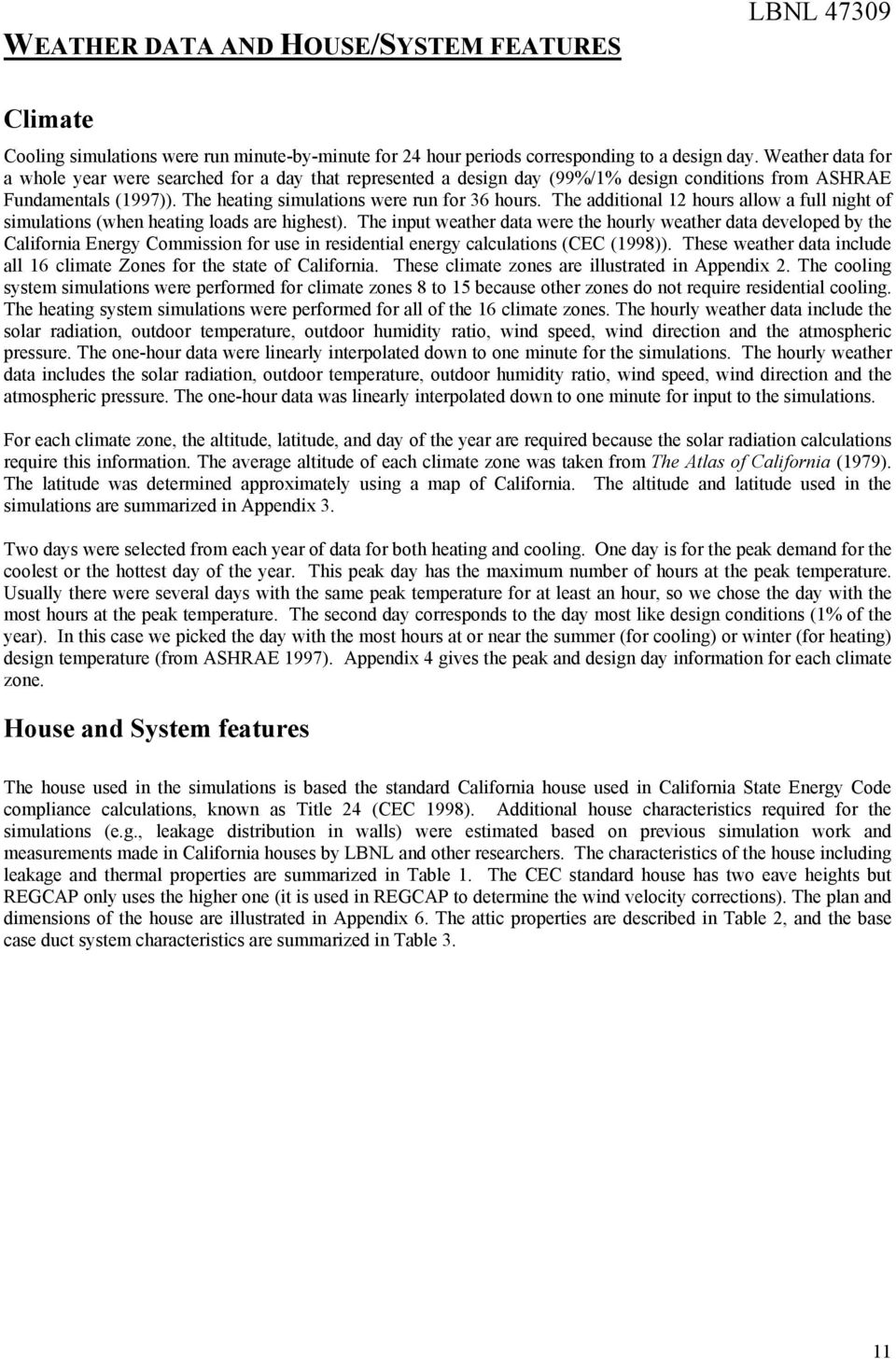
11 WEATHER DATA AND HOUSE/SYSTEM FEATURES LBNL Climate Cooling simulations were run minute-by-minute for 24 hour periods corresponding to a design day. Weather data for a whole year were searched for a day that represented a design day (99%/1% design conditions from ASHRAE Fundamentals (1997)). The heating simulations were run for 36 hours. The additional 12 hours allow a full night of simulations (when heating loads are highest). The input weather data were the hourly weather data developed by the California Energy Commission for use in residential energy calculations (CEC (1998)). These weather data include all 16 climate Zones for the state of California. These climate zones are illustrated in Appendix 2. The cooling system simulations were performed for climate zones 8 to 15 because other zones do not require residential cooling. The heating system simulations were performed for all of the 16 climate zones. The hourly weather data include the solar radiation, outdoor temperature, outdoor humidity ratio, wind speed, wind direction and the atmospheric pressure. The one-hour data were linearly interpolated down to one minute for the simulations. The hourly weather data includes the solar radiation, outdoor temperature, outdoor humidity ratio, wind speed, wind direction and the atmospheric pressure. The one-hour data was linearly interpolated down to one minute for input to the simulations. For each climate zone, the altitude, latitude, and day of the year are required because the solar radiation calculations require this information. The average altitude of each climate zone was taken from The Atlas of California (1979). The latitude was determined approximately using a map of California. The altitude and latitude used in the simulations are summarized in Appendix 3. Two days were selected from each year of data for both heating and cooling. One day is for the peak demand for the coolest or the hottest day of the year. This peak day has the maximum number of hours at the peak temperature. Usually there were several days with the same peak temperature for at least an hour, so we chose the day with the most hours at the peak temperature. The second day corresponds to the day most like design conditions (1% of the year). In this case we picked the day with the most hours at or near the summer (for cooling) or winter (for heating) design temperature (from ASHRAE 1997). Appendix 4 gives the peak and design day information for each climate zone. House and System features The house used in the simulations is based the standard California house used in California State Energy Code compliance calculations, known as Title 24 (CEC 1998). Additional house characteristics required for the simulations (e.g., leakage distribution in walls) were estimated based on previous simulation work and measurements made in California houses by LBNL and other researchers. The characteristics of the house including leakage and thermal properties are summarized in Table 1. The CEC standard house has two eave heights but REGCAP only uses the higher one (it is used in REGCAP to determine the wind velocity corrections). The plan and dimensions of the house are illustrated in Appendix 6. The attic properties are described in Table 2, and the base case duct system characteristics are summarized in Table 3. 11
12 Table 1: House Description General data No wind shelter, slab on grade 2 stories 1 garage facing North Dimensions Volume 396 m 3 [14000 ft 3 ] Floor Area 164 m 2 [1761 ft 2 ] Window area North 8 m 2 [87 ft 2 ] Window area South 6.5 m 2 [70 ft 2 ] Window area E/W 13m 2 [140 ft 2 ] Envelope Leaks C = m 3 /s(pa) n [140 cfm/pa n ], n = 0.65 Thermal data SLA = % of leaks in Wall 1 & 2 28% of leaks in Wall 3 & 4 No open Windows/Doors No ventilation fans operating House UA (not including infiltration) Ceiling insulation Wall insulation Floor insulation Latent Loads Internal Gains 165 W/ C [310 Btu/F] RSI 3.3 [R19] RSI 2.3 [R13] RSI 2.3 [R13] None 600 W [2050 Btu/h] Table 2: Description of Attic Characteristics General data Volume 62 m 3 [2190 ft 3 ] Area 78 m 2 [836 ft 2 ] Roof Asphalt shingle Roof Ridge perpendicular to front of the house Roof Pitch 25.5 Height of Roof Peak 6.5m [21.25 ft] Soffit Height 5 m [16 ft] Leakage Data C = m 3 /spa n [500 cfm/pa n ] ; n = 0.51 ELA = m 2 [2 ft 2 ] Soffits are 20% of total leakage No additional vents or ventilation fans 12

13 Table 3: Base case duct features General data Located in the attic Insulated plastic flex Supply Return Dimension Diameter (mean) 0.25 m [10 in] 0.5 m [20 in] Length 38.7 m [127 ft] 5.1 m[16.8 ft] Leakage data Leakage (fraction of fan flow) 11 % 11 % Exponent Coefficient 0.01 m 3 s/pa n [21 cfm/pa n ] 0.01 m 3 s/pa n [21 cfm/pa n ] Thermal data Insulation thickness 0.04 m [1.5 in] 0.04 m [1.5 in] R value RSI 0.7 [R 4.2] RSI 0.7 [R 4.2] * - Details of the duct leakage coefficient calculations are given in Appendix 7. Four systems were simulated for this study that were developed in order to cover a wide range of possible HVAC system performance. The following system characteristics are based on the results of many field investigations, some of which are referred to explicitly here: Base case - This case describes an average new house in California, with duct leakage of 22% of air handler flow split evenly between supply and return ducts (Walker et al. (1998), Modera and Wilcox (1995), and CEC (1998)), 85% of correct refrigerant charge and air handler flow (Blasnik et al. (1996) and Proctor (1997), duct surface area of 27% of floor area (Walker (1998)), nominal R4 duct insulation, and a 4 ton air conditioner. Air conditioner sizing was based on field surveys and a contractors rule of thumb of about 1 ton of air conditioner capacity for every 500 ft 2 of floor area (Brown et al. 1994; Proctor et. al. 1995; Proctor & Albright 1996; Vieira et al. 1996). Poor case - this case describes a below-average house in California. Duct leakage is increased to 28% (Jump et al. (1996)) and charge reduced to 70% (Blasnik (1996) and Proctor (1997)) of their nominal values. Good case - this case describes an average new house in California that has been improved by duct sealing to 6% duct leakage the specification for energy efficient duct credits in the California State energy code (Title 24), refrigerant charge and air handler flow correction. The air conditioner capacity has not been changed. Good resized this is the best case with a properly sized air conditioner according to Manual J and Manual S (ACCA (1986, 1992)). For cooling, this system has one ton less capacity and for heating the capacity reduction is also 25%. The air flow and duct surface area were correspondingly reduced by 25%. For resized heating systems, the furnace capacities were reduced by 25% and 50% depending on duct location. Two duct locations were simulated, with the ducts either located in the attic or in the conditioned space. In both cases the ducts were completely within each space, however REGCAP does have the capability to place any fraction of the ducts (and their leakage) in each space. The setpoint temperatures and schedule, that are based on California norms, are those given by Title 24 (CEC 1998). Three thermostat strategies were used in the cooling simulation: - 1 setpoint: with a constant temperature during all the day of 25.5 C (78 F). - 2 setpoints: The system is off from 9:00 a.m. to 3 p.m. (3 p.m. is used because time is needed to cool down the house before people come back at home after work at 5:00 p.m.). This strategy is used to save energy by not operating air conditioning when the house is unoccupied. There was no specific setback temperature for cooling, instead the system was not turned on at all during the day until 3:00 p.m. - 3 setpoints: in this case, the air conditioning operates from 7 a.m. to 9 a.m. and 5 p.m. to 10 p.m. For heating, only two thermostat strategies are considered: - 1 setpoint: with a constant setpoint of 20 C (68 F). - 2 setpoints: the setpoint is 20 C (68 F) from 8 a.m. to 12 p.m., and 15.5 C (60 F) the rest of the time. 13
![5 in] 0.04 m [1.5 in] R value RSI 0.7 [R 4.2] RSI 0.7 [R 4.2] * - Details of the duct leakage coefficient calculations are given in Appendix 7.](/docs-images/55/8816747/images/page_13.jpg "Four systems were simulated for this study that were developed in order to cover a wide range of possible HVAC system performance.")
14 SIMULATIONS REGCAP was designed to answer questions about the effect of heating and cooling system inefficiencies on system performance. Specifically, the goals of this research were to answer the following questions: 1. What are the energy and comfort penalties associated with inefficient heating and cooling systems in California climates? 2. How much does correcting those efficiencies improve system performance? 3. What are the performance changes associated with downsizing equipment? These questions were answered by evaluating the following energy and comfort performance parameters. This study evaluates the energy related issues of system performance by evaluating duct efficiency, equipment efficiency, total HVAC efficiency, peak power and total energy. The peak power consumption includes both air handler motor and compressor power. The total energy represents the energy consumed during the 24-hour period simulation. A key parameter is the power delivered to the conditioned space via the register, and is called Tons At the Register (TAR) (although this is a misnomer for heating systems, it is retained for convenience). Higher TAR implies more energy delivered to the conditioned space. TAR is calculated using the following formula: TAR= ( m ah - m supleak )C p ( T house T supair ) Where m ah = mass flow at the air handler (kg/s (lb/s)), m supleak = mass flow of leakage from the supply ducts (kg/s (lb/s)), C p = specific heat of air (kj/kgk (Btu/lbR)), T house = temperature of the house air (K (R)), T supair = temperature of the supply air entering in the house (K (R )). Three efficiencies are defined as follows: Equipment efficiency = Equipment Output Capacity / Power Consumption Duct efficiency = TAR / Equipment Output Capacity Total HVAC efficiency = TAR / Power Consumption The three comfort related issues studied are: pulldown time, Tons At the Register (TAR) and time above the setpoint. A common operating strategy used to reduce energy consumption is to turn off the air conditioning system during the day when the house is unoccupied. The pulldown time is the time required to cool the house after it has heated up during the day. A short pulldown time means that the house is comfortable sooner, which is desirable for the occupants. In these simulations, the deadband on the thermostat to turn the system on and off is ± 1 C (2 F), therefore the pulldown time is defined as the time it takes to cool to the setpoint minus 1 C (2 F). TAR is used as a comfort parameter because it changes the occupants perception of cooling system performance and also effects consumer expectations of how much heating or cooling the system should provide (as discussed further in Walker et al. 1998). The simulations track the amount of time the house temperature is above the setpoint for the single setpoint thermostat strategy. This time is also a comfort indicator because a house that cannot be temperature controlled will be too hot for the occupants. It is of key importance for systems that have high losses and cannot meet the building load. The system does not cycle and the indoor temperature rises above the setpoint at the hottest part of the day. Cooling System Specifications A total of 368 simulations were performed based on the combinations of climate, duct location, system description and thermostat operation. In addition to the parameters that identify the four cases, the following were also changed and are summarized in Table 4. 14

15 When ducts are located in the conditioned space, 0% leakage is assumed. The exception is when base case systems are moved into conditioned space where 6% of leakage is used (based on measurements reported in Siegel at al. (2000)). Unbalanced leaks will be tested for the base case by using 7% or 15% (the same total leakage) for the supply and the return leakage respectively. The imbalances change house and attic ventilation as well as duct system losses. Airflow across the cooling coil changes depending on the case m 3 /s/kw (340 cfm/ton) is used for the poor and base cases and m 3 /s/kw (400 cfm/ton) is used for the good and good resized cases m 3 /s/kw (400 cfm/ton) is middle of manufacturers recommended range (between m 3 /s/kw (300 cfm/ton and m 3 /s/kw (500 cfm/ton). Lower flow leads to lower equipment efficiency, and greater conduction losses (because air takes longer to travel from the plenum to the register). Two values of the Energy-Efficiency Ratio (EER) are used: 9.5 and 9.3 because this study used explicit performance data for specific equipment. The air handler power consumption is 700W (2.4 kbtu/h), 600W (2.1 kbtu/h) or 500W (1.75 kbtu/h) depending on the airflow of the system (higher airflows requiring higher air handler power). Three levels of duct insulation are used: RSI 0.75, 1.05 and 1.4 (R4.2, R6 and R8). Table 4: Summary of cooling systems parameters System System charge % Air Handler flow m 3 /s/kw (cfm/ton) Duct Leakage Fraction Supply % Return % ARI kw (kbtu/h) EER Fan Capacity W (kbtu/h) Nominal Capacity Tons Insulation Duct Surface Area Supply %FA Return %FA Base (340) (46) (2.4) 4 Poor (340) (46) (2.4) 4 Good (400) (46) (2.4) 4 Good Resized (400) (35) (2.1) 3 RSI 0.7 (R4.2) RSI 0.7 (R4.2) RSI 0.7 (R4.2) RSI 0.7 (R4.2) Heating System Specifications A total of 480 simulations were performed based on combinations of climate, duct location, system description and thermostat operation. The heating capacities were determined from the default in Title 24 (CEC (1998) Chapter 3.8). This default is 105 W/m 2 (34 Btu/h/ft 2 ) of floor area, which corresponds to about 17.5 kw (60 kbtu/h) for the 164 m 2 (1761ft 2 ) house. In the simulations, this 17.5 kw (60 kbtu/h) default was used and the resized systems used 13 kw (45 kbtu/h) for ducts in the attic and 9 kw (30 kbtu/h) for ducts in the conditioned space. ACCA manual J calculations were also performed that showed required capacities about one half of these values. However, to be representative of real systems, the CEC Title 24 standard has been followed. Much of this difference between ACCA R-J and installed capacity is because the same ducts are used for heating and cooling, and the heating equipment capacity is determined in accordance with duct size used for cooling systems. A summary of the ACCA Manual J sizing is given in Appendix 8. Another parameter has to be taken into account if the HVAC efficiency has to be analyzed: the furnace efficiency. For cooling, the fan and compressor are both electric, and the power consumption is directly related to capacity. But for heating, the air handler fan uses electricity, but the furnace is usually gas fired. For the gas furnace, the efficiency is usually between 0.78 AFUE (Annual Fuel Utilization Efficiency), the minimum DOE federal standard and Oil furnace efficiency is about 0.8 to 0.9. REGCAP did not include a model for furnace efficiency because it is simply fixed at one of these constant values, and manufacturers rated output capacity was used in the 15

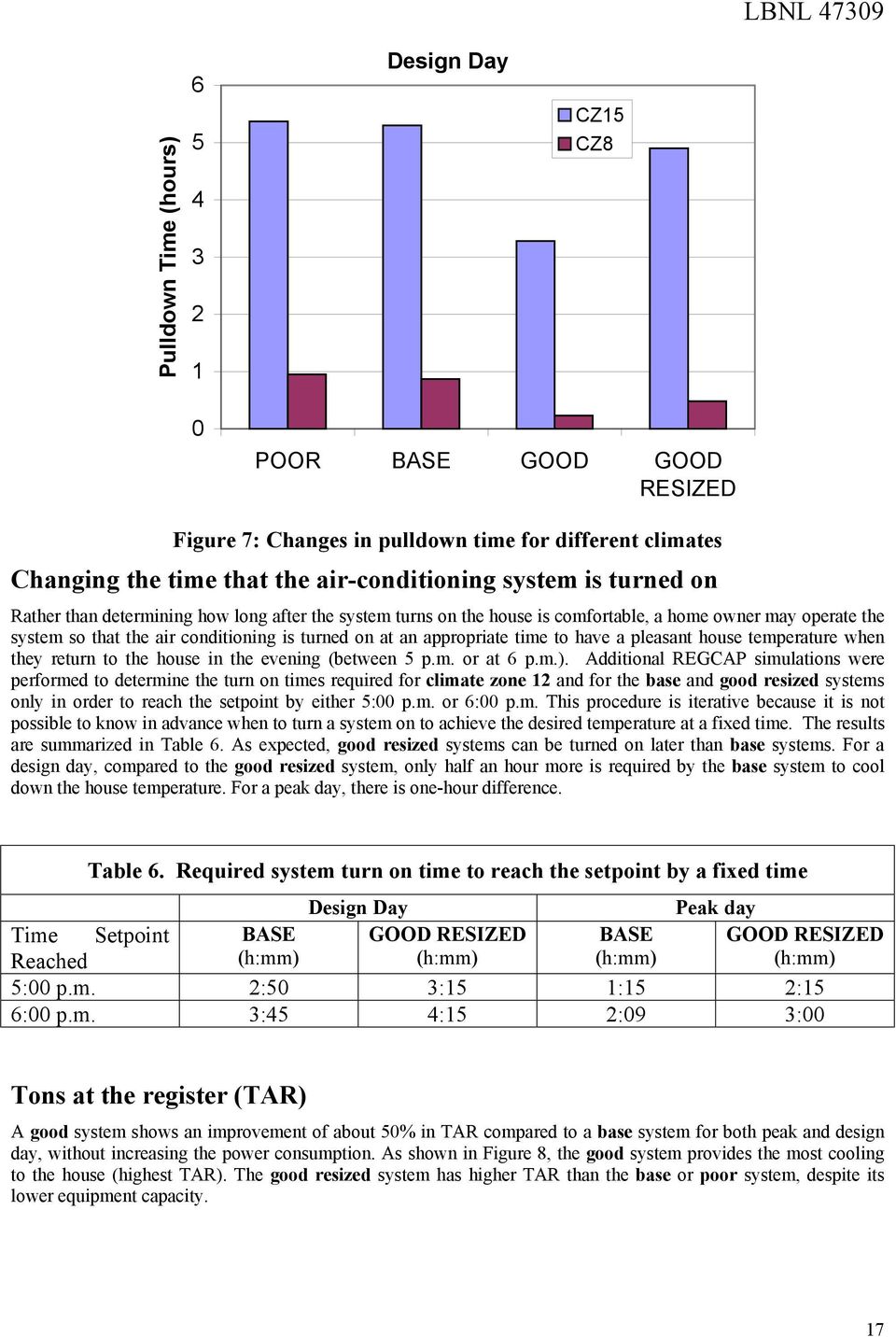
16 calculations. To obtain furnace consumption, the AFUE correction should be applied to the capacities used in this study. Table 5 summarizes the heating system parameters. Table 5: Summary of Heating system parameters SYSTEM Air Handler flow m 3 /s (cfm) Duct Leakage Fraction Supply % Return % ARI Capacity, W (kbtu/h) Air Handler Fan Capacity W (kbtu/h) Base 0.40 (850) (60) 500 Poor 0.40 (850) (60) 500 Good 0.47 (1000) (60) 500 Good Resized 0.35 (750) (45) 375 Insulation RSI 0.7 (R4.2) RSI 0.7 (R4.2) RSI 0.7 (R4.2) RSI 0.7 (R4.2) Duct Surface Area Supply %FA Return %FA SIMULATION RESULTS: COOLING In the discussion of the cooling simulation results the majority of the discussion and illustrations are for climate zone 8 and climate zone 15, which are respectively the coolest and the hottest climates. Other climate zones give results between these two extremes. Pulldown Time In general, better systems take less time to cool down the house. Poor and base systems are the slowest: typically 1 hour for moderate climates and 5 hours for hot climates. Good systems are the fastest: typically 20 minutes for moderate climates and 3 hours for hot climates. These differences are important for occupants because shorter pulldowns make the house more comfortable during key afternoon and evening hours. As shown in Figure 7, for moderate climate zones, using a base system or using a good system does not change the pulldown time very much because the pulldown time with a base system is already short. However, for hot climate zones, it makes a significant difference. However, For a base system in climate zone 15, the pulldown times are more than 5.3 hours. With a good system, this value can be reduced to 3.3 hours. In this extreme climate zone, good resized systems do not significantly reduce the pulldown time. These results indicate that resized systems have greater benefit with shorter pulldown times in milder climates, where they require abut half the time of base or poor systems. 16

17 Pulldown Time (hours) Design Day CZ15 CZ8 0 POOR BASE GOOD GOOD RESIZED Figure 7: Changes in pulldown time for different climates Changing the time that the air-conditioning system is turned on Rather than determining how long after the system turns on the house is comfortable, a home owner may operate the system so that the air conditioning is turned on at an appropriate time to have a pleasant house temperature when they return to the house in the evening (between 5 p.m. or at 6 p.m.). Additional REGCAP simulations were performed to determine the turn on times required for climate zone 12 and for the base and good resized systems only in order to reach the setpoint by either 5:00 p.m. or 6:00 p.m. This procedure is iterative because it is not possible to know in advance when to turn a system on to achieve the desired temperature at a fixed time. The results are summarized in Table 6. As expected, good resized systems can be turned on later than base systems. For a design day, compared to the good resized system, only half an hour more is required by the base system to cool down the house temperature. For a peak day, there is one-hour difference. Table 6. Required system turn on time to reach the setpoint by a fixed time Design Day Peak day Time Setpoint BASE GOOD RESIZED BASE GOOD RESIZED Reached (h:mm) (h:mm) (h:mm) (h:mm) 5:00 p.m. 2:50 3:15 1:15 2:15 6:00 p.m. 3:45 4:15 2:09 3:00 Tons at the register (TAR) A good system shows an improvement of about 50% in TAR compared to a base system for both peak and design day, without increasing the power consumption. As shown in Figure 8, the good system provides the most cooling to the house (highest TAR). The good resized system has higher TAR than the base or poor system, despite its lower equipment capacity. 17
18 TAR (W) Design day CZ 8 CZ 15 BASE GOOD POOR GOOD RESIZED Figure 8: TAR dependence on system capacity and distribution system performance Cycle length, humidity control and cyclic losses Very short cycles can have humidity control problems because the cooling coils need time to cool down below dew point and accumulate enough moisture so that it falls off the coils into the drain pan and thereby flows out of the duct system. With short cycles, coils are not cold enough for long enough to condense moisture, and any moisture that condenses is still on coils at cycle end. This moisture can re-evaporate into air that is blown into house at the start of the next cycle. Figure 9 illustrates examples of cyclic behavior for a good and a base system. The base system (A and B) has longer air handler cycles than a good system (C and D). However, the air handler cycles for all cases are almost always longer than 10 minutes. Combined with the dry climate in California, none of the tested systems should have humidity control problems. It should be noted that poor systems with long cycles still have poor humidity control due to hot humid outdoor air entering through return leaks combined with low capacity due to the poor refrigerant charge. Figure 10 shows how the attic temperature responds to the air handler cycles due to the duct system losses to the attic, with the base system changing attic temperatures more than the good system. Good systems lead also to a better indoor temperature control and thus a better comfort than the base system. These systems operate such that the system turns on when the air temperature is +1 C (2 F) above the setpoint and turns off when the temperature drop +1 C (2 F) below the setpoint due to the ±1 C (2 F) deadband. For the base system (B), the indoor temperature remains almost constant and close to the setpoint temperature +1 C (2 F) in the afternoon. On the other hand, the good system (D) is able to keep the temperature below the setpoint temperature +1 C (2 F). For all the simulations, the maximum indoor temperature is about 1 C (1.8 F) above the highest setpoint. The length time above the highest setpoint depends on the system and the tons delivered at the register, with the poorer systems spending longer at these high temperatures. The amount of time spent at this high temperature is short (typically 5 minutes) when a base system is used in a moderate climate or a good system is used in a hot climate. The time is much longer (typically 3hours) for a base system used in a hot climate. It should be noted that the time above the highest setpoint is not always a simple indicator because in some cases the time can be high because of numerous short cycles (indicating fairly good temperature control) rather than a few longer cycles (e.g., for a good system used in a moderate climate), so it is important to look at the cycle lengths as well as the total time in order to make a judgement about comfortable temperature control. 18

19 BASE GOOD A Temperature (C) T out T attic T air sup T house T setpoint Base system Climate Zone 8 Longer cycles Time (hrs) Temperature (C) Good system Climate zone 8 T out T attic T air sup T house T setpoint Shorter cycles Time (hrs) C B Temperature (C) T out T attic Tair sup T house T setpoint Base system Climate zone 15 Longer cycles Time (hrs) Temperature (C) Good system Climate zone 15 T out T attic T air sup T house T setpoint Time (hrs) Shorter cycles D Figure 9: Cycle length comparison between a base and a good system 19

20 Peak demand and power consumption LBNL The following figures show the duct efficiency, the power consumption and the energy consumption of each system for climate zone 8 and 15. Power Consumption (W) Design day CZ 8 CZ 15 Energy Consumption (KWh) Design day CZ 8 CZ 15 0 POOR BASE GOOD GOOD RESIZED 0 POOR BASE GOOD GOOD RESIZED Figure 10: Summary of system performance for a single setpoint thermostat strategy A good resized system can provide good indoor temperature control and it has 25% less peak power requirement than the other systems. The climate based power consumption changes are due to higher outdoor temperatures leading to reduced compressor and condenser performance. A good resized system duct efficiency is 25% greater than the duct efficiency of a base system and its energy consumption is also between 22% and 28% lower than a base system. This resized system has less peak demand, less operating cost (less energy used) and less capital cost (cheaper equipment). The poor system consumes the same amount of energy as the base case at design conditions. However, the poor system needs more time to cool down the house and spends more time with elevated indoor temperatures. Both of these effects mean that although the poor system uses the same amount of energy it provides less comfort. To provide the same comfort the poor duct system would require a larger capacity air conditioner that would consume more peak power and more energy. For unbalanced leakage, the results show different behavior for excess supply leaks compared to excess return leaks. Unbalanced systems with excess supply leaks have 6% higher duct efficiency than balanced systems with equal total leakage (that have a duct efficiency of 56%). However, an unbalanced system with excess return leaks has a duct efficiency between 4 % and 10 % lower than balanced systems. The inefficiency of ducts with high leakage at the return is due to the high temperature reached in the attic when the outside temperature is high. In this case, air from the hot attic enters the return ducts and heats the air from the return in the house. The energy required to cool down the mixed air is greater than if all the air came from inside the house and significantly reduces the effective capacity of the system. This result may imply that the energy consumption will be greater for an excess return leakage system than for a system with excess leaks at the supply. However, a system with excess supply leaks consumes about 46 kwh on the design day, compared to 43 kwh for excess return leaks or 44 kwh with balanced leaks. This is because the additional house ventilation associated with excess supply leaks also adds load to the house. Excess leakage at the return results in a pressurization of the house and reduces house infiltration. Excess leakage at the supply implies a house depressurization resulting in more infiltration of the hot outside and attic air. In this case, a large amount of energy is therefore used to cool down the hot air resulting from the extra infiltration. This shows that it is not sufficient to only focus on the duct system alone, but the interactions with the house must also be included. A reduction of the duct surface area reduces the conduction heat transfer and thus reduces the duct losses. The simulation results showed that a decrease of 25% in the duct surface area results in an increase of around 4% of the register capacity and the duct efficiency for all climate zones. Reducing the duct area is a simple idea that can be accomplished by placing registers and the air handler near the center of the house. Traditionally, registers are placed around the perimeter of the house to reduce moisture condensation on windows and the discomfort due to radiation 20

21 and drafts from cold windows. With improved window technology in new houses, however, this should no longer be necessary. Generally, the simulation results show that increasing the duct insulation thickness by about 40% (R4.2 to R6) increases the register capacity and thus the distribution efficiency by about 4% (between 3.5% and 5.5% depending on the weather conditions. A higher increase from R6 to R8 results in an additional improvement only of 1.9%. Similar results were obtained by Walker (2001) using simplified duct efficiency calculations using the draft ASHRAE Thermal Distribution standard (public review draft of ASHRAE standard 152P (2001)). Thermostat strategy For the one-setpoint thermostat strategy, the good resized system is around 45% more efficient than the base system. Although it has 25% less capacity than the base system it provides 14% more capacity at the registers than the base system and therefore better comfort. The energy consumption for the resized system is around 22 to 28% lower. As shown in Figure 11, the daily energy consumption is also lower for a pulldown strategy than for a one setpoint situation due to a shorter operating time. This difference ranges from about 10 % (climate zone 8) to 25 % (climate zone 15). The tradeoff for saving this energy is a house that gets very hot during the day (around 33 C (91 F) for a hot day). This operating strategy may be poor for some households if they have pets, or for food storage. Using a pulldown thermostat strategy in a hot climate creates uncomfortable conditions for a long time in the house by increasing the time the air conditioner is on before the pulldown is complete. In the simulations, the air conditioner was turned on at 3:00 p.m. and so a criterion for acceptable pulldown comfort is whether the house has completed its pulldown by 5:00 p.m. when the occupants return to the house. This implies a maximum acceptable pulldown time of two hours, or 120 minutes. As shown in Table 7, from climate zone 10 onwards the pulldown time becomes too long and therefore degrades comfort for a base system. For the good resized system this pulldown limit applies only to climates 13 through 15. This implies the need for the occupants to turn on the air conditioning system earlier or use continuous operation in hotter climates for a base system. This also means that good resized systems are more likely to be operated in the energy saving pulldown mode than base systems. In several cases the time spent above the setpoint is considerable, but in most of these cases the house is close to the setpoint temperature (within about 0.2 C) for most of this time and a small change in setpoint would considerably reduce these times. The exception to this is for the base system in climate zone 15 where the pulldown is so long (more than 5 hours) that it approximate continuous operation and the system cannot control the interior temperature as shown by the large amount of time above the setpoint. 21
22 Climate Zone 8 Climate Zone One Setpoint Pulldown One Setpoint Pulldown EnerguConsumption (kwh) EnerguConsumption (kwh) POOR BASE GOOD GOOD RESIZED 0.0 POOR BASE GOOD GOOD RESIZED Figure 11: Thermostat Strategy Effects on energy consumption Table7. Number of minutes above the setpoint for the one setpoint thermostat strategy and pulldown time for the pulldown strategy in each Climate Zone for a base and a good resized system for a design day CZ BASE BASE GOOD Resized GOOD Resized 1setpoint strategy Pulldown strategy 1setpoint strategy Pulldown strategy setpoint thermostat strategy preferable A third thermostat strategy was also tested where the system is on the morning between 7 a.m. to 9 a.m. and on the evening from 5 p.m. to 12 p.m. and off the rest of the time. This pre-cooling and operation while it is cooler outside leads to less duct losses and improved equipment performance. In turn, this leads to higher HVAC efficiency during system operation. As shown in Figure 12, this strategy is better than the one setpoint and pulldown strategies. The energy consumption for a base system using this thermostat strategy is between 35 and 80% less than in the other strategies depending on the climate zone. The drawback for this three setpoint thermostat strategy is that the evening pulldown is not complete until at least 6.30 p.m. For ducts located in the attic, the average register capacity during system operation is between 35% and 2% higher than the register capacity of the two other thermostat strategies. This three point strategy shows the most significant improvements when climate zone is hot and the system is poor. When ducts are in the conditioned space, the register capacity and energy consumption of this three setpoint thermostat strategy is about the same as the other thermostat strategies. 22
23 Energy Consumption (kwh) Design Day 1 setpt 2 setpt 3 setpt CZ 8 CZ 12 CZ 15 Figure 12. Effects of thermostat strategy on energy consumption Optimizing good resized system thermostat strategy For the pulldown thermostat strategy, the advantages of good resized systems (compared to a base case) such as less energy consumed, a better HVAC efficiency and a lower pulldown time are preserved for all the climate zones studied. However, there are fewer advantages for resizing in the more extreme climate. For example (as shown in Figure 7), the pulldown time for a good resized system is 50% faster than the base system for climate zone 8 and only 10% faster in Climate zone 15. To investigate if it is possible to optimize the set-up strategy, we varied the time at which the house was to be comfortable (pulldown completed). The simulations were run so as to start the pulldown at different times to complete the pulldown at either 5 p.m. or 6 p.m. Table 6 illustrated the change in system turn-on times between base and good resized systems. Allowing the system to operate later in the day resulted in more energy consumed during the pulldown, but less overall energy for the whole day. This is because the house is conditioned for a smaller fraction of the day (resulting in less total energy consumption), but requires more energy to cool it down (more energy during pulldown). The energy savings for a good resized system are still preserved (greater than 25%) for the later pulldown. Tables 8 and 9 give details of the energy consumption effects of changing the pulldown time. Table 8. Energy consumption for climate zone 12, with pulldown ending at 5 p.m. Energy consumed during the pulldown Energy consumed during the whole day Day Design day Peak day Design day Peak day System Base Good Resized Base Good Resized Base Good Resized Base Good Resized Energy (kwh) Good Resized system saving, %
24 Table 9. Energy consumption for climate zone 12, with pulldown ending at 6 p.m. Energy consumed during the pulldown Energy consumed during the whole day Day Design day Peak day Design day Peak day System Base Good Resized Base Good Resized Base Good Resized Base Good Resized Energy (kwh) Good Resized system saving, % Effects of moving ducts from the attic to the conditioned space To examine the benefits of moving ducts into the conditioned space two more systems were simulated. The indoor base resized and indoor good resized systems have 25% less capacity than the attic systems. Table 10 shows the single setpoint systems have about 30% less energy use for indoor systems. The effect of thermostat strategy is illustrated by the pulldown results that show less effect of moving the system inside, with an energy reduction of about 20%. Table 10. Energy consumption (kwh) in each Climate Zone for duct systems inside conditioned space Climate Zone Base 1setpoint Indoor Base Resized 1setpoint Good Resized 1setpoint Indoor Good Resized 1setpoint Good Resized Pulldown Indoor Good Resized Pulldown
25 Table 11. Time above setpoint and pulldown time for a base and a good resized cooling system located either in the attic or in the conditioned space for a design day (minutes) Climate Zone Time above the setpoint for one setpoint operation Base 1setpoint Indoor Base Resized 1setpoint Good Resized 1setpoint Indoor Good Resized 1setpoint Good Resized Pulldown Pulldown Time Indoor Good Resized Pulldown As shown in Table 11, the pulldown time for the indoor good resized systems is between 30% and 50% shorter than the pulldown time for the good resized systems. Comfort is therefore improved having ducts in the conditioned space. For single setpoint operation, the time for which the indoor temperature is above the setpoint temperature can be either shorter or longer for indoor ducts depending on the climate zone. This is because of the different system operating times when it is inside or in the attic. As shown in Figure 13A, an attic system has long cycles and the house temperature remains close to (0.1 or 0.2 C under) the setpoint temperature for a considerable time. For the indoor system shown in Figure 13B, there are many shorter cycles, and the house temperature cycles between the lowest and the highest setpoint temperature. This cycling is the reason for the indoor system being above the setpoint for a longer cumulative time over the day than the good resized attic system. In this case, the longer time above the setpoint does not necessarily imply that the interior ducts provide less comfort. Due to reduced duct system losses, the indoor good resized system provides cooler air (13 to 14 C) at the register than the good resized system (16 to 17 C). This discussion again illustrates how simple analyses for comfort can be misleading without a detailed understanding of system performance. Temperature ( C ) A Good resized system climate zone 15 design day T out T attic T sup air T house T stpt time ( hrs ) Temperature ( C ) Indoor good resized climate zone 15 design day T out T attic T sup air T house T stpt Time ( hrs ) B Figure 13. Comparison of cyclic behavior for a good resized system located in the attic or in conditioned space. Equipment performance Comparing the nameplate capacity of the equipment and the TAR (Table 12) shows that the rated capacity is much greater than the effective cooling provided by the HVAC system. The biggest difference is for poor and base systems located in the attic. Their register capacity is less than 40% of the rated capacity based on the nameplate. 25
26 This ratio increases to 50% when these systems are located in the conditioned space. Better systems (good and good resized) have their register capacity reaching 60% of the rated capacity when ducts are located in the attic and 70% when ducts are inside the house (essentially no losses). The remaining 30 % difference is due to overrating of equipment by manufacturers and not operating the equipment at the ARI rating conditions. Table 12. Comparison between nameplate capacity and TAR Systems TAR ( Tons ) Nameplate capacity ( Tons ) Difference ( % ) Base Poor Good Good Resized Indoor Base Indoor Good Resized SIMULATION RESULTS: HEATING For the heating systems the simulations did not convert the equipment output energy into energy consumed because there was no explicit model of the heating equipment. For gas furnaces, the efficiency does not change very much unlike air conditioners, so a single furnace efficiency value (such as AFUE) could be used to convert from output energy to energy consumed. Note that the system capacity in these calculations includes the air handler fan power. For the heating simulation, only two thermostat strategies were tested. The first strategy uses a single setpoint all day. The two setpoint thermostat strategy allows the temperature to drop to 15.5 C (60 F) at night. For the systems simulated here the two setpoint thermostat strategy has about 2 or 3% better register capacity and between 2.7% and 5.8% better HVAC efficiency, depending on the kind of system and the weather. The energy consumption is reduced by about 7 % by using the two setpoint strategy. These results are illustrated in Figure 14. In addition to saving energy, choosing the two setpoint thermostat strategy can be more comfortable for people who prefer lower nighttime temperatures. 300 Climate zone 12 design day 1 setpoint 2 setpoint Energy consumption (kwh) POOR BASE GOOD GOOD RESIZED Figure 14. Comparison of thermostat strategies for heating systems 26
27 As with the cooling systems, the system efficiency increases as insulation increases. For the heating systems tested here, using R6 insulation instead of R4.2 results in a duct efficiency improvement of 2.5% to 3%, and the TAR also increases by about 1.4% to 2.8%. Correct air handler flow and less leakage (a good system) have a much bigger effect with a 10% improvement in register capacity and a 10% increase in duct efficiency. The air flow and leakage improvements also decrease the energy consumption by 6% compared to the base system. In addition, the poor systems that are 6% more leaky than a base system have about 5% less TAR and duct efficiency in comparison with a base system. However, the poor system total energy consumption for the day is about the same as the base energy consumption due to operating at different times and therefore different attic conditions. In addition to the 25% power (peak) consumption reduction due to resizing, a good resized system consumes between 10 % and 12 % less energy than a base system for almost all climates, the thermostat strategies and the duct locations. Two additional heating systems were also tested with the system inside the conditioned space. The example results presented here are for Climate Zone 12, but are typical of other climates also. For heating, the systems in the conditioned space are downsized about 25% compared to the attic systems. The simulation results show a significant duct efficiency improvement by moving ducts from the attic to the conditioned space. This results in indoor resized systems that deliver 12% greater TAR than for systems located in the attic. The total energy consumption is reduced between 10% and 15% by moving the ducts inside, with a greater effect for base systems than good resized systems. CONCLUSIONS The REGCAP simulation is a good predictor of house and duct system performance, during heating or cooling system operation which is most important for this study. When the systems are not operating, the simulations do not match the measured data as well, but the errors do not contribute significantly to the energy consumption or system performance parameters. For all the simulations performed here, a properly sized system (about 25% capacity reduction) reduces the power consumption and therefore limits peak demand. Even though these correctly sized air conditioning systems have a smaller capacity, they can still provide better or equal comfort than an oversized system by using good duct systems and/or by moving the systems inside conditioned space. The comfort improvement is achieved by supplying a higher register capacity and having a shorter pull down time. For houses operating in pulldown mode (where the house heats up during the day), these correctly sized air-conditioning systems can be turned on later in the day and still achieve the setpoint temperature by the time occupants return to the house in the evening. Generally, the savings and other advantages of a good resized system are greater in more extreme climates. Climate also influences the choice of optimum thermostat strategy in hot climates only good duct systems should use the pulldown strategy otherwise the house stays too hot for too long. Using good ducts also saves energy typical improvements over a base case system are in the range of 20%-25%, with greater savings in more extreme climates. An investigation of thermostat strategies showed that turning systems off during the day saves energy, but keeping the house conditioned for the whole day may be a good strategy for good resized systems. This is because the energy penalty of continuous conditioning is small for these systems and their pulldown performance is not much faster than for the base case systems. Moving the duct system into conditioned space had significant advantages, even for good systems, and resulted in energy savings of around 30% for base systems and 15% for good resized systems. Similar results were obtained from the heating simulations. Energy and peak demand reductions of about 10% to 15% were obtained by good resized systems without sacrificing comfort. An additional 10% to 15% savings were realized by moving the duct system inside conditioned space. For both heating and cooling simulations, the duct improvements tended to be more significant in harsher climates, i.e. those that are hottest in the summer and coldest in the winter. 27
28 REFERENCES ACCA Manual J - Load Calculations for Residential Winter and Summer Air Conditioning. Washington D.C.; Air Conditioning Contractors of America (H. Rutkowski, Technical Director). ACCA Manual S - Residential Equipment Selection. Washington D.C.: Air Conditioning Contractors of America (H. Rutkowski, Technical Director). ASHRAE Second Public review Draft, ASHRAE Standard 152P. Method of test for determining the Design and Seasonal Efficiencies of Residential Thermal Distribution, ASHRAE, Atlanta, GA. ASHRAE Fundamentals Fundamentals, ASHRAE, Atlanta, GA. ASHRAE Handbook Fundamentals, ASHRAE, Atlanta, GA. Atlas of California Blasnik, M., T. Downey, J. Proctor, and G. Peterson Assessment of HVAC Installations in New Homes in APS Service Territory. Proctor Engineering Group Report for Arizona Public Service Company. Brown, K., C. Blumstein, L. Lutzenhiser, B. Hackett, and Y.J. Huang Does the Air-Conditioning Engineering Rubric Work in Residences? In Proceedings of the 1996 ACEEE Summer Study on Energy Efficiency in Buildings, 8: Washington D.C.: American Council for an Energy-Efficient Economy. Burch, D.M Infrared Audits of Roof Heat Loss, ASHRAE Transactions. Vol. 89. ASHRAE, Atlanta, GA. Burch, D.M. and Luna, D.E A Mathematical Model for Predicting Attic Ventilation Rates Required for Prevention of Condensation on Roof Sheathing. ASHRAE Trans. Vol. 86: 201. ASHRAE, Atlanta, GA. CEC Low-rise residential Alternative Calculation Method Approval Manual for 1998 Energy Efficiency Standards for Low-Rise Residential Buildings, California Energy Commission, Sacramento, California. CEC Residential Manual For Compliance with California's 1998 Energy Efficiency Standards. California Energy Commission, Sacramento, California. ECOTOPE Development of a Practical Method for Estimating the Thermal Efficiency of Residential Forced Air Distribution Systems. Electric Power Research Institute Report TR Ford, J.K Heat Flow and Moisture Dynamics in a Residential Attic. PU/CEES Report # 148, Princeton University. Forest, T.W. and Walker, I.S. 1993a. Attic Ventilation and Moisture. Canada Mortgage and Housing Report. March 1993 Forest, T.W. and Walker, I.S. 1993b. Moisture Dynamics in Residential Attics. Proc. CANCAM 93, Queens University, Kingston, Ontario, Canada, June Fuji, T. and Imura, H Natural Convection Heat Transfer from a plate with Arbitrary Inclination. Int. J. Heat and Mass Trans., Vol. 15, pp Pergamon Press. Holman, J.P Heat transfer- 5 th Edition. Mc Graw-Hill. Jump, D.A., Walker, I.S. and Modera, M.P Field Measurements of Efficiency and Duct Retrofit Effectiveness in Residential Forced air Distribution Systems. Proc ACEEE Summer Study, Vol. 1. pp Washington D.C.: American Council for an Energy-Efficient Economy. LBL Report # Mc Adams, W Heat Transmission- 3 rd Edition, Mc Graw-Hill. 28
29 Modera, M.P., and Wilcox, B Treatment of Residential Duct Leakage in Title-24 Energy Efficiency Standards. CEC contract report. California Energy Commission. Proctor, J., Z. Katsnelson and B. Wilson "Bigger is Not Better: Sizing Air Conditioners Properly." Home Energy, 12(3): Proctor, J. and P. Albright Sizing air Conditioners: If Bigger is not Better, What Is?. Home Energy, 13(5): Proctor, J Field Measurements of new residential air conditioners in Phoenix, Arizona. ASHRAE Transactions, 103(1): ASHRAE, Atlanta, GA. Proctor, J Air Conditioning Equipment Model. Personal Communication, March Rodriguez, A.G., O Neal, D.L., Bain, J.A., and Davis, M.A The Effect of Refrigerant Charge, Duct Leakage, and Evaporator Air Flow on the High Temperature Performance of Air Conditioners and Heat Pumps. Energy Systems Laboratory report for EPRI, Texas A&M University Siegel, J.A., Walker, I.S., and Sherman, M.H Delivering Tons to the Register: Energy Efficient Design and Operation of Residential Cooling Systems. Proceedings of the 2000 ACEEE Summer Study. American Council for an Energy Efficient Economy. (LBNL 45315) Sharp, G., Residential Consumption by End-Use from California Energy Demand California Energy Commission. August 23, Vieira, R.K., D.S. Parker, J.F Klongerbo., J.K. Stone, J. Cummings How Contractors Really Size Air Conditioning Systems. Proceedings of the 1996 ACEEE Summer Study on Energy Efficiency in Buildings, 8: Washington D.C.; American Council for an Energy Efficient Economy. Wilson, D.J. and Walker, I.S Passive Ventilation to Maintain Indoor Air Quality. University of Alberta Department of Mechanical Engineering Report #81. University of Alberta, Edmonton, Alberta, Canada. Wilson, D.J., and Walker, I.S Feasibility of Passive Ventilation by Constant Area Vents to Maintain Indoor Air Quality. Proc. Indoor Air Quality '92, ASHRAE/ACGIH/AIHA Conference. San Francisco. October Walker, I.S Technical Background for Default Values used for Forced Air Systems in Proposed ASHRAE standard 152P. ASHRAE Trans. Vol.104 Part 1. (LBNL 40588). Walker, I.S., J. Siegel, K. Brown, M.H. Sherman Saving Tons at the Register. Proceedings of the 1998 ACEEE Summer Study on Energy Efficiency in Buildings, 1: Washington D.C.: American Council for an Energy-Efficient Economy. (LBNL 41957). Walker, I.S, Sherman, M, Siegel, J Distribution Effectiveness and Impacts on Equipment Sizing for Residential Thermal Distribution Systems.LBNL Walker, I.S., adfsdf. LBNL Walker, I.S., Siegel, J.A., Degenetais, G Simulation of Residential HVAC System Performance. Proc. ESIM2001 Conference, CANMET Energy Technology Centre/Natural resources Canada, Ottawa, Canada. pp LBNL
30 Appendix 1. SIMPLIFYING ASSUMPTIONS FOR REGCAP LBNL In order to simplify the calculation procedure, several key assumptions are made. These simplifications strike a balance between complexity and what can be reasonably known about the building. The assumptions discussed here will focus on the heat transfer part of REGCAP because this is where the cooling and heating system effects are most important. The basis of the thermal model in REGCAP is that a set of sixteen nodes is defined throughout the house and HVAC system, and a set of equations is solved to find the temperature at each node. The 16 nodes are shown in Figure 1. The heat fluxes into each node are calculated and then a finite difference approximation is used to find the change in temperature of the node: ρvc p (T T previous )/ τ = Σ Q (A1.1) Where: ρ = density of node material (kg/m 3 ) V = volume of node (m 3 ) C p = specific heat of node material (J/KgK) T = current temperature of the node ( C or K) T previous = previous temperature of node ( C or K) τ = Time step. For the simulations in this study this is set to one minute (60 s). Q = heat flux into node (W) The specific heat of the building materials and the air are assumed to be constant (rather than a function of temperature) because the difference is insignificant: J/kgK variation over the temperature range used in this study. The heat flux is composed of: Conduction: Q = A T / R with R = Thermal Resistance between nodes (m 2 K/W) A = Surface Area over which heat transfer occurs (m 2 ) T = Temperature difference between nodes ( C or K) Convection: Q = h c A T with h c = convection heat transfer coefficient (W/m 2 K) Radiation: Q = h r A T with h r = radiation heat transfer coefficient (W/m 2 K), and h r is a function of the surface temperature to the third power (T 3 ). To linearize this radiation heat transfer, hr is determined using temperatures from the previous time step. Because the time steps used in this study are so short (one minute) the linearization errors are insignificant. For the air nodes (1, 12, 15 and 16), the energy in the airflows in and out of the nodes are also included in the energy balance. The finite difference approximation used in Equation A1.1 implies that the temperature distribution is uniform for each node. For solid nodes, this assumption is tested by the calculation of the non-dimensional Biot number: 30 Bi = h c L/k with h c = exterior convention heat transfer coefficient (W/m 2 K) L = characteristic length (m). Usually determined by V/A, the volume to surface area ratio for the node. k = thermal conductivity (Km/W) For most the solid nodes, it was found that Bi < 0.1. Therefore, the constant temperature assumption is acceptable. The exception is for the house thermal mass - particularly the slab floor. To keep the model simple a single node was used for the house thermal mass, but in the future it is possible that a multi-node approach may be used. The effective thermal mass of the house and attic wood were determined by using assumptions about known construction techniques and scaling the mass with the size of the house. Most of the surfaces in the attic undergo both natural and forced convection. In REGCAP, the relationship for forced convection is based on empirical relationships from Burch (1980) and McAdams (1954). For forced convection due to ventilation or handler driven air flows, the forced convection coefficient is determined by using the Nusselt relation:
31 Nu = h forced L / k = Re 4/5 Pr 1/3 LBNL (A1.2) Where: Reynolds Number: Re = ul / ν Prandlt Number: Pr = ν / λ where λ is the thermal diffusion coefficient (m 2 /s) ν the viscosity (s/m 2 ) u the air velocity (m/s). This equation can be linearized over the range of temperatures commonly seen in building simulations (between 250K and 300K): h forced = ( T film ) u 4/5 L 1/5 (A1.3) T film is the average of the air and surface temperature and L (the characteristic length) is assumed to be 0.5 m for an attic. For natural convection in the attic and house a single orientation is chosen for simplicity, such that the Nusselt number is given by the following relationship (from Fuji and Imura 1972): Nu = 0.13 ( Gr Pr ) 1/3 (A1.4) Where: Gr = gβ TL 2 ν 3 Pr = λ ν, β = Volume coefficient thermal expansion, and g = gravitational acceleration ( m/s 2 ) For air: Pr = 0.71, k = W/m.K, and Gr = 2084L 3 T, therefore, the natural convection heat transfer coefficient is given by: h T = 3.2 ( T ) 1/ 3 (A1.5) The overall convection is determined combining the forced and natural coefficients in the following empirical equation that allows the dominant heat transfer effect to dominate the overall heat transfer coefficient: h total = h + (A1.6) natural h forced Equation A1.6 is not applied to nodes 7 and 13, the underside of the ceiling and the house mass, respectively. For these, h total is set equal to 6 W/m 2 K when the air handler is off and 9 W/m 2.K when the air handler is on. This is based on equations developed empirically in ASHRAE Fundamentals (Fundamentals 1997) (chapter 3) for determining heat transfer on interior surfaces: h total = u = 7W/m 2 K (A1.7) The small range of this heat transfer coefficient over the expected range of interior velocities shows that the assumption is not critical: For u = 0.1 m/s h = 6 W/m 2.K (low velocity) For u = 0.3 m/s h = 7 W/m 2 K (typical velocity when the air handler is off) For u = 1 m/s h = 9.5 W/m 2 K (extreme velocity) Internal radiation heat transfer is only calculated for the attic surfaces (nodes 2, 4, 8, 11, and 14) because only the attic has temperature differences high enough to cause significant radiant exchange from the point of view of thermal loads on house and ducts. The wood in the roof trusses may contribute to radiation exchange but the geometry is too complex and the net effect too small to model. The ducts are also included in the radiation exchange in the attic. The ducts are assumed to have the upper half of their surface area exchanging radiation with the sheathing, and one half not active in radiant heat transfer because it lies on the floor of the attic. This "half active" approach was determined semi-empirically by performing detailed comparisons of measured to modeled data as well as observing duct installations in houses. 31
32 Initial temperatures need to be assumed for all the temperature nodes at the beginning of the simulation. The initial attic, supply, return temperatures are fixed equal to the initial outdoor temperature. The initial house temperature is equal to the thermostat setpoint temperature minus one K, and the initial house mass temperature is the setpoint minus two K. Our simulation results have shown that these initial temperature assumptions are not critical, because they only have an effect for about the first 30 minutes of any simulation. The exception is the initial house thermal mass temperature that can be critical in some simulations. The simple model for initial house mass temperature used here was based on many empirical comparisons of measured and simulated temperatures in California houses. For the air nodes it is assumed that the air is well mixed and therefore of uniform temperature. This assumption is reasonable for ducts because they have a small volume and large airflows during system operation. For the house air, the air handler mixes the air during system operation. With the air handler off, the house may become stratified or have room-to-room temperature differences (e.g., because of different solar loads), but this has a small effect on building load and even less effect on duct system performance. Because there is no active mixing of attic air it can have significant thermal stratification. Determining the attic thermal stratification is an extremely complex problem because it requires detailed knowledge of all the air flows through individual attic leaks and the interactions between the complex internal geometry of attic surfaces all at potentially different temperatures. Because this stratification could not be accurately modeled it is not included in the REGCAP model. This attic stratification could have a significant effect on duct system performance if the air around the ducts was at a different temperature than the rest of the attic air. The comparisons that have been made to measured data would then show a bias in the calculated duct system performance. Because verification comparisons did not show this bias it can be assumed that the attic stratification does not have a significant effect. For air flows, the house and attic are both treated as single zones. Most attic spaces are of open construction and a single zone is a good assumption. Houses tend to be compartmentalized by interior partitions and if doors are closed between rooms the house will have several linked interior zones. If this study focused on predicting heat and air movement for individual rooms, then this would be a concern, but when determining overall values for the whole house the single zone approach is adequate. In addition, the extra information on the flow resistance of all the flow pathways between all the rooms of the house is almost impossible to determine - so the required input information for a more complex model is generally unknown. One significant aspect of the single zone assumption is that it ignores heat transfer through the ducts with the air handler off that is transported by air flow through the ducts from room to room. This is generally not a problem for this study because this is such a small part of the load for the whole house. Some simple calculations show that the room-to-room flows through attic ducts contribute less than 100W to the house load. However, REGCAP does include air flows (and the associated heat transfer) between the house and the attic through the duct leaks when the air handler system is off. The geometry of the house is assumed to have a square floor plan that influences the wall surface area (for estimating house conduction load) and wind pressure coefficients (for estimating ventilation driving pressures). For more complex house shapes the wall surface area will be proportionally larger (for the same floor area). Because the house load is modeled so simply, the added complication of explicitly specify a complex house shape was not justifiable. Also, for comparing the performance of different systems in this study, the simple house shape is the same in all cases. Similarly, the pressure coefficient data is unknown for specific complex building shapes and the infiltration rate is not strongly affected by specific geometry unless there are very specific known leaks. 32
33 Appendix 2: CALIFORNIA CLIMATE ZONES LBNL
34 Appendix 3: MEAN ALTITUDE AND LATITUDE OF EACH CLIMATE ZONE Climate Zone Latitude (degres) Altitude (m) Climate Zone Latitude (degres) Altitude (m) Sources: Altitude: Atlas of California p 115 Latitude: Map in Internet 34
35 Appendix 5: PEAK AND DESIGN WEATHER DATA FOR EACH CLIMATE ZONE These data were determined by using the CEC, T24 hourly weather data for each climate zone. They were sorted by the outside temperature. Then it was easy to find out the peak temperature corresponding either to the coolest or the hottest temperature depending on the studied situation. The design temperature were found by looking at the most usual temperature around the day 35 ( 1% of the number of days). COOL HEAT CZ Peak Day / / / / / / / /24 Peak T ( C) Design Day / / / / / / / /09 Design T ( C) Peak Day / / / / / / /06 Peak T ( C) Design Day / / / / / / /07 Design T ( C) / /08 COOL HEAT CZ Peak Day / / / / / / / /07 Peak T ( C) Design Day / / / / / / / /11 Design T ( C) Peak Day / / / / / / / /20 Peak T ( C) Design Day / / / / / / / /09 Design T ( C)
36 Appendix 6: PLAN AND DIMENSIONS OF THE HOUSE First Floor ft ft 2 Second Floor ft ft
37 West Elevation LBNL F G1 G2 11 South Elevation D1 D2 8 C 532 ft 2 D3 5 3 North Elevation 8 A1 A2 A3 176 ft 2 8 B East Elevation E2 504 ft 2 E1 4 E3 E
38 PERIMETER (ft) Exposed (uncond) Covered (outside) Exposed (outside) VOLUME (ft 3 ) Total 1 st floor 2 nd floor AREA (ft 2 ) Total Conditioned foot print Floors 1 st floor : exposed slab covered slab 2 nd floor : over conditioned space over unconditioned space Walls North 1 st floor : exposed to outside exposed to unconditioned 2 nd floor : exposed to outside exposed to unconditioned South East West : 1 st floor 2 nd floor AREA (ft 2 ) Ceilings Vaulted Horizontal Doors Garage Front Glass North South East West Thermal Mass Covered Exposed SLOPE ANGLE Roof Pitch % Orientation North South East West Window A1 A2 A3 B C D1 D2 D3 E1 E2 E3 E4 F G1 G2 Area (ft 2 ) 16 % 3 6 * * * * * * * * * * * * * * * 5 3 Left Distance Head Height
39 Appendix 7: DETAILS OF HOUSE DESCRIPTION USED AS INPUT TO REGCAP 1. Determination of the Envelope Leakage Coefficient: C The typical relationship used between the flow Q and the pressure difference is: Q=C. P n Where Q = Volume Flow Rate (m 3 /s) C = Flow coefficient (m 3 /(s.pa n )) n = Flow exponent The value of n varies from 1 for laminar flow to 0.5 for turbulent orifice flow. The sign of P issued in REGCAP to give the flow direction: if it is positive, it is an inflow if not it is an outflow. Title 24 provides the default Specific Leakage Area that must be converted to a flow coefficient, C, using the following relationships: SLA = ELA*69.44/FA = 3.8 with ELA = Effective Leakage Area (m 2 ), FA = Floor Area (ft 2 ) ELA = SLA * FA / We assume that this flow can be calculated as a flow through an orifice at e reference pressure of 4 Pa: Q = C. P n = ELA * 2 P = ELA * P 0.5 * ρ 2 with ρ = 1.2, P=4 Pa (standard values) ρ C = ELA * ρ 2 * P 0.5-n = m 3 /(s.pa n ) ; with n assumed to be equal to Determination of House UA The equation for the heat flow is: Heat loss = U*A* T with T = difference of temperature between the indoor temperature and the outdoor temperature A = Sum of the ceiling, walls, and floor Area U = Thermal Conductivity = 1/R (thermal resistance). UA = A R ceiling ceiling + A R floor floor + 4 n = 1 R A wall wall 39
40 3. Determination of the Internal gains (W) LBNL Internal gains account for lights, electrical devices, and human beings. From the ASHRAE Handbook 1997, we can estimate the occupancy loads. The sensible heat gain per sedentary occupant is assumed to be 67 W. We assume that there are 2 occupants, so, the internal gain due to the occupants is 134 W. Appliance loads are concentrated mainly in the kitchen and laundry areas. Based on contemporary living conditions in a single-family house, a sensible load of 470W should be divided between the kitchen and/or laundry and the adjoining rooms. Internal gains (E) are the sum of these loads: E= 604 W 4. Determination of the Attic Leakage Coefficient, C attic This coefficient was based on field measurements in test houses, together with a scaling factor to account for the difference in house size between the field tests and the simulated house. 5. Supply and return leakage fraction Three levels of duct leakage were used, based on field tests on many duct systems by LBNL and other researchers and contractors: - Good ducts: 3% - Typical ducts: 11% - Poor ducts: 14% 6. Determination of the return and supply duct length and diameter The Return Surface Area (RSA) and the Supply Surface Area (SSA) scale with the Floor Area (FA) in the following way (from Walker (1998)): RSA = 5%*FA SSA = 27% * FA if 1 story house = 0.7 * 0.27 * FA if 2 story house We used a typical value of the return and supply 10 inches diameter to determine the length of these ducts. 7. Envelope leakage distribution R=(C ceiling + C floor )/C total =0.4 Fraction of envelope leakage in ceiling and floor X=(C ceiling - C floor )/C total =0.3 Difference between ceiling and floor These two values are estimated based on field measurements. If the house is located on a slab (like in our case), ceiling losses will be bigger than floor losses. But if the house is over a crawlspace, the term X will become smaller because of the cracks that increase floor losses. 40
41 Appendix 8: ACCA MANUAL J FURNACE SIZING SUMMARY LBNL ACCA manual J calculations were used to determine the capacity of the heating equipment needed in each climate. The range heating of loads ranged from 22k Btu/h for the hot climate zone (climate zone 7) and 44k Btu/h for the mountain climate zone (climate zone 16), and are summarized in the following table. Capacity of heating system given by ACCA R-J for different climate zones Climate Zone Capacity, kw ( kbtu/h ) Climate Zone Capacity, kw ( kbtu/h ) 1 9 (31) 9 9 (31) 2 10 (34) 10 7 (24) 3 7 (24) (33) 4 9 (31) 12 9 (31) 5 9 (31) (33) (22) (34) 7 6 (21) 15 9 (31) 8 9 (31) (45) 41
Sensitivity of Forced Air Distribution System Efficiency to Climate, Duct Location, Air Leakage and Insulation
 LBNL 43371 Sensitivity of Forced Air Distribution System Efficiency to Climate, Duct Location, Air Leakage and Insulation Iain S. Walker Energy Performance of Buildings Group Indoor Environment Department
Residential HVAC System Sizing
 Residential HVAC System Sizing William P. Goss University of Massachusetts, Amherst, Massachusetts, USA Corresponding email: [email protected] SUMMARY Heating, ventilating and air-conditioning (HVAC)
Glossary of Heating, Ventilation and Air Conditioning Terms
 Glossary of Heating, Ventilation and Air Conditioning Terms Air Change: Unlike re-circulated air, this is the total air required to completely replace the air in a room or building. Air Conditioner: Equipment
Energy Use in Residential Housing: A Comparison of Insulating Concrete Form and Wood Frame Walls
 PCA R&D Serial No. 415 Energy Use in Residential Housing: A Comparison of Insulating Concrete Form and Wood Frame Walls by John Gajda and Martha VanGeem 000 Portland Cement Association KEYWORDS Concrete,
Makeup Air For Exhaust Systems In Tight Houses. Tony Jellen Engineering Projects
 Makeup Air For Exhaust Systems In Tight Houses Tony Jellen Engineering Projects PA Housing & Land Development Conference February 23, 2012 Effects of Kitchen Ventilation on Residential Dwellings Anthony
Residential Duct Systems for New and Retrofit Homes
 Residential Duct Systems for New and Retrofit Homes Why it is important to properly design and install high quality, efficient ducted air systems? The efficiency of air distribution systems has been found
air conditioners how to choose a cooling system
 air conditioners how to choose a cooling system taking responsibility As an individual, your efficient use of energy brings benefits such as lower bills, improved comfort levels in your home and a reduced
Saving Heating Costs In Warehouses
 2005, American Society of Heating, Refrigerating and Air-Conditioning Engineers, Inc. (www.ashrae.org). Reprinted by permission from ASHRAE Journal, (Vol. 47, No. 12, December 2005). This article may not
FREQUENTLY ASKED QUESTIONS about HERS and CHEERS Provided by the California Energy Commission Consumer Energy Center
 http://www.energy.ca.gov/ FREQUENTLY ASKED QUESTIONS about HERS and CHEERS Provided by the California Energy Commission Consumer Energy Center Relevant Standard The Residential Manual for Compliance with
Venice Library Humidity Study. for Williams Building Diagnostics, LLC 305 15 th Street West Bradenton, FL 34205. Report April 13, 2015
 for Williams Building Diagnostics, LLC 305 15 th Street West Bradenton, FL 34205 Report April 13, 2015 Moses & Associates, Inc. 2209 NW 40 th Terrace, Suite A Gainesville, FL 32605 FL License EB-0003097
Energy Efficiency. Energy Efficient Home Cooling:
 Energy Efficiency Energy Efficient Home Cooling: Choosing an air conditioning system is an important decision. A poor choice may be costly to purchase and operate and yet fail to provide the desired cooling
Residential HVAC Load Sizing Training October 14, 2015. David Kaiser Green Code Plan Reviewer
 Residential HVAC Load Sizing Training October 14, 2015 David Kaiser Green Code Plan Reviewer DCRA - Green Building Division Regulations of green codes including: Green Building Act Green Construction Code
IECC Compliance Guide for Homes in Virginia
 IECC Compliance Guide for Homes in Virginia Amended Version of 2012 International Energy Conservation Code July 14, 2014 Climate Zone Since the entire state of Virginia falls in the IECC Climate Zone 4,
CHAPTER 3. BUILDING THERMAL LOAD ESTIMATION
 CHAPTER 3. BUILDING THERMAL LOAD ESTIMATION 3.1 Purpose of Thermal Load Estimation 3.2 Heating Load versus Cooling Load 3.3 Critical Conditions for Design 3.4 Manual versus Computer Calculations 3.5 Heating
Air Conditioning. The opportunity for energy efficiency. Low cost actions to reduce energy usage now
 Fact Sheet #6 Air Conditioning In this fact sheet you will discover: The opportunity for energy efficiency How air conditioning works Low cost actions to reduce energy usage now Investments to reduce costs
AIR CONDITIONING EFFICIENCY F8 Energy eco-efficiency opportunities in Queensland Foundries
 AIR CONDITIONING EFFICIENCY F8 Energy eco-efficiency opportunities in Queensland Foundries Hot tips and cool ideas to save energy and money! Air conditioning units or systems are often used by foundries
Below are detailed instructions for using the EMS load calculator.
 Introduction The EMS load calculator is designed to make load calculating as painless as possible. For sizing the equipment, only the first three tabs (Steps 1, 2 & 3) need to be completed. This process
Air Conditioning Contractors of America
 Air Conditioning Contractors of America WHO IS ACCA???? Industry Manuals Residential D, J, S, H, RS, T, P A manual J load calculation is a measurement of how much heating and cooling capacity a home will
Get the FACTS about SEER and Deliver Better Customer Value
 What is SEER? SEER stands for Seasonal Energy Efficiency Ratio. It s a number that describes how well air-conditioning equipment works. A higher SEER means better efficiency and lower energy bills. SEER
Impact of Infiltration on Heating and Cooling Loads in U.S. Office Buildings
 Impact of Infiltration on Heating and Cooling Loads in U.S. Office Buildings 1 Steven J. Emmerich, 1 Andrew K. Persily, and 2 Timothy P. McDowell 1 Building and Fire Research Laboratory, National Institute
Impacts of Refrigerant Charge on Air Conditioner and Heat Pump Performance
 Purdue University Purdue e-pubs International Refrigeration and Air Conditioning Conference School of Mechanical Engineering 2010 Impacts of Refrigerant Charge on Air Conditioner and Heat Pump Performance
RESNET National Rater Test Study Guide Outline
 RESNET National Rater Test Study Guide Outline The RESNET national home energy rating standard spells out a listing of the knowledge base and skills set for Home Energy Ratings. Trainers and Rating Quality
LOW-RISE RESIDENTIAL BUILDINGS ADDITIONS AND ALTERATIONS IN EXISTING LOW-RISE RESIDENTIAL BUILDINGS
 SUBCHAPTER 9 LOW-RISE RESIDENTIAL BUILDINGS ADDITIONS AND ALTERATIONS IN EXISTING LOW-RISE RESIDENTIAL BUILDINGS SECTION 150.2 ENERGY EFFICIENCY STANDARDS FOR ADDITIONS AND ALTERATIONS IN EXISTING BUILDINGS
Molds and mildew are fungi that grow
 Appendix C: Moisture, Mold and Mildew Molds and mildew are fungi that grow on the surfaces of objects, within pores, and in deteriorated materials. They can cause discoloration and odor problems, deteriorate
This permit does not include replacement or upgrading of the existing electrical panel or service (a separate electrical permit must be obtained).
 CITY OF MILPITAS Building & Safety Department 455 E. Calaveras Blvd. Milpitas, CA 95035 408-586-3240 www.ci.milpitas.ca.gov RESIDENTIAL AIR CONDITIONING, REPLACEMENT 1. PERMIT INFORMATION: The replacement
Creating Efficient HVAC Systems
 Creating Efficient HVAC Systems Heating and Cooling Fundamentals for Commercial Buildings Heating, ventilating, and air conditioning (HVAC) systems account for nearly half of the energy used in a typical
Economic Evaluation of Residential Air Conditioner Designs for Hot and Dry Climates
 Economic Evaluation of Residential Air Conditioner Designs for Hot and Dry Climates Arthur Rosenfeld, California Energy Commission Gregory Rosenquist, Lawrence Berkeley National Laboratory C. Keith Rice,
RosevilleProject. LoE _ 2 Glass Products. You can reduce your cooling energy usage by 25% or more. Here is the proof.
 RosevilleProject Glass Products You can reduce your cooling energy usage by 25% or more. Here is the proof. Hot-Button Issues Residents of California, Arizona, and Nevada don t need a weather forecast
HVAC Calculations and Duct Sizing
 PDH Course M199 HVAC Calculations and Duct Sizing Gary D. Beckfeld, M.S.E., P.E. 2007 PDH Center 2410 Dakota Lakes Drive Herndon, VA 20171-2995 Phone: 703-478-6833 Fax: 703-481-9535 www.pdhcenter.com An
DEVELOPMENT OF AN OPEN SOURCE HOURLY BUILDING ENERGY MODELING SOFTWARE TOOL
 DEVELOPMENT OF AN OPEN SOURCE HOURLY BUILDING ENERGY MODELING SOFTWARE TOOL Brittany Hanam, MASc, EIT RDH Building Engineering Ltd. Vancouver, BC John Straube, PhD, P.Eng. Building Engineering Group, Civil
HVAC Systems: Overview
 HVAC Systems: Overview Michael J. Brandemuehl, Ph.D, P.E. University of Colorado Boulder, CO, USA Overview System Description Secondary HVAC Systems Air distribution Room diffusers and air terminals Duct
Software Development for Cooling Load Estimation by CLTD Method
 IOSR Journal of Mechanical and Civil Engineering (IOSR-JMCE) ISSN: 2278-1684Volume 3, Issue 6 (Nov. - Dec. 2012), PP 01-06 Software Development for Cooling Load Estimation by CLTD Method Tousif Ahmed Department
ENERGY STAR Certified Homes, Version 3 Cost & Savings Estimates
 November 1, 2013 Contents ENERGY STAR Certified Homes, Version 3 Section 1: Executive Summary... 3 Section 2: Detailed Incremental Cost Estimates... 6 Section 3: Incremental Cost & Savings of the Thermal
Facts About Home Cooling
 Facts About Home Cooling Energy Savings When keeping cool means air conditioning, keeping comfortable can often be expensive. Especially since air conditioning can add up to over 11% of your bill. But
ANSI/ASHRAE Standard 140-2004 Building Thermal Envelope and Fabric Load Tests
 ANSI/ASHRAE Standard 140-2004 Building Thermal Envelope and Fabric Load Tests DesignBuilder Version 1.2.0 (incorporating EnergyPlus version 1.3.0) - June 2006 1.0 Purpose The ANSI/ASHRAE Standard 140-2004
Answers to Your Questions from the Webinar
 2008 Desert Aire and USA Swimming. Used by permission. Desert Aire & USA Swimming - Aquatics Webinar - Answers to Your Questions Answers to Your Questions from the Webinar Thank you for your interest in
Air-Conditioning Buying Guide
 Air-Conditioning Buying Guide Buying a new air-conditioning system is a big decision. This Air-Conditioning Buying Guide can help you make the right choice, save energy and money. Shop with confidence
APPLICATION GUIDE. Comparison of Latent Cooling Performance of Various HVAC systems in a Classroom Application
 APPLICATION GUIDE Comparison of Latent Cooling Performance of Various HVAC systems in a Classroom Application Section Comparison of Latent Cooling Performance of Introduction Most commercial HVAC systems
Lesson 36 Selection Of Air Conditioning Systems
 Lesson 36 Selection Of Air Conditioning Systems Version 1 ME, IIT Kharagpur 1 The specific objectives of this chapter are to: 1. Introduction to thermal distribution systems and their functions (Section
Key energy-efficient features of your new home
 Key energy-efficient features of your new home Your thermal envelope The thermal envelope, or shell, of your home (walls, roof and floor) is designed to keep you dry and comfortable. It protects you from
HEATING, VENTILATION & AIR CONDITIONING
 HEATING, VENTILATION & AIR CONDITIONING as part of the Energy Efficiency Information Grants Program Heating and cooling can account for approximately 23 % of energy use in pubs and hotels 1. Reducing heating
The Only GUY To Call. Why are my utility bills so high? What can I do to lower my energy expenses?
 The Only GUY To Call May 2014 412.885.2356 Why are my utility bills so high? What can I do to lower my energy expenses? Did you know... that between 2007 and 2012, the average U.S. household spent more
White Paper Nest Learning Thermostat Efficiency Simulation for France. Nest Labs September 2014
 White Paper Nest Learning Thermostat Efficiency Simulation for France Nest Labs September 2014 Introduction This white paper gives an overview of potential energy savings using the Nest Learning Thermostat
Heating Load HERS: Calcs Duct Seal and Test. 150.0(h), 150.0 (m)1-3 & 11
 Split Systems and Packaged Systems Change this (and nothing else) Whole split or packaged system (no ducts added or replaced) Evaporator coil (cooling coil), condenser coil, or outdoor condensing unit
RELEASE NOTES EG USA 3.0.0
 RELEASE NOTES EG USA 3.0.0 Version 3.0 has a multitude of changes from version 2.8.05. One of the major changes is the ability to break up a home into Blocks with different HVAC systems. This includes
APPENDIX C FORMS 2010 FLORIDA BUILDING CODE ENERGY CONSERVATION C.1
 APPENDIX C FORMS 2010 FLORIDA BUILDING CODE ENERGY CONSERVATION C.1 ENERGY PERFORMANCE LEVEL (EPL) DISPLAY CARD ESTIMATED ENERGY PERFORMANCE INDEX* = The lower the Energy Performance Index, the more efficient
Measuring The Right Thing For Humidity Control It s the Dew Point Stupid!
 Page 1 of 6 Measuring The Right Thing For Humidity Control It s the Dew Point Stupid! By Mike Schell, AirTest Technologies Corp. A version of this article appeared in the June 2004 edition of Indoor Air
Maximizing the Benefits of Residential Pre-Cooling
 Maximizing the Benefits of Residential Pre-Cooling Alea German, Marc Hoeschele and David Springer, Davis Energy Group ABSTRACT Residential air conditioning represents a challenging load for many electric
CENTRAL HEAT PUMP AND AIR CONDITIONER INSTALLATION
 Technology Fact Sheet CENTRAL HEAT PUMP AND AIR CONDITIONER INSTALLATION Buildings for the 21st Century Buildings that are more energy-efficient, comfortable, and affordable that s the goal of DOE s Office
Smaller. Quieter. Smarter.
 Smaller. Quieter. Smarter. Product Guide Dehumidifiers Welcome to Aprilaire Aprilaire, Your Partners in Comfort offers a complete line of dehumidifiers designed to meet the ever increasing needs of today
Home Energy Evaluation Report
 Home Energy Evaluation Report Nate Begeman, 1550 Saint Francis Dr San Jose, CA 95125 Air Infiltration Current Air Leakage 2,852 Current Air Changes Per Hour 0.91 Recommended Air Changes Per Hour 0.35 Percent
Building Energy Systems. - HVAC: Heating, Distribution -
 * Some of the images used in these slides are taken from the internet for instructional purposes only Building Energy Systems - HVAC: Heating, Distribution - Bryan Eisenhower Associate Director Center
How To Test A Building For An Icc 2006 Test Case
 Procedures for Verification of International Energy Conservation Code (IECC) Performance Path Calculation Tools RESNET Publication No. 003-14 March, 2014 Published by: Residential Energy Services Network,
QUESTIONS TO ASK WHEN REPLACING YOUR HVAC TOGETHERWESAVE.COM
 QUESTIONS TO ASK WHEN REPLACING YOUR HVAC TOGETHERWESAVE.COM TOGETHERWESAVE.COM IS IT TIME TO REPLACE YOUR HVAC SYSTEM? If your heating and cooling system is 15 to 20 years old and is experiencing problems,
Diego Ibarra Christoph Reinhart Harvard Graduate School of Design
 Building Performance Simulation for Designers - Energy DesignBuilder // EnergyPlus Tutorial #2 Load Schedules GEOMETRY LOADS RESULTS Diego Ibarra Christoph Reinhart Harvard Graduate School of Design OVERVIEW
Energy Efficiency in Industrial HVAC Systems
 Energy Efficiency in Industrial HVAC Systems Heating, ventilation and air conditioning (HVAC) constitutes up to 35 percent of energy used in manufacturing facilities. This fact sheet is geared towards
Strategy Guideline: HVAC Equipment Sizing
 Strategy Guideline: HVAC Equipment Sizing Arlan Burdick IBACOS, Inc. February 2012 This report received minimal editorial review at NREL NOTICE This report was prepared as an account of work sponsored
CHAPTER 3. The sun and the seasons. Locating the position of the sun
 zenith 90 summer solstice 75 equinox 52 winter solstice 29 altitude angles observer Figure 3.1: Solar noon altitude angles for Melbourne SOUTH winter midday shadow WEST summer midday shadow summer EAST
The Impact of Demand-Controlled and Economizer Ventilation Strategies on Energy Use in Buildings
 4276 The Impact of Demand-Controlled and Economizer Ventilation Strategies on Energy Use in Buildings Michael J. Brandemuehl, Ph.D., P.E. Member ASHRAE James E. Braun, Ph.D., P.E. Member ASHRAE ABSTRACT
How to choose a heat pump and use it wisely
 How to choose a heat pump and use it wisely Contents How does a heat pump work? 2 Insulating your home 3 Heat loss in the home Not all heat pumps are created equal 4 Choosing a heat pump 4 Choosing by
Integrated Solar Radiant Systems
 Integrated Solar Radiant Systems William Shady PE President Topics Radiant heating Indoor air quality Radiant Cooling Project Photos Questions and answers The goal for our clients Healthy Comfort Why Radiant
Comparing Energy Savings of Different VAV Systems
 Comparing Energy Savings of Different VAV Systems Prepared By: Martyn Dodd [email protected] EnergySoft LLC 1025 5th Street, Suite A Novato, CA 94945 415-897-6400 www.energysoft.com Last Modified: March
Glossary of HVAC Terms
 Glossary of HVAC Terms Heating, Ventilation and Air Conditioning (HVAC) is a major sub- discipline of mechanical engineering. The goal of HVAC design is to balance indoor environmental comfort with other
UNDERSTANDING AND USING THE HVAC DESIGN REVIEW FORM
 Page 1 UNDERSTANDING AND USING THE HVAC DESIGN REVIEW FORM Each of the 38 points of requested information is discussed, and references to the supporting manual are given to substantiate the requirement.
ELIMINATING AIR CONDITIONERS IN NEW SOUTHERN CALIFORNIA HOUSING
 ELIMINATING AIR CONDITIONERS IN NEW SOUTHERN CALIFORNIA HOUSING Murray Milne, Research Professor Department of Architecture and Urban Design UCLA Los Angeles, CA 90095 [email protected] Tim Kohut, Project
National Building Code of Canada 2010
 National Building Code of Canada 2010 Emergency Change Issued by the Canadian Commission on Building and Fire Codes The table that follows lists two emergency changes that apply to the National Building
Arizona State University. Understanding the Impact of Urban Heat Island in Phoenix
 Understanding the Impact of Urban Heat Island in Phoenix ( ) Summer Night-time 'min-low' temperatures and its impact on the energy consumption of various building typologies Presented By: Sandeep Doddaballapur
HOW TO CONDUCT ENERGY SAVINGS ANALYSIS IN A FACILITY VALUE ENGINEERING STUDY
 HOW TO CONDUCT ENERGY SAVINGS ANALYSIS IN A FACILITY VALUE ENGINEERING STUDY Benson Kwong, CVS, PE, CEM, LEED AP, CCE envergie consulting, LLC Biography Benson Kwong is an independent consultant providing
1. What percent of a commercial business s energy usage comes from their HVAC system? A. 13% B. 23% C. 33% D. 43% E. 53%
 1 1. What percent of a commercial business s energy usage comes from their HVAC system? A. 13% B. 23% C. 33% D. 43% E. 53% 2. How much money do commercial facilities spend per square foot on energy costs
Drury B. Crawley U.S. Department of Energy Washington, DC 20585 USA
 TESTING AND VALIDATION OF A NEW BUILDING ENERGY SIMULATION PROGRAM Michael J. Witte, Robert H. Henninger, and Jason Glazer GARD Analytics, Inc. Park Ridge, IL 668 USA Drury B. Crawley U.S. Department of
06150 PORVOO, FINLAND Pelican eco ED(D), Pelican eco EDE(D), Pelican eco EDW(D), Pelican eco EDX(D)
 Certificate Certified Passive House Component For cool, temperate climates, valid until 31 December 2013 Passive House Institute Dr. Wolfgang Feist 64283 Darmstadt GERMANY Category: Manufacturer: Heat
CONCEPTUALIZATION OF UTILIZING WATER SOURCE HEAT PUMPS WITH COOL STORAGE ROOFS
 CONCEPTUALIZATION OF UTILIZING WATER SOURCE HEAT PUMPS WITH COOL STORAGE ROOFS by Dr. Bing Chen and Prof. John Bonsell Passive Solar Research Group University of Nebraska-Lincoln Omaha campus and Richard
CERTIFICATE OF COMPLIANCE Prescriptive Residential Re-roof Project Name:
 STATE OF CALIFORNIA RESIDENTIAL ALTERATIONS - RE-ROOF CERTIFICATE OF COMPLIANCE Prescriptive Residential Re-roof Project Name: CALIFORNIA ENERGY COMMISSION CF-1R-ALT-01-E (Page 1 of 2) Date Prepared: A.
EFFECTS OF INDOOR RELATIVE HUMIDITY ON REFRIGERATED DISPLAY CASE PERFORMANCE
 P (5, EFFECTS OF INDOOR RELATIVE HUMIDITY ON REFRIGERATED DISPLAY CASE PERFORMANCE Ronald H. Howell, Professor Luis Rosario, Graduate Student Antonio Bula, Graduate Student Department of Mechanical Engineering
Chilled Water HVAC Systems
 Chilled Water HVAC Systems By Ron Prager, Brinco Mechanical Services, Inc. Types of water based systems: There are three types of HVAC systems that utilize water as a heat transfer medium. The first system,
CONDENSATION IN REFRIDGERATED BUILDINGS
 CONDENSATION IN REFRIDGERATED BUILDINGS By: Steve Salisbury Nov. 10, 2010 (revised Nov. 14, 2013) Introduction The following discussion reviews the basic causes of condensation in refrigerated buildings
Integrating Kitchen Exhaust Systems with Building HVAC
 Design Guide 3 Improving Commercial Kitchen Ventilation System Performance Integrating Kitchen Exhaust Systems with Building HVAC This design guide provides information that may help achieve optimum performance
Center for Energy Education Laboratory
 Paper ID #7072 Center for Energy Education Laboratory Dr. Robert Gilbert, Sinclair Community College Robert B. Gilbert, Ph.D., LEED AP, BA, is an Associate Professor of Energy Management Technology, and
Analysis of 2009 International Energy Conservation Code Requirements for Residential Buildings in Kansas City, Missouri
 PNNL-20699 Prepared for the U.S. Department of Energy under Contract DE-AC05-76RL01830 Analysis of 2009 International Energy Conservation Code Requirements for Residential Buildings in Kansas City, Missouri
WORKSHEET FOR RESIDENTIAL AIR SYSTEM DESIGN page 1
 WORKSHEET FOR RESIDENTIAL AIR SYSTEM DESIGN page 1 Wallet card photocopy Inspection Authority: Signature: Date: / / Submitted For: ( Owner ) Name Address City Prov Postal code Phone ( ) Fax ( ) Designer/Signature:
Modeling and Simulation of HVAC Faulty Operations and Performance Degradation due to Maintenance Issues
 LBNL-6129E ERNEST ORLANDO LAWRENCE BERKELEY NATIONAL LABORATORY Modeling and Simulation of HVAC Faulty Operations and Performance Degradation due to Maintenance Issues Liping Wang, Tianzhen Hong Environmental
DUCT SYSTEM DESIGN CONSIDERATIONS Part 1
 Refrigeration Service Engineers Society 1666 Rand Road Des Plaines, Illinois 60016 DUCT SYSTEM DESIGN CONSIDERATIONS Part 1 by Roger M Hensley, CMS TYPES OF SUPPLY DUCT SYSTEMS There are several basic
Market Potential Study for Water Heater Demand Management
 Market Potential Study for Water Heater Demand Management Rebecca Farrell Troutfetter, Frontier Associates LLC, Austin, TX INTRODUCTION Water heating represents between 13 and 17 percent of residential
WHEN BIGGER ISN T BETTER
 ECOVENT WHEN BIGGER ISN T BETTER HOW ECOVENT HELPS RIGHT-SIZE HOME HVAC SYSTEMS A WHITEPAPER PUBLISHED AUGUST 2014 TABLE OF CONTENTS 01 INTRODUCTION 03 02 WHY RIGHT-SIZING IS SO DIFFICULT 06 03 THE PROBLEMS
Understanding Heating Seasonal Performance Factors for Heat Pumps
 Understanding Heating Seasonal Performance Factors for Heat Pumps Paul W. Francisco, University of Illinois, Building Research Council Larry Palmiter and David Baylon, Ecotope, Inc. ABSTRACT The heating
Selecting Energy Efficient Replacement Windows in Nevada
 Selecting Energy Efficient Replacement Windows in Nevada www.efficientwindows.org January 06 STAR Zones. Meet the Energy Code & Look for the STAR Windows must comply with your local energy code. Windows
Green Building Handbook for South Africa Chapter: Heating, Ventilation and Cooling Luke Osburn CSIR Built Environment
 Green Building Handbook for South Africa Chapter: Heating, Ventilation and Cooling Luke Osburn CSIR Built Environment The heating, ventilation and cooling loads of typical commercial office space can range
HVAC Simplified Approach Option
 HVAC Simplified Approach Option Part I Project Address: City: HVAC System Designer of Record: Date: Zip: Qualification The building is 2 stories or less in height and has a gross floor area is less than
1932 Lexington Houston, Texas 77098-4220 (713) 524-4877. Recommendations for installation of cooling systems
 1932 Lexington Houston, Texas 77098-4220 (713) 524-4877 The purpose for this information is to provide a better understanding of the HVAC equipment, components, designs, and installations, of HVAC system
Cost Estimation for Materials and Installation of Hot Water Piping Insulation
 Cost Estimation for Materials and Installation of Hot Water Piping Insulation Prepared for Pacific Northwest National Laboratory Under Contract Number: 18O9O2 By Gary Klein, Managing Partner Affiliated
Massachusetts COOL SMART. RESIDENTIAL CENTRAL AC/DUCTED AIR SOURCE HEAT PUMP Rebate Application
 Massachusetts COOL SMART 2015 RESIDENTIAL CENTRAL AC/DUCTED AIR SOURCE HEAT PUMP Rebate Application COOL SMART CENTRAL AC/HP PROGRAM COOL SMART is a residential central air conditioning rebate program