
Resource Kit to enable implementation of the APAC Guidelines for Medication Management in Residential Aged Care Facilities
|
|
|
- Alicia Richard
- 10 years ago
- Views:
Transcription
1 Resource Kit to enable implementation of the APAC Guidelines for Medication Management in Residential Aged Care Facilities September 2006 Resource Kit developed for the Department of Human Services by: HDG Consulting Group
2 Ministerial Foreword Victoria is strongly committed to quality health and aged care services and this resource kit will make a contribution to maintaining and developing quality services in residential aged care. Most older people are independent and active. However, for some people ageing brings frailty and chronic illness and some require the level of care provided within a residential aged care service. Around Victorians live in over 800 residential care homes and many older people will spend some part of their lives in the care of an aged care service. Over 70% of residents of residential aged care homes stay for more than one year. The proportion staying longer is increasing and almost one quarter stay for more than five years. This provides advantages in that care staff have the opportunity to get to know residents very well and may become sensitive to changes in their health conditions and needs. However, it also presents challenges in delivering quality health care within the residents own home environment. The quality accreditation standards that apply in residential aged care services require that care is delivered within a continuous improvement framework. Continuous improvement is based in a systems approach. Robust systems help to minimise human error and contribute to the responsiveness and quality of care provided. Medication management is an important area of quality aged care. The Australian Pharmaceutical Advisory Council (APAC) has published `Guidelines for medication management in residential aged care facilities that assist residential aged care services to develop systems that support the quality use and administration of medicines. Providers and staff of aged care services have many responsibilities to meet in ensuring that quality is evident in all aspects of an aged care service. Many services are relatively small in size and there are few key staff amongst whom the responsibility for the development and review of systems may be shared. This Resource Kit aims to assist services in adopting tools and knowledge to better anticipate and manage risks and to better deliver quality care by helping services to implement the recommendations of the APAC Guidelines. The kit will save time and resources by providing practical, easy to use tools and templates to assist implementation of the Guidelines. In 2006 the Victorian Government made some important changes to laws governing the administration of medication in residential aged care services. These require that the administration of medication to all high care residents must now be managed by a nurse, and have extended coverage of regulation and professional supervision of administration to high-care residents of former hostels. The new arrangements require nurses to manage the administration of medication in accordance with a Code for Guidance published by the Nurses Board of Victoria. The requirements of the new legislation and code will need to be reflected in the policies and protocols of each aged care service. The development of this kit is timely, in providing a resource that may be drawn upon in the process of reviewing local policies and practices. The development of this Resource Kit has been informed by consultation with a very wide range of people and organisations involved in aged care and health care. I acknowledge the contribution of the Australian Pharmaceutical Advisory Council and the many professional and sector organisations involved. I know that the kit is eagerly anticipated by the aged care sector and I am confident that it will live up to expectations. I encourage residential aged care services to use this kit in their provision of quality aged care services. Gavin Jennings MLC Minister for Aged Care

3 Introduction This resource kit has been designed to assist Residential Aged Care Services (RACS) in Victoria in the implementation of the Australian Pharmaceutical Advisory Council (APAC) Guidelines for medication management in residential aged care facilities (November 2002, 3rd Edition) to support the quality use of medicines. For residents who are not self-administering, medication administration should be undertaken by registered nurses, within their scope of practice. Where medication administration is delegated to personal care workers, they should undertake formal training in medication administration. The appropriate training for personal care workers administering medicines is the nationally accredited unit of competence, Unit CHCCS303A Provide physical assistance with medication or Unit CHCC5304A Assist with self medication, completed either as single unit or as part of Certificate III in Aged Care Work. Medication management is a critical aspect of quality accreditation and the provision of high quality residential aged care services. By utilising the resources contained within the resource kit, providers will support the quality use of medicines and quality medication outcomes for residential aged care services in Victoria. Section A of the resource kit contains general information about the 14 APAC recommendations. Section B of the resource kit contains information relevant to each specific APAC recommendation. The examples contained within section 2 are provided as drafts and samples for RACS to adapt and tailor to the needs of their own organisation, based on the outcomes of quality audits and other feedback. Section C of the resource kit provides: A CD Rom with: o Electronic copies of the documents contained within the resource kit provided in word format so that RACS can adapt the examples and insert details specific to their own circumstances. o Copies of the slides used during the education session regarding implementation of the APAC Guidelines for medication management. RACS are encouraged to use these to provide additional staff training. A copy of the APAC Guidelines for medication management in residential aged care facilities (2002, 3rd ed). This kit was developed with the assistance of an industry reference group, representing the organisations listed below. The authors acknowledge the valuable assistance of members of the group and the contribution that they have made to this kit. Australian Pharmaceutical Advisory Council Victorian Association of Health and Extended Care Aged Care Association of Victoria Australian Nursing Federation (Victorian Branch) Health Services Union of Australia, Victorian Branch General Practice Divisions of Victoria The Pharmacy Guild of Australia Victorian Medicines Advisory Committee Commonwealth Department of Health and Ageing Department of Human Services, Victoria

4 Contents Section A: General Resources... 1 The 14 APAC Recommendations... 2 APAC Recommendations and the Medication Advisory Committee... 3 Audit tool and checklist... 4 Audit and checklist outcome action plan... 6 Cross-referencing the Aged Care Standards and APAC Guidelines for medication management in residential aged care facilities... 7 Map and contact details for Divisions of general Practice in Victoria... 8 Section B: Resources Specific to APAC Recommendations...10 List of resources for each APAC recommendation...11 Recommendation 1: Medication Advisory Committees (MAC) Sample invitation letter to General Practitioner Sample letter to Pharmacist Sample letter for staff member Example of Terms of Reference for MAC Example Terms of Reference for regional MAC Example Agenda for MAC Example Minute Template for MAC Helpful hints for developing a MAC Implementation plan for a MAC Sample letter to resident advocate and family members regarding medication management (A) Sample letter to resident advocate and family members regarding medication management (B) Recommendation 2: Medication Charts Example of medication chart audit Medication chart checklist Recommendation 3: Medication Reviews Information sheet for RACS Information sheet for General Practitioners Information sheet GPs and Pharmacists working together Questions and Answers Covering letter to General Practitioner to go with information sheet Flow chart outlining process of Residential Medication Management Review Recommendation 4: Administration of Medications Administration of medications and training Sample policy and procedure for medication management Off-site administration of medication List of legislation, regulations and guidelines affecting medication management in RACS Recommendation 5: Standing Orders Information about Standing Orders Recommendation 6: Nurse Initiated Medication Sample letter to GP seeking authority for list of nurse initiated medications Example authority for list of nurse initiated medications Helpful hints for Nurse Initiated Medications Recommendation 7: Self-administration Guidelines for management of residents who administer their own medicines (self-administration) Example of self-administration of medication assessment Sample letter to resident regarding self-administration Recommendation 8: Alteration of Oral Formulations Draft guidelines for modification of oral formulations Flow chart for alteration of oral formulations Recommendation 9: Dose Administration Aids Sample of a Dose Administration Aid practice checklist Sample of a Dose Administration Aid system checklist Recommendation 10: Information Resources List of specialised drug information centres Suggested reference publication list Recommendation 11: Storage of Medicines Helpful hints for storage of medicines Recommendation 12: Disposal of Medicines Helpful hints for disposals of medicines Recommendation 13: Complementary, Alternative and Self Selected Medications Helpful hints for complementary and alternative therapies Draft policy for use of complementary therapy by residents Draft policy for complementary and alternative therapies Example of complementary therapies care plan Sample letter to residents regarding complementary therapies Recommendation 14: Emergency Supplies of Medications Information sheet about emergency supply of medications Section C: Additional Resources...89 I

5 Section A: General Resources Section A: General Resources List of the 14 APAC Recommendations APAC Recommendations and the Medication Advisory Committee (Diagram) Audit tool and checklist Audit tool and checklist outcome action plan Cross-referencing the Aged Care Standards and APAC Guidelines for medication management in residential aged care facilities Map and contact details for Divisions of General Practice in Victoria

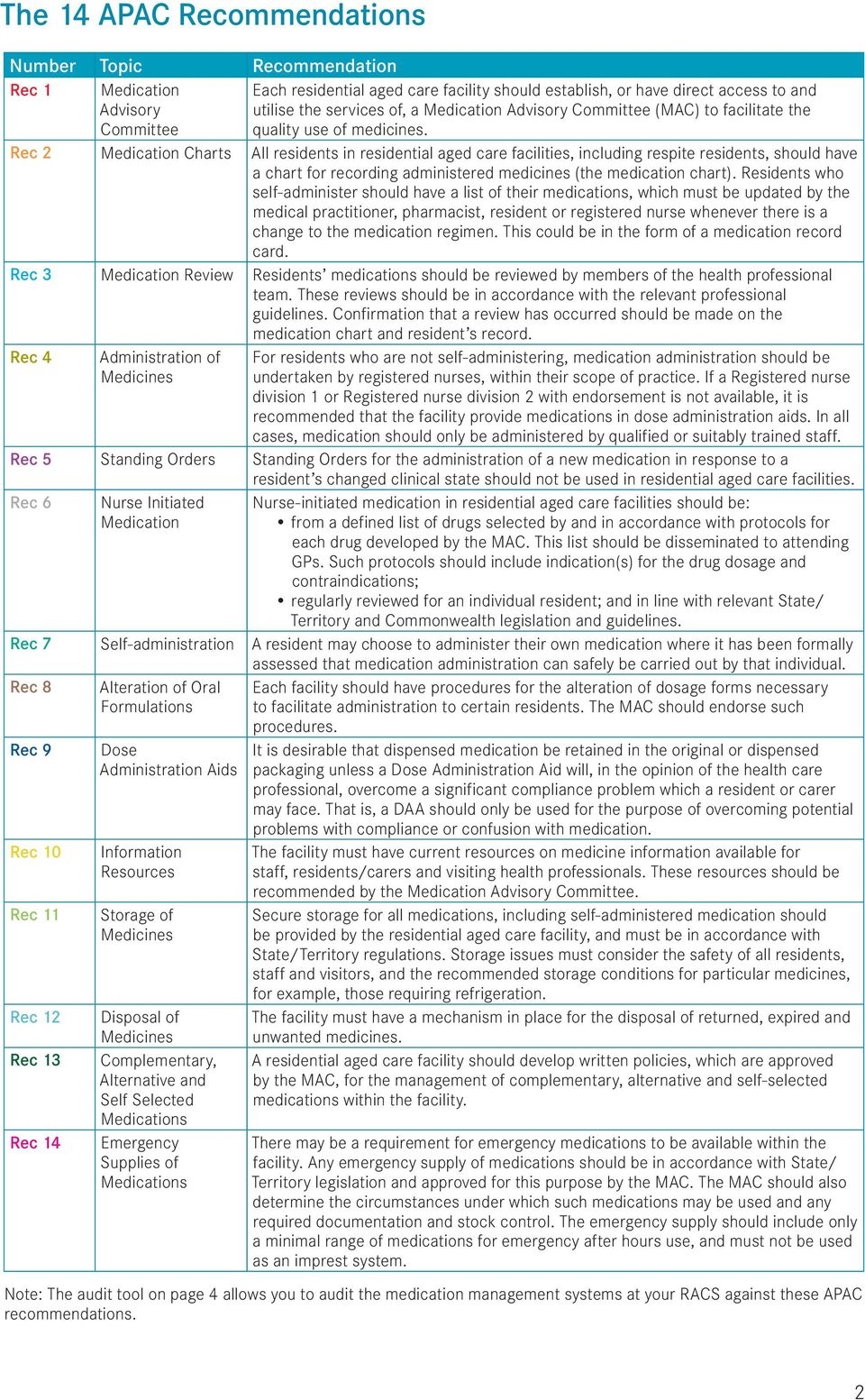
6 The 14 APAC Recommendations Number Topic Recommendation Rec 1 Medication Advisory Committee Each residential aged care facility should establish, or have direct access to and utilise the services of, a Medication Advisory Committee (MAC) to facilitate the quality use of medicines. Rec 2 Medication Charts All residents in residential aged care facilities, including respite residents, should have a chart for recording administered medicines (the medication chart). Residents who self-administer should have a list of their medications, which must be updated by the medical practitioner, pharmacist, resident or registered nurse whenever there is a change to the medication regimen. This could be in the form of a medication record card. Rec 3 Medication Review Residents medications should be reviewed by members of the health professional team. These reviews should be in accordance with the relevant professional guidelines. Confirmation that a review has occurred should be made on the medication chart and resident s record. Rec 4 Administration of Medicines For residents who are not self-administering, medication administration should be undertaken by registered nurses, within their scope of practice. If a Registered nurse division 1 or Registered nurse division 2 with endorsement is not available, it is recommended that the facility provide medications in dose administration aids. In all cases, medication should only be administered by qualified or suitably trained staff. Rec 5 Standing Orders Standing Orders for the administration of a new medication in response to a resident s changed clinical state should not be used in residential aged care facilities. Rec 6 Nurse Initiated Medication Nurse-initiated medication in residential aged care facilities should be: from a defined list of drugs selected by and in accordance with protocols for each drug developed by the MAC. This list should be disseminated to attending GPs. Such protocols should include indication(s) for the drug dosage and contraindications; regularly reviewed for an individual resident; and in line with relevant State/ Territory and Commonwealth legislation and guidelines. Rec 7 Self-administration A resident may choose to administer their own medication where it has been formally assessed that medication administration can safely be carried out by that individual. Rec 8 Rec 9 Rec 10 Rec 11 Rec 12 Rec 13 Rec 14 Alteration of Oral Formulations Dose Administration Aids Information Resources Storage of Medicines Disposal of Medicines Complementary, Alternative and Self Selected Medications Emergency Supplies of Medications Each facility should have procedures for the alteration of dosage forms necessary to facilitate administration to certain residents. The MAC should endorse such procedures. It is desirable that dispensed medication be retained in the original or dispensed packaging unless a Dose Administration Aid will, in the opinion of the health care professional, overcome a significant compliance problem which a resident or carer may face. That is, a DAA should only be used for the purpose of overcoming potential problems with compliance or confusion with medication. The facility must have current resources on medicine information available for staff, residents/carers and visiting health professionals. These resources should be recommended by the Medication Advisory Committee. Secure storage for all medications, including self-administered medication should be provided by the residential aged care facility, and must be in accordance with State/Territory regulations. Storage issues must consider the safety of all residents, staff and visitors, and the recommended storage conditions for particular medicines, for example, those requiring refrigeration. The facility must have a mechanism in place for the disposal of returned, expired and unwanted medicines. A residential aged care facility should develop written policies, which are approved by the MAC, for the management of complementary, alternative and self-selected medications within the facility. There may be a requirement for emergency medications to be available within the facility. Any emergency supply of medications should be in accordance with State/ Territory legislation and approved for this purpose by the MAC. The MAC should also determine the circumstances under which such medications may be used and any required documentation and stock control. The emergency supply should include only a minimal range of medications for emergency after hours use, and must not be used as an imprest system. Note: The audit tool on page 4 allows you to audit the medication management systems at your RACS against these APAC recommendations. 2
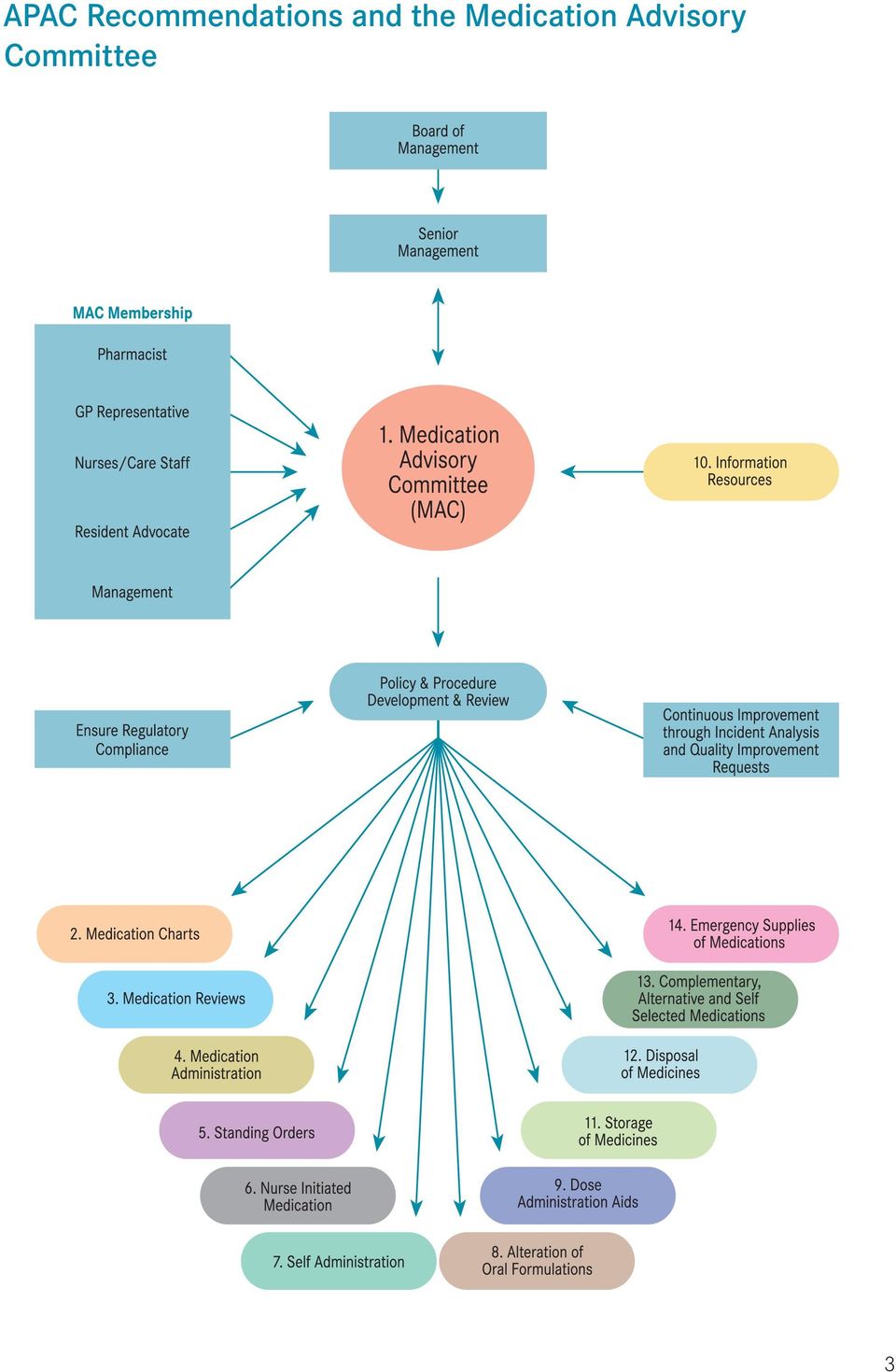
7 APAC Recommendations and the Medication Advisory Committee 3
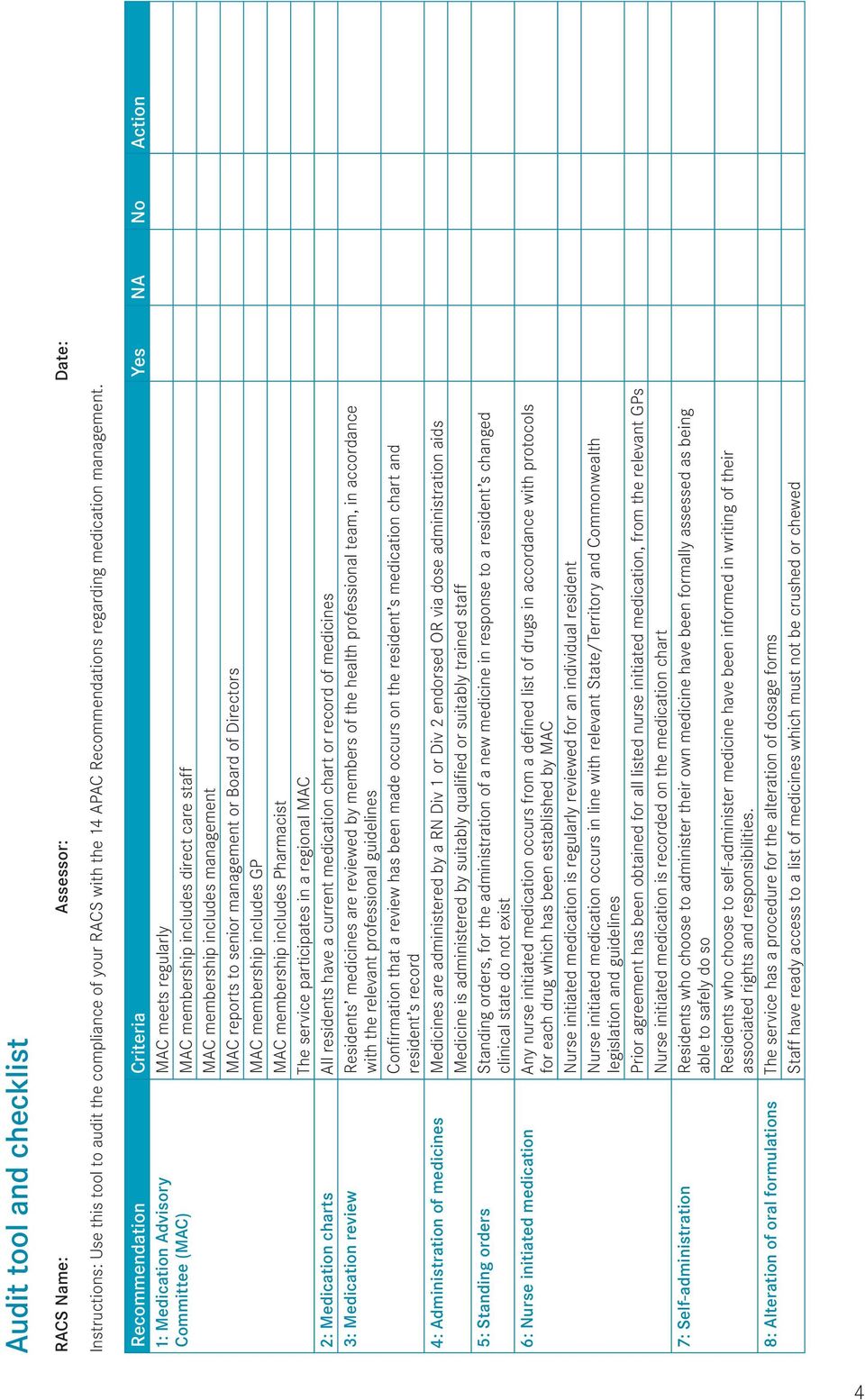
8 Audit tool and checklist RACS Name: Assessor: Date: Instructions: Use this tool to audit the compliance of your RACS with the 14 APAC Recommendations regarding medication management. Recommendation Criteria Yes NA No Action 1: Medication Advisory Committee (MAC) MAC meets regularly MAC membership includes direct care staff MAC membership includes management MAC reports to senior management or Board of Directors MAC membership includes GP MAC membership includes Pharmacist The service participates in a regional MAC 2: Medication charts All residents have a current medication chart or record of medicines 3: Medication review Residents medicines are reviewed by members of the health professional team, in accordance with the relevant professional guidelines Confirmation that a review has been made occurs on the resident s medication chart and resident s record 4: Administration of medicines Medicines are administered by a RN Div 1 or Div 2 endorsed OR via dose administration aids Medicine is administered by suitably qualified or suitably trained staff 5: Standing orders Standing orders, for the administration of a new medicine in response to a resident s changed clinical state do not exist 6: Nurse initiated medication Any nurse initiated medication occurs from a defined list of drugs in accordance with protocols for each drug which has been established by MAC Nurse initiated medication is regularly reviewed for an individual resident Nurse initiated medication occurs in line with relevant State/Territory and Commonwealth legislation and guidelines Prior agreement has been obtained for all listed nurse initiated medication, from the relevant GPs Nurse initiated medication is recorded on the medication chart 7: Self-administration Residents who choose to administer their own medicine have been formally assessed as being able to safely do so Residents who choose to self-administer medicine have been informed in writing of their associated rights and responsibilities. 8: Alteration of oral formulations The service has a procedure for the alteration of dosage forms Staff have ready access to a list of medicines which must not be crushed or chewed 4
9 Recommendation Criteria Yes NA No Action 9: Dose Administration Aid (DAA) The DAA is fully labeled by the pharmacist: name, strength and form of medicine and directions for use, date of filling, relevant cautionary labels, brand and generic medicine names The labeling allows for identification of individual medicines DAAs are returned to pharmacy for repacking when the order is altered by the prescriber Medicines which are ordered for a short time, or which have specific requirements for timing of administration are packed in individual dose packs All medicines, in the DAAs, are listed on the current medication sheet There is a policy in place for the administration of medicines when the resident is off-site 10: Information resources The service has current resources on medicine information available for all staff/residents/ carers and visiting health professionals 11: Storage of medicines All medicines are securely stored, including self administered medicines Medicines which require refrigeration are stored appropriately and securely 12: Disposal of medicines There are mechanisms in place for the disposal of returned, expired and unwanted medicines 13: Complementary, alternative and self selected medications A written policy has been developed for the management of complementary, alternative and selfselected medicines 14: Emergency supplies of medications Emergency medicines are held in accordance with State/Territory legislation The emergency supply is of a minimal range, and only used for emergency after hours use, as distinct from use as an imprest system Score Sub Total Instructions: Insert Yes, No or NA if not applicable. Record the sub total for each of the Yes, NA and No responses. Add the Yes and No scores to indicate the total number of questions answered. Divide your Yes Score into this figure and multiply by 100 to obtain the percentage compliance. 5
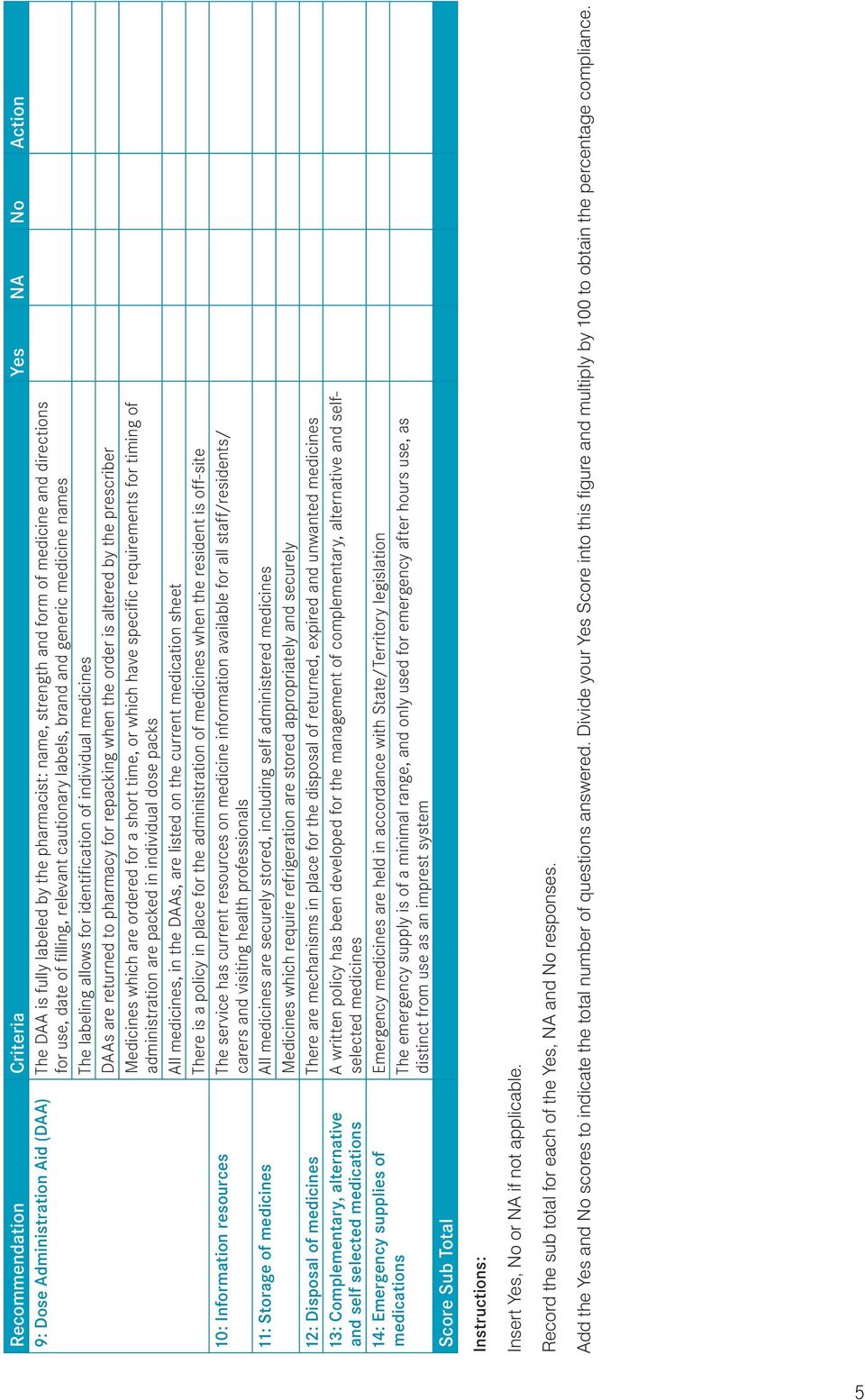
10 Audit and checklist outcome action plan RACS Name: Date: APAC Guidelines Recommendation Number Expected outcome Issues identified Action to be taken Person or team responsible Note: Photocopy this page as required Date to be completed Date completed Improved outcome 6
11 Cross-referencing the Aged Care Standards and APAC Guidelines for medication management in residential aged care facilities Aged Care Standard Expected Compliance supported by APAC Recommendation Outcome 2.1 Continuous improvement Recommendation 1: Medication Advisory Committee 2.2 Regulatory compliance Recommendation 1: Medication Advisory Committee Recommendation 10: Information resources 2.3 Education and staff Recommendation 4: Administration of medications development 2.4 Clinical care Recommendation 1: Medication Advisory Committee Recommendation 3: Medication review Recommendation 4: Administration of medications Recommendation 6: Nurse initiated medications Recommendation 13: Complementary, alternative and self selected medications 2.7 Medication management Recommendation 1: Medication Advisory Committee Recommendation 2: Medication charts Recommendation 3: Medication review Recommendation 4: Administration of medications Recommendation 5: Standing orders Recommendation 5: Nurse initiated medications Recommendation 7: Self-administration Recommendation 8: Alteration of oral formulations Recommendation 9: Dose Administration Aids Recommendation 10: Information resources Recommendation 11: Storage of medicines Recommendation 12: Disposal of medicines Recommendation 13: Complementary, alternative and self selected medications Recommendation 14: Emergency supplies of medication 2.8 Pain management Recommendation 4: Administration of medications Recommendation 3: Medication reviews Recommendation 6: Nurse initiated medication Recommendation 9: Dose Administration Aids Recommendation 13: Complementary, alternative and self-selected medications Recommendation 14: Emergency supplies of medications 2.9 Palliative care Recommendation 4: Administration of medications Recommendation 3: Medication reviews Recommendation 6: Nurse initiated medication Recommendation 9: Dose Administration Aids Recommendation 13: Complementary, alternative and self selected medications Recommendation 14: Emergency supplies of medications 1.9 External services Recommendation 1: Medication Advisory Committee 3.5 Independence Recommendation 7: Self-administration Recommendation 13: Complementary, alternative and self selected medications 3.6 Privacy and Dignity Recommendation 4: Administration of medications 3.7 Leisure interests and Recommendation 4: Administration of medications activities 3.8 Choice and decision making Recommendation 7: Self-administration Recommendation 13: Complementary, alternative and self selected medications 3.9 Infection control Recommendation 4: Administration of medications 7

12 Map and contact details for Divisions of General Practice in Victoria Ballarat & District Division of General Practice 325 Address: PO Box 36W, Ballarat West 3350 Telephone: (03) Bendigo & District Division of General Practice 326 Address: PO Box 2220, Bendigo Delivery Centre, Bendigo 3554 Telephone: (03) Border Division of General Practice 329 Address: PO Box 168, Wodonga Central Bayside General Practice Association Limited 313 Address: 4/253 Bay Road, Cheltenham 3192 Telephone: (03) Central Highlands Division of General Practice 318 Address: Level 1, 33 Brantome Street, Gisborne 3437 Telephone: (03) Central-West Gippsland Division of General Practice 323 Address: 3 Ollerton Avenue, Moe 3825 Telephone: (03) [email protected] Dandenong Division of General Practice 315 Address: 314B Thomas St, Dandenong 3175 Telephone: (03) [email protected] East Gippsland Division of General Practice 328 Address: PO Box 1210 Bairnsdale 3875 Telephone: (03) [email protected] Eastern Ranges GP Association 320 Address: Unit 2, 28 John Street, Lilydale VIC 3140 Telephone: (03) [email protected] GP Association of Geelong 317 Address: PO Box 4256, Geelong 3220 Telephone: (03) [email protected] The Goulburn Valley Division of General Practice Ltd 327 Address: PO Box 1074, Shepparton 3632 Telephone: (03) [email protected] Greater South Eastern Division of General Practice 311 Incorporated name: Monash Division of General Practice (Clayton) Ltd Address: Suite 302, 3 Chester Street, Oakleigh 3166 Telephone: (03) [email protected] 8

13 Inner Eastern Melbourne Division of General Practice 303 Address: 1st Floor, 123 Whitehorse Road, Balwyn 3103 Telephone: (03) Knox Division of General Practice 314 Address: 1st Floor, 664 Mountain Highway, Bayswater Vic 3153 Telephone: (03) Mallee Division of General Practice 332 Address: Mildura Private Hospital, 13th Street, Mildura 2502 Telephone: (03) Melbourne Division of General Practice 301 Address: 293 Royal Parade, Parkville 3052 Telephone: (03) Monash Division of General Practice (Moorabbin) 312 Address: PO Box 26, East Bentleigh 3165 Telephone: (03) Mornington Peninsula Division of General Practice 316 Address: PO Box 496, Frankston VIC 3199 Telephone: (03) Murray Plains Division of General Practice 331 Address: PO Box 459, Cohuna 3568 Telephone: (03) North East Valley Division of General Practice 302 Address: C/- A&RMC Repatriation Campus, Locked Bag 1 West Heidleberg VIC 3081 Telephone: (03) [email protected] North East Victoria Division of General Practice 319 Address: PO Box 75, Mount Beauty 3699 Telephone: (03) [email protected] Northern Division of General Practice Melbourne 308 Address: PO Box 1526, Preston South, 3072 Telephone: (03) [email protected] Otway Division of General Practice 324 Address: PO Box 287, Camperdown 3260 Telephone: (03) [email protected] South Gippsland Division of General Practice 322 Address: PO Box 105, Inverloch 3996 Telephone: (03) [email protected] Southcity GP Services 304 Previously: Inner South East Melbourne Divison of General Practice Address: C/o Alfred Hospital Commercial Road, Prahran 3181 Telephone: (03) [email protected] West Vic Division of General Practice 330 Address: PO Box 127, Ararat 3377 Telephone: (03) [email protected] or [email protected] Western Melbourne Division of General Practice 306 Address: Level 1, Building 1, Central West Industry Park 9 Ashley Street West Footscray VIC 3012 Telephone: (03) [email protected] Westgate Division of General Practice 305 Address: 99 Hudsons Road, Spotswood 3015 Telephone: (03) [email protected] Whitehorse Division of General Practice 310 Address: PO Box 127, Blackburn 3130 Telephone: (03) [email protected] North West Melbourne Division of General Practice 307 Address: PO Box 3239, Broadmeadows 3047 Telephone: (03) [email protected] 9

14 Section B: Resources Specific to APAC Recommendations Section B: Resources Specific to APAC Recommendations

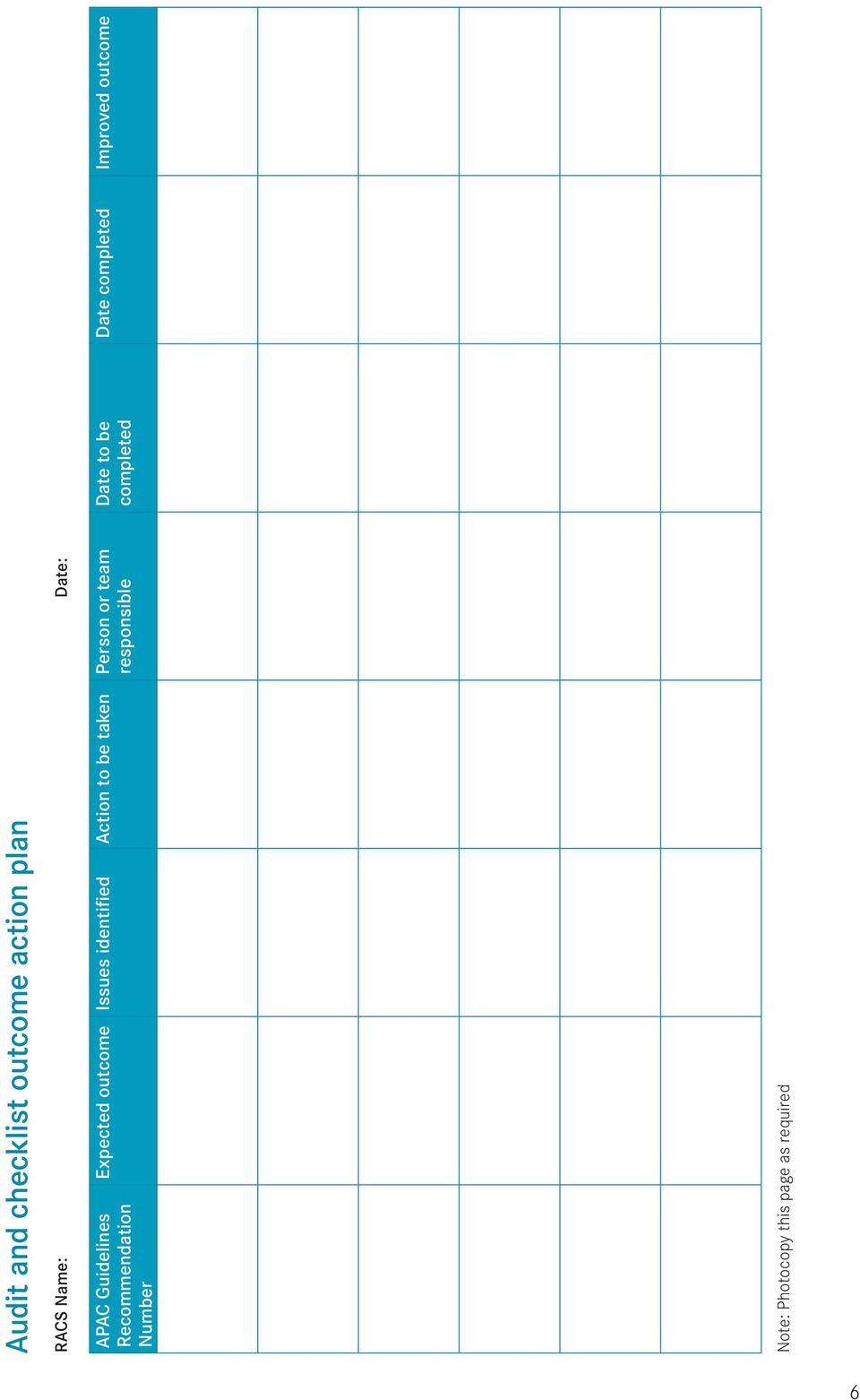
15 List of resources for each APAC recommendation APAC Recommendation Resources 1: Medication Advisory Committee (MAC) 1.1 Sample letter to General Practitioners 1.2 Sample letter to Pharmacist 1.3 Sample letter for staff member 1.4 Example of Terms of Reference for MAC 1.5 Example Terms of Reference for regional MAC 1.6 Example agenda for MAC 1.7 Example minute template for MAC 1.8 Helpful hints for developing a MAC 1.9 Implementation plan 1.10 Sample letter to resident advocate and family members regarding medication management (A) 1.11 Sample letter to resident advocate and family members regarding medication management (B) 2: Medication charts 2.1 Example of medication chart audit 2.2 Medication chart checklist 3: Medication review 3.1 Information sheet for RACS 3.2 Information sheet for General Practitioners 3.3 Information sheet GPs and Pharmacists working together 3.4 Questions and Answers 3.5 Covering letter to General Practitioner to go with information sheet 3.6 Flow chart outlining process 4: Administration of medicines 4.1 Administration of medication and training 4.2 Sample policy and procedure for medication management 4.3 Off-site administration of medication 4.4 List of legislation, regulations and guidelines affecting medication management in RACS 5: Standing orders 5.1 Information about Standing Orders 6: Nurse Initiated Medication 6.1 Sample letter to GP seeking authority for list of nurse initiated medications 6.2 Example of authority for list of nurse initiated medications 6.3 Helpful hints for nurse initiated medications 7: Self-administration 7.1 Guidelines for management of residents who administer their own medicines (self-administration) 7.2 Example of self-administration of medication assessment 7.3 Sample letter to resident regarding self-administration 8: Alteration of oral formulations 8.1 Draft guidelines for modification of oral formulations 8.2 Flow chart for alteration of oral formulations 9: Dose Administration Aids 9.1 Sample of a Dose Administration Aid practice checklist 9.2 Sample of a Dose Administration Aid system checklist 10: Information resources 10.1 List of specialised drug information centres 10.2 Suggested reference publications list 11: Storage of medicines 11.1 Helpful hints for storage of medicines 12: Disposal of medicines 12.1 Helpful hints for disposal of medicines 13: Complementary, alternative and self 13.1 Helpful hints for complementary and alternative therapies selected medications 13.2 Draft policy for use of complementary therapy by residents 13.3 Draft policy for complementary and alternative therapies 13.4 Example of complementary therapies care plan 13.5 Sample letter to residents regarding complementary therapies 14: Emergency supplies of medications 14.1 Information sheet about emergency supplies of medications 11
16 Recommendation 1: Medication Advisory Committees (MAC) Recommendation 1: Medication Advisory Committees (MAC) Each residential aged care facility should establish, or have direct access to and utilise the services of, a Medication Advisory Committee (MAC) to facilitate the quality use of medicines.
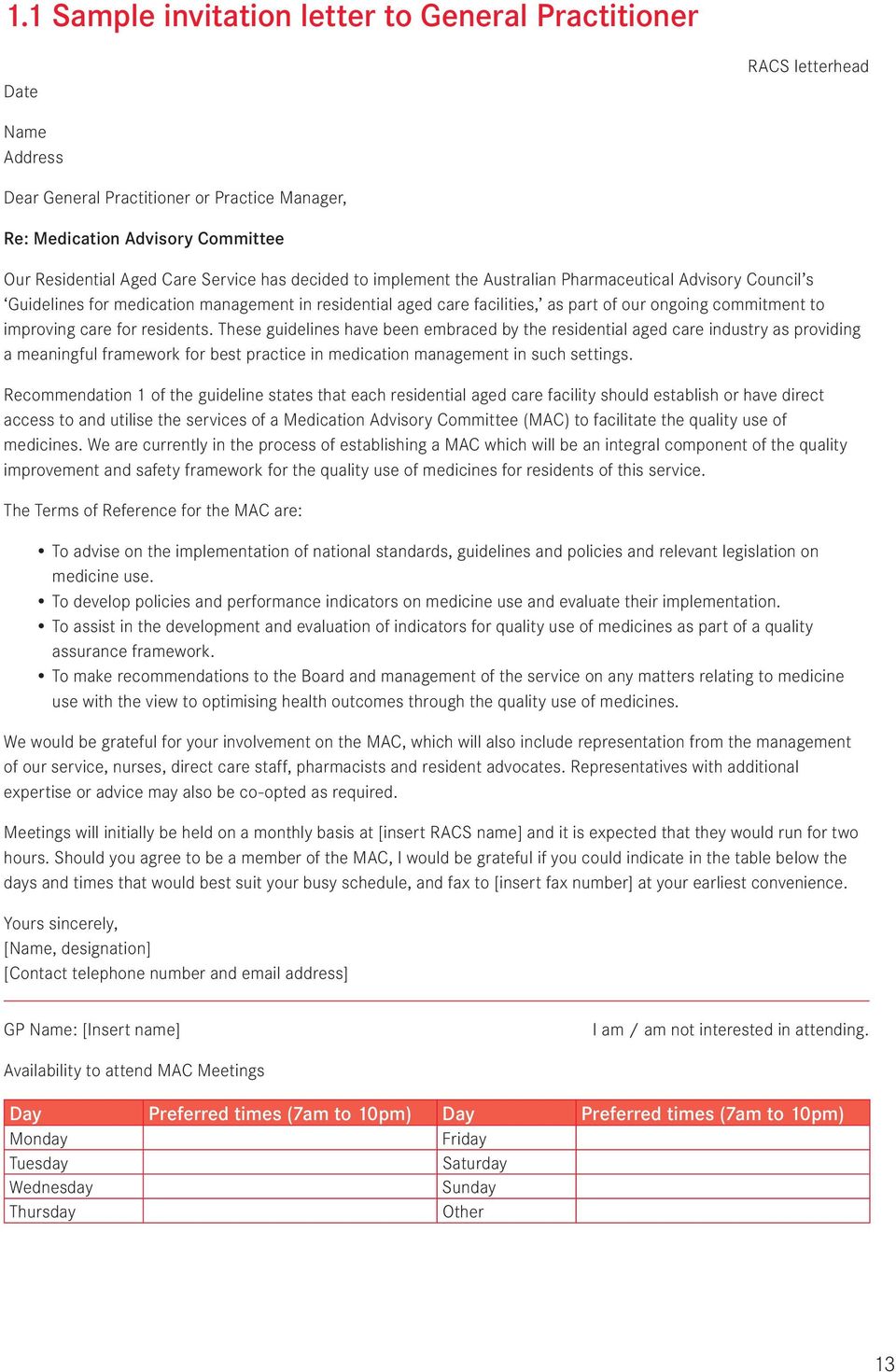
17 1.1 Sample invitation letter to General Practitioner Date RACS letterhead Name Address Dear General Practitioner or Practice Manager, Re: Medication Advisory Committee Our Residential Aged Care Service has decided to implement the Australian Pharmaceutical Advisory Council s Guidelines for medication management in residential aged care facilities, as part of our ongoing commitment to improving care for residents. These guidelines have been embraced by the residential aged care industry as providing a meaningful framework for best practice in medication management in such settings. Recommendation 1 of the guideline states that each residential aged care facility should establish or have direct access to and utilise the services of a Medication Advisory Committee (MAC) to facilitate the quality use of medicines. We are currently in the process of establishing a MAC which will be an integral component of the quality improvement and safety framework for the quality use of medicines for residents of this service. The Terms of Reference for the MAC are: To advise on the implementation of national standards, guidelines and policies and relevant legislation on medicine use. To develop policies and performance indicators on medicine use and evaluate their implementation. To assist in the development and evaluation of indicators for quality use of medicines as part of a quality assurance framework. To make recommendations to the Board and management of the service on any matters relating to medicine use with the view to optimising health outcomes through the quality use of medicines. We would be grateful for your involvement on the MAC, which will also include representation from the management of our service, nurses, direct care staff, pharmacists and resident advocates. Representatives with additional expertise or advice may also be co-opted as required. Meetings will initially be held on a monthly basis at [insert RACS name] and it is expected that they would run for two hours. Should you agree to be a member of the MAC, I would be grateful if you could indicate in the table below the days and times that would best suit your busy schedule, and fax to [insert fax number] at your earliest convenience. Yours sincerely, [Name, designation] [Contact telephone number and address] GP Name: [Insert name] I am / am not interested in attending. Availability to attend MAC Meetings Day Preferred times (7am to 10pm) Day Preferred times (7am to 10pm) Monday Friday Tuesday Saturday Wednesday Sunday Thursday Other 13
18 1.2 Sample letter to Pharmacist Date RACS letterhead Name Address Dear Pharmacist or Consultant Pharmacist, Re: Medication Advisory Committee Our Residential Aged Care Service has decided to implement the Australian Pharmaceutical Advisory Council s Guidelines for medication management in residential aged care facilities, as part of our ongoing commitment to improving care for residents. These guidelines have been embraced by the residential aged care industry as providing a meaningful framework for best practice in medication management in such settings. Recommendation 1 of the guideline states that each residential aged care facility should establish or have direct access to and utilise the services of a Medication Advisory Committee (MAC) to facilitate the quality use of medicines. We are currently in the process of establishing a MAC which will be an integral component of the quality improvement and safety framework for the quality use of medicines for residents of this service. The Terms of Reference for the MAC are: To advise on the implementation of national standards, guidelines and policies and relevant legislation on medicine use. To develop policies and performance indicators on medicine use and evaluate their implementation. To assist in the development and evaluation of indicators for quality use of medicines as part of a quality assurance framework. To make recommendations to the Board and management of the service on any matter relating to medicine use with the view to optimising health outcomes through the quality use of medicines. There are a number of issues that would benefit from your input, including the safe administration and storage of medicines, the development of incident reporting mechanisms, and protocols for regular review of the resident s medicines. You are invited to participate on the MAC, which will also include representation from the management of our service, general practitioners, nurses, direct care staff and resident advocates. Representatives with additional expertise or advice may also be co-opted as required. Meetings will initially be held on a monthly basis at [insert RACS name] and it is expected that they would run for two hours. The first meeting of the MAC has been scheduled for [insert date, time, venue] and a draft meeting agenda is attached. I would be grateful if you could advise of your availability to attend this meeting at your earliest convenience. Yours sincerely, [Name] [Designation] [Contact telephone number and address] 14
19 1.3 Sample letter for staff member Date RACS letterhead Name Address Dear Staff Member, Re: Medication Advisory Committee Safe and correct administration of medicines is an important outcome that needs to be met as part of our aged care accreditation. The Australian Pharmaceutical Advisory Council (APAC) has developed a series of 14 recommendations to improve outcomes for residents through the quality use of medicines. One recommendation involves the formation of a Medication Advisory Committee (MAC) to develop policy and guidelines on implementation of best practice standards in regard to medication management. To assist us with implementation of the APAC recommendations a MAC is to be formed for our service. As a member of staff administering medicines you are invited to be involved. The MAC will advise on implementation of standards, guidelines, policies and relevant legislation on the use and management of medicines in our service. It will also develop performance indicators and an evaluation of medication use. The MAC will be making recommendations to the Board and management on any matter relating to the use of medicines with the view of optimising health outcomes through the quality use of medicines. It is proposed that the MAC meetings will be held on site with the first meeting being scheduled for [insert date]. Please find attached for your information the proposed MAC Terms of Reference and agenda for the first meeting as provided by the APAC Guidelines. Should you wish to add any items to agenda for discussion, please contact me. Yours sincerely, [Name] [Designation] [Contact telephone number and address] 15

20 1.4 Example of Terms of Reference for MAC Overall purpose To provide leadership and direction in the safe administration of medicines to residents and according to legislative and statutory requirements. Responsibilities To develop/review, implement and evaluate policies and procedures with regard to best practice in medication management for residents. To act as a resource and point of referral in relation to administration of medicines. To enhance communication between the residential aged care service, the pharmacy and residents medical practitioners. To monitor and review all aspects of medication management for residents in conjunction with legislative requirements. In particular: o Code for guidance: management of the administration of medications for high care residents in an aged care service (Nurses Board of Victoria) o Drugs, Poisons and Controlled Substances Act o Guidelines for medication management in residential aged care facilities (APAC 2002) o Aged Care Act To review medicine audits, identify and analyse trends. To review all medicine related errors and incidents, identify and analyse trends. To monitor staff practice and make recommendations regarding staff training and development. To monitor, review quality service outcomes and make recommendations regarding the external services agreement/pharmacy contract. To liaise with resident s medical practitioners regarding medication management issues. To monitor the outcomes and implementation of recommendations arising from medication reviews. To identify areas of continuous improvement, make changes to the system and/or make recommendations to the Quality and Development Committee. To provide the opportunity for residents and/or advocates to have input to decisions in relation to medication management. Membership Manager Care coordinator Senior personal care staff Pharmacist or consultant pharmacist General practitioner Resident or resident advocate Administration Meetings will be held regularly [define frequency] as determined by the MAC. A quorum will consist of at least half the members and representing a minimum of two disciplines. The chairperson will be responsible for liaison with committee members and the agenda. The chairperson will be responsible for liaison with other sub-committees and for reporting at the Quality and Development Committee. The secretary will be responsible for taking and distributing the meeting minutes. Reporting The committee will provide written reports after each meeting to the manager and the Quality and Development Committee. Urgent matters will be reported to the manager as the need arises. Minutes A master copy of the minutes will be located in the Medication Advisory Committee folder [insert location]. All members will be sent a copy of the minutes. 16

21 1.5 Example Terms of Reference for regional MAC Each Residential Aged Care Service (RACS) should establish or have direct access to and utilise the services of a Medication Advisory Committee (MAC) to facilitate the quality use of medicines. Services without the resources to set up their own MAC may establish a regional committee, thereby consolidating resources. Regional MACS provide a forum for support of local structures as well as a mechanism for regional implementation of best practice in medication management by promoting intra and interdisciplinary and organisational communication. Regional MACS may be set up according to Division of General Practice boundaries. The goals of regional MACs may include: * To support the work of existing MACs at individual sites * To provide access to a MAC for all RACS within the Division of General Practice area * To facilitate a QUM approach across the region. Regional MACs provide the opportunity to network with other services and to share up to date information on a vast array of topics. They also provide a uniform approach to medication management within a region. Regional MACs should have representation, where possible from: * General practitioner * Pharmacist or consultant pharmacist * Registered nurse * Representative from management of residential aged care services * Representative from a consumer and/or consumer aged care service * Community services providers as invited * External experts as required, to meet the needs of the agenda. The positions could be filled from a call for membership from all interested parties. Each RACS within the network should have the opportunity to submit agenda items and attend meetings as an observer. Each RACS should also have input into the activities of the regional MAC. The MAC may also hold forums involving all residential aged care services and health professionals in the area. Terms of Reference 1. To provide a forum for all residential aged care services across the region to seek advice on the implementation of national standards, guidelines and policies and relevant legislation on the use of medicines in the residential aged care service. 2. To provide a forum for all residential aged care service across the region to seek advice and develop policies and performance indicators on the use of medicines, and evaluate their implementation. 3. To provide a forum for all residential aged care services across the region to seek advice and assist in the development and evaluation of indicators for quality use of medicines as part of a quality assurance framework of the service. 4. To provide a forum for all residential aged care services across the region to seek advice and make recommendations to the Board or management of the service on any matter relating to the use of medicines with the view of optimising health outcomes through the quality use of medicines. 5. A forum for raising discussion of other issues relating to resident care and health outcomes. The Terms of Reference will be reviewed annually. 17
22 Activities 1. To support residential aged care services to develop mechanisms which allow for review and evaluation of: 1.1 Usage of medicines across the service 1.2 Emergency medicine supply 1.3 The use of when required medicines 1.4 The outcome of medication review processes 1.5 Medication errors and incidents 1.6 Adverse drug reaction reporting to the national reporting system via the established blue card system of the Adverse Drug Reaction Advisory Committee (ADRAC) 2. To receive feedback from stakeholders and then make recommendations for the use of psychotropic agents for behavioral management. 3. To receive feedback from stakeholders and make recommendations for the appropriate pain management of residents. 4. To receive feedback from stakeholders and advice on the management of any clinical problems involving medicines as appropriate. 5. To receive feedback from stakeholders and advise on appropriate medicines education programs for staff of the service. 6. To support services to develop mechanisms for the provision of information about medicines to staff, residents/ carers, including the availability of Consumer Medicine Information. 7. To support services to promote in residents/carers the awareness of their rights and responsibilities with regard to their medication management. 8. To make recommendations on the medicine information/resources to be available at the services across the region. 9. To advise on the development of an information technology strategy relevant to medication management across the region. 10. To support mechanisms that facilitate review of medicine related incidents within the services across the region. 11. To provide a mechanism to facilitate the processes for the timely, effective communication between the prescriber and the pharmacist for any change to the medication regimen, in accordance with legislative requirements. 12. To assist with the development of policies and protocols across the region. 13. To provide support to RACS to prepare up to date lists of: drug products which cannot be altered (e.g. crushed or broken) prior to administration; of medications which can be initiated by nursing personnel; and of medicines which may be stored for emergency purposes. 14. To provide support and advice to community services in relation to best practice in medication management across the region. The above information has been produced with reference to the Adelaide North East Regional Medication Advisory Committee, following implementation and the first year of operation. 18
23 1.6 Example Agenda for MAC RACS name Medication Advisory Committee Meeting Agenda Date Time 1. Minutes 2. Business Arising 3. Care Manager Report 3.1 Incident reports 4. Pharmacist Reports 4.1 Supply pharmacist 4.2 Review pharmacist 4.3 Incident reports 5. Quality Management 5.1 Audit results and analysis 5.2 Continuous improvement and action recommendations 5.3 Policy and procedure development 5.4 Regulatory compliance 6. Occupational Health and Safety 7. Professional Development 8. Resident Representative/s 9. Other Business 19
24 1.7 Example Minute Template for MAC RACS name Medication Advisory Committee: Meeting Minutes Date: Meeting commencement time: Meeting finish time: Date of next meeting: Chairperson: Minute Taker: In Attendance: Apologies: Item No. Action Responsibility 1.0 Minutes 2.0 Business Arising 3.0 Care Manager Report 3.1 Incident reports 4.0 Pharmacists Reports 4.1 Supply pharmacist 4.2 Review pharmacist 4.3 Incident reports 20
25 Item No. Action Responsibility 5.0 Quality Management 5.1 Audit results and analysis 5.2 Policy and procedure development 5.3 Regulatory compliance 5.4 Continuous improvement 6.0 Occupational Health and Safety 7.0 Professional Development 8.0 Resident Representative/s 9.0 Other business or additional notes (Prompt: Issues to be referred to GP Division Aged Care Panel, issues pertinent to regional area) 21
26 1.8 Helpful hints for developing a MAC Consider holding your MAC meetings at breakfast or lunch time and providing a light meal. You may find that GPs are more willing to attend if the meetings are outside their scheduled practice time. Consider starting with your in-house staff and gradually include the GPs, pharmacists and others once you have things up and running. GPs may be able to gain support from their Division of General Practice for participation in Medication Advisory Committees. Encourage them to ask. Liaise with your local Division of General Practice if you are having difficulty obtaining GP participation. Future funding for medication review pharmacists may include a component for participation in Medication Advisory Committees. Consider inviting experts to the meeting for advice on current issues of concern. It may be useful to send your MAC meeting minutes to all GPs that service your clients, perhaps highlighting the most relevant sections. You may like to ensure that all staff and residents have access to the MAC meeting minutes so that everyone sees the importance of changes which may result from MAC decisions. It might help residents to cope with changed policies and procedures in relation to their medication management if they are kept informed at every stage. Consider allocating space in newsletters/communications for MAC reports. You may choose to use the PowerPoint presentation, provided in this resource kit, to present to your MAC or other stakeholders so that they all know what you are aiming to achieve. Make sure that active participation in the MAC is included in your pharmacist supplier contract, as well as any other training and auditing services which may be appropriate. It may be useful to establish a regional MAC so that services using the same GPs and possibly the same pharmacists can establish consistent policies and procedures. Consider communication tools that might streamline the meeting process. For example: o Send the agenda to participants prior to the meeting o Attach a summary of incident reports to the agenda o Circulate minutes within one week after the meeting o Ensure the meeting minutes have clear action items, time lines and responsibilities. 22
27 1.9 Implementation plan for a MAC Planning Week 1: Consultation Week 2: Review APAC Guidelines and resource kit Discuss with: Residents Staff Pharmacist GP Invitations Week 4: Residents Staff Pharmacist GP Establishment Week 6: Audit Week 8: Host initial meeting Agenda: Terms of Reference Meeting schedule Use audit checklist in resource kit Develop Policies Week 12: and Procedures Draft policies and procedures Consider examples in resource kit Staff Training Week 16: Organise training Competency testing Continuous Week 20: Improvement Regular MAC meetings continue to review, evaluate and action 23
28 1.10 Sample letter to resident advocate and family members regarding medication management (A) Date RACS letterhead Name Address Dear Resident Advocate or Family Member, Administration of medicines is one of the most important aspects of the care provided to residents in residential aged care services. Whilst achieving the best possible outcomes for residents, staff are required to meet accreditation requirements, comply with State and Commonwealth legislation, and meet professional guidelines. In most cases, residents medication regimens have significant impact upon the care and lifestyle that they experience. Staff will liaise with the resident, their chosen doctor, the pharmacist and other health care professionals in order to obtain the best possible outcomes for residents. They may also gain input from you. This service has decided to implement Guidelines for medication management in residential aged care facilities (2002) produced by Australian Pharmaceutical Advisory Council, which recommends the development of a Medication Advisory Committee. We will be convening a Medication Advisory Committee which will include representation from service management and staff, a pharmacist, a GP and a resident or advocate. The Medication Advisory Committee will provide leadership and direction in safe administration of medicines to residents by monitoring and reviewing all aspects of medication management. It is expected that the Medication Advisory Committee will be making decisions about policy and procedure, which will result in some changes. Residents will be kept informed of all such decisions and we would appreciate your support in assisting them to adjust to any changes, which may occur. As always, please speak with us if you have any concerns. Yours sincerely, [Name] [Designation] [Contact telephone number and address] 24
29 1.11 Sample letter to resident advocate and family members regarding medication management (B) Date RACS letterhead Name Address Dear Resident Advocate or Family Member, As part of our ongoing commitment to improving care for residents, our service has decided to implement the APAC Guidelines for medication management in residential aged care facilities (2002). The guidelines are quite comprehensive encompassing 14 recommendations. They have been embraced by the industry as providing a meaningful framework for best practice in medication management in residential aged care. One of the recommendations is to establish a Medication Advisory Committee (MAC). The MAC will be an integral component of the quality improvement and safety framework for the quality use of medicines in this residential aged care service. We intend to include representatives from management, general practitioners, nurses, direct care staff, pharmacists, and resident/resident advocates. The MAC will have the ability to co-opt expertise or advice as required. Medication Advisory Committee: Terms of Reference * To advise on the implementation of national standards, guidelines and policies and relevant legislation on use of medicines. * To develop policies and performance indicators on the use of medicines and evaluate their implementation. * To assist in the development and evaluation of indicators for quality use of medicines as part of a quality assurance framework. * To make recommendations to the Board and management of the service on any matter relating to the use of medicines with the view of optimising health outcomes through the quality use of medicines. We would be grateful for your involvement in this process. If you are not able to attend meetings, we will endeavour to keep you informed of the progress of the MAC. Whilst there may be changes in practise or procedures in response to decisions made by the MAC, these will only occur in order to more safely and effectively administer medicines. Please indicate your interest in attending a meeting, in the area at the bottom of this page. We are excited about embarking on this project and hope to have your valued input. Yours sincerely, [Name] [Designation] [Contact telephone number and address] Name: Interested in attending (please circle) Yes No Availability to attend meetings Day Preferred times (7am to 10pm) Day Preferred times (7am to 10pm) Monday Friday Tuesday Saturday Wednesday Sunday Thursday Other 25
30 Recommendation 2: Medication Charts All residents in residential aged care facilities, including respite residents, should have a chart for recording administered medicines (the medication chart). Residents who self-administer should have a list of their medications, which must be updated by the medical practitioner, pharmacist, resident or registered nurse whenever there is a change to the medication regimen. This could be in the form of a medication record card. Recommendation 2: Medication Charts
31 2.1 Example of medication chart audit This is an example only that should be adapted in accordance with the policies of the Medication Advisory Committee. RACS Name: Data collected by: Date: Resident code Res Res Res Res Res Res Res Res Res Res Y/N Y/N Y/N Y/N Y/N Y/N Y/N Y/N Y/N Y/N 1. Has this resident s name been written clearly and correctly in the medication chart? 2. Has this resident s Date of Birth been written in the medication chart? 3. Has the status of Allergy been clearly marked on the medication chart? 4. Is the doctor s signature present on all medication orders? 5. Is the date of order written on all medications orders by the doctor? 6. Are the medication orders clear and legible? 7. Are the medication orders clear with dose to be given? 8. Are the medication orders clear with route to be given? 9. Are the medication orders clear with time to be given? 10. Are there any medicines that have been ceased for this resident in the last 7 days? If yes has the chart been signed and dated to indicate the cessation date? Has the DAA been returned to the pharmacy for repacking and/or bottle or packs of ceased medicines been removed from the drug trolley? 11. Are the required signatures present on all medication charts? 12. If medication has been refused or withheld has this been recorded appropriately? 13. Have all refused or withheld medicines (more than 7 consecutive doses) been referred to the doctor for review? 14. Has the pharmacy dispensed adequate stock of medicines to ensure that missed doses do not occur? 15. Is the resident s current photo attached to the medication chart? 16. Has the drug refrigerator temperature been monitored? (please circle) Yes No 17. Have all open eye drops and Anginine etc., been marked with an opening date? (please circle) Yes No Corrective Action Plan By whom By when 27
32 2.2 Medication chart checklist The following checklist lists items that the APAC Guidelines suggest should be included on medication charts. Do your medication charts include sections for the following information? section for including the residents identification details o complete name o date of birth o space for alerts i.e. residents with similar names section that allows signing for administration, including those medications not packed in DAAs. section for allergies and previous adverse drug reactions section indicating that a comprehensive medication review has occurred and by whom i.e. GP, pharmacist section for PRN medicines section for once only doses section for emergency medications section for nurse initiated medicines section for resident initiated medicines or complementary medicines indication whether medications need crushing allows staff to enter the date of infrequently administered medicines area to incorporate a recent photo o with the resident s name o with the resident s date of birth In addition to the items above that are recommended in the APAC Guidelines, there may be additional information you wish to include. For example, a section for recording contact details for the residents GP and pharmacy, or immunisation information. 28
33 Recommendation 3: Medication Reviews Residents medications should be reviewed by members of the health professional team. These reviews should be in accordance with the relevant professional guidelines. Confirmation that a review has occurred should be made on the medication chart and resident s record. Recommendation 3: Medication Reviews
34 3.1 Information sheet for RACS Residential Medication Management Reviews Information for Aged Care Homes A new Medicare Benefits Schedule (MBS) item for Residential Medication Management Review (RMMR) for residents of aged care homes was introduced on 1 November The item provides a Medicare benefit for GP services where a GP works in collaboration with a pharmacist to review the medication management needs of residents who are likely to benefit from such a review. This includes residents for whom quality use of medicines may be an issue or who are at risk of medication misadventure because of their medical condition or medication regimen. How does this new service differ from the medication management review currently undertaken by pharmacists in aged care homes? Current arrangements provide for contracted medication review services by pharmacists. The new Medicare item provides a Medicare benefit for a service provided by a GP in collaboration with a reviewing pharmacist. It enables doctors to provide clinical information to inform the pharmacist's component of the review. It also enables the pharmacist to provide input from the outcomes of the review to inform the doctor's decision on the appropriate medication management strategies for the resident. Will the current arrangements continue for pharmacist-only medication management reviews in aged care homes? Residents will continue to be eligible for annual medication reviews provided by pharmacists without a request from a medical practitioner. Medication management reviews performed by pharmacists as a result of a request from a doctor will be remunerated under the existing 'per bed' payment arrangements. Who can have a collaborative RMMR? Collaborative RMMRs are available to permanent residents of aged care homes. There is no age restriction and residents maybe receiving either low or high level care. These services are not available to people receiving respite care. Instead, the Medicare item for Home Medicines Review is available to these people as they are classified as living in the community setting. Like collaborative RMMRs, Home Medicines Reviews are services provided jointly by GPs and pharmacists for patients at risk of medication misadventure, or who would benefit from such reviews by optimising their medication regimen. Are collaborative RMMRs available to residents of all aged care facilities? Collaborative RMMRs are available to permanent residents of aged care homes, a facility providing residential aged care services as defined in the Aged Care Act This includes facilities that were formerly known as nursing homes and hostels. What about residents of supported accommodation facilities that are not funded by the Commonwealth under the Aged Care Act? Collaborative RMMRs are available to residents receiving Commonwealthsubsidised agedcare. Residents of institutions not funded by the Commonwealth under the Aged Care Act are eligible for the Medicare item Home Medicines Reviews, which provides a medication management review service to people living in the community. 30
35 When can a resident have a collaborative RMMR? A collaborative RMMR is available to a new resident on admission into an aged care home. An existing resident can have an RMMR on an 'as required' basis, where it is required in the opinion of the resident's medical practitioner. Medicare benefits are available for one RMMR for a resident in any 12 month period, except where there has been a significant change in medical condition or medication regimen. What changes in a resident would indicate the need for a collaborative RMMR? An RMMR may be required where there has been a significant change in the resident's medical condition or medication regimen, for example (but not limited to): (a) discharge from an acute care facility in the previous four weeks; (b) significant changes to medication regimen in the past three months; (c) change in medical conditions or abilities (including falls, cognition, physical function); (d) prescription of medication with a narrow therapeutic index or requiring therapeutic monitoring; (e) presentation of symptoms suggestive of an adverse drug reaction; (f) sub-therapeutic response to treatment; (g) suspected non-compliance or problems with managing drug related therapeutic devices; or (h) at risk of inability to continue managing own medications (e.g. due to changes with dexterity, confusion or impaired sight). other members of the resident's health care team. The resident's doctor must assess the clinical need for an RMMR from a quality use of medicines perspective and determine that an RMMR is necessary. Who obtains the resident's consent to a collaborative RMMR? A resident's consent should be obtained using normal procedures for obtaining consent for provision of a medical service, before proceeding with an RMMR. The GP undertaking an RMMR must ensure consent to the RMMR has been given by the resident or the resident's representative. Where an aged care home includes the issue of consent to medical care as part of the admission process, it can be helpful to include RMMR as part of this process. What is the role of nurses in the provision of a collaborative RMMR? The RMMR is a Medicare service similar to any other Medicare service available to residents of aged care homes. Nurses working in the agedcare home are not required to undertake any components of the RMMR nor take on additional duties as a result of the RMMR. However, nurses can assist GPs in the same way that they assist with the provision of other GP consultations in aged care homes. Where can I obtain further information? For more information go to the Department of Health and Ageing website at: Can staff of the aged care home identify the need for a collaborative RMMR for an existing resident? Yes, the need for an RMMR for an existing resident may be identified by the resident's doctor, the reviewing pharmacist, supply pharmacist, Residential Aged Care Facility staff, the resident, the resident's carer or 31
36 3.2 Information sheet for General Practitioners Residential Medication Management Reviews Information for General Practitioners A new Medicare Benefits Schedule (MBS) item -item became available on 1 November This item enables general practitioners to work in collaboration with pharmacists to review the medication management needs of new and existing residents of aged care homes. What is an RMMR? A Residential Medication Management Review (RMMR) is for residents of aged care homes who are likely to benefit from such a service. In particular, it is for residents for whom quality use of medicines may be an issue, or who are at risk of medication misadventure because of a significant change in their condition or medication regimen. A Medicare benefit is payable where an RMMR is provided by the resident's GP in collaboration with a reviewing pharmacist. RMMRs complement other Medicare Benefits Schedule items for services that a medical practitioner can provide to residents of aged care homes, including Comprehensive Medical Assessments (CMA), normal consultations and Enhanced Primary Care (EPC) services for contributing to a care plan and participating in a case conference. What is the role of the GP in the RMMR? The activities to be undertaken by the medical practitioner as part of the RMMR include: discussing and seeking consent for an RMMR from the new or existing resident; initiating the RMMR and collaborating with the reviewing pharmacist regarding the pharmacist component of the review; providing input from the resident's CMA, or if a CMA has not been as undertaken, providing relevant clinical information for the resident's RMMR; participating in a post-review discussion (either face-to-face or by telephone) with the pharmacist (unless exceptions apply) to discuss the outcomes of the review including: - the findings of the pharmacist's review; - medication management strategies; and - means to ensure the strategies are implemented and reviewed, including any issues for implementation and normal followup; developing and/or revising the resident's Medication Management Plan after discussion with the reviewing pharmacist and finalising the plan after discussion with the resident; offering a copy of the Medication Management Plan to the resident (and/or their carer or representative if appropriate), providing a copy for the resident's records and for the nursing staff of the aged care home, and discussing the plan with nursing staff, if necessary. When is a post-review discussion not mandatory? A post-review discussion between the pharmacist and GP is not mandatory where: (a) there are no recommended changes from the review; (b) changes are minor in nature, not requiring immediate discussion; or (c) the pharmacist and medical practitioner agree that issues from the review should be considered in an Enhanced Primary Care (EPC) case conference. 32
37 Who is eligible for RMMR? RMMRs are available to permanent residents of a Residential Aged Care Facility (RACF). RMMRs are not available to in-patients of a hospital, a day hospital facility, people receiving respite care in a RACF, or people living in the community setting. Instead, the Medicare item for Home Medicines Review is available to people living in the community setting. Who can provide an RMMR? An RMMR should generally be undertaken by the resident's 'usual GP'. This is broadly defined as the medical practitioner, or a medical practitioner working in the medical practice, that has provided the majority of care to the resident over the previous 12 months and/or will be providing the majority of care to the resident over the next 12 months. GPs who provide services on a facility-wide contract basis, and/or who are registered to provide services to RACFs as part of aged care panel arrangements, may also undertake RMMRs for residents as part of their services. What is the Medicare rebate for an RMMR? The Medicare rebate for an RMMR is $ If the service is bulkbilled, the GP will also be able to claim the $5.10 or $7.65 bulk billing incentive payment for eligible patients. Can the GP charge for a consultation as well as an RMMR? An RMMR comprises all activities to be undertaken by the medical practitioner from the time the resident is identified as potentially needing a medication management review up to the development of a written medication management plan for the resident. An RMMR service covers the consultation at which the RMMR was initiated, the consultation at which the results of the medication management review are discussed, the preparation of the medication management plan and discussing and agreeing the plan with the resident. In addition: a) any immediate action required to be done at the time of completing the RMMR, based on and as a direct result of information gathered in the RMMR, should be treated as part of the RMMR item; (b) any subsequent follow up should be treated as a separate consultation item; and (c) an additional consultation in conjunction with completing the RMMR should not be undertaken unless it is clinically indicated that a problem must be treated immediately. Are RMMRs counted for the purposes of derived fee arrangements? No. RMMRs do not count for the purposes of derived fee arrangements that apply to other consultations in an aged care home. When does the RMMR have to be completed? An RMMR service should be completed within a reasonable timeframe. As a guide it is expected that most RMMR services would be completed within four weeks of being initiated. Will GPs have access to information to support the provision of RMMR? Information to support the provision of RMMR, including a checklist and a sample form, are available from the department's website. Further information For more information go to the Department of Health and Ageing website at: nsf/content/health-epc-dmmrqa.htm This information sheet is published by the Commonwealth Department of Health and Ageing. 33
38 3.3 Information sheet for GPs and Pharmacists working together RESIDENTIAL MEDICATION MANAGEMENT REVIEWS (RMMR) FOR RESIDENTS OF AGED CARE HOMES GPS AND PHARMACISTS WORKING TOGETHER What RMMR services are being provided? The Australian Government now has two initiatives in place to facilitate the provision of Medication Management Review services to residents of Aged Care Homes: the new Medicare Benefits Schedule item 903, introduced on 1 November 2004, which provides Medicare rebates to cover the GP s participation in the collaborative medication management review service (Collaborative RMMR); and the existing Pharmacist RMMR program, in place since 1997, which provides payment for specially accredited pharmacists to conduct medication reviews for residents of Aged Care Homes under approved contract arrangements. Most Aged Care Homes have a pharmacist who is contracted to provide RMMRs in their facility. What medication review services are available for Aged Care residents? Medication review services are available to permanent residents of Australian Governmentfunded Aged Care Homes. A medication management review involves the assessment of medication related information so as to identify, resolve and prevent medication-related issues or needs. Essentially there are now two types of medication review: the new Collaborative RMMR service where a GP works in collaboration with an accredited pharmacist to review the medication management needs of new residents, or existing residents where, in the opinion of the GP, there is clinical need for a review. The pharmacist component of the RMMR is to be conducted by the Aged Care Home s accredited pharmacist; and existing routine medication reviews conducted by the Aged Care Home s accredited pharmacist in consultation with staff, and available to all residents. The outcomes of both forms of review are available to inform GPs decisions on appropriate medication management strategies for Aged Care residents. RMMR services are not available to people receiving respite care. These people are regarded as living in the community setting and are eligible for a Home Medicines Review (HMR) instead. HMR for these people can be arranged through their own GP. How do GP and pharmacist services work together? The new MBS item 903 supports the GP s participation in a Collaborative RMMR for a new resident of an Aged Care Home, or for an existing resident where there is clinical need. In these cases it is normally the resident s usual GP, or the GP who provides services for the Aged Care Home, who will initiate a Collaborative RMMR for a particular resident and provide clinical information to inform the pharmacist component of the review. The item also includes a consultation at which the GP discusses the results of the review with the resident concerned. The GP can either charge the resident for the RMMR service (item 903), or can bulk-bill by submitting a claim directly to the Health Insurance Commission. Benefits under item 903 are only available once all components of an RMMR have been completed. 34
39 The pharmacist component of the RMMR service will be conducted by the accredited pharmacist who is approved to provide medication review services to the relevant Aged Care Home. Pharmacists are incorporating Collaborative RMMRs into their existing responsibilities under the Pharmacist RMMR Program and there is no charge to the resident or Aged Care Home. Under these arrangements pharmacists are paid a flat fee by the Australian Government based on the number of beds in the facility. No additional payment is currently available for pharmacists conducting a medication review in collaboration with a GP. Transition to fee-for-service remuneration for the pharmacist is expected to take place later this year. It is important that the GP and accredited pharmacist work together cooperatively and effectively in planning and conducting Collaborative RMMRs. Does the pharmacist have to hold a contract with the Aged Care Home? Yes, only the pharmacist contracted to provide medication review services at a particular Aged Care Home, and approved for that purpose under the Pharmacist RMMR Program, is able to be paid by the Australian Government for medication reviews at that facility. Only an accredited pharmacist is allowed to conduct medication reviews under that Program. The pharmacist component of Medicare item 903 should be conducted by the accredited pharmacist who provides medication review services to the relevant Aged Care Home under approved contract arrangements. How can the GP find the contracted pharmacist? A GP who wishes to initiate a Collaborative RMMR under Medicare item 903 should check with the Aged Care Home to obtain contact details for the pharmacist contracted to provide medication reviews at that facility under the Pharmacist RMMR Program. The pharmacist holding the contract may be the accredited pharmacist providing medication review services to the Aged Care Home, or may be a registered pharmacist who employs one or more accredited pharmacists to conduct medication reviews on their behalf. The Aged Care Home can provide the GP with appropriate contact details. Establishing communication between the GP and the pharmacist To facilitate collaboration and understanding between pharmacists and GPs in the medication review process the GP and contracted accredited pharmacist should agree on a preferred means for communicating issues and information relating to the provision of medication reviews in that facility. This may include providing details of the accredited pharmacist s working arrangements within the Aged Care Home, agreeing preferences for the report content and format, and organising mutually agreeable contact arrangements for the various circumstances that may arise from the RMMR (for example, the GP and pharmacist may decide that verbal communication is not required in situations where there are no recommended medication changes). There are many GPs working with residents of Aged Care Homes. Some may not yet have established arrangements for communicating with the accredited pharmacist about medication reviews. If this is the case the GP is encouraged to contact the particular Aged Care Home s accredited pharmacist before they begin to issue requests for RMMR. The Medicines Advisory Committee (MAC) may be a useful forum for facilitating collaboration and communication between the GP, pharmacist and Aged Care Home staff. How does the GP request a Collaborative RMMR? The GP and accredited pharmacist should agree a normal process for requesting medication reviews. A written request is recommended and a sample request form containing both GP and pharmacist sections has been provided on the Department s website at 35
40 Will existing pharmacist medication reviews continue to be available to residents? Yes, Aged Care Home residents are entitled to receive a medication management review at least once a year. Accredited pharmacists are able to conduct annual routine medication reviews for residents in Aged Care Homes without a specific GP request, in line with their responsibilities under the Pharmacist RMMR Program. As pharmacists are currently incorporating Collaborative RMMRs into their existing responsibilities this may require some adjustment of current practice. Where the pharmacist has not yet conducted an annual routine medication review for a resident, and a GP requests a Collaborative RMMR for that resident, the Collaborative RMMR will take the place of the annual routine medication review. Where the annual routine medication review for a resident has already been completed, the pharmacist should still conduct a Collaborative RMMR for that resident if, in the opinion of the resident s GP, a new review is required. Is a resident able to receive more than one review per year. Yes, the GP can request an additional Collaborative RMMR for a resident where there has been a significant change in medical condition or medication regimen requiring a new medication review. Changes to the Pharmacist RMMR Program to be introduced later this year will enable pharmacists to receive separate payment for additional medication reviews conducted at the request of the GP. Providing medication reviews to new Aged Care Home residents Generally an initial medication review should be conducted for all new Aged Care residents as soon as possible, and ideally within six weeks of admission into the Aged Care Home. This initial review may be a Collaborative RMMR or a routine medication review. The GP should request a Collaborative RMMR for a new resident as soon as possible after admission, so that the review can be scheduled appropriately. This will also assist health professionals who may have to travel long distances. It is suggested that GPs and accredited pharmacists work through the MAC to establish an effective facility-wide notification mechanism. Where a Collaborative RMMR is to be conducted the GP will issue the accredited pharmacist with a formal request for review of a particular resident, and provide clinical information to support the review process. Where the GP is undertaking a Comprehensive Medical Assessment (CMA) for that resident, the pharmacist component should be conducted after the CMA is completed, allowing the outcomes of the assessment to be incorporated into the supporting information. All elements of the Collaborative RMMR should be completed in a timely manner in order to produce the best outcomes for the new resident. In some cases the GP may not request a Collaborative RMMR. In those circumstances the accredited pharmacist at the Aged Care Home will schedule the new resident for their first routine medication review in accordance with the Pharmacist RMMR Program. This information sheet is published by the Commonwealth Department of Health and Ageing. 36
41 3.4 Questions and Answers Residential Medication Management Reviews Questions and Answers INTRODUCTION A Residential Medication Management Review (RMMR) is a service for permanent residents of aged care homes, including veterans. It involves collaboration between a general practitioner and a pharmacist to review the medication management needs of a resident. Medicare benefits for GP involvement in RMMR services became available on 1 November Benefits of Residential Medication Management Reviews Benefits to residents and their families RMMR can enhance the quality of medical care provided to residents of aged care homes by optimising the therapeutic effectiveness and management of the residents medication regimens and minimising possible adverse effects. Benefits to GP An RMMR provides an opportunity for GPs and pharmacists to assess medicationrelated information so as to identify and resolve any medication-related issues or needs. Benefits to aged care homes Good practice medication management in aged care homes includes the development of medication management plans for residents. The results of the RMMR should form the basis for developing a medication management plan for agreement with the resident and their carer, as appropriate. The assessments will identify the resident s medical needs and provide important information, including diagnoses and problems, for planning individual care and medication management strategies. Benefits to the community Increased engagement of general practice with aged care can help prevent avoidable deterioration in the health and functioning of residents, and help reduce emergency department visits and hospital admissions. RMMRs and other related initiatives for aged care homes provide a more integrated approach to addressing current service gaps and greater incentive for GP involvement in aged care. These initiatives include Comprehensive Medical Assessments (CMA), aged care GP panel arrangements, and Enhanced Primary Care (EPC) multidisciplinary care planning and case conferencing. Linkage between Comprehensive Medical Assessment and RMMR A Comprehensive Medical Assessment (CMA) is a voluntary service for residents of aged care homes. It involves personal attendance by the resident s doctor to undertake a full systems review, including an assessment of the resident s health and an assessment of the resident s physical and psychological function. Information obtained from the CMA can be provided to the reviewing pharmacist to inform the pharmacist s component of RMMR. To enable this, new residents should, ideally, have a CMA before receiving an RMMR. PATIENT ELIGIBILITY Who is eligible for an RMMR? RMMRs are available to all permanent residents of a facility in which residential care services are provided, as defined in the Aged Care Act
42 New residents are entitled to an RMMR on admission. Existing residents can have an RMMR where it is required in the opinion of the resident s medical practitioner. For instance, an RMMR may be needed because of a significant change in the resident s medical condition or medication regimen. QUESTIONS AND ANSWERS What is considered to be a significant change that can indicate the need for a second RMMR or an RMMR for an existing resident? A significant change in medical condition, physical and/or psychological function may be indicated, for example, where there has been: (a) discharge from an acute care facility in the previous four weeks; b) significant changes to medication regimen in the past three months; (c) change in medical conditions or abilities (including falls, cognition), physical function); (d) prescription of medication with a narrow therapeutic index or requiring therapeutic monitoring; (e) presentation of symptoms suggestive of an adverse drug reaction; (f) sub-therapeutic response to treatment; (g) suspected non-compliance or problems with managing drug related therapeutic devices; or (h) risk of inability to continue managing own medications (e.g. due to changes with dexterity, confusion or impaired sight). Are residents of other aged care institutions eligible? No. Medicare benefits for RMMRs are available only to people receiving Commonwealth-subsidised aged care. People receiving care in other institutions not funded under the Aged Care Act are eligible for Home Medicines Review services. SERVICE REQUIREMENTS Is the resident s consent required before an RMMR is done? Yes. An RMMR is a voluntary service and the resident s consent must be obtained prior to initiating the service. The resident s consent should be obtained as per normal practice when obtaining consent to medical services. The GP should make sure the resident has agreed to the RMMR and to any patient charges above the Medicare rebate that may be involved, at the time of obtaining consent. What if a resident is incapable of making decisions about medical treatment? Where a resident is incapable of making decisions about medical treatment, normal practice for the provision of medical care to the resident should be followed. It may be useful for the GP providing an RMMR service to know whether the resident has given anyone an enduring power of attorney (covering medical treatment) or equivalent, or whether a guardian with power to make decisions about the resident s medical treatment has been appointed. Where this is known, it may be useful to document this in the patient s records. What if the resident has specified in advance the type of treatment preferred? The right to accept or reject any treatment or procedure ultimately resides with the patient. This includes the right to accept or refuse resuscitative and any other life-saving or sustaining measures, should they become medically necessary. It may be useful for the GP to find out if the resident has specified the type of treatment preferred in the event of the resident becoming incapable of making decisions. A resident may do this in the form of an advance directive, or by providing an enduring power of attorney, or through the appointment of a guardian. Note that the terminology and 38
43 requirements for these processes and documents may vary from state to state. If dealing with these processes, GPs should be familiar with or able to refer to relevant requirements applying in their state or territory. What is an Advance Directive? An advance directive specifies the types of medical care a person would or would not want to undergo in the event of becoming incompetent. It allows a person to set out their wishes for the future, which can help reduce family conflict at a time that can involve trauma and stress. Who can identify the need for an RMMR for an existing resident? The need for an RMMR can be identified by the resident, the resident s carer or a member of the resident s health care team. The team could include staff of the aged care home, the resident s doctor, the pharmacist providing medication management review services in an aged care home, or a pharmacist supplying medication to the resident. However, the resident s doctor must assess the resident and decide whether an RMMR is clinically necessary. Who can provide an RMMR? An RMMR must be provided by a medical practitioner in collaboration with a pharmacist. This includes non-vocationally registered GPs (Other Medical Practitioners - OMPs). It does not include a specialist or consultant physician. The following GPs can also provide an RMMR: The resident s usual GP; GPs providing services on a facilitywide contract basis; GPs participating in aged care GP panels arrangement; A locum GP The resident s usual GP should be given a copy of the written medication management plan. Who is the resident s usual GP? The medical practitioner providing the RMMR for a resident should generally be the resident s usual doctor. This is the medical practitioner, or a medical practitioner working in the medical practice, that has provided the majority of care to the resident over the previous 12 months and/or will be providing the majority of care to the resident over the next 12 months. Where the RMMR is done by another GP, the resident s usual GP should be given a copy of the written medication management plan. Can the resident s carer be involved in the RMMR? Where the resident has a formal, informal, or family carer, the GP may find it useful to consider having the carer present for the RMMR, with the resident s agreement. The carer can provide useful information on matters such as medication usage and compliance, physical and psychological function. PARTICIPATING IN A RESIDENTIAL MEDICATION MANAGEMENT REVIEW What activities are to be undertaken by the medical practitioner? The activities to be undertaken by the medical practitioner as part of the RMMR include: (a) discussing and seeking consent for an RMMR from the new or existing resident; (b) initiating the RMMR and collaborating with the reviewing pharmacist regarding the pharmacist component of the review; (c) providing input from the resident s CMA, or, if a CMA has not been undertaken, providing relevant clinical information to the reviewing pharmacist; (d) participating in a post-review discussion (either face-to-face or by telephone) with the reviewing pharmacist (unless exceptions apply) to discuss the outcomes of the review including: 39
44 findings of the pharmacist s review; medication management strategies; and means to ensure the strategies are implemented and reviewed, including any issues for implementation and normal followup; (e) developing or revising the resident s Medication Management plan after discussion with the reviewing pharmacist and finalising the plan after discussion with the resident; (f) offering a copy of the Medication Management Plan to the resident (and/or their carer or representative, if appropriate), providing a copy for the resident s records and for the nursing staff of the Residential Aged Care Facility, and discussing the plan with nursing staff, if necessary. When do exceptions apply to a post-review discussion with the pharmacist? A post-review discussion between the medical practitioner and the reviewing pharmacist is necessary except where: (a) there are no recommended changes from the pharmacist s component of the review; (b) recommended changes from the pharmacist s component of the review are minor in nature, not requiring immediate discussion; or (c) the reviewing pharmacist and medical practitioner agree that issues from the review should be considered in an Enhanced Primary Care (EPC) case conference. Exceptions to mandatory discussion should be covered in an agreement on their preferred means of communication between the medical practitioner and reviewing pharmacist. How does collaboration between the GP and the pharmacist take place? The medical practitioner and reviewing pharmacist should agree on a preferred means for communicating issues and information relating to the provision of an RMMR service. This should include the method(s) of initiating the RMMR, exceptions to the post review discussion, and the preferred method of communication. Must the meeting between the GP and the pharmacist be faceto-face? No. The meeting between the GP and the reviewing pharmacist can either be faceto-face or by telephone, or other means agreed by the GP and the pharmacist. What is involved in the preparation of a Residential Medication Management Plan? A medication management plan should identify medication management goals and the proposed medication regimen for the resident. The preparation of the plan involves: (a) discussing the medication management strategies with the reviewing pharmacist; (b) discussing the medication management strategies with the resident and gaining the resident s consent; (c) developing a written medication management plan. What should the medication management plan include? The medication management plan should identify the medication management goals and the proposed medication regimen for the resident. 40
45 Who should be given a copy of the medication management plan? A copy of the medication management plan should be offered to the resident (and/or their carer, or representative, if appropriate) and a copy provided for the resident s records and for the nursing staff of the aged care home. MEDICARE BILLING REQUIREMENTS When can a new resident have an RMMR? Generally, new residents should receive an RMMR as soon as possible after admission. Where a resident has had a Comprehensive Medical Assessment (CMA), the RMMR should be undertaken preferably after the results of the CMA are available to inform the RMMR. When can an existing resident have an RMMR? An existing resident can have an RMMR where it is required because of a significant change in medical condition or medication regimen. How soon can a resident who has had an RMMR have another one? A maximum of one RMMR item is payable for each resident in any 12 month period. However, a resident can have another RMMR where it is required in the opinion of the resident s doctor, because of a significant change in their medical condition or medication regimen. In such cases, the patient s invoice should be annotated to indicate that the RMMR service was required to be provided within 12 months of another RMMR service. How can it be verified that the resident has not had an RMMR in the previous 12 months? months, the resident or their representative can ring the Medicare Enquiry Line to verify the date of the previous RMMR (if any). The person will need to quote the resident s Medicare Number and the service (item 903). Note that the representative must have power of attorney and must have previously lodged this with HIC. When can the Medicare benefit for an RMMR be claimed? Benefits are payable after all the activities of an RMMR have been completed. In some cases, an RMMR may not be able to be completed due to circumstances beyond the control of the medical practitioner (e.g., because the resident decides not to proceed with the RMMR, or because of a change in the circumstances of the resident). In these cases, the relevant MBS attendance item should be used in relation to any consultation undertaken with the resident. What are all activities of an RMMR for claiming purposes? An RMMR comprises all activities to be undertaken by the medical practitioner from the time the resident is identified as potentially needing a medication management review up to the development of a written medication management plan for the resident. The RMMR may be completed over one or more visits, provided all the components of the RMMR are undertaken. Benefits are payable once all the activities of an RMMR have been completed. In some cases an RMMR may not be able to be completed due to circumstances beyond the control of the medical practitioner (e.g., because the resident decides not to proceed with the RMMR, or because of a change in the circumstances of the resident). In these cases, the relevant MBS attendance item should be used in relation to any consultation undertaken with the resident. Where it is unclear whether the resident has had an RMMR in the previous 12 41
46 Combining RMMRs with other Medicare services The RMMR item covers the consultation at which the RMMR service is initiated: if the consultation at which the RMMR is initiated, including discussion with resident and obtaining consent for the RMMR, is only for the purposes of initiating the review. Only the RMMR item should be claimed; if the RMMR is initiated during the course of a consultation undertaken for another purpose, the other consultation may be claimed as a separate service and the RMMR service would also apply; if the medical practitioner determines that an RMMR is not necessary, the RMMR item does not apply. In this case, relevant consultation items should be used; and RMMRs do not count for the purposes of derived fee arrangements that apply to other consultations in a Residential Aged Care Facility. Can the GP charge for a consultation as well as an RMMR? An RMMR service covers the consultation at which the results of the medication management review are discussed and the medication management plan agreed with the resident. In regards to any action necessary as a direct result of the RMMR: (a) immediate action required at the time of completing the RMMR, should be treated as part of the RMMR item; (b) subsequent follow up should be treated as a separate consultation item; (c) an additional consultation in conjunction with completing the RMMR should not be undertaken unless it is clinically indicated that a problem must be treated immediately. Are RMMRs counted for the purposes of derived fee arrangements? No. RMMRs do not count for the purposes of derived fee arrangements that apply to other consultations in an aged care home. What resources are available to the GP undertaking an RMMR? In undertaking an RMMR, the medical practitioner may wish to consult appropriate guidelines (for example, the Silver Book - the current edition of the Royal Australian College of General Practitioners (RACGP) publication: Medical Care of Older Persons in Residential Aged Care Facilities see Where practical, the medical practitioner may also use available knowledge and information from the aged care home, as relevant to the RMMR. Is there a standard form to use for an RMMR? The Department of Health and Ageing has developed a sample form to record the activities involved in an RMMR, including the GP component, the pharmacist s component and the Medication Management Plan. It is not mandatory to use this, or any other specific form, but it is important that any forms developed by Divisions or other organisations to assist GPs in providing RMMRs, must enable GPs to meet the requirements of the Medicare benefits item. Further information For more information go to the Department of Health and Ageing website at: ng.nsf/content/health-epc-whatsnew.htm This information sheet is published by the Commonwealth Department of Health and Ageing. 42
47 3.5 Covering letter to General Practitioner to go with information sheet Name Address RACS letterhead Date Dear Dr [insert name], Medication Reviews in Residential Aged Care Services The Commonwealth government has initiated and is funding a program for accredited pharmacists to conduct medication reviews in residential aged care services. Please find enclosed an information leaflet prepared by the Commonwealth Department of Health and Ageing on the process. [RACS name] has engaged the services of [name of Pharmacist] for this process. As a medical practitioner with residents at this residential aged care service, should you refer any of your residents for a medication review by the pharmacist, a Medicare item number (903) exists where you may claim for the referral and associated activities with the review. This item number allows for collaboration with the pharmacist to review the medication management needs of new and existing residents. It is expected that the reviews will be done at least yearly and on an as needed basis. After consulting with the nursing staff a report will be prepared by the review pharmacist and faxed to you. If you would like to discuss the process of medication reviews with me prior to the pharmacist commencing, I can be contacted on the numbers listed above. Yours sincerely, [Name] [Designation] [Contact telephone number and address] 43
48 3.6 Flow chart outlining process of Residential Medication Management Review New resident Existing resident Resident admitted as a permanent resident into a Commonwealth funded aged care home Potential need for an RMMR identified Potential need for an RMMR identified by GP, resident or other members of the resident s care team because of a significant change in the resident s medical condition and/or medication regimen GP notified of admission by facility GP notified of potential need for an RMMR (if need is identified by a person other than the GP Consultation with resident GP discusses RMMR with resident and seeks the resident s consent for the RMMR Consultation with resident GP assesses the resident to determine if there is a clinical need for an RMMR and seeks the resident s conseent for an RMMR if an RMMR is necessary Collaboration between GP and reviewing pharmacist GP initiates the RMMR and collaborates with the reviewing pharmacist regarding the pharmacy component of the review Pharmacy component of RMMR The pharmacist reviews the resident s medication including prescription and non-prescription medicines Post review discussion between GP and pharmacist (unless exceptions apply) GP and pharmacist discuss the outcomes of the pharmacist s review and possible medication management strategy Consultation with resident to gain agreement to the Medication Management Plan GP discusses the outcomes of the review and proposed medication management strategy with resident and obtains agreement to the medication management plan Preparation of a written Medication Management Plan GP finalises the Medication management plan and puts the plan in writing The GP offers a copy of the written medication management plan to the resident and provides a copy for the resident s medical record for use by the nursing staff of the RACS and other members of the resident s health care team. The GP may need to discuss the plan with the nursing staff of the RACS Patient billed as per normal practice for other MBS items 44
49 3.6 Flow chart outlining process of Residential Medication Management Review New resident Existing resident Resident admitted as a permanent resident into a Commonwealth funded aged care home Potential need for an RMMR identified Potential need for an RMMR identified by GP, resident or other members of the resident s care team because of a significant change in the resident s medical condition and/or medication regimen GP notified of admission by facility GP notified of potential need for an RMMR (if need is identified by a person other than the GP Consultation with resident GP discusses RMMR with resident and seeks the resident s consent for the RMMR Consultation with resident GP assesses the resident to determine if there is a clinical need for an RMMR and seeks the resident s conseent for an RMMR if an RMMR is necessary Collaboration between GP and reviewing pharmacist GP initiates the RMMR and collaborates with the reviewing pharmacist regarding the pharmacy component of the review Pharmacy component of RMMR The pharmacist reviews the resident s medication including prescription and non-prescription medicines Post review discussion between GP and pharmacist (unless exceptions apply) GP and pharmacist discuss the outcomes of the pharmacist s review and possible medication management strategy Consultation with resident to gain agreement to the Medication Management Plan GP discusses the outcomes of the review and proposed medication management strategy with resident and obtains agreement to the medication management plan Preparation of a written Medication Management Plan GP finalises the Medication management plan and puts the plan in writing The GP offers a copy of the written medication management plan to the resident and provides a copy for the resident s medical record for use by the nursing staff of the RACS and other members of the resident s health care team. The GP may need to discuss the plan with the nursing staff of the RACS Patient billed as per normal practice for other MBS items 44
50 Recommendation 4: Administration of Medications For residents who are not self-administering, medication administration should be undertaken by registered nurses, within their scope of practice. If a Registered nurse division 1 or Registered nurse division 2 with endorsement is not available, it is recommended that the facility provide medications in dose administration aids. In all cases, medication should only be administered by qualified or suitably trained staff. Recommendation 4: Administration of Medications
51 4.1 Administration of medications and training Victorian laws governing the administration of medication in residential aged care services require that the administration of medication to all high care residents must be managed by a Division 1, Division 3 or Division 4 nurse, ensuring professional supervision of administration to all high-care residents wherever they live. The arrangements require nurses to manage the administration of medication in accordance with a Code for Guidance published by the Nurses Board of Victoria. A nurse managing administration of medication may delegate administration to another nurse, (Division 1,3 or 4, Division 2 [endorsed], or Division 2), within their scope of practice, or to a suitably trained personal care worker, in accordance with the Code for Guidance. Wherever personal care workers administer medication they should complete appropriate training in medication administration. The appropriate training for personal care staff administering medicines is the nationally accredited unit of competence, Unit CHCCS303A `Provide physical assistance with medication. A Training and Assessment Guide is available from the Community Services and Health Industry Training Board (enquiries can be made by phoning ). It is recommended that the unit be delivered concurrently with Certificate III in Aged Care Work. Alternatively, for those workers who have completed Certificate III then the unit can be delivered as an add on. The unit of competence can only be delivered and assessed by a Registered Training Organisation and qualified workplace trainers/assessors who have relevant and current industry knowledge. If care workers are required to administer medicines they must not be required to make clinical judgements about the medicines they are administering as they do not have the underpinning knowledge of pharmacology, anatomy and physiology or pharmacokinetics. Examples of clinical judgements would be: Withholding medication Medication given with no effect Health status of resident eg: vomiting Missed medication. Resources The following documents above are available on the Nurses Board of Victoria website: Code for guidance: management of the administration of medications for high care residents in an aged care service (Nurses Board of Victoria) Guidelines for Registered Nurses, Undergraduate Student Nurses and Pharmacists Regarding the Use of Dose Administration Aids for Clients in Care in Victoria (Nurses Board of Victoria, June 2006) Guidelines for medication administration - division 2 registered nurses (Nurses Board of Victoria, June 2006) Guidelines Delegation and Supervision for registered nurses and extended scope of practice for the division 2 registered nurse Guidelines Extended scope of practice for division 2 registered nurses to administer medications A list of Registered Training Organisations accredited to deliver this course in Victoria. Other useful resources include: Nursing Guidelines for the Management of Medicines in an Aged Care Setting (Appendix K, Guidelines for medication management in residential aged care facilities, APAC, November 2002, 3rd Edition refer section C of this resource kit) Office of Training and Tertiary Education (OTTE) Australian Nursing Federation National Training Information Service Royal College of Nursing There may be resources easily accessible, such as: Staff members Supply pharmacist Review pharmacist GPs Public hospitals Palliative care services Rehabilitation services. 46
52 4.2 Sample policy and procedure for medication management RACS name: Reference Outcome 2.7 Residents medication is managed safely and correctly. (This sample policy and procedure has been adapted from the Integrated Best Practice Model for Medication Management in Residential Aged Care Facilities developed by the Australian Pharmaceutical Advisory Council. Acknowledgment for use to TQM Training Services). Preamble The appropriate use of medication can treat disease and/or control symptoms and thereby improve health and comfort. Medications will be safely administered and stored in a manner that protects residents and staff in accordance with relevant legislative requirements. Policy (RACS name) will take every step to ensure that staff administer or supervise medication safely and correctly according to Regulatory Guidelines. Processes to be followed By Whom By When Relevant Documents 1. Ensure the following processes reflect the vision, mission and philosophy of care of the (RACS name) and the Commonwealth Standards. 2. Prescribed administration and supervision of medication management must comply with regulatory requirements. 3. Prior to administering or supervising all medication including liquids and PRN medication, the following should occur: Must be recorded on the medication chart by the treating medical practitioner. RN Div 1 must check all medicines against the order: To the right resident. At the right dose. By the right route. By the right frequency. At the right time. Medication orders must be written in a generic and legible form. Care staff supervising and administering medication must check prior to handing over the Dosage Administration Aid (DAA) to the resident: The right DAA pack. The Dosage Administration Aid (DAA) is intact. To the right resident- check the name and the photo. At the right time. By the right route. 4. For a new resident the treating doctors notes, incorporating medication, should be relied on in the first instance, or a phone order taken by a nurse. All staff On going Policy Treating medical practitioner Pharmacist Care staff supervising and administering medication Treating medical practitioner RN Div 1 RN Div 2 endorsed Care staff supervising and administering medication Treating medical practitioner Nurse in charge At all times Policy Pharmacy Policy Within 48 hours of admission Prior to administering medication Medication reviewevery 8 weeks Policy Medication Charts Total Care Progress Notes Pharmacy Policy Prescriptions Within 48 hours Medication Charts 47
53 Processes to be followed By Whom By When Relevant Documents 5. Resident s treating medical practitioner will be requested to review medications in consultation with the resident and/or their representative. 6. A registered nurse assessing the resident s medication requirements must contact the relevant doctor to examine the resident and determine the medication requirement prior to the expiration of the existing written orders. 7. When administering medication the RN Div 1 who has delegated responsibility must use their judgment in determining the appropriateness of the medication. Staff will contact the treating medical practitioner if there is any query regarding the medication BEFORE it is administered. Staff (RN Div 2 endorsed) administering medication should direct their concerns to: - RN Div 1 on duty. - Pharmacy. - Treating Medical Practitioner. Any variation to orders must be recorded in the Total Care Progress Notes. Staff supervising medication should direct their concerns to: - RN Div 1 on duty. - Pharmacy. - Treating Medical Practitioner. Any variation to orders must be recorded in the Total Care Progress Notes. 8. Only RN Div 1 are allowed to initiate S2 or S3 drugs such as: Paracetamol for aches and pains. Liquids for indigestion e.g Mylanta. Preparations for constipation. If the medicines need to be administered more than once then the medical practitioner s orders must be sought. A record of any nurse initiated drugs should be included on the resident s medication chart. 9. No nurse should initiate drugs that are not on the list of nurse initiated medicines for this facility including: Nebulisers. PR medications. PV medications. Creams and Ointments. Eye and ear drops and creams. Mixtures. Treating medical practitioner RN Div 1 Care staff supervising and administering medication Doctor RN Div 1 Nurse in charge Resident Treating medical practitioner RN Div 1 RN Div 2 (endorsed) Care staff supervising and administering medication Treating medical practitioner RN Div 1 DON Nurse in charge Within 48 hours of admission Prior to administering medication Medication reviewevery 8 weeks Policy Medication Charts Total Care Progress Notes Pharmacy Policy Prescriptions On every occasion Nurses Act Drugs Poisons and Controlled Substances Act Aged Care Act 1997 On every occasion Medication Charts Total Care Progress Notes As necessary Policy Pharmacy Policy At all times Policy 48
54 Processes to be followed By Whom By When Relevant Documents 10. Treating medical practitioner and pharmacist advice must be sought and documented on the medication Nurse in charge Prior to administration chart if a resident requests a non prescription substance, including homeopathic medicines, and over the counter S2, S3 and unscheduled substances, if it is not in the above list. RN Div Care staff supervising and administering medication are NOT allowed to insert PR and PV medication. DON Nurse in charge At all times 12. If the resident requests PRN medicines on a regular basis: The following must occur: Thorough Assessment. Documentation in the resident s Total Care Progress Notes. The treating medical practitioner should review the medication. After review the medical practitioner may order the medicines to be given on a more regular basis. 13. Wherever possible a RN Div 1 should receive telephone orders. It is good practice that telephone orders be taken by two nursing personnel and details recorded in the once only administration section at the back of the Medication Chart. Where there is no RN Div 1, request the treating medical practitioner to fax the order directly to the pharmacist. If more than one dose is to be administered, each dose is to be written separately. The treating medical practitioner will be asked to visit and review the medication and sign the order. 14. Medicines must be stored in individual containers in a locked storage unit in accordance with the Drugs Poisons and Controlled Substances Regulations. All medication must be clearly labeled with the resident name. No medication is to be shared between residents. Staff are not allowed to tamper or alter contents of the resident s original medication bottles or Dosage Administration Aid (DAA)s. 15. Residents who wish to manage their own medication regime: Safe and secure storage of medication will be available. Capability of administering own medication will be assessed. Will be documented in the resident s file. Regularly monitored by staff, treating medical practitioner and pharmacist. 16. When administering or supervising self medication: The nursing staff must remain with the resident until the medication is seen to be swallowed. If the resident is unable to swallow the medication a liquid alternative must be obtained by contacting the treating medical practitioner and pharmacist. Enteric Coated Drugs are never to be crushed. Treating medical practitioner RN Div 1 & 2 Care staff supervising and administering medication Treating medical practitioner Two members of staff, one must be a RN Div 1 Staff administering medication Pharmacy Treating medical practitioner Pharmacist Staff Residents Treating medical practitioner Pharmacist Staff Residents 17. Medication trolleys and medication refrigerators must be locked when not in use. Treating medical practitioner Pharmacist Staff Residents As necessary Policy Total Care Progress Notes 24 to 48 hours Policy Medication Charts Pharmacy Policy On all occasions Pharmacy Policy On all occasions Drug Check List (for resident administering their own medication) Dosette Box On all occasions Drug Check List (for resident administering their own medication) Dosette Box On all occasions Pharmacy Policy Medication Charts Total Care Progress Notes 49
55 Processes to be followed By Whom By When Relevant Documents 18. Medication charts must be signed to indicate that particular medication has been administered or supervision of self-administration provided. If medicine is not given or refused, this refusal must be documented on the Medication Chart and the resident s Total Care Progress Notes with the relevant reasons noted. The Doctor is to be contacted for further orders. Time frame of contact of the doctor is depending on the medication. Staff administering/ supervising of self medication On all occasions Pharmacy Policy Medication Charts Total Care Progress Notes 19. All medication charts must comply with the following details: Complete name of the resident. Identifying photograph with the name of the resident printed clearly on the back. Date of birth of the resident. Allergies. Doctor s signature for every entry. Route. Strength. Dosage. Frequency. Signature of the staff administering or supervising the medicines. Relevant date, month, year. Date of next administration of infrequent drugs. Alternative methods of administering medications. PRN medication. 20. The pharmacy is responsible for Dosage Administration Aid (DAA)s and therefore the pharmacy is requested to: Check the medication order against the prescription. To supply the right drug with the right strength to the right resident. Sign the back of the Dosage Administration Aid (DAA) to confirm drugs in the pack are correct. Do periodical audits of the medication chart. 21. Discrepancies to Dosage Administration Aid (DAA) must be recorded in an Incident Report and notify pharmacy to correct discrepancies. Treating medical practitioner Pharmacist Staff administering medication On all occasions Pharmacy Policy Medication Charts Drugs Poisons and Controlled Substance Act. Nurses Act Medication chart audit tool Pharmacy At all times Pharmacy Policy Medication Charts RN Div 1 On the receiving Dosage Administration Aid (DAA)s Pharmacy Policy Medication Charts 22. Staff must never transcribe medication orders onto medication charts. All staff On every occasion Policy On all occasions Pharmacy Policy 23. All medication expiry dates must be checked prior to administering. Medication with spent expiry dates will be returned to the pharmacy. 24. Ceased and expiry dates medications: Explain to the resident/family that it is best for medicines to be sent back to the pharmacy for destroying. Document in the pharmacy return book what is returning and reason for return. Care staff supervising and administering medication Pharmacist Care staff supervising and administering medication Pharmacist On all occasions Pharmacy Policy 50
56 Processes to be followed By Whom By When Relevant Documents 25. A drug register with a balance of stock on hand is required to record transactions of Schedule 8 medicines supplied in liquid form, or when supplied in other than tamper-evident dose administration containers. It is good practice that Schedule 8 drugs are checked and signed for by two people. Recording in a drug register is not required for Schedule 8 medicines in residential aged care services when: The medicines are supplied on prescription for a specific person; The medications are supplied in tamper evident dose administration containers, and The containers are labelled with administration times. RN Div 1 On all occasions Drugs Poisons and Controlled Substance Act Dangerous Drug Register Medication Charts Total Care Progress Notes 26. Only a Division 1 nurse may administer a drug by intravenous injection. A Division 2 (endorsed) nurse who has completed the appropriate training may administer by sub-cutaneous or intra-muscular injection. Under the NBV Code for Guidance, delivery of a drug by injection to a high care resident may not be delegated to a personal care worker. 27. Any discrepancies or incidents related to medication administration are written on an incident report and notified to the: Treating Medical Practitioner. Pharmacist. Resident and/or representative. Unresolved discrepancies must also be notified to the Secretary of the Department of Human Services. The Secretary of the Department must also be notified of any loss, destruction or theft of records relating to Schedule 8 medicines. RN Div 1 On all occasions Medication Charts Total Care Progress Notes Treating medical practitioner Nurse administering medication Pharmacist Resident/ Representative 28. All drug incidents will be investigated. Director of Nursing RN Div 1 Treating medical practitioner 29. Medical Advisory Committee will assess, monitor, evaluate and act to address system issues to ensure safe medication usage. Director of Nursing Nurse in charge Treating medical practitioner 30. Medication Management Practices will be supported by clinical pharmacist. Director of Nursing Clinical pharmacist 31. Staff and residents and/or representatives will be provided with ongoing education regarding medication. Director of Nursing Doctor Nurse in charge Pharmacist 32. Areas requiring improvement of this standard will be identified through audit system as a part of the Continuous Quality Improvement process. Immediately on all occasions Immediately on all occasions Medication Charts Medication Incident Report Poison and Controlled substance Act Nurses Registration Board Governing Bodies Every 12 weeks Pharmacy Policy Every 12 weeks Policy 2.2 Audit Tools Every 6 months Policy 2.3 All care staff As scheduled Policy 2.1 Authorised by: Name: Signature: Position: Next review date: 51
57 4.3 Off-site administration of medication There are many occasions when a resident will be off-site when medicine is prescribed to be given. This may involve a short excursion, such as for a meal out, or an extended excursion, such as a few days with family or on holidays. Decisions about how to ensure appropriate administration of medicines will need to be tailored to the specific situation taking into account the following: Clinical, emotional and cognitive state of the resident. Ability and willingness of off-site companions to accept responsbility for medication administration. (This may include care staff, recreation staff, family, friends, other residents). The prescribed medicine and its degree of complexity/relationship to the resident s medical state and comfort. The form of the medicine and its complexity of administration eg: injection or tablet form. Medication administration system in use. In any instance, common sense must prevail along with considerations of the residents rights and the duty of care of the service. You may like to consider the following options. Where DAAs are not in use, have the pharmacist package a DAA for off-site use and nominate a competent person to be responsible for the administration. Nominate a competent person to be responsible for the administration of the medicine and provide the DAA currently in use. If medicine is administered from original packaging, ensure that pharmacy labels are insitu and accurate and nominate a suitable person to be responsible for the administration. Some DAAs have the capacity to remove one or more administration compartments which are individually labeled for time and date of administration. This allows for only the relevant portion of the DAA to be taken off-site. Medicines that are normally stored in the refrigerator can be put in a small insulated lunchbox of food carrier. It may be possible to arrange for a district nursing service to undertake administration of the medicine whilst the resident is off-site. It may be possible to arrange for a local GP or other qualified health professional to undertake administration of the medicine whilst the resident is off-site. A resident can be asked to pay for the packaging of medications into a DAA for off-site use. Ensure that decisions made about administration of medicine whilst the resident is off-site are clearly documented in the resident s file notes. 52
58 4.4 List of legislation, regulations and guidelines affecting medication management in RACS State Legislation Drugs Poisons and Controlled Substances Act and Regulations (Vic) Code for guidance: managment of the administration of medications for high care residents in an aged care service (2006) Health Records Act 2001 (Vic) Nurses Act 1993 (Vic) Commonwealth Legislation Commonwealth Aged Care Act 1997 Applies to any high care resident in a residential aged care service as defined by the Aged Care Act (Commonwealth). Applies to any high care resident in a residential aged care service as defined by the Aged Care Act (Commonwealth). Applies in all services. Applies to all nurses registered under this Act who can administer medicines. a) Applies only to high and low care establishments that are Commonwealth funded. There are no specific controls on medication. Aged care principles: Schedule 1, Specific care and services for residential care services; Part 3: Care and services provided for residents receiving a high level of residential care; 3.10 Medications: Medications subject to requirements of State or Territory law. b) The Accreditation Standards Standard 2.7 Medication management Residents medication is managed safely and correctly. 1. Safe administration and storage of medications; 2. That incident reporting mechanisms are present, functional and acted upon; 3. That orders are written legibly and are available to administering staff; and 4. That residents medication is regularly reviewed by appropriate health professionals. c) Common issues identified by the Aged Care Standards and Accreditation Agency Packaging of medicines administration aids Medication not included in administration aids Self-administration assessment and review Management of complex medication regimens Staff education Accountability mechanisms Guidelines and Standards Guidelines for Medication APAC s aim is to ensure that implementation of individual professional standards is Administration in encouraged in a multi-disciplinary manner which will facilitate quality outcomes for Residential Aged Care residents. This requires a closer interaction between all stakeholders and the Guidelines Facilities (APAC, 2002). recommend ways in which this will be achieved. Nurses Board of Victoria Code for guidance: managment of the administration of medications for high care residents in an aged care service Guidelines Delegation and Supervision for registered nurses and extended scope of practice for the division 2 registered nurse Guidelines Extended scope of practice for division 2 registered nurses to administer medication Guidelines for Registered Nurses, Student Nurses and Pharmacists regarding the Use of Dose Administration Aids (DAA) for Clients in Care in Victoria Guidelines for medication administration division 2 registered nurses Guidelines for the Use of Complementary Therapies in Nursing Parctice Australian Nursing Federation (Victoria) Guidelines for scope of Practice of Divisional 2 nurses Nursing Guidelines for the Management of Medicines in an Aged Care Setting Pharmacy Board of Victoria Guidelines for Pharmacists for Good Pharmaceutical Practice Service Model for Pharmacy Services to Residential Care Facilities Guide on Dose Administration Aids for Nurses and Pharmacists Commonwealth Department of Health and Ageing Residential Care Manual 2001 Medical Practitioners Board of Victoria 53
59 Recommendation 5: Standing Orders Standing Orders for the administration of a new medication in response to a resident s changed clinical state should not be used in residential aged care facilities. Recommendation 5: Standing Orders
60 5.1 Information about Standing Orders What is standing order? A standing order is a general instruction rather than being specific to an individual resident. A standing order is a written order by a medical practitioner and may be used when a resident s clinical state changes. It may include both prescription and non-prescription medicines. Standing orders are not used in Residential Aged Care Services Standing orders for the administration of a new medicine in response to a resident s changed clinical state should not be used in residential aged care services. All medicines are dispensed for individuals on the written instructions of a medical practitioner, nurse practitioner or dental practitioner. The absence of imprest stocks of S4, S8 or other restricted substances in aged care services makes the use of standing orders for the administration of medicines in residential aged care services not appropriate or necessary. It is acknowledged that there will be cases where an emergency supply of medicine will be necessary and in which case Recommendation 14 should be followed. For further information on Health Services Permits refer to the Drugs and Poisons Regulation Group (DPRG) The table below indicates the difference between Standing Orders, NIMs and PRN. Standing Order Nurse Initiated Medicine PRN Emergency Supply Written order by GP not for specific resident Should not be used in RACS. Non-prescription medicines approved by MAC and GP to be administered by the Div 1 as required. Specific order for a specific resident. Phone order specific for a resident, sought from a GP. 55
61 Recommendation 6: Nurse Initiated Medication Nurse initiated medication in residential aged care facilities should be: - from a defined list of drugs selected by and in accordance with protocols for each drug developed by the MAC. This list should be disseminated to attending GPs. Such protocols should include indication(s) for the drug dosage and contraindications; - regularly reviewed for an individual resident; and in line with relevant State/Territory and Commonwealth legislation and guidelines. Recommendation 6: Nurse Initiated Medication
62 6.1 Sample letter to GP seeking authority for list of nurse initiated medications Date RACS letterhead Name Address Date Dear Doctor, [Insert RACS name] is committed to implementing the APAC Guidelines for the management of medication in residential aged care services. In accordance with APAC Guidelines, the Medication Advisory Committee has selected and approved the attached list of over the counter medicines to be made available for use at the RACS as nurse initiated medications (NIMs). We ask that you sign the attached list, indicating your approval for their use with specific residents. The form will be filed with the resident s medication chart. We also ask that you review it when reviewing your residents prescribed medicines. NIMs will only be given at the discretion of the Registered Nurse Division 1 on duty, after a clinical assessment of the resident s needs is made. This will be done pending a GP visit in order to maximise resident comfort. NIMs administered will be recorded on the resident s medication chart. All suggestions regarding the use or inclusion of any of these or other non prescription medicines are to be submitted to the MAC for discussion. Your feedback is welcome. Thank you, [Name] [Designation] [Contact telephone number and address] 57
63 6.2 Example authority for list of nurse initiated medications RACS name: Approval / Non-approval for use of nurse initiated medications Resident name: Date of birth: Instructions: 1. Please indicate if there are any medicines that you DO NOT APPROVE for use as nurse initiated medication by placing a cross in the relevant box and ruling a line through the entry. 2. Sign and date the form where indicated. Indication Medicine Dose Route Frequency Contraindication Not approved for use Pain Paracetamol 2 tablets Oral 4 hourly Max 8 / day Check that resident is not taking any other paracetamol containing preparations Constipation Coloxyl with Senna 1-2 tablets Oral daily Intestinal obstruction. Acute abdominal conditions. Durolax suppositories 1 suppository Rectal daily Indigestion Mylanta 10-20ml Oral PRN Renal impairment Dysuria Ural 1 sachet in water Oral 4 times daily Renal impairment Asthma Ventolin puffer 4 puffs Via spacer Repeat in 4 minutes if needed, call 000 if no improvement with second dose Hypersensitivity to any of the ingredients. I, Doctor [insert name], give my approval for the above nurse initiated medications to be administered to the above named resident, following a clinical assessment by the Registered Nurse. Signature Date Registered nurses may use their clinical assessment and judgment to initiate, or delegate to an authorised enrolled nurse, S2 or S3 medicines, within their State or territory legislation and according to organisational guidelines. A record of any nurse initiated medicines should be included on the persons medicine record. (Nursing Guidelines for the Management of Medicines in an Aged Care Setting, ANF, RCN, Geriaction Ed) 58
64 6.3 Helpful hints for Nurse Initiated Medications Have your MAC develop a policy/procedure which addresses the issue of nurse initiated medications and the processes appropriate for your service. Nurse initiated medications are those which may be given at the discretion of the Registered Nurse, after a clinical assessment of the residents needs is made. Ensure that your processes provide for documentation of the clinical assessment undertaken by the nurse, and for the residents response to the NIM. Have your MAC define a list of medicines to be used as nurse initiated medications. This will need to include: o medicine o dose o route o indications o contraindications. This list should be provided to the attending GPs for approval. The list of NIMs should be regularly reviewed for individual residents. Consider having an individual GPs approval form for each resident which may be stored with the medication chart and reviewed along with other medicines. All NIMs administered must be written on the medication chart. If the use of a NIM becomes routine the resident should be reviewed by the medical practitioner and if considered appropriate, a resident specific supply arranged with a corresponding medication order. Ensure that appropriate safe storage arrangements are in place for the stock of for nurse initiated medications. 59
65 Recommendation 7: Self-administration A resident may choose to administer their own medication where it has been formally assessed that medication administration can safely be carried out by that individual. Recommendation 7: Selfadministration
66 7.1 Guidelines for management of residents who administer their own medicines (self-administration) Residents in residential aged care services have the right to administer some, or all, of their own medicine. In order to meet duty of care and accreditation requirements and to optimise resident care, it is recommended that RACS maintain some form of record of these medicines. This may be in the form of a medication record indicating that the resident is self-administering, or a card, which is updated as medicine changes occur. The MAC should develop a policy regarding the procedures to be used when a resident chooses to self- administer medicine. The policy should include the following: Philosophy statement which supports the resident s right to maintain independence, and to receive assistance with this Form of competency assessment for self medication Monitoring and documentation Frequency of re-assessment of competency Possible forms of assistance which will be made available to residents Communication strategies Communication with prescriber Communication with residents eg: letter outlining rights and responsibilities Communications with resident representatives if required Consultation processes Storage guidelines. If the resident is assessed not to be competent to self-administer but wishes to do so they may appeal via a complaints resolutions mechanisms both within and external to the service. It may be appropriate for the service to request that the resident signs a risk agreement. 61
67 7.2 Example of self-administration of medication assessment RACS name: Resident name: Date of Birth: Name of staff member completing form: These questions should be answered in the context of self-administration of medicine Assessment question Assessment Comments YES NO Does the resident wish to self medicate? Has the resident discussed the choice to self medicate with their family, if appropriate? Was the resident self medicating previously? Was the resident using a dose administration aid previously? Is the resident orientated in time and place? What is the residents mini-mental exam score? /30 Date Does the resident have a history of alcohol or drug abuse? Does the resident have any cognitive disabilities? Does the resident have gross/fine motor skills deficit? Is the resident able to communicate effectively? Does the resident have any visual impairment? Can the resident open the following: bottles with normal lids bottles with child resistant lids foil packets boxes dose administration aids Is suitable space provided for their medicines to be stored securely? Can the resident unlock and open the drawer in which their medicines would be stored? Can the resident read the labels on their medicines? Does the resident understand what the medicine is for? Does the resident know what to do if they miss a dose? Does the resident know what to do if they take the wrong dose? Can the resident identify the medicine? Can the resident prepare the correct amount of medicine? (eg: expel ointment from tube to be applied to affected area) Can the resident administer eye/ear drops or ointment? Can the resident administer their insulin? Has the resident been assessed as competent? (eg: by a diabetes educator) 62
68 Can the resident apply their own patches? (and remember to remove them) Can the resident administer inhaler devices correctly? A NO answer to any of the above questions indicates that the resident may not be competent to safely manage their medicines. Strategies Are there any strategies which may assist the resident self-administer? Yes No If Yes, list these strategies Assessed safety Did the assessment demonstrate that the resident is capable of self-administering their medicines safely? Yes No If Yes, complete the Resident Self Medication Indemnity Form. If No, discuss the issues with the resident. If they insist on self-medicating, ask the GP to arrange a case conference with the resident and family to discuss the risks. Acknowledgement that this decision was made in consultation with the resident or resident representative. RN signature Ongoing review Date Nurse Comments RN signature GP comments GP Signature Initial assessment / / 3 monthly Review / / 6 monthly Review / / 9 monthly review / / At 12 months complete new assessment and indemnity form Note: A residents ability to self-administer medicines should be reviewed more often if their medical condition changes or they are hospitalised. 63
69 7.3 Sample letter to resident regarding self-administration Date RACS letterhead Name Address Dear Resident, As you may be aware, as a resident of an approved residential aged care service (RACS) you have a number of rights, including the right to administer your own medicine. This includes the right to choose to administer all or some of your medicines. Similarly, as an approved RACS, we have a duty of care to ensure that your medication is managed safely and effectively, and we seek your cooperation to make this possible. This includes the need to formally assess your ability to self-administer medicines. This is a similar process to other assessments undertaken to determine your care needs. We will also need to check with you from time to time that you are still managing this task and to determine whether there is any further support or assistance we may need to provide. Should you be able to, and choose to self-administer your medicines, we ask you to do the following: * Please provide us with an up to date list of all of your current medicines and inform us of any changes that may occur to this list. This list should include complementary medicines or self-selected (non-prescription) medicines that you may be taking. Your permission will be sought prior to us seeking any information about your medicines from your doctor or pharmacist. * Please ensure that all of your medicines are within their expiry date. (if any of your medicines have passed their expiry date please, please discuss this with our staff). * Please inform us of any difficulties that you may encounter while self-administering your medicines. * Please ensure that you have sufficient supply of all of your medicines at all times. * Please advise us if you are taking any non-prescription medicines such as Panadol on an `as required basis (eg: for pain relief). * Please speak to a member of staff if you are having difficulties with administering your medicines or if you have any questions. Yours sincerely, [Name] [Designation] [Contact telephone number and address] Acknowledgement that resident has read and understood the above information. Resident name: Resident signature: Date: 64
70 Recommendation 8: Alteration of Oral Formulations Recommendation 8: Alteration of Oral Formulations Each facility should have procedures for the alteration of dosage forms necessary to facilitate administration to certain residents. The MAC should endorse such procedures.
71 8.1 Draft guidelines for modification of oral formulations No guidelines can cover all eventualities, nor can or should they replace sound clinical practice. Please note that occupational health and safety risks in crushing medicine can be significant, for example, exposure to medicine and repetitive strain injuries. Step 1: Assessment of swallowing ability Does the resident have difficulty in swallowing the prescribed therapy as ordered? Is this due to a: Physical inability Psychological inability Refusal Is it a transient problem? Is it worse at certain times of the day? Would referral to a speech pathologist assist? Step 2: Review the medication regimen Is the resident on any medicines which should not be modified? Are there alternative formulations available? Is the medicine still necessary? Are there alternative medicines available? Step 3: Which formulations should not be crushed? There are six categories of medicines which should not be crushed 1. Crushing will alter the absorption characteristics of the medicine 2. Crushing will alter the stability of the medicine 3. Crushing may cause a local irritant effect of the medicine 4. Crushing will cause a failure of the medicine to reach the site of action 5. Crushing causes a occupational health and safety issue either via exposure or due to repetitive strain injuries 6. Crushing will cause an unacceptable or undisguisable taste. Because new products are always being introduced onto the market, no product list as contained in Table 1 will ever be all-inclusive. If in doubt always check with a pharmacist. Step 4: Suitable techniques for crushing Equipment a) Should permit complete and reproducible recovery of powdered material. b) Should be washed and dried after each use for each resident. A clean damp cloth followed by a dry cloth, is sufficient for cleaning. c) Where cytotoxic medications are used a dedicated set of equipment must be used for each resident. Crushing technique a) Tablets should be crushed first. b) Capsules may be opened and the contents added to the crushed tablets. This will avoid crushing sustained release or enteric-coated pellets. c) Be aware of the medicines listed in Table 2 which should not be given within 2 hours of medicines containing iron and/or calcium, antacids, milk and dairy products. Step 5: Administration to the Resident Wherever possible administer to residents when upright. Be aware of products in Table 2 which should not be mixed with yoghurt. To avoid medicine degradation and inadvertent administration to the wrong resident, the crushed tablets and capsules should be administered as soon as possible after altering/mixing. Avoid sprinkling crushed tablets or contents of capsules onto meals where portions of the meal may be left uneaten. To minimise the risk of oesophageal irritation always administer the medicine with sufficient water or other suitable liquid. Refer to your organisational policy regarding administration of medication via a PEG feed. 66
72 Step 6: Monitoring and Assessment It is especially important to monitor and assess therapeutic responses whenever medicines are modified. A lack of expected effect and/or untoward effects may be indicative of altered medicine absorption as a result of product alteration, and should trigger a review of practice. Table 1: Medicines/dosage forms which require special consideration before alteration. Medicine/Active Brand Reason Comments Ingredient See step 3 Acamprosate Campral 1 Alendronate Fosamax 3 Altretamine Hexalon 5 Amoxycillin & Clavulanic Augmentin Duo, Clamoxyl Duo, 1 & 2 Suspension available acid Clavulin Duo, Clavulin Duo Forte Aspirin enteric coated Cartia, Astrix 100 caps 3 Dispersible tablets available Bisacodyl Bisalax, Durolax, 3 Alternative available Busulfan Myleran 5 Capecitabine Xeloda 5 Carbamazepine Tegretol CR 1 Immediate release tabs & suspension available Cefaclor Ceclor CD, Keflor CD, Aclor, 1 Suspension available Cefaclor CD, Cefkor CD, Chem Mart Cefaclor CD Chlorambucil Leukeran Chlopromazine Largactil 5 Mixture available Cyclophosphamide Cycloblastin 5 Cyclosporin Cicloral, Cysporin, Neoral, 6 Sandimmun Dexchlorpheniramine Polaramine Reptabs 1 Immediate release tabs available Dexchlorpheniramine/ Demazin Day/Night Relief Immediate release tabs available Pseudoephedrine Diclofenac enteric coated Arthrotec, Diclohexal, Dinac, Fenac, Voltaren 3 Alternatives available supps and Voltaren rapid Diflunisal Dolobid 6 Alternatives available Diltiazem Cardizem CD, Vasocardol CD, 1 Immediate release tabs available Dilzem CD Dipyridamole SR Asasantin SR, Persantin SR 1 Immediate relase tabs of dipyridamole available Doxycycline Doryx, Doxsig, Doxy-50, 3 Doxy-100, Doxyhexal, Doxylin, Vibramycin, Vibratabs Erythromycin EES, E-Mycin, Eryc, Eryhexal, 1 & 2 Suspensions available EMU V Esomeprazole Nexium 2 May be dispersed in water Etoposide Vepesid Felodipine Felodur ER, Plendil ER 1 Alternative antihypertensives may be needed. Finasteride Propecia, Proscar 5 Should not be handled by women who are pregnant Fluoxetine Prozac, Lovan, Zactin 1 Tablets may be dispersed in water. Gliclazide Diamicron MR 1 Immediate release tabs available Glyceryl trinitrate Anginine 1 Concerns raised over potential explosive nature Hydroxyurea Hydrea 5 Idarubicin Zavedos Indapamide 1.5mg Natrilix SR 1 Immediate release tabs available 67
73 Medicine/Active Brand Reason Comments Ingredient See step 3 Iron Ferrogradumet, FGF, Fefol 3 Liquid available Isosorbide dinitrate sublingual Isordil sublingual 1 Concerns raised over potential explosive nature Isosorbide mononitrate Arsorb, Isomonit, Imdur, 1 Immediate release tabs available Duride, Imtrate, Monodur Isotretinoin Roaccutane, Oratane, Isohexal, 3 & 5 Ketoprofen Orudis SR, Oruvail SR 1 Alternative anti-inflammatory drugs available Lansoprazole Zoton 2 Granules available for suspension Levamisole Ergamisol 5 Levodopa controlled Sinemet CR, Madopar HBS 1 Immediate release tablets available release Lithium carbonate Quilonum SR 1 Immediate release tabs available Melphalan Alkeran Mercaptopurine Puri-Nethol 5 Mertronidazole Flagyl, Metrogyl, Metronide 6 Mesalazine Mesasal 4 Methotrexate Ledertrexate, Mehoblastin 5 Morphine sulphate MS Contin 1 Morphine sulphate Kapanol 1 Pellets may be sprinkled on food or liquid Morphine sulphate MS Mono 1 Pellets may be sprinkled on food or liquid Naproxen Naprosyn SR, Proxen SR 1 Immediate release tabs available Nifedipine Adalat, Adalat oros, Adefin, Adefin XL Nifecard, Nifehexal, Nyefax, Nypine 2 Extremely susceptible to light & even brief exposure will cause degradation. Immediate release tabs available Nimodipine Nimotop 2 Nitrofurantoin Macradantin, Ralodantin 3 Olsalazine Dipentum 4 Omeprazole Losec, Acimax, Meprazole, 2 May be dispersed in water Probitor Oxycodone Oxycontin, OxyNorm 1 Immediate release tabs and supps available Pancreatic enzymes Pancrease, Cotazym, creon, 4 May be sprinkled on food Pantoprazole Somac 2 Other PPI s which can be dispersed are available Paracetamol Panadol Extend 1 Immediate release tabs available Pheniramine Avil Retard 1 Immediate release tab available Phenytoin Dilantin capsules 1 Chewable tabs & suspension available although not bioequivalent with capsules. Potassium chloride Duro-K, KSR, Slow-K 3 Chlorvescent effervescent tabs available Rabeprazole Pariet 2 Other PPI s which can be dispersed are available Risedronate Actonel 3 Quinidine Kinidin durules 1 Quinine sulphate Quinate, Quinsul 6 Quinine bisulphate Biquinate, Quinbisul 6 Sodium chloride Slow sodium 1 Immediate release tabs available Sulfasalazine Salazopyrin EN, Pyralin EN 4 Immediate release tabs available Temozolomide Temodal 5 68
74 Medicine/Active Brand Reason Comments Ingredient See step 3 Theophylline Nuelin SR 1 Immediate release tabs and mixture available, May be broken in half Topiramate Topamax 1 Sprinkles available but also should not be crushed Tramadol Tramal SR, Zydol SR 1 Immediate release tabs available Valproate Epilim, Valpro 3 Immediate release tabs and syrup available Venlafaxine Efexor XR 1 Immediate release tabs available Verapamil Anpec SR, Cordilox SR, Isoptin SR, Veracaps SR 1 Immediate release tabs available As new products are always being introduced onto the market, no product list can be considered all-inclusive. This product list should be approved and updated by the Medication Advisory Committee on a regular basis. Table 2: Medicines not to be taken within 2-hours of antacids, iron or calcium supplements or any dairy products Medicine Brands Comments Alendronate, Risedronate Fosamax, Actonel Cacitriol Rocaltrol, Sitriol, Kosteo, Citrihexal Ciprofloxacin Ciprol, Ciproxin, Profloxin, Proquin Demeclocycline Ledermycin Doxycycline Doryx, Doxsig, Doxy, Doxylin, Vibra-tabs, Can be taken with milk Vibramycin, Doxyhexal, Frakas Itraconazole Sporanox Can be taken with calcium and iron supplements Ketoconazole Nizoral Can be taken with calcium and iron supplements Minocycline Akamin, Minomycin Can be taken with milk Norfloxacin Insensye, Norflohexal, Norfloxacin, Noroxin, Nufloxib, Roxin Can be taken with calcium and iron supplements Tetracycyline Achromycin Tables adapted from: Guidelines for medication management in residential aged care facilities Australian Pharmaceutical Advisory Council November 2002 Australian Pharmaceutical Formulary and Handbook 18th Edition and 19th Edition 69
75 8.2 Flow chart for alteration of oral formulations Resident identified with swallowing difficulty Are there any alternative formulations available? No Yes Can the medication be safely crushed/modified? Doctor willing to prescribe Yes No Yes No Follow guidelines for crushing/ modifying medicine Are there any alternative treatments/medications available? Yes No Get written permission to change therapy Speak with resident s doctor to check if the medicine can be safely stopped No Yes Confirm in writing (Signed by Doctor) Monitor and assess therapeutic response Note: In the absence of a written order to crush medicine, ensure that the above steps are followed and documented in the residents file. 70
76 Recommendation 9: Dose Administration Aids Recommendation 9: Dose Administration Aids It is desirable that dispensed medication be retained in the original or dispensed packaging unless a Dose Administration Aid will, in the opinion of the health care professional, overcome a significant compliance problem which a resident or carer may face. That is, a DAA should only be used for the purpose of overcoming potential problems with compliance or confusion with medication.
77 9.1 Sample of a Dose Administration Aid practice checklist This checklist can be used as a guide to ensure staff meet the principles required to be observed when residents utilise DAAs to assist in managing their medication. This checklist is a sample only and may be adapted to local needs and the range of services provided, to form part of the policy and procedures for medication management adopted by the service. Checklist Yes/No Further training 1 The staff member is able to locate and identify the policy and procedure for administering medicines in the RACS. 2 The staff member is aware of the RACS polices and procedures related to infection control and hand washing techniques prior to giving out medicine. 3 The staff member is able to identify the resident requiring the medicine. 4 The staff member is able to identify DAA signing sheet and DAA card/chart for: resident s name/photo number of tablets in the DAA corresponds with the number identified on the DAA card/chart correct time of administration 5 The staff member is aware of the procedure to remove the medicine from the DAA. 6 The staff member is able to give the medication cup to residents who are able to self medicate. 7 Medicine is given with a glass of water/fluid. The staff member is aware of the need to observe that the resident has ingested the medicine and if not then is able to refer to policies and procedures in this instance. 8 The staff member checks to see if there is more than one card/chart or any other medicine to be given to the resident at that time. 9 The staff member signs the DAA medication chart to confirm that the medicine from the DAA has been given. 10 The staff member identifies any other medicine not packed into the DAA (eg: liquids, eye drops, ointments, patches and inhalers) by reading the list on the front of the card/chart. 11 The staff member correctly gives other medicine to the resident and signs for these medicines on the Non DAA Signing Sheet. 12 The staff member is aware of the RACS policy and procedure if a dose of medicine is not taken. 13 The staff member is aware of the policies and procedures when medicine is spilt or lost. 14 The staff member is aware of the RACS policy and procedure to follow if the resident s doctor changes the dose of medication. 15 The staff member is aware of the RACS policy and procedure to re-order medicines. 16 The staff member is aware of the RACS policy and procedure for reporting medication incidents. 17 The staff is aware of the RACS policy and procedures in reporting reactions to medicine. Comments Comments: Signature of Staff member Signature of Supervisor Date Date 72
78 9.2 Sample of a Dose Administration Aid system checklist As stated in the Recommendation 9, it is desirable that dispensed medication be retained in the original or dispensed packaging unless a Dose Administration Aid will, in the opinion of the health care professional, overcome a significant compliance problem which a resident or carer may face. Does your DAA system provide the following? DAA Attributes Yes No Medication is administered directly from the DAA to the resident. If the medication order is altered, the DAA is returned to the pharmacist for repackaging. For individually packaged, short term medicines, the DAA indicates when the medication has been ceased or withheld. PRN medication is packaged separately to other medications. Residents self administering from DAAs are assessed to ensure ability to manage medicines. DAA clearly indicates who has provided the medication. DAA is labelled with name, strength and form of all medications. DAA records the date on which the DAA was filled. DAA is labelled with directions for use of each medication. DAA is labelled with specific instructions relating to use of medication. DAA includes cautionary advisory labels regarding alteration of the dosage form where appropriate. DAA label enables identification of individual medications eg: brand and generic name, colour, shape, size and manufacturing marks. Cytotoxic medication is packed separately to other medication and includes: identifies that the product is cytotoxic appropriate handling methods directions for disposal methods Medications are packed in DAA for no longer than 6 weeks. All medication packed in the DAA is listed on the current medication chart. Medications ordered for a short time, or on a complicated regimen, or with need for specific requirements re timing of dose are individually packed. Where DAAs are packed under supervision of a pharmacist, the pharmacist signs off that the correct medications have been packed. Consumer Medicine Information (CMI) is provided in accordance with professional guidelines. MAC has developed a policy to ensure medicines are able to be taken off-site. The checklists shown in 9.1 and 9.2 were developed in conjunction with the Victorian Association of Health and Extended Care (VAHEC). 73
79 Recommendation 10: Information Resources The facility must have current resources on medicine information available for staff, residents/carers and visiting health professionals. These resources should be recommended by the Medication Advisory Committee. Recommendation 10: Information Resources
80 10.1 List of specialised drug information centres National Prescribing Service TAIS Therapeutic Advice and Information Service A service for health professionals National Prescribing Service Medicines Line A service for consumers Note: Drug usage evaluation of benzodiazepine and nonbenzodiazepine hypnotics for insomnia in RACS is available at this site Tel: Tel: Victorian Poisons Information Centre Tel: Alfred Hospital Tel: , [email protected] Austin Health Tel: [email protected] The Geelong Hospital Tel: [email protected] Monash Medical Centre Tel: Specialty: drugs in pregnancy, drugs in lactation Peter MacCallum Cancer Institute Tel: , Specialty: oncology, symptom control [email protected] Psychotropic Drug Advisory Service Mental Health Research Institute Specialty: psychiatry Royal Children s Hospital Specialty: paediatrics Tel: , [email protected] Tel: [email protected] Royal Melbourne Hospital Tel: [email protected] Royal Women s Hospital Tel: Specialty: drug safety in pregnancy, lactation [email protected] St Vincent s Hospital Tel: Specialty: renal, cardiovascular, oncology, adverse drug [email protected] reactions, injectable drugs, psychiatry Western Hospital Tel: DAS West 75
81 10.2 Suggested reference publication list Title: Description: Contact: Australian Medicines Handbook This text is derived from evidence based resources in Australian and international literature. It is comprehensively indexed and organised by organ system and therapeutic use with clear dosage information and patient counseling points in everyday language. Available in book and electronic versions. [email protected] Phone : Fax: Title: Description: Contact: Australian Medicines Handbook: Aged Care Drug Choice Companion This companion is designed for professionals who devote their efforts to providing high quality care for older people. The book is topic based e.g. Behavioural and psychological symptoms of dementia; hypertension; asthma; epilepsy etc. Drug choices for therapy are ranked, when possible, as first line/ other options or arranged by disease severity or signs/symptoms. Practice points are included for each topic. Contains useful advice about monitoring treatment, safety considerations and comments when evidence and practice might differ. [email protected] Phone: Fax: Title: Description: Therapeutic Guidelines Contact: Based on the latest world literature and tempered by the knowledge and experience of Australia s foremost authorities and practitioners in their fields. These pocket-sized titles were produced to help medical practitioners, educators, pharmacists, students and nurses in everyday practice. Titles include: Analgesic Edition, Antibiotic, Cardiovascular, Dermatology, Endocrinology, Gastrointestinal, Neurology, Psychotropic, Respiratory, Palliative Care. Available in book and electronic versions Title: Description: E-MIMS electronic version Abbreviated and full medicine information on all significant prescription and OTC pharmaceutical preparations. Important adverse drug interactions fully referenced and graded according to clinical severity and level of evidence. Includes complementary medicines. A comprehensive library of information sheets written for consumers about the medicine they have been prescribed or dispensed. A comprehensive library of tablet/capsule images, searchable by colour and markings. A selection of handy patient information sheets that can be customised for the patient in the notes section. A database of patient support organisations. Useful articles written on common conditions by Australian medical specialists. Useful information pieces such as the Australian vaccination schedule, Recommended daily intakes of vitamins and minerals, normal pathology reference intervals, MIMS Companion a handy guide to diagnosis. Also available in book and bi-monthly editions. Contact: (02) or [email protected] Title: Contact details: Schedule of Pharmaceutical Benefits Available online at 76
82 Recommendation 11: Storage of Medicines Secure storage for all medications, including self-administered medication should be provided by the residential aged care facility, and must be in accordance with State/Territory regulations. Storage issues must consider the safety of all residents, staff and visitors, and the recommended storage conditions for particular medicines, for example, those requiring refrigeration. Recommendation 11: Storage of Medicines
83 11.1 Helpful hints for storage of medicines All medicines should be stored according to manufacturer recommendations. Some medicines will need to be stored in a refrigerator to maintain their potency. When medicines are delivered to the service they should be attended to promptly to determine whether any need refrigeration. When receiving temperature sensitive products confirm that they have been transported under the appropriate conditions. Place any products requiring refrigeration in the refrigerator immediately. Do not store anything other than pharmaceuticals in the refrigerator. If using a domestic refrigerator place any items requiring refrigeration between 2 and 8 degrees Celsius on the middle shelves only. Do not store these products in the refrigerator doors, on the lower shelves or adjacent to the freezer compartment. Allow room for air to circulate between items within the refrigerator. Do not allow items to touch the compartment walls or cooling elements. Avoid unnecessary opening of the refrigerator door. Monitor the refrigerator temperature to ensure that temperature sensitive items do not freeze or become too warm. The refrigerator should be defrosted regularly to prevent ice build up if it is not a frost-free refrigerator. Ensure that the refrigerator has a safe power supply that cannot be inadvertently turned off. A warning sign not to disconnect power supply should be attached above the power point. Insulin should be stored in the refrigerator. However, the current vial of insulin in use can be stored at room temperature. Some medicines should be stored protected from light e.g. Ventolin nebules. 78
84 Recommendation 12: Disposal of Medicines The facility must have a mechanism in place for the disposal of returned, expired and unwanted medicines. Recommendation 12: Disposal of Medicines
85 12.1 Helpful hints for disposals of medicines The service should have in place a system for disposal of expired or unwanted medicines in a safe manner. Pharmacies can assist you to safely dispose of medicines every pharmacy has a Return of Unwanted Medicines (RUM) bin for this purpose. Residents on respite care placements may leave excess medicines which should be either returned to the person or disposed of safely and promptly. For information on handling and the disposal of cytotoxic drugs in the workplace refer to 80
86 Recommendation 13: Complementary, Alternative and Self Selected Medications Recommendation 13: Complementary, Alternative and Self Selected Medications A residential aged care facility should develop written policies, which are approved by the MAC, for the management of complementary, alternative and self-selected medications within the facility.
87 13.1 Helpful hints for complementary and alternative therapies There are many terms used to describe approaches to health care that are outside the realm of conventional medicine as practiced in Australia. Complementary and alternative medicine is a group of diverse medical and health care systems, practices, and products that are not presently considered to be part of conventional medicine. While scientific evidence exists regarding complementary and alternative therapies, for most there are key questions that are yet to be answered through well designed scientific studies questions such as whether these therapies are safe and whether they work for the diseases or medical conditions for which they are used. Complementary medicine is used together with conventional medicine. An example of a complementary therapy is using aromatherapy to help lessen a resident s discomfort. Alternative medicine is used in place of conventional medicine. An example of an alternative therapy is using a special diet to treat cancer instead of undergoing surgery, radiation, or chemotherapy that has been recommended by a conventional doctor. Integrative medicine, is a term sometimes used to describe the combination of mainstream medicine and complementary therapies. The list of what is considered to be complementary or alternative medicine changes continually, as those therapies that are proven to be safe and effective become adopted into conventional health care and as new approaches to health care emerge. Aged Care Accreditation Standards Expected Outcome 2.6 Other Health and Related Services Residents are referred to appropriate health specialists in accordance with the resident s needs and preferences. Policies and practices provide: access to other services that are not provided by the residential care service, that the service supports the residents right to access complementary therapies of their choice; and that residents needs and preferences regarding complementary treatment and therapies are acknowledged, and residents are assisted to make informed choices. It is expected that the RACS respects the resident s individual needs, values and culture and their right to make informed choices in relation to the use of complementary therapies and that it acts to support the resident s choices within the bounds of safety and the resident s rights and responsibilities. Possible Complementary/Alternative Therapies Complementary therapies may include vitamin, mineral, herbal or nutritional supplements, or, any of the following: Acupressure (shiatsu) Acupuncture Alexander Technique Allergy testing Aromatherapy Art therapy Australian Flower Essence Therapy Ayurvedic Medicine Bach Flower Remedies Bowen Technique Chiropractic Chinese Herbal Medicine Colour Therapy Counselling Craniosacral Therapy Dream Therapy Herbal Medicine Homeopathy Hydrotherapy Iridology Kinesiology Light Therapy Magnotherapy Massage Therapy Music Therapy Naturopathy Osteopathy Reflexology Reiki Rolfing Tai Chi Tens Therapy Transcendental Meditation Yoga Resources: Guidelines for use of Complementary Therapies in Nursing Practice Victorian Therapeutics Advisory Group (VicTAG) Complementary Medicines Resource document au/vduac/victag.htm 82
88 13.2 Draft policy for use of complementary therapy by residents Definition The term complementary medicine includes herbal medicines, homeopathy, nutritional therapy, aromatherapy and health food supplements. All complementary health care products used in the service must have an Aus L (Listed) or Aust R (Registered) designation. The number for such products is required to be clearly printed on the manufacturer s label. RACS cannot effectively prevent complementary medicines from being used in the service or prevent self-medication of such products by residents. It is essential however that the service and the resident s medical practitioner, pharmacist and other health professionals are aware of all medicines being used by the resident. Procedures A complete history of all medicines, including complementary medicines is to be obtained from the resident/carer at the time of entry into the service. All current medicines should be included in the appropriate section of the medication chart. The service should seek the comment of the resident s medical practitioner or pharmacist regarding the clinical appropriateness of any complementary medicines, taking into account the residents medical condition(s) and concurrent therapy. If the advice from the medical practitioner or pharmacist is that continuation of a complementary medicine should be reconsidered by the resident/carer in light of possible adverse health outcomes due to a potential drug interaction or adverse effects, such advice should be discussed with the resident/carer and entered into the residents clinical notes. If the resident/carer wishes to continue with the medicine this action should be documented in the residents clinical notes. Residents/carers must notify the service of any complementary medicine being used and have these entered by the therapist, as appropriate, on the medication chart or included in the medication record card. Complementary medicines should be kept in secure storage as with all other medicines in the service. 83
89 13.3 Draft policy for complementary and alternative therapies Policy [RACS name] acknowledges each resident has a right to choose alternative therapy as a health care option. Residents will be assisted to access alternative and complementary therapies of their choice [RACS name] will develop and maintain an Alternative Therapies Directory (booklet) outlining the local therapies available to residents Individual complementary and alternative therapists may be contracted or employed to [RACS name] by negotiation with the manager Responsibility Manager responsible for facilitating alternative therapies directory. Care coordinator and direct care staff responsible for assessment, care planning, implementation and evaluation. Procedures Assessment 1.1 The initial care assessment or a request from a resident will identify the need for alternative or complementary therapy. 1.2 Residents are informed regarding their responsibilities for meeting the costs of any complementary or alternative therapy of their choice. This information is outlined in the resident handbook. 1.3 A range of alternative and complementary therapies are listed in a booklet format available from the care coordinator or manager. Care Planning 2.1 The resident s needs and preferences regarding the type and frequency of complementary or alternative therapy will be documented on a care plan. Implementation 3.1 Staff will record attendance at and visits by external alternative or complementary therapy providers in the progress notes and report any deterioration or significant change in condition post therapy session. 3.2 An external visit form will be sent, with the resident, to each therapy session. The details sent back on the external visit form will be reported to the care coordinator or supervisor and documented in the progress notes and care plan as appropriate. 3.3 Where alternative therapy involves ingestion of substances the care coordinator will seek the residents approval to advise the resident s medical practitioner. Evaluation. 4.1 Evaluation of therapy benefit will primarily be determined by the therapist and the resident. 4.2 Regular evaluation of care strategies will occur by the care coordinator during the regular care planning evaluation consultations. 4.3 Evaluation of care will be documented in the progress notes and on the resident care plan evaluation form. 84
90 13.4 Example of complementary therapies care plan RACS name: Resident name: Resident DOB: Relevant medical history Issue or concern Planned intervention or care remedy Date Issue or concern Care or remedy Evaluation or outcome Complimentary therapies practitioner Discipline of practitioner Signature General Practitioner I acknowledge that the above therapy is to be implemented for this resident and am able to take it into consideration in my medical management of the resident. Name Signature 85
91 13.5 Sample letter to residents regarding complementary therapies Date RACS letterhead Name Address Dear Resident, Re: Complementary/Alternative/Self selected Therapies At [insert RACS name] we acknowledge and support your right to undertake complementary/alternative or self selected therapies. In order for us to meet our duty of care requirements and to take a holistic approach to planning your care we ask of you the following: Please inform us of any complementary therapies practitioner that you are attending, including their particular discipline and contact details. Please ask your complementary therapies practitioner to provide us with detailed information about the care or remedies that they are providing. A form is available for them to complete which keeps both us and your doctor informed. Please keep us informed of any self selected remedies or medicines that you may be using so that we may take them into consideration when planning your care. Feel free to speak to a care staff member or myself if you have any concerns or would like any assistance with the above. Yours sincerely, [Name] [Designation] [Contact telephone number and address] 86
92 Recommendation 14: Emergency Supplies of Medications There may be a requirement for emergency medications to be available within the facility. Any emergency supply of medications should be in accordance with State/Territory legislation and approved for this purpose by the MAC. The MAC should also determine the circumstances under which such medications may be used and any required documentation and stock control. The emergency supply should include only a minimal range of medications for emergency after hours use, and must not be used as an imprest system. Recommendation 14: Emergency Supplies of Medications
93 14.1 Information sheet about emergency supply of medications There may be a requirement for emergency medicines to be available. Any emergency supply of medicines should be in accordance with State legislation and approved for this purpose by the MAC. The MAC should also determine the circumstances under which such medicines may be used and any required documentation and stock control. The emergency supply should include only a minimal range of medicines for emergency after hours use, and must not be used as an imprest system. In Victoria, the emergency supply of prescription-only medicine can only be administered on the authorisation of a medical practitioner. In order to hold supplies of emergency medicines you will need to obtain a permit from the Drugs and Poisons Regulation Group (DPRG). Under the Drugs, Poisons and Controlled Substances Act 1981, a Health Services Permit is required for a RACS to purchase or obtain S4 and S5 medicines other than those obtained on a script. For further information on Health Services Permits refer to the Drugs and Poisons Regulation Group (DPRG) au/dpu/reqhealth Only staff who are qualified to administer medicines should take telephone orders. Where possible, if a second person qualified to administer medicines is present, they should also check the instruction with the qualified prescriber. The authorised person taking the emergency telephone medicine order should: verify the prescriber write the instruction in permanent ink directly onto the person s medicine record confirm the instruction with the prescriber sign and date the record. Currently the Nursing Guidelines for the Management of Medicines in an Aged Care Setting recommends that the qualified prescriber sign emergency medication orders within 24 hours. The medical practitioner must also communicate directly with the supplying Pharmacist. Emergency medicine instructions are only for emergency use and are not an acceptable substitute for a comprehensive medicine policy for the regular and routine management of medicines, which is responsive to predictable changes in medicine requirements. Any emergency medicines kept on site should be ratified by the Medication Advisory Committee. Emergency supply from stock held at the RACS should only be used when the normal supply channels, such as from pharmacy, are unavailable. 88
94 Section C: Additional Resources Please refer to the CD enclosed with this resource kit for: Copies of the slides used in the education session. You can use or adapt these slides for training within your service. Electronic copies of the documents contained within this folder. Note that most of the documents are provided in Word format so that you can download them and insert details specific to your own service. A copy of the APAC Guidelines for medication management in residential aged care facilities (2002, 3rd Ed) is included for your reference. Section C: Additional Resources
QUM and Continuity of Care A Prescribed Medicines Services and Programs
 Community Pharmacy Roadmap Program Development Template Program/Service: Quadrant: 1. Program/Service Description QUM and Continuity of Care A Prescribed Medicines Services and Programs a) Background The
Nursing Guidelines. Management of Medicines. in Aged Care
 Nursing Guidelines Management of Medicines in Aged Care Nursing Guidelines: Management of Medicines in Aged Care Author: Australian Nursing and Midwifery Federation (ANMF). Prepared by Julianne Bryce and
POSITION DESCRIPTION Nurse Practitioner (AGED CARE)
 POSITION DESCRIPTION Nurse Practitioner (AGED CARE) THE ORGANISATION Rural Northwest Health is a public health service funded by State and Commonwealth Government and supported by the local community.
File No.: 20100701. Guidelines for the Administration of certain substances by aged-care workers in residential aged care services
 File No.: 20100701 Guidelines for the Administration of certain substances by aged-care workers in residential aged care services 1 September 2010 Contents 1. Introduction...4 2. Regulation 95EA...5 3.
Medication Management Guidelines for Nurses and Midwives
 Medication Management Guidelines for Nurses and Midwives 1. Introduction As the statutory body responsible for the regulation of nursing and midwifery practice in Western Australia (WA), the Nurses & Midwives
Standard 1. Governance for Safety and Quality in Health Service Organisations. Safety and Quality Improvement Guide
 Standard 1 Governance for Safety and Quality in Health Service Organisations Safety and Quality Improvement Guide 1 1 1October 1 2012 ISBN: Print: 978-1-921983-27-6 Electronic: 978-1-921983-28-3 Suggested
MULTI AGENCY POLICY FOR THE ADMINISTRATION OF MEDICATION AND HEALTH CARE PROCEDURES:
 MULTI AGENCY POLICY FOR THE ADMINISTRATION OF MEDICATION AND HEALTH CARE PROCEDURES: Early years provision, Educational Establishments and Voluntary Services Document reference number: C O R P O L O 0
Medication Administration Procedure
 Medication Administration Procedure Procedure Name Medication Administration Approved by Category Work Practice Approval date April 2014 Version 1 Review date April 2016 Why do we need this procedure?
Multidisciplinary Palliative Care Team Meeting
 Multidisciplinary Palliative Care Team Meeting Mallee Division 2009-2010 DRAFT Operational Manual MDGP gratefully acknowledges the funding support from the Australian Government Department of Health and
healthcare associated infection 1.2
 healthcare associated infection A C T I O N G U I D E 1.2 AUSTRALIAN SAFETY AND QUALITY GOALS FOR HEALTH CARE What are the goals? The Australian Safety and Quality Goals for Health Care set out some important
GUIDELINES FOR THE CONTROL AND ADMINISTRATION OF MEDICINES DOMICILIARY CARE AGENCIES
 GUIDELINES FOR THE CONTROL AND ADMINISTRATION OF MEDICINES DOMICILIARY CARE AGENCIES January 2009 Contents Page Number 1.0 Introduction 3 2.0 Background 4 3.0 Criteria 5 3.1 Referral 5 3.2 Levels of assistance/consent
AUDIOLOGY CENTRES IN VICTORIA
 AUDIOLOGY CENTRES IN VICTORIA December 2012 METROPOLITAN MELBOURNE CENTRES North and Eastern Cluster BLACKBURN Taralye Audiology & Otology Clinic 137 Blackburn Road BLACKBURN Tel: 9875 6650 Fax: 9875 6619
Health Professions Act BYLAWS SCHEDULE F. PART 3 Residential Care Facilities and Homes Standards of Practice. Table of Contents
 Health Professions Act BYLAWS SCHEDULE F PART 3 Residential Care Facilities and Homes Standards of Practice Table of Contents 1. Application 2. Definitions 3. Supervision of Pharmacy Services in a Facility
HIGHLY SPECIALISED DRUGS PROGRAM AND HERCEPTIN PROGRAM. Western Australia Administrative Guidelines
 HIGHLY SPECIALISED DRUGS PROGRAM AND HERCEPTIN PROGRAM Western Australia Administrative Guidelines Pharmaceutical Services Branch Health Protection Group Table of Contents BACKGROUND...1 Overview...1 AHMAC
Assessment modules. Australian Government Australian Aged Care Quality Agency. www.aacqa.gov.au
 Assessment modules Australian Government Australian Aged Care Quality Agency www.aacqa.gov.au Assessment module compilation October 2014 Australian Aged Care Quality Agency 2014 ISSN 2204 1796 (print)
Best Practice Procedures
 Best Practice Procedures FOR RESIDENTIAL AGED CARE FACILITIES 17-19 Moore Street, Leichhardt NSW 2040 P: +61 (0)2 9563 4900 I FREE CALL 1800 244 358 F: +61 (0)2 9563 4955 I FREE FAX 1800 626 739 EMAIL:
SACS Consulting. Disability Support Workers. Department of Health and Human Services (East Division) March 2015. Information Pack for.
 SACS Consulting Information Pack for Disability Support Workers for Department of Health and Human Services (East Division) March 2015 SACS Consulting Level 9, 350 Collins Street Melbourne VIC 3000 Tel
Private Health Insurance: Proposal for Quality Assurance Requirements for Privately Insured Services
 Private Health Insurance: Proposal for Quality Assurance Requirements for Privately Insured Services As you may be aware, the Department of Health and Aging, Private Health Insurance Branch as part of
Ophthalmology Registrar (Accredited) Monash Health
 Monash Doctors Workforce Monash Medical Centre 246 Clayton Road Clayton Victoria 3168 Australia Postal address: Locked Bag 29 Clayton South Vic 3169 Australia Tel (03) 9594 2750 Fax (03) 9594 6031 Ophthalmology
Keeping patients safe when they transfer between care providers getting the medicines right
 PART 1 Keeping patients safe when they transfer between care providers getting the medicines right Good practice guidance for healthcare professions July 2011 Endorsed by: Foreword Taking a medicine is
MEDICAL PRACTITIONERS SEEKING APPROVAL AS INDEPENDENT MEDICAL EXAMINERS - GENERAL PRACTITIONERS
 MEDICAL PRACTITIONERS SEEKING APPROVAL AS INDEPENDENT MEDICAL EXAMINERS - GENERAL PRACTITIONERS 1. Personal Details What is your medical specialty (if any)? Title: Dr Mr Mrs Ms Other (please specify) Family
Nurse Practitioner Frequently Asked Questions
 HEALTH SERVICES Nurse Practitioner Frequently Asked Questions The Frequently Asked Questions (FAQs) have been designed to increase awareness and understanding of the Nurse Practitioner role within the
Chiropractic Boards response 15 December 2008
 NATIONAL REGISTRATION AND ACCREDITATION SCHEME FOR THE HEALTH PROFESSIONS Chiropractic Boards response 15 December 2008 CONSULTATION PAPER Proposed arrangements for accreditation Issued by the Practitioner
Understand Your Pay and Working Conditions as a Graduate Nurse/Midwife Paul Gilbert
 Understand Your Pay and Working Conditions as a Paul Gilbert Assistant Secretary Australian Nursing and Midwifery Federation (Victorian Branch) Award Annual Leave Personal Leave Long Service Leave Parental
Koorie Early Childhood Education Program (KECEP) - Victoria
 Koorie Early Childhood Education Program (KECEP) - Victoria Moira Ross-Rayner Rayner Tracey-Lee Beer Victorian Koorie Early Childhood Education program (KECEP) Sits within the Victorian Department of Education
Public consultation paper
 Public consultation paper September 2013 Proposed expanded endorsement for scheduled medicines Draft Registration standard for endorsement of registered nurses and/or registered midwives to supply and
Note that the following document is copyright, details of which are provided on the next page.
 Please note that the following document was created by the former Australian Council for Safety and Quality in Health Care. The former Council ceased its activities on 31 December 2005 and the Australian
Local Enhanced Service Specification for the Supply of Pharmaceutical Services to Care Homes through Community Pharmacy
 Local Enhanced Service Specification for the Supply of Pharmaceutical Services to Care Homes through Community Pharmacy Contents: 1. Introduction and purpose 2. Period of Service 3. Aim of the Service
AUDIOLOGY CENTRES IN VICTORIA
 AUDIOLOGY CENTRES IN VICTORIA August 2011 REGIONAL VICTORIA CENTRES Barwon-South Western Region Barwon Health Geelong Hospital Ryrie Street Tel: 5226 7310 Fax: 5226 7570 [email protected] PO
Age-friendly principles and practices
 Age-friendly principles and practices Managing older people in the health service environment Developed on behalf of the Australian Health Ministers Advisory Council (AHMAC) by the AHMAC Care of Older
Guide to the National Safety and Quality Health Service Standards for health service organisation boards
 Guide to the National Safety and Quality Health Service Standards for health service organisation boards April 2015 ISBN Print: 978-1-925224-10-8 Electronic: 978-1-925224-11-5 Suggested citation: Australian
Palliative Care Link Nurse Program
 Palliative Care Link Nurse Program Mallee Division 2009-2010 DRAFT V2 MDGP acknowledges the funding support from the Australian Government Department of Health and Ageing for this program. Table of Contents
Medicines reconciliation on admission and discharge from hospital policy April 2013. WHSCT medicines reconciliation policy 1
 Medicines reconciliation on admission and discharge from hospital policy April 2013 WHSCT medicines reconciliation policy 1 Policy Title Policy Reference Number Medicines reconciliation on admission and
HANDBOOK Cerebral Palsy Innovative Choices is administered by the Cerebral Palsy Support Network 525 High St Preston VIC 3072 1300 277 600
 HANDBOOK NOTES............................................ Cerebral Innovative Choices is administered by the Cerebral Support Network Cerebral Innovative Choices is a registered Victorian Government Department
INTERNAL AUDIT FRAMEWORK
 INTERNAL AUDIT FRAMEWORK April 2007 Contents 1. Introduction... 3 2. Internal Audit Definition... 4 3. Structure... 5 3.1. Roles, Responsibilities and Accountabilities... 5 3.2. Authority... 11 3.3. Composition...
Job Description Nurse Practitioner
 Job Description Nurse Practitioner The post holder is responsible for the delivery of general practice nursing to the whole practice population and specialised care to patients with HIV, their carers,
SCR Expert Advisory Committee
 SCR Expert Advisory Committee Terms of Reference Judith Brodie, Chair August 2015 1 Copyright 2015, Health and Social Care Information Centre. Contents Contents 2 1. Background and Strategic Justification
Melbourne Citymission Eltham Retirement Centre 45 Diamond Street Eltham Vic 3085 Tel: +61 3 9439 0011 http://www.mcm.org.au
 Implementation of Aged & Palliative Care Nurse Practitioner Role Melbourne Citymission The Victorian Nurse Practitioner Project Phase 4.7 Funding Round Deliverables and reporting requirements 2011 Melbourne
Victoria roll out. Participant Information Pack
 Victoria roll out Participant Information Pack The NDIS has been trialled in seven locations across the country, because it is a big change to the current system and we want to get it right. The scheme
Registration standard: Endorsement as a nurse practitioner
 Registration standard: Endorsement as a nurse practitioner Consultation report February 2016 Nursing and Midwifery Board of Australia G.P.O. Box 9958 Melbourne VIC 3001 www.nursingmidwiferyboard.gov.au
CAREER NEWS Friday 24 July
 CAREER NEWS Friday 24 July Dates to Diarise in Term 3 Melbourne Careers Expo 24 26 July University / TAFE Open Days 2015 throughout August Year 12 VTAC applications throughout August and September Melbourne
Ensuring Best Practice in the Notification of Prescription Medical Product Discontinuations
 Ensuring Best Practice in the Notification of Prescription Medical Product Discontinuations TGA and Medicines Australia Conjoint Best Practice Guidelines October 2007 1 Ensuring Best Practice in the Notification
Employer s Guide to. Best Practice Return to Work for a Stress Injury
 Employer s Guide to Best Practice Return to Work for a Stress Injury Employers Guide to Best Practice Return to Work for a Stress Injury 1. Early Intervention 2. Claim Lodged 3. Claim Acceptance 4. Return
CONNECTICUT. Downloaded January 2011 19 13 D8T. CHRONIC AND CONVALESCENT NURSING HOMES AND REST HOMES WITH NURSING SUPERVISION
 CONNECTICUT Downloaded January 2011 19 13 D8T. CHRONIC AND CONVALESCENT NURSING HOMES AND REST HOMES WITH NURSING SUPERVISION (d) General Conditions. (6) All medications shall be administered only by licensed
Introduction 2. 1. The Role of Pharmacy Within a NHS Trust 3. 2. Pharmacy Staff 4. 3. Pharmacy Facilities 5. 4. Pharmacy and Resources 6
 Index Index Section Page Introduction 2 1. The Role of Pharmacy Within a NHS Trust 3 2. Pharmacy Staff 4 3. Pharmacy Facilities 5 4. Pharmacy and Resources 6 5. Prescription Charges 7 6. Communication
11 MEDICATION MANAGEMENT
 1 11 MEDICATION MANAGEMENT OVERVIEW OF MEDICATION MANAGEMENT Depending on the size, structure and functions of the health facility, there may be a pharmacy with qualified pharmacists to dispense medication,
Professional Standards and Guidance for the Sale and Supply of Medicines
 Professional Standards and Guidance for the Sale and Supply of Medicines About this document The Code of Ethics sets out seven principles of ethical practice that you must follow as a pharmacist or pharmacy
How To Be A Medicines Optimisation Support Technician
 ROLE DESCRIPTION GENERAL INFORMATION Job title: Medicines Optimisation Support Technician Band: 6 Terms & Conditions of Service Function: Responsible to: Responsible for: Main Base: In accordance with
ADMINISTRATION OF MEDICATION
 ADMINISTRATION OF MEDICATION IN SCHOOLS MARYLAND STATE SCHOOL HEALTH SERVICES GUIDELINE JANUARY 2006 (Reference Updated March 2015) Maryland State Department of Education Maryland Department of Health
Submission on the National Registration and Accreditation Scheme Partially Regulated Occupations
 Submission on the National Registration and Accreditation Scheme Partially Regulated Occupations The Australian Medical Council Limited (AMC) welcomes the opportunity to make a submission to the Practitioner
INTO 39 GUIDANCE ON THE ADMINISTRATION OF MEDICINES IN SCHOOLS IMPLEMENTING BEST PRACTICE
 INTO 39 INTRODUCTION GUIDANCE ON THE ADMINISTRATION OF MEDICINES IN SCHOOLS IMPLEMENTING BEST PRACTICE There has been an increasing concern in recent years with regard to the extent to which teachers should
CSO Broken Bay 2006 Guidelines for Administering Medication in Schools
 GUIDELINES FOR ADMINISTERING MEDICATION IN SCHOOLS CSO Broken Bay 2006 Guidelines for Administering Medication in Schools page 1 CONTENTS Administering Medication...3 Privacy...3 Routines...3 Reminders...4
NHS Lanarkshire Care Homes Protocol Group. Care Home Prescriptions - Good Practice Guide
 NHS Lanarkshire Care Homes Protocol Group Care Home Prescriptions - Good Practice Guide Date of Publication Review Date August 2015 Responsible Author Francesca Aaen Care Homes Pharmacist on behalf of
Clinical Governance for Nurse Practitioners in Queensland
 Office of the Chief Nursing Officer Clinical Governance for Nurse Practitioners in Queensland A guide Clinical Governance for Nurse Practitioners in Queensland: A guide Queensland Health Office of the
JOB DESCRIPTION. Reports to: Pharmacist/Lead Technician under whose supervision he/she is working
 JOB DESCRIPTION Title of Post: Pharmacy Technician Grade/ Band: Band 4 Directorate: Adult Services (Prison Healthcare) Reports to: Pharmacist/Lead Technician under whose supervision he/she is working Accountable
DERBYSHIRE JOINT AREA PRESCRIBING COMMITTEE (JAPC) SHARED CARE AGREEMENT FRAMEWORK
 DERBYSHIRE JOINT AREA PRESCRIBING COMMITTEE (JAPC) SHARED CARE AGREEMENT FRAMEWORK ACAMPROSATE CALCIUM (Campral EC) for alcohol abstinence ESCA: Adjunct in the treatment of chronic alcohol dependence (under
UNIVERSITY MEDICAL CENTRE PATIENT PARTICIPATION GROUP ANNUAL REPORT & ACTION PLAN 2012-13
 UNIVERSITY MEDICAL CENTRE PATIENT PARTICIPATION GROUP ANNUAL REPORT & ACTION PLAN 2012-13 Introduction & Recruitment of the Patient Participation Group Review on how and why the Patient group was established:
State and Regional Emergency Management Committees Part 5: Emergency Management Manual Victoria
 State and Regional Emergency Management Committees Part 5: Emergency Management Manual Victoria Contents 5.1 Introduction...5 1 5.2 Committees in Emergency Management...5 1 5.3 State Crisis and Resilience
WORK HEALTH AND SAFETY
 WORK HEALTH AND SAFETY SCOPE POLICY Work Health and Safety System Work Health and Safety Objectives Roles and Responsibilities Executive Responsibilities Manager Responsibilities Worker Responsibilities
Wide Bay Respite Services Supporting the caring role of families. Service Management Policy
 Service Management Policy Organisation Structure Flowchart Legislation / Industry Standards Department of Communities, Child Safety & Disability Services (Funding Body) Board of Management Other Agencies
JOB DESCRIPTION. JOB TITLE & BAND: Lead Pharmacy Technician, Education & Training -Band 5. Pharmacy Department, Altnagelvin Hospital
 JOB DESCRIPTION JOB TITLE & BAND: Lead Pharmacy Technician, Education & Training -Band 5 DEPARTMENT: BASE: REPORTS TO: RESPONSIBLE TO: Pharmacy Pharmacy Department, Altnagelvin Hospital Teacher Practitioner
POSITION DESCRIPTION
 POSITION DESCRIPTION SEPC s Mission: Supporting people with a life-limiting illness to live with dignity. Department: Position Title: Award: Hours of Duty: Responsible to: Performance Appraisal: Essential
NATIONAL PARTNERSHIP AGREEMENT ON E-HEALTH
 NATIONAL PARTNERSHIP AGREEMENT ON E-HEALTH Council of Australian Governments An agreement between the Commonwealth of Australia and the States and Territories, being: The State of New South Wales The State
Hospital pharmacy technician role / service definition grid
 Hospital pharmacy technician role / service definition grid To be a competent hospital pharmacy technician, you must be able to complete the required task to the defined standard and to do this on every
Information Governance and Management Standards for the Health Identifiers Operator in Ireland
 Information Governance and Management Standards for the Health Identifiers Operator in Ireland 30 July 2015 About the The (the Authority or HIQA) is the independent Authority established to drive high
Standards of proficiency. Operating department practitioners
 Standards of proficiency Operating department practitioners Contents Foreword 1 Introduction 3 Standards of proficiency 7 Foreword We are pleased to present the Health and Care Professions Council s standards
Corporate Health and Safety Policy
 Corporate Health and Safety Policy Publication code: ED-1111-003 Contents Foreword 2 Health and Safety at Work Statement 3 1. Organisation and Responsibilities 5 1.1 The Board 5 1.2 Chief Executive 5 1.3
QUESTIONS AND ANSWERS HEALTHCARE IDENTIFIERS BILL 2010
 About Healthcare Identifiers QUESTIONS AND ANSWERS HEALTHCARE IDENTIFIERS BILL 2010 Q1. What is the Healthcare Identifiers Service? The Healthcare Identifiers (HI) Service will implement and maintain a
Interior Health Authority Board Manual 9.3 MEDICAL STAFF RULES PART II TERMS OF REFERENCE FOR THE HEALTH AUTHORITY MEDICAL ADVISORY COMMITTEE
 Interior Health Authority Board Manual 9.3 MEDICAL STAFF RULES PART II TERMS OF REFERENCE FOR THE HEALTH AUTHORITY MEDICAL ADVISORY COMMITTEE Original Draft: 15 December 2006 Board Approved: 17 January
A competency framework for all prescribers updated draft for consultation
 A competency framework for all prescribers updated draft for consultation Consultation closes 15 April 2016 Contents 1 Introduction... 3 2 Uses of the framework... 4 3 Scope of the competency framework...
OHSMS Implementation Guide
 OHSMS Implementation Guide Developed by the Employee Health Unit, Department of Education and Early Childhood Development and Marsh Pty Ltd. Published by the Employee Health Unit, Department of Education
Level 8 - Job description for an advanced nurse practitioner in general practice
 Level 8 - Job description for an advanced nurse practitioner in general practice Title: Advanced nurse practitioner in general practice Agenda for Change (AfC) banding: 8 Hours of duty: Responsible to:
Guidelines for dispensing of medicines 6585 08/10
 for dispensing of medicines 6585 08/10 for dispensing of medicines Contents Introduction 1 Who needs to use these guidelines? 1 Summary of guidelines 1 1 1 Dispensing precaution safety of prescriptions
GUIDANCE NOTE FOR BEST PRACTICE REHABILITATION MANAGEMENT OF OCCUPATIONAL INJURIES AND DISEASE [NOHSC:3021(1995)]
![GUIDANCE NOTE FOR BEST PRACTICE REHABILITATION MANAGEMENT OF OCCUPATIONAL INJURIES AND DISEASE [NOHSC:3021(1995)]](/thumbs/24/3579764.jpg "GUIDANCE NOTE FOR BEST PRACTICE REHABILITATION MANAGEMENT OF OCCUPATIONAL INJURIES AND DISEASE [NOHSC:3021(1995)]") GUIDANCE NOTE FOR BEST PRACTICE REHABILITATION MANAGEMENT OF OCCUPATIONAL INJURIES AND DISEASE [NOHSC:3021(1995)] APRIL 1995 The National Occupational Health and Safety Commission has adopted a Guidance
GUIDANCE NOTE FOR BEST PRACTICE REHABILITATION MANAGEMENT OF OCCUPATIONAL INJURIES AND DISEASE [NOHSC:3021(1995)] APRIL 1995 The National Occupational Health and Safety Commission has adopted a Guidance
3. Specification. Tender No. 1716 Tender Name: Panel for External Printing Services 49
 3. Specification Tender Name: Panel for External Printing Services 49 Specification 1. Introduction The Port Phillip City Council ( the Council ) invites tenders from suitably experienced organisation(s)
Understanding Alberta s Drug Schedules
 Understanding Alberta s Drug Schedules Preface In May 2002, the provincial drug schedules to the Pharmaceutical Profession Act were amended. In April 2007, the Alberta Regulation 66/2007 to the Pharmacy
Guidelines for Education Requirements for Recognition as Eligible Midwives and Accreditation Standards for programs of study leading to endorsement
 Guidelines for Education Requirements for Recognition as Eligible Midwives and Accreditation Standards for programs of study leading to endorsement for scheduled medicines for Eligible Midwives 6447 Contents
POSITION DESCRIPTION
 POSITION DESCRIPTION POSITION TITLE REPORTS TO AWARD/AGREEMENT/CONTRACT POSITION TYPE e.g. Registered Nurse Div 1, Occupational Therapist Gr1, etc. HOURS PER WEEK Clinical Tutor/QA Co-ordinator Radiation
JOB TITLE: Trainee Pharmacy Technician
 JOB TITLE: Trainee Pharmacy Technician 1. PURPOSE OF POSITION This position is responsible for helping to provide a customer focused pharmacy service using best practice guidelines to achieve optimal outcomes.
ADMINISTRATION OF MEDICATIONS POLICY
 Policy 6.007. ADMINISTRATION OF MEDICATIONS POLICY It is the policy of Cooperative Educational Services (C.E.S.) that students who require any medications to be administered during school hours, including
ARKANSAS. Downloaded January 2011
 ARKANSAS Downloaded January 2011 302 GENERAL ADMINISTRATION 302.11 Pharmacies operated in nursing homes shall be operated in compliance with Arkansas laws and shall be subject to inspection by personnel
GUIDANCE MATERIAL GUIDANCE ON THE USE OF POSITIVE PERFORMANCE INDICATORS TO IMPROVE WORKPLACE HEALTH AND SAFETY
 GUIDANCE MATERIAL GUIDANCE ON THE USE OF POSITIVE PERFORMANCE INDICATORS TO IMPROVE WORKPLACE HEALTH AND SAFETY Office of the Australian Safety and Compensation Council NOVEMBER 2005 IMPORTANT NOTICE The
105 CMR: DEPARTMENT OF PUBLIC HEALTH 105 CMR 210.000: THE ADMINISTRATION OF PRESCRIPTION MEDICATIONS IN PUBLIC AND PRIVATE SCHOOLS
 105 CMR 210.000: THE ADMINISTRATION OF PRESCRIPTION MEDICATIONS IN PUBLIC AND PRIVATE SCHOOLS Section 210.001: Purpose 210.002: Definitions 210.003: Policies Governing the Administration of Prescription
Consultation: Two proposals for registered nurse prescribing
 Consultation: Two proposals for registered nurse prescribing Submission Form Please read and refer to the consultation document Two proposals for registered nurse prescribing available on the Nursing Council