
Support Staff in Schools Collective Agreement 6 June 2014 to 5 December 2016
|
|
|
- Jessie Parker
- 10 years ago
- Views:
Transcription
1 Support Staff in Schools Collective Agreement 6 June 2014 to 5 December 2016 Part 1 Coverage/Term of Agreement Parties to the Agreement Coverage Interpretation and Definition Term of Agreement Variation to Agreement 4 Part 2 Terms of Employment Good Employer/Equal Employment Opportunities and Pay and Employment Equity Appointments Categories of Employment Hours of Work and Weeks Per Year Variation of Hours Per Week and/or Weeks Per Year Variation to Hours or Weeks of Work for Employees Employed for a Fixed Term Pursuant to 2.3.3(1)(b) Overtime 8 Part 3 Remuneration Pay Rates Effective Dates of Increases and Translation to Pay Scales Operation of Grades for Associate and Administrative Classes Administrative Class Administrative Pay Scale Associate Class Associate Pay Scale Grade A, Grade B, Grade C and Grade D Salary Scales from 29 June Executive Management Group Recognised Qualifications Higher Duties Method of Payment Annualisation Salarisation 17 Part 4 Holidays Public Holidays Service for Leave Purposes Annual Leave Sick Leave Domestic Leave Parental Leave Bereavement/Tangihanga Leave Long Service Leave Jury Service Other Leave Savings 23 1
2 Part 5 Expenses and Allowances Motor Vehicle Allowance Protective Clothing First Aid Allowance Dirty Work Allowance Overnight Allowance Meal Allowance 24 Part 6 Employment Protection and Surplus Staffing Provisions Employment Protection Provision Surplus Staffing Provision 26 Part 7 Other Conditions Sexual Harassment Statement Security Immunisation Working Conditions of Employees Privacy Act Access Deductions Paid Union Meetings Technology Training Professional Development Termination of Employment Complaints and Discipline Abandonment of Employment Record of Service 33 Part 8 Employment Relationship Problems 34 Signatories 36 Memorandum of Understanding 37 Memorandum 38 Terms of Settlement 6 June Appendices: Appendix A Staffing Merger 53 Appendix B Long Service Leave 57 Retirement Leave 59 Resigning Leave 61 Maternity Leave 62 Appendix C Extract from the Employment Relations Act Appendix D Operation of the annualisation of projected annual earnings 67 2
3 Part 1 - Coverage/Term of Agreement 1.1 Parties to the Agreement The parties to this agreement shall be NZEI Te Riu Roa, the Service and Food Workers Union and the Secretary for Education acting under delegation from the State Services Commissioner made pursuant to s 23 State Sector Act 1988 and acting in accordance with s 74(5) of that Act. 1.2 Coverage (a) This agreement is binding on every employer as defined in (b) This agreement is applicable to every employee employed by an employer (i) in an associate position, as defined under and 3.6 of this agreement; or (ii) in an administrative position, as defined under and 3.4 of this agreement. (c) This agreement is not applicable to employees employed by an employer as one of the following: Principal Teacher Adviser to teachers Speech language therapist Occupational therapist Physiotherapist Community worker Pre-school worker Cleaner Caretaker Ground-staff worker Building maintenance worker School transport driver After school carer Study centre worker Kaiarahi i te reo Assistant to Teachers of Students with Severe Disabilities (ATSSD) Special Education Assistant Hostel worker Residential or domestic services employee in a special school (excluding Blind and Low Vision Network New Zealand employees) Residential social worker Audiologist Careers advisor Guidance counsellor Community education/learning centre tutor Community education personnel who are funded by MoE allocated tutor hours Tuck shop or canteen employee (other than a manager responsible for other staff appointed after 1 January 2008) (d) This agreement is binding on those employees who are or who become members of NZEI Te Riu Roa or Service and Food Workers Union. 1.3 Interpretation and Definition Unless otherwise specified, terms in the agreement will have the same meaning as the Employment Relations Act 2000 and other relevant legislation. 3

4 1.3.2 Employee means a person to whom this agreement is applicable under 1.2 (b), (c) and (d) An associate position primarily involves working either directly or indirectly with teachers and students to support the teaching and learning outcomes of students An administrative position primarily involves duties in secretarial work; office, and/or financial and/or property management Employer means a board of trustees (or Commissioner if applicable) of a state or integrated primary, intermediate, secondary or composite school, as defined in the Education Act It does not include the Board of Trustees of Te Aho o Te Kura Pounamu. 1.4 Term of Agreement The term of this agreement is 6 June 2014 to 5 December Variation to Agreement The parties agree that the terms and conditions in this agreement may be varied at any time by written agreement between NZEI Te Riu Roa, Service and Food Workers Union and the Secretary for Education acting under delegation from the State Services Commissioner made pursuant to s 23 State Sector Act

5 Part 2 - Terms of Employment 2.1 Good Employer/Equal Employment Opportunities and Pay and Employment Equity (a) Good Employer/Equal Employment Opportunities Attention is drawn to the Part VIIA of the State Sector Act 1988 which outlines the responsibilities of the employer with regard to the operation of a personnel policy that complies with the principles of being a good employer and the equal employment opportunity responsibilities of the employer. (b) Pay and Employment Equity The Ministry of Education and Union parties bound by this collective agreement agree with the Government s aspiration in the Pay and Employment Equity Plan of Action that remuneration, job choice, and job opportunities in the state education sector should not be affected by gender. 2.2 Appointments Where an employer intends to fill a position that is vacant in the school (other than with a fixed term employee) the employer shall wherever practicable, notify or advertise the vacancy in a manner sufficient to enable suitably qualified persons to apply for the position Attention is drawn to the State Sector Act 1988 in so far as it provides that the person best suited to the position shall be appointed. In applying that provision the employer will have regard to the experience, qualifications and abilities relevant to the position and such other relevant matters as it determines Every appointee to a vacancy shall be notified in writing of: (a) the appointment; and (b) the salary to be paid; and (c) the hours and weeks to be worked; and (d) whether the appointment is fixed term (see below) or permanent Permanent Positions All appointments shall be permanent unless identified as being for a fixed term. 2.3 Categories of Employment Full-time A full-time employee is an employee who is employed for 37.5 or 40 hours per week Part-time A part-time employee is an employee who is regularly employed for less than the fulltime hours as specified in Fixed Term Appointment (1) An employee and an employer may agree that the employment of the employee will end: (a) at the close of a specified date or period; or (b) on the occurrence of a specified event; or (c) at the conclusion of a specified project. (2) Before an employee and employer agree that the employment of the employee will end in a way specified in (1) above, the employer must: 5
6 (a) (b) have genuine reasons based on reasonable grounds for specifying that the employment of the employee is to end in that way; and advise the employee of when or how his or her employment will end and the reasons for his or her employment ending in that way. (3) The following reasons are not genuine reasons for the purposes of (2)(a) above: (a) to exclude or limit the rights of the employee under the Employment Relations Act 2000; (b) to establish the suitability of the employee for permanent employment Payment of Salaries An employee shall be paid the appropriate hourly or annual rate, according to the hours and/or weeks actually worked, as determined by the employer under and An employer shall not be obliged to pay any employee: (a) during periods when the school is not open for instruction (as per the Education Amendment Act, 1990, S 65A to G, but excluding S 65C(1) and S 65E) of pupils unless the employee is specifically required to work during the periods; and/or (b) during periods when the employee is specifically not required to work according to Hours of Work and Weeks Per Year All hours of required work shall be paid at the appropriate rate The hours of work and the weeks per year of employees will be set by the employer in accordance with the requirements of the school and where applicable will include consideration of the following: Time spent on school business, trips, camps, meetings, preparation for classroom and individual learning support; Attendance at Individual Education Plan (IEP) meetings and regular consultation time with the teacher-in-charge for teacher aides of students with special needs The hours of work of employees will not exceed 40 hours per week or 37.5 hours per week and will be worked between 8 am and 5 pm daily from Monday to Friday inclusive, unless otherwise agreed by the employer and employee Except as provided under 2.4.5, where an employee is required to work additional hours to those set in accordance with and the employee may be required temporarily to start and/or finish outside of those hours. These additional hours shall be paid at the ordinary rate of pay unless they are deemed to be overtime according to For every day or part day when an employee is required to attend and stay on an overnight school camp or trip they shall be paid up to 8 hours at ordinary time for hours required between 8 am and 6 pm and 2.7 shall not apply. In addition an overnight allowance is payable as per No employee shall be required to work more than five hours without an uninterrupted break for a meal, such breaks to be not less than 30 minutes and no more than one hour in duration except where otherwise agreed (a) Employees shall be entitled to paid breaks in accordance with (b) and (c) below. (b) Employees working 5 hours or more per day may, on any such day, take either: (i) one 20 minute break in the morning; or 6
7 (ii) one 10 minute break in the morning and one 10 minute break in the afternoon. The timing of the break(s) shall be such that it takes into account: that the operational needs of the school are not compromised; and that the employee concerned is afforded a genuine break. (c) Employees working 2 hours or more but less than 5 hours per day are entitled to either one break of 10 minutes in the morning or one break of 10 minutes in the afternoon. The timing of the break shall be such that it takes into account: that the operational needs of the school are not compromised; and that the employee concerned is afforded a genuine break. 2.5 Variation of Hours Per Week and/or Weeks Per Year (a) Except as provided for in 2.6, each time the hours of work and the weeks worked per year for employees are fixed by the employer, they shall be fixed by written advice to the employee for a minimum of twelve months. After consideration of the employer shall give the employee not less than one month s written notice of any variation in hours of work and/or weeks to be worked, prior to this variation coming into effect. Except in exceptional circumstances (e.g. where an employee is absent on long term sick leave) this notice shall be given at such a time as to ensure it covers a period during which the employee is paid and at work. (b) Where the employer and employee agree the hours of work and/or the weeks to be worked may be varied during the twelve month period Where the variation referred to in above involves either a reduction or an increase in hours per week and/or weeks per year, the notice period is to allow time for discussions between the employer and employee about the following: (a) Reasons for the variation; (b) Whether the variation can be avoided or lessened; (c) In the case of a reduction in hours, whether that reduction can be absorbed by attrition; (d) In the case of an increase in hours and/or weeks per year, whether that increase will create any difficulties for the employee; (e) Whether in a reduction of hours there are alternative hours of work available in the school, with terms and conditions no less favourable. This may involve retraining; (f) In the case of a reduction in hours of work, consultation on any amendments to the job description which will take into account the reduction in hours applicable to the employee. Any discussions during this period may involve others in the employee s team There may be occasions when, to meet a temporary demand or due to special circumstances, staff may be required to work additional hours. In these cases, and shall not apply, provided that the employer will take into account the personal circumstances of the employee(s) prior to imposing a requirement to work additional hours. Such extra hours shall only apply for so long as the temporary demand or the special circumstances exist. 7
8 2.6 Variation to hours or weeks of work for employees employed for a fixed term pursuant to 2.3.3(1)(b) A fixed term employee employed under 2.3.3(1)(b) whose position is funded by an external funding agency other than the Ministry of Education may have their hours or weeks of work varied at the completion of each three month period from the date of appointment where that funding is varied by the external agency. No hours shall be reduced under this provision before a reduction in funding by the external agency takes effect. Notice is provided to the employee of the variation as soon as this is known by the employer. The notice periods otherwise provided in this agreement shall not apply Where the employer and the employee agree the hours of work and/or weeks to be worked may be varied during the three month period. 2.7 Overtime All time required by the employer to be worked in excess of 40 working hours or 8 hours per day or outside of Monday to Friday inclusive shall be deemed to be overtime. Computation shall be on a daily basis and payment for overtime shall be at time and a half or alternatively, by mutual agreement, time off in lieu may be taken. 8

9 Part 3 - Remuneration 3.1 Pay Rates This agreement specifies minimum rates of pay. 3.2 Effective Dates of Increases and Translation to Pay Scales The adjustments to the pay scales shall take place as follows: (a) From 27 June 2014: (i) the printed hourly rates and annual salary rates will increase by 1.5%. (ii) employees paid within the Administrative Grade C range of rates will have their hourly rate or annual salary increased by 1.5% (b) From 29 June 2015: (i) employees paid on a printed hourly rate or annual salary rate or are paid within the Administrative Grade C range of rates shall translate to the merged salary scale as outlined in (c) From 30 March 2016: (i) (ii) employees paid on a printed hourly rate or annual salary rate shall be paid on the applicable rate based on their grade and step as outlined in clause employees paid within the Grade D range of rates will have their hourly rate or annual salary rate increased by 0.8% Employees whose hourly rate or annual salary rate, upon settlement or during the term of this collective agreement, exceeds the grade maximum shall retain that rate These increases are additional to, not a replacement for, increases granted pursuant to clause Operation of Grades for Associate and Administrative Classes Grading Every position shall be classified as either administrative or associate and then graded by the employer according to the level of skill, qualifications, relevant experience and responsibility which are required according to the definitions set out in 3.4.1, 3.4.2, 3.4.3, 3.6.1, and Any employee performing a mix of similar duties across two or more grades within one class shall be placed in the grade which reflects the substantive part of the job. Any employee employed for two or more distinct positions shall be placed in the appropriate grade for each position. Note: Attention is drawn to the memorandum attached to this agreement. In this memorandum is a list of job titles provided by the parties to act as a guideline for Boards of Trustees as to the appropriate grading for a variety of occupational classifications. However, the parties acknowledge that as particular job titles may relate to positions with differing job content, the grading of particular job titles may differ from school to school Placement within a grade Employees may upon appointment be placed at any point within the appropriate upper and lower salary limits in the grade applicable to the position. Factors to be considered in deciding the actual starting rate include: 9
10 (i) previous relevant paid or unpaid work or experience; (ii) level of skill required for the position; (iii) level of responsibility required for the position; (iv) the level of te reo Maori and understanding of nga tikanga Maori required for the position; (v) the ease or difficulty in recruiting and/or retaining the specific skills and/or experience required for the position Progression within grades (a) Progression through steps within grades shall be on an annual basis provided that the employee has met or exceeded standards of performance as assessed by the employer against written requirements of the position. Where written requirements do not exist the employee will be consulted in determining the written requirements. (b) Where the employee is paid on the Administrative Scale Grade C range of rates, the employer shall review the employee s salary annually. This review, which is not required if the employee has reached the top of the range (i.e. the highest rate in Grade C), shall be carried out after discussion with the employee. The employer shall take into account the following factors in reviewing the salary: (i) particular skills, qualifications, on the job experience and level of responsibility; (ii) whether the employee has met or exceeded standards of performance as assessed by the employer against written requirements of the position; (iii) the ease or difficulty in recruiting and/or retaining the specific skills and/or experience required for the position; (iv) whether the current salary level is commensurate with the duties required;. (v) salary rates shall not be reduced by reason of the operation of the ranges of rates. (c) Where an employee wishes to have their salary review reconsidered they shall refer the matter to the Board of Trustees. The employee shall have the right to representation at any stage Movement between grades Movement between grades shall occur by appointment to an established position, or by re-grading of a position where the requirements of the position have altered substantially. An employer shall consider the factors in as the criteria for movement between grades. Where movement between grades occurs the employee shall be paid on a step at a rate not less than that which the employee was previously paid. 3.4 Administrative Class An administrative position primarily involves duties in secretarial work; office, and/or financial and/or property management Grade A (a) The position is closely supervised. It involves duties and tasks which are specified and clear and are carried out in accordance with well defined procedures. (b) Some examples of duties required within this grade are: clerical duties e.g. filing/photocopying/opening and processing mail; reception work; cash handling, i.e. receipting/banking; word processing and data entry. 10
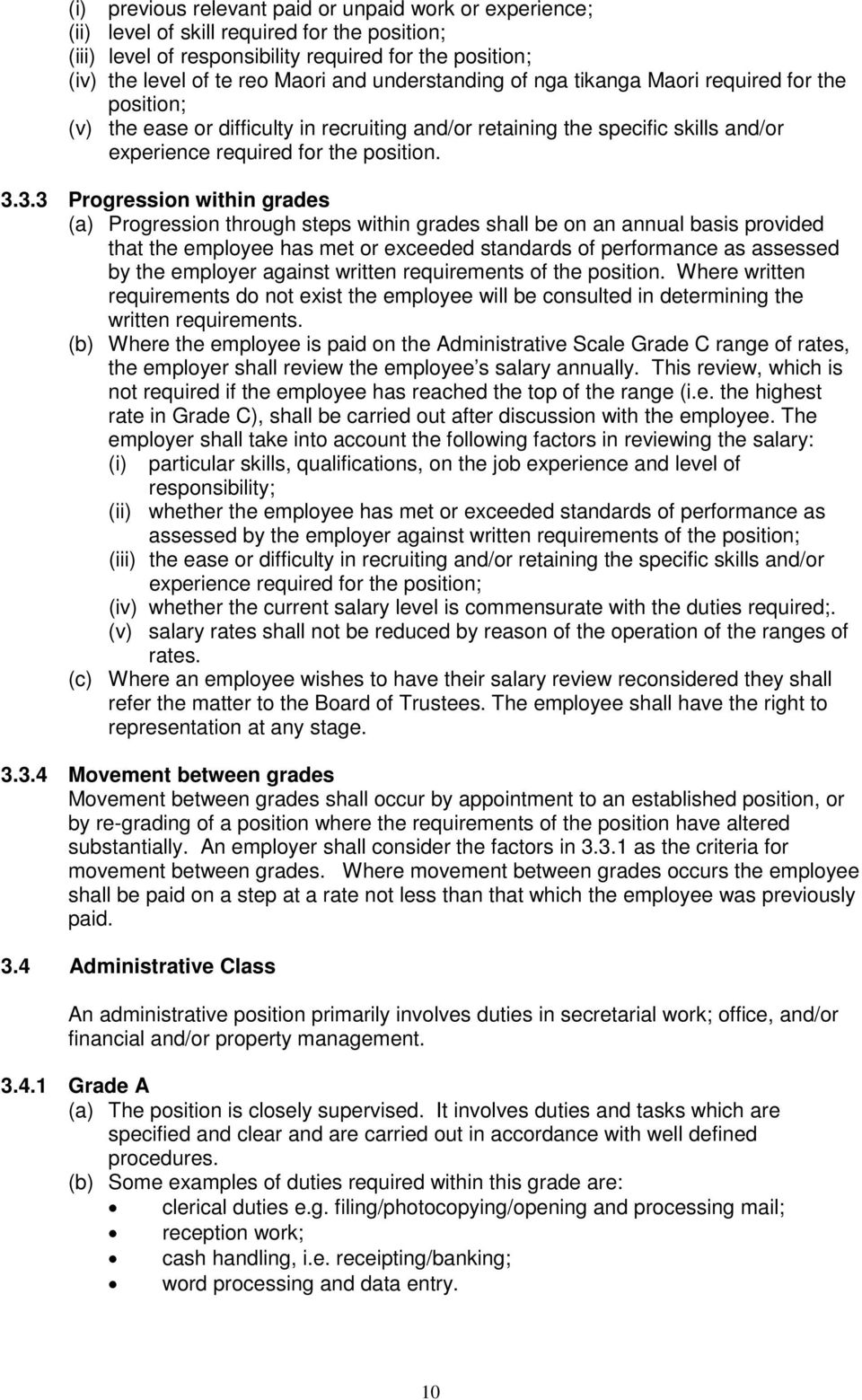
11 3.4.2 Grade B (a) The position involves a range of duties for which advanced knowledge, skills and experience are required to meet the administrative needs of the school. The position may be sole charge or involve supervisory responsibilities, including allocation and monitoring of work. (b) Some examples of the duties or level of duties required within this grade are: administrative assistance; secretarial; data collation and reporting; financial duties Grade C (a) The position requires high levels of administrative skills. The employee will be responsible for administration and/or financial and/or property management functions of the school. The position will usually involve the supervision of staff; including appointments, development and appraisal of staff. (b) Some examples of the duties or level of duties required within this grade are: responsibility for financial systems; supervision of other non-teaching staff; administrative innovation and systems development; responsibility for maintenance and property administration. 3.5 Administrative Pay Scale The annual rates relate only to support staff whom are salaried and paid for 52 weeks per year (refer clause 3.14 for details of salarisation) Grade A Administrative Scale 2013 rates Effective 27 June 2014 Step Hourly Annual Hourly Annual 1 $15.03 $31,383 $15.26 $31,854 2 $15.35 $32,051 $15.58 $32,532 3 $16.05 $33,472 $16.29 $33,974 4 $16.36 $34,095 $16.61 $34,606 Grade B Administrative Scale 2013 rates Effective 27 June 2014 Step Hourly Annual Hourly Annual 1 $15.35 $32,051 $15.58 $32,532 2 $16.05 $33,472 $16.29 $33,974 3 $16.36 $34,095 $16.61 $34,606 4 $16.83 $35,117 $17.08 $35,644 5 $17.20 $35,912 $17.46 $36,451 6 $17.81 $37,169 $18.08 $37,727 7 $18.44 $38,470 $18.72 $39,047 8 $19.08 $39,817 $19.37 $40,414 9 $19.75 $41,209 $20.05 $41, $20.45 $42,653 $20.76 $43,293 11
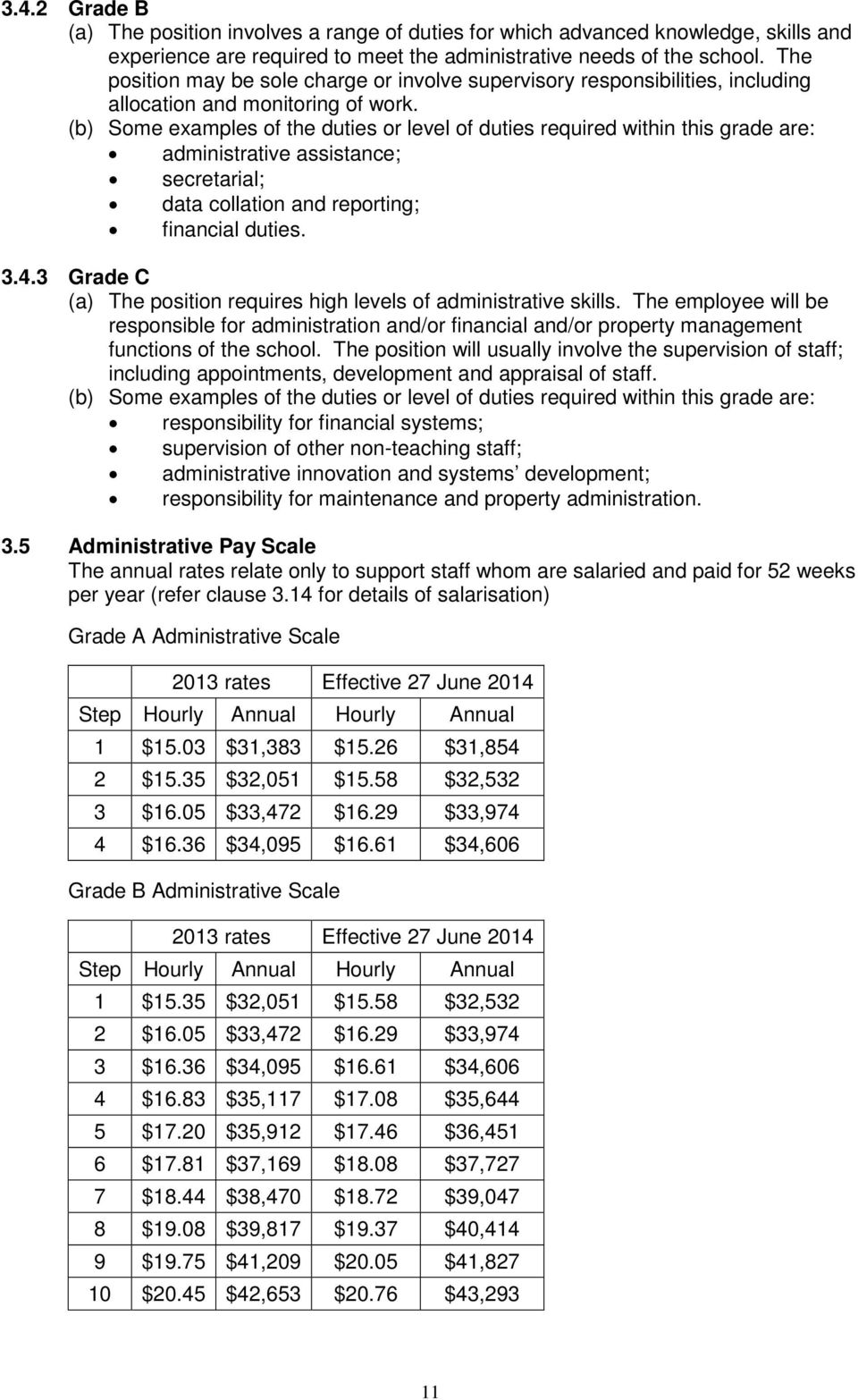
12 11 $21.15 $44,145 $21.47 $44, $21.90 $45,691 $22.23 $46, $22.65 $47,289 $22.99 $47, $23.60 $49,272 $23.95 $50,011 Grade C Administrative Scale 2013 rates Effective 27 June 2014 Step Hourly Annual Hourly Annual 1 $19.00 $39,685 $19.29 $40,280 2 $19.18 $40,080 $19.47 $40,681 3 $19.75 $41,209 $20.05 $41,827 4 $20.45 $42,653 $20.76 $43,293 5 $21.15 $44,145 $21.47 $44,807 6 $21.90 $45,691 $22.23 $46,376 7 $22.65 $47,289 $22.99 $47,998 8 $23.60 $49,272 $23.95 $50,011 Range of Rates Max $32.17 $67,139 $32.65 $68,146 Notes: (i) An employee is paid either an hourly rate or an annual salary. (ii) An employee is paid the appropriate hourly rate listed unless they are a full-time (either 37.5 or 40 hours per week) 52 week employee in which case they are paid the corresponding annual salary (ii) To calculate the hourly rate for a salaried employee employed on a 37.5 hour fulltime week, divide the annual salary by (iii) Each arrow in Grade C designates a range of rates. Refer to 3.3.3(b) for progression through a range of rates. 3.6 Associate Class An associate position primarily involves working either directly or indirectly with teachers and students to support the teaching and learning outcomes of students Grade A (a) The position is closely supervised. It involves duties and tasks which are specified and clear and are carried out in accordance with well defined procedures. (b) Some examples of the duties required within this grade are: prepare and/or maintain resources; support teaching programmes and student learning; assist with routine needs of students Grade B (a) The position involves a range of duties for which advanced knowledge, skills and experience are required. The position is likely to involve periods without supervision or may be sole charge. (b) Some examples of the duties or level of duties required within this grade are: 12

13 support and contribution to teaching programmes and curriculum delivery, including work with students either individually or in groups which assists their learning; contributing to and maintaining healthcare programmes for students; management of equipment and resources Grade C (a) The position involves a high level of responsibility and specialist knowledge. It will include management and/or administrative and/or financial responsibilities. Where the position does not involve supervision of staff it will involve management of specialist equipment and resources which make a significant contribution to the delivery of the curriculum. (b) Some examples of duties or levels of duties required for this grade are: management of systems and/or specialist equipment and resources; management of healthcare programmes. 3.7 Associate Pay Scale The annual rates relate only to support staff whom are salaried and paid for 52 weeks per year (refer clause 3.14 for details of salarisation). Grade A Associate Scale 2013 rates Effective 27 June 2014 Step Hourly Annual Hourly Annual 1 $15.03 $31,383 $15.26 $31,854 2 $15.35 $32,051 $15.58 $32,532 Grade B Associate Scale 2013 rates Effective 27 June 2014 Step Hourly Annual Hourly Annual 1 $15.35 $32,051 $15.58 $32,532 2 $16.05 $33,472 $16.29 $33,974 3 $16.36 $34,095 $16.61 $34,606 4 $16.83 $35,117 $17.08 $35,644 5 $17.20 $35,912 $17.46 $36,451 6 $17.81 $37,169 $18.08 $37,727 7 $18.44 $38,470 $18.72 $39,047 8 $19.00 $39,685 $19.29 $40,280 Grade C Associate Scale 2013 rates Effective 27 June 2014 Step Hourly Annual Hourly Annual 1 $19.00 $39,685 $19.29 $40,280 2 $19.18 $40,080 $19.47 $40,681 13

14 3 $19.75 $41,209 $20.05 $41,827 4 $20.45 $42,653 $20.76 $43,293 5 $21.15 $44,145 $21.47 $44,807 6 $21.90 $45,691 $22.23 $46,376 7 $22.65 $47,289 $22.99 $47,998 8 $23.60 $49,272 $23.95 $50,011 Notes: (i) An employee is paid either an hourly rate or an annual salary. (ii) An employee is paid the appropriate hourly rate listed unless they are a fulltime (either 37.5 or 40 hours per week) 52 week employee in which case they are paid the corresponding annual salary (iii) To calculate the hourly rate for a salaried employee employed on a 37.5 hour full-time week, divide the annual salary by Grade A, Grade B, Grade C and Grade D Salary Scales from 29 June From 29 June 2015 a new single merged salary scale will apply, with increases to pay rates as follows: Effective 29 June 2015 Effective 30 March 2016 Step Hourly Annual Hourly Annual Grade ranges 1 $15.60 $32,538 $15.68 $32,700 2 $16.29 $33,977 $16.42 $34,248 3 $16.61 $34,644 $16.80 $35,040 4 $17.09 $35,645 $17.18 $35,824 5 $17.48 $36,459 $17.75 $37,022 6 $18.09 $37,731 $18.38 $38,336 7 $18.73 $39,066 $18.98 $39,587 8 $19.38 $40,422 $19.58 $40,839 9 $20.06 $41,840 $20.16 $42, $20.76 $43,300 $20.96 $43, $21.49 $44,822 $21.76 $45, $22.24 $46,387 $22.56 $47, $23.02 $48,014 $23.36 $48, $23.98 $50,016 $24.17 $50,412 Range of Rates 15 $32.68 $68162 $32.97 $68,766 Grade A Grade B Grade C Grade D The minimum step for an employee who is placed in Grade A shall be step 1. The maximum increment step, as a result of progression pursuant to clause 3.3.3(a), shall be step 4. 14

15 3.8.3 The minimum step for an employee who is placed in Grade B shall be step 4. The maximum increment step, as a result of progression pursuant to clause 3.3.3(a), shall be step The minimum step for an employee who is placed in Grade C shall be step 9. The maximum increment step, as a result of progression pursuant to clause 3.3.3(a), shall be step The minimum step for an employee who is placed in Grade D shall be step Executive Management Group (a) From 27 June 2014 a new Executive Management Group is established. The minimum salary entry point is $75,000 per annum for the term of this agreement. (b) Subject to clause 3.9.1(c) below, the employer may assign an individual to this Executive Management Group, by mutual agreement (for existing employees who already meet the criteria) or at the employer s sole discretion (for employees appointed on or after 27 June 2014). (c) The Executive Management Group is reserved for staff who: (i) are part of the Senior Management Team (SMT) of the school; and (ii) have whole of school responsibility for functions such as Finance and /or Human Resources and/or Property; and (iii) are employed for their specialist skills. (d) For the purposes of 3.9.1(c)(i) the SMT is by definition the group within the management structure of the school which has whole of school oversight and responsibility to the Board of Trustees Recognised Qualifications Employees holding qualifications on the New Zealand Qualifications Framework that the employer, in discussion with the employee, agrees that the qualification is relevant to the employee s job description and current position shall be paid an allowance as follows: a. Group One: level 4-5 qualifications and level 3 teacher aide qualifications - $0.29 per hour, to a maximum of $500 per annum b. Group Two: level 6 qualifications - $0.44 per hour, to a maximum of $750 per annum c. Group Three: level 7-8 qualifications - $0.58 per hour, to a maximum of $1,000 per annum. Notes: (i) This includes those qualifications agreed to be an equivalent level by the New Zealand Qualifications Authority and the Ministry of Education verified He Tohu Matauranga. (ii) The effective date for payment of the allowance in clause recognising qualifications that have been agreed at an equivalent level by the New Zealand Qualifications Authority (as per note 1. above) is from the date the employee lodged an application with the New Zealand Qualifications Authority Salaried employees shall receive the appropriate allowance of $500, $750 or $1,000 as the case may be in fortnightly instalments, pro-rated for part-time employees. 15

16 Only one allowance shall be paid for a qualification that the employer agrees is relevant to the employee s position which shall be for the highest qualification held by the employee. Upon obtaining a higher recognised qualification that the employer agrees is relevant to the employee s position and job description, the employee shall become eligible for the higher payment Until 27 January 2012, employees were entitled to be paid a qualifications allowance as per provisions in the Support Staff in Schools Collective Agreement 10 December March 2011 as if those provisions were incorporated into this collective agreement Anyone who was eligible for a qualifications allowance under will continue to be eligible for that allowance for as long as they remain employed by that employer in that position. Note: A copy of the Recognised Qualifications provisions and the qualifications recognised under the provisions of Appendix A Support Staff in Schools Collective Agreement 10 December 2009 to 31 March 2011 can be found on the Ministry of Education website Higher Duties (a) An employee who is required by the employer to substantially perform the duties and carry out the responsibilities of a higher graded position for five consecutive working days or more shall be granted a higher duties allowance. (b) The amount of the higher duties allowance will be an additional 5% on the employee s existing salary (excluding allowances) for the period when the employee performs the duties and carries out the responsibilities of the higher graded position. (c) The allowance shall be paid from the first day of acting up, including the first five days. (d) This allowance shall be included in the employee s salary in order to calculate the appropriate holiday pay for that employee Method of Payment Salaries shall be paid fortnightly by direct credit to the employee s nominated bank account. However, individual employees may on religious or ethical grounds apply to the board of trustees to be paid by cheque Annualisation Annualisation of pay shall mean that the employee s projected earnings for a twelve month period shall be paid in equal fortnightly instalments throughout that twelve month period Permanent employees (a) Where a permanently employed employee is in paid employment with an employer for less than 52 weeks of the year (inclusive of paid leave), an employee may seek the agreement of the employer to have his/ her annual earnings annualised. In such circumstances, nothing shall prevent agreement being reached between an employee and his/her employer to enable that employee to have his/her annual earnings annualised. Any such agreement shall be subject to compliance with all of the provisions set out in Appendix D. 16

17 (b) Any agreement entered into under subclause (a) above shall be in writing and shall be signed by the employer and employee and will clearly detail the individual elements of that agreement as required under Appendix D. (c) Annualisation is intended to provide a mechanism to enable employees to access regular payments throughout the year in circumstances where the employee s employment includes periods of time when that employee does not have paid work available with the employer (as per clause 2.3.4). (d) For the purposes of this provision, weekly earnings in relation to: (i) clause (a); or (ii) in relation to any paid parental leave entitlement in accordance with section (iii) 71T of the Parental Leave and Employment Protection Act 1987; or in relation to any entitlements under the Injury Prevention, Rehabilitation and Compensation Act 2001 shall mean the employee s hourly rate multiplied by the employee s actual (i.e. non-annualised) weekly hours. (e) An employee who agrees with his/her employer to have their yearly earnings annualised is not considered to be a salaried employee Annualisation for Fixed term employees Employees on fixed term agreements of 12 months or more may seek the agreement of their employer to have their annual earnings annualised for the annualisation period provided their fixed term agreement spans the period from the start of a school year (or earlier) until the end of that school year (or later). Any annualisation agreement entered into, under this clause, must comply with clause (b) to (e) and Appendix D Salarisation Where an employee is in paid employment for 52 weeks per year, nothing shall prevent mutual agreement being reached in writing between that employee and his/her employer to pay a remuneration package which incorporates allowances and/or overtime. Such an agreement will be signed by the employee and the employer and will clearly specify the individual elements of the remuneration package. This provision is intended to provide a mechanism to simplify the administration and operation of this collective agreement for schools and is not to disadvantage the employee in terms of his/her entitlements under this agreement. 17
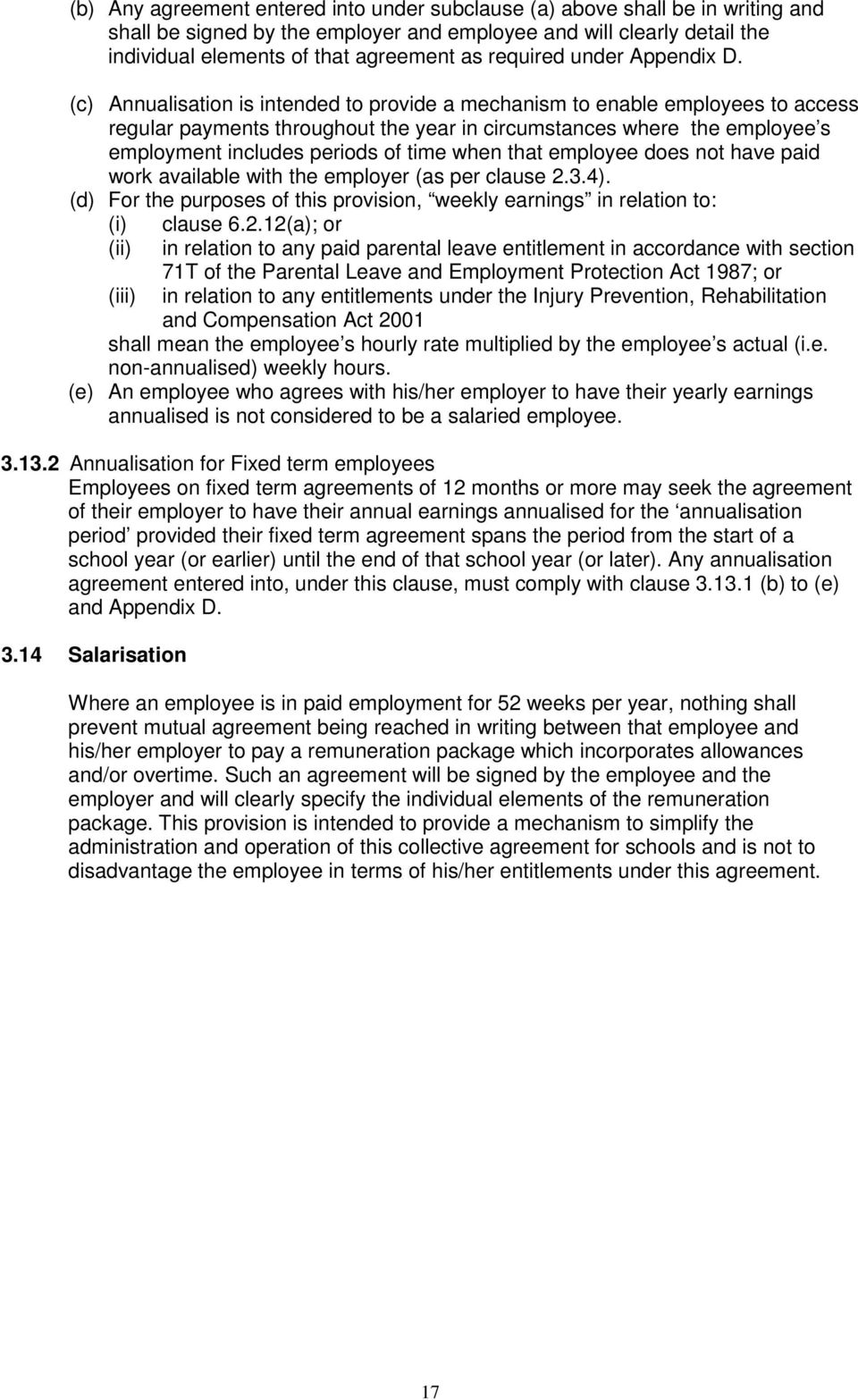
18 Part 4 - Holidays 4.1 Public Holidays The Holidays Act 2003 shall apply except where otherwise provided (a) The following days shall be observed as public holidays and paid in accordance with the provisions set out below: Christmas Day Boxing Day New Year s Day The day after New Year s Day Waitangi Day Good Friday Easter Monday Anzac Day Sovereign s Birthday Labour Day Anniversary Day (as observed in the locality concerned). (b) In addition to the public holidays listed in clause 4.1.2(a) all staff shall be entitled to observe Easter Tuesday as an additional paid holiday. Administrative staff shall also be entitled to observe the day after Boxing Day as an additional paid holiday. (c) Employees, for whom clause below applies, shall no longer be entitled to an additional paid holiday on Easter Tuesday and, for administrative staff, the day after Boxing Day In the event of a public holiday falling on a Saturday or Sunday, in accordance with the Holidays Act 2003 such holiday shall be observed on the following Monday, and in the event of another holiday falling on that Monday then the whole holiday shall be observed on the succeeding Tuesday. For clarity this does not apply to the day after Boxing Day Other than as provided in below, employees shall be paid for the public holidays listed in above on the basis of the hours they would normally work on the day of the week on which the public holiday is observed. For clarity, public holidays which are observed during a term break shall be paid provided that the employee: (i) During term time normally works on the day of the week on which the public holiday is observed; and (ii) Is in continuous employment which extends beyond that term break An employee whose employment is terminated (including expiry of a fixed term agreement) but whose final date of work is notionally extended by any annual leave holiday entitlement (in accordance with s40 of the Holidays Act 2003) to include a public holiday falling on a day normally worked (including during a term break), would receive the relevant daily pay for that day With regard to Christmas Day, Boxing Day, New Years Day and the day after New Years Day, these shall be paid public holidays for all employees who are employed within ten working days of the last day the school is open for instruction in an academic year. Provided that this shall also apply where the employee s employment ceases due to termination of the delivery of the curriculum to a particular student or students and this occurs within one month prior to the last day the school is open for 18

19 instruction in an academic year. Payment for these public holidays will be on the basis that the employee: (i) During term time normally works on the day of the week on which the public holiday is observed; and (ii) Is in continuous employment which extends beyond the particular period during which the school is not open for instruction Except as provided under and above, it is not intended an employee specifically on leave without pay would be eligible for a paid public holiday. Provided that an employee who has applied for and been granted a period of leave without pay which spans a term break shall not be entitled to payment for any public holiday which is observed within that term break An employee who is required to work on a public holiday shall be paid at the rate of time and one half of their relevant daily pay for all time worked and shall be entitled to a paid day in lieu to be taken at a subsequent mutually agreed date Notwithstanding the above, administrative staff shall also be entitled to observe the day after Boxing Day as an additional paid holiday. 4.2 Service for Leave Purposes (a) Except as provided in below, continuous service for leave purposes shall mean the aggregate of the employee s employment with any state or integrated school. (b) Continuous service shall not be broken by any period of leave with pay; or any period of approved leave without pay of up to 12 months; or a break in employment (including between employers) of less than 3 months. (c) Continuous service for a fixed term employee shall not be broken by a break of 20 consecutive working days or less between engagements; or any period when the school is closed for instruction; or absence on approved sick leave. (d) For the purposes of leave aggregation under (a) above any break between engagements, or any period of leave without pay, in excess of 20 consecutive working days will interrupt but not break (except as provided under (b) or (c) above) service. Parental leave will, however, count as service as provided for under s43 of the Parental Leave and Employment Protection Act All service or continuous service accumulated after 1 March 1995 shall be calculated on the basis set out in above. Those employees who were party to the Support Staff in Schools Collective Employment Contract which applied prior to 1 March 1995 retain all service or continuous service which they had accumulated prior to 1 March Annual Leave All annual leave shall be taken at a time in which the school is officially closed for instruction at the end of the academic year (unless there is, or has been, agreement to do otherwise). 19
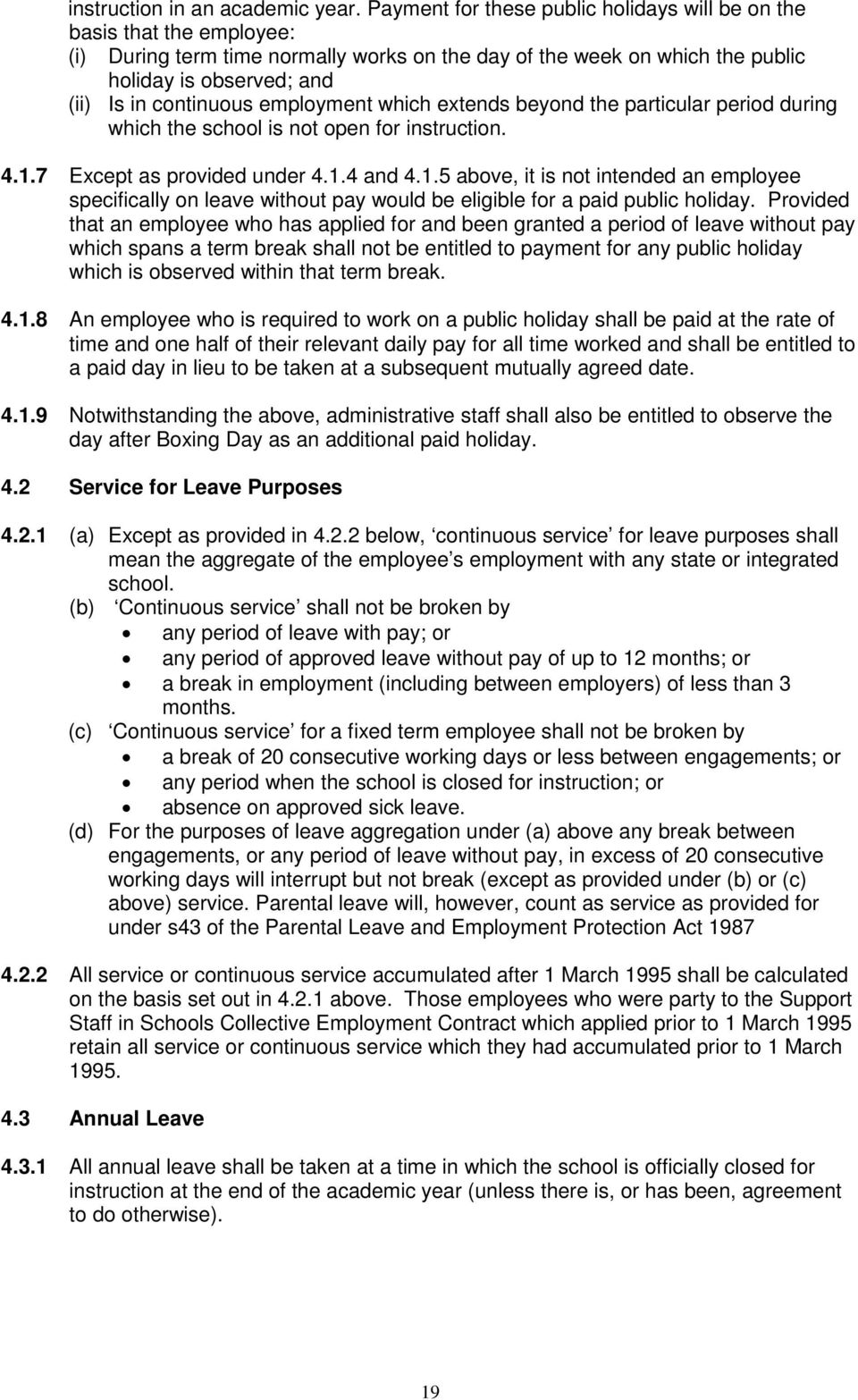
20 4.3.2 All employees are entitled, based on their current continuous service (as defined in 4.2) and the commencement dates contained in the clauses titles to the leave provisions contained in or No employee shall be covered by more than one of these three clauses at any point in time For the purposes of annual leave, a week of leave for an employee is based on his/her ordinary working week Holiday pay will be paid in the employee s fortnightly cycle as per clause An employee can elect the option of having his/her holiday pay paid as a lump sum prior to taking annual leave by giving his/her employer two weeks notice For all employees (a) All employees shall be entitled to four weeks annual leave in addition to public holidays and additional paid holidays provided for in clause (b) Where the employee commences employment with an employer after the beginning of the school year the employer shall, in that first year, pay to the employee, when they take leave at the end of the school year, an amount equal to 8 percent of gross earnings for the period worked for that employer during that school year, less any annual leave payment made in advance by that employer. (c) Where an employee s employment terminates before the end of the school year annual leave shall be paid in accordance with the Holidays Act For employees who have completed five years current continuous service in a state or integrated school (a) Upon completion of five years current continuous service (as defined in clause 4.2) in a state or integrated school employees shall for the sixth and subsequent years be entitled to accrue 4.6 weeks of annual leave in addition to public holidays and the additional paid holidays described in clause 4.1.2(b). (b) Where the employee commences employment with an employer after the beginning of the school year the employer shall pay to the employee an amount equal to 9.2 percent of gross earnings for the period worked for that employer during that school year, less any annual leave payment made in advance by that employer. (c) Where an employee s employment is terminated before the end of the school year, annual leave shall be paid in accordance with the Holidays Act 2003, except that holiday pay shall be calculated on the basis of annual leave entitlements provided for in 4.3.5(b) From 1 January 2010 for employees who have completed ten years current continuous service in a state or integrated school (a) Upon completion of ten years current continuous service (as defined in clause 4.2) in a state or integrated school, each employee bound by this collective agreement shall for the eleventh and subsequent years be entitled from 1 January 2010 to accrue five weeks annual leave in addition to public holidays and the additional paid holidays described in clause 4.1.2(b), subject to clause (b) and (c) below. (b) Employees entitled to five weeks annual leave under this clause, shall no longer be entitled to the day after Boxing Day (where provided for in the collective agreement) and Easter Tuesday as additional paid holidays (as outlined in clause ). Not withstanding clause 4.3.1, employees agree to take the day after Boxing Day and Easter Tuesday as paid annual leave days. 20
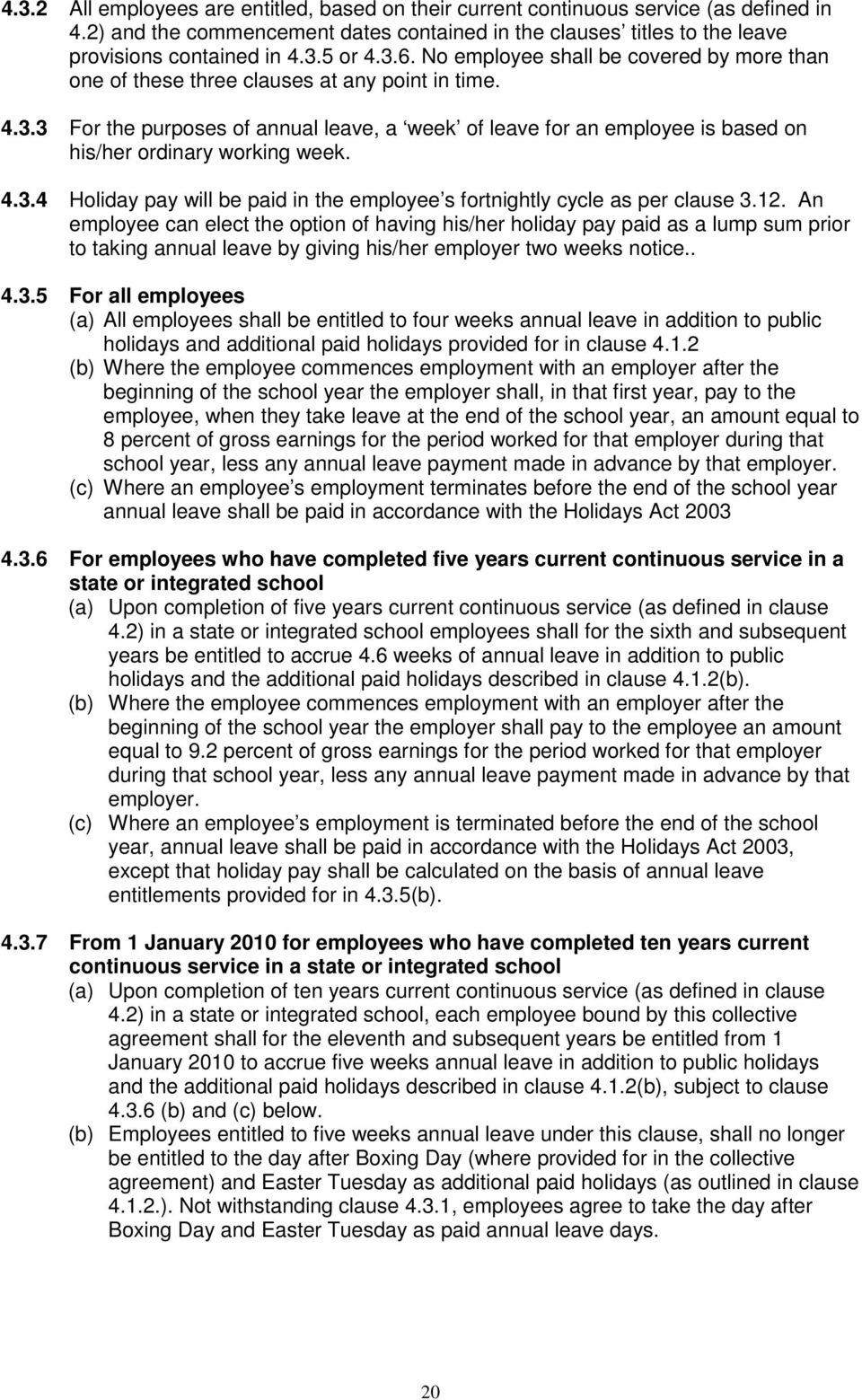
21 (c) Where the employee commences employment with an employer after the beginning of the school year the employer shall pay an amount equal to 10 percent of gross earnings for the period worked during that school year for that employer less any annual leave payment made in advance by that employer. (d) Where an employee s employment is terminated before the end of the school year annual leave shall be paid in accordance with the Holidays Act 2003, except that the holiday pay shall be calculated on the basis of annual leave entitlements provided for in clause 4.3.6(b). 4.4 Sick Leave The employer shall grant sick leave on pay in accordance with the following provisions An employee is entitled to 7 days sick leave for each year in addition to any sick leave accumulated at the date of this agreement except where an employee s working days are less than 5 days per working week in which case their annual entitlement shall be 6 days instead of The provisions of this clause regulate the application of paid sick leave under 4.4: (a) Sick leave is to be paid in respect of actual working days but excluding any public holiday. (b) Sick leave shall be accumulated. It may not be anticipated except where the employer and the employee agree. (c) An employee shall produce a medical certificate or other evidence of illness of him or her if required to do so by the employer for absences exceeding three days. (d) The employee must inform the employer of the intention to take sick leave as early as possible before they are due to start work or, if not practical, as early as this is possible after that time. 4.5 Domestic Leave The employer shall grant the employee leave on pay as a charge against their sick leave entitlement when the employee is absent from work to attend to a person who is dependent on the employee for care. This shall not preclude the employer granting additional leave in accordance with 4.10 below Approval is not to be given for absence during or in connection with the birth of an employee s child. Such situations should be covered by leave without pay The production of a medical certificate or other evidence of illness may be required. 4.6 Parental Leave Parental leave shall be allowed in accordance with the requirements and provisions of the Parental Leave and Employment Protection Act The following provisions are by way of summary of the Act. Further details are available at or free phone This Act provides that on written application an employee shall be entitled to unpaid parental leave provided that: (a) the employee has worked for the same employer for the immediately preceding 6 months before the expected date of delivery or the date of adoption; and (b) the employee has worked at least 10 hours per week during that period. 21
22 4.6.3 Parental Leave is: (a) maternity leave of up to 14 weeks; (b) special leave of up to 10 days; (c) paternity leave of up to 2 weeks; and (d) extended leave of up to 52 weeks On returning from parental leave the employee is entitled to resume work in the same or similar position to the one they occupied at the time of commencing parental leave. 4.7 Bereavement/Tangihanga Leave An employee shall be granted bereavement/tangihanga leave on pay to allow a reasonable opportunity for the employee to discharge his or her obligations and/or to pay his or her respects to a deceased person with whom they have had a close association. The entitlement to this leave extends to the death of any members of the employee s family, or person who, because of particular cultural requirements on the employee, he or she is obliged to attend to as a part of a tangihanga or its equivalent In exercising its discretion to grant this leave, and in fixing the length of leave the employer must discharge its obligations in a culturally sensitive manner taking into account the following: (a) The closeness of the association between the employee and the deceased (b) The responsibilities of the employee for any or all of the arrangements for the ceremonies resulting from the death (c) The amount of time needed properly to discharge any responsibilities or obligations by an employee (d) Reasonable travelling time, provided that the employer need not take into account total travelling time where an employee must attend a funeral overseas. However any decision regarding the length of bereavement leave will be no less than the minimum amounts set out by S70 Holidays Act Note: (i) The minimum entitlement prescribed in the Holidays Act 2003 for a bereavement on the death of the employee s spouse, parent, child, brother or sister, grandparent, grandchild or spouse s parent is three days paid leave. (ii) The minimum entitlement prescribed in the Holidays Act 2003 for a bereavement on the death of any other person where obligations such as those in exist is one day The employer s decision on this leave and the length of such leave will be made as quickly as possible so that the employee is given maximum time possible to make any arrangements necessary. In most cases the necessary approval will be given immediately, but may be given retrospectively where necessary. If paid leave is not appropriate then leave without pay shall be granted, but as a last resort (a) Where an employee is absent on annual leave and a bereavement occurs the employer shall be notified and will determine the number of days of bereavement leave to be granted in accordance with above. The days shall replace the annual leave (b) If bereavement leave is sought while an employee is absent on sick leave or any other leave with pay, the employer may agree to such leave being interrupted and bereavement leave being granted in its place. (c) The above provisions will not apply if the employee is on leave without pay. 22
23 4.7.5 Payment of bereavement leave will be an amount that is equivalent to the employee s relevant daily pay for each day of bereavement taken by the employee that would otherwise be a working day for the employee. 4.8 Long Service Leave Except where an employee has long service leave entitlement under clause 4.11, an employee shall on the completion of 25 years continuous service be granted four weeks long service leave with pay. 4.9 Jury Service The employer will grant leave with pay when an employee is required to serve on a jury provided that all fees for service are reimbursed to the employer Other Leave An employer may, at its discretion, grant an employee special leave with or without pay on such terms and conditions as it may approve Savings Employees who at 30 August 1992 had conditions in excess of those provided for in this agreement in respect of: - Long Service Leave; - Retirement Leave; - Resigning Leave; and - Maternity Grant in accordance with the previous applicable contract, NZ Support Staff in Schools Composite (DOC 2646), will continue to be eligible for these entitlements. These provisions are contained in Appendix B. 23
24 Part 5 - Expenses and Allowances 5.1 Motor Vehicle Allowance Employees required by their employer to use their own vehicles for school business shall be paid an allowance of 58 cents per kilometre. 5.2 Protective Clothing All employees required by their employer to wear protective clothing shall be provided with appropriate garments. The garments will be laundered at the employer s expense. The clothing shall remain the property of the employer and shall be returned promptly where the employee ceases employment with the employer Where employees, in the course of their employment are expected to work in swimming pools assisting children with special needs, the employer shall meet the cost of swimwear up to a maximum of $75 per year upon production of receipts. 5.3 First Aid Allowance Where an employee (excluding a nurse aide or a nurse) holds a current first aid certificate or recognised nursing qualification and is a designated first aider in the school, such an employee shall be paid an allowance of $0.35 cents per hour. The employer shall meet the cost (up to a maximum of $160) of obtaining and renewing a first aid certificate from a recognised provider for a designated first aider. 5.4 Dirty Work Allowance (a) Where an employee is required to clean up a student soiled with vomit, excreta, urine or blood (other than blood associated with minor cuts and abrasions and minor nose bleeds) in the course of her/his duties, s/he shall be paid an allowance of $3.85 per day or part thereof. (b) Where an employee is required to clean up a student soiled with other forms of body fluids, the allowance shall be payable at the employer s discretion. (c) This allowance shall be payable for no more than one attendance to such duties per day. 5.5 Overnight Allowance For any school camp or trip where an employee (other than a full time 52 week salaried employee) is required to attend and stay overnight, an allowance of $65 per night shall be paid. By mutual agreement, time in lieu may be substituted for this overnight allowance Full time employees employed on a salary paid at entitlement rate for all weeks of the year who are required to stay overnight shall receive an overnight allowance of $20 per night. 5.6 Meal Allowance An employee who has been directed to work not less than two hours overtime and who has had to buy a meal which would not otherwise have been bought, shall either be provided with a suitable meal by the employer or shall be paid a meal allowance of $
25 Part 6 - Employment Protection and Surplus Staffing Provisions 6.1 Employment Protection Provision Restructuring is given the same definition as in section 69OI of the ERA 2000 and includes: (i) Contracting out; or (ii) Selling or transferring the employer s business (or part of it) to another person; but excludes mergers (in the case of mergers Appendix A will apply) Where work undertaken by an employee covered by this Agreement will be, or is likely to be, undertaken by a new employer (whether or not the new employer is an employer defined in 1.3) the employer will notify the National Office of the union(s) where one or more of the employees affected by the restructuring is a member of the union(s). In such circumstances the employer will meet with representative(s) of the union(s) to: (a) Identify the issues the employee(s) wish to have considered by the new employer; (b) Ensure that all current terms and conditions of employment of the employee(s) are accurately recorded; and (c) Determine the process by which communications to/from the employee(s) will be conducted The employer will encourage the new employer to agree to the involvement of the union(s) in the processes described in clauses and below Having completed the process described in above, the employer will meet with the new employer to: (a) provide the new employer with details of the work currently performed by the employees concerned together with details of the terms and conditions of their employment; and (b) seek a proposal for the employment of the affected employees by the new employer, including clarification of the terms and conditions upon which those employees would be offered employment by the new employer The following shall be matters for clarification under clause 6.1.3(b) and again should be read in conjunction with the surplus staffing provisions of this collective agreement. (a) the number and type of positions that may be offered by the new employer to employees affected by the restructuring; (b) the terms and conditions of employment to be offered to those employees (including whether the employees will transfer to the new employer on the same terms and conditions of employment); (c) the arrangements, if required, for the transfer of any accrued benefits and entitlements in relation to those employees; (d) the arrangements, if required, for when and how offers of employment are to be made to the affected employees and the mode of acceptance, including whether any offers of employment made by the new employer will be conveyed through the representatives of the union(s) The notice provisions of the surplus staffing provisions shall apply as described in and below. 25
26 6.1.6 The process to be followed at the time of the restructuring to determine what entitlements, if any, are available for employees who do not transfer to the new employer are set out in 6.2 below. This clause as a whole shall be read in conjunction with those provisions Clause 6.1 shall be read in conjunction with clause Surplus Staffing Provisions The following provisions shall not apply to any fixed term employee (see 2.3.3). The provision in relation to staff affected by a merger of two or more schools are set out under Appendix A and any provisions in 6.2 will only apply where they are specifically provided for in that Appendix A surplus staffing situation may arise when the work undertaken by the employee ceases to exist. This may be the result of the restructuring of the whole or any part of the employer s operations because of, for example: the reorganisation or review of work; a change in plant (or like cause) relevant to the individual employee s employment; or change of status or closure of the school, or the sale or transfer of all or part of the school The employer shall, at least one month prior to issuing notice of termination, advise any affected employee(s) of the possibility of a surplus staffing situation within an occupational category in the school The period of notice is to allow time for discussion between the employer and the employee(s) of the reasons for the possible surplus staffing situation and to determine whether this surplus can be absorbed by attrition. The employer shall consider whether or not it is able to offer an alternative position within the school with terms and conditions that are no less favourable, which may also entail on the job retraining If the required number of positions cannot be achieved through attrition (refer 6.2.4) and a surplus staffing situation still exists, all available positions in the occupational category will be internally advertised and appointments made from existing employees in that category. Where there is only one position in the identified occupational category in which the surplus exists identification of the position shall be automatic Employees who are not appointed or who are identified as surplus in terms of above shall be given a minimum of one month s written notice of termination of employment provided as for in Except in exceptional circumstances (e.g., long-term sick leave), or as agreed with the employee, this notice shall be given at such a time as to ensure it covers a period of a full month during which the employee is paid and at work During the notice of termination period both the employer and the employee shall make reasonable efforts to locate alternative employment for the employee. The employer will provide reasonable paid time to attend interviews, where prior approval will not be unreasonably withheld. 26
27 6.2.8 In the event that a reasonable offer of employment in the education or state service is made the employer s responsibilities under these provisions shall be fulfilled For the purposes of a reasonable offer of employment shall constitute an offer of employment that: is in the same location or within reasonable commuting distance; has comparable duties and responsibilities; and has terms and conditions that are no less favourable providing the employment being offered is available to be taken up by the employee prior to or at the conclusion of the notice of termination period If the offer of employment referred to in is not a reasonable offer by reason only that it is not available to be taken up by the employee before or at the conclusion of the notice period, the employer may extend the notice period until such time as the position is available to be taken up by the employee; and under these circumstances the offer shall be deemed to be reasonable. The employer must first ensure that in granting such extended notice that this complies with any funding arrangement applying to the school In the event of a school closure, the employee may be made an offer of employment prior to the disestablishment of the position at another state or integrated school. Where this is an offer of employment to a lower graded position or a position at a lower hourly / salary rate than that previously held, the employee shall be entitled to an equalisation allowance calculated in accordance with Appendix A, clause 8.6. Where this is an offer of employment to a position with reduced hours to that previously held, the employee shall be entitled to a partial redundancy payment calculated in accordance with Appendix A, clause 8.7. Where the employee accepts such an offer the employer of the closing school s responsibilities under below shall be fulfilled. Where the employee does not accept such an offer the provisions of shall apply Except as provided under above, where a reasonable offer of employment is not made before the expiry of the notice of termination period the employee will be entitled to redundancy pay calculated as follows: (a) 6 weeks pay for the first year of service and two weeks pay for every subsequent year or part thereof to a maximum of 30 weeks pay in total. Note: 1. This is calculated on current gross weekly earnings as at the last day of service or on average gross weekly earnings over the previous 12 months service whichever is the greater. 2. An employee with less than one year s service shall receive a pro-rata payment. For the purposes of the redundancy calculation the definition of service is the same as that for continuous service defined in (a) to (d) above provided that no period of service that ended with the employee receiving a redundancy or severance payment shall be counted as service. (b) All holiday pay and wages owing A work reference or record of service shall be provided on the employee s request. 27
28 Part 7 - Other Conditions 7.1 Sexual Harassment Statement The parties to this agreement consider sexual harassment in the workplace is not acceptable and attention is drawn to Part Security Boards shall take all practical steps to ensure the safety of employees especially when employees undertake banking duties and work in isolated areas on the school site Boards shall ensure that all employees have the opportunity to be fully involved in the development of procedures as specified in Immunisation The parties agree in principle that responsibility for pre-exposure immunisation of employees rests with employers who should accept responsibility for safety in the workplace, advised as necessary by health officials In situations where employees may be at significantly increased risk of acquiring hepatitis B or similar diseases because of the nature of their job, the situation shall be assessed on an individual basis to decide if immunisation would be appropriate. Immunisation will be provided by the employer if appropriate In all situations where there is a risk of infection of the kind envisaged in 7.3.2, it shall be the duty of the employer to require safe working practices on the part of the employee and to ensure appropriate hygiene practices to reduce such risk to a minimum, whether or not immunisation is considered advisable. 7.4 Working Conditions of Employees Attention is drawn to the provisions of the Health and Safety in Employment Act 1992, the Health and Safety in Employment Amendment Act 2002, the Ministry of Education Code of Practice for State Primary, Composite and Secondary Schools 1993 and any amendment or any other relevant legislation or code subsequently introduced Coffee, tea, sugar and milk shall be provided at all meal intervals and rest periods. 7.5 Privacy Act Attention is drawn to the Privacy Act 1993 which outlines responsibility for the collection, storage and availability of personal information. 7.6 Access A representative of either union party to this agreement shall be entitled to enter at all reasonable times upon the premises for purposes related to the employment of its members or for purposes related to the union s business or both. The representative shall enter at a reasonable time and in a reasonable way and comply with existing safety, health and security procedures and requirements applying in respect of the school. 28
29 7.7 Deductions The employer shall deduct union dues from those employees who are bound by this agreement and who have given the employer written authority to make such a deduction. The employer shall retain an administration fee of 2.5 per cent. The employer shall remit such deductions to the appropriate union at mutually accepted intervals of not more than three months. 7.8 Paid Union Meetings (a) The employer must allow every union member employed by the employer to attend at least 2 union meetings (each of a maximum of 2 hours' duration) in each calendar year. (b) The union must give the employer at least 14 days' notice of the date and time of any union meeting to be held. (c) The union must make such arrangements with the employer as may be necessary to ensure that the school remains open for instruction during any union meeting, including, where appropriate, an arrangement for sufficient union members to remain available during the meeting to enable the school to remain open for instruction. (d) Work must resume as soon as practicable after the meeting, but the employer is not obliged to pay any union member for a period longer than 2 hours in respect of any meeting. (e) An employer must allow a union member employed by the employer to attend a union meeting under 7.8 on ordinary pay to the extent that the employee would otherwise be working for the employer during the meeting. (f) For the purposes of 7.8 (e) the union must: (i) supply to the employer a list of members who attended the union meeting; and (ii) advise the employer of the duration of the meeting. 7.9 Technology The employer shall recognise her/his responsibility for the protection of the health and safety of employees operating electronic technology, and shall comply with the latest protective guidelines contained in the Department of Labour, Occupational Safety and Health Service Approved Code of Practice on Visual Display Units (1995) or any other relevant VDU code subsequently introduced and agrees to apply this any time visual display units are used by employees When an employer is considering the introduction of new technology the employees likely to be affected will be fully consulted. The employees are entitled to representation of their choice throughout the process The minimum requirements for the placement and use of photocopiers and multilith machines are: (a) access/ventilation space required on all sides of unit; (b) employees shall not be seated within four metres of the machine; (c) the machine should not in any circumstances be sited in a room of volume less than 4.5 cubic metres; (d) large machines are to be located in a separate room specifically for the purpose with adequate mechanical ventilation; 29
30 (e) where photocopiers are located in open plan offices every effort shall be made to minimise excessive heat and noise. The employer shall comply with any relevant code of practice subsequently introduced (a) Eye tests any permanent employee whose weekly hours of work set under are not less than 20 per week and who works on a VDU for at least 50 per cent of their normal working time shall be entitled to an eye test biennially or as required at the employer s expense. If the test discloses that prescription lenses are required for the normal viewing distance of a VDU, or that an eyesight problem has been created or worsened by a VDU, then the actual and reasonable cost of single vision spectacle lenses will be met by the employer. The employer will also meet the actual and reasonable cost of spectacle frames where the employee requires lenses for the first time. (b) If the employee chooses contact lenses the employer will meet the costs only up to the level required to be met under 7.9.4(a) Employees who work continuously at VDU terminals will be provided with relief by variations in work, or by regular breaks of 10 minutes in every hour Pregnant VDU operators - while current scientific evidence supports the view that there are no adverse health effects or associated risks for pregnant women, the employer will make every effort to accommodate requests for alternative duties during the period of pregnancy. Employees who are temporarily redeployed for this reason should not be disadvantaged in relation to either salary or conditions of employment Training When new technology is introduced to the workplace for use by the employee, appropriate training should be provided as a matter of course Employees are entitled to ongoing training in recognition of the importance of keeping up with changing work patterns and technology. No employee shall be required to undertake training outside of work hours. Where it is agreed that training is both necessary and available only outside of work hours, the employee shall be given full pay or equivalent time off for the period of such training Professional Development The parties agree that ongoing professional development is an important component of the provision of quality support services within schools. Further the parties acknowledge that the provision of quality support services is aided by appropriately qualified staff Both the employer and employee are responsible for discussing and identifying appropriate professional development opportunities. This should occur on at least a 12 monthly basis and where possible be linked to the annual appraisal process Subject to , a Board may require an employee covered by this agreement to attend professional development opportunities for up to five days in each calendar year. The identification of such opportunities is likely to arise from the process referred to in
31 The most appropriate opportunities may be in term time or during term breaks, and may be during the employee s normal working hours or outside those hours. When considering such opportunities, the employer will give every reasonable regard to the employee s external responsibilities and commitments Where an employee considers that s/he is not being provided with an appropriate professional development opportunity through the process referred to in , the employee may apply to the Board of Trustees to have her/his attendance at a particular course approved and reimbursed in accordance with this clause. Such approval will be at the discretion of the Board of Trustees based on the principles expressed in this clause (7.11) Where professional development occurs outside of work hours or on a day not normally worked, the employee shall receive full pay for the time spent at the course, including reasonable travelling time, for a maximum of eight hours per day. In addition the course costs and reasonable expenses shall be met by the Board. A minimum of four week s notice of any such course will be given to the employee Where the professional development occurs on a day or days the employee would normally work, the employee will be entitled to have course costs and reasonable expenses paid by the employer in addition to normal wages for the day. Where the course length, including reasonable travelling time, exceeds the hours normally worked on the day, those additional hours shall also be on full pay to a maximum of eight Where the employer requires the employee to use their own vehicle reasonable expenses shall include mileage payments as per The overtime provisions in this agreement shall not apply to the time spent on professional development Termination of Employment Unless otherwise agreed between the employer and the employee and except as provided in , termination of employment shall be by one month s notice by either the employee or the employer, to the other party; except in cases of serious misconduct which may warrant instant dismissal Where an employee is appointed for a fixed term pursuant to 2.3.3(1)(b), and the date of the specified event is unknown at the time of appointment, the employee shall have their employment terminated on the occurrence of that specified event. The employer is required to give at least two weeks notice of termination of employment. 31
32 7.13 Complaints and Discipline General The following principles shall be used in addressing complaints against employees and matters of discipline to ensure that such matters can in the interests of the parties be fully and fairly addressed. Many complaints will be able to be resolved by discussion between the principal and the employee concerned without the need to take the matter any further. Boards should, wherever appropriate, seek to resolve complaints in this manner in the first instance. Questions of conduct and/or discipline should be handled in a manner which as far as possible protects the mana and dignity of the employee concerned. Employees may seek whanau, family, professional and/or NZEI Te Riu Roa or Service and Food Workers Union support in relation to such matters Ngā Kōrero Me Ngā Tikanga (a) Me tuku reta atu ki te kaimahi hei whakamārama atu i nga raruraru kua puta noa. Mehemea he pai ki te kaimahi rāua tahi ko tona tumuaki, e āhei ana ki te whakahaere tonutia ngā whakaritenga i raro i ngā tikanga Māori. (b) Anei ra ētahi momo tikanga hei kōwhiringa mā rātou: he huihuinga kei te marae; he whakawhiti kōrero kanohi ki te kanohi; ka hui mai te whānau hei tuarā mō te katoa; ā ka hui mai ngā kaumātua kuia hei arahi hei tohutohu i ā rātou katoa. (c) Mēnā ka whakaaetia te kaimahi rāua ko tōna tumuaki ō rāua kaihautū rānei, kia oti pai ai te kaupapa, mā rāua mā ngā kaihautu rānei e hainatia ngā whakaaetanga i tūhia. Makaia atu tētahi kape o ngā whakaetanga nei ki te kōnae o te kaimahi. (d) He māmā noa iho ēnei whakawhiringa mehemea hiahia ana tētahi taha kia waiho tārewa ake ngā tikanga Māori kia huri ke ia ki ëtahi (te katoa rānei) o nga whakaritenga, arā (a) me (b) e whai ake nei. Engari, mehemea ka huri kē atu i ngā tikanga Māori, ehara tērā i te tino raruraru kia oti hē rawa ngā whakaritenga katoa. Ina hoki ka tahuri mai tētahi taha ki ēnei ki (a) me (b) i raro nei, me tuhituhi hei whakamārama ki tērā atu taha Discussions in a Māori Context (a) The employee must be advised in writing of the specific matter(s) causing concern. The employee and employer may, depending on the nature of the complaint, agree to attempt to deal with a complaint by it being heard in a Māori context and manner. (b) A Māori context and manner relates to the following: meetings can be held on marae; there is face to face engagement; there can be whanau support for all involved; and guidance and advice is often provided by kaumatua and kuia for all involved. (c) Should the employee and employer, or their representatives on their behalf, agree to a resolution of the matter then this shall be recorded in writing and signed by both parties and/or their representatives on their behalf. A copy of the agreement will be placed on the employee's personal file. 32
33 (d) This is a discretionary option and either party may withdraw at any time, and nothing in this section prevents the employer or the employee deciding at any time that any or all of the procedures in (a) and/or (b) will be used. Where either party decides to withdraw from this process such a decision will not of itself give rise to any claim of procedural deficiency or unfairness. The decision to withdraw from this process and/or for the employer to use any or all the procedures in (a) and/or (b) will be notified in writing to the other party Discipline and Dismissal (a) The following principles are to be followed when dealing with disciplinary matters: (i) The employee must be advised of the right to request representation at any stage. (ii) The employee must be advised in writing of the specific matter(s) causing concern and be given a reasonable opportunity to provide an explanation. Before making a final decision the employer may need to make further inquiries in order to be satisfied as to the facts of the specific matter(s) causing concern. (iii) The employee must be advised of any corrective action required to amend their conduct and given a reasonable opportunity to do so. (iv) If the offence is sufficiently serious an employee is to be placed on suspension with or without pay pending further inquiry under (b). (v) The process and any disciplinary action are to be recorded, sighted and signed by the employee, and placed on their personal file. (vi) The provisions in Part 8 explain the processes available under the Employment Relations Act 2000 to any employee aggrieved by any action of their employer taken under these provisions. (b) Nothing in (a) prevents instant dismissal without notice in the case of serious misconduct Abandonment of Employment Where an employee is absent from work for a continuous period exceeding three days without the consent of the employer and without good cause or without notification to the employer they shall be deemed to have terminated their employment Record of Service Each employee on leaving or being discharged from her/his employment shall, on request, be given as soon as practicable, a certificate in writing signed by the employer and stating the position held and the length of service. 33
34 Part 8 Employment Relationship Problems What is an employment relationship problem? It is a problem between employee and employer. For example, it might be a personal grievance or a dispute about a provision in an employment agreement. Resolving an employment relationship problem The employee and employer should first make a reasonable effort to discuss the problem and settle it by mutual agreement. (If it s a personal grievance, it must first be raised with the employer and within 90 days - Personal Grievances are explained further below). An employee (or employer) has the right to be represented at any stage. When a problem arises, union members should contact their local NZEI Te Riu Roa field officer or Service and Food Workers Union organiser for advice and representation. Employers should contact New Zealand School Trustees Association or other adviser/representative of choice. Personal Grievances A personal grievance is a particular type of employment relationship problem that normally must be raised with the employer within 90 days of the grievance arising. An employee may have a personal grievance where: They have been dismissed without good reason, or the dismissal was not carried out properly. They have been treated unfairly. Their employment or a condition of their employment has been affected to their disadvantage by an unjustified action of their employer. They have experienced sexual or racial harassment, or have been discriminated against because of their involvement in a union or other employee organisation, or have suffered duress over membership or non-membership of a union or other employee organisation. They have been discriminated against in terms of the prohibited grounds of discrimination under the Human Rights Act Note: The full meaning of the terms personal grievance, discrimination, sexual harassment, racial harassment, and duress, shall be the meaning given by sections 103 to 110 inclusive of the Employment Relations Act 2000 only. For ease of access these are attached at the end of this agreement as Appendix C. As with other employment relationship problems, the parties should always try to resolve a personal grievance through discussion. Either party can refer a personal grievance to the Employment Relations Service of the Ministry of Business, Innovation & Employment for mediation assistance, or to the Employment Relations Authority. If the problem relates to a type of discrimination that can be the subject of a complaint to the Human Rights Commission under the Human Rights Act 1993, the person can either take a personal grievance, or complain to the Human Rights Commission, but not both. If in doubt, advice should be sought before deciding. 34
35 Services Available To help resolve employment relationship problems, the Ministry of Business, Innovation & Employment provides: An information service This is free. It is available by contacting the Ministry of Business, Innovation & Employment or by phoning toll free The Ministry's Employment Relations Service internet address is Mediation Service The Mediation Service is a free and independent service available through the Ministry of Business, Innovation & Employment. This service helps to resolve employment relationship problems and generally to promote the smooth conduct of employment relationships. Mediation is a mutual problem solving process, with the aim of reaching an agreement, assisted by an independent third party. If the parties can t reach a settlement they can ask the mediator, in writing, to make a final and binding decision. A settlement reached through mediation and signed by the mediator at the request of the parties is final, binding and enforceable. Neither party can then take the matter any further and, either party can be made to comply with the agreed settlement by court order. If the problem is unresolved through mediation either party may apply to have the matter dealt with by the Employment Relations Authority. The Employment Relations Authority This Authority is an investigative body that operates in an informal way. It looks into the facts and makes a decision on the merits of the case and not on the legal technicalities. Either an employer or an employee can refer an unresolved employment relationship problem to the Authority by filing the appropriate forms. The Authority may call evidence, hold investigative meetings, or interview anyone involved. It can direct the parties to try mediation. If mediation is unsuitable or has not resolved the problem, the Authority will make a decision that is binding on all parties. Any party can contest the Authority s decision through the Employment Court. Note: All employment relationship problems, including personal grievances and any disputes about the interpretation or application of this agreement, must be resolved under Parts 9 and 10 of the Employment Relations Act
36 Signatories This agreement has been signed by the parties on the 27 th day of June Jen McElroy Executive Officer NZEI Te Riu Roa Jill Ovens Strategic Industry Leader for Public and Commercial Services Service and Food Workers Union Nga Ringa Tota Nick Kyrke-Smith Senior Manager Industrial Relations for Secretary for Education Witnessed by Colin Davies Manager Services Delivery NZSTA 36
37 Memorandum of Understanding 1. Renewal of Collective Agreement The parties note that it is their intention to have already exchanged draft claims and therefore be in a position to commence bargaining on the day of initiation for a new collective agreement. The parties agree that substantive bargaining for succeeding agreements will proceed in a timely manner, which will afford the opportunity for negotiations to be concluded before the expiry of this document. 2. Joint Good Practice Guidelines The NZEI Te Riu Roa and the New Zealand School Trustees Association have undertaken to jointly develop and distribute good practice guidelines on the following matters, namely: Clarification of the process for changes to hours of work Clarification of the process for progression within grades and associated matters Job descriptions and appraisal processes Administration of medication and medical processes (e.g. catheterisation) Safe practise Professional development leave Lifting (manual handling) Recognition of service. Joint Investigation by NZEI Te Riu Roa and NZSTA. NZEI and NZSTA agree to undertake a joint investigation into: Teacher aide involvement in IEP meetings Motor vehicle insurance The operation of the range of rates in schools. 3. Notification Where sufficient information is provided by school boards to the Ministry of Education, the employer shall receive advanced notification of the names of support staff who will have been on the same grade and step for 12 months. 37
38 MEMORANDUM Job Titles In this memorandum is a list of job titles provided by the parties to act as a guide for Boards of Trustees as to the appropriate grading for a variety of occupational classifications. However, the parties acknowledge that as particular job titles may relate to positions with differing job content, the grading of particular job titles may differ from school to school. Administrative Class Grade A data entry operator receptionist word processor operator/typist Grade B financial assistant school secretary principal s secretary board secretary Grade C bursar executive officer principal s secretary Associate Class Grade A teacher aide library assistant technical assistant nurse aide Grade B braillist library assistant/librarian technical assistant nurse signer teacher aide Grade C technician librarian nurse network administrator
39 Terms of Settlement Support Staff in Schools Collective Agreement 6 June 2014 This document sets out the agreed components of the settlement of the Support Staff in Schools Collective Agreement (SSSCA). This agreement has been settled between the Secretary for Education, the New Zealand Educational Institute Te Riu Roa (NZEI) and the Service and Food Workers Union (SFWU). It is subject to ratification by NZEI members and by SFWU members pursuant to section 51 of the Employment Relations Act Term: 30 months from the date the terms of settlement are signed. 2. Remuneration increase: a. 1.5% increase to all printed rates from the date the collective agreement is signed. b. 1.5% increase to the salary rates of employees paid within Administrative C Grade ranges of rates with effect from the date the collective agreement is signed. c. Translation of employees to a single merged scale, as detailed in Appendix A, within one of four new grades, with effect 12 months from the date the collective agreement is signed. The parties agree that the development of core grade descriptors will be on the basis on the indicative matrix attached. The parties to commit to adopt core grade descriptors by variation, subject to member endorsement. d. A one-off opportunity in the 15-working day period post-translation for employees on new Grades B and C, to raise any concerns they may have about their placement on the merged scale, in light of the new Core Grade Descriptors. The employee will be advised by the employer of the employer s decision within seven weeks from the date of translation to the new scale. Any change in grade as a result of this process will be effective from the date of translation. This one-off process does not preclude normal re-grading processes from occurring. e. A further increase to all printed rates, as detailed in Appendix A, effective 21 months after the date the collective agreement is signed assuming the collective agreement is signed 27 June 2014, the intention of the parties is that this increase would be effective from the start of pay period 01, f. A further 0.8% increase to the salary rates of employees paid within the new Grade D range of rates with effect 21 months after the date the collective agreement is signed assuming the collective agreement is signed 27 June 2014, the intention of the parties is that this increase would be effective from the start of pay period 01, Note this increase does not preclude salary reviews from occurring under clause Appendix A provides full details of the salary scale changes, including translations. 3. A new Executive Management Group a. From the date the collective agreement is signed a new Executive Management Group is established. The minimum salary entry point is $75,000 per annum for the term of this agreement. Subject to 3b below, the employer may assign an individual to this Executive Management Group, by mutual agreement (for existing employees who already meet the criteria) or at the employer s sole discretion (for employees appointed on or after the date the collective agreement is signed). b. The Executive Management Group is reserved for staff who: (i) are part of the Senior Management Team (SMT) of the school; and (ii) have whole of school responsibility for functions such as Finance and /or Human Resources and/or Property; and (iii) are employed for their specialist skills. c. For the purposes of 3b(i) the SMT is by definition the group within the management structure of the school which has whole of school oversight and responsibility to the Board of Trustees.
40 d. The parties agree to refer the following indicative specifications to the Industrial Work-stream/Forum for consideration along with the new core grade descriptor matrix. Skills and knowledge Problem-solving ability Initiative/degree of freedom to act Accountability Management of staff Qualifications/ Expertise Specialised and expert; including but not limited to finance, human resources, property. Requires the use of discretion and professional judgment at the whole of school level. The role involves determining others work parameters, development of own processes/systems, monitoring processes and ensuring these are followed are effective with whole of school responsibility, typically across a number of non-teaching disciplines (e.g. finance, property, human resources). High - accountable to Board/ Principal only. Part of SMT. Full management responsibilities (i.e. pastoral care, appointment, performance reviews etc). A specialist qualification to level 7 or 8 is normally expected, or its equivalent expertise and experience. e. The parties acknowledge that on 6 June 2014 the NZEI Te Riu Roa and the SFWU suggested wording entitled wording to accompany clause relating to Exec Management Group salary ( proposal ). The parties agree to refer this proposal to the first meeting of the Industrial Work-stream/Forum to decide whether to progress it through that Forum. 4. Grade D Merged SSSCA Scale a. In the reformatted version of the SSSCA, the parties agree that clause (b) will be re-ordered as follows: (b) Where the employee is paid on the Merged Scale Grade D range of rates, the employer will review the employee s salary annually. This review, which is not required if the employee has reached the top of the range (i.e. the highest rate in the Grade), will be carried out after discussion with the employee. The employer will take into account whether the employee has met or exceeded standards of performance as assessed by the employer against written requirements of the position in reviewing the salary. Other factors which the employer will take into account are: a. particular skills, qualifications, on the job experience and level of responsibility; b. the ease or difficulty in recruiting and/or retaining the specific skills and/or experience required for the position; c. whether the current salary level is commensurate with the duties required. d. salary rates shall not be reduced by reason of the operation of the ranges of rates. b. b. In respect of the Grade D range of rates, the NZEI Te Riu Roa, SFWU and NZSTA will agree a scoping exercise to establish current practice, after which the NZEI Te Rui Roa, SFWU and NZSTA will discuss what steps are required to assist Boards and employees on the operation of the range of rates. The parties acknowledge that this may be referred to the Industrial Work-stream/Forum by agreement.
41 5. Within three months of the date the collective agreement is signed, the NZEI Te Riu Roa, SFWU and NZSTA will write jointly to all schools to identify the employees covered by the provisions of the SSSCA clause It is intended to identity those employees who will retain the entitlement prior to the removal of the existing clause and Appendix B as part of the proposed new reformatted SSSCA. There will be an agreed process to follow up, record and notify employees of any entitlement. 6. Establish and contribute to a new Industrial Work-stream/Forum to complete the following: a. finalised core grade descriptors for each of the four new grades of the support staff salary scale, to be adopted by variation subject to member endorsement, along with any additional material which may be agreed by the parties; b. a finalised reformatted version of the SSSCA, as initially considered by the Industrial Forum; c. joint guidance for school boards of trustees and principals on the implementation of the new salary scales and core grade descriptors. Appendix B outlines the complete Terms of Reference 7. Establish and contribute to a new Professional Forum to continue to progress work on professional issues including: a. to develop joint best practice guidance material on the preparation of template job descriptions; b. to scope and identify areas for development of career pathways for school support staff, under current arrangements, and the future possibilities that arise, should the Communities of Schools be implemented as part of the Investing in Educational Success initiative; c. develop joint best practice guidance material on professional development opportunities for school support staff; d. to jointly investigate and promote agreed ways to increase awareness, availability and recognition of on-job and off-job qualifications, relevant to the professional development of school support staff (whether through ongoing engagement with the relevant Industry Training Organisation - or otherwise); e. best practice guidance on jointly agreed aspects of Human Resources, including any outstanding recommendations yet to be addressed from the Collectively Making Resources Count report, as required. Appendix C outlines the complete Terms of Reference The parties on signing this document acknowledge, subject to any subsequent agreed editorial changes, that this reflects the agreements reached in the settlement of the Support Staff in Schools Collective Agreement Signed in Wellington on 6 June 2014 Jen McElroy Executive Officer NZEI Te Riu Roa Witnessed by Jill Ovens Strategic Industry Leader for Public and Commercial Services Service and Food Workers Union Nga Ringa Tota Colin Davies, Manager Services Delivery, NZSTA Nick Kyrke-Smith Senior Manager Industrial Relations for Secretary for Education
42 Indicative matrix for future work on four new grade descriptors ANNEX 1 Skills and knowledge Problem-solving ability Initiative/degree of freedom to act Accountability and Risk Supervision and/or Management of staff New Grade A New Grade B New Grade C New Grade D The position requires basic skill A level of specific knowledge A highly-developed level of The position is highly specialised and and knowledge in terms of in relation to the context of knowledge and proficiency, in requires a highly developed communication, literacy, and the role is needed. terms of the context of the knowledge and proficiency in the ability to interact and build particular role, is required. skills required for the particular role. relationships with other people. This position will require a range of specified duties to be undertaken. The position requires the ability to identify and solve basic problems. The position involves following instructions and carrying out defined duties and tasks within defined parameters. The role is accountable for carrying out tasks and duties within parameters defined by a supervisor. None Basic to intermediary level problems should be able to be identified and solved by the employee in this position. The role involves a degree of freedom to act in day to day duties and is likely to be subject to approval of a supervisor. The role involves limited accountability in terms of decisions to be made. The role is unlikely to involve any supervision of staff. A high level of problem solving ability is required. The role requires appropriate decision making that is responsive to circumstances, as they arise. The role involves a greater flexibility to act outside parameters; not just delivering and/or implementing, but the role also involves proactive work towards adapting to suit the particular context and issues, as they arise. The role involves making decisions that involve risks and consequences. There is an expectation to make some final decisions and justify those. The role could involve supervision or limited management of staff. A high level of problem solving ability is required. The role requires appropriate decision making that is responsive to circumstances, as they arise. The role involves dictating work parameters, development of processes and/or systems, and the monitoring of processes to ensure these processes are effective and followed appropriately. The role involves significant accountability and risk budget line, reporting to Board/SMT. Responsible for school resources/equipment. The role will usually involve supervision and/or management of staff, and general accountability for their actions.
43 Support Staff in Schools Collective Agreement printed rates effective from the date the collective agreement is signed: 3.5 Administrative Pay Scale Grade A Administrative Scale 2013 rates DCAS Step Hourly Annual Hourly Annual $31, $31, $32, $32, $33, $33, $34, $34,606 Appendix A Grade B Administrative Scale 2013 rates DCAS Step Hourly Annual Hourly Annual $32, $32, $33, $33, $34, $34, $35, $35, $35, $36, $37, $37, $38, $39, $39, $40, $41, $41, $42, $43, $44, $44, $45, $46, $47, $47, $49, $50,011 Grade C Administrative Scale 2013 rates DCAS Step Hourly Annual Hourly Annual $39, $40, $40, $40, $41, $41, $42, $43, $44, $44, $45, $46, $47, $47, $49, $50,011 Range of Rates Max $67, $68,146
44 3.7 Associate Pay Scale Grade A Associate Scale 2013 rates DCAS Step Hourly Annual Hourly Annual $31, $31, $32, $32,532 Grade B Associate Scale 2013 rates DCAS Step Hourly Annual Hourly Annual $32, $32, $33, $33, $34, $34, $35, $35, $35, $36, $37, $37, $38, $39, $39, $40,280 Grade C Associate Scale 2013 rates DCAS Step Hourly Annual Hourly Annual $39, $40, $40, $40, $41, $41, $42, $43, $44, $44, $45, $46, $47, $47, $49, $50, Executive Management Group a. From the date the collective agreement is signed a new Executive Management Group is established. The minimum salary entry point is $75,000 per annum for the term of this agreement. b. Subject to c below, the employer may assign an individual to this Executive Management Group, by mutual agreement (for existing employees who already meet the criteria) or at the employer s sole discretion (for employees appointed on or after the date the collective agreement is signed). c. The Executive Management Group is reserved for staff who: (i) are part of the Senior Management Team (SMT) of the school; and (ii) have whole of school responsibility for functions such as Finance and /or Human Resources and/or Property; and (iii) are employed for their specialist skills. d. For the purposes of 3.8.1c(i) the SMT is by definition the group within the management structure of the school which has whole of school oversight and responsibility to the Board of Trustees.
45 Translation to a single merged scale, which includes the alignment of hourly and annual rates, 12 months following the date the SSSCA is signed. Administrative A and Associate A scales translate to Grade A as follows: Administrative A Associate A DCAS DCAS Step Grade A 12 months Step Hourly Annual after DCAS Hourly Annual $31,854 Step Hourly Annual $31, $32, $32, $32, $33, $33, $34, $34, $35,645 Administrative B and Associate B scales translate to Grade B and C as follows: Administrative B Associate B DCAS DCAS Step Hourly Annual Step Hourly Annual $32, $32, $33,974 Grade B 12 months after DCAS $33, $34,606 Step Hourly Annual $34, $35, $35, $35, $36, $36, $36, $37, $37, $37, $39, $39,066 Grade C 12 months after DCAS $39, $40, $40,422 Step Hourly Annual $40, $41, $41, $41, $43, $43, $44, $44, $46, $46, $47, $48, $50, $50,016
46 Administrative C and Associate C scales translate to Grade C and D as follows: Administrative C Associate C DCAS DCAS Step Hourly Annual Step Hourly Annual $40,280 Grade C 12 months after DCAS $40, $40,681 Step Hourly Annual $40, $41, $41, $41, $43, $43, $43, $44, $44, $44, $46, $46,387 Grade D 12 months after DCAS $46, $47, $48,014 Step Hourly Annual $47, $50, $50, $50, $50,011 RR RR Max $68, $68,162
47 Increase to new single merged scale, 21 months following the date the SSSCA is signed, is as follows (with suitable numbering) assuming the collective agreement is signed 27 June 2014, the intention of the parties is that this increase would be effective from the start of pay period 01, 2016: Grade A, Grade B and Grade C Salary scales Rates effective 21 months after DCAS Step Hourly Annual Grade ranges 1 $15.68 $32,700 2 $16.42 $34,248 3 $16.80 $35,040 4 $17.18 $35,824 5 $17.75 $37,022 6 $18.38 $38,336 7 $18.98 $39,587 8 $19.58 $40,839 9 $20.16 $42, $20.96 $43, $21.76 $45, $22.56 $47, $23.36 $48, $24.17 $50,412 Range of Rates 15 $32.97 $68,766 Grade A Grade B Grade C Grade D 3.x.x The minimum step for an employee who is placed in Grade A shall be step 1. The maximum increment step, or a result of progression pursuant to clause 3.3.3(a), shall be step 4. 3.x.x The minimum step for an employee who is placed in Grade B shall be step 4. The maximum increment step, or a result of progression pursuant to clause 3.3.3(a), shall be step 9. 3.x.x The minimum step for an employee who is placed in Grade C shall be step 9. The maximum increment step, or a result of progression pursuant to clause 3.3.3(a), shall be step x.x The minimum step for an employee who is placed in Grade D shall be step 14.
48 Appendix B SSSCA and KRCA Industrial Work-stream/Forum Terms of Reference Background 1. During negotiations to settle the Support Staff in Schools Collective Agreement (SSSCA ) and Kaiarahi i te Reo, Therapists, Assistants to Teachers of Students with Severe Disabilities and Special Education Assistants Collective Agreement (KRCA), a number of matters were raised which were not able to be fully addressed prior to settlement. 2. These matters relate to: a. The core grade descriptors for each of the four grades in the merged support staff salary scale (Grades A to D); b. The development and provision of joint guidance to support the introduction of the merged salary scale and core grade descriptors; c. finalising a reformatted SSSCA, as initially considered by the Industrial Forum; d. reformatting the KRCA, in similar manner to the SSSCA; and e. revising the Kaiarahi i te Reo, Therapists, ATSSDs and SEAs salary scales, as part of career pathways development, to better recognise experience and responsibility in these roles. Parties to the Industrial Work-stream/Forum 3. The parties to the Industrial Work-stream/Forum are the Ministry of Education, the New Zealand School Trustees Association, the NZEI Te Riu Roa and the Service and Food Workers Union Nga Ringa Tota, acting by and through their delegated appointees. Aim 4. The aim of the Industrial Work-stream/Forum is a. to provide a mechanism for joint development of: (i) refined core grade descriptors for each of the four grades in the merged support staff salary scale to be introduced 12 months after the SSSCA is signed. The agreed basis for this development work is the (ii) matrix attached as Annexe 1. joint best practice guidance material for boards of trustees and principals on the use of the new salary scale, grades and core descriptors, as part of their introduction. b. finalising a reformatted structure of the SSSCA, as initially considered by the Industrial Forum, for adoption by variation, along with the new grade descriptors, at [Date 12 months after the new CA is signed]. c. reformatting the structure of the KRCA in similar manner to the SSSCA. d. to revise the salary scales for Kaiarahi i te reo, Therapists, ATSSDs and SEAs which better recognise the experience and skills required in these roles. The review will be undertaken by the parties and NZSTA and begin 12 months after the date the collective agreement is signed and conclude at or before 21 months after the date the collective agreement is signed. Any agreed changes to the scales will be effective no earlier than 21 months from the date the collective agreement is signed assuming the collective agreement is signed 27 June 2014, the intention of the parties is that this increase would be effective from the start of pay period 01, Agreed changes will be adopted by variation into the collective agreement, subject to member endorsement, and will be commensurate with the overall value of the changes to the SSSCA.
49 e. to provide a forum where, by agreement, industrial matters of mutual interest and concern, not appropriate for discussion in the Support Staff Professional Forum, can be discussed. Outcomes 5. The Industrial Work-stream/Forum will produce published resources, as detailed below, and report to the Secretary for Education, President of the New Zealand School Trustees Association, the National President of NZEI Te Riu Roa and the National Secretary of the Service and Food Workers Union. 6. By consensus, the following published resources will be produced: a. finalised core grade descriptors for each of the four new grades of the merged SSSCA salary scale along with any additional material which may be agreed by the parties. The new core grade descriptors will be adopted by variation [12 months after the date the SSSCA is signed]. b. a finalised reformatted version of the SSSCA, as initially considered by the Industrial Forum, for adoption by variation [12 months after the date the SSSCA is signed] c. a reformatted version of the KRCA [no earlier than 21 months from the date the collective agreement is signed] d. revised KRCA salary scales (for Kaiarahi i te reo, Therapists, ATSSDs and SEAs) which better recognise the experience and skills required in these roles. The review will be undertaken by the parties and will begin 12 months after the date the collective agreement is signed and conclude at or before 21 months after the date the collective agreement is signed assuming the collective agreement is signed 27 June 2014, the intention of the parties is that this increase would be effective from the start of pay period 01, Any agreed changes to the scales will be effective no earlier than 21 months from the date the collective agreement is signed and will be commensurate with the overall value of the changes to the SSSCA. e. joint guidance for school boards of trustees and principals on the implementation of the new salary scales and core grade descriptors. This will include: (i) best practice guidance material on the use of the new salary scale, grades and core grade descriptors, including the scope for and handling of any requests to be re-graded following their introduction. (ii) any further material developed to support the one-off process for staff on new Grades B and C to allow these employees to raise any concerns they may have about their placement (in light of the new core grade descriptors) on new Grades B and C. (iii) any other advice or recommendations on the implementation of the new salary scales, core grade descriptors or job descriptions, which the Industrial Forum may agree to make. As part of this work, the parties commit to considering how the range of rates rules in the current Administrative Grade C are being applied in practice, and consider whether the application of those rules can be improved for the implementation of Grade D in the merged scale. 7. The material listed in a. to e. above, published by the Industrial Forum, will provide the basis for variations to the SSSCA and the KRCA All variations are subject to union member endorsement processes. These processes will take a minimum of one month.
50 Process and timeline 8. Work-stream/Forum discussions will: a. allow each party to identify issues, priorities and desired outcomes; b. commence meeting fortnightly from the week beginning 28 July The intent being to conclude the core grade descriptor discussions by 16 December 2014 at the latest and the review of the KRCA by 19 months following the date the KRCA is signed; c. the parties may review the frequency of meeting dates at any time, dependant on progress of the agreed outcomes. When the agreed outcomes are met, the parties will meet to determine whether: (i) there is support from the parties for the Industrial Work-stream/Forum to continue, and, if so (ii) any further matters to be addressed by the Industrial Work-stream/Forum. d. allow matters to be referred to the parallel Support Staff Professional Forum, where there is unanimous agreement for this to occur. 9. Throughout the process, a minimum of three agreed updates will be provided to relevant stakeholders at intervals dictated by progress. With respect to the SSSCA, the intention is to provide the first update no later than 16 September 2014, the second no later than 16 December 2014 and the third no later than 16 March Timing of updates in respect of the KRCA will be agreed between the parties. Communications 10. Any media or public communications concerning these discussions will be agreed between all of the parties. Resourcing 11. All parties will ensure that they will dedicate sufficient resource to these discussions and will complete any agreed work within agreed timeframes. 12. The Ministry of Education, Industrial Relations Unit will act as convenor of the Industrial Forum and will provide the secretariat. Signed in Wellington on 6 June Jen McElroy Executive Officer NZEI Te Riu Roa Jill Ovens Strategic Industry Leader for Commercial Services Service and Food Workers Union Nga Ringa Tota Colin Davies Manager Service Delivery NZSTA Nick Kyrke-Smith Senior Manager Industrial Relations for Secretary for Education
51 Appendix C SSSCA and KRCA Professional Forum Terms of Reference Background 1. During negotiations to settle the Support Staff in Schools Collective Agreement (SSSCA) and the Kaiarahi i te Reo, Therapists, Assistants to Teachers of Students with Severe Disabilities and Special Education Assistants Collective Agreement (KRCA) the parties agreed that there had been benefit from the previous professional forum and consider that it should continue. In addition a number of matters were raised which the parties agreed to refer to that professional forum. 2. These matters relate to four interrelated issues: a. The need for valid and robust template job descriptions for school support staff; b. Career pathways and associated professional development opportunities for support staff; c. The availability and quality assurance of qualifications relevant to school support staff career pathways and professional development, and the recognition of these qualifications by schools; d. Best practice guidance on aspects of Human Resources relevant to school support staff. Parties to the Professional Forum 3. The parties to the Professional Forum are the Ministry of Education, the New Zealand School Trustees Association, the NZEI Te Riu Roa and the Service and Food Workers Union, acting by and through their delegated appointees. Aims 4. The aims of the Professional Forum are: a. to develop joint best practice guidance material on the preparation of template job descriptions; b. to scope and identify areas for development of career pathways for school support staff, under current arrangements, and the future possibilities that arise, should the Communities of Schools be implemented as part of the Investing in Educational Success initiative; c. develop joint best practice guidance material on professional development opportunities for school support staff; d. to jointly investigate and promote agreed ways to increase awareness, availability and recognition of on-job and off-job qualifications, relevant to the professional development of school support staff (whether through ongoing engagement with the relevant Industry Training Organisation - or otherwise); e. to provide a forum where, by agreement, professional matters of mutual interest and concern can be discussed and progressed. Outcomes and timelines 5. The Professional Forum will publish materials on the following aspects of the work programme, and report to the Secretary for Education, President of the New Zealand School Trustees Association, the National President of NZEI Te Riu Roa and the National Secretary of the Service and Food Workers Union Materials will be published by the dates indicated in brackets below: a. Agreed templates for Job Descriptions [31 March 2015] b. Career Pathways for Support Staff (i) (ii) possibilities under current arrangements possibilities that arise should the Investing in Educational Success Community of Schools model be implemented. [By agreement during the term of the SSSCA and KRCA] 51
52 c. Joint best practice guidance on Professional Development for Support Staff including: (i) investigating and raising awareness of on-job and off job-quality assured professional development opportunities which support School Support Staff career pathways, (building on previous Support Staff Working Group work) [18 months after the collective agreements (SSSCA/KRCA) are signed] (ii) Professional Development related to the proposed introduction of the Communities of Schools model [By agreement during the term of the SSSCA and KRCA] d. Scoping and investigating the availability and provision of quality assured qualifications relevant to career pathways. This will build on previous Support Staff Working Group work. [15 months after the collective agreements SSSCA/KRCA are signed] e. Best practice guidance on jointly agreed aspects of Human Resources, including any outstanding recommendations yet to be addressed from the Collectively Making Resources Count report, as required. [By agreement during the term of the SSSCA and KRCA] Process 6. Forum discussions will: a. allow each party to identify issues, priorities and desired outcome b. where possible, reach a consensus 7. Where it has not been possible to reach a consensus, any party reserves the right to publish materials which reflect their view. Communications 8. Throughout the process, agreed brief joint updates will be developed for the NZEI Te Riu Roa, SFWU and NZSTA to share with their constituents at intervals dictated by progress. 9. Any media or public communications concerning these discussions will be agreed between all of the parties. Resourcing 10. All parties will ensure that they will dedicate sufficient resource to these discussions and will complete any agreed work within agreed timeframes. 11. The New Zealand School Trustees Association will act as convenor of the Professional Forum and will provide the secretariat. Signed in Wellington on 6 June 2014 Jen McElroy Executive Officer NZEI Te Riu Roa Jill Ovens Strategic Industry Leader for Commercial Servicess Service and Food Workers Union Nga Ringa Tota Colin Davies Manager Service Delivery NZSTA Nick Kyrke-Smith Senior Manager Industrial Relations for Secretary for Education 52
53 APPENDIX A Staffing Merger 1 Purpose/Definitions The purposes of these provisions are to: (a) Provide a staffing merger process that facilitates a fair and orderly transition; (b) Ensure an appropriate structure is in place to enable the merged school to function efficiently and effectively; (c) Ensure that as many employees as possible currently employed in a merging school are re-assigned or re-confirmed to positions in the merged school; (d) Ensure that employees of the merging schools who are not reconfirmed or reassigned to positions in the merged school have access to redundancy compensation in a fair and timely manner. 1.2 Merging schools includes the merging school(s) and the continuing school before the date of merger; and merged school is the continuing school from the date of merger. 1.3 Employee shall mean a permanent employee of one of the merging school who falls within the coverage clause of the collective agreement. 2 Employment Protection 2.1 Actual vacancies that arise at the schools involved in a merger or the merged school, from the earlier of the announcement of a staff review or Gazette notices shall be filled with temporary appointments. However, if operational needs require, the employer may determine, in consultation with the union, that any such position may be made permanent. This moratorium applies until the completion of the reconfirmation/reassignment process and notice period, except as provided elsewhere in this Appendix. 2.2 Throughout the staffing merger process the employer shall attempt to meet any reduction required by the use of attrition. 2.3 Throughout the staffing merger process no support staff position at the merged school shall be externally advertised until the reconfirmation and reassignment processes described in sub-clauses 7 and 8 below have been finalised 3 Needs Analysis 3.1 The needs analysis is the process that designs the staffing structure for the merged school. This process will be conducted by representatives of all the boards involved in the merger (the joint schools committee or merger committee). 3.2 This committee shall conduct a needs analysis in consultation with employees and the union. 3.3 The needs analysis shall Identify the future support staff structure and needs of the merged school; and Ensure that the required staff roles have been clearly defined in terms of occupational category and appropriate grade 53
54 3.4 As a result of the consultation process, a draft staffing plan shall be developed and made available to each employee, and to the nominee(s) of the NZEI Te Riu Roa, for further consultation. 3.5 No less than ten working days shall be made available for this consultation to occur before any further step is taken, unless otherwise agreed. (Note: the parties agree that it is desirable to have the same number of days as the teachers in the affected school.) 3.6 If, as a result of consultation, there are alterations to this draft, the amended versions shall also be made available for a further three working days. 3.7 When the final staffing structure is announced, the employer shall invite all employees to express a preference (or preferences) in writing, for a position (or positions) at the merged school. Where this announcement identifies the possibility of a position or positions being disestablished. any affected employee(s) shall be given one month s written notice of a possible surplus staffing situation within her/his occupational category in the school. This period of notice must be allowed before notice of termination, as described in sub-clause 9.1 of this clause, may be given. 3.8 Employees shall have at least one calendar week s notice of the closing date for expressions of interest in the position(s) at the merged school. 4 The Appointments Process 4.1 The boards involved in the merger may agree on a Joint Appointments Committee or use the committee referred to in 3.1 above (hereafter referred to as the Committee). The Committee should be responsible for managing the reconfirmation and reassignment process for all staff. 4.2 The principal of the merged school, once appointed, should be included on the Committee. 5 Voluntary Option 5.1 Following the publication of the final staffing structure, the employer board shall invite written expressions of interest in the option of voluntary redundancy. Subject to the employee completing the required period of notice (two months, or less by mutual agreement) an employee whose application for voluntary redundancy is accepted shall receive her/his full entitlement to redundancy pay as prescribed by clause (surplus staffing) of the collective agreement. 5.2 An employee may continue to volunteer for this option without prejudice or withdraw from it at any point in the staffing merger process, providing the employer has not already accepted the application in writing. No letter of acceptance will be issued without the agreement of the Committee. 5.3 The employer shall not be bound to agree to any application for voluntary redundancy. 6 Appointment/Selection Process 6.1 For the purpose of the clauses below: (a) Reconfirmation shall mean the process whereby employees are transferred to suitable positions at the re-organised school. A suitable position is one which has similar duties and/or for which the applicant is appropriately qualified and 54
55 (b) experienced or could become so with reasonable access to re-training. The new position shall have the same or a higher grading. (c) Reassignment shall mean the process that applies to functionally-equivalent positions. (d) Functionally-equivalent shall mean positions which are generally similar in role, duties and status and which require similar qualifications, training, skills and experience but may have different titles. (e) Merit means the most suitable person and primarily includes assessment of qualifications, training, skills and experience. 7 Reconfirmation 7.1 The employer shall reconfirm (as defined in clause 6.1(a) above) employees to suitable positions at the merged school. 7.2 An employee may be reconfirmed to her/his preferred position or, subject to her/his agreement, to a position for which s/he is appropriately qualified and experienced. 7.3 Where there are two or more employees eligible for re-confirmation to a single position, the employer shall reconfirm the most suitable candidate(s) based on merit 7.4 Where a permanent employee is reconfirmed, this must be into a position of at least the same hours. Provided that where an employee accepts redeployment to a position with reduced hours in a situation where a position with at least the same hours is not available, that employee will be entitled to a partial redundancy payment. 7.5 Partial redundancy will be calculated on the basis of applying the redundancy pay formula described in clause (Surplus Staffing) of this agreement to the total number of reduced hours as set out under clause (Hours of Work) of the collective agreement. This total shall be paid as an allowance over the number of weeks of entitlement. Should the employee s hours increase over this period the allowance will be reduced or removed accordingly. 8 Re-assignment to Functionally Equivalent Positions 8.1 Following completion of the reconfirmation process, the employer may reassign an employee, who has not been reconfirmed in accordance with clause 7, to a suitable position at the merged school. 8.2 Subject to the provisions in this section, if an employee expresses a preference for a position that is functionally equivalent (as defined under 6.1(c) above) to her/his current position, and s/he is the only suitably qualified and experienced employee for that position, s/he shall be reassigned to that position. 8.3 An employee may be reassigned to her/his preferred position or, subject to the agreement of the employee, to a position for which s/he is appropriately qualified and experienced. 8.4 Where there are more employees in positions that are functionally equivalent than there are such positions at the merged school, the employer shall seek internal applications for the position(s) from those employees and shall appoint the most suitable candidate(s) based upon merit. 8.5 An employee who is not appointed to a functionally equivalent position at the merged school may be reassigned to any vacant position for which s/he is suitable, or could become suitable with access to re-training, provided the terms and conditions are no less favourable and the duties and responsibilities are comparable. 55
56 8.6 An employee who accepts reassignment to a position assessed as being at a lower grade and/or offering a lower hourly rate/salary rate will be entitled to an equalization allowance for a period of one year from the date on which the reassignment takes effect. The equalisation allowance will be calculated on the basis of the difference between the hourly rate paid to the employee prior to reassignment and that paid for the position to which s/he has been reassigned. Should the position be upgraded, or a higher graded position obtained during the 12 month period, the allowance would be reduced accordingly or removed. 8.7 An employee who accepts reassignment to a position with reduced hours will be entitled to a partial redundancy payment. Partial redundancy will be calculated on the basis of applying the redundancy pay formula described in clause (Surplus Staffing) of this agreement to the total number of reduced hours, as set under clause (Hours of Work) of the collective agreement. This total shall be paid as an allowance over the number of weeks of entitlement. Should the employee s hours increase over this period it will be reduced or removed accordingly. 8.8 An employee who does not wish to accept reassignment to a position with less favourable terms and/or conditions will be deemed to have had her/his position disestablished. The provisions of clause 9 below will apply to any such employee. 9 Notice and Disestablishment of Positions 9.1 Any employee who is not reconfirmed or reassigned as per clause 7 and 8 above will be deemed to have had their position disestablished and will be given written notice of termination advising of the date that the notice will take effect. This notice period will be a minimum of one month. 9.2 If, during the two-month notice period, a suitable permanent position arises at the merged school the employee may seek appointment to that position and, if s/he is suitably qualified and experienced, s/he shall be appointed to that position. 9.3 During the notice period the employer will provide reasonable paid time for the employee to attend interviews. 9.4 Clause (Surplus Staffing) shall apply in relation to the notice period. These provisions emphasise the responsibilities in relation to securing alternative employment on the employer and employee. Where a reasonable offer of employment, as defined, is made in the education or state service, the employer has no further obligation in relation to redundancy payments. Scope exists to co-ordinate the notice period and availability of the new position. 9.5 If at the completion of the notice period alternative employment is not found in accordance with section 7 and 8 of this appendix, or clauses and (Surplus Staffing) of this agreement, the employee will receive redundancy and a work reference or record of service in accordance with clauses and (Surplus Staffing) of this agreement. 56
57 APPENDIX B Note: By 27 September 2014, the parties agree to jointly write to all schools to identify those employees covered by these clauses. There will be an agreed process to follow up, record and notify employees of any entitlement. 5.4 Long Service Leave Clause and shall apply only to ancillary assistants Employees shall be entitled to one special holiday on full pay for each of the following qualifying periods: (a) two weeks additional leave after the completion of 15 years and before the completion of 25 years continuous service; or (b) three weeks additional special leave after the completion of 25 years and before the completion of 35 years continuous service; or (c) four weeks additional special leave after the completion of 35 years and before the completion of 40 years continuous service. For the purpose of clauses to 5.4.3, continuous service shall be as specified in clauses and in NZ Support Staff in Schools Composite (Doc 2646) Each entitlement for long service leave, as provided for in clause shall be calculated on the basis of the average number of hours worked over the three years immediately preceding the appropriate completion period Clauses to shall apply only to school secretaries An employee shall be entitled to special holidays as follows: (i) one special holiday of two weeks after the completion of 15 years and before the completion of 25 years of continuous service; (ii) one special holiday of three weeks after the completion of 25 years and before the completion of 35 years of continuous service; (iii) one special holiday of four weeks after the completion of 35 years and before the completion of 40 years of continuous service; (iv) one special holiday of five weeks after the completion of 40 years of continuous service. Where an employee has become entitled to or taken a special holiday of two weeks in lieu of having completed 20 years continuous service, the holiday shall be deemed to be taken in lieu of having completed 15 continuous years. Where an employee has become entitled to or has taken a holiday of three weeks in lieu of having completed 30 years continuous service, the holiday shall be deemed to be taken in lieu of having completed 25 years continuous service Should an employee have completed 25 years continuous service prior to the date of this award, she/he shall not be entitled to the special holiday provided in paragraph (i) of Should an employee have completed 35 years of continuous service prior to the date of this award, she/he shall not be entitled to the special holiday provided in paragraphs (i) and (ii) of Should an employee have completed 40 years of continuous service prior to the date of this award, she/he shall not be entitled to the special holiday provided in paragraph (i), (ii), or (iii) of All such special holidays provided for in clause shall be on ordinary pay as defined by the Holidays Act 1981, and may be taken in one or more periods and at such time or times as may be agreed by the employer and the employee: Provided that if an employee has had her/his hours reduced by reason of the operation of clauses or of this award (Note: The equivalent relevant provisions in this agreement are and 2.5.1) prior to taking any of the special holidays 57
58 provided for in this clause, she/he shall be paid for such holidays on the basis of the average number of hours worked in the previous 6 years during her/his employment in the industry prior to the taking of such leave: Provided, further, she/he shall be paid not less than the number of hours worked immediately preceding the entitlement having become due If an employee having become entitled to a special holiday leaves her/his employment before such holiday has been taken, then she/he shall be paid in lieu thereof For the purpose of this clause, continuity of service shall not be deemed to be broken where an employee changes or transfers her/his employment between any Board of Trustees, community learning centre, university, technical institute board, or community college board: Provided that continuity of service shall not be deemed to be broken where an employee has been away from the industry for a period of not more than 6 months continuously An employee shall not be obliged to take the holiday or holidays during school holidays Clause shall apply only to executive clerical, typing and museum art technician occupational classes: (1) Subject to the provision of (2) to (8) below, an employee shall on the completion of 20 years continuous service be granted four weeks' long service leave with full pay. (2) Long service leave shall be granted not more than once to any employee, and no period of service by an employee after the granting of long service leave, whether granted by an education authority or by any other employer in respect of service, shall entitle the employee to any further grant of long service leave by the employer. (3) Long service leave shall be taken in a single period. (4) Subject to the provisions of (5) below, long service leave shall be forfeited if not taken within five years of the completion of 20 years continuous service, or before the date the employee relinquishes office. (5) An employee who becomes eligible for long service within two years of retirement may, at the discretion of the controlling authority, take that leave immediately following the day office is relinquished together with any other leave due or granted on retirement, and the employee shall be deemed to be a supernumerary during the period of leave; but retirement shall then be effective as from the date on which all such leave expires. (6) An employee who is working reduced hours or is employed part-time and who takes long service leave shall receive a pro rata reduction of salary while on leave but not of the number of leave days. (7) If an employee dies after qualifying for long service leave but before the leave has been taken or forfeited in accordance with the provisions of this clause, the employee's estate may be paid a compassionate grant equivalent in value to the salary which would otherwise have been paid to the employee in respect of long service leave. (8) When an employee resigns or gives notice of resignation any long service leave to which there would otherwise have been an entitlement is to be forfeited. (9) Notwithstanding any other provision of this clause, an employee who is entitled in each year to receive more than four weeks annual leave shall not qualify for long service leave. 58
59 5.13 Retirement Leave Clauses to shall apply only to executive clerical, typing, museum art technician occupational classes (1) The following full-time employees shall be entitled to retiring leave as set out in Table A. Retiring Leave shall be calculated on a pro rata basis according to the employee's record of service: (a) Employees who have attained the age of 60 years and completed at least 10 years service; or (b) Employees who have completed 40 years' service if that service commenced before 1 January 1946; or (c) Employees who have established eligibility for retirement on medical grounds. Such employees shall be entitled to retirement leave of 65 working days where the length of service does not exceed 25 years, and retirement leave in accordance with Table A otherwise. (2) Female staff appointed before 1 April 1962 who did not receive a benefit by way of increase in either salary of maximum from the implementation of the Government Service Equal Pay Act 1960 shall, on the establishment of eligibility, be entitled to 131 days of retirement leave on completion of 35 years service. (3) Anticipated retirement leave - A full-time employee whether full-time or in a position that requires her/him to work normal hours for less than a full year but not less than 40 weeks who has more than 20 years' continuous service, or is eligible to retire on the grounds of age or service, shall be entitled to anticipate retiring leave on full pay in terms of Table B. An employee with less than 20 years' service who would be entitled to retirement leave if she/he retired, may, at the discretion of the employer, anticipate up to one-half of that retirement leave. (4) For employees who are not otherwise eligible and whose services are dispensed with through no fault of their own, before reaching retirement age, the employer may grant retiring leave on full pay in accordance with this Table: Qualification Required Completion of 15 years service Completion of 10 and under 15 years service Completion of 5 and under 10 years service Retiring Leave (working days) 65 days 44 days 22 days Instead of granting retirement leave under any of the subclauses above, an employer may, on application from the employee, pay a lump sum equivalent in value to that leave On the death of an employee the employer may approve a cash grant in lieu of retiring leave to the spouse or dependents of the deceased employee. TABLE A Retirement Leave Entitlement In Working Days Years of Service Months of Service
60 to or more 131 TABLE B Anticipated Retirement Leave Entitlement in Working Days Years of Service Months of Service or more
61 5.14 Resigning Leave Clauses to shall apply only to executive clerical, typing and museum art technician occupational classes Resigning leave on full pay, as set out in the following table, may be granted to employees who have not reached their normal retiring age: Years of Continuous Service Leave Working Days Years of Continuous Service Leave Working Days Resigning leave is payable only to those employees who have given three months' notice of resignation, and where the work record is satisfactory Where an employee has taken long service leave prior to resignation, the resigning leave due is to be reduced by 20 days but for each complete period of six months worked after the taking of long service leave, an additional credit of one day is to be granted up to a maximum of 20 days Where an employee resigns on the grounds of ill health the full resigning leave entitlement will be granted and no reduction will be made for any long service leave taken Resigning leave entitlements for full-time employees who work less than the full year but not less than 40 weeks will reflect the pattern of service of the employee The employer may in special circumstances grant resigning leave on full pay to an employee with less than 20 years' continuous service who is less than 60 years of age. 61
62 Maternity Leave Clause shall apply only to executive clerical, typing and museum art technician occupational classes: (1) A woman who is employed either part-time or full-time, employed for at least 20 hours a week for the preceding 18 months, will be eligible for maternity leave (granted as leave without pay) for each birth and/or adoption that occurs whilst the employee is employed. (2) Leave of up to 12 months is to be granted to an employee with at least one year's service at the time of commencing leave. (3) For an employee with less than one year's service maternity leave of up to six months is to be granted. (4) Where an employee who is entitled to maternity leave of up to 12 months returns to duty before or at the expiration of the leave and completes a further six month's service, she qualifies for a payment equivalent to 30 working day's leave on pay. (5) An employee who is absent on maternity leave for less than six weeks (30 working days) will receive that proportion of the payment provided in (4) above which her absence represents to 30 working days. (6) An employee who returns to work on a part-time basis qualifies for the payment provided in (4) and (5) above, as appropriate at the end of six months service provided that she was previously employed on a full-time basis. Note: (1)-(3) above should be read within the context of the Parental Leave Act. This, however, shall not reduce any entitlement under (4)-(6) which is additional to any entitlement under that Act. 62
63 APPENDIX C Extract From Employment Relations Act PERSONAL GRIEVANCE-- (1) For the purposes of this Act, "personal grievance" means any grievance that an employee may have against the employee's employer or former employer because of a claim-- (a) (b) (c) (d) (e) (f) that the employee has been unjustifiably dismissed; or that the employee's employment, or 1 or more conditions of the employee's employment (including any condition that survives termination of the employment), is or are or was (during employment that has since been terminated) affected to the employee's disadvantage by some unjustifiable action by the employer; or that the employee has been discriminated against in the employee's employment; or that the employee has been sexually harassed in the employee's employment; or that the employee has been racially harassed in the employee's employment; or that the employee has been subject to duress in the employee's employment in relation to membership or non-membership of a union or employees organisation. (2) For the purposes of this Part, a "representative", in relation to an employer and in relation to an alleged personal grievance, means a person-- (a) (b) who is employed by that employer; and who either-- (i) has authority over the employee alleging the grievance; or (ii) is in a position of authority over other employees in the workplace of the employee alleging the grievance. (3) In subsection (1)(b), unjustifiable action by the employer does not include an action deriving solely from the interpretation, application, or operation, or disputed interpretation, application, or operation, of any provision of any employment agreement. 103A TEST OF JUSTIFICATION For the purposes of section (b), the question of whether a dismissal or an action was justifiable must be determined, on an objective basis, by considering whether the employer's actions, and how the employer acted, were what a fair and reasonable employer could have done in all the circumstances at the time the dismissal or action occurred 104 DISCRIMINATION-- (1) For the purposes of section 103(1)(c), an employee is discriminated against in that employee's employment if the employee's employer or a representative of that employer, by reason directly or indirectly of any of the prohibited grounds of discrimination specified in section 105, or by reason directly or indirectly of that employee's involvement in the activities of a union in terms of section 107,-- (a) refuses or omits to offer or afford to that employee the same terms of employment, conditions of work, fringe benefits, or opportunities for training, 63
64 (b) promotion, and transfer as are made available for other employees of the same or substantially similar qualifications, experience, or skills employed in the same or substantially similar circumstances; or dismisses that employee or subjects that employee to any detriment, in circumstances in which other employees employed by that employer on work of that description are not or would not be dismissed or subjected to such detriment; or (c) retires that employee, or requires or causes that employee to retire or resign. (2) For the purposes of this section, "detriment" includes anything that has a detrimental effect on the employee's employment, job performance, or job satisfaction. (3) This section is subject to the exceptions set out in section PROHIBITED GROUNDS OF DISCRIMINATION FOR PURPOSES OF SECTION (1) The prohibited grounds of discrimination referred to in section 104 are the prohibited grounds of discrimination set out in section 21(1) of the Human Rights Act 1993, namely-- (a) sex: (b) marital status: (c) religious belief: (d) ethical belief: (e) colour: (f) race: (g) ethnic or national origins: (h) disability: (i) age: (j) political opinion: (k) employment status: (l) family status: (m) sexual orientation. (2) The items listed in subsection (1) have the meanings (if any) given to them by section 21(1) of the Human Rights Act EXCEPTIONS IN RELATION TO DISCRIMINATION-- (1) Section 104 must be read subject to the following provisions of the Human Rights Act 1993 dealing with exceptions in relation to employment matters: (a) section 24 (which provides for an exception in relation to crews of ships and aircraft): (b) section 25 (which provides for an exception in relation to work involving national security): (c) section 26 (which provides for an exception in relation to work performed outside New Zealand): (d) section 27 (which provides for exceptions in relation to authenticity and privacy): (e) section 28 (which provides for exceptions for purposes of religion): (f) section 29 (which provides for exceptions in relation to disability): (g) section 30 (which provides for exceptions in relation to age): (h) section 31 (which provides for an exception in relation to employment of a political nature): (i) section 32 (which provides for an exception in relation to family status): (j) section 33 (which relates to the Armed Forces): (k) section 34 (which relates to regular forces and Police): (l) section 35 (which provides a general qualification on exceptions). 64
65 (2) For the purposes of subsection (1), sections 24 to 35 of the Human Rights Act 1993 must be read as if they referred to section 104 of this Act, rather than to section 22 of that Act. In particular,-- (a) references in sections 24 to 29, 31, 32, and 33 of that Act to section 22 of that Act must be read as if they were references to section 104(1) of this Act; and (b) references in section 30 or section 34 of that Act-- (i) to section 22(1)(a) or 22(1)(b) of that Act must be read as if they were references to section 104(1)(a) of this Act; and (ii) to section 22(1)(c) of that Act must be read as if they were references to section 104(1)(b) of this Act; and (iii) to section 22(1)(d) of that Act must be read as if they were references to section 104(1)(c) of this Act. (3) Nothing in section 104 includes as discrimination-- (a) anything done or omitted for any of the reasons set out in paragraph (a) or paragraph (b) of section 73(1) of the Human Rights Act 1993 (which relate to measures to ensure equality); or (b) preferential treatment granted by reason of any of the reasons set out in paragraph (a) or paragraph (b) of section 74 of the Human Rights Act 1993 (which relate to pregnancy, childbirth, or family responsibilities); or (c) retiring an employee or requiring or causing an employee to retire at a particular age that has effect by virtue of section 149(2) of the Human Rights Act 1993 (which is a savings provision in relation to retirement ages specified in certain employment contracts). 107 DEFINITION OF INVOLVEMENT IN ACTIVITIES OF UNION FOR PURPOSES OF SECTION For the purposes of section 104, "involvement in the activities of a union" means that, within 12 months before the action complained of, the employee-- (a) was an officer of a union or part of a union, or was a member of the committee of management of a union or part of a union, or was otherwise an official or representative of a union or part of a union; or (b) had acted as a negotiator or representative of employees in collective bargaining; or (c) (d) (e) (f) (g) was involved in the formation or the proposed formation of a union; or had made or caused to be made a claim for some benefit of an employment agreement either for that employee or any other employee, or had supported any such claim, whether by giving evidence or otherwise; or had submitted another personal grievance to that employee's employer; or had been allocated, had applied to take, or had taken any employment relations education leave under this Act; or was a delegate of other employees in dealing with the employer on matters relating to the employment of those employees. 108 SEXUAL HARASSMENT-- (1) For the purposes of sections 103(1)(d) and 123(d), an employee is sexually harassed in that employee's employment if that employee's employer or a representative of that employer-- (a) directly or indirectly makes a request of that employee for sexual intercourse, sexual contact, or other form of sexual activity that contains-- (i) an implied or overt promise of preferential treatment in that employee's employment; or (ii) an implied or overt threat of detrimental treatment in that employee's employment; or (iii) an implied or overt threat about the present or future employment status of that employee; or (b) by-- 65
66 (i) the use of language (whether written or spoken) of a sexual nature; or (ii) the use of visual material of a sexual nature; or (iii) physical behaviour of a sexual nature,-- directly or indirectly subjects the employee to behaviour that is unwelcome or offensive to that employee (whether or not that is conveyed to the employer or representative) and that, either by its nature or through repetition, has a detrimental effect on that employee's employment, job performance, or job satisfaction. (2) For the purposes of sections 103(1)(d) and 123(d), an employee is also sexually harassed in that employee's employment (whether by a co-employee or by a client or customer of the employer), if the circumstances described in section 117 have occurred. 109 RACIAL HARASSMENT-- For the purposes of sections 103(1)(e) and 123(d), an employee is racially harassed in the employee's employment if the employee's employer or a representative of that employer uses language (whether written or spoken), or visual material, or physical behaviour that directly or indirectly-- (a) expresses hostility against, or brings into contempt or ridicule, the employee on the ground of the race, colour, or ethnic or national origins of the employee; and (b) is hurtful or offensive to the employee (whether or not that is conveyed to the employer or representative); and (c) has, either by its nature or through repetition, a detrimental effect on the employee's employment, job performance, or job satisfaction. 110 DURESS-- (1) For the purposes of section 103(1)(f), an employee is subject to duress in that employee's employment in relation to membership or non-membership of a union or employees organisation if that employee's employer or a representative of that employer directly or indirectly-- (a) makes membership of a union or employees organisation or of a particular union or employees organisation a condition to be fulfilled if that employee wishes to retain that employee's employment; or (b) makes non-membership of a union or employees organisation or of a particular union or employees organisation a condition to be fulfilled if that employee wishes to retain that employee's employment; or (c) exerts undue influence on that employee, or offers, or threatens to withhold or does withhold, any incentive or advantage to or from that employee, or threatens to or does impose any disadvantage on that employee, with intent to induce that employee (i) to become or remain a member of a union or employees organisation or a particular union or employees organisation; or (ii) to cease to be a member of a union or employees organisation or a particular union or employees organisation; or (iii) not to become a member of a union or employees organisation or a particular union or employees organisation; or (iv) in the case of an employee who is authorised to act on behalf of employees, not to act on their behalf or to cease to act on their behalf; or (v) on account of the fact that the employee is, or, as the case may be, is not, a member of a union or employees organisation or of a particular union or employees organisation, to resign from or leave any employment; or (vi) to participate in the formation of a union or employees organisation; or (vii) not to participate in the formation of a union or employees organisation. (2) In this section and in section 103(1)(f), "employees organisation" means any group, society, association, or other collection of employees other than a union, however described and whether incorporated or not, that exists in whole or in part to further the employment interests of the employees belonging to it. 66
67 APPENDIX D OPERATION OF THE ANNUALISATION OF PROJECTED ANNUAL EARNINGS PROVISIONS 1. The provisions in this appendix shall apply only to those employees who are covered by clause 3.13 of this Collective Agreement. 2. Process for annualisation of projected annual earnings (a) Annualisation of projected annual earnings (hereafter referred to as annualisation) is only available to: (i) permanently employed support staff employees covered by the collective agreement From the start of 2011: (ii) support staff employees, covered by the collective agreement, on a fixed term agreement which specifies that they are to be employed from or before the pay period that that is the commencement of the annualisation year defined in (c)(ii) below and for that entire school year. (b) Access to the option of annualisation requires the agreement of an employee and his/her employer. This agreement will be recorded in the template annualisation form which will require the signature of the employee and the authorised representative of the employer. (c) Initial commencement of annualisation (i) The template annualisation form must be completed by the employer and employee and submitted with the applicable Payroll Start of Year forms (due to Payroll centres by approximately 1 December each year). (ii) Any period of annualisation must begin at the start of pay period 23 (i.e. the pay period that begins closest to February 1st) in any year and run until the end of pay period 22 in the following year (12 months). (iii) Other than where there is agreement to discontinue the arrangement, once a period of annualisation has commenced it shall continue for the full twelve month period. (iv) At the beginning of term 2 the employer and employee shall meet to review the annualisation arrangement to ensure that both parties are satisfied that the annualisation calculation is accurate and to ensure that any variations have been addressed. (d) Prior to the parties completing the Payroll Start of Year forms (approximately 1 December) in a year when pay has been annualised the employer and employee will meet to discuss whether they agree to continue the annualisation arrangements for the following year. (e) Renewal of annualisation arrangements (i) The continuation of an annualisation arrangement from year to year will require the continued agreement of the employer and employee. The process outlined in clause 2(b) 2(c)(i) above will be repeated to determine whether the annualisation arrangement will be continued for the ensuing twelve month pay period. (ii) Where the process for determining that the annualisation arrangement will be renewed is not followed in accordance with these provisions, the default position shall be that the employee s pay will not be annualised for the following year. (f) In the event that an employee believes there to be a discrepancy in the annualisation calculation he/she may request his/her employer to check the calculation. (g) Where an employee commences employment during the year, he/she will not have access to the option of annualisation of projected annual earnings until the following year, at the commencement of the pay period specified in clause 2(c)(ii) above. 67
68 3. Definitions (a) Actual weekly hours shall mean the hours per week an employee is normally employed for. (b) Projected annual earnings shall mean: (i) the employee s hourly rate multiplied by the employee s actual weekly hours multiplied by the number of weeks in the ensuing calendar year for which the employee shall be employed; plus, (ii) the annual leave to which the employee is entitled; plus (iii) payment of relevant daily pay for the public holidays and additional paid holidays during the ensuing calendar year which are observed on days of the week on which the employee normally works. Note: For clarity this includes any public holidays that are observed during term breaks and which fall on a day of the week on which the employee normally works. The parties acknowledge that payment of public holidays at the annualised rate as part of the arrangements described in this appendix is not a breach of the Holidays Act (c) Annualisation year shall mean the twelve month period commencing on the date established for the commencement of a period of annualisation in accordance with clause 2(c)(ii) of this appendix. 4. Calculation and payment of annualised fortnightly rate (a) The annualised fortnightly rate shall be calculated by dividing the projected annual earnings, as described in clause 3 (b) above, by the number of fortnights in the ensuing twelve month period. (b) The annualised fortnightly rate shall be paid each fortnight throughout the twelve month period commencing from the commencement date of the period of annualisation as described in clause 2 (c)(ii) above. 5. Allowances (a) Where the employee has an entitlement to any allowances, the employee and employer may agree to include all or any of the following allowances in an annualisation calculation: (i) First aid allowance; (ii) Qualifications allowance. (b) The following allowances shall not be included in an annualisation calculation and shall be paid only as prescribed by the applicable clauses within the collective agreement: (i) Motor vehicle allowance; (ii) Dirty work allowance; (iii) Overnight allowance; (iv) Meal allowance; (v) Protective clothing (swimwear) allowance. 6. Maintenance of records and recorded rates (a) The employer will be obliged to ensure that they record the employee s actual weekly hours as well as the annualised hours per week (see Employer/Employee Annualisation Agreement form). (b) At the commencement of any period of annualisation, or when annualisation is recalculated as per clause xi, the employee shall be provided with documentation recording the calculation by which those earnings have been annualised. This documentation shall include specific identification of how the following have been incorporated in the annualised rate: (i) any allowances included; (ii) payment for public holidays (exclusive of any payment due under clause 4.1.8); (iii) annual leave. 68
69 7. Sick leave Where an employee is absent on sick leave or domestic leave, he/she shall be paid for those days at the annualised rate, provided that he/she has an entitlement to payment for those days under clause 4.4 or 4.5 of this collective agreement. 8. Payment for additional hours worked (a) Where an employee works hours over and above the hours that have been included in the annualisation calculation, those additional hours shall be paid in addition to the employee s annualised weekly pay, in the next available pay period (b) Where the additional hours worked are such that the overtime rates described in clause 2.7 of the collective agreement would apply, those hours shall be paid at the overtime rate calculated on the basis of the actual hourly rate (unless the employer and employee have mutually agreed that the time in lieu provision shall apply). (c) Any time worked on a public holiday shall be paid in accordance with clause and shall be calculated on the basis of the actual hours worked on that public holiday, and shall be paid in the next available pay period. 9. Termination during a period of annualisation (a) Where an employee s employment terminates during a period of annualisation (and the notice of termination required under clause of this collective agreement has been given), the employer shall provide the employee with two weeks written notice of any monies owed/owing. The final pay shall either: (i) Include payment to the employee of all remuneration to which he/she was entitled for the period worked from the commencement of annualisation for that year until the final day of work; or (ii) Enable the employer to recover any amount owed to the employer as a result of the annualisation process during the period worked from the commencement of annualisation for that year. (b) The notice outlining the sum of monies owed/owing shall include a transparent description of the calculation used to establish that sum. 10. Leave Without pay (a) An employee will continue to be paid at the annualised rate for up to two consecutive weeks of authorised leave without pay. (b) Where an employee has continued to be paid through a period of up to two consecutive weeks of authorised leave without pay, the employer will deduct the resulting monies owed to the employer from the employee in the next available pay. (c) Where an employee s period of leave without pay is (i) unauthorised; or (ii) is authorised but for a period greater than two weeks the employer will notify the employee that annualisation will be discontinued. In such circumstances a reconciliation payment of any monies owed will be calculated and this will be paid on the next succeeding regularly pay day. If and when the employee returns to work, he/she shall be paid at his/her actual hourly rate for the remainder of the annualisation year. The employer and employee may mutually agree to return to an annualisation agreement from the commencement of the next annualisation year. 11. Changes to pay during a period of annualisation Where an employee s regular hours of work changes or his/her pay rate changes a new annualisation form is to be completed and signed by the parties and forwarded to Payroll. 69
Collective Agreement between. NZEI Te Riu Roa and the Service and Food Workers Union and The Secretary for Education.
 Collective Agreement between NZEI Te Riu Roa and the Service and Food Workers Union and The Secretary for Education. Effective: 6 June 2014 to 5 December 2016 Revision prepared pursuant to Support Staff
Support Staff in Schools
 Collective Agreement Support Staff in Schools Collective Agreement 6 June 2014 to 5 December 2016 AGREED REVISION EFFECTIVE 29 JUNE 2015 COLLECTIVE AGREEMENT BETWEEN NZEI TE RIU ROA AND THE SERVICE AND
UNIVERSITY OF OTAGO GENERAL PRACTITIONER INDIVIDUAL EMPLOYMENT AGREEMENT
 UNIVERSITY OF OTAGO GENERAL PRACTITIONER INDIVIDUAL EMPLOYMENT AGREEMENT 1 July 2012 Contents UNIVERSITY OF OTAGO... 1 GENERAL PRACTITIONER... 1 INDIVIDUAL EMPLOYMENT... 1 AGREEMENT... 1 EMPLOYMENT AGREEMENT...
MISSION AUSTRALIA COMMUNITY SERVICES ENTERPRISE AGREEMENT 2011-2014 COMMISSIONER MCKENNA SYDNEY, 9 AUGUST 2011
 [2011] FWAA 5229 DECISION Fair Work Act 2009 s.185 Enterprise agreement Mission Australia (AG2011/10881) MISSION AUSTRALIA COMMUNITY SERVICES ENTERPRISE AGREEMENT 2011-2014 Social, community, home care
Trans Canada Trail Ontario
 TABLE OF CONTENTS Section PAGE 1.0 Purpose and Scope of Policy 1 2.0 Introduction and Regulations 1 3.0 Recruitment and Selection 1 4.0 Probation 2 5.0 Hours of Work 3 6.0 Performance Appraisal 3 7.0 Employee
PRIMARY TEACHERS (INCLUDING DEPUTY AND ASSISTANT PRINCIPALS AND OTHER UNIT HOLDERS) COLLECTIVE AGREEMENT 7 JUNE 2013 21 DECEMBER 2015
 PRIMARY TEACHERS (INCLUDING DEPUTY AND ASSISTANT PRINCIPALS AND OTHER UNIT HOLDERS) COLLECTIVE AGREEMENT 7 JUNE 2013 21 DECEMBER 2015 Primary Teachers (including Deputy and Assistant Principals and other
COMPARISON TABLE - CURRENT AWARDS/MODERN AWARD
 COMPARISON TABLE - CURRENT AWARDS/MODERN AWARD AWARD MATTER HEALTH AND ALLIED SERVICES - PRIVATE SECTOR - VICTORIA CONSOLIDATED AWARD 1998 HEALTH PROFESSIONALS and SUPPORT SERVICES AWARD 2010 Definitions
TABLE OF CONTENTS PART A.
 TABLE OF CONTENTS PART A. TECHNICAL MATTERS... 4 1. Objectives of the Agreement... 4 2. Title of this Agreement... 4 3. Coverage, parties and persons bound... 4 4. Categories of employment... 4 5. Commencement
Ministry of Education NZEI Te Riu Roa Collective Agreement for FIELD STAFF. From
 Ministry of Education NZEI Te Riu Roa Collective Agreement for FIELD STAFF From 6 March 2013 6 July 2015 1 INDEX Clause Title Page Number PART 1 COVERAGE AND SCOPE 4 1.1 Parties to the Agreement 4 1.2
b. Any change in the standard work week for full-time employees shall require approval of the appropriate employer representative and the President.
 Page: 45 C. Civil Service Employees 1. Coverage This Subsection C. applies to all civil service employees of the Board unless otherwise provided by these Regulations, by law, or by the terms of a collective
WORKCOVER QUEENSLAND EMPLOYEES AWARD STATE 2014
 CITATION: WorkCover Queensland Employees Award - State 2014 - Modern Award WORKCOVER QUEENSLAND EMPLOYEES AWARD STATE 2014 Table of Contents PART 1 Title and Operation... 3
S U P E R S E D E D DIRECTIVE. No: 29/99. 1. TITLE: Senior Executives and Senior Officers - Employment Conditions. Supersedes: 1/99 and 2/99
 QUEENSLAND GOVERNMENT DIRECTIVE (refer Section 34 of the Public Service Act 1996) No: 29/99 Supersedes: 1/99 and 2/99 1. TITLE: Senior Executives and Senior Officers - Employment Conditions 2. PURPOSE:
St John of God Health Care HSU Health Professionals, Administrative, Clerical and Technical Enterprise Agreement 2015
 St John of God Health Care HSU Health Professionals, Administrative, Clerical and Technical Enterprise Agreement 2015 Introduction St John of God Health Care is committed to the dignity and worth of each
Independent Schools NSW. (Teachers) Multi-Enterprise Agreement 2015-2017
 AGREEMENT ISSUED WITH UNDERTAKINGS Independent Schools NSW (Teachers) Multi-Enterprise Agreement 2015-2017 page 1 PART A Application and Operation 1. Title This Agreement shall be known as the Independent
TEACHERS' (NSW HEALTH EARLY CHILDHOOD SERVICE CENTRES) SALARIES AND MISCELLANEOUS CONDITIONS AWARD
 IRC784 of 2015 Commissioner Tabbaa - New Award effective 1 September 2015 TEACHERS' (NSW HEALTH EARLY CHILDHOOD SERVICE CENTRES) SALARIES AND MISCELLANEOUS CONDITIONS AWARD INDUSTRIAL RELATIONS COMMISSION
Holidays and leave. Annual holidays entitlements. Principles underpinning the Holidays Act. Establishing entitlements
 Holidays and leave This guide provides information on employees minimum legal entitlements to: annual holidays public holidays sick leave, and bereavement leave. Principles underpinning the Holidays Act
PRE-SCHOOL (KINDERGARTEN) TEACHING STAFF AWARD
 PRE-SCHOOL (KINDERGARTEN) TEACHING STAFF AWARD This is a consolidated award of the Industrial Relations Commission of South Australia published pursuant to the provisions of the FAIR WORK ACT 1994. MEMBER:
COLLECTIVE AGREEMENT
 COLLECTIVE AGREEMENT BETWEEN BOARD OF TRUSTEES EDMONTON SCHOOL DISTRICT NO. 7 AND THE ALBERTA TEACHERS ASSOCIATION SEPTEMBER 1, 2012 TO AUGUST 31, 2016 I N D E X CLAUSE NAME... PAGE 1 DEFINITIONS... 1
SCHOOL SERVICES OFFICERS (GOVERNMENT SCHOOLS) AWARD
 SCHOOL SERVCES OFFCERS (GOVERNMENT SCHOOLS) AWARD This is a consolidated award of the ndustrial Relations Commission of South Australia published pursuant to the provisions of the FAR WORK ACT 1994. Member:
Employees. Table of Contents
 Table of Contents 1. Introduction 2 2. Recruitment 2 3. Pay and Leave Administration 5 3.1 Pay Administration 5 3.2 Leave Administration 7 4. Benefits 10 5. Employee Assistance Program 12 6. Conflict Resolution
LIFE INSURANCE POLICY DOCUMENT. Participating Employer (Universities of NZ) (the employer)
 LIFE INSURANCE POLICY DOCUMENT For Employees (as Voluntary Insured Members) Participating Employer (Universities of NZ) (the employer) Administered by Marsh (the policy owner) Insured by Sovereign Assurance
Supplementary Information on the Terms and Conditions of Employment in the Final Agreement
 THE UNIVERSITY OF MANCHESTER Supplementary Information on the Terms and Conditions of Employment in the Final Contents 1. Introduction 2. Pay and Grading structure 2.1 Pay on appointment (amended December
Management of Excess Teaching Service
 Management of Excess Teaching Service Last updated 6 August 2015 MANAGEMENT OF EXCESS TEACHING SERVICE CONTENTS PAGE OVERVIEW... 2 CONSULTATION... 3 IDENTIFICATION... 5 REDEPLOYMENT/CAREER TRANSITION SUPPORT...
Attorney-General s Department Enterprise Agreement 2011
 Attorney-General s Department Enterprise Agreement 2011 Contents Page Contents Part 1 Introduction 8 Division 1.1 About this Agreement 8 1.01 Objective and overriding commitment 8 1.02 Particular commitments
JOB SHARING POLICY AND PROCEDURE
 JOB SHARING POLICY AND PROCEDURE INTRODUCTION 1. Carmarthenshire County Council is fully committed to equality of opportunity in employment. The aim of the Job Share Policy is to provide opportunities
& Waitemata District Health Board. Dental Therapists and Dental Assistants. Collective Agreement
 & Waitemata District Health Board Dental Therapists and Dental Assistants Collective Agreement 1 May 2012 30 April 2014 OBJECTIVES: The parties to this agreement: a) Are committed to promoting, protecting
Western Power and CEPU Enterprise Agreement 2013
 Western Power and CEPU Enterprise Agreement 2013 Page Number 1 Contents Page 1. Title... 3 2. Coverage... 3 3. No Extra Claims... 3 4. The Objectives of this Agreement... 3 5. Mutual Obligations... 4 6.
Title. 1 This agreement will be known as the Victorian Government Schools Agreement 2013. Arrangement 2 This agreement is arranged as follows:
 Title 1 This agreement will be known as the Victorian Government Schools Agreement 2013. Arrangement 2 This agreement is arranged as follows: Subject Clause Allowances 20 Arrangement 2 Attendance 24 Class
Auckland District STAFF Board Policy Health Board (Section 6) Manual LEAVE
 Auckland District STAFF Board Introduction Purpose The purpose of this policy is to provide: Managers with the parameters within which they will manage leave. Employees with details of the conditions surrounding
Northern Territory of Australia. Government Gazette. No. S60 11 June 2015
 Northern Territory of Australia Government Gazette ISSN-0157-833X No. S60 11 June 2015 Northern Territory of Australia Children's Commissioner Act Appointment of Children's Commissioner I, John Laurence
CROWN EMPLOYEES (TEACHERS IN SCHOOLS AND RELATED EMPLOYEES) SALARIES AND CONDITIONS AWARD 2009
 (264) SERIAL C7330 CROWN EMPLOYEES (TEACHERS IN SCHOOLS AND RELATED EMPLOYEES) SALARIES AND CONDITIONS AWARD 2009 INDUSTRIAL RELATIONS COMMISSION OF NEW SOUTH WALES Application by New South Wales Teachers
DSS Enterprise Agreement. 2015 to 2018
 DSS Enterprise Agreement 2015 to 2018 Contents PART 1 SCOPE OF THE AGREEMENT... 5 AGREEMENT TITLE... 5 PARTIES BOUND... 5 COMMENCEMENT AND DURATION... 5 DSS GUIDELINES AND POLICIES... 5 DELEGATION... 5
IRC No 433 of 2015 Walton P New Award effective 1 July 2015 STAFF SPECIALISTS (STATE) AWARD INDUSTRIAL RELATIONS COMMISSION OF NEW SOUTH WALES AWARD
 IRC No 433 of 2015 Walton P New Award effective 1 July 2015 STAFF SPECIALISTS (STATE) AWARD INDUSTRIAL RELATIONS COMMISSION OF NEW SOUTH WALES AWARD INDEX PART A - AWARD Clause No. Subject Matter 1. Title
Agreement. Calgary Board of Education. and. Calgary Board of Education Staff Association for Professional Support Staff.
 Agreement Calgary Board of Education and Calgary Board of Education Staff Association for Professional Support Staff September 1, 2014 To August 31, 2015 Table of Contents ARTICLE 1 - PURPOSE... 4 ARTICLE
ARTICLES OF MANAGEMENT FOR CATHOLIC SECONDARY SCHOOLS
 ARTICLES OF MANAGEMENT FOR CATHOLIC SECONDARY SCHOOLS BOM Manual Amended 2011 1 FOR CATHOLIC SECONDARY SCHOOLS 1. In these articles, unless the context otherwise requires, the following words or expressions
AUSTRALIAN FISHERIES MANAGEMENT AUTHORITY ENTERPRISE AGREEMENT
 AUSTRALIAN FISHERIES MANAGEMENT AUTHORITY ENTERPRISE AGREEMENT 2011 2 PART 1 - INTRODUCTION AND BACKGROUND... 7 1. APPLICATION... 7 2. PERIOD OF OPERATION... 7 3. PARTIES TO THE AGREEMENT... 7 4. CLOSED
Provincial Collective Bargaining Agreement
 Provincial Collective Bargaining Agreement Effective September 1, 2010 to August 31, 2013 Between the Boards of Education and the Government of Saskatchewan and the Teachers of Saskatchewan Index Preamble...
TASMANIAN INDUSTRIAL COMMISSION. Industrial Relations Act 1984 s23 application for award or variation of award
 TASMANIAN INDUSTRIAL COMMISSION Industrial Relations Act 1984 s23 application for award or variation of award The Minister administering the State Service Act 2000 (T13841 of 2011) HEALTH AND HUMAN SERVICES
CONTRACT OF EMPLOYMENT. SPECIAL NEEDS ASSISTANTS (Primary)
 CONTRACT OF EMPLOYMENT SPECIAL NEEDS ASSISTANTS (Primary) 1. Parties 1.1. This Contract of Employment is made the day of 200 between the following parties: 1.1.1. Employer: Board of Management (hereinafter
QANTAS SUPERANNUATION PLAN Formerly the Qantas Airways Limited Staff Superannuation Plan TRUST DEED AND RULES
 Trust Deed QANTAS SUPERANNUATION PLAN Formerly the Qantas Airways Limited Staff Superannuation Plan TRUST DEED AND RULES Please note that the Trust Deed is a legal document. A detailed knowledge of superannuation
ABSENCE FROM WORK ABSENCE FROM WORK
 ABSENCE FROM WORK Revised 12/17/2015 Employee Handbook: Absence From Work 1 of 11 VACATION To define time-off from regular work hours. It is company policy to grant time off from work under specific rules
Determination 2015/19: Principal Executive Office - Classification Structure and Terms and Conditions
 REMUNERATION TRIBUNAL Determination 2015/19: Principal Executive Office - Classification Structure and Terms and Conditions The Remuneration Tribunal has determined a Principal Executive Office (PEO) classification
AUCKLAND UNIVERSITY OF TECHNOLOGY ACADEMIC AND ASSOCIATED STAFF MEMBERS COLLECTIVE AGREEMENT. TERTIARY EDUCATION UNION Te Hautū Kahurangi o Aotearoa
 AUCKLAND UNIVERSITY OF TECHNOLOGY ACADEMIC AND ASSOCIATED STAFF MEMBERS COLLECTIVE AGREEMENT TERTIARY EDUCATION UNION Te Hautū Kahurangi o Aotearoa 01 July 2013 to 30 June 2015 CONTENTS PART 1 COVERAGE
Enterprise Agreement 2011 2014. Australian Securities and Investments Commission
 Enterprise Agreement 2011 2014 Australian Securities and Investments Commission Contents Australian Securities and Investments Commission Enterprise Agreement 2011 2014 PAGE 2 CONTENTS DEFINITIONS... 4
CHAPTER XII LEAVES AND HOLIDAYS
 12.01 Vacation A. General Policies CHAPTER XII LEAVES AND HOLIDAYS 1. A regular classified employee, permanent and probationary shall earn vacation at the prescribed rate as part of his/her compensation.
CROWN EMPLOYEES (ROADS AND TRAFFIC AUTHORITY OF NEW SOUTH WALES - SALARIED STAFF SALARIES AND CONDITIONS OF EMPLOYMENT) AWARD 2008
 CROWN EMPLOYEES (ROADS AND TRAFFIC AUTHORITY OF NEW SOUTH WALES - SALARIED STAFF SALARIES AND CONDITIONS OF EMPLOYMENT) AWARD 2008 INDUSTRIAL RELATIONS COMMISSION OF NEW SOUTH WALES Applications by Public
EMPLOYMENT RELATIONS Holidays and leave
 EMPLOYMENT RELATIONS Holidays and leave DOL 11657D FEB 13 Ministry of Business, Innovation and Employment (MBIE) Hikina Whakatutuki Lifting to make successful MBIE develops and delivers policy, services,
Pay and Employment Equity Review. Compulsory Schooling Sector. Project Report
 Pay and Employment Equity Review Compulsory Schooling Sector Project Report Pay and Employment Equity Review 2008 - Compulsory Schooling Sector Page 1 of 107 Table of Contents 1.0 Executive Summary 1.1
Management and Non-union Employees Human Resources Policies. Parts I and II of the Public Service
 Management and Non-union Employees Human Resources Policies Parts I and II of the Public Service HR Strategy and Programs Division Office of Human Resources Effective Date: February 1, 2009 (Revised October
PERSONAL LEAVE SICK PAY POLICY
 PERSONAL LEAVE Hope College recognizes the need for employees to occasionally be absent from work for reasons other than personal illness or death in the immediate family. Such personal time with pay may
Exposure Draft (Version 2.2-25 September 2015) HEALTH PRACTITIONERS AND DENTAL OFFICERS (QUEENSLAND HEALTH) AWARD - STATE 2015
 Exposure Draft (Version 2.2-25 September 2015) HEALTH PRACTITIONERS AND DENTAL OFFICERS (QUEENSLAND HEALTH) AWARD - STATE 2015 Table of Contents Page PART 1 - Title and Operation... 3 1. Title... 3 2.
Provincial Collective Bargaining Agreement
 Provincial Collective Bargaining Agreement Effective September 1, 2013 to August 31, 2017 Between the Boards of Education and the Government of Saskatchewan and the Teachers of Saskatchewan Index Preamble...
NATIONAL JOINT COUNCIL FOR STABLE STAFF MEMORANDUM OF AGREEMENT BETWEEN THE NATIONAL TRAINERS FEDERATION AND THE NATIONAL ASSOCIATION OF STABLE STAFF
 NATIONAL JOINT COUNCIL FOR STABLE STAFF MEMORANDUM OF AGREEMENT BETWEEN THE NATIONAL TRAINERS FEDERATION AND THE NATIONAL ASSOCIATION OF STABLE STAFF Preamble 1 The Agreement provides for a Racing Industry
City of Minneapolis Fair Labor Standards Act Procedures for Exempt Employees (Link to Policy)
 City of Minneapolis Fair Labor Standards Act Procedures for Exempt Employees (Link to Policy) Applies to: All employees classified as exempt as defined by the Fair Labor Standards Act (FLSA). These procedures
Determination 2012/14: Principal Executive Office - Classification Structure and Terms and Conditions
 REMUNERATION TRIBUNAL Determination 2012/14: Principal Executive Office - Classification Structure and Terms and Conditions The Remuneration Tribunal has determined a Principal Executive Office (PEO) classification
Part 1: Purpose and overview of this guidance material 3 1. Purpose
 Support Staff in Schools Collective Agreement 2014-16 Best Practice Guidance for Boards of Trustees and Principals New Remuneration System Effective 29 June 2015 Note: For the avoidance of doubt this joint
MASTER AGREEMENT. Between. Educational Service Unit 7 Board & Educational Service Unit 7 Special Education Professional Staff. For the Contract Year
 MASTER AGREEMENT Between Educational Service Unit 7 Board & Educational Service Unit 7 Special Education Professional Staff For the Contract Year 2015-2016 Final Copy PREAMBLE THIS AGREEMENT, made and
NEW ZEALAND (EXCEPT AUCKLAND REGION) DISTRICT HEALTH BOARDS / PSA MENTAL HEALTH & PUBLIC HEALTH NURSING MULTI-EMPLOYER COLLECTIVE AGREEMENT
 NEW ZEALAND (EXCEPT AUCKLAND REGION) DISTRICT HEALTH BOARDS / PSA MENTAL HEALTH & PUBLIC HEALTH NURSING MULTI-EMPLOYER COLLECTIVE AGREEMENT 1 May 2015428 October 2011 to 30 April201530 April 2014 1 Contents
LONDON BOROUGH OF BEXLEY REDEPLOYMENT AND SALARY PROTECTION PROCEDURES
 LONDON BOROUGH OF BEXLEY REDEPLOYMENT AND SALARY PROTECTION PROCEDURES HR Service Effective from 1 April 2010 (AS AGREED BY GENERAL PURPOSES COMMITTEE JANUARY 2010) 1 REDEPLOYMENT AND SALARY PROTECTION
FREQUENTLY ASKED QUESTIONS TUPE
 FREQUENTLY ASKED QUESTIONS TUPE DATE: 25 th July 2014 VERSION: 4 AUTHORS: HR ADVISORY NUMBER QUESTION ANSWER 1 What is TUPE? TUPE is an abbreviation for the Transfer of Undertakings (Protection of Employment)
WELCOME ABOARD. Enterprise Agreement 2012-2015
 WELCOME ABOARD Enterprise Agreement 2012-2015 Contents PART 1 - INTRODUCTION TO THE AGREEMENT 1 1. TITLE...1 2. LIFE OF AGREEMENT...1 3. APPLICATION AND PARTIES COVERED...1 4. AGREEMENT OBJECTIVES...2
Collective Employment Agreement 2013. Community, Residential and Vocational Workers Auckland, Waikato, Bay of Plenty
 Collective Employment Agreement 2013 Community, Residential and Vocational Workers Auckland, Waikato, Bay of Plenty Expires 31 August 2015 SPECTRUM CARE COLLECTIVE EMPLOYMENT AGREEMENT 2013 TABLE OF CONTENTS
CROWN EMPLOYEES (POLICE OFFICERS DEATH AND DISABILITY) AWARD 2005
 (1851) SERIAL C4235 CROWN EMPLOYEES (POLICE OFFICERS DEATH AND DISABILITY) AWARD 2005 INDUSTRIAL RELATIONS COMMISSION OF NEW SOUTH WALES Application by New South Wales Police. (No. IRC 6040 of 2005) Before
BIRMINGHAM CITY UNIVERSITY ACADEMIES TRUST SICK PAY AND ABSENCE MANAGEMENT SCHEME
 BIRMINGHAM CITY UNIVERSITY ACADEMIES TRUST SICK PAY AND ABSENCE MANAGEMENT SCHEME 1. Introduction 1.1. BCUAT wants to ensure that employees who are absent from work due to ill-health or injury receive
10 Salary and Allowances
 CONTENTS Salary and Allowances 10 Salary and Allowances 10.1 Payment of Teachers Salaries 1 10.1.1 General 1 10.1.1.1 Notification of Return to Duty 1 10.1.1.2 Pay Advice Slips 1 10.1.1.3 Income Tax and
Class Code 0004: Full-Time Administrative Assistants & Excluded Clerical. Class Code 0024: Part-Time Administrative Assistants & Excluded Clerical
 Class Code 0004: Full-Time Administrative Assistants & Excluded Clerical Class Code 0024: Part-Time Administrative Assistants & Excluded Clerical Employee Handbook Updated: May 2007 1 Table of Contents
California State University Employees Union (CSUEU) (Units 2, 5, 7, and 9)
 California State University Employees Union (CSUEU) (Units 2, 5, 7, and 9) NOTE: The following summary is intended to provide an overview of leave program information. Please refer to the respective collective
Re: Vancouver Coastal Health Authority - Vancouver Detox/ BCGEU (2012 to 2014) Superior Benefits
 ANNOTATED MEMORANDUM OF AGREEMENT between Health Services & Support Community Subsector Association of Bargaining Agents and Health Employers' Association of British Columbia Re: Vancouver Coastal Health
Citation. 1. These Regulations may be cited as the Education (Teaching Service) Regulations.
 EDUCATION (TEACHING SERVICE) REGULATIONS 85/1967. [85/1968 116/1969 175/1976]. made under section 85(11) Citation. 1. These Regulations may be cited as the Education (Teaching Service) Regulations. PART
CHAPTER XI: VACATION, LEAVES OF ABSENSE AND HOLIDAYS
 CHAPTER XI: VACATION, LEAVES OF ABSENSE AND HOLIDAYS Rule 11.1 Rule 11.2 Rule 11.3 Rule 11.4 Rule 11.5 Rule 11.6 Section Section Section Section Section Section Vacation 11.1.1 Ratio for Earning Vacation
EMPLOYMENT RELATIONS Pay and the minimum wage
 EMPLOYMENT RELATIONS Pay and the minimum wage DOL 11669.5 MAY 13 Ministry of Business, Innovation and Employment (MBIE) Hikina Whakatutuki Lifting to make successful MBIE develops and delivers policy,
LAFOURCHE PARISH FIRE PROTECTION DISTRICT #3 CIVIL SERVICE BOARD RULES RULE I
 LAFOURCHE PARISH FIRE PROTECTION DISTRICT #3 CIVIL SERVICE BOARD RULES MEETING OF THE BOARD: RULE I SECTION 2: SECTION 3: SECTION 4: SECTION 5: SECTION 6: The board shall hold one regular meeting within
PROTECT YOUR INCOME IF YOU CAN T WORK
 This document forms part of the NGS Super Member Guide (Product Disclosure Statement) dated 1 April 2014 PROTECT YOUR INCOME IF YOU CAN T WORK FACT SHEET 7 1 APRIL 2014 It s vital that you re prepared
Neami Limited National Employment Agreement 2012
 Neami Limited National Employment Agreement 2012 CONTENTS PART 1 APPLICATION AND OPERATION OF AGREEMENT... 4 1. OBJECTIVES 4 2. APPLICATION 4 3. PERIOD OF OPERATION 4 4. DEFINITIONS AND INTERPRETATION
We are committed to equality and diversity and the provision of practices which enable staff members to manage their work/life balance.
 HR Services Employee Handbook Maternity, Paternity and Adoption Leave Policy 1. Policy Statement We are committed to equality and diversity and the provision of practices which enable staff members to
How To Work For A School In Victoria
 VECTAA 2009 PART A EARLY CHILDHOOD TEACHERS & ASSISTANTS VICTORIAN EARLY CHILDHOOD TEACHERS AND ASSISTANTS AGREEMENT 2009 1. TITLE This Agreement shall be referred to as the Victorian Early Childhood Teachers
Chicago Public Schools Policy Manual
 Chicago Public Schools Policy Manual Title: PAID TIME OFF Section: 302.9 Board Report: 15-0826-PO1 Date Adopted: August 26, 2015 Policy: THE CHIEF EXECUTIVE OFFICER RECOMMENDS: That the Board amend Board
UNIT A MEMORANDUM OF AGREEMENT. The Newton School Committee (the Committee) and the Newton Teachers Association,
 UNIT A MEMORANDUM OF AGREEMENT The Newton School Committee (the Committee) and the Newton Teachers Association, Unit A (the Association) hereby agree to a new one- year contract to be in effect from September
Collective Agreement. The Early Childhood Education Collective Agreement of Aotearoa New Zealand
 Collective Agreement The Early Childhood Education Collective Agreement of Aotearoa New Zealand 2013 to 2015 The Early Childhood Education Collective Agreement of Aotearoa New Zealand 26 November 2013
Part B: Employment 9. Part C: Other conditions of service 17. Schedule 1: Salary Scales 32. Schedule 2: Casual staff 35
 Part A: Agreement formalities 3 1 Title 3 2 Operation of agreement 3 3 Definitions 3 4 Application 4 5 Access to Agreement 4 6 Entire Agreement 4 7 Savings Provision and Relationship with Other Awards
Award Maintenance. Agreement Maintenance. 1. Recruitment and retention initiatives
 ANF Medical Centres & Clinics Claim Part A Award Maintenance The new Agreement is to contain all conditions contained in the Nurses Award 2010 and the National Employment Standards (where these are beneficial)
www.superstaff.co.nz PO Box 11766 Ellerslie 1542 Auckland 0800 787379 TERMS OF BUSINESS
 The Engagement of Temporary Employees TERMS OF BUSINESS 1. You ( the Client ) are deemed to have accepted the Terms of Business by engaging a Temporary Employee ( Temporary ) introduced to the Client by
SENTINEL RETIREMENT FUND RULES
 SENTINEL RETIREMENT FUND RULES November 2013 TABLE OF CONTENTS PAGE 1. INTRODUCTION... 1 2. DEFINITIONS... 2 3. MEMBERSHIP... 8 4. CONTRIBUTIONS... 11 4.1 Contributions by MEMBERS and EMPLOYERS... 11 4.2
SUMMARY OF KEY CHANGES NURSES AND MIDWIVES (VICTORIAN PUBLIC SECTOR)(SINGLE INTERST EMPLOYERS) ENTERPRISE AGREEMENT 2012-2016
 SUMMARY OF KEY CHANGES NURSES AND MIDWIVES (VICTORIAN PUBLIC SECTOR)(SINGLE INTERST EMPLOYERS) ENTERPRISE AGREEMENT 2012-2016 The Single Interest Employers Agreement provides terms and conditions of employment
Westmead Rehabilitation Hospital Pty Ltd T/A Westmead Rehabilitation Hospital (AG2014/5818)
 [2014] FWCA 3308 DECISION Fair Work Act 2009 s.185 Enterprise agreement Westmead Rehabilitation Hospital Pty Ltd T/A Westmead Rehabilitation Hospital (AG2014/5818) WESTMEAD REHABILITATION HOSPITAL PTY
PURCHASE OF HOLIDAY CREDITS DURING PERIODS OF SICKNESS OR TEMPORARY LAY-OFF
 REFERENCE: SNIJIB 2010/6 30 July 2010 NOTICE OF PROMULGATION TO THE INDUSTRY IN SCOTLAND & NORTHERN IRELAND PURCHASE OF HOLIDAY CREDITS DURING PERIODS OF SICKNESS OR TEMPORARY LAY-OFF The Scottish & Northern
TAFE NSW Administrative, Support & Related Employees Enterprise Agreement 2015
 TAFE NSW Administrative, Support & Related Employees Enterprise Agreement 2015 Meeting 4: 29 & 30 July 2015 Proposal: Part Year Employment 4.2 TRANSFORMATION WWW.TAFENSW.EDU.AU WITHOUT PREJUDICE 1 Proposed
NSW HEALTH SERVICE HEALTH PROFESSIONALS (STATE) AWARD
 IRC No 427 of 2015 Walton P New Award effective 1 July 2015 NSW HEALTH SERVICE HEALTH PROFESSIONALS (STATE) AWARD AWARD PART A 1. Arrangement Clause No. Subject Matter 1 Arrangement 2 Definitions 3 Classification
44. FAIR PAY AND CONDITIONS STANDARD
 Australian Master Human Resources Guide 45. NATIONAL EMPLOYMENT STANDARDS (NES) Janet Wood Workplace Relations Writer and Consultant [ 45-010] Introduction Under the Fair Work Act 2009 (FW Act), the National
The McClatchy Company. Retirement Plan. April 1, 2009 SUMMARY PLAN DESCRIPTION. April 1, 2009. Table of Contents. Rev. 08/10
 The McClatchy Company Retirement Plan April 1, 2009 SUMMARY PLAN DESCRIPTION April 1, 2009 Table of Contents Rev. 08/10 Table of Contents I. INTRODUCTION... 4 PLAN HIGHLIGHTS... 5 II. LEGACY MCCLATCHY
EMPLOYEE SICK LEAVE POLICIES AND PROCEDURES
 EMPLOYEE SICK LEAVE POLICIES AND PROCEDURES Excessive absence on the part of School District employees has a negative effect on the services afforded to the School District, on the instructional program,
INFORMATION NOTES FOR TEACHERS, INCLUDING PRINCIPALS AND VICE PRINCIPALS.
 TNC 2009/4 Appendix B JOB SHARE SCHEME FOR TEACHERS INFORMATION NOTES FOR TEACHERS, INCLUDING PRINCIPALS AND VICE PRINCIPALS. These should be read in conjunction with the Job Share Scheme and Appendix
GROUP INCOME PROTECTION PROACTIVE PROTECTION PROVIDED BY METLIFE POLICY TERMS & CONDITIONS
 GROUP INCOME PROTECTION PROACTIVE PROTECTION PROVIDED BY METLIFE POLICY TERMS & CONDITIONS 1 CONTENTS 1. The policy 2 2. Definitions 3 3. Minimum requirements for the policy 7 4. Eligible employees and