
SECURITY TOOLKIT 4/21/2015. Page 1 of 49
|
|
|
- Willa Tyler
- 10 years ago
- Views:
Transcription
1 SECURITY TOOLKIT 4/21/2015 Page 1 of 49

2 Working Group Members Name Brenda Snider Clinton Hodges David Borwick DJ Sanderson Heather Ramore John Tcherkezian Kelly Walker Sherri Bastos Organization Service Employee International Union Toronto East General Hospital Extendicare Southlake Regional Health Centre Peel Police Yee Hong Centre for Geriatric Care Northumberland Hills Hospital Revera Toolkit development was led by Frances Ziesmann, PSHSA and supported by Kaiyan Fu, PSHSA Page 2 of 49
3 TABLE OF CONTENTS Toolkit Objectives 4 Introduction.5 Understanding Security Functions 6 About Security Tools..7 Security Policies and Procedures..7 Security Guard Training..8 Training Program Considerations.9 Appendix A: Self Assessment Security Checklist.12 Appendix B: Security Program Gap Analysis and Action Plan 20 Appendix C: Sample Corporate Security Policy Template 27 Appendix D: Sample List of Security Related Policies and Procedures 34 Appendix E: Security Program Administrator Training 37 Appendix F: Sample Security Guard Training Program Components 38 Appendix G: Sample Security Guard Training for Healthcare Institutions Training Checklist.42 Appendix H: Workplace Security Fast Fact Awareness Tool 44 Page 3 of 49

4 TOOLKIT OBJECTIVES To incorporate knowledge from both empirical and experiential evidence to enhance the PSHSA Workplace Violence Risk Assessment Tool (WVRAT) for Acute Care and Long Term Care. To confirm and refine key components of the PSHSA WVRAT, including the risk matrix of probability and impact, hazards, corresponding controls, and potential solutions. To address risk assessment for all 4 types of workplace violence. To develop considerations for prioritization when implementing workplace violence risk assessment. Page 4 of 49

5 Introduction Workplace violence, vandalism, theft and property damage are not uncommon events in the healthcare industry and at times unfortunate and tragic events can occur. Workplace security is considered an important workplace violence prevention control with regards to all four types of workplace violence (i.e., Type 1: External, Type 2: Client or Customer, Type 3: Worker to Worker, Type 4 Domestic Violence). Healthcare Security is the prevention of harm to and protection of persons and property. Security is ensured through proactive measures, processes, monitoring, patrol, and emergency responses as necessary. It may include but is not limited to the implementation of a safety management plan, appropriately trained and competent personnel that fulfills security functions, policy, procedures, activities; and the use and application of equipment and materials. Although important, this toolkit does not address security as it relates to computer and or client health information or privacy legislation as it is beyond the scope of this document. Employers, managers, supervisors, and employees can all make a difference in keeping the workplace safe. Everyone in the workplace has roles and responsibility for both safety and security. Security can be integrated as part of the care team and also into the provision of care. Whether your organization has a formal security department and/or personnel or not, organizations in all subsectors of healthcare (i.e., acute care, community care, and long terms care) need to ensure security measures and procedures are in place to protect employees and the people they serve. Through the Discovery Phase of the Prevention and Management of Workplace Violence Initiative, the topic of security was identified as a priority area for toolkit development because of the limited resources available to healthcare organizations, including commonly accepted standards. Criteria need to be developed for healthcare organizations to adopt in order to ensure adequate and appropriately trained security guard or personnel responsible for security. Further, guidelines are required for ensuring worker safety for organizations that do not have designated security personnel. However, it is not within the scope of this toolkit to recommend security staffing levels. The goal is to develop a Security Toolkit that can be used by health care organizations with or without designated security personnel to ensure security functions are adequately performed by competent and trained staff. Specific objectives are: To develop a Security Program Self Assessment Checklist and Action Plan incorporating occupational health and safety program, continuous quality improvement principles, and comprehensive Security functions. To develop a framework of policies and procedures that corresponds to the Security Program checklist. To develop a list of training topics for both security personnel and general staff based on leading practices and training standards. To compile a list of resources on relevant topics related to Security, such as legislations, training standards, industry guidelines. To design Security Fast Fact(s) and materials that raise security awareness. Page 5 of 49
6 Understanding Security Functions The International Association for Healthcare Security & Safety (IAHSS) is the only organization solely dedicated to professionals involved in managing and directing security and safety programs in healthcare institutions. The IAHSS Handbook on Healthcare Security Basic Industry Guidelines assists healthcare administrators in fulfilling their obligation to provide a safe and secure work environment. The guidelines describe a comprehensive list of Security Functions (Table 1) that can be helpful for healthcare organizations when conducting self assessment on roles and accountabilities for each of the security functions and whether the identified roles fulfilling security accountabilities have the required knowledge, skills, training and organizational support to competently fulfill these security functions. It is understood that some of the identified security functions may not be applicable to all healthcare settings. Table 1: Sample Security Functions Security Functions Specific Components Program Development Security Management Plan Security Risk Assessments Program Management Security Administrator Violence in Healthcare Prisoner Patient Security Security Role in Patient Management Security Officer Use of Physical Force Home/Community Health Security Security Staffing and Deployment Searching Clients and Client Areas for Contraband Security Response to a Critical Incident Emergency Measures & Procedures (e.g., Active Shooter) Restricting Weapons in the Healthcare Environment Training Security Guard/Personnel Training General Staff Security Orientation and Education Investigations General Covert Investigations Drug Theft/Misappropriation Documentation Security Incident Reporting Program General Measurement/Improvement Access Control Identification System Facility Restricted Access (Emergency Lockdown) Approaching Persons of Interest Client Access Physical Security Electronic Security Systems Use of Video Surveillance Areas of Higher Risk Security Sensitive Areas Infant/Pediatric Abduction Response and Prevention Security in the Emergency Care Setting Client Elopement or Wandering Page 6 of 49
7 Behavioural/Mental Health Emergency Management General Security Role in an Emergency Operations Centre Security Role in a Communicable Disease Outbreak Adapted from IAHSS Guideline (2012) About the Security Tools The security toolkit provides sample tools to assist healthcare organizations in identifying security program gaps in their organization and developing an action plan. In addition many of the tools focus on developing a better understanding of the security function components and security training requirements, many of which are based on leading practices and/or standards. Security Program Self Assessment, Gap Analysis and Action Plan Many organizations are unaware of their security program gaps. The Security Program Self Assessment tool can be used to determine specific security program gaps related to: Senior management commitment; Security oversight, functions, roles and responsibilities; Security program needs assessment; Security program documentation such as policies and procedures, safe work practices: security training; Security training and awareness; Provision and installation of security-related equipment and its maintenance; Security-related incident reporting and investigation; Security program evaluation. See Appendix A for the Security Self Assessment Checklist and instructions on how to use the tool. Appendix A also provides a list or resources that an individual organization may want to explore further when assessing and/or implementing a security program. Note the resources are not an all inclusive list. Once organizations have completed the self assessment, they can move on to indentifying security function and program gaps; developing an action plan; and assigning responsibilities and target dates for completion. In addition the organization can make recommendations to senior management as needed. See Appendix B Security Program Gap Analysis and Action Plan and how to use the tool. Security Policies and Procedures Healthcare organizations should have a corporate security policy or standard that outlines the purpose and scope. The policy should demonstrate the organization s commitment to workplace security and provide direction regarding communication, training and evaluation of the program. Most importantly the security policy should provide clarity regarding roles, responsibilities and expectations of the relevant workplace parties. Appendix C provides a sample policy that can be customized to meet the needs of an organization whether the organization has a formal security department and/or security guards, or not. Note the sample Corporate Security Policy promotes consultation with Joint Health and Page 7 of 49

8 Safety Committee (JHSC) and/or Health and Safety Representative (HSR) and it also highlights the need for organizations to comply with reporting requirements as outlined in the health and safety legislation (Occupational Health and Safety Act R.S.O. 1990; Ontario Regulation 67/93 Healthcare and Residential Facilities Regulation).These legislated inclusions will help protect the health and safety of workers in the workplace. Community and healthcare organizations are diverse in their security needs. Organizations will have to determine which additional security-related standards, policies and/or procedures apply to their situation based on their organizational risk assessment and knowledge of industry-related risks. Appendix D provides a sample list of additional security-related policies and/or procedures that may apply to an organization and there is an explanation on how to use the tool. Security Administrator Training The security administrator or designated leader who is authorized to oversee the security portfolio in a community or healthcare organization requires knowledge and training to fulfill their duties whether there is a security service and/or security guard(s) or not. In small organizations where there is no security manager or security guards, the security oversight needs to be delegated to a manager. In these cases other persons in the organization may share the various security roles. A summary of suggested training is summarized in Appendix E. Security Guard Training Background The Private Security and Investigative Services Act (2005) replaced the Private Investigators and Security Guards Act (1966). It now regulates private investigators, security guards and companies who are in the business of providing the services of private investigators and security guards. The training & testing provisions of the Private Security and Investigative Services Act (2005) came into force on April 15, 2010 (Training & Testing - Ontario Regulation #230/2010). These provisions were based on the previously published curricula. The new Act defines a security guard as a person who performs work for remuneration that consists primarily of guarding or protecting persons or property. This would include persons performing duties in provincial hospitals, mental health care settings and forensic units. As of this date, all persons desiring to become a licensed security guard in Ontario are first required to successfully complete the 40 hour security guard training program and the government security guard test. Once a person has successfully passed the government security guard test, they are then able to apply for a security license. Those security guards failing to successfully pass the government security guard test were required to complete the basic 40 hour security guard training program prior to re-taking the government security guard test. Licensing of security guards in the province of Ontario is overseen by the Ministry of Community Safety and Correctional Services. Page 8 of 49

9 Furthermore, the Canadian General Standards Board (CGSB) is a federal government organization that provides client-centered comprehensive standards development, training programs and conformity assessment services in support of the economic, regulatory, procurement, health, safety and environmental interests of the stakeholders that includes government, industry and consumers. The 2008 CGSB Security Training Program (Can/CGSB ) provided a 54-hour curriculum that was developed and intended for persons performing security related duties/functions. See Table 2. Table 2. Training Program Content Administration/Introduction/Evaluation of Candidates Knowledge Introduction to Duties and Responsibilities Professionalism and Public Relations Legal Authorities, Duties and Responsibilities Alarm and Protection Systems Traffic Movement Personnel and Material Access Control Report Writing, Note Taking, Evidence and Crime-Scene Sketching Response to Emergency Situations (Bombs, Fires, etc) Patrol Procedures Labour Disputes Relations with Police Use of Force Principles Effective Communications First Aid / CPR Training Suggested Hours of Training Additional Hours as Required CGSB Security Training Program (Can/CGSB ) Training Program Considerations While security guards play a key role in workplace violence prevention and management, there is a lack of consistent approach to orientation and ongoing training and development of security guards. This outline is developed based on a current training model at a large community hospital. It is informed by best practice and is consistent with the expectations and obligations in respect to the provision of services as a security guard. The intent of the training outline is to assist healthcare organizations to determine the validity and quality of training programs when acquiring a provider. Page 9 of 49
10 When evaluating a training program or considering an RFP for services, the following items should be considered. 1. Qualifications of the program developer/writer? 2. When the program was last updated / is the content current? 3. What are the qualifications of the trainers? 4. Does the company providing service have insurance related to the provision of opinion related to the subject material? 5. Will the company maintain records of training for your organization? 6. Can the company testify and defend the subject material if the course content is challenged through legal process? 7. Cost structure for both initial training and recertification process? All training should be conducted annually and should have testing processes to ensure both the course content is understood and that the students in training are able to perform the physical skills to a reasonable level of proficiency. Training Outline There are a number of training programs available to the security profession that are designed and intended to provide the requisite skills to enable persons to exercise judgment, display due diligence and to meet a duty of care. This includes persons performing security provision in provincial hospitals, mental health care settings and forensic units. These programs are the basis for industry standards, and are utilized and continue to be utilized throughout the province of Ontario. It is important to note that industry standards represent a method or technique that has consistently shown results superior to those achieved with other means, and that is used as a benchmark. See Appendix F for Sample Security Guard Training Program Components. The security guard position may possess many inherent health and safety risks. Under the Occupational Health and Safety Act (OHSA) the employer is required to ensure that worker s receive appropriate health and safety information and instruction including training. To demonstrate due diligence, the employer must provide training but also keep records of training content, and all new hire orientation training and refresher training. In addition the frequency of training should be established. Appendix G provides a Security Guard Training for Healthcare Institutions Checklist that demonstrates security topics and suggested frequency. Organizations with a security guard function can use this sample as a starting point and customized their training to meet their needs. Management and Worker Training Under the OHSA employers are required to acquaint workers and those with the authority over workers of existing and potential hazards, and also provide workers with information and instruction on Page 10 of 49
11 measures and procedures to ensure their health and safety. This also applies to health and safety hazards related to security. A security training needs assessment should be conducted for managers and workers. This can be partly based on the findings of the organizational risk assessment and on staff surveys or focus groups. A sample of relevant security topics may include but are not limited to: Corporate security policy Department security protocols Workplace violence prevention policy and procedures Emergency measures, codes and responses Non-violent crisis intervention Access control including sensitive areas Photo identification Reporting hazards and incidents Personal alarm systems Pandemic planning and infectious agents security protocols Working alone Protection of personal belongings Security in the community and home Parking lot security and safety Medication security Patient assessment Use of restraints Employers and managers or supervisors may find it easier to develop training matrices to ensure that all parties receive the appropriate training in a timely fashion. Raising awareness about the importance of security for everyone s safety is also an important step. Everyone needs to understand their roles and responsibilities related to security as well as the responsibilities of others. Security should be top of mind. To enhance workplace security awareness a Security Awareness Fast Fact in Appendix G outlines workplace party responsibilities and security safety tips and how to use the tool. Health and Safety Training Consultation Healthcare organizations such as hospitals, private hospitals, psychiatric facilities, long term care, group homes, and child and family services for instance are governed under the Healthcare and Residential Facilities Regulation (HSRFR). For organizations where the HSRFR applies, employers in consultation with and in consideration of the recommendations of the JHSC and/or HSR must develop, establish and provide training and education in health and safety measures and procedures for workers. These healthcare organizations need to establish clear processes to ensure that the JHSC and/or HSR are consulted as required in the regulation. Page 11 of 49

12 How to Use this Tool APPENDIX A. SELF ASSESSMENT SECURITY CHECKLIST 1. A multi-disciplinary committee or task force should complete the self-assessment checklist and recommended action plan. This committee or task force typically reports to senior management so it is important that the committee has the support and permission from senior management to proceed. Senior management should assign a committee lead that will coordinate the activities and act as a liaison between the two parties. Senior Management will need to establish which individual(s) at the Senior Management will receive the final report and any updates from the committee or task force. To ensure clarity of objectives, roles and responsibilities, the committee should establish a terms of reference. 2. Membership composition for the committee should be diverse and include management and worker members including joint health and safety committee (JHSC) and/or health and safety representative (HSR) and union. Various functional departments should be included but not limited to: client care programs; environmental services, maintenance and support programs; human resources and occupational health and safety; education; security services if any; and other relevant functions as the organization sees fit. Every organization is different and each organization will need to determine their committee structure and composition. For instance some organizations may utilize an existing workplace violence prevention steering committee and others may use their JHSC or a subcommittee of the JHSC. Using existing committee structures can add value to the process. 3. The committee should review the completed workplace violence organizational risk assessment to identify security-related risks as well as security-related controls that should be in place. Knowledge from the risk assessment will enhance completion of the self-assessment checklist. 4. There are 12 elements in the self-assessment security checklist for consideration. Those completing the tool are required to carefully read and review each element and determine whether the element applies. If it does not apply then select N/A for not applicable. If the element or sub-element applies use a check mark in the sub-element box and also indicate in the designated column whether the element is present yes, no or partial. 5. Document any comments regarding what is in place and what is not in place. The organization should use any evidence available to determine whether the element is in place or not e.g. documents, training records etc. Be specific as this will assist the organization in identifying security program gaps. 6. Ensure all committee members understand how to use the tool prior to commencing its use. 7. Once the Security Program Self Assessment Checklist is complete the organization can move onto completing the Security Program Gap Analysis and Action Plan (Appendix B), a sister document to Appendix A. Page 12 of 49

13 SECURITY PROGRAM SELF ASSESSMENT CHECKLIST ITEM KEY ELEMENTS CHECKLIST N/A Yes No Partial Comments Resources 1.0 There is commitment from senior management to develop, implement and maintain a security plan and program. There is senior leadership commitment to: financial and human resources PSHSA (2006) appointment of a security program administrator or leader establishment of multidisciplinary steering committee, including joint health and safety committee Hollier (2014) representatives provision of adequate training to enable roles to carry out the security functions. to oversee the development, implementation and monitoring of the security plan and program. 2.0 There is a security administrator or designated leader who is qualified and authorized to oversee the security program. Security administrator as designated leadership with primary responsibilities for the security functionor A designated leader in an alternate role when there is not a security administrator position: Security functions are clearly articulated in the job description(s) of the role(s) performing security administrator Has the relevant training and education to oversee the security program Has policy-making authority Has the authority to address imminent threat of danger Has the standing authority to deploy and implement necessary measures in response to the threat Is entitled to be consulted in building renovations and new building planning architectural design principles such as CPTED (Crime Prevention Through Environmental Design) and care principles Takes on a lead role in coordinating the Competent Supervisor: Occupational Health and Safety Act R.S.O International Association for Healthcare Security and Safety (2012) Crime Prevention Though Environmental Design Page 13 of 49

14 ITEM KEY ELEMENTS CHECKLIST N/A Yes No Partial Comments Resources multidisciplinary team that is appointed to develop and maintain the workplace violence program Takes on a lead role in the workplace violence risk assessment process and design of any safety plan ITEM KEY ELEMENTS CHECKLIST N/ A Ye s No Parti al Comments Resources 3.0 Security functions are clearly articulated in the job descriptions of roles performing security roles and responsibilities. Security roles and responsibilities: Carry out authorities available to a security officer under the Criminal Code, common law, protection of other persons, defense of property, self-defense, seizure and use of force; and under provincial and municipal legislation e.g. trespass and provincial offences legislation and parking by-laws; and duties as outlined by the employer (CAN/CGSB ) Conduct patrols, inspections, guarding and fulfill routine service requests Respond to emergencies in compliance with the organization s policies and procedures Report any hazards and deficiencies Complete documentation in accordance with the accepted standards Carry out other activities as required by the manager/administrator e.g. represent security on committees etc. Participate in investigations related to security matters and communicate findings in compliance with the organization s policies and procedures Competent Supervisor: Occupational Health and Safety Act R.S.O International Association for Healthcare Security and Safety (2012) 4.0 Security role in client management Policies and procedures are developed that identify responsibilities and scope of activities of security in performing client intervention activities. Client intervention activities may include performing International Association for Page 14 of 49

15 ITEM KEY ELEMENTS CHECKLIST N/A Yes No Partial Comments Resources client watches, holds, restraints and seclusions relative to the medical evaluation or treatment of clients. Security s client intervention activities should be documented. Training is provided to security pertaining to its role in client management. Collaborative training with clinical staff should include de-escalation, proper client restraint techniques, and non violent crisis intervention. Healthcare Security and Safety (2012) 5.0 Security role in emergency management An emergency management program is developed and maintained to identify and address threats/hazards/emergencies that may impact the facility and its operations. Security Role in an Emergency Operations Centre: security personnel may be assigned to fulfill the security functions including monitoring and having authority over the general security of the facility and its people, management scene/facility protection and traffic control. Security Role in a Communicable Disease Outbreak that requires security to activate, adapt and supplement processes and mechanisms in order to continue the provision of a safe care environment. Planning for outbreaks should include identification of essential security services and measures to address shifting demand for security resources. 6.0 The organization has conducted a risk assessment to assess security program needs. International Association for Healthcare Security and Safety (2012) Identify people and property assets that are to be protected Review of current security measures and procedures in place - Inventory of policies and procedures in place - Inventory of security and security-related equipment International Association for Healthcare Security and Safety (2012) PSHSA (2006) Page 15 of 49

16 ITEM KEY ELEMENTS CHECKLIST N/A Yes No Partial Comments Resources - Inventory of security personnel Risk assessment of environmental security Analysis of internal documents such as security logs and security incidents, client/client/workplace violence incidents and hazard reports, local police crime statistic, information from like organizations, legislative requirements and security standards Security program climate survey - workplace survey Best practice is to have questions in the staff engagement/satisfaction survey and incorporating into the organization s plan Security plan should be part of the organizational plan 7.0 There is a documented security program in place and evidence of program implementation. Written security policy demonstrating senior management commitment, goals, definitions, scope, roles and responsibilities and commitment to annual review and evaluation Written procedures and protocols for both clinical and non-clinical situations; both prevention and protection, for example: - Prohibition of carrying firearms and weapons - Prevention and responding to targeted violence - Prisoner Client Security - Client Management security role - Communications - Training needs assessment, training matrix, training requirements for security personnel, administrator - Use of force - Premises safety - Home health security - Security staffing and deployment based on risk assessment - Duties and expectations of security staff - Searching clients and client areas for contraband - Response to critical incident - Active Shooter - Incident reporting and investigation Canadian General Standards Board. (2008). International Association for Healthcare Security and Safety Handbook (2012) PSHSA (2006) PSHSA (2012) Fast Fact: Protecting workers working alone PSHSA (2010) Fast Fact: Tips for guarding your personal safety on home visits The NHS Staff Council (2009) Improving Safety Page 16 of 49
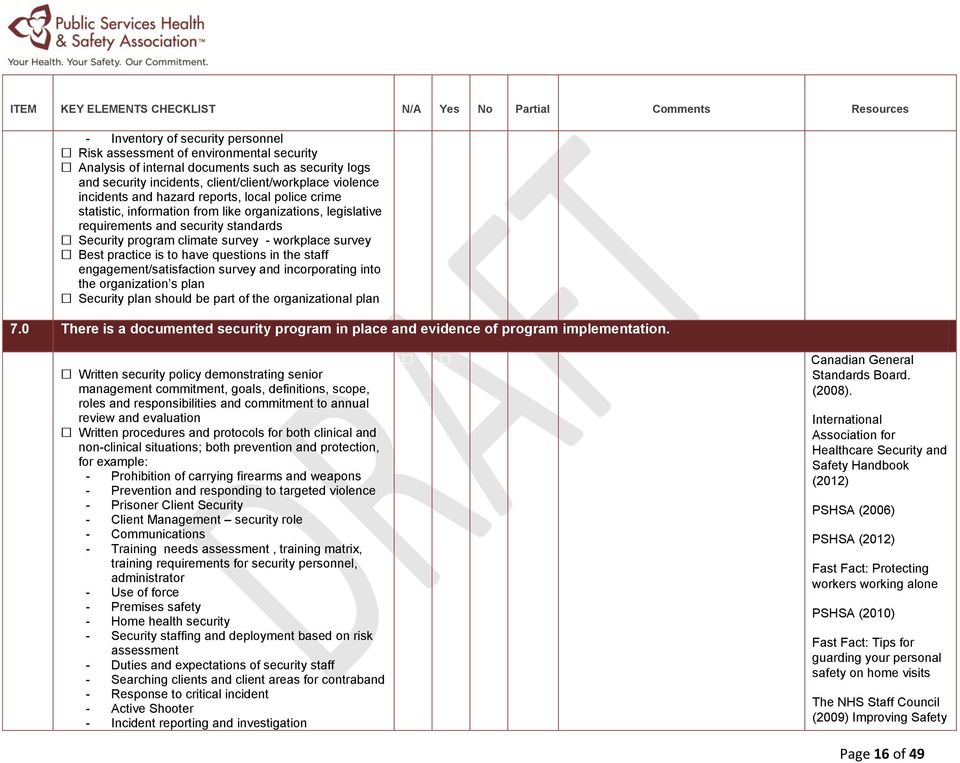
17 ITEM KEY ELEMENTS CHECKLIST N/A Yes No Partial Comments Resources - Other e.g. covert investigations, drugs - Policies for community - Policies for long term care - Safe travel - Organizational Risk Assessment - Client Risk Assessment Documented training program for security personnel Documented training program for administrator or person in charge of security Awareness training and communication for all staff, management Awareness communication to visitors and clients Access control staff ID, facility restricted access, emergency lock down, approaching persons of interest, visitor access, signage Physical Security systems electronic security, video surveillance, High Risk Areas Emergency responses and codes Security during emergency management (incident management system) Security during infectious disease outbreak or pandemic Security in Emergency Department Security Safety Program is developed and reviewed at least annually Joint Occupational Health and Safety Committee (JHSC) or Health and Safety Representative (HSR) is consulted in revisions and training Security participation on committees and clinical teams for Lone Workers Carlson (2011) Dooley (2014) Fox & Whitehorn (2014) Hollier (2014) Morris & Oswalt (2014) See Security Policies List Document 8.0 There is a security training and awareness program. Any individuals performing security services should be trained to meet regulatory or legislatively required standards for security training and healthcare security industry standard practices. Security orientation and education needs of general staff should be identified and a orientation/education program should be implemented. Canadian General Standards Board (2008). International Association for Healthcare Security and Safety Handbook Page 17 of 49

18 ITEM KEY ELEMENTS CHECKLIST N/A Yes No Partial Comments Resources Security Personnel training matrix Security administrator with security personnel Security administrator without on site security personnel Employee and Management training training matrices including awareness training Personal protective equipment Awareness Training Campaign (2012) Ministry of Community Safety and Correctional Services. (2009). Hollier (2014),Morris Oswalt (2014) 9.0 Security equipment is available and maintained. Examples: Video camera surveillance Access control systems Intrusion alarms Personal alarms, panic buttons, GPS/cellular distress systems Personal protective equipment Other International Association for Healthcare Security and Safety Handbook (2012) 10.0 Work environment design or redesign Security is considered in new and existing work environment design or redesign International Association for Healthcare Security and Safety Handbook (2012) Crime Prevention Though Environmental Design (n.d.) 11.0 Incident Reporting and Investigation All related security incidents, accidents and hazards are reported and investigated promptly to identify immediate and root causes and implement timely corrective actions and/or recommendations. Ensure PSHSA (2006) Occupational Health and Safety Act Page 18 of 49

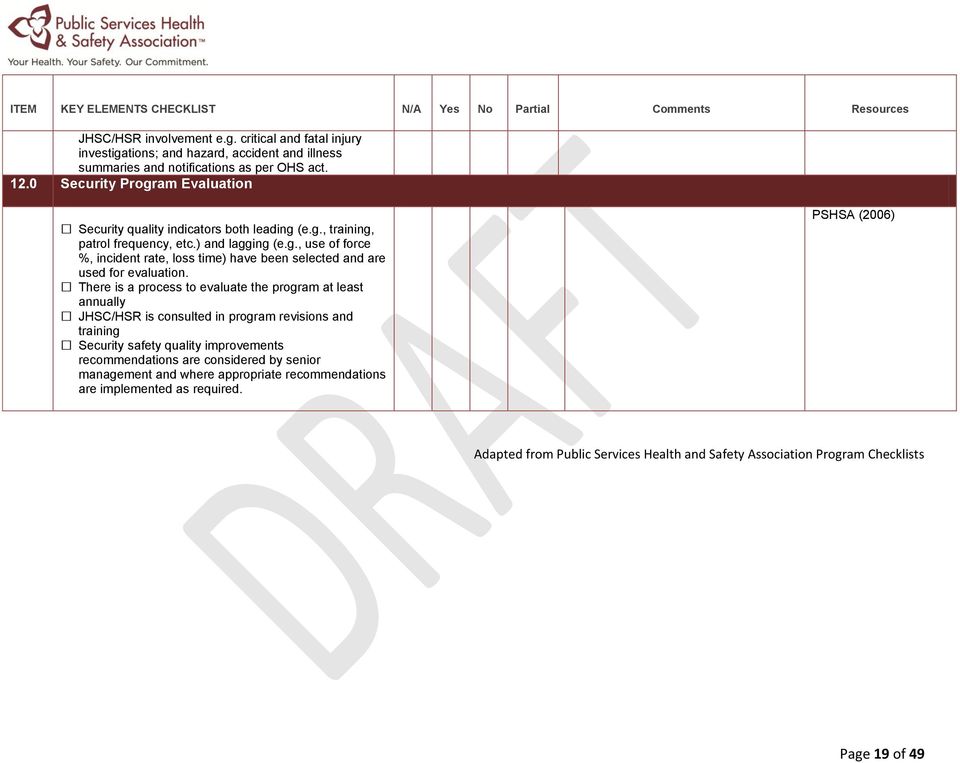
19 ITEM KEY ELEMENTS CHECKLIST N/A Yes No Partial Comments Resources JHSC/HSR involvement e.g. critical and fatal injury investigations; and hazard, accident and illness summaries and notifications as per OHS act Security Program Evaluation Security quality indicators both leading (e.g., training, patrol frequency, etc.) and lagging (e.g., use of force %, incident rate, loss time) have been selected and are used for evaluation. There is a process to evaluate the program at least annually JHSC/HSR is consulted in program revisions and training Security safety quality improvements recommendations are considered by senior management and where appropriate recommendations are implemented as required. PSHSA (2006) Adapted from Public Services Health and Safety Association Program Checklists Page 19 of 49
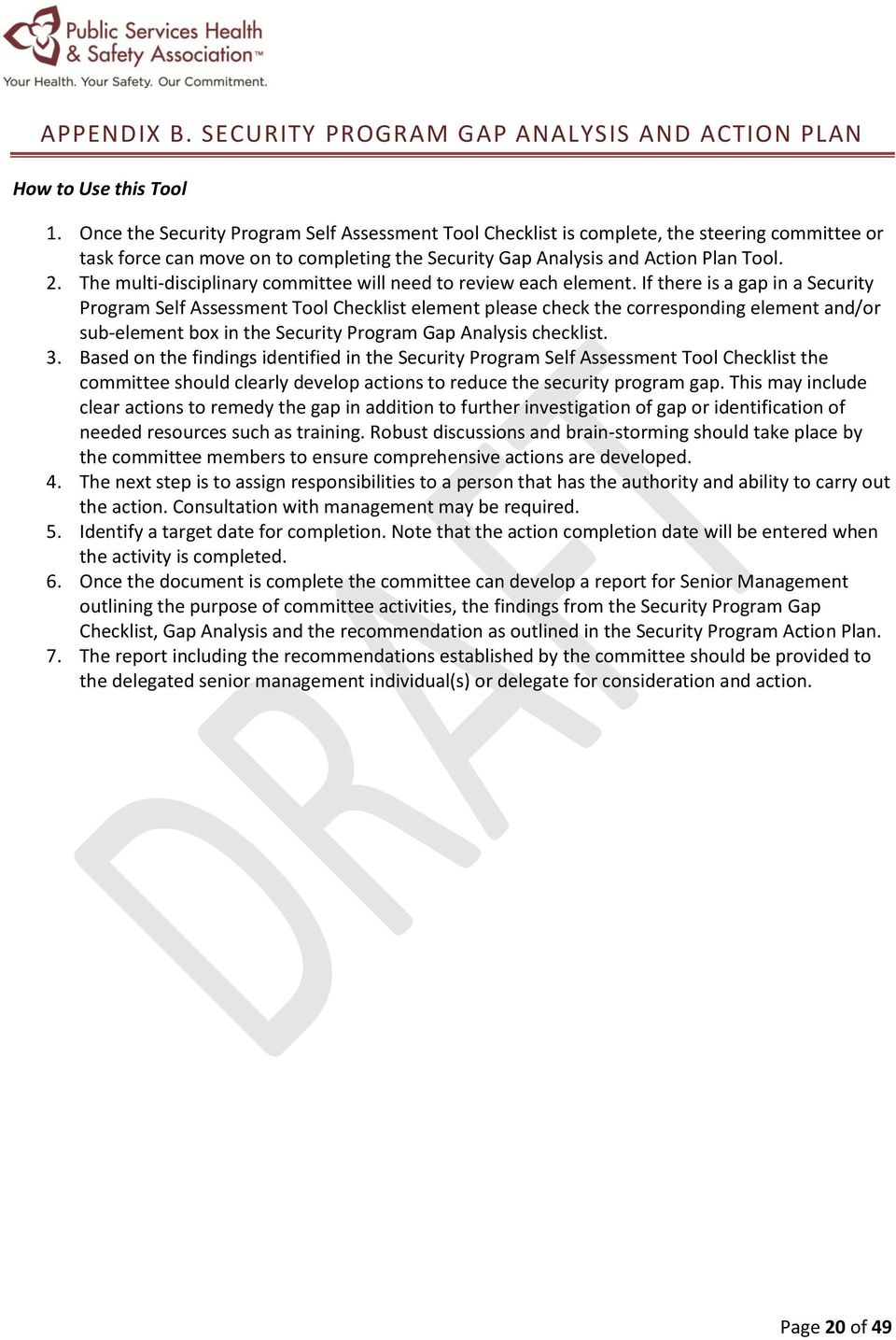
20 APPENDIX B. SECURITY PROGRAM GAP ANALYSIS AND ACTION PLAN How to Use this Tool 1. Once the Security Program Self Assessment Tool Checklist is complete, the steering committee or task force can move on to completing the Security Gap Analysis and Action Plan Tool. 2. The multi-disciplinary committee will need to review each element. If there is a gap in a Security Program Self Assessment Tool Checklist element please check the corresponding element and/or sub-element box in the Security Program Gap Analysis checklist. 3. Based on the findings identified in the Security Program Self Assessment Tool Checklist the committee should clearly develop actions to reduce the security program gap. This may include clear actions to remedy the gap in addition to further investigation of gap or identification of needed resources such as training. Robust discussions and brain-storming should take place by the committee members to ensure comprehensive actions are developed. 4. The next step is to assign responsibilities to a person that has the authority and ability to carry out the action. Consultation with management may be required. 5. Identify a target date for completion. Note that the action completion date will be entered when the activity is completed. 6. Once the document is complete the committee can develop a report for Senior Management outlining the purpose of committee activities, the findings from the Security Program Gap Checklist, Gap Analysis and the recommendation as outlined in the Security Program Action Plan. 7. The report including the recommendations established by the committee should be provided to the delegated senior management individual(s) or delegate for consideration and action. Page 20 of 49
21 SECURITY PROGRAM GAP ANALYSIS AND ACTION PLAN ITEM SECURITY PROGRAM KEY ELEMENTS GAPS (Check the box if it is a gap) Action Plan Person Responsible Target Date Date Completed 1.0 There is commitment from senior management to develop, implement and maintain a security plan and program. There is senior leadership commitment including financial and human resources e.g. - appointment of program administrator or leader - development of multidisciplinary steering committee 2.0 There is a security administrator or leader who is qualified and authority to oversee the security program Security administrator : Has the training and is competent to oversee the security safety program Has policy-making authority Has the authority to address imminent threat of danger and has the authority to deploy and implement necessary measures in response to the threat Entitled to be consulted in building renovations and new building planning architectural design principles such as CPTED (Crime Prevention Through Environmental Design) and care principles Integration of security leadership role with other leadership functions Security functions are added in the job descriptions of roles performing security administrator responsibilities 3.0 Security Guard functions are clearly articulated in the job descriptions of roles performing security roles and responsibilities. Security Guard roles and responsibilities : Carry out authorities available to a security officer Page 21 of 49
22 ITEM SECURITY PROGRAM KEY ELEMENTS GAPS (Check the box if it is a gap) Action Plan Person Responsible Target Date Date Completed under the Criminal Code, common law and case law, protection of other persons, defense of property, selfdefense, seizure and use of force; and under provincial and municipal legislation e.g. trespass and provincial offences legislation and parking by-laws; and duties as outlined by the employer (CAN/CGSB ) Conduct patrols, inspections, guarding and fulfill routine service requests Respond to emergencies in compliance with the organizations policies and procedures Report any hazards and deficiencies and ensure corrective actions are taken Complete documentation in accordance with the accepted standards Carry out other activities as required by the manager/administrator e.g. represent security on committees etc. Participate in investigations related to security matters and communicate findings to the security administrator as required 4.0 Security role in patient management Policies and procedures are developed that identify responsibilities and scope of activities of security in performing patient intervention activities. Patient intervention activities may include performing patient watches, holds, restraints and seclusions relative to the medical evaluation or treatment of patients. Security s patient invention activities should be documented. Training is provided to security pertaining to its role in patient management Collaborative training with clinical staff should include de-escalation, proper patient restraint techniques, mental health holds, and against medical discharges Page 22 of 49
23 ITEM SECURITY PROGRAM KEY ELEMENTS GAPS (Check the box if it is a gap) Action Plan Person Responsible Target Date Date Completed 5.0 Security role in emergency management An emergency management program is developed and maintained to identify and address threats/hazards/emergencies that may impact the facility and its operations. Security Role in an Emergency Operations Centre: security personnel may be assigned to fulfill the security functions including monitoring and having authority over the general security of the facility and its people, management scene/facility protection and traffic control. Security role in a Communicable Disease Outbreak that requires security to activate, adapt and supplement processes and mechanisms in order to continue the provision of a safe care environment. Planning for outbreaks should include identification of essential security services and measures to address shifting demand for security resources 6.0 The organization has conducted a security program risk assessment to assess security program needs lead by qualified and trained individuals Identify people and property assets that are to be protected Review of current security measures and procedures in place - Inventory of policies and procedures in place - Inventory of security and security-related equipment - Inventory of security personnel Risk assessment of environmental security Analysis of internal documents such as security logs and security incidents, patient/client/workplace violence incidents and hazard reports, local police crime statistic, information from like organizations, legislative requirements and security standards Security safety program climate survey - workplace survey Page 23 of 49
24 ITEM SECURITY PROGRAM KEY ELEMENTS GAPS (Check the box if it is a gap) Action Plan Person Responsible Target Date Date Completed Best practice is to have questions in the staff engagement/satisfaction survey and incorporating into the organization s plan Security safety plan should be part of the organizational plan 7.0 There is a documented security program in place and evidence of program implementation Written security policy demonstrating senior management commitment, goals, definitions, scope, roles and responsibilities and commitment to annual review and evaluation Written procedures and protocols for both clinical and non-clinical situations; and prevention and protection, Security training for security personnel Security training for administrator or person in charge of security Awareness training and communication for all staff, management Awareness communication to visitors and patients Access control staff ID, facility restricted access, emergency lock down, approaching persons of interest, visitor access, signage Physical Security systems electronic security, video surveillance, High Risk Areas Emergency responses and codes Security during emergency management (incident management system) Security during infectious disease outbreak or pandemic Security in Emergency Department Security Safety Program is developed and reviewed at least annually Joint Occupational Health and Safety Committee (JHSC) is consulted in revisions and training Security participation on committees and clinical teams Page 24 of 49
25 ITEM SECURITY PROGRAM KEY ELEMENTS GAPS (Check the box if it is a gap) Action Plan Person Responsible Target Date Date Completed 8.0 There is a security training and awareness program Security Personnel training matrix Security administrator with security personnel Security administrator without on site security personnel Worker and Management training training matrices including awareness training Personal protective equipment Awareness Training Campaign 9.0 Security equipment is available and maintained Examples: Video camera surveillance Access control systems Alarms Personal alarms Other for example security staff personal protective equipment 10.0 Environment and equipment design and planning take into consideration Security safety is considered in new work environment design or redesign Security is considered external premises. E.g. lighting, parking lot safety etc Incident Reporting and Investigation All related security incidents, accidents and hazards are reported and investigated promptly to identify immediate and root causes and implement timely corrective actions and/or recommendations. Ensure JHSC involvement e.g. critical and fatal injury investigations; hazard, accident and illness summaries and notifications as per OHS act. Page 25 of 49
26 ITEM SECURITY PROGRAM KEY ELEMENTS GAPS (Check the box if it is a gap) Action Plan Person Responsible Target Date Date Completed 12.0 Security Program Evaluation Security safety quality indicators both leading and lagging have been selected and are used for evaluation. There is a process to evaluate the program at least annually JHSC/HSR is consulted in program revisions and training Security safety quality improvements recommendations are considered by senior management and where appropriate recommendations are implemented as required. Page 26 of 49
27 APPENDIX C. SAMPLE CORPORATE SECURITY POLICY TEMPLATE How to Use this Tool 1. The following is a sample corporate security policy that organizations can use as a policy template. 2. Organizations will need to review their own organizational structure, workplace violence risk assessment, and security program self assessment checklist and action plan to determine which sections to include in their own corporate policy and procedures. 3. Organizations should customize the sample corporate policy including roles and responsibilities to ensure that it reflects the needs of their own organization. Page 27 of 49
28 SAMPLE CORPORATE SECURITY POLICY Organization Name Policy Number: XXX Date Approved: XXX Subject: Security Policy Date Reviewed: XXX POLICY Purpose The purpose of the security policy is to ensure the: protection of organizational property and people working, visiting, receiving and/or providing services at or for the organization; and prevention of incident and accidents related to security risk factors and other related workplace hazards. Policy Commitment Statement <Name of the Organization> is committed to the providing a safe environment for everyone. <Name of the Organization> recognizes the significant hazards related to workplace violence and potential security risk factors; and the legal and moral responsibility to take every reasonable precaution under the circumstances to protect employees and others. Our organization is committed to providing financial and human resources for the development, implementation and maintenance of a sustainable security protection and prevention program that will help to prevent or minimize security risk factors through hazard recognition, assessment, control and evaluation processes. All workplace parties are required to comply with the policy and any associated procedures as appropriate. Goals Develop, implement, maintain and annually evaluate the security program Prevent and/or reduce the harm to people related to security risks and workplace violence hazards Prevent and/or reduce the incidence of property damage Increase security awareness to all workplace parties and the public Ensure those participating in security prevention and protection receive the necessary training and records of training are maintained Ensure that security equipment, materials and resources are provided and maintained Scope The security prevention program applies to everyone in the organization. Page 28 of 49
29 Definitions Security: Healthcare security is the prevention of harm and property damage, and protection of property and of all persons from potential harm related to workplace violence exposures, various occupational health and safety hazards in healthcare. Security is ensured through proactive measures, processes, monitoring, patrolling, and through emergency responses as necessary. It may include, but is not limited to, the implementation of a safety management plan, appropriately trained and competent personnel that fulfill security functions, policy, procedures, processes, protocols, activities; and the use and application of equipment and materials. Security Guard: A security guard is a person who performs work, for remuneration, that consists primarily of guarding and/or patrolling for the purpose of protecting persons or property. [Private Security and Investigative Services Act, 2005, c. 34, s. 2 (4)] Roles and Responsibilities Employer Appoint a competent person to administer the security program Ensure the development, implementation, maintenance and evaluation of a security protection and prevention program Ensure a workplace violence risk assessment is conducted including security risks Advise the JHSC or HSR of workplace violence assessment including risks associated with security Provide any OHS security-related reports to the JHSC Ensure the review and revision of the security measures and procedures for the health and safety of their workers is done at least once a year, in light of current knowledge and practice Where the security program requires revision consult with the JHSC or HSR and consider their recommendations when developing, establishing and putting into effect the revised measures and procedures Consult the JSHC or HSR on security program training Provide fiscal and human resources to support the security program including the necessary resources for training and equipment Approve and annually review the security corporate program policy and procedures Enforce the security policy and procedures Ensure there are processes in place to identify and assess security risks and hazards; and identify, implement and evaluate security controls Promote a culture of security and safety awareness Take every reasonable precaution under the circumstances for the protection of the worker Supervisor Participate in security risk factor and hazard recognition, assessment, control and evaluation processes in the areas under their authority Be familiar with the security risks and health and legislation that applies to their work area Enforce the security policy and procedures Post emergency numbers in a visible area Page 29 of 49
30 Monitor security strategies in the area under their authority by, but not limited to, conducting management inspections and auditing worker safe work practice related to security Encourage employees to report security hazards and risk immediately Respond to security reports and participate in investigations of security hazards and incidents in the area under their authority Communicate security concerns, solutions and controls to employees and others in a timely manner Develop a training matrix for employees that includes security Ensure employees attend regular security awareness training and workplace violence prevention training that pertains to their work area for instance emergency responses, nonviolent crisis intervention, working alone, alarms etc. Ensure employees know what to do in the case of an emergency and where indicated participate in mock drills Maintain training records (scope and content, date, length of training, signatures, evaluation of understanding) Promote a culture of security and safety awareness Take every precaution reasonable in the circumstances for the protection of a worker Worker Participate in security hazard recognition and controls Comply with security policies and procedures as required Attend regular security and workplace violence prevention training Report any security hazards or incidents to the supervisor or employer immediately Respond to a security incident within their scope of knowledge and training Cooperate in any investigations as required Security Administrator or Delegate Must be competent and qualified because of knowledge, training and experience to oversee the security administrator function Be familiar with the security risks and relevant legislation that applies to the work Take a leadership role in corporate security and promote a security and safety culture through an ongoing security awareness communications and marketing plan Develop written corporate security program including a plan, policies, procedures, safe work practices, training and determining appropriate security staffing levels as appropriate; and coordinate the annual review of the policy Ensure consultation with JHSC/HSR when revisions of the security policies and procedures are required Implement, maintain and evaluate the security program Identify metrics and quality indicators to evaluate the security program Develop, implement, maintain and evaluate processes for recognizing, assessing, controlling and evaluating security risk factors and hazards Obtain and maintain appropriate security equipment and materials in compliance with organizational purchasing policies and procedures, and approval processes Address imminent threats of danger and has the authority to deploy and implement necessary measures in response to the threat and where required notify the JHSC/HSR Work closely with local police, fire and EMS to manage threats to the organization Page 30 of 49
31 Entitled to be consulted on building renovations and new building planning including architectural design principles related to security Ensure security functions are added to the job description of those performing security administrator and security guard roles and responsibilities Ensure those hired for security purposes are competent, qualified and adequately trained Enforce policies and procedures Participate in investigations related to security matters and communicate improvements Ensure that security is represented on the workplace violence prevention committee Take every precaution reasonable in the circumstances for the protection of workers and others Security Guard/Protection Agent (if applicable) Must be licensed by the Ministry of Community Safety and Correctional Services (Ministry of Community Safety and Correctional Services, 2009). Maintain the license as a condition of employment and be able provide proof of licensing at least annually Loss of licensed status must be reported to the manager Participate in basic security training and mandatory hospital training upon hire Complete annual certification / re-certification in security training as well as any mandatory hospital re-certifications Effectively perform and carry out security duties both verbally and physically; and in a manner that reflects the core values of the organization Carry out authorities available to a security officer under the Criminal Code, common law and case law, protection of other persons, defense of property, self-defense, seizure and use of force; and under provincial and municipal legislation e.g. trespass and provincial offences legislation and parking by-laws; and duties as outlined by the employer (CAN/CGSB ) Comply with security and organizational policies and procedures Conduct patrols, inspections, guarding and responds to emergencies in compliance with the organizations policies and procedures Report any hazards and deficiencies and ensure corrective actions are taken Complete documentation in accordance with the accepted standards Carry out other activities as required by the manager/administrator e.g. represent security on committees etc. Participate in investigations related to security matters and communicate findings to the security administrator as required Joint Health and Safety Committee Be consulted in the revisions of the workplace violence prevention policies and program including security per the Ontario Regulation 67/93 Health and Residential Facility Regulation Participate in investigations as outlined in the occupational health and safety act Entitled to receive OHS-related security reports regarding worker safety Receive and review the workplace violence risk assessment including areas pertaining to security Conduct monthly inspections that include identification of security concern or hazards Make recommendations for improvement in writing to management as needed Page 31 of 49
32 Communication This policy will be communicated to all management and employees at the time of hire and on a regular basis. Training <Name of the Organization> is commitment to develop and provide all management and employees with security policy training, security awareness training and department specific security training relevant to the security related risks in their employment and work locations. The development of the training will be done in consultation with and in consideration of the recommendation of the JHSC/HSR as required by legislation. Training will be provided at orientation and refreshers will be provided on an ongoing basis. All training and training content will be documented and maintained by the designated party e.g. human resources, educator or manager. Employees will be required to sign and date training records and where applicable perform tests of competency. Evaluation The Corporate Security Policy will be evaluated, reviewed and approved annually by Senior Management. Should the policy review lead to the conclusion that the measures and procedures should be revised, senior management will consult with the JHSC or HSR and consider their recommendations when developing, establishing and putting into effect the revised measures and procedures. Quality improvements will be implemented as required and these will be communicated to JHSC/HSR, employees and management. PROCEDURES Note procedures and safe work practices would be developed and customized by the organization and these would reflect the requirements identified on the risk assessment. Additional security related policies and procedures may also be made by the employer. Approval Senior Executive Name Senior Executive Signature Date: Developed in Consultation with: Security Services Senior Management Patient Programs Joint Health and Safety Committees Workplace Violence Prevention Committee Emergency Measures Committee Environmental and Support Services Page 32 of 49
33 References Canadian General Standards Board. (2008). Security Officers and Security Officer Supervisors, CAN/CGSB Gatineau, Canada: Canadian General Standards Board. Retrieved from < Ministry of Community Safety and Correctional Services. (2009). Training Curriculum for Security Guards. Private Security and Investigative Services Branch: Toronto, On, Canada: Queen s Printer for Ontario. Retrieved from < _curr.html> Ontario Regulation 67/93 Health Care and Residential Facilities Regulation Occupational Health and Safety Act R.S.O. 1990, Chapter 0.1. Private Security and Investigative Services Act, 2005, c. 34, s. 2 (4). Page 33 of 49
34 APPENDIX D. SAMPLE LIST OF SECURITY RELATED POLICIES AND PROCEDURES How to Use this Tool Complete the workplace violence risk assessment and the security self-assessment to determine what security policies and procedures are needed or required by your organization. The following list is a sample of security-related policies and procedures that your organization may consider. Note this is not an all inclusive list. The policies and procedures selected will depend on whether the organization has onsite security personnel or not as well as the nature of the work and locations. 1. The designated security administrator collaboratively with the multi-disciplinary committee and other stakeholders may complete this checklist. 2. Determine whether the organization should have policies and/or procedures that apply to the entire organization ; and/or security services that is specific to security guards or security departments; or whether the policy and procedures are not applicable. Use a check mark to indicate which policies and procedures are needed. Check all that apply. In some cases there may be organizational and/or security services specific policies and/or procedures on the same topic. 3. Provide comments as needed for discussion at your organization. 4. The multi-disciplinary committee may choose to provide recommendations to Senior Management regarding needed policies and/or procedures. Name of Policy and/or Procedure Access Control Organization Security Services Not Applicable Comments Approaching a Person of Interest Arrests Call for Assistance and Service Closed Circuit Television (CCTV) Code of Conduct Code of Ethics Communications and Education Initiatives Community and Home Health Complaints Process Computer Use Confidentiality Co-op Students Critical/Fatal Injury Response securing the scene Deliberate Damage to Hospital Property Departmental Responsibilities - Security Documentation, record keeping e.g. memo books Dress and Deportment (Behaviour) Electronic Security Systems and Alarms Elevator Control- Grounding and Service Page 34 of 49
35 Emergency Department Door Access Emergency Management, Codes and Response Employee Injury Reporting and Investigation Security Equipment and Use Environmental Design and Renovation Security Role External and Emergency Service Interaction Fire Panel Procedures Fire Pump Testing Procedure Fire Protection Red Tag Permit Hospital Restraint Cleaning Hot Work Permits Illegal/Street Drug Disposal Impairment and Disorderly Conduct Incident Reporting and Documentation Incident Investigations and Documentation Lock ups and Unlocks Lockdown - Facility Lost and Found Mechanical Restraints and Seclusion Media Relations Metal Detector Use Minor Event Log Morgue Duty Notification of Manager OHS Competent Supervisor Training - Mandatory OHS Supervisor Awareness Training - Mandatory OHS Worker Awareness Training - Mandatory On Call Assignment List On Call Room System Operation Patient Elopement Departure Without Notification Patient/Client/Resident- Non-violent Crisis Intervention Patient Management Security Role Parking and Traffic Control Patrol System and Standards Personal Alarm System Pet Visitation to Hospital Photo Identification System Prisoner Patient Security Privacy Legislation Radio Protocol Release of CCTV and Digital Media Release of Incident Reports Reporting For Duty Page 35 of 49
36 Resistance Management Search and Seizure Security and Safety Inspections Security Awareness and Training for Workplace Parties Security Accompaniment e.g. escort to parking lot Security Mission Statement and Management Plan Security Sensitive Areas* Security Staffing Security Training New Employee Orientation Security Training Ongoing training and re-certification Travelling in the community by vehicle, transit, on foot Travelling and staying at accommodations e.g. hotel Trespassing Use of Force Weapons restricted and concealed Working Alone Other Other Other Other Other Other Other Other *Security Sensitive Areas: Emergency Department, Mental Health, Surgery, Laboratory, Pediatrics, Maternal Child, Intensive Care Unit, Plant Operations, Pharmacy Security may participate in the following committees and teams: Joint Health and Safety Committee Workplace Violence Committee Emergency Codes and Response Committee Clinical Team e.g. Mental Health References International Association for Heathcare Security and Safety. (2012). IAHSS handbook. Illinois: IAHSS. Retrieved from < Toronto East General Hospital, Toronto, Ontario Page 36 of 49
37 APPENDIX E. SECURITY PROGRAM ADMINISTRATOR TRAINING Coming soon Page 37 of 49
38 APPENDIX F. SAMPLE SECURITY GUARD TRAINING PROGRAM COMPONENTS Training Program Components Laws, Statues and Principles Crisis Management Training Effective Communication Description All security professionals require training with respect to relative laws, statutes and principles governing their operational duties and responsibilities. The training material should consist of and not be limited to: Relevant legislation respecting security licensing and provision Trespass to Property Legislation and the principles of eviction The Criminal Code of Canada with emphasis on a citizen s power of arrest and the lawful application of force Human Rights Legislation Occupational Health and Safety Legislation Principles associated with documentation and the retention of documentation Training on principles of crisis management is to improve their communications and crisis resolution skills, tactical knowledge and physical skills. Crisis management training is designed to provide security professionals the necessary information and skills to recognize when a subject is in crisis and to respond proactively and professionally to a displayed crisis stage. Four Stages of Crisis Management are: o Anxiety Stage o Defensive Stage o Acting-Out Stage o Tension Reduction Stage Each of the four stages of crisis has a specific and recommended response option that is geared to de-escalate crisis, not escalate it. The use of effective or appropriate communications is the vital link to reducing a person s crisis level and establishing a basis for mitigating adversity. This training material centers on the skills required to respond to a crisis situation utilizing verbal strategies that are designed, intended and applied to calm a person down. Security professionals are instructed to use words that maintain professionalism, create subject accountability and permits justification of actions. Effective communications material outlines the need to utilize: o The First Contact Approach A standard approach to commencing communications with persons that includes; a personal greeting and the reason behind the interaction. o o o o o The importance of sending appropriate verbal and non-verbal messages. The need to utilize active listening skills This includes the need and the ability to listen to subjects and the recognition of barriers to communications. The relevance of Paraverbal communications Not what was said, but how it was said. This includes; tone of one s voice, the volume of one s speech, the cadence of speech, etc. The relevance of displaying appropriate body language The messages one may send with the use of facial gestures, hand gestures, etc. The need to utilize verbal strategies that include; feedback, providing messages to persons at reasonable rates, use of simple language, the use of empathy, etc. These programs are intended to enable a reasonable and prudent person to effectively communicate with persons in crisis and in a manner deemed to display a standard of care. Page 38 of 49
39 Training Program Components Application of Force Description The Ontario Use of Force Model (2004) represents the process by which a security professional assesses plans and responds to situations that threaten public and officer safety. The assessment process begins in the center of the model with the SITUATION confronting the security professional. From there, the assessment process moves outward and addresses the subject s behavior and the officer s Perceptions and Tactical Considerations. Based on the security professional s assessment of the conditions represented by these inner circles, the security professional selects from the use of force options contained within the model s outer circle. After the security professional chooses a response option, the security professional must continue to Assess, Plan and Act to determine if his or her actions are appropriate and/or effective or if a new strategy should be selected. The whole process should be seen as dynamic and constantly evolving until the SITUATION is brought under control. The Ontario Use of Force Model is not intended to serve as a justification for security professional use of force nor does it prescribe specific response options(s) appropriate to a situation. The Model does provide a framework for understanding and articulating the events associated with an incident involving security professional use of force. Six basic principles underlie the Ontario Use of Force Model (2004). 1) The primary responsibility of a security professional is to preserve and protect life. 2) The primary objective of any use of force is to ensure public safety. 3) Security professional safety is essential to public safety. 4) The Ontario Use of Force Model (2004) does not replace or augment the law; the law speaks for itself. 5) The Ontario Use of Force Model (2004) was constructed in consideration of (federal) statute law and current case law. 6) The Ontario Use of Force Model (2004) does not dictate policy to any agency. Page 39 of 49
40 Training Program Components Subject Restraint/Pinel Restraint Systems Intermediate Weapon (Batons) Description Security professionals require training with respect to subject control and the principles associated to safe restraint and/or detention. The training material should consist of and not be limited to: o Methods of restraint o Types of restraints o Preparation of restraints o Infection Control Considerations o Applications of restraints o Safety considerations for restraint o Positional asphyxia o Excited delirium o Documentation Process o Principles associated to reactionary gap respecting a subject o Components representing a lawful arrest o Non-threatening (interview) stance o Visual search of a subjects high risk areas o Utilizing effective communications skills to request a compliant subject to a compliant handcuffing position o Effective removal of restraints o Grounding principles o Duty of care respecting subject s safety/welfare Security professionals require training with respect to subject control and the principles associated to the use of an intermediate weapon (baton). Security professionals may use an intermediate weapon as a force option: To prevent themselves from being overpowered when violently attacked. To disarm an apparently dangerous person armed with an offensive weapon. To control a potentially violent situation when other force options are not viable for any other lawful and justifiable purpose. The training material should consist of and not be limited to: o Baton nomenclature o Drawing of the baton o Effective defensive stance o Effective weapon and reactionary side high strikes o Effective weapon and reactionary side low strikes o Identify and perform an effective two handed straight strike o Effective two handed weapon circular (hook) strike o Effective two handed reactionary side strike (slash) o Dynamic simulation o Duty of care respecting subject s safety/welfare Page 40 of 49
41 Training Program Components Sharp Edge Weapon Training Description Security professionals require training with respect to sharp edge weapons and to provide them responses to spontaneous attacks that are initiated suddenly and unexpectedly. The training material should consist of and not be limited to: o Case studies respecting sharp edge weapon encounters o Identify and perform common grips associated to sharp edge weapon assault o Identify and perform common strikes associated to sharp edge weapon assault o Identify and perform common lines of movement associated to sharp edge weapon assault o Review the concept of the 21 foot rule with respect to sharp edge weapon threat o Identify and perform effective response options to sharp edge weapon assault o Identify and perform drills to enhance personal reactionary time o Identify and perform distraction and control orientated control techniques Page 41 of 49
42 APPENDIX G. SAMPLE SECURITY GUARD TRAINING FOR HEALTHCARE INSTITUTIONS TRAINING CHECKLIST MANDATORY TRAINING: ITEM CHECK RENEWAL PERIOD NonViolent Crisis Intervention Handcuff Training Baton Training Uniform Standards CBRN Equipment Training Basic First Aid & CPR WHMIS Emergency Procedures / Codes Effective Communications PPE Fitting and Training Shift Briefings ID Badge System CCTV System Parking Gate Operations Morgue Duties Access Control Policy Cash Escorts Contractor Access Policy Contractor Badge/Key Sign Out Annual Annual Annual On Hire Annual On Hire / Confirm Employee Maintains Certification Annual Annual Annual Every 2 Years On Hire On Hire On Hire On Hire On Hire On Hire On Hire On Hire On Hire Page 42 of 49
43 Process Lost & Found Guard Tour / Patrol System Patient valuables Patient Confidentiality Child Protective Services / Assistance with Custody Orders Facility Lock/Ups Unlocks Security Co-op Students Public Complaints Process Media Relations Incident Reporting System Security Radio Use HDOC Radio Use (Command Center) Mental Health Act Training Restraint Training (Pinel) Patient Restraint Policy Provincial Offenses Criminal Code Organization Trespass Process Organization Arrest Policy Organization Search Policy Safe Search Process On Hire On Hire On Hire On Hire On Hire On Hire On Hire On Hire On Hire On Hire On Hire On Hire On Hire Annual Annual Annual Annual Annual Annual Annual Annual Page 43 of 49
44 APPENDIX H. WORKPLACE SECURITY FAST FACT AWARENESS TOOL How to Use this Tool It is important that organizations raise awareness about the importance of security for everyone s safety. Everyone needs to understand their roles and responsibilities as well as those of others. Security should be top of mind and general security tips have been provided in the fast fact. 1. Use this tool to raise awareness within the organization. 2. This tool can be posted and/or distributed electronically or in a hard copy. 3. This tool could be discussed at staff meetings, at lunch and learn activities, or as a safety talk or at workplace violence training or at new staff orientation. Page 44 of 49
45 FAST FACT Workplace Security: Everyone can make a difference in keeping your workplace safe Workplace Security Workplace violence, vandalism, theft and property damage are not uncommon events in the community and healthcare industry and at times unfortunate and tragic events can occur. Employers, managers and employees can all make a difference in keeping the workplace safe. Whether your organization has a formal security department or not; everyone, must be vigilant and know what to do to protect themselves, other persons and workplace property. Healthcare Security is the prevention of harm to and protection of persons and property. Security is ensured through proactive measures, processes, monitoring, patrol, and emergency responses as necessary. It may include but is not limited to the implementation of a safety management plan, appropriately trained and competent personnel that fulfills security functions, policy, procedures, activities; and the use and application of equipment and materials. What are employer s responsibilities to ensure security safety in the workplace? Demonstrate commitment to the development and implementation of a Security Program by appointing someone to administer and oversee the program. Ensure those overseeing the security safety program or performing security functions are competent to perform the work. Include the security function in the development and implementation of a workplace violence prevention program e.g. include someone with security knowledge on the workplace violence prevention steering committee Conduct a workplace violence risk assessment to identify security risks at the workplace and/or at locations where employees work; identify security gaps and share findings with the Joint Health and Safety Committees (JHSC) or health and safety representative (HSR) in compliance with the workplace violence legislation under the Occupational Health and Safety Act (OHSA). Provide OHS security-related reports that pertain to workers to the JHSC or HSR Develop written security safety policies and procedures and ensure they are enforced Ensure all workplace parties know their roles and responsibilities related to security Identify training needs for workplace parties for instance develop a training matrix that reflects department and organizational training needs and requirements e.g. non-violent crisis intervention, security guard training for security guards, policies & procedures training, awareness training, emergency response training, reporting and investigation etc. Conduct regular emergency response procedures Develop a security awareness campaign e.g. training, posters, newsletters, lunch & learn, etc. Page 45 of 49
46 Maintain a safe and secure environment through access control; employee identification systems; emergency response equipment and mechanisms such as panic buttons, personal alarms, whistles, emergency phones and other electronic devices; monitoring and camera surveillance; and where appropriate, security patrol. Post signage indicating the property is under camera surveillance Ensure mechanisms for reporting and investigating workplace violence, near misses and suspicious activities, packages and individuals Ensure the review and revision of the security measures and procedures for the health and safety of their workers is done at least once a year, in light of current knowledge and practice Where the security program requires revision consult with the JHSC or HSR and consider their recommendations when developing, establishing and putting into effect the revised measures and procedures Consult the JHSC or HSR in the development, establishment and provision of training Become knowledgeable about security safety and promote a culture of security safety and awareness What managers and supervisors responsibilities for ensuring security in the workplace? Ensure all employees understand the relevant security policies and procedures Ensure employees attend the required training and maintain records of training Enforce security policies and procedures related to your area of authority Inspect the workplace under your authority for security concerns and implement corrective actions Respond to workplace violence and security reports, participate in investigations and develop corrective actions Communicate to employees security concerns and corrective action taken, if any Promote and support security awareness campaigns and develop a culture of security, safety and awareness What are the responsibilities of workers regarding security and protecting themselves? Participate in workplace and security awareness training and any other required security training Comply with security policies and procedures Promptly report workplace violence, hazards, near misses and suspicious activities, packages and individuals to management Follow security awareness safety tips Page 46 of 49
47 Security Awareness Safety Tips Workplace Always be aware of your surroundings note sounds and movements Keep doors designed to be locked closed e.g. never prop locked doors open Wear your identification badge Be aware of strangers to the workplace and challenge any stranger without a valid pass or valid reason to be present or call security or police if you feel unsafe Do not let unauthorized individuals enter secured areas behind you (piggy backing) Report suspicious persons, activity and packages immediately to your supervisor or security Lock up valuables and never store unattended valuables in plain sight or predictable unlocked locations. Avoid isolated or deserted stairways While waiting for an elevator, stand off to the side; this gives you the opportunity to view inside and removes your obligation to enter if you are unsure of the occupants If someone gets on the elevator after you and you re not comfortable with them, get off. When on the elevator stand near the control panel and if confronted in an elevator, push all the floor buttons and the emergency button Do not push the stop button as you may get stuck between floors Know your emergency response procedures and how and who to call Call for help or use emergency response equipment if you are threatened Parking Lots and Community Environments Park your car as close as possible to the building exit if you are leaving after dark Park in well lit areas Reverse your vehicle into the parking spot so you have a clear view when leaving Keep the keys you will need accessible, preferably in your hand and ready to go If it is not needed lock your wallet and purse in the trunk and do not leave valuables in plain sight. Keep your head up and scan the area frequently Look around before exiting your car, entering a building, or walking out into a parking lot Always lock your car after entering and when leaving it. Plan your route and avoid short cuts through unlit areas Avoid being alone if you can and have a coworker accompany you and leave the parking lot together if possible especially at night View the interior of your vehicle before entering to assure no one is hiding inside, even if the doors were locked If you feel threatened when you are in your car, remain in your vehicle and drive away if it is safe to do so. Lock your doors and drive to the local police department or other well lit public area. Know where police stations or after hour stores are located Avoid walking by alcoves, alleyways, covered or hidden spaces whenever possible Make sure you have your fully charged cell phone accessible or other device Keep your hands free of unnecessary clutter or items If someone grabs your purse, do not resist Page 47 of 49
48 Stay alert and aware of your surroundings when travelling from one secure location to the next Do not confront a person you feel threatened by Do not follow or chase someone in your car call the police Be conscious of the image you are projecting when alone in a public area be confident versus fearful, be present and aware versus distracted Avoid distractions such as talking on the phone or texting in unsecure locations Avoid wearing ear buds or headphones you need to hear what is going on around you Keep unknown people at arm s distance or further If you see criminal behavior or are threatened call 911 Report all potential threats to your supervisor or manager immediately If you are concerned about other individuals in a room, keep yourself between the individuals and the exit so you so you can leave quickly References Canadian General Standards Board. (2008). Security officers and security officer supervisors, CAN/CGSB Gatineau, Canada: Canadian General Standards Board. Retrieved from < Carlson, J. (2011). Somebody s watching: Technology helping hospitals staff safe and secure. Modern Healthcare. 41(46), Crime Prevention Through Environmental Design (n.d.). CPTED Strategies. Retrieved from < Dooley, C. (2014). Making contact with security. Journal of Healthcare Protection Management. 30(2), Fox, B., & Whitehorn, S. (2014). Building the alliance between security and clinical teams in Needham, I., Kingma, M., McKenna, K., Fran, O., Tuttas, C., Kingsma, S., & Oud,, N. (ED). Fourth International Conference on Violence in the Health Sector, p Amersterdam: Kavanah. Retrieved from < Hollier, M. (2014). Getting hospital staff involved in keeping the healthcare community safe in Needham, I., Kingma, M., McKenna, K., Fran, O., Tuttas, C., Kingsma, S., & Oud,, N. (ED). Fourth International Conference on Violence in the Health Sector, p Amersterdam: Kavanah. Retrieved from < Lingerfelt, C. (2014) Sometimes you get what you don t pay for: Risk of inadequate security in healthcare. Journal of Healthcare Protection Management, 30(2), International Association for Heathcare Security and Safety. (2012). IAHSS handbook. Illinois: IAHSS. Retrieved from < Ministry of Community Safety and Correctional Services. (2009). Training Curriculum for Security Guards. Private Security and Investigative Services Branch: Toronto, On, Canada: Queen s Printer for Page 48 of 49
49 Ontario. Retrieved from < _curr.html> Morris, R., J., & Oswalk. JL.L. (2014). Security awareness: Raising the bar at regional clinics/offsite locations. Journal of healthcare protection management, 30(2), National Health Service. (2003). A professional approach to managing security in NHS. Counter Fraud and Security Management Service: UK. Retrieved from < Occupational Health and Safety Act R.S.O. 1990, Chapter O.1. Retrieved from < Ontario Regulation 67/93 Healthcare and Residential Facilities Regulation. Retrieved from < Private Security and Investigative Services Act, 2005, c. 34/ Public Services Health and Safety Association. (2006). Workplace prevention program: Implementing the program in your organization resource manual book 1. Toronto, Ontario: PSHSA. Public Services Health and Safety Association. (2012). PSHSA fast fact: Protecting workers working alone. Retrieved from < ProtectingWorkersWorkAloneFF.pdf.pdf> Public Services Health and Safety Association. (2010). PSHSA fast fact: Tips for guarding your personal safety on home visits. Retrieved from < The NHS Staff Council. (2009). Improving safety for lone workers: A guide for managers. London, UK: NHS Employers. Retrieved from < kers_-_managers_guide_final.pdf> Page 49 of 49
Security Measures at Toronto Public Library
 STAFF REPORT INFORMATION ONLY 14. Security Measures at Toronto Public Library Date: February 27, 2012 To: From: Toronto Public Library Board City Librarian SUMMARY The purpose of this report is to provide
Security Management Plan
 Effective Date: 03/2015 1 of 10 I. Table of Contents: I Table of Contents II Authority III Purpose & Scope IV Policy Statement V The Joint Commission Standards VI Performance Standards VII DUPD Services
Preventing Workplace Violence and Bill 168 A Guide for Employers
 Preventing Workplace Violence and Bill 168 A Guide for Employers May 2010 This Guide provides general information only and should not be relied on as legal advice or opinion. This publication is copyrighted
Guidelines for Setting up Security Measures to Stop Domestic Violence in the Workplace
 Guidelines for Setting up Security Measures to Stop Domestic Violence in the Workplace As of June 15, 2010, all employers in Ontario are responsible for protecting workers when domestic violence follows
Corporate Health and Safety Policy
 Corporate Health and Safety Policy November 2013 Ref: HSP/V01/13 EALING COUNCIL Table of Contents PART 1: POLICY STATEMENT... 3 PART 2: ORGANISATION... 4 2.1 THE COUNCIL:... 4 2.2 ALLOCATION OF RESPONSIBILITY...
SAFETY and HEALTH MANAGEMENT STANDARDS
 SAFETY and HEALTH STANDARDS The Verve Energy Occupational Safety and Health Management Standards have been designed to: Meet the Recognised Industry Practices & Standards and AS/NZS 4801 Table of Contents
Vendor Management Program
 The Corporation of the City of Kawartha Lakes is committed to the provision of a safe and healthy work environment for its employees, contractors and visitors. To promote this type of environment, the
EXECUTIVE SAFETY LEADERSHIP
 EXECUTIVE SAFETY LEADERSHIP EXECUTIVE SUMMARY This guide offers clear explanations of health and safety concepts that are important to executives and board members, and provides practical solutions that
Benchmark OHS Consulting Pty Ltd Self Assessment WHS Audit Tool
 Benchmark OHS Consulting Pty Ltd Self Assessment WHS Audit Tool This WHS Auditing System Tool is to be used as a self-assessment of YOUR COMPANY compliance with AS 4801 and the Work Health and Safety Act
Title: Hazard/Incident Reporting and Investigation Procedure
 Page Number: 1 of 7 1. Purpose: The hazard/incident reporting and investigation procedure provides guidance for the identification of potential hazards, and reporting and investigation of incidents by
Contractor Safety Management Program Guidebook
 Engineering & Construction Contractor Safety Management Program Guidebook E&C Contractor Safety Management Program Page 1 E&C Contractor Safety Management Guidebook Table of Contents Section 1.0 Introduction.
INTRODUCTION... 3. 1.0 Purpose... 4. 2.0 Policy... 4. Exception for Short-Term Workplace Visits... 4. Relevant Legislation and Regulations...
 March 2006 INTRODUCTION... 3 1.0 Purpose... 4 2.0 Policy... 4 Exception for Short-Term Workplace Visits... 4 Relevant Legislation and Regulations... 5 Definitions... 5 Contractor Safety Coordination Overview...
Violence Prevention Policy published. Supercedes the Prevention and Management of Aggressive Behaviour Policy
 Page 1 of 18 (S) REVISED / REVIEWED SUMMARY This section is presented up front to facilitate the reader in knowing the chronology of changes to a policy and the nature of the change(s). Accordingly, only
Best Practices Defined:
 Workers Compensation Fund AIHA/ANSI Z-10-2005 Standard for Occupational Health and Safety Management Systems Presented by Objectives: Best Practices Defined Outline and Review the Z-10 Standard Auditing
OH&S Management Systems Audit Checklist (NAT, E3)
 3.1.2 3.1.1 Introduction OH&S Management Systems Audit Checklist (NAT, E3) This audit checklist is based on Element 3 (Implementation) of the National Self-Insurers OHS Audit Tool. For a full copy of the
Houses of Parliament. Health and Safety Policy Supplement (PS1) Accident and Incident Reporting
 Health and Safety Policy Supplement (PS1) Accident and Incident Reporting This policy supplement has been prepared by the Parliamentary Safety Risk Management team and endorsed by the Director General
MAJOR PROJECTS CONSTRUCTION SAFETY STANDARD HS-09 Revision 0
 MAJOR PROJECTS CONSTRUCTION SAFETY SECURITY MANAGEMENT PROGRAM STANDARD HS-09 Document Owner(s) Tom Munro Project/Organization Role Supervisor, Major Projects Safety & Security (Canada) Version Control:
Contractor Safety Program Office of Environmental Health and Safety University of Toronto
 Office of Environmental Health and Safety Table of Contents Overview... 3 Program Objectives... 3 University Health and Safety Policy... 4 Environmental, Health and Safety Mission Statement... 4 Roles
1. Organization and Management of UNR Safety Programs
 WRITTEN WORKPLACE SAFETY PLAN University of Nevada, Reno 1. Organization and Management of UNR Safety Programs Administrative Responsibilities Final responsibility for maintenance of campus safety and
Department of Veterans Affairs VHA HANDBOOK 7701.01. Washington, DC 20420 August 24, 2010 OCCUPATIONAL SAFETY AND HEALTH (OSH) PROGRAM PROCEDURES
 Department of Veterans Affairs VHA HANDBOOK 7701.01 Veterans Health Administration Transmittal Sheet Washington, DC 20420 August 24, 2010 OCCUPATIONAL SAFETY AND HEALTH (OSH) PROGRAM PROCEDURES 1. REASON
RISK MANAGEMENT PLAN OVERVIEW
 RISK MANAGEMENT PLAN OVERVIEW Scioto Paint Valley Mental Health Center (The Agency) and its Board of Trustees are committed to making reasonable effort to protect the health and safety of the clients,
SAFETY TRAINING CLASSES & SERVICES LIST
 SAFETY TRAINING CLASSES & SERVICES LIST CUSTOM CLASS ROOM TRAINING AVAILABLE, BACKED WITH ON-SITE SUPPORT SAFETY, TRAINING COURSES OFFERED BY OUR CERTIFIED ELITE RISK CONTROL TEAM: EM 385-1-1 (Military)
ACCIDENT PREVENTION PLAN. A Sample Plan for Counties
 ACCIDENT PREVENTION PLAN A Sample Plan for Counties TABLE OF CONTENTS MANAGEMENT COMPONENT... 1 Safety Policy Statement Safety Committee Members Authority and Accountability Statement RECORDKEEPING COMPONENT...
Version Date Comments / Changes 1.0 February 2008 Initial Policy Released 2.0 September 2013 Policy Revised
 Page 1 of 5 APPROVED (S) REVISED / REVIEWED SUMMARY Version Date Comments / Changes 1.0 Initial Policy Released 2.0 Policy Revised POLICY As part of an overall strategy to continuously improve workplace
Measuring your capabilities in Fleet Safety Management ACC Fleet Saver
 Measuring your capabilities in Fleet Safety Management ACC Fleet Saver Audit Standard 29 May 2014 Table of Contents Page 2 1. Getting Started...3 2. Critical element 1: Registered Owner Commitment to Safety
BUREAU OF SECURITY AND INVESTIGATIVE SERVICES Title 16, Division 7 of the California Code of Regulations
 BUREAU OF SECURITY AND INVESTIGATIVE SERVICES Title 16, Division 7 of the California Code of Regulations ARTICLE 9. SKILLS TRAINING COURSE FOR SECURITY GUARDS 643. SKILLS TRAINING COURSE FOR SECURITY GUARDS
Guidance Note: Corporate Governance - Board of Directors. March 2015. Ce document est aussi disponible en français.
 Guidance Note: Corporate Governance - Board of Directors March 2015 Ce document est aussi disponible en français. Applicability The Guidance Note: Corporate Governance - Board of Directors (the Guidance
A Comparison. Safety and Health Management Systems and Joint Commission Standards. Sources for Comparison
 and Standards A Comparison The organizational culture, principles, methods, and tools for creating safety are the same, regardless of the population whose safety is the focus. The. 2012. Improving Patient
A Guide to. OHSA Requirements for Basic Awareness Training
 A Guide to OHSA Requirements for Basic Awareness Training Table of Contents About This Guide... 3 Background... 4 Key Terms and Concepts... 6 Ministry of Labour Awareness Training Programs... 7 Worker
Hospital Security Management
 For discussion on 18 May 2015 LC Paper No. CB(2)1456/14-15(03) LEGISLATIVE COUNCIL PANEL ON HEALTH SERVICES Security Management in the Hospitals of the Hospital Authority PURPOSE This paper briefs Members
Corporate Health and Safety Policy Issue 9
 Corporate Health and Safety Policy Issue 9 July 2011 1 Contents Foreword by the Chief Executive 3 1. General health and safety policy statement 4 a Our responsibilities 5 b Health and safety management
Incident Reporting Procedure
 Number 1. Purpose This outlines the process for reporting and investigating incidents that occur in the West Coast District Health Board (WCDHB) Services with a view to preventing recurrence. 2. Application
OHSMS Implementation Guide
 OHSMS Implementation Guide Developed by the Employee Health Unit, Department of Education and Early Childhood Development and Marsh Pty Ltd. Published by the Employee Health Unit, Department of Education
Emergency Department Violence: An Overview and Compilation of Resources
 Definition of Workplace Violence World Health Organization (WHO): Incidents where staff are abused, threatened or assaulted in circumstances related to their work, including commuting to and from work,
RESPONDING TO STUDENT VIOLENCE TOWARDS STAFF
 ADMINISTRATIVE PROCEDURE Approval Date 2015 Review Date 2020 Contact Person/Department Superintendent of Safe and Accepting Schools Replacing All previous policies Page 1 of 13 Identification HR 4520 RESPONDING
AllHealth Security Services, Inc. proposes to conduct a security risk assessment of Hospital.
 AllHealth Security Services, Inc. proposes to conduct a security risk assessment of Hospital. The purpose of the assessment is to discover and identify security-related issues that provide opportunities
South Carolina Criminal Justice Academy - PoliceOne Academy Course Guide
 South Carolina Criminal Justice Academy - Course Guide Provider Course Title Hours Active Shooter 1 1 Active Shooter 2 1 Active Shooter 3 1 Active Shooter: Phases and Prevention 1 Active Shooter: Recognition
JOB ANNOUNCEMENT. Chief Security Officer, Cheniere Energy, Inc.
 JOB ANNOUNCEMENT Chief Security Officer, Cheniere Energy, Inc. Position Overview The Vice President and Chief Security Risk Officer (CSRO) reports to the Chairman, Chief Executive Officer and President
It is recommended that this report be received for information.
 STAFF REPORT To: From: Board of Management Robin D. Hale Chief Operating Officer Subject: 2010 HEALTH & SAFETY STATUS REPORT Date: 2011-01-25 Summary: This report will brief the Board on the Toronto Zoo
HEALTH AND SAFETY POLICY AND PROCEDURES
 HEALTH AND SAFETY POLICY AND PROCEDURES 1 Introduction 1. The Health and Safety at Work etc. Act 1974 places a legal duty on the University to prepare and revise as often as may be appropriate, a written
HealthandSafetyOntario.ca. Introduction. Responsibilities. Health and Safety Policy
 starting your Health and safety program Introduction Workplace injuries and illnesses can be prevented. The key to achieving safe production is to identify and control all workplace health and safety hazards.
June 2010 HEALTH, SAFETY, AND ENVIRONMENT MANAGEMENT SYSTEM (HSEMS)
 June 2010 HEALTH, SAFETY, AND ENVIRONMENT MANAGEMENT SYSTEM (HSEMS) TABLE OF CONTENTS PAGE PART I INTRODUCTION Corporate Health, Safety and Environment Policy.. 1 Purpose... 2 HSEMS Framework... 3 PART
WE ALL HAVE RIGHTS AND RESPONSIBILITIES
 WE ALL HAVE RIGHTS AND RESPONSIBILITIES Definition of employee a) A person employed at a place of employment. b) A person at a place of employment for any purpose in connection to the place of employment.
BOARD / COMMITTEE STRUCTURE
 BOARD / COMMITTEE STRUCTURE Rugby League Clubs are generally governed by a Board also known as a Committee. The Board / Committee is traditionally made up of a Chair or President, Vice Chair, Secretary,
CCTV Cameras Policy. Policy Guidelines
 CCTV Cameras Policy Policy Guidelines To assist in providing the safe physical environment a CCTV surveillance system has been installed at Sydney Central on the ground floor. The area covered includes
Contractor Safety Management
 1.0 Introduction Memorial University will ensure that a diligent contractor management process is established. This procedure establishes requirements for contract administration and oversight of contractor
tips How smallchangescan saveyou big, &
 warehousesafety tips How smallchangescan saveyou big preventaccidentsreduceinjuries, & increaseproductivity.. Table of Contents Welcome Statement...4 Safety Policy Statement...5 Guiding Principles...6
Guidance on Lone Working in the Healthcare Sector
 Guidance on Lone Working in the Healthcare Sector Our vision: A national culture where all commit to safe and healthy workplaces and the safe and sustainable management of chemicals Contents 1. Introduction
SYRACUSE CITY SCHOOL DISTRICT
 SYRACUSE CITY SCHOOL DISTRICT EMERGENCY OPERATIONS PLAN Sharon L. Contreras, Superintendent of Schools Effective Date: September 2014 1 Table of Contents Contents Section I. Introduction:... 4 1.1 Purpose...
Directory of Personal Information Banks
 Directory of Personal Banks 1. Business Continuity Various departments within the AESO. Name, home and cellular telephone numbers, email addresses, areas of responsibility, organizational charts, workspace
15 Guiding Principles
 Health, Safety, Environment and Corporate Social Responsibility 15 Guiding Principles 2013 Message from President and CEO 0 New Gold has a complementary portfolio of assets in different countries and cultures
Managing the Risk of Work-related Violence and Aggression in Healthcare
 Managing the Risk of Work-related Violence and Aggression in Healthcare Information Sheet November, 2014 The purpose of this information sheet is to provide information and guidance on managing the risk
Detailed job descriptions for the above positions are as provided below.
 NATIONAL TRANSPORT AND SAFETY AUTHORITY JOB ADVERTISEMENT The National Transport and Safety Authority is a State Corporation established through an Act of Parliament; Act Number 33 of 26th October 2012.
Model Safety Program
 Model Safety Program DATE: SUBJECT: Standard Practice Instruction for Accident Investigation and Reporting REGULATORY STANDARD: OSHA 29 CFR 1904 RESPONSIBILITY: The company is. He/she is solely responsible
The Northwest Catholic District School Board
 The Northwest Catholic District School Board Section Number G 0 4 ADMINISTRATIVE PROCEDURES Title: Workplace Violence Preamble: The Northwest Catholic District School Board believes in the prevention of
Health and safety policy
 1. General statement of intent The Company recognises and accepts its responsibilities as an employer to ensure, so far as is reasonably practicable, the health, safety and welfare of its employees and
INJURY AND ILLNESS PREVENTION PROGRAM. For SOLANO COMMUNITY COLLEGE DISTRICT
 INJURY AND ILLNESS PREVENTION PROGRAM For SOLANO COMMUNITY COLLEGE DISTRICT Adopted: August 1992 Updated: January 2004 Updated: January 2006 Updated: January 2009 TABLE OF CONTENTS INTRODUCTION... 1 GOALS...
4.00 Student means a Student registered, enrolled or participating in any course or program offered by the university.
 ENVIRONMENTAL HEALTH AND SAFETY POLICY University Policy No: SS9200 Classification: Safety and Security Approving authority: Board of Governors Effective date: March, 2012 Supersedes: May, 1999 Last Editorial
School or service safety advisor (SSA) role
 School or service safety advisor (SSA) role Document control information Published document name: ssa-role-gn Date issued: January 2012 Version: 1.0 School or service safety advisor (SSA) role Previous
Occupational Health and Safety Management
 Occupational Health and Safety Management Part of a series of notes to help Centers review their own Center internal management processes from the point of view of managing risks and promoting good governance
Principal Designer Guidance
 Principal Designer Five or more employees 1 CONTENTS INTRODUCTION 3 Further reading / additional resources 3 QUESTION 1: POLICY AND ORGANISATION 4 4 4 QUESTION 2: ARRANGEMENTS/PROCEDURES FOR HEALTH AND
University of California Santa Cruz
 University of California Santa Cruz Departmental Policy for Compliance with California Code of Regulations 8-3203 UCSC Injury and Illness Prevention Program Revised 10/01 INJURY AND ILLNESS PREVENTION
Injury and Work- Related Illness Prevention Program
 Associated Students, California State University, Northridge, Inc. Injury and Work- Related Illness Prevention Program 1. PURPOSE STATEMENT It is the intention of the Associated Students, California State
Elements of an Occupational Health and Safety Program
 Occupational Health and Safety Division Elements of an Occupational Health and Safety Program Table of Contents Introduction 3 What workplaces must have a program? 5 What criteria must the program meet?
Oregon State Library Policy
 Oregon State Library Policy Workplace Safety Approved by: Date: 8/9/11 Policy Statement: It is the policy of the Oregon State Library to maintain the productivity, well-being and safety of the agency by
Continual Readiness Guide Staff in Emergency or Disaster Events Human Resource Questions and Answers
 Continual Readiness Guide Human Resource Questions and Answers # Question Answer Emergency Operations Plan? As WakeMed provides essential healthcare services to the community, it has the responsibility
AFTRS Health and Safety Risk Management Policy
 AFTRS Health and Safety Risk Management Policy Responsible Officer Contact Officer Authorisation Director, Corporate and Student Services Head of Human Resources Chief Executive Officer Effective Date
CHAGUARAMAS TERMINALS LTD.
 POLICY MANUAL All rights reserved to CrewsInn Limited. No part of this document may be reproduced in any form or by any means, without permission in writing from the company CHAGUARAMAS TERMINALS LTD.
SAFE AND SECURE SCHOOLS PLAN
 SAFE AND SECURE SCHOOLS PLAN This safe schools plan is a comprehensive set of coordinated efforts both at the school and district level, all aimed at three components: prevention, intervention and, when
Elements of an Effective Health and Safety Program. Health and Safety Program Management Guidelines
 Elements of an Effective Health and Safety Program Health and Safety Program Management Guidelines Effective Health and Safety Programs It has been found that effective management of worker health and
QUALITY LIFE CONCEPTS. REVIEW DATE: 5/11 Revision Date: 5/20/11 Version: Two. Incident Management
 Policy/Procedure: Incident Management A 41 QUALITY LIFE CONCEPTS APPROVED BY: Board of Directors, 8/15/11 Original Date: FY06 REVIEW DATE: 5/11 Revision Date: 5/20/11 Version: Two Incident Management Scope:
NEW HAMPSHIRE. Downloaded January 2011 HE P 803.08 NURSING HOME REQUIREMENTS FOR ORGANIZATIONAL CHANGES.
 NEW HAMPSHIRE Downloaded January 2011 HE P 803.08 NURSING HOME REQUIREMENTS FOR ORGANIZATIONAL CHANGES. (a) The nursing home shall provide the department with written notice at least 30 days prior to changes
Policy Number: 054 Work Health and Safety July 2015
 Policy Number: 054 Work Health and Safety July 2015 TRIM Ref: TD14/318 Policy Details 1. Owner Manager, Business Operations 2. Compliance is required by Staff, contractors and volunteers 3. Approved by
RISK MANAGEMENT REPORTING GUIDELINES AND MANUAL 2013/14. For North Simcoe Muskoka LHIN Health Service Providers
 RISK MANAGEMENT REPORTING GUIDELINES AND MANUAL 2013/14 For North Simcoe Muskoka LHIN Health Service Providers Table of Contents Purpose of this document... 2 Introduction... 3 What is Risk?... 4 What
Quality, Environmental, Health and Safety Manual Toshiba International Corporation
 Quality, Environmental, Health and Safety Manual Toshiba International Corporation Doc. No. QEHS 001 Rev. 19 (12/12) Title: Prepared By: Revision No.: Table of Contents and Cross Reference Ken Mori/Homer
State of Minnesota. Enterprise Security Strategic Plan. Fiscal Years 2009 2013
 State of Minnesota Enterprise Security Strategic Plan Fiscal Years 2009 2013 Jointly Prepared By: Office of Enterprise Technology - Enterprise Security Office Members of the Information Security Council
MIDDLESEX-LONDON EMS NON-UNION JOB DESCRIPTION EMS HUMAN RESOURCE COORDINATOR. Manager of Administration, Emergency Medical Services JOB SUMMARY
 EMS HUMAN RESOURCE COORDINATOR REPORTS TO Manager of Administration, Emergency Medical Services JOB SUMMARY The EMS Human Resource Coordinator is directly accountable for portfolios that include areas
CRITICAL/NON CRITICAL INCIDENT MANAGEMENT AND REPORTING PROCEDURE
 CRITICAL/NON CRITICAL INCIDENT MANAGEMENT AND REPORTING PROCEDURE This procedure must be read in conjunction and interpreted in line with the Critical/Non Critical Incident Management and Reporting policy.
TRUST BOARD - 25 April 2012. Health and Safety Strategy 2012-13. Potential claims, litigation, prosecution
 def Agenda Item: 8 (i) TRUST BOARD - 25 April 2012 Health and Safety Strategy 2012-13 PURPOSE: To present to the Board the Trust Health and Safety Strategy 2012-13 PREVIOUSLY CONSIDERED BY: Health and
Global framework. Safety, health and security for work-related international travel and assignments
 Global framework Safety, health and security for work-related international travel and assignments 3 Global framework Safety, health and security for work-related international travel and assignments International
OHIO COURT SECURITY STANDARDS
 OHIO COURT SECURITY STANDARDS APPENDIX C PREAMBLE The following Ohio Court Security Standards represent the efforts of the Supreme Court Advisory Committee on Court Security & Emergency Preparedness. The
Health and Safety Management Standards
 Health and Safety Management Standards Health and Safety Curtin University APR 2012 PAGE LEFT INTENTIONALLY BLANK Page 2 of 15 CONTENTS 1. Introduction... 4 1.1 Hierarchy of Health and Safety Documents...
Recreational Water Protocol, 2016
 Ministry of Health and Long-Term Care Recreational Water Protocol, 2016 Population and Public Health Division, Ministry of Health and Long-Term Care May 2016 Preamble The Ontario Public Health Standards
Course Offerings VA Law Enforcement Training Center FY 2016 Business Plan
 Product Lines Course Offerings Course Offerings The courses listed below provide students with a combination of classroom instruction and hands-on practical exercises. Students must apply their classroom
Clarkson University Environmental Health & Safety Program Overview
 Clarkson University Environmental Health & Safety Program Overview Mission Clarkson University is committed to maintaining a safe living, learning, and working environment and to furnishing a workplace
Section VI Principles of Laboratory Biosecurity
 Section VI Principles of Laboratory Biosecurity Since the publication of the 4th edition of BMBL in 1999, significant events have brought national and international scrutiny to the area of laboratory security.
CRAIG HOSPITAL POLICY/PROCEDURE
 CRAIG HOSPITAL POLICY/PROCEDURE Approved: DD 3/06; SC, MEC, NPC 04/06; Effective Date: 06/98 P&P 5/06, 09/07; SC, 09/10; 10/10 P&P Attachments: None Revised Date: 03/02, 1/05, 4/06, 09/07, 09/10 Forms:
STATE OF VERMONT CAPITOL COMPLEX
 MARGOLIS HEALY & ASSOCIATES STATE OF VERMONT CAPITOL COMPLEX PHYSICAL SECURITY & CAPITOL POLICE ASSESSMENT NOVEMBER 2014 SYNOPSIS During the summer of 2014 Margolis Healy & Associates conducted this physical
Health and Safety Policy
 Health and Safety Policy Status: Final Next Review Date: Apr 2014 Page 1 of 16 NHS England Health and Safety: Policy & Corporate Procedures Health and Safety Policy Policy & Corporate Procedures Issue
Supervisor s Occupational Health & Safety Certification Course
 Course Description: This course not only meets, but exceeds the new legal standards for Supervisor training, as set out by Ontario Regulation 297/13. The law requires that all Supervisors be trained in
MANITOBA LABOUR AND IMMIGRATION WORKPLACE SAFETY AND HEALTH. Code of Practice. For Workers Working Alone or in Isolation
 MANITOBA LABOUR AND IMMIGRATION WORKPLACE SAFETY AND HEALTH Code of Practice For Workers Working Alone or in Isolation Code of Practice for Workers Working Alone or in Isolation November, 2006 TABLE OF
WORKPLACE VIOLENCE POLICY
 1.0 Policy Statement/Rationale The Northern Ontario School of Medicine (NOSM) is committed to instituting a zero tolerance workplace violence and will make every reasonable effort to ensure that no employee
HEALTH FACILITIES EVALUATION AND LICENSING DIVISION. Authorized by: Poonam Alaigh, MD, MSHCPM, FACP,
 HEALTH AND SENIOR SERVICES SENIOR SERVICES AND HEALTH SYSTEMS BRANCH HEALTH FACILITIES EVALUATION AND LICENSING DIVISION OFFICE OF CERTIFICATE OF NEED AND HEALTHCARE FACILITY LICENSURE Safe Patient Handling
Ontario Health Care Health and Safety Committee. Under Section 21 of the Occupational Health and Safety Act. Guidance Note for Workplace Parties #6
 Ontario Health Care Health and Safety Committee Under Section 21 of the Occupational Health and Safety Act Guidance Note for Workplace Parties #6 Occupational Injury and Illness Reporting Requirements
THE CORPORATION OF THE CITY OF WINDSOR POLICY
 THE CORPORATION OF THE CITY OF WINDSOR POLICY Policy No.: HRHSPRO-00026(a) Department: Human Resources Approval Date: June 7, 2010 Division: Occupational Health & Safety Services Approved By: City Council
Audit of Occupational Safety and Health (OSH)
 National Research Council Canada Audit of Occupational Safety and Health (OSH) Internal Audit, NRC SEPTEMBER 2010 1.0 Executive Summary and Conclusion Background This report presents the findings of the
HEALTH SAFETY & ENVIRONMENT MANAGEMENT SYSTEM
 HEALTH SAFETY & ENVIRONMENT MANAGEMENT SYSTEM September 2011 OUR HEALTH, SAFETY AND ENVIRONMENT POLICY OUR PRINCIPLE OF DUE CARE We care about the wellbeing of our people and our impact on the environment.
The anglo american Safety way. Safety Management System Standards
 The anglo american Safety way Safety Management System Standards 2 The Anglo American Safety Way CONTENTS Introduction 04 Anglo American Safety Framework 05 Safety in anglo american 06 Monitoring and review