
State Auditor's Office
|
|
|
- Bertram McKinney
- 10 years ago
- Views:
Transcription
1 State Auditor's Office Lawrence F. Alwin, CPA March 13, 2000 An Audit Report on Selected Management Controls for Various Health-Related Institutions Members of the Legislative Audit Committee: Two Commodore Plaza 206 East Ninth Street, Suite 1900 Austin, Texas Phone: (512) Fax: (512) The University of Texas Health Science Center at Houston and The University of Texas Southwestern Medical Center at Dallas do not know if managed care contract collections ($73 million in fiscal year 1998) cover all related managed care costs. They do not identify and link the total costs of managed care services to individual managed care contracts. Without this information, management could enter or renew managed care contracts where the total costs to provide services actually exceed revenues. At times, an institution might reasonably choose to enter a contract where losses could occur in an effort to provide unique medical training related to illnesses not found in the general population or to achieve its mission in another area. However, more complete knowledge of the costs of the contract and its financial impact to the institution and the State is an important factor in the decision. Managed care contracts account for 8 percent of the total revenues at these two institutions for fiscal year 1998 and could increase as the institutions become more dependent on managed care contracts. The University of Texas M. D. Anderson Cancer Center and The University of Texas Medical Branch at Galveston both identify and link the costs of managed care by contract. Because of their hospital operations, both institutions have implemented more comprehensive methods of accounting for the costs applicable to each contract. Thus, they use more complete information in managed care contract decisions. In general, the four health-related institutions have institutional strategic planning processes designed to provide good internal and external information for decisions. To improve the information used in contracting decisions, we recommend The University of Texas Health Science Center at Houston and The University of Texas Southwestern Medical Center at Dallas identify and link total costs of services to each managed care contract. We discussed our audit results with management at each institution. Management at all four institutions are in basic agreement with the findings of the audit report. We appreciate the cooperation received during this audit. If you have any questions, please call Carol Noble, Audit Manager, at (512) Sincerely, Lawrence F. Alwin, CPA State Auditor tgc Attachment P.O. Box Austin, Texas [email protected] Internet: SAO Report No

2 Overall Conclusion The University of Texas Health Science Center at Houston (Health Science Center at Houston) and The University of Texas Southwestern Medical Center at Dallas (Southwestern Medical Center) do not know if managed care contract collections ($73 million in fiscal year 1998) cover all related managed care costs. They do not identify and link the total costs of managed care services to individual managed care contracts. Without this information, management could enter or renew managed care contracts where the total costs to provide services actually exceed revenues. At times, an institution might reasonably choose to enter a contract where losses could occur in an effort to provide unique medical training related to illnesses not found in the general population or to achieve its mission in another area. However, more complete knowledge of the costs of the contract and its financial impact to the institution and the State is an important factor in the decision. Managed care contracts accounted for 8 percent of the total revenues at these two institutions for fiscal year 1998 and could increase as the institutions become more dependent on managed care contracts. Why Do Health-Related Institutions Use Managed Care Contracts? Health-related institutions use several methods to obtain and retain enough patients to meet their medical training needs. One method is the use of managed care contracts. Managed health care (or managed care) focuses on the provision of quality medical services in a cost-efficient manner. The University of Texas M. D. Anderson Cancer Center (M. D. Anderson Cancer Center) and The University of Texas Medical Branch at Galveston (Medical Branch at Galveston) both identify and link the costs of managed care by contract. Because of their hospital operations, both institutions have implemented more comprehensive methods of accounting for the costs applicable to each contract. Thus, they use more complete information in managed care contract decisions. Contents Overall Conclusion...1 Why Is it Important to Know All Costs for Managed Care?...1 How Do the Health Science Center at Houston and the Southwestern Medical Center Currently Assess Financial Performance?...2 How Are Patient Care Costs Identified and Recovered?...3 How Can Managed Care Contracting Decisions and Performance Evaluation Be Improved?...4 Objective, Scope, and Methodology...4 Management Responses From the Institutions...5 State Auditor's Follow-Up Comment...7 Why Is it Important to Know All Costs for Managed Care? Managed care is intended to provide quality medical services in the most cost-efficient manner. The institutions need reasonably accurate cost information to make informed managed care contracting decisions and to analyze the cost efficiency of services for managed care contracts. To have reasonably accurate information, it is essential to identify and link all related managed care costs and collections to each individual managed care contract. MARCH 2000 VARIOUS HEALTH-RELATED INSTITUTIONS PAGE 1

3 Managed care contracts provide a notable income source to the four institutions audited. (See Figure 1.) Specific to Health Science Center at Houston and Southwestern Medical Center, collections from managed care contracts equaled $73,012,549 for fiscal year The collections from managed care at the four institutions are derived from numerous managed care contracts. Figure 1 Revenue and Managed Care Collections for Fiscal Year 1998 Total $73,012,549 Managed Care Managed Care $30,130,606 $42,881,943 Health Science Center at Houston Southwestern Medical Center Total Revenue Total Revenue $430,327,838 $532,653,140 Managed Care Managed Care $97,724,056 $85,808,050 M. D. Anderson Cancer Center Medical Branch at Galveston Total Revenue Total Revenue $ 839,115,765 $1,034,861,135 Source: Data provided by the four institutions How Do the Health Science Center at Houston and the Southwestern Medical Center Currently Assess Financial Performance? Both the Health Science Center at Houston management and the Southwestern Medical Center management state that it is not possible to determine the exact costs of providing patient care for each managed care contract. Instead, the institutions evaluate the financial performance of individual clinical departments and not the financial performance of individual managed care contracts. The financial MARCH 2000 VARIOUS HEALTH-RELATED INSTITUTIONS PAGE 2
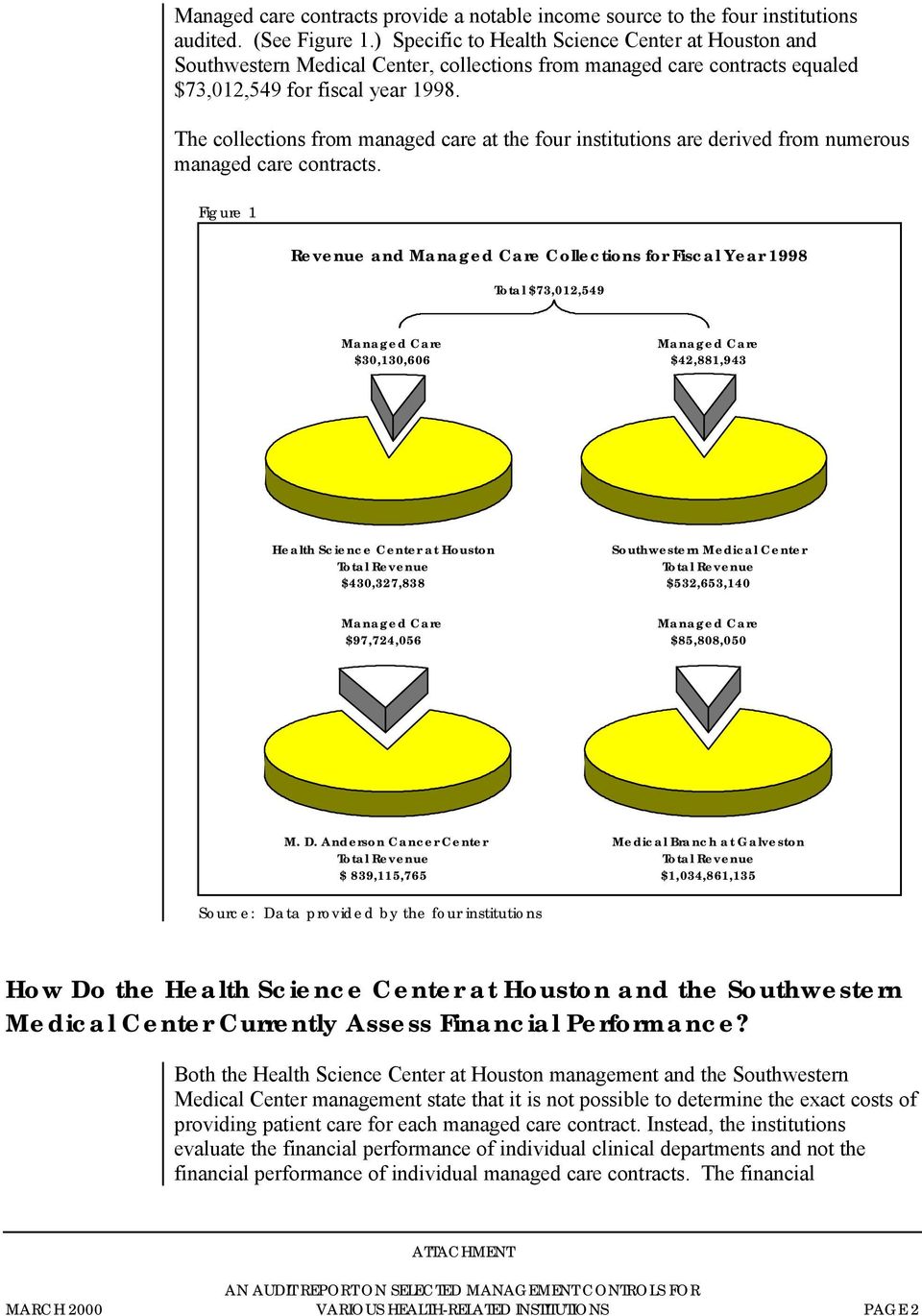
4 performance of an individual clinical department reflects all forms of revenue (patient services, including managed care contracts; research; state appropriations, etc.) Therefore, a financially strong department may not show losses incurred to provide services through one or more managed care contracts. If several departments mask such losses, the total loss to the institution from managed care contracts could be significant. How Are Patient Care Costs Identified and Recovered? The Health Science Center at Houston and the Southwestern Medical Center do not identify the direct costs associated with each patient s health care visit. The charge for the patient s visit is a fee that the institution assumes covers all the costs of providing the service. The fee is not supported by the identification of the cost factors specific to the institution. When managed care revenues are collected, the clinical departments receive a portion of the collections based on the fees charged by the clinical department. To reimburse the institutions for the indirect What Are Indirect Costs? costs of providing managed care, each department is assessed a percentage of the collections for managed care contracts. However, the Health Science Center at Houston and the Southwestern Medical Center acknowledge that these percentages do not consider all of the indirect costs (including administrative costs) associated with managed care services. At the Health Science Center at Houston, each clinical department pays about 13 percent of collections to cover the institution s indirect costs. At the Southwestern Medical Center, each clinical department pays about 27 percent of collections to cover the institution s indirect costs. Indirect costs, sometimes referred to as overhead or administrative costs, can be charged legitimately to a specific activity but are not necessarily caused by it. These costs are often associated with administrative support (such as the President s Office, Internal Audit, and the Accounting Department) and with shared activities (such as housekeeping, maintenance, data processing, utility usage, building maintenance, and security service). Source: College and Universities Business Administration, Fifth Edition, National Association of Controllers at University Business Officers, page 288. Because all costs have not been identified, the approach used at each institution to recover patient care costs raises two issues. First, management cannot be sure that the departments are assessed sufficient percentages to cover actual indirect costs. Second, it cannot be sure that collections from managed care contracts are sufficient to recover the costs of providing the services rendered. MARCH 2000 VARIOUS HEALTH-RELATED INSTITUTIONS PAGE 3
5 How Can Managed Care Contracting Decisions and Performance Evaluation Be Improved? We recommend that management at the Health Science Center at Houston and the Southwestern Medical Center improve their current costing methods by identifying and linking the costs of providing services to each managed care contract. Such action would provide more complete information for managed care contracting decisions. The Health Science Center at Houston and the Southwestern Medical Center should use a cost identification method that would provide both direct and indirect cost information for each managed care contract. Cost Effectiveness of Allocating Indirect Costs Indirect Costs should be allocated on the basis of quantitative measures that can be applied in a practical manner. There are instances when the most equitable distribution may not be the most practical, in terms of either time or of expense involved in collecting and tabulating quantitative measures. In such cases, the most practical measure should be selected, provided the results are not materially different. Source: College and Universities Business Administration, Fifth Edition, National Association of Controllers at University Business Officers, page 292. Management should actively use the information to make decisions about managed care contracts and to evaluate the overall mix of managed care contracts. At times, an institution might reasonably choose to enter a contract where losses could occur in an effort to provide unique medical training related to illnesses not found in the general population or to achieve its mission in another area. However, more complete knowledge of the costs of the contract and its financial impact to the institution and the State is an important factor in the decision. Each institution could recover indirect costs by taking a percentage of collections for each managed care contract. The percentage used would need to include a reasonable estimate of indirect cost components and be updated annually. (This would be an approximation method similar to the way these institutions already calculate and recover indirect costs on federally funded contracts and grants.) M.D. Anderson Cancer Center and the Medical Branch at Galveston have implemented processes to reasonably determine and link the direct and indirect costs for patient care services to each managed care contract. The Health Science Center at Houston and the Southwestern Medical Center may want to confer with the other two institutions for costing methods they could adapt to their non-hospital environments. Objective, Scope, and Methodology The purpose of the audit was to determine if four health-related institutions appropriately plan and adjust for the dynamically changing health care environment, especially as it becomes more dependent on managed care contracts. We conducted the audit in accordance with Government Auditing Standards. MARCH 2000 VARIOUS HEALTH-RELATED INSTITUTIONS PAGE 4

6 The scope of the audit included a review of each institution s strategic planning processes and financial information related to managed care contracts. We focused on managed care based on document reviews, financial analyses, interviews, and observations conducted during initial visits to the four institutions. During subsequent visits to the institutions, we verified all management assertions by reviewing supporting documentation and/or conducting additional interviews. We conducted on-site work from June to October Management Responses From the Institutions The University of Texas M. D. Anderson Cancer Center Per your request, I am transmitting the management representation letter associated with your recent audit on Management Control for Various Health-related Institutions. Upon reviewing the draft of your report, I was pleased to note there were no issues or recommendations for The University of Texas M. D. Anderson Cancer Center. I appreciate the professionalism you and your staff exhibited during this review. If you have any questions, do not hesitate to contact me. The University of Texas Medical Branch at Galveston Per your January 11, 2000 request, I am transmitting this management representation letter associated with your recent audit on Management Control for Various Healthrelated Institutions. Upon reading the draft of your report, I was pleased to note there were no issues or recommendations for the University of Texas Medical Branch. I appreciate your affirmation of the work we are doing in this important area. On behalf of the other members of management with whom you interacted, I thank you for the time, effort, and professionalism you and your staff exhibited during this review. If you have any questions, do not hesitate to contact me. The University of Texas Southwestern Medical Center at Dallas We agree we have institutional planning processes designed to provide good internal and external information for decisions. We also agree that detailed cost accounting information is not presently available for managed care contracts at the contracts level. The question we must consider as an institution charged with providing education, research and patient care is whether developing a cost accounting system will enhance the decision making ability at our organization when compared to the costs and complexities of implementing and maintaining such a system. We have not identified a contract cost tracking system appropriate for a physicians services environment that is sufficiently accurate to justify its own costs at this time. We currently have a comprehensive system that allows us to manage cost at the MARCH 2000 VARIOUS HEALTH-RELATED INSTITUTIONS PAGE 5
7 department level, and have repeatedly seen revenues exceed expenditures overall in our clinical activities. We continue to consult with other academic medical institutions, accounting experts, colleagues and industry specialists to remain current on efficient management tools for our environment. We have contacted UTMB and MDACC to obtain and review the methodology of the costing systems in use by their hospital-based environments. We question whether the cost accounting methodologies they are using adequately account for the joint product problem when accounting for physicians' efforts. The Association of American Medical Colleges (AAMC) has partnered with Computer Sciences Corporation (CSC) to develop a mission-based management program. This program attempts to measure achievements in each mission category, integrate school financial statements, and build reporting tools and metrics. Currently the cost to initiate such a program is in excess of one million dollars, and the cost to implement is over two million dollars. We will continue to monitor this development to determine if this system could be utilized for contract cost monitoring at UT Southwestern. The University of Texas Health Science Center at Houston We echo many of the comments from the response of our sister institution, Southwestern Medical Center. We indeed do have institutional planning processes designed to provide good internal and external information for decisions. Also, detailed cost accounting information, down to the individual contract level, is not presently available for our managed care contracts. We, too, believe that the development of a highly detailed cost accounting system entails a significant cost/benefit evaluation. We have not yet found a detailed managed care contract information system for an academic physician group practice that will provide us sufficiently improved information to justify its cost. However, as you know from your visits, we use a number of analytical tools that estimate our total costs of managed care services provided to individual contracts (including indirect and administrative overhead costs), based on historical assumptions of such costs as a percentage of professional fees charged. The basic principles underlying these tools e.g., that costs are estimable from professional charge or fee information are indistinguishable from the more comprehensive methods of accounting for managed care costs used by M.D. Anderson Cancer Center, that you cite approvingly. For example, these analytical tools indicate that, on a full-absorption costing basis, we make a modest profit on our largest commercial managed care contracts. Not surprisingly, these same tools show us to have negative margins on our managed Medicaid services. As you have noted, on occasion we consciously choose to provide services to populations resulting in negative margins, since providing care to Medicaid and other low and, for that matter, non-resource patients is consistent with MARCH 2000 VARIOUS HEALTH-RELATED INSTITUTIONS PAGE 6

8 the fulfillment of part of our mission. We believe it is worth noting that, in FY 1999, we provided nearly $35 million of Medicaid services and nearly $80 million worth of unsponsored charity care to the people of Texas. By themselves, these two payor groups represent more than half of our annual patient volume. When our $30 million of annual Medicare services are included, more than two-thirds of our patient activity is exclusive of commercial managed care (and, thereby, largely exclusive of any meaningful rate negotiation opportunities with payors). Since virtually every one of our commercial managed contracts are negotiated at rates more favorable than Medicare or Medicaid (and, obviously, charity care), our management information focus has not been, so far, on the development of a more detailed managed care cost accounting system. We have also consulted with other academic medical institutions, colleagues, professional consultants and industry specialists to remain aware of the latest information management tools available for physician group practice plans. In particular, we are participating, along with about two dozen other Academic Health Centers, in a nationwide, University Heath Systems Consortium project to refine mission-based management information. We believe that such mission-based management will enhance the quality of decisions by providing more meaningful, operating results by discrete operating units (i.e., clinical, teaching, research). In addition, improved benchmark and performance metric information will be available through this project. This should improve our internal goal-setting and continuous improvement processes. State Auditor s Follow-Up Comment The focus of our recommendation is that management at the Health Science Center at Houston and the Southwestern Medical Center needs to determine a way to link the cost information currently in their patient care records and billing systems to each managed care contract. If either institution is not able to modify its current systems in this manner, an approximation method for both direct and indirect costs per contract similar to the way the institutions currently recover indirect cost for federal grants and contracts could be applied to each contract. If neither of these approaches will work, a more comprehensive cost accounting system may be needed. If a cost accounting system is to be acquired, consideration should be given to coordinating the purchase among a group of institutions to improve the potential costs to benefits ratio. MARCH 2000 VARIOUS HEALTH-RELATED INSTITUTIONS PAGE 7

9 Copies of this report have been distributed to the following: Legislative Audit Committee The Honorable James E. Pete Laney, Speaker of the House, Chair The Honorable Rick Perry, Lieutenant Governor, Vice Chair The Honorable Bill Ratliff, Chair, Senate Finance Committee The Honorable Florence Shapiro, Chair, Senate State Affairs Committee The Honorable Robert Junell, Chair, House Appropriations Committee The Honorable Rene O. Oliveira, Chair, House Ways and Means Committee Governor of Texas The Honorable George W. Bush The University of Texas System William H. Cunningham, Ph.D., Chancellor Members of The University of Texas System Board of Regents The University of Texas Health Science Center at Houston M. David Low, M.D., Ph.D., President The University of Texas M. D. Anderson Cancer Center John Mendelsohn, M.D., President The University of Texas Medical Branch at Galveston John Stobo, M.D., President The University of Texas Southwestern Medical Center at Dallas C. Kern Wildenthal, M.D., President MARCH 2000 VARIOUS HEALTH-RELATED INSTITUTIONS PAGE 8
August 2003 SAO Report No. 03-047
 A Review of Enrollment Reporting by Texas Public Universities and Health-Related Institutions Lawrence F. Alwin, CPA State Auditor www.sao.state.tx.us To report waste, fraud, or abuse in state government
OFFICE OF THE STATE AUDITOR TWO COMMODORE PLAZA 206 EAST NINTH STREET, SUITE 1900 LAWRENCE F. ALWIN, CPA
 OFFICE OF THE STATE AUDITOR TWO COMMODORE PLAZA 206 EAST NINTH STREET, SUITE 1900 LAWRENCE F. ALWIN, CPA AUSTIN, TEXAS 78701 State Auditor July 22, 1998 RE: A Review of General Automation Controls at Selected
March 2007 Report No. 07-709
 John Keel, CPA State Auditor the State s Attorney, Assistant Attorney General, and General Counsel Positions Report No. 07-709 the State s Attorney, Assistant Attorney General, and Positions Overall Conclusion
The Univ ersity o f Texas System Nine Universities. Six Health Institutions. Unlimited Possibilities.
 The Univ ersity o f Texas System Nine Universities. Six Health Institutions. Unlimited Possibilities. System Audit Office 702 Colorado Street, Austin, TX 78701 Phone: 512-499-4390 Fax: 512-499-4426 September
Tuition and Fees. Jim Brunjes Vice Chancellor and Chief Financial Officer. Fiscal Year 2016. March 5, 2015
 Tuition and Fees Fiscal Year 2016 Jim Brunjes Vice Chancellor and Chief Financial Officer March 5, 2015 Hazlewood Exemption Page 2 Hazlewood Exemption Fiscal Years 2011 to 2014 Texas Tech University FY11
THE FRAUD PREVENTION SYSTEM IDENTIFIED MILLIONS IN MEDICARE SAVINGS, BUT THE DEPARTMENT COULD STRENGTHEN SAVINGS DATA
 Department of Health and Human Services OFFICE OF INSPECTOR GENERAL THE FRAUD PREVENTION SYSTEM IDENTIFIED MILLIONS IN MEDICARE SAVINGS, BUT THE DEPARTMENT COULD STRENGTHEN SAVINGS DATA BY IMPROVING ITS
. Health MEMORANDUM. Rex M. McCallum, MD Vice President & Chief Physician Executive, Faculty Group Practice TO:
 . Health MEMORANDUM TO: FR OM: DATE: Rex M. McCallum, MD Vice President & Chief Physician Executive, Faculty Group Practice Kimberly K. Hagara, CPA, CIA, CISA, CR r.. Associate Vice President, (_J ()'
STATE OF NORTH CAROLINA
 STATE OF NORTH CAROLINA PERFORMANCE AUDIT STATE HEALTH PLAN RISK ASSESSMENT SEPTEMBER 2011 OFFICE OF THE STATE AUDITOR BETH A. WOOD, CPA STATE AUDITOR PERFORMANCE AUDIT STATE HEALTH PLAN RISK ASSESSMENT
SpecialReport. Report on the Physician Education Loan Repayment Program. Susan Combs Texas Comptroller of Public Accounts.
 SpecialReport December 2008 Report on the Physician Education Loan Repayment Program Susan Combs Texas Comptroller of Public Accounts ACKNOWLEDGEMENTS Texas Comptroller of Public Accounts Ginger Lowry
May 2012 Report No. 12-030
 John Keel, CPA State Auditor Incentive Compensation at the Teacher Retirement System, the Employees Retirement System, and the Permanent School Fund Report No. 12-030 Incentive Compensation at the Teacher
September 2014 Report No. 15-003
 John Keel, CPA State Auditor An Audit Report on The Texas Enterprise Fund at the Office of the Governor Report No. 15-003 An Audit Report on The Texas Enterprise Fund at the Office of the Governor Overall
THE UNIVERSITY OF TEXAS SYSTEM
 THE UNIVERSITY OF TEXAS SYSTEM PROFESSIONAL MEDICAL LIABILITY BENEFIT PLAN HANDBOOK FY 2014-2015 This handbook summarizes coverage, exclusions, and responsibilities under The University of Texas System
John Keel, CPA State Auditor. A Report on State Employee Benefits as a Percentage of Total Compensation. April 2014 Report No.
 John Keel, CPA State Auditor A Report on State Employee Benefits as a Percentage of Total Compensation Report No. 14-704 A Report on State Employee Benefits as a Percentage of Total Compensation Overall
The University of Texas at Austin BYLAWS OF THE GRADUATE STUDENT ASSEMBLY. ARTICLE I Objectives
 The University of Texas at Austin BYLAWS OF THE GRADUATE STUDENT ASSEMBLY ARTICLE I Objectives Section 1. General Objectives 1.1. To represent the views of graduate students to the university community
Academic Review Department of Physician Assistant Studies School of Allied Health Sciences University of Texas Medical Branch Galveston
 Academic Review Team Academic Review Department of Physician Assistant Studies School of Allied Health Sciences University of Texas Medical Branch Galveston Donald M. Pedersen, PhD, PA-C (Chair) Professor
THE UNIVERSITY OF TEXAS SYSTEM PROFESSIONAL MEDICAL LIABILITY BENEFIT PLAN HANDBOOK
 THE UNIVERSITY OF TEXAS SYSTEM PROFESSIONAL MEDICAL LIABILITY BENEFIT PLAN HANDBOOK This handbook summarizes coverage, exclusions, and responsibilities under The University of Texas System Professional
SAN DIEGO COMMUNITY COLLEGE DISTRICT
 SAN DIEGO COMMUNITY COLLEGE DISTRICT Audit Report COLLECTIVE BARGAINING PROGRAM Chapter 961, Statutes of 1975, and Chapter 1213, Statutes of 1991 July 1, 2000, through June 30, 2002 STEVE WESTLY California
EXECUTIVE PERFORMANCE INCENTIVE COMPENSATION PLAN
 EXECUTIVE PERFORMANCE INCENTIVE COMPENSATION PLAN For The University of Texas System Presidents and System Administration Executive Officers Effective September 1, 2012 TABLE OF CONTENTS 1. Background...
HOUSE CONCURRENT RESOLUTION NO. 89 A CONCURRENT RESOLUTION. To express the tribute of the Legislature of Louisiana to Dr.
 Regular Session, 2000 HOUSE CONCURRENT RESOLUTION NO. 89 BY REPRESENTATIVE WELCH A CONCURRENT RESOLUTION To express the tribute of the Legislature of Louisiana to Dr. Carolyn Hargrave upon her retirement
Assessment and Collection of Selected Penalties. Workers Compensation Board
 New York State Office of the State Comptroller Thomas P. DiNapoli Division of State Government Accountability Assessment and Collection of Selected Penalties Workers Compensation Board Report 2011-S-3
Oversight of Information Technology Projects. Information Technology Audit
 O L A OFFICE OF THE LEGISLATIVE AUDITOR STATE OF MINNESOTA FINANCIAL AUDIT DIVISION REPORT Oversight of Information Technology Projects Information Technology Audit May 29, 2009 Report 09-19 FINANCIAL
O L A. Workers Compensation Court of Appeals July 1, 1998, through June 30, 2003 OFFICE OF THE LEGISLATIVE AUDITOR STATE OF MINNESOTA
 O L A OFFICE OF THE LEGISLATIVE AUDITOR STATE OF MINNESOTA Financial-Related Audit Workers Compensation Court of Appeals July 1, 1998, through June 30, 2003 SEPTEMBER 12, 2003 03-49 Financial Audit Division
NACHC ANALYSIS: Establishing and Collecting Fees for Health Center Services. July, 2009
 NACHC ANALYSIS: Establishing and Collecting Fees for Health Center Services July, 2009 Prepared for NACHC by: Michael Glomb Feldesman, Tucker, Leifer, Fidell 2001 L Street, N.W. (202)466-8960 [email protected]
A BILL TO BE ENTITLED AN ACT. relating to establishing a health science center and medical school
 By:AALucio S.B.ANo.A0 A BILL TO BE ENTITLED AN ACT relating to establishing a health science center and medical school in the Rio Grande Valley. BE IT ENACTED BY THE LEGISLATURE OF THE STATE OF TEXAS:
Department of Human Services Division of Mental Health Services Ann Klein Forensic Center
 New Jersey State Legislature Office of Legislative Services Office of the State Auditor Department of Human Services Division of Mental Health Services Ann Klein Forensic Center July 1, 2002 to May 11,
Economic and Financial Considerations in Health Policy. Gerard F. Anderson, PhD Johns Hopkins University
 This work is licensed under a Creative Commons Attribution-NonCommercial-ShareAlike License. Your use of this material constitutes acceptance of that license and the conditions of use of materials on this
October 2007 Report No. 08-006. An Audit Report on The Medical Transportation Program at the Texas Department of Transportation
 John Keel, CPA State Auditor An Audit Report on The Medical Transportation Program at the Texas Department of Transportation Report No. 08-006 An Audit Report on The Medical Transportation Program at the
November 2009 Report No. 10-014. An Audit Report on The Department of Aging and Disability Services Home and Community-based Services Program
 John Keel, CPA State Auditor An Audit Report on The Department of Aging and Disability Services Home and Community-based Services Program Report No. 10-014 An Audit Report on The Department of Aging and
Report on Emergency Medical Services. As Required By Health and Safety Code, Sec. 773.05713
 Report on Emergency Medical Services As Required By Health and Safety Code, Sec. 773.05713 Department of State Health Services December 2014 Table of Contents Executive Summary..2 Background.. 2 Legislative
AGREEMENT BETWEEN THE UNIVERSITY OF TEXAS M. D. ANDERSON CANCER CENTER SERVICE PROVIDER for A PROJECT OF LIMITED SIZE OR SCOPE
 AGREEMENT BETWEEN THE UNIVERSITY OF TEXAS M. D. ANDERSON CANCER CENTER SERVICE PROVIDER for A PROJECT OF LIMITED SIZE OR SCOPE This Agreement is made as of, 20 (the Effective Date ), by and between: The
Psychiatry Practice Incentive Program Annual Report to the Illinois General Assembly. March 2012
 Psychiatry Practice Incentive Program Annual Report to the Illinois General Assembly March 2012 February 15, 2012 Mr. Tim Anderson Secretary of the Senate 401 Capitol Building Springfield, Illinois 62706
March 23, 2010. Report Number: A-05-09-00075
 DEPARTMENT OF HEALTH & HUMAN SERVICES March 23, 2010 Office of Inspector General Office of Audit Services, Region V 233 North Michigan Avenue Suite 1360 Chicago, IL 60601 Report Number: A-05-09-00075 Ms.
AVOIDING LEGAL PITFALLS: ADOPTION OF MARKETING EXPENSE BUDGET AND GIFT POLICY
 ADOPTION OF MARKETING EXPENSE BUDGET AND GIFT POLICY BY: JEFFREY S. BAIRD, ESQ. BROWN & FORTUNATO, P.C. HEALTH CARE GROUP P.O. BOX 9418 AMARILLO, TX 79105 (806) 345-6320 (806) 345-6363 - FAX [email protected]
ATTACHMENT A - STATEMENT OF WORK REQUEST FOR PROPOSALS FOR INDEPENDENT BENEFIT CONSULTING, ACTUARIAL AND AUDITING SERVICES DMS-13/14-018
 4050 Esplanade Way Tallahassee, Florida 32399-0950 Tel: 850.488.2786 Fax: 850. 922.6149 Rick Scott, Governor Craig J. Nichols, Agency Secretary ATTACHMENT A - STATEMENT OF WORK REQUEST FOR PROPOSALS FOR
Department of Motor Vehicles
 New York State Office of the State Comptroller Thomas P. DiNapoli Division of State Government Accountability Motor Vehicle Financial Security and Safety Responsibility Acts: Assessable Expenses for the
Accounts Payable Audit
 Audit Report# 15-11 November 12, 2015 "Committed to Service, Independence and Quality" THE UNIVERSITY OF TEXAS AT EL PASO Office of Auditing and Consulting Services November 12, 2015 Dr. Diana Natalicio
November 22, 2010. RE: File code CMS-1345-NC. Dear Dr. Berwick:
 601 New Jersey Avenue, N.W. Suite 9000 Washington, DC 20001 202-220-3700 Fax: 202-220-3759 www.medpac.gov. Glenn M. Hackbarth, J.D., Chairman Robert A. Berenson, M.D., F.A.C.P., Vice Chairman Mark E. Miller,
Affiliation Agreement with Eller Executive Education
 December 2014 FY14 - #13 Submitted to: Andrew C. Comrie, Senior Vice President for Academic Affairs and Provost Melissa Vito, Senior Vice President, Student Affairs and Enrollment Management, and Senior
U.S. Chemical Safety and Hazard Investigation Board Should Determine the Cost Effectiveness of Performing Improper Payment Recovery Audits
 U.S. ENVIRONMENTAL PROTECTION AGENCY OFFICE OF INSPECTOR GENERAL U.S. Chemical Safety and Hazard Investigation Board Should Determine the Cost Effectiveness of Performing Improper Payment Recovery Audits
SEP f 1 2006. Nationwide Review of Inpatient Rehabilitation Facilities' Compliance With Medicare's Transfer Regulation (A-04-04-00008)
 {42 + STRVLVICEI DEPARTMENT E %*~UV,~~ OF HE&WH & HUMAN SERVICES Office of Inspector General SEP f 1 2006 Washington, D.C. 20201 TO: FROM: SUBJECT: Mark B. McClellan, M.D., Ph.D. Administrator Centers