
Large Account Pricing
|
|
|
- Delphia Lucas
- 10 years ago
- Views:
Transcription
1 Workshop 5: Large Account Pricing Large Account Pricing Presenter: Joshua Taub, FCAS CAS Ratemaking and Product Management Seminar March 30, 2014 Washington, D.C. 1 / 34

2 CAS Antitrust Notice The Casualty Actuarial Society is committed to adhering strictly to the letter and spirit of the antitrust laws. Seminars conducted under the auspices of the CAS are designed solely to provide a forum for the expression of various points of view on topics described in the programs or agendas for such meetings. Under no circumstances shall CAS seminars be used as a means for competing companies or firms to reach any understanding - expressed or implied - that restricts competition or in any way impairs the ability of members to exercise independent business judgment regarding matters affecting competition. It is the responsibility of all seminar participants to be aware of antitrust regulations, to prevent any written or verbal discussions that appear to violate these laws, and to adhere in every respect to the CAS antitrust compliance policy. Workshop 5: Large Account Pricing 2 / 34

3 Agenda 1 Who I am 2 Intro to Large Accounts 3 Experience Rating 4 Schedule Rating 5 Retrospective Rating Workshop 5: Large Account Pricing 3 / 34

4 Who I am Teaching CAS Exams 5 & 8 for The Infinite Actuary Ratemaking experience in personal and commercial lines Also managed a claims actuarial group for several years Passion for sharing learning Obtained FCAS in 2008 Graduated from UCSB, now on Actuarial Advisory Board I also love to travel! Workshop 5: Large Account Pricing Who I am 4 / 34

5 Definition of a Large Account So what exactly do we mean by Large Account? Photo Credit: Insuring this $4.5M car? Insuring this $85M house? A personal umbrella policy for Bill Gates? In our case, none of these Workshop 5: Large Account Pricing Intro to Large Accounts 5 / 34

6 So...the answer is? A Large Account for our purposes is considered to be a commercial lines policy with a significant amount of premium. Why only commercial lines? Exposure to loss varies more from risk to risk Limited data, high exposure What does significant mean? Big enough for an insured s own loss experience to have some credibility in predicting their own future losses. Generally: the more premium, the more credibility Workshop 5: Large Account Pricing Intro to Large Accounts 6 / 34

7 Why Treat Large Accounts Different? Unique risks: classification plans insufficient Credibility of experience Scale allows for higher level of service (i.e., loss control) Varying degrees of risk aversion Workshop 5: Large Account Pricing Intro to Large Accounts 7 / 34

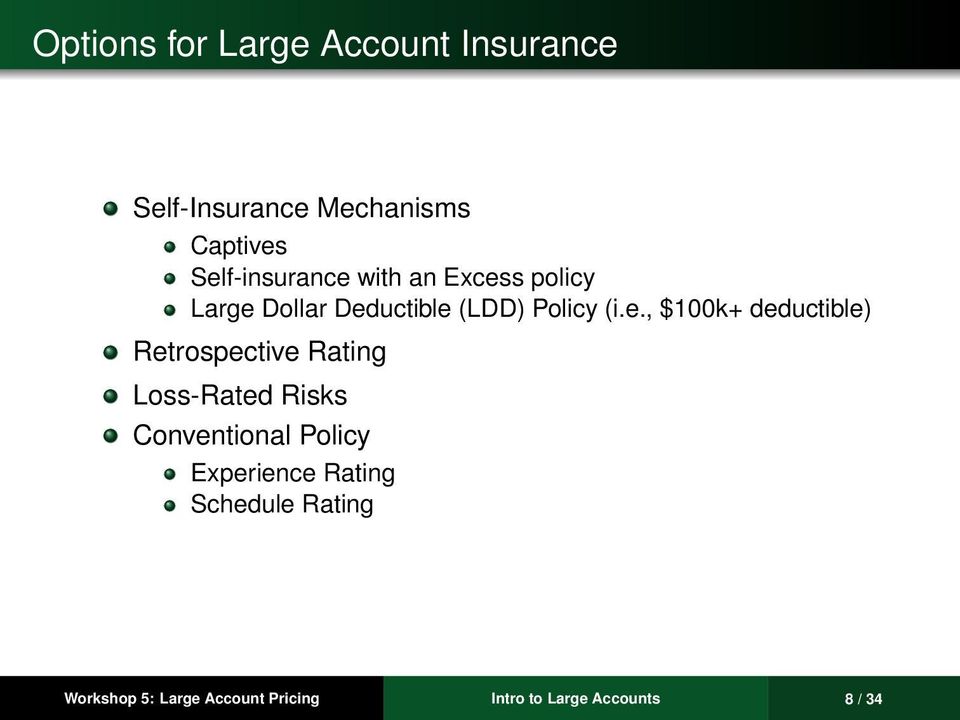
8 Options for Large Account Insurance Self-Insurance Mechanisms Captives Self-insurance with an Excess policy Large Dollar Deductible (LDD) Policy (i.e., $100k+ deductible) Retrospective Rating Loss-Rated Risks Conventional Policy Experience Rating Schedule Rating Workshop 5: Large Account Pricing Intro to Large Accounts 8 / 34
9 Question #1 You are the Chief Risk Officer for a large corporation, and you are deciding on how to manage the risks your company faces. You have 2 goals: 1 You want to retain a moderate amount of risk. 2 You want an insurer to handle all claims. Which option do you choose? 1 LDD - This meets both criteria 2 Excess - Not this because of requirement #2 3 Retro - This meets both criteria 4 Conventional Policy - Not this because of requirement #1 Choice between 1 and 3 depends on the plan parameters of each. Workshop 5: Large Account Pricing Intro to Large Accounts 9 / 34

10 Experience Rating Experience Rating Workshop 5: Large Account Pricing Experience Rating 10 / 34
11 Experience Rating Use an insured s claims history on prior policy terms in determining their current policy premium. Differentiates between risks within a classification for things not captured by the classification plan. Goals of Experience Rating: 1 Predictive Accuracy: Use past losses to the extent that they are predictive of future losses. This makes the plan fair. 2 Safety Incentive: A financial incentive to prevent and mitigate accidents. 3 Enhance Competition: More insurers willing to write business if better chance of profit. Workshop 5: Large Account Pricing Experience Rating 11 / 34

12 Personal vs Commercial Lines Experience rating does exist in personal lines in the form of accident surcharges. They are administered by individual insurers, and only focus on claim frequency, and not claim severity (based on what I ve seen). In commercial lines, experience rating may be administered by a statistical bureau, and considers both claim frequency and severity. Experience rating credibility is inversely related to the strength of the classification plan. Workshop 5: Large Account Pricing Experience Rating 12 / 34

13 Question #2 Two insurers are competitors in writing personal auto insurance. Insurer #1 only has rating factors for age of driver, miles driven, and # of prior claims. Insurer #2 only has rating factors for age of driver, miles driven, territory, credit score, and # of prior claims. Which insurer s prior claim surcharges are likely to be larger? 1 Insurer #1 - This one has more experience rating credibility 2 Insurer #2 - This has the stronger class plan Workshop 5: Large Account Pricing Experience Rating 13 / 34

14 Experience Rating Plans There are 2 main categories of Experience Rating Plans: 1 No-Split Plans: There is no subdivision of losses. Mod = ZA+(1 Z)E E 2 Split Plans: Losses are split into primary and excess. Mod = Z pa p +(1 Z p )E p +Z e A e +(1 Z e )E e E p +E e Single-Split: A p = { A C if A C if A > C A e = Â A p Multi-Split: A p = I + (1 d)i + (1 d) 2 I (1 d) N (A N I) A e = Â A p Workshop 5: Large Account Pricing Experience Rating 14 / 34

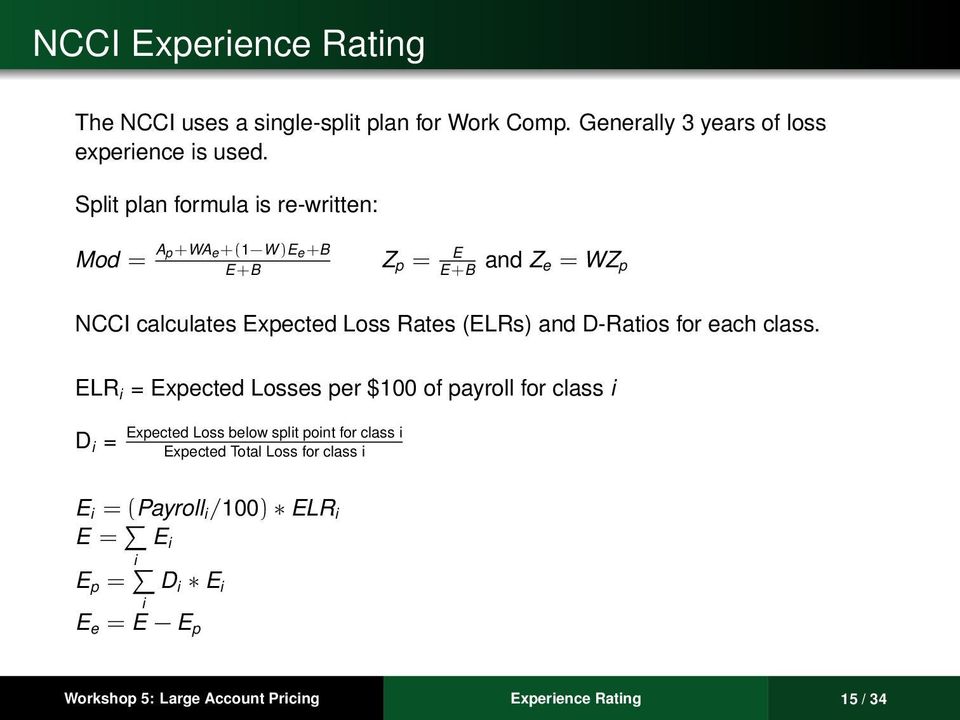
15 NCCI Experience Rating The NCCI uses a single-split plan for Work Comp. Generally 3 years of loss experience is used. Split plan formula is re-written: Mod = Ap+WAe+(1 W )Ee+B E+B Z p = E E+B and Z e = WZ p NCCI calculates Expected Loss Rates (ELRs) and D-Ratios for each class. ELR i = Expected Losses per $100 of payroll for class i D i = Expected Loss below split point for class i Expected Total Loss for class i E i = (Payroll i /100) ELR i E = E i i E p = i D i E i E e = E E p Workshop 5: Large Account Pricing Experience Rating 15 / 34
16 NCCI Loss Adjustments In addition to the split point, there are some restrictions on actual losses: Medical-Only losses only included at 30% of loss amount (after split point applied) Cap on large individual claims Cap on multi-claim accidents Caps for disease losses The ELRs and D-ratios are adjusted for these, so expected losses are on same basis as actual losses used. Workshop 5: Large Account Pricing Experience Rating 16 / 34

17 Exam Q25(a) For a given risk, the losses entering the workers compensation experience rating formula are as follows. Claim Number Indemnity Loss Medical Loss Total Loss A p A e 1 $2,000 $4,000 $6,000 $5,000 $1,000 2 $0 $2,800 $2,800 $840 $0 3 $10,000 $8,000 $18,000 $5,000 $13,000 4 $0 $12,000 $12,000 $1,500 $2,100 Total: $12,340 $16,100 Additionally, the following information is given for this risk. Ap+WAe+(1 W )Ee+B E+B Expected Primary Losses: $13,000 Mod = Expected Excess Losses: $50,000 Ballast: 100,000 Mod = 12, (16,100)+(1 0.20)(50,000)+100,000 (13,000+50,000)+100,000 Weight: 0.20 Mod = 0.95 Assume that there is a single split point of $5,000 between primary and excess. Calculate the risk s experience modification factor. Workshop 5: Large Account Pricing Experience Rating 17 / 34

18 ISO Experience Rating ISO uses a no-split plan for General Liability. Like NCCI, 3 years of loss experience is generally used. The plan uses basic limits loss data, which limits impact of severity. The plan also caps the basic limits Loss + ALAE for each historical claim at a Maximum Single Loss (MSL). No-Split plan formula is re-written: Mod = Z AER EER EER AER = Actual Experience Ratio EER = Expected Experience Ratio Workshop 5: Large Account Pricing Experience Rating 18 / 34

19 ISO Experience Ratios Mod = Z AER EER EER EER = Expected ultimate basic limits losses and ALAE limited by the MSL Expected ultimate basic limits losses and ALAE NOT limited by the MSL Note that the EER is conceptually similar to the NCCI s D-Ratio. AER = Actual basic limits losses and ALAE to date limited by the MSL + Expected Development Expected ultimate basic limits losses and ALAE NOT limited by the MSL Same denominator for AER and EER. The denominator is known as the Company Subject Loss Cost (CSLC). Workshop 5: Large Account Pricing Experience Rating 19 / 34

20 ISO CSLC Standard Method First calculated for each year of experience and each subline (Premises/Operations and Products/Completed Ops). Basic Limits Expected Losses sl = company ELR * annual basic limits company premium sl Once we have the Basic Limits Expected Losses (BLEL) by subline, we need to make 3 initial adjustments to make these expected losses more comparable with the actual losses from the experience period. However, for our purposes, we ll assume that all policies are occurrence policies, and not claims-made, so the only adjustment remaining is to de-trend the expected losses to be on the same trend level as the actual losses from the experience period. CSLC y,sl = BLEL sl DeTrend y,sl CSLC = 3 CSLC y,sl y=1 sl Workshop 5: Large Account Pricing Experience Rating 20 / 34

21 ISO Mod Calculation AER = Actual basic limits losses and ALAE to date limited by the MSL + Expected Development CSLC First term in numerator obtained from actual loss and ALAE. Need to first cap losses at basic limits, then cap (basic limits loss + ALAE) by MSL. ExpectedDevelopment y,sl = CSLC y,sl EER LDF y,sl LDFs can be from ISO or company, and EER is from ISO tables. ExpectedDevelopment = 3 y=1 sl ExpectedDevelopment y,sl Workshop 5: Large Account Pricing Experience Rating 21 / 34
22 Exam Q49 Given the following information for a commercial general liability risk, calculate the experience (Credit)/Debit based on the ISO CGL Experience Rating Plan. Show all work. Actual Losses in the experience period valued as of March 31, 2006: Claim Loss ALAE Basic Loss Min(Basic Loss+ALAE,MSL) 1 $1,000 $200 1,000 1, , ,500 1, , ,000 5, ,000 1,000 6,000 7, ,000 1,800 12,000 13, ,000 2,200 23,000 25, ,000 40, , ,000 Total 194,700 Expected Unreported Losses and March 31, 2006 = $45,000 Company Subject Basic Limits Loss and ALAE costs = $250,000 Basic Limit = $100,000 Mod = Z AER EER EER = = MSL = $150,000 Expected Experience Ratio = 0.9 AER = 194,700+45, ,000 = Credibility = 0.6 Workshop 5: Large Account Pricing Experience Rating 22 / 34
23 NCCI vs ISO Component ISO Experience Rating Plan NCCI Experience Rating Plan Experience period Typically 3 years, lagged 1 year Same as ISO Experience Mod Add 1 to get a factor Already in factor form Credibility Up to 100% (of limited loss experience) Less than 100% Plan type No-split plan Single-split plan ALAE Included in Mod calculation Not included in mod calculation Trending of losses No trending of actual loss, de-trend expected loss Same as ISO Loss development Compares ultimate losses Compares undeveloped losses Loss limits Basic limits and MSL SAL Workshop 5: Large Account Pricing Experience Rating 23 / 34
24 Schedule Rating Schedule Rating Workshop 5: Large Account Pricing Schedule Rating 24 / 34
25 Schedule Rating Allows underwriters to subjectively adjust premium for individual risks based on risk characteristics not otherwise reflected in rate calculation. Schedule rating plans are filed with a set list of risk characteristics that will be considered, along with the maximum credits and debits by each category and in total. Some carriers now implement predictive models through schedule rating. Schedule rating should avoid considering any risks characteristics that are already fully reflect in experience rating. Workshop 5: Large Account Pricing Schedule Rating 25 / 34
26 ISO CGL Schedule Rating Plan ISO Commercial General Liability Plan categories: Location: Exposure inside and outside. Up to 10% credit or debit. Premises: Condition and care. Up to 10% credit or debit. Equipment: Type, condition, and care. Up to 10% credit or debit. Classification: Peculiarities. Up to 10% credit or debit. Employees: Selection, training, supervision, experience. Up to 6% credit or debit. Cooperation: Medical facilities and safety program: Up to 4% credit or debit. The credits and debits by risk characteristic are summed, and then capped at ±25%, so the maximum schedule debit is 1.25, and the maximum schedule credit is Workshop 5: Large Account Pricing Schedule Rating 26 / 34
27 Exam Q34 An insurer has been tracking the claims experience of a very large construction company for the three years the construction company has been insured by this insurer. The construction company will implement a new safety program starting in the upcoming year. (a) Determine whether the insurer should use experience rating, schedule rating, or both to rate the construction company for the upcoming policy period. Briefly explain your answer. BOTH. Experience rating will reflect the actual experience over the last few years, and schedule rating will reflect the expected impact of the new safety program. (b) Assuming no additional changes, determine whether the insurer should use experience rating, schedule rating, or both to rate the construction company five years from now. Briefly explain your answer. Only experience rating. Since the safety program would now be fully reflected in the insured s experience, the experience rating will pick up the impact of the safety program. Using schedule rating to reflect the safety program would double count the impact of the program. Workshop 5: Large Account Pricing Schedule Rating 27 / 34
28 Retrospective Rating Retrospective Rating Workshop 5: Large Account Pricing Retrospective Rating 28 / 34
29 Retrospective Rating Use an insured s claims on current policy term in determining their current policy premium. Initial premium is collected at start of policy term. Adjustments to premium starting around 6 months after term, and every 12 months thereafter as losses develop. May be many years before policy premium is finalized. Workshop 5: Large Account Pricing Retrospective Rating 29 / 34
30 Retro Value Proposition Extreme hypothetical - Premium fully dependent on actual loss: Actual Premium = Actual Loss + Expected Expenses Expected Expenses Actual Premium Expected Premium = Expected Loss + Expected Expenses Value proposition for insured (example numbers): Pay an extra $1,000 and guarantee your premium $10,000. $1,000 + Expected Expenses Actual Premium $10,000 Now, insured is protected if Actual Loss + Expenses > $10,000. Retros have maximum and minimum premiums. The cost to have max/min premium is the net insurance charge. Workshop 5: Large Account Pricing Retrospective Rating 30 / 34
31 Retro Loss Limits With a maximum premium of $10,000: Actual Premium = Min(Actual Loss + Insurance Charge + Expected Expenses; $10,000) Note that maximum and minimum premiums are equivalent to aggregate limits on losses used to determine the premium. Max Prem = Max Loss + Insurance Charge + Expected Expenses Retros can also have limits on individual accident impact on premium. Separate charge needed for accident limits. Charge should consider overlap with aggregate limit! Note these are NOT coverage limits! Workshop 5: Large Account Pricing Retrospective Rating 31 / 34
32 Work Comp Retro Rating Case 1: No per occurrence limit in retro premium calculation. NCCI Retro premium formula R = (b + CA)T Actual Prem = (Non-LAE Expenses + Expected LAE to Loss * Actual Loss) * Taxes b = Basic premium. Covers non-lae expenses (excluding taxes), profit, and net insurance charge. A = Actual incurred loss. May or may not include ALAE. C = Loss Conversion Factor. Covers LAE not included in A. P = Standard Premium. Includes manual premium, experience mod, and schedule mod. T = Tax Multiplier. Covers premium taxes and assessments/fees. In a balanced plan, b = e (C 1)E[A] + CI e = Total expenses (excluding taxes) and profit I = Net insurance charge for max/min premiums R is capped between maximum premium (G) and minimum premium (H). Sometimes G, H, E[A], I, e and b given as ratios to P. Case 2: With per occurrence limit in retro premium calculation (Table L approach). Replace A with actual limited loss Replace I with net insurance charge including occurrence limit charge Workshop 5: Large Account Pricing Retrospective Rating 32 / 34
33 Exam 5 - Spring 2013 Q15 An employer negotiated a workers compensation retrospective policy with an insurer, effective from January 1, 2011 to December 31, The first adjustment of the retrospective premium occurs six months after the end of the policy period and annually thereafter until the tenth adjustment. The reported losses during the policy period evaluated as of June 30, 2012 are as follows: Claim Reported Losses Actual Limited Losses #1 $300,000 $150,000 #2 $200,000 $150,000 #3 $100,000 $100,000 $400,000 The provisions for this retrospective rating plan are as follows: R = (b + CA)T Minimum retrospective premium ratio 50% b = e (C 1)E[A] + CI Maximum retrospective premium ratio 150% (b/p) = 25% - (1.2-1)60% + (1.2)(44.6%) Loss Conversion Factor 1.2 (b/p) = Per Accident Loss Limitation $150,000 b = * $540,000 = $359,208 Expense Allowance Excluding Tax Multiplier 25% Expected Loss Ratio 60% R = [$359,208 + (1.2)($400,000)]*1.05 Tax Multiplier 1.05 R = $881,168 Net Insurance Charge 44.6% Min Premium = 50% * $540,000 = $270,000 Standard Premium $540,000 Max Premium = 150% * $540,000 = $810,000 (a) Calculate the retrospective premium as of June 30, Answer = $810,000 (b) Discuss what could cause the retrospective premium in part (a) above to change for the insured between June 30, 2012 and the tenth adjustment. Can only go down since already at max. Only way: reduction in case reserves. Workshop 5: Large Account Pricing Retrospective Rating 33 / 34
34 Thank you! THANK YOU! Workshop 5: Large Account Pricing Retrospective Rating 34 / 34
Anti-Trust Notice. Agenda. Three-Level Pricing Architect. Personal Lines Pricing. Commercial Lines Pricing. Conclusions Q&A
 Achieving Optimal Insurance Pricing through Class Plan Rating and Underwriting Driven Pricing 2011 CAS Spring Annual Meeting Palm Beach, Florida by Beth Sweeney, FCAS, MAAA American Family Insurance Group
Workers Compensation Ratemaking An Overview
 Workers Compensation Ratemaking An Overview Insurance Company Perspective Andrew Doll, QBE Regional Insurance Company CAS 2010 Ratemaking and Product Management Seminar Chicago, Illinois - March 16, 2010
Munich Re INSURANCE AND REINSURANCE. May 6 & 7, 2010 Dave Clark Munich Reinsurance America, Inc 4/26/2010 1
 Antitrust Notice The Casualty Actuarial Society is committed to adhering strictly to the letter and spirit of the antitrust laws. Seminars conducted under the auspices of the CAS are designed solely to
R-3: What Makes a Good Rate Filing?
 R-3: What Makes a Good Rate Filing? Carl Sornson, FCAS Managing Actuary Property/Casualty NJ Dept of Banking & Insurance 2012 CAS Ratemaking and Product Management Seminar March 19-21, 2012 Antitrust Notice
Regulatory Process for Reviewing Hurricane Models and use in Florida Rate Filings
 Regulatory Process for Reviewing Hurricane Models and use in Florida Rate Filings Robert Lee, FCAS Florida Office of Insurance Regulation CAS IN FOCUS TAMING CATS OCTOBER 2012 1 Antitrust Notice The Casualty
UBI-5: Usage-Based Insurance from a Regulatory Perspective
 UBI-5: Usage-Based Insurance from a Regulatory Perspective Carl Sornson, FCAS Managing Actuary Property/Casualty NJ Dept of Banking & Insurance 2015 CAS RPM Seminar March 10, 2015 Antitrust Notice The
Workers Compensation. Are Costs Controllable?
 Workers Compensation Are Costs Controllable? Your WC Risk Costs Has your WC premium gone down in recent years? Has your WC premium stayed the same? Has your WC premium gone up in recent years? Are you
Casualty Actuarial Society
 Antitrust Notice The Casualty Actuarial Society is committed to adhering strictly to the letter and spirit of the antitrust laws. Seminars conducted under the auspices of the CAS are designed solely to
WORKERS COMPENSATION EXPERIENCE MODIFICATION FACTOR. For All That Matters
 WORKERS COMPENSATION EXPERIENCE MODIFICATION FACTOR For All That Matters WHAT S A WORKERS COMPENSATION EXPERIENCE MODIFICATION FACTOR? Your Work Comp Experience Modification Factor (E-Mod) is a primary
Workers Compensation: Practical Tips for Dealing With NCCI s Split Point Rating Change
 Workers Compensation: Practical Tips for Dealing With NCCI s Split Point Rating Change November 2012 Lockton Companies A key factor in your workers compensation premium is your experience mod. The e-mod
The IRS Is Knocking Are You Ready?
 The IRS Is Knocking Are You Ready? Casualty Loss Reserve Seminar Denver, Colorado September 5-7, 2012 Presented by: Travis J Grulkowski, FCAS, MAAA Principal & Consulting Actuary Milliman, Inc. 262-796-3319
Experience Rating in LMCIT s Liability and Workers Compensation Premiums
 INFORMATION MEMO Experience Rating in LMCIT s Liability and Workers Compensation Premiums Understand League of Minnesota Cities Insurance Trust s (LMCIT s) experience rating formula, which compares the
Control Costs by Understanding Experience Rating. Prepared by: Specific Software Solutions
 Control Costs by Understanding Experience Rating Prepared by: Specific Software Solutions Copyright 2003 by Timothy L. Coomer All rights reserved. This book, or parts thereof, may not be reproduced in
VERMONT DEPARTMENT OF BANKING, INSURANCE, SECURITIES, AND HEALTH CARE ADMINISTRATION
 VERMONT DEPARTMENT OF BANKING, INSURANCE, SECURITIES, AND HEALTH CARE ADMINISTRATION TECHNIQUES TO STABILIZE VERMONT WORKERS COMPENSATION PREMIUM COSTS AND MINIMIZE THE IMPACT OF LARGE CLAIMS Prepared
Corporate Consulting Services, Ltd. Workers Compensation in Today s Environment
 Corporate Consulting Services, Ltd. Workers Compensation in Today s Environment 2014 Corporate 2014 Corporate Consulting Consulting Services, Services, Ltd. Ltd. Forces Impacting Workers Compensation Today
State of the Workers Compensation Market
 State of the Workers Compensation Market and Recent Experience Rating Changes Presented by: Tony DiDonato, FCAS, MAAA Director & Senior Actuary, NCCI CASE Spring Meeting March 27, 2013 Nashville, TN Workers
Reserving for loyalty rewards programs Part III
 Reserving for loyalty rewards programs Part III Tim A. Gault, FCAS, MAAA, ARM Casualty Loss Reserving Seminar 15 16 September 2014 Disclaimer The views expressed by the presenter are not necessarily those
GLOSSARY OF ACTUARIAL AND RATEMAKING TERMINOLOGY
 GLOSSARY OF ACTUARIAL AND RATEMAKING TERMINOLOGY Term Accident Accident Date Accident Period Accident Year Case- Incurred Losses Accident Year Experience Acquisition Cost Actuary Adverse Selection (Anti-Selection,
Reserving for loyalty rewards programs Part I
 Reserving for loyalty rewards programs Part I Rachel C. Dolsky, FCAS, MAAA Casualty loss reserving seminar Disclaimer The views expressed by the presenter are not necessarily those of EY or its member
Oklahoma and Its Option
 The Winds of Change: Oklahoma and Its Option Presented by: Mark Crawshaw, Ph.D., FCAS, MAAA Madison Consulting Group, Inc. CAS RPM Meeting March 10, 2015 Dallas, Texas Antitrust Notice Antitrust Notice
8/24/2012. No Fault: Concept versus Reality
 No Fault: Concept versus Reality Jennifer Kubit, FCAS, MAAA Progressive Corporation 1 The Casualty Actuarial Society is committed to adhering strictly to the letter and spirit of the antitrust laws. Seminars
NEW JERSEY COMPENSATION RATING & INSPECTION BUREAU EXPLORING THE COST OF A WORKERS COMPENSATION INSURANCE POLICY
 NEW JERSEY COMPENSATION RATING & INSPECTION BUREAU EXPLORING THE COST OF A WORKERS COMPENSATION INSURANCE POLICY 2007 INTRODUCTION This booklet provides a basic explanation of how the cost of a New Jersey
MINNESOTA AGGREGATE FINANCIAL DATA REPORTING GUIDEBOOK. Annual Calls for Experience Valued as of December 31, 2015
 MINNESOTA AGGREGATE FINANCIAL DATA REPORTING GUIDEBOOK Annual Calls for Experience Valued as of December 31, 2015 11/5/2015 ANNUAL CALLS FOR EXPERIENCE As the licensed Data Service Organization in Minnesota,
Commercial Lines Price Monitoring. Trent R. Vaughn, FCAS, MAAA
 Commercial Lines Price Monitoring Trent R. Vaughn, FCAS, MAAA 497 COMMERCIAL LINES PRICE MONITORING TRENT R. VAUGHN Abstract This paper examines price monitoring techniques for the commercial ~nes of property~
EMR as Qualifier to Bid on Construction Projects
 EMR as Qualifier to Bid on Construction Projects July 14, 2011 Introduction This white paper discusses the use of the experience rating modification (commonly referred to as EMR in the construction trades)
SYLLABUS OF BASIC EDUCATION Fall 2016 Basic Techniques for Ratemaking and Estimating Claim Liabilities Exam 5
 The syllabus for this four-hour exam is defined in the form of learning objectives, knowledge statements, and readings. set forth, usually in broad terms, what the candidate should be able to do in actual
EXPERIENCE. COMMITMENT. STABILITY.
 EXPERIENCE. COMMITMENT. STABILITY. 5 Why experience rating? Insurance is the spreading or sharing of risk by a group of policyholders who are likely to experience losses. The losses of an entire group
IASB Educational Session Non-Life Claims Liability
 IASB Board Meeting Observer Note- Agenda Paper 10 January 2005 IASB Educational Session Non-Life Claims Liability Presented by the International Actuarial Association January 19, 2005 Sam Gutterman and
Current Regulatory and Market Advancements in the China P&C Insurance Market
 2015 CAS RPM Seminar, International Track Current Regulatory and Market Advancements in the China P&C Insurance Market Moderator: Cheng-sheng Peter Wu, FCAS, ASA, MAAA Panelists: Dr. Jun Yan Professor
California Jury Awards Family of Brain-damaged Boy $12.1Million
 The Role of Government Insurance Programs in Medical Professional Liability Insurance Birth Injury Funds Session C-36 Ted Zubulake Partner Oliver Wyman Actuarial Consulting, Inc. November 10, 2014 Oliver
WCIRB REPORT ON THE STATE OF THE CALIFORNIA WORKERS COMPENSATION INSURANCE SYSTEM
 STATE OF THE SYSTEM WCIRB REPORT ON THE STATE OF THE CALIFORNIA WORKERS COMPENSATION INSURANCE SYSTEM Introduction The workers compensation insurance system in California is over 100 years old. It provides
At NCCI, producing and delivering
 AN OVERVIEW OF DATA QUALITY by Michael B. Spears Chief Officer NCCI Holdings, Inc. ENSURING DATA QUALITY ACROSS THE WORKERS COMPENSATION INDUSTRY REPRESENTS A TREMENDOUS INVESTMENT OF TIME, RESOURCES,
STATE OF CONNECTICUT
 STATE OF CONNECTICUT INSURANCE DEPARTMENT Bulletin PC-68 September 21,2010 To: Subject: ALL INSURANCE COMPANIES AUTHORIZED FOR AUTOMOBILE LIABILITY INSURANCE IN CONNECTICUT PERSONAL AUTOMOBILE INSURANCE
Increased Limit Subline Table Assignment Minimum Premium Premises/Operations 1 $ 75 2 $100 3 $150 Products/Completed Operations A $ 75
 RULES 1. APPLICATION OF THIS DIVISION The following is added to Paragraph D.3.: D.3. Loss Cost Conversion To convert the loss costs shown in this division to Oregon Mutual Insurance Company rates, multiply
A Pricing Model for Underinsured Motorist Coverage
 A Pricing Model for Underinsured Motorist Coverage by Matthew Buchalter ABSTRACT Underinsured Motorist (UIM) coverage, also known as Family Protection coverage, is a component of most Canadian personal
Covering Exposures: Excess and Umbrella Liability Coverage Q&A
 Covering Exposures: Excess and Umbrella Liability Coverage Q&A By Craig A. Mathre, CIC, CRM, CPCU, CLU, AU, AIC, AAM, ASLI, ARM, ARe Excess and umbrella liability insurance tends to be a common source
Nebraska Filing Requirements for Workers Compensation Large Deductibles
 Page 1 of 7 Nebraska Filing Requirements for Workers Compensation Large Deductibles Except as specifically noted, these approval standards and other requirements apply only to so-called large deductibles,
Minnesota Experience Rating Plan Manual
 Minnesota Experience Rating Plan Manual TABLE OF CONTENTS 1 PREFACE TO THE MINNESOTA EXPERIENCE RATING PLAN MANUAL...P1 A. JURISDICTION WHERE MANUAL APPLIES...P1 B. JURISDICTIONS WHERE MANUAL DOES NOT
RISK MANAGEMENT 101 WEBCAST SERIES
 RISK MANAGEMENT 101 WEBCAST SERIES BASICS OF CASUALTY INSURANCE March 19, 2014 BASICS OF CASUALTY INSURANCE INTRODUCTIONS STEVE KERR Managing Director ROBERT GARCIA Senior Vice President BRIAN COYLE Senior
2008 CAS Ratemaking Seminar COM-2: Non-Standard Distribution Channels: Managing General Agents and Programs
 2008 CAS Ratemaking Seminar COM-2: Non-Standard Distribution Channels: Managing General Agents and Programs Cameron J. Vogt, FCAS, CFA, MAAA Vice President, Munich Reinsurance America, Inc. March 17, 2008
 EXHIBIT A WORKERS COMPENSATION AND EMPLOYERS LIABILITY INSURANCE POLICY WC 20 01 01 Original Printing Effective January 1, 2008 Standard MASSACHUSETTS TERRORISM RISK INSURANCE PROGRAM REAUTHORIZATION ACT
What is an Emod? What is an Emod? Experience Modifier Not to be confused with Emöd, Hungary
 1 2 3 4 5 6 7 8 9 10 11 12 13 14 15 16 Experience Mod Calculation WCF Underwriting Top Questions About Emods 1. What is an Emod? 2. How do I qualify? 3. So it s just a comparison? 4. I haven t had any
Massachusetts General Law Chapter 152, 25O and 53A. Classification of risks and premiums: distribution of premiums among employers.
 1 A. General Massachusetts General Law Chapter 152, 25O and 53A. Classification of risks and premiums: distribution of premiums among employers. 1. Who May Insure Workers Compensation Risks Any insurance
Overview of Tennessee s s Workers Compensation Market Conditions and Environment
 Overview of Tennessee s s Workers Compensation Market Conditions and Environment Tennessee Advisory Council on Workers Compensation August 22, 2011 Mike Shinnick,, Workers Compensation Manager Tennessee
Statistical Plans for Property/Casualty Insurers Virginia R. Prevosto, FCAS
 Statistical Plans for Property/Casualty Insurers Virginia R. Prevosto, FCAS 201 STATISTICAL PLANS FOR PROPERTY / CASUALTY INSURERS by Virginia R. Prevosto, FCAS, MAAA Abstract This paper reviews the genesis
The following paragraph is added: F. Loss Cost Edition ISO Loss Cost Pages modified by this manual have been approved by California as of 5-13.
 COMPANY EXCEPTION PAGES RULES 1. APPLICATION OF THIS DIVISION The following is added to Paragraph D.3.: D.3. Loss Cost Conversion To convert the loss costs shown in this division to Oregon Mutual Insurance
WCIRB Report on June 30, 2014 Insurer Experience Released: September 11, 2014
 Workers Compensation Insurance Rating Bureau of California WCIRB Report on June 3, 214 Insurer Experience Released: September 11, 214 WCIRB California 525 Market Street, Suite 8 San Francisco, CA 9415-2767
Workers Compensation Guide
 Workers Compensation Guide Table of Contents Introduction: The Workers Compensation System 1 A Great Social Compromise 1 Chapter 1: Policy Organization, General Section 5 Policy Organization 5 General
Connecticut Voluntary Loss Cost and Assigned Risk Rate Filing Proposed Effective January 1, 2015
 Connecticut Voluntary Loss Cost and Assigned Risk Rate Filing Proposed Effective January 1, 2015 The 2014 Connecticut Workers Compensation Voluntary Loss Costs and Assigned Risk Rates ( Filing ) is the
Reserving for Loyalty Rewards Programs
 Albert Zhou, FCAS, MAAA CAS Casualty Loss Reserve Seminar September 15-17, 2014 Chesney House, 96 Pitts Bay Road Pembroke HM08, Bermuda www.thirdpointre.bm Antitrust Notice The Casualty Actuarial Society
Title 24-A: MAINE INSURANCE CODE
 Maine Revised Statutes Title 24-A: MAINE INSURANCE CODE Chapter 26: THE WORKERS' COMPENSATION RESIDUAL MARKET DEFICIT RESOLUTION AND RECOVERY ACT HEADING: PL 1995, c. 289, 11 (new) 2392. DEFINITIONS As
WORKERS COMPENSATION RATEMAKING PROCESSES OF THE NATIONAL COUNCIL ON COMPENSATION INSURANCE, INC.
 WORKERS COMPENSATION RATEMAKING PROCESSES OF THE NATIONAL COUNCIL ON COMPENSATION INSURANCE, INC. JANUARY 2014 CONTENTS 1. Introduction... 1 Scope... 1 Overview of the NCCI Ratemaking Methodology... 2
19/10/2012. How do you monitor. (...And why should you?) CAS Annual Meeting - Henry Jupe
 www.pwc.com How do you monitor data quality? (...And why should you?) CAS Annual Meeting - November 2012 Henry Jupe Antitrust notice The Casualty Actuarial Society is committed to adhering strictly to
Session 25 L, Introduction to General Insurance Ratemaking & Reserving: An Integrated Look. Moderator: W. Scott Lennox, FSA, FCAS, FCIA
 Session 25 L, Introduction to General Insurance Ratemaking & Reserving: An Integrated Look Moderator: W. Scott Lennox, FSA, FCAS, FCIA Presenter: Houston Cheng, FCAS, FCIA Society of Actuaries 2013 Annual
Territorial Rating System for Automobile Insurance
 Sec. 38a-686 page 1 (5-12) TABLE OF CONTENTS Territorial Rating System for Automobile Insurance Definitions. 38a-686-1 Private passenger nonfleet automobile insurance rate filings. 38a-686-2 Private passenger
RPM Workshop 3: Basic Ratemaking
 RPM Workshop 3: Basic Ratemaking Introduction to Ratemaking Relativities March 9, 2009 Mirage Hotel Las Vegas, NV Presented by: Chris Cooksey, FCAS, MAAA Nationwide Insurance Company Ain Milner, FCAS,
TravPay SM. Policyholder user s guide SMALL BUSINESS WORKERS COMPENSATION
 TravPay SM Policyholder user s guide SMALL BUSINESS WORKERS COMPENSATION CONTENTS ABOUT GETTING IMPORTANT UNDERSTANDING CREATING THIS GUIDE SUPPORT INFORMATION THE PROCESS YOUR ACCOUNT PLEASE READ 1 2
Maneuvering the Human Resource Landmines in Handling Workers Comp Claims
 Maneuvering the Human Resource Landmines in Handling Workers Comp Claims This presentation is not intended to be exhaustive, nor should any discussion or opinions be construed as legal advice. Attendees
WCIRB Workers Compensation Conference. California Workers Compensation System in 2012 A WCIRB Perspective Dave Bellusci, WCIRB Chief Actuary
 6/19/212 W o r k e r s C o m p e n s a t i o n I n s u r a n c e R a t i n g B u r e a u o f C a l i f o r n i a WCIRB Workers Compensation Conference Silverado Resort Napa, California June 14, 212 California
California Workers Compensation Insurance Pure Premium Rates and Claims Cost Benchmark Effective January 1, 2014
 October 24, 2013 Ms. Christina Carrol, CPCU Attorney California Department of Insurance Legal Division, Government Law Bureau 300 Capitol Mall, 17th Floor Sacramento, CA 95814 RE: California Workers Compensation
Usage-based Auto Insurance (UBI)
 Usage-based Auto Insurance (UBI) A revolution is underway. Is your company ready? A presentation to 2013 CIA Annual Meeting by Pierre G. Laurin June 21, 2013 2013 Towers Watson. All rights reserved. What
Strategies for Reducing Workers Compensation Expenses
 Strategies for Reducing Workers Compensation Expenses Workers Compensation is the Prime Employee Benefit 100% Paid by Employer Every Employer Must Provide 100% Paid by Employer Employee Benefits Require
RISK MODIFICATION PLANS
 Amended Regulation 5-1-11 RISK MODIFICATION PLANS Section 1 Section 2 Section 3 Section 4 Section 5 Section 6 Section 7 Section 8 Authority Basis and Purpose Rules Enforcement Severability Dissemination
Property Exposure Rating
 June 1, 2011 Property Exposure Rating Kevin Hilferty, Morristown www.guycarp.com Antitrust Notice The Casualty Actuarial Society is committed to adhering strictly to the letter and spirit of the antitrust
What Is Workers Compensation?
 What Is Workers Compensation? An Accident Insurance Program State Mandated Compulsory Company Funded What Does Worker s Comp Cover? Medical and Rehabilitation Expenses Lost Wages Death Benefits Where Can
PREPARED BY: 2560 RIVER PARK PLAZA, SUITE 300 FORT WORTH, TEXAS (866) 738-6100 PULLENINS.COM
 WYOMING YOUTH SOCCER 2013 / 2014 INSURANCE PROPOSAL PREPARED BY: 2560 RIVER PARK PLAZA, SUITE 300 FORT WORTH, TEXAS (866) 738-6100 PULLENINS.COM 2013 / 2014 Coverage Highlights Summary Player Medical and
Risk Management and Insurance Operations
 2013 CAS Online Course 1 Risk Management and Insurance Operations Risk Management and Insurance Operations is called Online Course 1 by the CAS and CA1 by The Institutes. (Prometric lists this course as
Liability Insurance Guidelines For Water Restoration and Mold Contractors April 2013
 Liability Insurance Guidelines For Water Restoration and Mold Contractors April 2013 Disclaimer: The following is a draft of suggested language for incorporation into construction insurance specifications.
Predictive Modeling and Claims Analytics to Incorporate Leakage Analyses
 Predictive and Analytics to Incorporate Leakage Analyses 2012 RPM March 21 2012 CAS antitrust notice The Casualty Actuarial Society (CAS) is committed to adhering strictly to the letter and spirit of the
I. PolIcy ServIceS A POLICY TO DO MORE. I. POLICy ServICeS FHM. INSurANCe COMPANy
 A POLICY TO DO MORE I. PolIcy ServIceS I. POLICy ServICeS FHM INSurANCe COMPANy POLICY SERVICES FHM s Policy Services Department is responsible for the ongoing management of policies which includes management
CSAC Excess Insurance Authority UNDERWRITING SERVICES PROPOSAL
 ALLIANT SPECIALTY INSURANCE SERVICES/ALLIANT RISK SERVICES 500 Washington Street Suite 300 San Francisco, CA 94111 415 371-5451 CSAC Excess Insurance Authority UNDERWRITING SERVICES PROPOSAL SUBMITTED
WORKERS COMPENSATION AND EMPLOYERS LIABILITY INSURANCE POLICY RETROSPECTIVE PREMIUM ENDORSEMENT THREE YEAR PLAN MULTIPLE LINES
 WORKERS COMPENSATION AND EMPLOYERS LIABILITY INSURANCE POLICY RETROSPECTIVE PREMIUM ENDORSEMENT THREE YEAR PLAN MULTIPLE LINES This endorsement is issued because you chose to have the cost of the insurance
CIRCULAR LETTER NO. 2137
 January 8, 2010 CIRCULAR LETTER NO. 2137 To All Members and Subscribers of the Bureau: Adoption of NCCI s 2009 Retrospective Rating Plan Manual, Corresponding Massachusetts State Exception Pages and Retrospective
The State of Competition in the Workers' Compensation Market 2015
 Maine State Library Maine State Documents Insurance Documents Professional and Financial Regulation 12-30-2015 The State of Competition in the Workers' Compensation Market 2015 Maine Bureau of Insurance
Chapter 9 Experience rating
 0 INTRODUCTION 1 Chapter 9 Experience rating 0 Introduction The rating process is the process of deciding on an appropriate level of premium for a particular class of insurance business. The contents of
NEW YORK STATE WORKERS COMPENSATION BOARD ASSESSMENTS
 Consulting Actuaries NEW YORK STATE WORKERS COMPENSATION BOARD ASSESSMENTS A DISCUSSION OF ASSESSMENTS AND RECENT INCREASES IMPACTING EMPLOYERS APRIL 2013 AUTHORS Scott J. Lefkowitz, FCAS, MAAA, FCA Steven
CAS Online Course 1, Second Edition Risk Management and Insurance Operations
 CAS Online Course 1, Second Edition Risk Management and Insurance Operations Notice about the 1 st and 2 nd Editions 1st Edition: The original CAS Online Course 1 (CA1, 1 st Edition) was revised effective
Group Captive Insurance Programs for Property and Casualty Coverages
 Group Captive Insurance Programs for Property and Casualty Coverages Duke Niedringhaus, ARM Vice President J.W. Terrill, Inc. April 2013 Group captive insurance programs can be an attractive alternative
DEDUCTIBLE AND EXCESS COVERAGES DEDUCTIBLE AND EXCESS COVERAGES LIABILITY AND PROPERTY DAMAGE LINES, OTHER THAN AUTOMOBILE
 DEDUCTIBLE AND EXCESS COVERAGES 115 DEDUCTIBLE AND EXCESS COVERAGES LIABILITY AND PROPERTY DAMAGE LINES, OTHER THAN AUTOMOBILE BY JAMES ~. CAHILL Relatively few risks under the various Liability and Property
Technical Notes for Automobile Insurance Rate and Risk Classification Filings
 Technical Notes for Automobile Insurance Rate and Risk Classification Filings Issued with Bulletin No. A-12/01 Property & Casualty - Auto Rate and Risk Classification Filings A. Introduction All insurers
Allstate Indemnity Company Important Notice
 Allstate Indemnity Company Important Notice Special Notice to Minnesota Auto Insureds The following surcharge information effective as of 8/2/2010 is provided to help you better understand your auto insurance