
New Hampshire Health Insurance Market Analysis
|
|
|
- Edmund Chambers
- 10 years ago
- Views:
Transcription

1 New Hampshire Health Insurance Market Analysis PHASE II REPORT PREPARED FOR NEW HAMPSHIRE INSURANCE DEPARTMENT BY JULIA LERCHE, FSA, MAAA, MSPH KARAN RUSTAGI, ASA, MAAA BRITTNEY PHILLIPS JANUARY 27, 2015

2 TABLE OF CONTENTS 1. Executive Summary Individual Market Results Small Group Market Results Methodology, Assumptions, and Limitations of Analysis Methodology and Assumptions Limitations of Analysis Enrollment Projections by Program Area Individual market Single Risk Pool Impacts Population Migration Impacting Single Risk Pool Population Morbidity Impact on Single Risk Pool Individual Market Single Risk Pool Premium Changes Small Group Market Impacts Population Migration Impacting Single Risk Pool Population Morbidity Impact on Single Risk Pool Small Group Market Single Risk Pool Premium Changes Conclusions Actuarial Certification January 27, 2015 Page i

3 1. EXECUTIVE SUMMARY The implementation of the major health insurance reforms under the Affordable Care Act (ACA) were effective on January 1, These reforms included the introduction of Health Insurance Exchanges, subsidies for certain low- to middle-income families, penalties for individuals without health insurance coverage, prohibitions against denying health insurance to individuals based on health status, prohibitions against setting health insurance premiums based on health status, and other market reforms. Additionally, New Hampshire implemented Medicaid expansion effective in August, Wakely Consulting Group (Wakely) was retained by the New Hampshire Insurance Department (NHID) to analyze the impact of the Affordable Care Act in two phases. Phase I included an analysis and report on the actual health insurance market enrollment and premium changes resulting from the reforms that were effective in January 2014, and with a comparison of these impacts to initial projections provided to the NHID by Gorman Actuarial LLC in The results of that analysis are provided under a separate report 1. Phase II of the engagement included projecting the impact of additional changes expected under the ACA and current New Hampshire Medicaid legislation for 2016 and These changes (which are referred to as the Baseline Scenario) include: The Medicaid expansion population (excluding those considered medically frail and those receiving premium assistance for employer sponsored insurance) transitions from Medicaid Managed Care plans to Qualified Health Plans (QHPs) available in the individual health insurance market as of January 1, This Medicaid population would be incorporated into the individual market single risk pool. The Medicaid expansion sunsets in Grandmothered (GM) policies in both the individual and small group markets are terminated as of January 1, Grandmothered policies are those that do not meet the requirements to be grandfathered (i.e., were in place prior to March 2010 with no significant changes made), but were allowed to continue beyond 2014 at the option of both the state and issuers without having to comply with all of the ACA market reforms, including the single risk pool requirement. Note that issuers have the option to terminate these policies before The small group market is expanding from groups of 2 50 employees to groups of employees. The analysis includes an estimate of the impact of some groups of opting to 1 The Phase I report is available at January 27, 2015 Page 1

4 self-fund rather than be subject to the requirements of the small group market, including the adjusted community rating required by ACA. Though states have the option to allow issuers to continue (or grandmother) policies for groups with 51 to 100 employees until October 2016, the impact of this option is not included in the scope of this report. 2 Wakely s analysis focuses on the impact of the above changes to the single risk pools under each of the individual and small group health insurance markets. Any impact to other programs and markets included in this report should be utilized with caution. To perform the analyses in this report, Wakely developed a model based on 2014 enrollment, claims and premium data collected from New Hampshire insurers, third party administrators (TPAs) who administer self-funded health insurance plans for employer groups, and the state s Medicaid program. This information was collected as part of Phase I of this engagement. The analysis focuses on individuals who are under age 65, since most of those age 65 and older are covered by Medicare. Data were not collected for all New Hampshire residents, but rather only those covered by the issuers and markets included in the analysis. Excluded populations include individuals and employer groups covered by insurers with small market share (fewer than 500 covered lives) and New Hampshire residents covered under policies that are not originated in New Hampshire. In Wakely s review of the data compared to other available sources, some differences were identified but could not be resolved. See the Methodology, Assumptions, and Limitations of Analysis section of the Phase I report for additional details. Another key source of information for Wakely s Phase II analysis was the 2015 rate filings which were accessed through the National Association of Insurance Commissioners (NAIC) System for Electronic Rate and Form Filing (SERFF). In order to project the impact of various changes over time, Wakely had to make a number of assumptions. Actual experience may vary significantly if these assumptions are not realized. Wakely modeled the impact of all changes assuming they took full effect on January 1 st of the calendar year for which the change was effective. For example, the analysis of transitional policies in 2017 assumes that all transitional policies are terminated by January 1, See the Methodology, Assumptions, and Limitations of Analysis section for additional details. This report is intended for use by the New Hampshire Insurance Department (NHID) for estimating the impact of various policy changes on the individual and small group health insurance markets in 2016 and The report should not be used or relied upon for any other purposes, including rating by health insurance companies. Wakely does not guarantee the results of this model. Differences between the pdf January 27, 2015 Page 2
5 PROJECTED MEMBERS Wakely Consulting Group estimates provided in this report and actual amounts will depend on the extent to which future experience conforms to the assumptions used in the model. 1.1 Individual Market Results Individual Market Enrollment Figure shows the projected change in enrollment in the individual market for each year from 2014 through 2017 for the Baseline Scenario defined enrollment reflects enrollment data collected from insurers for April/May Figure Projected Enrollment in the New Hampshire Individual Market Through , ,000 80,000 60,000 40,000 20,000 0 ACA Compliant Terminating Grandmothere d (GM) Grandfathered (GF) Total ,204 6,963 8,714 5,914 60, , ,166 4,660 73, , ,686 3,813 91, , , ,244 Under the baseline scenario, enrollment in the individual market is expected to change from 2014 through 2017 as a result of the following changes: Based on the individual market data collected in the spring of 2014, there were approximately 7,000 individuals enrolled in 2013 plans that were terminating in These are expected to transition to ACA compliant policies. Increased take-up among the uninsured resulting from increased awareness of the provisions of the ACA, including the availability of premium and cost sharing subsidies, and the increase in penalties for individuals. January 27, 2015 Page 3

6 Inclusion of Medicaid expansion population (excluding an expected 10% of the population designated as medically frail) in 2016 is expected to add 24,485 adults to the single risk pool. Sunsetting of the Medicaid expansion program in 2017 is expected to increase enrollment in the individual market, as a subset of the Medicaid expansion population is assumed to migrate back to subsidized coverage through the Marketplace. Some individuals in grandmothered and grandfathered policies are expected to move into ACA compliant policies. In 2017, grandmothered policies are assumed to no longer be available, prompting many individuals in those policies to move into ACA compliant plans. Please see the Individual Market section of the report for additional details on the migration of populations into and out of the individual market single risk pool. Individual Market Single Risk Pool Morbidity The ACA, as well as New Hampshire Law (RSA 420-G:4) requires that all individual policies for a given issuer, other than those that are grandfathered or grandmothered, be rated as part of a single risk pool, with rates for any individual in a given plan being based only on age, geography and tobacco use. Populations moving in and out of the single risk pool will have an impact on the rates that are charged for the entire pool. The populations that will have the most significant impact on the single risk pool in 2016 and 2017 are the additional uninsured taking up insurance, the Medicaid expansion population and the grandmothered and grandfathered populations that migrate into ACA compliant plans. The impact of these changes on the morbidity of the individual market risk pool is summarized in Table See Section 4 for additional details. Table Projected Impact on Morbidity in the New Hampshire Individual Market Single Risk Pool Product Type Impact from 2015 to 2016 Impact from 2016 to 2017 Migration of individuals from GF / GM to ACA compliant policies -0.4% -1.8% Increased take-up among uninsured -3.2% -0.6% Inclusion of Medicaid expansion population into QHPs -2.4% N/A Exclusion of Medicaid expansion population from QHPs N/A +1.5% Cumulative Impact -5.9% -0.9% January 27, 2015 Page 4
7 The morbidity impacts in Table reflect the following: Increased take-up of uninsured: As take-up of the uninsured in the individual market increases, the population morbidity of the market is expected to decrease. Increased awareness of the benefits and penalties under the ACA is expected to increase enrollment of healthier individuals in the risk pool. Medicaid expansion: Because the medically-frail population will not be covered through QHPS and the Medicaid program does not require premiums, expected take-up among healthier individuals is expected to be higher for this population than it is for other uninsured populations. This higher take-up is expected to lead to improvements in the overall health risk level of the individual market risk pool. Migration of grandmothered and grandfathered policies into ACA-compliant plans: Individuals current enrolled in grandmothered and grandfathered policies are estimated to be significantly healthier on average than those enrolled in ACA-compliant plans. Grandmothered policies are expected to be terminated in 2017, bringing these healthier individuals into the single risk pool and improving the overall morbidity of the pool. Individual Market Single Risk Pool Premium Changes Premiums in the individual market will be impacted by the changes in morbidity described above, as well as medical trend and the phase out of the federal reinsurance program, which uses contributions collected from all sectors of the health insurance market (including individual, small group and large group insured and self-funded plans) to offset the costs of high cost enrollees in the individual market in 2014 through The program phases down over three years and is expected to expire in Based on the proposed program parameters for 2016, Wakely expects the phase out of the reinsurance program to contribute +3% to health insurance premium increases from 2015 to 2016, and +4% from 2016 to 2017 (assuming the program is expired in 2017). These adjustments are based on the current proposed reinsurance parameters, which are subject to change. Reinsurance program fees will also phase down during this time (in 2015, these were $3.67 per member per month), however, the impact of this decrease was not factored into the analysis. Expected trends, based on those filed by New Hampshire insurers are expected to be 8% per year for these policies. Normalized for changes in the expected mix of age and plan design selections by individuals in the individual market, the impact of morbidity, trend and the phase out of the transitional reinsurance program are expected to result in premium increases of approximately 5.1% from 2015 to 2016 and 11.1% from 2016 to Actual premiums may vary based on a variety of factors, including updated trend assumptions, plan design changes and resulting changes in utilization, changes in networks or medical management programs, changes in issuer administrative expenses and profits, and other assumptions made by the issuers in New Hampshire. January 27, 2015 Page 5

8 PROJECTED MEMBERS Wakely Consulting Group 1.2 Small Group Market Results Small Group Market Enrollment Figure shows the projected change in enrollment for the small group market for each year from 2014 through 2017 for the Baseline Scenario defined above. Figure Projected Enrollment in the New Hampshire Small Group Market Through , ,000 80,000 60,000 40,000 20,000 0 Small Group - ACA Compliant* Small Group (<50) - Terminating Small Group (<50) - Grandmothered Small Group (<50) - Grandfathered Total ,264 34,115 29,070 1,020 76, , , , , , , , ,377 *Includes groups of employees starting in 2016 Under the baseline scenario, enrollment in the small group market is expected to change from 2014 through 2017 as a result of the following changes: Groups of one moving from the small group to individual market. Prior to ACA, New Hampshire included groups of one in its small group market, giving the individuals access to guaranteed issue policies that were not available in the individual market. Under the ACA, groups of one are no longer eligible for small group coverage (unless they are in grandmothered or grandfathered policies), thus for groups of one wanting ACA compliant coverage, they must enroll in the individual market. Small groups no longer offering coverage. Wakely s model assumes a two percent annual deterioration in small group enrollment since the ACA creates a guaranteed available individual market with the availability of subsidies for low to middle income individuals. January 27, 2015 Page 6

9 In addition to the two percent deterioration described above, the analysis also projects that some small employers offering grandmothered policies will drop out of the market if their premiums increase substantially once they are required to move into an ACA compliant plan. Such a situation may arise for unhealthier and/or older groups that initially continued in grandmothered policies but will get better rates in an ACA plan due to changes in rating restrictions. The biggest impact on the small group market will be the inclusion of groups of 51 to 100 employees beginning in Though some groups of this size may opt to self-fund rather than move into ACA compliant plans, most of these groups (which will be subject to penalty for not offering coverage beginning in 2016) are assumed to move into ACA compliant plans. Though states have the option to allow issuers to continue (or grandmother) policies for groups with 51 to 100 employees until October 2016, the impact of this option is not included in the scope of this report. Please see the Small Group section of the report for additional details on the migration of populations into and out of the small group market risk pool. Small Group Market Single Risk Pool Morbidity Though there will be changes in the population of the small group market population over the next few years, for the most part these are not expected to have a significant impact on the morbidity of the single risk pool in 2016 and Prior to the implementation of the 2014 ACA market reforms groups of one had significantly higher morbidity compared to the small group market. Wakely assumes that the impact of the migration of this population out of the small group market and into the individual market has already been incorporated into the 2015 rates that are used as the starting point for the analysis. Additionally, Wakely s analysis assumes that the small groups dropping out of the market are dropping for reasons unrelated to morbidity, and thus do not impact the morbidity of the risk pool. The population changes that are expected to impact the morbidity of the small group single risk pool are the take-up of coverage by uninsured and the expansion of the small group market to include groups of employees. The impact of these changes on the morbidity of the small group market risk pool is summarized in Table Table Projected Impact on Morbidity in the New Hampshire Small Group Market Single Risk Pool Product Type Impact from 2015 to 2016 Impact from 2016 to 2017 Migration of individuals from GF / GM to ACA compliant policies 0.0% -0.4% Increased take-up among uninsured -0.7% -0.2% Inclusion of groups in single risk pool +2.6% N/A Cumulative Impact +1.9% -0.6% January 27, 2015 Page 7
10 Based on a separate Wakely analysis, it was determined that as the groups in grandfathered and grandmothered plans move into the single risk pool, they will slightly improve the overall health risk level of the single risk pool. Additionally, as more uninsured take-up insurance as a result of the increase in the penalty for not having insurance, healthier individuals are expected to join the risk pool, slightly improving the morbidity of the risk pool. Expansion of the small group market to groups with employees is expected to have a negative impact on the small group single risk pool. Based on Wakely s review of an analysis performed by NHID on the risk pool of its various markets, Wakely is assuming similar morbidity levels for groups of 2 50 and groups of enrolled in insured policies. As such, if all groups of employers were to migrate into small group policies, no impact to the small group market morbidity is assumed. Several groups of are expected to receive large rate increases as they join the single risk pool due to small group rating restrictions such as age, health status, and group size in the ACA market. We believe it will incentivize some of these groups that are younger and healthier to self-fund. As these groups leave the fully insured market, the remaining groups will on average have worse health risk levels than the 2 50 groups, thus the single risk pool morbidity is expected to worsen with the expansion to groups. Small Group Market Single Risk Pool Premium Changes Premiums in the small group market will be impacted by the changes in morbidity described above, as well as medical trend (the federal reinsurance program does not apply to the small group market). Expected trends, based on those filed by New Hampshire insurers, are expected to be 7.5% per year for these policies. Normalized for changes in the expected mix of age and plan design selections by individuals in the small group market, the impact of morbidity and trend are expected to result in premium increases of approximately 9.4% from 2015 to 2016 and 6.9% from 2016 to Actual premiums may vary based on a variety of factors, including updated trend assumptions, plan design changes and resulting changes in utilization, changes in networks or medical management programs, changes in issuer administrative expenses and profits, and other assumptions made by the issuers in New Hampshire. January 27, 2015 Page 8
11 2. METHODOLOGY, ASSUMPTIONS, AND LIMITATIONS OF ANALYSIS 2.1 Methodology and Assumptions Wakely relied on data collected for the Phase I analysis as the basis for this Phase II analysis report. Please refer to the Phase I report for more information about the data collection process, data quality issues and limitations of that analysis. 3 The analysis in this report does not reflect population growth. Uninsured Analysis We started with data from the 2014 Current Population Survey (CPS) as the basis for the analysis of the impact of uninsured take-up. From the CPS data, we pulled the number of individuals in New Hampshire identified as uninsured and further broke the population down by employment status, income as a percentage of the federal poverty level, self-reported health status, and age. Due to the update to the CPS study design, we were only able to use data from 2013 instead of a multi- year average. The 2013 CPS data is based on a population before the major ACA reforms went into place and therefore looks different from the population in 2014, which is our starting point in the individual and small group analysis. In order to better reflect the uninsured population in 2014, we adjusted the CPS data by reducing the number of uninsured by approximately 20,000 or 15%. This estimate is from the growth in the number of individuals reported to be covered by any form of insurance in Phase I of this project. The population was also adjusted so that there was a smaller distribution of members in the lower income levels in proportion to the total, due to the increased take-up of individuals eligible for the Medicaid program and subsidized coverage in the Exchange. We also needed to break some of the income groups into smaller divisions in order to model individuals who move into the Medicaid program. For example, the CPS data has a category for the individuals with income between 125% and 150% FPL, but the Medicaid expansion program is generally open to those below 138% FPL. To get these divisions, we assumed the individuals were uniformly distributed among the range. So in the previous example, we assumed about 50% of those with incomes between 125% and 150% FPL had incomes below 138% FPL. In order to model the newly insured through the Medicaid Expansion program, we needed to determine the number of uninsured adults currently eligible under the traditional Medicaid program. We assumed that there were 5,000 individuals remaining in the 2014 uninsured adult population that were eligible for the traditional Medicaid program but not enrolled. These individuals were assumed to not be eligible for the Medicaid expansion program. We assumed they would have very modest take-up rates in the traditional Medicaid program. Table shows our assumed take-up rates of the uninsured in the traditional Medicaid program and the Medicaid expansion program. 3 January 27, 2015 Page 9
12 Table Assumed Medicaid Take-up among Remaining Uninsured Medicaid Non-Expansion Pop. Take-Up of Remaining Uninsured 5% 2% 2% Medicaid Expansion - Take-Up of Remaining Uninsured by Health Status Excellent 40% 45% 5% Very Good 55% 65% 5% Good 70% 75% 10% Fair 80% 90% 10% Poor 90% 95% 15% Weighted Average 60% 62% 6% For the uninsured that are not eligible for Medicaid, we assumed a portion would take-up insurance in the individual and group markets. See Table The number of take-ups is assumed to increase in 2016 when the full penalty for not having insurance is implemented and then normalizes in For those who are employed, we assumed 30% had an offer of insurance based on the Health Reform Monitoring Survey conducted by the Urban Institute 4. We developed the overall take-up rates below so that the change in the number of uninsured was consistent with the SOA report Cost of the Newly Insured under the Affordable Care Act 5. We also assume that those in better health take-up insurance at a lower rate than those in poorer health, and that take-up rates would be higher for Medicaid than for insurance since Medicaid does not require a monthly premium. Table Assumed Take-up in Individual and Small Group Coverage among Remaining Uninsured Ind/ESI - Take-Up of Remaining Uninsured by Health Status Excellent 5% 15% 5% Very Good 15% 30% 5% Good 40% 55% 10% Fair 65% 75% 10% Poor 80% 95% 15% Weighted Average 24% 32% 6% 4 Health Reform Monitoring Survey. Urban Institute. Accessed Cost of the Newly Insured under the Affordable Care Act. Society of Actuaries. Accessed January 27, 2015 Page 10

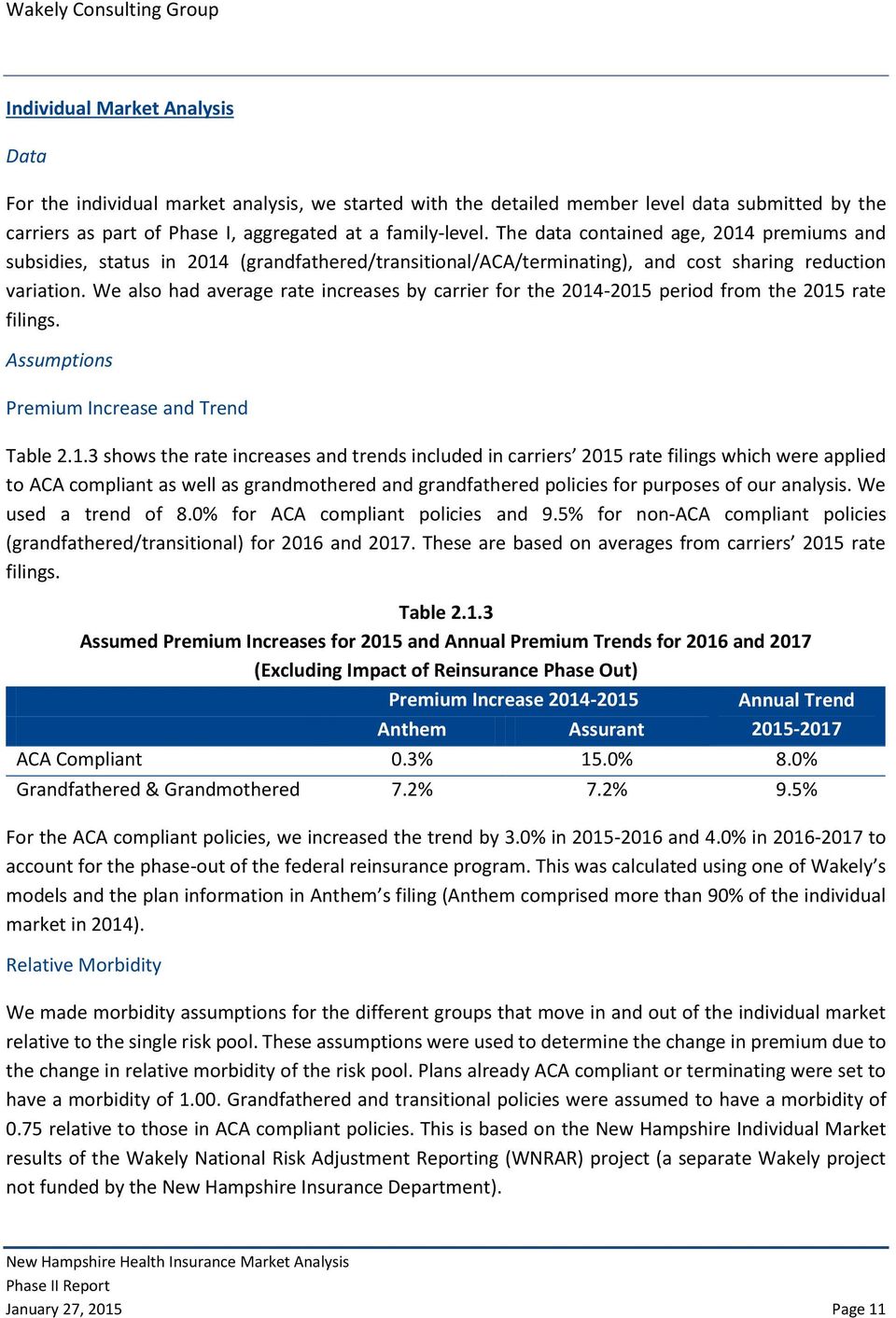
13 Individual Market Analysis Data For the individual market analysis, we started with the detailed member level data submitted by the carriers as part of Phase I, aggregated at a family-level. The data contained age, 2014 premiums and subsidies, status in 2014 (grandfathered/transitional/aca/terminating), and cost sharing reduction variation. We also had average rate increases by carrier for the period from the 2015 rate filings. Assumptions Premium Increase and Trend Table shows the rate increases and trends included in carriers 2015 rate filings which were applied to ACA compliant as well as grandmothered and grandfathered policies for purposes of our analysis. We used a trend of 8.0% for ACA compliant policies and 9.5% for non-aca compliant policies (grandfathered/transitional) for 2016 and These are based on averages from carriers 2015 rate filings. Table Assumed Premium Increases for 2015 and Annual Premium Trends for 2016 and 2017 (Excluding Impact of Reinsurance Phase Out) Premium Increase Annual Trend Anthem Assurant ACA Compliant 0.3% 15.0% 8.0% Grandfathered & Grandmothered 7.2% 7.2% 9.5% For the ACA compliant policies, we increased the trend by 3.0% in and 4.0% in to account for the phase-out of the federal reinsurance program. This was calculated using one of Wakely s models and the plan information in Anthem s filing (Anthem comprised more than 90% of the individual market in 2014). Relative Morbidity We made morbidity assumptions for the different groups that move in and out of the individual market relative to the single risk pool. These assumptions were used to determine the change in premium due to the change in relative morbidity of the risk pool. Plans already ACA compliant or terminating were set to have a morbidity of Grandfathered and transitional policies were assumed to have a morbidity of 0.75 relative to those in ACA compliant policies. This is based on the New Hampshire Individual Market results of the Wakely National Risk Adjustment Reporting (WNRAR) project (a separate Wakely project not funded by the New Hampshire Insurance Department). January 27, 2015 Page 11
14 The previously uninsured are assumed to have a morbidity factor of 1.34 relative to the 2014 risk pool in 2015, 1.12 in 2016, and 1.09 in The uninsured were assigned morbidity based on their self-reported health status and then the weighted average was calculated based on the number of individuals in each health status that were assumed to enter the individual market. The morbidity values were determined from an earlier study conducted by Wakely using New Hampshire data. Population Migration We assumed a portion of those in the individual market would become eligible for Medicaid under the expansion program. Since those with incomes between 100% and 150% FPL are eligible for the 94% CSR plan, we assumed that 72% of those in that plan would become eligible. We also assumed that there were members not enrolled in CSR plans who would be eligible. We assumed that individuals with at least 95% of their premium subsidized were also eligible for the expansion program. This assumption was made so that the number of individuals moving from the individual market in 2014 to the Medicaid expansion was roughly 8,000, based on estimates provided by the New Hampshire Insurance Department. For all other individual market enrollees, we started by developing a 2015 ACA premium by applying the rate increases and ACA trends defined in Table above. For those individuals who are already in ACA compliant plans, we assumed they stay in their same plan and only apply trends and morbidity changes of the single risk pool to get their change in premium. For those in terminating plans, they move into the average ACA plan in 2015 and stay there for the remainder of the modeled years. For grandfathered and transitional policies, we compare their current plan s premium trended forward to the average ACA premium. If the ACA premium is at least 10% less expensive, we assume they will move into an ACA compliant plan. This accounts for some stickiness as members cannot move back into their non-aca compliant plan once they leave. Otherwise, they will maintain their same plan. Since transitional plans will not be allowed in 2017, any remaining transitional plans are forced into ACA plans in Grandfathered plans are assumed to continue. Small Group Market Analysis Data We aggregated individual-level data, collected as part of Phase I of Wakely s engagement with NHID, for groups with up to 100 employees from Anthem, Aetna, Cigna, Harvard Pilgrim, and MVP. These insurers collectively accounted for nearly all of the groups with up to 100 employees in New Hampshire. The data contained 2014 premiums, ACA status in 2014 of grandfathered/transitional/aca/terminating, group size, enrolled months, and age. We also had average rate increases by carrier for the period from the 2015 rate filings. The data had several limitations which required assumptions to produce reasonable results. Most notably, the group size provided in the data was not a reliable indicator of group size. January 27, 2015 Page 12
15 The data reported to Wakely show some groups of size 1 in ACA compliant group plans when ACA forbids groups of 1 to be in the group market. The data reported to Wakely show some groups of size in grandmothered policies, which is not relevant to these size groups in Some individuals did not have a group ID and groups had to be created such that in aggregate their characteristics such as age, income, etc. reconciled to reliable group summaries provided by the carriers as part of the Phase I data collection. Where group size was not available, Wakely used the number of covered subscribers as a proxy. Some groups of had a status of terminating in Wakely s data request defined terminating to refer to plans that are not ACA-compliant/grandfathered/transitional and hence must terminate. This terminology does not apply to large groups. We assumed that terminating meant that for reasons other than ACA, these plans were no longer being offered. Enrollee counts for groups of 2 50 and groups of in this study do not match those from the Phase 1 report. In Phase 1, we used the summarized data which had certain counts by group size. For Phase 2, we needed to use the detailed data provided by the carriers. The counts based on group size reported in the data are different than the summarized data. To determine what groups in non-aca plans would pay if they switched over to ACA plans, we used market-average premiums in New Hampshire small group ACA plans for 2014 and 2015, trended to the appropriate year, and adjusted for the average age of the group. Assumptions Group Size We assumed all groups reported with a size of 1 in ACA compliant plans were actually groups of size 2-50 and thus eligible for ACA compliant policies in the small group market. Trends Based on trends reported in carrier rate filings, we used the same trends for ACA and non-aca policies to calculate 2016 and 2017 premiums. These trends were averaged from carriers 2015 filings and were approximately 7.5%. Relative Morbidity We made morbidity assumptions for cohorts that go in and out of a risk pool relative to that risk pool in the prior year. January 27, 2015 Page 13

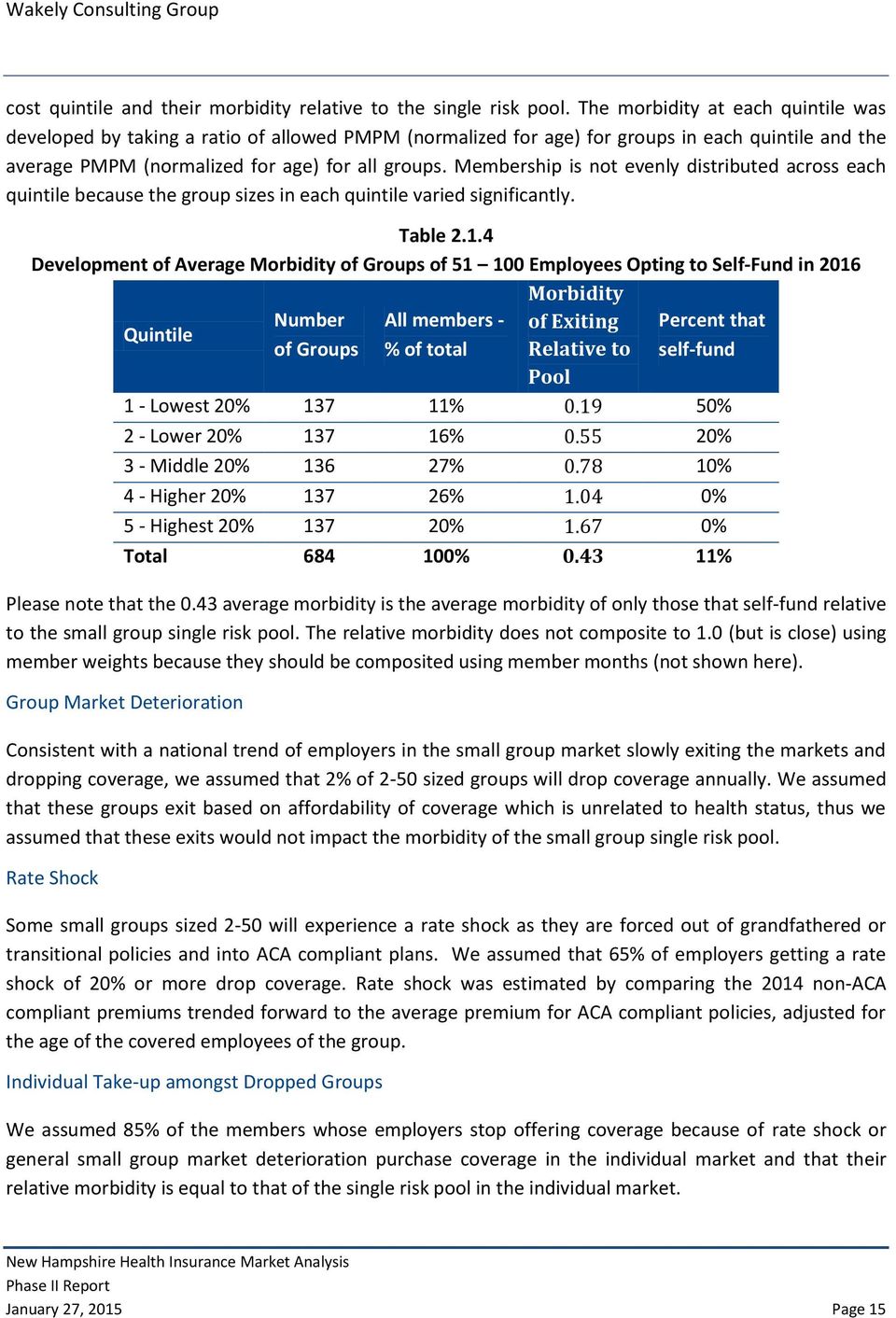
16 Based on analysis performed as part of another project (WNRAR), Wakely estimated the relative morbidity of groups enrolled in grandfathered and transitional plans to be 0.99 relative to the ACA compliant policies in the small group single risk pool. Plans already ACA compliant or terminating in 2014 are set to have a morbidity of 1.0 relative to the small group single risk pool. Previously-uninsured members entering 2-50 small group market are estimated to have a morbidity of 1.22 relative to the 2014 risk pool in 2015, 1.03 in 2016, and 1.0 in The uninsured were assigned morbidity based on their self-reported health status and then the weighted average was calculated based on the number of individuals in each health status that were assumed to enter the small group market. These morbidity values were determined from an earlier study conducted by Wakely using New Hampshire data. Groups of 1 leaving the small group market after 2015 were assumed to have the same morbidity as the small group single risk pool average (so their leaving has no impact on the pool s morbidity). Note that though the Gorman report assumed that groups of 1 had a significantly higher morbidity than other small groups in the pre-aca market, we are assuming that the impact of these groups of 1 on the individual market is already included in the 2015 rates used as a starting point. Groups of size 2-50 that drop group coverage were assumed to have the same morbidity as the small group single risk pool based on the expectation that these groups are dropping coverage for reasons unrelated to morbidity. Groups of size in aggregate (before the impact of self-funding) were assumed to have the same relative morbidity as groups of 2 50 based on NHID s Analysis of Population Health Status by Carrier and Market Segments. 6 Groups of size that leave the market and self-fund are assumed to have a morbidity of 0.62 relative to the small group single risk pool. The table in the Self-Funding section below shows the development of this assumptions. Self-Funding Based on feedback from NHID, we assumed that only groups of size have the option to self-fund (and not groups with under 50 employees). We assumed the percent that self-fund varies by age-adjusted allowed PMPM from 2013 data. The following table shows what % of groups is assumed to self-fund by 6 January 27, 2015 Page 14

17 cost quintile and their morbidity relative to the single risk pool. The morbidity at each quintile was developed by taking a ratio of allowed PMPM (normalized for age) for groups in each quintile and the average PMPM (normalized for age) for all groups. Membership is not evenly distributed across each quintile because the group sizes in each quintile varied significantly. Table Development of Average Morbidity of Groups of Employees Opting to Self-Fund in 2016 Quintile Number of Groups All members - % of total Morbidity of Exiting Relative to Pool Percent that self-fund 1 - Lowest 20% % % 2 - Lower 20% % % 3 - Middle 20% % % 4 - Higher 20% % % 5 - Highest 20% % % Total % % Please note that the 0.43 average morbidity is the average morbidity of only those that self-fund relative to the small group single risk pool. The relative morbidity does not composite to 1.0 (but is close) using member weights because they should be composited using member months (not shown here). Group Market Deterioration Consistent with a national trend of employers in the small group market slowly exiting the markets and dropping coverage, we assumed that 2% of 2-50 sized groups will drop coverage annually. We assumed that these groups exit based on affordability of coverage which is unrelated to health status, thus we assumed that these exits would not impact the morbidity of the small group single risk pool. Rate Shock Some small groups sized 2-50 will experience a rate shock as they are forced out of grandfathered or transitional policies and into ACA compliant plans. We assumed that 65% of employers getting a rate shock of 20% or more drop coverage. Rate shock was estimated by comparing the 2014 non-aca compliant premiums trended forward to the average premium for ACA compliant policies, adjusted for the age of the covered employees of the group. Individual Take-up amongst Dropped Groups We assumed 85% of the members whose employers stop offering coverage because of rate shock or general small group market deterioration purchase coverage in the individual market and that their relative morbidity is equal to that of the single risk pool in the individual market. January 27, 2015 Page 15
18 Methodology Our starting point was group level information on 2014 starting status (ACA, grandfathered, transitional, and terminating), age, enrolled months, premiums, and group size. We developed 2015 ACA premiums by applying rate increases and ACA trends to 2014 ACA premiums. Future ACA premiums were calculated by trending 2015 premiums for ACA compliant plans and trending, age-adjusting, and morbidity-adjusting the 2015 market-average on- and off-exchange ACA premiums. We divided the small group population into three segments (groups of 1, groups of size 2-50, and groups of ) since different rules apply to each that govern how the members move. For each segment, we developed and used decision trees to model the various group and market characteristics that determine the ending statuses of these members. There were approximately 6,400 groups in the data collected for Phase I of Wakely s analysis. Because of the large number of scenarios for each group and the relatively small number of groups, movement of a single group with a large number of members would have caused the results to be artificially sensitive, modeling was performed at the member rather than the group level. For example, when modeling the event that 65% of groups with a rate increase over 20% drop coverage, one must decide which groups will drop and which will stay. When this decision is made at the group level and there are not many groups to move around, the end results become very sensitive to which groups get moved especially if one of the groups is much larger than the other. To get around this artificial sensitivity, we modeled movement at the member level. Going back to the example above, instead of having 65% of the groups drop coverage, we modeled 65% of the members will drop coverage. When comparing premiums across plans and markets, we adjusted for average age and morbidity. However, we were unable to adjust for average benefit richness due to lack of data. We therefore assumed that when someone migrates from small group to individual or from pre-aca plan to an ACA plan, they purchase a plan with the average benefit richness in the market one is migrating to. Groups of 1 Members starting in groups of 1 pre-aca could end up in one of four ending statuses: grandfathered, transitional, individual ACA, or small group ACA depending on where they started. Groups of 1 are not allowed to continue in the group market unless they have grandfathered or transitional status. Otherwise, they go into the individual ACA market. Groups starting in grandfathered plans are likely to stay in grandfathered plans. They may switch to individual ACA plans but since they cannot return to grandfathered plans, the decision will require individual premiums to be significantly lower (after normalizing for age). We used 10% as the threshold. January 27, 2015 Page 16

19 That is, if individual ACA premiums are 10% lower than trended grandfathered premiums, the groups will switch to individual ACA plans. Otherwise they stay grandfathered. Groups starting in grandmothered policies have exactly the same decision tree as grandfathered policies with the exception that grandmothered policies can end in 2016 or 2017 depending on the scenario modeled. When grandmothered policies end, then these groups must move to individual ACA plans if they want to continue coverage. We assumed no such groups drop coverage because they have already indicated preference for coverage and are likely to take up coverage whether it be in the individual or small group market. The remaining groups were in terminating plans and were assigned to Individual ACA plans starting in Groups of 1 starting out in ACA compliant plans were treated as groups of The assumption is that if they are in ACA compliant plans, then they can t be groups of 1. Groups of 2-50 Employees Groups of 2-50 can end in grandfathered, grandmothered, individual ACA, small group ACA, and dropped (uninsured). The ending status depends on what status they started out in. Groups starting out in grandfathered and transitional statuses work exactly the same way as for groups of 1 with the exception that instead of ending up in individual ACA, they end up in small group ACA plans when the appropriate criteria are met. 2% of all grandfathered and transitional employers are assumed to drop coverage and 85% of these members are assumed to take up coverage in the individual ACA market while others go uninsured. Employers in groups of 2-50 that start out in ACA compliant plans or terminating plans in 2014 have to decide whether they stay in ACA compliant plans or stop offering group coverage. 2% are assumed to drop coverage to model the effect of small group market deterioration. The rest will base their decision on their estimated rate increase. For those employers with estimated rate increases exceeding 20%, we assume 65% will drop. Of the members dropped from small group, 85% will purchase individual policies while the rest will end up in the drop bucket meaning they go uninsured or purchase large group coverage through a spouse. To estimate future premiums for groups that started out in ACA compliant plans in 2014, we trended forward their 2014 premiums. For groups that did not start out in ACA compliant plans, we estimated what their premiums would have been under an ACA compliant plan using market average exchange premiums in 2014 and adjusting them for trend, morbidity, and age. January 27, 2015 Page 17
20 Groups of Employees The logic for groups of size does not apply until 2016, as these groups are considered part of the large group market through The grandfathered and transitional logic for groups of is identical to groups of 2-50 with the exception of 2% market deterioration which is assumed not to apply to groups of Additionally, these groups are assumed to not drop coverage but instead may choose to self-fund. 89% of the groups with a status of terminating migrate to the small group ACA market while the rest selffund. This assumption is the same as what is shown in the self-funding section above. 2.2 Limitations of Analysis This report is intended for use by the New Hampshire Insurance Department (NHID) for estimating the impact of various policy changes on the individual and small group health insurance markets in 2016 and The model should not be used or relied upon for any other purposes, including rating by health insurance companies. Wakely does not guarantee the results of this analysis. Differences between the estimates provided in this report and actual amounts will depend on the extent to which future experience conforms to the assumptions used in the model. Actual amounts will differ from projected amounts to the extent actual experience deviates from the assumptions utilized in the analysis. Wakely does not intend to benefit third parties and assumes no duty or liability to other parties who receive this work. The report should only be utilized by qualified individuals with an understanding of the assumptions and limitations. Any results of this analysis should only be shared with complete documentation and with an understanding of the assumptions and limitations of the analysis. In developing the model, Wakely relied on the following information: 2014 health insurance enrollment collected from health insurers, third party administrators, and New Hampshire s Medicaid program. Member level 2014 health insurance premiums collected from health insurers Uninsured individual/household data from the 2013 Current Population Survey 2015 health insurance rate increases from the System for Electronic Rate and Form Filings (SERFF) January 27, 2015 Page 18
21 Post-ACA uninsured estimates from the Society of Actuary s Cost of the Newly Insured under the Affordable Care Act. 7 Estimates of the number of individuals covered in the individual market in 2014 who were eligible for Medicaid expansion provided by NHID. Estimates of the number of individuals projected to enroll in Medicaid expansion provided by NHID. Estimates of the impact of phasing out the ACA transitional reinsurance program developed based on Wakely s reinsurance model. We have not audited or verified these data and other information. If the underlying data or information is inaccurate or incomplete, the results of our analysis may likewise be inaccurate or incomplete. Users of this report should be aware of the following limitations: The analysis relies on many assumptions including employer and individual decisions related to health insurance take-up and plan selection and health insurance trends. Any difference in actual experience will create differences between projected and actual results. The analysis utilized a simplified methodology for estimating premiums for 2016 and 2017 and actual premiums may differ based on the approaches employed by New Hampshire s insurers. The analysis assumes that individuals eligible for Medicaid expansion but enrolled in group plans stay in their group plan. It is Wakely s understanding that many of these individuals may be eligible for Medicaid premium assistance, in which case, the individuals would remain in their current risk pool and not impact premiums in other risk pools. As noted above, the analysis relies on enrollment data collected as part of the Phase I analysis. This data does not capture all New Hampshire residents. Excluded populations include individuals and employer groups covered by insurers with small market share (fewer than 500 covered lives) and New Hampshire residents covered under policies that are not originated in New Hampshire. In Wakely s review of the data compared to other available sources, some differences were identified but could not be resolved. 7 January 27, 2015 Page 19
22 All market changes are assumed to occur as of January 1st of the year being projected. For example, elimination of grandmothered policies in 2017 is modeled such that grandmothered plans are all terminated as of January 1, ENROLLMENT PROJECTIONS BY PROGRAM AREA In order to model the impacts of the expected changes to the individual and small group markets, Wakely had to make various assumptions about the uninsured and Medicaid populations as described above. Table shows the expected changes for each of the insurance markets and coverage areas that were included in the analysis. Note that due to limitations in the data collected as part of the Phase I analysis, the totals in Table are not reflective of the entire New Hampshire population under age 65 and excludes groups not covered by the carriers included in Wakely s data collection (see Phase I report for more information). It also excludes New Hampshire residents in policies that are not sitused in New Hampshire. Table Projected Enrollment in the New Hampshire Small Group Market Through 2017 Market Medicaid - Non-Expansion 127, , , ,023 Medicaid - Expansion 0 21,643 27,205 0 Medicaid - Expansion Employer Premium Subsidy 0 10,000 14,000 0 Individual - ACA Compliant 39,204 60,783 79, ,431 Individual - Terminating 6, Individual - Grandmothered 8,714 8,166 7,686 0 Individual - Grandfathered 5,914 4,660 3,813 3,813 Small Group (<50) - ACA Compliant* 12,264 45,774 46,983 68,180 Small Group (<50) - Terminating* 34, Small Group (<50) - Grandmothered* 29,070 24,399 23,640 0 Small Group (<50) - Grandfathered* 1, Mid-Size Group (51-100) - ACA Compliant* ,722 21,415 Mid-Size Group (51-100) - Terminating* 21,011 20, Mid-Size Group (51-100) - Grandmothered* 1, Mid-Size Group (51-100) - Grandfathered* 1,336 1, Large Group (101+) and Self-Funded 370, , , ,892 Uninsured 121,827 88,572 61,685 78,052 Total 780, , , ,902 *Excludes self-funded January 27, 2015 Page 20
23 The following is a summary of changes reflected in Table Please see the Methodology, Assumptions and Limitations of Analysis section for additional details. Traditional Medicaid: Small growth in the traditional (non-expansion) Medicaid population. New Hampshire experienced an increase of 9,431 traditional, non-expansion, Medicaid enrollees as a result of the implementation of the 2014 changes under the ACA. This is known as the woodwork effect, since this population was eligible for, but not enrolled in Medicaid prior to Medicaid Expansion: The Medicaid expansion population is projected to include roughly 32,000 enrollees in 2015 and 41,000 in Approximately 10,000 of the 2015 enrollees and 14,000 of the 2016 enrollees are expected to have coverage through employer sponsored plans and potentially be eligible for premium assistance through the Medicaid program. These individuals are assumed not to be enrolling in QHPs in 2016, and remain in their current risk pools. Individual Market: The number of individuals enrolled in plans in the individual market (excluding the Medicaid expansion population) is expected to increase as additional uninsured take-up insurance as a result of the federal premium subsidies available and the increase in penalties for not having insurance. There is also an expectation that small employers (under 50 employees) will continue to drop coverage given the viability of the individual market and the availability of federal subsidies for low wage employees. There will also be a shift as individual market policyholders move from grandfathered and grandmothered policies to ACA-compliant plans. Small Group Market (2 50 employees): Similar to the individual market, the small group market will experience a shift from grandfathered and grandmothered policies to ACA-compliant plans over time. Overall, there is an expectation that some small group employers will drop coverage and these formerly covered employees will find coverage either in the individual market or through a spouse s employer plan. Mid-Size Group Market: Employer groups with employees will become part of the small group, ACA-compliant market beginning in 2016 unless they are in grandfathered plans or choose to self-fund (likely with stop loss coverage). Wakely does not expect many of these groups to drop coverage, assuming the employer mandate will begin to apply to these groups starting in 2016 (based on current law and guidance). Large Group and Self-Funded Groups: These groups are assumed to not drop coverage. However, some employees in this group are assumed to be eligible for Medicaid expansion, and as noted above, some individuals who lose coverage through their current employer may take-up coverage through a spouse s plan. Uninsured: The number of uninsured is expected to decrease through 2016 as a result of the expansion of Medicaid, increases in the number of enrollees in traditional, non-expansion January 27, 2015 Page 21
24 Medicaid, and additional take-up in the individual market as awareness of federal subsidies and penalties for not having insurance increases. See the Methodology, Assumptions and Limitations of Analysis section for more information on how changes to the uninsured population were modeled. The projected number of uninsured increases in 2017 as a result of the expected sunsetting of the Medicaid expansion program. If Medicaid expansion does not sunset, the number of uninsured is estimated to be 59, INDIVIDUAL MARKET SINGLE RISK POOL IMPACTS The changes anticipated to the markets, including Medicaid expansion and elimination of transitional policies, is expected to have the greatest impact on the individual market. The following outlines the expected impact based on the methodology and assumptions outlined in Section 2 of this report. 4.1 Population Migration Impacting Single Risk Pool Table outlines the expected changes to the individual market single risk pool based on where each population started in Enrollment in this market is expected to increase significantly as changes in other parts of the health insurance market occur as described following the table. Table Projected Enrollment in the New Hampshire Individual Market Single Risk Pool Status in Individual - ACA Compliant 39,204 31,331 31,331 39,204 Individual - Terminating 6,963 6,963 6,963 Individual - GF/GM 1,802 3,129 10,815 Medicaid - Expansion 0 24,485 0 Small Group Market 5,212 6,420 10,715 Mid-Size Group Market Uninsured 15,475 31,879 34,734 Total Individual Market Risk Pool 39,204 60, , ,431 The following describes the projected enrollment changes for each of the populations included in Table Unlike Table 1.1.1, Table includes the Medicaid Expansion population which is expected to be part of the individual market single risk pool in Individual ACA Compliant: Based on the data collected from individual market health insurers, there were approximately 39,200 enrollees in ACA compliant plans in the individual market in April/June In 2015, roughly 31,000 are expected to remain in the single risk pool, as some will be eligible for Medicaid expansion (which makes them ineligible for subsidies available through the Exchange). January 27, 2015 Page 22
25 Individual Terminating: Roughly 7,000 individuals were reported in the 2014 enrollment data as being enrolled in 2013 plans that would be terminating in We are assuming that in 2015, these individuals will enroll in ACA compliant policies. Individual Grandfathered / Grandmothered: Of the roughly 14,600 total enrollees reported to be in grandfathered or grandmothered policies in 2014, we expect about 1,800 will migrate into ACA compliant policies in 2015, an additional 1,300 will migrate in 2016 and then another 7,700 will move into ACA compliant policies in 2017 when grandmothered policies are no longer allowed to continue. Medicaid Expansion: Our baseline scenario assumes the Medicaid expansion population will receive coverage through QHPs in Wakely estimates that roughly 24,500 Medicaid expansion enrollees will be included as part of the individual market. Small Group Market: As small groups are assumed to drop coverage as their rates increase and the individual market becomes more robust, we estimate that many of those enrollees will takeup insurance in the individual market. Uninsured: As awareness of the provisions of the ACA increase, more of the uninsured population is expected to enroll in coverage through the individual market. 4.2 Population Morbidity Impact on Single Risk Pool The ACA requires that individual policies (other than those that are grandfathered or grandmothered) be rated as part of a single risk pool, with rates for any individual set based only on age, geography and tobacco use. Populations moving in and out of the single risk pool will have an impact on the rates that are charged for the entire pool. The populations that will have the most significant impact on the single risk pool in 2016 and 2017 are the additional uninsured taking up insurance, the Medicaid expansion population and the grandmothered and grandfathered populations that migrate into ACA compliant plans. The impact of these changes on the morbidity of the individual market risk pool is summarized in Table January 27, 2015 Page 23
26 Table Projected Impact on Morbidity in the New Hampshire Individual Market Single Risk Pool Impact from Impact from Migration Category 2015 to to 2017 Migration of individuals from GF / GM to ACA compliant policiies -0.4% -1.8% Increased take-up among uninsured -3.2% -0.6% Inclusion of Medicaid expansion population into QHPs -2.4% N/A Exclusion of Medicaid expansion population from QHPs N/A +1.5% Cumulative Impact -5.9% -0.9% As take-up in the individual market Health Insurance Exchange increases, the population morbidity is expected to decrease. This is due to the expectation that those who are the least healthy will have already enrolled in coverage in 2014 and 2015, and that those newly entering the individual market (from uninsured status) will be healthier than those already enrolled. As the penalty for not having health insurance increases, more of the healthier population will be incented to enroll in coverage. In the absence of the Medicaid expansion population entering the individual market, these additional individuals entering the individual market, are expected to result in a decrease of 3.2% in the morbidity of the market. The impact of the Medicaid expansion population moving into the individual market single risk pool will depend heavily on the take-up in Medicaid expansion. Wakely s estimate assumes that approximately 76% of the uninsured population eligible for Medicaid expansion will take-up the program by 2016, and that the relative morbidity (health risk after normalizing for demographics) will be roughly 9% lower than that of the single risk pool prior to the inclusion of the Medicaid expansion. On a normalized basis, this population is expected to improve the cost of the individual market single risk pool by 2.4%. If actual takeup is lower than assumed, the single risk pool morbidity level will be higher than Wakely s estimates, and vice versa if take-up is higher than assumed. As part of a separate project for health insurers, Wakely found that based on emerging 2014 claims experience in New Hampshire, individuals enrolled in grandmothered and grandfathered policies were roughly 25% less costly than individuals enrolled in single risk pool policies based on health status (i.e., normalizing for demographic differences). This indicates that as those individuals move into the single risk pool, they will improve the overall health risk level of the single risk pool. Based on Wakely s analysis, the cumulative impact of these individuals migrating to ACA compliant policies over two years is roughly 2.2%. 4.3 Individual Market Single Risk Pool Premium Changes Premiums in the individual market will be impacted by the changes in morbidity described above, as well as medical trend and the phase out of the federal reinsurance program, which uses contributions collected from all sectors of the health insurance market (including individual, small group and large group insured and self-funded plans) to offset the costs of high cost enrollees in the individual market in 2014 through January 27, 2015 Page 24
27 2016. The program phases down over three years and is expected to expire in Based on the proposed program parameters for 2016, Wakely expects the phase out of the reinsurance program to contribute +3% to health insurance premium increases from 2015 to 2016, and +4% from 2016 to 2017 (assuming the program is expired in 2017). These adjustments are based on the current proposed reinsurance parameters, which are subject to change. Expected trends, based on those filed by New Hampshire insurers are expected to be 8% per year for these policies. Normalized for changes in the expected mix of age and plan selections by individuals in the individual market, the impact of morbidity, trend and the phase out of the transitional reinsurance program are expected to result in average premium increases of approximately 5.1% from 2015 to 2016 and 11.1% from 2016 to Actual premiums may vary based on a variety of factors, including updated trend and migration assumptions, plan design changes and resulting changes in utilization, changes in networks or medical management programs, changes in issuer administrative expenses and profits, and other assumptions made by the issuers in New Hampshire. 5. SMALL GROUP MARKET IMPACTS In the next few years, the small group single risk pool will be impacted by the migration of groups from grandfathered / grandmothered policies into ACA compliant plans. Additionally, the ACA requires the small group market to expand to include groups with up to 100 employees beginning in Based on current guidance, states have the option to allow carriers to continue groups of in their current, non-aca compliant policies for renewal through October 1, The baseline scenario modeled assumes that all employer groups with employees migrate to small group, ACA compliant plans as of January 1, 2016, unless they are grandfathered (as reported by carriers as part of the Phase I analysis) or choose to self-fund. The following summarizes Wakely s projections of these impacts on New Hampshire s small group single risk pool. 5.1 Population Migration Impacting Single Risk Pool Table outlines the expected changes to the small group market single risk pool enrollment based on where each population started in Enrollment in the single risk pool is expected to increase significantly as changes in other parts of the health insurance market occur as described following the table. January 27, 2015 Page 25
28 Table Projected Enrollment in the New Hampshire Small Group Market Single Risk Pool Status in Small Group (<50) - ACA Compliant 12,264 12,019 11,778 11,543 Small Group (<50) - Terminating 29,245 28,660 28,087 Small Group (<50) - GF/GM 3,357 3,289 23,577 Mid-Size Group (51 100) 0 19,619 20,637 Uninsured 2,145 4,643 5,751 Total Small Group Market Risk Pool 12,264 46,765 67,990 89,594 The following describes the projected enrollment changes for each of the populations included in Table Small Group (<50) ACA Compliant: Based on data collected as part of the Phase II analysis, Wakely found that only a small proportion (16%) of the small group market had enrolled in ACA compliant policies as of April/May 2014 and that most small groups had either opted for early renewal (in which case their non-aca compliant plans would continue until the end of 2014), or they were enrolled in grandfathered or grandmothered plans. As noted in the assumptions, Wakely is assuming that there is a drop in small groups that continue to offer policies to their employees each year as a result of general trends related to small employer drops in coverage (and penalties do not apply to these groups). Small Group (<50) Terminating: These are the groups that were reported by carriers to be enrolled in non ACA compliant plans that would not be eligible for renewal at the end of their plan year. Roughly 29,200 enrollees in this category reported in the 2014 enrollment data are expected to migrate to the small group market single risk pool in Small Group (<50) GF / GM: Of the approximately 30,000 enrollees in grandmothered / grandfathered small group policies reported in the spring of 2014, roughly 3,300 are expected to migrate to ACA compliant policies in 2016 and an additional 20,200 are expected to move to ACA compliant plans when grandmothered policies can no longer be offered in 2017 (or earlier should the state and/or issuers choose to terminate the policies). Mid-Size Group (51 100): Employer groups with enrollees will be included in the small group market in Wakely estimates this will increase the small group market by roughly 20,600 enrollees after accounting for those that choose to self-fund. Uninsured: As noted in Section 2 of the report, Wakely is assuming additional take-up of uninsured individuals as penalties for not having health insurance increase (leveling off in 2016). Since a subset of the uninsured population is expected to have access to employer sponsored January 27, 2015 Page 26
29 coverage, we are assuming some increase in small group market enrollment as a result of these additional uninsured taking up insurance. 5.2 Population Morbidity Impact on Single Risk Pool Similar to the individual market, the small group policies (other than those that are grandfathered or grandmothered) are rated as part of a separate single risk pool. Populations moving in and out of the single risk pool will have an impact on the rates that are charged for the entire pool. The populations that will have the most significant impact on the single risk pool in 2016 and 2017 are the migration of groups from grandmothered and grandfathered policies to ACA-compliant policies, uninsured who take-up insurance to avoid the penalty for not having insurance, and entry of groups of into the small group single risk pool. Groups that leave the small group market risk pool, including groups of 1 that are no longer considered small group under ACA, groups that self-fund, and groups that drop coverage are assumed in this analysis to not have an impact on the overall morbidity of the pool. The impact of the changes on the morbidity of the individual market risk pool is summarized in Table Table Projected Impact on Morbidity in the New Hampshire Small Group Market Single Risk Pool Impact from Impact from Migration Category 2015 to to 2017 Migration of individuals from GF / GM Policies to ACA compliant 0.0% -0.4% Increased take-up among uninsured -0.7% -0.2% Inclusion of groups in single risk pool +2.6% N/A Cumulative Impact +1.9% -0.6% As part of a separate project for health insurers, Wakely found that based on emerging claims experience in New Hampshire, groups in grandmothered and grandfathered policies were roughly 1% less costly than groups in single risk pool policies based on 2014 health status (i.e., normalizing for demographic differences). This indicates that as those grandfathered and grandmothered groups move into the single risk pool, they will slightly improve the overall health risk level of the single risk pool. Groups of will enter the ACA small group single risk pool when the small group market is expanded in To comply with ACA small group rating restrictions, groups may lose their preferred rating statuses in effect prior to ACA compliance. For example, Larger groups have a smaller rate up factor than smaller sized groups due to the group size rating factor. This rating factor is no longer allowed and hence, larger groups that were benefiting from this rating factor will get a rate-up to subsidize the smaller groups. January 27, 2015 Page 27
30 Groups with younger populations will get a rate increase and the older groups will receive a rate decrease due to the ACA age rating restrictions. Groups that may have had lower rates due to a healthier population than average will now be part of the single risk pool and will no longer benefit from the health status of their populations. As these groups join the single risk pool some groups, especially those with younger and/or healthier populations, will experience large rate increases. These groups of will consider self-funding as an option. We assumed 50% of the healthiest groups, 10-20% of the moderately healthy, and 0% of the sicker groups in the single risk pool will choose to self-fund and leave the single risk pool. This equates to 11% of the total members leaving the single risk pool and their morbidity is 0.43 relative to the single risk pool. This will leave the less healthy groups of to join the small group risk pool, increasing the morbidity of the single risk pool. 5.3 Small Group Market Single Risk Pool Premium Changes Premiums in the small group market will be impacted by the changes in morbidity described above, as well as medical trend (the federal reinsurance program does not apply to the small group market). Expected trends, based on those filed by New Hampshire insurers, are expected to be 7.5% per year for these policies. Normalized for changes in the expected mix of age and plan selections in the small group market, the impact of morbidity and trend are expected to result in average premium increases of approximately 9.4% from 2015 to 2016 and 6.9% from 2016 to Actual premiums may vary based on a variety of factors, including updated trend assumptions, plan design changes and resulting changes in utilization, changes in networks or medical management programs, changes in issuer administrative expenses and profits, and other assumptions made by the issuers in New Hampshire. 6. CONCLUSIONS The anticipated changes to the health insurance markets over the next few years are expected to have a greater impact on the individual market than they will on the small group market. Enrolling the Medicaid expansion population in QHPs is expected to have a positive impact on the morbidity of the individual market, as is the phase out of grandmothered policies. In the small group market, the phase out of the grandmothered policies is expected to have minimal impact on the overall morbidity of the small group market single risk pool. Expansion of the small group market to groups with up to 100 employees could have a negative impact on the small group market single risk pool morbidity level, if a large number of healthier groups choose to self-fund. January 27, 2015 Page 28
31 7. ACTUARIAL CERTIFICATION I, Julia Lerche, am a Fellow in the Society of Actuaries (FSA) and a member of the American Academy of Actuaries (MAAA). I meet the qualification standards for performing the actuarial analyses included in this report. Wakely Consulting Group, Inc. relied on information provided by NHID, active issuers and TPAs in New Hampshire, health insurance rate filings on SERFF, and publicly available information to develop the analysis in this report. Please refer to the Methodology, Assumptions and Limitations of Analysis section for information on these reliances and limitations of the analysis. January 27, 2015 Page 29
New Hampshire Health Insurance Market Analysis
 New Hampshire Health Insurance Market Analysis REPORT PREPARED FOR NEW HAMPSHIRE INSURANCE DEPARTMENT BY JULIA LERCHE, FSA, MAAA, MSPH CHIA YI CHIN BRITTNEY PHILLIPS AUGUST 18, 2014 TABLE OF CONTENTS 1.
How To Determine The Impact Of The Health Care Law On Insurance In Indiana
 ACA Impact on Premium Rates in the Individual and Small Group Markets Paul R. Houchens, FSA, MAAA BACKGROUND The Patient Protection and Affordable Care Act (ACA) introduces significant changes in covered
ACA Premium Impact Variability of Individual Market Premium Rate Changes Robert M. Damler, FSA, MAAA Paul R. Houchens, FSA, MAAA
 ACA Premium Impact Variability of Individual Market Premium Rate Changes Robert M. Damler, FSA, MAAA Paul R. Houchens, FSA, MAAA BACKGROUND The Patient Protection and Affordable Care Act (ACA) introduces
2. EXECUTIVE SUMMARY. Assist with the first year of planning for design and implementation of a federally mandated American health benefits exchange
 2. EXECUTIVE SUMMARY The Patient Protection and Affordable Care Act of 2010 and the Health Care and Education Reconciliation Act of 2010, collectively referred to as the Affordable Care Act (ACA), introduces
The Impact of the ACA on Wisconsin's Health Insurance Market
 The Impact of the ACA on Wisconsin's Health Insurance Market Prepared for the Wisconsin Department of Health Services July 18, 2011 Gorman Actuarial, LLC 210 Robert Road Marlborough, MA 01752 Jennifer
Nevada Health Insurance Market Study
 Nevada Health Insurance Market Study Prepared for the State of Nevada March 2012 Gorman Actuarial, LLC 210 Robert Road Marlborough, MA 01752 Bela Gorman, FSA, MAAA Don Gorman Jenn Smagula, FSA, MAAA Gorman
Federal exchange auto-enrollment: Emerging data and new proposals
 Federal exchange auto-enrollment: Emerging data and new proposals Jason A. Clarkson, FSA, MAAA William A. Gibula, ASA, MAAA Paul R. Houchens, FSA, MAAA EXECUTIVE SUMMARY The U.S. Department of Health and
In preparing the February 2014 baseline budget
 APPENDIX B Updated Estimates of the Insurance Coverage Provisions of the Affordable Care Act In preparing the February 2014 baseline budget projections, the Congressional Budget Office () and the staff
Assist with the first year of planning for design and implementation of a federally mandated American Health Benefit Exchange
 Assist with the first year of planning for design and implementation of a federally mandated American Health Benefit Exchange August 31, 2011 Prepared for: Ohio Department of Insurance Prepared by: Jeremy
STATE OF CONNECTICUT
 STATE OF CONNECTICUT INSURANCE DEPARTMENT Aetna Life Insurance Company Individual Off-Exchange 2016 Rate Filing Finding of Facts 1. The purpose of this filing is to provide details of the premium rate
THE AFFORDABLE CARE ACT ( ACT ), NEW EMPLOYER MANDATES, AND IMPACTS ON EMPLOYER- SPONSORED HEALTH INSURANCE PLANS
 Community THE AFFORDABLE CARE ACT ( ACT ), NEW EMPLOYER MANDATES, AND IMPACTS ON EMPLOYER- SPONSORED HEALTH INSURANCE PLANS Prepared for the 2014 Massachusetts Municipal Association Annual Meeting On March
Wyoming Health Insurance Market Study Preliminary Results
 Wyoming Health Insurance Market Study Preliminary Results October 10, 2011 Gorman Actuarial, LLC Status Update PCG, along with Gorman Actuarial, has been engaged by the State of Wyoming to perform a Health
North Carolina Department of Insurance
 North Carolina Department of Insurance North Carolina Actuarial Memorandum Requirements for Rate Submissions Effective 1/1/2016 and Later Small Group Market Non grandfathered Business These actuarial memorandum
Actuarial Analysis: Impact of the Affordable Care Act (ACA) on Small Group and Individual Market Premiums in Oregon
 Actuarial Analysis: Impact of the Affordable Care Act (ACA) on Small Group and Individual Market Premiums in Oregon Prepared on July 31, 2012 Prepared for: The Prepared by: Wakely Consulting Group Julie
Issue Brief: The Health Benefit Exchange and the Small Employer Market
 Issue Brief: The Health Benefit Exchange and the Small Employer Market Overview The federal health care reform law directs states to set up health insurance marketplaces, called Health Benefit Exchanges,
Washington State Health Insurance Pool - Board Education March 2012
 - Board Education March 2012 What are the new 3 R s? The 3 R s are the risk leveling programs required by the Affordable Care Act (ACA) to help protect insurers in the individual and small group markets
The Health Benefit Exchange and the Commercial Insurance Market
 The Health Benefit Exchange and the Commercial Insurance Market Overview The federal health care reform law directs states to set up health insurance marketplaces, called Health Benefit Exchanges, that
Prepared for Minnesota Department of Commerce. April, 2012
 The Impact of the ACA and Exchange on Minnesota Prepared for Minnesota Department of Commerce April, 2012 Dr. Jonathan Gruber MIT Department of Economics 50 Memorial Drive Cambridge, MA 02142 Gorman Actuarial,
Age Rating Under Comprehensive Health Care Reform: Implications for Coverage, Costs, and Household Financial Burdens
 Age Rating Under Comprehensive Health Care Reform: Implications for Coverage, Costs, and Household Financial Burdens Timely Analysis of Immediate Health Policy Issues October 2009 Linda J. Blumberg, Matthew
Presenter: Darrell D. Knapp, FSA, MAAA
 Presenter: Darrell D. Knapp, FSA, MAAA Valuation Boot Camp for Health Actuaries SESSION 2C Darrell Knapp November 3, 2015 Valuation Issues from ACA Premium stabilization programs Transitional Reinsurance
Health insurance Marketplace. What to expect in 2014
 Health insurance Marketplace What to expect in 2014 Overview The Affordable Care Act (ACA) includes several provisions geared to extend greater access to health insurance benefits to more people. Beginning
PENALTIES Employer Shared Responsibility under the Affordable Care Act (ACA)
 PENALTIES Employer Shared Responsibility under the Affordable Care Act (ACA) What employers need to know to make informed decisions about ACA compliance. Employer Shared Responsibility Under the employer
2015 OEP: Insight into consumer behavior
 2015 OEP: Insight into consumer behavior Center for U.S. Health System Reform March 11, 2015 OVERVIEW As the Affordable Care Act s (ACA s) second individual market open enrollment period (OEP) came to
Connecticut Health Insurance Exchange. June 2012 [SHOP BRIEFING] An overview of the Small Business Health Options Program (SHOP) Exchange
![Connecticut Health Insurance Exchange. June 2012 [SHOP BRIEFING] An overview of the Small Business Health Options Program (SHOP) Exchange](/thumbs/32/15645614.jpg "Connecticut Health Insurance Exchange. June 2012 [SHOP BRIEFING] An overview of the Small Business Health Options Program (SHOP) Exchange") Connecticut Health Insurance Exchange June 2012 [SHOP BRIEFING] An overview of the Small Business Health Options Program (SHOP) Exchange Overview The federal health care reform law directs states to set
Connecticut Health Insurance Exchange June 2012 [SHOP BRIEFING] An overview of the Small Business Health Options Program (SHOP) Exchange Overview The federal health care reform law directs states to set
Two Choices. The Affordable Care Act requires every individual to either: 1. Maintain Minimum Essential Coverage, or
 Information last updated September 9, 2014 1 Two Choices The Affordable Care Act requires every individual to either: 1. Maintain Minimum Essential Coverage, or 2. Make a Shared Responsibility Payment.
Report to the Health Care Access Bureau Within the Massachusetts Division of Insurance
 June 2010 Report to the Health Care Access Bureau Within the Massachusetts Division of Insurance Analysis of Individual Health Coverage In Massachusetts Before and After the July 1, 2007 Merger of the
Insurance Coverage Provisions of the Affordable Care Act CBO s March 2015 Baseline
 Insurance Coverage Provisions of the Affordable Care Act CBO s March 2015 Baseline Table 1. Direct Spending and Revenue Effects of the Insurance Coverage Provisions of the Affordable Care Act Table 2.
Presentation for Licensed Producers The Affordable Care Act
 Presentation for Licensed Producers The Affordable Care Act Bruce Donaldson, CHC Producer & Stakeholder Specialist Arkansas Insurance Department Affordable Care Act The ACA was passed by Congress and signed
The Role of Insurance Agents and Brokers Under Health Care Reform
 T HE J AECKLE A LERT HEALTH CARE PRACTICE GROUP ATTORNEY ADVERTISING The Role of Insurance Agents and Brokers Under Health Care Reform The New York Health Benefit Exchange, the health insurance exchange
How To Calculate The Cost Of A Health Insurance Tax Credit In Oregona
 Oregon Health Fund Board INITIAL ECONOMETRIC MODELING FOR THE OREGON HEALTH FUND BOARD Final Report February 2009 SUMMARY The Oregon Health Fund Board worked with consultants from the Massachusetts Institute
Medicare versus Private Health Insurance: The Cost of Administration. Presented by: Mark E. Litow, FSA Consulting Actuary.
 Medicare versus Private Health Insurance: The Cost of Administration Presented by: Mark E. Litow, FSA Consulting Actuary January 6, 2006 Medicare versus Private Health Insurance: The Cost of Administration
THE FUTURE OF EMPLOYER BASED HEALTH INSURANCE FOLLOWING HEALTH REFORM
 THE FUTURE OF EMPLOYER BASED HEALTH INSURANCE FOLLOWING HEALTH REFORM National Congress on Health Insurance Reform Washington, D.C., January 20, 2011 Elise Gould, PhD Health Policy Research Director Economic
Update: Health Insurance Reforms and Rate Review. Health Insurance Reform Requirements for the Group and Individual Insurance Markets
 By Katherine Jett Hayes and Taylor Burke Background Update: Health Insurance Reforms and Rate Review The Patient Protection and Affordable Care Act (ACA) included health insurance market reforms designed
Issue Brief. Small Firm Self-Insurance Under the Affordable Care Act. Matthew Buettgens and Linda J. Blumberg OVERVIEW
 November 2012 Issue Brief Small Firm Self-Insurance Under the Affordable Care Act Matthew Buettgens and Linda J. Blumberg The Urban Institute The mission of The Commonwealth Fund is to promote a high performance
Healthcare Reform Provisions Unique to Small Employers/Financial and Other Benefits Concerns for All Employers (updated May 2, 2014)
 /Financial and Other Benefits Concerns for All Employers (updated May 2, 2014) Lisa L. Carlson, J.D., Area Senior Vice President, Compliance Counsel Gallagher Benefit Services, Inc. While most healthcare
Health Care Reform: A Guide for Self-Funded Plans. Key steps to prepare for 2014 Preparing for the future Snapshot of reform (2010-2019)
 Health Care Reform: A Guide for Self-Funded Plans Key steps to prepare for 2014 Preparing for the future Snapshot of reform (2010-2019) Table of Contents Health Care Reform is Here: Are you ready? 3 Key
Why the market demand for limited-benefit health plans will grow in 2014 and beyond: a factbased
 Why the market demand for limited-benefit health plans will grow in 2014 and beyond: a factbased analysis. Timothy L. Cook, Strategic Business Development, Ternian Insurance Group LLC Ternian Insurance
Eligibility for Medi-Cal and the Health Insurance Exchange in California under the Affordable Care Act
 UNIVERSITY OF CALIFORNIA, BERKELEY CENTER FOR LABOR RESEARCH AND EDUCATION ISSUE BRIEF Eligibility for Medi-Cal and the Health Insurance Exchange in California under the Affordable Care Act by Ken Jacobs,
Children s Health Coverage Under the ACA Part III: Issue Diagnosis Evolutionary Challenges
 Children s Health Coverage Under the ACA Part III: Issue Diagnosis Evolutionary Challenges Prepared by Carolina Coleman Funded by the Lucile Packard Foundation for Children s Health January 2014 This brief
Kansas Insurance Department
 Kansas Insurance Department The Affordable Care Act What Happens Now? Kansas Society of CPAs June 5, 2013 Linda J. Sheppard, Special Counsel & Director of Health Care Policy and Analysis 2010 Affordable
STATE OF CONNECTICUT
 STATE OF CONNECTICUT INSURANCE DEPARTMENT ConnectiCare Inc. HMO Individual Off Exchange 2016 Finding of Facts 1. The starting rates for this Individual Direct product have been developed as follows. The
Health care reform for large businesses
 FOR PRODUCERS AND EMPLOYERS Health care reform for large businesses A guide to what you need to know now DECEMBER 2013 CONTENTS 2 Introduction Since 2010 when the Affordable Care Act (ACA) was signed into
Health Care Reform Update
 Small Businesses No Financial Requirements for Small Businesses: The ACA imposes no financial requirements for small businesses to contribute to their employees health insurance. However, beginning in
Health Care Reform Update. Spring 2014
 Health Care Reform Update Spring 2014 Quincy Quinlan Texas Association of Counties 512 478 8753 [email protected] http://www.county.org Today s Agenda Timeline Fees/Taxes Individual Mandate Marketplace
Illinois Exchange Background Research and Needs Assessment Final Report and Findings. Governor s Reform Implementation Council October 14, 2011
 Illinois Exchange Background Research and Needs Assessment Final Report and Findings Governor s Reform Implementation Council October 14, 2011 Research & Assessment Illinois, using Federal grant money,
The Large Business Guide to Health Care Law
 The Large Business Guide to Health Care Law How the new changes in health care law will affect you and your employees Table of contents Introduction 3 Part I: A general overview of the health care law
Evaluating Medicaid s Options & Obligations After the Supreme Court s ACA Decision. Washington Health Care Authority August 8, 2012
 Evaluating Medicaid s Options & Obligations After the Supreme Court s ACA Decision Washington Health Care Authority August 8, 2012 Overview of the Supreme Court Decision Overview of the Decision A divided
OVERVIEW OF PRIVATE INSURANCE MARKET REFORMS IN THE PATIENT PROTECTION AND AFFORDABLE CARE ACT AND RESOURCES FOR FREQUENTLY ASKED QUESTIONS
 OVERVIEW OF PRIVATE INSURANCE MARKET REFORMS IN THE PATIENT PROTECTION AND AFFORDABLE CARE ACT AND RESOURCES FOR FREQUENTLY ASKED QUESTIONS Brief Prepared by MATTHEW COKE Senior Research Attorney LEGISLATIVE
HEALTH CARE REFORM FREQUENTLY ASKED QUESTIONS
 HEALTH CARE REFORM FREQUENTLY ASKED QUESTIONS Consumers When will the health care reform law take effect? The health insurance reforms adopted as part of the Patient Protection and Affordable Care Act
HEALTH INSURANCE MARKETPLACE SURVIVAL GUIDE FOR SMALL BUSINESS. New York Edition
 HEALTH INSURANCE MARKETPLACE SURVIVAL GUIDE FOR SMALL BUSINESS New York Edition NAVIGATING NEXT STEPS IN HEALTH CARE REFORM PAGE 2 www.discovermvp.com There s a constant stream of changes and updates related
Patient Protection and Affordable Care Act (ACA) ACA Guide for Group Employers Agent and Broker Information
 Patient Protection and Affordable Care Act (ACA) ACA Guide for Group Employers Agent and Broker Information DISCLAIMER 2 This information is being provided in an effort to alert you to changes required
Health care reform at-a-glance. December 2013
 December 2013 Employer mandate Play or pay penalty for failing to offer coverage to at least 95% of all full-time employees (FTE) and children if any FTE gets subsidy in exchange $2,000 (indexed) times
Health Care Reform Frequently Asked Questions
 Health Care Reform Frequently Asked Questions On March 23, 2010, President Obama signed federal health care reform into law, also known as the Patient Protection and Affordability Act. A second, or reconciliation
Updated Estimates for the Insurance Coverage Provisions of the Affordable Care Act
 MARCH 2012 Updated Estimates for the Insurance Coverage Provisions of the Affordable Care Act In preparing the March 2012 baseline budget projections, the Congressional Budget Office (CBO) and the staff
Washington Health Benefit Exchange. Leading Age 2014 Annual Conference. Phil Dyer Board Member
 Washington Health Benefit Exchange Leading Age 2014 Annual Conference Phil Dyer Board Member DISCLAIMER; The views and information expressed are my personal opinions and perspectives and do not represent