
A Guide to Effective Instruction in Mathematics Kindergarten to Grade 6
|
|
|
- Della Kellie Patterson
- 10 years ago
- Views:
Transcription
1 A Guide to Effective Instruction in Mathematics Kindergarten to Grade 6 A Resource in Five Volumes from the Ministry of Education Volume One Foundations of Mathematics Instruction
2 Every effort has been made in this publication to identify mathematics resources and tools (e.g., manipulatives) in generic terms. In cases where a particular product is used by teachers in schools across Ontario, that product is identified by its trade name, in the interests of clarity. Reference to particular products in no way implies an endorsement of those products by the Ministry of Education. Une publication équivalente est disponible en français sous le titre suivant : Guide d enseignement efficace des mathématiques, de la maternelle à la 6 e année.

3 Contents Preface Introduction v vii 1. Achieving and Sustaining Improvement A Framework for School Improvement Improvement Planning Working Together to Improve Mathematics Instruction Professional Learning Home and Community Connections Principles Underlying Effective Mathematics Instruction Foster Positive Mathematical Attitudes Focus on Conceptual Understanding Involve Students Actively in Their Learning Acknowledge and Utilize Students Prior Knowledge Provide Developmentally Appropriate Learning Tasks Respect How Each Student Learns Provide a Culture and Climate for Learning Recognize the Importance of Metacognition Focus on the Significant Mathematical Concepts ( Big Ideas ) Diversity and Effective Instruction Appendix Planning the Mathematics Program Long-Term Planning Unit or Short-Term Planning Daily Lesson Planning Appendices Instructional Approaches Shared Mathematics Guided Mathematics

4 Independent Mathematics Appendices Professional Resources Glossary References iv A Guide to Effective Instruction in Mathematics, Kindergarten to Grade 6 Volume One

5 Preface The past ten years have seen tremendous change worldwide in literacy and numeracy instruction. Countries such as England, the United States, and Australia have developed and put into practice large-scale, research-based initiatives to improve instructional and assessment practices, instructional leadership skills, and accountability in the areas of reading and writing and mathematics. The Ontario Ministry of Education has implemented similar initiatives focused on improving student achievement in reading, writing, and mathematics. The supports provided under these initiatives are based on research that points to two key factors in improving the achievement levels of students: developing teacher expertise in effective instruction, and developing and implementing clear improvement plans. This five-volume reference guide focuses on effective instruction. It contains information derived from research on instructional and assessment practices and supports that have proved successful in improving student achievement in mathematics.* This guide builds on the strengths that exist in Ontario s education system and seeks to develop increased capacity in the teaching of mathematics at the school level. A broad consensus now exists among researchers and educators on the knowledge and skills children need in mathematics, the experiences that advance the development of mathematical skills and understanding, and the basic components of an effective mathematics program. But for many teachers, both new and experienced, there continues to be a gap between theory and practice. How can current research about teaching and learning mathematics be brought to life in the classroom? What skills and knowledge can best help teachers meet their commitment to help every child become mathematically proficient? This guide is designed to answer those questions by providing teachers with practical, tested approaches and strategies informed by current research and practice. It * This guide is based in part on research and advice set out in two expert panel reports published by the Ministry of Education: Early Math Strategy: The Report of the Expert Panel on Early Math in Ontario, 2003 and Teaching and Learning Mathematics: The Report of the Expert Panel on Mathematics in Grades 4 to 6 in Ontario, v
6 has been developed by a team of experts in mathematics education highly experienced teachers, mathematics education researchers, consultants, and administrators from across the province who came together for the purpose of gathering evidencebased information, resources, materials, and supports related to effective practices in mathematics instruction. The guide is intended to help classroom teachers and other educators as they work to enhance students understanding of mathematics in Kindergarten to Grade 6. A similar reference guide, reflecting research and effective practices in mathematics instruction in the French language, has been developed for educators in Ontario s French-language schools. vi A Guide to Effective Instruction in Mathematics, Kindergarten to Grade 6 Volume One

7 Introduction The Importance of Early Math Success Mathematics competency is a powerful predictor of future economic success for individuals and for society. The demands of technology, a global market, and informed democratic decision making require a level of mathematical literacy unparalleled in the past. But success in mathematics requires more than just computational competence. It also requires the ability to apply mathematics in solving problems, to process information from a variety of sources and technologies, and to access and use quantitative information to make informed decisions (National Council of Teachers of Mathematics, 2000). Students with a poor understanding of mathematics will have fewer opportunities to pursue higher levels of education, to compete for good jobs, and to function as informed and intelligent citizens (Kilpatrick & Swafford, 2003). Some knowledge of mathematics is essential for most occupations, and many require a more sophisticated level of knowledge. In addition, of course, an understanding of mathematics can be personally satisfying and empowering. For students to be successful in later mathematics endeavours and to use mathematics effectively in life, they must have a sound understanding of elementary mathematics concepts, a positive attitude towards learning mathematics, and the belief that an understanding of mathematics is attainable (Kilpatrick & Swafford, 2003). The Ontario Context Newcomers to Ontario from countries other than Canada now represent almost 25 percent of Ontario s population, with 18 percent of the population speaking neither English nor French as a first language. In some school communities, more than 75 languages and varieties of English are spoken. This diversity in student background has implications for math instruction. Teachers need to ensure that their instructional approaches, selection of resources, and classroom practices reflect the needs of the changing population. vii
8 Five Beliefs Underlying the Development of This Guide The following principles, or beliefs, which guided the work of the Expert Panel on Early Math and the Expert Panel on Mathematics in Grades 4 to 6 in Ontario, are reflected in this five-volume reference guide. Belief 1: All students can be successful in mathematics. All students can learn mathematics. Mathematical proficiency should not be restricted to a select few. A variety of teaching strategies, student groupings, resources, and administrative and parental supports can be used to ensure that all students learn mathematics. All students should have a common foundation in mathematics and access to instruction of the highest quality. The material in this reference guide includes suggestions that will provide learning opportunities in mathematics for all students. Belief 2: Mathematics instruction should be based on the evidence of sound research that has been verified by classroom practice. The findings of international studies, information from continuing research in mathematics education, and a new understanding of how students learn have all prompted the mathematics education community to examine what methods of instruction are most effective. There is now, for example, a general consensus that instructional approaches that focus on developing students understanding of the foundational concepts of mathematics through problem solving benefit students most. The material in this reference guide is informed by the results of research and by the experience of expert classroom educators. Belief 3: Helping students develop a fundamental understanding of mathematical concepts and a positive attitude towards mathematics in the primary and junior grades will give them a foundation for life-long learning in mathematics. An understanding of fundamental concepts in mathematics in the primary and junior grades is developed through an effective mathematics program that includes quality instruction and an environment that fosters a community of mathematics learners. This reference guide offers advice, tools, and instructional strategies that will help educators provide expert instruction, building on a child s intuitive understanding of mathematics and establishing a solid foundation in mathematics. viii A Guide to Effective Instruction in Mathematics, Kindergarten to Grade 6 Volume One
9 Belief 4: The teacher is the key to a child s success in developing mathematical understanding. The teacher s ability to deliver effective mathematics instruction is the most powerful factor in determining how well students learn mathematics. Effective mathematics instruction is enhanced when teachers develop and deepen their own understanding of mathematics, of student learning, and of strategies that promote mathematical proficiency. This understanding can help to ensure that teachers are informed and critical thinkers who are able to make wise choices about activities, strategies, and resources and who are able to provide a comprehensive program that supports children s development of mathematical proficiency. The goal of this reference guide is the enhancement of teachers knowledge and skills in the area of effective mathematics instruction. Belief 5: Effective mathematics instruction occurs when instruction is supported by the community, through the cooperation of instructional leaders at both the school and board levels, of parents, and of other members of the community at large. Effective math instruction does not occur in isolation. It involves not only classroom teachers, but all partners in education, including parents. Each partner plays a significant role in creating the conditions that teachers need to provide effective instruction and that students need to learn to the best of their ability. All stakeholders need to know and understand the components of an effective mathematics program. The contributions that the educational community and parents can make to improve student learning and to sustain the drive for improvement are described in Chapter 1 of this guide. The Organization and Contents of This Five-Volume Guide This guide is divided into five volumes. The breakdown of chapters is as follows. Chapter 1: Achieving and Sustaining Improvement outlines a framework Chapter 1 (in Volume One) for school improvement and discusses approaches that have proved outlines a framework for school improvement that will be of effective in achieving and sustaining improvement. It then discusses ways interest to classroom teachers, in which the various education partners classroom teachers, lead teachers in mathematics, principals, superintendents, and board support or intendents, and board support lead teachers, principals, super- resource staff can contribute to the improvement of student achievement in mathematics. The important role of lead teachers is discussed, or resource staff. with a focus on how the efforts of the lead teacher within a school can be supported and facilitated. Chapter 1 focuses as well on implementing effective programs for the Introduction ix

10 professional development of classroom teachers, in order to promote, support, and sustain effective mathematics instruction. Chapters 2 through 9 together describe the various instructional and assessment strategies and resources that contribute to effective mathematics instruction. These chapters offer suggestions that teachers will turn to again and again for guidance as they teach students mathematics, improving their own skills and helping their students develop a solid understanding of foundational mathematical concepts. Chapters 2 through 9 (in Volumes One through Four) provide descriptions of instructional and assessment strategies and resources that contribute to effective mathematics instruction. Chapter 2: Principles Underlying Effective Mathematics Instruction outlines the connections between research and practice and establishes a foundation for all mathematics instruction and assessment. Chapter 3: Planning the Mathematics Program guides teachers through the kinds of decisions they need to make to create effective daily, unit, and yearly plans that meet the learning needs of their students. At the heart of effective mathematics instruction is the goal of developing in students both a good understanding of mathematical concepts and an ability to communicate that understanding. Chapters 4 to 6 focus on the ways in which teachers can best meet this goal. In Chapter 4, the benefits of providing an appropriate mix of instructional approaches namely, guided, shared, and independent instruction are examined. Chapter 5 focuses on the most effective method for developing and consolidating students understanding of mathematical concepts in the primary and junior grades that of teaching both through problem solving and about problem solving. Chapter 6: Communication emphasizes the importance of promoting oral communication about mathematics in the primary and junior grades, and describes a number of strategies that foster math talk and, later, math writing in the classroom. Important supports for the successful implementation of effective instruction are examined in Chapter 7: Classroom Resources and Management and Chapter 9: Home Connections. Chapter 7 provides an overview of the components of an effective learning environment, including the development of a community of mathematical learners, effective timetabling, a physical arrangement of the classroom that supports various instructional strategies, and the effective management of manipulatives. The chapter on home connections describes a variety of ways to promote positive communication with parents about the mathematics program for example, by organizing a family math night, sharing information during parent-teacher conferences, and providing meaningful homework activities. Chapter 8: Assessment and Evaluation focuses on the critical role of assessment in making effective instructional decisions, and highlights the importance of observation as an assessment strategy in the primary or junior mathematics classroom. A variety of other appropriate assessment strategies and tools are also described. x A Guide to Effective Instruction in Mathematics, Kindergarten to Grade 6 Volume One

11 Chapter 10 is devoted to the subject of teaching basic facts and multidigit Chapter 10 (in Volume Five) deals with teaching basic facts computations the building blocks of students computational proficiency. and multidigit computations. Effective instruction in this area is critical, as students ability to perform operations accurately and with understanding will affect their achievement of expectations in all five strands of the curriculum. The chapter lays out the approaches and strategies that have proved most effective in helping students understand, learn, and consolidate their learning of the basic facts. Games and activities, with accompanying blackline masters, are also included here, to give teachers useful ideas for teaching the strategies to their students.* A list of suggested professional resources for teachers and administrators is included in this volume. It is meant to provide useful suggestions, but should not be considered comprehensive. A glossary of the terms used in this guide is provided at the end of the text. Concluding the volume is a complete list of the references cited throughout the five-volume guide. This guide contains a wide variety of forms and blackline masters, often provided in appendices, that teachers can use in the classroom. Electronic versions of all of these materials can be found at These electronic forms and blackline masters are in a Word format that can be modified by teachers to accommodate the needs of their students. Go to for electronic versions of the forms and blackline masters provided throughout this guide. They can be modified to meet classroom needs. How to Use This Guide Using the Guide and Its Companion Documents This guide can be considered the core instructional guide that teachers rely upon to inform their practice. Several practical companion guides are also being published. Those guides focus on the individual strands of the Ontario mathematics curriculum. The companion guides provide practical applications of the principles and theories described in this core instructional guide. The companion guides give: an overview of the big ideas in the strand; detailed descriptions of characteristics of student learning and of instructional approaches; detailed learning activities that introduce, develop, or help to consolidate important mathematical concepts. * Basic facts and multidigit computations are the focus of a group of expectations in the Number Sense and Numeration strand of the Ontario mathematics curriculum. The companion documents to this guide that focus on the Number Sense and Numeration strand also contain information and learning activities relating to basic facts and multidigit computations. Introduction xi

12 The contents of the companion documents are organized by grade, and material related to a specific grade can be pulled out and used on its own. The companion documents help teachers to put the ideas in this core instructional guide into practice. The present document can be used as a resource for professional development in the following ways: Teachers can study the guide on their own. The guide can help individual teachers identify specific goals for program improvement and can provide them with ideas on ways to work towards enhancing their classroom practices. Parts of the document can be used as focus topics in study groups. Discussion about mathematics teaching and learning with colleagues helps teachers reflect on their own practice. Sections of the document can be used in systemwide and school-based professional development activities. Focusing on the core instructional guide before using the companion documents will provide teachers with an in-depth view of topics that pertain to mathematical instruction in general for example, the formation of a mathematical community in the classroom, the three-part lesson structure, or the use of literature in teaching mathematics. The next step would be to take up one of the companion documents to see how the various principles and strategies can be implemented with respect to strand-specific material in a particular grade. In some cases, however, teachers might find it practical to start with information provided in a strand-specific companion document for a particular grade and then consult this core instructional guide for insights into specific topics for example, how to achieve a balance of instructional approaches, how to teach through problem solving, or how to set up the classroom. Teachers who are comfortably knowledgeable about the contents of this core instructional guide will be well equipped to use and extend the learning activities in the companion documents and will be well prepared to plan lessons independently, to instruct students effectively, to assess their work meaningfully, and to differentiate instruction to meet the needs of all students. Locating Information Specific to Kindergarten, Primary, and Junior Students in This Guide An important feature of this guide is the inclusion of grade-related information and examples that help clarify the principles articulated. Such information is identified in the margins of this guide by means of icons referring to the relevant grades K for Kindergarten, Grades 1 3 for primary, Grades 4 6 for junior. Examples and other materials that are appropriate for use at more than one level or are applicable to more than one level are identified by the appropriate combination of icons. K Kindergarten 1 3 Primary 4 6 Junior Look for the following icons in the margins of this document: xii A Guide to Effective Instruction in Mathematics, Kindergarten to Grade 6 Volume One
13 1. Achieving and Sustaining Improvement Chapter Contents A Framework for School Improvement Improvement Planning The Pace of Implementation of Effective Mathematics Instruction Working Together to Improve Mathematics Instruction Classroom Teachers Lead Math Teachers Principals Centrally Assigned Staff Superintendents Professional Learning The Purpose and Benefits of Professional Learning Communities Professional Learning Community Activities Peer Coaching Study Groups Team Teaching Mentoring Reflective Practice Home and Community Connections Encouraging Parental Involvement Developing Home-School Partnerships
14

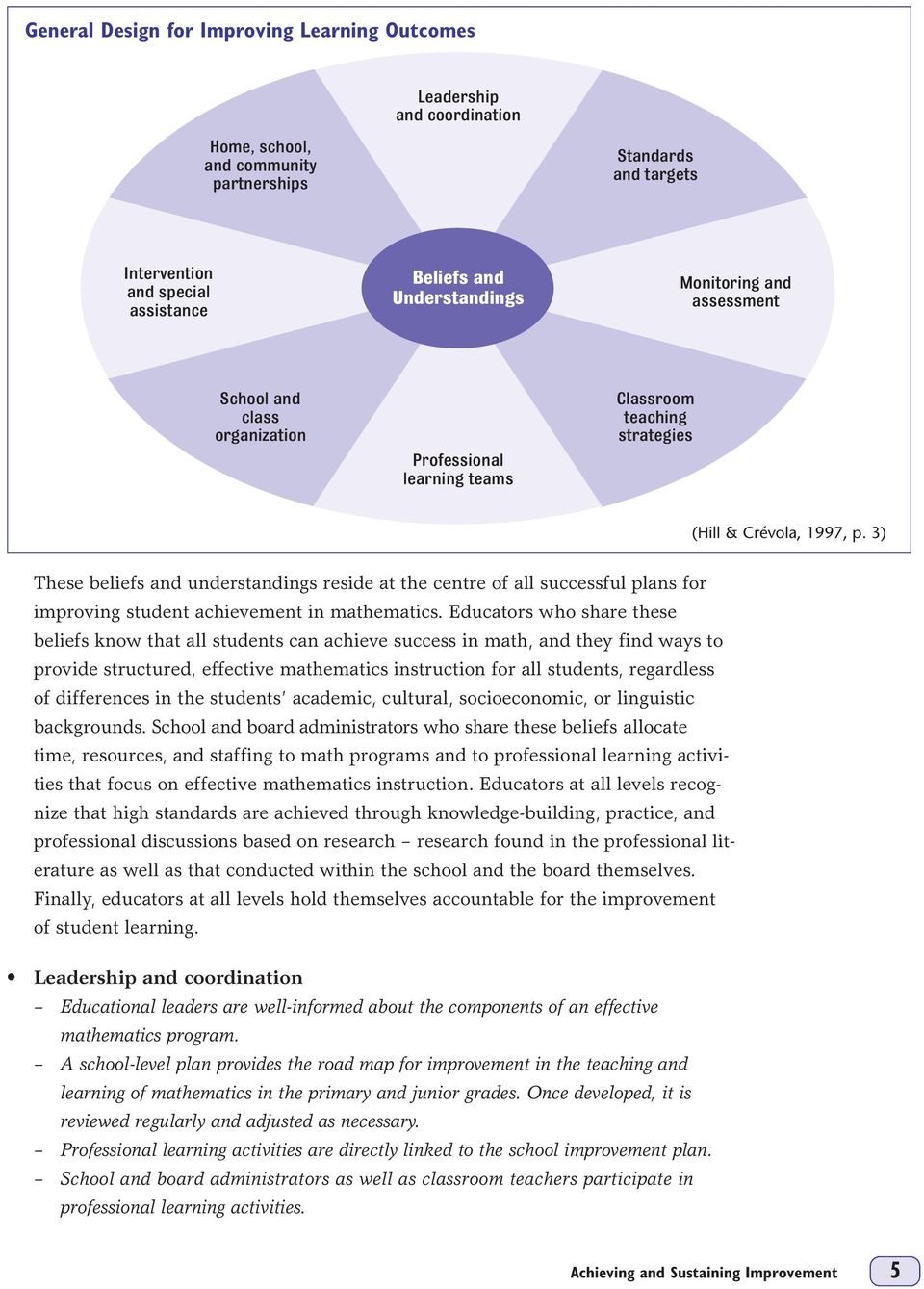
15 Achieving and Sustaining Improvement Ultimately, your leadership in a culture of change will be judged as effective or ineffective not by who you are as a leader but by what leadership you produce in others. (Fullan, 2001, p. 137) This chapter of A Guide to Effective Instruction in Mathematics, Kindergarten to Grade 6 will be of interest to teachers, principals, superintendents, and board support or resource staff who are collaborating to improve math instruction in Ontario schools. It describes what research has revealed about the methods used by schools and the roles undertaken by educators at various levels that have proved particularly effective in creating and sustaining improvement in math achievement. The Ministry of Education recognizes that assigning roles in schools and school boards is the responsibility of district school boards. The following discussion provides boards with a framework within which they may plan for school improvement, and descriptions of roles they may find useful in supporting and aligning individuals efforts within their organizations. This framework and the descriptions of roles follow closely the advice found in the Expert Panel reports on math and reading in the primary and junior grades (Expert Panel on Early Math in Ontario, 2003; Expert Panel on Mathematics in Grades 4 to 6 in Ontario, 2004; Expert Panel on Early Reading in Ontario, 2003; Expert Panel on Literacy in Grades 4 to 6 in Ontario, 2004). A Framework for School Improvement Improvement is achieved and sustained by the continuous, conscious efforts of educators to assess their students progress, identify areas for improvement, determine the instructional strategies to pursue in light of assessment data, implement those strategies, measure whether the strategies have been successful in addressing students needs, and plan the next step in the instructional process. 3

16 Educators striving to achieve the complex goal of success for all students understand that the best results are achieved through a whole-school approach. A whole-school approach ensures high expectations of student achievement, engaged learning time, and focused teaching that maximizes learning within each student s zone of proximal development (Vygotsky, 1978) (Hill & Crévola, 1997, p. 2). Leadership, the committed involvement of a wide range of partners, and support at all levels are key factors in achieving and sustaining improvement in student learning. Superintendents, boardlevel support and resource staff, principals, teachers, support staff, and the community all play important roles in establishing the school s priorities, culture, and climate. Professional learning is another vital element in achieving and sustaining improvement. A career-long cycle of learning, practising, reflecting, and sharing ensures that educators are continuously acquiring the knowledge and skills that allow them to promote effective instructional practices. This kind of professional learning simultaneously encourages the development and maintenance of a culture of improvement, professional collaboration, and group ownership. The ability to sustain improvement is enhanced when strong leadership from knowledgeable curriculum leaders, a team approach to improving teaching and learning, and high expectations are part of the cycle of professional learning. The following factors are also critical to achieving and sustaining improvement in student performance: a commitment to excellence; a strong sense of responsibility for student success; an ability to set goals and priorities, work within defined time lines, and make flexible plans; an awareness of and preparedness for the challenges of the change process. In their 1997 paper The Literacy Challenge in Australian Primary Schools, Peter Hill and Carmel Crévola developed a framework that sets out the key factors needed to achieve and sustain improvement in learning. Although Hill and Crévola s framework was developed in the context of literacy, it applies equally to the improvement of student learning in mathematics. The factors set out in the framework can be applied to math instruction from Kindergarten to Grade 6 as follows: Beliefs and understandings Every child can learn math. Effective teaching that targets student needs maximizes opportunities for student learning. Educators take responsibility for the success of their students. 4 A Guide to Effective Instruction in Mathematics, Kindergarten to Grade 6 Volume One

17 General Design for Improving Learning Outcomes Home, school, and community partnerships Leadership and coordination Standards and targets Intervention and special assistance Beliefs and Understandings Monitoring and assessment School and class organization Professional learning teams Classroom teaching strategies (Hill & Crévola, 1997, p. 3) These beliefs and understandings reside at the centre of all successful plans for improving student achievement in mathematics. Educators who share these beliefs know that all students can achieve success in math, and they find ways to provide structured, effective mathematics instruction for all students, regardless of differences in the students academic, cultural, socioeconomic, or linguistic backgrounds. School and board administrators who share these beliefs allocate time, resources, and staffing to math programs and to professional learning activities that focus on effective mathematics instruction. Educators at all levels recognize that high standards are achieved through knowledge-building, practice, and professional discussions based on research research found in the professional literature as well as that conducted within the school and the board themselves. Finally, educators at all levels hold themselves accountable for the improvement of student learning. Leadership and coordination Educational leaders are well-informed about the components of an effective mathematics program. A school-level plan provides the road map for improvement in the teaching and learning of mathematics in the primary and junior grades. Once developed, it is reviewed regularly and adjusted as necessary. Professional learning activities are directly linked to the school improvement plan. School and board administrators as well as classroom teachers participate in professional learning activities. Achieving and Sustaining Improvement 5
18 In schools that successfully bring about and sustain improvement, the principal, teachers, and professional learning teams work collaboratively. The principal ensures, through careful planning, that appropriate supports are in place to improve the teaching and learning of mathematics. The challenging expectations established through goal-setting activities are shared with staff and parents. Plans are reassessed at regular intervals throughout the cycle and adjusted as necessary. (Leadership and other roles are discussed in more detail later in this chapter.) Standards and targets Realistic goal setting and appropriate monitoring and support lead to school improvement and improved student learning. Effective schools base their school improvement plans for mathematics on their students levels of achievement in math and on the practices they know to be effective in teaching children math. Goal setting for improved student achievement and the monitoring of progress towards those goals provide staff with the means by which to focus their efforts on the school s priorities and to promote continuous efforts to improve student learning. The improvement process engages schools in gathering and evaluating data about student learning generated at the classroom level as well as through the province-wide assessments administered by the Education Quality and Accountability Office (EQAO). Goals for improvement are described in relation to the provincial standard (see glossary) for student achievement in math. Monitoring and assessment Assessment guides instruction, at the level of both the school and the classroom. Effective assessment can have a dramatic impact on student learning. Teachers recognize that different assessment strategies generate different information, and they understand that it is important to build a repertoire of assessment strategies to use in the classroom. Effective teachers consider and apply the appropriate strategy to learn about the effect of their instruction and the depth of student learning. Examination of class-, school-, board-, and province-wide assessment data motivates and directs change in instructional practices. Classroom teaching strategies The teacher s knowledge of mathematics and the skills that the teacher applies in the classroom have the greatest impact on students learning. Effective instruction is based on the learning needs of students, as identified through a variety of assessments and other relevant data. To provide an effective mathematics program, teachers need a thorough knowledge of how children learn mathematics and of the best approaches to teaching math. Teachers help students develop their mathematical understanding by engaging them in problem solving and shared, guided, and independent math activities. 6 A Guide to Effective Instruction in Mathematics, Kindergarten to Grade 6 Volume One
19 As teachers refine their skills in mathematics instruction, as well as their expertise in applying and interpreting the results of a variety of assessment strategies, they are able to meet students individual learning needs through the use of a range of planned strategies and resources. Professional learning teams A school environment that promotes professional collaboration, cohesiveness, and consistency contributes to a successful mathematics program. Time spent transforming research-based knowledge into effective classroom practice is time well spent. By analysing student achievement data, professional learning teams can focus instruction and track school improvement. Effective schools promote the development of a school-based community of learners as a basis for ongoing professional dialogue and collaboration. Depending on the school s size, there are one or more professional learning teams that investigate new research on the improvement of instructional practices; apply evidence-based teaching and assessment methods, such as those described in this guide, in the classroom; and gather and interpret assessment data. The team benefits from the diversity of expertise provided by its members, who may include the principal, a lead math teacher, other classroom teachers, support staff, and teacher-librarians. Team members become proficient at asking questions, finding answers, considering trends in student achievement data, and reflecting on current instructional practices in the school. (Professional learning communities are discussed in more detail later in this chapter.) School and class organization A substantial amount of programmed time should be spent on math every day, and opportunities to teach math concepts should not be missed as they arise incidentally throughout the school day. School and class organization is based on the learning needs of students. The provision of sufficient blocks of time for mathematics, along with the threading of mathematics instruction throughout the day, plays a vital role in student learning. Time is a valuable resource, and how a teacher structures the time spent on mathematics in a classroom is important. In the primary and junior grades, there should be focused time for mathematics every day. Mathematics should also be integrated into other subject areas as appropriate. Math concepts arise naturally throughout the day, and teachers should capitalize on these teachable mathematical moments. Classroom routines and classroom organization are also important, as they set the stage for student learning and are essential ingredients in the building of a classroom community of mathematics learners. Classrooms need to be arranged to provide areas for large- and small-group instruction, various kinds of learning activities, and storage space for books and manipulatives. Achieving and Sustaining Improvement 7
20 Intervention and special assistance Early intervention is crucial for ensuring future success in mathematics. For all students, success in mathematics in the early years is a predictor of future academic success. Therefore, effective schools put supports in place for students struggling with mathematics in the primary grades. Principals and professional learning teams determine and establish a variety of appropriate assistance systems (e.g., small-group support, one-on-one intervention) for their students. Teachers monitor student success and conduct regular assessments, knowing that these practices are essential to ensuring steady student progress. Home, school, and community partnerships The home and the community play important roles in supporting mathematics instruction in the school. Communication with the home can contribute greatly to student success. Students with special needs often learn mathematics through regular class activities, the interventions of resource teachers and various specialists, and practice with parents. Cooperation among all these partners allows the teacher to better meet student needs. (Expert Panel on Literacy and Numeracy Instruction for Students With Special Education Needs, 2005, p. 76) Regular communication among school, home, and community, with the student as the focus, creates important partnerships that support and help sustain improvement. A variety of forms of communication are necessary. Teachers can discuss effective mathematics strategies with parents to help them better understand how their children learn and to give them new ways to encourage and help their children at home. Parents who understand what is being taught in the classroom today, and how it is being taught, are in a better position to assist in their children s growth and learning. In addition, newsletters sent home by the school can outline opportunities for parents to help their children learn math. School-community partnerships in support of mathematics instruction can also involve volunteers, whose assistance can be both helpful and inspiring to young math students. Improvement Planning Setting measurable targets for achievement has been a central feature of successful efforts to improve student achievement on a wide scale in Canada, the United States, England, and Australia. Target setting engages teachers, administrators, school boards, and members of the broader school community as active and vital participants in the school improvement planning process. Ontario has established a provincial standard for achievement in mathematics for all students in Grades 1 to 6, regardless of their background, school, or community namely, to demonstrate knowledge and skills in mathematics at level 3 (see the entry achievement level in the glossary) or higher in every grade. Effective teachers know 8 A Guide to Effective Instruction in Mathematics, Kindergarten to Grade 6 Volume One
21 that different children need different kinds of help to achieve the provincial standard. They set challenging but realistic goals in partnership with students and their parents and carefully plan their instruction to meet those goals. The improvement planning process begins when teachers and administrators gather and analyse relevant information about students in their schools. This analysis enables teachers and the school to identify areas in which improvement is needed and to establish meaningful, specific, and realistic goals for future achievement. The setting of realistic goals depends on the following: effective information management By gathering and analysing student assessment data and other relevant information (e.g., observational notes, anecdotal records), teachers and administrators ensure that their improvement strategies are based on a correct understanding of students levels of achievement. Analysis of information and reliable assessment data also helps them identify how classroom instruction and assessment practices have affected student performance. teamwork across grades Laying the groundwork for improving achievement in mathematics in the primary and junior grades has to begin in Kindergarten and continue through Grade 6. Schools are more likely to achieve and sustain a high level of achievement if they promote cross-grade collaboration and a collegial approach. The main source of information about student achievement is classroom-based assessment and evaluation. Teachers base their assessment and evaluation of student work on the achievement chart published in the Ministry of Education s curriculum policy document The Ontario Curriculum, Grades 1 8: Mathematics, 2005 or on the expectations outlined in the curriculum policy document The Kindergarten Program, 2006, as appropriate. Improvement planning is always driven by the comparison between students achievement and the expectations of the Ontario curriculum, combined with the estimated impact of instructional strategies. However, teachers can also put classroom-based data into a broader context and apply it to their improvement planning by: sharing classroom assessment results and other pertinent information across grade levels, within the primary and/or junior divisions and within the school; using board-wide assessment results, when available, to analyse their students progress in relation to that of students in other board schools that have similar or very different characteristics; learning to understand and interpret the assessment information gathered by the EQAO, which tracks province-wide trends and patterns of improvement. This guide contains a chapter on assessment strategies for classroom teachers (see Chapter 8: Assessment and Evaluation, in Volume Four). Achieving and Sustaining Improvement 9
22 Boards and schools have improvement plans, which they update annually. A school s goals for improvement and its plans for achieving them form a central part of the school s overall improvement plan. THE PACE OF IMPLEMENTATION OF EFFECTIVE MATHEMATICS INSTRUCTION The successful adoption of new teaching practices depends on: the priority given to the initiative; the background knowledge, teaching experience, and skill levels of the educators. When mathematics is made a priority, educators are encouraged to apportion time to learning, planning, assessment, and instruction. Indeed, the more attention that is paid to these functions, the more quickly the initiative can be implemented. With respect to background knowledge, experience, and skills, teachers who have experience delivering the kind of effective mathematics instruction set out in this reference guide may be able to fully implement these methods and strategies within a relatively short period of time. Those who do not have this experience may require considerably more time to reach the stage where they are able to consistently apply their new knowledge and skills in the classroom environment. Working Together to Improve Mathematics Instruction Within the school, classroom teachers have the strongest influence on the development of students mathematical understanding. In schools that are successful in improving student achievement, teachers and administrators act as a team to provide focus and support for classroom teachers to develop their professional expertise. In addition to classroom teachers, principals, centrally assigned staff, and superintendents can all make distinct contributions towards implementing and sustaining effective mathematics instruction practices. Working together, these individuals can plan the kind of professional development that will result in advancing the learning goals set for students. As well, they collaborate with parents and other community members in defining, implementing, and reviewing school improvement plans. Each partner plays a different role in working to improve math instruction, as described below. CLASSROOM TEACHERS Classroom teachers are the key to improving student learning in mathematics. Increasing teachers understanding of mathematics, of how students learn mathematics, and of how to teach math strategies effectively will result in improved student learning. Classroom teachers can improve their instructional effectiveness, and begin to take on leadership roles in the effort to improve students mathematical understanding, by: incorporating the research-informed teaching strategies described in this guide into their instructional practices; 10 A Guide to Effective Instruction in Mathematics, Kindergarten to Grade 6 Volume One
23 collaborating with the principal to develop clear, measurable goals for their professional development goals that focus on effective mathematics instruction and student achievement in math; identifying their own learning needs and seeking out related learning opportunities, ensuring that their learning plans are related to the needs of their students as identified through an analysis of classroom and school assessment results; working cooperatively in professional learning teams to incorporate into their classroom practices new teaching and assessment strategies that are informed by research; staying informed about current research related to effective mathematics instruction; sharing their knowledge and experiences with other educators in their own and neighbouring schools; participating in regular reviews of professional development plans that are informed by evidence of what is and what is not working to improve student performance; accepting opportunities to work on board committees and to lead in-service workshops. LEAD MATH TEACHERS The term lead teacher is relatively new in Ontario, but it is widely used in jurisdictions that have implemented plans for improving student performance in particular areas, most commonly the areas of literacy and mathematics. Lead teachers are classroom teachers who have acquired, or are acquiring, advanced knowledge and skills in the targeted subject areas. Many district school boards have established an analogous role for teachers who, for example, head up particular board initiatives (e.g., a mathematics lead ) or serve as the key contact within a school for a particular area (e.g., a curriculum lead ). Some examples of the kinds of roles and responsibilities lead teachers may take on in their school are listed below. It is important to note that the use of lead teachers is at the discretion of the individual boards, and wherever there is a lead teacher, that person s role and responsibilities are determined by the school board and by the assignments made by the principal. By using the resources they have available to them, boards can extend and support the lead teacher s role, and the responsibilities associated with it, to meet the board s specific needs. Boards may involve lead teachers in some or all of the following: promoting professional development in the area of mathematics, modelling effective instructional strategies, and mentoring/coaching teachers; demonstrating how effective mathematics strategies can be used across the curriculum in all subject areas; Achieving and Sustaining Improvement 11
24 assisting with team and individual program planning related to effective mathematics instruction. The lead math teacher s timetable may include a regular block of time to meet with colleagues for program planning; working with staff to identify, select, and organize mathematic resources for the school. Although the lead teacher in each division may facilitate this process, all teachers within the division should be involved in deciding what resources to purchase, keeping in mind current research and board and ministry directives. The lead teacher may also work with others to organize, store, and develop a signout procedure for shared resources such as manipulatives and teacher resource books, and to monitor the use of those resources. Some schools keep mathematics resources in specific storage areas; others keep them in bins in the classroom used by the lead math teacher; working with the principal and colleagues to schedule uninterrupted blocks of classroom time for mathematics instruction and related activities; helping colleagues plan the activities for the blocks of time dedicated to math; demonstrating for classroom teachers how to use instructional time effectively. The lead teacher may also demonstrate how a classroom teacher can monitor time on task and suggest ways to capitalize on every opportunity to review mathematics skills for example, as the class lines up to exit the room or when a student wonders aloud how much time is left until recess; supporting the administration in planning the use of release time for staff during the school day that is to be dedicated to improving mathematics instruction; connecting with the parents of students through presentations at school council meetings, regular math newsletters, and Kindergarten orientation sessions and other information meetings; providing parents with strategies for home review and practice of mathematics skills, and encouraging and training parents to be effective school volunteers; encouraging and supporting other teachers in reviewing student work, interpreting assessment results, analysing students strengths and needs, setting goals, and focusing appropriate instructional strategies on the areas of student needs; assisting teachers with the development and administration of assessment tools, the interpretation of assessment results for their individual classes, and subsequent program planning; meeting with an individual teacher to discuss results of assessments for that teacher s class and to help plan future programming and strategies; engaging in reflective discussions with other teachers about current instructional practice, with a view to improving it. The role of the lead teacher may vary from board to board and school to school. Each board, working with its school administrators, needs to determine if and how 12 A Guide to Effective Instruction in Mathematics, Kindergarten to Grade 6 Volume One
25 it wants to handle the assignment of lead teachers, and of any board-level personnel designated to support math initiatives, in its schools. Experience in other jurisdictions indicates that lead teachers difficulties in settling into their new role and any misgivings on the part of school staff about the initiative are minimized when the lead teachers are selected carefully, when they have credibility with and the trust of their colleagues, and when they receive the support of administration at both the school and the board levels. The likelihood of success is further enhanced when the lead math teacher s role is developed in consultation with administrators and staff and when expectations are realistic in relation to available time and resources. Lead teachers themselves can contribute to the success of math initiatives by recognizing that change may be difficult, by encouraging colleagues to take regular but manageable steps in implementing new strategies in their mathematics instruction, by being supportive of colleagues as they attempt new practices, and by celebrating effective practices and student successes with them. PRINCIPALS As instructional leader of your school, you must support the efforts of all teachers to promote students mathematical skills. You can help by providing resources and time for teachers to build their skills, discuss what works, and collaborate in a school-wide effort to increase the ability of all students to achieve mathematically. (National Association of Elementary School Principals [NAESP], 2000, p. 87) The role of principals in implementing successful math strategies in their schools is primarily one of leadership to establish a focus on math in their school communities. They do this in many ways. As curriculum leaders, they communicate and emphasize fundamental beliefs and understandings about the importance of success in math, as well as board and school goals for improvement in mathematics. They also use their leadership to help align the success factors that are partly or entirely within their control time, resources, personnel, practices, and plans so that they support the goals of improvement in students achievement in mathematics. Principals can lead whole-school mathematics initiatives by means of some or all of the following: distributing leadership for math initiatives and encouraging the development of in-school leaders; developing, in collaboration with staff, clear, measurable goals for professional learning that are aligned with the school s goals for improving the level of student achievement;... the moral imperative of the principal involves leading deep cultural change that mobilizes the passion and commitment of teachers, parents, and others to improve the learning of all students, including closing the achievement gap. (Fullan, 2003, p. 41) Achieving and Sustaining Improvement 13
26 incorporating current knowledge derived from research on mathematics instruction, such as the information provided in this guide, into staff professional learning activities, and participating in these activities with staff. This level of involvement promotes consistency in the interpretation of information and demonstrates the value placed on professional learning; enhancing their capacity for leadership in mathematics by participating in professional learning activities with their peers and with superintendents; coordinating the provision of internal and external supports, including training and other learning opportunities, in keeping with the school s goals for improving the level of student achievement; ascertaining the needs of staff and students and allocating the appropriate funds, human resources, and time for in-school teacher learning; promoting in-school as well as area- and board-wide mathematics partnerships and learning teams; promoting an atmosphere of trust in which teachers feel comfortable experimenting with new instructional practices that are informed by research and sharing their knowledge; identifying and encouraging exemplary practices and leadership by school staff, providing consistent, constructive, and supportive feedback on improvement efforts, and encouraging reflection; monitoring and regularly reviewing with staff the implementation process for their schools mathematics improvement and professional learning plans; structuring their schools timetables to provide uninterrupted blocks of time for mathematics instruction; promoting creative use of in-school release time for grade-level and cross-grade planning and focused discussions among teachers about student work and about the steps required to address areas of need; using, and ensuring that others use, assessment results as the basis for instructional, structural, and resource-allocation decisions; choosing topics for math meetings that support the school s and the board s learning priorities; observing classes regularly and offering teachers encouragement and constructive advice about their professional learning. 14 A Guide to Effective Instruction in Mathematics, Kindergarten to Grade 6 Volume One
27 CENTRALLY ASSIGNED STAFF Staff assigned centrally by a board to serve the schools of the board can contribute to system-wide math objectives through some or all of the following: collaborating with superintendents and principals to develop clear, measurable goals for professional learning that focus on mathematics instruction and student achievement; staying informed about current research on mathematics instruction; participating in professional learning activities that strengthen their knowledge of mathematics instruction and their skills in mentoring, coaching, modelling, and leadership; creating and delivering professional learning activities at the board and school levels using the material in this guide; supporting school teams in the development of professional learning and school improvement plans; developing mathematics support documents and recommending appropriate resources and materials for effective mathematics instruction and professional learning; working with teachers to model effective instruction practices in classrooms; identifying and supporting individual teachers needs; reviewing the board s professional learning plan in collaboration with superintendents and principals, focusing on classroom practices and board-wide professional learning activities that will strengthen student performance. SUPERINTENDENTS Superintendents can contribute to the improvement of math teaching and learning through some or all of the following: developing, in collaboration with principals and central support staff, clear, measurable goals for professional learning that focus on mathematics instruction and student achievement; staying informed about and disseminating current research on effective instruction practices in mathematics; sustaining their boards leadership capacity in the area of mathematics instruction by participating in training with peers that strengthens their own understanding of math and of mathematics instruction. This level of involvement promotes consistency in the interpretation of information and demonstrates the value the administration places on professional development; coordinating internal and external supports, training, and professional learning networks at the board level; Achieving and Sustaining Improvement 15
28 ascertaining the needs of staff and students and allocating the appropriate funds for human resources and time for board-wide teacher-principal-school learning teams; promoting a culture in which superintendents and principals share their knowledge of and experience with research-based methods and coaching and mentoring; recognizing leadership abilities among school staff in classrooms and schools that practise effective mathematics instruction; monitoring and regularly reviewing the implementation process for school- and board-level professional learning plans, noting improvements in student achievement and classroom instructional practices. Professional Learning THE PURPOSE AND BENEFITS OF PROFESSIONAL LEARNING COMMUNITIES Schools that have been effective in improving students mathematical understanding and their achievement in mathematics are typically schools that also promote a culture of lifelong learning among teachers, administrators, and other education professionals in the school. They have created professional learning communities. Active professional learning communities usually emerge in schools when principals and teachers work together as a team to develop a comprehensive professional learning plan. Since the ultimate objective of the professional learning plan is to improve student learning, the plan is linked directly to an interpretation of the results of student math assessments in other words, students needs inform the professional learning needs of teachers. In addition, the professional learning plan is aligned with curriculum expectations, assessment strategies, the school s overall improvement plan, and the board s improvement plan, including its goals for mathematics achievement. Consistency among the various plans provides support for educators at all levels of the system as they work together to bridge the gap between current student performance and the goals they set for improvement in mathematics. Finally, a good professional learning plan is flexible. Flexibility allows the participants to make adjustments to the plan as implementation proceeds and as staff or school changes occur. Learning is continuous and self-renewing. All learners incorporate new information into what they already know, so knowledge builds. In a learning community, everyone is expected to keep on learning but also to contribute to others learning. (Lyons & Pinnell, 2001, p. 170) PROFESSIONAL LEARNING COMMUNITY ACTIVITIES Schools and boards that have active professional learning communities engage in the following kinds of activities, often combining more than one. Using a variety of types of professional learning activities acknowledges the fact that teachers like students learn in different ways, values the diversity of teachers prior knowledge, and allows teachers to make choices that best suit their needs. When designing a professional 16 A Guide to Effective Instruction in Mathematics, Kindergarten to Grade 6 Volume One
29 learning plan, staff may also want to include activities that can be implemented jointly with other schools or with staff from other sites. Peer Coaching Peer coaching offers teachers an opportunity to work together in planning activities, to visit each other s classes, to discuss the teaching and learning that occurs there, to share ideas, and to help each other solve problems (Beavers, 2001). Study Groups Study groups are made up of educators (teachers, principals, central support staff, etc.) who want to share ideas and to study professional resources or current research about mathematics instruction. Generally, study groups consist of five or six people who meet regularly to establish common goals, discuss readings on practices and research, share lesson plans, exchange ideas, develop collaborative units, and apply what is learned to improving students learning (Beavers, 2001). Members of study groups can also work together to develop particular lessons, use those lessons in their classrooms, share their observations, and make improvements. In some cases, teachers may want to visit one another s classrooms to see how lessons are played out in other classes. The lessons that are developed can then be documented and shared with other teachers. Team Teaching Team teaching provides opportunities for joint planning, joint instruction, feedback, and discussion. As equal partners, team teachers benefit from an environment of collaboration, experimentation, peer inquiry, and examination of classroom instruction (Sandholtz, 2000). Mentoring Mentor teachers are experienced educators who consistently apply effective strategies to teach mathematics in their own classrooms. They act as role models to teachers who are seeking support in adopting new teaching approaches. Mentor teachers model effective practices, share information and expertise, encourage reflection about teaching practices, and offer support to others. Reflective Practice Reflective practice refers to a four-stage activity in which teachers, working with a partner or in a small group, reflect on their instructional and assessment practices. Reflective practice begins in the classroom, where teachers apply a stop, look, and question approach in order to examine their practices and to learn to differentiate their teaching from their students learning. Teachers then collect, examine, If we want to help teachers understand why they do what they do, we must anchor their thinking in the same cognitive processes they want to instill in their students. (Lyons & Pinnell, 2001, p. 118) Achieving and Sustaining Improvement 17
30 and reflect on their observations of student learning and meet with their colleagues to discuss their findings, review assessment results, and consider possible explanations for students learning behaviours and achievement levels. On the basis of their reflection and discussions, teachers modify their teaching strategies or introduce new strategies as necessary to meet students needs. Reflective practice helps educators avoid making assumptions about student learning on the basis of appearances (Rodgers, 2002). Home and Community Connections Collaboration with parents is critical to your school s efforts to increase student achievement and attain mathematics success for all children. Teachers can involve parents in this effort by helping parents learn what their children are learning in mathematics and how they are learning it. (NAESP, 2000, p. 13) The focus of formal mathematics instruction is the school, but mathematics itself is a part of everyday life, and mathematical concepts are first experienced at home. Parents, teachers, and children are all partners in the learning process. Countless studies over the years have clearly shown that children do better at school when parents are actively involved in their education (Epstein, 1991; Henderson, 1988; Henderson & Berla, 1994). Children whose parents take an interest in their learning are more likely to talk about what they learn at school, develop positive attitudes towards learning, and seek their parents help. ENCOURAGING PARENTAL INVOLVEMENT Family involvement improves students attitudes towards learning, their self-esteem, and their level of achievement. Successful homeschool partnerships help parents to become engaged with their are actively involved in and... when parents/caregivers children s learning. Teachers can discuss effective mathematics informed about their strategies with parents, who can then better understand how their children s learning, children children learn and become more confident in helping their children and teachers are more learn to do math. Furthermore, parents who understand what their successful. children are taught in mathematics classrooms today, and why, are (Lyons & Pinnell, 2001, p. 7) in a better position to assist in their children s growth and learning. In addition, children are not subjected to confusing messages when their parents and their teacher share a common approach to doing mathematics. Finally, opening channels of communication with parents sends the message to children that mathematics is highly valued both at school and at home. 18 A Guide to Effective Instruction in Mathematics, Kindergarten to Grade 6 Volume One
31 A good source of tips for parents of children in the primary grades is the Ministry of Education s booklet Helping Your Child Learn Math: A Parent s Guide, 2003, which is available on the ministry s website, at In working with parents and community members, effective educators take responsibility for: motivating and inspiring others by sharing their vision of teaching and learning; creating opportunities for students to share their learning with their classmates, their parents, and the community; inviting parents and community members to share their knowledge and skills in supporting classroom and school activities (Ontario College of Teachers, 1999). DEVELOPING HOME-SCHOOL PARTNERSHIPS When educators are supportive, responsive, and welcoming, they encourage parents to become partners in their child s education. There are several ways to build homeschool partnerships and increase parental involvement. Some suggestions include: determining the child s prior home experiences with mathematics; working and communicating effectively with families through informal conversations, home visits, and parent-teacher conferences; being sensitive to the individual circumstances of parents and families; suggesting activities for parents, such as games that allow children to practise and to experience success with mathematics; helping parents understand what is taught in today s mathematics classroom and why (e.g., by sending home a brief description of the concepts and strategies involved in each new math unit); sharing with parents their knowledge, informed by current research, about how children learn math and about best practices in mathematics instruction; providing parents with information about their children s progress on an ongoing basis; preparing take-home math kits that may include activities, books, software, and manipulatives focused on a particular topic; Achieving and Sustaining Improvement 19
32 hosting a family math event, emphasizing math activities that can be enjoyed by the whole family; providing and promoting the Ministry of Education s publication Helping Your Child Learn Math: A Parent s Guide, 2003; involving libraries and bookstores by asking them to promote literature that contains mathematical content for young children; developing and promoting an appreciation of the mathematical heritages and cultural values of all members of the school community; communicating with parents of English-language learners (through interpreters, if available); responding promptly and constructively to parents concerns, either by telephone or by ; inviting parents feedback on the teacher s observations, assessments, and documentation of their child s mathematical understanding; promoting a philosophy of teamwork with peers, administrators, and family and community members; engaging parents in helping, on a volunteer basis, with math-related activities at the school, and drawing on any special talents and knowledge they might have that could benefit student learning. (This suggestion involves assessing school and classroom needs that could be met by parent volunteers, determining the roles they could play, and prioritizing needs and setting goals for parental involvement.); engaging parents, through school councils, in planning and decision-making activities related to home-school partnerships. 20 A Guide to Effective Instruction in Mathematics, Kindergarten to Grade 6 Volume One
33 2. Principles Underlying Effective Mathematics Instruction Chapter Contents Foster Positive Mathematical Attitudes Focus on Conceptual Understanding Involve Students Actively in Their Learning Acknowledge and Utilize Students Prior Knowledge Provide Developmentally Appropriate Learning Tasks Respect How Each Student Learns Provide a Culture and Climate for Learning Recognize the Importance of Metacognition Focus on the Significant Mathematical Concepts ( Big Ideas ) Diversity and Effective Instruction A Checklist for Inclusive Mathematics Instruction Appendix Appendix 2-1: Accommodations and Modifications
34
35 Principles Underlying Effective Mathematics Instruction Effective mathematics teaching requires understanding what students know and need to learn and then challenging and supporting them to learn it well. (National Council of Teachers of Mathematics [NCTM], 2000, p. 16) Students learning flourishes in mathematically rich environments. Young minds find nourishment in attainable challenges, the novelty of experience, and the encouragement of their peers, parents, and teachers. Rich environments do not just happen; they are the result of insightful planning by a thoughtful teacher. Before the teacher can institute such planning, however, he or she must have a firm grasp of the basic principles of teaching and learning mathematics. The foundation for these principles was established in Early Math Strategy: The Report of the Expert Panel on Early Math in Ontario, 2003 and supported in Teaching and Learning Mathematics: The Report of the Expert Panel on Mathematics in Grades 4 to 6 in Ontario, These principles, which reflect the findings of research on effective mathematics instruction, inform all aspects of this guide. All teaching of mathematics should: foster positive mathematical attitudes; focus on conceptual understanding; involve students actively in their learning; One thing is to study whom you are teaching, the other thing is to study the knowledge you are teaching. If you can interweave the two things together nicely, you will succeed... Believe me, it seems to be simple when I talk about it, but when you really do it, it is very complicated, subtle, and takes a lot of time. It is easy to be an elementary school teacher, but it is difficult to be a good elementary school teacher. (Ma, 1999, p. 136) acknowledge and utilize students prior knowledge; provide developmentally appropriate learning tasks; respect how each student learns by considering learning styles and other factors; provide a culture and climate for learning; recognize the importance of metacognition; focus on the significant mathematical concepts ( big ideas ). In addition to providing the theoretical background and practical application for each of the principles listed above, this section of the guide includes a discussion of a topic of crucial 23
36 importance to effective instruction in any area of the curriculum namely, the need to recognize diversity in the classroom and to ensure equity for all students. Foster Positive Mathematical Attitudes Of paramount importance for successful mathematics instruction is promoting positive attitudes in students. Sustaining such attitudes has its challenges. Many students, as they become socialized in the school environment, begin to view mathematics very rigidly; they see it as dependent on memory and speed rather than on conceptual understanding. They view mathematics as a subject that only some students can succeed in, and their positive attitudes towards mathematics decline. The eager engagement that may have been observed in earlier mathematical environments diminishes as students are rushed to use symbols and algorithms before they have developed a sense of number. Their view of mathematics shifts gradually from enthusiasm to apprehension, from confidence to fear (National Research Council, 1989, p. 44). Educators and parents can prevent this erosion of students enthusiasm for mathematics. They can foster in students the positive attitudes about mathematics that help to build confidence by: encouraging the belief that everyone can do mathematics emphasizing effort, not innate ability; modelling enthusiasm for teaching and learning mathematics; addressing the learning styles of students by providing a variety of ways for students to gain an understanding of difficult concepts (e.g., pictures, concrete representations, drama, art, music, movement); engaging all students, including English language learners, in mathematical activities that involve investigation, problem solving, and mathematical communication; helping students to appreciate the value of mathematics in their lives; choosing activities carefully (not too easy, not too hard), so that students can be both challenged and successful; capitalizing on the math moments that occur naturally at home and in the classroom. There is evidence from brain-based learning theories (Jensen, 1998) that a solid conceptual understanding of numeracy by the age of seven is a strong indicator of future success in mathematics and that a lack of strength in this area is very difficult to overcome later on. The learning curves of those who understand math at an early age and those who do not diverge significantly by the time students reach the higher grades. Research by Steen (1990) has shown that by Grade 8 there is a seven-year achievement-rate difference in math between students with the highest achievement and those with the lowest achievement, and that this gap is never closed. Focus on Conceptual Understanding Instruction in mathematics must emphasize conceptual understanding and not just procedural knowledge. Conceptual understanding occurs when students recognize meaningful relationships in numbers and make connections between mathematical Children learn best when they understand what they are learning. 24 A Guide to Effective Instruction in Mathematics, Kindergarten to Grade 6 Volume One
37 ideas through problem solving, communication, the active construction of mathematical representations, and metacognition. According to Hiebert and Carpenter (1992), conceptual knowledge is knowledge that is understood. Procedural knowledge is knowledge of the rules and symbols of mathematics (e.g., the algorithm used to solve a computation question). Conceptual understanding and procedural knowledge are complementary. Conceptual understanding helps students with long-term understandings; procedural knowledge helps students to connect conceptual understanding with symbolic language. Students who are assigned activities that emphasize only the rote acquisition of procedures (procedural knowledge) without promoting an active understanding of the concepts underlying such procedures are at a disadvantage, especially in the later grades, when they encounter more abstract concepts. If mathematics becomes nothing but procedures, students attain only a superficial understanding one that, over time, may disappear completely. The surface knowledge that results from the rote learning of procedures is exemplified by the student who is asked to solve the following problem: Some children are travelling on a school trip. If there are 98 children and each bus holds 30, how many buses are required? The student uses the division algorithm to solve the problem but then is unable to ascertain what the remainder of 8 represents (8 buses? 8 children?) or what the implications of the answer are (does it mean 8 /30 of a bus?). Interestingly, younger students who do not yet know the algorithm can solve the question quite easily, using blocks and make-believe buses, and they have little difficulty declaring that the 8 leftover children will need to get a small bus or have someone drive them. Students remember learning that makes sense to them. If they understand a concept, they can solve problems with or without memory of the related procedure. For instance, students who forget the multiplication fact 6 x 8 but understand the concepts behind multiplication can easily make a connection with a known fact such as 5 x 8 and then add on the additional 8. Students who do not have the conceptual understanding may flounder with a vaguely remembered and incorrect answer such as 68 and not have the understanding to recognize that their answer is incorrect. Sometimes the solving of a problem promotes conceptual understanding. Through the process of interacting with a problem that involves the combining of two-digit numbers, for example, students can develop a deeper understanding of place value and its effect on addition. Principles Underlying Effective Mathematics Instruction 25
38 Involve Students Actively in Their Learning In an effective program students must be allowed to do mathematics. It is an essential fact that Students learn to write through the process of writing. They learn to do children learn mathematics science through the process of designing experiments and rediscovering the science ideas of the past. In art, students create their own primarily through... doing, talking, reflecting, discussing, great works. Only in mathematics has the passive bystander observing, investigating, model of learning been accepted. listening, and reasoning. Students need the opportunity to explore mathematics. Early mathematicians first noticed that ten fingers made a useful tool for organizing (Copley, 2000, p. 29) our base ten number system. Students also need to discover this relationship between their fingers and the number system. Once they understand that relationship, they can come to understand the more complex concept of unitizing (the idea that units of 10 can be represented by a single digit in the tens place and that tens of tens can be represented also by a single digit in the hundreds place). In doing so, students make a giant conceptual leap similar to the leap mathematicians made in arriving at the same concept centuries ago (Fosnot & Dolk, 2001). Students can achieve the doing of mathematics by: actively constructing concepts For example, students who experiment with joining and separating quantities can acquire a solid understanding of the effects of operations on numbers. 26 A Guide to Effective Instruction in Mathematics, Kindergarten to Grade 6 Volume One
39 working with concrete materials to represent abstract concepts For example, students working with geoboards to determine the smallest perimeter for the greatest area may develop a richer understanding of the interrelations between area and perimeter. using investigation and inquiry to explore problems Students who engage in problem solving build a repertoire of reasoning skills and strategies. For example, asking students to find all the ways to combine two sets of blocks to make the sum of 10 encourages them to reason about the patterns and relationships in the numbers from 1 to 10 and eventually to extend their reasoning to all the numbers between 10 and 20, then 20 and 30, and so on, to 100. The patterns and relationships in the numbers from 1 to 10 permeate our entire number system. Similarly, older students who investigate the relationships between the fraction 1 4, the decimal 0.25, and the percentage 25% gain a more complex understanding of the proportional relationships within our number system. interacting with other students Students who work together to solve problems learn from one another as they demonstrate and communicate their mathematical understanding. exploring mathematical concepts in a variety of ways, including the kinaesthetic, the artistic, or the musical Students who have the opportunity to learn in a variety of ways, including their own preferred learning style, are more likely to be favourably disposed to mathematics and more likely to retain their knowledge. making connections with the outside environment and their home life For example, students who go for geometric shape walks or search for naturally occurring number patterns in the school or in nature (e.g., the Fibonacci sequence found in the arrangement of seeds in a sunflower: 1, 1, 2, 3, 5,...) are more likely to be engaged in the learning process. engaging in student talk Students who talk to others about their mathematical understandings are compelled to explain their reasoning and revisit their strategies. working in blocks of time Mathematical investigation is enhanced when students have ample time to explore and consolidate mathematical ideas. Principles Underlying Effective Mathematics Instruction 27
40 Acknowledge and Utilize Students Prior Knowledge For learning to be effective, it must utilize and build upon the prior knowledge of the student. Children s natural inclination to play almost from birth ensures that all students bring some prior problem-solving knowledge to the primary classroom. The level of such prior learning varies greatly across cultures and socioeconomic groups, but the extent of prior knowledge in students is often greater than has traditionally been assumed. Young children possess an informal knowledge of mathematics that is surprisingly broad, complex and sophisticated. (Baroody, 2004, p. 10) Teachers in the primary grades connect this home-grown intuition and understanding with new knowledge by developing learning experiences that help foster mathematical understanding. Similarly, in the junior years, students acquire experiences related to their interests in sports, the arts, and various hobbies. Teachers can use these experiences to connect mathematics to the outside world. Some examples of the connections teachers can make are as follows: Students often come to school able to count to 5 or 10. Teachers can build on this skill to help students begin to see patterns in our number system and relationships between one number and another (6 is 1 more than 5 and 2 more than 4). Many students have had experiences with earning money. Teachers can use this knowledge to help students build their understanding of place value and make decimal calculations (e.g., four quarters equal $1.00, so 0.25 x 4 =1.00). Children can differ in their prior knowledge for a variety of reasons (e.g., a child may be a new Canadian or come from a different cultural background). What is important to keep in mind is that general knowledge important for new learning may need to be restated and reinforced for some children and actually taught to others. (Expert Panel on Literacy and Numeracy Instruction for Students With Special Education Needs, 2005, p. 40) Students have natural problem-solving strategies that they use as they figure out the fair distribution of pencils among friends. Teachers can help students make connections between these strategies and the strategies used in school mathematics. Provide Developmentally Appropriate Learning Tasks Students go through stages of mathematical development, with considerable individual variation from student to student. Recognition of this variation is key to establishing the most effective learning environment. For the teaching and learning processes to be successful, it is important that the student s existing conceptual understanding of mathematics be recognized. Students need to encounter concepts in an appropriate manner, at an appropriate time, and with a developmentally appropriate approach. Developmentally appropriate means challenging but attainable for most children of a given age range, and flexible enough to respond to inevitable individual variation. That is, expectations may have to be adjusted for children with different experiential backgrounds. (Clements, Sarama, & DiBiase, 2004, p. 13) 28 A Guide to Effective Instruction in Mathematics, Kindergarten to Grade 6 Volume One
41 In general, students first need to model, or represent, new concepts concretely (e.g., by using their fingers or manipulatives). Then they move to more abstract representations of problems (e.g., by using words, pictures, and symbols). Whenever a new concept is introduced, students and teachers need opportunities to explore the concepts with concrete materials. Teachers must recognize the student s level of cognitive, linguistic, physical, and social-emotional development. The most effective learning takes place when these aspects of development are taken into consideration. This means that the student needs to: be cognitively capable of taking on the mathematical task at hand; be able to comprehend the language of instruction; have sufficient fine motor control in the early grades to complete the task; be emotionally mature enough for the demands of the task so that frustration does not hamper the learning situation. (Sophian, 2004) When undertaking a learning task that is developmentally appropriate, a student can use his or her prior knowledge as a mental network in which new ideas and knowledge can be integrated. If the new knowledge connects, the student s thinking is stretched outwards; the student integrates newer, more complex concepts; and optimal learning occurs. The student will have been working in what Lev Vygotsky ( ) calls the zone of proximal development. If the learning is too easy (below the zone of proximal development), the student does not gain new knowledge and may become completely disengaged from the process of learning. If the learning is too complex (beyond the zone of proximal development), independent learning does not occur, and the student often experiences frustration and depleted selfconfidence. The most meaningful learning occurs within the zone of proximal development. If the creation of the conceptual networks that constitute each individual s map of reality including her mathematical understanding is the product of constructive and interpretive activity, then it follows that no matter how lucidly and patiently teachers explain to their students, they cannot understand for their students. (Schifter & Fosnot, 1993, p. 9) Zone of Proximal Development:... the distance between the actual developmental level as determined by independent problem solving and the level of potential development as determined through problem solving under adult guidance or in collaboration with more capable peers. (Vygotsky, 1980, p. 86) Principles Underlying Effective Mathematics Instruction 29
42 When planning for instruction, teachers need to consider how to keep students working in this zone. As students are introduced to new concepts, their thinking is stretched, and they experience a state of discomfort known as cognitive dissonance. This is the point at which they need the most support. Teachers give this support through asking questions, guiding discussion and dialogue, and providing appropriate activities. The following chart provides a summary of the impact on the student of learning below, within, or above the zone of proximal development. Vygotsky s Zone of Proximal Development (as related to mathematics) Below the Zone of Proximal Development The student can complete the task independently. The student does not gain new knowledge, but the task may build confidence and fluency and may help to consolidate previously learned concepts. The student practises the learning/skill/concept to deeply entrench understanding. The student s learning is proficient and automatic. Tasks may be too easy if the student remains in this zone longer than is appropriate. In the Zone of Proximal Development The student s learning is supported so that the student can move to a higher level of understanding (i.e., teacher assistance is required to ensure that problems at an appropriate level are presented, and that modelling, guidance, and questioning occur during the task, as necessary). The student s learning is linked to prior knowledge. New learning occurs. The experience is challenging enough to trigger new understandings. The student contributes meaningful talk and action during the construction of new knowledge. The learning tasks are just right. Beyond the Zone of Proximal Development The student can complete the task only through reliance on procedures at the expense of conceptual understanding (e.g., performs step-by-step long division without understanding). There is no new learning; understanding is limited; the student cannot generalize and apply the knowledge to new situations. The student may disengage from the learning process. Tasks are too difficult and lead to frustration. 30 A Guide to Effective Instruction in Mathematics, Kindergarten to Grade 6 Volume One
43 Respect How Each Student Learns Teachers need to respect how students learn by taking into consideration the balance of learning styles, attitudes, preferences, cultural backgrounds, and special needs of students in the classroom. Keeping students engaged in the learning process involves both maintaining their interest and sustaining their understanding of the task they are undertaking. Classrooms and instructional approaches that are conducive to mathematical learning include: a variety of visual displays (e.g., math word walls, strategy walls, students work); oral reminders that emphasize the connections with prior knowledge and similar learning experiences; Patterns of learning may vary greatly within a classroom. Teachers need to plan for diversity, give students tasks that respect their abilities, use dynamic and flexible grouping for instruction, and provide ongoing assessment. (Expert Panel on Literacy and Numeracy Instruction for Students With Special Education Needs, 2005, p. 4) organizers such as mind maps and webs for a particular concept; prompts such as questions that the teacher poses as well as access to prompts that help students become unstuck (e.g., multiplication grids, T-charts); a range of learning experiences that include opportunities for shared, guided, and independent mathematics; the use of a three-part lesson format that includes Getting Started, Working on It, and Reflecting and Connecting segments; a focus in all lessons on connecting conceptual understanding with procedural knowledge; care in ensuring age-appropriate pacing and duration of lessons; attention to the special needs of students (e.g., through adaptations of lessons and of teaching and assessment strategies and other accommodations see the appendix to this chapter, entitled Accommodations and Modifications. See also the Special Education Companion in the Ontario Curriculum Unit Planner, available at strategies that support English language learners (e.g., using simple and familiar language; using manipulatives, visuals, and gestures to explain concepts; explaining cultural content that may be unfamiliar to newcomers to Ontario); flexibility in the teaching of a lesson (to follow the needs of the class, not simply to follow the lesson plan); a variety of materials that students can use depending on their particular needs or interests (e.g., one student may feel more comfortable using base ten blocks while another favours counters); appropriate wait time that allows students to think through a problem before responding. Principles Underlying Effective Mathematics Instruction 31
44 Small changes in how classrooms are organized and how materials are presented to students will result in a better learning environment for the diverse group of learners in every classroom. For more information on respecting each student s approach to learning, see Chapter 7: Classroom Resources and Management, in Volume Three. Provide a Culture and Climate for Learning The culture and climate in the classroom have a profound effect on the learning that takes place. Students need to feel valued and respected. They need to know that they are members of a community that appreciates the mathematical contributions of each of its members. In an effective mathematical community: problem solving, reasoning, and communication are highly valued; interest in mathematical ideas, even when they are not related to the curriculum, is encouraged and promoted; different methods of solving problems are welcomed and shared; mistakes are looked upon as opportunities for learning; the acquisition of mathematical knowledge by all students is viewed as a top priority; teachers are flexible in their understanding of how students develop their own strategies for solving problems; different ways of thinking and reasoning are viewed as valuable insights into students minds. See also the section Developing a Mathematical Community in Chapter 7: Classroom Resources and Management, in Volume Three, for more information on building a community of learners. 32 A Guide to Effective Instruction in Mathematics, Kindergarten to Grade 6 Volume One
45 Recognize the Importance of Metacognition Being able to identify and monitor one s own strategies for solving problems is a valuable learning skill. Such a skill involves being able to think about one s thinking. Students benefit from encouragement in developing such metacognitive skills as are appropriate to their own developmental level. Students are using metacognitive skills when they ask themselves questions like the following: What am I doing? Why am I doing it? How does it help me? Good problem solvers regularly and consciously reflect on and monitor their own thought processes. By doing so they are able to recognize when the technique they are using is not fruitful and to make a conscious decision to switch to a different strategy, rethink the problem, search for related content knowledge that may be helpful, and so forth.... Even very young students should be taught to examine their own thought processes this way. (Ontario Ministry of Education, 2005, p. 14) Teachers can assist students in developing metacognitive skills by: reminding students to think about their own thinking; providing opportunities for students to reflect on a problem at the beginning, in the middle, and especially at the end of a task; modelling metacognitive skills by talking aloud about their own thinking processes in solving problems in mathematics or in other parts of the curriculum; providing probing questions or prompts to help students talk about their thinking for example, Why did you use that method? Did you think of another way first? Have you solved a problem like this before? ; making reflection a critical component of tasks and of the assessment of tasks. Focus on the Significant Mathematical Concepts ( Big Ideas ) Effective mathematics programs provide students with opportunities to gain a thorough understanding of the big ideas, or key concepts, of mathematics. Programs that emphasize the big ideas allow students to make connections, to see that mathematics is an integrated whole, and to gain a deeper understanding of the key concepts. Rather than provide specific instructional strategies for individual curriculum expectations, an effective mathematics program takes the approach of clustering expectations around a big idea and investigating effective teaching strategies for that big idea. Such an approach is exemplified in the companion documents to this guide that focus on the individual strands. Principles Underlying Effective Mathematics Instruction 33
46 Teachers need a sound understanding of the key mathematical concepts in every strand of the curriculum, as well as an understanding of what students are to learn in connection with each concept at every grade level and how that learning connects with previous learning (in the grade before) and future learning (in the next grade). Liping Ma s research (1999) indicates that teachers of elementary mathematics must have a profound understanding of fundamental mathematics. Such knowledge includes an understanding of the conceptual structure and basic attitudes of mathematics inherent in the elementary curriculum (Ma, 1999, p. xxiv) as well as a knowledge of how to teach the concepts to students. Focusing on the big ideas provides teachers with a global view of the concepts represented in the strand. The big ideas also act as a lens for: making instructional decisions (e.g., deciding on an emphasis for a lesson or a set of lessons); identifying prior learning; looking at students thinking and understanding in relation to the mathematical concepts addressed in the curriculum (e.g., making note of the strategies a student uses to count a set or to organize all possible combinations to solve a problem); collecting observations and making anecdotal records; providing feedback to students; determining next steps; communicating concepts and providing feedback on students achievement to parents (e.g., in report card comments). Diversity and Effective Instruction A VISION FOR EQUITY IN ONTARIO CLASSROOMS School classrooms represent the world in miniature; they mirror our larger society. The diversity that exists in our classrooms has helped to shape our vision for education in Ontario today. All children, regardless of their background and/or ability, deserve opportunities to learn and to grow, both cognitively and socially. The challenge is to reach more children more effectively. To do this, we need to create a vision for learning that makes every child feel included. To develop the right learning conditions for each individual child, we must allow for a variety of cultural experiences and multiple perspectives, so that all children feel valued in the classroom. 34 A Guide to Effective Instruction in Mathematics, Kindergarten to Grade 6 Volume One
47 DIVERSITY, EQUITY, AND STUDENT ACHIEVEMENT Effective learning environments are those that consistently foster student achievement. The performance of all students is strengthened when the diversity of the class is recognized and valued. Acknowledging students different backgrounds and experiences is best accomplished by weaving appropriate examples throughout lessons in all subject areas. Learning occurs when students are exposed to the unfamiliar. Discussing viewpoints and sharing aspects of different cultures, customs, and languages are powerful tools for learning. Being committed to inclusion means empowering students to use their voices and experiences in building their knowledge and understanding. The diversity of students voices must be reflected in learning materials, discussions, problem solving, and learning applications. Teachers who recognize and build on the diversity of their students adopt flexible approaches, maintain high standards, and bring concepts alive by presenting them in contexts that students perceive to be real and meaningful. For instance, in developing a social studies unit on early settlers in Upper Canada (Grade 3), or a history unit on the development of Western Canada (Grade 8), teachers need to ensure that stories of pioneers who established Black communities, such as Dresden and Buxton in Ontario, or Breton, Wildwood, Maidstone, and Campsie in Alberta and Saskatchewan, are included in the readings and pictures they choose for students. Similarly, in science programs, the achievements of scientists and inventors who are women or who come from Aboriginal, Black, or other minority backgrounds must be celebrated. Pictures and examples should illustrate the accomplishments of all members of society, so that children will see themselves in the curriculum. Being open to students diverse experiences and points of view increases opportunities for teachers to seize teachable moments that support effective learning. SUPPORTING DIVERSE LEARNING STYLES Student self-esteem is fostered through the creation of competencies. Helping students to develop competencies empowers them and creates an intrinsic motivation to learn. Success in supporting student learning depends, in part, on taking into account the diversity of learning styles among students in the classroom. Many teachers use Howard Gardner s theory of multiple intelligences to respond effectively to the diverse learning styles of their students. Multiple intelligences, as identified by Gardner (1993), reflect the following ways of demonstrating intellectual ability: Interpersonal, Intrapersonal, Verbal/Linguistic, Logical/Mathematical, Musical/Rhythmic, Principles Underlying Effective Mathematics Instruction 35
48 Visual/Spatial, Bodily/Kinesthetic, and Naturalist. When teachers take these intelligences into account in their lesson design and their assessment of student achievement, they can focus on a range of student strengths that reflects the varied abilities of the class as a whole. CREATING AN ENVIRONMENT CONDUCIVE TO LEARNING An environment that helps promote learning is critical to engaging students in schoolwork and class activities. Learning is a social activity. However, the ways in which students respond to the social environment in the classroom may vary considerably. For some students, the environment may be as integral to learning as the actual learning activities in which they participate. When students are comfortable and feel secure in their learning environment, their true potential will be reflected in their performance. Recognizing and valuing diversity strengthens students capacity to work both independently and within a collaborative setting. RECOGNIZING DIVERSITY IN ITS MANY FORMS Diversity takes many forms and exists in all Ontario communities. In addition to cultural diversity, classrooms will have students of different gender, intellectual and physical ability, religious and social background, and sexual orientation. Children will experience diversity throughout their lives. Their capacity to develop awareness and empathy early on will influence their future actions considerably. DIVERSITY LENSES : BRINGING EQUITY INTO FOCUS Success in engaging all students in their learning ultimately depends on teaching lessons from multiple perspectives. By wearing diversity lenses when planning lessons and during class discussions, teachers create a vision for equity in education that permeates the classroom, leaving an indelible imprint on young minds. When as much of society as possible is represented in that vision, teachers succeed in dismantling feelings of alienation and exclusion and instead build feelings of respect and acceptance. The following checklist will assist teachers as they reflect on and prepare lessons. Not every item may be applicable to every classroom. The checklist represents a lens through which teachers can view their own instructional strategies and approaches, ensuring that diverse realities are reflected in their students experiences in the classroom. 36 A Guide to Effective Instruction in Mathematics, Kindergarten to Grade 6 Volume One
49 A CHECKLIST FOR INCLUSIVE MATHEMATICS INSTRUCTION 1. The math examples and problems that I use with students: represent real-life situations that the students might encounter; reflect a variety of ethnocultural groups; inform students about other cultures; are presented in a manner that allows all students to grasp the concepts involved. 2. When I use word problems in the classroom, I try to ensure that they: reflect diverse realities; reflect a variety of cultural settings; use inclusive language; are accessible to problem solvers of all backgrounds and are of interest to both boys and girls; use clear language and mathematical terms that students have already learned (e.g., and, net). 3. When I refer to individuals who have made important contributions to mathematics throughout history: I try to include mathematicians and/or scientists who come from various countries and ethnocultural backgrounds. 4. When I talk about careers that involve mathematics, I: make clear that individuals of both genders, of differing abilities/disabilities, and with diverse ethnocultural backgrounds participate in such careers. 5. When I talk about mathematical practice, I include: information about mathematics in ancient Chinese, Greek, South Asian, and Arab civilizations. 6. When I use teacher resources, I check to ensure that they: reflect ethnic diversity; reflect gender equality; address the academic needs of all students; present a global view. Principles Underlying Effective Mathematics Instruction 37
50 7. I make sure that the math materials I purchase or borrow for use in class: include a wide variety of hands-on materials; include materials at a variety of academic levels; accurately represent the diversity of the student population in Ontario; make realistic assumptions about the background experiences of learners. 8. When I teach mathematics, I make use of: instructional strategies that accommodate diverse learning styles; communication strategies that reflect various levels of critical thinking; open-ended questions that allow for a wide range of responses; a wide range of vocabulary and of language structures; the aid of peers in translating, if necessary; collaborative and cooperative learning opportunities. 9. When I review number words and numeration, I do the following, where appropriate for the class: identify numbers using the words for them from different languages; show the students finger-counting techniques from different cultures; identify symbols that are used to represent numbers in other countries; describe recording devices and number systems from several ancient civilizations. (This could be the topic of a student-generated research project.) 10. When I teach calendar activities, I: discuss calendars used by ancient and modern civilizations; make students aware of the diverse origins of the calendar; show students examples of the calendars of other cultures; mention days of significance to diverse groups. 11. When I group students for mathematics activities, I ensure that the groups: are mixed according to abilities; are mixed according to gender; are mixed according to ethnocultural background; include an equitable balance of roles (e.g., presenter, recorder). 38 A Guide to Effective Instruction in Mathematics, Kindergarten to Grade 6 Volume One
51 12. When I teach graphing, I ensure that: the data are collected from situations relevant to all the students; the ethnocultural composition of the student population is represented; the data collected are balanced by topics representing several realities and points of view; the information reflects the students diverse backgrounds (e.g., language distribution in the classroom and in the school). 13. When I schedule family math activities, I: ensure that all parents/guardians receive invitations in their own language, as necessary; provide a representative variety of materials; have parent groups participate in a variety of activities to promote interaction; have students from a variety of ethnocultural backgrounds explain activities; invite parents to share their insights into, experiences related to, and concerns about areas of focus in the mathematics curriculum. 14. When I use math games, I: include games of chance, games of skill, and board games from a variety of ancient and modern cultures (e.g., those of Ancient Egypt, Aboriginal societies of North America and Australia, China, the Middle East, India). 15. When I present examples in geometry, I: show examples of symmetry in textile patterns, folk art, and architectural designs from various cultures around the world. 16. When I invite guest speakers to present concepts to the class, I: make the presenters aware of the diverse language needs and abilities of the students; ensure that presentations reflect the diverse experiences of students in the class (e.g., as they relate to income level, ethnocultural background, language); ensure that I maintain a gender balance in my choice of presenters; reflect the diversity of the population of Ontario in my choice of presenters. Principles Underlying Effective Mathematics Instruction 39
52 17. When I assess students knowledge and skills, I: consider the various needs of the students in the class; give students opportunities to demonstrate knowledge and skills in a variety of ways; use assessment tools that are familiar to students (i.e., the nature and purpose of the tool have been clearly explained to them, as have the skills required to perform the tasks involved or to answer the questions); use assessment tools that conform to the requirements of equity in education; accommodate students who require extra time or who would benefit from simpler or more detailed explanations. 18. The displays I use in my classroom: reflect cultural diversity; are gender-balanced; include labels in languages other than English, as needed; reflect a range of abilities/disabilities. 19. In my classroom, the study of mathematics invites: questioning and inquiry; independent thinking; the natural application of graphs and charts in the study of research data taken from around the world. 20.When recognizing the accomplishments of students in class, I include recognition and celebration of: their successes; improvements in their work; the effort they make to improve their work; their commitment to learning mathematics; their motivation to learn. 21. The language that I use with students: is encouraging, positive, and supportive; conveys the belief that all students have the potential and ability to learn math; reflects high expectations of all students. 40 A Guide to Effective Instruction in Mathematics, Kindergarten to Grade 6 Volume One
53 Appendix 2-1: Accommodations and Modifications In some cases, individual students may require accommodations and/or modifications, in accordance with their Individual Education Plan (IEP), to support their participation in learning activities. Providing Accommodations Students may require accommodations, including special strategies, support, and/or equipment to allow them to participate in learning activities. There are three types of accommodations: Instructional accommodations are adjustments in teaching strategies, including styles of presentation, methods of organization, or the use of technology or multimedia. Environmental accommodations are supports or changes that the student may require in the physical environment of the classroom and/or the school, such as preferential seating or special lighting. Assessment accommodations are adjustments in assessment activities and methods that enable the student to demonstrate learning, such as allowing additional time to complete tasks or permitting oral responses to test questions. Some of the ways in which teachers can provide accommodations with respect to mathematics learning activities are listed in the following chart. The term accommodations is used to refer to the special teaching and assessment strategies, human supports, and/or individualized equipment required to enable a student to learn and to demonstrate learning. Accommodations do not alter the provincial curriculum expectations for the grade. Modifications are changes made in the age-appropriate grade-level expectations for a subject in order to meet a student s learning needs. These changes may involve developing expectations that reflect knowledge and skills required in the curriculum for a different grade level and/or increasing or decreasing the number and/or complexity of the regular gradelevel curriculum expectations. (Ontario Ministry of Education, 2004, pp ) Instructional Accommodations Vary instructional strategies, using different manipulatives, examples, and visuals (e.g., concrete materials, pictures, diagrams) as necessary to aid understanding. Rephrase information and instructions to make them simpler and clearer. Use non-verbal signals and gesture cues to convey information. Teach mathematical vocabulary explicitly. Have students work with a peer. Structure activities by breaking them into smaller steps. Model concepts using concrete materials, and encourage students to use them when learning concepts or working on problems. Have students use calculators and/or addition and multiplication grids for computations. (continued) Principles Underlying Effective Mathematics Instruction 41
54 Format worksheets so that they are easy to understand (e.g., use large-size font; an uncluttered layout; spatial cues, such as arrows; colour cues). Encourage students to use graphic organizers and graph paper to organize ideas and written work. Provide augmentative and alternative communications systems. Provide assistive technology, such as text-to-speech software. Provide time-management aids (e.g., checklists). Encourage students to verbalize as they work on mathematics problems. Provide access to computers. Reduce the number of tasks to be completed. Provide extra time to complete tasks. Environmental Accommodations Provide an alternative work space. Seat students strategically (e.g., near the front of the room; close to the teacher in group settings; with a classmate who can help them). Reduce visual distractions. Minimize background noise. Provide a quiet setting. Provide headphones to reduce audio distractions. Provide special lighting. Provide assistive devices or adaptive equipment. Assessment Accommodations Have students demonstrate understanding using concrete materials or orally rather than in written form. Have students record oral responses on audiotape. Have students responses on written tasks recorded by a scribe. Provide assistive technology, such as speech-to-text software. Provide an alternative setting. Provide assistive devices or adaptive equipment. Provide augmentative and alternative communications systems. Format tests so that they are easy to understand (e.g., use large-size font; an uncluttered layout; spatial cues, such as arrows; colour cues). 42 A Guide to Effective Instruction in Mathematics, Kindergarten to Grade 6 Volume One
55 Provide access to computers. Provide access to calculators and/or addition and multiplication grids. Provide visual cues (e.g., posters). Provide extra time to complete problems or tasks or answer questions. Reduce the number of tasks used to assess a concept or skill. Modifying Curriculum Expectations Students who have an IEP may require modified expectations, which differ from the regular grade-level curriculum expectations. When developing modified expectations, teachers make important decisions regarding the concepts and skills that students need to learn. Most of the learning activities in this document can be adapted for students who require modified expectations. The following chart provides examples of how a teacher could deliver learning activities that incorporate individual students modified expectations. Modified Program What It Means Example Modified learning expectations, same activity, same materials Modified learning expectations, same activity, different materials Modified learning expectations, different activity, different materials The student with modified expectations works on the same or a similar activity, using the same materials. The student with modified expectations engages in the same activity, but uses different materials that enable him/her to remain an equal participant in the activity. Students with modified expectations participate in different activities. The learning activity involves solving a problem that calls for the addition of decimal numbers to thousandths using concrete materials (e.g., base ten materials). Students with modified expectations solve a similar problem that involves the addition of decimal numbers to tenths. The activity involves ordering fractions on a number line with unlike denominators using Cuisenaire rods. Students with modified expectations may order fractions with like denominators on a number line using fraction circles. Students with modified expectations work on a fraction activities that reflect their learning expectations, using a variety of concrete materials. (Adapted from Education for all: The Report of the Expert Panel on Literacy and Numeracy Instruction for Students With Special Education Needs, Kindergarten to Grade 6, p. 119) It is important to note that some students may require both accommodations and modified expectations. Principles Underlying Effective Mathematics Instruction 43
56
57 3. Planning the Mathematics Program Chapter Contents Long-Term Planning Unit or Short-Term Planning Daily Lesson Planning Appendices Appendix 3-1: Long-Range Planning Template A for Mathematics Appendix 3-2: Long-Range Planning Template B for Mathematics Appendix 3-3: Unit Planning Template for Mathematics Appendix 3-4: Daily Lesson Planning Template for Mathematics
58
59 Planning the Mathematics Program Planning plays a critical role in the development of an effective mathematics program. The teacher is the best judge of students prior knowledge, learning, and cultural needs, and of the appropriate use of available resources. Integrating the mathematical needs of students with curricular requirements calls for thoughtful decision making, and such decision making benefits from planning on a daily, monthly, and yearly basis. Included in this process should be decisions about how to organize planning around big ideas [see the section Focus on the Significant Mathematical Concepts ( Big Ideas ) in Chapter 2: Principles of Mathematics Instruction] and how to provide problem-solving learning opportunities that allow students to explore these big ideas in depth. Using big ideas as a focus helps teachers to see that the concepts represented in the curriculum expectations should not be taught as isolated bits of information but rather as a connected network of interrelated concepts. Other factors to be considered in such decision making and planning include the following: the characteristics and needs of students, including developmental levels, preferred learning styles, attitudes, levels of English proficiency, and cultural backgrounds; the four categories of knowledge and skills listed in the achievement chart on pages of The Ontario Curriculum, Grades 1 8: Mathematics, 2005: Knowledge and Understanding, Thinking, Communication, and Application; the three instructional approaches recommended in the report of the Expert Panel on Early Math and the report of the Expert Panel on Mathematics in Grades 4 to 6 in Ontario: guided mathematics, shared mathematics, and independent mathematics (see Chapter 4: Instructional Approaches); the five strands of the mathematics curriculum into which the curriculum expectations are organized (Number Sense and Numeration, Measurement, Geometry and Spatial Sense, Patterning and Algebra, and Data Management and Probability); the big ideas in each of the strands (e.g., quantity in the Number Sense and Numeration strand) and the expectations that cluster around the big ideas; 47
60 the seven mathematical processes outlined on pages of The Ontario Curriculum, Grades 1 8: Mathematics, 2005: problem solving, reasoning and proving, reflecting, selecting tools and computational strategies, connecting, representing, communicating. In this chapter, three planning formats are considered: the long-term plan the record of a year-long plan for teaching the mathematics curriculum. In a long-term plan, concepts are organized in a meaningful and logical order, so that mathematical growth is fostered and the needs of the particular classroom are met; the unit plan a series of lessons that build towards a conceptual understanding of the big idea(s) and key concepts in a single strand or several strands of mathematics; the daily lesson plan a specific lesson that is part of the larger unit plan and that builds towards understanding a key concept. All three formats are connected; they enhance one another and serve different roles. Taken altogether, they provide teachers with a sound and cohesive course of action in the classroom. Such a course of action, however, should not be adhered to rigidly. Teachers need to be flexible in using their plans and should be prepared to revise and refine them in light of students ongoing needs. Long-Term Planning In making a long-range plan for a balanced mathematics program, teachers need to consider the following questions: Where do I start? First, teachers should be familiar with the knowledge and skills that students are expected to acquire at their current grade level, and the knowledge and skills that they were expected to aquire in the previous grade. Next, teachers need to begin to plan with their teaching partner(s) (i.e., other teachers in the school who are teaching at the same grade level). Often consultation with teachers of other grades in the division is also helpful, particularly with the teacher from the previous grade, who can provide an overview of the prior learning and experiences of students. Then, teachers need to review the primary resource to be used in the classroom (e.g., a textbook and/or teacher s manual), in order to become familiar with its flow and organization. Often the teacher s manual will include a suggested calendar. Teachers need to be aware that the entire curriculum may not be addressed in the primary resource or that the resource may include extraneous activities that are not related to the Ontario curriculum. The primary resource should be designed to assist students in achieving the expectations outlined in the curriculum policy 48 A Guide to Effective Instruction in Mathematics, Kindergarten to Grade 6 Volume One
61 document for mathematics and should support an effective mathematics program as described in the report of the Expert Panel on Early Math in Ontario (2003) and the report of the Expert Panel on Mathematics in Grades 4 to 6 in Ontario (2004). How do I make decisions about when to address the strands? In order to map out the year, teachers should consult the primary resource for help in making decisions about the order of the strands and the order of the connected key concepts that will be addressed each term. Teachers should also be familiar with ministry reporting requirements and board guidelines. Teachers should ensure that the strands addressed in each term make sense in the context of the whole program and in relation to learning in other subjects. For example, teachers might plan to have their students build structures to meet the expectations of the Structures and Mechanisms strand of the science and technology curriculum at the same time that they are learning linear measurement in the Measurement strand of the mathematics curriculum. Teachers should consider the implications of teaching one concept before another. For example, some concepts from the Measurement strand might be clearer to students after they have worked with and understood some of the concepts from the Number Sense and Numeration strand. How do I record my long-range plans? Organizers can be helpful in providing an overview of the year-long plan for mathematics. Included in this chapter are two sample templates suitable for use in long-term planning (see Appendices 3-1 and 3-2). Note that long-range plans need not be as detailed as unit plans or daily lesson plans. The generic templates provided in this chapter may be helpful to some teachers in their planning, but they are not the only templates that promote effective planning. Many school boards have developed their own templates for planning. The Ministry of Education s Ontario Curriculum Unit Planner (available at is also helpful for developing long-range and unit plans. Unit or Short-Term Planning Unit planning is key to effective mathematics instruction. Teachers need to have an overall plan for the series of daily lessons (subtasks) that they will use to help students achieve the curriculum expectations outlined for a particular strand or part of a strand of mathematics during the school term. Backwards design (also called design down ) templates are constructed with the end in mind. Teachers determine ahead of time the conceptual understanding and procedural knowledge (the key concepts) that they want their students to have Planning the Mathematics Program 49
62 achieved by the end of the unit. They also decide what evidence will be gathered from students to demonstrate the successful attainment of the required learning, and they determine the criteria that will be used to ascertain levels of achievement. Sometimes the evidence at the end of a unit can be a student s representation and explanation of a concept using a geoboard, pattern blocks, or another manipulative. It need not be a long, complex task based on a scenario. In making a unit or short-term plan for mathematics, teachers need to consider the following questions: How will I determine the prior knowledge that my students bring? Often the use of an introductory activity from a previous grade or unit can be helpful in determining students level of understanding of a concept. Another effective strategy can be brainstorming or mind mapping the concept. For example, the teacher might ask: What do you know about two-dimensional shapes? Write and draw everything you know. What are the conceptual understandings and procedural knowledge (key concepts) that I want students in my class to know at the end of this unit? Teachers need to become familiar with the key concepts underlying the expectations outlined in the relevant strand of the mathematics curriculum and should structure their lessons around those key concepts. How will I structure a series of lessons (subtasks) to help my students explore and learn these concepts? Over the course of the lessons in a unit, teachers should use a variety of opportunities for shared, guided, and independent mathematics. This does not mean that all three instructional approaches must occur in each lesson, but that there should be a balance of all three over the series of lessons. All students benefit from opportunities to learn along with others (shared mathematics), to learn in a guided situation (guided mathematics), and to learn on their own (independent mathematics). See Chapter 4: Instructional Approaches. Lessons should focus on problem-solving tasks and include multiple opportunities for students to use manipulatives, pictures, and charts in modelling mathematical concepts and demonstrating their understanding of concepts. The lessons in a unit should also include multiple opportunities for students to communicate through talk with their peers and with the teacher, and include opportunities for students to connect their conceptual understanding with mathematical procedures. Finally, teachers need to establish criteria for the successful completion of tasks. 50 A Guide to Effective Instruction in Mathematics, Kindergarten to Grade 6 Volume One
63 How will I know when students have learned the concepts? Assessment should include a range of evidence that is directly linked with instruction. Such assessment will enable teachers to know whether students have learned the concepts. For example, teachers might use the following assessment methods in a unit to collect evidence of student learning: personal communications with students (e.g., instructional questions and answers, conferences, interviews) performance tasks paper-and-pencil tasks daily written work tests and quizzes (The assessment methods listed above are described in the subsection Assessment Methods in Chapter 8: Assessment and Evaluation, in Volume Four.) How do I record a unit or short-term plan? The template provided in this chapter (see Appendix 3-3) is a generic sample designed to help teachers focus their planning on key concepts and skills related to curriculum expectations at their grade level. The template is one way of organizing a unit; it may help the teacher navigate the sections of this guide as they apply to unit planning. Other ways of planning may be more appropriate to the teacher s grade, students, or school community. Many school boards have developed their own template for planning. The Ministry of Education s Ontario Curriculum Unit Planner (available at is also helpful for developing long-range and unit plans. Daily Lesson Planning Mathematical experiences in the classroom have a profound effect on both the attitudes and the understandings of students. Learning mathematics means These experiences require careful planning that takes into consideration the prior knowledge of students, the requirements of (Skemp, 1978, p. 9) knowing what to do and why. the curriculum, and effective instructional strategies. Daily planning helps to ensure that there is a balance of these components in every lesson. In order to achieve this, the teacher needs to consider the following questions, which are slightly different from the ones for unit planning: How will I utilize the prior knowledge that my students bring with them? On a daily basis, the teacher uses the information gathered from the previous lessons to build new conceptual understanding or to consolidate understanding. Planning the Mathematics Program 51
64 What are the concepts and procedures that I want students in my class to learn at this time? Teachers refer to the unit plan that has been developed, select one of the concepts outlined in that plan, become familiar with the concept and how students best learn it, and use this knowledge to create lessons that are engaging and developmentally appropriate. In some cases, a lesson may be found in an existing resource. Such a lesson should be reviewed with a critical eye and adjusted or modified, if necessary, to ensure that its focus is on problem solving and communication and that it supports students in achieving the curriculum expectations. (See the subsection Providing Appropriate and Challenging Problems in Chapter 5: Problem Solving, in Volume Two, for information on reviewing and revising problems from existing resources.) For grade-specific examples of daily lessons in mathematics, see the learning activities provided in the companion documents to this guide that focus on the individual strands. How will I structure the learning experience to help students learn these concepts and procedures? When developing lessons, teachers should: begin with a thought-provoking question or problem that will encourage students to reason mathematically; plan learning experiences that allow students to connect new mathematical ideas with concepts that they already understand; structure the lesson to include Getting Started, Working on It, and Reflecting and Connecting segments; consider which instructional groupings best suit the purpose of the lesson and meet the needs of all students, including English language learners and students with special needs; use a balance of shared, guided, and independent mathematics (see Chapter 4: Instructional Approaches); consider how students will use tools (e.g., manipulatives, calculators, computers) to investigate mathematical ideas and to solve problems; determine ways in which students will represent mathematical ideas (e.g., using concrete materials, pictures, diagrams, graphs, tables, numbers, words, symbols); design probing questions that will help students focus on important mathematical concepts; plan ways in which students will communicate their mathematical thinking, strategies, and solutions; include time at the end of the lesson for a class discussion in which students reflect on and discuss mathematical ideas they have learned. 52 A Guide to Effective Instruction in Mathematics, Kindergarten to Grade 6 Volume One
65 How will I know when students have learned the concepts and procedures? Teachers can refer to Chapter 8: Assessment and Evaluation, in Volume Four, for assistance in learning how to assess students work and especially learning how to assess on their feet, in order to address misconceptions and determine appropriate next steps in instruction. How do I record my daily lesson plan? Included in this chapter is a generic template that will help teachers in their planning for instruction in the key concepts or big ideas (see Appendix 3-4). The template lends itself to a problem-solving focus; emphasizes the instructional approaches of guided mathematics, shared mathematics, and For examples of the three-part lesson independent mathematics; and provides for a three-part lesson structure, see Problem-Solving Vignette Grade 1 and Problemstructure of Getting Started, Working on It, and Reflecting Solving Vignette Grade 4 in Chapter 5: and Connecting. Problem Solving, and Communication Vignette Grade 4 in Chapter 6: The template provided in Appendix 3-4 for daily lesson planning Communication, all in Volume Two. is one way of organizing a daily plan; it may help the teacher For various other examples, see the navigate the sections of this guide as they apply to daily planning. This is not, however, the only way of doing daily lesson learning activities provided in the companion documents to this guide that focus on the individual strands. plans. Other ways of planning may be more appropriate to the For further information about the teacher s grade, students, or school community. three main parts of a lesson, see the subsection Supporting and Extending It is valuable to use a pre-arranged structure for a daily plan to Learning in Chapter 5: Problem help ensure that all the components of an effective lesson are Solving, in Volume Two, and the included. Using a structure becomes automatic over time and subsection The Three-Part Lesson helps teachers stay on track while at the same time allowing Format: Grades 1 6 in Chapter 7: Classroom Resources and Management, more freedom for the teachable moment. in Volume Three. Planning the Mathematics Program 53
66 The chart below provides guidance on completing the daily lesson plan template. Daily Lesson Planning for Mathematics Strand: Grade: Key Concept(s)/Big Idea(s) Identify the key concept(s) and/or big idea(s) in the lesson. Curriculum Expectations List the appropriate expectations in the strand that cluster around the big idea(s) and relate to the lesson. Materials List materials needed for the lesson. Instructional Groupings Consider appropriate student groupings (e.g., whole class, small groups, pairs, individuals). A lesson may involve a variety of groupings. Getting Started Introduce a mathematical task that involves problem solving and/or investigation. Ensure that students understand the task. Elicit the prior knowledge students have that will help them understand new concepts. Help students understand what is expected of them in their work. Provide access to a variety of learning tools (e.g., manipulatives). Assess students prior learning, and adjust subsequent parts of the lesson accordingly. Working on It Use probing questions. Encourage students to reflect on their strategies and to explain their thinking. Encourage students to share their strategies and solutions with others. Assess on your feet to help students recognize their understandings and misconceptions, and/or assess students understanding using observations, questions, or their written responses. Reflecting and Connecting Allow time at the end of the task to have a class discussion about key mathematical concepts. Continue to assess students understanding and determine next steps in instruction. Assessment Consider the evidence that has been gathered throughout the lesson to demonstrate student learning. Home Connection Let parents know what students are working on at school. Encourage parents to participate in helping students to continue working on concepts that have been introduced in the classroom. Do not expect parents to teach new skills or concepts. 54 A Guide to Effective Instruction in Mathematics, Kindergarten to Grade 6 Volume One
67 The following charts provide examples of how a lesson might take place in a primary classroom and in a junior classroom, respectively. The organizing framework of Getting Started, Working on It, and Reflecting and Connecting is used, and a Home Connection section is included. Example: Daily Lesson in Mathematics (Primary Level) Strand: Number Sense and Numeration Grade: 1 Key Concept/Big Idea: Quantity Curriculum Expectations Students will: represent, compare, and order whole numbers to 50, using a variety of tools and contexts; compose and decompose numbers up to 20 in a variety of ways, using concrete materials. Materials five frames two-colour counters (e.g., counters with a red side and a yellow side) sheets of paper crayons Getting Started Instructional Grouping: Whole class Pose a problem: Angie has 5 new toy cars. She is deciding how many cars to leave at home and how many to take to her babysitter s house to play with there. What are the different choices that Angie could make? Provide each student with a five frame and 5 two-colour counters. Explain the task: Pretend that the two-colour counters are the cars. The red side represents the cars staying at home, and the yellow side represents the cars going to the babysitter s house. Place the two-colour counters on the five frame to show what Angie might decide. Ask students to use the materials to demonstrate one choice that Angie might make (e.g., Angie could take 1 car to the babysitter s house and leave 4 cars at home. ). Have each student explain his or her choice to another student. Discuss the idea that there are different combinations or solutions. Model one combination, using a five frame. Planning the Mathematics Program 55
68 Working on it Instructional Grouping: Pairs Explain that students are to work with their partners to find the different possibilities, but that each student is to use the crayons and paper to record the combinations. Pose questions that encourage students to reflect on and explain their strategies and solutions: How are you using the five frames to help you to find the different combinations? If you have 0 cars at the babysitter s house, how many cars do you have at home? How do you know? What strategy are you using to find all possible combinations? How are you recording the different combinations? How will you know when you have all the different combinations? Reflecting and Connecting Instructional Grouping: Whole class Ask students to share different combinations. Record each combination on chart paper (by drawing a five frame and colouring circles according to the student s explanation.) Ask: Do we have all the combinations? How can we find out? How could the five frames help us to know if we have all the different possibilities? If a pair of students found the different combinations by using a systematic approach, ask them to explain their strategy. If no one used such an approach, guide students in finding the different possibilities in a systematic way. Ask: Would it help if I started with the combination of 0 cars at the babysitter s and all 5 cars at home? What combination comes next? Continue until all combinations (0 and 5, 1 and 4, 2 and 3, 3 and 2, 4 and 1, 5 and 0) have been discussed. Assessment Throughout the lesson, observe students to assess how well they: use strategies to find all possible combinations; explain their strategies and solutions; recognize ways in which 5 can be decomposed into other numbers; represent the different combinations with concrete materials and pictures. Home Connection Send an Ask Me About note to parents. For example: Your child has been working on the combinations that make 5. Ask your child to demonstrate and tell you what he or she knows about the combinations that make A Guide to Effective Instruction in Mathematics, Kindergarten to Grade 6 Volume One
69 Example: Daily Lesson in Mathematics (Junior Level) Strand: Number Sense and Numeration Grade: 5 Key Concepts/Big Ideas: Quantity, Operational Sense Curriculum Expectations Students will: represent, compare, and order fractional amounts with like denominators, including proper and improper fractions and mixed numbers, using a variety of tools and using standard fractional notation; read and write money amounts to $1000; solve problems that arise from real-life situations and that relate to the magnitude of whole numbers up to ; add and subtract decimal numbers to hundredths, including money amounts, using concrete materials, estimation, and algorithms. Materials fraction circles play money chart paper Getting Started Instructional Grouping: Whole class Pose Pose a problem: Steven s class is raising money for a charity organization by selling small pizzas at lunch hour. Each pizza is cut into fourths, and each slice sells for $1.25. The class raised $32.50 on the first day of sales. How many pizzas did they sell? Explain that students will work in pairs. Encourage them to use manipulatives (e.g., fraction circles, play money) and/or diagrams to help them solve the problem. Ask students to record their strategies and solutions on chart paper, and to demonstrate clearly how they solved the problem. Working on It Instructional Grouping: Pairs As students work on the problem, pose questions that encourage them to reflect on and explain their strategies and solutions: What strategy are you using to solve this problem? How are you using manipulatives and/or diagrams to help you find a solution? Is your answer reasonable? How do you know? How can you show your work so that others will understand what you are thinking? Make note of the various strategies used by students. For example, students can solve the problem by: finding the number of slices that were sold by repeatedly adding $1.25 until they get to $32.50, then counting the number of times they added $1.25. Knowing the number of slices, students can then determine the number of pizzas; Planning the Mathematics Program 57
70 finding the number of slices that were sold by starting at $32.50 and repeatedly subtracting $1.25 until they get to 0, then counting the number of times they subtracted $1.25. Knowing the number of slices, students can then find the number of pizzas; determining that the price of one pizza is $5.00 (by adding $ $ $ $1.25), recognizing that the price of 6 pizzas is $30.00, then including the price of an additional half pizza to get to $ Reflecting and Connecting Instructional Grouping: Whole class Reconvene the students. Ask a few pairs to present their problem-solving strategies and solutions to the class. Attempt to include presentations that show various strategies. As students explain their work, ask questions that encourage them to explain the reasoning behind their strategies. How did you find the number of pizzas that the class sold? Why did you use this strategy? What worked well with this strategy? What did not work well? How do you know that your solution makes sense? Following the presentations, encourage students to consider the effectiveness and efficiency of the various strategies that have been presented. Ask the following questions: In your opinion, which strategy worked well? Why is the strategy effective in solving this kind or problem? How would you explain this strategy to someone who has never used it? How did students represent fractional amounts? How did these representations help to solve the problem? How did students do computations with money amounts? How did these computations help to solve the problem? Assessment Throughout the lesson, observe students to assess how well they: represent fractional amounts, using concrete materials, diagrams, and symbolic notation; read and write money amounts; select and apply appropriate problem-solving strategies; add and subtract money amounts. Use assessment information gathered in this lesson to determine subsequent learning activities. Home Connection Ask students to solve the following problem at home: Two pizzas are the same size and have the same toppings. The first pizza is cut into fourths, and each slice costs $1.95. The other pizza is divided into sixths, and each slice costs $1.25. Which pizza costs more? Encourage students to share with a family member how they solved the problem. 58 A Guide to Effective Instruction in Mathematics, Kindergarten to Grade 6 Volume One
71 Appendix 3-1: Long-Range Planning Template A for Mathematics Year: Name: Grade: Strands and Related Big Ideas Resources Assessment Number Sense and Numeration Term 1 Measurement Geometry and Spatial Sense Patterning and Algebra Data Management and Probability Term 2 Term 3 Planning the Mathematics Program 59
72 Appendix 3-2: Long-Range Planning Template B for Mathematics Year: Name: Grade: Big Ideas of Number Sense and Numeration Big Ideas of Measurement Big Ideas of Geometry and Spatial Sense Big Ideas of Patterning and Algebra Big Ideas of Data Management and Probability Term 1 Term 2 Term 3 60 A Guide to Effective Instruction in Mathematics, Kindergarten to Grade 6 Volume One
73 Appendix 3-3: Unit Planning Template for Mathematics Strand(s): Key Concepts and Skills (based on curriculum expectations) Evidence of Student Learning Lessons Instructional Task(s) Assessment/Evaluation Resources Planning the Mathematics Program 61
74 Appendix 3-4: Daily Lesson Planning Template for Mathematics Strand: Grade: Key Concept(s)/Big Idea(s) Curriculum Expectations Materials Getting Started Instructional Grouping: Working on It Instructional Grouping: Reflecting and Connecting Instructional Grouping: Assessment Home Connection 62 A Guide to Effective Instruction in Mathematics, Kindergarten to Grade 6 Volume One
75 4. Instructional Approaches Chapter Contents Shared Mathematics Forms of Shared Mathematics Guided Mathematics Forms of Guided Mathematics Independent Mathematics Forms of Independent Mathematics Appendices Appendix 4-1: Sample Guided Mathematics Lesson, Grade 1 Five Frames Appendix 4-2: Sample Guided Mathematics Lesson, Grade 5 Exploring Perimeter With Cuisenaire Rods
76
77 Instructional Approaches Three instructional approaches shared mathematics, guided mathematics, and independent mathematics support students in learning mathematics. A balanced mathematics program includes opportunities for all three approaches. Teachers need to consider an appropriate balance of these three approaches when they are planning units of instruction and daily lessons. Each of the approaches is described in the following sections. Integral to the effectiveness of these three approaches is the establishment of a rich and stimulating learning environment in which students: solve mathematical problems; reason mathematically by exploring mathematical ideas, making conjectures, and justifying results; reflect on and monitor their own thought processes; select appropriate electronic tools, manipulatives, and computational strategies to perform mathematical tasks, to investigate mathematical ideas, and to solve problems; make connections between mathematical concepts, and between mathematics and real-life situations; represent mathematical ideas and relationships and model situations, using concrete materials, pictures, diagrams, graphs, tables, numbers, words, and symbols; [Teachers]... need to be the architects of the classroom environment, ensuring that children s curiosity is provoked and their pursuit of learning is well supported. They must investigate with the children and monitor their performances. And they must set the example for oral communication and for the investigation process. (Greenes, 1999, p. 47) communicate mathematical ideas and understanding orally, visually, and in writing. Teachers who are familiar with instruction in reading in the primary and junior grades will be aware of the terms shared, guided, and independent. What the teacher does and what students do in the context of each of the instructional approaches represented by 65
78 these terms are not the same in reading and in mathematics. However, in both mathematics and reading, each instructional approach involves providing a particular balance of learning opportunities in which students work collaboratively with peers, receive guidance from teachers, and work autonomously. Because there is no right, or formulaic, way of teaching mathematics, teachers should plan for a mix of these approaches when creating their unit or lesson plans and should take into account, in particular, the type of mathematics being taught. Some types of lessons or tasks lend themselves to shared more than to guided mathematics, or to shared more than to independent mathematics. Teachers should be flexible and use the approach that best applies to Teachers should consider an the situation. appropriate balance of Moreover, although the three approaches are listed in a specific shared, guided, and order (shared, guided, and independent mathematics), that order is independent mathematics, not meant to suggest a sequence that must be rigidly adhered to in a which together create an mathematics classroom. For example, in the development of a concept, the teacher might first use a shared-mathematics approach to students have the environment where all allow students to explore the problem and discuss possible solutions, and then a guided-mathematics approach to help build a com- and skills. opportunity to learn concepts mon understanding of the new concept; the class might then engage (Expert Panel on Literacy and in more shared mathematics; and, finally, students might solidify Numeracy Instruction for Students With Special Education their understanding of the concept with an independent mathematical activity, such as using a manipulative to demonstrate their Needs, 2005, p. 80) understanding. The information in this section of the guide has been adapted from the discussion of shared, guided, and independent mathematics that appears on pages of the report of the Expert Panel on Early Math in Ontario (2003). See also page 7 of the report of the Expert Panel on Mathematics in Grades 4 to 6 in Ontario (2004). Shared Mathematics Shared mathematics is an instructional approach in which students participate collaboratively in learning activities. With guidance from the teacher, students learn from one another as they share, discuss, and explore mathematical concepts together. Shared mathematics can occur between pairs or small groups of students working together on a mathematical investigation or problem, or it can involve large-group discussions in which students share their understanding of mathematical ideas, strategies, and solutions. Shared mathematics: provides opportunities for students to learn from one another; encourages discussion and sharing of ideas; involves students in working collaboratively to solve a problem or investigate a mathematical idea. 66 A Guide to Effective Instruction in Mathematics, Kindergarten to Grade 6 Volume One
79 Teachers use the shared-mathematics approach to promote the development of students understanding of mathematical concepts and skills, and to encourage students to solve problems, reason mathematically, and communicate their thinking in the context of students interactions with their peers. Although play, exploration, and investigation in shared group settings do not guarantee mathematical development, they offer rich possibilities when teachers follow up by engaging students in reflecting on and representing the mathematical ideas that have emerged. The use of cooperative group structures is a highly effective means of facilitating student learning of mathematics. In establishing cooperative group structures in the classroom, the teacher does not assume that students will automatically know how to cooperate in a group. Hence, the teacher works with the students to establish group norms, or standards for behaviour in the group for example, Listen to others or Give reasons for your ideas and emphasizes both individual and group accountability. Problem solving remains the focus of cooperative activities. There are many resources available to help teachers understand the key characteristics of cooperative learning structures and establish effective guidelines for cooperative group work in the classroom. FORMS OF SHARED MATHEMATICS The focus in shared mathematics is on the sharing, discussing, and exploring of students mathematical ideas, strategies, and solutions. Shared mathematics can occur between pairs of students, in small groups, or within the entire class. The students activities during shared mathematics may include: working collaboratively with their peers to investigate a mathematical concept and/or solve a mathematical problem; working at centres in small groups; engaging in decision making with their peers (e.g., deciding which tools to use to explore a concept, deciding ways to record a solution to a problem); demonstrating a mathematical idea or strategy to their peers; learning a concept, skill, or strategy from other students; explaining and justifying their thinking; providing feedback on the ideas of other students. The teacher s activities during shared mathematics may include: observing students to ensure that pairs or small groups of students understand the task at hand, and clarifying the activity if necessary; Instructional Approaches 67
80 asking questions that help students understand new mathematical concepts and skills; identifying and addressing misconceptions; making at the moment decisions about where to go next to best build the mathematical knowledge of the small group; monitoring group processes, routines, and behaviours; encouraging students to make collaborative decisions (e.g., about which manipulatives to use, what strategies to use to solve a problem); encouraging individual responsibility in each of the students working in a group; promoting pair or small-group discussion; pairing an English language learner with a peer who speaks the same first language and also speaks English, and allowing the students to converse about mathematical ideas in their first language; making modifications or providing extensions for individuals or groups of students; facilitating discussions in which students share their ideas, strategies, and solutions with others; encouraging students to consider the appropriateness, effectiveness, and accuracy of different strategies. For an example of shared mathematics in the primary grades, see Problem-Solving Vignette Grade 1 in Chapter 5: Problem Solving, in Volume Two. The characteristics of this lesson that make it an example of shared mathematics are as follows: Students work in pairs to determine the different numbers of gerbils that can be put in two cages. The teacher circulates around the classroom to facilitate and monitor discussions. At different points in the lesson, students discuss the problem together as a class, sharing their strategies for sorting the gerbils. Students make the decision about what manipulatives to use to help solve the problem. Chapter 5 also contains an example of shared mathematics at the junior level: Problem-Solving Vignette Grade A Guide to Effective Instruction in Mathematics, Kindergarten to Grade 6 Volume One
81 Guided Mathematics Guided mathematics is an instructional approach in which the teacher models and guides students through a mathematical skill or concept. The guidance provided by the teacher in guided mathematics gives students the opportunity to observe an approach to solving a problem or investigating a concept, to hear appropriate mathematical language, to see the teacher engaged in mathematical activity, and to participate in an activity as the teacher guides them through the concept. The success of guided mathematics is highly dependent on student/teacher interaction; the teacher engages students by asking them questions and by encouraging them to ask their own questions, to share ideas, and to offer suggestions. Guided mathematics can be used to: Guided mathematics can be used to: reinforce a specific skill or concept; introduce the new skills or concepts required to solve a problem; introduce a specific process (e.g., a new problem-solving strategy; a particular algorithm for students to use); teach specific conventions, such as fraction and decimal notation; model mathematical language, mathematical thinking, and problem solving. reinforce a specific skill or concept; introduce the new skills or concepts required to solve a problem; introduce a specific process (e.g., a new problem-solving strategy; a particular algorithm for students to use); teach specific conventions, such as fraction and decimal notation; model mathematical language, mathematical thinking, and problem solving. In guided mathematics, lessons are short, have clear goals, and target a specific concept or skill. Although the teacher may wish to focus on a particular concept or skill, instruction is flexible enough to capitalize on students own ideas, strategies, or questions. Guided mathematics is not the primary focus of a mathematics program or lesson. It can be used at various times and for various purposes. FORMS OF GUIDED MATHEMATICS Guided mathematics can involve the entire class, or it can occur when students are working on a problem in groups and several students have the same question. The teacher can work with a small group, and at times with individual students. Reflection, discussion, and sharing, which may occur throughout the lesson as well as at the end, are vital components that help clarify or reinforce key mathematical ideas. The students activities during guided mathematics may include: responding to questions that the teachers asks to guide them through a skill or concept ; observing the teacher engaged in mathematical activity; observing and reflecting on strategies demonstrated by the teacher; Instructional Approaches 69
82 explaining their own mathematical thinking in response to ideas presented by the teacher; asking questions of the teacher and other students. The teacher s activities during guided mathematics may include: helping students connect a new concept with prior knowledge; demonstrating an approach to investigating a concept; modelling mathematics language, problem solving, and thinking (e.g., using the think-aloud strategy); using strategies that help English language learners understand mathematical concepts (e.g., using simple language structures; teaching mathematical vocabulary explicitly; supporting oral explanations by using manipulatives, pictures, diagrams, and gestures); modelling a problem or a mathematical idea with appropriate materials and tools; demonstrating the appropriate use of tools (e.g., manipulatives, calculators, computers); posing questions that are thought provoking and that capture the essence of the mathematics; referring to visual cues in the classroom (e.g., displays, a math word wall, a strategy wall). Appendices 4-1 and 4-2 contain sample guided mathematics lessons for Grade 1 and Grade 5. These lessons are examples of guided mathematics because they have the following characteristics: The teacher plans questions ahead of time that will help students develop key concepts (e.g., the concept of 5 in the Grade 1 lesson, the concept of perimeter in the Grade 5 lesson); The teacher activates students prior knowledge to prepare them for the learning task (e.g., by counting fingers and counters in the Grade 1 lesson, by reviewing the meaning of perimeter in the Grade 5 lesson); The teacher provides specific materials for the activity (e.g., counters and five frames in the Grade 1 lesson, Cuisenaire rods and centimetre grid paper in the Grade 5 lesson). The teacher gives explicit instruction on how to use the materials 70 A Guide to Effective Instruction in Mathematics, Kindergarten to Grade 6 Volume One
83 Independent Mathematics Independent mathematics is an instructional approach in which students work independently to explore a mathematical concept, practise a skill, or communicate their understanding of a concept or skill. They work on their own or in a group situation but on an individual task. Independent mathematics does not imply that students are isolated from all interaction. They need to be made aware that they can request the assistance of others (e.g., teachers, classmates) when they need it. Independent mathematics capitalizes on students ability to function as autonomous learners who: know that they can ask a question; Independent mathematics: provides opportunities for students to develop, consolidate, or apply strategies or skills on their own; provides opportunities for students to make choices independently; allows students to work at their own pace and to develop independence, perseverance, and selfconfidence; gives students opportunities to demonstrate what they know and what they can do. know whom to address the question to; know what tools to use (e.g., manipulatives, calculators, computers); know what resources are available (e.g., math word wall, strategy wall, bulletin-board display, math dictionary). All independent work begins with an introduction to the task. Students initially need to clarify their understanding of the mathematics and of the requirements of the independent task. In the performance of the task, students need time to grapple with the problem on their own, to consolidate ideas for and by themselves. Time constraints that put undue pressure on students may lead to anxiety and prevent students from demonstrating the full range of their understanding. It is important that teachers allow all students sufficient time to complete a task, taking into account their level of development and learning style and the complexity of the task. FORMS OF INDEPENDENT MATHEMATICS Independent mathematics may occur at various times and not just at the end of the lesson or unit. Independent mathematics may include practising a mathematical skill, journal writing, working on a problem, explaining an idea to the teacher or a peer, playing an independent game, working alone at the computer, reading math literature, writing a problem, or using manipulatives or technology to gain a better grasp of a key concept. Reflection, discussion, or sharing occurs to bring closure and clarification of the key mathematical concepts. Independent work needs to be viewed as an opportunity for autonomous learning rather than as an evaluation task. Instructional Approaches 71
84 The students activities during independent mathematics may include: communicating, developing, and demonstrating their learning; making personal decisions about which tools and strategies to use; deciding on approaches for completing a task; working on their own but with the opportunity to ask a peer or teacher for clarification. The teacher s activities during independent mathematics may include: interacting with students throughout the classroom; monitoring students activity (academic work and/or behaviour) in order to intervene where appropriate; interviewing or conferencing with individual students; posing questions and prompts to help students who are stuck; providing supports to English language learners that allow them to work independently (e.g., sentence prompts, word walls, personal word-study notebooks, math posters); making modifications or providing extensions for individuals. The sample lesson in Appendix 4-2 involves mainly guided mathematics, but it also includes an opportunity for independent work. This lesson component is an example of independent mathematics because it has the following characteristics: Students work independently and are responsible for completing the investigation on their own. The teacher poses questions to individual students. The teacher makes modifications and provides extensions for individuals. For more examples of how to use the three instructional approaches described in this chapter, see the learning activities provided in the companion documents to this guide that focus on the individual strands. 72 A Guide to Effective Instruction in Mathematics, Kindergarten to Grade 6 Volume One
85 Appendix 4-1: Sample Guided Mathematics Lesson, Grade 1 Five Frames Strand: Number Sense and Numeration Key Concept/Big Idea: Quantity Curriculum Expectations Students will: relate numbers to the anchors of 5 and 10; compose and decompose numbers up to 20 in a variety of ways, using concrete materials. Materials transparent counters transparent five frames overhead projector five frames for students (5 for each student or pair of students) 5 red counters and 5 blue counters for each student or pair of students Getting Started Instructional Grouping: Whole class or small group Work with the whole group or a small group of students. Ask students to hold up their fingers. Say: Show me two fingers. Show me five fingers. Show me four fingers... Repeat the activity several times. On the overhead projector, place a group of 3 red counters and a group of 2 blue counters. Ask: How many blue counters are there? How many red counters are there? How many counters are there altogether? Working on It Place a five frame on the overhead projector. Instructional Grouping: Whole class or small group Ask the students to count the spaces. Place 2 blue counters in the frame. Ask: How many blue counters are there? How many empty spaces are there? Place 3 red counters in the frame. Ask: How many red counters are there? How many blue counters are there? How many counters are there altogether? Ask each of the students to place given numbers of counters in the five frame. Instructional Approaches 73
86 Say: Put 4 red counters in the frame. Who can tell me how many empty spaces there will be? Give each student or pair of students a five frame and 5 each of the red and the blue counters. Say: Use your five frames to make as many different combinations of red and blue counters as you can. The rule is that the reds must be next to each other and the blues must be next to each other. You can t have a mixture such as red, blue, red, red, blue. Independent Work: Students work independently to place the various combinations of counters on the five frame. Circulate around the classroom to ensure students are able to do the task. Ensure that students have ready access to manipulatives and other supports, such as math word walls, examples of similar problems students have worked on previously, and so on. Reflecting and Connecting Instructional Grouping: Whole class or small group Discuss students results with the red and blue combinations. Have students make different combinations on the overhead projector. Draw up a chart that shows all the combinations. 74 A Guide to Effective Instruction in Mathematics, Kindergarten to Grade 6 Volume One
87 Appendix 4-2: Sample Guided Mathematics Lesson, Grade 5 Exploring Perimeter With Cuisenaire Rods* Strand: Measurement Grade: 5 Key Concepts/Big Ideas: Attributes, Units, and Measurement Sense (Perimeter); Measurement Relationships Curriculum Expectations Students will: estimate and measure the perimeter and area of regular and irregular polygons, using a variety of tools and strategies; create, through investigation using a variety of tools and strategies, two-dimensional shapes with the same perimeter or the same area. Note: This lesson involves using Cuisenaire rods (coloured relational rods) and grid paper as tools for exploring perimeter. It is important that students have opportunities to use other tools (e.g., manipulatives, software programs) in order to address the curriculum expectation. Materials chart paper and markers Cuisenaire rods (coloured relational rods) centimetre grid paper transparency overhead projector centimetre grid paper for all students 1 red rod, 2 light green rods, and 1 purple rod per pair of students Getting Started Instructional Grouping: Whole class Ask students to share with a person sitting near them a description of what perimeter means to them. Ask for volunteers to share their description of perimeter with the larger group. Record the students informal descriptions of perimeter on chart paper. On the overhead projector, display a centimetre grid transparency, one red rod, two light green rods, and one purple rod. Explain that the rods can be used to create a shape, but that the following rules apply: You must be able to trace around the shape on the grid lines. You must be able to cut out the shape and keep it in one piece. * Burns, Marilyn. About Teaching Mathematics, 2nd edition, p. 58. Copyright 2000 by Math Solutions Publications. Adapted and reprinted with permission. All rights reserved. Instructional Approaches 75
88 You must use all the rods to make the shape. The rods may not overlap. Use the rods to create a shape, following the rules. Ask students how they could find the perimeter of the shape. Elicit a variety of responses. Working on It Instructional Grouping: Pairs, individuals Challenge the students, in pairs, to make a variety of shapes with a perimeter of 18 cm. Explain that students must use only the allotted Cuisenaire rods, and that they must follow the rules explained in Getting Started. Have students trace the shapes on grid paper and cut them out. Observe students strategies for making shapes that have a perimeter of 18 cm. Some students may need a small-group guided lesson on perimeter, since a common student misconception in this type of activity is that the square units should be counted students find the area of the shapes rather than the perimeter. Note: Some students may rely on the use of the Cuisenaire rods to form their shapes for the entirety of the mathematics lesson. Other students may realize that each rod represents a certain number of units on the grid paper and may not feel the need to use the rods for tracing. They may go directly to recording the shapes on the centimetre grid paper without the assistance of the manipulatives. Independent Work: Students work independently to make a variety of shapes, using the rules above; they trace the shapes on centimetre grid paper; and they record the perimeters. Challenge the students to arrange the rods to get the shortest perimeter and the longest perimeter. Ask the students, Can you form more than one shape with the shortest perimeter and more than one shape with the longest perimeter? Give the students sufficient time to work through the problem of finding and recording all the possible shapes with the longest and shortest perimeters. Reflecting and Connecting Instructional Grouping: Whole class Ask students to explain their methods for finding the perimeter of the different shapes they created. Have students compare and discuss different possibilities for making different shapes with the same perimeter. Discuss students results in finding the shapes with the longest and the shortest perimeters. Have students use their Cuisenaire rods to make the different shapes with the longest and shortest perimeters on the overhead projector. Draw up a chart that shows all of the shapes with the longest and shortest perimeters. Ask students, Have we found all of the possible shapes with the longest and shortest perimeters? How do you know? Give students time to discuss these two questions in pairs or small groups. Have the students share their responses with the large group. 76 A Guide to Effective Instruction in Mathematics, Kindergarten to Grade 6 Volume One
89 Professional Resources Numerous professional resources are available through publishers, on the Internet, and in bookstores. Not all of these resources are aligned with the research-based pedagogical approach that is described in this guide. The following is a list of books that do support such an approach. Although this list is selective, and not exhaustive, it includes a broad range of resources that teachers can use to acquire knowledge of effective instructional and assessment strategies, to broaden their skills, and to deepen their knowledge of pedagogy in mathematics. Overall Instruction Guides Baroody, A.J. (1998). Fostering children s mathematical power. Mahwah, NJ: Erlbaum. Burns, M. (2000). About teaching mathematics: A K 8 resource (2nd ed.). Sausalito, CA: Math Solutions Publications. Chapin, S.H., & Johnson, A. (2000). Math matters: Understanding the math you teach, Grades K 6. Sausalito, CA: Math Solutions Publications. Clements, D.H., Sarama, J., & DiBiase, A.-M. (Eds.). (2004). Engaging young children in mathematics: Standards for early childhood mathematics education. Mahwah, NJ: Erlbaum. Expert Panel on Early Math in Ontario. (2003). Early math strategy: The report of the Expert Panel on Early Math in Ontario. Toronto: Ontario Ministry of Education. Expert Panel on Mathematics in Grades 4 to 6 in Ontario. (2004). Teaching and learning mathematics: The report of the Expert Panel on Mathematics in Grades 4 to 6 in Ontario. Toronto: Ontario Ministry of Education. Haylock, D., & McDougall, D. (1999). Mathematics every elementary teacher should know, Grades K 8. Toronto: Trifolium Books. Hiebert, J., Carpenter, T.P., Fennema, E., Fuson, K.C., Wearne, D., Murray, H., Olivier, A., & Human, P. (1997). Making sense: Teaching and learning mathematics with understanding. Portsmouth, NH: Heinemann. Jensen, E. (1998). Teaching with the brain in mind. Alexandria, VA: Association for Supervision and Curriculum Development. 77
90 Kilpatrick, J., & Swafford, J. (Eds.). (2002). Helping children learn mathematics. Washington, DC: National Academy Press. Kilpatrick, J., Swafford, J., & Findell, B. (Eds.). (2001). Adding it up: Helping children learn mathematics. Washington, DC: National Academy Press. Ma, L. (1999). Knowing and teaching elementary mathematics. Mahwah, NJ: Erlbaum. National Council of Teachers of Mathematics. (2000). Principles and standards for school mathematics. Reston, VA: Author. Reys, R.E., Lindquist, M.M., Lambdin, D.V., Smith, N.L., & Suydam, M.N. (2003). Helping children learn mathematics (7th ed.). Hoboken, NJ: Wiley. Van de Walle, J.A. (2004). Elementary and middle school mathematics: Teaching developmentally (5th ed.). New York: Pearson Education. Van de Walle, J.A., & Folk, S. (2005). Elementary and middle school mathematics: Teaching developmentally (Canadian edition). New York: Longman. Specific Content/Strand Resources Burns, M. (1989). A collection of math lessons from Grades 3 through 6. New York: Math Solutions Publications Burns, M. (1989). 50 problem-solving lessons. New York: Math Solutions Publications. Burns, M. (1991). Math by all means: Multiplication, Grade 3. Sausalito, CA: Math Solutions Publications. Burns, M. (1994). Math by all means: Place value, Grades 1 2. Sausalito, CA: Math Solutions Publications. Burns, M. (1995) Math by all means: Probability, Grades 3 4. New York: Math Solutions Publications. Burns, M. (2001). Teaching arithmetic: Lessons for introducing fractions, Grades 4 5. Sausalito, CA: Math Solutions Publications. Burns, M. (2001). Teaching arithmetic: Lessons for introducing multiplication, Grade 3. Sausalito, CA: Math Solutions Publications. Burns, M. (2003). Teaching arithmetic: Lessons for extending fractions, Grade 5. Sausalito, CA: Math Solutions Publications. Burns, M. (2003). Teaching arithmetic: Lessons for multiplying and dividing fractions, Grades 5 6. Sausalito, CA: Math Solutions Publications. Burns, M., & Humphreys, C. (1990). A collection of math lessons from Grades 6 through 8. New York: Math Solutions Publications. 78 A Guide to Effective Instruction in Mathematics, Kindergarten to Grade 6 Volume One
91 Carpenter, T.P., Fennema, E., Loef Franke, M., Levi, L., & Empson, S.B. (1999). Children s mathematics: Cognitively guided instruction. Portsmouth, NH: Heinemann. Carpenter, T.P., Loef Franke, M., & Levi, L. (2003). Thinking mathematically: Integrating arithmetic and algebra in elementary school. Portsmouth, NH: Heinemann. Cavanagh, M., Dacey, L., Findell, C.R., Greenes, C.E., Sheffield, L.J., & Small, M. (2004). Navigating through number and operations in Prekindergarten Grade 2. Reston, VA: National Council of Teachers of Mathematics. Chapin, S., Koziol, A., MacPherson, J., & Rezba, C. (2003). Navigating through data analysis and probability in Grades 3 5. Reston, VA: National Council of Teachers of Mathematics. Confer, C. (1994). Math by all means: Geometry, Grades 1 2. Sausalito, CA: Math Solutions Publications. Cuevas, G.J., & Yeatts, K. (2001). Navigating through algebra in Grades 3 5. Reston, VA: National Council of Teachers of Mathematics. Dacey, L., Cavanagh, M., Findell, C.R., Greenes, C.E., Sheffield, L.J., & Small, M. (2003). Navigating through measurement in Prekindergarten Grade 2. Reston, VA: National Council of Teachers of Mathematics. De Francisco, C., & Burns, M. (2002). Teaching arithmetic: Lessons for decimals and percents, Grades 5 6. Sausalito, CA: Math Solutions Publications. Erickson, T. (1989). Get it together: Math problems for groups, Grades 4 12 (11th ed.). Berkeley: University of California. Findell, C.R., Cavanagh, M., Dacey, L., Greenes, C.E., Sheffield, L.J., & Small, M. (2004). Navigating through problem solving and reasoning in Grade 1. Reston, VA: National Council of Teachers of Mathematics. Findell, C.R., Small, M., Cavanagh, M., Dacey, L., Greenes, C.E., & Sheffield, L.J. (2001). Navigating through geometry in Prekindergarten Grade 2. Reston, VA: National Council of Teachers of Mathematics. Fosnot, C.T., & Dolk, M. (2001). Young mathematicians at work: Constructing multiplication and division. Portsmouth, NH: Heinemann. Fosnot, C.T., & Dolk, M. (2001). Young mathematicians at work: Constructing number sense, addition, and subtraction. Portsmouth, NH: Heinemann. Fosnot, C.T., & Dolk, M. (2002). Young mathematicians at work: Constructing fractions, decimals, and percents. Portsmouth, NH: Heinemann. Friel, S., Rachlin, S., & Doyle, D. (2001). Navigating through algebra in Grades 6 8. Reston, VA: National Council of Teachers of Mathematics. Professional Resources 79
92 Gavin, M.K., Belkin, L.P., Spinelli, A.M., & St. Marie, J. (2001). Navigating through geometry in Grades 3 5. Reston, VA: National Council of Teachers of Mathematics. Greenes, C., Cavanagh, M., Dacey, L., Findell, C., & Small, M. (2001). Navigating through algebra in Prekindergarten Grade 2. Reston, VA: National Council of Teachers of Mathematics. Greenes, C.E., Dacey, L., Cavanagh, M., Findell, C.R., Sheffield, L.J.,& Small, M. (2004). Navigating through problem solving and reasoning in Prekindergarten Kindergarten. Reston, VA: National Council of Teachers of Mathematics. Kamii, C. (1985). Young children reinvent arithmetic. New York: Teachers College Press, Columbia University. Kamii, C. (1989). Young children continue to reinvent arithmetic: 2nd grade. New York: Teachers College Press, Columbia University. Kamii, C. (1994). Young children continue to reinvent arithmetic: 3rd grade. New York: Teachers College Press, Columbia University. Morrow, L.J., & Kenney, M.J. (Eds.). (1998). The teaching and learning of algorithms in school mathematics. Reston, VA: National Council of Teachers of Mathematics. Ohanian, S., & Burns, M. (1997). Math by all means: Division, Grades 3 4. Sausalito, CA: Math Solutions Publications. Pugalee, D.K., Frykholm, J., Johnson, A., Slovin, H., Malloy, C., & Preston, R. (2002). Navigating through geometry in Grades 6 8. Reston, VA: National Council of Teachers of Mathematics. Rectanus, C. (1994). Math by all means: Area and perimeter, Grades 5 6. Sausalito, CA: Math Solutions Publications. Rectanus, C. (1994). Math by all means: Geometry, Grades 3 4. Sausalito, CA: Math Solutions Publications. Schifter, D. (1996). What s happening in math class? Envisioning new practices through teacher narratives (Series on School Reform, Vol. 1). New York: Teachers College Press, Columbia University. Schifter, D., Bastable, V., & Russell, S.J. (1999). Developing mathematical ideas: Number and operations, part 1 Building a system of tens. Parsippany, NJ: Dale Seymour Publications. Schifter, D., Bastable, V., & Russell, S.J. (1999). Developing mathematical ideas: Number and operations, part 2 Making meaning for operations. Parsippany, NJ: Dale Seymour Publications. 80 A Guide to Effective Instruction in Mathematics, Kindergarten to Grade 6 Volume One
93 Sheffield, L.J., Cavanagh, M., Dacey, L., Findell, C.R., Greenes, C., & Small, M. (2002). Navigating through data analysis and probability in Prekindergarten Grade 2. Reston, VA: National Council of Teachers of Mathematics. Sheffield, S. (2001). Teaching arithmetic: Lessons for first grade. Sausalito, CA: Math Solutions Publications. Skinner, P. (1998). It all adds up. Sausalito, CA: Math Solutions Publications. Small, M., Sheffield, L.J., Cavanagh, M., Dacey, L., Findell, C.R., & Greenes, C.E. (2004). Navigating through problem solving and reasoning in Grade 2. Reston, VA: National Council of Teachers of Mathematics. The Super Source: Base Ten Blocks, Grades K 2. (2000). Vernon Hills, IL: ETA/Cuisenaire. The Super Source: Base Ten Blocks, Grades 3 4. (2000). Vernon Hills, IL: ETA/Cuisenaire. The Super Source: Base Ten Blocks, Grades 5 6. (2000). Vernon Hills, IL: ETA/Cuisenaire. The Super Source: Color Tiles, Grades K 2. (1996). Vernon Hills, IL: ETA/Cuisenaire. The Super Source: Color Tiles, Grades 3 4. (1996). Vernon Hills, IL: ETA/Cuisenaire. The Super Source: Color Tiles, Grades 5 6. (1996). Vernon Hills, IL: ETA/Cuisenaire. The Super Source: Cuisenaire Rods, Grades K 2. (1996). Vernon Hills, IL: ETA/Cuisenaire. The Super Source: Cuisenaire Rods, Grades 3 4. (1996). Vernon Hills, IL: ETA/Cuisenaire. The Super Source: Cuisenaire Rods, Grades 5 6. (1996). Vernon Hills, IL: ETA/Cuisenaire. The Super Source: Geoboards, Grades K 2. (1996). Vernon Hills, IL: ETA/Cuisenaire. The Super Source: Geoboards, Grades 3 4. (1996). Vernon Hills, IL: ETA/Cuisenaire. The Super Source: Geoboards, Grades 5 6. (1996). Vernon Hills, IL: ETA/Cuisenaire. The Super Source: Pattern Blocks, Grades K 2. (1996). Vernon Hills, IL: ETA/Cuisenaire. The Super Source: Pattern Blocks, Grades 3 4. (1996). Vernon Hills, IL: ETA/Cuisenaire. The Super Source: Pattern Blocks, Grades 5 6. (1996). Vernon Hills, IL: ETA/Cuisenaire. The Super Source: Snap Cubes, Grades K 2. (1996). Vernon Hills, IL: ETA/Cuisenaire. The Super Source: Snap Cubes, Grades 3 4. (1996). Vernon Hills, IL: ETA/Cuisenaire. The Super Source: Snap Cubes, Grades 5 6. (1996). Vernon Hills, IL: ETA/Cuisenaire. The Super Source: Tangrams, Grades K 2. (1996). Vernon Hills, IL: ETA/Cuisenaire. The Super Source: Tangrams, Grades 3 4. (1996). Vernon Hills, IL: ETA/Cuisenaire. The Super Source: Tangrams, Grades 5 6. (1996). Vernon Hills, IL: ETA/Cuisenaire. Professional Resources 81
94 Tank, B., & Zolli, L. (2001). Teaching arithmetic: Lessons for addition and subtraction, Grades 2 3. Sausalito, CA: Math Solutions Publications. Wickett, M., & Burns, M. (2001). Teaching arithmetic: Lessons for extending multiplication, Grades 4 5. Sausalito, CA: Math Solutions Publications. Wickett, M., & Burns, M. (2002). Teaching arithmetic: Lessons for introducing place value, Grades 1 2. Sausalito, CA: Math Solutions Publications. Wickett, M., & Burns, M. (2003). Teaching arithmetic: Lessons for extending division, Grades 4 5. Sausalito, CA: Math Solutions Publications. Wickett, M., Kharas, K., & Burns, M. (2002). Lessons for algebraic thinking, Grades 3 5. Sausalito, CA: Math Solutions Publications. Wickett, M., Ohanian, S., & Burns, M. (2002). Teaching arithmetic: Lessons for introducing division, Grades 3 4. Sausalito, CA: Math Solutions Publications. Wright, R.J., Martland, J., & Stafford, A.K. (2000). Early numeracy: Assessment for teaching and intervention. London: Paul Chapman. Wright, R.J., Martland, J., Stafford, A.K., & Stanger, G. (2002). Teaching number: Advancing children s skills and strategies. London: Paul Chapman. Yeatts, K.L., Battista, M., Mayberry, S., Thompson, D.R., & Zawojewski, J.S. (2004). Navigating through problem solving and reasoning in Grade 3. Reston, VA: National Council of Teachers of Mathematics. Assessment Bush, W.S. (Ed.). (2001). Mathematics assessment: Cases and discussion questions for Grades K 5. Reston, VA: National Council of Teachers of Mathematics. Glanfield, F., Bush, W.S., & Stenmark, J.K. (Eds.). (2003). Mathematics assessment: A practical handbook for Grades K 2. Reston, VA: National Council of Teachers of Mathematics. Stenmark, J.K., & Bush, W.S. (Eds.). (2001). Mathematics assessment: A practical handbook for Grades 3 5. Reston, VA: National Council of Teachers of Mathematics. Children s Literature Note: A list of story books that link literature and mathematics can be found in Appendix Bresser, R. (1995). Math and literature: Grades 4 6. New York: Math Solutions Publications. Thiessen, D. (Ed.). (2004). Exploring mathematics through literature: Articles and lessons for Prekindergarten through Grade 8. Reston, VA: National Council of Teachers of Mathematics. 82 A Guide to Effective Instruction in Mathematics, Kindergarten to Grade 6 Volume One
95 Thiessen, D., Matthias, M., & Smith, J. (1998). The wonderful world of mathematics. Reston, VA: National Council of Teachers of Mathematics. Whitin, D.J., & Whitin, P. (2004). New visions for linking literature and mathematics. Urbana, IL: National Council of Teachers of English. Whitin, D.J., & Wilde, S. (1995). It s the story that counts: More children s books for mathematical learning, K 6. Portsmouth, NH: Heinemann. Communication Burns, M. (1995). Writing in math class: A resource for Grades 2 8. Sausalito, CA: Math Solutions Publications. Dacey, L., & Eston, R. (2002). Show and tell. Sausalito, CA: Math Solutions Publications. Chapin, S.H., O Connor, C., & Anderson, N.C. (2003). Classroom discussions: Using math talk to help students learn, Grades 1 6. Sausalito, CA: Math Solutions Publications. Sullivan, P., & Lilburn, P. (1997). Good questions for math teaching: Why ask them and what to ask, Grades K 6. Sausalito, CA: Math Solutions Publications. Whitin, P., & Whitin, D.J. (2000). Math is language too. Urbana, IL: National Council of Teachers of English. Early Years Copley, J.V. (Ed.). (1999). Mathematics in the early years. Reston, VA: National Council of Teachers of Mathematics. Copley, J.V. (2000). The young child and mathematics. Washington, DC: National Association for the Education of Young Children. Jensen, R.J. (Ed.) (1993). Research ideas for the classroom: Early childhood mathematics. Reston, VA: National Council of Teachers of Mathematics. McCain, M.N., & Mustard, J.F. (1999). Reversing the real brain drain: Early years study, final report. Toronto: Publications Ontario. Mills, H., O Keefe, T., & Whitin, D.J. (1996). Mathematics in the making: Authoring ideas in primary classrooms. Portsmouth, NH: Heinemann. Payne, J.N. (Ed.). (1990). Mathematics for the young child. Reston, VA: National Council of Teachers of Mathematics. Schulman Dacey, L., & Eston, R. (1999). Growing mathematical ideas in kindergarten. Sausalito, CA: Math Solutions Publications. Professional Resources 83
96 Leadership Resources Burns, M. (Ed.). (1999). Leading the way: Principals and superintendents look at math instruction. Sausalito, CA: Math Solutions Publications. Love, N. (2002). Using data/getting results: A practical guide for school improvement in mathematics and science. Norwood, MA: Christopher-Gordon (on behalf of TERC). Miles Grant, C., Davidson, E., Shulman Weinberg, A., Scott Nelson, B., Sassi, A., & Bleiman, J. Lenses on learning: Instructional leadership in mathematics (Modules 1, 2, and 3). Parsippany, NJ: Dale Seymour Publications. Mirra, A.J. (2003). Administrator s guide: How to support and improve mathematics education in your school. Reston, VA: National Council of Teachers of Mathematics. National Association of Elementary School Principals. (2002). What principals need to know about teaching math. Alexandria, VA: Author. New Teachers Burns, M., & Silbey, R. (1999). So you have to teach math? Sound advice for K 6 Teachers. Sausalito, CA: Math Solutions Publications. Elementary Teachers Federation of Ontario. (2004). Making math happen in the junior years. Toronto: Author. Elementary Teachers Federation of Ontario. (2005). Making math happen in the primary years. Toronto: Author. Problem Solving Lester, K., & Charles, R.I. (Eds.). (2003). Teaching mathematics through problem solving: Prekindergarten Grade 6. Reston, VA: National Council of Teachers of Mathematics. Sakshuag, L.E., Olson, M., & Olson, J. (2002). Children are mathematical problem solvers. Reston, VA: National Council of Teachers of Mathematics. Trafton, P.R., & Thiessen, D. (1999). Learning through problems. Portsmouth, NH: Heinemann. Professional Journals National Council of Teachers of Mathematics. (1994 ). Teaching Children Mathematics. Reston, VA: Author. 84 A Guide to Effective Instruction in Mathematics, Kindergarten to Grade 6 Volume One
97 Special Needs Expert Panel on Literacy and Numeracy Instruction for Students With Special Education Needs. (2005). Education for all: The report of the Expert Panel on Literacy and Numeracy Instruction for Students With Special Needs, Kindergarten to Grade 6. Toronto: Ontario Ministry of Education. Haylock, D., & D Eon, M. (1999). Helping low achievers succeed at mathematics: Grades 2 8. Toronto: Trifolium Books. Sliva, J. (2004). Teaching inclusive mathematics to special learners, K 6. Thousand Oaks, CA: Corwin Press. Working With Parents Adams, L., Waters, J., Chapple, N., & Onslow, B. (2002). Esso family math. London, ON: Esso Family Math Centre, University of Western Ontario. Litton, N. (1998). Getting your math message out to parents: A K 6 resource. Sausalito, CA: Math Solutions Publications. Mokros, J. (1996). Beyond facts and flashcards. Portsmouth, NH: Heinemann. Stenmark, J.K., Thompson, V., & Cossey, R. (1986). Family math. Berkeley: University of California. Thompson, V., & Mayfield-Ingram, K. (1998). Family math: The middle years Algebraic reasoning and number sense. Berkeley: University of California. Professional Resources 85
98
99 Glossary Note: Words and phrases printed in boldface italics in the following definitions are also defined in this glossary. abstraction. In counting, the idea that a quantity can be represented by different things. For example, 5 can be represented by 5 like objects, by 5 different objects, by 5 invisible things (5 ideas), or by 5 points on a line. abstract level of understanding. Understanding of mathematics at a symbolic level. See also concrete level of understanding. accommodation. A support given to a student to assist him or her in completing a task (e.g., providing more time for task completion, reading printed instructions orally to the student, scribing for the student). achievement level. The level at which a student is achieving the Ontario curriculum expectations for his or her grade level. The Ministry of Education document The Ontario Curriculum, Grades 1 8: Mathematics, 2005 provides an achievement chart that describes student performance at four levels of achievement in four categories of knowledge and skills: Knowledge and Understanding, Thinking, Communication, and Application. Teachers are expected to base their assessment and evaluation of students work on these four levels of achievement. Level 3 is defined as the provincial standard. to the student s cognitive involvement in learning activities, rather than to physical participation or the use of concrete materials. algorithm. A systematic procedure for carrying out a computation. anchors (of 5 and 10). Significant numbers, inasmuch as 10 is the basis of our number system, and two 5 s make up 10. Relating other numbers to 5 and 10 (e.g., 7 as 2 more than 5 and 3 less than 10) helps students to develop an understanding of number magnitude, to learn basic addition and subtraction facts, and to acquire number sense and operational sense. See also five frame and ten frame. anecdotal record. (Also called anecdotal comment.) A brief written description made by the teacher of observed student demonstrations of knowledge and skills. Anecdotal records can provide valuable information for assessing and evaluating student achievement. array. A rectangular arrangement of objects into rows and columns, used to represent multiplication (e.g., 3 x 5 can be represented by 15 objects arranged into 3 rows, with 5 objects in each row). active learning. Instruction that involves the student in developing personally meaningful concepts through engaging problem-solving activities and investigations. Active learning refers 87
100 assessment. The ongoing, systematic gathering, recording, and analysis of information about a student s achievement, using a variety of strategies and tools. Its purpose is to provide the teacher with information that he or she can use to improve programming. Peer assessment, the giving and receiving of feedback among students, can also play an important role in the learning process. associative property. A property of addition and multiplication that allows the numbers being added or multiplied to be regrouped without changing the outcome of the operations. For example, (7+9)+1=7+(9+1) and (7 x 4) x 5=7 x(4 x 5). Using the associative property can simplify computation. This property does not generally hold for subtraction or division. attitude. The emotional response of students towards mathematics. Positive attitudes towards mathematics develop as students make sense of their learning and enjoy the challenges of rich mathematical tasks. attitudinal survey. (Also called questionnaire.) An investigation of students feelings about mathematics, learning activities, and the classroom environment. Younger students can respond orally to a teacher s survey questions. attribute. A quantitative or qualitative characteristic of an object or a shape (e.g., colour, size, thickness). automaticity. The ability to use skills or perform mathematical procedures with little or no mental effort. In mathematics, recall of basic facts and performance of computational procedures often become automatic with practice. See also fluency. backwards design. (Also called design down.) An approach to program planning in which teachers determine, foremost, how students will demonstrate their learning of curriculum expectations, and then develop learning activities that support students in achieving learning goals. balanced mathematics program. A mathematics program that includes a variety of teaching/learning strategies, student groupings, and assessment strategies. In a balanced program, teachers provide opportunities for students to develop conceptual understanding and procedural knowledge. A balance of guided mathematics, shared mathematics, and independent mathematics supports students in learning mathematics. barrier games. An instructional activity used to develop or assess students oral mathematical communication skills. Students work in pairs, giving instructions to and receiving instructions from each other while unable to see what the other is doing behind a screen such as a propped-up book between the two students. The goal of the activity is to develop students ability to use mathematical language clearly and precisely. base ten blocks. Three-dimensional models designed to represent whole numbers and decimal numbers. Ten ones units are combined to make 1 tens rod, 10 rods are combined to make 1 hundreds flat, and 10 flats are combined to make 1 thousands cube. The blocks help students understand a wide variety of concepts in number sense, including place value; the operations (addition, subtraction, multiplication, and division); and fractions, decimals, and percents. basic facts. (Also called basic number combinations.) The single-digit addition and multiplication computations (i.e., up to 9+9 and 9 x 9) and their related subtraction and division facts. Students who know the basic facts and know how they are derived are more likely to have computational fluency than students who have learned the basic facts by rote. benchmark. A number or measurement that is internalized and used as a reference to help judge other numbers or measurements. For example, knowing that a cup holds 20 small marbles 88 A Guide to Effective Instruction in Mathematics, Kindergarten to Grade 6 Volume One
101 (a benchmark) and judging that a large container holds about 8 cups allows a person to estimate the number of marbles in the large container. In measurement, knowing that the width of the little finger is about one centimetre (the benchmark) helps to estimate the length of a book cover. big ideas. In mathematics, the important concepts or major underlying principles. For example, the big ideas for Kindergarten to Grade 3 in the Number Sense and Numeration strand of the Ontario curriculum are counting, operational sense, quantity, relationships, and representation. calculation. The process of figuring out an answer using one or more computations. cardinality. The idea that the last count of a set of objects represents the total number of objects in the set. cardinal number. A number that describes how many are in a set of objects. classifying. Making decisions about how to sort or categorize things. Classifying objects and numbers in different ways helps students recognize attributes and characteristics of objects and numbers, and develops flexible thinking. cluster (of curriculum expectations). A group of curriculum expectations that relate to an important concept. By clustering expectations, teachers are able to design learning activities that highlight key concepts and address curriculum expectations in an integrated way, rather than having to plan separate instructional activities for each individual expectation. For example, curriculum expectations can be clustered around big ideas. clustering. See under estimation strategies. cognitive dissonance. In learning, a psychological discomfort felt by the learner when new concepts seem inconsistent with the learner s current understanding. Because of cognitive dissonance, the learner strives to make sense of new concepts by linking them with what is already understood and, if necessary, altering existing understandings. combinations problem. A problem that involves determining the number of possible pairings or combinations between two sets. The following are the 6 possible outfit combinations, given 3 shirts red, yellow, and green and 2 pairs of pants blue and black: red shirt and blue pants red shirt and black pants yellow shirt and blue pants yellow shirt and black pants green shirt and blue pants green shirt and black pants combining. The act or process of joining quantities. Addition involves combining equal or unequal quantities. Multiplication involves joining groups of equal quantities. See also partitioning. commutative property. A property of addition and multiplication that allows the numbers to be added or multiplied in any order, without affecting the sum or product of the operation. For example, 2+3=3+2 and 2 x 3=3 x 2. Using the commutative property can simplify computation. This property does not generally hold for subtraction or division. commutativity. See commulative property. comparison model. A representation, used in subtraction, in which two sets of items or quantities are set side by side and the difference between them is determined. compatible numbers. See under estimation strategies. compensation. A mental arithmetic technique in which part of the value of one number is given to another number to facilitate computation (e.g., 6+9 can be expressed as 5+10; that is, 1 from the 6 is transferred to the 9 to make 10). Glossary 89
102 composition of numbers. The putting together of numbers (e.g., 2 tens and 6 ones can be composed to make 26). See also decomposition of numbers and recomposition of numbers. computation. The act or process of determining an amount or a quantity by calculation. concept map. A strategy for helping students construct meaning by linking new concepts with what they already know. A hierarchical framework is used, with the main concept at the top and the linking ideas arranged under this concept, beginning with general ideas or categories and moving down towards more specific ideas or categories. An example is shown below. needed by engineers artists cartographers e.g., the artist M.C. Escher Geometry consists of 2-D shapes movement location space 3-D figures e.g., pyramid conceptual approaches. Strategies that require understanding on the part of the student and not just rote memorization. conceptual understanding. The ability to use knowledge flexibly and to make connections between mathematical ideas. These connections are constructed internally by the learner and can be applied appropriately, and with understanding, in various contexts. See also procedural knowledge. concrete level of understanding. The level of understanding that students achieve through the manipulation of concrete materials. See also abstract level of understanding. concrete materials. See manipulatives. conference. An informal conversation between teacher and student for the purpose of assessment. A conference provides opportunities for students to talk math and for teachers to probe students understanding. conjecture. A conclusion or judgement that seems to be correct but is not completely proved. Through investigations, students make conjectures about mathematical ideas. Given ongoing experiences in exploring mathematical ideas, students develop an increasingly complete and accurate understanding of concepts. conservation. The property by which something remains the same, despite changes such as physical arrangement. For example, with conservation of number, whether three objects are close together or far apart, the quantity remains the same. consolidation. The development of strong understanding of a concept or skill. Consolidation is more likely to occur when students see how mathematical ideas are related to one another and to the real world. Practice and periodic review help to consolidate concepts and skills. context. The environment, situation, or setting in which an event or activity takes place. Real-life settings often help students make sense of mathematics. continuous quantities. Quantities that do not have distinct parts. For example, a length of ribbon that is 55 cm long is not made up of 55 separate pieces. See also discrete quantities. cooperative group norms. Behaviours within a group of students working collaboratively. Students should understand what behaviours make a group function effectively. For example, it is important that all group members have opportunities to share ideas, that the group stays on task, and that group members attempt to answer questions asked by anyone in the group. 90 A Guide to Effective Instruction in Mathematics, Kindergarten to Grade 6 Volume One
103 cooperative learning structure. A process followed by a group to promote learning among group members. Examples of cooperative learning structures include the following: numbered heads. Students work in groups of four, with each student assigned a number from 1 to 4. Students work together in their groups to solve a problem. The teacher then calls out a number from 1 to 4 and asks group members with that number to explain how their group solved the problem. pairs check. Students work in pairs. One student solves a problem while the other student observes and coaches; then the students switch roles. think-pair-share. The teacher poses a problem. Students think about their response individually for a given amount of time and then share their ideas with a partner in attempting to reach a solution to the problem. counting. The process of matching a number in an ordered sequence with every element of a set. The last number assigned is the cardinal number of the set. counting all. A strategy for addition in which the student counts every item in two or more sets to find the total. See also counting on. counting back. Counting from a larger to a smaller number. The first number counted is the total number in the set (cardinal number), and each subsequent number is less than that quantity. If a student counts back by 1 s from 10 to 1, the sequence of numbers is 10, 9, 8, 7, 6, 5, 4, 3, 2, 1. Young students often use counting back as a strategy for subtraction (e.g., to find 22 4, the student counts, 21, 20, 19, 18 ). counting on. A strategy for addition in which the student starts with the number of the known quantity, and then continues counting the items in the unknown quantity. To be efficient, students should count on from the larger addend. For example, to find 2+7, they should begin with 7 and then count 8 and 9. decomposition of numbers. The taking apart of numbers. For example, the number 13 is usually taken apart as 10 and 3 but can be taken apart as 6 and 7, or 6 and 6 and 1, and so forth. Students who can decompose numbers in many different ways develop computational fluency and have many strategies available for solving arithmetic questions mentally. See also composition of numbers and recomposition of numbers. denominator. In common fractions, the number written below the line. It represents the number of equal parts into which a whole or a set is divided. derived fact. A basic fact to which the student finds the answer by using a known fact. For example, a student who does not know the answer to 6 x 7 might know that 3 x 7 is 21, and will then double 21 to get 42. design down. See backwards design. developmental level. The degree to which physical, intellectual, emotional, social, and moral maturation has occurred. Instructional material that is beyond a student s developmental level is difficult to comprehend, and might be learned by rote, without understanding. Content that is below the student s level of development often fails to stimulate interest. See also zone of proximal development. developmentally appropriate. Suitable to a student s level of maturation and cognitive development. Students need to encounter concepts that are presented at an appropriate time in their development and with a developmentally appropriate approach. The mathematics should be challenging but presented in a manner that makes it attainable for students at a given age and level of ability. See also zone of proximal development. Glossary 91
104 discrete quantities. Individual, countable objects, such as cubes. See also continuous quantities. distributive property. The property that allows numbers in a multiplication or division expression to be decomposed into two or more numbers. The distributive property applies to: multiplication over addition, for example, 6 x 47=(6 x 40)+(6 x 7)=240+42=282; multiplication over subtraction, for example, 4 x 98=(4 x 100) (4 x 2)=400 8=392; division over addition, for example, 72 6= (60 6)+(12 6) = 10+2=12); division over subtraction, for example, =(4800 4) (100 4)= =1175). dot plates. Paper plates with peel-off dots applied in various arrangements to represent numbers from 1 to 10. Dot plates are useful in pattern-recognition activities. doubles. Basic addition facts in which both addends are the same number (e.g., 4+4, 8+8). Students can apply a knowledge of doubles to learn other addition facts (e.g., if 6+6=12, then 6+7=13) and multiplication facts (e.g., if 7+7=14, then 2 x 7=14). drill. Practice that involves repetition of a skill or procedure. Because drill often improves speed but not understanding, it is important that conceptual understanding be developed before drill activities are undertaken. See also automaticity. equal group problem. A problem that involves sets of equal quantities. If both the number and the size of the groups are known, but the total is unknown, the problem can be solved using multiplication. If the total in an equal group problem is known, but either the number of groups or the size of the groups is unknown, the problem can be solved using division. equality. The notion of having the same value, often expressed by the equal sign (i.e., =, as in 8=3+5). In 3+5=8 and 8=3+5, the expressions on either side of the equal sign (3+5 and 8) have the same value. It is important that students learn to interpret the equal sign as is the same amount as rather than gives the answer. estimation. The process of arriving at an approximate answer for a computation, or at a reasonable guess with respect to a measurement. Teachers often provide very young students with a range of numbers within which their estimate should fall. estimation strategies. Mental mathematics strategies used to obtain an approximate answer. Students estimate when an exact answer is not required and when they are checking the reasonableness of their mathematics work. Some estimation strategies are as follows: clustering. A strategy used for estimating the sum of numbers that cluster around one particular value. For example, the numbers 42, 47, 56, 55 cluster around 50. So estimate =200. nice or compatible numbers. A strategy that involves using numbers that are easy to work with. For example, to estimate the sum of 28, 67, 48, and 56, one could add These nice numbers are close to the original numbers and can be easily added. front-end estimation. (Also called front-end loading.) The addition of significant digits (those with the highest place value), with an adjustment of the remaining values. For example: Step 1 Add the left-most digit in each number Think = A Guide to Effective Instruction in Mathematics, Kindergarten to Grade 6 Volume One
105 Step 2 Adjust the estimate to reflect the size of the remaining digits is approximately 175. Think =875. rounding. A process of replacing a number by an approximate value of that number. For example, 106 rounded to the nearest ten is 110. evaluation. A judgement made at a specific, planned time about the level of a student s achievement, on the basis of assessment data. Evaluation involves assigning a level, grade, or mark. expectations. The knowledge and skills that students are expected to learn and to demonstrate by the end of every grade or course, as outlined in the Ontario curriculum documents for the various subject areas. extension. A learning activity that is related to a previous one. An extension can involve a task that reinforces, builds upon, or requires application of newly learned material. family math night. An event designed to bring parents and children together for the purpose of engaging in mathematics activities and to help parents learn more about the Ontario mathematics curriculum. figure. See three-dimensional figure. five frame. A 1 by 5 array onto which counters or dots are placed, to help students relate a given number to 5 (e.g., 7 is 2 more than 5) and recognize the importance of 5 as an anchor in our number system. See also ten frame. flat. In base ten blocks, the representation for 100. flow chart. A graphic organizer in which lines and/or arrows show the relationships among ideas that can be represented by words, diagrams, pictures, or symbols. array 3 x 4 equal groups Multiplication factor 3 x 4=12 repeated addition product fluency. Proficiency in performing mathematical procedures quickly and accurately. Although computational fluency is a goal, students should be able to explain how they are performing computations, and why answers make sense. See also automaticity. fractional sense. An understanding that whole numbers can be divided into equal parts that are represented by a denominator (which tells how many parts the number is divided into) and a numerator (which indicates the number of those equal parts being considered). Fractional sense includes an understanding of relationships between fractions, and between fractions and whole numbers (e.g., knowing that 1 /3 is bigger than 1 /4 and that 2 /3 is closer to 1 than 2 /4 is). front-end estimation. See under estimation strategies. front-end loading. See front-end estimation under estimation strategies fast way to add Glossary 93
106 graphic organizer. A visual framework that helps the learner organize ideas and make connections between them. Graphic organizers can be prepared by the teacher or by students. Graphic organizers include, for example, mind maps, T-charts, flow charts, and Venn diagrams. guided mathematics. An instructional approach in which the teacher guides students through or models a mathematical skill or concept. Instruction is planned, yet flexible enough to capitalize on alternative ideas and strategies provided by students. See also independent mathematics and shared mathematics. holistic evaluation. Judgement about the overall quality of a piece of work, rather than an analysis and scoring of individual parts of the work. A rubric is often used to evaluate a piece of work holistically. homework. Out-of-class tasks assigned to students to prepare them for classroom work or to have them practise or extend classroom work. Effective homework engages students in interesting and meaningful activities. horizontal format. A left-to-right arrangement (e.g., of addends), often used in presenting computation questions. See also vertical format Horizontal format hundreds chart. A 10 x 10 table or chart with each cell containing a natural number from 1 to 100 arranged in order. The hundreds chart allows students to explore number patterns and relationships. identity rule. In addition, the notion that the sum of 0 and any number is that number (e.g., 0+4=4). In multiplication, the notion that a number multiplied by 1 equals that number (e.g., 4 x 1=4). independent mathematics. An instructional approach in which students work alone to focus on and consolidate their own understanding, and learn to communicate this understanding independently. Students who are working independently should know that they can request assistance when they need it. interview. An assessment strategy usually involving a planned sequence of questions posed to an individual student. It provides information about a student s thinking processes. inverse operations. The opposite effects of addition and subtraction, and of multiplication and division. Addition involves joining sets; subtraction involves separating a quantity into sets. Multiplication refers to joining sets of equal amounts; division is the separation of an amount into equal sets. investigation. An instructional activity in which students pursue a problem or an exploration. Investigations help students develop problemsolving skills, learn new concepts, and apply and deepen their understanding of previously learned concepts and skills. join problem. A problem that involves the action of increasing an amount by adding another amount to it. A join problem involves a start amount, a change amount, and a result amount. Any of these amounts can be unknown in a join problem. journal. (Also called learning log.) A collection of written reflections by students about learning experiences. In journals, students can describe learning activities, explain solutions to problems, respond to open-ended questions, report on investigations, and express their own ideas and feelings. kinaesthetic learner. (Also called tactile learner.) One who learns best through physical movement and the manipulation of concrete 94 A Guide to Effective Instruction in Mathematics, Kindergarten to Grade 6 Volume One
107 materials. Learning activities that involve dramatization, the construction of concrete mathematical models, and the use of manipulatives help kinaesthetic learners understand mathematical concepts. learning log. See journal. learning styles. Different ways of learning and processing information. For instance, visual learners need to see visual representations of concepts. Auditory learners learn best through verbal instructions and discussions, by talking things through and listening to what others have to say. Tactile/kinaesthetic learners learn best through a hands-on approach, actively exploring the physical world around them. level of achievement. See achievement level. magnitude. The size of a number or a quantity. Movement forward or backwards, for example, on a number line, a clock, or a scale results in an increase or decrease in number magnitude. making tens. A strategy by which numbers are combined to make groups of 10. Students can show that 24 is the same as two groups of 10 plus 4 by placing 24 counters on ten frames. Making tens is a helpful strategy in learning addition facts. For example, if a student knows that 7+3=10, then the student can surmise that 7+5 equals 2 more than 10, or 12. As well, making tens is a useful strategy for adding a series of numbers (e.g., in adding , find combinations of 10 first [4+6, 7+3] and then add any remaining numbers). manipulatives. (Also called concrete materials.) Objects that students handle and use in constructing their own understanding of mathematical concepts and skills and in illustrating that understanding. Some examples are base ten blocks, interlocking or connecting cubes, construction kits, number cubes (dice), games, geoboards, hundreds charts, measuring tapes, Miras (red plastic transparent tools), number lines, pattern blocks, spinners, and colour tiles. mathematical concepts. A connection of mathematical ideas that provides a deep understanding of mathematics. Students develop their understanding of mathematical concepts through rich problem-solving experiences. mathematical model. (Also called model or representation.) Representation of a mathematical concept using manipulatives, a diagram or picture, symbols, or real-world contexts or situations. Mathematical models can make math concepts easier to understand. mathematical pedagogical knowledge. An understanding of how students learn mathematics, and a foundation of effective strategies for teaching mathematics. mathematical procedures. (Also called procedures.) The operations, mechanics, algorithms, and calculations used to solve problems. mathematical sense. The ability to make meaningful connections between mathematical ideas, and between mathematical ideas and the real world. mathematical skills. Procedures for doing mathematics. Examples of mathematical skills include performing paper-and-pencil calculations, using a ruler to measure length, and constructing a bar graph. mathematizing. Reflecting on and interpreting mathematical ideas to make sense of them. Also, recognizing and interpreting mathematics in reallife situations. math forum. An instructional strategy by which students share work and ideas with other students. Students gather at a designated location in the classroom to explain solutions to problems, tell problems they have created, or explain and demonstrate what they have learned. Glossary 95
108 math word wall. See word wall. mental calculation. See mental computation. mental computation. (Also called mental calculation.) The ability to solve computations in one s head. Mental computation strategies are often different from those used for paper-and-pencil computations. For example, to calculate mentally, one could subtract 20 from 53, and then subtract 7 from 33. metacognition. Reflection on one s own thinking processes. Metacognitive strategies, which can be used to monitor, control, and improve one s thinking and learning processes, include the following in the context of mathematics: applying problem-solving strategies consciously, understanding why a particular strategy would be appropriate, making a conscious decision to switch strategies, and rethinking the problem. mind map. A graphic representation of information that is intended to help clarify meaning. In making a mind map, students brainstorm information about a concept and organize it by listing, sorting, or sequencing the key words, or by linking information and/or ideas. Mind maps can be used to help students understand the interrelationships of mathematical ideas. minuend. In a subtraction question, the number from which another number is subtracted. In the example 15 5=10, 15 is the minuend. misconception. An inaccurate or incomplete understanding of a concept. Misconceptions occur when a student has not fully connected a new concept with other concepts that are established or emerging. Instructional experiences that allow the student to understand how a new concept relates to other ideas help to alleviate misconceptions. model. See mathematical model. modelling. The process of representing a mathematical concept or a problem-solving strategy by using manipulatives, a diagram or picture, symbols, or real-world contexts or situations. Mathematical modelling can make math concepts easier to understand. movement is magnitude. The idea that, as one moves up the counting sequence, the quantity increases by 1 (or by whatever number is being counted by), and as one moves down or backwards in the sequence, the quantity decreases by 1 (or by whatever number is being counted by) (e.g., in skip counting by 10 s, the amount goes up by 10 each time). multiplicative comparison problem. A problem that involves a comparison of two quantities where one quantity is the multiple of the other. The relationship between the quantities is expressed in terms of how many times larger one is than the other. For example: Lynn has 3 pennies. Miguel has 4 times as many pennies as Lynn. How many pennies does Miguel have? multiplicative relations. Situations in which a quantity is repeated a given number of times. Multiplicative relations can be represented symbolically as repeated addition (e.g., 5+5=5) and as multiplication (e.g., 3 x 5). next steps. The processes that a teacher initiates to assist a student s learning following assessment. nice numbers. See under estimation strategies. non-standard units. Measurement units used in the early development of measurement concepts for example, paper clips, cubes, hand spans, and so on. See also standard units of measure. number line. A line that matches a set of numbers and a set of points one to one A Guide to Effective Instruction in Mathematics, Kindergarten to Grade 6 Volume One
109 number sense. The ability to interpret numbers and use them correctly and confidently. numeral. A word or symbol that represents a number. numeration. A system of symbols or numerals representing numbers. Our number system uses 10 symbols, the digits from 0 to 9. The placement of these digits within a number determines the value of that numeral. See also place value. numerator. In common fractions, the number written above the line. It represents the number of equal parts being considered. observations. Records of what students do, say, and show, gathered by teachers as evidence of how well students are learning mathematical concepts and skills. ones unit. In base ten blocks, the small cube that represents 1. one-to-one correspondence. The correspondence of one object to one symbol or picture. In counting, one-to-one correspondence is the idea that each object being counted must be given one count and only one count. open-ended problems. Problems that require the use of reasoning, that often have more than one solution, or that can be solved in a variety of ways. open number line. A line that is drawn to represent relationships between numbers or number operations. Only the points and numbers that are significant to the situation are indicated. The placement of points between numbers is not to scale An open number line showing operational sense. Understanding of the mathematical concepts and procedures involved in operations on numbers (addition, subtraction, multiplication, and division) and of the application of operations to solve problems. oral communication. Expression of mathematical ideas through the spoken word. Oral communication involves expressing ideas through talk and receiving information through listening. Some students have difficulty articulating their understanding of mathematical ideas. These students can be helped to improve by ongoing experiences in oral communication and by exposure to teacher modelling. See also think-aloud. order irrelevance. The idea that the counting of objects can begin with any object in a set and the total will still be the same. ordinal number. A number that shows relative position or place for example, first, second, third, fourth. partitioning. One of the two meanings of division; sharing. For example, when 14 apples are partitioned (shared equally) among 4 children, each child receives 3 apples and there are 2 apples remaining (left over). A more sophisticated partitioning (or sharing) process is to partition the remaining parts so that each child, for example, receives 3 1 /2 apples. The other meaning of division is often referred to as measurement. In a problem involving measurement division, the number in each group is known, but the number of groups is unknown. For example: Some children share 15 apples equally so that each child receives 3 apples. How many children are there? part-part-whole. The idea that a number can be composed of two parts. For example, a set of 7 counters can be separated into parts 1 counter and 6 counters, 2 counters and 5 counters, 3 counters and 4 counters, and so forth. patterning. The sequencing of numbers, objects, shapes, events, actions, sounds, ideas, and so forth, in regular ways. Recognizing patterns and Glossary 97
110 relationships is fundamental to understanding mathematics. pattern structure. The order in which elements in a pattern occur, often represented by arrangements of letters (e.g., AAB AAB AAB). performance task. A meaningful and purposeful assessment task in which students are required to perform, create, or produce something. These tasks are generally authentic insofar as they simulate authentic challenges and problems. A performance task usually focuses on process as well as on product. place value. The value given to a digit in a number on the basis of its place within the number. For example, in the number 444, the digit 4 can represent 400, 40, or 4. planning. In the mathematics classroom, the working out beforehand of instructional activities that support students in achieving the expectations outlined in the curriculum policy document for their grade. There are three major planning formats: long-term plan. A year-long plan in which concepts are organized in a meaningful and logical order that fosters mathematical growth. unit plan. A series of lessons that build towards the conceptual understanding of a big idea and key concepts in a single strand or several strands of mathematics. daily lesson plan. A specific lesson that is part of the larger unit plan and that builds towards understanding of a key concept. portfolio. A folder or other container that holds a selection of a student s work related to mathematics, produced over the course of a term or year. The selection can include a range of items, such as paper-and-pencil tasks, drawings, solutions to problems, and journal entries, that reflect the student s typical work and best efforts and together show the student s learning progress over time. prerequisite understanding. The knowledge that students need to possess if they are to be successful in completing a task. See also prior knowledge. prior knowledge. The acquired or intuitive knowledge that a student possesses prior to instruction. problem posing. An instructional strategy in which students develop mathematical problems for others to solve. Problem posing, done orally or in writing, provides an opportunity for students to relate mathematical ideas to situations that interest them. problem solving. Engaging in a task for which the solution is not obvious or known in advance. To solve the problem, students must draw on their previous knowledge, try out different strategies, make connections, and reach conclusions. Learning by inquiry or investigation is very natural for young children. problem-solving model. A process for solving problems based on the work of George Polya. The steps in the problem-solving model understanding the problem, making a plan, carrying out the plan, and looking back should be used as a guide, rather than as prescribed directions, to help students solve problems. problem-solving norms. Guidelines that have been developed in a classroom for problem solving for example, regarding the use of manipulatives or the choice of whether to work with a partner or independently. See also problem-solving model. problem-solving strategies. Methods used for tackling problems. The strategies most commonly used by students include the following: act it out, make a model with concrete materials, find/use a pattern, draw a diagram, guess and check, use logical thinking, make a table, use an organized list. procedural knowledge. Knowledge that relates to carrying out a method (procedure) for solving a problem and applying that procedure correctly. 98 A Guide to Effective Instruction in Mathematics, Kindergarten to Grade 6 Volume One
111 Research indicates that procedural skills are best acquired through understanding rather than rote memorization. See also automaticity and conceptual understanding. procedures. See mathematical procedures. prompt. An open-ended phrase given to students for completion (e.g., The steps I followed were... ). Prompts play a crucial role in providing guidance for students reflections and eliciting deeper thinking and reasoning. It is important that the person prompting not provide too much information or inadvertently solve the problem. See also scaffolding. proportional reasoning. Reasoning that involves an understanding of the multiplicative relationship in size of one object or quantity compared with another. Students express proportional reasoning informally using phrases such as twice as big as and a third of the size of. provincial standard. Level 3 of the four levels of achievement, as defined in the Ontario curriculum documents for the various subjects; the level at which students are expected to achieve in each grade. See also achievement level. quantity. The howmuchness of a number. An understanding of quantity helps students estimate and reason with numbers, and is an important prerequisite to understanding place value, the operations, and fractions. questionnaire. See attitudinal survey. recomposition of numbers. The putting back together of numbers that have been decomposed. For example, to solve 24+27, a student might decompose the numbers as , then recompose the numbers as to give the answer 51. See also composition of numbers and decomposition of numbers. regrouping. (Also called trading.) The process of exchanging 10 in one place-value position for 1 in the position to the left (e.g., when 4 ones are added to 8 ones, the result is 12 ones or 1 ten and 2 ones). Regrouping can also involve exchanging 1 for 10 in the place-value position to the right (e.g., 56 can be regrouped to 4 tens and 16 ones). The terms borrowing and carrying are misleading and can hinder understanding. relationship. In mathematics, a connection between mathematical concepts, or between a mathematical concept and an idea in another subject or in real life. As students connect ideas they already understand with new experiences and ideas, their understanding of mathematical relationships develops. remainder. The quantity left when an amount has been divided equally and only whole numbers are accepted in the answer (e.g., 11 divided by 4 is 2 R3). The concept of a remainder can be quite abstract for students unless they use concrete materials for sharing as they are developing their conceptual understanding of division. When students use concrete materials, they have little difficulty understanding that some items might be left after sharing. repeated addition. The process of adding the same number two or more times. Repeated addition can be expressed as multiplication (e.g., represents 4 groups of 3, or 4 x 3). repeated subtraction. The process of subtracting the same subtrahend from another number two or more times until 0 is reached. Repeated subtraction is related to division (e.g., =0 and 8 2=4 express the notion that 8 can be partitioned into 4 groups of 2). representation. See mathematical model. rich mathematical experiences. Opportunities for students to learn and apply mathematics in interesting, relevant, and purposeful situations. Rich mathematical experiences often involve problem solving and/or investigations. Glossary 99
112 rich mathematical learning environments. Learning environments that support the needs of all students, value the prior knowledge of learners, help students link the mathematics in their real world with the mathematics learned at school, and build positive attitudes towards mathematics. These rich environments require insightful planning by a thoughtful teacher who understands what students know, what they need to learn, how they can best learn it, what evidence will attest to their having learned what they needed to, and where they need to go next. rod. In base ten blocks, the representation for 10. rounding. See under estimation strategies. rubric. A scoring scale in chart form, often developed in connection with a performance task, that provides a set of criteria related to expectations addressed in the task and describes student performance at each of the four levels of achievement. Rubrics are used to assess and evaluate students work and to help students understand what is expected of them. scaffolding. An instructional technique in which the teacher breaks a strategy, skill, or task into small steps; provides support as students learn the strategy, skill, or task; and then gradually shifts responsibility for applying the strategy or skill or undertaking the task independently to the students. Scaffolding allows students to build on their prior knowledge and modify their current understandings. scribing. Recording the words said by a student. Teachers can scribe for students who have not developed the skills necessary for recording their own ideas. self-assessment. A student s assessment of his or her own progress in developing the knowledge and skills set out in the curriculum expectations. separate problem. A problem that involves decreasing an amount by removing another amount. shape. See two-dimensional shape. shared characteristics. Attributes that are common to more than one object. shared mathematics. An instructional approach in which students, in pairs or in small groups, participate collaboratively in learning activities. In this approach, students learn from one another, with guidance from the teacher. spatial patterns. Orderly visual representations. The recognition of a quantity by the arrangement of the objects (e.g., the dot arrangements on standard number cubes). stable order. The idea that the counting sequence stays consistent. It is always 1, 2, 3, 4, 5, 6, 7, 8,..., not 1, 2, 3, 5, 6, 8. standard units of measure. Measurement units that are normally used by common agreement (e.g., centimetres, square centimetres, cubic centimetres, grams, litres, degrees, degrees Celsius, hours). See also non-standard units. strands. The broad areas of knowledge and skills into which curriculum expectations are organized. In the Ontario mathematics curriculum for Grades 1 8, there are five strands: Number Sense and Numeration, Measurement, Geometry and Spatial Sense, Patterning and Algebra, and Data Management and Probability. strategy wall. A classroom display of posters that provide brief explanations and diagrams of mathematical procedures or strategies (e.g., measuring perimeter, recording a fraction, making a list). Teachers and students refer to the strategy wall to review how procedures are performed or to consider various approaches to problems. subitizing. Being able to recognize the number of objects at a glance without having to count all the objects. 100 A Guide to Effective Instruction in Mathematics, Kindergarten to Grade 6 Volume One
113 subtrahend. In a subtraction question, the number that is subtracted from another number. In the example 15 5=10, 5 is the subtrahend. symbol. A letter, numeral, or figure that represents a number, operation, concept, or relationship. Teachers need to ensure that students make meaningful connections between symbols and the mathematical ideas that they represent. table. An orderly arrangement of facts set out for easy reference for example, an arrangement of numerical values in vertical columns and horizontal rows. tactile learner. See kinaesthetic learner. T-chart. A chart that has been divided into two columns, so that the divider looks like the letter T. T-charts are often used to organize numerical relationships. Number of Bicycles Number of Wheels ten frame. A 2 by 5 array onto which counters or dots are placed to help students relate a given number to 10 (e.g., 8 is 2 less than 10) and recognize the importance of using 10 as an anchor when adding and subtracting. See also five frame. think-talk-write. A learning strategy whereby students think alone for a specified amount of time in response to a question posed by the teacher. Students then discuss their ideas with a partner or a small group and record their thoughts about the question. The thinking and talking components of the strategy encourage students to record thoughtful responses to the question. three-dimensional figure. (Also called figure.) An object having length, width, and depth. Threedimensional figures include cones, cubes, prisms, cylinders, and so forth. See also two-dimensional shape. trading. See regrouping. transform the problem. A strategy for changing a problem with the purpose of making it easier to solve (e.g., change to 40+56). See also compensation. triangular flashcards. Flashcards in the shape of a triangle with an addend in each of two corners and the sum in the third. To practise addition and subtraction facts, one person covers one of the numbers and shows the card to a partner, who must determine the missing number. Triangular flashcards can also be made for the practice of basic multiplication and division facts. 9 8 think-aloud. A process in which the teacher models problem solving or using a strategy by expressing out loud his or her thinking and decision making as he or she works through a problem or task A triangular flashcard for A triangular flashcard for addition and subtraction multiplication and division Tribes. A program of activities used to develop a positive learning environment. The emphasis is on community building and the acceptance of others and their opinions in order to maximize learning in each student. Glossary 101
114 two-dimensional shape. (Also called shape.) A shape having length and width but not depth. Two-dimensional shapes include circles, triangles, quadrilaterals, and so forth. See also threedimensional figure. unitizing. The idea that, in the base ten system, 10 ones form a group of 10. This group of 10 is represented by a 1 in the tens place of a written numeral. Likewise, 10 tens form a group of 100, indicated by a 1 in the hundreds place. Venn diagram. A diagram consisting of overlapping and/or nested shapes, used to show what two or more sets have and do not have in common. See also graphic organizer. Parallelograms squares rectangles rhombuses word wall. (Also called math word wall.) A list of words, grouped in a logical way (alphabetically, by strand, by concept) and displayed prominently in the classroom, that teachers use to help students become familiar with mathematics vocabulary. zero property of multiplication. The notion that the product of a number multiplied by 0 is 0. zone of proximal development. The level of understanding immediately above a person s present level. If instruction is within a student s zone of proximal development, new knowledge can be connected with prior knowledge, and the student can be helped to develop more complex and encompassing understanding. If instruction is below the zone of proximal development, the student does not gain new knowledge or understanding. If instruction is beyond the zone of proximal development, the student has insufficient prior knowledge to which new ideas can be connected. vertical format. In written computation, a format in which numbers are arranged in columns. See also horizontal format Vertical format 102 A Guide to Effective Instruction in Mathematics, Kindergarten to Grade 6 Volume One
115 References Adams, L., Waters, J., Chapple, N., & Onslow, B. (2002). Esso family math. London, ON: Esso Family Math Centre, University of Western Ontario. Baroody, A.J. (1998). Fostering children s mathematical power. Mahwah, NJ: Erlbaum. Baroody, A.J. (2004). The developmental bases for early childhood number and operations standards. In D.H. Clements, J. Sarama, & A.-M. DiBiase (Eds.), Engaging young children in mathematics: Standards for early childhood mathematics education (pp ). Mahwah, NJ: Erlbaum. Baskwill, J. (1992). Ask me about: A newsletter with a difference. Teaching PreK 8, 22(3), Beavers, D. (2001). Professional development: Outside the workshop box. Principal Leadership, 1(9), Bennett, B., & Rolheiser, C. (2001). Beyond Monet. Toronto: Bookstation. Burns, M. (1992). Math and literature (K 3). Sausalito, CA: Math Solutions Publications. Burns, M. (1995). Writing in the math class. Sausalito, CA: Math Solutions Publications. Burns, M. (2000). About teaching mathematics: A K 8 resource (2nd ed.). Sausalito, CA: Math Solutions Publications. Burns, M., & Silbey, R. (2000). So you have to teach math? Sound advice for K 6 teachers. Sausalito, CA: Math Solutions Publications. Cambourne, B. (1988). The whole story: Natural learning and the acquisition of literacy in the classroom. New York: Ashton-Scholastic. Carpenter, T.P., Fennema, E., Peterson, P.L., Chiang, E.P., & Loef, M. (1989). Using knowledge of children s mathematics thinking in classroom teaching: An experimental study. American Education Research Journal, 26, Carpenter, T.P., Franke, M.L., Jacobs, V.R., Fennema, E., & Empson, S.B. (1998). A longitudinal study of invention and understanding of children s multidigit addition and subtraction. Journal for Research in Mathematics Education, 29(1), Cathcart, W.G., Pothier, Y.M., & Vance, J.H. (1997). Learning mathematics in elementary and middle school (2nd ed.). Scarborough, ON: Prentice-Hall Canada. Clements, D.H., & Callahan, L.G. (1983). Number or prenumber foundational experiences for young children: Must we choose? Arithmetic Teacher, 31(3),
116 Clements, D.H., Sarama, J., & DiBiase, A.-M. (Eds.) (2004). Engaging young children in mathematics: Standards for early childhood mathematics education. Mahwah, NJ: Erlbaum. Coates, G.D., & Stenmark, J.K. (1997). Family math for young children: Comparing. Berkeley: University of California. Cobb, P., Wood, T., & Yackel, E. (1991). Assessment of a problem-centered second-grade mathematics project. Journal for Research in Education, 22(1), Copley, J.V. (2000). The young child and mathematics. Washington, DC: National Association for the Education of Young Children. Dacey, L., & Eston, R. (1999). Growing mathematical ideas in kindergarten. Sausalito, CA: Math Solutions Publications. Dacey, L., & Eston, R. (2002). Show and tell. Sausalito, CA: Math Solutions Publications. Elementary Teachers Federation of Ontario. (2004). Making math happen in the junior years. Toronto: Author. Epstein, J.L. (1991). Paths to partnership: What we can learn from federal, state, district, and school initiatives. Phi Delta Kappan, 72(5), Expert Panel on Early Math in Ontario. (2003). Early math strategy: The report of the Expert Panel on Early Math in Ontario. Toronto: Ontario Ministry of Education. Expert Panel on Early Reading in Ontario. (2003). Early reading strategy: The report of the Expert Panel on Early Reading in Ontario. Toronto: Ontario Ministry of Education. Expert Panel on Literacy and Numeracy Instruction for Students With Special Education Needs. (2005). Education for all: The report of the Expert Panel on Literacy and Numeracy Instruction for Students With Special Needs, Kindergarten to Grade 6. Toronto: Ontario Ministry of Education. Expert Panel on Literacy in Grades 4 to 6 in Ontario. (2004). Literacy for learning: The report of the Expert Panel on Literacy in Grades 4 to 6 in Ontario. Toronto: Ontario Ministry of Education. Expert Panel on Mathematics in Grades 4 to 6 in Ontario. (2004). Teaching and learning mathematics: The report of the Expert Panel on Mathematics in Grades 4 to 6 in Ontario. Toronto: Ontario Ministry of Education. Fosnot, C.T., & Dolk, M. (2001). Young mathematicians at work: Constructing number sense, addition, and subtraction. Portsmouth, NH: Heinemann. Fullan, Michael. (2001). Leading in a culture of change. San Francisco: Jossey-Bass. Fullan, Michael. (2003). The moral imperative of school leadership. Thousand Oaks, CA: Corwin Press. Gardner, H. (1993). Multiple intelligences: The theory in practice. New York: Basic. Gibbs, J. (2000). Tribes: A new way of learning and being together. Sausalito, CA: Center Source Systems. 104 A Guide to Effective Instruction in Mathematics, Kindergarten to Grade 6 Volume One
117 Ginsberg, H.P., Inoue, N., & Seo, K.-H. (1999). Young children doing mathematics. In J.V. Copley (Ed.), Mathematics in the early years (pp ). Reston, VA: National Council of Teachers of Mathematics. Glanfield, F., Bush, W.S., & Stenmark, J.K. (Eds.). (2003). Mathematics assessment: A practical handbook for Grades K 2. Reston, VA: National Council of Teachers of Mathematics. Greenes, C. (1999). Ready to learn: Developing young children s mathematical powers. In J.V. Copley (Ed.), Mathematics in the early years (pp ). Reston, VA: National Council of Teachers of Mathematics. Halton District School Board. (2001). Junior math and information technology. Burlington, ON: Author. Halton District School Board. (2001). Primary math and information technology. Burlington, ON: Author. Halton District School Board. (2003). Literature for mathematics. Burlington, ON: Author. Halton District School Board Numeracy Team. (2001). Home connections: Primary grades. Burlington, ON: Author. Henderson, A.T. (1988). Parents are a school s best friends. Phi Delta Kappan, 70(2), Henderson, A.T., & Berla, N. (1994). A new generation of evidence: The family is critical to student achievement. Washington, DC: Center for Law and Education. Hiebert, J.C., & Carpenter, T.P. (1992). Learning and teaching with understanding. In D.A. Grouws (Ed.), Handbook of research on mathematics teaching and learning (pp ). New York: Macmillan. Hill, P., and Crévola, C. (1997). The literacy challenge in Australian primary schools. IARTV Seminar Series, No. 69. Jensen, E. (1998). Teaching with the brain in mind. Alexandria, VA: Association for Supervision and Curriculum Development. Kamii, C. (1985). Young children reinvent arithmetic. New York: Teachers College Press, Columbia University. Kawartha Pine Ridge District School Board. (2000). Teaching and learning mathematics: A resource document for early years and formative years teachers (JK 3). Peterborough, ON: Author. Kilpatrick, J., & Swafford, J. (2003). Helping children learn mathematics. Washington, DC: National Academy Press. Kilpatrick, J., Swafford, J., & Findell, B. (Eds.) (2001). Adding it up: Helping children learn mathematics. Washington, DC: National Academy Press. References 105
118 Linchevski, L., & Kutscher, B. (1998). Tell me with whom you re learning, and I ll tell you how much you ve learned: Mixed-ability versus same-ability grouping in mathematics. Journal for Research in Mathematics Education, 29(5), Litton, N. (1998). Getting your math message out to parents: A K 6 resource. Sausalito, CA: Math Solutions Publications. Lyons, C.A., & Pinnell, G.S. (2001). Systems for change in literacy education: A guide to professional development. Portsmouth, NH: Heinemann. Ma, L. (1999). Knowing and teaching elementary mathematics. Mahwah, NJ: Erlbaum. McCain, M.N., & Mustard, J.F. (1999). Reversing the real brain drain: Early years study. Final report. Toronto: Publications Ontario. Mokros, J. (1996). Beyond facts and flashcards. Portsmouth, NH: Heinemann. Morrow, L.J., & Kenney, M.J. (Eds.). (1998). The teaching and learning of algorithms in school mathematics. Reston, VA: National Council of Teachers of Mathematics. National Association of Elementary School Principals (NAESP). (2000). Leading learning communities: Standards for what principals should know and be able to do. Washington, DC: Author. National Council of Supervisors of Mathematics. (2000). Supporting leaders in mathematics education: A source book of essential information. Retrieved April 14, 2006, from National Council of Teachers of Mathematics (NCTM). (2000). Principles and standards for school mathematics. Reston, VA: Author. National Research Council. (1989). Everybody counts: A report to the nation on the future of mathematics education. Washington, DC: National Academy Press. Onslow, B., & Chapple, N. (2004). Esso family math: Resources for Grades 2 5 children and their parents (3rd ed.). London, ON: Esso Family Math Centre, University of Western Ontario. Ontario College of Teachers. (1999). Standards of practice for the teaching profession. Toronto: Author. Ontario Ministry of Education. (2003a). A guide to effective instruction in mathematics, Kindergarten to Grade 3 Number sense and numeration. Toronto: Author. Ontario Ministry of Education. (2003b). Helping your child learn math: A parent s guide. Toronto: Author. Ontario Ministry of Education. (2004). The Individual Education Plan (IEP): A resource guide. Toronto: Author. Ontario Ministry of Education. (2005). The Ontario curriculum, Grades 1 8: Mathematics. Toronto: Author. Ontario Ministry of Education. (2006). The Kindergarten program. Toronto: Author. 106 A Guide to Effective Instruction in Mathematics, Kindergarten to Grade 6 Volume One
119 Payne, J.N. (Ed.). (1990). Mathematics for the young child. Reston, VA: National Council of Teachers of Mathematics. Piaget, J. (1995). Sociological studies. L. Smith (Ed.). New York: Routledge. Polya, G. (1945). How to solve it. Garden City, NY: Doubleday. Reys, R.E., Lindquist, M.M., Lambdin, D.V., Suydam, M.N., & Smith, N.L. (2001). Helping children learn mathematics. (6th ed.). New York: Wiley. Rodgers, C.R. (2002). Seeing student learning: Teacher change and the role of reflection. Harvard Educational Review, Summer, Ross, J., Hogaboam-Gray, A., McDougall, D., & Bruce, C. (2002, April). The contribution of technology to mathematics education reform. Paper presented at the American Educational Research Association Conference, New Orleans, LA. Sandholtz, J.H. (2000). Interdisciplinary team teaching as a form of professional development. Teacher Education Quarterly, 27(3), Schifter, D., & Fosnot, C.T. (1993). Reconstructing mathematics education: Stories of teachers meeting the challenge of reform. New York: Teachers College Press, Columbia University. Schoenfeld, A. (1992). Learning to think mathematically: Problem solving, metacognition, and sense making in mathematics. In D.A. Grouws (Ed.), Handbook of research on mathematics teaching and learning (pp ). Reston, VA: National Council of Teachers of Mathematics. Skemp, R. (1978). Relational understanding and instrumental understanding. Arithmetic Teacher, 26(34), Sophian, C. (2004). A prospective developmental perspective on early mathematics instruction. In D.H. Clements, J. Sarama, & A.-M. DiBiase (Eds.), Engaging young children in mathematics: Standards for early childhood mathematics education (pp ). Mahwah, NJ: Erlbaum. Steen, L.A. (1990, Spring). Numeracy. Daedalus, 119(2), Stenmark, J.K., & Bush, W.S. (Eds.). (2001). Mathematics assessment: A practical handbook. Reston, VA: National Council of Teachers of Mathematics. Stenmark, J.K., Thompson, V., & Cossey, R. (1986). Family math. Berkeley: University of California. Stiggins, R.J. (2001). Student-involved classroom assessment. Upper Saddle River, NJ: Prentice-Hall. Sutton, J., and Krueger, A. (Eds.). (2002). EDThoughts: What we know about mathematics teaching and learning. Aurora, CO: Mid-continent Research for Education and Learning. Thompson, V., & Mayfield-Ingram, K. (1998). Family math: The middle school years Algebraic reasoning and number sense (3rd ed.). Berkeley: University of California. References 107
120 Toronto Catholic District School Board. (2001). Assessment of student achievement in Catholic schools resource document. Toronto: Author. Toronto District School Board. (2002). Kindergarten documents. Toronto: Author. Trafton, P.R., & Thiessen, D. (1999). Learning through problems. Portsmouth, NH: Heinemann. Van de Walle, J.A. (2001). Elementary and middle school mathematics: Teaching developmentally (4th ed.). New York: Addison Wesley Longman. Van de Walle, J.A. (2004). Elementary and middle school mathematics: Teaching developmentally. (5th ed.). New York: Pearson Education. Vygotsky, L. (1980). Mind in society: The development of higher psychological processes. Cambridge, MA: Harvard University Press. Waterloo County Board of Education. (1992). Addition and subtraction of whole numbers: The formative years. Waterloo, ON: Author. Waterloo County Board of Education. (1993). Multiplication and division of whole numbers. Waterloo, ON: Author. Weeks, Ronald C. (1997). The child s world of science and technology: A book for teachers. Teaching and learning science and technology in the elementary school. Scarborough, ON: Prentice-Hall Allyn and Bacon Canada. Whitin, P., & Whitin, D.J. (2000). Math is language too. Urbana, IL: National Council of Teachers of English. Wright, R.J., Martland, J., Stafford, A.K., & Stanger, G. (2002). Teaching number: Advancing children s skills and strategies. London: Paul Chapman. 108 A Guide to Effective Instruction in Mathematics, Kindergarten to Grade 6 Volume One
Kindergarten to Grade 3
 Kindergarten to Grade 3 Ministry of Education Printed on recycled paper ISBN 0-7794-5398-0 03-344 Queen s Printer for Ontario, 2003 Contents Preface............................................... 1 Introduction...........................................
Additional Qualification Course Guideline. Primary Education Specialist
 Additional Qualification Course Guideline Primary Education Specialist Schedule D Regulation 184/97 Teachers Qualifications Standards of Practice and Education April 2003 Ce document est disponible en
Induction Elements Manual
 Induction Elements Manual 2010 Contents 1 Introduction..................................................... 3 1.1 The New Teacher Induction Program (Amended 2010)............... 3 1.2 New Teacher Induction
Literacy in TDSB Schools
 Literacy in TDSB Schools www.tdsb.on.ca The Toronto District School Board (TDSB) places the highest priority on the literacy development of students at all grade levels, from Kindergarten to Grade 12.
Contents. Letter from the Commissioners... 3. 1. Introduction... 5. 2. What Areas Should Be Considered for Improvement?... 9
 Contents Letter from the Commissioners... 3 1. Introduction... 5 2. What Areas Should Be Considered for Improvement?... 9 3. Who Are the Partners in School Improvement Planning?... 11 4. How Do We Begin?...
Additional Qualification Course Guideline Reading, Specialist
 Additional Qualification Course Guideline Reading, Specialist Schedule D Regulation 184/97 Teachers Qualifications August 2009 Ce document est disponible en français sous le titre Ligne directrice du cours
Section Two: Ohio Standards for the Teaching Profession
 12 Section Two: Ohio Standards for the Teaching Profession 1 Teachers understand student learning and development and respect the diversity of the students they teach. Teachers display knowledge of how
GaPSC Teacher Leadership Program Standards
 GaPSC Teacher Leadership Program Standards Purpose: Georgia has identified a need to improve P-12 students academic performance as measured by various assessments. One method to ensure improved student
How To Teach Your Children To Read
 AVON MAITLAND DISTRICT SCHOOL BOARD ADMINISTRATIVE PROCEDURE NO. 202 SUBJECT: Legal References: SCHOOL DAY AND SUBJECT TIME - ELEMENTARY Education Act: Section 170 Duties and Powers of Boards; Section
Principles to Actions
 Principles to Actions Executive Summary In 1989 the National Council of Teachers of Mathematics (NCTM) launched the standards-based education movement in North America with the release of Curriculum and
NC TEACHER EVALUATION PROCESS SAMPLE EVIDENCES AND ARTIFACTS
 STANDARD I: ELEMENT A: Teachers demonstrate leadership Teachers lead in their classroom Developing Has assessment data available and refers to it to understand the skills and abilities of students Accesses
AUSTRALIAN PROFESSIONAL STANDARDS FOR TEACHERS I L C O U N C
 AUSTRALIAN PROFESSIONAL STANDARDS FOR TEACHERS QUALITY TEACHING I L C O U N C Contents Introduction 2 Organisation of the Australian Professional Standards for Teachers 4 Professional Knowledge 8 Professional
FRAMEWORK OF SUPPORT: SCHOOL-LEVEL PRACTICE PROFILE
 FRAMEWORK OF SUPPORT: SCHOOL-LEVEL PRACTICE PROFILE S The Framework of Supports are a set of Practice Profiles that serve as an implementation overview of Support for Personalized Learning (SPL). Practice
PRO-NET. A Publication of Building Professional Development Partnerships for Adult Educators Project. February 1999
 Instructor Competencies and Performance Indicators for the Improvement of Adult Education Programs A Publication of Building Professional Development Partnerships for Adult Educators Project PRO-NET February
The Massachusetts Tiered System of Support
 The Massachusetts Tiered System of Support Chapter 1: Massachusetts Tiered System of Support (MTSS) Overview Massachusetts has developed a blueprint outlining a single system of supports that is responsive
How To Write A Curriculum Framework For The Paterson Public School District
 DEPARTMENT OF CURRICULUM & INSTRUCTION FRAMEWORK PROLOGUE Paterson s Department of Curriculum and Instruction was recreated in 2005-2006 to align the preschool through grade 12 program and to standardize
Ministry of Education REVISED. The Ontario Curriculum Grades 1-8. Mathematics
 Ministry of Education REVISED The Ontario Curriculum Grades 1-8 Mathematics 2005 Contents Introduction........................................................ 3 The Importance of Mathematics.........................................
A Guide to Effective Instruction in Mathematics Kindergarten to Grade 6
 A Guide to Effective Instruction in Mathematics Kindergarten to Grade 6 A Resource in Five Volumes from the Ministry of Education Volume Two Problem Solving and Communication Every effort has been made
Health and Physical Education, Intermediate and Senior Specialist
 Additional Qualification Course Guideline Health and Physical Education, Intermediate and Senior Specialist Schedule D Teachers Qualifications Regulation July 2011 Ce document est disponible en français
EDUC 605 Curriculum Development and Assessment.. 3 cr
 MASTER OF ARTS IN EDUCATION The Master of Arts in Education degree program combines online learning with practical and applied learning in the classroom. The master s candidate must earn and successfully
R e p o r t i n g S t u d e n t L e a r n i n g. Guidelines for Effective Teacher-Parent-Student Communication
 R e p o r t i n g S t u d e n t L e a r n i n g Guidelines for Effective Teacher-Parent-Student Communication 2 0 1 0 Contents ParT 1: The Importance of Effective Teacher-Parent-Student 2 Communication
Introduction 1. 1. Fundamental Principles 5. 2. Learning Skills and Work Habits in Grades 1 to 12 9. 3. Performance Standards The Achievement Chart 15
 CONTENTS Introduction 1 1. Fundamental Principles 5 2. Learning Skills and Work Habits in Grades 1 to 12 9 3. Performance Standards The Achievement Chart 15 4. Assessment for Learning and as Learning 27
Colorado Professional Teaching Standards
 Colorado Professional Teaching Standards Standard I: Teachers demonstrate knowledge of the content they teach a. Teachers provide instruction that is aligned with the Colorado Academic Standards and their
BUILDING CURRICULUM ACCOMMODATION PLAN
 BUILDING CURRICULUM ACCOMMODATION PLAN 2014-2015 ERIC STARK, PRINCIPAL KATE PERETZ, ASSISTANT PRINCIPAL Alone we can do so little; together we can do so much. Helen Keller FRANKLIN PUBLIC SCHOOLS VISION
Australian Professional Standards for Teachers
 Australian Professional Standards for Teachers This version of the Australian Professional Standards for Teachers was adopted by the Queensland College of Teachers (QCT) with permission from the Australian
National School Improvement Tool
 National School Improvement Tool ISBN 978-1-74286-198-2 [hardcopy] 978-1-74286-199-9 [PDF] The National School Improvement Tool (tool) was developed by the Australian Council for Educational Research for
Inspectorate Guidelines for Schools P R O M O T I N G T H E Q U A L I T Y O F L E A R N I N G
 School Self-Evaluation Guidelines for Primary Schools Inspectorate Guidelines for Schools I N S P E C TO R AT E P R O M O T I N G T H E Q U A L I T Y O F L E A R N I N G 2 School Self-Evaluation Guidelines
How To Improve Your School
 DETROIT PUBLIC SCHOOLS August 19, 2013 Carver Elementary-Middle School 18701 Paul Street Detroit, Michigan 48228-3868 Annual Education Report (AER) Cover Letter (2012-2013) Dear Parents and Community Members:
Teacher Evaluation. Missouri s Educator Evaluation System
 Teacher Evaluation Missouri s Educator Evaluation System Teacher Evaluation Protocol Introduction Missouri s Educator Evaluation System was created and refined by hundreds of educators across the state.
YOUNG FIVES PROGRAM 2009-2012 THREE-YEAR SINGLE PLAN FOR STUDENT ACHIEVEMENT. Palo Alto Unified School District
 YOUNG FIVES PROGRAM THREE-YEAR SINGLE PLAN FOR STUDENT ACHIEVEMENT 2009-2012 Palo Alto Unified School District DISTRICT GOAL: Create an exceptional learning environment that engages, challenges, and supports
Short-Term Programs. A Vital Component for Students who are Blind or Visually Impaired ATLANTIC PROVINCES SPECIAL EDUCATION AUTHORITY
 Short-Term Programs A Vital Component for Students who are Blind or Visually Impaired ATLANTIC PROVINCES SPECIAL EDUCATION AUTHORITY Atlantic Provinces Special Education Authority Commission de l enseignement
North Carolina TEACHER. evaluation process. Public Schools of North Carolina State Board of Education Department of Public Instruction
 North Carolina TEACHER evaluation process Public Schools of North Carolina State Board of Education Department of Public Instruction Rubric for Evaluating North Carolina Teachers ( This form should be
Additional Qualification Course Guideline Teaching Students with Communication Needs (Learning Disability)
 Additional Qualification Course Guideline Teaching Students with Communication Needs (Learning Disability) Schedule C Teachers Qualifications Regulation December 2011 Ce document est disponible en français
AND LEARNING 21st Century Teaching and Learning
 21ST CENTURY TEACHING AND LEARNING 21st Century Teaching and Learning Dr. Grace Surdovel, Director of Master's Programs/Faculty of Practice The Master of Science in Education with a major in 21st Century
Crosswalk of the New Colorado Principal Standards (proposed by State Council on Educator Effectiveness) with the
 Crosswalk of the New Colorado Principal Standards (proposed by State Council on Educator Effectiveness) with the Equivalent in the Performance Based Principal Licensure Standards (current principal standards)
Ontario Statistical Neighbours
 The Literacy and Numeracy Secretariat Ontario Statistical Neighbours Informing Our Strategy to Improve Student Achievement Ontario June, 2007 Dear Colleagues, The ability to use data for decision making
ONTARIO LEADERSHIP STRATEGY. Principal/ Vice-Principal Performance Appraisal
 ONTARIO LEADERSHIP STRATEGY Principal/ Vice-Principal Performance Appraisal T E C H N I C A L R E Q U I R E M E N T S M A N U A L 2013 Contents PREFACE...3 1 INTRODUCTION 1.1 Context: The Ontario Leadership
Assessment Techniques and Tools for Documentation
 Assessment Techniques and Tools for Documentation 47 Assessing the Kindergarten Student s Learning Assessment and evaluation are fundamental components of teaching and learning. Assessment is the process
ASSESSMENT, EVALUATION, AND COMMUNICATION OF STUDENT LEARNING POLICY
 ASSESSMENT, EVALUATION, AND COMMUNICATION OF STUDENT LEARNING CONTENTS POLICY PREAMBLE 1.0 POLICY FRAMEWORK 2.0 CLASSROOM ASSESSMENT 3.0 CLASSROOM ASSIGNMENTS 4.0 FORMAL INDIVIDUAL ASSESSMENTS AND EXTERNAL
(Advanced Preparation)
 1 NCTM CAEP Standards (2012) Elementary Mathematics Specialist (Advanced Preparation) Standard 1: Content Knowledge Effective elementary mathematics specialists demonstrate and apply knowledge of major
2013 Marzano School Leader Evaluation Model Rubric
 2013 Marzano School Leader Evaluation Model Rubric Exclusive partners with Dr. Robert J. Marzano for the Teacher Evaluation Model and School Leader Evaluation Model Learning Sciences International 175
Committee On Public Secondary Schools. Standards for Accreditation
 Committee On Public Secondary Schools Standards for Accreditation Effective 2011 New England Association of Schools & Colleges 3 Burlington Woods Drive, Suite 100 Burlington, MA 01803 Tel. 781-425-7700
TOOL KIT for RESIDENT EDUCATOR and MENT OR MOVES
 Get to Know My RE Observe Collect Evidence Mentor Moments Reflect Review Respond Tailor Support Provide Provide specific feedback specific Feedback What does my RE need? Practice Habits Of Mind Share Data
Dental Assisting (Levels I and II) Program Standard
 Dental Assisting (Levels I and II) Program Standard The approved program standard for all Dental Assisting (Levels I and II) programs of instruction leading to an Ontario College Certificate delivered
PROGRAM AND DIPLOMA REQUIREMENTS
 PROGRAM AND DIPLOMA REQUIREMENTS 1999 Ministry of Education and Training Contents 1 Preface 5 2 Introduction 6 3 Diploma Requirements and Related Procedures 8 3.1 The Requirements for the Ontario Secondary
Possible examples of how the Framework For Teaching could apply to Instructional Coaches
 Possible examples of how the Framework For Teaching could apply to 1b. Specific Examples 1b. Demonstrating Knowledge of Students 1a. Specific Examples 1a. Demonstrating knowledge of Content and Pedagogy
Health and Physical Education
 2 0 1 0 R E V I S E D The Ontario Curriculum Grades 1-8 Health and Physical Education Interim Edition Printed on recycled paper 09-062 ISBN 978-1-4435-XXXX-X (Print) ISBN 978-1-4435-XXXX-X (PDF) ISBN 978-1-4435-XXXX-X
Introduction. Geoff Masters CEO ACER
 Geoff N Masters ii Introduction Research is revealing the powerful impact that school leadership teams can have in improving the quality of teaching and learning. Effective leaders create cultures of high
Response to the Ministry of Education s Consultation on Parent Engagement
 Response to the Ministry of Education s Consultation on Parent Engagement November 2009 Elementary Teachers Federation of Ontario Fédération des enseignantes et des enseignants de l élémentaire de l Ontario
2 0 0 8 R E V I S E D The Ontario Curriculum Grades 10 to 12. Computer Studies
 2 0 0 8 R E V I S E D The Ontario Curriculum Grades 10 to 12 Computer Studies CONTENTS INTRODUCTION 3 Secondary Schools for the Twenty-first Century... 3 The Importance of Computer Studies in the Curriculum...
ACS WASC Accreditation Status Determination Worksheet
 ACS WASC Accreditation Status Determination Worksheet How are students achieving? Is the school doing everything possible to support high achievement for all its students? Directions 1. Discuss the evidence
Curriculum and Instruction
 Curriculum and Instruction Core curriculum is the foundation of Tier 1 instruction and is the basis for building K-12 literacy in Arizona students. The curriculum at each level must be based upon the 2010
MARZANO SCHOOL LEADERSHIP EVALUATION MODEL
 TEACHER & LEADERSHIP EVALUATION MARZANO SCHOOL LEADERSHIP EVALUATION MODEL Prepared by Learning Sciences Marzano Center Center for Teacher and Leadership Evaluation April 2012 1 TEACHER & LEADERSHIP EVALUATION
Additional Qualification Course Guideline Special Education, Specialist
 Additional Qualification Course Guideline Special Education, Specialist Schedule D Teachers Qualifications Regulation April 2014 Ce document est disponible en français sous le titre Ligne directrice du
Rubric for Evaluating North Carolina s School-Based Occupational Therapists
 Rubric for Evaluating North Carolina s School-Based Occupational Therapists Standard 1: School-based therapists demonstrate leadership, advocacy, and collaborative and ethical Element a. Leadership. School-based
Professional Standards for Teachers
 Professional Standards for Teachers Guidelines for Professional Practice July 2005 Queensland the Smart State The State of Queensland (Department of Education) 2005 Copyright protects this publication.
Creating Pathways to Success
 Creating Pathways to Success AN EDUCATION AND CAREER/LIFE PLANNING PROGRAM FOR ONTARIO SCHOOLS P o l i c y and P r o g r a m R e q u i r e m e n t s, K i n d e r g a rt e n t o Grade 12 2 0 1 3 The Ontario
Requirements EDAM-5002. WORD STUDY K-3: PRINT AWARENESS, LETTER KNOWLEDGE, PHONICS, AND HIGH FREQUENCY WORDS
 LETTER OF ENDORSEMENT: TEACHER LEADERSHIP AND INSTRUCTIONAL COACHING Requirements Dr. Grace Surdovel, Director of Master's Programs/Faculty of Practice The Letter of Endorsement in Teacher Leadership and
To expand teachers use of a variety of resources to improve instruction
 Tool 5.1 Coaching roles Role Purpose Example Resource provider To expand teachers use of a variety of resources to improve instruction Gathers information and/or resources (articles, materials, etc.) for
Arkansas Teaching Standards
 Arkansas Teaching Standards The Arkansas Department of Education has adopted the 2011 Model Core Teaching Standards developed by Interstate Teacher Assessment and Support Consortium (InTASC) to replace
Literacy Specialist Endorsement
 Literacy Specialist Endorsement 2004 Modified Ohio/IRA Program Standards (Grades K-12) Literacy specialist (limited to a teaching license that is endorsed for the teaching of reading grades kindergarten
Business Finance Program Standard
 Business Finance Program Standard The approved program standard for Business Finance program of instruction leading to an Ontario College Diploma delivered by Ontario Colleges of Applied Arts and Technology
Key Principles for ELL Instruction (v6)
 Key Principles for ELL Instruction (v6) The Common Core State Standards (CCSS) in English Language Arts and Mathematics as well as the soon-to-be released Next Generation Science Standards (NGSS) require
GEORGIA STANDARDS FOR THE APPROVAL OF PROFESSIONAL EDUCATION UNITS AND EDUCATOR PREPARATION PROGRAMS
 GEORGIA STANDARDS FOR THE APPROVAL OF PROFESSIONAL EDUCATION UNITS AND EDUCATOR PREPARATION PROGRAMS (Effective 9/01/08) Kelly Henson Executive Secretary Table of Contents Standard 1: Candidate Knowledge,
TEACHER PERFORMANCE APPRAISAL. Technical Requirements Manual
 TEACHER PERFORMANCE APPRAISAL Technical Requirements Manual 2010 This publication is available on the Ministry of Education s website at www.edu.gov.on.ca. Une publication équivalente est disponible en
Accreditation Resource Guide. Ontario College of Teachers. Ordre des enseignantes et des enseignants de l Ontario
 Accreditation Resource Guide Ontario College of Teachers Ordre des enseignantes et des enseignants de l Ontario Message from the Registrar I am pleased to present the Accreditation Resource Guide, which
Report of the Delaware School Library Survey 2004
 1 Report of the Delaware School Library Survey 2004 On behalf of the Governor s Task Force on School Libraries Delaware USA Prepared by Dr Ross J Todd Director of Research, Center for International Scholarship
READING SPECIALIST STANDARDS
 READING SPECIALIST STANDARDS Standard I. Standard II. Standard III. Standard IV. Components of Reading: The Reading Specialist applies knowledge of the interrelated components of reading across all developmental
South Carolina Literacy Competencies. for Reading Coaches
 2014 15 South Carolina Literacy Competencies for Reading Coaches Standard 1: Foundational Knowledge Coaches understand the theoretical and evidence-based foundations of reading and writing processes and
Albemarle County Schools Teacher Performance Appraisal (TPA) Rubrics
 Albemarle County Schools Teacher Performance Appraisal (TPA) Rubrics The Teacher Performance Appraisal includes performance rubrics designed to guide self-assessment and reflection based on professional
UNH Graduate Education Department. Quarterly Assessment Report
 First Quarter Assessment Report UNH Graduate Education Department Quarterly Assessment Report First Quarter i First Quarter Assessment Report Table of Contents Introduction... Section - Purpose of the
Elementary MEd I. The Relationship of the Program with the Unit s Conceptual Framework
 Elementary MEd I. The Relationship of the Program with the Unit s Conceptual Framework Shaping Tomorrow: Ideas to Action The Early Elementary Education program for prospective elementary education candidates
Revised 2012. Ontario College of Teachers Foundations of Professional Practice INTRODUCTION 2
 Revised 2012 Ontario College of Teachers Foundations of Professional Practice INTRODUCTION 2 Table of Contents 3 Foundations of Professional Practice 4 Introduction 5 Self-Regulation and Standards 7
Framework for Programs of Instruction
 3.0 Programs Framework for Programs of Instruction Framework for Programs of Instruction Issued: April 1, 2003 Revised: April 1, 2005 3.0 Programs Framework for Programs of Instruction TABLE OF CONTENTS
Charles G. Taylor Elementary School A Communication Guide for Parents
 Charles G. Taylor Elementary School A Communication Guide for Parents PHILOSOPHY OF THE CHARLES G. TAYLOR ELEMENTARY SCHOOL VISION STATEMENT The Charles G. Taylor Elementary School is committed to creating
FRAMEWORK FOR EFFECTIVE TEACHING. Newark Public Schools Teacher Performance Evaluation
 FRAMEWORK FOR EFFECTIVE TEACHING Newark Public Schools Teacher Performance Evaluation A GUIDEBOOK FOR TEACHERS & ADMINISTRATORS 2014-2015 TABLE OF CONTENTS Letter from the Superintendent... iii Introduction...
Health and Physical Education
 2015 REVISED The Ontario Curriculum Grades 1-8 Health and Physical Education The Ontario Public Service endeavours to demonstrate leadership with respect to accessibility in Ontario. Our goal is to ensure
CALIFORNIA S TEACHING PERFORMANCE EXPECTATIONS (TPE)
 CALIFORNIA S TEACHING PERFORMANCE EXPECTATIONS (TPE) The Teaching Performance Expectations describe the set of knowledge, skills, and abilities that California expects of each candidate for a Multiple
Oregon Framework for Teacher and Administrator Evaluation and Support Systems
 Oregon Framework for Teacher and Administrator Evaluation and Support Systems Revised for 2014 2015 State Guidelines for ESEA Waiver & SB 290 OREGON DEPARTMENT OF EDUCATION 255 Capitol St, NE, Salem, OR
Pre-Requisites EDAM-5001 Early Literacy Guiding Principles and Language
 . EDAM EDAM-5001. EARLY LITERACY: GUIDING PRINCIPLES AND LANGUAGE DEVELOPMENT This course is the prerequisite for all other courses in the Early Childhood Literacy program. It outlines the philosophical
Technical Assistance Paper
 Pam Stewart Commissioner of Education DPS: 2014-94 Date: August 1, 2014 Technical Assistance Paper What s Special about Special Education? Specially Designed Instruction for Students with Disabilities
IRA/NCATE Standards for Reading Professionals -
 Appendix G Alverno College Master of Arts in Education Specialization in Reading Teacher/Reading Specialist IRA/NCATE Standards for Reading Professionals - STANDARD 1: FOUNDATIONAL KNOWLEDGE have knowledge
Pennsylvania Core Knowledge Competencies for Early Childhood & School-Age Professionals
 Pennsylvania Core Knowledge Competencies for Early Childhood & School-Age Professionals Office of Child Development and Early Learning Pennsylvania Department of Education and Department of Public Welfare
Masters of Reading Information Booklet. College of Education
 Masters of Reading Information Booklet College of Education Department of Teaching and Learning Bloomsburg University's Masters in Reading/Reading Certification degree program provides theoretical, analytical
Business Administration Finance Program Standard
 Business Administration Finance Program Standard The approved program standard for Business Administration Finance program of instruction leading to an Ontario College Advanced Diploma delivered by Ontario
Alabama Standards for Instructional Leaders
 Alabama Standards for Instructional Leaders To realize the mission of enhancing school leadership among principals and administrators in Alabama resulting in improved academic achievement for all students,
Self Assessment Tool for Principals and Vice-Principals
 The Institute for Education Leadership (IEL) brings together representatives from the principals' associations, the supervisory officers' associations, councils of directors of education and the Ministry
North Carolina School Library Media Coordinators Standards
 North Carolina School Library Media Coordinators Standards Every public school student will graduate from high school, globally competitive for work and postsecondary education and prepared for life in
Tulsa Public Schools District Secondary School Counseling Program
 Tulsa Public Schools District Secondary School Counseling Program Excellence and High Expectations with a Commitment to All Tulsa School Counseling Program A school counseling program is comprehensive
Curriculum Development, Revision, and Evaluation Processes
 Curriculum Development, Revision, and Evaluation Processes Connections Education has substantial resources for curriculum development and instructional support. The company s team of talented, experienced
Australian Professional Standards for Teachers
 AITSL is funded by the Australian Government Australian Professional Standards for Teachers February 2011 Formerly the National Professional Standards for Teachers Work on the (the Standards) commenced
Dimensions and Functions for School Leaders
 Dispositions, Dimensions, and Functions for School Leaders Preparation and Support for the Next Generation of Kentucky s School and District Leaders Kentucky Cohesive Leadership System Continuum for Principal
LITERACY. Paying Attention to. Six Foundational Principles for Improvement in Literacy, K 12
 K 12 Paying Attention to LITERACY Six Foundational Principles for Improvement in Literacy, K 12 Focus on literacy. Build an understanding of effective literacy instruction. Design a responsive literacy
Online Professional Development Modules N O R T H C A R O L I N A D E P A R T M E N T O F P U B L I C I N S T R U C T I O N
 Online Professional Development Modules N O R T H C A R O L I N A D E P A R T M E N T O F P U B L I C I N S T R U C T I O N Free self-paced modules, self-paced mini-modules, and facilitated courses Learn
505-3-.05 GEORGIA TEACHER ACADEMY FOR PREPARATION AND PEDAGOGY (GaTAPP)
 Effective July 3, 2014 505-3-.05 GEORGIA TEACHER ACADEMY FOR PREPARATION AND PEDAGOGY (GaTAPP) (1) PURPOSE. This rule states specific content standards and requirements for approving nontraditional preparation
Account of practice: Using mentoring and coaching to facilitate school-to-school improvement
 Account of practice: Using mentoring and coaching to facilitate school-to-school improvement Beryce Nixon, Headteacher and national leader of education, Hill Top Primary School, Doncaster, and Sue Turner,