
Teacher Guide. Major funding provided by: Additional support from: A creation of:
|
|
|
- Meagan Bailey
- 10 years ago
- Views:
Transcription
1 Major funding provided by: Additional support from: A creation of: Major funding provided by: Additional support from: A creation of:
2 Open Your Eyes to the Sky! Invite the Sun, stars, and Moon into your program and you will open the door to a wonderful world of learning! As you open children s eyes to the sky, you will help them see how people all over the world are connected. With the help of Big Bird, Elmo, and a new friend from China, named Hu Hu Zhu, children will discover that everyone everywhere shares the same sky. As a teacher, you can inspire children to ask questions and guide them on an exciting adventure, filled with learning and fun. This exciting multiple-media, trilingual (English, Spanish, and Mandarin) program was created through the combined efforts of Sesame Workshop, Adler Planetarium, Beijing Planetarium, and Liberty Science Center. It provides fun activities and hands-on centers to build on children s natural curiosity about the Sun, stars, and Moon and will help you to introduce preschoolers and kindergartners, as well as 1st and 2nd graders, to the wonders of the sky. As you use these materials, you ll: Join Big Bird, Elmo, and Hu Hu Zhu on an exciting trip to the Moon as you watch and discuss One World, One Sky: Big Bird s Adventure Engage in large group activities and hands-on centers that expand upon the learning in the show and further explore: Sunlight and shadows Exciting star stories and constellations from around the world What it would be like on the Moon Discover new ways to bring the Sun, stars, and Moon into the classroom, through indoor and outdoor explorations and books, and find exciting ideas for take-home tips that encourage parent involvement So, get ready to discover the sky together. Ready, set...let s explore! Sesame Workshop, Sesame Street, and associated characters, trademarks, and design elements are owned and licensed by Sesame Workshop Sesame Workshop. All Rights Reserved. 1
3 Introduction to the This Planetarium is a wonderful tool to help you begin exciting explorations of the Sun, stars, and Moon with your program! It is easy to use, and provides fun activities that build upon your class curriculum and fit into your everyday routines. It is filled with exciting questions for you and children ages 4-8 to explore, both indoors and outdoors. USING THESE MATERIALS Begin by viewing the exciting One World, One Sky: Big Bird s Adventure planetarium show with children. This can be shown in a portable dome or on a traditional video screen. Before the show begins, use the Get Ready for the Adventure section to spark children s imaginations about the Sun, stars, and Moon and get them excited about the adventure they re about to begin with their Sesame Street friends. After the show, use the Remembering the Adventure section to encourage children to talk about what they learned and share some of their own experiences with the Sun, stars, and Moon. Once children have had a chance to share, get ready to extend the learning with exciting, hands-on activities! THE ACTIVITIES ARE DIVIDED INTO THREE SECTIONS: Exploring the Light of the Sun Finding Patterns in the Stars Astronaut Adventures and the Moon EACH SECTION HAS ACTIVITIES THAT ARE ESPECIALLY DESIGNED FOR: Preschoolers and Kindergartners 1st and 2nd Graders CONTINUED ON THE FOLLOWING PAGE Sesame Workshop, Sesame Street, and associated characters, trademarks, and design elements are owned and licensed by Sesame Workshop Sesame Workshop. All Rights Reserved. 2

4 Introduction (continued) Make these materials your own! You know your class best, so choose activities that work for you. Select any one of the topics, or all three! No matter what you choose, you will find fun-filled explorations that children will enjoy. FOR EACH GRADE LEVEL YOU WILL FIND: Large Group Activity (15-20 minutes) Hands-on Centers (10-15 minutes) Extend children s learning with hands-on activities to link learning about the Sun, stars, and Moon to other curriculum areas. Keep Exploring Exciting ideas for continuing the learning inside and outside the classroom Take-Home Tip Easy ways to encourage parent involvement Books Bring Learning to Life Great books to use for Read Alouds or Independent Reading about the Sun, stars, and Moon We encourage you to build upon the ideas and activities, and enjoy learning and exploring together! Sesame Workshop, Sesame Street, and associated characters, trademarks, and design elements are owned and licensed by Sesame Workshop Sesame Workshop. All Rights Reserved. 3

5 Contents Go in depth with one topic or explore all three! You can choose the activities that work best for your group. Open Your Eyes to the Sky!...1 Introduction to the...2 Get Ready for the Adventure!...5 Remembering the Adventure...6 Exploring the Light of the Sun...7 Pre-K/Kindergarten Large Group Activity: Me and My Shadow...8 Hands-On Centers: Play and Math...9 Keep Exploring: Follow the Shadow!...12 Shadow Tag...12 Take-Home Tip Fun in the Sun st/2nd Grade Large Group Activity: Shadow Play...13 Hands-On Centers: Art and Writing...15 Keep Exploring: Shadow Walk...16 Green and Growing...16 Take-Home Tip Shadow Patrol...16 Books Bring Learning to Life...17 Finding Patterns in the Stars...19 Pre-K/Kindergarten Large Group Activity: Connect the Stars...20 Hands-On Centers: Art and Math...24 Keep Exploring: Group Star Patterns...25 Star Song...25 Take-Home Tip Fun nel Planetarium st/2nd Grade Large Group Activity: Constellation Confetti...26 Hands-On Centers: Painting and Reading...28 Keep Exploring: A Bowl Full of Stars...29 Everybody Is a Star!...29 Take-Home Tip Stargazing...29 Books Bring Learning to Life...30 Astronaut Adventures to the Moon...32 Pre-K/Kindergarten Large Group Activity: A Trip to the Moon!...33 Hands-On Centers: Math, Dress Up, Art...42 Keep Exploring: Astronaut Tag...43 Moon Hunt...43 Take-Home Tip Moon Talk st/2nd Grade Large Group Activity: Moon Suits...44 Hands-On Centers: Math and Writing...49 Keep Exploring: Feel the Heat...50 Astronaut Tag...50 Take-Home Tip Suit Yourself!...50 Books Bring Learning to Life...51 Bringing It All Together!...53 Sesame Workshop, Sesame Street, and associated characters, trademarks, and design elements are owned and licensed by Sesame Workshop Sesame Workshop. All Rights Reserved. 4
6 VIEWING The Show Get Ready for the Adventure! You are about to watch a wonderful show called One World, One Sky: Big Bird s Adventure. Before you begin, talk with children about the exciting things they will see. Ask questions to find out what they already know about the Sun, stars, and Moon. INTRODUCING THE ADVENTURE Tell children that you are about to go on an exciting adventure together. Have any of them been on an adventure before? What was this adventure like? What did they see? Today they will go on an adventure with some of their Sesame Street friends. TALKING ABOUT THE SKY Explain that Big Bird, Elmo, and a new friend from China, named Hu Hu Zhu, will take them on a fun adventure to the sky. What do children see when they look at the sky during the day? What do they see when they look at the sky at night? What do they notice about the Sun? The stars? The Moon? Sesame Workshop, Sesame Street, and associated characters, trademarks, and design elements are owned and licensed by Sesame Workshop Sesame Workshop. All Rights Reserved. 5

7 VIEWING The Show Remembering the Adventure After watching the show, invite children to talk about what they saw. By helping children relate the show to their own experiences with the Sun, stars, and Moon, you can encourage them to make important connections and further what they learned with their Sesame Street friends. You might ask the following questions: SHARING WHAT WE LEARNED ABOUT THE SKY What did Big Bird see in the daytime sky? Big Bird told us that the Sun is the one star we can see in the daytime! What did Big Bird, Elmo, and Hu Hu Zhu see in the night sky? Big Bird, Elmo, and Hu Hu Zhu found shapes and patterns in the stars. What shapes can you notice by connecting stars in the nighttime sky? SHARING WHAT WE LEARNED ABOUT THE MOON After they looked at the night sky, Elmo and Hu Hu Zhu went on an imaginary adventure. Where did they go? What were some of the things that Elmo and Hu Hu Zhu noticed that were very different about the Moon? When you look up at the Moon at night, what have you seen? MAKING CULTURAL CONNECTIONS Elmo lives in the United States and Hu Hu Zhu lives in China. Even though they live in different places, what are some of the things they see that are the same? Pick a star to be your group s friendship star, just like Elmo and Hu Hu Zhu. How would you be able to tell this star from the others? Sesame Workshop, Sesame Street, and associated characters, trademarks, and design elements are owned and licensed by Sesame Workshop Sesame Workshop. All Rights Reserved. 6
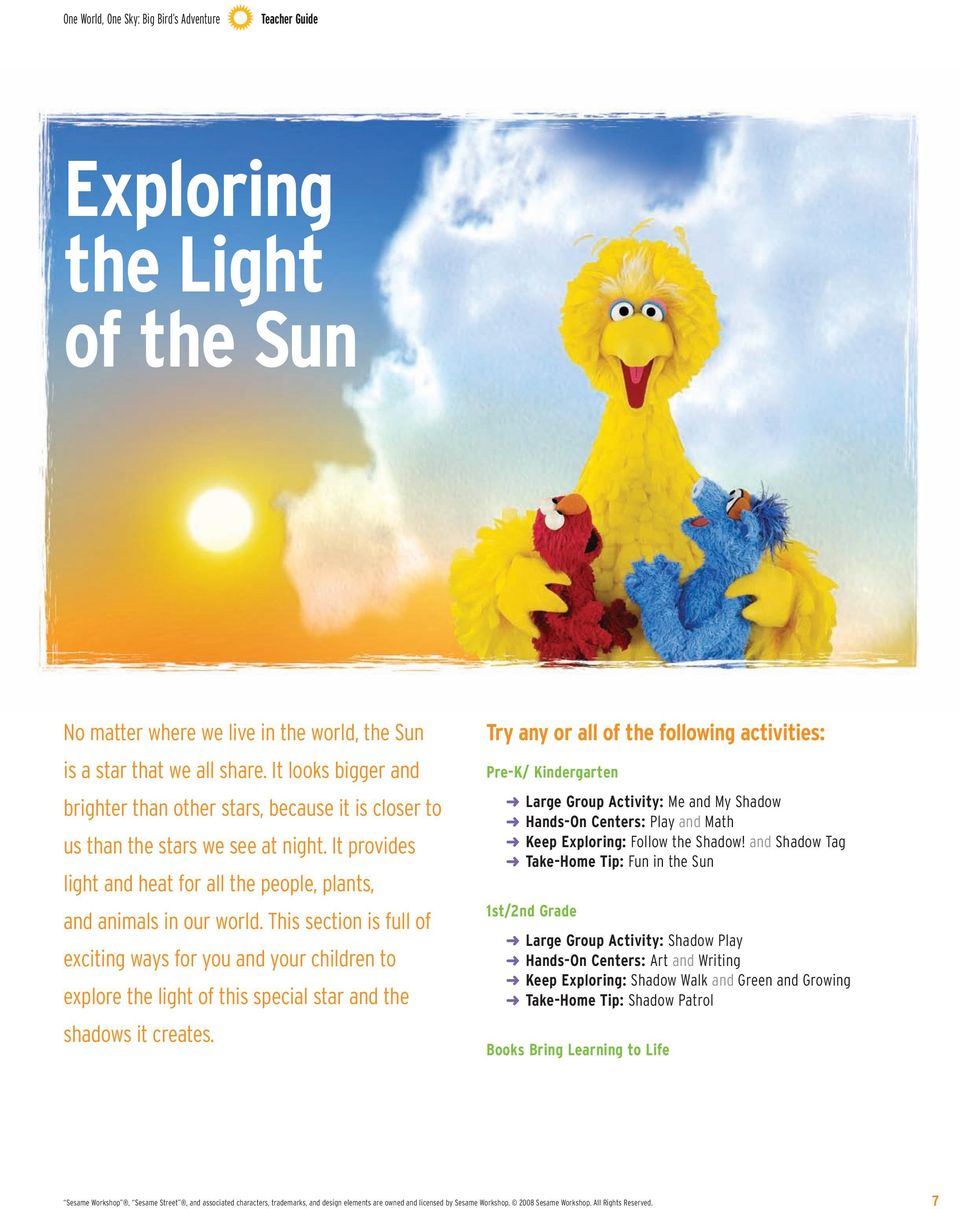
8 Exploring the Light of the Sun No matter where we live in the world, the Sun is a star that we all share. It looks bigger and brighter than other stars, because it is closer to us than the stars we see at night. It provides light and heat for all the people, plants, and animals in our world. This section is full of exciting ways for you and your children to explore the light of this special star and the shadows it creates. Try any or all of the following activities: Pre-K/ Kindergarten Large Group Activity: Me and My Shadow Hands-On Centers: Play and Math Keep Exploring: Follow the Shadow! and Shadow Tag Take-Home Tip: Fun in the Sun 1st/2nd Grade Large Group Activity: Shadow Play Hands-On Centers: Art and Writing Keep Exploring: Shadow Walk and Green and Growing Take-Home Tip: Shadow Patrol Books Bring Learning to Life Sesame Workshop, Sesame Street, and associated characters, trademarks, and design elements are owned and licensed by Sesame Workshop Sesame Workshop. All Rights Reserved. 7
9 Exploring the Light of the Sun Pre-K/Kindergarten LARGE Group Activity Me and My Shadow Children all over the world enjoy playing in the Sun. What happens when the Sun s light shines on people and objects? Investigate this exciting question with your children! CHILDREN WILL: Discover that we need light to make shadows Investigate how sunlight creates shadows Explore how to make their own shadows move and change Create different shadows with their bodies YOU WILL NEED: Children and a sunny day BOOK TIP: Add to this activity by reading Guess Whose Shadow? by Stephen R. Swinburne. National Science Education Standard* Content Standard K-4. A Science as Inquiry: Understanding about scientific inquiry ASK CHILDREN: Big Bird taught us that the Sun is a star that we can see during the day! Isn t that amazing? It s bigger and brighter than the stars we see at night because it s much closer to us. How can you tell when it s nighttime? What is it like outside at night? How can you tell when it s daytime? What is it like outside during the day? When you stand outside, have you ever noticed shadows? What shadows have you seen? Did you see them during the day, or at night? INVESTIGATE TOGETHER: 1) The best time to explore shadows outdoors is mid-morning or mid-afternoon. Choose a sunny day and invite children to an open outdoor space. Before going outside, remind them that it is not safe to look directly at the Sun. 2) Ask children to look for their own shadows and explore various movements. For example: What happens to your shadow when you move? What happens to your shadow if you crouch down low or reach your hands up high? 3) Encourage children to work in pairs and observe each other s shadows. Can your shadow cover up your partner s shadow? What body parts do you see in your partner s shadow? His eyes? His nose? His hair? What color is your partner s shadow? Can you see the color of your partner s clothes in his shadow? Try to make your shadows shake hands without your hands actually touching! 4) Challenge children to work together to make larger shadow creatures. Try to make shadows of big creatures with lots of arms and legs! Show how you can add ears, or a long tail! 5) Talk about all the things children notice about their shadows. Ask children: What is creating all of these shadows? What do you need to create shadows? Invite them to ask questions and share ideas for further exploration. *National Committee on Science Education Standards and Assessment, National Research Council. (1996). National Science Education Standards. Retrieved from on October 10, Sesame Workshop, Sesame Street, and associated characters, trademarks, and design elements are owned and licensed by Sesame Workshop Sesame Workshop. All Rights Reserved. 8

10 Exploring the Light of the Sun Pre-K/Kindergarten HANDS-ON Centers Get Hands-On Play Center Math Center CHILDREN WILL: Compare and contrast the types of things they do during daytime and nighttime Engage in an art activity that develops storytelling skills YOU WILL NEED: Overhead projector or flashlight Drawings of Hu Hu Zhu, Elmo, the Sun, child silhouette, and Big Bird (on pages 10-11) Glue Construction paper Craft stick or ruler ACTIVITY: Invite children to create Shadow Puppets to perform a play about the Sun. They can use the drawings on page to create puppet characters and props. They can color the pictures and draw themselves. After coloring, they can glue the drawings onto construction paper, cut them out, and attach a handle (e.g. a craft stick or ruler) to the back. Invite them to move the puppets and props in front of an overhead projector or a flashlight pointed at a wall. They can show the sunrise, and have their puppets act out what they like to do during the day, or the sunset, and have their puppets act out what they like to do at night. CHILDREN WILL: Compare the height of an object and the length of its shadow Develop their measuring skills YOU WILL NEED: Overhead projector or flashlight White paper Blocks ACTIVITY: Put an overhead projector or a flashlight on a table and shine the light to one side (dim the lights, or set up a shaded space). Cover the table with white paper and give children blocks to place in front of the beam of light. Challenge children to build a shadow tower. As they place one block on top of the other, what happens to the shadow they see? How many blocks do they have in their tower? Is the shadow the same size as the tower? Why do you think they are different sizes? What is creating the shadows? Important Safety Note: Some of the following centers involve the use of an overhead projector. Please remind children not to touch the projector, as it may be hot! Sesame Workshop, Sesame Street, and associated characters, trademarks, and design elements are owned and licensed by Sesame Workshop Sesame Workshop. All Rights Reserved. 9

11 Exploring the Light of the Sun Pre-K/Kindergarten HANDS-ON Centers Sesame Workshop, Sesame Street, and associated characters, trademarks, and design elements are owned and licensed by Sesame Workshop Sesame Workshop. All Rights Reserved. 10

12 Exploring the Light of the Sun Pre-K/Kindergarten HANDS-ON Centers Sesame Workshop, Sesame Street, and associated characters, trademarks, and design elements are owned and licensed by Sesame Workshop Sesame Workshop. All Rights Reserved. 11

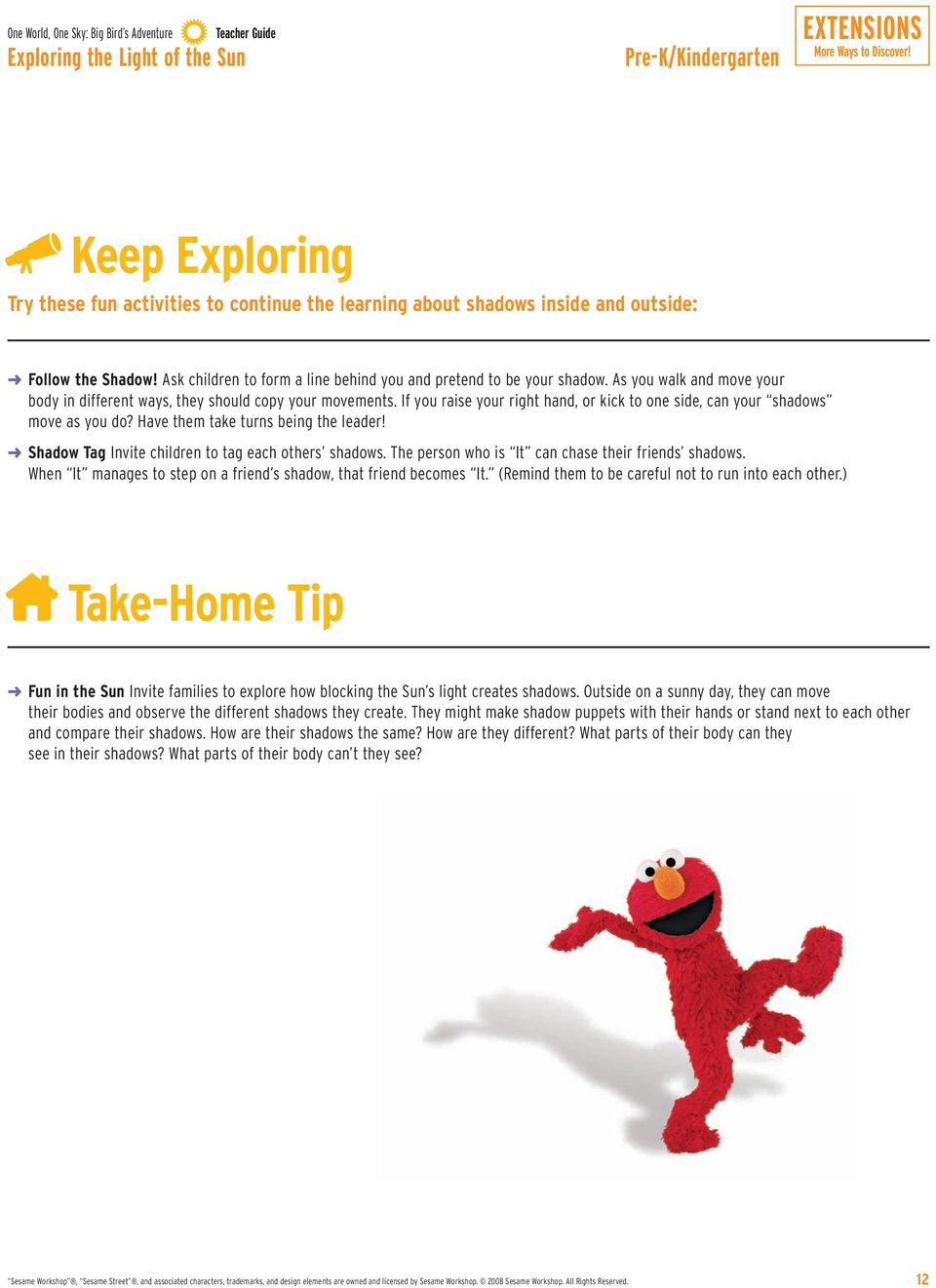
13 Exploring the Light of the Sun Pre-K/Kindergarten EXTENSIONS More Ways to Discover! Keep Exploring Try these fun activities to continue the learning about shadows inside and outside: Follow the Shadow! Ask children to form a line behind you and pretend to be your shadow. As you walk and move your body in different ways, they should copy your movements. If you raise your right hand, or kick to one side, can your shadows move as you do? Have them take turns being the leader! Shadow Tag Invite children to tag each others shadows. The person who is It can chase their friends shadows. When It manages to step on a friend s shadow, that friend becomes It. (Remind them to be careful not to run into each other.) Take-Home Tip Fun in the Sun Invite families to explore how blocking the Sun s light creates shadows. Outside on a sunny day, they can move their bodies and observe the different shadows they create. They might make shadow puppets with their hands or stand next to each other and compare their shadows. How are their shadows the same? How are they different? What parts of their body can they see in their shadows? What parts of their body can t they see? Sesame Workshop, Sesame Street, and associated characters, trademarks, and design elements are owned and licensed by Sesame Workshop Sesame Workshop. All Rights Reserved. 12
14 Exploring the Light of the Sun 1st/2nd Grade LARGE Group Activity Shadow Play Children all over the world enjoy playing with shadows. Do shadows look the same throughout the day or do they change? Investigate this exciting question with your children! CHILDREN WILL: Observe how shadows are formed Investigate how the Sun s position in the sky causes shadows to move and change Make predictions about shadows Measure and compare the lengths of their shadows at different times during the day YOU WILL NEED: A sunny day Yarn (two different colors) Scissors Markers Masking tape BOOK TIP: Add to this activity by reading Guess Whose Shadow? by Stephen R. Swinburne. ASK CHILDREN: Big Bird told us that the Sun is a star that we can see during the day. Isn t that amazing? It s bigger and brighter than the stars we see at night because it is much closer to us. When Big Bird saw the Sun turn red and orange, it began to set. What else happened when the Sun was setting? Where was the Sun in the sky, high or low? What does it look like after the Sun sets? When it is early in the morning, the Sun starts to rise. What do you think happens to the Sun next? That s right! The Sun will go higher in the sky. What does it look like after the Sun rises? In a sunny day, what shadows have you seen? Where were they? What happens to shadows during the day? Do they change or stay the same? INVESTIGATE TOGETHER: 1) Choose a time in the early morning or late afternoon, and another time around noon, and invite children to work in pairs to investigate shadows. 2) Give each child about 7 feet of the same colored yarn (more yarn may be needed if this activity is done in the winter, or for taller children). Ask them to stand in a sunny spot so that they can see their partner s shadow. The child whose shadow is being measured should stand on one end of the yarn, while his partner stretches the other end to the head of the shadow. Children can then cut the yarn, so that they are left with a piece that is the length of the shadow. Invite children to attach a piece of masking tape to their yarn and write their names on it with a marker. 3) Back inside, write the date and time of day children measured their shadows, and the color of the yarn that was used, on the board. 4) Before going out for the second time, ask children to predict whether their shadow will be the same length or a different length than the first time. 5) Give each child about 7 feet of a different colored yarn. Encourage them to work in pairs again to measure their shadows, cut the length, and label this second shadow yarn. National Science Education Standard* Content Standards: K-4. D Earth and Space Science: Objects in the sky and Changes in the earth and sky K-4. B Physical Science: Understanding light CONTINUED ON THE FOLLOWING PAGE *National Committee on Science Education Standards and Assessment, National Research Council. (1996). National Science Education Standards. Retrieved from on October 10, Sesame Workshop, Sesame Street, and associated characters, trademarks, and design elements are owned and licensed by Sesame Workshop Sesame Workshop. All Rights Reserved. 13

15 Exploring the Light of the Sun 1st/2nd Grade LARGE Group Activity Shadow Play (continued) Do shadows look the same throughout the day or do they change? 6) Back inside, write the time of the second shadow measurements on the board. Then, help them hang their pieces of yarn from the same height on a wall so that they can see and compare the lengths. Was one of their shadows longer than the other? Which one? What time of day were children s shadows the longest? When were they the shortest? Did everyone s shadow change in a similar way? Why might this be? 7) Dim the lights in the room and use a flashlight to show children how the Sun s position in the sky affects shadows. Place an object (a block or a doll) on a table. Slowly move the flashlight in an arc from one side of the object to the other. Ask children to observe what happens to the object s shadow as you move the flashlight. What happens to the shadow as you move the flashlight up one side? What happens to the shadow when you shine the flashlight directly over the top of the object? What happens to the shadow when you move the flashlight down the other side? When is the shadow longest? When is it shortest? 8) Ask children why they think the length of their shadows changed during the day. What do they know about the Sun s path in the sky? After the Sun rises in the early morning, how does its position in the sky change? Where is the Sun in the sky before it sets? 9) Talk together about where the Sun may have been in the sky each time they measured their shadows. Sesame Workshop, Sesame Street, and associated characters, trademarks, and design elements are owned and licensed by Sesame Workshop Sesame Workshop. All Rights Reserved. 14
16 Exploring the Light of the Sun 1st/2nd Grade HANDS-ON Centers Get Hands-On Art Center Writing Center CHILDREN WILL: Compare the size of an object and its shadow Make shadow art YOU WILL NEED: Overhead projector or flashlight Cardboard shapes (e.g. circles, triangles, rectangles, hexagons, and octagons) White paper Markers, paint, or crayons ACTIVITY: Invite children to create shadow art! Shine an overhead projector or flashlight onto a piece of white paper and provide children with a variety of cardboard shapes. Ask them to explore moving the shapes closer to, and further away from, the light source. Where can they hold the objects to see the clearest shadows? How can they move the objects to create bigger shadows? Smaller shadows? Have them work in pairs to trace the shadows onto the paper. They might trace one shadow shape next to another to create an animal, or make two shadows overlap to create a shadow design. When they re done, they can decorate their tracings with markers, paint, or crayons, and share them with the class! CHILDREN WILL: Develop writing skills YOU WILL NEED: Paper Pencils ACTIVITY: Invite children to draw a picture of themselves with the Sun and their shadow. Encourage them to write a few sentences or an original story about their shadow. How does their shadow change throughout the day? Important Safety Note: Some of the following centers involve the use of an overhead projector. Please remind children not to touch the projector, as it may be hot! Sesame Workshop, Sesame Street, and associated characters, trademarks, and design elements are owned and licensed by Sesame Workshop Sesame Workshop. All Rights Reserved. 15
17 Exploring the Light of the Sun 1st/2nd Grade EXTENSIONS More Ways to Discover! Keep Exploring Try these fun activities to continue the learning about shadows inside and outside: Shadow Walk Choose three different times of day (morning, near noon, and afternoon) and go for a shadow walk. Invite children to use chalk to trace the shadow of an object on the playground, such as a basketball hoop, a handrail, or a trash can. Return to the same spot two more times that day, and trace the same object s shadow with different colors of chalk. Is the shadow in the same place? Are all three shadows the same length? Or the same shape? Do they point in the same direction? Green and Growing The Sun s light helps plants grow! Go for a walk outside and ask them to point out all the things they see growing in the Sun. If plants are in the shade, does that mean they are always in the shade? Talk with children about how some plants need a lot of sunlight to grow, while others need less sunlight. Take-Home Tip Shadow Patrol Encourage families to explore how shadows move and change throughout the day. On a sunny day, they can work together with their child to observe the shadow of a tree, a bench, or a handrail at different times of the day. What does the shadow look like in the morning? What does it look like around noon? How about in the late afternoon? When is the shadow longest? When is it shortest? Sesame Workshop, Sesame Street, and associated characters, trademarks, and design elements are owned and licensed by Sesame Workshop Sesame Workshop. All Rights Reserved. 16

18 Exploring the Light of the Sun BOOKS Bring Learning to Life Books Bring Learning to Life Here are some books that will extend the learning. Read them aloud to your group or invite children to use them for Independent Reading to further explore shadows, the Sun, and day and night. SUN/SHADOWS LITERATURE: NONFICTION Day Light, Night Light: Where Light Comes From by Franklyn M. Branley Discusses the properties of light, particularly its source in heat. Pre-K/K Guess Whose Shadow? by Stephen R. Swinburne A photo-essay on how light creates shadows. Pre-K/K Me and My Shadows by Elizabeth Adams Illustrated instructions for 32 shadow puppets, with suggestions on shadow puppetry in general. Pre-K/K Shadow Play: Making Pictures with Light and Lenses by Bernie Zubrowski This lively science activity book has over 50 imaginative experiments that help you explore some of the basic properties of light and discover how studying shadows led to the invention of the camera. Pre-K/K Sun by Steve Tomecek Introduces stars and what they are made of, how they shine, their positions with relation to Earth, and more. Pre-K/K Sun Up, Sun Down by Gail Gibbons Describes the characteristics of the Sun and the ways in which it regulates life on Earth. Pre-K/K What Makes Day and Night by Franklyn M. Branley A simple explanation of how the rotation of the Earth causes night and day. Pre-K/K SUN/SHADOWS LITERATURE: CULTURAL LORE Arrow to the Sun: A Pueblo Indian Tale by Gerald McDermott This beautiful story portrays the Indian reverence to the Sun with vibrant full-color illustrations that capture the boldness and color of Pueblo art. Pre-K/K Why the Sun and the Moon Live in the Sky by Elphinstone Dayrell Sun and his wife, the Moon, lived on Earth and built a large house so that the water people could visit. But so many poured in that they were forced to move to the sky. Pre-K/K Raven: A Trickster Tale from the Pacific Northwest by Gerald McDermott Raven, a Pacific Coast Indian trickster, sets out to find the Sun. Pre-K/K CONTINUED ON THE FOLLOWING PAGE Sesame Workshop, Sesame Street, and associated characters, trademarks, and design elements are owned and licensed by Sesame Workshop Sesame Workshop. All Rights Reserved. 17
19 Exploring the Light of the Sun BOOKS Bring Learning to Life Books Bring Learning to Life (continued) SUN/SHADOWS LITERATURE: FICTION Nine O Clock Lullaby by Marilyn Singer A series of bright vignettes provides an ingenious response to children s curiosity about what youngsters in other parts of the world are doing while they themselves are going to bed. Pre-K/K 1st/2nd Nothing Sticks Like a Shadow by Ann Tompert To win a bet, Rabbit tries to get rid of his shadow with the aid of his many animal friends. Pre-K/K Oscar and the Moth: A Book about Light and Dark by Geoff Waring As Oscar the kitten watches the Sun set one evening, he has lots of questions about light and dark. Who better than Moth to help out? Moth shows how sources of light are as different as the Sun, stars, fireflies, streetlights, and airplanes, and also explains how shadows are made and why darkness comes at night. Pre-K/K Somewhere in the World Right Now by Stacey Schuett Describes what is happening in different places around the world at a particular time. Pre-K/K The Sun is My Favorite Star by Frank Asch Celebrates a child s love of the Sun and the wondrous ways in which it helps the Earth and the life upon it. Pre-K/K What the Sun Sees/What the Moons Sees by Nancy Tafuri Contrasts the world as viewed in sunlight with the quiet night world in moonlight. Pre-K/K 1st/2nd Shadows by April Pulley Sayre Rhyming text describes the search of two young friends for shadows in the everyday world. Pre-K/K Sesame Workshop, Sesame Street, and associated characters, trademarks, and design elements are owned and licensed by Sesame Workshop Sesame Workshop. All Rights Reserved. 18

20 Finding Patterns in the Stars Children all around the world look up at the night sky and find patterns in the stars. They might connect stars to imagine shapes like a triangle or a square, or even the outline of an animal. Spark children s imaginations as you explore star patterns, constellations, and some of the myths and stories they ve inspired. Try any or all of the following activities: Pre-K/ Kindergarten Large Group Activity: Connect the Stars Hands-On Centers: Art and Math Keep Exploring: Group Star Patterns and Star Song Take-Home Tip: Fun nel Planetarium 1st/2nd Grade Large Group Activity: Constellation Confetti Hands-On Centers: Painting and Reading Keep Exploring: A Bowl Full of Stars and Everybody Is a Star! Take-Home Tip: Stargazing Books Bring Learning to Life Sesame Workshop, Sesame Street, and associated characters, trademarks, and design elements are owned and licensed by Sesame Workshop Sesame Workshop. All Rights Reserved. 19

21 Finding Patterns in the Stars Pre-K/Kindergarten LARGE Group Activity Connect the Stars It can be fun for children to connect the dots while looking into a starry sky. No matter where they live, they can look up and use their imaginations to make patterns with the stars they see. CHILDREN WILL: Discover that stars can form patterns in the sky Use white, circle cutouts to create star patterns Share their star patterns YOU WILL NEED: Big Dipper Star Chart (page 21) Emperor Star Chart (page 22) Ursa Major Star Chart (page 23) Black or dark-blue construction paper White, circle cutouts (about the size of a penny, 8-10 per child) Glue sticks Chalk or white crayons BOOK TIP: Add to this activity by reading Her Seven Brothers by Paul Goble. National Science Education Standard* Content Standard K-4. E Science and Technology: Understanding about science and technology ASK CHILDREN: Big Bird used his imagination to make different shapes by connecting stars in the sky. What shapes did Big Bird imagine when he looked at the starry sky? (Show the Big Dipper Star Chart on page 21.) He connected one, two, three, four, five, six, seven stars to make a big soup spoon in the sky the Big Dipper! In China, Hu Hu Zhu can see this same star pattern! Let s listen to some stories about the Big Dipper and see what shapes or patterns we can make by connecting stars! INVESTIGATE TOGETHER: 1) Explain that people often tell stories and sing songs about the patterns they see in the stars. In ancient China, people believed that the North Pole of the sky was a great emperor who went around the world in his carriage. (Show the Emperor Star Chart on page 22.) 2) In the United States, people share a different story about these same seven stars. (Show the Ursa Major Star Chart on page 23 and tell children that the Big Dipper is part of a bigger star pattern that looks like a bear.) Native Americans tell a story similar to this one about the bear: A girl changed herself into a bear and chased after her little sister and seven brothers. The seven brothers flew up into the sky to hide. They became the seven brightest stars of the Great Bear. They are the stars that make up the Big Dipper. 3) Now, invite children to create their own star patterns. Provide each child with 8-10 circle cutouts and a piece of dark-colored paper. Have them place the circles on their paper any way they like, without having the circles overlap. Then, ask them to glue the circles in place one at a time. 4) Ask children to pretend the circles are stars in the nighttime sky. What patterns do they see in their stars? They could use their imagination to connect some of the stars to make straight or curvy lines. They could also use three stars to make a triangle. 5) Give children pieces of chalk or white crayons, and invite them to connect the stars into the patterns they see. 6) Encourage them to share their star patterns with the class. How many stars did they connect to make each pattern? *National Committee on Science Education Standards and Assessment, National Research Council. (1996). National Science Education Standards. Retrieved from on October 10, Sesame Workshop, Sesame Street, and associated characters, trademarks, and design elements are owned and licensed by Sesame Workshop Sesame Workshop. All Rights Reserved. 20
22 Finding Patterns in the Stars Pre-K/Kindergarten LARGE Group Activity Big Dipper Star Chart Sesame Workshop, Sesame Street, and associated characters, trademarks, and design elements are owned and licensed by Sesame Workshop Sesame Workshop. All Rights Reserved. 21
23 Finding Patterns in the Stars Pre-K/Kindergarten LARGE Group Activity Emperor Star Chart Sesame Workshop, Sesame Street, and associated characters, trademarks, and design elements are owned and licensed by Sesame Workshop Sesame Workshop. All Rights Reserved. 22
24 Finding Patterns in the Stars Pre-K/Kindergarten LARGE Group Activity Ursa Major Star Chart Sesame Workshop, Sesame Street, and associated characters, trademarks, and design elements are owned and licensed by Sesame Workshop Sesame Workshop. All Rights Reserved. 23
25 Finding Patterns in the Stars Pre-K/Kindergarten HANDS-ON Centers Get Hands-On Art Center Math Center CHILDREN WILL: Explore their creativity while creating a starry night CHILDREN WILL: Observe similarities and differences between shapes YOU WILL NEED: Dark-blue construction paper Star-shaped cookie cutter Paint or glue Glitter ACTIVITY: Provide pieces of dark-blue construction paper and invite children to create their own starry nighttime sky! They can dip a star-shaped cookie cutter into paint and make star prints on their paper. If they dip the cookie cutter into glue and make a print, they can sprinkle the print with glitter so it shines. Display the starry nights on a wall for all to enjoy. YOU WILL NEED: Shapes of different sizes ACTIVITY: A star shape is an interesting figure for children to compare to geometric shapes. Provide children with a variety of circles, triangles, squares, rectangles, and stars of different sizes and different numbers of corners. Ask them to sort the shapes and make comparisons. How many corners does each star have? Which other shapes have sharp corners? How many corners does every triangle have? Which shapes have no corners at all? Sesame Workshop, Sesame Street, and associated characters, trademarks, and design elements are owned and licensed by Sesame Workshop Sesame Workshop. All Rights Reserved. 24
26 Finding Patterns in the Stars Pre-K/Kindergarten EXTENSIONS More Ways to Discover! Keep Exploring Try these fun activities to continue learning inside and outside: Group Star Patterns Invite children to work together to create a group star pattern outside. Each child can draw a star on the ground with chalk. Together, stand back and see if you can find patterns in the stars they ve drawn. Encourage children to take turns to connect the stars. After they ve drawn the shape of their star pattern, each child can stand on their star so they can be part of the star pattern. Can they stand with their legs apart and their arms up to show the light shining from their star? Star Song Elmo and Hu Hu Zhu sang Twinkle, Twinkle, Little Star! to Hu Hu Zhu s favorite star, the North Star. Sing this song together, and ask children to show how the star shines by opening and closing their hands on the word Twinkle. Twinkle, twinkle, little star, How I wonder what you are. Up above the world so high, Like a diamond in the sky. Twinkle, twinkle, little star, How I wonder what you are! Children will be interested to learn that stars actually are enormous balls of very hot gas. They are so hot that they shine brightly enough for us to see them even though they are far, far away. Only one star our Sun is close enough to warm us and light up our sky during the day. If you look closely, a star may appear to twinkle or flicker in the sky. That happens when the star s faint light is being bounced around a tiny bit by the air above us. (On the airless moon, the stars don t ever seem to twinkle in the sky and we would never have thought of this song!) Take-Home Tip Fun nel Planetarium Families can work together to create their own planetarium show! Cover the large opening of a funnel with aluminum foil, and secure it with tape or a rubber band (the bottom of an oatmeal or bread crumb canister will also work). Next, poke small holes in the aluminum foil. You may even poke holes in the pattern of the Big Dipper. Then, turn off the lights, and lie under a table. As you shine a flashlight through the small end of the funnel and aim the projector at the underside of the table, you will behold the star patterns you ve created! Sesame Workshop, Sesame Street, and associated characters, trademarks, and design elements are owned and licensed by Sesame Workshop Sesame Workshop. All Rights Reserved. 25
27 Finding Patterns in the Stars 1st/2nd Grade LARGE Group Activity Constellation Confetti Children may have looked up at the night sky and seen different shapes or patterns. Now they will use their imaginations to create their very own star patterns. CHILDREN WILL: Discover that stars can form patterns in the sky, and that some of these patterns are called constellations Use paper dots to create a star pattern Create a story about their star pattern YOU WILL NEED: Big Dipper Star Chart (page 27) Black or dark-blue construction paper White or brightly colored hole-punch dots (12 per student) Glue White or gray crayons BOOK TIP: Add to this activity by reading Follow the Drinking Gourd by Jeanette Winter. ASK CHILDREN: Big Bird used his imagination to make different shapes by connecting stars in the sky. What shapes did Big Bird imagine when he looked at the starry sky? He connected seven stars to make a big soup spoon in the sky- the Big Dipper! When you look up at the night sky, what shapes or patterns have you seen? INVESTIGATE TOGETHER: 1) Explain that people often tell stories and sing songs about the patterns they see in the stars. In the United States, there was a time in the past when there were slaves. When slaves looked up at the Big Dipper, they called it the Drinking Gourd because it looked like the spoon they would use to drink water. They used the Drinking Gourd star pattern to help guide them to freedom as they traveled from the South to the North. Show children the Big Dipper Star Chart (on page 27) and ask if they can see how it looks like a drinking gourd, or a big spoon. 2) Now, invite children to create their own star patterns by dropping the dots, one by one, onto the construction paper, and then gluing each dot where it lands. Explain that they are gluing the stars wherever they ve landed because that s how it is with the stars in the sky. Instead of moving stars into patterns, people find patterns in the way the stars are already positioned. Some of those patterns are called constellations. 3) Encourage children to look at their papers. What patterns or pictures do they see? 4) Once children have found a pattern, they should use the crayons to connect the dots. Invite them to choose a name for their constellation and create a story about it. 5) Encourage them to share their star patterns (constellations) and stories with the class. National Science Education Standard* Content Standard K-4. E Science and Technology: Understanding about science and technology *National Committee on Science Education Standards and Assessment, National Research Council. (1996). National Science Education Standards. Retrieved from on October 10, Sesame Workshop, Sesame Street, and associated characters, trademarks, and design elements are owned and licensed by Sesame Workshop Sesame Workshop. All Rights Reserved. 26
28 Finding Patterns in the Stars 1st/2nd Grade LARGE Group Activity Big Dipper Star Chart Sesame Workshop, Sesame Street, and associated characters, trademarks, and design elements are owned and licensed by Sesame Workshop Sesame Workshop. All Rights Reserved. 27
29 Finding Patterns in the Stars 1st/2nd Grade HANDS-ON Centers Get Hands-On Painting Center Reading Center CHILDREN WILL: Explore the shapes in their artful interpretations of stars YOU WILL NEED: Paint Paper ACTIVITY: Help children create their own simple five- or six-pointed stars using triangles. How many triangles are inside their drawings of a star? They can paint each triangle a different color. What other shapes can they see in their stars? How many sides do their star drawings have? CHILDREN WILL: Develop phonemic awareness YOU WILL NEED: Objects (including ones that start with the same consonant blend as the word star (e.g. stamp, sticker, stapler) ACTIVITY: Help develop children s phonemic awareness skills by encouraging them to sort the objects as they practice saying the names. Encourage them to think of other words that begin with the same sound as star. Sesame Workshop, Sesame Street, and associated characters, trademarks, and design elements are owned and licensed by Sesame Workshop Sesame Workshop. All Rights Reserved. 28
30 Finding Patterns in the Stars 1st/2nd Grade EXTENSIONS More Ways to Discover! Keep Exploring Try these fun activities to continue the learning inside and outside: A Bowl Full of Stars Create your own twinkling stars with a clear glass bowl, a flashlight, water, a pencil, and aluminum foil. Cut a piece of aluminum foil large enough to fit under the bowl. Loosely wrinkle the foil and fill the bowl halfway with water. Set the bowl gently on top of the aluminum foil. Shine the flashlight 12 inches from the top of the bowl. Tap the surface of the water with the pencil. Watch closely and you will see the foil twinkle, much like the stars in our sky. Everybody Is a Star! Find an open space and divide children into groups of five. Challenge them to work together to make the shape of a star. Can they use their hands? If they lie down, can they make the shape of a star using their legs? Children will be interested to learn that stars actually are enormous balls of very hot gas. They are so hot that they shine brightly enough for us to see them even though they are far, far away. Only one star our Sun is close enough to warm us and light up our sky during the day. If you look closely, a star may appear to twinkle or flicker in the sky. That happens when the star s faint light is being bounced around a tiny bit by the air above us. (On the airless moon, the stars don t ever seem to twinkle in the sky and we would never have thought of this song!) Take-Home Tip Stargazing Encourage parents and children to go stargazing together and try to find patterns in the stars they see. They might be able to find the Big Dipper, or their own patterns. They can talk together as they notice that some stars are bright and some are dim. How many stars do they see? Sesame Workshop, Sesame Street, and associated characters, trademarks, and design elements are owned and licensed by Sesame Workshop Sesame Workshop. All Rights Reserved. 29
31 Finding Patterns in the Stars BOOKS Bring Learning to Life Books Bring Learning to Life Here are some books that will extend the learning. You can read them aloud to your group or invite children to use them for Independent Reading to further explore the stars. STARS LITERATURE: NONFICTION I Wonder Why Stars Twinkle and Other Questions About Space by Carole Stott Answers questions about space such as, Are stars star-shaped? Which is the coldest planet? and What is a black hole? Pre-K/K Skylore from Planet Earth: Stories from around the world...orion by Dayle L. Brown In Skylore from Planet Earth, we explore some of the stories about the constellation Orion. Since Orion is located over the Earth s equator, people from the entire planet have looked to it for a reminder of their own traditions. Pre-K/K Skylore from Planet Earth: Stories from Around the World...PLEIADES by Dayle L. Brown In this Skylore from Planet Earth, we explore some of the stories about the star cluster Pleiades. Since the Pleiades is located almost directly over the Earth s equator, people from the entire planet have looked to it for a reminder of their own traditions. Pre-K/K Stars by Steve Tomecek Introduces stars and what they are made of, how they shine, their positions with relation to Earth, and more. Pre-K/K The Big Dipper by Franklyn M. Branley Explains basic facts about the Big Dipper, including which stars make up the constellation, how its position changes in the sky, and how it points to the North Star. Pre-K/K The Big Dipper and You by E.C. Krupp Presents what is known today and past beliefs about the Big Dipper, or Ursa Major, and gives added information on the North Star, or Polaris. Pre-K/K The Glow-in-the-Dark Planetarium Book by Annie Ingle Describes some things such as constellations, the planet Venus, the moon, and meteors that can be seen in the night sky. Parts of the pictures are visible only in the dark. Pre-K/K The Sky is Full of Stars by Franklyn M. Branley Children will be able to learn about the color and brightness of the stars, the location of major constellations, and making their own planetariums with things they can find at home. Pre-K/K CONTINUED ON THE FOLLOWING PAGE Sesame Workshop, Sesame Street, and associated characters, trademarks, and design elements are owned and licensed by Sesame Workshop Sesame Workshop. All Rights Reserved. 30
32 Finding Patterns in the Stars BOOKS Bring Learning to Life Books Bring Learning to Life (continued) STARS LITERATURE: CULTURAL LORE Coyote Places the Stars by Harriet Peck Taylor Coyote arranges the stars in the shapes of his animal friends. Pre-K/K Her Seven Brothers by Paul Goble Retells the Cheyenne legend in which a girl and her seven chosen brothers become the Big Dipper. Pre-K/K How the Stars Fell Into the Sky: A Navajo Legend by Jerrie Oughton This retelling of a Navajo folktale explains how First Woman tried to write the laws of the land using stars in the sky, only to be thwarted by the trickster Coyote. Pre-K/K Zoo in the Sky by Jacqueline Mitton This award-winning book captures the glittering light show of the constellations. Pre-K/K Once Upon a Starry Night by Jacqueline Mitton Similar in format to Zoo in the Sky: A Book of Animal Constellations (1998), this companion volume presents a series of 10 constellations and briefly retells the Greek myths related to them. Pre-K/K Twinkle, Twinkle, Little Star by Iza Trapani An expanded version of the 19th-century poem in which a small girl accompanies a star on a journey through the night sky, examining both heavenly bodies and the Earth below. Includes music on last page. Pre-K/K 1st/2nd Sesame Workshop, Sesame Street, and associated characters, trademarks, and design elements are owned and licensed by Sesame Workshop Sesame Workshop. All Rights Reserved. 31
33 Astronaut Adventures to the Moon The Moon is a source of awe and wonder for children all over the world. There is so much to learn about the Moon, from exploring how people and objects move on the Moon, to finding out why astronauts wear special suits. Build on children s natural curiosity and see what you can discover together! Try any or all of the following activities: For Pre-K/ Kindergarten Teachers Large Group Activity: A Trip to the Moon! Hands-On Centers: Math, Dress Up, and Art Keep Exploring: Astronaut Tag and Moon Hunt Take-Home Tip: Moon Talk For 1st/2nd Grade Teachers Large Group Activity: Moon Suits Hands-On Centers: Math and Writing Keep Exploring: Feel the Heat and Astronaut Tag Take-Home Tip: Suit Yourself! Books Bring Learning to Life Sesame Workshop, Sesame Street, and associated characters, trademarks, and design elements are owned and licensed by Sesame Workshop Sesame Workshop. All Rights Reserved. 32
34 Astronaut Adventures to the Moon Pre-K/Kindergarten LARGE Group Activity A Trip to the Moon! Children from around the world have often wondered, What would it be like to be on the Moon? Explore this fascinating question with your children as you investigate the different ways things look, feel, and move on the moon! CHILDREN WILL: Take an imaginary trip to the Moon Discover that the Moon is far away, and very different from Earth Move to music and experience how people move differently on the Moon Learn about the surface of the Moon YOU WILL NEED: The Going to the Moon with Elmo and Hu Hu Zhu! story (pages 35-40) Picture of the Full Moon (page 41) Open space for children to move around Play dough or clay A radio or CD player to play music Small ball BOOK TIP: Add to this activity by reading Moon by Steve Tomecek. ASK CHILDREN: After Elmo and Hu Hu Zhu looked at the stars in the sky, they took a special trip to the Moon! Elmo and Hu Hu Zhu didn t have a spaceship. What did they use to get to the Moon? Right! They used their imagination! Would you like to visit the Moon? What do you think you would see there? What would you like to find out about the Moon? Let s use our imaginations and take a trip to the Moon with Elmo and Hu Hu Zhu! INVESTIGATE TOGETHER: 1) Read the interactive story, Going to the Moon with Elmo and Hu Hu Zhu! (pages 35-40) and share the pictures with children. 2) At the end of the story, pretend to land on the Moon, and choose one or more of the following concepts to explore together: What would the Moon look like? Ask children what they think the Moon would look like. What did Elmo and Hu Hu Zhu see on the Moon? Were there any trees, flowers, or animals? Do you remember the big holes Elmo and Hu Hu Zhu found? Hu Hu Zhu told us those were called craters. Look at the picture of the Full Moon (on page 41) together and invite children to describe the Moon s surface. Encourage them to point to any craters they see. Then, pretend you are back on the Moon and imagine that there are craters all around you. Invite children to jump into and out of the pretend craters they see! Next, provide balls of clay or play dough and encourage them to make mini models of the Moon. Show children pictures of the Moon so they can use them as a reference. They can put the dough or clay around a small ball, such as a tennis ball, and then use the palm of their hand, and their thumbs to make craters. When they re done, they can count the craters they ve made! CONTINUED ON THE FOLLOWING PAGE National Science Education Standard* Content Standards: K-4. D Earth and Space Science: Objects in the sky K-4. G History of Nature and Science *National Committee on Science Education Standards and Assessment, National Research Council. (1996). National Science Education Standards. Retrieved from on October 10, Sesame Workshop, Sesame Street, and associated characters, trademarks, and design elements are owned and licensed by Sesame Workshop Sesame Workshop. All Rights Reserved. 33
35 Astronaut Adventures to the Moon Pre-K/Kindergarten LARGE Group Activity A Trip to the Moon! (continued) Elmo and Hu Hu Zhu didn t have a spaceship. What did they use to get to the Moon? Right! They used their imagination! How could you move on the Moon? Ask children what happened when Elmo and Hu Hu Zhu tried to run on the Moon. That s right, they hopped and jumped! You can jump really high on the Moon. Let s try it! Ask everybody to jump as high as they can. Now, do it again! Explain that it would feel different to walk on the Moon. You would feel almost like you can float with every step. Make believe your whole body is very light and pretend to walk slowly on the Moon. Now, try it with music! Play some music and encourage children to move like they are walking on the Moon. When the music stops, they can freeze in place. When the music starts, they can moon walk again. 3) End your Moon adventure by asking children if they think they would be able to stay and live on the Moon. Are there any houses for them to live in? Is there any food for them to eat? Explain that they need to travel all the way back to Earth to see all the wonderful people and places they left behind. 4) Get back in your spaceship together and prepare for your blastoff back to Earth. 10, 9, 8, 7, 6, 5, 4, 3, 2,... 1! Blastoff! Act out riding in your spaceship and pretend to land back on Earth. Take off your helmets and breathe in Earth s air! ONLINE LINKS: During this activity, take a look at these videos to see examples of real astronauts moving on the Moon: Take a look at how the astronauts move and jump. Then, take a look at the flag. Is it waving? Why isn t it waving? That s right! It isn t moving because there is no air on the Moon! It isn t easy to keep your balance on the Moon when you are wearing a heavy backpack. Take a look at what happens to this astronaut as he tries to move on the Moon. This fun video shows astronauts singing on the Moon as they talk by radio about the different ways they can move! Sesame Workshop, Sesame Street, and associated characters, trademarks, and design elements are owned and licensed by Sesame Workshop Sesame Workshop. All Rights Reserved. 34
36 Astronaut Adventures to the Moon Pre-K/Kindergarten LARGE Group Activity Going to the Moon with Elmo and Hu Hu Zhu! Sesame Workshop, Sesame Street, and associated characters, trademarks, and design elements are owned and licensed by Sesame Workshop Sesame Workshop. All Rights Reserved. 35
37 Astronaut Adventures to the Moon Pre-K/Kindergarten LARGE Group Activity Today is a very exciting day for Elmo and his good friend from China, Hu Hu Zhu. They are going to take a pretend trip to the Moon and they d like you to come too! Oh boy, oh boy, shouts Elmo, is it time to go to the Moon? Not yet, Elmo, says Hu Hu Zhu. We have to answer a big question before we go. What? asks Elmo. Elmo bets Elmo knows the answer. Then, Elmo and Hu Hu Zhu can go to the Moon right away! How do we get there? asks Hu Hu Zhu. Oh, said Elmo quietly, Elmo does not know. Just then, Elmo had an idea. He and Hu Hu Zhu would just need to find out how astronauts go to the Moon and then they could do those very same things. page 1 Sesame Workshop, Sesame Street, and associated characters, trademarks, and design elements are owned and licensed by Sesame Workshop Sesame Workshop. All Rights Reserved. 36
38 Astronaut Adventures to the Moon Pre-K/Kindergarten LARGE Group Activity Elmo and Hu Hu Zhu need some astronaut answers. Can you help? First they need to know what astronauts travel in when they go to the Moon. What s that you say you say astronauts travel in a spaceship when they go to the Moon? Oh goody, says Elmo. Now Elmo and Hu Hu Zhu can go to the Moon. We have the answer! Moon, here comes Elmo and Hu Hu Zhu! But it s not just that, says Hu Hu Zhu. The Moon is really far away. You might not believe it, but it takes several days to get there! When people first went to the Moon, it took them about four days. Elmo thinks that if it is going to take four days to get there, Elmo and Hu Hu Zhu better get in the spaceship now! says Elmo. But, wait, Elmo, says Hu Hu Zhu. We are not ready yet! page 2 Sesame Workshop, Sesame Street, and associated characters, trademarks, and design elements are owned and licensed by Sesame Workshop Sesame Workshop. All Rights Reserved. 37
39 Astronaut Adventures to the Moon Pre-K/Kindergarten LARGE Group Activity We have another question to answer, says Hu Hu Zhu. What do astronauts wear when they go to the Moon? It s time for more astronaut answers. Do you know what special clothing astronauts wear to the Moon? Look at these pictures of real astronauts on the Moon. What are they wearing? Helmets and boots, you got it! Wow, says Elmo. Elmo loves helmets and boots. And they wear big backpacks too! The backpacks are big because they need a special air tank, says Hu Hu Zhu. And they need helmets to help them breathe on the Moon because there isn t any air up there. Oh, Elmo and Hu Hu Zhu know just what to wear and just how to travel. Now, can Elmo and Hu Hu Zhu go to the Moon? asks Elmo. Well if we have some friends to travel with will you join us? asks Hu Hu Zhu. Looks like Elmo and Hu Hu Zhu need your help again, so get ready to put on your space suits! Yes says Hu Hu Zhu. Put one foot in, then the other, and pullll your space suit up. Now ziiiiiiip it and don t forget to put your big round helmet on to help you breathe! page 3 Sesame Workshop, Sesame Street, and associated characters, trademarks, and design elements are owned and licensed by Sesame Workshop Sesame Workshop. All Rights Reserved. 38
40 Astronaut Adventures to the Moon Pre-K/Kindergarten LARGE Group Activity Elmo is so excited. He just can t wait any longer. Are Elmo and Hu Hu Zhu and everybody ready to go to the Moon NOW? shouts Elmo. Yes! says Hu Hu Zhu. Okay, everybody, it s time to get in our pretend spaceship and buckle our seat belts. Let s count down for the blastoff together! 10, 9, 8, 7, 6, 5, 4, 3, 2, 1! Blastoff! What do you think a spaceship sounds like when it blasts off into space? Let s make the sound of the spaceship blasting off! ROAR!!!!! To really get the spaceship going, Elmo and Hu Hu Zhu need you to pretend that you are riding in a spaceship and flying through space. Whoooooosh! Elmo thinks the spaceship is going super fast. How is your pretend spaceship ride? Mine feels really fast and really bumpy. Everyone hold onto your seats, says Hu Hu Zhu. Oh, now it feels nice and smooth, we can relax. Remember, it takes four days to get to the Moon. So, everyone pretend to go to sleep and wake up four times that means four days have passed to get to the Moon with Elmo and Hu Hu Zhu! page 4 Sesame Workshop, Sesame Street, and associated characters, trademarks, and design elements are owned and licensed by Sesame Workshop Sesame Workshop. All Rights Reserved. 39
41 Astronaut Adventures to the Moon Pre-K/Kindergarten LARGE Group Activity Wake up, says Elmo. Elmo sees the Moon out the window! Do you? Elmo and Hu Hu Zhu and everybody finally made it to the Moon! Not quite yet, says Hu Hu Zhu. What now? says Elmo. Now we have to pretend to land on the Moon, says Hu Hu Zhu. Oh goody! says Elmo as he takes a pretend step onto the Moon. This is what Elmo has been waiting for. Hello Moon, he says. Ni Hao Moon, says Hu Hu Zhu. Now it s your turn. Take a big giant step and say hello to the Moon! Have fun exploring! page 5 Sesame Workshop, Sesame Street, and associated characters, trademarks, and design elements are owned and licensed by Sesame Workshop Sesame Workshop. All Rights Reserved. 40
42 Astronaut Adventures to the Moon Pre-K/Kindergarten LARGE Group Activity Luna llena A veces podemos ver la Luna completa en el cielo. Se ve grande, redonda y brilla mucho. Llamamos a esta forma Luna llena. Sesame Workshop, Sesame Street, and associated characters, trademarks, and design elements are owned and licensed by Sesame Workshop Sesame Workshop. All Rights Reserved. 41
43 Astronaut Adventures to the Moon Pre-K/Kindergarten HANDS-ON Centers Get Hands-On Math Center Dress Up Center Art Center CHILDREN WILL: Practice counting backward CHILDREN WILL: Engage in pretend play CHILDREN WILL: Draw a picture of a spaceship YOU WILL NEED: Three containers Crayons or blocks ACTIVITY: Children counted down from 10 before their imaginary spaceship took flight. Challenge them to practice counting backward by providing them with a model of a spaceship (or a paper airplane) and three containers of 10, 15, and 20 objects (e.g. crayons or blocks). After they count the objects in each container, they can count backward before blasting the model spaceship into space! YOU WILL NEED: Sunglasses Helmet Pants Gloves Boots ACTIVITY: Let children experience what it s like to be an astronaut by trying on special astronaut clothing. You don t need a real space suit, just a pair of sunglasses, a helmet, snow pants, gloves, and some boots. Once children have on their space suit, they re ready to walk on the Moon! YOU WILL NEED: Paper Crayons ACTIVITY: Invite children to draw a picture of the imaginary spaceship they used for their trip to the Moon. Provide pictures of real spaceships for them to use as inspiration. Hang the drawings on a bulletin board, between a picture of the Earth and a picture of the Moon, to show the spaceships flying to the Moon. This will be a great visual reminder of their astronaut adventure! Sesame Workshop, Sesame Street, and associated characters, trademarks, and design elements are owned and licensed by Sesame Workshop Sesame Workshop. All Rights Reserved. 42
44 Astronaut Adventures to the Moon Pre-K/Kindergarten EXTENSIONS More Ways to Discover! Keep Exploring Try these fun activities to continue learning inside and outside: Astronaut Tag Add a new twist to an old favorite. Invite children to play a game of tag. When you call out Moon, however, everyone moves as if they were on the Moon by hopping and taking giant steps. When you call out Earth, they can go back to running again. Moon Hunt Let s see the Moon during the daytime! The best time to look is on a clear day with low humidity. Try in the afternoons, about a week after the New Moon. Check the newspaper or a calendar to find a good day for your hunt, and look up! To plan for your hunt, you might also go to: Take-Home Tip Moon Talk Encourage families to look for the Moon before bedtime and talk about what it would be like to go to the Moon. Provide parents with a list of the things children have been learning, and encourage them to ask their children questions such as, If we took a trip to the Moon together, how would we get there? What would we need to wear? What might we see on the Moon s surface? and How is the Moon different from Earth? Sesame Workshop, Sesame Street, and associated characters, trademarks, and design elements are owned and licensed by Sesame Workshop Sesame Workshop. All Rights Reserved. 43
45 Astronaut Adventures to the Moon 1st/2nd Grade LARGE Group Activity Moon Suits Children from around the world have often wondered, What is it like on the Moon? Explore this fascinating question with your children as you investigate the different ways things look, feel, and move on the moon! CHILDREN WILL: Discover that the Moon is very different from Earth Learn about the special clothing necessary for traveling to and exploring the Moon Design their own space suits using reusable materials YOU WILL NEED: Reusable materials: paper towel rolls, pieces of cardboard, plastic lids, tissue boxes, plastic bottles, rubber bands, string (ask children to bring some of these items) Pictures of the Moon, astronauts, and spaceships (pages 46-48) Tape Scissors ASK CHILDREN: Look at the picture of the Moon and talk about how it is different from Earth. Elmo and Hu Hu Zhu discovered that there are no plants or animals on the Moon, and that they were able to move differently on the Moon. What did Elmo and Hu Hu Zhu wear on the Moon? That s right! They wore helmets. Why did Elmo and Hu Hu Zhu wear helmets on the Moon? Is there any air up there? That s right! Elmo and Hu Hu Zhu wore helmets on the Moon to help them breathe, because there isn t any air on the Moon. INVESTIGATE TOGETHER: 1) Show children the pictures of real astronauts in space suits. What are the astronauts wearing? 2) Children might mention their special glasses, suits, helmets, air tanks, huge backpacks, or boots. Ask them why they think astronauts use each item. Why might astronauts need dark glasses? Why would they need to wear a space suit? Why do they need boots? Explain how the air tank holds air and is connected to the helmet by a tube. In addition to helping the astronauts breathe, what else might their helmets help them do? 3) Divide children into astronaut teams (4 or 5 children) to create their own space suit. Children might use a plastic bottle for an air tank, plastic lids and cardboard for dark glasses, and paper towel rolls for Moon boots. 4) When they re done, they can present their space suits to the class and explain how each part of their suit would help them to explore the Moon. For example, the boots keep the astronauts feet warm and have special treads to keep them from slipping on the dusty soil. BOOK TIP: : Add to this activity by reading If You Decide to Go to the Moon by Faith McNulty. CONTINUED ON THE FOLLOWING PAGE National Science Education Standard* Content Standard K-4. E Science and Technology: Abilities of technological design *National Committee on Science Education Standards and Assessment, National Research Council. (1996). National Science Education Standards. Retrieved from on October 10, Sesame Workshop, Sesame Street, and associated characters, trademarks, and design elements are owned and licensed by Sesame Workshop Sesame Workshop. All Rights Reserved. 44
46 Astronaut Adventures to the Moon 1st/2nd Grade LARGE Group Activity Moon Suits (continued) The moon is a completely silent world! You could pop a balloon, or bang a drum, and you wouldn t hear a thing! That s because there is no air on the moon to carry sounds to your ears. Astronauts must use special radios inside their space suit helmets (where there is air) to talk to each other even when they re standing side by side. ONLINE LINKS: During this activity, take a look at these videos to see examples of real astronauts wearing space suits and moving on the Moon: Take a look at how the astronauts move and jump. Then, take a look at the flag. Is it waving? Why isn t it waving? That s right! It isn t moving because there is no air on the Moon! It isn t easy to keep your balance on the Moon when you are wearing a heavy backpack. Take a look at what happens to this astronaut as he tries to move on the Moon. This fun video shows astronauts singing on the Moon as they talk by radio about the different ways they can move! Sesame Workshop, Sesame Street, and associated characters, trademarks, and design elements are owned and licensed by Sesame Workshop Sesame Workshop. All Rights Reserved. 45
47 Astronaut Adventures to the Moon 1st/2nd Grade LARGE Group Activity Full Moon Sometimes we can see the whole Moon in the sky. It looks big and round and it s very bright. We call this the Full Moon. Sesame Workshop, Sesame Street, and associated characters, trademarks, and design elements are owned and licensed by Sesame Workshop Sesame Workshop. All Rights Reserved. 46
48 Astronaut Adventures to the Moon 1st/2nd Grade LARGE Group Activity Pictures of Astronauts Sesame Workshop, Sesame Street, and associated characters, trademarks, and design elements are owned and licensed by Sesame Workshop Sesame Workshop. All Rights Reserved. 47
49 Astronaut Adventures to the Moon 1st/2nd Grade LARGE Group Activity Pictures of Spaceships Sesame Workshop, Sesame Street, and associated characters, trademarks, and design elements are owned and licensed by Sesame Workshop Sesame Workshop. All Rights Reserved. 48
50 Astronaut Adventures to the Moon 1st/2nd Grade HANDS-ON Centers Get Hands-On Math Center Writing Center CHILDREN WILL: Make comparisons to help them understand the difference in weight in the Moon and the Earth YOU WILL NEED: Unopened can of juice or soda Empty can of juice or soda Pennies ACTIVITY: Everything weighs about six times less on the Moon than it does on Earth! Invite children to explore this concept by preparing examples they can compare. Use a full, unopened can of juice or soda to show how much it weighs on Earth. Then, take an empty can of the same juice or soda and fill it with 22 pennies (stuff it with cotton to keep the pennies from rattling). Tape the opening shut, so that none of the pennies fall out. Present both cans and encourage children to lift each one. Which one is heavier? Which one is lighter? Which one shows how heavy the can would feel on the Moon? CHILDREN WILL: Develop their writing skills YOU WILL NEED: 4 X 6 index card Crayons and pencils ACTIVITY: Have children create postcards to send from the Moon. On one half of their postcard, children can draw a picture of themselves in a space suit on the Moon. On the other half, they can write a message to their friends and family on Earth. How does it feel to be on the Moon? What do they see? How is the Moon different from Earth? Sesame Workshop, Sesame Street, and associated characters, trademarks, and design elements are owned and licensed by Sesame Workshop Sesame Workshop. All Rights Reserved. 49
51 Astronaut Adventures to the Moon 1st/2nd Grade EXTENSIONS More Ways to Discover! Keep Exploring Try these fun activities to continue learning inside and outside: Feel the Heat Why are space suits white? Invite children to place similar objects of different colors (e.g. a black piece of cloth and a white one) in a sunny spot outside where the air is still. Tell children you are going to leave them there for a while. After about half an hour, ask children to touch the objects. Which feels warmer when the sun shines on it, the black one or the white one? How might a light colored suit help astronauts stay cool on the Moon? The moon is a world of extreme temperatures! The surface gets very, very hot in direct sunlight and very, very cold in the shade. Without air, there are no breezes to cool things off and spread heat around. In addition to air for breathing, astronauts must also carry their own air-conditioning inside their suits to remain comfortable wherever they go. Astronaut Tag Add a new twist to an old favorite. Invite children to play a game of tag. When you call out Moon, however, everyone should move as if they were on the Moon, by hopping and taking giant steps. When you call out Earth, they can go back to running. Take-Home Tip Suit Yourself! Encourage families to talk about why astronauts need to wear special suits while they build their own space suits at home. Provide a list of household items they can use, such as a pair of sunglasses, a helmet, snow pants, gloves, and boots. How does each part of the astronauts suits help them explore the Moon? What parts protect them? What parts help them breathe? Sesame Workshop, Sesame Street, and associated characters, trademarks, and design elements are owned and licensed by Sesame Workshop Sesame Workshop. All Rights Reserved. 50
52 Astronaut Adventures to the Moon BOOKS Bring Learning to Life Books Bring Learning to Life Here are some books that will extend the learning. You can read them aloud to your group or invite children to use them for Independent Reading to further explore the stars. MOON LITERATURE: NONFICTION If You Decide to Go to the Moon by Faith McNulty In this lavish picture book, readers accompany a boy on a fascinating excursion to the Moon. Pre-K/K Moon by Steve Tomecek Find out about humans first trip to the moon and what we found there. Learn about Moon craters, Moon dust, and Moon bouncing. Pre-K/K The Moon Book by Gail Gibbons Identifies the Moon as our only natural satellite, describes its movement and phases, and discusses how we have observed and explored it over the years. Pre-K/K MOON LITERATURE: CULTURAL LORE Moon Rope/Un lazo a la luna by Lois Ehlert An adaptation of the Peruvian folktale in which Fox and Mole try to climb to the Moon on a rope woven of grass. Pre-K/K Armadillo Ray by John Beifuss Curious about the true nature of the Moon, Armadillo Ray asks different animals for their opinion. Pre-K/K CONTINUED ON THE FOLLOWING PAGE The Moon Seems to Change by Franklyn M. Branley Explains the phases of the Moon the changes that seem to happen to it as it goes around Earth. Pre-K/K What the Moon is Like by Franklyn M. Branley Sights and experiences on a Moon visit. Pre-K/K Sesame Workshop, Sesame Street, and associated characters, trademarks, and design elements are owned and licensed by Sesame Workshop Sesame Workshop. All Rights Reserved. 51
53 Astronaut Adventures to the Moon BOOKS Bring Learning to Life Books Bring Learning to Life (continued) MOON LITERATURE: FICTION And If the Moon Could Talk by Kate Banks As evening progresses into nighttime, the Moon looks down on a variety of nocturnal scenes, including a child getting ready for bed. Pre-K/K 1st/2nd Henry s Moon by Geoffrey Moss Henry lives in a big city, and rarely sees the Moon. So, he builds a moon for his bedroom window. Every night, he sees his moon while he sleeps. When Henry s friends in the country hear about his moon, they invite him to visit and see a real Moon. Pre-K/K I Took the Moon for a Walk by Carolyn Curtis Lyrically written and beautifully illustrated, this memorable moonlight journey will leave all who read it marveling at the serene beauty of the world at night. Pre-K/K Kitten s First Full Moon by Kevin Henkes Working in bold black lines and the silvery palette of moonlight, he creates a lovable, expressive character in the determined kitten, and his dramatic contrasts of light and dark capture the excitement of a nighttime adventure. Pre-K/K 1st/2nd Regards to the Man in the Moon by Ezra Jack Keats With the help of his imagination, his parents, and a few scraps of junk, Louie and his friends travel through space. Pre-K/K Squawk to the Moon Little Goose by Edna Mitchell Preston Little Goose is told to go to bed. Curious about the night, she disobeys her mother, sneaks out of the house, and is nearly swallowed by a fox. Using a quick wit, and the reflection of the Moon in the pond, the clever Little Goose gets away! Pre-K/K The Moon Might Be Milk by Lisa Shulman Rosie wonders: What is the moon made of? Gran knows best. Using milk, butter, sugar, and other ingredients, she shows Rosie how to bake moon-shaped cookies and captures a magical piece of the moon in her very own kitchen. Pre-K/K The Sun, the Moon, and the Stars by Nancy Elizabeth Wallace A collection of more than 30 poems, some by the compiler, others by Walter de la Mare, Russell Hoban, Frank Asch, Jane Taylor, and others. Pre-K/K Moongame by Frank Asch During a game of hide-and-seek, Moon hides behind a cloud, leaving his friend Bear very worried. Pre-K/K 1st/2nd Sesame Workshop, Sesame Street, and associated characters, trademarks, and design elements are owned and licensed by Sesame Workshop Sesame Workshop. All Rights Reserved. 52
54 Bringing It All Together! Keep the learning going by encouraging children to share their work with their families at home, and remind them to look up to the sky! Congratulations! Together with children you have explored: How the light from the sun creates shadows Exciting star patterns and stories from around the world The craters on the Moon s surface and how astronauts travel to the Moon FOR MORE EXCITING ACTIVITIES TO DO WITH YOUR GROUP, CHECK OUT THE PLANETARIUM FACILITATOR GUIDE AVAILABLE ONLINE AT HERE ARE A FEW ADDITIONAL RESOURCES TO HELP YOU CONTINUE YOUR SKY EXPLORATIONS: &theme=25&type=-1&keywords= Sesame Workshop, Sesame Street, and associated characters, trademarks, and design elements are owned and licensed by Sesame Workshop Sesame Workshop. All Rights Reserved. 53
First Grade, Exploring Our Solar System 2004 Colorado Unit Writing Project 1
 Exploring Our Solar System Grade Level or Special Area: First Grade Written by: Kelly Schettler, Platte River Academy, Highlands Ranch, Colorado Length of Unit: 10 lessons (approximately 10 days; one day
Project-Based Learning Unit Earth/Moon/Sun Systems Marcie Owen Pilot Elementary
 Project-Based Learning Unit Earth/Moon/Sun Systems Marcie Owen Pilot Elementary Grade Level:3 Essential Question: How do the Earth, Moon, and Sun Interact? Subquestions: 1. Does the moon change shape?
My Family FREE SAMPLE. This unit focuses on sequencing. These extension
 Unit 5 This unit focuses on sequencing. These extension Unit Objectives activities give the children practice with sequencing beginning, middle, and end. As the learn to name family members and rooms children
CONTENTS PAGE: 1. EU-UNAWE Mission Statement 3 2. CAPS Life Skills Programme of Assessment 4 5-6
 CONTENTS PAGE: 1. EU-UNAWE Mission Statement 3 2. CAPS Life Skills Programme of Assessment 4 5-6 3. Core Knowledge & Content - CAPS Curriculum Life Skills Foundation Phase 4. Learning Outcomes & Definition
www.eslkidstuff.com Lesson Plans for ESL Kids Teachers
 You will need: Resources: CD / Tape player cushions (if you have enough floor space) name tags for each student glove puppet (for kids under 7) ball (for kids over 7) resources for whatever you are going
Tune In to The Zula Patrol
 Family Take-Home Pages Dear Family, In school, your child has been studying Sky-High Science. Inspired by the award-winning public television program The Zula Patrol, this program helps your child: build
Tools for Teachers t e a c h i n g c U r r i c u l u m f o r h o m e a n d t h e c l a s s r o o m
 Tools for Teachers t e a c h i n g c U r r i c u l u m f o r h o m e a n d t h e c l a s s r o o m One One You Adri s mama and papa share some of the wisdom they have gained through the years with their
Changes in Our Sky Grade Two
 Ohio Standards Connection: Earth and Space Sciences Benchmark A Observe constant and changing patterns of objects in the day and night sky. Indicator 2 Observe and describe how the sun, moon and stars
God, the Great Creator
 Pre-Session Warm Up God, the Great Creator (Genesis 1: 2:3) Today we re going to start a new series of lessons all about God s attributes. An attribute is a character trait or quality about someone. For
A World of Girls uses stories to help girls find clues about how they can create positive change in the world change that affects girls.
 The First 8 Meetings A World of Girls uses stories to help girls find clues about how they can create positive change in the world change that affects girls. What You Need: Amuse girl book: Each girl needs
GOODNIGHT, MOON (AND STARS)
 2 WEEK GOODNIGHT, MOON (AND STARS) EXPERIMENT: STARLIGHT FLASHLIGHT AND MOON JOURNAL Do you ever notice how the night sky changes above you? The moon s shape changes throughout the month, and the constellations
BABIES FEBRUARY 2015. Basic Truth: Hold or rock a baby and sing the following song to the tune of Are You Sleeping.
 BABIES FEBRUARY 2015 Basic Truth: Jesus wants to be my friend forever. Hold or rock a baby and sing the following song to the tune of Are You Sleeping. Jesus loves you. Jesus loves you. Yes, He does. Yes,
Creation. Then God spoke and Creation came into being. God formed everything: Creation Week God called all that He had created good.
 Creation Teacher Pep Talk: Imagine darkness and emptiness and nothing else except God. God in His own time decides that He is going to create something wonderful: something which will eventually cost Him
Fry Phrases Set 1. TeacherHelpForParents.com help for all areas of your child s education
 Set 1 The people Write it down By the water Who will make it? You and I What will they do? He called me. We had their dog. What did they say? When would you go? No way A number of people One or two How
Comprehension. Sentence Structure and Meaning C.001. Objective The student will identify key parts of the text.
 C.001 Sentence Structure and Meaning Sentence-Picture Match Objective The student will identify key parts of the text. Materials Pocket chart Picture cards Use picture cards from core reading program or
God is Eternal Lesson 1
 Preschool Curriculum (4K / 5K) August 15 th & 16 th, 2009 God is Eternal Lesson 1 Divine Attribute: Heart Response: God is Eternal Be Amazed Memory Verse: Jesus Christ is the same yesterday, today and
PUSD High Frequency Word List
 PUSD High Frequency Word List For Reading and Spelling Grades K-5 High Frequency or instant words are important because: 1. You can t read a sentence or a paragraph without knowing at least the most common.
Using sentence fragments
 Lesson 8 Descriptive Essays Description is not a distinct mode of writing, like expository, narrative, and persuasive, but the ability to write descriptively is essential to a host of writing genres. Many
Space Poems For Preschool Children
 Space Poems Hey Diddle Diddle Hey diddle diddle, The cat and the fiddle, The cow jumped over the moon. The little dog laughed To see such sport, And the dish ran away With the spoon. Twinkle, Twinkle Little
Cognitive Abilities Test Practice Activities. Te ach e r G u i d e. Form 7. Verbal Tests. Level5/6. Cog
 Cognitive Abilities Test Practice Activities Te ach e r G u i d e Form 7 Verbal Tests Level5/6 Cog Test 1: Picture Analogies, Levels 5/6 7 Part 1: Overview of Picture Analogies An analogy draws parallels
The Dance Lesson. A good dance lesson should contain some or all of the following:-
 The Dance Lesson The Primary School Curriculum says:- Dance in education involves the child in creating, performing and appreciating movement as a means of expression and communication. Dance differs from
ACTIVITY. pbsparents.com/catinthehat/
 Overview The Cat in the Hat Knows a Lot About That! Have you ever noticed how your child explores the world by using all of his senses? You can help him think more about how he sees, hears, smells, feels,
Light Energy. Countdown: Experiment 1: 1 tomato paste can (without top or bottom) table lamp white poster board, 7 x 9
 Light Energy Grade Level: 5 Time Required: 1-2 class periods Suggested TEKS: Science - 5.8 Suggested SCANS: Information. Acquires and evaluates information. National Science and Math Standards Science
Week 4 Lesson Plan. Pre-K. Animals in the Wild. Macmillan /McGraw-Hill. Extend. the Unit
 Lesson Plan Extend Unit the Unit Pre-K Animals in the Wild Alphabet Time.....................2-3 Book Time.........................-5 Retelling Puppets................... 6 Content Area......................7-8
Wise Men. Lesson At-A-Glance. Gather (10 minutes) Center Time Kids stamp stars, make play clay stars, and color Bible story pictures.
 Wise Men Lesson At-A-Glance Scripture Reference Matthew 2:2-12 Lesson Focus Follow the star. Gather (10 minutes) Center Time Kids stamp stars, make play clay stars, and color Bible story pictures. Circle
4:1 7. Step 2 (20 25 minutes)
 Lesson 4 God Loves US! 2 Kings 4:1 7 BIBLE TRUTH: God cares for all he made. MEMORY VERSE: God is love. 1 John 4:8 Step 1 (25 35 minutes) Welcome Time Options (10 15 minutes) Choose one of these activities
Creation. Workshop Leader Guides. Creation 13. Tear here for easy use!
 Workshop Leader Guides Creation Workshop Leader Guides, Creation Rotation Leader Guide. Spark Sunday School 2009 Creation 13 ART LEADER GUIDE Creation (Genesis 1 2) Age-Level Overview Age-Level Overview
Homework Activities for Kindergarten
 Homework Activities for Kindergarten Listed below are several learning activities for your child to complete at home to reinforce skills being taught in school. The sight words are on the last page. Reading
MULTI-LEVEL LESSON PLAN GUIDE Earth, Moon, and Beyond
 1 MULTI-LEVEL LESSON PLAN GUIDE Earth, Moon, and Beyond Jeni Gonzales e-mail: [email protected] SED 5600 Dr. Michael Peterson December 18, 2001 1 2 Unit Plan: Multi-level- Earth, Moon, and Beyond Theme:
FIRST GRADE 1 WEEK LESSON PLANS AND ACTIVITIES
 FIRST GRADE 1 WEEK LESSON PLANS AND ACTIVITIES UNIVERSE CYCLE OVERVIEW OF FIRST GRADE UNIVERSE WEEK 1. PRE: Describing the Universe. LAB: Comparing and contrasting bodies that reflect light. POST: Exploring
Astronomy Notes for Educators
 Our Solar System Astronomy Notes for Educators Our Solar System 5-1 5-2 Specific Outcomes: Learning Outcome 1: Knowledge / Content and it place in the Milky Way Different types of bodies make up the Solar
Preschool March Lessons. Dr. Seuss Day. One Day Free Sample
 Preschool March Lessons Dr. Seuss Day One Day Free Sample Kids R Learning Preschool Lesson Plans Letter R - Number 9 Dr. Seuss Day Circle Time: Left & Right Feet Read the story the Foot Book Explain to
Thank you for downloading these samples from the Teacher to Parent Workbooks for Fourth Grade.
 Thank you for downloading these samples from the Teacher to Parent Workbooks for Fourth Grade. We offer a variety of workbooks such as Reading, Math, Science and Social Studies, Grammar, Vocabulary and
Week 4 Lesson Plan. Pre-K. Our Neighborhood. Macmillan /McGraw-Hill. Extend. the Unit
 Lesson Plan Extend Unit the Unit Pre-K Our Neighborhood Alphabet Time.....................2-3 Book Time.........................-5 Retelling Puppets..................6-7 Content Area......................8-9
This document was prepared for the Federal Emergency Management Agency s U.S. Fire Administration under contract number HSFE20-13-P-0275.
 Family Guide This document was prepared for the Federal Emergency Management Agency s U.S. Fire Administration under contract number HSFE20-13-P-0275. For more information about the SESAME STREET Fire
Addition & Subtraction Basic Facts Games Lapbook
 Addition & Subtraction Basic Facts Games Lapbook L-ASBF This lapbook provides games for help in learning and retaining: * Addition Facts for 0 10 * Subtraction Facts for 0-10 Designed for K 2 nd Grade,
PREPARE AHEAD OF TIME FOR CRAFTS
 1 Crafts Bible Story: Paul s Conversion Acts 1-3; 9:1-9 Bottom Line: If you want to know who God is, find out more about Jesus. Memory Verse: When you walk, nothing will slow you down. When you run, you
Activities: The Moon is lit and unlit too
 Activities: The Moon is lit and unlit too Key objectives: This activity aims to help student to: Identify the different phases of the Moon Know that the Moon does not produce its own light, but reflects
Please be sure to save a copy of this activity to your computer!
 Thank you for your purchase Please be sure to save a copy of this activity to your computer! This activity is copyrighted by AIMS Education Foundation. All rights reserved. No part of this work may be
The Birth of Jesus Christ Brought Joy to the Earth
 Lesson 7 The Birth of Jesus Christ Brought Joy to the Earth Purpose To help each child feel the joy that Jesus Christ s birth brought to the earth. Preparation 1. Prayerfully study Luke 2:1 20. 2. Bring
GRADE 1 MENTAL AND EMOTIONAL WELL-BEING
 GRADE 1 MENTAL AND EMOTIONAL WELL-BEING MENTAL AND EMOTIONAL WELL BEING GRADE: 1 LESSON: INTRODUCTION TO SCHOOL HEALTH PROGRAM THEME: CONCEPT: EVERYONE CAN MAINTAIN AND IMPROVE PERSONAL HEALTH AT SCHOOL
LIGHT SECTION 6-REFRACTION-BENDING LIGHT From Hands on Science by Linda Poore, 2003.
 LIGHT SECTION 6-REFRACTION-BENDING LIGHT From Hands on Science by Linda Poore, 2003. STANDARDS: Students know an object is seen when light traveling from an object enters our eye. Students will differentiate
Little Blue and Little Yellow: A Story for Pippo and Other Children. Little Blue and Little Yellow: Predicting the Story Critical Thinking
 Little Blue and Little Yellow: A Story for Pippo and Other Children (ASTOR-HONOR, 1959) This Book s Message or Theme - - Friends come in all colors. Friends can affect each other s lives. About the Book
How To Love God
 REFERENCES: LUKE 2:1-20; MATTHEW 2:1-12; THE DESIRE OF AGES, PP. 43-49, 59-67. Baby Jesus Is Born. Memory Verse: I love you, O Lord. PSALM 18:1, NIV. The Message: We love Jesus. Parents: By the end of
Solar Cooking. Design Challenge: Make a solar cooker that will heat a piece of hot dog. Be prepared to show your solar cooker to your class.
 First Grade Science Design Brief Solar Cooking Background: The sun gives us energy. It provides the earth with heat and light. It helps grow food, makes weather, and keeps living things alive. We can use
Get road maps for older children.
 TRAVEL ACTIVITIES Get road maps for older children. Have each child use a highlighter pen to mark your route as you go. See if children can predict the next city that you will pass. Are you going North,
NATIONAL CURRICULUM LINKS
 Special Places Key Stage 1 < < Special Places SUMMARY OF ACTIVITY Based around a Native American theme whereby pupils spend time in the outdoors on their own, but with each pupil supported by their own
Using Books to Support Social Emotional Development
 Using Books to Support Social Emotional Development On Monday When It Rained By Cherryl Kachenmeister Houghton Mifflin Company, 1989 On Monday When It Rained is a great book for talking about feelings
Use WITH Investigation 4, Part 2, Step 2
 INVESTIGATION 4 : The Sundial Project Use WITH Investigation 4, Part 2, Step 2 EALR 4: Earth and Space Science Big Idea: Earth in Space (ES1) Projects: Tether Ball Pole Sundial Globe and a Light Indoors
First Look TM Curriculum for Preschoolers
 First Look TM Curriculum for Preschoolers We want preschoolers to take a first look at who God is and understand... God made me. God loves me. Jesus wants to be my friend forever. October 22/23, 2011 Basic
www.eslkidstuff.com Lesson Plans for ESL Kids Teachers
 Lesson: General: Time: Objectives: Structures: Target Vocab: 40 mins - 1 hour Talking about different members of the family "Who is this?" "How are you?" "I m fine thank you" "See you soon" father, mother,
Intro Lesson (Ages 8-14)
 Lesson: General: Age: Time: Objectives: Structures: Target Vocab: 8-14 years 40 mins - 1 hour Greetings, Asking & answering personal questions, using modal verbs for rules, Identifying different classroom
Program of Studies. Preschool 2015-16
 Program of Studies Preschool 2015-16 PRESCHOOL BCD s preschool program provides a nurturing and stimulating educational environment for young children. Self-confidence and the ability to work with others
Ideas for Using Books to Support Social Emotional Development. I Can Share By Karen Katz
 Book Nook Ideas for Using Books to Support Social Emotional Development I Can Share By Karen Katz I Can Share is a Lift-the-Flap book geared for toddlers and young preschoolers which can be used to help
The Reasons for the Seasons
 The Reasons for the Seasons (The Active Learning Approach) Materials: 4 Globes, One light on stand with soft white bulb, 4 flashlights, Four sets of "Seasons" Cards, Four laminated black cards with 1 inch
Step 1: Come together
 THE STORY FOR LITTLE ONES: Preschool LESSON GUIDE: Lesson 24 95 JeSUS, the teacher Bible Basis: Matthew 5:2 12; 6:5 15; 14:22 32; Mark 4:30 41; 6:30 44; Luke 10:25 37; 15:1 7; John 6:66 71 Bible Verse:
3BIBLE. God Made Four Seasons LESSON 12. Lesson Path
 God Made Four Seasons Bible Basis: Genesis 1:14; Psalm 147:15-18; Song of Songs 2:11-13a Lesson Focus: Memory Verse: God saw all that he had made, and it was very good. Genesis 1:31 Lesson Path 1 READINESS:
Exploring Creation with Astronomy Learning Lapbook - Full Color Version
 Exploring Creation with Astronomy Learning Lapbook - Full Color Version Authors: Nancy Fileccia and Paula Winget Copyright 2010 A Journey Through Learning Pages may be copied for other members of household
FOUNDATION STAGE - INTRODUCTION
 Teacher Pack Foundation Stage FOUNDATION STAGE - INTRODUCTION The following activities have been designed to help children to learn about owls as part of their Early Years Foundation Stage development.
Science Curriculum Unit Planner
 Science Curriculum Unit Planner Grade: K Strand: Matter SOL: K.4 The student will investigate and understand that the position, motion, and physical properties of an object can be described. Key concepts
2/20/2015. Dramatic Play- Laurie Jacoby and Nicki Taves Merrill Area Public Schools Head Start/Early Childhood Program
 Laurie Jacoby and Nicki Taves Merrill Area Public Schools Head Start/Early Childhood Program Block area- Print off pictures of different kinds of planes and have the children predict the number of blocks
Phases of the Moon. Preliminaries:
 Phases of the Moon Sometimes when we look at the Moon in the sky we see a small crescent. At other times it appears as a full circle. Sometimes it appears in the daylight against a bright blue background.
Bible Point God Made the World Bible Verse Growing Closer to Jesus Teacher Enrichment Bible Basis God made the land. Genesis 1:1-19 Prayer
 God Made the Land Lesson 1 Bible Point God Made the World Bible Verse God made the world (adapted from Genesis 1:1). Growing Closer to Jesus Children will n interact with items from nature, n learn that
CELESTIAL MOTIONS. In Charlottesville we see Polaris 38 0 above the Northern horizon. Earth. Starry Vault
 CELESTIAL MOTIONS Stars appear to move counterclockwise on the surface of a huge sphere the Starry Vault, in their daily motions about Earth Polaris remains stationary. In Charlottesville we see Polaris
Theme 9. THEME 9: Spring Is Here
 Theme 9 64 CHALLENGE ACTIVITIES FOR Spring Is Here 65 WEEK 1 THEME 9/Week 1 1. What Season Is It? Think of some ways you can tell what season it is. You will make a picture riddle about a season. Choosing
Girl Scouts of Sycamore Council. Brownie Meeting Lesson Plans. Week 1
 Girl Scouts of Sycamore Council Brownie Meeting Lesson Plans Materials needed Week 1 Crayons or markers, enough for girls to share Scissors Colored paper Stickers for decoration Poster Board Sit-upon materials
THE WORSHIP Who God is: The King Who Teaches. THE WORD Bible Story: Luke 10:30-37 What He has done: Jesus taught about a man who was a good neighbor.
 Teacher s Guide: Ages 2-3 Kings & Kingdoms Part 1: The Life of Jesus Unit 6, Lesson 32 The Good Samaritan Lesson Aim: To show kindness to others. THE WORSHIP Who God is: The King Who Teaches THE WORD Bible
StarMaster Viewer. Copyright by the Lunar and Planetary Institute, 2008 LPI Contribution Number 1450 http://www.lpi.usra.edu/education/space_days
 StarMaster Viewer A constellation is a grouping of stars that appears to form a pattern or picture. Constellations help people orient themselves using the night sky by appearing as recognizable organizations
Wise Men. Lesson At-A-Glance. Gather (10 minutes) Arrival Time Kids work together to make a beautiful star and do
 Wise Men Lesson At-A-Glance Scripture Reference Matthew 2:2-12 Lesson Focus A powerful king is born! Gather (10 minutes) Arrival Time Kids work together to make a beautiful star and do an Activity Page.
26A Phases of the Moon
 Phases of the Moon Investigation 26A 26A Phases of the Moon What causes the lunar cycle? Why does the Moon appear to change shape over the course of a month? In this investigation you will model the lunar
LESSON 2: JESUS, THE LIGHT OF THE WORLD, IS BORN
 LESSON 2: JESUS, THE LIGHT OF THE WORLD, IS BORN Leader Guide for One Room Classroom: M y Classroom Luke 2:1-20 06/06/2016 Teachers Dig In Dig In to the Bible Read: Luke 2:1-20 In This Passage: Mary and
Webelos Scouts will use old and new media in this adventure to bring stories to life as movies. Lights! Camera! Action!
 MOVIEMAKING RATIONALE FOR ADVENTURE Webelos Scouts will use old and new media in this adventure to bring stories to life as movies. Lights! Camera! Action! TAKEAWAYS FOR CUB SCOUTS Creating projects with
Activity Pack We re Going on a Bear Hunt
 World-class theatre for children Activity Pack We re Going on a Bear Hunt We re all going on a Bear Hunt Read the song in Appendix A Beat out the rhythm together. Can you come up with another rhythm? Can
The Sun and the Stars
 www.k5learning.com Objective Concepts (gravity, climate, solar system, hydrogen, helium, elements, core, ultraviolet rays, cluster, galaxy, Milky Way Galaxy); Sight words (surface, middle, dangerous, causes,
Crickets and Bugs. Bodies Bingo. Make bingo cards with activities or jokes in the spaces. Each person goes up to another one and tells the joke or
 Bodies Bingo Make bingo cards with activities or jokes in the spaces. Each person goes up to another one and tells the joke or does the activity with the other person. Activities can include hopping, laughing,
Jesus Chooses His Disciples
 Jesus Chooses His Disciples Teacher Pep Talk: This is a great lesson about how Jesus began His ministry and chose His disciples. You will get to teach about the first disciples and how He told them He
Summer Math Reinforcement Packet Students Entering into 2 nd Grade
 1 Summer Math Reinforcement Packet Students Entering into 2 nd Grade Our first graders had a busy year learning new math skills. Mastery of all these skills is extremely important in order to develop a
King Solomon Asks to Be Wise
 Teacher s Guide: Ages 2-3 Kings & Kingdoms Part 2: Judges through Esther Unit 9, Lesson 43 King Solomon Asks to Be Wise Lesson Aim: To know God helps us make good choices. THE WORSHIP Who God is: The King
How many monkeys?: How many monkeys? One, one! How many monkeys? One monkey! Hello song: Hello, hello, hello *3
 Hello song: Hello, hello, hello *3 I am Sue Hello, hello, hello *3 I am Jack Goodbye song: Goodbye Jack and Sue. Goodbye Jack. Goodbye Sue. Goodbye Jack and Sue. Elephants and fishes: How many elephants/fishes?
Classroom Procedures and Transitions. By: Susan Douglas and Mallory Friedman
 Classroom Procedures and Transitions By: Susan Douglas and Mallory Friedman Classroom Procedures Procedures for the classroom should be established the first week of school. Schedule and rules should be
Science Benchmark: 06 : 01 Standard 01: THE MYSTICAL MOON axis of rotation,
 Science Benchmark: 06 : 01 The appearance of the lighted portion of the moon changes in a predictable cycle as a result of the relative positions of Earth, the moon, and the sun. Standard 01: Students
The Colors of Christmas
 The Colors of Christmas A Children s Celebration of the Nativity By Dottie Lafferty Setting: Scene: Characters: Opening: Child1: Child2: Child3: Child4: Child5: Grandma s Living Room The only props will
NOAH PRAISES GOD (B.1.FALL.12)
 NOAH PRAISES GOD (B.1.FALL.12) Biblical Reference Genesis 8:20, 9:8-17 Key Verse Genesis 9:16 Key Concept The rainbow can help me remember God s promises. Educational Objectives At the end of the class
Jesus and Nicodemus Lesson Aim: To know God loves the world.
 Teacher s Guide: Ages 4-5 Kings & Kingdoms Part 1: The Life of Jesus Unit 2, Lesson 8 Jesus and Nicodemus Lesson Aim: To know God loves the world. THE WORSHIP Who God is: The King Who Serves THE WORD Bible
Tasks to Move Students On
 Maths for Learning Inclusion Tasks to Move Students On Part 1 Maths for Learning Inclusion (M4LI) Tasks to Move Students On Numbers 1 10 Structuring Number Maths for Learning Inclusion (M4LI) Tasks to
KINDERGARTEN PHYSICS
 KINDERGARTEN PHYSICS 3 WEEKS LESSON PLANS AND ACTIVITIES APPLIED SCIENCE OVERVIEW OF KINDERGARTEN SCIENCE AND MATH WEEK 1. PRE: Describing and comparing nests, birds, and eggs. LAB: Describing different
Our Learning Story. Rainbows, Booby Traps and Leprechauns!
 The Story/Noticing Our Learning Story Rainbows, Booby Traps and Leprechauns! Tots Preschool Roseberry Hill, Newbridge Key Workers Sinead Carroll and Melissa McEvoy We had all been singing songs leading
Which month has larger and smaller day time?
 ACTIVITY-1 Which month has larger and smaller day time? Problem: Which month has larger and smaller day time? Aim: Finding out which month has larger and smaller duration of day in the Year 2006. Format
Second, advertise the event and make sure students bring a friend, wear dark clothes and bring a mini flashlight.
 First off, you need to order a ton of glow sticks. We ordered 500 bracelet sized ones and 25 6 sticks for the students to wear around their necks. They can all be bought from Amazon.com. (http://www.amazon.com/s/ref=bl_sr_toys-and-games?_encoding=utf8&node=165793011&fieldbrandtextbin=lumistick)
Daisy Troop Start-up Kit
 Daisy Troop Start-up Kit This booklet is a resource designed for a new leader to help make it through those first couple of troop meetings before a Basic Leadership and a Daisy Program Age Level Training
My First Day A RIF GUIDE FOR COMMUNITY COORDINATORS TIME TO READ! RELATED ACTIVITIES ADDITIONAL RESOURCES OTTER NONSENSE (AGES 5-12)
 A RIF GUIDE FOR COMMUNITY COORDINATORS Steve Jenkins and Robin Page Before reading: Have any of the children ever been around newborns or very young babies? How good are babies at taking care of themselves?
Read books with appealing pictures that match their age and interests. They like books with rhythm, rhyme, and repetition.
 Chapter 15, Page 10 FAMILY SUPPORT: PRECONVENTIONAL READER (AGES 3-5) Read books with appealing pictures that match their age and interests. They like books with rhythm, rhyme, and repetition. Have a cozy
David and Jonathan Lesson Aim: To know God sends us friends.
 Teacher s Guide: Ages 4-5 Kings & Kingdoms Part 2: Judges through Esther Unit 8, Lesson 40 David and Jonathan Lesson Aim: To know God sends us friends. THE WORSHIP Who God is: The King Who Knows Our Hearts
Cycles in the Sky. Teacher Guide: Cycles in the Sky Page 1 of 8 2008 Discovery Communications, LLC
 Cycles in the Sky What is a Fun damental? Each Fun damental is designed to introduce your younger students to some of the basic ideas about one particular area of science. The activities in the Fun damental
What is Energy? 1 45 minutes Energy and You: Energy Picnic Science, Physical Education Engage
 Unit Grades K-3 Awareness Teacher Overview What is energy? Energy makes change; it does things for us. It moves cars along the road and boats over the water. It bakes a cake in the oven and keeps ice frozen
MAPS AND GLOBES: WHERE IN THE WORLD ARE WE?
 MAPS AND GLOBES: WHERE IN THE WORLD ARE WE? Grade Level: Kindergarten Presented by: Karen Davis and Tamara Young, Tate Elementary, Van Buren, AR Length of unit:5 lessons I. ABSTRACT A. This unit focuses
A Note to Parents. 1. As you study the list, vary the order of the words.
 A Note to Parents This Wordbook contains all the sight words we will be studying throughout the year plus some additional enrichment words. Your child should spend some time each week studying this Wordbook
Creation. (Genesis 1 2) spark resources: Spark Story Bibles. supplies: Noisemakers (one per kid) spark resources: Spark Bibles, Spark Bible Stickers
 BIBLE SKILLS & GAMES LEADER GUIDE Creation (Genesis 1 2) Age-Level Overview Age-Level Overview Open the Bible Activate Faith Lower Elementary workshop focus: God s creation is good! creation matching game: