
Economic Impact of International Education in Canada. Final Report
|
|
|
- Sabrina Greer
- 10 years ago
- Views:
Transcription
1 Economic Impact of International Education in Canada Final Report Presented to: Foreign Affairs and International Trade Canada Roslyn Kunin & Associates, Inc. (RKA, Inc.) 3449 West 23 rd Avenue Vancouver, BC V6S 1K2 Voice: (604) / Fax: (604) [email protected] July 2009

2 Table of Contents Table of Contents ii Executive Summary iii 1. Introduction 1 2. Methodology 3 3. Literature Review 5 4. Number of International Students in Canada By Level of Education Long Term Students Languages Canada Short Term Students By Province / Territory By Province / Territory and by Level of Education Student Expenditure Tuition and Other Fees Long Term Students Languages Canada Short Term Students Living Expenses Long Term Students Languages Canada Short Term Students Assessing the Economic Impact of International Education in Canada Direct Economic Impact Long Term Students Languages Canada Short Term Students Comparison of International Education Services in Canada with Other Export Trade Additional Benefit from Tourism Activities Case Studies: Provincial and Non-Urban Best Practices Manitoba Thompson Rivers University Canada s Performance in the Global Market Conclusions and Recommendations 47 References 50 Appendix I List of Persons Contacted 54

3 Executive Summary Major Findings In 2008, international students in Canada spent in excess of $6.5 billion on tuition, accommodation and discretionary spending; created over 83,000 jobs; and generated more than $291 million in government revenue. Altogether there were 178,227 long-term (staying for at least six months) international students in Canada in 2008, generating more than $5.5 billion to the Canadian economy. Nearly 40 percent of that revenue came from two countries China and South Korea. As of December 2008 there were 42,154 Chinese and 27,440 South Korean citizens in Canada undertaking a formal education. Ontario and BC hosted nearly two thirds of the international students in Canada (65,833 and 50,221 respectively) while Quebec was a distant third with only 28,010. Some institutions, such as Thompson Rivers University in Kamloops, British Columbia, rely heavily on International Students. Approximately 12 percent of TRU s student population is international and with an average annual growth of 18 percent since the 2004/05 school year, they could exceed both UBC and SFU in terms of per capita enrolment. The remaining expenditure of $1.0 billion was generated by shorter term students for which we have less detailed data. Therefore, this is a minimum estimate. Over all, the total amount that international students spend in Canada ($6.5 billion) is greater than our export of coniferous lumber ($5.1 billion), and even greater than our export of coal ($6.07 billion) to all other countries. When the value of educational services provided in Canada to international students is compared to the value of the more traditional goods that Canada exports, the impact for some countries is even more striking. The South Koreans, for example, spend the equivalent of 22.1% of the value of the goods they import from Canada on educational services. Similarly, we see that Saudi Arabia (14.3%), China (12.4%), India (9.3%), Taiwan (8.2%), France (8.1%) and Hong Kong (7.2%) all spend significantly for educational services when compared to the trade goods they import from Canada. In this report, Roslyn Kunin and Associates, Inc. (RKA) has used primarily secondary sources to collect information on the quantitative impact of international students in various levels of study on the Canadian economy. The RKA team has also worked extensively with international education stakeholders and organizations to collect data on different types of expenditure items and their III
4 dollar amounts, and calculated total expenditure by level of study and by province/territory. Summary Table I Economic Impact of International Education Services in Canada, 2008 Total Government Expenditure GDP Employment Revenue Long-Term Students Newfoundland and Labrador $38,145,000 $27,884, $1,417,000 Prince Edward Island $12,864,000 $4,313, $416,900 Nova Scotia $168,340,000 $122,648,000 2,360 $6,599,500 New Brunswick $88,915,000 $68,175,000 1,190 $3,234,800 Quebec $1,025,042,000 $745,539,000 11,840 $72,539,300 Ontario $2,162,252,000 $1,598,644,000 24,420 $102,674,000 Manitoba $115,807,000 $82,817,000 1,500 $5,646,200 Saskatchewan $99,695,000 $70,864,000 1,260 $4,590,700 Alberta $364,584,000 $262,684,000 4,240 $8,780,700 British Columbia $1,423,161,000 $1,056,820,000 17,610 $40,872,300 Territories* $1,214,000 $370, $11,400 Sub-Total Long-Term Students $5,500,019,000 $4,040,758,000 64,940 $246,782,800 Short-Term Languages Canada $745,648,000 $509,125,000 13,210 $36,322,400 Students Additional Tourism Benefits $285,240,000 $160,730,000 5,331 $8,331,700 *Yukon, Northwest Territories and Nunavut Grand Total $6,530,907,000 $4,710,613,000 83,481 $291,436,900 Source: RKA IV

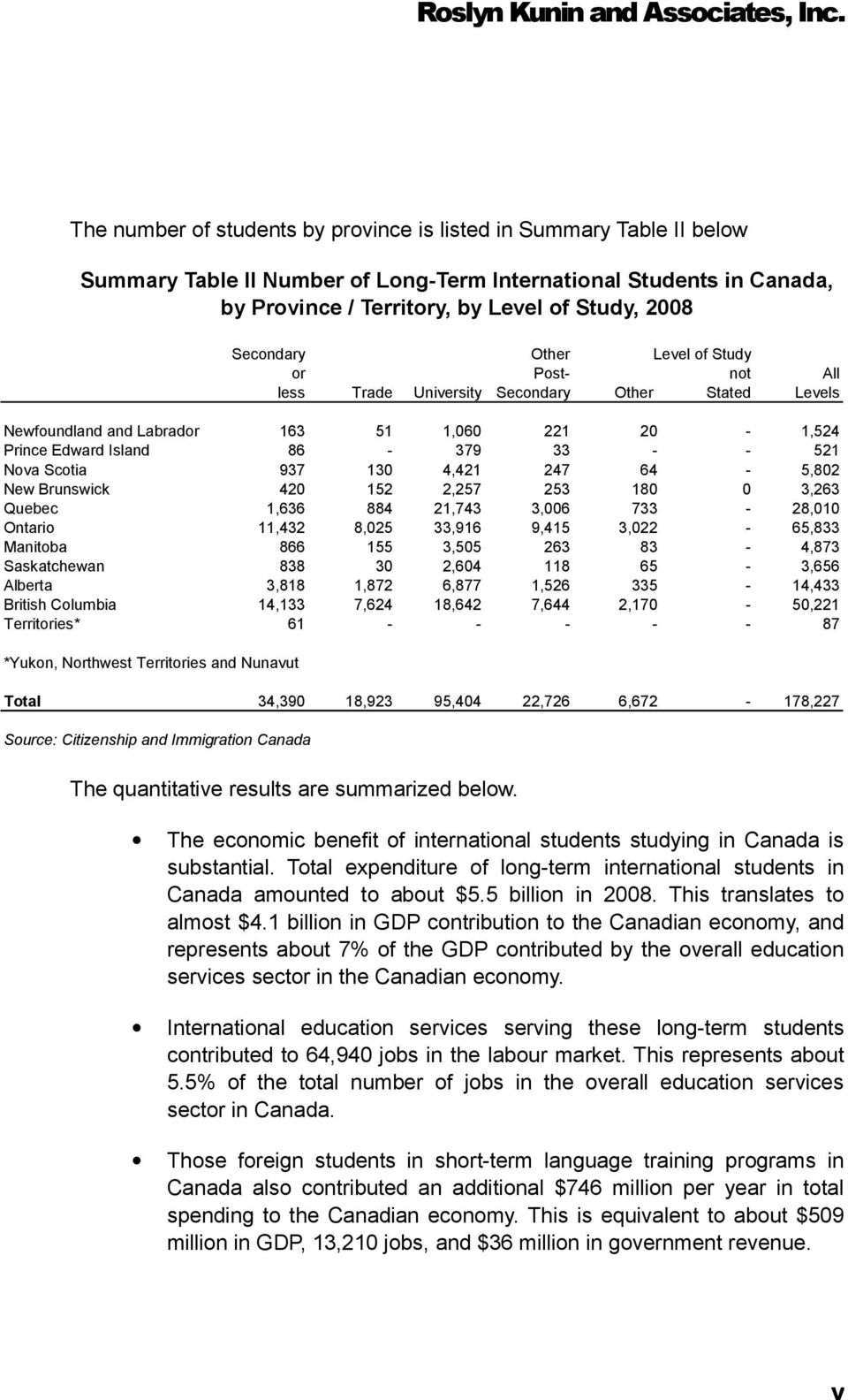
5 The number of students by province is listed in Summary Table II below Summary Table II Number of Long-Term International Students in Canada, by Province / Territory, by Level of Study, 2008 Secondary Other Level of Study or Post- not All less Trade University Secondary Other Stated Levels Newfoundland and Labrador , ,524 Prince Edward Island Nova Scotia , ,802 New Brunswick , ,263 Quebec 1, ,743 3, ,010 Ontario 11,432 8,025 33,916 9,415 3,022-65,833 Manitoba , ,873 Saskatchewan , ,656 Alberta 3,818 1,872 6,877 1, ,433 British Columbia 14,133 7,624 18,642 7,644 2,170-50,221 Territories* *Yukon, Northwest Territories and Nunavut Total 34,390 18,923 95,404 22,726 6, ,227 Source: Citizenship and Immigration Canada The quantitative results are summarized below. The economic benefit of international students studying in Canada is substantial. Total expenditure of long-term international students in Canada amounted to about $5.5 billion in This translates to almost $4.1 billion in GDP contribution to the Canadian economy, and represents about 7% of the GDP contributed by the overall education services sector in the Canadian economy. International education services serving these long-term students contributed to 64,940 jobs in the labour market. This represents about 5.5% of the total number of jobs in the overall education services sector in Canada. Those foreign students in short-term language training programs in Canada also contributed an additional $746 million per year in total spending to the Canadian economy. This is equivalent to about $509 million in GDP, 13,210 jobs, and $36 million in government revenue. V
6 In addition to capturing economic impact resulted from spending on tuition and fees and basic living expenses, we estimate that $285,240,000 per year can be attributed to additional tourism related activities, including international students and their family and friends. In the report, we have also presented two case studies which exemplify how and why international education has brought substantial economic benefits to the local economy. International students visit Canada from all over the world. The top destinations from which students visit Canada and the export value of their education is detailed in the tables below. It is important to note that almost 50% of students are from East Asian countries (primarily China, South Korea and Japan). Summary Table III Foreign Students in Canada by Top Source Countries, and Total Value of International Education Services, 2008 Source countries 2008 Total Expenditure China, People's Republic of 42,154 $1,300,856,778 Korea, Republic of 27,440 $846,788,205 United States of America 11,317 $349,238,415 France 8,553 $263,942,402 India 7,314 $225,707,322 Japan 6,627 $204,506,758 Saudi Arabia 4,672 $144,176,184 Taiwan 4,127 $127,357,687 Hong Kong 4,126 $127,326,827 Mexico 3,853 $118,902,148 Top 10 source countries 120,183 $3,708,802,726 Other countries 56,740 $1,750,975,318 Countries not stated 1,304 $40,240,956 Total 178,227 $5,500,019,000 Source: Citizenship and Immigration Canada; RKA We have also examined the value of education services versus the total exports to each of these same countries. VI

7 Summary Table IV Comparison of International Education Services with Total Exports in Goods from Canada to the Top Ten International Student Source Countries and to All Countries, 2008 Educational Services All Goods Exports Educational Services Compared with Total Goods Export China, Peoples' Republic of $1.301B $10.471B 12.4% Korea, Republic of $846.8M $3.836BM 22.1% United States $349.2M $ B 0.1% France $263.9M $3.241B 8.1% India $225.7M $2.417B 9.3% Japan $204.5M $11.091B 1.8% Saudi Arabia $144.2M $1.009B 14.3% Taiwan $127.4M $1.563B 8.2% Hong Kong $127.3M $1.771B 7.2% Mexico $118.9M $5.843B 2.0% Total for Canada $5.5B $ B 1.1% Source: RKA; Canada Merchandise Exports (Customs Basis) DFAIT 2009 Recommendations This report shows that international students make a very significant contribution to the Canadian economy, job base and government revenues. Therefore, it is important to get more consistent, complete and accurate data on students and their expenditures in Canada. Such data is not readily available now. Therefore, we put forward the following recommendations: Consider the possibility of establishing a survey method like that undertaken in Australia where a sample of visitors leaving the country would be surveyed regarding their activities in Canada. This would need to be done at all major international airports and would need to be carried out in a number of languages. Work with stakeholders (including CIC, Statistics Canada, and universities, colleges, and other training institutions) to develop a consistent system of record-keeping to track international student expenditures while in Canada. VII

8 Work with Statistics Canada to develop a national survey of public and private educational institutions to determine international student enrolment, tuition rates, and other expenses for degree/diploma granting programs as well as adult and continuing education classes of under six months. Coordinate with provincial governments and national organizations to determine consistent survey questions for international students. Insure that international students are recognized and supported commensurate to their importance to Canada relative to other similar sized exports of goods and services. VIII

9 1. Introduction As Canada s economy becomes increasingly globalized, the benefits of international education to our economy are substantial and cannot be neglected. To remain competitive in the global economy, Canada needs to attract the best and the brightest to contribute to our talent pool in so many areas scientific and research development, economic development opportunities, cultural diversification, just to name a few. International students studying in Canada also bring in substantial income to the local communities. International students can also become a valuable source of highly skilled labour to our economy at a time when the western world is facing potential labour shortages especially among top talent. In addition, Canada s educational expertise is a valuable export that can be measured in comparison to other goods and service exports. Roslyn Kunin and Associates, Inc. (RKA) has been commissioned by Foreign Affairs and International Trade Canada (DFAIT) to undertake an in-depth and comprehensive study evaluating the economic impact of international education in Canada. Its purpose is to develop, implement, and analyze an economic model to determine the value of international education and student mobility brings to the Canadian economy. Existing literature has clearly indicated that there is positive value associated with Canadian students going abroad and international students coming and studying in Canada. RKA has been commissioned to look at the latter and we will assess the financial value by way of looking into the trends in international students enrolment patterns, the length of study, the type of educational institutions they attend, their choice of place to stay while they are in Canada, and their expenditure patterns. Below, we list what we cover in our research. Our research has: - Covered all provinces and territories in Canada where international student enrollment data is available; - Collected and reviewed, where possible, data and information regarding enrollment in K-12, post-secondary (both colleges and universities, both public and private), as well as short term studies such as language training and other vocational training; - Contacted stakeholders to obtain information regarding tuition and fees that international students pay for the types of programs in which they enroll, from jurisdictions across Canada; - Located and analyzed information on international student expenditure patterns. 1
10 The data has been analyzed and estimates have been calculated. The value has also been measured as contribution to the Canadian economy in terms of GDP growth, employment, and government revenue. The layout of the report is as follows: - Study methodology - Literature review - International student data - Expenditure data - Economic impact estimation for Examination of the economic contributions of tourism activities - Case studies Provincial and Non-urban - Examination of Canada s performance in the global market - Conclusions and Recommendations 2

11 2. Methodology RKA s methodology for the study on the economic impact of international education in Canada includes extensive secondary research involving literature review, collecting existing statistical data and information, as well as consulting with provincial and territorial education sector representatives, and representatives from organizations promoting and researching trends in international education in Canada and/or provinces. We have reviewed existing data on university, college, language school and elementary/secondary school enrolment and tuition as well as information regarding living expenses and spending estimates for international students. The following provided relevant research data and information: - Statistics Canada - Citizenship and Immigration Canada - Advanced Education and Education branches for BC, Alberta, Manitoba, Ontario, Quebec, Newfoundland-Labrador and Nova Scotia - BC Centre for International Education - EduNova - Languages Canada - National Association of Career Colleges - Association of Universities and Community Colleges - Association des universités de la francophonie canadienne The References section of this report provides a more detailed listing of the materials used and the individuals interviewed in preparing this report. The methodology undertaken is as follows: 1. Collect key education contacts from DFAIT 2. Through additional research and references from key contacts, attempt to collect as much data as possible on the following: - International student enrollment in various programs and institutions - Tuition data - Living and entertainment expense data 3
12 - Tourism data 3. Compile data and analyze data above 4. Complete interviews/research regarding case studies Challenges: As with most studies of this nature, one of the key challenges was contacting the right people. Not only are people exceptionally busy, but because their work involves international education they are often traveling out of the country. This difficulty was compounded by one other readily evident challenge much of the data we required was just not collected in any meaningful way. One of our first thoughts was to go to national organizations representing large groups of private and public schools and institutions. What became evident very quickly is that these organizations (except for Languages Canada) do not collect data on international students from their member institutions. Another challenge faced was that non-study permit visitors (those in the country less than six months) are not formally tracked in the system. Citizenship and Immigration Canada has indicated that data on visitors entering Canada for short-term study purposes is not currently captured and has indicated that it is unlikely that they would be able to capture this data in the near future. 1 Languages Canada recently completed a survey of its members and we were given access to the data. A significant proportion of the students attending the member institutes are short-term students so this kept us from having a complete lack of data on this topic. While some organizations (BC Progress Board, Conference Board of Canada and others) completed reports on the economic impact of international education, two things became apparent when following up with them on these studies. First, they have not kept up with the research, so much of the work is out of date, and second, they ran into many of the same problems that we did. Fortunately, we have been able to fill a few of the gaps and offer here a more viable tool. 1 Citizenship and Immigration provided the following clarification regarding the changes to allow foreign nationals to enter as visitors to undertake short-term studies. These changes were introduced to respond to requests from stakeholders to expedite the entry of foreign nationals destined to short-term studies. However, with the introduction of the above changes, separating this group from other visitors to Canada is no longer possible. Stakeholders were advised of these data limitations at the time of the introduction of the regulatory/policy changes. 4

13 3. Literature Review In this Section, we provide an overview of literature on topics and issues related to international education in Canada. The purpose of this is to provide an overview of background information and what previous research has informed us and what data gaps exist. Defining International Education: "International education may involve formal or informal academic, cultural, employment, travel or volunteer experience abroad with return to the native country; hosting international education programs and students; internationalizing domestic courses, programs and curriculum; and exchange programs for students, researchers, citizens and employees provided by government, nonprofit, educational, or employer provided programs." (1999, Conference Board) International Education: The Council for Higher Education Accreditation's Sharing Quality Education Across Borders: A Checklist for Good Practice, highlighted a number of important issues, including: - "the need to safeguard the broader cultural, social, and economic contributions of higher education and research; protect the interests of students and facilitate their mobility; and strengthen the capacity of developing countries to improve accessibility to high-quality higher education" - key elements - contribution to the public good (social, economic, and cultural), capacity building (cooperation and collaboration), relevance (current and recognizable), accessibility (financial), quality (institutional, administrative, faculty), accountability (authorization and organizational memberships), and transparency (public information, admission policies, and appeals procedures), and commitment to high-quality standards (codes of good practice) Economic Impacts The Conference Board of Canada's study, Economic Implications of International Education, emphasized some key aspects to consider (although it is important to note that most of the statistics are from the mid 1990s): 5
14 - improved flow of knowledge and information, understanding of global markets, and the understanding of international capacities that can benefit a global business environment. - in 1999 Canada was not a major player in the foreign education landscape and had not reaped the economic benefits that many other countries had. - the report provides performance indicators - an index that compares the "relationship between international education activity and economic performance", reports on key countries and their policies, programs and indicators, international trends, and options for Canada in the future. - the report found that - Canada is not keeping up with other key countries in terms of international education; international education and economic performance are "positively correlated"; international education has a positive impact on GDP, innovation, and foreign direct investment; European countries studied have developed coordinated national strategies for international education; Canada and US are dominated by non-profit, educational and employer initiatives; - regarding student inflows, the US and the UK have the highest absolute levels and Australia has the highest level per 1000 people - Relationships: the following are identified as having positive relationships - international education and GDP; international education and innovation; international education and international trade, international education and foreign direct investment - According to the report, Canada ranked 6th (out of the top 9 countries) in student inflows throughout the period 1991 to 1995 Roslyn Kunin and Associates report Economic Value of International Education in BC used: - a total impact approach to evaluate quantifiable benefits that international students bring to BC. - direct impacts to measure the increase in industrial output and the increase in an industry s (educational services) labour force from the inflow of international students to the province on a yearly basis. Increase in government revenue also measured. 6
15 - indirect impacts to measure the change in industrial output and employment demand in sectors that supply goods and services to the public post-secondary education sector in the province. - induced impact to measure the changes in output and employment demand over all sectors of the economy as a result of an income increase in households impacted both directly and indirectly. - other equally important though non quantifiable benefits including such factors as helping BC students prepare for a career in the global economy and generating long term international business and tourism opportunities for BC through networking and familiarity with the province. A number of sources identified concerns regarding the double counting of students and the over-estimation of spending. The problem arises, generally, because data is collected, when available, from a variety of sources. And even then, there is a distinct possibility that the data may have been collected and used by other institutions. This is most often the case when data is collected from institutions that service both short and long term students. Organizations like Languages Canada have made considerable efforts to deal with the issue, but you are still ultimately at the mercy of each individual institution. International Mobility Comparisons - In 2002 international education represented $30 billion or 3% of OECD's total trade services 2 - US and UK hosted 42% of international students in international students primarily come from China, Hong Kong, India, Indonesia, Japan, Malaysia, Singapore, South Korea and Thailand - Impacts to examine related to inflows: exchange rates, In the Canadian Bureau for International Education s Northern Lights Report (2007) brings up a number of items to consider for the research: - there was considerable discussion of international graduate students - International students represent graduates from post-secondary institutions annually - A lot of focus has been drawn to the excellent work in Australia with the creation of the Australia Education International. Prior to commencing our research RKA did further research into the AEI. 2 OECD 7
16 Education Policy's Student Mobility and Credit Transfer document was not closely related to what we need, but did bring up some important issues and potential information sources impacting financial aid - foundations, student aid (inter-state aid), and government s support. It also addressed the issue that Canada provides very little in the way of international student aid. Even though the data is somewhat outdated, it is important for historical purposes to examine the Institute for the Study of International Migration s Foreign Students coming to America (2007) document as it raises a number of issues that not only deal with its key focus (US international student mobility in the post 9/11 world), but also the decision-making process for international students. Some key findings: - international students jumped from 1 million in 1994 to 2.7 million in the US based on a 2007 study of international student receptiveness, Canada ranked 2nd to the UK in receptiveness to international students. Other countries surveyed: Switzerland, France, Germany, Austria, US, Sweden, Australia. - Canada's market share has decreased from 6% to 5% between 2000 and Graduate student enrolments - less than 5% of global total. - issues to consider - size of future student base (foreign training in-country, growth and credibility of domestic training, competition from other nations (esp. Australia and the UK). - India has tripled the number of post secondary institutions (from 6000 to 18000) between 1990 and Asia-Pacific in-country training has increased from 9-19% and among middle income countries from 16-27% - growth in college-aged populations should translate into greater numbers of potential international students - the report goes on to project India's college age population to grow from 125 to 139 million between 2005 and factors when deciding where to study include the cost of tuition, application process, fear of visa rejection, foreign policy of source vs. destination country, other 3 OECD 4 OECD 8
17 An article by Citizenship and Immigration Canada entitled Competitor Research determined that: - Canada has fallen as a destination from 5th to 14 th 5 - while Canada's exporting of education grew, the market share of international education declined. - Demand for international education is to grow from 1.9 million to 7.2 million students by Australia is THE current competitor to Canada in the area of International Education Growth in Foreign Student Expenditures in Canada A recent Foreign Affairs and International Trade Canada table provides the baseline for our current work to 2005 full time foreign students grew from 78,256 to 152, expenditures per student (including tuition) is estimated at $25,000 - between 1998 and 2005 the economic impact has grown from $1.7 billion to $3.82 billion Short Term students have been estimated as increasing from 113,000 to 235,000 - non-educational expenditures (accommodation and transportation) is estimated at $6 to $7,000 per annum - The total growth from is estimated at $2.38B to $5.47B Data Collection Best Practices: In conducting this literature review, it became apparent that while many countries cater to a significant number of international students, few actively track the activities and spending patterns on a national basis. A recent study in Australia could have a significant impact on how national governments approach the issue of tracking the impact of international students. The Australian Education Sector and the Economic Contribution of International Students (ACPET, 2009) has determined that international students directly contribute over $14 billion to the 5 The Conference Board of Canada. Opportunity Begins at Home. April OECD 7 The source for the data included in this table is not cited. 9
18 Australian economy (and about $12.5 billion in indirect contributions) representing over 126,000 full time employees. In order to collect this data, the Australian Council for Private Education and Training and its consultants used the Tourism Research Australia s International Visitor Survey to determine the number of visitors who identified education as their purpose of travel and examined their spending patterns 8. The surveying of visitors (and the subsequent spin-off studies) has given the Australian education sector a significant advantage and could be jumping off point for other countries committed to a comprehensive evaluation of the economic impact of international education. The Institute of International Education has also done extensive work regarding the economic impact of students. In fact, they have given what seems to be a more tempered, and realistic, assessment of international students' economic impact as they have subtracted scholarships and financial assistance provided to international students from the total economic impact amount. However, it appears that the dollar figure that they arrive at is still not entirely comprehensive as a) it is only based on tuition and living expenses with not mention of tourism or entertainment expenses and b) it would appear that language schools and other short term training institutes are not included in this study. In fact, the IIE partner site, the NAFSA: Association of International Educators, acknowledges that their impact figure is a conservative one. In Canada, some provinces have (or are attempting to) compile data on international students. The Manitoba International Education Branch produces annual reports (the 06/07 report can be found at The report includes post-secondary, elementary/secondary, and language school data. Key Issues for this Research Based on the literature research to date, the team has found that there are no up-to-date, on-going, or consistent measures of evaluating the economic impact of international education in Canada. There are some provincial studies, for example, in BC, Manitoba and in Nova Scotia. On a national level the previous comprehensive analysis was the Conference Board of Canada s report done in In addition, the level of detail presented in each of these studies is usually quite different, due to the lack of basic and comparable data available at the provincial level. 8 The TRA samples 40,000 foreign visitors as they leave Australia each year. Survey participants are interviewed in airports (in one of four languages English, Mandarin, Korean and Japanese) and asked 96 questions that cover purposes of trip, expenditures, travel, accommodation, etc. The survey results are posted each quarter. 10

19 4. Number of International Students in Canada In this Section, we will describe data we have collected on the number of international students in Canada, as well as growth trends in recent years By Level of Education Long Term Students One of the main purposes of this study is to understand the number of international students in each province and territory and in different levels of study public or private, in the K-12 system, college level, undergraduate and graduate students in the university system. Also, we need to determine the number of international students studying in professional and language training programs. As mentioned in the Methodology section, even with our extensive research and contact with provincial and territorial education and training authorities and national stakeholders, we have not found data that was consistently defined or reported data on all students. Statistics Canada, in its Post-Secondary Information System, collects data on international student enrollment at the college and university levels (including breakdown of undergraduate and graduate levels) by field of study or by program level. However, the colleges and universities that are covered in the Statistics Canada s survey are essentially all in the public system, and as such we did not use enrollment numbers from this source as we were not able to gather information on those international students in the private post-secondary system. Also, university level data is available for up to 2006, while college data is available for up to 2005 only. On the number of international students in the K-12 system, we have also not been able to obtain data from each of the provinces and territories. One way of getting information on the number of international students in the country is from data published by Citizenship and Immigration Canada (CIC). As international students need to obtain a study permit before arriving in Canada to pursue education and training for a period longer than six months, CIC s data allows us to know how many holders of study permits are in each of the provinces and territories at a given time. For all these reasons, we have relied upon CIC data for analytical purposes. CIC defines foreign students as Temporary residents who entered Canada mainly to study and have been issued a study permit (with or without other types 11

20 of permits). A study permit is an official document issued by an officer that allows someone who is not a Canadian citizen or a permanent resident to study in Canada. In general, a study permit is not needed for any program of study that is six months or less. For statistical purposes, a temporary resident is designated as a foreign student on the basis of our determination of his or her yearly status the main reason for which the person has been authorized to enter and stay temporarily in Canada during the year of observation. Foreign students exclude temporary residents who have been issued a study permit but who entered Canada mainly for reasons other than study. Five levels of study are shown for foreign students. - Secondary or less: primary or secondary educational institutions in Canada - Trade: vocational trade at non-university educational institutions in Canada (such as technical and vocational institutions, CEGEPs and colleges) - University: undergraduate, postgraduate (master's and doctoral) and other studies at universities in Canada - Other post-secondary: post-secondary level of study, not at the university or trade level, including language institutions, private institutions and university qualifying programs - Other: foreign students not classified in any of the above levels of study One important source of international students that is not covered in the CIC data is the number of such students who study in Canada for periods shorter than six months, as they do not require a study permit to enter the country. We will discuss about how we approach this later in the section. Table 1 shows the total number of foreign students in Canada (as of December 1 st of each year) in each of the five levels of study from 1998 to Table 1 Number of Foreign Students in Canada by Level of Study, 1998 to 2008 Level of study Secondary or less 23,939 24,522 27,997 31,669 32,590 31,614 30,763 30,517 32,546 34,480 34,390 Trade 10,652 12,763 16,504 20,127 22,857 24,717 25,179 24,079 22,581 21,553 18,923 University 39,547 45,712 53,168 63,613 72,970 81,117 88,647 91,727 92,865 94,621 95,404 Other post-secondary 5,695 7,399 9,092 12,785 14,485 15,801 13,910 14,506 15,823 19,375 22,726 Other 5,876 6,859 7,218 8,452 7,588 6,435 6,324 6,325 6,340 6,060 6,672 Level of study not stated Total 85,803 97, , , , , , , , , ,227 Source: Citizenship and Immigration Canada 9 For more information see 12

21 Over this period, the number of international students in Canada has increased at an average growth rate of 8% per year. Students classified under the Other Post Secondary category have grown the fastest, at a rate of 15% per year, followed by those students classified in the University category, with an annual growth rate of 9%. Students who pursue study in the K-12 system have grown at a rate of 4% per year during this period. Those in the other level of study have grown the least, with an annual rate of 1%. It should also be noted that between 1998 and 2003, enrolment of international students at the university level experienced double-digit annual growth rates. However, in recent years since 2005, it has not grown as fast as the average for all students. Enrolment of international students in vocational trade colleges also enjoyed strong double-digit annual growth from 1998 up to However, enrolment of students at this level of study has been declining steadily since 2004 and continued into Table 2 indicates the distribution of foreign students in Canada in different levels of study. The information in this Table has been derived based on the stock of foreign students as of December 1 st of each year. Table 2 Distribution of Foreign Students in Canada by Level of Study, 1998 to 2008 Distribution * Secondary or less 27.9% 25.2% 24.5% 23.2% 21.6% 19.8% 18.7% 18.3% 19.1% 19.6% 19.6% Trade 12.4% 13.1% 14.5% 14.7% 15.2% 15.5% 15.3% 14.4% 13.3% 12.2% 12.2% University 46.1% 47.0% 46.6% 46.5% 48.5% 50.8% 53.8% 54.9% 54.6% 53.7% 53.7% Other post-secondary 6.6% 7.6% 8.0% 9.4% 9.6% 9.9% 8.4% 8.7% 9.3% 11.0% 11.0% Other 6.8% 7.0% 6.3% 6.2% 5.0% 4.0% 3.8% 3.8% 3.7% 3.4% 3.4% Level of study not stated 0.1% 0.1% 0.1% 0.0% 0.0% 0.0% 0.0% 0.0% 0.0% 0.0% 0.0% Total 100.0% 100.0% 100.0% 100.0% 100.0% 100.0% 100.0% 100.0% 100.0% 100.0% 100.0% * Distributions estimated in 2008 Source: Citizenship and Immigration Canada Data in Table 2 also indicate that Canada s universities are most attractive to foreign students when we compare students in different levels of study. Together with other colleges, students in the post secondary system account for more than three quarters (76.9%) of all international students in Canada who pursue study for more than six months Languages Canada Short Term Students For international students who generally study for shorter than six months in Canada, we have relied upon information provided to us by Languages Canada. In 2007, Languages Canada surveyed their membership and of the 115 institutions that replied they indicated enrollment of 103,293 students (representing 1,063,137 study weeks). Of this number at least 83,581 students (almost 81%) were for short term programs of under 6 months (not all programs were able to report the breakdown of their study weeks by length of study). 13
22 These numbers are for a combination of private post-secondary and public postsecondary non-credit language programs. Languages Canada also made an estimate of the number of short-term language students from programs that did not report to Languages Canada when surveyed. This was 18,362. As such, total number of these short term students was 101,943. Therefore, using information provided by Languages Canada, it is estimated that a total of 1,054,664 study weeks were spent in Canada by foreign students in short term language training programs. We note that Languages Canada does not have all language training institutions in Canada in its membership. We further note that since there is no reliable data indicating the number of short-term international students enrolling in vocational training or other types of training, we have not been able to estimate the number of short-term international students other than those covered by Languages Canada By Province / Territory CIC data also provides breakdown of the number of international students by province / territory. Table 3 shows the number of foreign students in each of the provinces and territories in Canada between 2004 and 2008 (as measured by the stock of foreign students on December 1 st each year). Of all the provinces and territories, international students to Newfoundland and Labrador and Prince Edward Island have shown the strongest growth in enrollment in recent years, at a rate of 13.6% and 14% respectively, but starting from a small base number. Alberta is the third in line, with an annual growth rate of 4.7%. 14
23 Table 3 Number of Foreign Students in Canada by Province and Territory, 2004 to 2008 Destination Newfoundland and Labrador 915 1,049 1,203 1,382 1,524 Prince Edward Island Nova Scotia 5,464 5,461 5,475 5,444 5,802 New Brunswick 3,193 3,242 3,181 3,228 3,263 Quebec 25,472 25,206 25,914 27,095 28,010 Ontario 62,266 62,834 63,815 65,517 65,833 Manitoba 4,762 4,972 5,147 5,256 4,873 Saskatchewan 3,630 3,734 3,493 3,536 3,656 Alberta 12,023 12,431 12,965 13,846 14,433 British Columbia 46,707 47,777 48,463 50,198 50,221 Territories* Province or Territory not stated *Yukon, Northwest Territories and Nunavut Total 164, , , , ,227 Source: Citizenship and Immigration Canada Because of its geographic size and the number of educational institutions, Ontario attracts the largest number of international students amongst all provinces and territories. However, its market share has been declining slowly over recent years as other provinces increased their efforts in attracting international students. Although British Columbia only accounts for about 13% of the national population, it accounts for about 28% of the international students in the country. As in Ontario, the number of BC s international students has grown more slowly than the national average in recent years. Quebec, being the second most populous province in the country, accounts for almost 16% of the total number of international students in the country. It has been gradually increasing its market share in recent years. All such information is presented in Table 4. Information in this table has been derived based on the stock number on December 1 st each year. 15
24 Table 4 Distribution of Foreign Students in Canada by Province and Territory, 2004 to 2008 Destination Newfoundland and Labrador 0.6% 0.6% 0.7% 0.8% 0.9% Prince Edward Island 0.2% 0.2% 0.2% 0.3% 0.3% Nova Scotia 3.3% 3.3% 3.2% 3.1% 3.3% New Brunswick 1.9% 1.9% 1.9% 1.8% 1.8% Quebec 15.5% 15.1% 15.2% 15.4% 15.7% Ontario 37.8% 37.6% 37.5% 37.2% 36.9% Manitoba 2.9% 3.0% 3.0% 3.0% 2.7% Saskatchewan 2.2% 2.2% 2.1% 2.0% 2.1% Alberta 7.3% 7.4% 7.6% 7.9% 8.1% British Columbia 28.3% 28.6% 28.5% 28.5% 28.2% Territories* 0.1% 0.1% 0.0% 0.1% 0.0% Province or Territory not stated 0.0% 0.0% 0.0% 0.0% 0.0% *Yukon, Northwest Territories and Nunavut Total 100.0% 100.0% 100.0% 100.0% 100.0% Source: Citizenship and Immigration Canada 4.3. By Province / Territory and by Level of Education We have also obtained information, from the Citizenship and Immigration Canada, on foreign student enrollment by province and by level of study. For the year 2008, the information is shown in Table 5. 16
25 Table 5 Number of Foreign Students in Canada by Level of Study, by Province and Territory, 2008 Secondary Other Level of Study or Post- not Destination less Trade University Secondary Other Stated Newfoundland and Labrador , Prince Edward Island Nova Scotia , New Brunswick , Quebec 1, ,743 3, Ontario 11,432 8,025 33,916 9,415 3,022 - Manitoba , Saskatchewan , Alberta 3,818 1,872 6,877 1, British Columbia 14,133 7,624 18,642 7,644 2,170 - Territories* Province or Territory not stated *Yukon, Northwest Territories and Nunavut Total 34,390 18,923 95,404 22,726 6,672 - Source: Citizenship and Immigration Canada. Numbers in this table represent our best estimates of international student enrollment in different levels of study (longer than six months of duration) in each of the provinces and territories and will be the basis for our calculation in Section 6. Table 6 shows the distribution of foreign students (as measured by the December 1 st stock) by level of study in provinces and territories. In the Maritime Provinces as well as the provinces of Quebec, Manitoba and Saskatchewan, university students account for at least 70% of all foreign students studying in each of these provinces. In Ontario, Alberta, and BC, however, the shares of university students are lower than the national average. In the territories, 70% of their foreign students are in the K-12 system. It should also be noted that there is no university located in the territories. 17
26 Table 6 Distribution of Foreign Students in Canada by Level of Study, by Province and Territory, 2008 Secondary Other Level of Study or Post- not Destination less Trade University Secondary Other Stated Newfoundland and Labrador 10.7% 3.3% 69.6% 14.5% 1.3% - Prince Edward Island 16.5% % 6.3% - - Nova Scotia 16.1% 2.2% 76.2% 4.3% 1.1% - New Brunswick 12.9% 4.7% 69.2% 7.8% 5.5% 0.0% Quebec 5.8% 3.2% 77.6% 10.7% 2.6% - Ontario 17.4% 12.2% 51.5% 14.3% 4.6% - Manitoba 17.8% 3.2% 71.9% 5.4% 1.7% - Saskatchewan 22.9% 0.8% 71.2% 3.2% 1.8% - Alberta 26.5% 13.0% 47.6% 10.6% 2.3% - British Columbia 28.1% 15.2% 37.1% 15.2% 4.3% - Territories* 69.8% Province or Territory not stated *Yukon, Northwest Territories and Nunavut Average 19.3% 10.6% 53.5% 12.8% 3.7% - Source: Citizenship and Immigration Canada. 18
27 5. Student Expenditure In this section, we detail the sources of information and data we relied on and the techniques we applied to derive estimates of basic educational expenses and living costs while international students stay in Canada Tuition and Other Fees Long Term Students We have relied upon a variety of data sources to arrive at average tuition and other fees for different levels of study. The average tuition fees and other fees paid by international students in different levels of study in each province and the territories are shown in Table 7. Table 7 Estimated Tuition Fees and Education Related Expenses per Foreign Student in Canada by Level of Study, by Province and territory, 2008 Secondary University Other or Additional Post- Destination less** Trade Medium Fees Books Secondary Other Newfoundland and Labrador $9,000 $13,620 $13,478 $490 $1,000 $13,620 $13,620 Prince Edward Island $9,000 $11,909 $11,260 $775 $1,000 $11,909 $11,909 Nova Scotia $9,000 $15,122 $14,787 $813 $1,000 $15,122 $15,122 New Brunswick $9,000 $14,045 $14,081 $372 $1,000 $14,045 $14,045 Quebec $8,500 $16,912 $16,896 $705 $1,000 $16,912 $16,912 Ontario $11,000 $18,878 $19,020 $761 $1,000 $18,878 $18,878 Manitoba $13,000 $10,607 $10,034 $577 $1,000 $10,607 $10,607 Saskatchewan $11,000 $14,263 $13,921 $735 $1,000 $14,263 $14,263 Alberta $11,000 $14,705 $14,587 $577 $1,000 $14,705 $14,705 British Columbia $10,500 $16,600 $16,809 $473 $1,000 $16,600 $16,600 Territories* $10,500 $11,950 $1,000 $11,950 $11,950 *Yukon, Northwest Territories and Nunavut Average $10,136 $14,419 $14,487 $628 $1,000 $14,419 $14,419 Source: RKA based on Statistics Canada data and other sources. For tuition and other fees at the K-12 level, we have relied upon information published by provincial government reports in each of the provinces and territories. 19
28 Tuition fees for full-time undergraduate international students in 2008/09 increased 3.9% on average to $14,487. Ontario (+5.1%) and New Brunswick (+4.2%) had the largest increases. 10 Full-time international students in graduate programs paid on average 2.9% more in 2008/2009 compared to a year earlier, with students in Quebec (+3.9%) and Ontario and Saskatchewan (+3.2% each) facing the largest increases. 11 Detailed tuition fees for full-time university level international students for each of the provinces are available from Statistics Canada s annual Tuition and Living Accommodation Costs (TLAC) survey. Note that no data is available from the TLAC for the Territories. We have not calculated an average of full time undergraduate and graduate tuition fees as we do not have a breakdown of the number of international students in each category. We have applied the average of undergraduate student tuition fees for calculation purposes. This will be a minimal estimate since fees for graduate students are higher than for undergraduates. In addition, we have included Additional Fees which represent compulsory fees universities impose on both domestic and international students, such as facility fees, society fees, health and dental (for international students only) fees, student pass fees in some cases, and others. We have also made an allowance of $1,000 per academic year for books. We note that tuition fees for undergraduate students are for an academic year of eight months, although in some cases, students do take courses in the summer program. We have assumed that all undergraduate international students are paying for the equivalent of one academic year s tuition in a given year. In estimating student expenditure in tuition and other fees directly related to educational purposes for students in the Trade and Other Post-Secondary levels, we have derived the values in the following manner: - For tuition fees, we have applied a factor of 90% to the average university tuition fees in each province. Based on the data available from the TLAC, tuition fees in colleges providing university level training average about 90% of all training institutions surveyed See 11 Same as above. 12 We have also been provided by the BC Ministry of Advanced Education detailed tuition data for public college and university international students. Similarly, the average full-year tuition fees in colleges and university colleges are about 90% of the average of all public universities and colleges. 20
29 - We have also assumed that international students in Trade and Other Post-Secondary levels of study pay on average the same amount of Additional Fees as university level international students The same allowance for annual expenditure on books has also been applied. - For college international students in the Territories, we have applied a value equal to the sum of the average university tuition fees (adjusted by a factor of 0.9), average additional fees, and the average allowance of $1,000 for books. For international students in the Other category, since we don t have any detailed information on the nature of their study, we have assumed that they pay the same level of tuition fees and other education related expenses as those in the Trade level of study Languages Canada Short Term Students Information from Languages Canada indicates that short term language students pay an average $317 per study week for tuition fees Living Expenses Long Term Students In this sub-section, we develop a model of estimating cost of living for international students while they study in Canada. We have also relied upon a variety of data sources to arrive at average living expenses for different levels of study. Information related to home-stay, average room and meals and other basic living expenses for international students in different levels of study is shown in Table 8. For calculating living expenses at the K-12 level, we have relied upon information published by provincial government reports in each of the provinces on average home-stay costs for a 10-month period. No data is available for home-stay costs in the territories and we have assumed that students pay at least the same amount as those in BC The TLAC data does cover colleges and institutes providing university level of training. 14 By using a 10-month home stay value we have assumed that international students in secondary schools or lower levels in the K-12 system spend on average 10 months each year and may return to home countries for vacation. 21
30 At the university level, we have relied upon Statistics Canada s annual Tuition and Living Accommodation Costs (TLAC) survey data to calculate the average costs of on-campus room and meal expenses for an eight months period. Values in the column University Room and Meal Medium have been scaled up to full year values. We note that these are fairly conservative estimates as they apply to single students living on campus. Students with a family generally pay more than the amount shown here in Table 8. Table 8 Estimated Cost of Living per Foreign Student in Canada by Level of Study, by Province and territory, 2008 Secondary University Other L or Room & Meal Transport Post- Destination less Trade Medium Secondary Other Newfoundland and Labrador $6,500 $8,867 $8,268 $599 $8,867 $8,867 Prince Edward Island $6,500 $12,022 $11,600 $423 $12,022 $12,022 Nova Scotia $6,000 $12,285 $11,744 $541 $12,285 $12,285 New Brunswick $6,000 $11,036 $10,689 $347 $11,036 $11,036 Quebec $7,000 $16,955 $16,458 $497 $16,955 $16,955 Ontario $7,500 $12,784 $11,963 $821 $12,784 $12,784 Manitoba $6,000 $10,275 $9,559 $716 $10,275 $10,275 Saskatchewan $7,000 $11,242 $10,842 $400 $11,242 $11,242 Alberta $7,000 $8,835 $7,935 $900 $8,835 $8,835 British Columbia $7,000 $11,642 $10,657 $984 $11,642 $11,642 Territories* $7,000 $12,311 $1,340 $12,311 $12,311 *Yukon, Northwest Territories and Nunavut Average $6,682 $11,660 $10,971 $688 $11,660 $11,660 Source: RKA based on Statistics Canada data and other sources. We have also made allowances for transportation costs for students staying in different provinces and territories. 15 We have relied upon data from Statistics Canada s Survey of Household Spending (SHS), detailing household spending on public transportation, by province and territory, in The values we used refer to the median expenditure per household that reported using public transportation. Values in 2008 have been derived by multiplying values in 2007 by the percentage increase in public transportation costs in the same province/territory between 2007 and For students in other levels of study (trade, other post-secondary, and other), we have assumed that they spend the equivalent of what university students have to pay in an academic year (average room and meal and transportation costs). 15 There may be double-counting of transportation cost in this Table and previous Table 7, as some universities have included bus passes in their reported Additional Fees. 16 For more information see 22
31 We note that since no data is available for cost of living for college international students in the territories, we have applied the average room and meal costs at the university level plus average public transportation costs in the territories to represent the cost of living for college students in the territories. In addition to basic living costs as presented above, we have made an allowance of $2,500 per student per year for discretionary expenses (such as eating out, recreational activities, and entertaining). For each province and territory, in each level of study, the formula to calculate total expenditure is as follows: Estimated number of students in that level of study x sum of (average tuition and additional fees, books, average room and meals, average transportation cost, average discretionary spending) per year = Total Foreign Student Expenditure in one year in the level of study Languages Canada Short Term Students Information from Languages Canada shows that an average short term student spends $390 per study week for living expenses including discretionary spending. Thus, for short-term students (1,054,664 study weeks) covered by Languages Canada, the average weekly expenses (including tuition and fees and basic living expenses) amount to $
32 6. Assessing the Economic Impact of International Education in Canada In this section, we will combine estimated number of international students in Canada by level of study in each province and territory and estimates on educational and living costs to arrive at an estimation of total expenditure by international students while they study in Canada. Based on the information above, we have estimated that students in the K-12 system contribute almost $700 million to the Canadian economy, and those in the university system contribute over $3.2 billion per year to the Canadian economy. Students in other post secondary institutions contribute another $1.3 billion. This is shown in Table 9. Table 9 Estimated Total Expenditure of Foreign Students in Canada by Level of Study, by Province and Territory, 2008 Secondary Other or Post- Destination less Trade University Secondary Other Total Newfoundland and Labrador $2,934,000 $1,274,000 $27,915,000 $5,522,000 $500,000 $38,145,000 Prince Edward Island $1,548,000 - $10,444,000 $872,000 - $12,864,000 Nova Scotia $16,398,000 $3,888,000 $138,753,000 $7,387,000 $1,914,000 $168,340,000 New Brunswick $7,350,000 $4,192,000 $65,430,000 $6,978,000 $4,965,000 $88,915,000 Quebec $29,448,000 $32,149,000 $827,468,000 $109,320,000 $26,657,000 $1,025,042,000 Ontario $240,072,000 $274,152,000 $1,223,153,000 $321,637,000 $103,238,000 $2,162,252,000 Manitoba $18,619,000 $3,624,000 $85,473,000 $6,150,000 $1,941,000 $115,807,000 Saskatchewan $17,184,000 $840,000 $76,544,000 $3,306,000 $1,821,000 $99,695,000 Alberta $78,269,000 $48,747,000 $189,108,000 $39,737,000 $8,723,000 $364,584,000 British Columbia $282,660,000 $234,376,000 $604,424,000 $234,991,000 $66,710,000 $1,423,161,000 Territories* $1,214, $1,214,000 *Yukon, Northwest Territories and Nunavut Total $695,696,000 $603,242,000 $3,248,712,000 $735,900,000 $216,469,000 $5,500,019,000 Source: RKA. In total $5.5 billion worth of expenditure was put into the Canadian economy in 2008 from those students who studied for six months or longer. 17 To summarize, the average total expenditure per international student (including tuition fees, other fees, books, room and meal, transportation, and discretionary 17 For comparison, we note that Statistics Canada s annual record of trade in services indicates that, in 2007, total expenditure of international students studying in Canada at the colleges and universities amounted to $2.6 billion. See V3764 for more information. 24
33 spending) is estimated to be $5,500,019,000 / 178,227 = $30,860 in This amount is applicable for an international student who requires a study permit and stays in Canada for at least six months. An additional $746 million per year has been estimated as the contribution from students pursuing short term language training courses. This has been calculated as 1,054,664 student weeks x $707 average expenditure per week = $745,647,800. Combining long-term and short-term students, we estimate that total international student expenditure in 2008 was about $6.25 billion, a significant contribution to the Canadian economy. We note that our calculations have made use of various survey results and average expenditure data, as such, our estimates are fairly conservative. We realize that in certain cases the expenditure is substantially above the average. However, without consistent data set that shows that percentage of international students in different level of spending bracket, we have not included such data in our estimates Direct Economic Impact Long Term Students When we compare international education services in each province and territory with other sectors in the economy, we need to translate that total expenditure values into Gross Domestic Products (GDP), employment, and government revenue contribution. In this subsection, we make use Statistics Canada s economic multipliers, as derived from its provincial Input-Output Tables, to estimate international education services contribution to each province s GDP, employment, and government revenue. 19 In Table 10 that follows, we provide our estimates of the total expenditure made by international students who stay in Canada for at least six months, and the corresponding contribution to the province / territory s GDP, 20 employment, and government revenue growth, using 2008 s values One instance is a report from the DFAIT indicating that the total value of the salary stipends alone that the Saudi Cultural Centre pays to its doctors and scholarship students in Canada now exceeds $16 million monthly ($195 million annually). In addition, the centre pays tuition for students and spouses, family travel, child benefits, health insurance, dental costs and other expenses. 19 Statistics Canada, Provincial Input-Output Multipliers, Total expenditure (or industrial output) refers to the value of outputs produced, whether the 25
34 Table 10 Direct Economic Impact of International Education Services, by Province and Territory, 2008 Total Government Expenditure GDP Employment Revenue Newfoundland and Labrador $38,145,000 $27,884, $1,417,000 Prince Edward Island $12,864,000 $4,313, $416,900 Nova Scotia $168,340,000 $122,648,000 2,360 $6,599,500 New Brunswick $88,915,000 $68,175,000 1,190 $3,234,800 Quebec $1,025,042,000 $745,539,000 11,840 $72,539,300 Ontario $2,162,252,000 $1,598,644,000 24,420 $102,674,000 Manitoba $115,807,000 $82,817,000 1,500 $5,646,200 Saskatchewan $99,695,000 $70,864,000 1,260 $4,590,700 Alberta $364,584,000 $262,684,000 4,240 $8,780,700 British Columbia $1,423,161,000 $1,056,820,000 17,610 $40,872,300 Territories* $1,214,000 $370, $11,400 *Yukon, Northwest Territories and Nunavut Total $5,500,019,000 $4,040,758,000 64,940 $246,782,800 Source: RKA based on Statistics Canada's Provincial Input-Output Multipliers, Total GDP contribution of international education services amounted to almost $4.1 billion in 2008 in Canada. By comparison, the GDP contribution of the whole Educational Services sector in Canada was $60.5 billion. Therefore, international education services accounted for about 6.7% of Canada s overall educational services. In employment, international education services provided 64,940 jobs in Canada. 22 The overall educational services sector in Canada employed about 1,190,000 persons in Therefore, international educational services provided equivalent to about 5.5% of all the jobs in the educational services sector. products are used as an intermediate product (think of a log cut down from a tree fro the purposes of building houses, for example) or used as a final product (think of a beam in a completed house). If we calculate gross domestic product at the provincial level, or GDP at the provincial level, this way, the cost of the log will be counted many times, as it moves from a raw product to its eventual use as a beam, and it is wrong. The value of total industrial output thus includes both the value of intermediate inputs and primary inputs - the latter being the labour and the capital in production. It is the sum of the latter, which is also referred to as the value added, that is equal to gross domestic product at the provincial level. 21 The types of taxes included in the Input-Output Tables include indirect taxes on products as well as indirect taxes on production, at the federal, provincial, and municipal levels, where applicable, net of subsidies on products and/or production. 22 Note that direct economic impact in terms of GDP, employment, and government revenue is not attributed to the educational services industry only. In fact, total expenditure in each province has been allocated to these following industries in the individual provincial input-output model: universities and government education services; retail trade; transit and ground passenger transportation; finance, insurance, real estate and rental and leasing; and arts, entertainment and recreation. 26
35 Languages Canada Short Term Students When we take into account the spending of short-term language students covered by Languages Canada, these foreign students also contributed an additional $746 million per year in total spending to the Canadian economy. This is equivalent to about $509 million in GDP, 13,210 jobs, and $36 million in government revenue. 23 This is represented in Table 11. Table 11 Direct Economic Impact of Short-Term International Language Students, by Province and Territory, 2008 Total Government Expenditure GDP Employment Revenue Newfoundland and Labrador $5,171,388 $3,484, $138,600 Prince Edward Island $1,743,996 $1,060, $51,800 Nova Scotia $22,822,165 $14,748, $952,700 New Brunswick $12,054,371 $8,867, $463,200 Quebec $138,966,841 $97,879,000 2,460 $8,760,400 Ontario $293,140,506 $204,628,000 5,100 $15,852,500 Manitoba $15,700,169 $9,833, $819,800 Saskatchewan $13,515,836 $7,206, $583,900 Alberta $49,427,328 $33,748, $1,674,700 British Columbia $192,940,571 $127,579,000 3,360 $7,022,900 Territories* $164,584 $93, $1,900 *Yukon, Northwest Territories and Nunavut Total $745,647,756 $509,125,000 13,210 $36,322,400 Source: RKA based on Statistics Canada's Provincial Input-Output Multipliers, Comparison of International Education Services in Canada with Other Export Trade In this sub-section, we will provide a comparison of the total value of international education services by top source country, with the values of Canada s exports of goods and services to these countries. We will also compare the value of total expenditure in international education services in Canada with the total export of goods in Canada. Note that due to data limitation, we will only cover long-term international students in this analysis. The Table that follows details the number of study permit holders each year (as of December 1 st ) by top ten source countries. 23 We do not have the breakdown of these students by province/territory, but have assumed that the distribution of spending by province/territory is the same as the expenditure distribution of long-term students. 27
36 Table 12 Number of Foreign Students in Canada by Top Source Countries, 2004 to 2008 Source countries China, People's Republic of 39,296 39,592 39,843 41,087 42,154 Korea, Republic of 26,719 27,251 29,035 30,084 27,440 United States of America 12,589 12,676 12,357 12,003 11,317 France 6,592 6,739 7,774 8,352 8,553 India 5,759 6,286 6,690 6,932 7,314 Japan 9,446 9,370 8,512 7,791 6,627 Saudi Arabia 1,187 1,468 1,596 2,286 4,672 Taiwan 5,286 4,961 4,902 4,744 4,127 Hong Kong 5,671 5,173 4,765 4,485 4,126 Mexico 3,392 3,599 3,791 3,830 3,853 Top 10 source countries 115, , , , ,183 Other countries 48,167 49,285 49,985 53,445 56,740 Countries not stated ,038 1,304 Total 164, , , , ,227 Source: Citizenship and Immigration Canada Table 13 further shows the percentage distribution of the number of study permit holders of these top source countries amongst all countries. Table 13 Distribution of Foreign Students in Canada by Top Source Countries, 2004 to 2008 Source countries China, People's Republic of Korea, Republic of United States of America France India Japan Saudi Arabia Taiwan Hong Kong Mexico Top 10 source countries Other countries Total Source: Citizenship and Immigration Canada 28
37 In general, foreign students from the top 10 source countries account for about two-thirds of all foreign students coming to study in Canada. Over the period from 2004 to 2008, the number of foreign students from Saudi Arabia has grown the fastest amongst all top ten source countries, at a rate of 40.9% per year, compared with an average rate of 2.0% per year for all students. France and India are the second and third fastest countries experiencing an average growth rate of 6.7% and 6.2% per year over the same period of time. However, international students in Canada from Japan and Hong Kong have been declining at an annual rate of 8.5% and 7.6% respectively. Overall, international students from these top ten source countries have not grown as fast as that of foreign students from all countries. By multiplying an average total expenditure per student of $30,860 in 2008 (see Section 6.1) by the total number of foreign students in each of the top ten source countries, we have calculated the total amount of export in international education services from Canada to each of these countries. This is summarized in Table 14. Table 14 Number of Foreign Students in Canada by Top Source Countries, and Total Value of International Education Services, 2008 Source countries 2008 Total Expenditure China, People's Republic of 42,154 $1,300,856,778 Korea, Republic of 27,440 $846,788,205 United States of America 11,317 $349,238,415 France 8,553 $263,942,402 India 7,314 $225,707,322 Japan 6,627 $204,506,758 Saudi Arabia 4,672 $144,176,184 Taiwan 4,127 $127,357,687 Hong Kong 4,126 $127,326,827 Mexico 3,853 $118,902,148 Top 10 source countries 120,183 $3,708,802,726 Other countries 56,740 $1,750,975,318 Countries not stated 1,304 $40,240,956 Total 178,227 $5,500,019,000 Source: Citizenship and Immigration Canada; RKA Note that the amounts generated as shown here in Table 14 are underestimates of the true amount of Canada s export in educational services as we are only accounting for the number of students who stay in Canada to study for at least six months in a year, but not those in short-term education and training programs. 29
38 And, we also have not accounted for Canada s export of educational services in the form of setting up programs on campuses outside of Canada. We have further compared Canada s export in international education services in each of these top ten countries with other export in goods to the same country. In the case of export to the Peoples Republic of China, the value of Canada s export in international education services to China in 2008 was $1.3 billion, and it ranked even higher than any of the top 10 exported goods to China. 24 International education services also ranks high when comparing to other export in goods for the Republic of Korea, France, India, Saudi Arabia, Taiwan, and Hong Kong. This is shown in Table The recreate the dataset used by the RKA team, the data is available at: the time period is 2008, Product Search is Top 25 Product Groups HS4, and each country was chosen individually. 30
39 Table 15 Comparison of International Education Services with Other Top Exports in Goods from Canada to the Top Ten International Student Source Countries, 2008 Export/ Ranked 1 China, Peoples' Republic of Korea, Republic of United States France India Japan Saudi Arabia Taiwan Hong Kong Mexico EDUCATION AIRCRAFT UNWROUGHT UNWROUGHT RAPE OR SERVICES COAL CRUDE OIL ENGINES FERTILIZERS COAL BARLEY NICKEL NICKEL COLZA SEEDS $1.301B $1.272B $63.7B $536.9M $688M $2.3B $253.3M $241.3M $821.5M NON-CRUDE PETROLIUM OILS MOTOR VEHICLE PARTS 2 ACYCLIC ALCOHOLS EDUCATION SERVICES LIQUIFIED PETROLEUM DRIED LEGUMES RAPE OR COLZA SEEDS EDUCATION SERVICES CHEMICAL WOODPULP GOLD $869.5M $846.8M $36.3B 307.1M $422.8M $1.4B $144.2M $138.9M $193M $479.2M 3 4 CHEMICAL CHEMICAL MOTOR EDUCATION MEAT OR CHEMICAL WOOD EDUCATION RAW ELECTRONIC WOODPULP WOODPULP VEHICLES SERVICES NEWSPRINT SWINE PULP SERVICES FURSKINS CIRCUITS $858.5M $239.6M $33.7B $263.9M $232.3M $801.6M $65.6M $127.4M $148.3M $464.4M RAPE OR COLZA SEEDS NICKEL PRODUCTS NON-CRUDE PETROLEUM AIRCRAFT PARTS EDUCATION SERVICES LUMBER UNCOATED PAPER COAL EDUCATION SERVICES MOTOR VEHICLES $782.5M $220.9M $14.6B $242.5M $225.7M $760.1M $56.4M $118.4M $127.3M $332.9M 5 UNWROUGHT NICKEL SEMI- CHEMICAL WOOD PULP MOTOR VEHICLE PARTS BLOOD CHEMICAL WOODPULP COPPER ORES TANKS AND OTHER ARMOUR IRON ORES MOLLUSCS TELEPHONE SETS $703.9M $145.5M $9.9B $180.9M $76.7M $737.7M $47.2M $86.7M $65.8M $195.3M 6 SULFUR COPPER ORES UNWROUGHT ALUMINUM IRON ORES AIRCRAFT WHEAT NEWSPRINT NICKEL PRODUCTS EDIBLE ANIMAL WHEAT $686M $143.2M $5.9B $160.9M $70.7M $550.9M $45.2M $80.4M $62.8M $179.1M 7 FERTILIZERS UNWROUGHT ALUMINUM MEDICAMENTS URANIUM TELEPHONE SETS UNWROUGHT ALUMINUM LIFTING MACHINERY LUMBER PLANT PARTS MACHINERY PARTS $534.9M $141.2M $4.1B $98.4M $62.2M $511.1M $26.3M $59.3M $62.3M $173.6M 8 SEMI-CHEMICAL WOOD PULP MEAT OR SWINE AIRCRAFT COAL GOLD CHEMICAL WOODPULP COPPER WIRE POLYMERS OF ETHYLENE MEAT OR SWINE COAL $409.8M $118.4M $5.1B $88.6M $59.9M $421.4M $21.1M $56.7M $58.5M $148.8M 9 IRON ORES URANIUM POLYMERS TELEPHONE SETS COPPER ORES COBALT ASH & RESIDUES CONTAINING METAL RAW HIDES/SKINS NEWSPRINT BARS/RODS OF STEEL $315.6M $63.8M $3.9B $86.5M $46M $206.6M $20.6M $54.7M $56.5M $133.2M 10 NOT IN TOP 10 RAPE, COLZA OR MUSTARD OIL SEMI- CHEMICAL WOOD PULP ELECTRICAL EDUCATION NON-DOMESTIC SCRAP UNWROUGHT WHEAT ENERGY NEWSPRINT ASBESTOS SERVICES DRYERS PLASTICS ALUMINUM $269M $61.6M $3.8B $85.3M $44M $204.5M $19.1M $43.5M $49.4M $127.6M EDUCATION SERVICES $349.2M Source: RKA's calculation of education services; Trade Data Online Industry Canada EDUCATION SERVICES $118.9M 31
40 For comparison, we have also shown the value of international education services in each of the top 10 source countries as a percentage of total value of goods export to these countries. The final row in Table 16 shows the value of international education services in Canada from all long-term international students and the value of Canada s total export in goods. Table 16 Comparison of International Education Services with Total Exports in Goods from Canada to the Top Ten International Student Source Countries and to All Countries, 2008 Educational Services All Goods Exports Educational Services Compared with Total Goods Export China, Peoples' Republic of $1.301B $10.471B 12.4% Korea, Republic of $846.8M $3.836BM 22.1% United States $349.2M $ B 0.1% France $263.9M $3.241B 8.1% India $225.7M $2.417B 9.3% Japan $204.5M $11.091B 1.8% Saudi Arabia $144.2M $1.009B 14.3% Taiwan $127.4M $1.563B 8.2% Hong Kong $127.3M $1.771B 7.2% Mexico $118.9M $5.843B 2.0% Total for Canada $5.5B $ B 1.1% Source: RKA; Canada Merchandise Exports (Customs Basis) DFAIT 2009 While the size of international education services is small in comparison with the value of total export in goods to countries such as Japan and the United States, such services contribute substantially to Canada s total export to countries such as the Peoples Republic of China, South Korea, and Saudi Arabia. 32
41 7. Additional Benefit from Tourism Activities One additional benefit of international education to the host country is the increased tourism activities due to family and friends visiting the host country while students remain in the country. In Canada, there is no formal research or statistical data available in this regard. What we present here in this section is drawn from research in other countries and/or is anecdotal in nature. A recent Australian study (Australian Council for Private Education and Training (ACPET), 2009) shows that for every 10 formal visiting student (defined as those whose main purpose of visiting Australia is education), there are an additional five family and friend visitors to the country. For those informal visiting students (defined as those whose main purpose of visiting Australia was not education but still studied a course while on the trip), every 10 bring an additional 2 visitors. Table 17 Friend and Family Visitors per International Student, Australia, 2006 Formal Study Tourist Informal Study Tourist All Students Number of Family Visiting Number of Friend Visiting Total Source: Tourism Research Australia 2007, Reproduced from ACPET 2009 If we assume international students visiting Canada follow a similar pattern, we can estimate that the number of family and friend visitors could be as high as 109,000 per year. This is show in Table 18 as follows. Table 18 Number of Friend and Family Visitors Related to International Students in Canada Formal Study Tourist Informal Study Tourist All Students Number of Family Visiting 53,468 10,194 63,662 Number of Friend Visiting 35,645 10,194 45,840 Total 89,114 20, ,502 Source: RKA For travel expenses, we have made use of data available from Statistics Canada s publication International Travel, 2007, which indicated that for the 33
42 4,116,000 of one or more night travelers to Canada, average expenditure they spent in Canada was $ (Average number of nights they stayed in Canada was 6.9.) In Table 19, we summarize our estimates of potential additional benefits resulting from international students travelling with family and friends within Canada. Table 19 Number of Friend and Family Visitors Related to International Students in Canada Formal Study Tourist Informal Study Tourist All Students Students $130,462,164 $74,622,276 $205,084,440 With Family Visiting $39,138,649 $7,462,228 $46,600,877 With Friend Visiting $26,092,433 $7,462,228 $33,554,660 Total $195,693,246 $89,546,731 $285,239,977 Source: RKA Therefore, an estimate of $285,240,000 per year can be attributed to additional tourism related activities, including international students and their family and friends. We have further estimated the economic impact of such tourism related expenditure on GDP, employment, and government revenue. This is equivalent to about $161 million in GDP, 5,330 jobs, and $8 million in government revenue. 26 This is represented in Table See for information on international travel. 26 We do not have the breakdown of these tourists by province/territory, but have assumed that the distribution of spending by province/territory is the same as the expenditure distribution of long-term students. 27 In estimating direct economic impact in terms of GDP, employment, and government revenue related to tourism related activities, total expenditure in each province has been allocated to these following industries in the individual provincial input-output model: retail trade; transit and ground passenger transportation; accommodation and food services; and arts, entertainment and recreation. 34
43 Table 20 Direct Economic Impact of Tourism Activities of International Students and Their Family/Friends, 2008 Estimated Total Tourist Government Spending GDP Employment Revenue Newfoundland and Labrador $1,978,262 $1,085, $58,000 Prince Edward Island $667,148 $333, $18,600 Nova Scotia $8,730,388 $4,273, $275,000 New Brunswick $4,611,277 $2,242, $95,100 Quebec $53,160,354 $30,082,000 1,030 $1,471,000 Ontario $112,137,924 $63,988,000 2,060 $3,343,900 Manitoba $6,005,940 $3,323, $235,400 Saskatchewan $5,170,346 $2,430, $148,700 Alberta $18,907,922 $10,151, $404,200 British Columbia $73,807,456 $42,791,000 1,400 $2,280,600 Territories* $62,960 $32,000 1 $1,200 *Yukon, Northwest Territories and Nunavut Total $285,239,977 $160,730,000 5,331 $8,331,700 Source: RKA based on Statistics Canada's Provincial Input-Output Multipliers,
44 8. Case Studies: Provincial and Non-Urban Best Practices When this project was undertaken, DFAIT also wanted the consulting team to examine a provincial and non-urban example of how promotion, data collection and interaction are done. The subjects chosen for the case study were the province of Manitoba and its International Education Branch and the International Education program at Thompson Rivers University in Kamloops, British Columbia Manitoba The following is excerpted from interviews with Darcy Rollins (Director, International Education, Government of Manitoba) and Donna Everitt (Policy Analyst, International Education, Government of Manitoba), supplemented by the materials on the Manitoba International Education Branch website. Formation: The International Education Branch in Manitoba was formed in 2000 and has two FTEs. The Branch is associated with the Ministry of Competitiveness, Training and Trade and works closely with the departments of Education, Citizenship, and Youth (ECY), Advanced Education and Literacy (AEL), and Labour and Immigration (LIM). Mission/Scope of the International Education Branch: The IEB's scope is broad, encompassing public and private educational institutions such as schools and divisions, universities and colleges, language providers and vocational institutions to enhance the profile of Manitoba internationally and be recognized as a competitive economic centre, a lucrative destination for investment, an attractive location for immigration and international study, and a caring member of the global community. The role of the IEB is to promote global awareness/competency and increase the cross-cultural exposure of Manitobans through mutually beneficial international educational interchanges. As well the IEB works to maximize the benefits of international education to the Manitoba economy while encouraging a holistic approach to international education that engages all levels of education, all stakeholders, all fields of study/training, and all regions of Manitoba. As well, the IEB's role is to enhance foreign recognition of Manitoba as an excellent source of high quality, affordable education and training programs, services, and products. 36
45 Future Role of the IEB: Over the next few years the IEB hopes to advance the objectives of the International Education Strategy for Manitoba (see Access: The IEB will work with the federal government, provinces and territories on projects related to immigration and study permit matters as well as identifying areas of greatest opportunity in terms of international markets and sectors of education and training. Promotion: The Branch will also organize Manitoba marketing missions and support the marketing activities of institutions and school divisions as required while developing system-wide promotional materials such as brochures, web-sites, and CDs. Capacity-Building: The IEB will also coordinate the development of the province s capacity to deliver international education programs and facilitate cooperative delivery where advisable, promote greater and more diverse international education activities in Manitoba institutions. The Branch will also encourage institutions and school divisions that are not currently involved in international education to consider becoming active in this area, while encouraging institutions that are currently involved in international education to increase their capacity to deliver quality programs. As well, challenges that Manitoba school divisions might face in developing successful international education programs will be identified and work will be done to develop possible solutions. Resources: The IEB will provide access to resource information on best practices, standards of service, and emerging issues and develop additional and/or Manitoba-specific information where necessary while researching, compiling, and sharing information on opportunities and sources of funding for involvement in international education. The Branch will also provide a supportive policy framework for the development of international education throughout Manitoba and develop criteria for use by the Branch and institutions in qualifying opportunities presented to Manitoba. 37
46 Advocacy: The International Education Branch will represent Manitoba s interests in national, governmental and other associations related to international education. The IEB will also receive international education colleagues and connect them with institutions and school divisions while coordinating activities with other Manitoba government departments and with other Canadian jurisdictions. Communication with Like Agencies: The Branch communicates with colleagues in other provinces, as we as with national and international organizations on a regular and issue by issue basis, Manitoba communicates with federal, provincial, and territorial governments on concerns related to international education. Manitoba (IEB) co-chairs the Federal-Provincial Consultative Committee on Education-Related International Activities (FPCCERIA). Manitoba s representation also includes representatives from the departments of ECY and AEL. Domestically under the auspices of the Council of Ministers of Education, Canada (CMEC), Manitoba is leading discussions with the provinces/territories and the federal government on coordinating pan-canadian efforts to promote Canada internationally. IEB works closely with Citizenship and Immigration Canada (CIC) on various issues (e.g., risk management policies in IE, study permit issues). Manitoba also engages in activities with international education organizations. Relationship with Education Sectors in Manitoba: The IEB works closely with all the various education sectors within the province and serves all institutions, organizations and the general public in matters related to international education. The IEB is a non-voting member, active participant in provincial sector council organization devoted to international education matters (Manitoba Council for International Education) which includes Manitoba public/private schools, post secondary institutions and language program providers. In Manitoba, the departments of ECY, AEL and LIM have the overall mandates with respect to these institutions. Data Collection: The IEB conducts yearly surveys of international students enrolled in Manitoba public/private schools, post secondary institutions and language program providers. See surveys IEB Role in Marketing Manitoba to International Students: The IEB serves as a first-contact for international education matters, develops international education policy, and responds to inquiries from international students, agents, and institutional partners. The IEB liaises with institutions and organizations to coordinate recruitment, organizes and leads education missions 38
47 abroad, offers marketing assistance, and develops marketing strategies that promote Manitoba s educational opportunities. IEB supports and maintains promotional materials and a website devoted to highlighting the province s educational opportunities to international learners. Data Collection A national agency (Citizen and Immigration Canada) already collects and maintains data on international students in Canada. CIC data, apart from providing long term interprovincial comparisons on permit holders relies on a methodology that does not account for all international students studying in Manitoba or Canada (program type, level of study, length of stay, etc. absent). As such, Manitoba would be open to discussing how better data could be collected/maintained. Improvements to education data generally, including international education, are being discussed through CMEC and the joint CMEC/Statistics Canada body the Canadian Education Statistics Council (CESC). Research on international education is also relevant to the overall research interests of CMEC. Should another body be considered which would collect data AND especially if it is considered to promote international education, consultations with provinces and territories would be essential. Future Goals: The IEB would like to assess the full economic impact of international students to Manitoba, including the spin off effects from international students work, recreation, family/friends visits and other economic multipliers and having the same info for other provinces/territories and having similar information from jurisdictions abroad. The province faces capacity challenges at institutional and systemic levels: increased awareness of the importance of this field and its potential for substantial positive impacts for the education systems, economy, and international influence might assist in leveraging greater support for its growth and advancement Thompson Rivers University Thompson River University (TRU s) international student enrollment has been strong in recent years. In fact, when compared with the four other universities in the province with respect to undergraduate student enrollment, TRU has experienced the strongest growth between 2004/05 and 2007/08. 39
48 International Student Headcounts Average 2004/ / / /08 Annual Growth TRU 925 1,003 1,112 1,526 18% SFU 2,094 2,384 2,524 2,802 10% UBC 4,720 5,563 5,755 6,112 9% UNBC % UVIC 1,595 1,683 1,714 1,620 1% Source: BC Ministry of Advanced Education It is also important to note that the share of international students of all full-time ad part-time enrollment at TRU is higher than the average for BC s six public research universities (Royal Roads University, Simon Fraser University, Thompson-Rivers University, University of British Columbia both Okanagan campus and Vancouver campus, University of Northern BC, and the University of Victoria), as shown below /07 RRU SFU TRU UBCO UBCV UNBC UVic Grand Total International Students as % of Overall Headcount 38% 10% 12% 3% 13% 5% 9% 12% Souce: derived from British Columbia Higher Education Accountability Dataset available from The strong growth in TRU s ability to attract international students can be attributed to the university s commitment to develop a niche market for itself as well as the coordinated efforts put forward by TRU World s staff. Internationalization has become a key component in the competitive area of postsecondary recruitment. As domestic student enrolment declines, attracting international students often provides the population necessary for faculty recruitment and retention or in some cases for the continuation or implementation of entire programs. 28 Note that most the international student enrollment at the Royal Roads University (RRU) are students in its MBA program delivered overseas. Thus, when enrollment in this university is excluded, TRU s international student ratio is higher than average. 40
49 There are any number of compelling reasons for Canadian institutions to pursue international activities. The benefits for our students, our institutions, our local communities and our country are well documented. International engagement opens the door to a wide range of economic, cultural, and scholarly exchange an interchange that only becomes more vibrant and more necessary in our increasingly interconnected global society. Internationalization, therefore, is a pathway to global citizenship for both our institutions and our students. Roger H. Barnsley President and Vice-Chancellor of TRU AUCC Roundtable 2006 TRU attributes its success as from the following: 29 Establish a clear vision for internationalization. Clarity of purpose, and the degree to which this is expressed in policies and practices for international engagement, is key to focusing and prioritizing efforts within the institution and to the effective formulation of goals and strategies. TRU s international policy clearly sets out the guiding principles and scope of international engagement for the university. The introductory section to its policy statement notes, With greater economic interdependence on a global scale, societies need to work together towards a stable and peaceful world economy. Cultural understanding is an important precursor to increased economic ties, and education is a major vehicle that can enhance these cultural and social bonds. Recognize that participation in internationalization requires a commitment of time and resources at the institution, department, and individual level. Encourage a culture of entrepreneurship, and provide incentives for participation in international initiatives. In their case, the overseas linkages, offshore programming, international student enrollment, and contract training within its portfolio have permitted TRU to build its international capacity: they maintain a staff of more than 30 in the international division to lead their efforts, and this in turn has allowed them to create new opportunities for their faculty and students through study abroad programs, field schools, joint research initiatives, assignments and projects overseas, and cultural exchange all of which has contributed to a more internationalized campus and to a perspective of global engagement. The process of internationalization can yield many benefits, including: 29 From shared/assets/internationalization6667.pdf 41
50 Rich cultural exchanges on campus and in the community Opportunities for students (both Canadian and international) to build potential partnerships for the future Canadian student exposure to other perspectives Opportunities for educational exchange programs for Canadian students (Study Abroad) Opportunities for faculty exchange Increased student population Economic (institutional/regional) In fact, the economic benefit of recruiting international students to the TRU campus has been positive and substantial, as documented in a 2005 report The Economic Impact of Thompson River University s International Students on the Kamloops Economy: (Seldon 2005). Here are some highlights of the local economic impact: At current levels, international students attending Thompson Rivers University are responsible for approximately $22,688,000 in annual direct contributions to the Kamloops economy. Taking multiplier effects into account, the impact amounts to some $41.6 million in annual contributions. Internationalization initiatives provide TRU with additional annual revenue presently exceeding $12 million. Departments welcoming large numbers of international students are supported by these additional funds, which also subsidize numerous other initiatives across campus. Increase capacity for Canadian students by as much as 10%. 42
51 To illustrate, assume that $8 million in international tuition and fee revenue (out of the nearly $10.6 million estimated for ) is used to hire faculty and non-instructional staff in equal proportions and that TRU costs, including benefits, would be $75,000 per faculty member and $45,000 per staff. At the weighted average cost of $60,000 in wages and benefits per employee, the result would be TRU s hiring 66.7 new full-time faculty members. Assume that on average, each new faculty member would teach 7 courses, that average course capacity would be 30 students, and that (consistent with the tuition estimate) the typical international student enrols in 9.5 courses. The effect would be to generate 14,000 total new seats. International students would occupy 7,686. That would leave a total of 6,314 net new seats available for Canadians spaces for 631 new full-time Canadian students, representing an increase in TRU s capacity of roughly 10% - financed entirely by international student enrolment. Dr. James R. Seldon, TRU Department of Economics The Economic Impact of TRU s International Students on the Kamloops Economy: Update Additional impact of up to $70 million from recent and current construction activity in Kamloops. Indirectly, international students also helped to bring the local public transit system to the city of Kamloops Based on RKA s previous research. 43
52 9. Canada s Performance in the Global Market It is also interesting to compare how Canada fares in the international education services market amongst developed countries which also promote drawing international students for higher education. As we mentioned earlier, to remain competitive in the global economy, Canada needs to attract the best and the brightest to contribute to our talent pool in many areas scientific and research development, economic development opportunities, cultural diversification, just to name a few. International students studying in Canada not only bring in substantial income to the local communities, but also become a valuable source of highly skilled labour to our economy at a time when the western world is facing potential labour shortages especially among top talent. In this section, we present statistics available from the UNESCO Institute for Statistics regarding international student mobility at the tertiary level by country. In Table 21, we have shown the number of international students in selected host countries from 1999 to Table 21 Number of Tertiary Level International Students in Selected Host Countries, 1999 to 2007 Year Host Country Australia 117, , , , , , , , ,526 Japan 56,552 59,691 63,637 74,892 86, , , , ,877 New Zealand 6,900 8,210 11,069 17,732 26,359 41,422 40, ,047 Canada 40,033 40,404 45,693 52,596 59,874 70,023 75,546 68, France 130, , , , , , , , ,612 Germany 178, , , , , , , , ,875 United Kingdom 232, , , , , , , , ,470 United States 451, , , , , , , , ,874 Data not available World Total 1,643,307 1,760,866 1,839,431 2,146,820 2,388,057 2,462,151 2,499,720 2,560,862 2,600,367 Source: UNESCO Institute for Statistics Table 22 further shows the year to year growth in the number of international students in these countries, and the average annual growth rate during the period. 44
53 Table 22 Change in the Number of Tertiary Level International Students in Selected Host Countries, 1999 to 2007 Year to year 1999/ / / / / / / /07 Average Annual Host Country Growth Rate Australia -10% 14% 48% 5% -11% 6% 4% 15% 8% Japan 6% 7% 18% 16% 36% 7% 3% -3% 11% New Zealand 19% 35% 60% 49% 57% -2% 22% Canada 1% 13% 15% 14% 17% 8% -9% 8% France 5% 8% 12% 34% 7% 0% 5% 0% 8% Germany 5% 6% 10% 10% 8% 0% -20% -1% 2% United Kingdom -4% 1% 1% 12% 18% 6% 4% 6% 5% United States 5% 0% 23% 1% -2% 3% -1% 2% 4% Data not available World Total 7% 4% 17% 11% 3% 2% 2% 2% 6% Source: UNESCO Institute for Statistics Of all these countries under comparison, New Zealand and Japan have experienced the strongest growth in the number of international students in their countries for college and university education. Canada ranks about average, although the most recent data indicate that number of international students in Canada (in 2006) actually declined over the year before. Table 23 shows the number of tertiary level international students in these selected countries in 2006, (the most recent year there are data for Canada,) and their shares in the global market. Table 23 Number of Tertiary Level International Students in Selected Host Countries and Market Share, 2006 Year 2006 Percentage Distribution Host Country Australia 184, % Japan 130, % New Zealand... Canada 68, % France 247, % Germany 207, % United Kingdom 330, % United States 584, % Data not available World Total 2,560, % Source: UNESCO Institute for Statistics Data in this table indicate that Canada took in only about 3% of all international students in the global market, slightly more than New Zealand (its share was 45
54 1.6% in 2005). By comparison, Australia, a country similar in size and population to Canada, took up 7.2% of the global market in this area. Of all these selected countries, US accounted for the largest market share, at 22.8%. 46
55 10. Conclusions and Recommendations Conclusions: No central clearing house of data in the following areas: o International student enrolment and tuition at private school/institutions o o Non-visa students taking courses in Canada lasting less than six months CIC has no formal method of collecting data regarding students who enter Canada as visitors. The Canadian Tourism Council does not recognize students as tourists and thus does not collect data on those entering Canada for educational purposes. There are no regular surveys of international student spending at a national level. Conclusions regarding the data: The source of data we used to represent enrolment of international students in the Canadian educational system for at least six months in a given year is the stock of foreign students as of December 1 st each year in five levels of study in each province/territory, as reported by the Citizenship and Immigration Canada. In 2008, total number of long-term (studying for at least six months) international students in Canada was estimated to be 178,200. International students heading for university level of training account for more than half (about 54%) of all international students. Together with those going to vocational trade and other post secondary education and training institutions, international students account for more than threequarters of all international students in the country. Over a period of 10 years between 1998 and 2008, international student enrolment in other post secondary level of training (that is, non vocational trade) grew the fastest, followed by enrolment of international students to the university system. 47
56 Between 1998 and 2003, enrolment of international students at the university level experienced double-digit annual growth rates. However, in recent years since 2005, it has not grown as fast as the average for all students. Enrolment of international students in vocational trade colleges also enjoyed strong double-digit annual growth from 1998 up to However, enrolment of students at this level of study has been declining steadily since 2004 and this trend continued in For short-term international students (those staying for shorter than six months), our source of information (Languages Canada) indicated that there were about 102,000 students, or 1,054,664 study weeks, in Canada in The economic benefit of international students studying in Canada is substantial. Total expenditure of long-term international students in Canada amounted to about $5.5 billion in This translates to almost $4.1 billion in GDP contribution to the Canadian economy, and represents about 7% of the GDP contributed by the overall education services sector in the Canadian economy. We also estimated that international education services serving these long-term students contributed to 64,940 jobs in the labour market. This represents about 5.5% of the total number of jobs in the overall education services sector in Canada. Those foreign students in short-term language training programs in Canada also contributed an additional $746 million per year in total spending to the Canadian economy. This is equivalent to about $509 million in GDP, 13,210 jobs, and $36 million in government revenue. In addition to capturing economic impact resulted from spending on tuition and fees and basic living expenses, we estimate that $285,240,000 per year can be attributed to additional tourism related activities, including international students and their family and friends. This is equivalent to about $161 million in GDP, 5,330 jobs, and $8 million in government revenue. Canada s international education services for long-term students alone contribute to the equivalent of 1% of Canada s total export in goods to the world. However, for top international student source countries such as China, South Korea, and Saudi Arabia, Canada s international education services to these countries contribute to more than 10% of Canada s export in goods to these countries. 48
57 Recommendations Consider the possibility of establishing a survey method like that undertaken in Australia where a sample of visitors leaving the country would be surveyed regarding their activities in Canada. This would need to be done at all major international airports and would need to be carried out in a number of languages. Work with stakeholders (including CIC, Statistics Canada, and universities, colleges, and other training institutions) to develop a consistent system of record-keeping to track international student expenditures while in Canada. Work with Statistics Canada to develop a national survey of public and private educational institutions to determine international student enrolment, tuition rates, and other expenses for degree/diploma granting programs as well as adult and continuing education classes of under six months. Coordinate with provincial governments and national organizations to determine consistent survey questions for international students. Insure that international students are recognized and supported commensurate to their importance to Canada relative to other similar sized exports of goods and services. 49
58 References Articles Canadian Economic Performance, DFAIT, November 22, 2007 Northern Lights, Canadian Bureau of International Education, 2007 Competitor Research, Citizenship and Immigration Canada, No date "Costs deter foreign students," The Observer, September 16, 2007 "Sharing Quality Higher Education Across Borders: A Checklist for Good Practice," Council for Higher Education Accreditation "The Economic Implications of International Education for Canada and Nine Comparator Countries," The Conference Board of Canada. September 27, 1999 "Economic Impact of International Education at Public Post-Secondary Institutions," BC Ministry of Advanced Education. March 2006 "Growth in Foreign Student Expenditures in Canada," DFAIT "Foreign Students Coming to America," Institute for the Study of International Migration, February 2007 "Structural Incentives to Attract Foreign Students to Canada s Post-Secondary Educational System: A Comparative Analysis," Skills Research Initiative "Opportunity Begins at Home: Enhancing Canadian Commercial Services Exports," Conference Board of Canada. April 2006 " Annual Report," Manitoba International Education Branch The Australian Education Sector and the Economic Contribution of International Students," Australian Council for Private Education and Training (ACPET). April 2009 Citizenship and Immigration Canada (2007). Facts and Figures 2007: Immigration Overview Permanent and Temporary Residents. (accessed July 8, 2009) Statistics Canada (2000). Canada s Balance of International Payments and International Investment Position Concepts, Sources, Methods and Products. Catalogue no XIE. 50
59 x eng.pdf (accessed July 4, 2009) Roslyn Kunin and Associates, Inc. Statistics Canada (2008). International Travel, Catalogue no XWE. (accessed July 4, 2009) Infometrics (2006). The Economic Impact of Foreign Fee-Paying Students, Report prepared for Ministry of Education (New Zealand). Naidoo, Vikash (2005). Bridging The Gap Between Anecdotal And Empirical Evidence In The International Education Market: Insights From The US and UK. Seldon, James R. (2005). The Economic Impact of Thompson River University s International Students on the Kamloops Economy: , Thompson River University, October. Verbik, Line and Veronica Lasanowski (2007). International Student Mobility: Patterns and Trends. Website References General High School Programs Abroad: Canadian Federation of Students: Schools in Canada: Australian Council for Private Education and Training: mid=108 Canadian Association of Private Language School: Languages Canada: Edudata Canada: Canadian Council on Learning: Citizenship and Immigration Canada: Foreign Affairs and International Trade Canada: 51
60 Statistics Canada: Trade Data Online: Thompson Rivers University: Student Expenses: University of Toronto: University of Ontario Institute of Technology: Bishop's University: Fleming College: National Student Loan Service Centre: Study in Ontario: Performances of the International Education Services Sector "Canada Losing Out on Student Revenue", Vancouver Sun, March 27, 2006: "The Role of International Education", BC Progress Board: pdf "More Overseas Students 'Found'", BBC, May 21, 2009: UNESCO Institute for Statistics: Provincial Ministries Edunova: Manitoba International Education Branch: Study in Alberta: BC Centre for International Education: 52
61 Study in Ontario: Quebec Ministère de l'éducation, du Loisir et du Sport: 53
62 Appendix I List of Persons Contacted Roslyn Kunin and Associates, Inc. Contact Position Institution Bo Hansen Manager, Int Ed Advanced Ed BC Carin Holroyd Article Author/Instructor at UWO Asia Pacific Foundation Pari Johnston Director, International Relations AUCC Robert White Policy Analyst AUCC Tom Tunney Senior Policy Analyst AUCC Trevor Corkum Associate Director BC Centre for Int Ed Susan Penner Inspector Independent Schools BC Ministry of Ed Randall Martin Executive Director BCCIE Peter Mitchell ED CAIS Joanne Uyede President Canadian Education Centre Network yves Beaudin National Coordinator Canadian Information Centre for Int. Credentials Margaret Nevin Senior Corporate Communications Canadian Tourism Council Jennifer Humphries VP, Membership CDN Bureau for Int Ed Amanada Hodgkinson Policy Analyst CESC David Kurfurst Evaluation Manager CIC Jorge Aceytuno Deputy Director CIC Melissa Fama Policy Analyst CIC Rick Carlton Policy Analyst CIC Rita Ceolin Policy Analyst CMEC Sharon-Anne Borde Policy Analyst CMEC Sheila Molloy Policy Analyst CMEC Stephanie Dion Chargee de recherche CREPUQ Ava Czapalay CEO EduNova Jim Sinnott ESDNL Isabelle Tibi Executive Director Francophone Universities Halladay Education Group Henry Brown IPSEA Johanne Lacombe Executive Director Languages Canada Linda Auzins Administration Languages Canada Calum MacKechnie Chair Languages Canada Darcy Rollins Director, MB Int. Ed Donna Everitt Policy Analyst MB International Ed Claude Barnard Conseillère en affaires internationalesministère de l'éducation, du Loisir et du Sport Tegan Tang Policy Analyst Ministry of Ed, BC John Manning Senior Policy Adviser Ministry of Training, Colleges and Universities Anne Burns Executive Director NACC Cheryl Fisher Director, NISEP Paul Brennan VP Partnership Programs, ACCC Steve Whiteside Past Chair PCTIA Janna Leuttmann Research Policy Analyst PPC (Ontario) Joel Emes Position Progress Board Andrea Labelle Director of Business Relations Tourism Industry Association of Canada Sharlene Reis ED Vancouver English Centre Amiral Consulting Canadian Homestay International Gardiner Wilson CEC Government Rep Schools in Canada Study in Alberta (Secondary and Post Secondary) 54
Economic Impact of International Education in Canada -- An Update. Final Report
 Economic Impact of International Education in Canada -- An Update Final Report Presented to: Department of Foreign Affairs and International Trade Roslyn Kunin & Associates, Inc. (RKA, Inc.) 3449 West
AN UPDATE ON THE ECONOMIC IMPACT OF INTERNATIONAL EDUCATION IN BRITISH COLUMBIA
 AN UPDATE ON THE ECONOMIC IMPACT OF INTERNATIONAL EDUCATION IN BRITISH COLUMBIA Roslyn Kunin & Associates, Inc. Commissioned By The BC Council for International Education An Update on the Economic Impact
International Education in the Comox Valley: Current and Potential Economic Impacts
 International Education in the Comox Valley: Current and Potential Economic Impacts FINAL REPORT March 2012 Prepared by: Vann Struth Consulting Group Inc. Vancouver, BC www.vannstruth.com Prepared for:
B.C. Immigration Trends 2010 Highlights
 B.C. Immigration Trends 2010 Highlights Overview: Immigration to British Columbia* Since 2006, B.C. has welcomed on average 42,000 new immigrants (Permanent Residents) each year. In 2010, B.C. welcomed
4.0 Health Expenditure in the Provinces and Territories
 4.0 Health Expenditure in the Provinces and Territories Health expenditure per capita varies among provinces/territories because of different age distributions. xii Population density and geography also
Engineers Canada 2012 Membership Survey
 Engineers Canada 2012 Membership Survey June 3, 2013 Contents List of Tables... i List of Figures... ii Descriptions of Membership Categories... iii 1 Introduction... 1 2 Membership Composition... 1 2.1
AGREEMENT IN PRINCIPLE Labour Mobility Chapter of the Agreement on Internal Trade/Teaching Profession 1999 09 29
 AGREEMENT IN PRINCIPLE Labour Mobility Chapter of the Agreement on Internal Trade/Teaching Profession 1999 09 29 This agreement in principle is developed in conformity with the provisions of Chapter 7
ADVANCING KNOWLEDGE. Research. iae.alberta.ca/capr 87. Alberta s Innovation System
 ADVANCING KNOWLEDGE Research Alberta s Innovation System Alberta s research and innovation system is evolving. In June 2014, the GOA established an Alberta Innovation Council that provide advice to government
Internet Connectivity Among Aboriginal Communities in Canada
 Internet Connectivity Among Aboriginal Communities in Canada Since its inception the Internet has been the fastest growing and most convenient means to access timely information on just about everything.
Spending on Postsecondary. of Education, Fact Sheet. Education Indicators in Canada. June 2011
 Catalogue no. 81-599-X Issue no. 007 ISSN: 1709-8653 ISBN: 978-1-100-18860-7 Education Indicators in Canada Spending on Postsecondary Education June 2011 Tourism and the Centre for Education Statistics
THE ECONOMIC IMPACT OF CORPORATE TAX RATE REDUCTIONS
 THE ECONOMIC IMPACT OF CORPORATE TAX RATE REDUCTIONS Leadership makes the difference January 211 The Economic Impact of Corporate Tax Rate Reductions January 211 Canadian Manufacturers & Exporters Author:
Table 8.1.1: Comparison of Education Expenditures with Other Government Sectors, 1991/92-1997/98
 8. Cost of Education 8.1 How do educational expenditures compare with expenditures for other major government sectors? The total government expenditure for the year 1995/96, the last year for which actual
Open Doors 2011 Report on International Educational Exchange
 Open Doors 2011 Report on International Educational Exchange Produced by the Institute of International Education with support from the Bureau of Educational and Cultural Affairs of the U.S. Department
Chinese students and the higher education market in Australia and New Zealand.
 Chinese students and the higher education market in Australia and New Zealand. by Ma Xiaoying English Department North China Electric University, Beijing, China and Malcolm Abbott Centre for Research in
Occupational Therapists in Canada, 2010 National and Jurisdictional Highlights and Profiles
 Occupational Therapists in Canada, 2010 National and Jurisdictional Highlights and Profiles October 2011 Spending and Health Workforce Who We Are Established in 1994, CIHI is an independent, not-for-profit
Analytical Bulletin Certified and Non-Certified Specialists: Understanding the Numbers
 Analytical Bulletin Certified and Non-Certified Specialists: Understanding the Numbers CIHI Physician Databases 2004:2 Introduction Physician count information is available from a number of Canadian data
AUSTRALIA S EXPORTS OF EDUCATION SERVICES 1
 AUSTRALIA S EXPORTS OF EDUCATION SERVICES 1 Introduction Australia s education services exports have continued to grow in importance this decade. Since 1982, education services exports have grown at an
Europe-Canada Cooperation and the Canadian strategy of internationalization
 Europe-Canada Cooperation and the Canadian strategy of internationalization Europe-Canada: the future of Academic cooperation Bruxelles, 24-25 september 2012 Presentation by Dr. Gilles BRETON Full Professor
Control and sale of alcoholic beverages, for the year ending March 31, 2012 Released at 8:30 a.m. Eastern time in The Daily, Thursday, April 11, 2013
 Control and sale of alcoholic beverages, for the year ending March 31, 2012 Released at 8:30 a.m. Eastern time in The Daily, Thursday, April 11, 2013 Beer and liquor stores and agencies sold $20.9 billion
CONTENTS. Executive Summary... 3 BC Labour Market. Credentials. Employment Outcomes
 CONTENTS Executive Summary... 3 BC Labour Market Skills Deficit 2016 to 2020. 5 Labour Market Outlook 2010 to 2020. 6 Employment by Sector..... 7 Job Openings 2010 to 2020..... 8 Regional Job Openings
South Asia Best Entry and Recruitment Strategies for International Universities
 South Asia Best Entry and Recruitment Strategies for International Universities By : Abhijit Zaveri Managing Director Career Mosaic Pvt Ltd ( An AIRC Certified Company ) Focus points: Recruitment strategies
Saskatchewan Small Business Profile 2015
 Saskatchewan Small Business Profile 2015 October 2015 Ministry of the Economy Performance and Strategic Initiatives Division economy.gov.sk.ca Table of Contents INTRODUCTION... 1 KEY FACTS... 3 1. SMALL
A Snapshot of Resource Websites per Province
 A Snapshot of Resource Websites per Province Alberta Alberta students can access resources in the form of scholarships, student loans and grants/bursaries through the Government of Alberta. http://alis.alberta.ca/ec/fo/studentsfinance/students-finance.html
Business Immigrants Entrepreneurs Findings from the Longitudinal Immigration Database (IMDB)
 IMDB 2008 Research Series Economic Class For internal use only IMDB 2008 Immigration Category Profiles Business Immigrants Entrepreneurs Findings from the Longitudinal Immigration Database (IMDB) March
Atlantic Provinces 71 COMMUNITIES
 NATIONAL STUDY OF AUTOMOBILE INSURANCE RATES Third Release Atlantic Provinces 71 COMMUNITIES vs. British Columbia, Alberta Saskatchewan, Manitoba & Ontario 3,985,162 Auto Insurance Rates Compared October
Survey of Innovation and Business Strategy, 2012 Released at 8:30 a.m. Eastern time in The Daily, Monday, March 10, 2014
 Survey of Innovation and Business Strategy, 2012 Released at 8:30 a.m. Eastern time in The Daily, Monday, March 10, 2014 Global value chains Business activities performed outside of Canada In 2012, 13.7
Applicant s Guide to. Financing Your Education
 Applicant s Guide to Financing Your Education This is a comprehensive guide to help you look into ways to financially meet your educational goals. Using the information in this booklet, you and a Financial
Canadian universities and international student mobility
 Canadian universities and international student mobility August 2007 International student mobility is one of the cornerstones of the growing internationalization of Canadian universities. It encompasses
Employment termination and group insurance coverage
 HEALTH & DENTAL / DISABILITY, LIFE AND AD&D 14-11 Employment termination and group insurance coverage This GroupLine is a revised version of GroupLine 07-02. Previous versions also include 05-21, 02-11
Control and sale of alcoholic beverages, for the year ending March 31, 2013 Released at 8:30 a.m. Eastern time in The Daily, Thursday, April 10, 2014
 Control and sale of alcoholic beverages, for the year ending March 31, 2013 Released at 8:30 a.m. Eastern time in The Daily, Thursday, April 10, 2014 Beer and liquor stores and agencies sold $21.4 billion
Welcome to Ontario Intra-Company Transfer Guide A Guide for Employers and Employees
 Welcome to Ontario Intra-Company Transfer Guide A Guide for Employers and Employees Ministry of Economic Development and Trade Corporate Immigration Services Intra-Company Transfer Guide BACKGROUND Only
University tuition fees, 2014/2015 Released at 8:30 a.m. Eastern time in The Daily, Thursday, September 11, 2014
 University tuition fees, 2014/2015 Released at 8:30 a.m. Eastern time in The Daily, Thursday, September 11, 2014 Canadian full-time students in undergraduate programs paid 3.3% more on average in tuition
Organization of the health care system and the recent/evolving human resource agenda in Canada
 Organization of the health care system and the recent/evolving human resource agenda in Canada 1. Organization - the structural provision of health care. Canada has a predominantly publicly financed health
PROVINCIAL/TERRITORIAL COMPASSIONATE LEAVE LEGISLATION Provinces/Territories with Compassionate Care Leave Legislation
 PROVINCIAL/TERRITORIAL COMPASSIONATE LEAVE LEGISLATION Provinces/Territories with Compassionate Care Leave Legislation Almost all of the provinces and territories either had existing labour legislation
Article. Gambling 2011. by Katherine Marshall. Component of Statistics Canada Catalogue no. 75-001-X Perspectives on Labour and Income
 Component of Statistics Canada Catalogue no. 75-001-X Perspectives on Labour and Income Article Gambling 2011 by Katherine Marshall September 23, 2011 Statistics Canada Statistique Canada Standard symbols
Report of the CMEC Quality Assurance Subcommittee
 Report of the CMEC Quality Assurance Subcommittee 2007 2007 CMEC Jurisdictional Update on Activities Related to Quality Assurance Introduction In February 2007, ministers responsible for advanced education
Australia s position in global and bilateral foreign direct investment
 Australia s position in global and bilateral foreign direct investment At the end of 213, Australia was the destination for US$592 billion of global inwards foreign direct investment (FDI), representing
South Asia Best Entry and Recruitment Strategies for North American Universities
 South Asia Best Entry and Recruitment Strategies for North American Universities By : Abhijit Zaveri Managing Director Career Mosaic Pvt Ltd ( An AIRC Certified Company ) Focus points: Recruitment strategies
Pharmacist Workforce, 2012 Provincial/Territorial Highlights
 pic pic Pharmacist Workforce, 2012 Provincial/Territorial Highlights Spending and Health Workforce Our Vision Better data. Better decisions. Healthier Canadians. Our Mandate To lead the development and
Factors affecting the inbound tourism sector. - the impact and implications of the Australian dollar
 Factors affecting the inbound tourism sector - the impact and implications of the Australian dollar 1 Factors affecting the inbound tourism sector - the impact and implications of the Australian dollar
Business Immigrants Self-employed Findings from the Longitudinal Immigration Database (IMDB)
 IMDB 2008 Research Series Economic Class For internal use only IMDB 2008 Immigration Category Profiles Business Immigrants Findings from the Longitudinal Immigration Database (IMDB) March 2012 Economic
Tourism Western Australia. Fast Facts Year Ending September 2014
 Tourism Western Australia Fast Facts Year Ending September 2014 Prepared by the Research Team December 2014 PLEASE NOTE Changes to National Visitor Survey Methodology Tourism Research Australia s (TRA)
Australian Outbound Student Mobility Snapshot
 Australian Outbound Student Mobility Snapshot Executive Summary One in eight Australian undergraduates studies overseas: 12.3% of completing Australian undergraduates in Australian universities undertake
How many students study abroad and where do they go?
 From: Education at a Glance 2012 Highlights Access the complete publication at: http://dx.doi.org/10.1787/eag_highlights-2012-en How many students study abroad and where do they go? Please cite this chapter
FAIRNESS IN INTEREST GRACE PERIOD Eliminating the Interest During a Student s Immediate Post-Loan Grace Period 49% $716
 FAIRNESS IN INTEREST GRACE PERIOD Eliminating the Interest During a Student s Immediate Post-Loan Grace Period Currently, at the conclusion of a student loan period, students are given a six month grace
Engineering Labour Market Conditions 2011-2020
 Engineering Labour Market Conditions 2011-2020 Table of Contents Executive Summary... 4 Part 1 Introduction and Methodology... 12 Part 2 National Overview... 19 Part 3 Risks and Alternative Scenarios...
Open Doors 2013. Report on International Educational Exchange. Produced by the Institute of International Education. In partnership with the
 Open Doors 2013 Report on International Educational Exchange Produced by the Institute of International Education In partnership with the Bureau of Educational and Cultural Affairs U.S. Department of State
Trends in International Education
 Trends in International Education 1 Presentation Objectives 1. International landscape the competitive environment for recruitment of international students 2. Key statistics 3. Key trends 4. Observations/Conclusions
FREQUENTLY ASKED QUESTIONS MOBILITY
 FREQUENTLY ASKED QUESTIONS MOBILITY These FAQs are intended to provide you with an overview to the provisions respecting mobility. The questions and answers are intended as a guide, only. Lawyers seeking
Issues in Canadian Universities and Impact on Business Schools
 Issues in Canadian Universities and Impact on Business Schools November 14, 2012 Carleton University, Ottawa, Ontario By Christine Tausig Ford, Vice-President and Chief Operating Officer, AUCC Summary
Country note China. More than 255 million people in OECD and G20 countries have now attained tertiary education (Table A1.3a).
 Education at a Glance 2011 OECD Indicators DOI: http://dx.doi.org/10.1787/eag-2011-en OECD 2011 Under embargo until 13 September, at 11:00 Paris time Education at a Glance 2011 Country note China Questions
Health and Safety - Are you in danger? Health and Safety Awareness. Why is health and safety awareness important?
 Health and Safety - Are you in danger? This summer, thousands of students across Canada will become employed in small and medium businesses, and in institutions such as hospitals and schools. Some will
Regulations of the Teacher Qualification Service
 Regulations of the Teacher Qualification Service A Joint Project of the BC Teacher's Federation and the BC School Trustees Association Teacher Qualification Service #106-1525 West 8th Avenue VANCOUVER,
How To Rank Canadian Engineers
 THE ENGINEERING LABOUR MARKET IN CANADA: PROJECTIONS TO 2020 FINAL REPORT, OCTOBER, 2012 Prepared By: Prism Economics and Analysis October, 2012 Monitoring the pulse of the ENGINEERING* profession Table
Business. Small. Banking
 26 Public Accountability Statement CIBC has been an important part of the Keelan family business for more than 50 years. For third-generation business owner Joyce Keelan, pictured with CIBC Branch Manager
Canadian Provincial and Territorial Early Hearing Detection and Intervention. (EHDI) Programs: PROGRESS REPORT
 Canadian Provincial and Territorial Early Hearing Detection and Intervention (EHDI) Programs: PROGRESS REPORT www.sac-oac.ca www.canadianaudiology.ca 1 EHDI PROGRESS REPORT This progress report represents
Retail Training and Employee Development Benchmark Survey 2015
 Retail Training and Employee Development Benchmark Survey 2015 Sponsored By Retail Training and Employee Development Benchmark Survey 2015 Retail Council of Canada (RCC), in partnership with WCG International
MULTILATERAL INSTRUMENT 33-107 PROFICIENCY REQUIREMENTS FOR REGISTRANTS HOLDING THEMSELVES OUT AS PROVIDING FINANCIAL PLANNING AND SIMILAR ADVICE
 MULTILATERAL INSTRUMENT 33-107 PROFICIENCY REQUIREMENTS FOR REGISTRANTS HOLDING THEMSELVES OUT AS PROVIDING FINANCIAL PLANNING AND SIMILAR ADVICE PART 1 PROFICIENCY REQUIREMENTS 1.1 Proficiency Requirements
Doing business with Canada
 Doing business with Canada Opportunities for Italian companies Presented by: Sandra Marchesi Embassy of Canada AGENDA AGENDA 1. Canada s entrepreneurial climate 2. Canada-Italy Trade & Investment 3. Opportunities
Bringing Education in Canada to the World, Bringing the World to Canada:
 Bringing Education in Canada to the World, Bringing the World to Canada: An International Education Marketing Action Plan for Provinces and Territories A Response to the Council of the Federation from
International Practice Rights of U.S.-trained D.O.s
 International Practice Rights of U.S.-trained D.O.s From Wikipedia, the free encyclopedia Ten things you didn't know about Wikipedia Osteopathic Medicine Andrew Taylor Still, M.D. (founder) Doctor of Osteopathic
Quality Assurance Initiatives in Literacy and Essential Skills: A Pan-Canadian Perspective
 Quality Assurance Initiatives in Literacy and Essential Skills: A Pan-Canadian Perspective Summary of Key Informant Interviews Final Report November 2014 Acknowledgments Thank you to the following organizations
A Snapshot State of the Nation: K- 12 Online Learning in Canada
 A Snapshot State of the Nation: K- 12 Online Learning in Canada Michael K. Barbour, Wayne State University Robin Stewart, Chatham Kent Public Library Background A Snapshot State of the Nation Study: K-12
Global Investment Trends Survey May 2015. A study into global investment trends and saver intentions in 2015
 May 2015 A study into global investment trends and saver intentions in 2015 Global highlights Schroders at a glance Schroders at a glance At Schroders, asset management is our only business and our goals
College of Nurses of Ontario. Membership Statistics Highlights 2014
 College of Nurses of Ontario Membership Statistics Highlights 2014 Revised February 25, 2015 VISION Leading in regulatory excellence MISSION Regulating nursing in the public interest Membership Statistics
Open Government and Information Management. Roy Wiseman Executive Director, MISA/ASIM Canada CIO (Retired), Region of Peel roy.wiseman@outlook.
 Open Government and Information Management Roy Wiseman Executive Director, MISA/ASIM Canada CIO (Retired), Region of Peel [email protected] Open Government Defined Government of Canada defines Open
635 Northmount Dr NW Calgary, AB T2K 3J6 CANADA Tel: 403.282.2994 Toll Free: 1.877.542.9492. [email protected] www.abccampus.ca
 635 Northmount Dr NW Calgary, AB T2K 3J6 CANADA Tel: 403.282.2994 Toll Free: 1.877.542.9492 [email protected] www.abccampus.ca ALBERTA BIBLE COLLEGE 1 Funding Your Education Figuring out how to fund your
A Profile of Community and Social Service Workers. National Occupational Classification (NOC 4212)
 A Profile of Community and Social Service Workers National Occupational Classification (NOC 4212) January 2013 The HR Council takes action on nonprofit labour force issues. As a catalyst, the HR Council
Student visa and temporary graduate visa programme trends
 Student visa and temporary graduate visa programme trends 2008-09 to 2014-15 This page is left blank intentionally. Table of Contents Page About this report 1 Enquiries 1 Definition of terms 2 Background
PARAMETERS OF THE PERSONAL INCOME TAX SYSTEM FOR 2015. November 2014
 PARAMETERS OF THE PERSONAL INCOME TAX SYSTEM FOR 2015 November 2014 PARAMETERS OF THE PERSONAL INCOME TAX SYSTEM FOR 2015 Legal deposit November 2014 Bibliothèque et Archives nationales du Québec ISBN
Occupational Injuries and Diseases in Canada, 1996 2008
 Fair, Safe and Productive Workplaces Labour Occupational Injuries and Diseases in Canada, 1996 2008 Injury Rates and Cost to the Economy Jaclyn Gilks and Ron Logan Research and Analysis, Occupational Health
SUPPORTING. Immigrants and Immigration to Alberta AN OVERVIEW
 SUPPORTING Immigrants and Immigration to Alberta AN OVERVIEW Table of Contents Introduction...1 Alberta s Vision of Immigration...3 Attracting and Retaining Immigrants to Alberta...3 The Need for Immigration...4
If you have experience and academic. The Applied Science and Engineering Technology Professions in Canada ELECTRICAL TECHNOLOGY
 The Applied Science and Engineering Technology Professions in Canada If you have experience and academic credentials in applied science or engineering, a career as a certified technician or technologist
2015 Annual Alberta Labour Market Review. Employment. Unemployment. Economic Regions. Migration. Indigenous People. Industries
 2015 Annual Alberta Labour Market Review Employment. Unemployment. Economic Regions Migration. Indigenous People. Industries Occupations. Education. Demographics Employment Despite the economic downturn,
Student Debt at the University of Lethbridge
 Student Debt at the University of Lethbridge Dennis W Domoney Director, Institutional Analysis Becky Lore Coordinator, Scholarships and Student Finance Student Debt at the University of Lethbridge Executive
Employee Mobility Survey
 Employee Mobility Survey Employees in 24 Countries Assess Employee Mobility for a Total Global Perspective January 2013 Canadian Employee Relocation Council Executive Summary Executive Summary Thank you
taxation Current to June 20, 2013 What s Inside www.bdo.ca
 www.bdo.ca taxation Tax Facts 2013 Current to June 20, 2013 Tax Facts 2013 provides you with a summary of 2013 personal income tax rates and amounts, as well as corporate tax rates (as at July 1, 2013),
West Nile virus National Surveillance Report English Edition September 8 to September 14, 2013 (Report Week 37)
 West Nile virus National Surveillance Report English Edition September to September, (Report Week ) Canada Humans: During surveillance week, the Public Health Agency of Canada (the Agency) was informed
Dimensions of core housing need in Canada
 C O O P E R A T I V E H O U S I N G F E D E R A T I O N O F C A N A D A Dimensions of core housing need in Canada Completed by Will Dunning Inc. for Co-operative Housing Federation of Canada July 2007
RECRUITMENT OF HIGHLY SKILLED LABOUR ABROAD OECD COUNTRIES THE PRACTICE OF SELECTED. DICE Reports
 RECRUITMENT OF HIGHLY SKILLED LABOUR ABROAD THE PRACTICE OF SELECTED OECD COUNTRIES The dynamic development of the information technology industry has led to bottlenecks in the labour market for highly
The Economic Impact of International Students in Hawaii
 The Economic Impact of International Students in Hawaii April 2015 Department of Business, Economic Development & Tourism Research and Economic Analysis Division Table of Contents I. INTRODUCTION 4 II.
How To Get A Job In Canada
 APPLICATION FOR EVALUATION OF FOREIGN SOCIAL WORK CREDENTIALS For persons located in, or immigrating to, the province of Alberta, Saskatchewan, Manitoba, Ontario, New Brunswick, Newfoundland, Nova Scotia,
PERMANENT RESIDENTS 2014
 PERMANENT RESIDENTS 290,000 280,000 270,000 260,000 250,000 240,000 230,000 220,000 210,000 Permanent Residents in Canada 280,688 260,067 235,823 2004 2005 2006 2007 2008 2009 2010 2011 2012 2013 Economic
Degree Recognition & its Impact on Student Mobility
 Degree Recognition & its Impact on Student Mobility Mariam Assefa Executive Director World Education Services DAAD Seminar NAFSA 2009 INTERNATIONAL EDUCATION INTELLIGENCE Content The context The environment
GRADUATE REQUIREMENTS. Graduate Pathway
 GRADUATE REQUIREMENTS Country/grading system International Baccalaureate Graduate Pathway N/A MBA N/A IGCSE A N/A N/A IGCSE O N/A N/A Argentina 4 year Bachelor s degree/ Licenciatura or Professional Title;
International Education Index comparative perspective from 21 countries. Janet Ilieva, PhD EDUCATION INTELLIGENCE
 International Education Index comparative perspective from 21 countries Janet Ilieva, PhD Background Rapid growth in participation in tertiary education across the world, in the number of students pursuing
Student visa and Temporary Graduate visa programme quarterly report
 Student visa and Temporary Graduate visa programme quarterly report quarter ending at 30 June 2015 This page is left blank intentionally. Table of Contents Page About this report 1 Enquiries 1 Definition
Global Expatriates: Size, Segmentation and Forecast for the Worldwide Market
 Global Expatriates: Size, Segmentation and Forecast for the Worldwide Market Report Prospectus January 2014 Finaccord Ltd., 2014 Web: www.finaccord.com. E-mail: [email protected] 1 Prospectus contents
How the practice of medicine is regulated in Canada
 Regulatory Bodies The federal government s authority over health care is limited to issues concerning spending, criminal law, patent regulation, aboriginal health services, and matters relating to the
VANCOUVER SCHOOL BOARD
 VANCOUVER SCHOOL BOARD Welcome to beautiful Vancouver, Canada! The United Nations ranks Canada as the Number One country to live in, and Vancouver is rated as one of the top ten cities to visit in the
Australia s inbound tourism statistics
 What is inbound tourism? Scope of inbound tourism: Short-term visitor arrivals are defined as overseas visitors who intend to stay in Australia for less than 12 months Statistics relate to the number of