
I-1: Convince students that hard work leads to success ( I Can )
|
|
|
- Chrystal Simmons
- 10 years ago
- Views:
Transcription
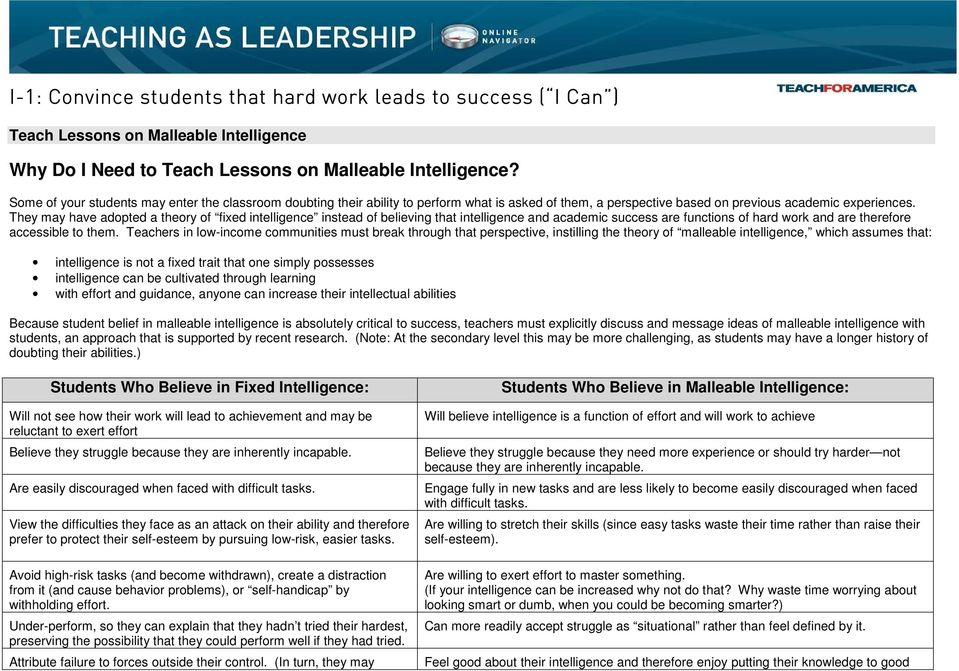
1 Teach Lessons on Malleable Intelligence Why Do I Need to Teach Lessons on Malleable Intelligence? Some of your students may enter the classroom doubting their ability to perform what is asked of them, a perspective based on previous academic experiences. They may have adopted a theory of fixed intelligence instead of believing that intelligence and academic success are functions of hard work and are therefore accessible to them. Teachers in low-income communities must break through that perspective, instilling the theory of malleable intelligence, which assumes that: intelligence is not a fixed trait that one simply possesses intelligence can be cultivated through learning with effort and guidance, anyone can increase their intellectual abilities Because student belief in malleable intelligence is absolutely critical to success, teachers must explicitly discuss and message ideas of malleable intelligence with students, an approach that is supported by recent research. (Note: At the secondary level this may be more challenging, as students may have a longer history of doubting their abilities.) Students Who Believe in Fixed Intelligence: Will not see how their work will lead to achievement and may be reluctant to exert effort Believe they struggle because they are inherently incapable. Are easily discouraged when faced with difficult tasks. View the difficulties they face as an attack on their ability and therefore prefer to protect their self-esteem by pursuing low-risk, easier tasks. Avoid high-risk tasks (and become withdrawn), create a distraction from it (and cause behavior problems), or self-handicap by withholding effort. Under-perform, so they can explain that they hadn t tried their hardest, preserving the possibility that they could perform well if they had tried. Attribute failure to forces outside their control. (In turn, they may Students Who Believe in Malleable Intelligence: Will believe intelligence is a function of effort and will work to achieve Believe they struggle because they need more experience or should try harder not because they are inherently incapable. Engage fully in new tasks and are less likely to become easily discouraged when faced with difficult tasks. Are willing to stretch their skills (since easy tasks waste their time rather than raise their self-esteem). Are willing to exert effort to master something. (If your intelligence can be increased why not do that? Why waste time worrying about looking smart or dumb, when you could be becoming smarter?) Can more readily accept struggle as situational rather than feel defined by it. Feel good about their intelligence and therefore enjoy putting their knowledge to good
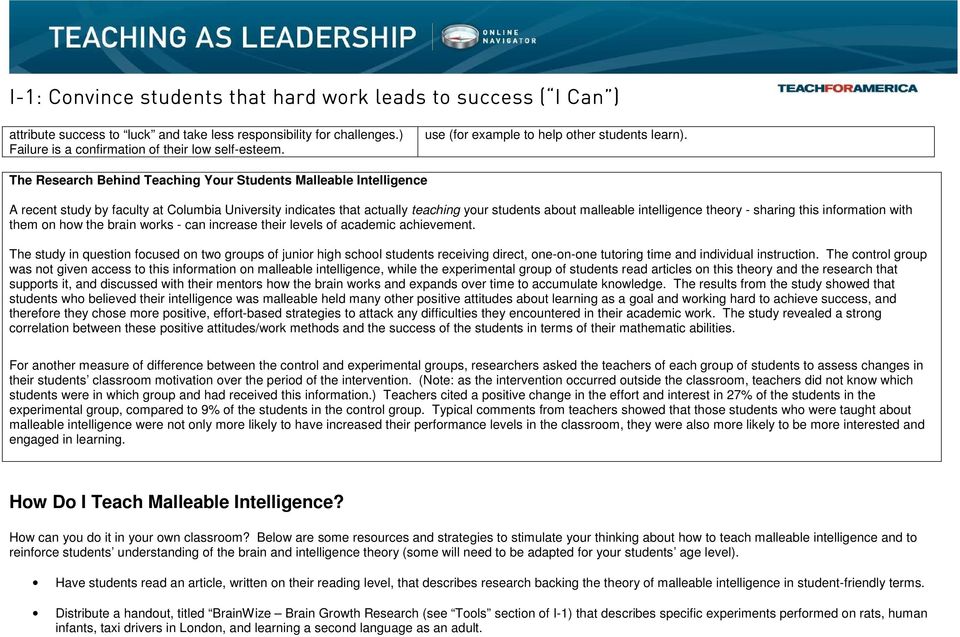
2 attribute success to luck and take less responsibility for challenges.) Failure is a confirmation of their low self-esteem. use (for example to help other students learn). The Research Behind Teaching Your Students Malleable Intelligence A recent study by faculty at Columbia University indicates that actually teaching your students about malleable intelligence theory - sharing this information with them on how the brain works - can increase their levels of academic achievement. The study in question focused on two groups of junior high school students receiving direct, one-on-one tutoring time and individual instruction. The control group was not given access to this information on malleable intelligence, while the experimental group of students read articles on this theory and the research that supports it, and discussed with their mentors how the brain works and expands over time to accumulate knowledge. The results from the study showed that students who believed their intelligence was malleable held many other positive attitudes about learning as a goal and working hard to achieve success, and therefore they chose more positive, effort-based strategies to attack any difficulties they encountered in their academic work. The study revealed a strong correlation between these positive attitudes/work methods and the success of the students in terms of their mathematic abilities. For another measure of difference between the control and experimental groups, researchers asked the teachers of each group of students to assess changes in their students classroom motivation over the period of the intervention. (Note: as the intervention occurred outside the classroom, teachers did not know which students were in which group and had received this information.) Teachers cited a positive change in the effort and interest in 27% of the students in the experimental group, compared to 9% of the students in the control group. Typical comments from teachers showed that those students who were taught about malleable intelligence were not only more likely to have increased their performance levels in the classroom, they were also more likely to be more interested and engaged in learning. How Do I Teach Malleable Intelligence? How can you do it in your own classroom? Below are some resources and strategies to stimulate your thinking about how to teach malleable intelligence and to reinforce students understanding of the brain and intelligence theory (some will need to be adapted for your students age level). Have students read an article, written on their reading level, that describes research backing the theory of malleable intelligence in student-friendly terms. Distribute a handout, titled BrainWize Brain Growth Research (see Tools section of I-1) that describes specific experiments performed on rats, human infants, taxi drivers in London, and learning a second language as an adult.
3 Distribute handouts on Brain Facts with short bullet-point items about how students can get smarter by exercising your brain, as well as handouts on how memory works and how students can develop their memory skills (explaining to them how to use chunking, a visual image, acronyms, etc.). Have students fill out worksheets to relate their previous knowledge to malleable intelligence, by describing their favorite activity and responding to questions on how they got better at it over time. Experiment with students to discover results of hard work. Present students with a test, without offering them the opportunity to study. Assume grades will be unimpressive. Then offer your students a comparable test, but specifically devote class time to review and prepare. Watch the effect of studying become tangible. See the I-1 Tools section for some examples of tools you can use to teach malleable intelligence.

4 Malleable Intelligence Article

5

6

7

8

9

10 Back Malleable Intelligence Handout BrainWize Brain Growth Research Here are descriptions of different research studies that all showed how learning changes the brain. Babies Brains: Newborn babies have plenty of neurons, but the cells have very few connections between them. Because they are learning so much in their first few years, babies develop many new connections between their brain cells. By the time you become an adult you will have a trillion or more of these connections! Clever Cabbies: London cabbies have to learn the locations of many different places, because their streets don t have numbers. Researchers measured the hippocampus the area of the brain that remembers information about places in London cabdrivers and compared them to other people s. The cabbies were bigger, and the longer they were on the job, the bigger this area of the brain became! This shows that learning and practicing this skill made that area of their brain grow. Learning Languages: Most people think that learning a second language once you are an adult is very hard. But researchers had adults use special exercises to practice hearing different sounds. Using a PET scan to measure the activity in the brain, the researchers found that when people did the special exercises, areas of their brains that they had never used before became active. This shows that you can retrain your brain and develop new abilities all through your life. Musical Mastery: When people play an instrument, they use a special area of the brain to coordinate the movement of their fingers. Researchers found that when the people practiced playing an instrument, the area of the brain that controls the fingers grew larger! This shows that when you learn and practice a new skill, you can build up that area of the brain. New Neurons: Scientists used to think that we had a fixed amount of brain cells and that we could

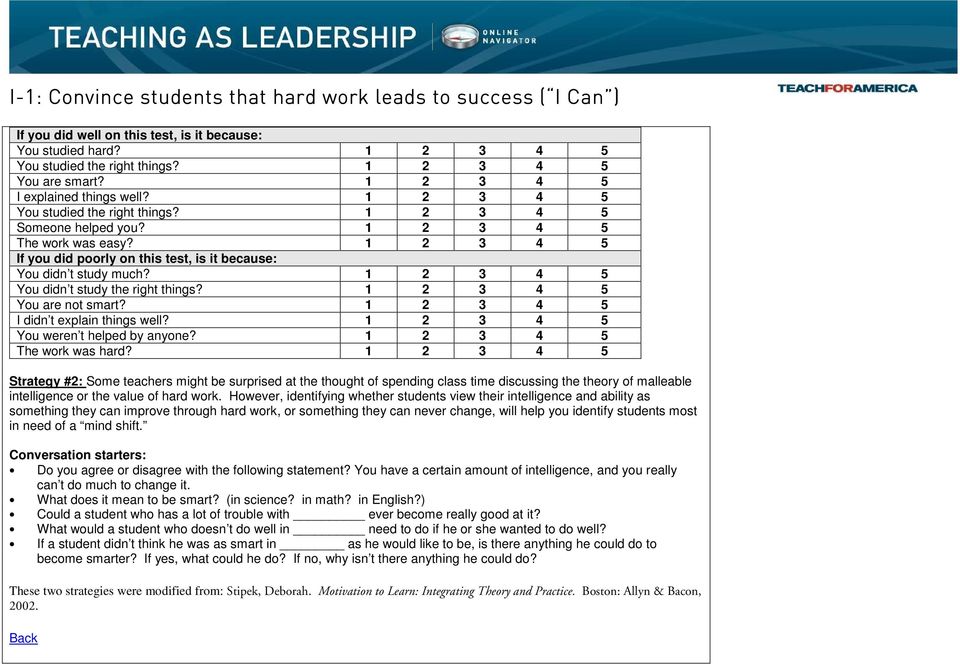
11 never grow new ones. But in the past decade, research has shown that the brain grows new cells every day! The cells are grown in the hippocampus, an area important in memory, and they travel to other areas of the brain. They also found that the brain grows more new cells when you are learning new information and skills! So, by learning and practicing, you actually add brain cells as well as new connections. Remarkable Rats: Twin rats were raised in two different environments: either in a bare cage with food and water, or in a cage with lots of toys and exercise equipment to explore. In the bare cages, the cage potato rats just ate and drank and laid around, while in the enriched environment, the summer camp rats were busy exploring and learning, exercising their brains. It turned out that the summer camp rats became much smarter than the cage potato rats they were better at learning new things. And their brains were heavier, too: they had more connections between the neurons in their brains. This research shows that active mental exercise builds up the brain and makes it smarter. Even old rats were able to develop their brains in the enriched environment, proving that you re never too old to grow your brain! Back Two Strategies for Exploring Students Views of Intelligence Strategy #1: In order to shape your students view of intelligence and whether or not they believe in the value of hard work to get smart, it may be helpful to diagnose students perceptions of why they were able to succeed on an assignment. Below is a sample student survey that could be modified for a variety of assignments, such as a test, a project, an oral presentation, etc. Student Name: Not at all a reason Not much of a reason A reason A good reason A very important reason

12 If you did well on this test, is it because: You studied hard? You studied the right things? You are smart? I explained things well? You studied the right things? Someone helped you? The work was easy? If you did poorly on this test, is it because: You didn t study much? You didn t study the right things? You are not smart? I didn t explain things well? You weren t helped by anyone? The work was hard? Strategy #2: Some teachers might be surprised at the thought of spending class time discussing the theory of malleable intelligence or the value of hard work. However, identifying whether students view their intelligence and ability as something they can improve through hard work, or something they can never change, will help you identify students most in need of a mind shift. Conversation starters: Do you agree or disagree with the following statement? You have a certain amount of intelligence, and you really can t do much to change it. What does it mean to be smart? (in science? in math? in English?) Could a student who has a lot of trouble with ever become really good at it? What would a student who doesn t do well in need to do if he or she wanted to do well? If a student didn t think he was as smart in as he would like to be, is there anything he could do to become smarter? If yes, what could he do? If no, why isn t there anything he could do? These two strategies were modified from: Stipek, Deborah. Motivation to Learn: Integrating Theory and Practice. Boston: Allyn & Bacon, Back
13

Mindset: The New Psychology of Success Carol S. Dweck, Ph.D.
 Mindset: The New Psychology of Success Carol S. Dweck, Ph.D. Chapter 1: The Mindsets Chapter 1 presents the two different mindsets fixed and growth. Ms. Dweck reveals that she came upon the idea of researching
DEVELOPING A GROWTH MINDSET. The Secret to Improving Your Grades!
 DEVELOPING A GROWTH MINDSET The Secret to Improving Your Grades! WHY DON T WE SEE UNMOTIVATED BABIES? WHAT HAPPENS? WHAT IS MINDSET? What is mindset? A mental attitude that determines how you will interpret
Executive Summary and Recommendations
 Executive Summary and Recommendations To download a free copy of the complete report, go to www.aauw.org/learn/research/whysofew.cfm. Executive Summary Women have made tremendous progress in education
Back to School: Working with Teachers and Schools
 Back to School: Working with Teachers and Schools Starting school each fall is a challenge for the student and parents. The following article offers some valuable suggestions as your child starts a new
Exercise and the Brain
 Exercise and the Brain Daniela Nardelli has been a teacher of Mathematics and Physics for more than 20 years. She has a keen interest in understanding how the brain works and how to maximise student learning.
Commissioned by Microsoft Corp.
 STEM Perceptions: Student & Parent Study Parents and Students Weigh in on How to Inspire the Next Generation of Doctors, Scientists, Software Developers and Engineers Commissioned by Microsoft Corp. Introduction
How to Write a Statement of Teaching Philosophy
 How to Write a Statement of Teaching Philosophy A practical workshop on what a teaching philosophy is and how to get started Dr. Heather Doherty, PhD Leder Human Biology Program Curriculum Fellow Today
Savings Accounts and Interest
 Grade One Savings Accounts and Interest Overview Students share the book Berenstain Bears Trouble with Money, by Stan and Jan Berenstain, to learn about saving money, banks, and interest. Prerequisite
BRAIN TRAINING: THE NEW SCIENCE OF INTELLIGENCE LAUREL SCHOOL ONE LYMAN CIRCLE SHAKER HEIGHTS, OHIO 44122 216.455.3061 WWW.LAURELSCHOOL.
 BRAIN TRAINING: THE NEW SCIENCE OF INTELLIGENCE LAUREL SCHOOL ONE LYMAN CIRCLE SHAKER HEIGHTS, OHIO 44122 216.455.3061 WWW.LAURELSCHOOL.ORG VIEW FROM THE PAST We used to think that brains were a lot like
Integrated Skills in English ISE II
 Integrated Skills in English ISE II Reading & Writing exam Sample paper 2 Your full name: (BLOCK CAPITALS) Candidate number: Centre: Time allowed: 2 hours Instructions to candidates 1. Write your name,
Changing Mindsets, Motivating Students
 Changing Mindsets, Motivating Students Gerald Herbert/AP For more on our series of Professional Development webinars go to www.edweek.org/go/pdwebinars Liana Heitin Associate editor of Education Week Teacher
Presented by Erin Cross March 17, 2012
 Presented by Erin Cross March 17, 2012 By the end of this session, you will *understand how a growth mindset impacts student achievement. *learn strategies to help students develop a growth mindset towards
Thinking, Doing, Talking Science
 Thinking, Doing, Talking Science Can we use our skills to train teachers in a way that has measurable impact? [email protected] Oxford Brookes University research with 16 primary schools
How To Get A Job At A Community College
 28 Preview Now More Than Ever: Community Colleges Daniel Wister When Miranda left for school at a faraway university, she thought that all her dreams were on their way to coming true. Then, once disappointment
TEACHERS HELP KIDS LEARN.
 TEACHERS HELP KIDS LEARN. BUT TEACHERS ALSO NEED HELP TO DO A GOOD JOB. THIS IS THE STORY OF A TEACHER WHO TRIES HARD BUT DOESN T GET THE HELP SHE NEEDS, AND HOW THAT HURTS HER KIDS. TEACHER QUALITY: WHAT
Related KidsHealth Links. Discussion Questions
 Grades 9 to 12 Personal Health Series KidsHealth.org/classroom Teacher s Guide This guide includes: Standards Related Links Discussion Questions Activities for Students Reproducible Materials Standards
How to Study Mathematics Written by Paul Dawkins
 How to Study Mathematics Written by Paul Dawkins Before I get into the tips for how to study math let me first say that everyone studies differently and there is no one right way to study for a math class.
3.2 Methods of Addition
 .2 Methods of Addition Objectives Relate addition stories to number bonds. Write two addition facts for a given number bond. Solve picture problems using addition. Learn addition facts through, and the
Alexander S. of Edmond, OK WE ARE OKLAHOMA PARENTS AND STUDENTS IN NEED OF OPTIONS
 Alexander S. of Edmond, OK WE ARE OKLAHOMA PARENTS AND STUDENTS IN NEED OF OPTIONS Max S. of Wesville, OK Having been a longtime advocate for my son s education, I have learned many lessons. One of the
Your personal statement
 Your personal statement HOW TO WRITE THE PERFECT TEACHER TRAINING APPLICATION Contents 1. The basics 2. What to do 3. What not to do 4. Things to cover a. Introduction b. Teaching skills c. Other skills
Your Planning Checklist Grade 9
 Your Planning Checklist Grade 9 Let your teachers know that you plan to go to college. Are your courses considered college prep? If you don t know, ask your guidance counselor to make sure they are. TIP
lean in DISCUSSION GUIDE FOR ALL AUDIENCES
 lean in DISCUSSION GUIDE FOR ALL AUDIENCES Introduction We are grateful for what we have. What did past generations have to deal with that we don t have to deal with? What are you most grateful for? Men
What Musicians Can Learn about Practicing from Current Brain Research By Molly Gebrian
 What Musicians Can Learn about Practicing from Current Brain Research By Molly Gebrian As musicians, we spend a large portion of our lives practicing our instruments and learning how to do very complicated
Math: Study Skills, Note Taking Skills, And Test Taking Strategies
 Math: Study Skills, Note Taking Skills, And Test Taking Strategies Math Study Skill Active Study vs. Passive Study Be actively involved in managing the learning process, the mathematics and your study
Which Has More? by Marilyn Burns From Online Newsletter Issue Number 3, Fall 2002
 Which Has More? by Marilyn Burns From Online Newsletter Issue Number 3, Fall 2002 Lessons for Introducing Multiplication, Grade 3 is a revision that replaces Multiplication, Grade 3, the Math By All Means
SCHOOLS ATTUNED RESEARCH REPORT: ACADEMIC AND BEHAVIORAL CHANGES. Evergreen Avenue Elementary School Woodbury, New Jersey
 SCHOOLS ATTUNED RESEARCH REPORT: ACADEMIC AND BEHAVIORAL CHANGES Evergreen Avenue Elementary School Woodbury, New Jersey Submitted by: Fran Carey, Principal July 2003 Background Evergreen Avenue School,
School Authority: 9879- Society For Treatment of Autism (Calgary Region)
 Project ID:30156 - Art Therapy for Autistic Preschool Kindergarten School Authority: 9879- Society For Treatment of Autism (Calgary Region) Scope: 60 Students, Grades prek to K, 1 School PROJECT PLAN Project
THE HR GUIDE TO IDENTIFYING HIGH-POTENTIALS
 THE HR GUIDE TO IDENTIFYING HIGH-POTENTIALS What makes a high-potential? Quite possibly not what you think. The HR Guide to Identifying High-Potentials 1 Chapter 1 - Introduction If you agree people are
Mark J. Quathamer Brevard Community College Quality Enhancement Plan White Paper
 Running Head: BCC MATH SUCCESS Preparing for math success: Brevard Community College preparatory math courses Mark J. Quathamer Brevard Community College Quality Enhancement Plan White Paper Running Head:
Developing Critical Thinking Skills Saundra Yancy McGuire. Slide 1 TutorLingo On Demand Tutor Training Videos
 Developing Critical Thinking Skills Saundra Yancy McGuire Slide 1 TutorLingo On Demand Tutor Training Videos To view Closed Captioning, click on the Notes tab to the left. For screen reader accessible
Phase 2 The System Specification
 Team W2 Video-Conferencing-Based Classroom Extension Sergio Bana Andrew Carland Matt Dyson Sarah Jordan Andrew Wantuch Phase 2 The System Specification 1 P a g e TABLE OF CONTENTS 1. INTRODUCTORY PROBLEM
July 2009 Research Brief: Factors that support academic success
 July 2009 Research Brief: Factors that support academic success The single most important factor determining a student s academic success is the academic preparation a student receives and the rigor of
What does student success mean to you?
 What does student success mean to you? Student success to me means to graduate with a B average with no failing grades. Ferris is ridicules tuition rates don t affect me since I was fortunate enough to
Name: E-mail: Address: Phone Number Cell Phone Introduction
 Name: Deb Giblin E-mail: [email protected] Address: 1409 S. Tayberry Ave Sioux Falls, SD 57106 Phone Number: 605-995-7225 Cell Phone: 605-770-9690 Introduction o Our overall goal is for everyone
TEACHER PREPARATION PROGRAM W P
 TEACHER PREPARATION PROGRAM W P I W O R C E S T E R P O L Y T E C H N I C I N S T I T U T E WPI students really make a difference in the science classroom. They bring new ideas and experiences to the teaching
is true for managers, team leaders and team members, individual contributors, professionals and executives.
 HOW TO GET THE MOST (FOR YOURSELF) FROM TRAINING WHY TRAINING? WHY NOW? If training is not important to a particular job today, that job probably will not be important much longer, either. What makes training
41% of respondents were confident or very confident that the major they currently are planning to pursue would be the right major for them.
 2014 MIT Incoming Freshman Survey During the summer of 2014, the MIT Survey of New Students was administered to all incoming first- year students. 954 students completed the survey for an 86% response
Beacon s Education Program:
 Beacon s Education Program: Why it works 2101 Livingston Street Oakland, CA 94606 510.436.4466 beaconday.org Part One: Curriculum Spirals Beacon s Education Program is based upon a system which we call
Approx. 45 minutes I. Warm Up: Brain Quiz (5 minutes) II. Brainstorm (10 minutes) III. Brain Tour (What s Going on in There?
 How Your Brain Works 1 GROW YOUR INTELLIGENCE The BIG Idea How does my brain work? AGENDA Approx. 45 minutes I. Warm Up: Brain Quiz (5 minutes) II. Brainstorm (10 minutes) III. Brain Tour (What s Going
Bringing Toys to School
 Cover photo: 2006 by Jeff Kubina. Some rights reserved http://creativecommons.org/licenses/by-sa/2.0/. Bringing Toys to School Written by: Holly Reed 2013 Elfrieda H. Hiebert. Some rights reserved. This
Practice Test for Special Education EC-12
 Practice Test for Special Education EC-12 1. The Individualized Educational Program (IEP) includes: A. Written evaluation B. Assessment tests C. Interviews 2. Learning disabilities include: A. Cerebral
Psychology 1 & 2 2013/2014 Semester 1 & 2
 Psychology 1 & 2 2013/2014 Semester 1 & 2 Mrs. Westberg Room 427 [email protected] (253) 571-3067 Course Description and Syllabus Welcome to Psychology class! You have selected a course which deals
Goal Setting & Work. Shasta County Health and Human Services Agency Department of Social Services CalWORKs Employment Services Program
 What s in your tool kit? Goal Setting & Work Shasta County Health and Human Services Agency Department of Social Services CalWORKs Employment Services Program Goal Setting & Work 11/08 Goal Setting Action
FREQUENTLY ASKED QUESTIONS ABOUT ADVANCEC PLACEMENT AND PRE-AP
 1. Is the AP Exam the same across the nation? Yes, AP exam for the particular courses are the same across the nation. The test dates are the same for everyone. 2. How is the AP score calculated? See the
Modifying Curriculum and Instruction
 Modifying Curriculum and Instruction Purpose of Modification: The purpose of modification is to enable an individual to compensate for intellectual, behavioral, or physical disabi1ities. Modifications
UNIT: PSYCHOLOGICAL RESEARCH
 Assignment: Research Experiment Instructor Guide UNIT: PSYCHOLOGICAL RESEARCH Standards that Apply to this Assignment National Standards for High School Psychology Curricula August 2005 Standard Area IA:
http://www.bls.gov/oco/ocos070.htm Teachers Special Education
 http://www.bls.gov/oco/ocos070.htm Teachers Special Education * Nature of the Work * Training, Other Qualifications, and Advancement * Employment * Job Outlook * Projections Data * Earnings * OES Data
LESSON PLAN CAREER TREK ONLINE TOOL. Estimated time: 1.5 to 2.5 hours. Preparation: Access to the internet for each student
 LESSON PLAN CAREER TREK ONLINE TOOL Estimated time: 1.5 to 2.5 hours Preparation: Access to the internet for each student Copies of worksheets for each student Resources: Career Trek website: www.careertrekbc.ca
This sample chapter is for review purposes only. Copyright The Goodheart-Willcox Co., Inc. All rights reserved.
 This sample chapter is for review purposes only. Copyright The Goodheart-Willcox Co., Inc. All rights reserved. 2 BECOMING A TEACHER Key Terms teaching academies teacher education programs grants job shadowing
Our automatic thoughts echo our core beliefs. The more negative our core beliefs are, the more negative our automatic thoughts will be.
 cchapter EIGHTb Core beliefs Think Good - Feel Good Paul Stallard Copyright 2002 John Wiley & Sons Ltd ISBN: 0470842903 (Paperback) CORE BELIEFS Core beliefs are the fixed statements ideas that we have
The Influence of Session Length On Student Success
 The Influence of Session Length On Student Success Ruth Logan Research Associate Santa Monica College Peter Geltner, Ph.D. Dean of Institutional Research Santa Monica College Abstract Do compressed courses
Teaching All Students to High Standards in Mixed-Ability Classrooms
 Teaching All Students to High Standards in Mixed-Ability Classrooms Differentiated instruction is not a silver-bullet remedy. However, it enables teachers to address the needs of mixed-ability classrooms
Student Evaluation of Teaching - Form SRT Form - Official End-of-Semester Evaluation of Teaching
 University of Minnesota NSCI 4100 001 Fall 2012 01/10/2013 Number of questionnaires = 17 Page 1 of 2 Dr. McLoon was one of the best instructors I have ever had. He presented difficult material in an interesting
Reflective Essay in Education, APA Style (Gibson)
 Reflective Essay in Education, APA Style (Gibson) Running head: SERVICE LEARNING: ERIC 1 The header consists of a shortened title in all capital letters at the left margin and the page number at the right
How To Write A Checkbook
 ThisPersonal checking account lesson is designed to be for grades 9-12 Financial Literacy classes. Financial Literacy is a state graduation requirement. 1 GOALS AND OBJECTIVES: The objective of this lesson
2015 SDA Teacher Application
 2015 SDA Teacher Application Page 2 of 2 0% complete Table of Contents 2015 Summer Dreamers Teacher Application 2015 Summer Dreamers Academy Teacher 2015 Summer Dreamers Application Teacher Application
worksheet: personal history questions
 worksheet: personal history questions Childhood What was your childhood home like? Your neighborhood? Was your parents relationship a strong one? Which of them were you closer to? When you were growing
A partner school of K 12, the leader in K 12 online education
 A partner school of K 12, the leader in K 12 online education Welcome Dear Tri Cities Area families, Three Rivers Homelink is a public school using an innovative model to provide your child with the best
Opportunity Awareness Center Martha Raines High School Behavior Transition Program
 Opportunity Awareness Center Martha Raines High School Behavior Transition Program Becky BracewelI-Tucker, Principal Katy Independent School District Dear Selection Committee, As Principal of the Opportunity
Mental Health Role Plays
 Mental Health Role Plays Goals: To discuss various mental health issues and mental illnesses. To discuss stigma, support and treatment options surrounding mental health issues and mental illnesses. Requirements:
Think like a scientist: Student reading / activity guide
 Think like a scientist: Student reading / activity guide Students: As you read the information below, underline important facts or definitions with your pencil or highlighter so you can find it for the
If you use your mind, take a step at a time, you can do anything that you want to do. Steve, Blue s Clues
 SO YOU HAVE TO WRITE A DISSERTATION PROPOSAL? SOME THOUGHTS ON HOW TO KEEP FROM BEING OVERWHELMED AND MOVE STEADILY TOWARDS YOUR GOAL. By Elizabeth Ferry Department of Anthropology, Brandeis University
DEEPER LEARNING COMPETENCIES April 2013
 DEEPER LEARNING COMPETENCIES April 2013 Deeper learning is an umbrella term for the skills and knowledge that students must possess to succeed in 21 st century jobs and civic life. At its heart is a set
Karen Fuson, Pam Richards, and Robyn Seifert
 The Math Expressions Mastery Learning Loop Keeping All Students on the Grade-Level Learning Path by Giving More Time and Support to In-Class Periodic Interventions and Out-of-Class Tier 2 & Tier 3 Follow
Leader s Instructions Handbook
 1 Leader s Instructions Handbook The 80-minute video, God's Story, is divided into 18 discussion sections, ranging from 1 to 10 minutes in length. (You may be using God's Story in VCD format, with a different
Guide to Preparing for the Recruiting Process
 Guide to Preparing for the Recruiting Process Written by the Athnet Team 2011 1 Table of Contents 4 Goals You Should Set Before You Start the Recruiting Process 2 The 3 Steps in the Best Approach to Getting
2 Mathematics Curriculum
 New York State Common Core 2 Mathematics Curriculum GRADE GRADE 2 MODULE 3 Topic E: Model Numbers Within 1000 with Place Value Disks 2.NBT.A Focus Standard: 2.NBT.A Understand place value. Instructional
Autonomy and Education: The Case of Homeschooling. Abraham Gerber
 Autonomy and Education: The Case of Homeschooling Abraham Gerber Looking back at my education, the most significant learning has all taken place outside of a classroom. Here, I especially think of time
How To Get A Good Education In Minnesota
 A partner school of K 12, the leader in K 12 online education Welcome Dear Minnesota families, VIBE Academy is a public school using an innovative model to provide your child with the best education possible.
Working as a Health Science Technology Professional
 Working as a Health Science Technology Professional Teacher Edition Note to the Teacher: Students choosing to enter a non-traditional career field need to be encouraged. There will be many people that
End-Of-Course Writing Prompts
 Some say that the journey is more important than the destination. They argue that people find more joy and satisfaction in working toward a goal than in achieving it. Others say that it is the destination
The Effects Interactive Whiteboards Have on Student Motivation. Research Synthesis. Mandy McEntyre EDIT 6900
 Interactive Whiteboards 1 The Effects Interactive Whiteboards Have on Student Motivation Research Synthesis Mandy McEntyre EDIT 6900 Interactive Whiteboards 2 Topic: After many weeks of completing preliminary
Hermantown High School CIS Psychology Course Syllabus 2009 2010 This course is in conjunction with Lake Superior College
 Course Title: General Psychology Hermantown High School CIS Psychology Course Syllabus 2009 2010 This course is in conjunction with Lake Superior College Course Number: Psychology 1120 Credits: 3 Instructor:
Slide 5 At A level you can see the big gap that is currently widening in Wales
 Notes on presentation for Science and the Assembly Girls in STEM Slide 1 It s not a revelation to say that there is a problem with the number of girls taking sciences at school and choosing STEM careers
As tutors, we are responsible for improving the skills of our peers.
 Tutor s Creed As tutors, we are responsible for improving the skills of our peers. As tutors, we will consider the body of work presented at the session in the following manner: First, we will impart to
Impact of Assessment on Learning and Teaching Mathematics. Some Evidence from MA, ATM and NANAMIC
 Impact of Assessment on Learning and Teaching Mathematics Some Evidence from MA, ATM and NANAMIC MA, ATM and NANAMIC have gathered some evidence of the views of members on the impact of assessment on learning
Basic 12 for Middle School Workshop 1: Why is college a realistic goal for you?
 Basic 12 for Middle School Workshop 1: Why is college a realistic goal for you? Description: The workshop introduces students to the concept that all students should be thinking about going to college
NWVA. A partner school of K 12, the leader in K 12 online education. North Wasco Virtual Academy. Exceptional Online Education for Grades K-12
 NWVA North Wasco Virtual Academy Exceptional Online Education for Grades K-12 A partner school of K 12, the leader in K 12 online education Welcome Dear North Wasco School District families, North Wasco
Glass, Bug, Mud. By Kimberly J. Grimes and Dannelle D. Stevens
 Glass, Bug, Mud A self-assessment system enables teachers to differentiate elementary mathematics instruction, which boosts both student learning and students sense of themselves as mathematicians. By
Glossary of Teaching Strategies
 This list of teaching strategies and activities was developed out of a focused brainstorming process conducted with general education, special education and English as a Second Language teachers in Minnesota
21st Century Community Learning Center
 21st Century Community Learning Center Grant Overview The purpose of the program is to establish 21st CCLC programs that provide students with academic enrichment opportunities along with activities designed
Top HR Interview Question and Answers
 1. Tell us something about yourself. Top HR Interview Question and Answers This is the first question, you can expect during any interview you face. This usually is a question to start the communication
Physical Activity in the School Environment and the Community
 Chapter 5 Physical Activity in the School Environment and the Community Chapter objectives: To briefly describe how our changing society is influencing the effect of schools on the behaviour of modern
9.5 Secrets to Building a Successful Prospecting Plan
 9.5 Secrets to Building a Successful Prospecting Plan We all know prospecting is like doing our worst chore. But you can t succeed at sales with out being a great at prospecting. When prospecting you need
Students Perception On Teaching And Learning Mathematics In English. Aziz bin Nordin [email protected] Faculty of Education Universiti Teknologi Malaysia
 Students Perception On Teaching And Learning Mathematics In English By Aziz bin Nordin [email protected] Faculty of Education Universiti Teknologi Malaysia Abstract Students use language to communicate and