
5 Steps To Healthcare Change Management: A Roadmap For Success
|
|
|
- Diane Greer
- 10 years ago
- Views:
Transcription
1 Optimizing the business of healthcare 5 Steps To Healthcare Change Management:

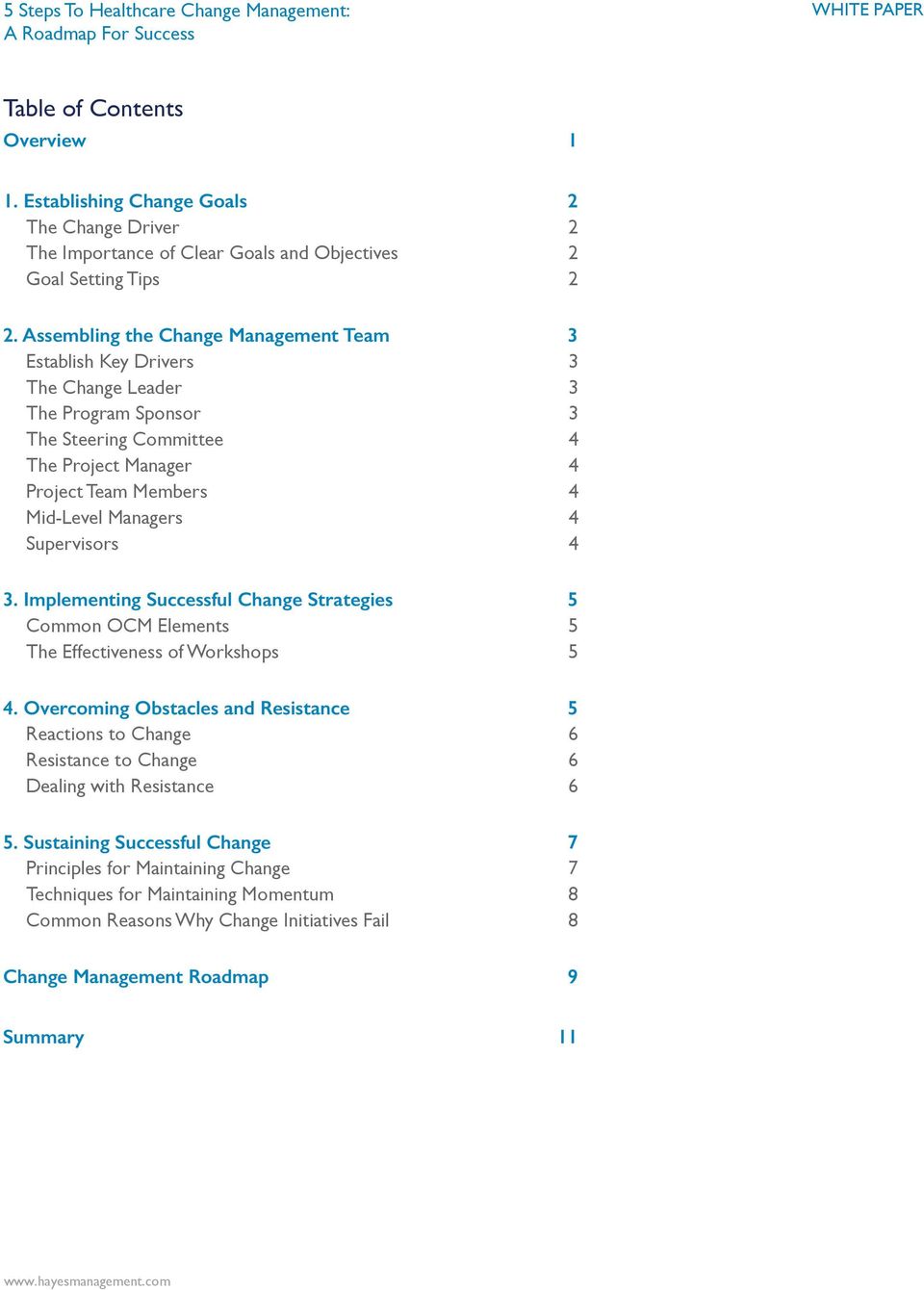
2 Table of Contents Overview 1 1. Establishing Change Goals 2 The Change Driver 2 The Importance of Clear Goals and Objectives 2 Goal Setting Tips 2 2. Assembling the Change Management Team 3 Establish Key Drivers 3 The Change Leader 3 The Program Sponsor 3 The Steering Committee 4 The Project Manager 4 Project Team Members 4 Mid-Level Managers 4 Supervisors 4 3. Implementing Successful Change Strategies 5 Common OCM Elements 5 The Effectiveness of Workshops 5 4. Overcoming Obstacles and Resistance 5 Reactions to Change 6 Resistance to Change 6 Dealing with Resistance 6 5. Sustaining Successful Change 7 Principles for Maintaining Change 7 Techniques for Maintaining Momentum 8 Common Reasons Why Change Initiatives Fail 8 Change Management Roadmap 9 Summary 11
3 Overview According to a recent McKinsey study, nearly three-quarters of all global businesses that achieved targeted change objectives used a rigorous, highly structured change management process. 1 However an IBM study found that organizations that mainly improvised solutions to problems reported only a 36% success rate. 2 It s clear that organizations that hope to be successful with their change initiatives need to adopt a structured and formal approach. For healthcare organizations hoping to compete in a disruptive environment, mastering the change management process is essential. Organizational change management (OCM) is a framework for managing changes in culture, organizational structure, or business processes. OCM helps organizations adapt to systemic change driven by transformative initiatives to improve competitive advantage, correct operational deficiencies, or expand capabilities. It involves identifying and addressing the resistance that normally occurs when people are asked to change the way they are accustomed to doing things. Effective OCM ensures that changes are properly implemented and that lasting benefits are achieved and retained. A systematic approach to OCM helps people throughout an organization adjust to new behaviors and skills. By formally setting expectations, employing tools to improve communication, and proactively seeking ways to reduce misinformation, stakeholders are more likely to accept and embrace the change. Failed organizational change initiatives result in cynical and burned out employees, making any future change objectives problematic. It is not surprising that the fear of managing change and its impacts is a leading cause of anxiety for executives. However, with the ever-changing nature of the healthcare industry, change is inevitable. Those organizations that are able to best manage these changes will be the ones that remain competitive and have the most success. Visioning, prioritizing, planning, providing feedback, and rewarding success are the key leadership and management skills needed in any successful change initiative. By embracing a structured OCM program, organizations can overcome obstacles and provide their change initiative with a much greater chance of success. Here are the five steps you should consider when implementing change in a healthcare organization. 1

4 1 Establishing Change Goals The Change Driver This is the principle cause and motivator of the change. This single sentence should summarize the business case for embarking on the change initiative. The Importance of Clear Goals and Objectives For a change initiative to succeed, key stakeholders must establish unambiguous and measurable strategic objectives along with clearly defined goals. The challenge for most executives is figuring out where to begin. A good place to start is with a joint decision-making design session. This vision building meeting allows the team to establish a rapport to create a shared vision and articulate the objectives until they are refined into specific goals. Defining goals and establishing objectives engage stakeholders and commits them to the program. Goals are long-term targets that an organization wants to accomplish. Objectives are tangible milestones that can be achieved by following certain prescribed steps. Change objectives must link to the strategic objectives of the organization and have widespread and genuine support across the organization. More importantly, they must be specific, quantifiable and actionable. If not, then the project becomes like a race without a clearly marked finish line. Goal Setting Tips Setting goals properly can be more challenging than most executives expect. Before a change goal is set, it should pass the following change management litmus test : Is the stated goal linked directly and unambiguously to the mission, vision, and strategic direction of the organization? What is the objective of the change, why is it important, and what will indicate it has been achieved? Who is affected by this change, and how will they react to it? Can the change goal be achieved internally or will it require external assistance? Once established, goals and objectives need to be communicated clearly and frequently to every level of the organization. There should be a documented strategy for communicating the goals and objectives as well as measuring the effectiveness of the communication plan. Current performance in the targeted change area should be documented to form a baseline that can be used as a measure against future performance. If 2

5 the performance metrics are defined properly, sponsors and stakeholders should be able to objectively determine the effectiveness of the change effort. 2 Assembling the Change Management Team Empowered people with specific experience and skill sets are needed to complete the necessary actions and to overcome the barriers a major change project is likely to encounter. This Change Management (CM) team will identify and communicate the various responsibilities required to achieve the program objectives. During a change management project, individuals in the organization will fall into one of three broad categories: Change Implementers manage and perform the various tasks to bring about the desired change. Change Enablers establish and maintain the environment and conditions that facilitate the change. Change Recipients are the people expected to behave differently once the changes have been implemented. Establish Key Drivers People are the only resources that can truly make organizational change happen. Clearly defining the key roles and expectations across the enterprise is the key to successfully implementing a change initiative. It is crucial to identify the right people to handle each of the following roles: The Change Leader The change leader should be sufficiently senior in the organization and be able to command the attention of the executive team. The change leader has a strong personal commitment to the success of the program and is the principal trouble-shooter with ultimate responsibility for problem and conflict resolution. The Program Sponsor The program sponsor is the executive s representative responsible for ensuring that the appropriate resources are committed to solve problems and help the program succeed. This differs from the change leader because it is a tactical role, rather than a strategic one. 3

6 The Steering Committee Along with the program sponsor, the Steering Committee shares overall responsibility and oversight for the success of the program. The committee typically represents the key stakeholders and regularly reviews the progress of the project, providing guidance where necessary, and serving as an authoritative body that can help eliminate obstacles in the path of the project. The Project Manager The project manager has overall responsibility for detailed planning and implementation of one or more components of the change program. The PM defines the specific tasks to accomplish the objectives and assigns those tasks to the appropriate team members. The PM manages the daily tactical activities of the project and serves as the liaison to the steering committee and executive leadership. Project Team Members Project team members are responsible for completing the various project activities as assigned by the project manager. The team members are usually (but not always) representatives from the various organizational work units or departments affected by the change and are typically subject matter experts in specific operational areas. Mid-Level Managers Middle managers are responsible for supporting and communicating change initiatives and allocating the resources required within their area of control. They also help identify barriers to success and risks to the project. Managerial participation and support in a change initiative is absolutely essential. Supervisors Frontline supervisors and team leaders are the face of the organization to their employees and serve a critical role in supporting, counseling, and coaching employees throughout the change process. They are also especially helpful in identifying obstructionists and mitigating their potentially negative impact. This team will be responsible for executing successfully on the change vision. The best results usually come from people working collaboratively in a team environment. One reason teams are more productive is that members are able to leverage each other s strengths. Effective teams should have the right balance of natural working styles and chemistry. Putting together the right team is crucial in successfully accomplishing a change initiative. 4

7 3 Implementing Successful Change Strategies The key to organizational change management success involves a specific, targeted, and tailored approach to the needs of an organization. However there are also common strategies that improve the chances for success of any change management project, regardless of the particular organizational requirements. Common OCM Elements A successful change initiative includes the following: Agreement on a common vision for change - no competing initiatives. Strong executive leadership to communicate the vision and sell the business case for change. A program to educate employees on how their day-to-day work will change, emphasizing improvements and efficiencies to be gained. A documented plan for measuring the results of the change. Key metrics must be established to help assess the effectiveness of the project. Establishment of a reward structure, both monetary and social, that encourages individuals and groups to take ownership for their new roles and responsibilities. The Effectiveness of Workshops Change management workshops are an excellent way to bring attention to the initiative, address concerns, mitigate pushback, and help shape goals and objectives. Workshops also increase a sense of ownership and empowerment while breaking down barriers, improving communications, and integrating staff into the project. Change initiatives need a force to get started and a boost to move it to each subsequent level. It is important to understand that if the driving forces are withdrawn or gradually dissipate, the program will eventually run out of steam. A visioning workshop is an excellent catalyst to help keep a change management project moving and on track. 4 Overcoming Obstacles and Resistance Human beings dislike change. They get comfortable in their routine way of handling things and any disruption causes concern. It s important to understand that dynamic and work the problems that result. 5

8 Reactions to Change It is critical to anticipate the reaction to the changes proposed for an organization and take steps to create the desired reactions. People who oppose the changes should be treated with respect, acknowledging their concerns and listening genuinely to their issues. Ways to accomplish this include: Choosing people with refined interpersonal skills for key project positions Communicating openly with employees and other change stakeholders Meeting resisters face-to-face as often as possible Pointing out unacceptable behavior without being confrontational Keeping commitments in order to build trust and respect Handling bad news proactively. Communicating candidly, but sensitively Resistance to Change No matter how carefully and meticulously a change management initiative is structured, some employees will still resist the change. Members of the change management team shouldn t take this personally and should not adopt an adversarial approach to dealing with it. But unless there is a well-planned strategy for dealing with them, the resisters can wear the project down until it eventually grinds to a halt. The CM team has to identify and manage both the overt resisters who openly criticize and sabotage the change management effort, and the covert resisters who quietly create problems and sow dissent in the hope that the initiative will eventually fail. The CM team has to help uncover the reasons for resistance to the program and find ways to resolve them. This can be done by helping resistors work through the psychological process of change and turning them from obstructionists into active supporters of the change initiative. Dealing with Resistance Occasionally, the CM team discovers that the reason an individual is resistant to a proposed change is founded on a legitimate concern that had not been previously considered. This can benefit the project because it helps the project team resolve issues and avoids potential problems. It also allows the resister to see that their concerns are being taken seriously and properly addressed. This usually turns them from resisters into active and enthusiastic supporters of the change project. 6

9 Trying to sell change to skeptical people within the organization is not an effective strategy and will invariably fail. People usually see through this approach and feel that they are being manipulated, creating feelings of resentment leading to resistance. Instead, change needs to be managed in a way that people can accept as necessary and view as being beneficial to the organization. 5 Sustaining Successful Change Launching an effective change initiative is only half the battle. The greater challenge is sustaining the gains made through a successful change effort. Adopting a principled approach that emphasizes openness, trust and integrity will ensure the lasting effects of the change program. Principles for Maintaining Change These five principles will help sustain a strong change effort: 1. Strong Sponsorship The change program must have the visible support of key decision-makers willing to devote resources to the program. If executive leadership demonstrates a firm commitment to the success of the change initiative, the members of the organization are much more likely to get on board. 2. Detailed Planning Planning should be conducted methodically before program implementation. Plans need to be circulated and accepted by major stakeholders and the objectives, resources, roles, and risks must be clearly defined. An organized and structured approach will earn the respect of the employees and minimize resistance to the change. 3. Specific Measurement Program objectives must be stated in measurable terms and program progress monitored and communicated to the key stakeholders. 4. Structured Support Program implementers and change recipients have to be given the resources and supporting systems required during and after change implementation. 5. Committed Engagement Stakeholders should engage in genuine two-way dialogue in an atmosphere of openness, mutual respect and trust. Everyone in the organization has a stake in the success of the initiative and the greater number of people who are invested, the more likely the change management effort will be sustained. 7

10 Techniques for Maintaining Momentum These practical techniques can keep the change momentum going in the new operational environment: Align systems of reward and recognition Coordinate recruitment and selection criteria Keep employees informed about performance and progress Strive for quick wins Celebrate achievements and milestones Ensure managers work within the new framework Institutionalize the change Common Reasons Why Change Initiatives Fail Several factors contribute to the high rate of organizational change program failures. Avoiding these situations is the key to successfully implementing the change strategy. Lack of executive sponsorship or senior management support In one survey of change practitioners, 92% cited top management sponsorship as the single most important factor in a successful change program. 3 Poor communication from the management team or a lack of real executive commitment leads to employees quickly losing faith in the project and the failure of the change initiative. Lack of employee engagement in the change process Leaders who actively sought to engage employees in the change effort enjoyed a 70% success rate, according to another study. 4 Executives who can marshal the support of their employees consistently have better outcomes on their projects. This is the most effective strategy an organization can use to minimize pushback and mitigate resistance to systemic change. Ineffective change leaders/sponsors For change to succeed, the Change Leader and/or the Program Sponsor need to be focused primarily on the program, working to drive the desired change across the organization. Competing priorities can be detrimental to the success of the project. In a recent survey report, 55% of change practitioners cited having strong and fully engaged change agents as the key factor in a successful change initiative. 5 Underestimating the complexity of change Nearly one in three change leaders admit that underestimating the complexity of the change was a significant barrier to the success of their 8

11 program. 6 Changing an organization s culture, level of innovation, or capabilities involves multiple organizational systems, departmental units, and organizational strategies. Change initiatives that fail begin with an overly simplistic one-size-fits-all approach. A successful change strategy must be tailored to the specific needs of both the project and the organization. Change Management Roadmap This paper has endeavored to clearly define the concept of change management, the importance of setting strong goals, strategies for successful implementation, defining the roles of the participants and identifying the risks that can lead to failure. This final section puts the pieces together to illustrate a clear roadmap for executing successful organizational change. Priorities by Phase Phase 1 Vision Business Need Goals & Objectives Future State Vision Description of Objectives by Phase Assess current state and level of change readiness for each stakeholder group. Conduct Business Needs Analysis to provide appropriate justification for project. Design an integrated change management and readiness strategy for ongoing steps to address the issues identified and build buy-in, commitment and capacity for change across the organization Define the required change management roles and match the appropriate resources Clearly define the future state vision with quantifiable goals and metrics Key Deliverables Change Management Plan Change Management Approach Change Readiness Assessment Stakeholder Analysis & Classification Communication Infrastructure Plan Business Requirements/ Justification Progress Metrics Phase II Plan Effective Communication Solidify the Roles Work Plan Work Shops Create approach for communicating the new vision to the organization Empower the roles assigned in the vision phase to take action toward the future state Find quick, easy wins to establish momentum and credibility for the change initiative Finalize the work plan and approach strategy Conduct workshops to refine and solidify the vision Refined Communication Strategy Doc Finalized Work Plan Strategic Approach Planning Doc Work Shop Schedule 9

12 Priorities by Phase Phase III Design Identify/Mitigate Risks Training Approach Align Processes Change Metrics Retaining Change Description of Objectives by Phase Evaluate risks across the organization and proactively address them Design training curriculum and training delivery approach Develop requirements for training materials (user manuals, job aids, etc.) Determine required workflows that optimize available system functionality Design test strategy for new software and workflows Leverage available metrics to gauge effectiveness Key Deliverables Updated Risk Management Strategy Doc Issues Management Doc Training Needs Assessment Training Curriculum and Calendar Training Strategy and Delivery Options Work Flow Gap Analysis Test Strategy Doc Metric Tools Set Phase IV Build Workflows Training Materials Test Documents Create integrated workflows across the enterprise Create required training documents Create test scripts for all new software and new workflows Create strategy document for change retention Set of New Workflows Set of Training Docs Set of Test Scripts Strategy Retention Strategy Doc Phase V Deliver Deliver Training Conduct Testing Communications Cutover Strategy Finalize training schedule and conduct all requisite training across the enterprise Test software functionality Test workflow effectiveness Execute on Communication plan to prepare the organization for the impending change Finalize a cutover strategy to the new system and processes Training Delivery Results Summary Test Results (software/ processes) Cutover Strategy Document Phase VI Operate Change Readiness Go-live Post Go-live Stabilization Metrics Analysis Change Retention Evaluate the readiness status of the organization and address urgent issues Evaluate go-live support readiness and make Go/No-go final decision Go-live with new systems and processes Resolve immediate issues and conduct training and modifications as necessary Analyze metrics and compare to baseline to determine change effectiveness Conduct workshops to discuss change retention strategy Reward and honor staff who have contributed to CM success Issues Management Doc (final) Post Go-live Training Plan Doc Post Go-live Metrics Evaluation Final Change Management Report to Executives Final Change Retention Doc 10

13 Summary Implementing a successful change initiative can be challenging. Committed executive leadership, clear goals, and a dedicated change management team are all critical components of a successful program. Transforming your organization amid all of the changes that healthcare reform has produced is often a juggling act. Balancing resources for multiple complex initiatives can be tough especially when timelines are tight, close coordination is needed, and change is constant. During these times, you need a healthcare partner you can trust to manage the project to completion, on time and on budget. At Hayes Management Consulting, we help optimize the business of healthcare by improving operational outcomes in a cost effective and sustainable way. We build a project strategy and resource plan that reflects your specific needs and work seamlessly to implement it on time and on budget. Contact us to see how we can help you with your change initiative. 11

14 Sources 1 What Successful Transformations Share : McKinsey Global Survey Results (2010). Organization Practice, March McKinsey_Global_Survey 2 Making Change Work Study (2008). IBM Corporation change-work.pdf 3 Making Change Work Study (2008). IBM Corporation change-work.pdf 4 What Successful Transformations Share : McKinsey Global Survey Results (2010). Organization Practice, March McKinsey_Global_Survey 5 Making Change Work Study (2008). IBM Corporation change-work.pdf 6 Making Change Work Study (2008). IBM Corporation change-work.pdf Optimizing the business of healthcare 1320 Centre Street Newton Center, MA [email protected] 12

Organizational Change Management Methodology. Tools and Techniques to aid Project Implementation
 Organizational Change Management Methodology Tools and Techniques to aid Project Implementation Today s Objectives Discuss the Organizational Change Management team and explore ways Organizational Change
15 Principles of Project Management Success
 15 Principles of Project Management Success Project management knowledge, tools and processes are not enough to make your project succeed. You need to get away from your desk and get your hands dirty.
Performance Factors and Campuswide Standards Guidelines. With Behavioral Indicators
 Performance Factors and Campuswide Standards Guidelines With Behavioral Indicators Rev. 05/06/2014 Contents PERFORMANCE FACTOR GUIDELINES... 1 Position Expertise... 1 Approach to Work... 2 Quality of Work...
Seven Principles of Change:
 Managing Change, LLC Identifying Intangible Assets to Produce Tangible Results Toll Free: 877-880-0217 Seven Principles of Change: Excerpt from the new book, Change Management: the people side of change
EXECUTIVE BEHAVIORAL INTERVIEW GUIDE
 EXECUTIVE BEHAVIORAL INTERVIEW GUIDE INTERVIEW GUIDE INSTRUCTIONS: This Interview Guide is intended to help hiring executives conduct behavioral interviews for executive classifications covered by the
Change Management. This resource guide answers eight of the questions most frequently asked of LCE subject matter experts in change management.
 Frequently asked questions SERIES: This resource guide answers eight of the questions most frequently asked of LCE subject matter experts in change management. Life Cycle Engineering 2013 www.lce.com QUESTION
WHITE PAPER. 7 Keys to. successful. Organizational Change Management. Why Your CRM Program Needs Change Management and Tips for Getting Started
 7 Keys to successful Organizational Change Management Why Your CRM Program Needs Change Management and Tips for Getting Started CONTENTS 2 Executive Summary 3 7 Keys to a Comprehensive Change Management
Business Analyst Position Description
 Analyst Position Description September 4, 2015 Analysis Position Description September 4, 2015 Page i Table of Contents General Characteristics... 1 Career Path... 2 Explanation of Proficiency Level Definitions...
HUMAN RESOURCES MANAGER DESCRIPTION OF WORK: Knowledge Professional and Organizational. Leadership/Human Resources Management. Program Management
 HUMAN RESOURCES MANAGER DESCRIPTION OF WORK: Employees in this banded class provide leadership and supervision to professional/technical staff in the delivery of a contemporary human resources program(s)
SAMPLE JOB DESCRIPTIONS
 SAMPLE JOB DESCRIPTIONS In this section we have provided a number of sample job descriptions. We hope that they will provide you with guidance as you develop job descriptions(s). Level Title Page Consultant
Self Assessment Tool for Principals and Vice-Principals
 The Institute for Education Leadership (IEL) brings together representatives from the principals' associations, the supervisory officers' associations, councils of directors of education and the Ministry
Change Management Practitioner Competencies
 1 change-management-institute.com Change Management Institute 2008 Reviewed 2010, 2012 Change Management Practitioner Competencies The Change Management Practitioner competency model sets an independent
How To Change A Business Model
 SOA governance and organizational change strategy White paper November 2007 Enabling SOA through organizational change Sandy Poi, Global SOA Offerings Governance lead, associate partner, Financial Services
Master Level Competency Model
 Change Manager Master Level Competency Model The Change Manager Master competency model sets an independent industry benchmark for SENIOR level change management practitioners. The model was launched in
Essential Elements for Any Successful Project
 In this chapter Learn what comprises a successful project Understand the common characteristics of troubled projects Review the common characteristics of successful projects Learn which tools are indispensable
OPTIMUS SBR. Optimizing Results with Business Intelligence Governance CHOICE TOOLS. PRECISION AIM. BOLD ATTITUDE.
 OPTIMUS SBR CHOICE TOOLS. PRECISION AIM. BOLD ATTITUDE. Optimizing Results with Business Intelligence Governance This paper investigates the importance of establishing a robust Business Intelligence (BI)
WHITE PAPER APRIL 2012. Leading an Implementation Campaign to Address the Convergence of Healthcare Reform Initiatives
 WHITE PAPER APRIL 2012 Leading an Implementation Campaign to Address the Convergence of Healthcare Reform Initiatives New healthcare reforms have created an unprecedented impact on hospital systems operations.
Interview Guide for Hiring Executive Directors. April 2008
 Interview Guide for Hiring Executive Directors April 2008 Introduction This interview guide has been developed to help the Board of Directors of Big Brothers Big Sisters agencies interview candidates for
Leadership Development Handbook
 Leadership Development Handbook Presented by: Langara College Human Resources Prepared by: Jackson Consulting Group Aim of the Handbook is to provide: Leadership Development Handbook - Introduction help
Crosswalk of the New Colorado Principal Standards (proposed by State Council on Educator Effectiveness) with the
 Crosswalk of the New Colorado Principal Standards (proposed by State Council on Educator Effectiveness) with the Equivalent in the Performance Based Principal Licensure Standards (current principal standards)
Why Change Management Is Key To Technology Implementation Success
 Why Change Management Is Key To Technology Implementation Success Why Change Management Is Key To Technology Implementation Success Who s it for? Insurance executives and managers who want to increase
Performance Management Guide For Managers
 Performance Management Guide For Managers This guide applies to employees who are not covered by a collective bargaining agreement or for whom the agreement contains no provision regarding this subject.
CHANGE MANAGEMENT: HOW TO ACHIEVE A CULTURE OF SAFETY
 CHANGE MANAGEMENT: HOW TO ACHIEVE A CULTURE OF SAFETY SUBSECTIONS Eight Steps of Organizational Team Member Empowerment Creating a New Culture Planning for Teamwork Actions MODULE TIME: 2 hours 15 minutes
Change Management. What Business Benefits Can I Expect?
 Change Management Effective change management is an essential ingredient to the successful implementation of technology-based projects that are made possible by Superfast Broadband. Change Management Effective
UCPath Change Management Strategy for UC San Diego. July 2013
 UCPath Change Management Strategy for UC San Diego July 2013 Overview Background Key Components Approach & Methodology Change Network Framework For Action Challenges Resources & Tools Summary Table of
Human Relations Sherry Peters - Director, Human Relations Specialist Professional Phase 2 (SP2), ASPA Bargaining Unit
 JOB TITLE NAME UNIT REPORTS TO JOB FAMILY Organizational Development Specialist Vacant Human Relations Sherry Peters - Director, Human Relations Specialist Professional Phase 2 (SP2), ASPA Bargaining Unit
How Smart Businesses Embrace Change Lessons to Enable a Successful Business Transformation
 How Smart Businesses Embrace Change Lessons to Enable a Successful Business Transformation January Paulk Director of Client Services Organizational Change and Business Process Management Services Agenda
A Relative Gap Moving from Gap to Strength A Relative Strength Organizational Readiness
 A Relative Gap Moving from Gap to Strength A Relative Strength Organizational Readiness Performance history Implementation of new programs historically has not been well planned, and has not had intended
We d like to do the same for you. Owen J. Sullivan CEO, Right Management President, Specialty Brands ManpowerGroup
 Business & Talent. Aligned. Regardless of the economic environment, your industry or geography, your size or your earnings, your most valuable asset is your workforce. How you manage this asset spells
Touch Points Touch Points Step 1 Spend Areas Step 2 Creating and Developing a Sourcing Team Executive Sponsorship
 Strategic Sourcing: A Step-By-Step Practical Model Robert J. Engel, Vice President-Project Services The Procurement Centre 713-623-0111 Ext. 224; [email protected] 89 th Annual International Supply Management
Welcome to the Data Analytics Toolkit PowerPoint presentation on data governance. The complexity of healthcare delivery, the exploding demand for
 Welcome to the Data Analytics Toolkit PowerPoint presentation on data governance. The complexity of healthcare delivery, the exploding demand for actionable information, pressure for greater public accountability,
Driving Records & Information Management Transformation: Enabling program adoption
 October 2014 Driving Records & Information Management Transformation: Enabling program adoption At a glance As companies work to create structured control over information, they often find that people
IT STARTS WITH CHANGE MANAGEMENT
 TRANSFORMING ORGANIZATIONS IT STARTS WITH CHANGE MANAGEMENT COMMUNICATIONS. HUMAN CAPITAL. LEARNING SOLUTIONS. In today s globalized and inter-connected economy, organizations deal with continually shifting
EXERCISE 1: HR System Implementation
 EXERCISE 1: HR System Implementation You have been asked to step in and lead a new HR system implementation project eight months prior to its launch date. The project previously had no Project Manager
Project Management Issues in the Finance Transformation Arena
 Project Management Issues in the Finance Transformation Arena Projects, and the ability to deliver them on time and on budget, not only represent an ongoing challenge for any organization, but also require
Change Management Is A Behavioral Competency You Can Develop
 Change Management Is A Behavioral Competency You Can Develop Hinda K. Sterling Herbert L. Selesnick & Sterling Selesnick, INC Change Management Is A Behavioral Competency You Can Develop This article is
Building and Sustaining a Strong Organization Amid Challenge And Change KPMG LLP
 Building and Sustaining a Strong Organization Amid Challenge And Change KPMG LLP The Issue Today s market realities offer businesses little choice but to embrace change. Companies in almost every industry
ANALYTICS & CHANGE. Keys to Building Buy-In
 ANALYTICS & CHANGE Keys to Building Buy-In Many organizations are poised to take full advantage of analytics to drive mission and business success using analytics not just to understand past events, but
Performance management is viewed as a necessary evil
 [ white paper ] Performance Management Best Practices: Part One, Program Design First of Two-Part Series By Stephen C. Schoonover, M.D., President, Schoonover Associates, LLC Performance management is
The CFO leads cultural transformation and acts as a guiding light for the whole organization.
 TELSTRA CASE STUDY The CFO leads cultural transformation and acts as a guiding light for the whole organization. I set out to transform the Finance Group into a support group that would create new value,
Change Management. Objectives. 8 Steps of Change. Change Management: How To Achieve A Culture Of Safety. TeamSTEPPS 06.1 Change Management
 : How To Achieve A Culture Of Safety Objectives Identify and discuss the Eight Steps of Describe the actions required to set the stage for organizational change Identify ways to empower team members to
Best Practices for Planning and Budgeting. A white paper prepared by PROPHIX Software October 2006
 A white paper prepared by PROPHIX Software October 2006 Executive Summary The continual changes in the business climate constantly challenge companies to find more effective business practices. However,
Project Management. An Overview for IT. Author: Kevin Martin & Denise Reeser
 Project Management An Overview for IT Author: Kevin Martin & Denise Reeser Agenda Best Practices (5 min) Preliminary Assessment (10 min) The Need for Project Management (15 min) Involvement of EPMO (10
assess the organization's change readiness identify and prepare the change management resources create and manage the change management plans
 Change management has developed over a period of time. Change management is the effective application of change processes and tools at each level in the organization. The primary task of change management
Global Account Management for Sales Organization in Multinational Companies *
 Global Account Management for Sales Organization in Multinational Companies * Tino Canegrati ** Abstract A Global Company is not just a Multinational Company, but on top it has developed an organizational
Project Manager Job Descriptions
 Promotion Criteria Position Overview Statement Principal Duties and Responsibilities PROJECT MANAGER Admin Level 4 Typically >8 years in increasing responsible IT leadership role; typically managed one
Leadership-related Competencies
 -related Competencies Excerpts from the Competency Index for the Library Field http://www.webjunction.org/competencies/articles/content/67024491 Compiled by WebJunction June 2009 Copyright 2009, OCLC Online
CHANGE MANAGEMENT: HOW TO ACHIEVE A CULTURE OF SAFETY
 CHANGE MANAGEMENT: HOW TO ACHIEVE A CULTURE OF SAFETY SUBSECTIONS Eight Steps of Change Errors Common in Organizational Change Culture Change Comes Last, Not First Change Strategies Roadmap to a Culture
Business Relationship Manager Position Description
 Manager Position Description February 9, 2015 Manager Position Description February 9, 2015 Page i Table of Contents General Characteristics... 1 Career Path... 2 Explanation of Proficiency Level Definitions...
SBBC: JJ-002 FL: 28 THE SCHOOL BOARD OF BROWARD COUNTY, FLORIDA JOB DESCRIPTION. Approved School-based Administrators Salary Schedule
 THE SCHOOL BOARD OF BROWARD COUNTY, FLORIDA JOB DESCRIPTION POSITION TITLE: CONTRACT YEAR: PAY GRADE: School Assistant Principal Eleven Months* Approved School-based Administrators Salary Schedule QUALIFICATIONS:
Achieving Results Through Genuine Leadership TM
 Achieving Results Through Genuine Leadership TM T R A I N I N G Struggling daily with tough business issues and essential goals, organizations are prepared when genuine leaders are eager to live out the
IT STARTS WITH CHANGE MANAGEMENT
 TRANSFORMING ORGANIZATIONS IT STARTS WITH CHANGE MANAGEMENT THE POWER TO TRANSFORM In today s globalized and inter-connected economy, organizations deal with continually shifting market conditions, customer
360 Degree Leadership Competencies and Questions
 360 Degree Leadership Competencies and Questions Educational Impact 2007 1 360 Degree Leadership Assessment Responses Below is a list of the questions that appear in the Educational Impact 360 Degree School
ANALYTICS & CHANGE KEYS TO BUILDING BUY-IN
 ANALYTICS & CHANGE KEYS TO BUILDING BUY-IN by Ezmeralda Khalil Principal Katherine Wood Susan Michener Many organizations are poised to take full advantage of analytics to drive mission and business success
CHANGE MANAGEMENT PLAN WORKBOOK AND TEMPLATE
 CHANGE MANAGEMENT PLAN WORKBOOK AND TEMPLATE TABLE OF CONTENTS STEP 1 IDENTIFY THE CHANGE... 5 1.1 TYPE OF CHANGE... 5 1.2 REASON FOR THE CHANGE... 5 1.3 SCOPE THE CHANGE... 6 1.4 WHERE ARE YOU NOW?...
Master s Certificate in Public Sector Management
 1. Leadership in the Public Sector Program Outline (2015 2016) (16 day program) Is the public sector leadership even possible in an environment that is constrained by labour unions, unresponsive incentives
BUSINESS GUIDE Change Management
 BUSINESS GUIDE Change Management. Change Management Effective change management is an essential ingredient to the successful implementation of new systems. When new systems are introduced, to improve the
Knowledge is the food of the soul ~Plato. Knowledge Transferred Transferencia del Saber
 Knowledge is the food of the soul ~Plato Knowledge Transferred Transferencia del Saber Unlocking your organization s workforce potential with customized key solutions Saber Academy Capacity Building Program
Leadership Principles
 Leadership Principles Building value-based leadership. We have defined five values that form the shared foundation of our business practices. They provide orientation for all of our employees. Our leaders,
Attribute 1: COMMUNICATION
 The positive are intended for use as a guide only and are not exhaustive. Not ALL will be applicable to ALL roles within a grade and in some cases may be appropriate to a Attribute 1: COMMUNICATION Level
Best practices for planning and budgeting. A white paper prepared by Prophix
 A white paper prepared by Prophix Executive summary The continual changes in the business climate constantly challenge companies to find more effective business practices. However, common budgeting limitations
Performance Management Using Ratings Effectively Job Aids
 Performance Management Using Ratings Effectively Job Aids blank on purpose 2 RATING PITFALLS Halo Effect - tendency to overrate a favored employee, or an employee who has a history of high ratings. Horns
The following is intended to outline our general product direction. It is intended for informational purposes only, and may not be incorporated into
 The following is intended to outline our general product direction. It is intended for informational purposes only, and may not be incorporated into any contract. It is not a commitment to deliver any
Superintendent Effectiveness Rubric*
 Public Document 3 Purpose: Outlines the standards that are the foundation for the evaluation. Name of Superintendent: Date: Performance Rating Scale: Distinguished (4) Accomplished (3) standards for most
CHANGE MANAGEMENT HOW TO ACHIEVE A CULTURE OF SAFETY
 CHANGE MANAGEMENT HOW TO ACHIEVE A CULTURE OF SAFETY Change Objectives Identify the Eight Steps of Change using Kotter s Model for change within your organization Discuss other change management models
White Paper Build A Change Management Office
 Building Change Capability We make it happen. Better. White Paper Build A Change Management Office 9 Steps to Make Your Change Efforts Stick May 2014 Better Change Management Developing a Change Management
Business & Technology Applications Analyst
 NC 12234 OSP 6/2004 Business & Technology Applications Analyst DESCRIPTION OF WORK: This is technical and analytical work in developing, designing, and/or supporting applications for the business, research,
Centre for Learning and Development
 The Leadership and Management Development Strategy was developed to endorse learning and development opportunities to strengthen the leadership and management capacity of the Newfoundland and Labrador
E XPERT PERFORMANC E. Building Confidence. Charting Your Course to Higher Performance. The Number 1 Challenge for New Leaders
 E XPERT PERFORMANC E Charting Your Course to Higher Performance CHALLENGE: Today s leaders need to meet an increasing demand for measurable results in ever decreasing time frames. SOLUTION: Ultimately
Position Title: Business Development Manager (BDM) Department: Business Development. Reports to: Vice President, Business Development
 Position Title: Business Development Manager (BDM) Department: Business Development Reports to: Vice President, Business Development Overall Responsibilities The Business Development Manager is responsible
Strategic Deployment:
 Strategic Deployment: A Step- by- Step Process for Planning, Implementing and Managing Change l P.O. Box 270771, Houston, Texas 77277 Phone: 713-882- 5225 Introduction Change. It's the hardest variable
IT Service Provider and Consumer Support Engineer Position Description
 Engineer Position Description February 9, 2015 Engineer Position Description February 9, 2015 Page i Table of Contents General Characteristics... 1 Career Path... 2 Explanation of Proficiency Level Definitions...
FBISD Performance Management Playbook
 FBISD Performance Management Playbook Table of Contents Table of Contents. 2 Introduction... 3 Layers of Performance 3 The FBISD Performance Cycle... 4 Components of the FBISD Performance Cycle.. 4 Performance
Leadership Framework for Strategic Management of Recognition and Reward Programs. SodexoMotivation.com
 Leadership Framework for Strategic Management of Recognition and Reward Programs A Leadership Framework for Strategic Management of Recognition and Reward Programs Rachel S. Permuth, PhD, MSPH - Sodexo
Behaviors and Actions That Support Leadership and Team Effectiveness, by Organizational Level
 Good Practice INPO 15-012 October 2015 Behaviors and Actions That Support Leadership and Team Effectiveness, by Organizational Level Revision 0 OPEN DISTRIBUTION OPEN DISTRIBUTION: Copyright 2015 by the
Change. Management: The Elephant In. The Room!
 Change Management: The Elephant In The Room! What Is Change Management? 1) Defining and instilling new values, attitudes, norms, and behaviors within an organization that support new ways of doing work
The Change Enablement Center
 Importance of Change Management The ability to execute strategic, ambitious, and sustainable change is creating winners. An organization today must navigate an increasingly complex global landscape, responding
Agile Master Data Management A Better Approach than Trial and Error
 Agile Master Data Management A Better Approach than Trial and Error A whitepaper by First San Francisco Partners First San Francisco Partners Whitepaper Executive Summary Market leading corporations are
How To Be A Successful Employee
 Attention to Detail Achieves thoroughness and accuracy when accomplishing a task through concern for all the areas involved. Provides accurate, consistent numbers on all paperwork Provides information
Manager s Toolkit for Managing Change
 Note to L&D: Fulfilling Your Role in Change Management Remove this cover page before distributing the toolkit to managers. Manager s Toolkit for Managing Change Supporting Change is Difficult for All Changes
Mental Health at Work - A Review
 Champion of Excellence for Mental Health at Work Introduction to Mental Health at Work Excellence Canada s Mental Health at Work program serves as a roadmap for organizations in any sector that wish to
Change Management. Tools and Techniques for Change Management Success
 Change Management Tools and Techniques for Change Management Success Insert Title Here INTRODUCTION ScottMadden has long recognized the managerial challenges caused by change. Our clients consider our
MODULE 10 CHANGE MANAGEMENT AND COMMUNICATION
 MODULE 10 CHANGE MANAGEMENT AND COMMUNICATION PART OF A MODULAR TRAINING RESOURCE Commonwealth of Australia 2015. With the exception of the Commonwealth Coat of Arms and where otherwise noted all material
CHANGE MANAGEMENT PRINCIPLES AND PRACTICES IN ORGANISATION
 CHANGE MANAGEMENT PRINCIPLES AND PRACTICES IN ORGANISATION Dr. Mane Vijay Annaso Associate Professor in Commerce Mahatma Phule Mahavidyalaya Pimpri, Pune-17, India. [email protected] ABSTRACT:
Would I Follow Me? An Introduction to Management Leadership in the Workplace
 Would I Follow Me? An Introduction to Management Leadership in the Workplace This dynamic program clearly shows the right and wrong ways to deal with the very important human dimension of team performance.
Pharmaceutical Sales Certificate
 Pharmaceutical Sales Certificate Target Audience Medical representatives Objective The objective of this program is to provide the necessary skills and knowledge needed to succeed as medical representatives.
The Cornerstones of Accountable Care ACO
 The Cornerstones of Accountable Care Clinical Integration Care Coordination ACO Information Technology Financial Management The Accountable Care Organization is emerging as an important care delivery and
White Paper. Change Management: Driving the Long-Term Success of Your Workforce Management Solution
 White Paper Change Management: Driving the Long-Term Success of Your Workforce Management Solution How Do You Measure the Success of a Technology Project? When your organization embarks on a technology
PEOPLE INVOLVEMENT AND THEIR COMPETENCE IN QUALITY MANAGEMENT SYSTEMS * Jarmila ŠALGOVIČOVÁ, Matej BÍLÝ
 PEOPLE INVOLVEMENT AND THEIR COMPETENCE IN QUALITY MANAGEMENT SYSTEMS * Jarmila ŠALGOVIČOVÁ, Matej BÍLÝ Authors: Workplace: Assoc. Prof. Jarmila Šalgovičová, PhD., Prof. Matej Bílý, DrSC.* Institute of
Accountable Care: Clinical Integration is the Foundation
 Solutions for Value-Based Care Accountable Care: Clinical Integration is the Foundation Clinical Integration Care CoordinatioN ACO Information Technology Financial Management The Accountable Care Organization
Growing Tomorrow s Leaders Today Preparing Effective School Leaders in New York State
 The New York State Board of Regents and The New York State Education Department Growing Tomorrow s Leaders Today Preparing Effective School Leaders in New York State "The factor that empowers the people
Project Management Career Path Plan
 Agency Name Project Management Plan Start Introduction This tool was designed to provide individuals with the information they need to develop along the Project Management track within the Agency. This
Section Three: Ohio Standards for Principals
 Section Three: Ohio Standards for Principals 1 Principals help create a shared vision and clear goals for their schools and ensure continuous progress toward achieving the goals. Principals lead the process
Leadership and Management Competencies
 Leadership and Management Competencies 0 The Saskatchewan Public Service Vision: The Best Public Service in Canada Our Commitment to Excellence Dedicated to service excellence, we demonstrate innovation,