
Chapter 8: Physical security
|
|
|
- Damian Atkinson
- 10 years ago
- Views:
Transcription
1 : Physical security 189

2 190 : Physical security Summary Violent crime and sexual assault affect a small proportion of the population. Most of us do not greatly fear becoming victims of crime. Some groups, however, are still more likely than average to experience physical or sexual crime, and are more worried about the possibility of becoming victims. Men in general, and young men in particular, are more likely to experience physical assault than women. However, women are much more likely to be victims of rape than men, and are more likely to experience domestic violence or partner abuse. They are also more likely to experience forced marriage and violence at the hands of relatives in so-called honour attacks; they are uniquely likely to experience female genital mutilation (FGM). Young people are disproportionately likely to be victims of violence, with year-olds three times more likely than average to experience physical assault. Older people show high levels of concern about violent crime, but evidence suggests that they are less likely on average to experience it. However, older people who rely on carers and relatives for support and who experience domestic abuse at their hands may be particularly vulnerable to repeat occurrences. Racist and religiously aggravated attacks are a persistent phenomenon in British life. People from ethnic minority backgrounds are roughly twice as likely as White people to report being worried about violent crime. People who are not Christian are roughly 10 times more likely to report being attacked or harassed because of their faith than Christian people. Attacks directed against disabled and lesbian, gay or bisexual and transgender (LGBT) people are now being recognised as specific forms of hate crime and this helps to encourage victims to report such incidents and ensures that they are dealt with appropriately. The figures paint a stark picture, though, suggesting that significant proportions of people among these groups have experienced attacks some of a very serious nature. There is evidence to suggest that a large proportion of victims of hate crime are still reluctant to report such attacks.

3 : Physical security 191 Lesbian, gay and bisexual (LGB) people are more likely than average to have experienced sexual assault and domestic violence during their lifetimes. They are also more likely than average to be worried about violent crime. Similarly, the evidence suggests that disabled people are more likely than average to experience sexual and domestic violence, and have above average fear of being the victim of attack. Finally, the evidence suggests a strong association between socio-economic background and experience of crime. People who are unemployed are twice as likely to experience violent crime as people who are employed. There are also differences in relation to educational background: people who hold degrees are less likely to experience violence than people whose highest qualifications are O levels or GCSEs; and people living in deprived areas and social housing are more likely than average to fear crime. Introduction Physical security means being safe and feeling safe. It means being able to go about daily life free from harm, and free from the fear of harm. The state has a positive duty to protect people by punishing crime and preventing it, as well as by rehabilitating offenders. Britain has pioneered many elements of modern criminal justice and influenced policing practice across the world. Historically, however, the criminal justice system (CJS) has offered greater protections to some groups than others. As little as 50 years ago it was responsible for enforcing laws that discriminated against some minority groups (such as gay men). Meanwhile, victims of certain types of crime including rape, domestic violence and targeted violence (such as racist attacks), have not always had confidence that the CJS would deal with their concerns effectively. In some cases, confidence has been so low that many have chosen not to report serious crime. It is comparatively recently that the state has taken measures in law and in policy to attempt to address the CJS s historic failures to meet the needs of vulnerable and marginalised groups. The link between experience of crime and perception of crime is not always straightforward. Yet fears and perceptions represent a problem in and of themselves, especially when they have the result of making some vulnerable people reluctant to go about their day-to-day business, such as going to the shops alone, or walking in the dark.

4 192 : Physical security This chapter draws on three indicators identified by the Equality Measurement Framework (EMF) as important aspects of physical security: Indicators 1. Crimes against the person 2. Targeted violence 3. Fear of crime We examine three key measures under crimes against the person: the percentage of people reporting that they have been victims of violent crime, the percentage of people reporting that they have been victims of sexual assault (focusing on rape), and the percentage of people reporting that they have been victims of domestic violence and abuse or partner abuse. Under targeted violence, we show the percentage of people reporting that they have been victims of violence either thought to be, or which might have been, motivated by their ethnicity, religion, age, disability, sexual orientation or transgender status. For fear of crime, we give the percentage of people reporting that they are worried about physical and sexual violence, and the percentage who report that they feel unsafe alone at home or in the local area. As in the rest of Part II, this chapter explores what we know about these indicators and what the evidence tells us about the experiences of different groups.

5 : Physical security What we know about crimes against the person Measures: Violent crime Percentage that are victims of violent crime Sexual violence Percentage that are victims of sexual violence, including attempts (focusing on rape) Domestic violence and partner abuse Percentage that are victims of domestic violence and partner abuse How these measures work: Violent crime Data for this measure come from the face-to-face module of the 2009/10 British Crime Survey (covering England and Wales) and from the 2008/09 Scottish Crime and Justice Survey. There are methodological differences between the British Crime Survey and Scottish Crime and Justice Survey which means that data on violent crime are not directly comparable. 1 Data from the British Crime Survey can be disaggregated by gender, age (16+), socio-economic factors and limiting long-term illness (LLTI) or disability. Disaggregation is possible by ethnicity and by religion or belief often only by pooling data as the numbers are generally too small to yield statistically significant results. Data from the British Crime Survey relating to this measure cannot be disaggregated to reflect the experiences of LGB or transgender people. There is limited related literature for this measure on groups defined by sexual orientation and transgender status. They are therefore not covered in this section. Data from the Scottish Crime and Justice Survey can be disaggregated by gender, age (16+). Respondents postcodes are matched to the Scottish Index of Multiple Deprivation, which we use as a proxy for socio-economic status. 1 The Scottish Crime and Justice Survey prioritises coding a crime as assault over other crimes such as damage or theft when both crime types occur in a single incident. This may account for some of the difference between Scottish figures and those for England and Wales.

6 194 : Physical security Sexual violence The sources for this measure are the British Crime Survey and Scottish Crime and Justice Survey self-completion modules: these provide a more accurate reflection of the levels of domestic and partner abuse than do the face-to-face survey data. 2 We focus here on rape, which as we describe in more detail below is one of the most persistent forms of Violence Against Women and Girls. While the British Crime Survey allows us to illustrate trends over time, there are no comparable Scottish Crime and Justice Survey data: instead, we use the latter to illustrate current estimated levels of sexual abuse in Scotland. 3 Both self-completion modules are administered only to those aged 16 to 59, meaning that we are missing information about elder and child abuse, although we use supplementary sources of information where possible. The British Crime Survey disaggregates by gender, and contains information about the experiences of lesbian, gay and bisexual (LGB) people, but due to the small number of respondents disclosing a non-heterosexual identity, this comes with a health warning. 4 2 See discussion in Walby, S., Armstrong, J. and Strid, S Physical and Legal Security and the Criminal Justice System: A Review of Inequalities. UNESCO Chair in Gender Research Group Lancaster University. This paper is available on the Equality and Human Rights Commission s Triennial Review web pages. 3 MacLeod, P., Kinver, A., Page, L., Iliasov, A. and Williams, R. 2009b. Scottish Crime and Justice Survey , Sexual Victimisation and Stalking. Table A1.1. Edinburgh: Scottish Government. Figure 2.2. Page 9. 4 Smith, K., Flatley, J., Coleman, K., Osborne, S., Kaiza, P., and Roe, S., Homicides, Firearm Offences and Intimate Violence 2008/09: Supplementary volume 2 to Crime in England and Wales 2008/09. London: Home Office. See page 62. Since April 2007, the self-completion section of the British Crime Survey questionnaire has included a question asking respondents about their sexual orientation. This makes it possible to produce figures for experience of intimate violence by sexual orientation... Around 500 out of the 25,000 self-completion respondents in each year identified themselves as gay, lesbian or bisexual. Due to this relatively small number, data from the 2007/08 and 2008/09 British Crime Survey have been combined for the purposes of analysis. These data show that 94% of adults aged 16 to 59 identified themselves as heterosexual/straight, 2% as lesbian/gay or bisexual and a further 4% selected either the do not know or do not want to answer response options... The small numbers of respondents identifying themselves as gay/lesbian or bisexual, combined with the significant proportions of respondents unable or refusing to answer the question on sexual orientation means that figures on incidence of domestic abuse by sexual orientation should be treated with caution.

7 : Physical security 195 We draw on police figures to identify levels of police recorded rape affecting people aged under-16. In addition, we draw on preliminary analysis of 2007/08 British Crime Survey data for the Equality Measurement Framework (EMF) to highlight socio-economic and disability related differences. 5 The Scottish Crime and Justice Survey also disaggregates by gender and age, and matches respondents postcodes to the Scottish Index of Multiple Deprivation: we use these data as a proxy for socio-economic status. Domestic violence and abuse (partner abuse in Scotland) Data for this measure are derived from the self-completion modules of both surveys (as discussed immediately above). No comparisons can be made between the survey data contained in the British Crime Survey and the Scottish Crime and Justice Survey, as they are measuring different things. The British Crime Survey self-completion module asks about partner and family abuse (including emotional, financial and sexual abuse, and the use of threats or force). We also draw on the face-to-face British Crime Survey for information about domestic violence. 5 Alkire, S., Bastagli, F., Burchardt, T., Clark, D., Holder, H., Ibrahim, S., Munoz, M., Terrazas, P., Tsang, T., and Vizard, P., Developing the Equality Measurement Framework: selecting the indicators. Research Report 31. Manchester: Equality and Human Rights Commission. In the development of the Equality Measurement Framework indicators, the technical phase was to check sample size rather than generate final data analysis tables, so these are preliminary results for group means and the significance of the variations in group means, as well as a report on sample size. Significance tests are reported at the 95 per cent level. A series of cross-checks are required at the next stage of the development of the Equality Measurement Framework before final data tables can be produced.

8 196 : Physical security The Scottish Crime and Justice Survey asks about partner abuse only, but lists a broader range of physical and emotional forms. The British Crime Survey data on domestic violence and abuse have been disaggregated by gender, age, socio-economic status, LLTI/disability, ethnicity and sexual orientation, but due to the small number of respondents disclosing a non-heterosexual identity, this comes with a health warning. 6 The Scottish Crime and Justice Survey also disaggregates by gender and age, and matches respondents postcodes to the Scottish Index of Multiple Deprivation: we use these data as a proxy for socio-economic status. In addition, we have drawn on literature relating to the experiences of victims of forced marriage, trafficking, female genital mutilation (FGM) and honour crimes. We have also consulted literature about the experiences of children and older people; disabled people; ethnic and religious minorities including asylum seekers and Gypsies and Travellers; LGB people; and transgender people in relation to domestic violence and abuse. 6 Smith, K. et al See footnote 4.

9 : Physical security 197 Overview Violent crime is heavily concentrated among young men. This does not mean that violence is only an issue for young men: some other groups are particularly vulnerable to sexual assault and hate crimes. The age concentration explains patterns of crime recorded in national surveys: Mixed Race adults are disproportionately young 7 and they have more than average levels of violent crime committed against them. However, ethnicity is not independently associated with the risk of general victimisation: other factors like age, gender and socio-economic status are. 8 Although levels of recorded sexual and domestic violence and abuse are falling, these forms of violence continue to affect large sections of the female population. Over 1 in 4 women and around 1 in 6 men have experienced domestic abuse since reaching the age of 16 in England and Wales. Meanwhile, 1 in 7 women in Scotland and 1 in 9 men have experienced physical partner abuse since reaching the age of 16. In England and Wales, around eight times as many women as men say that they have been raped (including attempts) since they were In some communities, women are particularly vulnerable to crimes such as honour killings, sexual violence and human trafficking. What we know about the overall situation and trends Violent crime The number of violent incidents reported in the British Crime Survey fell by half in England and Wales between 1995 and 2009/10. There were 2 million fewer police-reported incidents and around 800,000 fewer victims. 10 Meanwhile in Scotland, the number of violent incidents almost doubled in this period from nearly 160,000 incidents in 1995 to nearly 320,000 in 2008/ Sources: Census, April 2001, Office for National Statistics; Census, April 2001, General Register Office for Scotland. 8 Nicholas, S., Kershaw, C. and Walker, A. (eds.) Crime in England and Wales 2006/07. Home Office Statistical Bulletin 12/06. London: Home Office. 9 Smith, K., et al Table Flatley, J., Kershaw, C., Smith, K., Chaplin, R., and Moon, D., Crime in England and Wales 2009/10: Findings from the British Crime Survey and police recorded crime. London: Home Office. Table 2.03, and page MacLeod, P., Page, L., Kinver, A., Iliasov, A., Littlewood, M. and Williams, R. 2009c. Scottish Crime and Justice Survey: First Findings. Scottish Government Social Research. Table A1.2.

10 198 : Physical security It is estimated that the incidence rate for assault is higher in Scotland than in England and Wales, although the data are not directly comparable: in 2008/09, the Scottish Crime and Justice Survey calculated 698 assaults per 10,000 adults while the rate calculated by the British Crime Survey was 417 per 10,000 adults. 12 Around 30% of crime as measured by the Scottish Crime and Justice Survey in 2008/09 was violent crime compared with 20% of crime measured by the British Crime Survey in England and Wales in the same period. 13 Sexual assault (focusing on rape) It appears that overall levels of sexual assault in England and Wales have fallen (see Figure 8.1.1, below). Figure Percentage experiencing sexual assault in the last year in England and Wales, 2004/ /10 14 Percentage / / / / / /10 Sexual assault (any) Serious sexual assault Rape Year Assault by penetration Less serious sexual assault Source: British Crime Survey, 2009/10. Notes: 1. The fall in less serious sexual assault since 2004/05 is statistically significant as is the drop in levels of sexual assault overall. The other changes (in levels of rape and serious sexual assault) are not. 2. The levels measured against each crime include attempts. 12 MacLeod, P. et al. 2009c. Figure MacLeod, P. et al. 2009c. Pages Flatley, J. et al Table 3.16.

11 : Physical security 199 There has been no significant fall in the level of rape or serious sexual assault recorded in the British Crime Survey since 2004/05. However, there has been a rise in the number of rapes reported to the police (see Chapter 7: Legal security). 15 The decline overall in levels of sexual assault can be attributed to a drop in the level of less serious sexual assault which forms the majority of cases recorded in by the British Crime Survey. For the rest of this section, therefore, we focus primarily on rape (including attempted rape). Domestic violence and abuse, and partner abuse Overall, levels of domestic abuse in England and Wales have fallen significantly since 2004/05 when it affected 6% of adults: in 2009/10, domestic abuse affected almost 5%. 16 However, there is a smaller rate of decline in domestic abuse measured in the self-completion data and there has been a rise in the number of cases referred to the Crown Prosecution Service see Chapter 7: Legal security. Moreover, there is a link between partner violence and homicide (see Chapter 6: Life). Domestic violence is associated with a higher rate of repeat-victimisation than any other kind of violent or acquisitive crime: in 2009/10, three-quarters (76%) of all incidents of domestic violence in England and Wales were repeat offences. 17 Almost half (47%) of victims experienced domestic violence on more than one occasion between 2009 and 2010, compared to 31% of victims of acquaintance violence and 16% of victims of stranger violence. 18 Levels of domestic abuse (by family and partners including emotional, financial and sexual abuse, and the use of threats or force) recorded in the British Crime Survey have fallen since 2004/05 (see Figure 8.1.2, below) This may in part reflect changing counting rules and the National Crime Recording Standard (NCRS) in 1998 and 2002 respectively. 16 Flatley, J. et al Table Flatley, J. et al Page Flatley, J. et al Figure Flatley, J. et al Table 3.16.

12 200 : Physical security Figure Percentage experiencing domestic abuse in the last year in England and Wales, 2004/ / Percentage / / / / / /10 Year Any domestic abuse Any partner abuse Any family abuse Source: British Crime Survey, 2009/10. Notes: 1. The decline in each kind of domestic abuse since 2004/05 is statistically significant. 2. The decline in family abuse between 2008/09 and 2009/10 is statistically significant. 3. Partner abuse (any) and Family abuse (any) do not include domestic violence. They include threats, force, sexual assault and stalking. 20 Flatley, J. et al Table 3.01.

13 : Physical security 201 What we know about the situation for different groups Gender Violent crime Levels of violent crime victimisation vary greatly by gender and age. In England and Wales, men are twice as likely to experience violence as women. In 2009/10, the proportions affected were 4% and 2%, respectively (see Figure 8.1.3, below) men were victims in two-thirds (67%) of violent incidents in 2009/10 women in one-third (33%). 21 Men living in England and Wales are more likely than women to be attacked by strangers (79% of stranger violence affected men in 2009/10; 21% affected women): they are also more likely to be attacked by acquaintances (66% of acquaintance violence affected men in 2009/10; 34% affected women). 22 Women are more likely than men to be attacked in a domestic context (see section on domestic violence, below). Figure Percentage experiencing violent crime by gender and age in England and Wales, 2009/ Percentage over 75 Average Age Men Women All Source: British Crime Survey, 2009/ Flatley, J. et al Table Flatley, J. et al Table Flatley, J. et al Table 3.05.

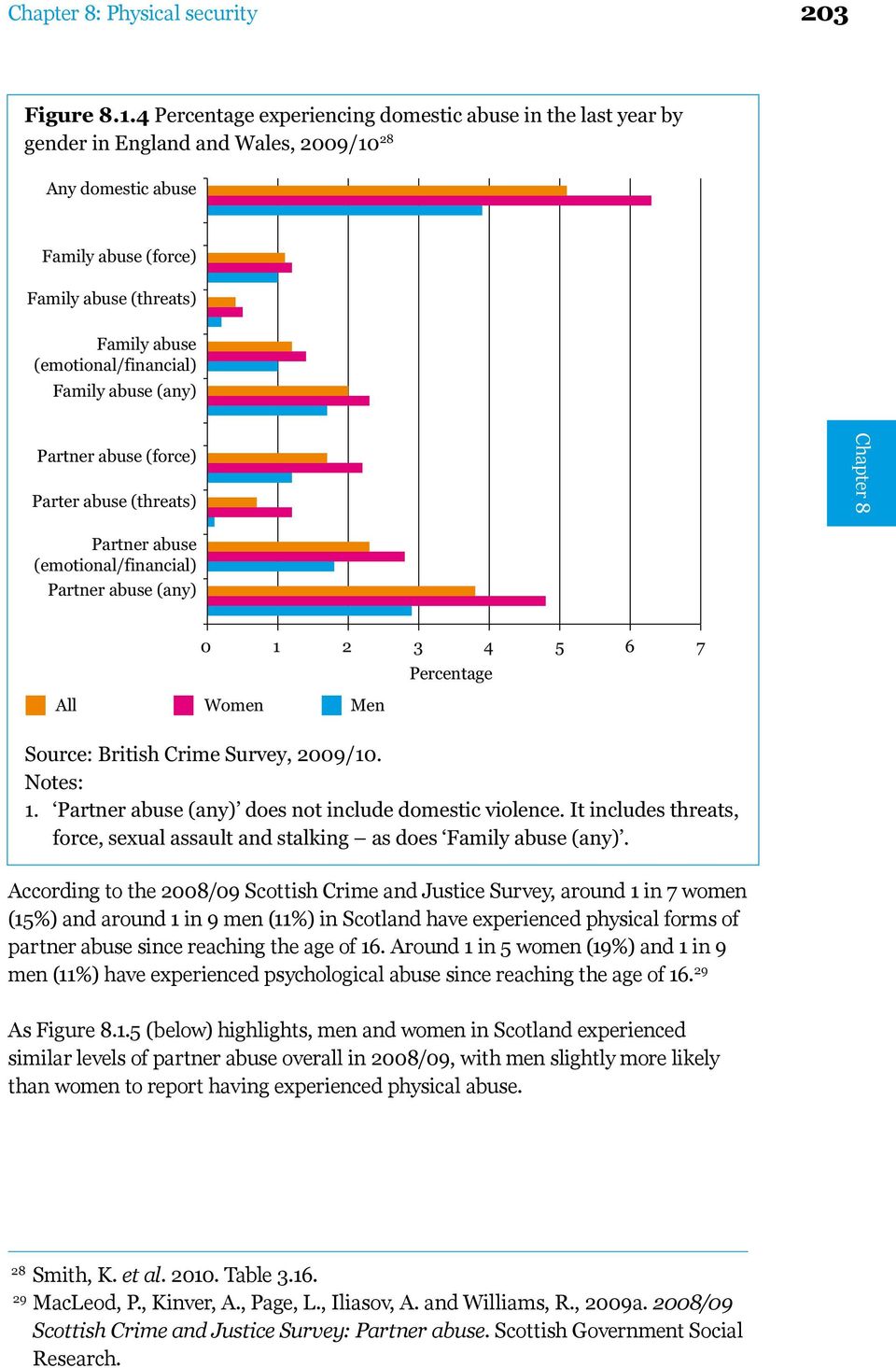
14 202 : Physical security Similar patterns are apparent in Scotland: men were twice as likely to experience violence as women in 2008/09 (the Scottish Crime and Justice Survey recorded levels of 6% and 3%, respectively). Rape In England and Wales, women are significantly more likely than men to have been raped (levels for women and men (respectively) recorded in the British Crime Survey in 2009/10 were 0.4% and 0.1% attempts in the previous 12 months, and 4% and 0.5% attempts since reaching the age of 16). 24 Similarly, in Scotland, significantly more women than men have been forced to have sexual intercourse since reaching the age of 16 (3% and 0%, respectively). 25 Domestic violence and abuse and partner abuse Women were the victims of just under three-quarters (73%) of the domestic violence recorded in the 2009/10 British Crime Survey. 26 Over 1 in 4 women (27%) and around one in six men (15%) have experienced some form of domestic abuse since reaching the age of 16 in England and Wales. 27 Figure (below) highlights that significantly more women than men report experiencing partner abuse in the last year in England and Wales; the gender differences in relation to family abuse are less marked. 24 Smith, K. et al Table MacLeod, P. et al. 2009b. Table Flatley, J. et al Table Note, however, that these data are from the full survey and not the self-completion module, and therefore are less reliable. 27 Smith, K. et al Table 3.01.

15 : Physical security 203 Figure Percentage experiencing domestic abuse in the last year by gender in England and Wales, 2009/10 28 Any domestic abuse Family abuse (force) Family abuse (threats) Family abuse (emotional/financial) Family abuse (any) Partner abuse (force) Parter abuse (threats) Partner abuse (emotional/financial) Partner abuse (any) Percentage All Women Men Source: British Crime Survey, 2009/10. Notes: 1. Partner abuse (any) does not include domestic violence. It includes threats, force, sexual assault and stalking as does Family abuse (any). According to the 2008/09 Scottish Crime and Justice Survey, around 1 in 7 women (15%) and around 1 in 9 men (11%) in Scotland have experienced physical forms of partner abuse since reaching the age of 16. Around 1 in 5 women (19%) and 1 in 9 men (11%) have experienced psychological abuse since reaching the age of As Figure (below) highlights, men and women in Scotland experienced similar levels of partner abuse overall in 2008/09, with men slightly more likely than women to report having experienced physical abuse. 28 Smith, K. et al Table MacLeod, P., Kinver, A., Page, L., Iliasov, A. and Williams, R., 2009a. 2008/09 Scottish Crime and Justice Survey: Partner abuse. Scottish Government Social Research.
16 204 : Physical security However, in relation to experiences of abuse since reaching the age of 16, men are most likely to say that they have had an object thrown at them (57%, compared to 46% of women): women are more likely to say that they have experienced all other forms of physical abuse including choking or strangulation (21%, compared to 3% of men), forced sexual intercourse (20%, compared to 3%), and being pushed or held down (47%, compared to 11% of men). 30 This difference may be reflected in the figures relating to experiences in the last year. Figure Percentage experiencing partner abuse in the last year by gender in Scotland, 2008/ Percentage Any psychological abuse Any physical abuse Any psychological or physical abuse Both psychological and physical Men Women All Source: Crime and Justice Survey, 2008/09. Notes: 1. Partner abuse as measured by the Scottish Crime and Justice Survey in is any psychological or physical abuse undertaken against a man or a woman carried out by a male or female partner or ex-partner (including any boyfriend, girlfriend, husband, wife or civil partner). 2. Psychological partner abuse includes emotional, financial and other forms of psychological abuse. 3. Physical partner abuse includes physical and sexual violence, but also the use of force or having objects thrown at them. 4. Experienced any psychological or physical abuse means that a respondent has experienced at least one of the forms of psychological or at least one of the forms of physical partner abuse listed in the questions. 5. Experienced both psychological and physical abuse means that a respondent has experienced at least one of the forms of psychological and at least one of the forms of physical partner abuse listed in the questions. 30 MacLeod, P. et al. 2009a. Page MacLeod, P. et al. 2009a. Table A1.2.

17 : Physical security 205 The data in Figures and suggest that in all three nations, psychological forms of abuse are the most common. Moreover, the Scottish data suggest that physical abuse is often accompanied by psychological abuse Box Related issues: Honour killings, Female Genital Mutilation, forced marriage and trafficking Women are disproportionately subject to honour killings, forced marriage and trafficking, which often occur alongside other kinds of sexual and domestic violence and abuse: they are uniquely affected by Female Genital Mutilation (FGM). There is no national survey data, given the dangers of disclosure to those who are victims. 32 Levels of prosecution and conviction are also low for similar reasons (see Chapter 7: Legal security). In place of national survey data, a range of estimates based on numbers from academic research, the voluntary sector, government reports and specialised governmental units is summarised by Walby et al In 2008 an estimated cases of either actual or threatened forced marriage were reported in England alone, according to a data collection exercise within 10 Local Authorities commissioned by the former Department for Children Schools and Families. The majority originated from within Asian communities (97%), with forced marriage found to affect Pakistani families in particular (72%). The overwhelming majority of cases involved female victims (96%), but the report notes that this might reflect the lack of services available to male victims in the agencies involved. Of the reported cases, 41% involved children aged under 18 (14% were under 16 and 26% were aged 16-17), 40% involved adults aged and 20% involved adults aged 24 or over. 34 There is growing evidence of a rise in forced/sham marriages among LGB people Home Office Together we can end violence against women and children. London: Home Office. 33 Walby, S. et al See Table Kazimirski, A. et al Forced Marriage Prevalence and Service Respon se. Department for Children, Schools and Families Research Report 128. Note, figures do not add up to 100% due to rounding. 35 A leaflet has been produced by the Forced Marriage Unit to help gay and lesbian people facing forced marriage in the UK. Available at: resources/en/pdf/foced-marriage-lgbt.

18 206 : Physical security Box Continued Where a forced marriage has taken place, courts can make orders to protect the victim and help remove them from that situation. 36 Table below shows that the highest number of protection order applications is made for children. Table Forced marriage protection order applications made since implementation in England and Wales, November 2008 end of October Location Total applications 3 Adult victims Child victims Third party applicants Other applicants 1 Outside jurisdiction 2 England and Wales Source: Ministry of Justice, Notes: 1. This may include cases where courts have noted third party applications under other. 2. This category is intended to capture those applications made while the Person To Be Protected (PTBP) is out of the UK but some courts may have recorded cases that have come from out of their local area. 3. This figure does not include Outside jurisdiction. Refugee women are more affected by violence against women than any other women s population in the world. 38 Large numbers of refugees report suffering physical and sexual violence before, during and after their journey to the UK the risk is heightened among those who are unable to access the limited available support The Forced Marriage (Civil Protection) Act 2007 came into force on 25 November The Act enables family courts to make Forced Marriage Protection Orders to protect someone from being forced into marriage. An order can also be made to protect someone who has already been forced into marriage, to help remove them from the situation. 37 Ministry of Justice, 2009a. One year on: the initial impact of the Forced Marriage (Civil Protection) Act 2007 in its first year of operation. Available at: pdf Accessed 25/08/2010 Table The Stop Violence Against Women website gives evidence for the heightened levels of violence against refugee women, and is often cited by the UN, UNHCR, Human Rights Watch, and World Health Organisation. See stopvaw.org/sexual_assault_against_refugees.html. 39 See Refugee Council The Vulnerable Women s Project: Refugee and asylum seeking women affected by rape or sexual violence; a literature review. London: Refugee Council.

19 : Physical security 207 Age Violent crime New figures from the British Crime Survey experimental children s module show that though there are difficulties in interpreting what should be counted as a crime in the context of children, in general they are at higher risk of crime than adults; and they are at highest risk of violence, though much of it does not result in injury. The experimental statistics also show that children frequently do not interpret as criminal offences incidents of which they may be counted as victims. 40 Figure 8.1.6, below, highlights that those aged between 16 and 24 experienced around three times the average levels of violence in 2009/10 (levels are 9% and 3%, respectively). Young men in this age-group experienced four times the average levels of violence (levels in 2009/10 were 13%) although this difference has not been tested for statistical significance. 41 Proportionately fewer older people experience violent crime: women aged over 75 were much less likely to experience violence than the average person in 2009/10, although this has not been tested for statistical significance Millard, B. and Flatley, J Experimental statistics on victimisation of children aged 10 to 15: Findings from the British Crime Survey for the year ending December 2009 England and Wales. Home Office Statistical Bulletin 11/10. Page 11. The experimental children s module is the extension of the British Crime Survey to children aged 10 to 15 years resident in households in England and Wales. 41 Flatley, J. et al Table Flatley, J. et al Table 3.05.

20 208 : Physical security Figure Proportion of adults who were victims of violence in the last year by type of violence and age in England and Wales, 2009/ Percentage over 75 All adults Age All Violence Acquaintance Domestic Stranger Source: British Crime Survey, 2009/10. Mugging (robbery & snatch theft) Similar patterns are found in Scotland, where young men (aged 16-24) are over four times more likely than average to have experienced violence levels in 2008/09 were 18% and 4%, respectively; women aged over 60 are around 14 times less likely in 2008/09, 0.3% were affected. 44 Rape In England and Wales, the amount of police-recorded rape affecting girls aged under 13 years rose by over 70% in just 5 years to 2008/09 (see Figure 8.1.7, below). Such trends need to be interpreted with caution however, because crimes reported to the police are more susceptible to changes in reporting rates than other data presented in this chapter. 43 Flatley, J. et al Table MacLeod, P. et al. 2009c. Table A1.6.

21 : Physical security 209 The percentage increase in levels of rape reported to the police between 2008/09 and 2009/10 was 15% for girls and 22% for boys (with a 38% increase in reported rapes of males under 13). Over a quarter of all rapes reported to the police in 2009/10 were committed against children aged under-16: over half of all male rapes reported to the police that year were of children aged under Figure Recorded crime rape of children by gender in England and Wales, 2004/ / ,000 14,000 Number of rapes 12,000 10,000 8,000 6,000 4,000 2, / / / / / /10 Female under 16 Female under 13 Year All rape (female) Male under 16 Male under 13 All rape (male) Source: British Crime Survey, 2009/10. Notes: 1. The Sexual Offences Act 2003 introduced in May 2004 altered the definition and coverage of sexual offences. 2. The categories under 16 and under 13 are not overlapping in this Figure. They are added together in the text to provide a composite picture of the proportions of under 16s who have experienced rape. 45 Flatley, J. et al Table Police statistics.
22 210 : Physical security It is estimated that as many as 95% of cases of child sexual abuse go unreported to the police in the UK. 47 In a study into child abuse in the UK, the National Society for the Prevention of Cruelty to Children (NSPCC) found that 11% of the 2,869 children being surveyed had been sexually abused by an acquaintance; another 4% by parents, carers or other relatives; 4% by strangers. 48 In Scotland, those aged between 16 and 24 are disproportionately affected by all forms of sexual violence occurring in the last year. 49 Domestic violence and partner abuse People aged under 44 are more at risk of domestic violence and partner abuse than people over 45 as Figures and (respectively) highlight. The difference has not been tested for statistical significance, however. Figure Proportion of adults who were victims of domestic violence in the last year by age in England and Wales, 2009/ Percentage over 75 All adults Source: British Crime Survey, 2009/10. Age 47 National Crime Intelligence Service UK threat assessment: the threat from serious and organised crime 2004/5 2005/6. NCIS. 48 Cawson, P. Wattam, C., Brooker, S. and Kelly, G Child Maltreatment in the United Kingdom: A Study of the Prevalence of Child Abuse and Neglect. London: NSPCC. Available at: downloads/childmaltreatmentintheukexecsummary_wdf48006.pdf Accessed 25/08/ MacLeod, P. et al. 2009b. Table A Flatley, J. et al Table Note, however, that these data are from the full survey and not the self-completion module, and therefore are less reliable.
23 : Physical security 211 Figure Experience of partner abuse in last 12 months by age and gender in Scotland, 2008/ Percentage Total Psychological abuse (Male) Psychological abuse (Female) Physical abuse (Male) Physical abuse (Female) Age Source: Crime and Justice Survey, 2008/09. Notes: 1. Partner abuse as measured by the Scottish Crime and Justice Survey in is any psychological or physical abuse undertaken against a man or a woman carried out by a male or female partner or ex-partner (including any boyfriend, girlfriend, husband, wife or civil partner). 2. Psychological partner abuse includes emotional, financial and other forms of psychological abuse. 3. Physical partner abuse includes physical and sexual violence. 4. The data displayed are not comparable with those used in Figure 8.1.8, above, which are based on face-to-face interviews rather than self-completion surveys and focus on domestic violence. They are, however, more closely comparable with the data in Table MacLeod, P. et al. 2009a. Table A1.2.
24 212 : Physical security Box Related issue: Particular age vulnerabilities for domestic violence Children In a study into child abuse in the UK in 2000, the NSPCC found that 7% of the 2,869 children surveyed had been severely physically abused either by their parents or carers during childhood; the same study suggests that 6% of children experienced a serious absence of care (neglect) during their childhood; 6% experienced emotional or mental maltreatment. 52 Older people Evidence submitted to the Joint Committee on Human Rights by the former Age Concern suggests that around half of those who experience domestic abuse in older age are victimised by a relative/partner; around a third are victimised by paid carers. Around a fifth of complaints received by Age Concern relate to care homes. 53 Meanwhile, 4% of people aged over 65 and living in private residences (nearly 350,000 people if extrapolating to the UK population) report that they experience abuse from family, care workers or acquaintances. 54 The issues facing elderly and disabled people are often invisible to those who are providing health services, meaning that signs of domestic violence are often overlooked Cawson, P. et al Joint Committee on Human Rights The Human Rights of Older People in Healthcare. Eighteenth Report of Session Volume 1: Report and Formal Minutes. Available at: jtselect/jtrights/156/156i.pdf Accessed 25/08/ Walby, S. et al Table O Keeffe, M. et al Age UK, Older Women and Domestic Violence. Available at: F79AC9A96D/0/older_women_and_domestic_violence.pdf Accessed 25/08/2010.
25 : Physical security 213 Socio-economic groups Violent crime Figure , below, shows that there is a probable link between social class and experience of violence, with those from lower occupational groups more likely to say that they have experienced violence in the past year. Although these figures have not been tested for statistical significance, in 2009/10 people with highest qualifications of O levels or GCSEs experienced more violence than those with degree-equivalent qualifications (4% and 3%, respectively). 56 In the same year, over twice as many unemployed people experienced violence as employed people (8% and 3%, respectively). 57 Figure Proportion of adults who were victims of violence by type of violence and occupational status in England and Wales, 2009/10 58 All Occupational status Never worked and long-term unemployed Routine and manual Intermediate Managerial and professional Percentage Mugging (robbery and snatch theft) Stranger Acquaintance Domestic All violence Source: British Crime Survey, 2009/ Flatley, J. et al Table Flatley, J. et al Table Flatley, J. et al Table 3.05.
26 214 : Physical security Sexual violence In some preliminary analysis for the Equality Measurement Framework by Alkire et al. It was found that 3% of those who had never worked or who were long-term unemployed said that they had experienced sexual violence in 2007/08 a significantly higher percentage than for any other socio-economic group in England and Wales (1% of those in semi-routine and routine occupations reported having experienced sexual violence; and 1% of those in lower supervisory and technical occupations did so). However, this does not necessarily point to a social gradient: the same analysis shows that nearly 2% of those in intermediate positions, and 1% of those in managerial and professional occupations experienced sexual violence in 2007/ In Scotland, those living in the most deprived areas are more likely to experience serious sexual assault than those living in the rest of the country: this difference is reversed in the reported levels of less serious sexual assault since reaching the age of 16 (see Figure , below) Alkire, S. et al Chapter 16, page 16. In the development of the Equality Measurement Framework indicators, the technical phase was to check sample size rather than generate final data analysis tables, so these are preliminary results for group means and the significance of the variations in group means, as well as a report on sample size. Significance tests are reported at the 95 per cent level. A series of cross-checks are required at the next stage of the development of the Equality Measurement Framework before final data tables can be produced. 60 MacLeod, P. et al. 2009b. Table A1.1.
27 : Physical security 215 Figure Percentage experiencing different kinds of sexual victimisation since reaching the age of 16 and in the past year by area deprivation in Scotland, 2008/ Percentage Living in 15% most deprived areas Living in the rest of Scotland All Area deprivation Stalking/harrassment in the last year Less serious sexual assault since age 16 Less serious sexual assault in the last year Serious sexual assault since age 16 Serious sexual assault in last year Source: Scottish Crime and Justice Survey, 2008/09. Notes: 1. There is no information about levels of stalking/harassment since reaching the age of MacLeod, P. et al. 2009b. Table A1.1.
28 216 : Physical security Domestic violence and partner abuse Although it is not known whether differences measured in the British Crime Survey are statistically significant, the data from 2009/10 suggest that domestic violence was more commonly reported in households earning under 10,000 (0.7%),while those earning above 40,000 experienced below-average levels (0.1%): the average across all income groups was 0.3%. 62 There are also differences by occupation (see Figure , below). Figure Percentage of adults experiencing domestic violence by occupational status in England and Wales, 2009/ Percentage Never worked and long-term unemployed Routine and manual occupations Intermediate occupations Managerial and professional occupations All Occupational status Source: British Crime Survey, 2009/10. Note: these data are from the full survey and not the self-completion module, and therefore are less reliable. 62 Flatley, J. et al Table Note, however, that these data are from the full survey and not the self-completion module, and therefore are less reliable. 63 Flatley, J. et al Table 3.05.
29 : Physical security 217 In Scotland, partner abuse is twice as commonly reported among the most deprived areas as it is in the rest of the country (see Figure , below). Figure Percentage experiencing partner abuse in last 12 months by area deprivation in Scotland, 2008/ Percentage Living in the 15% most deprived areas Living in the rest of Scotland All Any psychological abuse Any physical abuse Any psychological/ physical abuse Both physical and psychological Area deprivation Source: Scottish Crime and Justice Survey, 2008/09. Notes: 1. Partner abuse as measured by the Scottish Crime and Justice Survey in 2008/09 is any psychological or physical abuse undertaken against a man or a woman carried out by a male or female partner or ex-partner (including any boyfriend, girlfriend, husband, wife or civil partner). 2. Psychological partner abuse includes emotional, financial and other forms of psychological abuse. 3. Physical partner abuse includes physical and sexual violence. 4. Experienced any psychological or physical abuse means that a respondent has experienced at least one of the forms of psychological or at least one of the forms of physical partner abuse listed in the questions. 5. Experienced both psychological and physical abuse means that a respondent has experienced at least one of the forms of psychological and at least one of the forms of physical partner abuse listed in the questions. 64 MacLeod, P. et al. 2009a. Table A1.2.
30 218 : Physical security Disability Violent crime Although we don t know if the difference is statistically significant, data from the British Crime Survey suggest that disabled people or those with LLTIs experience slightly below average levels of all violent crime except mugging (see Figure , below). Figure Proportion of adults who were victims of violence by LLTI or disability in England and Wales, 2009/ Percentage All Violence Domestic Acquaintance Stranger LLTI/disability No LTTI/ disability All Mugging (robbery and snatch theft) Disability status Source: British Crime Survey 2009/10. Different estimates exist: a study of people with mental health conditions suggests that as many as 1 in 10 of this group has been assaulted in the past 2 years Flatley, J. et al Table Note, however, that data on domestic violence are from the full survey and not the self-completion module, and therefore are less reliable. 66 Mind, Another Assault. London: Mind.
31 : Physical security 219 Sexual violence Preliminary analysis of 2007/08 British Crime Survey data for the EMF suggests that sexual violence is more commonplace among people with LLTIs and disabilities than it is among those without. 67 Domestic violence and partner abuse Although we do not know if the differences are statistically significant, British Crime Survey data suggest that people with LLTIs or disabilities are more likely to have experienced domestic violence than those without, and there is evidence that they face particular barriers to leaving abusive relationships (see box 8.1.3, below): in 2009/10, the percentage experiencing domestic violence in England and Wales was 0.5% and 0.2% respectively, against an average of 0.3% recorded in the British Crime Survey (see Figure , above). 68 Box Related issue: Disabled people s experience of domestic violence People with disabilities who are reliant on the person who is abusing them (often their partner or carer) are often trapped especially if their home has been adjusted to accommodate their physical, communication or psychological/ mental health needs. This can leave them at risk of further sexual violence and emotional or financial abuse. 69 This is a particular issue when information about available help is not readily available in accessible formats. In addition, many refuges are ill-equipped to meet the needs of disabled women. Those who leave their registered address risk losing their access to welfare entitlements, personal assistants and so on (i.e., their care package): only a small proportion of refuges are able to compensate. Where a victim of abuse is disabled and has children, this can create overlapping difficulties Alkire, S. et al Chapter 6, page 16. In the development of the Equality Measurement Framework indicators, the technical phase was to check sample size rather than generate final data analysis tables, so these are preliminary results for group means and the significance of the variations in group means, as well as a report on sample size. Significance tests are reported at the 95 per cent level. A series of cross-checks are required at the next stage of the development of the Equality Measurement Framework before final data tables can be produced. 68 Flatley, J. et al Table Women s Aid Making the Links: Disabled women and domestic violence. Available at: download.asp?id=1481 Accessed 25/08/ Women s Aid 2008.
32 220 : Physical security Ethnicity and religion or belief Violent crime There are no significant differences between ethnic groups in relation to violence partly because of the small numbers involved. However, prevalence seems to be higher than average among Mixed Race people (4%) partly because they are disproportionately young. 71 Violence seems to be less common among other ethnic minority groups (2%) than it is among White people (3%). 72 Domestic violence Data from the British Crime Survey suggest that there are no significant differences between ethnic and religious minority groups in relation to domestic violence. However, they face particular vulnerabilities (particular examples are given in box 8.1.4, below). Box Related issues: Support needs of ethnic and religious minority groups suffering domestic abuse Women from ethnic and religious minority communities (including refugees and migrants, see below) often face difficulties accessing domestic violence support services because of language difficulties and discrimination: concerns about family and community honour can also deter victims from reporting abuse. 73 As a result, there is low recognition of the needs of ethnic and religious minority people experiencing domestic violence when developing services. 74 Gypsies and Travellers A recent Friends, Families and Travellers conference on domestic violence indicated that emotional and physical abuse was commonplace. 75 By divorcing an abusive partner, Gypsy and Traveller women risk being asked to leave their camp. This is all the more challenging because of the prejudice and discrimination they may face from local communities once they have left, leaving many trapped in abusive relationships Census, April 2001, Office for National Statistics. 72 Flatley, J. et al Table Women s Aid/YouGov Domestic violence FAQs Survey. The Body Shop: London. Available at: Accessed 25/08/ Gill, A. and Banga, B Black, minority ethnic and refugee women, domestic violence and access to housing. London: Race Equality Foundation. 75 Friends, Families and Travellers Event st National Conference on Supporting Gypsies & Travellers Living with Domestic Violence. 76 Cemlyn, S., Greenfields, M., Burnett, S., Matthews, Z., and Whitwell, C., Inequalities experienced by Gypsy and Traveller communities: A review. Research Report 12, Manchester: Equality and Human Rights Commission.
33 : Physical security 221 Box Continued Asylum seekers and migrants Victims who do not have Indefinite Leave to Remain, or whose immigration status is linked to an abusive partner can find it difficult to seek support: they have no access to public funds and services (including housing), although those with children may be entitled to discretionary funds if they feel able to contact local authorities for help. 77 Many do not report abuse because they fear that disclosure of their immigration status will lead to deportation. 78 Those who leave the family home are often dependent on voluntary organisations for financial and other support, 79 without which they face destitution and further danger. 80 For many, leaving the family home will lead to more vulnerability if they have children particularly for those who do not feel able to approach local authorities and other statutory bodies. 81 Many children in this situation have become vulnerable to sexual exploitation The local authority in such situations would be able to use powers within the Children Act 1989 to provide support to the children. Such assistance may be extended to the parent. 78 The Children s Society, Living on the edge of despair: destitution amongst asylum seeking and refugee children. 79 The Home Office is currently working with the voluntary sector and is funding a scheme where support is provided to certain migrant victims of domestic violence in the UK. 80 The Children s Society, Kofman, E., Lukes, S., D Angelo, A. and Montagna, N The equality implications of being a migrant in Britain. Research Report 19. Manchester: Equality and Human Rights Commission. 82 The Children s Society 2008.
34 222 : Physical security Sexual orientation 83 and transgender Sexual violence As Figure (below) highlights, gay men are much more likely than straight men to have experienced sexual assault (the rates from pooled data suggest that 0.3% of heterosexual/straight men have experienced sexual assault in the last year, compared to 4% of gay or bisexual men). 84 Lesbians or bisexual women are also more likely than heterosexual/straight women to have experienced sexual assault in the last year (pooled data suggest that the levels are 9% and 3% respectively) Smith, K. et al Since April 2007 the self-completion section of the British Crime Survey questionnaire has included a question asking respondents about their sexual orientation. This makes it possible to produce figures for experience of intimate violence by sexual orientation. There have been previous surveys of domestic abuse in same-sex relationships (e.g. Donovan and Hester, 2007) but the samples have tended to be restricted to the lesbian, gay, bisexual or transgender community rather than being part of a wider general population survey. Around 500 out of the 25,000 self-completion respondents in each year identified themselves as gay, lesbian or bisexual. Due to this relatively small number, data from the 2007/08 and 2008/09 British Crime Survey have been combined for the purposes of analysis. These data show that 94% of adults aged 16 to 59 identified themselves as heterosexual/straight, 2% as lesbian/gay or bisexual and a further 4% selected either the do not know or do not want to answer response options (data not shown). The small numbers of respondents identifying themselves as gay/lesbian or bisexual, combined with the significant proportions of respondents unable or refusing to answer the question on sexual orientation means that figures on incidence of domestic abuse by sexual orientation should be treated with caution. Page Smith, K. et al Table Smith, K. et al Table 3.07.
35 : Physical security 223 Figure Percentage experiencing sexual violence in the last year by sexual orientation in England and Wales, 2007/ / Percentage Men Women All Heterosexual/ Straight Gay/Lesbian/ Bisexual Don t know/don t want to answer Gender Source: British Crime Survey 2009/10. Notes: 1. The number of respondents identifying as LGB was low (men = 515; women = 473). A slightly larger number responded to the question on sexual orientation saying that they don't know/don't want to answer (men = 705; women = 886). Domestic violence Figure , below, highlights that gay or bisexual men are more likely than heterosexual/straight men to have experienced partner abuse. Similarly, lesbian and bisexual women are more likely than heterosexual/straight women to have done so. The gap between LGB and heterosexual women is larger than the gap between LGB and heterosexual men. 86 Smith, K. et al Table 3.07.
36 224 : Physical security Figure Percentage experiencing domestic violence by sexual orientation in England and Wales, 2007/ /09 87 Gender and sexual orientation Women (don t know/ don t want to answer) Women (lesbian/bisexual) Women (heterosexual/straight) Men (don t know/ don t want to answer) Men (gay/bisexual) Men (heterosexual) Percentage Family abuse (non sexual) Partner abuse (non sexual) Any domestic abuse (past year) Source: British Crime Survey 2009/10. Notes: 1. The number of respondents identifying as LGB was low (men = 515 out of 20,892; women = 473 out of 24,795). A slightly larger number responded to the question on sexual orientation saying that they don't know/don't want to answer (men = 705; women = 886). Box Related issues: LGB and transgender people A study by Donovan et al 2007 looking at domestic abuse and same-sex relationships found that nearly 4 in 10 of their sample of 692 had experienced domestic abuse in a same-sex relationship (35% men, 40% women). The study also found that being under 35, having a low income, having few qualifications and being in a first relationship were risk factors Smith, K. et al Table Donovan, C Comparing Love and Domestic Violence in Heterosexual Relationships. Swindon: Economic and Social Research Council.
37 : Physical security 225 Box Continued According to a Count Me In Too survey on domestic violence, 64% of the 39 transgender respondents experienced domestic violence/abuse, with family members involved in 30% of cases. 89 In 2007, a Scottish Transgender Alliance survey found that nearly half of 71 transgender respondents had previously experienced transphobic abuse in their relationships Browne, K. and Lim, J Trans Report: Count Me In Too additional analysis report. Brighton: Spectrum. Pages ix, Scottish Transgender Alliance Transgender Experiences in Scotland: Research Summary. Equality Network.
38 226 : Physical security 8.2 What we know about targeted violence Measure: Hate crime Percentage of people reporting to the British Crime Survey and the Scottish Crime and Justice Survey that they have been victims of violence either thought to be or which might have been motivated by their ethnicity, religion, age, disability status, sexual orientation or transgender status. How this measure works: Data on racially motivated incidents are available from the British Crime Survey, covering England and Wales. 91 The British Crime Survey measures offences that were thought by the victim to have been motivated by the offender s attitude to one of a range of characteristics. Trend analysis is difficult because hate crime is a relatively new concept, and its recording might be expected to fluctuate until it has become embedded in institutional practice. Moreover, analysis based on a single year is limited, with the only types of offence with more than 100 respondents reporting that they had been victims relating to age and race and religion. Smaller numbers are estimated by British Crime Survey data to be affected by hate crimes relating to disability and sexual orientation. We are unable to distinguish between the different experiences of people based on type of disability from the British Crime Survey data, although there is evidence that people s experience varies by type of disability. 92 Moreover, the British Crime Survey reports on adults over 16, meaning that the experiences of younger people are not recorded. 91 Walby, S. et al Tables 4.19 and SCOPE Hate Crime Report Getting Away With Murder: Disabled People s Experience of Hate Crime in the UK. Available at: org.uk/sites/default/files/pdfs/campaigns_policy/scope_hate_crime_report. pdf Accessed 25/08/2010.
39 : Physical security 227 Scottish Crime and Justice Survey data focus on racist incidents, and disaggregates the data by the age and gender of victims only. It does not allow us to identify trends over time. Although we have drawn on supplementary literature to illustrate the experience of smaller groups there is still very limited related literature for this measure for groups defined by socio-economic background, therefore they are not covered in this section. Overview Racially and religiously aggravated attacks remain a persistent phenomenon. Targeted violence against people on grounds of their ethnicity and religion is now a well recognised form of crime: the figures on trends are mixed, with incidents reported to the police falling (see Chapter 7: Legal security) while levels reported in surveys have fluctuated. Attacks directed against disabled, gay, lesbian and transgender people have not been recognised as hate crimes until recently. Yet the evidence suggests these forms of attack affect very large proportions of the populations concerned. Substantial numbers report physical attack, including very serious forms of violence such as sexual assault. However, harassment is even more widespread, and is the most frequently identified form of targeted abuse in police figures. Victims still often do not report hate crime, sometimes feeling it is part of the accepted order. Research suggests in particular that disabled people fear that they will not be listened to if they report abuse, and can also blame themselves or feel that hostility is just part of day-to-day life. Others (e.g. Gypsies and Travellers) fear that they will face further harassment or discrimination if they report targeted crime. What we know about the overall situation Given that legislation on hate crime (as applied to people on the basis of disability, transgender status and sexuality) is relatively new, no information exists about trends over time. Table shows the current levels of survey-recorded hate crime in England and Wales.
40 228 : Physical security Table Current levels of hate crime in England and Wales, 2008/09 93 Type of incident Percentage of population Racial 0.4% Religious 0.1% Age 0.4% Disability 0.1% Sexual orientation 0.1% Source: British Crime Survey data, 2008/09. Note: incidents relating to age are not officially recognised as hate crimes. What we know about the situation for different groups Gender According to the British Crime Survey, there is a difference between the percentages of men and women who experience race- and age-motivated crime in both cases the proportions affected are 0.5% and 0.3% respectively. 94 This gender pattern is reflected in the crimes referred to the Crown Prosecution Service in 2008/09, which highlights that men are the victims in two-thirds of the hate crimes that are referred. 95 Age and disability/llti As with other kinds of violent crime (described above), younger people are disproportionately at risk of racially motivated offences: 0.6% of those aged under 44 were victims of racially motivated incidents in the last year, compared to 0.2% of those over Younger people (aged between 16 and 24) are also more likely to be victimised on the basis of age as are those aged over 75: in 2008/09, similar proportions (1%) of both experienced age-motivated offences (Figure 8.2.1, below). 93 Equality and Human Rights Commission analysis of unpublished 2008/09 British Crime Survey data. 94 Equality and Human Rights Commission analysis of unpublished 2008/09 British Crime Survey data. 95 Crown Prosecution Service 2009, Hate Crime Report 2008/09, CPS Management Information Branch. 96 Equality and Human Rights Commission analysis of unpublished 2008/09 British Crime Survey data.
41 : Physical security 229 Figure Perceived age-related crime by age in England and Wales, 2008/ Percentage Age Source: British Crime Survey, 2008/ all Data from the 2008/09 British Crime Survey suggest that people with an LLTI/ disability are four times more likely than those without to experience disability related incidents: 0.4% of those with disabilities had experienced an incident in the past year, compared to 0.1% of those without. 98 Box Related issues: Small groups Children with learning disabilities One study by Mencap found that 82% of their sample of 507 children with learning disabilities had been bullied. 99 LGB children A survey of 1145 LGB secondary school pupils commissioned by Stonewall found that 65% had experienced homophobic bullying at school (see Chapter 10: Education). 100 LGB older people There is evidence of heightened risk of homophobic violence affecting older gay men Equality and Human Rights Commission analysis of unpublished 2008/09 British Crime Survey data. 98 Equality and Human Rights Commission analysis of unpublished 2008/09 British Crime Survey data. 99 Mencap Bullying Wrecks Lives: The experiences of children and young people with a learning disability. London: Mencap. 100 Dick, S Homophobic Hate Crime: The Gay British Crime Survey. Equality and Human Rights Commission Research Summary 38. London: Stonewall. 101 Cited in Fish, J., Briefing 4: Older Lesbian, Gay and Bisexual (LGB) people. Briefings for health and social care staff. London: Department of Health.
42 230 : Physical security Ethnicity and religion or belief Estimated numbers of incidents perceived to be racially or religiously motivated recorded in the British Crime Survey have fluctuated over time, although changes are not necessarily statistically significant (see Figure 8.2.2, below). Figure Racially and religiously motivated hate crime over time in England and Wales, 2004/ / ,000 Number of incidents 180, , , , ,000 80,000 60,000 40,000 20, / / / / /09 Year Sources: British Crime Survey, 2008/09. Notes: the figure for 2007/08 has been revised down from the previously published figure (207,000). The estimate for 2008/09 is provided by the Home Office, based on the 0.4% prevalence reported in the British Crime Survey for that year. The estimate for 2009/10 is 122,205 incidents. The 2008/09 British Crime Survey recorded that 0.2% of White people in England and Wales had experienced racially motivated crime, compared to 2% of people from all other ethnic groups. The average across the population overall is 0.4%. 103 Similarly, 2% of non-christians had experienced religiously motivated hate crime (including almost 3% of Muslims), compared to 0.2% of Christians. This includes offences that target places of worship and burial as well as those targeting individuals Walby, S. et al Table 4.19 British Crime Survey estimates from 2007/08 provided by the Home Office. 103 Equality and Human Rights Commission analysis of unpublished 2008/09 British Crime Survey data. 104 Equality and Human Rights Commission analysis of unpublished 2008/09 British Crime Survey data. Note, only 30 people said that they had experienced a religiously motivated incident in the last year.
43 : Physical security 231 The number of crimes recorded by the police as part of racist incidents in Scotland has risen since 2004/05 (from 5,053 to 6,002 in 2008/09) see Chapter 7: Legal security. 105 Box Related issue: Other marginalised groups suffering from racism and hate crime Gypsies and Travellers A survey of Gypsies and Travellers in Devon found that half of respondents had experienced racism. 106 Out of 121 Gypsies and Travellers surveyed in the West of England, 58 had experienced harassment and intimidation. 107 Such studies consistently find that Gypsies and Travellers downplay their experiences, and that they don t expect assistance from the authorities; many see harassment and racism as inevitable. 108 Over half of Travellers interviewed for a study in Scotland said that they would report prejudice and harassment for serious cases of physical abuse not always to the police whereas less than a third had complained about harassment. 109 Refugees and asylum seekers Refugees and asylum seekers also rarely report hate crime. The Home Office s Cross Government Action Plan on hate crime notes a range of factors that explain this, such as fear that reporting crime to the police or other statutory agencies will affect their immigration status. 110 People whose first language is not English In Scotland, a significant proportion of victims of racist incidents do not speak English as a first language (in 2008/09, 17% of all victims where language was known did not speak English. This compares with 29% in 2007/08) Scottish Government, Racist Incidents Recorded by the Police in Scotland, 2004/05 to 2008/09. Table 7a. 106 Southern, R. and James, Z., Devon-wide Gypsy and Traveller Housing Needs Assessment, University of Plymouth, November Page Greenfields, M., Home, R., Cemlyn, S., Bloxsom, J., and Lishman, R., West of England; Gypsy Traveller Accommodation (and Other Needs) Assessment Buckingham: Buckinghamshire Chilterns University College. 108 Greenfields, M. et al Page Taggart, I HM Government Hate Crime: The Cross Government Action Plan. London: Home Office. Available from: homeoffice/hate-crime-action-plan.pdf. 111 Information supplied in private correspondence with the Scottish Government.
44 232 : Physical security Sexual orientation and transgender Offences motivated by sexual orientation mainly affect gay, lesbian and bisexual people. However, there is some evidence on the basis of data collected by the 2008/09 British Crime Survey that a very small percentage of heterosexual people are also targeted possibly because of their association with LGB people (Figure 8.2.3, below). Note however that these figures are based on very small numbers of reports. Figure Perceptions of homophobic victimisation in England and Wales, 2008/ Percentage Gay/Bisexual/Lesbian Straight/heterosexual Sexual orientation Source: British Crime Survey, 2008/09. Note: Base = Equality and Human Rights Commission analysis of unpublished 2008/09 British Crime Survey data.
45 : Physical security 233 Box Related issues: Experience of hate crime Gay people s experience of hate crime Stonewall s Gay British Crime Survey estimates that 1 in 5 gay men, lesbians and bisexual people had experienced a homophobic crime or incident in the last 3 years (between 2005 and 2008) in 8 incidents recorded by men in the Gay British Crime Survey and 1 in 20 of those experienced by lesbians involved unwanted sexual contact, which was more frequently reported by those aged between 18 and 24 than it was by those aged over Transgender people s experience of hate crime In a small study of the experience of 71 transgender people, over half said that they had experienced harassment, and a smaller proportion (12 people) said that they had been physically assaulted: a large amount of crime against this group appears to go unreported Dick, S Morton, J Transgender Experiences in Scotland: Research Summary, Scottish Transgender Alliance.
46 234 : Physical security 8.3 What we know about fear of crime Measures: Worry about violent crime - Percentage reporting to the British Crime Survey that they are worried about violent crime; or to the Scottish Crime and Justice Survey that they are worried about being physically or sexually assaulted. Feeling unsafe - Percentage reporting to the British Crime Survey that they feel unsafe alone at home after dark or walking alone in local area during the day or after dark; or percentage reporting to the Scottish Crime and Justice Survey that they feel unsafe walking alone after dark. How these measures work: The British Crime Survey and Scottish Crime and Justice Survey measure different types of fear of crime so they are not directly comparable. The ability to disaggregate English and Welsh data by equality characteristics is dependent on sample size, which is often too small to yield a meaningful analysis: in this section, we have described differences in relation to age, gender, socio-economic status, disability, ethnicity and religion or belief. We have drawn on supplementary sources of information to describe the experience of LGB people, but limited information is available about the perceptions of transgender people in relation to this measure. Therefore they are not covered in this section. The Scottish data about feelings of being unsafe walking alone after dark can be disaggregated by age and gender, but not by any other group. Overview People s fears of crime are affected by the type of crime they may be subject to, rather than their overall risk. Young men have the greatest chance of being attacked, yet women and older people have the highest level of fear. Some groups e.g. those living in deprived areas are more fearful because they are more at risk overall. The fear of being attacked because of one s identity can generate a different kind of fear from that of being a more random victim of violent crime, such as robbery.
47 : Physical security 235 What we know about the overall situation and trends Worry about violent crime There has been a gradual fall in the proportion of the population in England and Wales with high levels of worry about violent crime (see Figure 8.3.1, below). Figure Worry about violent crime in England and Wales, / Percentage having a high level of worry about violent crime 30 Percentage / / / / / / / / / 10 Year Source: British Crime Survey, 2009/10. Note: Questions on worry about crime were only asked of a quarter of the British Crime Survey sample from 2008/ Flatley, J. et al Table 5.07.
48 236 : Physical security Similar trends are apparent in Scotland (see Figure 8.3.2, below): Figure Percentage of respondents either very or fairly worried about being physically and sexually assaulted, Scotland, / Percentage / / 09 Being physically assaulted or attacked in street/public places Being sexually assaulted Year Source: Scottish Crime and Justice Survey, 2008/09. Notes: 1. Results for worry about being sexually assaulted included responses from women only until 2008/09, From 2008/2009 figures for men are also available. But for better comparison we are only including female percentage in this graph. 2. The decline in worry about sexual assault is statistically significant. 116 MacLeod, P. et al. 2009c. Table A1.9.
49 : Physical security 237 What we know about the situation for different groups Age and gender Worry about violent crime Women display higher levels of worry than men about violent crime (Figure 8.3.3, below), even though their risk of general violence is much lower than that of men: this may reflect women s worry about sexual violence (as in Figure 8.3.2, above). Younger people are more likely than older people to worry about violent crime, with levels falling more sharply for women over 74 than for men. Figure Percentage with high levels of worry about violent crime by age and gender in England and Wales, 2008/ Percentage All Age Men Women Source: British Crime Survey, 2008/09. Notes: /09 data used here as it disaggregates by age and gender (combined). 117 Walker, A., Flatley, J., Kershaw, C. and Moon, D. (eds) Crime in England and Wales 2008/09: Volume 1 Findings from the British Crime Survey and police recorded crime. Table 5.08.
50 238 : Physical security Feeling unsafe Feelings of being unsafe alone at home after dark or walking alone in the local area during the day or after dark rise with age in England and Wales (see Figure 8.3.4, below). Generally, 31% of the population feels unsafe in these situations, but more than twice as many women (45%) as men (17%) say they feel unsafe in such contexts. 118 Figure Percentage feeling unsafe alone at home after dark or walking alone in local area during the day or after dark by age in England and Wales, 2008/ Percentage Age Source: British Crime Survey, 2008/09. In England and Wales, women over 60 live with the greatest worry about their safety when they are alone at home after dark or walking alone in the local area during the day or after dark, followed by young women (16-29), other women (30-59), older men (60+) and finally men aged under Equality and Human Rights Commission analysis of unpublished 2008/09 British Crime Survey data. 119 Equality and Human Rights Commission analysis of unpublished 2008/09 British Crime Survey data. 120 Equality and Human Rights Commission analysis of unpublished 2008/09 British Crime Survey data.
51 : Physical security 239 In Scotland, around twice as many women as men of all ages feel very or a bit unsafe when walking alone after dark (Figure 8.3.5, below): the overall age and gender patterns are similar to those found in England and Wales. 121 Figure Percentage feeling very or a bit unsafe when walking alone after dark by age and gender in Scotland, 2008/ Percentage Age Male Female Source: Scottish Crime and Justice Survey, 2008/ MacLeod, P. et al. 2009c. Page MacLeod, P. et al. 2009c. Figure 6.7.
52 240 : Physical security Socio-economic groups Worry about violent crime There is a strong income gradient with worry about violent crime declining with rising incomes (see Figure 8.3.6, below). Figure Percentage with high levels of worry about violent crime by household income in England and Wales, 2009/ All Household Income Over 50,000 40,000-50,000 30,000-40,000 20,000-30,000 10,000-20,000 Under 10, Percentage Source: British Crime Survey, 2009/ Flatley, J. et al Table 5.09.
53 : Physical security 241 People living in more deprived areas are also more likely to worry about violent crime, as are those in social housing. Social renters are about twice as likely (19%) to worry about violent crime as owner occupiers (11%). 124 A similar trend can be found in relation to worry about violence by occupational status (see Figure 8.3.7, below). Figure Percentage with high levels of worry about violent crime by occupational status in England and Wales, 2009/ Percentage Managerial and professional occupations Intermediate occupations Source: British Crime Survey, 2009/10. Routine and manual occupations Occupational status Never worked and long-term unemployed All Feeling unsafe Similarly, those in higher managerial and professional occupations are around half as likely as those who have never worked to feel unsafe alone at home after dark or walking alone in local area during the day or after dark (at 18% and 47%, respectively). 126 Disability Fear of violent crime Disabled/LLTI people are significantly more likely to worry about violent crime: 16% of those with an LLTI or disability have high levels of worry about violent crime compared to 12% of those without Flatley, J. et al Table Flatley, J. et al Table Equality and Human Rights Commission analysis of unpublished 2008/09 British Crime Survey data. 127 Flatley, J. et al Table 5.08.
54 242 : Physical security Box Related issue: The impact of fear of crime In the 2006/07 British Crime Survey, 44% of people with an LLTI/disability said that their fear of crime has a high or moderate impact on their quality of life compared to 36% of people with no LLTI or disability. 128 Feeling unsafe Those with an LLTI/disability are more likely to feel unsafe alone at home after dark or walking alone in their local area during the day or after dark (47%) compared with those with no LLTI/disability (28%). 129 Ethnicity and religion or belief Fear of violent crime People from ethnic minorities are more likely than White people to worry about violent crime (Figure 8.3.8, below). Figure Percentage with high levels of worry about violent crime by ethnicity in England and Wales, 2009/ Percentage White Mixed Asian or Asian British Black or Black British Chinese or other Non-white All Ethnicity Source: British Crime Survey, 2009/ Nicholas, S., et al., Table Equality and Human Rights Commission analysis of unpublished 2008/09 British Crime Survey data. 130 Flatley, J. et al Table 5.08.
55 : Physical security 243 Feeling unsafe Asian people (39%) are more likely than Black or White people to feel unsafe alone at home after dark or walking alone in their local area during the day or after dark (33% and 31%, respectively). 131 Those who report no religious affiliation report the lowest level of feeling unsafe alone at home after dark or walking alone in their local area during the day or after dark (24%), followed by Christians (33%), then those reporting non-christian affiliation (38%). Within the latter group, 39% of Muslims feel unsafe. 132 Sexual orientation Fear of violent crime LGB people worry about being the victim of crime to a greater degree than other minority groups. 133 Around 40% of LGB people responding to Stonewall s Gay British Crime Survey said they were worried about being the victim of a crime: even more (70%) think they are at greater risk of being insulted or harassed than someone who is heterosexual and almost half said they think they are at greater risk of being physically assaulted. 134 Feeling unsafe alone at home after dark or walking alone in local area during the day or after dark There is no significant difference between heterosexual/straight and LGB groups in terms of feelings of safety: the only difference is between those who answer the question (27%) and those who say don t know or don t wish to answer (39%) Equality and Human Rights Commission analysis of unpublished 2008/09 British Crime Survey data. 132 Equality and Human Rights Commission analysis of unpublished 2008/09 British Crime Survey data. 133 Dick, S Dick, S Equality and Human Rights Commission analysis of unpublished 2008/09 British Crime Survey data.
56 244 : Physical security Bibliography Age UK, Older Women and Domestic Violence. org.uk/nr/rdonlyres/a26e0211-c f79ac9a96d/0/older_ women_and_domestic_violence.pdf Accessed 25/08/2010. Alkire, S., et al., Developing the Equality Measurement Framework: selecting the indicators. Research Report: 31. Manchester: Equality and Human Rights Commission. Browne, K., and Lim, J., Trans Report: Count Me In Too additional analysis report. Brighton: Spectrum. Pages ix, 86. Cawson, P., Wattam, C., Brooker, S., and Kelly, G Child Maltreatment in the United Kingdom: A Study of the Prevalence of Child Abuse and Neglect. London: NSPCC. Cemlyn., S., et al., Inequalities experienced by Gypsy and Traveller communities: A review. Research Report 12. Manchester: Equality and Human Rights Commission. Census, April 2001, General Register Office for Scotland. Census, April 2001, Office for National Statistics. Count Me In Too, LGBT Lives in Brighton & Hove. Domestic Violence & Abuse. University of Brighton. Crown Prosecution Service, 2009., Hate Crime Report 2008/09, CPS Management Information Branch. Dick, S., Equality and Human Rights Commission research summary 38, Homophobic Hate Crime: The Gay British Crime Survey. London: Stonewall. Dick, S., Homophobic Hate Crime and Hate Incidents. Research Report: 38. Manchester: Equality and Human Rights Commission. Donovan, C., Comparing Love and Domestic Violence in Heterosexual Relationships. Swindon: ESRC. Eurofound template=3&radioindic=125&iddomain=10 Accessed 25/08/2010. Fish, J., Briefing 4: Older Lesbian, Gay and Bisexual (LGB) people. Briefings for health and social care staff. London: Department of Health.
57 : Physical security 245 Flatley, J., Kershaw, C., Smith, K., Chaplin, R., and Moon, D., Crime in England and Wales 2009/10: Findings from the British Crime Survey and police recorded crime. London: Home Office. Friends, Families and Travellers Event, st National Conference on Supporting Gypsies & Travellers Living with Domestic Violence. Gill, A., and Banga, B., Black, minority ethnic and refugee women, domestic violence and access to housing, Race Equality Foundation. Greenfields, M., Home, R., Cemlyn, S., et al., West of England; Gypsy Traveller Accommodation (and Other Needs) Assessment , Buckinghamshire Chilterns University College, October HM Government, Hate Crime: The Cross Government Action Plan. London: Home Office. Home Office, Together we can end violence against women and children. London: Home Office. Joint Committee on Human Rights, The Human Rights of Older People in Healthcare. Eighteenth Report of Session Volume 1: Report and Formal Minutes. London: The Stationery Office. Kazimirski, A., Keogh, P., Kumari, V., Smith, R., Gowland, S., Purson, S., with Khanum, N., Forced Marriage Prevalence and Service Response. DCSF Research Report No Kofman, E., Lukes, S., D Angelo, A., and Montagna, N., The equality implications of being a migrant in Britain. Research report: 19. Manchester: Equality and Human Rights Commission. MacLeod, P., Kinver, A., Page, L., Iliasov, A., and Williams, R., 2009b. Scottish Crime and Justice Survey :, Sexual Victimisation and Stalking. Edinburgh: Scottish Government Social Research. MacLeod, P., Page, L., Kinver, A., Iliasov, A., Littlewood, M., and Williams, R., 2009c. Scottish Crime and Justice Survey: First Findings. Scottish Government Social Research. Mencap, Bullying Wrecks Lives: The experiences of children and young people with a learning disability. London: Mencap.
58 246 : Physical security Millard, B., and Flatley, J., Experimental statistics on victimisation of children aged 10 to 15: Findings from the British Crime Survey for the year ending December 2009 England and Wales. Home Office Statistical Bulletin. London: Home Office. Mind, Another Assault. London: Mind. Ministry of Justice, 2009a. One year on: the initial impact of the Forced Marriage (Civil Protection) Act 2007 in its first year of operation. uk/publications/docs/one-year-on-forced-marriage-act.pdf Accessed 25/08/2010. Ministry of Justice, 2009b. Statistics on Race and the Criminal Justice System 2007/08. A Ministry of Justice publication under Section 95 of the Criminal Justice Act London: MOJ. Morton, J., Transgender Experiences in Scotland: Research Summary, Scottish Transgender Alliance. National Crime Intelligence Service, UK threat assessment: the threat from serious and organised crime 2004/5 2005/6. NCIS. Nicholas, S., Kershaw, C., and Walker, A., Crime in England and Wales 2006/7: Findings from the British Crime Survey and police recorded crime. London: Home Office. O Keeffe, M., Hills, A., Doyle, M., McCreadie, C., Scholes, S., Constantine, R., Tinker, A., Manthorpe, J., Biggs, S., and Erens, B., UK Study of Abuse and Neglect of Older People Prevalence Survey Report. Prepared for Comic Relief and the Department of Health. Refugee Council, The Vulnerable Women s Project: Refugee and asylum seeking women affected by rape or sexual violence; a literature review. London: Refugee Council. SCOPE, Hate Crime Report Getting Away With Murder: Disabled People s Experience of Hate Crime in the UK. Scottish Government. Racist Incidents Recorded by the Police in Scotland, 2004/05 to 2008/09. Publications/2010/04/ /11 Accessed 25/08/2010. Scottish Transgender Alliance., Transgender Experiences in Scotland: Research Summary. Equality Network.
59 : Physical security 247 Smith, K., Flatley, J., Coleman, K., Osborne, S., Kaiza, P., and Roe, S., Homicides, Firearm Offences and Intimate Violence 2008/09: Supplementary volume 2 to Crime in England and Wales 2008/09. London: Home Office. Southern, R., and James, Z., Devon-wide Gypsy and Traveller Housing Needs Assessment, University of Plymouth, November Stop Violence Against Women website Taggart, I., 2007., Moving On Again? A Survey of Gypsies/Travellers Views in the North East of Scotland. Aberdeen: University of Aberdeen. The Children s Society, Living on the edge of despair: destitution amongst asylum seeking and refugee children. Walby, S., Armstrong, J., and Strid, S., Physical and Legal Security and the Criminal Justice System: A Review of Inequalities. UNESCO Chair in Gender Research Group Lancaster University. This paper is available on the Equality and Human Rights Commission s Triennial Review web pages. Walker, A., Flatley, J., Kershaw, C., and Moon, D. (eds) , Crime in England and Wales 2008/09: Volume 1 Findings from the British Crime Survey and police recorded crime. London: Home Office. Women s Aid, Making the Links: Disabled women and domestic violence Accessed 25/08/2010.
60 248
REPORTING AN OFFENCE TO THE POLICE: A GUIDE TO CRIMINAL INVESTIGATIONS
 REPORTING AN OFFENCE TO THE POLICE: A GUIDE TO CRIMINAL INVESTIGATIONS If you are experiencing or have experienced domestic volence and/or sexual violence there are a number of ways the law can protect
PHYSICAL AND LEGAL SECURITY AND THE CRIMINAL JUSTICE SYSTEM: A REVIEW OF INEQUALITIES
 PHYSICAL AND LEGAL SECURITY AND THE CRIMINAL JUSTICE SYSTEM: A REVIEW OF INEQUALITIES Sylvia Walby, Jo Armstrong and Sofia Strid UNESCO Chair in Gender Research Group Lancaster University, UK EQUALITY
In 2014, U.S. residents age 12 or older experienced
 U.S. Department of Justice Office of Justice Programs Bureau of Justice Statistics Revised September 29, 2015 Criminal Victimization, 2014 Jennifer L. Truman, Ph.D., and Lynn Langton, Ph.D., BJS Statisticians
Domestic violence, sexual assault and stalking: findings from the 2004/05 British Crime Survey
 Domestic violence, sexual assault and stalking: findings from the 2004/05 British Crime Survey Andrea Finney Home Office Online Report 12/06 The views expressed in this report are those of the authors,
Amendments to the Legal Aid, Sentencing and Punishment of Offenders (LASPO) Bill Equality Impact Assessment
 Amendments to the Legal Aid, Sentencing and Punishment of Offenders (LASPO) Bill Equality Impact Assessment Introduction This Equality Impact Assessment (EIA) relates to amendments to the Legal Aid, Sentencing
SUMMARY VIOLENCE AGAINST WOMEN STATISTICS:
 Kosovo (Republic of Kosova) General Country Information: 1 Population: 1,733,872 Female population: 860,274 Member of Council of Europe: No Member of European Union: No CEDAW ratified: (Not signed) CEDAW
In 2013, U.S. residents age 12 or older experienced
 U.S. Department of Justice Office of Justice Programs Bureau of Justice Statistics Revised 9/19/2014 Criminal Victimization, 2013 Jennifer L. Truman, Ph.D., and Lynn Langton, Ph.D., BJS Statisticians In
Domestic Violence Law Reform The Victim s Voice Survey: Victim s Experience of Domestic Violence and the Criminal Justice System
 Domestic Violence Law Reform The Victim s Voice Survey: Victim s Experience of Domestic Violence and the Criminal Justice System FOREWORD We would like to thank all those who took the time to share their
For the 10-year aggregate period 2003 12, domestic violence
 U.S. Department of Justice Office of Justice Programs Bureau of Justice Statistics Special Report APRIL 2014 NCJ 244697 Nonfatal Domestic Violence, 2003 2012 Jennifer L. Truman, Ph.D., and Rachel E. Morgan,
Compensation for a personal injury following a period of abuse (physical and/or sexual)
 Criminal Injuries Compensation Authority Tay House 300 Bath Street Glasgow, G2 4LN Freephone: 0800 358 3601 For office use only Reference number: Compensation for a personal injury following a period of
British Crime Survey Measuring crime for 25 years
 British Crime Survey Measuring crime for 25 years Krista Jansson Acknowledgements Thanks are due to Katharine Thorpe, Jacqueline Hoare, Maya Kara, Gavin Jaunky and Ian Brunton-Smith for their help in the
Listening and learning: improving support for victims in London
 Listening and learning: improving support for victims in London Introduction: The report was researched and written by the victims services advocates (VSA) project. The VSA project was commissioned by
Violent Victimization of College Students, 1995-2002
 U.S. Department of Justice Office of Justice Programs Bureau of Justice Statistics Special Report National Crime Victimization Survey January 25, NCJ 26836 Violent Victimization of College Students, By
An Overview of Hate Crime in England and Wales. Home Office, Office for National Statistics and Ministry of Justice
 An Overview of Hate Crime in England and Wales Home Office, Office for National Statistics and Ministry of Justice December 2013 Contents Page Executive summary... 6 Introduction... 10 Definition of hate
Men and Women. and the. Criminal Justice System
 , Men and Women and the Criminal Justice System Appraisal of published Statistics PARITY Briefing Paper September 213 Foreword Are men and women treated equally by the Criminal Justice System in England
Criminal Injuries Compensation: Your rights
 Criminal Injuries Compensation: Your rights A brief leaflet summarising the 2012 Scheme. Includes information about how LSA can help. www.lsa.org.uk Freephone: 0800 315 8450 About this leaflet If you
Equality with Human Rights Analysis Toolkit
 Equality with Human Rights Analysis Toolkit The Equality Act 2010 and Human Rights Act 1998 require us to consider the impact of our policies and practices in respect of equality and human rights. We should
Violence against women: key statistics
 Violence against women: key statistics Research from the 2012 ABS Personal Safety Survey and Australian Institute of Criminology shows that both men and women in Australia experience substantial levels
During 2010, U.S. residents age 12 or
 U.S. Department of Justice Office of Justice Programs Bureau of Justice Statistics National Crime Victimization Survey Criminal Victimization, 2010 Jennifer l. truman, Ph.D., BJS Statistician During 2010,
Collecting data on equality and diversity: examples of diversity monitoring questions
 Collecting data on equality and diversity: examples of diversity monitoring questions Subject Page Age 3 Disability 4-5 Race/Ethnicity 6-7 Gender or sex, and gender reassignment 8-9 Religion and belief
Abuse in Same-Sex Relationships
 1 Abuse in Same-Sex Relationships Abuse in relationships is any behavior or pattern of behavior used to coerce, dominate or isolate the other partner. It is the use of any form of power that is imposed
COUNCIL OF EUROPE COMMITTEE OF MINISTERS
 COUNCIL OF EUROPE COMMITTEE OF MINISTERS Recommendation Rec(2006)8 of the Committee of Ministers to member states on assistance to crime victims (Adopted by the Committee of Ministers on 14 June 2006 at
www.wrexham.gov.uk / www.wrecsam.gov.uk
 www.wrexham.gov.uk / www.wrecsam.gov.uk This document is available on request in a variety of accessible formats for example large print or Braille. Feedback We welcome your feedback on this document.
Employee Monitoring Report
 Annex A to Mainstreaming Report Scottish Natural Heritage Employee Monitoring Report Published: April 2013 Scottish Natural Heritage Great Glen House, Leachkin Road, Inverness IV3 8NW www.snh.gov.uk Table
A GUIDE TO FAMILY LAW LEGAL AID
 A GUIDE TO FAMILY LAW LEGAL AID Important new rules in relation to legal aid were introduced on 1 April 2013 by the Legal Aid, Sentencing and Punishment of Offenders Act 2012 (LASPO). This legal guide
10 Victims and the law 57
 10 Victims and the law 57 10: Victims and the law This section gives a summary of the law in relation to victims of crime. Introduction The court may call a victim as a witness in a criminal case. However,
Population Size. 7.9% from a non-white ethnic group. Population: by ethnic group, April 2001
 Focus on Ethnicity and Identity paints a picture of the ethnic groups in the UK today. It includes information on their characteristics, lifestyles and experiences, placing particular emphasis on comparing
CPS Policy for Prosecuting Cases of Domestic Violence
 CPS Policy for Prosecuting Cases of Domestic Violence March 2009 Contents 1 Introduction 3 2 What is domestic violence? 10 3 The role of the CPS 12 4 The Code for Crown Prosecutors 15 5 Is there enough
The Act protects people from discrimination on the basis of protected characteristics. The relevant characteristics are:
 Equality Act 2010 The Equality Act 2010 brings together, harmonises and in some respects extends the current equality law, by making it more consistent, clearer and easier to follow in order to make society
Domestic violence and abuse Key contact/author: Teresa Martin, Community Safety Manager, Buckinghamshire County Council
 Domestic violence and abuse Key contact/author: Teresa Martin, Community Safety Manager, Buckinghamshire County Council Introduction Domestic Violence and Abuse (DVA) is a top priority for the Buckinghamshire
FROM CHARGE TO TRIAL: A GUIDE TO CRIMINAL PROCEEDINGS
 FROM CHARGE TO TRIAL: A GUIDE TO CRIMINAL PROCEEDINGS If you are experiencing, or have experienced, domestic violence and/or sexual violence there are a number of ways the law can protect you. This includes
I N F O R M A T I O N B U L L E T I N. Considerations for Sexual Assault Coordination
 I N F O R M A T I O N B U L L E T I N Considerations for Sexual Assault Coordination This information bulletin is based on the information available at April 4, 2002. In addition to the sources cited,
Men in Charge? Gender Equality and Children s Rights in Contemporary Families
 International Day of Families 2015 Observance Men in Charge? Gender Equality and Children s Rights in Contemporary Families Background Note Gender equality and children s rights in family laws Fair legal
Domestic Abuse and Support Services Websites
 Domestic Abuse and Support Services Websites This document was compiled in 2010 when every effort was made to ensure its accuracy. Please alert cedar if you become aware of updates, changes, deletions
Awareness of the CRB, and the impact of CRB checks on crime, the fear of crime and job applicants Research with the general public for the Criminal
 Awareness of the CRB, and the impact of CRB checks on crime, the fear of crime and job applicants Research with the general public for the Criminal Records Bureau May-June 2008 Contents Introduction 1
INTIMATE PARTNER VIOLENCE
 INTIMATE PARTNER VIOLENCE 28 Injury Prevention Plan of Alabama INTIMATE PARTNER VIOLENCE THE PROBLEM: In a national survey, 25% of female participants reported being raped or physically assaulted by an
Legal Information for Same Sex Couples
 Community Legal Information Association of Prince Edward Island, Inc. Legal Information for Same Sex Couples People in same sex relationships often have questions about their rights and the rights of their
Home Office StatisticalBulletin
 Home Office StatisticalBulletin The Research, Development and Statistics Directorate exists to improve policy making, decision taking and practice in support of the Home Office purpose and aims, to provide
Statistics on Women and the Criminal Justice System 2013. A Ministry of Justice publication under Section 95 of the Criminal Justice Act 1991
 Statistics on Women and the Criminal Justice System 2013 A Ministry of Justice publication under Section 95 of the Criminal Justice Act 1991 November 2014 1 2 Contents Acknowledgments... 4 List of tables
Information for victims of crime
 This leaflet sets out what you can expect from key service providers as a victim of crime. It also contains information about organisations that you can contact for free advice, practical information or
BJS. Homicide Trends in the United States, 1980-2008 Annual Rates for 2009 and 2010. Contents. Overview
 U.S. Department of Justice Office of Justice Programs Bureau of Justice Statistics November 211, NCJ 23618 PAT TERNS & TRENDS Homicide Trends in the United States, 198-28 Annual Rates for 29 and 21 Alexia
nationalcarestandards
 nationalcarestandards dignity privacy choice safety realising potential equality and diversity SCOTTISH EXECUTIVE Making it work together nationalcarestandards dignity privacy choice safety realising potential
Convention on the Elimination of All Forms of Discrimination against Women
 United Nations CEDAW/C/DEU/Q/6 Convention on the Elimination of All Forms of Discrimination against Women Distr.: General 12 August 2008 Original: English ADVANCE UNEDITED VERSION Committee on the Elimination
ISLINGTON AND SHOREDITCH HOUSING ASSOCIATION DOMESTIC VIOLENCE POLICY
 ISLINGTON AND SHOREDITCH HOUSING ASSOCIATION DOMESTIC VIOLENCE POLICY 1.0 DEFINITION 1.1 ISHA has adopted the Government s core definition of domestic violence which is: Any incident of threatening behaviour,
Southfields Academy: Safeguarding Principles
 Southfields Academy: Safeguarding Principles Author: Jacqueline Valin, Principal Date: 9 th October 2015 Review: Annually Reviewed by: Board of Trustees Committee / Delegated to Principal/Headteacher Safeguarding
Home Office Statistical Bulletin
 Home Office Statistical Bulletin The Research, Development and Statistics Directorate exists to improve policy making, decision taking and practice in support of the Home Office purpose and aims, to provide
DOMESTIC VIOLENCE AND THE WORKPLACE A TUC SURVEY REPORT
 DOMESTIC VIOLENCE AND THE WORKPLACE A TUC SURVEY REPORT THE BACKGROUND TO THE SURVEY Domestic violence may happen behind closed doors but it has far reaching consequences and is known to have an impact
Violence against women in Egypt 1
 United Nations Statistical Commission ESA/STAT/AC.193/2 United Nations Statistics Division Instituto Nacional de Estadística y Geografía de México November 2009 Meeting of the Friends of the Chair of the
How Wakefield Council is working to make sure everyone is treated fairly
 How Wakefield Council is working to make sure everyone is treated fairly As part of meeting the Public Sector Equality Duty, the Council is required to publish information on how it is working to treat
CAMPUS SECURITY INFORMATION ANNUAL CAMPUS SECURITY REPORT-TULSA
 CAMPUS SECURITY INFORMATION ANNUAL CAMPUS SECURITY REPORT-TULSA The following statistics are provided as part of the requirement under the Student Right- To Know and Campus Security Act, Public Law 101-542,
Abusive Behaviour and Sexual Harm (Scotland) Bill [AS AMENDED AT STAGE 2]
![Abusive Behaviour and Sexual Harm (Scotland) Bill [AS AMENDED AT STAGE 2]](/thumbs/40/20809684.jpg "Abusive Behaviour and Sexual Harm (Scotland) Bill [AS AMENDED AT STAGE 2]") Abusive Behaviour and Sexual Harm (Scotland) Bill [AS AMENDED AT STAGE 2] Section CONTENTS PART 1 ABUSIVE BEHAVIOUR Abusive behaviour towards partner or ex-partner 1 Aggravation of offence where abuse
Abusive Behaviour and Sexual Harm (Scotland) Bill [AS AMENDED AT STAGE 2] Section CONTENTS PART 1 ABUSIVE BEHAVIOUR Abusive behaviour towards partner or ex-partner 1 Aggravation of offence where abuse
You ve reported a crime so what happens next?
 You ve reported a crime so what happens next? This booklet tells you what you can expect from the Criminal Justice System, and explains: what happens now how to get advice and support your rights where
Assisting Immigrant Victims of Domestic Violence
 Assisting Immigrant Victims of Domestic Violence ADVOCATE S GUIDE This project was supported by Grant No. 1997-WT-VX-K006 awarded by the Office on Violence Against Women, U.S. Department of Justice. Points
In 2009, approximately 572,000 nonfatal violent crimes
 U.S. Department of Justice Office of Justice Programs Bureau of Justice Statistics Special Report March 2011 ncj 233231 Workplace Violence, 1993-2009 National Crime Victimization Survey and the Census
Home Office Statistical Bulletin
 Supplemen Home Office Statistical Bulletin Statistical Bulletins are prepared by staff in Home Office Statistics under the National Statistics Code of Practice and can be downloaded from both the UK Statistics
National Statistics. Domestic Violence/Sexual Assault Fact Sheet: Oklahoma Department of Mental Health and Substance Abuse Services
 National Statistics Domestic Violence/Sexual Assault Fact Sheet: Oklahoma Department of Mental Health and Substance Abuse Services The National Domestic Violence Hotline has received more than 700,000
A-Z Hospitals NHS Trust (replace with your employer name)
 Department of Health will be issuing new guidance relating to the monitoring of equality in April 2013. The equality and diversity sections within NHS Jobs application forms will be reviewed and updated
Violence Prevention. Multiple Disadvantage
 Violence Prevention A ll forms of violence are a violation of fundamental human rights. Violence not only threatens the victim s physical health, housing security and mental wellbeing but with between
CARDIFF COUNCIL. Equality Impact Assessment Corporate Assessment Template
 Policy/Strategy/Project/Procedure/Service/Function Title: Proposed Council budget reductions to grant funding to the Third Sector Infrastructure Partners New Who is responsible for developing and implementing
SAFEGUARDING CHILDREN AND CHILD PROTECTION POLICY
 SAFEGUARDING CHILDREN AND CHILD PROTECTION POLICY Our setting will work with children, parents and the community to ensure the rights and safety of children and to give them the very best start in life.
A GUIDE TO CRIMINAL INJURIES COMPENSATION
 A GUIDE TO CRIMINAL INJURIES COMPENSATION Being a victim of crime such as physical or sexual assault can have significant and long-term consequences for a woman s health and wellbeing. If you have experienced
Contents. Wolhuter Lorraine Victimology : victimisation and victims' rights. xii xiv xvi. Acknowledgements Table of Cases Table of Statutes
 Wolhuter Lorraine Victimology : victimisation and victims' rights Contents Acknowledgements Table of Cases Table of Statutes xii xiv xvi 1 Introduction 1 Key developments in victimology, policy and practice
OVERVIEW OF THE EQUALITY ACT 2010
 OVERVIEW OF THE EQUALITY ACT 2010 1. Context A new Equality Act came into force on 1 October 2010. The Equality Act brings together over 116 separate pieces of legislation into one single Act. Combined,
Abuse of elderly victims age 65 or older can take
 U.S. Department of Justice Office of Justice Programs Bureau of Justice Statistics Special Report JUNE 2012, NCJ 238546 National Incident-Based Reporting System Violent Crime against the Elderly Reported
Know Your Rights NEW YORK STATE: WELFARE TO-WORK
 Know Your Rights NEW YORK STATE: WELFARE TO-WORK 395 Hudson Street New York, NY 10014-3684 t: 212.925.6635 f: 212.226.1066 www.legalmomentum.org Under federal welfare law, New York State receives a block
Violence in the Workplace, 1993-99 Detis T. Duhart, Ph.D. BJS Statistician
 U.S. Department of Justice Office of Justice Programs Bureau of Justice Statistics Special Report National Crime Victimization Survey December 2001, NCJ 190076 Violence in the Workplace, Detis T. Duhart,
Same Sex Intimate Partner Violence
 Same Sex Intimate Partner Violence Learning objectives Most people know coworkers, neighbours, friends or family members who belong to same sex relationships. Just like hetero-sexual partnerships, same-sex
Christobel Deliwe Chakwana
 DOMESTIC VIOLENCE 5 5. INTRODUCTION Christobel Deliwe Chakwana The 2004 survey represents the first time the Malawi Demographic and Health Survey (MDHS) collected information on domestic. The inclusion
Civil Legal Problems: Young People, Social Exclusion and Crime
 November 2011 Civil Legal Problems: Young People, Social Exclusion and Crime By Professor Pascoe Pleasence Supported by: A report for: The Baring Foundation The John Ellerman Foundation Published by: The
Increasing the Magistrates Court fine limit Equality Impact Assessment
 Increasing the Magistrates Court fine limit Equality Impact Assessment Introduction The Ministry of Justice tabled Government amendments at the Commons Report stage of the Legal Aid, Sentencing and Punishment
Women s Aid Federation Northern Ireland. A Briefing Paper on Proposed Changes to Criminal and Civil Legal Aid & Domestic Violence.
 Women s Aid Federation Northern Ireland A Briefing Paper on Proposed Changes to Criminal and Civil Legal Aid & Domestic Violence 26 th June 2013 General issues relating to Legal Aid reform Women s Aid
APPLICATION FORM ver.cgm CRC Please note: Before commencing the application form, please read the guidance notes
 1. APPLICATION FORM ver.cgm CRC Please note: Before commencing the application form, please read the guidance notes OFFICE USE ONLY Candidate Ref:. DDA Application for employment as Vacancy Ref Section
Prevent unauthorised deductions Antenatal care. Failure to allow time off for trade union activities/safety rep duties
 Fees and Remissions Although this form is not part of the ET1 it must be returned with the claim form if you are making your claim by post. This will assist our staff in confirming that the correct fee
SCHOOLS SAFE 4 GIRLS - Questionnaire for schools
 SCHOOLS SAFE 4 GIRLS - Questionnaire for schools What is this questionnaire for? Schools have a critical role to play in helping young people to develop healthy attitudes and behaviours, as well as identifying
Equal marriage What the government says
 Equal marriage What the government says Easy Read Document Important This is a big booklet, but you may not want to read all of it. Look at the list of contents on pages 3, 4 and 5. It shows what is in
The rights of women seeking asylum: a charter
 The rights of seeking asylum: a charter The rights of seeking asylum: a charter Women come to the UK to seek protection from a range of human rights abuses abroad. Whilst some of their experiences, such
The social rights of victims of crime
 The social rights of victims of crime Guiding principles Democratic societies have an obligation to alleviate the effects of crime, including the adverse consequences that victimisation has on all aspects
An estimated 17.6 million persons, or 7% of all
 U.S. Department of Justice Office of Justice Programs Bureau of Justice Statistics September 2015, NCJ 248991 Victims of Identity Theft, 2014 Erika Harrell, Ph.D., BJS Statistician An estimated 17.6 million
Victims of Crime the help and advice that s available
 Details about Victim Support Your local Victim Support Scheme is: Victims of Crime the help and advice that s available You can also contact the Victim Supportline on: 0845 30 30 900 Or, if you prefer,
Sexual orientation explored: A study of identity, attraction, behaviour and attitudes in 2009
 Equality and Human Rights Commission Research report 35 Sexual orientation explored: A study of identity, attraction, behaviour and attitudes in 2009 Gavin Ellison and Briony Gunstone YouGov Sexual orientation
Policy Statement Supporting Employees Experiencing Domestic Abuse. Introduction
 Policy Statement Supporting Employees Experiencing Domestic Abuse Introduction The Highland Council and its partners in the Highland Wellbeing Alliance recognise that domestic abuse is a serious issue
Violent Crime in Ohio s Primary and Secondary Schools
 State of Ohio Office of Criminal Justice Services Violent Crime in Ohio s Primary and Secondary Schools Ohio Office of Criminal Justice Services 1970 W. Broad Street, 4th Floor Columbus, Ohio 43223 Toll-Free:
http://www.bjs.gov/content/pub/ascii/fvsv9410.txt[3/15/2013 2:30:57 PM]
![http://www.bjs.gov/content/pub/ascii/fvsv9410.txt[3/15/2013 2:30:57 PM]](/thumbs/24/2871300.jpg "http://www.bjs.gov/content/pub/ascii/fvsv9410.txt[3/15/2013 2:30:57 PM]") U.S. Department of Justice Office of Justice Programs Bureau of Justice Statistics ----------------------------------------------------- This file is text only without graphics and many of the tables.
U.S. Department of Justice Office of Justice Programs Bureau of Justice Statistics ----------------------------------------------------- This file is text only without graphics and many of the tables.
Quantitative research findings on RAPE in Kenya between Dec.30 th 2007 to June 30 th 2008. Estimated Statistics of Rape & pedophilia 40,500.
 CRIME SCENE INVESTIGATION NAIROBI P. O. Box 12130-00400, Nairobi Tel: 254 20 240011 Fax: 254 20 343844 Quantitative research findings on RAPE in Kenya between Dec.30 th 2007 to June 30 th 2008. Estimated
Duty of public authorities (and contractors) not to act in ways incompatible with a Convention Right.
 Appendix F The Legal Framework This section lists some of the key legislation that may be relevant in the management of individual Adult Safeguarding cases. In any situation where the Adult Safeguarding
Equality Impact Assessment Form
 Equality Impact Assessment Form November 2014 Introduction The general equality duty that is set out in the Equality Act 2010 requires public authorities, in the exercise of their functions, to have due
SEXUAL ORIENTATION. Summary of the law on
 Summary of the law on SEXUAL ORIENTATION DISCRIMINATION This booklet sets out the basic employment rights to which workers are entitled under the sexual orientation discrimination provisions of the Equality