
WORK-RELATED INJURIES AND FATALITIES ON AUSTRALIAN FARMS
|
|
|
- Allen Preston
- 10 years ago
- Views:
Transcription


1 WORK-RELATED INJURIES AND FATALITIES ON AUSTRALIAN FARMS MARCH 2013

2

3 Safe Work Australia Work-related injuries and fatalities on Australian farms March 2013

4 Creative Commons ISBN [PDF] [DOCX] With the exception of the Safe Work Australia logo and front cover images, this report is licensed by Safe Work Australia under a Creative Commons 3.0 Australia Licence. To view a copy of this licence, visit In essence, you are free to copy, communicate and adapt the work, as long as you attribute the work to Safe Work Australia and abide by the other licensing terms. The report should be attributed as Work-related injuries and fatalities on Australian farms, March Enquiries regarding the licence and any use of the report are welcome at: Copyright Officer Stakeholder Engagement Safe Work Australia GPO Box 641 Canberra ACT [email protected] Disclaimer The information provided in this document can only assist you in the most general way. This document does not replace any statutory requirements under any relevant State and Territory legislation. Safe Work Australia accepts no liability arising from the use of or reliance on the material contained on this document, which is provided on the basis that Safe Work Australia is not thereby engaged in rendering professional advice. Before relying on the material, users should carefully make their own assessment as to its accuracy, currency, completeness and relevance for their purposes, and should obtain any appropriate professional advice relevant to their particular circumstances. To the extent that the material in this document includes views or recommendations of third parties, such views or recommendations do not necessarily reflect the views of Safe Work Australia nor do they indicate a commitment to a particular course of action. ii
5 Foreword From a health and safety point of view, farms are unique. While other industries share some of the hazards of farming such as plant, chemicals, noise, dust, sun exposure and working with animals, the combination of hazards found in farming as well as the context in which farm work is done, make farming one of the most dangerous industries in which to work. Agriculture has the highest proportion of self-employed workers of any industry. Self-employed farmers face the demands and stress of running a business as well as undertaking the hard physical labour involved in farm work. Farm workers often work alone. There are fewer opportunities for sharing practices, observing and learning from others. Farm workers are often at a distance from help or first aid should an incident occur. If a farmer is injured or trapped there are often no workmates to assist and to get medical help. In addition to being places of work, farms are unique in that they are also homes, often with children. The Agriculture sector also employs a higher proportion of older workers than any other industry. While increasing age brings increased experience and skills, it also brings a diminution in some areas reflexes are not as quick, physical strength is lessened, hearing is not as sharp. Jumping on and off a tractor while it is in gear is a preventable risk at any age but doing so at 60 or more will increase the likelihood of serious or even fatal consequences. This report draws together a profile of Australian farmers and documents important trends in fatalities and injuries that occur on Australian farms. At the end of this report are potential avenues for improving the work health and safety of Australian farmers and farm workers in the context of the Australian Work Health and Safety Strategy iii

6 iv

7 Contents Foreword iii Summary of findings... vii A profile of workers on farms... 1 Employment in the Agriculture sector...1 Employment by farm type...1 Employment by age group...2 Employment by state/territory...3 Employment in the Agriculture and fishing support services sector... 4 Worker fatalities... 5 Farm deaths by age...6 Common causes of farm deaths...7 Deaths from working with vehicles...9 Deaths from working with tractors...9 Deaths from working with aircraft...12 Deaths involving light vehicles...13 Deaths involving quad bikes...13 Deaths not involving vehicles...15 Deaths by state/territory...16 Bystander fatalities on farms Work-related injuries Workers compensation claims by sex...21 Time lost from work...22 How injuries occurred...22 Object or substance inflicting injury...25 Part of body most affected...25 Workers compensation claims by sector...27 Workers compensation claims by age group...28 Serious claims by state/territory...29 Hospitalisations due to work-related injury Causes of hospitalisation...31 Age profile of hospitalised workers...33 Type of injury resulting in hospitalisation...34 Bodily location of injury that resulted in hospitalisation...35 The way forward Explanatory Notes Glossary v

8 vi

9 Summary of findings Work-related fatalities Work-related injuries The Agriculture sector employed workers in with 46% of them self-employed. Over half of Agriculture workers were employed farming sheep, beef cattle or grain. This report uses a range of data sources to provide a profile of the types and frequency of work-related injuries and fatalities that incurred on Australian farms. These data indicate that while males accounted for 67% of workers, they accounted for 92% of the fatalities, 85% of the hospitalisations and 77% of the workers compensation claims in the Agriculture sector. All sources point to the dangers involved with farm equipment and machinery as well as working with animals. The fatalities and hospitalisations data show the much higher risk of serious injury to older farm workers. These workers are mostly self-employed and are not covered by workers compensation. Nevertheless, the workers compensation data provides a more detailed look into the types of farms where employees have incurred injuries. Over the eight years from 1 July 2003 to 30 June 2011, 356 workers died while working on a farming property. This is 17% of all worker fatalities. Nearly one-third of the worker fatalities on farms were workers aged 65 years or over. Incidents involving vehicles accounted for 71% of fatalities on farms. Tractors were involved in 93 (26%) farm deaths, aircraft were involved in 48 (13%), light vehicles were involved in 28 (8%) and quad bikes were involved in 27 (8%). Of the incidents that did not involve a vehicle the most common involved being hit or bitten by an animal (18) and falling from a horse (11). There were also 9 fatal shootings while workers were attempting to remove vermin from around properties or destroying farm animals. A survey of Agriculture workers in found had incurred a work-related injury or illness in the previous 12 months. This equates to 56.4 injuries per 1000 workers which is slightly lower than the all industries rate of Employees (non-self-employed) in the Agriculture sector are eligible for workers compensation when injured at work. In , 4660 claims for compensation from this sector were accepted around Australia, 39% of these involved less than one week off work. One-quarter of claims involved Body stressing which includes musculoskeletal stress due to handling or lifting objects. Of these claims 29% were due to handling non-powered tools and equipment, 15% from working with animals and 11% working with mobile plant and transport. Being hit by an animal accounted for 9% of claims and Being hit by moving objects other than an animal accounting for 18% of claims. vii
10 Falls accounted for 21% of claims. These claims were mainly due to hazardous ground surfaces (41%) and 18% were due to falls from mobile plant and transport. Within the Agriculture sector, the highest incidence rate of injury was recorded by Other livestock farming (102.5 claims per 1000 employees). This was nearly three times the rate for the whole of the Agriculture sector (35.5). The Other livestock farming sector accounted for 4% of Agriculture employees and includes the farming of animals such as pigs, horses, dogs, cats and goats. The Poultry farming sector recorded the lowest incidence rate of 20 claims per 1000 employees Young workers, those aged less than 25 years, recorded the highest rate of compensated injury with 52 claims per 1000 employees. Injury rates decreased with age down to 13.2 claims per 1000 employees for those aged 65 years or older. However, workers in this oldest age group who are eligible for workers compensation account for just 3% of all Agriculture workers and just 6% of employees in the Agriculture sector. Therefore the rates of injury for older workers may be understated. Overall 22% of claims were due to working with animals, 19% from working with mobile plant and transport and 18% from working with non-powered tools and equipment. Work-related hospitalisations Approximately 4400 workers on farms were hospitalised for a workrelated injury in the three-year period from July 2006 to June This is 6% of all workers who were hospitalised. The most common reasons for being hospitalised were Contact with agricultural machinery, Motorcycle transport accident or Bitten or struck by cattle each accounting for 9% of farm hospitalisations. Since males accounted for 85% of the farm hospitalisations, the pattern for males was similar. However, females showed a different pattern. Over the three-year period from July 2006 to June 2009, 13% of farm hospitalisations involved females who had been injured in a horse-related incident with a further 6% having been Bitten or struck by horse and 10% Bitten or struck by cattle. Workers aged 65 years and over accounted for 12% of farm hospitalisations. This proportion is four times the proportion this age group represents of hospitalisations across all places of work (3%). Young workers had more hospitalisations for a motorbike or horserelated incident or from coming into contact with a sharp object such as a knife while older workers had more hospitalisations from contact with machinery. One-third (33%) of farm hospitalisations involved Fractures. This was slightly higher than the proportion Fractures comprised of all work-related hospitalisations (27%). The proportion that Fractures represented of all farm hospitalisations increased with age from 28% of hospitalisations of farm workers in the years age group to 37% of those in the 65 years and over age group. viii

11 A profile of workers on farms Workers on farms in Australia are mostly employed in the Agriculture sector. In addition a small number of workers come from the Agriculture and fishing support services sector and from other industries such as Manufacturing and Transport to work periodically on farms in assisting with fertilising, spraying, mustering or just making general deliveries to the working property. Unfortunately Safe Work Australia does not have data on the number of workers on farms whose usual employment is in an industry outside of the Agriculture, forestry & fishing industry. Therefore this section will only provide a profile of workers in the Agriculture and Agriculture & fishing support services sectors. Employment in the Agriculture sector Self-employment in Agriculture is falling but the number of employees is rising In there were people working in the Agriculture sector, 2.8% of the national workforce. Two-thirds (67%) of the workers were male. While there has been little change in the total number of workers in this sector since , Figure 1 shows that the proportion of workers who are self-employed has fallen from 50% in to 46% in with a corresponding increase in the number of people working for someone else (employees). Figure 1: Agriculture: number of workers by employment status, to Number of employed workers Employee Self-employed Year Half of all Agriculture workers farm sheep, beef cattle or grain Employment by farm type Labour Force Survey (LFS) data from the Australian Bureau of Statistics (ABS) for shows that half (53%) of all workers in the Agriculture sector worked in Sheep, beef cattle and grain farming. Table 1 shows that within this sector most were self-employed: 32% of all Agriculture workers were self-employed Sheep, beef cattle & grain farmers compared with 21% who were employees. In addition there were people working in the Agriculture & fishing support services sector of which 37% were self-employed. These people were working as aerial crop dusters, musterers, fruit pickers and hay balers. Employment in this sector has fallen 8% in the past five years. WORK-RELATED INJURIES AND FATALITIES ON AUSTRALIAN FARMS... 1
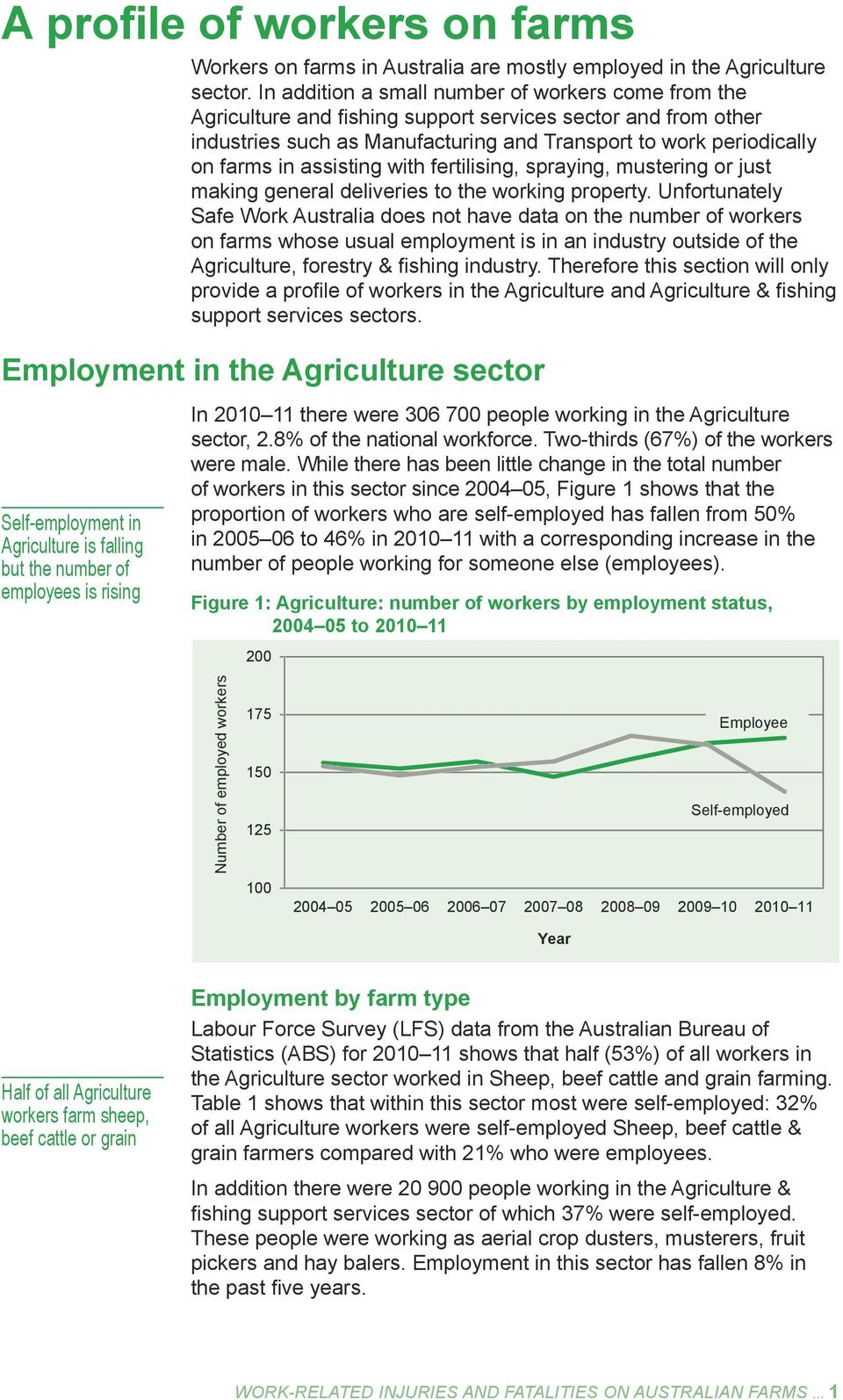
12 Table 1: Agriculture: proportion of workers by industry group and employment status, Proportion of workers Agriculture sector Employee Selfemployed Total Sheep, beef cattle & grain farming 21% 32% 52% Fruit & tree nut growing 9% 3% 12% Dairy cattle farming 6% 5% 11% Nursery & floriculture production 4% 1% 6% Mushroom & vegetable growing 5% 1% 6% Other livestock farming 3% 2% 5% Poultry farming 3% 1% 4% Other crop growing 2% 2% 4% Total Agriculture 54% 46% 100% There is some state/territory variation in the type of agriculture being undertaken. This is to be expected considering the different climates and environments in these regions. For instance, 62% of Agriculture workers in New South Wales were employed in the Sheep, beef cattle & grain farming sector. These workers account for 32% of all in the Sheep, beef cattle & grain farming workers. New South Wales also accounted for 55% of the employment in the Poultry farming sector in Agriculture workers in Victoria accounted for 67% of employment in the Dairy cattle farming sector while Agriculture workers in Queensland accounted for 85% of the employment in the Other crop growing sector due to the sugar cane industry. Employment by age group Figure 2 shows the profile of workers in the Agriculture sector by age group and employment status for These data show the proportion of workers in each age group increased up to 54 years where it began to decline. However the proportion of workers aged 65 years and over remained higher than the proportion of workers in the years age group. Workers in this oldest age group accounted for 16% of Agriculture workers and nearly all of them were self-employed workers. In contrast workers under the age of 25 years were predominantly employees. Figure 2: Agriculture: proportion of workers by employment status and age group, % Proportion of workers 20% 15% 10% 5% 0% Under Self-employed 1% 3% 7% 11% 11% 13% Employees 8% 10% 11% 11% 9% 3% Age group (years) 2... SAFE WORK AUSTRALIA

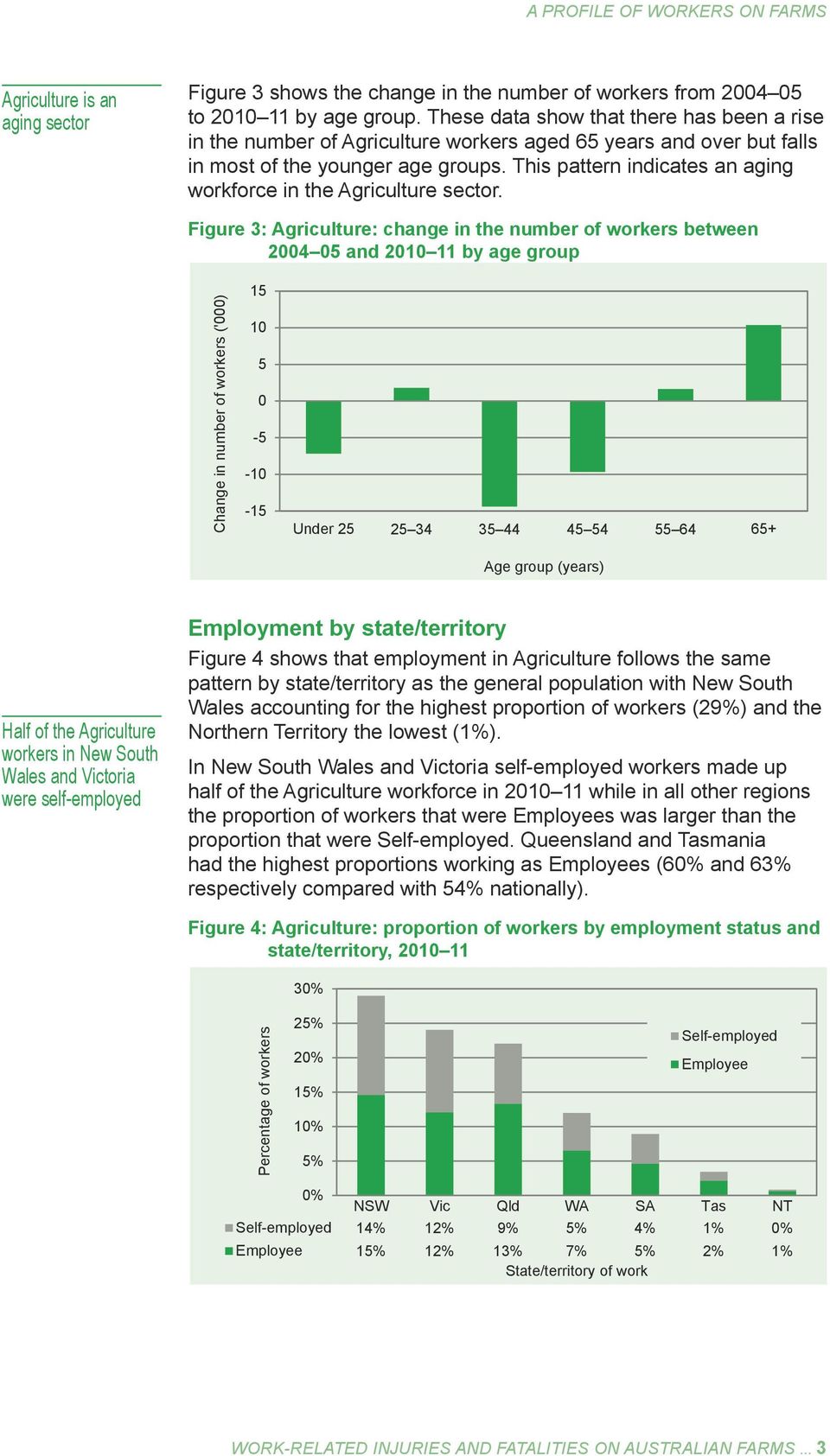
13 A PROFILE OF WORKERS ON FARMS Agriculture is an aging sector Figure 3 shows the change in the number of workers from to by age group. These data show that there has been a rise in the number of Agriculture workers aged 65 years and over but falls in most of the younger age groups. This pattern indicates an aging workforce in the Agriculture sector. Figure 3: Agriculture: change in the number of workers between and by age group Change in number of workers ('000) Under Age group (years) Half of the Agriculture workers in New South Wales and Victoria were self-employed Employment by state/territory Figure 4 shows that employment in Agriculture follows the same pattern by state/territory as the general population with New South Wales accounting for the highest proportion of workers (29%) and the Northern Territory the lowest (1%). In New South Wales and Victoria self-employed workers made up half of the Agriculture workforce in while in all other regions the proportion of workers that were Employees was larger than the proportion that were Self-employed. Queensland and Tasmania had the highest proportions working as Employees (60% and 63% respectively compared with 54% nationally). Figure 4: Agriculture: proportion of workers by employment status and state/territory, % Percentage of workers 25% 20% 15% 10% 5% Self-employed Employee 0% NSW Vic Qld WA SA Tas NT Self-employed 14% 12% 9% 5% 4% 1% 0% Employee 15% 12% 13% 7% 5% 2% 1% State/territory of work WORK-RELATED INJURIES AND FATALITIES ON AUSTRALIAN FARMS... 3
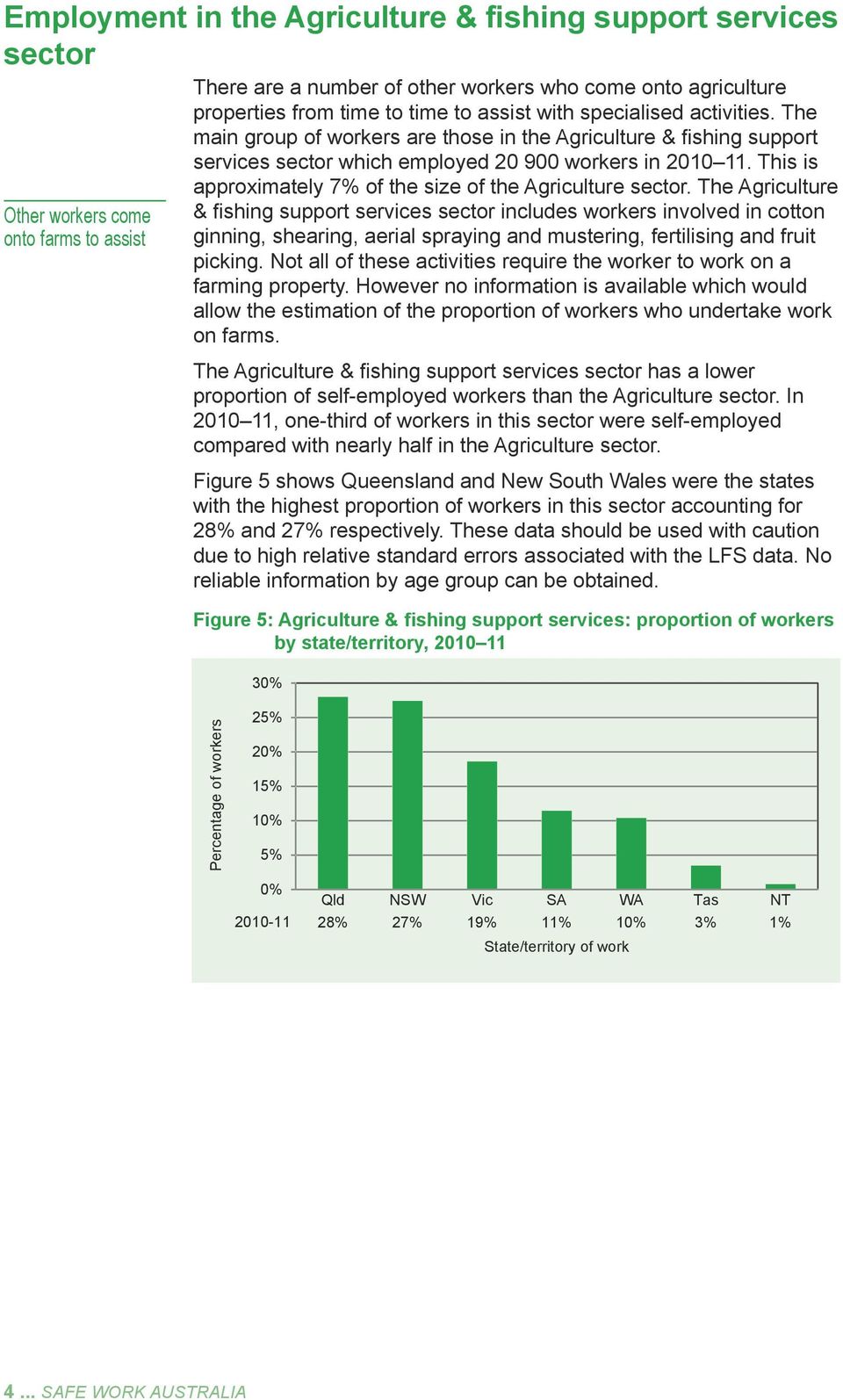
14 Employment in the Agriculture & fishing support services sector There are a number of other workers who come onto agriculture properties from time to time to assist with specialised activities. The main group of workers are those in the Agriculture & fishing support services sector which employed workers in This is approximately 7% of the size of the Agriculture sector. The Agriculture Other workers come onto farms to assist & fishing support services sector includes workers involved in cotton ginning, shearing, aerial spraying and mustering, fertilising and fruit picking. Not all of these activities require the worker to work on a farming property. However no information is available which would allow the estimation of the proportion of workers who undertake work on farms. The Agriculture & fishing support services sector has a lower proportion of self-employed workers than the Agriculture sector. In , one-third of workers in this sector were self-employed compared with nearly half in the Agriculture sector. Figure 5 shows Queensland and New South Wales were the states with the highest proportion of workers in this sector accounting for 28% and 27% respectively. These data should be used with caution due to high relative standard errors associated with the LFS data. No reliable information by age group can be obtained. Figure 5: Agriculture & fishing support services: proportion of workers by state/territory, % Percentage of workers 25% 20% 15% 10% 5% 0% Qld NSW Vic SA WA Tas NT % 27% 19% 11% 10% 3% 1% State/territory of work 4... SAFE WORK AUSTRALIA
15 Worker fatalities Over the eight years from 1 July 2003 to 30 June 2011, 480 workers employed in the Agriculture, forestry & fishing industry were killed while working. This represented 22% of all workers killed in Australia during that time period. The Agriculture sector alone accounted for 350 of the worker fatalities: 73% of all worker fatalities in the Agriculture, forestry & fishing industry and 16% of worker fatalities across all industries. Table 2 shows a breakdown of the number of fatalities within the Agriculture, forestry & fishing industry and the associated fatality rates. In the Agriculture sector recorded a fatality rate of deaths per workers which is more than eight times the rate across all industries (1.93 deaths per workers). This is not the highest rate within the Agriculture, forestry & fishing industry. The Agriculture, forestry & fishing support services sector recorded a rate of deaths per workers and the combined sectors of forestry and fishing recording a rate of deaths per workers. Deaths in these two sectors accounted for around one-quarter of deaths in the industry over the eight years shown. Table 2: Worker fatalities: Number and fatality rate for the Agriculture, forestry & fishing industry, to Industry of employer Number of work-related fatalities Agriculture Agriculture, forestry & fishing support services Forestry & fishing* Total Agriculture, forestry & fishing Fatality rate (fatalities per workers) Agriculture Agriculture, forestry & fishing support services Forestry & fishing* Total Agriculture, forestry & fishing *Includes Aquaculture, Forestry & logging and Fishing, hunting & trapping One in six workers killed while working were killed on a farm The data in Table 2 above shows the number of fatalities by the industry in which the deceased worker was employed. In the case of Agriculture workers, some fatalities did not occur on the working property. The details in the fatalities database (See Explanatory Notes) allows for the identification of deaths which occurred on farms. This database shows that over the eight years from 1 July 2003 to 30 June 2011, 356 workers died while working on a farming property. This is 17% of all worker fatalities or expressed differently, one in six workers killed over the past eight years was working on a farm at the time of the incident. Table 3 shows that of the workers who died while working on a farm, 81% (289) were employed in the Agriculture sector. The Agriculture workers who died while away from the farming property were mostly killed in a work-related vehicle incident on a public road. WORK-RELATED INJURIES AND FATALITIES ON AUSTRALIAN FARMS... 5
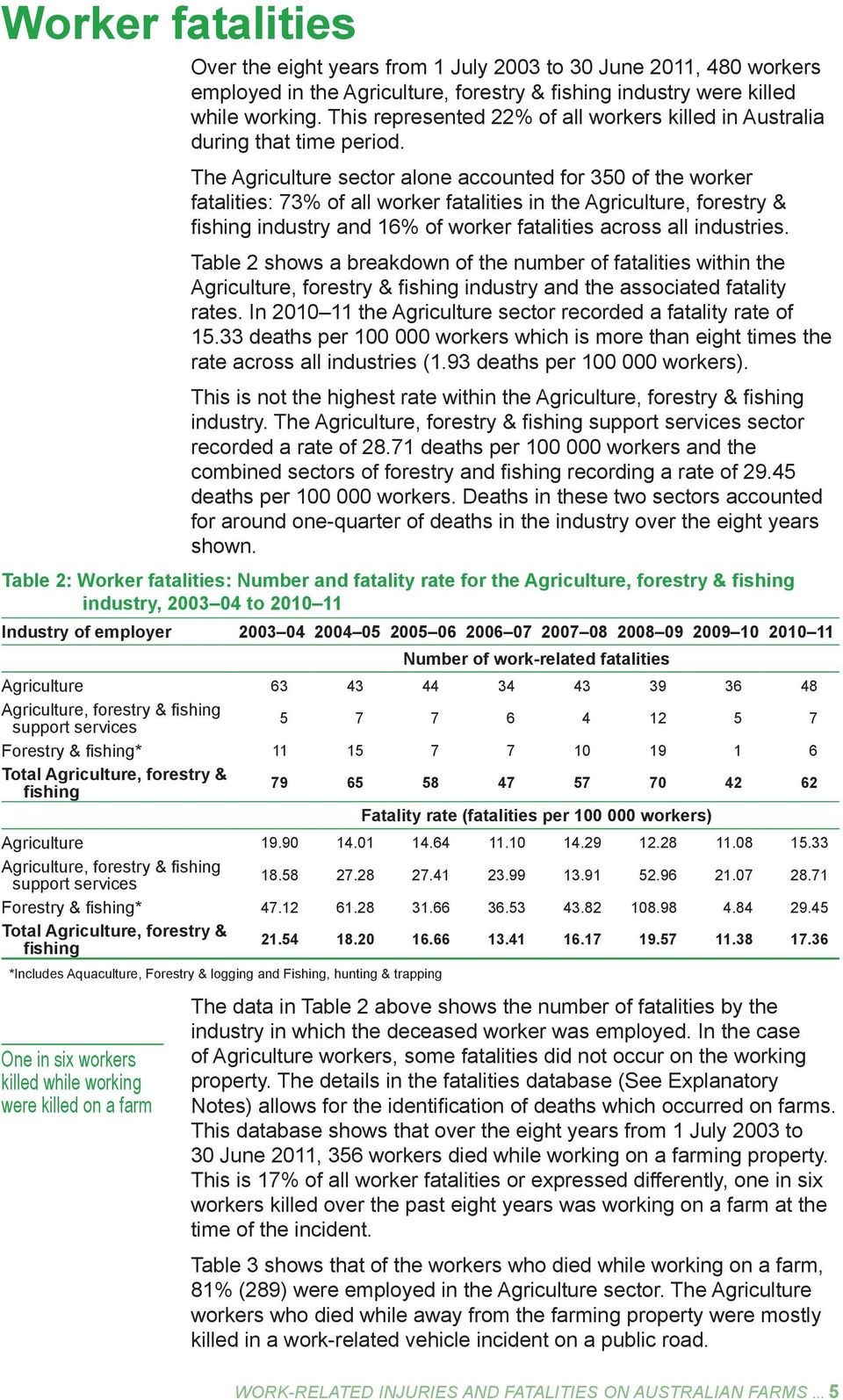
16 Table 3 shows that 10% (36) of the workers who were killed on farms were employed in the Agriculture & fishing support services sector. This sector accounted for 11% of fatalities in the Agriculture, forestry & fishing industry. Over the eight years from 1 July 2003 to 30 June 2011, 53 workers in this sector have been killed with 36 (64%) dying in an incident on a farm. These workers were mainly engaged in aerial spraying and mustering. The remaining 9% (31) of farm deaths involved workers who were employed in other industries but were working on the property at the time of the incident that caused their death. Of these 9 had come to the property to deliver farming equipment or materials or to pick them up, 5 were assisting with spraying operations, 4 had come to the property to repair equipment and 4 were undertaking gardening activities such as mowing and tree lopping. Table 3: Worker fatalities: Number by location (farm or non-farm), to Number of work-related fatalities TOTAL Farm Agriculture Agriculture & fishing support services Other industries Non-farm Agriculture Agriculture & fishing support services Other industries Total fatalities Farm deaths by age Workers aged 65 and over accounted for 30% of fatalities on farms It is not possible to calculate farm fatality rates accurately as it is not known how many workers who are not employed within the Agriculture sector work on farming properties at any particular time. The data in Table 3 shows that 83% of the Agriculture fatalities and 68% of the Agriculture & fishing support services fatalities occurred on a farm. For all other sectors 2% of fatalities occurred on a farm. The following analysis profiles the 356 fatalities that occurred on farms in the eight years to Males accounted for 92% of the fatalities (328) and there were 28 (8%) female workers killed. Figure 6 shows an increasing proportion of worker fatalities with age. Workers aged 65 years and over accounted for 30% of all fatalities on farms in the eight years. This is nearly three times the proportion this age group represents of all worker fatalities. For the years age group similar proportions were recorded for those working on farms and for all workers, while for all younger age groups the proportion of deaths occurring on farms was lower than for all workers. These data show that there is a greater risk of death for older workers on farms than for the wider working population SAFE WORK AUSTRALIA
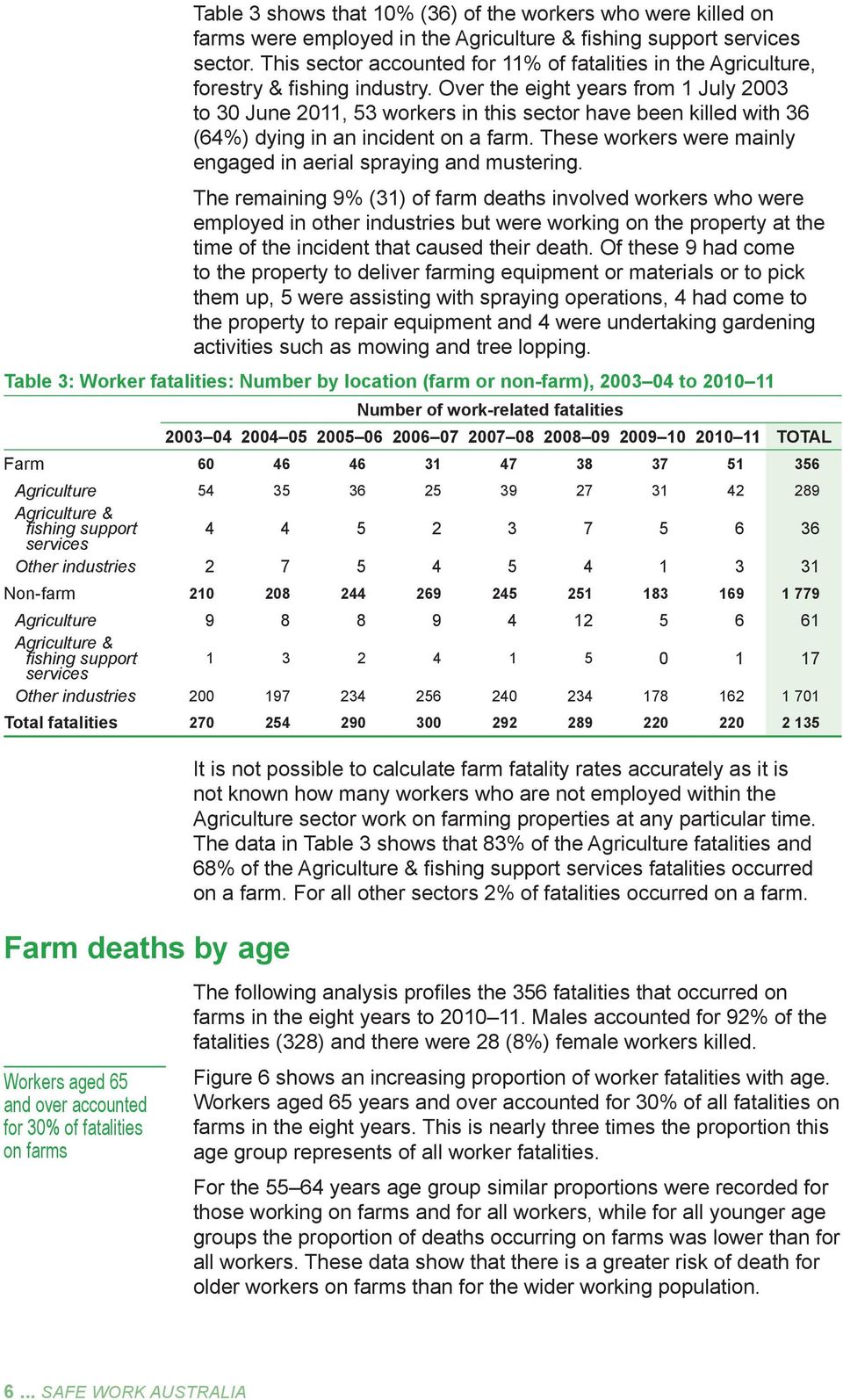
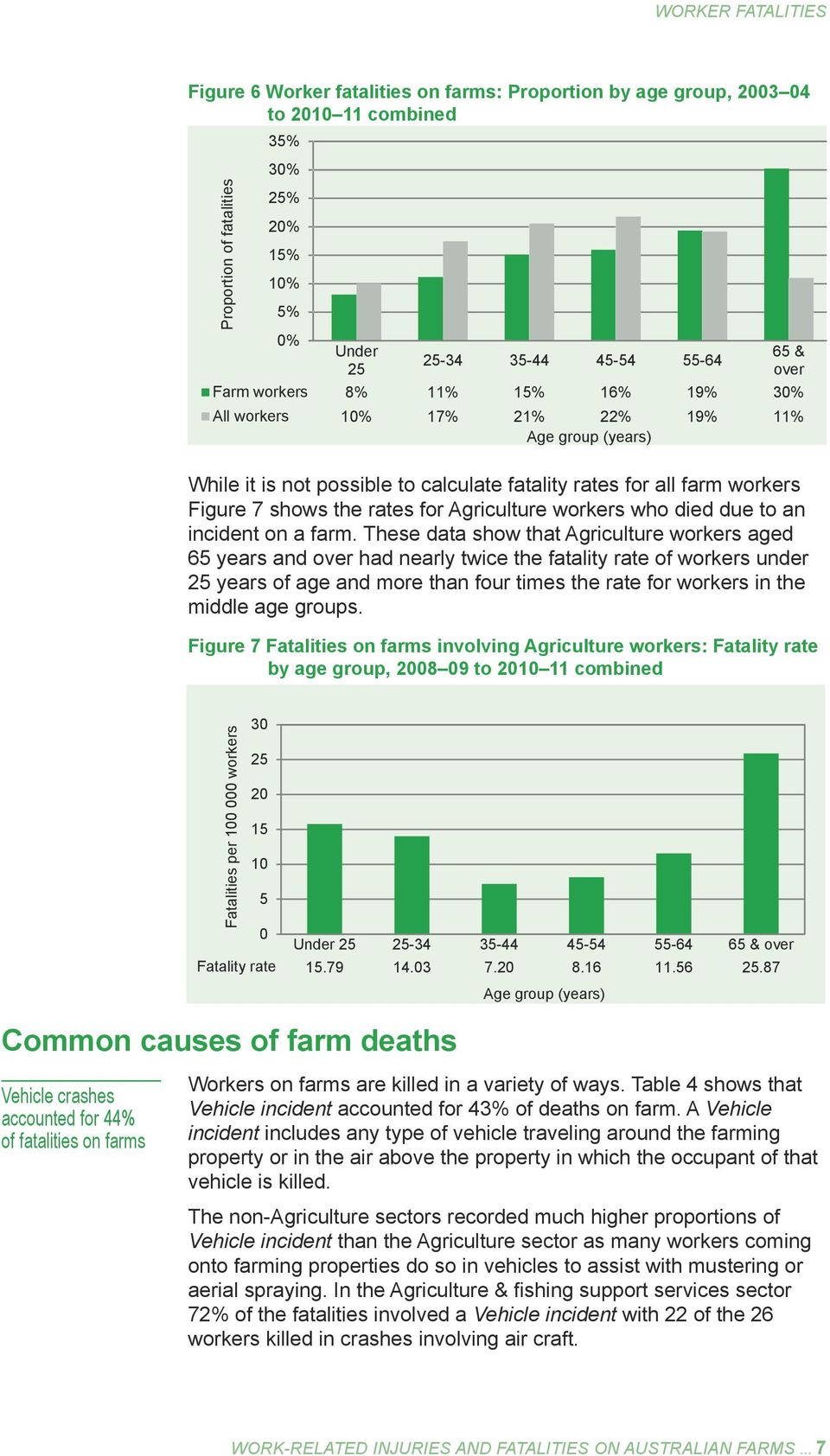
17 WORKER FATALITIES Figure 6 Worker fatalities on farms: Proportion by age group, to combined Proportion of fatalities 35% 30% 25% 20% 15% 10% 5% 0% Under & over Farm workers 8% 11% 15% 16% 19% 30% All workers 10% 17% 21% 22% 19% 11% Age group (years) While it is not possible to calculate fatality rates for all farm workers Figure 7 shows the rates for Agriculture workers who died due to an incident on a farm. These data show that Agriculture workers aged 65 years and over had nearly twice the fatality rate of workers under 25 years of age and more than four times the rate for workers in the middle age groups. Figure 7 Fatalities on farms involving Agriculture workers: Fatality rate by age group, to combined Common causes of farm deaths Vehicle crashes accounted for 44% of fatalities on farms Fatalities per workers Under & over Fatality rate Age group (years) Workers on farms are killed in a variety of ways. Table 4 shows that Vehicle incident accounted for 43% of deaths on farm. A Vehicle incident includes any type of vehicle traveling around the farming property or in the air above the property in which the occupant of that vehicle is killed. The non-agriculture sectors recorded much higher proportions of Vehicle incident than the Agriculture sector as many workers coming onto farming properties do so in vehicles to assist with mustering or aerial spraying. In the Agriculture & fishing support services sector 72% of the fatalities involved a Vehicle incident with 22 of the 26 workers killed in crashes involving air craft. WORK-RELATED INJURIES AND FATALITIES ON AUSTRALIAN FARMS... 7
18 Of the workers who were employed in other sectors, 52% of fatalities involved a Vehicle incident with 7 involving aircraft, 3 involving a tractor and 3 involving a truck. Table 4: Worker fatalities: Number by farm sector, to combined Mechanism Workers in Agriculture Workers from A&F support services Workers from Other sectors Total Percentage of total Vehicle incident % Hit by moving object % Trapped by machinery or equipment % Hit by falling objects % Falls % Hit or bitten by animal % Contact with electricity % Other mechanism % Total % The proportion of workers killed in vehicle incidents decreased as worker age increased Many farm workers were killed after being Hit by moving object. Of the 52 fatalities due to this cause, 34 (65%) involved vehicles with tractors being the most common. Tractors were also involved in many of the deaths resulting from Trapped by machinery or equipment. It is clear therefore that vehicles are implicated in the vast majority of fatalities on farms. This will be explored in more detail in the next section. Figure 8 shows the ways workers have been killed by age group. These data show that the proportion of workers killed decreased with age for Vehicle incident deaths from 49% of deaths in workers aged Under 35 to 37% of deaths of workers aged 65 years and over. The proportion who were Hit by moving object (which mainly involve vehicles) increased from 13% to 18% with age. These data also indicate that the proportion of workers who died after being Trapped by machinery or equipment was similar across the age groups but that those aged 55 and over had a greater proportion of deaths due to Falls. Figure 8 Worker fatalities on farms: Proportion by mechanism of incident and age group, to combined Proportion of fatalities 50% 40% 30% 20% 10% Under 35 years years years 65 years & over 0% Vehicle incident Hit by moving object Trapped by machinery or equipment Falls Hit by falling object Other mechanisms Mechanism of incident 8... SAFE WORK AUSTRALIA

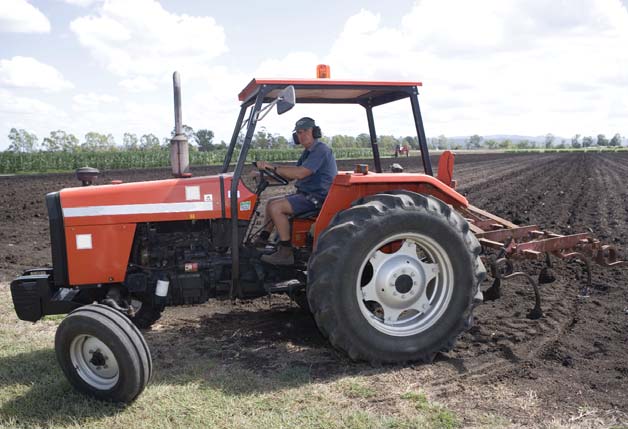
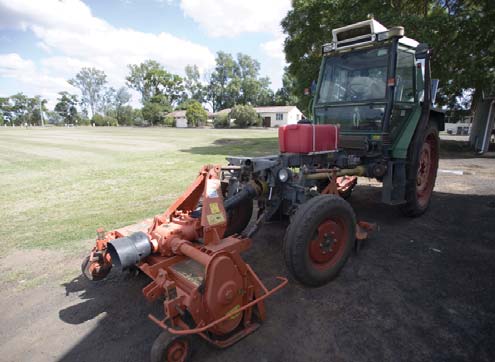
19 WORKER FATALITIES Deaths from working with vehicles Vehicles were involved in 71% (251 fatalities out of 356) of the incidents on farms. Figure 9 shows that over the eight years 93 workers (26% of farm deaths) died in incidents involving a tractor, 48 (13%) in aircraft incidents, 28 in incidents involving a light vehicle such as a car or utility and 27 (8%) in incidents with quad bikes. While 86% of incidents involved only one vehicle, some incidents involved two or more vehicles. Each vehicle is counted separately in the following analysis. Figure 9 Worker fatalities involving vehicles on farms: Number by type of vehicle involved, to combined 100 Number of fatalities Tractor Aircraft Light vehicle Quad bike Trucks Motorbike Earth moving equip. Type of vehicle involved Other agriculture equip. 11 workers die each year on a farm from working with a tractor Workers aged 65 years and over accounted for 43% of tractorrelated fatalities Deaths from working with tractors The 93 tractor-related fatalities equates to 11 workers being killed each year while working with or around a tractor. While this is a considerable fall on the average of 25 deaths per year found in a study undertaken over the period 1 similar types of incidents are still claiming lives. Figure 10 shows that the number of tractor-related fatalities increased with worker age. Workers aged 65 years and over accounted for 43% of the tractor-related deaths which is considerably higher than the 29% this age group represents of all farm deaths. Figure 10 Worker fatalities involving tractors on farms: Number by age group, to combined Number of tractor-related fatalities Under & over Age group (years) 1 Work-related fatalities involving tractors in Australia 1989 to AboutSafeWorkAustralia/Whatwedo/Publications/Pages/ACSR200007FatalitiesInvolvingTractors.aspx WORK-RELATED INJURIES AND FATALITIES ON AUSTRALIAN FARMS... 9

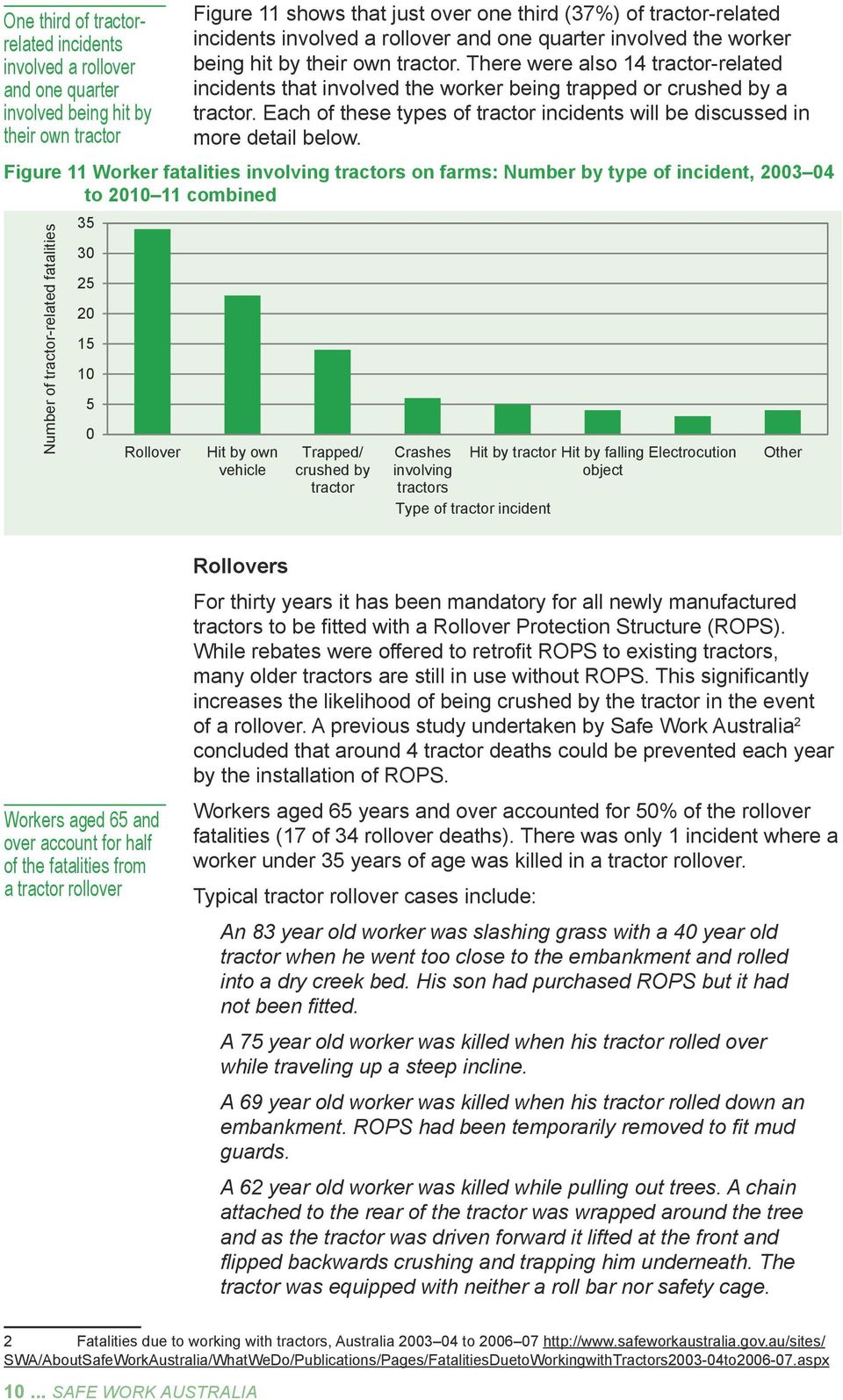
20 One third of tractorrelated incidents involved a rollover and one quarter involved being hit by their own tractor Figure 11 shows that just over one third (37%) of tractor-related incidents involved a rollover and one quarter involved the worker being hit by their own tractor. There were also 14 tractor-related incidents that involved the worker being trapped or crushed by a tractor. Each of these types of tractor incidents will be discussed in more detail below. Figure 11 Worker fatalities involving tractors on farms: Number by type of incident, to combined Number of tractor-related fatalities Rollover Hit by own vehicle Trapped/ crushed by tractor Crashes involving tractors Hit by tractor Hit by falling Electrocution object Type of tractor incident Other Workers aged 65 and over account for half of the fatalities from a tractor rollover Rollovers For thirty years it has been mandatory for all newly manufactured tractors to be fitted with a Rollover Protection Structure (ROPS). While rebates were offered to retrofit ROPS to existing tractors, many older tractors are still in use without ROPS. This significantly increases the likelihood of being crushed by the tractor in the event of a rollover. A previous study undertaken by Safe Work Australia 2 concluded that around 4 tractor deaths could be prevented each year by the installation of ROPS. Workers aged 65 years and over accounted for 50% of the rollover fatalities (17 of 34 rollover deaths). There was only 1 incident where a worker under 35 years of age was killed in a tractor rollover. Typical tractor rollover cases include: An 83 year old worker was slashing grass with a 40 year old tractor when he went too close to the embankment and rolled into a dry creek bed. His son had purchased ROPS but it had not been fitted. A 75 year old worker was killed when his tractor rolled over while traveling up a steep incline. A 69 year old worker was killed when his tractor rolled down an embankment. ROPS had been temporarily removed to fit mud guards. A 62 year old worker was killed while pulling out trees. A chain attached to the rear of the tractor was wrapped around the tree and as the tractor was driven forward it lifted at the front and flipped backwards crushing and trapping him underneath. The tractor was equipped with neither a roll bar nor safety cage. 2 Fatalities due to working with tractors, Australia to SWA/AboutSafeWorkAustralia/WhatWeDo/Publications/Pages/FatalitiesDuetoWorkingwithTractors to aspx SAFE WORK AUSTRALIA
21 WORKER FATALITIES Four workers are killed each year after being hit by their own tractor Being hit by tractor Over the eight year period considered in this report 23 workers have been killed after being hit by their own tractor. This equates to around 4 deaths per year. In 52% of the cases the worker was aged 65 or older. In many instances the tractor was not braked properly while the worked jumped off to open a gate or move a hay bale and they were unable to regain access to the tractor while it was moving. The previous tractor study concluded that if tractors were fitted with a Safe Tractor Access Platform (STAP), 2 deaths from this cause could be prevented each year. Typical cases where workers are killed after being hit by their own tractor include: An 86 year old worker was run over by his tractor when he tried to jump back onto it when it started to roll away. It appears that due to a battery fault, the deceased used another battery to jump start the tractor. Investigations show the tractor was in gear and started when jumper leads were applied running over victim who was then pinned against a tree by the wheel of the attached spray unit. The deceased worker was found trapped under the rear tractor wheel. He had been plowing a field and appears to have put the tractor in idle and put on the handbrake and then alighted. The tractor was on an incline and it has moved running over the deceased. The worker was using a tractor to move a hay bale to a feed lot for cows. He disembarked the tractor to cut bindings and the tractor rolled forward and pinned him up against fence post. Three other workers were hit and killed by tractors they were not driving. Of these two were hit by reversing tractors and the third happened as follows: A tractor was coming up a roadway with a bag of pallets on the forklift tine attachment on the front of the tractor and the tractor ran into the deceased. There were also 2 workers who were riding on attachments that were being towed by a tractor when a fatal incident occurred. In one case: A 38 year old worker was riding on hay bale trailer that was fully loaded with hay and being towed up a hill by a tractor. The draw bar connecting the trailer to the tractor snapped and the trailer rolled back down the hill. The worker has either jumped off or fallen off the back of the trailer and been crushed under the back wheels of the trailer. Trapped or crushed by tractor Of the 14 workers who were trapped or crushed by a tractor, 8 were undertaking repairs to the vehicle at the time and 6 occurred while loading or unloading the tractor. WORK-RELATED INJURIES AND FATALITIES ON AUSTRALIAN FARMS... 11
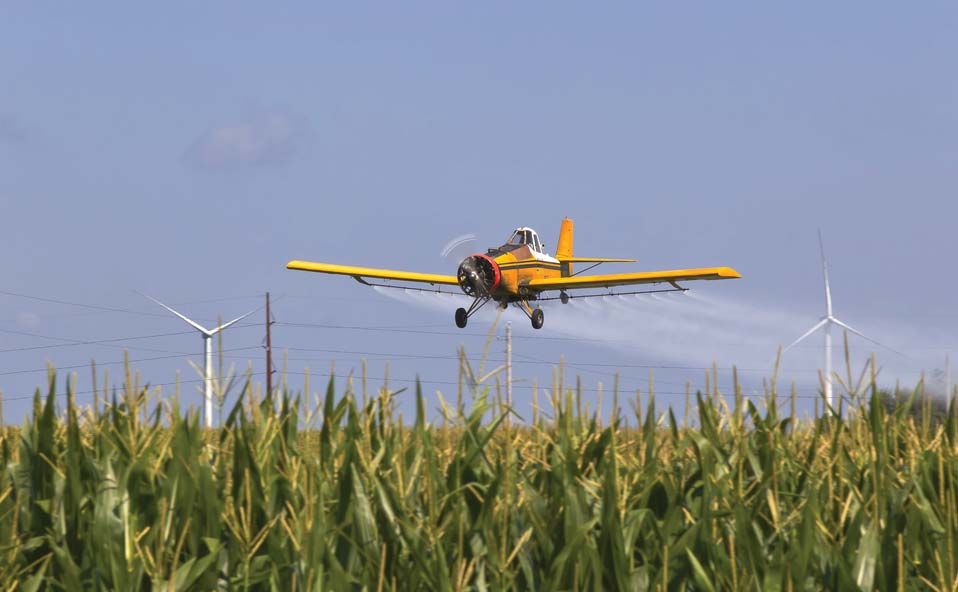
22 Descriptions of some of the cases include: A 28 year old worker was refilling a tank attached to a tractor for spraying purposes when he has slipped onto the unguarded power take off drive (PTO). His clothes have caught in the PTO and dragged him into the machine A farmer was standing on the back of a twin fork attachment to his tractor when he has reached into cabin of the tractor to change gears and was crushed between the tractor and the attachment. On a tractor when the engine is switched off, the slasher s hydraulics gradually loose pressure so that the slasher is gradually lowered to the ground. In this instance a 41 year old worker placed himself under a slasher to undertake repairs but did not insert any pins or chocks to keep it in a raised position. He was crushed when the slasher lowered onto him. Other tractor incidents There were a further 17 workers killed in incidents involving tractors. Three of these involved electrocutions, including 2 where the tractor was used to move a windmill and came into contact with overhead power lines. There were 4 deaths due to being Hit by falling object while using a tractor, including 2 who were hit by falling trees. There were 5 crashes other than rollovers that resulted in fatal injuries including 3 where the tractor hit a tree and 1 where the tractor ran into a train that was on tracks that went through the property. Aerial mustering and crop dusting claim four lives a year Deaths from working with aircraft The 48 deaths in aircraft crashes on farms represent 38% of all workrelated fatalities that were the result of aircraft crashes in Australia during this period. Of these 38 were pilots, 12 were passengers and 1 was a worker undertaking maintenance on the aircraft at the time of the incident. The majority (60%) of the deceased workers were aged between 25 and 45 years. Figure 12 shows that in 18 of the incidents the worker was involved in mustering operations, in 17 the worker was crop dusting and in a further 9 incidents workers were undertaking general checking of the property. Figure 12 Worker fatalities involving aircraft on farms: number by activity at time of incident, to combined 20 Number of aircraft-related deaths Mustering Crop dusting Checking property Flight training Activity at time of aircraft incident Other activity SAFE WORK AUSTRALIA
23 WORKER FATALITIES Planes were involved in 25 of the incidents and the other 23 involved helicopters or other light aircraft. In 10 of the incidents, the aircraft hit power lines while in a further 6 the aircraft hit trees. Five workers were killed when two aircraft collided. Deaths involving light vehicles In the eight year period considered in this report, 28 workers died in incidents involving light vehicles such as cars, utes and motorbikes. In 10 cases the deceased was in the light vehicle when a crash occurred. In 4 other cases the worker was on a motorbike when hit by a light vehicle. Two workers were traveling on the back of a utility and fell off due to rough terrain. Other incidents involved being crushed by the vehicle while undertaking repairs or while temporarily out of the vehicle, such as while opening a gate. A typical case that involved a light vehicle was: A 62 year old farmer was mustering sheep on her farm property. As she was driving her utility along a ridge the left front wheel has struck a tree stump causing the vehicle to roll a number of times down an embankment. Deaths involving quad bikes In the eight years considered in this report, 27 workers died in incidents involving quad bikes. The following analysis does not include the 5 workers who were killed while using an other types of All-Terrain Vehicles such as side by sides and those with other than four wheels. Over two thirds of work-related quad bike fatalities were due to rollovers that pinned or crushed the worker The ground surface is the major hazard involved in quad bike fatalities In 20 of the 27 quad bike incidents the worker died due to the quad bike rolling over and pinning them underneath. In the other 7 incidents the worker was thrown from the quad bike while traveling over uneven ground. The ground surface was identified as the major hazard in many of the deaths, with 7 of the rollovers occurring while traveling up or down an embankment, 5 occurring while traveling through a watercourse or irrigation channel and 4 hit a ditch. There were 3 cases where the quad bike hit a fence and 2 where it hit a mound. Figure 13 Worker fatalities involving quad bikes on farms: number by object involved, to combined Number of quad bike deaths Embankment Water course/ channel Hit ditch Hit fence Hit mound Other and unknown Type of quad bike incident WORK-RELATED INJURIES AND FATALITIES ON AUSTRALIAN FARMS... 13
24 Workers aged 65 and over account for nearly half of the workers killed while using a quad bike It is clear in 13 of the incidents that the worker was mustering or moving animals between paddocks and in a further 4 the worker was spraying weeds. The remaining 10 cases involved general travel around the property. Typical quad bike fatality cases include: The deceased was spraying weeds along a track that was measured to be approximately 2.9m wide at its widest point. It appears that the deceased was reversing his quad bike and has attempted a multi-point turn and during this process the front wheels were resting on the loose graveled edge. Whilst on the edge the deceased has lost control, and the quad bike has traveled down the embankment, where the bike came to rest partially pinning the deceased underneath it. It appears that she was riding the bike spraying weeds when the right side wheels left the ground and the bike proceeded down the hill. Further down the hill the terrain got rougher and it appears that the bike then rolled over and trapped her. Whilst driving a quad bike performing mustering, the deceased contacted a barbed wire fence at speed and was thrown 7m. The deceased was not wearing a helmet and suffered severe head injuries. Figure 14 shows that deaths associated with quad bikes involved mainly older workers, with 44% of the fatalities occurring to workers aged 65 years and over. Within this age group 10 of the 12 (83%) fatalities were due to the quad bike rolling over and trapping the worker. Workers aged years recorded 7 deaths due to quad bike use with 5 involving a rollover (71%). Interestingly, there have been no workers between the ages of 25 and 44 killed while riding a quad bike in the eight years of the series. Of the 27 quad bike fatalities on farms, 6 involved female workers, 5 of them due to a rollover. This means that quad bikes were involved in one in five fatalities of female workers on farms. Figure 14 Worker fatalities involving quad bikes on farms: Number by age group and sex, to combined Number of quad bike fatalities Male Female Less than & over Age group (years) SAFE WORK AUSTRALIA
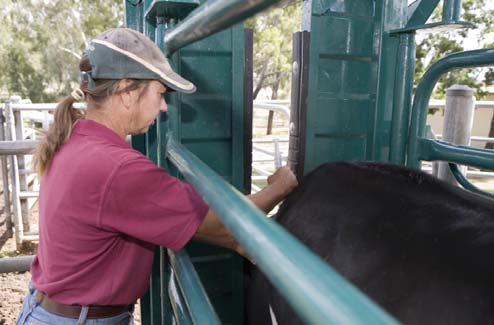
25 WORKER FATALITIES Deaths not involving vehicles There were 105 work-related fatalities on farms that did not involve a vehicle. Figure 15 shows the most common cause of death was being Bitten or hit by an animal with 11 of the 18 fatalities in this category involving cows. Some examples include: Animals such as cows and horses cause many deaths on farms The deceased went to feed cattle and when she has thrown the feed into the trough the cattle have come running up. One cow was heavily in calf and was particularly aggressive at feed times. This cow has knocked the deceased to the ground and trampled her. The deceased was loading cattle from a yard into a cattle loading ramp. As a steer was going up the ramp it has fallen. The deceased has run forward slightly to attempt to shut the gate. Almost simultaneously the steer has hit the gate pushing it backwards into the deceased s chest. It is believed that the steer has then jumped on the deceased as he lay prone on the ground. Figure 15 Worker fatalities not involving vehicles on farms: Number by how incident occurred, to combined Bitten or hit by animal Electrocution Falls from horse Other fall Hit by moving object Accidental shooting Hit by falling object other than trees Hit by falling tree Caught in machinery Bee sting Caught in fire Drowning Other and unknown Number of non-vehicle fatalities Another common cause of death on farms was Fall from horse with 11 fatalities in the eight years of the study. Of these, 5 occurred while mustering and 2 while training horses. There were also 11 deaths due to Electrocution with 7 of the deaths due to contacting overhead power lines. Three of the deaths occurred while using boom spray equipment and another 3 while installing irrigation pipes. The following cases are typical of deaths due to electrocution: The deceased was transferring chemicals from a vehicle to a self propelled boom spray unit when one of the booms made contact with an overhead power line resulting in his electrocution. The deceased has picked up a length of irrigation piping approximately 7m in length and moved it into an upright position WORK-RELATED INJURIES AND FATALITIES ON AUSTRALIAN FARMS... 15
26 Deaths by state/territory Half of all work-related farm deaths occurred in New South Wales or Queensland to clear debris from inside it. This resulted in the pipe contacting with high voltage power lines and he was electrocuted. Falls other than from horses claimed 10 lives. Six of these workers were aged 65 years or older. While 2 of the fatalities involved falls from silos, the others were all different locations including falls from an elevated work platform, a ladder, a tree and a house. The attempt to remove vermin from around properties or the need to destroy farm animals resulted in 9 shootings. Some cases include: The deceased removed his rifle from his cupboard and loaded one bullet into the single shot rifle and then got onto his motor bike and somehow in the process of getting onto his bike or starting his bike the firearm has discharged with the projectile striking him under his chin resulting in a fatal injury. The deceased and his son were spotlighting for vermin at his farm when his four-wheel-drive vehicle hit a bump and a shotgun held by son in the back of the ute fired. The deceased was assigned to shoot a rogue bull. The deceased left the area on the quad bike with a 243 bolt action rifle sitting across his thighs. It is believed the deceased has hit a log, causing the quad bike to flip and land on his legs. During the incident it appears the firearm discharged with the projectile striking the deceased in the face causing death. Being hit by falling trees claimed 6 lives while a further 7 workers were killed when hit by other falling objects, 2 of which were collapsing silos. Just over half (54%) of the work-related deaths that occurred on farms occurred in New South Wales and Queensland. This is slightly higher than the proportion of Agricultural workers these states employ (51%) and about the same proportion of Agriculture and fishing support services sector workers (55%). This suggests that if the number of workers on farms could be derived then these states would record a fatality rate similar to the national rate. Table 5 shows that the patterns of fatalities by mechanism of injury were broadly similar across the states. New South Wales recorded one of the highest proportions due to Vehicle incident (49%) but lower proportions for most of the other mechanisms of injury. For example, 1 worker was killed due to Contact with electricity in New South Wales compared with 7 in Queensland and 6 in Victoria. Victoria recorded one of the lowest proportions of workers killed for Vehicle incident (34%) but one of the highest for Being hit by moving objects (19% - with 12 of the 15 fatalities due to this cause involving a vehicle) and for Contact with electricity (8%). The pattern in Western Australia was the most dissimilar to the national pattern with 60% due to Vehicle incident compared with 43% nationally and 9% for Being hit by moving objects compared with 15% nationally. Western Australia also had the highest proportion of SAFE WORK AUSTRALIA
27 WORKER FATALITIES workers killed by Being hit by falling objects (14%) and the lowest for Trapped by machinery or equipment (6%). Table 5: Worker fatalities: number by mechanism of incident and state/territory of death, to combined Mechanism of injury NSW Qld Vic WA SA Tas NT Total Number of fatalities Vehicle incident Being hit by moving objects Trapped by machinery or equipment Being hit by falling objects Falls Hit or bitten by animal Contact with electricity Other mechanisms Total Percentage of state/territory Vehicle incident 49% 42% 34% 60% 17% 53% 67% 43% Being hit by moving objects 14% 11% 19% 9% 25% 12% np 15% Trapped by machinery or equipment 9% 11% 12% 6% 21% 12% np 11% Being hit by falling objects 6% 7% 8% 14% 8% 6% 0 8% Falls 6% 6% 9% 9% 13% 0% np 8% Hit or bitten by animal 4% 7% 5% 3% 4% 6% 0 5% Contact with electricity 1% 7% 8% 0% 4% 12% 0 5% Other mechanisms 9% 7% 5% 0% 8% 0% 0 6% Total 100% 100% 100% 100% 100% 100% 100% 100% WORK-RELATED INJURIES AND FATALITIES ON AUSTRALIAN FARMS... 17
28
29 Bystander fatalities on farms Five visitors/family members are killed each year on farms, four of them are children under the age of 10 Over the eight year period considered in this report, 41 non-working people were killed on farms. Of these 35 were children under the age of 10. Figure 16 shows that Drowning accounted for the highest number of the deaths. Of the 13 deaths from drowning, 10 involved children who drowned in farm dams. The other drownings were also children: 1 drowned in an irrigation channel, 1 in a creek and 1 in a cattle dip. Figure 16 Bystander fatalities involving farms: Number by age group, to combined Drowning Fall from vehicle Hit by moving vehicle Hit by falling object Plane crash Vehicle incident Hit by animal Caught in machinery Fall from horse Number of Bystander deaths Vehicles were involved in half (22) of the incidents. There were 7 Bystanders who died after falling from a vehicle (4 of which were tractors), 6 were hit by a moving vehicle, 3 died in plane crashes and 3 died in other vehicle crashes. Some of the fatalities include: A two year old boy and his family were visiting friends on an orchard with an unfenced dam near the house. The child has wandered off and drowned in the dam. A two year old boy was placed in the front bucket of a tractor while the family was picking up rocks from the paddock. The child has fallen or attempted to get out of the bucket and went under the tractor with the rear left wheel going over the full length of his body causing him to be crushed. A one year old child and his mother were visiting his grandmother. His mother took him in a stroller to a stable yard. His mother left him in the stroller while she opened a gate to let three large ponies out of a small holding yard into an open paddock. The child got out of the stroller and walked into the holding yard behind his mother and was knocked over by one of the ponies that then trod on him. A father stopped his tractor and switched off the engine but left the two children on board. A short time later the tractor was observed to move forwards a short distance before stopping. It is believed that the deceased child was standing on the running board of the tractor when it commenced to move forward and she has come into contact with the tyre causing her to be drawn under the wheel. WORK-RELATED INJURIES AND FATALITIES ON AUSTRALIAN FARMS... 19
30 20... SAFE WORK AUSTRALIA Queensland was the location for 14 of bystander fatalities. All of these bystander fatalities were children, with 7 drowning and 6 either falling from a vehicle or being hit by one. New South Wales and Victoria accounted for 8 deaths each. Half of the fatalities in New South Wales involved vehicles while half of the fatalities in Victoria involved drownings. Western Australia recorded 6 bystander fatalities with 4 the result of incidents involving vehicles and 2 from drowning.
31 Work-related injuries 47 Agriculture workers were injured each day but compensation only paid for 12 The Work-related Injury Survey (WRIS) produced by the ABS estimated that in , workers in the Agriculture sector had incurred a work-related injury or illness in the previous 12 months. This amounts to over 47 injuries per day in the Agriculture sector. While this estimate is affected by the ability of the worker to recall their work-related injury and illnesses it equates to an incidence rate of 56.4 injuries per 1000 workers. This rate of injuries was slightly lower than the rate for workers in all industries (57.9). The survey also showed there was little difference in the injury rates between employees (55.5) and self-employed workers (57.2) working in the Agriculture sector. The survey data showed that 65% of injured employees took no time off work following their injury but also that 23% of those employees who required five or more days off work following their work-related injury did not seek workers compensation. The workers compensation claims data shows a fall in the number of claims in the Agriculture sector in the last few years. The number of claims fell 21% from 5750 in to 4520 in The preliminary data for show 4155 claims which is still expected to be a fall on the previous year when all claims are processed. The following chapter presents an analysis of workers compensation data. These data provide good information on how injuries are incurred in the Agriculture sector but readers need to keep in mind that these data understate the full extent of injuries in this sector because only half of the workers in this sector are eligible for workers compensation and many of those who are eligible did not put in a claim for their injury. Data in this chapter are presented for the total of the three claim periods of , and This has been done to reduce the volatility that can be present in small numbers. In addition the data for while the latest available are preliminary and expected to rise. The workers compensation data include claims for injuries and illnesses incurred at work but exclude claims for incidents involving a journey to or from work. Worker compensation claims by sex Over the three years , and , three-quarters (77%) of claims were lodged by male employees in the Agriculture sector. This is slightly higher than the proportion of employees who were male (72%) and slightly lower than the proportion of hours worked by male employees (80%). This higher proportion of hours worked by males is an indication of the longer average hours of work typical of this group with male Agriculture employees working 43 hours per week on average compared with 28 for females. Figure 17 shows that male employees in the Agriculture sector recorded an incidence rate of injury over this three year period of 37.9 claims per 1000 employees, which was 29% higher than the incidence rate of injury for female Agriculture employees. However, WORK-RELATED INJURIES AND FATALITIES ON AUSTRALIAN FARMS... 21
32 Female Agriculture workers had a higher rate of injury per hour worked when hours are controlled, the lower average hours of work by females resulted in a higher frequency rate of injury for female Agriculture workers than male Agriculture workers. The rate for females of 20.4 injuries per million hours worked was 21% higher than the rate for males of Figure 17: Agriculture sector workers compensation claims: incidence and frequency rates by sex, , and combined Female Male Incidence rate Claims per 1000 employees Claims per million hours worked Female Male Frequency rate Time lost from work 40% of claims involved less than one week off work A typical claim from an employee in the Agriculture sector involved one and a half weeks off work, which is three times the amount of time taken by all employees. Table 6 shows that 40% of claims involved less than one week off work. This is substantially lower than the proportion of claims for less than one week off work made by employees in all industries (53%). In contrast a greater proportion of Agriculture sector claims involved 1 5 weeks off work than observed for all Australian employees (31% and 25% respectively). When considered together these data show that the proportion of claims that involved less than six weeks off work were similar for Agriculture employees and all employees (71% for Agriculture and 78% for all employees). Table 6: All workers compensation claims from employees: Percentage by time off work, , and combined Duration of absence Agriculture All industries Up to one week 40% 53% Agriculture workers require longer periods off work 1 to 5 weeks 31% 25% 6 to 11 weeks 11% 7% 12 to 25 weeks 9% 5% 26 to 51 weeks 5% 3% 52 weeks and over 4% 4% Total 100% 100% Overall Agriculture employees have claims requiring longer periods off work than for employees across all industries. This could mean that more serious injuries occur on farms than generally across all industries or that Agriculture workers only lodge claims for compensation when their injury is severe SAFE WORK AUSTRALIA
33 WORK-RELATED INJURIES How injuries occurred One-quarter of compensation claims were due to the straining of muscles or tendons Table 7 shows how the employees who lodged a workers compensation claim were injured at work and how long these workers required off work. One-quarter of claims involved Body stressing which includes claims for injuries or disorders as a result from stress placed on muscles, tendons, ligaments and bones. Many of these injuries were due to handling or lifting objects. These claims were spread fairly evenly across the duration of absence groups. Of the Body stressing claims, 29% were due to handling non-powered tools and equipment, 15% from working with animals and 11% working with mobile plant and transport. Table 7: Agriculture sector workers compensation claims: number by mechanism of incident and duration of absence, , and combined Duration of absence Mechanism of incident Less than 1 week 1 5 weeks 6 weeks or more Number of claims Body stressing Being hit by moving objects other than an animal Falls on the same level Falls from a height Being hit by an animal Vehicle incident Hitting moving objects Hitting stationary objects Chemicals and other substances Heat, radiation and electricity Sound and pressure Biological factors Mental stress Other and unspecified mechanisms of injury Total Percentage Body stressing 37% 30% 33% 100% Being hit by moving objects other than an animal 48% 30% 22% 100% Falls not from height 35% 33% 32% 100% Falls from a height 28% 33% 39% 100% Being hit by an animal 41% 30% 29% 100% Vehicle incident 26% 26% 48% 100% Hitting moving objects 52% 34% 13% 100% Hitting stationary objects 58% 29% 13% 100% Chemicals and other substances 65% 30% 6% 100% Heat, radiation and electricity 52% 35% 14% 100% Sound and pressure 8% 88% 4% 100% Biological factors 26% 50% 24% 100% Mental stress 19% 17% 64% 100% Other and unspecified mechanisms of injury 41% 29% 31% 100% Total 40% 31% 29% 100% Total WORK-RELATED INJURIES AND FATALITIES ON AUSTRALIAN FARMS... 23
34 One in five injuries were the result of a fall Similar causes of injury for both male and female Agriculture employees Being hit by an animal accounted for 9% of claims however 41% of these claims required less than one week off work. Being hit by moving objects other than an animal accounted for 18% of claims. Nearly half of the claims (48%) for Being hit by an animal involved less than one week off work, indicating that the injuries caused by this mechanism are less severe than Body stressing injuries. Falls accounted for 21% of claims. There were almost an equal number of claims due to Falls from height as due to Falls on the same level. The injuries from Falls from height resulted in slightly more severe injuries with 39% of injured employees requiring 6 or more weeks off work compared with 32% for Falls on the same level. The claims due to falls were mainly due to the ground surfaces being hazardous (41%) and 18% were due to falls from mobile plant and transport. There were only slight differences in the profiles of claims requiring different periods of time lost. Claims involving 6 or more weeks off work were a little more likely to involve Body stressing than claims for absences of shorter duration. In contrast claims resulting from Being hit by moving objects other than an animal accounted for a greater proportion of the less than one week absence claims than the other duration of absence groups. Overall, 22% of claims were due to working with animals, 19% from working with mobile plant and transport and 18% from working with non-powered tools and equipment. Table 8 shows the proportion of workers compensation claims by sex and mechanism of incident. These data show that male and female employees incurred injuries in similar ways. Body stressing was the main mechanism of incident for both male and female employees with this mechanism accounting for 28% of claims from females and 24% of claims from males. Males had a slightly higher proportion of claims due to Being hit by moving objects other than an animal (19% for males compared with 14% for females), while females recorded a higher proportion for Being hit by an animal (12% for females and 9% for males). The other notable difference is that 8% of claims from males were due to Vehicle incident with females having half this proportion (4%). Table 8: Agriculture sector workers compensation claims: number by mechanism of incident and duration of absence, , and combined Proportion of claims Mechanism of incident Female Male Total Body stressing 28% 24% 25% Being hit by moving objects other than an animal 14% 19% 18% Falls not from height 13% 10% 11% Falls from a height 11% 10% 10% Being hit by an animal 12% 9% 9% Vehicle incident 4% 8% 7% Hitting moving objects 4% 6% 5% Hitting stationary objects 5% 6% 6% Chemicals and other substances 3% 2% 3% Other mechanisms of injury 7% 6% 6% Total 100% 100% 100% SAFE WORK AUSTRALIA
35 WORK-RELATED INJURIES Object or substance inflicting injury The physical environment accounted for one in five claims Females had more claims involving horses while males had more claims involving transport The agency of injury or illness describes the object or substance that was the direct cause of the most serious injury. Within this classification are nine broad groups with four of them accounting for nearly two thirds of claims (73%) in the Agriculture sector. Table 9 shows that 20% of claims were due to Environmental agencies, which includes the physical environment in which the worker operates. Not unexpectedly, the majority of these claims involved Outdoor environment with the main items listed being Vegetation and Fencing each accounting for 3% of claims. A similar proportion of claims (19%) were due to Animal, human & biological agencies with Horses, donkeys, mules accounting for slightly more claims than Cows, steers, cattle, bulls, buffalo though both represented 6% of claims. The third most common agency of injury was Non-powered handtools, appliances & equipment accounting for 18% of claims. Within this agency group, Fastening, packing & packaging equipment accounted for the greatest proportion of claims (6% of all claims). The fourth of the agency groups that is most relevant to claims in the Agriculture sector was Mobile plant & transport accounting for 16% of claims. Motorcycles & sidecars, scooters, trail bikes accounted for more than twice the claims (5%) due to incidents involving Trucks, semi-trailers, lorries (2%) and Cars, station wagons, vans, utilities (2%). While tractors were prominent with fatalities, they accounted for just 2% of workers compensation claims. The main difference between claims lodged by males and females were for injuries due to Animal, human & biological agencies and particularly for claims involving Horses, donkeys, mules where the proportion for females (12%) was three times the proportion for males (4%). Males also had 17% of claims attributed to Mobile plant & transport compared with 10% for females. Males recorded higher proportions of injuries resulting from all types of transport and plant than females. Part of the body most affected Table 10 shows that the body part most affected by a work-related injury was Hands, fingers & thumbs which accounted for 17% of all workers compensation claims made by Agriculture employees. This was closely followed by injuries to the Back which accounted for 15% of claims. The pattern of claims for males and females were remarkably similar. Injuries to Upper limb accounted for 39% of claims from female Agriculture workers and 36% for males. Within this category females had a greater proportion of claims that involved the Wrist (7% for females and 4% for males) while males had a greater proportion that involved Hands, fingers & thumbs (17% for males and 15% for females). WORK-RELATED INJURIES AND FATALITIES ON AUSTRALIAN FARMS... 25
36 Table 9: Agriculture sector workers compensation claims: number by agency of injury or illness, , and combined Percentage Agency of injury or illness Female Male Total Number of claims Environmental agencies 21% 19% 20% Outdoor environment 17% 17% 17% Vegetation 4% 3% 3% 495 Fencing 2% 3% 3% 360 Holes in the ground 1% 1% 1% 155 Indoor environment 4% 2% 3% 405 Animal, human & biological agencies 25% 18% 19% Live four-legged animals 20% 15% 16% Horses, donkeys, mules 12% 4% 6% 870 Cows, steers, cattle, bulls, buffalo 5% 6% 6% 820 Sheep 1% 3% 2% 330 Pigs 1% 2% 2% 230 Non-powered handtools, appliances & equipment 18% 18% 18% Fastening, packing & packaging equipment 6% 6% 6% 805 Crates, cartons, boxes, cases, drums, kegs, barrels, cans 4% 2% 3% 370 Bags, bundles & bales 0% 1% 1% 105 Wire, wire rope, metal strapping 1% 1% 1% 110 Handtools, non-powered, edged 3% 4% 4% 605 Knives & cutlery 2% 3% 2% 345 Ladders, mobile ramps & stairways, & scaffolding 2% 1% 2% 230 Ladders 2% 1% 1% 200 Mobile plant & transport 10% 17% 16% Road transport 6% 9% 8% Motorcycles & sidecars, scooters, trail bikes 3% 5% 5% 695 Trucks, semi-trailers, lorries 1% 2% 2% 260 Cars, station wagons, vans, utilities 1% 2% 2% 220 Other mobile plant 4% 5% 5% 705 Tractors, agricultural or otherwise 1% 3% 2% 340 Trolleys, handcarts 2% 1% 1% 160 Trailers, caravans 0% 1% 1% 110 Self-propelled plant 0% 1% 1% 175 Materials & substances 9% 11% 11% Ferrous & non-ferrous metal 2% 3% 3% 390 Fragments 0% 1% 1% 135 Food 2% 0% 1% 125 Sawn or dressed timber 0% 1% 1% 100 Machinery & mainly fixed plant 4% 5% 5% 690 Sheep shearing plant 0% 1% 1% 95 Forklift trucks 0% 1% 1% 80 Powered equipment, tools &appliances 2% 3% 2% 345 Chemicals & chemical products 1% 1% 1% 215 Other and unspecified agencies 10% 8% 8% Total 100% 100% 100% Note: Only the major sub-categories are shown so the sub-categories do not necessarily sum to the percentage shown at the broad level SAFE WORK AUSTRALIA
37 WORK-RELATED INJURIES Table 10: Agriculture sector workers compensation claims: number by bodily location of injury or illness by sex, , and combined Percentage of claims Bodily location Female Male Total Upper limbs 39% 36% 37% Hand, fingers & thumb 15% 17% 17% Shoulder 8% 8% 8% Wrist 7% 4% 5% Forearm 3% 3% 3% Lower limbs 24% 26% 25% Knee 9% 9% 9% Ankle 6% 5% 6% Foot & toes 4% 4% 4% Lower leg 2% 4% 3% Trunk 19% 21% 21% Back 15% 15% 15% Chest 2% 3% 3% Head 9% 10% 10% Eye 2% 4% 4% Neck 2% 1% 1% Other & unspecified locations 8% 6% 6% Total 100% 100% 100% Note: Only the major sub-categories are shown so the sub-categories do not necessarily sum to the percentage shown at the broad level. Workers compensation claims by sector 70% of workers compensation claims were lodged by workers in grain, sheep and beef cattle farming Over the three years , and , claims for workers compensation were accepted from employees working in the Agriculture sector. This number of claims equates to an incidence rate of 35.5 claims per 1000 employees which is 27% higher than the rate for all industries (27.9). This means the workers compensation data show employees in the Agriculture sector have a much higher injury rate than employees nationally. This is different to the ABS WRIS data which show similar injury rates between Agriculture workers and all workers. The survey data is not robust enough to determine if Agriculture employees have a higher propensity to claim workers compensation than other workers. It could also be that while the survey estimates are within acceptable standard error bands the true results could still lie up to 25% of either side of the rates shown at the beginning of this chapter. Table 11 shows that over the three years from to , 70% of claims were lodged by employees in two sectors: Grain, sheep and beef cattle farming 3 and Horticulture and fruit growing. These sectors accounted for 75% of Agriculture employees in this period. This resulted in these two sectors recording incidence rates slightly below the rate for the whole of the Agriculture sector. 3 The workers compensation data are compiled using the 1993 version of the Australian and New Zealand Standard Industrial Classification whereas the other data in this report are compiled using the 2006 version. WORK-RELATED INJURIES AND FATALITIES ON AUSTRALIAN FARMS... 27
38 Table 11: Agriculture sector workers compensation claims: proportion and incidence rate by sector and year Other livestock farming has the highest rate of injury Industry sector p Total Number of claims Grain, sheep and beef cattle farming 33% 36% 37% 35% Horticulture and fruit growing 37% 34% 35% 35% Other livestock farming 11% 12% 11% 12% Dairy cattle farming 6% 6% 6% 6% Other crop growing 7% 6% 6% 6% Poultry farming 5% 5% 6% 5% Total Agriculture 100% 100% 100% 100% Incidence rate (claims per 1000 employees) Grain, sheep and beef cattle farming Horticulture and fruit growing Other livestock farming Dairy cattle farming Other crop growing Poultry farming Total Agriculture It should be noted that the workers compensation data are compiled using an older version of the industry classification. Therefore the names in Table 10 are different to those shown in the first two chapters of this report. In Table 11 the sector called Grain, sheep and beef cattle farming comprises the same workers as the sector called Sheep, beef cattle and grain farming used in the first two chapters of this report. The Horticulture and fruit growing sector used in the table below has been split in the new industry classification into Nursery & floriculture production, Mushroom & vegetable growing and Fruit & tree nut growing. Within the Agriculture sector the highest incidence rate of injury (102.5 claims per 1000 employees) was recorded by Other livestock farming. This rate was nearly three times the rate for the whole of the Agriculture sector. The Other livestock farming sector accounted for 4% of Agriculture employees and includes the farming of animals such as pigs, horses, dogs, cats and goats. The Poultry farming sector recorded the lowest incidence rate of 20 claims per 1000 employees. Workers compensation claims by age group Young workers had the highest claim rates Figure 18 shows that the incidence rates of worker compensation generally fell with increasing employee age. Employees aged under 25 years recorded 52.0 claims per 1000 employees which was four times the rate for employees aged 65 years and over (13.2). However, as was seen in Figure 2 nearly all workers in the 65 years and over age group were self-employed and hence not eligible for workers compensation. Those that were employees at this age were more likely to be managers and working in a safer environment. Therefore it is possible that the workers compensation data underestimates the rates of injury in the 65 years and over age group SAFE WORK AUSTRALIA
39 WORK-RELATED INJURIES Figure 18: Agriculture sector workers compensation claims: Incidence rates by age group, , and combined Claims per 1000 employees Serious claims by state/territory Serious claims per 1000 employees A limitation of the national dataset of workers compensation claims is that it may not contain reliable information on claims that were fully paid for by the employer. Therefore only data on serious claims are usually published. Serious claims are those that involved a fatality, a permanent incapacity or a temporary incapacity of one or more weeks. The data on serious claims are of better quality because for the most part the one week duration of time lost is beyond the excess period of the compensation schemes in each jurisdiction. Figure 19 shows that the Northern Territory recorded the highest incidence rate of serious claims by employees in the Agriculture industry with 63.6 serious claims per 1000 employees. This was nearly double the rate of the next highest state (Queensland with 33.5) and five times the lowest rate (Victoria with 12.4). While the Northern Territory accounted for just 1% of employees, it accounted for 4% of serious claims. New South Wales and Queensland accounted for 30% of serious claims each but because Queensland has fewer employees in the Agriculture sector it has a higher incidence rate. Figure 19: Agriculture sector serious workers compensation claims: Incidence rates by state/territory, , and combined Under Incidence rate Age group (years) 0 NT Qld NSW TAS WA SA Vic Incidence rate Workers' compensation jurisdiction WORK-RELATED INJURIES AND FATALITIES ON AUSTRALIAN FARMS... 29
40
41 Hospitalisations due to work-related injury At least 6% of the workers hospitalised had been injured on a farm Causes of hospitalisation The Australian Institute of Health & Welfare (AIHW) maintains a database of hospitalisations from which cases that involved workrelated activity can be extracted. This database shows that over the three-year period from July 2006 to June 2009 approximately hospitalisations occurred across Australia where the patient was aged 15 years or over and their activity when injured was reported as working for income. However, because of the large number of hospitalisations for injury where activity when injured was recorded as Unspecified activity, the true number of work-related hospitalisations is likely to be higher than this figure. Of the hospitalisations, 4400 (6%) had the place of occurrence of the incident reported as a farm. This is twice the proportion the Agriculture sector represents of the national workforce (3%) though it should be mentioned that a worker may have been hospitalised more than once in the three-year period. The number of farm hospitalisations should also be considered as understated since for 45% of the work-related injury hospitalisations the place of occurrence was not reported. This chapter provides a profile of the hospital admissions where the activity at the time of the injury was reported as working for income and the place of occurrence was reported as a farm. These will be referred to as farm hospitalisations in this report. Table 11 shows the broad causes of injury that resulted in a hospitalisation of a farm worker and the more common detailed underlying categories. At the broad level 38% of farm hospitalisations were the result of Exposure to inanimate mechanical forces: a category covering a wide variety of causes, the most common of which were Contact with agricultural machinery and Caught, crushed, jammed or pinched in or between objects (9% and 6% of farm hospitalisations respectively). Transport accidents accounted for one-quarter of farm hospitalisations and was the second most common broad cause of injury. At a more detailed level the table shows 9% of farm hospitalisations involved a Motorcycle rider. Female farm workers were more likely to be hospitalised due to an incident with a horse A hazard particular to farms is the handling of livestock. Episodes related to the handling livestock are recorded under the category Exposure to animate mechanical forces. Over the period July 2006 to June 2009 this cause of injury was responsible for 16% of farm hospitalisations. The most common underlying category was being Bitten or struck by cattle: reported in for 9% of farm hospitalisations. Males accounted for most of the hospitalisations (85%) for a work-related injury that occurred on a farm. Comparison of the hospitalisation proportions by sex at the broad level of cause of injury shows that a larger proportion of hospitalisations for females than WORK-RELATED INJURIES AND FATALITIES ON AUSTRALIAN FARMS... 31
42 males were due to Exposure to animate mechanical forces (21% and 15% respectively), Transport accidents (29% and 24%) and Falls (13% and 8%). The underlying transport categories highlight that 13% of the farm hospitalisations for females involved Animal-rider or occupant of animal-drawn vehicle. In nearly all cases this involved falling from a horse. Table 11 Farm work-related hospitalisations July 2006 to June 2009: percentage by cause of injury and sex Cause of injury Males Females Total Exposure to inanimate mechanical forces 40% 25% 38% Contact with agricultural machinery 10% 4% 9% Caught, crushed, jammed or pinched in or between other objects 7% 6% 6% Struck by thrown, projected or falling object 4% 4% 4% Contact with knife, sword or dagger 4% 2% 4% Contact with other specified machinery 4% 1% 3% Striking against or struck by other objects 3% 2% 2% Contact with non-powered hand tool 2% 1% 2% Foreign body or object entering through skin 2% 2% 2% Transport accidents 24% 29% 25% Motorcycle rider 9% 7% 9% Animal-rider or occupant of animal-drawn vehicle 5% 13% 6% Occupant of special vehicle mainly used in agriculture 4% 3% 4% Occupant of special all-terrain or other motor vehicle designed primarily for off-road use 3% 3% 3% Exposure to animate mechanical forces 15% 21% 16% Bitten or struck by cattle 9% 10% 9% Bitten or struck by horse 2% 6% 2% Bitten or struck by sheep 1% 2% 1% Falls 8% 13% 9% Fall on same level from slipping, tripping & stumbling 2% 4% 2% Other fall from one level to another 1% 1% 1% Fall on & from ladder 1% 2% 1% Overexertion, travel & privation 3% 3% 3% Contact with venomous animals & plants 2% 1% 2% Accidental poisoning by & exposure to noxious substances 2% 1% 2% Other causes of injury 6% 6% 6% Total 100% 100% 100% Total number of hospitalisations Note: Only the major sub-categories are shown so the sub-categories do not necessarily sum to the percentage shown at the broad level. Males were more likely than females to be hospitalised due to an incident with agricultural machinery or cattle Figure 20 shows the most common detailed causes of injury among farm workers hospitalised for a work-related injury by sex. These causes of injury together accounted for 54% of farm work-related hospitalisations for males and 55% for females. For male farm workers the most commonly specified cause of hospitalisation was Contact with agricultural machinery (10% of hospitalisations by males). This was followed by Motorcycle transport accident (9%) and Bitten or struck by cattle (9%). A considerably different pattern was seen in the farm hospitalisations of females with the most common causes being Horse-related traffic SAFE WORK AUSTRALIA
43 HOSPITALISATIONS DUE TO WORK-RELATED INJURY incident (13%) followed by Bitten or struck by cattle (10%) and Bitten or struck by horse (6%). There were some similarities in the proportions by sex for the cause for hospitalisation. Male and female farm workers reported similar proportions for Caught, crushed, jammed or pinched by object, Bitten or struck by cattle and Struck by thrown, projected or falling object. Figure 20 Farm work-related hospitalisations June 2006 to July 2009: percentage by the most common specified causes of injury* by sex Contact with agricultural machinery Motorcycle transport accident Bitten or struck by cattle Caught, crushed, jammed or pinched by object Horse-related traffic incident Struck by thrown, projected or falling object Contact with knife, sword or dagger Special agriculture vehicle incident Bitten or struck by horse Fall on same level Male Female * Cause of injury names have been simplified for ease of understanding in this graph Age profile of hospitalised workers Workers aged 65 and over accounted for 12% of farm hospitalisations compared with 3% nationally 0% 2% 4% 6% 8% 10% 12% 14% Percentage of hospitalisations Figure 21 shows the age profile for farm hospitalisations compared with work-related hospitalisations across all locations. These data show that farm hospitalisations had lower proportions in the younger age groups up to 55 years. After this age, farm hospitalisations recorded higher proportions, particularly for the 65 years & over age group which accounted for 12% of hospitalisations compared with just 3% for hospitalisations from all locations. This is linked to the much older age profile of farm workers. Figure 21 Work-related hospitalisations June 2006 to July 2009: percentage by place of occurrence and age Proportion of hospitalisations 25% 20% 15% 10% 5% 0% Farms 20% 17% 18% 18% 16% 12% All locations 20% 22% 22% 20% 12% 3% Age group (years) WORK-RELATED INJURIES AND FATALITIES ON AUSTRALIAN FARMS... 33
44 Table 12 shows that among the most common causes of injury there are some distinct age-related patterns. Of the farm workers who were hospitalised, young workers recorded higher proportions for a motorbike or horse-related incident or from coming into contact with a sharp object such as a knife. In contrast, older workers had a higher proportion from being bitten or struck by cattle. Table 12 Farm work-related hospitalisations July 2006 to June 2009: percentage by most common causes of injury and age group Age group (years) Cause of injury Contact with agricultural machinery 6% 8% 11% 10% 11% 9% Transport accidents - motorcycle rider 14% 12% 8% 8% 5% 5% Bitten or struck by cattle 8% 6% 8% 10% 10% 16% Caught, crushed, jammed or pinched in or between other objects 6% 5% 8% 7% 7% 6% Animal-rider or occupant of animal-drawn vehicle 12% 6% 6% 5% 4% 3% Struck by thrown, projected or falling object 2% 4% 4% 6% 4% 5% Contact with knife, sword or dagger 6% 7% 3% 4% 2% 1% Transport accidents - Occupant of special vehicle mainly used in agriculture 3% 4% 3% 2% 5% 6% Type of injury resulting in hospitalisation One-third of farm hospitalisations involved a fracture Figure 22 shows the principal injury that resulted in hospitalisation. One-third (33%) of farm hospitalisations principally involved a Fracture. This was slightly higher than the proportion Fracture represent of all work-related hospitalisations (27%). These data also show that the proportion of farm hospitalisations for Open wound (18%) was similar to all Australian workers but farm workers had half the proportion of hospitalisations due to injuries to Muscle & tendons (6%) compared with 12% for Australian workers overall. These data also indicate that farm workers had more hospitalisations for Superficial and Intracranial injuries than workers nationally though the percentages were small. Figure 22 Work-related hospitalisations June 2006 to July 2009: percentage by place of occurrence and type of injury Fracture Open wound Muscle & tendon Superficial Intracranial Amputation Dislocation Poison, toxic effect & bite Sprain & strain Internal organ Burn & corrosion Eye injury Nerve & spinal cord Other injury Farms All places 0% 10% 20% 30% Percentage of hospitalisations SAFE WORK AUSTRALIA
45 HOSPITALISATIONS DUE TO WORK-RELATED INJURY Table 13 shows that age had little impact on the type of injury that required hospitalisation. However, an exception to this is Fracture for which the proportions increased with age from 28% of farm hospitalisation in the years age group to 37% of those in the 65 years and over age group. Table 13 Farm work-related hospitalisations July 2006 to June 2009: percentage by type of injury and age group Age group (years) Type of injury Fracture 28% 32% 32% 32% 39% 37% Open wound 19% 18% 19% 19% 15% 20% Muscle & tendon 5% 6% 5% 7% 8% 6% Superficial 8% 6% 4% 5% 5% 6% Intracranial 7% 5% 2% 3% 4% 5% Amputation 3% 4% 6% 4% 6% 4% Dislocation 3% 5% 5% 4% 4% 3% Poison, toxic effect & bite 3% 4% 3% 3% 3% 3% Sprain & strain 2% 3% 2% 3% 2% 3% Other injury 22% 19% 20% 19% 15% 13% Total 100% 100% 100% 100% 100% 100% Bodily location of injury that resulted in hospitalisation One-quarter of farm hospitalisations involved an injury to the hand or wrist Figure 23 shows that in the farm hospitalisations, the part of the body most commonly injured was Wrist & hand (24%). This proportion was substantially lower than the 38% of hospitalisations for work-related Wrist & hand injuries nationally. The next most common bodily location of injury was the Knee & lower leg (16%) followed by injuries to the Trunk (14%) and Head (13%). These proportions for farm hospitalisations were all higher than the proportions for all Australian workers. There was little difference between the proportions for farm hospitalisations compared with all Australian workers in the other bodily locations. Figure 23 Farm work-related hospitalisations June 2006 to July 2009: percentage by bodily locations of injury Wrist & hand Knee & lower leg Trunk Head Elbow & forearm Shoulder & arms Hip & thigh Ankle & foot Neck Other injury Farm All places 0% 10% 20% 30% 40% Percentage of hospitalisations WORK-RELATED INJURIES AND FATALITIES ON AUSTRALIAN FARMS... 35
46 The data on bodily location by age shows similar patterns across the age groups. An exception is the 65 years & over age group which had a lower proportion of hospitalisations due to Wrist & hand (17% compared with 24% to 29% for the other age groups) but a much higher proportion of hospitalisations due to Hip & thigh (10% compared with 3% to 4% for the other age groups). Table 14 shows that the youngest age group (15 24 years) recorded a slightly higher proportion of hospitalisations for injuries to the Head (16%) compared with the other age groups (11% to 13%). Table 14 Farm work-related hospitalisations July 2006 to June 2009: percentage by bodily location of injury and age group Age group (years) Type of injury Wrist & hand 24% 26% 29% 24% 25% 17% Knee & lower leg 15% 16% 16% 17% 15% 17% Trunk 11% 11% 14% 17% 17% 15% Head 16% 12% 11% 13% 11% 12% Elbow & forearm 7% 9% 7% 7% 8% 7% Shoulder & arms 5% 6% 6% 6% 7% 8% Hip & thigh 4% 3% 3% 3% 4% 10% Ankle & foot 5% 4% 3% 3% 3% 3% Neck 3% 3% 2% 1% 2% 4% Other injury 10% 11% 10% 9% 8% 7% Total 100% 100% 100% 100% 100% 100% SAFE WORK AUSTRALIA
47 The way forward The Australian Work Health and Safety Strategy (Australian Strategy) includes a specific focus on the Agriculture sector in order to reduce the unacceptably high number of injuries and deaths that occur on farms. Each state and territory health and safety authority is developing programs to assist farmers improve safety on their farms. The design of farm equipment is currently in the spotlight. While all new tractors must be sold with roll over protection structures (ROPS), there are still too many tractors without ROPS on farms. As shown in this report many older farmers are killed in tractor rollovers that could have been avoided with the addition of ROPS on their tractors. Another safety feature for tractors is the Safe Tractor Access Platform. These are relatively cheap and easy to install and could prevent many of the run-over injuries and fatalities. Deaths and injuries from quad bike use on farms is also a very important issue. The Australian Government has established QuadWatch which brings together industry, manufacturers, quad bike users and government to improve quad bike safety. Following the release of a discussion paper and a number of forums some quad bike manufacturers are now playing a positive role in offering to fit crush protection devices as a safety feature. Safe Work Australia will work with state and territory regulators to institute a ban on children under 16 years operating a quad bike of full size in a workplace. The Minister for Employment and Workplace Relations also announced a quad bike lifetime product stewardship program to be managed by Safe Work Australia and the University of Sydney s Australian Centre for Agricultural Health and Safety. This initiative will allow new buyers of quad bikes to register their machine within this program for the life of the machine and to report any incidents. It is envisaged that this program will provide a way to track incidents into the future through the collection of data on all quad bike incidents, near misses, serious injuries and fatalities. Farmers are busy people who face enormous pressures and uncertainties and improving health and safety on a farm can be viewed as an additional burden and cost. There is strong evidence that costs are reduced when health and safety risks are considered along with other business risks. Advice and assistance to farmers needs to be practical and delivered locally by people who are respected by farmers. The Beyond Common Sense report provided advice on how to provide relevant work health and safety information to farmers and farm workers. The suggestions were: Farmers will be most engaged when the information imparted is of immediate and practical benefit to them. Farmers are most likely to become involved when the training/ information is provided in places where they are already gathered, for example, at field days, sale yards or local meetings. WORK-RELATED INJURIES AND FATALITIES ON AUSTRALIAN FARMS... 37
48 When teaching farmers about legislative change, many farmers indicated that they would prefer the balance of the training to concentrate on teaching the practical skills that the legislation requires rather than on the rationale for the legislation. Farmers prefer to be taught by other farmers who are experts in health and safety rather than by generic health and safety experts Farm deaths and injuries have a huge impact on farmers and agricultural workers and their families. For many farmers a serious injury to themselves or an injury or death to one of their workers is likely to result in huge personal and financial costs and sometimes the loss of their farm. And yet so many of the incidents that result in serious injury or death could have been avoided by a little planning and forethought, a little extra cost and time to make the work safer. Under the Australian Strategy we will foster relationships between regulators, manufacturers, designers, suppliers, farmers and farming associations to find practical and cost effective solutions to some of the hazards farmers and their employees face on a daily basis SAFE WORK AUSTRALIA
49 Explanatory Notes Workers compensation claims Scope and coverage The workers compensation claims statistics presented in this publication are compiled annually from accepted claims made under the state, territory and Australian Government workers compensation Acts, that form part of the National Data Set for Workers Compensation Statistics (NDS). The data shown for a particular financial year refer to all accepted claims for which payments were made (apart from payments for goods and services like medical treatment) lodged from 1 July to 30 June. The claims statistics in this report do not cover all cases of work injuries and diseases for the following reasons: Claims arising from a journey to or from work are excluded. While general state, territory and Australian Government workers compensation legislation provides coverage for the majority of employees, some specific groups of workers are covered under separate legislation. Claims lodged by police in Western Australia and military personnel of the Australian Defence Forces (ADF) are not included in the claims data. Workers compensation schemes do not generally provide coverage to selfemployed workers, resulting in an understatement of the number of work-related injuries and diseases of workers employed in industries where self-employed workers are common. These industries include Agriculture, forestry & fishing, Construction, and Road transport. Large proportions of Managers & administrators and Tradespersons & related workers are also self-employed. Estimates of jobs and hours used as denominators in calculating incidence and frequency rates include only those worked by employees eligible for workers compensation. Type of occurrence data Details of the description of the occurrence reported on the workers compensation claim have been coded using the Type of Occurrence Classification System, Second Edition, (May 2002) (TOOCS2.1). Throughout this publication TOOCS categories appear in italics. The five variables used to describe the type of occurrence are: Nature of Injury or Disease. Bodily Location of Injury or Disease. Mechanism of Injury or Disease. Breakdown Agency of Injury or Disease. Agency of Injury and Disease. See the Glossary for the definitions of these variables. Denominator data used to calculate incidence and frequency rates Estimates of the number of employees and hours worked for each Australian workers compensation jurisdiction are supplied annually by the ABS. The ABS provides two sets of estimates for each jurisdiction: one split by sex, age and industry and the second by occupation. This restricts presentation of incidence and frequency rates to the categories that ABS data support i.e. it is not possible to calculate rates by occupation within an industry. The denominator data are derived principally from the LFS, adjusted to account for differences in scope between the LFS and workers compensation coverage. The largest WORK-RELATED INJURIES AND FATALITIES ON AUSTRALIAN FARMS... 39
50 adjustment is for workers who have more than one job. Because a person holding two or more jobs (a multiple jobholder) may lodge a workers compensation claim with respect to an illness or injury incurred in any of those jobs, a count of jobs is a more appropriate denominator than a count of persons in calculating incidence rates. The multiple jobholder adjustment adds around 5% to the number of employees in the LFS. Other adjustments aim to ensure correct industry of employer coding for employees working under labour hire arrangements. While the ABS is able to adjust the employee estimates to account for the industries where the second job was worked it is unable to adjust the hours worked in a similar manner. All hours worked have been allocated to the industry of the main job. Differences in movements between incidence and frequency rates occur because of differences in the two measures. The employee estimate is a head count of all employees who were employed during the reference period. This measure does not take into account the proportion who were not at work and therefore not at risk on any given day. The frequency rate however is a measure of exposure per actual hour of work. This measure also reflects that many workers work on a part-time basis. More information on workers compensation claims and classifications can be found at on the Safe Work Australia website. Traumatic injury fatalities The traumatic injury fatalities statistics in this report are compiled from workers compensation claims, information on fatalities that are notified to work health and safety authorities in each jurisdiction under their work health and safety legislation and data from the National Coronial Information System (NCIS). In addition the media and accident investigation reports from the Australian Transport Safety Bureau relating to plane crashes, train crashes and maritime incidents are used to supplement information found in each of the datasets. Data on fatalities are published annually in the Work-related Traumatic Injury Fatalities, Australia reports that can be found on the Safe Work Australia website. Inclusions The data on traumatic injury fatalities covers fatalities due to work-related injuries and explicitly excludes deaths attributable to disease and other natural causes. Among conditions specifically included as injuries are those arising from poisonous plants and animals, environmental conditions (e.g. frostbite), allergic reactions and embolisms. Heart attacks and strokes are regarded as natural causes but where available information shows that a work-related injury directly triggers a fatal heart attack or stroke the fatality is included. Exclusions Deaths due to natural causes which includes deaths from heart attacks, strokes and diseases. Deaths due to complications of surgical and medical care. Although the death of patients who die as a result of medical negligence or malpractice are in principle Bystander fatalities, deaths arising from such iatrogenic injuries are specifically excluded from this collection. Suicide The scope of this project excludes deaths resulting from self-harm because it is difficult to assess the extent of the connection between work and a decision to take one s own life, even when detailed information is available SAFE WORK AUSTRALIA
51 Deaths of persons undertaking criminal activity Work-related injury fatalities exclude deaths of persons fatally injured while undertaking criminal activities, such as gaining illegal entry into a building or work site. Calculation of fatality rates Fatality rates are calculated as the number of deaths divided by the number of workers in the reference period from the LFS. Because work-related injury fatalities of the ADF within Australia are in scope of this report, worker estimates are supplemented with the average of levels of ADF permanent members reported in the Department of Defence Annual Report. Type of occurrence data Details of the description of the occurrence for fatalities have been recorded using the Type of Occurrence Classification System, Third Edition, May 2008 (TOOCS3.1). Throughout this publication, TOOCS categories appear in italics. The variables used to describe the type of occurrence are: Mechanism of Injury or Disease. Breakdown Agency of Injury or Disease. Agency of Injury and Disease. See the Glossary for the definitions of these variables. Hospitalisations The data on hospital separations used in this report were provided by the Australian Institute of Health and Welfare (AIHW), from the National Hospital Morbidity Database (NHMD). The formal term for a hospitalisation is a Separation, defined by the AIHW as a formal, or statistical process, by which an episode of care for an admitted patient ceases. This is usually a discharge home, but is sometimes a transfer to another health care facility or death. This report studied separations that occurred during the three year period 1 July 2006 to 30 June Since some patients may have had more than one episode of hospitalisation over the period, the count of hospitalisations is not a count of individuals. Hospitalisation data in this report is based on the Principal diagnosis which is the diagnosis established after study to be chiefly responsible for occasioning an episode of admitted patient care. This hospital separations information in this report includes data from all hospitals that contributed to the NHMD during the period 1 July 2006 to 30 June This includes nearly all public and private hospitals in Australia that provide acute care services. This report examines the circumstances of workers who sustained an injury that required a stay in hospital. As such they can be considered a serious injury subset of workers who were injured since the injury required a stay in hospital. However, it is important to bear in mind that there may be a larger group of injured workers who received medical attention from a general practice clinic or a hospital casualty ward whose injuries are not recorded in these statistics. The prime selection criterion for the inclusion of a hospital separation in this report was the recording of the activity at the time of injury as While working for income (ICD-10-AM code U73.0): defined as including paid work (manual or professional), transportation time to and from such activities, and work for salary, bonus and other types of income. Records were then further restricted to those for Injury, poisoning and certain other consequences of external causes (S00-T98). WORK-RELATED INJURIES AND FATALITIES ON AUSTRALIAN FARMS... 41
52 The population group of separations was then further refined by excluding:- patients aged under 15 years separations where the patient was discharged to another acute hospital, and separations where the injury was due to complications of surgical or medical care. Diagnoses and external causes of injury for hospitalisations were recorded using the International Statistical Classification of Diseases and Related health Problems, Tenth Revision, Australian Modification (ICD 10 AM). This system comprises classifications of diseases and external causes of injuries and poisoning, based on the World Health Organization s version of ICD-10. The ICD-10-AM classification is hierarchical, with 20 summary disease chapters that are divided into a large number of more specific disease groupings (represented by 3-character codes). The main Data items used in this report are External causes of morbidity and mortality (U50 Y98). These codes allow identification of work-related injuries and in some cases the specific industry in which the patient was working when injured the cause of the injury the patient sustained, such as a fall or a traffic incident, and the place of occurrence of the injury (where specified). The Type of injury and Bodily location categories used in this report are based on aggregation of various Injury, poisoning and certain other consequences of external causes (S00-T98) codes into simplified groups. These recodes are listed in detail in a previous hospital separations report (ASCC, 2007) available on the Safe Work Australia website SAFE WORK AUSTRALIA
53 Glossary Workers compensation claims definitions The workers compensation data presented in this report include all workers compensation claims lodged for a work-related injury or disease that were accepted for and received compensation, with the exception of claims for injuries occurring to or from work (journey claims). Age The age of the employee at the time of injury or the date when the disease was first reported to their employer. Breakdown agency of injury or disease The object, substance or circumstance principally involved in or most closely associated with the events that culminated in the most serious injury or disease. Disease A condition resulting from repeated or long term exposure to an agent or event. Employee A person who works for a public or private employer and receives remuneration in wages, salary, a retainer fee from their employer while working on a commission basis, tips, piece-rates, or payment in kind; or a person who operates his or her own incorporated enterprise with or without hiring employees. Frequency rate The number of serious claims per million hours worked by employees. Frequency rates are calculated using the following formula: number of serious occupational injury and disease claims x number of hours worked by employees Incidence rate The number of serious claims per thousand employees. Incidence rates are calculated using the following formula: number of serious occupational injury and disease claims x 1000 number of employees Industry The industry shown in the claims section is the industry of the establishment that formally employs the claimant, classified to the Australian and New Zealand Standard Industrial Classification (ANZSIC), 1993 edition (ABS Cat. No ). As we are measuring industry of employer, a claim made by a person employed under labour hire arrangements is coded to the Contract staff services industry class (ANZSIC code 7862) which is part of the Property & business services industry division. Industry of employer will be different to Industry of workplace for a range of workers. Injury A condition resulting from a single traumatic event where the harm or hurt is immediately apparent for example a cut resulting from an accident with a knife or burns resulting from an acid splash. Location of injury or disease The bodily location of Injury/ disease is intended to identify the part of the body affected by the most serious injury or disease. WORK-RELATED INJURIES AND FATALITIES ON AUSTRALIAN FARMS... 43
54 Mechanism of injury or disease The action, exposure or event which directly caused the most serious injury or disease incurred by the employee. Nature of injury or disease The type of injury or disease for the most serious injury or disease sustained or suffered by the worker. Occupation The occupation of the employee making the claim as coded to the Australian Standard Classification of Occupations 2nd Edition. Time lost Time lost figures shown in this publication are measured in working weeks lost from work and exclude estimates of future absences. Time lost from work comprises the total period of time for which compensation was paid the time lost is not necessarily continuous and may occur over a number of separate periods. Where an employee returns to work on a part-time basis they may continue to receive pro-rata payments and the total number of hours for which compensation has been paid is included in calculating time lost. Working week The number of working weeks lost is calculated by dividing the amount of time lost by the hours usually worked per week by the employee. Claims requiring one working week or more of time off count as serious. Traumatic injury fatalities definitions Bystander fatality The death of a person who dies from injuries sustained as a result of another person s work activity and who was not engaged in a work activity of their own or traveling to or from their own workplace at the time of the injury. A traffic incident death is only classified as a Bystander fatality when attributable to someone else s work activity. Typically this means the driver of a work vehicle is at fault. Cases where fault could not be determined with sufficient confidence are excluded. Employed The denominators used in calculating fatality rates in this report are based on ABS estimates of Employed persons, as defined in Labour force, Australia (ABS cat no ). This population includes Employees, who work for an employer; self-employed persons, whether they employ others or not; and those who work without pay for a family business or farm. It excludes persons whose only work is voluntary. Industry A grouping of businesses that carry out similar economic activities. Fatalities data in this publication have been coded to the Australian and New Zealand Standard Industrial Classification (ANZSIC) 2006 (ABS cat. no ) and unless specified are shown at the industry division level. Injury A condition coded to External Causes of morbidity and mortality and Injury, poisoning and certain other consequences of external causes in the International Statistical Classification of Diseases and Related Health Problems, Tenth Revision, Australian Modification (ICD-10-AM) SAFE WORK AUSTRALIA
55 Mechanism of incident The action, exposure or event which best describes the circumstances that resulted in the most serious injury. Occupation A set of jobs with similar sets of tasks. Fatalities data in this publication have been coded to the Australian and New Zealand Standard Classification of Occupations (ANZSCO) (ABS cat. no ) First edition and unless specified are shown at the major group level. Mechanism of injury or disease The action, exposure or event which directly caused the most serious injury or disease incurred by the employee. Nature of injury or disease The type of injury or disease for the most serious injury or disease sustained or suffered by the worker. This classification is based on an aggregated version of the International Classification of Diseases (tenth revision) - Australian Modification (ICD-10-AM). Worker fatality The death of a person who dies as a result of injuries sustained while at work, including those whose injury results from another s work activity. WORK-RELATED INJURIES AND FATALITIES ON AUSTRALIAN FARMS... 45
56 Inquires For further information regarding the contents of this publication contact: The Data & Analysis Section Safe Work Australia (02)
Work-related injuries experienced by young workers in Australia, 2009 10
 Work-related injuries experienced by young workers in Australia, 2009 10 March 2013 SAFE WORK AUSTRALIA Work-related injuries experienced by young workers in Australia, 2009 10 March 2013 Creative Commons
WORK-RELATED INJURIES AND FATALITIES INVOLVING A FALL FROM HEIGHT, AUSTRALIA
 WORK-RELATED INJURIES AND FATALITIES INVOLVING A FALL FROM HEIGHT, AUSTRALIA OCTOBER 2013 SAFE WORK AUSTRALIA WORK-RELATED INJURIES AND FATALITIES INVOLVING A FALL FROM HEIGHT, AUSTRALIA October 2013
WHSQ notified 22 FATALITIES to Safe Work Australia for the period July to December 2013, involving 16 workers and six bystanders.
 Department of Justice and Attorney-General Workplace Health and Safety Queensland July - December 2013 Workplace Health and Safety Queensland (WHSQ) reports monthly to Safe Work Australia about notified
Key Work Health and Safety Statistics, Australia
 Key Work Health and Safety Statistics, Australia 2013 Disclaimer The information provided in this document can only assist you in the most general way. This document does not replace any statutory requirements
Injury on Farms in New South Wales THE FACTS. Facts and Figures on Farm Health and Safety Series No 7
 Injury on Farms in New South Wales THE FACTS 2005 Facts and Figures on Farm Health and Safety Series No 7 Injury on farms in New South Wales Publication No. 05/048; Project No. US-121A Researcher Contact
Child Injury on Australian Farms THE FACTS. Facts and Figures on Farm Health and Safety Series No 5
 Child Injury on Australian Farms THE FACTS 25 Facts and Figures on Farm Health and Safety Series No 5 Child Injury on Australian Farms Publication No. 5/47; Project No. US-121A Researcher Contact Details
Key Work Health and Safety Statistics, Australia
 Key Work Health and Safety Statistics, Australia 2014 Disclaimer The information provided in this document can only assist you in the most general way. This document does not replace any statutory requirements
Australian Workers Compensation Statistics, 2012 13
 Australian Workers Compensation Statistics, 2012 13 In this report: Summary of statistics for non-fatal workers compensation claims by key employment and demographic characteristics Trends in serious claims
FATAL WORK INJURIES IN NEW SOUTH WALES
 FATAL WORK INJURIES IN NEW SOUTH WALES Tim Driscoll Centre for Occupational and Environmental Health University of Sydney, Camperdown Rebecca Mitchell Injury Prevention Policy Unit NSW Department of Health
Mesothelioma in Australia: Incidence (1982 to 2013) and Mortality (1997 to 2012)
 Mesothelioma in Australia: Incidence (1982 to 213) and Mortality (1997 to 212) 215 Disclaimer The information provided in this document can only assist you in the most general way. This document does not
Safety of Quad Bikes and Side-by-Side Vehicles on Australian Farms. A Practical Management Guide
 Safety of Quad Bikes and Side-by-Side Vehicles on Australian Farms A Practical Management Guide Australian Centre for Agricultural Health and Safety All rights reserved Title: Safety of quad bikes and
The Year of Living Dangerously
 The Year of Living Dangerously January 2011 Suncorp Life Accident Series Disclaimer Suncorp Life s Year of Living Dangerously report examines data prepared, published and publicly available from the Australian
Queensland Workplace Health & Safety Board - Key Statistical Indicators
 Workplace Health & Safety Queensland Queensland Workplace Health & Safety Board - Key Statistical Indicators Quarterly Update 1/2013-14 WHS Board Key Statistical Indicators November 2013 Page 1 of 19 CONTENTS
Motor Vehicle Fatalities Accepted by the Workers Compensation Board
 Motor Vehicle Fatalities Accepted by the Workers Compensation Board Year to date, numbers as of January 1, 2008 to December 31, 2008 The fatalities listed represent motor vehicle fatalities that have been
Creative Commons. Disclaimer. 978-1-74361-779-3 (pdf) 978-1-74361-795-3 (docx)
 2011 12 Australian Workers Compensation Statistics In this report: >> Summary of statistics for non-fatal workers compensation claims by key employment and demographic characteristics >> Profiles of claims
Construction Industry Profile
 Construction Industry Profile KEY FACTS 30% of falls injuries were caused by ladders 31% decrease in the rate of serious claims in the construction industry between 2001 02 and 2011 12 20% of serious claims
MESOTHELIOMA IN AUSTRALIA INCIDENCE 1982 TO 2008 MORTALITY 1997 TO 2007
 MESOTHELIOMA IN AUSTRALIA INCIDENCE 1982 TO 28 MORTALITY 1997 TO 27 August 212 Safe Work Australia Mesothelioma in Australia Incidence 1982 to 28 Deaths 1997 to 27 August 212 Acknowledgement Data on the
How To Prevent Accidents At Work
 2 Preventing vehicle accidents Construction work is considered to be one of the most hazardous industrial activities in the EU. The rate of injury in the construction industry is higher than in other industries.
Four-wheel drive vehicle crash involvement patterns
 Four-wheel drive vehicle crash involvement patterns August 2006 Report Summary 06/05 Introduction This document is a summary of a larger research report prepared by the Monash University Accident Research
FARM SAFETY STARTER GUIDE
 Property of FARM SAFETY STARTER GUIDE Disclaimer This publication may contain occupational health and safety and workers compensation information. It may include some of your obligations under the various
Compendium of OHS and Workers Compensation Statistics. December 2010 PUTTING YOU FIRST
 Compendium of OHS and Workers Compensation Statistics December 2010 PUTTING YOU FIRST Disclaimer This Compendium has been developed by Comcare and all attempts have been made to incorporate accurate information
MESOTHELIOMA IN AUSTRALIA INCIDENCE 1982 TO 2009 MORTALITY 1997 TO 2011
 MESOTHELIOMA IN AUSTRALIA INCIDENCE 1982 TO 29 MORTALITY 1997 TO 211 OCTOBER 213 Safe Work Australia Mesothelioma in Australia Incidence 1982 to 29 Mortality 1997 to 211 OCTOBER 213 Acknowledgement Disclaimer
Workplace Incident Fatalities Accepted by the Workers Compensation Board in 2014
 Workplace Incident Fatalities Accepted by the Workers Compensation Board in 2014 Workplace Incident Fatalities Year to date, numbers as of December 31, 2014 Workplace Incident fatalities are cases where
Statistical Bulletin 2008/09. New South Wales Workers Compensation
 Statistical Bulletin 2008/09 New South Wales Workers Compensation This publication is available for download from the WorkCover website: http://www.workcover.nsw.gov.au The WorkCover Assistance Service
Working safely under motor vehicles being repaired
 Working safely under motor vehicles being repaired Working safely under motor vehicles being repaired Health and Safety Introduction This leaflet is aimed at owners, managers and supervisors of motor vehicle
The Top Ten Most Common Driving Injury Case Studies
 INJURY RESEARCH AND STATISTICS SERIES Number 53 Serious injury due to land transport accidents, Australia 2006 07 Geoff Henley and James E Harrison December 2009 Australian Institute of Health and Welfare
WORK-RELATED INJURIES IN AUSTRALIA, 2005 06. Factors affecting applications for workers compensation
 WORK-RELATED INJURIES IN AUSTRALIA, 2005 06 Factors affecting applications for workers compensation AUGUST 2009 Disclaimer The information provided in this document can only assist you in the most general
Compendium of OHS and Workers Compensation Statistics. December 2009 AUSTRALIA S SAFEST WORKPLACES
 Compendium of OHS and Workers Compensation Statistics December 2009 AUSTRALIA S SAFEST WORKPLACES Disclaimer This Compendium has been developed by Comcare and all attempts have been made to incorporate
Australia & New Zealand. Return to Work Monitor 2011/12. Heads of Workers Compensation Authorities
 Australia & New Zealand Return to Work Monitor 2011/12 Prepared for Heads of Workers Compensation Authorities July 2012 SUITE 3, 101-103 QUEENS PDE PO BOX 441, CLIFTON HILL, VICTORIA 3068 PHONE +613 9482
WORK-RELATED INJURIES
 009 10 WORK-RELATED INJURIES 634.0 AUSTRALIA EMBARGO: 11.30AM (CANBERRA TIME) WED NOV 011 CONTENTS Notes... Conceptual framework... Summary of findings... page 3 4 TABLES List of tables... Persons aged
COMPENDIUM OF WHS AND WORKERS COMPENSATION STATISTICS. October 2015 7th Edition
 COMPENDIUM OF WHS AND WORKERS COMPENSATION STATISTICS October 215 7th Edition DISCLAIMER This information is for guidance only and is not to be taken as an expression of the law. It should be read in conjunction
TOTAL NUMBER OF DEATHS DUE TO LEVEL CROSSING ACCIDENTS
 LEVEL CROSSING ACCIDENT FATALITIES The purpose of this publication is to provide an overview of level crossing fatalities in Australia. The information provided is based on unpublished data obtained from
Employment Outlook for. Electricity, Gas, Water and Waste Services
 Employment Outlook for Electricity, Gas, Water and Waste Contents INTRODUCTION... 3 EMPLOYMENT GROWTH... 4 EMPLOYMENT PROSPECTS... 6 VACANCY TRENDS... 8 WORKFORCE AGEING... 10 EMPLOYMENT BY GENDER AND
Health expenditure Australia 2011 12: analysis by sector
 Health expenditure Australia 2011 12: analysis by sector HEALTH AND WELFARE EXPENDITURE SERIES No. 51 HEALTH AND WELFARE EXPENDITURE SERIES Number 51 Health expenditure Australia 2011 12: analysis by sector
Occupational accident statistics 2008
 Labour Market 2010 Occupational accident statistics 2008 158,000 accidents at work occurred in Finland in 2008 Slightly more than 153,000 accidents at work occurred in Finland in 2008. early 142,000 of
FORKLIFT STABILITY. MATERIAL HANDING AND ROBOTICS I. Practical course. Dávid HURI office door number: 324/6 [email protected].
 FORKLIFT STABILITY MATERIAL HANDING AND ROBOTICS I. Practical course Dávid HURI office door number: 324/6 [email protected] What is a powered industrial truck (P.I.T.)? Definition: A powered vehicle
Aboriginal and Torres Strait Islander Health Workers / Practitioners in focus
 Aboriginal and Torres Strait Islander Health Workers / Practitioners in focus i Contents Introduction... 1 What is an Aboriginal and Torres Strait Islander Health Worker?... 2 How are Aboriginal and Torres
AMP Agriplan. All about protecting your livelihood
 AMP Agriplan All about protecting your livelihood 2 This brochure summarises some of the cover provided by AMP s Agriplan policy. It is important to note that terms, conditions and exclusions apply to
MEDICAL MALPRACTICE CASE RESULTS
 CASE RESULTS INFORMATION Please note that every case is different and these verdicts and settlements, while accurate, do not represent what we may obtain for you in your case. Nor does it mean that we
Progress Towards the 2020 target
 Progress Towards the 2020 target I ISBN 978-0-478-41778-4 (online) March 2014 Crown Copyright 2014 The material contained in this report is subject to Crown copyright protection unless otherwise indicated.
AAMI COMPREHENSIVE CAR INSURANCE PREMIUM, EXCESSES & CLAIMS GUIDE
 AAMI COMPREHENSIVE CAR INSURANCE PREMIUM, EXCESSES & CLAIMS GUIDE Your Guide to Premiums, Excesses, Discounts and Claim Payments This AAMI Comprehensive Car Insurance Premium, Excesses & Claims Guide (Guide)
EQUIPMENT SAFETY EARTHMOVING MATERIAL HANDLING NAVFAC MIDLANT
 EQUIPMENT SAFETY EARTHMOVING MATERIAL HANDLING COMMON EARTHMOVING EQUIPMENT SKID LOADERS BACKHOE FRONT END LOADER GRADERS SCRAPERS BULL DOZERS Lots of stuff Here! COMMON MATERIAL HAULING TRUCKS ALL TYPES
AAMI COMPREHENSIVE MOTORCYCLE INSURANCE PREMIUM, EXCESSES & CLAIMS GUIDE
 AAMI COMPREHENSIVE MOTORCYCLE INSURANCE PREMIUM, EXCESSES & CLAIMS GUIDE This AAMI Comprehensive Motorcycle Insurance Premium, Excesses & Claims Guide (Guide) is designed to provide you with additional
New Zealand all-age mandatory bicycle helmet law
 New Zealand all-age mandatory bicycle helmet law A public health and safety disaster New Zealand is one of only three countries in the world with national all-age mandatory bicycle helmet laws, the others
Tractor Safety Program
 Southwestern University Safety Office Tractor Safety Program A guide to safe tractor use and maintenance Program Contents Review of Safety Hazards Safety Guide / Orientation / Daily Checklist Safety Quiz
Reducing work-related fatalities and serious injury by 2020: Progress toward the target
 Reducing work-related fatalities and serious injury by 2020: Progress toward the target I ISBN 978-0-478-41778-4 (online) March 2015 Disclaimer This work is based on/includes Statistics New Zealand s data
Key Workers Compensation Information, Australia
 Key Workers Compensation Information, Australia 2011 Disclaimer The information provided in this document can only assist you in the most general way. This document does not replace any statutory requirements
Using contractors. A brief guide. Your responsibilities. What you need to do
 Using contractors A brief guide Using contractors A brief guide This leaflet is aimed at businesses that use contractors. A contractor is anyone you ask to do work for you who is not an employee. The guidance
Council of Ambulance Authorities
 Council of Ambulance Authorities Patient Satisfaction Survey 2013 Prepared for: Mojca Bizjak-Mikic Manager, Data & Research The Council of Ambulance Authorities Prepared by: Natasha Kapulski Research Associate
the Ministry of Transport is attributed as the source of the material
 Disclaimer All reasonable endeavours are made to ensure the accuracy of the information in this report. However, the information is provided without warranties of any kind including accuracy, completeness,
LOOSE IN THE CAR MISTAKES ADULTS MAKE CARRYING CHILDREN CRASH TESTS AT 19MPH. www.aatrust.com
 LOOSE IN THE CAR MISTAKES ADULTS MAKE CARRYING CHILDREN CRASH TESTS AT 19MPH www.aatrust.com The AA Motoring Trust was created by the AA to champion the interests and safety of Britain s road users. At
Workplace Safety & Health
 published by WORKPLACE SAFETY AND HEALTH COUNCIL Workplace Safety & Health 2008 (January - June) CONTENTS HIGHLIGHTS Highlights Overview Fatal Workplace Injuries 6 Permanent Disablements 8 Temporary Disablements
Can you do this in less than 12 seconds? YES NO
 Why is falling a problem for farmers over 55? The risk of falling and being injured from a fall increases as people age. Preventing falls in older people is important because falls often result in serious
Transport accident fatalities: Australia compared with other OECD countries, 1980-1999 Cross-modal safety comparisons
 MORTALITY AND MORBIDITY IN AUSTRALIA DUE TO TRANSPORT ACCIDENTS (a report produced and published by the Australian Transport Safety Bureau, Canberra, 2004) INTRODUCTION The purpose of this publication
7. Work Injury Insurance
 7. Work Injury Insurance A. General Work injury insurance provides an insured person who is injured at work a right to receive a benefit or other defined assistance, in accordance with the nature of the
Work-Related Fatalities in North Carolina, 2011 and Five-Year Trend (2007-2011)
 Work-Related Fatalities in North Carolina, 2011 and Five-Year Trend (2007-2011) Introduction Workplace fatalities are rare; when they do occur, they are typically during a worker s most productive years
Deaths/injuries in motor vehicle crashes per million hours spent travelling, July 2008 June 2012 (All ages) Mode of travel
 Cyclists CRASH STATISTICS FOR THE YEAR ENDED 31 DECEMBER 212 Prepared by the Ministry of Transport CRASH FACTSHEET November 213 Cyclists have a number of risk factors that do not affect car drivers. The
Trends in hospitalised injury, Australia. 1999 00 to 2010 11. Sophie Pointer. Injury research and statistics series No. 86
 Trends in hospitalised injury, Australia 1999 to 21 11 Sophie Pointer Injury research and statistics series No. 86 INJURY RESEARCH AND STATISTICS SERIES Number 86 Trends in hospitalised injury, Australia
Control back-pain risks from whole-body vibration Advice for employers on the Control of Vibration at Work Regulations 2005
 Health and Safety Executive Control back-pain risks from whole-body vibration Advice for employers on the Control of Vibration at Work Regulations 2005 Introduction Who should read this leaflet? You should
SAFETY BULLETIN. Human interaction with backhoes and excavators
 SAFETY BULLETIN BACKGROUND Human interaction with backhoes and excavators Statistical incident data collected by Industry & Investment NSW in the four years to August 2009 identifies significant numbers
Motor Vehicle Insurance. Your guide to Premiums, Excesses, Discounts and Claim Payments
 Motor Vehicle Insurance Your guide to Premiums, Excesses, Discounts and Claim Payments Your guide to Premiums, Excesses, Discounts and Claim Payments The purpose of this guide is to provide further detail
WorkCover claims. Report 18: 2014 15
 Report 18: 2014 15 Queensland Audit Office Location Level 14, 53 Albert Street, Brisbane Qld 4000 PO Box 15396, City East Qld 4002 Telephone (07) 3149 6000 Email Online [email protected] www.qao.qld.gov.au
How To Understand The Safety Of A Motorcycle
 Disclaimer All reasonable endeavours are made to ensure the accuracy of the information in this report. However, the information is provided without warranties of any kind including accuracy, completeness,
Level 1 Award in Health and Safety in a Construction Environment
 Level 1 Award in Health and Safety in a Construction Environment Student notes (sample) www.britsafe.org Membership Training Qualifications Audit and Consultancy Audit and Policy Consultancy and Opinion
Injury Prevention for the Transportation and Warehouse Industry
 Injury Prevention for the Workers in the transportation and warehousing industry encounter a variety of hazards, some of which are potentially fatal. This fact sheet: Increases awareness of the primary
DOL 12160 NOV 12. Quad Bikes: A Look at the Safety Behaviour of Accident Victims
 DOL 12160 NOV 12 Quad Bikes: A Look at the Safety Behaviour of Accident Victims Roopali Johri Labour and Immigration Research Centre Ministry of Business, Innovation and Employment Acknowledgement MBIE
Contact us. Hoa Bui T: + 61 (02) 9335 8938 E: [email protected]. Briallen Cummings T: + 61 (02) 9335 7940 E: [email protected]. www.kpmg.com.
 Contact us Hoa Bui T: + 61 (02) 9335 8938 E: [email protected] Briallen Cummings T: + 61 (02) 9335 7940 E: [email protected] www.kpmg.com.au No reliance This report should not be regarded as suitable
Forklift Carts and Dollies
 Forklift Carts and Dollies AgSafe Safe Work Procedure PACKAGING/SHIPPING AREA Accident Prevention Tips All employees should be instructed in PROPER LIFTING TECHNIQUES. Consider the ergonomics of each situation
A GUIDE TO CROSS-BORDER WORKERS COMPENSATION ARRANGEMENTS
 A GUIDE TO CROSS-BORDER WORKERS COMPENSATION ARRANGEMENTS July 2007 A Guide to Cross Border Workers Compensation Arrangements Page 1 PURPOSE OF THIS GUIDE The purpose of this document is to provide guidance
Primary Industries Certificate III in Rural Operations (AHC32810)
 Primary Industries (AHC32810) based on the Agriculture, Horticulture and Conservation and Land Management Training Package () version 8 Effective from 2012 Date published October 2011 Updated February
MULTI-STATE WORKERS COMPENSATION GUIDANCE MATERIAL
 Topic : Item : State : Compensation 1. Notifying of injury and claim lodgement AUSTRALIAN CAPITAL TERRITORY When does an Employer need to report a workplace injury? If an accident has caused the death
CONSTRUCTION INDUSTRY
 ANALYSIS OF CLAIMS IN THE CONSTRUCTION INDUSTRY ANALYSIS 1998 WorkCover. Watching out for you. Disclaimer This publication contains information regarding occupational health, safety, injury management
You ve. life. ahead. you... So, safe. the of. job!
 You ve So, got your play whole it safe life on ahead the of job! you... So, play it safe on the job! Getting a job anytime soon? Money isn t the only thing to think about. If you re under 18 and thinking