
Roofer Dies After Gust of Wind Knocks Him And A Co-Worker Off Roof
|
|
|
- Steven Lambert
- 10 years ago
- Views:
Transcription
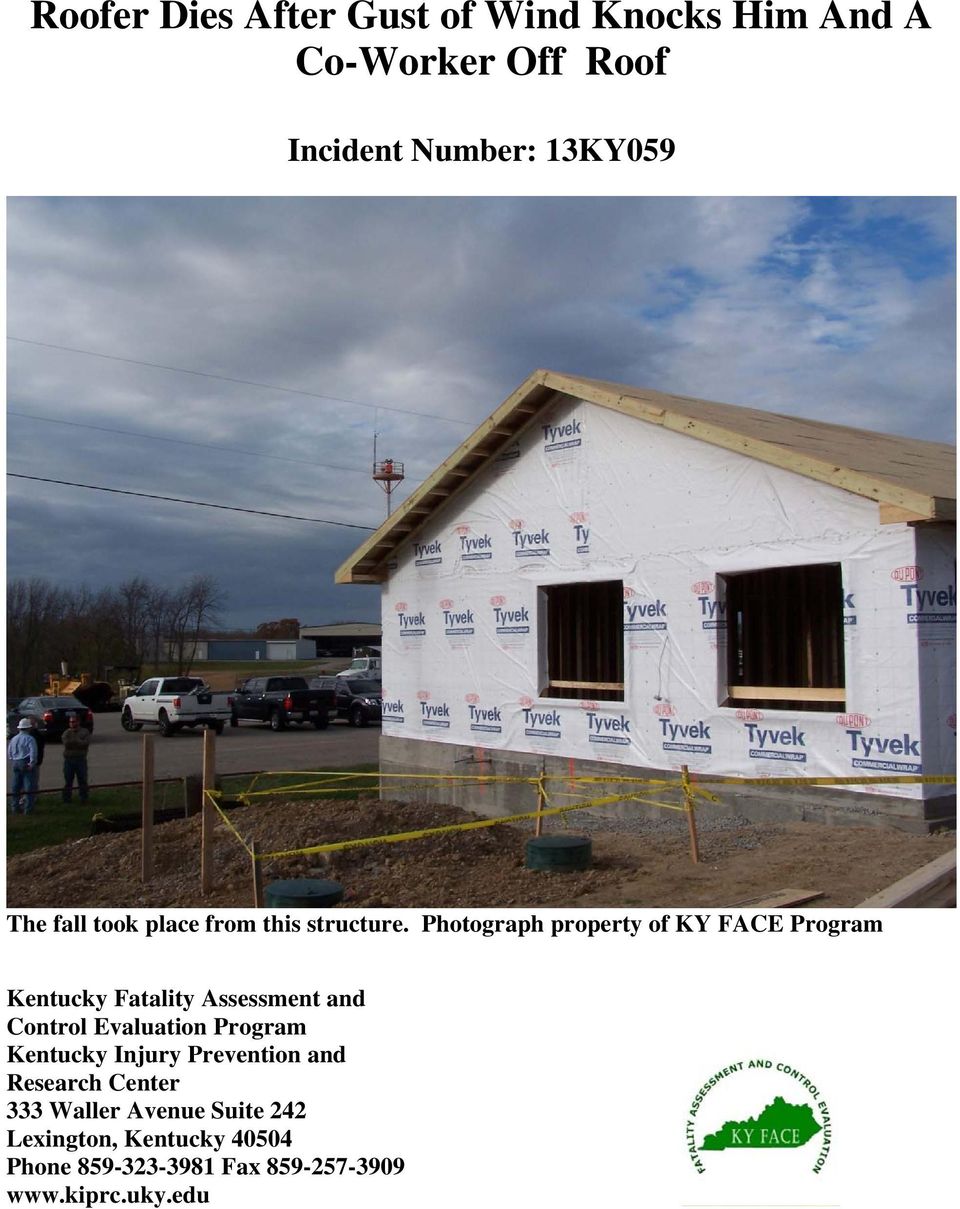
1 Roofer Dies After Gust of Wind Knocks Him And A Co-Worker Off Roof Incident Number: 13KY059 The fall took place from this structure. Photograph property of KY FACE Program Kentucky Fatality Assessment and Control Evaluation Program Kentucky Injury Prevention and Research Center 333 Waller Avenue Suite 242 Lexington, Kentucky Phone Fax
2 Kentucky Fatality Assessment and Control Evaluation (FACE) Program Incident Number: 13KY059 Release Date: Subject: Roofer Dies After Gust of Wind Knocks Him And Co-worker off Roof SUMMARY: Around 11:00 a.m. on a windy fall day, a 73-year-old roofer and a roofing coworker arrived at the commercial construction site to roof a newly constructed building. The two roofers climbed an extension ladder to access the roof to determine where they were going to place their anchors to tie off. While reviewing the backside of the commercial structure, a gust of wind around 33 m.p.h. made the two roofers lose their balance and fall from the roof. The 73-year-old roofer landed first and the second roofer landed on top of him. Both men fell 15 feet and 6 inches and landed on a sloped grassy area. To prevent future occurrences of similar incidents, the following recommendations have been made: Recommendation No. 1: Employers should not allow their roofers to access roofing areas in times of windy, wet, or icy or conditions to prevent falls. Recommendation No. 2: A roofer should use a personal fall protection system during all phases of a roofing job. Recommendation No. 3: Employers should have a written fall protection program in place. Recommendation No. 4: Employers should fully plan their fall protection system before it is used. Background The roofer was a part-time employee for the past five years. He had been a brick mason and was still employed as a part-time farmer who helped the family owned business as he was needed. The roofing company has been in business since 2006 and employs six workers, two of them are roofers. The company has a worker safety program in place and had trained all their employees on working safely. However, the training wasn t specific to fall protection or documented. There was no written fall protection plan but there was a competent person assigned and trained at the time of the incident. On the day of the incident, the temperature ranged from degrees Fahrenheit with no precipitation. The wind was blowing 18 to 20 mph with gusts up to 33 mph.

3 Investigation The Kentucky Fatality Assessment and Control Evaluation Program was notified of by Kentucky Occupational Safety and Health an occupational fatality involving a fall from a roof. A site visit was made the day of the incident and photographs were taken; employees and witnesses interviewed. Around 11:00 a.m. on a windy fall day, a 73-year-old roofer and roofing coworker arrived at the commercial construction site to roof a newly constructed building. The two roofers climbed the extension ladder to access the roof of the one story commercial building, to decide where they were going to place their anchors to tie off. They had not yet put on their personal fall protection gear. While reviewing the backside of the commercial structure, a gust of wind around 33 m.p.h. made the two roofers lose their balance and fall from the roof. At 11:09 a.m., the 73-year-old roofer landed first and the second roofer landed on top of him. Both roofers fell 15 feet 6 inches and landed on a sloped grassy area next to the commercial building. Roofer #2 stated that he heard roofer #1 yell, I m falling. Right after roofer #2 heard roofer #1 yell, roofer #2 knew he was falling as well due to the wind gust and landed on top of roofer #1.Roofer #2 said that they were both looking to see where they were going to install the tie-off anchors and as he turned, a gust of wind came through causing them both to lose their balance and fall 15 feet 6 inches to the ground below. Roofer #2 was very upset. Roofer #2 was related to the roofer #1, who was killed. Roofer #2 said that everything happened so fast and that was all he could remember about the fatal incident. Another sub-contractor, a supervisor for a different company on the jobsite immediately began CPR because Roofer #1 was unresponsive. A call was placed to 911 at 11:14a.m. EMS arrived at 11:25 a.m. and took over. Roofer #1 did not have a pulse and was not breathing. Roofer #1 was transported to the nearest local hospital and was pronounced dead upon arrival at the hospital, at 11:50 a.m. The roofer s body was sent to the state medical examiner s office for autopsy. The toxicology report was negative for substance abuse. Cause of Death The cause of death was blunt force injuries of the head and neck, due to fall. Recommendations and Discussions:

4 Recommendation No. 1: Employers should not allow their roofers to access roofing areas in times of windy, wet, or icy conditions. The weather was the major contributor to the fatal incident since the wind gusts were up to 33 mph and the construction zone was in a flat area. Employers should never allow their roofers to get on the roof during windy situations, wet or iced areas due to possible slips and falls. Employers should adapt to the OSHA standards for scaffolding use (f)(12) that states work on or from scaffolds is prohibited during storms or high winds unless a competent person has determined that is safe for employees to be on the scaffold and those employees are protected by a personal fall arrest system or wind screens. Wind screens shall not be used unless the scaffold is secured against the anticipated wind forces imposed. This same standard should be applied to roofers as well. Recommendation No. 2: A roofer should use a personal fall protection system during all phases of a roofing job. If the roofers had been wearing personal fall protection gear they could have placed their first anchor at the peak of the roof with a minimum of 6 feet from the edge and tied off immediately possibly saving them from the gust of wind that caused them to lose their balance and fall. It is unclear how much impact having one roofer land on the other roofer played into the fatal fall. It is not known if roofer #1 would have survived if this had not been a factor. However, it did add to the force of the trauma. Only one roofer should access the roof to install anchors limiting the exposure. Recommendation No 3 Employers should have a written fall protection program in place. OSHA standard states that an employer shall assure that each employee has been trained as necessary, by a competent person qualified in the following areas: the nature of fall hazards in the work area; the correct procedures for erecting, maintaining, disassembling, and inspecting the fall protection systems to be used: the use and operation of guardrail systems, personal fall arrest systems, safety net systems, warning line systems, safety monitoring systems, controlled access zones, and other protection to be used; the role of each employee in the safety monitoring system when this system issued; the limitations on the use of mechanical equipment during the performance of roofing work on low-sloped roof; the correct procedures for handling and storage of equipment and materials and the erection of overhead protection; and the role of employees in fall protection plans. Training must keep a written certification record containing the name or the employee trained, the dates of training and the signature of the person who conducted the training. Recommendation No. 4 Employers should fully plan their fall protection system before it is used.

5 According to the Construction Industry OSHA standard under fall protection, related to tie off considerations, one of the most important aspects of personal fall protection systems is to fully plan the system before it is put into use. The amount of time your employees are at risk is therefore eliminated. Keywords Construction Roofing Fall protection References CCH safety professional series OSHA Standards for the Construction Industry fall protection Acknowledgements The Kentucky FACE program would like to thank the coroner s office, KYOSH inspectors and KYOSH Safety Supervisor Shannon Lancaster, and the company for their assistance with this report. The Kentucky Fatality Assessment & Control Evaluation Program (FACE) is funded by grant 2U60OH from the Centers for Disease Control and Prevention and the National Institute for Occupational Safety and Health. The purpose of FACE is to aid in the research and prevention of occupational fatalities by evaluating events leading to, during, and after a work related fatality. Recommendations are made to help employers and employees have a safer work environment. For more information about FACE and KIPRC, please visit our website:
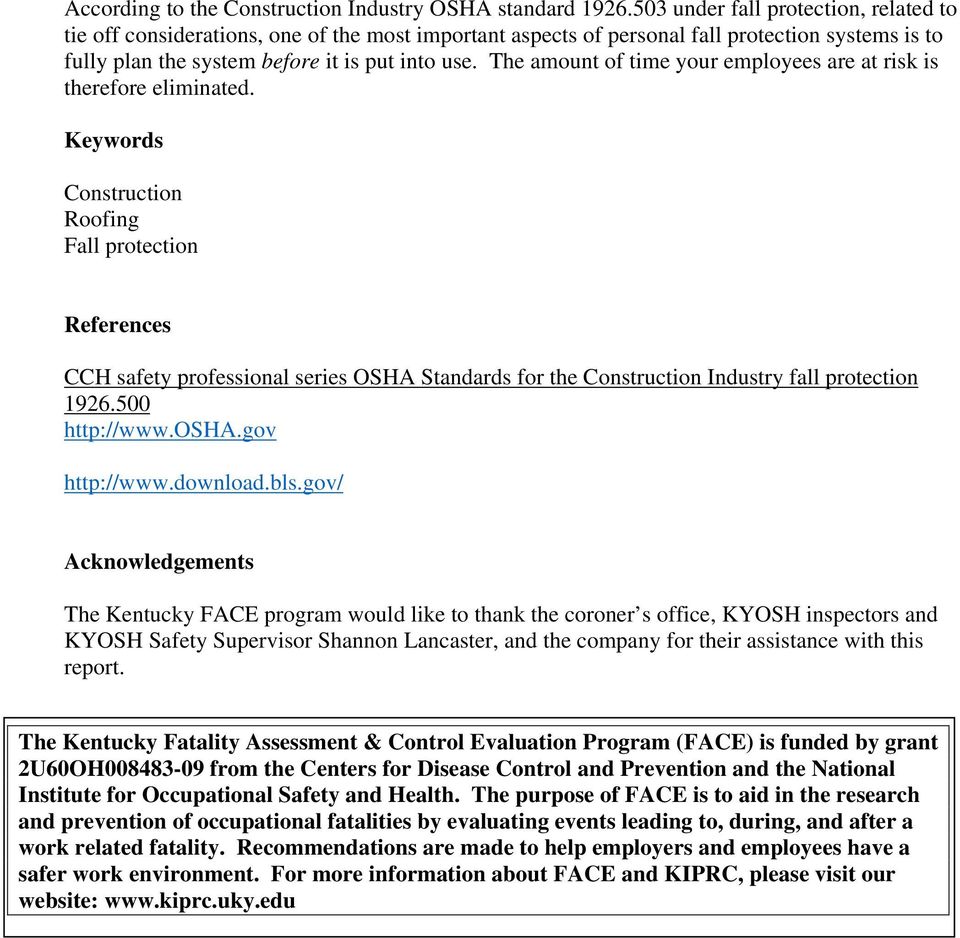
6 Area of impact where employees landed from fall. Photograph property of KY FACE Program
A 53-Year-Old Male Iron Foreman Dies After Fall From Steel Decking
 A 53-Year-Old Male Iron Foreman Dies After Fall From Steel Decking Incident Number: 07KY071 Location where foreman fell. Kentucky Fatality Assessment and Control Evaluation Program Kentucky Injury Prevention
Out-of-State Electrician Electrocuted While Restoring Service at a Personal Residence Incident Number: 08KY065
 Out-of-State Electrician Electrocuted While Restoring Service at a Personal Residence Incident Number: 08KY065 Photo of electrical lines being serviced by electrician. Photograph by KY FACE. Kentucky Fatality
Owner/ Operator Hauling Asphalt Flux Dies After Driving into a Ravine and Striking Trees
 Owner/ Operator Hauling Asphalt Flux Dies After Driving into a Ravine and Striking Trees Incident Number: 11KY072 Photograph of semi involved in this incident. Property of KY FACE. Kentucky Fatality Assessment
F.A.C.E. INVESTIGATION REPORT
 F.A.C.E. INVESTIGATION REPORT Fatality Assessment and Control Evaluation Project FACE #97-NJ-059-01 Air Conditioning Worker Dies After Falling From a Fixed Ladder New Jersey Department of Health and Senior
Does this topic relate to the work the crew is doing? If not, choose another topic.
 TRAINING GUIDE FALL PROTECTION 2001 Before you begin the meeting... Does this topic relate to the work the crew is doing? If not, choose another topic. Did you read this Training Guide and fill in the
Fatality Assessment and Control Evaluation Project. FACE #95-NJ-092-01 Cable TV Installer Killed After Falling 21 Feet From a Ladder
 )$&(,19(67,*$7,215(3257 Fatality Assessment and Control Evaluation Project FACE #95-NJ-092-01 Cable TV Installer Killed After Falling 21 Feet From a Ladder New Jersey Department of Health and Senior Services
Death in the line of duty... June 10, 2002
 F2002 04 Fire Fighter Fatality Investigation and Prevention Program A Summary of a NIOSH fire fighter fatality investigation Death in the line of duty... June 10, 2002 SUMMARY On January 21, 2002, a 26-year-old
Bulldozer Owner / Operator Drowns While Trying to Repair a Pond Incident Number: 03KY073
 Bulldozer Owner / Operator Drowns While Trying to Repair a Pond Incident Number: 03KY073 Location where bulldozer and operator were found. The depth of the water is difficult to determine. The pond is
This material was produced under grant number SH-17792-08-60-F-48 Occupational Safety and Health Administration, U.S. Department of Labor.
 Big Four Construction Hazards: Fall Hazards This material was produced under grant number SH-17792-08-60-F-48 Occupational Safety and Health Administration, U.S. Department of Labor. It does not necessarily
MA FACE Occupational Fatality Report
 MA FACE Occupational Fatality Report Arborist Dies in Fall from a Tree after being Hoisted by a Crane to the Tree - Massachusetts Release Date: September 25, 2013 Investigation: # 11-MA-031-01 Massachusetts
INJURY NARRATIVE. Construction Worker Falls 14 Feet from a Beam onto Concrete and Suffers Serious Brain Injury. Industry: Framing Contractors
 Construction Worker Falls 14 Feet from a Beam onto Concrete and Suffers Serious Brain Injury Industry: Framing Contractors Task: Installing 2 nd story floor trusses Occupation: Construction Worker Type
Does this topic relate to the work the crew is doing? If not, choose another topic.
 TRAINING GUIDE HIGH VOLTAGE LINES 2001 Before you begin the meeting... Does this topic relate to the work the crew is doing? If not, choose another topic. Did you read this Training Guide and fill in the
Level 1 Award in Health and Safety in a Construction Environment
 Level 1 Award in Health and Safety in a Construction Environment Student notes (sample) www.britsafe.org Membership Training Qualifications Audit and Consultancy Audit and Policy Consultancy and Opinion
Safe ladder use. Construction Safety Series. When climbing up or down, workers should:
 Safe ladder use When climbing up or down, workers should: Always face the ladder. Workers must not use ladder-type material hoists for roof access unless the hoists are designed for that purpose. Use a
Los Angeles Fire Depart m ent
 Los Angeles Fire Depart m ent PRELIMINARY REPORT FIREFIGHTER FATALITY TRAFFIC ACCIDENT JAMIESON AVENUE, ENCINO AUGUST 14, 2004 SUBMITTED AUGUST 23, 2004 PRELIMINARY REPORT INFORMATION ON FIREFIGHTER FATALITY
An Introduction to Practical Fall Protection for Pest Control
 An Introduction to Practical Fall Protection for Pest Control Bird control work, to address this problem of birds on the edge of this five-foot-wide parapet some ten stories in the air, is one of many
FALL PROTECTION PROGRAM
 FALL PROTECTION PROGRAM Page 2 of 15 Table of Contents Applicability... 3 Overview... 3 Definitions... 3 Responsibilities... 5 Risk Assessment... 6 Risk Management... 7 Roof Access Procedure 10 Rescue
F.A.C.E. INVESTIGATION REPORT
 F.A.C.E. INVESTIGATION REPORT Fatality Assessment and Control Evaluation Project FACE #94-NJ-009-01 Foreman Crushed to Death After Being Caught in a Screw Conveyor New Jersey Department of Health and Senior
WEEKLY SAFETY MEETING
 Safety Meeting Contents Meeting Notice Leaders Guide Employee Handout Employee Quiz Meeting Sign-In Sheet Employee Puzzle PRIOR TO THE WEEKLY MEETING: - Post the meeting notice by the timeclock - Read
FALL PROTECTION WORK PLAN
 FALL PROTECTION WORK PLAN INSTRUCTIONS A written fall protection work plan must be implemented by each employer on a job site where a fall hazard of 10 feet or greater exists, in accordance with OSHA Standards.
Staying on Your Feet: Fall Prevention for Construction
 Staying on Your Feet: Fall Prevention for Construction Fall Prevention for Construction Falling has been described as a cartoon happening in slow motion. Although seeing a person fall may be funny, injuries
Massachusetts FACE Occupational Fatality Report
 Massachusetts FACE Occupational Fatality Report Massachusetts Department of Public Health Occupational Health Surveillance Program Fatality Assessment and Control Evaluation Project Apprentice Electrician
THE UNIVERSITY OF SHEFFIELD WORK AT HEIGHT POLICY
 THE UNIVERSITY OF SHEFFIELD WORK AT HEIGHT POLICY CONTENTS Page No 1 INTRODUCTION 2 2 LEGISLATION 2 3 HIERARCHY OF CONTROL 2 4 WORK AT HEIGHT POLICY 3 5 ROLES AND RESPONSIBILITIES 3 6 RISK ASSESSMENTS
Fatality Assessment and Control Evaluation Project
 )$&(,19(67,*$7,215(3257 Fatality Assessment and Control Evaluation Project FACE #95-NJ-030-01 Construction Laborer Killed After Being Entangled on a Rotating Directional Drilling Machine Pipe New Jersey
Fall Protection Safe Work Plan Fall Distance of 7.5M or More
 Department of Facilities Management Occupational Health and Safety Fall Protection Safe Work Plan Fall Distance of 7.5M or More When employees are involved in jobs with a risk of falling they must: Shop:
v. OSHRC DOCKET ELGIN ROOFING COMPANY, NO. 99-1477 Administrative Law Judge Sidney J. Goldstein DECISION AND ORDER
 SECRETARY OF LABOR, Complainant, v. OSHRC DOCKET ELGIN ROOFING COMPANY, NO. 99-1477 Respondent. APPEARANCES: Lisa R. Williams, Esq., Office of the Solicitor, U.S. Department of Labor, Chicago, Illinois
EMPLOYEE FALL PROTECTION
 EMPLOYEE FALL PROTECTION You can fall from any height and be seriously injured or killed. In the construction industry, as well as any other industry, when falls from heights happen, they are usually very
Chapter 3: Fall Protection/ Scaffolding Safety
 Chapter 3: Fall Protection/ Scaffolding Safety Learning Objectives In this chapter you will learn to: recognize the hazards commonly associated with work on or around scaffolds; be aware of common scaffold-related
How To File A Worker S Compensation Claim In Azoria
 Workers Compensation Instructions for Filing a Claim Please complete following steps within 24 48 hours of the incident: Report the incident to your supervisor immediately or, if a medical emergency, dial
Fall Protection Plan for Residential Roofing Construction. Tim Graboski Roofing, Inc.
 Fall Protection Plan for Residential Roofing Construction Tim Graboski Roofing, Inc. This Fall Protection Plan Is Specific For the Following Project: Location of Job: Date Plan Prepared or Modified: Plan
RESCUE PLAN FALL PROTECTION PROGRAM
 RESCUE PLAN IMPORTANT: This document is intended to provide guidance only for developing site-specific rescue plans for working at heights. GLOBAL LEADER IN FALL PROTECTION RESCUE PLAN This document is
Fall Protection Susan Harwood Grant Training Program 2013 Commercial Roof Fall Safety. OSHA Susan Harwood Training - AGC
 Fall Protection Susan Harwood Grant Training Program 2013 Commercial Roof Fall Safety Learning Objectives Understand the difference between a low sloped roof and high slope roof Understand the responsibilities
Walking/Work Surfaces Fall Protection Program
 Reviewed: 10-2006 Walking/Work Surfaces Fall Protection Program It is the responsibility of all supervisors and/or administrators to implement this safety program. Their responsibility includes yearly,
Death in the line of duty...
 F-33 Fire Fighter Fatality Investigation A Summary of a NIOSH fire fighter fatality investigation Death in the line of duty... May 25, 2000 Motor-Vehicle Incident Claims the Life of a Volunteer Fire Fighter
Fall Hazards 1/3/2014. Introduction
 Fall Hazards Introduction Fall hazards exist at most construction worksites exposing workers to dangerous work environments on a daily basis. A fall hazard is anything that may cause a person to lose his
Work at Height. John Frontczak Construction Manager Facilities Engineering. 2011 Chevron Corporation. All rights reserved.
 Today Work at Height John Frontczak Construction Manager Facilities Engineering Agenda Definition and Requirements Fall Prevention Scaffolding Safety Fall Protection Fall-Arrest System Rescue Plan Training
working surface can be a potential fall hazard.
 OSHA s Focus Four Mitigating Jobsite Hazards By Pete Rice, CSP, CIH, REHS Construction is among the most dangerous industries in the country. In 2010, data from the Bureau of Labor Statistics (BLS) indicate
Fall Protection Program
 Fall Protection Program Policy: It is the policy of our company to provide fall protection for employees exposed to fall hazards greater than 7 ½ feet. Fall hazards include but, are not limited to; work
OSHA Scaffold Standard for Construction. 29 CFR 1926 Subpart L
 OSHA Scaffold Standard for Construction 29 CFR 1926 Subpart L EH&S Jim Walker What is the revised OSHA scaffold standard for construction? Issued on August 30, 1996 and became effective on November 29,
WORK AT HEIGHT. STFC Safety Code No 9. Rev. 1.4, Issued April, 2015
 WORK AT HEIGHT STFC Safety Code No 9 Rev. 1.4, Issued April, 2015 Note - This document may have been superseded by a more recent version. Revisions 1 Initial Launch November 2007 1.1 Amendments to training
ELEVATED WORK POLICY
 ELEVATED WORK POLICY 1.0 BACKGROUND The purpose of this program is to prevent accidents and injuries to workers from falls and to provide employees with the information for the safe use of fall protection
Fall Prevention In Construction
 Senior Management ViTS July 2014 Fall Prevention In Construction Senior Management ViTS Meeting July 7, 2014 Russ DeLoach Safety & Mission Assurance Kennedy Space Center 1 Senior Management ViTS July 2014
BCIT. CNST 1100 Construction Safety Officer Training. Lesson Plan
 BCIT CNST 1100 Construction Safety Officer Training Lesson Plan BCIT Two Week Outline- CNST 1100 (Please note there may be adjustments made to this outline) Monday- Day #1 Week #1 0730 Paperwork Introductions
Construction OS&H Working at height
 Construction OS&H Working at height Summary Common hazards with working at height General OS&H requirements when working at height Scaffolding Structural frames Demolition of above ground structures Roof-work
ACCIDENT INVESTIGATION GUIDELINES WITH LITIGATION IN MIND
 ACCIDENT INVESTIGATION GUIDELINES WITH LITIGATION IN MIND Introduction The purpose of this paper is to alert the reader to concepts used in the defense of construction related lawsuits and to suggest how
RISK RATING SAFE WORK METHOD STATEMENT 1 HIGH 2 MEDIUM 3LOW. I approve the use of this Safe Work Method Statement: NAME: POSITION: Department Manager
 RISK RATING 1 HIGH 2 MEDIUM 3LOW SAFE WORK METHOD STATEMENT Title: : Working at Height above 2trs Ref No: 1 I approve the use of this Safe Work Method Statement: NAME: POSITION: Department Manager SIGNATURE:
WORKPLACE SAFETY. Table 1: Industries with highest fatalities rates and types of highest fatal* / non fatal^ injuries
 INTERISK ASIA PTE LTD. July 2011 WORKPLACE SAFETY Do you know that the workplace safety is part of everyone s responsibility? And so how many of us are assessing workplace safety naturally like it is part
Independent Contractor Policy
 Independent Contractor Policy This Policy has been implemented to prevent accidents and personal injuries. It is not intended to be entirely inclusive. It is the responsibility of the Independent Contractor
STATE OF MINNESOTA OFFICE OF ADMINISTRATIVE HEARINGS FOR THE DEPARTMENT OF LABOR AND INDUSTRY
 OAH 68-1901-30510 STATE OF MINNESOTA OFFICE OF ADMINISTRATIVE HEARINGS FOR THE DEPARTMENT OF LABOR AND INDUSTRY In the Matter of S.G.O. Roofing and Construction, MN OSH Docket No. 11191, Inspection No.
Elkhorn Construction, Inc. Safety Manual Title: Fall Protection Policy Effective Date: 03-01-2000
 1. General Requirements (OSHA References: OSHA 29 CFR 1926.503) 1.1 Elkhorn Construction, Inc. employee-owners and subcontractors are required to use fall protection equipment or systems when an assessment
COURSE INFORMATION SHEET
 Course ID: HGT - WRKHT COURSE OVERVIEW WORKING AT HEIGHTS Working at Heights is an approved Ontario Ministry of Labour (MOL) program (Approved Training Program ID # WAH56789). This program was designed
Fall Protection Safety Program
 Fall Protection Safety Program ENVIRONMENTAL HEALTH & SAFETY pg. 1 Table of Contents A. Introduction... 3 B. Scope... 3 C. Responsibilities... 3 1. Department... 3 2. Environmental Health & Safety (EHS)...
Life Saving Rules. Working Safely at EPCOR
 Life Saving Rules Working Safely at EPCOR 1 Our Health and Safety Beliefs We believe: All incidents are preventable. HSE is integral to our work and the way we conduct business. HSE is serious and a shared
SAFE WORK PROCEDURE SWP 015 WORKING AT HEIGHT SEPTEMBER 2013 DOC. NO. D13/248399
 Operation Brief Description of Activity Limitations MORELAND CITY COUNCIL Operations Centre 7-9 Walter Street Hadfield Vic 3046 Tel: 8311 4300 Working at height Approved by the Walter Street OHS committee
SITE SPECIFIC FALL PROTECTION PLAN
 1 THIS PLAN IS SPECIFIC TO: PROJECT & ADDRESS 1.1 THIS PLAN IS SPECIFIC TO THE FOLLOWING AREA(S) ON SITE: Parkade level: Typical level: Other: Between G/L: 1.2 THIS PLAN IS APPLICABLE TO THE FOLLOWING
NEW! Highway Construction Training Offered at Richland
 Volume 2, Issue 8 January 2015 Richland is a Host Training Organization for the National Safety Education Center, an OSHA Training Institute OSHA 503 Update for General Industry Trainers January 27-29
SAFETY STAND DOWN Focus Four Hazards
 SAFETY STAND DOWN Focus Four Hazards This information is to help you organize your Stand Down. This is a suggested agenda for the onsite supervision. Please review prior to facilitating the material. Summary
`Fall Protection Guidelines in Construction
 `Fall Protection Guidelines in Construction A Publication Provided by: 1681 Campus Delivery Fort Collins, Colorado 80523 (970) 491-6151 email: [email protected] web: http://www.bernardino.colostate.edu/public/
RRC SAMPLE MATERIAL WORKING AT HEIGHT- HAZARDS AND RISK CONTROL LEARNING OUTCOMES
 Managing and Controlling Hazards in International Construction Activities WORKING AT HEIGHT- HAZARDS AND RISK CONTROL ELEMENT 10 LEARNING OUTCOMES On completion of this element, you should be able to demonstrate
RESIDENTIAL ROOF TRUSS INSTALLATION PROCEDURES
 RESIDENTIAL ROOF TRUSS INSTALLATION PROCEDURES Construction Safety Association of Ontario, October 2008 Prepared for the Low-Rise Residential Trade Labour-Management Health and Safety Committee CONTENTS
Fall Protection Training Guidebook
 From the Field By Tony Smith, ISRI Safety Outreach Director Fall Protection Training Guidebook Gravity is a force that we are all bound to and falling or having an object fall on us is something that we
68 Metal Industry Guidelines for Safe Work
 3 68 Metal Industry Guidelines for Safe Work section 3 high-risk 3 activities Metal Industry Guidelines for Safe Work 69 section 3 high risk activities 3.1 working at heights Falls from heights have been
Slips, Trips and Falls. AR 2012 DMME Division of Mineral Mining
 Slips, Trips and Falls AR 2012 DMME Division of Mineral Mining It Doesn t Take Much Since the beginning of 2008, 14 miners have died from injuries sustained in falls at M/NM mines. Several were wearing
Environment, Health and Safety Technical Guidance
 Environment, Health and Safety Technical Guidance SOP-06 Working at Height Produced by Environment & Safety Office Campus Facilities Department Table of Contents 1 Overview... 1 1.1 Purpose... 1 1.2 Hazards
7. PRINCIPAL STEPS 8. POTENTIAL HAZARDS 9. RECOMMENDED CONTROLS
 ACTIVITY HAZARD ANALYSIS (AHA) 1. Contract Number: 2. Contractor Name: 3. Date prepared: 4. Title/Activity Performed: FIXED SCAFFOLDING 5. Location: 6. Estimated Date of Completion: 7. PRINCIPAL STEPS
ELECTRICAL SAFETY & ARC FLASH Handbook
 Electricity Forum Handbooks Electrical Safety and Arc Flash Handbook Series ELECTRICAL SAFETY & ARC FLASH Handbook Volume 10 Reprinted by permission of the publisher, Hurst Communications, from the Electrical
Fall Protection Basics for Construction Activities
 Fall Protection Basics for Construction Activities Washington State has revised fall protection rules, effective April 1, 2013. This booklet provides an overview of the requirements. www.lni.wa.gov/safety
Fall Protection Susan Harwood Grant Training Program 2013 Wood Frame Construction
 WRONG BETTER Fall Protection Susan Harwood Grant Training Program 2013 Wood Frame Construction Learning Objectives Understand how OSHA defines residential construction Understand the proper use of guardrails
Slips, Trips and Falls
 Slips, Trips and Falls Introduction o Slips, trips and falls cause: The majority of general industry accidents 15 percent of all accidental deaths (~12,000/yr) More fatalities than all other causes but
CONSTRUCTION. Protect Them. Sons And Daughters.
 CONSTRUCTION SAFETYmagazine S P E C I A L I S S U E YOUNG WORKERS Sons And Daughters. Protect Them As Protect Protect You Would Them Them As Your As You You Own Would Would Sons And Your Your Daughters.
Injury Prevention for the Construction Industry
 Injury Prevention for the Workers in the construction industry encounter a variety of hazards, some of which can lead to serious injuries and fatalities. This fact sheet: Increases awareness of the primary
A Great Workforce A Great Workplace. 19 August 2015 OSH Inspectorate OSHD, MOM
 Construction Accident Updates and Case Studies 19 August 2015 OSH Inspectorate OSHD, MOM 1 Overview Safety Performance of Construction Industry Bad Practices Case Studies Learning Points 2015 Government
Fixed and Portable Ladders- A Guide to OSHA Rules
 Fixed and Portable Ladders- A Guide to OSHA Rules Introduction Working on and around stairways and ladders is hazardous. Stairways and ladders are major sources of injuries and fatalities among construction
Director, National Institute for Occupational Safety and Health. California Fatality Assessment and Control Evaluation (CA/FACE) Program
 TO: FROM: SUBJECT: Director, National Institute for Occupational Safety and Health California Fatality Assessment and Control Evaluation (CA/FACE) Program An Automotive Mechanic Dies from Thermal Burns
WALKING-WORKING SURFACES (SLIPS, TRIPS, AND FALLS)
 WALKING-WORKING SURFACES (SLIPS, TRIPS, AND FALLS) Slips, trips, and falls constitute the majority of general industry accidents. They cause 15% of all accidental deaths, and are second only to motor vehicles
Total s Golden rules
 Total s Golden rules Golden rule No. 10: Work at height A century ago Shocking, right? And yet it s still happening today Foreword The Group s activities all involve work at height, at varying frequencies.
Fall Protection. Office of Risk Management. uottawa.ca. Guide
 Fall Protection Guide Office of Risk Management.ca 1 Contents SCOPE... 1 INTENT... 1 LEGISLATION AND REQUIREMENTS... 1 RESPONSABILITIES... 2 Supervisors... 2 Workers... 2 Facilities... 2 HAZARD CONTROL...
Fact Sheet Fatality Inspections Construction Safety & Health Division Fatal Accident 01/11/12 at the Ambassador Bridge
 RICK SNYDER GOVERNOR STATE OF MICHIGAN DEPARTMENT OF LICENSING AND REGULATORY AFFAIRS MICHIGAN OCCUPATIONAL SAFETY AND HEALTH ADMINISTRATION MARTHA B.YODER DIRECTOR STEVEN H. HILFINGER DIRECTOR Fact Sheet
OSHA GUIDANCE DOCUMENT FALL PROTECTION IN RESIDENTIAL CONSTRUCTION
 OSHA GUIDANCE DOCUMENT FALL PROTECTION IN RESIDENTIAL CONSTRUCTION OSHA GUIDANCE DOCUMENT FALL PROTECTION IN RESIDENTIAL CONSTRUCTION Table of Contents Executive Summary... 1 Introduction... 1 Installing
Fixed Access Ladders. Table of Contents. 1. Legislative Requirements
 Fixed Access Ladders Engineering Data Sheet 2-04 Revised: January 1997 Table of Contents 1. Legislative Requirements 2. General 3. Rungs 4. Side Rails 5. Safety Cages 6. Attachment & Anchoring 7. Platforms
Walking and Working Surface Checklist:
 Walking and Working Surfaces Purpose: This information is presented to improve the level of safety in our operations, and to inform you that we will comply with the OSHA Standard 29 CFR 1910.23. Responsibility: