
A NON-TRADITIONAL CLASS STRUCTURE FOR INTRODUCTORY PROGRAMMING, USING TABLET PC S
|
|
|
- Daniella Nash
- 10 years ago
- Views:
Transcription
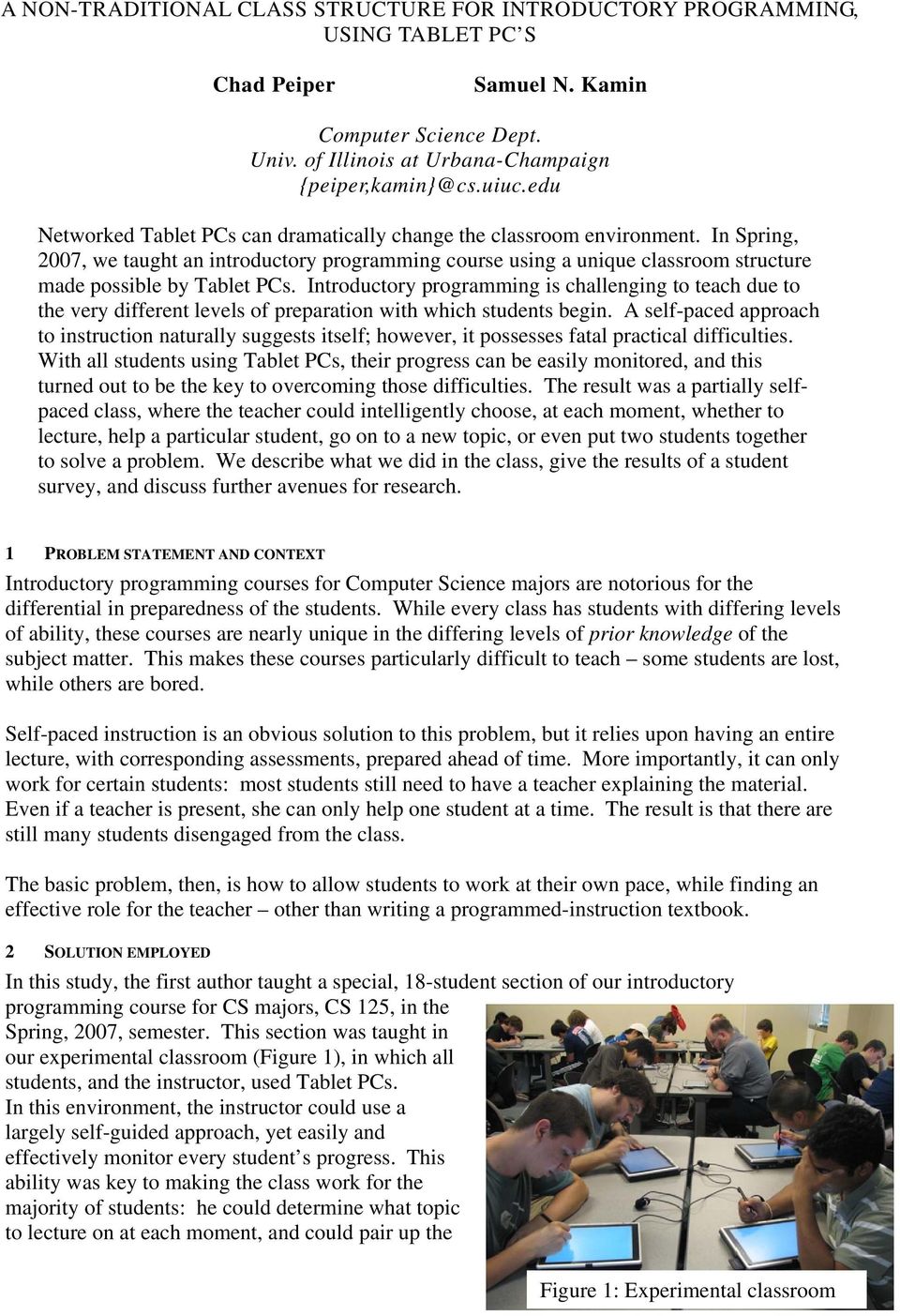
1 A NON-TRADITIONAL CLASS STRUCTURE FOR INTRODUCTORY PROGRAMMING, USING TABLET PC S Chad Peiper Samuel N. Kamin Computer Science Dept. Univ. of Illinois at Urbana-Champaign {peiper,kamin}@cs.uiuc.edu Networked Tablet PCs can dramatically change the classroom environment. In Spring, 2007, we taught an introductory programming course using a unique classroom structure made possible by Tablet PCs. Introductory programming is challenging to teach due to the very different levels of preparation with which students begin. A self-paced approach to instruction naturally suggests itself; however, it possesses fatal practical difficulties. With all students using Tablet PCs, their progress can be easily monitored, and this turned out to be the key to overcoming those difficulties. The result was a partially selfpaced class, where the teacher could intelligently choose, at each moment, whether to lecture, help a particular student, go on to a new topic, or even put two students together to solve a problem. We describe what we did in the class, give the results of a student survey, and discuss further avenues for research. 1 PROBLEM STATEMENT AND CONTEXT Introductory programming courses for Computer Science majors are notorious for the differential in preparedness of the students. While every class has students with differing levels of ability, these courses are nearly unique in the differing levels of prior knowledge of the subject matter. This makes these courses particularly difficult to teach some students are lost, while others are bored. Self-paced instruction is an obvious solution to this problem, but it relies upon having an entire lecture, with corresponding assessments, prepared ahead of time. More importantly, it can only work for certain students: most students still need to have a teacher explaining the material. Even if a teacher is present, she can only help one student at a time. The result is that there are still many students disengaged from the class. The basic problem, then, is how to allow students to work at their own pace, while finding an effective role for the teacher other than writing a programmed-instruction textbook. 2 SOLUTION EMPLOYED In this study, the first author taught a special, 18-student section of our introductory programming course for CS majors, CS 125, in the Spring, 2007, semester. This section was taught in our experimental classroom (Figure 1), in which all students, and the instructor, used Tablet PCs. In this environment, the instructor could use a largely self-guided approach, yet easily and effectively monitor every student s progress. This ability was key to making the class work for the majority of students: he could determine what topic to lecture on at each moment, and could pair up the Figure 1: Experimental classroom
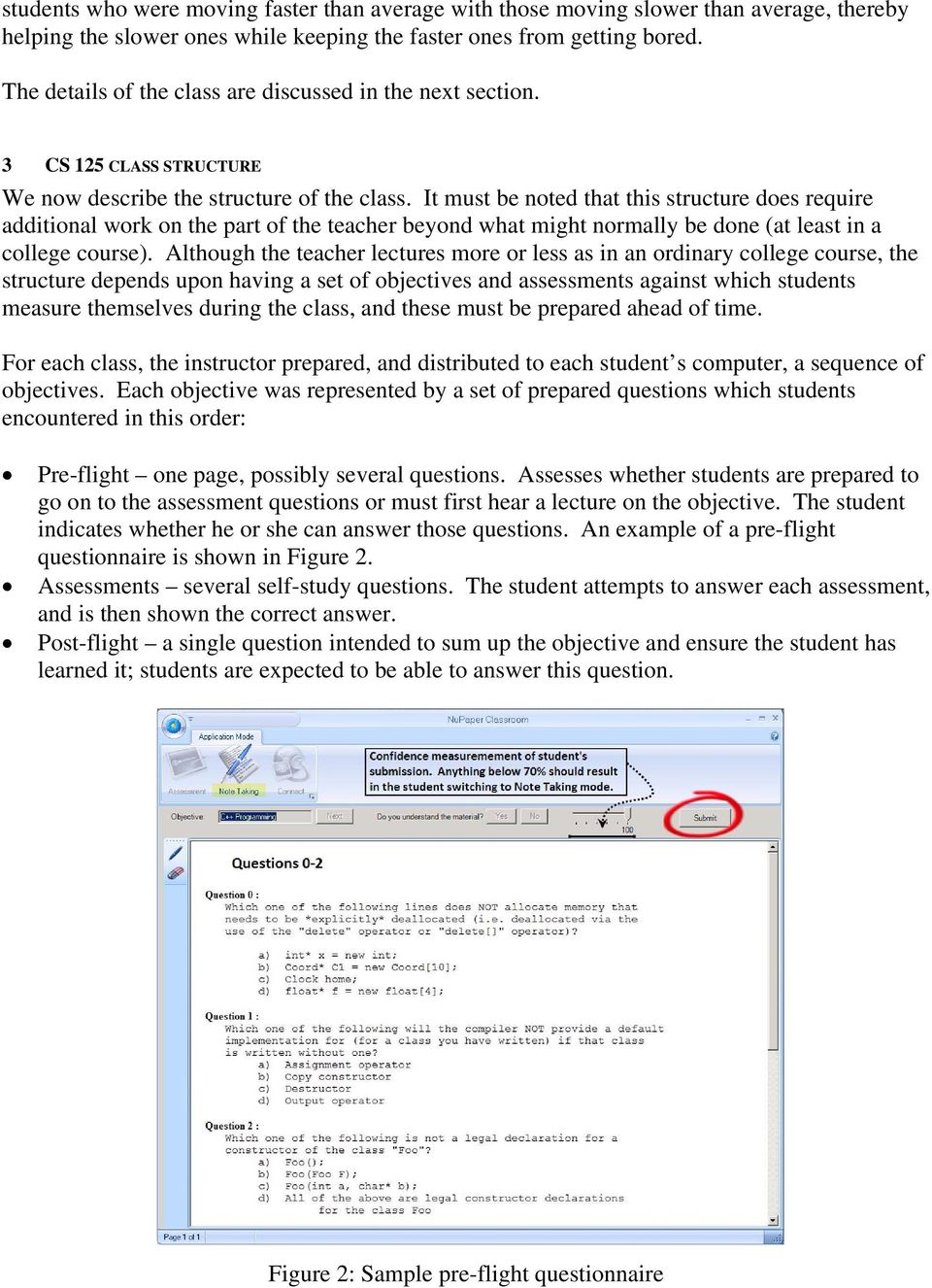
2 students who were moving faster than average with those moving slower than average, thereby helping the slower ones while keeping the faster ones from getting bored. The details of the class are discussed in the next section. 3 CS 125 CLASS STRUCTURE We now describe the structure of the class. It must be noted that this structure does require additional work on the part of the teacher beyond what might normally be done (at least in a college course). Although the teacher lectures more or less as in an ordinary college course, the structure depends upon having a set of objectives and assessments against which students measure themselves during the class, and these must be prepared ahead of time. For each class, the instructor prepared, and distributed to each student s computer, a sequence of objectives. Each objective was represented by a set of prepared questions which students encountered in this order: Pre-flight one page, possibly several questions. Assesses whether students are prepared to go on to the assessment questions or must first hear a lecture on the objective. The student indicates whether he or she can answer those questions. An example of a pre-flight questionnaire is shown in Figure 2. Assessments several self-study questions. The student attempts to answer each assessment, and is then shown the correct answer. Post-flight a single question intended to sum up the objective and ensure the student has learned it; students are expected to be able to answer this question. Figure 2: Sample pre-flight questionnaire
3 Note that each of the questions is self-graded, in the sense that the student sees the correct answer and compares it to his or her own answer. There is, in other words, no automatic grading (and the teacher obviously does not have time to grade these assessments in real time). The flow of an entire class session is shown in the following figure. As shown, when a student indicates that she is unable to complete a pre-flight, she is placed in note-taking mode, which might also be called listening-to-teacher-lecture mode. If she does feel confident of being able to answer the pre-flight meaning that she feels she already knows the material in this objective she goes on to assessments. When she has answered those questions (to her own satisfaction), she can proceed to the pre-flight for the next objective. Because students come to class differently prepared, and learn at a different pace, there will be students in various stages: some doing assessments (for various objectives), and some in notetaking mode (again, for various objectives). This is where the use of the Tablet PCs is essential, because it allows the instructor to know where each student is, and make decisions accordingly. Specifically, the instructor sees the state of the class on a dashboard like this one:

4 Armed with this information, the instructor can make a choice among a variety of alternatives. Suppose the entire class has gone past objective n: If the majority of students are in note-taking mode for objective n+1 that is, they have reported that they cannot answer the pre-flight for this objective then the instructor will lecture on that topic. (Objectives are designed to be taught in minutes.) If the majority of students have passed beyond objective n+1, but a small number of students are still in the assessments phase, the instructor may repeat the lecture for them (or provide individual assistance, if there is just one such student). He may also force them to objective n+2. (They can return to objective n+1 after class.) If a student has gone past objective n+2, he may pair him with a student working on an earlier objective. This may involve physically moving the students (and their Tablets) to be next to each other. The overall effect is that the instructor can lecture to the majority of the class, on just the topic that they need to learn, offer individual assistance to students when needed, and keep the more advanced students from disengaging. He may not be able to address every student s needs optimally, but the dashboard allows him to make intelligent decisions about where to address his efforts.

5 4 EVALUATION At the end of the spring semester, we administered a survey to assess the students attitudes toward the technology. (Because the instructor was also a researcher, there was little point in asking him to fill out a survey.) Several of the questions asked about specifics of the class, or asked speculative questions about possible future enhancements of the technology; we omit those for lack of space. The ones that directly asked students to compare the class with lo-tech classes were these: 1. The classroom lecture was more engaging or interesting to me as result of the use of technology in class and the availability of notes afterwards. 2. Because captured lecture notes are available after class, I was able to better pay attention to the lecture. 10. All things being otherwise equal, I would prefer to take a class that uses Tablet PC technology over the same class that does not. 11. Tablet PC technology will encourage students to skip lectures. 12. Tablet PC technology made me less worried about missing class. This table gives the results from this survey. Clearly, the students had a positive feeling about the technology. (One student was not able to complete the survey.) Question Strongly agree Agree Neutral Disagree Strongly disagree No answer FUTURE WORK Since this work was done, we have been studying teacher s dashboards in more detail (to be reported in Peiper s forthcoming PhD thesis). In studies this year, we have used dashboards in high school classes. The important point about these newer studies is that we have attempted to provide a benefit to the teacher improved transparency of the classroom without requiring a change in teaching methods or development of new materials. That is, while the current study points to new ways of structuring the classroom experience, we believe that a dashboard can be a useful adjunct to any classroom. Further, we believe this can be a particularly fruitful field for research. The broad issue is how to present the activities of an entire class to the teacher so that she can obtain actionable intelligence quickly (even in large classrooms). This involves deep questions of visual presentation, user-interface design, and computer analysis of handwriting data. 6 ACKNOWLEDGEMENTS The authors wish to thank Boris Capitanu, who provided substantial help with the programming for this experiment.

COMPARISON OF INTERNET AND TRADITIONAL CLASSROOM INSTRUCTION IN A CONSUMER ECONOMICS COURSE
 Journal of Family and Consumer Sciences Education, Vol. 20, No. 2, Fall/Winter 2002 COMPARISON OF INTERNET AND TRADITIONAL CLASSROOM INSTRUCTION IN A CONSUMER ECONOMICS COURSE Debbie Johnson Southeastern
TABLET PCs IN A CODE REVIEW CLASS
 TABLET PCs IN A CODE REVIEW CLASS Technology in Practice strand Sam Kamin Computer Science Dept. University of Illinois [email protected] Wade Fagen Computer Science Dept. University of Illinois [email protected]
A SUCCESSFUL STAND ALONE BRIDGE COURSE
 A SUCCESSFUL STAND ALONE BRIDGE COURSE Joann Segovia* Professor Minnesota State University Moorhead 1104 7th Avenue South Moorhead, MN 56563 Phone: (218) 477-4067 E-Mail: [email protected] James Hansen
STUDENT SATISFACTION. Computer Networks and Distributed Systems
 STUDENT SATISFACTION Below are sample student comments from the module feedback questionnaires, in response to the question: Please describe what you liked most about the module and why. The complete set
Phase 2 The System Specification
 Team W2 Video-Conferencing-Based Classroom Extension Sergio Bana Andrew Carland Matt Dyson Sarah Jordan Andrew Wantuch Phase 2 The System Specification 1 P a g e TABLE OF CONTENTS 1. INTRODUCTORY PROBLEM
Teaching Phonetics with Online Resources
 Teaching Phonetics with Online Resources Tien-Hsin Hsing National Pingtung University of Science of Technology, Taiwan [email protected] Received October 2014; Revised December 2014 ABSTRACT. This
CHAPTER 4 RESULTS. four research questions. The first section demonstrates the effects of the strategy
 CHAPTER 4 RESULTS This chapter presents the statistical analysis of the collected data based on the four research questions. The first section demonstrates the effects of the strategy instruction on the
Integrating Reading and Writing for Effective Language Teaching
 Integrating Reading and Writing for Effective Language Teaching Ruwaida Abu Rass (Israel) Writing is a difficult skill for native speakers and nonnative speakers alike, because writers must balance multiple
EMBRACING TECHNOLOGY TO ACHIEVE RESULTS WHAT IS LEARNSMART? HOW LEARNSMART BENEFITS EDUCATORS
 McGraw-Hill LearnSmart Effectiveness Study Evaluating the adaptive learning tool s impact on pass and retention rates and instructional efficiencies at seven U.S. universities EMBRACING TECHNOLOGY TO ACHIEVE
V. Course Evaluation and Revision
 V. Course Evaluation and Revision Chapter 14 - Improving Your Teaching with Feedback There are several ways to get feedback about your teaching: student feedback, self-evaluation, peer observation, viewing
Student Achievement and Satisfaction in Introductory Psychology: No Significant Differences Between Face- to- Face and Hybrid Sections
 Student Achievement and Satisfaction in Introductory Psychology: No Significant Differences Between Face- to- Face and Hybrid Sections Final L. L. Stewart Faculty Development Fund Report Kathryn Becker-
EASTERN ARIZONA COLLEGE Differential Equations
 EASTERN ARIZONA COLLEGE Differential Equations Course Design 2015-2016 Course Information Division Mathematics Course Number MAT 260 (SUN# MAT 2262) Title Differential Equations Credits 3 Developed by
Using ipads in Undergraduate Mathematics
 Using ipads in Undergraduate Mathematics Eric J. Thornburg This paper was completed and submitted in partial fulfillment of the Master Teacher Program, a 2-year faculty professional development program
Ready to Teach Online?: A Continuum Approach
 Ready to Teach Online?: A Continuum Approach Raejean C. Young Program Coordinator/Adjunct Instructor, Department of Adult Education Indiana University Purdue University Indianapolis Mary A. Chamberlin
Introduction. The busy lives that people lead today have caused a demand for a more convenient method to
 On-Line Courses: A Comparison of Two Vastly Different Experiences by Sharon Testone, Ph.D. Introduction The busy lives that people lead today have caused a demand for a more convenient method to gain a
Using online mini lectures in your teaching delivery. Ralf Becker Economics, School of Social Sciences
 Using online mini lectures in your teaching delivery Ralf Becker Economics, School of Social Sciences So you think you are a good lecturer Why? What makes you a great teacher? You speak clearly and your
Insights from Today s Student
 Insights from Today s Student The Not-So-Powerful PowerPoint : Students Weigh the Best Classes against the Worst ENGAGED WITH YOU cengage.com White Paper: The Not-So-Powerful PowerPoint : Students Weigh
TEACHING OF INDEPENDENT STUDY CLASSES: RESULTS FROM THE FACULTY SENATE SURVEY
 Findings for All Colleges TEACHING OF INDEPENDENT STUDY CLASSES: RESULTS FROM THE FACULTY SENATE SURVEY A large minority of respondents (39.82%) report teaching independent study classes. A large majority
ebooks: Going Digital In this time of migration from print to digital content, knowledge is power. Are you equipped to navigate the world of ebooks?
 ebooks: Going Digital In this time of migration from print to digital content, knowledge is power. Are you equipped to navigate the world of ebooks? Understanding ebooks ebooks are as diverse as the people
CLASSROOM ASSESSMENT TECHNIQUE EXAMPLES
 CLASSROOM ASSESSMENT TECHNIQUE EXAMPLES By Thomas A. Angelo and K. Patricia Cross From Classroom Assessment Techniques: A Handbook for College Teachers, 2nd Ed. Fifty Classroom Assessment Techniques are
Assessing the Impact of a Tablet-PC-based Classroom Interaction System
 STo appear in Proceedings of Workshop on the Impact of Pen-Based Technology on Education (WIPTE) 2008. Assessing the Impact of a Tablet-PC-based Classroom Interaction System Kimberle Koile David Singer
Learning-Focused Introduction. Introduction By Dr. Mills
 Learning-Focused Introduction Introduction By Dr. Mills What is the Learning-Focused Strategies Model? A framework for thinking about planning, and delivering instruction using EXEMPLARY practices with
Undergraduate Students Perceptions and Preferences of Computer mediated Communication with Faculty. Jennifer T. Edwards
 Undergraduate Students Perceptions and Preferences of Computer mediated Communication with Faculty Jennifer T. Edwards Keywords: Computer Mediated Communication, Student/Faculty Communication, Communication
Academic Program Review SUMMARY* Department under review: Computer Science. Date self-study received in Dean s office: November 21, 2013
 Academic Program Review SUMMARY* Department under review: Computer Science Date self-study received in Dean s office: November 21, 2013 Date of external consultant s review: November 2013 Date APR received
REDESIGNING STUDENT LEARNING ENVIRONMENTS
 REDESIGNING STUDENT LEARNING ENVIRONMENTS TODAY S DISCUSSION Overview of the Methodology and Findings of the Successful Redesign Projects Proven Models for Successful Redesign Established in 1999 as a
Formative Evaluations in Online Classes. course improvements is also increasing. However, there is not general agreement on the best
 The Journal of Educators Online-JEO January 2016 ISSN 1547-500X Vol 13 Number 1 1 Formative Evaluations in Online Classes Jennifer L. Peterson, Illinois State University, Normal, IL., USA Abstract Online
AC 2012-3012: TABLET COMPUTERS AND INKSURVEY SOFTWARE IN A COLLEGE ENGINEERING STATISTICS COURSE: HOW ARE STU- DENTS LEARNING AND ATTITUDES IMPACTED?
 AC 2012-3012: TABLET COMPUTERS AND INKSURVEY SOFTWARE IN A COLLEGE ENGINEERING STATISTICS COURSE: HOW ARE STU- DENTS LEARNING AND ATTITUDES IMPACTED? Tonya Lynn Lauriski-Karriker, Colorado School of Mines
Saxon Homeschool Math Scope and Sequence
 hmhco.com Saxon Homeschool Math Scope and Sequence Saxon Philosophy The unique structure of Saxon Math promotes student success through the proven educational practices of incremental development and continual
Psychology. Administered by the Department of Psychology within the College of Arts and Sciences.
 Psychology Dr. Spencer Thompson, Professor, is the Chair of Psychology and Coordinator of Child and Family Studies. After receiving his Ph.D. in Developmental Psychology at the University of California,
University of Illinois Department of Computer Science Goals, Objectives, and Assessments January 2009
 University of Illinois Department of Computer Science Goals, Objectives, and Assessments January 2009 Introduction The University of Illinois Computer Science Department is among the oldest CS departments
Student Feedback: Improving the Quality through Timing, Frequency, and Format
 Student Feedback: Improving the Quality through Timing, Frequency, and Format Travis Habhab and Eric Jamison This paper was completed and submitted in partial fulfillment of the Master Teacher Program,
A Comparison of Student Performance in an Online with traditional Based Entry Level Engineering Course
 Session # 1120 A Comparison of Student Performance in an Online with traditional Based Entry Level Engineering Course Ismail I. Orabi, Ph.D. Professor of Mechanical Engineering School of Engineering and
Student Success in Business Statistics
 JOURNAL OF ECONOMICS AND FINANCE EDUCATION Volume 6 Number 1 Summer 2007 19 Student Success in Business Statistics Carolyn F. Rochelle and Douglas Dotterweich 1 Abstract Many universities require Business
A critique of the length of online course and student satisfaction, perceived learning, and academic performance. Natasha Lindsey
 Running head: LENGTH OF ONLINE COURSE STUDENT SATISFACTION 1 A critique of the length of online course and student satisfaction, perceived learning, and academic performance Natasha Lindsey University
Internet classes are being seen more and more as
 Internet Approach versus Lecture and Lab-Based Approach Blackwell Oxford, TEST Teaching 0141-982X Journal Original XXXXXXXXX 2008 The compilation UK Articles Statistics Publishing Authors Ltd 2008 Teaching
Motivated Strategies for Learning Questionnaire. Part A. Motivation
 Motivated Strategies for Learning Questionnaire Part A. Motivation The following questions ask about your motivation for and attitudes about you continuing in or enrolling in an educational program. Remember
Suggested Strategies for Student Engagement
 Suggested Strategies for Student Engagement The following strategies were developed by the Health & Exercise Science Division to align with the research-based conference of the Community College Survey
Concordia University Course Evaluation Survey: Summary Report
 Concordia University Course Evaluation Survey: Summary Report Introduction In fall 2010, the Vice-Provost, Teaching and Learning engaged the Institutional Planning Office to conduct a survey of student
Teaching Improvement Plans
 Teaching Improvement Plans Feedback and guidance are the most essential parts of developing the skills of a new teacher. Many times administrators do not have time to give proper feedback and support for
Evaluating Different Methods of Delivering Course Material: An Experiment in Distance Learning Using an Accounting Principles Course
 Evaluating Different Methods of Delivering Course Material: An Experiment in Distance Learning Using an Accounting Principles Course Alexander R. Vamosi, Florida Institute of Technology Barbara G. Pierce,
Assessing the effectiveness of Tablet PC-based instruction
 Assessing the effectiveness of Tablet PC-based instruction Cherian P. Mathews, Rahim Khoie Department of Electrical and Computer Engineering University of the Pacific, Stockton, CA Abstract Engineering
Using A Learning Management System to Facilitate Program Accreditation
 Using A Learning Management System to Facilitate Program Accreditation Harry N. Keeling, Ph.D. Howard University Department of Systems and Computer Science College of Engineering, Architecture and Computer
CENTRAL TEXAS COLLEGE INDUSTRIAL TECHNOLOGY DEPARTMENT SYLLABUS FOR ARTC 1327 TYPOGRAPHY
 I. INTRODUCTION CENTRAL TEXAS COLLEGE INDUSTRIAL TECHNOLOGY DEPARTMENT SYLLABUS FOR ARTC 1327 TYPOGRAPHY SEMESTER HOURS CREDIT: 3 CONTRACT HOURS: 96 INSTRUCTOR: OFFICE HOURS: A. A study of letterforms
Online Computer Science Degree Programs. Bachelor s and Associate s Degree Programs for Computer Science
 Online Computer Science Degree Programs EDIT Online computer science degree programs are typically offered as blended programs, due to the internship requirements for this field. Blended programs will
BAPTIST MISSIONARY ASSOCIATION THEOLOGICAL SEMINARY. GRK 411c Greek Grammar I COURSE SYLLABUS. Fall-ONLINE-2015 Developed July 2015
 BAPTIST MISSIONARY ASSOCIATION THEOLOGICAL SEMINARY GRK 411c Greek Grammar I COURSE SYLLABUS Fall-ONLINE-2015 Developed July 2015 INSTRUCTOR: James D. Shine (MA, MDiv, DD, PhD studies) COURSE DESCRIPTION:
GRADUATE STUDENT SATISFACTION WITH AN ONLINE DISCRETE MATHEMATICS COURSE *
 GRADUATE STUDENT SATISFACTION WITH AN ONLINE DISCRETE MATHEMATICS COURSE * Amber Settle DePaul University 243 S. Wabash Avenue Chicago, IL 60604 (312) 362-5324 [email protected] Chad Settle University
College of Education. Special Education
 357 INITIAL PRACTICUM IN SPECIAL EDUCATION. (1) An introductory supervised field experience for special education majors. Students will participate in two special education programs as teacher aides. Placements
Interactive Computer Software in College Algebra
 Interactive Computer Software in College Algebra Margo Alexander, Ph.D. Department of Mathematics & Computer Science Georgia State University University Plaza Atlanta, GA 30303 Phone: (404) 651-0680 Fax:
Students Perceptions of Distance Learning, Online Learning and the Traditional Classroom
 1 of 10 Students Perceptions of Distance Learning, Online Learning and the Traditional Classroom John O'Malley, Department of Management and Business Systems Harrison McCraw, Department of Accounting and
EDD- 7914 Curriculum Teaching and Technology by Joyce Matthews Marcus Matthews France Alcena
 EDD- 7914 Curriculum Teaching and Technology by Joyce Matthews Marcus Matthews France Alcena Assignment 1: Online Technology for Student Engagement: Kahoot Instructor: Dr. Shirley Walrod Nova Southeastern
EASTERN ARIZONA COLLEGE Contemporary Sports Management
 EASTERN ARIZONA COLLEGE Contemporary Sports Management Course Design 2014-2015 Course Information Division Business Course Number BUS 214 Title Contemporary Sports Management Credits 3 Developed by Greg
Teaching large lecture classes online: Reflections on engaging 200 students on Blackboard and Facebook
 Teaching large lecture classes online: Reflections on engaging 200 students on Blackboard and Facebook By Marcus Messner, Ph.D. Assistant Professor, VCU School of Mass Communications VCU Online Learning
National-Louis University Wheeling, Illinois
 Wheeling, Illinois 2010 GRADUATE SPECIAL EDUCATION Teacher Preparation Program Design C- The design of this program is enhanced by its selectivity, but there are critical elements in need of improvement.
Distance Education Moves into the 21 st Century: A Comparison of Delivery Methods. Anita L. Callahan, Paul E. Givens, Russell G.
 Session 2542 Distance Education Moves into the 21 st Century: A Comparison of Delivery Methods Anita L. Callahan, Paul E. Givens, Russell G. Bly Industrial and Management Systems Engineering/University
Prospectus for the Essential Physics package.
 Prospectus for the Essential Physics package. Essential Physics is a new textbook and learning package aimed at the College Physics audience, covering the standard introductory physics topics without using
Effectiveness of Online Instruction
 Effectiveness of Online Instruction Delar K. Singh, Ph.D. Associate Professor Department of Education Eastern Connecticut State University Willimantic, CT 06226 E-mail: [email protected] Paper presented
Assessing the Effectiveness of an Online Simulation Exercise in Homeland Security Education
 Assessing the Effectiveness of an Online Simulation Exercise in Homeland Security Education Ouanessa Boubsil Interim Executive Director, Security Studies Laboratory University of Maryland University College
Department of Computer Science. Master of Science in Software Engineering. Handbook. Fall 2009
 Department of Computer Science Master of Science in Software Engineering Handbook Fall 2009 California State University, Fullerton Fullerton, CA 92834-6870 Table of Contents 1. MSE PROGRAM DESIGN AND DESCRIPTION...
WHERE ARE WE NOW?: A REPORT ON THE EFFECTIVENESS OF USING AN ONLINE LEARNING SYSTEM TO ENHANCE A DEVELOPMENTAL MATHEMATICS COURSE.
 WHERE ARE WE NOW?: A REPORT ON THE EFFECTIVENESS OF USING AN ONLINE LEARNING SYSTEM TO ENHANCE A DEVELOPMENTAL MATHEMATICS COURSE Alvina Atkinson Georgia Gwinnett College 1000 University Center Lane Lawrenceville,
NOTE TAKING AND THE TABLET PC
 NOTE TAKING AND THE TABLET PC 1. ABSTRACT Scott Turner, Kibum Kim, Manuel A. Pérez-Quiñones, Stephen H. Edwards [email protected], [email protected], [email protected], [email protected] Virginia Tech Computer
College of Education. Special Education
 357 INITIAL PRACTICUM IN SPECIAL EDUCATION. (1) An introductory supervised field experience for special education majors. Students will participate in two special education programs as teacher aides. Placements
How To Choose A Private Tutor For Test Prep
 What to Consider When Thinking About Test Prep Spring 2013 Columbia University School and Child Care Search Service What to consider when thinking about Test Prep Pros and Cons of Using a Tutor If you
Procrastination in Online Courses: Performance and Attitudinal Differences
 Procrastination in Online Courses: Performance and Attitudinal Differences Greg C Elvers Donald J. Polzella Ken Graetz University of Dayton This study investigated the relation between dilatory behaviors
A PRELIMINARY COMPARISON OF STUDENT LEARNING IN THE ONLINE VS THE TRADITIONAL INSTRUCTIONAL ENVIRONMENT
 A PRELIMINARY COMPARISON OF STUDENT LEARNING IN THE ONLINE VS THE TRADITIONAL INSTRUCTIONAL ENVIRONMENT Dr. Lori Willoughby Dr. Linda Cresap Minot State University Minot ND [email protected] [email protected]
Frequently Asked Questions about SOHA Graduate Comps As of August 2013
 Frequently Asked Questions about SOHA Graduate Comps As of August 2013 1) What is the comprehensive exam? The comprehensive exam is one of several integrative experiences that occurs in the last long semester
Clackamas Community College Volunteer Tutor Program Manual
 Clackamas Community College Volunteer Tutor Program Manual Mission: The Mission of the Clackamas Community College Volunteer Tutor Program is to provide expanded educational opportunities and services
Effectiveness of Flipped learning in Project Management Class
 , pp. 41-46 http://dx.doi.org/10.14257/ijseia.2015.9.2.04 Effectiveness of Flipped learning in Project Management Class Jeong Ah Kim*, Hae Ja Heo** and HeeHyun Lee*** *Department of Computer Education
DOVER-SHERBORN HIGH SCHOOL PROGRAM OF STUDIES
 DOVER-SHERBORN HIGH SCHOOL PROGRAM OF STUDIES 2014-2015 Educational Technologies Intro to Computer Applications Computer Graphics Astronomy Web Design & Development Intro to Programming (Visual Basic)
Mastery approaches to mathematics and the new national curriculum
 October 2014 Mastery approaches to mathematics and the new national curriculum Mastery in high performing countries The content and principles underpinning the 2014 mathematics curriculum reflect those
1 of 2 18/3/2013 11:42 AM
 1 of 2 18/3/2013 11:42 AM STUDENT FEEDBACK ON TEACHING Summary Of Evaluation Main Menu Choose another Feedback Student Feedback on Teaching for Academic Year 2012/2013 Semester 2 Date: 18-MAR-2013 11:40
Flip Your Classroom to Increase Active Learning and Student Engagement
 Flip Your Classroom to Increase Active Learning and Student Engagement Bethany B. Stone, Ph.D. Associate Teaching Professor University of Missouri Columbia Background Like all technologies, new teaching
Brown University Department of Economics Spring 2015 ECON 1620-S01 Introduction to Econometrics Course Syllabus
 Brown University Department of Economics Spring 2015 ECON 1620-S01 Introduction to Econometrics Course Syllabus Course Instructor: Dimitra Politi Office hour: Mondays 1-2pm (and by appointment) Office