
Title: Reduce/ Prevent Whiplash Injuries in Car Accidents
|
|
|
- Byron Baldric Lane
- 10 years ago
- Views:
Transcription
1 Title: Reduce/ Prevent Whiplash Injuries in Car Accidents (Anti- Whiplash Product) Author s name and affiliation: Rojin S Vishkaie 1 Author s affiliation address: Coventry University, Department of Industrial Design, School of Art & Design, Priory St, Coventry, UK, CV1 5FB Rojin S Vishkaie, Ph.D. student at the University of Calgary, Canada, I am currently undertaking a multidisciplinary Ph.D. program with the specialization in Computational Media Design particularly within the area of Interaction Design at University of Calgary, Canada, I also completed my Master s degree in Industrial Product Design at Coventry University, UK, My MSc final research topic is Reducing Whiplash Injuries in Car Accidents, Anti-Whiplash Product which totally focuses on the engineering side of design giving me an opportunity to study one of the important aspects of design e.g., engineering. Abstract The purpose of this investigation is to analyze whiplash injuries in car accidents from different angles as one of the most serious hazardous, and ultimately finding a possible solution to prevent/ reduce Whiplash injury which is the major aftermath of road traffic accident. To solve this problem, different influential causations of this hazardous have been explored such as vehicle and human factors, rear-end, side and head-on impacts and new technologies as they could help to achieve the better result. To conclude the research, possible solutions: design of the intelligent vertical airbag, intelligent exterior airbag, collapsible seat rail, airbag integrated curved head restraint and energy absorbent filler, have been recommended which try to satisfy the research question without compromising on the user experience. Keywords Whiplash Injuries/ Mechanism of Whiplash Injuries; Vehicle Factors; Human factors; Accidents Studies; New Technologies. 1 Present Address: University of Calgary, Faculty of Environmental Design & Department of Computer Science, 2500 University Drive NW Calgary, AB, Canada, T2N 1N4 Mobile: [email protected]

2 Page No. Content...1 Abstract..3 Keywords 3 Introduction...3 Main Research...4 Definition of Whiplash Injuries...5 The Mechanism of the Neck Injuries Vehicle Factors: Mass, Speed, Seat belt, Head/ Neck Restraint System, Seat and Sitting Position Human Factors: Gender, Height, Age, Anatomy, Symptomatology Accident Studies:..10 Car Accident/ Whiplash Injury Causations, Impact Direction, Crash scenarios, Rear-end, Head-on, Side, Non-crash Accident New Technologies:...14 Anti-lock Braking System, Airbag, Side Impact Protection System (SIPS), Cockpit, Head restraint, Active Head restraint, WHIPS, SAHR, Bumper, Head Impact Rig, Active Anti Submarining, Pyrotechnic Prenetioner Safety:...17 Vehicle Safety, User Safety Literature Research Finding..19 Empirical Research Methodology..19 Analysis input data..20 Empirical Research Finding:...21 Observation, Questionnaire, Meeting Expert Conclusion 23 Design Brief...23 Performance Specification
3 Design Research...24 Idea Generation...24 Product Design Specification..25 Diagrammatic PDS..26 Design Proposal...27 Final Concepts...29, 30 Ergonomics Analysis Discussion.32 List of References 33 2
4 Abstract Globally, road traffic accident which has been widely recognized as a major threat of life and the second main cause of death among age years kills an estimated 1.3 million people and injures between twenty to fifty million people a year (World Health Organization 2009). Projection indicates that these figures will increase by approximately 65% over the next 20 years unless there is new commitment to prevention (World Health Organization 2009). In United Kingdom, according to the new report by Association of British Insurance (ABI), its member receive 1,200 claims of whiplash type injury every day, worth 2bn a year and whiplash related injuries cost NHS an estimated 8 million a year (BBC 2008). New technology features are growing to prevent this hazardous by providing high level of safety aspects, but still the frequency of injuries and death as a results of car accidents are high. The purpose and aim of this investigation is to analyze whiplash injuries in car accidents from different angles as one of the most serious hazardous, and ultimately finding a possible solution to prevent/ reduce Whiplash injury which is the major aftermath of road traffic accident. To solve this problem, different influential causations of this hazardous have been explored such as vehicle and human factors, rear-end, side and head-on impacts and new technologies as they could help to achieve the better result. Investigations lead to find particular solutions which some of them are inspired by the existing elements in road/ race car and altering them to more efficient solution. The report comprises research conducted with a range of qualitative and quantitative methods, starting from preliminary research to empirical research which has been conducted by means of user survey, questionnaire, contextual interview and direct observation. To conclude the research, possible solutions: design of the intelligent vertical airbag, intelligent exterior airbag, collapsible seat rail, airbag integrated curved head restraint and energy absorbent filler, have been recommended which try to satisfy the research question without compromising on the user experience. Keywords Whiplash Injuries/ Mechanism of Whiplash Injuries, Vehicle Factors, Human factors, Accidents Studies, New Technologies Introduction In today s world many safety features are available but still the risk of deaths and injuries and particularly Whiplash injuries as a result of road traffic accident which is now acknowledged to be a global phenomenon, is high. All countries of the world concern about the growth in the number of people killed and seriously injured on their roads (World Health Organization 2009). 3

5 Whiplash injuries have different causations which the main critical factors are road and vehicle conditions, infrastructure aspects, driving decisions, pedestrian behavior and impacts. Road traffic accident research has played a key role in understanding the main causations of car accidents and would help to improve the safety factors in order to decrease the number of accidents and possibly reduce the whiplash injuries. Development of both design and policy has effectively addressed the risk of accidents. For instance, designing the anti submarining, seat belt prenetioner, airbag, anti-lock braking system, active head restraint, driver information and assistance system for modern vehicles, signposts/ lighting/ traffic signals on roads, analyzing the driving/ riding behavior via CCTV which improves the driving manner, seem to be effective solutions to reduce the risk of whiplash injuries. Learning about impact and long term impairment from injuries leads to better design and applying new sophisticated technology tends to reduce/ prevent the accident and whiplash injuries. However, infrastructure and safety features are the other main accident prevention aspects which can be improved by road design. This research sets out to develop a design strategy in order to reduce neck and spinal injuries in low speed rearend, head-on and side crashes. The above interests and questions combine to form a research question, What are the most effective vehicle factors for the neck injuries in car accidents and how would it be possible to prevent/ reduce the problem?. The research is carried out by emphasizing on vehicle and human factors, accident studies and new technologies which are the initial aims and objectives. Finding a possible and viable solution to decrease the risk of whiplash injuries is the most critical criteria in this research. Conducting a series of questionnaire, contextual interviews and direct observation would prove beneficial in designing according to solve this hazardous. Further analysis of the findings would strengthen the research and lead to a set of design guidelines which is beneficial for the final design. Main Research The main research of this project comprises the most important section of the report which could be divided into the detailed subsections which are as follows: Definition of Whiplash Injuries The Mechanism of the Neck Injuries Vehicle Factors: Mass, Speed, Seat belt, Head/ Neck Restraint System, Seat and Sitting Position Human Factors: Gender, Height, Age, Anatomy, Symptomatology Accident Studies: Car Accident/ Whiplash Injury Causations, Impact Direction, Crash Scenarios, Rear-end, Head-on, side, Non-crash Accident New Technologies: 4
6 Anti-lock Braking System, Airbag, Side Impact Protection System (SIPS), Cockpit, Head Restraint, Active Head restraint, WHIPS, SAHR, Bumper, Head Impact Rig, Active Anti Submarining, Pyrotechnic Prenetioner Safety: Vehicle Safety: Active safety, Passive Safety User Safety: Reducing Injuries, Changing Behavior and Attitudes, Designing Safer Roads, Occupant Protection Definition of Whiplash Injuries Definition of Whiplash Term whiplash describes the mechanism of neck injuries which occur in automobile accidents and particularly in head-on, rear-end and side collision (Jackson 1977, and Malanga, and Nadler 2002: 1). The other definition of whiplash has been described as an acceleration-deceleration mechanism of energy transfer to the neck (Malanga, and Nadler 2002: 32). Whiplash is a common occurrence associated with the sudden forceful hyperextension or hyper flexion of head, neck and cervical spine. Injury occurs to multiple structures including muscle, tendon, ligament, bone, joint, and nerve tissues which can therefore result in traction, compression, rotation and a significant impairment and disability (Malanga, and Nadler 2002: 1). The Mechanism of the Neck Injuries From a mechanical and structural point of view, the cervical spine is a very complex mechanism. The human neck contains neurological, vascular and respiratory structures as well as the cervical vertebrae and spinal cord (Malanga, and Nadler 2002). Newton s law can describe the mechanism of neck injuries: a mass at rest remains at rest until acted upon by some external force and a mass in motion remains in motion until acted upon by some external force (Jackson 1977: 88). Rear-end collisions causes a sudden acceleration of the body which in this situation, the head, being a mass at rest, remains at rest until acted upon by some external force. The flexibility of the neck results in forceful hyperextension of the neck as the body is accelerated forward. The head hits the head restraint and this impact plus the reflex contraction of the neck muscles start the head in forward motion. The head continues forward motion until it is acted upon by some external force such as, contact with some stationary portion of the car and/or the restraining action of the soft tissue structure which hold the head and neck on the body. Sudden deceleration of a moving vehicle occurs in a head-on collision with another vehicle or a stationary object. In this situation the body of the passenger is unsupported from the front, it is thrown forward and it continues its momentum until it strikes some stationary part of the car such as steering wheel, windshield or dashboard. The head continues forward movement until it hits an immovable object, or until it is acted upon by some external force, then it recoils in extension (Jackson 1977). It is suspected that the biological cause of long- term whiplash symptoms is nerve damage while short- term pain may be minor strain and sprain. 5
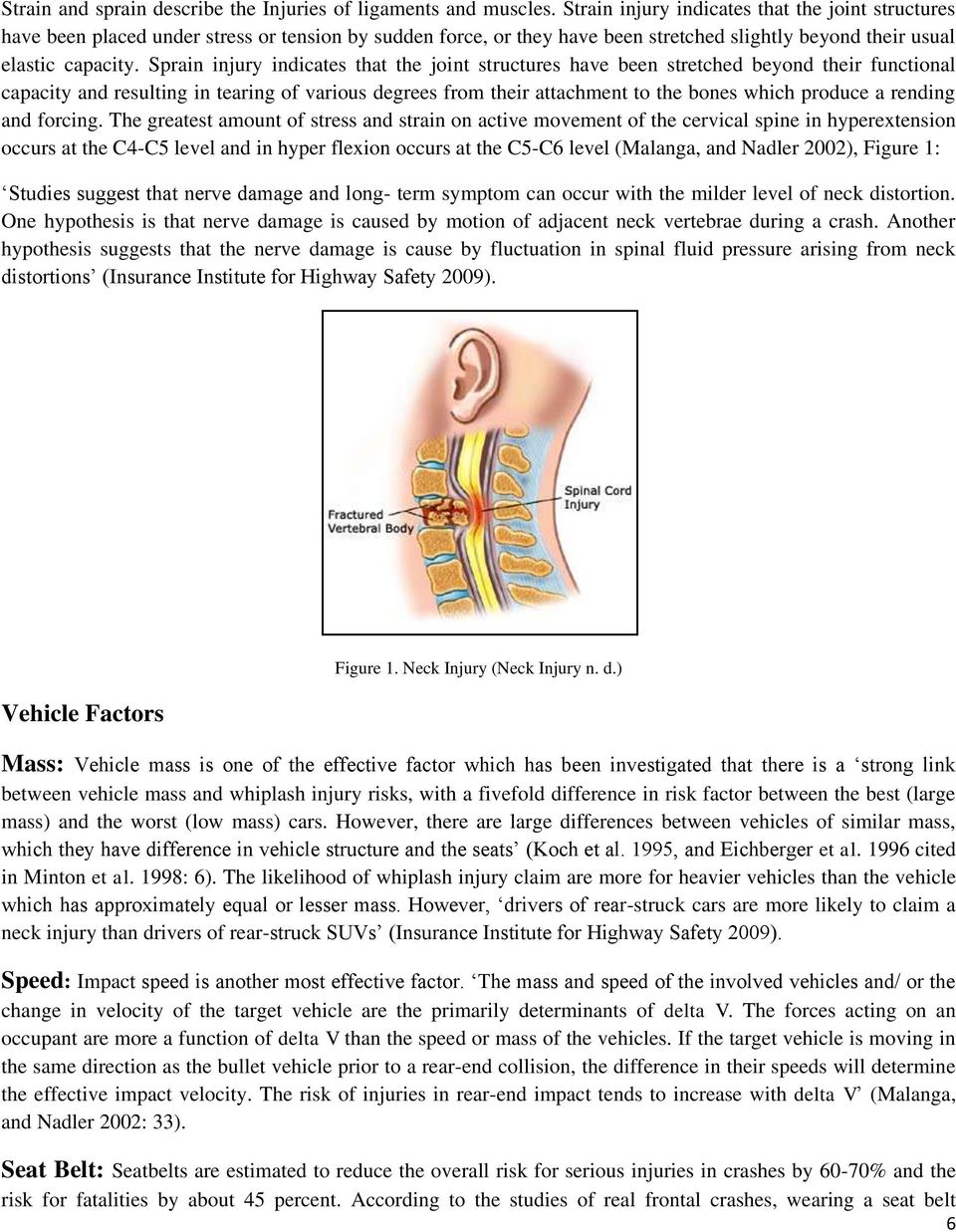
7 Strain and sprain describe the Injuries of ligaments and muscles. Strain injury indicates that the joint structures have been placed under stress or tension by sudden force, or they have been stretched slightly beyond their usual elastic capacity. Sprain injury indicates that the joint structures have been stretched beyond their functional capacity and resulting in tearing of various degrees from their attachment to the bones which produce a rending and forcing. The greatest amount of stress and strain on active movement of the cervical spine in hyperextension occurs at the C4-C5 level and in hyper flexion occurs at the C5-C6 level (Malanga, and Nadler 2002), Figure 1: Studies suggest that nerve damage and long- term symptom can occur with the milder level of neck distortion. One hypothesis is that nerve damage is caused by motion of adjacent neck vertebrae during a crash. Another hypothesis suggests that the nerve damage is cause by fluctuation in spinal fluid pressure arising from neck distortions (Insurance Institute for Highway Safety 2009). Vehicle Factors Figure 1. Neck Injury (Neck Injury n. d.) Mass: Vehicle mass is one of the effective factor which has been investigated that there is a strong link between vehicle mass and whiplash injury risks, with a fivefold difference in risk factor between the best (large mass) and the worst (low mass) cars. However, there are large differences between vehicles of similar mass, which they have difference in vehicle structure and the seats (Koch et al. 1995, and Eichberger et al cited in Minton et al. 1998: 6). The likelihood of whiplash injury claim are more for heavier vehicles than the vehicle which has approximately equal or lesser mass. However, drivers of rear-struck cars are more likely to claim a neck injury than drivers of rear-struck SUVs (Insurance Institute for Highway Safety 2009). Speed: Impact speed is another most effective factor. The mass and speed of the involved vehicles and/ or the change in velocity of the target vehicle are the primarily determinants of delta V. The forces acting on an occupant are more a function of delta V than the speed or mass of the vehicles. If the target vehicle is moving in the same direction as the bullet vehicle prior to a rear-end collision, the difference in their speeds will determine the effective impact velocity. The risk of injuries in rear-end impact tends to increase with delta V (Malanga, and Nadler 2002: 33). Seat Belt: Seatbelts are estimated to reduce the overall risk for serious injuries in crashes by 60-70% and the risk for fatalities by about 45 percent. According to the studies of real frontal crashes, wearing a seat belt 6
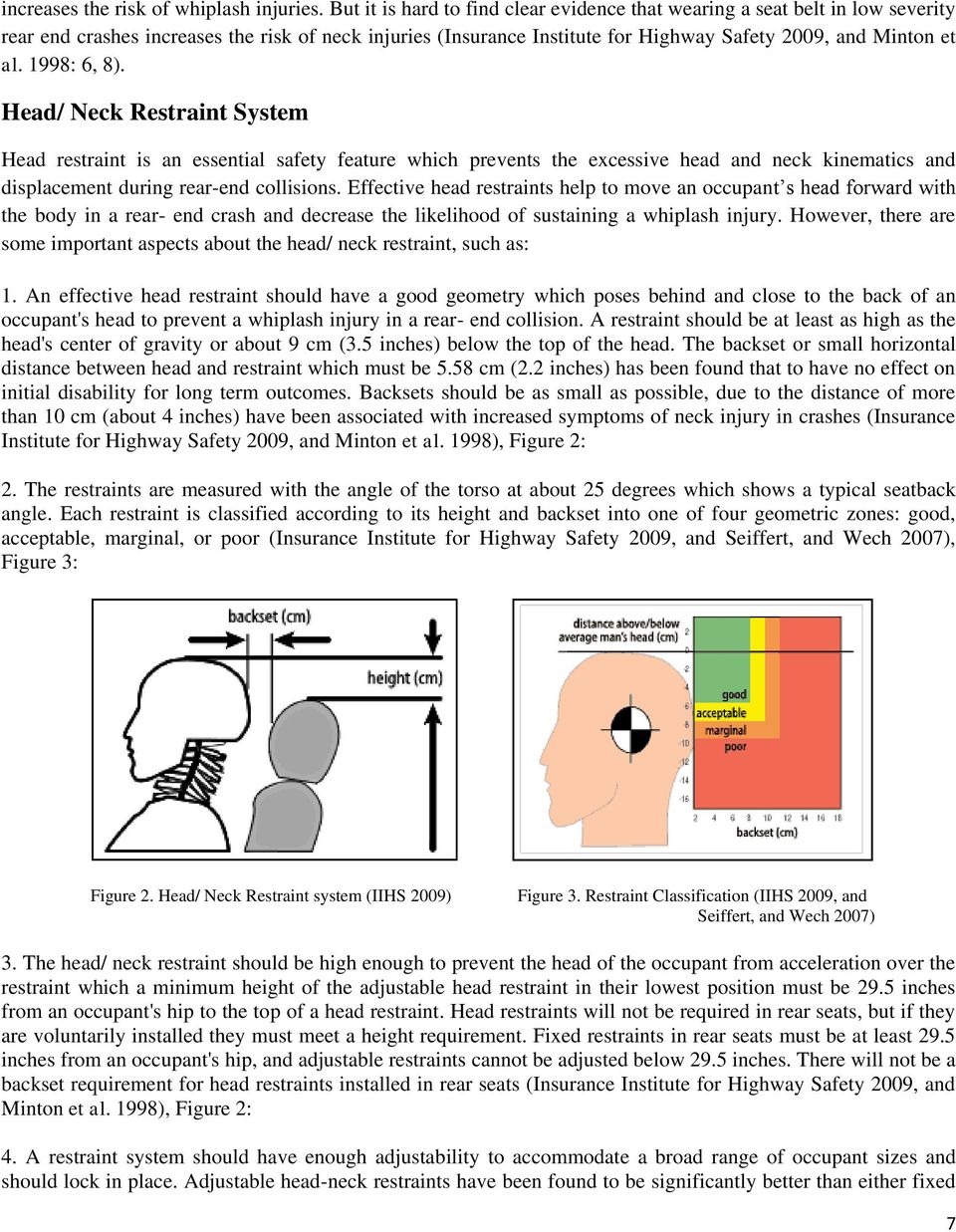
8 increases the risk of whiplash injuries. But it is hard to find clear evidence that wearing a seat belt in low severity rear end crashes increases the risk of neck injuries (Insurance Institute for Highway Safety 2009, and Minton et al. 1998: 6, 8). Head/ Neck Restraint System Head restraint is an essential safety feature which prevents the excessive head and neck kinematics and displacement during rear-end collisions. Effective head restraints help to move an occupant s head forward with the body in a rear- end crash and decrease the likelihood of sustaining a whiplash injury. However, there are some important aspects about the head/ neck restraint, such as: 1. An effective head restraint should have a good geometry which poses behind and close to the back of an occupant's head to prevent a whiplash injury in a rear- end collision. A restraint should be at least as high as the head's center of gravity or about 9 cm (3.5 inches) below the top of the head. The backset or small horizontal distance between head and restraint which must be 5.58 cm (2.2 inches) has been found that to have no effect on initial disability for long term outcomes. Backsets should be as small as possible, due to the distance of more than 10 cm (about 4 inches) have been associated with increased symptoms of neck injury in crashes (Insurance Institute for Highway Safety 2009, and Minton et al. 1998), Figure 2: 2. The restraints are measured with the angle of the torso at about 25 degrees which shows a typical seatback angle. Each restraint is classified according to its height and backset into one of four geometric zones: good, acceptable, marginal, or poor (Insurance Institute for Highway Safety 2009, and Seiffert, and Wech 2007), Figure 3: Figure 2. Head/ Neck Restraint system (IIHS 2009) Figure 3. Restraint Classification (IIHS 2009, and Seiffert, and Wech 2007) 3. The head/ neck restraint should be high enough to prevent the head of the occupant from acceleration over the restraint which a minimum height of the adjustable head restraint in their lowest position must be 29.5 inches from an occupant's hip to the top of a head restraint. Head restraints will not be required in rear seats, but if they are voluntarily installed they must meet a height requirement. Fixed restraints in rear seats must be at least 29.5 inches from an occupant's hip, and adjustable restraints cannot be adjusted below 29.5 inches. There will not be a backset requirement for head restraints installed in rear seats (Insurance Institute for Highway Safety 2009, and Minton et al. 1998), Figure 2: 4. A restraint system should have enough adjustability to accommodate a broad range of occupant sizes and should lock in place. Adjustable head-neck restraints have been found to be significantly better than either fixed 7
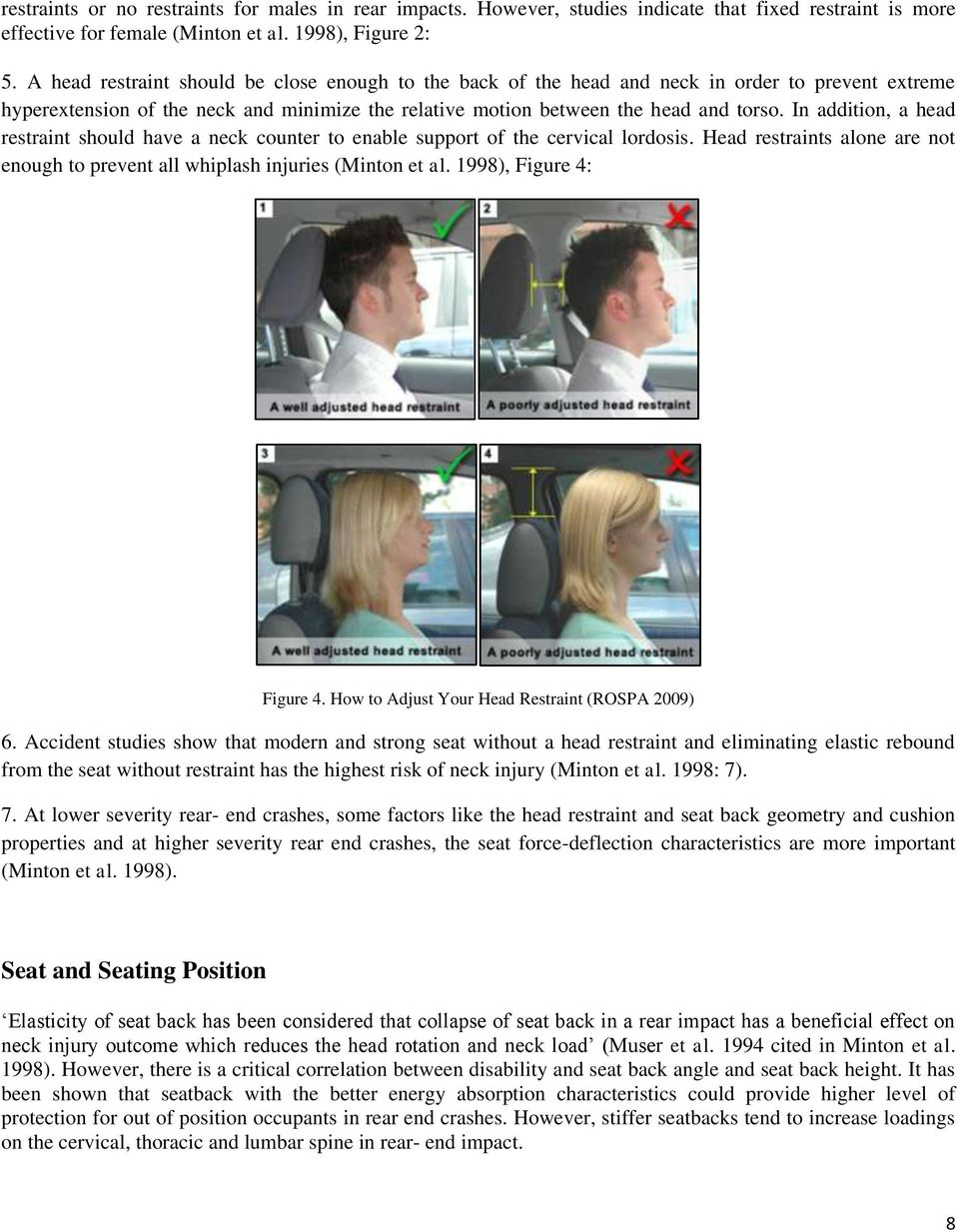
9 restraints or no restraints for males in rear impacts. However, studies indicate that fixed restraint is more effective for female (Minton et al. 1998), Figure 2: 5. A head restraint should be close enough to the back of the head and neck in order to prevent extreme hyperextension of the neck and minimize the relative motion between the head and torso. In addition, a head restraint should have a neck counter to enable support of the cervical lordosis. Head restraints alone are not enough to prevent all whiplash injuries (Minton et al. 1998), Figure 4: Figure 4. How to Adjust Your Head Restraint (ROSPA 2009) 6. Accident studies show that modern and strong seat without a head restraint and eliminating elastic rebound from the seat without restraint has the highest risk of neck injury (Minton et al. 1998: 7). 7. At lower severity rear- end crashes, some factors like the head restraint and seat back geometry and cushion properties and at higher severity rear end crashes, the seat force-deflection characteristics are more important (Minton et al. 1998). Seat and Seating Position Elasticity of seat back has been considered that collapse of seat back in a rear impact has a beneficial effect on neck injury outcome which reduces the head rotation and neck load (Muser et al cited in Minton et al. 1998). However, there is a critical correlation between disability and seat back angle and seat back height. It has been shown that seatback with the better energy absorption characteristics could provide higher level of protection for out of position occupants in rear end crashes. However, stiffer seatbacks tend to increase loadings on the cervical, thoracic and lumbar spine in rear- end impact. 8
10 It is uncertain which seating position exposes an occupant to the greatest chance of neck injury. Studies have demonstrated that drivers have a higher risk of injury than passengers, due to they are prone to move forward and away from the seatback as they reach for the steering wheel and observe traffic around them, whereas passengers usually are more relaxed and lean further back in their seats, with their heads closer to the restraint, however it has been found that moving to the rear seat is nearly twice as effective as tilting a head restraint to the front seat in reducing whiplash injury risk (Insurance Institute for Highway Safety 2009, and Minton et al. 1998). Human Factors Gender: Females are 1.8 to 2.2 times more at risk of whiplash injury in all types of collisions than men. A Swedish study found that females with whiplash injuries are more at risk of developing long-term symptoms, due to they are more susceptible than male to neck injuries. Fifty-five percent of females who sustained whiplash injuries are susceptible to develop long-term symptoms compared with 38 percent of males (Insurance Institute for Highway Safety 2009). It has been shown that the risk of disability for female drivers is three times higher than for males. However, risk of injury for females in rear seats is four times higher than males due to males have stronger neck muscles than females with approximately the same size of head (Insurance Institute for Highway Safety 2009). Height: Height is one of most important risk factor particularly among females for neck injury. Shorter people often are protected by unadjusted head restraints. Stature may not play as significant role in the severity of injuries among males because many head restraints are too low to protect even shorter males (Insurance Institute for Highway Safety 2009). However, taller occupants who do not adjust their head restraints are more likely to sustain whiplash injuries (Minton et al. 1998). Age: Child and old people are more at risk of whiplash injury. Symptomatology: Patients normally develop symptoms within 24 hours after a whiplash accident. The symptoms of whiplash are dominated by pain in the neck and headache. The second most common symptom is pain in the shoulder gridle, followed by weakness in the upper limbs. In addition, dizziness, visual disturbances, concentration, cognition and memory disturbances and tinnitus are less common and irregular symptoms. However, approximately 10% of all whiplash injuries become long-term injuries in rear crashes and about 5% in frontal crashes (Malanga, and Nadler 2002). Anatomy: Cervical Vertebrae Cervical spine is divided into two functional regions: the upper (C0-C2) and lower (C3-C7). By another meaning, the cervical spine is composed of seven vertebrae, including three atypical and four typical vertebrae. The typical cervical vertebrae, (C3-C6) are composed of a vertebral body and a vertebral arch and muscular attachment (Malanga, and Nadler 2002). 9
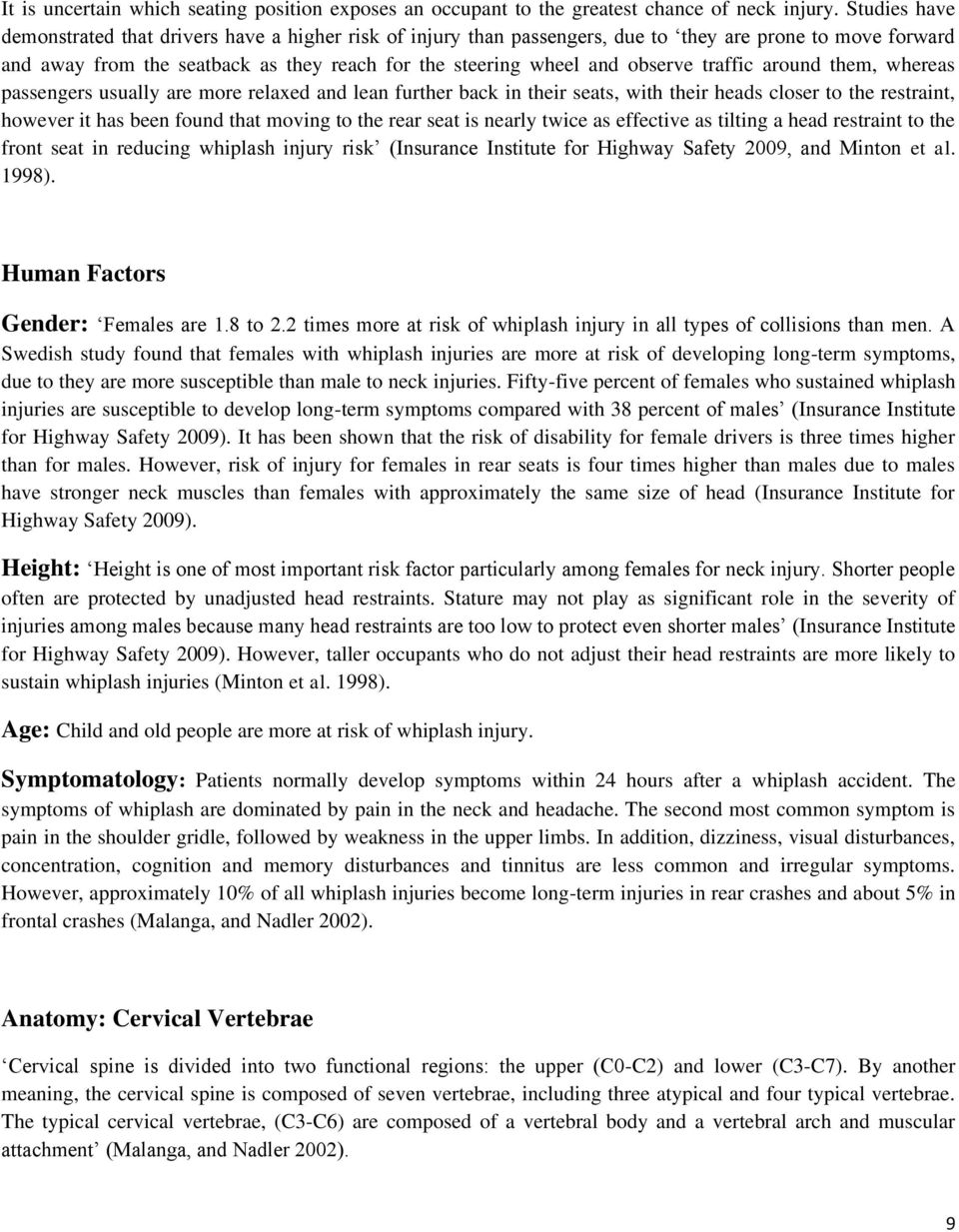
11 Different parts of the cervical spine are: Intervertebral Discs, Ligaments, Cervical Spinal Canal, Spinal Cord, Nerve Roots, Vertebral Arteries, Muscle of the Cervical Spine. The anatomy of the cervical spine is complex and allows for a high degree of motion while serving as a protective conduit for the spinal cord and nerve roots (Malanga, and Nadler 2002), Figure 5: Accident Studies Car Accident/ Whiplash Injury Causations Figure 5. Spinal Cord (Spinal Cord n. d.) There are some crash causations which are the major causalities of whiplash injury which could be divided into the road and vehicle condition, infrastructure, pedestrian and driving behavior, impact with other vehicle or/ and braking hard. Studies of the road safety have shown that human error is the main cause in 57% of all accidents and is a contributing factor in over 90%. In contrast, only 2.4% is due to mechanical fault and only 4.7% is caused only by environmental factors (Green, and Senders n. d.). The majority of car accidents seem to be caused by bad driving behavior: driver inattention, failure to merge, speeding, racing, aggressive driving and failure to exercise care in passing. Accidents can be attributed to specific causes apart from poor driving behavior itself include: falling asleep; weather usually (Snow, Ice or 10

12 Rain and fog); alcohol, drugs and drunk driving; driver distractions from in-vehicle sources including mobile phones, insects in the car, playing music, conversation with a passenger; collisions with other vehicles and/ or animals on the road, braking hard usually due to unexpected barrier/ object/ car and/ or bad pedestrian behavior on the road, not maintained vehicle, vehicle malfunction and infrastructure/ road condition normally with providing poor vision system such as inappropriate lighting system at night and poor informative and visible traffic signals and signs (Green, and Senders n. d.). Impact Direction Whiplash injuries occur in all impact directions such as rear- end, head- on and side collision. Approximately 50% of the whiplash injuries occur in rear crashes, 30% in frontal crashes and the rest in other types of accidents. Rear impact has been found to be significantly less injurious than other impact directions in terms of long term outcome for male. Females showed no consistent trend in this respect but in some cases their average disability is non-significantly higher in rear impacts (Insurance Institute for Highway Safety 2009, and Minton et al. 1998). Crash Scenario Crash scenarios which is based on crash causations explain where, when and how rear-end, head-on and side impact occurs. Rear- end impact: Typical scenario for rear- end collision is a sudden deceleration by the first car (e.g., to avoid hitting pedestrian) the following car that does not have time to brake and collides with the first car, Figure 6: Figure 6. Rear- end Impact Head- on impact: Typical scenario for head- on collision is when the front end of two vehicles hit each other, Figure 7: Figure 7. Head- on Impact 11

13 Side impact: Typical scenario for side collision is when the side of one or more vehicles are impacted. These crashes often occur at intersections and/ or parking lots when two vehicles pass on a multi lane road way or when a vehicle hits a fixed object, Figure 8: Figure 8. Side Impact Rear-end Impact Forceful hyperextension of the neck occurs when the body is accelerated forward and causes traction on the anterior longitudinal ligaments. If the head is rotated to one side and titled to the opposite side, the torisonal effect causes greater damage on one side than the other side. Rear-end impact causes very rapid backward-forward motion of the head and upper torso. The extension phase of the motion causes the most injuries. At this time head continues backward motion which muscles unable to control the head, until the inappropriate processes of the vertebrae crush together to provide some countervailing force and breakage of the vertebrae. The flexion phase of the motion is limited by contact between the chin and the chest which is within the natural range of the head. Hence, the provision of a head restraint is to prevent rearward hyperextension of the neck from severe injuries, and also soft tissue from less severe injuries (Seiffert, and Wech 2007, and Jackson 1977), Figure 9: Figure 9. Rear- end Collision (Jackson 1977: 89) 12
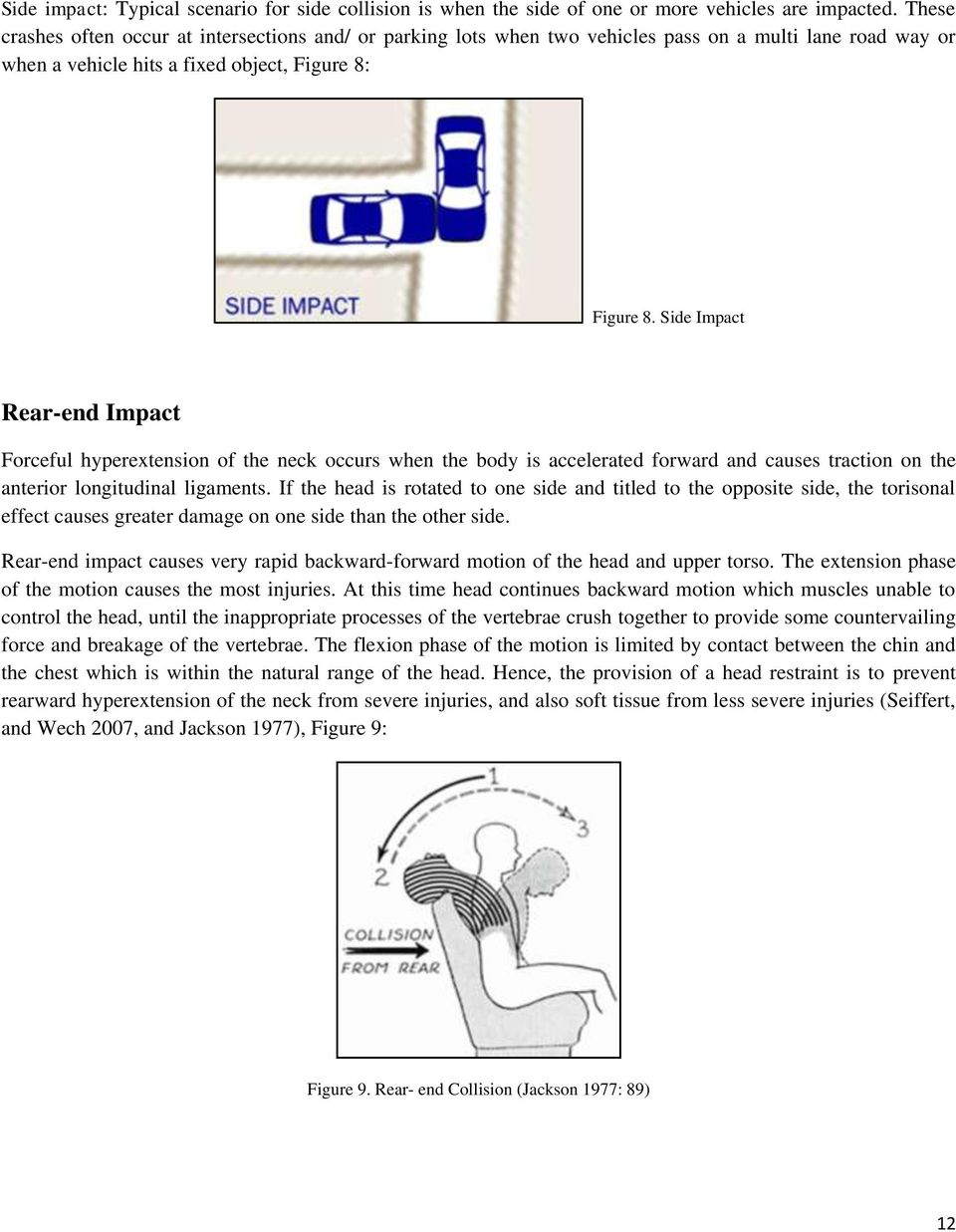
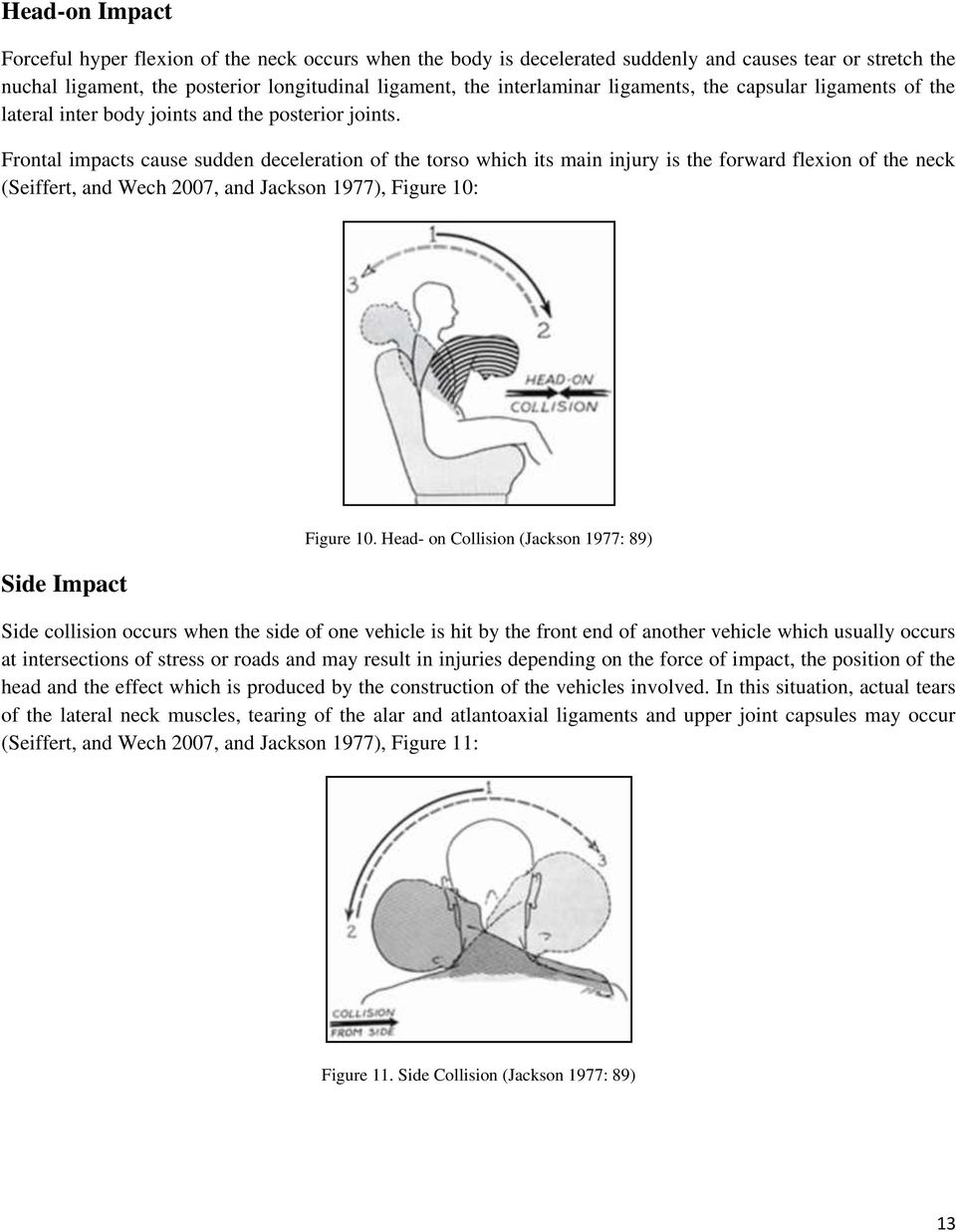
14 Head-on Impact Forceful hyper flexion of the neck occurs when the body is decelerated suddenly and causes tear or stretch the nuchal ligament, the posterior longitudinal ligament, the interlaminar ligaments, the capsular ligaments of the lateral inter body joints and the posterior joints. Frontal impacts cause sudden deceleration of the torso which its main injury is the forward flexion of the neck (Seiffert, and Wech 2007, and Jackson 1977), Figure 10: Side Impact Figure 10. Head- on Collision (Jackson 1977: 89) Side collision occurs when the side of one vehicle is hit by the front end of another vehicle which usually occurs at intersections of stress or roads and may result in injuries depending on the force of impact, the position of the head and the effect which is produced by the construction of the vehicles involved. In this situation, actual tears of the lateral neck muscles, tearing of the alar and atlantoaxial ligaments and upper joint capsules may occur (Seiffert, and Wech 2007, and Jackson 1977), Figure 11: Figure 11. Side Collision (Jackson 1977: 89) 13
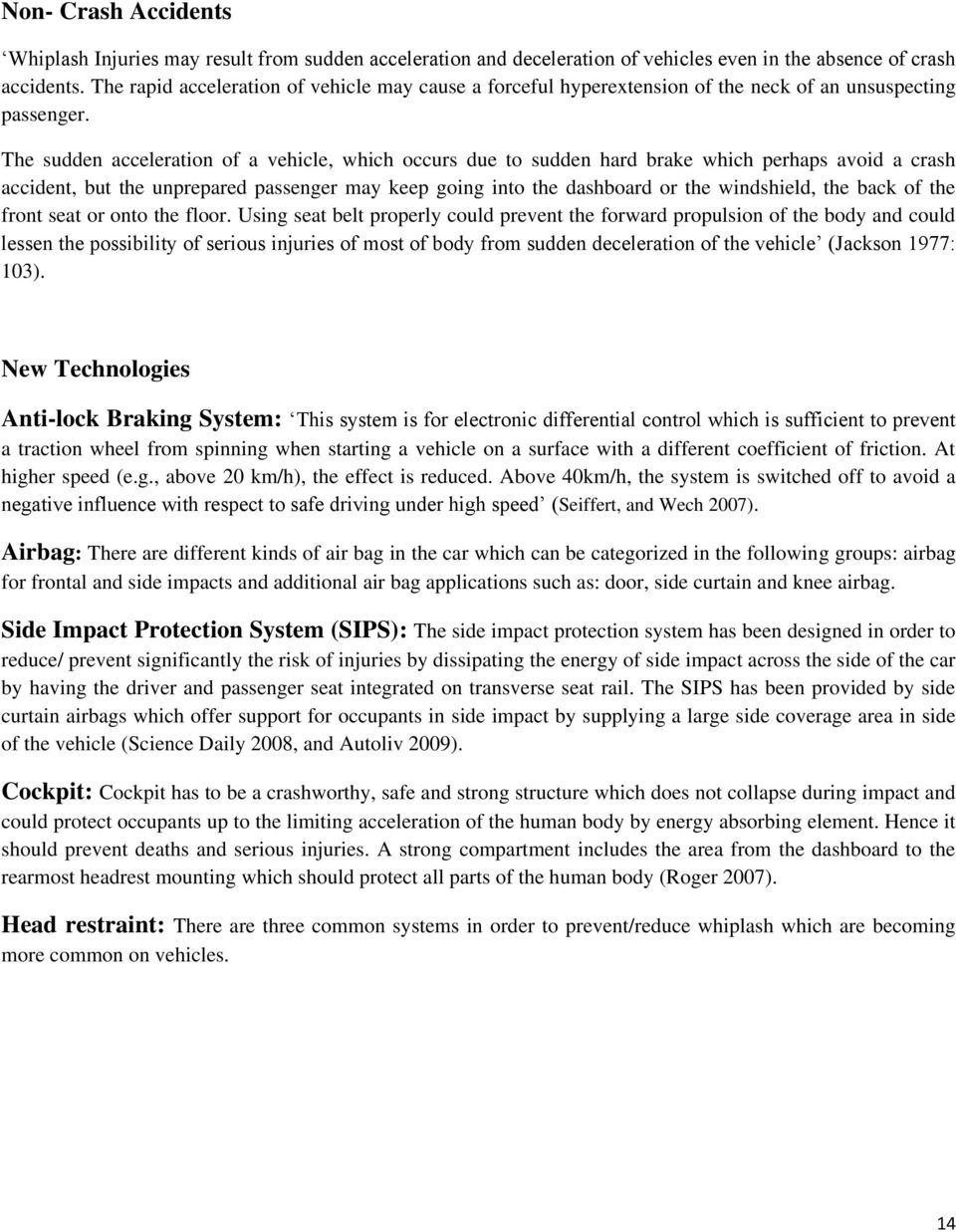
15 Non- Crash Accidents Whiplash Injuries may result from sudden acceleration and deceleration of vehicles even in the absence of crash accidents. The rapid acceleration of vehicle may cause a forceful hyperextension of the neck of an unsuspecting passenger. The sudden acceleration of a vehicle, which occurs due to sudden hard brake which perhaps avoid a crash accident, but the unprepared passenger may keep going into the dashboard or the windshield, the back of the front seat or onto the floor. Using seat belt properly could prevent the forward propulsion of the body and could lessen the possibility of serious injuries of most of body from sudden deceleration of the vehicle (Jackson 1977: 103). New Technologies Anti-lock Braking System: This system is for electronic differential control which is sufficient to prevent a traction wheel from spinning when starting a vehicle on a surface with a different coefficient of friction. At higher speed (e.g., above 20 km/h), the effect is reduced. Above 40km/h, the system is switched off to avoid a negative influence with respect to safe driving under high speed (Seiffert, and Wech 2007). Airbag: There are different kinds of air bag in the car which can be categorized in the following groups: airbag for frontal and side impacts and additional air bag applications such as: door, side curtain and knee airbag. Side Impact Protection System (SIPS): The side impact protection system has been designed in order to reduce/ prevent significantly the risk of injuries by dissipating the energy of side impact across the side of the car by having the driver and passenger seat integrated on transverse seat rail. The SIPS has been provided by side curtain airbags which offer support for occupants in side impact by supplying a large side coverage area in side of the vehicle (Science Daily 2008, and Autoliv 2009). Cockpit: Cockpit has to be a crashworthy, safe and strong structure which does not collapse during impact and could protect occupants up to the limiting acceleration of the human body by energy absorbing element. Hence it should prevent deaths and serious injuries. A strong compartment includes the area from the dashboard to the rearmost headrest mounting which should protect all parts of the human body (Roger 2007). Head restraint: There are three common systems in order to prevent/reduce whiplash which are becoming more common on vehicles. 14
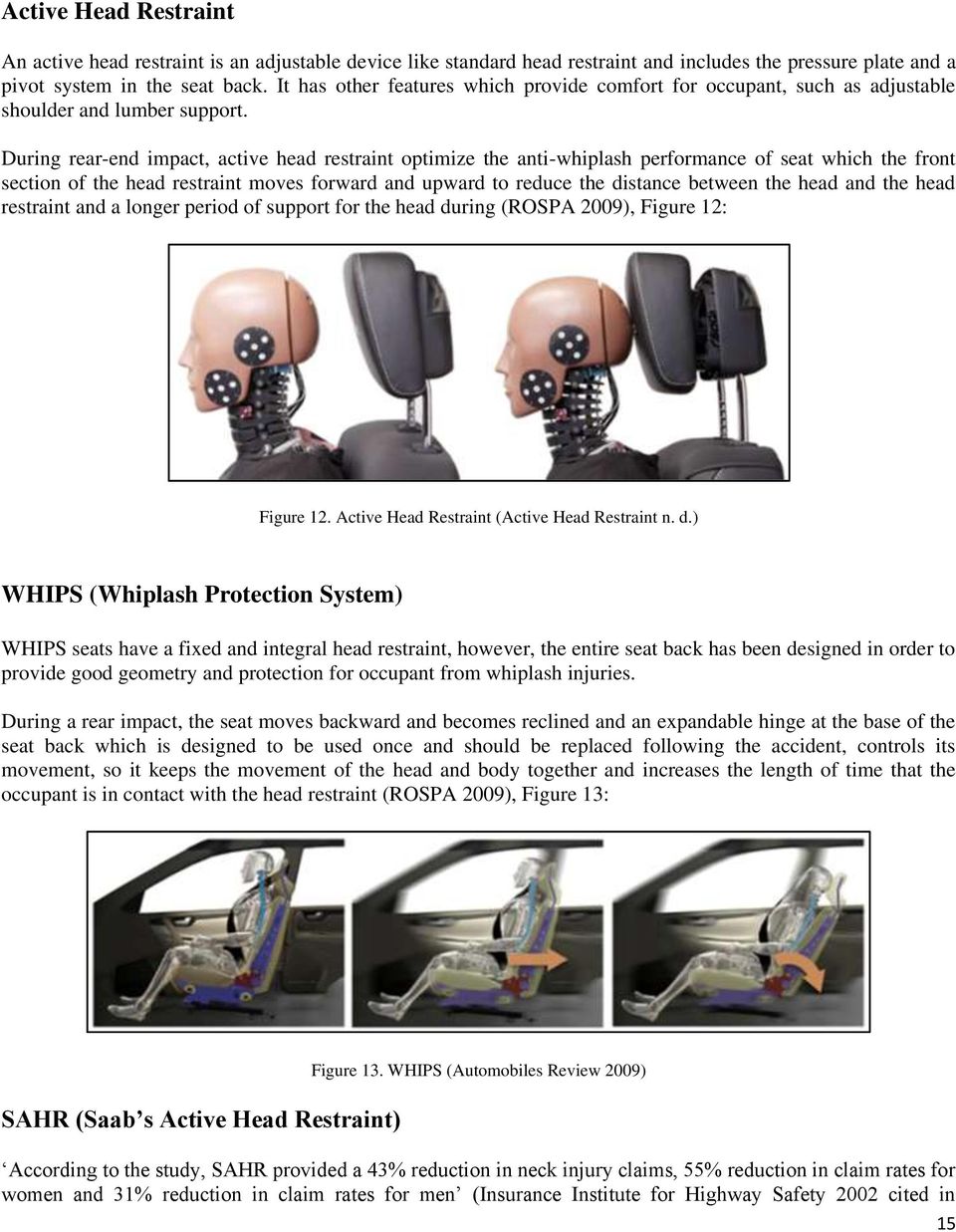
16 Active Head Restraint An active head restraint is an adjustable device like standard head restraint and includes the pressure plate and a pivot system in the seat back. It has other features which provide comfort for occupant, such as adjustable shoulder and lumber support. During rear-end impact, active head restraint optimize the anti-whiplash performance of seat which the front section of the head restraint moves forward and upward to reduce the distance between the head and the head restraint and a longer period of support for the head during (ROSPA 2009), Figure 12: Figure 12. Active Head Restraint (Active Head Restraint n. d.) WHIPS (Whiplash Protection System) WHIPS seats have a fixed and integral head restraint, however, the entire seat back has been designed in order to provide good geometry and protection for occupant from whiplash injuries. During a rear impact, the seat moves backward and becomes reclined and an expandable hinge at the base of the seat back which is designed to be used once and should be replaced following the accident, controls its movement, so it keeps the movement of the head and body together and increases the length of time that the occupant is in contact with the head restraint (ROSPA 2009), Figure 13: SAHR (Saab s Active Head Restraint) Figure 13. WHIPS (Automobiles Review 2009) According to the study, SAHR provided a 43% reduction in neck injury claims, 55% reduction in claim rates for women and 31% reduction in claim rates for men (Insurance Institute for Highway Safety 2002 cited in 15
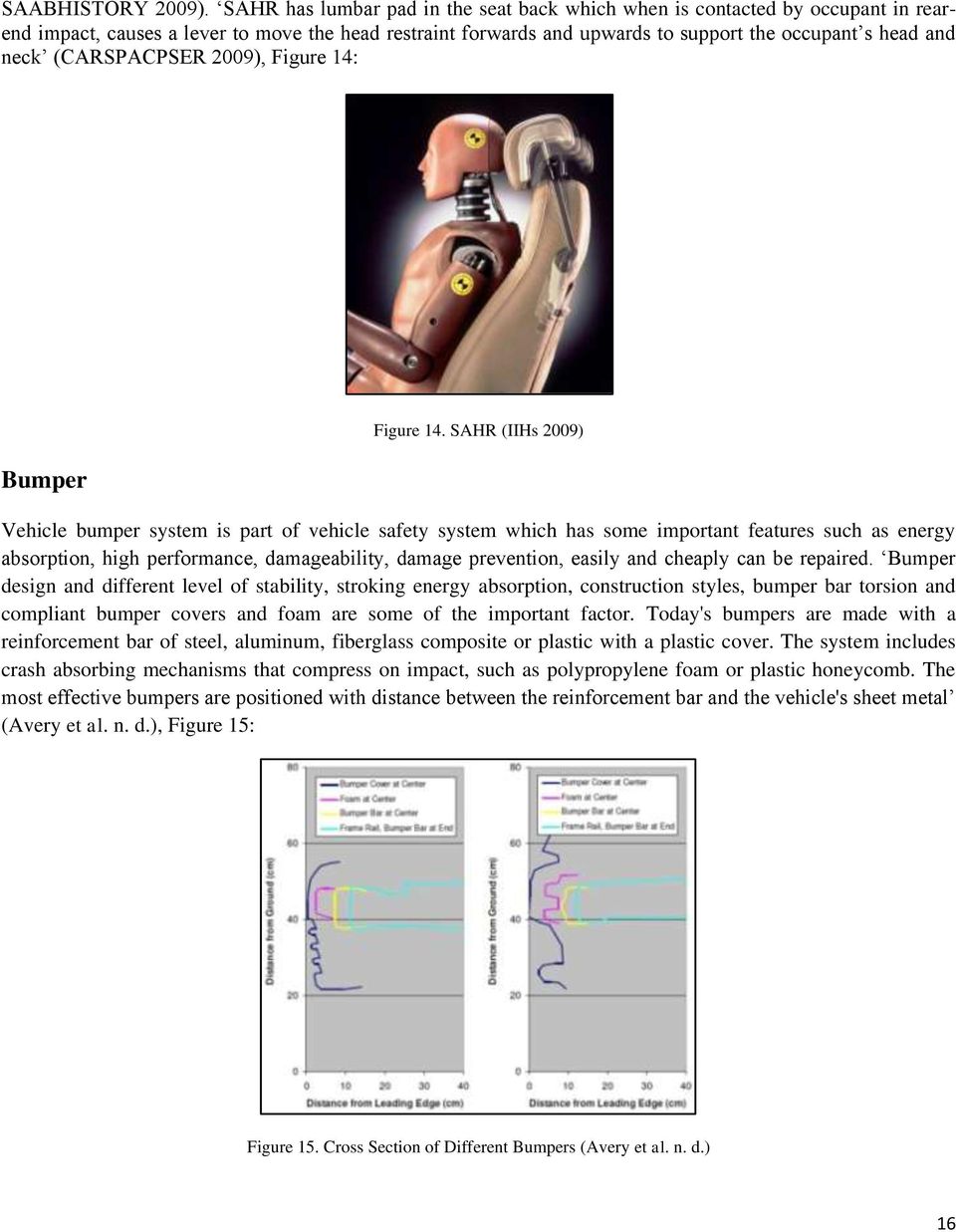
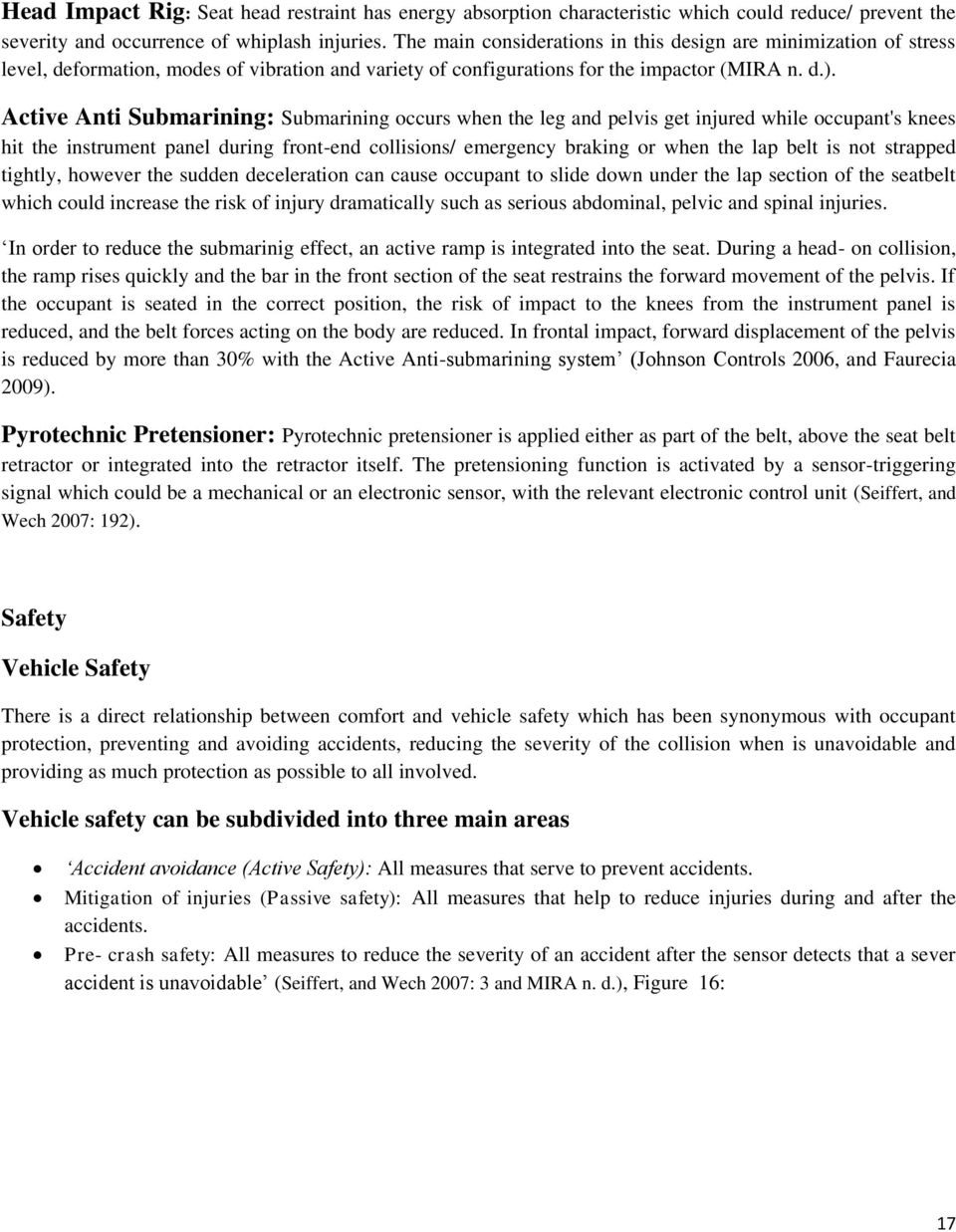
17 SAABHISTORY 2009). SAHR has lumbar pad in the seat back which when is contacted by occupant in rearend impact, causes a lever to move the head restraint forwards and upwards to support the occupant s head and neck (CARSPACPSER 2009), Figure 14: Bumper Figure 14. SAHR (IIHs 2009) Vehicle bumper system is part of vehicle safety system which has some important features such as energy absorption, high performance, damageability, damage prevention, easily and cheaply can be repaired. Bumper design and different level of stability, stroking energy absorption, construction styles, bumper bar torsion and compliant bumper covers and foam are some of the important factor. Today's bumpers are made with a reinforcement bar of steel, aluminum, fiberglass composite or plastic with a plastic cover. The system includes crash absorbing mechanisms that compress on impact, such as polypropylene foam or plastic honeycomb. The most effective bumpers are positioned with distance between the reinforcement bar and the vehicle's sheet metal (Avery et al. n. d.), Figure 15: Figure 15. Cross Section of Different Bumpers (Avery et al. n. d.) 16
18 Head Impact Rig: Seat head restraint has energy absorption characteristic which could reduce/ prevent the severity and occurrence of whiplash injuries. The main considerations in this design are minimization of stress level, deformation, modes of vibration and variety of configurations for the impactor (MIRA n. d.). Active Anti Submarining: Submarining occurs when the leg and pelvis get injured while occupant's knees hit the instrument panel during front-end collisions/ emergency braking or when the lap belt is not strapped tightly, however the sudden deceleration can cause occupant to slide down under the lap section of the seatbelt which could increase the risk of injury dramatically such as serious abdominal, pelvic and spinal injuries. In order to reduce the submarinig effect, an active ramp is integrated into the seat. During a head- on collision, the ramp rises quickly and the bar in the front section of the seat restrains the forward movement of the pelvis. If the occupant is seated in the correct position, the risk of impact to the knees from the instrument panel is reduced, and the belt forces acting on the body are reduced. In frontal impact, forward displacement of the pelvis is reduced by more than 30% with the Active Anti-submarining system (Johnson Controls 2006, and Faurecia 2009). Pyrotechnic Pretensioner: Pyrotechnic pretensioner is applied either as part of the belt, above the seat belt retractor or integrated into the retractor itself. The pretensioning function is activated by a sensor-triggering signal which could be a mechanical or an electronic sensor, with the relevant electronic control unit (Seiffert, and Wech 2007: 192). Safety Vehicle Safety There is a direct relationship between comfort and vehicle safety which has been synonymous with occupant protection, preventing and avoiding accidents, reducing the severity of the collision when is unavoidable and providing as much protection as possible to all involved. Vehicle safety can be subdivided into three main areas Accident avoidance (Active Safety): All measures that serve to prevent accidents. Mitigation of injuries (Passive safety): All measures that help to reduce injuries during and after the accidents. Pre- crash safety: All measures to reduce the severity of an accident after the sensor detects that a sever accident is unavoidable (Seiffert, and Wech 2007: 3 and MIRA n. d.), Figure 16: 17
19 INTEGRATED VEHICLE SAFETY ENGINEERING TESTING ACTIVE SAFETY PASSIVE SAFETY CRASH MITIGATION Figure 16. Integrated Vehicle Safety Engineering (MIRA n. d.) A) Active safety: Developing chassis control system and anti-lock braking system to help the driver avoid accidents or systems that take control to prevent a collision. Advanced information driver systems, warning and assistance systems, pedestrian and vulnerable road user awareness, collision avoidance and intervention systems, advanced driver assistance systems- braking and vehicle control which can help to prevent an accident occurring in the first instance [primary safety, such as lighting, braking, handling and ergonomics (vision system)] and system which can help to save lives when a crash does occur [Secondary safety], (MIRA n. d., and Transport Research laboratory 2009). B) Passive safety: Developing body structure and restraint system to protect vehicle occupants in severe and potentially fatal crashes and design and development of seat engineering, pedestrian and vulnerable road user protection, (MIRA n. d., and Transport Research laboratory 2009). However, the main factors which improve the safety features in car design are vehicle structure and design, vehicle restraint system which has a tolerable deceleration level, absorbs energy and keeps the occupant compartment intact. User Safety Reducing Injuries: Children who are younger than 12 years old and are smaller than 150 cm in height must be placed in special child restraints in vehicle (Seiffert, and Wech 2007). Changing Behavior and Attitudes: The research has identified new psychological methodologies for traffic calming such as making a road appear narrower than it actually is. This changed protection of the road influences driver behavior and is an effective means of reducing excessive speeds (Transport Research Laboratory 2009). Designing Safer Roads: Intend to reduce the risk of injury and enhance the road safety, there are various design features which the most important ones are to design a safe road layout and control driving at the appropriate speed. 18
20 Occupant Protection: In order to develop the occupant protection, restraint system should be developed which there must be facilities for occupant to differentiate between devices that must be activated manually by the occupant (e.g., seat belt and child restraints) and devices that work automatically (e.g., seatbelt movement limiters, belt tensioners and airbag). In addition robust and safe occupant compartment which withstands a wide variety of impacts is one of the main aspects intend to provide higher level of protection (Seiffert, Wech 2007: 151). Literature Research Finding The outcome of the literature research has demonstrated that road traffic accident kills an estimated 1.3 million and injures between twenty to fifty million people a year globally. However, over half of the all car occupants involved in road traffic accidents, had whiplash injuries (Minton et al. 1998: 3) Whiplash is an acceleration-deceleration mechanism of energy transfer to the neck. It may result from rear end, head-on and side collision, but can also occur during diving or other mishaps. The impact may result in bony or soft tissue injuries (whiplash injury), which may lead to a variety of clinical manifestations. In crashes the main issue is the vehicle s body structure and safety system such as seat and head restraint as one unit which can absorb energy in a controlled manner and gives support for the whole spine in low speed crash in order to reduce the risk of injury. In frontal crashes the air bag, seat belt pretensioner and load limiter probably must work together in reducing the acceleration. There are three different anti-whiplash seats on the market which have been the most effective device for reducing whiplash injuries so far. The WHIPS seat (plastic deformation) the SAHR seat (active head restraint) and a seat made by Toyota that could reduce the injuries. There are two general principles to apply these devices, one propels the head restraint forward to meet the head and thereby reduces the relative head torso movement; the second principle allows the occupant to move backward until both the head and the spine are supported from the seat closer in time. Thereafter if the forces are high, the seat reclines and thereby reduces the acceleration. However, there are many vehicle and user safety features such as vehicle energy absorption, driving at appropriate speed, etc which improve the level of safety for occupant. Empirical Research Methodology The empirical research methods which have been used in this investigation comprise qualitative observation, quantitative questionnaire and qualitative interviewing expert. The aim of the observational research in this project is to introduce basic and flexible issues of this research topic, before undertaking more structured research such as form a questionnaire and interview the expert. So 19
21 the observational information has been collected by looking at the car accident scenarios and crash tests on different reliable web sites. The aim of the questionnaire which comprises pre- pilot (n 1 = 5) and pilot (n= 15) investigation is that to collect usable information to find out which vehicle factors/ elements are more effective in order to prevent/ reduce whiplash injury in car accidents, from the members of the market- specific population which include twenty lecturers of department of industrial design and some of the MSc. Industrial Product Design, Transport and Design and Ergonomics and Design students, Coventry University, n= 20. The aim of interviewing expert is that to obtain information to analyze more in depth the causations of car accident and mainly whiplash injury, new vehicle technologies and find out the possible ways to prevent/reduce whiplash injury in car accidents which is known only to expert of vehicle safety, car accident causation and particularly whiplash injuries. The interview took place at Coventry University, Department of Industrial Design with one of the lecturers, Lee Hall. These investigations began with a list of questions (prepared by myself) which has been noted ten questions for questionnaire and thirty questions for interviewing expert, each concerned with a point of design about which have been doubtful during the process of this project. Analysis input data The quantitative analysis of the data shows that the vast majority of the market-specific population (n= 20) would like to feel safe and they do agree that restraining driver and passenger is an essential safety aspect to protect them from whiplash injuries at the time of accident, but also they do agree that the feasibility of using/ accepting restraint system like neck and chest restraint which are common effective protective elements in motor racing/ F1 is less, due to they are highly restrictive, difficult to use, cumbersome, less comfortable and also the variety of sizes and shapes in a road car occupant are high. However, figures demonstrate that seatbelt, airbag and active head restraint which are primary safety aspects and safety cell, low speed, crumple zone which are secondary safety aspects have been the most effective protective devices to prevent/ reduce the likelihood of whiplash injuries due to the chance of survival or survival with minor injuries by using/ applying them become greater due to they are comfortable, easy to use and they do not pose any problem and constraint for passenger and driver who expect some freedom of movement for comfort visibility and the ability to operate controls. 1 n= Market- Specific Population 20
22 Empirical Research Finding Observation: The observational research findings have shown that how car accidents would occur (see Accidents Studies) and how existing vehicle technologies would help to prevent/ reduce the whiplash injuries (see New Technologies), by looking at the crash tests including dummies in simulated rear- end, head- on and side impact, in order to investigate the performance of the car technology elements and find out what are the causations of the car accident. In addition this technique of empirical research helps to find out the Injury prevention which is based on accident analysis, and also would helps to understand the loading environment and determine the injury mechanism, leading to the development of priorities for injury prevention. Questionnaire: The outcome of questionnaire has shown that road car occupants would prefer to be safe with less restriction and difficulties. However, they think conventional seatbelt, airbag, active head restraint and automatic options/ settings are the appropriate and comfortable devices to reduce the likelihood of whiplash injuries in car accident, due to they provide more freedom of movement for comfort, visibility and the ability to operate controls, but also the fact has shown that none of these devices and alternative ways have been entirely successful to reduce/ prevent the this problem. Meeting expert: The outcome of interviewing expert has shown various information which are as follows: 1. In terms of reducing/ preventing whiplash injuries in car accidents, the most effective ways would be preventing/ reducing whiplash injury itself or preventing car accident itself, however, there should be focus effort on one particular area which offers the best result, due to, it is difficult to entirely eradicate collision, but the analysis of the crash causation would be useful. 2. The main causations of the rear- end, head- on and side collision are: vehicle malfunction, not maintained vehicle, road condition/ camber, environment and weather condition such as fog and ice, not educated driver, driver distraction high speed and sleepy driver. 3. In terms of reducing whiplash injuries, reducing energy at the occupant position is the best achieved by scarifying material structure to absorb the energy and deform themselves. However, to prevent excessive occupant movement also prevent safe driving in some cases. A crash helmet and neck brace are widely used in the motor sport industry which could be adapted to the road car but would be unpopular. 4. The existing technologies in car increase the severity of accidents and injuries, therefore distraction internally could be reduced by limiting the amount of information displayed to the driver. However, driving environment externally is cluttered with signs and non standard information displayed which should be reduced in order to reduce the severity of accident s and injuries. 5. Pyrotechnic pretensioners are the most effective breakthrough in technology for reducing whiplash injuries in rear- end, head- on and side collision, however other technologies such as anti submarinign, car seat and etc are to limit the other types of injuries. In addition, low speed could help to reduce/ prevent car accidents, hence reduce whiplash injuries incidence. 6. Three kinds of airbags such as: side, knee and front airbag are to limit injuries not to remove them and also they cause injuries themselves, for instance frontal airbag limits whiplash but in a small way. It is the pretensioner, SIPS head restraint technology and IIHS head restraint positioning rules which help to reduce injuries in this area. 21
23 7. The car seat, seat belt, airbag and etc prevent the excessive movement of the occupant which limit both incidence and severity of injury but they also assist in reducing other injury criteria. 8. There are front and curtain side airbags in car which protects the occupant while accident from front and right hand side of driver and left hand side of front occupant, so to protect the other side of occupants an anterior bag system from the center console binnacle may be possible but would increase the repair cost and they would require extensive development. 9. Mostly front and rear decelerations such as head- on collision, offset front and rear impact are the types of collision which lead to whiplash injuries. 10. If the occupants move approximately less than 60mm, therefore it leads to less force being transferred to the neck and head. 11. Whiplash is difficult to diagnose and therefore easier to claim for. Also whiplash is more prevalent as there are more collision types. 12. Flexible material like gel and/ or bullet proof / Kevlar, non- Newtonian flow and etc, should explore in tend to absorb and dissipate as much kinetic energy as possible in order to decrease the level of forces transmitted through car, so it would be possible to use this kind of material in bumper and body of car in order to prevent whiplash injuries. 13. Seat belt pretensioner, honeycomb structure beneath head strike area such as B pillar have been the most effective interior and exterior elements in order to protect occupants. 14. In order to reduce/ prevent whiplash injuries, head and upper torso should be kept to move together, therefore, neck brace from motor sport would be one of the most effective ways. 15. In F1 it is ok to hold the drivers head more formally. However, it would be possible to apply this system in a production vehicle, but it would need a great deal of public support and this would require careful management. 16. Using a more restrictive head restraint, neck brace and chest restraint such as a 4- point belt and harness could help to reduce the risk of whiplash injuries, but there are some barriers for occupants to use these devices such as time acceptance, looks and level of occupant education. 17. In order to protect rear occupant at the moment of accident, the same protective elements should be used, due to they have the same deceleration. 18. Deployments of intelligent vertical airbag could help to reduce/ prevent whiplash injuries but it needs supplement due to, it might causes other injuries such as facial burns. 19. The dashboard location is not related to whiplash injuries, its location is more likely to strike injuries but these are very rare. 20. ISOFIX restraint/ child car seat for children are designed to limit the risk of injuries, but medically the recovery time for children should be slightly better. However children should be kept away from the airbag. 21. The risk of injury becomes higher for old people because of general degeneration and/ or reaction time. 22. In order to reduce/ prevent the risk of injuries for occupants who are at sleep, there should be the designed device to lead to a correct position of head/ neck, for instance upright position, which their tissue would react in a same way (Hall 2009). 22
24 Conclusion Design Brief Much knowledge has been gained about the nature and cause of whiplash injuries. This research report is an attempt to summarize the findings and proposes the directions which could help to counteract the injury risk, due to reduce the whiplash incidence and severity of injuries in all situations which is difficult to achieve. Therefore there should be a focus on reducing the maximum occupant acceleration/ deceleration, using the vehicle s body structure and safety system. One of the major aspects which has to take into consideration in tend to reduce/ prevent whiplash injury is to dissipate/absorb the kinetic energy in order to decrease the level of transmitted forces of the collision. Hence, apart from the conventional solution of seat and head restraint design which could help to reduce the risk of injury but it is not necessarily the effective way to solve the problem, there should be a concentration on the other aspects which would be more effective such as: seat rail structure, using different kind of material, using the existing safety elements like airbag which deploys in a different way and etc. The other most important parameter to attempt to mitigate this problem is that to study about road and vehicle safety and standard features that will cause a beneficial effect in injury reduction and severities in the future. However, analysis the neck injury mechanism may be more effective approach to the problem due to the exact mechanism of injury is still unknown. Performance Specification There are several tentative suggestions intend to prevent/ reduce whiplash injuries and protect occupant in car accidents, which outline this performance specification. To install the airbag which deploys from the different direction from conventional airbag, in order to prevent/ reduce forward movement of the head/ neck in rear- end and head- on collision. Design of the curved head restraint, in order to support the head/ neck from tilting in side collision. Design of the cushion or airbag which deploys from the exterior of the car, in order to dissipate/ absorb energy intrusion of impacting car. To use the different kind of material such as flexible, strong, energy absorbent material and etc in the car body which can dissipate/ absorb the kinetic energy in order to decrease the level of transmitted forces of collision. Design of the collapsible seat rail which can dissipate/ absorb the kinetic energy of collision in order to decrease the level of transmitted forces of collision. 23
25 To change the cockpit or frontal area of the interior, for instance, airbag integrated adjustable dashboard, which could recognize the occupant size or out of position occupant, in tend to prevent/ reduce the whiplash injury. To analyze the main causations of the car accident (See Accident Studies) and find a possible solutions to reduce the number of accident and whiplash injuries/ other type of injuries as a result of it. To prevent/ reduce car accidents as a major source of injuries, by setting and enforcing the speed limit, changing traffic signs and rules, decreasing the level of distraction for driver and etc, in tend to prevent/reduce whiplash injuries and/ or other types of injuries. Design of the intelligent airbag, installed on the surface which is hinged to the car seat and covers the occupant s thigh, in order to prevent/reduce forward movement of the head in rear-end and head-on collision. Design of the restraint elements such as helmet, neck brace and chest restraint inspired by F1, intend to prevent/ reduce whiplash injuries. Design of the neck restraint/ neck brace, in order to prevent / reduce the forward/ backward movement and tilting of the head in rear- end, head- on and side collision. Design of the rollercoaster style chest/ neck restraint along with curved head restraint which is hinged to the car seat or roof, in order to prevent/ reduce the forward/ backward movement and tilting the head in rear- end, head- on and side collision. Design of the foldable chest restraint which is hinged to the head restraint or car seat which occupant would be able to open this device to cover and protect their chest while driving and it could be closed when it is not necessary to use. This device provides a support for occupant in order to prevent the forward movement of the chest in rear- end and head- on collision. Design Research Idea Generation Idea generation has been continued during each phase of the overall development process which started by concept sketches followed by the final concepts. This sequence begins by exploring the problem. In this research phase, the background to the design, observation, questionnaire and interview with expert have been examined. Insights from exploration phase are delivered at the end of the process, and these are used in the developing phase. During this phase, basic ideas are sketched out. The ideas from the exploration phase are presented formally as final design solutions. 24
26 Product Design Specification This product design specification (PDS) contains the general outline of the final recommended solutions to the design problem which their major considerations are energy absorption/ energy dissipation and occupant protection. Figures 17, 18: Design of the intelligent vertical airbag, in order to prevent/ reduce forward movement of the head/ neck in rear- end and head- on collision. Design of the airbag integrated curved head restraint, in order to support the head/ neck from tilting in side collision. Design of the intelligent exterior airbag, in order to dissipate/ absorb energy intrusion of impacting car. Design of the car body integrated energy absorbent filler, including crumple zone, doors which can dissipate/ absorb the kinetic energy in order to decrease the level of transmitted forces of collision by using different kind of materials. Design of the collapsible seat rail which can dissipate/ absorb the kinetic energy of collision in order to decrease the level of transmitted forces of collision. 25
27 Diagrammatic PDS Figure 17. PDS This diagram shows that each design element contributes to prevent/ reduce whiplash injury Figure 18. PDS Diagram A: risk of whiplash injury without contribution of new designed elements Diagram B: risk of whiplash injury with contribution of new designed elements 26
28 Design Proposal These design decisions are final hypotheses with purpose of solving the research problem. Design of the intelligent vertical airbag, installed in the vehicle roof which the bag is folded into the roof, in order to offer a support to occupants head/ neck. This airbag deploys to prevent/ reduce the forward movement of the head/ neck by filling the whole front space of the occupant, from the occupant s face until the windshield. For proper function of this airbag, optical triangulation sensors 2 which are mounted on the front (A pillar), top (roof) and side (B pillar) position of the occupant could be used to better determine the crash severity and direction of the main impact force. The combination of front, top and side optical triangulation sensors give the highest degree of opportunities for correct determination of the occupant position and displacement. These sensors and airbag are connected to the electronic control unit (ECU). Triangulation sensors are part of safety detection system which is designed to detect motion and presence of the occupant which must show sufficient performance during accident, to recognize the exact location and body size of the occupant. However there is no risk of suffocation by this airbag for occupants, due to it has 3 deflation holes which are accommodated to degenerate the airbag. The size of the driver airbag is approximately 60 L (16gal) which inflates after 12 ms, and the passenger bag is approximately 120 L (32gal) which inflates after 24 ms. However, this air bag is large enough to cover the head and upper torso/ upper part of body, so it fulfills the requirements of the conventional frontal airbag along with the new function, as one product. Especially on the passenger side, the airbag configuration and performance must take into consideration an accident with an out of position occupant, (See Final Concepts), Figure 19, and Table 1: Design of the airbag integrated curved head restraint, in order to prevent the head/ neck from tilting in a side collision. Two airbags are installed/ folded in the head restraint which when deployed along with curved head restraint provide support to the occupant in side impact. These airbags have sensors which could be use to determine the crash severity and direction of the impact. At the time of accident, while head has tendency to tilt to one side, this head restraint along with inflation of two air bags support the head in order to prevent rotation without limiting the frontal field of vision/ obscuration. The size of the airbag which is triggered by a sensor system to calculate the level of severity of the impact is approximately 3-4 L which inflates after ms (See Final Concepts), Figure 19, and Table 1: Design of the intelligent exterior airbag, installed in the vehicle exterior, in order to dissipate/ absorb energy intrusion of impacting car. For proper function of these airbags, special cameras from different angles in addition to radar sensors 3 will be used to identify and measure the other vehicle/ obstacle which are close to the approached vehicle s protection zone. For this reason, pre- crash sensors also could be used, such as radar sensor that is working up to 10 m ahead and side. There are totally 8 airbags/ inflatable integrated in the car body which 2 airbags deploy from the front bumper, 2 airbags deploy from the back bumper, 2 airbags deploy from the right hand side doors and 2 airbags deploy from the left hand 2 Optical triangulation sensors use reflected waves to pinpoint position and displacement. The source of these waves may be a light emiting diode (LED), infrared (IR) light or lasser. The sensor detects the beam that is reflected from the surface or object and provide an output that varies with the distance. Outputs for optical triangulation position sensors include analog voltage and frequency. Digital, serial and parallel outpputs are also available along with alarm and changes in state of switches (GLOBAL SPEC 2009). 3 A long-range radar sensor of 77GHz; and a short-range sensor of 24 GHz 27
29 side doors of the car. The size of the each airbag which deploys from the front and back bumper is approximately 40 L which inflates 8 ms after detecting approaching vehicle and the size of the each airbag which deploys from the right and left hand side doors of the car is approximately 60 L which inflates 12 ms after detecting approaching vehicle (See Final Concepts), Figure 20, and Table 1: Design of the car body integrated energy absorbent filler, including crumple zone, doors which dissipate/ absorb the kinetic energy in order to decrease the level of transmitted force of collision, preventing occupant injury and improving the level of performance and damageability of impacted part by using material such as Gel Elastomers which are highly viscoelastic polymer gels that have excellent shock absorption and damping characteristics, examples include thermoplastics, thermoset plastics, resins, binders, base polymers, monomers, composite materials, and silicone compounds (GLOBAL SPEC 2009), or extremely strong material: carbon nanotube, honeycomb, bullet proof material, Kevlar which rebounds and spears the force, or Foam and Mineral oil, Non- Newtonian fluid which has different abilities such as: absorbing the energy of high velocity impact but remains soft and flexible by applying force, non- Newtonian fluid behaves like a solid rather than liquid (See Final Concepts), Figure 19, and Table 1: Design of the collapsible seat rail which can dissipate/ absorb the kinetic energy intrusion of collision in order to decrease the level of transmitted forces and prevent occupant injury. This seat rail has some notches at each side of the rail which is shortened after impact, due to the edge of notches becoming close (See Final Concepts), Figure 19, and Table 1: 28
30 Final Concepts Figure 19. Final Designs: Intelligent Vertical Airbag, Airbag Integrated Curved Head Restraint, Car Body Integrated Energy Absorbent Filler, Collapsible Seat Rail (The color of each design solution and font is matched up) 29
31 Figure 20. Final Design: Intelligent Exterior Airbag Ergonomics Analysis The ergonomic analysis focuses on studying the new technologies which are applied for vehicle and how they could affect the vehicle safety features to compare with vehicles which do not have these new aspects, analysis of the human factor/ requirement such as vision, body size and etc in relation to the car dimensions and new designed elements. Looking at sensors applied for vehicle safety is the other consideration in this part. There are many new technology aspects for vehicle which could affect the safety for occupant. For instance new technology features which could help to prevent/ reduce the injuries as a result of car accidents are anti- lock braking system, airbag, side impact protection system, bumper, active head restraint, active anti submarinig, mechanical pretensioner and pyrotechnic pretensioner. The risk of occupant injury in a vehicle which is equipped with these safety features becomes less to compare with vehicle which does not have these elements, due to they provide support for occupant (See New technologies). One of the crucial aspects related to the design of intelligent vertical airbag is that the sensors which should be very accurate in recognition of occupant s position. Therefore, optical triangulation sensors have been integrated in three different angles: front (A pillar), top (roof) and side (B pillar) position of the occupant that could define the exact location which could protect the occupant more than other technologies. 30
32 One of the most important factors related to the design of intelligent exterior airbag is the cameras in addition to the radar sensor which should be very accurate in measuring of how far away the other car/ stationary objects is. This new design could prevent/ reduce the kinetic energy intrusion of the impact more than other technologies, due to it is integrated with energy absorbent filler (flexible material). Human requirement such as vision and body size, in relation to the new designed car elements dimensions should be taken into consideration. For instance the integrated curved head restraint does not limit the occupant and specially driver s vision as driver needs to feel comfortable and safe while driving. This head restraint provides a support for back and side of the head which covers back of the head and continues until behind the ears. In addition, deployment of an airbag from each side of the head restraint protects the head from tilting in side impact, Figure 21: shows the eye- point set up and driver obscuration. Figure 21. Eye- point Set up and Driver Obscuration (Macey, and Wardle 2009: 187) 31
33 Discussion This discussion attempts to breakdown and compare the data which have been collected from the questionnaire, meeting expert and literature research, in order to find out the fundamental requirement of the design. The outcome of the literature research shows that whiplash injury is a common hazardous in car accidents. However, there have been designed many safety features such as pyrotechnic pretensioner, active head restraint, curtain airbag, etc (See new technologies), which tend to protect people in car, but still the risk of injuries are high. The information which has been collected from the questionnaire shows that vast majority of people would prefer head restraint as an effective device to protect them and also seat belt and airbag have been the most effective restraint elements to protect occupant. However, people would like to feel safe without losing comfort, so any restrictive device like neck brace, chest restraint, etc would be unpopular. The outcome of interviewing expert shows that reducing energy absorption at the occupant position is the best way to reduce injuries. However, pyrotechnic pretensioner is the most effective device to protect occupant from whiplash injuries. In addition, people would refuse to use restrictive device such as helmet, neck brace and chest restraint, 4- point belt, etc which are used in F1 system. 32
34 List of References Information from Books Chhabra, R., Richardson, J. (1999) 1 st Oxford: Butterworth- Heinemann end. NON- NEWTONIAN FLOW IN THE PROCESS INDUSTRIE. Jackson, R. (1977) 4 th end. THE CERVICAL SYNDROME. Illinois: CHARLS C THOMAS Jones, J. (1992) 2 nd end. design methods. New York: Van Nostrand Reinhold Macey, S., Wardle, G. (2009) H-Point: The Fundamentals of Car Design and Packaging. USA: Design Studio Press Malanga, G., Nadler, S. (2002) WHIPLASH. Philadelphia: HANLEY& BELFUS Minton, R., Galasko, C., Murray, P., Pitcher, M. (1998) Whiplash injuries, causative studies: final report. England: Transport Research Laboratory Peters, G., Peters, B. (2002) Automotive Vehicle Safety. London: Taylor & Francis Pheasant, S. 2 nd end. Body space, Anthropometry, Ergonomics and the Design of Work. London: Taylor & Francis Ltd Roger, W. (2007) Safe and Crashworthy Cockpit. Aachen: Fachhochshule Aache Seiffert, U., Wech, L. (2007) 2 nd end. Automotive Safety Handbook. USA: SAE International Wright, P. (2001) Formula 1 Technology. USA: Society of Automotive Engineering, Inc Internet Sources Autoliv (2009) Side Impact Airbag [online] available from < [July 2009] Automobiles review (2009) WHIPS- Whiplash Protection System [online] available from < years/7828/> [August 2009] Avery, M., Nolan, J., Brumbelow, M., Zuby, D. (n. d.) Important Considerations in the Development of a Test to Promote Stable Bumper Engagement in Low Speed Crashes [online] available from < [June 2009] BBC NEWS (2008) Warning over Whiplash epidemic [online] available from < [June 2009] CARSP.ACPSER (2009) High-Tech Vehicle Systems [online] available from < [August 2009] 33
35 Drive and Stay Alive, Inc (2003) Head Restraints and Safety Seats, The Volvo Whiplash Protection System [online] available from < [May 2009] EURONCAP (2009) Rear Impact (Whiplash) [online] available from < [May 2009] Faurecia (n. d.) Seat: innovation, safety and diversity [online] available from < [May 2009] Global Spec (2009) Optical triangulation Position sensors [online] available from < riangulation_position_sensors> [August 2009] Global Spec (2009) Gel Elastomers [online] available from < s/polymer_gels_gel_elastomers> [July 2009] Green, M., Senders, J. (n. d.) Articles on Crash Causation [online] available from < n-error-in-roadaccidents.htm> [August 2009] Hans System (n. d.) HNAS Head and Neck Support Development, Testing and Performance [online] available from < [June 2009] How staff works (2009) How Airbags Work [online] available from < [June 2009] Insurance Institute for Highway Safety (2009) Procedures for rating seat/ head restraints [online] available from < [May 2009] Insurance Institute for Highway Safety (2009) Q&As: Neck injury [online] available from < [June 2009] Insurance Institute for Highway Safety (2009) Head restraints [online] available from < [May 2009] Johnson Controls (2009) Anti- Submarining [online] available from < [July 2009] MIRA (n. d.) Safety System Integrated for Supercar [online] available from < [April 2009] MIRA (n. d.) Developing MIRA s Linear Guided Head Impact Rig [online] available from < [April 2009] 34
36 MIRA (n. d.) Integrated Vehicle Safety [online] available from < Safety.htm> [May 2009] ROSPA (2009) Head Restraint & Whiplash [online] available from < [May 2009] ROSPA (2009) How to Adjust Your Head Restraint [online] available from < [May 2009] ROSPA (2009) Safer Head Restraint Designs, Active Head Restraint [online] available from < [June 2009] ROSPA (2009) Safer Head Restraint Designs, WHIPS Seat [online] available from < [June 2009] SAABHISTORY (2009) IIHS Study Touts Saab s Active Head Restraint [online] available from < [August 2009] Science Daily (2009) Intelligent Side- impact Protection System Dramatically Reduces Risk of Injury in Car Crashes [online] available from < [July 2009] Shobbrook, I., MacAndrew, D. (n. d.) Safety, Supercars and Style [online] available from < [June 2009] Thatcham The Motor Insurance Repair Research Center (2009) Safety [online] available from < [June 2009] Thatcham The Motor Insurance Repair Research Center (2009) Whiplash [online] available from < [June 2009] Transport Research Laboratory (2009) Active safety [online] available from < [May 2009] Transport Research Laboratory (2009) User Safety [online] available from < [May 2009] World Health Organization (2009) Global status report on road safety [online] available from < > [June 2009] World Health Organization (2009) World report on road traffic injury prevention [online] available from < [June 2009] 35
UNDERSTANDING YOUR VEHICLE S. What every driver and passenger should know
 UNDERSTANDING YOUR VEHICLE S What every driver and passenger should know This booklet was prepared to answer questions about seat belts, airbags, and other safety equipment in newer Honda and Acura vehicles.
The SIPS (Side Impact Protection System) includes side and Inflatable Curtain (IC) airbags that protect both front and rear occupants.
 SAFETY In brief: Volvo s commitment to safety is as old as the company itself, and the Volvo S60 has been extensively crash tested in the award winning Volvo Safety Centre in Gothenburg, Sweden and features
Volvo Trucks view on Truck Rollover Accidents
 Volvo Trucks view on Truck Rollover Accidents Mario Ligovic, Volvo Truck Corporation, Göteborg, Sweden INTRODUCTION Rollover is the most common heavy truck accident type. Experiencing a rollover is like
general, accidents caused by misjudging
 Unit 3: The Effect of Natural Forces on your Vehicle Page 1 of 11 Purpose: Acquaint the student with some of the natural forces acting on a vehicle while stopping, maneuvering, and during a crash. Explain
Supplementary restraints system
 Supplementary restraints system PRINCIPLE OF OPERATION High speed impacts may cause serious injury or death irrespective of safety features fitted to the vehicle. Always drive with caution and consideration
Injury Prevention & Crash Dynamics
 MODULE 3 National Child Passenger Safety Certification Training Program Injury Prevention & Crash Dynamics OBJECTIVES Describe challenges to crash survival. Explain the concept of crash forces. Describe
Driver (Single Stage), Passenger (Single Stage) Driver (single), Passenger (single)
 Citroen C1 Tested Model: Toyota Aygo 1 x-play, LHD 80% 80% 62% 56% DETAILS OF TESTED CAR SPECIFICATIONS Tested model Tested Model: Toyota Aygo 1 x-play, LHD Body type 5 door hatchback Year of publication
Make the right choice. Vehicle safety advice for older drivers
 Make the right choice Vehicle safety advice for older drivers Why is it important to buy a safe car? Older drivers are the most likely of all driver age groups to sustain serious or life threatening injuries
Secure Them for Life. Child safety seats. From infant seats to seat belts, everything you need to know to ensure your child s safety.
 Secure Them for Life Child safety seats From infant seats to seat belts, everything you need to know to ensure your child s safety. It s the law In a vehicle, children whose sitting height is less than
Talking Points. About Roadway Users
 General facts regarding the driver: Talking Points About Roadway Users Motor vehicle crashes are the leading cause of death in the U.S. for people ages 6-33. They annually account for more than 1 million
TEACHING SUGGESTIONS DOING THE ACTIVIT Y GETTING STARTED FOLLOW-UP. Decelerating Safely Activity 25
 Decelerating Safely Activity 25 TEACHING SUGGESTIONS GETTING STARTED 1. Review the concept of deceleration as it relates to acceleration. Ask the class to think about their experiences as passengers in
Neck Injuries and Disorders
 Neck Injuries and Disorders Introduction Any part of your neck can be affected by neck problems. These affect the muscles, bones, joints, tendons, ligaments or nerves in the neck. There are many common
X-Plain Neck Exercises Reference Summary
 X-Plain Neck Exercises Reference Summary Introduction Exercising your neck can make it stronger, more flexible and reduce neck pain that is caused by stress and fatigue. This reference summary describes
Assessment of Whiplash Protection in Rear Impacts. Crash Tests and Real-life Crashes
 Assessment of Whiplash Protection in Rear Impacts Crash Tests and Real-life Crashes Maria Krafft, Anders Kullgren Folksam Anders Lie, Claes Tingvall Swedish National Road Administration June 24 Summary
Motor Vehicle Collision Form
 Patients Name: Date: / / 1) Please choose the date of the MVC: / / 2) Please the time of the MVC: : am / pm 3) Please enter the number of vehicles involved in the MVC: 1 2 3 4 5 6 7 8 9 4) In dollars,
Suzuki Vitara SPECIFICATION SAFETY EQUIPMENT TEST RESULTS. Supermini. Year Of Publication 2015. Driver Passenger Rear FRONTAL CRASH PROTECTION
 Suzuki Vitara Supermini Adult Occupant Child Occupant Pedestrian Safety Assist SPECIFICATION Tested Model Suzuki Vitara 1.6 GL+, LHD Body Type 5 door hatchback Year Of Publication 2015 Kerb Weight 1114kg
 Think Before You Drive is a global road safety initiative of the FIA Foundation, Bridgestone Corporation and motoring clubs worldwide. FIA Foundation for the Automobile and Society www.fiafoundation.com
Mazda MX-5 84% 80% 64% 93% SPECIFICATION SAFETY EQUIPMENT TEST RESULTS. Roadster sports. Child Occupant. Adult Occupant. Safety Assist.
 Mazda MX-5 Roadster Sport 2015 Adult Occupant Child Occupant 84% 80% Pedestrian Safety Assist 93% 64% SPECIFICATION Tested Model Body Type Mazda MX-5 1.5 SE-L, RHD 2 door roadster Year Of Publication 2015
Temple Physical Therapy
 Temple Physical Therapy A General Overview of Common Neck Injuries For current information on Temple Physical Therapy related news and for a healthy and safe return to work, sport and recreation Like Us
COMPARISON OF BIORID INJURY CRITERIA BETWEEN DYNAMIC SLED TESTS AND VEHICLE CRASH TESTS
 COMPARISON OF BIORID INJURY CRITERIA BETWEEN DYNAMIC SLED TESTS AND VEHICLE CRASH TESTS David A. Aylor David S. Zuby Insurance Institute for Highway Safety United States Paper No. 11-235 ABSTRACT The Insurance
Driver (Single Stage), Passenger (Single Stage) Driver (double), Passenger (single)
 Nissan X Trail Nissan X Trail 1.6 diesel Acenta, LHD 86% 83% 75% 75% DETAILS OF TESTED CAR SPECIFICATIONS Tested model Nissan X Trail 1.6 diesel Acenta, LHD Body type 5 door SUV Year of publication 2014
Auto Accident Description
 Automotive Accident Form Billing Information Patient name: Date of injury: Time of injury: AM PM City and street where accident occurred: What is the estimated damage to your vehicle? $ Do you have automobile
.org. Fractures of the Thoracic and Lumbar Spine. Cause. Description
 Fractures of the Thoracic and Lumbar Spine Page ( 1 ) Spinal fractures can vary widely in severity. While some fractures are very serious injuries that require emergency treatment, other fractures can
Biomechanical Analysis of the Deadlift (aka Spinal Mechanics for Lifters) Tony Leyland
 Biomechanical Analysis of the Deadlift (aka Spinal Mechanics for Lifters) Tony Leyland Mechanical terminology The three directions in which forces are applied to human tissues are compression, tension,
Skoda Octavia 66% 82% ADULT OCCUPANT. Total 34 pts 93% Skoda Octavia 1.6 'Ambition', LHD SIDE IMPACT REAR IMPACT (WHIPLASH) 2,6 pts WHIPLASH
 Skoda Octavia Skoda Octavia 1.6 'Ambition', LHD 93% 86% 82% 66% ADULT OCCUPANT Total 34 pts 93% 15,9 pts HEAD Driver airbag contact Passenger airbag contact CHEST Driver Passenger CAR 8 pts POLE 6,4 pts
AUDI A3 Sportback e-tron
 AUDI A3 Sportback e-tron AUDI A3 Sportback e-tron 1.4 TFSI + e-engine 'Ambition', RHD 82% 78% 66% 68% DETAILS OF TESTED CAR SPECIFICATIONS Tested model AUDI A3 Sportback e-tron 1.4 TFSI + e-engine 'Ambition',
A name a commitment! These are the criteria which have characterized the development of dependable everyday cars up to the present time.
 A name a commitment! Automobile development has been a ŠKODA commitment since 1905. Even in those days, the trade press wrote enthusiastically above the Laurin & Klement Model A: Solidly built, dependable
Driver (Single Stage), Passenger (Single Stage) Driver (single), Passenger (single)
 Skoda Fabia Skoda Fabia 1.2 TSI 'Ambition', LHD 81% 81% 69% 69% DETAILS OF TESTED CAR SPECIFICATIONS Tested model Skoda Fabia 1.2 TSI 'Ambition', LHD Body type 5 door hatchback Year of publication 2014
Digges 1 INJURIES TO RESTRAINED OCCUPANTS IN FAR-SIDE CRASHES. Kennerly Digges The Automotive Safety Research Institute Charlottesville, Virginia, USA
 INJURIES TO RESTRAINED OCCUPANTS IN FAR-SIDE CRASHES Kennerly Digges The Automotive Safety Research Institute Charlottesville, Virginia, USA Dainius Dalmotas Transport Canada Ottawa, Canada Paper Number
BMW 2 Series Active Tourer
 BMW 2 Series Active Tourer BMW 2 Series Active Tourer 1.5 Base, LHD 84% 85% 60% 70% DETAILS OF TESTED CAR SPECIFICATIONS Tested model BMW 2 Series Active Tourer 1.5 Base, LHD Body type 5 door hatchback
Automotive Collision Injury Form
 Automotive Collision Injury Form Billing Information Patient name: Date of Injury: Time of injury: AM PM City and street where crash occurred: What is the estimated damage to your vehicle? $ Do you have
Biomechanics of the Neck in Rear Impacts for improved Seat Design
 Biomechanics of the Neck in Rear Impacts for improved Seat Design Dr.-Ing. Tjark Kreuzinger Regulatory & Technical Affairs Toyota Motor Europe NV/SA Studiedag BEPALING VAN MENSELIJKE SCHADE DOOR SLINGERLETSELS
AHIS Road safety project Student Council THINK!
 AHIS Road safety project Student Council 2013 THINK! Today, we drive safer cars on safer roads; decades of advertisements and public information campaigns have made most of us safer drivers. Improvements
Neck Exercises for Car Accident Victims 3 Steps to a Healthier Neck
 Neck Exercises for Car Accident Victims 3 Steps to a Healthier Neck DR BARRY L. MARKS CHIROPRACTOR AUTHOR LECTURER Neck Exercises for Car Accident Victims 3 Steps to a Healthier Neck 2012 Dr. Barry L.
Mazda CX-3 79% 85% 84% 64% SPECIFICATION SAFETY EQUIPMENT TEST RESULTS. Supermini. Child Occupant. Adult Occupant. Safety Assist.
 Mazda CX-3 Supermini 2015 Adult Occupant Child Occupant 85% 79% Pedestrian Safety Assist 84% 64% SPECIFICATION Tested Model Body Type Mazda CX-3 2.0 'Core', LHD 5 door wagon Year Of Publication 2015 Kerb
Auto Accident Questionnaire
 Auto Accident Questionnaire Patient s Name: Date Of Accident: Date: Social History: (please complete the following, check all boxes that apply) Are you: Married Single Divorced Widowed # of Children: #
European New Car Assessment Program (EuroNCAP) and Crash Test Ratings of New Vehicles
 European New Car Assessment Program (EuroNCAP) and Crash Test Ratings of New Vehicles Car safety is now an important issue that many people consider when buying a new car. There are crash test standards
Mercedes-Benz C-Class
 Mercedes-Benz C-Class Mercedes-Benz C-Class C220 'Avantgarde', LHD 92% 84% 77% 70% DETAILS OF TESTED CAR SPECIFICATIONS Tested model Mercedes-Benz C-Class C220 'Avantgarde', LHD Body type 4 door sedan
Field Accident Data Analysis of 2 nd Row Children and Individual Case Reviews
 Field Accident Data Analysis of 2 nd Row Children and Individual Case Reviews David C Viano, Chantal S Parenteau ProBiomechanics LLC SAE 2008-01 01-18511851 CSS 38% U 50% Front 45% Background Children
RCAR Low-speed structural crash test protocol
 RCAR Low-speed structural crash test protocol Issue 2.2 July 2011 1 / 15 INDEX 1.0 INTRODUCTION 2.0 SCOPE 3.0 DEFINITIONS 4.0 TEST FACILITY AND TEST VEHICLE PREPARATION - FRONT IMPACT 5.0 TEST FACILITY
MOTOR VEHICLE COLLISION/PERSONAL INJURY QUESTIONNAIRE
 MOTOR VEHICLE COLLISION/PERSONAL INJURY QUESTIONNAIRE Please answer all questions completely: 1. Your name and address: 2. Phone Number: 3. Please describe the collision in your own words: 4. Where did
Best Practice Guide 2007. Vehicle Ergonomics Best Practice Guide
 Best Practice Guide 2007 Vehicle Ergonomics Best Practice Guide Introduction About 80% of us will experience back pain at some stage in our lives. A number of work and leisure activities can contribute
Mechanism of Injury 1
 Mechanism of Injury 1 Objectives At the end of this lecture the participant will be able to: Describe the importance of the mechanism of injury in history taking of the trauma patient. Identify patterns
SEAT BELTS AND AIRBAGS
 SEAT BELTS AND AIRBAGS Competence in Safety. A pioneer in automotive safety. Mercedes-Benz has been passionate about making cars each one even better than the last from day one. Since the first models
DEVELOPMENT OF HELICOPTER SAFETY DEVICES
 25 TH INTERNATIONAL CONGRESS OF THE AERONAUTICAL SCIENCES DEVELOPMENT OF HELICOPTER SAFETY DEVICES Wayne Lam, Cees Bil *RMIT University Keywords: helicopter, crash, simulation, MADYMO Abstract Recent investigations
VEHICLE EQUIPMENT INSTRUCTIONS
 VEHICLE EQUIPMENT INSTRUCTIONS A Table of Contents 1) Ramp and Seats 2) Passenger/Attendant Operation 3) Restraint System City CarShare addenda noted by 1) Ramp and Seats 2 Unfolding Ramp Manual Ramp Operation
Vehicle Safety Systems
 Vehicle Safety Systems 11-12 September 2009 SECC and Glasgow Science Centre The UKRO authorises the use of the educational information contained within this document, however reference must be given to
THE LUMBAR SPINE (BACK)
 THE LUMBAR SPINE (BACK) At a glance Chronic back pain, especially in the area of the lumbar spine (lower back), is a widespread condition. It can be assumed that 75 % of all people have it sometimes or
A Patient s Guide to Diffuse Idiopathic Skeletal Hyperostosis (DISH)
 A Patient s Guide to Diffuse Idiopathic Skeletal Hyperostosis (DISH) Introduction Diffuse Idiopathic Skeletal Hyperostosis (DISH) is a phenomenon that more commonly affects older males. It is associated
Safe Lifting/Back Safety Training. Presented by Rita Gagnon Occupational Health Outreach Coordinator Benefis Health Systems 406-731-8328
 Safe Lifting/Back Safety Training Presented by Rita Gagnon Occupational Health Outreach Coordinator Benefis Health Systems 406-731-8328 Risk Factors Involved with Manual Handling Tasks: Bending at Trunk
Motorcycle Airbag System
 PRESS INFORMATION September 2005 Motorcycle Airbag System Honda Motor Co., Ltd. Introduction Honda has been proactive in fostering driver and rider training as well as developing and implementing active
2005 Chevrolet Cavalier Owner Manual M
 2005 Chevrolet Cavalier Owner Manual M Seats and Restraint Systems... 1-1 Front Seats... 1-2 Rear Seats... 1-7 Safety Belts... 1-8 Child Restraints... 1-27 Airbag System... 1-46 Restraint System Check...
WATCH THIS ICON: View this short clip from the Insurance Institute for Highway Safety DVD called Understanding Car Crashes It s basic physics.
 Lesson 3: Energy, Momentum, and Understanding Car Crashes Many of us have lost students to violent motor vehicle crashes. In the United States, motor vehicle crashes are the number one cause of death among
Whiplash: a review of a commonly misunderstood injury
 1 Whiplash: a review of a commonly misunderstood injury The American Journal of Medicine; Volume 110; 651-656; June 1, 2001 Jason C. Eck, Scott D. Hodges, S. Craig Humphreys This review article has 64
This owner s manual should be considered a permanent part of the vehicle and should remain with the vehicle when it is sold.
 10/10/25 18:28:46 32TF0630_001 This owner s manual should be considered a permanent part of the vehicle and should remain with the vehicle when it is sold. This owner s manual covers all versions. Therefore,
MOTOR VEHICLE COLLISION/PERSONAL INJURY QUESTIONNAIRE
 MOTOR VEHICLE COLLISION/PERSONAL INJURY QUESTIONNAIRE Please answer all questions completely: 1. Your name and address: 2. Phone Number: 3. In your own words, please describe the accident: 4. Where did
Indications for a PMD as Reasonable and Necessary and Types of PMD Categories Available
 Appendix K The face-to-face examination provides the clinical information needed to determine if a patient needs a Power Mobility Device (PMD) and what type of PMD may be needed. This information needs
Neck Pain Overview Causes, Diagnosis and Treatment Options
 Neck Pain Overview Causes, Diagnosis and Treatment Options Neck pain is one of the most common forms of pain for which people seek treatment. Most individuals experience neck pain at some point during
PERSONAL SAFETY child passenger safety
 PERSONAL SAFETY child passenger safety 1 our mission The mission of The USAA Educational Foundation is to help consumers make informed decisions by providing information on financial management, safety
Lifting and Handling, a Risk Assessor s Guide
 Lifting and Handling, a Risk Assessor s Guide 1 Introduction Unfortunately manual handling accidents are all too common, and can lead to life-long problems with bad backs. While they do not have the same
20 Tips for Safe Driving
 20 Tips for Safe Driving www.libertymutualinsurance.com Liberty Mutual 20 Tips What s Your Driving Skill Level? As you can see, this national survey 1 found that drivers rated themselves highly. The tendency
Spinal Anatomy. * MedX research contends that the lumbar region really starts at T-11, based upon the attributes of the vertebra.
 Spinal Anatomy Overview Neck and back pain, especially pain in the lower back, is one of the most common health problems in adults. Fortunately, most back and neck pain is temporary, resulting from short-term
Contents. 1. What types of car restraints are available? 3. 2. Buying a car child seat- checklist 5. 3. Tips for fitting car seats 6
 Child Car Safety Contents 1. What types of car restraints are available? 3 2. Buying a car child seat- checklist 5 3. Tips for fitting car seats 6 4. How to use car seats 6 5. Legislation for child safety
DESCRIBE HOW THE CRASH HAPPENED:
 MOTOR VEHICLE ACCIDENT FORM (PAGE 1) Patient Name: Date: Date of Injury: Time of Injury: AM PM City where crash occurred: Was the street wet or dry? Wet Dry Street (location) where accident occurred: What
Head Position and Impact Direction in Whiplash Injuries: Associations with MRI-Verified Lesions of Ligaments and Membranes in the Upper Cervical Spine
 Head Position and Impact Direction in Whiplash Injuries: Associations with MRI-Verified Lesions of Ligaments and Membranes in the Upper Cervical Spine 1 Journal of Neurotrauma Volume 22, Number 11, November
Safety-conscious Drivers Prevent Crashes. Defensive Driving: Managing Visibility, Time and Space. Improve Your Defensive Driving Skills
 Defensive Driving: Managing Visibility, Time and Space Motor vehicle travel is the primary means of travel in the United States. With all the benefits that come along with mobility, there are thousands
Analysis of Accidents by Older Drivers in Japan
 Analysis of Accidents by Older Drivers in Japan Kazumoto Morita 1, Michiaki Sekine 1 1 National Traffic Safety and Environment Laboratory, Japan Abstract Since Japan is a rapidly aging society, ensuring
Cervical Whiplash: Considerations in the Rehabilitation of Cervical Myofascial Injury. Canadian Family Physician
 Cervical Whiplash: Considerations in the Rehabilitation of Cervical Myofascial Injury 1 Canadian Family Physician Volume 32, September 1986 Arthur Ameis, MD Dr. Ames practices physical medicine and rehabilitation,
Guidelines for Use of Secondary Postural Support Devices by Wheelchair Users During Travel in Motor Vehicles
 Guidelines for Use of Secondary Postural Support Devices by Wheelchair Users During Travel in Motor Vehicles Many individuals who use wheelchairs for mobility require the use of postural support or control
2006 Pontiac G6 Owner Manual M
 2006 Pontiac G6 Owner Manual M Seats and Restraint Systems... 1-1 Front Seats... 1-2 Rear Seats... 1-9 Safety Belts... 1-10 Child Restraints... 1-30 Airbag System... 1-56 Restraint System Check... 1-71
Pedestrian protection - Pedestrian in collision with personal car
 Pedestrian protection - Pedestrian in collision with personal car Authors: Jiří Svoboda, Ing; Zdeněk Šolc, Ing. Czech Technical University in Prague, Faculty of Mechanical Engineering, Department of Automotive
are the leading cause of teen fatalities, accounting for
 An exclusive offer for a teen driving presentation which is dynamic, interactive, and a must for teens or college students commuting to and from universities. Driving Safety Solutions Inc. P R ES E N TS
The Severe Whiplash Injury Guide INCLUDING The Four Dangerous Whiplash Myths!
 This guide has been carefully prepared to educate those who have suffered-whiplash types of injuries of the neck and spine. The information presented is for general health education only. Individual health
20 Tips for Safe Driving
 Helping People Live Safer, More Secure Lives Since 1912 Thank you for considering Liberty Mutual for your insurance needs. As one of the leading providers of auto, home and life insurance in the United
ACTIVE SEATING FOR PEOPLE WITH A KYPHOTIC SPINE. - backrest cushion for the kyphotic spine
 ACTIVE SEATING FOR PEOPLE WITH A KYPHOTIC SPINE - backrest cushion for the kyphotic spine Netti Kyphotic is designed for users who require optimum stabilization of their spinal curvature. The upholstery
SAE / Government Meeting. Washington, D.C. May 2005
 SAE / Government Meeting Washington, D.C. May 2005 Overview of the Enhancements and Changes in the CIREN Program History of Phase One Established 1997 (7 centers) Four Federal centers Three GM centers
2016 Evolocity High Schools competition Technical regulations
 2016 Evolocity High Schools competition Technical regulations (Amended gratefully from Greenpower F24 regulations, UK) MULTI (3 + )WHEELED VEHICLES All vehicles are subject to scrutineering and compete
SEAT BELT Installation Manual
 SEAT BELT Installation Manual You have purchase a premium set of Simpson Seat Belts. They are designed with attention to detail, just like your entire Simpson safety system. WARNING: THIS ARTICLE IS SOLD
Red Oak Fire Rescue SECTION: 3000. New Car Technology
 New Car Technology PURPOSE The purpose of this section is to; give basic knowledge of, and to set basic guidelines for handling a response to an incident pertaining to new car technologies including: Supplemental
INFANT AND CHILD CAR SAFETY
 INFANT AND CHILD CAR SAFETY Infants and children should always ride in child safety seats that meet standards established by the National Highway Traffic Safety Administration (NHTSA) of the U.S. Department
119877 Child in Car Safety Leaflet 1/8/07 8:54 am Page 1 Child In Car Safety
 Child In Car Safety Child In Car Safety Purchasing and fitting appropriate child car restraints is vital but complicated Following the advice in this leaflet will help you to protect the children travelling
BILLING INFORMATION. Address: City, State, Zip: Telephone Number: Date of Injury: Time of Injury: AM PM City and street where crash occurred:
 BILLING INFORMATION Patient Name: Address: City, State, Zip: Telephone Number: Date of Injury: Time of Injury: AM PM City and street where crash occurred: Yes No Do you have automobile medical insurance
 Guide for the use of HANS in international motor sport The HANS (Head And Neck Support) head restraint Issue: 05/01/2005 1. Choosing a HANS HANS devices exist not only in different sizes but with different
LOOSE IN THE CAR MISTAKES ADULTS MAKE CARRYING CHILDREN CRASH TESTS AT 19MPH. www.aatrust.com
 LOOSE IN THE CAR MISTAKES ADULTS MAKE CARRYING CHILDREN CRASH TESTS AT 19MPH www.aatrust.com The AA Motoring Trust was created by the AA to champion the interests and safety of Britain s road users. At
REARWARD- & FORWARD-FACING USER MANUAL ECE R44 04. GROUP WEIGHT AGE 0+/1 0-18 kg 6m-4y
 REARWARD- & FORWARD-FACING USER MANUAL ECE R44 04 GROUP WEIGHT AGE 0+/1 0-18 kg 6m-4y 1 Thank you for choosing BeSafe izi Combi ISOfix. BeSafe has developed this seat with much care, to protect your child
20XX. Car safety rating 2015 by Folksam
 20XX Car safety rating 2015 by Folksam Preface Folksam has a long tradition in the area of traffic safety research. We have been collecting and analyzing information about road traffic crashes and injuries
The Development of Virtual Testing Model for Korea High Speed Train
 The Development of Virtual Testing Model for Korea High Speed Train 1 S.R. Kim, 2 J.S. Koo, 3 T.S. Kwon, 4 H.S. Han Korea University of Science and Technology, Daejeon, Korea 1 ; Seoul National University
CRASH PROTECTION FOR CHILDREN IN AMBULANCES Recommendations and Procedures* Marilyn J. Bull, M.D., Kathleen Weber, Judith Talty, Miriam Manary
 CRASH PROTECTION FOR CHILDREN IN AMBULANCES Recommendations and Procedures* Marilyn J. Bull, M.D., Kathleen Weber, Judith Talty, Miriam Manary A joint project of the Indiana University School of Medicine
A Systematic Approach for Improving Occupant Protection in Rollover Crashes
 SAE 2011 Government / Industry Meeting A Systematic Approach for Improving Occupant Protection in Rollover Crashes Jingwen Hu, PhD University of Michigan Transportation Research Institute King H. Yang,
Airbags and Pretensioners. Emergency Response Guide
 Airbags and Pretensioners Emergency Response Guide 1 This guide specifically addresses Airbags and Pretensioners in GM Vehicles. We will provide information on vehicles equipped with frontal, door mounted,
Medical Report Prepared for The Court on
 Medical Report Prepared for The Court on Mr Sample Report Claimant's Address Claimant's Date of Birth Instructing Party Instructing Party Address Instructing Party Ref Solicitors Ref Corex Ref 1 The Lane
Side Impact Causes Multiplanar Cervical Spine Injuries
 Side Impact Causes Multiplanar Cervical Spine Injuries 1 The Journal of Trauma, Injury, infection and Critical Care Volume 63(6), December 2007, pp 1296-1307 Maak, Travis G. MD; Ivancic, Paul C. PhD; Tominaga,
Safety performance comparisons of different types of child seats in high speed impact tests
 Safety performance comparisons of different types of child seats in high speed impact tests Jia Hu Dazhi Wang Michael Mellor Guoqiang Chen Dayong Wang Zheng Li Yongguang Wang Xing Su Jianyong Ma Xiaodong
UPDATED REVIEW OF POTENTIAL TEST PROCEDURES FOR FMVSS NO. 208
 UPDATED REVIEW OF POTENTIAL TEST PROCEDURES FOR FMVSS NO. 208 Prepared By The OFFICE OF VEHICLE SAFETY RESEARCH WILLIAM T. HOLLOWELL HAMPTON C. GABLER SHELDON L. STUCKI STEPHEN SUMMERS JAMES R. HACKNEY,