
National Standards for Youth Justice Services
|
|
|
- Clemence Stokes
- 10 years ago
- Views:
Transcription
1 Youth Justice Board National Standards for Youth Justice Services April 2013 Youth Justice Board for England and Wales
2 Contents National Standards statement of purpose 5 Strategic and operational management standards 5 General 5 Community 7 Custody 7 National Standard 1: Preventing offending 9 Outcome 9 National Standard 2: Out-of-court disposals (Youth Cautions and Youth Conditional Cautions) 10 Outcome 10 Local police responsibilities 10 National Standard 3: Bail and remand management (including remand to local authority accommodation) 12 Outcome 12 At court 12 Support and Supervision (includes bail and remands to local authority accommodation) 13 Intensive Supervision and Surveillance Programme (either as a condition of bail or remand to local authority accommodation) 13 Remands into youth detention accommodation 14 YOT responsibilities 14 Placement Service staff responsibilities 16 Secure estate staff responsibilities 16 Police staff responsibilities 18 Local authority staff responsibilities 19 National Standard 4: Assessment for interventions and reports 20 Outcome 20 Placement Service staff responsibilities 21 National Standard 5: Reports for courts, youth offender panels and civil courts in Anti-Social Behaviour Order proceedings and gang injunctions22 Outcome 22 Youth offender panel reports 22 Pre-sentence reports 22 Specific sentence reports 23 Civil court reports including Individual Support Orders, parenting reports, and gang injunction reports 23 Stand-down reports 24 National Standard 6: Work in courts 25 Outcome 25 Secure escort services responsibilities 26 National Standard 7: Work with victims of crime 27 Outcome 27 National Standard 8: Planning and delivering interventions in the

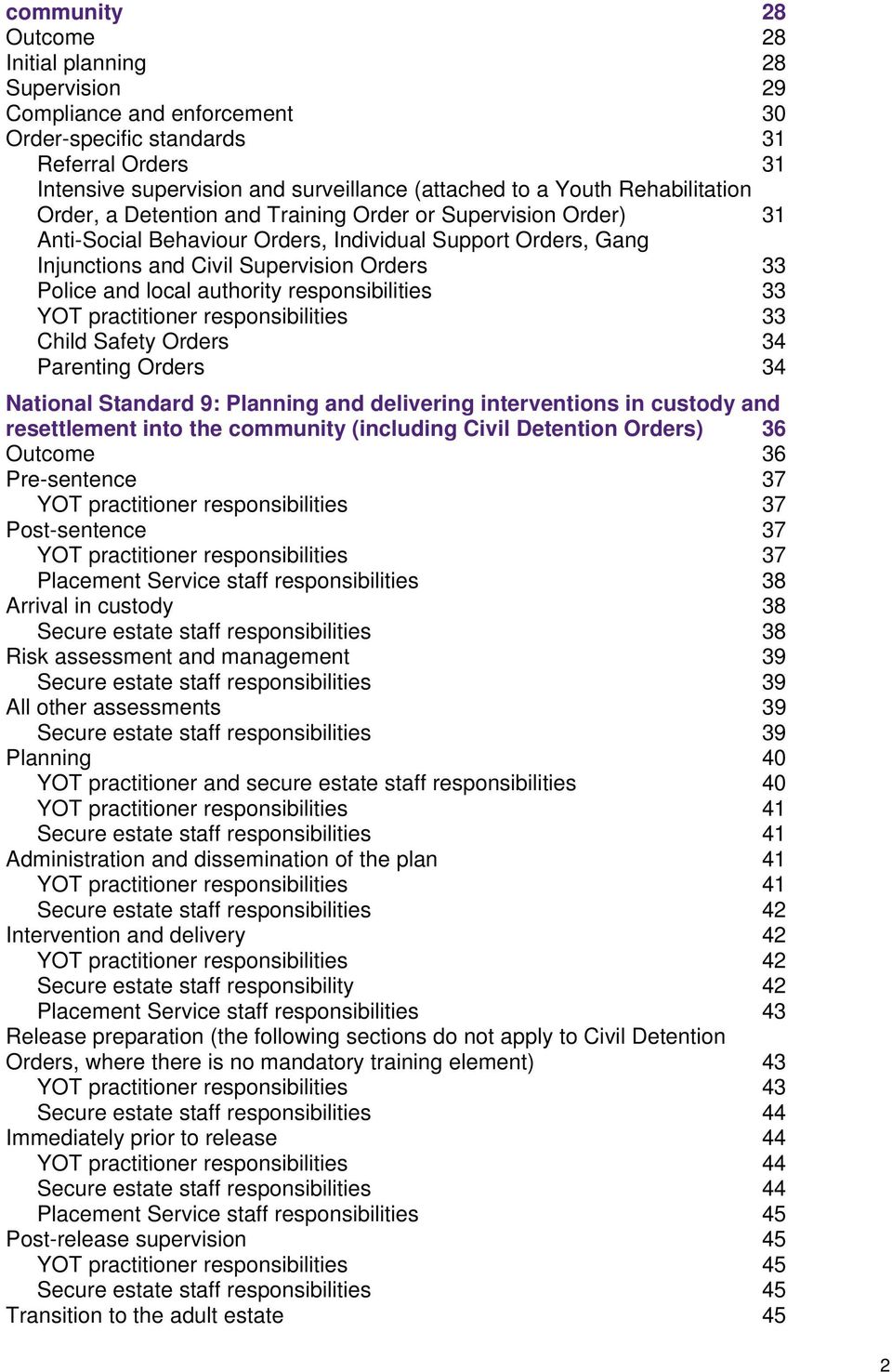
3 community 28 Outcome 28 Initial planning 28 Supervision 29 Compliance and enforcement 30 Order-specific standards 31 Referral Orders 31 Intensive supervision and surveillance (attached to a Youth Rehabilitation Order, a Detention and Training Order or Supervision Order) 31 Anti-Social Behaviour Orders, Individual Support Orders, Gang Injunctions and Civil Supervision Orders 33 Police and local authority responsibilities 33 YOT practitioner responsibilities 33 Child Safety Orders 34 Parenting Orders 34 National Standard 9: Planning and delivering interventions in custody and resettlement into the community (including Civil Detention Orders) 36 Outcome 36 Pre-sentence 37 YOT practitioner responsibilities 37 Post-sentence 37 YOT practitioner responsibilities 37 Placement Service staff responsibilities 38 Arrival in custody 38 Secure estate staff responsibilities 38 Risk assessment and management 39 Secure estate staff responsibilities 39 All other assessments 39 Secure estate staff responsibilities 39 Planning 40 YOT practitioner and secure estate staff responsibilities 40 YOT practitioner responsibilities 41 Secure estate staff responsibilities 41 Administration and dissemination of the plan 41 YOT practitioner responsibilities 41 Secure estate staff responsibilities 42 Intervention and delivery 42 YOT practitioner responsibilities 42 Secure estate staff responsibility 42 Placement Service staff responsibilities 43 Release preparation (the following sections do not apply to Civil Detention Orders, where there is no mandatory training element) 43 YOT practitioner responsibilities 43 Secure estate staff responsibilities 44 Immediately prior to release 44 YOT practitioner responsibilities 44 Secure estate staff responsibilities 44 Placement Service staff responsibilities 45 Post-release supervision 45 YOT practitioner responsibilities 45 Secure estate staff responsibilities 45 Transition to the adult estate 45 2
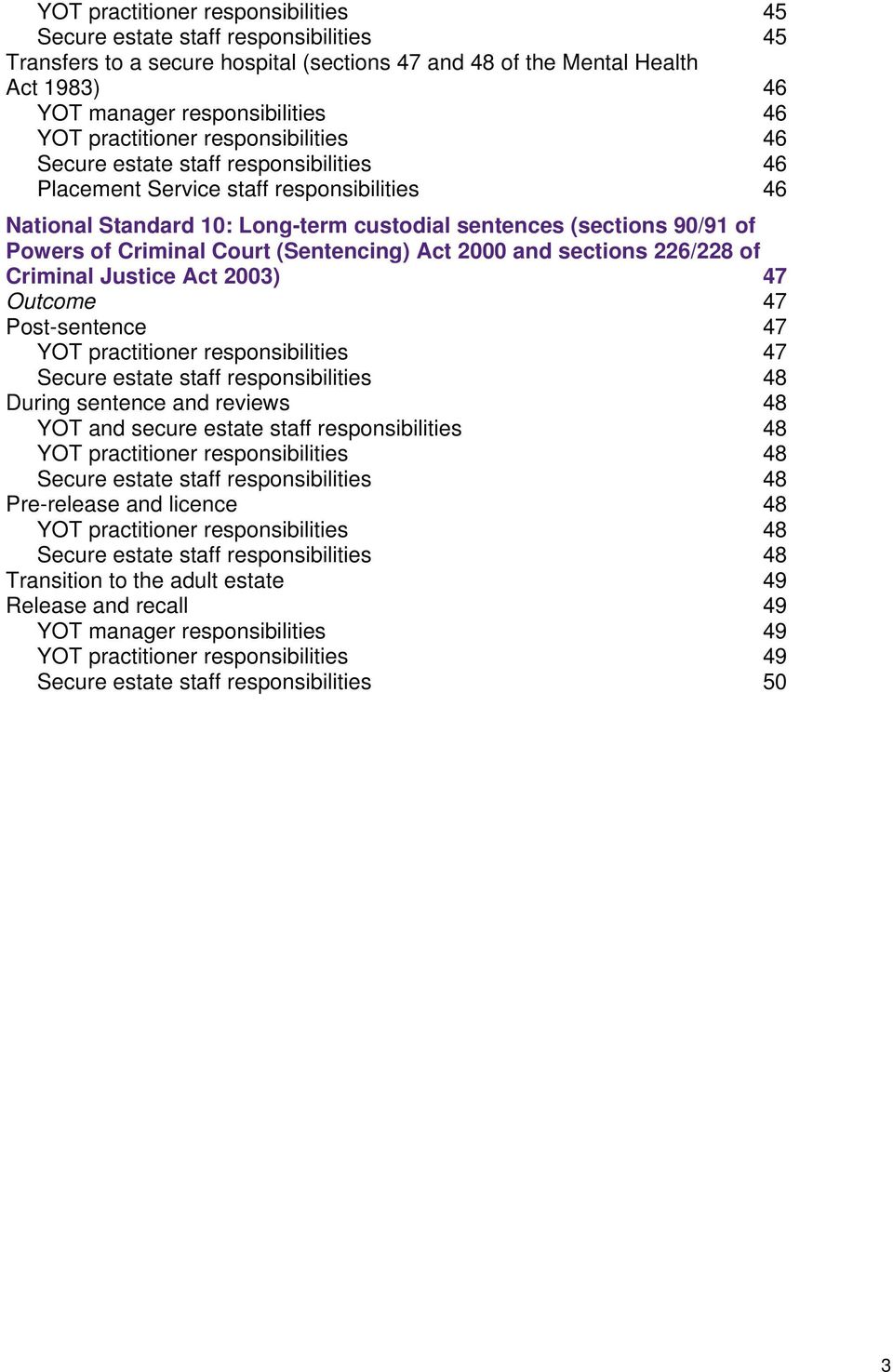
4 YOT practitioner responsibilities 45 Secure estate staff responsibilities 45 Transfers to a secure hospital (sections 47 and 48 of the Mental Health Act 1983) 46 YOT manager responsibilities 46 YOT practitioner responsibilities 46 Secure estate staff responsibilities 46 Placement Service staff responsibilities 46 National Standard 10: Long-term custodial sentences (sections 90/91 of Powers of Criminal Court (Sentencing) Act 2000 and sections 226/228 of Criminal Justice Act 2003) 47 Outcome 47 Post-sentence 47 YOT practitioner responsibilities 47 Secure estate staff responsibilities 48 During sentence and reviews 48 YOT and secure estate staff responsibilities 48 YOT practitioner responsibilities 48 Secure estate staff responsibilities 48 Pre-release and licence 48 YOT practitioner responsibilities 48 Secure estate staff responsibilities 48 Transition to the adult estate 49 Release and recall 49 YOT manager responsibilities 49 YOT practitioner responsibilities 49 Secure estate staff responsibilities 50 3
5 Youth Justice Board for England and Wales 2013 The material featured in this document is subject to copyright protection under UK copyright law unless otherwise indicated. Any person or organisation wishing to use YJB materials or products for commercial purposes must apply in writing to the YJB at for a specific licence to be granted. 4
6 National Standards statement of purpose The principal aim of the youth justice system is to prevent offending by children and young people. The National Standards for Youth Justice Services are set by the Secretary of State for Justice on advice from the Youth Justice Board for England and Wales (YJB). The standards apply to those organisations providing statutory youth justice services. These standards should be seen as a distillation of the range of legislation, compliance frameworks (contracts, inspection regimes, etc) and sources of statutory and effective practice guidance which applies across the youth justice sector. The YJB has a responsibility to monitor adherence to National Standards on behalf of the Secretary of State. National Standards in Youth Justice must define the minimum required level of service provision consistent with ensuring: delivery of effective practice in youth justice services safeguarding of children and young people who come into contact with youth justice services protection of the public from the harmful activities of children and young people who offend. In defining these standards the Secretary of State also requires that: where possible and appropriate, youth justice services are afforded the maximum freedom and flexibility to adapt their practice to local context the public have confidence that children and young people subject to statutory supervision by youth justice services are fairly punished and are supported to reform their lives. Strategic and operational management standards General Strategic standard 1: Ensure that all young people who enter the youth justice system in the local area or establishment are allocated an appropriately trained supervising worker. 5
7 Strategic standard 2: Ensure that all service provision takes full account of diversity and equal opportunities (ensuring access to appropriate services and programmes). Strategic standard 3: Ensure a focus on the child within the family context throughout the youth justice system Strategic standard 4: Ensure that commissioning practice is based on the available evidence. Strategic standard 5: Ensure that all interventions which are delivered address the risks and needs of the individual Strategic standard 6: Ensure that a workforce development strategy and training plan are in place to ensure high-quality personnel and service delivery. Strategic standard 7: Ensure quality-assurance processes are in place, built on feedback from key stakeholders including courts, victims, young people and parents and carers. Strategic standard 8: Ensure supervision and appraisal systems are in place which ensure continual improvement and development of staff skills. Strategic standard 9: Ensure systems are in place for identification and generation of management information (including passing this securely to the YJB). Strategic standard 10: Put in place systems that ensure that management information is used for strategic planning and service development, and is passed securely to partners where necessary and in compliance with the Data Protection Act Strategic standard 11: Establish and implement clear local policies and protocols in relation to: public protection and risk management (including release and recall arrangements for young people on licence/supervision) safeguarding and child protection which should take account of any existing local authority policies and thresholds enforcement and compliance with court orders, remand and bail programmes, including responsibilities for undertaking enforcement action where case management sits outside the youth offending team (YOT) acceptable behaviour in relation to staff and children and young people a complaints procedure which gathers feedback from all parties including young people and parents/carers joint working arrangements, roles and responsibilities between individual secure establishments, YOTs, and all other partners escalation procedures and mechanisms for resolving disputes and ensuring accountability, in particular where agreed joint working arrangements are not adhered to management and reporting (where relevant) of self-harm, suicide attempts and serious incidents in line with YJB expectations (outlined here 6

8 escorting young people from custody to community, and the transition of young people between youth justice services and from the youth to the adult criminal justice system (drawing on the Youth to Adult Transitions Framework for community transfers and relevant NOMS custody transitions guidance) delivery of services to victims in compliance with sections 9 and 11 of the Code of Practice for Victims of Crime (for community and custody respectively) delivery of restorative interventions in line with the Restorative Justice Council s National Occupational Standards and Best Practice Guidance for Restorative Practice. Community Strategic standard 12: In accordance with section 40 of the Crime and Disorder Act 1998, ensure that the work of the YOT is defined in a publicly accessible youth justice plan that is co-ordinated with other local plans. Strategic standard 13: Ensure that the youth justice partnership is properly represented on a fully constituted management board or other local governance boards. Strategic standard 14: Ensure that a local policy/protocol is in place which outlines the provision of an Appropriate Adult service (as required by section 38 of the Crime and Disorder Act 1998) in line with the National Appropriate Adult Network s National Standards. To ensure that this policy makes provision within and outside office hours, and for young people who may be interviewed under the Police and Criminal Evidence Act 1984 (PACE) while remanded or sentenced in custody whether within or outside the local authority area. Custody Strategic standard 15: Ensure systems are in place for making all records and information held on young people within establishments available and accessible to those who need it for the proper co-ordination of young people s sentence plans, and effective risk and safety management. Strategic standard 16: Ensure systems are in place for communicating effectively and appropriately with all relevant partners, including parents and carers, and external services Strategic standard 17: Establish and implement clear polices and procedures in relation to, at a minimum: maintaining young people s safety (including ensuring that, until confirmation is received to the contrary by the establishment, young people without adequate documentation are managed, on the assumption that they may harm themselves or others) responding to incidents of attempted suicide or self-harm in accordance with National Institute for Clinical Excellence (NICE) standards drug-testing young people ensuring the appropriateness of visits and visitors 7
9 monitoring of phone calls and mail pastoral care. 8

10 National Standard 1: Preventing offending Outcome Local strategies and services are in place to prevent children and young people from becoming involved in crime and/or anti-social behaviour, and to support their parents/carers and families. 1.1 Formally assess all children and young people referred to the YOT to identify the risks and needs associated with potential offending and antisocial behaviour, using a local or nationally recognisable and appropriate assessment tool. 1.2 Formulate all intervention plans on the basis of the assessment, and record information accurately and effectively using the local management information systems. 1.3 Involve young people and their parents/carers in the design and review of individual programmes. 9
11 National Standard 2: Out-of-court disposals (Youth Cautions and Youth Conditional Cautions) Outcome Out-of-court disposals are robust and deliver targeted and tailored interventions for those at risk of further offending. 2.1 Undertake or contribute to an assessment of the child or young person within 10 working days of referral by the police, using the YJB-approved assessment tool, which must include where possible a home visit. Any decision to discontinue the assessment as a result of non-compliance must be made in a timely manner. 2.2 Offer intervention where assessment identifies any offending behaviour risks and associated needs, and align the intervention programme with any relevant partner agency plans. 2.3 Support children and young people in accessing universal and specialist services as appropriate. 2.4 Conclude all out of court assessments and inform the police of the conclusions and recommendations within 15 working days of the date of police bail. 2.5 Review and update assessment tool where an intervention programme has ended. 2.6 Ensure information about the outcome of the disposal is available to the court where the young person has reoffended. 2.7 Ensure that all relevant out of court information received from the police is recorded accurately on the YOT case management system. 2.8 Promptly refer any notification that has been received from the police for children and young people residing outside the YOT area to the home YOT via secure . Local police responsibilities 2.9 Notify the YOT as soon as is practicable and within 24 hours of: all cases where the police are considering charging a child or young person with a criminal offence any instances where a child or young person is arrested without a warrant for breach of the conditions of their remand to local accommodation (under section 97 of the Legal Aid, Sentencing and Punishment of Offenders Act 2012) 10

12 cases where an out of court disposal has been issued or a decision has been made to issue one of them and the young person has been bailed for the purpose of delivery, or a YOT assessment is required to help inform the police disposal decision. the arrest of any young person who is suitable for receiving a pre-court disposal and bail them, if appropriate, for assessment by the YOT Issue all out-of-court disposals within 20 working days of the date of police bail. These must be given in the presence of the child or young person s parents/carers or other Appropriate Adult where the child or young person is aged 16 years or under. 11

13 National Standard 3: Bail and remand management (including remand to local authority accommodation) Outcome A comprehensive local remand management strategy is in place to ensure provision of: Appropriate Adults facilities to accommodate young people detained under section 38 (1) of PACE where, by virtue of section 38(6) of PACE, local authority accommodation is required bail information, supervision and support liaison with the local authority regarding appropriate accommodation mechanisms for reviewing young people remanded into the secure estate. The overall aim of the local remand strategy is to reduce the unnecessary use of secure remand at the earliest stage in the criminal justice process. At court 3.1 Where there is a possibility that bail may be refused, assess young people on their first court appearance using the YJB approved assessment tool. 3.2 Where the young person is from another area, liaise with the home YOT prior to the court appearance. 3.3 Provide the court with full bail information and a robust option for bail supervision and support where a child or young person is at risk of: being unnecessarily remanded into youth detention accomodation offending on bail or breaching conditions of bail or remand to local authority accommodation failing to return to court. 3.4 Ensure that support and supervision programmes presented to court to address objections to bail are aligned with relevant partner agency plans and interventions, and are appropriate to the risks and needs of the young person. YOT manager authorisation must be obtained before any contacts with other agencies are counted towards proposed such programmes. 12

14 Support and Supervision (includes bail and remands to local authority accommodation) 3.5 Ensure the support and supervision programme is understood by the child or young person and their parent/carer where appropriate (taking into account any relevant speech, language and communication issues, learning difficulties and disability). 3.6 Ensure that the programme is delivered in line with court expectations (including the frequency of contacts, home visits and enforcement activity in the case of non compliance). Intensive Supervision and Surveillance Programme (either as a condition of bail or remand to local authority accommodation) 3.7 Where the Intensive Supervision and Surveillance Programme (ISSP) has been made a condition of bail or remand to local authority accomodation, provide a minimum of 25 hours programmed contact time each week, including support during evenings and weekends, which can be reduced to a minimum of five hours a week where the following criteria have been met: there has been no offending on bail or breaches of bail conditions the programme elements have been successfully implemented and completed the court has approved the variation in contact levels. 3.8 Ensure the ISSP has the following core elements: education, training (especially basic literacy and numeracy) and employment appropriate for the child or young person s needs interventions to address offending behaviour (taking into account that the child or young person may not yet be convicted) assistance in developing inter-personal skills family support curfew supported by electronic monitoring plus two surveillance checks a day (the presence of a tag may count as one of these contacts). In addition, programmes should include access to support for individual problems for example, homelessness, substance misuse or mental health problems, learning disabilities or special educational needs. 3.9 Hold the first contact with the child or young person who is subject to ISSP on the same day as the court appearance Finalise a signed programme plan that is agreed by all parties within two working days of a bail condition being imposed. 13
15 3.11 Ensure the plan is reviewed by the YOT case manager in line with all other relevant assessment documentation whenever there is a significant change in the young person s circumstances Enforce the ISSP in line with the expectations of the Court. Remands into youth detention accommodation Meetings during the remand period Initial remand discussion The initial remand discussion is held when the young person is remanded for a very short period (usually five days or fewer) and where it is impracticable for the YOT to attend the establishment prior to the next court appearance. The purpose of the initial remand discussion is for the secure establishment and the YOT to clarify the shared package of support which the young person will be offered during the short period until their next court appearance. The discussion must focus on immediate concerns and risks related to the young person s arrival into custody and set immediate plans for how to mitigate these risks. It must also cover potential bail options for the next court appearance. Remand planning meeting The remand planning meeting is organised by and held at the secure establishment. Its purpose is to review the youth justice assessment of the young person and to produce a shared plan setting out the programme of services from the secure establishment and YOT which the young person will receive during the remand period. The meeting will also be used to review bail options for the young person in advance of their next court appearance. Urgent risk planning meeting The purpose of the urgent risk planning meeting is to quickly formulate adequate risks management plans in response to a child or young person who is identified as at risk of harm to themselves or from others, or at risk of causing serious harm to others within the secure estate. By definition, these meetings will be irregular and held on ad-hoc as the need arises. YOT responsibilities 3.13 Where there is a strong likelihood that a remand to youth detention accommodation will be ordered or where one has been made, full information must be provided to the YJB Placement Service using the YJB approved assessment and planning tools. 14
16 3.14 Follow up on young people remanded to youth detention accommodation and together with the young person, their legal representative and the secure establishment, consider a BSS or Remand to Local Authority Accommodation package and, if appropriate, present it at the next court appearance or before a judge in chambers If a young person is remanded to youth detention accommodation, provide all information necessary for the YJB Placement Service to make a sufficiently informed placement decision. At a minimum, this must include: the most relevant and complete youth justice assessment completed using the YJB-approved assessment tool (where possible 24 hours in advance of the likely remand) any relevant information about the child or young person s educational history the post-court information (updated and sent after the remand decision). These documents must be sent electronically using YJB Connectivity wherever possible Inform the Placement Service by phone when the outcome of the case is known Where the young person has been assessed as exhibiting specific and definable risk factors that cause an immediate concern regarding the placement of the young person in custody, or a risk of serious harm to others, notify the YJB Placement Service, secure establishment and secure escorts immediately. Contribute to an urgent risk planning meeting, as necessary, organised for the purpose of assessing and managing these risks Within 48 hours of the custodial remand, notify any relevant authorities within the home and host children s services, and education departments of the designated authority (responsible for delivering looked-after child services to the remanded young person), and provide them with details of the custodial placement. The host YOT should notify the home YOT within one working day of the custodial remand. The home YOT then has one working day to inform relevant services In conjunction with the secure establishment, set up and deliver an initial remand discussion before the next court appearance. Where the young person is exhibiting specific and definable risk factors which cause an immediate concern to the custodial remand placement this discussion must occur as soon as is reasonably possible and be attended in person by the YOT worker At the request of the secure establishment, attend in person a remand planning meeting within ten working days of the initial remand. Where the young person is exhibiting specific and definable risk factors which cause an immediate concern to the custodial remand placement this meeting must occur sooner than ten working days and be attended in person by the YOT worker In circumstances where a young person is sentenced and also remanded to youth detention accommodation, the standards relating to managing the custodial sentence must take precedence, and efforts must be made to 15
17 provide coherence to the young person s experience in custody, particularly where the remand period extends beyond the release date of the custodial element of the sentence Ensure the young person is visited by YOT staff or partner agencies at least monthly, and that this visit is distinct from the remand planning meeting (although it is permissible for the meetings to be held on the same date). Where possible and appropriate, co-ordinate these meetings with statutory looked-after child reviews being delivered by the relevant local authority Attend remand planning meetings organised by the secure establishment which take place as a minimum every six weeks. Review the remand plan and give consideration to bail applications, where appropriate, taking into account the views of secure estate staff. With the exception of the initial remand planning meeting, these planning meetings can be undertaken via video link where available At any point during the remand where the secure establishment identifies a child or young person as being at risk of harm to themselves or from others, or a risk of serious harm to others within the secure estate, attend the secure estate-led meeting which addresses risk management. Placement Service staff responsibilities 3.25 On receipt of the documentation from the YOT, undertake a completeness check of all items On notification of a remand to youth detention accommodation being made: review the assessment information make a decision on the most appropriate placement, based on the individual needs of the young person and the availability of spaces and resources in the secure estate in accordance with the Placement Service placement protocol issue a Placement Confirmation form to the YOT, escort provider and secure establishment forward all available assessment information to the receiving secure establishment in the event that assessment information is not received from the YOT, the Placement Service will request the missing information as per the missing electronic yellow envelope (Eye) documents procedure and inform the receiving establishment of this. Secure estate staff responsibilities 3.27 Contact the Placement Service to alert them and request missing documents as laid out in 3.26 above. If they are unavailable, then treat as missing, in line with the Eye documents procedure in the Operations Manual/Placement Protocol and the Interchange and Benefits Agreement for Sharing Information. 16

18 3.28 Ensure all assessment information received from the YOT is made accessible and shared with relevant staff in the establishment Ensure all young people are assessed as soon as possible on reception into custody by a registered nurse or doctor. This will include completion of the Comprehensive Health Assessment Tool, an assessment of mental health needs as well as an assessment for substance abuse. The nurse or doctor must evidence that they have read the young person s youth justice assessment prior to undertaking the assessment. Where withdrawal treatment is needed, the young person must be referred to a specialist doctor or nurse and a drug or alcohol worker, who may be based in the secure establishment or the community Conclude the reception interview within two hours of the young person s arrival (or as soon as possible following the completion of the Comprehensive Health Assessment Tool) to assess their needs and level of risk of harm to themselves or from others. This interview must be concluded on the first night and assess their risk of harm to themselves or from others and cell sharing assessments in all relevant cases. Staff undertaking the interview must see youth justice and post-court information about the child or young person that will have already been made available to the secure establishment by the Placement Service. In the case of the young person s arrival at a STC, these procedures must be carried out in accordance with the legal requirements of STC rule 23. When the young person arrives after 9pm, and it is not in their best interests to undergo a reception interview, they must be assumed as being at risk of harm to themselves or from others until the reception interview is completed. In these circumstances, the youth justice assessment and planning tools must still be updated and the reception interview must be commenced within one hour of the next scheduled wake-up In circumstances where the establishment does not have access to the youth justice assessment and post-court information, treat all young people as presenting a risk of harm to themselves or from others until satisfied to the contrary. In these circumstances, maintain these cases under continual review using approved YJB assessment and planning tools Where the child or young person poses a risk to themselves or others, or is at risk from the behaviour of others, take all necessary actions and ensure that these are recorded in accordance with YJB guidance At the earliest possible point following the identification of a child or young person who poses a risk of harm to themselves or from others, or a risk of causing serious harm to others within the secure estate, convene an urgent risk planning meeting and invite the YOT to attend. If it is not possible for the YOT to attend, the establishment must inform the YOT supervising officer of the outcome of the meeting within 24 hours. Meeting minutes should be circulated to all invitees within 24 hours of the meeting s conclusion Undertake a full assessment of each young person admitted to custody within 10 working days of admission. The assessment should cover the health (including consideration of speech, language, communication needs 17

19 and learning disabilities/difficulties), social, educational, vocational and any other needs of the young person Contribute to the initial remand discussion where a young person will appear in court prior to the remand planning meeting Ensure that a remand planning meeting takes place within eight working days of the initial court hearing and at a subsequent frequency not exceeding every 6 weeks. The YOT supervising officer and any other relevant professionals must be invited to this meeting Provide programmes linked to the assessed needs of the young person as agreed at the remand planning meeting, and, where the young person is assessed as being at risk of harm to themselves or from others, or a risk of serious harm to others, implement measures for managing this risk in accordance with the YJB approved assessment and planning tools Provide meaningful support to the YOT in their review of the plan as required. This review must give consideration to bail applications/alternative arrangements to be made Provide meaningful support to the relevant local authority in undertaking looked-after child reviews for all remanded young people in accordance with the Children (Secure Accommodation) Regulations 1991 and the Review of Children s Cases Regulations Where a child or young person is subject to an emergency transfer to a young offender institution (YOI), the Placement Service must be notified, as soon as possible after the event, which in most cases is expected immediately. A retrospective transfer request form must also be submitted to the Placement Service, who will then reassess the ongoing suitability of the young person s placement and issue a Placement Confirmation form accordingly All other transfers across the secure estate must be made in line with the Placement Service transfer protocol. Police staff responsibilities 3.42 When it is necessary, to detain a child or young person overnight in accordance with PACE section 38 (1) and (6), or transfer the child or young person to local authority accommodation in line with the PACE Code of Practice, Code C. The exceptions to this are where the custody officer certifies under PACE section 38 (6) that it is either: impractical to move the young person to local authority accommodation or where the young person is 12 years of age or over, no secure accommodation is available and keeping the young person in other local authority accommodation would not be adequate to protect the public from serious harm Following charge, bail and before leaving the police station, give the young person (and Appropriate Adult) verbal and written information on what will happen next Inform YOTs within one working day about young people under the age of 18 who have been charged with an offence or bailed for the delivery of a 18
20 Youth Caution or Youth Conditional Caution, or for a decision to be made about disposal where YOT assessment is required. Secure electronic means of transmission should be used within the police force areas via the Police Electronic Notifications to YOTs (PENY) process Inform the YOT as soon as possible of all young people detained in police custody for production in court. Local authority staff responsibilities 3.46 Put in place arrangements for managing requests from the police for PACE beds and for receiving children and young people transferred from the police, as per PACE section 38 (1) and (6) To ensure that the young person s status as a looked-after child is recognised, put in place formal arrangements in agreement with the YOT regarding the local authority s duties towards young people remanded to non-secure local authority accommodation. 19
21 National Standard 4: Assessment for interventions and reports Outcome All children and young people entering the youth justice system benefit from a structured needs assessment (using the relevant YJB-approved assessment tool) designed to identify the young person s strengths, and the risks and protective factors associated with offending behaviour and harm to others, and to inform effective intervention programmes. 4.1 For all young people entering the youth justice system, undertake highquality assessments using the YJB-approved assessment tool. Assessments must be informed by a range of sources including at a minimum: regular home visits for all children under 16 years of age, the views of parents and carers (using YJB s self-assessment tools or another appropriate mechanism the self-expressed views of the child or young person must be captured (using the YJB s self-assessment tools or another appropriate mechanism). relevant information from other agencies e.g. health, education, accommodation, etc. 4.2 Where the assessment is taking place in preparation for a court report, ensure that: appropriate assessment is made of the young person s motivation to comply with sentences where their willingness is a prerequisite (the mental health and intoxicating substance treatment requirements and the drug treatment and testing requirements) For cases which cross the custody threshold, make any appropriate contacts with relevant services (for example, the local intensive fostering or intensive supervision and surveillance service), providing them with any required information, and conduct any additional assessments necessary. 4.3 Plans resulting from assessments must be completed within 15 working days of the initiation of the assessment. In circumstances where the young person is awaiting sentence, completion of the plan can be deferred to no later than 15 working days following sentence. 4.4 Maintain assessments under continual review and update the assessment document where necessary to reflect changes in the young person s circumstances, risks and needs. 20
22 4.5 For all orders, ensure that a formal review of progress, including a review of the assessment and plan is held at a maximum of six- monthly intervals, or if any of the following apply: where, in the judgement of the case manager, any identified changes in the young person s life are so significant as to warrant a revision to the plan prior to any decision to vary levels of contact in line with the scaled approach model, and at the conclusion of the YOT supervision as part of the case closure process. 4.6 In addition to consulting a range of sources as outlined in 4.1 above, the formal assessment review must: monitor and record progress against existing plans gather and record the most up to date and relevant information relating to young people s risks and needs. 4.7 When assessments identify significant risk of harm to others or significant young person safety and wellbeing concerns, the practitioner must inform and share information with relevant agencies (including secure estate) and take action in line with local safeguarding and risk-management procedures, including, where necessary, Multi-Agency Public Protection Arrangements. Placement Service staff responsibilities 4.8 On notification of a custodial sentence being given, the Placement Service will: review the assessment information make a decision on the most appropriate placement, based on the individual needs of the young person, and the availability of spaces and resources in the secure estate in accordance with the Placement Service placement protocol issue a Placement Confirmation form to the YOT, court, escort provider and secure establishment forward all available assessment information to the receiving secure establishment in the event that assessment information is not received from the YOT, the Placement Service will request the missing information as per the Missing Eye documents procedure and inform the receiving establishment of this. 21
23 National Standard 5: Reports for courts, youth offender panels and civil courts in Anti-Social Behaviour Order proceedings and gang injunctions Outcome Reports prepared by the YOT are balanced, impartial, timely, focused, free from discriminatory language and stereotypes, verified, factually accurate, understandable to the child or young person and their parents/carers, and provide the required level of information and analysis to enable sentencers to make informed decisions regarding sentencing. Youth offender panel reports 5.1 Complete the youth offender panel report in writing and provide a copy to the child or young person, and their parents/carers 5.2 Inform the panel of the range of interventions available that may be appropriate for inclusion within the contract. Pre-sentence reports 5.3 Where a pre-sentence report is requested by the court, complete this document in writing to the specification and within the timescale requested by the court. A pre-sentence report must be based on: at least one interview with the child or young person where possible, an interview with the parents/carers a home visit where appropriate an assessment using the YJB-approved assessment tool confirmation from relevant services that relevant provision exists and is forthcoming in support of proposals, particularly for the following Youth Rehabilitation Order (YRO) requirements: electronic monitoring exclusion prohibited activity education 22
24 residence local authority residence mental health treatment intoxicating substance treatment drug testing drug treatment. 5.4 Ensure that children or young people and their parents and carers have a copy of the pre-sentence report, and provide an opportunity to discuss the content and conclusions of the written pre-sentence report prior to the sentence hearing. 5.5 At the request of the court, where it deems a pre-sentence report unnecessary, prepare a specific sentence report or a stand-down report to guide sentencing. Specific sentence reports 5.6 These reports are requested by the courts to assess children and young people. They must be completed in writing within a timescale agreed by the court. A specific-sentence report must be based on: a recent YOT assessment which is up to date and relevant any relevant information contained in any other local assessment. It must also assess a child or young person s suitability for a specific sentence. 5.7 In line with section 73 (5) of the Powers of Criminal Courts (Sentencing) Act 2000, specific sentence reports in relation to Reparation Orders must: indicate the type of work suitable for the young person outline the attitude of the victim(s) to the requirements proposed for inclusion in the order. Civil court reports including Individual Support Orders, parenting reports, and gang injunction reports 5.8 Where an Individual Support Order (ISO)/parenting report/gang injunction report is requested by the court, complete this document in writing within a timescale agreed by the court. An ISO/parenting report/ gang injunction report must: assess the suitability of an ISO, parenting order or gang injunction in preventing further anti-social behaviour or gang-related violent behaviour and breach of the young person s Anti-Social Behaviour Order 23
25 offer consistent advice to the civil court on the desirability of an ISO/parenting order/gang injunction in preventing further anti-social behaviour or gang-related violent behaviour. Stand-down reports 5.9 Where a stand-down report is requested by the court, complete this document either verbally or in writing on the same day as the relevant court hearing. A stand-down report must only be provided where custody is not being considered, and should be based youth justice assessment information gathered within the last three months and other relevant reports. It must be based upon at least one interview with the child or young person and, where relevant, their parents/carers 24
26 National Standard 6: Work in courts Outcome YOTs provide high-quality services to courts, and magistrates and the judiciary have confidence in the quality of information and in the rigour of supervision of children and young people who offend. Young people and their parents and carers are provided with appropriate information and support during the Court process. 6.1 Provide the court with a service as agreed within the youth justice service agreement, giving particular priority to: providing up-to-date and relevant information to the court engaging children, young people and their parents/carers, and providing information on the court process ensuring accurate recording of court information presenting reports to the court developing the confidence of the court in the quality of services provided by the YOT. 6.2 Where there is a strong likelihood that a custodial sentence will be ordered, or where one has been given, the placement information must be sent by the YOT to the Placement Service, including: all youth justice assessment information post-court information (completed and sent after custodial sentence). This information should be sent: 24 hours in advance of likely sentence electronically, by Connectivity (or secure ). Other documents such as pre-sentence reports, and any other planning information should also be sent to the Placement Service. Handwritten post-court informations can be scanned and sent via secure or faxed. Prevailing YJB guidance should be followed at all times. 6.3 Ensure that the custodial warrant issued by the court is appropriate for young people remanded in custody or sentenced to custody. The warrant checklist guidance should be followed and the warrant should contain accurate information on all the areas outlined in Part 18 of the Criminal Procedure rules. If the warrant is not accurate, the warrant must be referred back to the issuing court by the YOT. 25
27 6.4 Inform the Placement Service immediately by phone or secure when the outcome of the case is known. Where possible, the Placement Service will send a placement confirmation by secure within one hour. 6.5 When a young person is remanded/sentenced to the secure estate: transmit the post-court information at the time of sentence the Placement Service will send the young person s supporting documents to the secure estate establishment via secure ensure the completed court warrant and Placement Authorisation form are placed in the Secure Escort Folder and given to the secure escort service visit the child or young person in cells after sentence, deal with any welfare issues and help the young person to understand and come to terms with the situation any extra or supporting documentation should be put in the Secure Escort Folder and given to the secure escort service for transmission to the secure establishment where a young person is assessed as at risk of harm to themselves or from others, notify the Placement Service and secure establishment immediately by phone and in writing, and inform the secure escort service within one hour of the court hearing inform the parents/carers of the remand/sentence decision, details of secure estate placement (including written information about the secure estate facility where available) and Assisted Prison Visit Scheme. Secure escort services responsibilities 6.6 Treat the young person as at risk of harm to themselves or from others until youth justice assessment documentation and post-court information is received from the Placement Service. 6.7 Where they receive notification that there is an enhanced risk of suicide or self-harm, ensure immediate action is taken to safeguard the young person. 26
28 National Standard 7: Work with victims of crime Outcome YOTs have processes in place to ensure that victims of youth crime are involved, as appropriate, in a range of restorative processes that seek to put right the harm they have experienced. 7.1 Deliver services to victims in compliance with the Code of Practice for Victims of Crime (for community and custody respectively) 7.2 Deliver restorative interventions in line with the Restorative Justice Council s National Occupational Standards and Best Practice Guidance for Restorative Practice 7.3 Ensure that any reparation activity required of a child or young person under a court order or an out of court disposal is set out in writing, specifying the type of activity, dates, times and duration. This must be explained fully to the child or young person and his or her parents/carers. 7.4 Consult with victims and the community (where appropriate) about reparation placements and willingness to engage in restorative processes. 7.5 Obtain the written consent of any victims willing to engage in direct victim reparation or restorative processes. 27
29 National Standard 8: Planning and delivering interventions in the community Outcome Court orders (including civil court orders such as ISOs or gang injunctions) are managed in such a way that they support the principal aim of the youth justice system, to prevent offending, and that they have regard to the welfare of the child or young person. Young people and their parents/carers receive appropriate information and support throughout their order. This must include appropriate exit planning where relevant. Initial planning 8.1 On the making of any order (including civil orders), explain to the young person and, where appropriate, their parents or carers, their rights and responsibilities under the terms of the order including: their right to access services provided by the YOT and wider local area the support the YOT will provide for them their right to make comments and complaints, and how to do so their responsibility to comply with the terms of their order, including acceptable and unacceptable absence criteria acceptable behaviour acceptable time-keeping. This must be set out in writing, with a copy being made available to the young person and, where appropriate, their parents and carers. 8.2 Ensure that the young person understands what is required of them, and fully understands the requirements of the order (taking into account any mental health problems, learning disabilities/difficulties, speech, language and communication needs) and encourage the child or young person to sign a copy of these expectations to confirm their understanding of these requirements, including details of the first appointment. 8.3 Follow relevant local and YJB guidance when transferring cases within the YOT, between YOTs, or to the local probation area/trust (as outlined within the local YOT probation protocol). 8.4 Make initial contact with the child or young person within three working days of the court hearing, when a community-based court order has been imposed. 28
30 8.5 In all cases, contact should focus on explaining the nature of the order, how it will work in practice and the consequences of failing to comply (taking into account speech, language, communication needs and learning disabilities and difficulties). This applies to all orders including stand-alone requirements 8.6 Where the young person is already subject to an existing intervention plan and is resentenced during its duration, ensure that this plan is reviewed and amended where necessary. 8.7 Ensure the intervention plan is co-ordinated with any other relevant specialist plans accordingly 8.8 Ensure that appropriate plans are devised that outline interventions proposed for the young person that take into account public protection and risk of reoffending, and the safety and well being of the child or young person. Supervision 8.9 Supervise the following orders in line with the Scaled Approach model as set out in the table below: YRO with a supervision requirement and other requirements where appropriate and as part of the intervention plan Referral Orders Community element of Detention and Training Orders (DTOs). Table 1: Scaled Approach model Intervention level Minimum contact* for first 12 weeks (per month) Intensive 8 4 Minimum contact* after 12 weeks (per month) Enhanced 4 2 Standard 2 1 *A contact is a planned, meaningful face-to-face meeting that takes place between the child or young person, the YOT case manager, another member of the YOT, a member of another agency or a volunteer approved to work with the young person in respect of the supervision of his or her court order Youth justice supervision contacts must not conflict with the young person s school or work attendance, or religious observance, and must include home visits, involving parents/carers appropriately Consider the need to obtain management approval and oversight of decisions to vary indicated intervention levels, particularly where this involves a reduction in contact requirements. 29
31 8.12 For civil court orders including ISOs and gang injunctions, the acceptable level of contact should be defined at the consultation meeting with partners. Compliance and enforcement 8.13 Ensure that every effort is made to support the child or young person or parent/carer(s) in successfully completing all orders including those made in the civil courts and effectively manage compliance and enforcement issues in accordance with relevant legislation. In ensuring compliance and enforcement of court orders, proper account should be taken of the young person s or parent/carer s individual needs in relation to mental health problems, learning disabilities/difficulties, and speech, language and communication difficulties For cases involving joint delivery of court orders with other agencies (for example probation services or attendance centres), ensure that proper communication and consultation takes place in relation to enforcement decisions 8.15 Where there is failure to comply, ensure that: for YROs, enforcement action is taken in accordance with the procedures outlined in schedule 2 of the Criminal Justice and Immigration Act 2008 for Referral Orders, enforcement action is taken in accordance with schedule 1 of the Powers of Criminal Courts (Sentencing) Act robust and timely investigations are carried out into the reasons for noncompliance, and all consequent decisions are recorded where the failure to comply is judged as unacceptable, a written warning must be issued which: describes the circumstances of the failure to comply states that this failure is unacceptable informs the young person that they are liable to be returned to court or in the case of Referral Orders, referred back to the panel, for their failure to comply. any decisions not to refer the matter to court or panel under breach proceedings, where this is otherwise warranted by a pattern of noncompliance, are approved by a manager and properly recorded Where, in the case manager s judgement, circumstances have changed to such a degree that one or more YRO requirements are no longer workable, the order must be returned to court for amendment under the relevant statutory procedures Early revocation of an YRO must be considered no earlier than the half way point in the sentence, and only in circumstances where exceptional progress has been made. Such decisions must be informed by local partnership information and intelligence. 30
32 Order-specific standards Referral Orders 8.18 Hold an initial youth offender panel meeting (comprising at least two community members and one member from the YOT) within 20 working days of the court-hearing in order to agree the contract. This youth offender panel must be provided in advance with: any relevant reports the latest relevant assessments and plans any relevant information about victims, including any issues around consent Develop referral order contracts that specify at a minimum how the young person will make reparation to the victim and the wider community what interventions the YOT will undertake to build on strengths and address any risk factors within the young person s life Convene the youth offender panel at least quarterly to update on progress with the contract, and to consider whether the case needs referring back to court (for example, for early revocation or non-compliance) This panel must be provided in advance with a progress report outlining the case for referring back to court 8.21 Where a Referral Order is revoked by a court, inform the panel and victim/s (if appropriate) of the outcome. Intensive supervision and surveillance (attached to a Youth Rehabilitation Order, a Detention and Training Order or Supervision Order) 8.22 Where the custody threshold has been met, carry out an assessment in line with National Standard 4 to assist with determining the level of intensive supervision and surveillance (ISS) to be proposed. Table 2: ISS model ISS type Extended ISS (180 days) Contacts per week 1 4 months 5 6 months 7 12 months 25 hours 15 hours 5 hours Band 1 ISS (91 days) 1 3 months 4 6 months 25 hours 5 hours 31
33 Band 2 ISS (91 days) 1 2 months month months 20 hours 10 hours 5 hours 8.23 Ensure the supervision element of the programme has the following features. ISS extended version 180 days specified activity (for use in exceptional circumstances only): Comprises a minimum of 25 hours programmed contact time each week for four months, followed by a minimum of 15 hours each week for the next two months, including support during evenings and weekends. During this period, there must be two contacts with the young person per day, seven days per week. This must be followed by a minimum of five hours a week for the final six months, with support during evenings and weekends. Band 1 91 days specified activity: Comprises of a minimum of 25 hours programmed contact time each week for three months, including support during evenings and weekends. During this period there must be two contacts with the young person per day, seven days per week. This must be followed by a minimum of five hours a week for the next three months, with support during evenings and weekends. Band 2 91 days specified activity: Comprises a minimum of 20 hours programmed contact time each week for two months, followed by a minimum of 10 hours each week for the next month, including support during evenings and weekends. During this period there must be two contacts with the young person per day, seven days per week. This must be followed by a minimum five hours a week for the next three months, with support during evenings and weekends. Where a practitioner has judged that a high intensity ISS may be appropriate, delivery can be adjusted to suit the following circumstances: ISS junior version (13 years or younger): Comprises 12.5 hours programmed contact time each week (of which seven and a half hours can be education) for three months, with support during evenings and weekends. This must be followed by a minimum of five hours a week for the next three months, with support during evenings and weekends. ISS education, training and employment version: Comprises a minimum of one programmed contact each week day (Monday to Sunday), totalling seven hours of contact per week for three months, with support during evenings and weekends. This must be followed by a minimum of three hours a week for the next three months, with support during evenings and weekends. 32
34 8.24 Ensure all versions of ISS/ISSP have coverage of the core elements, which are: education, training (especially basic literacy and numeracy) and employment interventions to tackle offending behaviour reparation to victims or the community in conjunction with National Standard 8: Planning and delivering interventions in the community assistance in developing inter-personal skills family support a curfew supported by electronic monitoring plus two surveillance checks a day; the existence of a tag may count as one of these contacts See the child or young person who is subject to ISS/ISSP on the same day as the court appearance, if on bail or subject to a community sentence See those children or young people subject to a DTO on the day of release For those children and young people on ISS during the second part of a DTO, hold a final review meeting in custody with secure estate staff to identify the programme to be provided during the supervised part in the community, and the requirements on the child or young person during that period (including those to be included in the Notice of Supervision). Where it is agreed that a requirement to comply with the ISS is appropriate, this must be contained within the Notice of Supervision from the Secretary of State for Justice Ensure the plan is reviewed by the case manager at the end of each phase of intensiveness as a minimum and in all cases in line with National Standards 4.4. Anti-Social Behaviour Orders, Individual Support Orders, Gang Injunctions and Civil Supervision Orders Police and local authority responsibilities 8.29 Where an Anti-Social Behaviour Order in respect of a child or young person is proposed and the order made, inform the YOT within one working day Where an application for a gang injunction is being considered, or any application for breach, consult with the YOT, any authority, and any chief police officer, or other body or individual that the applicant thinks it appropriate to consult, prior to making an application (section 38 of the Policing and Crime Act 2009). YOT practitioner responsibilities 8.31 Where the court is considering imposing one of these disposals, the YOT must ensure that it provides all necessary advice and guidance to the applicants and to the court in determining the appropriateness and content of the order or injunction in question. Where in the YOT s opinion this 33
35 would be best achieved through undertaking an assessment, ensure that this takes place using the YJB approved assessment tool Where one of these disposals is imposed by the court, ensure that the YOT provides all necessary support to ensure that the expectations of the court are met including informing applicants where the YOT becomes aware of any information which indicates that the terms of the disposal are not being complied with. This may involve providing case management support to young people on these disposals Where the YOT is involved in a supervisory capacity in the delivery of a gang injunction, including where this results in a Civil Supervision Order, ensure that these responsibilities are discharged in accordance with published YJB guidance. Child Safety Orders 8.34 Where the YOT holds case management responsibilities, make first contact with the parents/carers within one working day of the court hearing in order to: explain the requirements of the order, and check the parents/carers understand and are aware of the consequences of non-compliance agree a draft plan for meeting the requirements of the order make arrangements for other agencies, where involved, to be consulted if relevant Where the parents/carers are directed to attend programmes delivered by third-parties, hold a pre-meeting not more than two weeks before the first session commences Hold group work sessions or parenting support contacts at least fortnightly Hold a meeting with the parents/carers to evaluate the order when the requirements have been met If the parents/carers fail to comply with a requirement, including missing an appointment, contact those within one working day by visit, telephone or letter to determine the reason for non-compliance If the reason for non-compliance is not acceptable, issue a formal warning in writing If there is more than one unacceptable failure in a period of three months, hold a meeting with the parents/carers and any other agency involved to review the order. This meeting should explore whether the order can be made to work, whether it should be returned to court to request an amendment or revocation, or whether the failure to comply should be reported to the police for enforcement action. The outcome of the meeting should be recorded. Parenting Orders 8.41 Where the YOT holds case management responsibilities for the young person, make first contact with the parents/carers as soon as it is reasonably practicable in order to: explain the requirements of the order, and check the parents/carers understand and are aware of the possible consequences of non- 34
36 agree a draft plan for meeting the requirements of the order make arrangements for other agencies, where involved, to be consulted if relevant 8.42 Hold parenting support contact sessions at least fortnightly 8.43 Hold a meeting with the parents/carers to evaluate the order when the requirements have been met Where in the judgement of the supervising officer, the parent(s) in question are not complying with the terms of the Parenting Order, consider returning the order to Court under breach proceedings. 35
37 National Standard 9: Planning and delivering interventions in custody and resettlement into the community (including Civil Detention Orders) Outcome The needs of young people in custody are addressed in a co-ordinated and holistic way to enable effective resettlement. Meetings during the custodial period Initial planning meeting The purpose of the initial planning meeting is to bring together key people working with the young person, to discuss and approve the young person s plan. The meeting is organised by custodial staff and must include the young person s parents or carers wherever possible in order that their views on the plan can be taken into account. The meeting must also begin to plan for the young person s resettlement into the community and record any issues with availability of interventions. Sentence plan review meetings The purpose of the sentence plan review meeting is to bring together key personnel involved in delivering the young person s sentence plan to review progress and consider any new targets which should be added. The meeting is organised by custodial staff and must discuss progress with resettlement planning and the young person s progress towards early release, release on Home Detention Curfew HDC or licence must be discussed and recorded. Urgent risk planning meeting The purpose of the urgent risk planning meeting is to quickly formulate adequate risk management plans in response to a child or young person who is identified as at risk of harm to themselves or from others, or at risk of causing serious harm to others within the secure estate. By definition these meetings will be held ad-hoc as the need arises. Release preparation meeting The purpose of this meeting is to review the young person s plan, identify any outstanding resettlement issues and to ensure that actions to address these are prioritised by the agencies responsible. Resettlement planning should 36
38 include consideration of the areas listed at National Standard A key task of the meeting is to consider the contents of the licence or Notice of Supervision, and to reflect these in the the YJB approved assessment and planning tools. Final release preparation meeting The purpose of this meeting is to ensure that resettlement arrangements are in place and that the contents of the licence or Notice of Supervision are agreed and have been finalised. The young person s contacts, accommodation, transport from the establishment and appointments in the community should be finalised. For young people under the age of 16 years, or who are assessed as posing a risk of harm to themselves or others, the meeting must confirm the arrangements for travelling to the identified destination on the day of release. Post-release review The case manager must chair the review meetings. The child or young person is expected to attend. A staff member of the secure facility from which they are released must attend the first review and be invited to subsequent reviews, along with those invited to reviews held during the custodial phase. The parents/carers must be encouraged to attend and contribute. The final review must assess what has been achieved during the order. Pre-sentence YOT practitioner responsibilities 9.1 Send the placement information, pre-sentence report, list of previous convictions, all youth justice and risk assessment information (generated using the YJB-approved assessment tools) and any relevant information about the child or young person s educational history to the YJB s Placement Service via Connectivity (preferably) or via the Eye process using secure as soon as possible, but no later than 24 hours before the child or young person is due to appear in court (except for short notice court appearances and other unexpected secure remands and custodial sentences). Post-sentence YOT practitioner responsibilities 9.2 Send by Connectivity (preferably) or the Eye process using secure , the post-court information and any late documents which were not sent under National Standard 9.1 above, within two hours of the child or young person being sentenced. 37
39 9.3 Notify any relevant authorities within the home and host children s services and education departments as soon as is practical following the placement being made. 9.4 Notify the young person s parents/carers of the placement within 24 hours of the placement being made. 9.5 Within two working days of sentence, ascertain the release date from the YOI casework department for young people serving sentences in a YOI or the Placement Service for those serving sentences in an STC or secure children s home. Placement Service staff responsibilities 9.6 Where youth justice assessment information (or other mandatory Eye documentation) is not made available by the YOT at the point of placement, inform both the YOT and receiving establishment of this, and request that the YOT supply the missing information to the Placement Service as soon as possible. 9.7 On receipt of the missing information from the YOT, ensure this is shared with the establishment holding the young person. Arrival in custody Secure estate staff responsibilities 9.8 Ensure all young people are assessed as soon as possible on reception into custody by a registered nurse or doctor. This will include completion of the Comprehensive Health Assessment Tool, an assessment of mental health needs as well as an assessment for substance abuse. The nurse or doctor must evidence that they have read the young person s youth justice assessment prior to undertaking the assessment. Where withdrawal treatment is needed, the young person must be referred to a specialist doctor or nurse and a drug or alcohol worker, who may be based in the secure establishment or the community. 9.9 Conclude the reception interview within two hours of the young person s arrival (or as soon as possible following the completion of the Comprehensive Health Assessment Tool) to assess their needs and level of risk of harm to themselves or from others. This interview must be concluded on the first night and assess their risk of harm to themselves or from others and cell sharing assessments in all relevant cases. Staff undertaking the interview must see youth justice information about the child or young person that will have already been made available to the secure establishment by the Placement Service. In the case of the young person s arrival at a STC, these procedures must be carried out in accordance with the legal requirements of Rule 23 of the STC Rules. When the young person arrives after 9pm, and it is not in their best interests to undergo a reception interview, they must be assumed as being at risk of harm to themselves or from others until the reception interview is completed. In these circumstances, the youth justice assessment and 38
40 planning tools must still be updated and the reception interview must be commenced within one hour of the next scheduled wake-up In circumstances where the establishment does not have access to the youth justice assessment information,treat all young people as presenting a risk of harm to themselves or from others until satisfied to the contrary. In these circumstances, maintain these cases under continual review using approved YJB assessment and planning tools. Risk assessment and management Secure estate staff responsibilities 9.11 Undertake continual review of young people using YJB approved assessment tools and ensure that all assessment and planning information is recorded. Particular attention must be given to managing the risks associated with offending behaviour, risks to the young person, and harm to others Information should be updated within an hour of any new information becoming available to ensure that risk is identified and that steps to manage the risk are being taken by staff Ensure that risk assessment and planning information is shared with and accessible to those who need it to manage the risk presented by the young person. Where instances of self-harm or suicide attempts occur, ensure that healthcare is provided in accordance with section 1.7 of NICE clinical guideline 16 (self-harm). All other assessments Secure estate staff responsibilities 9.13 Update assessment information prior to the initial planning meeting. This assessment must incorporate: a full education assessment, including, but not limited to, literacy and numeracy levels and learning difficulties a full substance misuse assessment in line with the Public Health England publication, Substance misuse interventions within the young people s secure estate: guidance principles for transferring commissioning responsibility from the YJB to local partnership areas Where a young person has an index offence of a sexual nature, and a comprehensive assessment (such as AIM2 or equivalent) has not already been completed, the establishment must ensure that an AIM2 (or equivalent) assessment is initiated prior to the first review meeting in order that it can inform the plans established for the young person Where secure establishment staff deem it necessary for the purposes of sentence planning, undertake further assessments (in addition to those mandated above) to supplement the information contained in the young person s youth justice assessment information. Record additional 39
41 information identified on the electronic case management system, and share with the YOT case manager prior to the sentence planning meeting. Planning YOT practitioner and secure estate staff responsibilities 9.16 Hold and jointly chair an initial planning meeting to agree the plan within 10 days of the custodial sentence being imposed Agree a plan which: is based on the available youth justice assessment information contains SMART targets which are demonstrably linked to identified needs and can reasonably be completed during the custodial and community parts of the order builds upon strengths in the young person s life, including those who will be supporting his or her resettlement into the community schedules planning review dates, and staff responsible for enabling the delivery of the plan. This schedule must be appropriate for the individual circumstances of the child or young person including their needs, risks and sentence length and must meet the following criteria; sentence plan reviews must be held at least every 3 months within custody the release preparation meeting must be held one month before the end of the custodial period the final release preparation meeting must be two weeks before the end of the custodial period the post-release review must be held within the first month following release from custody contains actions to address resettlement/transfer issues in accordance with identified resettlement needs and opportunities includes consideration of, and progress towards, suitability for the DTO early release scheme, home detention curfew, Release on Temporary Licence (ROTL), Parole, and release on licence Ensure that resettlement planning takes place from the beginning of the sentence and is incorporated into the the approved YJB assessment and planning tools. These actions must cover, at a minimum, arrangements for: education, training and employment (including any necessary contact with local careers advisory services) offending behaviour work suitable accommodation on release health and mental health provision 40
42 provision of support for dealing with finances, debts and benefits other relevant issues (including whether the child or young person should be assessed by children s services as a child in need under section 17 of the Children Act 1989) engaging with parents/carers managing any risk issues in relation to victims managing any risk of serious harm to others/multi Agency Public Protection Arrangements issues details of reporting arrangements on day of release Use established escalation routes to resolve disputes between YOT and secure establishment staff in relation to the programme of work being designed for the young person. YOT practitioner responsibilities 9.20 Gather relevant information from key sources external to the secure establishment to inform the initial planning meeting Attend (in person if possible) the initial planning meeting and the invite the following to attend: the child or young person s parents/carers local authority social worker education/careers adviser as appropriate child and adolescent mental health services or other health worker from the secure estate and community, as appropriate housing/accommodation representative, if appropriate independent visitor, as appropriate other relevant partner agency, as appropriate. Secure estate staff responsibilities 9.22 Gather relevant information from key sources within the secure establishment to inform the initial planning meeting and ensure that the relevant secure estate staff and the young person attend. Administration and dissemination of the plan YOT practitioner responsibilities 9.23 Ensure that the young person understands and signs a hard copy of their sentence plan Ensure the signed plan is distributed to all relevant parties within and external to the establishment as soon as is practical. 41
43 Secure estate staff responsibilities 9.25 After the initial planning meeting distribute the plan to all relevant individuals or agencies within a reasonable timescale. Intervention and delivery YOT practitioner responsibilities 9.26 Contribute to the effective implementation of the plan with a specific focus on objectives and targets that will be carried out in the community and the young person s resettlement Maintain a level of contact with the young person and their parents/carers consistent with supporting them through the custodial part of their sentence and in order to plan properly for their resettlement back into the community. In no cases must the frequency of contact be less than every two months Exchange information about any change in circumstances or significant events regarding the young person whenever necessary, and in accordance with the Data Protection Act 1998 between parents/carers, other relevant agencies and secure facilities staff working with the young person In conjunction with secure estate staff, identify key transition points (e.g. transfer to different establishments at 15 and 18 years of age, and ensure that these are planned for Where mobility/rotl is being considered, undertake a full risk assessment to include consideration of victim issues (specifically communication to victims) Maintain all assessments in line with the standards outlined in National Standard Where the secure establishment identifies a child or young person as being at risk of harm to themselves or from others, or at risk of serious harm to others within the secure estate, attend the secure establishmentled meeting to address risk management Where the child or young person is moved within the secure estate, notify any relevant authorities within the home and host children s services and education departments of the move as soon as is practicable. Ensure that the young person s parents/carers are informed of the move within 24 hours. Secure estate staff responsibility 9.34 Deliver the plan with the active support of all appropriate agencies, including sharing all relevant information with other agencies as required, and working actively to support the young person s resettlement into the community Instigate relevant procedures where self-harm concerns exist and/or a care plan/vulnerability management plan where there are concerns about risk of harm to the young person from themselves or from others At the earliest possible point following the identification of a child or young person who poses a risk of harm to themselves or from others, or a risk of 42
44 causing serious harm to others within the secure estate, convene an urgent risk planning meeting and invite the YOT to attend. If it is not possible for the YOT to attend, the establishment must inform the YOT supervising officer of the outcome of the meeting within 24 hours. Meeting minutes should be circulated to all invitees within 24 hours of the meeting s conclusion Contribute meaningfully to YOT-led reviews of assessments of the young person delivered in line with the standards outlined in National Standard In conjunction with the YOT practitioner, identify key transition points (e.g. transfer to different establishments at 15 and 18 years of age, and ensure that these are planned for Where mobility/rotl is being considered, in conjunction with the YOT case manager, undertake a full risk assessment to include consideration of victim issues, specifically communication to victims Ensure that all transfer across the estate comply with the Placement Service transfer protocol Where a child or young person is transferred between establishments (on a planned or an emergency basis) update all assessment information and make it available to the receiving establishment in advance of the transfer wherever possible, but in all cases no later than one hour following the transfer. In cases of emergency transfer, the Placement Service must be notified as soon as possible after the event. A retrospective transfer request form must also be submitted to the Placement Service, who will then reassess the ongoing suitability of the young person s placement and issue a Placement Confirmation form accordingly. Placement Service staff responsibilities 9.42 Send a Placement Confirmation form to the YOT, sending establishment and receiving establishment in the case of all transfers. Release preparation (the following sections do not apply to Civil Detention Orders, where there is no mandatory training element) YOT practitioner responsibilities 9.43 Organise, in collaboration with the secure establishment, a release preparation meeting Prior to the meeting, make all necessary contact with external agencies involved in the young person s resettlement in order to inform the release planning discussions, and confirm all parties understand the details of the licence or notice of supervision. In particular: assess accommodation needs prior to transfer to the community, ensuring that satisfactory accommodation is available prior to release, and inform the YOT manager if this is not provided 43
45 ensure that the home local authority children s services department (education authority if in Wales) provides a continuing programme of education for those of school age of at least 25 hours per week or appropriate education/training placement on transfer, and inform the YOT manager if this is not provided ensure that health needs are assessed prior to transfer into the community and that the home health authority provides planned services (including drug and mental health services) on transfer to the community, and inform the YOT manager if the services are not provided. ensure that any proposed conditions of the licence or notice of supervision are agreed and recorded as appropriate 9.45 Ensure all external agencies are aware of their responsibilities under the proposed release plan, and conditions of licence or Notice of Supervision. Secure estate staff responsibilities 9.46 Ensure the young person s views on their resettlement arrangements are gathered and considered at the meeting. Review progress against the agreed plan objectives/targets and resettlement arrangements and agree any further actions required in the release preparation form. Immediately prior to release YOT practitioner responsibilities 9.47 Organise, in collaboration with the secure establishment a final release review meeting During the final meeting, ensure all final arrangements for release and resettlement are detailed in the relevant documentation, that these are fully understood by the young person, and that any relevant support is in place. Secure estate staff responsibilities 9.49 Ensure the young person understands all the resettlement arrangements that are in place, including their responsibilities to comply with the terms of their post-release supervision For staff in YOIs, at least 7 days prior to a young person s release from detention prepare a Notice of Supervision or licence, have it authorised by the YOI governor or controller and signed by the young person. Forward the signed document to the Placement Service using a secure electronic means to do so wherever possible. If a young person refuses to sign the licence or Notice of Supervision, a member of staff must read the licence or notice to the young person and ensure that the young person understands the restrictions and requirements being placed upon them, then sign a declaration to that effect on the document, in place of the young person s signature. 44
46 Placement Service staff responsibilities 9.51 Prepare the Notice of Supervision/Release Licence for young people who are accommodated in secure children s homes and STCs, and forward an electronic copy to the establishment for the young person to sign On receipt of the signed Notice of Supervision or Release Licence, forward this to: home YOT National Identification Service local police station where the young person will be released electronic monitoring provider. Post-release supervision YOT practitioner responsibilities 9.53 Ensure that the child/ young person reports to the YOT case manager on the same day as their release to the community. Thereafter, manage their supervision in line with National Standards 4 and Chair a post-release review meeting to which, in addition to the young person and their parents/carers, all those deemed necessary to the young person s successful resettlement are invited Undertake a home visit (taking into account relevant health and safety considerations) within five working days of transfer, and following that, at least monthly Provide the secure establishment from which the young person was discharged with any information necessary for them to complete their documentation in relation to the young person (for example, in England, an end of sentence report that incorporates their education, training and employment performance as laid down in Offender s Learning Journey). Secure estate staff responsibilities 9.57 Attend the first post-release review meeting in the community arranged by the supervising YOT officer. Transition to the adult estate YOT practitioner responsibilities 9.58 Manage the transition of young people from the YOT to the Probation Service in accordance with the local protocol governing this process (which will be based on the Youth to Adult Transitions Framework for community transfers). Secure estate staff responsibilities 9.59 Manage the transition of young people between the youth and adult secure estates in accordance with the Transition from the Under 18 Estate to the Young Adult Estate framework for custodial transfers. 45
47 Transfers to a secure hospital (sections 47 and 48 of the Mental Health Act 1983) YOT manager responsibilities 9.60 Ensure that a YOT case manager remains allocated where a young person transfers from the secure estate to a secure hospital under the Mental Health Act YOT practitioner responsibilities 9.61 Maintain a case management role for young people transferred from the secure estate to a secure hospital under the Mental Health Act For children and young people discharged from hospital and returned to custody before the automatic release date of their custodial sentence, carry out case management responsibilities in conjunction with the secure estate (including sentence planning, review and resettlement processes) as per the National Standards for the appropriate sentence For children and young people discharged from hospital after the automatic release date of their custodial sentence and within the supervision period of the sentence, undertake case management responsibilities (resettlement and supervision) as per the National Standards for the appropriate custodial sentence Inform the sending establishment (the last secure establishment that the young person was held at before being transferred to the secure hospital) and the Placement Service of the discharge date of the young person from the secure hospital to enable appropriate arrangements to be made for transfer back to the secure estate or preparation of a Release Licence/Notice of Supervision (whichever is appropriate to the circumstance) Assist the Prison Governor (or the Placement Service for STCs and secure children s homes) in preparing the licence/notice of Supervision by advising on the suitability of additional licence conditions in line with the YJB s Release and Recall guidance Supervise the young person in line with Scaled Approach intervention levels following release on licence/notice of Supervision from a secure hospital. Secure estate staff responsibilities 9.66 If the young person was accommodated in a YOI prior to the transfer to a secure hospital and is now to be released from the secure hospital directly into the community, prepare and authorise a notice of supervision or Release Licence for the young person in liaison with the YOT. Placement Service staff responsibilities 9.67 If the young person was accommodated in an STC or secure children s home prior to the transfer to a secure hospital, and is now to be released from the secure hospital directly into the community, prepare and authorise a Notice of Supervision or Release Licence for the young person in liaison with the YOT. 46
48 National Standard 10: Long-term custodial sentences (sections 90/91 of Powers of Criminal Court (Sentencing) Act 2000 and sections 226/228 of Criminal Justice Act 2003) Outcome The needs of young people sentenced to long-term custodial orders are addressed in a co-ordinated and comprehensive way to enable effective resettlement and management of risk in line with YJB guidance. This standard should be read in conjunction with National Standards 3, 4, 6 and 9 which detail the requirements for all custodial sentences. Additional meetings during the long-term sentence period Annual review The purpose of the annual review is to bring together key personnel involved in delivering the young person s sentence plan to review progress against the existing objectives and consider any new targets which should be added. The meeting is organised by custodial staff and must discuss progress with resettlement planning and the young person s progress towards being released on licence must be discussed and recorded. Where the meeting takes place within three months of a parole hearing, it must focus on the young person s suitability for parole, and how the potential concerns of the Parole Board can be mitigated. The sentence plan review meeting that naturally falls closest to the annual point may be the appropriate point to conduct the annual review. In preparation for the meeting, the secure establishment must complete the Sentence Planning Review D, E, F and G forms by the appropriate secure estate practitioners. Post-sentence YOT practitioner responsibilities 10.1 Complete the Post-Sentence Report B, as soon as possible after the young person is sentenced (this will be included in the eventual parole dossier) to inform the young person s short term sentence plan. 47
49 10.2 Attend and contribute meaningfully to Multi-Agency Lifer Risk Assessment Panel (MALRAP)/Multi Agency Risk Assessment Panel (MARAP) meetings as appropriate, held within the first two months of the young person s sentence For young people subject to indeterminate sentences, complete (in time for the first sentence plan review) and maintain annually the Sentence Planning for Parole form, based on assessment and the MALRAP/MARAP meeting to inform the young person s long-term sentence plan. Secure estate staff responsibilities 10.4 Organise MALRAP/MARAP meetings as necessary no later than eight weeks from the young person s arrival in the custodial establishment and ensure that the key agencies are invited Complete the MARAP/MALRAP (LISP 2) form containing the meeting minutes (to be included in the young person s parole dossier) For young people subject to determinate sentences explain the criteria for being released on licence and the young person s progress towards it at the initial planning meeting and all subsequent reviews. During sentence and reviews YOT and secure estate staff responsibilities 10.7 Jointly organise the annual review for the young person Discuss options for transition with the young person, including possible establishments for transfer, contact with the relevant offender manager and the young person, and Probation where possible. YOT practitioner responsibilities 10.9 During the annual review update the Sentence Planning for Parole form. Secure estate staff responsibilities Prior to the annual review complete and update the Sentence Planning for Parole L, D, E, F and G forms. Pre-release and licence YOT practitioner responsibilities In line with the timescales outlined in the YJB s release and recall guidance prepare the YOT parole assessment report and provide this to the secure establishment for inclusion in the parole dossier Assist the prison governor/controller (or the Placement Service in STCs and secure children s homes) in preparing the licence by advising on the suitability of additional licence conditions in line with the YJB s Release and Recall Guidance. Secure estate staff responsibilities Compile the parole dossier, which must include: 48
50 the young person s application offence and sentence details record of previous convictions updated Sentence Planning for Parole forms which are no more than three months old licence reports from both the secure establishment and YOT worker any other relevant information. Note that for young people in STCs or secure children s homes, compiling the parole dossier is the responsibility of the Placement Service Provide the young person with access to, and assistance in, understanding the parole dossier so that he or she has the opportunity to make representations to the Parole Board Forward the completed parole dossiers to the Parole Board in line with the timescales outlined in the YJB s release and recall guidance Explain the contents of the licence to the young person and ensure that the young person understands the licence (taking into account any mental health problems, learning difficulties, speech, language and communication needs the child or young person has) and signs it. If the young person refuses to do so, a member of staff must sign a declaration to that effect on the document, in place of the young person s signature. Transition to the adult estate See standards 9.58 and 9.59) Release and recall YOT manager responsibilities Countersign requests for recall to custody and ensure that alternative arrangements are in place for a senior manager to cover this activity if needed Ensure processes are in place to quality assure recall requests and rerelease reports. YOT practitioner responsibilities See the child or young person on the day of release and make a home visit within five working days of release After making first contact on the day of release, provide frequency of minimum contact with the child or young person in accordance with the assessed intervention level required in the table below for the duration of the license period Arrange a review meeting for the end of the second week after release. The YOT case manager must chair the review meeting. The young 49
51 person is expected to attend. Where deemed critical to the young person s resettlement, a member of the secure facility s staff must attend the review, along with those invited to attend reviews undertaken during the custodial phase. The parents/carers must also be encouraged to attend and participate Ensure the young person understands the licence conditions (taking into account any mental health problems, learning disabilities/difficulties, speech, language and communication needs the young person has) and monitor their compliance. In the event of any unacceptable failures to comply, the YOT case manager must review the case within one working day to decide what action will be taken. The decision must be recorded on the case file If licence conditions (including reoffending) are breached or there is behaviour that constitutes a heightened risk of serious harm to others, recall of the child or young person must be considered. A decision not to recall must be approved by the YOT manager and be properly evidenced and recorded Determine whether a fixed-term recall, standard recall or emergency recall is required, based on the guidance and criteria set out in YJB s release and recall guidance. This decision must be agreed and signed off by the YOT/senior manager Where a decision is made to initiate recall: complete a request for recall report within 24 hours in line with Probation Circular 14/2008 and the YJB s release and recall guidance submit supporting paperwork (in line with the YJB s release and recall guidance) to the Public Protection Casework Section of National Offender Management Service (NOMS) within 24 hours of the decision to recall being made seek guidance from the NOMS Public Protection Casework Section where necessary send a copy of the recall request to the Placement Service so that they are aware of the young person s imminent return to custody Where the risk or profile of a young person is such that an emergency recall is required, flag this up in the request for recall report Where a young person is returned to custody, prepare a review of rerelease report in line with the YJB s release and recall guidance and submit this to the NOMS Public Protection Casework Section. This should be done within 14 days for young people serving extended sentences, or within four weeks for those young people serving indeterminate sentences. Secure estate staff responsibilities In relevant cases, attend the first post-release review meeting in the community arranged by the supervising YOT officer. 50
The Youth Rehabilitation Order and other Youth Justice Provisions of the Criminal Justice and Immigration Act 2008
 Youth Justice Board The Youth Rehabilitation Order and other Youth Justice Provisions of the Criminal Justice and Immigration Act 2008 Practice guidance for youth offending teams Contents Introduction
Joint electronic monitoring protocol
 Joint electronic monitoring protocol Protocol between youth offending teams (YOTs) and Electronic Monitoring Services (EMS) regarding electronic monitoring of young people Contents Purpose Background Responsibilities
The Scaled Approach and the Youth Rehabilitation Order
 The Scaled Approach and the Youth Rehabilitation Order A new approach to youth justice In November 2009, the Government s new youth community sentencing structure comes into force. The Youth Rehabilitation
Service Specification for Approved Premises: Public Protection and Regimes. Service Specification Document
 : Public Protection and Regimes Version P3.1 Specification for : Public Protection and Regimes Specification Document This document defines the service, including the required outcome(s) and outputs. As
Probation in England and Wales Systems for Delivering Effective Practice
 Probation in England and Wales Systems for Delivering Effective Practice Workshop on Adult Intervention Programmes in Probation Services Antakya 17-18 th May 2011 Agenda Introduction: The National Offender
Our vision is to create lasting change by breaking the cycle of re-offending.
 Job Description Job Title: Probation Officer Group: Corrections Services Reports to: Lead Service Manager Location: Regional Date: December 2007 (Reformatted November 2012) Organisational Overview The
Youth to adult transition principles and guidance (Wales)
 Youth to adult transition principles and guidance (Wales) Youth Justice Board Cymru National Offender Management Service (NOMS) in Wales YOT Managers Cymru Contents Transitions should be: 2 The aim of
Service Specification for Support Delivery of the Drug Rehabilitation Requirement. Service Specification Document
 Service Specification for Support Delivery of the Drug Rehabilitation Service Specification Document This document defines the service, including the required outcome(s) and outputs. As part of an SLA
Compulsory Drug Treatment Correctional Centre Act 2004 No 42
 New South Wales Compulsory Drug Treatment Correctional Centre Act 2004 No 42 Contents Page 1 Name of Act 2 2 Commencement 2 3 Amendment of Drug Court Act 1998 No 150 2 4 Amendment of Crimes (Sentencing
Managing the Behaviour of Children and Young People in the Secure Estate
 Youth Justice Board Managing the Behaviour of Children and Young People in the Secure Estate Code of Practice Contents Introduction 3 Background 3 Context: the secure estate for children and young people
Target Operating Model. Rehabilitation Programme
 Target Operating Model Rehabilitation Programme September 2013 Target Operating Model Rehabilitation Programme This information is also available at www.gov.uk/moj Contents Introduction 3 Executive summary
Reparation Protocol i
 Reparation Protocol i ii Contents: Aims and Objectives of Reparation 5 1 Health and Safety 6 2 Risk Management 6 3 Safeguarding 6 4 Code of Conduct 7 5 Information Sharing 8 6 Reparation Process 8 7 Expectation
Explanatory Notes to Criminal Justice And Court Services Act
 Explanatory Notes to Criminal Justice And Court Services Act 2000 Chapter 43 Crown Copyright 2000 Explanatory Notes to Acts of the UK Parliament are subject to Crown Copyright protection. They may be reproduced
ABOUT THE COMMUNITY PAYBACK ORDER
 ABOUT THE COMMUNITY PAYBACK ORDER Introduction 1. The Criminal Justice and Licensing (Scotland) Act 2010 (the 2010 Act) is the largest piece of legislation introduced into the Scottish Parliament by the
SUMMARY INFORMATION ON PROBATION IN ENGLAND AND WALES
 SUMMARY INFORMATION ON PROBATION IN ENGLAND AND WALES General Information Number of inhabitants: 54.98 million at December 2009. 1 Prison population rate per 100,000 inhabitants: 153. Link to Probation
Working Together to Safeguard Children
 Working Together to Safeguard Children A guide to inter-agency working to safeguard and promote the welfare of children March 2013 Contents Summary 5 About this guidance 5 What is the status of this guidance?
Offender Rehabilitation Act 2014
 Offender Rehabilitation Act 2014 CHAPTER 11 Explanatory Notes have been produced to assist in the understanding of this Act and are available separately 9. 75 Offender Rehabilitation Act 2014 CHAPTER 11
Service Specification for Support Delivery of Alcohol Treatment Requirement. Service Specification Document
 Service Specification for Support Delivery of Alcohol Treatment Requirement Service Specification Document This document defines the service, including the required outcome(s) and outputs. As part of an
SECTION ONE: OVERVIEW
 SECTION ONE: OVERVIEW A. Program Goals And Objectives The Nova Scotia Restorative Justice Program has four goals. The Program aims to: 1. Reduce recidivism 2. Increase victim satisfaction 3. Strengthen
1.1 Full name: Social Work Practitioner Youth Justice
 CPD sample profile 1.1 Full name: Social Work Practitioner Youth Justice 1.2 Profession: Social Worker 1.3 Registration number: SWXXXX 2. Summary of recent work / practice I work as a front line social
Dealing with Allegations of Abuse Against Staff in Schools. Practice Guidance
 Dealing with Allegations of Abuse Against Staff in Schools Practice Guidance About this guidance This is statutory guidance from the Department for Education. Schools and colleges must have regard to it
National Objectives for Social Work Services in the Criminal Justice System: Standards - Throughcare
 National Objectives for Social Work Services in the Criminal Justice System: Standards - Throughcare CHAPTER 3: SOCIAL SERVICES IN PRISONS INTRODUCTION 34.Social work in prisons is part of the provision
Street Bail. Head of Custody. OBSU Policy Unit
 PD 524 Type of Document: Street Bail Procedure Version: 1.4 Registered Owner: Author: Head of Custody OBSU Policy Unit Effective Date: July 2014 Review Date: July 2016 Replaces document (if applicable)
Kirklees Youth Offending Team. Kirklees Youth Justice Summary Plan 2010-2011
 Kirklees Youth Offending Team Kirklees Youth Justice Summary Plan 2010-2011 About Kirklees Kirklees is one of the larger Local Authority districts in England and Wales, with a population of over 400,000,
Bail and Remand The Scottish Executive Action Plan
 Bail and Remand The Scottish Executive Action Plan The Scottish Executive Action Plan Crown copyright 2005 ISBN: 0-7559-4852-1 Scottish Executive St Andrew's House Edinburgh EH1 3DG Produced for the Scottish
GUIDANCE Implementing Section 176 of the Anti-social Behaviour, Crime and Policing Act 2014: Lowvalue
 GUIDANCE Implementing Section 176 of the Anti-social Behaviour, Crime and Policing Act 2014: Lowvalue shoplifting Guidance for police in England and Wales First publication: June 2014 1 Introduction 1.
REPORT TO CRIME & DISORDER OVERVIEW & SCRUTINY PANEL. Title: OVERVIEW OF THE CRIMINAL JUSTICE SYSTEM. Date: 27 th October 2009
 REPORT TO CRIME & DISORDER OVERVIEW & SCRUTINY PANEL Title: OVERVIEW OF THE CRIMINAL JUSTICE SYSTEM Date: 27 th October 2009 Officer Reporting: Brian Martin, Community Safety Manager Contact Officer(s):
SPECIAL OPTIONS SERVICES PROGRAM UNITED STATES PRETRIAL SERVICES AGENCY EASTERN DISTRICT OF NEW YORK
 SPECIAL OPTIONS SERVICES PROGRAM UNITED STATES PRETRIAL SERVICES AGENCY EASTERN DISTRICT OF NEW YORK February 4, 2013 1 I. Introduction The Special Options Services (SOS) Program was established in the
National Standards for the Protection and Welfare of Children
 National Standards for the Protection and Welfare of Children For Health Service Executive Children and Family Services July 2012 About the Health Information and Quality Authority The (HIQA) is the independent
Guidelines for Information Sharing related to the Youth Criminal Justice Act (2003)
 Guidelines for Information Sharing related to the Youth Criminal Justice Act (2003) For School Division and Young Offender Programs Personnel April 2011 Prepared by the Ministries of Education and Corrections,
ALLERDALE BOROUGH COUNCIL SECTION. FOOD HYGIENE POLICY & PROCEDURES
 ALLERDALE BOROUGH COUNCIL SECTION. FOOD HYGIENE POLICY & PROCEDURES PAGE Food Safety Enforcement Policy Revision No: 0 Date: January 2002 Authorised Signature: FHP... 1. Purpose This document establishes
Developing Health and Independence. Pt 22-27, 19,621-22,958 (depending on experience)
 Developing Health and Independence JOB DESCRIPTION Job Title: NJC Point: Hours: Scale Annual Leave: Location: Pension: Accountable to: Responsible for: Criminal Justice Worker Pt 22-27, 19,621-22,958 (depending
7. MY RIGHTS IN DEALING WITH CRIMINAL LAW AND THE GARDAÍ
 7. MY RIGHTS IN DEALING WITH CRIMINAL LAW AND THE GARDAÍ 7.1 Victim of a crime What are my rights if I have been the victim of a crime? As a victim of crime, you have the right to report that crime to
London Borough of Brent Joint Regulatory Services ENFORCEMENT POLICY
 London Borough of Brent Joint Regulatory Services ENFORCEMENT POLICY Date of implementation: 01/11/05 Issue No:01 Issued by: Stephen Moore Executive approval: 12/09/2005 INTRODUCTION 1. This document sets
Transforming Rehabilitation. Offender Rehabilitation Act 2014. BeNCH CRC
 Transforming Rehabilitation Offender Rehabilitation Act 2014 BeNCH CRC What has changed? There are 3 main areas of change under the new Offender Rehabilitation Act (ORA). These are 1.Expansion of licence
YEARLY UPDATE REPORT FOR ADDITIONAL SUPPORT TEAM, FORENSIC NURSE PRACTITONER
 YEARLY UPDATE REPORT FOR ADDITIONAL SUPPORT TEAM, FORENSIC NURSE PRACTITONER 1 P a g e Introduction The purpose of this report is to discuss the period from April 2012 to Dec 2013 of the achievements and
Community Remedy. Introduction
 Community Remedy Introduction Section 101 of the Anti-social Behaviour, Crime and Policing Act 2014, is designed to place the victim at the heart of decision making and requires the Commissioner and Nottinghamshire
(1) Sex offenders who have been convicted of: * * * an attempt to commit any offense listed in this subdivision. (a)(1). * * *
 House Proposal of Amendment S. 292 An act relating to term probation, the right to bail, medical care of inmates, and a reduction in the number of nonviolent prisoners, probationers, and detainees. The
Police Officers who Commit Domestic Violence-Related Criminal Offences 1
 PUBLIC DOCUMENT Association of Chief Police Officers of England, Wales and Northern Ireland Police Officers who Commit Domestic Violence-Related Criminal Offences 1 This is an ACPO policy relating to police
Defendants charged with serious violent and sexual offences (including murder)
 Bail Amendment Bill Q+A Defendants charged with serious violent and sexual offences (including murder) How is the Government changing bail rules for defendants charged murder? The Government thinks that
THIS GUIDANCE APPLIES FROM 10 MARCH 2014
 THIS GUIDANCE APPLIES FROM 10 MARCH 2014 Guidance on the Rehabilitation of Offenders Act 1974 Contents: (1) INTRODUCTION: What is the Rehabilitation of Offenders Act 1974? Who benefits from the 1974 Act
Section 4 Bail Accommodation Table of Contents
 Section 4 Bail Accommodation Table of Contents 1 Background 1.1 Introduction 1.2 Application of this instruction in respect of children and those with children 2 Applying for Support Under Section 4(1)(c)
Mental Health (Care and Treatment) (Scotland) Bill
 Mental Health (Care and Treatment) (Scotland) Bill [AS AMENDED AT STAGE 2] Section CONTENTS PART 1 INTRODUCTORY A1 Principles for discharging certain functions B1 Welfare of the child 1 Equal opportunities
S G C Sentencing Guidelines Council New Sentences: Criminal Justice Act 2003 Guideline
 S G C Sentencing Guidelines Council New Sentences: Criminal Justice Act 2003 Guideline FOREWORD In accordance with the provisions of section 170(9) Criminal Justice Act 2003, the Sentencing Guidelines
NOT PROTECTIVELY MARKED
 Force Template NOT PROTECTIVELY MARKED Title Policing Cannabis Possession CCMT Sponsor ACC Local Policing Department/Area Local Policing Section/Sector Drugs Co-ordination 1.0 Rationale 1.1 The purpose
Service Specification for Rehabilitation Services In Custody. Service Specification Document
 Service Specification for Services In Custody Service Specification Document This document defines the service, including the required outcome(s) and outputs. As part of an SLA or Contract, the national
Disclosure of Criminal Convictions Code of Practice
 Disclosure of Criminal Convictions Code of Practice 1. Scope This code of practice is recommended for adoption by the governing bodies of community, voluntary controlled voluntary aided and foundation
Securing safe, clean drinking water for all
 Securing safe, clean drinking water for all Enforcement policy Introduction The Drinking Water Inspectorate (DWI) is the independent regulator of drinking water in England and Wales set up in 1990 by Parliament
PART 37 TRIAL AND SENTENCE IN A MAGISTRATES COURT
 Contents of this Part PART 37 TRIAL AND SENTENCE IN A MAGISTRATES COURT When this Part applies rule 37.1 General rules rule 37.2 Procedure on plea of not guilty rule 37.3 Evidence of a witness in person
INTEGRATED OFFENDER MANAGEMENT KEY PRINCIPLES
 INTEGRATED OFFENDER MANAGEMENT KEY PRINCIPLES March 2010 CONTENTS Introduction Overview of Integrated Offender Management (IOM) Principles of IOM PPO refresh and traffic light assessments DIP review Hallmarks
Purpose of Guidance. The Aim
 Joint Procedure between Housing and Children s Services for the Assessment of Housing and Support needs of Homeless or likely to become homeless 16- and 17- year-olds York Children s Services and Housing
Mental Health Act 2000. Brief guide to the Act
 Mental Health Act 2000 Brief guide to the Act Overview Purpose This brief guide to the Act provides a quick reference to the main provisions and processes under the mental health legislation. It has been
Summary: Analysis & Evidence Policy Option 1 Description: Offender Rehabilitation Bill FULL ECONOMIC ASSESSMENT
 Title: Offender Rehabilitation Bill Impact Assessment IA : Lead department or agency: Ministry of Justice Other departments or agencies: NOMS Summary: Intervention and Options Impact Assessment (IA) Date:
Helping the police to support people with vulnerabilities
 Helping the police to support people with vulnerabilities Contents Foreword 1 Mental Health Crisis Care Concordat 3 Mental Health Street Triage 4 Liaison and Diversion 5 Multi Agency Working 6 Drugs 7
Data and Information Sharing Protocol and Agreement for Agencies Working with Children and Young People
 Data and Information Sharing Protocol and Agreement for Agencies Working with Children and Young People to March 2014 Growing the right way for a bigger, better Peterborough Contents Executive Summary:
CRIMINAL JUSTICE (COMMUNITY SANCTIONS) BILL 2014 GENERAL SCHEME
 CRIMINAL JUSTICE (COMMUNITY SANCTIONS) BILL 2014 GENERAL SCHEME CONTENTS Head PART 1 1. Short title and commencement 2. Interpretation 3. Application of Act to children 4. Regulations 5. Expenses 6. Repeals
Youth Restorative Intervention in Surrey
 Youth Restorative Intervention in Surrey Background Where did the YRI come from? Surrey has been aspiring to become a restorative county in recent years, and a significant expression of this has been in
The Legal Aid, Sentencing and Punishment of Offenders Act (LASPO) 2012 - Evidence Requirements for Private Family Law Matters
 The Legal Aid, Sentencing and Punishment of Offenders Act (LASPO) 2012 - Evidence Requirements for Private Family Law Matters Version Issue date Last review date Owned by 3 April 2013 22 nd April 2014
MAPPA Guidance 2012 Version 4
 MAPPA Guidance 2012 Version 4 Produced by the National MAPPA Team National Offender Management Service Offender Management and Public Protection Group TABLE OF CONTENTS PART 1 TEXT Summary of main changes
Criminal casework considering cases for section 4 bail accommodation This guidance is based on agreed working practices across different agencies
 Criminal casework considering cases for bail This guidance is based on agreed working practices across different agencies Page 1 of 30 Guidance Considering cases for bail version 3.0 Valid from 03 December
Queensland DRUG REHABILITATION (COURT DIVERSION) ACT 2000
 Queensland DRUG REHABILITATION (COURT DIVERSION) ACT 2000 Act No. 3 of 2000 Queensland DRUG REHABILITATION (COURT DIVERSION) ACT 2000 Section TABLE OF PROVISIONS PART 1 PRELIMINARY Page 1 Short title.....................................................
Mental Health Act 2007
 Mental Health Act 2007 CHAPTER 12 Explanatory Notes have been produced to assist in the understanding of this Act and are available separately Mental Health Act 2007 CHAPTER 12 CONTENTS PART 1 AMENDMENTS
Working together to safeguard children. A guide to inter-agency working to safeguard and promote the welfare of children
 Working together to safeguard children A guide to inter-agency working to safeguard and promote the welfare of children March 2015 Contents Introduction 5 About this guidance 6 What is the status of this
Dangerous Dog Offences Definitive Guideline DEFINITIVE GUIDELINE
 Dangerous Dog Offences Definitive Guideline DEFINITIVE GUIDELINE Contents Applicability of guideline 2 Owner or person in charge of a dog dangerously out of control in a public place, injuring any person
Criminal justice policy and the voluntary sector
 Criminal justice policy and the voluntary sector Criminal justice policy and the voluntary sector Involving the voluntary sector 5 Reducing re-offending 5 Listening and responding to people with lived
Criminal Justice (Scotland) Bill [AS INTRODUCED]
![Criminal Justice (Scotland) Bill [AS INTRODUCED]](/thumbs/26/8940436.jpg "Criminal Justice (Scotland) Bill [AS INTRODUCED]") Criminal Justice (Scotland) Bill [AS INTRODUCED] CONTENTS Section PART 1 ARREST AND CUSTODY CHAPTER 1 ARREST BY POLICE 1 Power of a constable 2 Exercise of the power Arrest without warrant Procedure following
Criminal Justice (Scotland) Bill [AS INTRODUCED] CONTENTS Section PART 1 ARREST AND CUSTODY CHAPTER 1 ARREST BY POLICE 1 Power of a constable 2 Exercise of the power Arrest without warrant Procedure following
CAYMAN ISLANDS. Supplement No. 9 published with Extraordinary Gazette No. 53 of 17th July, 2015. DRUG REHABILITATION COURT LAW.
 CAYMAN ISLANDS Supplement No. 9 published with Extraordinary Gazette No. 53 of 17th July, 2015. DRUG REHABILITATION COURT LAW (2015 Revision) Law 26 of 2006 consolidated with 19 of 2012. Revised under
Statement on CQC s roles and responsibilities for safeguarding children and adults
 Statement on CQC s roles and responsibilities for safeguarding children and adults June 2015 Contents Introduction... 3 What is our vision for safeguarding?... 3 What is our role in safeguarding?... 4
Employment Policies, Procedures & Guidelines for Schools
 DEALING WITH ALLEGATIONS OF ABUSE AGAINST TEACHERS, OTHER STAFF AND VOLUNTEERS GUIDANCE FOR LOCAL AUTHORITIES, HEAD TEACHERS, SCHOOL STAFF AND GOVERNING BODIES July 2014 1 ABOUT THIS GUIDANCE This is statutory
The Children Act 1989 Guidance and Regulations. Volume 2: Care Planning, Placement and Case Review
 The Children Act 1989 Guidance and Regulations Volume 2: Care Planning, Placement and Case Review March 2010 Volume 2: Care Planning, Placement and Case Review i Contents Preface 1 Chapter 1. Introduction
Management Information. Chief Social Work Officer
 Management Information Lead Officer Name: Paul Woolrich Designation: Service Improvement Manager Tel: 58462 (0131 553 8462) Lead Service Area Support to Children & Young People Last Review Date December
Human Services Quality Framework. User Guide
 Human Services Quality Framework User Guide Purpose The purpose of the user guide is to assist in interpreting and applying the Human Services Quality Standards and associated indicators across all service
SUMMARY INFORMATION ON PROBATION IN SCOTLAND
 SUMMARY INFORMATION ON PROBATION IN SCOTLAND General Information Number of inhabitants: 5.20 million at December 2009. 1 Prison population rate per 100,000 inhabitants: 148. Link to Probation Services:
ORAL STATEMENT ON ACCESS TO JUSTICE REVIEW FINAL REPORT: 13 SEPTEMBER 2011
 ORAL STATEMENT ON ACCESS TO JUSTICE REVIEW FINAL REPORT: 13 SEPTEMBER 2011 Members will have heard me speak previously, in this chamber and elsewhere, of the opportunities that the devolution of justice
Drug Interventions Programme Operational Handbook
 Drug Interventions Programme Operational Handbook Foreword The Drug Interventions Programme Operational Handbook is part of our programme of work to continuously improve the implementation of, and outcomes
Tuberculosis Management of People Knowingly Placing Others at Risk of Infection
 Policy Directive Ministry of Health, NSW 73 Miller Street North Sydney NSW 2060 Locked Mail Bag 961 North Sydney NSW 2059 Telephone (02) 9391 9000 Fax (02) 9391 9101 http://www.health.nsw.gov.au/policies/
Information Sharing: Policy and Procedure Guidelines. Children and Young People Act 2008 Chapter 25 OFFICE FOR CHILDREN, YOUTH AND FAMILY SUPPORT
 Information Sharing: Policy and Procedure Guidelines Children and Young People Act 2008 Chapter 25 OFFICE FOR CHILDREN, YOUTH AND FAMILY SUPPORT DEPARTMENT OF DISABILITY, HOUSING AND COMMUNITY SERVICES
National Occupational Standards. Compliance
 National Occupational Standards Compliance NOTES ABOUT NATIONAL OCCUPATIONAL STANDARDS What are National Occupational Standards, and why should you use them? National Occupational Standards (NOS) are statements
SUBMISSION TO THE SENTENCING ADVISORY COMMITTEE: SUSPENDED SENTENCES
 SUBMISSION TO THE SENTENCING ADVISORY COMMITTEE: SUSPENDED SENTENCES December 2007 Belinda Lo William Crawford Fitzroy Legal Service 124 Johnston Street FITZROY 3065 Phone: (03) 9419 3744 Fax: (03) 9416
2. The Aims of a Dual Diagnosis Accommodation Based Support Service
 SERVICE SPECIFICATION FOR: Dual Diagnosis Mental Health and Substance Misuse Supported Housing Service The specification describes the Service to be delivered under the Steady State Contract for Provision
School attendance. Departmental advice for maintained schools, academies, independent schools and local authorities
 School attendance Departmental advice for maintained schools, academies, independent schools and local authorities October 2014 Contents Summary 3 About this departmental advice 3 Expiry or review date
Criminal Justice and Immigration Act 2008
 Criminal Justice and Immigration Act 2008 CHAPTER 4 Explanatory Notes have been produced to assist in the understanding of this Act and are available separately Criminal Justice and Immigration Act 2008
The Criminal Procedure Rules Part 17 as in force on 2 February 2015 PART 17 EXTRADITION
 Contents of this Part PART 17 EXTRADITION Section 1: general rules When this Part applies rule 17.1 Meaning of court, presenting officer and defendant rule 17.2 Section 2: extradition proceedings in a
JOB DESCRIPTION. 1.1 Provide referral processes for service users by providing the appropriate information and assessment details.
 JOB DESCRIPTION Job Title: Criminal Justice Recovery Worker Service/Department: Haringey Location: Haringey Grade: 25 31 Reports To: Offending & Reintegration Team Manager Job Purpose The post holder will
Contents. Introduction. How to report a fraud. What happens when you report a fraud? The investigation process
 1 Contents Introduction How to report a fraud What happens when you report a fraud? The investigation process Who decides if the case should go to court? What is a non-court disposal? What happens at
Offender Services and Dual Diagnosis
 Offender Services and Dual Diagnosis By Dan Crowther Offender Coordinator Crime Reduction Initiative & Ben Spink Probation Officer West Yorkshire Probation Mabgate Mills - the Leeds Offender Management
THE CHILD PROTECTION (AMENDMENT) BILL (No. XXXIX of 2008) Explanatory Memorandum
 THE CHILD PROTECTION (AMENDMENT) BILL (No. XXXIX of 2008) Explanatory Memorandum The object of this Bill is to amend the Child Protection Act to provide for a Child Mentoring Scheme. 28 November 2008 I.
Working with Local Criminal Justice Boards
 Working with Local Criminal Justice Boards Guidance for youth offending teams Youth Justice Board for England and Wales 2005 www.youth-justice-board.gov.uk Youth Justice Board for England and Wales Contents
How To Deal With An Allegation Of Sexual Abuse In A School
 1 Model Allegations Management Policy for Knowsley Schools and Education Settings July 2015 Introduction 1. All schools and education settings have a duty to promote and safeguard the welfare of children
National Offender Management Service Annual Report 2011/12: Management Information Addendum
 National Offender Management Service Annual Report 2011/12: Management Information Addendum Ministry of Justice Information Release Published 24 July 2012-1 - Contents Introduction 3 Public protection
Somali youth in the criminal justice system
 Somali youth in the criminal justice system Introduction Available literature and media coverage about the Somali community in Britain is replete with mostly negative stereotypes. 1 A common one is that
The Code. for Crown Prosecutors
 The Code for Crown Prosecutors January 2013 Table of Contents Introduction... 2 General Principles... 3 The Decision Whether to Prosecute... 4 The Full Code Test... 6 The Evidential Stage... 6 The Public