
UNIFORM ACCOUNTING MANUAL ARIZONA COUNTY SCHOOL SUPERINTENDENTS
|
|
|
- Joleen Allen
- 10 years ago
- Views:
Transcription
1 UNIFORM ACCOUNTING MANUAL FOR ARIZONA COUNTY SCHOOL SUPERINTENDENTS AUDITOR GENERAL

2 UNIFORM ACCOUNTING MANUAL FOR ARIZONA COUNTY SCHOOL SUPERINTENDENTS TABLE OF CONTENTS I. INTRODUCTION II. III. CALENDAR OF EVENTS ACCOUNTING PROCEDURES A. INTRODUCTION B. RECORDKEEPING C. REVENUES D. EXPENDITURES E. BUDGETS F. RECONCILIATIONS G. ANNUAL FINANCIAL REPORTS IV. ACCOMMODATION SCHOOLS V. COUNTY SCHOOL FUNDS VI. VII. VIII. IX. SPECIAL PROGRAMS COMPLETION REPORTS ELECTRONIC DATA PROCESSING APPENDICES A. GLOSSARY B. ARIZONA REVISED STATUTES C. RECORDS MANAGEMENT 1/98
3 INTRODUCTION The powers and duties of the County School Superintendent (CSS) are prescribed by Arizona Revised Statutes (A.R.S.) Title 15. The CSS is an elected official required by statute to perform a variety of duties for school districts including apportioning school monies; maintaining school district revenue and expenditure records; processing school district warrants; assisting school districts in the budgeting process; conducting elections and making appointments of school district governing board members; administering accommodation districts; and performing many other administrative duties. This Uniform Accounting Manual for Arizona County School Superintendents (UAMACSS) was written pursuant to A.R.S (A)(5) to assist the CSS in establishing internal control policies and procedures that fulfill statutory requirements pertaining to school district financial accounting and reporting. Policies and procedures based on compliance with statutory requirements must be followed by the CSS. The adoption of other policies and procedures and the use of sample forms are recommended to strengthen internal control for accounting and financial reporting. Specific job titles used in describing procedures are offered only as clarification of the proper division of duties and responsibilities. For guidance on the accounting and reporting of the county school office s own financial activities, refer to the Uniform Accounting Manual for Arizona Counties. Sources used in developing this manual include the Arizona Constitution; A.R.S.; Opinions of the Arizona Attorney General; the Codification of Governmental Accounting and Financial Reporting Standards published by the Governmental Accounting Standards Board; Government Auditing Standards issued by the Comptroller General of the United States; and the Codification of Statements on Auditing Standards published by the American Institute of Certified Public Accountants. 1/98 I-1

4 CALENDAR OF EVENTS This calendar of events includes dates specified in A.R.S., the Uniform System of Financial Records for Arizona School Districts (USFR), and the UAMACSS. So that required dates are met and for internal planning purposes, the CSS may want to specify additional dates and activities. Where applicable, reference to additional information discussed in other manual sections is provided. ANNUAL REQUIREMENTS Date Activity Authority By July 1 Receive a certified estimate of the annual tax A.R.S to be levied from districts establishing high schools. Manual Section Within 5 working days after June 30 Receive an advice of encumbrance from each district having liabilities payable at June 30. A.R.S (B) USFR VI-G and applicable USFR Memo III-D, Expenditures July 1 through August 29 Draw warrants against encumbered amounts to pay liabilities of the prior fiscal year. A.R.S (C) III-D, Expenditures By July 5 Receive a proposed expenditure budget from each district. A.R.S (A) III-E, Budgets By July 18 Receive a letter of notification from each district expecting to receive revenues from the prior fiscal year during the encumbrance period. UAMACSS III-C, Revenues By July 18 Receive an adopted expenditure budget from each district. Immediately transmit copies to the Superintendent of Public Instruction and board of supervisors. A.R.S (E) III-E, Budgets Beginning of each school year Present an estimate of the current year s accommodation school exceptional programs tuition cost to each district that has signed an exceptional programs agreement. A.R.S (F) VI, Special Programs Beginning of each school year Certify to the Arizona Department of Education (ADE) the eligibility of children from unorganized territories for transportation aid, and the amount of transportation aid. A.R.S (B) & (C) V, County School Funds By August 1 File an estimate of the amount of school monies required by each district for the ensuing year in writing with the board of supervisors and each district, based on the district s adopted budgets. The estimate must include the additional amounts needed for each district from primary and secondary property taxes and certify such amounts to the board of supervisors. A.R.S (A) III-E, Budgets 1/98 II-1

5 CALENDAR OF EVENTS Date Activity Authority On or before the Receive from the county assessor the limited A.R.S (G) 10 th day prior to property value of each district for the current the 3 rd Monday in tax year. August On or before the 3 rd day prior to the 3 rd Monday in August August 30 Recompute and certify in writing the amount of equalization assistance for education for each district and the amount needed by each district from the primary property tax to the board of supervisors. Certify in writing to the board of supervisors the additional amount to be levied. Make no further payments from the maintenance and operation, capital outlay, and adjacent ways funds for expenditures of the prior fiscal year. By September 1 Receive an estimate of the amount of PL monies each district is eligible to receive during the current year. By September 15 By October 1 By October 15 By December 1 By December 18 Before March 1 Receive an annual revenue budget from each district. Make an annual report to the Superintendent of Public Instruction of monies received from state school funds, special school district taxes, and other sources; the total expenditures for school purposes; and the balance on hand to the credit of each district at the close of the fiscal year. Receive an annual financial report from each district. Immediately transmit copies to the Superintendent of Public Instruction. File a transcript of the boundaries of each district with the board of supervisors and county assessor. Receive a revised expenditure budget from each district whose budget exceeded the general budget limit or total capital budget limit by $1,000 or more. Immediately transmit copies to the Superintendent of Public Instruction and board of supervisors. Receive notification from those districts that will assume accounting responsibility in the subsequent fiscal year. A.R.S (B) & (C) A.R.S (D) A.R.S (D) A.R.S (E) A.R.S (6) A.R.S (A) A.R.S (A) A.R.S (E) A.R.S (E) Manual Section III-E, Budgets III-E, Budgets III-D, Expenditures III-E, Budgets III-E, Budgets III-G, Annual Financial Reports III-G, Annual Financial Reports III-E, Budgets III-B, Recordkeeping 1/98 II-2

6 CALENDAR OF EVENTS Date Activity Authority Before May 15 Receive a revised expenditure budget from USFR IV and each district and immediately transmit them to applicable USFR the Superintendent of Public Instruction. Memo At least 45 days before July 1 By May 31 By June 1 At the end of the school year After June 30 Receive notification from the common and high school districts intending to operate under a single administrative program. Issue a service program progress report and fiscal report including actual expenditures through March 31 and estimates for the remainder of the fiscal year to each participating district and the board of supervisors. Receive a statement of the actual amount of PL monies received during the year from each district. Adjust any overpayment of exceptional program tuition by a school district. Transfer to the County School Fund any balance remaining in the Special County School Reserve Fund and any balances remaining in the funds of lapsed districts. A.R.S A.R.S (D) A.R.S (D) A.R.S (F) A.R.S (4) Manual Section III-E, Budgets VI, Special Programs III-E, Budgets VI, Special Programs V, County School Funds PERIODIC REQUIREMENTS Date Activity Authority On July 1, October 1, January 1, and April 1 Receive quarterly tuition payments from districts using accommodation school exceptional programs. A.R.S (F) Manual Section VI, Special Programs By the 15 th of each month Receive notification of the month-end cash balance of each district account from the county treasurer. A.R.S (4) III-F, Reconciliations By the 2 nd Monday in September, December, March, and June Receive notification from ADE of the transportation aid apportionment for transporting children from unorganized territories to districts. A.R.S (C) III-C, Revenues and V, County School Funds At least 35 days before a district s budget override election Prepare and transmit an informational report and sample ballot on the proposed budget increase to the school district governing board. A.R.S (B) III-E, Budgets 1/98 II-3

7 CONTENTS Title Section INTRODUCTION...III-A RECORDKEEPING...III-B REVENUES...III-C EXPENDITURES...III-D BUDGETS...III-E RECONCILIATIONS...III-F ANNUAL FINANCIAL REPORTS...III-G 1/98 III

8 INTRODUCTION In order to fulfill statutory duties, the CSS must have access to information regarding district revenues, budgeted and actual expenditures, and cash balances. Historically, the CSS has maintained access to district accounting information by keeping separate district accounting records. These records are in addition to the accounting records kept by districts as required by A.R.S and the USFR. However, many superintendents have eliminated or reduced the need for duplicate records through the use of data processing consortiums, allowing the CSS and the districts access to the same computerized district accounting records. An effective accounting system is essential in providing accurate and timely financial information. Inherent to an effective accounting system are internal controls that provide a plan of organization, adequate internal checks and balances, and supporting records sufficient to safeguard assets and the accuracy and reliability of financial records. An organizational chart showing lines of responsibility is one means of formalizing a plan of organization. Written job descriptions setting forth the duties and responsibilities of each employee should support the organizational chart. A good plan of organization should adequately segregate incompatible functions among employees. Operating and accounting functions should be separated so one employee does not have both recordkeeping and custodial duties. Where limited personnel prohibit such segregation of duties, an independent review should be used to compensate. Internal control objectives related to recordkeeping should include the ability to record, process, summarize, and report district financial transactions in accordance with professional standards and statutory requirements. The policies, procedures, sample forms, and compliance checklists contained in III-B through III-G will assist the CSS in establishing and maintaining an effective system of internal control. A number of districts participate in the School District Accounting Responsibility Program. The CSS is not required to perform accounting and administrative services for those districts. 1/98 III-A
9 RECORDKEEPING CONTENTS Topic Page ACCOUNTING FRAMEWORK...III-B-1 Double Entry Accounting System...III-B-1 Chart of Accounts...III-B-1 SOURCE DOCUMENTS...III-B-2 JOURNALS...III-B-3 General Journal...III-B-3 Special Journals...III-B-3 REGISTERS...III-B-4 LEDGERS...III-B-4 General Ledger...III-B-4 Subsidiary Ledger...III-B-6 Trial Balance...III-B-6 ACCOUNTING RESPONSIBILITY PROGRAM DISTRICTS...III-B-6 COMPLIANCE CHECKLIST...III-B-7 1/98 III-B

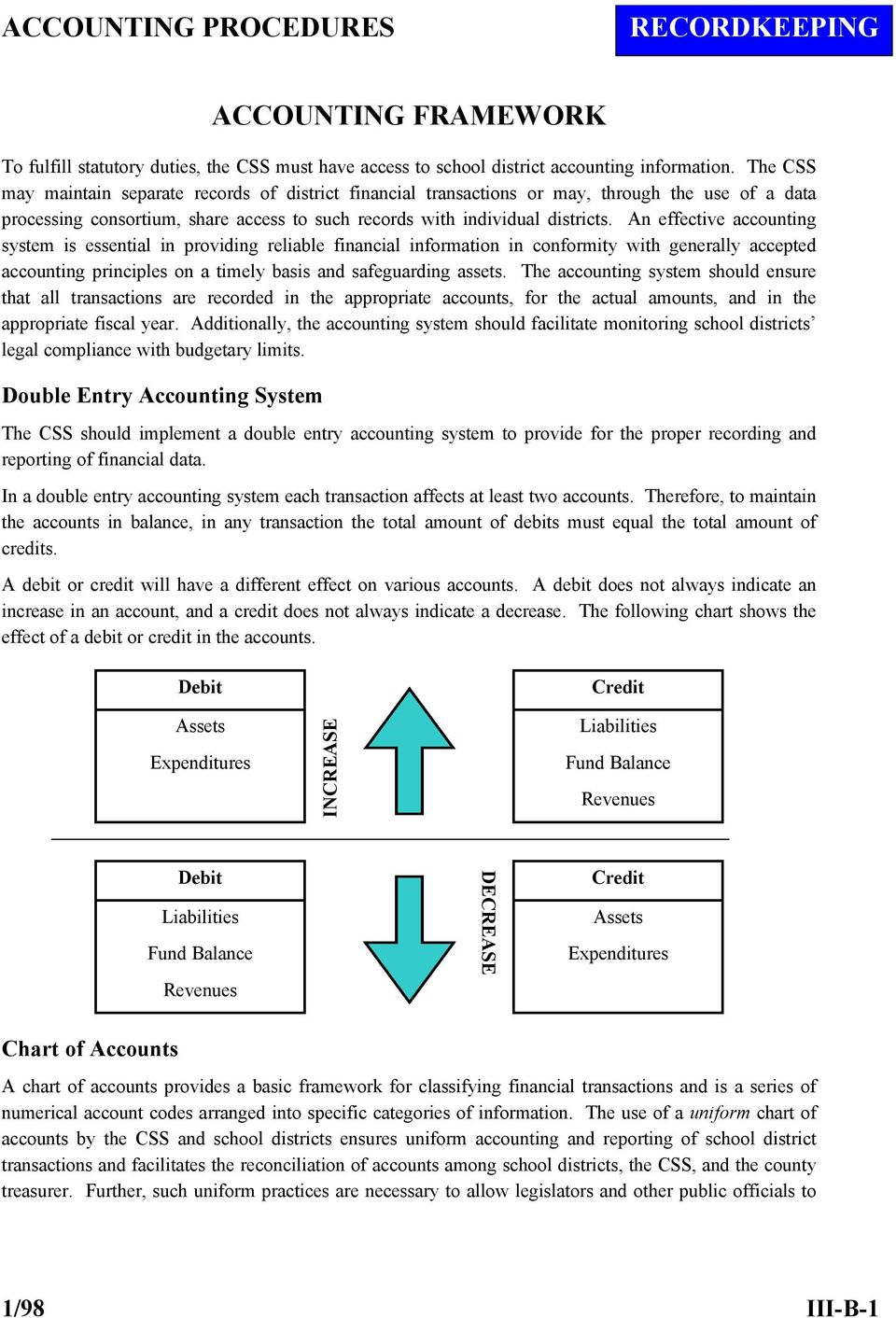
10 RECORDKEEPING ACCOUNTING FRAMEWORK To fulfill statutory duties, the CSS must have access to school district accounting information. The CSS may maintain separate records of district financial transactions or may, through the use of a data processing consortium, share access to such records with individual districts. An effective accounting system is essential in providing reliable financial information in conformity with generally accepted accounting principles on a timely basis and safeguarding assets. The accounting system should ensure that all transactions are recorded in the appropriate accounts, for the actual amounts, and in the appropriate fiscal year. Additionally, the accounting system should facilitate monitoring school districts legal compliance with budgetary limits. Double Entry Accounting System The CSS should implement a double entry accounting system to provide for the proper recording and reporting of financial data. In a double entry accounting system each transaction affects at least two accounts. Therefore, to maintain the accounts in balance, in any transaction the total amount of debits must equal the total amount of credits. A debit or credit will have a different effect on various accounts. A debit does not always indicate an increase in an account, and a credit does not always indicate a decrease. The following chart shows the effect of a debit or credit in the accounts. Debit Assets Expenditures INCREASE Credit Liabilities Fund Balance Revenues Debit Liabilities Fund Balance Revenues DECREASE Credit Assets Expenditures Chart of Accounts A chart of accounts provides a basic framework for classifying financial transactions and is a series of numerical account codes arranged into specific categories of information. The use of a uniform chart of accounts by the CSS and school districts ensures uniform accounting and reporting of school district transactions and facilitates the reconciliation of accounts among school districts, the CSS, and the county treasurer. Further, such uniform practices are necessary to allow legislators and other public officials to 1/98 III-B-1
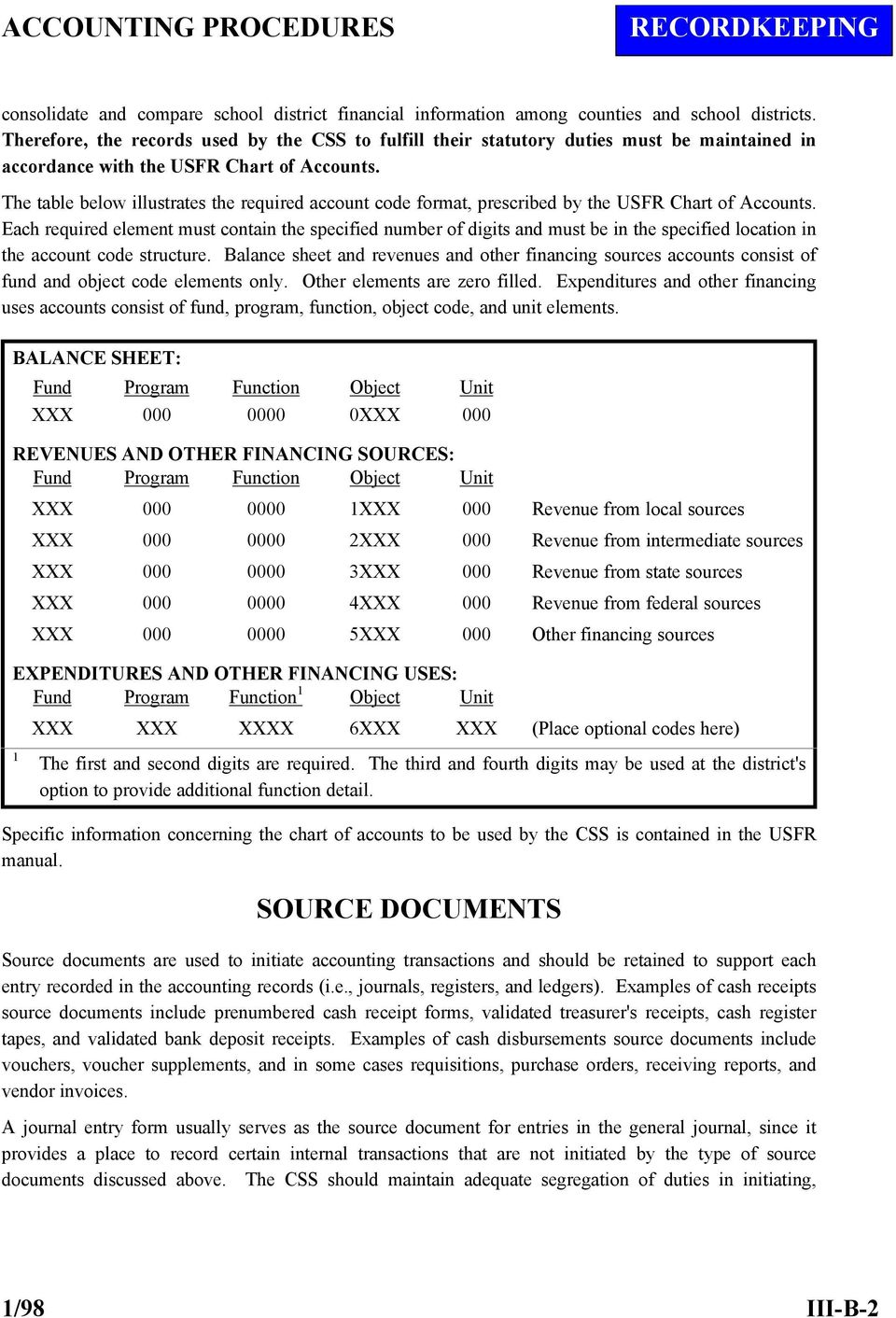
11 RECORDKEEPING consolidate and compare school district financial information among counties and school districts. Therefore, the records used by the CSS to fulfill their statutory duties must be maintained in accordance with the USFR Chart of Accounts. The table below illustrates the required account code format, prescribed by the USFR Chart of Accounts. Each required element must contain the specified number of digits and must be in the specified location in the account code structure. Balance sheet and revenues and other financing sources accounts consist of fund and object code elements only. Other elements are zero filled. Expenditures and other financing uses accounts consist of fund, program, function, object code, and unit elements. BALANCE SHEET: Fund Program Function Object Unit XXX XXX 000 REVENUES AND OTHER FINANCING SOURCES: Fund Program Function Object Unit XXX XXX 000 Revenue from local sources XXX XXX 000 Revenue from intermediate sources XXX XXX 000 Revenue from state sources XXX XXX 000 Revenue from federal sources XXX XXX 000 Other financing sources EXPENDITURES AND OTHER FINANCING USES: Fund Program Function 1 Object Unit XXX XXX XXXX 6XXX XXX (Place optional codes here) 1 The first and second digits are required. The third and fourth digits may be used at the district's option to provide additional function detail. Specific information concerning the chart of accounts to be used by the CSS is contained in the USFR manual. SOURCE DOCUMENTS Source documents are used to initiate accounting transactions and should be retained to support each entry recorded in the accounting records (i.e., journals, registers, and ledgers). Examples of cash receipts source documents include prenumbered cash receipt forms, validated treasurer's receipts, cash register tapes, and validated bank deposit receipts. Examples of cash disbursements source documents include vouchers, voucher supplements, and in some cases requisitions, purchase orders, receiving reports, and vendor invoices. A journal entry form usually serves as the source document for entries in the general journal, since it provides a place to record certain internal transactions that are not initiated by the type of source documents discussed above. The CSS should maintain adequate segregation of duties in initiating, 1/98 III-B-2
12 RECORDKEEPING approving, and recording journal entries, and should review and approve journal entries initiated by CSS staff before they are recorded in the accounting records. The CSS should implement a system that prenumbers and numerically controls journal entry forms. Each journal entry form should contain explanations, attachments, or references to documentary evidence supporting the entry, and the signature or initials of the individual making the entry and the official authorized to approve it. Journal entry forms should identify the account codes to be debited and credited. JOURNALS A journal is defined as a book of original entry. Journals provide a chronological, detailed record of daily financial transactions and support balances in the general ledger accounts. Journals may be posted manually or generated by computer. The two types of journals are general journals and special journals. Transactions should be recorded in the appropriate journal by school district and fund. The following guidelines should be followed in maintaining general and special journals. Each page should indicate the type of journal, fund, program, and page number. Each transaction should be coded in accordance with the USFR, III, Chart of Accounts. The date of each transaction (day, month, and year) should be recorded. The amounts in each column should be totaled for each page, and the debits should equal the credits. Each general journal entry should be posted individually to the general ledger. Special journal entries should be posted in total monthly. Each amount posted should be cross-referenced to show where the amount was posted to or from. General Journal The general journal is used to record standard monthly journal entries, adjusting entries, and year-end closing and reversing entries in the general ledger. The following sample entry is made in the general journal to correct an error in the records of ABC School District No. 8. GENERAL JOURNAL Page 02 Posted to Amount Date General 20XX Account Number Account Description Ledger Debit Credit 4/ Repair and Maintenance Services X $ 7, Construction Services X $ 7,000 To adjust the accounting records of ABC School District No. 8 for a maintenance service expenditure incorrectly recorded as construction services. 1/98 III-B-3

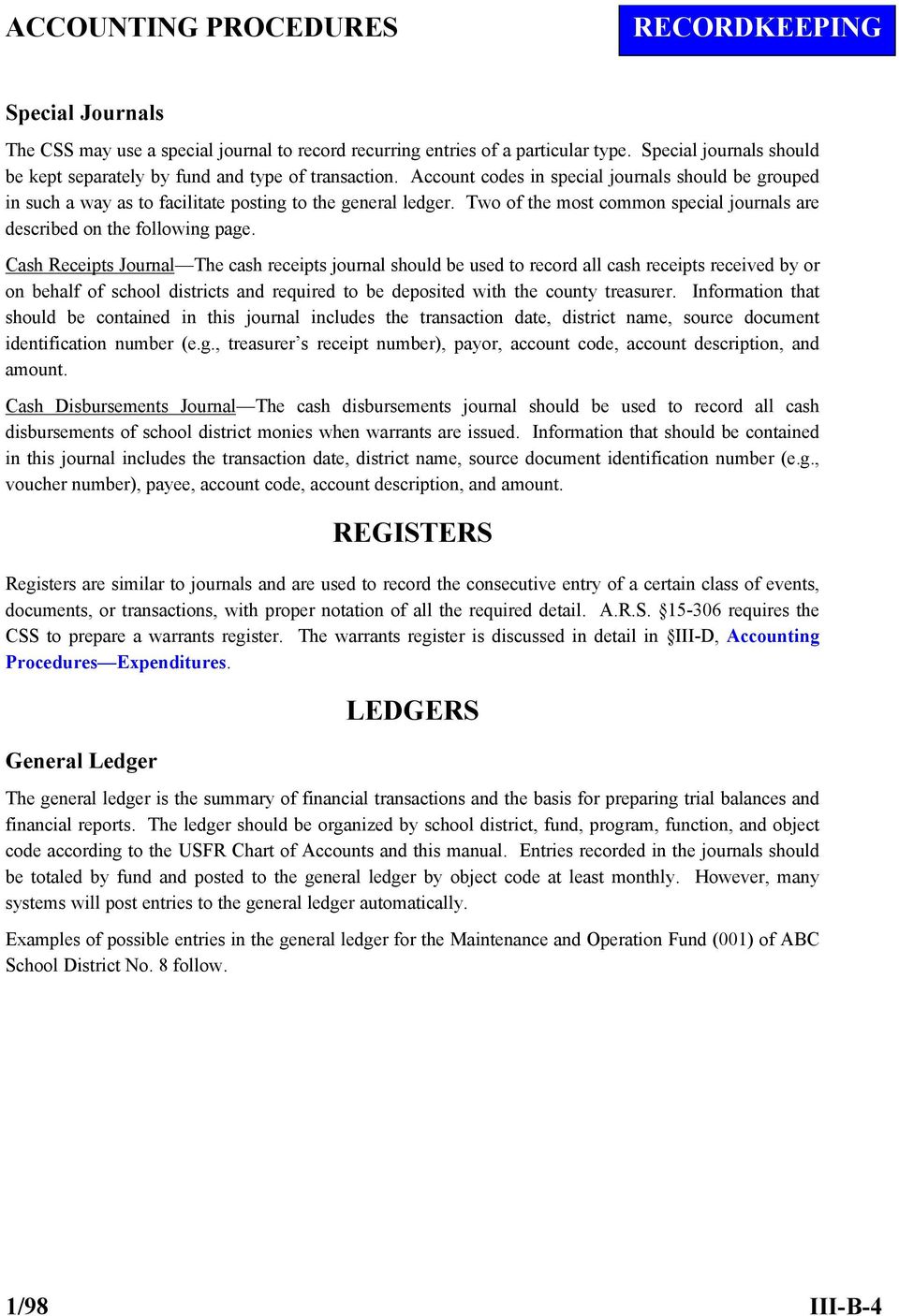
13 RECORDKEEPING Special Journals The CSS may use a special journal to record recurring entries of a particular type. Special journals should be kept separately by fund and type of transaction. Account codes in special journals should be grouped in such a way as to facilitate posting to the general ledger. Two of the most common special journals are described on the following page. Cash Receipts Journal The cash receipts journal should be used to record all cash receipts received by or on behalf of school districts and required to be deposited with the county treasurer. Information that should be contained in this journal includes the transaction date, district name, source document identification number (e.g., treasurer s receipt number), payor, account code, account description, and amount. Cash Disbursements Journal The cash disbursements journal should be used to record all cash disbursements of school district monies when warrants are issued. Information that should be contained in this journal includes the transaction date, district name, source document identification number (e.g., voucher number), payee, account code, account description, and amount. REGISTERS Registers are similar to journals and are used to record the consecutive entry of a certain class of events, documents, or transactions, with proper notation of all the required detail. A.R.S requires the CSS to prepare a warrants register. The warrants register is discussed in detail in III-D, Accounting Procedures Expenditures. General Ledger LEDGERS The general ledger is the summary of financial transactions and the basis for preparing trial balances and financial reports. The ledger should be organized by school district, fund, program, function, and object code according to the USFR Chart of Accounts and this manual. Entries recorded in the journals should be totaled by fund and posted to the general ledger by object code at least monthly. However, many systems will post entries to the general ledger automatically. Examples of possible entries in the general ledger for the Maintenance and Operation Fund (001) of ABC School District No. 8 follow. 1/98 III-B-4
14 RECORDKEEPING GENERAL LEDGER Page 01 CASH ON DEPOSIT WITH COUNTY TREASURER School District: ABC #8 Fund Object Date Amount 20XX Ref. Transaction Description Debit Credit Balance 7/01 Balance Forward $ 82,000 7/31 RJ1 July Receipts $589, ,000 7/31 DJ1 July Disbursements $351, ,500 GENERAL LEDGER Page 01 REVENUES STATE EQUALIZATION ASSISTANCE School District: ABC #8 Fund Object Date Revenues Balance to be 20XX Ref. Transaction Description Amount To Date Received (Memo) 7/01 GJ2 Current Year Budget $7,068,000 7/31 RJ1 First Apportionment of State Aid $589,000 $589,000 6,479,000 GENERAL LEDGER Page 01 PERSONAL SERVICES SALARIES School District: ABC #8 Fund Program Function Object Date Disbursements Encumbrances Unencumbered 20XX Ref. Transaction Description Amount To Date (Memo) Balance (Memo) 7/01 GJ2 Current Year Budget $52,000 7/01 Principal's Contract $51, /31 DJ1 July Disbursements $3,940 $3,940 47, References: GJ General Journal RJ Cash Receipts Journal DJ Disbursements Journal 1/98 III-B-5

15 RECORDKEEPING Subsidiary Ledger Subsidiary ledgers should be prepared when more detailed information is desired. A subsidiary ledger is a group of subaccounts, the sum of which should equal the balance in the related general ledger control account. Entries in the subsidiary ledgers are posted from the special journals. Each entry should be referenced in the subsidiary ledger to permit tracing to the source document. Trial Balance A trial balance is a listing of the account balances in the general ledger and is prepared to ensure that the general ledger is in balance (i.e., debits equal credits). The CSS can use a trial balance to prepare certain monthly reports required by A.R.S. and this manual. ACCOUNTING RESPONSIBILITY PROGRAM DISTRICTS The CSS is not required to maintain records or perform accounting and administrative services for districts participating in the School District Accounting Responsibility Program, pursuant to A.R.S Districts participating in the program have the authority to prepare their own vouchers and warrants, verify teaching certificates, record and allocate revenues, and reconcile revenues and expenditures to the county treasurer's records. 1/98 III-B-6

16 RECORDKEEPING COMPLIANCE CHECKLIST This compliance checklist was developed to assist the CSS in establishing and maintaining adequate controls over accounting records, and may be used to evaluate compliance with UAMACSS requirements. Questions are phrased in such a way that "Yes" answers indicate satisfactory conditions, while "No" answers indicate possible weaknesses that should be corrected. 1. Are the duties segregated so that one individual does not have complete authority over an entire financial transaction? 2. Are accounting records retained in an organized manner that provides quick access to accounting information? 3. Is accounting information traceable from source documents to the financial statements? 4. Is access to accounting records restricted to authorized individuals? 5. Are accounting records maintained in accordance with the USFR Chart of Accounts? 6. Are accounting records protected from environmental hazards such as fire or flood? 7. Are journal entries supported by documentation, approved by authorized persons, and effectively controlled? 8. Are school districts informed in writing, on a timely basis, of all reconciling or correcting entries and other transactions that affect their records? 9. Are accounting records retained in accordance with the applicable County or School District Records Management Manuals prescribed by the State of Arizona, Department of Library, Archives and Public Records? YES NO 1/98 III-B-7

17 REVENUES CONTENTS Topic Page INTRODUCTION...III-C-1 POLICIES...III-C-1 PROCEDURES...III-C-2 Processing Revenues...III-C-2 Validated Treasurer s Receipts...III-C-3 REVENUE APPORTIONMENT...III-C-4 State and County Equalization Assistance...III-C-4 Property Taxes and Additional State Aid...III-C-5 Earnings on Pooled Investments...III-C-5 Certificates of Educational Convenience...III-C-7 Tuition...III-C-7 Federal Impact Aid...III-C-7 County School Fund Revenues...III-C-7 YEAR-END PROCEDURES...III-C-7 COMPLIANCE CHECKLIST...III-C-9 SAMPLE FORMS Deposit Transmittal...III-C-10 Deposit Transmittal Control Log...III-C-11 1/98 III-C
18 REVENUES INTRODUCTION The CSS should account for school district revenues deposited with the county treasurer. Revenues deposited with the county treasurer include all school district revenues except auxiliary operations revenues, grants and gifts to teachers maintained in accordance with A.R.S , monies maintained for employee insurance programs in accordance with A.R.S , and student activities receipts. A.R.S (A)(20) and (21). The CSS is not responsible for revenues of school districts participating in the Accounting Responsibility Program pursuant to A.R.S School district revenues may be derived from local, intermediate, state, and federal sources, and may be received directly by a school district, or by the CSS or county treasurer on the school district s behalf. Revenues from local sources include real and personal property taxes, revenue in lieu of taxes, tuition and transportation fees from private sources and other school districts, earnings on investments, food and drink sales through the food service program, revenues from community services, proceeds from the sale or lease of school property, contributions and donations, and other miscellaneous revenues. Revenues from intermediate sources include County School Fund monies, Special County School Reserve Fund monies, and county equalization assistance. Revenues from state sources include unrestricted grants-in-aid such as state equalization assistance, additional state aid, certificates of educational convenience, institutional vouchers, and state impact assistance; and restricted grants-in-aid. Revenues from federal sources include unrestricted and restricted grants-in-aid such as Federal Impact Aid (PL and 34 Code of Federal Regulations 222.3), Indian education grants-in-aid, national forest fees, and federal reimbursement for food services. POLICIES The CSS should implement the following policies to comply with statutory requirements and establish an effective internal control structure over school district revenues. 1. Cash should be adequately safeguarded. 2. Monies should be deposited with the county treasurer intact daily, if significant, or at least weekly. 3. The duties of receiving, depositing, and recording revenues should be segregated among employees. 4. Prenumbered and numerically controlled Deposit Transmittals (see page III-C-10) or Treasurer s Receipts should accompany any monies sent to the county treasurer on the school district s behalf. 5. The CSS must apportion monies of each school district and provide written notification to the county treasurer and to the school district of the amounts apportioned. A.R.S Revenues should be properly recorded on a timely basis using the account codes prescribed in the USFR, III, Chart of Accounts. 7. School districts should be informed in writing, on a timely basis, of all accounting entries that affect their revenue records, such as reconciling or correcting entries. 1/98 III-C-1

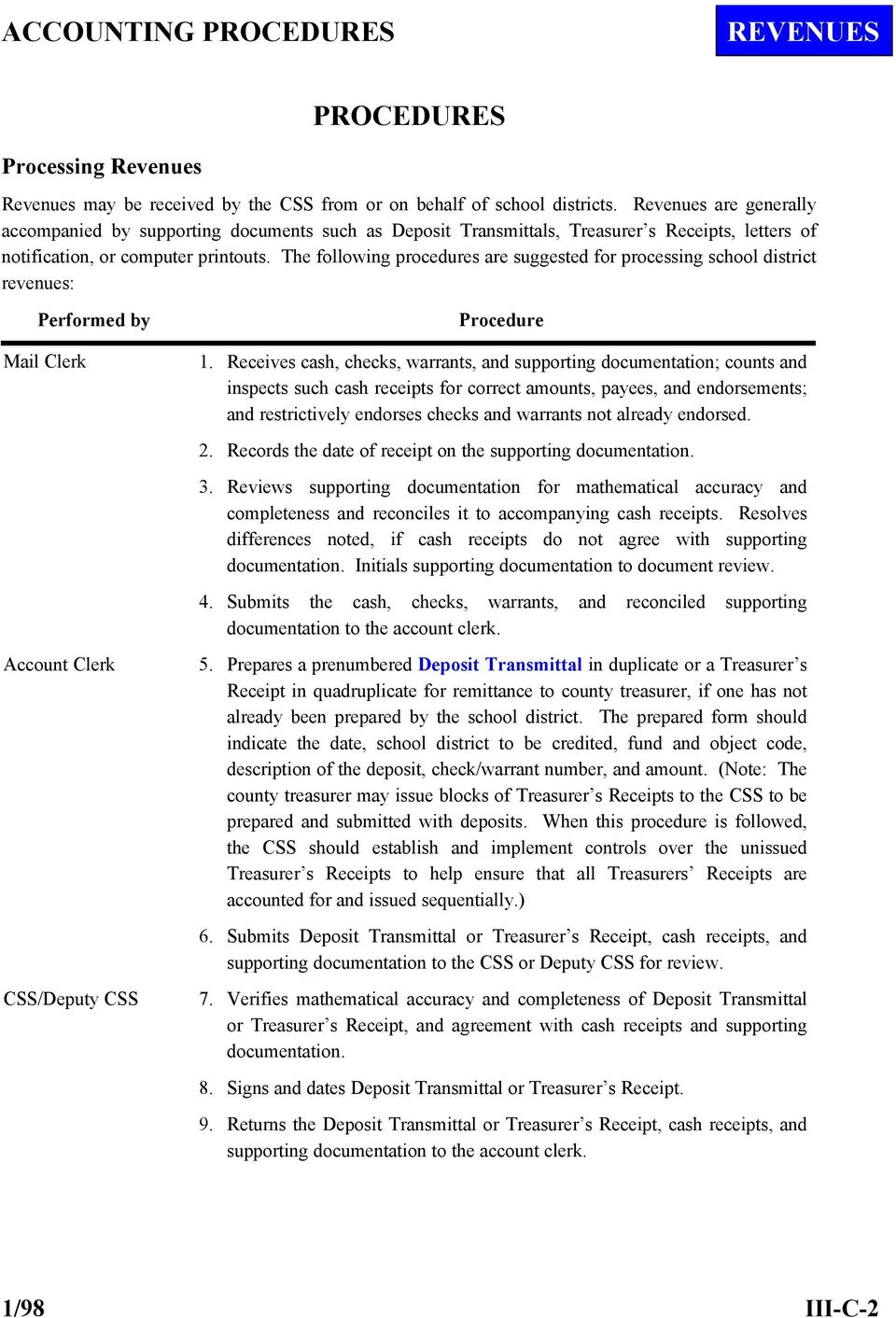
19 REVENUES PROCEDURES Processing Revenues Revenues may be received by the CSS from or on behalf of school districts. Revenues are generally accompanied by supporting documents such as Deposit Transmittals, Treasurer s Receipts, letters of notification, or computer printouts. The following procedures are suggested for processing school district revenues: Performed by Mail Clerk Account Clerk CSS/Deputy CSS Procedure 1. Receives cash, checks, warrants, and supporting documentation; counts and inspects such cash receipts for correct amounts, payees, and endorsements; and restrictively endorses checks and warrants not already endorsed. 2. Records the date of receipt on the supporting documentation. 3. Reviews supporting documentation for mathematical accuracy and completeness and reconciles it to accompanying cash receipts. Resolves differences noted, if cash receipts do not agree with supporting documentation. Initials supporting documentation to document review. 4. Submits the cash, checks, warrants, and reconciled supporting documentation to the account clerk. 5. Prepares a prenumbered Deposit Transmittal in duplicate or a Treasurer s Receipt in quadruplicate for remittance to county treasurer, if one has not already been prepared by the school district. The prepared form should indicate the date, school district to be credited, fund and object code, description of the deposit, check/warrant number, and amount. (Note: The county treasurer may issue blocks of Treasurer s Receipts to the CSS to be prepared and submitted with deposits. When this procedure is followed, the CSS should establish and implement controls over the unissued Treasurer s Receipts to help ensure that all Treasurers Receipts are accounted for and issued sequentially.) 6. Submits Deposit Transmittal or Treasurer s Receipt, cash receipts, and supporting documentation to the CSS or Deputy CSS for review. 7. Verifies mathematical accuracy and completeness of Deposit Transmittal or Treasurer s Receipt, and agreement with cash receipts and supporting documentation. 8. Signs and dates Deposit Transmittal or Treasurer s Receipt. 9. Returns the Deposit Transmittal or Treasurer s Receipt, cash receipts, and supporting documentation to the account clerk. 1/98 III-C-2
20 REVENUES Performed by Account Clerk Recording Clerk Procedure 10. Remits cash receipts and the Deposit Transmittal original, or Treasurer s Receipt original and two copies, to the county treasurer. 11. Submits Deposit Transmittal copy or Treasurer s Receipt copy and supporting documentation to the recording clerk. 12. Records the Deposit Transmittal or Treasurer s Receipt number, date prepared, amount, and school district name in the Deposit Transmittal Control Log (see page III-C-11) and initials it. 13. Records the revenue in the accounting records by school district, fund, object code, and Deposit Transmittal or Treasurer s Receipt number, in accordance with the USFR, III, Chart of Accounts and this manual. 14. Files Deposit Transmittal copy or Treasurer s Receipt copy with the supporting documentation by Deposit Transmittal or Treasurer s Receipt number until the validated Treasurer s Receipt is returned from the county treasurer. Validated Treasurer s Receipts The CSS is notified of revenues deposited by or on behalf of school districts when a validated Treasurer s Receipt is received from the county treasurer. The county treasurer may also distribute copies of the validated Treasurer s Receipts directly to the school districts or transmit them to the CSS for distribution to school districts. A.R.S The following illustrates procedures when a validated Treasurer s Receipt is received. Performed by Recording Clerk Procedure 1. Receives the validated Treasurer s Receipt from the county treasurer. If the deposit was made by the CSS on the school district s behalf, records the date received and the validated Treasurer s Receipt number on the corresponding line in the Deposit Transmittal Control Log and initials it. 2. Reviews the validated Treasurer s Receipt as follows: For deposits made by the CSS, verifies that the amount recorded on the validated Treasurer s Receipt agrees to the Deposit Transmittal copy or Treasurer s Receipt, and the amount posted to the accounting records. For deposits made by entities other than the CSS, obtains supporting documentation (e.g., letter of notification, computer printout, Deposit Transmittal), and compares the supporting documentation to the validated Treasurer s Receipt 3. Initials and dates validated Treasurer s Receipt to indicate review. 1/98 III-C-3

21 REVENUES Performed by Recording Clerk Procedure 4. Contacts the county treasurer and funding source, if applicable, and resolves differences when the amount recorded on the validated Treasurer s Receipt does not agree with the amount recorded on the supporting documentation. 5. Submits copy of the validated Treasurer s Receipt to the school district if a copy was not submitted directly by the county treasurer. 6. Submits a copy of the supporting documentation (e.g., the pertinent page of the letter of notification, computer printout, or other supporting documentation) to each school district along with a copy of the validated Treasurer s Receipt, if the validated Treasurer s Receipt pertains to more than one school district. 7. Posts the revenues to the accounting records by school district, fund, object code, and validated Treasurer s Receipt number in accordance with the USFR Chart of Accounts and this manual, for revenues deposited with the county treasurer directly by the school district or other entities. 8. Attaches the CSS copy of the Deposit Transmittal or Treasurer s Receipt and supporting documentation to the validated Treasurer s Receipt and files by school district. (Note: If the validated Treasurer s Receipt pertains to more than one school district, copies of the validated Treasurer s Receipt should be made for each school district.) 9. Reviews outstanding Deposit Transmittals or Treasurer s Receipts at least monthly to determine their status. Investigates any Deposit Transmittals or Treasurer s Receipts outstanding for an unusual length of time. REVENUE APPORTIONMENT Most monies received by school districts are designated for one specific fund and do not have to be apportioned among the funds of the school district. When monies received pertain to more than one school district fund, such as with state equalization assistance, county equalization assistance, property taxes, and additional state aid, the CSS is responsible for apportioning these monies among the school district s funds, and must notify the school district and the county treasurer of the amounts apportioned. A.R.S The following discussion provides guidance on apportioning these and other revenues among school district funds. State and County Equalization Assistance Equalization assistance payments to school districts are made from county and state funds, and should be calculated in accordance with A.R.S Equalization assistance is composed of a school district s Capital Outlay Revenue Limit, Capital Levy Revenue Limit, and the lesser of its Revenue Control Limit or District Support Level, less a qualifying tax levy and government property lease excise taxes received pursuant to A.R.S during the preceding fiscal year. These limits are apportioned between the 1/98 III-C-4
22 REVENUES school districts M&O and Capital Outlay Funds. Therefore, apportionment of state and county equalization assistance should be based on ratios calculated from amounts recorded on the school districts adopted expenditure budgets, as follows. These ratios should be calculated at the beginning of the fiscal year and used throughout the year. A = Revenue Control Limit/District Support Level budgeted for the M&O Fund B = Capital Outlay Revenue Limit budgeted for the M&O Fund C = Revenue Control Limit/District Support Level budgeted for the Capital Outlay Fund D = Capital Outlay Revenue Limit budgeted for the Capital Outlay Fund E = Capital Levy Revenue Limit M&O Fund ratio = A+B. A+B+C+D+E Capital Outlay Fund ratio = C+D+E. A+B+C+D+E The CSS should prepare an apportionment schedule identifying the amount of the total payment received by each school district that is to be apportioned between the M&O and Capital Outlay Funds of each school district. Property Taxes and Additional State Aid Apportionment of property taxes to school district funds should be based on ratios of the property tax levy in the budget year for the M&O, Capital Outlay, Adjacent Ways, and Debt Service Funds to the total property tax levy for each school district. Apportionment of additional state aid should be based on ratios of the primary property tax levy in the budget year for the M&O and Capital Outlay Funds to the total primary property tax levy for each school district. The ratios should be calculated after the tax rate is set by the county board of supervisors. Tax levy amounts should be obtained from either the school districts revenue budgets or the CSS Estimate of Monies Required by School Districts prepared in accordance with A.R.S (See III-E, Budgets, for more information on this report.) The amount to be levied for the Capital Outlay Fund reported to the board of supervisors should include the amount to be placed in the reserve of the Capital Outlay Fund in the budget year. Earnings on Pooled Investments Interest earned on pooled investments is apportioned by the county treasurer either monthly or quarterly to each school district account based on average daily, weekly, or monthly cash balances in accordance with the Uniform Accounting Manual for Arizona County Treasurers. If the county treasurer maintains separate accounts for each school district fund, no further apportionment is required. However, if the county treasurer maintains only two accounts for each school district, in addition to the Debt Service and Bond Building Funds, which must be maintained separately, the CSS should further apportion interest earned from the pooled investments after it has been distributed by the 1/98 III-C-5
23 REVENUES county treasurer. Interest should be apportioned to school district funds based on their proportionate balances during the period such interest is earned and not on the proportionate balances during the period interest is ultimately collected. When interest is apportioned monthly by the county treasurer, the CSS may total each fund's beginning and ending cash balances and divide by two to determine the average monthly balance for the fund. Alternatively, the average monthly balance may be calculated by totaling each fund's daily or weekly balances, dividing by the total number of days or weeks in the month, and apportioning interest in proportion to the resulting average balances. When interest is apportioned quarterly by the county treasurer, the CSS may total either month-end or beginning and ending monthly cash balances of each fund for the three months of the quarter and allocate interest in proportion to these totals. Theoretically, the CSS should credit interest earned on pooled investments to all funds with positive balances and charge interest expense to funds with negative balances proportionately. However, as a more practical alternative, the CSS may choose to apportion interest income to only those funds with positive balances. Any of the above methods, or any other reasonable method, may be used to apportion interest earned on pooled investments, but the method used should be applied consistently. The following simplified example illustrates the quarterly apportionment of interest earned on investments based on the average monthly cash balance. School District XYZ No. 99 Interest to be Apportioned $200 Month-End Balance Average (Total / 3 mos) Rate (Average / $1,200) Apportionment (Rate X $200) Fund 1 st 2 nd 3 rd Total 130 $200 $700 $300 $1,200 $ $ , $1, $200 The county treasurer is also responsible for apportioning the change in fair value on pooled investments to each applicable agency account in accordance with Governmental Accounting Standards Board s Statement No. 31, Accounting and Financial Reporting for Certain Investments and for External Investment Pools. If the county treasurer maintains only two accounts for each school district, the CSS should further apportion the change in fair value on pooled investments after it has been distributed by the county treasurer. 1/98 III-C-6
24 REVENUES Certificates of Educational Convenience Revenues from certificates of educational convenience should be apportioned to the M&O, Capital Outlay, and Debt Service Funds based on the related request forms submitted by the school districts to the Arizona Department of Education. Tuition Tuition revenues should be apportioned to the M&O, Capital Outlay, and Debt Service Funds based on the actual charges to the school district of residence calculated in accordance with A.R.S Federal Impact Aid Federal Impact Aid is received by school districts that have a lower property tax base because the property base includes federal land. To comply with Public Law and 34 Code of Federal Regulations 222.3, Federal Impact Aid receipts should be recorded as revenue of the M&O Fund. However, a portion may be required to be transferred to the Capital Outlay Fund (See USFR III-F, Chart of Accounts Authorized Interfund Transfers regarding the Federal Impact Capital Levy Adjustment). County School Fund Revenues The CSS may apportion County School Fund revenues to each school district in the county or may expend these monies on the school districts behalf. See V, County School Funds, for information on this fund. YEAR-END PROCEDURES The CSS must maintain school district accounting records by fiscal year, which begins July 1 and ends June 30. The proper accounting for revenues, especially at fiscal year-end, is extremely important to ensure that revenues are properly stated in the financial statements and Annual Financial Report of each school district. School district revenues for the fiscal year ended June 30 that were not received by June 30, but are expected to be received within 60 days after fiscal year-end, should be recorded in the prior fiscal year s records. School districts must notify the CSS of the correct fiscal year in which to record the revenues processed during the 60-day period after fiscal year-end. The CSS should receive from districts a letter of notification on or before July 18 for revenues that apply to the prior fiscal year. The letter of notification should indicate the source of revenue, description, amount, fund and account codes to be credited, and the estimated date of receipt. The unencumbered cash balances remaining in the M&O, Capital Outlay, and Adjacent Ways Funds after June 30, except for monies accumulated in the reserve of the Capital Outlay Fund and those monies reverted as provided by A.R.S , must be used to reduce school district taxes. A.R.S (B). The following are recommended year-end procedures for recording school district revenues. 1/98 III-C-7
25 REVENUES Performed by Mail Clerk Account Clerk Procedure 1. Receives the letter of notification from the district. 2. Records the date of receipt on the letter of notification and initials it. 3. Forwards the letter of notification to the account clerk. 4. Reviews the letter of notification for the inclusion of the following: Source of revenue Description Amount Fund and account codes to be credited Estimated date of receipt 5. Contacts the district for additional information if the letter of notification is incomplete. 6. Verifies through an examination of the year-to-date revenue records that these revenues have not been received. 7. Initials and dates the letter of notification to indicate review and files the letter of notification in a suspense file until receipt of the revenues. 8. Notifies the district if revenues are not received by the estimated receipt date. If revenues will not be received within the encumbrance period as previously estimated, reduces the estimated beginning cash balance of the new fiscal year accordingly. If revenues will be received within the 60-day period, documents the revised estimated date of receipt on the letter of notification. 9. When the revenues are received, processes them in accordance with the recommended procedures on page III-C-2. At the time of processing, the letter of notification should be reconciled to the validated Treasurer s Receipt and filed with the Advice of Encumbrance (See III-D, Expenditures, for discussion on Advice of Encumbrance.). 1/98 III-C-8
26 REVENUES COMPLIANCE CHECKLIST This compliance checklist was developed to assist the CSS in establishing and maintaining adequate controls over revenues, and may be used to evaluate compliance with UAMACSS requirements. Questions are phrased in such a way that "Yes" answers indicate satisfactory conditions, while "No" answers indicate possible weaknesses that should be corrected. 1. Are the duties of receiving, depositing, and recording revenues segregated among employees? 2. Is cash adequately safeguarded? 3. Are monies deposited with the county treasurer intact daily, if significant, or at least weekly? 4. Are all monies deposited with the county treasurer by the CSS accompanied by a prenumbered and numerically controlled Deposit Transmittal form or a Treasurer's Receipt? 5. Are copies of validated Treasurer's Receipts received and maintained on file by the CSS for all school district revenues deposited with the county treasurer? 6. Are validated Treasurer's Receipts for all deposits reconciled to the CSS school district accounting records and copies of Deposit Transmittals or Treasurer's Receipts? 7. If a copy of the validated Treasurer s Receipt is not sent directly to the school district by the county treasurer, is a copy of the validated Treasurer s Receipt submitted by the CSS to the school district? 8. Are revenues, including state and county equalization assistance, property taxes, earnings from pooled investments, and tuition, properly apportioned among school district funds? 9. Are revenues properly recorded on a timely basis using the account codes prescribed in the USFR? 10. Are school districts informed in writing, on a timely basis, of all accounting entries affecting their revenue records, such as apportionments, and reconciling or correcting entries? 11. Does the CSS receive a letter of notification on or before July 18, from each district that expects to receive revenues after June 30 for the prior fiscal year? YES NO 1/98 III-C-9
27 REVENUES No. (prenumbered) Date, COUNTY SCHOOL SUPERINTENDENT S OFFICE DEPOSIT TRANSMITTAL School District Fund Object Code Revenue Description Check/ Warrant # Amount $ TOTAL DEPOSITED $ Authorized Signature Date 1/98 III-C-10
28 REVENUES DEPOSIT TRANSMITTAL CONTROL LOG VALIDATED TR Deposit Transmittal or TR # Date Prepared Total Deposit Amount School District Initials Date Received TR # Initials 1/98 III-C-11
29 EXPENDITURES CONTENTS Topic Page INTRODUCTION... III-D-1 POLICIES... III-D-1 PROCEDURES... III-D-3 Voucher Processing... III-D-3 Warrant Preparation and Distribution... III-D-4 Warrant Stop Payments... III-D-7 Duplicate Warrants... III-D-8 SCHOOL DISTRICT REVOLVING ACCOUNTS... III-D-8 M&O Fund Revolving Account... III-D-8 Food Service Fund Revolving Account... III-D-9 PROCESSING PAYROLL... III-D-9 REVOLVING LINES OF CREDIT... III-D-11 YEAR-END PROCEDURES... III-D-11 Advice of Encumbrance... III-D-11 Encumbrance Vouchers... III-D-13 Revisions to the Advice of Encumbrance... III-D-13 End of the 60-Day Encumbrance Period... III-D-14 COMPLIANCE CHECKLIST... III-D-15 SAMPLE FORMS Voucher Control Log... III-D-17 Warrant Control Log... III-D-18 Warrant Register... III-D-19 Signature Facsimile Plate Control Log... III-D-20 Warrant Signature Machine Meter Control Log... III-D-21 Warrant Stop Payment Register... III-D-22 Record of Certification of Teachers and Administrators... III-D-23 Advice of Encumbrance Control Log... III-D-24 Encumbrance Schedule... III-D-25 1/98 III-D
30 EXPENDITURES INTRODUCTION The CSS is required by statute to perform a variety of tasks related to school district expenditures. The CSS receives school district expenditure vouchers and issues warrants if adequate budget capacities exist for budget-controlled funds and adequate cash balances exist for cash-controlled funds. At fiscal year-end, school districts must submit to the CSS an Advice of Encumbrance to identify amounts to be encumbered to pay for goods and services received but not paid for by June 30. This allows the CSS to accurately record expenditures processed during the encumbrance period in the correct fiscal year. The CSS is not responsible for expenditures of school districts participating in the Accounting Responsibility Program pursuant to A.R.S POLICIES The CSS should implement the following policies to comply with statutory requirements and maintain adequate internal control over school district expenditures: 1. The duties of recordkeeping, warrant custody, and warrant authorization should be segregated among employees. 2. The CSS must draw warrants on the county treasurer for all necessary expenses against school districts funds. The warrants must be drawn in the order vouchers are filed with the CSS. A.R.S The CSS may draw warrants for school district expenditures only on vouchers signed by a majority of the governing board. Vouchers may be signed by school district governing board members between board meetings provided a resolution to that effect was passed by the board prior to signing the voucher and the voucher is ratified at the next governing board meeting. A.R.S (G). 4. The CSS may not draw warrants on school district levy funds (M&O, Capital Outlay, and Adjacent Ways Funds) or federal and state grant funds in excess of the adopted budgets except as follows: A.R.S Expenditures authorized by the county board of supervisors as provided in A.R.S Expenditures in excess of the amount budgeted for the Capital Outlay Fund, if authorized by the governing board at a public meeting and monies are available in the Capital Outlay Fund Reserve. A.R.S (G). Expenditures in excess of the amount budgeted for a subsection of the M&O Fund, if authorized by the governing board at a public meeting and the total M&O Fund budget is not exceeded. A.R.S (G). 5. The CSS may not draw warrants on school district cash-controlled funds unless sufficient cash is available in the funds. However, if the county treasurer maintains two accounts as prescribed in A.R.S , and the expenditures have been included in the budget section of the approved federal or state grant application, then the CSS may draw warrants against the state and federal grants 1/98 III-D-1
31 EXPENDITURES regardless of whether sufficient cash is available in the funds. Cash-controlled funds are all funds other than levy funds. A.R.S The CSS must maintain a warrants register that shows the funds from which the warrants have been drawn, the number of warrants, the payees, and for what purpose the warrants have been drawn. A receipt from the authorized school district employee to whom the warrants were delivered must be retained. A.R.S Warrants should be prenumbered and numerically controlled. 8. Blank warrants and signature facsimile plates should be physically safeguarded and access to each restricted to different designated custodians. 9. If a warrant has been lost or destroyed before payment, the CSS may issue a duplicate warrant in accordance with A.R.S The CSS should charge expenditures to the proper school district fund, program, function, and object codes in accordance with the USFR, III, Chart of Accounts. 11. If the county treasurer maintains a school district s M&O, Capital Outlay, and Adjacent Ways Funds in one account, the CSS should charge interest expense from registered warrants on that account to the school district fund or funds that had the negative balances at the time the warrant was registered, regardless of the fund on which the warrant was drawn. 12. If the county treasurer maintains a school district s M&O, Capital Outlay, and Adjacent Ways Funds in one account, the CSS should charge interest expense from revolving lines of credit to the school district fund or funds that utilized the revolving line of credit. 13. The CSS must maintain a list of individuals who wish to receive invitations to bid on school district construction projects under the simplified school construction procurement program. The list must be made available for public inspection, and must be provided to school districts upon request. A.R.S (A). 14. The CSS must receive an Advice of Encumbrance prepared in accordance with the USFR from each school district. The CSS must encumber amounts as are necessary and available to pay the liabilities of the school district, and may draw warrants against the encumbered amounts for a period of 60 days after the close of the fiscal year. A.R.S In addition to the above policies, the CSS should implement the following payroll policies: 1. The CSS should obtain records of certification for certified employees from either the school district or the certified employee when the employee is hired or a certificate is renewed. A.R.S (B). 2. The CSS must maintain a record of effective dates and expiration dates of teachers and administrators certificates. A.R.S (9). 3. The CSS may draw a warrant for payment of a teacher s, substitute teacher s, or administrator s salary only if the employee is legally certified during the fiscal year in which the employee s salary is paid. A.R.S (9). 1/98 III-D-2
32 EXPENDITURES PROCEDURES Voucher Processing The following procedures are recommended to assist the CSS in fulfilling the responsibilities prescribed by statute; specific procedures may vary depending on size, organization, and degree of automation: Performed by Mail Clerk Account Clerk Procedure 1. Receives voucher package including any supporting documentation from school district and records the date of receipt on the voucher cover sheet. 2. Records the voucher number, school district name, initials, and date received in the Voucher Control Log (see page III-D-17). 3. Submits the voucher package to the account clerk for review. 4. Verifies that the voucher package is complete, and that the voucher cover sheet includes the signatures of the school administrator and a majority of the governing board members. (Per A.R.S (F), a majority of the entire governing board constitutes a quorum for the transaction of business.) 5. Compares governing board members signatures to signature cards on a test basis. If the signature was affixed by a signature stamp, examines the letter from the governing board member authorizing the use of such signature stamp. 6. Verifies that the voucher cover sheet is supported by a voucher supplement. 7. Totals expenditures by fund on the voucher supplement and compares these totals to the fund totals on the voucher cover sheet to ensure agreement. 8. Totals expenditures on the voucher supplement by vendor and compares these amounts to the related warrant amount on the supplement to ensure agreement. 9. Compares fund totals on the voucher cover sheet to the school district s accounting records as follows: For budget-controlled funds, compares fund totals to unexpended budget balances to determine if sufficient budget capacity is available. For cash-controlled funds, compares fund totals to cash balances to determine if sufficient cash is available. 1/98 III-D-3
33 EXPENDITURES Performed by Account Clerk Procedure 10. Notifies the school district of problems noted during the voucher review. Obtains permission from the school district to make necessary changes to the voucher. If the voucher needs to be increased as a result of errors noted during the review, requests a revised voucher, approved by the school district governing board, that reflects the increased total. If the voucher needs to be revised downward, records the revised total on the voucher supplement. (Note: Warrants should not be issued for amounts in excess of unexpended budget balances in budget-controlled funds, and should not be issued for amounts in excess of cash balances in cash-controlled funds. If the voucher needs to be revised for either of these circumstances, the reason for the adjustment should be recorded in the Voucher Control Log.) 11. Records voucher review completion date in the Voucher Control Log and initials. 12. Posts the expenditures to the accounting records by school district, fund, program, function, and object codes. 13. Forwards the voucher package to the warrant clerk for warrant processing. (Note: The CSS may not refuse to issue warrants for payment of properly presented school district vouchers.) Warrant Preparation and Distribution Warrants may be generated manually or by machine. However, internal accounting controls over warrant issuance and information recorded on the warrants should be the same, regardless of the method of preparation. Therefore, the following recommended procedures should be implemented for warrant preparation and distribution: Performed by Warrant Custodian Warrant Clerk Procedure 1. Receives the supply of prenumbered warrant stock from the printer. 2. Examines the warrant stock to ensure that the complete order has been received. 3. Records the beginning and ending warrant number, initials, and date received in the Warrant Control Log (see page III-D-18). 4. Upon receiving the voucher package from the account clerk, determines the number of warrants needed, and requests the warrants from the warrant custodian. 1/98 III-D-4
34 EXPENDITURES Performed by Warrant Custodian Warrant Clerk Account Clerk Procedure 5. Records the beginning and ending warrant numbers issued in the Warrant Control Log. Warrants should be issued to the warrant clerk in numerical sequence. 6. Distributes the warrants to the warrant clerk for warrant preparation. 7. Initials and dates the Warrant Control Log upon receipt of the warrants. 8. Prepares the warrants in numerical sequence from information recorded on the voucher supplement, including payee, school district, account codes, and amount. 9. Prepares the Warrant Register (see page III-D-19) in duplicate. Warrants should be recorded in the Warrant Register in numerical sequence. 10. Returns all unused and spoiled warrants to the warrant custodian. 11. Submits the completed warrants, voucher package, and both copies of the Warrant Register to the account clerk. 12. Reviews the warrants by comparing the warrant number, payee, account code, and amount recorded on the warrants to the information recorded on the voucher package and Warrant Register to ensure that the warrants are correct. (Note: This may be done on a test basis.) 13. Resolves differences noted during review. If any warrants are incorrect, marks incorrect warrants as VOID on the warrant and in the Warrant Register and forwards them to the warrant custodian. Prepares a written request for new warrants, noting the necessary corrections on the request (Steps 5 13 are repeated for any incorrect warrants). 14. Records the numerical sequence and date of the warrants in the Voucher Control Log. 15. Files the voucher package by school district and date. 16. Obtains the facsimile signature plate from the signature plate custodian. Records date and time of receipt and initials in Signature Facsimile Plate Control Log (see page III-D-20). 17. Records the beginning meter number from the warrant signature machine in the Warrant Signature Machine Meter Control Log (see page III-D- 21). 18. Processes completed warrants through the warrant signature machine. 19. Records the ending meter number from the warrant signature machine and difference in the Warrant Signature Machine Meter Control Log. 20. Initials and dates the log. 21. Submits warrants and copy one of the Warrant Register to the mail clerk. 1/98 III-D-5
35 EXPENDITURES Performed by Account Clerk Signature Plate Custodian Mail Clerk Account Clerk Warrant Custodian Procedure 22. Returns the facsimile signature plate to the signature plate custodian along with copy two of the Warrant Register. 23. Initials and records date and time of receipt in Signature Facsimile Plate Control Log. 24. Reconciles number of warrants processed through warrant signature machine (as recorded in Warrant Signature Machine Meter Control Log) to warrants recorded in the Warrant Register. Differences noted during reconciliation should be resolved immediately. Initials and dates Warrant Signature Machine Meter Control Log as proof of reconciliation. 25. Forwards copy two of the Warrant Register to the mail clerk. 26. Receives warrants and copy one of the Warrant Register from the account clerk and copy two of the Warrant Register from the signature plate custodian. 27. Distributes the warrants and copy one of the Warrant Register to the school district. 28. Obtains a receipt for the warrants distributed as follows. If the warrants are delivered to a school district courier, obtains the signature of the courier on copy two of the Warrant Register. If the warrants are mailed to the school district, mails the warrants and copy one of the Warrant Register by certified mail. Attaches the signed receipt to copy two of the Warrant Register. 29. Submits copy two of the Warrant Register to the account clerk. 30. Files copy two of the Warrant Register by school district with the related voucher package. 31. Records the beginning and ending numbers in the Warrant Control Log of the warrants returned in steps 10 and 13, and enters initials and the date for receipt of the returned warrants. 32. Voids spoiled warrants using the following procedures: Records the word VOID on the face of the warrant. Tears the signature block off the voided warrant. 33. Files the voided warrants in numerical sequence. 1/98 III-D-6
36 EXPENDITURES Warrant Stop Payments The following recommended procedures should be implemented for warrant stop payments: Performed by Account Clerk Procedure 1. Receives a request from the school district for stop payment on a warrant. 2. Examines the outstanding warrants listing to determine whether the warrant is outstanding or has been paid. If necessary, requests the status of the warrant from the county treasurer. (Note: The county treasurer must provide a paid warrants listing to the CSS monthly. From this listing, the CSS must prepare a listing of outstanding warrants. See III-F, Reconciliations.) 3. If the warrant has been paid, notifies the school district and forwards a copy of the paid warrant, if requested. 4. If the warrant is outstanding, sends a written stop payment notice to the county treasurer to cancel the warrant. The notice must include the number, amount and date of the warrant, the payee, and the account code on which the warrant was drawn. Deletes the warrant from the outstanding warrants listing. 5. If a duplicate warrant will not be issued to replace the original warrant, prepares and posts one of the following journal entries to the accounting records. If the warrant is stopped within the fiscal year in which the warrant was issued, reverses the entry made to record the expenditure. If the warrant is stopped after the fiscal year of issuance, credits other revenue for the amount of the warrant. 6. Records the warrant date and number, payee, amount, school district, account codes, and stop payment date in the Warrant Stop Payment Register (see page III-D-22). 7. Allows sufficient time for the county treasurer to process the stop payment notice. Verifies that the county treasurer has canceled the designated warrant as follows: If the CSS is on-line with the county treasurer, verifies the warrant has been stopped. If not on-line, requests written confirmation from the county treasurer that payment has been stopped. 1/98 III-D-7
37 EXPENDITURES Duplicate Warrants The CSS may not issue a duplicate warrant to replace a lost or stolen warrant until a written stop payment notice has been sent to the county treasurer. The following recommended procedures should be implemented for duplicate warrants: Performed by Account Clerk Warrant Clerk Account Clerk Procedure 1. Confirms stop payment notice was properly issued. (See Warrant Stop Payments procedures, page III-D-7.) 2. Completes procedures for issuing duplicate warrants, as prescribed by the county board of supervisors. 3. Prepares a request for duplicate warrant including the payee, account code, and amount. Submits request to the warrant clerk. 4. Prepares warrant in same manner as other warrants. (See Warrant Preparation and Distribution beginning on page III-D-4.) Stamps the duplicate warrant duplicate so that its character is readily ascertained. 5. Submits the warrant and two copies of the Warrant Register to the account clerk. 6. Records the duplicate warrant date, number, and amount in the Warrant Stop Payment Register on the corresponding line. 7. Reviews and distributes the warrant and copy one of the Warrant Register in the same manner as other warrants. (See Warrant Preparation and Distribution, page III-D-4.) 8. Files the Warrant Stop Payment Register and copy two of the Warrant Register. SCHOOL DISTRICT REVOLVING ACCOUNTS The CSS may allow school districts to establish M&O Fund or Food Service Fund revolving accounts. A warrant may not be drawn for the M&O Fund or Food Service Fund revolving account unless each designated custodian is bonded for an amount equal to twice the amount of the fund. The CSS should establish the revolving accounts by debiting cash in bank and crediting cash on deposit with the county treasurer in accordance with the USFR, III, Chart of Accounts. The CSS may replenish the revolving accounts upon receipt of properly approved vouchers and supporting documentation from the school districts. (The CSS should follow the procedures recommended for Voucher Processing and Warrant Preparation and Distribution discussed earlier in this section.) M&O Fund Revolving Account The CSS, upon receipt of a voucher and application from the governing board, may issue a warrant to a school district to establish a M&O Fund revolving account. The application must include the purposes 1/98 III-D-8
38 EXPENDITURES for which the account is required, the amount needed, the name of the custodian, and evidence the custodian is properly bonded. Information provided in the voucher and application should agree. The maximum allowable amount is 50 cents for each student, with a limit of $10,000 for elementary or high school districts and $20,000 for unified school districts, except as follows. 1. If the student count of an elementary or high school district is fewer than 10,000 students, the CSS may allow up to $5,000 in the revolving account. 2. If the student count of a unified school district is fewer than 20,000 students, the CSS may allow up to $10,000 in the revolving account. The CSS should draw the warrant against the M&O Fund of the school district. The revolving account, as stated in A.R.S , may be used by school districts only for activities that require immediate cash outlays such as postage, freight, express, fuel taxes, parcel post, travel, or other minor disbursements. School districts may not pay salaries and wages from this account. Food Service Fund Revolving Account The CSS may issue a warrant to a school district to establish a Food Service Fund revolving account. The amount of the revolving fund may not exceed $500. The CSS should draw the warrant against the Food Service Fund of the school district. The revolving account, as stated in A.R.S , may be used by school districts only for payment of freight on commodities, the purchase of food required in emergencies, employment of temporary personnel for employment that does not exceed eight hours per person, or other minor disbursements. PROCESSING PAYROLL If the CSS prepares the payroll for small school districts, see the USFR, VI-H, Payroll, for a discussion of the recommended procedures. Payroll Vouchers A school district must submit payroll vouchers approved by the school district governing board to the CSS before payroll warrants may be drawn. Total payroll charges should include the amounts required to be paid by the school district for old-age, survivors, and disability insurance (OASDI); Medicare tax; and state retirement. School districts may choose to submit separate vouchers for these contribution amounts. The payroll voucher should be accompanied by sufficient supporting documentation. The detail and volume of the supporting documentation may vary based on whether the CSS is processing payroll on behalf of the school district. Payroll vouchers should be processed in the same manner as expenditure vouchers. (See Voucher Processing and Warrant Preparation and Distribution discussions in this section.) However, the CSS should follow the additional steps noted below when processing payroll vouchers. Performed by Account Clerk Procedure 1. Receives the payroll voucher and supporting documentation from the district. 1/98 III-D-9
39 EXPENDITURES Performed by Account Clerk Procedure 2. Compares the payroll register or prepayroll register fund totals to the voucher cover sheet fund totals. 3. Verifies that the payroll register or prepayroll register is adequately supported by payroll records. 4. Obtains the Record of Certification of Teachers and Administrators (See page III-D-23). Compares to payroll register or prepayroll register to determine that valid certificates are recorded for all certified administrators and teachers. Initials and dates the voucher to indicate this verification. (Note: If a valid certificate is not on file for an employee on the payroll register or prepayroll register, the CSS should notify the school district, and should withhold the employee s payroll warrant until a valid certificate is received and recorded.) 5. Verifies the mathematical accuracy of time sheets, if any, submitted for hourly employees. Initials and dates the time sheets to document review. (Note: If any errors are noted on time sheets, the account clerk should contact the school district to resolve the discrepancies, and make the necessary corrections to the time sheets.) 6. If the school district submitted a prepayroll register, prepares the current period payroll register from the prepayroll register, time sheets, and other payroll documentation. 7. Reviews the payroll register as follows: Verifies the mathematical accuracy of the payroll register. Checks the distribution of payroll charges within each fund and compares the totals by fund to the payroll voucher. Reviews all gross pay amounts over a predetermined amount for accuracy. Performs reasonableness tests, on a test basis, for occurrences such as excessive hours worked, greater than expected payroll rates, and deductions that exceed a specific percentage of gross pay. 8. Resolves differences noted with the school district prior to processing the payroll warrants. 9. Submits the voucher package to the warrant clerk for warrant preparation. (See Warrant Preparation and Distribution beginning on page III-D-4.) 1/98 III-D-10
40 EXPENDITURES REVOLVING LINES OF CREDIT A school district may use a revolving line of credit for the payment of warrants if the county board of supervisors has entered into an agreement with a financial institution to obtain a line of credit for the school district. The revolving line of credit is controlled by the county treasurer, and may be used to pay warrants drawn on the M&O, Capital Outlay, and Adjacent Ways Funds if sufficient cash is not available to pay these warrants. A.R.S At the time the revolving line of credit is accessed, the county treasurer will notify the school district of its account balances, and the amount of the revolving line of credit used. When sufficient monies become available, the county treasurer will repay the revolving line of credit on behalf of the school district. The school district will be notified of its account balances at the time the revolving line of credit is repaid, the amount of the repayment, and any interest paid on the revolving line of credit. If the county treasurer maintains the school district s M&O, Capital Outlay, and Adjacent Ways Funds in one account, the CSS should allocate the revolving line of credit used and repaid to the appropriate funds. In addition, the CSS should allocate interest expense paid on the revolving line of credit to the appropriate funds using a reasonable allocation method. YEAR-END PROCEDURES Accounting for expenditures is extremely important to ensure that expenditure budgets and budget limits are not exceeded and that expenditures are properly reported in the financial statements and AFR of each district. School districts must notify the CSS of the correct fiscal year in which to record expenditures processed during the 60-day period after fiscal year-end. Districts must submit an Advice of Encumbrance, indicating the amount, by fund, that must be encumbered to pay for goods and services received but not paid for by June 30. Receiving an Advice of Encumbrance enables the CSS to estimate the beginning cash balances of the new fiscal year for each district fund and amounts needed from primary and secondary property taxes. The unencumbered cash balances remaining in the M&O, Capital Outlay, and Adjacent Ways Funds after June 30, except for monies accumulated in the reserve of the Capital Outlay Fund and those monies reverted as provided by A.R.S , must be used to reduce school district taxes. A.R.S (B). Advice of Encumbrance School districts must prepare a list of liabilities, by fund, for goods or services received on or before June 30 and not paid by that date. An Advice of Encumbrance (Advice) is prepared from this list of liabilities in accordance with the most recent USFR memorandum providing the format for the Advice. The CSS must receive this Advice by the fifth working day after June 30. The amounts on the Advice should include all accounts payable, contracts payable, and accrued wages and salaries, as of June 30. An Advice of Encumbrance Control Log (see page III-D-24) should be used to monitor the receipt from each district, and to document the return of forms to districts for revision when necessary. Districts that 1/98 III-D-11
41 EXPENDITURES have not submitted an Advice by the fifth working day after the close of the fiscal year should be notified immediately. The CSS should use an Encumbrance Schedule (see page III-D-25) to monitor each district s remaining encumbered balance by fund. The amounts from each district s Advice are recorded by fund on the district s Encumbrance Schedule. Encumbrance vouchers and revisions to the Advice are recorded either as additions or subtractions by fund on the schedule. The encumbrance schedules should always indicate the current encumbered balance of each fund. The following are recommended procedures for the CSS review of the Advice of Encumbrance: Performed by Mail Clerk Account Clerk Procedure 1. Records the name and number of each school district on the Advice of Encumbrance Control Log (Control Log). 2. Receives the Advice from the district and initials and dates the Control Log. 3. Forwards the Advice to the account clerk for review. 4. Reviews the Advice as follows: Reviews estimated expenditure amounts of each fund for reasonableness. Estimated expenditures above a predetermined amount should be reviewed with supervisory personnel. Compares the amounts listed on the Advice by fund to the remaining balances according to the CSS accounting records as of June 30, as follows: Compares the encumbrance amount to the unexpended budget balance for budget-controlled funds to ascertain that the encumbrance amount will not cause the fund s budget to be exceeded. Compares the encumbrance amount to the cash balance plus accrued revenues for cash-controlled funds to determine whether sufficient cash is available. 5. If an amount recorded on the Advice is greater than the applicable remaining budget or cash balance, returns the Advice to the chief administrator of the district. 6. Records the reason for return in the Control Log and initials and dates the log. 7. If the Advice does not need to be returned to the district, records the encumbered amounts from the Advice by fund on the district s Encumbrance Schedule and makes the corresponding journal entry. 1/98 III-D-12
42 EXPENDITURES Performed by Account Clerk Procedure 8. Calculates the estimated ending cash balance by deducting the encumbered amount of each fund from the ending cash balance at June 30 and adding any accrued revenues at June 30 (see III-C, Revenues, for year-end revenue procedures). 9. Records the estimated ending cash balance of each fund as the estimated beginning cash balance in the accounting records of the new fiscal year. 10. Files the Advice by district. Encumbrance Vouchers During the 60-day period following fiscal year-end, the CSS must maintain separate accounting records of each district fund for prior and current fiscal years. Goods and services received by districts on or before June 30 and not paid for by that date must be paid within 60 days after the close of the fiscal year, from monies of the prior year. Such expenditures must be submitted by districts on encumbrance vouchers, and the CSS must record them in the accounting records of the prior fiscal year. After expiration of the 60-day period, the remaining encumbered balances lapse and no further payments may be made on any claim of the prior fiscal year from the M&O, Capital Outlay, and Adjacent Ways Funds. The following are recommended procedures for processing encumbrance vouchers: Performed by Account Clerk Procedure 1. Receives the encumbrance voucher from the district. 2. Compares the encumbrance voucher cover sheet fund totals to the remaining encumbered amount, by fund, as shown on the Encumbrance Schedule. 3. If an encumbrance voucher fund total exceeds the remaining encumbered amount, but sufficient cash or budget balance is available, requests that the district submit a revised Advice of Encumbrance. If sufficient cash or budget balance is not available, returns the encumbrance voucher to the school district. 4. Records in the accounting records of the prior year and on the Encumbrance Schedule the amount of the expenditures by fund and voucher. 5. Reviews and processes the encumbrance voucher in accordance with the procedures outlined in this section. Revisions to the Advice of Encumbrance The school district should submit a revised Advice when amounts recorded on the original Advice exceed the applicable budget or cash balance. Districts must also submit a revised Advice when actual invoices 1/98 III-D-13
43 EXPENDITURES exceed amounts encumbered and the amount initially encumbered is not sufficient for all encumbrance vouchers to be processed. The revised Advice should indicate the total that should be encumbered for each fund. The CSS should follow the procedures for the review of the Advice when processing the revised Advice. When the revised Advice increases amounts encumbered on the original Advice, procedures 1 through 3 on page III-D-12 should be followed and the procedures outlined below should be substituted for procedures 4 through 10. Performed by Account Clerk Procedure 1. Calculates the additional amount being encumbered on the revised Advice for each fund by referring to the original Advice. 2. Compares, by fund, the additional amount to be encumbered to the unencumbered budget or cash balance as applicable. 3. If the additional amount to be encumbered exceeds the applicable unencumbered budget or cash balance, returns the revised Advice to the district. 4. If the additional amount to be encumbered does not exceed the applicable unencumbered budget or cash balance, records the additional amount to be encumbered on the Encumbrance Schedule. 5. Reduces the estimated beginning cash balance in the accounting records of the new fiscal year by the additional amount encumbered. 6. Files the revised Advice of Encumbrance by district. End of the 60-Day Encumbrance Period After the end of the 60-day encumbrance period, the CSS may no longer draw warrants for any claim for expenditures of the previous fiscal year from the M&O, Capital Outlay, and Adjacent Ways Funds. The accounting records for such fiscal year must be closed and the actual ending cash balance of each fund becomes the beginning cash balance for the subsequent fiscal year. The following are recommended procedures to be performed at the end of the 60-day encumbrance period. Performed by Account Clerk Procedure 1. Verifies the mathematical accuracy of the Encumbrance Schedule. 2. Calculates the adjustment to cash balance by fund. 3. Prepares adjusting journal entries as needed to revise the July 1 estimated beginning cash balances to the actual cash balance for each fund. 1/98 III-D-14
44 EXPENDITURES COMPLIANCE CHECKLIST This compliance checklist was developed to assist the CSS in establishing and maintaining adequate controls over expenditures, and may be used to evaluate compliance with UAMACSS requirements. Questions are phrased in such a way that Yes answers indicate satisfactory conditions, while No answers indicate possible weaknesses that should be corrected. YES NO Expenditures 1. Are the duties of preparing warrants, distributing warrants, and maintaining accounting records segregated among employees? 2. Is a properly authorized voucher received before warrants are prepared? 3. Are vouchers signed by a district administrator and a majority of the governing board members? 4. Are warrants prenumbered and sequentially issued in the order vouchers are filed with the CSS? 5. Is there verification of sufficient budget capacity for budget-controlled funds and sufficient cash balances for cash-controlled funds before warrants are issued? 6. Are the supply of unused warrants and the signature facsimile plates, if used, adequately safeguarded and is access to each restricted to different custodians? 7. Are spoiled and voided warrants mutilated to prevent reuse and kept on file for subsequent inspection? 8. Are warrants recorded in numerical sequence on a Warrant Register and Warrant Control Log? 9. Are the warrants compared to the voucher and Warrant Register, and payroll register if applicable, before issuance to school districts? 10. Are outstanding warrants compared to the paid warrants listing before a stop payment request is processed? 11. Are expenditures posted to the accounting records for the appropriate school district in accordance with the USFR, III, Chart of Accounts? 12. Is interest on registered warrants or revolving lines of credit properly charged to school district funds? 13. Are revolving accounts established only upon receipt of a properly completed voucher and letter of application, if applicable? 1/98 III-D-15
45 EXPENDITURES YES NO 14. Are the amounts of the revolving accounts restricted to the amounts authorized in statute? 15. Are revolving account custodians properly bonded before revolving accounts are established? Payroll 16. If the CSS processes payroll on behalf of the school district, are payroll registers supported by time summaries and properly authorized notifications of employment, terminations, pay rate changes, and withholding and voluntary deduction authorization forms? 17. Are payroll warrants compared to the payroll register on a test basis prior to distribution to employees? Year-End Procedures 18. Does the CSS receive an Advice of Encumbrance from all districts with liabilities payable at fiscal year-end? Is each Advice received by the fifth working day after June 30? If not, are the applicable districts notified? 19. Is each Advice of Encumbrance reviewed to determine that the amount to be encumbered is less than the unexpended budget balance for budget-controlled funds, or that there is sufficient cash available for cash-controlled funds? 20. Is an Encumbrance Schedule used for each district to monitor the remaining encumbered balance of each fund? 21. When encumbrance vouchers are received, is the fund total compared to the remaining encumbered amounts shown on the Encumbrance Schedule? 22. Are districts required to submit a revised Advice of Encumbrance when the original amounts exceed the budget or cash balance, or when actual invoices exceed the amounts encumbered? 23. During the 60-day period following fiscal year-end, are separate current- and prior-year accounting records maintained for all funds? 24. Is the estimated ending cash balance of each fund at June 30 determined and recorded as the estimated beginning cash balance in the accounting records of the new fiscal year? 25. Are the accounting records for each district closed after the 60-day encumbrance period? 26. Are adjusting journal entries prepared for each fund to revise the July 1 estimated beginning cash balance based on the actual cash balance at the end of the encumbrance period? 1/98 III-D-16
46 EXPENDITURES VOUCHER CONTROL LOG Voucher Voucher Received Voucher Reviewed Number School District By Date By Date Date Warrants Issued Beginning Ending Number Number Reason Warrants Not Issued 1/98 III-D-17
47 EXPENDITURES WARRANT CONTROL LOG Beginning Number Warrants from Printer Warrants Issued for Processing Warrants Returned from Processing Ending Received Beginning Ending Received Beginning Ending Number By Date Number Number By Date Number Number Received By Date 1/98 III-D-18
48 EXPENDITURES WARRANT REGISTER Warrant Number Date Payee Amount School District Voucher Number Account Code Fund Received By Total Date Initials 1/98 III-D-19
49 EXPENDITURES SIGNATURE FACSIMILE PLATE CONTROL LOG PLATE OUT PLATE IN Date Time Initials of Recipient Date Time Initials of Custodian 1/98 III-D-20
50 EXPENDITURES WARRANT SIGNATURE MACHINE METER CONTROL LOG METER NUMBER RECONCILIATION TO WARRANT REGISTER Beginning Ending Difference Initials Date Initials Date 1/98 III-D-21
51 EXPENDITURES WARRANT STOP PAYMENT REGISTER WARRANT Date Number Payee Amount School District Account Code Date DUPLICATE WARRANT Stopped Date Number Amount 1/98 III-D-22
52 EXPENDITURES RECORD OF CERTIFICATION OF TEACHERS AND ADMINISTRATORS SCHOOL DISTRICT NO. Employee Name Position Type of Certificate Certificate Number Endorsements Effective Date Expiration Date Recorded by *Verified by Date Date Date Date Date Date Date Date Date Date Date *A verification should be made of all certified employees at the beginning of each year. 1/98 III-D-23
53 EXPENDITURES ADVICE OF ENCUMBRANCE CONTROL LOG Returned to Resubmitted & Received Reviewed District Reviewed District Name and No. By Date By Date By Date By Date Comment 1/98 III-D-24
54 EXPENDITURES SCHOOL DISTRICT:. ENCUMBRANCE SCHEDULE FOR FISCAL YEAR ENDED JUNE 30, Date Reference Total Enter the original encumbered amounts from the Advice of Encumbrance: 07/ Amount $ $ $ $ $ $ $ $ Enter amounts from encumbrance vouchers or changes to the Advice of Encumbrance and calculate remaining encumbrance: Fund Remaining Remaining Remaining Remaining Remaining Remaining Remaining Calculate any necessary adjustment to the estimated cash balance: Adjustment $ $ $ $ $ $ $ $ 1/98 III-D-25
55 BUDGETS CONTENTS Topic Page INTRODUCTION...III-E-1 PROCEDURES...III-E-1 Budget Control Log...III-E-1 Proposed and Adopted Expenditure Budgets...III-E-1 Override Elections...III-E-3 Revenue Budget...III-E-3 Budget Revisions...III-E-3 OTHER REPORTING REQUIREMENTS...III-E-4 Capital Outlay Fund Reserve Plan...III-E-4 Equalization Assistance...III-E-4 Estimate of Monies Required by School Districts...III-E-4 COMPLIANCE CHECKLIST...III-E-6 SAMPLE FORMS Budget Control Log...III-E-7 Budget Revision Control Log...III-E-8 Estimate of Monies Required By School Districts Part A...III-E-9 Estimate of Monies Required By School Districts Part B...III-E-10 1/98 III-E
56 BUDGETS INTRODUCTION Budgets are an integral part of a school district s financial operations. In accordance with A.R.S., each district must prepare, and the governing board must adopt, an annual expenditure budget that includes all funds except Agency Funds. Each district is also required to prepare a separate annual revenue budget. These budgets project the district s expenditures, and total revenues required to finance them in the budget year. The budget is a plan of financial operations and should represent the district s best estimate of its needs and the proposed means of financing them. The CSS should ensure that the budgets, and any necessary revisions, are received from each district by the statutory deadlines and provide budget preparation assistance to districts upon request. A copy of all adopted and revised expenditure budgets received should be immediately transmitted to the Superintendent of Public Instruction as required by statute. The CSS is responsible for other reporting as prescribed by statute, including recomputing equalization assistance and calculating the amount of revenue needed by each district from primary and secondary property taxes for certification to the board of supervisors. Summaries of all pertinent budget process dates are presented in II, Calendar of Events. Budget Control Log PROCEDURES The CSS should maintain a budget control log (see page III-E-7) to help ensure that budgets are received when due. The log should indicate the school district, type of budget (proposed expenditure, adopted expenditure, or revenue), date of receipt, date of review, and date submitted to ADE, if applicable. Additionally, a budget revision control log (see page III-E-8) should be maintained to ensure that revised expenditure budgets are received when due. These logs should be used to notify school districts that have not submitted their budgets or budget revisions by the appropriate due date. Proposed and Adopted Expenditure Budgets Districts must submit to the CSS their proposed expenditure budget or proposed budget summary no later than July 5. The budget should be prepared in accordance with the most recent USFR memorandum providing forms and detailed instructions for preparing the expenditure budget forms, work sheets, supplement, and summary. The mail clerk should log the receipt of the proposed budget from each school district in the appropriate budget control log. The CSS should sign the proposed budget where indicated on the cover page. A copy of the signed budget should be filed in the CSS files for the district and the original should be returned to the district. Districts must submit to the CSS their adopted expenditure budget no later than July 18. The budget should be prepared in accordance with the most recent USFR memorandum as described above. The following procedures are for the recommended review of districts adopted expenditure budgets. However, the CSS can neither require districts to make changes to their budgets, nor refuse to submit a budget to the Superintendent of Public Instruction. 1/98 III-E-1
57 BUDGETS Performed by Mail Clerk Account Clerk CSS Account Clerk Procedure 1. Receives the adopted expenditure budget from the school district, including budget work sheets, supplement (if applicable), and summary. 2. Records the school district name and number on the appropriate budget control log and initials/dates the log. 3. Submits the budget to the account clerk for review. 4. Receives the budget package and reviews as follows: Verifies that the district used the expenditure budget forms provided in the most recent USFR memorandum issued by the Office of the Auditor General and ADE. Compares governing board members signatures to signature cards on a test basis. If the signature was affixed by a signature stamp, examines the letter from the governing board member authorizing the use of such a stamp. Verifies that estimated revenues and property tax rates are reported on the cover sheet. Examines all pages of the budget and accompanying work sheets to determine whether applicable sections were completed. Verifies that a budget supplement was completed, if required. Examines the CSS accounting records of the district to determine whether all established funds have been included in the budget. Verifies that the total of budgeted expenditures for the Maintenance and Operation and Capital Outlay Funds is not greater than the total of the general budget limit and total capital budget limit. 5. Notifies the district in writing of any differences or problems discovered during the review. 6. Submits the budget package and control log to the CSS. 7. Reviews to the extent necessary. 8. Signs and dates the budget cover sheet where indicated and initials/dates the control log. 9. Returns the budget package and control log to the account clerk. 10. Makes three copies of the budget. Returns original to district and files one copy in the CSS files for the district. Additionally, submits one copy each to the board of supervisors and the Superintendent of Public Instruction. Initials/dates the budget control log. 1/98 III-E-2
58 BUDGETS Override Elections If a district s proposed expenditure budget will exceed the aggregate budget limit for the budget year, the district s governing board must hold an override election to obtain voter approval to increase the aggregate budget limit. The CSS must prepare and transmit an informational report and a sample ballot on the district s proposed budget increase to the district governing board at least 35 days prior to the budget override election. A.R.S (A) and (B). Revenue Budget School districts must submit a final estimate of revenue from all sources for the fiscal year to the CSS and the Superintendent of Public Instruction no later than September 15. Districts meet this requirement by completing and filing a revenue budget in accordance with the most recent USFR memorandum providing forms and detailed instructions for preparation of the revenue budget. The mail clerk should log the receipt of the revenue budget from each school district in the appropriate budget control log. The CSS should sign the revenue budget where indicated on the cover page. A copy of the signed budget should be filed in the CSS files for the district and the original should be returned to the district. Budget Revisions Districts whose budget exceeded the general budget limit or total capital budget limit by $1,000 or more must submit revisions to their adopted expenditure budget to the CSS no later than December 18. The CSS must immediately transmit copies of the revised adopted expenditure budget to the board of supervisors and the Superintendent of Public Instruction. A.R.S (E). A school district that meets the requirements of A.R.S (A) may revise its expenditure budget to include the costs for additional pupils who were not budgeted for in the original expenditure budget, upon approval of the board of supervisors. Districts can submit a petition to the CSS along with a copy of the proposed budget. The CSS must forward the petition and recommended action to be taken on the petition to the board of supervisors. The board of supervisors must hold a hearing on the petition within 20 days after receipt to determine the action to be taken. In the case of an accommodation school, the CSS must submit only a revised budget to the board of supervisors for approval. Any such budget revisions must be made by May 15. Districts may make other revisions to their adopted expenditure budget during the fiscal year provided all revisions are completed by May 15 and submitted to the CSS. If the district has overestimated the amount of revenue from certain sources, it must adjust the general budget limit and the adopted expenditure budget based on actual revenue amounts for the current year. A USFR memorandum that provides detailed instructions on budget revisions is issued annually. The procedures for the recommended review of the adopted expenditure budget on page III-E-2 also apply to the revised expenditure budget. 1/98 III-E-3
59 BUDGETS OTHER REPORTING REQUIREMENTS Capital Outlay Fund Reserve Plan In computing the amount of primary property taxes needed for the ensuing year, the CSS should adjust for any cash balances remaining in the school district s M&O, Capital Outlay, and Adjacent Ways Funds. As provided by A.R.S (B), the cash balance remaining at June 30 in the M&O, Capital Outlay, and Adjacent Ways Funds, after encumbrances, must be used for the reduction of school district taxes, except monies accumulated in the reserve of the Capital Outlay Fund and monies reverted in accordance with A.R.S A district s governing board may accumulate monies in the reserve through adoption of a Capital Outlay Fund Reserve Plan. The Plan should be prepared in accordance with the most recent USFR memorandum providing the expenditure budget forms, work sheets, and Capital Outlay Fund Reserve Plan. The CSS should request that districts submit any revisions to their adopted Capital Outlay Fund Reserve Plan prior to August 1, to assist the CSS in calculating the amount needed from primary property taxes, as required by A.R.S (A). Equalization Assistance In accordance with A.R.S (B), the CSS must recompute equalization assistance for each district and certify this amount and the amount needed from primary property taxes to the board of supervisors in writing on or before the third day prior to the day the board of supervisors is required to levy district taxes, as provided in A.R.S Equalization assistance for each district should be recomputed using the applicable expenditure budget work sheets from the most recent USFR memorandum for the expenditure budget. The current limited property value must be received from the county assessor at least 10 days prior to the day the board of supervisors is required to levy school district taxes and should be used to determine the assessed valuation for the recalculation of the equalization assistance. A.R.S (G). Estimate of Monies Required by School Districts According to A.R.S (A), the CSS must prepare written estimates of the amount of monies required by each school district for the ensuing year, based on the budgets adopted by the school district governing boards. These estimates must be provided to the board of supervisors and the governing board of each school district no later than August 1. A suggested format for the written estimates, including the following required information, is provided on pages III-E-9 and 10. A statement of student count for each district The number of one- and two-room rural schools in each district and their applicable student count The ending cash balance from the previous year for each district The total amount to be received for the year by each district from the County School Fund and Special County School Reserve Fund The anticipated interest earnings for each district 1/98 III-E-4
60 BUDGETS Tuition revenues for nonresident pupils State assistance as provided in A.R.S for pupils whose parents or legal guardians are employed at certain state institutions Special education revenues as provided in A.R.S (D) and (Certificates of Educational Convenience and Institutional Vouchers) PL assistance allocated for handicapped children, children with specific learning disabilities, and children residing on Indian lands, as provided in A.R.S (K) and (O) PL administrative costs as provided in A.R.S (P) Amounts authorized by the CSS for accommodation schools pursuant to A.R.S (C) The amounts needed from primary and secondary property taxes. These amounts must be certified to the board of supervisors. 1/98 III-E-5
61 BUDGETS COMPLIANCE CHECKLIST This compliance checklist was developed to assist the CSS in establishing and maintaining adequate controls over the budget review process, and may be used to evaluate compliance with UAMACSS requirements. Questions are phrased in such a way that "Yes" answers indicate satisfactory conditions, while "No" answers indicate possible weaknesses that should be corrected. 1. Are budget control logs maintained and reviewed to determine whether all appropriate budgets have been submitted? 2. Are school district adopted and revised expenditure budgets transmitted to the board of supervisors and the Superintendent of Public Instruction in a timely manner? Are the date and initials of the responsible person(s) recorded on the appropriate budget control log? 3. Are the estimates of monies required by each school district prepared in accordance with A.R.S (A)? 4. Is equalization assistance recomputed for each district based on the current limited property value, as provided by the county assessor, and is the recalculation and the amount needed from primary property taxes certified to the board of supervisors in writing on or before the third day prior to the day the board is required to levy district taxes in accordance with A.R.S ? YES NO 1/98 III-E-6
62 BUDGETS BUDGET CONTROL LOG BUDGET School District Name and No. Adopted Expenditure Budget Only Received Budget Reviewed Budget Sent to BOS and/or ADE By Date By Date By Date 1/98 III-E-7
63 BUDGETS BUDGET REVISION CONTROL LOG School District Name and No. Notified by ADE Received Revised Budget Reviewed Revised Budget Sent to BOS and/or ADE By Date By Date By Date By Date 1/98 III-E-8
64 BUDGETS COUNTY SCHOOL SUPERINTENDENT S OFFICE SCHOOL DISTRICT NO.. ESTIMATE OF MONIES REQUIRED BY SCHOOL DISTRICTS FISCAL YEAR:. Part A 1. Student count of district. 2. List of one- and two-room rural schools with applicable student counts: School Name Student Count Total Student Count: I hereby certify that the amounts recorded above and in Part B of this estimate are accurate to the best of my knowledge and belief... County School Superintendent Date 1/98 III-E-9
65 BUDGETS COUNTY SCHOOL SUPERINTENDENT S OFFICE SCHOOL DISTRICT NO.. ESTIMATE OF MONIES REQUIRED BY SCHOOL DISTRICTS FISCAL YEAR:. Part B Total 1. Budgeted expenditures per the adopted budget 2. Amount to be placed in the reserve of the Capital Outlay Fund in the budget year 3. Total requirements (add lines 1 and 2) 4. Ending cash balance of the previous year 5. Amount accumulated in the reserve of the Capital Outlay Fund to be carried forward to future years 6. Ending cash balance available to meet total requirements (line 4 minus line 5) 7. Estimated revenues from: (a) County School Fund (b) Special County School Reserve Fund (c) Interest earnings (d) Tuition nonresident (e) State assistance. A.R.S (f) Certificate of educational convenience. A.R.S (D) (g) Institutional vouchers. A.R.S (h) PL assistance (i) PL administrative costs (j) Increase in accommodation school revenue control limit. A.R.S (C) (k) Other (l) Total estimated revenues (add lines 7.a through 7.k) 8. Equalization assistance (a) State (b) County (c) Total equalization (add lines 8.a and 8.b) 9. Amount available before property taxes (add lines 6, 7.l, and 8.c) 10. Amount to be provided by tax levy (line 3 minus line 9) (a) Primary property taxes (b) Secondary property taxes 11. Total available to meet requirements (add lines 9, 10.a, and 10.b) 1/98 III-E-10
66 RECONCILIATIONS CONTENTS Topic Page INTRODUCTION... III-F-1 POLICIES... III-F-1 PROCEDURES... III-F-2 Monthly Reconciliations... III-F-2 Encumbrance Period Reconciliations... III-F-9 COMPLIANCE CHECKLIST... III-F-10 SAMPLE FORMS Reconciliation of CSS Cash Balance to County Treasurer s Account Balance... III-F-11 Journal Entry Form... III-F-12 1/98 III-F
67 RECONCILIATIONS INTRODUCTION The CSS has certain statutory responsibilities regarding school district financial accounting and reporting. These responsibilities include issuing warrants, apportioning school monies, and maintaining cash balances of each school district fund. To properly execute these responsibilities, the CSS should maintain on a timely basis accurate accounting records of each school district by fund. The county treasurer receives and disburses school monies except student activities and auxiliary operations monies; grants and gifts to teachers pursuant to A.R.S ; and monies contributed and withheld by districts for employee insurance programs pursuant to A.R.S The county treasurer may maintain separate accounts for each school district fund, or maintain only two accounts for a school district s funds in addition to the Debt Service Fund and Bond Building Fund accounts. If only two accounts are maintained by the county treasurer, one account must consist of the M&O, Capital Outlay, and Adjacent Ways Funds, while the other account consists of all other funds. A.R.S (1). The county treasurer is required, by A.R.S (4), to notify the CSS by the 15 th day of each month of the previous month s ending balance of each school district account. The county treasurer is also required by the Uniform Accounting Manual for Arizona County Treasurers, IV-D, Warrant Processing, to provide the CSS monthly with a list of warrants paid from school district funds. To ensure that the CSS and county treasurer s records agree, the CSS should perform a monthly reconciliation of its records of school district fund cash balances to the county treasurer s monthly report of school district ending account balances. The monthly reconciliation is also necessary for the CSS to determine whether sufficient cash is available in school district accounts before issuing warrants from them. During the 60-day encumbrance period following June 30, the CSS maintains separate school district accounting records for the prior fiscal year and the new fiscal year. The reconciliations of monthend cash balances performed during this period include revenues and expenditures from both years. School districts must make sure their records agree with those of the CSS and the county treasurer by performing a monthly reconciliation to the CSS records. However, school districts participating in the Accounting Responsibility Program operate independently of the CSS and, therefore, must perform a monthly reconciliation of their accounting records directly to the county treasurer s records. A.R.S (E). POLICIES The following policies are recommended to help ensure that the CSS school district records are reconciled to the county treasurer s records monthly, and that the records maintained by each school district agree with those of the CSS: 1. The CSS must receive the county treasurer s report by the 15 th day of each calendar month of the previous month s ending balance for each school district account. A.R.S (4). 2. The CSS should establish written procedures for reconciling its records of school district cash balances to those of the county treasurer. 1/98 III-F-1
68 RECONCILIATIONS 3. The CSS should reconcile its records of the cash balances of each school district to the county treasurer s records promptly. 4. An employee who is not responsible for maintaining school district accounting records should perform the reconciliation. If this is not possible, the reconciliation should be reviewed by a designated employee. 5. The CSS should send a monthly report of revenues, expenditures, and ending cash balances to each school district that includes the beginning and ending cash balance for the month, transfers-in and transfers-out, and revenues and expenditures the CSS has processed during the month by fund, program, function, and object code. 6. After completing the monthly reconciliation, the CSS should send each school district a copy, clearly indicating reconciling items. Monthly Reconciliations PROCEDURES The monthly reconciliation process involves examining total revenues and total expenditures for each school district fund according to the CSS and agreeing those accounting records to the county treasurer s accounting records. The CSS should investigate and document any differences when the CSS accounting records do not agree to those of the county treasurer. Therefore, the CSS should prepare a reconciliation form for each school district account maintained by the county treasurer to document all differences or reconciling items between the CSS records and the county treasurer s records, and a reconciled balance. See page III-F-8 for a completed example. The CSS should send copies of the completed monthly reconciliations to school districts to enable them to reconcile their accounting records to the CSS accounting records. Differences in revenue amounts may occur due to the following: Timing differences attributable to revenues recorded by the county treasurer in one month that either were not recorded by the CSS or were recorded by the CSS in another month. Examples include interest on pooled investments, tax apportionments, and monies borrowed from a revolving line of credit that have been recorded by the county treasurer but not the CSS. Misclassifications resulting from revenues that were recorded in an incorrect fund or school district. Differences in expenditure amounts may occur due to the following: Interest paid by the county treasurer on registered warrants that was recorded by the county treasurer but not the CSS. Warrants stopped by the CSS and not included in total expenditures, but were subsequently paid by the county treasurer. Debt service payments that were made by the county treasurer and not recorded by the CSS. Principal and interest payments made by the county treasurer in repayment of a revolving line of credit that were not recorded by the CSS. 1/98 III-F-2
69 RECONCILIATIONS Misclassifications resulting from expenditures that were recorded in an incorrect fund or school district. Other differences between the CSS records and the county treasurer's records may occur due to the following: Transfers or journal entries that were omitted or not recorded correctly by the county treasurer or the CSS. Reconciling items from the previous month that were not recorded and corrected. Clerical or mathematical errors. The procedures discussed below are designed for use with the sample reconciliation form presented on page III-F-11, and assume the receipt of a treasurer's report that includes separate beginning and ending account balances; total receipts; transfers-in and transfers-out; and total disbursements for each school district fund. These procedures represent one suggested method of performing the monthly reconciliation. The process for reconciliations performed during the encumbrance period is discussed on page III-F-9. The CSS should either adopt these procedures or devise alternative procedures appropriate to the particular accounting system used by the county treasurer and the CSS. (For example, if the county treasurer maintains only two accounts for funds other than the Debt Service and Bond Building Funds, the CSS should group those school district funds included in each treasurer s account for reconciliation purposes.) The procedures should ensure that school district financial data obtained or generated to assist in the reconciliation provides adequate detail of school district transactions and the proper cut off at month-end and year-end. The reconciliation should be performed by an employee who is not responsible for maintaining school district accounting records. If this is not possible, the reconciliation should be reviewed by a designated employee. The following recommended procedures should be implemented when performing a monthly reconciliation: Performed by Account Clerk Procedure 1. Receives the treasurer's report and paid warrants list from the county treasurer. 2. Prepares an outstanding warrants listing by school district and fund, as follows: Obtains the previous month s outstanding warrants listing and deletes each warrant paid by the county treasurer during the month according to the county treasurer s paid warrants list. Obtains the current month s warrant register and warrant stop payment register. Deletes from the warrant register each warrant paid by the treasurer (per the paid warrants list) and stopped by the CSS (per the warrant stop payment register). 1/98 III-F-3
70 RECONCILIATIONS Performed by Procedure Account Clerk Verifies that each warrant on the treasurer s paid warrants list appears on either the current month s warrant register or the previous month s outstanding warrants listing. Verifies that each warrant on the current month s warrant register appears on either the treasurer's paid warrants list or the CSS warrant stop payment register, or will be added to the current month s outstanding warrants listing. Prepares a new listing of outstanding warrants as of the end of the reconciliation month indicating the warrant number, amount, and date of issuance. (The new listing should consist of the remaining unpaid warrants on the previous month s outstanding warrants listing and any unpaid warrants from the current month s warrant register.) 3. Compares the school district fund ending cash balance according to the CSS records to the ending account balance as reported on the treasurer's report, as follows: Obtains a reconciliation form for each school district account (see sample reconciliation form on page III-F-11). Completes the heading and enters information on Part A, Line 1 through Line 4, and Part B, Line 1 through Line 3, as appropriate for the school district, fund, and account. (Note: Part A, Lines 2 and 3 apply only during the encumbrance period.) Compares the amount calculated on Part A, Line 4 to Part B, Line 3 as follows: If these balances agree, signs and dates the reconciliation form. Segregates reconciled forms and holds for later transmittal to the chief deputy. If these balances do not agree, notes the school district name, account, and unreconciled amount on a list of unreconciled accounts. 4. Contacts the county treasurer and requests a copy of the treasurer's subsidiary ledger (or other similar detailed documentation of receipts and disbursements) for each unreconciled account. 5. Agrees the total revenues, expenditures, transfers-in, and transfers-out according to the CSS records to the total cash receipts, cash disbursements, transfers-in, and transfers-out per the county treasurer's report to identify any differences in these amounts. Proceeds as follows: If total revenue amounts do not agree, performs step 6 below. 1/98 III-F-4
71 RECONCILIATIONS Performed by Procedure Account Clerk If total expenditure amounts do not agree, performs step 7 below. If total transfers do not agree, performs step 8 below. (Note: Total expenditures for the current month according to the CSS records should equal total disbursements according to the treasurer's report, plus outstanding warrants drawn in the current month, less warrants paid in the current month that were outstanding from prior months.) 6. Obtains the validated treasurer's receipts for the reconciliation month. Investigates any unreconciled differences by examining each treasurer s receipt recorded in the treasurer s subsidiary ledger and the CSS records by school district, fund, date, and amount. See page III-F-2 for examples of differences in revenue amounts that may occur between the CSS and the county treasurer. 7. Investigates any unreconciled differences in expenditure amounts by examining each disbursement recorded in the treasurer s subsidiary ledger and comparing it to the CSS records. See pages III-F-2 and 3 for reasons that differences in expenditure amounts may occur between the CSS and the county treasurer. 8. Obtains the transfer forms for the reconciliation month. Examines each transfer form and agrees each transfer to the transfers recorded in the treasurer's ledger and the CSS records by school district, fund, date, and amount. 9. Investigates any remaining unreconciled differences between the CSS records and the county treasurer s records by performing the following: Obtains the journal entry forms for the reconciliation month and agrees each journal entry to the treasurer s ledger and the CSS records by school district, fund, date, and amount. Examines the previous month s reconciliation form to ensure that all reconciling items from the previous month were recorded and corrected. Considers whether the difference(s) may be caused by clerical or mathematical errors in the CSS records or the county treasurer's records. 10. Determines whether each difference discovered affects the county treasurer s balance or the CSS balance (e.g., interest on investments recorded by the county treasurer and not by the CSS should be added to the CSS balance; stopped warrants recorded by the CSS but paid by the county treasurer should be deducted from the CSS adjusted balance). 1/98 III-F-5
72 RECONCILIATIONS Performed by Account Clerk Chief Deputy Account Clerk Performs the following: Procedure Lists each difference, including description and amount, on Part A of the reconciliation form (Line 5, Reconciling Items) when the CSS balance is affected. Lists each difference, including description and amount, on Part B of the reconciliation form (Line 4, Reconciling Items) when the county treasurer s balance is affected. Determines whether the CSS and county treasurer's balances agree after adjusting for the differences listed. Signs and dates the reconciliation form. 11. Forwards the county treasurer's report; the CSS report of revenues, expenditures, and ending cash balances; and all reconciliation forms to the chief deputy for review. 12. Reviews all reconciliation forms to the extent necessary to determine whether the monthly reconciliations were performed correctly and that there are no remaining unreconciled differences. 13. Prepares and processes the journal entries necessary to correct errors discovered in the CSS records (see sample journal entry form on page III-F-12). 14. Records the journal entry number and date in the disposition column on Part A of the reconciliation form. 15. Notifies the county treasurer of any adjustments to be made for reconciling items and errors in the county treasurer s records by sending a journal entry form. Retains a copy of the form. 16. Records the journal entry number and date in the disposition column on Part B of the reconciliation form. 17. Signs and dates the reconciliation forms. Returns them with the county treasurer's report and report of revenues, expenditures, and ending cash balances to the account clerk. Files the journal entry forms by number. 18. Makes a copy of each reconciliation form and files the reconciliation forms, county treasurer's report, and report of revenues, expenditures, and ending cash balances by school district, fund, and month. Files all other supporting documents used in the reconciliations. 19. Forwards the copies of the CSS written reconciliation forms to the school district. 1/98 III-F-6
73 RECONCILIATIONS Unreconciled differences between the CSS records and the county treasurer s records should be resolved promptly. The CSS should initiate meetings with the county treasurer and the appropriate school district officials to resolve items that cannot be reconciled otherwise. Unreconciled differences may be eliminated by journal entry in the current year, if deemed appropriate. The CSS should obtain approval from each school district for amounts to be adjusted to agree with the county treasurer s cash balances. 1/98 III-F-7
74 RECONCILIATIONS ABC COUNTY, ARIZONA RECONCILIATION OF COUNTY SCHOOL SUPERINTENDENT S CASH BALANCE TO COUNTY TREASURER S ACCOUNT BALANCE XYZ School District No. 123 Fund(s) 520 For the month ending April 30, 2001 DESCRIPTION AMOUNT DISPOSITION DESCRIPTION AMOUNT DISPOSITION PART A PART B 1. County School Superintendent s 1. County treasurer s account balance $19,000 balance 1 $15, Subtract outstanding warrants (3,520) 2. Add revenues of the current fiscal year 3. Total 15,480 (encumbrance period only) 4. Reconciling items: 3. Subtract expenditures of the current Transfer not processed fiscal year (encumbrance period (JE #7 on 4/18/XX) (250) JE #15, 5/15 only) ( ) TR #10798 not posted 2,000 JE #16, 5/15 4. Total 15,350 Warrant #3245 recorded incorrectly 85 JE #19, 5/16 5. Reconciling items: TR #10705 recorded incorrectly 500 JE #13, 5/15 Allocation of interest earned 1,760 Transfer-in not recorded 200 JE #14, 5/15 Stopped warrant #3180 paid by county treasurer (95) JE #17, 5/16 Warrant #3230 recorded incorrectly (400) JE #18, 5/16 6. Reconciled balance 2 $17, Reconciled balance 2 $17,315 Prepared by Reviewed by Date Date 1 During the encumbrance period, enter the balance for the end of each encumbrance month from the prior fiscal year s accounting records. 2 Part A, Line 6 should equal Part B, Line 5. 1/98 III-F-8
75 RECONCILIATIONS Encumbrance Period Reconciliations During the 60-day encumbrance period following June 30, the CSS should maintain separate accounting records of each school district fund for the prior and current fiscal years. Revenues and expenditures of the prior fiscal year should be recorded in that year s records, and revenues and expenditures of the current fiscal year should be recorded in records of the new fiscal year. However, the reconciliation of month-end cash balances during the encumbrance period should include the revenues and expenditures of both fiscal years. The CSS should follow the reconciliation procedures beginning on page III-F-3 during the encumbrance period. Unreconciled balances discovered for the encumbrance period should be investigated by examining revenue and expenditure transactions, in the manner prescribed for the monthly reconciliation. During the encumbrance period, each receipt and disbursement recorded in the treasurer's ledger should be recorded in either the CSS prior year s records or the current year s records, but not in both. After the 60-day encumbrance period, the CSS should submit to each school district an updated report of revenues, expenditures, and ending cash balances by fund as of June 30. This report should include any necessary adjustments resulting from reconciling to the county treasurer after the encumbrance period. This report enables school districts to reconcile their records to those maintained by the CSS after the close of the fiscal year, and assists in resolving any differences before completing the school districts annual financial reports. 1/98 III-F-9
76 RECONCILIATIONS COMPLIANCE CHECKLIST This compliance checklist was developed to assist the CSS in establishing and maintaining adequate controls over the monthly reconciliations of school district account balances, and may be used to evaluate compliance with UAMACSS requirements. Questions are phrased in such a way that Yes answers indicate satisfactory conditions, while No answers indicate possible weaknesses that should be investigated and corrected. 1. Is a treasurer's report of the previous month s ending account balances received for each school district account by the 15 th day of each month? 2. Is a monthly outstanding warrants listing prepared for each school district fund from the county treasurer s paid warrants list? 3. Is a monthly report of revenues, expenditures, and ending cash balances by fund prepared and submitted to each school district in the county? 4. Is a final report of revenues, expenditures, and ending cash balances by fund prepared as of June 30 of each fiscal year, after the encumbrance period, and submitted to each school district in the county? 5. Is a reconciliation performed and documented for each school district account maintained by the county treasurer by an employee who has no responsibility for maintaining school district accounting records? If this is not possible, are the reconciliations reviewed by a designated employee? 6. Does the reconciliation form document all reconciling items between the CSS records and the county treasurer s records? 7. Is the county treasurer promptly notified of all adjustments that need to be made for errors in the county treasurer s accounting records that were noted during the reconciliation process? 8. Are the CSS accounting records corrected for errors noted in the reconciliation process? 9. Are the reconciliations reviewed for completeness and accuracy? 10. Are copies of the written reconciliation forms sent to each school district in the county? 11. Are unreconciled differences between the CSS records and the county treasurer s records resolved promptly? YES NO 1/98 III-F-10
77 RECONCILIATIONS COUNTY, ARIZONA RECONCILIATION OF COUNTY SCHOOL SUPERINTENDENT S CASH BALANCE TO COUNTY TREASURER S ACCOUNT BALANCE School District No.. Fund(s) For the month ending,. DESCRIPTION AMOUNT DISPOSITION DESCRIPTION AMOUNT DISPOSITION PART A PART B 1. County School Superintendent s 1. County treasurer s account balance $ balance 1 $ 2. Subtract outstanding warrants ( ) 2. Add revenues of the current fiscal year 3. Total (encumbrance period only) 4. Reconciling items: 3. Subtract expenditures of the current fiscal year (encumbrance period only) ( ) 4. Total 5. Reconciling items: 6. Reconciled balance 2 $ 5. Reconciled balance 2 $ Prepared by Reviewed by Date Date 1 During the encumbrance period, enter the balance for the end of each encumbrance month from the prior fiscal year s accounting records. 2 Part A, Line 6 should equal Part B, Line 5. 1/98 III-F-11
78 RECONCILIATIONS COUNTY SCHOOL SUPERINTENDENT S OFFICE JOURNAL ENTRY FORM School District Date Records to be Adjusted: County School Superintendent s Records County Treasurer s Records No. JE No. FUND Name Number Account Code Debit Credit Total Description of Adjustment: Prepared by: Approved by: Posted by: (Requesting Official) (CSS/Treasurer) (CSS/Treasurer) 1/98 III-F-12
79 ANNUAL FINANCIAL REPORTS CONTENTS Topic Page CSS ANNUAL FINANCIAL REPORT...III-G-1 SCHOOL DISTRICT ANNUAL FINANCIAL REPORT...III-G-1 SAMPLE FORM Annual Financial Report Control Log...III-G-3 1/98 III-G
80 ANNUAL FINANCIAL REPORTS CSS ANNUAL FINANCIAL REPORT In accordance with A.R.S , the CSS is required to complete and submit an Annual Financial Report (AFR) to the Superintendent of Public Instruction by the date and on the form prescribed by ADE. The report includes summary information on available funds and expenditures related to the administration of the county school office, the County School Fund, and the Special County School Reserve Fund. SCHOOL DISTRICT ANNUAL FINANCIAL REPORT In accordance with A.R.S , the CSS receives and transmits the school districts AFRs to the Superintendent of Public Instruction. The school district AFR package includes the School District Annual Financial Report, Supplement to Annual Financial Report, Summary of School District Annual Financial Report, and Supplement to Annual Financial Report for Districts Sponsoring Charter Schools. The school district AFR is revised annually for legislative and other changes by the Office of the Auditor General and ADE, and is issued in a USFR memorandum. The memorandum includes the AFR forms and detailed instructions on the report's preparation and distribution. School districts must submit the AFR, summary, and applicable supplements to the CSS for transmittal to the Superintendent of Public Instruction by October 15. The CSS should establish a due date prior to October 15 for receiving the completed AFR package from each school district, to help ensure timely filing with the Superintendent of Public Instruction. An AFR control log, as shown on page III-G-3, should be used by the CSS to monitor the receipt of the AFR package from each school district. The following procedures are for the recommended review of the AFR, summary, and supplements. Performed by Mail Clerk Account Clerk Procedure 1. Receives the AFR, summary, and applicable supplements from the district. 2. Records the district name and number on the AFR Control Log and initials/dates the log. 3. Submits the AFR package and control log to the account clerk. 4. Reviews the AFR package as follows: Verifies that the district used the AFR forms provided by the Office of the Auditor General and ADE for the correct fiscal year. (Refer to the most recent USFR memorandum on the AFR.) Reviews the cover sheet of the AFR for completion of the following: District name County Number, which should agree to the number used by the Superintendent of Public Instruction Board members signatures and titles. Compares signatures to signature cards on a test basis. If a signature stamp was used, examines letter from Board member authorizing use of such a stamp. 1/98 III-G-1
81 ANNUAL FINANCIAL REPORTS Performed by Account Clerk Procedure Verifies that all pages of the AFR package were included and that all areas were completed as appropriate. Compares budgeted beginning and ending fund balances to the records of the CSS. Compares the following actual amounts as recorded on the AFR to the CSS records: Beginning fund balances Revenues by fund and object code Operating transfers in and out Expenditures by fund, program, function, and object code, as applicable Ending fund balances Verifies that the Supplementary Information section of the AFR was properly completed, as follows: Verifies that the assessed valuations and tax rates agree to the district s revenue budget. Reviews the amounts of bonds outstanding for reasonableness. Verifies that county-approved liabilities incurred in excess of the district budget agree to the CSS records. Verifies that the district contact s name and telephone number have been included. Verifies the additional information recorded on the Summary of School District AFR such as average daily membership counts and tax rates. Verifies that the certification by the president of the governing board was completed and signed on the summary. 5. Notifies the district of differences noted during the review. 6. Submits the AFR package and control log to the CSS. CSS 7. Reviews the AFR package and signs the cover page where indicated. 8. Initials/dates the AFR Control Log and returns the signed AFR package and control log to the account clerk. Account Clerk 9. Makes two copies of the signed AFR package. 10. Submits the original AFR package to the Superintendent of Public Instruction and initials/dates the AFR Control Log. 11. Returns a copy of the signed AFR package to the district and files a copy in the CSS files by district. 1/98 III-G-2
82 ANNUAL FINANCIAL REPORTS ANNUAL FINANCIAL REPORT CONTROL LOG Received Reviewed Transmitted to ADE District Name and Number By Date By Date By Date 1/98 III-G-3
83 ACCOMMODATION SCHOOLS CONTENTS Topic Page INTRODUCTION... IV-1 POLICIES... IV-1 PROCEDURES... IV-2 Accounting Records... IV-2 Revenues... IV-3 Expenditures... IV-3 Budgets... IV-4 Budget Revisions and Adjustments... IV-5 Annual Financial Report... IV-5 Special Education Programs... IV-6 1/98 IV
84 ACCOMMODATION SCHOOLS INTRODUCTION Traditionally, accommodation schools have provided educational services to students living on military reservations or in unorganized territories. Accommodation schools may also be used to offer educational services to homeless children or to offer alternative education programs. A.R.S The CSS may, upon the approval of ADE s Division of Special Education, establish special education programs in accommodation schools. A.R.S (F). Existing accommodation schools may also be used to operate juvenile detention center education programs and county jail education programs. If a county chooses not to run these programs through accommodation schools, they may set up a Detention Center Education Fund and County Jail Education Fund, as provided in A.R.S and See V, County School Funds, for further discussion of these funds. Accommodation schools are operated by the county board of supervisors and CSS rather than an elected governing board, as with school districts. The CSS administers the accommodation school and is delegated by statute the same powers and duties as a school district governing board. Unless otherwise provided in statute, accommodation schools should follow the same statutory provisions as school districts. POLICIES The following policies must be adopted to comply with the statutory requirements that govern the establishment and ongoing administration of accommodation schools. 1. The CSS acts as the governing board of an accommodation school. A.R.S (8). 2. The CSS may provide educational services of an accommodation school to school districts in the county, using the facilities of the accommodation school. The CSS administers the program and must develop an annual budget in the same manner as school districts. A.R.S (A). 3. The CSS may offer educational services to homeless children or offer alternative education programs as defined in A.R.S through an accommodation school. A.R.S (B). 4. The CSS may construct, improve, and furnish school buildings, or purchase or sell school sites of an accommodation school. A.R.S (B). 5. The CSS must make accommodation school expenditures from the Special County School Reserve Fund. A.R.S (B). 6. The CSS may establish a special education program in an accommodation school after approval from and in accordance with the rules of ADE s Division of Special Education. A.R.S (F). 7. In the event of costs from the destruction of or damage to the facilities of an accommodation school, excessive and unexpected legal costs, or costs to mitigate or remove a health or safety hazard at an accommodation school, the CSS may petition the board of supervisors for authorization to incur liabilities in excess of the accommodation school budget. A.R.S (A). 1/98 IV-1
85 ACCOMMODATION SCHOOLS 8. The CSS must compute a revenue control limit, capital outlay revenue limit, and capital levy revenue limit for each fiscal year of operation of an accommodation school. Equalization assistance must be apportioned to each accommodation school pursuant to A.R.S A.R.S If an accommodation school has a student count of 126 or more in kindergarten and grades one through eight, or a student count of 101 or more in grades nine through twelve, and has a positive total cash balance at the end of a fiscal year in its Maintenance and Operation and Capital Outlay Funds after reducing the combined cash balance by the amount in the capital outlay reserve, the CSS may authorize an increase in the accommodation school s revenue control limit for the following fiscal year, as provided in A.R.S A.R.S If an accommodation school has a student count of 126 or more in kindergarten and grades one through eight, or a student count of 101 or more in grades nine through twelve, and has a cash balance in excess of (a) the amount needed to fund the budget balance carryforward, (b) the increase to the revenue control limit described in 9. above, and (c) the add-ons to the revenue control limit, the accommodation school must use the remaining cash balance to reduce state aid for equalization assistance for the following year. A.R.S Warrants drawn on the Special County School Reserve Fund must be approved by the board of supervisors prior to payment, in the same manner as other county warrants are approved, unless this responsibility has been delegated to the CSS. A.R.S (A). 12. The budget of the Special County School Reserve Fund must include amounts for necessary expenses for establishing and conducting accommodation schools pursuant to A.R.S A.R.S (A)(5). 13. If an accommodation school accepting federal monies becomes a school district, the board of supervisors may order the CSS to transfer the cash balance credited to the accommodation school as of July 1 of the fiscal year in which the transfer occurred to the newly organized school district. Additionally, all real and personal property of the accommodation school becomes the property of the newly formed school district. A.R.S (C). PROCEDURES In general, the CSS should process accommodation school transactions in the same manner as school district transactions. However, due to the CSS dual role as administrator of the accommodation school and as CSS, some procedures should be modified accordingly. The CSS should establish internal control policies and procedures to help ensure adequate segregation of duties for authorizing, processing, and recording accommodation school transactions. Accounting Records The CSS must maintain the accounting records of accommodation schools within the Special County School Reserve Fund, as required by A.R.S (B). Additionally, the CSS should maintain subsidiary accounting records for each accommodation school according to the USFR, III, Chart of Accounts, in the same manner as the accounting records of other school districts are maintained. The 1/98 IV-2
86 ACCOMMODATION SCHOOLS subsidiary accounting records should be maintained in sufficient detail to allow revenues to be recorded by fund and object code and expenditures by fund, program, function, object, and unit code, in accordance with the USFR, III, Chart of Accounts. If an accommodation school maintains its own accounting records in such detail, the CSS may choose to periodically review these records rather than maintain a duplicate set. Revenues Accommodation school revenues are derived from the same sources as school district revenues, except that accommodation schools do not receive property taxes because the schools are not within the boundaries of an established school district and, therefore, do not have a tax base. Revenues budgeted by the board of supervisors for the Special County School Reserve Fund may be used for accommodation school expenditures when the accommodation school s revenues from all other sources are not sufficient to meet the school s expenditures. Accommodation schools may receive gifts, grants, and devises to be used for purposes set forth in the terms of the gifts, grants, and devises. After the monies have been expended for their intended purpose, and if consistent with the terms of the gifts, grants, and devises, the CSS may carry forward any balance remaining for use by the accommodation school in the budget year. A.R.S (A)(15). Accommodation school cash receipts may be received by the CSS, the county treasurer, or the accommodation school. Monies received by the accommodation school must be remitted either to the CSS for deposit with the county treasurer or directly to the county treasurer. The CSS should follow the procedures outlined in III-C, Revenues, for processing revenues of an accommodation school. Expenditures Accommodation schools may make the same types of expenditures as other school districts. However, expenditures must be paid from the Special County School Reserve Fund. Vouchers may be prepared by either the accommodation school or the CSS. After a voucher is prepared, the CSS should follow the procedures outlined in III-D, Expenditures, (Voucher Processing) except as follows. 1. The review process would not include verification of governing board signatures. 2. Upon completion of the review process, the CSS must sign the voucher cover sheet in place of the governing board. 3. The board of supervisors must approve the voucher before warrants are prepared for payment from the Special County School Reserve Fund, unless this responsibility has been delegated to the CSS. Accommodation school warrants should be prepared, reviewed, and distributed in the same manner as school district warrants. The CSS should follow the procedures outlined in III-D, Expenditures, (Warrant Preparation and Distribution) except as follows. 1. All warrants must be drawn on the Special County School Reserve Fund. 2. The CSS may distribute the warrants rather than returning the warrants to the accommodation school for distribution. 1/98 IV-3
87 ACCOMMODATION SCHOOLS Budgets An accommodation school must prepare an annual expenditure budget and an annual revenue budget, and meet the same statutory requirements of budgeting as school districts. Accommodation school budgets should be prepared on the same budget forms and work sheets as school districts, except for the work sheet for computing equalization assistance. A.R.S requires equalization assistance for an accommodation school to be computed differently than a school district s since accommodation schools receive equalization assistance only from the State. Therefore, the Work Sheet for Equalization Assistance for an Accommodation School should be used to compute the accommodation school s equalization assistance. This work sheet is included each year as part of the USFR memorandum dealing with school district expenditure budgets. Following are some additional budgeting considerations specific to accommodation schools: In accordance with A.R.S , for purposes of computing a revenue control limit, capital outlay revenue limit, and capital levy revenue limit, an accommodation school should be considered a common school district within a high school district unless the school offers instruction in grade nine, ten, eleven, or twelve and has received permission to offer instruction in high school subjects as provided in A.R.S , in which case the accommodation school should be considered a unified school district. If an accommodation school has a student count of 126 or more in kindergarten and grades one through eight, or a student count of 101 or more in grades nine through twelve, and has a positive total cash balance at the end of a fiscal year in its Maintenance and Operation and Capital Outlay Funds after reducing the combined cash balance by the amount in the capital outlay reserve, the CSS may authorize an increase in the accommodation school s revenue control limit for the following fiscal year, as provided in A.R.S If the accommodation school has a cash balance in excess of (a) the amount needed to fund the budget balance carryforward, (b) the increase to the revenue control limit described above, and (c) the add-ons to the revenue control limit, the accommodation school must use the remaining cash balance to reduce state aid for equalization assistance for the following year. A.R.S (C) and (D). This reduction is also computed on the Work Sheet for Equalization Assistance for an Accommodation School. If the county operated a juvenile detention center education program through an accommodation school in the year before it begins to operate the program through the Detention Center Education Fund, the accommodation school s student count must be reduced by the student count attributable to the detention center program in its first year of operation. A.R.S (G). In accordance with A.R.S (C), if the CSS operates a county jail education program through an existing accommodation school, the funding for these pupils will be 50 percent of the amount they would receive if the pupils were enrolled in another accommodation school program. Additionally, if such a program was operated through an accommodation school in the year before it begins operating the program through the County Jail Education Fund, the accommodation school s student count must be reduced by the average daily membership attributable to the accommodation school s jail education program in its last year of operation. A.R.S (G). 1/98 IV-4
88 ACCOMMODATION SCHOOLS The CSS may petition the board of supervisors requesting authority to incur liabilities in excess of the accommodation school s budget in the event of the destruction of or damage to the school s facilities, excessive and unexpected legal costs, or costs to mitigate or remove a health or safety hazard at the school. The CSS should request the amount deemed necessary in the circumstances. A.R.S (A). The accommodation school or the CSS may prepare accommodation school budgets. For specific guidance on how these budgets must be prepared, refer to the most current USFR memorandums dealing with school district expenditure and revenue budgets. After the budgets are prepared, the CSS should follow the review procedures outlined in III-E, Budgets, except as follows. 1. If the CSS authorized an increase in the revenue control limit of an accommodation school, a letter should be sent to the Superintendent of Public Instruction with the school s adopted budget indicating that the CSS approved an increase in the revenue control limit. 2. The review process would not include verification of governing board or chief administrative officer signatures, or verification that the current-year tax rates are included on the cover sheet. 3. The CSS must sign the budgets in the place of the governing board or chief administrative officer as well as signing as reviewer. When the CSS signs the accommodation school s proposed expenditure budget, it becomes the school s adopted budget. Budget Revisions and Adjustments Accommodation schools should follow the same statutes as school districts when revising and adjusting a budget. Budget revisions and adjustments are required only to the adopted expenditure budget. Refer to the most current USFR memorandum on budget revisions for specific guidance. Accommodation school budgets may be revised or adjusted by the accommodation school or the CSS. After the budget is revised or adjusted, the CSS should follow the review procedures outlined in III-E, Budgets, except as follows. 1. The review process would not include verification of governing board signatures. 2. The CSS adopts the revised expenditure budget by signing the budget in place of the governing board as well as signing as reviewer. Annual Financial Report ADE requires accommodation schools that receive state equalization assistance to prepare and submit an Annual Financial Report (AFR), which must be submitted to ADE by October 15. Accommodation schools are not required to publish the AFR. If the accommodation school prepares the AFR, the school should submit the AFR to the CSS for review. The CSS should follow the review procedures outlined in III-G, Annual Financial Reports, except as follows: 1. The review process would not include verification of governing board signatures. 2. The CSS should sign the cover sheet in place of the governing board and also sign as reviewer. 1/98 IV-5
89 ACCOMMODATION SCHOOLS Special Education Programs In accordance with A.R.S (F), the CSS may, upon the approval of ADE s Division of Special Education, establish special education programs in accommodation schools to provide such services in accordance with the rules of the Division of Special Education. The CSS may also enter into cooperative agreements with school districts to provide such services (see VI, Special Programs). 1/98 IV-6
90 COUNTY SCHOOL FUNDS CONTENTS Topic Page INTRODUCTION...V-1 COUNTY SCHOOL FUND...V-1 SPECIAL COUNTY SCHOOL RESERVE FUND...V-2 TRANSPORTATION AID...V-3 DETENTION CENTER EDUCATION FUND...V-4 COUNTY JAIL EDUCATION FUND...V-4 1/98 V
91 COUNTY SCHOOL FUNDS INTRODUCTION In fulfilling statutory duties, the CSS is responsible for administering the County School Fund and the Special County School Reserve Fund. Additionally, the CSS may also establish and administer a Detention Center Education Fund and a County Jail Education Fund. The County School Fund is used to account for monies that benefit school districts; the revenue sources are specified by statute. The Special County School Reserve Fund is supported by the county tax levy and is budgeted for annually by the board of supervisors. Expenditures from this fund are restricted by statute; however, they may include conducting accommodation schools and service programs. The Detention Center Education Fund and County Jail Education Fund may be established in counties where a juvenile detention center or county jail is operated. These funds are used to provide financial support for education programs to prisoners under age 18 and disabled prisoners under age 22. The CSS should follow the procedures outlined in the Uniform Accounting Manual for Arizona Counties (UAMAC) when making expenditures from these funds. COUNTY SCHOOL FUND The purpose of the County School Fund is to benefit school districts. This may be accomplished either by apportioning and distributing monies accumulated in the fund among individual school districts, or by expending the monies on behalf of school districts. For example, installing a shared on-line computer system between the CSS and school districts would benefit the school districts in the county. The County School Fund is a continuing fund and any balance remaining at year-end may be carried forward, to be used in the subsequent year. In accordance with A.R.S , the county treasurer should deposit monies from the following sources into the County School Fund. Payments made under A.R.S that represent payments in lieu of the county levy for school purposes. When a housing project is owned and administered by a housing authority under Title 36, Chapter 12, Article 1, the housing authority and the city, town, or county in which the project is located may agree upon payments to be made in lieu of property taxes. These payments are collected in the same manner as other county taxes. Taylor Grazing Act monies as provided in A.R.S All monies received by the State as its distributive shares of the amounts collected by the United States government under the provisions of the Taylor Grazing Act are apportioned among the counties in which the grazing district or leased public land is located. All receipts from the lease of public lands as provided in A.R.S All monies received by the county from the lease of public lands within the county must be deposited with the school district within which the leased land is located. If the lands do not lie within a school district, the county treasurer must deposit the monies in the County School Fund. Balances remaining in the Special County School Reserve Fund at the end of the fiscal year. However, monies related to ongoing service programs and accommodation schools [except M&O and 1/98 V-1
92 COUNTY SCHOOL FUNDS Capital Outlay monies as provided for in A.R.S (D)] should not be transferred to the County School Fund. All balances remaining in the funds of lapsed school districts after the payment of all unbonded indebtedness of the district as authorized by A.R.S The CSS may need to instruct the county treasurer to make the appropriate transfers. All dividends, proceeds from sales, refunds, credits arising from canceled warrants, and any other sums or amounts that are attributable to the County School Fund. All other federal lieu taxes not specifically allocated by law. Any gratuity or devise designated for specific school purposes. Additionally, monies must also be deposited into the County School Fund under the following circumstances: In accordance with A.R.S , fines assessed against the county treasurer for failure to keep a separate account for each school district and for the Special County School Reserve Fund, or for failure to comply with the notice requirements of A.R.S Forest reserve monies received by the State Treasurer from the federal government in accordance with A.R.S must be apportioned among the counties according to the forest reserve acreage in each county. The money should be disbursed for the benefit of public schools and public roads of the county, as directed by the board of supervisors. The county treasurer must notify the CSS of the amount received from the State Treasurer. The portion that is designated to benefit public schools should be deposited in the County School Fund or distributed to individual districts. Some revenues of the County School Fund, such as payments made by housing authorities in lieu of the county levy, Taylor Grazing Act monies, and receipts from the lease of public lands, may be deposited directly with the county treasurer by the funding source. The CSS must receive a validated treasurer s receipt from the county treasurer for all monies deposited in the County School Fund. Upon receipt of the validated treasurer s receipt, the CSS should follow the procedures to record revenues outlined in the UAMAC. All supporting documentation, including validated treasurer s receipts, must be retained, and the records of the County School Fund maintained on an accurate and timely basis. The CSS should periodically provide school districts with information pertaining to the accumulation of County School Fund monies. (See Estimate of Monies Required by School Districts in III-E, Budgets.) SPECIAL COUNTY SCHOOL RESERVE FUND The board of supervisors annually budgets an amount for the Special County School Reserve Fund to meet its projected requirements. The CSS should notify the board of supervisors of the estimated amount of money necessary for the Special County School Reserve Fund for the budget year. This notification should be itemized and submitted to the board of supervisors along with the estimate of monies necessary for the school districts 1/98 V-2
93 COUNTY SCHOOL FUNDS for the ensuing year (see III-E, Budgets). In accordance with A.R.S , the CSS should consider the following needs when preparing the estimate of monies required. Amounts for transporting school children to and from one- and two-room rural schools when the CSS determines that such aid is necessary. Amounts for transporting children eligible to receive state aid to and from unorganized territories to school districts. (See Transportation Aid discussion below.) Amounts for transporting, to and from the nearest high school, pupils residing in common school districts not within a high school district, if the CSS determines that such common school districts need such aid to supplement transportation aid received from ADE. Amounts for one- and two-room school districts which, when added to the state aid for a school district, will provide not more than $5,000 for a one-room school and not more than $9,000 for a tworoom school, if such schools are maintained for a minimum of 175 days per year. Expenses necessary for establishing and conducting accommodation schools pursuant to A.R.S (See IV, Accommodation Schools). Expenditures necessary to establish and maintain, for the first year of operation, a county special education program for handicapped children as provided in Title 15, Chapter 7, Article 4. (For funding in subsequent years, see VI, Special Programs.) In addition to the allowable expenditures detailed above, the CSS may also use the Special County School Reserve Fund for the following purposes. Tuition for children eligible for state aid being transported to and from unorganized territories. A.R.S Expenditures for service programs, pursuant to A.R.S (see VI, Special Programs). A.R.S Expenditures necessary to conduct an accommodation school on a military reservation. A.R.S Expenditures not to exceed $10 per school month, per pupil toward the education of children of compulsory school age living at such a distance or inaccessible place that attendance in a school is impracticable. A.R.S To expend monies from the Special County School Reserve Fund, the CSS prepares vouchers which must be approved by the board of supervisors unless this responsibility has been delegated to the CSS. Warrants drawn on the Special County School Reserve Fund must be supported by a properly approved voucher. TRANSPORTATION AID A.R.S (B) requires the CSS to determine the eligibility for transportation aid of children from unorganized territories, and to certify the eligibility to ADE. To fulfill this requirement, the CSS issues 1/98 V-3
94 COUNTY SCHOOL FUNDS Certificates of Educational Convenience for children in unorganized territories in accordance with A.R.S , and forwards copies of the certificate to ADE and the school district of attendance. A.R.S (C) requires the CSS to determine the amount of transportation aid necessary for the transportation of children from unorganized territories, and certify the amount to ADE. The CSS must determine the amount necessary in accordance with A.R.S (A)(1) and (2), and complete an ADE form titled Cost of Transporting Students from Unorganized Territories to Organized School Districts. The form includes actual pupil transportation expenditures for the previous year and the computation of the estimated pupil transportation expenditures for the current year. In accordance with A.R.S (C), transportation aid must not exceed the actual cost of providing the transportation. To ensure that this provision is complied with, ADE compares the previous year s actual pupil transportation expenditures reported on the form to the prior year s actual transportation aid payments and adjusts the current year s estimated amount by the under- or overpayment. The form is supplied to the CSS by ADE at the beginning of each fiscal year and must be completed and returned to the department by a designated date. ADE must apportion the monies for transportation aid no later than the second Monday in September, December, March, and June. DETENTION CENTER EDUCATION FUND Each county that operates a juvenile detention center must offer an education program to school-age children in the detention center. The CSS and the presiding juvenile court judge must agree on the method of program delivery. If a county chooses not to operate the program through an existing accommodation school, the CSS may establish a Detention Center Education Fund to provide financial support for the program. Funding for the Detention Center Education Fund consists of a base amount ($20,000 in fiscal year ) that is adjusted annually by the growth rate prescribed by law, and a variable amount calculated pursuant to A.R.S (E). The county treasurer must deposit the appropriate amounts into the fund from monies collected from the tax levy for county equalization assistance. If the detention center education program serves more than one county, amounts must be prorated among the counties in accordance with A.R.S (F) and paid to the county of jurisdiction. COUNTY JAIL EDUCATION FUND Each county that operates a county jail must offer an education program to all prisoners under age 18 and disabled prisoners under age 22. The CSS and the sheriff must determine the method of program delivery. If the CSS chooses not to operate the program through an existing accommodation school, the CSS may establish a County Jail Education Fund to provide financial support for the program. Funding for the County Jail Education Fund consists of a fixed base amount of $10,000 (in fiscal year ) and a variable amount determined each year in accordance with A.R.S (E). The county treasurer must deposit the appropriate amounts into the fund from monies collected from the tax levy for county equalization assistance. If a jail education program serves more than one county, amounts must be prorated among the counties in accordance with A.R.S (F) and paid to the county of jurisdiction. 1/98 V-4
95 SPECIAL PROGRAMS CONTENTS Topic Page INTRODUCTION...VI-1 SPECIAL EDUCATION PROGRAMS...VI-1 Estimate of Program Costs...VI-1 Tuition Cost...VI-1 Intergovernmental Agreements...VI-2 Contracts for Special Education Services...VI-2 SERVICE PROGRAMS...VI-2 Establishment of Programs...VI-2 Program Costs...VI-3 Fiscal Report...VI-3 Progress Report...VI-4 SPECIAL SMALL DISTRICT SERVICE PROGRAMS...VI-4 Establishment of Programs...VI-4 Program Costs...VI-5 Reporting Requirements...VI-6 SAMPLE FORMS Tuition Cost Work Sheet...VI-7 Service Program Fiscal Report...VI-8 1/98 VI
96 SPECIAL PROGRAMS INTRODUCTION The CSS may establish special programs to provide various educational services to school districts. These programs include special education programs, service programs, and special small district service programs. Special education programs adjust environmental factors; modify the course of study; and adapt teaching methods, materials, and techniques for the education of students who are either gifted or disabled to such an extent that they need special education in order to receive educational benefit. A CSS may provide special education programs through accommodation schools or through cooperative agreements with school districts. Additionally, a CSS may be involved in the administration of a special education program established through an intergovernmental agreement, or may contract with a public or private school to provide such services to school districts. The CSS may establish service programs and special small district service programs at the request of a school district governing board. Service programs established by the CSS include those that can be accomplished more efficiently and economically as multidistrict or multicounty operations. The CSS may establish special small district service programs to meet the needs of school districts with a total student count of fewer than 600. SPECIAL EDUCATION PROGRAMS The CSS is authorized by A.R.S (F) to establish special education programs for gifted children or children with disabilities, in accommodation schools or through a cooperative agreement with other school districts. Special education programs must meet the approval of and comply with the rules of ADE s Division of Special Education. The CSS will not receive equalization assistance for special education students unless the county complies with the provisions of A.R.S et seq and the conditions and standards prescribed by the Superintendent of Public Instruction pursuant to the rules of the State Board of Education for pupil identification and placement pursuant to A.R.S and A.R.S (C). Estimate of Program Costs At the beginning of each school year, the CSS must estimate the expenditures for each special education program established in an accommodation school. Expenditures can be estimated based on the magnitude of the program, staff contracts, current estimates of costs, and past experience. The special education program cost estimate should then be used as a basis for allocating the tuition cost of the program to the participating school districts. Tuition Cost The CSS must present a written estimate of the program s tuition cost to the school districts that have signed an agreement to participate in the accommodation school s special education program. The tuition cost is the estimated per capita cost based on the number of pupils that each school district has estimated will enroll in the program, and can be calculated using the work sheet provided on page VI-7. 1/98 VI-1
97 SPECIAL PROGRAMS School districts must pay the tuition quarterly in advance on July 1, October 1, January 1, and April 1 to the CSS. The tuition charges must be adjusted accordingly for increases in enrollment during the school year over the school district s estimate of July 1. In the event of overpayment by a school district, the necessary adjustment must be made at the close of the school year. In accordance with A.R.S (A)(6), the CSS may budget the necessary expenditures to establish and maintain for the first year of operation a special education program for handicapped children within the Special County School Reserve Fund. (See V, County School Funds) Intergovernmental Agreements The CSS may, in accordance with A.R.S (E), provide for special education programs for exceptional children by establishing and administering intergovernmental agreements. The agreement may include provisions for tuition students and for the lease-purchase of facilities. The CSS should estimate expenditures and receive tuition payments for special education programs established through intergovernmental agreements, as provided in the terms of the agreement. Detailed information concerning the establishment and form of intergovernmental agreements can be found in the USFR, X-C, Cooperative Agreements and Regional Services. Contracts for Special Education Services A CSS may, in accordance with A.R.S (D), contract with and make payments to public schools, private schools, institutions, and agencies approved by ADE s Division of Special Education, within or outside the county, to provide services to disabled children if all of the following conditions have been met: The provisions of A.R.S , requiring the evaluation of a student for placement in a special education program. The conditions and standards prescribed by ADE s Division of Special Education. The county is unable to provide personnel or satisfactory education and services through its own facilities in accordance with the rules of ADE s Division of Special Education. Establishment of Programs SERVICE PROGRAMS The CSS may establish service programs for situations in which services can be provided more efficiently and economically as multidistrict or multicounty operations. A.R.S Once established, service programs must be made available to any local school district governing board officially requesting such programs. Agreements or contracts between the CSS and the school district to provide or participate in such programs are not subject to the provisions of A.R.S et seq governing intergovernmental agreements and contracts. Examples of possible services include the following: Accounting Adult education Curriculum development and implementation Data processing Distance learning Grant program writing and management Media center Mobile learning centers Payroll preparation Preschool education 1/98 VI-2
98 SPECIAL PROGRAMS Print shop Purchasing Shared staff Special education Program Costs Staff development Teacher pools Technology Testing Transportation Vocational education CSS service program central administrative and general service costs must be prorated to participating school districts. Districts must budget these costs and pay them as contract costs. Therefore, the CSS should estimate the costs and provide participating districts with estimates of their proportionate costs. These estimated costs should be provided to each school district before districts prepare expenditure budgets. To estimate the expenditures for each service program, the CSS should include both its central administrative and general service costs. Central administrative costs are those costs to administer a service program benefiting all districts in the program. General service costs are those costs directly related to a specific service program. These costs can be estimated based on requests for services, staff contracts, and past experience. In accordance with Attorney General Opinion I94-007, A.R.S (B) and (K) require the costs of a service program to be paid exclusively by participating districts. Therefore, the county cannot directly pay costs of the service program and should charge the participating school districts for actual central administrative and general service costs quarterly or as provided in the agreement or contract. Fiscal Report The CSS operating a service program for the benefit of school districts is required to prepare a fiscal report for each service program in operation and submit the report to each school district involved in the program and to the board of supervisors by May 31. These fiscal reports show the expenditures of each service program. The fiscal report may be prepared on the form shown on page VI-8. Expenditures on the report may be grouped by central administrative and general service costs or by fund, program, function, and object code depending on how the CSS records expenditures. The following information should be included for each service program. Actual expenditures through March 31 based on the CSS accounting records. Estimated expenditures from April 1 through June 30. Two methods for estimating expenditures are presented below; however, any reasonable method may be used. Prepare a listing of all expenditures consistent from month to month (such as salaries, employee benefits, purchased services, supplies, etc.) and add to it any other known commitments for April, May, and June. or Divide total actual expenditures at March 31 by nine (the number of months from the beginning of the fiscal year) to determine the average expenditures per month for the program. Multiply the average expenditures per month by three (the number of months remaining in the fiscal year). 1/98 VI-3
99 SPECIAL PROGRAMS Progress Report The CSS must also prepare a progress report for each service program, and submit the report by May 31 to the board of supervisors and each participating school district. The progress report provides the board of supervisors and each school district with information concerning the nonfinancial aspects of the service program. The progress report may be a written narrative of the program and typically should include the following information: Name of service program Type of services provided Districts in the program Total students participating in each service Total teachers or other staff in the program Objective of each service Report on whether the objective is being met and reasons for the determination This report, together with the fiscal report, should give an overall perspective of the service program. SPECIAL SMALL DISTRICT SERVICE PROGRAMS Establishment of Programs The CSS is authorized by A.R.S to establish special small district service programs in such areas as administrative assistance and specialized services, to meet the unique needs of school districts with a total student count of fewer than 600. Students enrolled in grades 9 through 12 who are tuitioned out from an elementary school district not within a high school district must be excluded from the elementary school s student count. Small district service programs may be organized within a single county or may be organized to serve two or more counties, depending on the number of small districts within the county. The following criteria for the organization of small district service programs are set forth by statute. For counties with 7 or more school districts with a student count of fewer than 600, the program may serve a single county or 2 or more counties. For counties with fewer than 7 school districts with a student count of fewer than 600, the program must serve 2 or more counties as determined by the Superintendent of Public Instruction. The Superintendent of Public Instruction will select a county of jurisdiction for each small district service program that serves two or more counties. The counties have been organized to serve small district service programs as follows: Apache* and Navajo Santa Cruz* and La Paz Graham*, Gila, and Greenlee Yuma* and Coconino Maricopa *Designates county of jurisdiction. Pima Mohave Cochise Pinal Yavapai 1/98 VI-4
100 SPECIAL PROGRAMS If a special small district service program was established before fiscal year , the program may continue to operate as a single county program if the county contains fewer than seven, but at least four small school districts. A school district that participated in a small district service program in the prior year, which now has a student count of 600 or more in the current year, may continue to participate in the program for the current year and one additional year. Program Costs The CSS administering the small district service program must budget the expenditures and include such amounts in the county budget. The costs of the program are payable in part from the Small District Service Program Fund. Costs in excess of the amount available in the Small District Service Program Fund must be shared on a user basis and be budgeted and paid as contract costs by the participating school districts. The CSS should account for such contract revenues in the Small District Service Program Fund. In fiscal year , the base amount of the Small District Service Program Fund consisted of $56,494, plus $5,084 for each participating school district. In subsequent years, the amount of the Small District Service Program Fund is the base amount and per-district amount of the prior year adjusted by the growth rate, as prescribed by law. Revenues for the fund are derived from monies collected from the tax levy for county equalization assistance, as provided in A.R.S , before the monies are used to provide equalization assistance as provided in A.R.S (C). The CSS should notify the county treasurer of the appropriate amount of equalization assistance to be paid to the Small District Service Program Fund. For small district service programs that serve two or more counties, the Superintendent of Public Instruction selects a county of jurisdiction to maintain the Small District Service Program Fund, and payments of county equalization assistance are made into the Small District Service Program Fund in the county of jurisdiction by each county participating in the program. The payment to be made by each county varies depending on the number of participating school districts in a county and is computed using the following steps: 1. Determine the total amount of the Small District Service Program Fund. 2. Determine the total number of small school districts served by the program. 3. Divide the amount determined in step 1 by the amount determined in step Multiply the number of small school districts served by the program in each county by the amount determined in step 3. This is the amount that each county must pay to the county of jurisdiction. Or, expressed as a formula: Total Amount of Fund Total Number of School Districts Served X Number of School Districts Served in the County = Amount to Be Paid by the County for the Small District Service Program 1/98 VI-5
101 SPECIAL PROGRAMS The county treasurer of the county of jurisdiction must deposit monies received from other counties into the Small District Service Program Fund and pay into the Fund its county s proportionate share, as computed above. Reporting Requirements The CSS should prepare a fiscal report and progress report for each special small district service program in the same manner as other service programs. See pages VI-3 and 4 for a discussion of these reports. 1/98 VI-6
102 SPECIAL PROGRAMS SPECIAL EDUCATION PROGRAM TUITION COST WORK SHEET Program Fiscal Year 1. Estimated Expenditures of Program 2. Less: Estimated Revenues from Sources Other Than Tuition (List source and amount) Total Nontuition Revenues 3. Amount to be Provided by Tuition (Line 1 less line 2) 4. Expected Student Enrollment 5. Estimated Per-Student Tuition Cost (Line 3 divided by line 4) 6. Estimated School Program X Per-Student = Annual 4 = Quarterly District Enrollment Cost Tuition Cost Tuition Cost 1/98 VI-7
103 SPECIAL PROGRAMS COUNTY SCHOOL SUPERINTENDENT S OFFICE SERVICE PROGRAM FISCAL REPORT FISCAL YEAR EXPENDITURES ACCOUNT CODE EXPENDITURE ACTUAL THROUGH ESTIMATED APRIL 1 PROGRAM NAME FUND PROGRAM FUNCTION OBJECT DESCRIPTION MARCH 31 TO JUNE 30 County School Superintendent Date 1/98 VI-8
104 COMPLETION REPORTS CONTENTS Topic Page INTRODUCTION... VII-1 REVIEW PROCESS OVERVIEW... VII-1 PROCEDURES... VII-1 SAMPLE FORM Budget/Completion Report Control Log... VII-4 1/98 VII
105 COMPLETION REPORTS INTRODUCTION School districts receive federal grants either directly from the federal grantor or through a pass-through entity, such as ADE or the Office of the Governor. For those federal grants that are administered through ADE, school districts are required to submit completion reports to ADE, the pass-through grantor agency. As the pass-through grantor, ADE requires school districts, except for those districts operating under the Accounting Responsibility Program, to submit the completion reports through their respective CSS for certification before forwarding them to ADE. The CSS is required to certify that the reports were reconciled to the CSS records and that the reports are reasonable statements of total grant expenditures. School districts that have assumed accounting responsibility pursuant to Arizona Revised Statutes must submit their completion reports directly to ADE for grants ADE administers. REVIEW PROCESS OVERVIEW When applying for federal grants that are administered through ADE, school districts submit a budget report to the appropriate ADE program office. Once approved, ADE sends a copy of the budget report to the CSS to maintain on file. Within 90 days after the grant s expiration or termination, districts must submit the completion report to the CSS for certification and forwarding to ADE. ADE relies on the completion report for grant information such as the final budget, expenditures, the budget balance, and any overexpenditure for budgeted line items as well as for the grant in total. If required by the grant program, the completion report also provides a summary of local expenditures. In addition, the report indicates the grant s total cash balance at its expiration. A CSS who prepares completion reports for school districts should refer to the most current ADE policies and instructions for preparing the reports. Such financial information is necessary for ADE to ensure that its cash management policies are properly administered for each grant. If there is an unencumbered cash balance for any such grant at the end of the fiscal year and the grant project will be funded in the subsequent fiscal year, the district may request to carry over the balance to the subsequent fiscal year. If ADE approves the district s request to expend the cash balance in the subsequent fiscal year, ADE sends a copy of the amended budget report to the CSS. If the grant project is not funded in the subsequent fiscal year, if the grant project does not allow for the carryover of funds, or if the budget amendment is not approved, the district is required to return the cash balance to ADE and should submit a voucher in the amount of the unencumbered cash balance along with the completion report to the CSS for processing. Once the CSS has certified the completion report, both the completion report and district warrant, if applicable, are sent to ADE. The CSS should maintain a Budget/Completion Report Control Log for each school district to monitor the budget reports and completion reports received. A sample control log is provided on page VII-4. PROCEDURES The CSS should follow these procedures upon receiving budget reports from ADE and upon receiving and certifying completion reports submitted by school districts. In addition, the CSS should follow the 1/98 VII-1
106 COMPLETION REPORTS procedures presented in III-D, Expenditures, when processing school district vouchers accompanying completion reports. Performed by Account Clerk Procedure 1. Prepares a Budget/Completion Report Control Log for each school district at the beginning of the fiscal year. 2. Enters from the budget report from ADE: the grant name, CFDA number, grant expiration date, date the budget report was received, and initials in the corresponding columns on the control log. 3. Enters the date the amended budget report was received from ADE and initials in the corresponding columns on the control log. 4. Files the budget report/amended budget report and control log by district. 5. Enters the date the completion report and school district voucher were received from a district and initials in the corresponding columns on the control log. 6. Verifies the completion report s mathematical accuracy. 7. Verifies that total grant expenditures and cash balance reported on the completion report agree to the CSS records. 8. Verifies that any unencumbered cash balance has been approved to be expended in the subsequent fiscal year per the approved amended budget report in the district s file or verifies that the district is returning the cash balance to ADE, as applicable. 9. Discusses and resolves any problems noted during the review with the district s representative. 10. Initials the completion report to document the review. 11. Forwards district voucher for processing and holds completion report until receiving the processed warrant in the amount of the unencumbered cash balance. (See procedures on page III-D-3). (Note: ADE will automatically stop payment of funds for completion reports that are not received timely. If the ADE deadline for receiving the completion report will come due before the warrant can be processed or before the budget report requesting a carryover of funds to the subsequent fiscal year can be approved or disapproved by ADE, the completion report should be submitted on time without a warrant to prevent a lapse in funds. In such instances, the warrant may be submitted to ADE at a later date or at ADE s request.) 12. Forwards the completion report, district warrant if applicable, and control log to the CSS or authorized designee for review. 1/98 VII-2
107 COMPLETION REPORTS Performed by CSS or Designee Account Clerk Procedure 13. Reviews the report to the extent necessary to certify that it was reconciled to the CSS records and that the report is a reasonable statement of total grant expenditures. Verifies that the warrant returning the unencumbered cash balance to ADE was properly prepared, if applicable. 14. Signs and dates the completion report and enters the date and initials in the corresponding columns on the control log. (See the procedures discussed below for completion reports submitted to ADE electronically). 15. Returns the signed completion report, district warrant, and control log to the account clerk. 16. Makes a photocopy of the signed completion report and district warrant. 17. Forwards the original completion report and district warrant, if applicable, to ADE. 18. Enters the date the completion report was forwarded to ADE and initials in the corresponding columns on the control log. 19. Files the copy of the completion report, the copy of the district warrant if applicable, and completed control log by district. If completion reports are submitted by the district to ADE electronically, the completion report should be approved or disapproved by the CSS on-line. Accordingly, the CSS electronic identification number is acceptable for certification purposes in lieu of a signature by the CSS or designee. 1/98 VII-3
108 COMPLETION REPORTS BUDGET/COMPLETION REPORT CONTROL LOG School District No. For the Year Ended June 30, Grant Name CFDA Number Grant Expiration Date Received Budget Report Received Amended Budget Report Received Completion Report Reviewed Completion Report Forwarded Report/ Warrant to ADE By Date By Date By Date By Date By Date 1/98 VII-4
109 ELECTRONIC DATA PROCESSING CONTENTS Topic Page INTRODUCTION... VIII-1 INTERNAL CONTROL... VIII-1 General Controls... VIII-1 Application Controls... VIII-5 DOCUMENTATION... VIII-6 Problem Definition... VIII-6 Systems... VIII-7 Program... VIII-7 Operations... VIII-7 User... VIII-7 INNOVATIONS IN TECHNOLOGY... VIII-8 General Controls... VIII-8 Application Controls... VIII-10 Virus Prevention and Detection... VIII-10 Database Management Systems... VIII-10 LANs... VIII-11 Telecommunications... VIII-11 COMPLIANCE CHECKLIST... VIII-13 1/98 VIII
110 ELECTRONIC DATA PROCESSING INTRODUCTION The electronic data processing (EDP) internal control guidelines presented in this section are provided to assist the CSS in developing and implementing adequate internal controls over EDP-based accounting systems used to maintain school district records. They are designed to provide reasonable assurance that school district financial data that the EDP-based accounting system processes or generates will be accurate and reliable. These control guidelines are not a substitute for the basic concepts of internal control; rather they are a specialized application of them. The basic concepts of internal control are expressed in terms of objectives and, therefore, are independent of the data processing method used. As such, they apply equally to manual and EDP systems. EDP internal control is divided into two basic types: 1) general controls, which relate to internal controls that apply to all EDP activities; and 2) application controls, which relate to specific accounting applications. Because of the unique characteristics of microcomputers, the general controls have been modified specifically for them. Additional application controls have been developed for microcomputers, and supplement the other application controls used in a mainframe EDP system. Given the wide range of computers in use and the various ways in which financial applications are adapted, developing specific controls for each CSS is impracticable. For example, in certain counties the CSS is directly on-line with the school districts, and in other counties, the CSS receives electronic transfers of files, receives disks or tapes of financial information from school districts, manually reenters all information from the districts, or uses a combination of these methods. Therefore, EDP internal controls should be appropriately tailored to the specific needs of each CSS. This section also includes documentation requirements and additional controls for innovative technologies that may be implemented for an effectively controlled EDP system. As used throughout this section, user designates employees, whether at the CSS or at a school district, who receive and make use of the reports and information the EDP system generates. EDP personnel designates employees who manage, design, program, or operate the EDP system. General Controls INTERNAL CONTROL General controls are classified as organization and operation; systems development, modification, and documentation; hardware and system software; access; data and procedural; and contingency planning controls. General controls apply to all EDP activities and promote the achievement of the following objectives: Effective management of computer resources Adequate segregation of duties and responsibilities Identification of hardware and system software malfunctions Prevention of accidental record destruction 1/98 VIII-1
111 ELECTRONIC DATA PROCESSING Restriction of access to EDP resources, such as equipment, files, programs, documentation, and telecommunications Effective systems and programs to prohibit unauthorized program changes Detection or prevention of accidental errors occurring during processing Development and modification of EDP-based accounting systems according to user reporting requirements Consistent and reliable operation of the EDP function by providing standards and written policies and procedures for the conduct of the data processing function Adequate documentation and control of systems, programs, and instructions Organization and Operation Controls The organization plan establishes the structure in which operations function, and determines their relationships to each other. It provides segregation of functions, duties, and responsibilities so that no individual performs incompatible duties that may permit concealing errors and irregularities. Additionally, the organization plan may encompass EDP functions at school districts in counties where districts are on-line with the CSS. To prevent the unauthorized or fraudulent manipulation of user data by EDP system personnel, duties should be segregated between EDP personnel and users. Also, the CSS should designate specific employees to authorize the execution of transactions, and prohibit EDP personnel from initiating or authorizing transactions. When independence is not possible, such as when the EDP system is a part of the user unit, periodic review of transactions by a designated employee may partially compensate for inadequacies in the segregation of duties. The duties of operating and programming computers should be segregated. Unauthorized modifications to programs or files are more likely if the systems and programming functions are not independent of the operating function. Programmers and systems analysts are usually aware of the parameters of application programs; therefore, these employees would be in the position to circumvent certain software controls if allowed to operate programs. The CSS should use an effective system of processing logs and transaction logs for complete and accurate data. Personnel independent of authorizing and processing transactions may maintain and review these logs. If transactions are processed in a batch environment, batch controls should be used. Systems Development, Modification, and Documentation Controls The CSS should design controls for the development and modification of each application system. EDP systems should be developed or modified according to CSS and other user requirements. Policies and procedures for systems development should require the following: Internal auditors or designated employees should evaluate proposed systems at critical stages. User representatives should actively participate in the evaluation. Users and EDP personnel should test both manual and computerized phases and test for consistency with design specifications and user requirements. EDP personnel should examine the final test results and system documentation, including documented changes from the original design specifications. 1/98 VIII-2
112 ELECTRONIC DATA PROCESSING EDP personnel should obtain final approval from users before placing a system into operation. The CSS should establish policies and procedures to authorize, test, implement, and document all program changes after implementing the system to maintain its integrity, and they should be applied to both system software and application programs. Hardware and System Software Controls These controls should identify malfunctions that occur in both the hardware and software. The CSS should take the following steps to maximize the effectiveness of such controls: Hardware should be properly maintained and equipped with automatic error detection features, such as internal logs. Preventive maintenance should be performed regularly on hardware. Formal procedures should be established and followed for recovery from hardware errors. The maximum control features built into the computer hardware and system software should be used. System software should have adequate control features, such as sign-on identification passwords and password protection of files, access privileges and authorization, and control over implementing changes. To preserve the integrity of system software, it is essential to establish written policies and procedures to request, authorize, and approve changes to programs. Only an authorized employee should approve, document, and verify changes. Access Controls Access controls provide safeguards allowing only those individuals designated to use hardware, files, or programs. Program documentation contains information necessary to initiate changes to programs, data file structures, programmed control criteria, and all other application elements. Consequently, access to program documentation should be restricted to those employees authorized to maintain computer programs. Access to data and program files should be restricted to employees authorized to process or maintain particular systems. The CSS should limit computer hardware access to operators and assign hardware to specific employees. Also, the CSS should establish procedures to periodically verify the location of hardware and that safeguards exist. Access to hardware, files, and programs can be limited and monitored through the following safeguards: Physical Security Devices Combination entry pads and card-key door locks Surveillance monitors Intrusion detectors Logical Security Techniques Use of individual user passwords that are changed periodically and cannot be reused 1/98 VIII-3
113 ELECTRONIC DATA PROCESSING Different levels of access capabilities read/write privileges Automatic logoff Review of utilization reports and console logs In those cases where school districts are on-line with the CSS, the CSS should request the district governing boards to assign access privileges to specific district employees. Data and Procedural Controls Data and procedural controls provide a framework for controlling daily operations and establishing safeguards against processing errors. A designated employee should be responsible for the completeness and accuracy of data throughout the processing cycle. This responsibility may be assigned either to a user or to EDP personnel. EDP personnel should prepare written documentation of the various EDP systems and the policies and procedures for the users. In counties where some EDP functions are performed at school districts, the documentation should address applicable procedures for district personnel. Such documentation is useful in training new operators and providing necessary documentation to compare actual performance with planned operations. See page VIII-6 for a detailed description of documentation components personnel should prepare. Internal auditors and other employees independent of the EDP function should be assigned to review and test computer processing activities on a continuous basis to monitor the effectiveness of data and procedural controls. Contingency Planning Controls Contingency planning controls are designed to safeguard against the accidental loss or destruction of records, and to prevent interruption of EDP operations. Such controls include backup, environmental, and disaster recovery. Files, programs, and documentation should be physically safeguarded by maintaining backup copies at an off-site storage facility. In addition, backup copies of magnetic tapes or disks should be made before they are transported between the CSS and the school districts. Policies and procedures should be developed and documented for recovery of data in the event of a disaster. The storage site should be protected against safety hazards and environmental damage, as well as unauthorized access. Records on magnetic storage devices should be protected from exposure to extreme heat and powerful magnetic fields. The CSS should also physically safeguard the computer facility against damage from fire, water, and other environmental hazards. Safeguards against fire include smoke detectors, automatic halon systems, and fire extinguishers. The CSS should consider maintaining compatible backup computer facilities; documented, tested disaster recovery plans; and adequate insurance coverage for continuity of operations in the event of major destruction of files or a hardware breakdown. A complete disaster recovery plan should include formal equipment backup agreements covering machine time availability, application processing priorities, information exchanges regarding equipment configuration/system software changes, testing procedures, and cost. 1/98 VIII-4
114 ELECTRONIC DATA PROCESSING Application Controls Application controls are categorized as input, processing, and output controls. These application controls help achieve the following objectives, in both batch and real time processing: An adequate audit trail is maintained so transactions can be traced from inception to final disposition through the EDP process and vice versa. Input data is appropriately authorized. Transactions are recorded accurately on the computer files. Data on the files remains correct and current over an extended period. Computer-generated output is reconciled, checked for validity, and distributed to the appropriate recipients. Component file records and input/output documents involved in the processing of transactions or in the accumulation of totals can be identified and located. Input Controls Input controls help ensure that data received for processing is properly reviewed and authorized, and is accurately and completely transferred from its source to a machine-readable format. Only properly authorized input should be accepted for processing. If checks are not built into the computer program, each application should include a procedure for authorizing input transactions by signature or stamp before processing. For example, the CSS should perform and document a review of supporting vouchers received from school districts before processing warrants. The EDP system should include edit programs to check for valid codes. EDP personnel should design edit checks to detect transpositions and other clerical errors. Conversion of data into machine-readable form should be controlled. The most common errors in converting data into machine-readable form are improper keying and eliminating or duplicating records. There is a wide range of control techniques available to minimize errors, many of which can be directly written into the computer programs. These techniques include reasonableness checks, logical relationship checks, and self-checking codes. If processing data in a batch environment, personnel should control movement of data between processing steps, and between the CSS and school districts. Control over data movement should be designed to prevent the loss, addition, and alteration of data, and include user groups, control groups, and EDP personnel. The CSS should establish review and control policies and procedures over corrections and revisions to data entered into the EDP system. Errors detected by an EDP system should be corrected from the input source. An employee independent from the inputting process should review and approve corrections. Processing Controls Processing controls provide reasonable assurance that transactions are not omitted, unauthorized transactions are not added in the application process, transactions are recorded accurately on computer files, and data remain correct and current over an extended period. Personnel should calculate and reconcile processing control totals with input control totals. EDP personnel should design automated systems to aid balancing input controls with processing controls. For 1/98 VIII-5
115 ELECTRONIC DATA PROCESSING example, if the ledger system provides for total debits and credits to be posted as an input control, EDP personnel should program the system to produce debit and credit totals. EDP personnel should develop controls so that the correct file is processed, errors are detected in file manipulation, and operator errors are identified. Errors may indicate control weaknesses or control points that are being bypassed. Where appropriate, limit and reasonableness checks should be incorporated within programs to help detect clerical or processing errors. Output Controls Output controls provide assurance that data is accurately and completely processed, and that security is maintained over the data after processing. Personnel should reconcile output control totals with input and processing control totals. The user or a designated independent employee should prepare the reconciliations, or they may be incorporated into the application program. When practical, an employee should review output products and compare information to original source documents. This control is particularly important for nonnumeric data, such as item labels, which cannot be controlled through balancing totals. Additionally, output products should be distributed only to authorized users. DOCUMENTATION Good documentation is important in designing and implementing well-controlled EDP systems. It serves as a source of information in the study and evaluation of accounting control, and promotes systems continuity. Documentation provides an understanding of the system s objectives, concepts, and output. It also provides a source of information for systems analysts and programmers responsible for maintaining and revising existing systems. Documentation provides information necessary for supervisory review and serves as a basis for training new personnel. It also serves in communicating common information to other systems analysts, programmers, operators, and independent auditors. EDP documentation defines the system, programs, and policies and procedures for performing data processing tasks. In counties where on-line EDP functions are performed at school districts, the documentation should address applicable procedures for district personnel. For those counties, copies of applicable documentation should be provided to the users of the system at each school district and the CSS office. Documentation includes systems and program descriptions, flowcharts, program listings, record layouts, operating instructions, control procedures, examples of input documentation, and sample output products. Documentation must be prepared in conformity with a predetermined standard, which should be established before designing and programming systems. Documentation classifications are problem definition, systems, program, operations, and user documentation. Problem Definition Problem definition documentation should generally justify the necessity for implementing a system, describe the operations it performs, include project proposals indicating projected changes in hardware 1/98 VIII-6
116 ELECTRONIC DATA PROCESSING and software, provide evidence of approval and subsequent system changes, and list the assignment of project responsibilities. Systems Systems documentation should provide sufficient information to trace accounting data from its original entry to system output. Systems documentation should include systems input, output, file, and control descriptions. Systems documentation should also include systems flowcharts showing data processing through the system and the interrelationship between processing steps and computer runs. Copies should be retained of systems change authorizations, including their effective dates. Program Program documentation is used primarily by programmers and systems analysts to control corrections and revisions to programs. Program documentation should typically include a brief narrative description, a list of control features, a detailed description of file formats and record layouts, and source statements and parameter listings. It should also include a flowchart, decision table, or detailed logic narrative. In addition, program documentation should indicate processing requirements and descriptions of special features, such as error detection routines. Operating instructions, input and output formats, and records authorizing program changes (i.e., the user s request for the change, the test results, and the user s approval of the change) should also be documented. Operations Operations documentation describes how information is processed in the system. Information provided to the computer operator should include a program description, and the required program inputs and outputs, such as forms and formats. Operations documentation should also include setup instructions and operating system requirements, control procedures to be performed, recovery and restart procedures in the event of hardware or software malfunctions, and operating sequences of tapes, disks, and other files. Also, operating notes listing program messages and the action necessary to signal the end of jobs, estimated normal and maximum run time, and operator instructions in case of an emergency should all be integral components of operations documentation. User User documentation provides information relating to functions performed, and the flow of data between the user and EDP personnel. User documentation should include a system description, input and output descriptions, error correction procedures, cutoff procedures for submitting data for processing, and a description of how the user verifies EDP-generated reports for accuracy. User documentation should also include a list of control procedures indicating the personnel level responsible for performing them. Additionally, policies and procedures regarding the physical access to hardware, software, and critical data by users at the school districts and the CSS office should be included in user documentation. The CSS should establish standardized procedures for resolving errors or problems identified in the output by school districts and other users. These procedures should include documentation of the problem, identification of the programmer assigned to correct it, and timely review by a supervisor to verify that the problem was resolved. 1/98 VIII-7
117 ELECTRONIC DATA PROCESSING The degree of documentation described in the five classifications above depends on the circumstances and characteristics of the system. Notwithstanding, EDP personnel should thoroughly document standards and procedures for organization and operation, systems development, modification and documentation, hardware and system software, access, data and procedural, and contingency planning controls. Furthermore, with the increase in microcomputers, individually and as smart terminals in local area networks (LANs), program applications such as spreadsheets, database functions, and report generation are increasingly end-user oriented. End-user computing circumvents the delays often experienced with requesting specialized outputs from EDP personnel. In end-user computing environments, users can access data from the LAN and design applications, or modify report formats to obtain the required output documents, without using EDP personnel. EDP personnel should develop and document policies and procedures to ensure adequate data access and contingency planning controls are in place for end-user computing. End-user computing creates unique concerns for hardware, software, security, and usage. The policies and procedures developed should address software version control, virus detection and prevention, data security and integrity, hardware standardization, and guidelines for the acquisition of software by end users. To maintain adequate control over modifications made by end users, their changes to programs, applications, and report formats, including authorization of such changes, should be reviewed by EDP personnel. INNOVATIONS IN TECHNOLOGY Innovations in computer technology relating to microcomputers, databases, networks, and telecommunications have increased the use of microcomputers in processing and generating financial data. Due to the inherent characteristics of microcomputer uses and applications, specific controls addressing their uniqueness have been devised. The CSS should study and evaluate the microcomputer environment to determine the extent to which confidential and sensitive information is being processed, and whether adequate controls exist. As a result of such an evaluation, designated personnel should develop data security policies and procedures and disseminate them to employees to increase their awareness of security and control measures over such critical information. The following general controls should be implemented for microcomputers, and the following application controls should be used in conjunction with the application controls on pages VIII-5 and 6: General Controls In a microcomputer environment, the duties of programming and operating are normally not separated because of limited resources. Programs and data files are frequently both included on the EDP system and are accessible to individuals operating the microcomputer. If segregation of duties is not practical, the CSS should establish procedures to periodically compare program versions in use to authorized versions, and review output products. Further, the CSS should require employees to take regular vacations and rotate duties. 1/98 VIII-8
118 ELECTRONIC DATA PROCESSING Also, in a microcomputer environment, the computer is often located in the same area as the end user rather than in a separate data processing area. In such an environment, end users gain access to data and applications programs through microcomputers and network connections. In addition, because microcomputers are not as sensitive to temperature, humidity, and other environmental factors, personnel are often not inclined to place microcomputers in a physically secure area. However, such equipment should be adequately protected against theft, unauthorized use, and environmental hazards. Hardware theft may be discouraged by attaching computers to tables or walls. Security against unauthorized use can be provided by assigning individual access codes to users or by replacing on/off switches with key locks. Microcomputers can also be protected from such environmental hazards as static electricity and power surges by anti-static devices and surge protectors. Similarly, personnel should protect diskettes from theft and environmental hazards. Storage devices may be used to protect diskettes or other storage media from unauthorized access. If the software agreement permits, the CSS should make a working copy, or archival copy of the original program disk, and retain the original in a safe location. Damage may occur to program and data file diskettes from such hazards as direct sunlight, excessive heat, magnetic fields, or mishandling. Controls over the use of programs in a microcomputer environment can vary considerably. Some manufacturers provide users with the ability to lock the program files, making them inaccessible to unauthorized modification. If this control is not available, programs and files should be stored securely and access to them limited to authorized employees. In addition, logs may be used to control access to the program and files library. System software in some microcomputers may enable the CSS to control access to programs and data files by restricting access to specific menus and procedures. This technique prevents unauthorized personnel from executing specific applications, such as initiating payroll and disbursements. System software that requires user codes or passwords to access program and data files may also generate utilization reports similar to a librarian function. Such reports should be reviewed periodically to detect any unauthorized access to the system. In addition, system software controls should be modified to lock out a terminal after a specified number of failed logon attempts. System software controls may permit employees with different levels of responsibility to have appropriate access and inquiry capabilities within a database or network; and certain terminals may be limited to specific functions. For example, a read only facility permits inquiry of the master files and the execution of programs but prohibits modification. With this control, the CSS can limit one employee to process payroll transactions and assign another employee to make changes to employee master files. Further, data security can be enhanced through encryption devices or programs that scramble computer information and use a special algorithm to transmit or read data. Some microcomputer systems may generate reports that identify individual users, record the programs executed, and specify other relevant information. The CSS review of these reports may be an effective access control. The CSS may also establish processing schedules that can be compared to usage reports to check for unauthorized use. 1/98 VIII-9
119 ELECTRONIC DATA PROCESSING Data files should be duplicated frequently so that at least a second copy is available for processing if the original file is lost or destroyed. Backup copies of critical data files should be stored in safe locations that are secure from hazards, such as fire or extreme heat. Application Controls The CSS may use transaction counts and other batch controls in microcomputer systems. Control totals may be established over the number of transactions and other significant numeric information entered. For example, the totals could be recorded manually in batch control logs. The control totals could then be reconciled with input and output totals by another individual independent of the data entry and processing functions. Virus Prevention and Detection A virus is a potentially destructive computer program that attaches itself to a computer system, has the ability to replicate itself, and may infect either disks or programs, causing the computer system to react in ways that were not originally intended. With the increased use of innovative technology such as LANs, the chance of introducing computer viruses into the computer system increases. The most common access point for computer viruses is through the floppy disk drive using commercial shrink-wrapped software packages, shareware packages, data diskettes, and employees personal diskettes. Another, but less common method for viruses to be spread, is through telecommunications, such as downloading files or software from Internet sites. All software and floppy diskettes should be checked with virus protection software before use. The CSS should establish strict guidelines for downloading software and using shareware packages and personal diskettes. The CSS should develop written policies and procedures for preventing and detecting computer viruses and communicate them to users. Database Management Systems Database management systems are externally developed software packages used to store interrelated data that is used by more than one application. Database systems reduce the number of files by consolidating data and eliminating redundancies. Consolidation of data facilitates generating reports and listings that include data from several areas, as well as allowing central control over information. A data dictionary should be used to document the meanings and attributes of data elements, as well as their interrelationship within the database management system. A database administrator may be assigned to maintain a database system. Whether or not a database administrator is designated, the following policies and procedures should be addressed in addition to the general and applications controls described beginning on page VIII-1: Defining, implementing, and enforcing the rules for data integrity, completeness, modification, storage, and access, including the assignment and control of access to sensitive data, such as payroll and personnel files. Incorporating the security, integrity, performance, and data requirements of the various users to help ensure that all requirements are met on a timely basis. Documenting computer operating procedures for the database system, including updating and concurrent updating protocol, as well as using logs and journals tracing transactions to users. 1/98 VIII-10
120 ELECTRONIC DATA PROCESSING Coordinating authorized changes to system software and user training with the vendors. Documenting database modifications, including updates to the data dictionary. LANs Networks facilitate user access to data files and programs using smart or dumb terminals linked to a server. A smart terminal is a microcomputer that functions as a tool to access network information, and can process that information through the applications of the mainframe as well as through stand-alone applications, such as spreadsheets, in its own central processing unit (CPU). A dumb terminal consists of a monitor and keyboard or other input device, using the mainframe as its CPU; dumb terminals facilitate access only and do not provide processing capability apart from the mainframe. Networks provide increased processing power and permit more efficient use of computer resources. Through a network, computer hardware and software can be shared among all users, reducing the number of printers and other hardware devices needed. In addition, site licenses for software applications for multiple users can be purchased, rather than individual software packages, which may result in significant savings. As with any computer environment, controlling access is vital to data integrity. The use of a network increases information accessibility and processing power, but it also subjects data to a greater risk of alteration. Access codes or passwords and job-specific terminals should be used to ensure that only authorized personnel have access to sensitive data, such as payroll and personnel files. To maintain continuity of operations, the CSS should develop and document backup and recovery policies and procedures for a possible failure of the network. These policies and procedures should include maintaining backup copies of applications software and critical data files (e.g., school district general ledger files and payroll journal files) at a secure, off-site storage facility. Telecommunications Telecommunications is becoming an increasingly important component in computer systems with the increased use of networks, modems, and on-line information services. Telecommunications technology provides the means for the transmission of voice, data, video, facsimile, or other media by various methods such as radio, wire, fiber optics, microwave, and laser. The growing options available in telecommunications hardware and software have rapidly increased applications. As a result, concern for securing computer environments against unauthorized access has increased. Dial-up access controls may be maintained by using devices such as callback systems, which disconnect callers and direct the computer to call the users back at predetermined telephone numbers. Securing access to the computer network is important; however, some controls designed to prevent unauthorized users from gaining access do not provide any control over the unauthorized use of telecommunications resources. Therefore, the CSS should use additional controls such as telecommunications logs to monitor the actual use of telecommunications resources. The CSS should use individual passwords and unique identification codes for all users to limit access to telecommunications software. Physical controls should be maintained over telecommunications hardware to protect equipment from environmental hazards, and to prevent unauthorized access and theft. Additionally, such controls help to ensure telecommunications software and hardware are functioning 1/98 VIII-11
121 ELECTRONIC DATA PROCESSING properly. Further, adequate procedures should be developed and documented for recovery from telecommunications failures. Data transmissions should be logged to provide the ability to recover all activity in the event transmissions are not properly sent or received. Additionally, data transmission errors should be reported to appropriate personnel for problem analysis and corrective action. 1/98 VIII-12
122 ELECTRONIC DATA PROCESSING COMPLIANCE CHECKLIST This compliance checklist was developed to assist the CSS in establishing and maintaining adequate controls over electronic data processing, and may be used to evaluate compliance with UAMACSS requirements. Questions are phrased in such a way that Yes answers indicate satisfactory conditions, while No answers indicate possible weaknesses that should be investigated and corrected. YES NO 1. Is adequate segregation of duties maintained for the authorization, programming, and operation of EDP? 2. Are EDP system software and hardware physically safeguarded from improper access, theft, and environmental hazards? 3. Do backup procedures ensure uninterrupted operations and are duplicate copies of critical school district financial data stored at a secure, off-site storage facility? 4. Is data properly authorized and approved prior to processing and is the processing of data periodically reviewed by a designated employee to ensure the completeness and accuracy of processed data? 5. Does the EDP system generate reports of irregularities in data submitted for processing, and are these reports reviewed and the necessary corrections submitted for approval? 6. Is there written documentation of EDP policies and procedures for programming, operating, and modifying the system and is such documentation available to the appropriate personnel? 7. Is system software used to restrict access to programs and data files through the use of individual user passwords that are changed on a regular basis? 8. Are batch counts or processing control totals used to control processing activities? 9. Does an audit trail enable tracing of transactions from inception to final disposition? 10. Are application and general controls adequate to safeguard the integrity of financial data? 1/98 VIII-13
123 APPENDICES CONTENTS Title Section GLOSSARY...IX-A ARIZONA REVISED STATUTES...IX-B RECORDS MANAGEMENT...IX-C 1/98 IX
124 APPENDIX A GLOSSARY Accommodation School A school operated through the county board of supervisors and the CSS and administered by the CSS to serve a military reservation or a territory not included within the boundaries of a school district. In addition, such schools may provide special education programs, juvenile detention center education programs pursuant to A.R.S , county jail education programs pursuant to A.R.S , educational services to homeless children, or alternative education programs as defined in A.R.S A.R.S (1). Accounting Records The formal journals, registers, and ledgers of an accounting system and the applicable source documents (e.g., invoices, vouchers, contracts, treasurer s receipts, and correspondence). Accounting Responsibility Program Program allowing school districts that have student counts of at least 4,000 and meet certain other requirements to assume responsibility for various accounting and administrative functions that are otherwise performed by the CSS. These include preparing warrants, verifying teaching certificates, and reconciling revenues and expenditures to the county treasurer s records. A.R.S Adopted Expenditure Budget A school district s financial plan that indicates the estimate of expenditures for the fiscal year that a majority of governing board members have approved after public notice and hearing. Advice of Encumbrance A document submitted by school districts that indicates the amount by fund that must be encumbered to pay for goods or services received on or before June 30, but not paid by that date. Warrants may be drawn to pay for such goods or services for a period of up to 60 days after the end of the fiscal year. After the close of the 60-day period, warrants must not be drawn from the M&O, Capital Outlay, and Adjacent Ways Funds. A.R.S Annual Financial Report (AFR) A report that presents a school district s beginning and ending fund balances, revenues and expenditures, and budget to actual comparisons of revenues and expenditures for the fiscal year. A.R.S Application Controls Electronic data processing controls over specific tasks that are designed to provide reasonable assurance of proper input, processing, and output of data. Assessed Valuation A valuation determined by the county on real and personal property to be used as a basis for setting the tax levy and calculating equalization assistance. Derived by applying the applicable percentage as provided in A.R.S to the full cash value of the property or the limited property value, as applicable. A.R.S (2). Average Daily Membership (ADM) The total enrollment of fractional students and full-time students, minus withdrawals, of each school day through the 100 th day in session for the current fiscal year. A.R.S (A)(2). Budget-Controlled Funds Funds supported primarily by the levy of taxes on property located within the school district (e.g., M&O, Capital Outlay, and Adjacent Ways Funds). Also referred to as levy funds. Budget Report A financial report submitted to ADE by school districts when applying for federal and state grants that are administered through ADE. The report indicates estimates for line item expenditures, 1/98 IX-A-1
125 APPENDIX A GLOSSARY total expenditures, and scheduled grant payments. The report may be resubmitted to ADE to amend the project budget or to request that any unencumbered cash balance at fiscal year-end be carried over for expenditure in the subsequent year. Carryover An amount equal to the unencumbered cash balance of a federal or state grant approved to be carried forward and expended in the subsequent fiscal year. Cash-Controlled Funds School district funds other than the M&O, Capital Outlay, Adjacent Ways, and Debt Service Funds. State and federal projects are cash-controlled funds unless the county treasurer maintains only two accounts as prescribed by A.R.S and the CSS determines that expenditures are included in the budget section of the approved grant application. See also Non-Levy Funds. Central Administrative Costs Those costs incurred by the CSS in administering a service program that benefits all the school districts participating in the program and that are shared on a user basis and budgeted and paid as contract costs by districts, except as provided in A.R.S (E), (F), and (H). A.R.S (K)(1). See also Service Programs. Certificate of Educational Convenience (CEC) A certificate issued by the CSS authorizing a pupil to attend a school in an adjoining school district or county, within or outside the State, when the pupil is precluded by distance or lack of adequate transportation facilities from attending a school in the school district or county of residence or when the pupil resides in an unorganized territory. A.R.S Chart of Accounts A systematic list of all accounts used in an accounting system. Charter School A public school established by contract with a school district governing board, the State Board of Education, or the State Board for Charter Schools pursuant to A.R.S et seq, to provide learning that will improve pupil achievement. A.R.S (3). Child with a Disability A child, age 3 through 21, who has been evaluated pursuant to A.R.S and determined to need special education and related services to achieve at levels commensurate with the child s abilities, due to present physical, mental, or emotional characteristics. A.R.S (2). Closing Entry A journal entry made at fiscal year-end to eliminate the year s revenue and expenditure accounts. Common School District A political subdivision of the State offering instruction to students in programs for preschool children with disabilities, kindergarten programs, and grades 1 through 8. A.R.S (A)(4). Completion Report A financial report that school districts are required to submit to the CSS for certification and forwarding to ADE upon the expiration or termination of federal and state grants that are administered by ADE. School districts that participate in the Accounting Responsibility Program pursuant to A.R.S submit this report directly to ADE. Cost Reimbursement Programs Programs in which financial assistance is received from a governmental unit in the form of reimbursement of approved expenses, such as the National School Lunch Program. County Equalization Assistance An annual tax levy on the property within the county of 53 cents per $100 of assessed valuation used for primary property taxes. A.R.S (A). 1/98 IX-A-2
126 APPENDIX A GLOSSARY Credit The portion of a journal entry that records the creation of or an addition to a liability, equity, or revenue account, or the reduction or elimination of an asset, expenditure, or expense account. Cutoff Date The date selected for segregating transactions of one accounting period from those of the succeeding accounting period (e.g., month-end or fiscal year-end). Database Management System A system of storing interrelated data in a centralized location that can be accessed by multiple users and used in one or more applications. Debit The portion of a journal entry that records the creation of or addition to an asset, expenditure, or expense account, or the reduction or elimination of a liability, equity, or revenue account. Deposit Transmittal A form prepared by the CSS to document and accompany the deposit of school district revenues with the county treasurer. Dumb Terminal A microcomputer that consists of a monitor and keyboard or other input device, but uses a mainframe computer as its central processing unit. Such terminals facilitate access only and do not provide processing capability apart from the mainframe. Encumbrance Period The 60-day period after fiscal year-end during which school districts may pay for goods or services that were received by June 30 and not paid for by that date. See also Advice of Encumbrance. Encumbrance Schedule A schedule used by the CSS during the encumbrance period to help monitor the remaining encumbered balances of each school district by fund. See also Encumbrance Period. Encumbrance Voucher A voucher used to process payments for liabilities recorded on the Advice of Encumbrance to ensure that the related expenditures are recorded in the correct fiscal year. See also Advice of Encumbrance. Encumbrances Commitments related to unperformed contracts for goods or services evidenced by purchase orders, contracts, or salary commitments. Equalization Assistance The difference between a district s equalization base and the local contribution. When the difference is positive, the school district is eligible to receive state and county aid. When the difference is negative, the school district receives no state or county assistance. A.R.S For accommodations schools, it is the amount of aid determined pursuant to A.R.S Exceptional Child A gifted child or a child with a disability. A.R.S (6). See Gifted Child and Child with a Disability. Federal Impact Aid Aid received by school districts whose property base includes federal lands, for the construction of school buildings (34 Code of Federal Regulations 222.3) and to help defray the operational costs of districts with a qualifying number of pupils (PL ). Federal Lieu Taxes Payments made to a school district by the federal government in place of property taxes for federal property lying within the school district, and for which taxes are not levied, such as federal housing projects. Fractional Student For common schools, a preschool child who is at least three years old and enrolled in a program for preschool children with disabilities of at least 360 minutes each week, or a kindergarten 1/98 IX-A-3
127 APPENDIX A GLOSSARY student who is at least five years old prior to January 1 of the school year and enrolled in a school kindergarten program of 346 instructional hours during the minimum number of days required in a school year as provided in A.R.S , not including lunch and recess periods. For high schools, a part-time student enrolled in fewer than 4 subjects that count toward graduation, as defined by the State Board of Education, in a recognized high school and is taught in fewer than 20 instructional hours per week prorated for any week with fewer than 5 school days. A.R.S (A)(2)(a). General Budget Limit (GBL) The sum of the revenue control limit (RCL) and the M&O Fund portion of items that are specifically exempt from the RCL as enumerated in A.R.S This amount less the RCL budgeted for capital expenditures represents the maximum that may be budgeted for M&O Fund expenditures. A.R.S (C). General Controls Internal controls that apply to all electronic data processing activities. Such general controls are classified as organization and operation; systems development, modification, and documentation; hardware and system software; access; data and procedural; and contingency planning controls. General Journal A journal that consists of entries not recorded in special journals. General Ledger A record containing the accounts necessary to present the financial position and the results of an entity s operations. General Service Costs Those costs directly related to each of the service programs administered by the CSS that are shared on a user basis and budgeted and paid as contract costs by districts, except as provided in (E), (F), and (H). A.R.S (K)(2). See also Service Programs. Gifted Child A child of lawful school age who due to superior intellect or advanced learning ability needs special instruction or special ancillary services to achieve at levels commensurate with the child s intellect and ability. A.R.S (7). Grant A contribution or gift of cash or other assets from another governmental unit. The contribution or gift is usually for expenditures for a specified purpose, activity, or facility. Grantee The entity that receives a grant. Grantor Agency The agency of a government that awards a grant. Grants-in-Aid See Grant. Indirect Costs Costs that are incurred for the common benefit of more than one activity and are not specifically identifiable with a particular activity. Indirect costs may be allocated and charged to a state or federal project along with direct costs when an indirect cost rate has been approved by ADE. Intergovernmental Agreements An agreement or contract directly entered into by two or more public agencies to contract for services, to jointly exercise any common powers, or to execute joint or cooperative actions. Such an agreement or contract entered into by two or more school districts must be approved by the State Board of Education. A.R.S (A). Joint School District A school district that is located within two or more counties. 1/98 IX-A-4
128 APPENDIX A GLOSSARY Journal Entry The original record of an accounting transaction or adjustment for errors in amount or classification, including the date, titles, and numbers of the accounts to be debited and credited, applicable amounts, and an explanation of the entry. Letter of Notification The means by which the CSS is notified of school district revenues that apply to the prior fiscal year that will be received during the encumbrance period. The letter of notification includes the source of revenue, description, amount, the fund and account codes to be credited, and the estimated receipt date of the revenue. See also Encumbrance Period. Levy Funds See Budget-Controlled Funds. Limited Property Value A value determined pursuant to A.R.S that is used as the basis for assessing, fixing, determining, and levying primary property taxes. A.R.S (11). Listing of Liabilities A listing of amounts owed for goods and services at June 30 that supports the Advice of Encumbrance. A.R.S (A). See also Advice of Encumbrance. Local Area Networks (LANs) LANs link computer equipment within a limited area to enable users to share application software, data, printers, and other hardware devices. National Forest Fees Monies the State receives from the federal government representing a portion of the fees collected by the forest service. These monies are apportioned among the counties in which the forest reserve acreage is located to benefit public schools and public roads. The monies intended to benefit public schools are deposited in the County School Fund and administered by the CSS. Non-Levy Funds Funds not supported by the levy of taxes on property located within the school district. Expenditures cannot be made from these funds unless sufficient cash is available. See also Cash-Controlled Funds. Object Code The part of an account code that identifies specific types of revenue, expenditure, or balance sheet accounts. Outstanding Warrants Listing A listing that details warrants issued by the CSS, but not yet paid by the county treasurer. It is prepared monthly by the CSS for each school district by fund. Paid Warrants Listing A listing of warrants paid from school district funds during the prior month. It is provided monthly to the CSS by the county treasurer. Pass-Through Grantor Agency A non-federal entity that provides a federal award to a subrecipient to carry out a federal program (e.g., ADE). Pooled Investment Monies of various funds commingled for investment purposes. Monies may be pooled to obtain a higher yield on investments and to allow for improved investment management. Fund or school district monies are individually accounted for in the pool. Posting The bookkeeping process of transferring data from a document or book of original entry to a ledger account. Primary Property Taxes Ad valorem taxes (taxes based on value) levied against real property and improvements except for secondary property taxes. A.R.S (15). 1/98 IX-A-5
129 APPENDIX A GLOSSARY Proposed Expenditure Budget A school district s financial plan that indicates an estimate of proposed expenditures for the fiscal year and is presented to the school district governing board for approval. Records Management A set of policies, procedures, and techniques designed to help ensure the proper retention and disposition of public records. Register A record which may serve as a journal, subsidiary ledger, or both that is used for the consecutive entry of a certain class of events, documents, or transactions. Registered Warrant A warrant that is registered by the county treasurer for future payment because of present lack of money and is to be paid in the order of its registration. A.R.S In some cases, such warrants are registered when issued; in others, when first presented to the county treasurer by the holders. Reimbursement Cash or other assets received as repayment of the cost of work or services performed, or of other expenditures made for or on behalf of another entity. Revenue Budget A school district s financial plan that indicates the estimated revenues from all sources for the fiscal year. Revolving Account An imprest account established to provide travel advances, establish petty cash or change funds, or for other minor disbursements in order to expedite school district operations. Revolving Line of Credit A line of credit established by the county board of supervisors with a financial institution to allow the county treasurer to redeem warrants when there is insufficient money to pay the warrants. A.R.S Secondary Property Taxes Ad valorem taxes (taxes based on value) used to pay the principal, interest, and redemption charges on bonded indebtedness or other lawful long-term obligations issued or incurred for a specific capital purpose by a school district and amounts levied pursuant to an election to exceed a budget limitation. A.R.S (19). Service Programs Those programs administered by the CSS that can be provided more efficiently and economically as multidistrict or multicounty operations. A.R.S Such programs are not intergovernmental agreements subject to the provisions of A.R.S Small Isolated School District A school district that meets all the following requirements as defined by A.R.S (B)(24): Has a student count of fewer than 600 in kindergarten programs and grades 1 through 8 or grades 9 through 12. Contains no school that is fewer than 30 miles by the most reasonable route from another school, or, if road conditions and terrain make the driving slow or hazardous, 15 miles from another school that teaches one or more of the same grades and is operated by another school district in the State. Is designated as a small isolated school district by the Superintendent of Public Instruction. 1/98 IX-A-6
130 APPENDIX A GLOSSARY Small School District A school district that meets all the following requirements as defined by A.R.S (B)(25): Has a student count of fewer than 600 in kindergarten programs and grades 1 through 8 or grades 9 through 12. Contains at least one school that is fewer than 30 miles by the most reasonable route from another school that teaches one or more of the same grades and is operated by another school district in the State. Is designated as a small school district by the Superintendent of Public Instruction. Smart Terminal A microcomputer that functions as a tool to access network information, and can process that information through the applications of the mainframe computer as well as through standalone applications in its own central processing unit. Special Education The adjustment of environmental factors, modification of school curricula, and adaptation of teaching methods, materials, and techniques to educate exceptional children who do not benefit from the regular school curricula. A.R.S (30). See also Gifted Child and Child with a Disability. State Equalization Assistance An appropriation, based on statutory formulas, made by the Legislature for the support of public elementary and secondary education. Commonly referred to as State Aid. A.R.S Student Count The average daily membership (ADM) as defined by A.R.S (A)(2) or adjusted ADM as defined by A.R.S for the fiscal year prior to the current fiscal year. For budget preparation, the ADM for the current fiscal year is used. For service programs operated through the CSS, the ADM is defined by A.R.S (A)(2), except that it does not include students enrolled in grades 9 through 12 to whom the school district does not provide instruction if the district is a common school district that is not within a high school district. A.R.S (K)(4). See also Average Daily Membership. Subsidiary Ledger A group of individual accounts in which the sum of the balances should equal the balance of the related control account in the general ledger. Supporting Documentation Documents that verify and substantiate transactions recorded in the accounting records, such as receiving reports, purchase orders, invoices, deposit transmittals, and validated treasurer s receipts. Taxes Receivable The uncollected portion of taxes that have been levied and are due. Separate accounts should be maintained by tax year for current and delinquent taxes. Taylor Grazing Revenues Monies the State receives from the federal government representing a portion of the fees collected by grazing districts or monies paid for the lease of public lands. These monies are apportioned among the counties in which the grazing district or leased public land is located. The monies are deposited in the County School Fund and administered by the CSS. Telecommunications Electronic transmission of voice, data, video, or facsimile information by the means of radio, wire, fiber optics, microwave, or laser. 1/98 IX-A-7
131 APPENDIX A GLOSSARY Total Capital Budget Limit (TCBL) Amount that when added to the revenue control limit portion budgeted for capital outlay represents the maximum amount that may be budgeted for capital expenditures. A.R.S (D). Treasurer s Receipt A receipt prepared in a standard format, consecutively prenumbered, and issued in numerical sequence by the county treasurer for all monies received. Treasurer s Report A monthly report prepared by the county treasurer and submitted to the board of supervisors by the 15 th day of the month that indicates the beginning account balance, total receipts, total transfers-in and transfers-out, total disbursements, and the ending account balance for the preceding month for each account maintained by the county treasurer. A.R.S Unencumbered Budget Balance That portion of a fund s budget not yet expended or encumbered. The balance remaining after deducting expenditures and outstanding encumbrances from the budget. Unencumbered Cash Balance That portion of a fund s cash balance not yet expended or encumbered. In the case of state and federal grants administered through ADE, it is the amount of unexpended or unencumbered grant monies as reported on a school district s completion report for a particular grant. See Completion Report. Unorganized Territory Territory that is not included within the boundaries of a school district. Validated Treasurer s Receipt A treasurer s receipt made legally valid by the county treasurer (i.e., signed, dated, or otherwise officially marked). See Treasurer s Receipt. Voucher A summary cover sheet and either copies of the invoices of expenditures or a listing of the invoice detail upon which a school district governing board authorizes the CSS to draw a warrant. A.R.S Warrant A written order drawn by the CSS, on behalf of a school district governing board, directing the county treasurer to pay a specified amount to a designated payee. Unlike checks, warrants are not necessarily payable on demand and may not be negotiable. School districts participating in the Accounting Responsibility Program pursuant to A.R.S prepare their own warrants. 1/98 IX-A-8
132 APPENDIX B ARIZONA REVISED STATUTES CONTENTS Topic Page ARIZONA REVISED STATUTES SUMMARIES Title 11...IX-B-1 Title 15...IX-B-1 Title 42...IX-B-12 ADDITIONAL ARIZONA REVISED STATUTES Title 15...IX-B-13 Title 38...IX-B-16 1/98 IX-B
133 APPENDIX B ARIZONA REVISED STATUTES Arizona Revised Statutes (A.R.S.) pertinent to the CSS financial accounting and reporting responsibilities are summarized below. Please refer to the statutes for complete details. For your convenience, a listing of other statutes that relate to the CSS begins on page IX-B-13. A.R.S. Title and Description Treasurer COUNTY OFFICERS Receipts for monies received; violation; classification The CSS must receive a copy of a receipt for all monies the county treasurer receives for school district deposits Disbursement of forest reserve monies The CSS must receive notification from the county treasurer of the county s share of pass-through forest reserve monies the State Treasurer receives from the United States. Thereafter, the money must be disbursed for the benefit of public schools and public roads as the board of supervisors directs. Claims and Warrants Issuance of duplicate warrant Definitions FISCAL PROVISIONS (A) The CSS may not issue a duplicate warrant until a written stop-payment notice has been sent to the county treasurer by the CSS and approval has been obtained from the board of supervisors to issue a duplicate warrant. (B) The board of supervisors must establish procedures for issuing duplicate warrants that protect the county and provide the owner with a duplicate warrant within a reasonable time. General Provisions GENERAL PROVISIONS Accommodation school means a school operated through the board of supervisors and the CSS and administered by the CSS to serve a military reservation or territory that is not included within the boundaries of a school district. State Board of Education Disbursement of apportioned federal funds STATE GOVERNANCE OF SCHOOLS Federal monies must be disbursed by the county treasurer only on the voucher of the school district and the warrant of the CSS. 1/98 IX-B-1
134 APPENDIX B ARIZONA REVISED STATUTES A.R.S. Title and Description Unlawful expenditure of federal monies The CSS must receive a copy of the written notice from the State Board of Education directing the county treasurer to refuse to pay warrants issued against federal monies when a school district is improperly expending these monies. The CSS must also receive a copy of the State s written notice when the school is in compliance and may again expend federal monies Procurement practices of school districts; adoption of rules; simplified construction procurement program; report; recovery of damages by contractor for delay; civil action; definition The CSS must maintain a list of persons who desire to receive solicitations to bid on school district construction projects within the county. Additions to the list must be permitted throughout the year. Superintendent of Public Instruction Legal opinions relating to school matters The Superintendent of Public Instruction must furnish copies of all Attorney General opinions relating to school matters to each CSS and require each CSS to furnish copies of these opinions to all school districts in the county. County School Superintendent Powers and duties The CSS must: LOCAL GOVERNANCE OF SCHOOLS (1) Distribute all laws, reports, circulars, instructions, and forms received for the use of school officers. (2) Record all official acts. (3) Appoint governing board members of school districts to fill all vacancies until the next regular election for governing board members. The CSS may, if it is deemed in the community s best interest, call a special election to fill the vacancies. If an election is called, the newly elected member must serve for the remainder of the term s unexpired portion. (4) Make reports, when directed by the Superintendent of Public Instruction, showing matters relating to schools in the county as may be required on the forms furnished by the Superintendent of Public Instruction. (5) Have such powers and perform such duties as otherwise prescribed by law. 1/98 IX-B-2
135 APPENDIX B ARIZONA REVISED STATUTES A.R.S. Title and Description (6) On or before October 1 each year, make a report to the Superintendent of Public Instruction showing the amount of monies received from state school funds, special school district taxes and other sources, the total expenditures for school purposes, and the balance on hand to the credit of each school district at the close of the school year. (7) Contract with the board of supervisors for the board of supervisors to conduct all regular school district elections. (8) Be responsible, in cooperation with the governing boards and the board of supervisors, for all special school district elections. (9) Maintain records of effective dates and expiration dates of teachers and administrators certificates in compliance with guidelines prescribed in the USFR for the districts for which the CSS is the fiscal agent. The CSS must not draw a warrant in payment of a teacher s, substitute teacher s, or administrator s salary unless the person is legally certified during the fiscal year in which the term for payment is demanded Apportionment of funds The CSS must apportion school monies to each school district and give written notification to the county treasurer and governing board of the school district of the amount apportioned Warrants; limitations; definition Register of warrants The CSS, upon receipt of a voucher from a school district s governing board, must draw a warrant against the school fund of a district in the order in which the vouchers are filed. The CSS must not draw warrants from the Maintenance and Operation, Capital Outlay, Adjacent Ways, and federal and state grant funds unless the expenditures have been budgeted and do not exceed the unexpended budget balances. Warrants for expenditures from school district funds other than those listed above must not be drawn unless sufficient cash is available in the fund according to the records of the CSS. The CSS may only draw a warrant for an expenditure from a federal or state grant fund when sufficient cash is not available, if the county treasurer maintains only two accounts as provided in A.R.S and the expenditures are included in the budget section of the approved grant application. Voucher means a summary cover sheet and either copies of the expenditure invoices or a listing of the invoice detail. The CSS must maintain a warrant register. 1/98 IX-B-3
136 APPENDIX B ARIZONA REVISED STATUTES A.R.S. Title and Description Providing educational services of an accommodation school The CSS may provide educational services of an accommodation school to school districts in the county using the accommodation school s facilities. The CSS must administer the program and develop an annual budget in the same manner as school districts. The CSS may also offer educational services to homeless children or alternative education programs through an accommodation school (G) Organizational Powers of School District Governing Boards Organization; election of officers of the board; meetings; execution of warrants; exemption An order on a CSS for a salary or other expense must be signed by a majority of the school district governing board and may be signed between board meetings if a resolution to that effect has been passed prior to the signing at a regular or special meeting of the governing board and the order is ratified by the board at the next meeting. Powers and Duties of School District Governing Boards General powers and duties; immunity; delegation (of school district governing boards) The CSS may construct, improve, and furnish school buildings; or purchase or sell school sites in the conduct of an accommodation school. Any balances remaining of gifts, grants, and devices to the credit of an accommodation school, after expenditures for the intended purpose of the monies, must be carried forward for use by the CSS for the budget year Service programs operated through the office of a county school superintendent; reports; definitions The CSS may establish service programs that must be available to any local school district governing board officially requesting such programs. The CSS must submit program progress and fiscal reports including actual expenditures through March 31 and estimates for the remainder of the fiscal year to the school districts involved and to the board of supervisors by May 31 of each year. The CSS may establish special small district service programs for school districts with a student count of fewer than 600. The program may serve a single county or two or more counties as determined by the Superintendent of Public Instruction. Provisions for Insurance Coverage Premiums of a bond or insurance for accommodation schools or federally owned buildings on an Indian reservation The CSS may pay for insurance or a bond protecting the buildings or equipment of an accommodation school, or for the use of school buildings on Indian reservations from the County School Reserve Fund. 1/98 IX-B-4
137 APPENDIX B ARIZONA REVISED STATUTES A.R.S. Title and Description SCHOOL ELECTIONS School District Boundary Provisions and Elections Record of school district boundaries; limitation on change; notice to governing board The CSS must file with the board of supervisors and county assessor a transcript of the boundaries of each school district in the county, on or before December 1 of each year, which must become the legal boundaries of the districts as of the following July 1. School district boundaries may be changed only as this title provides and only after the affected districts governing boards have received written notice of the proposed change from the CSS and have had an opportunity to be heard Accommodation school; establishment on military reservation; expenses; abandonment The CSS must establish an accommodation school on a military reservation upon the withdrawal of the reservation from any common or high school district if adequate facilities are proven available. Expenses of conducting the school must be paid out of the County School Reserve Fund Transfer of accommodation schools The CSS may call an election of the qualified electors in the area served by an accommodation school to determine if it may be included in the most accessible adjacent school district. The board of supervisors and the governing board of the school district must approve the move Lapsing of common school district; conditions; procedure; disposition of property of lapsed common school district The CSS may suspend a common school district if the student count has been fewer than 8 pupils between the ages of 6 and 21 for 3 months during the school year. Once the school district is declared lapsed by the board of supervisors, any proceeds remaining from the disposition of the district s property after payment of all unbonded indebtedness must be transferred to the County School Fund. INSTRUCTION Special Education for Exceptional Children Powers of the school district governing board or county school superintendent The CSS may, upon approval of the Division of Special Education, provide special education programs in accommodation schools. At the beginning of each school year, the CSS must present an estimate of the current year s accommodation school exceptional programs tuition cost to each school district using the school s services. 1/98 IX-B-5
138 APPENDIX B ARIZONA REVISED STATUTES A.R.S. Title and Description Admission Requirements SCHOOL ATTENDANCE Education of children to whom school inaccessible The CSS, with the consent of the board of supervisors, may issue a warrant from the County School Reserve Fund to help educate children of compulsory school age living at such an inaccessible place or distance that compulsory school attendance is impracticable. The amount may not exceed $10 per pupil per school month. SCHOOL DISTRICT BUDGETING AND FINANCIAL ASSISTANCE General Provisions for School District Budgets School district annual financial report; publication; summary; exemption The CSS must transmit school districts financial reports for the prior fiscal year to the Superintendent of Public Instruction by October 15 each year School district budgets; notice; adoption; aggregate budget limit; summary; adjustments (A) The CSS and Superintendent of Public Instruction must receive by July 5 a proposed budget for the budget year from the governing board of each school district. (E) The CSS must receive by July 18 the budget as finally adopted and immediately transmit a copy to the board of supervisors and the Superintendent of Public Instruction. The CSS must receive a revised budget where applicable by December 18 and immediately transmit a copy to the board of supervisors and the Superintendent of Public Instruction Procedure for payment of liabilities payable on June 30; lapsing of funds with balance for reduction of taxes The CSS must receive an advice of encumbrance from each school district with liabilities payable at June 30, for goods received or services rendered on or before June 30. The CSS must encumber amounts as are necessary and available, and must issue warrants against the encumbered amounts for a period of 60 days immediately following the close of the fiscal year Incurring liabilities in excess of school district budget; petition; approval; procedure for expenditures The CSS may receive a petition from the governing board of a school district to incur liabilities in excess of the school district budget, to repair damage to school facilities, to pay for excessive and unexpected legal expenses, or to remove a health or safety hazard at a school. The CSS must transmit the petition with a recommendation and copy of the school district budget to the board of supervisors, or may personally petition the board of supervisors in the case of an accommodation school. 1/98 IX-B-6
139 APPENDIX B ARIZONA REVISED STATUTES A.R.S. Title and Description Financial provisions for accommodation schools; definition An accommodation school must compute a revenue control limit, capital outlay revenue limit, and capital levy revenue limit for each fiscal year of operation School district budgets; excess utility costs; desegregation costs; tuition costs for bond issues; costs for registering warrants (E) The CSS must include within the revenue estimate for the budget year monies necessary to meet the liabilities incurred by the school district in the current year in excess of revenues received for the current year for excess utility costs. (H) The CSS may be requested by the school district s governing board to include in the estimate of the additional amount needed for the district from primary property taxes the excess costs of complying with a court order of desegregation Education program; juvenile detention centers Each county that operates a juvenile detention center must offer an education program to serve all school-age children. The CSS may operate the juvenile detention center education program through an existing accommodation school or establish a Detention Center Education Fund Education program; county jails Each county that operates a county jail must offer an education program to serve all prisoners under age 18 or prisoners with disabilities under age 22. The CSS may operate the county jail education program through an existing accommodation school or establish a County Jail Education Fund Accounting responsibility; definition (E) The CSS must be notified before March 1 of the fiscal year preceding the fiscal year that a school district intends to assume accounting responsibility. (H) Accounting responsibility means authority for a school district to operate with full independence from the CSS with respect to revenues and expenditures, including allocating revenues, monitoring vouchers, authorizing and issuing warrants, and maintaining and verifying staff records for certification and payroll purposes Expenditure of state grant monies not included in budget If the CSS approves, a school district may take action at a public meeting to authorize expenditures in excess of the budget for state grant monies received for a specific program that it had not included in its budget (E) School District Revenue Limitation for Maintenance and Operation Adjustment for growth in student count The CSS must include within the revenue estimate for the budget year monies necessary to meet the liabilities incurred by the school district in the current year in 1/98 IX-B-7
140 APPENDIX B ARIZONA REVISED STATUTES A.R.S. Title and Description excess of revenues received for the current year, if the adjusted revenue control limit results in an expenditure of monies in excess of school district revenues for the current year Small school districts; exemption from general budget limit; budget revision (B) The CSS may receive a petition (including a copy of the proposed budget) from the governing board of a small school district requesting authority to revise its budget. The CSS must recommend the action to be taken on the petition and forward the recommendation and petition to the board of supervisors. The board must hold a hearing on the recommendation within 20 days to determine whether to allow the revised budget. In the case of an accommodation school, the CSS must submit the revised budget to the board of supervisors. State and Local Assistance to School Districts and Accommodation Schools Apportionment of funds; expenditure limitation The CSS must receive an abstract of the apportionment of state aid from the Superintendent of Public Instruction. Upon receipt of the warrant for state aid, the county treasurer will notify the CSS of the amount, together with any other monies, to the credit of each school district in the County School Fund Equalization assistance for education for accommodation schools; definition Equalization assistance for education for accommodation schools must be computed as prescribed in this statute. County Finance Responsibilities for School Districts Annual estimate by county school superintendent of monies for ensuing year The CSS must: (A) Not later than August 1 each year, file in writing with the governing board of each school district and the board of supervisors, an estimate of the amount of school monies required by each school district for the ensuing year based on budgets adopted by the governing boards. The estimate must include additional amounts needed for each school district from the primary and secondary property tax levies. (B) Recompute equalization assistance for education for each school district and certify in writing this amount and the amount needed for each school district from the primary property tax to the board of supervisors on or before the third day prior to the day the board of supervisors is required to levy school district taxes. 1/98 IX-B-8
141 APPENDIX B ARIZONA REVISED STATUTES A.R.S. Title and Description (C) Compute the additional amount to be levied as provided in A.R.S and certify this amount in writing to the board of supervisors on or before the third day prior to the day the board of supervisors is required to levy school district taxes. (D) By September 1 each year, receive an estimate from the governing board of each school district of the amount of PL monies each school district is eligible to receive. By June 1 each year, receive a statement from each school district of the actual amount of PL monies received by each school district during the current year. (E) By September 15 each year, receive a final estimate of revenue from all sources other than property taxes for the current year from each school district governing board Duties of county treasurer relating to school district s monies The county treasurer must: (1) Receive and hold all school district monies and keep a separate account for each school district and for the Special County School Reserve Fund. The county treasurer may maintain separate accounts for each fund of a school district, or may maintain only two accounts in addition to the Bond Building and Debt Service Funds to account for school district monies. If only two accounts are maintained, the first account must consist of the Maintenance and Operation, Capital Outlay, and Adjacent Ways Funds, and the second account must consist of all other funds. (2) Pool for investment school district monies except for bond building and debt service monies, and apportion interest earned at least quarterly as prescribed in the Uniform Accounting Manual for Arizona County Treasurers. (3) Register warrants on the Maintenance and Operation Fund, Capital Outlay Fund, and Adjacent Ways Fund accounts if separate accounts are maintained for each fund and the total cash balance of all three accounts is insufficient to pay the warrants. If the county treasurer maintains only two accounts, warrants may be registered only on the first account, described in (1) above, and only if the balance of that account is insufficient to pay the warrants. The county treasurer may honor warrants for any federal or state grant fund with a negative balance as long as the total balance on the second account is positive. If the second account balance is negative, the warrant must be charged to the Maintenance and Operation Fund. (4) Notify the CSS by the 15 th of each month of each school district account s month-end balance. (5) Pay warrants issued by the CSS. 1/98 IX-B-9
142 APPENDIX B ARIZONA REVISED STATUTES A.R.S. Title and Description Liability of treasurer for failure to keep separate account or give notice; enforcement The county treasurer is liable to the county in the amount of $500 for failure to keep a separate account for each school district and the Special County School Reserve Fund, or failure to give notice required by A.R.S Monies collected are payable into the County School Fund Preference of payment of warrants; use of balance of school fund remaining at close of fiscal year (A) All registered warrants drawn by the CSS on the county treasurer against a school district s fund must be entitled to preference of payment out of the fund according to priority of registration. (B) Any balance remaining in a school district s fund at the close of the fiscal year must be used for the reduction of school district taxes for the budget year, unless otherwise provided by statute. (C) A warrant drawn on the County General Fund by the CSS that is not presented for payment within one year of issuance is void County school fund The fund must include all monies accruing to the credit of each county from: (1) Payments in lieu of the county levy for school purposes. A.R.S (2) Taylor Grazing Act monies. A.R.S (3) All receipts from the lease of public lands. A.R.S (4) All remaining balances in the Special County School Reserve Fund at fiscal yearend, and balances remaining from lapsed school districts after all required payments under A.R.S (5) All dividends, proceeds from sales, refunds, credits from canceled warrants, and other amounts attributable to the County School Fund. (6) All other federal lieu taxes not specifically allocated by law. (7) Any gratuity or device designated for specific school purposes Special county school reserve fund (A) The board of supervisors of each county must annually budget an amount for the Special County School Reserve Fund to meet the requirements of: (1) Transporting school children to and from one- and two-room rural schools determined to be in need of such aid. (2) Transporting children eligible to receive state aid to and from unorganized territory to school districts. 1/98 IX-B-10
143 APPENDIX B ARIZONA REVISED STATUTES A.R.S. Title and Description (3) Transporting high school students residing in common school districts that are not within a high school district to and from the nearest high school. (4) Supplementing aid for one- and two-room school districts, not to exceed a specified amount. (5) Establishing and conducting accommodation schools pursuant to A.R.S (6) Establishing and maintaining a county special education program for handicapped children in the first year of operation. The CSS must determine: (B) The eligibility of children being transported from an unorganized territory to school districts within the county for transportation aid, and certify this eligibility to ADE. (C) The amount of transportation aid for transporting children from an unorganized territory to school districts within the county based on the provisions of A.R.S (A)(1) and (2), except that such transportation aid must not exceed the actual cost of providing such transportation. The CSS must certify this amount to ADE, which must apportion the monies Administration of county school reserve fund; uses The Special County School Reserve Fund may be used only for the purposes prescribed in this statute. Any unexpended part of the Fund at fiscal year-end must be shown in the CSS estimate for the next year. If an accommodation school accepting federal monies becomes a school district, the CSS may be required to transfer the cash balance of the accommodation school to the newly organized school district. SCHOOL DISTRICT FUNDS AND RELATED OPERATIONS Revolving Funds; School Plant, Insurance Proceeds, Unemployment Compensation, Civic Center School and Permanent Teacherage Funds Revolving funds; purpose and manner of procuring The CSS may receive applications from school districts to establish revolving funds for activities requiring immediate cash outlay (postage, freight, express, fuel taxes, parcel post, travel, or other minor disbursements). The CSS may allow such applications and issue a school district warrant to the order of the designated custodian, who must be bonded for an amount equal to twice the amount of the fund. The CSS must periodically issue warrants for the vouchers submitted by the custodians to reimburse the revolving fund. 1/98 IX-B-11
144 APPENDIX B ARIZONA REVISED STATUTES A.R.S. Title and Description School Lunch Program Fund Operation of school meal programs by governing boards; school meal program fund; revolving fund The CSS may approve the establishment of a revolving fund of $500 for the operation of school meal programs, which may be used to pay freight on commodities, purchase food in emergencies, employ temporary personnel, and for other minor disbursements. The CSS must issue a school district warrant to the order of two employees appointed by the governing board as custodians, who must be bonded for an amount equal to twice the amount of the fund. The CSS must periodically issue warrants for the vouchers submitted by the custodians to reimburse the revolving fund. REAL PROPERTY AND SECURED PERSONAL PROPERTY TAXES (G) Budget and Levy Levy limits for counties, cities, towns and community college districts The CSS shall receive from the county assessor on or before the tenth day before the board of supervisors is required to levy school district taxes the limited property value for the current tax year of each school district to assist the CSS in computing equalization assistance for education as provided in A.R.S /98 IX-B-12
145 APPENDIX B ARIZONA REVISED STATUTES Additional A.R.S. relating to the CSS responsibilities are listed below for your convenience. Please refer to the statute for details. A.R.S. Title STATE GOVERNANCE OF SCHOOLS Superintendent of Public Instruction Powers and duties; publications; payments of claims for printing County School Superintendent Qualifications; travel expenses LOCAL GOVERNANCE OF SCHOOLS Organizational Powers of School District Governing Boards Organization of the governing board of a consolidated school district Single administrative program Establishment of Special Services Libraries; powers and duties; authority to contract with a county free library or other public library Provisions for Insurance Coverage Authorization for insurance coverage for students participating in school athletic or other activities General Provisions SCHOOL ELECTIONS Qualifications of school electors; school district registers; challenge; tally lists Voting by absentee ballot Special election; notice; bond election procedure; qualifications of voters; closing of registrations; election precincts; polling places Election officers; compensation Cost of elections School District Governing Board Elections Nominating petitions; ballots Election of governing board members; terms; statement of contributions and expenditures 1/98 IX-B-13
146 APPENDIX B ARIZONA REVISED STATUTES A.R.S. Title Election to determine whether membership of governing board shall increase to five members; form of ballot; reconsideration procedure if negative vote; appointment or election of new members Tally and canvass of votes; certificate of election; oath of office Governing board of a union high school district; qualifications; terms Election of governing board members of a union high school district Election of governing board members of a joint common school district School District Boundary Provisions and Elections Formation of new common school district Formation of union high school district; petition for establishment; election; notice Formation of unified school district; board membership; budget Formation of unified school district by common school district; petition for establishment; election; notice Formation of a new joint unified school district; petition; report; election; notice; ballots; canvass of votes; appointment of governing board Appointment of governing board for joint unified school districts Formation of joint common school district; petition; election; notice; canvass Jurisdiction of county board of supervisors and county school superintendent over joint common school district Formation of new district or districts by subdivision of existing district; division of assets Consolidation of districts; petition; election; notice; report; ballots; canvass of votes; governing board Change of school district boundaries Annexation of military reservation to high school district or union high school district; procedure; notice; hearing Withdrawal of military reservation from school district; petition; hearing School District Budget Override Elections Override election; budget increases; notice; ballot; effect Bond Elections Special elections on bond issues and school property; exceptions; bond issuance costs Bond election; pamphlet 1/98 IX-B-14
147 APPENDIX B ARIZONA REVISED STATUTES A.R.S. Title General Provisions SCHOOL EMPLOYEES Employment of school district personnel; payment of wages of discharged employee Curriculum INSTRUCTION Common school; promotions; requirements; certificate; supervision of eighth grades by superintendent of high school district; high school admissions Courses of Study and Textbooks Purchase of textbooks and instructional computer software by schools having four or fewer teachers; welfare institutions Assessment and Accountability Test results; annual report Special Education for Exceptional Children Special education in rehabilitation, corrective or other state and county supported institutions, facilities or homes Appropriation and apportionment; approval of program Additional assistance for gifted programs SCHOOL ATTENDANCE School Year and Attendance Requirements School instruction; exceptions; violations; classification; definitions Admission Requirements Admission of pupils of other school districts; homeless children; tuition charges; definitions Certificate of educational convenience; issuance; effect on enrollment records Certificates of educational convenience; pupils attending out-of-state schools Birth certificate; school records; exception Missing child; notification of school; flagging records; definitions 1/98 IX-B-15
148 APPENDIX B ARIZONA REVISED STATUTES A.R.S. Title SCHOOL DISTRICT BUDGETING AND FINANCIAL ASSISTANCE State and Local Assistance to School Districts and Accommodation Schools Assistance for school districts for children whose parents are employed by certain state institutions; expenditure limitation County Finance Responsibilities for School Districts Tax levy for high schools Special district assessment for adjacent ways by school district Authority of county officers as to funds, taxes and boundaries of joint common school district SCHOOL DISTRICT FUNDS AND RELATED OPERATIONS Special Education Voucher Fund for State Institutional Placement Voucher; application; approval; requirements; budgets; prohibited uses; advances COMMUNITY COLLEGES General Provisions for and Establishment of Community College Districts Procedure to form a district Election to determine formation of district; notice; canvass Community College District Boards Selection of precincts; district board members; terms; qualifications; vacancies Nominating petitions; election; returns; results; certificate of election; statement of contributions and expenditures Meetings; officers; immunity Community College District Finance Attendance of nonresident state students; payment of cost by county of residence Official Bond QUALIFICATION AND TENURE County officers and employees blanket bond; amount; approval Approval of bond; filing Bond premiums as public charge 1/98 IX-B-16
149 APPENDIX C RECORDS MANAGEMENT County School Superintendents should refer to the General Retention Schedule for Counties published by the Arizona State Library, Archives and Public Records, Records Management Division for guidance on proper retention and disposition of their records. The CSS may perform bookkeeping duties for some school districts, such as preparing payroll registers and maintaining payroll files. The CSS should retain those accounting records and supporting documentation in accordance with the General Retention Schedule for School Districts and Charter Schools, also published by the Records Management Division. Materials, forms, and assistance are available from the Records Management Division, 1919 West Jefferson, Phoenix, Arizona 85009, telephone (602) or 6/11 IX-C
UNIFORM SYSTEM FINANCIAL RECORDS ARIZONA SCHOOL DISTRICTS
 UNIFORM SYSTEM OF FINANCIAL RECORDS FOR ARIZONA SCHOOL DISTRICTS DEPARTMENT OF EDUCATION AUDITOR GENERAL UNIFORM SYSTEM OF FINANCIAL RECORDS FOR ARIZONA SCHOOL DISTRICTS TABLE OF CONTENTS I. Introduction
Appendix C: Examples of Common Accounting and Bookkeeping Procedures
 Appendix C: Examples of Common Accounting and Bookkeeping Procedures In this Appendix the use of the term monthly means on a regular cycle, based on the needs of your district. Some of the sample accounting
REPORT OF THE AUDIT OF THE JACKSON COUNTY SHERIFF
 REPORT OF THE AUDIT OF THE JACKSON COUNTY SHERIFF For The Year Ended December 31, 2011 ADAM H. EDELEN AUDITOR OF PUBLIC ACCOUNTS www.auditor.ky.gov 209 ST. CLAIR STREET FRANKFORT, KY 40601-1817 TELEPHONE
5:31-7 Appendix B LOCAL AUTHORITIES - ACCOUNTING AND AUDITING IF ANY ARE NOT APPLICABLE, INSERT N/A AS YOUR ANSWER. FIRE DISTRICT YEAR UNDER AUDIT
 5:31-7 Appendix B LOCAL AUTHORITIES - ACCOUNTING AND AUDITING AUDIT QUESTIONNAIRE FOR FIRE DISTRICT AUDITS EACH QUESTION MUST BE ANSWERED. PLEASE CIRCLE YES OR NO. IF ANY ARE NOT APPLICABLE, INSERT N/A
COUNTY OF TRINITY CASH HANDLING PROCEDURES
 COUNTY OF TRINITY CASH HANDLING PROCEDURES Prepared by the Trinity County Auditor/Controller s Office Revised October 1, 2009 TABLE OF CONTENTS I. Introduction--------------------------------------------------------------------1
CHAPTER XII DOUBLE ENTRY ACCOUNTING SYSTEM
 12-1 CHAPTER XII DOUBLE ENTRY ACCOUNTING SYSTEM SECTION A - ACCOUNTING BASIS The accounting basis for recording transactions will vary according to the purpose for which each fund is established. Generally,
CHAPTER 9 Information Unique to Each Fund
 CHAPTER 9 Information Unique to Each Fund Table of Contents Section - Page INTRODUCTION 1 1 THE GENERAL FUND 2 1 ASSOCIATED STUDENT BODY FUND (ASB) 3 1 Introduction...1 Accounting Methods and Procedures...2
Fiscal Procedure Sequence page number
 Table of Contents Fiscal Procedure Sequence page number Treasurer Responsibilities Maintenance of General Ledger Financial Statements Financial Signature/Review Policy Insurance Protection Payroll Procedures
CHAPTER 209 HOUSE BILL 2395 AN ACT
 Senate Engrossed House Bill State of Arizona House of Representatives Fifty-first Legislature Second Regular Session 0 CHAPTER 0 HOUSE BILL AN ACT AMENDING SECTIONS -, -00, -00, -00 AND -00, ARIZONA REVISED
Version Date: 10/16/2013
 2004094 Accounting Documents (ADVANTAGE Financial System Input) This record series is used to input information into the ADVANTAGE Financial System. The files may contain, but are not limited to: copies
The policy and procedural guidelines contained in this handbook are designed to:
 BASIC POLICY STATEMENT The Mikva Challenge is committed to responsible financial management. The entire organization including the board of directors, administrators, and staff will work together to make
SAMPLE FINANCIAL PROCEDURES MANUAL
 SAMPLE FINANCIAL PROCEDURES MANUAL Approved by (organization s) Board of Directors on (date) I. GENERAL 1. The Board of Directors formulates financial policies, delegates administration of the financial
July 1, 2010 TO THE GOVERNING AUTHORITIES OF ALL MISSISSIPPI MUNICIPALITIES
 OFFICE OF THE STATE AUDITOR STACEY E. PICKERING AUDITOR July 1, 2010 TO THE GOVERNING AUTHORITIES OF ALL MISSISSIPPI MUNICIPALITIES We are pleased to provide the 2010 Municipal Audit and Accounting Guide.
FINANCE COMMITTEE PROCEDURES. Audit Process. Cash Handling
 1 FINANCE COMMITTEE PROCEDURES Audit Process 1. Internal audits are conducted once a year. 2. The bookkeeper will provide the following information: bank statements, prior year vouchers, and access to
Chapter 15 Auditing the Expenditure Cycle
 Chapter 15 Auditing the Expenditure Cycle Expenditure cycle consists of activities related to the acquisition of and payment for plant assets and goods and services. Two major transaction classes: 1 purchases
ARCHDICOESE OF SEATTLE
 ARCHDICOESE OF SEATTLE SECTION C PARISH ACCOUNTING CONCEPTS INDEX I. ACCOUNTING DEFINITIONS 1C - 3C II. RECORD KEEPING JOURNALS 4C - 5C III. GENERAL LEDGER 5C IV. DOUBLE ENTRY ACCOUNTING V. RECEIVABLES,
ACCOUNTING AND FINANCIAL REPORTING REGULATION MANUAL
 ACCOUNTING AND FINANCIAL REPORTING REGULATION MANUAL STATE BOARD OF ACCOUNTS 302 West Washington Street Room E418 Indianapolis, Indiana 46204-2769 Issued January 2011 Revised April 2012 TABLE OF CONTENTS
CHAPTER 9 PRESCRIBED FORMS, TAXES, AND GENERAL INFORMATION
 9-1 PRESCRIBED FORMS CHAPTER 9 PRESCRIBED FORMS, TAXES, AND GENERAL INFORMATION The State Board of Accounts is charged by law with the responsibility of prescribing and installing a system of accounting
BEDFORD PUBLIC SCHOOLS BUSINESS OFFICE PROCEDURES MANUAL
 BEDFORD PUBLIC SCHOOLS BUSINESS OFFICE PROCEDURES MANUAL Revised 3-27-2014 TABLE OF CONTENTS Section 1: Section 2: Section 3: Section 4: Section 5: Section 6: Section 7: Section 8: Section 9: Cash Management
Office of the State Controller. Self-Assessment of Internal Controls. Purchasing/Accounts Payable Cycle. Objectives and Risks
 Office of the State Controller Self-Assessment of Internal Controls Purchasing/Accounts Payable Cycle Objectives and Risks Agency Year-End Objectives All requests for goods and services are initiated and
To the Rector, Wardens and Vestry of (Church Name; Church Address; City and Zip)
 Section B. Sample Audit Committee Certificate Date To the Rector, Wardens and Vestry of (Church Name; Church Address; City and Zip) Subject: (Audit Year) Audit of (Church Name) We have inspected the statement
CHAPTER 7 General Journal Entries
 CHAPTER 7 Journal Entries Table of Contents Section Page INTRODUCTION 1 1 GENERAL FUND JOURNAL ENTRIES 2 1 Opening Entry... 1 Budget Entries... 2 Budget Entries Modifications... 2 Revenues Property Tax...
HOUSE BILL 2587 AN ACT
 Senate Engrossed House Bill State of Arizona House of Representatives Fifty-second Legislature First Regular Session 2015 HOUSE BILL 2587 AN ACT AMENDING SECTIONS 35-142 AND 35-315, ARIZONA REVISED STATUTES;
Vance County Schools Individual School Accounting
 Individual School Accounting Internal Controls and Responsibilities Individual School Accounting Internal Controls and Responsibilities Contents Page Principal Statement of Understanding 3 Treasurer Statement
CHAPTER 7 General Journal Entries
 CHAPTER 7 Journal Entries Table of Contents Section - Page INTRODUCTION 1-1 GENERAL FUND JOURNAL ENTRIES 2-1 Opening Entry...2-1 Budget Entries...2-2 Budget Entries Modifications...2-2 Revenues Property
A Municipal Checklist for Internal Control-Part I, Cash Controls
 A Municipal Checklist for Internal Control-Part I, Cash Controls I. General Internal Control & Banking 1 Is a professional (independent) audit done annually? 2 If you have an annual audit was the most
UNIFORM ACCOUNTING MANUAL ARIZONA COUNTY TREASURERS
 UNIFORM ACCOUNTING MANUAL FOR ARIZONA COUNTY TREASURERS AUDITOR GENERAL UNIFORM ACCOUNTING MANUAL FOR ARIZONA COUNTY TREASURERS TABLE OF CONTENTS I. INTRODUCTION II. III. IV. CALENDAR OF EVENTS CHART OF
The accounting system and procedures detailed herein are based on IC 20-41-1-1 et seq..
 Revised 2010-1-1 CHAPTER 1 SCHOOL EXTRA-CURRICULAR ACCOUNT - OVERVIEW INTRODUCTION The accounting system and procedures detailed herein are based on IC 20-41-1-1 et seq.. Activity or activities as used
TOPIC ACCOUNTING PRINCIPLES SUB-SECTION 03.00.00 SUB-SECTION INDEX REVISION NUMBER 99-004
 Page 1 of 1 TOPIC ACCOUNTING PRINCIPLES SUB-SECTION 03.00.00 SECTION ISSUANCE DATE JUNE 30, 1999 SUB-SECTION INDEX REVISION NUMBER 99-004 03 Accounting Principles 10 Organization Structure of State Government
Internal Control Guidelines
 Internal Control Guidelines The four basic functions of management are usually described as planning, organizing, directing, and controlling. Internal control is what we mean when we discuss the fourth
Basic Accounting. Course Objective. General Budgetary Terms 12/8/2015. Presented by: Local Government Services
 Basic Accounting Presented by: Local Government Services Course Objective To give an overview of the different requirements, processes, transactions, and forms relating to your job as clerk General Budgetary
Pitt County Schools Individual School Accounting. Internal Controls and Responsibilities Fiscal Year 2009-10
 Individual School Accounting Internal Controls and Responsibilities Fiscal Year 2009-10 Individual School Accounting Internal Controls and Responsibilities Fiscal Year 2009-10 Contents Page Principal Statement
ACCOUNTING RECORDS AND SOURCE DOCUMENTATION
 ACCOUNTING RECORDS AND SOURCE DOCUMENTATION May 1994 Introduction Criteria for Accounting Documents and Records Accounting Procedures Manual Chart of Accounts Nine Principles Governing Accounting Records
How To Manage A Corporation
 Western Climate Initiative, Inc. Accounting Policies and Procedures Adopted May 8, 2013 WESTERN CLIMATE INITIATIVE, INC ACCOUNTING POLICIES AND PROCEDURES Adopted May 8, 2013 Table of Contents I. Introduction...
DIXON MONTESSORI CHARTER SCHOOL FISCAL CONTROL POLICY
 DIXON MONTESSORI CHARTER SCHOOL FISCAL CONTROL POLICY 1. Purpose The Dixon Montessori Charter School Board of Directors ( Board ) has reviewed and adopted the following policies and procedures to ensure
THE BOARD OF VISITORS OF VIRGINIA POLYTECHNIC INSTITUTE AND STATE UNIVERSITY POLICY GOVERNING FINANCIAL OPERATIONS AND MANAGEMENT
 MANAGEMENT AGREEMENT BETWEEN THE COMMONWEALTH OF VIRGINIA AND VIRGINIA POLYTECHNIC INSTITUTE AND STATE UNIVERSITY PURSUANT TO THE RESTRUCTURED HIGHER EDUCATION FINANCIAL AND ADMINISTRATIVE OPERATIONS ACT
FS-06-SF3 School Funds Receipt Log; FS-04-SF2 Schools Funds Payment Request; FS-04-SF1 School Funds: Advance of Funds
 Administrative SCHOOL FUNDS Responsibility: Legal References: Related References: Executive Superintendent of Business Services Nil FS-04-SF4 School Funds: Receipts; FS-06-SF3 School Funds Receipt Log;
ACCOUNTING POLICIES AND PROCEDURES SAMPLE MANUAL
 (Name of Organization & logo) ACCOUNTING POLICIES AND PROCEDURES SAMPLE MANUAL (Date) Note: this sample manual is designed for nonprofit organizations with the following staff involved with accounting
MEMORANDUM INTERNAL CONTROL REQUIREMENTS FOR NON-PROFITS
 DIVISION OF CHILD CARE AND EARLY CHILDHOOD EDUCATION HEALTH AND NUTRITION UNIT P O BOX 1437, SLOT S 155 501-320-8982 FAX: 501-682-2334 TDD: 501-682-1550 TO: NON-PROFIT INSTITUTIONS FROM: HEALTH AND NUTRITION
Archdiocese of Chicago Parish Self-Assessment Checklist
 Self-Assessment Questions 1. Are written Parish Finance Council guidelines and norms defined, documented, and available to all Parish Finance Council members? 2. Are Archdiocesan best practices communicated
CHAPTER II GENERAL LEDGER ACCOUNTS
 CHAPTER II GENERAL LEDGER ACCOUNTS A general ledger is basic to an accounting system. The General Ledger of a fund is a summary record containing the balance of assets, liabilities, deferred revenues,
12.25.2.2 SCOPE: All escrow companies licensed by the state of New Mexico. [12.25.2.2 NMAC - Rp, 12 NMAC 25.2.2, 7/1/15]
![12.25.2.2 SCOPE: All escrow companies licensed by the state of New Mexico. [12.25.2.2 NMAC - Rp, 12 NMAC 25.2.2, 7/1/15]](/thumbs/29/13835639.jpg "12.25.2.2 SCOPE: All escrow companies licensed by the state of New Mexico. [12.25.2.2 NMAC - Rp, 12 NMAC 25.2.2, 7/1/15]") TITLE 12 CHAPTER 25 PART 2 TRADE, COMMERCE AND BANKING ESCROW COMPANIES ESCROW COMPANY ACT 12.25.2.1 ISSUING AGENCY: Financial Institutions Division of the Regulation and Licensing Department, 2550 Cerrillos
TITLE 12 CHAPTER 25 PART 2 TRADE, COMMERCE AND BANKING ESCROW COMPANIES ESCROW COMPANY ACT 12.25.2.1 ISSUING AGENCY: Financial Institutions Division of the Regulation and Licensing Department, 2550 Cerrillos
CARRIAGE MUSEUM OF AMERICA ACCOUNTING POLICIES AND PROCEDURES MANUAL. February 2014
 CARRIAGE MUSEUM OF AMERICA ACCOUNTING POLICIES AND PROCEDURES MANUAL February 2014 I. Introduction The purpose of this manual is to describe all accounting policies and procedures currently in use at The
Why is a budget important? I. What is a budget? II.
 The State University of New York Fiscal and Accounting Procedures for Mandatory Student Activity Fee Programs require the custodial and disbursing agent (Sub-Board I) to establish and maintain budgetary
INTERNAL ACCOUNTING CONTROLS CHECKLIST FOR NTMA CHAPTERS
 P R E C I S I O N INTERNAL ACCOUNTING CONTROLS CHECKLIST FOR NTMA CHAPTERS Presented at NTMA 2004 Annual Convention Palm Springs, CA February 2004 National Tooling & Machining Association 9300 Livingston
ADMINISTRATIVE PRACTICE LETTER
 ADMINISTRATIVE PRACTICE LETTER SUBJECT: PETTY CASH Section I - E Issue 6 Page 1 of 2 Effective 7/10/07 GENERAL Each petty cash fund is in the sole custody of a business manager who is responsible to the
AUSTIN INDEPENDENT SCHOOL DISTRICT INTERNAL AUDIT DEPARTMENT PAYROLL AUDIT PROGRAM
 PAYROLL GENERAL: The Payroll Department is responsible for processing all District payrolls and compliance with all rules and regulations pertaining to and/or resulting from payroll operations which includes
REAL ESTATE AGENCY DIVISION 25 PROPERTY MANAGEMENT
 REAL ESTATE AGENCY DIVISION 25 PROPERTY MANAGEMENT 863-025-0005 Application and Purpose (1) OAR 863-025-0010 to 863-025-0080 apply to the activities of a real estate property manager in the management
Audit Guidelines. The Annual Church Audit. by Dan Busby. Key Concepts. Idea! Use this document as a checklist for your annual audit.
 The Annual Church Audit by Dan Busby Audit Guidelines Church board members have a long list of responsibilities. Among these is the responsibility for the money that flows through the church. Included
Oklahoma State University Policy and Procedures
 Oklahoma State University Policy and Procedures COLLECTIONS, DEPOSIT AND CONTROL OF CASH OR CHECKS RECEIVED IN THE NAME OF OKLAHOMA STATE UNIVERSITY 3-0331 ADMINISTRATION & FINANCE May 2008 POLICY AND
Treasurers Account Book
 Treasurers Account Book Bureau of Municipal Services PennDOT PREFACE... 4 INSTRUCTIONS FOR NAVIGATING THE FORMS AND ADDING OR REMOVING A SHEET TO THE EXCEL FORMATTED BOOK... 4 Navigation of the excel formatted
MEMORANDUM. Municipal Officials. From: Karen Horn, Director, Public Policy and Advocacy; and Abby Friedman, Director, Municipal Assistance Center
 MEMORANDUM To: Municipal Officials From: Karen Horn, Director, Public Policy and Advocacy; and Abby Friedman, Director, Municipal Assistance Center 89 Main Street, Suite 4 Montpelier, Vermont 05602-2948
FINANCIAL MANAGEMENT POLICIES AND PROCEDURES
 FINANCIAL MANAGEMENT POLICIES AND PROCEDURES SAMPLE 1. GENERAL PURPOSE The purpose of these policies is to establish guidelines for developing financial goals and objectives, making financial decisions,
Chapter 8. Internal Control. Chapter 8-1
 8 Internal Control and Cash 8-1 Internal Control and Cash Internal Control Cash Controls Use of a Bank Reporting Cash The Sarbanes- Oxley Act Principles Limitations Control over cash receipts Control over
Texas Department of Assistive and Rehabilitative Services (538) - Unaudited
 Note 1: Summary of Significant Accounting Policies Entity The Texas Department of Assistive and Rehabilitative Services ( DARS ) is an agency of the State of Texas and its financial records comply with
Publication No. 140 Revised July 2015. Sample Financial Statements. for a Charter School. in North Carolina
 Publication No. 140 Revised July 2015 Sample Financial Statements for a Charter School in North Carolina State and Local Government Finance Division North Carolina Department of State Treasurer 35-H-1
Financial Regulations and Rules
 Financial Regulations and Rules Contents Regulation 1. Applicability... 276 Rule 101.1. Applicability and authority... 276 Rule 101.2. Responsibility... 277 Regulation 2. The financial period... 277 Regulation
POLICY & PROCEDURE DOCUMENT NUMBER: 3.3011. DIVISION: Finance & Administration. TITLE: Cash Operations Policy and Procedures. DATE: July 15, 2011
 POLICY & PROCEDURE DOCUMENT NUMBER: 3.3011 DIVISION: Finance & Administration TITLE: Cash Operations Policy and Procedures DATE: July 15, 2011 Authorized by: K. Ann Mead, VP for Finance & Administration
BOROUGH OF RIVERDALE ACCOUNTING MANUAL. The Borough has developed the following accounting policies and procedures:
 BOROUGH OF RIVERDALE ACCOUNTING MANUAL The Accounting Manual documents and/or references the accounting processes and procedures of the Borough. The internal accounting control processes and procedures
ADMINISTRATION AND FINANCE POLICIES AND PROCEDURES. INVOICE PROCESSING AND DISBURSEMENTS Revision Date: 1/24/2010 Reviewed 11/23/2013
 Chapter 8 ADMINISTRATION AND FINANCE POLICIES AND PROCEDURES INVOICE PROCESSING AND DISBURSEMENTS Revision Date: 1/24/2010 Reviewed 11/23/2013 TABLE OF CONTENTS 8.01 OVERVIEW OF CASH DISBURSEMENTS PROCESS..
APPENDIX A DRAFT Policy DIE-1 School Funds: Audit & Financial Monitoring Procedures
 APPENDIX A DRAFT Policy DIE-1 School Funds: Audit & Financial Monitoring Procedures Administrative Guidelines Financial Monitoring Procedures The following Administrative Guidelines support the Principal
Chapter Thirteen: General Ledger
 Chapter Thirteen: General Ledger A. Journal Entries Page 1 Month End File In preparation for the month end process, a month end file is maintained throughout the month. This file contains all the supporting
Burleson Independent School District
 Burleson Independent School District PTO/Booster Club Guidelines 11/1/2014 The following guidelines are to be used for student support activity groups (Parent Teacher Organizations, Booster Clubs, etc.)
GREENUP COUNTY SCHOOL DISTRICT FINANCIAL STATEMENTS AND SUPPLEMENTAL INFORMATION
 FINANCIAL STATEMENTS AND SUPPLEMENTAL INFORMATION TABLE OF CONTENTS Page Independent Auditors' Report 1 Management s Discussion and Analysis 4 Basic Financial Statements: Statement of Net Position 8 Statement
FINANCIAL CONTROLS POLICIES AND PROCEDURES FOR SMALL NONPROFIT ORGANIZATIONS
 By Cindy Cumfer NOTE: These policies and procedures are designed for small nonprofits that do not have an administrator with financial expertise. They are set up to divide the fiscal control roles between
FLORIDA HIGH SCHOOL FOR ACCELERATED LEARNING - WEST PALM BEACH CAMPUS, INC. d/b/a QUANTUM HIGH SCHOOL
 LEARNING - WEST PALM BEACH CAMPUS, INC. Financial Statements with Independent Auditors Reports Thereon June 30, 2015 CONTENTS Page Management s Discussion and Analysis 1 6 Report of Independent Auditors
COUNTY OF HENRICO ACCOUNTS RECEIVABLE POLICY
 COUNTY OF HENRICO ACCOUNTS RECEIVABLE POLICY Issued by the Department of Finance Effective August 1, 2007 Table of Contents OVERVIEW AND DEFINITIONS... 3 RESPONSIBILITIES... 5 PROCESSES AND PROCEDURES...
Accounting Policies and Procedures Manual
 Accounting Policies and Procedures Manual September, 2013, As Modified In 2014 Page 1 of 70 Table of Contents I. BUDGETS 4 Page II. GENERAL LEDGER A) Chart of Accounts 5 B) Recording Transactions in the
Auditor of Public Accounts Adam H. Edelen
 Auditor of Public Accounts Adam H. Edelen FOR IMMEDIATE RELEASE Contact: Stephenie Steitzer [email protected] 502.564.5841 513.289.7667 Edelen Releases Audit of Former Owsley Clerk s Fee
REPORT OF THE AUDIT OF THE LETCHER COUNTY SHERIFF
 REPORT OF THE AUDIT OF THE LETCHER COUNTY SHERIFF For The Year Ended December 31, 2013 ADAM H. EDELEN AUDITOR OF PUBLIC ACCOUNTS www.auditor.ky.gov 209 ST. CLAIR STREET FRANKFORT, KY 40601-1817 TELEPHONE
ADMINISTRATION AND FINANCE POLICIES AND PROCEDURES Chapter 3 ACCOUNTING SYSTEM STRUCTURE & CONTROL Revision Date: 4/1/02 TABLE OF CONTENTS
 TABLE OF CONTENTS 3.01 OVERVIEW... 2 3.01.1 CURRENT POLICY... 2 3.02 THE ACCOUNTING SYSTEM... 3 3.02.1 SOURCES OF TRANSACTIONS... 3 3.02.2 SYSTEM DESCRIPTION... 3 3.03 CHART OF ACCOUNTS... 5 3.03.1 OBJECT/DETAIL
The following document was not prepared by the Office of the State Auditor, but was prepared by and submitted to the Office of the State Auditor by a
 The following document was not prepared by the Office of the State Auditor, but was prepared by and submitted to the Office of the State Auditor by a private CPA firm. The document was placed on this web
Accounting Self Study Guide for Staff of Micro Finance Institutions
 Accounting Self Study Guide for Staff of Micro Finance Institutions LESSON 5 Summarizing Changes in Financial Position OBJECTIVES The purpose of this lesson is to show how to summarize the transactions
NEW YORK STATE DEPARTMENT OF ENVIRONMENTAL CONSERVATION DIVISION OF ENVIRONMENTAL REMEDIATION
 NEW YORK STATE DEPARTMENT OF ENVIRONMENTAL CONSERVATION DIVISION OF ENVIRONMENTAL REMEDIATION TECHNICAL ASSISTANCE GRANTS STATE ASSISTANCE CONTRACT RECORD KEEPING AND PAYMENT GUIDE 1.0 ACCOUNTING SYSTEM
Report of independent certified public accountants in accordance with Government Auditing Standards and Circular A-133 State of Hawaii, Department of
 Report of independent certified public accountants in accordance with Government Auditing Standards and Circular A-133 State of Hawaii,, June 30, 2004 2 C O N T E N T S REPORT OF INDEPENDENT CERTIFIED
AUDIT REPORT OF THE NEBRASKA COMMISSION ON MEXICAN-AMERICANS JULY 1, 1999 THROUGH JUNE 30, 2000
 AUDIT REPORT OF THE NEBRASKA COMMISSION ON MEXICAN-AMERICANS JULY 1, 1999 THROUGH JUNE 30, 2000 TABLE OF CONTENTS Page Background Information Section Background 1 Mission Statement 1 Organizational Chart
INTERNAL CONTROL POLICIES
 INTERNAL CONTROL POLICIES 2701 Internal Control Policy 2701.1 Addendum Internal Control Standard #1 Payments Cycle 2701.2 Addendum Internal Control Standard #2 Conversion Cycle 2701.3 Addendum Internal
Financial Regulations and Rules of the United Nations
 9 May 2003 United Nations Financial Regulations and Rules of the United Nations Secretary-General s bulletin 9 May 2003 United Nations Financial Regulations and Rules of the United Nations Secretary-General
Summary of Significant Revisions to the Accounting Procedures Manual For the Public Schools in the State of West Virginia
 1-3 Not Specifically Addressed School personnel do not have statutory authority to enter into contracts or obligate board funds. Schools are not separate legal entities. 1-3 Not Specifically Addressed
Accounting Manual for School Activity Funds 2011 V 1.0 Edition
 Accounting Manual for School Activity Funds 2011 V 1.0 Edition Office of the Chief Financial Officer 200 East North Avenue, Room 403B Baltimore, MD 21202 Foreward The purpose of this manual is to communicate
10-1. Auditing Business Process. Objectives Understand the Auditing of the Enteties Business. Process
 10-1 Auditing Business Process Auditing Business Process Objectives Understand the Auditing of the Enteties Business Process Identify the types of transactions in different Business Process Asses Control
A Assets and Other Debits: Code and Definitions 2-A-1. B Liabilities and Other Credits: Code and Definitions 2-B-1
 Section: Chapter Contents Date: June 006 Section Page A Assets and Other Debits: Code and Definitions -A-1 B Liabilities and Other Credits: Code and Definitions -B-1 NOTE 1: In order to maintain uniformity
Table of Contents. Transmittal Letter... 1. Executive Summary... 2-3. Background... 4-5. Objectives and Approach... 6. Issues Matrix...
 Internal Audit Committee of Brevard County, Florida Internal Audit Review of Accounts Payable Prepared By: Internal Auditors of Brevard County September 22, 2010 Table of Contents Transmittal Letter...
II. THE LAW FIRM SELF-REPORT AND FILING REQUIREMENTS
 These instructions are designed for the Law Firm Self-Report. A separate FAQ has been prepared for the accountants to assist in the completion of the Accountant s Report. A user guide has also been developed
VILLAGE OF MINGO JUNCTION JEFFERSON COUNTY TABLE OF CONTENTS. Independent Auditor s Report... 1
 TABLE OF CONTENTS TITLE PAGE Independent Auditor s Report... 1 Combined Statement of Receipts, Disbursements, and Changes in Fund Balances (Cash Basis) - All Governmental Fund Types - For the Year Ended
Mechanics of a School District Budget
 Mechanics of a School District Budget A Guide to Understanding the Illinois School District Budget Process Illinois State Board of Education Revised May 2015 James T. Meeks, Chairman Illinois State Board
Important Disclaimer. Copyright Information
 Important Disclaimer This checklist is provided to assist churches in fulfilling the requirement of Book of Order provision G-10.0400, 4, d. The Book of Order does not require that the annual review of
TABLE OF CONTENTS CHAPTER 9
 TABLE OF CONTENTS CHAPTER 9 Purpose...1 Balance Sheet Accounts...1 Assets...1 Cash...1 Accounts Receivable...2 Accounts Receivable Allowances...4 Loans and Notes Receivable...4 Loans and Notes Allowances...5
SAMPLE NPO Fiscal Policies & Procedures
 SAMPLE NPO NOTE: The most important part of developing policies and procedures is that they are discussed and agreed upon within the organization. This template is designed to be used in conjunction with