
MASSACHUSETTS AUTOMOBILE INSURANCE MANUAL PRIVATE PASSENGER RESIDUAL MARKET
|
|
|
- Sharyl Mosley
- 10 years ago
- Views:
Transcription
1 MASSACHUSETTS AUTOMOBILE INSURANCE MANUAL PRIVATE PASSENGER RESIDUAL MARKET AS OF APRIL 1, 2011 Printed and Distributed by Commonwealth Automobile Reinsurers, 225 Franklin Street, Boston, MA 02110
2 TABLE OF CONTENTS SECTION I - GENERAL RULES Rule No. Page 1 Massachusetts Automobile Insurance Policy - Eligibility Coverages and Limits Coverage Availability Standard Procedures Residence and Location Out-of-State Garaging Policy Period Changes Motor Vehicle Registration Certificates Certified Risks - Financial Responsibility Laws Premium Calculation Rule Whole Dollar Premium Rule Installment Payment of Premiums Deposit Premium Rule Employers Subject to Massachusetts Workers Compensation Act Deductibles - Parts 7, 8 and Substitute Transportation Termination of Insurance Discounts Model Year Rating Fire, Theft and Combined Additional Coverages Vehicle Rating Group (VRG) Program High-Theft Vehicles Extra-Risk Rating (Collision and Comprehensive) Reserved for Future Use Reserved for Future Use SECTION II - PRIVATE PASSENGER AUTOMOBILES Rule No. Page 27 Private Passenger Definition Private Passenger Classifications Reserved For Future Use Personal Injury Protection - Deductible Options Transportation of Fellow Employees Reserved for Future Use Towing and Labor Cost Trailers Designed for Use with Private Passenger Motor Vehicles Reserved for Future Use... 23

3 SECTION III - MISCELLANEOUS MOTOR VEHICLES AND COVERAGES Rule No. Page 39 Motor Homes/Camper Bodies Reserved for Future Use Stated Amount Coverage Reserved for Future Use Low Speed Vehicles Motorcycles, Motorscooters, Mopeds and Similar Motor Vehicles Agreed Amount Coverage Comprehensive Excess Electronic Equipment Coverage Customized Vans and Pickups SECTION IV - NON-OWNED AUTOMOBILES Rule No. Page 48 Reserved for Future Use Reserved for Future Use Use of Other Automobiles Reserved for Future Use SECTION V - SUPPLEMENTAL INFORMATION Rule No. Page 54 Anti-Theft Device Discounts Pre-Insurance Inspection Program Merit Rating Plan Reserved for Future Use Registry of Motor Vehicles Procedures... 41

4 ADDITIONAL ITEMS Private Passenger Endorsement Index... B-1 Page RATING TERRITORIES SECTION Page Rating Territories... T-1 - T-6 RATE SECTION Page Memorandum... R-1 Private Passenger Rates...R-2 R-34 VRG Relativities..R-35 R36 VRG Assignment by Price List.R-37 Stated Amount Divisors.R-38 Stated Amount Rates...R-39 R-43 Motorcycle Rates.....R-44 R-50 Miscellaneous Rating Factors..RS-1 Miscellaneous Motor Vehicles...RS-2 High Theft Vehicle Section... HT-1 - HT-4

5 Memorandum of Changes April 1, 2011 Rule 11. Rule 14. Rule 19. Rule 20. Rule 22. Rule 23. Rule 25. Rule 27. Rule 32. Rule 34. Rule 39. Rule 41. Rule 43. Rule 45. Rule 47. Rule 50. Premium Calculation Rule Language is revised to clarify the rating calculation and to reference the application of the model year/vehicle rating group relativity in the calculation of premium. Deposit Premium Rule The rule is modified to reflect the amendment of Rule 28 of the MAIP Rules of Operation determining down payment for an assigned risk that has been in default in payment of premium during the preceding 24 months. Discounts All discounts remain unchanged from the prior year. Language is amended to reference the implementation of the AIB vehicle rating group (VRG) program in place of the ISO symbol program to determine physical damage premium. Model Year Rating The rule is rewritten to define model year used in the determination of physical damage premium. The rating procedure is moved to Rule 22, where the VRG program is described and the model year/vrg rating is defined. Vehicle Rating Group (VRG) Program The obsolete rule 22 (Non-Symbolled Vehicles and Rating Vehicles for Which Symbols Are Not Shown on the Rate Pages) is deleted and replaced with the proposed rule describing the VRG program and defining the model year/vrg rating procedure. High Theft Vehicles The rule is amended to appropriately reference the High Theft Vehicle list. Vehicle Series Rating The rule is deleted as this rating procedure is no longer applicable under the VRG program. Private Passenger Definition The definition is amended to reference the AIB VRG assignment in place of the ISO symbol, and to reflect the requirement for appraisals Pick-Ups, Vans and Similar Type Vehicles The rule is deleted as this rating procedure is described in Rule 22. Trailers Designed for Use with Private Passenger Motor Vehicles The rule is amended to reference VRG in place of symbol. Motor Homes/Camper Bodies The rule is amended to reference VRG in place of symbol. Stated Amount Coverage The rule is amended to describe the rating procedure with the implementation of the VRG program. Low Speed Vehicles The rule is amended to reference VRG in place of symbol. Agreed Amount Coverage - Comprehensive The rule is amended to reference VRG in place of symbol. Customized Vans and Pick-Ups The rule is amended to reference VRG in place of symbol. Use of Other Automobiles The rule is amended to reference VRG in place of symbol. i

6 SECTION I - GENERAL RULES RULE 1. ELIGIBILITY All individually owned vehicles registered under the Massachusetts Compulsory Motor Vehicle Law that are eligible for private passenger motor vehicle insurance under the rules of the Massachusetts Automobile Insurance Plan (MAIP) may be rated in accordance with this manual and written on the Commonwealth Automobile Reinsurers (CAR) Massachusetts Automobile Insurance Policy. RULE 2. COVERAGES AND LIMITS The types of coverages available in the CAR Massachusetts Automobile Insurance Policy are: Compulsory Insurance Coverages Part 1 - Bodily Injury To Others The basic limits are $20,000 each person and $40,000 each accident. Part 2 - Personal Injury Protection The basic limit is $8,000 for each person. Refer to Rule 30 for available deductibles. Part 3 - Bodily Injury Caused By An Uninsured Auto The basic limits are $20,000 each person and $40,000 each accident. Increased limits are available. The limits may not exceed the limits of Part 5, or if Part 5 is not purchased, Part 1 of this policy. This coverage is excess over Personal Injury Protection. Part 4 - Damage To Someone Else s Property The basic limit is $5,000 each accident. Increased limits are available. Optional Insurance Coverages Part 5 - Optional Bodily Injury To Others The basic limits are $20,000 each person and $40,000 each accident. Increased limits are available. Part 6 - Medical Payments The basic limit is $5,000 each person. Higher limits are available for all motor vehicles rated in this manual. Motorcycle limits are available from $500 to $25,000. This coverage is excess over Personal Injury Protection. Part 7 - Collision This coverage is subject to a basic deductible of $500. A deductible of $300 is available subject to underwriting requirements established by the insurer, as permitted by law. Higher deductibles are available at the option of the insured. Waiver of Deductible is available at the option of the insured. Endorsement MPY-0016-S must be attached. This coverage is written on an actual cash value or stated amount basis. Part 8 - Limited Collision This coverage is subject to a basic deductible of $500. Other deductibles or full coverage are available at the option of the insured. This coverage is written on an actual cash value or stated amount basis. Part 9 - Comprehensive This coverage is subject to a basic deductible of $500. A deductible of $300 is available subject to underwriting requirements established by the insurer, as permitted by law. Higher deductibles are available at the option of the insured. A separate $100 glass deductible is also available at the option of the insured. Endorsement MPY S, titled $100 Glass Deductible, must be issued with the policy. This glass deductible is in addition to the otherwise applicable deductible for Part 9. This coverage is written on an actual cash value, stated amount or agreed amount basis. Part 10 - Substitute Transportation This coverage pays for loss of use to a motor vehicle as a result of an accident or loss. Refer to the Miscellaneous Rating factors page for applicable limits and premiums. 1
7 Part 11 - Towing And Labor This coverage will pay up to $50 or up to $100 for towing and labor costs for each auto disablement. It is available only for private passenger motor vehicles, as defined in Rule 27, and motorcycles. Part 12 - Bodily Injury Caused By An Underinsured Auto The basic limits are $20,000 each person and $40,000 each accident. Increased limits are available. The limits may not exceed the limits of Part 5, or if Part 5 is not purchased, Part 1 of this policy. This coverage is excess over Personal Injury Protection. Other Coverages Available Are For: Fire, Theft and Combined Additional Coverage subject to a basic deductible of $500. Higher Deductibles are available at the option of the insured. Theft coverage may be granted only in connection with Fire Coverage, and for a like amount in both cases. These coverages are written on an actual cash value basis or stated amount basis. Endorsement MPY-0031-S, titled Other Optional Insurance Combined Additional Coverage, must be issued with the policy when this coverage is afforded. Endorsement MPY-0028 S, titled Other Optional Insurance Fire, Lightning and Transportation, must be issued with the policy when this coverage is afforded. Endorsement MPY-0029-S, titled Other Optional Insurance Theft, must be issued with the policy when this coverage is afforded. RULE 3. COVERAGE AVAILABILITY Massachusetts law and the provisions of Rule 27 of the MAIP Rules of Operation require insurers to make the following levels of coverage available at the insured s request for policies assigned through the MAIP: 1. Limits up to $250,000 each person and $500,000 each accident for Parts 3, 5 and 12. Limits above $250,000 each person and $500,000 each accident may be provided at the option of the insurer. 2. $8,000 each person for Part 2 3. $25,000 each person for Part Actual cash value subject to a $500 deductible for Parts 7, 8 and 9, including fire, theft, and combined additional coverage. Insurers must charge an extra-risk rate or refuse Collision and Comprehensive coverages under certain circumstances as required by law. Refer to Rule 24 for extra-risk rating procedures. RULE 4. STANDARD PROCEDURES A. Renewals 1. The insurer must mail the coverage selections page not less than thirty days prior to policy expiration. The coverage selections page may be accompanied by the Massachusetts renewal form. If the Massachusetts renewal form is sent to the policyholder, it is not necessary for the policyholder to return this form to the producer or company representative unless the information contained on the coverage selections page or the Massachusetts renewal form is inaccurate or obsolete. 2. The insurer may elect to secure payment of a deposit premium. The premium quotation shall be based on the latest classification information and premium charges established for the renewal policy. 3. Failure to pay the deposit premium may result in cancellation of the policy. The specific reason for cancellation is non-payment of any required premium. The Cancellation Notice must also contain the following statement: This cancellation will not take effect if the full amount due shown above is paid on or prior to the effective date of cancellation. 2
8 B. Non-Renewal 1. An insurer may refuse to renew a policy assigned to it through the MAIP only at the expiration of the third or subsequent renewal as described in the MAIP Rules of Operation No insurer shall refuse to renew a policy unless written notice is provided to the insured, or the producer or broker producing the business, at least forty-five days prior to the expiration of the policy. a. The insurer s notice of its intent not to renew the policy should be electronically transmitted in accordance with procedures prescribed by the Registry of Motor Vehicles. b. If the notice is sent by the company to the producer or broker producing the business, such producer or broker shall, within fifteen days of receiving such notice, send a copy to the insured if the producer or broker is unable to secure replacement coverage for the policyholder. C. New Business 1. The producer is required to submit a new business application for the applicant 2. The producer must verify that there is no automobile insurance premium owed to the former insurer or producer. 3. The producer of record must provide the information necessary for an insurer to transmit data to the Registry of Motor Vehicles for each vehicle insured. In addition to reporting the necessary information to the insurer, the producer shall prepare an RMV-3 form, accompanied by the appropriate fee, for processing by the Registry of Motor Vehicles. 4. At the same time this information is provided to the assigned insurer, the producer of record shall notify the former producer of record, if known, and the former insurer, that a certificate of coverage has been issued for the policy. The notice must meet the following minimum standards: The notice must be signed by the producer of record for the newly assigned policy or issued on the assigned insurer s letterhead; and The notice must bear the registry stamp of the new insurer. The stamp may be in electronic format. Such notice may be made in hard copy or electronic format, and copies are acceptable. 5. Upon receipt of the notice of coverage, the former insurer, if any, shall: a. Notify the Registry that coverage has been discontinued as of the date shown in the notice; b. Compute the return premium, if any, as of the date shown on the notice in accordance with Massachusetts law. D. Cancellation 1. Cancellation must be given in accordance with Massachusetts law and the MAIP Rules of Operation. Any notice of cancellation shall include the specific reason(s) for cancellation. Any return premium owed the policyholder shall be made in accordance with provisions of Rule 18 of this manual. The insurer must electronically notify the Registry of Motor Vehicles in accordance with the procedures established by the Registry. RULE 5. RESIDENCE AND LOCATION The proper rate schedules and rules are those effective in the city or town where the automobile is principally garaged. Motor vehicles used by salesmen or solicitors, or those with similar duties, requiring the operation of the motor vehicle in more than one rating territory in Massachusetts, shall be assigned to the territory determined by the place of principal garaging, or, if there is no specific city or town of principal garaging, then, by the residential address of the operator, or, if the residential address of the operator cannot be determined, then, by the Massachusetts 3

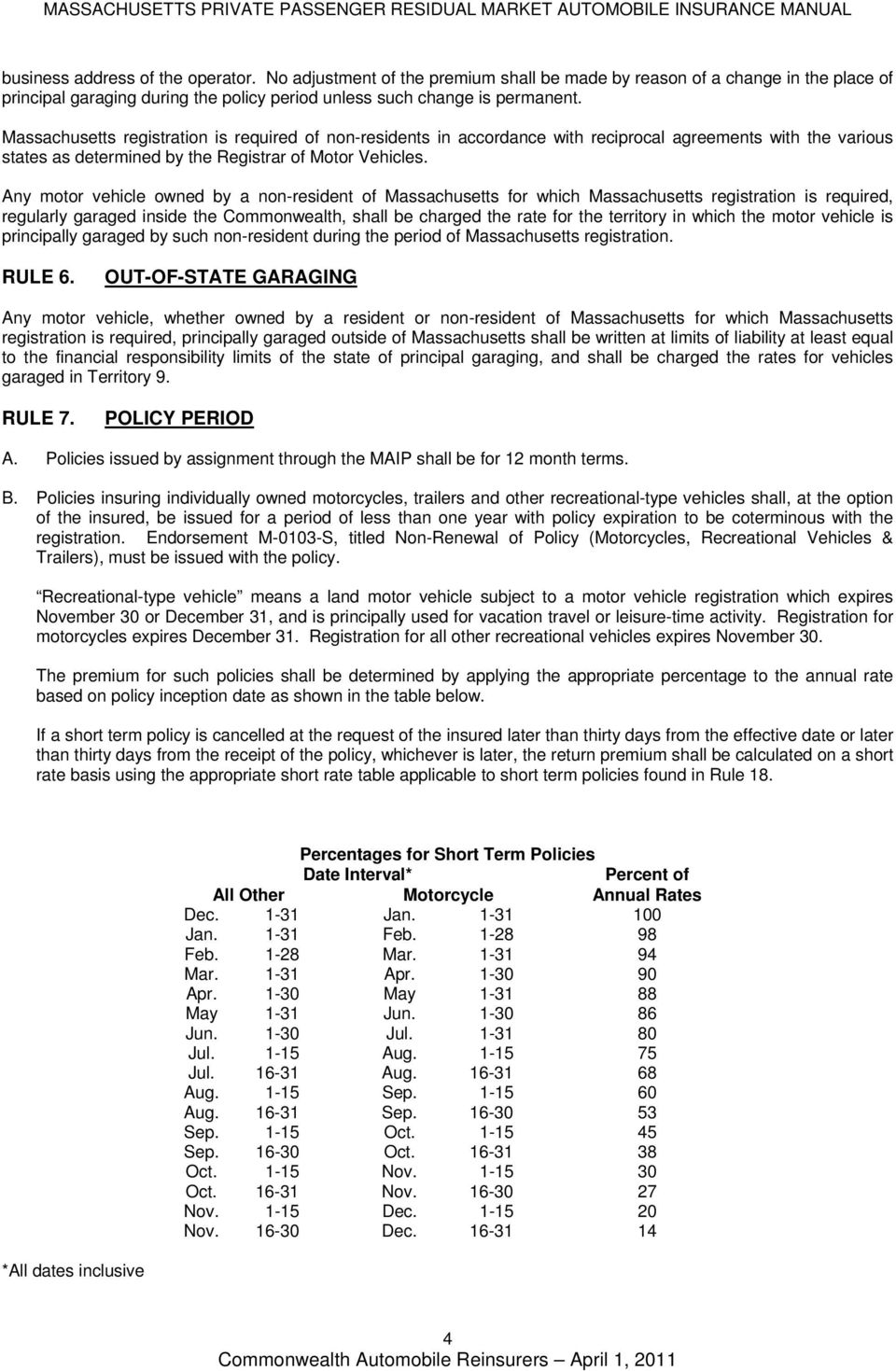
9 business address of the operator. No adjustment of the premium shall be made by reason of a change in the place of principal garaging during the policy period unless such change is permanent. Massachusetts registration is required of non-residents in accordance with reciprocal agreements with the various states as determined by the Registrar of Motor Vehicles. Any motor vehicle owned by a non-resident of Massachusetts for which Massachusetts registration is required, regularly garaged inside the Commonwealth, shall be charged the rate for the territory in which the motor vehicle is principally garaged by such non-resident during the period of Massachusetts registration. RULE 6. OUT-OF-STATE GARAGING Any motor vehicle, whether owned by a resident or non-resident of Massachusetts for which Massachusetts registration is required, principally garaged outside of Massachusetts shall be written at limits of liability at least equal to the financial responsibility limits of the state of principal garaging, and shall be charged the rates for vehicles garaged in Territory 9. RULE 7. POLICY PERIOD A. Policies issued by assignment through the MAIP shall be for 12 month terms. B. Policies insuring individually owned motorcycles, trailers and other recreational-type vehicles shall, at the option of the insured, be issued for a period of less than one year with policy expiration to be coterminous with the registration. Endorsement M-0103-S, titled Non-Renewal of Policy (Motorcycles, Recreational Vehicles & Trailers), must be issued with the policy. Recreational-type vehicle means a land motor vehicle subject to a motor vehicle registration which expires November 30 or December 31, and is principally used for vacation travel or leisure-time activity. Registration for motorcycles expires December 31. Registration for all other recreational vehicles expires November 30. The premium for such policies shall be determined by applying the appropriate percentage to the annual rate based on policy inception date as shown in the table below. If a short term policy is cancelled at the request of the insured later than thirty days from the effective date or later than thirty days from the receipt of the policy, whichever is later, the return premium shall be calculated on a short rate basis using the appropriate short rate table applicable to short term policies found in Rule 18. *All dates inclusive Percentages for Short Term Policies Date Interval* Percent of All Other Motorcycle Annual Rates Dec Jan Jan Feb Feb Mar Mar Apr Apr May May 1-31 Jun Jun Jul Jul Aug Jul Aug Aug Sep Aug Sep Sep Oct Sep Oct Oct Nov Oct Nov Nov Dec Nov Dec
10 RULE 8. CHANGES A. All mid-term changes to the policy requiring adjustments of premium shall be computed pro rata based on the rates in effect on the policy inception date. B. Minimum Premiums 1. If an outstanding policy is amended and results in a premium adjustment of less than $5, such adjustment may be waived, or it may be made subject to a minimum adjustment of $5 except that the actual return premium of less than $5 shall be allowed at the request of the insured. 2. A minimum premium of $5 shall apply if an additional premium results because a coverage is added, or the limits of liability are increased, or a deductible is reduced, at the request of the insured during the policy period. 3. If a return premium of less than $5 results because a coverage is cancelled, or limits of liability are reduced, or a deductible is increased at the request of the insured, no refund need be made except at the request of the insured, in which case the actual return premium shall be allowed. 4. If the limits of liability are increased because of a change in the limits prescribed under any financial responsibility law, the additional premium charge shall be the actual difference in premium charges; if less than $5, it may be charged or waived. RULE 9. MOTOR VEHICLE REGISTRATION CERTIFICATES The specific insurance certification requirements under the Massachusetts Compulsory Motor Vehicle Insurance Law are included in Section 1A of General Laws Chapter 90. Motor vehicles not subject to the Compulsory Law do not require insurance certification. Every insurance carrier issuing a motor vehicle liability insurance policy covering a motor vehicle or trailer subject to the Compulsory Law must issue the prescribed Motor Vehicle Registration Certificate indicating a policy or binder has been issued covering such motor vehicle or trailer. No form or certificate shall be used other than that which is a part of the Massachusetts motor vehicle application for registration. Certificates shall be executed in the name of the insurance carrier only by individuals authorized to sign in the prescribed Authorization To Sign Motor Vehicle Registration Certificates form filed with the Commissioner of Insurance. Section 34 B of General Laws Chapter 90 provides penalties for unlawful use of the Motor Vehicle Registration Certificate. RULE 10. CERTIFIED RISKS - FINANCIAL RESPONSIBILITY LAWS A. Application If a certificate of insurance is necessary to comply with the requirements of a financial responsibility Law of any state or province of Canada, the insurance company must issue evidence of financial responsibility upon request of the insured. In the event that evidence of financial responsibility is required as the result of a motor vehicle violation, a policy affording Damage To Someone Else s Property (Part 4) and Optional Bodily Injury To Others (Part 5) shall be construed to have the necessary limits of liability of the state or province. NOTE: A charge shall be made for any filing required because of a motor vehicle accident. In the event that a certificate of insurance for the future is required as the result of a conviction of a motor vehicle violation, the policy limits shall be increased to afford limits of liability not less than that required by the financial responsibility laws of the state or province requesting certification and premium shall be increased accordingly. 5

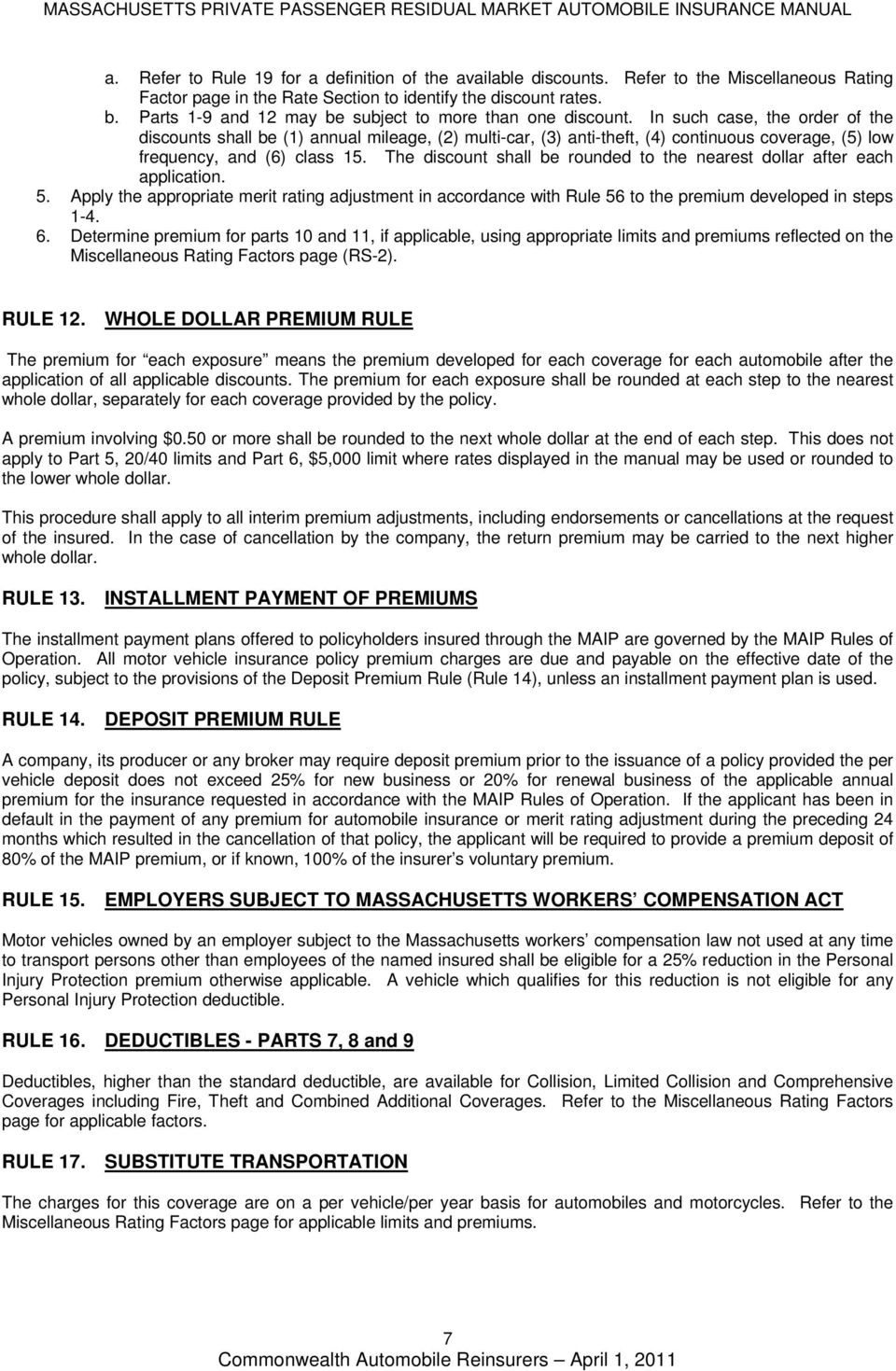
11 The filing of a financial responsibility certificate of insurance as the result of a conviction of a motor vehicle violation requires the following rate adjustments to be allocated evenly between the Part 4 and Part 5 premiums computed as follows: Owners 1. If an owner is required to file evidence of financial responsibility for owned automobiles and for the operation of automobiles which he does not own, the additional premium shall be computed by applying the applicable rate adjustment in Section B to the sum of the total of Parts 1, 2, 4 and 5 premium for the highest rated automobile owned by the insured. 2. In all other cases, the additional premium shall be computed by applying the applicable rate adjustment in Section B to the total premium for Parts 1, 2, 4 and 5 for the highest rated automobile owned by the insured, modified in accordance with this rating plan. B. Rate Adjustments 1. A 50% rate adjustment is applicable if the certificate is required for a conviction listed below. This surcharge is to be applied for the period of time a certificate is required, but in no event for a period in excess of three years following conviction. Thereafter, a 5% rate adjustment applies. a. Driving a motor vehicle while intoxicated or under the influence of marijuana or a narcotic drug. b. Failing to stop and report when involved in an accident. c. Homicide or assault arising out of the operation of a motor vehicle. 2. A 25% rate adjustment is applicable if the certificate is required for a conviction listed below. This surcharge is to be applied for the period of time a certificate is required, but in no event for a period in excess of three years following conviction. Thereafter, a 5% rate adjustment applies. a. Driving a motor vehicle at an excess rate of speed where an injury to a person or damage to property actually results therefrom. b. Driving a motor vehicle in a reckless manner where an injury to person or damage to property actually results therefrom. 3. A 5% rate adjustment is applicable if the certificate is required for any other cause whatsoever. 4. Rate adjustments are to be multiplied by the final premium as developed for Parts 1, 2, 4 and 5. RULE 11. PREMIUM CALCULATION RULE The following sequence shall be used in rating the policy. 1. Determine the premium for parts 1-6 and 12 as follows: a. Identify the manual rate for the appropriate driver rating class, territory, and coverage limit from the Rate Section. b. Adjust the manual rate for part 2 for the appropriate deductible level using the factors from the Miscellaneous Rating Factor page in the Rate Section. 2. Determine the premium for parts 7 and 9 as follows: a. Determine the model year as described in Rule 20. b. Determine the VRG as described in Rule 22. c. Identify the manual rate for the applicable driver rating class and territory from the Rate Section. d. Multiply the applicable manual rate times the applicable model year/vrg relativity for Parts 7 and 9. e. Determine the appropriate deductible charges and factors from the Miscellaneous Rating Factor Page in the Rate Section. f. Apply the appropriate High-Theft Vehicle and Extra-Risk Rating factors per Rules 23 and 24, if appropriate, using rating factors from the Miscellaneous Rating Factor page in the Rate Section. 3. If limited collision coverage (part 8) is selected, adjust the part 7 premium determined in step 2 by the applicable rating factor in the Miscellaneous Rating Factor page. 4. Apply the appropriate discount(s) to the premium developed in steps 1-3 as follows: 6

12 a. Refer to Rule 19 for a definition of the available discounts. Refer to the Miscellaneous Rating Factor page in the Rate Section to identify the discount rates. b. Parts 1-9 and 12 may be subject to more than one discount. In such case, the order of the discounts shall be (1) annual mileage, (2) multi-car, (3) anti-theft, (4) continuous coverage, (5) low frequency, and (6) class 15. The discount shall be rounded to the nearest dollar after each application. 5. Apply the appropriate merit rating adjustment in accordance with Rule 56 to the premium developed in steps Determine premium for parts 10 and 11, if applicable, using appropriate limits and premiums reflected on the Miscellaneous Rating Factors page (RS-2). RULE 12. WHOLE DOLLAR PREMIUM RULE The premium for each exposure means the premium developed for each coverage for each automobile after the application of all applicable discounts. The premium for each exposure shall be rounded at each step to the nearest whole dollar, separately for each coverage provided by the policy. A premium involving $0.50 or more shall be rounded to the next whole dollar at the end of each step. This does not apply to Part 5, 20/40 limits and Part 6, $5,000 limit where rates displayed in the manual may be used or rounded to the lower whole dollar. This procedure shall apply to all interim premium adjustments, including endorsements or cancellations at the request of the insured. In the case of cancellation by the company, the return premium may be carried to the next higher whole dollar. RULE 13. INSTALLMENT PAYMENT OF PREMIUMS The installment payment plans offered to policyholders insured through the MAIP are governed by the MAIP Rules of Operation. All motor vehicle insurance policy premium charges are due and payable on the effective date of the policy, subject to the provisions of the Deposit Premium Rule (Rule 14), unless an installment payment plan is used. RULE 14. DEPOSIT PREMIUM RULE A company, its producer or any broker may require deposit premium prior to the issuance of a policy provided the per vehicle deposit does not exceed 25% for new business or 20% for renewal business of the applicable annual premium for the insurance requested in accordance with the MAIP Rules of Operation. If the applicant has been in default in the payment of any premium for automobile insurance or merit rating adjustment during the preceding 24 months which resulted in the cancellation of that policy, the applicant will be required to provide a premium deposit of 80% of the MAIP premium, or if known, 100% of the insurer s voluntary premium. RULE 15. EMPLOYERS SUBJECT TO MASSACHUSETTS WORKERS COMPENSATION ACT Motor vehicles owned by an employer subject to the Massachusetts workers compensation law not used at any time to transport persons other than employees of the named insured shall be eligible for a 25% reduction in the Personal Injury Protection premium otherwise applicable. A vehicle which qualifies for this reduction is not eligible for any Personal Injury Protection deductible. RULE 16. DEDUCTIBLES - PARTS 7, 8 and 9 Deductibles, higher than the standard deductible, are available for Collision, Limited Collision and Comprehensive Coverages including Fire, Theft and Combined Additional Coverages. Refer to the Miscellaneous Rating Factors page for applicable factors. RULE 17. SUBSTITUTE TRANSPORTATION The charges for this coverage are on a per vehicle/per year basis for automobiles and motorcycles. Refer to the Miscellaneous Rating Factors page for applicable limits and premiums. 7
13 RULE 18. TERMINATION OF INSURANCE A. Cancellations The following provisions apply when a policy is cancelled: 1. If a policy is cancelled by the insurer at any time, or by the insured within thirty days of the effective date or within thirty days of the receipt of the policy, whichever is later, the return premium shall be computed pro rata. "Policy" in this instance includes the copy of the coverage selections page. 2. If the policy is cancelled at the request of the insured later than thirty days from the effective date or later than thirty days from the receipt of the policy, whichever is later, the return premium shall be calculated on a short rate basis except that in the following cases the return premium shall be computed pro rata: a. If the insured has disposed of the automobile, provided the insured takes out a new policy in the same company on another automobile to become effective within thirty days of the date of cancellation. b. If the insured automobile is repossessed under terms of a financing agreement. c. If an automobile is cancelled from a policy, the policy remaining in force on other automobiles, or if there remains in force in the name of the insured or spouse, if a resident of the same household, and in the same company, a concurrent automobile policy covering another automobile. d. If the insured enters the military service of the United States of America. e. If the insured deletes or reduces any coverage and the policy remains in effect for other coverage. f. If the policyholder requests cancellation of a policy because coverage has been replaced in the voluntary market, and provides the ARC written confirmation of the replacement coverage. [Consistent with current MAIP rules] 3. Except as otherwise provided by law, no cancellation of the policy, or any of its parts, whether by the company or by the insured, shall be valid unless written notice thereof is given by the party proposing cancellation to the other party at least twenty days in each case prior to the intended effective date thereof. Notice of cancellation sent by the company to the insured and the loss payee at the addresses stated in the policy by regular mail for which a certificate of mailing receipt has been obtained from the United States Postal Service, shall be a sufficient notice and that an affidavit of any officer, producer, or employee of the company, duly authorized for the purpose that he has so sent such addressed as aforesaid, shall be prima facie evidence of the sending thereof as aforesaid. When the cancellation becomes effective, the company shall electronically transmit the pertinent data to the Registry of Motor Vehicles in the manner prescribed by the Uninsured Motorists System (UMS). The written notice to the insured shall specify the reason or reasons for cancellation. If the reason for cancellation is non-payment of premium, the Notice of Cancellation shall state the amount that must be paid to the company to avoid cancellation for all the insurance provided and shall state in substance that the cancellation will not be effective if the insured pays the full amount of such deficiency on or prior to the effective date of the cancellation. If a cancellation of the policy results in a return premium of less than $5.00, no refund need be made except at the request of the insured, in which case the actual return premium shall be allowed. No policy in effect prior to a rate level revision shall be endorsed or cancelled and rewritten to take advantage of such a revision or to avoid the application of such a revision. B. Theft of Vehicle or Plates 1. If the insured automobile is stolen or destroyed (total or constructive total loss) and cancellation is requested by the insured within thirty days following the date the automobile is stolen or destroyed, the return premium for all coverages (including the premium for the coverages under which loss was paid) shall be calculated on a pro rata basis from the day following the date of such loss. 2. If the insured registration plates are stolen or destroyed, a lost plate affidavit is to be issued to the Registry of Motor Vehicles canceling only coverage with respect to such plates effective the day following the date of such loss, and the policy shall continue to provide coverage with respect to any replacement plates. 8

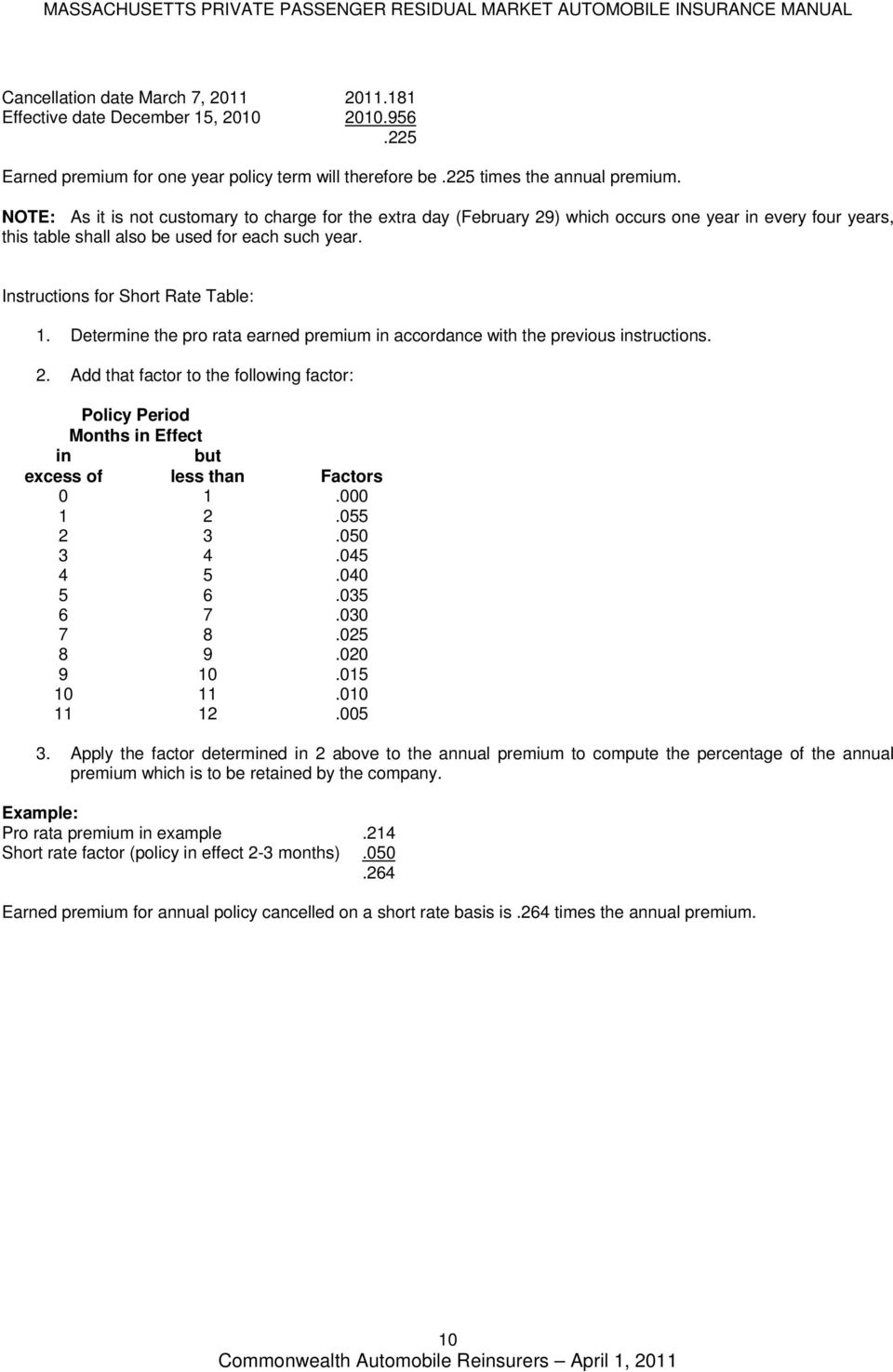
14 3. If the insured files a lost plate affidavit with the Registry of Motor Vehicles, the company may cancel the policy. C. Sale or Transfer of Motor Vehicle, Surrender of Registration Plates, or Filing of a New Certificate The policy shall terminate upon: 1. The sale or transfer of title by the owner of the motor vehicle or trailer thirty (30) days after the transfer unless the owner has registered a replacement motor vehicle. 2. The surrender to the Registry of Motor Vehicles of the registration plates issued to the owner of the motor vehicle by the Registrar of Motor Vehicles under Chapter 90, with a written statement, in such form as the Registrar may require, that they are surrendered to cancel the registration of, and the insurance under, the policy for such motor vehicle or trailer. 3. The filing with the Registry a certificate of insurance of another company as of the effective date of such certificate. NOTE: If more than one motor vehicle or trailer is described in the policy, the termination of coverage applies only to the motor vehicle or trailer involved in one of the situations described above. D. Reinstatement If a policy has been cancelled by an insurance company, and such policy is later reinstated by the Board of Appeal on Motor Vehicle Liability Policies and Bonds or by a court of competent jurisdiction, the premium charge for the unexpired term of the policy shall be calculated pro rata based on the premium applicable to the policy when originally issued. E. Plates Returned Receipt In the event that a policy has been terminated by (a) sale or transfer of the motor vehicle, or (b) surrender of the registration plates by the owner of the motor vehicle with a written statement in such form as the Registrar may require, that they are surrendered to cancel the registration of, and the insurance under, the policy for such motor vehicle or trailer, a receipt from the Registry of Motor Vehicles stating that the registration plates have been surrendered must be furnished to the insurance company. F. Leased Vehicles Under Long Term Contract In the event a policy on a leased vehicle under a long-term contract is cancelled, the cancellation notice is to be issued in the name of the person or organization to which the policy was issued. A copy of the cancellation notice must be sent to the owner/registrant also, if it is other than the person to whom the policy was issued. Upon the intended effective date of cancellation, a notice issued in the name of the actual owner/registrant must be electronically transmitted to the Registry by the company. G. Instructions For Use of Pro Rata or Short Rate Table 1. Express the date of cancellation by year and decimal part of a year by combining the calendar year with the decimal appearing opposite the month and day in the Pro Rata Table, e.g., March 7, 2011, is designated as In like manner express the effective date of the policy by year and decimal part of a year and subtract from the cancellation date. 3. The difference, in the case of one year policies, represents the percentage of the annual premium which is to be retained by the carrier. Examples: Cancellation date September 22, Effective date July 6, Earned premium for one year policy term will therefore be.214 times the annual premium. 9
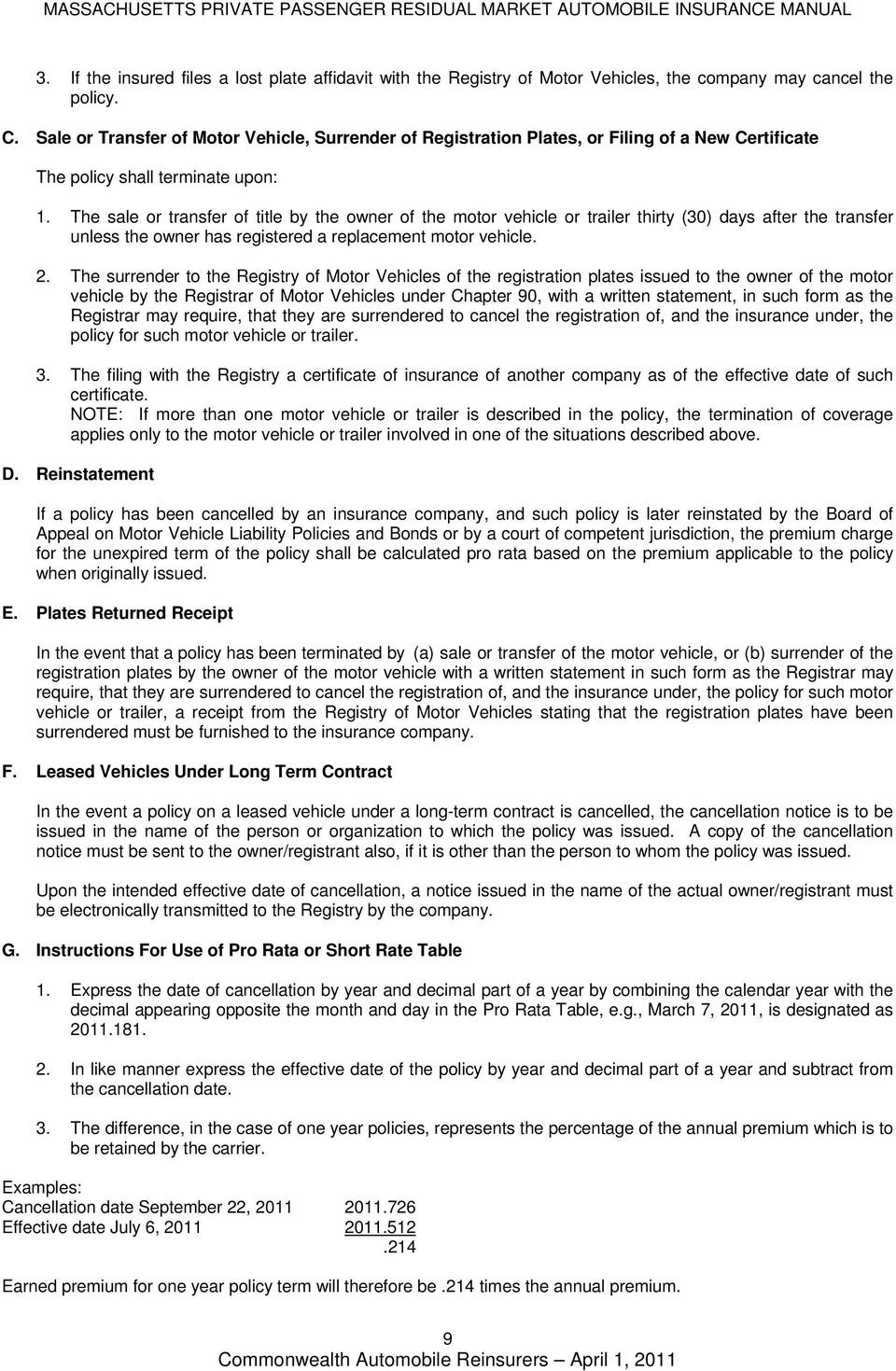
15 Cancellation date March 7, Effective date December 15, Earned premium for one year policy term will therefore be.225 times the annual premium. NOTE: As it is not customary to charge for the extra day (February 29) which occurs one year in every four years, this table shall also be used for each such year. Instructions for Short Rate Table: 1. Determine the pro rata earned premium in accordance with the previous instructions. 2. Add that factor to the following factor: Policy Period Months in Effect in excess of but less than Factors Apply the factor determined in 2 above to the annual premium to compute the percentage of the annual premium which is to be retained by the company. Example: Pro rata premium in example.214 Short rate factor (policy in effect 2-3 months) Earned premium for annual policy cancelled on a short rate basis is.264 times the annual premium. 10
16 PRO RATA TABLE January February March April May June Day Of Month Day of Year Ratio Day of Month Day of Year Ratio Day of Month Day of Year Ratio Day of Month Day of Year Ratio Day of Month Day of Year Ratio Day of Month Day of Year Ratio July August September October November December Day of Month Day of Year Ratio Day of Month Day of Year Ratio Day of Month Day of Year Ratio Day of Month Day of Year Ratio Day of Month Day of Year Ratio Day of Month Day of Year Ratio

17 (Rule 18) SHORT RATE CANCELLATION OF SHORT TERM POLICIES Percentages of Policy Premiums to be Retained by Insurance Company Policy Effective Date No. of Days August September October November December in force Jan. Feb. Mar. Apr. May June July TABLE (Motorcycles with Registration Expiration of December 31) No. of Days July August September October November in force Dec. Jan. Feb. Mar. Apr. May June TABLE (All Vehicles with Registration Expiration of November 30)

18 RULE 19. DISCOUNTS A. Multi-Car A policyholder who owns two or more automobiles and purchases coverage from the same company for at least two such automobiles, shall be entitled to a reduction of the premium applicable to Coverage Parts 1, 2, 4, 5, 7, 8 and 9. At least two of the automobiles must be private passenger vehicles as defined in Rule 27, except that vehicles classified as antiques are not eligible. The premium reduction applies only to private passenger vehicles as defined in Rule 27. Refer to Miscellaneous Rating Factors page for applicable discount. B. Anti-Theft Device Refer to Anti-Theft Discounts Rule 54. C. Class 15 Premiums otherwise applicable to class 10 automobiles shall be reduced by 25% for insureds age 65 or older. If the principal operator becomes age 65 during the policy year, the class 10 premium shall be adjusted as of that date but no later than the next policy renewal date. A notice of this classification change must be sent to the policyholder either prior to or with the proposed adjustment. The policyholder is required to notify the company of any change in operator usage which would affect entitlement to the discount. D. Annual Mileage Discount A discount of the premium paid for Parts 1, 2, 3, 4, 5, 6, 7, 8 and 12 will be given to eligible policyholders on request, when the annual mileage of the vehicle falls into one of two categories. The discount will be based on the actual mileage driven in the previous policy year as determined by a comparison of two odometer readings, at least six months apart, from Registry of Motor Vehicle information or the Annual Mileage Discount Form and other standard automobile insurance forms available to the company. Refer to the Miscellaneous Rating Factors page for the applicable categories and discounts. 1. Eligibility The vehicle must be a private passenger vehicle as defined in Rule 27, except that vehicles classified as Antiques are not eligible. The company may request that the applicant for the discount complete the Annual Mileage Discount Form for the verification of eligibility for the discount. 2. Verification The company may use the odometer readings provided by the applicant on the Annual Mileage Discount Form or other standard forms available to the company, in order to verify the mileage driven in the past year. The company shall compute the annualized difference between the odometer reading at the time of application and the previous odometer reading to determine eligibility. If a vehicle replaces a vehicle which is receiving the discount, the annual mileage of the prior vehicle will be attributed to the replacement vehicle. The company may use information from the Vehicle Inspection System of the Registry of Motor Vehicles to verify annual mileage. The difference in the two most recent odometer readings reported by the Registry, if at least six months apart, shall be annualized to determine eligibility for the discount. If the Registry reports only one reading, which is more than six months before the application for the discount, the applicant may provide a current odometer reading on the Annual Mileage Discount Form, and the difference shall be annualized to determine eligibility. If two odometer readings, at least six months apart, are not available to the company through the Registry of Motor Vehicles, the Annual Mileage Discount Form or other standard forms, the vehicle is not eligible for the annual mileage discount. 13
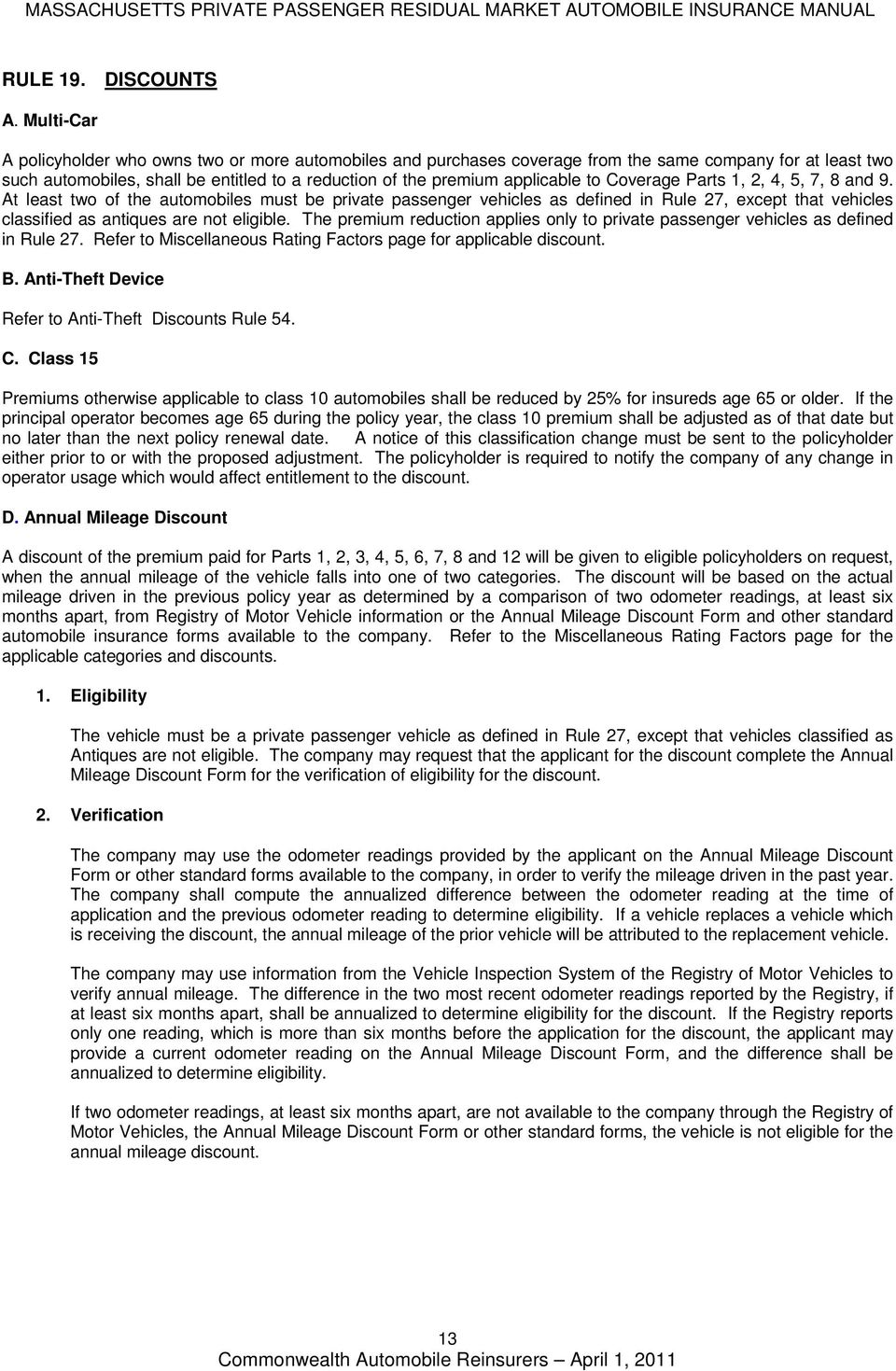
19 3. Application of Discount The applicable discount applies to rates otherwise determined for each insured vehicle by coverage, limits purchased, territory, driver class, and model year and vehicle rating group prior to the application a merit rating adjustment. E. Continuous Coverage The MAIP premium for Parts 1, 2, 4 and 5 will be reduced following the assigned company s verification of a rated operator s eligibility for the continuous coverage discount. The discount shall apply to each rated operator that has been insured without a lapse in coverage under an automobile insurance policy for the 12 month period preceding the effective date of the policy. A rated operator is considered continuously insured if the operator was the named, listed, or rated insured on an automobile insurance policy for the 12 month period preceding the effective date of the policy. 1. Eligibility The vehicle must be a private passenger vehicle as defined in Rule 27. To be eligible for the discount when the policy is first assigned to a company, a copy of the coverage selections page confirming coverage up to the effective date of the new policy for any or all of the operator(s) listed on the application must be attached to the new business application submitted to the assigned company in accordance with CAR Rule 31.B.5.Rated operators that are not eligible for the continuous coverage discount are: a. Operators that have been licensed less than 12 months; b. Operators that are new to Massachusetts who cannot demonstrate proof of licensing for the previous 12 months and are assigned to Class 20 or 21 in accordance with rule 28.B.3 of this manual are not eligible for the continuous coverage discount; c. Operators assigned as the rated operator on a vehicle according to Rule 28 of this manual when the policy is first assigned to the company for whom a copy of the prior policy coverage selection page(s) indicating that the operator was insured up to the effective date of the new policy has not been furnished; and d. Any operators insured under a policy assigned to a company that is cancelled due to nonpayment of premium and results in a lapse in coverage at any time during the policy s three year assignment to the company. 2. Verification Upon timely receipt of the prior policy coverage selections page for an operator that will be a rated operator under the policy when first assigned to the company, the company shall verify that operator s eligibility for the continuous coverage discount using the Uninsured Motorist System of the Registry of Motor Vehicles, direct confirmation of continuous coverage with the prior insurer shown on the prior policy coverage selection page, or other reputable vendors of automobile insurance coverage information. For rated operators who are new to Massachusetts that can demonstrate licensure for the 12 months preceding the policy effective date, the assigned company shall attempt to verify the operator s eligibility for the discount through direct confirmation of continuous coverage with the prior insurer, or other vendors of automobile insurance coverage information. If eligibility for the discount cannot be confirmed through any of the verification processes described above, the discount shall not apply. Continued eligibility for the discount at renewal shall be based on the assigned company s internal policy records for the previous 12 months. Refer to the Miscellaneous Rating Factor page for the applicable discount factor. 14
20 F. Low Frequency The MAIP premium for Parts 1, 2, 4 and 5 will be reduced following the assigned company s verification of a rated operator s eligibility for the low frequency discount. The discount shall apply to each rated operator that has 4 or less merit rating points as defined in Rule 56 Merit Rating Plan, and where a claim payment under any or all of the above coverage parts has not been made to or on behalf of the rated operator in connection with more than one accident during the three years preceding the effective date of the policy. 1. Eligibility The vehicle must be a private passenger vehicle as defined in Rule Verification The assigned company shall verify each rated operator s eligibility for the low frequency discount. The company shall verify eligibility using information from reputable vendors of operators automobile insurance claim payment histories and traffic violations and its own claim payments. An assigned company may optionally elect a short form verification process instead of the verification process described above. Under the short form option, an assigned company agrees to verify each rated operator s eligibility for the low frequency discount for each policy assigned to it solely on the basis of the information used to compute the rated operator s merit rating adjustment under Rule 56 of this manual and the claim payments it makes under the provisions of the assigned policy. Companies who use the short form verification option must utilize this procedure for all assigned risks, and must notify CAR of their intent to do so least 20 days prior to implementation. When a policy is assigned by the MAIP to such a company, CAR will notify the producer of the company s short form verification requirements at the time the producer is notified of the company assignment. Companies may rescind the short form verification option at any time provided CAR receives notice at least 20 days in advance of implementation. An assigned company that changes its verification process may not subsequently reassess a rated operator s eligibility for the low frequency discount on an in-force policy until the policy renews. Refer to the Miscellaneous Rating Factor page for the applicable discount factor. Rule 20. MODEL YEAR DEFINITION The model year of an auto is used in rating physical damage coverage on an actual cash value basis. The model year of the auto is the year assigned by the auto manufacturer. The model year of rebuilt or structurally altered autos is determined by the model year of the chassis. Rule 21. FIRE, THEFT AND COMBINED ADDITIONAL COVERAGE A. Actual Cash Value Refer to Miscellaneous Rating Factors section for the applicable factors. B. Stated Amount Refer to the Rate Section for any specified peril. Rule 22. VEHICLE RATING GROUP (VRG) PROGRAM The Vehicle Rating Group program assigns vehicles to groups in order to reflect expected cost differences arising from the type of vehicle insured. Vehicles are assigned to groups with each new model year and may be grouped differently depending on the type of coverage. 15

21 A. Assignment to Vehicle Rating Groups The Vehicle Rating Groups (VRGs) are used for the physical damage coverages to determine a vehicle s premium. VRGs are assigned to vehicles as new model years are introduced, and once a vehicle has been assigned to a VRG, it is not subject to change. 1. Coverages rated using VRGs: collision, limited collision, and comprehensive 2. Coverage groupings: there are two sets of VRG definitions one for the collision coverage and one for the comprehensive coverage 3. VRG Codes: the forty VRGs are represented by codes 11 through 50 Refer to the AIB Vehicle Rating Group Program for the VRG assigned to vehicles. Refer to the Rate Section of this manual for Model Year/Vehicle Rating Group relativities for use in premium determination. For rating vehicles that do not have a VRG assignment, see part B (below). B. Vehicles not Assigned to Vehicle Rating Groups Use the following procedure to rate vehicles that have not been assigned to a VRG: 1. Existing models: for rating of the newly announced models that have not been assigned to a VRG, use the VRG of the latest corresponding model year. 2. New models: for rating of vehicles which have no prior corresponding model, determine the appropriate VRG based on (1) the base list price and (2) the vehicle type. (refer to the VRG Assignment by Price table in the Rate Section). 3. Model years prior to 1985: the auto shall be rated on a Stated Amount Basis in accordance with Rule 41. If an auto is appraised for stated amount or agreed amount coverage, the appraised value must be used to determine the VRG. (Refer to the VRG Assignment by Price table in the Rate Section). (The base list price is the manufacturer s suggested retail price, or MSRP, for a vehicle with no additional options included.) C. Vehicle Rating Group/Model Year Rating Premium for Parts 7 or 9 is determined as follows: 1. Determine the model year as described in Rule Determine the VRG as described in section A or B above 3. Identify the manual rate for the applicable driver rating class and territory from the Rate Section 4. Identify the applicable model year/vrg relativity for Part 7 or 9 from the Rate Section 5. Multiply the applicable base rate times the applicable model year/vrg relativity for Part 7 or 9 6. Determine appropriate deductible charges and factors from the Rate section of the manual D. Calculation of Rate Relativities for Physical Damage Vehicle Rating Group 50 When the base list price is less than or equal to the maximum price shown in the table below, the rate relativity for VRG 50 is used without adjustment. (The base list price is the MSRP for a vehicle with no additional options included. When the base list price exceeds the maximum price shown in the table below, rate relativities for VRG 50 are subject to adjustment. Calculate the VRG 50 collision and comprehensive rate relativities for each coverage as follows: 16
22 1. Subtract the maximum price in the table below from the base list price and divide by $ Multiply the amount from Step 1 by the factor in the table below. 3. The adjusted VRG 50 relativity is determined by adding the amount from Step 2 to the unadjusted VRG 50 rate relativity Collision Comprehensive Van/Wagon/ Pick-up* All Other PP Vehicles ** All Vehicles Max Price $130,000 $99,000 $75,000 Factor * The Van/Wagon/Pick-up group in the table above consists of private passenger vehicles with the following styles: vans, wagons, pick-up trucks, sport utility vehicles (SUV), and wagon/suv-styled crossover vehicles. ** The All Other group consists of all other private passenger vehicles with body styles such as: sedans, convertibles, coupes, luxury cars, hatchbacks, performance cars, and sedanstyled crossover vehicles. RULE 23. HIGH-THEFT VEHICLES For certain model years, some makes and models are designated high-theft vehicles by the Commissioner of Insurance. These vehicles are identified as such in the High Theft Section. The insurer may, at its option, charge an extra-risk rate, refuse to write, or cancel coverage under parts 7, 8, or 9 if a vehicle designated as a high-theft vehicle is not equipped with a category III, IV or V anti-theft device or vehicle recovery system as defined in Rule 54. New Business Rule Any high-theft vehicle listed on a New Business Application which does not have an appropriate anti-theft device or vehicle recovery system shall be written at the extra-risk rate. If an appropriate device is installed within thirty days of the policy effective date, the extra-risk premium will be waived and the anti-theft discount will be allowed retroactive to policy inception. If an appropriate device is not installed within thirty days of policy inception, the company, at its election, may cancel coverage under parts 7, 8, and 9 or continue such coverage at the extra-risk rate. A category III, IV, or V device installed more than thirty days after the policy effective date qualifies for the applicable discount, but the discount shall be calculated pro-rata from the date of installation. Any premium charged for an extra-risk rate shall be earned on a pro-rata basis. RULE 24. EXTRA-RISK RATING (COLLISION AND COMPREHENSIVE) The following circumstances require the application of the extra-risk rate if the insurer elects to write coverage under parts 7, 8, and 9, and the insurance to be provided is on a vehicle: 1. customarily driven by or owned by persons who within the five years preceding the policy effective date have been convicted of vehicular homicide, auto insurance related fraud, or auto theft. 2. customarily driven or owned by persons who within the three years preceding the policy effective date have been convicted of any category of driving under the influence of alcohol or drugs. 3. customarily driven by or owned by persons who, within three years preceding the policy effective date, have been involved in four or more at-fault auto accidents. An at-fault auto accident is one in which the owner or any person who customarily drives the auto was more than 50% at fault. 4. designated as a high-theft vehicle which does not have at least a minimum anti-theft or auto recovery device as prescribed by the Commissioner of Insurance. (Refer to Rule 23.) 17
23 5. customarily driven by or owned by persons who have two or more total auto theft or fire insurance claims within the three years immediately preceding the policy effective date. 6. customarily driven by or owned by persons who have within the five years preceding the policy effective date made an intentional and material misrepresentation in making claim under Collision or Comprehensive coverage. 7. for which a salvage title has been issued by the Registrar of Motor Vehicles unless a new certificate of title has been issued in accordance with Massachusetts law. (Coverage cannot be written on a vehicle which has been issued a salvage title.) The factors for the extra-risk rate are multiplied by the manual rate as follows: Collision Comprehensive Vehicular Homicide Auto Insurance Related Fraud Auto Theft Driving Under the Influence of Alcohol or Drugs Four or More At-Fault Accidents High-Theft Vehicle Two or More Total Fire or Total Theft Losses Material Misrepresentation 1.5 (1.2) 1.5 (1.2) Salvage Title Coverage not available NOTE: For the first instance of a material misrepresentation in the application for insurance, the lower indicated factor may be used, at the option of the insurer. Application of Factors A. Single Vehicle Policies Where more than one category applies to the same operator or vehicle, the highest applicable factor shall be used respectively for Collision and Comprehensive. For example, if a listed operator is convicted of vehicular homicide and also has a high-theft vehicle, the factor for both Collision and Comprehensive is 1.5. The factors do not compound. In cases where separate policies are issued by the same insurer to the common owner of two or more vehicles, the highest applicable factors for Collision and Comprehensive shall be assigned to the vehicle with the highest premium for Collision and Comprehensive respectively. For each subsequent vehicle, the next highest applicable factor shall be assigned to the next highest premium for Collision and Comprehensive respectively, etc. If one or more of the extra-risk categories of insurance fraud, auto theft or material misrepresentation apply to such common owner, the applicable factor shall be used for both Collision and Comprehensive for each insured vehicle. B. Multi-Vehicle Policies The highest applicable factors for Collision and Comprehensive shall be assigned to the vehicle with the highest premium for Collision and Comprehensive respectively. Each subsequent vehicle shall be assigned the next highest applicable factor and so forth. If one or more of the extra-risk categories of insurance fraud, auto theft or material misrepresentation apply to the insured owner, the applicable factor shall be used for both Collision and Comprehensive for each insured vehicle. RULES 25 &26. RESERVED FOR FUTURE USE 18
24 SECTION II - PRIVATE PASSENGER AUTOMOBILES RULE 27. PRIVATE PASSENGER DEFINITION A. A motor vehicle of the private passenger or station wagon type that is owned or leased under contract for a continuous period of at least twelve months by one or more individuals, excluding (1) partnerships, (2) corporations, (3) unincorporated business associations, and (4) other legal business entities with a federal employer identification number, and is not used as a public or livery conveyance nor rented to others. A vehicle which meets the conditions of Rule 31, regarding the transportation of fellow employees, students or others for consideration, is included in this definition, provided such vehicle is not registered for carrying passengers for hire. B. A motor vehicle that is a pick-up or van, that is owned or leased under contract for a continuous period of at least 12 months by one or more individuals, excluding (1) partnerships, (2) corporations, (3) unincorporated business associations, and (4) other legal business entities with a federal employer identification number, and 1. has a gross vehicle weight rating of less than 10,000 pounds or has a vehicle rating group assigned to it by the Automobile Insurers Bureau of MA (AIB), and 2. is not used for the delivery or transportation of goods or materials unless such use is incidental to the insured s business of installing, maintaining or repairing furnishings or equipment. C. Gross Vehicle Weight Rating means the value specified by the manufacturer as the loaded weight of a single vehicle. D. An eligible vehicle under this rule whose title has been transferred to a trust may be insured under a policy issued by assignment through the MAIP, subject to the following requirements: the grantor of the trust must be an individual or lawfully married individuals residing in the same household, and must be the only insured(s) named in Item 1 of the Coverage Selections Page. All vehicle(s) insured under the policy must be owned by the trust. A vehicle owned by a trust in which the grantor is a partnership or corporation must be written under a commercial auto policy. If a motor vehicle is leased as described in the foregoing paragraphs, and the lessee is obtaining the insurance, the policy must be issued to the lessee as named insured and Endorsement M-0070-S, Coverage For Anyone Renting An Auto To You, must be attached to the policy. RULE 28. PRIVATE PASSENGER CLASSIFICATIONS A. Operator Classes 10 Experienced Operator. The operator has been licensed at least six years and is under the age of 65 and the automobile is not used in the occupation, profession or business of the insured. 15 Experienced Operator - age sixty-five or more. The operator has been licensed at least six years and is sixty-five years of age or more and the automobile is not used in the occupation, profession or business of the insured. 17 Inexperienced Principal Operator - licensed three or more years. The operator of the automobile has been licensed at least three years and less than six years and is the principal operator of the automobile. 18 Inexperienced Occasional Operator - licensed three or more years. The operator has been licensed at least three years and less than six years and is not the principal operator of the automobile. 20 Inexperienced Principal Operator - licensed less than three years. No driver training. The operator has been licensed less than three years, is the principal operator of the automobile, and has not completed a Satisfactory Driver Training Program. 19
25 21 Inexperienced Occasional Operator - licensed less than three years. No driver training. The operator has been licensed less than three years, is not the principal operator of the automobile, and has not completed a Satisfactory Driver Training Program. 25 Inexperienced Principal Operator - licensed less than three years. Driver training. The operator has been licensed less than three years, is the principal operator of the automobile, and has completed a Satisfactory Driver Training Program. 26 Inexperienced Occasional Operator - licensed less than three years. Driver training. The operator has been licensed less than three years, has completed a Satisfactory Driver Training Program, and is not the principal operator of the automobile. 30 Business Use. The operator has been licensed at least six years and the automobile is used in the occupation, profession, or business of the insured. Going to or from the principal place of the occupation, profession or business of the insured is not considered business use. B. Operators All operators of the insured automobiles must be listed on the Coverage Selections Page of the Policy. An operator is a person who has an operator s license, but does not include a person who has only a learner s permit. 1. Assignment of Operators to Automobiles a. If an insurer defers operators listed on a policy who are rated on an automobile insured by another Massachusetts private passenger motor vehicle insurance policy for the purposes of rating the policy on which they are listed in the voluntary market, this practice must be extended to the rating of policies assigned to it through the MAIP. If the insurer does not defer any listed operator under the policy for the purposes of rating the policy, the insurer shall not adopt that practice for the purposes of rating a policy assigned to it through the MAIP b. Each operator listed on the policy shall be assigned to an automobile on the policy based on the operator s class and merit rating in a manner which produces the highest Combined Premium (the sum of the premium for Parts 1, 2, 4, 5, 7, 8, and 9 for the operator s class and the operator s merit rating adjustment) for each automobile. The operators shall be assigned in order of the highest Combined Premium applied to the automobile with highest Base Premium (the automobile s Class 10 premium for Parts 1, 2, 4, 5, 7, 8, and 9) until all operators are assigned to an automobile, except that: i. If an inexperienced operator is the principal operator of a specific automobile, the automobile shall be rated with the appropriate inexperienced principal operator class and merit rating adjustment of that operator; ii. If an operator age 65 or over is the principal operator of a specific automobile and all operators listed on the policy have been licensed at least six years, the automobile shall be rated as Class 15 and that operator s merit rating adjustment shall be applied. However, if more than one listed operator is age 65 or over, Class 15 and the merit rating adjustments of the Class 15 operators shall be applied in the manner which produces the highest Combined Premium. iii. If only one operator is listed on the policy, all automobiles on the policy will be assigned the same principal operator classification and merit rating adjustment. iv. If each listed operator has been used in rating an automobile on the policy, any remaining automobiles shall be assigned the operator class and merit rating adjustment which produces the lowest Combined Premium, unless the automobile is subject to rating as Class 30. v. If more than one operator is listed on the policy, an operator cannot be assigned as the principal operator of more than one automobile on the policy until the other operators are assigned to an automobile. c. The assignment of operators to automobiles applies regardless of the number of policies or insurers involved. d. An inexperienced operator in active military service with the Armed Forces of the United States of America shall not be considered an operator of the automobile unless such individual customarily operates the automobile. 20
26 e. Private passenger automobiles owned by clergy are to be classified as Class 10 or 15 unless (a) Class 30 is required due to business use other than in connection with church use or (b) an inexperienced operator is listed on the policy. 2. Excluded Operator If an operator who is a member of the household is to be excluded in rating a particular automobile to produce a lower premium charge, the policyholder must submit a signed statement that such operator does not and will not operate the automobile to be insured. The signed statement must be on the Operator Exclusion Form, M-0106-S. If any operator excluded as a result of such signed statement operates the automobile, the appropriate operator classification premium for the full policy period may be charged unless a collision or limited collision claim has been denied in accordance with the provisions of the policy because the excluded operator was driving the automobile at the time of the accident. 3. Driving Experience An operator new to Massachusetts must provide evidence of licensure from the state or country where the operator was previously licensed in order to assign the correct operator classification under this rule. If electronically available, the company will be responsible for obtaining the motor vehicle operator report from the other state or country. If necessary, a certified English translation may be required. No operator shall be assigned to Class 10 unless the operator has six or more years of driving experience. The classification assigned to the operator is based on the number of years licensed in the other state or country and the completion of driver training, as established by the evidence of licensure. If no evidence of prior licensure is available, the operator may be assigned to Class 20 (inexperienced principal operator, licensed less than three years, no driver training) or Class 21 (inexperienced occasional operator, licensed less than three years, no driver training). The Massachusetts driving experience will be used thereafter to assign the operator classification. 4. Operator Use Operators will be classified by the amount of use of an insured automobile: Principal Operator a person who has an operator s license and operates the insured automobile more than any other listed operator as determined by the percentage of use of the automobile. Occasional Operator a person who has an operator s license and operates the insured automobile less than the principal operator. C. Classification Changes Classification of each automobile shall be determined by the facts existing as of the effective date of the policy. Premium adjustments shall be made on a pro rata basis if changes occur during the policy period. D. Satisfactory Driver Training Program 1. Completion and receipt of a certificate under the Massachusetts Driver Education Program prescribed by the Registrar of Motor Vehicles, or 2. The presenting of satisfactory evidence (certificate signed by school officials) that such operators has successfully completed a driver education course in a state other than Massachusetts meeting the following standards: a. The course had the official approval of the State Department of Education or other responsible state agency, and was conducted by: (1) a recognized secondary school, college or university, or (2) other school approved and supervised by the State Department of Education or other responsible state agency. 21
27 b. The course was conducted by instructors certified by the State Department of Education or other responsible state agency. c. The course was composed of a minimum of thirty clock hours for classroom instruction, plus a minimum of twelve clock hours per student in the practice driving phase. RULE 29. RESERVED FOR FUTURE USE RULE 30. PERSONAL INJURY PROTECTION - DEDUCTIBLE OPTIONS The policyholder, at his or her option, may elect an amount to be deducted from the amounts otherwise due each person subject to the deduction, under the following conditions: 1. The option of electing a deductible shall be limited to individual insureds and shall apply only to private passenger vehicles as defined in this Section and motor homes owned by such insureds. 2. The eligible policyholder may select a deductible amount of $100, $250, $500, $1,000, $2,000, $4,000 or $8, The deductible applicable to the Policyholder alone is the only deductible available if the policyholder is the only member of the household, regardless of the number of vehicles which he owns. Lawfully married individuals having joint ownership and registration of a single motor vehicle which is the only vehicle in the household shall be considered to be an individual for purposes of paragraph 4 of this rule. In such a case the same form of deductible must apply to both of the lawfully married individuals. 4. Either the deductible for the policyholder alone or the policyholder and household members is available to a policyholder who has two or more members in his household and there is one motor vehicle in the household. 5. The deductible applicable to the policyholder and household members is the only deductible available for election if there are two or more members in the household, and also two or more motor vehicles insured for Personal Injury Protection by household members. 6. If two or more vehicles are insured under a single policy, the same deductible election shall apply to all vehicles insured under such a policy. 7. As used in this rule, the term household members means those persons living in the policyholder s household who are related to the policyholder by blood, marriage or adoption. This includes wards or foster children. The Personal Injury Protection premium otherwise applicable shall be reduced by the dollar amount determined by applying the percentage shown on the Miscellaneous Rating Factors page to the manual premium. RULE 31. TRANSPORTATION OF FELLOW EMPLOYEES If a private passenger motor vehicle has a seating capacity of not more than eight passengers other than the driver and is used to carry fellow employees, students or others for a consideration, expressed or implied, to or from, or near their place of employment or education, the premium to be charged shall be the otherwise applicable private passenger automobile premium. For vehicles in excess of eight passengers, refer to the rule for van pools in the commercial automobile manual. All policies subject to this rule must contain the endorsement titled Transportation of Fellow Employees, Students or Others, M-0004-S. RULE 32. RESERVED FOR FUTURE USE 22
28 RULE 33. TOWING AND LABOR COST Private Passenger Automobiles and Motorcycles only. Refer to the Miscellaneous Rating Factors page for limits and premiums. Applicable regardless of the term of the policy or endorsement. Refer to the assigned insurer s rating procedure for purposes of comparing the MAIP premiums to the assigned insurer s voluntary premiums. RULE 34. TRAILERS DESIGNED FOR USE WITH PRIVATE PASSENGER MOTOR VEHICLES This equipment includes utility, boat, horse, camping, travel or similar type trailers designed to be pulled by a private passenger auto, motorcycle, pick-up truck, van or similar type vehicle, and if not a home, office, store, display or passenger trailer. Refer to the Miscellaneous Motor Vehicles page for rating methods and factors. Refer to Rule 22 to determine vehicle rating group. Use the base list price. Refer to the assigned insurer s rating procedure for purposes of comparing the MAIP premiums to the assigned insurer s voluntary premiums. RULES RESERVED FOR FUTURE USE 23
29 SECTION III - MISCELLANEOUS MOTOR VEHICLES AND COVERAGES RULE 39. MOTOR HOMES/CAMPER BODIES A. Motor Homes Any motor vehicle originally designed or permanently altered as living quarters (including cooking, dining, plumbing or refrigeration facilities), and which is used exclusively for human habitation or camping purposes. This also includes pick-up trucks used solely to transport a camper body or other similar living quarters. A motor vehicle designed primarily to transport property which has been temporarily altered or equipped for human habitation shall not be deemed to be a motor home. Refer to the Miscellaneous Motor Vehicles page under Motor Homes for rating methods and factors; for Parts 7, 8 and 9, refer to Rule 22 to determine vehicle rating group. Refer to the assigned insurer s rating procedure for purposes of comparing the MAIP premiums to the assigned insurer s voluntary premiums. B. Camper Bodies A pick-up truck used to transport a portable camper body or similar living quarters, but which is also used for other purposes should be rated, both pick-up and camper body, according to the otherwise regular use of the vehicle. For Collision (Part 7), Limited Collision (Part 8), or Comprehensive (Part 9) coverages, the vehicle should be rated as follows: Vehicle Rating Group Pick-Up 1. Obtain the vehicle rating group from the AIB Vehicle Rating Group Program. 2. Match the vehicle rating group with the appropriate price table in Rule 22. The value of the vehicle is the higher price displayed in the price range for the corresponding vehicle rating group. 3. Develop the revised vehicle rating group by adding the value of the camper body to the value of the vehicle as determined in item Develop the premium according to the vehicle rating group determined in item 3 and the model year indicated in the rate section. Non-Vehicle Rating Group Pick-Up 1. Determine the base list price, and include the value of the camper body. 2. Based on the price developed in item 1 refer to Rule 22 to determine the vehicle rating group. 3. Develop the premium according to the vehicle rating group determined in item 2 and the model year indicated in the rate section. Refer to the assigned insurer s rating procedure for purposes of comparing the MAIP premiums to the assigned insurer s voluntary premiums. RULE 40. RESERVED FOR FUTURE USE 24
30 RULE 41. STATED AMOUNT COVERAGE A motor vehicle may be insured on a stated amount basis when it can be clearly established that its value will produce an inadequate premium charge using normal rating procedures. An appraisal shall be made at the time of application to establish the current market value of the vehicle. The insurer shall verify the accuracy of the appraisal. The stated amount rate is determined as follows. The premium is then calculated in accordance with Rule 11 beginning with step 2.e. Part 7: 1. Identify the manual rate by class and territory 2. Using the appraisal, identify the VRG from the VRG Assignment by Price Table in the Rate Section 3. Identify the model year/vrg relativity from the Rate Section 4. Identify the Stated Amount Divisor for the applicable VRG using the table in the Rate Section 5. Determine the rate per $100 of appraised value as: [(1) x (3) x 100] / (4) (rounded to the nearest cents) Part 9: Comprehensive 1. Using the appraisal, identify the VRG from the VRG Assignment by Price Table in the Rate Section 2. Identify the Stated Amount Comprehensive $500 Deductible Rate per $100 of appraised value for the applicable territory and VRG from the Rate Section Fire 1. Using the appraisal, identify the VRG from the VRG Assignment by Price Table in the Rate Section 2. Identify the Stated Amount Fire $500 Deductible Rate per $100 of appraised value for the applicable VRG from the Rate Section Theft 1. Using the appraisal, identify the VRG from the VRG Assignment by Price Table in the Rate Section 2. Identify the Stated Amount Theft $500 Deductible Rate per $100 of appraised value for the applicable territory and VRG from the Rate Section Endorsement MPY-0027-S titled Stated Amount Coverage must be issued with the policy RULES 42. RESERVED FOR FUTURE USE RULE 43. LOW SPEED VEHICLES The term low speed vehicle shall include any 4-wheel motor vehicle that has a seventeen digit Vehicle Identification Number (VIN), has been issued a Certificate of Origin, has a gross vehicle weight rating (GVWR) of less than 3000 pounds, and has a top speed greater than 20 mph but not greater than 25 mph. The motor vehicle must be National Highway Traffic Safety Administration (NHTSA) certified as a Low Speed Vehicle demonstrated by the Certificate of Origin listing the body style as LSV or Low Speed Vehicle or by the Manufacturer s Certification Label posted on the vehicle containing the VIN and indicating the Type of Vehicle as LSV or Low Speed Vehicle. Rates for low speed vehicles are based on the class 10 rate times a factor. Refer to the Miscellaneous Motor Vehicles section for rating methods and factors. Refer to Rule 22 to determine the vehicle rating group. Annual mileage, multi-car, continuous coverage, low frequency, and class 15 discounts apply. Low speed vehicles shall be eligible for a 20% discount if the vehicle is equipped with a Vehicle Recovery System which falls under Category IV of the Anti-Theft Device Standards and Discounts, as defined in Rule 54. This discount is applicable to Comprehensive coverage or other combinations of specified perils which afford Theft coverage. The merit rating status shall be determined as follows: 1. The merit rating status of operators shall be assigned to low speed vehicles in order of the highest merit rating status, after assignment to other private passenger vehicles on the policy. 2. If only one operator is listed on the policy, the merit rating status assigned to the low speed vehicle will reflect the merit rating status of the operator. 3. If the merit rating status of each listed operator has been used in rating an automobile on the policy, any remaining low speed vehicles shall be assigned the lowest merit rating status of the listed operators. The merit rating adjustment shall be determined using the merit rating factor defined in Rule 56 applicable to Class 10 operators. 25
31 RULE 44. MOTORCYCLES, MOTORSCOOTERS, MOPEDS AND SIMILAR MOTOR VEHICLES Experienced or inexperienced operator classifications apply to coverage parts 1, 2, 4, 5, 7 and 8. The experienced operator classification is applied when the operator of the motorcycle has been licensed to operate a motorcycle for at least six years. The inexperienced operator class is applied when the operator of the motorcycle has been licensed to operate a motorcycle for less than six years, or holds a motorcycle permit. When an inexperienced operator classification is applied to a motorcycle, the rates for parts 1, 2, 4, 5, 7 and 8 must be multiplied by a factor of The merit rating assigned to an operator on a private passenger automobile insurance policy, if available, shall also be applied to the motorcycle policy. Operators assigned to motorcycles will also be considered for assignment to automobiles listed on the policy in accordance with Rule 28. If there is more than one operator on a policy, the operators shall be assigned to the motorcycles in the order which produces the highest Combined Premium. The Combined Premium is the sum of the premium for Parts 1, 2, 4, 5, 7, 8 and 9 for the operator s classification, including the 25% discount for operators age 65 and over, and the operator s merit rating adjustment. Any motorcycles remaining after assignment of all operators shall be assigned the classification and merit rating adjustment producing the lowest Combined Premium for the listed operators. If an inexperienced operator is the only listed operator of the motorcycle on the policy, all motorcycles shall be assigned an inexperienced operator classification. Personal Injury Protection coverage for any operator or occupant of a motorcycle is excluded under the policy. The Personal Injury Protection premium in the rate pages must be charged for all motorcycles subject to the Compulsory Law. If Optional Bodily Injury to Others (Part 5) is purchased with guest occupants excluded, Endorsement M-0002-S titled Guest Occupants Exclusion must be issued with the policy. The term Motorcycle shall include any motor vehicle having a seat or saddle for the use of the rider and designed to travel on not more than three wheels in contact with the ground, including any bicycle with a motor or driving wheel attached, except a tractor, a motorized lawnmower, a motor vehicle designed for the carrying of golf clubs and not more than four persons, an industrial three wheel truck, or a motor vehicle on which the operator and passengers ride within an enclosed cab. The multi-car discount does not apply to any motorcycle. Motorcycles shall be classified on the basis of cubic centimeter displacement in accordance with the following groups and written at the rate shown on the Rate Sheets. Group A - Cubic Centimeter Engine Displacement of 100 or less. Group B - Cubic Centimeter Engine Displacement of Group C - Cubic Centimeter Engine Displacement of Group D - Cubic Centimeter Engine Displacement over 650 Fire - See rate section. Theft - See rate section. Comprehensive - See rate section. Collision - See rate section. Limited Collision - See rate section. Substitute Transportation See Miscellaneous Rating Factors page. Towing and Labor See Miscellaneous Rating Factors page. 26
32 Motorcycles subject to the Compulsory Law and classified in accordance with this Rule, shall be eligible for a 25% discount if the experienced operator has attained age 65, or older. The discount applies to all Parts. Motorcycles subject to the Compulsory Law and classified in accordance with this Rule shall be eligible for a 10% discount if the principal operator has completed an approved motorcycle rider training program. The discount applies to Parts 1, 2, 3, 4, 5, 6, 7, 8 and 12. Refer to the Miscellaneous Motor Vehicles Page for a list of approved sites. Motorcycles subject to the Compulsory Law and classified in accordance with this Rule shall be eligible for a 20% discount if the motorcycle is equipped with a Vehicle Recovery System which falls under Category IV of the Anti-Theft Device Standards and Discounts, as defined in Rule 54. This discount is applicable to Comprehensive coverage or other combinations of specified perils which afford Theft coverage. RULE 45. AGREED AMOUNT COVERAGE - COMPREHENSIVE At the option of the policyholder, Comprehensive (Part 9) coverage may be written to provide that in determining the actual cash value of a motor vehicle to be insured, no deduction shall be made to reduce the value of the vehicle to less than the agreed value in the event of loss. Agreed value means the value of the vehicle as determined by agreement between the insurer and the policyholder. As a condition to this coverage, the insurer shall be permitted to inspect the vehicle at the time of application. The vehicle shall be rated as follows: 1. An appraisal is to be made to establish the current market value of the vehicle. The cost of appraisal shall be borne by the policyholder. 2. Refer to Rule 22 to determine the appraised value vehicle rating group. 3. Obtain the stated amount rate from the Rate Page Section of the Manual. 4. Apply the rate obtained to each $100 of valuation. 5. Multiply the premium obtained in (4) above by the factor of 110%. Endorsement MPY-0034-S titled Agreed Amount Coverage - Comprehensive must be issued with the policy. RULE 46. EXCESS ELECTRONIC EQUIPMENT COVERAGE Coverage for loss or damage to any electronic equipment that reproduces, receives, or transmits audio, visual or data signals, is excluded under the Massachusetts Automobile Insurance Policy, unless the electronic equipment has been permanently installed in the auto in locations used by the auto manufacturer for installation of such equipment. However, electronic equipment which is permanently installed in the auto in locations not used by the auto manufacturer for installation of such equipment is covered up to $1,000. Coverage in excess of $1,000 is available, as follows: 1. Determine the value of the equipment, including installation, in excess of $1, The rate charged is a flat rate and is not subject to any discount, other than that applicable to Class Endorsement MPY-0041-S, Excess Electronic Equipment Coverage, must be issued with the policy. Refer to the Miscellaneous Rating Factors page for premium charges. 27
33 RULE 47. CUSTOMIZED VANS AND PICK-UPS Coverage for loss or damage to customizing equipment located in or upon a pick-up or van is excluded under the Massachusetts Automobile Insurance Policy. Coverage for customizing equipment is available for any pick-up or van insured under the policy for Collision (Part 7), Limited Collision (Part 8), or Comprehensive (Part 9) by attaching Endorsement MPY-0037-S, Coverage for Customized Vans and Pick-Ups, and adding the value of the customized equipment to the value of the vehicle. The vehicle should be rated as follows: A. Vehicle Rating Group Pick-Up or Van 1. Obtain the vehicle rating group from the AIB Vehicle Rating Group Program. 2. Match the vehicle rating group with the appropriate price table in Rule 22. The value of the vehicle is the higher price displayed in the price range for the corresponding vehicle rating group. 3. Develop the revised vehicle rating group by adding the value of the customized equipment to the value of the vehicle as determined in Item Develop the premium according to the vehicle rating group determined in Item 3 and the model year indicated in the rate section. B. Non-Vehicle Rating Group Pick-Up or Van 1. Determine the base list price, and include the value of the customized equipment. 2. Based on the price developed in Item 1, refer to Rule 22 to determine the vehicle rating group. 3. Develop the premium according to the vehicle rating group determined in Item 2 and the model year indicated in the rate section. 28
34 SECTION IV - NON-OWNED AUTOMOBILES RULE 48. RESERVED FOR FUTURE USE RULE 49. RESERVED FOR FUTURE USE RULE 50. USE OF OTHER AUTOMOBILES A policy may be extended to provide coverage for an individual who owns an auto but also drives borrowed or rented autos. The policy may also be extended to provide coverage for household members. Endorsement M-0051-S, Use of Other Automobiles-Vehicles Furnished or Available for Regular Use may be used to cover vehicles furnished or available for regular use except vehicles furnished for use as public or livery conveyances. Endorsement M-0052-S, Use of Other Automobiles-Vehicles Furnished or Available for Use as Public or Livery Conveyances, may be used to cover non-owned public or livery conveyances. Primary insurance must be in effect for these vehicles. The following rates apply for Damage to Someone Else s Property (Part 4), Optional Bodily Injury to Others (Part 5), and Medical Payments (Part 6): 1. Vehicles Furnished or Available For Regular Use Except Public or Livery Conveyances A. No Primary Insurance - 90% of the applicable Private Passenger rate for an individual and 100% for individual and household members. B. Primary Insurance 12% of the applicable Private Passenger rate for an individual and 13% for individual and household members. C. If the named individual is in the business of selling, servicing, repairing or parking autos and there is no insurance afforded on a primary basis, the applicable exclusion may be eliminated and the rate to be changed shall be 100% of the applicable private passenger rate. 2. Vehicles Furnished or Available For Use As Public or Livery Conveyances 50% of the applicable Private Passenger rate for an individual and 60% for an individual and household members. Physical Damage Coverages A policy providing Collision (Part 7), Limited Collision (Part 8) or Comprehensive (Part 9) coverages may be extended to provide these coverages for non-owned private passenger autos furnished or available for regular use to the named individual other than for use as a public or livery conveyance. The premium for these coverages shall be the applicable private passenger class, vehicle rating group 21 and the latest model year shown in the manual for the territory in which the named individual resides. RULES RESERVED FOR FUTURE USE 29
35 SECTION V - SUPPLEMENTAL INFORMATION RULE 54. ANTI-THEFT DISCOUNTS 1. Purpose and Scope This rule governs the reduction in premium charges for private passenger motor vehicles and certain commercial vehicles equipped with anti-theft devices and vehicle recovery systems. 2. Eligibility This rule is applicable to private passenger automobiles as defined in Rule 27 in this manual. 3. Coverages The discount is applicable to the Comprehensive coverage or other combination of specified perils which afford Theft coverage. 4. Discounts Applicable The following discounts are to be applied: 5. Definitions Vehicles Qualifying for Discount Category I 5% Category II 15% Category III 20% Category IV 20% Category IV, plus Category I 25% Category IV, plus Category II 30% Category IV, plus Category III 35% Category V 25% Category V, plus Category I 28% Category V, plus Category II 32% Category V, plus Category III 36% As used in this regulation, the following words shall mean: 6. General Passive device or system describes an anti-theft device or system which is activated automatically when the operator turns the ignition key to the off position. Alarm, except where otherwise specified, means horn, bell, siren or other sounding device which is audible at 300 feet. Tubular describes a type of lock whose key is cylindrically shaped and which has at least 50,000 combinations. Electronic lock or keyless device is an electronic coding device that has more than 10,000 combinations. The combination used to unlock the device can be entered through a keyboard or similar data entry device or by means of a remote control device. Stickers identifying the particular anti-theft system installed may not be attached to the car unless specifically permitted in these rules. If two or more qualifying devices are attached to a vehicle, the total discount shall be that applicable to the device meeting standards for the highest discount. If one of the qualifying devices is a Category IV device, the applicable discount shall be calculated as stated in Item 4. 30
36 Discounts Applicable. Insurers may require reasonable evidence of installation of any anti-theft device but may not refuse to grant a discount to a qualifying device solely on the grounds that it was installed by the owner of the auto. Categories Defined Category I Devices qualifying in this category receive 5% discounts. (a) Ignition or Starter Cut-Off Switch in Combination with Flush or Tapered Door Lock Buttons This device is an ignition cut-off switch (sometimes called a kill switch ) or a starter cut-off switch which is inserted into the ignition wiring of an auto. The switch is tripped upon leaving the auto and must be switched back in order to start the auto. The switch must be installed so that it is not visible from the driver s position when the driver is seated. In addition, the vehicle must contain flush or tapered door lock buttons on all doors. A sticker may identify the presence of this system. (b) Ignition or Starter Cut-Off Switches Such ignition or starter cut-of switches either must be designed so that the wires leading from the switch to the engine compartment are protected by armored tubing or cable, or operate passively. (c) Non-Passive, Externally-Operated Alarm This is a non-passive warning alarm which is installed in an auto and can be set to go off if any door, the trunk or the hood is opened without first turning off the alarm by use of a key inserted in a lock mounted on the outside of the auto. (d) Steering Column Armored Collar This is a device similar to an oversized padlock which clamps on the steering column over the ignition lock and prevents access to it. This device, upon being locked, prevents the vehicle from being started, or if the auto is hot-wired and started, the device prevents it from being steered. No part of the device, when not in operation, is attached to the steering column. A sticker may identify the presence of this device. (e) Steering Wheel Removal Lock This device prevents steering movement of the vehicle from a parked position. This is a high security steering wheel lock assembly manufactured of hardened steel components, which allows removal of the steering wheel from the vehicle. The assembly is permanently attached to the vehicle s steering column and is located between the column and the steering wheel. Operation of the lock is controlled by a high security configured key. Unlocking the assembly will permit removal of the steering wheel from the vehicle. A fitted security plate is then inserted onto the lock assembly in place of the steering wheel and the lock s security key is then removed. Reattachment of the steering wheel onto the lock assembly requires use of the security key to first remove the fitted security plate and then to attach the steering wheel. The security key can be removed from the lock assembly only after either the security plate or steering wheel has been locked into place. Category II Devices qualifying in this category receive 15% discounts. (a) Non-Passive Fuel Cut-Off Device This is a shut-off device which operates to block the fuel line when a switch is tripped or when the device is engaged by a key. The switch to open or shut off the fuel line must be well hidden from view. 31
37 (b) Non-Passive Steering Wheel Lock This device prevents the steering wheel from turning. A steel collar and barrel, into which the shackle of a lock fits, are permanently attached to the steering post. The shackle, made of case-hardened alloy steel, fits over the steering wheel spoke and into the barrel. A tubular key operates the lock. The collar, barrel and shackle must resist cutting with a file. A sticker may identify the presence of this system. (c) Armored Cable Hood Lock and Ignition Cut-Off Switch This system is one which meets all the criteria of Section (5.4)(f)(1) except paragraph (a). Armor must be similar to that used in outdoor telephone booths; it must extend through firewall and be secured so as to prevent retraction. (d) Window Identification System A window identification is one in which identification letters and/or numbers are etched by sandblasting, chemical process or other permanent marking into all the windows of the vehicle other than the small vent window. Provision must be made for immediate telephone identification of the owner of the vehicle any time of day or night. A sticker may identify the presence of this identification system. (e) Emergency Handbrake Lock This device prevents the release of the emergency handbrake. The lock replaces the handbrake grip, and is permanently attached to the handbrake lever. The lock encasement must be all metal construction. The lock is released by entering a preset digital combination. A sticker may identify the presence of this device. (f) Car Transmission Lock The device prevents the vehicle from moving from a parked position by locking the gear shift. A steel encased lock is permanently attached to the floor of the vehicle by a steel stand. The shackle, made of case hardened alloy steel, fits around the gear shift and is inserted into the lock. The device must have a high security locking system with at least 50,000 combinations. The lock, shackle and stand must resist cutting and filing. A sticker may identify this system. Category III Devices qualifying in this category receive 20% discounts. (a) Passive Alarm System - This is an alarm system meeting the following criteria: (1) Ignition must be cut off automatically, or starter must be disabled automatically. (2) Alarm must be triggered by entry of doors, hood or trunk. (3) Hood must not open unless unlocked from inside the vehicle by a key, or by an electronic keyless device. (4) Alarm must sound for no more than eight minutes, and upon ceasing to sound, must reset itself. (5) Alarm must not emit a pulsating, whooping, or yelping sound which would cause it to be mistaken for the modern police, fire or other emergency vehicle siren. (6) Alarm must be installed in the engine compartment so as to be inaccessible without opening the hood. (7) The system must be engaged passively by turning the ignition key to the off position. To disarm the system a tubular lock or electronic keyless device must be used. The maximum time delay permitted to disarm the system after re-entry is twenty seconds. 32
38 (b) Passive Fuel Cut-Off Device This fuel cut-off device is engaged by turning the ignition key to the off position. The driver must trip a switch to open the fuel line each time the car is started. This device must meet the following criteria: (1) The fuel line must be blocked when the power is off. (2) The switch to open the fuel line must be well hidden from view, but accessible to the driver from the driver s seat. In the alternative a tubular key or an electronic keyless device may be used. (3) A parking/service attendant override switch may be provided. It must be well hidden from view. It must not be accessible from the passenger compartment; alternatively, if the override switch is accessible from the passenger compartment, a warning buzzer must sound (or the operator must be distracted in some other way) while the engine is running and the override switch engaged. If the buzzer is disconnected, it must result in disconnection of the entire anti-theft system. (4) Any under-the-dash wiring installed in connection with this device must blend in color with factoryinstalled wiring. (c) Armored Ignition Cut-Off Switch This device is a kill switch designed to resist tampering. To prevent hot-wiring of the auto, a protective cap is attached to the coil or starter solenoid. Such devices must meet the following criteria: (1) Armored cable must run from a separate key to the coil, starter solenoid, or other engine component. Such cable must be similar to that used in outdoor telephone booths, collapse when cut, and preclude quick reconnection of the cut wire inside; alternatively, some other effective means of preventing defeat of the system by cutting the armored cable must be employed. (2) The device must prevent hot-wiring of the car. (3) A separate lock must be of tubular type and must be installed inside the auto so as to facilitate use by the driver; alternatively, an electronic keyless device may be used in lieu of a lock if it does not take significantly longer to engage the device than it takes to remove a key from a lock, and use of the system is otherwise facilitated. (d) Passive Multi-Component Cut-Off Switch This device is a kill switch activated when the ignition key is turned to the off position. It is designed to prevent hot-wiring of the auto. Such device must meet the following criteria: (1) The primary wire to the ignition coil must be disconnected. (2) The device must disconnect the starter. (3) One or more wires to the electronic ignition system, or to the points and condenser must be disconnected and grounded to the chassis. (4) The wiring must blend with factory-installed wiring, and the disconnecting/grounding wires must be routed to random points in the electrical system away from the components they affect. (5) The control module, if separate from the electronic locking mechanism, must be hidden in the engine compartment or other part of the car so that it is not easily detectable. (6) In order to start the car, a lock or electronic device must be used to deactivate the system. The lock must be of tubular type and must be installed inside the auto so as to facilitate use by the driver; alternatively, an electronic keyless device may be used in lieu of a lock if it does not take significantly longer to engage the device than it takes to remove a key from a lock, and use of the system is otherwise facilitated. 33
39 (e) Passive Time Delay Ignition System This is a device which allows the car to start only if the operator waits a prescribed time, which must vary from device to device in a range of three to twenty seconds, before moving the ignition key from On to Start. If the auto does not start, the operator must be required to wait at least ninety seconds before the device can be operated successfully on a subsequent try. The device must be resistant to tampering; for example, if it is forcibly removed, reconnection of the electrical system must not be possible with a hot-wire device. Alternatively, the device must be installed with a hood lock operated by a tubular key. (f) Armored Cable or Electrically Operated Hood Lock and Ignition Cut-Off Switch This is a supplemental hood lock operated from within the auto which also cuts off the ignition when engaged. Such devices must meet the following criteria: (1) Armored Cable Hood Lock (a) The hood lock cable must be armored by case hardened solid steel tubing designed to resist cutting; tubing must extend through firewall and be secured so as to prevent retraction. Otherwise, an alarm meeting the criteria of Section (5.3)(a) must be installed. (b) The system must be engaged by a push button or other device which facilitates use. The push button or other device must be installed within reach of driver when seated. (c) No portion of the hood lock cable may be accessible so that it could be grasped from underneath the car; and, if accessible through the grillwork, armor must extend to the locking mechanism. (2) Electrically Operated Hood Lock (a) The hood lock is electrically operated and functions so that it remains locked even if the wiring operating the hood lock is cut. (b) The system must be engaged passively by turning the ignition key to the off position. To disarm the system a separate key or electronic keyless device must be used. (c) If the hood lock can be reached through the grillwork or from underneath the car, the hood lock must be shielded or armored so that it cannot be manually operated. The locks controlling the devices must be of tubular type or operate electronically. (g) Passive, Delayed Ignition Cut-Off System This electronic system disables the ignition circuit at a preset engine speed such that the engine cannot be restarted or hot-wired. Such device must meet these criteria: (1) The ignition must cut off automatically as soon as the engine reaches a speed in the range of 1,500 to 2,000 RPM. (2) The system must be automatically armed when the ignition key is turned to the off position. (3) A push button or other type of disarm switch must be well hidden from view. The wiring must blend with factory-installed wiring if placed under the dash. In the alternative, a tubular key or an electronic keyless device may be used. (4) An alarm or horn shall be actuated at the same time the ignition is disabled. (5) If a parking/service attendant switch is provided, a buzzer must sound all the time the engine is running. The switch must be hidden in a remote place. 34
40 (h) Passive Ignition Lock Protective system This is a case hardened steel, protective cap which fits over the ignition lock so as to prevent extraction of the ignition lock cylinder. The cap fastens to a steel collar which fits around the steering post and over the ignition lock. The ignition key fits through a slot in the cap. A sticker may identify the presence of this system. (i) High Security Ignition Replacement Lock This is a high security, case hardened steering column ignition lock, conforming to NHTSA Standard No. 1141, which cannot be removed using a conventional slide hammer or lock puller equipment. A sticker may identify the presence of this system. (j) Hydraulic Brake Lock This is a dash-mounted device which, when activated and pressurized with the brake pedal, maintains hydraulic pressure on the brakes at two or more of a vehicle s wheels so that the vehicle cannot be driven. The device must have a high security locking system with at least 50,000 combinations and a lock which cannot be pulled using a conventional slide hammer or lock puller equipment. (k) Chip Key This device allows only the correct ignition key(s) to start the engine. The system prevents the motor vehicle from being started unless the key to the ignition enables the correct signal. The three types of systems that qualify are: (i) Transponder immobile system: system must detect the proper transponder value from the chip in the key in order to start the engine (ii) VATS/PASS-Key system: system must detect the proper resistance value in the key in order to start the engine (iii) Passlock system: system must detect the proper R-code within the ignition lock or ignition switch to start the engine; this system does not have a chip in the key; the key turns the passlock cylinder which provides the R-code. Category IV Devices qualifying in this category receive 20% discounts. Vehicle Recovery System This is an electronic unit installed in a vehicle that is activated after that vehicle is stolen. When activated, the device provides information to law enforcement officials or another public or private entities regarding the vehicle s location. The system provides for the routine delivery of the information to the appropriate law enforcement organization to assist in the recovery of the vehicle. Category V Devices qualifying in this category receive 25% discounts. Vehicle Recovery System with Unauthorized Movement Notification This is an electronic unit installed in a vehicle that is activated after that vehicle is moved without authorization. When activated, the device provides information to law enforcement officials or another public or private entity regarding the vehicle s location. The system provides for the routine delivery of the information to the appropriate law enforcement organization to assist in the recovery of the vehicle. Additionally, the device must provide personalized notification to the owner of a vehicle (or his or her authorized user) in the event of a potentially unauthorized movement of the owner s vehicle. Personalized notification shall mean notification delivered directly to the owner or his or her authorized user via automated communication, which is available beyond the proximity of the vehicle itself, to one or more devices designated in advance by the owner or his or her authorized user, such as to the owner s home telephone, mobile phone, electronic mail service, or wireless text messaging service. If maintaining the system in effect requires the payment of a service fee, insureds must provide the insurer reasonable confirmation of the coverage. 35
41 RULE 55. PRE-INSURANCE INSPECTION PROGRAM General Laws Chapter 90, section 113S, and the implementing regulations, 211 CMR 94.00, require the preinsurance inspection of private passenger motor vehicles. The following is a summary of the requirements of the regulation. Eligibility Unless specifically exempted or waived, all private passenger motor vehicles and pick-ups or vans having a gross vehicle weight up to 10,000 pounds are required to be inspected by an insurer prior to the issuance of physical damage coverages by the insurer. An insurer s decision to waive or not to waive an inspection pursuant to 211 CMR 94.00, shall not be based on the age, race, sex, or marital status of the applicant or the customary operators of the vehicle, the principal place of garaging, or the fact that the policy has been assigned to the insurer through the Massachusetts Automobile Insurance Plan. Exemptions to Inspection Requirement An inspection shall not be required if: 1. The motor vehicle is a new, unused motor vehicle from a franchised automobile dealership where the insurer is provided with either: a copy of the bill of sale which contains a full description of the motor vehicle, including all options and accessories; or a copy of the RMV Form 1 provided by the Registry of Motor Vehicles, which establishes the transfer of ownership from the dealer to the customer and a copy of the window sticker or the dealer invoice showing the itemized options and equipment in addition to the total retail price of the vehicle. 2. The inspection is waived by the insurer. 3. Any private passenger motor vehicle not owned by the applicant, which is used by the applicant, with the permission of the owner, is a temporary substitute due to breakdown, repair, servicing, loss or destruction of the applicant s own motor vehicle. 4. The motor vehicle is leased less than six months, provided the insurer receives the lease or rental agreement containing a description of the leased motor vehicle, including its condition. 5. The inspection would cause a serious hardship to the insurer or the applicant. 6. The insurer has no inspection facility or authorized representative either in the city or town in which the motor vehicle is principally garaged or within five miles of said city or town. An insurer may require an inspection of a motor vehicle otherwise exempt pursuant to 211 CMR 94.05(1) provided that the decision to inspect such motor vehicle is reasonable and supported by objective facts. An insurer shall maintain a written record of its reasons for requiring an inspection in situations that are otherwise exempt in the applicant's policy record. Waiver of Inspection An inspection may be waived if: 1. The motor vehicle is ten or more years older than the current calendar year. Example: For policies issued or renewed during calendar year 2010, inspection of all 2000 and older model year vehicles may be waived. 2. A non-owned vehicle is insured under a policy providing physical damage coverage issued by an insurer which has inspected such motor vehicle in accordance with the provisions of this regulation. 3.. An individual applicant s coverage is submitted for assignment and the producer provides the new insurer with a copy of the inspection report completed on behalf of the previous insurer, documenting that the insured vehicle was physically inspected by the previous insurer. However, if the new insurer does not receive a copy of the inspection report sixty days prior to the first renewal date, the insurer shall require an inspection prior to the renewal policy effective date. 36
42 4. The motor vehicle is insured for physical damage on the applicant s expiring Massachusetts Automobile Insurance Policy provided there is no lapse in coverage, or when a copy of a prior inspection is provided. 5. The applicant has been a customer of the producer for at least three years under a Massachusetts Automobile insurance Policy which included physical damage coverage. 6. The applicant is assigned to an insurer and qualifies for a waiver in accordance with any waiver provisions for its voluntary business filed by the insurer with the Division of insurance at the time of the assignment. An insurer shall maintain a written record of its reasons for not waiving an inspection in situations where it is permitted in the applicant's policy record. Deferral of Inspection An insurer may defer an inspection for ten calendar days (not including legal holidays and Sundays) following the effective date of coverage if an inspection at the time of the request for coverage would create a serious inconvenience for the applicant. If an insurer, pursuant to Rule 27 of the MAIP Rules of Operation, is required to provide physical damage coverage at the option of the applicant, it shall provide physical damage coverage as requested by the applicant, and may defer the inspection for ten calendar days (not including legal holidays and Sundays). Inspection Procedures Inspections required or permitted shall be made by a designated authorized representative of the insurer at a time and place reasonably convenient to the applicant. The insurer must retain the original report and photographs for three years except as provided by the Regulation. The insurer shall maintain an up-to-date list of all its authorized representatives and inspection sites. RULE 56. MERIT RATING PLAN Driving Record/Experience Period Each listed operator on a policy is assigned a merit rate adjustment based on the operator s driving record. The merit rate adjustment is a percentage multiplied by the otherwise applicable premium to reflect the number, type, and age of at fault accidents and traffic violations of the rated operator during the policy experience period. The policy experience period is the six years immediately preceding the effective date of the policy. At fault accidents or traffic violations that occurred more than five years prior to the policy effective date are not considered in the determination of the merit rate adjustment. The Merit Rating Board will compute and report to the Insurer the merit rating code of each operator. The merit rating code will reflect the total number of at-fault accidents or violation points incurred during the six years preceding the policy effective date for each operator. Operators New to Massachusetts If an application for insurance indicates that an operator new to Massachusetts was licensed outside of Massachusetts within the last six years or such operator is being added to an existing policy, the operator s policy experience period will begin as of the effective date of that policy until the insurer receives confirmation of the operator s merit rating information. If an operator s Motor Vehicle Report (MVR) is electronically available, the insurer will be responsible for obtaining it from the state or country where the operator was licensed. Driving history on MVRs obtained from more than one 37
43 state or country must be combined by the insurer and considered as one report. An acceptable MVR must have three years or more driving history, unless the operator has been licensed less than three years. If there are no motor vehicle violations or at-fault accidents shown on the MVR, the insurer must submit a policy inquiry to the Merit Rating Board in compliance with its Administrative Procedures. An operator s MVR with motor vehicle violations or at-fault accidents must be submitted to the Merit Rating Board. The Merit Rating Board will determine the operator s merit rating information. If an operator s MVR is not electronically available, the policy experience period for the operator will begin as of the effective date of the policy until the insurer receives confirmation of the operator s actual merit rating information. The operator may obtain an official driving record or a record from a previous insurer and submit it to the new insurer. If the driving record is not in English, a translation certified as true and correct by the translator must be obtained by the operator and attached to the driving record submitted to the insurer. An acceptable driving record must have three or more years driving history, unless the operator has been licensed less than three years. If there are no motor vehicle violations or at-fault accidents shown on the operator s record, the insurer must submit a policy inquiry to the Merit Rating Board in compliance with its Administrative Procedures. An operator s record with motor vehicle violations or at-fault accidents must be submitted to the Merit Rating Board. The Merit Rating Board will determine the operator s merit rating information. Classification of Points By Driving Infraction Points are assigned as follows: Minor traffic law violation 2 points Major at-fault accident 4 points Minor at-fault accident 3 points Major traffic law violation 5 points A claim payment for Bodily Injury Liability, Damage to Someone Else s Property, Collision or Limited Collision of at least $500 and up to $2,000 constitutes a minor at-fault accident. A claim payment of more than $2,000 constitutes a major at-fault accident. An at-fault accident is one in which the insurer determines that the involved operator is more than 50% at fault. An operator s total number of points is based on the number of years since the last at fault accident or traffic violation. If the most recent at fault accident or traffic violation occurred less than three years prior to the policy effective date, the total number of points is equal to the sum of the above point values for each driving infraction in the policy experience period. If the most recent at fault accident or traffic violation occurred more than three years prior to the policy effective date, and the number of driving infractions during the policy experience period is three or less, the total number of points is equal to the sum of the above point values for each driving infraction minus the number of driving infractions in the policy experience period. In no event shall the points for any at fault accident or traffic violation be reduced below zero. Points are not assigned to a non-criminal minor motor vehicle traffic law violation if it is the first such violation. Calculation of the Merit Rate Adjustment The merit rate adjustment is applied to Bodily Injury (Parts 1 and 5), PIP (Part 2), Property Damage (Part 4) and Collision (Part 7). The merit rate adjustment is the last step in the rating process after all discounts and rating factors have been applied to the rate. 38
44 Merit Rating Plan Calculation of Merit Rate Adjustments Percentages to Apply to Otherwise Applicable Premiums * Experienced Operators Inexperienced Operators (Rate Class 10, 15 or 30) (All Other Rate Classes) Parts 1, 2, 4 and 5 Part 7 Parts 1, 2, 4 and 5 Part 7 Merit Rating Code Factors NA NA Surcharge Factors
45 * Total merit rate adjustment is determined by multiplying the above percentages (for the appropriate points) to premiums by coverage (after all other applicable discounts and rating factors), rounding to the nearest whole dollar amount, and then summing the results for all coverages. 40
46 RULE 57. RESERVED FOR FUTURE USE RULE 58. REGISTRY OF MOTOR VEHICLES PROCEDURES The following is a general summary of Registry of Motor Vehicles procedures. For specific details about procedures, contact the Registry. Registration Requirements Registration is required for all vehicles and trailers. A complete RMV-1 form must be submitted, along with the previous owner s title or certificate of origin, or a bill of sale for a vehicle that has not been titled previously. Six to eight weeks prior to the expiration date of registration, the Registry will mail an RMV-2 renewal card, which will show the current registration data for the owner of the vehicle and the vehicle. Certain changes may be made by the owner on the application. An RMV-3 Amendment of Registration form may be used to change information on a current registration, renew a current registration if an RMV-2 form has not been received, swap from one license plate to another type of plate, such as a vanity plate, and re-register a vehicle for the same owner, if a new title is not required. Registration Transfer Valid plates from a previously-owned vehicle may be transferred to a newly acquired vehicle provided the owner is at least eighteen and has lost possession of the vehicle through either a transfer of ownership or sale of the vehicle. An owner has seven (7) calendar days to operate a newly acquired vehicle with current plates before the transfer is processed at the Registry, and the intent of the owner is to transfer the registration from the previous vehicle to a newly acquired vehicle of the same type. Restrictions on a registration transfer are: the owner must be the same on both vehicles, the transferred registration must be active, and the new vehicle must have the same type of plate. Salvage Title All vehicles for which an insurance company has made a total loss payment must be titled as a salvage vehicle except for vehicles 10 years or older. A vehicle which has a Salvage Title may not be provided with physical damage insurance until a new Certificate of Title is issued by the Registry. The Reconstructed or Recovered Theft Title will be awarded after the vehicle has passed a salvage inspection. The vehicle must be either towed to the salvage inspection site or a repair plate must be attached. 41
47 TITLE PRIVATE PASSENGER ENDORSEMENTS ALPHABETICAL INDEX AIB FORM NO. Agreed Amount Comprehensive MPY-0034-S Ed ) Coverage for Anyone Renting An Auto To You M-0070-S (Ed ) Coverage for Customized Vans and Pickups MPY-0037-S (Ed ) Excess Electronic Equipment Coverage MPY-0041-S (Ed ) $100 Glass Deductible MPY-0039-S (Ed ) Guest Occupants Exclusion Motorcycles M-0002-S (Ed ) Non-Renewal of Policy Motorcycles, Recreational Vehicles and Trailers M-0103-S (Ed ) Operator Exclusion Form M-0106-S (Ed ) Other Optional Insurance Combined Additional Coverage MPY-0031-S (Ed ) Other Optional Insurance Fire, Lightning and Transportation MPY-0028-S (Ed ) Other Optional Insurance Theft MPY-0029-S (Ed ) Premium Calculation Disclosure Form MP-0001 (Ed ) Stated Amount Coverage MPY-0027-S (Ed ) Suspension of Coverage - Reduction of Limits MPY-0032-S (Ed ) Transportation of Fellow Employees, Students or Others M-0004-S (Ed ) Use of Other Autos - Vehicles Furnished or Available for Regular Use M-0051-S (Ed ) Use of Other Autos - Vehicles Furnished or Available for Use As Public or Livery Conveyances M-0052 S (Ed ) Waiver of Deductible MPY-0016-S (Ed ) B-1 1
48 RATING TERRITORIES SECTION TERRITORY DEFINITIONS Except for East Boston and South Boston, sections of cities and towns designated North, East, South, and West or with a prefix or suffix merely supplemental to the principal name (such as West Newton or Arlington Heights) are not separately listed (see principal designation). In some instances (such as North Andover) there are two distinct townships, Andover and North Andover, in which case both are listed. Counties are indicated by the Statistical Code Numbers as follows: Left Hand Digit County Left Hand Digit County Barnstable 4 Franklin 0 Dukes Hampden Nantucket 5 Hampshire Plymouth 6 Middlesex 1 Berkshire 7 Norfolk 2 Bristol 8 Suffolk 3 Essex 9 Worcester T-1 Commonwealth Automobile Reinsurer April 1, 2011
49 CITY OF BOSTON Definition Rating Territory Statistical Code BOSTON CENTRAL - (Zip Codes , 02123, 02133, 02199, 02201, 02202, 02203, 02210, 02215, 02241) BRIGHTON - (Zip Codes 02134, 02135, 02163) CHARLESTOWN - EAST BOSTON - (Zip Codes 02128, 02129) DORCHESTER - (North Dorchester and South Dorchester) - (Zip Codes 02122, 02124, 02125, 02126) 21* 819 EAST BOSTON - CHARLESTOWN - (Zip Codes 02128, 02129) HYDE PARK - (Zip Codes 02136, 02137) JAMAICA PLAIN - (Zip Code 02130) ROSLINDALE - (Zip Code 02131) ROXBURY - (Including parts of Dorchester) (Zip Codes 02119, 02120, 02121) SOUTH BOSTON - (Zip Code 02127) WEST ROXBURY (Zip Code 02132) The following list contains subdivisions of Boston with territorial schedules and statistical codes: Name Rating Territory Statistical Code Allston - (Brighton) Mattapan - (Dorchester - North) Readville - (Hyde Park) *A portion of postal zip code district falls in Hyde Park (Territory 20) and should be rated as such. The correct border between South Dorchester and Hyde Park is as follows: Southeast, then East on Cummins Highway, Southwest on Rugby Road (1 block), Southeast on Greenfield Road, short stretch Southwest on River Street, Southeast on Mattakeeset St. to Neponset River. Border goes down the middle of these streets. The following list contains Out of State Territorial Schedules and Statistical Codes Rating Statistical Location Territory Code Connecticut Maine New Hampshire New York Rhode Island Vermont Other T-2 Commonwealth Automobile Reinsurer April 1, 2011
50 RATING TERRITORIES Rating Territory Statistical Code City or Town A ABINGTON ACTON ACUSHNET ADAMS AGAWAM ALFORD AMESBURY AMHERST ANDOVER ARLINGTON ASHBURNHAM ASHBY ASHFIELD ASHLAND ATHOL ATTLEBORO AUBURN AVON AYER B BARNSTABLE BARRE BECKET BEDFORD BELCHERTOWN BELLINGHAM BELMONT BERKLEY BERLIN BERNARDSTON BEVERLY BILLERICA BLACKSTONE BLANDFORD BOLTON BOSTON CENTRAL - (Zip Codes , 02123, 02133, 02199, 02201, 02202, 02203, 02210, 02215, 02241) BOURNE BOXBOROUGH BOXFORD BOYLSTON BRAINTREE BREWSTER BRIDGEWATER BRIGHTON - Boston (Zip Codes 02134, 02135, 02163) BRIMFIELD BROCKTON BROOKFIELD BROOKLINE BUCKLAND BURLINGTON C CAMBRIDGE CANTON CARLISLE CARVER CHARLEMONT City or Town Rating Territory Statistical Code CHARLESTOWN - Boston (Zip Codes 02128, 02129) CHARLTON CHATHAM CHELMSFORD CHELSEA CHESHIRE CHESTER CHESTERFIELD CHICOPEE CHILMARK CLARKSBURG CLINTON COHASSET COLRAIN CONCORD CONWAY CUMMINGTON D DALTON DANVERS DARTMOUTH DEDHAM DEERFIELD DENNIS DIGHTON DORCHESTER - Boston (Zip Codes 02122, 02124, 02125, 02126) DOUGLAS DOVER DRACUT DUDLEY DUNSTABLE DUXBURY E EAST BOSTON - Boston (Zip Codes 02128, 02129) EAST BRIDGEWATER EAST BROOKFIELD EASTHAM EASTHAMPTON EAST LONGMEADOW EASTON EDGARTOWN EGREMONT ERVING ESSEX EVERETT F FAIRHAVEN FALL RIVER FALMOUTH FITCHBURG FLORIDA FOXBOROUGH FRAMINGHAM FRANKLIN FREETOWN T-3
51 City or Town Rating Territory Statistical Code City or Town Rating Territory Statistical Code G GARDNER GAY HEAD GEORGETOWN GILL GLOUCESTER GOSHEN GOSNOLD GRAFTON GRANBY GRANVILLE GREAT BARRINGTON GREENFIELD GROTON GROVELAND H HADLEY HALIFAX HAMILTON HAMPDEN HANCOCK HANOVER HANSON HARDWICK HARVARD HARWICH HATFIELD HAVERHILL HAWLEY HEATH HINGHAM HINSDALE HOLBROOK HOLDEN HOLLAND HOLLISTON HOLYOKE HOPEDALE HOPKINTON HUBBARDSTON HUDSON HULL HUNTINGTON HYDE PARK - Boston (Zip Codes 02136, 02137) I IPSWICH J JAMAICA PLAIN - Boston (Zip Code 02130) K KINGSTON L LAKEVILLE LANCASTER LANESBOROUGH LAWRENCE LEE LEICESTER LENOX LEOMINSTER LEVERETT LEXINGTON LEYDEN LINCOLN LITTLETON LONGMEADOW LOWELL LUDLOW LUNENBURG LYNN LYNNFIELD M MALDEN MANCHESTER MANSFIELD MARBLEHEAD MARION MARLBOROUGH MARSHFIELD MASHPEE MATTAPOISETT MAYNARD MEDFIELD MEDFORD MEDWAY MELROSE MENDON MERRIMAC METHUEN MIDDLEBOROUGH MIDDLEFIELD MIDDLETON MILFORD MILLBURY MILLIS MILLVILLE MILTON MONROE MONSON MONTAGUE MONTEREY MONTGOMERY MOUNT WASHINGTON N NAHANT NANTUCKET NATICK NEEDHAM NEW ASHFORD NEW BEDFORD NEW BRAINTREE NEWBURY NEWBURYPORT NEW MARLBOROUGH NEW SALEM NEWTON NORFOLK NORTH ADAMS NORTHAMPTON NORTH ANDOVER NORTH ATTLEBORO NORTHBOROUGH NORTH BROOKFIELD NORTHBRIDGE NORTH DORCHESTER - Boston (Zip Codes 02122, 02124, 02125, 02126) T-4
52 City or Town Rating Territory Statistical Code City or Town Rating Territory Statistical Code NORTHFIELD NORTH READING NORTON NORWELL NORWOOD O OAK BLUFFS OAKHAM ORANGE ORLEANS OTIS OXFORD P PALMER PAXTON PEABODY PELHAM PEMBROKE PEPPERELL PERU PETERSHAM PHILLIPSTON PITTSFIELD PLAINFIELD PLAINVILLE PLYMOUTH PLYMPTON PRINCETON PROVINCETOWN Q QUINCY R RANDOLPH RAYNHAM READING REHOBOTH REVERE RICHMOND ROCHESTER ROCKLAND ROCKPORT ROSLINDALE - Boston (Zip Code 02131) ROWE ROWLEY ROXBURY - Boston (Zip Codes 02119, 02120, 02121) ROYALSTON RUSSELL RUTLAND S SALEM SALISBURY SANDISFIELD SANDWICH SAUGUS SAVOY SCITUATE SEEKONK SHARON SHEFFIELD SHELBURNE SHERBORN SHIRLEY SHREWSBURY SHUTESBURY SOMERSET SOMERVILLE SOUTHAMPTON SOUTHBOROUGH SOUTH BOSTON - Boston (Zip Code 02127) SOUTHBRIDGE SOUTH HADLEY SOUTHWICK SPENCER SPRINGFIELD STERLING STOCKBRIDGE STONEHAM STOUGHTON STOW STURBRIDGE SUDBURY SUNDERLAND SUTTON SWAMPSCOTT SWANSEA T TAUNTON TEMPLETON TEWKSBURY TISBURY TOLLAND TOPSFIELD TOWNSEND TRURO TYNGSBOROUGH TYRINGHAM U UPTON UXBRIDGE W WAKEFIELD WALES WALPOLE WALTHAM WARE WAREHAM WARREN WARWICK WASHINGTON WATERTOWN WAYLAND WEBSTER WELLESLEY WELLFLEET WENDELL WENHAM WESTBOROUGH WEST BOYLSTON WEST BRIDGEWATER WEST BROOKFIELD WESTFIELD WESTFORD WESTHAMPTON WESTMINSTER WEST NEWBURY T-5
53 City or Town Rating Territory Statistical Code City or Town Rating Territory Statistical Code WESTON WESTPORT WEST ROXBURY - Boston (Zip Code 02132) WEST SPRINGFIELD WEST STOCKBRIDGE WEST TISBURY WESTWOOD WEYMOUTH WHATELY WHITMAN WILBRAHAM WILLIAMSBURG WILLIAMSTOWN WILMINGTON WINCHENDON WINCHESTER WINDSOR WINTHROP WOBURN WORCESTER WORTHINGTON WRENTHAM Y YARMOUTH T-6
METROPOLITAN PROPERTY AND CASUALTY INSURANCE COMPANY AUTOMOBILE MANUAL MASSACHUSETTS
 SECTION I - GENERAL RULES... 1 RULE 1 - AUTOMOBILE INSURANCE POLICY - ELIGIBILITY... 1 RULE 2 - COVERAGES AND LIMITS... 2 RULE 3 - MANDATORY OFFER OF COVERAGE... 4 RULE 4 - STANDARD PROCEDURES... 5 RULE
MANAGED COMPETITION NEW BUSINESS PROCESSING
 MANAGED COMPETITION NGM Insurance Company utilizes the Automobile Insurers Bureau of Massachusetts (AIB) advisory rule manual effective April 1, 2009 as its base manual. NGM files company specific rates
Commerce Insurance Company Executive Summary Last Updated 02/18/10
 Commerce Insurance Company Executive Summary Last Updated 02/18/10 April 1, 2008 had multiple filings: Initial Filing Rule 11. Premium Calculation Rule This rule was replaced...see 2008 Manual for guidelines
For Payment Submission
 VIRGINIA Private Passenger Automobile PROCEDURAL MANUAL GENERAL INFORMATION West Virginia National Auto Insurance Company s Private Passenger Auto Program is designed to provide competitively priced insurance
MASSACHUSETTS AUTOMOBILE INSURANCE MANUAL
 COMMONWEALTH AUTOMOBILE REINSURERS MASSACHUSETTS COMMERCIAL AUTOMOBILE INSURANCE MANUAL Effective April 1, 2013 Printed and Distributed by Commonwealth Automobile Reinsurers 225 Franklin Street Boston,
As used in 211 CMR 97.00, the following words mean:
 211 CMR 97.00 PROCEDURES FOR CANCELLATION AND NON-RENEWAL OF MOTOR VEHICLE INSURANCE POLICIES Section 97.01: Purpose, Scope and Authority 97.02: Definitions 97.03: Policy Cancellation 97.04: Content of
RULE 19. DISCOUNTS and CREDITS
 RULE 19. DISCOUNTS and CREDITS A. Multi-Car Private Passenger Automobile An individual or lawfully married individuals residing in the same household, who own(s) two or more automobiles and purchases coverage
RULE 19. DISCOUNTS and CREDITS
 RULE 19. DISCOUNTS and CREDITS A. Multi-Car Private Passenger Automobile An individual or lawfully married individuals residing in the same household, who own(s) two or more automobiles and purchases coverage
Commonwealth of Massachusetts Division of Insurance
 Commonwealth of Massachusetts Division of Insurance Joseph G Murphy, Commissioner CONTENTS: PAGE # How to Reach Us D-1 How to File an Insurance Complaint D-1 Frequently Asked Insurance Questions (FAQ s)
211 CMR 134.00: SAFE DRIVER INSURANCE PLAN. Section
 1 211 CMR 134.00: SAFE DRIVER INSURANCE PLAN Section 134.01: Authority 134.02: Purpose, Scope and Responsibility 134.03: Definitions 134.04: Relevant Vehicles, Policies, Accidents, Traffic Law Violations
MASSACHUSETTS COMMERCIAL AUTOMOBILE INSURANCE MANUAL
 COMMONWEALTH AUTOMOBILE REINSURERS MASSACHUSETTS COMMERCIAL AUTOMOBILE INSURANCE MANUAL Effective September 1, 2014 Printed and Distributed by Commonwealth Automobile Reinsurers 225 Franklin Street Boston,
How To Get A Car Insurance Policy From Nevada General Insurance Company
 ARIZONA AUTO INSURANCE APPLICATION Nevada General Insurance Company Transmittal Date/Time: Policy Number: Program: Valu APPLICATION INFORMATION Named Insured and Mailing Address PRODUCER Producer Code
HOUSE DOCKET, NO. 2366 FILED ON: 1/20/2011. HOUSE... No. 2035. The Commonwealth of Massachusetts PRESENTED BY: Garrett J. Bradley
 HOUSE DOCKET, NO. 2366 FILED ON: 1/20/2011 HOUSE............... No. 2035 The Commonwealth of Massachusetts PRESENTED BY: Garrett J. Bradley To the Honorable Senate and House of Representatives of the Commonwealth
PENNSYLVANIA PRIVATE PASSENGER AUTO RULE MANUAL
 AMERICAN INDEPENDENT INSURANCE COMPANY SUITE 300, 1000 RIVER ROAD, CONSHOHOCKEN, PA 19428 (610) 832-4940 FAX (877) 791-2442 PENNSYLVANIA PRIVATE PASSENGER AUTO RULE MANUAL RULE 1: DEFINITIONS... 3 RULE
CALIFORNIA AUTO UNDERWRITING AND RATING GUIDE
 CALIFORNIA AUTO UNDERWRITING AND RATING GUIDE EFFECTIVE AUGUST 1, 2013 CONTENTS General Rules and Procedures...2 Policy Terms and Payment Plans...4 Private Passenger Underwriting...5 Rating Rules... 6
Harco National Insurance Company
 P.O. Box 5185, Fullerton, CA 92838-5185 (714) 738-1383 (213) 383-5590 * Fax (714) 738-1806 or (714) 992-2094 RMISmga.com Harco National Insurance Company Private Passenger Auto Program - General Rules
Legislative Council, State of Michigan Courtesy of www.legislature.mi.gov
 THE INSURANCE CODE OF 1956 (EXCERPT) Act 218 of 1956 CHAPTER 33 AUTOMOBILE INSURANCE PLACEMENT FACILITY 500.3301 Michigan automobile insurance placement facility; purpose; participation. Sec. 3301. (1)
COMMERCIAL AUTOMOBILE EXPANSION ENDORSEMENT
 THIS ENDORSEMENT CHANGES THE POLICY. PLEASE READ IT CAREFULLY. COMMERCIAL AUTOMOBILE EXPANSION ENDORSEMENT This endorsement modifies insurance provided under the BUSINESS AUTO COVERAGE FORM The following
Administrative Procedures for the Safe Driver Insurance Plan (SDIP)
 Administrative Procedures for the Safe Driver Insurance Plan (SDIP) Prepared By: Merit Rating Board Date Updated: April 17, 2014 Table of Contents Chapter 1 INTRODUCTION... 1 Authority... 2 Merit Rating
304.20-040 Cancellation, nonrenewal, or termination of automobile insurance -- Definitions -- Scope -- Penalties. (1) As used in this section: (a)
 304.20-040 Cancellation, nonrenewal, or termination of automobile insurance -- Definitions -- Scope -- Penalties. (1) As used in this section: (a) "Policy" means an automobile liability insurance policy,
ONYX BUSINESS AUTO POLICY COVERAGE
 ONYX BUSINESS AUTO POLICY COVERAGE Various provisions in this policy restrict overage Read the entire policy carefully to determine rights, duties and what is and is not covered. Throughout this policy
State of Rhode Island and Providence Plantations DEPARTMENT OF BUSINESS REGULATION Division of Insurance 233 Richmond Street Providence, RI 02903
 State of Rhode Island and Providence Plantations DEPARTMENT OF BUSINESS REGULATION Division of Insurance 233 Richmond Street Providence, RI 02903 INSURANCE REGULATION 16 AUTOMOBILE INSURANCE POLICIES:
LOUISIANA DEPARTMENT OF INSURANCE. Consumer s Guide to. Auto. Auto Insurance. James J. Donelon, Commissioner of Insurance
 LOUISIANA DEPARTMENT OF INSURANCE Consumer s Guide to Auto Auto Insurance Insurance James J. Donelon, Commissioner of Insurance A message from Commissioner of Insurance Jim Donelon Some of us spend up
A Personal Auto Policy shall be used to afford coverage to private passenger autos and motor vehicles considered as private passenger autos, if:
 UNDERWRITING Definition Of Private Passenger Auto A. A private passenger auto is a motor vehicle: 1. not used as a public or livery conveyance for passengers, and 2. not rented to others, and 3. that,
2015 Massachusetts Automobile Insurance Policy. Memorandum of Changes
 2015 Massachusetts Automobile Insurance Policy Memorandum of Changes This edition of the policy incorporates the provisions of the Massachusetts Mandatory Endorsement M-0099-S (Ed. 9-11), and, in addition,
STATE OF CALIFORNIA DEPARTMENT OF INSURANCE 45 Fremont Street, 21 st Floor San Francisco, California 94105
 STATE OF CALIFORNIA DEPARTMENT OF INSURANCE 45 Fremont Street, 21 st Floor San Francisco, California 94105 Proposed Amendments to Title 10, California Code of Regulations, Chapter 5, Subchapter 4.7, Section
AMENDATORY ENDORSEMENT NORTH CAROLINA PERSONAL AUTO POLICY
 AMENDATORY ENDORSEMENT NORTH CAROLINA PERSONAL AUTO POLICY This Endorsement amends the Policy as follows: I. DEFINITIONS The Definitions Section is amended as follows: A. The third paragraph is replaced
FLORIDA AUTOMOBILE JOINT UNDERWRITING ASSOCIATION (FAJUA)
 FLORIDA AUTOMOBILE JOINT UNDERWRITING ASSOCIATION (FAJUA) SERVICED BY: DOVETAIL INSURANCE APPLICATION APPLIES TO: PERSONAL AUTO NAMED NON OWNER MOTOR HOME MOTORCYCLE POLICY Autos with a Manufacturers Suggested
STATE OF CALIFORNIA DEPARTMENT OF INSURANCE 45 Fremont Street, 21 st Floor San Francisco, California 94105
 STATE OF CALIFORNIA DEPARTMENT OF INSURANCE 45 Fremont Street, 21 st Floor San Francisco, California 94105 Amendments to Title 10, California Code of Regulations, Chapter 5, Subchapter 4.7, Section 2632.5
Rental Car Coverage and the MAP - So Much Exposure & So Little Coverage!
 Rental Car Coverage and the MAP - So Much Exposure & So Little Coverage! RENTAL CAR COVERAGE & THE MAP- SO MUCH EXPOSURE & SO LITTLE COVERAGE Robin Federici, CPCU, AAI, ARM, AINS, AIS, CPIW PO BOX 781
NORTH CAROLINA REINSURANCE FACILITY COMMERCIAL AUTOMOBILE MANUAL
 CHECKING SLIP IMPORTANT NORTH CAROLINA REINSURANCE FACILITY NC 2012 Revision 001 NEW PAGES ENCLOSED 3 4, 21 26, R-3 R-14, (a) (b) SUPERSEDED REMOVE All previous Manual Checking Slips Pages 3 4, 21 26,
No, the MAIP is the way you are assigned to one of the existing automobile insurers if you have been unable to find coverage on your own.
 MAIP Consumer Guide from Mass.Gov The Massachusetts Automobile Insurance Plan (MAIP) is an insurance plan for drivers who cannot obtain insurance in the voluntary market. If you cannot find an insurance
Frequently Asked Questions Auto Insurance
 STATE OF WISCONSIN Frequently Asked Questions Auto Insurance OFFICE OF THE COMMISSIONER OF INSURANCE PI-233 (C 03/2015) The Automobile Insurance Policy (page 1) Wisconsin's Financial Responsibility Law
Automobile Insurance Guide
 Automobile Insurance Guide Page 1 Simply stated, automobile insurance is a contract between you and your insurance company that protects you against financial loss if you are in an accident. Auto policies
Title 24-A: MAINE INSURANCE CODE
 Title 24-A: MAINE INSURANCE CODE Chapter 39: CASUALTY INSURANCE CONTRACTS Table of Contents Subchapter 1. GENERAL PROVISIONS... 3 Section 2901. CONTRACTS SUBJECT TO GENERAL PROVISIONS... 3 Section 2902.
Contingent Liability Application (Bobtail & Deadhead)
 Contingent Liability Application (Bobtail & Deadhead) COLUMBIA INSURANCE COMPANY NATIONAL FIRE & MARINE INSURANCE COMPANY NATIONAL INDEMNITY COMPANY NATIONAL INDEMNITY COMPANY OF MID-AMERICA NATIONAL INDEMNITY
A Consumer s Guide to Personal Auto Insurance
 Maine Bureau of Insurance 34 State House Station Augusta, ME 04333-0034 A Consumer s Guide to Personal Auto Insurance A Publication of the Maine Bureau of Insurance June 2015 Paul R. LePage Governor Eric
Policy Expiration Date as of 12:01 a.m.:
 POST OFFICE RECEIPT SECURED [maildate] [fullname] [mailing add] Policy Number: [number] Name and Address of Insurance Company: NOTICE OF EXPIRATION OF POLICY ASSIGNMENT MASSACHUSETTS PRIVATE PASSENGER
Truck Application DESCRIPTION OF OPERATIONS. LIABILITY COVERAGE Complete for desired coverages by indicating limits of insurance.
 Truck Application 1. Name (and "dba") Individual/Proprietorship Partnership Corporation Other Policy Term From: To Business Phone Number 2. Mailing Address City State Zip 3. Premises Address City State
NEW HAMPSHIRE PERSONAL AUTO APPLICATION
 AGENCY NEW HAMPSHIRE PERSONAL AUTO APPLICATION APPLICANT'S NAME AND MAILING ADDRESS (Include county & ZIP+4) TELEPHONE NUMBER (MMDDYYYY) CONTACT NAME: PHONE (AC, No, Ext): FAX (AC, No): E-MAIL ADDRESS:
AUTOMOBILE PHYSICAL DAMAGE INSURANCE INSPECTION PROCEDURES SUBCHAPTER 36.
 NEW JERSEY 11:3-36.2 AUTOMOBILE PHYSICAL DAMAGE INSURANCE INSPECTION PROCEDURES SUBCHAPTER 36. Authority N.J.S.A. 17:33B-33. Source and Effective Date R.1991, d.95, effective January 25, 1991 (original
Renewal procedures differ depending on the type of account being renewed. However, renewing policies typically involves
 Renewals Renewing a policy is an opportunity to o Reconnect with your clients; o Review their portfolios; and o Introduce new developments in the market or in insurance products. Renewal retention is a
G.S. 20-279.21 Page 1
 20-279.21. "Motor vehicle liability policy" defined. (a) A "motor vehicle liability policy" as said term is used in this Article shall mean an owner's or an operator's policy of liability insurance, certified
1-800-927-4357. www.insurance.ca.gov. Automobile. Insurance. California Department of Insurance
 1-800-927-4357 www.insurance.ca.gov Automobile Insurance California Department of Insurance Table of Contents Page 2 Introduction to Auto Insurance 4 Auto Insurance Costs 6 Liability Coverage and California
AMERICAN SOUTHERN HOME INSURANCE COMPANY (080) FLORIDA MOTOR HOME APPLICATION
 AMERICAN SOUTHERN HOME INSURANCE COMPANY (080) FLORIDA MOTOR HOME APPLICATION DRIVER INFORMATION Quote/Binder # Policy Number Renewal of Policy # SUBPRODUCER CODE AGENCY CODE 0 3 2 6 8 5 SUBPRODUCER: AGENCY
Section 60-1.1 Mandatory provisions.
 11 NYCRR 60-1.1 OFFICIAL COMPILATION OF CODES, RULES AND REGULATIONS OF THE STATE OF NEW YORK TITLE 11. INSURANCE DEPARTMENT CHAPTER III. POLICY AND CERTIFICATE PROVISIONS SUBCHAPTER B. PROPERTY AND CASUALTY
SASKATCHEWAN PRESTIGE AUTO INSURANCE
 Licence Plate Insurance... 2 Why Plate Insurance Isn t Enough... 3 Added Liability Protection... 4 Family Protection Coverage... 4 Vehicle Damage Deductible... 5 Accident Benefits... 5 Non-Owned Driver
WASHINGTON PERSONAL AUTO APPLICATION
 AGENCY WASHINGTON PERSONAL AUTO APPLICATION APPLICANT'S NAME AND MAILING ADDRESS (Include county & ZIP+4) TELEPHONE NUMBER (MM/DD/YYYY) CONTACT NAME: PHONE (A/C, No, Ext): FAX (A/C, No): E-MAIL ADDRESS:
OREGON MUTUAL INSURANCE COMPANY AUTOMOBILE POLICY CLASSIFICATIONS
 Each private passenger automobile owned by an individual or owned jointly by two or more relatives who are residents in the same household shall be classified as follows: Each automobile insured according
GENERAL ASSEMBLY OF NORTH CAROLINA SESSION 2009 SESSION LAW 2009-561 SENATE BILL 749
 GENERAL ASSEMBLY OF NORTH CAROLINA SESSION 2009 SESSION LAW 2009-561 SENATE BILL 749 AN ACT TO REVISE AND CLARIFY THE REQUIREMENTS FOR UNINSURED AND UNDERINSURED MOTORIST COVERAGE IN MOTOR VEHICLE LIABILITY
SASKATCHEWAN AUTO INSURANCE
 Accident Benefits... 5 Added Liability Protection... 4 Affordable Premiums... 7 Coverage Summary Charts Commercial Vehicles... 9 Private Passenger Vehicles... 8 Family Protection Coverage... 4 Licence
Your Guide to Auto Insurance Premiums
 INSURANCE FACTS for Pennsylvania Consumers Your Guide to Auto Insurance Premiums 1-877-881-6388 Toll-free Automated Consumer Line www.insurance.state.pa.us Pennsylvnaia Insurance Department Website Required
Important Rating Information About Your Maryland Auto Insurance Policy
 Important Rating Information About Your Maryland Auto Insurance Policy Your auto policy has been classified based upon the information provided to us by the named insured. Why Your Premium May Be Adjusted
11 NYCRR 67.0. Text is current through February 15, 2002, and annotations are current through August 1, 2001.
 11 NYCRR 67.0 OFFICIAL COMPILATION OF CODES, RULES AND REGULATIONS OF THE STATE OF NEW YORK TITLE 11. INSURANCE DEPARTMENT CHAPTER III. POLICY AND CERTIFICATE PROVISIONS [FN1] SUBCHAPTER B. PROPERTY AND
Mississippi. Residential. Property Insurance. Underwriting. Association MANUAL OF RULES AND PROCEDURES
 Mississippi Residential Property Insurance Underwriting Association MANUAL OF RULES AND PROCEDURES Revised Effective 12-1-2014 MISSISSIPPI RESIDENTIAL PROPERTY INSURANCE UNDERWRITING ASSOCIATION (MRPIUA)
MANDATORY UNDERWRITING INSPECTION REQUIREMENTS FOR PRIVATE PASSENGER AUTOMOBILES. PART 67: (Regulation 79)
 New York State MANDATORY UNDERWRITING INSPECTION REQUIREMENTS FOR PRIVATE PASSENGER AUTOMOBILES PART 67: (Regulation 79) (Statutory authority: Insurance Law, 21, 63, 167.d, 201, 301, 3411, 5303) Section
Automobile Service Operations Application
 Automobile Service Operations Application COLUMBIA INSURANCE COMPANY NATIONAL FIRE & MARINE INSURANCE COMPANY NATIONAL INDEMNITY COMPANY NATIONAL INDEMNITY COMPANY OF MID-AMERICA NATIONAL INDEMNITY COMPANY
SAFE DRIVER INSURANCE PLAN
 Commonwealth of Massachusetts Motor Vehicle Insurance Merit Rating Board Administrative Procedures for SAFE DRIVER ISURACE PLA COTETS Chapter 1 ITRODUCTIO 1.1 Purpose...1 1.2 Authority... 2 1.3 Merit Rating
COMMERCIAL AUTO TABLE OF CONTENTS
 COMMERCIAL AUTO TABLE OF CONTENTS ITEM CA PAGE Additional and Return Premium Changes... 3 Antique Autos... 8 Application Procedure... 1 Audio, Visual and Data Electronic Equipment Added Limits... 14 Auto
COMMERCIAL AUTOMOBILE PLUS EXTENSION ENDORSEMENT
 ATTACHED TO AND FORMING PART OF POLICY NUMBER: COMMERCIAL AUTO THIS ENDORSEMENT CHANGES THE POLICY. PLEASE READ IT CAREFULLY. COMMERCIAL AUTOMOBILE PLUS EXTENSION ENDORSEMENT This endorsement modifies
NAIC Consumer Shopping Tool for Auto Insurance
 NAIC Consumer Shopping Tool for Auto Insurance Need Auto Insurance? Here is What You Need to Know. Whether you are buying auto insurance for the first time, or shopping to be sure you are getting the best
Arkansas. Insurance Department AUTOMOBILE INSURANCE. Mike Beebe Governor. Jay Bradford Commissioner
 Arkansas Insurance Department AUTOMOBILE INSURANCE Mike Beebe Governor Jay Bradford Commissioner A Message From The Commissioner The Arkansas Insurance Department takes very seriously its mission of consumer
CONSUMER S GUIDE TO AUTO INSURANCE
 CONSUMER S GUIDE TO AUTO INSURANCE The Colorado Division of Insurance prepares this booklet to assist you in shopping for auto insurance and to help you understand your Personal Auto Policy. When shopping
The Insurance Institute of Canada www.insuranceinstitute.ca. Ontario Automobile Insurance Textbook Addendum August 2010 (revised)
 The Insurance Institute of Canada www.insuranceinstitute.ca Ontario Automobile Insurance Textbook Addendum August 2010 (revised) (To be used with the 2007 edition.) Study 1, page 4, at the end of the excerpt
FIS-PUB 0077 (6/13) Number of copies printed: 10,000 / Legal authorization to print: PA 145 of 1979 / Printed on recycled paper
 DIFS is an equal opportunity employer/program. Auxiliary aids, services and other reasonable accommodations are available upon request to individuals with disabilities. FIS-PUB 0077 (6/13) Number of copies
Automobile Insurance in Pennsylvania a supplement to the Automobile Insurance Guide
 and answers about Automobile Insurance in Pennsylvania a supplement to the Automobile Insurance Guide My automobile policy was canceled because I did not pay my premium on time. Is this legal? Yes. If
Automobile Insurers Bureau
 Automobile Insurers Bureau Massachusetts Automobile Policy Please read your policy. Part of the policy is a page marked Coverage Selections. It shows the types and amounts of coverage you have purchased.
WORKERS COMPENSATION AND EMPLOYERS LIABILITY INSURANCE POLICY RETROSPECTIVE PREMIUM ENDORSEMENT THREE YEAR PLAN MULTIPLE LINES
 WORKERS COMPENSATION AND EMPLOYERS LIABILITY INSURANCE POLICY RETROSPECTIVE PREMIUM ENDORSEMENT THREE YEAR PLAN MULTIPLE LINES This endorsement is issued because you chose to have the cost of the insurance
PACIFIC SPECIALTY INSURANCE COMPANY STATE OF CALIFORNIA. Non-Franchised Auto Dealers Program Underwriting and Rate Guide
 PACIFIC SPECIALTY INSURANCE COMPANY STATE OF CALIFORNIA Non-Franchised Auto Dealers Program Underwriting and Rate Guide General Information 1. A fully completed and signed application is required on all
STATE OF RHODE ISLAND AND PROVIDENCE PLANTATIONS DEPARTMENT OF REVENUE DIVISION OF MOTOR VEHICLES AMENDED RULES AND REGULATIONS RELATIVE TO
 STATE OF RHODE ISLAND AND PROVIDENCE PLANTATIONS DEPARTMENT OF REVENUE DIVISION OF MOTOR VEHICLES AMENDED RULES AND REGULATIONS RELATIVE TO COMPULSORY INSURANCE OR FINANCIAL RESPONSIBILITY WALTER R. CRADDOCK,
a consumers guide to No-Fault Automobile Insurance in Michigan
 a consumers guide to No-Fault Automobile Insurance in Michigan No-Fault Automobile Insurance in Michigan The Michigan no-fault system was adopted in 1973 to increase the level of benefits paid to injured
NORTH CAROLINA PERSONAL AUTO APPLICATION
 NORTH CAROLINA PERSONAL AUTO APPLICATION (MMDDYYYY) AGENCY APPLICANT'S NAME AND MAILING ADDRESS (Include county & ZIP+4) TELEPHONE NUMBER CONTACT NAME: PHONE (AC, No, Ext): FAX (AC, No): E-MAIL ADDRESS:
ICBC's Basic lnsurance Tariff
 Insurance 151 W. Esplanade Corporation North Vancouver BC V7M 3H9 of British Phone: (604) 661-2800 Columbia regaffairs Qex.icbc.com June 1,2007 British Columbia Utilities Commission Sixth Floor 900 Howe
COMMERCIAL AUTO TABLE OF CONTENTS
 COMMERCIAL AUTO TABLE OF CONTENTS ITEM CA PAGE Additional and Return Premium Changes... 3 Antique Autos... 8 Application Procedure... 1 Audio, Visual and Data Electronic Equipment Added Limits... 15 Auto
Allstate Indemnity Company Important Notice
 Allstate Indemnity Company Important Notice Special Notice to Minnesota Auto Insureds The following surcharge information effective as of 8/2/2010 is provided to help you better understand your auto insurance
BUSINESS INSURANCE FAQ
 BUSINESS INSURANCE FAQ Q: What is Business Insurance? A: We strive to understand your risk tolerance and financial ability to withstand the spectrum of potential losses and develop insurance programs to
STATE OF RHODE ISLAND AND PROVIDENCE PLANTATIONS DEPARTMENT OF TRANSPORTATION DIVISION OF MOTOR VEHICLES AMENDED RULES AND REGULATIONS RELATIVE TO
 STATE OF RHODE ISLAND AND PROVIDENCE PLANTATIONS DEPARTMENT OF TRANSPORTATION DIVISION OF MOTOR VEHICLES AMENDED RULES AND REGULATIONS RELATIVE TO COMPULSORY INSURANCE OR FINANCIAL RESPONSIBILITY DANTE
Business Auto Insurance
 Business Auto Insurance Overview of Chapter 5, CPCU 4 I. Covered Autos II. III. IV. Liability Physical Damage Conditions V. Additional Coverages and Endorsements I. Covered Autos - common definition -
WORKERS COMPENSATION GLOSSARY
 WORKERS COMPENSATION GLOSSARY ACCIDENT An unplanned and unexpected event which occurs suddenly and at a definite place resulting in injury and/or damage. ACCIDENT FREQUENCY The rate of the occurrence of
Automobile Insurers Bureau
 Automobile Insurers Bureau Massachusetts Automobile Policy Please read your policy. Part of the policy is a page marked Coverage Selections. It shows the types and amounts of coverage you have purchased.
Business Auto Insurance (Not in Text)
 Business Auto Insurance (Not in Text) Overview I. Covered Autos II. III. IV. Liability Physical Damage Conditions V. Additional Coverages and Endorsements I. Covered Autos business auto form provides flexibility
INFORMATION NOTICE AUTO POLICY SUMMARY AND RELATED DISCLOSURES
 INFORMATION NOTICE AUTO POLICY SUMMARY AND RELATED DISCLOSURES THIS INFORMATIVE BOOKLET, CONTAINING: a) Information notice, including policy summary and related disclosures, and b) Glossary, SHALL BE AVAILABLE
AUTO INSURANCE OUR MISSION IS YOU. AUTOMOBILE INSURANCE. www.afi.org
 AUTO INSURANCE OUR MISSION IS YOU. AUTOMOBILE INSURANCE www.afi.org Our Mission Like those who serve our nation, AFI is dedicated to delivering protection and peace of mind. Our unwavering commitment to
Canal Truck Insurance Application
 Insurance Indemnity Sections 1 through 6 must be completed for a quote indication. Sections 7 through 9 must be completed in order to bind. 1. General Information Applicant Legal Name Company Name (DBA)
11 NYCRR 67.0 Preamble and plan of operation filing
 RULES AND REGULATIONS OF THE STATE OF NEW YORK TITLE 11. INSURANCE DEPARTMENT Chapter III POLICY AND CERTIFICATE PROVISIONS Subchapter B. Property and Casualty Insurance Part 67. Mandatory Underwriting
SOUTH CAROLINA OFFER OF ADDITIONAL UNINSURED MOTORISTS COVERAGE AND OPTIONAL UNDERINSURED MOTORISTS COVERAGE
 IL U 007 01 07 SOUTH CAROLINA OFFER OF ADDITIONAL UNINSURED MOTISTS COVERAGE AND OPTIONAL UNDERINSURED MOTISTS COVERAGE Policy Number: Policy Effective Date: Company: Producer: Applicant/Named Insured:
LIQUOR LIABILITY COVERAGE FORM
 COMMERCIAL GENERAL LIABILITY CG 00 34 12 07 LIQUOR LIABILITY COVERAGE FORM THIS FORM PROVIDES CLAIMS-MADE COVERAGE. PLEASE READ THE ENTIRE FORM CAREFULLY. Various provisions in this policy restrict coverage.
BUSINESS AUTO DECLARATIONS
 COMMERCIAL AUTO B CA DS 03 01 12 Issuing Company: Tri-State Insurance Company of Minnesota Policy No.: Previous Policy No.: BUSINESS AUTO DECLARATIONS ITEM ONE NAMED INSURED AND ADDRESS AGENCY NAME AND
INSURANCE. Automobile GUIDE
 Automobile INSURANCE GUIDE The Pennsylvania Insurance Department is here to help you understand automobile insurance. In the next few pages you will learn about auto insurance, types of coverage available,
BUSINESS AUTO EXPOSURES AND COVERAGE
 BUSINESS AUTO EXPOSURES AND COVERAGE SANDI KRUISE INSURANCE TRAINING 1-800-517-7500 www.kruise.com Copyright Sandi Kruise Insurance Training, 2003-2015, all rights reserved TABLE OF CONTENTS BUSINESS AUTO...