
EVALUATING the Self-Employed Borrower
|
|
|
- Norah Stone
- 10 years ago
- Views:
Transcription
1 tax year EVALUATING the Self-Employed Borrower and other sources of income

2 OUR ONLINE PROGRAM MAKES ANALYZING THE SELF-EMPLOYED BORROWER FASTER AND EASIER. AVAILABLE NOW FOR TAX YEAR 2014! GO TO AND CLICK ON SELF-EMPLOYED BORROWER TOOLS ON THE HOME PAGE. You can analyze the cash flow of a self-employed borrower using one of the worksheets available as an editable PDF within MGIC s Loan Center. Whether you use the Adjusted Gross Income (AGI) method or the Schedule Analysis Method (SAM), all you have to do is: 1. Log in to the Loan Center on the mgic.com home page 2. Click on the Resources Tab 3. Select the appropriate PDF (either AGI or SAM) If you do not have access to the Loan Center, contact your Account Manager, i

3 TABLE OF CONTENTS INTRODUCTION WHY USE TAX RETURNS? BASIC CONCEPTS 1040 AND SUPPORTING SCHEDULES AND FORMS iv iv iv vii MODULE 1: ADJUSTED GROSS INCOME AND SCHEDULE ANALYSIS METHOD 1-1 FORM 1040: U.S. Individual Income Tax Return 1-3 SCHEDULE A: Itemized Deductions 1-17 FORM 2106: Employee Business Expenses 1-19 SCHEDULE B: Interest and Ordinary Dividends 1-23 SCHEDULE C: Profit or Loss From Business 1-25 FORM 4562: Depreciation and Amortization 1-31 SCHEDULE D: Capital Gains and Losses 1-33 FORM 8949: Sales and Other Dispositions of Capital Assets 1-37 FORM 6252: Installment Sale Income 1-41 SCHEDULE E: Supplemental Income and Loss 1-43 FORM 8582: Passive Activity Loss Limitations 1-49 SCHEDULE F: Profit or Loss From Farming 1-51 FORM 4506: Request for Copy of Tax Return 1-53 FORM 4506-T: Request for Transcript of Tax Return 1-55 ii

4 TABLE OF CONTENTS MODULE 2: BUSINESS RETURNS 2-1 SCHEDULE K 1 (FORM 1065): Partner s Share of Income, Deductions, Credits, etc., from Partnership Schedule 2-3 FORM 8825: Rental Real Estate Income and Expenses of a Partnership or an S Corporation 2-7 FORM 1065: U.S. Return of Partnership Income 2-9 SCHEDULE K 1 (FORM 1120S): Shareholder s Share of Income, Deductions, Credits, etc., from S Corporation 2-17 FORM 1120S: U.S. Income Tax Return for an S Corporation 2-21 FORM 1120: U.S. Corporation Income Tax Return 2-29 FORM 1125-E: Compensation of Oicers 2-39 MODULE 3: ANALYZING FINANCIAL STATEMENTS 3-1 Year-to-Date Profit and Loss Statement 3-3 Balance Sheet 3-5 Income Statement 3-9 MODULE 4: RESOURCES 4-1 Documentation Checklist 4-3 Tax Return Red Flag Review 4-4 Glossary of Terms and Definitions 4-6 MODULE 5: CASH FLOW WORKSHEETS 5-1 MGIC s Forms 5-4 Fannie Mae Cash Flow Analysis 5-12 Freddie Mac Cash Flow Analysis 5-14 iii

5 INTRODUCTION INTRODUCTION Analytical skills and sound judgment are certainly necessary when evaluating self-employed borrowers. Determining whether they can and will repay a loan is diicult because obtaining an estimate of their earnings from tax returns can be confusing. The primary problem is that for self-employed borrowers, their accountants are experts at reducing tax liabilities by minimizing current net income, while we as underwriters rely on that same net income as a gauge of their earnings. The tax return reveals the borrower s taxable income. But what you are really looking for is the borrower s CASH FLOW. Cash flow is what is used to pay back the loan! This manual will guide you through two dierent methods for determining the cash flow of a self-employed borrower or a borrower who may not be self-employed but whose income changes from month to month (for example, a salesperson who is paid on commission). WHY USE TAX RETURNS? You can get a good snapshot of a typical borrower s income from a W-2 form, a paystub or a Verification of Employment document. But a self-employed borrower is not typical. There is no independent third-party to verify employment and income. The most credible sources to verify income are the tax returns that have been submitted to the Internal Revenue Service. Unfortunately, tax returns are not designed to provide a clear picture of cash flow. Instead, tax returns report taxable income and deductible expenses. But with careful analysis of the tax returns, you can determine the selfemployed borrower s cash flow and whether he or she is an acceptable risk. BASIC CONCEPTS To analyze cash flow, tax statements are a starting point. Income is increased by the noncash expenses and decreased by any real losses or expenses that were not included in the taxable income. As you can see, before you can dive into analysis, it s important to know what is considered INCOME, EXPENSE or LOSS. Once you understand these basic concepts, you will have a good foundation for conducting a meaningful analysis. There are three key income/expense components that appear throughout the cash flow analysis: Noncash expenses Recurring vs. nonrecurring income or loss Losses and expenses limited by the IRS iv

6 INTRODUCTION NONCASH EXPENSES There are generally three types of noncash expenses: depreciation, depletion and amortization. They are deducted from the business earnings just like cash expenses such as rent, supplies and wages. These write-os are a way for the business to spread out the cost of a long-term asset over its useful life. Because these items do not involve a payment to anyone, they can be added to the borrower s cash flow. eedepreciation is a means of recognizing the loss in value of a tangible asset. These assets (buildings, equipment, machinery, autos, etc.) wear out over time and, therefore, lose value. Although there is no cash outlay, the cost of this wear and tear is treated as an expense which artificially lowers the business current income. All depreciation can be added to cash flow. eedepletion recognizes the exhaustion of a natural resource such as oil or mineral reserves, timberlands, etc. As these resources are used, they lose value. The cost of this loss in value is treated as an expense against the business income. Since no cash has been paid out, this expense may be added to cash flow. RISK FACTORS Some factors to consider when evaluating a self-employed borrower include: f f Is the local industry structure stable, diversified and competitive? In other words, how healthy is this business? f f Is there evidence of suicient cash reserves to meet personal and business obligations? A poor personal credit history could indicate a cash flow problem in the business and prevent the business owner from obtaining financing for additional capital if needed. f f What is the marketability of the property that is securing the mortgage loan? If the business fails, this property becomes the source for repaying the loan. eeamortization is the writing o of initial costs incurred prior to the beginning of formal business operations. They are considered intangible assets. Examples of these costs include: goodwill, trademarks, covenants not to compete and prepayments. Amortization is shown as an expense over a preset number of years because the actual cash outlay occurred. v

7 INTRODUCTION RECURRING VERSUS NONRECURRING INCOME OR LOSS A recurring income or expense item is one that can be expected to continue over time. Generally, the income should be expected to continue over the next three to five years before it can be considered for cash flow. The more the borrowers have to rely on that income to repay the mortgage, the more important it is for that income to continue long into the future. Examples of RECURRING INCOME are the earnings from the operation of a business, interest from long-term investments or even lottery winnings paid out over a number of years. On the other hand, income from the one-time sale of an asset, or a prize or other windfall, is considered a one-time event or nonrecurring. Examples of RECURRING EXPENSES are wages, insurance, car and truck expenses, etc. These are expenses associated with the day-to-day operation of a business and reduce its net income. From time to time, an extraordinary expense occurs. If it can be shown that the expense is a true one-time occurrence, the underwriter may add the amount of the expense back to cash flow. LOSSES AND EXPENSES LIMITED BY THE IRS In certain situations, the IRS has limited the amount of loss or expense that a taxpayer can declare. When this happens, the individual reports a taxable income that is higher than what was actually received. A negative adjustment to income will reflect the lower cash flow. There are two situations where this would typically occur: eepassive ACTIVITY The Tax Act of 1986 introduced the passive activity rules to limit tax shelters where investors in limited partnerships and real estate intended to show a paper loss. If an owner of a business or real property does not materially participate in its day-to-day management, the endeavor is subject to passive activity limitations. In such situations, if there is a loss, the owner may not be able to declare all or part of that loss for tax purposes. The result will be taxable income higher than actual cash flow. eemeals, TRAVEL AND ENTERTAINMENT EXCLUSION Business people often treat clients to meals or activities such as golf, ball games, theater, etc. These business expenses involve an element of personal expenses which the taxpayer is NOT allowed to declare against income. For cash flow purposes, the fact remains that the money was expended in the course of doing business and the exclusion should be deducted from cash flow. vi

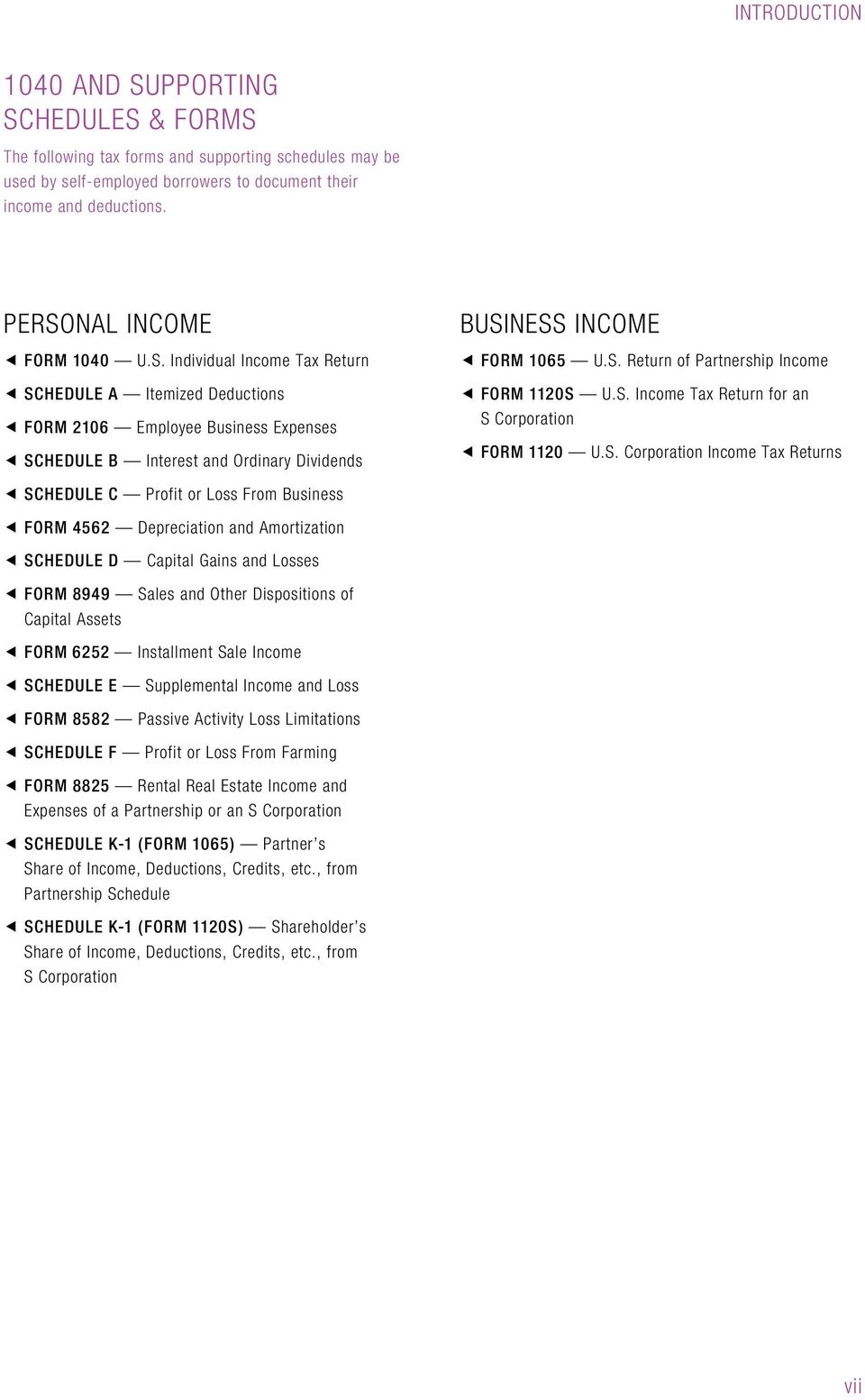
8 INTRODUCTION 1040 AND SUPPORTING SCHEDULES & FORMS The following tax forms and supporting schedules may be used by self-employed borrowers to document their income and deductions. PERSONAL INCOME eeform 1040 U.S. Individual Income Tax Return eeschedule A Itemized Deductions eeform 2106 Employee Business Expenses eeschedule B Interest and Ordinary Dividends eeschedule C Profit or Loss From Business eeform 4562 Depreciation and Amortization eeschedule D Capital Gains and Losses eeform 8949 Sales and Other Dispositions of Capital Assets eeform 6252 Installment Sale Income eeschedule E Supplemental Income and Loss eeform 8582 Passive Activity Loss Limitations eeschedule F Profit or Loss From Farming eeform 8825 Rental Real Estate Income and Expenses of a Partnership or an S Corporation eeschedule K 1 (FORM 1065) Partner s Share of Income, Deductions, Credits, etc., from Partnership Schedule eeschedule K 1 (FORM 1120S) Shareholder s Share of Income, Deductions, Credits, etc., from S Corporation BUSINESS INCOME eeform 1065 U.S. Return of Partnership Income eeform 1120S U.S. Income Tax Return for an S Corporation eeform 1120 U.S. Corporation Income Tax Returns vii
9 NOTES viii

10 MODULE 1 ADJUSTED GROSS INCOME AND SCHEDULE ANALYSIS METHOD To determine the cash flow for a borrower, there are two common ways to get there: the Adjusted Gross Income (AGI) and the Schedule Analysis Method (SAM). The method you use may depend on investor requirements, company policy or personal preference. Either way results in the same cash flow for the borrower. Both methods have you start with Form 1040, the U.S. Individual Income Tax Return. ADJUSTED GROSS INCOME (AGI) As you can probably tell by the name, you start with the Total Income amount that appears on Line 22. The total income that appears here includes income and loss from supporting schedules. As you analyze the tax return, you will add or subtract from this total income, depending on the types of revenue and expenses you find. eehow TO USE THIS GUIDE to estimate cash flow with the AGI Method: Start on page 1-3 and follow the words in BLUE that appear under the EFFECT ON CASH FLOW ANALYSIS subhead. SCHEDULE ANALYSIS METHOD (SAM) With this method, you start with the amount that appears on Line 7: Wages, Salaries, Tips, etc. As you analyze the tax return, you will also review separate tax schedules filed by the borrower, such as Schedule A, Itemized Deductions or Schedule C, Profit or Loss from Business. Because the income or loss is listed separately on each schedule, you can clearly evaluate the level and stability of the dierent sources of income. Consequently, you will add income or subtract losses/expenses from the amount on Line 7. eehow TO USE THIS GUIDE to estimate cash flow with SAM: Start on page 1-13 and follow the words in GREEN that appear under the EFFECT ON CASH FLOW ANALYSIS subhead. 1-1

11 Form 1040 Department of the Treasury Internal Revenue Service (99) U.S. Individual Income Tax Return 2014 OMB No IRS Use Only Do not write or staple in this space. For the year Jan. 1 Dec. 31, 2014, or other tax year beginning, 2014, ending, 20 See separate instructions. Your first name and initial Last name Your social security number If a joint return, spouse s first name and initial Last name Spouse s social security number Home address (number and street). If you have a P.O. box, see instructions. Apt. no. Make sure the SSN(s) above and on line 6c are correct. City, town or post oice, state, and ZIP code. If you have a foreign address, also complete spaces below (see instructions). Presidential Election Campaign Foreign country name Foreign province/state/county Foreign postal code Check here if you, or your spouse if filing jointly, want $3 to go to this fund. Checking a box below will not change your tax or refund. You Spouse Filing Status 1 Single 4 Head of household (with qualifying person). (See instructions.) If 2 Married filing jointly (even if only one had income) the qualifying person is a child but not your dependent, enter this Check only one 3 Married filing separately. Enter spouse s SSN above child s name here. box. and full name here. 5 Qualifying widow(er) with dependent child 6a Yourself. If someone can claim you as a dependent, do not check box 6a..... Boxes checked Exemptions } on 6a and 6b b Spouse No. of children c Dependents: (2) Dependent s (3) Dependent s (4) if child under age 17 on 6c who: (1) First name Last name social security number relationship to you qualifying for child tax credit lived with you (see instructions) did not live with you due to divorce If more than four dependents, see instructions and check here or separation (see instructions) Dependents on 6c not entered above Add numbers on d Total number of exemptions claimed lines above Income 7 Wages, salaries, tips, etc. Attach Form(s) W a Taxable interest. Attach Schedule B if required a b Tax-exempt interest. Do not include on line 8a... 8b Attach Form(s) 9 a Ordinary dividends. Attach Schedule B if required a W-2 here. Also attach Forms b Qualified dividends b W-2G and 10 Taxable refunds, credits, or osets of state and local income taxes R if tax 11 Alimony received was withheld. 12 Business income or (loss). Attach Schedule C or C-EZ Capital gain or (loss). Attach Schedule D if required. If not required, check here 13 If you did not 14 Other gains or (losses). Attach Form get a W-2, see instructions. 15 a IRA distributions. 15a b Taxable amount... 15b 16 a Pensions and annuities 16a b Taxable amount... 16b 17 Rental real estate, royalties, partnerships, S corporations, trusts, etc. Attach Schedule E Farm income or (loss). Attach Schedule F Unemployment compensation a Social security benefits 20a b Taxable amount... 20b 21 Other income. List type and amount Combine the amounts in the far right column for lines 7 through 21. This is your total income Educator expenses Adjusted 24 Certain business expenses of reservists, performing artists, and Gross fee-basis government oicials. Attach Form 2106 or 2106-EZ 24 Income 25 Health savings account deduction. Attach Form Moving expenses. Attach Form Deductible part of self-employment tax. Attach Schedule SE Self-employed SEP, SIMPLE, and qualified plans Self-employed health insurance deduction Penalty on early withdrawal of savings a Alimony paid b Recipient s SSN 31a 32 IRA deduction Student loan interest deduction Tuition and fees. Attach Form Domestic production activities deduction. Attach Form Add lines 23 through Subtract line 36 from line 22. This is your adjusted gross income For Disclosure, Privacy Act, and Paperwork Reduction Act Notice, see separate instructions. Cat. No B Form 1040 (2014) 1-2

12 FORM 1040 FORM 1040: U.S. INDIVIDUAL INCOME TAX RETURN To determine the cash flow for a borrower, either the Adjusted Gross Income Method (AGI) or the Schedule Analysis Method (SAM) may be used. Below we will be discussing the AGI Method. SAM is explained later in the chapter. MODIFIED AGI METHOD Our analysis of the self-employed borrower begins on page 1 of the 1040 form, line 22, Total Income. Total Income is the borrower s gross income before adjustments. We begin here and proceed to add back any noncash expenditures in order to determine income that will be consistent and stable. Additionally, we must adjust for any expenses or losses not recognized by the IRS. eeagi - Enter the borrower s total income from line 22 of the 1040 form. LINE 7: WAGES, SALARIES, TIPS, ETC. The basic types of income that will be included in this line item are: Salary and Hourly Compensation Commission and Bonus Income eeagi - Deduct any non-self-employed wages from cash flow. Use VOEs or Alternate Documentation to verify a non-self-employed borrower s current income. Commission and bonus employees live on variable income. This variable income represents a greater than normal risk because it is typically used and counted on for day-to-day living expenses. If the borrower is commissioned or receives significant bonuses, be sure to check Form 2106 (Employee Business Expenses) to see if the borrower has unreimbursed business-related expenses. Take a close look at reported salary income. Who is paying the salary? Is it from the borrower s own company where the borrower is an oicer or partner in the company? If the borrower is the sole owner of a company, the ability to manipulate the amount of salary and dividend income received increases. Cross-reference the amount reported on line 7 against the amount indicated on the borrower s W-2 and VOEs. LINE 8A: TAXABLE INTEREST INCOME The 1040 indicates both taxable and nontaxable income. If an amount is reported on this line, it means the borrower received interest income during the year from a sellerfinanced loan, a savings account, a certificate of deposit (CD) or a money market account. eeagi - You will make any adjustments using Schedule B. Refer to page If Schedule B is NOT in the file, then make the adjustment using line 8a. 1-3

13 Form 1040 Department of the Treasury Internal Revenue Service (99) U.S. Individual Income Tax Return 2014 OMB No IRS Use Only Do not write or staple in this space. For the year Jan. 1 Dec. 31, 2014, or other tax year beginning, 2014, ending, 20 See separate instructions. Your first name and initial Last name Your social security number If a joint return, spouse s first name and initial Last name Spouse s social security number Home address (number and street). If you have a P.O. box, see instructions. Apt. no. Make sure the SSN(s) above and on line 6c are correct. City, town or post oice, state, and ZIP code. If you have a foreign address, also complete spaces below (see instructions). Presidential Election Campaign Foreign country name Foreign province/state/county Foreign postal code Check here if you, or your spouse if filing jointly, want $3 to go to this fund. Checking a box below will not change your tax or refund. You Spouse Filing Status 1 Single 4 Head of household (with qualifying person). (See instructions.) If 2 Married filing jointly (even if only one had income) the qualifying person is a child but not your dependent, enter this Check only one 3 Married filing separately. Enter spouse s SSN above child s name here. box. and full name here. 5 Qualifying widow(er) with dependent child 6a Yourself. If someone can claim you as a dependent, do not check box 6a..... Boxes checked Exemptions } on 6a and 6b b Spouse No. of children c Dependents: (2) Dependent s (3) Dependent s (4) if child under age 17 on 6c who: (1) First name Last name social security number relationship to you qualifying for child tax credit lived with you (see instructions) did not live with you due to divorce If more than four dependents, see instructions and check here or separation (see instructions) Dependents on 6c not entered above Add numbers on d Total number of exemptions claimed lines above Income 7 Wages, salaries, tips, etc. Attach Form(s) W a Taxable interest. Attach Schedule B if required a b Tax-exempt interest. Do not include on line 8a... 8b Attach Form(s) 9 a Ordinary dividends. Attach Schedule B if required a W-2 here. Also attach Forms b Qualified dividends b W-2G and 10 Taxable refunds, credits, or osets of state and local income taxes R if tax 11 Alimony received was withheld. 12 Business income or (loss). Attach Schedule C or C-EZ Capital gain or (loss). Attach Schedule D if required. If not required, check here 13 If you did not 14 Other gains or (losses). Attach Form get a W-2, see instructions. 15 a IRA distributions. 15a b Taxable amount... 15b 16 a Pensions and annuities 16a b Taxable amount... 16b 17 Rental real estate, royalties, partnerships, S corporations, trusts, etc. Attach Schedule E Farm income or (loss). Attach Schedule F Unemployment compensation a Social security benefits 20a b Taxable amount... 20b 21 Other income. List type and amount Combine the amounts in the far right column for lines 7 through 21. This is your total income Educator expenses Adjusted 24 Certain business expenses of reservists, performing artists, and Gross fee-basis government oicials. Attach Form 2106 or 2106-EZ 24 Income 25 Health savings account deduction. Attach Form Moving expenses. Attach Form Deductible part of self-employment tax. Attach Schedule SE Self-employed SEP, SIMPLE, and qualified plans Self-employed health insurance deduction Penalty on early withdrawal of savings a Alimony paid b Recipient s SSN 31a 32 IRA deduction Student loan interest deduction Tuition and fees. Attach Form Domestic production activities deduction. Attach Form Add lines 23 through Subtract line 36 from line 22. This is your adjusted gross income For Disclosure, Privacy Act, and Paperwork Reduction Act Notice, see separate instructions. Cat. No B Form 1040 (2014) 1-4

14 FORM 1040 A pattern of high interest income may be an indication of the money management ability of the borrower. Cross-reference the VODs (Verifications of Deposit) in the loan file against the tax returns to double-check corresponding depository accounts. Consider the continuance of interest income. What is the probability that the funds will remain in the account? Is this a long-term CD that will soon roll over at a significantly lower rate? If the answer to these or similar questions is negative, this income should not be used for qualification purposes. Reserves and/or unused interest income can be considered as an osetting factor. LINE 8B: TAX-EXEMPT INTEREST INCOME Tax exempt interest is generally received on investments in state and municipal bonds. The source of this income must be documented if it is used to qualify the borrower. eeagi - Add tax-exempt interest income received to the borrower s cash flow if it is verified as recurring income. LINE 9A: ORDINARY DIVIDENDS Ordinary dividends listed on the 1040 are usually from stock and mutual funds. These dividends may be used as qualifying income if they are verified as recurring. eeagi - You will make any adjustments using Schedule B. Refer to page If Schedule B is NOT in the file, then make the adjustment using LINE 9a. LINE 9B: QUALIFIED DIVIDENDS The amount listed on Line 9b is already included in Line 9a. It is separated out because it is subject to a dierent tax rate. LINE 11: ALIMONY RECEIVED The amount of money that a borrower receives as alimony can be used as qualifying income if it meets the following conditions: The receipt of the income has been documented as stable for at least 12 months, The payments will be ongoing for a minimum of three years, and The payments are made as a result of a divorce decree or signed, written agreement that is a legal obligation based upon marriage. eeagi - Subtract any alimony received that does not meet these criteria from the borrower s cash flow. LINE 12: BUSINESS INCOME OR (LOSS) Income or loss experienced by a sole proprietorship will be reported on this line. Schedule C must be completed to support this income/(loss). eeagi - You will make any adjustments using Schedule C. Refer to page LINES 13 AND 14: CAPITAL GAIN OR (LOSS) The borrower must report any profit or loss experienced from the sale of stocks, bonds, mutual fund distributions and sale of business properties. The borrower must demonstrate a recurring history of capital gains income in order to use the income for qualification purposes. e e AGI - For the amounts on lines 13 and 14, subtract the income reported or add the reported loss to the borrower s cash flow. You will make any adjustments using Schedule D. Refer to page LINE 10: TAXABLE REFUNDS OF STATE AND LOCAL TAXES The amount listed on this line is the result of a state or local tax refund. A refund cannot be used to qualify the borrower, since it is income which has previously been accounted for in the prior year s gross income. eeagi - Subtract any refunds received from the borrower s cash flow. 1-5

15 Form 1040 Department of the Treasury Internal Revenue Service (99) U.S. Individual Income Tax Return 2014 OMB No IRS Use Only Do not write or staple in this space. For the year Jan. 1 Dec. 31, 2014, or other tax year beginning, 2014, ending, 20 See separate instructions. Your first name and initial Last name Your social security number If a joint return, spouse s first name and initial Last name Spouse s social security number Home address (number and street). If you have a P.O. box, see instructions. Apt. no. Make sure the SSN(s) above and on line 6c are correct. City, town or post oice, state, and ZIP code. If you have a foreign address, also complete spaces below (see instructions). Presidential Election Campaign Foreign country name Foreign province/state/county Foreign postal code Check here if you, or your spouse if filing jointly, want $3 to go to this fund. Checking a box below will not change your tax or refund. You Spouse Filing Status 1 Single 4 Head of household (with qualifying person). (See instructions.) If 2 Married filing jointly (even if only one had income) the qualifying person is a child but not your dependent, enter this Check only one 3 Married filing separately. Enter spouse s SSN above child s name here. box. and full name here. 5 Qualifying widow(er) with dependent child 6a Yourself. If someone can claim you as a dependent, do not check box 6a..... Boxes checked Exemptions } on 6a and 6b b Spouse No. of children c Dependents: (2) Dependent s (3) Dependent s (4) if child under age 17 on 6c who: (1) First name Last name social security number relationship to you qualifying for child tax credit lived with you (see instructions) did not live with you due to divorce If more than four dependents, see instructions and check here or separation (see instructions) Dependents on 6c not entered above Add numbers on d Total number of exemptions claimed lines above Income 7 Wages, salaries, tips, etc. Attach Form(s) W a Taxable interest. Attach Schedule B if required a b Tax-exempt interest. Do not include on line 8a... 8b Attach Form(s) 9 a Ordinary dividends. Attach Schedule B if required a W-2 here. Also attach Forms b Qualified dividends b W-2G and 10 Taxable refunds, credits, or osets of state and local income taxes R if tax 11 Alimony received was withheld. 12 Business income or (loss). Attach Schedule C or C-EZ Capital gain or (loss). Attach Schedule D if required. If not required, check here 13 If you did not 14 Other gains or (losses). Attach Form get a W-2, see instructions. 15 a IRA distributions. 15a b Taxable amount... 15b 16 a Pensions and annuities 16a b Taxable amount... 16b 17 Rental real estate, royalties, partnerships, S corporations, trusts, etc. Attach Schedule E Farm income or (loss). Attach Schedule F Unemployment compensation a Social security benefits 20a b Taxable amount... 20b 21 Other income. List type and amount Combine the amounts in the far right column for lines 7 through 21. This is your total income Educator expenses Adjusted 24 Certain business expenses of reservists, performing artists, and Gross fee-basis government oicials. Attach Form 2106 or 2106-EZ 24 Income 25 Health savings account deduction. Attach Form Moving expenses. Attach Form Deductible part of self-employment tax. Attach Schedule SE Self-employed SEP, SIMPLE, and qualified plans Self-employed health insurance deduction Penalty on early withdrawal of savings a Alimony paid b Recipient s SSN 31a 32 IRA deduction Student loan interest deduction Tuition and fees. Attach Form Domestic production activities deduction. Attach Form Add lines 23 through Subtract line 36 from line 22. This is your adjusted gross income For Disclosure, Privacy Act, and Paperwork Reduction Act Notice, see separate instructions. Cat. No B Form 1040 (2014) 1-6

16 FORM 1040 LINES 15A AND 16A: TOTAL IRA DISTRIBUTIONS, PENSIONS AND ANNUITIES Distributions from these retirement plans may or may not be taxable. In general, interest and income earned from investments in a plan are compiled tax-free. Therefore, it is taxable upon distribution. Supporting documentation should be obtained (pension agreement or verification) to determine the consistent receipt of this income. eeagi - Add any ongoing nontaxable IRA distributions, pensions or annuities to the borrower s cash flow (line 15a minus 15b and/or 16a minus 16b). Subtract the taxable distribution from the borrower s cash flow if it is not recurring (lines 15b and 16b). Make sure to check investor guidelines to determine if grossing up of nontaxable income is allowable and the appropriate percentage to apply. In general, the industry standard is 25%. The amount grossed up may be added, to the appropriate column in Line 12 - Other: Adjustments to Income, on the cash flow form. LINE 17: RENTAL REAL ESTATE, ROYALTIES, PARTNERSHIPS, S CORPORATIONS, TRUSTS, ETC. The figure listed on this line is income or loss from a rental property, a royalty distribution, a partnership, an S corporation or a trust. Schedule E and potentially Schedule K-1 (1065 and 1120S) must be reviewed to determine cash flow for the borrower. LINE 19: UNEMPLOYMENT COMPENSATION Unemployment compensation payments received by a borrower may be a one-time occurrence or the result of a seasonal pattern of layos. Several years of tax returns must be reviewed to determine the consistency of the income. eeagi - Nonrecurring unemployment compensation payments should be subtracted from the borrower s cash flow. If it is typical for the borrower to be laid o seasonally (cement mason, construction workers, etc.), do not subtract the reported amount from the borrower s cash flow. LINES 20A AND B: SOCIAL SECURITY BENEFITS Certain portions of income received as Social Security benefits are not taxable. The borrower can be given credit for the income if the receipt of the benefits will be ongoing and consistent. eeagi - Add any ongoing nontaxable Social Security benefits to the borrower s cash flow (20a minus 20b). Deduct any nonrecurring taxable benefits (line 20b) from the borrower s cash flow. Make sure to check investor guidelines to determine if grossing up of nontaxable income is allowable and the appropriate percentage to apply. In general, the industry standard is 25%. The amount grossed up may be added, to the appropriate column in Line 12 - Other: Adjustments to Income, on the cash flow form. eeagi - Negate the amount listed on line 17. Subtract the income reported or add the reported loss to the borrower s cash flow. Following this approach allows you to analyze each component of this number on its own. You will avoid complications which may arise if nondeductible losses occur. LINE 18: FARM INCOME OR (LOSS) Any income/(loss) that the borrower earned (or lost) as a result of operating a farm during the year would be entered on this line. Schedule F must be completed to support this income/(loss). eeagi - You will make any adjustments using Schedule F. Refer to page

17 Form 1040 Department of the Treasury Internal Revenue Service (99) U.S. Individual Income Tax Return 2014 OMB No IRS Use Only Do not write or staple in this space. For the year Jan. 1 Dec. 31, 2014, or other tax year beginning, 2014, ending, 20 See separate instructions. Your first name and initial Last name Your social security number If a joint return, spouse s first name and initial Last name Spouse s social security number Home address (number and street). If you have a P.O. box, see instructions. Apt. no. Make sure the SSN(s) above and on line 6c are correct. City, town or post oice, state, and ZIP code. If you have a foreign address, also complete spaces below (see instructions). Presidential Election Campaign Foreign country name Foreign province/state/county Foreign postal code Check here if you, or your spouse if filing jointly, want $3 to go to this fund. Checking a box below will not change your tax or refund. You Spouse Filing Status 1 Single 4 Head of household (with qualifying person). (See instructions.) If 2 Married filing jointly (even if only one had income) the qualifying person is a child but not your dependent, enter this Check only one 3 Married filing separately. Enter spouse s SSN above child s name here. box. and full name here. 5 Qualifying widow(er) with dependent child 6a Yourself. If someone can claim you as a dependent, do not check box 6a..... Boxes checked Exemptions } on 6a and 6b b Spouse No. of children c Dependents: (2) Dependent s (3) Dependent s (4) if child under age 17 on 6c who: (1) First name Last name social security number relationship to you qualifying for child tax credit lived with you (see instructions) did not live with you due to divorce If more than four dependents, see instructions and check here or separation (see instructions) Dependents on 6c not entered above Add numbers on d Total number of exemptions claimed lines above Income 7 Wages, salaries, tips, etc. Attach Form(s) W a Taxable interest. Attach Schedule B if required a b Tax-exempt interest. Do not include on line 8a... 8b Attach Form(s) 9 a Ordinary dividends. Attach Schedule B if required a W-2 here. Also attach Forms b Qualified dividends b W-2G and 10 Taxable refunds, credits, or osets of state and local income taxes R if tax 11 Alimony received was withheld. 12 Business income or (loss). Attach Schedule C or C-EZ Capital gain or (loss). Attach Schedule D if required. If not required, check here 13 If you did not 14 Other gains or (losses). Attach Form get a W-2, see instructions. 15 a IRA distributions. 15a b Taxable amount... 15b 16 a Pensions and annuities 16a b Taxable amount... 16b 17 Rental real estate, royalties, partnerships, S corporations, trusts, etc. Attach Schedule E Farm income or (loss). Attach Schedule F Unemployment compensation a Social security benefits 20a b Taxable amount... 20b 21 Other income. List type and amount Combine the amounts in the far right column for lines 7 through 21. This is your total income Educator expenses Adjusted 24 Certain business expenses of reservists, performing artists, and Gross fee-basis government oicials. Attach Form 2106 or 2106-EZ 24 Income 25 Health savings account deduction. Attach Form Moving expenses. Attach Form Deductible part of self-employment tax. Attach Schedule SE Self-employed SEP, SIMPLE, and qualified plans Self-employed health insurance deduction Penalty on early withdrawal of savings a Alimony paid b Recipient s SSN 31a 32 IRA deduction Student loan interest deduction Tuition and fees. Attach Form Domestic production activities deduction. Attach Form Add lines 23 through Subtract line 36 from line 22. This is your adjusted gross income For Disclosure, Privacy Act, and Paperwork Reduction Act Notice, see separate instructions. Cat. No B Form 1040 (2014) 1-8

18 FORM 1040 LINE 21: OTHER INCOME This line item refers to income received from miscellaneous sources such as: prizes, lotteries, gambling winnings, jury duty fees, speaking fees, etc. eeagi - Subtract other income from the borrower s cash flow unless documentation can be obtained to verify that the receipt of the income will be consistent and ongoing. OTHER ADJUSTMENTS TO INCOME This line may be used to add back income that you have determined is nontaxable. Some forms of nontaxable income may be grossed up 25%. Check your investor s income requirements before using nontaxable income. Make sure the income used on this line is verifiable and will be ongoing and consistent. eeagi - Add any ongoing nontaxable income to the borrower s cash flow. For deferred compensation such as a 401(k), use the W-2 and add back the amount in Box 12, Code D. LINES 23-35: ADJUSTMENTS TO INCOME These adjustments to income are subtracted from Total Income on line 22 to arrive at Adjusted Gross Income. Since we started with Total Income, there is no need to make any adjustments for these items. 1-9

19 Form 1040 (2014) Page 2 38 Amount from line 37 (adjusted gross income) a Check You were born before January 2, 1950, Blind. Total boxes { } if: Spouse was born before January 2, 1950, Blind. checked 39a b If your spouse itemizes on a separate return or you were a dual-status alien, check here 39b Tax and Credits Standard Deduction for People who check any box on line 39a or 39b or who can be claimed as a dependent, see instructions. All others: Single or Married filing separately, $6,200 Married filing jointly or Qualifying widow(er), $12,400 Head of household, $9,100 Other Taxes 40 Itemized deductions (from Schedule A) or your standard deduction (see left margin) Subtract line 40 from line Exemptions. If line 38 is $152,525 or less, multiply $3,950 by the number on line 6d. Otherwise, see instructions Taxable income. Subtract line 42 from line 41. If line 42 is more than line 41, enter Tax (see instructions). Check if any from: a Form(s) 8814 b Form 4972 c Alternative minimum tax (see instructions). Attach Form Excess advance premium tax credit repayment. Attach Form Add lines 44, 45, and Foreign tax credit. Attach Form 1116 if required Credit for child and dependent care expenses. Attach Form Education credits from Form 8863, line Retirement savings contributions credit. Attach Form Child tax credit. Attach Schedule 8812, if required Residential energy credits. Attach Form Other credits from Form: a 3800 b 8801 c Add lines 48 through 54. These are your total credits Subtract line 55 from line 47. If line 55 is more than line 47, enter Self-employment tax. Attach Schedule SE Unreported social security and Medicare tax from Form: a 4137 b Additional tax on IRAs, other qualified retirement plans, etc. Attach Form 5329 if required a Household employment taxes from Schedule H a b First-time homebuyer credit repayment. Attach Form 5405 if required b 61 Health care: individual responsibility (see instructions) Full-year coverage Taxes from: a Form 8959 b Form 8960 c Instructions; enter code(s) Add lines 56 through 62. This is your total tax Payments 64 Federal income tax withheld from Forms W-2 and estimated tax payments and amount applied from 2013 return 65 If you have a qualifying child, attach Schedule EIC. Refund Direct deposit? See instructions. Amount You Owe Third Party Designee Sign Here Joint return? See instructions. Keep a copy for your records. Paid Preparer Use Only 66a Earned income credit (EIC) a b Nontaxable combat pay election 66b 67 Additional child tax credit. Attach Schedule American opportunity credit from Form 8863, line Net premium tax credit. Attach Form Amount paid with request for extension to file Excess social security and tier 1 RRTA tax withheld Credit for federal tax on fuels. Attach Form Credits from Form: a 2439 b Reserved c Reserved d Add lines 64, 65, 66a, and 67 through 73. These are your total payments If line 74 is more than line 63, subtract line 63 from line 74. This is the amount you overpaid 75 76a Amount of line 75 you want refunded to you. If Form 8888 is attached, check here. 76a b Routing number c Type: Checking Savings d Account number 77 Amount of line 75 you want applied to your 2015 estimated tax Amount you owe. Subtract line 74 from line 63. For details on how to pay, see instructions Estimated tax penalty (see instructions) Do you want to allow another person to discuss this return with the IRS (see instructions)? Yes. Complete below. No Designee s Phone Personal identification name no. number (PIN) Under penalties of perjury, I declare that I have examined this return and accompanying schedules and statements, and to the best of my knowledge and belief, they are true, correct, and complete. Declaration of preparer (other than taxpayer) is based on all information of which preparer has any knowledge. Your signature Date Your occupation Daytime phone number Spouse s signature. If a joint return, both must sign. Date Spouse s occupation Print/Type preparer s name Preparer s signature Date If the IRS sent you an Identity Protection PIN, enter it here (see inst.) PTIN Check if self-employed Firm s name Firm's EIN Firm s address Phone no. Form 1040 (2014) 1-10

20 FORM 1040 FORM 1040: U.S. INDIVIDUAL INCOME TAX RETURN (PAGE 2) The borrower s cash flow is based on gross income versus net income. Page 2 of the 1040 determines the net income of the borrower. NOTE: If LINE 40 indicates that the standard deduction was taken, then Schedule A Itemized Deductions will not be included with the tax return. eeagi - There are no line items listed on this page that should be added back to the borrower s cash flow. CONTINUE AGI ANALYSIS ON PAGE

21 Form 1040 Department of the Treasury Internal Revenue Service (99) U.S. Individual Income Tax Return 2014 OMB No IRS Use Only Do not write or staple in this space. For the year Jan. 1 Dec. 31, 2014, or other tax year beginning, 2014, ending, 20 See separate instructions. Your first name and initial Last name Your social security number If a joint return, spouse s first name and initial Last name Spouse s social security number Home address (number and street). If you have a P.O. box, see instructions. Apt. no. Make sure the SSN(s) above and on line 6c are correct. City, town or post oice, state, and ZIP code. If you have a foreign address, also complete spaces below (see instructions). Presidential Election Campaign Foreign country name Foreign province/state/county Foreign postal code Check here if you, or your spouse if filing jointly, want $3 to go to this fund. Checking a box below will not change your tax or refund. You Spouse Filing Status 1 Single 4 Head of household (with qualifying person). (See instructions.) If 2 Married filing jointly (even if only one had income) the qualifying person is a child but not your dependent, enter this Check only one 3 Married filing separately. Enter spouse s SSN above child s name here. box. and full name here. 5 Qualifying widow(er) with dependent child 6a Yourself. If someone can claim you as a dependent, do not check box 6a..... Boxes checked Exemptions } on 6a and 6b b Spouse No. of children c Dependents: (2) Dependent s (3) Dependent s (4) if child under age 17 on 6c who: (1) First name Last name social security number relationship to you qualifying for child tax credit lived with you (see instructions) did not live with you due to divorce If more than four dependents, see instructions and check here or separation (see instructions) Dependents on 6c not entered above Add numbers on d Total number of exemptions claimed lines above Income 7 Wages, salaries, tips, etc. Attach Form(s) W a Taxable interest. Attach Schedule B if required a b Tax-exempt interest. Do not include on line 8a... 8b Attach Form(s) 9 a Ordinary dividends. Attach Schedule B if required a W-2 here. Also attach Forms b Qualified dividends b W-2G and 10 Taxable refunds, credits, or osets of state and local income taxes R if tax 11 Alimony received was withheld. 12 Business income or (loss). Attach Schedule C or C-EZ Capital gain or (loss). Attach Schedule D if required. If not required, check here 13 If you did not 14 Other gains or (losses). Attach Form get a W-2, see instructions. 15 a IRA distributions. 15a b Taxable amount... 15b 16 a Pensions and annuities 16a b Taxable amount... 16b 17 Rental real estate, royalties, partnerships, S corporations, trusts, etc. Attach Schedule E Farm income or (loss). Attach Schedule F Unemployment compensation a Social security benefits 20a b Taxable amount... 20b 21 Other income. List type and amount Combine the amounts in the far right column for lines 7 through 21. This is your total income Educator expenses Adjusted 24 Certain business expenses of reservists, performing artists, and Gross fee-basis government oicials. Attach Form 2106 or 2106-EZ 24 Income 25 Health savings account deduction. Attach Form Moving expenses. Attach Form Deductible part of self-employment tax. Attach Schedule SE Self-employed SEP, SIMPLE, and qualified plans Self-employed health insurance deduction Penalty on early withdrawal of savings a Alimony paid b Recipient s SSN 31a 32 IRA deduction Student loan interest deduction Tuition and fees. Attach Form Domestic production activities deduction. Attach Form Add lines 23 through Subtract line 36 from line 22. This is your adjusted gross income For Disclosure, Privacy Act, and Paperwork Reduction Act Notice, see separate instructions. Cat. No B Form 1040 (2014) 1-12
22 FORM 1040 FORM 1040: U.S. INDIVIDUAL INCOME TAX RETURN To determine the cash flow for a borrower, either the Adjusted Gross Income Method (AGI) or the Schedule Analysis Method (SAM) may be used. Below we will be discussing the SAM method. SCHEDULE ANALYSIS METHOD (SAM) W-2, BOX 5: SELF-EMPLOYED WAGES, SALARIES, TIPS, ETC. When income represents money paid to the borrower in the form of salary or wages from self-employment, it will be included on the cash flow form. Do not add the wages from non-self-employed borrowers to the cash flow form. Instead, use VOEs or Alternate Documentation to verify their current income. eesam - Add self-employed wages from W-2, box 5 to the borrower s cash flow. NOTE: If wage is variable (i.e., commission income), evaluate income to determine income average and stability similar to self-employed wages. Page 1 of the 1040 will identify other items that you may use to qualify the borrower. The borrower can be given credit for the income if it will be ongoing and consistent. Some of the items are nontaxable as noted below and nontaxable income has the potential to be grossed up, assuming it s allowable per investor guidelines. Generally, the maximum percentage used to gross up nontaxable income is 25%. The items to look for on page 1 of the 1040 include the following: Tax-Exempt Interest line 8b. Total Social Security Benefits line 20a. ww Nontaxable income 20a minus 20b Other Income line 21. Other income may include prizes or gambling winnings which generally cannot be expected to recur. OTHER ADJUSTMENTS TO INCOME This line may be used to add back income that you have determined is nontaxable. Some forms of nontaxable income may be grossed up 25%. Check your investor s income requirements before using nontaxable income. Make sure the income used on this line is verifiable and will be ongoing and consistent. eesam - Add these items to the borrower s cash flow only if the borrower can document that they are stable and recurring. Alimony Received line 11. This will not include child support payments as child support payments are not taxable. Total IRA Distributions line 15a. ww Nontaxable income 15a minus 15b Total Pensions and Annuities line 16a. ww Nontaxable income 16a minus 16b Unemployment Compensation line
23 Form 1040 (2014) Page 2 38 Amount from line 37 (adjusted gross income) a Check You were born before January 2, 1950, Blind. Total boxes { } if: Spouse was born before January 2, 1950, Blind. checked 39a b If your spouse itemizes on a separate return or you were a dual-status alien, check here 39b Tax and Credits Standard Deduction for People who check any box on line 39a or 39b or who can be claimed as a dependent, see instructions. All others: Single or Married filing separately, $6,200 Married filing jointly or Qualifying widow(er), $12,400 Head of household, $9,100 Other Taxes 40 Itemized deductions (from Schedule A) or your standard deduction (see left margin) Subtract line 40 from line Exemptions. If line 38 is $152,525 or less, multiply $3,950 by the number on line 6d. Otherwise, see instructions Taxable income. Subtract line 42 from line 41. If line 42 is more than line 41, enter Tax (see instructions). Check if any from: a Form(s) 8814 b Form 4972 c Alternative minimum tax (see instructions). Attach Form Excess advance premium tax credit repayment. Attach Form Add lines 44, 45, and Foreign tax credit. Attach Form 1116 if required Credit for child and dependent care expenses. Attach Form Education credits from Form 8863, line Retirement savings contributions credit. Attach Form Child tax credit. Attach Schedule 8812, if required Residential energy credits. Attach Form Other credits from Form: a 3800 b 8801 c Add lines 48 through 54. These are your total credits Subtract line 55 from line 47. If line 55 is more than line 47, enter Self-employment tax. Attach Schedule SE Unreported social security and Medicare tax from Form: a 4137 b Additional tax on IRAs, other qualified retirement plans, etc. Attach Form 5329 if required a Household employment taxes from Schedule H a b First-time homebuyer credit repayment. Attach Form 5405 if required b 61 Health care: individual responsibility (see instructions) Full-year coverage Taxes from: a Form 8959 b Form 8960 c Instructions; enter code(s) Add lines 56 through 62. This is your total tax Payments 64 Federal income tax withheld from Forms W-2 and estimated tax payments and amount applied from 2013 return 65 If you have a qualifying child, attach Schedule EIC. Refund Direct deposit? See instructions. Amount You Owe Third Party Designee Sign Here Joint return? See instructions. Keep a copy for your records. Paid Preparer Use Only 66a Earned income credit (EIC) a b Nontaxable combat pay election 66b 67 Additional child tax credit. Attach Schedule American opportunity credit from Form 8863, line Net premium tax credit. Attach Form Amount paid with request for extension to file Excess social security and tier 1 RRTA tax withheld Credit for federal tax on fuels. Attach Form Credits from Form: a 2439 b Reserved c Reserved d Add lines 64, 65, 66a, and 67 through 73. These are your total payments If line 74 is more than line 63, subtract line 63 from line 74. This is the amount you overpaid 75 76a Amount of line 75 you want refunded to you. If Form 8888 is attached, check here. 76a b Routing number c Type: Checking Savings d Account number 77 Amount of line 75 you want applied to your 2015 estimated tax Amount you owe. Subtract line 74 from line 63. For details on how to pay, see instructions Estimated tax penalty (see instructions) Do you want to allow another person to discuss this return with the IRS (see instructions)? Yes. Complete below. No Designee s Phone Personal identification name no. number (PIN) Under penalties of perjury, I declare that I have examined this return and accompanying schedules and statements, and to the best of my knowledge and belief, they are true, correct, and complete. Declaration of preparer (other than taxpayer) is based on all information of which preparer has any knowledge. Your signature Date Your occupation Daytime phone number Spouse s signature. If a joint return, both must sign. Date Spouse s occupation Print/Type preparer s name Preparer s signature Date If the IRS sent you an Identity Protection PIN, enter it here (see inst.) PTIN Check if self-employed Firm s name Firm's EIN Firm s address Phone no. Form 1040 (2014) 1-14
24 FORM 1040 FORM 1040: U.S. INDIVIDUAL INCOME TAX RETURN (PAGE 2) The borrower s cash flow is based on gross income versus net income. Page 2 of the 1040 determines the net income of the borrower. NOTE: If LINE 40 indicates that the standard deduction was taken, then Schedule A Itemized Deductions will not be included with the tax return. eesam - There are no line items listed on this page that should be added back to the borrower s cash flow. CONTINUE SAM ANALYSIS ON PAGE
25 SCHEDULE A (Form 1040) OMB No It emized Deduct ions Information about Schedule A and its separate instructions is at Department of the Treasury Attachment Internal Revenue Service (99) Attach to Form Sequence No. 07 Name(s) shown on Form 1040 Your social security number Medical and Dental Expenses Taxes You Paid Interest You Paid Note. Your mortgage interest deduction may be limited (see instructions). Gifts to Charity If you made a gift and got a benefit for it, see instructions. Caution. Do not include expenses reimbursed or paid by others. 1 Medical and dental expenses (see instructions) Enter amount from Form 1040, line Multiply line 2 by 10% (.10). But if either you or your spouse was born before January 2, 1950, multiply line 2 by 7.5% (.075) instead 3 4 Subtract line 3 from line 1. If line 3 is more than line 1, enter State and local (check only one box): a Income taxes, or... b General sales taxes } Real estate taxes (see instructions) Personal property taxes Other taxes. List type and amount 8 9 Add lines 5 through Home mortgage interest and points reported to you on Form Home mortgage interest not reported to you on Form If paid to the person from whom you bought the home, see instructions and show that person s name, identifying no., and address Points not reported to you on Form See instructions for special rules Mortgage insurance premiums (see instructions) Investment interest. Attach Form 4952 if required. (See instructions.) Add lines 10 through Gifts by cash or check. If you made any gift of $250 or more, see instructions Other than by cash or check. If any gift of $250 or more, see instructions. You must attach Form 8283 if over $ Carryover from prior year Add lines 16 through Casualty and Theft Losses 20 Casualty or theft loss(es). Attach Form (See instructions.) Job Expenses and Certain Miscellaneous Deductions Other Miscellaneous Deductions 21 Unreimbursed employee expenses job travel, union dues, job education, etc. Attach Form 2106 or 2106-EZ if required. (See instructions.) Tax preparation fees Other expenses investment, safe deposit box, etc. List type and amount Add lines 21 through Enter amount from Form 1040, line Multiply line 25 by 2% (.02) Subtract line 26 from line 24. If line 26 is more than line 24, enter Other from list in instructions. List type and amount 28 Total 29 Is Form 1040, line 38, over $152,525? Itemized No. Your deduction is not limited. Add the amounts in the far right column Deductions for lines 4 through 28. Also, enter this amount on Form 1040, line Yes. Your deduction may be limited. See the Itemized Deductions } Worksheet in the instructions to figure the amount to enter. 30 If you elect to itemize deductions even though they are less than your standard deduction, check here For Paperwork Reduction Act Notice, see Form 1040 instructions. Cat. No C Schedule A (Form 1040)
26 SCHEDULE A SCHEDULE A: ITEMIZED DEDUCTIONS A taxpayer may choose to itemize deductions in order to save money. Schedule A must be completed to support the expenses being itemized. This schedule should be reviewed for several line items. They are: LINE 6: REAL ESTATE TAXES If the borrower has indicated that real estate is owned (owner-occupied), there should be a deduction on this line for real estate taxes paid. Taxes for investment property are reported on Schedule E. LINES 10 AND 11: DEDUCTIBLE HOME MORTGAGE INTEREST If the borrower is a current homeowner, a deduction for mortgage interest would be indicated here if there is a lien on the property. LINE 21: UNREIMBURSED EMPLOYEE EXPENSES These are business expenses that are allowed as a deduction from taxable income on Schedule A Itemized Deductions. The borrower must file Form 2106 to support the deduction. eeagi - You will use Form 2106 to make adjustments to the borrower s cash flow. Refer to pages 1-19 and eesam - You will use Form 2106 to make adjustments to the borrower s cash flow. Refer to pages 1-19 and
27 Form 2106 Department of the Treasury Internal Revenue Service (99) Your name Employee Business Expenses OMB No Attach to Form 1040 or Form 1040NR. Attachment Information about Form 2106 and its separate instructions is available at Sequence No. 129 Occupation in which you incurred expenses Social security number Part I Employee Business Expenses and Reimbursements Step 1 Enter Your Expenses Column A Other Than Meals and Entertainment Column B Meals and Entertainment 1 Vehicle expense from line 22 or line 29. (Rural mail carriers: See instructions.) Parking fees, tolls, and transportation, including train, bus, etc., that did not involve overnight travel or commuting to and from work. 2 3 Travel expense while away from home overnight, including lodging, airplane, car rental, etc. Do not include meals and entertainment. 3 4 Business expenses not included on lines 1 through 3. Do not include meals and entertainment Meals and entertainment expenses (see instructions) Total expenses. In Column A, add lines 1 through 4 and enter the result. In Column B, enter the amount from line Note. If you were not reimbursed for any expenses in Step 1, skip line 7 and enter the amount from line 6 on line 8. Step 2 Enter Reimbursements Received From Your Employer for Expenses Listed in Step 1 7 Enter reimbursements received from your employer that were not reported to you in box 1 of Form W-2. Include any reimbursements reported under code L in box 12 of your Form W-2 (see instructions) Step 3 Figure Expenses To Deduct on Schedule A (Form 1040 or Form 1040NR) 8 Subtract line 7 from line 6. If zero or less, enter -0-. However, if line 7 is greater than line 6 in Column A, report the excess as income on Form 1040, line 7 (or on Form 1040NR, line 8) Note. If both columns of line 8 are zero, you cannot deduct employee business expenses. Stop here and attach Form 2106 to your return. 9 In Column A, enter the amount from line 8. In Column B, multiply line 8 by 50% (.50). (Employees subject to Department of Transportation (DOT) hours of service limits: Multiply meal expenses incurred while away from home on business by 80% (.80) instead of 50%. For details, see instructions.) Add the amounts on line 9 of both columns and enter the total here. Also, enter the total on Schedule A (Form 1040), line 21 (or on Schedule A (Form 1040NR), line 7). (Armed Forces reservists, qualified performing artists, fee-basis state or local government oicials, and individuals with disabilities: See the instructions for special rules on where to enter the total.) For Paperwork Reduction Act Notice, see your tax return instructions. Cat. No N Form 2106 (2014) 1-18
28 FORM 2106 FORM 2106: EMPLOYEE BUSINESS EXPENSES This form is used to report reimbursed and unreimbursed business expenses by a non-self-employed borrower. Examples of typical expenses may include vehicle, travel, meals and entertainment. Generally, the borrower may not deduct more than 50% of the unreimbursed meals and entertainment expenditures experienced during the year. Automobile Allowance When the borrower reports the allowance on their personal federal tax returns: Include allowance in excess of monthly expenses in the monthly qualifying income OR Include the expenses in excess of the allowance in the total monthly obligation When the borrower does not report the allowance on their personal federal tax returns: Include the allowance in the monthly qualifying income AND Include the automobile payment/lease payment in the total monthly obligation LINE 8: UNREIMBURSED EXPENSES eeagi - Subtract unreimbursed employee expenses, stated under Step 3, line 8, columns A plus B. This represents the unreimbursed business expenses prior to calculating the 50% limit on meals and entertainment. eesam - Subtract unreimbursed employee expenses, stated under Step 3, line 8, columns A plus B. This represents the unreimbursed business expenses prior to calculating the 50% limit on meals and entertainment. 1-19
29 Form 2106 (2014) Page 2 Part II Vehicle Expenses Section A General Information (You must complete this section if you are claiming vehicle expenses.) (a) Vehicle 1 (b) Vehicle 2 11 Enter the date the vehicle was placed in service / / / / 12 Total miles the vehicle was driven during miles miles 13 Business miles included on line miles miles 14 Percent of business use. Divide line 13 by line % % 15 Average daily roundtrip commuting distance miles miles 16 Commuting miles included on line miles miles 17 Other miles. Add lines 13 and 16 and subtract the total from line miles miles 18 Was your vehicle available for personal use during o-duty hours? Yes No 19 Do you (or your spouse) have another vehicle available for personal use? Yes No 20 Do you have evidence to support your deduction? Yes No 21 If Yes, is the evidence written? Yes No Section B Standard Mileage Rate (See the instructions for Part II to find out whether to complete this section or Section C.) 22 Multiply line 13 by 56 (.56). Enter the result here and on line Section C Actual Expenses (a) Vehicle 1 (b) Vehicle 2 23 Gasoline, oil, repairs, vehicle insurance, etc a Vehicle rentals a b Inclusion amount (see instructions). 24b c Subtract line 24b from line 24a. 24c 25 Value of employer-provided vehicle (applies only if 100% of annual lease value was included on Form W-2 see instructions) Add lines 23, 24c, and Multiply line 26 by the percentage on line Depreciation (see instructions) Add lines 27 and 28. Enter total here and on line Section D Depreciation of Vehicles (Use this section only if you owned the vehicle and are completing Section C for the vehicle.) (a) Vehicle 1 (b) Vehicle 2 30 Enter cost or other basis (see instructions) Enter section 179 deduction (see instructions) Multiply line 30 by line 14 (see instructions if you claimed the section 179 deduction) Enter depreciation method and percentage (see instructions) Multiply line 32 by the percentage on line 33 (see instructions) Add lines 31 and Enter the applicable limit explained in the line 36 instructions Multiply line 36 by the percentage on line Enter the smaller of line 35 or line 37. If you skipped lines 36 and 37, enter the amount from line 35. Also enter this amount on line 28 above Form 2106 (2014) 1-20
30 FORM 2106 FORM 2106: EMPLOYEE BUSINESS EXPENSES (PAGE 2) AUTOMOBILE DEPRECIATION Automobile depreciation may be claimed as part of the borrower s vehicle expense. If there is depreciation, it will be found on one of two lines: SECTION B STANDARD MILEAGE RATE LINE 22 This section estimates the vehicle expense based on the number of miles driven. Included in this estimate is a factor for depreciation which may be added back to the cash flow. The factors for the three most recent years are: 2012: : : 22.0 You will find the actual business miles driven in Section A, line 13. eeagi - If line 22 is completed, multiply the miles driven from line 13 times the depreciation factor for the appropriate year. This amount should be added to the borrower s cash flow. eesam - If line 22 is completed, multiply the miles driven from line 13 times the depreciation factor for the appropriate year. This amount should be added to the borrower s cash flow. SECTION C ACTUAL EXPENSES LINE 28 Here the taxpayer enters the actual depreciation expense. eeagi - This amount on line 28 should be added to the borrower s cash flow. (Note that this depreciation is also found on line 38. Only add this number once.) eesam - This amount on line 28 should be added to the borrower s cash flow. (Note that this depreciation is also found on line 38. Only add this number once.) 1-21
31 SCHEDULE B (Form 1040A or 1040) Department of the Treasury Internal Revenue Service (99) Name(s) shown on return Interest and Ordinary Dividends Attach to Form 1040A or Information about Schedule B and its instructions is at OMB No Attachment Sequence No. 08 Your social security number Part I Interest 1 List name of payer. If any interest is from a seller-financed mortgage and the buyer used the property as a personal residence, see instructions on back and list this interest first. Also, show that buyer s social security number and address Amount (See instructions on back and the instructions for Form 1040A, or Form 1040, line 8a.) 1 Note. If you received a Form 1099-INT, Form 1099-OID, or substitute statement from a brokerage firm, list the firm s name as the payer and enter the total interest shown on that form. Part II Ordinary Dividends (See instructions on back and the instructions for Form 1040A, or Form 1040, line 9a.) 2 Add the amounts on line Excludable interest on series EE and I U.S. savings bonds issued after Attach Form Subtract line 3 from line 2. Enter the result here and on Form 1040A, or Form 1040, line 8a Note. If line 4 is over $1,500, you must complete Part III. 5 List name of payer 5 Amount Note. If you received a Form 1099-DIV or substitute statement from a brokerage firm, list the firm s name as the payer and enter the ordinary 6 Add the amounts on line 5. Enter the total here and on Form 1040A, or Form dividends shown on that form. 1040, line 9a Note. If line 6 is over $1,500, you must complete Part III. You must complete this part if you (a) had over $1,500 of taxable interest or ordinary dividends; (b) had a foreign account; or (c) received a distribution from, or were a grantor of, or a transferor to, a foreign trust. Part III Foreign Accounts and Trusts (See instructions on back.) 7a At any time during 2014, did you have a financial interest in or signature authority over a financial account (such as a bank account, securities account, or brokerage account) located in a foreign country? See instructions If Yes, are you required to file FinCEN Form 114, Report of Foreign Bank and Financial Accounts (FBAR), to report that financial interest or signature authority? See FinCEN Form 114 and its instructions for filing requirements and exceptions to those requirements b If you are required to file FinCEN Form 114, enter the name of the foreign country where the financial account is located 8 During 2014, did you receive a distribution from, or were you the grantor of, or transferor to, a foreign trust? If Yes, you may have to file Form See instructions on back Yes No For Paperwork Reduction Act Notice, see your tax return instructions. Cat. No N Schedule B (Form 1040A or 1040)
32 SCHEDULE B SCHEDULE B: INTEREST AND ORDINARY DIVIDENDS Schedule B provides the supporting detail for the taxable interest and dividend income reported on page 1 of the Compare the sources of income listed here to the loan application. NOTE: Schedule B is only required if interest or dividend income is $1,500 or greater. PART I INTEREST INCOME LINE 1 SELLER-FINANCED MORTGAGES In order to use the income from a seller-financed mortgage (or land contract), there must be three or more years remaining in the life of the contract. You should also document that the debtor has made the last 12 months payments in a timely manner. NOTE: For potential additional income, see the discussion of Form 6252 on page eeagi - Deduct nonrecurring interest from sellerfinanced mortgages from the borrower s cash flow. eesam - Add recurring interest from the sellerfinanced mortgages to the borrower s cash flow. DEPOSITORY ACCOUNTS Before using this income, make sure those accounts still exist and that the balances have not significantly decreased. In addition, the borrower should show a 24-month history of consistent interest earnings. PART II ORDINARY DIVIDENDS LINE 5 DIVIDEND INCOME Be sure that the assets that generated this income are still owned by the borrower. You can do this by comparing Schedule B to the loan application. Also, check Schedule D for the sale of any assets. In addition, the borrower should show a 24-month history of consistent dividend earnings. eeagi - Deduct nonrecurring dividend income from the borrower s cash flow. If Schedule B is NOT completed, deduct nonrecurring dividend income from Form 1040, Line 9a. eesam - Add recurring dividend income to the borrower s cash flow. If Schedule B is NOT completed, add recurring dividend income from Form 1040, Line 9a. eeagi - Deduct nonrecurring interest from the borrower s cash flow. If Schedule B is NOT completed, deduct nonrecurring interest from Form 1040, Line 8a. eesam - Add recurring interest income to the borrower s cash flow. If Schedule B is NOT completed, add recurring interest from Form 1040, Line 8a. 1-23
33 SCHEDULE C (Form 1040) Department of the Treasury Internal Revenue Service (99) Name of proprietor Profit or Loss From Business (Sole Proprietorship) OMB No Information about Schedule C and its separate instructions is at Attachment Attach to Form 1040, 1040NR, or 1041; partnerships generally must file Form Sequence No. 09 Social security number (SSN) A Principal business or profession, including product or service (see instructions) B Enter code from instructions C Business name. If no separate business name, leave blank. D Employer ID number (EIN), (see instr.) E Business address (including suite or room no.) City, town or post oice, state, and ZIP code F Accounting method: (1) Cash (2) Accrual (3) Other (specify) G Did you materially participate in the operation of this business during 2014? If No, see instructions for limit on losses. Yes No H If you started or acquired this business during 2014, check here I Did you make any payments in 2014 that would require you to file Form(s) 1099? (see instructions) Yes No J If "Yes," did you or will you file required Forms 1099? Yes No Part I Income 1 Gross receipts or sales. See instructions for line 1 and check the box if this income was reported to you on Form W-2 and the Statutory employee box on that form was checked Returns and allowances Subtract line 2 from line Cost of goods sold (from line 42) Gross profit. Subtract line 4 from line Other income, including federal and state gasoline or fuel tax credit or refund (see instructions) Gross income. Add lines 5 and Part II Expenses. Enter expenses for business use of your home only on line Advertising Oice expense (see instructions) 18 9 Car and truck expenses (see 19 Pension and profit-sharing plans. 19 instructions) Rent or lease (see instructions): 10 Commissions and fees. 10 a Vehicles, machinery, and equipment 20a 11 Contract labor (see instructions) 11 b Other business property... 20b 12 Depletion Repairs and maintenance Depreciation and section Supplies (not included in Part III). 22 expense deduction (not included in Part III) (see 23 Taxes and licenses instructions) Travel, meals, and entertainment: 14 Employee benefit programs a Travel a (other than on line 19).. 14 b Deductible meals and 15 Insurance (other than health) 15 entertainment (see instructions). 24b 16 Interest: 25 Utilities a Mortgage (paid to banks, etc.) 16a 26 Wages (less employment credits). 26 b Other b 27 a Other expenses (from line 48).. 27a 17 Legal and professional services 17 b Reserved for future use... 27b 28 Total expenses before expenses for business use of home. Add lines 8 through 27a Tentative profit or (loss). Subtract line 28 from line Expenses for business use of your home. Do not report these expenses elsewhere. Attach Form 8829 unless using the simplified method (see instructions). Simplified method filers only: enter the total square footage of: (a) your home: and (b) the part of your home used for business:. Use the Simplified Method Worksheet in the instructions to figure the amount to enter on line Net profit or (loss). Subtract line 30 from line 29. If a profit, enter on both Form 1040, line 12 (or Form 1040NR, line 13) and on Schedule SE, line 2. (If you checked the box on line 1, see instructions). Estates and trusts, enter on Form 1041, line 3. } 31 If a loss, you must go to line If you have a loss, check the box that describes your investment in this activity (see instructions). } If you checked 32a, enter the loss on both Form 1040, line 12, (or Form 1040NR, line 13) and on Schedule SE, line 2. (If you checked the box on line 1, see the line 31 instructions). Estates and 32a All investment is at risk. trusts, enter on Form 1041, line 3. 32b Some investment is not at risk. If you checked 32b, you must attach Form Your loss may be limited. For Paperwork Reduction Act Notice, see the separate instructions. Cat. No P Schedule C (Form 1040)
34 SCHEDULE C SCHEDULE C: PROFIT OR LOSS FROM BUSINESS Schedule C is the profit and loss statement of a sole proprietorship. Reviewing the following key items will help in evaluating the stability and profitability of the borrower s business. LINES A AND C: PRINCIPAL BUSINESS AND BUSINESS NAME Compare the entries for principal business and business name to the Residential Loan Application (1003). Doublecheck to make sure that the borrower is currently in the same line of work as when the tax returns were filed. LINE F: ACCOUNTING METHOD It is important to identify the accounting method that the borrower is using. The method used will aect the interpretation of the income figures. For example, if the borrower uses the ACCRUAL BASIS of accounting, the cash flow may appear distorted because cash is not actually received nor bills paid when the transactions are shown in the ledgers. Instead, the actual income received and expenses paid are allocated to the time period in which they were actually earned and incurred. The CASH METHOD reports cash the day it is received and reports a bill the day it is paid. A disadvantage of the cash method is that it might overstate the income of a business if invoices are held and not paid until after year-end. The cash method can also understate the income if cash has not been received. PART I INCOME This section discloses the gross revenues of a sole proprietorship. LINE 6: OTHER INCOME This amount represents money the business received that was not obtained by the profits of the business, e.g., interest income from notes or accounts receivable, or miscellaneous receipts. Analyze this income to determine the probability of it being stable and recurring. eeagi - Subtract other income/add other losses that are not consistent and recurring. eesam - Subtract other income/add other losses that are not consistent and recurring. LINE 31: NET PROFIT OR (LOSS) eesam - Add the net profit or subtract the net loss from the borrower s cash flow. 1-25
35 SCHEDULE C (Form 1040) Department of the Treasury Internal Revenue Service (99) Name of proprietor Profit or Loss From Business (Sole Proprietorship) OMB No Information about Schedule C and its separate instructions is at Attachment Attach to Form 1040, 1040NR, or 1041; partnerships generally must file Form Sequence No. 09 Social security number (SSN) A Principal business or profession, including product or service (see instructions) B Enter code from instructions C Business name. If no separate business name, leave blank. D Employer ID number (EIN), (see instr.) E Business address (including suite or room no.) City, town or post oice, state, and ZIP code F Accounting method: (1) Cash (2) Accrual (3) Other (specify) G Did you materially participate in the operation of this business during 2014? If No, see instructions for limit on losses. Yes No H If you started or acquired this business during 2014, check here I Did you make any payments in 2014 that would require you to file Form(s) 1099? (see instructions) Yes No J If "Yes," did you or will you file required Forms 1099? Yes No Part I Income 1 Gross receipts or sales. See instructions for line 1 and check the box if this income was reported to you on Form W-2 and the Statutory employee box on that form was checked Returns and allowances Subtract line 2 from line Cost of goods sold (from line 42) Gross profit. Subtract line 4 from line Other income, including federal and state gasoline or fuel tax credit or refund (see instructions) Gross income. Add lines 5 and Part II Expenses. Enter expenses for business use of your home only on line Advertising Oice expense (see instructions) 18 9 Car and truck expenses (see 19 Pension and profit-sharing plans. 19 instructions) Rent or lease (see instructions): 10 Commissions and fees. 10 a Vehicles, machinery, and equipment 20a 11 Contract labor (see instructions) 11 b Other business property... 20b 12 Depletion Repairs and maintenance Depreciation and section Supplies (not included in Part III). 22 expense deduction (not included in Part III) (see 23 Taxes and licenses instructions) Travel, meals, and entertainment: 14 Employee benefit programs a Travel a (other than on line 19).. 14 b Deductible meals and 15 Insurance (other than health) 15 entertainment (see instructions). 24b 16 Interest: 25 Utilities a Mortgage (paid to banks, etc.) 16a 26 Wages (less employment credits). 26 b Other b 27 a Other expenses (from line 48).. 27a 17 Legal and professional services 17 b Reserved for future use... 27b 28 Total expenses before expenses for business use of home. Add lines 8 through 27a Tentative profit or (loss). Subtract line 28 from line Expenses for business use of your home. Do not report these expenses elsewhere. Attach Form 8829 unless using the simplified method (see instructions). Simplified method filers only: enter the total square footage of: (a) your home: and (b) the part of your home used for business:. Use the Simplified Method Worksheet in the instructions to figure the amount to enter on line Net profit or (loss). Subtract line 30 from line 29. If a profit, enter on both Form 1040, line 12 (or Form 1040NR, line 13) and on Schedule SE, line 2. (If you checked the box on line 1, see instructions). Estates and trusts, enter on Form 1041, line 3. } 31 If a loss, you must go to line If you have a loss, check the box that describes your investment in this activity (see instructions). } If you checked 32a, enter the loss on both Form 1040, line 12, (or Form 1040NR, line 13) and on Schedule SE, line 2. (If you checked the box on line 1, see the line 31 instructions). Estates and 32a All investment is at risk. trusts, enter on Form 1041, line 3. 32b Some investment is not at risk. If you checked 32b, you must attach Form Your loss may be limited. For Paperwork Reduction Act Notice, see the separate instructions. Cat. No P Schedule C (Form 1040)
36 SCHEDULE C PART II EXPENSES This section is very important in the evaluation of the business. The expenses itemized may be cash or noncash expenses. A cash expense occurs when money is paid. A noncash expense occurs when money is not paid (e.g., depreciation, etc.). LINE 9: CAR AND TRUCK EXPENSES In most cases, this number represents actual cash expenditures for oil, maintenance and repairs to vehicles and should not be added to the cash flow. However, if the borrower elects to claim the standard mileage deduction on his/her vehicle, it will be reported on line 9. Potential depreciation add backs will be discussed later in this chapter (Schedule C, page 2 on page 1-29 and Form 4562 on page 1-31). eeagi - Actual expenses should not be added back to the borrower s cash flow. eesam - Actual expenses should not be added back to the borrower s cash flow. LINE 12: DEPLETION Depletion is the exhaustion of a natural resource such as oil, gas, standing timber or mineral deposits. A business that exhausts a natural resource in the normal operation of the business is entitled to allocate the total costs of that natural resource over a given period of time. The purpose of this allocation capability is to enable the borrower to gather suicient capital to start over once the natural resource is depleted. eeagi - Because depletion is a noncash expense, it should be added back to the borrower s cash flow. eesam - Because depletion is a noncash expense, it should be added back to the borrower s cash flow. LINE 13: DEPRECIATION Depreciation is a business expense that is allocated over the useful life of a declared asset. The expense reflects a reasonable allowance for wear and tear of an asset. The depreciated assets wear out, become obsolete or get used-up and eventually need to be replaced. Real depreciation is typically real estate; either a rental home or commercial property. Chattel depreciation is typically assets that have a short life span, e.g., furniture, cars and oice equipment. eeagi - Because depreciation is a noncash expense, it should be added back to the borrower s cash flow. eesam - Because depreciation is a noncash expense, it should be added back to the borrower s cash flow. LINE 24: TRAVEL, MEALS AND ENTERTAINMENT These expenses relate to the cost of business-related meals and entertainment. Generally, the borrower is allowed to deduct 50% of his/her out-of-pocket costs on the tax return. An 80% deduction is allowed for those who travel away from their tax home and the meals take place during or incident to any period subject to the Department of Transportation s hours of service limits. The remaining 50%, or 20%, of costs are not deductible, so they are paid out of the business net profit. eeagi - Deduct the amount on line 24b. This figure represents the 50% or 80% limitation on the borrower s meals and entertainment expenses and should be subtracted from the borrower s cash flow. eesam - Deduct the amount on line 24b. This figure represents the 50% or 80% limitation on the borrower s meals and entertainment expenses and should be subtracted from the borrower s cash flow. LINE 30: EXPENSES FOR BUSINESS USE OF HOME An individual may operate a business out of the home for which tax deductions for a portion of rent, utilities or maintenance may be available. eeagi - Add business use of home expenses from line 30 to the borrower s cash flow. e e SAM - Add business use of home expenses from line 30 to the borrower s cash flow. 1-27
37 Schedule C (Form 1040) 2014 Page 2 Part III Cost of Goods Sold (see instructions) 33 Method(s) used to value closing inventory: a Cost b Lower of cost or market c Other (attach explanation) 34 Was there any change in determining quantities, costs, or valuations between opening and closing inventory? If Yes, attach explanation Yes No 35 Inventory at beginning of year. If dierent from last year s closing inventory, attach explanation Purchases less cost of items withdrawn for personal use Cost of labor. Do not include any amounts paid to yourself Materials and supplies Other costs Add lines 35 through Inventory at end of year Cost of goods sold. Subtract line 41 from line 40. Enter the result here and on line Part IV Information on Your Vehicle. Complete this part only if you are claiming car or truck expenses on line 9 and are not required to file Form 4562 for this business. See the instructions for line 13 to find out if you must file Form When did you place your vehicle in service for business purposes? (month, day, year) / / 44 Of the total number of miles you drove your vehicle during 2014, enter the number of miles you used your vehicle for: a Business b Commuting (see instructions) c Other 45 Was your vehicle available for personal use during o-duty hours? Yes No 46 Do you (or your spouse) have another vehicle available for personal use? Yes No 47a Do you have evidence to support your deduction? Yes No b If Yes, is the evidence written? Yes No Part V Other Expenses. List below business expenses not included on lines 8 26 or line Total other expenses. Enter here and on line 27a Schedule C (Form 1040)
38 SCHEDULE C SCHEDULE C: PROFIT OR LOSS FROM BUSINESS (PAGE 2) PART IV VEHICLE INFORMATION A sole proprietor who uses the standard mileage deduction to estimate vehicle expenses will calculate that expense either here or on Form The standard deduction includes an estimate for depreciation. The factors for the three most recent years are: Year Standard Deduction Depreciation f2012 f f2013 f f2014 f f55.5 f f56.5 f f56.0 f f23 f f23 f f22 f eeagi - Multiply the number of miles on line 44a by the depreciation factor for the appropriate year. Add this amount to the borrower s cash flow. eesam - Multiply the number of miles on line 44a by the depreciation factor for the appropriate year. Add this amount to the borrower s cash flow. PART V OTHER EXPENSES Certain expenses may be listed here that are either noncash expenses or nonrecurring in nature. Look for the following items: AMORTIZATION The write-o of initial costs incurred by the borrower prior to the beginning of formal business operations. Examples of initial costs include survey fee, patent, copyright, customer list or covenant not to compete. eeagi - Because the borrower can expense these onetime costs over a period of time, the expense should be added back to the borrower s cash flow. eesam - Because the borrower can expense these one-time costs over a period of time, the expense should be added back to the borrower s cash flow. CASUALTY OR THEFT LOSS An individual may report these one-time expenses here if they relate to the business. eeagi - These losses are generally nonrecurring in nature, so you should add them to the cash flow. eesam - These losses are generally nonrecurring in nature, so you should add them to the cash flow. SCHEDULE C-EZ NET PROFIT FROM BUSINESS A small number of businesses are eligible to file Schedule C-EZ. This alternative to Schedule C limits business expenses to $5,000 and does not allow for depreciation or amortization. This results in no material adjustments to cash flow. A sample of this form has not been included with this manual. 1-29
39 Form 4562 Department of the Treasury Internal Revenue Service (99) Depreciation and Amortization (Including Information on Listed Property) Attach to your tax return. Information about Form 4562 and its separate instructions is at OMB No Attachment Sequence No. 179 Name(s) shown on return Business or activity to which this form relates Identifying number Part I Election To Expense Certain Property Under Section 179 Note: If you have any listed property, complete Part V before you complete Part I. 1 Maximum amount (see instructions) Total cost of section 179 property placed in service (see instructions) Threshold cost of section 179 property before reduction in limitation (see instructions) Reduction in limitation. Subtract line 3 from line 2. If zero or less, enter Dollar limitation for tax year. Subtract line 4 from line 1. If zero or less, enter -0-. If married filing separately, see instructions (a) Description of property (b) Cost (business use only) (c) Elected cost 7 Listed property. Enter the amount from line Total elected cost of section 179 property. Add amounts in column (c), lines 6 and Tentative deduction. Enter the smaller of line 5 or line Carryover of disallowed deduction from line 13 of your 2013 Form Business income limitation. Enter the smaller of business income (not less than zero) or line 5 (see instructions) Section 179 expense deduction. Add lines 9 and 10, but do not enter more than line Carryover of disallowed deduction to Add lines 9 and 10, less line Note: Do not use Part II or Part III below for listed property. Instead, use Part V. Part II Special Depreciation Allowance and Other Depreciation (Do not include listed property.) (See instructions.) 14 Special depreciation allowance for qualified property (other than listed property) placed in service during the tax year (see instructions) Property subject to section 168(f)(1) election Other depreciation (including ACRS) Part III MACRS Depreciation (Do not include listed property.) (See instructions.) Section A 17 MACRS deductions for assets placed in service in tax years beginning before If you are electing to group any assets placed in service during the tax year into one or more general asset accounts, check here Section B Assets Placed in Service During 2014 Tax Year Using the General Depreciation System (a) Classification of property (b) Month and year (c) Basis for depreciation (d) Recovery placed in (business/investment use period service only see instructions) (e) Convention (f) Method (g) Depreciation deduction 19a 3-year property b 5-year property c 7-year property d 10-year property e 15-year property f 20-year property g 25-year property h Residential rental property i Nonresidential real property 25 yrs. S/L 27.5 yrs. MM S/L 27.5 yrs. MM S/L 39 yrs. MM S/L MM S/L Section C Assets Placed in Service During 2014 Tax Year Using the Alternative Depreciation System 20a Class life b 12-year c 40-year Part IV Summary (See instructions.) S/L 12 yrs. S/L 40 yrs. MM S/L 21 Listed property. Enter amount from line Total. Add amounts from line 12, lines 14 through 17, lines 19 and 20 in column (g), and line 21. Enter here and on the appropriate lines of your return. Partnerships and S corporations see instructions For assets shown above and placed in service during the current year, enter the portion of the basis attributable to section 263A costs For Paperwork Reduction Act Notice, see separate instructions. Cat. No N Form 4562 (2014) 1-30
40 FORM 4562 FORM 4562: DEPRECIATION AND AMORTIZATION A borrower making an investment in certain real and personal property to be used in a business or investment activity (such as buildings, machinery and equipment) is allowed to recover the investment cost(s) over time through depreciation deductions. Likewise, a borrower may incur a cost in the start-up or normal operations of a business for which the tax code does not allow an immediate deduction. In this case, the borrower capitalizes the cost (asset on the balance sheet) and is allowed a deduction for the cost over time. This is referred to as amortization. The total depreciation deduction is generally calculated on Form 4562 and transferred to Schedule C, E or F of the individual s tax return. A corporate or partnership tax return includes the depreciation deduction in the calculation of net income from operations. The time span over which the borrower is allowed to deduct depreciation, depletion or amortization varies greatly, and it does not necessarily correspond to the economic life expectancy of the asset. IMPORTANT NOTE: A borrower is not required to submit Form 4562 unless he/she is taking an immediate deduction; depreciation is being taken for property placed in service in the current year; or the borrower is depreciating listed property. For this reason, Form 4562 may not be included in the tax returns submitted by the borrower. 1-31
41 SCHEDULE D (Form 1040) Department of the Treasury Internal Revenue Service (99) Name(s) shown on return Capital Gains and Losses Attach to Form 1040 or Form 1040NR. Information about Schedule D and its separate instructions is at Use Form 8949 to list your transactions for lines 1b, 2, 3, 8b, 9, and 10. OMB No Attachment Sequence No. 12 Your social security number Part I Short-Term Capital Gains and Losses Assets Held One Year or Less See instructions for how to figure the amounts to enter on the lines below. This form may be easier to complete if you round o cents to whole dollars. (d) Proceeds (sales price) (e) Cost (or other basis) (g) Adjustments to gain or loss from Form(s) 8949, Part I, line 2, column (g) (h) Gain or (loss) Subtract column (e) from column (d) and combine the result with column (g) 1a Totals for all short-term transactions reported on Form 1099-B for which basis was reported to the IRS and for which you have no adjustments (see instructions). However, if you choose to report all these transactions on Form 8949, leave this line blank and go to line 1b. 1b Totals for all transactions reported on Form(s) 8949 with Box A checked Totals for all transactions reported on Form(s) 8949 with Box B checked Totals for all transactions reported on Form(s) 8949 with Box C checked Short-term gain from Form 6252 and short-term gain or (loss) from Forms 4684, 6781, and Net short-term gain or (loss) from partnerships, S corporations, estates, and trusts from Schedule(s) K Short-term capital loss carryover. Enter the amount, if any, from line 8 of your Capital Loss Carryover Worksheet in the instructions ( ) 7 Net short-term capital gain or (loss). Combine lines 1a through 6 in column (h). If you have any longterm capital gains or losses, go to Part II below. Otherwise, go to Part III on the back Part II Long-Term Capital Gains and Losses Assets Held More Than One Year See instructions for how to figure the amounts to enter on the lines below. This form may be easier to complete if you round o cents to whole dollars. (d) Proceeds (sales price) (e) Cost (or other basis) (g) Adjustments to gain or loss from Form(s) 8949, Part II, line 2, column (g) (h) Gain or (loss) Subtract column (e) from column (d) and combine the result with column (g) 8a Totals for all long-term transactions reported on Form 1099-B for which basis was reported to the IRS and for which you have no adjustments (see instructions). However, if you choose to report all these transactions on Form 8949, leave this line blank and go to line 8b. 8b Totals for all transactions reported on Form(s) 8949 with Box D checked Totals for all transactions reported on Form(s) 8949 with Box E checked Totals for all transactions reported on Form(s) 8949 with Box F checked Gain from Form 4797, Part I; long-term gain from Forms 2439 and 6252; and long-term gain or (loss) from Forms 4684, 6781, and Net long-term gain or (loss) from partnerships, S corporations, estates, and trusts from Schedule(s) K Capital gain distributions. See the instructions Long-term capital loss carryover. Enter the amount, if any, from line 13 of your Capital Loss Carryover Worksheet in the instructions ( ) 15 Net long-term capital gain or (loss). Combine lines 8a through 14 in column (h). Then go to Part III on the back For Paperwork Reduction Act Notice, see your tax return instructions. Cat. No H Schedule D (Form 1040)
42 SCHEDULE D SCHEDULE D: CAPITAL GAINS AND LOSSES Schedule D is typically used for reporting capital gains and losses. In most cases, a capital gain or loss is a nonrecurring event and you will not use it to qualify your borrower. SHORT-TERM VERSUS LONG-TERM The dierence between short- and long-term assets is the amount of time the assets were held before they were sold. The distinction has no bearing on our analysis. LINES 4 AND 11: GAINS FROM FORM 6252 (INSTALLMENT SALE INCOME) If there is an entry on either of these lines, look for Form This form is used to report the principal received as part of installment payments on a loan owed to the borrower. See page 1-41 for specific instructions. (Although lines 4 and 11 refer to several tax forms, the 6252 is the only one with potential for additions to income.) LINES 6 AND 14: SHORT-TERM AND LONG-TERM CAPITAL LOSS CARRYOVERS These losses occurred in prior tax year(s) and are carried forward to later years. In general, these losses should be added back to the borrower s cash flow. However, make sure to check investor guidelines to determine if adding back capital loss carryovers is allowable. 1-33
43 Schedule D (Form 1040) 2014 Page 2 Part III Summary 16 Combine lines 7 and 15 and enter the result If line 16 is a gain, enter the amount from line 16 on Form 1040, line 13, or Form 1040NR, line 14. Then go to line 17 below. If line 16 is a loss, skip lines 17 through 20 below. Then go to line 21. Also be sure to complete line 22. If line 16 is zero, skip lines 17 through 21 below and enter -0- on Form 1040, line 13, or Form 1040NR, line 14. Then go to line Are lines 15 and 16 both gains? Yes. Go to line 18. No. Skip lines 18 through 21, and go to line Enter the amount, if any, from line 7 of the 28% Rate Gain Worksheet in the instructions Enter the amount, if any, from line 18 of the Unrecaptured Section 1250 Gain Worksheet in the instructions Are lines 18 and 19 both zero or blank? Yes. Complete the Qualified Dividends and Capital Gain Tax Worksheet in the instructions for Form 1040, line 44 (or in the instructions for Form 1040NR, line 42). Do not complete lines 21 and 22 below. No. Complete the Schedule D Tax Worksheet in the instructions. Do not complete lines 21 and 22 below. 21 If line 16 is a loss, enter here and on Form 1040, line 13, or Form 1040NR, line 14, the smaller of: The loss on line 16 or ($3,000), or if married filing separately, ($1,500) } ( ) Note. When figuring which amount is smaller, treat both amounts as positive numbers. 22 Do you have qualified dividends on Form 1040, line 9b, or Form 1040NR, line 10b? Yes. Complete the Qualified Dividends and Capital Gain Tax Worksheet in the instructions for Form 1040, line 44 (or in the instructions for Form 1040NR, line 42). No. Complete the rest of Form 1040 or Form 1040NR. Schedule D (Form 1040)
44 SCHEDULE D SCHEDULE D: CAPITAL GAINS AND LOSSES (PAGE 2) LINE 16: CAPITAL GAINS AND LOSSES Gains and losses are totaled on line 16 of Schedule D. Reviewing the itemized list of short- and long-term gains (Form 8949 on page 1-37) and comparing one year s Schedule D to another will help you determine if the income or loss is recurring or not. CAPITAL GAINS If the capital gain income can be documented by a minimum of two years tax returns and there is evidence that the borrower will continue to acquire assets to generate capital gains, you may add all or part of it to the borrower s cash flow. eeagi - Add recurring gains to the borrower s cash flow. eesam - Add recurring gains to the borrower s cash flow. CAPITAL LOSSES If you determine that the losses could reasonably continue, deduct the losses from the borrower s cash flow. eeagi - Subtract recurring losses from the borrower s cash flow. eesam - Subtract recurring losses from the borrower s cash flow. Note: Pass-through income from the Schedule(s) K-1 reported on Schedule D, Line 5 and Line 12 should not be included. 1-35
45 Form 8949 Department of the Treasury Internal Revenue Service Name(s) shown on return Sales and Other Dispositions of Capital Assets Information about Form 8949 and its separate instructions is at File with your Schedule D to list your transactions for lines 1b, 2, 3, 8b, 9, and 10 of Schedule D. OMB No Attachment Sequence No. 12A Social security number or taxpayer identification number Before you check Box A, B, or C below, see whether you received any Form(s) 1099-B or substitute statement(s) from your broker. A substitute statement will have the same information as Form 1099-B. Either may show your basis (usually your cost) even if your broker did not report it to the IRS. Brokers must report basis to the IRS for most stock you bought in 2011 or later (and for certain debt instruments you bought in 2014 or later). Part I Short-Term. Transactions involving capital assets you held 1 year or less are short term. For long-term transactions, see page 2. Note. You may aggregate all short-term transactions reported on Form(s) 1099-B showing basis was reported to the IRS and for which no adjustments or codes are required. Enter the total directly on Schedule D, line 1a; you are not required to report these transactions on Form 8949 (see instructions). You must check Box A, B, or C below. Check only one box. If more than one box applies for your short-term transactions, complete a separate Form 8949, page 1, for each applicable box. If you have more short-term transactions than will fit on this page for one or more of the boxes, complete as many forms with the same box checked as you need. 1 (A) Short-term transactions reported on Form(s) 1099-B showing basis was reported to the IRS (see Note above) (B) Short-term transactions reported on Form(s) 1099-B showing basis was not reported to the IRS (C) Short-term transactions not reported to you on Form 1099-B (a) Description of property (Example: 100 sh. XYZ Co.) (b) Date acquired (Mo., day, yr.) (c) Date sold or disposed (Mo., day, yr.) (d) Proceeds (sales price) (see instructions) (e) Cost or other basis. See the Note below and see Column (e) in the separate instructions Adjustment, if any, to gain or loss. If you enter an amount in column (g), enter a code in column (f). See the separate instructions. (f) Code(s) from instructions (g) Amount of adjustment (h) Gain or (loss). Subtract column (e) from column (d) and combine the result with column (g) 2 Totals. Add the amounts in columns (d), (e), (g), and (h) (subtract negative amounts). Enter each total here and include on your Schedule D, line 1b (if Box A above is checked), line 2 (if Box B above is checked), or line 3 (if Box C above is checked) Note. If you checked Box A above but the basis reported to the IRS was incorrect, enter in column (e) the basis as reported to the IRS, and enter an adjustment in column (g) to correct the basis. See Column (g) in the separate instructions for how to figure the amount of the adjustment. For Paperwork Reduction Act Notice, see your tax return instructions. Cat. No Z Form 8949 (2014) 1-36
46 FORM 8949 FORM 8949: SALES AND OTHER DISPOSITIONS OF CAPITAL ASSETS Form 8949 provides detail for the amounts reported on Schedule D. Page 1 of the form lists short-term gains and losses and page 2 lists long-term gains and losses. PART I SHORT-TERM CAPITAL GAINS AND LOSSES Descriptions for capital asset (e.g., stocks, bonds, etc.) dispositions are provided on this form. Reviewing the itemized lists and comparing one year s schedule to another will help you determine if the income or loss reported on Schedule D is recurring or not. 1-37
47 Form 8949 (2014) Attachment Sequence No. 12A Page 2 Name(s) shown on return. Name and SSN or taxpayer identification no. not required if shown on other side Social security number or taxpayer identification number Before you check Box D, E, or F below, see whether you received any Form(s) 1099-B or substitute statement(s) from your broker. A substitute statement will have the same information as Form 1099-B. Either may show your basis (usually your cost) even if your broker did not report it to the IRS. Brokers must report basis to the IRS for most stock you bought in 2011 or later (and for certain debt instruments you bought in 2014 or later). Part II Long-Term. Transactions involving capital assets you held more than 1 year are long term. For short-term transactions, see page 1. Note. You may aggregate all long-term transactions reported on Form(s) 1099-B showing basis was reported to the IRS and for which no adjustments or codes are required. Enter the total directly on Schedule D, line 8a; you are not required to report these transactions on Form 8949 (see instructions). You must check Box D, E, or F below. Check only one box. If more than one box applies for your long-term transactions, complete a separate Form 8949, page 2, for each applicable box. If you have more long-term transactions than will fit on this page for one or more of the boxes, complete as many forms with the same box checked as you need. 1 (D) Long-term transactions reported on Form(s) 1099-B showing basis was reported to the IRS (see Note above) (E) Long-term transactions reported on Form(s) 1099-B showing basis was not reported to the IRS (F) Long-term transactions not reported to you on Form 1099-B (a) Description of property (Example: 100 sh. XYZ Co.) (b) Date acquired (Mo., day, yr.) (c) Date sold or disposed (Mo., day, yr.) (d) Proceeds (sales price) (see instructions) (e) Cost or other basis. See the Note below and see Column (e) in the separate instructions Adjustment, if any, to gain or loss. If you enter an amount in column (g), enter a code in column (f). See the separate instructions. (f) Code(s) from instructions (g) Amount of adjustment (h) Gain or (loss). Subtract column (e) from column (d) and combine the result with column (g) 2 Totals. Add the amounts in columns (d), (e), (g), and (h) (subtract negative amounts). Enter each total here and include on your Schedule D, line 8b (if Box D above is checked), line 9 (if Box E above is checked), or line 10 (if Box F above is checked) Note. If you checked Box D above but the basis reported to the IRS was incorrect, enter in column (e) the basis as reported to the IRS, and enter an adjustment in column (g) to correct the basis. See Column (g) in the separate instructions for how to figure the amount of the adjustment. Form 8949 (2014) 1-38
48 FORM 8949 FORM 8949: SALES AND OTHER DISPOSITIONS OF CAPITAL ASSETS (PAGE 2) PART II LONG-TERM CAPITAL GAINS AND LOSSES Descriptions for capital asset (e.g., stocks, bonds, etc.) dispositions are provided on this form. Reviewing the itemized lists and comparing one year s schedule to another will help you determine if the income or loss reported on Schedule D is recurring or not. 1-39
49 Form 6252 Department of the Treasury Internal Revenue Service Name(s) shown on return Installment Sale Income Attach to your tax return. Use a separate form for each sale or other disposition of property on the installment method. Information about Form 6252 and its instructions is at Identifying number OMB No Attachment Sequence No Description of property 2 a Date acquired (mm/dd/yyyy) b Date sold (mm/dd/yyyy) 3 Was the property sold to a related party (see instructions) after May 14, 1980? If No, skip line Yes No 4 Was the property you sold to a related party a marketable security? If Yes, complete Part III. If No, complete Part III for the year of sale and the 2 years after the year of sale Yes No Part I Gross Profit and Contract Price. Complete this part for the year of sale only. 5 Selling price including mortgages and other debts. Do not include interest, whether stated or unstated 5 6 Mortgages, debts, and other liabilities the buyer assumed or took the property subject to (see instructions) Subtract line 6 from line Cost or other basis of property sold Depreciation allowed or allowable Adjusted basis. Subtract line 9 from line Commissions and other expenses of sale Income recapture from Form 4797, Part III (see instructions) Add lines 10, 11, and Subtract line 13 from line 5. If zero or less, do not complete the rest of this form (see instructions) If the property described on line 1 above was your main home, enter the amount of your excluded gain (see instructions). Otherwise, enter Gross profit. Subtract line 15 from line Subtract line 13 from line 6. If zero or less, enter Contract price. Add line 7 and line Part II Installment Sale Income. Complete this part for the year of sale and any year you receive a payment or have certain debts you must treat as a payment on installment obligations. 19 Gross profit percentage (expressed as a decimal amount). Divide line 16 by line 18. For years after the year of sale, see instructions If this is the year of sale, enter the amount from line 17. Otherwise, enter Payments received during year (see instructions). Do not include interest, whether stated or unstated Add lines 20 and Payments received in prior years (see instructions). Do not include interest, whether stated or unstated Installment sale income. Multiply line 22 by line Enter the part of line 24 that is ordinary income under the recapture rules (see instructions) Subtract line 25 from line 24. Enter here and on Schedule D or Form 4797 (see instructions) Part III Related Party Installment Sale Income. Do not complete if you received the final payment this tax year. 27 Name, address, and taxpayer identifying number of related party 28 Did the related party resell or dispose of the property ( second disposition ) during this tax year?..... Yes No 29 If the answer to question 28 is Yes, complete lines 30 through 37 below unless one of the following conditions is met. Check the box that applies. a The second disposition was more than 2 years after the first disposition (other than dispositions of marketable securities). If this box is checked, enter the date of disposition (mm/dd/yyyy)..... b c d e The first disposition was a sale or exchange of stock to the issuing corporation. The second disposition was an involuntary conversion and the threat of conversion occurred after the first disposition. The second disposition occurred after the death of the original seller or buyer. It can be established to the satisfaction of the IRS that tax avoidance was not a principal purpose for either of the dispositions. If this box is checked, attach an explanation (see instructions). 30 Selling price of property sold by related party (see instructions) Enter contract price from line 18 for year of first sale Enter the smaller of line 30 or line Total payments received by the end of your 2014 tax year (see instructions) Subtract line 33 from line 32. If zero or less, enter Multiply line 34 by the gross profit percentage on line 19 for year of first sale Enter the part of line 35 that is ordinary income under the recapture rules (see instructions) Subtract line 36 from line 35. Enter here and on Schedule D or Form 4797 (see instructions) For Paperwork Reduction Act Notice, see page 4. Cat. No R Form 6252 (2014) 1-40
50 FORM 6252 FORM 6252: INSTALLMENT SALE INCOME The borrower uses this form to report the principal portion of installment payments received. LINE 21: PAYMENTS RECEIVED DURING THE YEAR In order to use this item as income, you must verify that the payments will continue for at least 3 years. Refer to the note or contract to find this information. In addition, you should verify a minimum 12-month history of regular payments. eeagi - Add recurring principal payments to the borrower s cash flow. eesam - Add recurring principal payments to the borrower s cash flow. 1-41
51 SCHEDULE E (Form 1040) Department of the Treasury Internal Revenue Service (99) Name(s) shown on return Supplemental Income and Loss (From rental real estate, royalties, partnerships, S corporations, estates, trusts, REMICs, etc.) Attach to Form 1040, 1040NR, or Form Information about Schedule E and its separate instructions is at OMB No Attachment Sequence No. 13 Your social security number Part I Income or Loss From Rental Real Estate and Royalties Note. If you are in the business of renting personal property, use Schedule C or C-EZ (see instructions). If you are an individual, report farm rental income or loss from Form 4835 on page 2, line 40. A Did you make any payments in 2014 that would require you to file Form(s) 1099? (see instructions) Yes No B If Yes, did you or will you file required Forms 1099? Yes No 1a Physical address of each property (street, city, state, ZIP code) A B C 1b Type of Property (from list below) A B C Type of Property: 1 Single Family Residence 2 Multi-Family Residence 2 For each rental real estate property listed above, report the number of fair rental and personal use days. Check the QJV box only if you meet the requirements to file as a qualified joint venture. See instructions. A B C Fair Rental Days Personal Use Days 3 Vacation/Short-Term Rental 5 Land 7 Self-Rental 4 Commercial 6 Royalties 8 Other (describe) Income: Properties: A B C 3 Rents received Royalties received Expenses: 5 Advertising Auto and travel (see instructions) Cleaning and maintenance Commissions Insurance Legal and other professional fees Management fees Mortgage interest paid to banks, etc. (see instructions) Other interest Repairs Supplies Taxes Utilities Depreciation expense or depletion Other (list) Total expenses. Add lines 5 through Subtract line 20 from line 3 (rents) and/or 4 (royalties). If result is a (loss), see instructions to find out if you must file Form Deductible rental real estate loss after limitation, if any, on Form 8582 (see instructions) ( ) ( ) ( ) 23a Total of all amounts reported on line 3 for all rental properties a b Total of all amounts reported on line 4 for all royalty properties b c Total of all amounts reported on line 12 for all properties c d Total of all amounts reported on line 18 for all properties d e Total of all amounts reported on line 20 for all properties e 24 Income. Add positive amounts shown on line 21. Do not include any losses Losses. Add royalty losses from line 21 and rental real estate losses from line 22. Enter total losses here 25 ( ) 26 Total rental real estate and royalty income or (loss). Combine lines 24 and 25. Enter the result here. If Parts II, III, IV, and line 40 on page 2 do not apply to you, also enter this amount on Form 1040, line 17, or Form 1040NR, line 18. Otherwise, include this amount in the total on line 41 on page For Paperwork Reduction Act Notice, see the separate instructions. Cat. No L Schedule E (Form 1040) 2014 QJV 1-42
52 SCHEDULE E SCHEDULE E: SUPPLEMENTAL INCOME AND LOSS PART I INCOME OR LOSS FROM RENTAL REAL ESTATE AND ROYALTIES This section contains rental real estate and royalty income or loss figures. The income should be calculated using the following forms: Royalty Income or Loss is calculated on the AGI/SAM Cash Flow Analysis Form Rental real estate income is calculated on the Rental Income Worksheet SCHEDULE E Royalty Income or Loss use Cash Flow Analysis Form LINE 4: ROYALTY INCOME Royalties are compensation paid for the use of another s property, based on a percentage of profit or production. The property is typically copyrighted material or natural resources. If the borrower has listed royalty income, it should be verified as ongoing and consistent before accepting it as usable income. eeagi - Add ongoing income or loss to the borrower s cash flow. eesam - Add ongoing income or loss to the borrower s cash flow. LINE 20: TOTAL EXPENSES Sum of expenses for royalties Lines 5-19 eeagi - Deduct expenses from borrower s cash flow eesam - Deduct expenses from borrower s cash flow LINE 18: DEPLETION Depletion is the exhaustion of a natural resource such as oil, gas, standing timber or mineral deposits. A business that exhausts a natural resource in the normal operation of the business is entitled to allocate the total costs of that natural resource over a given period of time. The purpose of this allocation capability is to enable the borrower to gather suicient capital to start over once the natural resource is depleted. eeagi - Because Depletion is a noncash expense, it should be added back to the borrower s cash flow. eesam - Because Depletion is a noncash expense, it should be added back to the borrower s cash flow. 1-43
53 SCHEDULE E (Form 1040) Department of the Treasury Internal Revenue Service (99) Name(s) shown on return Supplemental Income and Loss (From rental real estate, royalties, partnerships, S corporations, estates, trusts, REMICs, etc.) Attach to Form 1040, 1040NR, or Form Information about Schedule E and its separate instructions is at OMB No Attachment Sequence No. 13 Your social security number Part I Income or Loss From Rental Real Estate and Royalties Note. If you are in the business of renting personal property, use Schedule C or C-EZ (see instructions). If you are an individual, report farm rental income or loss from Form 4835 on page 2, line 40. A Did you make any payments in 2014 that would require you to file Form(s) 1099? (see instructions) Yes No B If Yes, did you or will you file required Forms 1099? Yes No 1a Physical address of each property (street, city, state, ZIP code) A B C 1b Type of Property (from list below) A B C Type of Property: 1 Single Family Residence 2 Multi-Family Residence 2 For each rental real estate property listed above, report the number of fair rental and personal use days. Check the QJV box only if you meet the requirements to file as a qualified joint venture. See instructions. A B C Fair Rental Days Personal Use Days 3 Vacation/Short-Term Rental 5 Land 7 Self-Rental 4 Commercial 6 Royalties 8 Other (describe) Income: Properties: A B C 3 Rents received Royalties received Expenses: 5 Advertising Auto and travel (see instructions) Cleaning and maintenance Commissions Insurance Legal and other professional fees Management fees Mortgage interest paid to banks, etc. (see instructions) Other interest Repairs Supplies Taxes Utilities Depreciation expense or depletion Other (list) Total expenses. Add lines 5 through Subtract line 20 from line 3 (rents) and/or 4 (royalties). If result is a (loss), see instructions to find out if you must file Form Deductible rental real estate loss after limitation, if any, on Form 8582 (see instructions) ( ) ( ) ( ) 23a Total of all amounts reported on line 3 for all rental properties a b Total of all amounts reported on line 4 for all royalty properties b c Total of all amounts reported on line 12 for all properties c d Total of all amounts reported on line 18 for all properties d e Total of all amounts reported on line 20 for all properties e 24 Income. Add positive amounts shown on line 21. Do not include any losses Losses. Add royalty losses from line 21 and rental real estate losses from line 22. Enter total losses here 25 ( ) 26 Total rental real estate and royalty income or (loss). Combine lines 24 and 25. Enter the result here. If Parts II, III, IV, and line 40 on page 2 do not apply to you, also enter this amount on Form 1040, line 17, or Form 1040NR, line 18. Otherwise, include this amount in the total on line 41 on page For Paperwork Reduction Act Notice, see the separate instructions. Cat. No L Schedule E (Form 1040) 2014 QJV 1-44
54 SCHEDULE E SCHEDULE E: RENTAL REAL ESTATE INCOME OR LOSS ANALYSIS TO CALCULATE, USE THE RENTAL INCOME WORKSHEET There are two common methods used to calculate rental income: Schedule E Standard Calculation This method is generally used when averaging rental income and the PITIA method is not a requirement. Schedule E PITIA Calculation This method is used when the full PITIA payment for all rental property is required when calculating the borrower s qualifying ratios. Generally, only the most recent tax year is required to be analyzed for net rental income and the details are entered into the Schedule of Real Estate in the Loan Origination System (LOS). Determine which method is required by the investor and follow the appropriate instructions. LINE 21: RENTAL INCOME (LOSS) If the amount indicated on this line is income or loss generated from rental real estate after all expenses, then rental payments less expenses provides an income analysis on the respective investment property(s). NOTE: Be sure to check each property listed on Schedule E against the borrower s schedule of real estate owned. If the borrower no longer owns the property, you should exclude the income or loss from that property from your analysis for all years. LINE 18: DEPRECIATION Depreciation is a business expense that is allocated over the useful life of a declared asset. The expense reflects a reasonable allowance for wear and tear of an asset. The depreciated assets wear out, become obsolete or get used up and eventually need to be replaced. Real Depreciation is typically real estate; either a rental home or commercial property. Total depreciation deduction is generally calculated on Form 4562 and transferred to Schedule E. EFFECT ON RENTAL INCOME WORKSHEET ANALYSIS eepitia OR STANDARD CALCULATION - Because Depreciation is a noncash expense, it should be added back to the borrower s cash flow. LINES 9, 12, 13 AND 16: INSURANCE, MORTGAGE INTEREST, OTHER INTEREST AND TAX EXPENSES The amount of insurance, mortgage interest and tax expenses will be indicated on these lines. EFFECT ON RENTAL INCOME WORKSHEET ANALYSIS eepitia CALCULATION - Insurance, mortgage interest and tax expenses should be added back when using the full PITI payment for all rental property when calculating the borrower s qualifying ratios. eestandard CALCULATION - Generally, not required. EFFECT ON RENTAL INCOME WORKSHEET ANALYSIS eepitia OR STANDARD CALCULATION - Add ongoing income or loss to the borrower s cash flow. LINE 19: OTHER If there is amortization or a casualty loss, you will find it listed here. Occasionally, you will find a one-time, extraordinary expense listed here (e.g., new roof). This type of expense may also be added to cash flow. EFFECT ON RENTAL INCOME WORKSHEET ANALYSIS eepitia OR STANDARD CALCULATION - Add amortization and casualty losses to the borrower s cash flow. 1-45
55 Schedule E (Form 1040) 2014 Attachment Sequence No. 13 Page 2 Name(s) shown on return. Do not enter name and social security number if shown on other side. Your social security number Caution. The IRS compares amounts reported on your tax return with amounts shown on Schedule(s) K-1. Part II Income or Loss From Partnerships and S Corporations Note. If you report a loss from an at-risk activity for which any amount is not at risk, you must check the box in column (e) on line 28 and attach Form See instructions. 27 Are you reporting any loss not allowed in a prior year due to the at-risk, excess farm loss, or basis limitations, a prior year unallowed loss from a passive activity (if that loss was not reported on Form 8582), or unreimbursed partnership expenses? If you answered Yes, see instructions before completing this section. Yes No 28 (a) Name A B C D Passive Income and Loss (f) Passive loss allowed (attach Form 8582 if required) (g) Passive income from Schedule K 1 (b) Enter P for partnership; S for S corporation (h) Nonpassive loss from Schedule K 1 (c) Check if foreign partnership (d) Employer identification number Nonpassive Income and Loss (i) Section 179 expense deduction from Form 4562 (e) Check if any amount is not at risk (j) Nonpassive income from Schedule K 1 A B C D 29a Totals b Totals 30 Add columns (g) and (j) of line 29a Add columns (f), (h), and (i) of line 29b ( ) 32 Total partnership and S corporation income or (loss). Combine lines 30 and 31. Enter the result here and include in the total on line 41 below Part III Income or Loss From Estates and Trusts 33 (a) Name A B Passive Income and Loss (c) Passive deduction or loss allowed (attach Form 8582 if required) (d) Passive income from Schedule K 1 (b) Employer identification number Nonpassive Income and Loss (e) Deduction or loss from Schedule K 1 (f) Other income from Schedule K 1 A B 34a Totals b Totals 35 Add columns (d) and (f) of line 34a Add columns (c) and (e) of line 34b ( ) 37 Total estate and trust income or (loss). Combine lines 35 and 36. Enter the result here and include in the total on line 41 below Part IV Income or Loss From Real Estate Mortgage Investment Conduits (REMICs) Residual Holder 38 (a) Name (b) Employer identification number (c) Excess inclusion from Schedules Q, line 2c (see instructions) (d) Taxable income (net loss) from Schedules Q, line 1b 39 Combine columns (d) and (e) only. Enter the result here and include in the total on line 41 below 39 Part V Summary 40 Net farm rental income or (loss) from Form Also, complete line 42 below Total income or (loss). Combine lines 26, 32, 37, 39, and 40. Enter the result here and on Form 1040, line 17, or Form 1040NR, line Reconciliation of farming and fishing income. Enter your gross farming and fishing income reported on Form 4835, line 7; Schedule K-1 (Form 1065), box 14, code B; Schedule K-1 (Form 1120S), box 17, code V; and Schedule K-1 (Form 1041), box 14, code F (see instructions) Reconciliation for real estate professionals. If you were a real estate professional (see instructions), enter the net income or (loss) you reported anywhere on Form 1040 or Form 1040NR from all rental real estate activities in which you materially participated under the passive activity loss rules.. 43 (e) Income from Schedules Q, line 3b Schedule E (Form 1040)
56 SCHEDULE E SCHEDULE E: SUPPLEMENTAL INCOME AND LOSS (PAGE 2) PART II INCOME OR LOSS FROM PARTNERSHIPS AND S CORPORATIONS This income should not be included in the borrower s cash flow when analyzing this section of Schedule E. These figures are transferred from the applicable Schedule K-1 (Form 1065 for partnerships and Form 1120S for S corporations). Schedule K-1 should be used to determine the actual income/loss figures. PART III INCOME OR LOSS FROM ESTATES AND TRUSTS In order to verify income received from a trust, mail a VOE to the trustee. Outline the following questions on the VOE for the trustee to complete: Is the trust revocable (able to be taken away from the beneficiary)? What was the amount received from the trust by the beneficiary last year? Year-to-date? How long will the trust income continue to be received by the borrower, and how much can be expected to be received in the future? 1-47
57 Form 8582 Department of the Treasury Internal Revenue Service (99) Name(s) shown on return Passive Activity Loss Limitations See separate instructions. OMB No Attach to Form 1040 or Form Attachment Information about Form 8582 and its instructions is available at Sequence No. 88 Identifying number Part I 2014 Passive Activity Loss Caution: Complete Worksheets 1, 2, and 3 before completing Part I. Rental Real Estate Activities With Active Participation (For the definition of active participation, see Special Allowance for Rental Real Estate Activities in the instructions.) 1 a Activities with net income (enter the amount from Worksheet 1, column (a)) a b Activities with net loss (enter the amount from Worksheet 1, column (b)) b ( ) c Prior years unallowed losses (enter the amount from Worksheet 1, column (c)) c ( ) d Combine lines 1a, 1b, and 1c d Commercial Revitalization Deductions From Rental Real Estate Activities 2 a Commercial revitalization deductions from Worksheet 2, column (a). 2a ( ) b Prior year unallowed commercial revitalization deductions from Worksheet 2, column (b) b ( ) c Add lines 2a and 2b c ( ) All Other Passive Activities 3 a Activities with net income (enter the amount from Worksheet 3, column (a)) a b Activities with net loss (enter the amount from Worksheet 3, column (b)) b ( ) c Prior years unallowed losses (enter the amount from Worksheet 3, column (c)) c ( ) d Combine lines 3a, 3b, and 3c d 4 Combine lines 1d, 2c, and 3d. If this line is zero or more, stop here and include this form with your return; all losses are allowed, including any prior year unallowed losses entered on line 1c, 2b, or 3c. Report the losses on the forms and schedules normally used If line 4 is a loss and: Line 1d is a loss, go to Part II. Line 2c is a loss (and line 1d is zero or more), skip Part II and go to Part III. Line 3d is a loss (and lines 1d and 2c are zero or more), skip Parts II and III and go to line 15. Caution: If your filing status is married filing separately and you lived with your spouse at any time during the year, do not complete Part II or Part III. Instead, go to line 15. Part II Special Allowance for Rental Real Estate Activities With Active Participation Note: Enter all numbers in Part II as positive amounts. See instructions for an example. 5 Enter the smaller of the loss on line 1d or the loss on line Enter $150,000. If married filing separately, see instructions Enter modified adjusted gross income, but not less than zero (see instructions) 7 Note: If line 7 is greater than or equal to line 6, skip lines 8 and 9, enter -0- on line 10. Otherwise, go to line 8. 8 Subtract line 7 from line Multiply line 8 by 50% (.5). Do not enter more than $25,000. If married filing separately, see instructions 9 10 Enter the smaller of line 5 or line If line 2c is a loss, go to Part III. Otherwise, go to line 15. Part III Special Allowance for Commercial Revitalization Deductions From Rental Real Estate Activities Note: Enter all numbers in Part III as positive amounts. See the example for Part II in the instructions. 11 Enter $25,000 reduced by the amount, if any, on line 10. If married filing separately, see instructions Enter the loss from line Reduce line 12 by the amount on line Enter the smallest of line 2c (treated as a positive amount), line 11, or line Part IV Total Losses Allowed 15 Add the income, if any, on lines 1a and 3a and enter the total Total losses allowed from all passive activities for Add lines 10, 14, and 15. See instructions to find out how to report the losses on your tax return For Paperwork Reduction Act Notice, see instructions. Cat. No F Form 8582 (2014) 1-48
58 FORM 8582 FORM 8582: PASSIVE ACTIVITY LOSS LIMITATIONS Form 8582 is used to calculate losses from real estate owned, partnership or S corporation investments which may not be fully tax deductible. Our cash flow analysis procedures calculate actual losses prior to any limitations imposed by the tax code. Therefore no analysis of Form 8582 is necessary. NOTE: This is a 3-page form. Pages 2 and 3 are worksheets that are required to be filed with the IRS. Samples of these pages have not been included here. 1-49
59 SCHEDULE F (Form 1040) Department of the Treasury Internal Revenue Service (99) Name of proprietor Profit or Loss From Farming Attach to Form 1040, Form 1040NR, Form 1041, Form 1065, or Form 1065-B. Information about Schedule F and its separate instructions is at OMB No Attachment Sequence No. 14 Social security number (SSN) A Principal crop or activity B Enter code from Part IV C Accounting method: Cash Accrual D Employer ID number (EIN), (see instr) E Did you materially participate in the operation of this business during 2014? If No, see instructions for limit on passive losses Yes No F Did you make any payments in 2014 that would require you to file Form(s) 1099 (see instructions)? Yes No G If Yes, did you or will you file required Forms 1099? Yes No Part I Farm Income Cash Method. Complete Parts I and II (Accrual method. Complete Parts II and III, and Part I, line 9.) 1a Sales of livestock and other resale items (see instructions) a b Cost or other basis of livestock or other items reported on line 1a.... 1b c Subtract line 1b from line 1a c 2 Sales of livestock, produce, grains, and other products you raised a Cooperative distributions (Form(s) 1099-PATR). 3a 3b Taxable amount 3b 4a Agricultural program payments (see instructions). 4a 4b Taxable amount 4b 5a Commodity Credit Corporation (CCC) loans reported under election a b CCC loans forfeited b 5c Taxable amount 5c 6 Crop insurance proceeds and federal crop disaster payments (see instructions) a Amount received in a 6b Taxable amount 6b c If election to defer to 2015 is attached, check here 6d Amount deferred from d 7 Custom hire (machine work) income Other income, including federal and state gasoline or fuel tax credit or refund (see instructions) Gross income. Add amounts in the right column (lines 1c, 2, 3b, 4b, 5a, 5c, 6b, 6d, 7, and 8). If you use the accrual method, enter the amount from Part III, line 50 (see instructions) Part II Farm Expenses Cash and Accrual Method. Do not include personal or living expenses (see instructions). 10 Car and truck expenses (see instructions). Also attach Form Chemicals Conservation expenses (see instructions) Custom hire (machine work) Depreciation and section 179 expense (see instructions) Employee benefit programs other than on line Feed Fertilizers and lime Freight and trucking Gasoline, fuel, and oil Insurance (other than health) Interest: a Mortgage (paid to banks, etc.) 21a b Other b 22 Labor hired (less employment credits) Pension and profit-sharing plans Rent or lease (see instructions): a Vehicles, machinery, equipment 24a b Other (land, animals, etc.).. 24b 25 Repairs and maintenance Seeds and plants Storage and warehousing Supplies Taxes Utilities Veterinary, breeding, and medicine Other expenses (specify): 33 Total expenses. Add lines 10 through 32f. If line 32f is negative, see instructions Net farm profit or (loss). Subtract line 33 from line If a profit, stop here and see instructions for where to report. If a loss, complete lines 35 and Did you receive an applicable subsidy in 2014? (see instructions) Yes No 36 Check the box that describes your investment in this activity and see instructions for where to report your loss. a All investment is at risk. b Some investment is not at risk. For Paperwork Reduction Act Notice, see the separate instructions. Cat. No H Schedule F (Form 1040) 2014 a b c d e f 32a 32b 32c 32d 32e 32f
60 SCHEDULE F SCHEDULE F: PROFIT OR LOSS FROM FARMING A borrower is typically a small farming operation if Schedule F is filed. There are several line entries to consider when evaluating the stability of this type of income. LINE 34: NET FARM PROFIT OR (LOSS) The amount indicated on this line is income or loss generated from farm operations. eesam - Add this amount to the borrower s cash flow. LINES 3 THROUGH 6 These lines represent sources of cash flow that may or may not be continuous and ongoing. You should not include any of these items if they represent one-time occurrences. If you can show that the income is likely to continue, you should be sure to include the nontaxable portion of this income in the borrower s cash flow. NOTE: There may be rare instances where it would make sense to allow a nonrecurring item to remain in cash flow. These exceptions should be reviewed on a case-by-case basis. eeagi - Subtract income that is not consistent and ongoing (lines 3b, 4b, 5a, 5c, 6b, 6d). Add the nontaxable portion of recurring income (lines 3a minus 3b, 4a minus 4b, 5b minus 5c, 6a minus 6b). eesam - Subtract income that is not consistent and ongoing (lines 3b, 4b, 5a, 5c, 6b, 6d). Add the nontaxable portion of recurring income (lines 3a minus 3b, 4a minus 4b, 5b minus 5c, 6a minus 6b). LINE 14: DEPRECIATION eeagi - Depreciation should be added back to the borrower s cash flow. eesam - Depreciation should be added back to the borrower s cash flow. LINE 32: OTHER EXPENSES Check this section for amortization, business use of home, casualty loss and depletion. eeagi - Add amortization, business use of home, casualty losses, or depletion to the borrower s cash flow. eesam - Add amortization, business use of home, casualty losses, or depletion to the borrower s cash flow. LINE 8: OTHER INCOME This is other income that is received by the farmer that was not earned through farm operations. eeagi - Subtract other income/add other losses that are not consistent and recurring. eesam - Subtract other income/add other losses that are not consistent and recurring. 1-51
61 Form 4506 Request for Copy of Tax Return (Rev. September 2013) OMB No Department of the Treasury Internal Revenue Service Request may be rejected if the form is incomplete or illegible. Tip. You may be able to get your tax return or return information from other sources. If you had your tax return completed by a paid preparer, they should be able to provide you a copy of the return. The IRS can provide a Tax Return Transcript for many returns free of charge. The transcript provides most of the line entries from the original tax return and usually contains the information that a third party (such as a mortgage company) requires. See Form 4506-T, Request for Transcript of Tax Return, or you can quickly request transcripts by using our automated self-help service tools. Please visit us at IRS.gov and click on Order a Return or Account Transcript or call a Name shown on tax return. If a joint return, enter the name shown first. 1b First social security number on tax return, individual taxpayer identification number, or employer identification number (see instructions) 2a If a joint return, enter spouse s name shown on tax return. 2b Second social security number or individual taxpayer identification number if joint tax return 3 Current name, address (including apt., room, or suite no.), city, state, and ZIP code (see instructions) 4 Previous address shown on the last return filed if dierent from line 3 (see instructions) 5 If the tax return is to be mailed to a third party (such as a mortgage company), enter the third party s name, address, and telephone number. Caution. If the tax return is being mailed to a third party, ensure that you have filled in lines 6 and 7 before signing. Sign and date the form once you have filled in these lines. Completing these steps helps to protect your privacy. Once the IRS discloses your tax return to the third party listed on line 5, the IRS has no control over what the third party does with the information. If you would like to limit the third party's authority to disclose your return information, you can specify this limitation in your written agreement with the third party. 6 Tax return requested. Form 1040, 1120, 941, etc. and all attachments as originally submitted to the IRS, including Form(s) W-2, schedules, or amended returns. Copies of Forms 1040, 1040A, and 1040EZ are generally available for 7 years from filing before they are destroyed by law. Other returns may be available for a longer period of time. Enter only one return number. If you need more than one type of return, you must complete another Form Note. If the copies must be certified for court or administrative proceedings, check here Year or period requested. Enter the ending date of the year or period, using the mm/dd/yyyy format. If you are requesting more than eight years or periods, you must attach another Form Fee. There is a $50 fee for each return requested. Full payment must be included with your request or it will be rejected. Make your check or money order payable to United States Treasury. Enter your SSN, ITIN, or EIN and Form 4506 request on your check or money order. a Cost for each return $ b Number of returns requested on line c Total cost. Multiply line 8a by line 8b $ If we cannot find the tax return, we will refund the fee. If the refund should go to the third party listed on line 5, check here..... Caution. Do not sign this form unless all applicable lines have been completed. Signature of taxpayer(s). I declare that I am either the taxpayer whose name is shown on line 1a or 2a, or a person authorized to obtain the tax return requested. If the request applies to a joint return, at least one spouse must sign. If signed by a corporate oicer, partner, guardian, tax matters partner, executor, receiver, administrator, trustee, or party other than the taxpayer, I certify that I have the authority to execute Form 4506 on behalf of the taxpayer. Note. For tax returns being sent to a third party, this form must be received within 120 days of the signature date. Phone number of taxpayer on line 1a or 2a Sign Here Signature (see instructions) Title (if line 1a above is a corporation, partnership, estate, or trust) Date Spouse s signature For Privacy Act and Paperwork Reduction Act Notice, see page 2. Cat. No E Form 4506 (Rev ) Date 1-52
62 FORM 4506 FORM 4506: REQUEST FOR COPY OF TAX RETURN If you are unsure as to the accuracy of a borrower s tax returns, ask the borrower to sign Form This form: Allows the borrower to certify that the copies of the tax returns submitted to the lender are valid copies, and Provides the lender with a way to obtain filed IRS copies of the tax returns for audit purposes. This form is not intended to be used as an underwriting tool. It will take approximately 6 to 8 weeks to receive the requested copies. 1-53
63 Form 4506-T (Rev. August 2014) Department of the Treasury Internal Revenue Service Request for Transcript of Tax Return Request may be rejected if the form is incomplete or illegible. For more information about Form 4506-T, visit OMB No Tip. Use Form 4506-T to order a transcript or other return information free of charge. See the product list below. You can quickly request transcripts by using our automated self-help service tools. Please visit us at IRS.gov and click on "Get Transcript of Your Tax Records" under "Tools" or call If you need a copy of your return, use Form 4506, Request for Copy of Tax Return. There is a fee to get a copy of your return. 1a Name shown on tax return. If a joint return, enter the name shown first. 1b First social security number on tax return, individual taxpayer identification number, or employer identification number (see instructions) 2a If a joint return, enter spouse s name shown on tax return. 2b Second social security number or individual taxpayer identification number if joint tax return 3 Current name, address (including apt., room, or suite no.), city, state, and ZIP code (see instructions) 4 Previous address shown on the last return filed if dierent from line 3 (see instructions) 5 If the transcript or tax information is to be mailed to a third party (such as a mortgage company), enter the third party s name, address, and telephone number. Caution. If the tax transcript is being mailed to a third party, ensure that you have filled in lines 6 through 9 before signing. Sign and date the form once you have filled in these lines. Completing these steps helps to protect your privacy. Once the IRS discloses your tax transcript to the third party listed on line 5, the IRS has no control over what the third party does with the information. If you would like to limit the third party's authority to disclose your transcript information, you can specify this limitation in your written agreement with the third party. 6 Transcript requested. Enter the tax form number here (1040, 1065, 1120, etc.) and check the appropriate box below. Enter only one tax form number per request. a b c Return Transcript, which includes most of the line items of a tax return as filed with the IRS. A tax return transcript does not reflect changes made to the account after the return is processed. Transcripts are only available for the following returns: Form 1040 series, Form 1065, Form 1120, Form 1120A, Form 1120H, Form 1120L, and Form 1120S. Return transcripts are available for the current year and returns processed during the prior 3 processing years. Most requests will be processed within 10 business days Account Transcript, which contains information on the financial status of the account, such as payments made on the account, penalty assessments, and adjustments made by you or the IRS after the return was filed. Return information is limited to items such as tax liability and estimated tax payments. Account transcripts are available for most returns. Most requests will be processed within 10 business days. Record of Account, which provides the most detailed information as it is a combination of the Return Transcript and the Account Transcript. Available for current year and 3 prior tax years. Most requests will be processed within 10 business days Verification of Nonfiling, which is proof from the IRS that you did not file a return for the year. Current year requests are only available after June 15th. There are no availability restrictions on prior year requests. Most requests will be processed within 10 business days.. 8 Form W-2, Form 1099 series, Form 1098 series, or Form 5498 series transcript. The IRS can provide a transcript that includes data from these information returns. State or local information is not included with the Form W-2 information. The IRS may be able to provide this transcript information for up to 10 years. Information for the current year is generally not available until the year after it is filed with the IRS. For example, W-2 information for 2011, filed in 2012, will likely not be available from the IRS until If you need W-2 information for retirement purposes, you should contact the Social Security Administration at Most requests will be processed within 10 business days. Caution. If you need a copy of Form W-2 or Form 1099, you should first contact the payer. To get a copy of the Form W-2 or Form 1099 filed with your return, you must use Form 4506 and request a copy of your return, which includes all attachments. 9 Year or period requested. Enter the ending date of the year or period, using the mm/dd/yyyy format. If you are requesting more than four years or periods, you must attach another Form 4506-T. For requests relating to quarterly tax returns, such as Form 941, you must enter each quarter or tax period separately. Caution. Do not sign this form unless all applicable lines have been completed. Signature of taxpayer(s). I declare that I am either the taxpayer whose name is shown on line 1a or 2a, or a person authorized to obtain the tax information requested. If the request applies to a joint return, at least one spouse must sign. If signed by a corporate oicer, partner, guardian, tax matters partner, executor, receiver, administrator, trustee, or party other than the taxpayer, I certify that I have the authority to execute Form 4506-T on behalf of the taxpayer. Note. For transcripts being sent to a third party, this form must be received within 120 days of the signature date. Phone number of taxpayer on line 1a or 2a Sign Here Signature (see instructions) Title (if line 1a above is a corporation, partnership, estate, or trust) Date Spouse s signature For Privacy Act and Paperwork Reduction Act Notice, see page 2. Cat. No N Form 4506-T (Rev ) Date 1-54
64 FORM 4506-T FORM 4506-T: REQUEST FOR TRANSCRIPT OF TAX RETURN The transcript of the tax return includes most of the line items of a tax return as filed with the IRS. Return transcripts are available for the current year and returns processed during the prior 3 years. 1-55
65 NOTES 1-56
66 MODULE 2 BUSINESS RETURNS Once you ve analyzed a self-employed borrower s personal tax returns, the next step in determining cash flow is to analyze the business tax returns. The good news with business tax return analysis is that there s only one way to look at them you follow the same process whether you used AGI or SAM for analyzing the personal tax returns. eein THIS MODULE, follow the instructions in ORANGE to determine the. A WORD ABOUT USING INCOME FROM PARTNERSHIPS, S CORPORATIONS AND REGULAR CORPORATIONS Whether or not you will be using additional income from a partnership, S Corporation or a regular corporation to qualify your borrower, you should still conduct an analysis of the business tax returns to ensure a consistent pattern of profitability. The information contained in this chapter will help you conduct that analysis. Generally, if your analysis shows profitability, you may add it to the borrower s cash flow if: The business has positive sales and earnings trends; The business had adequate liquidity to support the withdrawal; and The borrower can document ownership and access to the income. The three factors listed above help assure that this income will be recurring and, therefore, an acceptable source of qualifying income. On the other hand, any loss resulting from your analysis should be deducted from cash flow as it represents a drain on the borrower s income. IMPORTANT: Guidelines can vary significantly on the use of income from these sources. Please consult your investor guidelines for specific information on the use of this income. 2-1
67 Schedule K-1 (Form 1065) 2014 Department of the Treasury Internal Revenue Service For calendar year 2014, or tax year beginning, 2014 ending, 20 Partner s Share of Income, Deductions, Credits, etc. See back of form and separate instructions. A B Part I Information About the Partnership Partnership s employer identification number Partnership s name, address, city, state, and ZIP code Part III Final K-1 Amended K OMB No Partner s Share of Current Year Income, Deductions, Credits, and Other Items 1 Ordinary business income (loss) 2 Net rental real estate income (loss) 3 Other net rental income (loss) 4 Guaranteed payments 5 Interest income 6a Ordinary dividends 15 Credits 16 Foreign transactions 6b Qualified dividends C IRS Center where partnership filed return 7 Royalties D Check if this is a publicly traded partnership (PTP) 8 Net short-term capital gain (loss) Part II Information About the Partner 9a Net long-term capital gain (loss) 17 Alternative minimum tax (AMT) items E Partner s identifying number 9b Collectibles (28%) gain (loss) F Partner s name, address, city, state, and ZIP code 9c Unrecaptured section 1250 gain 10 Net section 1231 gain (loss) 18 Tax-exempt income and nondeductible expenses G General partner or LLC member-manager Limited partner or other LLC member 11 Other income (loss) H Domestic partner Foreign partner I1 I2 What type of entity is this partner? If this partner is a retirement plan (IRA/SEP/Keogh/etc.), check here Section 179 deduction 19 Distributions J Partner s share of profit, loss, and capital (see instructions): Beginning Ending 13 Other deductions Profit % % 20 Other information Loss % % Capital % % K Partner s share of liabilities at year end: Nonrecourse $ 14 Self-employment earnings (loss) Qualified nonrecourse financing. $ Recourse $ L Partner s capital account analysis: Beginning capital account... $ Capital contributed during the year $ Current year increase (decrease). $ Withdrawals & distributions.. $ ( ) Ending capital account.... $ Tax basis GAAP Section 704(b) book Other (explain) *See attached statement for additional information. For IRS Use Only M Did the partner contribute property with a built-in gain or loss? Yes No If Yes, attach statement (see instructions) For Paperwork Reduction Act Notice, see Instructions for Form IRS.gov/form1065 Cat. No R Schedule K-1 (Form 1065)
68 SCHEDULE K-1 (FORM 1065) SCHEDULE K-1 (FORM 1065): PARTNER S SHARE OF INCOME, DEDUCTIONS, CREDITS, ETC. The borrower s percentage of the average income retained in a partnership may be recognized, provided: The partnership has positive sales and earnings trends; The partnership has adequate liquidity to support the withdrawal; and The borrower can document ownership and access to the income through a partnership resolution or other comparable documentation. The Schedule K-1 is prepared by the partnership to inform the individual partner of his share of income, deductions and credits. PART II INFORMATION ABOUT THE PARTNER LINE G This line identifies whether the borrower is a limited partner, a general partner or a limited liability company (LLC) member. LINE J This line indicates the partner s percentage of profit, loss and ownership of capital. LINE L: PARTNER S CAPITAL ACCOUNT ANALYSIS This analysis can provide an idea of what the partner has received from or paid into the partnership. Partnerships are a pass-through entity. Income and loss are passed through and reported on the individual s tax returns. The income and/or loss is reported regardless of whether money was contributed and/or withdrawn from the partnership. CAPITAL CONTRIBUTED DURING YEAR This amount represents the value of the contributions that the borrower made to the partnership during the year. CURRENT YEAR INCREASE (DECREASE) This amount represents the partner s share of net income or loss per books (line 3), other increases in the capital account (line 4) and other decreases in the capital account (line 7) as reported on Schedule M-2 of Form Schedule M-2 shows what caused the changes in the partner s capital accounts during the tax year. ENDING CAPITAL ACCOUNT This amount is the balance the borrower had in the account at the end of the year. If the amount indicated is a negative figure, the partner may be required to contribute additional capital. BEGINNING CAPITAL ACCOUNT This amount represents money that the borrower had in the account at the beginning of the year. 2-3
69 Schedule K-1 (Form 1065) 2014 Department of the Treasury Internal Revenue Service For calendar year 2014, or tax year beginning, 2014 ending, 20 Partner s Share of Income, Deductions, Credits, etc. See back of form and separate instructions. A B Part I Information About the Partnership Partnership s employer identification number Partnership s name, address, city, state, and ZIP code Part III Final K-1 Amended K OMB No Partner s Share of Current Year Income, Deductions, Credits, and Other Items 1 Ordinary business income (loss) 2 Net rental real estate income (loss) 3 Other net rental income (loss) 4 Guaranteed payments 5 Interest income 6a Ordinary dividends 15 Credits 16 Foreign transactions 6b Qualified dividends C IRS Center where partnership filed return 7 Royalties D Check if this is a publicly traded partnership (PTP) 8 Net short-term capital gain (loss) Part II Information About the Partner 9a Net long-term capital gain (loss) 17 Alternative minimum tax (AMT) items E Partner s identifying number 9b Collectibles (28%) gain (loss) F Partner s name, address, city, state, and ZIP code 9c Unrecaptured section 1250 gain 10 Net section 1231 gain (loss) 18 Tax-exempt income and nondeductible expenses G General partner or LLC member-manager Limited partner or other LLC member 11 Other income (loss) H Domestic partner Foreign partner I1 I2 What type of entity is this partner? If this partner is a retirement plan (IRA/SEP/Keogh/etc.), check here Section 179 deduction 19 Distributions J Partner s share of profit, loss, and capital (see instructions): Beginning Ending 13 Other deductions Profit % % 20 Other information Loss % % Capital % % K Partner s share of liabilities at year end: Nonrecourse $ 14 Self-employment earnings (loss) Qualified nonrecourse financing. $ Recourse $ L Partner s capital account analysis: Beginning capital account... $ Capital contributed during the year $ Current year increase (decrease). $ Withdrawals & distributions.. $ ( ) Ending capital account.... $ Tax basis GAAP Section 704(b) book Other (explain) *See attached statement for additional information. For IRS Use Only M Did the partner contribute property with a built-in gain or loss? Yes No If Yes, attach statement (see instructions) For Paperwork Reduction Act Notice, see Instructions for Form IRS.gov/form1065 Cat. No R Schedule K-1 (Form 1065)
70 SCHEDULE K-1 (FORM 1065) PART III PARTNER S SHARE OF CURRENT YEAR INCOME, DEDUCTIONS, CREDITS AND OTHER ITEMS LINE 1: ORDINARY INCOME (LOSS) FROM TRADE OR BUSINESS ACTIVITIES This represents the partner s distributive share of ordinary income or loss from the partnership. As discussed later under Partnerships, partners are allocated portions of income, loss, deductions and credits earned by the partnership. Partners pay tax or take deductions on their personal returns for these pass-through items. Because partners pay tax on the income when earned by the partnership, they are able to take withdrawals and distributions free of income tax consequences. eeagi/sam - Add ordinary income to cash flow only if: 1 The partnership has positive sales and earnings trends; 2 The borrower can document ownership and access to the income through a partnership resolution or comparable documentation; and 3 The partnership has adequate liquidity to support the withdrawal. To determine this, you should review the history of withdrawals and distributions and the partnership s financial position and liquidity. In the event of a loss, subtract it from cash flow. LINE 2: RENTAL REAL ESTATE ACTIVITIES This line represents income or loss from rental real estate activity, and if it is completed, the Partnership Return will generally include Form 8825 (Rental Real Estate Income and Expenses of a Partnership or an S Corporation). eeagi/sam - Add continuous and ongoing rental income to cash flow if the three conditions listed above are met. LINE 3: OTHER RENTAL ACTIVITIES This line represents income or loss from all other rental activity. eeagi/sam - Add continuous and ongoing other rental income to cash flow if the three conditions listed on the left are met. Deduct losses. LINE 4: GUARANTEED PAYMENTS TO PARTNER This line displays payments made to the partner for services rendered or for the use of capital. These payments are made without regard to the partnership s profits and are subject to self-employment tax. e e AGI/SAM - Add guaranteed payments to the borrower s cash flow. LINES 5-9: PORTFOLIO INCOME (LOSS) These items are reported elsewhere on the 1040 and, therefore, are already included in cash flow. Make no adjustment here. LINE 19: DISTRIBUTIONS This represents the fair market value of property distributed by the partnership to the partner in the year. Typically, this will be cash only, but other items may be included. For example, a loan to the partner from the partnership that is forgiven may be included here. Compare withdrawals and distributions to the sum of income on Part III, lines 1 through 3 and lines 5 through 11. The two are most likely dierent. Was income greater than distributions? Attempt to ascertain the liquidity of the dierence: is the partnership expanding or investing in new equipment, or was the income Invested in mutual funds? Assess the general ability of the partnership to make distributions in the future to help the borrower avoid delinquencies or default. Were distributions greater than income? Is the company winding down operations? Is the business viable over the long term? eeagi/sam - For purposes of cash flow, generally, Line 19, Code A cash distributions are not included in the cash flow analysis. 2-5
71 Form 8825 (Rev. December 2010) Department of the Treasury Internal Revenue Service Name Rental Real Estate Income and Expenses of a Partnership or an S Corporation See instructions on back. Attach to Form 1065, Form 1065-B, or Form 1120S. OMB No Employer identification number 1 Show the type and address of each property. For each rental real estate property listed, report the number of days rented at fair rental value and days with personal use. See instructions. See page 2 to list additional properties. Physical address of each property street, city, Type Enter code 1-8; Fair Rental Days Personal Use Days state, ZIP code see page 2 for list A B C D Properties Rental Real Estate Income A B C D 2 Gross rents Rental Real Estate Expenses 3 Advertising Auto and travel Cleaning and maintenance Commissions Insurance Legal and other professional fees 8 9 Interest Repairs Taxes Utilities Wages and salaries Depreciation (see instructions) Other (list) Total expenses for each property. Add lines 3 through Income or (Loss) from each property. Subtract line 16 from line a Total gross rents. Add gross rents from line 2, columns A through H a b Total expenses. Add total expenses from line 16, columns A through H b ( ) 19 Net gain (loss) from Form 4797, Part II, line 17, from the disposition of property from rental real estate activities a Net income (loss) from rental real estate activities from partnerships, estates, and trusts in which this partnership or S corporation is a partner or beneficiary (from Schedule K-1) a b Identify below the partnerships, estates, or trusts from which net income (loss) is shown on line 20a. Attach a schedule if more space is needed: (1) Name (2) Employer identification number 21 Net rental estate income (loss). Combine lines 18a through 20a. Enter the result here and on: 21 Form 1065 or 1120S: Schedule K, line 2, or Form 1065-B: Part I, line 4 For Paperwork Reduction Act Notice, see back of form. Cat. No Z Form 8825 ( ) 2-6
72 FORM 8825 FORM 8825: RENTAL REAL ESTATE INCOME AND EXPENSES OF A PARTNERSHIP OR AN S CORPORATION Partnerships and S Corporations use Form 8825 to report income and deductible expenses from rental real estate activities, including net income (loss) from rental real estate activities that flow through from partnerships, estates or trusts. Income from Form 8825 is analyzed using the PITIA method (Rental Income Worksheet) when the borrowers are personally obligated for the mortgage debt given that the debt has shown up on their credit report. Fannie Mae s guidance follows this calculation method. If borrowers are personally obligated on the mortgage debt (as evidenced by the inclusion of the related mortgage(s) on the credit report) and gross rents and related expenses are reported through a partnership or S Corporation, the business tax returns may be used to oset the property s PITIA. LINE 17: RENTAL INCOME (LOSS) The amount indicated on this line is income or loss generated from rental real estate NOTE: Be sure to check each property listed on Form 8825 against the borrower s schedule of real estate owned. If the borrower no longer owns the property, you should exclude the income or loss from that property from your analysis for all years. EFFECT ON RENTAL INCOME WORKSHEET ANALYSIS eepitia Calculation - Add ongoing income or loss to the borrower s cash flow. LINE 14: DEPRECIATION Depreciation is a business expense that is allocated over the useful life of a declared asset. The expense reflects a reasonable allowance for wear and tear of an asset. The depreciated assets wear out, become obsolete or get used up and eventually need to be replaced. Real Depreciation is typically real estate; either a rental home or commercial property. Total depreciation deduction is generally calculated on Form 4562 and transferred to Form EFFECT ON RENTAL INCOME WORKSHEET ANALYSIS eepitia Calculation - Because Depreciation is a noncash expense, it should be added back to the borrower s cash flow. LINES 7, 9, 11: INSURANCE, MORTGAGE INTEREST AND TAX EXPENSES The amount of insurance, mortgage interest and tax expenses will be indicated on these lines. EFFECT ON RENTAL INCOME WORKSHEET ANALYSIS eepitia Calculation - Insurance, mortgage interest and tax expenses should be added back when using the full PITI payment for all rental property when calculating the borrower s qualifying ratios. LINE 15: OTHER EFFECT ON RENTAL INCOME WORKSHEET ANALYSIS eeagi/sam - If there is amortization or a casualty loss, you will find it listed here. Occasionally, you will find a onetime, extraordinary expense listed here (e.g., new roof). This type of expense may also be added to cash flow. e e PITIA Calculation - Add amortization and casualty losses to the borrower s cash flow. 2-7
73 Form 1065 Department of the Treasury Internal Revenue Service A Principal business activity U.S. Return of Partnership Income For calendar year 2014, or tax year beginning, 2014, ending, 20. Information about Form 1065 and its separate instructions is at Name of partnership OMB No D Employer identification number B Principal product or service C Business code number Type or Print Number, street, and room or suite no. If a P.O. box, see the instructions. City or town, state or province, country, and ZIP or foreign postal code E Date business started F Total assets (see the instructions) $ G Check applicable boxes: (1) Initial return (2) Final return (3) Name change (4) Address change (5) Amended return (6) Technical termination - also check (1) or (2) H Check accounting method: (1) Cash (2) Accrual (3) Other (specify) I Number of Schedules K-1. Attach one for each person who was a partner at any time during the tax year J Check if Schedules C and M-3 are attached Caution. Include only trade or business income and expenses on lines 1a through 22 below. See the instructions for more information. Income Deductions (see the instructions for limitations) Sign Here 1a Gross receipts or sales a b Returns and allowances b c Balance. Subtract line 1b from line 1a c 2 Cost of goods sold (attach Form 1125-A) Gross profit. Subtract line 2 from line 1c Ordinary income (loss) from other partnerships, estates, and trusts (attach statement) Net farm profit (loss) (attach Schedule F (Form 1040)) Net gain (loss) from Form 4797, Part II, line 17 (attach Form 4797) Other income (loss) (attach statement) Total income (loss). Combine lines 3 through Salaries and wages (other than to partners) (less employment credits) Guaranteed payments to partners Repairs and maintenance Bad debts Rent Taxes and licenses Interest a Depreciation (if required, attach Form 4562) a b Less depreciation reported on Form 1125-A and elsewhere on return 16b 16c 17 Depletion (Do not deduct oil and gas depletion.) Retirement plans, etc Employee benefit programs Other deductions (attach statement) Total deductions. Add the amounts shown in the far right column for lines 9 through Ordinary business income (loss). Subtract line 21 from line Paid Preparer Use Only Under penalties of perjury, I declare that I have examined this return, including accompanying schedules and statements, and to the best of my knowledge and belief, it is true, correct, and complete. Declaration of preparer (other than general partner or limited liability company member manager) is based on all information of which preparer has any knowledge. May the IRS discuss this return with the preparer shown below (see instructions)? Yes No Signature of general partner or limited liability company member manager Date Print/Type preparer s name Preparer s signature Date Check if PTIN self-employed Firm s name Firm's EIN Firm s address Phone no. For Paperwork Reduction Act Notice, see separate instructions. Cat. No Z Form 1065 (2014) 2-8
74 FORM 1065 FORM 1065: U.S. RETURN OF PARTNERSHIP INCOME Partnerships are required to file Form This is an informational form listing the partnership s distributive income, loss, deductions and credits. The partnership itself does not pay tax. Instead, the individual partners pay tax on their pass-through share of income. The general partner files Form The only obligation that the general partner has to a limited partner is to provide the partner with the Schedule K-1. When analyzing cash flow from Form 1065, remember to add or subtract only the borrower s share of income or losses. The borrower s ownership percentage can be found on Schedule K-1 (Form 1065). Using income from the 1065 depends upon the viability of the business as well as the ability to access funds if they will be used to qualify. LINE 4: ORDINARY INCOME (LOSS) FROM OTHER PARTNERSHIPS, ESTATES AND TRUSTS Partnerships can be partners in other partnerships. Income (ordinary, real estate and portfolio) earned by a partnership retains its character as it is passed through to its partners, e.g., ordinary income earned by partnerships of which this partnership is a partner will be passed through to the borrower as ordinary income. eeagi/sam - In general, subtract the income or add the loss. Further research must be done to determine whether cash or other property distributions are being made to the borrower s partnership before any of this income may be used to qualify the borrower. In addition, one must analyze the ownership percentage that the borrower s partnership has in this partnership to determine whether suicient control exists to cause the partnership to make future distributions. LINES 5-7: INCOME (LOSS) FROM OTHER MISCELLANEOUS SOURCES Analyze these lines to determine the probability of the income (loss) being stable and recurring. LINE 16A: DEPRECIATION eeagi/sam - Add depreciation to the cash flow. LINE 17: DEPLETION eeagi/sam - Add depletion to the cash flow. LINE 20: OTHER DEDUCTIONS Review the supporting statement for Other Deductions. Any amount attributed to amortization can be added to the borrower s cash flow. One-time casualty losses can be added to the cash flow. eeagi/sam - Add amortization and casualty losses to the cash flow. LINE 22: ORDINARY BUSINESS INCOME (LOSS) The partnership s ordinary income or loss is divided among the partners. The borrower s share is indicated on Line 1 of Schedule K-1 (Form 1065). Make no adjustment here. eeagi/sam - Subtract other income/add other losses that are not consistent and recurring. 2-9
75 Form 1065 (2014) Page 2 Schedule B Other Information 1 What type of entity is filing this return? Check the applicable box: Yes No a Domestic general partnership b Domestic limited partnership c Domestic limited liability company d Domestic limited liability partnership e Foreign partnership f Other 2 At any time during the tax year, was any partner in the partnership a disregarded entity, a partnership (including an entity treated as a partnership), a trust, an S corporation, an estate (other than an estate of a deceased partner), or a nominee or similar person? At the end of the tax year: a Did any foreign or domestic corporation, partnership (including any entity treated as a partnership), trust, or taxexempt organization, or any foreign government own, directly or indirectly, an interest of 50% or more in the profit, loss, or capital of the partnership? For rules of constructive ownership, see instructions. If Yes, attach Schedule B-1, Information on Partners Owning 50% or More of the Partnership b Did any individual or estate own, directly or indirectly, an interest of 50% or more in the profit, loss, or capital of the partnership? For rules of constructive ownership, see instructions. If Yes, attach Schedule B-1, Information on Partners Owning 50% or More of the Partnership At the end of the tax year, did the partnership: a Own directly 20% or more, or own, directly or indirectly, 50% or more of the total voting power of all classes of stock entitled to vote of any foreign or domestic corporation? For rules of constructive ownership, see instructions. If Yes, complete (i) through (iv) below (i) Name of Corporation (ii) Employer Identification Number (if any) (iii) Country of Incorporation (iv) Percentage Owned in Voting Stock b Own directly an interest of 20% or more, or own, directly or indirectly, an interest of 50% or more in the profit, loss, or capital in any foreign or domestic partnership (including an entity treated as a partnership) or in the beneficial interest of a trust? For rules of constructive ownership, see instructions. If Yes, complete (i) through (v) below.. (i) Name of Entity (ii) Employer Identification Number (if any) (iii) Type of Entity (iv) Country of Organization (v) Maximum Percentage Owned in Profit, Loss, or Capital 5 Did the partnership file Form 8893, Election of Partnership Level Tax Treatment, or an election statement under section 6231(a)(1)(B)(ii) for partnership-level tax treatment, that is in eect for this tax year? See Form 8893 for more details Does the partnership satisfy all four of the following conditions? a The partnership s total receipts for the tax year were less than $250,000. b The partnership s total assets at the end of the tax year were less than $1 million. c Schedules K-1 are filed with the return and furnished to the partners on or before the due date (including extensions) for the partnership return. d The partnership is not filing and is not required to file Schedule M If Yes, the partnership is not required to complete Schedules L, M-1, and M-2; Item F on page 1 of Form 1065; or Item L on Schedule K-1. 7 Is this partnership a publicly traded partnership as defined in section 469(k)(2)? During the tax year, did the partnership have any debt that was cancelled, was forgiven, or had the terms modified so as to reduce the principal amount of the debt? Has this partnership filed, or is it required to file, Form 8918, Material Advisor Disclosure Statement, to provide information on any reportable transaction? At any time during calendar year 2014, did the partnership have an interest in or a signature or other authority over a financial account in a foreign country (such as a bank account, securities account, or other financial account)? See the instructions for exceptions and filing requirements for FinCEN Form 114, Report of Foreign Bank and Financial Accounts (FBAR). If Yes, enter the name of the foreign country. Yes No Form 1065 (2014) 2-10
76 FORM 1065 Form 1065 (2014) Page 3 Schedule B Other Information (continued) 11 At any time during the tax year, did the partnership receive a distribution from, or was it the grantor of, or transferor to, a foreign trust? If Yes, the partnership may have to file Form 3520, Annual Return To Report Transactions With Foreign Trusts and Receipt of Certain Foreign Gifts. See instructions a Is the partnership making, or had it previously made (and not revoked), a section 754 election? See instructions for details regarding a section 754 election. b Did the partnership make for this tax year an optional basis adjustment under section 743(b) or 734(b)? If Yes, attach a statement showing the computation and allocation of the basis adjustment. See instructions.... c Is the partnership required to adjust the basis of partnership assets under section 743(b) or 734(b) because of a substantial built-in loss (as defined under section 743(d)) or substantial basis reduction (as defined under section 734(d))? If Yes, attach a statement showing the computation and allocation of the basis adjustment. See instructions 13 Check this box if, during the current or prior tax year, the partnership distributed any property received in a like-kind exchange or contributed such property to another entity (other than disregarded entities wholly owned by the partnership throughout the tax year) At any time during the tax year, did the partnership distribute to any partner a tenancy-in-common or other undivided interest in partnership property? If the partnership is required to file Form 8858, Information Return of U.S. Persons With Respect To Foreign Disregarded Entities, enter the number of Forms 8858 attached. See instructions 16 Does the partnership have any foreign partners? If Yes, enter the number of Forms 8805, Foreign Partner s Information Statement of Section 1446 Withholding Tax, filed for this partnership. 17 Enter the number of Forms 8865, Return of U.S. Persons With Respect to Certain Foreign Partnerships, attached to this return. 18 a Did you make any payments in 2014 that would require you to file Form(s) 1099? See instructions..... b If Yes, did you or will you file required Form(s) 1099? Enter the number of Form(s) 5471, Information Return of U.S. Persons With Respect To Certain Foreign Corporations, attached to this return. 20 Enter the number of partners that are foreign governments under section 892. Designation of Tax Matters Partner (see instructions) Enter below the general partner or member-manager designated as the tax matters partner (TMP) for the tax year of this return: Yes No Name of designated TMP If the TMP is an entity, name of TMP representative Address of designated TMP Identifying number of TMP Phone number of TMP Form 1065 (2014) 2-11
77 Form 1065 (2014) Page 4 Schedule K Partners Distributive Share Items Total amount 1 Ordinary business income (loss) (page 1, line 22) Net rental real estate income (loss) (attach Form 8825) a Other gross rental income (loss) a b Expenses from other rental activities (attach statement) 3b c Other net rental income (loss). Subtract line 3b from line 3a c 4 Guaranteed payments Interest income Dividends: a Ordinary dividends a b Qualified dividends b 7 Royalties Net short-term capital gain (loss) (attach Schedule D (Form 1065)) a Net long-term capital gain (loss) (attach Schedule D (Form 1065)) a b Collectibles (28%) gain (loss) b c Unrecaptured section 1250 gain (attach statement).. 9c 10 Net section 1231 gain (loss) (attach Form 4797) Other income (loss) (see instructions) Type Section 179 deduction (attach Form 4562) a Contributions a b Investment interest expense b c Section 59(e)(2) expenditures: (1) Type (2) Amount 13c(2) d Other deductions (see instructions) Type 13d 14a Net earnings (loss) from self-employment a b Gross farming or fishing income b c Gross nonfarm income c Income (Loss) Deductions Self- Employment Credits Foreign Transactions Alternative Minimum Tax (AMT) Items Other Information 15a Low-income housing credit (section 42(j)(5)) a b Low-income housing credit (other) b c Qualified rehabilitation expenditures (rental real estate) (attach Form 3468, if applicable) 15c d Other rental real estate credits (see instructions) Type 15d e Other rental credits (see instructions) Type 15e f Other credits (see instructions) Type 15f 16a Name of country or U.S. possession b Gross income from all sources b c Gross income sourced at partner level c Foreign gross income sourced at partnership level d Passive category e General category f Other 16f Deductions allocated and apportioned at partner level g Interest expense h Other h Deductions allocated and apportioned at partnership level to foreign source income i Passive category j General category k Other 16k l Total foreign taxes (check one): Paid Accrued l m Reduction in taxes available for credit (attach statement) m n Other foreign tax information (attach statement) a Post-1986 depreciation adjustment a b Adjusted gain or loss b c Depletion (other than oil and gas) c d Oil, gas, and geothermal properties gross income d e Oil, gas, and geothermal properties deductions e f Other AMT items (attach statement) f 18a Tax-exempt interest income a b Other tax-exempt income b c Nondeductible expenses c 19a Distributions of cash and marketable securities a b Distributions of other property b 20a Investment income a b Investment expenses b c Other items and amounts (attach statement) Form 1065 (2014) 2-12
78 FORM 1065 FORM 1065: U.S. RETURN OF PARTNERSHIP INCOME (PAGE 4) SCHEDULE K PARTNERS DISTRIBUTIVE SHARE ITEMS Schedule K is a summary of all the partners shares of the partnership s income, credits, deductions, etc. All partnerships must complete Schedule K. 2-13
79 Form 1065 (2014) Page 5 Analysis of Net Income (Loss) 1 Net income (loss). Combine Schedule K, lines 1 through 11. From the result, subtract the sum of Schedule K, lines 12 through 13d, and 16l Analysis by partner type: (i) Corporate (ii) Individual (active) (iii) Individual (passive) (iv) Partnership (v) Exempt Organization (vi) Nominee/Other a General partners b Limited partners Schedule L Balance Sheets per Books Beginning of tax year End of tax year Assets (a) (b) (c) (d) 1 Cash a Trade notes and accounts receivable... b Less allowance for bad debts Inventories U.S. government obligations Tax-exempt securities Other current assets (attach statement).. 7a Loans to partners (or persons related to partners) b Mortgage and real estate loans Other investments (attach statement)... 9a Buildings and other depreciable assets.. b Less accumulated depreciation a Depletable assets b Less accumulated depletion Land (net of any amortization) a Intangible assets (amortizable only)... b Less accumulated amortization Other assets (attach statement) Total assets Liabilities and Capital 15 Accounts payable Mortgages, notes, bonds payable in less than 1 year 17 Other current liabilities (attach statement). 18 All nonrecourse loans a Loans from partners (or persons related to partners) b Mortgages, notes, bonds payable in 1 year or more 20 Other liabilities (attach statement) Partners capital accounts Total liabilities and capital Schedule M-1 Reconciliation of Income (Loss) per Books With Income (Loss) per Return Note. The partnership may be required to file Schedule M-3 (see instructions). 1 Net income (loss) per books Income included on Schedule K, lines 1, 2, 3c, 5, 6a, 7, 8, 9a, 10, and 11, not recorded on books this year (itemize): 3 Guaranteed payments (other than health insurance) Expenses recorded on books this year not included on Schedule K, lines 1 through 13d, and 16l (itemize): a Depreciation $ b Travel and entertainment $ 5 Add lines 1 through Schedule M-2 Analysis of Partners Capital Accounts 1 Balance at beginning of year... 2 Capital contributed: a Cash... b Property.. 3 Net income (loss) per books Other increases (itemize): 5 Add lines 1 through Income recorded on books this year not included on Schedule K, lines 1 through 11 (itemize): a Tax-exempt interest $ 7 Deductions included on Schedule K, lines 1 through 13d, and 16l, not charged against book income this year (itemize): a Depreciation $ 8 Add lines 6 and Income (loss) (Analysis of Net Income (Loss), line 1). Subtract line 8 from line 5. 6 Distributions: a Cash b Property Other decreases (itemize): 8 Add lines 6 and Balance at end of year. Subtract line 8 from line 5 Form 1065 (2014) 2-14
80 FORM 1065 FORM 1065: U.S. RETURN OF PARTNERSHIP INCOME (PAGE 5) SCHEDULE L BALANCE SHEETS LINE 16: MORTGAGES, NOTES, BONDS PAYABLE IN LESS THAN ONE YEAR Business obligations that are payable in less than one year can have a negative impact on cash flow. In most cases, you should deduct these obligations (listed in Column d) from cash flow. If you determine that these obligations have a rollover clause or that there are ample liquid assets to cover these obligations, no deduction is necessary. eeagi/sam - Generally, deduct the amount in Column d from cash flow. SCHEDULE M-1 RECONCILIATION OF INCOME (LOSS) PER BOOKS WITH INCOME (LOSS) PER RETURN LINE 4B: TRAVEL AND ENTERTAINMENT This amount represents the 50%, or 80%, of meal and entertainment costs that cannot be deducted by the partnership. eeagi/sam - The 50%, or 80%, limitation should be subtracted from cash flow. 2-15
81 Schedule K-1 (Form 1120S) Department of the Treasury Internal Revenue Service 2014 For calendar year 2014, or tax year beginning, 2014 ending, 20 Shareholder s Share of Income, Deductions, Credits, etc. See back of form and separate instructions. Part I Information About the Corporation Final K-1 Amended K-1 OMB No Part III Shareholder s Share of Current Year Income, Deductions, Credits, and Other Items 1 Ordinary business income (loss) 13 Credits 2 Net rental real estate income (loss) 3 Other net rental income (loss) 4 Interest income A Corporation s employer identification number 5a Ordinary dividends B Corporation s name, address, city, state, and ZIP code 5b Qualified dividends 14 Foreign transactions 6 Royalties 7 Net short-term capital gain (loss) C IRS Center where corporation filed return 8a Net long-term capital gain (loss) Part II Information About the Shareholder 8b Collectibles (28%) gain (loss) D Shareholder s identifying number 8c Unrecaptured section 1250 gain E Shareholder s name, address, city, state, and ZIP code 9 Net section 1231 gain (loss) 10 Other income (loss) 15 Alternative minimum tax (AMT) items F Shareholder s percentage of stock ownership for tax year % 11 Section 179 deduction 16 Items aecting shareholder basis 12 Other deductions For IRS Use Only 17 Other information * See attached statement for additional information. For Paperwork Reduction Act Notice, see Instructions for Form 1120S. IRS.gov/form1120s Cat. No D Schedule K-1 (Form 1120S)
82 SCHEDULE K-1 (FORM 1120S) SCHEDULE K-1 (FORM 1120S): SHAREHOLDER S SHARE OF INCOME, DEDUCTIONS, CREDITS, ETC. This form identifies the stockholder s share of S Corporation income, loss and deductions. Underwriting cash flow for an S Corporation shareholder consists of the following possible items: The borrower s share of ordinary income or loss; Salaries paid to the borrower in an employer-employee relationship; Dividends paid by the S Corporation to its shareholders. PART III SHAREHOLDER S SHARE OF CURRENT YEAR INCOME, DEDUCTIONS, CREDITS AND OTHER ITEMS LINE 1: ORDINARY INCOME (LOSS) FROM BUSINESS ACTIVITIES This represents the shareholder s distributive share of ordinary income from the S Corporation. Similar to partners in a partnership, S Corporation shareholders are allocated portions of income, loss, deductions and credits earned by the business. Shareholders pay tax or take deductions on their personal returns for these passthrough items. Because shareholders pay tax on the income when earned by the company, they are able to take distributions free of income tax consequences. eeagi/sam - Add ordinary income to cash flow only if: 1 The S Corporation has positive sales and earnings trends; 2 The borrower can document ownership and access to the income through a corporate resolution or comparable documentation; and 3 The S Corporation has adequate liquidity to support the withdrawal. To determine this, review the history of withdrawals and distributions and the company s financial position and liquidity. In the event of a loss, subtract it from cash flow. LINE 2: RENTAL REAL ESTATE ACTIVITIES This line represents income or loss from rental real estate activity, and if it is completed, the S Corporation Return will generally include Form 8825 (Rental Real Estate Income and Expenses of a Partnership or an S Corporation). eeagi/sam - Add continuous and ongoing rental income to cash flow if the three conditions listed under Line 1: Ordinary Income (Loss) from Business Activities, Eect on Cash Flow Analysis, (on the left) are met. Deduct losses. LINE 3: OTHER RENTAL ACTIVITIES This line represents income or loss from all other rental activity. eeagi/sam - Add continuous and ongoing other rental income to cash flow if the three conditions listed under Line 1: Ordinary Income (Loss) from Business Activities, Eect on Cash Flow Analysis, (on the left) are met. Deduct losses. LINES 4-8: PORTFOLIO INCOME (LOSS) These items are reported elsewhere on the 1040 and, therefore, are already included in cash flow. Make no adjustment here. 2-17
83 Schedule K-1 (Form 1120S) Department of the Treasury Internal Revenue Service 2014 For calendar year 2014, or tax year beginning, 2014 ending, 20 Shareholder s Share of Income, Deductions, Credits, etc. See back of form and separate instructions. Part I Information About the Corporation Final K-1 Amended K-1 OMB No Part III Shareholder s Share of Current Year Income, Deductions, Credits, and Other Items 1 Ordinary business income (loss) 13 Credits 2 Net rental real estate income (loss) 3 Other net rental income (loss) 4 Interest income A Corporation s employer identification number 5a Ordinary dividends B Corporation s name, address, city, state, and ZIP code 5b Qualified dividends 14 Foreign transactions 6 Royalties 7 Net short-term capital gain (loss) C IRS Center where corporation filed return 8a Net long-term capital gain (loss) Part II Information About the Shareholder 8b Collectibles (28%) gain (loss) D Shareholder s identifying number 8c Unrecaptured section 1250 gain E Shareholder s name, address, city, state, and ZIP code 9 Net section 1231 gain (loss) 10 Other income (loss) 15 Alternative minimum tax (AMT) items F Shareholder s percentage of stock ownership for tax year % 11 Section 179 deduction 16 Items aecting shareholder basis 12 Other deductions For IRS Use Only 17 Other information * See attached statement for additional information. For Paperwork Reduction Act Notice, see Instructions for Form 1120S. IRS.gov/form1120s Cat. No D Schedule K-1 (Form 1120S)
84 SCHEDULE K-1 (FORM 1120S) LINE 16: ITEMS AFFECTING SHAREHOLDER BASIS, PROPERTY DISTRIBUTIONS Similar to distributions from a partnership to a partner, this amount represents the fair market value of items distributed to the borrower. Analyze these distributions to determine the consistency and nature of them. Compare these distributions to the sum of income on Part III, lines 1 through 10. The two are most likely dierent. Was income greater than distributions? Attempt to ascertain the liquidity of the dierence: is the S Corporation expanding or investing in new equipment, OR was the income invested in mutual funds? Assess the general ability of the S Corporation to make distributions in the future to help the borrower avoid delinquencies or default. Were distributions greater than income? Is the company winding down operations? Is the business viable over the long term? eeagi/sam - For purposes of cash flow, generally, Line 16, Code D, cash distributions are not included in the cash flow analysis. 2-19
85 Form 1120S U.S. Income Tax Return for an S Corporation Do not file this form unless the corporation has filed or is attaching Form 2553 to elect to be an S corporation. Information about Form 1120S and its separate instructions is at Department of the Treasury Internal Revenue Service For calendar year 2014 or tax year beginning, 2014, ending, 20 A S election eective date B Business activity code number (see instructions) TYPE OR PRINT Name Number, street, and room or suite no. If a P.O. box, see instructions. City or town, state or province, country, and ZIP or foreign postal code OMB No D Employer identification number E Date incorporated F Total assets (see instructions) C Check if Sch. M-3 attached $ G Is the corporation electing to be an S corporation beginning with this tax year? Yes No If Yes, attach Form 2553 if not already filed H Check if: (1) Final return (2) Name change (3) Address change (4) Amended return (5) S election termination or revocation I Enter the number of shareholders who were shareholders during any part of the tax year Caution. Include only trade or business income and expenses on lines 1a through 21. See the instructions for more information. Income Deductions (see instructions for limitations) Tax and Payments 1 a Gross receipts or sales a b Returns and allowances b c Balance. Subtract line 1b from line 1a c 2 Cost of goods sold (attach Form 1125-A) Gross profit. Subtract line 2 from line 1c Net gain (loss) from Form 4797, line 17 (attach Form 4797) Other income (loss) (see instructions attach statement) Total income (loss). Add lines 3 through Compensation of oicers (see instructions attach Form 1125-E) Salaries and wages (less employment credits) Repairs and maintenance Bad debts Rents Taxes and licenses Interest Depreciation not claimed on Form 1125-A or elsewhere on return (attach Form 4562) Depletion (Do not deduct oil and gas depletion.) Advertising Pension, profit-sharing, etc., plans Employee benefit programs Other deductions (attach statement) Total deductions. Add lines 7 through Ordinary business income (loss). Subtract line 20 from line a Excess net passive income or LIFO recapture tax (see instructions).. 22a b Tax from Schedule D (Form 1120S) b c Add lines 22a and 22b (see instructions for additional taxes) c 23 a 2014 estimated tax payments and 2013 overpayment credited to a b Tax deposited with Form b c Credit for federal tax paid on fuels (attach Form 4136) c d Add lines 23a through 23c d 24 Estimated tax penalty (see instructions). Check if Form 2220 is attached Amount owed. If line 23d is smaller than the total of lines 22c and 24, enter amount owed Overpayment. If line 23d is larger than the total of lines 22c and 24, enter amount overpaid Enter amount from line 26 Credited to 2015 estimated tax Refunded 27 Under penalties of perjury, I declare that I have examined this return, including accompanying schedules and statements, and to the best of my knowledge and belief, it is true, Sign Here Paid Preparer Use Only correct, and complete. Declaration of preparer (other than taxpayer) is based on all information of which preparer has any knowledge. Signature of oicer Date Title Print/Type preparer s name Preparer's signature Date May the IRS discuss this return with the preparer shown below (see instructions)? Yes PTIN Check if self-employed Firm s name Firm's EIN Firm's address Phone no. For Paperwork Reduction Act Notice, see separate instructions. Cat. No H Form 1120S (2014) No 2-20
86 FORM 1120S FORM 1120S: U.S. INCOME TAX RETURN FOR AN S Corporation An S Corporation is a form of corporation which has a limited number of stockholders that elect not to be taxed as a regular corporation. When analyzing cash flow from Form 1120S, remember to add or subtract only the borrower s share of income or losses. The borrower s ownership percentage can be found on Schedule K-1 (Form 1120S). Using income from the 1120S depends upon the viability of the business as well as the ability to access funds if they will be used to qualify. LINES 4 AND 5: INCOME (LOSS) FROM MISCELLANEOUS SOURCES Analyze these lines to determine the probability of the income (loss) being stable and recurring. eeagi/sam - Subtract other income/add other losses that are not consistent and recurring. LINE 14: DEPRECIATION eeagi/sam - Add depreciation to the cash flow. LINE 15: DEPLETION eeagi/sam - Add depletion to the cash flow. LINE 19: OTHER DEDUCTIONS Review the supporting statement for Other Deductions. Any amount attributed to amortization can be added to the borrower s cash flow. One-time casualty losses can be added to the cash flow. eeagi/sam - Add amortization and casualty losses to the cash flow. 2-21
87 Form 1120S (2014) Page 2 Schedule B Other Information (see instructions) 1 Check accounting method: a Cash b Accrual Yes No c Other (specify) 2 See the instructions and enter the: a Business activity b Product or service 3 At any time during the tax year, was any shareholder of the corporation a disregarded entity, a trust, an estate, or a nominee or similar person? If "Yes," attach Schedule B-1, Information on Certain Shareholders of an S Corporation.. 4 At the end of the tax year, did the corporation: a Own directly 20% or more, or own, directly or indirectly, 50% or more of the total stock issued and outstanding of any foreign or domestic corporation? For rules of constructive ownership, see instructions. If Yes, complete (i) through (v) below (i) Name of Corporation (ii) Employer Identification Number (if any) (iii) Country of Incorporation (iv) Percentage of Stock Owned (v) If Percentage in (iv) is 100%, Enter the Date (if any) a Qualified Subchapter S Subsidiary Election Was Made b Own directly an interest of 20% or more, or own, directly or indirectly, an interest of 50% or more in the profit, loss, or capital in any foreign or domestic partnership (including an entity treated as a partnership) or in the beneficial interest of a trust? For rules of constructive ownership, see instructions. If Yes, complete (i) through (v) below (i) Name of Entity (ii) Employer Identification Number (if any) (iii) Type of Entity (iv) Country of Organization (v) Maximum Percentage Owned in Profit, Loss, or Capital 5 a At the end of the tax year, did the corporation have any outstanding shares of restricted stock? If Yes, complete lines (i) and (ii) below. (i) Total shares of restricted stock (ii) Total shares of non-restricted stock b At the end of the tax year, did the corporation have any outstanding stock options, warrants, or similar instruments?. If Yes, complete lines (i) and (ii) below. (i) Total shares of stock outstanding at the end of the tax year (ii) Total shares of stock outstanding if all instruments were executed 6 Has this corporation filed, or is it required to file, Form 8918, Material Advisor Disclosure Statement, to provide information on any reportable transaction? Check this box if the corporation issued publicly oered debt instruments with original issue discount.... If checked, the corporation may have to file Form 8281, Information Return for Publicly Oered Original Issue Discount Instruments. 8 If the corporation: (a) was a C corporation before it elected to be an S corporation or the corporation acquired an asset with a basis determined by reference to the basis of the asset (or the basis of any other property) in the hands of a C corporation and (b) has net unrealized built-in gain in excess of the net recognized built-in gain from prior years, enter the net unrealized built-in gain reduced by net recognized built-in gain from prior years (see instructions) $ 9 Enter the accumulated earnings and profits of the corporation at the end of the tax year. $ 10 Does the corporation satisfy both of the following conditions? a The corporation s total receipts (see instructions) for the tax year were less than $250, b The corporation s total assets at the end of the tax year were less than $250, If Yes, the corporation is not required to complete Schedules L and M During the tax year, did the corporation have any non-shareholder debt that was canceled, was forgiven, or had the terms modified so as to reduce the principal amount of the debt? If Yes, enter the amount of principal reduction $ 12 During the tax year, was a qualified subchapter S subsidiary election terminated or revoked? If Yes, see instructions. 13 a Did the corporation make any payments in 2014 that would require it to file Form(s) 1099? b If Yes, did the corporation file or will it file required Forms 1099? Form 1120S (2014) 2-22
88 FORM 1120S Form 1120S (2014) Page 3 Schedule K Shareholders Pro Rata Share Items Total amount 1 Ordinary business income (loss) (page 1, line 21) Net rental real estate income (loss) (attach Form 8825) a Other gross rental income (loss) a b Expenses from other rental activities (attach statement).. 3b c Other net rental income (loss). Subtract line 3b from line 3a c 4 Interest income Dividends: a Ordinary dividends a b Qualified dividends b 6 Royalties Net short-term capital gain (loss) (attach Schedule D (Form 1120S)) a Net long-term capital gain (loss) (attach Schedule D (Form 1120S)) a b Collectibles (28%) gain (loss) b c Unrecaptured section 1250 gain (attach statement).... 8c 9 Net section 1231 gain (loss) (attach Form 4797) Other income (loss) (see instructions).. Type Section 179 deduction (attach Form 4562) a Charitable contributions a b Investment interest expense b c Section 59(e)(2) expenditures (1) Type (2) Amount 12c(2) d Other deductions (see instructions)... Type 12d 13a Low-income housing credit (section 42(j)(5)) a b Low-income housing credit (other) b c Qualified rehabilitation expenditures (rental real estate) (attach Form 3468, if applicable).. 13c d Other rental real estate credits (see instructions) Type 13d e Other rental credits (see instructions)... Type 13e f Biofuel producer credit (attach Form 6478) f g Other credits (see instructions)..... Type 13g 14a Name of country or U.S. possession b Gross income from all sources b c Gross income sourced at shareholder level c Foreign gross income sourced at corporate level d Passive category d e General category e f Other (attach statement) f Deductions allocated and apportioned at shareholder level g Interest expense g h Other h Deductions allocated and apportioned at corporate level to foreign source income i Passive category i j General category j k Other (attach statement) k Other information l Total foreign taxes (check one): Paid Accrued l m Reduction in taxes available for credit (attach statement) m n Other foreign tax information (attach statement) Income (Loss) Deductions Credits Foreign Transactions Alternative Minimum Tax (AMT) Items Items Aecting Shareholder Basis 15 a Post-1986 depreciation adjustment a b Adjusted gain or loss b c Depletion (other than oil and gas) c d Oil, gas, and geothermal properties gross income d e Oil, gas, and geothermal properties deductions e f Other AMT items (attach statement) f 16 a Tax-exempt interest income a b Other tax-exempt income b c Nondeductible expenses c d Distributions (attach statement if required) (see instructions) d e Repayment of loans from shareholders e Form 1120S (2014) 2-23
89 Form 1120S (2014) Page 4 Schedule K Shareholders Pro Rata Share Items (continued) Total amount Other Information 17a Investment income a b Investment expenses b c Dividend distributions paid from accumulated earnings and profits c d Other items and amounts (attach statement) Reconciliation 18 Income/loss reconciliation. Combine the amounts on lines 1 through 10 in the far right column. From the result, subtract the sum of the amounts on lines 11 through 12d and 14l 18 Schedule L Balance Sheets per Books Beginning of tax year End of tax year 1 Cash a Trade notes and accounts receivable... b Less allowance for bad debts Inventories U.S. government obligations Tax-exempt securities (see instructions).. 6 Other current assets (attach statement)... 7 Loans to shareholders Mortgage and real estate loans Other investments (attach statement)... 10a Buildings and other depreciable assets... b Less accumulated depreciation a Depletable assets b Less accumulated depletion Land (net of any amortization) a Intangible assets (amortizable only).... b Less accumulated amortization Other assets (attach statement) Total assets Liabilities and Shareholders Equity 16 Accounts payable Mortgages, notes, bonds payable in less than 1 year 18 Other current liabilities (attach statement).. 19 Loans from shareholders Mortgages, notes, bonds payable in 1 year or more 21 Other liabilities (attach statement) Capital stock Additional paid-in capital Retained earnings Adjustments to shareholders equity (attach statement) 26 Less cost of treasury stock Total liabilities and shareholders equity.. Assets (a) (b) (c) (d) ( ) ( ) ( ) ( ) ( ) ( ) ( ) ( ) ( ) ( ) Form 1120S (2014) 2-24
90 FORM 1120S FORM 1120S: U.S. INCOME TAX RETURN FOR AN S Corporation (PAGE 4) SCHEDULE L BALANCE SHEETS LINE 17: MORTGAGES, NOTES, BONDS PAYABLE IN LESS THAN ONE YEAR Business obligations that are payable in less than one year can have a negative impact on cash flow. In most cases, you should deduct these obligations (listed in Column d) from cash flow. If you determine that these obligations have a rollover clause or that there are ample liquid assets to cover these obligations, no deduction is necessary. eeagi/sam - Generally, deduct the amount in Column d from the cash flow. 2-25
91 Form 1120S (2014) Page 5 Schedule M-1 Reconciliation of Income (Loss) per Books With Income (Loss) per Return Note. The corporation may be required to file Schedule M-3 (see instructions) 1 Net income (loss) per books Income included on Schedule K, lines 1, 2, 3c, 4, 5a, 6, 7, 8a, 9, and 10, not recorded on books this year (itemize) 3 Expenses recorded on books this year not included on Schedule K, lines 1 through 12 and 14l (itemize): a Depreciation $ b Travel and entertainment $ 5 Income recorded on books this year not included on Schedule K, lines 1 through 10 (itemize): a Tax-exempt interest $ 6 Deductions included on Schedule K, lines 1 through 12 and 14l, not charged against book income this year (itemize): a Depreciation $ 7 Add lines 5 and Add lines 1 through Income (loss) (Schedule K, line 18). Line 4 less line 7 Schedule M-2 Analysis of Accumulated Adjustments Account, Other Adjustments Account, and Shareholders Undistributed Taxable Income Previously Taxed (see instructions) 1 Balance at beginning of tax year Ordinary income from page 1, line Other additions Loss from page 1, line Other reductions Combine lines 1 through Distributions other than dividend distributions 8 Balance at end of tax year. Subtract line 7 from line 6 (a) Accumulated adjustments account (b) Other adjustments account ( ) ( ) ( ) (c) Shareholders undistributed taxable income previously taxed Form 1120S (2014) 2-26
92 FORM 1120S FORM 1120S: U.S. INCOME TAX RETURN FOR AN S Corporation (PAGE 5) SCHEDULE M-1 RECONCILIATION OF INCOME (LOSS) PER BOOKS WITH INCOME (LOSS) PER RETURN LINE 3B: TRAVEL AND ENTERTAINMENT This amount represents the 50%, or 80%, of meal and entertainment costs that cannot be deducted by the S Corporation. eeagi/sam - The 50%, or 80%, limitation should be subtracted from the cash flow. 2-27
93 Form 1120 Department of the Treasury Internal Revenue Service A Check if: 1a Consolidated return (attach Form 851). b Life/nonlife consolidated return... 2 Personal holding co. (attach Sch. PH).. 3 Personal service corp. (see instructions).. 4 Schedule M-3 attached Income Deductions (See instructions for limitations on deductions.) Tax, Refundable Credits, and Payments Sign Here U.S. Corporation Income Tax Return For calendar year 2014 or tax year beginning, 2014, ending, 20 TYPE OR PRINT OMB No Information about Form 1120 and its separate instructions is at Name B Employer identification number Number, street, and room or suite no. If a P.O. box, see instructions. City or town, state, or province, country and ZIP or foreign postal code C Date incorporated D Total assets (see instructions) $ E Check if: (1) Initial return (2) Final return (3) Name change (4) Address change 1a Gross receipts or sales a b Returns and allowances b c Balance. Subtract line 1b from line 1a c 2 Cost of goods sold (attach Form 1125-A) Gross profit. Subtract line 2 from line 1c Dividends (Schedule C, line 19) Interest Gross rents Gross royalties Capital gain net income (attach Schedule D (Form 1120)) Net gain or (loss) from Form 4797, Part II, line 17 (attach Form 4797) Other income (see instructions attach statement) Total income. Add lines 3 through Compensation of oicers (see instructions attach Form 1125-E) Salaries and wages (less employment credits) Repairs and maintenance Bad debts Rents Taxes and licenses Interest Charitable contributions Depreciation from Form 4562 not claimed on Form 1125-A or elsewhere on return (attach Form 4562) Depletion Advertising Pension, profit-sharing, etc., plans Employee benefit programs Domestic production activities deduction (attach Form 8903) Other deductions (attach statement) Total deductions. Add lines 12 through Taxable income before net operating loss deduction and special deductions. Subtract line 27 from line a Net operating loss deduction (see instructions) a b Special deductions (Schedule C, line 20) b c Add lines 29a and 29b c 30 Taxable income. Subtract line 29c from line 28 (see instructions) Total tax (Schedule J, Part I, line 11) Total payments and refundable credits (Schedule J, Part II, line 21) Estimated tax penalty (see instructions). Check if Form 2220 is attached Amount owed. If line 32 is smaller than the total of lines 31 and 33, enter amount owed Overpayment. If line 32 is larger than the total of lines 31 and 33, enter amount overpaid Enter amount from line 35 you want: Credited to 2015 estimated tax Refunded 36 Paid Preparer Use Only Under penalties of perjury, I declare that I have examined this return, including accompanying schedules and statements, and to the best of my knowledge and belief, it is true, correct, and complete. Declaration of preparer (other than taxpayer) is based on all information of which preparer has any knowledge. May the IRS discuss this return with the preparer shown below (see instructions)? Yes No Signature of oicer Date Title Print/Type preparer s name Preparer's signature Date Firm s name Firm's EIN Firm's address Phone no. PTIN Check if self-employed For Paperwork Reduction Act Notice, see separate instructions. Cat. No Q Form 1120 (2014) 2-28
94 FORM 1120 FORM 1120: U.S. CORPORATION INCOME TAX RETURN The borrower s percentage of the average income retained in a corporation may be recognized, provided: The corporation has positive sales and earnings trends; The corporation has adequate liquidity to support the withdrawal; and The borrower can document ownership and access to the income through a corporate resolution or other comparable documentation. Page 1 of the 1120 lists the corporation s income, deductions and taxes. Pages 2 through 5 are the supporting schedules containing such information as cost of goods sold, tax computation and the corporation s balance sheet. When analyzing cash flow from Form 1120, remember to add or subtract only the borrower s share of income or losses. The borrower s ownership percentage can usually be found on Form 1125-E (see page 2-38). Using income from the 1120 depends upon the viability of the business as well as the ability to access funds if they will be used to qualify. Whether a borrower owns a small percentage of the business or 100%, does not automatically determine if the income is used in qualifying. Note: Generally, Fannie Mae requires that the borrower must be 100% owner of the business in order for the earnings to be considered for qualifying. LINE 30: TAXABLE INCOME The amount on this line represents the corporate income after deductions, but before income tax. This is the starting point of the analysis. eeagi/sam - Add taxable income to the cash flow. LINE 31: TOTAL TAX Unlike partnerships and S Corporations, regular corporations pay income tax. Deduct taxes before determining cash flow. eeagi/sam - Deduct the tax liability from the cash flow. LINES 8 AND 9 Examine any capital gains (and net gains) listed on page 1 of Form Detail of this activity will be indicated on the accompanying Schedule D (not included) and Form 4797 (not included). eeagi/sam - One-time gains should be subtracted from the cash flow. Add one-time losses back to the cash flow. LINE 10: OTHER INCOME Analyze this income to determine the probability of it being stable and recurring. eeagi/sam - Subtract other income/add other losses that are not consistent and recurring. LINE 20: DEPRECIATION eeagi/sam - Add depreciation to the cash flow. LINE 21: DEPLETION eeagi/sam - Add depletion to the cash flow. 2-29
95 Form 1120 Department of the Treasury Internal Revenue Service A Check if: 1a Consolidated return (attach Form 851). b Life/nonlife consolidated return... 2 Personal holding co. (attach Sch. PH).. 3 Personal service corp. (see instructions).. 4 Schedule M-3 attached Income Deductions (See instructions for limitations on deductions.) Tax, Refundable Credits, and Payments Sign Here U.S. Corporation Income Tax Return For calendar year 2014 or tax year beginning, 2014, ending, 20 TYPE OR PRINT OMB No Information about Form 1120 and its separate instructions is at Name B Employer identification number Number, street, and room or suite no. If a P.O. box, see instructions. City or town, state, or province, country and ZIP or foreign postal code C Date incorporated D Total assets (see instructions) $ E Check if: (1) Initial return (2) Final return (3) Name change (4) Address change 1a Gross receipts or sales a b Returns and allowances b c Balance. Subtract line 1b from line 1a c 2 Cost of goods sold (attach Form 1125-A) Gross profit. Subtract line 2 from line 1c Dividends (Schedule C, line 19) Interest Gross rents Gross royalties Capital gain net income (attach Schedule D (Form 1120)) Net gain or (loss) from Form 4797, Part II, line 17 (attach Form 4797) Other income (see instructions attach statement) Total income. Add lines 3 through Compensation of oicers (see instructions attach Form 1125-E) Salaries and wages (less employment credits) Repairs and maintenance Bad debts Rents Taxes and licenses Interest Charitable contributions Depreciation from Form 4562 not claimed on Form 1125-A or elsewhere on return (attach Form 4562) Depletion Advertising Pension, profit-sharing, etc., plans Employee benefit programs Domestic production activities deduction (attach Form 8903) Other deductions (attach statement) Total deductions. Add lines 12 through Taxable income before net operating loss deduction and special deductions. Subtract line 27 from line a Net operating loss deduction (see instructions) a b Special deductions (Schedule C, line 20) b c Add lines 29a and 29b c 30 Taxable income. Subtract line 29c from line 28 (see instructions) Total tax (Schedule J, Part I, line 11) Total payments and refundable credits (Schedule J, Part II, line 21) Estimated tax penalty (see instructions). Check if Form 2220 is attached Amount owed. If line 32 is smaller than the total of lines 31 and 33, enter amount owed Overpayment. If line 32 is larger than the total of lines 31 and 33, enter amount overpaid Enter amount from line 35 you want: Credited to 2015 estimated tax Refunded 36 Paid Preparer Use Only Under penalties of perjury, I declare that I have examined this return, including accompanying schedules and statements, and to the best of my knowledge and belief, it is true, correct, and complete. Declaration of preparer (other than taxpayer) is based on all information of which preparer has any knowledge. May the IRS discuss this return with the preparer shown below (see instructions)? Yes No Signature of oicer Date Title Print/Type preparer s name Preparer's signature Date Firm s name Firm's EIN Firm's address Phone no. PTIN Check if self-employed For Paperwork Reduction Act Notice, see separate instructions. Cat. No Q Form 1120 (2014) 2-30
96 FORM 1120 LINE 25: DOMESTIC PRODUCTION ACTIVITIES DEDUCTION A corporation is allowed a deduction for certain qualified domestic production activities. eeagi/sam - Because the domestic production activities deduction is a noncash expense, it should be added back to the borrower s cash flow. LINE 26: OTHER DEDUCTIONS Review the supporting schedule for Other Deductions. Any amount attributed to amortization can be added to the borrower s cash flow. One-time casualty losses can be added to the cash flow. eeagi/sam - Add amortization to the borrower s cash flow. LINE 29A: NET OPERATING LOSS DEDUCTION A corporation which sustains a loss in one year has the ability to oset income earned in other years. This means that in ensuing years, the loss realized in that one year may still appear on the corporate tax return, even though the corporation might not have experienced the loss that year. eeagi/sam - Add net operating loss to the cash flow. LINE 29B: SPECIAL DEDUCTIONS A corporation that receives dividend income may be able to take a deduction for a certain percentage of the amount received. This deduction is a noncash expense. eeagi/sam - Add special deductions to the cash flow. 2-31
97 Form 1120 (2014) Page 2 Schedule C Dividends and Special Deductions (see instructions) (a) Dividends received (b) % (c) Special deductions (a) (b) 1 Dividends from less-than-20%-owned domestic corporations (other than debt-financed stock) Dividends from 20%-or-more-owned domestic corporations (other than debt-financed stock) Dividends on debt-financed stock of domestic and foreign corporations Dividends on certain preferred stock of less-than-20%-owned public utilities... 5 Dividends on certain preferred stock of 20%-or-more-owned public utilities Dividends from less-than-20%-owned foreign corporations and certain FSCs... 7 Dividends from 20%-or-more-owned foreign corporations and certain FSCs... 8 Dividends from wholly owned foreign subsidiaries see instructions Total. Add lines 1 through 8. See instructions for limitation Dividends from domestic corporations received by a small business investment company operating under the Small Business Investment Act of Dividends from ailiated group members Dividends from certain FSCs Dividends from foreign corporations not included on lines 3, 6, 7, 8, 11, or Income from controlled foreign corporations under subpart F (attach Form(s) 5471). 15 Foreign dividend gross-up IC-DISC and former DISC dividends not included on lines 1, 2, or Other dividends Deduction for dividends paid on certain preferred stock of public utilities Total dividends. Add lines 1 through 17. Enter here and on page 1, line Total special deductions. Add lines 9, 10, 11, 12, and 18. Enter here and on page 1, line 29b Form 1120 (2014) 2-32
98 FORM 1120 Form 1120 (2014) Page 3 Schedule J Tax Computation and Payment (see instructions) Part I Tax Computation 1 Check if the corporation is a member of a controlled group (attach Schedule O (Form 1120)) Income tax. Check if a qualified personal service corporation (see instructions) Alternative minimum tax (attach Form 4626) Add lines 2 and a Foreign tax credit (attach Form 1118) a b Credit from Form 8834 (see instructions) b c General business credit (attach Form 3800) c d Credit for prior year minimum tax (attach Form 8827) d e Bond credits from Form e 6 Total credits. Add lines 5a through 5e Subtract line 6 from line Personal holding company tax (attach Schedule PH (Form 1120)) a Recapture of investment credit (attach Form 4255) a b Recapture of low-income housing credit (attach Form 8611) b c d Interest due under the look-back method completed long-term contracts (attach Form 8697) c Interest due under the look-back method income forecast method (attach Form 8866) d e Alternative tax on qualifying shipping activities (attach Form 8902) e f Other (see instructions attach statement) f 10 Total. Add lines 9a through 9f Total tax. Add lines 7, 8, and 10. Enter here and on page 1, line Part II Payments and Refundable Credits overpayment credited to estimated tax payments refund applied for on Form ( ) 15 Combine lines 12, 13, and Tax deposited with Form Withholding (see instructions) Total payments. Add lines 15, 16, and Refundable credits from: a Form a b Form b c Form 8827, line 8c c d Other (attach statement see instructions) d 20 Total credits. Add lines 19a through 19d Total payments and credits. Add lines 18 and 20. Enter here and on page 1, line Schedule K Other Information (see instructions) 1 Check accounting method: a Cash b Accrual c Other (specify) Yes No 2 See the instructions and enter the: a Business activity code no. b Business activity c Product or service 3 Is the corporation a subsidiary in an ailiated group or a parent-subsidiary controlled group? If Yes, enter name and EIN of the parent corporation 4 At the end of the tax year: a b Did any foreign or domestic corporation, partnership (including any entity treated as a partnership), trust, or tax-exempt organization own directly 20% or more, or own, directly or indirectly, 50% or more of the total voting power of all classes of the corporation s stock entitled to vote? If "Yes," complete Part I of Schedule G (Form 1120) (attach Schedule G) Did any individual or estate own directly 20% or more, or own, directly or indirectly, 50% or more of the total voting power of all classes of the corporation s stock entitled to vote? If "Yes," complete Part II of Schedule G (Form 1120) (attach Schedule G). Form 1120 (2014) 2-33
99 Form 1120 (2014) Page 4 Schedule K Other Information continued (see instructions) 5 At the end of the tax year, did the corporation: a Own directly 20% or more, or own, directly or indirectly, 50% or more of the total voting power of all classes of stock entitled to vote of any foreign or domestic corporation not included on Form 851, Ailiations Schedule? For rules of constructive ownership, see instructions. If Yes, complete (i) through (iv) below. (i) Name of Corporation (ii) Employer Identification Number (if any) (iii) Country of Incorporation Yes (iv) Percentage Owned in Voting Stock No b Own directly an interest of 20% or more, or own, directly or indirectly, an interest of 50% or more in any foreign or domestic partnership (including an entity treated as a partnership) or in the beneficial interest of a trust? For rules of constructive ownership, see instructions. If Yes, complete (i) through (iv) below. (i) Name of Entity (ii) Employer Identification Number (if any) (iii) Country of Organization (iv) Maximum Percentage Owned in Profit, Loss, or Capital 6 During this tax year, did the corporation pay dividends (other than stock dividends and distributions in exchange for stock) in excess of the corporation s current and accumulated earnings and profits? (See sections 301 and 316.) If "Yes," file Form 5452, Corporate Report of Nondividend Distributions. If this is a consolidated return, answer here for the parent corporation and on Form 851 for each subsidiary. 7 At any time during the tax year, did one foreign person own, directly or indirectly, at least 25% of (a) the total voting power of all classes of the corporation s stock entitled to vote or (b) the total value of all classes of the corporation s stock?.... For rules of attribution, see section 318. If Yes, enter: (i) Percentage owned and (ii) Owner s country (c) The corporation may have to file Form 5472, Information Return of a 25% Foreign-Owned U.S. Corporation or a Foreign Corporation Engaged in a U.S. Trade or Business. Enter the number of Forms 5472 attached 8 Check this box if the corporation issued publicly oered debt instruments with original issue discount If checked, the corporation may have to file Form 8281, Information Return for Publicly Oered Original Issue Discount Instruments. 9 Enter the amount of tax-exempt interest received or accrued during the tax year $ 10 Enter the number of shareholders at the end of the tax year (if 100 or fewer) 11 If the corporation has an NOL for the tax year and is electing to forego the carryback period, check here..... If the corporation is filing a consolidated return, the statement required by Regulations section (b)(3) must be attached or the election will not be valid. 12 Enter the available NOL carryover from prior tax years (do not reduce it by any deduction on line 29a.) $ 13 Are the corporation s total receipts (page 1, line 1a, plus lines 4 through 10) for the tax year and its total assets at the end of the tax year less than $250,000? If Yes, the corporation is not required to complete Schedules L, M-1, and M-2. Instead, enter the total amount of cash distributions and the book value of property distributions (other than cash) made during the tax year $ 14 Is the corporation required to file Schedule UTP (Form 1120), Uncertain Tax Position Statement (see instructions)?.... If Yes, complete and attach Schedule UTP. 15a Did the corporation make any payments in 2014 that would require it to file Form(s) 1099? b If Yes, did or will the corporation file required Forms 1099? During this tax year, did the corporation have an 80% or more change in ownership, including a change due to redemption of its own stock? During or subsequent to this tax year, but before the filing of this return, did the corporation dispose of more than 65% (by value) of its assets in a taxable, non-taxable, or tax deferred transaction? Did the corporation receive assets in a section 351 transfer in which any of the transferred assets had a fair market basis or fair market value of more than $1 million? Form 1120 (2014) 2-34
100 FORM 1120 FORM 1120: U.S. CORPORATION INCOME TAX RETURN (PAGE 4) SCHEDULE K OTHER INFORMATION Determines the corporation s constructive ownership of other entities. eeagi/sam - There are no line items listed on this page that should be added back to the borrower s cash flow. 2-35
101 Form 1120 (2014) Page 5 Schedule L Balance Sheets per Books Beginning of tax year End of tax year Assets (a) (b) (c) (d) 1 Cash a Trade notes and accounts receivable... b Less allowance for bad debts Inventories U.S. government obligations Tax-exempt securities (see instructions).. 6 Other current assets (attach statement).. 7 Loans to shareholders Mortgage and real estate loans Other investments (attach statement)... 10a Buildings and other depreciable assets.. b Less accumulated depreciation a Depletable assets b Less accumulated depletion Land (net of any amortization) a Intangible assets (amortizable only)... b Less accumulated amortization Other assets (attach statement) Total assets Liabilities and Shareholders Equity 16 Accounts payable Mortgages, notes, bonds payable in less than 1 year 18 Other current liabilities (attach statement).. 19 Loans from shareholders Mortgages, notes, bonds payable in 1 year or more 21 Other liabilities (attach statement) Capital stock: a Preferred stock.... b Common stock Additional paid-in capital Retained earnings Appropriated (attach statement) 25 Retained earnings Unappropriated... ( ) ( ) ( ) ( ) ( ) ( ) ( ) ( ) 26 Adjustments to shareholders equity (attach statement) 27 Less cost of treasury stock ( ) ( ) 28 Total liabilities and shareholders equity.. Schedule M-1 Reconciliation of Income (Loss) per Books With Income per Return Note: The corporation may be required to file Schedule M-3 (see instructions). 1 Net income (loss) per books Federal income tax per books Excess of capital losses over capital gains. 4 Income subject to tax not recorded on books this year (itemize): 5 Expenses recorded on books this year not deducted on this return (itemize): a Depreciation.... $ b Charitable contributions. $ c Travel and entertainment. $ 7 Income recorded on books this year not included on this return (itemize): Tax-exempt interest $ 8 Deductions on this return not charged against book income this year (itemize): a Depreciation.. $ b Charitable contributions $ 9 Add lines 7 and Add lines 1 through Income (page 1, line 28) line 6 less line 9 Schedule M-2 Analysis of Unappropriated Retained Earnings per Books (Line 25, Schedule L) 1 Balance at beginning of year Net income (loss) per books Other increases (itemize): 4 Add lines 1, 2, and Distributions: a Cash.... b Stock.... c Property... 6 Other decreases (itemize): 7 Add lines 5 and Balance at end of year (line 4 less line 7) Form 1120 (2014) 2-36
102 FORM 1120 FORM 1120: U.S. CORPORATION INCOME TAX RETURN (PAGE 5) SCHEDULE L BALANCE SHEETS This section of Form 1120 provides an accounting picture of assets owned by the corporation and of liabilities held against the corporation. LINE 17: MORTGAGES, NOTES, BONDS PAYABLE IN LESS THAN ONE YEAR Business obligations that are payable in less than one year can have a negative impact on cash flow. In most cases, you should deduct these obligations (listed in Column d) from cash flow. If you determine that these obligations have a rollover clause or that there are ample liquid assets to cover these obligations, no deduction is necessary. eeagi/sam - Generally, deduct the amount in Column d from cash flow. SCHEDULE M-2 ANALYSIS OF UNAPPROPRIATED RETAINED EARNINGS PER BOOKS This schedule identifies the causes behind the changes in retained earnings from the beginning to the end of the year. Line 5, distributions, is important to us. The borrower s share of these distributions will be reflected on Schedule B of his/her personal 1040s. This amount is also included in the corporation s taxable income. In order to avoid double counting these dividends, you should deduct any amount reported on the borrower s Schedule B. eeagi/sam - Subtract dividend income paid by the company that the borrower reported on Form 1040, Schedule B. SCHEDULE M-1 RECONCILIATION OF INCOME (LOSS) PER BOOKS WITH INCOME PER RETURN LINE 5C: TRAVEL AND ENTERTAINMENT This represents the 50%, or 80%, meals and entertainment limitation. eeagi/sam - The amount listed should be deducted from the corporate cash flow. 2-37
103 Form 1125-E (Rev. December 2013) Department of the Treasury Internal Revenue Service Name Compensation of Oicers Attach to Form 1120, 1120-C, 1120-F, 1120-REIT, 1120-RIC, or 1120S. Information about Form 1125-E and its separate instructions is at OMB No Employer identification number Note. Complete Form 1125-E only if total receipts are $500,000 or more. See instructions for definition of total receipts. (a) Name of oicer (b) Social security number (see instructions) (c) Percent of time devoted to business Percent of stock owned (d) Common (e) Preferred (f) Amount of compensation 1 % % % % % % % % % % % % % % % % % % % % % % % % % % % % % % % % % % % % % % % % % % % % % % % % % % % % % % % % % % % % 2 Total compensation of oicers Compensation of oicers claimed on Form 1125-A or elsewhere on return Subtract line 3 from line 2. Enter the result here and on Form 1120, page 1, line 12 or the appropriate line of your tax return For Paperwork Reduction Act Notice, see separate instructions. Cat. No C Form 1125-E (Rev ) 2-38
104 FORM 1125-E FORM 1125-E: COMPENSATION OF OFFICERS Form 1125-E must be completed and attached to Form 1120, 1120-C, 1120-F, or 1120-RIC, if the entity has total receipts of $500,000 or more, and deducts compensation of oicers. The borrower s ownership percentage and amount of compensation can usually be found on this form. The ownership percentage will determine the borrower s share of income or losses from Form
105 NOTES 2-40
106 MODULE 3 ANALYZING FINANCIAL STATEMENTS BALANCE SHEETS AND INCOME STATEMENTS Financial statements and profit and loss statements provide a snapshot of a business over a given period of time. These documents are not generally used for qualifying the borrower but rather to support income history, and the growth and stability of the business. eein THIS MODULE, follow the instructions in ORANGE to determine the. 3-1
107 DENTAL PARTNERSHIP YTD PROFIT AND LOSS STATEMENT INCOME STATEMENT FOR JONES, WESTIN, HOLDEN AND HAUTEN YEAR-TO-DATE FOR 9 MONTHS ENDING SEPTEMBER 30, 2015 OPERATING REVENUES % Jerome Jones D.D.S. PA $262, George Westin D.D.S. PA 223, Charles Holden D.D.S. PA 248, Thomas Hauten D.D.S 134, Steven Olson D.D.S 1, Hygienists 269, $1,139, OPERATING EXPENSES Accounting 6, Collection expense Condominium fees 5, Continuing education 1, Data processing 3, Depreciation 23, Dues and subscriptions 2, Employee benefits 25, Insurance 14, Interest 4, Laboratory costs 117, Laundry 4, Marketing 5, Materials and supplies 52, Medical plan 3, Meetings and seminars 1, Miscellaneous (94) (0.0) Oice supplies 17, Payroll 293, Payroll taxes 23, Professional fees 5, Rent 51, Repairs and maintenance 8, Taxes and licenses 2, Telephone 7, Utilities 6, TOTAL OPERATING EXPENSES $690, INCOME FROM OPERATIONS $448, OTHER INCOME Interest income 1, Gain on sale of assets TOTAL OTHER INCOME $2, INCOME FROM PARTNERS DRAWINGS $450, PARTNERS DRAWINGS Jerome Jones D.D.S. PA 149, George Westin D.D.S. PA 134, Charles Holden D.D.S. PA 102, Thomas Hauten D.D.S 41, TOTAL PARTNERS DRAWINGS $426, NET INCOME AFTER PARTNERS DRAWINGS $23,
108 YTD PROFIT AND LOSS STATEMENT YEAR-TO-DATE PROFIT AND LOSS STATEMENT NOTE: The income identified on the profit and loss statement may only be considered if the income is in line with the previous year s earnings. This income may also be considered if it is reported through audited financial statements. SALARY/DRAWS TO INDIVIDUAL The amount of money paid to the borrower year-to-date in the form of a salary or draw. eeagi/sam - This amount may be added to the borrower s cash flow. TOTAL ALLOWABLE ADD BACK: The amounts listed as deductions for depreciation and depletion are considered paper write-os and may be considered as income for borrower qualification purposes. eeagi/sam - Multiply the Total Allowable Add Backs by the percentage of individual ownership. The resulting figure may be added to the borrower s cash flow. TOTAL NET PROFIT eeagi/sam - Multiply the Total Net Profit indicated on the Profit and Loss Statement by the percentage of individual ownership. The resulting figure may be added to the borrower s cash flow. 3-3
109 ANALYZING FINANCIAL STATEMENTS BALANCE SHEET DECEMBER 31, 2014 ASSETS Current Assets Cash $42,170 $67,150 Marketable securities cost 62,829 49,300 Accounts receivable 87,300 61,700 Inventory 81,650 75,900 Prepaid expenses 900 1,800 Total Current Assets $274,849 $255,850 Fixed Assets Land $66,800 $66,800 Building 383, ,200 Machinery 99,250 90,800 Oice Equipment 8,410 3,460 Total Property, Plant and Equipment $557,660 $544,260 Less Accumulated Depreciation $91,378 $83,600 Net Fixed Assets $466,282 $460,660 Intangibles (goodwill) $5,015 $5,015 Total Assets $746,146 $721,525 LIABILITIES Current Liabilities Accounts payable $71,820 $98,530 Notes payable 65,000 34,034 Accrued expenses payable 24,421 23,753 Federal income taxes payable 11,473 10,256 Current portion long-term debt 10,125 7,400 Total Current Liabilities $182,839 $173,973 Long-Term Liabilities Mortgages $97,026 $110,026 Equipment financing 83,200 74,200 Total Liabilities $363,065 $358,199 Stockholders Equity Preferred stock (5,000 shares) $30,000 $30,000 Common stock (10,000 shares) 75,000 75,000 Capital surplus 54,804 54,804 Accumulated retained earnings 223, ,522 Total Stockholders Equity $383,081 $363,326 Total Liabilities and Stockholders Equity $746,146 $721,
110 BALANCE SHEET BALANCE SHEET The purpose of the balance sheet is to provide creditors, owners and investors with a picture of the financial position of a business as of the date it was prepared. 3 MAIN CATEGORIES OF THE BALANCE SHEET ASSETS Items of value which are owned and are measurable in terms of money. There are three types of assets: CURRENT ASSETS Owned assets which are easily convertible to cash within a short period. FIXED ASSETS Long-term assets that are not intended for sale or easily convertible to cash. Fixed asset examples include buildings and equipment. OTHER ASSETS Assets that are acquired for long-term rights and privileges or intangibles. Other assets have no physical existence. A common example of an other asset is goodwill. STOCKHOLDERS EQUITY Net worth or book value of the business. Net worth is equal to assets minus liabilities. There are three major classifications to stockholders equity. CAPITAL STOCK An account showing the interest or ownership in a business by its stockholders. CAPITAL SURPLUS Amount paid for stock above its par value. For example: Par value of stock: $1.00/share Additional stock purchased at $4.00/share Capital Surplus: $3.00/share ACCUMULATED RETAINED EARNINGS The after-tax earnings that are not distributed by the corporation to its stockholders. This money is put back into the business to conduct ongoing operations. LIABILITIES Obligations that are owed by the business. There are two types of liabilities: CURRENT LIABILITIES Debts that are due within one year or less. This would include the portion of long-term debt (e.g., mortgage debt) that is payable within one year. LONG-TERM LIABILITIES Debts that are due over one year from the date of the balance sheet. 3-5
111 ANALYZING FINANCIAL STATEMENTS BALANCE SHEET DECEMBER 31, 2014 ASSETS Current Assets Cash $42,170 $67,150 Marketable securities cost 62,829 49,300 Accounts receivable 87,300 61,700 Inventory 81,650 75,900 Prepaid expenses 900 1,800 Total Current Assets $274,849 $255,850 Fixed Assets Land $66,800 $66,800 Building 383, ,200 Machinery 99,250 90,800 Oice Equipment 8,410 3,460 Total Property, Plant and Equipment $557,660 $544,260 Less Accumulated Depreciation $91,378 $83,600 Net Fixed Assets $466,282 $460,660 Intangibles (goodwill) $5,015 $5,015 Total Assets $746,146 $721,525 LIABILITIES Current Liabilities Accounts payable $71,820 $98,530 Notes payable 65,000 34,034 Accrued expenses payable 24,421 23,753 Federal income taxes payable 11,473 10,256 Current portion long-term debt 10,125 7,400 Total Current Liabilities $182,839 $173,973 Long-Term Liabilities Mortgages $97,026 $110,026 Equipment financing 83,200 74,200 Total Liabilities $363,065 $358,199 Stockholders Equity Preferred stock (5,000 shares) $30,000 $30,000 Common stock (10,000 shares) 75,000 75,000 Capital surplus 54,804 54,804 Accumulated retained earnings 223, ,522 Total Stockholders Equity $383,081 $363,326 Total Liabilities and Stockholders Equity $746,146 $721,
112 BALANCE SHEET TECHNIQUES FOR ANALYZING THE BALANCE SHEET LEVERAGE RATIO This is the amount of money that is provided by creditors rather than by the owner of the business. Highly leveraged firms (those with heavy debt in relation to net worth) are more vulnerable to business downturns than those with lower debt-to-worth positions. CURRENT RATIO TOTAL DEBT TOTAL ASSETS This is a measure of the quality and adequacy of current assets to meet current obligations as they come due. The composition and quality of the current assets is a critical factor in analyzing liquidity. Generally, companies operating with smaller inventory levels and higher, easily collectible accounts receivable can operate at a lower current ratio than those companies operating with high inventory and selling their product/service on credit. Standard = 2:1. CURRENT ASSETS CURRENT LIABILITIES (cash and accounts receivable, inventory + liquid assets) (current liabilities + portion of long-term debt) QUICK ASSET RATIO This ratio measures the company s ability to meet immediate needs for cash. Anything less than a 1:1 ratio implies a dependency on inventory. Inventory is not included in this ratio because it is yet to be sold. Standard = 1:1. QUICK ASSETS TOTAL CURRENT LIABILITIES (cash and accounts receivable) (current liabilities + portion of long-term debt) TREND RATIOS Trend ratios are a good way to measure and compare the growth of accounts listed on the financial statements. Trend ratios are calculated as follows: 1. Take the balance sheet figures of the current assets and current liabilities accounts for the past two years. EXAMPLE: fcurrent f Assets $255,850 $274,849 fcurrent f Liabilities $173,973 $182,839 Consider the earlier figures (2013) as the 100% figures: fcurrent f Assets $255,850 = 100% fcurrent f Liabilities $173,973 = 100% 2. Calculate the dierence between the 2014 and the 2013 sums, and divide the figures by the earlier year s (2013 s) figures. EXAMPLE: fcurrent f Assets: fcurrent f Liabilities: $18,999 $255,850 $8,866 $173,973 = 7% = 5% 3. Add these percentages to 100% to come up with the second-year trend. EXAMPLE: fcurrent f Assets: 100% 107% fcurrent f Liabilities: 100% 105% If several years of balance sheets are available, include each year s figures in your analysis. 3-7
113 INCOME STATEMENT JANUARY 1 DECEMBER Sales $510,500 $481,000 Cost of Goods Sold 306, ,360 Gross profit $204,000 $211,640 Other Income (Sale of Vehicle) 3,484 0 Operating income $207,484 $211,640 Expenses Oicer compensation $38,940 $35,100 Salaries and wages 59,099 51,212 Repairs 2,195 2,341 Advertising 5,177 4,010 Interest 27,821 28,215 Vehicle Utilities 2,336 2,031 Insurance 2,095 1,884 Oice expense Legal fees Taxes 17,413 15,731 Net loss carryover 2,999 2,999 Contributions Depreciation 29,397 31,190 Amortization of administrative expenses 1,921 1,921 Miscellaneous expenses 2,000 1,400 Total Expenses $192,837 $179,598 Taxable income $14,647 $32,042 Federal income tax 3,661 11,214 Net Profit $10,986 $20,
114 INCOME STATEMENT INCOME STATEMENT The purpose of the income statement is to determine what a business annual income or net profit is for a specific time period. 3 MAIN CATEGORIES OF THE INCOME STATEMENT REVENUE Capital flowing into the business. There are two types of revenue accounts: SALES This account item is the primary source of revenue received for goods sold or services oered by a business. NET PROFIT Net profit is the dierence between revenue (capital flowing into the business) and expenses (capital flowing out of the business). Net profit is not the same thing as cash flow. Cash flow is the net profit plus any depreciation, depletion and amortization. OTHER SOURCES OF INCOME This account represents income that the business receives that is not generated from normal business operations. EXPENSES The costs incurred in order for a business to operate. There are typically five expense accounts. SELLING EXPENSES Costs incurred in the process of selling and marketing the goods and/or services of the business. GENERAL ADMINISTRATIVE EXPENSES Costs of doing business that are not directly related to the selling process. OTHER EXPENSES Miscellaneous costs that are not directly related to the main operation of business. FEDERAL INCOME TAXES Amount that a business owes in federal income taxes. COSTS OF GOODS SOLD Cost of the inventory used to produce the goods of the company. 3-9
115 INCOME STATEMENT JANUARY 1 DECEMBER Sales $510,500 $481,000 Cost of Goods Sold 306, ,360 Gross profit $204,000 $211,640 Other Income (Sale of Vehicle) 3,484 0 Operating income $207,484 $211,640 Expenses Oicer compensation $38,940 $35,100 Salaries and wages 59,099 51,212 Repairs 2,195 2,341 Advertising 5,177 4,010 Interest 27,821 28,215 Vehicle Utilities 2,336 2,031 Insurance 2,095 1,884 Oice expense Legal fees Taxes 17,413 15,731 Net loss carryover 2,999 2,999 Contributions Depreciation 29,397 31,190 Amortization of administrative expenses 1,921 1,921 Miscellaneous expenses 2,000 1,400 Total Expenses $192,837 $179,598 Taxable income $14,647 $32,042 Federal income tax 3,661 11,214 Net Profit $10,986 $20,
116 INCOME STATEMENT INCOME STATEMENT By making several comparisons between items on an income statement, it will tell you a lot more about the profitability of the business. TECHNIQUES FOR ANALYZING AN INCOME STATEMENT GROSS PROFIT MARGIN Indicates percentage of profit as compared to net sales. EXAMPLE: Gross Profit Net Sales $204,000 $510,500 = Gross Profit Margin = 40% The resulting figure represents the margin of profit on goods sold. A declining profit margin may reflect price competition or weak marketing. This becomes more significant when compared to the previous year. EXAMPLE: NET PROFIT RATIO $211,640 $481,000 = 44% Provides an indication of how satisfactory the year has been for the business. Net Profit After Tax Sales = Net Margin OPERATING EXPENSE RATIO Indicates percentage of operating expenses (actual cash expenses) as compared to net sales. EXAMPLE: Selling, General and Administrative Expenses Net Sales $158,457* $510,500 = Operating Expense (%) = 31% A decreasing percentage will indicate more eicient management while a rising percentage indicates ineicient or wasteful management. * Total Expenses $192,837 Net Loss Carryover 2,999 Contributions 63 Depreciation 29,397 Amortization of Administrative Expenses 1,921 = Selling, General and Administrative Expenses $158,457 EXAMPLE: $10,986 = 2.15% net profit $510,500 (2014) This means that for every $1 of goods sold/services provided 2.15 went to the profit of the company. Calculating these ratios on the business will provide general information about the business and aid you in determining its prospects for the future. 3-11
117 INCOME STATEMENT JANUARY 1 DECEMBER Sales $510,500 $481,000 Cost of Goods Sold 306, ,360 Gross profit $204,000 $211,640 Other Income (Sale of Vehicle) 3,484 0 Operating income $207,484 $211,640 Expenses Oicer compensation $38,940 $35,100 Salaries and wages 59,099 51,212 Repairs 2,195 2,341 Advertising 5,177 4,010 Interest 27,821 28,215 Vehicle Utilities 2,336 2,031 Insurance 2,095 1,884 Oice expense Legal fees Taxes 17,413 15,731 Net loss carryover 2,999 2,999 Contributions Depreciation 29,397 31,190 Amortization of administrative expenses 1,921 1,921 Miscellaneous expenses 2,000 1,400 Total Expenses $192,837 $179,598 Taxable income $14,647 $32,042 Federal income tax 3,661 11,214 Net Profit $10,986 $20,
118 INCOME STATEMENT TREND RATIOS Trend ratios can be computed for accounts listed on the income statement. As explained in the balance sheet section, trend ratios are performed using the earliest year figure as your 100% figure and computing the increase or decrease for each year after. EXAMPLE: SALES $481,000 $510, Consider the earlier figure (2013) as the 100% figure. 2. Calculate the dierence between the 2014 and 2013 figures and divide the dierence by the earlier year s (2013) figure. EXAMPLE: $510,500 - $481,000 = $29,500 $29,500 $481,000 = 6.1% 3. Add these percentages to 100% to come up with the second year trend. EXERCISE: Determine the percentages 2013 % 2014 % fsales f $481, $510, fcost f of Goods 269, ,500 fgross f Income 211, ,000 fexpenses f 179, ,837 fdepreciation f 31,190 29,397 fnet f Profit 20,828 10,986 TRENDS Indicate the trends. Sales: INCREASING Cost of Goods Sold: Gross Income: Expenses: Depreciation: Net Profit: EXAMPLE: SALES 100% 106% 3-13
119 NOTES 3-14
120 MODULE 4 RESOURCES Use the resources in this module to make your analysis easier. The DOCUMENTATION CHECKLIST provides a list of the documents you need from a self-employed borrower in order to conduct your analysis. The TAX RETURN RED FLAG REVIEW quickly guides you through a tax return, noting where to look for inconsistencies. The GLOSSARY OF TERMS AND DEFINITIONS from Accounts Payable to Trademark may help you develop a better understanding of the elements involved in business ownership. 4-1
121 4-2
122 DOCUMENTATION CHECKLIST DOCUMENTATION CHECKLIST The following checklist identifies the documentation you need from self-employed borrowers. The information is divided into four dierent business structures. PLEASE NOTE: All documents must be from the most recent 2-year period. The borrower must sign all tax returns and year-to-date information. Business tax returns are required when the borrower has 25% or greater ownership interest in a business. SOLE PROPRIETORSHIP If the borrower receives income from a sole proprietorship, the following documentation is required: vv U.S. FEDERAL 1040 with all applicable schedules attached, vv SCHEDULE C (Profit or Loss from Business), vv SCHEDULE D (Capital Gains & Losses), vv SCHEDULE F (Profit or Loss from Farming), and vv YEAR-TO-DATE PROFIT & LOSS STATEMENT, as applicable. PARTNERSHIP (GENERAL, LIMITED OR LLC) If the borrower is a partner in a general or limited partnership, or is a limited liability company member, the following documentation is required: vv U.S. FEDERAL 1040 with all applicable schedules attached, vv SCHEDULE E, PART II (Income or Loss from Partnerships), vv SCHEDULE K-1 (FORM 1065) (Partner s Share of Income, Deductions, Credits, etc.), vv FORM 1065 (U.S. Return of Partnership Income) with all applicable schedules attached, S CORPORATION If the borrower receives income from an S Corporation, the following documentation is required: vv U.S. FEDERAL 1040 with all applicable schedules attached, vv SCHEDULE E, PART II (Income or Loss from S Corporations), vv SCHEDULE K-1 (FORM 1120S) (Shareholder s Share of Income, Deductions, Credits, etc.), vv FORM 1120S (U.S. Income Tax Return for an S Corporation) with all applicable schedules attached, and vv YEAR-TO-DATE PROFIT & LOSS STATEMENT, as applicable. CORPORATION If the borrower receives income from a corporation, the following documentation is required: vv U.S. FEDERAL 1040 with all applicable schedules attached, vv FORM 1120 (U.S. Corporate Income Tax Return) with all applicable schedules attached, and vv YEAR-TO-DATE PROFIT & LOSS STATEMENT, as applicable. vv YEAR-TO-DATE PROFIT & LOSS STATEMENT, as applicable, and vv PARTNERSHIP AGREEMENT (may be required). 4-3
123 TAX RETURN RED FLAG REVIEW FORM 1040 U.S. INDIVIDUAL INCOME TAX RETURN eepersonal information does not agree with the information in the loan file. eehigh-income borrower with few or no deductions. eeeven dollar amounts for income or deductions. eetax returns are not signed/dated by borrower. eeself-employed borrower that does not reflect estimated tax payments (Schedule SE). eew-2 information does not match the figures reported on the eeevidence of whiteout or strikeovers, alterations or varied handwriting within return. eepaid tax preparer does not disclose tax ID. eepaid tax preparer signs taxpayer s copy. eehandwritten tax returns prepared by a professional tax preparer. eeborrower indicates self-employed, owner of a sole proprietorship, yet 1040 s disclose wages, salaries, tips, etc. SCHEDULE A eereal estate taxes or mortgage interest reported, but no real estate owned. eereal estate owned, but no deductions taken for real estate taxes or mortgage interest paid. eeunreimbursed employee expenses indicate the borrower may receive commission income. SCHEDULE B eestock owned, but no dividend income reported. eeinterest income reported is not consistent with cash assets in the bank. e e Source and/or amount of income are inconsistent with loan application. 4-4
124 TAX RETURN RED FLAG REVIEW SCHEDULE C eegross income does not agree with total income on Form eeinterest expense, but borrower does not disclose a related loan. eedepreciation deduction for real estate, but ownership of real estate is not disclosed (vice versa). eeno IRA or Keogh deduction. eeno salary expense to operate business. eeno deduction for depreciation (usually some type of equipment that qualifies). eeno cost of goods sold on retail type of business. SCHEDULE E eeproperties listed not disclosed on the loan application. eeborrower income/loss not disclosed on loan application. eemortgage interest deduction taken but debt is not disclosed on the loan application. eenet income is inconsistent with amount disclosed on loan application. eepartnership(s) and/or S Corporation(s) listed on Schedule E Part II and there is no reference listed on the loan application. SCHEDULE K-1 (FORM 1065) PARTNER S SHARE OF INCOME, DEDUCTIONS, CREDITS, ETC. eeborrower indicates being a limited partner yet the K-1 discloses the borrower is a general partner. eea limited partner s capital contributed during the year is excessive compared to personal assets. FORM 1120S U.S. INCOME TAX RETURN FOR AN S CORPORATION eeemployer identification number diers from the employer identification number shown on Form 1040 Schedule E Part II. SCHEDULE K-1 (FORM 1120S) SHAREHOLDER S SHARE OF INCOME, DEDUCTIONS, CREDITS, ETC. eeamount shown for ordinary income (loss) from trade or business activities diers from amount shown for this S Corporation on Form 1040, Schedule E Part II. FORM 1120 U.S. CORPORATION INCOME TAX RETURN e e Final return space is selected on the return, indicating the business has dissolved. FORM 1065 U.S. RETURN OF PARTNERSHIP INCOME eeincome calculation when borrower files tax returns with a calendar year vs. fiscal year. eemay be a partner in another partnership if ordinary income (loss) from other partnerships, etc., discloses a dollar amount. 4-5
125 GLOSSARY OF TERMS AND DEFINITIONS ACCOUNTS PAYABLE Accounts payable are amounts owed to creditors for items or services purchased from them. ASSETS Assets are items of value which are owned and are measurable in terms of money. CASH Cash is money on hand, demand deposits, undeposited checks, drafts and money orders. ACCOUNTS RECEIVABLE Accounts receivable are payments due from customers for goods sold. ACCRUAL BASIS OF ACCOUNTING Accrual basis of accounting matches revenues and expenses incurred whether cash has been paid or received, i.e., revenues are recognized when sales are made or services performed even though cash has not yet been received. Expenses are recognized as incurred whether or not cash has been paid out. ACCRUED EXPENSES PAYABLE Accrued expenses payable are debts incurred but not yet paid, such as federal income tax or the current portion of long-term debt. ACCUMULATED RETAINED EARNINGS Accumulated retained earnings are the accumulated income of the corporation after taxes. ADMINISTRATIVE EXPENSES Administrative expenses are those overhead expenses incurred in the overall management of a business. Examples include executive salaries, rent on administrative buildings and insurance. AMORTIZATION Amortization is the writing-o of initial costs incurred prior to the beginning of formal business operations. BALANCE SHEET A balance sheet is a formal statement of the assets, liabilities and stockholders equity of an entity as of a specific date. CAPITAL Capital is the funds belonging to the owners of a business, invested with the expressed intention of remaining permanently in the business. Another source of capital is earnings retained by the company. CAPITAL GAINS AND LOSSES Capital gains and losses are those gains and losses that are not related to the normal activity of the business and are usually nonrecurring. For example, if a company sells some stock and loses money in the transaction, this would be considered a capital loss. CAPITALIZATION EXPENSE Capitalization expense is the accounting method of recognizing expenses as intangible assets to be annually expensed, such as organization expenses and research and development. CAPITAL STOCK Capital stock is an account showing the investment in a business by its stockholders. CAPITAL SURPLUS Capital surplus is the amount paid in by shareholders over the legal par value of each share. CASH BASIS OF ACCOUNTING Cash basis of accounting recognizes revenues when cash is received and expenses when cash is paid. CASH FLOW Cash flow is net income plus noncash expenses, discretionary borrower expenses and/or any contributions. It is cash available for debt repayment. CHATTEL PROPERTY Chattel property is personal property which is movable, such as furniture or an automobile. COMMON STOCK Common stock is stock representing residual equity in a corporation. Preferred stockholders rank ahead of common stockholders for dividend payment and claims against assets in event of liquidation. If only one class of stock is issued, it is known as common stock. CORPORATION A corporation is a legal entity, chartered by a state government, and is separate and distinct from the persons who own it. It can sue, be sued, hold/convey and receive property and enter into contracts under its own name. f f COST OF GOODS SOLD Cost of goods sold is the seller s expense for goods sold to customers; it is computed as beginning inventory + net cost of purchases = ending inventory. 4-6
126 GLOSSARY OF TERMS AND DEFINITIONS CURRENT ASSETS Current assets are cash and other assets that will be consumed or converted to cash during a relatively short period of time, generally a year or less. CURRENT LIABILITIES Current liabilities are debts, usually due within one year, that will be paid from current assets. CURRENT PORTION OF LONG-TERM DEBT Current portion of long-term debt is the share of long-term debt due within twelve months. An example of this would be the portion of a mortgage due within a year. DEFERRED CHARGE Deferred charge is a debt incurred which will be paid in the future. DEFERRED EXPENSES Deferred expenses are expenses to be paid at some future date. DEPLETION Depletion is an expense representing the loss in value of a natural resource asset. The loss in value is due to the removal of part of that asset. This loss in value is thus recognized as a cost and reduces income and consequently taxes, even though no cash has been paid. DEPRECIATION Depreciation is an expense representing the loss in value of chattel or real property. It is charged against current income. This loss in value is thus recognized as a cost and reduces income and consequently taxes, even though no cash has been paid. DIVIDEND AND INTEREST INCOME Dividend and interest income is income earned from investments. EXPENSES Expenses are costs incurred during a period of time from delivering or producing goods, rendering services, or carrying out other activities that constitute an entity s ongoing operations. FEDERAL INCOME TAX PAYABLE Federal income tax payable is the debt due to the Internal Revenue Service. FIXED ASSETS Fixed assets are long-term assets that are not intended for sale. Some may be depreciated, such as buildings and furniture, while others are depleted, such as oil wells and timber stands. GENERAL PARTNERSHIP A general partnership is one in which the partners have unlimited liability for any and all partnership debts. The general partner pays tax at individual rates on his share of the net income. GOODWILL Goodwill is an intangible asset in a company balance sheet; it represents a premium paid at time of purchase for the company s management skill, know-how and favorable reputation with customers. GROSS INCOME Gross income is income before taxes that is derived from all sources. Gross income includes wages, interest, dividends, tips, bonuses, gambling winnings, gains from property sales and prizes (including noncash prizes). INCOME FROM OPERATIONS Income from operations is the income a business receives as a result of ongoing business operations. INCOME STATEMENT An income statement is a formal summary of an organization s revenues and expenses for a specified period of time. INTANGIBLE ASSETS Intangible assets are noncurrent, nonphysical assets of a business, such as goodwill, patents and trademarks. f f INTANGIBLE DRILLING COSTS Intangible drilling costs are costs incurred for the labor and equipment used in drilling. These generally are discretionary expenses. 4-7
127 GLOSSARY OF TERMS AND DEFINITIONS INVENTORIES Inventories are those items of tangible property that are (1) held for sale in the ordinary course of business, (2) in process of production for such sale or (3) to be used for producing goods or services that will be available for sale. LAND Land is ground upon which the buildings of an enterprise are located. LIABILITIES Liabilities are debts or obligations that usually have a known or determinable amount, maturity date and party to whom payment is to be made. LIMITED LIABILITY COMPANY (LLC) A limited liability company oers a single level of taxation to its owners. The LLC reports each member s share of income or loss on a partnership K-1. Unlike a partnership, an LLC oers owners the ability to participate in the management of the company without causing them to be personally liable for the debts of the company. In some cases, an LLC may elect to be treated as a corporation and would file a Form LIMITED PARTNERSHIP A limited partnership is one in which the partner s liability is limited to his or her investment. The limited partner pays tax on his or her share of the net income at individual rates. Each limited partner requires a general partner with unlimited liability. LIQUID ASSETS Liquid assets are cash or those assets that are easily converted into cash, such as marketable securities. LONG-TERM LIABILITIES Long-term liabilities are debts due after one year from the date of the balance sheet. Examples of long-term liabilities include bonds, notes and mortgages. MACHINERY Machinery is heavy equipment used in manufacturing a product or performing a service for a customer. MARKETABLE SECURITIES Marketable securities are readily salable securities acquired with temporarily unneeded cash. MODIFIED ACCELERATED COST RECOVERY SYSTEM (MACRS) MACRS is a method of calculating depreciation with a larger portion of the asset expensed in the early years of its estimated useful life. NET INCOME AFTER TAXES Net income after taxes is the income remaining after provision for or payment of taxes. NET INCOME BEFORE TAXES Net income before taxes is the income before provision for taxes. NET PROFIT Net profit is the profit remaining after all expenses and charges have been deducted. NOTES PAYABLE Notes payable are written promises to pay sums of money at a future date, usually with interest at a specified rate. OTHER ASSETS Other assets are assets acquired for long-term rights and privileges which have no physical existence. Examples of other assets include prepayments and deferred charges, intangibles, goodwill and trademarks. PREFERRED STOCK Preferred stock is capital stock that has certain preference rights over common stock. Preferred stock may be preferred as to dividends, preferred as to assets or preferred as to both dividends and assets. PREPAYMENTS Prepayments are expenses which are paid before they are used or incurred. Taxes and rent are examples of prepaid expenses. PROVISION FOR TAXES Provision for taxes is the expense provision for state and federal taxes. REAL PROPERTY Real property is land and any property attached to land which cannot be moved, such as a building. RESEARCH AND DEVELOPMENT COSTS Research and development costs are the costs of research and development. Most often, they are expensed at the time they are incurred. 4-8
128 GLOSSARY OF TERMS AND DEFINITIONS RETAINED EARNINGS Retained earnings represent any earned income of a corporation that is not dispersed in the form of salaries and/or dividends at year s end. S CORPORATIONS S Corporations are small, startup corporations that are taxed as partnerships even though they are corporations. They must be domestic, have only one class of stock and have no more than 100 shareholders. SALES Sales are the transfer of ownership of goods from one party to another. Each time a sale is made, a revenue account called Sales is increased by the amount of the selling price of the goods sold. STRAIGHT-LINE METHOD OF DEPRECIATION The straight-line method of depreciation distributes the same dollar amount of depreciation to expense each period. For example, a $10,000 car with a useful life of ten years would be depreciated by $1,000 each year. f f TRADEMARK A trademark is a symbol, design, brand name or any other indication of easy and ready recognition attributed to a product. SELLING EXPENSES Selling expenses are those expenses that are incurred in the selling and marketing eort. Examples include salaries and commissions of salespersons, advertising, rent on sales buildings, sales supplies used and utilities on sales buildings. SOLE PROPRIETORSHIP A sole proprietorship is an unincorporated business owned by an individual and often managed by that same individual. STOCKHOLDERS EQUITY Stockholders equity is the corporation s net worth after subtracting liabilities from assets. It is the owners interest in a corporation, consisting of capital and preferred stock and retained earnings. 4-9
129 NOTES 4-10
130 MODULE 5 CASH FLOW WORKSHEETS Currently, there are a number of cash flow forms available to help determine qualifying income for self-employed borrowers. Each form may be dierent but the goal is the same: to provide a simple process for determining monthly cash flow. Four dierent samples are provided here: MGIC s Adjusted Gross Income (AGI), MGIC s Schedule Analysis Method (SAM), and the current forms being used by Fannie Mae and Freddie Mac. The AGI method closely mirrors Fannie Mae s worksheet and the SAM form is similar to Freddie Mac s worksheet. The form you use is up to you it s either dictated by your investor guidelines, company policy or your comfort level with one method or the other. MGIC s cash flow forms are updated annually to reflect the most recent changes in the tax forms. Both AGI and SAM cash flow analysis forms are easy to follow as they provide a line-by-line navigation of each tax schedule. 5-1
131 5-2
132 A WORD ABOUT FORMS Many people are under the misconception that investors require a specific cash flow worksheet be used. In fact, MGIC, Fannie Mae, Freddie Mac and most investors have NO REQUIREMENT about what form to use when underwriting the self-employed borrower. What is required by both Fannie Mae and Freddie Mac, and almost all investors, is that the lender clearly shows how income was determined. In this section, we provide you with copies of Fannie Mae s and Freddie Mac s most current cash flow worksheet as well as those designed by MGIC. We invite you to use whichever form you prefer. You may photocopy these forms right from the book. MGIC s forms are also available in an editable version online through the Loan Center. See the first page of this guide for information on how to access. Contact your account manager or your local MGIC Underwriting Oice for assistance. QUESTION: CAN MGIC S TRAINING MATERIALS HELP ME COMPLETE ANY CASH FLOW WORKSHEET? e e ANSWER: ABSOLUTELY!! This training and the guide are designed to help you understand how to determine qualifying income for the selfemployed borrower. The rationale behind additions or reductions to cash flow is the same no matter which cash flow worksheet is used. Once you have the concepts mastered, you can apply them to virtually any worksheet. 5-3
133 ADJUSTED GROSS INCOME AGI Method Cash Flow Analysis Page 1 BORROWER AND/OR CO-BORROWER NAME: To determine the borrowers cash fl ow; complete the following pages as applicable to your borrower(s) and investor guidelines. Note: This form is intended for use with tax returns for years Form 1040, Personal Tax Returns Cash Flow Evaluate income reported on the Forms/Schedules as applicable to your borrower(s) and investor guidelines. I FORM PAGE 1 201_ 201_ 1 Total Income: LINE 22 2 Non-Self-Employed Wages: LINE 7 ( ) ( ) 3 Tax-Exempt Interest Income: LINE 8b 4 State & Local Tax Refunds: LINE 10 ( ) ( ) 5 Nonrecurring Alimony Received: LINE 11 ( ) ( ) 6 Negate Schedule D (Income) Loss: LINES 13 & 14 7 Pension and/or IRA Distributions: If recurring, add LINES 15a minus b/16a minus b If nonrecurring, subtract LINE 15b/16b 8 Negate Schedule E (Income) Loss: LINE 17 9 Nonrecurring Unemployment Compensation: LINE 19 ( ) ( ) 10 Social Security Benefits: If recurring, add LINES 20a minus b If nonrecurring, subtract LINE 20b 11 Nonrecurring Other (Income) Loss: LINE Other: Adjustments to Income (e.g., 401(k), Social Security, etc.) Subtotal II FORM EMPLOYEE BUSINESS EXPENSES 13 Total Expenses: LINE 8, Columns A & B ( ) ( ) 14 Depreciation: LINE 28: if blank: STOP and enter business miles from LINE 13 below 15 Business Miles: LINE 13 * Miles: * * 15a X Depreciation Rate: 2014: $0.22; 2013: $0.23; 2012: $ b = Total Mileage Depreciation Subtotal III SCHEDULE B - INTEREST AND DIVIDENDS 16 Nonrecurring Interest Income: LINE 1 or 1040 LINE 8a ( ) ( ) 17 Nonrecurring Dividend Income: LINE 5 or 1040 LINE 9a ( ) ( ) Subtotal IV SCHEDULE C - SOLE PROPRIETORSHIP 18 Nonrecurring Other (Income) Loss or Expense: LINE 6 19 Depletion: LINE Depreciation: LINE Meal and Entertainment Exclusion: LINE 24b ( ) ( ) 22 Business Use of Home: LINE Business Miles: page 2, part IV, LINE 44a * Miles: * * 23a X Depreciation Rate: 2014: $0.22; 2013: $0.23; 2012: $ b = Total Mileage Depreciation 24 Amortization/Casualty Loss (only if noted): page 2, part V Subtotal V SCHEDULE D - CAPITAL GAINS AND LOSSES 25 Recurring Capital Gains (Loss): page 2, LINE 16 (details on FORM 8949) Subtotal VI FORM INSTALLMENT SALE INCOME 26 Principal Payments: LINE 21 Subtotal VII SCHEDULE E - SUPPLEMENTAL INCOME AND LOSS To calculate rental property income (loss) use the Net Rental Income Calculation Worksheet, p Royalty Income: LINE 4 28 Total Expenses: LINE 20 ( ) ( ) 29 Depletion: LINE 18 Subtotal /15 AGI Method VIII SCHEDULE F - FARM INCOME 30 Non-Tax Portion Ongoing Co-Op & CCC Pmts: LINES 3a minus b through 6a minus b 31 Nonrecurring Other (Income) or Loss: LINE 8 32 Depreciation: LINE Amortization/Casualty Loss/Depletion (only if noted): LINE Business Use of Home (only if noted): LINE 32 Subtotal PAGE 1 of 4 5-4
134 ADJUSTED GROSS INCOME AGI Method Cash Flow Analysis Page 2 Partnership Cash Flow Part 1: Schedule K-1 (Form 1065) Cash Flow Evaluate the K-1 income and the business income as required by your investor. IX PARTNERSHIP SCHEDULE K-1 (FORM 1065) 201_ 201_ 1 Ordinary Income (Loss): LINE 1 2 Net Rental Income (Loss): LINES 2 & 3 3 Guaranteed Payments to Partner: LINE 4 Subtotal Part 2: Partnership (Form 1065) Cash Flow Check investor guidelines for use of business income to qualify. X PARTNERSHIP - FORM _ 201_ 4 Passthrough (Income) Loss from Other Partnerships: LINE 4 5 Nonrecurring Other (Income) Loss: LINES 5, 6 & 7 6 Depreciation: LINE 16a 7 Depletion: LINE 17 8 Amortization/Casualty Loss: LINE 20 (only if noted on attached statement) 9 Mortgages or Notes Payable in Less Than 1 Year: Schedule L, LINE 16, Column d ( ) ( ) 10 Travel and Entertainment Exclusion: Schedule M-1, LINE 4b ( ) ( ) 11 Subtotal 12 Multiplied by Ownership Percentage % % Partner s Total Share of Income S Corporation Cash Flow Part 1: Schedule K-1 (Form 1120S) Cash Flow Evaluate the K-1 income and the business income as required by your investor. XI S CORPORATION SCHEDULE K-1 (FORM 1120S) 201_ 201_ 13 Ordinary Income (Loss): LINE 1 14 Net Rental Income (Loss): LINES 2 & 3 Subtotal Part 2: S Corporation (Form 1120S) Cash Flow Check investor guidelines for use of business income to qualify. XII S CORPORATION - FORM 1120S 201_ 201_ 15 Nonrecurring Other (Income) Loss: LINES 4 & 5 16 Depreciation: LINE Depletion: LINE Amortization/Casualty Loss: LINE 19 (only if noted on attached statement) 19 Mortgages or Notes Payable in Less Than 1 Year: Schedule L, LINE 17, Column d ( ) ( ) 20 Travel and Entertainment Exclusion: Schedule M-1, LINE 3b ( ) ( ) 21 Subtotal 22 Multiplied by Ownership Percentage % % Shareholder s Total Share of Income /15 AGI Method PAGE 2 of 4 5-5
135 ADJUSTED GROSS INCOME AGI Method Cash Flow Analysis Page 3 Corporation (Form 1120) Cash Flow When considering using income from a Corporation, it is important to determine the viability of the business as well as the borrower s ability to access funds if they will be used to qualify. In addition, check your investor guidelines. XIII CORPORATION - FORM _ 201_ 23 Taxable Income: LINE Total Tax: LINE 31 ( ) ( ) 25 Nonrecurring (Gains) Losses: LINES 8 & 9 26 Nonrecurring Other (Income) Loss: LINE Depreciation: LINE Depletion: LINE Domestic Production Activities Deduction: LINE Amortization/Casualty Loss (only if noted): LINE 26 from attached schedule 31 Net Operating Loss and Special Deductions: LINES 29a & b 32 Mortgages or Notes Payable in Less Than 1 Year: Schedule L, LINE 17, Column d ( ) ( ) 33 Travel and Entertainment Exclusion: Schedule M-1, LINE 5c ( ) ( ) 34 Subtotal 35 Multiplied by Ownership Percentage % % 36 Dividends Paid to Borrower: Form 1040, Schedule B, LINE 5 ( ) ( ) Corporation Total Share of Income Cash Flow Analysis Summary Qualifying income will be determined based on history, stability and continuation of income and losses. To determine borrowers qualifying income, complete the following: Enter subtotals and share of business income from pages 1-3. Identify income trends from year to year; if income (loss) is not to be included check the box R to exclude and remove from calculation. Enter the number of months the income is to be averaged. Complete the average qualifying income for each row. p. 1 PERSONAL CASH FLOW SUBTOTALS: 201_ 201_ No. of Months Qualifying Income I Form 1040 II Form 2106 (exclude if entering on 1003) III Schedule B IV Schedule C V Schedule D VI Form 6252 VII Schedule E VIII Schedule F p. 2 PARTNERSHIP & S CORPORATION CASH FLOW SUBTOTALS: IX K-1 (Form 1065) X* Form 1065 XI K-1 (Form 1120S) XII* Form 1120S p. 3 CORPORATION CASH FLOW SUBTOTAL: XIII* Form 1120 Corporation Total Income Average Monthly Cash Flow * Check investor guidelines on use of business income to qualify. Profit and Loss The income on a profi t-and-loss statement may be considered only if it is consistent with the previous year s earnings (or submitted through audited statements) /15 AGI Method YEAR-TO-DATE PROFIT-AND-LOSS STATEMENT Salary/Draws to Individual Net Profit X % = Total Allowable Addbacks or Deductions X % = Year-to-Date Total Comments/Notes: This worksheet is intended to help you analyze self-employed borrowers. Any income or loss obtained from the respective forms and schedules listed in the cash flow analysis should be reviewed to determine whether the source was appropriate, can be considered ongoing and consistent and meets investor requirements. PAGE 3 of 4 5-6
136 ADJUSTED GROSS INCOME AGI Method Cash Flow Analysis Page 4 Rental Income Worksheet (For Schedule E or Form 8825) BORROWER AND/OR CO-BORROWER NAME: Analysis may be completed using Schedule E (PITIA or standard calculation) or Form 8825 (PITIA) as applicable to your loan fi le and investor requirements. Note: Generally, only the most recent tax year is required to be analyzed for net rental income (loss). COMPLETE THE FORM AS FOLLOWS: For Standard Calculation (Schedule E): Complete rows 1, 2, 3 & 7 through 9. For PITIA Calculation (Schedule E or Form 8825): Complete rows Form 8825* If row 12 refl ects income, exclude PITIA from DTI. Form 8825* If row 12 refl ects a loss, exclude PITIA from DTI, but include the loss in DTI (not to exceed amount of mortgage payment). Property A RENTAL INCOME (LOSS) CALCULATION 201_ 201_ 1 Number of Months - Maximum 12 2 Income (Loss): Schedule E LINE 21; Form 8825 LINE 17 3 Depreciation: Schedule E LINE 18; Form 8825 LINE 14 4 Insurance: Schedule E LINE 9; Form 8825 LINE 7 5 Mortgage Interest: Schedule E LINES 12 & 13; Form 8825 LINE 9 6 Taxes: Schedule E LINE 16; Form 8825 LINE 11 7 Other: Amortization/Casualty Loss/HOA Dues, if applicable: Schedule E LINE 19; Form 8825 LINE 15 8 Annual Gross Rental Income (Loss) 9 Monthly Gross Rental Income (Loss) 10 Monthly Mortgage Payment - P&I ( ) ( ) 11 Monthly Insurance, Maintenance, Taxes & Misc. (e.g., HOA Dues, Flood, etc.) ( ) ( ) 12 Net Monthly Rental Income (Loss)* Property B RENTAL INCOME (LOSS) CALCULATION 201_ 201_ 1 Number of Months - Maximum 12 2 Income (Loss): Schedule E LINE 21; Form 8825 LINE 17 3 Depreciation: Schedule E LINE 18; Form 8825 LINE 14 4 Insurance: Schedule E LINE 9; Form 8825 LINE 7 5 Mortgage Interest: Schedule E LINES 12 & 13; Form 8825 LINE 9 6 Taxes: Schedule E LINE 16; Form 8825 LINE 11 7 Other: Amortization/Casualty Loss/HOA Dues, if applicable: Schedule E LINE 19; Form 8825 LINE 15 8 Annual Gross Rental Income (Loss) 9 Monthly Gross Rental Income (Loss) 10 Monthly Mortgage Payment - P&I ( ) ( ) 11 Monthly Insurance, Maintenance, Taxes & Misc. (e.g., HOA Dues, Flood, etc.) ( ) ( ) 12 Net Monthly Rental Income (Loss)* Property C RENTAL INCOME (LOSS) CALCULATION 201_ 201_ /15 AGI Method 1 Number of Months - Maximum 12 2 Income (Loss): Schedule E LINE 21; Form 8825 LINE 17 3 Depreciation: Schedule E LINE 18; Form 8825 LINE 14 4 Insurance: Schedule E LINE 9; Form 8825 LINE 7 5 Mortgage Interest: Schedule E LINES 12 & 13; Form 8825 LINE 9 6 Taxes: Schedule E LINE 16; Form 8825 LINE 11 7 Other: Amortization/Casualty Loss/HOA Dues, if applicable: Schedule E LINE 19; Form 8825 LINE 15 8 Annual Gross Rental Income (Loss) 9 Monthly Gross Rental Income (Loss) 10 Monthly Mortgage Payment - P&I ( ) ( ) 11 Monthly Insurance, Maintenance, Taxes & Misc. (e.g., HOA Dues, Flood, etc.) ( ) ( ) 12 Net Monthly Rental Income (Loss)* PAGE 4 of 4 5-7
137 SCHEDULE ANALYSIS METHOD SAM Method Cash Flow Analysis Page 1 BORROWER AND/OR CO-BORROWER NAME: To determine the borrowers cash fl ow; complete the following pages as applicable to your borrower(s) and investor guidelines. Note: This form is intended for use with tax returns for years Form 1040, Personal Tax Returns Cash Flow Evaluate income reported on the Forms/Schedules as applicable to your borrower(s) and investor guidelines. I FORM PAGE 1 201_ 201_ 1 Self-Employed Wages or Variable Income (e.g., Commissions): W-2, Box 5 2 Tax-Exempt Interest: LINE 8b 3 Alimony Received: LINE 11 4 Pension and/or IRA Distributions: LINES 15a & 16a 5 Recurring Unemployment Compensation: LINE 19 6 Social Security Benefits: LINE 20a 7 Other Income: LINE 21 8 Other: Adjustments to Income (e.g., 401(k), Social Security, etc.) Subtotal II FORM EMPLOYEE BUSINESS EXPENSES 9 Total Expenses: LINE 8, Columns A & B ( ) ( ) 10 Depreciation: LINE 28: if blank: STOP and enter business miles from LINE 13 below 11 Business Miles: LINE 13 * Miles: * * 11a X Depreciation Rate: 2014: $0.22; 2013: $0.23; 2012: $ b = Total Mileage Depreciation Subtotal III SCHEDULE B - INTEREST AND DIVIDENDS 12 Recurring Interest Income: LINE 1 or 1040 LINE 8a 13 Recurring Dividend Income: LINE 5 or 1040 LINE 9a Subtotal IV SCHEDULE C - SOLE PROPRIETORSHIP 14 Net Profit (Loss): LINE Nonrecurring Other (Income) Loss or Expense: LINE 6 16 Depletion: LINE Depreciation: LINE Meal and Entertainment Exclusion: LINE 24b ( ) ( ) 19 Business Use of Home: LINE Business Miles: page 2, part IV, LINE 44a * Miles: * * 20a X Depreciation Rate: 2014: $0.22; 2013: $0.23; 2012: $ b = Total Mileage Depreciation 21 Amortization/Casualty Loss (only if noted): page 2, part V Subtotal V SCHEDULE D - CAPITAL GAINS AND LOSSES 22 Recurring Capital Gains (Loss): page 2, LINE 16 (details on FORM 8949) Subtotal VI FORM INSTALLMENT SALE INCOME 23 Principal Payments: LINE 21 Subtotal VII SCHEDULE E - SUPPLEMENTAL INCOME AND LOSS To calculate rental property income (loss) use the Net Rental Income Calculation Worksheet, p Royalty Income: LINE 4 25 Total Expenses: LINE 20 ( ) ( ) 26 Depletion: LINE 18 Subtotal /15 SAM Method VIII SCHEDULE F - FARM INCOME 27 Net Profit (Loss): LINE Non-Tax Portion Ongoing Co-Op & CCC Pmts: LINES 3a minus b through 6a minus b 29 Nonrecurring Other (Income) or Loss: LINE 8 30 Depreciation: LINE Amortization/Casualty Loss/Depletion (only if noted): LINE Business Use of Home (only if noted): LINE 32 Subtotal PAGE 1 of 4 5-8
138 SCHEDULE ANALYSIS METHOD SAM Method Cash Flow Analysis Page 2 Partnership Cash Flow Part 1: Schedule K-1 (Form 1065) Cash Flow Evaluate the K-1 income and the business income as required by your investor. IX PARTNERSHIP SCHEDULE K-1 (FORM 1065) 201_ 201_ 1 Ordinary Income (Loss): LINE 1 2 Net Rental Income (Loss): LINES 2 & 3 3 Guaranteed Payments to Partner: LINE 4 Subtotal Part 2: Partnership (Form 1065) Cash Flow Check investor guidelines for use of business income to qualify. X PARTNERSHIP - FORM _ 201_ 4 Passthrough (Income) Loss from Other Partnerships: LINE 4 5 Nonrecurring Other (Income) Loss: LINES 5, 6 & 7 6 Depreciation: LINE 16a 7 Depletion: LINE 17 8 Amortization/Casualty Loss: LINE 20 (only if noted on attached statement) 9 Mortgages or Notes Payable in Less Than 1 Year: Schedule L, LINE 16, Column d ( ) ( ) 10 Travel and Entertainment Exclusion: Schedule M-1, LINE 4b ( ) ( ) 11 Subtotal 12 Multiplied by Ownership Percentage % % Partner s Total Share of Income S Corporation Cash Flow Part 1: Schedule K-1 (Form 1120S) Cash Flow Evaluate the K-1 income and the business income as required by your investor. XI S CORPORATION SCHEDULE K-1 (FORM 1120S) 201_ 201_ 13 Ordinary Income (Loss): LINE 1 14 Net Rental Income (Loss): LINES 2 & 3 Subtotal Part 2: S Corporation (Form 1120S) Cash Flow Check investor guidelines for use of business income to qualify. XII S CORPORATION - FORM 1120S 201_ 201_ 15 Nonrecurring Other (Income) Loss: LINES 4 & 5 16 Depreciation: LINE Depletion: LINE Amortization/Casualty Loss: LINE 19 (only if noted on attached statement) 19 Mortgages or Notes Payable in Less Than 1 Year: Schedule L, LINE 17, Column d ( ) ( ) 20 Travel and Entertainment Exclusion: Schedule M-1, LINE 3b ( ) ( ) 21 Subtotal 22 Multiplied by Ownership Percentage % % Shareholder s Total Share of Income /15 SAM Method PAGE 2 of 4 5-9
139 SCHEDULE ANALYSIS METHOD SAM Method Cash Flow Analysis Page 3 Corporation (Form 1120) Cash Flow When considering using income from a Corporation, it is important to determine the viability of the business as well as the borrower s ability to access funds if they will be used to qualify. In addition, check your investor guidelines. XIII CORPORATION - FORM _ 201_ 23 Taxable Income: LINE Total Tax: LINE 31 ( ) ( ) 25 Nonrecurring (Gains) Losses: LINES 8 & 9 26 Nonrecurring Other (Income) Loss: LINE Depreciation: LINE Depletion: LINE Domestic Production Activities Deduction: LINE Amortization/Casualty Loss (only if noted): LINE 26 from attached schedule 31 Net Operating Loss and Special Deductions: LINES 29a & b 32 Mortgages or Notes Payable in Less Than 1 Year: Schedule L, LINE 17, Column d ( ) ( ) 33 Travel and Entertainment Exclusion: Schedule M-1, LINE 5c ( ) ( ) 34 Subtotal 35 Multiplied by Ownership Percentage % % 36 Dividends Paid to Borrower: Form 1040, Schedule B, LINE 5 ( ) ( ) Corporation Total Share of Income Cash Flow Analysis Summary Qualifying income will be determined based on history, stability and continuation of income and losses. To determine borrowers qualifying income, complete the following: Enter subtotals and share of business income from pages 1-3. Identify income trends from year to year; if income (loss) is not to be included check the box R to exclude and remove from calculation. Enter the number of months the income is to be averaged. Complete the average qualifying income for each row. p. 1 PERSONAL CASH FLOW SUBTOTALS: 201_ 201_ No. of Months Qualifying Income I Form 1040 II Form 2106 (exclude if entering on 1003) III Schedule B IV Schedule C V Schedule D VI Form 6252 VII Schedule E VIII Schedule F p. 2 PARTNERSHIP & S CORPORATION CASH FLOW SUBTOTALS: IX K-1 (Form 1065) X* Form 1065 XI K-1 (Form 1120S) XII* Form 1120S p. 3 CORPORATION CASH FLOW SUBTOTAL: XIII* Form 1120 Corporation Total Income Average Monthly Cash Flow * Check investor guidelines on use of business income to qualify. Profit and Loss The income on a profi t-and-loss statement may be considered only if it is consistent with the previous year s earnings (or submitted through audited statements) /15 SAM Method YEAR-TO-DATE PROFIT-AND-LOSS STATEMENT Salary/Draws to Individual Net Profit X % = Total Allowable Addbacks or Deductions X % = Year-to-Date Total Comments/Notes: This worksheet is intended to help you analyze self-employed borrowers. Any income or loss obtained from the respective forms and schedules listed in the cash flow analysis should be reviewed to determine whether the source was appropriate, can be considered ongoing and consistent and meets investor requirements. PAGE 3 of
140 SCHEDULE ANALYSIS METHOD SAM Method Cash Flow Analysis Page 4 Rental Income Worksheet (For Schedule E or Form 8825) BORROWER AND/OR CO-BORROWER NAME: Analysis may be completed using Schedule E (PITIA or standard calculation) or Form 8825 (PITIA) as applicable to your loan fi le and investor requirements. Note: Generally, only the most recent tax year is required to be analyzed for net rental income (loss). COMPLETE THE FORM AS FOLLOWS: For Standard Calculation (Schedule E): Complete rows 1, 2, 3 & 7 through 9. For PITIA Calculation (Schedule E or Form 8825): Complete rows Form 8825* If row 12 refl ects income, exclude PITIA from DTI. Form 8825* If row 12 refl ects a loss, exclude PITIA from DTI, but include the loss in DTI (not to exceed amount of mortgage payment). Property A RENTAL INCOME (LOSS) CALCULATION 201_ 201_ 1 Number of Months - Maximum 12 2 Income (Loss): Schedule E LINE 21; Form 8825 LINE 17 3 Depreciation: Schedule E LINE 18; Form 8825 LINE 14 4 Insurance: Schedule E LINE 9; Form 8825 LINE 7 5 Mortgage Interest: Schedule E LINES 12 & 13; Form 8825 LINE 9 6 Taxes: Schedule E LINE 16; Form 8825 LINE 11 7 Other: Amortization/Casualty Loss/HOA Dues, if applicable: Schedule E LINE 19; Form 8825 LINE 15 8 Annual Gross Rental Income (Loss) 9 Monthly Gross Rental Income (Loss) 10 Monthly Mortgage Payment - P&I ( ) ( ) 11 Monthly Insurance, Maintenance, Taxes & Misc. (e.g., HOA Dues, Flood, etc.) ( ) ( ) 12 Net Monthly Rental Income (Loss)* Property B RENTAL INCOME (LOSS) CALCULATION 201_ 201_ 1 Number of Months - Maximum 12 2 Income (Loss): Schedule E LINE 21; Form 8825 LINE 17 3 Depreciation: Schedule E LINE 18; Form 8825 LINE 14 4 Insurance: Schedule E LINE 9; Form 8825 LINE 7 5 Mortgage Interest: Schedule E LINES 12 & 13; Form 8825 LINE 9 6 Taxes: Schedule E LINE 16; Form 8825 LINE 11 7 Other: Amortization/Casualty Loss/HOA Dues, if applicable: Schedule E LINE 19; Form 8825 LINE 15 8 Annual Gross Rental Income (Loss) 9 Monthly Gross Rental Income (Loss) 10 Monthly Mortgage Payment - P&I ( ) ( ) 11 Monthly Insurance, Maintenance, Taxes & Misc. (e.g., HOA Dues, Flood, etc.) ( ) ( ) 12 Net Monthly Rental Income (Loss)* Property C RENTAL INCOME (LOSS) CALCULATION 201_ 201_ /15 SAM Method 1 Number of Months - Maximum 12 2 Income (Loss): Schedule E LINE 21; Form 8825 LINE 17 3 Depreciation: Schedule E LINE 18; Form 8825 LINE 14 4 Insurance: Schedule E LINE 9; Form 8825 LINE 7 5 Mortgage Interest: Schedule E LINES 12 & 13; Form 8825 LINE 9 6 Taxes: Schedule E LINE 16; Form 8825 LINE 11 7 Other: Amortization/Casualty Loss/HOA Dues, if applicable: Schedule E LINE 19; Form 8825 LINE 15 8 Annual Gross Rental Income (Loss) 9 Monthly Gross Rental Income (Loss) 10 Monthly Mortgage Payment - P&I ( ) ( ) 11 Monthly Insurance, Maintenance, Taxes & Misc. (e.g., HOA Dues, Flood, etc.) ( ) ( ) 12 Net Monthly Rental Income (Loss)* PAGE 4 of
141 FANNIE MAE CASH FLOW WORKSHEET 5-12
142 FANNIE MAE CASH FLOW WORKSHEET 5-13
143 FREDDIE MAC CASH FLOW WORKSHEET 5-14
144 FREDDIE MAC CASH FLOW WORKSHEET 5-15
145 NOTES 5-16
146 Mortgage Guaranty Insurance Corporation MGIC Plaza, Milwaukee, Wisconsin Copyright 2015 Mortgage Guaranty Insurance Corporation. All rights reserved /15
The Planner s Guide to the 1040 Form!
 The Planner s Guide to the 1040 Form! Unlocking the annuity and life insurance planning opportunities that other financial advisors are out of position to pursue. PLAN Noun - \plan\ Definition - A program
1040 U.S. Individual Income Tax Return 2013
 F or Department of the Treasury Internal Revenue Service (99) U.S. Individual Income Tax Return 23 m OMB No. 55-7 IRS Use Only Do not write or staple in this space. For the year Jan. Dec. 3, 23, or other
1040 U.S. Individual Income Tax Return 2015
 Form - (99) 1040 U.S. Individual Tax Return For the year Jan. 1-Dec. 31,, or other tax year beginning,, ending, 20 Your first name and initial Last name If a joint return, spouse's first name and initial
1040 U.S. Individual Income Tax Return 2015
 Form Department of the Treasury - Internal Revenue Service (99) 040 U.S. Individual Income Tax Return OMB No. 545-0074 For the year Jan. -Dec. 3,, or other tax year beginning,, ending, 20 Your first name
1040 U.S. Individual Income Tax Return 2015
 Form Department of the Treasury - Internal Revenue Service (99) 1040 U.S. Individual Income Tax Return 2015 OM. 1545-0074 For the year Jan. 1-Dec. 31, 2015, or other tax year beginning, 2015, ending, 20
Part 4. Comprehensive Examples and Forms Example One: Active minister
 Part 4. Comprehensive Examples and Forms Example One: Active minister te: This example is based on an illustrated example contained at the end of IRS Publication 517. Rev. John Michaels is the minister
1040 Review Guide: MARKETS ADVANCED. Using Your Clients 1040 to Identify Planning Opportunities
 1040 Review Guide: Using Your Clients 1040 to Identify Planning Opportunities ADVANCED MARKETS Producers Guide to a 1040 Review At Transamerica, we re committed to providing you and your clients with the
1040 U.S. Individual Income Tax Return 2015
 Form Department of the Treasury - Internal Revenue Service (99) 1040 U.S. Individual Income Tax Return 2015 OMB. 1545-0074 For the year Jan. 1-Dec. 31, 2015, or other tax year beginning, 2015, ending,
We are committed to providing accuracy in reporting tax information related to your mutual fund account(s) and help in understanding how it is used.
 Guide To Your USAA nvestment Management Company Forms 1099-R (mutual fund RAs), 1099-Q (mutual fund Coverdell ESAs), USAA 529 College Savings Plan accounts and 1099-SA For Tax Year We are committed to
Your social security number FRED ADAMS 678-09-0752. If a joint return, spouse's first name and initial SANDY ADAMS 679-09-0752 ... 7 8a ...
 Department of the Treasury - Internal Revenue Service (99) 00 U.S. Individual Income Tax Return 0 OMB. -00 For the year Jan. -Dec., 0, or other tax year eginning,0, ending,0 Form Your first name and initial
U.S. Income Tax Return for an S Corporation
 Form 1120S U.S. Income Tax Return for an S Corporation Do not file this form unless the corporation has filed or is attaching Form 2553 to elect to be an S corporation. Information about Form 1120S and
CASH FLOW ANALYSIS (FORM 1084)
 CASH FLOW ANALYSIS (FORM 1084) Form 1040 Individual Income Tax Return Line 1 - Total Income: Begin with Total Income, which represents the borrower's gross income before adjustments. Line 2 Wages, Salaries,
CHAPTER 7 ACCOUNTING PERIODS AND METHODS AND DEPRECIATION
 Solutions for Questions and Problems Chapter 7 159 CHAPTER 7 ACCOUNTING PERIODS AND METHODS AND DEPRECIATION Group 1 - Multiple Choice Questions 1. C (1/12 of $150,000) x 2 8. C (20% x $35,000) 16. D (Section
TAX RETURNS AND BEYOND READING, UNDERSTANDING, AND USING VARIOUS TAX RETURNS
 TAX RETURNS AND BEYOND READING, UNDERSTANDING, AND USING VARIOUS TAX RETURNS EDWIN W. DAVIS 8350 N. Central Expwy., Suite 1200 Dallas, Texas 75206 (214) 365-9007 taxfamilylaw.com State Bar of Texas 40
Denver Tax Group, LLC CHADWICK ELLIOTT 1888 Sherman Street SUITE 650 DENVER, CO 80203 (0) Organizer Mailing Slip
 Denver Tax Group, LLC CHADWICK ELLIOTT Sherman Street SUITE 0 DENVER, CO 00, (0) Organizer Mailing Slip TAX ORGANIZER TO:, FROM: Denver Tax Group, LLC Sherman Street SUITE 0 DENVER CO 00 (0) -0 Enclosed
FNMA Self-Employed Income Calculations
 FNMA Self-Employed Income Calculations FNMA considers any individual that has a 25% or more ownership interest in a business to be self-employed. BUSINESS STRUCTURES Knowledge of the structure of the business
*149980110000* $.00 x.20 = 2 $.00. Personal information Your social security number (SSN)
 Government of the District of Columbia 2014 SCHEDULE H Homeowner and Renter Property Tax Credit Important: Read eligibility requirements before completing. Print in CAPITAL letters using black ink. Personal
child's name here. box. and full name here. 110. 5 Qualifying widow(er) with dependent child l Boxes checked No. of children on 6c who: Dependents:
 1 1040 Department of the Treasury - Internal Revenue Service (99) U.S. Individual Income Tax Return 2 14 OMB No. 1545-0074 IRS Use Only-Do not write or staple in this space. For the year Jan. 1-Dec. 31,
CASE STUDY BORROWER. EVALUATING the Self-Employed Borrower. tax years 2015 and 2014 ABOUT JOHN AND GINNY BORROWER: JOHN IS A: GINNY IS AN:
 EVALUATING the Self-Employed Borrower CASE STUDY BORROWER tax years 2015 and 2014 ABOUT JOHN AND GINNY BORROWER: ff Filed joint tax returns ff Married with no dependents ff Own three rental properties
Number, street, and room or suite no. If a P.O. box, see the instructions. City or town, state or province, country, and ZIP or foreign postal code
 Form 1065 Department of the Treasury Internal Revenue Service A Principal business activity U.S. Return of Partnership Income For calendar year 2015, or tax year beginning, 2015, ending, 20. Information
Cash Flow Analysis (Form 1084)
 Cash Flow Analysis (Form 1084) Borrower Name: Business Name (optional): This worksheet may be used to prepare a written evaluation of the analysis of income related to self-employment. The purpose of this
U.S. Corporation Income Tax Return For calendar year 2015 or tax year beginning, 2015, ending, 20
 Form 1120 Department of the Treasury Internal Revenue Service A Check if: 1a Consolidated return (attach Form 851). b Life/nonlife consolidated return... 2 Personal holding co. (attach Sch. PH).. 3 Personal
Thank you for choosing our firm to prepare your income tax returns for tax year 2014. This letter confirms the services we will provide.
 Deborah Wright Keystone Management Services, LLC P.O. Box 965564 Marietta, GA 30066 January 19, 2015 Dear Taxpayer, Thank you for choosing our firm to prepare your income tax returns for tax year 2014.
TAXSTAR INCOME TAX SERVICE 5-MINUTE TAX QUESTIONNAIRE
 TAXSTAR INCOME TAX SERVICE 5-MINUTE TAX QUESTIONNAIRE INSTRUCTIONS The 5-Minute Tax Questionnaire is the simple way to collect and report the information needed for us to prepare your federal and state
BRIEF OVERVIEW OF PENNSYLVANIA PERSONAL INCOME TAX
 CHAPTER 6: BRIEF OVERVIEW OF PENNSYLVANIA PERSONAL INCOME TAX TABLE OF CONTENTS I. OVERVIEW 2 II. TAX RATE...3 III. EIGHT CLASSES OF INCOME 3 A. Gross Compensation... 3 B. Interest... 4 C. Dividends...
Analyzing Business Tax Returns. Partnership Corporation S-Corporation LLC
 Analyzing Business Tax Returns Partnership Corporation S-Corporation LLC 1 Partnership Definition: A partnership is formed when two or more individuals form a business and share in the profits, losses
Individual Retirement Arrangements (IRAs)
 Department of the Treasury Internal Revenue Service Publication 590 Cat. No. 15160x Individual Retirement Arrangements (IRAs) (Including Roth IRAs and Education IRAs) For use in preparing 1999 Returns
Tax Return Questionnaire - 2013 Tax Year
 Print this form out, take some time to fill it out, and bring it with you when you come to the office. This will save you time and money, and help us help you more effectively. Tax Return Questionnaire
Instructions for Form 5329
 2014 Instructions for Form 5329 Additional Taxes on Qualified Plans (Including IRAs) and Other Tax-Favored Accounts Department of the Treasury Internal Revenue Service Section references are to the Internal
General Information. Illinois Department of Revenue Schedule NR IL-1040 Instructions
 Illinois Department of Revenue Schedule NR IL-1040 Instructions What is the purpose of Schedule NR? Schedule NR, Nonresident and Part-Year Resident Computation of Illinois Tax, allows you, a nonresident
Questions. Please check the appropriate box and include all necessary details and documentation.
 Questions Please check the appropriate box and include all necessary details and documentation. Yes No Personal Information Did your marital status change during the year? p p If yes, explain: Did you
U.S. Property and Casualty Insurance Company Income Tax Return. For calendar year 2014, or tax year beginning, 2014, and ending, 20.
 Form 1120-PC Department of the Treasury Internal Revenue Service A Check if: 1 Consolidated return (attach Form 851). 2 Life-nonlife consolidated return.. 3 Schedule M-3 (Form 1120-PC) attached... U.S.
Tax Return Questionnaire - 2014 Tax Year
 Print this form out, take some time to fill it out, and bring it with you when you come to the office. This will save you time and money, and help us help you more effectively. Tax Return Questionnaire
General Information. Nonresident Step-by-Step Instructions
 Illinois Department of Revenue Schedule NR IL-1040 Instructions 2014 General Information What is the purpose of Schedule NR? Schedule NR, Nonresident and Part-Year Resident Computation of Illinois Tax,
Request for Innocent Spouse Relief
 Form 8857 (Rev. January 2014) Department of the Treasury Internal Revenue Service (99) Request for Innocent Spouse Relief Information about Form 8857 and its separate instructions is at www.irs.gov/form8857.
This Product Contains Sensitive Taxpayer Data
 Tax Return Transcript Sample SSN Provided: 123-45-6789 Tax Period Ending: Dec. 31, 2011 This Product Contains Sensitive Taxpayer Data The following items reflect the amount as shown on the return (PR),
Fleming, Tawfall & Company, P.C. 2015 Tax Questionnaire
 Fleming, Tawfall & Company, P.C. 2015 Tax Questionnaire COMPLETION OF THIS TAX QUESTIONNAIRE, ALONG WITH YOUR SIGNATURE, IS MANDATORY FOR THE 2015 TAX SEASON. Date of Spouse s Date of Name Birth Name Birth
FULLER LANDAU LLP. Tax Return Questionnaire - 2014 Tax Year. Name and Address: Social Security Occupation Number:
 FULLER LANDAU LLP Print this form out, take some time to fill it out, and bring it with you when you come to the office. This will save you time and money, and help us help you more effectively. Tax Return
Guide for filing a United States Non-Resident Income Tax Return
 Guide for filing a United States Non-Resident Income Tax Return Tax Year 2012 Prepared for Re:Sound By Deloitte LLP, Global Employer Services, Toronto September 6, 2013 Deloitte LLP and affiliated entities.
Instructions for Form 8606
 2014 Instructions for Form 8606 Nondeductible IRAs Department of the Treasury Internal Revenue Service Section references are to the Internal Revenue Code unless otherwise noted. General Instructions Future
1040 US Tax Organizer
 1040 US Please enter all pertinent information. If you have attached a government form for an item, check the box and do not enter a amount. WAGES, SALARIES AND TIPS Employer name: Amount 2011 Amount Attach
3. If you received any interest from a "Seller Financed" mortgage, provide: Name and Address of Payer Social Security Number Amount
 Print this form out, take some time to fill it out, and bring it with you when you come to the office. This will save you time and money, and help us help you more effectively. Tax Return Questionnaire
FYI Income 6 Part-Year Resident and Nonresident Individuals
 Colorado Department of Revenue Taxpayer Service Division 01/11 FYI Income 6 Part-Year Resident and Nonresident Individuals HOW IS COLORADO RESIDENCY DETERMINED? A Colorado resident is a person who has
2014 1040 Questionnaire
 2014 1040 Questionnaire Please check the appropriate box. Any YES answers require you to attach details and/or documentation! Personal Information YES NO Did your marital status change during the year?...
POWER FINANCIAL LLC JOHN POWER PO BOX 862 BISMARCK, ND 58502 (0) Organizer Mailing Slip
 POWER FINANCIAL LLC JOHN POWER PO BOX 862 BISMARCK, ND 58502, (0) Organizer Mailing Slip TAX ORGANIZER Dear Client, Enclosed is your Tax Organizer for tax year 2012. Your Organizer contains several sections
Individual Retirement Arrangements (IRAs)
 Department of the Treasury Internal Revenue Service Publication 590 Cat. No. 15160x Individual Retirement Arrangements (IRAs) (Including Roth IRAs and Education IRAs) For use in preparing 2000 Returns
1420 n. CLAREMONT BLVD., SUITE 101-B TEL (909) 398-4737 CLAREMONT, CALIFORNIA 91711 FAX (909) 398-4733
 1420 n. CLAREMONT BLVD., SUITE 101-B TEL (909) 398-4737 CLAREMONT, CALIFORNIA 91711 FAX (909) 398-4733 www.nicholscpas.com Email: [email protected] January 12, 2015 RE: 2014 Tax Returns It is hard to
Instructions for Form 5329
 2010 Instructions for Form 5329 Additional Taxes on Qualified Plans (Including IRAs) and Other Tax-Favored Accounts Department of the Treasury Internal Revenue Service Section references are to the Internal
Social Security Number: Occupation: Email Address: Current Address (if not listed on W2 form or 1099 Taxpayer Name: Spouse Name: form):
 For New Clients only - please submit with your forms and documentations TAX RETURN QUESTIONNAIRE - TAX YEAR 2014 Current Address (if not listed on W2 form or 1099 Taxpayer Name: Spouse Name: form): Phone
BUSINESS PLAN. Big Time Fun Campground Any City, GA. Fred & Wilma Smith Valdosta, GA 31606 (229) 555-1234
 BUSINESS PLAN Big Time Fun Campground Any City, GA Fred & Wilma Smith Valdosta, GA 31606 (229) 555-1234 Foreword This sample business plan has been compiled by the staff of the Small Business Development
Answering Questions about Your Family s Income When Applying for Health Insurance
 What You Need to Know about Health Insurance Applying for Health Insurance Answering Questions about Your Family s Income When Applying for Health Insurance About this fact sheet You may be able to get
Client Tax Organizer
 1/2/2008 3:37:26 PM Client Tax Organizer For the year Jan. 1-Dec. 31, 20, or other tax year beginning, 20, ending, 20. Taxpayer Last Name First Name MI Soc. Sec.. Spouse Last Name First Name MI Soc. Sec..
Instructions for Form 8606
 2001 Instructions for Form 8606 Nondeductible IRAs and Coverdell ESAs Section references are to the Internal Revenue Code unless otherwise noted. Department of the Treasury Internal Revenue Service You
Tax Return Questionnaire - 2015 Tax Year
 SPECTRUM Spectrum Financial Resources LLP FINANCIAL 15021 Ventura Boulevard #341 310.963.4322 T RESOURCES Sherman Oaks, CA 91403 303.942.4322 F www.spectrum-cpa.com Tax Return Questionnaire - 2015 Tax
Income Tax Organizer
 Income Tax Organizer This organizer will help you organize your tax information (and make sure that you don't miss important deductions). We hope you find it useful and informative! (This form was prepared
1999 Instructions for Schedule E, Supplemental Income and Loss
 1999 Instructions for Schedule E, Supplemental Income Loss Use Schedule E (Form 1040) to report income or loss from rental real estate, royalties, partnerships, S corporations, estates, trusts, residual
Instructions for Form 1045
 2015 Instructions for Form 1045 Application for Tentative Refund Department of the Treasury Internal Revenue Service General Instructions Future developments. For the latest information about developments
Instructions for Form 8606 Nondeductible IRAs
 2008 Instructions for Form 8606 Nondeductible IRAs Department of the Treasury Internal Revenue Service Section references are to the Internal Revenue Code unless otherwise noted. General Instructions Tax
Collection Information Statement for Wage Earners and Self-Employed Individuals
 Form 433-A (Rev. December 2012) Department of the Treasury Internal Revenue Service Collection Information Statement for Wage Earners and Self-Employed Individuals Wage Earners Complete Sections 1, 2,
Please complete this Organizer before your appointment. Street Address City State ZIP Home Phone
 Womack Tax Prep LLC Client Tax Organizer Please complete this Organizer before your appointment. 1. Personal Information Name Soc. Sec.. Date of Birth Occupation Work Phone Taxpayer Spouse Street Address
Tax Organizer. When possible, 2012 information is included for your reference. You do not need to make any 2012 entries.
 Tax Organizer ORG0 This Tax Organizer is designed to help you collect and report the information needed to prepare your income tax return. The attached worksheets cover income, deductions, and credits,
Client Tax Organizer
 Client Tax Organizer Please complete this Organizer before your appointment. Prior year clients should use the proforms Organizer provided. 1. Personal Information Name Soc. Sec.. Date of Birth Occupation
Counting Income for MAGI What Counts as Income
 Counting Income for MAGI What Counts as Income Wages, salaries, tips, gratuities, bonuses, commissions (before taxes are taken out). Form(s) W 2. Alimony received Annuities Awards and Prizes (In addition
Health Care Law: What s New for Individuals & Families
 Health Care Law: What s New for Individuals & Families PUBLICATION 5187 TAX YEAR 2014 Affordable Care Act (ACA) Get forms and other information faster and easier at: IRS.gov (English) IRS.gov/Spanish (Español)
Arizona Form 2002 Property Tax Refund (Credit) Claim 140PTC
 Arizona Form 2002 Property Tax Refund (Credit) Claim 140PTC NOTICE: If you are age 70 or over and meet certain tests, you may be able to defer the payment of your property taxes on your home. You should
BUSINESS PLAN. Big Time Fun Campground Any City, GA. Fred & Wilma Smith Valdosta, GA 31606 (229) 555-1234
 BUSINESS PLAN Big Time Fun Campground Any City, GA Fred & Wilma Smith Valdosta, GA 31606 (229) 555-1234 Foreword This sample business plan has been compiled by the staff of the Small Business Development
AccuVerify.com SAMPLE
 TAXABLE PENSION/ANNUITY AMOUNT: $0.00 RENT/ROYALTY/PARTNERSHIP/ESTATE (Schedule E): $0.00 RENT/ROYALTY/PARTNERSHIP/ESTATE (Schedule E) PER COMPUTER: $0.00 RENT/ROYALTY INCOME/LOSS PER COMPUTER: $0.00 ESTATE/TRUST
Vanguard mutual fund investors 2015 Form 1099-DIV instructions
 Vanguard mutual fund investors 2015 Form 1099-DIV instructions A guide to reporting Vanguard mutual fund dividends and capital gains distributions from your 1099-DIV on your tax return (IRS Form 1040 or
Instructions for Form 1045
 2014 Instructions for Form 1045 Application for Tentative Refund Department of the Treasury Internal Revenue Service General Instructions Future developments. For the latest information about developments
Client Tax Organizer If you have rental property or are self-employed, please request additional organizers.
 Client Tax Organizer If you have rental property or are self-employed, please request additional organizers. 1. Personal Information Name Soc. Sec.. Date of Birth Occupation Work Phone Taxpayer Spouse
Personal Information. Name Soc. Sec. No. Date of Birth Occupation Work Phone Taxpayer: Spouse: Street Address City State Zip
 Paid to Taxpayer Paid to Spouse Client Tax Organizer Please complete this Organizer before your appointment. Prior year clients should use a personalized Organizer. To request a personalized Organizer,
CHIP Health Insurance Renewal Form
 CHIP Health Insurance Renewal Form 1. Household Information. First: MI: Last: Suffix: Head of Household : Street: Apt #: Address: Phone: City: State: Zip: Email: Primary: Alternate: Best time to call:
Arizona Form 2013 Property Tax Refund (Credit) Claim 140PTC
 Arizona Form 2013 Property Tax Refund (Credit) Claim 140PTC NOTICE: If you are age 70 or over and meet certain tests, you may be able to defer the payment of your property taxes on your home. You should
Client Tax Organizer
 Client Tax Organizer Please complete this Organizer before your appointment. Prior year clients should use the proforma Organizer provided. 1. Personal Information Name Soc. Sec.. Date of Birth Occupation
Tax Preparation by Robin G Wixom, LLC
 Tax Preparation by Robin G Wixom, LLC 2015 TAX ORGANIZER Please fill out the following questionnaire and gather the applicable documents. If you choose to send the documents via e-mail, please encrypt
Line-by-Line Instructions for Schedule 1, Additions and Subtractions
 and interest and send you a bill. If you annualize your income, you must complete and attach an MI-2210. Enter the penalty and interest amounts on the lines provided. Line 35: Refund. This includes any
Organizer FORREST FINANCIAL SERVICES L.L.C. 6611 UNIVERSITY AVE UNIT 201 DES MOINES, IA 50324 FFS
 Organizer FORREST FINANCIAL SERVICES L.L.C. 6611 UNIVERSITY AVE UNIT 201 DES MOINES, IA 50324 FFS Tax Organizer ORG0 FFS This Tax Organizer is designed to help you collect and report the information needed
PEDRICK & COMPANY, LLC 103 CENTRAL AVENUE HINESVILLE, GA 31313. Organizer
 PEDRICK & COMPANY, LLC 103 CENTRAL AVENUE HINESVILLE, GA 31313 Organizer 2013 Tax Organizer ORG0 This Tax Organizer is designed to help you collect and report the information needed to prepare your 2013
ANALYSIS OF THE SELF-EMPLOYED BORROWER CASE STUDY. Copyright 2010 Genworth Financial, Inc. All Rights Reserved Rev. 1010
 ANALYSIS OF THE SELF-EMPLOYED BORROWER CASE STUDY Copyright 2010 Genworth Financial, Inc. All Rights Reserved Rev. 1010 1 a Employee s SSN 500-22-2000 b Employer ID No. (EIN) 12-1234567 OMB No. 1545-0008
File by Mail Instructions for your 2012 Federal Tax Return Important: Your taxes are not finished until all required steps are completed.
 File by Mail Instructions for your 0 Federal Tax Return Important: Your taxes are not finished until all required steps are completed. (If you prefer, you can still e-file. Go to the end of these instructions
Withholding Certificate for Pension or Annuity Payments
 NC-4P Web 11-13! Withholding Certificate for Pension or Annuity Payments North Carolina Department of Revenue Important: You must complete a new Form NC-4P for tax year 2014. As a result of recent law
Tax Preparation Checklist
 Tax Preparation Checklist Being prepared for tax season could expedite your return and reduce your taxes. We have prepared a list of common items that are present with most returns. Taxpayer Checklist
Page 1 OLSON CPAs, PLLC CERTIFIED PUBLIC ACCOUNTANTS 2015 INCOME TAX ORGANIZER ********************************************************
 Page 1 OLSON CPAs, PLLC CERTIFIED PUBLIC ACCOUNTANTS 2015 INCOME TAX ORGANIZER ******************************************************** Client Name: E-mail: Telephone: Day Evening NOTES: If we DID NOT
2014 Client Organizer Questionnaire
 2014 Client Organizer Questionnaire NOTE: We cannot complete your 2014 personal income tax returns without these questions being answered and the last page being signed. Please check the appropriate box
D & L Business Services, LLC
 D & L Business Services, LLC Tax Organizer ORG0 This Tax Organizer is designed to help you collect and report the information needed to prepare your income tax return. The attached worksheets cover income,
Global Cash Flow Analysis
 Global Cash Flow Analysis Global Cash Flow = Repayment Where Is the Cash? 1 Perfect Global Cash Flow Considers all existing and potential sources of income Analyzes all asset holdings and balance sheet
Return of Organization Exempt From Income Tax
 Form 990 Return of Organization Exempt From Income Tax OMB No. 1545-0047 Under section 501(c), 527, or 4947(a)(1) of the Internal Revenue Code (except black lung 2010 benefit trust or private foundation)
2011 INDIVIDUAL INCOME TAX QUESTIONNAIRE. Please explain or attach supporting documentation if you answer YES to any of the following questions.
 INDIVIDUAL INCOME TAX QUESTIONNAIRE This questionnaire asks for pertinent information that is necessary for the preparation of your 2010 income tax returns. Your cooperation in completing the questionnaire
Shareholder's Instructions for Schedule K-1 (Form 1120S)
 2000 Department Shareholder's Instructions for Schedule K-1 (Form 1120S) Shareholder's Share of Income, Credits, Deductions, etc. (For Shareholder's Use Only) Section references are to the Internal Revenue
D Approved for Exemption on: D 60% of value but not less than $60,000. D Approved for Refund by Assessor: D Aooroved for Refund by Treasurer:
 Senior Citizen and Disabled Persons Exemption from Real Property Taxes Chapter 84.36 RCW Complete both sides of this form and file the application packet with your County Assessor. For assistance, contact
IRS Tax Account Analysis. Legacy Tax & Resolution Services, LLC. [email protected] 800-829-7483 Fax: 866-580-4844.
 IRS Tax Account Analysis Legacy Tax & Resolution Services, LLC. [email protected] 800-829-7483 Fax: 866-580-4844 Prepared for: Taxpayer July 7, 2015 Report Presented By: Stephan H. Brewer, CPA,
2014 Instructions for Schedule E (Form 1040)
 Department of the Treasury Internal Revenue Service 2014 Instructions for Schedule E (Form 1040) Supplemental Income and Loss Use Schedule E (Form 1040) to report income or loss from rental real estate,
2014 INCOME TAX DATA ORGANIZER PLEASE ATTACH A VOIDED CHECK TO RECEIVE YOUR REFUND
 2014 INCOME TAX DATA ORGANIZER PLEASE ATTACH A VOIDED CHECK TO RECEIVE YOUR REFUND NAME: IF WE DO NOT HAVE THE FOLLOWING ON FILE: (1) Please provide a picture ID such as a drivers license, passport, military
SC REVENUE RULING #06-12. All previous advisory opinions and any oral directives in conflict herewith.
 State of South Carolina Department of Revenue 301 Gervais Street, P. O. Box 125, Columbia, South Carolina 29214 Website Address: http://www.sctax.org SC REVENUE RULING #06-12 SUBJECT: Tax Rate Reduction
Form 990 Return of Organization Exempt From Income Tax
 OMB No. 1545-0047 Form 990 Return of Organization Exempt From Income Tax Under section 501(c), 527, or 4947(a)(1) of the Internal Revenue Code (except black lung 2011 benefit trust or private foundation)
Tax Impact of Job Loss
 Tax Impact of Job Loss Facts JOB LOSS CREATES TAX ISSUES The Internal Revenue Service recognizes that the loss of a job may create new tax issues. The IRS provides the following information to assist displaced