
Medicare Coverage Guidebook
|
|
|
- Hortense Morrison
- 10 years ago
- Views:
Transcription
1 Medicare Coverage Guidebook Using this Guidebook Clinical Laboratories are required by law to inform clients annually about Medicare compliance policies pertaining to the use of laboratory testing for Medicare beneficiaries. This booklet contains a summary of these policies, and the medical necessity requirements for laboratory tests that have National and/or Local Coverage limitations. The responsibility for complying with Medicare when ordering laboratory testing lies with the ordering physician. The coding information contained in this booklet was obtained from the Centers for Medicare & Medicaid Services website, coverage index. This booklet should not be used as a sole or final reference or interpretation of Medicare law. For more complete information, please refer to a current CMS ICD-9-CM Coding Manual or the CMS website resources. Resources The CMS website: The CMS Guide to Medicare Preventative Services: The CMS Laboratory Fee Schedule: The CMS Medicare Coverage database LCD/NCD Index: Medicare Fiscal Intermediary for EMH Reference Laboratory: National Government Services, Inc (00131, FI) The EMH Reference Laboratory website:

2 Table of Contents pg # How to Use the Advanced Beneficiary Notice (ABN) 1 Price Estimates for Medicare Limited Tests on ABN 2 Laws and Regulations Governing Laboratories 4 Medicare Coverage for Laboratory Services 6 Medicare Coding, and Billing for Laboratory Services 7 Medicare Rules for Test Ordering 9 EMHRL Reflexed Tests 10 Acid Phosphatase LCD 11 Allergen Testing LCD 13 Alpha-fetoprotein (AFP) Tumor Marker NCD 15 Beta-Natriuretic Peptide (BNP) LCD 18 CA 125 Tumor Marker NCD 20 CA 15-3 / CA Tumor Markers NCD 22 CA 19-9 Tumor Marker NCD 23 Carcinoembryonic Antigen (CEA) NCD 24 Cell Counts, Blood (CBC) NCD 28 Circulating Tumor Cell Assay (CTC) NON-COVERED TEST 41 Collagen Crosslinks (N-Telopeptide) NCD 42 Digoxin Therapeutic Drug Assay NCD 44 Drug Screen, Qualitative LCD 48 Fecal Occult Blood Test, Diagnostic NCD 54 Fecal Occult Blood Test, Colorectal Cancer Screening Prevention 61 Gamma Glutamyl Transferase (GGT) NCD 64 Galectin-3 NON-COVERED TEST 77 Glucose, Diagnostic NCD 78 Glucose, Diabetes Screening Prevention 95 Glycated Hemoglobin/Glycated Protein NCD 96 Hepatitis Panel/Acute Hepatitis Panel NCD 99 Human Chorionic Gonadotropin (hcg) NCD 103 Human Immunodeficiency Virus (HIV) Diagnostic NCD 106 Human Immunodeficiency Virus (HIV) Prognosis / Monitoring NCD 114 Human Immunodeficiency Virus (HIV) Screening Prevention 116 Initial Preventive Physical Examination (IPPE) Prevention 118 Iron Studies NCD 120 Lipids, Diagnostic NCD 135

3 Table of Contents pg # Lipids, Cardiovascular Screening Prevention 146 Pap Test, Diagnostic NCD/LCD 147 Pap Test, Screening Prevention 159 Prostate Specific Antigen (PSA), Diagnostic NCD 161 Prostate Specific Antigen (PSA) Cancer Screening Prevention 163 Prothrombin Time (PT) NCD 164 Partial Thromboplastin Time (PTT) NCD 182 Thyroid Testing NCD 194 Urine Culture, Bacterial NCD 202 Vitamin D Assay LCD 207 Medicare Preventative Services Screening Tests Cardiovascular Screening page 146 Cervical Cancer Prevention page 159 Colorectal Cancer Screening page 61 Diabetes Screening page 95 HIV Screening page 116 Initial Preventive Physical Examination page 118 Prostate Cancer Screening page 163

4 How to Use Advance Beneficiary Notices (ABNs) For all tests listed in this booklet, you must obtain a signed ABN from the patient before ordering the test for payment by Medicare; these tests may not be covered if medical necessity requirements are not met. The test(s) should not be ordered if the beneficiary is unwilling to sign an ABN. The ABN must contain the specific name of the test, and an estimate of the cost (see following pages for estimated costs). The beneficiary must be given a reason why Medicare may not cover the test, such as frequency limitations or noncovered service. The beneficiary must sign the ABN and receive a copy. A duplicate copy must accompany the specimen and test order to the laboratory. For more information about ABN s, see page 6. NEED AN ABN FORM? EMH Reference Laboratory provides ABN forms to clients at no charge. ABN forms are available in English and Spanish. To request ABN forms, you can go to call , or us at [email protected]. Elmhurst Memorial Reference Laboratory Medicare Notification April of 208

5 Medicare Limited Tests - Estimate of Costs if Not Covered CPT TEST NAME $ Est. Bill* Acid Phosphatase, Total Acid Phosphatase, Prostatic Allergen Tests, specific IgE (per allergen) Alpha Fetal Protein (AFP),Tumor Marker Beta Natriuretic Peptide (BNP) Blood Count, CBC Only Blood Count, CBC/Diff Blood Count, Hemoglobin Blood Count, Hematocrit Blood Count, Platelets (automated) Blood Count, WBC (automated) Blood Count, manual Differential CA CA 15-3 (CA 27.29) CA CEA Collagen Crosslinks, NTX (urine) Collagen Crosslinks (N-Telopeptides), serum Digoxin (Lanoxin) G0431 Drug Screen, Qualitative (per drug class) Drug Confirmation (per drug class) Fecal Occult Blood, guaiac diagnostic Fecal Occult Blood, guaiac screen Gamma Glutamyl Transferase (GGT) Glucose, 2-hour post 75gm Glucose Tolerance Test, 2hour Glucose, quantitative blood Glycated hemoglobin (HgbA1c) Glycated protein, fructosamine HCG (Pregnancy), serum quantitative Hepatitis Panel, Acute HIV-1+2 Antibody Confirmation Evaluation (Western Blot) HIV-1+2 Antibody Screen HIV-1, Quantitative by amplified probe Iron Studies, Ferritin Iron Studies, Total Iron Elmhurst Memorial Reference Laboratory Medicare Notification April of 208

6 Medicare Limited Tests - Estimate of Costs if Not Covered CPT TEST NAME $ Est. Bill* Iron studies, Binding Capacity Iron Studies, Transferrin Lipids, Lipid Panel Lipids, Total Cholesterol Lipids, Triglycerides Lipoprotein, direct LDL cholesterol Lipoprotein, HDL cholesterol P3000 Pap test, liquid specimen G P3000 Pap test, conventional smear specimen G Prostate Specific Antigen (PSA) Diagnostic G0103 Prostate Specific Antigen (PSA) Screen PT/INR (Prothrombin time ) PTT (APTT) Thyroid testing, Free T Thyroid testing, Total T Thyroid testing, TSH Urine Culture Vitamin D, 25 Hydroxy *Prices listed here are to be used to estimate costs and may not include all charges actually billed. Prices may change without notice. Elmhurst Memorial Reference Laboratory Medicare Notification April of 208

7 Laws and Regulations Governing Laboratories The Social Security Act Medicare and Medicaid laws, rules and regulations come under this act. Anti-Kickback Laws Federal and state law provides criminal penalties for individuals or entities that knowingly and willfully offer, pay, solicit or receive money or favors for referrals of tests or services that will be paid for by the Medicare or Medicaid programs. This prohibits laboratories from offering inducements to physicians in order to gain their business. To comply with the law, the following rules apply to the offering of laboratory services: Supplies Laboratories may only give supplies to a physician for the drawing, processing, storing or transporting of specimens to the laboratory, and cannot provide supplies for physicians to use for their own purposes. The laboratory must monitor the amount of supplies provided to ensure that it matches the number of tests sent to the laboratory. Discounts, Gifts or Billing Adjustments The lab can give discounts, but the price must be above cost and at "fair market value." The lab cannot give excessive or expensive gifts or entertainment to physicians. The laboratory may write off charges only when laboratory errors in billing or testing occur. Phlebotomy Service Laboratories may place phlebotomists or other employees in a client s office only if all of the following conditions are met: The laboratory employee may only perform laboratory related tasks. There is a written understanding given to the physician about what the employee can and cannot do. Periodic audits are done to ensure the employee is following these policies. Equipment Likewise, laboratories may place printers, computers, fax machines or other equipment or products in client offices as long as they ensure that: The physician understands that the equipment belongs to the laboratory. The equipment is used for laboratory purposes, like receiving reports or ordering tests. Periodic audits are done to ensure that the client is using the equipment only for laboratory related tasks. Office Space Laboratories may only lease space from physicians who refer Medicare patients to them under certain circumstances: There must be a written lease for at least one year. Lease price must be at "fair market value." Couriers The laboratory's couriers may not transport items except those related to the testing services offered by the laboratory. Couriers must follow all OSHA standards for the handling and transport of specimens. Elmhurst Memorial Reference Laboratory Medicare Notification April of 208

8 Laws and Regulations Governing Laboratories Anti-Trust Laws Federal laws prohibit unfair pricing practices. Most laboratories have one fee schedule for customers that must be billed individually (patients, insurance, Medicare) and one for customers billed monthly on an invoice type of statement (client or doctor billing). The difference in price between the two schedules should be a reflection of the financial benefits of direct client billing. Test prices should be determined by means of a financial analysis that include such factors as cost, market value and reasonable profit. Contractually arranged pricing that results from negotiations with insurance and managed care companies should at least cover costs of testing. Laboratories may not work together to fix or set prices in the market place. False Claims Act Provides criminal penalties for knowingly or willingly filing a false claim to a government program. ICD-9 codes can only be supplied by the ordering physician or a representative of that physician. It is against the law for a laboratory to change or supply an ICD-9-CM code to a test order submitted by a physician. Code steering means to steer or direct a physician to supply an ICD-9 code that is payable. Code Steering is illegal. The code must come from the patient's medical record. Missing ICD-9 codes cannot be obtained by copying them from a previous laboratory order. It is against the law to use the wrong ICD-9-CM code for the purpose of causing or increasing payment for a test. Health Insurance Portability and Accountability Act (HIPAA) HIPAA provides protection for the privacy of an individual s health information. When releasing test results by phone, fax and other non-routine methods, the laboratory may only release test results to physicians (or authorized representatives) who are involved in the patient s care, or to a patient who is involved in their own medical treatment as directed by their physician. HIPAA regulations prohibit facsimile transmission of confidential records without documented verification of the fax number transmitted from the authorized recipient s fax machine. For a copy of our Protected Health Information (PHI) policy, please call EMH Reference Laboratory at Federal Self-Referral Laws (STARK) STARK laws apply to financial relationships that have the potential to result in directed referrals to the individuals or entities involved. Prohibits the referral of patients or tests between related entities unless certain conditions are met. Stark safe harbors allow hospitals to support up to 85% of EMR startup and implementation costs, excluding physician office hardware. Elmhurst Memorial Reference Laboratory Medicare Notification April of 208

9 Medicare Coverage for Laboratory Services Part B of title XVIII of the Social Security Act provides for Supplementary Medical Insurance for certain Medicare Beneficiaries, specifying what health care items or services will be covered by the Medicare Part B program. Diagnostic laboratory tests are generally covered by Part B under the following rules: Medical Necessity According to the statute, testing must be reasonable and necessary for the diagnosis or treatment of an illness or injury in order to be covered. Tests performed in the absence of signs, symptoms, complaints, or personal history of disease or injury are not covered except as explicitly authorized by statute. These include exams required by insurance companies, business establishments, government agencies, or other third parties. National and Local Coverage Limitations A National Coverage Determination (NCD) for a diagnostic laboratory test is a document stating CMS policy with respect to the circumstances under which the test will be considered reasonable and necessary for Medicare to cover it. Such a policy applies nationwide. It is neither a practice parameter nor a statement of the accepted standard of medical practice. Claims for tests for which there is a national coverage policy will be denied if submitted without an ICD-9-CM code or narrative diagnosis listed as covered in the policy, unless documentation justifying the necessity is submitted with the claim. Local Medicare contractors are authorized by CMS to develop coverage policies for laboratory tests as necessary for their respective regions. These policies are referred to as Local Coverage Determinations (LCD). Claims for a test for which an LCD exists that does not fulfill the coverage requirements described may be denied. Denied claims may be given individual consideration based on a review of all pertinent medical information. Local contractors may also develop an LCD to clarify or supplement, but not conflict with, and NCD. If a national or local policy identifies a frequency expectation, a claim for a test that exceeds that expectation may be denied as not reasonable and necessary, unless it is submitted with documentation justifying increased frequency. Advanced Beneficiary Notice (ABN) A test may be considered medically appropriate, but nonetheless be excluded from Medicare coverage by statute. The provider must notify the beneficiary in writing if the provider is aware that Medicare may not cover the test, item or procedure. All the tests included in this booklet have limited coverage based on an existing NCD, LCD, or both. If the patient s diagnosis is not supported by the ICD-9-CM codes listed, or if frequency limitations are exceeded, an ABN must be signed before ordering the test (see page 1). The test order should not be placed if the patient is unwilling to sign the ABN. However, if the physician feels obligated to order the test, the ABN may be submitted by a third party witness, documenting the beneficiary s refusal to sign the ABN. Required Documentation Failure to provide documentation of the medical necessity of tests may result in denial of claims. The patient s medical record must contain documentation that fully supports the medical necessity for the test as Medicare covers it. This documentation includes, but is not limited to, relevant medical history, physical examination, results of pertinent diagnostic tests or procedures, and signed copies of any Advanced Beneficiary Notices. In addition, failure to provide independent verification that the test was ordered by the treating physician (or qualified nonphysical practitioner) through documentation in the physician s office may result in denial. Qualified Practitioners Tests that are not ordered by a treating physician or other qualified treating non-physician practitioner acting within the scope of their license and in compliance with Medicare requirements will be denied as not reasonable and necessary. A treating physician or practitioner is defined as someone who is fully knowledgeable about the beneficiary s medical condition, and who would be responsible for using the results of any examination performed in the overall management of the beneficiary s specific medical problem. Qualified Laboratories Failure of the laboratory performing the test to have the appropriate Clinical Laboratory Improvement Amendments of 1988 (CLIA) certificate for the testing performed will result in denial of claims. Elmhurst Memorial Reference Laboratory Medicare Notification April of 208

10 Medicare Coding and Billing for Laboratory Services HCPCS and CPT Codes CPT (Current Procedural Terminology) codes are used to describe specific tests or services. The amount of payment for a test is dependent on the CPT code. It is against the law to use the wrong CPT code for a test for the purpose of causing or increasing payment for a test. CPT or HCPCS (HICFA Common Procedure Coding System) descriptors are used in this booklet. CPT codes and their descriptors are developed and copyrighted by the American Medical Association (AMA). If a descriptor does not accurately or fully describe the test, a more complete description may be included elsewhere in the policy, such as in the Indications section. ICD-9-CM Codes ICD-9-CM (International Classification of Disease, 9th Edition, Clinical Modification) codes are used to classify diseases and conditions, and describe signs, symptoms and medical circumstances. ICD-9-CM codes are submitted to indicate the medical necessity of a particular test, and determine when coverage is allowed. The correct use of an ICD-9-CM code does not assure coverage of a service. The service must be reasonable and necessary in the specific case and must meet the criteria specified in coverage determinations. For all tests listed in this booklet, an appropriate ICD-9-CM code (or equivalent verbiage) must be given to the laboratory at the time it is ordered. The Balanced Budget Act of 1997 made it illegal for physicians to order limited coverage tests without supplying an ICD-9-CM code with the order. It is the responsibility of the provider to code to the highest level specified in the 2012 ICD-9-CM Coding Manual (e.g., to the fourth or fifth digit). A three-digit ICD-9-CM code is to be used only if it is not further subdivided. Where fourth-digit and/or fifth-digit sub-classifications are provided, they must be assigned. A code is invalid if it has not been coded to the full number of digits required for that code. Diagnostic vs. Screening Tests Screening is the testing for disease or disease precursors so that early detection and treatment can be provided for those who test positive for the disease. Screening tests are performed when no specific sign, symptom or diagnosis is present and the patient has not been exposed to a disease. Screening tests are not covered by Medicare except those provided under specific statutes. Diagnostic tests are performed to rule out or confirm a suspected diagnosis when a patient has signs and/or symptoms related to the suspected diagnosis. Unconfirmed or Underlying Conditions Codes that describe symptoms and signs, as opposed to diagnosis, should be provided for reporting purposes when the physician has not established a diagnosis. Diagnoses documented as probable, suspected, questionable, rule-out, or working diagnosis should not be coded as though they exist. Rather, code the condition(s) to the highest degree of certainty for that encounter/visit, such as signs, symptoms, abnormal test results, or other reasons for the visit. The ICD-9 code submitted for the underlying sign, symptom, or condition must be related to the indications for the test. When the reason for performing the test is because the patient has been exposed to a communicable disease, the appropriate code from category V01 Contact with or exposure to communicable diseases, should be assigned, not a screening code; however, the test may still be considered screening and not covered by Medicare. A diagnostic statement that is listed as a manifestation of an underlying condition in ICD-9-CM must be expanded to include the underlying disease in order to accurately code the condition. Elmhurst Memorial Reference Laboratory Medicare Notification April of 208

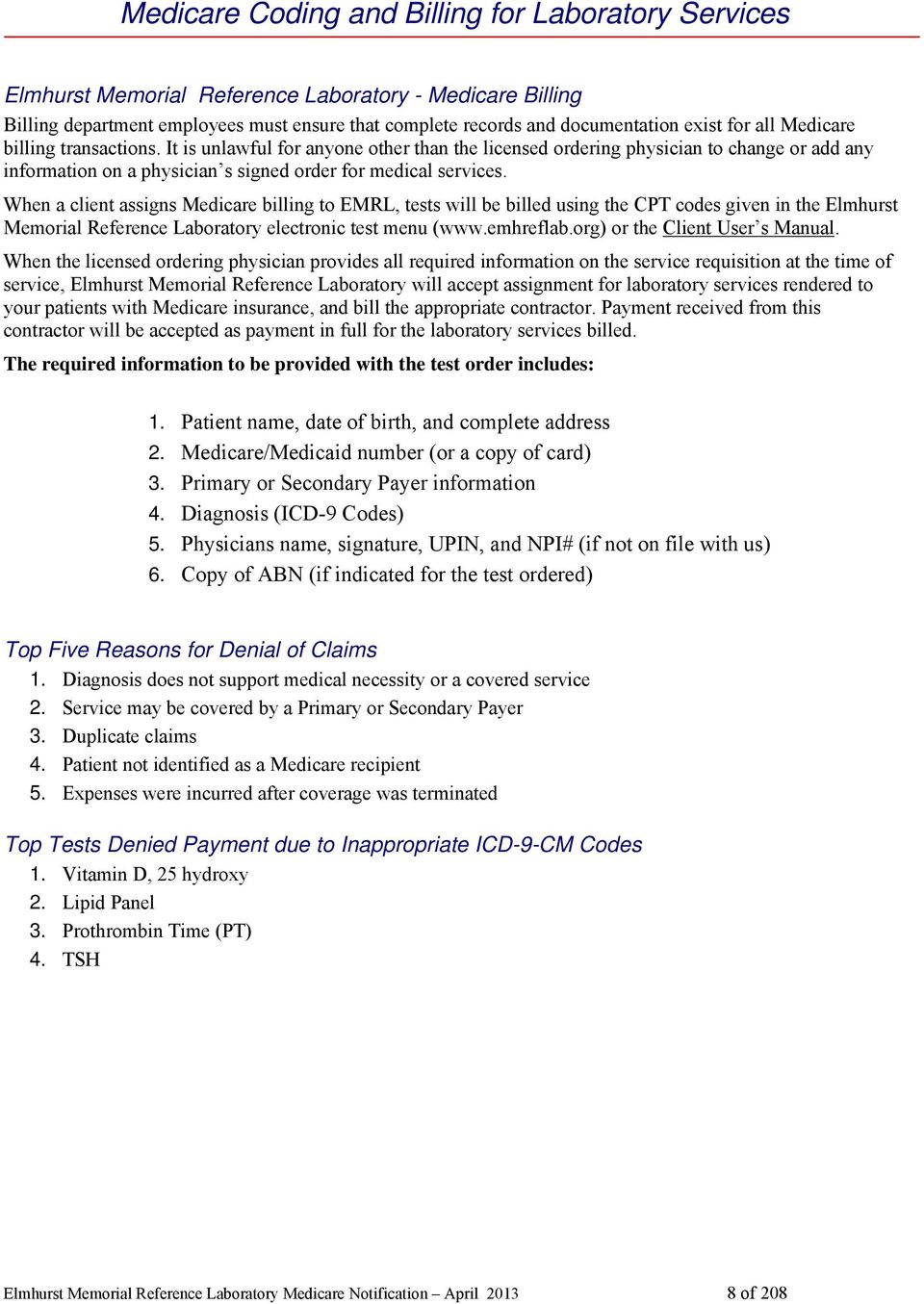
11 Medicare Coding and Billing for Laboratory Services Elmhurst Memorial Reference Laboratory - Medicare Billing Billing department employees must ensure that complete records and documentation exist for all Medicare billing transactions. It is unlawful for anyone other than the licensed ordering physician to change or add any information on a physician s signed order for medical services. When a client assigns Medicare billing to EMRL, tests will be billed using the CPT codes given in the Elmhurst Memorial Reference Laboratory electronic test menu ( or the Client User s Manual. When the licensed ordering physician provides all required information on the service requisition at the time of service, Elmhurst Memorial Reference Laboratory will accept assignment for laboratory services rendered to your patients with Medicare insurance, and bill the appropriate contractor. Payment received from this contractor will be accepted as payment in full for the laboratory services billed. The required information to be provided with the test order includes: 1. Patient name, date of birth, and complete address 2. Medicare/Medicaid number (or a copy of card) 3. Primary or Secondary Payer information 4. Diagnosis (ICD-9 Codes) 5. Physicians name, signature, UPIN, and NPI# (if not on file with us) 6. Copy of ABN (if indicated for the test ordered) Top Five Reasons for Denial of Claims 1. Diagnosis does not support medical necessity or a covered service 2. Service may be covered by a Primary or Secondary Payer 3. Duplicate claims 4. Patient not identified as a Medicare recipient 5. Expenses were incurred after coverage was terminated Top Tests Denied Payment due to Inappropriate ICD-9-CM Codes 1. Vitamin D, 25 hydroxy 2. Lipid Panel 3. Prothrombin Time (PT) 4. TSH Elmhurst Memorial Reference Laboratory Medicare Notification April of 208
12 Medicare Rules for Test Ordering Date of Service During the clinical diagnostic laboratory services negotiated rulemaking, CMS learned that there was considerable variability regarding the date of service on laboratory claims. In order to promote uniformity, the committee recommended a national policy related to the date of service on laboratory claims. CMS published the rule final on November 23, 2001 (66 FR 58788). The final rule states: The date of service for laboratory tests that is reported on the claim is to be the date the tested specimen was collected; and The person obtaining the specimen must furnish the date of collection of the specimen to the entity billing Medicare. Physicians or their staff who draw specimens for testing must report the date of collection of the specimen on orders for laboratory tests. Laboratories may refuse to perform tests on orders for laboratory tests that do not include the information they need in order to seek payment for services performed, i.e., the date of collection of the specimen. Ambiguous or Unclear Test Orders By law, the laboratory cannot perform and bill for tests that are not specifically ordered by the treating physician. When the orders for a test are not absolutely clear, laboratory personnel may not use their own judgment or information supplied by the patient to change or clarify the test order; they must contact the ordering physician. Custom Panels A custom panel is a test grouping that is created by the physician for the physician s ordering convenience. This does not include common practice panels. Our requisitions are designed so that all tests included in custom panels are listed, to facilitate individual test ordering if necessary. However, if you use a paper requisition containing a custom panel that does not indicate individual test components due to space limitations, Medicare requires that you sign a Physician Acknowledgement form annually, indicating that you are aware of any reimbursement limitations your profile or reflex test may have for beneficiaries. Physicians may choose not to use their custom panel for Medicare patients, but instead order individual tests when clinically indicated. If the physician feels that the patient will benefit from tests not covered by Medicare, the patient must be asked to sign an Advance Beneficiary Notice (ABN), advising them that they will be financially responsible for services not covered by Medicare. Reflexed Tests A reflexed test is a secondary test performed after an initial test result is outside of established parameters. These secondary reflex tests further enhance the clinical picture or confirm the initial results, facilitating patient care. Types of reflex testing; Automatic Reflex Considered common laboratory practice, the secondary test is performed and billed automatically, if appropriate,without additional orders from a physician (Table 1). Ordered Reflex The secondary test is not performed automatically. The physician must choose the reflex alternative of the primary test on the test order, or specify the secondary test and reflex criteria on the test order (Table 2). A physician acknowledgement is not needed. Custom Reflex -Reflex tests not available as described above may be created for the individual physician upon request. A physician acknowledgement form must be signed annually in order for the physician to use a custom reflex test for Medicare patients. Elmhurst Memorial Reference Laboratory Medicare Notification April of 208

13 Table 1. Automatic Reflex Testing (physician order not required for secondary test) Primary Test Includes Reflex Test Reflex Criteria ANA screen by EIA Antinuclear antibodies ANA titer / pattern by IFA Positive/equivocal screen CBC/DIFF Culture, Routine Culture, Blood Chest Pain Panel (CP0, CP2, CP6) Cell counts, indices, automated WBC diff Inoculation of appropriate culture media, interpretation of growth Aerobic and Anaerobic culture set Manual differential and RBC morphology Identification of pathogenic bacteria present, sensitivity to antibiotics if appropriate Second set of blood cultures Abnormal flagging criteria Presence/type of pathogens One set of blood culture ordered Troponin I + CK-MB + CPK Lipid panel, if none 7 days previous Troponin > 0.10 ng/ml Hepatitis A screen Anti- HAV total Anti-HAV IgM Reactive anti-hav total Hepatitis B surface antigen (SAG) SAG screening Confirmatory SAG Reactive screen HIV 1 & 2 by EIA HIV 1 & 2 antibodies Confirmatory HIV Evaluation Positive EIA test Lupus Anticoagulant Protime, PTT, DRVVT Confirmatory platelet neutralization Positive DRVVT Lyme Antibodies Lyme IgG and IgM screen Lyme Disease AB by Western Blot Reactive/equivocal screen Malarial smear Smear, microscopic exam Confirmation and species ID Parasitemia on smear exam Mixing studies Circulating anticoagulants Additional factor assays Pathologist review Rapid RSV Rapid RSV Influenza A, B, and RSV by PCR Negative Rapid RSV Rapid Strep Screen Rapid Strep Screen Beta Strep confirmatory culture* Negative Screen* RPR Syphilis serology RPR charcoal flocculation Confirmatory Treponemal test by EIA at IDPH Reactive RPR Troponin I Troponin I Lipid Panel if none 7 days previous Troponin > 0.10 ng/ml *Only on children under 18 yrs old Table 2. Ordered Reflex Testing (Physician must indicate Reflex Test when ordering) Primary Test Includes Secondary Test Reflex Criteria ANA Reflex Antinuclear antibodies, titer and pattern anti ENA, anti-dna, anti-ssa, anti-ssb Positive ANA screen PAP w HPV Reflex Liquid-based Pap Test High-Risk HPV DNA testing PAP interpretation = ASCUS PSA Free Reflex Total PSA % Free PSA Total PSA = 4-10 ng/ml. Thyroid Function TSH T4, possible T3 (per algorithm) TSH is abnormal Serum Protein Electrophoresis Reflex UA Dip Reflex Urine Drug Screen Reflex Total protein, albumin, alpha, beta & gamma globulin, A/G ratio Urine dipstick chemical analysis Immunofixation Microscopic analysis of urine Abnormal band on SPE Abnormal dipstick results Common drugs of abuse GCMS confirmation testing Positive drug screen Elmhurst Memorial Reference Laboratory Medicare Notification April of 208

14 ACID PHOSPHATASE Acid Phosphatase Local Coverage Determination, National Government Services, Inc. (00131, FI) Acid phosphatase is present in highest concentrations in the prostate and in metastases to bone. It has also been detected in tissue of heart, muscle, liver, testicles, spleen, skin, and hemopoietic cells. The enzyme hydrolyzes esters to inorganic phosphate when at an acid ph and can be measured by enzymatic analysis (Roy method) or immunoassay technique. Prostatic acid phosphatase increases with advanced prostate cancer and is consistent with extracapsular disease or metastases. Acid phosphatase has also been clinically relevant in the diagnosis and follow-up of patients with Gaucher s disease. Indications The prostatic acid phosphatase is mostly a tartrate sensitive isomer, whereas the isomer associated with Gaucher's disease and other entities is tartrate resistant. In patients suspected of having Gaucher's disease the correct test to perform is total acid phosphatase. Since the introduction of prostate specific antigen (PSA), the use of prostatic acid phosphatase has declined and is no longer routinely used for screening or staging of prostate cancer as it seldom provides additional useful information. The American Urological Association states that PSA is the best predictor of skeletal metastases found on radionuclide bone scan. Additionally, the standard for defining response to drugs in clinical trials is the change in PSA. New biochemical markers (e.g., IL-6, TGF-β1) are being investigated for the staging of prostate cancer. The clinical accuracy of prostatic acid phosphatase assay is problematic. The assay is not organ specific, and levels measured are influenced by diurnal fluctuations, prostate examinations prior to blood sampling, and enzyme instability (due to ph, temperature and time since blood-drawing) if not handled properly prior to testing. Furthermore, elevated values of radioimmunoassays may not be as interpretable as results when the test is performed by the Roy enzymatic test. Limitations of Coverage Prostatic acid phosphatase (CPT code 84066) is not covered for any indication, and will be denied as not medically necessary for all diagnosis including Gaucher s disease and osteoporosis. Total acid phosphatase (CPT code 84060) will be denied as not medically necessary for a diagnosis of prostate disease or osteoporosis. Total acid phosphatase (84060) will be covered for the ICD-9-CM codes listed below. Covered Tests CPT/HCPCS Codes Phosphatase, Acid Total Descriptor Covered Diagnosis Codes for CPT Phosphatase, Acid Total ICD-9-CM codes Secondary malignant neoplasm of bone and bone marrow Acute myeloid leukemia, without mention of having achieved remission Myeloid leukemia acute in remission Acute myeloid leukemia, in relapse Chronic myeloid leukemia, without mention of having achieved remission Myeloid leukemia chronic in remission Chronic myeloid leukemia, in relapse Subacute myeloid leukemia, without mention of having achieved remission Myeloid leukemia subacute in remission Elmhurst Memorial Reference Laboratory Medicare Notification April of 208

15 ACID PHOSPHATASE Phosphatase, Acid Total ICD-9-CM codes Subacute myeloid leukemia, in relapse Myeloid sarcoma, without mention of having achieved remission Myeloid sarcoma in remission Myeloid sarcoma, in relapse Other myeloid leukemia, without mention of having achieved remission Other myeloid leukemia in remission Other myeloid leukemia, in relapse Unspecified myeloid leukemia, without mention of having achieved remission Unspecified myeloid leukemia in remission Unspecified myeloid leukemia, in relapse Hyperparathyroidism, unspecified Primary hyperparathyroidism Secondary hyperparathyroidism, non-renal Other hyperparathyroidism Lipidoses Osteitis deformans without bone tumor Elmhurst Memorial Reference Laboratory Medicare Notification April of 208

16 Allergen Testing Local Coverage Determination, National Government Services, Inc. (00131,FI) Elmhurst Memorial Reference Laboratory Medicare Notification April of 208 ALLERGEN TESTING Radioallergosorbent test (RAST), fluoroallergosorbent test (FAST), and multiple antigen simultaneous tests are in vitro techniques for determining whether a patient's serum contains IgE antibodies against specific allergens of clinical importance. As with any allergy testing, the need for such tests is based on the findings during a complete history and physical examination of the patient. The multiple antigen simultaneous testing technique is similar to the RAST/FAST techniques in that it depends upon the existence of allergic antibodies in the blood of the patient being tested. With the multiple antigen simultaneous test system, several antigens may be used to test for specific IgE simultaneously. ELISA (enzyme-linked immunosorbent assay) is another in vitro method of allergy testing for specific IgE antibodies against allergens. This method is also a variation of RAST. Limitations It is expected that these services would be performed as indicated by current medical literature and/or standards of practice. When services are performed in excess of established parameters, they may be subject to review for medical necessity. The following tests are considered to be NOT medically necessary and will be denied. ELISA/Act qualitative antibody testing This testing is used to determine in vitro reaction to various foods and relies on lymphocyte blastogenesis in response to certain food antigens. LMRA (Lymphocyte Mitogen Response Assays) by ELISA/Act IgG ELISA, indirect method (CPT code 86001) Qualitative multi-allergen screen (CPT code 86005) This is a non-specific test that does not identify a specific antigen. IgG and IgG subclass antibody tests for food allergy do not have clinical relevance, are not validated, lack sufficient quality control, and should not be performed. Covered Tests CPT/HCPCS Codes Descriptor Allergen specific IGE; quantitative or semi-quantitative, each allergen Covered Diagnosis Codes Allergen Tests ICD-9 Codes Covered The following ICD-9 Codes apply only to CPT code 86003: Allergic rhinitis due to pollen Allergic rhinitis due to food Allergic rhinitis, due to animal (cat) (dog) hair and dander Allergic rhinitis due to other allergen Allergic rhinitis cause unspecified Extrinsic asthma unspecified Extrinsic asthma with status asthmaticus Extrinsic asthma with (acute) exacerbation Cough variant asthma Asthma unspecified

17 ALLERGEN TESTING Allergen Tests ICD-9 Codes Covered Asthma unspecified type with status asthmaticus Asthma unspecified with (acute) exacerbation Other atopic dermatitis and related conditions Allergic urticaria Other specified urticaria Unspecified urticaria Wheezing 989.5* Toxic effect of venom Other anaphylactic reaction Angioneurotic edema not elsewhere classified Unspecified adverse effect of unspecified drug, medicinal and biological substance Unspecified adverse effect of anesthesia Other drug allergy Unspecified adverse effect of other drug, medicinal and biological substance Allergy unspecified not elsewhere classified Anaphylactic reaction due to unspecified food Anaphylactic reaction due to peanuts Anaphylactic reaction due to crustaceans Anaphylactic reaction due to fruits and vegetables Anaphylactic reaction due to tree nuts and seeds Anaphylactic reaction due to fish Anaphylactic reaction due to food additives Anaphylactic reaction due to milk products Anaphylactic reaction due to eggs Anaphylactic reaction due to other specified food V15.09 Personal history of other allergy other than to medicinal agents *ICD-9-CM code should be reported for venom hypersensitivity. Elmhurst Memorial Reference Laboratory Medicare Notification April of 208

18 ALPHA FETOPROTEIN TUMOR MARKER Alpha Fetoprotein, Tumor Marker National Coverage Determination, Center for Medicare & Medicaid Services Alpha-fetoprotein (AFP) is a polysaccharide found in some carcinomas. It is effective as a biochemical marker for monitoring the response of certain malignancies to therapy. Indications AFP is useful for the diagnosis of hepatocellular carcinoma in high-risk patients (such as alcoholic cirrhosis, cirrhosis of viral etiology, hemochromatosis, and alpha 1-antitrypsin deficiency) and in separating patients with benign hepatocellular neoplasms or metastases from those with hepatocellular carcinoma and, as a non-specific tumor associated antigen, serves in marking germ cell neoplasms of the testis, ovary, retro peritoneum, and mediastinum. Covered Tests CPT/HCPCS Codes Alpha-Fetoprotein; Serum Descriptor Covered Diagnosis Codes Alpha-fetoprotein, Serum ICD-9 Codes Covered Chronic viral hepatitis B with hepatic coma without hepatitis delta Chronic viral hepatitis B with hepatic coma with hepatitis delta Chronic viral hepatitis B without hepatic coma without hepatitis delta Chronic viral hepatitis B without hepatic coma with hepatitis delta Chronic hepatitis C with hepatic coma Chronic hepatitis C without hepatic coma Syphilis of liver Clonorchiasis Fascioliasis Malignant neoplasm of liver primary Malignant neoplasm of intrahepatic bile ducts Malignant neoplasm of liver not specified as primary or secondary Malignant neoplasm of anterior mediastinum Malignant neoplasm of posterior mediastinum Malignant neoplasm of other parts of mediastinum Malignant neoplasm of mediastinum part unspecified Malignant neoplasm of upper respiratory tract part unspecified Malignant neoplasm of other sites within the respiratory system and intrathoracic organs Malignant neoplasm of ill-defined sites within the respiratory system Malignant neoplasm of ovary Malignant neoplasm of undescended testis Malignant neoplasm of other and unspecified testis Secondary malignant neoplasm of mediastinum Elmhurst Memorial Reference Laboratory Medicare Notification April of 208

19 ALPHA FETOPROTEIN TUMOR MARKER Alpha-fetoprotein, Serum ICD-9 Codes Covered Secondary malignant neoplasm of liver Secondary malignant neoplasm of ovary Secondary malignant neoplasm, genital organs Malignant carcinoid tumors of other and unspecified sites Secondary neuroendocrine tumor, unspecified site Secondary neuroendocrine tumor of distant lymph nodes Secondary neuroendocrine tumor of liver Secondary neuroendocrine tumor of bone Secondary neuroendocrine tumor of peritoneum Secondary Merkel cell carcinoma Secondary neuroendocrine tumor of other sites Benign neoplasm of liver and biliary passages Neoplasm of uncertain behavior of liver and biliary passages Mixed hyperlipidemia Alpha-1-antitrypsin deficiency Hereditary hemochromatosis Hemochromatosis due to repeated red blood cell transfusions Other hemochromatosis Other disorders of iron metabolism Disorders of copper metabolism Cystic fibrosis without meconium ileus Cystic fibrosis with gastrointestinal manifestations Other deficiencies of circulating enzymes Sideroblastic anemia Neoplasm related pain, acute or chronic Coronary atherosclerosis due to calcified coronary lesion Saddle embolus of abdominal aorta Other arterial embolism and thrombosis of abdominal aorta Alcoholic cirrhosis of liver Chronic hepatitis unspecified Chronic persistent hepatitis Autoimmune hepatitis Other chronic hepatitis Cirrhosis of liver without alcohol Hepatopulmonary syndrome Other specified disorders of male genital organs Solitary pulmonary nodule Elmhurst Memorial Reference Laboratory Medicare Notification April of 208

20 ALPHA FETOPROTEIN TUMOR MARKER Alpha-fetoprotein, Serum ICD-9 Codes Covered Other nonspecific abnormal finding of lung field Nonspecific abnormal findings of other intrathoracic organs Nonspecific abnormal findings of biliary tract Nonspecific abnormal findings of abdominal area including retroperitoneum Other abnormal tumor markers V10.07 Personal history of malignant neoplasm of liver V10.43 Personal history of malignant neoplasm of ovary V10.47 Personal history of malignant neoplasm of testis V86.0 Estrogen receptor positive status [ER+] V86.1 Estrogen receptor negative status [ER-] Elmhurst Memorial Reference Laboratory Medicare Notification April of 208

21 Beta-Natriuretic Peptide (BNP) Local Coverage Determination, National Government Services, Inc. (00131, FI) BETA-NATRIURETIC PEPTIDE B-type natriuretic peptide (BNP) is a cardiac neurohormone produced mainly in the left ventricle. It is secreted in response to ventricular volume expansion and pressure overload, factors often found in congestive heart failure (CHF). Used in conjunction with other clinical information, rapid measurement of BNP is useful in establishing or excluding the diagnosis and assessing the severity of CHF in patients with acute dyspnea so that appropriate and timely treatment can be initiated. This test is also used to predict the long-term risk of cardiac events or death across the spectrum of acute coronary syndromes when measured in the first few days after an acute coronary event. For the purposes of this policy, either total or N-terminal assays are acceptable. Indications BNP measurements may be considered reasonable and necessary when used in combination with other medical data such as medical history, physical examination, laboratory studies, chest x-ray, and electrocardiography: To distinguish cardiac cause of acute dyspnea from pulmonary or other non-cardiac causes. Plasma BNP levels are significantly increased in patients with CHF presenting with acute dyspnea compared with patients presenting with acute dyspnea due to other causes. To distinguish decompensated CHF from exacerbated chronic obstructive pulmonary disease (COPD) in a symptomatic patient with combined chronic CHF and COPD. Plasma BNP levels are significantly increased in patients with CHF with or without concurrent lung disease compared with patients primary lung disease. Limitations BNP measurements must be analyzed in conjunction with standard diagnostic tests, the medical history and clinical findings. The efficacy of BNP measurement as a stand-alone test has not yet been established. Clinicians should be aware that certain conditions such as ischemia, infarction and renal insufficiency, may cause elevation of circulating BNP concentration and require alterations of the interpretation of BNP results. Additional investigation is required to further define the diagnostic value of plasma BNP in monitoring the efficiency of treatment for CHF and in tailoring the therapy for heart failure. Therefore, BNP measurements for monitoring and management of CHF are not a covered service. Although a correlation between serum BNP levels and the clinical severity of HF has been shown in broad populations, it cannot be assumed that BNP levels can be used effectively as targets for adjustment of therapy in individual patients BNP measurement has not been clearly shown to supplement careful clinical assessment. (Hunt SA, Abraham WT, Chin MH, et al. ACC/AHA 2005 Guideline Update for the Diagnosis and Management of Chronic Heart Failure in the Adult: A Report of the American College of Cardiology/American Heart Association Task Force on Practice Guidelines, pgs ). The 2009 Guidelines stated, The value of serial measurements of BNP to guide therapy for patient with HF is not well established. Covered Tests CPT/HCPCS Codes Natriuretic Peptide Descriptor Covered Diagnosis Codes When billed in either an office or outpatient setting. CMS does not support medical necessity for BNP in hospital settings Natriuretic Peptide ICD-9 Codes Covered Malignant hypertensive heart disease with heart failure Benign hypertensive heart disease with heart failure Unspecified hypertensive heart disease with heart failure Hypertensive heart and chronic kidney disease, malignant, with heart failure and with chronic kidney disease stage I through stage IV, or unspecified Elmhurst Memorial Reference Laboratory Medicare Notification April of 208
22 BETA-NATRIURETIC PEPTIDE Natriuretic Peptide ICD-9 Codes Covered Hypertensive heart and chronic kidney disease, malignant, with heart failure and with chronic kidney disease stage V or end stage renal disease Hypertensive heart and chronic kidney disease, benign, with heart failure and with chronic kidney disease stage I through stage IV, or unspecified Hypertensive heart and chronic kidney disease, benign, with heart failure and chronic kidney disease stage V or end stage renal disease Hypertensive heart and chronic kidney disease, unspecified, with heart failure and with chronic kidney disease stage I through stage IV, or unspecified Hypertensive heart and chronic kidney disease, unspecified, with heart failure and chronic kidney disease stage V or end stage renal disease Congestive heart failure unspecified Left heart failure Unspecified systolic heart failure Acute systolic heart failure Chronic systolic heart failure Acute or chronic systolic heart failure Unspecified diastolic heart failure Acute diastolic heart failure Chronic diastolic heart failure Acute or chronic diastolic heart failure Unspecified combined systolic and diastolic heart failure Acute combined systolic and diastolic heart failure Chronic combined systolic and diastolic heart failure Acute or chronic combined systolic and diastolic heart failure Heart failure unspecified Obstructive chronic bronchitis with (acute) exacerbation Obstructive chronic bronchitis with acute bronchitis Chronic obstructive asthma with (acute) exacerbation Asthma unspecified with (acute) exacerbation Acute bronchospasm Respiratory abnormality unspecified Orthopnea Shortness of breath Tachypnea Wheezing Respiratory abnormality, other Elmhurst Memorial Reference Laboratory Medicare Notification April of 208
23 CA 125 National Coverage Determination, Center for Medicare & Medicaid Services CA 125 TUMOR ANTIGEN ASSAY Immunoassay determinations of the serum levels of certain proteins or carbohydrates, such as CA 125, serve as tumor markers. When elevated, serum concentration of these markers may reflect tumor size and grade. Indications CA 125 is a high molecular weight serum tumor marker elevated in 80% of patients who present with epithelial ovarian carcinoma. It is also elevated in carcinomas of the fallopian tube, endometrium, and endocervix. An elevated level may also be associated with the presence of a malignant mesothelioma or primary peritoneal carcinoma. A CA 125 level may be obtained as part of the initial pre-operative work-up for women presenting with a suspicious pelvic mass to be used as a baseline for purposes of post-operative monitoring. Initial declines in CA125 after initial surgery and/or chemotherapy for ovarian carcinoma are also measured by obtaining three serum levels during the first month post treatment to determine the patient's CA-125 half-life, which has significant prognostic implications. CA 125 levels are again obtained at the completion of chemotherapy as an index of residual disease. Surveillance measurements are generally obtained every 3 months for 2 years, every 6 months for the next 3 years, and yearly thereafter. CA 125 levels are also an important indicator of a patient's response to therapy in the presence of advanced or recurrent disease. In this setting, CA 125 levels may be obtained prior to each treatment cycle. Limitations These services are not covered for the evaluation of patients with signs or symptoms suggestive of malignancy. The service may be ordered at times necessary to assess either the presence of recurrent disease or the patient's response to treatment with subsequent treatment cycles. CA 125 is specifically not covered for aiding in the differential diagnosis of patients with a pelvic mass as the sensitivity and specificity of the test is not sufficient. In general, a single "tumor marker" will suffice in following a patient with one of these malignancies. Covered Tests CPT/HCPCS Codes Descriptor Immunoassay For Tumor Antigen, Quantitative; CA 125 Covered Diagnosis Codes Immunoassay for Tumor Antigen CA- 125 ICD-9 Codes Covered Malignant neoplasm, specified parts of peritoneum Malignant neoplasm, peritoneum, unspecified Malignant neoplasm, endocervix Malignant neoplasm of corpus uteri, except isthmus Malignant neoplasm, ovary Malignant neoplasm, fallopian tube Malignant neoplasm, other specified sites of uterine adnexa Malignant neoplasm, other specified sites of female genital organs Secondary malignant neoplasm, ovary Secondary malignancy of genital organs Neoplasm of uncertain behavior of uterus Neoplasm of uncertain behavior of placenta Elmhurst Memorial Reference Laboratory Medicare Notification April of 208
24 CA 125 TUMOR ANTIGEN ASSAY Immunoassay for Tumor Antigen CA- 125 ICD-9 Codes Covered Neoplasm of uncertain behavior of ovary Neoplasm of uncertain behavior of other and unspecified female genital organs Neoplasm related pain, acute or chronic Abdominal or pelvic swelling, mass or lump of other specified site Elevated cancer antigen 125 [CA 125] Other abnormal tumor markers V10.41 Personal history of malignant neoplasm, cervix uteri V10.42 Personal history of malignant neoplasm, other parts of the uterus V10.43 Personal history of malignant neoplasm of ovary V10.44 Personal history of malignant neoplasm of other female genital organs Elmhurst Memorial Reference Laboratory Medicare Notification April of 208
25 CA 15-3 / CA TUMOR ANTIGEN ASSAY CA 15-3 / CA National Coverage Determination, Center for Medicare & Medicaid Services Immunoassay determinations of the serum levels of certain proteins or carbohydrates serve as tumor markers. When elevated, serum concentration of these markers may reflect tumor size and grade. Indications Multiple tumor markers are available for monitoring the response of certain malignancies to therapy and assessing whether residual tumor exists post-surgical therapy. CA 15-3 is often medically necessary to aid in the management of patients with breast cancer. Serial testing must be used in conjunction with other clinical methods for monitoring breast cancer. For monitoring, if medically necessary, use consistently either CA 15-3 or CA 27.29, not both. CA is equivalent to CA 15-3 in its usage in management of patients with breast cancer. Limitations These services are not covered for the evaluation of patients with signs or symptoms suggestive of malignancy. The service may be ordered at times necessary to assess either the presence of recurrent disease or the patient's response to treatment with subsequent treatment cycles. Covered Tests CPT/HCPCS Codes Descriptor Immunoassay for Tumor Antigen, Quantitative; CA 15.3 (27.29) Covered Diagnosis Codes Immunoassay for Tumor Antigen CA-15.3 / CA ICD-9 Codes Covered Breast, primary (female) - malignant neoplasm of female breast Breast, primary (male) - malignant neoplasm of male breast Secondary malignant neoplasm (breast) Secondary malignant neoplasm (breast) Neoplasm related pain, acute or chronic Other abnormal tumor markers V10.3 Personal history of malignant neoplasm, breast Elmhurst Memorial Reference Laboratory Medicare Notification April of 208
26 CA 19.9 TUMOR ANTIGEN ASSAY CA 19-9 National Coverage Determination, Center for Medicare & Medicaid Services Immunoassay determinations of the serum levels of certain proteins or carbohydrates serve as tumor markers. When elevated, serum concentration of these markers may reflect tumor size and grade. Indications Multiple tumor markers are available for monitoring the response of certain malignancies to therapy and assessing whether residual tumor exists post-surgical therapy. Levels are useful in following the course of patients with established diagnosis of pancreatic and biliary ductal carcinoma. The test is not indicated for diagnosing these two diseases. Limitations These services are not covered for the evaluation of patients with signs or symptoms suggestive of malignancy. The service may be ordered at times necessary to assess either the presence of recurrent disease or the patient's response to treatment with subsequent treatment cycles. Covered Tests CPT/HCPCS Codes Descriptor Immunoassay For Tumor Antigen, Quantitative; CA 19-9 Covered Diagnosis Codes Immunoassay for Tumor Antigen CA-19.9 ICD-9 Codes Covered Malignant neoplasm of intrahepatic bile ducts Malignant neoplasm of the gallbladder Malignant neoplasm of extrahepatic bile ducts Malignant neoplasm of the Ampulla of Vater Malignant neoplasm of other specified sites of gallbladder and extrahepatic bile ducts Malignant neoplasm of biliary tract part unspecified site Malignant neoplasm, pancreas Secondary malignant neoplasm of other digestive organs and spleen Neoplasm of uncertain behavior of liver and biliary passages Neoplasm of uncertain behavior of other and unspecified digestive organs Neoplasm related pain, acute or chronic Other abnormal tumor markers V10.09 Other personal history of cancer Elmhurst Memorial Reference Laboratory Medicare Notification April of 208
27 CEA Carcinoembryonic Antigen (CEA) National Coverage Determination, Center for Medicare & Medicaid Services Carcinoembryonic antigen is a protein polysaccaride found in some carcinomas. It is effective as a biochemical marker for monitoring the response to therapy. Indications CEA may be medically necessary for follow-up of patients with colorectal carcinoma. It would however only be medically necessary at treatment decision making points. In some clinical situations (e.g. adenocarcinoma of the lung, small cell carcinoma of the lung, and some gastrointestinal carcinomas) when a more specific marker is not expressed by the tumor, CEA may be a medically necessary alternative marker for monitoring. Preoperative CEA may also be helpful in determining the post operative adequacy of surgical resection and subsequent medical management. In general, a single tumor marker will suffice in following patients with colorectal carcinoma or other malignancies that express such tumor markers. In following patients who have had treatment for colorectal carcinoma, ASCO guideline suggests that if resection of liver metastasis would be indicated, it is recommended that post-operative CEA testing be performed every two to three months in patients with initial stage II or stage III disease for at least two years after diagnosis. For patients with metastatic solid tumors which express CEA, CEA may be measured at the start of the treatment and with subsequent treatment cycles to assess the tumor's response to therapy. Limitations Serum CEA determinations are generally not indicated more frequently than once per chemotherapy treatment cycle for patients with metastatic solid tumors which express CEA or every two months post-surgical treatment for patients who have had colorectal carcinoma. However, it may be proper to order the test more frequently in certain situations, for example, when there has been a significant change from prior CEA level or a significant change in patient status which could reflect disease progression or recurrence. Testing with a diagnosis of an in situ carcinoma is not reasonably done more frequently than once, unless the result is abnormal, in which case the test may be repeated once. Specific Coding Guidelines To show elevated CEA, use ICD-9-CM (Other nonspecific findings on examination of blood) if a more specific diagnosis has not been made. If a more specific diagnosis has been made, use the code for that diagnosis. Covered Tests CPT/HCPCS Codes Carcinoembryonic Antigen (CEA) Descriptor Covered Diagnosis Codes CEA ICD-9 Codes Covered Malignant neoplasm of cervical esophagus Malignant neoplasm of thoracic esophagus Malignant neoplasm of abdominal esophagus Malignant neoplasm of upper third of esophagus Malignant neoplasm of middle third of esophagus Malignant neoplasm of lower third of esophagus Elmhurst Memorial Reference Laboratory Medicare Notification April of 208
28 CEA CEA ICD-9 Codes Covered Malignant neoplasm of other specified part of esophagus Malignant neoplasm of esophagus unspecified site Malignant neoplasm of cardia Malignant neoplasm of pylorus Malignant neoplasm of pyloric antrum Malignant neoplasm of fundus of stomach Malignant neoplasm of body of stomach Malignant neoplasm of lesser curvature of stomach unspecified Malignant neoplasm of greater curvature of stomach unspecified Malignant neoplasm of other specified sites of stomach Malignant neoplasm of stomach unspecified site Malignant neoplasm of duodenum Malignant neoplasm of jejunum Malignant neoplasm of ileum Malignant neoplasm of meckel's diverticulum Malignant neoplasm of other specified sites of small intestine Malignant neoplasm of small intestine unspecified site Malignant neoplasm of hepatic flexure Malignant neoplasm of transverse colon Malignant neoplasm of descending colon Malignant neoplasm of sigmoid colon Malignant neoplasm of cecum Malignant neoplasm of appendix vermiformis Malignant neoplasm of ascending colon Malignant neoplasm of splenic flexure Malignant neoplasm of other specified sites of large intestine Malignant neoplasm of colon unspecified site Malignant neoplasm of rectosigmoid junction Malignant neoplasm of rectum Malignant neoplasm of anal canal Malignant neoplasm of anus unspecified site Malignant neoplasm of other sites of rectum rectosigmoid junction and anus Malignant neoplasm of head of pancreas Malignant neoplasm of body of pancreas Malignant neoplasm of tail of pancreas Malignant neoplasm of pancreatic duct Malignant neoplasm of islets of langerhans Elmhurst Memorial Reference Laboratory Medicare Notification April of 208
29 CEA CEA ICD-9 Codes Covered Malignant neoplasm of other specified sites of pancreas Malignant neoplasm of pancreas part unspecified Malignant neoplasm of intestinal tract, part unspecified Malignant neoplasm of trachea Malignant neoplasm of main bronchus Malignant neoplasm of upper lobe bronchus or lung Malignant neoplasm of middle lobe bronchus or lung Malignant neoplasm of lower lobe bronchus or lung Malignant neoplasm of other parts of bronchus or lung Malignant neoplasm of bronchus and lung unspecified Malignant neoplasm of nipple and areola of female breast Malignant neoplasm of central portion of female breast Malignant neoplasm of upper-inner quadrant of female breast Malignant neoplasm of lower-inner quadrant of female breast Malignant neoplasm of upper-outer quadrant of female breast Malignant neoplasm of lower-outer quadrant of female breast Malignant neoplasm of axillary tail of female breast Malignant neoplasm of other specified sites of female breast Malignant neoplasm of breast (female) unspecified site Malignant neoplasm of male breast Malignant neoplasm of ovary Secondary malignant neoplasm of neoplasm of lung Secondary malignant neoplasm of small intestine Secondary malignant neoplasm of large intestine and rectum Malignant carcinoid tumors of the small intestine Malignant carcinoid tumors of the appendix, large intestine and rectum Malignant carcinoid tumors of other and unspecified sites Secondary neuroendocrine tumor, unspecified site Secondary neuroendocrine tumor of distant lymph nodes Secondary neuroendocrine tumor of liver Secondary neuroendocrine tumor of bone Secondary neuroendocrine tumor of peritoneum Secondary Merkel cell carcinoma Secondary neuroendocrine tumor of other sites Carcinoma in situ of colon Elmhurst Memorial Reference Laboratory Medicare Notification April of 208
30 CEA CEA ICD-9 Codes Covered Carcinoma in situ of rectum Carcinoma in situ of other/unspecified parts of intestine Carcinoma in situ other and unspecified digestive organs Neoplasm of uncertain behavior of stomach, intestines, rectum Neoplasm related pain, acute or chronic Other nonspecific findings on examination of blood Elevated carcinoembryonic antigen [CEA] Other abnormal tumor markers V10.00 Personal history of malignant neoplasm of gastro-intestinal tract, unspecified V10.05 Personal history of malignant neoplasm, large intestine V10.06 Personal history of malignant neoplasm, rectum, rectosigmoid junction, anus V10.11 Personal history of malignant neoplasm, bronchus, and lung V10.3 Personal history of malignant neoplasm, breast V10.43 Personal history of malignant neoplasm, ovary V67.2 Follow-up examination following chemotherapy Elmhurst Memorial Reference Laboratory Medicare Notification April of 208
31 Cell Count, Blood (CBC) National Coverage Decision, Center for Medicare & Medicaid Services CELL COUNT, BLOOD (CBC) Blood counts are used to evaluate and diagnose diseases relating to abnormalities of the blood or bone marrow. These include primary disorders such as anemia, leukemia, polycythemia, thrombocytosis and thrombocytopenia. Many other conditions secondarily affect the blood or bone marrow, including reaction to inflammation and infections, coagulopathies, neoplasms and exposure to toxic substances. Many treatments and therapies affect the blood or bone marrow, and blood counts may be used to monitor treatment affects. The complete blood count (CBC) includes a hemogram and differential white blood count (WBC). The hemogram includes enumeration of red blood cells, white blood cells, and platelets, as well as the determination of hemoglobin, hematocrit, and indices. The symptoms of hematological disorders are often nonspecific, and are commonly encountered in patients who may or may not prove to have a disorder of the blood or bone marrow. Furthermore, many medical conditions that are not primarily due to abnormalities of blood or bone marrow may have hematological manifestations that result from the disease or its treatment. As a result the CBC is one of the most commonly indicated laboratory tests. In patients with possible hematological abnormalities, it may be necessary to determine the hemoglobin and hematocrit, to calculate the red cell indices, and to measure the concentration of white blood cells and platelets. These measurements are usually performed on a multichannel analyzer that measures all of the parameters on every sample. Therefore, laboratory assessments routinely include these measurements. Indications Indications for a CBC or hemogram include red cell, platelet, and white cell disorders. Examples are: 1. Indications for a CBC generally include the evaluation of bone marrow dysfunction as a result of neoplasms, therapeutic agents, exposure to toxic substances, or pregnancy. The CBC is also useful in assessing peripheral destruction of blood cells, suspected bone marrow failure or bone marrow infiltrate, suspected myeloproliferative, myelodysplastic, or lymphoproliferative processes, and immune disorders. 2. Indications for hemogram or CBC related to red cell (RBC) parameters of the hemogram include signs, symptoms, test results, illness, or disease that can be associated with anemia or other red blood cell disorder (e.g., pallor, weakness, fatigue, weight loss, bleeding, acute injury associated with blood loss or suspected blood loss, abnormal menstrual bleeding, hematuria, hematemesis, hematochezia, positive fecal occult blood test, malnutrition, vitamin deficiency, malabsorption, neuropathy, known malignancy, presence of acute or chronic disease that may have associated anemia, coagulation or hemostatic disorders, postural dizziness, syncope, abdominal pain, change in bowel habits, chronic marrow hypoplasia or decreased RBC production, tachycardia, systolic heart murmur, congestive heart failure, dyspnea, angina, nailbed deformities, growth retardation, jaundice, hepatomegaly, splenomegaly, lymphadenopathy, ulcers on the lower extremities). 3. Indications for hemogram or CBC related to red cell (RBC) parameters of the hemogram include signs, symptoms, test results, illness, or disease that can be associated with polycythemia (for example, fever, chills, ruddy skin, conjunctival redness, cough, wheezing, cyanosis, clubbing of the fingers, orthopnea, heart murmur, headache, vague cognitive changes including memory changes, sleep apnea, weakness, pruritus, dizziness, excessive sweating, visual symptoms, weight loss, massive obesity, gastrointestinal bleeding, paresthesias, dyspnea, joint symptoms, epigastric distress, pain and erythema of the fingers or toes, venous or arterial thrombosis, thromboembolism, myocardial infarction, stroke, transient ischemic attacks, congenital heart disease, chronic obstructive pulmonary disease, increased erythropoietin production associated with neoplastic, renal or hepatic disorders, androgen or diuretic use, splenomegaly, hepatomegaly, diastolic hypertension.) 4. Specific indications for CBC with differential count related to the WBC include signs, symptoms, test results, illness, or disease associated with leukemia, infections or inflammatory processes, suspected bone marrow failure or bone marrow infiltrate, suspected myeloproliferative, myelodysplastic or lymphoproliferative disorder, use of drugs that may cause leukopenia, and immune disorders (e.g., fever, chills, sweats, shock, fatigue, malaise, tachycardia, tachypnea, heart murmur, seizures, alterations of consciousness, meningismus, pain such as headache, abdominal pain, arthralgia, odynophagia, or dysuria, redness or swelling of skin, soft Elmhurst Memorial Reference Laboratory Medicare Notification April of 208
32 CELL COUNT, BLOOD (CBC) tissue bone, or joint, ulcers of the skin or mucous membranes, gangrene, mucous membrane discharge, bleeding, thrombosis, respiratory failure, pulmonary infiltrate, jaundice, diarrhea, vomiting, hepatomegaly, splenomegaly, lymphadenopathy, opportunistic infection such as oral candidiasis.) 5. Specific indications for CBC related to the platelet count include signs, symptoms, test results, illness, or disease associated with increased or decreased platelet production and destruction, or platelet dysfunction (e.g., gastrointestinal bleeding, genitourinary tract bleeding, bilateral epistaxis, thrombosis, ecchymosis, purpura, jaundice, petechiae, fever, heparin therapy, suspected DIC, shock, pre-eclampsia, neonate with maternal ITP, massive transfusion, recent platelet transfusion, cardiopulmonary bypass, hemolytic uremic syndrome, renal diseases, lymphadenopathy, hepatomegaly, splenomegaly, hypersplenism, neurologic abnormalities, viral or other infection, myeloproliferative, myelodysplastic, or lymphoproliferative disorder, thrombosis, exposure to toxic agents, excessive alcohol ingestion, autoimmune disorders (SLE, RA and other). 6. Indications for hemogram or CBC related to red cell (RBC) parameters of the hemogram include, in addition to those already listed, thalassemia, suspected hemoglobinopathy, lead poisoning, arsenic poisoning, and spherocytosis. 7. Specific indications for CBC with differential count related to the WBC include, in addition to those already listed, storage diseases/mucopolysaccharidoses, and use of drugs that cause leukocytosis such as G-CSF or CM-CSF. 8. Specific indications for CBC related to platelet count include, in addition to those already listed, May-Hegglin syndrome and Wiskott-Aldrich syndrome. Limitations Testing of patients who are asymptomatic, or who do not have a condition that could be expected to result in a hematological abnormality, is screening and is not a covered service. In some circumstances it may be appropriate to perform only a hemoglobin or hematocrit to assess the oxygen carrying capacity of the blood. When the ordering provider requests only a hemoglobin or hematocrit, the remaining components of the CBC are not covered. When a blood count is performed for an end-stage renal disease (ESRD) patient, and is billed outside the ESRD rate, documentation of the medical necessity for the blood count must be submitted with the claim. In some patients presenting with certain signs, symptoms or diseases, a single CBC may be appropriate. Repeat testing may not be indicated unless abnormal results are found, or unless there is a change in clinical condition. If repeat testing is performed, a more descriptive diagnosis code (e.g., anemia) should be reported to support medical necessity. However, repeat testing may be indicated where results are normal in patients with conditions where there is a continued risk for the development of hematologic abnormality. Covered Tests CPT/HCPCS Codes Descriptor Blood count, automated differential white blood cell (WBC) count Blood count; blood smear, microscopic examination with manual differential WBC count Blood count; blood smear, microscopic examination without manual differential WBC count Blood count, Spun microhematocrit Blood count, hematocrit (Hct) Blood count, Hemoglobin Blood count, complete (CBC), automated (Hgb, Hct, RBC, WBC and platelet count) and automated differential WBC count Blood count, complete (CBC), automated (Hgb, Hct, RBC, WBC and platelet count) Blood count; manual cell count (erythrocyte, leukocyte, or platelet) each Elmhurst Memorial Reference Laboratory Medicare Notification April of 208
33 CELL COUNT, BLOOD (CBC) CPT/HCPCS Codes Descriptor Blood count, leukocyte (WBC), automated Blood count; platelet, automated Covered Diagnosis Codes Blood Count, blood ICD-9 Codes Any code that DOES NOT APPEAR on the ICD-9-CM CODES THAT DO NOT SUPPORT MEDICAL NECESSITY below, and supports medical necessity as explained in the indications section above. ICD-9-CM Codes That DO NOT Support Medical Necessity Code Description Viral warts Benign neoplasm of lip, oral cavity, and pharynx Lipoma, skin and subcutaneous tissue of face Benign neoplasm of skin 217 Benign neoplasm of breast Benign neoplasm of male genital organs Benign neoplasm of eyeball, except conjunctiva, cornea, retina, and choroid Carcinoma in situ of lip, oral cavity and pharynx Carcinoma in situ of skin Neurotic disorders Personality disorders Sexual and gender identity disorders Adult onset fluency disorder (Stuttering) Tics Stereotypic movement disorder Pain disorders related to psychological factors Disturbance of conduct, not elsewhere classified Disturbance of emotions specific to childhood and adolescence Hyperkinetic syndrome of childhood Central pain syndrome Acute pain due to trauma Acute post-thoracotomy pain Other acute postoperative pain Other acute pain Chronic pain due to trauma Chronic post-thoracotomy pain Other chronic postoperative pain Elmhurst Memorial Reference Laboratory Medicare Notification April of 208
34 ICD-9-CM Codes That DO NOT Support Medical Necessity Code Description Other chronic pain Chronic pain syndrome Chorioretinal scars Choroidal degeneration Hereditary choroidal dystrophies Choroidal detachment Cataract Disorders of refraction and accommodation Corneal opacity and other disorders of cornea Inflammation of eyelids Disorders of lacrimal system Endocrine Exophthalmus Other exophthalmic conditions Deformity of the Orbit Enophthalmos Retained foreign body (old) following penetrating wound of the orbit Orbital cysts; myopathy of extraocular muscles Other orbital disorders Unspecified disorder of the orbit Optic atrophy Other disorders of optic disc Perforation of tympanic membrane Other specified disorders of tympanic membrane Other disorders of middle ear and mastoid Otosclerosis Degenerative & vascular disorder of ear, unspecified Other disorders of ear , , , , , , , Hearing loss Atherosclerosis of aorta and renal artery Other and unspecified peripheral vascular disease Capillary nevus, non neoplastic Postmastectomy lymphedema syndrome 470 Deviated nasal septum CELL COUNT, BLOOD (CBC) Elmhurst Memorial Reference Laboratory Medicare Notification April of 208
35 ICD-9-CM Codes That DO NOT Support Medical Necessity Code Description Nasal polyps Hypertrophy of nasal turbinates Nasal mucositis (ulcerative) Other disease of nasal cavity and sinuses Polyp of vocal cord or larynx Disorders of tooth development and eruption , , , , , , , , Diseases of hard tissues of teeth Dentofacial anomalies, including malocclusion 525.0, , , , 525.3, , , , , Other diseases and conditions of teeth and supporting structures Osseointegration failure of dental implant Post-osseointegration biological failure of dental implant Post-osseointegration mechanic failure of dental implant Other specified disorders of the teeth and supporting structures Unspecified disorder of the teeth and supporting structures Diseases of the jaws Perforation of root canal space Endodontic overfill Endodontic underfill CELL COUNT, BLOOD (CBC) Other periradicular pathology associated with previous endodontic treatment Diseases of salivary glands Cholesterolosis of gallbladder Hyperplasia of prostate Encysted hydrocele Other specified types of hydrocele Hydrocele, unspecified 605 Redundant prepuce and phimosis Infertility, male azoospermia and oligospermia Spermatocele Torsion of testis, unspecified Elmhurst Memorial Reference Laboratory Medicare Notification April of 208
36 ICD-9-CM Codes That DO NOT Support Medical Necessity Code Description Extravaginal torsion of spermatic cord Intravaginal torsion of spermatic cord Torsion of appendix testis Torsion of appendix epididymis Atrophy of testis Benign mammary dysplasia Other disorders of breast Unspecified breast disorder Cyst of Bartholin s gland , , , , , , Genital prolapse CELL COUNT, BLOOD (CBC) Noninflammatory disorders of ovary, fallopian tube, and broad ligament Malposition or chronic inversion of uterus Menopausal and post menopausal disorders Infertility, female Other disorders of breast associated with childbirth and disorders of lactation Atopic dermatitis and related disorders Contact dermatitis and other eczema 700 Corns and callosities Other hypertrophic and atrophic conditions of skin Other dermatoses Unspecified disease of nail Diseases of sebaceous glands Other disorders of skin and subcutaneous tissue Osteoarthrosis Other and unspecified arthropathies Other derangement of joint Partial tear of rotator cuff Peripheral enthesopathies and allied syndromes Other disorders of synovium, tendon, and bursa Disorders of muscle ligament and fascia Osteochondropathies Osteoporosis 734 Flat foot Elmhurst Memorial Reference Laboratory Medicare Notification April of 208
37 ICD-9-CM Codes That DO NOT Support Medical Necessity Code Description Acquired deformities of toe Other acquired deformities of limb Curvature of spine Other acquired deformity Nonallopathic lesions, not elsewhere classified Sudden death, cause unknown Decreased libido Dislocation of jaw, shoulder, and elbow Nursemaid s elbow Dislocation of wrist Dislocation of finger Dislocation of hip Dislocation of knee Dislocation of ankle Dislocation of foot Other multiple and ill-defined dislocations Sprains and strains of joints and adjacent muscles Late effects of musculoskeletal and connective tissue injuries Superficial injuries Foreign body on external eye, in ear, in nose Injury to peripheral nerve V03.0-V06.9 V11.0-V11.3 Need for prophylactic vaccination Personal history of mental disorder V11.4 Personal history of combat and operational stress reaction V11.8-V11.9 V14.0-V14.8 Personal history of other and unspecified mental disorders Personal history of allergy to medicinal agents CELL COUNT, BLOOD (CBC) V15.85 Personal history of contact with and suspected exposure to potentially hazardous body fluids V16.0 Family history of malignant neoplasm, gastrointestinal tract V16.1 Family history of malignant neoplasm, trachea, bronchus and lung V16.2 Family history of malignant neoplasm, other respiratory and intrathoracic organs V16.3 Family history of malignant neoplasm, breast V16.40 Family history of malignant neoplasm, genital organs V16.50 Family history of malignant neoplasm, urinary organs V16.51 Family history of malignant neoplasm, kidney V16.52 Family history of malignant neoplasm, bladder Elmhurst Memorial Reference Laboratory Medicare Notification April of 208
38 ICD-9-CM Codes That DO NOT Support Medical Necessity Code Description V16.59 Family history of malignant neoplasm, other V16.6 Family history of malignant neoplasm, leukemia CELL COUNT, BLOOD (CBC) V16.7 Family history of malignant neoplasm, other lymphatic and hematopoietic V16.8 Family history of malignant neoplasm, other specified malignant neoplasm V16.9 Family history of malignant neoplasm, unspecified malignant neoplasm V17.0-V17.3 Family history of certain chronic disabling diseases V17.41 Family history of sudden cardiac death V17.49 Family history of other cardiovascular diseases V17.5-V17.89 Family history of asthma; other chronic respiratory conditions, arthritis; other musculoskeletal diseases V18.0 Family history of diabetes mellitus V18.11 Family history of multiple endocrine neoplasia syndrome V18.19 Family history of other endocrine and metabolic diseases V18.2-V18.4 Family history of anemia; other blood disorders V18.51 Family history of mental retardation V18.59 Family history of colonic polyps V18.61 Family history of other digestive disorders V18.69 Family history of polycystic kidney V18.7-V18.9 V19.0-V19.8 V20.0-V20.2 Family history of other kidney diseases; other genitourinary diseases; infectious and parasitic diseases; genetic disease carrier Family history of other conditions Health supervision of infant or child V20.31 Health supervision for newborn under 8 days old V20.32 Health supervision for newborn 8 to 28 days old V21.0-V21.9 V25.01-V25.04,V25.09 Constitutional states in development Encounter for contraceptive management; general counseling and advice V25.11 Encounter for insertion of intrauterine contraceptive device V25.12 Encounter for removal of intrauterine contraceptive device V25.13 Encounter for removal and reinsertion of intrauterine contraceptive device V25.2-V25.3, V V25.43, V25.49, V25.5, V25.8, V25.9 V26.0-V26.39 Encounter for sterilization; menstrual extraction; surveillance of previously prescribed contraceptive methods; and insertion of implantable subdermal contraceptive; other specified and unspecified contraceptive management Procreative management V26.41 Other procreative counseling and advice using natural family planning V26.42 Encounter for fertility preservation counseling V26.49 Other procreative management, counseling and advice V26.51 Tubal ligation status Elmhurst Memorial Reference Laboratory Medicare Notification April of 208
39 ICD-9-CM Codes That DO NOT Support Medical Necessity Code Description V26.52 Vasectomy status V26.81 Encounter for assisted reproductive fertility procedure cycle V26.82 Encounter for fertility preservation procedure V26.89-V26.9 V28.0-V28.9 V40.0-V40.9 Other specified and unspecified procreative management Encounter for antenatal screening of mother Mental and behavioral problems V40.31 Wandering in diseases classified elsewhere V40.39 Other specified behavioral problem V41.0-V41.9 V43.0-V43.1 V44.0-V44.9 V45.00-V45.02 Problems with special senses and other special functions Organ or tissue replaced by other means, eye globe or lens Artificial opening status Other postsurgical states; cardiac device in situ; cardiac pacemaker CELL COUNT, BLOOD (CBC) V45.09 Other postsurgical states; cardiac device in situ; other specified cardiac device V45.11 Renal dialysis status V45.12 Non-compliance with renal dialysis V45.2-V45.4 Other postsurgical states; arthrodesis status V45.51 Other postsurgical states; presence of contraceptive device; intrauterine contraceptive device V45.52 Other postsurgical states; presence of contraceptive device; subdermal contraceptive implant V45.59 Other postsurgical states; presence of contraceptive device; other V45.61 Other postsurgical states; following surgery of eye and adnexa; cataract extraction status V45.69 Other postsurgical states; other states following surgery of eye and adnexa V45.71 V45.79, V45.81 V45-85, V45.86, V45.89 V48.0-V48.9 V49.0-V49.85 Other post surgical states Problems with head, neck, and trunk Other conditions influencing health status V49.86 Do not resuscitate status V49.87 Physical restraints status V49.89-V49.9 V50.0-V50.9 Other specified and unspecified conditions influencing health status Elective surgery for purposes other than remedying health states V51.0 Encounter for breast reconstruction following mastectomy V51.8 Other aftercare involving the use of plastic surgery V52.0-V52.9 V53.01-V53.09 Fitting and adjustment of prosthetic device and implant Fitting and adjustment of devices related to nervous system and special senses V53.1 Fitting and adjustment of spectacles and contact lenses Elmhurst Memorial Reference Laboratory Medicare Notification April of 208
40 ICD-9-CM Codes That DO NOT Support Medical Necessity Code Description V53.2 Hearing aid V53.31-V53.39 Fitting and adjustment of cardiac device V53.4 Fitting and adjustment of orthodontic devices V53.50 Fitting and adjustment of intestinal appliance and device V53.51 Fitting and adjustment of gastric lap band CELL COUNT, BLOOD (CBC) V53.59 Fitting and adjustment of other gastrointestinal appliance and device V53.6 Fitting and adjustment of urinary devices V53.7 Fitting and adjustment of orthopedic devices V53.8 Fitting and adjustment of wheelchair V53.90-V53.99 V54.01-V54.9 Fitting and adjustment of other and unspecified device Other orthopedic aftercare V54.82 Aftercare following explantation of joint prosthesis V55.0-V55.9 V57.0-V57.2 Attention to artificial openings Care involving use of rehabilitation procedures V57.3 Care involving speech-language therapy V57.4-V57.9 V58.5 Orthodontics V59.01-V59.9 V60.0-V60.6 Orthoptic training, other specified and unspecified rehabilitation Donors V60.81 Foster care Lack of housing; inadequate housing; lack of material resources; person living alone; no other household person able to render care; holiday relief care; person living in residential institution V60.89 Other specified housing or economic circumstances V60.9 Unspecified housing or economic circumstances V61.01 Family disruption due to family member on military deployment V61.02 Family disruption due to return of family member from military deployment V61.03 Family disruption due to divorce or legal separation V61.04 Family disruption due to parent-child estrangement V61.05 Family disruption due to child in welfare custody V61.06 Family disruption due to child in foster care or in care of non-parental family member V61.07 Family disruption due to death of family member V61.08 Family disruption due to other extended absence of family member V61.09 Other family disruption V61.10 Counseling for marital and partner problems, unspecified V61.11 Counseling for victim of spousal and partner abuse V61.12 Counseling for perpetrator of spousal and partner abuse Elmhurst Memorial Reference Laboratory Medicare Notification April of 208
41 ICD-9-CM Codes That DO NOT Support Medical Necessity Code Description V61.20 Counseling for parent-child problem V61.21 Counseling for victim of child abuse V61.22 Counseling for perpetrator of parental child abuse V61.23 Counseling for parent-biological child problem V61.24 Counseling for parent-adopted child problem V61.25 Counseling for parent (guardian)-foster child problem V61.29 Other parent-child problems V61.3 Problems with aged parents or in-laws V61.41 Alcoholism in family V61.42 Substance abuse in family V61.49, V61.5-V61.9 V62.0 Unemployment Other specified and unspecified family problems V62.1 Adverse effects of work environment V62.21 Personal current military deployment V62.22 Personal history of return from military deployment V62.29 Other occupational circumstances or maladjustment V62.3-V62.4 V62.85 Homicidal ideation V62.89-V62.9 CELL COUNT, BLOOD (CBC) Educational circumstances; other psychological or physical stress, not elsewhere classified; suicidal ideation Other psychological or physical stress, not elsewhere classified; and unspecified psychosocial circumstances V65.0 Healthy persons accompanying sick persons V65.11 Pediatric pre-birth visit for expectant parent(s) V65.19 Other person consulting on behalf of another person V65.2 Person feigning illness V65.3 Dietary surveillance and counseling V65.40-V65.49 Other counseling, not elsewhere classified V65.5 Person with feared complaint in whom no diagnosis was made V65.8 Other reasons for seeking consultation V65.9 Unspecified reason for consultation V66.0-V66.9 Convalescence and palliative care V67.3 Follow-up examination following psychotherapy V67.4 Follow-up examination following treatment of healed fracture V68.0-V68.9 Encounters for administrative purposes V69.3 Problems related to lifestyle, gambling and betting V70.0-V70.9 General medical examinations Elmhurst Memorial Reference Laboratory Medicare Notification April of 208
42 ICD-9-CM Codes That DO NOT Support Medical Necessity Code Description V71.01-V71.09 CELL COUNT, BLOOD (CBC) Observation and evaluation for suspected conditions not found, mental V72.0 Examination of eyes and vision V72.11, V72.12, V72.19 V72.2 Dental examination V72.40-V72.41, V72.42 Encounter for hearing conservation and treatment; other examination of ears and hearing Pregnancy examination or test; pregnancy unconfirmed; negative result; positive result V72.5 Radiological examination not elsewhere classified V72.60 Laboratory examination, unspecified V72.61 Antibody response examination V72.62 Laboratory examination ordered as part of a routine general medical examination V72.63 Pre-procedural laboratory examination V72.69 Other laboratory examination V72.7 Diagnostic skin and sensitization tests V72.9 Unspecified examination V73.0-V73.6 Special screening examinations for viral and chlamydia diseases V73.81 Special screening examinations for Human papillomavirus (HPV) V73.88-V73.89 V73.98-V73.99 V74.0-V74.9 V75.0-V75.9 Other specified chlamydial and viral diseases Unspecified chlamydial and viral disease Special screening examinations for bacterial and spirochetal diseases Special screening examinations for other infectious diseases V76.0 Special screening for malignant neoplasms, respiratory organs V76.10-V76.19 Special screening for malignant neoplasms, breast V76.2 Special screening for malignant neoplasms, cervix V76.3 Special screening for malignant neoplasms, bladder V76.42-V76.43 Special screening for malignant neoplasms, sites other than breast V76.44 Special screening for malignant neoplasms, other sites, prostate V76.45-V76.47 V76.49-V76.50 Special screening for malignant neoplasms, sites other than cervix Special screening for malignant neoplasms, sites other than rectum V76.51 Special screening for malignant neoplasms, Intestine, colon V76.52, V76.81, V76.89-V76.9 Special screening for malignant neoplasms, other sites V77.0 Special screening for endocrine, nutrition, metabolic, and immunity disorders V77.1 Special screening for diabetes mellitus V77.2-V77.99 V78.0-V78.9 Special screening for endocrine, nutrition, metabolic, and immunity disorders Special screening for disorders of blood and blood-forming organs Elmhurst Memorial Reference Laboratory Medicare Notification April of 208
43 ICD-9-CM Codes That DO NOT Support Medical Necessity Code Description V79.0-V79.9 Special screening for mental disorders V80.01 Special screening for traumatic brain injury V80.09 Special screening for neurological conditions V80.1-V80.3 V81.0-V81.6 V82.0-V82.6, V82.71 V82.79, V82.81, V82.89-V82.9 CELL COUNT, BLOOD (CBC) Special screening for glaucoma and other eye conditions; ear diseases Special screening for cardiovascular, respiratory, and genitourinary diseases Special screening for other conditions Elmhurst Memorial Reference Laboratory Medicare Notification April of 208
44 Circulating Tumor Cell Assay (CTC) Local Coverage Determination, National Government Services, Inc. (00131, FI) CIRCULATING TUMOR CELLS (CTC) As a result of limited acceptable study data, National Government Services will consider CTCs not medically necessary, for all indications. NON-COVERED Test CPT/HCPCS Codes Descriptor Cell enumeration using immunologic selection and identification in fluid specimen (eg, circulating tumor cells in blood) Cell enumeration using immunologic selection and identification in fluid specimen (eg, circulating tumor cells in blood), Physician interpretation and report, when required Elmhurst Memorial Reference Laboratory Medicare Notification April of 208
45 Collagen Crosslinks (N-Telopeptide) National Coverage Determination, Center for Medicare & Medicaid Services COLLAGEN CROSSLINKS (N-TELOPEPTIDE) Collagen crosslinks, part of the matrix of bone upon which bone mineral is deposited, are biochemical markers the excretion of which provide a quantitative measurement of bone resorption. Elevated levels of urinary collagen crosslinks indicate elevated bone resorption. Elevated bone resorption contributes to age-related and postmenopausal loss of bone leading to osteoporosis and increased risk of fracture. The collagen crosslinks assay can be performed by immunoassay or high performance liquid chromatography (HPLC). Collagen crosslink immunoassays measure the pyridinoline crosslinks and associated telopeptides in urine. Bone is constantly undergoing a metabolic process called turnover or remodeling. This includes a degradation process of bone resorption mediated by the action of osteoclasts, and a building process of bone formation mediated by the action of osteoblasts. Remodeling is required for the maintenance and overall health of bone and is tightly coupled; that is, resorption and formation must be in balance. In abnormal states, resorption exceeds formation, resulting in a net loss of bone. The measurement of specific, bone-derived resorption products provides analytical data about the rate of bone resorption. Osteoporosis is a condition characterized by low bone mass and structural deterioration of bone tissue, leading to bone fragility and increased susceptibility to fractures of the hip, spine, and wrist. The term primary osteoporosis is applied where the causal factor in the disease is menopause or aging. The term secondary osteoporosis is applied where the causal factor is something other than menopause or aging, such as long-term administration of glucocorticosteroids, endocrine-related disorders other than loss of estrogen due to menopause, and certain bone diseases such as cancer of the bone. With respect to quantifying bone resorption, collagen crosslink tests can provide adjunct diagnostic information in concert with bone mass measurements. Bone mass measurements and biochemical markers may have complementary roles to play in assessing effectiveness of osteoporosis treatment. Proper management of osteoporosis patients who are on long-term therapeutic regimens may include laboratory testing of biochemical markers of bone turnover, such as collagen crosslinks, that provide a profile of bone turnover responses within weeks of therapy. Changes in collagen crosslinks are determined following commencement of antiresorptive therapy. These can be measured over a shorter time interval, such as three months, when compared to bone mass density. If bone resorption is not elevated, repeat testing is not medically necessary. Indications Generally speaking, collagen crosslink testing is useful mostly in "fast losers" of bone. The age when these bone markers can help direct therapy is often pre-medicare. By the time a fast loser of bone reaches age 65, she will most likely have been stabilized by appropriate therapy or have lost so much bone mass that further testing is useless. Coverage for bone marker assays may be established, however, for younger Medicare beneficiaries and for those men and women who might become fast losers because of some other therapy such as glucocorticoids. Safeguards should be incorporated to prevent excessive use of tests in patients for whom they have no clinical relevance. Collagen crosslinks testing is used to: 1. Identify individuals with elevated bone resorption, who have osteoporosis in whom response to treatment is being monitored; 2. Predict response (as assessed by bone mass measurements) to FDA approved antiresorptive therapy in postmenopausal women; and 3. Assess response to treatment of patients with osteoporosis, Paget's disease of the bone, or risk for osteoporosis where treatment may include FDA approved antiresorptive agents, anti-estrogens or selective estrogen receptor moderators. Elmhurst Memorial Reference Laboratory Medicare Notification April of 208
46 COLLAGEN CROSSLINKS (N-TELOPEPTIDE) Limitations Because of significant specimen to specimen collagen crosslink physiologic variability (15-20%), current recommendations for appropriate utilization include: one or two base-line assays from specified urine collections on separate days; followed by a repeat assay about three months after starting anti-resorptive therapy; followed by a repeat assay in 12 months after the three-month assay; and thereafter not more than annually, unless there is a change in therapy in which circumstance an additional test may be indicated three months after the initiation of new therapy. Some collagen crosslink assays may not be appropriate for use in some disorders, according to FDA labeling restrictions. Specific Coding Guidelines When the indication for the test is long-term administration of glucocorticosteroids, use ICD-9-CM code V Covered Tests CPT/HCPCS Codes Collagen Cross Links, Any Method Descriptor Covered Diagnosis Codes Collagen Crosslinks ICD-9 Codes Covered Thyrotoxicosis Chronic lymphocytic thyroiditis (only if thyrotoxic) Unspecified disorder of thyroid Hyperparathyroidism Other hyperparathyroidism Postablative ovarian failure Other ovarian failure Other ovarian dysfunction Unspecified ovarian dysfunction Unspecified vitamin D deficiency Mineral deficiency, not elsewhere classified Premenopausal menorrhagia Postmenopausal bleeding Symptomatic menopausal or female climacteric state Symptomatic states associated with artificial menopause Other specified menopausal and postmenopausal disorders Unspecified menopausal & postmenopausal disorder Osteitis deformans without mention of bone tumor (Paget s disease of bone) Osteoporosis Pathological fracture Disorder of bone and cartilage, unspecified Fracture of vertebral column without mention of spiral cord injury, unspecified, closed V58.65 Long-term (current) use of steroids V58.69 Long-term (current) use of other medications Elmhurst Memorial Reference Laboratory Medicare Notification April of 208
47 Digoxin National Coverage Determination, Center for Medicare & Medicaid Services DIGOXIN Digoxin is a therapeutic drug assay useful for diagnosis and prevention of digoxin toxicity and/or prevention of underdosage of digoxin. Indications Digoxin is indicated for the treatment of patients with heart failure due to systolic dysfunction and for reduction of the ventricular response in patients with atrial fibrillation or flutter. Digoxin may also be indicated for the treatment of other supraventricular arrhythmias, particularly in the presence of heart failure. Digoxin levels may be performed to monitor drug levels of individuals receiving digoxin therapy because the margin of safety between side effects and toxicity is narrow or because the blood level may not be high enough to achieve the desired clinical effect. Clinical indications may include individuals on digoxin: With symptoms, signs or electrocardiogram (ECG) suggestive of digoxin toxicity; Taking medications that influence absorption, bioavailability, distribution, and/or elimination of digoxin; With impaired renal, hepatic, gastrointestinal, or thyroid function; With ph and/or electrolyte abnormalities; With unstable cardiovascular status, including myocarditis, requiring monitoring of patient compliance. Clinical indications may include individuals: Suspected of accidental or intended overdose; or Who have an acceptable cardiac diagnosis (as listed) and for whom an accurate history of use of digoxin is unobtainable. Frequency The value of obtaining regular serum digoxin levels is uncertain, but it may be reasonable to check levels once yearly after a steady state are achieved. In addition, it may be reasonable to check the level if: Heart failure status worsens; Renal function deteriorates; Additional medications are added that could affect the digoxin level; or Signs or symptoms of toxicity develop. Steady state will be reached in approximately 1 week in patients with normal renal function, although 2-3 weeks may be needed in patients with renal impairment. After changes in dosages or the addition of a medication that could affect the digoxin level, it is reasonable to check the digoxin level one week after the change or addition. Based on the clinical situation, in cases of digoxin toxicity, testing may need to be done more than once a week. Limitations This test is not appropriate for patients on digitoxin or treated with digoxin FAB (fragment antigen binding) antibody. Covered Tests CPT/HCPCS Codes Digoxin Descriptor Covered Diagnosis Codes Digoxin ICD-9 Codes Covered Thyrotoxicosis with or without goiter 243 Congenital hypothyroidism Elmhurst Memorial Reference Laboratory Medicare Notification April of 208
48 DIGOXIN Digoxin ICD-9 Codes Covered Acquired hypothyroidism Thyroiditis Disorders of magnesium metabolism Disorders of calcium metabolism Hungry bone syndrome Hyperosmolality Hyposmolality Acidosis Alkalosis Mixed acid-base balance disorder Volume depletion Transfusion associated circulatory overload Other fluid overload Hyperpotassemia Hypopotassemia Electrolyte and fluid Disorder (not elsewhere classified) Delirium due to conditions classified elsewhere Subacute delirium Other dysfunctions of sleep stages or arousal from sleep Drug induced headache, not elsewhere classified Psychophysical visual disturbances Other specified visual disturbances Unspecified visual disturbances Rheumatic diseases of endocardium Rheumatic Myocarditis Rheumatic Heart Failure Hypertensive heart disease, malignant with heart failure Hypertensive heart disease, benign with heart failure Hypertensive heart disease, unspecified with heart failure Hypertensive kidney disease Hypertensive heart and kidney disease Acute myocardial infarction Other acute & subacute forms of ischemic heart disease Angina pectoris Coronary atherosclerosis due to calcified coronary lesion Acute myocarditis Cardiomyopathy Elmhurst Memorial Reference Laboratory Medicare Notification April of 208
49 DIGOXIN Digoxin ICD-9 Codes Covered Hypertrophic obstructive cardiomyopathy Other hypertrophic cardiomyopathy Conduction disorders Cardiac dysrhythmias Heart failure Cardiovascular disease, unspecified Heart disturbances post-cardiac surgery Rupture chordae tendineae Rupture papillary muscle Acquired cardiac septal defect Saddle embolus of abdominal aorta Other arterial embolism and thrombosis of abdominal aorta 514 Pulmonary congestion & hypostasis Hepatopulmonary syndrome Unspecified Intestinal malabsorption Acute kidney failure with lesion of tubular necrosis Acute kidney failure with lesion of renal cortical necrosis Acute kidney failure with lesion of renal medullary necrosis Acute kidney failure with other specified pathological lesion in kidney Acute kidney failure, unspecified Chronic kidney disease 586 Renal Failure, unspecified 587 Renal sclerosis, unspecified Renal osteodystrophy Nephrogenic Diabetes Insipidus Secondary hyperparathyroidism (of renal origin) Other specified disorders resulting from impaired renal function Unspecified disorder resulting from impaired renal function Coma Transient alteration of awareness Alteration of consciousness, other Hallucinations Syncope & collapse Dizziness and giddiness Chronic fatigue syndrome Functional quadriplegia Other malaise and fatigue Elmhurst Memorial Reference Laboratory Medicare Notification April of 208
50 DIGOXIN Digoxin ICD-9 Codes Covered Anorexia Headache Nausea & vomiting Bilious emesis Diarrhea Abnormal electrocardiogram Nervousness Irritability Impulsiveness Emotional lability Demoralization and apathy Other signs and symptoms involving emotional state Poisoning by cardiac rhythm regulators Poisoning by cardiotonic glycosides & drugs of similar action Unspecified adverse effect of unspecified drug, medicinal and biological substance Arthus phenomenon Failed moderate sedation during procedure Other drug allergy Unspecified adverse effect of other drug, medicinal and biological substance E942.1 Adverse effect of cardiotonic glycosides and drugs of similar action V58.69 Encounter long term - medication use (not elsewhere classified) Code may not be reported as a stand-alone or first-listed code on the claim. Elmhurst Memorial Reference Laboratory Medicare Notification April of 208
51 Drug Screening, Qualitative Local Coverage Determination, National Government Services, Inc. (00131, FI) DRUG SCREENING, QUALITATIVE A qualitative drug screen is used to detect the presence of a drug in the body. A blood or urine sample may be used. However, urine is the best specimen for broad qualitative screening, as blood is relatively insensitive for many common drugs, including psychotropic agents, opioids, and stimulants. Common methods of drug analysis include chromatography, immunoassay, chemical ("spot") tests, and spectrometry. Analysis is comparative, matching the properties or behavior of a substance with that of a valid reference compound (a laboratory must possess a valid reference agent for every substance that it identifies). Drugs or classes of drugs are commonly assayed by qualitative screen, followed by confirmation with a second method. Examples of drugs or classes of drugs that are commonly assayed by qualitative screens, followed by confirmation with a second method, are: alcohols, amphetamines, barbiturates/sedatives, benzodiazepines, cocaine and metabolites, methadone, antihistamines, stimulants, opioid analgesics, salicylates, cardiovascular drugs, antipsychotics, cyclic antidepressants, and others. Focused drug screens, most commonly for illicit drug use, may be more useful clinically. This local coverage determination documents National Government Services medical policy guidelines for the use of this laboratory test. Indications: Although technology has provided the ability to measure many toxins, most toxicological diagnoses and therapeutic decisions are made based on historical or clinical considerations: (1) laboratory turnaround time can often be longer than the critical intervention time course of an overdose; (2) the cost and support of maintaining the instruments, staff training, and specialized labor involved in some analyses are prohibitive; (3) for many toxins there are no established cutoff levels of toxicity, making interpretation of the results difficult. Although comprehensive screening is unlikely to affect emergency management, the results may assist the admitting physicians in evaluating the patient if the diagnosis remains unclear. Qualitative screening panels should be used when the results will alter patient management or disposition.(richardson et al, 2007). A qualitative drug screen may be indicated with a symptomatic patient when the history is unreliable, with a multiple drug ingestion, with a patient in delirium or coma, for the identification of specific drugs, and to indicate when antagonists may be used. The clinical utility of drug screens in the emergency setting may be limited because patient management decisions are unaffected, since most therapy for drug poisonings is symptom directed and supportive. Medicare will consider performance of a qualitative drug screen medically reasonable and necessary when a patient presents with suspected drug overdose and one or more of the following conditions: Unexplained coma; Unexplained altered mental status in the absence of a clinically defined toxic syndrome or toxidrome; Severe or unexplained cardiovascular instability (cardiotoxicity); Unexplained metabolic or respiratory acidosis in the absence of a clinically defined toxic syndrome or toxidrome Seizures with an undetermined history. For monitoring patient compliance during active treatment for substance abuse or dependence. A qualitative drug screen is considered medically reasonable and necessary in patients on chronic opioid therapy: In whom illicit dug use, non-compliance or a significant pre-test probability of non-adherence to the prescribed dug regimen is suspected and documented in the medical record; and/or In those who are at high risk for medication abuse due to psychiatric issues, who have engaged in aberrant drug-related behaviors, or who have a history of substance abuse. Elmhurst Memorial Reference Laboratory Medicare Notification April of 208
52 DRUG SCREENING, QUALITATIVE Drugs or drug classes for which screening is performed should reflect only those likely to be present, based on the patient's medical history or current clinical presentation. Drugs for which specimens are being screened must be indicated by the referring provider in a written order. Confirmation of drug screens (80102) is only indicated when the result of the drug screen is different than that suggested by the patient's medical history, clinical presentation or patient s own statement. Limitations: A qualitative drug screen is not medically reasonable or necessary to screen for the same drug with both a blood and a urine specimen simultaneously. Medicare regards drug screening for medico-legal purposes (e.g., court-ordered drug screening) or for employment purposes (e.g., as a pre-requisite for employment or as a requirement for continuation of employment) as not medically necessary. Covered Tests CPT/HCPCS Codes G0431 G0434 Descriptor Drug screen, qualitative; multiple drug classes by high complexity test method (e.g., immunoassay, enzyme assay), per patient encounter Drug screen, other than chromatographic; any number of drug classes, by CLIA waived test or moderate complexity test, per patient encounter Drug confirmation, each procedure For monitoring of patient compliance in a drug treatment program, use ICD-9-CM code V71.09 as the primary diagnosis and the specific drug dependence diagnosis as the secondary diagnosis. For the monitoring of patients on methadone maintenance and chronic pain patients with opioid dependence, suspected of abusing other illicit drugs, use code V Covered Diagnosis Codes Drug Screening, Qualitative ICD-9 Codes Covered Acidosis Opioid type dependence unspecified use Opioid type dependence continuous use Opioid type dependence episodic use Opioid type dependence in remission Sedative, hypnotic or anxiolytic dependence, unspecified Sedative, hypnotic or anxiolytic dependence, continuous Sedative, hypnotic or anxiolytic dependence, episodic Sedative, hypnotic or anxiolytic dependence, in remission Cocaine dependence unspecified use Cocaine dependence continuous use Cocaine dependence episodic use Cocaine dependence in remission Cannabis dependence unspecified use Cannabis dependence continuous use Elmhurst Memorial Reference Laboratory Medicare Notification April of 208
53 DRUG SCREENING, QUALITATIVE Drug Screening, Qualitative ICD-9 Codes Covered Cannabis dependence episodic use Cannabis dependence in remission Amphetamine and other psychostimulant dependence unspecified use Amphetamine and other psychostimulant dependence continuous use Amphetamine and other psychostimulant dependence episodic use Amphetamine and other psychostimulant dependence in remission Hallucinogen dependence unspecified use Hallucinogen dependence continuous use Hallucinogen dependence episodic use Hallucinogen dependence in remission Other specified drug dependence unspecified use Other specified drug dependence continuous use Other specified drug dependence episodic use Other specified drug dependence in remission Combinations of opioid type drug with any other drug dependence unspecified use Combinations of opioid type drug with any other drug dependence continuous use Combinations of opioid type drug with any other drug dependence episodic use Combinations of opioid type drug with any other drug dependence in remission Combinations of drug dependence excluding opioid type drug unspecified use Combinations of drug dependence excluding opioid type drug continuous use Combinations of drug dependence excluding opioid type drug episodic use Unspecified drug dependence unspecified use Unspecified drug dependence continuous use Unspecified drug dependence episodic use Unspecified drug dependence in remission Nondependent alcohol abuse unspecified drinking behavior Nondependent alcohol abuse continuous drinking behavior Nondependent alcohol abuse episodic drinking behavior Nondependent alcohol abuse in remission Nondependent cannabis abuse unspecified use Nondependent cannabis abuse continuous use Nondependent cannabis abuse episodic use Nondependent cannabis abuse in remission Nondependent hallucinogen abuse unspecified use Nondependent hallucinogen abuse continuous use Nondependent hallucinogen abuse episodic use Nondependent hallucinogen abuse in remission Elmhurst Memorial Reference Laboratory Medicare Notification April of 208
54 DRUG SCREENING, QUALITATIVE Drug Screening, Qualitative ICD-9 Codes Covered Sedative, hypnotic or anxiolytic abuse, unspecified Sedative, hypnotic or anxiolytic abuse, continuous Sedative, hypnotic or anxiolytic abuse, episodic Sedative, hypnotic or anxiolytic abuse, in remission Nondependent opioid abuse unspecified use Nondependent opioid abuse continuous use Nondependent opioid abuse episodic use Nondependent opioid abuse in remission Nondependent cocaine abuse unspecified use Nondependent cocaine abuse continuous use Nondependent cocaine abuse episodic use Nondependent cocaine abuse in remission Nondependent amphetamine or related acting sympathomimetic abuse unspecified use Nondependent amphetamine or related acting sympathomimetic abuse continuous use Nondependent amphetamine or related acting sympathomimetic abuse episodic use Nondependent amphetamine or related acting sympathomimetic abuse in remission Nondependent antidepressant type abuse unspecified use Nondependent antidepressant type abuse continuous use Nondependent antidepressant type abuse episodic use Nondependent antidepressant type abuse in remission Other mixed or unspecified drug abuse unspecified use Nondependent other mixed or unspecified drug abuse continuous use Nondependent other mixed or unspecified drug abuse episodic use Nondependent other mixed or unspecified drug abuse in remission Generalized convulsive epilepsy without intractable epilepsy Generalized convulsive epilepsy with intractable epilepsy Grand mal status epileptic Epilepsy unspecified without intractable epilepsy Epilepsy unspecified with intractable epilepsy Atrioventricular block unspecified First degree atrioventricular block Mobitz (type) ii atrioventricular block Other second degree atrioventricular block Long qt syndrome Paroxysmal supraventricular tachycardia Paroxysmal ventricular tachycardia Coma Elmhurst Memorial Reference Laboratory Medicare Notification April of 208
55 DRUG SCREENING, QUALITATIVE Drug Screening, Qualitative ICD-9 Codes Covered Alteration of consciousness other Hallucinations Other convulsions Altered mental status Poisoning by antiallergic and antiemetic drugs Poisoning by opium (alkaloids) unspecified Poisoning by heroin Poisoning by methadone Poisoning by other opiates and related narcotics Poisoning by salicylates Poisoning by aromatic analgesics not elsewhere classified Poisoning by pyrazole derivatives Poisoning by propionic acid derivatives Poisoning by hydantoin derivatives Poisoning by barbiturates Poisoning by chloral hydrate group Poisoning by paraldehyde Poisoning by bromine compounds Poisoning by methaqualone compounds Poisoning by glutethimide group Poisoning by mixed sedatives not elsewhere classified Poisoning by other sedatives and hypnotics Poisoning by unspecified sedative or hypnotic Poisoning by antidepressant, unspecified Poisoning by monoamine oxidase inhibitors Poisoning by selective serotonin and norepinephrine reuptake inhibitors Poisoning by selective serotonin reuptake inhibitors Poisoning by tetracyclic antidepressants Poisoning by tricyclic antidepressants Poisoning by other antidepressants Poisoning by phenothiazine-based tranquilizers Poisoning by butyrophenone-based tranquilizers Poisoning by other antipsychotics neuroleptics and major tranquilizers Poisoning by benzodiazepine-based tranquilizers Poisoning by other tranquilizers Poisoning by psychodysleptics (hallucinogens) Poisoning by psychostimulant, unspecified Elmhurst Memorial Reference Laboratory Medicare Notification April of 208
56 DRUG SCREENING, QUALITATIVE Drug Screening, Qualitative ICD-9 Codes Covered Poisoning by caffeine Poisoning by amphetamines Poisoning by methylphenidate Poisoning by other psychostimulants Poisoning by other specified psychotropic agents Poisoning by unspecified psychotropic agent Poisoning by cocaine Poisoning by other central nervous system stimulants Poisoning by cardiotonic glycosides and drugs of similar action Poisoning by unspecified drug or medicinal substance V15.81 Personal history of noncompliance with medical treatment presenting hazards to health V58.69 Long-term (current) use of other medications V71.09 Observation of other suspected mental condition Elmhurst Memorial Reference Laboratory Medicare Notification April of 208
57 Fecal Occult Blood Test, Diagnostic National Coverage Determination, Center for Medicare & Medicaid Services FECAL OCCULT BLOOD, DIAGNOSTIC The Fecal Occult Blood Test (FOBT) detects the presence of trace amounts of blood in stool. The procedure is performed by testing one or several small samples of one, two or three different stool specimens. This test may be performed with or without evidence of iron deficiency anemia, which may be related to gastrointestinal blood loss. The range of causes for blood loss include inflammatory causes, including acid-peptic disease, non-steroidal anti-inflammatory drug use, hiatal hernia, Crohn's disease, ulcerative colitis, gastroenteritis, and colon ulcers. It is also seen with infectious causes, including hookworm, strongyloides, ascariasis, tuberculosis, and enteroamebiasis. Vascular causes include angiodysplasia, hemangiomas, varices, blue rubber bleb nevus syndrome, and watermelon stomach. Tumors and neoplastic causes include lymphoma, leiomyosarcoma, lipomas, adenocarcinoma and primary and secondary metastases to the GI tract. Drugs such as nonsteroidal anti-inflammatory drugs also cause bleeding. There are extra gastrointestinal causes such as hemoptysis, epistaxis, and oropharyngeal bleeding. Artifactual causes include hematuria, and menstrual bleeding. In addition, there may be other causes such as coagulopathies, gastrostomy tubes or other appliances, factitial causes, and long distance running. Three basic types of fecal hemoglobin assays exist, each directed at a different component of the hemoglobin molecule. 1. Immunoassays recognize antigenic sites on the globin portion and are least affected by diet or proximal gut bleeding, but the antigen may be destroyed by fecal flora. 2. The heme-porphyrin assay measures heme-derived porphyrin and is least influenced by enterocolic metabolism or fecal storage. This assay does not discriminate dietary from endogenous heme. The capacity to detect proximal gut bleeding reduces its specificity for colorectal cancer screening but makes it more useful for evaluating overall GI bleeding in case finding for iron deficiency anemia. 3. The guaiac-based test is the most widely used. It requires the peroxidase activity of an intact heme moiety to be reactive. Positivity rates fall with storage. Fecal hydration such as adding a drop of water increases the test reactivity but also increases false positivity. Of these three tests, the guaiac-based test is the most sensitive for detecting lower bowel bleeding. Because of this sensitivity, it is advisable, when it is used for screening, to defer the guaiac-based test if other studies of the colon are performed prior to the test. Similarly, this test's sensitivity may result in a false positive if the patient has recently ingested meat. Both of these cautions are appropriate when the test is used for screening, but when appropriate indications are present, the test should be done despite its limitations. Indications 1. To evaluate known or suspected alimentary tract conditions that might cause bleeding into the intestinal tract. 2. To evaluate unexpected anemia. 3. To evaluate abnormal signs, symptoms, or complaints that might be associated with loss of blood. 4. To evaluate patient complaints of black or red-tinged stools. Limitations Code is reported once for the testing of up to three separate specimens (comprising either one or two tests per specimen). In patients who are taking non-steroidal anti-inflammatory drugs and have a history of gastrointestinal bleeding but no other signs, symptoms, or complaints associated with gastrointestinal blood loss, testing for occult blood may generally be appropriate no more than once every three months. When screening for colorectal cancer in the absence of signs, symptoms, conditions, or complaints associated with gastrointestinal blood loss, see Fecal Occult Blood, Screening for coding instructions. Elmhurst Memorial Reference Laboratory Medicare Notification April of 208
58 FECAL OCCULT BLOOD, DIAGNOSTIC Covered Tests CPT/HCPCS Codes Descriptor Blood, occult, by peroxidase activity (eg, guaiac), qualitative; feces,1-3 simultaneous determinations, performed for other than colorectal neoplasm screening Covered Diagnosis Codes Fecal Occult Blood, Diagnostic ICD-9 Codes that support Medical Necessity Salmonella gastroenteritis Salmonella septicemia Shigellosis , , , Other food poisoning (bacterial) Amebiasis Other protozoal intestinal diseases Intestinal infections due to other specified bacteria Ill-defined intestinal infections Tuberculosis of intestines, peritoneum, and mesenteric glands Whipple s disease Syphilitic peritonitis Syphilis of liver Gonococcal infection, acute, lower genitourinary tract Gonococcal Infection anus and rectum Gonococcal endocarditis Other cestode infection 124 Trichinosis Other intestinal helminthiases Late effects of other and unspecified infectious and parasitic diseases Malignant neoplasm of digestive organisms Malignant neoplasm of other and ill-defined sites within the digestive organs and peritoneum Kaposi s sarcoma, gastrointestinal sites Secondary malignant neoplasm of intestines Secondary malignant neoplasm of other digestive organs and spleen Disseminated malignant neoplasm Acute lymphoid leukemia, without mention of having achieved remission and in remission Acute lymphoid leukemia in relapse Chronic lymphoid leukemia, without mention of having achieved remission and in remission Chronic lymphoid leukemia, in relapse Subacute lymphoid leukemia, without mention of having achieved remission and in remission Elmhurst Memorial Reference Laboratory Medicare Notification April of 208
59 Fecal Occult Blood, Diagnostic ICD-9 Codes that support Medical Necessity Subacute lymphoid leukemia, in relapse FECAL OCCULT BLOOD, DIAGNOSTIC Other lymphoid leukemia, without mention of having achieved remission and in remission Other lymphoid leukemia, in relapse Unspecified lymphoid leukemia, without mention of having achieved remission and in remission Unspecified lymphoid leukemia, in relapse Acute myeloid leukemia, without mention of having achieved remission and in remission Acute myeloid leukemia, in relapse Chronic myeloid leukemia, without mention of having achieved remission and in remission Chronic myeloid leukemia, in relapse Subacute myeloid leukemia, without mention of having achieved remission and in remission Subacute myeloid leukemia, in relapse Myeloid sarcoma, without mention of having achieved remission and in remission Myeloid sarcoma, in relapse Other myeloid leukemia, without mention of having achieved remission and in remission Other myeloid leukemia, in relapse Unspecified myeloid leukemia, without mention of having achieved remission and in remission Unspecified myeloid leukemia, in relapse Acute monocytic leukemia, without mention of having achieved remission and in remission Acute monocytic leukemia, in relapse Chronic monocytic leukemia, without mention of having achieved remission and in remission Chronic monocytic leukemia, in relapse Subacute monocytic leukemia, without mention of having achieved remission and in remission Subacute monocytic leukemia, in relapse Other monocytic leukemia, without mention of having achieved remission and in remission Other monocytic leukemia, in relapse Unspecified monocytic leukemia, without mention of having achieved remission and in remission Unspecified monocytic leukemia, in relapse Acute erythremia and erythroleukemia, without mention of having achieved remission and in remission Acute erythremia and erythroleukemia, in relapse Chronic erythremia, without mention of having achieved remission and in remission Chronic erythremia, in relapse Megakaryocytic leukemia, without mention of having achieved remission and in remission Megakaryocytic leukemia, in relapse Other specified leukemia, without mention of having achieved remission and in remission Elmhurst Memorial Reference Laboratory Medicare Notification April of 208
60 Fecal Occult Blood, Diagnostic ICD-9 Codes that support Medical Necessity Other specified leukemia, in relapse FECAL OCCULT BLOOD, DIAGNOSTIC Acute leukemia of unspecified cell type, without mention of having achieved remission and in remission Acute leukemia of unspecified cell type, in relapse Chronic leukemia of unspecified cell type, without mention of having achieved remission and in remission Chronic leukemia of unspecified cell type, in relapse Subacute leukemia of unspecified cell type, without mention of having achieved remission and in remission Subacute leukemia of unspecified cell type, in relapse Other leukemia of unspecified cell type, without mention of having achieved remission and in remission Other leukemia of unspecified cell type, in relapse Unspecified leukemia of unspecified cell type, without mention of having achieved remission and in remission Unspecified leukemia of unspecified cell type, in relapse Malignant carcinoid tumors of the small intestine Malignant carcinoid tumors of the appendix, large intestine and rectum Benign carcinoid tumors of the small intestine Benign carcinoid tumors of the appendix, large intestine and rectum Secondary neuroendocrine tumor, unspecified site Secondary neuroendocrine tumor of distant lymph nodes Secondary neuroendocrine tumor of liver Secondary neuroendocrine tumor of bone Secondary neuroendocrine tumor of peritoneum Secondary Merkel cell carcinoma Secondary neuroendocrine tumor of other sites Benign neoplasm of other parts of digestive system Hemangioma of intra-abdominal structures Carcinoma in situ of digestive organs Neoplasm of uncertain behavior of stomach, intestines, and rectum Neoplasm of uncertain behavior of other and unspecified digestive organs Neoplasm of unspecified nature, digestive system Iron deficiency anemias Myelophthisis Sideroblastic anemia and anemia of other chronic disease Antineoplastic chemotherapy induced anemia Other and unspecified anemias Coagulation defects Elmhurst Memorial Reference Laboratory Medicare Notification April of 208
61 Fecal Occult Blood, Diagnostic ICD-9 Codes that support Medical Necessity Acquired hemophilia Antiphospholipid antibody with hemorrhagic disorder FECAL OCCULT BLOOD, DIAGNOSTIC Other hemorrhagic disorder due to intrinsic circulating anticoagulants, antibodies, or inhibitors Purpura and other hemorrhagic conditions Neoplasm related pain, acute or chronic Hereditary hemorrhagic telangiectasia Hemorrhoids Esophageal varices with or without mention of bleeding Diseases of the esophagus, stomach, and duodenum Eosinophilic esophagitis , , Diseases of the esophagus, stomach, and duodenum Infection of esophagostomy Mechanical complication of esophagostomy Other specified disorders of esophagus Unspecified disorders of esophagus Gastric ulcer; duodenal ulcer; peptic ulcer, site unspecified; gastrojejunal ulcer; and gastritis and duodenitis Eosinophilic gastritis, without mention of obstruction Eosinophilic gastritis, with obstruction Persistent vomiting Dyspepsia and other specified and unspecified functional disorders of the stomach Other disorders of stomach and duodenum Angiodysplasia of stomach and duodenum Dieulafoy lesion (hemorrhagic) of stomach and duodenum Other specified disorders of stomach and duodenum Non-infectious enteritis and colitis Eosinophilic gastroenteritis Eosinophilic colitis Non-infectious enteritis and colitis Intestinal obstruction; intussusceptions, paralytic ileus, volvulus Impaction of intestine, unspecified Gallstone ileus Fecal impaction Other impaction of intestine Diverticulosis/diverticulitis of colon Functional digestive disorders, not elsewhere classified Anal fissure and fistula Elmhurst Memorial Reference Laboratory Medicare Notification April of 208
62 FECAL OCCULT BLOOD, DIAGNOSTIC Fecal Occult Blood, Diagnostic ICD-9 Codes that support Medical Necessity Anal and rectal polyp Rectal prolapse Hemorrhage of rectum and anus Other specified disorders of rectum and anus Anal sphincter tear (old, healed) Other specified disorders of rectum and anus Ulceration and perforation of intestine Angiodysplasia of intestine with or without mention of hemorrhage Dieulafoy lesion (hemorrhagic) of intestine Vomiting of fecal matter Chronic liver disease and cirrhosis Diseases of the pancreas Gastrointestinal hemorrhage Celiac disease Other specified intestinal malabsorption Intestinovesical fistula Endometriosis of intestine Chronic fatigue syndrome Functional quadriplegia Other malaise and fatigue Anorexia Abnormal loss of weight Nausea and vomiting Biliois emesis Heartburn Dysphagia, unspecified Dysphagia, oral phase Dysphagia, oropharyngeal phase Dysphagia, pharyngeal phase Dysphagia, pharyngo-esophageal phase Other dysphagia Abnormal feces Diarrhea Other symptoms involving digestive system Abdominal pain Abdominal or pelvic swelling, mass, or lump Abdominal rigidity Elmhurst Memorial Reference Laboratory Medicare Notification April of 208
63 Fecal Occult Blood, Diagnostic ICD-9 Codes that support Medical Necessity Malignant ascites Other ascites Abdominal tenderness Colic Abnormal coagulation profile Nonspecific abnormal findings in stool contents FECAL OCCULT BLOOD, DIAGNOSTIC Nonspecific abnormal findings on radiological and other examination, abdominal area, including retroperitoneum Nonspecific abnormal results of function studies, liver Injury to gastrointestinal tract , Injury to gastrointestinal tract Injury to liver without mention of open wound into cavity Injury to liver with open wound into cavity Injury to kidney without mention of open wound into cavity Injury to kidney with open wound into cavity Injury to blood vessels of abdomen and pelvis Crushing injury of trunk, other specified sites Crushing injury of trunk, multiple sites Crushing injury of trunk, unspecified site Poisoning by agents primarily affecting blood constituents, anticoagulants Unspecified adverse effect of unspecified drug, medicinal, and biological substance Failed moderate sedation during procedure V10.00-V10.09 Personal history of malignant neoplasm, gastrointestinal tract V12.00 Personal history of unspecified infectious and parasitic disease V12.72 Personal history of colonic polyps V58.61 Long term (current) use of anticoagulants V58.63-V58.65 Long-term (current) drug use V58.66 Long-term (current) use of aspirin V58.69 Long term (current) use of other medications V67.51 Following treatment with high risk medication, not elsewhere specified Elmhurst Memorial Reference Laboratory Medicare Notification April of 208
64 Fecal Occult Blood Test, Colorectal Cancer Screening Screening for Disease Prevention Benefit, Center for Medicare & Medicaid Services FECAL OCCULT BLOOD, SCREENING Individuals with colorectal cancer rarely display any symptoms, and the cancer can progress unnoticed and untreated until it becomes fatal. The most common symptom of colorectal cancer is bleeding from the rectum. Other common symptoms include cramps, abdominal pain, intestinal obstruction, or a change in bowel habits. Colorectal cancer is largely preventable through screening, which can find pre-cancerous polyps (growths in the colon) that can be removed before they develop into cancer. Screening can also detect cancer early when it is easier to treat and cure. Screenings are performed to diagnose colorectal cancer or to determine a beneficiary s risk for developing colorectal cancer. Colorectal cancer screening may consist of several different screening services to test for polyps or colorectal cancer. Each colorectal cancer screening can be used alone or in combination. Medicare provides coverage of the following screening services for the early detection of colorectal cancer: 1. Fecal-occult blood test, guaiac or immunoassay, 1-3 simultaneous determinations. 2. Flexible sigmoidoscopy 3. Colonoscopy 4. Barium enema (as an alternative to a covered screening flexible sigmoidoscopy or screening colonoscopy) Indications and Limitations Screening is provided for all beneficiaries aged 50 or older; however, when a beneficiary is at high risk, there is no minimum age required to receive a screening colonoscopy or barium enema rendered as an alternative to a screening colonoscopy. For beneficiaries at high risk for developing colorectal cancer, see Indications and Limitations-High Risk Screening. An individual at high risk for developing colorectal cancer has one or more of the following: A close relative (sibling, parent, or child) who has had colorectal cancer or an adenomatous polyp; A family history of familial adenomatous polyposis; A family history of hereditary nonpolyposis colorectal cancer; A personal history of adenomatous polyps; A personal history of colorectal cancer; or A personal history of inflammatory bowel disease, including Crohn s Disease, and ulcerative colitis. 1. Fecal-Occult Blood Test Medicare provides coverage of a screening fecal occult blood test annually for beneficiaries age 50 and older. This screening requires a written order from the beneficiary's attending physician. Payment may be made for an immunoassay-based fecal occult blood test as an alternative to the guaiac-based fecal occult blood test. However, Medicare will only provide coverage for one fecal occult blood test per year, not both. 2. Screening Flexible Sigmoidoscopy Medicare provides coverage of a screening flexible sigmoidoscopy once every 4 years for beneficiaries age 50 and older. If the beneficiary has had a screening colonoscopy within the preceding 10 years, then the next screening flexible sigmoidoscopy will be covered only after at least 119 months have passed following the month in which the last covered colonoscopy was performed. 3. Screening Colonoscopy Medicare provides coverage of a screening colonoscopy to all beneficiaries, without regard to age once every 10 years but not within 47 months of a previous screening sigmoidoscopy. 4. Screening Barium Enema Medicare provides coverage of a screening barium enema as an alternative to either a screening sigmoidoscopy or a high risk screening colonoscopy. This procedure is covered for beneficiaries based on beneficiary risk. For beneficiaries age 50 or older who are not at high risk for colorectal cancer, Medicare provides coverage of a screening barium enema once every 4 years. Elmhurst Memorial Reference Laboratory Medicare Notification April of 208
65 FECAL OCCULT BLOOD, SCREENING The screening barium enema (preferably a double contrast barium enema) must be ordered in writing after a determination that the procedure is appropriate. If the individual cannot withstand a double contrast barium enema, the attending physician may order a single contrast barium enema. The attending physician must determine that the estimated screening potential for the barium enema is equal to or greater than the estimated screening potential for a screening flexible sigmoidoscopy, or for a screening colonoscopy, as appropriate, for the same individual. The screening single contrast barium enema also requires a written order from the beneficiary's attending physician in the same manner as described previously for the screening double contrast barium enema examination. Covered Procedures- Routine Screening CPT /HCPCS Codes G0328-QW G0104 G0106 G0121 Diagnosis Codes Routine Screening ICD- 9 Codes For Routine Screening Benefit Descriptor Blood, occult, by peroxidase activity (eg, guaiac), qualitative; feces, consecutive collected specimens with single determination, for colorectal neoplasm screening (ie, patient was provided 3 cards or single triple card for consecutive collection) Colorectal cancer screening; as an alternative to 82270; fecal-occult blood test, immunoassay, 1-3 simultaneous determinations Colorectal cancer screening; flexible sigmoidoscopy Colorectal cancer screening; barium enema alternative to G0104 screening sigmoidoscopy Colorectal cancer screening; colonoscopy on individual not meeting criteria for high risk V76.41 Screening for malignant neoplasms of the rectum V76.51 Special screening for malignant neoplasms colon Indications and Limitations High Risk Screening 1. Screening Flexible Sigmoidoscopy High Risk Medicare provides coverage of a screening flexible sigmoidoscopy once every 4 years for beneficiaries aged 50 and older who are at high risk for colorectal cancer. 2. Screening Colonoscopy High Risk Medicare provides coverage of a screening colonoscopy (or barium enema alternative) once every 2 years for beneficiaries at high risk for colorectal cancer, without regard to age. 3. Screening Barium Enema High Risk Medicare provides coverage of a screening barium enema as an alternative to a screening colonoscopy every 2 years for beneficiaries at high risk for colorectal cancer, without regard to age. Covered Procedures High Risk Screening CPT /HCPCS Codes G0104 G0105 G0120 Descriptor Colorectal cancer screening; flexible sigmoidoscopy Colorectal cancer screening; colonoscopy on individual at high risk Colorectal cancer screening; barium enema, alternative to G0105 screening colonoscopy. Elmhurst Memorial Reference Laboratory Medicare Notification April of 208
66 FECAL OCCULT BLOOD, SCREENING Diagnosis Codes High Risk Screening Personal or Family History of Gastrointestinal Neoplasia Benign neoplasm of colon Benign neoplasm of rectum and anal canal Neoplasm of uncertain behavior of stomach intestines and rectum V10.00 Personal history of malignant neoplasm of unspecified site in gastrointestinal tract V10.05 Personal history of malignant neoplasm of large intestine V10.06 Personal history of malignant neoplasm of rectum rectosigmoid junction and anus V10.07 Personal history of malignant neoplasm of liver V12.72 Personal history of colonic polyps V12.79 Personal history of other specified digestive system diseases V16.0 Family history of malignant neoplasm of gastrointestinal tract V18.51 Family History of colonic polyps Chronic Digestive Disease Conditions Regional enteritis of small intestine Regional enteritis of large intestine Regional enteritis of small intestine with large intestine Regional enteritis of unspecified site Ulcerative (chronic) enterocolitis Ulcerative (chronic) ileocolitis Ulcerative (chronic) proctitis Ulcerative (chronic) proctosigmoiditis Pseudopolyposis of colon Left-Sided ulcerative (chronic) colitis Universal ulcerative (chronic) colitis Other ulcerative colitis Ulcerative colitis unspecified Inflammatory Bowel Disease Conditions Gastroenteritis and colitis due to radiation Toxic gastroenteritis and colitis Allergic gastro enteritis and colitis Other and unspecified noninfectious gastroenteritis and colitis Elmhurst Memorial Reference Laboratory Medicare Notification April of 208
67 Gamma Glutamyl Transferase (GGT) National Coverage Determination, Center for Medicare & Medicaid Services GAMMA GLUTAMYL TRANSFERASE (GGT) Gamma glutamyl transferase (GGT) is an intracellular enzyme that appears in blood following leakage from cells. Renal tubules, liver and pancreas contain high amounts, although the measurement of GGT in serum is almost always used for assessment of hepatobiliary function. Unlike other enzymes which are found in heart, skeletal muscle, and intestinal mucosa as well as liver, the appearance of an elevated level of GGT in serum is almost always the result of liver disease or injury. It is specifically useful to differentiate elevated alkaline phosphatase levels when the source of the alkaline phosphatase increase (bone, liver or placenta) is unclear. The combination of high alkaline phosphatase and normal GGT does not, however, rule out liver disease completely. As well as being a very specific marker of hepatobiliary function, GGT is also a very sensitive marker for hepatocellular damage. Abnormal concentrations typically appear before elevations of other liver enzymes or bilirubin are evident. Obstruction of the biliary tract, viral infection, metastatic cancer, exposure to hepatotoxins, and use of drugs that induce microsomal enzymes in the liver (or exacerbate liver dysfunction) all can cause a moderate to marked increase in GGT serum concentration. GGT is useful for diagnosis of liver disease or injury, exclusion of hepatobiliary involvement related to other diseases, and patient management during the resolution of existing disease or following injury. Indications 1. To provide information about known or suspected hepatobiliary disease, for example: a. Following chronic alcohol or drug ingestion; b. Following exposure to hepatotoxins; c. When using medication known to have a potential for causing liver toxicity (e.g., Following the drug manufacturer's recommendations); or d. Following infection (e.g., Viral hepatitis and other specific infections such as amoebiasis, tuberculosis, psittacosis, and similar infections) 2. To assess liver injury/function following diagnosis of primary or secondary malignant neoplasms 3. To assess liver injury/function in a wide variety of disorders and diseases known to cause liver involvement (e.g., diabetes mellitus, malnutrition, disorders of iron and mineral metabolism, sarcoidosis, amyloidosis, lupus, and hypertension) 4. To assess liver function related to gastrointestinal disease 5. To assess liver function related to pancreatic disease 6. To assess liver function in patients subsequent to liver transplantation 7. To differentiate between the different sources of elevated alkaline phosphatase activity Limitations When used to assess liver dysfunction secondary to existing non-hepatobiliary disease with no change in signs, symptoms, or treatment, it is generally not necessary to repeat a GGT determination after a normal result has been obtained unless new indications are present. If the GGT is the only "liver" enzyme abnormally high, it is generally not necessary to pursue further evaluation for liver disease for this specific indication. When used to determine if other abnormal enzyme tests reflect liver abnormality rather than other tissue, it generally is not necessary to repeat a GGT more than one time per week. Because of the extreme sensitivity of GGT as a marker for cytochrome oxidase induction or cell membrane permeability, it is generally not useful in monitoring patients with known liver disease. Elmhurst Memorial Reference Laboratory Medicare Notification April of 208
68 GAMMA GLUTAMYL TRANSFERASE (GGT) Covered Tests CPT/HCPCS Codes Glutamyl transferase, Gamma (GGT) Descriptor Covered Diagnosis Codes Gamma Glutamyl Transferase (GGT) ICD-9 Codes Covered Salmonella septicemia Amebiasis Tuberculosis of intestines, peritoneum, and mesenteric glands Tuberculosis of other specified organs Miliary tuberculosis, unspecified Plague Anthrax septicemia Listeriosis Erysipelothrix infection Tuberculoid leprosy [Type T] Diphtheritic peritonitis Meningococcal encephalitis Meningococcemia 038.0, ,038.2, 038.3, , 038.8, Septicemia Methicillin resistant Staphylococcus aureus septicemia Actinomycotic infections, abdominal Gas gangrene 042 Human immunodeficiency virus (HIV) disease Eczema herpeticum Herpetic septicemia Yellow fever Viral hepatitis Mumps hepatitis Ornithosis, with pneumonia Other specified diseases due to Coxsackie virus 075 Infectious mononucleosis Cytomegaloviral disease Unspecified viral infection Tick-borne rickettsioses, stet Other pernicious complications of malaria Elmhurst Memorial Reference Laboratory Medicare Notification April of 208
69 GAMMA GLUTAMYL TRANSFERASE (GGT) Gamma Glutamyl Transferase (GGT) ICD-9 Codes Covered Chagas disease with organ involvement other than heart Lyme disease Secondary syphilitic hepatitis Syphilis of liver Leptospirosis icterohemorrhagica Candidiasis, disseminated Infection by Histoplasma capsulatum without mention of manifestation Schistosomiasis, unspecified Clonorchiasis Fascioliasis Echinococcus granulosus infection of liver Echinococcus multilocularis infection of liver Echinococcosis, unspecified, of liver Echinococcus, other and unspecified Hepatitis due to toxoplasmosis 135 Sarcoidosis Malignant neoplasm of digestive organs and peritoneum Malignant neoplasm of respiratory and intrathoracic organs Malignant neoplasm of bone, connective tissue, skin, and breast Unspecified malignant neoplasm of skin of lip Basal cell carcinoma of skin of lip Squamous cell carcinoma of skin of lip Other specified malignant neoplasm of skin of lip Unspecified malignant neoplasm of eyelid, including canthus Basal cell carcinoma of eyelid, including canthus Squamous cell carcinoma of eyelid, including canthus Other specified malignant neoplasm of eyelid, including canthus Unspecified malignant neoplasm of skin of ear and external auditory canal Basal cell carcinoma of skin of ear and external auditory canal Squamous cell carcinoma of skin of ear and external auditory canal Other specified malignant neoplasm of skin of ear and external auditory canal Unspecified malignant neoplasm of skin of other and unspecified parts of face Basal cell carcinoma of skin of other and unspecified parts of face Squamous cell carcinoma of skin of other and unspecified parts of face Other specified malignant neoplasm of skin of other and unspecified parts of face Unspecified malignant neoplasm of scalp and skin of neck Basal cell carcinoma of scalp and skin of neck Elmhurst Memorial Reference Laboratory Medicare Notification April of 208
70 GAMMA GLUTAMYL TRANSFERASE (GGT) Gamma Glutamyl Transferase (GGT) ICD-9 Codes Covered Squamous cell carcinoma of scalp and skin of neck Other specified malignant neoplasm of scalp and skin of neck Unspecified malignant neoplasm of skin of trunk, except scrotum Basal cell carcinoma of skin of trunk, except scrotum Squamous cell carcinoma of skin of trunk, except scrotum Other specified malignant neoplasm of skin of trunk, except scrotum Unspecified malignant neoplasm of skin of upper limb, including shoulder Basal cell carcinoma of skin of upper limb, including shoulder Squamous cell carcinoma of skin of upper limb, including shoulder Other specified malignant neoplasm of skin of upper limb, including shoulder Unspecified malignant neoplasm of skin of lower limb, including hip Basal cell carcinoma of skin of lower limb, including hip Squamous cell carcinoma of skin of lower limb, including hip Other specified malignant neoplasm of skin of lower limb, including hip Unspecified malignant neoplasm of other specified sites of skin Basal cell carcinoma of other specified sites of skin Squamous cell carcinoma of other specified sites of skin Other specified malignant neoplasm of other specified sites of skin Unspecified malignant neoplasm of skin, site unspecified Basal cell carcinoma of skin, site unspecified Squamous cell carcinoma of skin, site unspecified Other specified malignant neoplasm of skin, site unspecified Malignant neoplasm of genitourinary organs Lymphosarcoma and reticulosarcoma; Burkitt s tumor or lymphoma Marginal zone lymphoma Mantle cell lymphoma Primary central nervous system lymphoma Anaplastic large cell lymphoma Large cell lymphoma Malignant tumors of lymphatic tissue; other named variants Other malignant neoplasms of lymphoid and histiocytic tissue Peripheral T-cell lymphoma Other lymphomas; other and unspecified malignant neoplasms of lymphoid and histiocytic tissue Multiple myeloma, without mention of having achieved remission Multiple myeloma in remission Multiple myeloma, in relapse Plasma cell leukemia, without mention of having achieved remission Elmhurst Memorial Reference Laboratory Medicare Notification April of 208
71 GAMMA GLUTAMYL TRANSFERASE (GGT) Gamma Glutamyl Transferase (GGT) ICD-9 Codes Covered Plasma cell leukemia in remission Plasma cell leukemia, in relapse Other immunoproliferative neoplasms, without mention of having achieved remission Other immunoproliferative neoplasms in remission Other immunoproliferative neoplasms, in relapse Acute lymphoid leukemia, without mention of having achieved remission Lymphoid leukemia acute in remission Acute lymphoid leukemia, in relapse Chronic lymphoid leukemia, without mention of having achieved remission Lymphoid leukemia chronic in remission Chronic lymphoid leukemia, in relapse Subacute lymphoid leukemia, without mention of having achieved remission Lymphoid leukemia subacute in remission Subacute lymphoid leukemia, in relapse Other lymphoid leukemia, without mention of having achieved remission Other lymphoid leukemia in remission Other lymphoid leukemia, in relapse Unspecified lymphoid leukemia, without mention of having achieved remission Unspecified lymphoid leukemia in remission Unspecified lymphoid leukemia, in relapse Acute myeloid leukemia, without mention of having achieved remission Myeloid leukemia acute in remission Acute myeloid leukemia, in relapse Chronic myeloid leukemia, without mention of having achieved remission Myeloid leukemia chronic in remission Chronic myeloid leukemia, in relapse Subacute myeloid leukemia, without mention of having achieved remission Myeloid leukemia subacute in remission Subacute myeloid leukemia, in relapse Myeloid sarcoma, without mention of having achieved remission Myeloid sarcoma in remission Myeloid sarcoma, in relapse Other myeloid leukemia, without mention of having achieved remission Other myeloid leukemia in remission Other myeloid leukemia, in relapse Unspecified myeloid leukemia, without mention of having achieved remission Unspecified myeloid leukemia in remission Elmhurst Memorial Reference Laboratory Medicare Notification April of 208
72 GAMMA GLUTAMYL TRANSFERASE (GGT) Gamma Glutamyl Transferase (GGT) ICD-9 Codes Covered Unspecified myeloid leukemia, in relapse Acute monocytic leukemia, without mention of having achieved remission Monocytic leukemia acute in remission Acute monocytic leukemia, in relapse Chronic monocytic leukemia, without mention of having achieved remission Monocytic leukemia chronic in remission Chronic monocytic leukemia, in relapse Subacute monocytic leukemia, without mention of having achieved remission Monocytic leukemia subacute in remission Subacute monocytic leukemia, in relapse Other monocytic leukemia, without mention of having achieved remission Other monocytic leukemia in remission Other monocytic leukemia, in relapse Unspecified monocytic leukemia, without mention of having achieved remission Unspecified monocytic leukemia in remission Unspecified monocytic leukemia, in relapse Acute erythremia and erythroleukemia, without mention of having achieved remission Acute erythremia and erythroleukemia in remission Acute erythremia and erythroleukemia, in relapse Chronic erythremia, without mention of having achieved remission Chronic erythremia in remission Chronic erythremia, in relapse Megakaryocytic leukemia, without mention of having achieved remission Megakaryocytic leukemia in remission Megakaryocytic leukemia, in relapse Other specified leukemia, without mention of having achieved remission Other specified leukemia in remission Other specified leukemia, in relapse Acute leukemia of unspecified cell type, without mention of having achieved remission Leukemia of unspecified cell type acute in remission Acute leukemia of unspecified cell type, in relapse Chronic leukemia of unspecified cell type, without mention of having achieved remission Leukemia of unspecified cell type chronic in remission Chronic leukemia of unspecified cell type, in relapse Subacute leukemia of unspecified cell type, without mention of having achieved remission Leukemia of unspecified cell type subacute in remission Subacute leukemia of unspecified cell type, in relapse Elmhurst Memorial Reference Laboratory Medicare Notification April of 208
73 GAMMA GLUTAMYL TRANSFERASE (GGT) Gamma Glutamyl Transferase (GGT) ICD-9 Codes Covered Other leukemia of unspecified cell type, without mention of having achieved remission Other leukemia of unspecified cell type in remission Other leukemia of unspecified cell type, in relapse Unspecified leukemia of unspecified cell type, without mention of having achieved remission Unspecified leukemia of unspecified cell type in remission Unspecified leukemia of unspecified cell type, in relapse , Malignant carcinoid tumors of other and unspecified sites Secondary neuroendocrine tumor, unspecified site Secondary neuroendocrine tumor of distant lymph nodes Secondary neuroendocrine tumor of liver Secondary neuroendocrine tumor of bone Secondary neuroendocrine tumor of peritoneum Secondary Merkel cell carcinoma Secondary neuroendocrine tumor of other sites Benign neoplasm of liver and biliary passages Benign neoplasm of pancreas, except islets of Langerhans Benign neoplasm of islets of Langerhans Hemangioma of intra-abdominal structures Carcinoma in situ of other and unspecified parts of intestine Carcinoma in situ of liver and biliary system Carcinoma in situ other and unspecified digestive organs Neoplasms of uncertain behavior of digestive and respiratory systems Neoplasms of uncertain behavior of genitourinary organs Neoplasms of uncertain behavior of endocrine glands and nervous system Schwannomatosis Other neurofibromatosis Other and uncertain parts of the nervous system Neoplasms of uncertain behavior of other and unspecified sites and tissues Neoplasms of other lymphatic and hematopoietic tissues Post-transplant lymphoproliferative disorder (PTLD) Neoplasm of uncertain behavior of other and unspecified sites and tissues; lymphatic and hematopoietic tissues Neoplasm of uncertain behavior of other and unspecified sites and tissues; specified sites Neoplasm of uncertain behavior of other and unspecified sites and tissues; site unspecified Neoplasm of unspecified nature of digestive system Diabetes mellitus Elmhurst Memorial Reference Laboratory Medicare Notification April of 208
74 Gamma Glutamyl Transferase (GGT) ICD-9 Codes Covered , Hyperparathyroidism Malnutrition of mild degree Unspecified protein-calorie malnutrition Rickets, active Osteomalacia, unspecified Deficiency of vitamin K Other disturbances of aromatic amino acid metabolism Unspecified disorder of amino acid metabolism Glycogenosis Pure hypercholesterolemia Pure hyperglyceridemia Mixed hyperlipidemia Other and unspecified hyperlipidemia Lipidoses Unspecified disorder of lipoid metabolism Alpha-1-antitrypsin deficiency Hereditary hemochromatosis Hemochromatosis due to repeated red blood cell transfusions Other hemochromatosis Other disorders of iron metabolism Disorders of copper metabolism Disorders of magnesium metabolism Disorders of phosphorus metabolism Disorders of calcium metabolism Hungry bone syndrome Disorders of porphyrin metabolism Amyloidosis, unspecified Familial Mediterranean fever Other amyloidosis Disorders of bilirubin excretion Other deficiencies of circulating enzymes Sickle cell disease Defibrination syndrome Acquired coagulation factor deficiency Hypersplenism Splenic sequestration GAMMA GLUTAMYL TRANSFERASE (GGT) Elmhurst Memorial Reference Laboratory Medicare Notification April of 208
75 GAMMA GLUTAMYL TRANSFERASE (GGT) Gamma Glutamyl Transferase (GGT) ICD-9 Codes Covered Alcoholic psychoses Acute alcoholic intoxication Other and unspecified alcohol dependence Drug dependence Non-dependent abuse of drugs Alcoholic polyneuropathy Myotonic muscular dystrophy Myotonic congenital Myotonic chondrodystrophy Drug induced myotonia Other specified myotonic disorder 452 Portal vein thrombosis Budd-Chiari syndrome Thrombophlebitis migrans Embolism and thrombosis of inferior vena cava Embolism and thrombosis of renal vein Acute venous embolism and thrombosis of unspecified deep vessels of lower extremity Acute venous embolism and thrombosis of deep vessels of proximal lower extremity Acute venous embolism and thrombosis of deep vessels of distal lower extremity Chronic venous embolism and thrombosis of unspecified deep vessels of lower extremity Chronic venous embolism and thrombosis of deep vessels of proximal lower extremity Chronic venous embolism and thrombosis of deep vessels of distal lower extremity Venous embolism and thrombosis of superficial vessels of lower extremity Chronic venous embolism and thrombosis of superficial veins of upper extremity Chronic venous embolism and thrombosis of deep veins of upper extremity Chronic venous embolism and thrombosis of upper extremity unspecified Chronic venous embolism and thrombosis of axillary veins Chronic venous embolism and thrombosis of subclavian veins Chronic venous embolism and thrombosis of internal jugular veins Chronic venous embolism and thrombosis of other thoracic veins Chronic venous embolism and thrombosis of other specified veins Acute venous embolism and thrombosis of superficial veins of upper extremity Acute venous embolism and thrombosis of deep veins of upper extremity Acute venous embolism and thrombosis of upper extremity, unspecified Acute venous embolism and thrombosis of axillary veins Acute venous embolism and thrombosis of subclavian veins Acute venous embolism and thrombosis of internal jugular veins Elmhurst Memorial Reference Laboratory Medicare Notification April of 208
76 Gamma Glutamyl Transferase (GGT) ICD-9 Codes Covered Acute venous embolism and thrombosis of other thoracic veins Acute venous embolism and thrombosis of other specified veins Other venous embolism and thrombosis of unspecified site Esophageal varices Regional enteritis Ulcerative colitis Acute vascular insufficiency of intestine Other noninfectious gastroenteritis and colitis Eosinophilis gastroenteritis Eosinophilic colitis , Other unspecified noninfectious gastroenteritis and colitis Intestinal obstruction; intussusceptions, paralytic ileus, volvulus Impaction of intestine, unspecified Gallstone ileus Fecal impaction Other impaction of intestine , Other and unspecified intestinal obstruction Diverticulitis of small intestine (without mention of hemorrhage) Diverticulitis of small intestine with hemorrhage Diverticulitis of colon (without mention of hemorrhage) Diverticulitis of colon with hemorrhage , Peritonitis Perforation of intestine Vomiting of fecal matter 570 Acute and subacute necrosis of liver Chronic liver disease and cirrhosis Abscess Portal pyemia Hepatic encephalopathy Portal hypertension Hepatorenal syndrome Other sequelae of chronic liver disease Other disorders of liver Hepatopulmonary syndrome Other disorders of liver GAMMA GLUTAMYL TRANSFERASE (GGT) Elmhurst Memorial Reference Laboratory Medicare Notification April of 208
77 Gamma Glutamyl Transferase (GGT) ICD-9 Codes Covered Cholelithiasis Other disorders of gallbladder Other disorders of biliary tract Nephrotic syndrome Chronic glomerulonephritis Nephritis and nephropathy not specified as acute or chronic Acute kidney failure with lesion of tubular necrosis Acute kidney failure with lesion of renal cortical necrosis Acute kidney failure with lesion of renal medullary necrosis GAMMA GLUTAMYL TRANSFERASE (GGT) Acute kidney failure with other unspecified pathological lesion in kidney Acute kidney failure, unspecified End stage renal disease 586 Renal failure, unspecified 587 Renal sclerosis, unspecified Disorders resulting from impaired renal function Infections of kidney Severe pre-eclampsia Liver disorders in pregnancy unspecified as to episode of care Liver disorders in pregnancy with delivery Liver disorder antepartum Jaundice, unspecified, not of newborn Hepatomegaly Nonspecific elevation of levels of transaminase or lactic acid dehydrogenase Other nonspecific abnormal serum enzyme levels Poisoning by antibiotics Poisoning by other anti-infectives Poisoning by hormones and synthetic substitutes , 963.8, Poisoning by primarily systemic agents Poisoning by agents primarily affecting blood constituents , , 965.1, , , , Poisoning by analgesics, antipyretics, and antirheumatics Poisoning by anticonvulsants and anti-parkinsonism drugs , 967.8, , Poisoning by sedatives and hypnotics Poisoning by CNS depressants and anesthetics Elmhurst Memorial Reference Laboratory Medicare Notification April of 208
78 Gamma Glutamyl Transferase (GGT) ICD-9 Codes Covered Poisoning by antidepressant, unspecified Poisoning by monamine oxidase inhibitors GAMMA GLUTAMYL TRANSFERASE (GGT) Poisoning by selective serotonin and norepinephrine reuptake inhibitors Poisoning by selective serotonin reuptake inhibitors Poisoning by tetracyclic antidepressants Poisoning by tricyclic antidepressants Poisoning by other antidepressants , Poisoning by tranquilizers and psychodysleptics (hallucinogens) Poisoning by psychostimulant, unspecified Poisoning by caffeine Poisoning by amphetamines Poisoning by methylphenidate Poisoning by other psychostimulants 969.8, Poisoning by other specified and unspecified psychotropic agents Poisoning by analeptics and opiate antagonists Poisoning by cocaine Poisoning by other central nervous system stimulants Poisoning by unspecified central nervous system stimulants , Poisoning by drugs primarily affecting the autonomic nervous system Poisoning by agents primarily affecting the cardiovascular system , 973.8, Poisoning by agents primarily affecting the GI system Poisoning by water, mineral, and uric acid metabolism drugs Poisoning by agents primarily acting on the smooth and skeletal muscles and respiratory system , 977.8, , 978.8, Poisoning by agents primarily affecting skin and mucous membrane, ophthalmological, otorhinolaryngological, and dental drugs Poisoning by other unspecified drugs and medicinal substances Poisoning by bacterial vaccines Poisoning by other vaccines and biological substances Poisoning by drugs, medicinal, and biological substances Toxic effects of substances chiefly nonmedicinal as to source V42.7 Organ replaced by transplant, liver V58.61 Long-term (current) use of anticoagulants V58.62 Long-term (current) use of antibiotics V58.63 Long-term (current) use of antiplatelets/antithrombotics Elmhurst Memorial Reference Laboratory Medicare Notification April of 208
79 Gamma Glutamyl Transferase (GGT) ICD-9 Codes Covered V58.64 Long-term (current) use of nonsteroidal anti-inflammatories V58.69 Long-term (current) use of other medications V67.1 Follow-up examination, radiotherapy V67.2 Follow-up examination, chemotherapy V67.51 GAMMA GLUTAMYL TRANSFERASE (GGT) Follow-up examination after completed treatment with high-risk medications, not elsewhere classified Elmhurst Memorial Reference Laboratory Medicare Notification April of 208
80 Galectin-3 Local Coverage Determination, National Government Services, Inc. (00131, FI) GALECTIN-3 Presently, National Government Services considers this assay for CHF patients and similar assays related to the elaboration of galectin-3 protein to be of an uncertain role in the clinical management of patients. Consequently, it is considered not covered for all indications. NON-COVERED Test CPT/HCPCS Codes Galectin-3 Descriptor Elmhurst Memorial Reference Laboratory Medicare Notification April of 208
81 Glucose, Diagnostic National Coverage Determination, Center for Medicare & Medicaid Services GLUCOSE, DIAGNOSTIC Blood glucose may be determined using whole blood, serum or plasma. It may be sampled by capillary puncture, as in the fingerstick method, or by vein puncture or arterial sampling. The method for assay may be by color comparison of an indicator stick, by meter assay of whole blood or a filtrate of whole blood, using a device approved for home monitoring, or by using a laboratory assay system using serum or plasma. The convenience of the meter or stick color method allows a patient to have access to blood glucose values in less than a minute or so and has become a standard of care for control of blood glucose, even in the inpatient setting. Indications Blood glucose values are often necessary for the management of patients with diabetes mellitus, where hyperglycemia and hypoglycemia are often present. They are also critical in the determination of control of blood glucose levels in the patient with impaired fasting glucose (FPG mg/dl), the patient with insulin resistance syndrome and/or carbohydrate intolerance (excessive rise in glucose following ingestion of glucose or glucose sources of food), in the patient with a hypoglycemia disorder such as nesidioblastosis or insulinoma, and in patients with a catabolic or malnutrition state. In addition to those conditions already listed, glucose testing may be medically necessary in patients with tuberculosis, unexplained chronic or recurrent infections, alcoholism, coronary artery disease (especially in women), or unexplained skin conditions (including pruritis, local skin infections, ulceration and gangrene without an established cause). Many medical conditions may be a consequence of a sustained elevated or depressed glucose level. These include comas, seizures or epilepsy, confusion, abnormal hunger, abnormal weight loss or gain, and loss of sensation. Evaluation of glucose may also be indicated in patients on medications known to affect carbohydrate metabolism. Coverage for diabetes screening is not indicated here (see Glucose, blood screening) Limitations Frequent home blood glucose testing by diabetic patients should be encouraged, but are covered separately from a laboratory service. In stable, non-hospitalized patients who are unable or unwilling to do home monitoring, it may be reasonable and necessary to measure quantitative blood glucose up to four times annually. Multiple blood glucose monitoring services, without prompt physician notification, are not covered as a diagnostic laboratory test. For purposes of this policy prompt physician notification means prior to the next blood glucose test. Depending upon the age of the patient, type of diabetes, degree of control, complications of diabetes, and other co-morbid conditions, more frequent testing than four times annually may be reasonable and necessary. In some patients presenting with nonspecific signs, symptoms, or diseases not normally associated with disturbances in glucose metabolism, a single blood glucose test may be medically necessary. Repeat testing may not be indicated unless abnormal results are found or unless there is a change in clinical condition. If repeat testing is performed, a specific diagnosis code (e.g., diabetes) should be reported to support medical necessity. However, repeat testing may be indicated where results are normal in patients with conditions where there is a confirmed continuing risk of glucose metabolism abnormality (e.g., monitoring glucocorticoid therapy). Specific Coding Guidelines A diagnostic statement of impaired glucose tolerance must be evaluated in the context of the documentation in the medical record in order to assign the most accurate ICD-9-CM code. An abnormally elevated fasting blood glucose level in the absence of the diagnosis of diabetes is classified to Code other abnormal blood chemistry. If the provider bases the diagnostic statement of impaired glucose tolerance on an abnormal glucose tolerance test, the condition is classified to Both conditions are considered indications for ordering glycated hemoglobin or glycated protein testing in the absence of the diagnosis of diabetes mellitus. Use the ICD-9-CM code that best describes a condition for which the tests in this policy are applicable when a patient is under treatment for that condition. Elmhurst Memorial Reference Laboratory Medicare Notification April of 208
82 GLUCOSE, DIAGNOSTIC When laboratory testing is done solely to monitor response to medication, the most accurate ICD-9-CM code to describe the reason for the test would be V58.69 long term use of medication. Periodic follow-up for encounters for laboratory testing for a patient with a prior history of a disease, who is no longer under treatment for the condition, would be coded with an appropriate code from the V67 category follow up examination. A diagnostic statement that is listed as a manifestation in ICD-9-CM must be expanded to include the underlying disease in order to accurately code the condition. Covered Tests CPT/HCPCS Codes Descriptor Glucose; quantitative, blood (except reagent strip) Glucose; blood, reagent strip Glucose, blood by glucose monitoring device(s) cleared by the FDA specifically for home use Covered Diagnosis Codes Glucose, Diagnostic ICD-9 Codes that Support Medical Necessity Tuberculosis of lung infiltrative confirmation unspecified Tuberculosis of lung infiltrative bacteriological or histological examination not done Tuberculosis of lung infiltrative bacteriological or histological examination results unknown (at present) Tuberculosis of lung infiltrative tubercle bacilli found (in sputum) by microscopy Tuberculosis of lung infiltrative tubercle bacilli not found (in sputum) by microscopy but found by bacterial culture Tuberculosis of lung infiltrative tubercle bacilli not found by bacteriological examination but tuberculosis confirmed histologically Tuberculosis of lung infiltrative tubercle bacilli not found bacteriological or histological examination but tuberculosis confirmed by other methods (inoculation of animals) Tuberculosis of lung nodular unspecified examination Tuberculosis of lung nodular bacteriological or histological examination not done Tuberculosis of lung nodular bacteriological or histological examination results unknown (at present) Tuberculosis of lung nodular tubercle bacilli found (in sputum) by microscopy Tuberculosis of lung nodular tubercle bacilli not found (in sputum) by microscopy but found by bacterial culture Tuberculosis of lung nodular tubercle bacilli not found by bacteriological examination but tuberculosis confirmed histologically Tuberculosis of lung nodular tubercle bacilli not found by bacteriological or histological examination but tuberculosis confirmed by other methods (inoculation of animals) Tuberculosis of lung with cavitation unspecified examination Tuberculosis of lung with cavitation bacteriological or histological examination not done Tuberculosis of lung with cavitation bacteriological or histological examination results currently unknown Tuberculosis of lung with cavitation tubercle bacilli found (in sputum) by microscopy Tuberculosis of lung with cavitation tubercle bacilli not found (in sputum) by microscopy but found by bacterial culture Elmhurst Memorial Reference Laboratory Medicare Notification April of 208
83 Glucose, Diagnostic ICD-9 Codes that Support Medical Necessity Elmhurst Memorial Reference Laboratory Medicare Notification April of 208 GLUCOSE, DIAGNOSTIC Tuberculosis of lung with cavitation tubercle bacilli not found by bacteriological examination but tuberculosis confirmed histologically Tuberculosis of lung with cavitation tubercle bacilli not found by bacteriological or histological examination but tuberculosis confirmed by other methods (inoculation of animals) Tuberculosis of bronchus unspecified examination Tuberculosis of bronchus bacteriological or histological examination not done Tuberculosis of bronchus bacteriological or histological examination results unknown (at present) Tuberculosis of bronchus tubercle bacilli found (in sputum) by microscopy Tuberculosis of bronchus tubercle bacilli not found (in sputum) by microscopy but found in bacterial culture Tuberculosis of bronchus tubercle bacilli not found by bacteriological examination but tuberculosis confirmed histologically Tuberculosis of bronchus tubercle bacilli not found by bacteriological or histological examination but tuberculosis confirmed by other methods (inoculation of animals) Tuberculous fibrosis of lung unspecified examination Tuberculous fibrosis of lung bacteriological or histological examination not done Tuberculous fibrosis of lung bacteriological or histological examination unknown (at present) Tuberculous fibrosis of lung tubercle bacilli found (in sputum) by microscopy Tuberculous fibrosis of lung tubercle bacilli not found (in sputum) by microscopy but found by bacterial culture Tuberculous fibrosis of lung tubercle bacilli not found by bacteriological examination but tuberculosis confirmed histologically Tuberculous fibrosis of lung tubercle bacilli not found by bacteriological or histological examination but tuberculosis confirmed by other methods (inoculation of animals) Tuberculous bronchiectasis unspecified examination Tuberculous bronchiectasis bacteriological or histological examination not done Tuberculous bronchiectasis bacteriological or histological examination results unknown (at present) Tuberculous bronchiectasis tubercle bacilli found (in sputum) by microscopy Tuberculous bronchiectasis tubercle bacilli not found (in sputum) by microscopy but found by bacterial culture Tuberculous bronchiectasis tubercle bacilli not found by bacteriological examination but tuberculosis confirmed histologically Tuberculous bronchiectasis tubercle bacilli not found by bacteriological or histological examination but tuberculosis confirmed by other methods (inoculation of animals) Tuberculous pneumonia (any form) unspecified examination Tuberculous pneumonia (any form) bacteriological or histological examination not done Tuberculous pneumonia (any form) bacteriological or histological examination results currently unknown Tuberculous pneumonia (any form) tubercle bacilli found (in sputum) by microscopy Tuberculous pneumonia (any form) tubercle bacilli not found (in sputum) by microscopy but found by bacterial culture Tuberculous pneumonia (any form) tubercle bacilli not found by bacteriological examination but tuberculosis confirmed histologically
84 Glucose, Diagnostic ICD-9 Codes that Support Medical Necessity Elmhurst Memorial Reference Laboratory Medicare Notification April of 208 GLUCOSE, DIAGNOSTIC Tuberculous pneumonia (any form) tubercle bacilli not found by bacteriological or histological examination but tuberculosis confirmed by other methods (inoculation of animals) Tuberculous pneumothorax unspecified examination Tuberculous pneumothorax bacteriological or histological examination not done Tuberculous pneumothorax bacteriological or histological examination results unknown (at present) Tuberculous pneumothorax tubercle bacilli found (in sputum) by microscopy Tuberculous pneumothorax tubercle bacilli not found (in sputum) by microscopy but found by bacterial culture Tuberculous pneumothorax tubercle bacilli not found by bacteriological examination but tuberculosis confirmed histologically Tuberculous pneumothorax tubercle bacilli not found by bacteriological or histological examination but tuberculosis confirmed by other methods (inoculation of animals) Other specified pulmonary tuberculosis unspecified confirmation Other specified pulmonary tuberculosis bacteriological or histological examination not done Other specified pulmonary tuberculosis bacteriological or histological examination results unknown Other specified pulmonary tuberculosis tubercle bacilli found (in sputum) by microscopy Other specified pulmonary tuberculosis tubercle bacilli not found (in sputum) by microscopy but found by bacterial culture Other specified pulmonary tuberculosis tubercle bacilli not found by bacteriological examination but tuberculosis confirmed histologically Other specified pulmonary tuberculosis tubercle bacilli not found by bacteriological or histological examination but tuberculosis confirmed by other methods (inoculation of animals) Unspecified pulmonary tuberculosis confirmation unspecified Unspecified pulmonary tuberculosis bacteriological or histological examination not done Unspecified pulmonary tuberculosis bacteriological or histological examination results unknown (at present) Unspecified pulmonary tuberculosis tubercle bacilli found (in sputum) by microscopy Unspecified pulmonary tuberculosis tubercle bacilli not found (in sputum) by microscopy but found by bacterial culture Unspecified pulmonary tuberculosis tubercle bacilli not found by bacteriological examination but tuberculosis confirmed histologically Unspecified pulmonary tuberculosis tubercle bacilli not found by bacteriological or histological examination but tuberculosis confirmed by other methods (inoculation of animals) Streptococcal septicemia Staphylococcal septicemia unspecified Staphylococcus aureus septicemia Methicillin resistant Staphylococcus aureus septicemia Other staphylococcal septicemia Pneumococcal septicemia Septicemia due to anaerobes Septicemia due to gram-negative organism unspecified
85 GLUCOSE, DIAGNOSTIC Glucose, Diagnostic ICD-9 Codes that Support Medical Necessity Septicemia due to hemophilus influenzae (H. influenzae) Septicemia due to Escherichia coli (E. coli) Septicemia due to Pseudomonas Septicemia due to Serratia Other septicemia due to gram-negative organisms Other specified septicemias Unspecified septicemia Candidiasis of vulva and vagina Candidiasis of skin and nails 118 Opportunistic mycoses Malignant neoplasm of islets of langerhans Malignant neoplasm of retroperitoneum Benign neoplasm of islets of langerhans Toxic diffuse goiter without thyrotoxic crisis or storm Toxic diffuse goiter with thyrotoxic crisis or storm Toxic uninodular goiter without thyrotoxic crisis or storm Toxic uninodular goiter with thyrotoxic crisis or storm Toxic multinodular goiter without thyrotoxic crisis or storm Toxic multinodular goiter with thyrotoxic crisis or storm Toxic nodular goiter unspecified type without thyrotoxic crisis or storm Toxic nodular goiter unspecified type with thyrotoxic crisis or storm Thyrotoxicosis from ectopic thyroid nodule without thyrotoxic crisis or storm Thyrotoxicosis from ectopic thyroid nodule with thyrotoxic crisis or storm Thyrotoxicosis of other specified origin without thyrotoxic crisis or storm Thyrotoxicosis of other specified origin with thyrotoxic crisis or storm Thyrotoxicosis without goiter or other cause and without thyrotoxic crisis or storm Thyrotoxicosis without goiter or other cause with thyrotoxic crisis or storm Secondary diabetes mellitus without mention of complication, not stated as uncontrolled, or unspecified Secondary diabetes mellitus without mention of complication, uncontrolled Secondary diabetes mellitus with ketoacidosis, not stated as uncontrolled, or unspecified Secondary diabetes mellitus with ketoacidosis, uncontrolled Secondary diabetes mellitus with hyperosmolarity, not stated as uncontrolled, or unspecified Secondary diabetes mellitus with hyperosmolarity, uncontrolled Secondary diabetes mellitus with other coma, not stated as uncontrolled, or unspecified Secondary diabetes mellitus with other coma, uncontrolled Secondary diabetes mellitus with renal manifestations, not stated as uncontrolled, or unspecified Secondary diabetes mellitus with renal manifestations, uncontrolled Elmhurst Memorial Reference Laboratory Medicare Notification April of 208
86 Glucose, Diagnostic ICD-9 Codes that Support Medical Necessity Elmhurst Memorial Reference Laboratory Medicare Notification April of 208 GLUCOSE, DIAGNOSTIC Secondary diabetes mellitus with ophthalmic manifestations, not stated as uncontrolled, or unspecified Secondary diabetes mellitus with ophthalmic manifestations, uncontrolled Secondary diabetes mellitus with neurological manifestations, not stated as uncontrolled, or unspecified Secondary diabetes mellitus with neurological manifestations, uncontrolled Secondary diabetes mellitus with peripheral circulatory disorders, not stated as uncontrolled, or unspecified Secondary diabetes mellitus with peripheral circulatory disorders, uncontrolled Secondary diabetes mellitus with other specified manifestations, not stated as uncontrolled, or unspecified Secondary diabetes mellitus with other specified manifestations, uncontrolled Secondary diabetes mellitus with unspecified complication, not stated as uncontrolled, or unspecified Secondary diabetes mellitus with unspecified complication, uncontrolled Diabetes mellitus without mention of complication, type II or unspecified type, not stated as uncontrolled Diabetes mellitus without mention of complication, type I [juvenile type], not stated as uncontrolled Diabetes mellitus without mention of complication, type II or unspecified type, uncontrolled Diabetes mellitus without mention of complication, type I [juvenile type], uncontrolled Diabetes with ketoacidosis, type II or unspecified type, not stated as uncontrolled Diabetes with ketoacidosis, type I [juvenile type], not stated as uncontrolled Diabetes with ketoacidosis, type II or unspecified type, uncontrolled Diabetes with ketoacidosis, type I [juvenile type], uncontrolled Diabetes with hyperosmolarity, type II or unspecified type, not stated as uncontrolled Diabetes with hyperosmolarity, type I [juvenile type], not stated as uncontrolled Diabetes with hyperosmolarity, type II or unspecified type, uncontrolled Diabetes with hyperosmolarity, type I [juvenile type], uncontrolled Diabetes with other coma, type II or unspecified type, not stated as uncontrolled Diabetes with other coma, type I [juvenile type], not stated as uncontrolled Diabetes with other coma, type II or unspecified type, uncontrolled Diabetes with other coma, type I [juvenile type], uncontrolled Diabetes with renal manifestations, type II or unspecified type, not stated as uncontrolled Diabetes with renal manifestations, type I [juvenile type], not stated as uncontrolled Diabetes with renal manifestations, type II or unspecified type, uncontrolled Diabetes with renal manifestations, type I [juvenile type], uncontrolled Diabetes with ophthalmic manifestations, type II or unspecified type, not stated as uncontrolled Diabetes with ophthalmic manifestations, type I [juvenile type], not stated as uncontrolled Diabetes with ophthalmic manifestations, type II or unspecified type, uncontrolled Diabetes with ophthalmic manifestations, type I [juvenile type], uncontrolled Diabetes with neurological manifestations, type II or unspecified type, not stated as uncontrolled Diabetes with neurological manifestations, type I [juvenile type], not stated as uncontrolled
87 GLUCOSE, DIAGNOSTIC Glucose, Diagnostic ICD-9 Codes that Support Medical Necessity Diabetes with neurological manifestations, type II or unspecified type, uncontrolled Diabetes with neurological manifestations, type I [juvenile type], uncontrolled Diabetes with peripheral circulatory disorders, type II or unspecified type, not stated as uncontrolled Diabetes with peripheral circulatory disorders, type I [juvenile type], not stated as uncontrolled Diabetes with peripheral circulatory disorders, type II or unspecified type, uncontrolled Diabetes with peripheral circulatory disorders, type I [juvenile type], uncontrolled Diabetes with other specified manifestations, type II or unspecified type, not stated as uncontrolled Diabetes with other specified manifestations, type I [juvenile type], not stated as uncontrolled Diabetes with other specified manifestations, type II or unspecified type, uncontrolled Diabetes with other specified manifestations, type I [juvenile type], uncontrolled Diabetes with unspecified complication, type II or unspecified type, not stated as uncontrolled Diabetes with unspecified complication, type I [juvenile type], not stated as uncontrolled Diabetes with unspecified complication, type II or unspecified type, uncontrolled Diabetes with unspecified complication, type I [juvenile type], uncontrolled Hypoglycemic coma Other specified hypoglycemia Hypoglycemia unspecified Postsurgical hypoinsulinemia Abnormality of secretion of glucagon Abnormality of secretion of gastrin Other specified disorders of pancreatic internal secretion Unspecified disorder of pancreatic internal secretion Acromegaly and gigantism Other and unspecified anterior pituitary hyperfunction Panhypopituitarism Pituitary dwarfism Other anterior pituitary disorders Diabetes insipidus Other disorders of neurohypophysis Iatrogenic pituitary disorders Other disorders of the pituitary and other syndromes of diencephalohypophyseal origin Unspecified disorder of the pituitary gland and its hypothalamic control Cushing's syndrome Malnutrition of moderate degree Malnutrition of mild degree Arrested development following protein-calorie malnutrition Other protein-calorie malnutrition Elmhurst Memorial Reference Laboratory Medicare Notification April of 208
88 Glucose, Diagnostic ICD-9 Codes that Support Medical Necessity Unspecified protein-calorie malnutrition Glycogenosis Galactosemia Hereditary fructose intolerance Intestinal disaccharidase deficiencies and disaccharide malabsorption Renal glycosuria Other specified disorders of carbohydrate transport and metabolism Unspecified disorder of carbohydrate transport and metabolism Pure hypercholesterolemia Pure hyperglyceridemia Mixed hyperlipidemia Hyperchylomicronemia Other and unspecified hyperlipidemia Hereditary hemochromatosis Hemochromatosis due to repeated red blood cell transfusions Other hemochromatosis Other disorders of iron metabolism Hyperosmolality and/or hypernatremia Hyposmolality and/or hyponatremia Acidosis Alkalosis Mixed acid-base balance disorder Volume depletion disorder Transfusion associated circulatory overload Other fluid overload Hyperpotassemia Hypopotassemia Electrolyte and fluid disorders not elsewhere classified Hypercarotinemia Delirium due to conditions classified elsewhere Unspecified persistent mental disorders due to conditions classified elsewhere Unspecified psychosis Unspecified nonpsychotic mental disorder Personality change due to conditions classified elsewhere Mild cognitive impairment, so stated Unspecified disorder of autonomic nervous system Elmhurst Memorial Reference Laboratory Medicare Notification April of 208 GLUCOSE, DIAGNOSTIC
89 GLUCOSE, DIAGNOSTIC Glucose, Diagnostic ICD-9 Codes that Support Medical Necessity Generalized convulsive epilepsy without intractable epilepsy Generalized convulsive epilepsy with intractable epilepsy Metabolic encephalopathy Mononeuritis of unspecified site Unspecified idiopathic peripheral neuropathy Unspecified inflammatory and toxic neuropathies Background retinopathy unspecified Retinal vasculitis Other nondiabetic proliferative retinopathy Macular degeneration (senile) of retina unspecified Nonexudative senile macular degeneration of retina Exudative senile macular degeneration of retina Cystoid macular degeneration of retina Macular cyst hole or pseudohole of retina Toxic maculopathy of retina Macular puckering of retina Drusen (degenerative) of retina Peripheral retinal degeneration unspecified Paving stone degeneration of retina Microcystoid degeneration of retina Lattice degeneration of retina Senile reticular degeneration of retina Secondary pigmentary degeneration of retina Secondary vitreoretinal degenerations Retinal hemorrhage Retinal exudates and deposits Retinal edema Retinal ischemia Retinal nerve fiber bundle defects Other retinal disorders Unspecified retinal disorder Ocular hypertension Corticosteroid-induced glaucoma residual stage Nonsenile cataract unspecified Anterior subcapsular polar nonsenile cataract Posterior subcapsular polar nonsenile cataract Cortical lamellar or zonular nonsenile cataract Elmhurst Memorial Reference Laboratory Medicare Notification April of 208
90 GLUCOSE, DIAGNOSTIC Glucose, Diagnostic ICD-9 Codes that Support Medical Necessity Nuclear nonsenile cataract Other and combined forms of nonsenile cataract Senile cataract unspecified Pseudoexfoliation of lens capsule Incipient senile cataract Anterior subcapsular polar senile cataract Posterior subcapsular polar senile cataract Cortical senile cataract Senile nuclear sclerosis Total or mature cataract Hypermature cataract Other and combined forms of senile cataract Myopia Other specified visual disturbances Blepharitis unspecified Pseudopapilledema Unspecified disorder of optic nerve and visual pathways Paralytic strabismus unspecified Third or oculomotor nerve palsy partial Third or oculomotor nerve palsy total Fourth or trochlear nerve palsy Sixth or abducens nerve palsy External ophthalmoplegia Argyll robertson pupil atypical Acute myocardial infarction of anterolateral wall episode of care unspecified Acute myocardial infarction of anterolateral wall initial episode of care Acute myocardial infarction of anterolateral wall subsequent episode of care Acute myocardial infarction of other anterior wall episode of care unspecified Acute myocardial infarction of other anterior wall initial episode of care Acute myocardial infarction of other anterior wall subsequent episode of care Acute myocardial infarction of inferolateral wall episode of care unspecified Acute myocardial infarction of inferolateral wall initial episode of care Acute myocardial infarction of inferolateral wall subsequent episode of care Acute myocardial infarction of inferoposterior wall episode of care unspecified Acute myocardial infarction of inferoposterior wall initial episode of care Acute myocardial infarction of inferoposterior wall subsequent episode of care Acute myocardial infarction of other inferior wall episode of care unspecified Elmhurst Memorial Reference Laboratory Medicare Notification April of 208
91 GLUCOSE, DIAGNOSTIC Glucose, Diagnostic ICD-9 Codes that Support Medical Necessity Acute myocardial infarction of other inferior wall initial episode of care Acute myocardial infarction of other inferior wall subsequent episode of care Acute myocardial infarction of other lateral wall episode of care unspecified Acute myocardial infarction of other lateral wall initial episode of care Acute myocardial infarction of other lateral wall subsequent episode of care True posterior wall infarction episode of care unspecified True posterior wall infarction initial episode of care True posterior wall infarction subsequent episode of care Subendocardial infarction episode of care unspecified Subendocardial infarction initial episode of care Subendocardial infarction subsequent episode of care Acute myocardial infarction of other specified sites episode of care unspecified Acute myocardial infarction of other specified sites initial episode of care Acute myocardial infarction of other specified sites subsequent episode of care Acute myocardial infarction of unspecified site episode of care unspecified Acute myocardial infarction of unspecified site initial episode of care Acute myocardial infarction of unspecified site subsequent episode of care Coronary atherosclerosis of unspecified type of vessel native or graft Coronary atherosclerosis of native coronary artery Coronary atherosclerosis of autologous vein bypass graft Coronary atherosclerosis of nonautologous biological bypass graft Coronary atherosclerosis of artery bypass graft Coronary atherosclerosis of unspecified bypass graft Coronary atherosclerosis of native coronary artery of transplanted heart Coronary atherosclerosis of bypass graft (artery) (vein) of transplanted heart Aneurysm of heart (wall) Aneurysm of coronary vessels Dissection of coronary artery Other aneurysm of heart Chronic Total Occlusion of Coronary Artery Coronary atherosclerosis due to lipid rich plaque Coronary atherosclerosis due to calcified coronary lesion Secondary cardiomyopathy unspecified Atherosclerosis of native arteries of the extremities with ulceration Atherosclerosis of native arteries of the extremities with gangrene Generalized and unspecified atherosclerosis Orthostatic hypotension Elmhurst Memorial Reference Laboratory Medicare Notification April of 208
92 GLUCOSE, DIAGNOSTIC Glucose, Diagnostic ICD-9 Codes that Support Medical Necessity 462 Acute pharyngitis Acute bronchitis Pneumonia due to adenovirus Pneumonia due to respiratory syncytial virus Pneumonia due to parainfluenza virus Pneumonia due to SARS-associated coronavirus Pneumonia due to other virus not elsewhere classified Viral pneumonia unspecified 481 Pneumococcal pneumonia [Streptococcus pneumoniae pneumonia] Pneumonia due to Klebsiella pneumoniae Pneumonia due to Pseudomonas Pneumonia due to Hemophilus influenzae (H. influenzae) Pneumonia due to Streptococcus unspecified Pneumonia due to Streptococcus group A Pneumonia due to Streptococcus group B Pneumonia due to other Streptococcus Pneumonia due to Staphylococcus unspecified Pneumonia due to Staphylococcus aureus Methicillin resistant pneumonia due to Staphylococcus aureus Other Staphylococcus pneumonia Pneumonia due to anaerobes Pneumonia due to Escherichia coli [E.coli] Pneumonia due to other gram-negative bacteria Pneumonia due to Legionnaires' disease Pneumonia due to other specified bacteria Bacterial pneumonia unspecified Pneumonia due to Mycoplasma pneumoniae Pneumonia due to Chlamydia Pneumonia due to other specified organism Pneumonia in Cytomegalic Inclusion disease Pneumonia in Whooping Cough Pneumonia in Anthrax Pneumonia in Aspergillosis Pneumonia in other systemic mycoses Pneumonia in other infectious diseases classified elsewhere 485 Bronchopneumonia organism unspecified 486 Pneumonia organism unspecified Elmhurst Memorial Reference Laboratory Medicare Notification April of 208
93 GLUCOSE, DIAGNOSTIC Glucose, Diagnostic ICD-9 Codes that Support Medical Necessity 490 Bronchitis not specified as acute or chronic Simple chronic bronchitis Mucopurulent chronic bronchitis Obstructive chronic bronchitis without exacerbation Obstructive chronic bronchitis with (acute) exacerbation Obstructive chronic bronchitis with acute bronchitis Other chronic bronchitis Unspecified chronic bronchitis Disturbance of salivary secretion Stomatitis and mucositis, unspecified Other stomatitis and mucositis (ulcerative) Unspecified gastritis and gastroduodenitis (without hemorrhage) Unspecified gastritis and gastroduodenitis with hemorrhage Dyspepsia and other specified disorders of function of stomach Other chronic nonalcoholic liver disease Abscess of liver Portal pyemia Hepatic coma Portal hypertension Hepatorenal syndrome Other sequelae of chronic liver disease Calculus of bile duct without cholecystitis without obstruction Calculus of bile duct without cholecystitis with obstruction Acute cholecystitis Cholecystitis unspecified Chronic cholecystitis Acute and chronic cholecystitis Cholangitis Acute pancreatitis Chronic pancreatitis Other specified diseases of pancreas Chronic pyelonephritis without lesion of renal medullary necrosis Chronic pyelonephritis with lesion of renal medullary necrosis Acute pyelonephritis without lesion of renal medullary necrosis Acute pyelonephritis with lesion of renal medullary necrosis Renal and perinephric abscess Pyeloureteritis cystica Elmhurst Memorial Reference Laboratory Medicare Notification April of 208
94 Glucose, Diagnostic ICD-9 Codes that Support Medical Necessity Pyelonephritis unspecified Pyelitis or pyelonephritis in diseases classified elsewhere Infection of kidney unspecified Cystitis unspecified Atony of bladder Paralysis of bladder Urinary tract infection site not specified Impotence of organic origin Other specified disorders of male genital organs Vaginitis and vulvovaginitis unspecified Absence of menstruation Irregular menstrual cycle Infertility female of unspecified origin GLUCOSE, DIAGNOSTIC Diabetes mellitus of mother complicating pregnancy childbirth or the puerperium unspecified as to episode of care Antepartum diabetes mellitus Postpartum diabetes mellitus Abnormal glucose tolerance of mother complicating pregnancy childbirth or the puerperium unspecified as to episode of care Abnormal glucose tolerance of mother antepartum Abnormal glucose tolerance of mother postpartum Bariatric surgery status complicating pregnancy, childbirth, or the puerperium, unspecified as to episode of care or not applicable Bariatric surgery status complicating pregnancy, childbirth, or the puerperium, delivered, with or without mention of antepartum condition Bariatric surgery status complicating pregnancy, childbirth, or the puerperium, delivered, with mention of postpartum complication Bariatric surgery status complicating pregnancy, childbirth, or the puerperium, antepartum condition or complication Bariatric surgery status complicating pregnancy, childbirth, or the puerperium, postpartum condition or complication Excessive fetal growth affecting management of mother unspecified as to episode of care Excessive fetal growth affecting management of mother delivered Excessive fetal growth affecting management of mother antepartum Polyhydramnios unspecified as to episode of care Polyhydramnios with delivery Polyhydramnios antepartum complication Carbuncle and furuncle of face Carbuncle and furuncle of neck Elmhurst Memorial Reference Laboratory Medicare Notification April of 208
95 GLUCOSE, DIAGNOSTIC Glucose, Diagnostic ICD-9 Codes that Support Medical Necessity Carbuncle and furuncle of trunk Carbuncle and furuncle of upper arm and forearm Carbuncle and furuncle of hand Carbuncle and furuncle of buttock Carbuncle and furuncle of leg except foot Carbuncle and furuncle of foot Carbuncle and furuncle of other specified sites Carbuncle and furuncle of unspecified site Pyoderma unspecified Pyoderma gangrenosum Other pyoderma Pyogenic granuloma of skin and subcutaneous tissue Other specified local infections of skin and subcutaneous tissue Unspecified local infection of skin and subcutaneous tissue Pruritus ani Pruritus of genital organs Hirsutism Anhidrosis Decubitus ulcer, unspecified site Decubitus ulcer, elbow Decubitus ulcer, upper back Decubitus ulcer, lower back Decubitus ulcer, hip Decubitus ulcer, buttock Decubitus ulcer, ankle Decubitus ulcer, heel Decubitus ulcer, other site Unspecified ulcer of lower limb Ulcer of thigh Ulcer of calf Ulcer of ankle Ulcer of heel and midfoot Ulcer of other part of foot Ulcer of other part of lower limb Pressure ulcer stages Chronic ulcer of other specified sites Elmhurst Memorial Reference Laboratory Medicare Notification April of 208
96 GLUCOSE, DIAGNOSTIC Glucose, Diagnostic ICD-9 Codes that Support Medical Necessity Chronic ulcer of unspecified site Degenerative skin disorders Myalgia and myositis unspecified Acute osteomyelitis involving ankle and foot Chronic osteomyelitis involving ankle and foot Unspecified osteomyelitis involving ankle and foot Coma Transient alteration of awareness Alteration of consciousness other Syncope and collapse Febrile convulsions, simple unspecified Complex febrile convulsions Post traumatic seizures Other convulsions Dizziness and giddiness Chronic fatigue syndrome Functional quadriplegia Other malaise and fatigue Generalized hyperhidrosis Abnormal involuntary movements Disturbance of skin sensation Abnormal weight gain Loss of weight Polydipsia Polyphagia Tachycardia unspecified Gangrene Hyperventilation Respiratory abnormality other Unspecified chest pain Full Incontinence of feces Incomplete defecation Fecal smearing Fecal urgency Diarrhea Urinary frequency Polyuria Elmhurst Memorial Reference Laboratory Medicare Notification April of 208
97 GLUCOSE, DIAGNOSTIC Glucose, Diagnostic ICD-9 Codes that Support Medical Necessity Nocturia Hepatomegaly Impaired fasting glucose Impaired glucose tolerance test (oral) Other abnormal glucose Other abnormal blood chemistry Proteinuria Glycosuria Abnormal reflex Cachexia V23.0 Supervision of high-risk pregnancy with history of infertility V23.1 Supervision of high-risk pregnancy with history of trophoblastic disease V23.2 Supervision of high-risk pregnancy with history of abortion V23.3 Supervision of high-risk pregnancy with grand multiparity V23.41 Supervision of high-risk pregnancy with history of pre-term labor V23.42 Pregnancy with history of ectopic pregnancy V23.49 Supervision of high-risk pregnancy with other poor obstetric history V23.5 Supervision of high-risk pregnancy with other poor reproductive history V23.7 Supervision of high-risk pregnancy with insufficient prenatal care V23.81 Supervision of high-risk pregnancy with elderly primigravida V23.82 Supervision of high-risk pregnancy with elderly multigravida V23.83 Supervision of high-risk pregnancy with young primigravida V23.84 Supervision of high-risk pregnancy with young multigravida V23.85 Pregnancy resulting from assisted reproductive technology V23.86 Pregnancy with history of in utero procedure during previous pregnancy V23.87 Pregnancy with inconclusive fetal viability V23.89 Supervision of other high-risk pregnancy V23.9 Supervision of unspecified high-risk pregnancy V58.63 Long-term (current) use of antiplatelets/antithrombotics V58.64 Long-term (current) use of nonsteroidal anti-inflammatories V58.65 Long-term (current) use of steroids V58.67 Long-term (current) use of insulin V58.69 Long-term (current) use of other medications V67.2 Follow-up examination following chemotherapy V67.51 Follow-up examination following completed treatment with high-risk medication not elsewhere classified Elmhurst Memorial Reference Laboratory Medicare Notification April of 208
98 Glucose, Diabetes Screening Screening for Disease Prevention Benefit, Center for Medicare & Medicaid Services GLUCOSE, DIABETES SCREENING CMS has specified coverage of diabetes screening tests effective for services furnished on or after January 1, 2005 for beneficiaries at risk for diabetes. Diabetes mellitus is a condition of abnormal glucose metabolism, and is diagnosed from one of the following: A fasting blood sugar greater than 126 mg/dl on 2 different occasions, or A 2-hour post glucose challenge greater than 200 mg/dl on 2 different occasions, or A random glucose test greater than 200 mg/dl for an individual with symptoms of uncontrolled diabetes. Pre-diabetes is defined as abnormal glucose metabolism diagnosed from a previous fasting glucose level of 100 to 125mg/dl, or a 2-hour post-glucose challenge of mg/dl. The term pre-diabetes includes impaired fasting glucose and impaired glucose tolerance. Indications No coverage is permitted for individuals previously diagnosed as diabetic since these individuals do not require screening. Individuals eligible for this benefit must have any of the following risk factors, or at least 2 of the following characteristics: Risk Factors Obesity (Body mass index > 30kg/m2) Hypertension Dyslipidemia Previous non-diagnostic hyperglycemia or pre-diabetes. Characteristics Overweight (Body mass index >25 but less than 30 kg/m2) Family history of diabetes Age 65 or older History of gestational diabetes mellitus, or delivery of a baby >9 lbs. Limitations Covered screening tests include: 1. Blood Glucose measurement (except reagent strip method) AND 2. A 2-Hour Post-glucose challenge of 75 grams of glucose, OR an Oral Glucose Tolerance Test (GTT) with a glucose challenge of 75grams of glucose for a non-pregnant adult, three specimens. CMS will cover (2) screenings per year (not less than 6 months apart) for beneficiaries previously diagnosed with pre-diabetes, and (1) screening per year for those who have never been diagnosed with pre-diabetes or diabetes. Coverage is not permitted for individuals previously diagnosed as diabetic. Covered Tests CPT/HCPCS Codes Descriptor Glucose; Quantitative, blood (except reagent strip) Hour Post-Glucose Dose, blood Glucose Tolerance Test (GTT), three blood specimens Covered Diagnosis Codes Glucose, Screening ICD-9 Codes that Support Medical Necessity V77.1 Special Screening for Diabetes Mellitus Elmhurst Memorial Reference Laboratory Medicare Notification April of 208
99 Elmhurst Memorial Reference Laboratory Medicare Notification April of 208 GLYCATED HEMOGLOBIN Glycated Hemoglobin (Hgb A1c) Glycated Protein (Fructosamine) National Coverage Determination, Center for Medicare & Medicaid Services The management of diabetes mellitus requires regular determinations of blood glucose levels. Glycated hemoglobin/protein levels are used to assess long-term glucose control in diabetes. Alternative names for these tests include glycosylated hemoglobin, hemoglobin A1c, glycosylated protein, and fructosamine. Glycated hemoglobin refers to total hemoglobin A1 present in erythrocytes, usually determined by ion-exchange affinity chromatography, immunoassay or agar gel electrophoresis methods. Glycated hemoglobin in whole blood assesses glycemic control over a period of 4-8 weeks and appears to be the more appropriate test for monitoring a patient who is capable of maintaining long-term, stable control. Measurement may be medically necessary every 3 months to determine whether a patient s metabolic control has been on average within the target range. More frequent assessments, every 1-2 months, may be appropriate in the patient whose diabetes regimen has been altered to improve control or in whom evidence is present that intercurrent events may have altered a previously satisfactory level of control. Glycated protein or fructosamine refers to the glycosylated protein present in a serum or plasma sample, usually measured by colorimetric or affinity chromatography methods. Glycated protein in serum/plasma assesses glycemic control over a period of 1-2 weeks. It may be reasonable and necessary to monitor glycated protein monthly in pregnant diabetic women. Glycated hemoglobin/protein test results may be low, indicating significant, persistent hypoglycemia in nesidioblastosis or insulinoma, conditions which are accompanied by inappropriate hyperinsulinemia. A below normal test value is helpful in establishing the patient s hypoglycemic state in those conditions. Indications Glycated hemoglobin/protein testing is widely accepted as medically necessary for the management and control of diabetes. It is also valuable to assess hyperglycemia, a history of hyperglycemia or dangerous hypoglycemia. Glycated protein testing may be used in place of glycated hemoglobin in the management of diabetic patients, and is particularly useful in patients who have abnormalities of erythrocytes such as hemolytic anemia or hemoglobinopathies. Limitations It is not considered reasonable and necessary to perform glycated hemoglobin tests more often than every three months on a controlled diabetic patient to determine whether the patient's metabolic control has been on average within the target range. It is not considered reasonable and necessary for these tests to be performed more frequently than once a month for diabetic pregnant women. Testing for uncontrolled type one or two diabetes mellitus may require testing more than four times a year. The above Description Section provides the clinical basis for those situations in which testing more frequently than four times per annum is indicated, and medical necessity documentation must support such testing in excess of the above guidelines. Many methods for the analysis of glycated hemoglobin show significant interference from elevated levels of fetal hemoglobin or by variant hemoglobin molecules. When the glycated hemoglobin assay is initially performed in these patients, the laboratory may inform the ordering physician of a possible analytical interference. Alternative testing, including glycated protein, for example, fructosamine, may be indicated for the monitoring of the degree of glycemic control in this situation. It is therefore conceivable that a patient will have both a glycated hemoglobin and glycated protein ordered on the same day. This should be limited to the initial assay of glycated hemoglobin, with subsequent exclusive use of glycated protein. These tests are not considered to be medically necessary for the diagnosis of diabetes. Specific Coding Guidelines A diagnostic statement of impaired glucose tolerance must be evaluated in the context of the documentation in the medical record in order to assign the most accurate ICD-9-CM code. An abnormally elevated fasting blood glucose level in the absence of the diagnosis of diabetes is classified to Code (other abnormal blood chemistry). If the provider bases the diagnostic statement of impaired glucose tolerance on an abnormal glucose tolerance test, the condition is classified to (abnormal glucose tolerance test). Both conditions are
100 GLYCATED HEMOGLOBIN considered indications for ordering glycated hemoglobin or glycated protein testing in the absence of the diagnosis of diabetes mellitus. Covered Tests CPT codes Glycated Protein Descriptor Hemoglobin; Glycated Covered Diagnosis Codes Glycated Hemoglobin / Protein ICD-9 Codes that Support Medical Necessity Benign neoplasm of islets of Langerhans Secondary diabetes mellitus without mention of complication, not stated as uncontrolled, or unspecified Secondary diabetes mellitus without mention of complication, uncontrolled Secondary diabetes mellitus with ketoacidosis, not stated as uncontrolled, or unspecified Secondary diabetes mellitus with ketoacidosis, uncontrolled Secondary diabetes mellitus with hyperosmolarity, not stated as uncontrolled, or unspecified Secondary diabetes mellitus with hyperosmolarity, uncontrolled Secondary diabetes mellitus with other coma, not stated as uncontrolled, or unspecified Secondary diabetes mellitus with other coma, uncontrolled Secondary diabetes mellitus with renal manifestations, not stated as uncontrolled, or unspecified Secondary diabetes mellitus with renal manifestations, uncontrolled Secondary diabetes mellitus with ophthalmic manifestations, not stated as uncontrolled, or unspecified Secondary diabetes mellitus with ophthalmic manifestations, uncontrolled Secondary diabetes mellitus with neurological manifestations, not stated as uncontrolled, or unspecified Secondary diabetes mellitus with neurological manifestations, uncontrolled Secondary diabetes mellitus with peripheral circulatory disorders, not stated as uncontrolled, or unspecified Secondary diabetes mellitus with peripheral circulatory disorders, uncontrolled Secondary diabetes mellitus with other specified manifestations, not stated as uncontrolled, or unspecified Secondary diabetes mellitus with other specified manifestations, uncontrolled Secondary diabetes mellitus with unspecified complication, not stated as uncontrolled, or unspecified Secondary diabetes mellitus with unspecified complication, uncontrolled Diabetes mellitus & various related codes Hypoglycemic coma Other specified hypoglycemia Hypoglycemia unspecified Post-surgical hypoinsulinemia Elmhurst Memorial Reference Laboratory Medicare Notification April of 208
101 Glycated Hemoglobin / Protein ICD-9 Codes that Support Medical Necessity Abnormality of secretion of glucagon Other specified disorders of pancreatic internal secretion Unspecified disorder of pancreatic internal secretion Polyglandular dysfunction Renal glycosuria Hereditary hemochromatosis Hemochromatosis due to repeated red blood cell transfusions Other hemochromatosis Other disorders of iron metabolism Chronic pancreatitis Other and unspecified postsurgical nonabsorption GLYCATED HEMOGLOBIN Diabetes mellitus complicating pregnancy, Childbirth or the puerperium, unspecified as to episode of care or not applicable Diabetes mellitus complicating pregnancy, Childbirth or the puerperium, antepartum condition or complication Diabetes mellitus complicating pregnancy, Childbirth or the puerperium, postpartum condition or complication Abnormal glucose tolerance complicating pregnancy, childbirth or the puerperium, unspecified as to episode of care or not applicable Abnormal glucose tolerance complicating pregnancy, childbirth or the puerperium, antepartum condition or complication Abnormal glucose tolerance complicating pregnancy, childbirth or the puerperium, postpartum condition or complication Abnormal glucose tolerance test Other abnormal blood chemistry (hyperglycemia) Poisoning by insulin and antidiabetic agents V12.21 Personal history of gestational diabetes V12.29 Personal history of other endocrine, metabolic, and immunity disorders V58.67 Long-term (current) use of insulin V58.69 Long-term use of other medication Elmhurst Memorial Reference Laboratory Medicare Notification April of 208
102 HEPATITIS PANEL, ACUTE Hepatitis Panel, Acute National Coverage Determination, Center for Medicare & Medicaid Services Hepatitis is an inflammation of the liver resulting from viruses, drugs, toxins, and other etiologies. Viral hepatitis can be due to one of at least five different viruses, designated Hepatitis A, B, C, D, and E. Most cases are caused by Hepatitis A virus (HAV), Hepatitis B virus (HBV), or Hepatitis C virus (HCV). The Acute Hepatitis panel consists of the following tests: Hepatitis B surface antigen (HBsAg) Hepatitis C antibody (CAB) Hepatitis B core antibody (HBcAb), IgM Hepatitis A antibody (HAAb), IgM Hepatitis A HAV is the most common cause of hepatitis in children and adolescents in the U.S. Prior exposure is indicated by a positive IgG antibody to HAV. Acute HAV is diagnosed by a positive IgM antibody to HAV, which typically appears within four weeks of exposure, and disappears within three months of its appearance. IgG anti-hav is similar in the timing of its appearance, but it persists indefinitely. Its detection indicates prior effective immunization or recovery from infection. Although HAV is spread most commonly by fecal-oral exposure, standard immune globulin may be effective as a prophylaxis. Hepatitis B HBV is spread exclusively by exposure to infected blood or body fluids. HBV produces three separate antigens (surface, core and envelope) when it infects the liver, although only Hepatitis B surface antigen is included as part of this panel. HBsAg is the earlier marker, appearing in serum four to eight weeks after exposure, and typically disappearing within six months after its appearance. HBsAg that remains detectable after 6 months indicates chronic infection, but a negative HbsAg does not exclude an HBV diagnosis. HB core antibodies IgM and IgG are the next to appear in serum, typically becoming detectable two to three months following exposure. The IgM antibody gradually declines or disappears entirely one to two years following exposure, but the IgG antibody usually remains detectable for life. Therefore a positive total HBcAb is not diagnostic of an acute infection, since it may be the result of a prior infection. The last marker to appear in the course of a typical infection is HBsAb, which appears in serum four to six months following exposure to infected blood or body fluids; in the U.S., sexual transmission accounts for 30% to 60% of new cases of HBV infection. Acute HBV infection is best diagnosed by a positive HBcAb-IgM and a positive HBsAg. Chronic HBV infection is established primarily by a positive HBsAg and a positive HBcAb-IgG. Hepatitis B e antigen and antibody tests are not included in the panel, but may be of importance in assessing the infectivity of patients with HBV. Following completion of a HBV vaccination series, HBsAb alone may be tested monthly for up to six months, or until a positive result is obtained to verify an adequate antibody response. Hepatitis C Like HBV, HCV is spread exclusively by exposure to infected blood or body fluids. HCV is the most common cause of post-transfusion hepatitis; overall it is responsible for 15-20% of all cases of acute hepatitis, and is the most common cause of chronic liver disease. HCV antibodies (CAB) appear in blood two to four months after infection. A positive CAB result indicates HBV infection, but must be confirmed with a more specific test due to the possibility of false positive antibody results. Indications This panel is used for differential diagnosis in a patient with symptoms of liver disease or injury. When the time of exposure or the stage of the disease is not known, a patient with continued symptoms of liver disease despite a completely negative Hepatitis Panel may need a repeat panel approximately two weeks to two months later to exclude the possibility of hepatitis. Elmhurst Memorial Reference Laboratory Medicare Notification April of 208
103 HEPATITIS PANEL, ACUTE This panel is indicated: 1. To detect viral hepatitis infection when there are abnormal liver function test results, with or without signs or symptoms of hepatitis. 2. Prior to and subsequent to liver transplantation. Limitations After a hepatitis diagnosis has been established, only individual tests, rather than the entire panel, are needed. Covered Tests CPT/HCPCS Codes Acute Hepatitis Panel Descriptor Covered Diagnosis Codes Acute Hepatitis Panel ICD-9 Codes Covered Viral hepatitis A with hepatic coma Viral hepatitis A without hepatic coma Viral hepatitis B with hepatic coma acute or unspecified without hepatitis delta Viral hepatitis B with hepatic coma acute or unspecified with hepatitis delta Chronic viral hepatitis B with hepatic coma without hepatitis delta Chronic viral hepatitis B with hepatic coma with hepatitis delta Viral hepatitis B without hepatic coma acute or unspecified without hepatitis delta Viral hepatitis B without hepatic coma acute or unspecified with hepatitis delta Chronic viral hepatitis B without hepatic coma without hepatitis delta Chronic viral hepatitis B without hepatic coma with hepatitis delta Acute hepatitis C with hepatic coma Hepatitis delta without active hepatitis B disease with hepatic coma Hepatitis E with hepatic coma Chronic hepatitis C with hepatic coma Other specified viral hepatitis with hepatic coma Acute hepatitis C without mention of hepatic coma Hepatitis delta without active hepatitis B disease or hepatic coma Hepatitis E without hepatic coma Chronic hepatitis C without hepatic coma Other specified viral hepatitis without hepatic coma Unspecified viral hepatitis with hepatic coma Unspecified viral hepatitis C without hepatic coma Unspecified viral hepatitis C with hepatic coma Unspecified viral hepatitis without hepatic coma Esophageal varices with bleeding Esophageal varices without bleeding Elmhurst Memorial Reference Laboratory Medicare Notification April of 208
104 HEPATITIS PANEL, ACUTE Acute Hepatitis Panel ICD-9 Codes Covered Esophageal varices in diseases classified elsewhere with bleeding Esophageal varices in diseases classified elsewhere without bleeding 570 Acute and subacute necrosis of liver Cirrhosis of liver without mention of alcohol Abscess of liver Portal pyemia Hepatic coma Portal hypertension Hepatorenal syndrome Other sequelae of chronic liver disease Hepatitis, unspecified Hepatopulmonary syndrome Febrile convulsions Chronic fatigue syndrome Functional quadriplegia Complex febrile convulsions Post traumatic seizures Other malaise and fatigue Jaundice, unspecified, not of newborn Anorexia Abnormal weight gain Loss of weight Underweight Feeding difficulties and mismanagement Unspecified lack of normal physiological development Failure to thrive Delayed milestones Short stature Polydipsia Polyphagia Nausea with vomiting Nausea alone Vomiting alone Biliois emesis Abdominal pain unspecified site Abdominal pain right upper quadrant Abdominal pain left upper quadrant Elmhurst Memorial Reference Laboratory Medicare Notification April of 208
105 HEPATITIS PANEL, ACUTE Acute Hepatitis Panel ICD-9 Codes Covered Abdominal pain right lower quadrant Abdominal pain left lower quadrant Abdominal pain periumbilic Abdominal pain epigastric Abdominal pain generalized Abdominal pain other specified site Hepatomegaly Localized abdominal tenderness (RUQ) Colic Nonspecific elevation of levels of transaminase or lactic acid dehydrogenase (LDH) Nonspecific abnormal results of function studies, liver Complications of transplanted organ, liver V72.85 Liver transplant recipient evaluation Elmhurst Memorial Reference Laboratory Medicare Notification April of 208
106 Human Chorionic Gonadotropin (HCG) National Coverage Determination, Center for Medicare & Medicaid Services HUMAN CHORIONIC GONADOTROPIN (HCG) Indications hcg is useful for monitoring and diagnosis of germ cell neoplasms of the ovary, testis, mediastinum, retroperitoneum, and central nervous system. In addition, hcg is useful for monitoring pregnant patients with vaginal bleeding, hypertension and/or suspected fetal loss. Limitations It is not reasonable and necessary to perform hcg testing more than once per month for diagnostic purposes. It may be performed as needed for monitoring of patient progress and treatment. Qualitative hcg assays are not appropriate for medically managing patients with known or suspected germ cell neoplasms. Covered Tests CPT/HCPCS Codes Gonadotropin, Chorionic (HCG); Quantitative Descriptor Covered Diagnosis Codes Chorionic Gonadotropin, Quantitative (HCG) ICD-9 Codes Covered Malignant neoplasm of retroperitoneum Malignant neoplasm of specified parts of peritoneum Malignant neoplasm of peritoneum, unspecified Malignant neoplasm of anterior mediastinum Malignant neoplasm of posterior mediastinum Malignant neoplasm, other (includes malignant neoplasm of contiguous overlapping sites of thymus, heart, and mediastinum whose point of origin cannot be determined Malignant neoplasm of mediastinum, part specified 181 Malignant neoplasm of placenta Malignant neoplasm of ovary Other specified sites of uterine adnexa Malignant neoplasm of undescended testis Malignant neoplasm of other and unspecified testis Malignant neoplasm of pineal gland Secondary malignant neoplasm of mediastinum Secondary malignant neoplasm of retroperitoneum and peritoneum Secondary malignant neoplasm of ovary Secondary malignant neoplasm of other genital organs Neoplasm of uncertain behavior, placenta Neoplasm related pain, acute or chronic Vaginal bleeding Pelvic pain 630 Hydatidiform mole Elmhurst Memorial Reference Laboratory Medicare Notification April of 208
107 Chorionic Gonadotropin, Quantitative (HCG) ICD-9 Codes Covered HUMAN CHORIONIC GONADOTROPIN (HCG) Inappropriate change in quantitative human chorionic gonadotropin (hcg) in early pregnancy Other abnormal products of conception 632 Missed abortion Unspecified ectopic pregnancy Spontaneous abortion unspecified complicated by genital tract and pelvic infection Spontaneous abortion incomplete complicated by genital tract and pelvic infection Spontaneous abortion complete complicated by genital tract and pelvic infection Threatened abortion unspecified as to episode of care Threatened abortion delivered Threatened abortion antepartum Transient hypertension of pregnancy unspecified as to episode of care Transient hypertension of pregnancy with delivery Transient hypertension of pregnancy with delivery with postpartum complication Antepartum transient hypertension Postpartum transient hypertension Mild or unspecified pre-eclampsia unspecified as to episode of care Mild or unspecified pre-eclampsia with delivery Mild or unspecified pre-eclampsia with delivery with postpartum complication Mild or unspecified pre-eclampsia antepartum Mild or unspecified pre-eclampsia postpartum Severe pre-eclampsia unspecified as to episode of care Severe pre-eclampsia with delivery Severe pre-eclampsia with delivery with postpartum complication Severe pre-eclampsia antepartum Severe pre-eclampsia postpartum Eclampsia complicating pregnancy childbirth or the puerperium unspecified as to episode of care Eclampsia with delivery Eclampsia with delivery with postpartum complication Eclampsia antepartum Eclampsia postpartum Pre-eclampsia or eclampsia superimposed on pre-existing hypertension complicating pregnancy childbirth or the puerperium unspecified as to episode of care Pre-eclampsia or eclampsia superimposed on pre-existing hypertension with delivery Pre-eclampsia or eclampsia superimposed on pre-existing hypertension with delivery with postpartum complication Pre-eclampsia or eclampsia superimposed on pre-existing hypertension antepartum Elmhurst Memorial Reference Laboratory Medicare Notification April of 208
108 Chorionic Gonadotropin, Quantitative (HCG) ICD-9 Codes Covered HUMAN CHORIONIC GONADOTROPIN (HCG) Pre-eclampsia or eclampsia superimposed on pre-existing hypertension postpartum Unspecified hypertension complicating pregnancy childbirth or the puerperium unspecified as to episode of care Unspecified hypertension with delivery Unspecified hypertension with delivery with postpartum complication Unspecified antepartum hypertension Unspecified postpartum hypertension Other abnormal tumor markers V10.09 Personal history of malignant neoplasm, other gastrointestinal sites V10.29 Personal history of malignant neoplasm of other respiratory and intrathoracic organs V10.43 Personal history of malignant neoplasm, ovary V10.47 Personal history of malignant neoplasm, testis V22.0- V22.1 Normal pregnancy Elmhurst Memorial Reference Laboratory Medicare Notification April of 208
109 Human Immunodeficiency Virus (HIV) Diagnostic National Coverage Determination, Center for Medicare & Medicaid Services HUMAN IMMUNODEFICIENCY VIRUS (HIV) DIAGNOSTIC Diagnosis of HIV infection is primarily made through the use of serologic assays. These assays take one of two forms; antibody detection and specific HIV antigen procedures. The antibody assays are usually enzyme immunoassays (EIA) which are used to confirm exposure of an individual s immune system to specific viral antigens. These assays may be formatted to detect IgG and IgM antibodies HIV-1, HIV-2, or HIV-1 and 2. When the initial EIA test is repeatedly positive or indeterminant, an alternative test is used to confirm the specificity of the antibodies to individual viral components (Western Blot method). The HIV-1 core antigen (p24) test detects circulating viral antigen which may be found prior to the development of antibodies and may also be present in later stages of illness in the form of recurrent or persistent antigenemia. Its prognostic utility in HIV infection has been diminished as a result of development of sensitive viral RNA assays, and its primary use today is as a routine screening tool in potential blood donors. In several unique situations, serologic testing alone may not reliably establish an HIV infection. This may occur because the antibody response (particularly the IgG response detected by Western Blot) has not yet developed (that is, acute retroviral syndrome), or is persistently equivocal because of inherent viral antigen variability. It is also an issue in perinatal HIV infection due to transplacental passage of maternal HIV antibody. In these situations, laboratory evidence of HIV in blood by culture, antigen assays, or proviral DNA or viral RNA assays, is required to establish a definitive determination of HIV infection. Indications Diagnostic testing to establish HIV infection may be indicated when there is a strong clinical suspicion supported by one or more of the following clinical findings: 1. The patient has a documented, otherwise unexplained, AIDS-defining or AIDS-associated opportunistic infection. 2. The patient has another documented sexually transmitted disease which identifies significant risk of exposure to HIV and the potential for an early or subclinical infection. 3. The patient has documented acute or chronic hepatitis B or C infection that identifies a significant risk of exposure to HIV and the potential for an early or subclinical infection. 4. The patient has a documented AIDS-defining or AIDS-associated neoplasm. 5. The patient has a documented AIDS-associated neurologic disorder or otherwise unexplained dementia. 6. The patient has another documented AIDS-defining clinical condition, or a history of other severe, recurrent, or persistent conditions which suggest an underlying immune deficiency (for example, cutaneous or mucosal disorders). 7. The patient has otherwise unexplained generalized signs and symptoms suggestive of a chronic process with an underlying immune deficiency (for example, fever, weight loss, malaise, fatigue, chronic diarrhea, failure to thrive, chronic cough, hemoptysis, shortness of breath, or lymphadenopathy). 8. The patient has otherwise unexplained laboratory evidence of a chronic disease process with an underlying immune deficiency (for example, anemia, leukopenia, pancytopenia, lymphopenia, or low CD4+ lymphocyte count). 9. The patient has signs and symptoms of acute retroviral syndrome with fever, malaise, lymphadenopathy, and skin rash. 10. The patient has documented exposure to blood or body fluids known to be capable of transmitting HIV (for example, needlesticks and other significant blood exposures) and antiviral therapy is initiated or anticipated to be initiated. 11. The patient is undergoing treatment for rape. (HIV testing is a part of the rape treatment protocol.) Elmhurst Memorial Reference Laboratory Medicare Notification April of 208
110 HUMAN IMMUNODEFICIENCY VIRUS (HIV) DIAGNOSTIC Limitations 1. HIV antibody testing in the United States is usually performed using HIV-1 or HIV-2 combination tests. HIV- 2 testing is indicated if clinical circumstances suggest HIV-2 is likely (that is, compatible clinical findings and HIV-1 test negative). HIV-2 testing may also be indicated in areas of the country where there is greater prevalence of HIV-2 infections. 2. The Western Blot test should be performed only after documentation that the initial EIA tests are repeatedly positive or equivocal on a single sample. 3. The HIV antigen tests currently have no defined diagnostic usage. Direct viral RNA detection may be performed in those situations where serologic testing does not establish a diagnosis but strong clinical suspicion persists (for example, acute retroviral syndrome, nonspecific serologic evidence of HIV, or perinatal HIV infection). 4. If initial serologic tests confirm an HIV infection, repeat testing is not indicated. 5. If initial serologic tests are HIV EIA negative and there is no indication for confirmation of infection by viral RNA detection, the interval prior to retesting is 3-6 months. 6. Testing for evidence of HIV infection using serologic methods may be medically appropriate in situations where there is a risk of exposure to HIV. However, in the absence of a documented AIDS defining or HIV associated disease, an HIV associated sign or symptom, or documented exposure to a known HIV-infected source, the testing is considered by Medicare to be screening and thus is not covered by Medicare (for example, history of multiple blood component transfusions, exposure to blood or body fluids not resulting in consideration of therapy, history of transplant, history of illicit drug use, multiple sexual partners, same-sex encounters, prostitution, or contact with prostitutes). Specific Coding Guidelines 1. CPT or is performed initially. CPT is performed when is negative and clinical suspicion of HIV-2 exists. 2. CPT is performed only on samples repeatedly positive by 86701, 86702, or CPT or is used to detect HIV-1 RNA where indicated. CPT or is used to detect HIV-2 RNA where indicated. Covered Tests CPT/HCPCS Codes Antibody, HIV Antibody, HIV-2 Descriptor Qualitative or semiquantitative immunoassays performed by multiple step methods; HTLV or HIV antibody, confirmatory test (for example, Western Blot) Antibody, HIV-1 and HIV-2, single assay Infectious agent antigen detection by enzyme immunoassay technique, qualitative or semiquantitative, multiple step method; HIV-1 Infectious agent antigen detection by enzyme immunoassay technique, qualitative or semiquantitative, multiple step method; HIV Infectious agent detection by nucleic acid (DNA or RNA); HIV-1, direct probe technique Infectious agent detection by nucleic acid (DNA or RNA); HIV-1, amplified probe technique Infectious agent detection by nucleic acid (DNA or RNA); HIV-2, direct probe technique Infectious agent detection by nucleic acid (DNA or RNA); HIV-2, amplified probe technique Elmhurst Memorial Reference Laboratory Medicare Notification April of 208
111 HUMAN IMMUNODEFICIENCY VIRUS (HIV) DIAGNOSTIC Covered Diagnosis Codes HIV, Diagnostic ICD-9 Codes Covered Salmonella septicemia Coccidiosis (Isoporiasis) Cryptosporidiosis Other specified protozoal intestinal diseases Primary tuberculous infection Pulmonary tuberculosis Other respiratory tuberculosis Tuberculosis of meninges and central nervous system Tuberculosis of intestines, peritoneum and mesenteric glands Tuberculosis of bones and joints Tuberculosis of genitourinary system Tuberculosis of other organs Miliary tuberculosis Listeriosis Diseases due to other mycobacteria Pneumococcal septicemia Septicemia (Pseudomonas) Actinomycotic infections (includes Nocardia) Pseudomonas infection 042 HIV disease (Acute retroviral syndrome, AIDS-related complex) Progressive multifocal leukoencephalopathy Other non-arthropod-borne viral diseases of central nervous system , 052.2, , , , , , , , 053.8, , , , 054.2, 054.3, , , 054.5, 054.6, , , , 054.8, Chickenpox (with complication) Herpes zoster Herpes simplex Measles (with complication) Viral hepatitis B with hepatic coma Viral hepatitis B without mention of hepatic coma Acute hepatitis C with hepatic coma Hepatitis delta without mention of active hepatitis B disease with hepatic coma Chronic hepatitis C with hepatic coma Other specified viral hepatitis with hepatic coma Elmhurst Memorial Reference Laboratory Medicare Notification April of 208
112 HUMAN IMMUNODEFICIENCY VIRUS (HIV) DIAGNOSTIC HIV, Diagnostic ICD-9 Codes Covered Acute hepatitis C without mention of hepatic coma Hepatitis delta without mention of active hepatitis B disease without hepatic coma Chronic hepatitis C without hepatic coma Other specified viral hepatitis without hepatic coma Unspecified viral hepatitis with hepatic coma Unspecified viral hepatitis C without hepatic coma Unspecified viral hepatitis C with hepatic coma Unspecified viral hepatitis without hepatic coma Molluscum contagiosum Viral warts Cat-scratch disease Cytomegaloviral disease Other specified diseases due to Chlamydiae Retrovirus unspecified HTLV-I HTLV-II Human immunodeficiency virus, type Other specified Retrovirus Parvovirus B Other specified chlamydial infection Unspecified chlamydial infection Leishmaniasis Bartonellosis Congenital syphilis Early syphilis symptomatic Early syphilis, latent Cardiovascular syphilis Neurosyphilis Other forms of late syphilis, with symptoms 096 Late syphilis, latent Other and unspecified syphilis Gonococcal infections Chancroid Lymphogranuloma venereum Granuloma inguinale Reiter s disease Other nongonococcal urethritis Elmhurst Memorial Reference Laboratory Medicare Notification April of 208
113 HUMAN IMMUNODEFICIENCY VIRUS (HIV) DIAGNOSTIC HIV, Diagnostic ICD-9 Codes Covered Other venereal diseases due to Chlamydia trachomatis Other specified venereal diseases Venereal disease, unspecified Dermatophytosis of nail Ityriasis versicolor Candidiasis Coccidioidomycosis Histoplasmosis Blastomycotic infection Aspergillosis Cryptococcosis 118 Opportunistic mycoses Strongyloidiasis Toxoplasmosis Trichomonal vulvovaginitis Phthirus pubis Scabies Specific infection due to acanthamoeba Other specific infections by free-living amebae Pneumocystosis Other specified infectious and parasitic disease (for example, microsporidiosis) Kaposi s sarcoma Malignant neoplasm of cervix uteri Burkitt s tumor or lymphoma Lymphosarcoma, other named variants Hodgkin s disease Malnutrition of moderate degree Malnutrition of mild degree Unspecified protein-calorie malnutrition Iron deficiency anemias Anemia, unspecified Primary thrombocytopenia Neutropenia, unspecified Congenital neutropenia Cyclic neutropenia Drug induced neutropenia Neutropenia due to infection Elmhurst Memorial Reference Laboratory Medicare Notification April of 208
114 HUMAN IMMUNODEFICIENCY VIRUS (HIV) DIAGNOSTIC HIV, Diagnostic ICD-9 Codes Covered Other neutropenia Other specified disease of white blood cells Bandemia Other persistent mental disorders due to conditions classified elsewhere Personality change due to conditions classified elsewhere Chronic meningitis Other frontotemporal dementia Unspecified disease of spinal cord Encephalopathy unspecified Other encephalopathy Mononeuritis of upper limbs and mononeuritis multiplex Other specified idiopathic peripheral neuropathy Chorioretinitis, unspecified Other primary cardiomyopathies Chronic sinusitis 481 Pneumococcal pneumonia [Streptococcus pneumoniae pneumonia] Pneumonia due to Klebsiella pneumoniae Pneumonia due to Pseudomonas Pneumonia due to Hemophilus influenzae (H. influenzae) Pneumonia due to Streptococcus unspecified Pneumonia due to Streptococcus Group A Pneumonia due to Streptococcus Group B Pneumonia due to other Streptococcus Pneumonia due to Staphylococcus unspecified Methicillin susceptible pneumonia due to Staphylococcus aureus Methicillin resistant pneumonia due to Staphylococcus aureus Other Staphylococcus pneumonia Pneumonia due to anaerobes Pneumonia due to Escherichia coli [E.coli] Pneumonia due to other gram-negative bacteria Pneumonia due to Legionnaires' Disease Pneumonia due to other specified bacteria Bacterial pneumonia unspecified Pneumonia in cytomegalic inclusion disease 486 Pneumonia, organism unspecified Primary spontaneous pneumothorax Secondary spontaneous pneumothorax Elmhurst Memorial Reference Laboratory Medicare Notification April of 208
115 HUMAN IMMUNODEFICIENCY VIRUS (HIV) DIAGNOSTIC HIV, Diagnostic ICD-9 Codes Covered Chronic pneumothorax Other specified alveolar and parietoalveolar pneumonopathies Oral aphthae Leukoplakia of oral mucosa Ulcer of esophagus Barrett s esophagus Nephropathy with unspecified pathological lesion in kidney Secondary hyperparathyroidism (of renal origin) Other specified disorders resulting from impaired renal function Other viral diseases complicating pregnancy (use for HIV I and II) Other cellulitis and abscess Seborrheic dermatitis Other psoriasis Lichenification and lichen simplex chronicus Other specified diseases of hair and hair follicles Diseases of sebaceous glands Fever, unspecified Fever presenting with conditions classified elsewhere Postprocedural fever Postvaccination fever Chills (without fever) Hypothermia not associated with low environmental temperature Febrile nonhemolytic transfusion reaction Other malaise and fatigue Abnormal loss of weight Lack of expected normal physiological development Enlargement of lymph nodes Respiratory abnormality, unspecified Shortness of breath Cough Hemoptysis, unspecified Acute idiopathic pulmonary hemorrhage in infants (AIPHI) Other Hemoptysis Abnormal sputum Diarrhea Nonspecific serologic evidence of human immunodeficiency virus Wasting disease Elmhurst Memorial Reference Laboratory Medicare Notification April of 208
116 HUMAN IMMUNODEFICIENCY VIRUS (HIV) DIAGNOSTIC HIV, Diagnostic ICD-9 Codes Covered V01.71 Contact or exposure to varicella V01.79 Contact or exposure to other viral diseases V71.5 Rape Elmhurst Memorial Reference Laboratory Medicare Notification April of 208
117 HUMAN IMMUNODEFICIENCY VIRUS (HIV) PROGNOSIS AND MONITORING Human Immunodeficiency Virus (HIV) Prognosis and Monitoring National Coverage Determination, Center for Medicare & Medicaid Services HIV quantitation is achieved through the use of a number of different assays which measure the amount of circulating viral RNA. Assays vary both in methods used to detect viral RNA as well as in ability to detect viral levels at lower limits. However, all employ some type of nucleic acid amplification technique to enhance sensitivity, and results are expressed as the HIV copy number. Quantification assays of HIV plasma RNA are used prognostically to assess relative risk for disease progression and predict time to death, as well as to assess efficacy of antiretroviral therapies over time. HIV quantification is often performed together with CD4+ T cell counts which provide information on extent of HIV induced immune system damage already incurred. Indications A plasma HIV RNA baseline level may be medically necessary in any patient with confirmed HIV infection. Regular periodic measurement of plasma HIV RNA levels may be medically necessary to determine risk for disease progression in an HIV-infected individual and to determine when to initiate or modify antiretroviral treatment regimens. In clinical situations where the risk of HIV infection is significant and initiation of therapy is anticipated, a baseline HIV quantification may be performed. These situations include: 1. Persistence of borderline or equivocal serologic reactivity in an at-risk individual. 2. Signs and symptoms of acute retroviral syndrome characterized by fever, malaise, lymphadenopathy and rash in an at-risk individual. Limitations Viral quantification may be appropriate for prognostic use including baseline determination, periodic monitoring, and monitoring of response to therapy. Use as a diagnostic test method is not indicated. Measurement of plasma HIV RNA levels should be performed at the time of establishment of an HIV infection diagnosis. For an accurate baseline, 2 specimens in a 2-week period are appropriate. For prognosis including anti-retroviral therapy monitoring, regular, periodic measurements are appropriate. The frequency of viral load testing should be consistent with the most current Centers for Disease Control and Prevention guidelines for use of anti-retroviral agents in adults and adolescents or pediatrics. Because differences in absolute HIV copy number are known to occur using different assays, plasma HIV RNA levels should be measured by the same analytical method. A change in assay method may necessitate reestablishment of a baseline. Nucleic acid quantification techniques are representative of rapidly emerging and evolving new technologies. As such, users are advised to remain current on FDA-approval status. Specific Coding Guidelines The CPT codes below should not be used simultaneously with other nucleic acid detection codes for HIV-1 (that is, or 87535), or HIV-2 (that is, or 87538). ICD-9-CM codes to should only be used for HIV infections complicating pregnancy. Covered Tests CPT/HCPCS Codes Descriptor Infectious Agent Detection By Nucleic Acid (DNA or RNA); HIV-1, Quantification Infectious Agent Detection By Nucleic Acid (DNA or RNA); HIV-2, Quantification Elmhurst Memorial Reference Laboratory Medicare Notification April of 208
118 HUMAN IMMUNODEFICIENCY VIRUS (HIV) PROGNOSIS AND MONITORING Covered Diagnosis Codes HIV Prognosis and Monitoring ICD-9 Codes Covered 042 Human immunodeficiency virus (HIV) disease Human immunodeficiency virus type 2 [HIV-2] Other viral diseases complicating pregnancy (including HIV-I and II) Nonspecific serologic evidence of human immunodeficiency virus (HIV) V08 Asymptomatic human immunodeficiency virus (HIV) infection status Elmhurst Memorial Reference Laboratory Medicare Notification April of 208
119 Human Immunodeficiency Virus (HIV) Screening Screening for Disease Prevention Benefit, Center for Medicare & Medicaid Services HUMAN IMMUNODEFICIENCY VIRUS (HIV) SCREENING Acquired immunodeficiency syndrome (AIDS) is diagnosed when an individual infected with the Human Immunodeficiency Virus (HIV) becomes severely ill with an HIV-related opportunistic infection. - Without treatment, AIDS usually develops within 8-10 years after a person s initial HIV infection. While there is presently no cure for HIV, an infected individual can be recognized by screening, and subsequent access to skilled care plus vigilant monitoring and adherence to treatment may delay the onset of AIDS and increase quality of life for many years. Significantly, more than half of new HIV infections are estimated to be sexually transmitted from infected individuals who are unaware of their HIV status. Consequently, wider availability of screening linked to HIV care and treatment could decrease the spread of disease to those living with or partnered with HIV-infected individuals. Diagnosis of HIV infection is made primarily through the use of serologic assays. These assays are typically either antibody detection assays or specific HIV antigen procedures. Antibody assays are usually enzyme immunoassays (EIA) which are used to confirm exposure of an individual s immune system to specific viral components. The most commonly used method is the Western Blot. The HIV-1 core antigen test detects circulating viral antigen, which may be found prior to the development of antibodies and may be present in later stages of illness in the form of recurrent or persistent antigenemia. Its prognostic utility in HIV infection has been diminished as a result of development of sensitive viral ribonucleic acid (RNA) assays. Risk Factors Men who have had sex with men after 1975 Men and women having unprotected sex with multiple [more than one] partners Past or present injection drug users Men and women who exchange sex for money or drugs, or have sex partners who do Individuals whose past or present sex partners were HIV-infected, bisexual or injection drug users Persons being treated for sexually transmitted diseases Persons with a history of blood transfusion between 1978 and 1985 Persons who request an HIV test despite reporting no individual risk factors, since this group is likely to include individuals not willing to disclose high-risk behaviors; and, Indications and Limitations of Coverage Beneficiaries with any known prior diagnosis of HIV-related illness are not eligible for this screening test. Medicare provides coverage of both standard and FDA-approved HIV rapid screening tests as follows: 1. A maximum of once annually for beneficiaries at increased risk for HIV infection 2. A maximum of three times per term of pregnancy for pregnant Medicare beneficiaries: (1) when the diagnosis of pregnancy is known, (2) during the third trimester, and (3) at labor, if ordered by the woman s clinician. Covered Tests CPT/HCPCS Codes G0432 G0433 G0435 Descriptor Infectious agent antibody detection by enzyme immunoassay (EIA) technique, HIV-1 and/or HIV-2, screening Infectious agent antibody detection by enzyme-linked immunosorbent assay (ELISA) technique, HIV-1 and/or HIV-2, screening Infectious agent antibody detection by rapid antibody test, HIV-1 and/or HIV-2, screening Elmhurst Memorial Reference Laboratory Medicare Notification April of 208
120 HUMAN IMMUNODEFICIENCY VIRUS (HIV) SCREENING Covered Diagnosis Codes When patients report NO increased risk factors, only diagnosis code V73.89 is required. For patients with increased risk factors or pregnancy, report diagnosis code V73.89 PLUS one secondary code as appropriate from the list below. HIV Screening ICD-9 Codes Covered V73.89 Special screening for other specified viral diseases V69.8 Problems related to lifestyle; other problems related to lifestyle V22.0 Supervision of normal first pregnancy V22.1 Supervision of other normal pregnancy V23.9 Supervision of unspecified high-risk pregnancy Elmhurst Memorial Reference Laboratory Medicare Notification April of 208
121 Initial Preventive Physical Examination INITIAL PREVENTATIVE PHYSICAL EXAM Preventative Healthcare Benefit for New Medicare Enrollees, Center for Medicare & Medicaid Services The Medicare Prescription Drug Improvement and Modernization Act (MMA) of 2003 expanded Medicare s coverage of preventive services. Central to the Centers for Medicare & Medicaid Services' (CMS') initiative to move Medicare toward a more prevention-oriented program is the new initial preventive physical examination (IPPE) also referred to as the "Welcome to Medicare" Physical Examination. All beneficiaries enrolled in Medicare Part B with effective dates that begin on or after January 1, 2005 will be covered for the IPPE benefit. This one-time benefit must be received by the beneficiary within the first 12 months of enrollment. The goal of the IPPE is health promotion and disease detection and includes education, counseling, and referral to screening and preventive services covered by Medicare Part B. Screening clinical laboratory tests are covered and billed separately. Initial Preventive Physical Examination, as defined in 42 CFR (a), means all of the following services furnished to an individual by a physician with the goal of health promotion and disease detection: 1. Review of an individual s medical history with attention to modifiable risk factors for disease detection; Past medical and surgical history, including experiences with illnesses, hospital stays, operations, allergies, injuries and treatments; Review of an individual s potential for depression, including current or past experiences with depression or other mood disorders based on the use of an appropriate screening instrument (designed for this purpose and recognized by a national professional organization) for persons without a current diagnosis of depression; Current medications and supplements, including calcium and vitamins; Family history, including a review of medical events in the beneficiary s family, including diseases that may be hereditary or place the individual at risk. 2. Review of an individual s social history with attention to modifiable risk factors for disease detection, including; History of alcohol, tobacco, and illicit drug use; Diet, and; Physical activities. 3. Review of the individual s functional ability and level of safety, based on the use of appropriate screening questions selected from any standardized questionnaire which has been designed for this purpose and recognized by a national professional organization, including; Hearing impairment; Activities of daily living; Falls risk, and; Home safety. 4. A physical examination to include measurement of the individual s height, weight, blood pressure, a visual acuity screen, and measurement of mass body index. 5. End-of Life planning 6. Education, counseling, and referral as determined appropriate by the physician or qualified non physician practitioner, based on the results of the review and evaluation services described in the previous five elements. 7. A brief written plan such as a checklist, provided to the individual for obtaining the appropriate screening and other preventive services that are covered as separate Medicare Part B benefits as described individually in section 1861 of the Act, such as; Immunizations for pneumonia, influenza, and hepatitis B Screening Pap smear, gynecological exam and mammography Elmhurst Memorial Reference Laboratory Medicare Notification April of 208
122 INITIAL PREVENTATIVE PHYSICAL EXAM Prostate cancer screening tests Colorectal cancer screening tests Diabetes screening tests, and outpatient diabetes self-management training services HIV screening tests for high-risk individuals Bone mass measurements Glaucoma screening Nutrition therapy for individuals with diabetes or renal disease; Cardiovascular screening blood tests Smoking Cessation counseling Ultrasound screening for abdominal aoritc aneurysms The reimbursement for this benefit does not include any clinical laboratory tests. The physician, qualified non-physician practitioner, or hospital may also provide and bill separately for the screening and other preventive services that are currently covered and paid for by Medicare Part B. Procedure Codes for IPPE HCPCS code Descriptor G0344 Initial preventive physical examination (IPPE) The HCPCS codes for the IPPE do not include other preventive services that are currently paid separately under Medicare Part B screening benefits. When these other preventive services are performed, they must be identified using the appropriate existing codes. ICD-9-CM Codes Although a diagnosis code must be reported on the claim, there are no specific ICD-9-CM diagnosis codes that are required for the IPPE. Providers should choose an appropriate ICD-9-CM diagnosis code. Contact your local carrier for further guidance. Diagnosis codes for preventative services provided by the lab must be provided on the test order. Coding information for laboratory tests related to the IPPE benefit can be found under separate listings in this guidebook under the following headings: Human Immunodeficiency Virus (HIV) Screening Pap Test Prostate Specific Antigen (PSA), Prostate Cancer Screening Fecal Occult Blood Test, (FOBT) Colorectal Cancer Screening Glucose, Diabetes Screening Lipids, Cardiovascular Screening Elmhurst Memorial Reference Laboratory Medicare Notification April of 208
123 Iron Studies, Serum National Coverage Determination, Center for Medicare & Medicaid Services IRON STUDIES Serum iron studies are useful in the evaluation of disorders of iron metabolism, particularly iron deficiency and iron excess. Iron studies are best performed when the patient is fasting in the morning and has abstained from medications that may influence iron balance. Iron deficiency is the most common cause of anemia. In young children on a milk diet, iron deficiency is often secondary to dietary deficiency. In adults, iron deficiency is usually the result of blood loss and is only occasionally secondary to dietary deficiency or malabsorption. Following major surgery the patient may have iron deficient erythropoiesis for months or years if adequate iron replacement has not been given. High doses of supplemental iron may cause the serum iron to be elevated. Serum iron may also be altered in acute and chronic inflammatory and neoplastic conditions. Total iron binding capacity (TIBC) is an indirect measure of transferrin, a protein that binds and transports iron. TIBC quantifies transferrin by the amount of iron that it can bind. TIBC and transferrin are elevated in iron deficiency, and with oral contraceptive use, and during pregnancy. TIBC and transferrin may be increased in malabsorption syndromes or in those affected with chronic diseases. The percent saturation represents the ratio of iron to the TIBC. Assays for ferritin are also useful in assessing iron balance. Low concentrations are associated with iron deficiency and are highly specific. High concentrations are found in hemosiderosis and hemochromatosis. In these conditions the iron is elevated, the TIBC and transferrin are within the reference range or low, and the percent saturation is elevated. Serum ferritin can be useful for both initiating and monitoring treatment for iron overload. Transferrin and ferritin belong to a group of serum proteins known as acute phase reactants, and are increased in response to stressful or inflammatory conditions and also can occur with infection and tissue injury due to surgery, trauma or necrosis. Ferritin and iron/tibc (or transferrin) are affected by acute and chronic inflammatory conditions, and in patients with these disorders, tests of iron status may be difficult to interpret. Indications 1. Ferritin, iron and either iron binding capacity or transferrin are useful in the differential diagnosis of iron deficiency, anemia, and for iron overload conditions. A. The following presentations are examples that may support the use of these studies for evaluating iron deficiency: Certain abnormal blood count values (i.e., decreased mean corpuscular volume (MCV), decreased hemoglobin/hematocrit when the MCV is low or normal, or increased red cell distribution width (RDW) and low or normal MCV) Abnormal appetite (pica) Acute or chronic gastrointestinal blood loss Hematuria Menorrhagia Malabsorption Status post-gastrectomy Status post-gastrojejunostomy Malnutrition Preoperative autologous blood collection(s) Malignant, chronic inflammatory and infectious conditions associated with anemia which may present in a similar manner to iron deficiency anemia Following a significant surgical procedure where blood loss had occurred and had not been repaired with adequate iron replacement. Elmhurst Memorial Reference Laboratory Medicare Notification April of 208
124 Elmhurst Memorial Reference Laboratory Medicare Notification April of 208 IRON STUDIES B. The following are examples that may support the use of these studies for evaluating iron overload: Chronic Hepatitis Diabetes Hyperpigmentation of skin Arthropathy Cirrhosis Hypogonadism Hypopituitarism Impaired porphyrin metabolism Heart failure Multiple transfusions Sideroblastic anemia Thalassemia major Cardiomyopathy, cardiac dysrhythmias and conduction disturbances. 2. Follow-up testing may be appropriate to monitor response to therapy, e.g., oral or parenteral iron, ascorbic acid, and erythropoietin. 3. Iron studies may be appropriate in patients after treatment for other nutritional deficiency anemias, such as folate and vitamin B12, because iron deficiency may not be revealed until such a nutritional deficiency is treated. 4. Serum ferritin may be appropriate for monitoring iron status in patients with chronic renal disease with or without dialysis. 5. Serum iron may also be indicated for evaluation of toxic effects of iron and other metals (e.g., nickel, cadmium, aluminum, lead) whether due to accidental, intentional exposure or metabolic causes. Limitations Iron studies should be used to diagnose and manage iron deficiency or iron overload states. These tests are not to be used solely to assess acute phase reactants where disease management will be unchanged. For example, infections and malignancies are associated with elevations in acute phase reactants such as ferritin, and decreases in serum iron concentration, but iron studies would only be medically necessary if results of iron studies might alter the management of the primary diagnosis or might warrant direct treatment of an iron disorder or condition. If a normal serum ferritin level is documented, repeat testing would not ordinarily be medically necessary unless there is a change in the patient's condition, and ferritin assessment is needed for the ongoing management of the patient. For example, a patient presents with new onset insulin-dependent diabetes mellitus and has a serum ferritin level performed for the suspicion of hemochromatosis. If the ferritin level is normal, the repeat ferritin for diabetes mellitus would not be medically necessary. When an End Stage Renal Disease (ESRD) patient is tested for ferritin, testing more frequently than every three months (the frequency authorized by , Fiscal Intermediary manual) requires documentation of medical necessity [e.g., other than "Chronic Renal Failure" (ICD-9-CM 585) or "Renal Failure, Unspecified" (ICD-9-CM 586)]. It is ordinarily not necessary to measure both transferrin and TIBC at the same time because TIBC is an indirect measure of transferrin. When transferrin is ordered as part of the nutritional assessment for evaluating malnutrition, it is not necessary to order other iron studies unless iron deficiency or iron overload is suspected as well. It is not ordinarily necessary to measure both iron/tibc (or transferrin) and ferritin in initial patient testing. If clinically indicated after evaluation of the initial iron studies, it may be appropriate to perform additional iron studies either on the initial specimen or on a subsequently obtained specimen. After a diagnosis of iron deficiency or iron overload is established, either iron/tibc (or transferrin) or ferritin may be medically necessary for monitoring, but not both. It would not ordinarily be considered medically necessary to do a ferritin as a preoperative test except in the presence of anemia or recent autologous blood collections prior to the surgery.
125 IRON STUDIES Covered Tests CPT/HCPCS Codes Ferritin Iron Iron Binding Capacity Transferrin Descriptor Covered Diagnosis Codes Iron Studies, Serum ICD-9 Codes Covered Typhoid and paratyphoid fevers Other salmonella infections Amebiasis Other protozoal intestinal diseases Intestinal infections due to Escherica coli, unspecified Intestinal infections due to enteropathogenic Escherica coli Intestinal infections due to enterotoxigenic Escherica coli Intestinal infections due to enteroinvasive Escherica coli Intestinal infections due to enterohemorrhagic Escherica coli Intestinal infections due to other intestinal Escherica coli organisms Intestinal infections due to Arizona group of paracolon bacilli Intestinal infections due to Aerobacter aerogenes Intestinal infections due to Proteus mirabilis/morganii Intestinal infections due to Staphylococcus Intestinal infections due to Pseudomonas Intestinal infections due to Campylobacter Intestinal infections due to Yersinia enterocolitis Intestinal infections due to Clostridium difficile Intestinal infections due to other anaerobes Intestinal infections due to other gram-negative bacteria Intestinal infections due to other bacteria Bacterial enteritis, unspecified Enteritis due to Rotavirus Enteritis due to Adenovirus Enteritis due to Norwalk virus Enteritis due to other small round viruses (SRV s) Enteritis due to Calicivirus Enteritis due to Astrovirus Enteritis due to Enterovirus, not elsewhere classified Elmhurst Memorial Reference Laboratory Medicare Notification April of 208
126 IRON STUDIES Iron Studies, Serum ICD-9 Codes Covered Other viral enteritis Intestinal infections due to other organisms, not elsewhere classified Ill-defined intestinal infections Tuberculous bronchiectasis Tuberculosis of intestines, peritoneum, and mesenteric glands Tuberculosis of bones and joints Tuberculosis of kidney Tuberculosis of bladder Tuberculosis of ureter Tuberculosis of other urinary organs 042 Human Immunodeficiency virus (HIV) disease Viral hepatitis A with hepatic coma Viral hepatitis A without hepatic coma Viral hepatitis B with hepatic coma acute or unspecified without hepatitis delta Viral hepatitis B with hepatic coma acute or unspecified with hepatitis delta Chronic viral hepatitis B with hepatic coma without hepatitis delta Chronic viral hepatitis B with hepatic coma with hepatitis delta Viral hepatitis B without hepatic coma acute or unspecified without hepatitis delta Viral hepatitis B without hepatic coma acute or unspecified with hepatitis delta Chronic viral hepatitis B without hepatic coma without hepatitis delta Chronic viral hepatitis B without hepatic coma with hepatitis delta Acute hepatitis C with hepatic coma Hepatitis delta without active hepatitis B disease with hepatic coma Hepatitis E with hepatic coma Chronic hepatitis C with hepatic coma Other specified viral hepatitis with hepatic coma Acute hepatitis C without mention of hepatic coma Hepatitis delta without active hepatitis B disease or hepatic coma Hepatitis E without hepatic coma Chronic hepatitis C without hepatic coma Unspecified viral hepatitis with hepatic coma Unspecified viral hepatitis C without hepatic coma Unspecified viral hepatitis C with hepatic coma Unspecified viral hepatitis without hepatic coma Malignant neoplasm of lip oral cavity and pharynx Malignant neoplasm of digestive organs and peritoneum Malignant neoplasm of respiratory and intrathoracic organs Elmhurst Memorial Reference Laboratory Medicare Notification April of 208
127 IRON STUDIES Iron Studies, Serum ICD-9 Codes Covered Malignant neoplasm of bone, connective tissue, skin and breast Unspecified malignant neoplasm of skin of lip Basal cell carcinoma of skin of lip Squamous cell carcinoma of skin of lip Other specified malignant neoplasm of skin of lip Unspecified malignant neoplasm of eyelid, including canthus Basal cell carcinoma of eyelid, including canthus Squamous cell carcinoma of eyelid, including canthus Other specified malignant neoplasm of eyelid, including canthus Unspecified malignant neoplasm of skin of ear and external auditory canal Basal cell carcinoma of skin of ear and external auditory canal Squamous cell carcinoma of skin of ear and external auditory canal Other specified malignant neoplasm of skin of ear and external auditory canal Unspecified malignant neoplasm of skin of other and unspecified parts of face Basal cell carcinoma of skin of other and unspecified parts of face Squamous cell carcinoma of skin of other and unspecified parts of face Other specified malignant neoplasm of skin of other and unspecified part of face Unspecified malignant neoplasm of scalp and skin of neck Basal cell carcinoma of scalp and skin of neck Squamous cell carcinoma of scalp and skin of neck Other specified malignant neoplasm of scalp and skin of neck Unspecified malignant neoplasm of skin of trunk, except scrotum Basal cell carcinoma of skin of trunk, except scrotum Squamous cell carcinoma of skin of trunk, except scrotum Other specified malignant neoplasm of skin of trunk, except scrotum Unspecified malignant neoplasm of skin of upper limb, including shoulder Basal cell carcinoma of skin of upper limb, including shoulder Squamous cell carcinoma of skin of upper limb, including shoulder Other specified malignant neoplasm of skin of upper limb, including shoulder Unspecified malignant neoplasm of skin of lower limb, including hip Basal cell carcinoma of skin of lower limb, including hip Squamous cell carcinoma of skin of lower limb, including hip Other specified malignant neoplasm of skin of lower limb, including hip Unspecified malignant neoplasm of other specified sites of skin Basal cell carcinoma of other specified sites of skin Squamous cell carcinoma of other specified sites of skin Other specified malignant neoplasm of other specified sites of skin Elmhurst Memorial Reference Laboratory Medicare Notification April of 208
128 IRON STUDIES Iron Studies, Serum ICD-9 Codes Covered Unspecified malignant neoplasm of skin, site unspecified Basal cell carcinoma of skin, site unspecified Squamous cell carcinoma of skin, site unspecified Other specified malignant neoplasm of skin, site unspecified Malignant neoplasm of bone, connective tissue, skin and breast Malignant neoplasm of genitourinary organs Malignant neoplasm of other and unspecified sites Malignant neoplasm associated with transplanted organ Lymphosarcoma and reticulosarcoma; Burkitt s tumor or lymphoma Marginal zone lymphoma Mantle cell lymphoma Primary central nervous system lymphoma Anaplastic large cell lymphoma Large cell lymphoma Malignant tumors of lymphatic tissue; other named variants Hodgkin s disease Other malignant neoplasms of lymphoid and histiocytic tissue Peripheral T-cell lymphoma Other lymphomas; other and unspecified malignant neoplasms of lymphoid and histiocytic tissue Multiple myeloma, without mention of having achieved remission Multiple myeloma in remission Multiple myeloma, in relapse Plasma cell leukemia, without mention of having achieved remission Plasma cell leukemia in remission Plasma cell leukemia, in relapse Other immunoproliferative neoplasms, without mention of having achieved remission Other immunoproliferative neoplasms in remission Other immunoproliferative neoplasms, in relapse Acute lymphoid leukemia, without mention of having achieved remission Lymphoid leukemia acute in remission Acute lymphoid leukemia, in relapse Chronic lymphoid leukemia, without mention of having achieved remission Lymphoid leukemia chronic in remission Chronic lymphoid leukemia, in relapse Subacute lymphoid leukemia, without mention of having achieved remission Lymphoid leukemia subacute in remission Subacute lymphoid leukemia, in relapse Elmhurst Memorial Reference Laboratory Medicare Notification April of 208
129 IRON STUDIES Iron Studies, Serum ICD-9 Codes Covered Other lymphoid leukemia, without mention of having achieved remission Other lymphoid leukemia in remission Other lymphoid leukemia, in relapse Unspecified lymphoid leukemia, without mention of having achieved remission Unspecified lymphoid leukemia in remission Unspecified lymphoid leukemia, in relapse Acute myeloid leukemia, without mention of having achieved remission Myeloid leukemia acute in remission Acute myeloid leukemia, in relapse Chronic myeloid leukemia, without mention of having achieved remission Myeloid leukemia chronic in remission Chronic myeloid leukemia, in relapse Subacute myeloid leukemia, without mention of having achieved remission Myeloid leukemia subacute in remission Subacute myeloid leukemia, in relapse Myeloid sarcoma, without mention of having achieved remission Myeloid sarcoma in remission Myeloid sarcoma, in relapse Other myeloid leukemia, without mention of having achieved remission Other myeloid leukemia in remission Other myeloid leukemia, in relapse Unspecified myeloid leukemia, without mention of having achieved remission Unspecified myeloid leukemia in remission Unspecified myeloid leukemia, in relapse Acute monocytic leukemia, without mention of having achieved remission Monocytic leukemia acute in remission Acute monocytic leukemia, in relapse Chronic monocytic leukemia, without mention of having achieved remission Monocytic leukemia chronic in remission Chronic monocytic leukemia, in relapse Subacute monocytic leukemia, without mention of having achieved remission Monocytic leukemia subacute in remission Subacute monocytic leukemia, in relapse Other monocytic leukemia, without mention of having achieved remission Other monocytic leukemia in remission Other monocytic leukemia, in relapse Unspecified monocytic leukemia, without mention of having achieved remission Elmhurst Memorial Reference Laboratory Medicare Notification April of 208
130 IRON STUDIES Iron Studies, Serum ICD-9 Codes Covered Unspecified monocytic leukemia in remission Unspecified monocytic leukemia, in relapse Acute erythremia and erythroleukemia, without mention of having achieved remission Acute erythremia and erythroleukemia in remission Acute erythremia and erythroleukemia, in relapse Chronic erythremia, without mention of having achieved remission Chronic erythremia in remission Chronic erythremia, in relapse Megakaryocytic leukemia, without mention of having achieved remission Megakaryocytic leukemia in remission Megakaryocytic leukemia, in relapse Other specified leukemia, without mention of having achieved remission Other specified leukemia in remission Other specified leukemia, in relapse Acute leukemia of unspecified cell type, without mention of having achieved remission Leukemia of unspecified cell type acute in remission Acute leukemia of unspecified cell type, in relapse Chronic leukemia of unspecified cell type, without mention of having achieved remission Leukemia of unspecified cell type chronic in remission Chronic leukemia of unspecified cell type, in relapse Subacute leukemia of unspecified cell type, without mention of having achieved remission Leukemia of unspecified cell type subacute in remission Subacute leukemia of unspecified cell type, in relapse Other leukemia of unspecified cell type, without mention of having achieved remission Other leukemia of unspecified cell type in remission Other leukemia of unspecified cell type, in relapse Unspecified leukemia of unspecified cell type, without mention of having achieved remission Unspecified leukemia of unspecified cell type in remission Unspecified leukemia of unspecified cell type, in relapse Malignant carcinoid tumors of the small intestine Malignant carcinoid tumors of the appendix, large intestine and rectum Malignant carcinoid tumors of other and unspecified sites Malignant poorly differentiated neuroendocrine carcinoma, any site Merkel cell carcinoma of the face Merkel cell carcinoma of the scalp and neck Merkel cell carcinoma of the upper limb Merkel cell carcinoma of the lower limb Elmhurst Memorial Reference Laboratory Medicare Notification April of 208
131 IRON STUDIES Iron Studies, Serum ICD-9 Codes Covered Merkel cell carcinoma of the trunk Merkel cell carcinoma of other sites Benign carcinoid tumors of the small intestine Benign carcinoid tumors of the appendix, large intestine and rectum Benign carcinoid tumor of other and unspecified sites Secondary neuroendocrine tumor, unspecified site Secondary neuroendocrine tumor of distant lymph nodes Secondary neuroendocrine tumor of liver Secondary neuroendocrine tumor of bone Secondary neuroendocrine tumor of peritoneum Secondary Merkel cell carcinoma Secondary neuroendocrine tumor of other sites Benign neoplasms Carcinoma in situ of lip oral cavity and pharynx Carcinoma in situ of esophagus Carcinoma in situ of stomach Carcinoma in situ of colon Carcinoma in situ of rectum Carcinoma in situ of anal canal Carcinoma in situ of anus unspecified Carcinoma in situ of other and unspecified parts of intestine Carcinoma in situ of liver and biliary system Carcinoma in situ of other and unspecified digestive organs Carcinoma in situ of larynx Carcinoma in situ of trachea Carcinoma in situ of bronchus and lung Carcinoma in situ of other specified parts of respiratory system Carcinoma in situ of respiratory system part unspecified Carcinoma in situ of skin of lip Carcinoma in situ of eyelid including canthus Carcinoma in situ of skin of ear and external auditory canal Carcinoma in situ of skin of other and unspecified parts of face Carcinoma in situ of scalp and skin of neck Carcinoma in situ of skin of trunk except scrotum Carcinoma in situ of skin of upper limb including shoulder Carcinoma in situ of skin of lower limb including hip Carcinoma in situ of other specified sites of skin Elmhurst Memorial Reference Laboratory Medicare Notification April of 208
132 IRON STUDIES Iron Studies, Serum ICD-9 Codes Covered Carcinoma in situ of skin site unspecified Carcinoma in situ, unspecified female genital organ Carcinoma in situ, Vagina Carcinoma in situ, Vulva Carcinoma in situ, other female genital organ Carcinoma in situ of prostate Carcinoma in situ of penis Carcinoma in situ of other and unspecified male genital organs Carcinoma in situ of bladder Carcinoma in situ of other and unspecified urinary organs Carcinoma in situ of eye Carcinoma in situ of other specified sites Carcinoma in situ site unspecified Neoplasm of uncertain behavior of major salivary glands Neoplasm of uncertain behavior of lip oral cavity and pharynx Neoplasm of uncertain behavior of stomach intestines and rectum Neoplasm of uncertain behavior of liver and biliary passages Neoplasm of uncertain behavior of larynx Neoplasm of uncertain behavior of trachea bronchus and lung Neoplasm of uncertain behavior of pleura thymus and mediastinum Neoplasm of uncertain behavior of other and unspecified respiratory organs Neoplasm of uncertain behavior of uterus Neoplasm of uncertain behavior of placenta , Neoplasms of uncertain behavior Neurofibromatosis, unspecified Neurofibromatosis, type 1 (von Recklinghausen s disease) Neurofibromatosis, type 2 (acoustic neurofibromatosis) Schwannomatosis Other neurofibromatosis Neoplasm of uncertain behavior of other and unspecified parts of nervous system Neoplasm of uncertain behavior of other and unspecified sites and tissues; bone and articular cartilage Neoplasm of uncertain behavior of other and unspecified sites and tissues; connective and other soft tissue Neoplasm of uncertain behavior of other and unspecified sites and tissues; skin Neoplasm of uncertain behavior of other and unspecified sites and tissues; breast Neoplasm of uncertain behavior of other and unspecified sites and tissues; polycythemia vera Elmhurst Memorial Reference Laboratory Medicare Notification April of 208
133 IRON STUDIES Iron Studies, Serum ICD-9 Codes Covered Neoplasm of uncertain behavior of other and unspecified sites and tissues; histiocytic and mast cells Neoplasm of uncertain behavior of other and unspecified sites and tissues; plasma cells Neoplasm of other lymphatic and hematopoietic tissues Post-transplant lymphoproliferative disorder (PTLD) , 238.8, Neoplasms of uncertain behavior Neoplasms of unspecified nature Neoplasms of unspecified nature, retina and choroid Neoplasms of unspecified nature, other specified sites Secondary diabetes mellitus without mention of complication, not stated as uncontrolled Secondary diabetes mellitus without mention of complication, uncontrolled Secondary diabetes mellitus with ketoacidosis, not stated as uncontrolled, or unspecified Secondary diabetes mellitus with ketoacidosis, uncontrolled Secondary diabetes mellitus with hyperosmolarity, not stated as uncontrolled, or unspecified Secondary diabetes mellitus with hyperosmolarity, uncontrolled Secondary diabetes mellitus with other coma, not stated as uncontrolled, or unspecified Secondary diabetes mellitus with other coma, uncontrolled Secondary diabetes mellitus with renal manifestations, not stated as uncontrolled, or unspecified Secondary diabetes mellitus with renal manifestations, uncontrolled Secondary diabetes mellitus with ophthalmic manifestations, not stated as uncontrolled, or unspecified Secondary diabetes mellitus with ophthalmic manifestations, uncontrolled Secondary diabetes mellitus with neurological manifestations, not stated as uncontrolled, or unspecified Secondary diabetes mellitus with neurological manifestations, uncontrolled Secondary diabetes mellitus with peripheral circulatory disorders, not stated as uncontrolled, or unspecified Secondary diabetes mellitus with peripheral circulatory disorders, uncontrolled Secondary diabetes mellitus with other specified manifestations, not stated as uncontrolled, or unspecified Secondary diabetes mellitus with other specified manifestations, uncontrolled Secondary diabetes mellitus with unspecified complication, not stated as uncontrolled, or unspecified Secondary diabetes mellitus with unspecified complication, uncontrolled Diabetes mellitus Panhypopituitarism Iatrogenic pituitary disorders Other disorders of the pituitary and other syndromes of diencephalohypophysial origin Elmhurst Memorial Reference Laboratory Medicare Notification April of 208
134 IRON STUDIES Iron Studies, Serum ICD-9 Codes Covered Ovarian failure Other testicular hypofunction 260 Kwashiorkor 261 Nutritional marasmus 262 Other severe protein-calorie malnutrition Other and unspecified protein-calorie malnutrition Hereditary hemochromatosis Hemochromatosis due to repeated red blood cell transfusions Other hemochromatosis Other disorders of iron metabolism Disorders of porphyrin metabolism Iron deficiency anemias Other deficiency anemias Thalassemias Alpha thalassemia Beta thalassemia Delta-beta thalassemia Thalassemia minor Hemoglobin E-beta thalassemia Thalassemia, unspecified Sickle-cell diseases Sickle-cell/Hb-C disease with crisis Other sickle-cell disease without crisis Other sickle-cell disease with crisis Sideroblastic anemia (includes hemochromatosis with refractory anemia) Acute post-hemorrhagic anemia Anemia in chronic kidney disease Anemia in neoplastic disease Anemia of other chronic disease Antineoplastic chemotherapy induced anemia Anemia, unspecified Coagulation defects (congenital factor disorders) Acquired hemophilia Antiphospholipid antibody with hemorrhagic disorder Other hemorrhagic disorder due to intrinsic circulating anticoagulants, antibodies, or inhibitors Allergic purpura; qualitative platelet defects; other non-thrombocytopenic purpuras; primary thrombocytopenia Elmhurst Memorial Reference Laboratory Medicare Notification April of 208
135 IRON STUDIES Iron Studies, Serum ICD-9 Codes Covered Post transfusion purpura Other secondary thrombocytopenia Thrombocytopenia unspecified; other specified and unspecified hemorrhagic conditions Splenic sequestration Physiological malfunction arising from mental factors, gastrointestinal Anorexia nervosa Other and unspecified disorders of eating Hypertensive kidney disease, malignant, with chronic kidney disease Hypertensive kidney disease, benign, with chronic kidney disease Hypertensive kidney disease, unspecified, with chronic kidney disease Hypertensive heart and kidney disease, malignant, with chronic kidney disease Hypertensive heart and kidney disease, malignant, with heart failure and chronic kidney disease Hypertensive heart and kidney disease, benign, with chronic kidney disease Hypertensive heart and kidney disease, benign, with heart failure and chronic kidney disease Hypertensive heart and kidney disease, unspecified with chronic kidney disease Hypertensive heart and kidney disease, unspecified with heart failure and chronic kidney disease Other primary cardiomyopathies Alcoholic cardiomyopathy Nutritional and metabolic cardiomyopathy Cardiomyopathy in other diseases classified elsewhere Secondary cardiomyopathy, unspecified , , Conduction disorders Cardiac dysrhythmias Heart Failure Gastroesophageal laceration-hemorrhage syndrome Esophageal hemorrhage Gastric ulcer Duodenal ulcer Peptic ulcer, site unspecified Gastrojejunal ulcer Gastritis and duodenitis Eosinophilic gastritis, without mention of obstruction Eosinophilic gastritis, with obstruction Disorders of function of stomach Angiodysplasia of stomach and duodenum with hemorrhage Dieulafoy lesion (hemorrhagic) of stomach and duodenum Elmhurst Memorial Reference Laboratory Medicare Notification April of 208
136 IRON STUDIES Iron Studies, Serum ICD-9 Codes Covered Regional enteritis Ulcerative colitis Acute vascular insufficiency of intestine Chronic vascular insufficiency of intestine Diverticulosis of small intestine with hemorrhage Diverticulitis of small intestine with hemorrhage Diverticulosis of colon with hemorrhage Diverticulitis of colon with hemorrhage Hemorrhage of rectum and anus Angiodysplasia of intestine with hemorrhage Dieulafoy lesion (hemorrhagic) of intestine Vomiting of fecal matter 570 Acute and subacute necrosis of liver Chronic liver disease and cirrhosis Liver abscess and sequelae of chronic liver disease Other disorders of liver Hepatopulmonary syndrome Gastrointestinal hemorrhage Intestinal malabsorption Other specified and unspecified intestinal malabsorption Nephrotic syndrome Chronic kidney disease, stage IV (severe) Chronic kidney disease, stage V End stage renal disease Chronic kidney disease, unspecified 586 Renal failure, unspecified Atrophy of testis Disorders of menstruation and other abnormal bleeding from female genital tract Premenopausal menorrhagia Postmenopausal bleeding Other current conditions in the mother classifiable elsewhere, but complicating pregnancy, childbirth, or the puerperium: Anemia Pruritus and related conditions Alopecia Dyschromia Arthropathy associated with other endocrine and metabolic disorders Other and unspecified arthropathies Elmhurst Memorial Reference Laboratory Medicare Notification April of 208
137 IRON STUDIES Iron Studies, Serum ICD-9 Codes Covered Pain in joint Hemolytic disease due to other and unspecified isoimmunization Hydrops fetalis due to isoimmunization Kernicterus due to isoimmunization Late anemia due to isoimmunization Other symptoms concerning nutrition, metabolism and development Abnormality of red blood cells Nonspecific elevation of levels of transaminase or lactic acid dehydrogenase [LDH] Other nonspecific abnormal serum enzyme levels Other abnormal blood chemistry Cachexia Poisoning by agents primarily affecting blood constituents, iron compounds Toxic effect of lead and its compounds (including fumes) Complications of transplanted organ, bone marrow Hemolytic transfusion reaction, incompatibility unspecified Acute hemolytic transfusion reaction, incompatibility unspecified Delayed hemolytic transfusion reaction, incompatibility unspecified Other transfusion reactions V08 Asymptomatic HIV infection V12.1 Personal history of nutritional deficiency V12.3 Personal history of diseases of blood and blood forming organs V15.1 Personal history of surgery to heart and great vessels V15.21 Personal history of undergoing in utero procedure during pregnancy V15.22 Personal history of undergoing in utero procedure while a fetus V15.29 Personal history of surgery of other organs V43.21-V43.22 Heart replaced by other means V43.3 Heart valve replaced by other means V43.4 Blood vessel replaced by other means V43.60 Unspecified joint replaced by other means V56.0 Extracorporeal dialysis V56.8 Other dialysis Elmhurst Memorial Reference Laboratory Medicare Notification April of 208
138 Lipids, Diagnostic National Coverage Determinations, Center for Medicare & Medicaid Services LIPIDS, DIAGNOSTIC Lipoproteins are a class of heterogeneous particles of varying sizes and densities containing lipid and protein. These lipoproteins include cholesterol esters and free cholesterol, triglycerides, phospholipids and A, C and E apoproteins. Total cholesterol comprises all the cholesterol found in various lipoproteins. Factors that affect blood cholesterol levels include age, sex, bodyweight, diet, alcohol and tobacco use, exercise, genetic factors, family history, medications, menopausal status, the use of hormone replacement therapy, and chronic disorders such as hypothyroidism, obstructive liver disease, pancreatic disease, and kidney disease. In many individuals, an elevated blood cholesterol level constitutes an increased risk of developing coronary artery disease. Blood levels of total cholesterol and various fractions of cholesterol, especially low density lipoprotein cholesterol (LDL-C) and high density lipoprotein cholesterol (HDL-C), are useful in assessing and monitoring treatment for that risk in patients with cardiovascular and related diseases. Blood levels of the above cholesterol components including triglyceride have been separated into desirable, borderline and high risk categories by the National Heart, Lung and Blood Institute in their report in These categories form a useful basis for evaluation and treatment of patients with hyperlipidemia. Therapy to reduce these risk parameters includes diet, exercise and medication, and fat weight loss, which is particularly powerful when combined with diet and exercise. The serum LDL concentration may be calculated using the Friedenwald formula (LDL = total cholesterol HDL - triglycerides / 5). This formula is valid only for triglyceride levels less than 400mg/dL. The LDL should be measured directly when the triglyceride level exceeds this value. This calculation may not accurately calculate the LDL in alcoholic patients. These patients may also require direct measurement of the serum LDL. Indications The medical community recognizes lipid testing as appropriate for evaluating atherosclerotic cardiovascular disease. Conditions in which lipid testing may be indicated include: 1. Assessment of patients with atherosclerotic cardiovascular disease. 2. Evaluation of primary dyslipidemia. 3. Any form of atherosclerotic disease, or any disease leading to the formation of atherosclerotic disease. 4. Diagnostic evaluation of diseases associated with altered lipid metabolism, such as: nephrotic syndrome, pancreatitis, hepatic disease, and hypo and hyperthyroidism. 5. Secondary dyslipidemia, including diabetes mellitus, disorders of gastrointestinal absorption, and chronic renal failure. 6. Signs or symptoms of dyslipidemias, such as skin lesions. 7. As follow-up to the initial screen for coronary heart disease (total cholesterol + HDL cholesterol) when total cholesterol is determined to be high (>240 mg/dl), or borderline-high ( mg/dl) plus two or more coronary heart disease risk factors, or an HDL cholesterol <35 mg/dl. When lipid testing is ordered for the purpose of screening for cardiovascular disease, see the following section Lipids, Cardiovascular Screening for coverage limitations. To monitor the progress of patients on anti-lipid dietary management and pharmacologic therapy for the treatment of elevated blood lipid disorders, total cholesterol, HDL cholesterol and LDL cholesterol may be used. Triglycerides may be obtained if this lipid fraction is also elevated or if the patient is put on drugs (for example, thiazide diuretics, beta blockers, estrogens, glucocorticoids, and tamoxifen) which may raise the triglyceride level. Lipid panel and hepatic panel testing may be used for patients with severe psoriasis which has not responded to conventional therapy and for which the retinoid etretinate has been prescribed and who have developed hyperlipidemia or hepatic toxicity. Specific examples include erythrodermia and generalized pustular type and psoriasis associated with arthritis. Elmhurst Memorial Reference Laboratory Medicare Notification April of 208
139 Elmhurst Memorial Reference Laboratory Medicare Notification April of 208 LIPIDS, DIAGNOSTIC Electrophoretic or other quantitation of lipoproteins may be indicated if the patient has a primary disorder of lipid metabolism (ICD-9-CM codes to 272.9). Limitations When monitoring long term anti-lipid dietary or pharmacologic therapy and when following patients with borderline high total or LDL cholesterol levels, it may be reasonable to perform the lipid panel annually. A lipid panel at a yearly interval will usually be adequate, while measurement of the serum total cholesterol or a measured LDL should suffice for interim visits if the patient does not have hypertriglyceridemia. Claims for VLDL (83719) and lipoprotein (a) (82172) will be denied as not medically necessary, since NCEP recommendations do not include monitoring of VLDL or apolipoprotein levels for treatment of elevated cholesterol as risk factors for coronary and vascular atherosclerosis. Once a diagnosis is established, one or several specific tests are usually adequate for monitoring the course of the disease. Less specific diagnoses (for example, other chest pain) alone do not support medical necessity of these tests. Any one component of the panel or a measured LDL may be reasonable and necessary up to six times the first year for monitoring dietary or pharmacologic therapy. More frequent total cholesterol HDL cholesterol, LDL cholesterol and triglyceride testing may be indicated for marked elevations or for changes to anti-lipid therapy due to inadequate initial patient response to dietary or pharmacologic therapy. The LDL cholesterol or total cholesterol may be measured three times yearly after treatment goals have been achieved. When evaluating non-specific chronic abnormalities of the liver (for example, elevations of transaminase, alkaline phosphatase, abnormal imaging studies, etc.), a lipid panel would generally not be indicated more than twice per year. If no dietary or pharmacological therapy is advised, monitoring is not necessary and will be denied. When evaluating non specific chronic abnormalities of the liver (for example, elevations of transaminase, alkaline phosphatase, abnormal imaging studies, etc.), a lipid panel would generally not be indicated more than twice per year. When monitoring serum LDL levels, it is usually not necessary to obtain a lipid panel (total cholesterol, HDL and triglycerides) and a measured LDL-cholesterol (83721) on the same day, unless the serum triglyceride level is greater than 400mg/dl. Consequently, if requested on the same day as a lipid panel, the measured LDL should only be ordered as a reflex test, to be performed if the triglycerides exceed this value. Covered Tests Claims for VLDL (83719) and lipoprotein (a) (82172) will be denied as not medically necessary, since NCEP recommendations do not include monitoring of VLDL or apolipoprotein levels for treatment of elevated cholesterol as risk factors for coronary and vascular atherosclerosis. CPT/HCPCS Codes Descriptor Lipid panel (includes 82465, and 84478) Apolipoprotein, each (not covered) Cholesterol, serum or whole blood, total Lipoprotein, blood; electrophoretic separation and quantitation Lipoprotein blood; high resolution fractionation and quantitation of lipoproteins including lipoprotein subclasses when performed (eg, electrophoresis, ultracentrifugation) Lipoprotein, blood quantitation of particle numbers and subclasses Lipoprotein, direct measurement; high density cholesterol (HDL cholesterol) Lipoprotein, Direct Measurement; VLDL Cholesterol (not covered) Lipoprotein, direct measurement, LDL cholesterol Triglycerides
140 Elmhurst Memorial Reference Laboratory Medicare Notification April of 208 LIPIDS, DIAGNOSTIC The ICD-9-CM codes listed below are not acceptable when lipid testing is ordered for the purpose of screening for cardiovascular disease. See the following section Lipids, Cardiovascular Screening for coverage limitations and covered diagnosis codes. Covered Diagnosis Codes Lipids, Diagnostic ICD-9 Codes Covered Toxic diffuse goiter without thyrotoxic crisis or storm Toxic diffuse goiter with thyrotoxic crisis or storm Toxic uninodular goiter without thyrotoxic crisis or storm Toxic uninodular goiter with thyrotoxic crisis or storm Toxic multinodular goiter without thyrotoxic crisis or storm Toxic multinodular goiter with thyrotoxic crisis or storm Toxic nodular goiter unspecified type without thyrotoxic crisis or storm Toxic nodular goiter unspecified type with thyrotoxic crisis or storm Thyrotoxicosis from ectopic thyroid nodule without thyrotoxic crisis or storm Thyrotoxicosis from ectopic thyroid nodule with thyrotoxic crisis or storm Thyrotoxicosis of other specified origin without thyrotoxic crisis or storm Thyrotoxicosis of other specified origin with thyrotoxic crisis or storm Thyrotoxicosis without goiter or other cause and without thyrotoxic crisis or storm Thyrotoxicosis without goiter or other cause with thyrotoxic crisis or storm 243 Congenital hypothyroidism Postsurgical hypothyroidism Other postablative hypothyroidism Iodine hypothyroidism Other iatrogenic hypothyroidism Other specified acquired hypothyroidism Unspecified acquired hypothyroidism Acute thyroiditis Subacute thyroiditis Chronic lymphocytic thyroiditis Chronic fibrous thyroiditis Iatrogenic thyroiditis Other and unspecified chronic thyroiditis Thyroiditis unspecified Secondary diabetes mellitus without mention of complication, not stated as uncontrolled, or unspecified Secondary diabetes mellitus without mention of complication, uncontrolled Secondary diabetes mellitus with ketoacidosis, not stated as uncontrolled, or unspecified Secondary diabetes mellitus with ketoacidosis, uncontrolled Secondary diabetes mellitus with hyperosmolarity, not stated as uncontrolled, or unspecified
141 LIPIDS, DIAGNOSTIC Lipids, Diagnostic ICD-9 Codes Covered Secondary diabetes mellitus with hyperosmolarity, uncontrolled Secondary diabetes mellitus with other coma, not stated as uncontrolled, or unspecified Secondary diabetes mellitus with other coma, uncontrolled Secondary diabetes mellitus with renal manifestations, not stated as uncontrolled, or unspecified Secondary diabetes mellitus with renal manifestations, uncontrolled Secondary diabetes mellitus with ophthalmic manifestations, not stated as uncontrolled, or unspecified Secondary diabetes mellitus with ophthalmic manifestations, uncontrolled Secondary diabetes mellitus with neurological manifestations, not stated as uncontrolled, or unspecified Secondary diabetes mellitus with neurological manifestations, uncontrolled Secondary diabetes mellitus with peripheral circulatory disorders, not stated as uncontrolled, or unspecified Secondary diabetes mellitus with peripheral circulatory disorders, uncontrolled Secondary diabetes mellitus with other specified manifestations, not stated as uncontrolled, or unspecified Secondary diabetes mellitus with other specified manifestations, uncontrolled Secondary diabetes mellitus with unspecified complication, not stated as uncontrolled, or unspecified Secondary diabetes mellitus with unspecified complication, uncontrolled Diabetes mellitus without mention of complication, Type II or unspecified type, not stated as uncontrolled Diabetes mellitus without mention of complication, Type I [juvenile type], not stated as uncontrolled Diabetes mellitus without mention of complication, Type II or unspecified type, uncontrolled Diabetes mellitus without mention of complication, Type I [juvenile type], uncontrolled Diabetes with ketoacidosis, Type II or unspecified type, not stated as uncontrolled Diabetes with ketoacidosis, Type I [juvenile type], not stated as uncontrolled Diabetes with ketoacidosis, Type II or unspecified type, uncontrolled Diabetes with ketoacidosis, Type I [juvenile type], uncontrolled Diabetes with hyperosmolarity, Type II or unspecified type, not stated as uncontrolled Diabetes with hyperosmolarity, Type I [juvenile type], not stated as uncontrolled Diabetes with hyperosmolarity, Type II or unspecified type, uncontrolled Diabetes with hyperosmolarity, Type I [juvenile type], uncontrolled Diabetes with other coma, Type II or unspecified type, not stated as uncontrolled Diabetes with other coma, Type I [juvenile type], not stated as uncontrolled Diabetes with other coma, Type II or unspecified type, uncontrolled Diabetes with other coma, Type I [juvenile type], uncontrolled Diabetes with renal manifestations, Type II or unspecified type, not stated as uncontrolled Diabetes with renal manifestations, Type I [juvenile type], not stated as uncontrolled Diabetes with renal manifestations, Type II or unspecified type, uncontrolled Elmhurst Memorial Reference Laboratory Medicare Notification April of 208
142 LIPIDS, DIAGNOSTIC Lipids, Diagnostic ICD-9 Codes Covered Diabetes with renal manifestations, Type I [juvenile type], uncontrolled Diabetes with ophthalmic manifestations, Type II or unspecified type, not stated as uncontrolled Diabetes with ophthalmic manifestations, Type I [juvenile type], not stated as uncontrolled Diabetes with ophthalmic manifestations, Type II or unspecified type, uncontrolled Diabetes with ophthalmic manifestations, Type I [juvenile type], uncontrolled Diabetes with neurological manifestations, Type II or unspecified type, not stated as uncontrolled Diabetes with neurological manifestations, Type I [juvenile type], not stated as uncontrolled Diabetes with neurological manifestations, Type II or unspecified type, uncontrolled Diabetes with neurological manifestations, Type I [juvenile type], uncontrolled Diabetes with peripheral circulatory disorders, Type II or unspecified type, not stated as uncontrolled Diabetes with peripheral circulatory disorders, Type I [juvenile type], not stated as uncontrolled Diabetes with peripheral circulatory disorders, Type II or unspecified type, uncontrolled Diabetes with peripheral circulatory disorders, Type I [juvenile type], uncontrolled Diabetes with other specified manifestations, Type II or unspecified type, not stated as uncontrolled Diabetes with other specified manifestations, Type I [juvenile type], not stated as uncontrolled Diabetes with other specified manifestations, Type II or unspecified type, uncontrolled Diabetes with other specified manifestations, Type I [juvenile type], uncontrolled Diabetes with unspecified complication, Type II or unspecified type, not stated as uncontrolled Diabetes with unspecified complication, Type I [juvenile type], not stated as uncontrolled Diabetes with unspecified complication, Type II or unspecified type, uncontrolled Diabetes with unspecified complication, Type I [juvenile type], uncontrolled Cushing s syndrome 260 Kwashiorkor 261 Nutritional marasmus 262 Other severe, protein-calorie malnutrition Malnutrition of moderate degree Malnutrition of mild degree Other protein-calorie malnutrition Unspecified protein-calorie malnutrition Disturbances of amino-acid transport Galactosemia Pure hypercholesterolemia Hyperglyceridemia Mixed hyperlipidemia (tuberous xanthoma) Hyperchylomicronemia Other and unspecified hyperlipidemia (unspecified xanthoma) Lipoprotein deficiencies Elmhurst Memorial Reference Laboratory Medicare Notification April of 208
143 LIPIDS, DIAGNOSTIC Lipids, Diagnostic ICD-9 Codes Covered Lipodystrophy Lipidoses Other disorders of lipid metabolism Unspecified disorders of lipid metabolism Amyloidosis, unspecified Familial Mediterranean fever Other Amyloidosis Obesity Morbid obesity Overweight Obesity hypoventilation syndrome Other and unspecified alcohol dependence unspecified drinking behavior Other and unspecified alcohol dependence continuous drinking behavior Other and unspecified alcohol dependence episodic drinking behavior Background retinopathy and retinal vascular change Retinal vascular occlusion Retinal exudates and deposits Senile corneal changes Xanthelasma Crystalline deposits in vitreous Degenerative & vascular disorder of ear, unspecified Transient ischemic deafness Malignant essential hypertension Benign essential hypertension Unspecified essential hypertension Malignant hypertensive heart disease without heart failure Malignant hypertensive heart disease with heart failure Benign hypertensive heart disease without heart failure Benign hypertensive heart disease with heart failure Unspecified hypertensive heart disease without heart failure Unspecified hypertensive heart disease with heart failure Hypertensive chronic kidney disease, malignant, with chronic kidney disease Stage I through Stage IV, or unspecified Hypertensive chronic kidney disease, malignant, with chronic kidney disease Stage V or End Stage renal disease Hypertensive chronic kidney disease, benign, with chronic kidney disease Stage I through Stage IV, or unspecified Elmhurst Memorial Reference Laboratory Medicare Notification April of 208
144 LIPIDS, DIAGNOSTIC Lipids, Diagnostic ICD-9 Codes Covered Hypertensive chronic kidney disease, benign, with chronic kidney disease Stage V or End Stage renal disease Hypertensive chronic kidney disease, unspecified, with chronic kidney disease Stage I through Stage IV, or unspecified Hypertensive chronic kidney disease, unspecified, with chronic kidney disease Stage V or End Stage renal disease Hypertensive heart and chronic kidney disease, malignant, without heart failure and with chronic kidney disease Stage I Through Stage IV, or unspecified Hypertensive heart and chronic kidney disease, malignant, with Heart Failure and with chronic kidney disease Stage I through Stage IV, or unspecified Hypertensive heart and chronic kidney disease, malignant, without heart failure and with chronic kidney disease Stage V or End Stage renal disease Hypertensive heart and chronic kidney disease, malignant, with heart failure and with chronic kidney disease Stage V or End Stage renal disease Hypertensive heart and chronic kidney disease, benign, without heart failure and with chronic kidney disease Stage I through Stage IV, or unspecified Hypertensive heart and chronic kidney disease, benign, with heart failure and with chronic kidney disease Stage I through Stage IV, or unspecified Hypertensive heart and chronic kidney disease, benign, without heart failure and with chronic kidney disease Stage V or End Stage renal disease Hypertensive heart and chronic kidney disease, benign, with heart failure and chronic kidney disease Stage V or End Stage renal disease Hypertensive heart and chronic kidney disease, unspecified, without heart failure and with chronic kidney disease Stage I through Stage IV, or unspecified Hypertensive heart and chronic kidney disease, unspecified, with heart failure and with chronic kidney disease Stage I through Stage IV, or unspecified Hypertensive heart and chronic kidney disease, unspecified, without heart failure and with chronic kidney disease Stage V or End Stage renal disease Hypertensive heart and chronic kidney disease, unspecified, with heart failure and chronic kidney disease Stage V or End Stage renal disease Malignant renovascular hypertension Other malignant secondary hypertension Benign renovascular hypertension Other benign secondary hypertension Unspecified renovascular hypertension Other unspecified secondary hypertension Acute myocardial infarction of anterolateral wall episode of care unspecified Acute myocardial infarction of anterolateral wall initial episode of care Acute myocardial infarction of anterolateral wall subsequent episode of care Acute myocardial infarction of other anterior wall episode of care unspecified Acute myocardial infarction of other anterior wall initial episode of care Elmhurst Memorial Reference Laboratory Medicare Notification April of 208
145 LIPIDS, DIAGNOSTIC Lipids, Diagnostic ICD-9 Codes Covered Acute myocardial infarction of other anterior wall subsequent episode of care Acute myocardial infarction of inferolateral wall episode of care unspecified Acute myocardial infarction of inferolateral wall initial episode of care Acute myocardial infarction of inferolateral wall subsequent episode of care Acute myocardial infarction of inferoposterior wall episode of care unspecified Acute myocardial infarction of inferoposterior wall initial episode of care Acute myocardial infarction of inferoposterior wall subsequent episode of care Acute myocardial infarction of other inferior wall episode of care unspecified Acute myocardial infarction of other inferior wall initial episode of care Acute myocardial infarction of other inferior wall subsequent episode of care Acute myocardial infarction of other lateral wall episode of care unspecified Acute myocardial infarction of other lateral wall initial episode of care Acute myocardial infarction of other lateral wall subsequent episode of care True posterior wall infarction episode of care unspecified True posterior wall infarction initial episode of care True posterior wall infarction subsequent episode of care Subendocardial infarction episode of care unspecified Subendocardial infarction initial episode of care Subendocardial infarction subsequent episode of care Acute myocardial infarction of other specified sites episode of care unspecified Acute myocardial infarction of other specified sites initial episode of care Acute myocardial infarction of other specified sites subsequent episode of care Acute myocardial infarction of unspecified site episode of care unspecified Acute myocardial infarction of unspecified site initial episode of care Acute myocardial infarction of unspecified site subsequent episode of care Postmyocardial infarction syndrome Intermediate coronary syndrome Acute coronary occlusion without myocardial infarction Other acute and subacute forms of ischemic heart disease other 412 Old myocardial infarction Angina decubitus Prinzmetal angina Other and unspecified angina pectoris Coronary atherosclerosis of unspecified type of vessel native or graft Coronary atherosclerosis of native coronary artery Coronary atherosclerosis of autologous vein bypass graft Coronary atherosclerosis of nonautologous biological bypass graft Elmhurst Memorial Reference Laboratory Medicare Notification April of 208
146 LIPIDS, DIAGNOSTIC Lipids, Diagnostic ICD-9 Codes Covered Coronary atherosclerosis of artery bypass graft Coronary atherosclerosis of unspecified bypass graft Coronary atherosclerosis of native coronary artery of transplanted heart Coronary atherosclerosis of bypass graft (artery) (vein) of transplanted heart Aneurysm of heart (wall) Aneurysm of coronary vessels Dissection of coronary artery Other aneurysm of heart Coronary atherosclerosis due to lipid rich plaque Coronary atherosclerosis due to calcified coronary lesion Other specified forms of chronic ischemic heart disease Chronic ischemic heart disease, unspecified Heart failure Heart disease, unspecified Heart disease NOS 431 Intracerebral hemorrhage Occlusion & stenosis of precerebral arteries Occlusion of cerebral arteries Transient cerebral ischemia Cerebral atherosclerosis Other generalized ischemic cerebrovascular disease Moyamoya disease Late effects of cerebrovascular disease Late effects of cerebrovascular disease, dysarthria Late effects of cerebrovascular disease, fluency disorder Unspecified late effects of cerebrovascular disease Athersclerosis of aorta; of other arteries; of bypass grafts Chronic total occlusion of the artery of the extremities Arteriosclerosis of other specified arteries; generalized and unspecified atherosclerosis Aortic aneurysms Upper extremity aneurysm Renal artery aneurysm Iliac artery aneurysm Arterial embolism & thrombosis Saddle embolus of abdominal aorta Elmhurst Memorial Reference Laboratory Medicare Notification April of 208
147 LIPIDS, DIAGNOSTIC Lipids, Diagnostic ICD-9 Codes Covered Other arterial embolism and thrombosis of abdominal aorta Chronic vascular insufficiency of intestine Other chronic non-alcoholic liver disease Unspecified chronic liver disease without mention of alcohol Hepatopulmonary syndrome Other specified disorders of liver Unspecified disorders of liver Pancreatic disease Other & unspecified postsurgical nonabsorption Other specified intestinal malabsorption Nephrotic syndrome Acute renal failure with lesion of tubular necrosis Chronic kidney disease, stage IV (severe) Chronic kidney disease, stage V End stage renal disease Chronic kidney disease, unspecified Renal osteodystrophy Nephrogenic diabetes insipidus Secondary hyperparathyroidism (of renal origin) Other specified disorders resulting from impaired renal function Unspecified disorder resulting from impaired renal function Impotence of organic origin, penis disorder Liver disorders in pregnancy unspecified as to episode of care Liver disorders in pregnancy with delivery Liver disorder antepartum Thyroid dysfunction in pregnancy and the puerperium Psoriatic arthropathy Other psoriasis Biliary atresia Light-for-dates infant with signs of fetal malnutrition unspecified weight Light-for-dates infant with signs of fetal malnutrition less than 500 grams Light-for-dates infant with signs of fetal malnutrition grams Light-for-dates infant with signs of fetal malnutrition grams Light-for-dates infant with signs of fetal malnutrition grams Light-for-dates infant with signs of fetal malnutrition grams Light-for-dates infant with signs of fetal malnutrition grams Elmhurst Memorial Reference Laboratory Medicare Notification April of 208
148 LIPIDS, DIAGNOSTIC Lipids, Diagnostic ICD-9 Codes Covered Light-for-dates infant with signs of fetal malnutrition grams Light-for-dates infant with signs of fetal malnutrition grams Light-for-dates infant with signs of fetal malnutrition 2500 grams and over Chest pain unspecified Precordial pain Chest pain, other Hepatomegaly Abnormal transaminase Abnormal alkaline phosphatase Other abnormal blood chemistry Abnormal imaging study Toxic effect of unspecified gas or vapor Complication of transplanted organ, kidney V42.0 Transplanted organ, kidney V42.7 Organ Replacement by transplant, liver V58.63 Long-term (current) use of antiplatelets/antithrombotics V58.64 Long-term (current) use of nonsteroidal anti-inflammatories V58.69 Long term (current) use of other medications Elmhurst Memorial Reference Laboratory Medicare Notification April of 208
149 Lipids, Cardiovascular Screening Screening for Disease Prevention Benefit, Center for Medicare & Medicaid Services LIPIDS, CARDIOVASCULAR SCREENING Indications Medicare provides for coverage of certain cardiovascular screening tests for the early detection of cardiovascular disease or for abnormalities associated with being at risk for heart disease or stroke. The cardiovascular screening blood tests covered by Medicare include a Total Cholesterol, High Density Lipoproteins (HDL), and Triglycerides performed following a 12-hour fast. All other cardiovascular screening blood tests remain uncovered. Limitations Medicare provides coverage of cardiovascular screening blood tests for all asymptomatic beneficiaries (with no apparent signs or symptoms of cardiovascular disease) every 5 years for the purpose of early detection of cardiovascular disease. Although CMS recommends that the tests be performed as a panel, each individual test will also be covered. However, each test will be covered only once every five years, regardless of whether they are performed individually or in a panel. Covered Tests CPT/HCPCS Codes Descriptor Lipid Panel (Total Cholesterol, HDL and Triglycerides) Cholesterol, serum or whole blood, total Lipoprotein, direct measurement; high density cholesterol (HDL cholesterol) Triglycerides Covered Diagnosis Codes Lipids, Screening ICD-9 codes V81.0 Special screening for ischemic heart disease V81.1 Special screening for hypertension V81.2 Special screening for unspecified cardiovascular conditions Elmhurst Memorial Reference Laboratory Medicare Notification April of 208
150 Pap Test, Diagnostic National Coverage Determination, Center for Medicare & Medicaid Services Local Coverage Determination, Wisconsin Physicians Service Insurance Corporation Elmhurst Memorial Reference Laboratory Medicare Notification April of 208 PAP TEST, DIAGNOSTIC The Pap test (sometimes called a Pap smear but more correctly called cervicovaginal cytology) is a way to examine cells collected from the cervix and vagina. This test can show the presence of infection, inflammation, abnormal cells, or cancer. Types of Technology 1. Conventional PAP smear (88150, 88153, or 88165). This is the traditional method where the care provider obtains a specimen from the cervix and/or vagina, immediately smears it directly on a slide and then fixes the specimen (spray or immersion) immediately in the office. The slide or slides is sent to the cytology laboratory, where it is stained and screened by a cytotechnologist. If necessary, it is then interpreted by a pathologist (88141). The laboratory reporting format is either The Bethesda System (88164 or 88165) or any other system (88150 or 88153). 2. Liquid-based cervicovaginal cytology (thin layer preparation) (88142 or 88143). This is an alternative to the conventional PAP smear. The care provider obtains a specimen from the cervix and/or vagina, then immediately transfers it to a container of proprietary fixative. The container is sent to the cytology laboratory, where an instrument (example- ThinPrep from Cytyc Corp.) is used to produce a monolayer cell preparation. The preparation is then stained and screened by a cytotechnologist. If necessary, it is then interpreted by a pathologist (88141). The preferred reporting format is The Bethesda System, but any reporting system may be used (88141 or 88143). The diagnostic advantages are that some obscuring factors (blood, mucus, inflammatory cells) are removed and cells of interest are evenly dispersed in an easier to view circumscribed monolayer. 3. Computer-assisted screening or re-screening: (88147, 88148, 88152, 88154, 88166, 88167, or 88175). These procedures are performed in the cytology laboratory using either type of specimen above. Stained slides are read on a special microscope linked to a computer with image analysis software. Various systems are in use either for initial screening of slides (88147, 88148, or 88175) or for rescreening of cases negative for intraepithelial lesion or malignancy on initial review (88152, 88154, 88166, 88167). Indications Diagnostic Pap Smears are those that are more frequent than bi-annual or high risk screening due to specific conditions, signs or symptoms that constitute medical necessity. A diagnostic Pap test is indicated for female beneficiaries for the following conditions: 1. Previous cancer of the cervix, uterus, or vagina that has been or is presently being treated 2. Previous abnormal Pap Test 3. Abnormal physical findings of the vagina, cervix, uterus, ovaries, or adnexa 4. Previous cervical biopsies performed for abnormality, suspected precancerous or cancerous condition. 5. Previous hysterectomy for cervical abnormality. 6. Previous HPV positive screening test in the last year. 7. Any significant complaint by the patient referable to the female reproductive system or any signs or symptoms that might in the physician s judgment reasonably be related to a gynecologic disorder. Screening Pap tests for the early detection of cancer are not included. See Pap test, Screening Gynecological Exam in the next section. Limitations Cervical and vaginal cytology do not require interpretation by a physician (usually a pathologist) unless the results are, or appear to be, abnormal. In such cases, a physician personally conducts a separate microscopic evaluation to determine the nature of an abnormality. Separate payment is allowed under the physician fee schedule for patients in any setting if the laboratory s screening personnel suspect an abnormality and the pathologist reviews and interprets the Pap smear. This physician service should be reported using code Cyto-hormonal study (88155) is not intended for use as a routine service. Cyto-hormonal study (88155) is not
151 PAP TEST, DIAGNOSTIC recommended although it has been cited as helpful in the evaluation of certain kinds of endocrine abnormalities (e.g., infertility, failure to ovulate, possible abnormal sexual development.) The specimen is performed on the lateral vaginal wall and NOT as a cervico-vaginal sample. Only claims submitted for conditions such as this should be coded as Specific Coding Guidelines 1. Determine if the test is screening or diagnostic. (See the following section for screening Pap testing). 2. The CPT code used will be the one that best describes the method of testing, (i.e. Thin Prep, smear, or other) and is based on who performs the screening under physician supervision, i.e. the technician, the cytotechnologist or an automated system. 3. List the ICD-9 diagnosis code. Covered Tests for Pap Testing CPT/HCPCS Codes Descriptor Cytopathology, Cervical or Vaginal (any reporting system), Requiring interpretation by physician Cytopathology, cervical or vaginal (any reporting system), collected in preservative fluid, automated thin layer preparation; manual screening under physician supervision Cytopathology, cervical or vaginal (any reporting system), collected in preservative fluid, automated thin layer preparation; manual screening and rescreening under physician supervision Cytopathology smears, cervical or vaginal; screening by automated system under physician supervision Cytopathology smears, cervical or vaginal; screening by automated system with manual rescreening under physician supervision Cytopathology, slides, cervical or vaginal; manual screening under physician supervision Cytopathology, slides, cervical or vaginal; with manual screening and computer-assisted rescreening under physician supervision Cytopathology, slides, cervical or vaginal; with manual screening and rescreening under physician supervision Cytopathology, slides, cervical or vaginal; with manual screening and computer-assisted rescreening using cell selection and review under physician supervision Cytopathology, slides, cervical or vaginal, definitive hormonal evaluation (eg, maturation index, karyopyknotic index, estrogenic index) (list separately in addition to code[s] for other technical and interpretation services) Cytopathology, slides, cervical or vaginal (the bethesda system); manual screening under physician supervision Cytopathology, slides, cervical or vaginal (the bethesda system); with manual screening and rescreening under physician supervision Cytopathology, slides, cervical or vaginal (the bethesda system); with manual screening and computer-assisted rescreening under physician supervision Cytopathology, slides, cervical or vaginal (the bethesda system); with manual screening and computer-assisted rescreening using cell selection and review under physician supervision Cytopathology, cervical or vaginal (any reporting system), collected in preservative fluid, automated thin layer preparation; screening by automated system, under physician supervision Cytopathology, cervical or vaginal (any reporting system), collected in preservative fluid, automated thin layer preparation; with screening by automated system and manual rescreening or review, under physician supervision Elmhurst Memorial Reference Laboratory Medicare Notification April of 208
152 Covered Diagnosis Codes Pap Test, Diagnostic ICD- 9 codes Tuberculosis of other female genital organs unspecified examination PAP TEST, DIAGNOSTIC Tuberculosis of other female genital organs bacteriological or histological examination not done Tuberculosis of other female genital organs bacteriological or histological examination results unknown (at present) Tuberculosis of other female genital organs tubercle bacilli found (in sputum) by microscopy Tuberculosis of other female genital organs tubercle bacilli not found (in sputum) by microscopy but found by bacterial culture Tuberculosis of other female genital organs tubercle bacilli not found by bacteriological examination but tuberculosis confirmed histologically Tuberculosis of other female genital organs tubercle bacilli not found by bacteriological or histological examination but tuberculosis confirmed by other methods (inoculation of animals) 042 Human Immunodeficiency disease (HIV) Genital herpes unspecified Herpetic vulvovaginitis Herpetic ulceration of vulva Viral warts unspecified Condyloma acuminatum Plantar wart Other specified viral warts Human Papillomavirus in conditions classified elsewhere and of unspecified site Early congenital syphilis symptomatic Early congenital syphilis latent Early congenital syphilis unspecified Syphilitic interstitial keratitis Juvenile neurosyphilis unspecified Congenital syphilitic encephalitis Congenital syphilitic meningitis Other juvenile neurosyphilis Other late congenital syphilis symptomatic Late congenital syphilis latent Late congenital syphilis unspecified Congenital syphilis unspecified Genital syphilis (primary) Primary anal syphilis Other primary syphilis Secondary Syphilis of skin or mucous membranes Adenopathy due to secondary syphilis Elmhurst Memorial Reference Laboratory Medicare Notification April of 208
153 PAP TEST, DIAGNOSTIC Pap Test, Diagnostic ICD- 9 codes Syphilitic uveitis unspecified Syphilitic chorioretinitis (secondary) Syphilitic iridocyclitis (secondary) Secondary syphilitic periostitis Secondary syphilitic hepatitis Secondary syphilis of other viscera Secondary syphilis relapse Acute syphilitic meningitis (secondary) Syphilitic alopecia Other forms of secondary syphilis Unspecified secondary syphilis Early syphilis latent serological relapse after treatment Early syphilis latent unspecified Aneurysm of aorta specified as syphilitic Syphilitic aortitis Syphilitic endocarditis of valve unspecified Syphilitic endocarditis of mitral valve Syphilitic endocarditis of aortic valve Syphilitic endocarditis of tricuspid valve Syphilitic endocarditis of pulmonary valve Syphilitic pericarditis Syphilitic myocarditis Other specified cardiovascular syphilis Cardiovascular syphilis unspecified Tabes dorsalis General paresis Syphilitic meningitis Asymptomatic neurosyphilis Syphilitic encephalitis Syphilitic parkinsonism Syphilitic disseminated retinochoroiditis Syphilitic optic atrophy Syphilitic retrobulbar neuritis Syphilitic acoustic neuritis Syphilitic ruptured cerebral aneurysm Other specified neurosyphilis Neurosyphilis unspecified Elmhurst Memorial Reference Laboratory Medicare Notification April of 208
154 PAP TEST, DIAGNOSTIC Pap Test, Diagnostic ICD- 9 codes Syphilitic episcleritis Syphilis of lung Syphilitic peritonitis Syphilis of liver Syphilis of kidney Syphilis of bone Syphilis of muscle Syphilis of synovium tendon and bursa Other specified forms of late symptomatic syphilis Late symptomatic syphilis unspecified 096 Late syphilis latent Late syphilis unspecified Latent syphilis unspecified Syphilis unspecified Gonococcal infection (acute) of lower genitourinary tract Gonococcal infection (acute) of upper genitourinary tract site unspecified Gonococcal cystitis (acute) Gonococcal prostatitis (acute) Gonococcal epididymo-orchitis (acute) Gonococcal seminal vesiculitis (acute) Gonococcal cervicitis (acute) Gonococcal endometritis (acute) Gonococcal salpingitis specified as acute Other gonococcal infection (acute) of upper genitourinary tract Gonococcal infection chronic of lower genitourinary tract Chronic gonococcal infection of upper genitourinary tract site unspecified Gonococcal cystitis chronic Gonococcal prostatitis chronic Gonococcal epididymo-orchitis chronic Gonococcal seminal vesiculitis chronic Gonococcal cervicitis chronic Gonococcal endometritis chronic Gonococcal salpingitis (chronic) Other chronic gonococcal infection of upper genitourinary tract Gonococcal conjunctivitis (neonatorum) Gonococcal iridocyclitis Gonococcal endophthalmia Elmhurst Memorial Reference Laboratory Medicare Notification April of 208
155 PAP TEST, DIAGNOSTIC Pap Test, Diagnostic ICD- 9 codes Gonococcal keratitis Other gonococcal infection of eye Gonococcal arthritis Gonococcal synovitis and tenosynovitis Gonococcal bursitis Gonococcal spondylitis Other gonococcal infection of joint Gonococcal infection of pharynx Gonococcal infection of anus and rectum Gonococcal keratosis (blennorrhagica) Gonococcal meningitis Gonococcal pericarditis Gonococcal endocarditis Other gonococcal heart disease Gonococcal peritonitis Gonococcal infection of other specified sites Chancroid Lymphogranuloma venereum Granuloma inguinale Reiter's disease Other nongonococcal urethritis unspecified Other nongonococcal urethritis chlamydia trachomatis Other nongonococcal urethritis other specified organism Other venereal diseases due to chlamydia trachomatis unspecified site Other venereal diseases due to chlamydia trachomatis pharynx Other venereal diseases due to chlamydia trachomatis anus and rectum Other venereal diseases due to Chlamydia trachomatis lower genitourinary sites Other venereal diseases due to chlamydia trachomatis other genitourinary sites Other venereal diseases due to chlamydia trachomatis unspecified genitourinary site Other venereal diseases due to chlamydia trachomatis peritoneum Other venereal diseases due to chlamydia trachomatis other specified site Other specified venereal diseases Venereal disease unspecified Urogenital trichomoniasis unspecified Trichomonal vulvovaginitis Malignant neoplasm of specified parts of peritoneum Malignant neoplasm of connective and other soft tissue of pelvis Elmhurst Memorial Reference Laboratory Medicare Notification April of 208
156 PAP TEST, DIAGNOSTIC Pap Test, Diagnostic ICD- 9 codes 179 Malignant neoplasm of uterus-part uns Malignant neoplasm of endocervix Malignant neoplasm of exocervix Malignant neoplasm of other specified sites of cervix Malignant neoplasm of cervix uteri unspecified site 181 Malignant neoplasm of placenta Malignant neoplasm of corpus uteri except isthmus Malignant neoplasm of isthmus Malignant neoplasm of other specified sites of body of uterus Malignant neoplasm of ovary Malignant neoplasm of fallopian tube Malignant neoplasm of broad ligament of uterus Malignant neoplasm of parametrium Malignant neoplasm of round ligament of uterus Malignant neoplasm of other specified sites of uterine adnexa Malignant neoplasm of uterine adnexa unspecified site Malignant neoplasm of vagina Malignant neoplasm of labia majora Malignant neoplasm of labia minora Malignant neoplasm of clitoris Malignant neoplasm of vulva unspecified site Malignant neoplasm of other specified sites of female genital organs Malignant neoplasm of female genital organ site unspecified Malignant neoplasm of pelvis Secondary malignant neoplasm of retroperitoneum and peritoneum Secondary malignant neoplasm of ovary Secondary malignant neoplasm of genital organs Submucous leiomyoma of uterus Intramural leiomyoma of uterus Subserous leiomyoma of uterus Leiomyoma of uterus unspecified Benign neoplasm of cervix uteri Benign neoplasm of corpus uteri Benign neoplasm of other specified parts of uterus Benign neoplasm of uterus part unspecified 220 Benign neoplasm of ovary Benign neoplasm of fallopian tube and uterine ligaments Elmhurst Memorial Reference Laboratory Medicare Notification April of 208
157 PAP TEST, DIAGNOSTIC Pap Test, Diagnostic ICD- 9 codes Benign neoplasm of vagina Benign neoplasm of vulva Benign neoplasm of other specified sites of female genital organs Benign neoplasm of female genital organ site unspecified Carcinoma in situ of cervix uteri Carcinoma in situ of other and unspecified parts of uterus Carcinoma in situ, unspecified female genital organ Carcinoma in situ, Vagina Carcinoma in situ, Vulva Carcinoma in situ, other female genital organ Neoplasm of uncertain behavior of uterus Neoplasm of uncertain behavior of placenta Neoplasm of uncertain behavior of ovary Neoplasm of uncertain behavior of other unspecified female genital organs Neoplasm of unspecified nature of other genitourinary organs Hyperestrogenism Other ovarian hyperfunction Postablative ovarian failure Premature menopause Other ovarian failure Polycystic ovaries Other ovarian dysfunction Unspecified ovarian dysfunction Acute salpingitis and oophoritis Chronic salpingitis and oophoritis Salpingitis and oophoritis not specified as acute subacute or chronic Acute parametritis and pelvic cellulitis Chronic or unspecified parametritis and pelvic cellulitis Acute or unspecified pelvic peritonitis female Pelvic peritoneal adhesions female (postoperative) (postinfection) Other chronic pelvic peritonitis female Other specified inflammatory disease of female pelvic organs and tissues Unspecified inflammatory disease of female pelvic organs and tissues Acute inflammatory diseases of uterus except cervix Chronic inflammatory diseases of uterus except cervix Unspecified inflammatory disease of uterus Cervicitis and endocervicitis Elmhurst Memorial Reference Laboratory Medicare Notification April of 208
158 PAP TEST, DIAGNOSTIC Pap Test, Diagnostic ICD- 9 codes Vaginitis and vulvovaginitis unspecified Vaginitis and vulvovaginitis in diseases classified elsewhere Cyst of Bartholin's gland Abscess of Bartholin's gland Other abscess of vulva Ulceration of vulva unspecified Ulceration of vulva in diseases classified elsewhere Mucositis (ulcerative) of cervix, vagina, and vulva Other inflammatory disease of cervix, vagina and vulva Unspecified inflammatory disease of cervix vagina and vulva Endometriosis of uterus Endometriosis of ovary Endometriosis of fallopian tube Endometriosis of pelvic peritoneum Endometriosis of rectovaginal septum and vagina Endometriosis site unspecified Follicular cyst of ovary Corpus luteum cyst or hematoma Other and unspecified ovarian cyst Acquired atrophy of ovary and fallopian tube Prolapse or hernia of ovary and fallopian tube Torsion of ovary ovarian pedicle or fallopian tube Broad ligament laceration syndrome Hematoma of broad ligament Other noninflammatory disorders of ovary fallopian tube and broad ligament Unspecified noninflammatory disorder of ovary fallopian tube and broad ligament Polyp of corpus uteri Chronic subinvolution of uterus Hypertrophy of uterus Endometrial hyperplasia, unspecified Simple endometrial hyperplasia without atypia Complex endometrial hyperplasia without atypia Endometrial hyperplasia with atypia Hematometra Intrauterine synechiae Malposition of uterus Chronic inversion of uterus Elmhurst Memorial Reference Laboratory Medicare Notification April of 208
159 PAP TEST, DIAGNOSTIC Pap Test, Diagnostic ICD- 9 codes Other specified disorders of uterus not elsewhere classified Dysplasia of cervix, unspecified Mild dysplasia of cervix Moderate dysplasia of cervix Leukoplakia of cervix (uteri) Old laceration of cervix Stricture and stenosis of cervix Incompetence of cervix Hypertrophic elongation of cervix Mucous polyp of cervix Other specified noninflammatory disorders of cervix Unspecified noninflammatory disorder of cervix Dysplasia of vagina Leukoplakia of vagina Leukorrhea not specified as infective Polyp of vagina Other specified noninflammatory disorders of vagina Unspecified noninflammatory disorder of vagina Polyp of labia and vulva Other specified noninflammatory disorders of vulva and perineum Vulvodynia, unspecified Vulvar vestibulitis Absence of menstruation Scanty or infrequent menstruation Excessive or frequent menstruation Puberty bleeding Irregular menstrual cycle Ovulation bleeding Metrorrhagia Postcoital bleeding Other disorders of menstruation and other abnormal bleeding from female genital tract Unspecified disorders of menstruation and other abnormal bleeding from female genital tract Premenopausal menorrhagia Postmenopausal bleeding Symptomatic menopausal or female climacteric states Postmenopausal atrophic vaginitis Symptomatic states associated with artificial menopause Elmhurst Memorial Reference Laboratory Medicare Notification April of 208
160 PAP TEST, DIAGNOSTIC Pap Test, Diagnostic ICD- 9 codes Other specified menopausal and postmenopausal disorders Unspecified menopausal and postmenopausal disorder Tumors of body of uterus unspecified as to episode of care in pregnancy Tumors of body of uterus with delivery Tumors of body of uterus delivered with postpartum complication Tumors of body of uterus antepartum condition or complication Tumors of body of uterus postpartum condition or complication Congenital or acquired abnormality of vulva unspecified as to episode of care in pregnancy Congenital or acquired abnormality of vulva with delivery Congenital or acquired abnormality of vulva delivered with postpartum complication Congenital or acquired abnormality of vulva antepartum condition or complication Congenital or acquired abnormality of vulva postpartum condition or complication Noxious influences affecting fetus or newborn via placenta or breast milk, diethylstilbestrol (DES) Abdominal or pelvic swelling mass or lump unspecified site Abdominal or pelvic swelling mass or lump right upper quadrant Abdominal or pelvic swelling mass or lump left upper quadrant Abdominal or pelvic swelling mass or lump right lower quadrant Abdominal or pelvic swelling mass or lump left lower quadrant Abdominal or pelvic swelling mass or lump periumbilic Abdominal or pelvic swelling mass or lump epigastric Abdominal or pelvic swelling mass or lump generalized Abdominal or pelvic swelling mass or lump other specified site Abnormal glandular papanicolaou smear of cervix Papanicolaou smear of cervix with atypical squamous cells of undetermined significance (ASC-US) Papanicolaou smear of cervix with atypical squamous cells cannot exclude high grade squamous intraepithelial lesion (ASC-H) Papanicolaou smear of cervix with low grade squamous intraepithelial lesion (LGSIL) Papanicolaou smear of cervix with high grade squamous intraepithelial lesion (HGSIL) Cervical high risk human papillomavirus (HPV) DNA test positive Papanicolaou smear of cervix with cytologic evidence of malignancy Nonspecific abnormal papanicolaou smear of cervix, unsatisfactory smear Other abnormal papanicolaou smear of cervix and cervical HPV Abnormal glandular papanicolaou smear of vagina Papanicolaou smear of vagina with atypical squamous cells of undetermined significance (ASC-US) Papanicolaou smear of vagina with atypical squamous cells cannot exclude high grade squamous intraepithelial lesion (ASC-H) Papanicolaou smear of vagina with low grade squamous intraepithelial lesion (LGSIL) Elmhurst Memorial Reference Laboratory Medicare Notification April of 208
161 PAP TEST, DIAGNOSTIC Pap Test, Diagnostic ICD- 9 codes Papanicolaou smear of vagina with high grade squamous intraepithelial lesion (HGSIL) Vaginal high risk human papillomavirus (HPV) dna test positive Papanicolaou smear of vagina with cytologic evidence of malignancy Other abnormal papanicolaou smear of vagina and vaginal HPV V01.6 Contact with or exposure to venereal diseases V02.7 Carrier or suspected carrier of gonorrhea V02.8 Carrier or suspected carrier of other venereal diseases V10.40 Personal history of malignant neoplasm of unspecified female genital organ V10.41 Personal history of malignant neoplasm of cervix uteri V10.42 Personal history of malignant neoplasm of other parts of uterus V10.43 Personal history of malignant neoplasm of ovary V10.44 Personal history of malignant neoplasm of other female genital organs For CPT code Delay in sexual development and puberty not elsewhere classified Infertility female associated with anovulation Elmhurst Memorial Reference Laboratory Medicare Notification April of 208
162 PAP TEST, SCREENING EXAM PAP Test, Screening Screening for Disease Prevention Benefit, Center for Medicare & Medicaid Services A cervical screening detects significant abnormal cell changes that may arise before cancer develops, therefore, if diagnosed and treated early, any abnormal cell changes that may occur over time can be reduced or prevented. The cervical screening examination benefit offered by Medicare can help reduce illness and death associated with abnormal cell changes that may lead to cervical cancer. Indications and Limitations of Coverage A screening Pap test (Pap smear), is a routine laboratory test provided for the purpose of early detection of cervical cancer. It includes collection of a sample of cervical cells and a physicians interpretation of the test. Screening Frequency Covered once every 2 years for : Women who have not had such a test during the preceding two years, or Women of childbearing age and who have had an examination that indicated the presence of cervical or vaginal cancer or other abnormalities during any of the preceding 3 years; Women with evidence based on medical history or other findings that are considered at high risk for developing cervical or vaginal cancer and the physician recommends that the test be performed more frequently than every two years. High risk factors for cervical and vaginal cancer are: J Early onset of sexual activity (under 16 years of age) J Multiple sexual partners (five or more in a lifetime) J History of sexually transmitted disease (including HPV and/or HIV infection) J Fewer than three negative or any pap smears within the previous 7 years J DES (diethylstilbestrol)-exposed daughters of women who took DES during pregnancy. J Specific Coding Guidelines 1. Determine if the test is screening or diagnostic (see previous section for diagnostic pap testing). 2. The HCPCS screening code from Table 1 must be used when the physician obtains, prepares, conveys the test, and sends the specimen to a laboratory: 3. List the ICD-9 diagnosis code from Table 4. Indicate the beneficiary's low or high-risk status as described above by using the appropriate ICD-9-CM. 4. When a claim is filed for a screening Pap test, one of the screening ("V") diagnosis codes listed in Table 4 must be used. Code selection depends on whether the beneficiary is classified as low risk or high risk. This diagnosis code, along with other applicable diagnosis codes, must also be reported. Failure to report the V76.2, V76.47, V76.49, or V15.89 diagnosis code will result in denial of the claim. Table 1. Physician s Office Services CPT/HCPCS Codes Screening Codes, Physician s Office Services Q0091 Screening Papanicolaou Smear; Obtaining, Preparing And Conveyance Of Cervical Or Vaginal Smear To Laboratory Elmhurst Memorial Reference Laboratory Medicare Notification April of 208
163 PAP TEST, SCREENING EXAM Table 2: The HCPCS codes for reporting screening Pap tests. Code selection depends on the reason for performing the test, the methods of specimen preparation and evaluation, and the reporting system used. Table 2. Technical Services CPT/HCPCS Codes Screening Codes, Technical Laboratory Services G0123 Screening cytopathology, cervical or vaginal (any reporting system), collected in preservative fluid, automated thin layer preparation, screening by cytotechnologist under physician supervision G0143 G0144 G0145 G0147 G0148 P3000 Screening cytopathology, cervical or vaginal (any reporting system), collected in preservative fluid, automated thin layer preparation, with manual screening and rescreening by cytotechnologist under physician supervision. Screening cytopathology, cervical or vaginal (any reporting system), collected in preservative fluid, automated thin layer preparation, with screening by automated system under physician supervision Screening cytopathology, cervical or vaginal (any reporting system), collected in preservative fluid, automated thin layer preparation, with screening by automated system and manual rescreening under physician supervision Screening cytopathology smears, cervical or vaginal, performed by automated system under physician supervision Screening cytopathology smears, cervical or vaginal, performed by automated system with manual rescreening Screening papanicolaou smear, cervical or vaginal, up to three smears, by technician under physician supervision Table 3: The following HCPCS codes are used to report the physician's interpretation of screening Pap tests, and may be listed separately by the pathologist in addition to the code for the technical service listed above. Table 3. Pathologist Interpretation CPT/HCPCS Codes Screening Codes, Pathology Physicians Services G0124 Screening cytopathology, cervical or vaginal (any reporting system), collected in preservative fluid, automated thin layer preparation, requiring interpretation by physician G0141 P3001 Screening cytopathology smears, cervical or vaginal, performed by automated system, with manual rescreening, requiring interpretation by physician. Screening papanicolaou smear, cervical or vaginal, up to three smears, requiring interpretation by physician Table 4. ICD- 9- CM Diagnosis Codes Pap Test, Low Risk V72.31 ICD- 9 codes indicating LOW RISK Routine Gynecological Examination. NOTE: This diagnosis code should only be used when the provider performs a full gynecological examination. V76.2 Special screening for malignant neoplasms of the cervix. V76.47 Special screening for malignant neoplasms; Vagina; V76.49 Special Screening for malignant neoplasms, other sites. NOTE: Use this code for women without a cervix. Pap Test, High Risk ICD- 9 codes indicating HIGH RISK V15.89 Other specified personal history presenting hazards to health Elmhurst Memorial Reference Laboratory Medicare Notification April of 208
164 PROSTATE SPECIFIC ANTIGEN (PSA) DIAGNOSTIC Prostate Specific Antigen (PSA), Total and Free, Diagnostic National Coverage Determination, Center for Medicare & Medicaid Services Indications Total PSA PSA, a tumor marker for adenocarcinoma of the prostate, can predict residual tumor in the post-operative phase of prostate cancer. Three to six months after radical prostatectomy, PSA is reported to provide a sensitive indicator of persistent disease. Six months following introduction of antiandrogen therapy, PSA is reported as capable of distinguishing patients with favorable response from those in whom limited response is anticipated. PSA when used in conjunction with other prostate cancer tests, such as digital rectal examination, may assist in the decision-making process for diagnosing prostate cancer. PSA also serves as a marker in following the progress of most prostate tumors once a diagnosis has been established. This test is also an aid in the management of prostate cancer patients and in detecting metastatic or persistent disease in patients following treatment. PSA is of proven value in differentiating benign from malignant disease in men with lower urinary tract signs and symptoms (e.g., hematuria, slow urine stream, hesitancy, urgency, frequency, nocturia and incontinence) as well as with patients with palpably abnormal prostate glands on physician exam, and in patients with other laboratory or imaging studies that suggest the possibility of a malignant prostate disorder. PSA testing may also be useful in the differential diagnosis of men presenting with, as yet, undiagnosed disseminated metastatic disease. Covered Tests CPT/HCPCS Codes Prostate Specific Antigen (PSA), Total Descriptor Covered Diagnosis Codes Prostate Specific Antigen, Total 185 Malignant neoplasm of prostate Malignant neoplasm of bladder neck Secondary malignant neoplasm, lymph nodes inguinal region and lower limb Secondary malignant neoplasm, intrapelvic lymph nodes Secondary malignant neoplasm, lymph nodes of multiple sites Secondary malignant neoplasm, bone and bone marrow Secondary malignant neoplasm, genital organs Carcinoma in situ, prostate Neoplasm of uncertain behavior of prostate Neoplasm of unspecified nature, other genitourinary organs Bladder neck obstruction Urinary obstruction, unspecified Urinary obstruction, not elsewhere classified Hematuria, unspecified Gross hematuria Microscopic hematuria Hypertrophy (benign) of prostate without urinary obstruction and other lower urinary tract symptoms Elmhurst Memorial Reference Laboratory Medicare Notification April of 208
165 Prostate Specific Antigen, Total PROSTATE SPECIFIC ANTIGEN (PSA) DIAGNOSTIC Benign prostate hypertrophy with urinary obstruction and other lower urinary tract symptoms Nodular prostate without urinary obstruction Nodular prostate with urinary obstruction Benign localized hyperplasia of prostate with urinary obstruction and other lower urinary tract symptoms Unspecified prostatitis Unspecified disorder of prostate Retention of urine, unspecified Incomplete bladder emptying Urinary incontinence, unspecified Urinary frequency Nocturia Slowing of urinary stream Urgency of urination Urinary hesitancy Straining on urination Elevated prostate specific antigen (PSA) Nonspecific (abnormal) findings on radiological and other examination of abdominal area, including retroperitoneum Nonspecific (abnormal) findings on radiological and other examination of musculoskeletal system Bone scan evidence of malignancy V10.46 Personal history of malignant neoplasm; prostate Elmhurst Memorial Reference Laboratory Medicare Notification April of 208
166 PROSTATE SPECIFIC ANTIGEN (PSA); SCREENING Prostate Specific Antigen (PSA) Prostate Cancer Screening Screening for Disease Prevention Benefit, Center for Medicare & Medicaid Services Prostate cancer is the second leading cause of cancer-related death in men and about 70% of all diagnosed prostate cancers are found in men age 65 or older. Medicare provides coverage of the two most common tests used by physicians for the early detection of prostate cancer in men age 50 and older; the screening Prostate Specific Antigen (PSA) Blood Test and the screening Digital Rectal Examination (DRE). Prostate specific antigen is a protein produced by the cells of the prostate gland and released into the blood, where the level of specific antigen can be measured. Indications Screening tests are performed when no specific sign, symptom, or diagnosis is present and the patient has not been exposed to a disease. The testing of a person to rule out or to confirm a suspected diagnosis because the patient has a sign and/or symptom is a diagnostic test, not a screening, and does not relate to this coverage information. Screening coverage for the early detection of prostate cancer includes the following procedures: 1. Screening digital rectal examination (DRE) AND 2. Screening prostate specific antigen (PSA) blood test. Limitations Screening is covered at a frequency of once every 12 months for men who have attained age 50 (i.e., starting at least one day after they have attained age 50). Covered Tests CPT/HCPCS Codes G0102 G0103 Descriptor Prostate Cancer Screening; Digital Rectal Examination Prostate Cancer Screening; Prostate Specific Antigen Testing Covered Diagnosis Codes Prostate Screening ICD-9-CM code V76.44 Special Screening for Malignant Neoplasms of the Prostate Elmhurst Memorial Reference Laboratory Medicare Notification April of 208
167 Prothrombin Time (PT) National Coverage Decision, Center for Medicare & Medicaid Services Elmhurst Memorial Reference Laboratory Medicare Notification April of 208 PROTHROMBIN TIME (PT) Basic plasma coagulation function is readily assessed with a few simple laboratory tests; the partial thromboplastin time (PTT), prothrombin time (PT), thrombin time (TT), or quantitative fibrinogen. The PT test is one in-vitro laboratory test used to assess coagulation. While the PTT assesses the intrinsic limb of the coagulation system, the PT assesses the extrinsic or tissue factor dependent pathway. Both tests also evaluate the common coagulation pathway involving all the reactions that occur after the activation of Factor X. Extrinsic pathway factors are produced in the liver and their production is dependent on adequate vitamin K activity. Deficiencies of factors may be related to decreased production or increased consumption of coagulation factors. The PT/INR is most commonly used to measure the effect of warfarin and regulate its dosing. Warfarin blocks the effect of vitamin K on hepatic production of extrinsic pathway factors. A prothrombin time is expressed in seconds and/or as an international normalized ratio (INR). The INR is the PT ratio that would result if the WHO reference thromboplastin had been used in performing the test. Current medical information does not clarify the role of laboratory PT testing in patients who are self monitoring. Therefore, the indications for testing apply regardless of whether or not the patient is also PT self-testing. Indications A PT may be used to assess patients taking warfarin. The prothrombin time is generally not useful in monitoring patients receiving heparin who are not taking warfarin. The PT may be indicated in patients with signs or symptoms of abnormal bleeding, thrombosis, hematoma formation or petechiae consistent with thrombocytopenia and suggesting disseminated intravascular coagulation. A PT may be useful in evaluating patients who have a history of a condition known to be associated with the risk of bleeding or thrombosis that is related to the extrinsic coagulation pathway. Such abnormalities may be genetic or acquired. For example: dysfibrinogenemia; afibrinogenemia (complete); acute or chronic liver dysfunction or failure, including Wilson's disease and Hemochromatosis; disseminated intravascular coagulation (DIC); congenital and acquired deficiencies of factors II, V, VII, X; vitamin K deficiency; lupus erythematosus; hypercoagulable state; paraproteinemia; lymphoma; amyloidosis; acute and chronic leukemias; plasma cell dyscrasia; HIV infection; malignant neoplasms; hemorrhagic fever; salicylate poisoning; obstructive jaundice; intestinal fistula; malabsorption syndrome; colitis; chronic diarrhea; presence of peripheral venous or arterial thrombosis or pulmonary emboli or myocardial infarction; patients with bleeding or clotting tendencies; organ transplantation; presence of circulating coagulation inhibitors. A PT may be used to assess the risk of hemorrhage or thrombosis in patients who are going to have a medical intervention known to be associated with increased risk of bleeding or thrombosis. For example, evaluation prior to invasive procedures or operations of patients with personal history of bleeding or a condition associated with coagulopathy, prior to the use of thrombolytic medication Limitations When an ESRD patient is tested for PT, testing more frequently than weekly requires documentation of medical necessity (e.g. other than a diagnosis of "Chronic Renal Failure" or "Renal Failure, Unspecified"). The need to repeat this test is determined by changes in the underlying medical condition and/or the dosing of warfarin. In a patient on stable warfarin therapy, it is ordinarily not necessary to repeat testing more than every two to three weeks. When testing is performed to evaluate a patient with signs or symptoms of abnormal bleeding or thrombosis and the initial test result is normal, it is ordinarily not necessary to repeat testing unless there is a change in the patient s medical status. Since the INR is a calculation, it will not be paid in addition to the PT when expressed in seconds, and is considered part of the conventional prothrombin time. Pre-Surgical Testing Testing prior to any medical intervention associated with a risk of bleeding and thrombosis (other than thrombolytic therapy) will generally be considered medically necessary only where there are signs or symptoms of a bleeding or thrombotic abnormality or a personal history of bleeding, thrombosis or a condition associated
168 PROTHROMBIN TIME (PT) with a coagulopathy. Hospital/clinic-specific policies, protocols, etc., in and of themselves, cannot alone justify coverage. Covered Tests CPT/HCPCS Codes Prothrombin Time Descriptor Covered Diagnosis Codes Prothrombin Time (PT) ICD-9 Codes Covered Typhoid fever Paratyphoid fever a Paratyphoid fever b Paratyphoid fever c Paratyphoid fever unspecified Salmonella gastroenteritis Salmonella septicemia Localized salmonella infection unspecified Salmonella meningitis Salmonella pneumonia Salmonella arthritis Salmonella osteomyelitis Other localized salmonella infections Other specified salmonella infections Salmonella infection unspecified Unspecified septicemia 042 Human immunodeficiency virus (HIV) disease Sylvatic yellow fever Urban yellow fever Yellow fever unspecified Crimean hemorrhagic fever (CHF, Congo virus) Omsk hemorrhagic fever Kyasanur forest disease Other tick-borne hemorrhagic fever Mosquito-borne hemorrhagic fever Other specified arthropod-borne hemorrhagic fever Arthropod-borne hemorrhagic fever unspecified Viral hepatitis A with hepatic coma Viral hepatitis A without hepatic coma Viral hepatitis B with hepatic coma acute or unspecified without hepatitis delta Elmhurst Memorial Reference Laboratory Medicare Notification April of 208
169 PROTHROMBIN TIME (PT) Prothrombin Time (PT) ICD-9 Codes Covered Viral hepatitis B with hepatic coma acute or unspecified with hepatitis delta Chronic viral hepatitis B with hepatic coma without hepatitis delta Chronic viral hepatitis B with hepatic coma with hepatitis delta Viral hepatitis B without hepatic coma acute or unspecified without hepatitis delta Viral hepatitis B without hepatic coma acute or unspecified with hepatitis delta Chronic viral hepatitis B without hepatic coma without hepatitis delta Chronic viral hepatitis B without hepatic coma with hepatitis delta Acute hepatitis C with hepatic coma Hepatitis delta without active hepatitis B disease with hepatic coma hepatitis delta with hepatitis B carrier state Hepatitis E with hepatic coma Chronic hepatitis C with hepatic coma Other specified viral hepatitis with hepatic coma Acute hepatitis C without mention of hepatic coma Hepatitis delta without active hepatitis B disease or hepatic coma Hepatitis E without hepatic coma Chronic hepatitis C without hepatic coma Other specified viral hepatitis without hepatic coma Unspecified viral hepatitis with hepatic coma Unspecified viral hepatitis C without hepatic coma Unspecified viral hepatitis C with hepatic coma Unspecified viral hepatitis without hepatic coma 075 Infectious mononucleosis Hemorrhagic nephrosonephritis Arenaviral hemorrhagic fever Blackwater fever Schistosomiasis Clonorchiasis Fascioliasis 124 Trichinosis Hirudiniasis 135 Sarcoidosis Malignant neoplasm of duodenum Malignant neoplasm of jejunum Malignant neoplasm of ileum Malignant neoplasm of meckel's diverticulum Malignant neoplasm of other specified sites of small intestine Elmhurst Memorial Reference Laboratory Medicare Notification April of 208
170 PROTHROMBIN TIME (PT) Prothrombin Time (PT) ICD-9 Codes Covered Malignant neoplasm of small intestine unspecified site Malignant neoplasm of liver primary Malignant neoplasm of intrahepatic bile ducts Malignant neoplasm of liver not specified as primary or secondary Malignant neoplasm of gallbladder Malignant neoplasm of extrahepatic bile ducts Malignant neoplasm of ampulla of vater Malignant neoplasm of other specified sites of gallbladder and extrahepatic bile ducts Malignant neoplasm of biliary tract part unspecified site Malignant neoplasm of head of pancreas Malignant neoplasm of body of pancreas Malignant neoplasm of tail of pancreas Malignant neoplasm of pancreatic duct Malignant neoplasm of islets of langerhans Malignant neoplasm of other specified sites of pancreas Malignant neoplasm of pancreas part unspecified Malignant neoplasm of bladder, kidney, and other and unspecified urinary organs Secondary malignant neoplasm, liver Secondary malignant neoplasm, kidney Secondary malignant neoplasm, other urinary organs Lymphosarcoma and reticulosarcoma Marginal zone lymphoma Mantle cell lymphoma Primary central nervous system lymphoma Anaplastic large cell lymphoma Large cell lymphoma Malignant tumors of lymphatic tissue; other named variants Other malignant neoplasms of lymphoid and histiocytic tissue Peripheral T-cell lymphoma Other lymphomas; other and unspecified malignant neoplasms of lymphoid and histiocytic tissue Malignant carcinoid tumor of unknown primary site Malignant carcinoid tumor of the bronchus and lung Malignant carcinoid tumor of the thymus Malignant carcinoid tumor of the stomach Malignant carcinoid tumor of the kidney Malignant carcinoid tumor of foregut, not otherwise specified Malignant carcinoid tumor of midgut, not otherwise specified Elmhurst Memorial Reference Laboratory Medicare Notification April of 208
171 PROTHROMBIN TIME (PT) Prothrombin Time (PT) ICD-9 Codes Covered Malignant carcinoid tumor of hindgut, not otherwise specified Malignant carcinoid tumor of other sites Secondary neuroendocrine tumor, unspecified site Secondary neuroendocrine tumor of distant lymph nodes Secondary neuroendocrine tumor of liver Secondary neuroendocrine tumor of bone Secondary neuroendocrine tumor of peritoneum Secondary Merkel cell carcinoma Secondary neuroendocrine tumor of other sites Benign neoplasm of kidney and other urinary organs Polycythemia vera Histocytic and mast cells neoplasm of uncertain behavior Plasma cells neoplasm of uncertain behavior Essential thrombocythemia Low grade myelodysplastic syndrome High grade myelodysplastic syndrome Myelodysplastic syndrome with 5q deletion Myelodysplastic syndrome, unspecified Myelofibrosis with myeloid metaplasia Post-transplant lymphoproliferative disorder (PTLD) Other lymphatic and hematopoietic tissues Neoplasm of unspecified nature, bladder Neoplasm of unspecified nature, other genitourinary organs Neoplasm of unspecified nature, site unspecified Hemorrhage and infarction of thyroid Secondary diabetes mellitus with renal manifestations, not stated as uncontrolled Secondary diabetes mellitus with renal manifestations, uncontrolled Diabetes with renal manifestations, type II or unspecified type, not stated as uncontrolled Diabetes with renal manifestations, type I [juvenile type], not stated as uncontrolled Diabetes with renal manifestations, type II or unspecified type, uncontrolled Diabetes with renal manifestations, type I [juvenile type], uncontrolled Other and unspecified protein/calorie malnutrition Deficiency of Vitamin K Unspecified vitamin deficiency Polyclonal hypergammaglobulinemia Monoclonal paraproteinemia Other paraproteinemias Elmhurst Memorial Reference Laboratory Medicare Notification April of 208
172 PROTHROMBIN TIME (PT) Prothrombin Time (PT) ICD-9 Codes Covered Macroglobulinemia Other disorders of plasma protein metabolism Unspecified disorder of plasma protein metabolism Hereditary hemochromatosis Hemochromatosis due to repeated red blood cell transfusions Other hemochromatosis Other disorders of iron metabolism Disorders of porphyrin metabolism Amyloidosis, unspecified Familial Mediterranean fever Other amyloidosis Iron deficiency anemia, secondary to blood loss - chronic Iron deficiency anemia, unspecified Pernicious anemia Other Vitamin B12 Deficiency Anemia, NEC Unspecified Deficiency Anemia, NOS Sideroblastic anemia Acute post hemorrhagic anemia Congenital factor VIII disorder Congenital factor IX disorder Congenital factor XI deficiency Congenital deficiency of other clotting factors Von Willebrand s disease Acquired hemophilia Antiphospholipid antibody with hemorrhagic disorder Other hemorrhagic disorder due to intrinsic circulating anticoagulants, antibodies, or inhibitors Defibrination syndrome Acquired coagulation factor deficiency Other and unspecified coagulation defects Allergic purpura, qualitative platelet defects, other non-thrombocytopenic purpuras, primary thrombocytopenia Posttransfusion purpura Other secondary thrombocytopenia Coagulation defects Primary hypercoagulable state Vascular dementia 325 Phlebitis and thrombophlebitis of intracranial venous sinuses Elmhurst Memorial Reference Laboratory Medicare Notification April of 208
173 PROTHROMBIN TIME (PT) Prothrombin Time (PT) ICD-9 Codes Covered Hemiplegia NOS Hemophthalmos, except current injury Retinal vasculitis Retinal vascular occlusion Hemorrhagic detachment of retinal pigment epithelium Retinal hemorrhage Choroidal hemorrhage and rupture, detachment Unspecified Visual Disturbances Conjunctival hemorrhage Hemorrhage of eyelid Orbital hemorrhage Hemorrhage in optic nerve sheaths Disorders of optic chiasm associated with vascular disorders Disorders of visual pathways associated with vascular disorders Disorders of visual cortex associated with vascular disorders Vitreous hemorrhage Hematoma of auricle or pinna Vertigo of central origin Labyrinthine dysfunction, unspecified Mitral stenosis Rheumatic mitral insufficiency Mitral stenosis with insufficiency Other and unspecified mitral valve diseases Rheumatic aortic stenosis Rheumatic aortic stenosis with insufficiency Diseases of mitral and aortic valves Diseases of other endocardial structures Other rheumatic heart disease Hypertensive chronic kidney disease, malignant, with chronic kidney disease Stage V or ESRD Hypertensive chronic kidney disease, benign, with chronic kidney disease Stage V or ESRD Hypertensive chronic kidney disease, unspecified, with chronic kidney disease Stage V or ESRD Hypertensive heart and chronic kidney disease, malignant, without heart failure and with chronic kidney disease Stage V or ESRD Hypertensive heart and chronic kidney disease, benign, without heart failure and with chronic kidney disease Stage V or ESRD Hypertensive heart and chronic kidney disease, unspecified, without heart failure and with chronic kidney disease Stage V or ESRD Acute myocardial infarction Elmhurst Memorial Reference Laboratory Medicare Notification April of 208
174 PROTHROMBIN TIME (PT) Prothrombin Time (PT) ICD-9 Codes Covered Intermediate coronary syndrome Coronary occlusion without myocardial infarction Other acute and subacute forms of ischemic heart disease Angina pectoris Coronary atherosclerosis Coronary atherosclerosis due to lipid rich plaque Coronary atherosclerosis due to calcified coronary lesion Other specified forms of chronic ischemic heart disease Chronic ischemic heart disease, unspecified Acute cor pulmonale Iatrogenic pulmonary embolism and infarction Septic pulmonary embolism Saddle embolus of pulmonary artery Other pulmonary embolism and infarction Chronic pulmonary heart disease, unspecified Hemopericardium Mitral valve disorders Aortic valve disorder Endocarditis, valve unspecified, unspecified cause Cardiomyopathy Hypertrophic obstructive cardiomyopathy Other hypertrophic cardiomyopathy Cardiac dysrhythmias Heart failure Myocarditis unspecified Myocardial degeneration Cardiovascular disease unspecified Cardiomegaly Functional disturbances following cardiac surgery Other certain sequelae of myocardial infarction, not elsewhere classified 430 Subarachnoid hemorrhage 431 Intracerebral hemorrhage Other and unspecified intracranial hemorrhage Occlusion and stenosis of precerebral arteries Occlusion of cerebral arteries Transient cerebral ischemia 436 Acute, but ill-defined cerebrovascular disease Elmhurst Memorial Reference Laboratory Medicare Notification April of 208
175 PROTHROMBIN TIME (PT) Prothrombin Time (PT) ICD-9 Codes Covered Cerebral atherosclerosis Other generalized ischemic cerebrovascular disease Nonpyogenic thrombosis of intracranial venous sinus Atherosclerosis of aorta; of other arteries; of bypass grafts Chronic total occlusion of the artery of the extremities Athersclerosis of other specified arteries; generalized and unspecified atherosclerosis Aortic aneurysm and dissection Other peripheral vascular disease Arterial embolism and thrombosis Saddle embolus of abdominal aorta Other arterial embolism and thrombosis of abdominal aorta Stricture of artery Rupture of artery Arteritis, unspecified Hereditary hemorrhagic telangiectasia Other and unspecified capillary diseases Phlebitis and thrombophlebitis 452 Portal vein thrombosis Budd-Chiari syndrome Thrombophlebitis migrans Embolism and thrombosis of inferior vena cava Embolism and thrombosis of renal vein Acute venous embolism and thrombosis of unspecified deep vessels of lower extremity Acute venous embolism and thrombosis of deep vessels of proximal lower extremity Acute venous embolism and thrombosis of deep vessels of distal lower extremity Chronic venous embolism and thrombosis of unspecified deep vessels of lower extremity Chronic venous embolism and thrombosis of deep vessels of proximal lower extremity Chronic venous embolism and thrombosis of deep vessels of distal lower extremity Venous embolism and thrombosis of superficial vessels of lower extremity Chronic venous embolism and thrombosis of superficial veins of upper extremity Chronic venous embolism and thrombosis of deep vessels of upper extremity Chronic venous embolism and thrombosis of upper extremity, unspecified Chronic venous embolism and thrombosis of axillary veins Chronic venous embolism and thrombosis of subclavian veins Chronic venous embolism and thrombosis of internal jugular veins Chronic venous embolism and thrombosis of other thoracic veins Chronic venous embolism and thrombosis of other unspecified veins Elmhurst Memorial Reference Laboratory Medicare Notification April of 208
176 PROTHROMBIN TIME (PT) Prothrombin Time (PT) ICD-9 Codes Covered Acute venous embolism and thrombosis of superficial veins of upper extremity Acute venous embolism and thrombosis of deep veins of upper extremity Acute venous embolism and thrombosis of upper extremity, unspecified Acute venous embolism and thrombosis of axillary veins Acute venous embolism and thrombosis of subclavian veins Acute venous embolism and thrombosis of internal jugular veins Acute venous embolism and thrombosis of other thoracic veins Acute venous embolism and thrombosis of other specified veins Other venous embolism and thrombosis of unspecified site Internal hemorrhoids with other complication External hemorrhoids with other complication Unspecified hemorrhoids with other complication Esophageal varices Varices of other sites Hemorrhage, unspecified Postphlebetic syndrome Compression of vein Venous (peripheral) insufficiency, unspecified Other, other specified disorders of circulatory system Malignant pleural effusion Other specified forms of effusion, except tuberculosis 514 Pulmonary congestion and hypostasis Gastroesophageal laceration - hemorrhage syndrome Esophageal hemorrhage Infection of esophagostomy Mechanical complication of esophagostomy Gastric ulcer, duodenal ulcer, peptic ulcer, gastrojejunal ulcer, gastritis and duodenitis Eosinophilic gastritis, without mention of obstruction Eosinophilic gastritis, with obstruction Regional enteritis Ulcerative colitis Vascular insufficiency of intestine Diverticulosis of small intestine with hemorrhage Diverticulitis of small intestine with hemorrhage Diverticulosis of colon w/o hemorrhage Diverticulitis of colon w/o hemorrhage Diverticulosis of colon with hemorrhage Elmhurst Memorial Reference Laboratory Medicare Notification April of 208
177 PROTHROMBIN TIME (PT) Prothrombin Time (PT) ICD-9 Codes Covered Diverticulitis of colon with hemorrhage Hemoperitoneum (nontraumatic) Hemorrhage of rectum and anus Alcoholic fatty liver Autoimmune hepatitis Unspecified chronic liver disease without alcohol Hepatic encephalopathy Hepatorenal syndrome Other sequelae of chronic liver disease Hepatitis in viral diseases classified elsewhere Hepatitis in other infectious diseases classified elsewhere Hepatitis unspecified Hepatic infarction Hepatopulmonary syndrome Other specified disorders of liver Unspecified disorder of liver Postcholecystectomy syndrome Cholangitis Obstruction of bile duct Perforation of bile duct Fistula of bile duct Spasm of sphincter of oddi Other specified disorders of biliary tract Unspecified disorder of biliary tract Acute pancreatitis Hematemesis Blood in stool Hemorrhage of gastrointestinal tract unspecified Celiac disease Tropical sprue Blind loop syndrome Other and unspecified postsurgical nonabsorption Pancreatic steatorrhea Other specified intestinal malabsorption Unspecified intestinal malabsorption Nephrotic Syndrome Nephritis, with unspecified pathological lesion in kidney Elmhurst Memorial Reference Laboratory Medicare Notification April of 208
178 PROTHROMBIN TIME (PT) Prothrombin Time (PT) ICD-9 Codes Covered Acute Renal Failure with lesion of tubular necrosis Acute Renal Failure with lesion of renal cortical necrosis Acute Renal Failure with lesion of renal medullary necrosis Acute Renal Failure with other specified pathological lesion in the kidney Acute Renal Failure, unspecified Chronic kidney disease, stage IV (severe) Chronic kidney disease, stage V End stage renal disease Chronic kidney disease, unspecified 586 Renal failure, unspecified Vascular disorders of kidney Ureteral fistula Other specified disorders of kidney and ureter Hemorrhage into bladder wall Infection of cystostomy Mechanical complication of cystostomy Other complication of cystostomy Other specified disorders of bladder Hematuria, unspecified Gross hematuria Microscopic hematuria Vascular disorders of penis Vascular disorders of male genital organs Other specified disorders of breast including hematoma Hematoma of broad ligament Hematometra Other specified noninflammatory disorders of cervix Vaginal hematoma Other specified noninflammatory disorders of the vagina Hematoma of vulva Abnormal bleeding from female genital tract Premenopausal menorrhagia Postmenopausal bleeding Hematocele female, not classified elsewhere 632 Missed abortion Spontaneous abortion, complicated by excessive hemorrhage Legally induced abortion, complicated by delayed or excessive hemorrhage Elmhurst Memorial Reference Laboratory Medicare Notification April of 208
179 PROTHROMBIN TIME (PT) Prothrombin Time (PT) ICD-9 Codes Covered Illegally induced abortion, complicated by delayed or excessive hemorrhage Abortion unspecified, complicated by delayed or excessive hemorrhage Failed attempted abortion, complicated by delayed or excessive hemorrhage Delayed or excessive hemorrhage following abortion and ectopic and molar pregnancies Complications following abortion and ectopic and molar pregnancies with embolism Hemorrhage in early pregnancy Antepartum hemorrhage, abruptio placentae, and placenta previa Hypertension complicating pregnancy, childbirth, and the puerperium Liver disorders in pregnancy unspecified as to episode of care Liver disorders in pregnancy with delivery Liver disorder antepartum Coagulation defects complicating pregnancy, childbirth, or the puerperium, unspecified as to episode of care or not applicable Coagulation defects complicating pregnancy, childbirth, or the puerperium, delivered, with or without mention of antepartum condition Coagulation defects complicating pregnancy, childbirth, or the puerperium, delivered with mention of postpartum complication Coagulation defects complicating pregnancy, childbirth, or the puerperium, antepartum condition or complication Coagulation defects complicating pregnancy, childbirth, or the puerperium, postpartum condition or complication Spotting complicating pregnancy, unspecified as to episode of care or not applicable Spotting complicating pregnancy, delivered, with or without mention of antepartum condition Spotting complicating pregnancy, antepartum condition or complication Fetal maternal hemorrhage Infection of amniotic cavity Postpartum hemorrhage Venous complications in pregnancy and the puerperium except legs, vulva and perineum Obstetrical pulmonary embolism Other complications of obstetrical surgical wounds Arthropathy associated with hematological disorders Arthropathy associated with hypersensitivity reaction Hemarthrosis pelvic region and thigh Lower leg Multiple sites Pain in limb Swelling of limb Pathologic fracture, unspecified site Congenital pulmonary valve anomaly unspecified Elmhurst Memorial Reference Laboratory Medicare Notification April of 208
180 PROTHROMBIN TIME (PT) Prothrombin Time (PT) ICD-9 Codes Covered Atresia of pulmonary valve congenital Stenosis of pulmonary valve congenital Other congenital anomalies of pulmonary valve Tricuspid atresia and stenosis congenital Ebstein's anomaly Congenital stenosis of aortic valve Congenital insufficiency of aortic valve Congenital mitral stenosis Congenital mitral insufficiency Hypoplastic left heart syndrome Subaortic stenosis congenital Cor triatriatum Infundibular pulmonic stenosis congenital Congenital obstructive anomalies of heart not elsewhere classified Coronary artery anomaly congenital Congenital heart block Malposition of heart and cardiac apex Other specified congenital anomalies of heart Unspecified congenital anomaly of heart Other forms of placental separation and hemorrhage 767.0, Birth trauma, subdural and cerebral hemorrhage and injury to scalp Other specified birth trauma Pulmonary hemorrhage Fetal blood loss affecting newborn Fetal and neonatal intraventricular hemorrhage Fetal and neonatal subarachnoid hemorrhage Fetal and neonatal umbilical hemorrhage after birth Fetal and neonatal gastrointestinal hemorrhage Fetal and neonatal adrenal hemorrhage Fetal and neonatal cutaneous hemorrhage Fetal and neonatal other specified hemorrhage of fetus or newborn Fetal and neonatal unspecified hemorrhage of newborn Unspecified fetal and neonatal jaundice Hemorrhagic disease of the newborn Transient neonatal thrombocytopenia Disseminated intravascular coagulation in newborn Other transient neonatal disorders of coagulation Elmhurst Memorial Reference Laboratory Medicare Notification April of 208
181 PROTHROMBIN TIME (PT) Prothrombin Time (PT) ICD-9 Codes Covered Polycythemia neonatorum Congenital anemia Anemia of prematurity Transient neonatal neutropenia Other specified transient neonatal hematological disorders Unspecified hematological disorder specific to newborn Syncope and collapse Edema Jaundice, unspecified, not of newborn Spontaneous ecchymosis Epistaxis Hemorrhage from throat Gangrene Shock without mention of trauma Shortness of breath Hemoptysis, unspecified Acute idiopathic pulmonary hemorrhage in infants (AIPHI) Other hemoptysis Chest pain, unspecified Precordial Pain Chest pain, other Abdominal pain Hepatomegaly Malignant ascites Other ascites Colic Abnormal coagulation profile Euthyroid sick syndrome Hemoglobinuria Abnormal Liver Function Study Fracture of vault of skull Fracture of base of skull Fracture of face bones Other and unqualified skull fractures Multiple fractures involving skull or face with other bones Fracture, vertebral column Fractures of rib(s), closed Elmhurst Memorial Reference Laboratory Medicare Notification April of 208
182 PROTHROMBIN TIME (PT) Prothrombin Time (PT) ICD-9 Codes Covered Fracture of rib(s), open Unspecified fracture of pelvis Fractures of bones of trunk Fracture of clavicle Fracture of scapula Fracture of humerus Fracture of radius and ulna, upper end, open Shaft, open Lower end, open Fracture unspecified part, open Multiple fractures involving both upper limbs, closed and open Fracture of neck of femur Fracture of tibia and fibula Other multiple lower limb Subarachnoid subdural, and extradural hemorrhage, following injury, Other and specified intracranial hemorrhage following injury Traumatic pneumothorax and hemothorax Injury to heart and lung Injury to other and unspecified intrathoracic organs Injury to gastrointestinal tract , Injury to liver Injury to spleen Injury to kidney Adding to Injury to gastrointestinal tract Injury to pelvic organs Injury to other intra-abdominal organs Internal injury to unspecified or ill defined organs Injury to blood vessels of head and neck Injury to blood vessels of the thorax Injury to blood vessels of the abdomen and pelvis Injury to blood vessels of upper extremity Injury to blood vessels of lower extremity and unspecified sites Contusion with intact skin surface Crushing injury Secondary and recurrent hemorrhage Injury, unspecified site Elmhurst Memorial Reference Laboratory Medicare Notification April of 208
183 PROTHROMBIN TIME (PT) Prothrombin Time (PT) ICD-9 Codes Covered Poisoning by agents primarily affecting blood constituents Toxic effect of alcohol 981 Toxic effect of petroleum products Toxic effects of solvents other than petroleum-based Toxic effect of other gases, fumes or vapors Toxic effect of other substances chiefly non-medicinal as to source Unspecified adverse effect of unspecified drug, medicinal and biological substance Arthus phenomenon Failed moderate sedation during procedure Other drug allergy Unspecified adverse effect of other drug, medicinal and biological substance Complication of transplanted liver Iatrogenic cerebrovascular infarction or hemorrhage Retained cholelithiasis following cholecystectomy Other digestive system complications Hemorrhage or hematoma complicating a procedure Other vascular complications Transfusion reaction, unspecified Hemolytic transfusion reaction, incompatibility unspecified Acute hemolytic transfusion reaction, incompatibility unspecified Delayed hemolytic transfusion reaction, incompatibility unspecified Other transfusion reaction V08 Asymptomatic HIV infection V12.1 History of nutritional deficiency V12.3 Personal history of diseases of blood and blood-forming organs V12.50 Personal history of unspecified circulatory disease V12.51 Personal history of venous thrombosis and embolism V12.52 Personal history of thrombophlebitis V12.53 Personal history of sudden cardiac arrest V12.54 Personal history of transient ischemic attack (TIA), and cerebral infarction without residual deficits V12.55 Personal history of pulmonary embolism V12.59 Personal history of other diseases of circulatory system not elsewhere classified V15.1 Personal history of surgery to heart and great vessels V15.21 Personal history of undergoing in utero procedure during pregnancy V15.22 Personal history of undergoing in utero procedure while a fetus V15.29 Surgery to other organs V42.0 Kidney replaced by transplant Elmhurst Memorial Reference Laboratory Medicare Notification April of 208
184 PROTHROMBIN TIME (PT) Prothrombin Time (PT) ICD-9 Codes Covered V42.1 Heart replaced by transplant V42.2 Heart valve replaced by transplant V42.6 Lung replaced by transplant V42.7 Liver replaced by transplant V42.81 Bone marrow replaced by transplant V42.82 Peripheral stem cells replaced by transplant V42.83 Pancreas replaced by transplant V42.84 Organ or tissue replaced by transplant intestines V42.89 Other specified organ or tissue replaced by transplant V43.21-V43.22 Heart replaced by other means V43.3 Heart valve replaced by other means V43.4 Blood vessel replaced by other means V58.2 Transfusion of blood products V58.61 Long-term (current) use of anticoagulants V58.83 Encounter for therapeutic drug monitoring Elmhurst Memorial Reference Laboratory Medicare Notification April of 208
185 Partial Thromboplastin Time, Activated (APTT or PTT) National Coverage Determination, Center for Medicare & Medicaid Services Basic plasma coagulation function is readily assessed with a few simple laboratory tests; the partial thromboplastin time (PTT), prothrombin time (PT), thrombin time (TT), or quantitative fibrinogen. The PTT test is an in-vitro laboratory test used to assess the intrinsic coagulation pathway and to monitor heparin therapy. Indications The PTT is most commonly used to quantitate the effect of therapeutic unfractionated heparin and to regulate its dosing. Except during transitions between heparin and warfarin therapy, in general both the PTT and PT are not necessary together to assess the effect of anticoagulation therapy. PT and PTT must be justified separately. A PTT may be used to assess patients with signs or symptoms of hemorrhage or thrombosis. For example: abnormal bleeding, hemorrhage or hematoma petechiae or other signs of thrombocytopenia that could be due to disseminated intravascular coagulation (DIC); swollen extremity with or without prior trauma. A PTT may be useful in evaluating patients who have a history of a condition known to be associated with the risk of hemorrhage or thrombosis that is related to the intrinsic coagulation pathway. Such abnormalities may be genetic or acquired. For example: dysfibrinogenemia; afibrinogenemia (complete); acute or chronic liver dysfunction or failure, including Wilson's disease; hemophilia; liver disease and failure; infectious processes; bleeding disorders; disseminated intravascular coagulation; lupus erythematosus or other conditions associated with circulating inhibitors, e.g., Factor VIII Inhibitor, lupus-like anticoagulant, etc.; sepsis; von Willebrand's disease; arterial and venous thrombosis, including the evaluation of hypercoagulable states; clinical conditions associated with nephrosis or renal failure; other acquired and congenital coagulopathies as well as thrombotic states. A PTT may be used to assess the risk of thrombosis or hemorrhage in patients who are going to have a medical intervention known to be associated with increased risk of bleeding or thrombosis. An example is evaluation prior to invasive procedures or operations of patients with personal or family history of bleeding or who are on heparin therapy. Limitations The PTT is not useful in monitoring the effects of warfarin on a patient's coagulation routinely. However, a PTT may be ordered on a patient being treated with warfarin as heparin therapy is being discontinued. A PTT may also be indicated when the PT is markedly prolonged due to warfarin toxicity. The need to repeat this test is determined by changes in the underlying medical condition and/or the dosing of heparin. Testing prior to any medical intervention associated with a risk of bleeding and thrombosis (other than thrombolytic therapy) will generally be considered medically necessary only where there are signs or symptoms of a bleeding or thrombotic abnormality or a personal history of bleeding, thrombosis or a condition associated with a coagulopathy. Hospital/clinic-specific policies, protocols, etc., in and of themselves, cannot alone justify coverage. Covered Tests CPT/HCPCS Codes Descriptor Thromboplastin Time, Partial (PTT); Plasma or Whole Blood Covered Diagnosis Codes PTT PTT ICD-9 Codes Covered Typhoid and paratyphoid Other Salmonella infections Unspecified Septicemia Elmhurst Memorial Reference Laboratory Medicare Notification April of 208
186 PTT PTT ICD-9 Codes Covered 042 Human immunodeficiency virus (HIV) disease Yellow fever Arthropod borne hemorrhagic fever Viral Hepatitis 075 Infectious mononucleosis Hemorrhagic nephrosonephritis Arenaviral hemorrhagic fever Schistosomiasis haematobium Clonorchiasis Fascioliasis 124 Trichinosis 135 Sarcoidosis Malignant neoplasm of liver and intrahepatic bile ducts Malignant neoplasm of liver, specified as secondary Polycythemia vera Essential thrombocythemia Low grade myelodysplastic syndrome lesions High grade myelodysplastic syndrome lesions Myelodysplastic syndrome with 5q deletion Myelodysplastic syndrome, unspecified Myelofibrosis with myeloid metaplasia Post-transplant lymphoproliferative disorder (PTLD) Other lymphatic and hematopoietic tissues Neoplasm of unspecified nature, site unspecified Hemorrhage and infarction of thyroid Secondary diabetes mellitus with renal manifestations, not stated as uncontrolled Secondary diabetes mellitus with renal manifestations, uncontrolled Diabetes with renal manifestations, Type II or unspecified type, not stated as uncontrolled Diabetes with renal manifestations, Type I [Juvenile Type], not stated as uncontrolled Diabetes with renal manifestations, Type II or unspecified Type, uncontrolled Diabetes with renal manifestations, Type I [Juvenile Type], uncontrolled Deficiency of Vitamin K , Disorders of plasma protein metabolism Hereditary hemochromatosis Hemochromatosis due to repeated red blood cell transfusions Other hemochromatosis Elmhurst Memorial Reference Laboratory Medicare Notification April of 208
187 PTT ICD-9 Codes Covered Other disorders of iron metabolism Disorders of copper metabolism Disorders of magnesium metabolism Disorders of phosphorus metabolism Disorders of calcium metabolism Hungry bone syndrome Other specified disorders of mineral metabolism Unspecified disorder of mineral metabolism Disorders of porphyrin metabolism Amyloidosis, unspecified Amyloidosis, unspecified Familial Mediterranean fever Acute post hemorrhagic anemia Congenital factor VIII disorder - Hemophilia A Congenital factor IX disorder - Hemophilia B Other congenital factor deficiencies von Willebrand s disease Acquired hemophilia Antiphospholipid antibody with hemorrhagic disorder Other hemorrhagic disorder due to intrinsic circulating anticoagulants, antibodies, or inhibitors Defibrination syndrome Acquired coagulation factor deficiency Other and unspecified coagulation defects Allergic purpura; qualitative platelet defects; other nonthrombocytopenic purpuras; primary thrombocytopenia Posttransfusion purpura Other secondary thrombocytopenia Thrombocytopenia, unspecified; other specified and unspecified hemorrhagic conditions Polycythemia, secondary Primary hypercoagulable state 325 Phlebitis and thrombophlebitis of intracranial venous sinuses Hemophthalmos, except current injury Retinal vascular occlusion Hemorrhagic detachment of retinal pigment epithelium Retinal hemorrhage Choroidal hemorrhage Choroidal detachment Elmhurst Memorial Reference Laboratory Medicare Notification April of 208 PTT
188 PTT ICD-9 Codes Covered Unspecified Visual Disturbances Conjunctive hemorrhage Hemorrhage of eyelid Orbital hemorrhage Hemorrhage in optic nerve sheaths Vitreous hemorrhage Hematoma of auricle or pinna Hypertensive chronic kidney disease, malignant, with chronic kidney disease Stage V or End Stage renal disease Hypertensive chronic kidney disease, benign, with chronic kidney disease Stage V or End Stage renal disease Hypertensive chronic kidney disease, unspecified, with chronic kidney disease Stage V or End Stage renal disease Hypertensive heart and chronic kidney disease, malignant, without heart failure and with chronic kidney disease Stage V or End Stage renal disease Hypertensive heart and chronic kidney disease, benign, without heart failure and with chronic kidney disease Stage V or End Stage renal disease Hypertensive heart and chronic kidney disease, unspecified, without heart failure and with chronic kidney disease Stage V or End Stage renal disease Acute myocardial infarction of anterolateral wall episode of care unspecified Acute myocardial infarction of anterolateral wall initial episode of care Acute myocardial infarction of anterolateral wall subsequent episode of care Acute myocardial infarction of other anterior wall episode of care unspecified Acute myocardial infarction of other anterior wall initial episode of care Acute myocardial infarction of other anterior wall subsequent episode of care Acute myocardial infarction of inferolateral wall episode of care unspecified Acute myocardial infarction of inferolateral wall initial episode of care Acute myocardial infarction of inferolateral wall subsequent episode of care Acute myocardial infarction of inferoposterior wall episode of care unspecified Acute myocardial infarction of inferoposterior wall initial episode of care Acute myocardial infarction of inferoposterior wall subsequent episode of care Acute myocardial infarction of other inferior wall episode of care unspecified Acute myocardial infarction of other inferior wall initial episode of care Acute myocardial infarction of other inferior wall subsequent episode of care Acute myocardial infarction of other lateral wall episode of care unspecified Acute myocardial infarction of other lateral wall initial episode of care Acute myocardial infarction of other lateral wall subsequent episode of care True posterior wall infarction episode of care unspecified True posterior wall infarction initial episode of care Elmhurst Memorial Reference Laboratory Medicare Notification April of 208 PTT
189 PTT PTT ICD-9 Codes Covered True posterior wall infarction subsequent episode of care Subendocardial infarction episode of care unspecified Subendocardial infarction initial episode of care Subendocardial infarction subsequent episode of care Acute myocardial infarction of other specified sites episode of care unspecified Acute myocardial infarction of other specified sites initial episode of care Acute myocardial infarction of other specified sites subsequent episode of care Acute myocardial infarction of unspecified site episode of care unspecified Acute myocardial infarction of unspecified site initial episode of care Acute myocardial infarction of unspecified site subsequent episode of care Hemopericardium Atrial fibrillation Cardiac dysrhythmias, unspecified Congestive heart failure, unspecified Mural thrombus Cerebral hemorrhage Occlusion and stenosis of precerebral arteries Occlusion of cerebral arteries Focal neurologic deficit Arterial embolism and thrombosis Saddle embolus of abdominal aorta Other arterial embolism and thrombosis of abdominal aorta Thrombotic microangiopathy Rupture of artery Hereditary Hemorrhagic telangiectasia Phlebitis and thrombophlebitis Budd-Chiari syndrome Thrombophlebitis migrans Embolism and thrombosis of inferior vena cava Embolism and thrombosis of renal vein Acute venous embolism and thrombosis of unspecified deep vessels of lower extremity Acute venous embolism and thrombosis of deep vessels of proximal lower extremity Acute venous embolism and thrombosis of deep vessels of distal lower extremity Chronic venous embolism and thrombosis of unspecified deep vessels of lower extremity Chronic venous embolism and thrombosis of deep vessels of proximal lower extremity Chronic venous embolism and thrombosis of deep vessels of distal lower extremity Venous embolism and thrombosis of superficial vessels of lower extremity Elmhurst Memorial Reference Laboratory Medicare Notification April of 208
190 PTT PTT ICD-9 Codes Covered Chronic venous embolism and thrombosis of superficial veins of upper extremity Chronic venous embolism and thrombosis of deep veins of upper extremity Chronic venous embolism and thrombosis of upper extremity, unspecified Chronic venous embolism and thrombosis of axillary veins Chronic venous embolism and thrombosis of subclavian veins Chronic venous embolism and thrombosis of internal jugular veins Chronic venous embolism and thrombosis of other thoracic veins Chronic venous embolism and thrombosis of other specified veins Acute venous embolism and thrombosis of superficial veins of upper extremity Acute venous embolism and thrombosis of deep veins of upper extremity Acute venous embolism and thrombosis of upper extremity, unspecified Acute venous embolism and thrombosis of axillary veins Acute venous embolism and thrombosis of subclavian veins Acute venous embolism and thrombosis of internal jugular veins Acute venous embolism and thrombosis of other thoracic veins Acute venous embolism and thrombosis of other specified veins Other venous embolism and thrombosis of unspecified site Esophageal varices with bleeding Esophageal varices without bleeding Varices of other sites Ecchymosis Gastroesophageal laceration hemorrhage syndrome Esophageal hemorrhage Gastric-Duodenal ulcer disease Eosinophilic gastritis, without mention of obstruction Eosinophilic gastritis, with obstruction Angiodysplasia of stomach and duodenum with hemorrhage Dieulafoy lesion (hemorrhagic) of stomach and duodenum Hemorrhagic bowel disease Diverticulosis of small intestine with hemorrhage Diverticulosis of colon with hemorrhage Diverticulitis of colon with hemorrhage Hemoperitoneum (nontraumatic) Hemorrhage of rectum and anus 570 Acute and subacute necrosis of liver Chronic liver disease and cirrhosis Abscess of liver Elmhurst Memorial Reference Laboratory Medicare Notification April of 208
191 PTT PTT ICD-9 Codes Covered Portal pyemia Hepatic encephalopathy Portal hypertension Hepatorenal syndrome Other sequelae of chronic liver disease Other disorders of liver Hepatopulmonary syndrome Biliary tract disorders Acute pancreatitis Gastrointestinal Hemorrhage Malabsorption Nephrotic Syndrome Nephritis, with unspecified pathological lesion in kidney Acute kidney failure with lesion of tubular necrosis Acute kidney failure with lesion of renal cortical necrosis Acute kidney failure with lesion of renal medullary necrosis Acute kidney failure with other specified pathological lesion in kidney Acute kidney failure, unspecified Chronic kidney disease, stage IV (severe) Chronic kidney disease, stage V End stage renal disease Chronic kidney disease, unspecified 586 Renal failure Other disorders of kidney and ureter, with hemorrhage Hemorrhage into bladder wall Infection of cystostomy Mechanical complication of cystostomy Other complication of cystostomy Other specified disorders of bladder Hematuria, unspecified Gross hematuria Microscopic hematuria Penile hemorrhage Vascular disorders of male genital organs Other specified disorders of the breast Hemorrhage of broad ligament Hematometra Elmhurst Memorial Reference Laboratory Medicare Notification April of 208
192 PTT ICD-9 Codes Covered Other specified disorders of cervix, with hemorrhage Vaginal hematoma Other specified diseases of the vagina, with hemorrhage Hematoma of vulva Metrorrhagia Postcoital bleeding Premenopausal bleeding Postmenopausal bleeding Hematocele female not elsewhere classified 632 Missed abortion Spontaneous abortion Legally induced abortion, complicated by delayed or excessive hemorrhage Illegally induced abortion, complicated by delayed or excessive hemorrhage Abortion unspecified, complicated by delayed or excessive hemorrhage Failed attempt abortion, complicated by delayed or excessive hemorrhage Delayed or excessive hemorrhage following abortion and ectopic and molar pregnancies Complications following abortion and ectopic and molar pregnancies, embolism Hemorrhage in early pregnancy Antepartum hemorrhage Hypertension complicating pregnancy, childbirth, and the puerperium Liver disorders in pregnancy unspecified as to episode of care Liver disorders in pregnancy with delivery Liver disorder antepartum Coagulation defects complicating pregnancy, childbirth, or the puerperium, unspecified as to episode of care or not applicable Coagulation defects complicating pregnancy, childbirth, or the puerperium, delivered, with or without mention of antepartum condition Coagulation defects complicating pregnancy, childbirth, or the puerperium, delivered with mention of postpartum complication Coagulation defects complicating pregnancy, childbirth, or the puerperium, antepartum condition or complication Coagulation defects complicating pregnancy, childbirth, or the puerperium, postpartum condition or complication Spotting complicating pregnancy, unspecified as to episode of care or not applicable Spotting complicating pregnancy, delivered, with or without mention of antepartum condition Spotting complicating pregnancy, antepartum condition or complication Fetal maternal hemorrhage Infection of amniotic cavity Postpartum hemorrhage Elmhurst Memorial Reference Laboratory Medicare Notification April of 208 PTT
193 PTT ICD-9 Codes Covered Phlebitis in pregnancy Obstetrical pulmonary embolus Other complications of surgical wounds, with hemorrhage Systemic Lupus erythematosus Hemarthrosis Leg pain/calf pain Swelling of limb Arthropathy associated with hematologic disorders (note: may not be used without indicating associated condition first) Arthropathy associated with Henoch Schonlein (note: may not be used without indicating associated condition first) Pathologic fracture associated with fat embolism Other forms of placental separation with hemorrhage (affecting newborn code; do not assign to mother s record) Fetal intrauterine growth retardation 767.0, Subdural and cerebral hemorrhage Other specified birth trauma, with hemorrhage Fetal and newborn pulmonary hemorrhage Fetal blood loss affecting newborn Fetal and neonatal intraventricular hemorrhage Fetal and neonatal subarachnoid hemorrhage Fetal and neonatal umbilical hemorrhage after birth Fetal and neonatal gastrointestinal hemorrhage Fetal and neonatal adrenal hemorrhage Fetal and neonatal cutaneous hemorrhage Fetal and neonatal other specified hemorrhage of fetus or newborn Fetal and neonatal unspecified hemorrhage of newborn Other perinatal jaundice Hemorrhagic disease of the newborn Transient neonatal thrombocytopenia Disseminated intravascular coagulation in newborn Other transient neonatal disorders of coagulation Polycythemia neonatorum Congenital anemia Anemia of prematurity Transient neonatal neutropenia Other specified transient hematological disorders Unspecified hematological disorder specific to newborn Elmhurst Memorial Reference Laboratory Medicare Notification April of 208 PTT
194 PTT PTT ICD-9 Codes Covered Syncope Jaundice, unspecified, not of newborn Spontaneous ecchymoses Petechiae Epistaxis Hemorrhage from throat Gangrene Shock Shortness of breath Hemoptysis, unspecified Acute idiopathic pulmonary hemorrhage in infants (AIPHI) Other Hemoptysis Chest pain, unspecified Chest pain Abdominal pain Colic Abnormal coagulation profile Fracture of vault of skull Fracture of base of skull Fracture of face bones Other fracture, skull Multiple fractures, skull Fracture, vertebral column Fractures of rib(s), closed Fracture of rib(s), open Fracture of pelvis Fracture of trunk Fracture of clavicle Fracture of scapula Fracture of humerus Fracture of radius and ulna, upper end, open Fracture of radius and ulna, shaft, open Fracture of radius and ulna, lower end, open Fracture of radius and ulna, unspecified part, open Multiple fractures Femur Tibia and fibula Other multiple lower limb Elmhurst Memorial Reference Laboratory Medicare Notification April of 208
195 PTT PTT ICD-9 Codes Covered Subarachnoid subdural, and extradural hemorrhage, following injury, Other and specified intracranial hemorrhage following injury Traumatic pneumothorax and hemothorax Injury to heart and lung Injury to other and unspecified intrathoracic organs Injury to gastrointestinal tract Injury to liver Injury to spleen Injury to kidney Injury to pelvic organs Injury to other intra-abdominal organs Internal injury to unspecified or ill defined organs Injury to blood vessels of head and neck Injury to blood vessels of the thorax Injury to blood vessels of the abdomen and pelvis Injury to blood vessels of upper extremity Injury to blood vessels of lower extremity and unspecified sites Contusion with intact skin surface Crushing injury Secondary and recurrent hemorrhage Injury, unspecified site Poisoning by anticoagulants Poisoning by anticoagulant antagonists Poisoning by natural blood and blood products Toxic effects of alcohol Snake venom Unspecified adverse effect of unspecified drug, medicinal and biological substance Arthus phenomenon Failed moderate sedation during procedure Other drug allergy Unspecified adverse effect of drug, medicinal and biological substance Other complications of internal prosthetic device Iatrogenic cerebrovascular infarction or hemorrhage Hemorrhage or hematoma complicating a procedure Hematoma complicating a procedure Other vascular complications of medical care V12.3 Personal history of diseases of blood and blood forming organs Elmhurst Memorial Reference Laboratory Medicare Notification April of 208
196 PTT PTT ICD-9 Codes Covered V58.2 Admission for Transfusion of blood products V58.61 Long term (current use) of anticoagulants V58.83 Encounter for therapeutic drug monitoring Elmhurst Memorial Reference Laboratory Medicare Notification April of 208
197 Thyroid Testing Elmhurst Memorial Reference Laboratory Medicare Notification April of 208 THYROID TESTING National Coverage Determination, Center for Medicare & Medicaid Services Thyroid function studies are used to delineate the presence or absence of hormonal abnormalities of the thyroid and pituitary glands. These abnormalities may be either primary or secondary and often but not always accompany clinically defined signs and symptoms indicative of thyroid dysfunction. Laboratory evaluation of thyroid function has become more scientifically defined. Tests can be done with increased specificity, thereby reducing the number of tests needed to diagnose and follow treatment of most thyroid disease. Measurements of serum sensitive thyroid-stimulating hormone (TSH) levels, complemented by determination of thyroid hormone levels (free or total T4 with T3 uptake) are used for diagnosis and follow-up of patients with thyroid disorders. Additional tests may be necessary to evaluate certain complex diagnostic problems or on hospitalized patients, where many circumstances can skew test results. Indications Thyroid function tests are used to define hyperfunction, euthyroidism, or hypofunction of thyroid disease. Thyroid testing may be reasonable and necessary to: 1. Distinguish between primary and secondary hypothyroidism 2. Confirm or rule out primary hypothyroidism 3. Monitor thyroid hormone levels (for example, patients with goiter, thyroid nodules, or thyroid cancer) 4. Monitor drug therapy in patients with primary hypothyroidism 5. Confirm or rule out primary hyperthyroidism; and 6. Monitor therapy in patients with hyperthyroidism. Thyroid function testing may be medically necessary in patients with disease or neoplasm of the thyroid and other endocrine glands. Thyroid function testing may also be medically necessary in patients with metabolic disorders; malnutrition; hyperlipidemia; certain types of anemia; psychosis and non-psychotic personality disorders; unexplained depression; ophthalmologic disorders; various cardiac arrhythmias; disorders of menstruation; skin conditions; myalgias; and a wide array of signs and symptoms, including alterations in consciousness; malaise; hypothermia; symptoms of the nervous and musculoskeletal system; skin and integumentary system; nutrition and metabolism; cardiovascular; and gastrointestinal system. It may be medically necessary to do follow-up thyroid testing in patients with a personal history of malignant neoplasm of the endocrine system and in patients on long-term thyroid drug therapy. Limitations Testing may be covered up to two times a year in clinically stable patients; more frequent testing may be reasonable and necessary for patients whose thyroid therapy has been altered or in whom symptoms or signs of hyperthyroidism or hypothyroidism are noted. Specific Coding Guidelines When a patient is under treatment for a condition for which the tests in this policy are applicable, the ICD-9-CM code that best describes the condition is most frequently listed as the reason for the test. When laboratory testing is done solely to monitor response to medication, the most accurate ICD-9-CM code to describe the reason for the test would be V58.69 (long term use of medication). Periodic follow-up for encounters for laboratory testing for a patient with a prior history of a disease, who is no longer under treatment for the condition, would be coded with an appropriate code from the V67 category (follow up examination). A diagnostic statement that is listed as a manifestation in ICD-9-CM must be expanded to include the underlying disease in order to accurately code the condition. Use code to report muscle weakness as the indication for the test. Other diagnoses included in do not support medical necessity.
198 Elmhurst Memorial Reference Laboratory Medicare Notification April of 208 THYROID TESTING Use code (malignant neoplasm of other endocrine glandes and related structures) to report multiple endocrine neoplasia syndromes (MEN-1 and MEN-2). Other diagnoses included in do not support medical necessity. When these tests are billed at a greater frequency than two per year, the ordering physician s documentation must support the medical necessity of this frequency. Covered Tests CPT/HCPCS Codes Thyroxine (T4); Total Thyroxine (T4); Free Thyroid Stimulating Hormone (TSH) Descriptor Thyroid Hormone (T3 or T4) Uptake or Thyroid Hormone Binding Ratio (THBR) Covered Diagnosis Codes Thyroid Testing ICD-9 Codes Covered Tuberculosis of thyroid gland Malignant neoplasm of ovary 193 Malignant neoplasm of thyroid gland Malignant neoplasm of other endocrine glands and related structures, other Secondary malignant neoplasm of the thyroid 220 Benign neoplasm of ovary 226 Benign neoplasm of thyroid glands Benign neoplasm of pituitary gland and craniopharyngeal duct Carcinoma in situ of other specified sites Neoplasm of uncertain behavior of other and unspecified endocrine glands Neoplasm of unspecified nature Goiter specified Nontoxic uninodular goiter Thyrotoxicosis with or without goiter 243 Congenital hypothyroidism Acquired hypothyroidism Thyroiditis Other disorders of thyroid Secondary diabetes mellitus without mention of complication, not stated as uncontrolled, or unspecified Secondary diabetes mellitus without mention of complication, uncontrolled Secondary diabetes mellitus with ketoacidosis, not stated as uncontrolled, or unspecified Secondary diabetes mellitus with ketoacidosis, uncontrolled Secondary diabetes mellitus with hyperosmolarity, not stated as uncontrolled, or unspecified Secondary diabetes mellitus with hyperosmolarity, uncontrolled Secondary diabetes mellitus with other coma, not stated as uncontrolled, or unspecified
199 THYROID TESTING Thyroid Testing ICD-9 Codes Covered Secondary diabetes mellitus with other coma, uncontrolled Secondary diabetes mellitus with renal manifestations, not stated as uncontrolled, or unspecified Secondary diabetes mellitus with renal manifestations, uncontrolled Secondary diabetes mellitus with ophthalmic manifestations, not stated as uncontrolled, or unspecified Secondary diabetes mellitus with ophthalmic manifestations, uncontrolled Secondary diabetes mellitus with neurological manifestations, not stated as uncontrolled, or unspecified Secondary diabetes mellitus with neurological manifestations, uncontrolled Secondary diabetes mellitus with peripheral circulatory disorders, not stated as uncontrolled, or unspecified Secondary diabetes mellitus with peripheral circulatory disorders, uncontrolled Secondary diabetes mellitus with other specified manifestations, not stated as uncontrolled, or unspecified Secondary diabetes mellitus with other specified manifestations, uncontrolled Secondary diabetes mellitus with unspecified complication, not stated as uncontrolled, or unspecified Secondary diabetes mellitus with unspecified complication, uncontrolled Diabetes mellitus Hypoparathyroidism Other and unspecified anterior pituitary hyperfunction Panhypopituitarism Pituitary dwarfism Other anterior pituitary disorders Iatrogenic pituitary disorders Adrenogenital disorders Glucocorticoid Deficiency Mineralocorticoid Deficiency Ovarian failure Testicular hypofunction Polyglandular dysfunction 262 Malnutrition, severe Malnutrition, other and unspecified Ariboflavinosis Pure hypercholesterolemia Mixed hyperlipidemia Other and unspecified hyperlipidemia Calcium disorders Elmhurst Memorial Reference Laboratory Medicare Notification April of 208
200 THYROID TESTING Thyroid Testing ICD-9 Codes Covered Hyposmolality and/or hypernatremia Hyposmolality and/or hyponatremia Hypercarotenemia Autoimmune lymphoproliferative syndrome Autoimmune disease, not classified elsewhere Pernicious anemia Unspecified deficiency anemia Autoimmune hemolytic anemia Anemia, unspecified Senile dementia, uncomplicated Presenile dementia uncomplicated Presenile dementia with delirium Presenile dementia with delusional features Presenile dementia with depressive features Senile dementia with delusional or depressive features Senile dementia with delirium Delirium Other specified transient mental disorders due to conditions classified elsewhere Other persistent mental disorders due to conditions classified elsewhere Episodic mood disorders Paranoid state, simple Delusional disorder Unspecified paranoid state Acute paranoid reaction Anxiety states Other and unspecified special symptoms or syndromes, not elsewhere classified Personality change due to conditions classified elsewhere 311 Depressive disorder, not elsewhere classified Organic insomnia, unspecified Insomnia due to medical condition classified elsewhere Other organic insomnia Other organic sleep apnea Sleep related leg cramps Other Organic sleep disorders Alzheimer's disease Pick s disease Other frontotemporal dementia Elmhurst Memorial Reference Laboratory Medicare Notification April of 208
201 THYROID TESTING Thyroid Testing ICD-9 Codes Covered Senile degeneration of brain Essential and other specified forms of tremor Other extrapyramidal diseases and abnormal movement disorders Carpal Tunnel syndrome Idiopathic peripheral neuropathy, unspecified polyneuropathy Myasthenic syndromes in diseases classified elsewhere Myopathy in endocrine diseases classified elsewhere Myopathy, unspecified Diplopia Conjunctival hyperemia Conjunctival edema Lid retraction or lag Eyelid edema Thyrotoxic exophthalmos Exophthalmic ophthalmoplegia Exophthalmic conditions, unspecified and constant Orbital edema or congestion, intermittent exophthalmos Paralytic strabismus Essential hypertension Hypertensive kidney disease Hypertensive heart and kidney disease Unspecified disease of pericardium Nutritional and metabolic cardiomyopathy Paroxysmal supraventricular tachycardia Paroxysmal tachycardia, unspecified Atrial fibrillation Other specified cardiac dysrhythmia Cardiac dysrhythmia, unspecified Congestive heart failure, unspecified Left heart failure Cardiomegaly Unspecified pleural effusion Acute respiratory failure Other specified conditions of the tongue Paralytic ileus Constipation Megacolon, other than Hirschsprung s Elmhurst Memorial Reference Laboratory Medicare Notification April of 208
202 THYROID TESTING Thyroid Testing ICD-9 Codes Covered Peritoneal effusion (chronic) Dysmenorrhea Disorders of menstruation Irregular menstrual cycle Other current conditions in the mother, classifiable elsewhere, but complicating pregnancy, childbirth, or the puerperium, thyroid dysfunction Engorgement of breast associated with childbirth and disorders of lactation Unspecified pruritic disorder Keratoderma, acquired (dry skin) Other specified diseases of nail (Brittle nails) Alopecia Vitiligo Diffuse disease of connective tissue Muscle wasting Muscle weakness (generalized) Unspecified disorder of muscle, ligament, and fascia Myalgia and myositis, unspecified Musculoskeletal cramp Periostitis without osteomyelitis Idiopathic osteoporosis Osteoporosis, drug induced Macroglossia, congenital Anomaly of other endocrine glands Coma Transient alteration of awareness Alteration of consciousness, other Insomnia Insomnia with sleep apnea, unspecified Insomnia, unspecified Fever, unspecified Fever presenting with conditions classified elsewhere Postprocedural fever Postvaccination fever Chills (without fever) Hypothermia not associated with low environmental temperature Febrile nonhemolytic transfusion reaction Chronic fatigue syndrome Elmhurst Memorial Reference Laboratory Medicare Notification April of 208
203 THYROID TESTING Thyroid Testing ICD-9 Codes Covered Functional quadriplegia Malaise and fatigue Generalized hyperhidrosis Memory loss Early satiety Generalized pain Altered mental status Other general symptoms Abnormal involuntary movements Lack of coordination, ataxia Disturbance of skin sensation Localized edema Changes in skin texture Other symptoms involving skin and integumentary tissues Anorexia Abnormal weight gain Abnormal loss of weight Polyphagia Throat pain Dysphonia Hypernasality Hyponasality Voice disturbance Dysarthria Other speech disturbance Tachycardia, unspecified Palpitations Other symptoms involving cardiovascular system Other symptoms involving respiratory system Stridor Dysphagia Other dysphagia Other symptoms involving digestive system Ascites Other Ascites Other nonspecific abnormal findings on radiological and other examinations of body structure Thyroid, abnormal scan or uptake Elmhurst Memorial Reference Laboratory Medicare Notification April of 208
204 THYROID TESTING Thyroid Testing ICD-9 Codes Covered Other nonspecific abnormal findings, abnormal reflex Nervousness Irritability Impulsiveness Emotional lability Demoralization and apathy Other signs and symptoms involving emotional state 990 Effects of radiation, unspecified V10.87 Personal history of malignant neoplasm of the thyroid V10.88 Personal history of malignant neoplasm of other endocrine gland V10.91 Personal history of malignant neuroendocrine tumor V12.21 Personal history of gestational diabetes V12.29 Personal history of other endocrine, metabolic and immunity disorders V58.69 Long term (current) use of other medications V67.00-V67.9 Follow-up examination Elmhurst Memorial Reference Laboratory Medicare Notification April of 208
205 Urine Culture, Bacterial National Coverage Decision, Center for Medicare & Medicaid Services URINE CULTURE, BACTERIAL A bacterial culture is a laboratory procedure performed on a urine specimen to establish the probable etiology of a presumed urinary tract infection. It is common practice to do a urinalysis prior to a urine culture. A urine culture may also be used as part of the evaluation and management of another related condition. The procedure includes aerobic agar-based isolation of bacteria or other cultivable organisms present, and quantitation of types present on morphologic criteria. Isolates deemed significant may be subjected to additional identification and susceptibility procedures as requested by the ordering physician. The physician s request may be through clearly documented and communicated laboratory protocols. Indications A patient's urinalysis is abnormal suggesting urinary tract infection, for example, abnormal microscopic (hematuria, pyuria, bacteriuria); abnormal biochemical urinalysis (positive leukocyte esterase, nitrite, protein, blood); a Gram's stain positive for microorganisms; positive bacteriuria screen by a non-culture technique; or other significant abnormality of a urinalysis. While it is not essential to evaluate a urine specimen by one of these methods before a urine culture is performed, certain clinical presentations with highly suggestive signs and symptoms may lend themselves to an antecedent urinalysis procedure where follow-up culture depends upon an initial positive or abnormal test result. A patient has clinical signs and symptoms indicative of a possible urinary tract infection (UTI). Acute lower UTI may present with urgency, frequency, nocturia, dysuria, discharge or incontinence. These findings may also be noted in upper UTI with additional systemic symptoms (for example, fever, chills, lethargy); or pain in the costovertebral, abdominal, or pelvic areas. Signs and symptoms may overlap considerably with other inflammatory conditions of the genitourinary tract (for example, prostatitis, urethritis, vaginitis, or cervicitis). Elderly or immunocompromised patients, or patients with neurologic disorders may present atypically (for example, general debility, acute mental status changes, declining functional status). The patient is being evaluated for suspected urosepsis, fever of unknown origin, or other systemic manifestations of infection but without a known source. Signs and symptoms used to define sepsis have been well-established. A test-of cure is generally not indicated in an uncomplicated infection. However, it may be indicated if the patient is being evaluated for response to therapy and there is a complicating co-existing urinary abnormality including structural or functional abnormalities, calculi, foreign bodies, or ureteral/renal stents or there is clinical or laboratory evidence of failure to respond as described in #1 and 2. In surgical procedures involving major manipulations of the genitourinary tract, preoperative examination to detect occult infection may be indicated in selected cases (for example, prior to renal transplantation, manipulation or removal of kidney stones, or transurethral surgery of the bladder or prostate). Urine culture may be indicated to detect occult infection in renal transplant recipients on immunosuppressive therapy. Limitations CPT may be used one time per encounter. Colony count restrictions on coverage of CPT do not apply as they may be highly variable according to syndrome or other clinical circumstances (for example, antecedent therapy, collection time, degree of hydration). CPT 87088, 87184, and may be used multiple times in association with or independent of 87086, as urinary tract infections may be polymicrobial. Testing for asymptomatic bacteriuria as part of a prenatal evaluation may be medically appropriate but is considered screening and, therefore, not covered by Medicare. The US Preventive Services Task Force has concluded that screening for asymptomatic bacteriuria outside of the narrow indication for pregnant women is generally not indicated. There are insufficient data to recommend screening in ambulatory elderly patients including those with diabetes. Testing may be clinically indicated on other grounds including likelihood of Elmhurst Memorial Reference Laboratory Medicare Notification April of 208
206 URINE CULTURE, BACTERIAL recurrence or potential adverse effects of antibiotics, but is considered screening in the absence of clinical or laboratory evidence of infection. Specific Coding Guidelines In the case of pre-operative examination (V72.84) the following codes may support medical necessity: 585, 586, , , , 939.0, ICD-9-CM code , or should be used only in the situation of an elderly patient, immunocompromised patient or patient with neurologic disorder who presents without typical manifestations of a urinary tract infection but who presents with one of the following signs or symptoms, not otherwise explained by another co-existing condition; increasing debility; declining functional status; acute mental changes; changes in awareness; or hypothermia. In cases of post renal transplant urine culture used to detect clinically significant occult infection in patients on long term immunosuppressive therapy, use code V58.69 Covered Tests CPT/HPCS Codes Descriptor Culture, bacterial; quantitative, colony count, urine Culture, bacterial; with isolation and presumptive identification of each isolate, urine Susceptibility studies, antimicrobial agent; disk method, per plate (12 or fewer agents) Susceptibility studies, antimicrobial agent; microdilution or agar dilution (minimum inhibitory concentration (MIC) or breakpoint), each multi-antimicrobial, per plate. Covered Diagnosis Codes Urine Culture, Bacterial ICD-9 Codes Covered Salmonella septicemia Septicemia Acidosis Metabolic acidosis/alkalosis Defibrination syndrome/disseminated intravascular coagulation Congenital neutropenia Cyclic neutropenia Drug induced neutropenia Neutropenia due to infection Other neutropenia Other specified disease of white blood cells including leukemoid reaction/leukocytosis Psychogenic dysuria Other psychogenic genitourinary malfunction Other pulmonary insufficiency, not elsewhere classified 570 Acute and subacute necrosis of liver Acute glomerulonephritis Nephritis and Nephropathy, not specified as acute or chronic End stage renal disease Elmhurst Memorial Reference Laboratory Medicare Notification April of 208
207 URINE CULTURE, BACTERIAL Urine Culture, Bacterial ICD-9 Codes Covered Infections of kidney/pyelonephritis acute and chronic Calculus of kidney and ureter Other disorders of kidney and ureter (cyst, stricture, obstruction, reflux, etc.) Calculus of lower urinary tract Cystitis Urethritis, not sexually transmitted and urethral syndrome Other urethritis Urethral stricture due to infection Urinary tract infection, site not specified Hematuria, unspecified Gross hematuria Microscopic hematuria Hyperplasia of prostate Inflammatory diseases of prostate Other disorders of prostate (calculus, congestion, atrophy, etc.) Orchitis and epididymitis Other disorders of male genital organs (seminal vesiculitis, spermatocele, etc.) Torsion of testis, unspecified Extravaginal torsion of spermatic cord Intravaginal torsion of spermatic cord Torsion of appendix testis Torsion of appendix epididymis Inflammatory disease of ovary, fallopian tube, pelvic cellular tissue, and peritoneum Inflammatory disease of uterus, except cervix Cervicitis and endocervicitis Vaginitis and vulvovaginitis Mucositis (ulcerative) of cervix, vagina, and vulva Other inflammatory disease of cervix, vagina and vulva Fistula involving female genital tract Stress incontinence, female Genital tract and pelvic infection complicating abortion, ectopic or molar pregnancies Shock complicating abortion, ectopic or molar pregnancies Infections of genitourinary tract in pregnancy Major puerperal infection Puerperal endometritis, unspecified as to episode of care or not applicable Puerperal endometritis, delivered, with mention of postpartum complication Puerperal endometritis, postpartum condition or complication Elmhurst Memorial Reference Laboratory Medicare Notification April of 208
208 Urine Culture, Bacterial ICD-9 Codes Covered Purperal sepsis, unspecified as to episode of care or not applicable Puerperal sepsis, delivered, with mention of postpartum complication Puerperal sepsis, postpartum condition or complication URINE CULTURE, BACTERIAL Purperal septic thrombophlebitis, unspecified as to episode of care or not applicable Puerperal septic thrombophlebitis, delivered, with mention of postpartum complication Puerperal septic thrombophlebitis, postpartum condition or complication Other major puerperal infection, unspecified as to episode of care or not applicable Other major puerperal infection, delivered, with mention of postpartum complication Other major puerperal infection, postpartum condition or complication Pyrexia of unknown origin during the puerperium Backache, unspecified Septicemia (sepsis) of newborn Urinary tract infection of newborn Bacteremia of newborn General symptoms, transient alteration of awareness Fever, unspecified Fever presenting with conditions classified elsewhere Postprocedural fever Postvaccination fever Chills (without fever) Hypothermia not associated with low environmental temperature Other malaise and fatigue Memory loss Early satiety Generalized pain Altered mental status Other general symptoms Tachycardia, unspecified Shock without mention of trauma Urinary hesitancy Symptoms involving urinary system (renal colic, dysuria, retention of urine, incontinence of urine, frequency, polyuria, nocturia, oliguria, anuria, other abnormality of urination, urethral discharge, extravasation of urine, other symptoms of urinary system) Straining on urination Functional urinary incontinence Other symptoms involving urinary system Abdominal pain Abdominal tenderness Elmhurst Memorial Reference Laboratory Medicare Notification April of 208
209 Urine Culture, Bacterial ICD-9 Codes Covered Colic Bacteremia URINE CULTURE, BACTERIAL Nonspecific findings on examination of urine (proteinuria, chyluria, hemoglobinuria, myoglobinuria, biliuria, glycosuria, acetonuria, other cells and casts in urine, other nonspecific findings on examination of urine) Debility, unspecified (only for declining functional status) Foreign body in genitourinary tract, bladder and urethra Foreign body in genitourinary tract, penis V44.50-V44.6 V55.5-V55.6 Artificial cystostomy or other artificial opening of urinary tract status Attention to cystostomy or other artificial opening of urinary tract V58.69 Long-term (current) use of other medications Elmhurst Memorial Reference Laboratory Medicare Notification April of 208
210 Vitamin D Assay Testing Local Coverage Determination, National Government Services, Inc. (00131, FI) VITAMIN D Vitamin D is a hormone, synthesized by the skin and metabolized by the kidney to an active hormone, calcitriol. An excess of vitamin D may lead to hypercalcemia. Vitamin D deficiency may lead to a variety of disorders. This LCD identifies the indications and limitations of Medicare coverage and reimbursement for these services. Vitamin D is called a "vitamin" because of its exogenous source, predominately from oily fish in the form of vitamin D2 and vitamin D3. It is really a hormone, synthesized by the skin and metabolized by the kidney to an active hormone, calcitriol, which then acts throughout the body. In the skin, 7-dehydrocholesterol is converted to vitamin D3 in response to sunlight, a process that is inhibited by sunscreen with a skin protection factor (SPF) of 8 or greater. Once in the blood, vitamin D2 and D3 from diet or skin bind with vitamin D binding protein and are carried to the liver where they are hydroxylated to yield calcidiol. Calcidiol then is converted in the kidney to calcitriol by the action of 1α-hydroxylase (CYP27B1). The CYP27B1 in the kidney is regulated by nearly every hormone involved in calcium homeostasis, and its activity is stimulated by PTH, estrogen, calcitonin, prolactin, growth hormone, low calcium levels, and low phosphorus levels. Its activity is inhibited by calcitriol, thus providing the feedback loop that regulates calcitriol synthesis. An excess of vitamin D is unusual, but may lead to hypercalcemia. Vitamin D deficiency may lead to a variety of disorders, the most infamous of which is rickets. Evaluating patients vitamin D levels is accomplished by measuring the level of 25-hydroxyvitamin D. Measurement of other metabolites is generally not medically necessary. Indications: Measurement of vitamin D levels is indicated for patients with: chronic kidney disease stage III or greater; osteoporosis; osteomalacia; osteopenia; hypocalcemia; hypercalcemia; hypoparathyroidism; hyperparathyroidism; rickets; and vitamin D deficiency to monitor the efficacy of replacement therapy. Limitations: For Medicare beneficiaries, screening tests are governed by statute. Vitamin D testing may not be used for routine screening. Once a beneficiary has been shown to be vitamin D deficient, further testing is medically necessary only to ensure adequate replacement has been accomplished. Thereafter, annual testing may be appropriate depending upon the indication and other mitigating factors. Covered Tests CPT/HPCS Codes Descriptor Vitamin D; 25 hydroxy, includes fraction(s), if performed Covered Diagnosis Codes Vitamin D Assay Testing ICD-9 Codes Covered Hyperparathyroidism, unspecified Primary hyperparathyroidism Elmhurst Memorial Reference Laboratory Medicare Notification April of 208
211 VITAMIN D Vitamin D Assay Testing ICD-9 Codes Covered Secondary hyperparathyroidism, non-renal Other hyperparathyroidism Hypoparathyroidism Rickets active Osteomalacia unspecified Unspecified vitamin D deficiency Disorders of phosphorus metabolism Hypocalcemia Hypercalcemia Chronic kidney disease, stage III (moderate) Chronic kidney disease, stage IV (severe) Chronic kidney disease, stage V End stage renal disease Secondary hyperparathyroidism (of renal origin) Osteoporosis unspecified Senile osteoporosis Idiopathic osteoporosis Disuse osteoporosis Other osteoporosis Disorder of bone and cartilage unspecified Elmhurst Memorial Reference Laboratory Medicare Notification April of 208
190.25 - Alpha-fetoprotein
 Other Names/Abbreviations AFP 190.25 - Alpha-fetoprotein Alpha-fetoprotein (AFP) is a polysaccharide found in some carcinomas. It is effective as a biochemical marker for monitoring the response of certain
National Coverage Determination (NCD) for Tumor Antigen by Immunoassay - CA 125 (190.28)
 National Coverage Determination (NCD) for Tumor Antigen by Immunoassay - CA 125 (190.28) Tracking Information Publication Number Manual Section Number 100-3 190.28 Manual Section Title Tumor Antigen by
Hepatitis C. Laboratory Tests and Hepatitis C
 Hepatitis C Laboratory Tests and Hepatitis C If you have hepatitis C, your doctor will use laboratory tests to check your health. This handout will help you understand what the major tests are and what
2011 Radiology Diagnosis Coding Update Questions and Answers
 2011 Radiology Diagnosis Coding Update Questions and Answers How can we subscribe to the Coding Clinic for ICD-9 guidelines and updates? The American Hospital Association publishes this quarterly newsletter.
LABORATORY and PATHOLOGY SERVICES
 LABORATORY and PATHOLOGY SERVICES Policy Neighborhood Health Plan reimburses participating clinical laboratory and pathology providers for tests medically necessary for the diagnosis, treatment and prevention
Medicare National and Local Coverage Determination Policy MI
 Medicare National and Local Coverage Determination Policy MI Policies in this MLCP Reference Guide apply to testing performed at a Quest Diagnostics facility and apply to Medicare National Coverage Determination
LABORATORY COMPLIANCE AND MEDICAL NECESSITY
 LABORATORY COMPLIANCE AND MEDICAL NECESSITY Jump to: Medical Necessity Local/National Coverage Determinations Advance Beneficiary Notice (ABN) ABN Form in English ABN Form in Spanish Annual Physician Notification
PHYSICIANS LABORATORY SERVICES ANNUAL NOTICE TO PROVIDERS 2012
 , NE 68127-0999 PHYSICIANS LABORATORY SERVICES ANNUAL NOTICE TO PROVIDERS 2012 The Office of Inspector General (OIG) requires all clinical laboratories to send an annual notice to physicians as part of
Breaking the Code: ICD-9-CM Coding in Details
 Breaking the Code: ICD-9-CM Coding in Details ICD-9-CM diagnosis codes are 3- to 5-digit codes used to describe the clinical reason for a patient s treatment. They do not describe the service performed,
Coding and Billing for HIV Services in Healthcare Facilities
 P a g e 1 Coding and Billing for HIV Services in Healthcare Facilities The Hawai i State Department of Health STD/AIDS Prevention Branch is pleased to provide you information on billing and reimbursement
Tumour Markers. What are Tumour Markers? How Are Tumour Markers Used?
 Dr. Anthony C.H. YING What are? Tumour markers are substances that can be found in the body when cancer is present. They are usually found in the blood or urine. They can be products of cancer cells or
MEDICAL NUTRITION THERAPY (MNT) CLINICAL NUTRITION THERAPY Service Time CPT Code
 MEDICAL NUTRITION THERAPY (MNT) CLINICAL NUTRITION THERAPY Service Time CPT Code Initial Assessment And Intervention This Code Can Be Used Only Once A Year For First Appointment Medical Nutrition Therapy
Coding and Payment Guide for Laboratory Services. An essential coding, billing, and payment resource for laboratory and pathology services
 Coding and Payment Guide for Laboratory Services An essential coding, billing, and payment resource for laboratory and pathology services Contents Introduction............................... 1 Coding Systems...............................
New Medicare Preventive
 New Medicare Preventive Services Screening Tests You Can Perform in the Office Charles B. Root, PhD Medicare is finally getting serious about preventive services. Until now, the limited preventive testing
Initial Preventive Physical Examination
 Initial Preventive Physical Examination Overview The Medicare Prescription Drug, Improvement, and Modernization Act (MMA) of 2003 expanded Medicare's coverage of preventive services. Central to the Centers
Male New Patient Package
 Male New Patient Package The contents of this package are your first step to restore your vitality. Please take time to read this carefully and answer all the questions as completely as possible. Thank
Phone: 1-877-336-3736 Fax: 1-877-556-3737 M F 8:00 am 9:00 pm ET
 QUICK REFERENCE CODING & BILLING GUIDE PHYSICIAN OFFICE CMS National Coverage Determination and Q-Code for PROVENGE Simplifies patient coverage criteria Clarifies coding requirements Expedites electronic
Coding guide for routine HIV testing in health care settings
 Coding guide f routine HIV testing in health care settings Background In September of 2006, CDC issued recommendations f Human immunodeficiency virus (HIV) testing in health care settings. The Revised
Allergy Testing Clinical Coverage Policy No: 1N-1 Amended Date: October 1, 2015. Table of Contents
 Table of Contents 1.0 Description of the Procedure, Product, or Service... 1 1.1 Definitions... 1 2.0 Eligible Beneficiaries... 2 2.1 Provisions... 2 2.1.1 General... 2 2.1.2 Specific... 2 2.2 Special
If your doctor has ordered laboratory tests, it s natural
 A Patient s Guide to Clinical oratory Testing at Kingman Regional Medical Center If your doctor has ordered laboratory tests, it s natural to have questions about why and how the tests are performed. This
Medicare Part B. Mammograms - Updated Billing Guide for Screening and Diagnostic Tests
 Mammograms - Updated Billing Guide for Screening and Diagnostic Tests This article from Medicare B News Issue 223 dated October 21, 2005 is being updated and reprinted to ensure that the Noridian Administrative
Section. 37Renal Dialysis Facility
 Section 37Renal Dialysis Facility 37 37.1 Enrollment...................................................... 37-2 37.1.1 STAR and STAR+PLUS Program Enrollment.......................... 37-2 37.2 Reimbursement..................................................
Group Critical Illness Insurance Provides lump-sum cash benefits that can help with daily expenses
 What can living with a critical illness mean to you? Daily out-of-pocket expenses for fighting the disease while still paying your bills! GROCERIES CAR HOME PRESCRIPTIONS Benefit coverage for A Plus Benefits
Blood-Based Cancer Diagnostics
 The Biotechnology Education Company Blood-Based Cancer Diagnostics EDVO-Kit 141 Store entire experiment at room temperature. EXPERIMENT OBJECTIVE: The objective of this experiment is to learn and understand
LCD for Prostate Specific Antigen (PSA)
 LCD for Prostate Specific Antigen (PSA) Applicable CPT Code(s): 84152 Prostate Specific Antigen (PSA); Complexed (Direct Measurement) 84153 Prostate Specific Antigen (PSA); Total 84154 Prostate Specific
Blood Testing Protocols. Disclaimer
 Blood Testing Protocols / Page 2 Blood Testing Protocols Here are the specific test protocols recommend by Dr. J.E. Williams. You may request these from your doctor or visit www.readyourbloodtest.com to
Albumin. Prothrombin time. Total protein
 Hepatitis C Fact Sheet February 2016 www.hepatitis.va.gov Laboratory Tests and Hepatitis If you have hepatitis C, your doctor will use laboratory tests to about learn more about your individual hepatitis
Employee Critical Illness Option
 ECIO Employee Critical Illness Option Financial Protection for the Unexpected Includes Cancer Benefit First Occurrence Additional Occurrence Reoccurrence Spouse Coverage Available Child Coverage at No
Preventive Care Recommendations THE BASIC FACTS
 Preventive Care Recommendations THE BASIC FACTS MULTIPLE SCLEROSIS Carlos Healey, diagnosed in 2001 The Three Most Common Eye Disorders in Multiple Sclerosis Blood Pressure & Pulse Height & Weight Complete
Disease/Illness GUIDE TO ASBESTOS LUNG CANCER. What Is Asbestos Lung Cancer? www.simpsonmillar.co.uk Telephone 0844 858 3200
 GUIDE TO ASBESTOS LUNG CANCER What Is Asbestos Lung Cancer? Like tobacco smoking, exposure to asbestos can result in the development of lung cancer. Similarly, the risk of developing asbestos induced lung
The Official Guidelines for coding and reporting using ICD-9-CM
 Reporting Accurate Codes In the Era of Recovery Audit Contractor Reviews Sue Roehl, RHIT, CCS The Official Guidelines for coding and reporting using ICD-9-CM A set of rules that have been developed to
LCD for Viral Hepatitis Serology Tests
 LCD for Viral Hepatitis Serology Tests Applicable CPT Code(s): 86692 Antibody; Hepatitis, Delta Agent 86704 Hepatitis B Core Antibody (HBcAb); Total 86705 Hepatitis B Core Antibody (HBcAb); IgM Antibody
NCD for Lipids Testing
 Applicable CPT Code(s): NCD for Lipids Testing 80061 Lipid panel 82465 Cholesterol, serum or whole blood, total 83700 Lipoprotein, blood; electrophoretic separation and quantitation 83701 Lipoprotein blood;
Group Critical Illness Insurance Provides lump-sum cash benefits that can help with daily expenses
 What can living with a critical illness mean to you? Daily out-of-pocket expenses for fighting the disease while still paying your bills! GROCERIES CAR HOME PRESCRIPTIONS Benefit coverage for Catholic
Adams Memorial Hospital Decatur, Indiana EXPLANATION OF LABORATORY TESTS
 Adams Memorial Hospital Decatur, Indiana EXPLANATION OF LABORATORY TESTS Your health is important to us! The test descriptions listed below are for educational purposes only. Laboratory test interpretation
CMS Limitations Guide Mammograms and Bone Density Radiology Services
 CMS Limitations Guide Mammograms and Bone Density Radiology Services Starting July 1, 2008, CMS has placed numerous medical necessity limits on tests and procedures. This reference guide provides you with
Presents: Insider tips for the life insurance medical exam. Know what they are testing for--and how to get the best results.
 Presents: Insider tips for the life insurance medical exam. Know what they are testing for--and how to get the best results. Copyright 2012 TheLifeInsuranceInsider.com The material Information presented
The Guide to Medicare Preventive Services for Physicians, Providers, Suppliers, and Other Health Care Professionals. May 2005
 for Physicians, Providers, Suppliers, and Other Health Care Professionals May 2005 DISCLAIMER This Guide was prepared as a tool to assist providers and is not intended to grant rights or impose obligations.
Frequently Asked Questions About Ovarian Cancer
 Media Contact: Gerri Gomez Howard Cell: 303-748-3933 [email protected] Frequently Asked Questions About Ovarian Cancer What is ovarian cancer? Ovarian cancer is a cancer that forms in tissues
Patterns of abnormal LFTs and their differential diagnosis
 Patterns of abnormal LFTs and their differential diagnosis Professor Matthew Cramp South West Liver Unit and Peninsula Schools of Medicine and Dentistry, Plymouth Summary liver function / liver function
COM Compliance Policy No. 3
 COM Compliance Policy No. 3 THE UNIVERSITY OF ILLINOIS AT CHICAGO NO.: 3 UIC College of Medicine DATE: 8/5/10 Chicago, Illinois PAGE: 1of 7 UNIVERSITY OF ILLINOIS COLLEGE OF MEDICINE CODING AND DOCUMENTATION
LIPID PANEL CHOLESTEROL LIPOPROTEIN, ELECTROPHORETIC SEPARATION LIPOPROTEIN, DIRECT MEASUREMENT (HDL) LDL DIRECT TRIGLYCERIDES
 Test Code Test Name CPT CHOL Cholesterol, Serum 82465 HDL HDL, (High Density Lipoprotein) 83718 TRIG Triglycerides, Serum 84478 FTRIG Triglycerides (Fluid) 84478 LIPID Lipid Panel 80061 LDL LDL (Low Density
Demonstrating Meaningful Use Stage 1 Requirements for Eligible Providers Using Certified EMR Technology
 Demonstrating Meaningful Use Stage 1 Requirements for Eligible Providers Using Certified EMR Technology The chart below lists the measures (and specialty exclusions) that eligible providers must demonstrate
CANADIAN RULE BASED CLASSIFICATION SYSTEM (IVDD) Life Sciences British Columbia NRC-Industry Research Assistance Program
 CANADIAN RULE BASED CLASSIFICATION SYSTEM (IVDD) Life Sciences British Columbia NRC-Industry Research Assistance Program Health Canada Regulations on Medical Devices Vancouver, B.C. October 29, 2007 Nancy
How To Pay For Respiratory Therapy Rehabilitation
 LCD ID Number L32748 LCD Title Respiratory Therapy Rehabilitation Contractor s Determination Number L32748 AMA CPT/ADA CDT Copyright Statement CPT only copyright 2002-2011 American Medical Association.
The ICD-9-CM uses an indented format for ease in reference I10 I10 I10 I10. All information subject to change. 2013 1
 Section I. Conventions, general coding guidelines and chapter specific guidelines The conventions, general guidelines and chapter-specific guidelines are applicable to all health care settings unless otherwise
Stem Cell Transplantation
 Harmony Behavioral Health, Inc. Harmony Behavioral Health of Florida, Inc. Harmony Health Plan of Illinois, Inc. HealthEase of Florida, Inc. Ohana Health Plan, a plan offered by WellCare Health Insurance
Reconsideration Code 86386. Reconsideration Code Description Nuclear Matrix Protein 22 (NMP22), qualitative
 Calendar Year 2013 Centers for Medicare and Medicaid Services (CMS) New and Reconsidered Clinical Laboratory Fee Schedule (CLFS) Test Codes And Final Payment Determinations Reconsideration Code 86386 Reconsideration
CODE AUDITING RULES. SAMPLE Medical Policy Rationale
 CODE AUDITING RULES As part of Coventry Health Care of Missouri, Inc s commitment to improve business processes, we are implemented a new payment policy program that applies to claims processed on August
LCD L30256 - C-Reactive Protein High Sensitivity Testing (hscrp)
 LCD L30256 - C-Reactive Protein High Sensitivity Testing (hscrp) Contractor Information Contractor Name: Novitas Solutions, Inc. Contractor Number(s): 12501, 12101, 12102, 12201, 12202, 12301, 12302, 12401,
Contractor Information. LCD Information. Local Coverage Determination (LCD): HbA1c (L32939) Contract Number 11202
 Local Coverage Determination (LCD): HbA1c (L32939) Contractor Information Contractor Name Palmetto GBA opens in new window Contract Number 11202 Contract Type MAC - Part B LCD Information Document Information
EXECUTIVE BLOOD WORK PANEL
 EXECUTIVE BLOOD WORK PANEL Below is a list of all blood and urine testing done on the day of your Executive Medical. MALE Serum Glucose Random Serum Glucose Fasting Creatinine Uric Acid Sodium Potassium
Follow-Up Care for Breast Cancer
 A Patient s Guide Follow-Up Care for Breast Cancer Recommendations of the American Society of Clinical Oncology The American Society of Clinical Oncology (ASCO) is a nonprofit organization which represents
SAMPLE. Anesthesia Services. An essential coding, billing, and reimbursement resource for anesthesiology and pain management ICD-10
 Coding and Payment Guide www.optumcoding.com Anesthesia Services An essential coding, billing, and reimbursement resource for anesthesiology and pain management 2017 a ICD10 A full suite of resources including
Medical Laboratory Technology Program. Student Learning Outcomes & Course Descriptions with Learning Objectives
 Medical Laboratory Technology Program Student Learning Outcomes & Course Descriptions with Learning Objectives Medical Laboratory Technology Student Learning Outcomes All Colorado Mesa University associate
Life Insurance Application Form
 Life Insurance Application Form INSTRUCTION To be completed by all applicants PERSONAL DETAILS Surname First name Middle name Sex Female Male Marital status (please tick) Single Married Other Current residential
Preoperative Laboratory and Diagnostic Studies
 Preoperative Laboratory and Diagnostic Studies Preoperative Labratorey and Diagnostic Studies The concept of standardized testing in all presurgical patients regardless of age or medical condition is no
Approach to Abnormal Liver Tests
 Approach to Abnormal Liver Tests Naga P. Chalasani, MD, FACG Professor of Medicine and Cellular & Integrative Physiology Director, Division of Gastroenterology and Hepatology Indiana University School
LAB 1 - Direct agglutination. Serology-the study of the in vitro reactions between antibody and antigen
 LAB 1 - Direct agglutination Serology-the study of the in vitro reactions between antibody and antigen Serological reaction: - quantitative (weight/volume) - qualitative Agglutination - the aggregation
1) Siderophores are bacterial proteins that compete with animal A) Antibodies. B) Red blood cells. C) Transferrin. D) White blood cells. E) Receptors.
 Prof. Lester s BIOL 210 Practice Exam 4 (There is no answer key. Please do not email or ask me for answers.) Chapters 15, 16, 17, 19, HIV/AIDS, TB, Quorum Sensing 1) Siderophores are bacterial proteins
88 percent of heart attack victims under the age of 65 are able to return to their usual work. 1. solutions GROUP CRITICAL ILLNESS INSURANCE
 PROTECTION solutions 88 percent of heart attack victims under the age of 65 are able to return to their usual work. 1 1 2009 Heart and Stroke Statistical Update, American Heart Association GVCIP2 GROUP
Billing Information - CPT and other Sources: Women s Health Screening
 Billing Information - CPT and other Sources: Women s Health Screening Getting Paid for Prevention Getting paid for preventive services depends on correct coding. Here's how to code four common types of
Billing an NP's Service Under a Physician's Provider Number
 660 N Central Expressway, Ste 240 Plano, TX 75074 469-246-4500 (Local) 800-880-7900 (Toll-free) FAX: 972-233-1215 [email protected] Selection from: Billing For Nurse Practitioner Services -- Update
ST. VINCENT'S. MEDICAL CENTER St. Vincent's Healthcare
 ST. VINCENT'S MEDICAL CENTER St. Vincent's Healthcare Medical Technology St. Vincent s Schools of Medical Science Throughout Northeast Florida and Southern Georgia, St. Vincent s HealthCare is well known
IN-NETWORK MEMBER PAYS. Out-of-Pocket Maximum (Includes a combination of deductible, copayments and coinsurance for health and pharmacy services)
 HMO-OA-CNT-30-45-500-500D-13 HMO Open Access Contract Year Plan Benefit Summary This is a brief summary of benefits. Refer to your Membership Agreement for complete details on benefits, conditions, limitations
!"#$%&%'()&*+'"(,+"''*-*.
 /0'"0-'1!"#$%&%'()&*+'"(,+"''*-*.!"#$%&%'()&*)'"(+$(%,'($')#*-(.'&-+*/()&0$'(#1()&*)'"2"'.&%'-(-'&%,(+*(3'*(&*-(&4#0%(56(7'")'*%(#1(&..( -+&/*#$'-(7"#$%&%'()&*)'"$(&"'(1#0*-(+*(3'*(&/'(58(#"(#.-'"9 : (;'-+)&"'(7"#
CHAPTER 2. Neoplasms (C00-D49) March 2014. 2014 MVP Health Care, Inc.
 Neoplasms (C00-D49) March 2014 2014 MVP Health Care, Inc. CHAPTER SPECIFIC CATEGORY CODE BLOCKS C00-C14 Malignant neoplasms of lip, oral cavity and pharynx C15-C26 Malignant neoplasms of digestive organs
CPT codes are for information only; consult your payer organization for reimbursement information.
 CPT codes are for information only; consult your payer organization for reimbursement information. Coverage for Spirometry/Oximetry Spirometry is a component of pulmonary function testing (PFTs). PFTs
Introduction to Medical Coding For Lawyers
 American Health Lawyers Association Institute on Medicare and Medicaid Payment Issues March 20-22, 2013 Introduction to Medical Coding for Payment Lawyers Robert A. Pelaia Senior University Counsel for
Case 2:10-md-02179-CJB-SS Document 6427-14 Filed 05/03/12 Page 1 of 5 EXHIBIT 12
 Case 2:10-md-02179-CJB-SS Document 6427-14 Filed 05/03/12 Page 1 of 5 EXHIBIT 12 Case 2:10-md-02179-CJB-SS Document 6427-14 Filed 05/03/12 Page 2 of 5 Components of the PERIODIC MEDICAL CONSULTATION PROGRAM
Aetna Life Insurance Company
 Aetna Life Insurance Company Hartford, Connecticut 06156 Amendment Policyholder: Group Policy No.: Effective Date: UNIVERSITY OF PENNSYLVANIA POSTDOCTORAL INSURANCE PLAN GP-861472 This Amendment is effective
The Physician s Perspective of ICD-10
 May 14, 2015 The Physician s Perspective of ICD-10 Moderator: J. Allen Meadows, MD, FACAAI Advocacy Council of ACAAI Therese Jorwic, MPH, RHIA, CCS, CCS-P, FAHIMA Provided by: Disclosures Presenter Therese
Selective IgA deficiency (slgad) [email protected] 0800 987 8986 www.piduk.org
 Selective IgA deficiency (slgad) [email protected] 0800 987 8986 www.piduk.org About this booklet This booklet provides information on selective IgA deficiency (sigad). It has been produced by the PID UK
American Society of Addiction Medicine
 American Society of Addiction Medicine Public Policy Statement On Drug Testing as a Component of Addiction Treatment and Monitoring Programs and in other Clinical Settings [Note: ASAM also has a Public
WELLCARE CLAIM PAYMENT POLICIES
 WellCare and Harmony Health Plan s claim payment policies are based on publicly distributed guidelines from established industry sources such as the Centers for Medicare and Medicaid Services (CMS), the
UNDERSTANDING MULTIPLE MYELOMA AND LABORATORY VALUES Benjamin Parsons, DO [email protected] Gundersen Health System Center for Cancer and
 UNDERSTANDING MULTIPLE MYELOMA AND LABORATORY VALUES Benjamin Parsons, DO [email protected] Gundersen Health System Center for Cancer and Blood Disorders La Crosse, WI UNDERSTANDING MULTIPLE
Disclaimer CODING 101 BOOT CAMP CODING SEMINAR FOR NEW PHYSICIANS
 CODING 101 BOOT CAMP CODING SEMINAR FOR NEW PHYSICIANS AND STAFF Chicago Dermatological Society January 26, 2013 Presented by Joy Newby, LPN, CPC, PCS Newby Consulting, Inc. 5725 Park Plaza Court Indianapolis,
Radiology Business Management Association Technology Task Force. Sample Request for Proposal
 Technology Task Force Sample Request for Proposal This document has been created by the RBMA s Technology Task Force as a guideline for use by RBMA members working with potential suppliers of Electronic
1960 Ogden St. Suite 120, Denver, CO 80218, 303-318-3840
 Dear Valued Patient, 1960 Ogden St. Suite 120, Denver, CO 80218, 303-318-3840 Thank you for choosing Denver Medical Associates as your healthcare provider. We strive to provide you with the best possible
NP/PA Clinical Hepatology Fellowship Summary of Year-Long Curriculum
 OVERVIEW OF THE FELLOWSHIP The goal of the AASLD NP/PA Fellowship is to provide a 1-year postgraduate hepatology training program for nurse practitioners and physician assistants in a clinical outpatient
NEOPLASMS C00 D49. Presented by Jan Halloran CCS
 NEOPLASMS C00 D49 Presented by Jan Halloran CCS 1 INTRODUCTION A neoplasm is a new or abnormal growth. In the ICD-10-CM classification system, neoplastic disease is classified in categories C00 through
AHLA. HH. Introduction to Medical Coding for Payment Lawyers
 AHLA HH. Introduction to Medical Coding for Payment Lawyers Robert A. Pelaia Senior University Counsel University of Florida Jacksonville Jacksonville, FL Institute on Medicare and Medicaid Payment Issues
Multiple Myeloma Patient s Booklet
 1E Kent Ridge Road NUHS Tower Block, Level 7 Singapore 119228 Email : [email protected] Website : www.ncis.com.sg LIKE US ON FACEBOOK www.facebook.com/ nationaluniversitycancerinstitutesingapore Multiple
If you are signing for a minor child, you refers to your child throughout the consent document.
 CONSENT TO PARTICIPATE IN A CLINICAL RESEARCH STUDY Adult Patient or Parent, for Minor Patient INSTITUTE: National Cancer Institute PRINCIPAL INVESTIGATOR: Raffit Hassan, M.D. STUDY TITLE: Tissue Procurement
Collect and label sample according to standard protocols. Gently invert tube 8-10 times immediately after draw. DO NOT SHAKE. Do not centrifuge.
 Complete Blood Count CPT Code: CBC with Differential: 85025 CBC without Differential: 85027 Order Code: CBC with Differential: C915 Includes: White blood cell, Red blood cell, Hematocrit, Hemoglobin, MCV,
Risk Adjustment Factor (RAF) RADV June 1 st 2016
 Risk Adjustment Factor (RAF) RADV June 1 st 2016 Disclaimer The information presented herein is for information purposes only. HIMS BMG Coding and Compliance Education has prepared this education using
Physician and other health professional services
 O n l i n e A p p e n d i x e s 4 Physician and other health professional services 4-A O n l i n e A p p e n d i x Access to physician and other health professional services 4 a1 Access to physician care
Acute Pancreatitis. Questionnaire. if yes: amount (cigarettes/day): since when (year): Drug consumption: yes / no if yes: type of drug:. amount:.
 The physical examination has to be done AT ADMISSION! The blood for laboratory parameters has to be drawn AT ADMISSION! This form has to be filled AT ADMISSION! Questionnaire Country: 1. Patient personal
Influenza (Flu) Influenza is a viral infection that may affect both the upper and lower respiratory tracts. There are three types of flu virus:
 Respiratory Disorders Bio 375 Pathophysiology General Manifestations of Respiratory Disease Sneezing is a reflex response to irritation in the upper respiratory tract and is associated with inflammation
Liver Function Essay
 Liver Function Essay Name: Quindoline Ntui Date: April 20, 2009 Professor: Dr. Danil Hammoudi Class: Anatomy and Physiology 2 Liver function The human body consist of many highly organize part working
Things You Don t Want to Miss in Multiple Myeloma
 Things You Don t Want to Miss in Multiple Myeloma Sreenivasa Chandana, MD, PhD Attending Hematologist and Medical Oncologist West Michigan Cancer Center Assistant Professor, Western Michigan University
Local Coverage Article: Venipuncture Necessitating Physician s Skill for Specimen Collection Supplemental Instructions Article (A50852)
 Local Coverage Article: Venipuncture Necessitating Physician s Skill for Specimen Collection Supplemental Instructions Article (A50852) Contractor Information Contractor Name CGS Administrators, LLC Article
URINE DRUG TESTING. Effective December 1 st, 2012
 URINE DRUG TESTING Effective December 1 st, 2012 Policy Neighborhood Health Plan (NHP) reimburses medically appropriate urine drug testing (UDT) to detect the parent drug and/or its metabolite(s) to demonstrate
Marilyn Borkgren-Okonek, APN, CCNS, RN, MS Suburban Lung Associates, S.C. Elk Grove Village, IL
 Marilyn Borkgren-Okonek, APN, CCNS, RN, MS Suburban Lung Associates, S.C. Elk Grove Village, IL www.goldcopd.com GLOBAL INITIATIVE FOR CHRONIC OBSTRUCTIVE LUNG DISEASE GLOBAL STRATEGY FOR DIAGNOSIS, MANAGEMENT
Laboratory Services Policy
 Policy Number 2014R0014F Annual Approval Date Laboratory Services Policy 1/27/2014 Approved By National Reimbursement Forum United HealthCare Community & State Payment Policy Committee IMPORTANT NOTE ABOUT
The Immune System and Disease
 Chapter 40 The Immune System and Disease Section 40 1 Infectious Disease (pages 1029 1033) This section describes the causes of disease and explains how infectious diseases are transmitted Introduction
Group Critical Illness Insurance
 What can living with a critical illness mean to you? Daily out-of-pocket expenses for fighting the disease while still paying your bills! GROCERIES CAR HOME PRESCRIPTIONS Group Critical Illness Insurance