
The Effectiveness of Incarceration-Based Drug Treatment on Criminal Behavior
|
|
|
- Debra Norton
- 10 years ago
- Views:
Transcription
1 Campbell Systematic Reviews 2006:11 First published: 18 September, 2006 Last updated: 18 September, 2006 The Effectiveness of Incarceration-Based Drug Treatment on Criminal Behavior Ojmarrh Mitchell, David B. Wilson, Doris L. MacKenzie
2 Colophon Title Institution Authors DOI The effectiveness of incarceration-based drug treatment on criminal behavior The Campbell Collaboration Mitchell, Ojmarrh Wilson, David B. MacKenzie, Doris L /csr No. of pages 58 Last updated 18 September, 2006 Citation Copyright Mitchell O, Wilson DB, MacKenzie DL. The effectiveness of incarcerationbased drug treatment on criminal behavior. Campbell Systematic Reviews 2006:11 DOI: /csr Mitchell et al. This is an open-access article distributed under the terms of the Creative Commons Attribution License, which permits unrestricted use, distribution, and reproduction in any medium, provided the original author and source are credited. Keywords Contributions Support/Funding Potential Conflicts of Interest Corresponding author None stated. SFI Campbell, The Danish National Centre of Social Research, Denmark Jerry Lee Foundation, USA None of the authors have any financial interests in any existing or planned incarceration-based drug treatment or any competing types of interventions for drug using offenders. Ojmarrh Mitchell Division of Criminal Justice University of Cincinnati P.O. Box Dyer Hall Cincinnati, OH USA

3 Campbell Systematic Reviews Editors-in-Chief Mark W. Lipsey, Vanderbilt University, USA Arild Bjørndal, Norwegian Knowledge Centre for the Health Services & University of Oslo, Norway Editors Crime and Justice Education Social Welfare Managing Editor David B. Wilson, George Mason University, USA Chad Nye, University of Central Florida, USA Ralf Schlosser, Northeastern University, USA Julia Littell, Bryn Mawr College, USA Geraldine Macdonald, Queen s University, UK & Cochrane Developmental, Psychosocial and Learning Problems Group Karianne Thune Hammerstrøm, The Campbell Collaboration Editorial Board Crime and Justice Education Social Welfare Methods David Weisburd, Hebrew University, Israel & George Mason University, USA Peter Grabosky, Australian National University, Australia Carole Torgerson, University of York, UK Aron Shlonsky, University of Toronto, Canada Therese Pigott, Loyola University, USA Peter Tugwell, University of Ottawa, Canada The Campbell Collaboration (C2) was founded on the principle that systematic reviews on the effects of interventions will inform and help improve policy and services. C2 offers editorial and methodological support to review authors throughout the process of producing a systematic review. A number of C2's editors, librarians, methodologists and external peerreviewers contribute. The Campbell Collaboration P.O. Box 7004 St. Olavs plass 0130 Oslo, Norway
4 Title and Authors The Effectiveness of Incarceration-Based Drug Treatment on Criminal Behavior Ojmarrh Mitchell (Corresponding Author), David B. Wilson, and Doris L. MacKenzie Objectives To synthesize the extant evidence regarding the effectiveness of incarcerationbased drug treatment in reducing drug relapse and recidivism. Specifically, this systematic review addressed: Are incarceration-based drug treatment programs effective in reducing recidivism and drug use? Approximately how effective are these programs (i.e., what s the magnitude of the effect)? Are there particular types of drug treatment programs that are especially effective or ineffective? Findings Sixty-six independent evaluations met our eligibility criteria, the most important of which was the use of a comparison group. Approximately 83% of recidivism odds-ratios indicated that the drug treatment group had less recidivism than the comparison group. The mean odds-ratio was 1.37, indicating that on average participation in these drug treatment programs was associated with a modest reduction in post-treatment offending; assuming a 35% recidivism rate for the comparison group (which was the average recidivism rate for comparison groups), this overall mean odds-ratio translates into a recidivism rate of approximately 28% for the treatment group. The effectiveness of drug treatment varied by type of treatment: Boot camps aimed at drug involved offenders were ineffective in reducing re-offending and drug relapse. Narcotic maintenance programs did not exhibit reductions in re-offending or drug use, but the evidence in this area was scant. Group counseling programs exhibited reductions in re-offending but not drug use. Therapeutic communities (TCs) exhibited the strong and consistent reductions in drug relapse and recidivism. Caveats and Qualifications The small number of independent evaluations of narcotic maintenance programs undermines our ability to draw firm conclusions about these programs. Many of the included evaluations were methodologically weak, which limits our ability to draw firm conclusions from these evaluations. Many of our analyses were limited by low statistical power. Implications for Decision Makers Programs that intensively focus on the multiple problems of substance abusers, such as TCs, are most likely to reduce drug use and recidivism. Correctional boot camps for drug offenders cannot be justified in terms of reduced recidivism. Implications for Research Beneficial future research will focus on determining which components of effective programs are important and why are such components important. Beneficial future research will employ methodologically rigorous techniques that reduce the likely of selection bias and other threats to internal validity.

5 The Effectiveness of Incarceration-Based Drug Treatment on Criminal Behavior * Ojmarrh Mitchell David B. Wilson Doris L. MacKenzie Submitted to the Campbell Collaboration, Criminal Justice Review Group September 2006 * We would like to gratefully acknowledge the Nordic Campbell Center and the Jerry Lee Foundation for partial support of this project. Division of Criminal Justice, 600 Dyer Hall, P.O. Box , University of Cincinnati, Cincinnati, OH , [email protected]. Administration of Justice, University Blvd., MS 4F4, George Mason University, Manassas, VA Department of Criminology and Criminal Justice, 2220 LeFrak Hall, University of Maryland, College Park, MD
6 Incarceration-based drug treatment 1 Table of Contents List of Tables... 2 List of Figures...3 List of Figures Background for the Review Objectives of the Review Methods Criteria for inclusion and exclusion of studies in the review Search strategy for identification of relevant studies Description of methods used in the component studies Criteria for determination of independent studies Details of study coding categories Statistical procedures and conventions Treatment of qualitative data Findings Description of Eligible Studies Overall Mean Effects Across Studies Analysis of Moderator Effects Conclusions Plans for Updating the Review Acknowledgements Statement Concerning Conflict of Interest References Studies Included in Systematic Review Tables Appendix 1: Search Terms Appendix 2: Coding Forms... 44

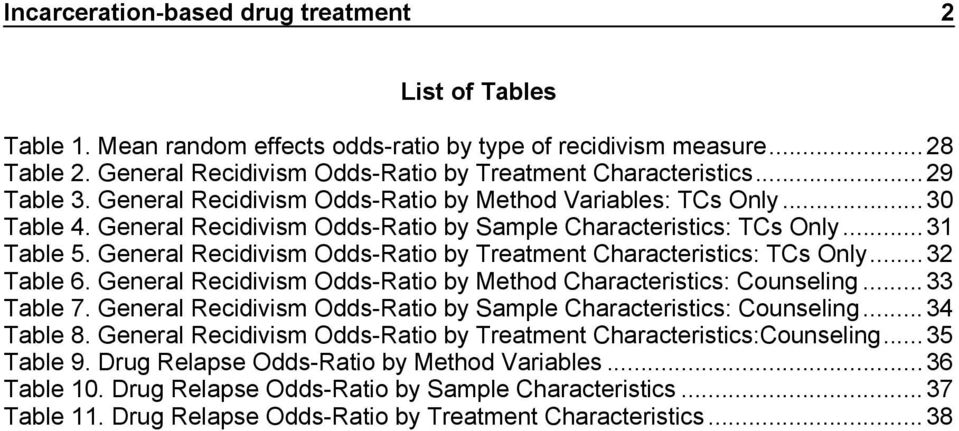
7 Incarceration-based drug treatment 2 List of Tables Table 1. Mean random effects odds-ratio by type of recidivism measure...28 Table 2. General Recidivism Odds-Ratio by Treatment Characteristics...29 Table 3. General Recidivism Odds-Ratio by Method Variables: TCs Only...30 Table 4. General Recidivism Odds-Ratio by Sample Characteristics: TCs Only...31 Table 5. General Recidivism Odds-Ratio by Treatment Characteristics: TCs Only...32 Table 6. General Recidivism Odds-Ratio by Method Characteristics: Counseling...33 Table 7. General Recidivism Odds-Ratio by Sample Characteristics: Counseling...34 Table 8. General Recidivism Odds-Ratio by Treatment Characteristics:Counseling...35 Table 9. Drug Relapse Odds-Ratio by Method Variables...36 Table 10. Drug Relapse Odds-Ratio by Sample Characteristics...37 Table 11. Drug Relapse Odds-Ratio by Treatment Characteristics...38
8 Incarceration-based drug treatment 3 List of Figures Figure 1. General Recidivism Odds-Ratio and 95% Confidence Interval: TCs...40 Figure 2. General Recidivism Odds-Ratio and 95% Confidence Interval: Counseling...41 Figure 3. Drug Relapse Odds-Ratio and 95% Confidence Interval...42

9 Incarceration-based drug treatment 4 1 Background for the Review Research indicates that a substantial proportion of incarcerated offenders are drug dependent. Peters and colleagues (Peters, Greenbaum, Edens, Carter, and Ortiz, 1993) for example, reported that 56% of a sample of Texas inmates were diagnosed as having a substance abuse or dependence disorder during the 30 days prior to their incarceration. Similarly, a survey of jail inmates in Ohio found that 51% were currently drug dependent (Lo and Stephens, 2000). In fact, it is estimated that about 40% of all Americans who clearly need drug treatment are under the supervision of the criminal justice system (Gerstein and Harwood, 1990:7). Drug dependence also appears to be common among incarcerated offenders in many other countries besides of the United States. While international research assessing drug dependence among incarcerated offenders is more limited, the existing evidence indicates that drug dependence is common among incarcerated offenders in many nations. For instance, Bennett (1998) found that 45% of a sample of incarcerated arrestees in five English cities reported being drug dependent at one point in their lives, and 33% reported being currently drug dependent. Likewise, 31% of inmates incarcerated in Canadian federal prisons and 43% of inmates incarcerated in provincial prisons were found to be drug dependent (Pernanen, Cousineau, Brochu, and Sun, 2002). In the absence of effective substance abuse treatment, it is likely that a high proportion of these drug dependent offenders will persist in crime. In fact, statistics reported by the Bureau of Justice Statistics indicate that among probationers, frequent drug abusers were 53% more likely to be re-arrested than non-drug abusers (Bureau of Justice Statistics 1995: 26). As such, the period of time when an offender is incarcerated represents a crucial opportunity to prevent crime by intervening in the cycle of drug abuse and crime. Several aspects of correctional facilities (i.e., prisons, jails) make incarcerationbased substance abuse treatment attractive. First, the availability of drugs is more limited in correctional facilities than in the community, which facilitates detoxification and abstinence during treatment. Second, there is an abundance of time available to focus on treatment and introspection. Perhaps most importantly, correctional facilities have the capacity to mobilize considerable coercive force to encourage substance abusing offenders to engage in treatment, many of whom otherwise would not do so. Incarceration-based drug treatment is diverse, encompassing a broad array of treatment programs, including group and individual psychotherapy, 12-step programs, methadone maintenance and punitive interventions, such as boot camps for drug abusing offenders. For our purposes, the defining features of these programs are that they target substance abusers, intend to reduce substance abuse and other criminal behaviors, and these interventions are based in a correctional facility. Evaluations of existing incarceration-based drug treatment programs predominantly focus on assessing the effectiveness of therapeutic communities (TCs) and group counseling programs (e.g., drug education, 12-step programs, such as AA/NA). A considerably smaller number of evaluations have assessed the effectiveness of boot camps targeted specifically at substance abusers or narcotic maintenance programs. The individual components of TCs vary widely. Yet, several components appear to be common. First, in order to create an environment conducive to rehabilitation, residents in therapeutic communities are most commonly housed in a separate, distinct treatment unit away from non-participating inmates. Second, residents are instrumentally involved in running the therapeutic community including leading treatment sessions, monitoring other residents for rule compliance, maintaining the treatment unit, and resolving disputes. Third, staff and residents of TCs tend to be confrontational with rule
10 Incarceration-based drug treatment 5 violators, but residents also are supportive of each other s struggles to make positive changes. Fourth, the guiding philosophy of TCs is that drug use is symptomatic of more general personal disorders, thus the focus of the treatment is on the underlying disorders and not drug abuse, per se. Counseling programs are somewhat harder to characterize. Generally these programs incorporate elements of group counseling programs (e.g., 12-step programs such as AA/NA), life skills training, cognitive skills training, drug education, and adult basic (academic) education. A key commonality among these programs is their reliance on group based therapies, in which substance abuse and other common problems are discussed among peers in an effort to solve mutual issues. However, not all counseling programs rely on peer therapy; some counseling programs are individual-based where the client and a clinician work together to remedy drug problems. And still other counseling programs include both group and individual counseling. Boot camps are modeled after military basic training. Inmates participate in rigorous exercise regimens, learn military drill and ceremony, wear uniforms, and take on challenge courses (timed obstacle courses). Boot camps are highly structured. From the moment residents wake in the morning until lights out they are constantly engaged in scheduled activities. Boots camps also involve considerable confrontation, but unlike most TC programs confrontations most often occur between correctional staff and inmates with drill instructors disciplining any deviation from established codes of conduct. In theory, the harsh, rigorous nature of boot camp programs serve as a deterrent to future criminal conduct, and the content of these programs instill selfdiscipline within program participants, which also leads to reduced recidivism (Wilson and MacKenzie, 2006). Narcotic maintenance programs (i.e., methadone and levo-alpha-acetyl-methadol maintenance [LAAM]) are very different than other types of incarceration-based drug treatment programs. These programs attempt to reduce the harms associated with heroin dependency (e.g., disease transmission, criminal activity) by prescribing synthetic opioid medication. Unlike heroin, these medications do not produce a euphoric high; instead, methadone and LAAM block the euphoric high produced by opiate use and suppress opiate withdrawal symptoms. Some long term narcotic treatments gradually reduce the amount of medication administered to the client until the opiate dependence is relieved; other programs maintain clients indefinitely. Each of the above types of drug interventions ostensibly has the potential to reduce drug use and other criminal behaviors. Existing systematic reviews of this body of literature, however, only found strong evidence supporting the effectiveness of TC programs (Pearson and Lipton, 1999). In particular, Pearson and Lipton (1999) systematically reviewed the research assessing the effectiveness of corrections-based drug abuse programs in reducing recidivism. Their systematic review conducted a comprehensive search for quasi-experimental and experimental evaluations of interventions carried out in correctional settings [i.e., prison, jail, or a similar residential correctional facility (p. 390)], conducted in any country, and completed between 1968 and 1996, inclusive. Their search revealed 30 studies meeting their eligibility criteria. Pearson and Lipton s synthesis of these 30 studies indicated that TCs were effective in reducing recidivism. Specifically, these authors analyses found that six of the seven TC studies reviewed produced substantial reductions in recidivism; the overall mean weighted r effect size was (p = 0.025) with positive effect sizes ranging from.13 to.28 [one effect size was negative (-0.16)]. In contrast, the mean effect size was not statistically significant for either boot camp or group counseling programs indicating that these programs are no more effective than no treatment. Additionally, Pearson and Lipton found that too few studies evaluated other types of interventions to draw strong conclusions about their effectiveness. Overall, however, these authors characterized the
11 Incarceration-based drug treatment 6 evidence assessing the effectiveness of methadone maintenance, drug education, cognitive-behavioral, and 12-step programs as being promising. In many regards, this systematic review is an extension of the work by Pearson and Lipton. Like the work of Pearson and Lipton, this synthesis systematically and comprehensively reviews the effects of incarceration-based drug interventions on posttreatment drug use and other types of criminal behaviors using meta-analytic procedures. The primary substantive difference between their work and the current systematic review is that this research project uses a more current time frame (1980 through 2004). We believe that this difference is salient for two reasons: (1) more recent evaluations of drug treatment interventions may be more generalizable to current correctional practices; and, (2) numerous evaluations of incarceration-based drug treatment programs have been conducted since Given this difference in time frames, our results may differ somewhat from those of Pearson and Lipton s work. 2 Objectives of the Review The objective of this review was to systematically synthesize the available evidence regarding the effectiveness of incarceration-based drug treatment interventions in reducing drug relapse and recidivism. More specifically, this systematic review focused on addressing the following research questions: Are incarceration-based drug treatment programs effective in reducing recidivism and drug use? Approximately how effective are these programs (i.e., what s the magnitude of the effect)? Are there particular types of drug treatment programs that are especially effective or ineffective? What characteristics differentiate effective programs from ineffective programs? These questions are addressed using quantitative meta-analytic synthesis techniques. 3 Methods 3.1 Criteria for inclusion and exclusion of studies in the review The scope of this review was experimental and quasi-experimental evaluations of incarceration-based drug treatment programs for juveniles and adults that utilized a comparison group. The eligibility criteria for this review were that: (1) the study evaluated an intervention which was administered in a correctional facility (i.e., prison or jail); (2) the intervention specifically targeted substance users; (3) the evaluation used an experimental or two-group quasi-experimental research design which included a notreatment or minimal treatment comparison group; (4) the study reported an outcome measure involving post-release criminal behavior (this concept includes drug use); (5) the intervention was conducted between 1980 and 2004, inclusive; and, (6) the study had to report enough information to calculate an effect size. Note that eligible studies could be published or unpublished. Regarding the first eligibility criterion, our operational definition of correctional facilities included only jails and prisons, and analogous facilities for juveniles. Interventions conducted at half-way houses or community-based residential facilities were not included. It is worth noting that this criterion excluded a small number of noteworthy studies. Specifically, programs designed to be alternatives to incarceration such as those reported in Dynia and Sung (2001) and Knight and Hiller (1997) were excluded by this criterion. The second criterion restricted the focus of this review to studies that specifically targeted drug users. Therapeutic interventions conducted in correctional facilities that were generally available to offenders regardless of an offender s drug history were not included. For instance, Shaw and MacKenzie (1990) evaluated the effects of a boot
12 Incarceration-based drug treatment 7 camp program on a sub-sample of drug using offenders; however, this evaluation was excluded because the boot camp program was not specifically targeted at drug users. Similarly, Jones, Oslon, Karr, and Urbas (2003 and other years) annually report on the effectiveness of a correctional boot camp in Illinois that does not appear to specifically target drug users; thus, this study was also excluded. By contrast, Zhang (2000) evaluated a boot camp program specifically geared towards drug users this evaluation was included in this review. This criterion was necessary, because this review is concerned with incarceration-based drug treatment; without this criterion, the present review would become a review of incarcerated-based interventions comprised of drug users (and given the large proportion of incarcerated offenders who are drug users, such a review runs the risk of becoming a review of nearly all incarceration-based interventions). The third criterion specified that all included evaluations must have a comparison/control group that received no treatment or minimal treatment. Therefore, we excluded quasi-experiments that involved comparisons of two or more interventions that were roughly comparable or whose comparability in terms of effectiveness in reducing recidivism was in dispute (i.e., treatment-treatment comparisons or doseresponse evaluations). For example, the comparison group in Swartz, Lurigio, and Slomka (1996) was constructed by dividing program participants into four groups based upon length of program participation. Evaluations utilizing such comparison groups were not included in this systematic review. Furthermore, we did not include evaluations in which the comparison group was comprised predominantly or solely of dropouts from the intervention of interest. For instance, evaluations such as Field (1985, 1989) and Berggen and Svard (1990), all of which used program drop-outs as the comparison group, were excluded from this systematic review. Evaluations that utilized program drop-outs as the comparison group were excluded, because extant research clearly demonstrates that drug treatment drop-outs and program completers often differ on important observed variables (and most likely on important unobserved variables as well) prior to the intervention (see e.g., Hiller, Knight, and Simpson, 1999); and thus, selection bias is particularly problematic in this research design. The fourth and fifth criteria are largely self-explanatory. It is important to emphasize, however, all studies needed to report a post-release measure of recidivism. This criterion excluded a few notable studies, such as Shewan, Macpherson, Reid, and Davies (1996) and Dolan, Shearer, MacDonald, Mattick, Hall, and Wodak (2003), which reported in-prison outcomes. The last criterion excluded studies that did not report enough information to calculate to an effect size. This criterion was necessary for practical purposes. Unfortunately, several otherwise eligible studies (e.g., Schippers, Van Den Hurk, Breteler, and Meerkerk, 1998; Guerin, 2002) were ruled ineligible based on this last criterion. 3.2 Search strategy for identification of relevant studies The goal of the search strategy was to identify all studies, published or unpublished, meeting the above eligibility criteria. In order to achieve this objective, a multi-pronged search strategy was utilized. The search began by conducting a computerized keyword search of bibliographic databases. In particular, we conducted a search of the following databases: PsychLit, MedLine, NCJRS, Criminal Justice Abstracts, Dissertation Abstracts, Sociological Abstracts, Social Science Citation Index, SocioFile, Conference Papers Index, UnCover, C2 SPECTR, and CINAHL, as well as Google internet searches. The keywords used were: drug treatment, substance abuse treatment, drug counseling, therapeutic community(ies), methadone maintenance, boot

13 Incarceration-based drug treatment 8 camp(s), offenders, residential substance abuse treatment (RSAT), RSAT, drunk driver, drink driver, DUI, DWI, inmates, incarceration, incarcerated, prison, evaluation, outcome evaluation, and recidivism. These keywords were used in various combinations. See Appendix 1 for a more detailed discussion of the specific combinations. We also searched for eligible studies by carefully reading existing studies and literature reviews for unfamiliar studies. In particular, we reviewed the reference lists of existing syntheses to identify eligible studies. Likewise, many of the eligible studies reviewed the work of similar studies; these studies were also assessed for eligibility. Additionally, we reviewed the Digest of Research on Drug Use and HIV/AIDS in Prisons (Flanagan, Arsovksa, Giaime, Goril, Kahl, Król, and Moore, 2004), which abstracts much of the grey literature, particularly European grey research. Further, we searched websites of several prominent research organizations. Specifically, we searched for relevant research reports on the following websites: Correctional Service Canada s research publications page ( the Home Office ( RAND Drug Policy Research Center ( The Urban Institute s crime /justice research page ( and, Vera Institute of Justice publications page ( We also hand searched the titles/abstracts of articles published between 1999 to 2004 in the following journals: Journal of Substance Abuse Treatment, International Journal of Offender Therapy and Comparative Criminology, Journal of Drug Issues, The Prison Journal, Crime & Delinquency, and Journal of Offender Rehabilitation. We chose to hand search these journals because they have a strong track record of publishing relevant studies and many of these journals were not indexed well by the computerized databases we utilized. Finally, our search strategy and its results were reviewed by an information specialist. The information specialist supplied a list of additional studies that appeared relevant. All studies that appeared to be eligible based on a preliminary review of the title and abstract were retrieved and closely scrutinized to determine final eligibility status. Specifically, we reviewed the title and abstract of each search result for strong evidence of ineligibility. That is, we reviewed each title/abstract looking for clear evidence that the study violated one or more of the eligibility criteria (see section 3.1). For example, the first eligibility criterion is that all studies evaluated an intervention administered in a correctional facility; thus, if a title/abstract clearly indicated that the evaluation assessed a program that was not administered in a correctional facility, then the study was not retrieved for further scrutiny. Those studies that could not be ruled as ineligible based on the title/abstract review were retrieved for further assessment of eligibility. Retrieved studies were read closely to determine final eligibility status. 3.3 Description of methods used in the component studies The basic research design for eligible studies was a treatment and comparison group design with a post-release outcome measure of interest, such as post-release criminal offending or drug use. Studies varied with respect to the method of constructing the comparison group; common variations were historical comparisons, adjacent jurisdictions, offenders eligible for the treatment program who chose not to participate, eligible offenders who did not participate due to limited space in the drug treatment program, and random assignment. The studies also varied with respect to the degree to which they employed statistical controls (matching, covariate analysis, etc.) to reduce the threat of selection bias. Included studies exhibited variation in the type of recidivism
14 Incarceration-based drug treatment 9 measure (e.g., arrests, convictions, re-incarceration) and type of drug use measure (e.g., self-report, urinalysis). Our coding forms were designed to capture these methodological variations. 3.4 Criteria for determination of independent studies Several types of statistical dependencies were evident in evaluations of incarceration-based drug treatment programs. One common dependency was created by multiple measures of criminal behavior (e.g., re-arrest, re-conviction, drug use) or multiple follow-up periods for the same indicator of criminal behavior ups (e.g., 6 months, 12 months). Another common dependency was produced by multiple studies reporting findings from the same sample of research participants. The statistical methods detailed below required statistical independence of study findings. We utilized several strategies to maintain the statistical independence of study findings. First, all evaluations (i.e., treatment/comparison contrasts) were cross-checked against one another to ensure that multiple studies reporting the results of the same evaluation do not contribute multiple estimates of program effects to any analysis. Second, in evaluations that report multiple measures of criminal behavior, rather than averaging these multiple outcomes, we applied a set of selection criteria that created five data sets of effect sizes, with a particular evaluation contributing only one effect size to each of the data sets. In the first data set preference was given to effect sizes that: (1) were general (i.e., covered all offense types as opposed to being offense specific), (2) were based on arrest, (3) were dichotomous, and (4) followed sample members for 12 months. We preferred effect sizes meeting these criteria, because arrest is more proximate to offending than the other outcome measures, and because such effect sizes were commonly reported outcome measures. And thus effect sizes meeting these criteria provided a comparable measure of program effectiveness across studies. If no such effect size was available we selected the effect size that most closely matched these criteria. For example, property offenses were more general than violent offenses, effect sizes based on re-convictions were preferred over re-incarcerations, and effect sizes following sample members closest to 12 months were preferred over other effect sizes. Each independent evaluation contributed one, and only one, effect size to this general recidivism data set. This general recidivism data set served as the main data set in the analyses that follow. We also created four more specific data sets: one data set for re-arrest, reconviction, re-incarceration, and drug relapse outcomes. In creating these data sets we had considerably fewer effect sizes to choose from. When multiple effect sizes were available for any of these data sets, preference was given to effect sizes that: (1) were general (i.e., covered all offense types as opposed to being offense specific), (2) were dichotomous, and (3) followed sample members for 12 months. If a study did not report one of these specific types of outcomes, then that study did not contribute to the particular data set. For example, if a study reported only an arrest outcome, then this study would contribute to the arrest data set but not to the re-conviction, re-incarceration, or drug relapse data sets. 3.5 Details of study coding categories The coding forms employed in this review are provided in Appendix 2. These coding forms were structured hierarchically, in order to explicitly recognize the nested nature of effect sizes within studies. Any number of effect sizes could be coded from each evaluation using these forms [see Lipsey and Wilson (2001) for a discussion of this issue].
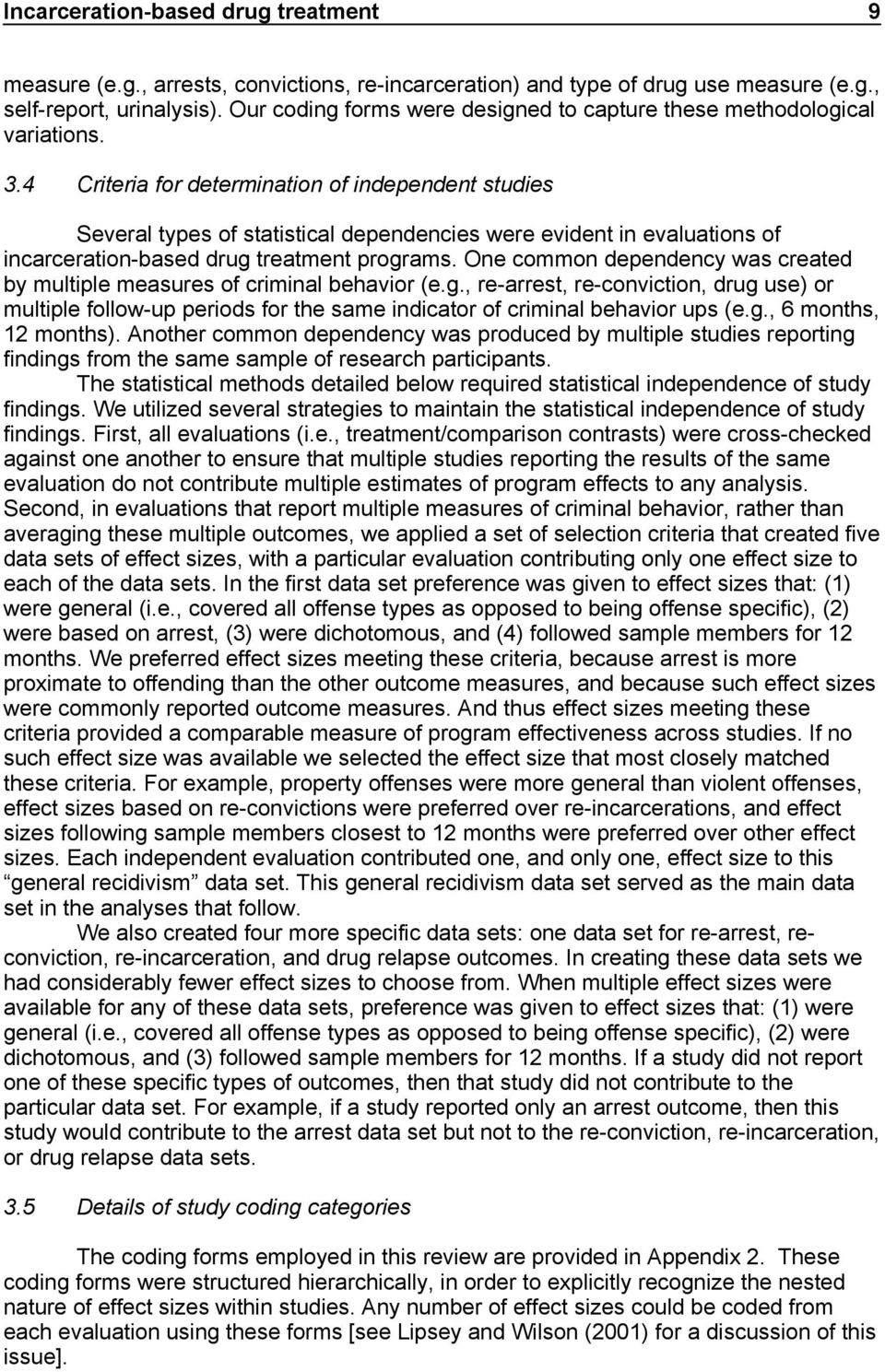
15 X t Incarceration-based drug treatment 10 The coding forms captured key features of the nature of the treatment, research participants, research methodology, outcome measures, and direction and magnitude of observed effects. Two coders assessed each study. Discrepancies between coders were resolved by one of the principal investigators. 3.6 Statistical procedures and conventions An effect size was calculated for each evaluation contrast. We utilized the oddsratio effect size for dichotomous outcomes as this type of effect size is the most appropriate for dichotomous outcome measures (Lipsey and Wilson, 2001). Indicators of criminal behavior based on a continuous scale were coded using the standardized mean difference effect size. These effect sizes were coded in manner such that positive effect sizes indicate the treatment group had a more favorable outcome than the comparison group (i.e., less recidivism or drug use). The odds-ratio effect size (ES or ) is defined as: ES or Pc /(1 Pc) = P /(1 P) t t where P c is the probability of the event (e.g., re-arrest) for the comparison group and P t is the probability of the same event for the treatment group. 5 The standardized mean difference effect size (ES d ) is defined as: ES d X c X t = S where X c is the comparison group mean, Xt is the treatment group mean, and s pooled is the pooled within groups standard deviation, defined as: pooled S pooled = ( n 1) s + ( n 1) s ( n 1) + ( n 1) 2 2 t t c c t c where s is treatment group variance, 2 t 2 sc is the comparison group variance, n t is the treatment group sample size, and n c is the comparison group sample size. Odds-ratio effect sizes and standardized mean difference effect sizes were combined using the method developed by Hasselblad and Hedges (1995). Specifically, mean difference effect sizes were transformed onto the odds-ratio effect size scale. Our analyses of these effect sizes utilized the statistical approach outlined by Lipsey and Wilson (2001) and Wang and Bushman (1999). In particular, we used the inverse variance method and assumed that the true treatment effects varied as a function of both measured (i.e., coded study features) and unmeasured differences between studies. In order to capture unmeasured differences between studies, a random effects component was added to the fixed effects weights calculated for each effect, as follows: v* = v+ v θ 5 Note that we used the inverse of the odds-ratio, as we were interested in obtaining values greater than 1 to reflect a lower probability of recidivism in the treatment group relative to the comparison group.
16 Incarceration-based drug treatment 11 where v is the sampling error variance and v θ is the random effects variance estimated from the distribution of effect sizes. Our analyses employed Stata macro programs written by D. B. Wilson. 6 These macro programs calculated the random effects variance component discussed above and computed various statistics such as the overall mean effect and the homogeneity of effects statistic. Further, we also used these macro programs to determine which study features were associated with observed study effects via meta-analytic analogs to analysis of variance and regression, assuming a mixed-effects model estimated via maximum likelihood (Raudenbush, 1994; Overton, 1998). Our publication bias analyses utilized the metabias (which performs two tests for publication bias) and the metatrim (which conducts a statistical correction for publication bias) Stata macro programs written by Thomas J. Steichen (both of these macros are available via Stata s net install command). Finally, we conducted power analyses utilizing the methods described in Hedges and Pigott (2001). 3.7 Treatment of qualitative data We did not include qualitative research in this systematic review. However, we are open to suggestions from and collaboration with researchers specializing in such techniques in future updates of this synthesis. 4 Findings 4.1 Description of Eligible Studies Our search strategy uncovered 233 potentially eligible studies. We were able to obtain copies of 229 of these studies. Of the retrieved studies, 53 unique studies met our eligibility criteria. These 53 unique studies reported the results of 66 independent evaluations, as one study may contain multiple evaluations. In particular, nine unique studies reported the results of multiple evaluations. Seven of these studies reported the results of two evaluations, one study reported the results of three evaluations, and one study (Tunis et al., 1995) reported results from five independent evaluations. The 66 evaluations coded from the 53 unique studies are the unit of analysis for this synthesis. The overwhelming majority of the included evaluations were conducted in the United States. Fifty-eight of these evaluations were conducted in the United States, three evaluations were conducted in Australia, three other evaluations were conducted in Canada, one evaluation was conducted in the United Kingdom, and one evaluation was conducted in Taiwan. Approximately, half of the evaluations (32) were coded from studies published as journal articles or book chapters, and the other 34 evaluations were coded from unpublished technical reports and government documents. In regards to date of publication, a little over half of the evaluations (34) were coded from studies made available after Interestingly, two-thirds of the evaluations were coded from studies made available after 1996 the latest date eligible for inclusion in Pearson and Lipton s (1999) review; thus, the vast majority of the evaluations included in the current research were not included in the earlier review. 6 As of this writing, David Wilson has made these macro programs available to the public at:

17 Incarceration-based drug treatment Overall Mean Effects Across Studies Sixty-five of the 66 evaluations reported at least one measure of post-release offending (one evaluation reported only drug use outcomes). After applying our effect size selection criteria (see section 3.4 for a description of these criteria), approximately 83% of the 65 general recidivism odds-ratios indicated that the treatment group had less recidivism than the comparison group. Examination of the distribution of general recidivism odds-ratios suggested that one evaluation was an outlier (0.016) 7 ; instead of dropping this effect size from the analyses, we decided to Windorize this effect size to the 5 th percentile. Table 1 displays the random effects mean odds-ratio for the general recidivism measure. The mean odds-ratio for this outcome was 1.37 with the 95 percent confidence interval ranging from a lower bound of 1.24 to an upper bound of 1.51, indicating that, on average, participation in these drug treatment programs was associated with a reduction in post-treatment offending. A more intuitive sense of this effect size can be gained by transforming this effect size into a percentage. For heuristic purposes, we assumed a 35% recidivism rate for the comparison group (which was the unweighted average rate of recidivism for all comparison groups), given this assumption the overall mean oddsratio translates into a recidivism rate of approximately 28% for the treatment group; thus, participation in treatment was associated with a 20% reduction in recidivism (i.e., 28% 35% 20% ). 8 35% The distribution of the general recidivism measure exhibited considerably more variability than expected by sampling error alone (Q = , df = 64, p < 0.001). This finding suggested that features of the treatment programs, research methodology, and/or characteristics of the sample may moderate the size of the observed treatment effect. Analyses in the subsequent sections tested this possibility. Table 1 also displays random mean odds-ratios for the four outcome specific data sets (see section 3.4 for a description of these data sets). From this table it is apparent that evaluations utilizing re-convictions as the outcome measure exhibited the largest mean odds-ratio, whereas evaluations utilizing re-incarceration measures of recidivism had the smallest mean odds-ratio. We believe that our general recidivism outcome measure is the best available, as it is the indicator of criminal behavior least likely to be differentially affected by criminal justice system actors based on the study condition of the offender. Furthermore, it is the most comparable indicator of program effectiveness across studies, and, thus, we utilized this measure in the analyses reported in section 4.2 (below). Interestingly, only 20 of the 66 independent evaluations assessed the effect of drug treatment on post-release drug use (see Figure 3). The random effects mean oddsratio for these 20 independent evaluations was 1.28 (with a 95% confidence interval of 0.92 to 1.78). Thus, this mean odds-ratio was not statistically significant; this nonsignificant finding was not due to a lack of statistical power, as our post-hoc power analyses indicated that the power of this analysis to detect a small effect (i.e., a logged odds-ratio of 0.20) was Additionally, the distribution of effect sizes exhibited more 7 This odds-ratio converts into a logged odds-ratio of -4.61; no other log odds-ratio had an absolute value of 2 or more. This odds-ratio came from an evaluation of a narcotics maintenance program (Magura et al., 1993 female sample). 8 If we assumed a 50% rate of recidivism for the comparison group, then this effect size translates into a 42% recidivism rate for the treatment group, a 16% reduction in recidivism. 9 All power analyses were conducted using a two-tailed significance level of All power analyses utilized observed data (i.e., standard errors, number of studies, etc.); thus, these power analyses were post-hoc.

18 Incarceration-based drug treatment 13 variability than expected by sampling error alone (Q = , df = 19, p < 0.001), which again suggested that moderator variables may explain some of the variability in the drug relapse odds-ratios. 4.3 Analysis of Moderator Effects The above analyses indicated that the effect size distributions displayed more variability than expected by chance alone. This finding suggested that there may be important differences in research methodology, sample, and/or interventions that may account for some effect size variability. We tried to capture important differences between studies by coding information from each of the included studies; however, our ability to code many relevant study features was limited by the quality of the descriptions provided by the primary authors. The first moderator variable examined was primary type of intervention. As noted above (see section 1) the coded evaluations involved four types of primary treatment interventions: TCs, counseling programs, boot camps, and narcotic maintenance programs. The majority of the evaluations concerned TCs (30). Another sizeable portion of evaluations (25) assessed counseling programs. Only a handful of evaluations assessed boot camps or narcotic maintenance programs, 2 and 6, respectively. And three evaluations were not described in enough detail to allow categorization. Table 2 reveals the mean general recidivism odds-ratio varied considerably by type of primary intervention (Q = 6.36, df = 3, p = 0.09). On average, TC and counseling interventions exhibited statistically significant reductions in general recidivism. In particular, evaluations of TC programs had a mean odds-ratio of 1.38 (with a 95% confidence interval of 1.17 to 1.62), which translates into a 28% recidivism rate for participants in these programs, if we continue to assume a 35% recidivism rate for the comparison group. Evaluations of counseling programs had a mean odds-ratio of 1.50 (with a 95% confidence interval of 1.25 to 1.79). This means odds-ratio translates into a 26% recidivism rate for counseling participants, assuming a 35% recidivism rate for the comparison group. On the other hand, the mean odds-ratios for both boot camps and narcotic maintenance programs were not statistically different from 1 indicating that participation in these programs generally was not associated with statistically significant reductions in recidivism. More specifically, two evaluations of boot camp programs for drug offenders were included in the present research. Both of these evaluations yielded small, positive logged odds-ratios (0.06 and 0.14); neither of these logged odds-ratios were statistically significant. The fixed effects mean odds-ratio for the two boot camp evaluations was 1.10 (with a 95% confidence interval of 0.61 to 1.97). The finding regarding boot camps lack of effectiveness is not due to a lack of statistical power. In fact, post-hoc power analysis indicated that the power of this analysis to detect a small effect (i.e., a logged odds-ratio of 0.20) was 0.93, which exceeds the standard benchmark of Somewhat similarly, five odds-ratios were extracted from evaluations of narcotic maintenance programs. Four of the five logged odds-ratios were negative. The random effects mean odds-ratio for narcotic maintenance evaluations was 0.84 (with a 95% confidence interval of 0.54 to 1.30). The statistical power of this analysis to detect a small effect was very low; thus, the small number of boot camp evaluations did not limit statistical power, but the small number of incarceration-based narcotic maintenance programs did limit statistical power. As a result, little can be said about the potential of incarceration-based narcotic maintenance programs beyond that the limited existing evidence is discouraging. Preliminary moderator analyses indicated that the association between oddsratio and several moderator variables depended on whether the odds-ratio came from an
19 Incarceration-based drug treatment 14 evaluation of a TC or counseling program. Therefore, we conducted separate moderator analyses for TCs and counseling programs, in a series of parallel analyses. The oddsratios concerning boot camp and narcotic maintenance programs were set aside for these analyses. It is important to note that the moderator analyses presented in Tables 3 through 11 have limited statistical power. The statistical power to detect a small effect for these moderator analyses ranged from approximately 0.10 to The limited statistical power of these analyses means that only contrasts with large effects were likely to be statistically significant; stated differently, many substantively meaningful effects were not statistically significant at conventional levels of significance (i.e., p < 0.05), as a result of these analyses low statistical power. To combat the low statistical power of these analyses, we employ two strategies. First, we interpret as statistically significant any contrast that has a probability of occurring by chance alone of less than 10% (i.e., p < 0.10). Second, instead of relying solely on statistical significance, in the following moderator analyses we also discussed substantively significant effects; that is, effects that appear to be substantively large, even if not statistically significant, were treated as noteworthy. We defined substantively significant relationships based on the magnitude of the difference between categories in terms of the logged odds-ratio. Specifically, if a moderator variable s categories differed by a logged odds-ratio of 0.20 or more and each category had a least five evaluations, then we considered such differences as substantively significant. Similarly, if one category of a moderator had less than five evaluations and the difference between categories was 0.40 or more, then we considered such differences as substantively significant. Another limitation of the moderator analyses presented in Tables 3 through 11 is that all of these analyses were bivariate. Unfortunately, the sparseness of the data sets utilized made multivariate data analysis highly problematic and the results of such analyses were very sensitive to small alternations (e.g., deleting one observation). As a result, these bivariate findings are vulnerable to spuriousness; consequently, the results of the moderator analyses should be viewed as suggestive. Tables 3, 4, and 5 display the results of series of bivariate moderator analyses using odds-ratios from TCs only. Table 3 examines variation in the general recidivism odds-ratios by coded methodological features. The first moderator variable, overall method quality, was a four-point ordinal measure of the internal validity of each evaluation. This four-point categorization was similar to the University of Maryland s Scientific Methods Scale (see Farrington et al., 2002). The lowest level of method quality was weak quasi-experimental designs; these studies utilized a comparison that lacks comparability to the treatment group before the intervention. The next level of method quality, standard quasi-experiment, was assigned to evaluations characterized by research designs that used a comparison group that was slightly different from the treatment group on important observed variables before the intervention. Rigorous quasi-experiments were characterized as evaluations involving treatment and comparison groups that were highly comparable on important observed variables (e.g., age, gender, prior criminal history, prior drug use), or evaluations that employed slightly different treatment and comparison groups but also used multivariate analyses that controlled for pre-existing differences on important variables. The highest level of 10 If we increase the significance level to 0.10, the statistical power to detect a small effect for these moderator analyses ranges from approximately 0.20 to This level of statistical power is still well below the standard of And thus, statistical power is still limited even if the 0.10 level of significance is utilized.

20 Incarceration-based drug treatment 15 method quality, experimental designs, randomly assigned research participants to conditions and did not have attrition problems (see the coding forms in Appendix 2). 11 Based on this variable, most of the included evaluations were methodologically weak. Of the 30 TC evaluations, 11 (37%) were rated as rigorous quasi-experiments or experimental designs. The modal method ranking was standard quasi-experiment ; 13 of the 30 evaluations earned this ranking. It is important to note that the mean oddsratios for the three highest levels of method quality were statistically significant indicating that the effectiveness of TCs was not confined to only methodologically weak evaluations. The mean odds-ratio for each level of method quality exhibited a weak positive trend. That is, evaluations with the lowest method quality rating had the smallest oddsratios and evaluations with the highest method quality had higher odds-ratios. The metaanalytic analog to analysis of variance indicated that the variation between levels of quality method was statistically significant (p = 0.099). This finding suggests that more methodologically rigorous evaluations found stronger evidence of treatment effectiveness. Table 3 also indicates that few of the coded methodological features were associated with treatment effectiveness among the evaluations of TC programs. Methodological factors such as random assignment, subject-level matching, and the use of multivariate analyses to control for pre-existing differences between treatment and comparison groups all were not associated with effect size. Additionally, Table 3 reveals that nearly all of the mean odds-ratios were statistically significant, which suggests that the finding of the effectiveness of TCs was robust to methodological variations. The moderator analysis found that published studies exhibited statistically larger effect sizes than unpublished studies. This finding is an indication of publication bias in evaluations of TC programs. As a further test for the presence of publication bias in these evaluations, we conducted statistical tests for publication bias. Specifically, we conducted both the Begg and Mazumdar (1994), and the Egger, Smith, Schneider, and Minder (1997) tests for publication bias. The more statistically powerful Egger et al. method found evidence of publication bias; that is, the test of the null hypothesis that the intercept for the regression of the standardized effect estimates against their precision equals zero was rejected (p = 0.001). Given this finding, we conducted Duval and Tweedie s (1997) trim and fill method for accounting for publication bias. This procedure added seven effect sizes to the distribution, which in turn lowered the mean random effects odds-ratio to 1.21 with a 95% confidence interval of 1.08 to 1.36 (Q = , df = 36, p < 0.001); this publication bias adjusted mean odds-ratio translates into a recidivism rate of approximately 31% for the treatment group, if we continue to assume a 35% recidivism rate for the comparison group. Table 4 presents the results of a similar bivariate analysis between the general recidivism odds-ratios and sample characteristics. Four sample characteristics were consistently reported by evaluators: age group (juvenile or adult), gender composition of sample, racial composition of sample, and type of offenders (violent/non-violent offenders). Our analyses found that none of the sample characteristics displayed a statistically or substantively significant relationship with effect size. Once again, however, it is important to note that nearly all of the mean odds-ratios in Table 4 were statistically significant and at least modestly large, which suggests that TC programs were effective with many different types of samples. 11 We coded two types of attrition problems: total and differential. Total attrition problems were defined as overall attrition of 20% or greater, or if the primary authors indicated that attriters differed substantially from non-attriters. Differential attrition problems were defined similarly; that is, differential attrition of 20% or greater, or if the primary authors indicated that attrition substantially reduced the comparability of the treatment and comparison group.

21 Incarceration-based drug treatment 16 Characteristics of each intervention were also coded. Bivariate analyses analyzing these characteristics as moderator variables are shown in Table 5. Six treatment characteristics were coded: mandatory aftercare, location of intervention (i.e., jail vs. prison), length of treatment, program maturity, nature of participation (i.e., strictly voluntary vs. at least some non-voluntary participation), and program capacity/average number of participants (not shown in Table 5). Once again, none of the coded characteristics were statistically or substantively related with effect size, and evidence of the effectiveness of TCs was largely robust to coded variation in treatment features. Specifically, although evaluations of TC programs that mandated aftercare treatment, or programs that required all participants to volunteer for treatment produced somewhat larger effect sizes than other programs, these features were not related to magnitude of effect size. Similarly, programs with short treatment durations were somewhat less effective than longer programs, but this difference also was not significant. In fact, these evaluations found evidence of the effectiveness of TC programs regardless of these coded differences in treatment characteristics. Thus, once more the evidence suggests that participants in TC programs had lower recidivism rates than non-participants, regardless of several prominent evaluation characteristics. A parallel set of analyses were conducted for counseling programs (see Tables 6, 7, and 8). Again, most evaluations were methodologically weak. Over two-thirds of evaluations (72%) were rated as either weak or standard quasi-experiments. Only two evaluations employed an experimental design that randomly assigned offenders to treatment conditions. This lack of methodological rigor is particularly problematic as evaluations rated higher on this scale exhibited smaller non-statistically significant mean odds-ratios than evaluations rated lower on the scale. In particular, evaluations rated as rigorous quasi-experiments or experimental designs exhibited mean effect sizes of 1.33 (with a 95% confidence interval of 0.86 to 2.06) and 1.09 (with a 95% confidence interval of 0.52 to 2.30), respectively; neither of which were statistically significant. While the statistical test comparing the mean odds-ratios for the various levels of methodological rigor was not statistically significant, this finding suggests that the strongest evidence of the effectiveness of counseling programs in reducing re-offending came from methodologically weak evaluations. The only methodological variables that had a statistically significant association with magnitude of odds-ratio were differential attrition and multivariate data analysis (see Table 6). In particular, evaluations that employed multivariate data analysis yielded larger effect sizes than evaluations that did not utilize such techniques. And evaluations in which differential attrition was apparent had statistically smaller odds-ratios than evaluations without substantial differential attrition. Further, while not statistically significant, evaluations without considerable overall attrition had substantively larger mean effect sizes than other evaluations. It is also worth noting that the moderator distinguishing published from unpublished studies found no difference in the magnitude of the effect for counseling programs (see Table 6). This finding comports with other tests of publication bias (not reported in the tables); that is, both the Begg and Mazumdar, and Egger et al. tests for publication bias retained their null hypotheses (no publication bias). Two of the four moderator variables capturing sample differences were statistically related to effect size (Table 7). Evaluations with adult samples had a statistically larger mean odds-ratio than evaluations using juvenile samples. Likewise, evaluations that employed female samples exhibited statistically larger mean odds-ratio than either male samples, or mixed gender samples; in fact, post hoc contrasts indicated that all three mean odds-ratios statistically differed from one another. Racial composition of sample had no substantive or statistical relationship to effect size. In fact, counseling programs were effective in reducing re-offending in all of the racial categories.
22 Incarceration-based drug treatment 17 In regards to treatment characteristics, mature counseling programs and voluntary programs exhibited statistically larger effect sizes than other evaluations (see Table 8). None of the other coded treatment characteristics had a substantive or statistical relationship with effect size. In concordance to the analyses of TC evaluations, programs with a mandatory aftercare component had a larger mean effect size than programs without aftercare, but the difference was not significant. Once again, it is important to note that the moderator variable analysis had low statistical power, so this finding (and other non-significant findings) may be due to a lack of power. Lastly, we examined the moderator variables ability to predict variation in drug relapse odds-ratios (see Tables 9, 10, and 11). Because of the limited number of effect sizes involved in these analyses (19), we were unable to conduct separate analyses for the different types of primary treatment; therefore, in these analyses all types of primary treatment were analyzed together. Perhaps the most striking revelation from the moderator analyses of drug relapse outcomes is that few of the mean effect sizes were statistically significant. This finding suggests that, with few exceptions, regardless of variations in methodology, sample, or treatment characteristics incarceration-based drug treatment does not generally reduce post-release drug use. Only evaluations with the following characteristics exhibited oddsratios statistically greater than 1 (indicating a significant reduction in drug use): use of random assignment or lack of subject-level matching, samples comprised of adults or females, and programs that were voluntary, had mandatory aftercare, or were based on the TC model. Further, only the methodological quality, age group of sample, and presence of aftercare moderator variables were statistically significant; whereas, the subject-level matching, gender composition, type of treatment, and voluntary participation moderator variables were all substantively significant. Last, it is important to note that while published evaluations exhibited somewhat larger effect sizes than unpublished evaluations, statistical tests for publication bias did not indicate the presence of publication bias in these evaluations. 5 Conclusions Overall, this meta-analytic synthesis of evaluations of incarceration-based drug treatment programs found that such programs are modestly effective in reducing recidivism. Eight-three percent of the general recidivism odds-ratios favored the treatment group over the comparison group. Moreover, the random effects mean oddsratio was 1.37, which translates into a 28% recidivism rate for the treatment group, if we assume a 35% rate of recidivism for the comparison group. Yet, the effectiveness of treatments programs clearly varied by type of treatment. In concordance with existing reviews (e.g., Wilson, MacKenzie, and Mitchell, 2005; Pearson and Lipton, 1999), we found no evidence that participation in boot camp programs reduced recidivism or drug use. While the number of independent evaluations of boot camp programs for drug offenders was small, given the consistency of our findings to other research on boot camps, it appears unlike that boot camp programs generally reduce recidivism. Similarly, we found limited evidence of the effectiveness of incarceration-based narcotic maintenance programs in reducing either re-offending or drug use. The scant available evidence suggests that narcotic maintenance programs do not reduce reoffending; in fact, program participants had somewhat higher re-offending rates than non-participants in four out of the five available evaluations. By contrast, all existing evaluations found somewhat lower rates of post-release drug use among participants than non-participants. Thus, incarceration-based narcotic maintenance programs may reduce drug use, but not re-offending. The limited statistical power of the analyses,
23 Incarceration-based drug treatment 18 however, undermines our ability to draw firm conclusions in this area of research. Continued research investigating the effectiveness of these programs would be a significant contribution to the knowledge base. The most consistent evidence of treatment effectiveness came from evaluations of TC programs. These programs consistently showed post-release reductions in reoffending and drug use. This finding was robust to methodological variation. In fact, even among the most rigorous evaluations, participation in TC programs was consistently related to reductions in re-offending. We also found that TCs were effective in several different types of samples (e.g., female only samples, male only samples, and adult samples), which suggests that TCs can be applied to wide-range of offenders. While TCs in general were clearly effective, TCs that combined incarceration-based treatment with mandatory post-release aftercare exhibited enhanced effectiveness in reducing reoffending. However, the possibility of publication bias in the available body of TC evaluations tempers our findings. That is, there was evidence of publication bias in this area of research that apparently over-estimated the effectiveness of TC programs. The evidence regarding counseling programs indicated that these programs were effective in reducing re-offending but not drug use. Counseling programs appeared to be most effective in reducing re-offending when targeted towards adult or female offenders. The evidence also indicated that counseling programs that were strictly voluntary appeared to be more effective in reducing re-offending than other counseling programs. However, the strongest evidence of the effectiveness of counseling programs came from evaluations that were methodological weak. Further, while only a few evaluations of counseling programs assessed their effects on drug use, these existing studies did not generally find that participation in counseling programs reduced drug use. Interestingly, all of the moderator analyses indicated that treatment programs that mandated aftercare after release from incarceration produced larger effect sizes than programs that do not. In all but the analyses of drug use effect sizes, these differences were not significant. However, given these analyses lack of statistical power, sensitivity to the deletion or inclusion of a single evaluation, and the existing evidence that finds aftercare to strengthen the effectiveness of such interventions, we believe the inclusion of a mandatory aftercare component most likely does intensify the effectiveness of incarceration-based drug treatment programs. The implications of this research for policy-makers are clear. Policymakers seeking effective interventions for incarcerated substance abusers are most likely to find success with programs that intensively focus on the multiple problems of substance abusers, such as TC programs. Policymakers should expect smaller treatment benefits from less intensive treatment programs. Further, based on the existing literature there is no evidence that correctional boot camps targeted at substance abusers reduce either post-release offending or drug use; and thus, policy-makers should not expect such programs to reduce recidivism. We believe that this research also has implications for researchers. Specifically, we believe that while the extant research clearly supports the effectiveness of certain programs, there is a lack of understanding concerning which particular components of treatment programs are most important, and which combination of components are most effective. Further, the general methodological weakness of this area of research leaves findings vulnerable to alternative explanations (i.e., reductions in recidivism could be due to factors other than the intervention). Beneficial future research should address these issues.
24 Incarceration-based drug treatment 19 6 Plans for Updating the Review We plan to update this systematic review every three years in accordance with Campbell Collaboration guidelines. 7 Acknowledgements We would like to thank the Nordic Campbell Center and the Jerry Lee Foundation for partial support of this project. We would also like to thank Matthew Makarios for his assistance in coding many of the included evaluations. 8 Statement Concerning Conflict of Interest None of the authors have any financial interests in any existing or planned incarceration-based drug treatment or any competing types of interventions for drug using offenders.
25 Incarceration-based drug treatment 20 9 References Begg, Colin B. and Madhuchhanda Mazumdar "Operating Characteristics of a Rank Correlation Test for Publication Bias." Biometrics 50(4): Bennett, Trevor Drugs and Crime: The Results of Research on Drug Testing and Interviewing Arrestees. London: Home Office. Berggren, O. and H. Svard Osteraker Project: A Further Follow-Up of the Drug Misuser Treatment Programme at Osterake Prison. Sweden: Swedish Prison and Probation Administration. Bureau of Justice Statistics Drugs and Crime Facts, 1994: A Summary of Drug Data Published in Rockville, MD: U.S. Department of Justice, Bureau of Justice Statistics. Dolan, Kate A., James Shearer, Margaret MacDonald, Richard P. Mattick, Wayne Hall, and Alex D. Wodak "A Randomised Controlled Trial of Methadone Maintenance Treatment Versus Wait List Control in an Australian Prison System." Drug and Alcohol Dependence 72(1): Duvall, Sue and Richard Tweedie "A Nonparametric "Trim and Fill" Method of Accounting for Publication Bias in Meta-Analysis." Journal of the American Statistical Association 95(449): Dynia, Paul and Hung-En Sung "The Safety and Effectiveness of Diverting Felony Drug Offenders to Residential Treatment As Measured by Recidivism." Criminal Justice Policy Review 11(4): Egger, Matthias, George D. Smith, Martin Schneider, and Christoph Minder "Bias in Meta-Analysis Detected by a Simple, Graphical Test." British Medical Journal 315: Farrington, David P., Denise C. Gottfredson, Lawrence W. Sherman, and Brandon C. Welsh "The Maryland Scientific Methods Scale." Pp in Evidence- Based Crime Prevention, Editors Lawrence W. Sherman, David P. Farrington, Brandon C. Welsh, and Doris L. MacKenzie. New York, NY: Routledge. Field, Gary "The Cornerstone Program: A Client Outcome Study." Federal Probation 49(2): A Study of the Effects of Intensive Treatment on Reducing the Criminal Recidivism of Addicted Offenders. Unpublished Manuscript: Oregon Correctional Treatment Programs. Flanagan, Clare, Jana Arsovska, Alison J. Giaime, Mara Goril, Christian Kahl, Artur Król, and Bianca Moore Digest of Research on Drug Use and HIV/AIDS in Prisons. London: The European Network for Drug Services in Prison, Cranstoun Drug Services. Gerstein, Dean R. and Hernick J. Harwood, Editors Treating Drug Problems: A Study of the Evolution, Effectiveness, and Financing of Public and Private Drug Treatment Systems. Washington, D.C.: National Academy Press.
26 Incarceration-based drug treatment 21 Guerin, Paul Outcome Evaluation of the New Mexico Corrections Department Genesis Residential Substance Abuse Treatment Program for State Prisoners. Albuquerque, NM: Institute for Social Research, University of New Mexico. Hasselblad, Vic and Larry V. Hedges "Meta-Analysis of Screening and Diagnostic Tests." Psychological Bulletin 117(1): Hedges, Larry V. and Therese D. Pigott "The Power of Statistical Tests in Meta- Analysis." Psychological Methods 6(3): Hiller, Matthew L., Kevin Knight, and D. D. Simpson "Risk Factors That Predict Dropout from Corrections-Based Treatment for Drug Abuse." The Prison Journal 79(4): Jones, Robert J., Bruce W. Olson, Steven P. Karr, and Sheila M. Urbas Impact Incarceration Program: 2003 Annual Report to the Governor and General Assembly. Springfield, IL: Illinois Department of Corrections. Knight, Kevin and Matthew L. Hiller "Community-Based Substance Abuse Treatment: A 1-Year Outcome Evaluation of the Dallas County Judicial Treatment Center." Federal Probation 61(2): Lipsey, Mark W. and David B. Wilson Practical Meta-Analysis. Thousand Oaks, CA: Sage Publications. Lo, Celia C. and Richard C. Stephens "Drugs and Prisoners: Treatment Needs on Entering Prison." American Journal of Drug and Alcohol Abuse 26(2): Magura, Stephen, Andrew L. C. Rosenblum, and Herman Joseph "The Effectiveness of in-jail Methadone Maintenance." Journal of Drug Issues 23(1): Overton, Randall C "A Comparison of Fixed-Effects and Mixed (Random-Effects) Models for Meta-Analysis of Moderator Variable Effects." Psychological Methods 3(3): Pearson, Frank S. and Douglas S. Lipton "A Meta-Analytic Review of the Effectiveness of Corrections-Based Treatment for Drug Abuse." The Prison Journal 79(4): Pernanen, Kai, Marie-Marthe Cousineau, Serge Brochu, and Fu Sun Proportions of Crimes Associated With Alcohol and Other Drugs in Canada. Ottawa, ON: Canadian Centre on Substance Abuse. Peters, Roger H., Paul E. Greenbaum, John F. Edens, Chris R. Carter, and Madeline M. Ortiz "Prevalence of DSM-IV Substance Abuse and Dependence Disorders Among Prison Inmates." American Journal of Drug and Alcohol Abuse 24(4): Raudenbush, Stephen W "Random Effects Models." Pp in The Handbook of Research Synthesis, Editors Harris Cooper and Larry V. Hedges. New York, NY: Russell Sage Foundation.
27 Incarceration-based drug treatment 22 Schippers, Gerard M., Arie A. van den Hurk, Marinus H. M. Breteler, and Gert-Jan Meerkerk "Effectiveness of a Drug-Fee Detention Treatment Program in a Dutch Prison." Substance Use & Misuse 33(4): Shaw, James W. and Doris L. MacKenzie "The One-Year Community Supervision Performance of Drug Offenders and Louisiana DOC-Identified Substance Abusers Graduating From Shock Incarceration." Journal of Criminal Justice 20(6): Shewan, David, A. Macpherson, Margaret M. Reid, and John B. Davies "The Impact of the Edinburgh Prison Drug Reduction Programme." Legal and Criminological Psychology 1(1): Swartz, James A., Arthur J. Lurigio, and Scott Slomka "The Impact of IMPACT: An Assessment of the Effectiveness of the Cook County Jail's Substance Abuse Treatment Program." Crime and Delinquency 42(4): Tunis, Sandra, James Austin, Mark Morris, Patricia Hardyman, and Melissa Bolyard Evaluation of Drug Treatment in Local Corrections: Final Report. San Francisco, CA: National Council on Crime and Delinquency. Wang, Morgan C. and Brad J. Bushman Integrating Results Through Meta- Analytic Review Using SAS Software. Cary, NC: SAS Institute, Inc. Wilson, David B. and Doris Layton MacKenzie "Boot Camps." Pp in Preventing Crime: What Works for Children, Offenders, Victims, and Places, Editors Brandon C. Welsh and David F. Farrington. New York: Springer. Wilson, David B., Doris L. MacKenzie, and Fawn N. Mitchell Effects of Correctional Boot Camps on Offending. A Campbell Collaboration systematic review, available at: Zhang, Sheldon An Evaluation of the Los Angeles County Juvenile Drug Treatment Boot Camp: Final Report. San Marcos, CA: California State University.
28 Incarceration-based drug treatment Studies Included in Systematic Review Anglin, M. D., Michael L. Prendergast, David Farabee, and Jerome Cartier Final Report on the Substance Abuse Program at the California Substance Abuse Treatment Facility and State Prison at Corcoran. Los Angeles, CA: The UCLA Integrated Substance Abuse Program. Aos, Steve Washington State's Family Integrated Transitions Program for Juvenile Offenders: Outcome Evaluation and Benefit-Cost Analysis. Olympia, WA: Washington State Institute for Public Policy. Crundall, Ian and Kaye Deacon "A Prison-Based Alcohol Use Education Program: Evaluation of a Pilot Study." Substance Use & Misuse 32(6): Daley, Marilyn, Craig T. Love, Donald S. Shepard, Cheryl B. Petersen, Karen L. White, and Frank B. Hall "Cost Effectiveness of Connecticut's in-prison Substance Abuse Treatment." Journal of Offender Rehabilitation 39(3): Darabi, G. A Psychological Impact of Tier Programs: An Outcome Evaluation. Tallahassee, FL: Bureau of Planning, Research, and Statistics. Dowden, Craig and Kelley Blanchette "An Evaluation of the Effectiveness of Substance Abuse Programming for Female Offenders." International Journal of Offender Therapy and Comparative Criminology 46(2): Dugan, John R. and Ronald S. Everett "An Experimental Test of Chemical Dependency Therapy for Jail Inmates." International Journal of Offender Therapy and Comparative Criminology 42(4): Eisenberg, Michael, Lisa Riechers, and Nancy Arrigona Evaluation of the Performance of the Texas Department of Criminal Justice Rehabilitation Tier Programs. Austin, TX: Criminal Justice Policy Council. Eisenberg, Michael and Tony Fabelo "Evaluation of the Texas Correctional Substance Abuse Treatment Initiative: The Impact of Policy Research." Crime & Delinquency 42(2): Finigan, Michael W., Nancy Barron, and Shannon Carey "Effectively Assessing and Preparing Inmates for Community Substance Abuse Treatment: The Portland Target Cities Project in-jail Intervention." Pp in Clinical Assessment and Substance Abuse Treatment: The Target Cities Experience, Editors Richard C. Stephens, Christy K. Scott, and Randolph D. Muck. Albany, NY: State University of New York Press. Gordon, Jill A Barrett Juvenile Correctional Center: Is It Effective. Richmond, VA: Virginia Commonwealth University. Gransky, Laura A. and Robert J. Jones Evaluation of the Post-Release Status of Substance Abuse Program Participants. Chicago, IL: Illinois Criminal Justice Information Authority.
29 Incarceration-based drug treatment 24 Hanson, Gina Pine Lodge Intensive Inpatient Treatment Program. Olympia, WA: Planning and Research Section, Washington State Department of Corrections. Hartmann, David J., James L. Wolk, L. S. Johnston, and Corey J. Colyer "Recidivism and Substance Abuse Outcomes in a Prison-Based Therapeutic Community." Federal Probation 61(4): Hughey, Ray and LLoyd W. Klemke "Evaluation of a Jail-Based Substance Abuse Treatment Program." Federal Probation 60(4): Hume, Sarah and Angela Gorta Results of Community Urinalyses for Clients on the NSW Prison Methadone Program. Study 6. New South Wales, Australia: new South Wales Department of Corrective Services. Hume, Sarah and Angela Gorta Effects of the N.S.W. Prison Methadone Program on Criminal Recidivism and Retention in Methadone Treatment. New South Wales, Australia: New South Wales Department of Corrective Services. Inciardi, James A., Steven S. Martin, Clifford A. Butzin, Robert M. Hooper, and Lana D. Harrison "An Effective Model of Prison-Based Treatment for Drug-Involved Offenders." Journal of Drug Issues 27(2): Johnson, Sara L., Jennifer T. C. van de Ven, and Brian A. Grant Institutional Methadone Maintenance Treatment: Impact on Release Outcome and Institutional Behaviour (Research Rep. No. 119). Ottawa: Research Branch, Correctional Service of Canada. Kelly, William R An Outcome Evaluation of the Texas Youth Commission's Chemical Dependency Treatment Program. Austin, TX: University of Texas. Kinlock, Timothy W., Robert J. Battjes, and Robert P. t. M. P. T. Schwartz "A Novel Opioid Maintenance Program for Prisoners: Report of Post-Release Outcomes." American Journal of Drug and Alcohol Abuse 31: Klebe, Kelli J. and Maureen O'Keefe Outcome Evaluation of the Crossroads to Freedom House and Peer I Therapeutic Communities. Colorado Springs, CO: University of Colorado. Knight, Kevin, D. D. Simpson, and Matthew Hiller "Three-Year Reincarceration Outcomes for in-prison Therapeutic Community Treatment in Texas." The Prison Journal 79(3): Kunitz, Stephen J., W. G. Woodall, Hongwei Zhao, Denise R. Wheeler, Robert Lillis, and Everett Rogers "Rearrest Rates After Incarceration for DWI: A Comparative Study in a Southwestern US County." American Journal of Public Health 92(11): Little, Gregory L. and Kenneth D. Robinson "Treating Drunk Drivers With Moral Reconation Therapy: A One-Year Recidivism Report." Psychological Reports 64:
30 Incarceration-based drug treatment 25 Magura, Stephen, Andrew L. C. Rosenblum, and Herman Joseph "The Effectiveness of in-jail Methadone Maintenance." Journal of Drug Issues 23(1): Martin Carol, Elaine Player, and Sarah Liriano "Results of Evaluations of the RAPt Drug Treatment Programme." Prisoners' Drug Use and Treatment: Sever Research Studies, Editor Malcolm Ramsey. London: Home Office Research. Miller, J. M. and Barbara Koons-Witt Outcome Evaluation of the South Carolina Residential Substance Abuse Treatment Program for State Prisoners. Columbia, SC: University of South Carolina. Mosher, Clayton and Dretha Phillips Final Report on the Program Evaluation of the Pine Lodge Pre-Release Residential Therapeutic Community for Women Offenders in Washington State. Pullman, WA: Washington State University. Nash, Jeffrey E Final Report of Outcomes for Ozark Correctional Center Drug Treatment Program. Springfield, MO: Center for Social Sciences and Public Policy Research. Oregon Department of Corrections Comparison of Outcomes and Costs Residential and Outpatient Treatment Programs for Inmates Alcohol and Drug, Mental Health, Sex Offender, and Social Skills Treatment. Oregon: Oregon Department of Corrections. Pealer, Jennifer A., Edward J. Latessa, and Melissa Winesburg Final Report: Mohican Youth Center RSAT Outcome Evaluation. Cincinnati, OH: Center for Criminal Justice Research, University of Cincinnati. Pelissier, Bernadette, William Rhodes, William Saylor, Gerry Gaes, Scott D. Camp, Suzy D. Vanyur, and Sue Wallace TRIAD Drug Treatment Evaluation Project Final Report of Three-Year Outcomes: Part I. Washington, D.C.: Federal Bureau of Prisons, Office of Research and Evaluation. Peters, Roger H., William D. Kearns, Mary R. Murrin, Addis S. Dolente, and Robert L. May II "Examining the Effectiveness of in-jail Substance Abuse Treatment." Journal of Offender Rehabilitation 19(3/4):1-39. Porporino, F. J., D. Robinson, B. Millson, and J. R. Weekes "An Outcome Evaluation of Prison-Based Treatment Programming for Substance Users." Substance Use & Misuse 37(8-10): Porter, Rachel Breaking the Cycle: Technical Report. New York: Vera Institute of Justice. Prendergast, Michael, Elizabeth Hall, and Jean Wellisch An Outcome Evaluation of the Forever Free Substance Abuse Treatment Program: One-Year Post- Release Outcomes. Santa Monica, CA: Drug Abuse Research Center. Prendergast, Michael L., Jean Wellisch, and Mamie M. Wong "Residential Treatment for Women Parolees Following Prison-Based Drug Treatment: Treatment Experiences, Needs and Services, Outcomes." The Prison Journal 76(3):
31 Incarceration-based drug treatment 26 Sealock, Miriam D., Denise C. Gottfredson, and Catherine A. Gallagher "Drug Treatment for Juvenile Offenders: Some Good and Bad News." Journal of Research in Crime and Delinquency 34(2): Siegal, Harvey A., Jichuan Wang, Russel S. Falck, Ahmmed M. Rahman, and Robert G. Carlson An Evaluation of Ohio's Prison-Based Therapeutic Community Treatment Programs for Substance Abusers: Final Report. Dayton, OH: Wright State University, School of Medicine. Smith, Cindy J "The California Civil Addict Program: An Evaluation of Implementation and Effectiveness." Dissertation, University of California, Irvine, Ann Arbor, MI. Taxman, Faye S. and David L. Spinner The Jail Addiction Services (JAS) Project in Montgomery County, Maryland. College Park, MD: University of Maryland. Tunis, Sandra, James Austin, Mark Morris, Patricia Hardyman, and Melissa Bolyard Evaluation of Drug Treatment in Local Corrections: Final Report. San Francisco, CA: National Council on Crime and Delinquency. Turley, Alan, Tim Thornton, Craig Johnson, and Sue Azzolino "Jail Drug and Alcohol Treatment Program Reduces Recidivism in Nonviolent Offenders: A Longitudinal Study of Monroe County, New York's, Jail Treatment Drug and Alcohol Program." International Journal of Offender Therapy and Comparative Criminology 48(6): Van Stelle, Kit R. and D. P. Moberg Outcome Evaluation of the Wisconsin Residential Substance Abuse Treatment Program: The Mental Illness-Chemical Abuse (MICA) Program at Oshkosh Correctional Institution, Madison, WI: University of Wisconsin Medical School. Vaughn, Michael S., Furjen Deng, and Lou-Jou Lee "Evaluating a Prison-Based Drug Treatment Program in Taiwan." Journal of Drug Issues 33(2): Voas, R. B. and A. S. Tippetts "Evaluation of Treatment and Monitoring Programs for Drunken Drivers." Journal of Traffic Medicine 18: Washington State Department of Corrections Substance Abuse Treatment Program Evaluation of Outcomes and Management Report. Olympia, WA: Washington State Department of Corrections. Welsh, Wayne N Evaluation of Prison Based Drug Treatment in Pennsylvania. Philadelphia, PA: Temple University. Wexler, Harry K., Gregory P. Falkin, and Douglas S. Lipton "Outcome Evaluation of a Prison Therapeutic Community for Substance Abuse Treatment." Criminal Justice and Behavior 17(1): Wexler, Harry K., Gerald Melnick, Lois Lowe, and Jean Peters "Three-Year Reincarceration Outcomes for Amity in-prison Therapeutic Community and Aftercare in California." Prison Journal 79(3):
32 Incarceration-based drug treatment 27 Winesburg, Melissa, Edward J. Latessa, and Jennifer A. Pealer Final Report: Noble Choices RSAT Outcome Evaluation. Cincinnati, OH: Center for Criminal Justice Research, University of Cincinnati. Zhang, Sheldon An Evaluation of the Los Angeles County Juvenile Drug Treatment Boot Camp: Final Report. San Marcos, CA: California State University.
33 Incarceration-based drug treatment Tables Table 1. Mean random effects odds-ratio by type of recidivism measure 95% Confidence Interval Outcome Mean ES Lower Upper Q k a General recidivism 1.37* * 65 Re-arrests 1.40* * 35 Re-convictions 1.43* Re-incarcerations 1.22* * 35 Drug relapse * 20 a Number of odds-ratios * p < 0.05 # p < 0.10
34 Incarceration-based drug treatment 29 Table 2. General Recidivism Odds-Ratio by Treatment Characteristics 95% Confidence Interval Type of Program Mean ES Lower Upper k a Therapeutic Community 1.38* Counseling 1.50* Narcotic Maintenance Boot Camp a Number of odds-ratios * p < 0.05 p < 0.10 Between Q = 6.36, df = 3, p = 0.09
35 Incarceration-based drug treatment 30 Table 3. General Recidivism Odds-Ratio by Method Variables: TCs Only 95% Confidence Interval Variable Mean ES Lower Upper k a Overall method quality + Weak quasi-experiment Standard Quasi-experiment 1.40* Rigorous quasi-experiment 1.39* Experimental design 1.90* Randomly assigned to conditions No 1.32* Yes 1.90* Used subject-level matching No 1.43* Yes Used multivariate data analysis No 1.27* Yes 1.46* Overall attrition apparent No 1.31* Yes 1.48* Differential attrition apparent No 1.37* Yes Published No 1.16 # Yes 1.69* a Number of odds-ratios * p < 0.05 p < 0.10 Difference between means is statistically significant at p < Difference between means is statistically significant at p < 0.10.
36 Incarceration-based drug treatment 31 Table 4. General Recidivism Odds-Ratio by Sample Characteristics: TCs Only 95% Confidence Interval Variable Mean ES Lower Upper k a Age group of sample Adults 1.37* Juveniles Gender composition of sample All female 1.65* Mixed (male and female) All male 1.36* Racial composition of sample 50% or less non-white 1.72* %-70% non-white 1.35* More than 70% non-white Offender type Non-violent offenders 1.49* Mixed (violent and non-violent) 1.28* a Number of odds-ratios * p < 0.05 p < 0.10 Difference between means is statistically significant at p < Difference between means is statistically significant at p < 0.10.
37 Incarceration-based drug treatment 32 Table 5. General Recidivism Odds-Ratio by Treatment Characteristics: TCs Only 95% Confidence Interval Variable Mean ES Lower Upper k a Mandatory aftercare No 1.31* Yes 1.51* Treatment location Prison 1.35* Jail 1.56 # Program maturity New program (less than 1 year) 1.34* Developing program (1-3 years) Established program (3+ years) 1.45* Short treatment (less than 90 days) No 1.45* Yes Strictly voluntary treatment No 1.32* Yes 1.57* a Number of odds-ratios * p < 0.05 p < 0.10 Difference between means is statistically significant at p < Difference between means is statistically significant at p < 0.10.
38 Incarceration-based drug treatment 33 Table 6. General Recidivism Odds-Ratio by Method Characteristics: Counseling 95% Confidence Interval Variable Mean ES Lower Upper k a Overall method quality Weak quasi-experiment 1.82* Standard Quasi-experiment 1.49* Rigorous quasi-experiment Experimental design Randomly assigned to conditions No 1.55* Yes Used subject-level matching No 1.48* Yes 1.59 # Used multivariate data analysis + No Yes 1.73* Overall attrition apparent No 1.63* Yes Differential attrition apparent No 1.68* Yes Published No 1.53* Yes 1.49* a Number of odds-ratios * p < 0.05 p < 0.10 Difference between means is statistically significant at p < Difference between means is statistically significant at p < 0.10.
39 Incarceration-based drug treatment 34 Table 7. General Recidivism Odds-Ratio by Sample Characteristics: Counseling 95% Confidence Interval Variable Mean ES Lower Upper k a Age group of sample Adults 1.53* Juveniles Gender composition of sample All female 2.94* Mixed (male and female) All male 1.67* Racial composition of sample 50% or less non-white 1.48* %-70% non-white 1.44* More than 70% non-white 1.50* Offender type Non-violent offenders 1.48* Mixed (violent and non-violent) 1.26 # a Number of odds-ratios * p < 0.05 p < 0.10 Difference between means is statistically significant at p < Difference between means is statistically significant at p < 0.10.
40 Incarceration-based drug treatment 35 Table 8. General Recidivism Odds-Ratio by Treatment Characteristics: Counseling 95% Confidence Interval Variable Mean ES Lower Upper k a Mandatory aftercare No 1.45* Yes 1.82* Treatment location Prison 1.56* Jail 1.42 # Program maturity New program (less than 1 year) Developing program (1-3 years) Established program (3+ years) 1.79* Short treatment (less than 90 days) No 1.44 # Yes 1.58* Strictly voluntary treatment + No Yes 1.75* a Number of odds-ratios * p < 0.05 p < 0.10 Difference between means is statistically significant at p < Difference between means is statistically significant at p < 0.10.
41 Incarceration-based drug treatment 36 Table 9. Drug Relapse Odds-Ratio by Method Variables 95% Confidence Interval Variable Mean ES Lower Upper k a Overall method quality Weak quasi-experiment Standard Quasi-experiment Rigorous quasi-experiment Experimental design 4.49* Randomly assigned to conditions No Yes 2.51 # Used subject-level matching No 1.40 # Yes Used multivariate data analysis No Yes Overall attrition apparent No Yes Differential attrition apparent No Yes Published No Yes a Number of odds-ratios * p < 0.05 p < 0.10 Difference between means is statistically significant at p < Difference between means is statistically significant at p < 0.10.
42 Incarceration-based drug treatment 37 Table 10. Drug Relapse Odds-Ratio by Sample Characteristics 95% Confidence Interval Variable Mean ES Lower Upper k a Age group of sample Adults 1.58* Juveniles Gender composition of sample All female 2.06 # Mixed (male and female) All male Racial composition of sample 50% or less non-white %-70% non-white More than 70% non-white Offender type Non-violent offenders Mixed (violent and non-violent) a Number of odds-ratios * p < 0.05 p < 0.10 Difference between means is statistically significant at p < Difference between means is statistically significant at p < 0.10.
43 Incarceration-based drug treatment 38 Table 11. Drug Relapse Odds-Ratio by Treatment Characteristics 95% Confidence Interval Variable Mean ES Lower Upper k a Type of program Therapeutic community 1.41 # Boot camp Counseling Narcotic maintenance Mandatory aftercare No Yes 1.79* Treatment location Prison Jail Program maturity New program (less than 1 year) Developing program (1-3 years) Established program (3+ years) Short treatment (less than 90 days) No Yes Strictly voluntary treatment No Yes 1.58* a Number of odds-ratios * p < 0.05 p < 0.10 Difference between means is statistically significant at p < Difference between means is statistically significant at p < 0.10.
44 Incarceration-based drug treatment Figures
45 Incarceration-based drug treatment 40 Figure 1. General Recidivism Odds-Ratio and 95% Confidence Interval: TCs Author and Year N VAN STELLE & MOBERG PRENDERGAST ET AL PRENDERGAST ET AL HARTMANN ET AL PEALER ET AL TUNIS ET AL 1995-JET 150 MOSHER & PHILLIPS WEXLER ET AL 1990-MALES 594 INCIARDI ET AL-EVALS OF CREST 359 WEXLER ET AL TAXMAN & SPINNER WINESBURG ET AL KNIGHT ET AL-EVALS OF TX ITC 396 WEXLER ET AL 1990-FEMALES 285 WELSH EISENBERG & FABELO EISENBERG ET AL PELISSIER ET AL 2000-MALES 1842 NASH PELISSIER ET AL 2000-FEMALES 473 MILLER & KOONS-WITT TUNIS ET AL 1995-SAID 374 EISENBERG ET AL KLEBE & O'KEEFE GORDON GRANSKY & JONES ANGLIN ET AL GRANSKY & JONES PORTER SIEGAL ET AL Overall Mean Odds-Ratio Favors Comparison Favors Treatment Odds-Ratio
46 Incarceration-based drug treatment 41 Figure 2. General Recidivism Odds-Ratio and 95% Confidence Interval: Counseling Author and Year N VOAS & TIPPETTS 1990 TURLEY ET AL TURLEY ET AL CRUNDALL & DEACON TUNIS ET AL 1995-DEUCE 264 TUNIS ET AL 1995-REACH 159 TURLEY ET AL FINIGAN ET AL 2003-FEMALES 196 DALEY ET AL HANSON MARTIN ET AL PORPORINO ET AL KUNITZ ET AL SMITH HUGHEY & KLEMKE WA STATE DOC FINIGAN ET AL 2003-MALES 190 KELLY AOS PETERS ET AL LITTLE & ROBINSON TUNIS ET AL 1995-NEW BEGIN 166 SEALOCK ET AL DUGAN & EVERETT VAUGHN ET AL Overall Mean Odds-Ratio Favors Comparison Favors Treatment Odds-Ratio
47 Incarceration-based drug treatment 42 Author and Year N INCIARDI ET AL (EVALS OF CREST) 367 CRUNDALL & DEACON PRENDERGAST ET AL HUME AND GORTA MAGURA ET AL 1993 (FEMALES) 100 KNIGHT ET AL (EVALS OF TX ITC) 297 SEALOCK ET AL MAGURA ET AL 1993 (MALES) 149 PELISSIER ET AL 2000 (MALES) 1842 PELISSIER ET AL 2000 (FEMALES) 473 KINLOCK ET AL HARTMANN ET AL WELSH ANGLIN ET AL VAN STELLE & MOBERG PRENDERGAST ET AL MILLER ET AL ZHANG 2000 ('97 COHORT) 200 GORDON VAUGHN ET AL Figure 3. Drug Relapse Odds-Ratio and 95% Confidence Interval Overall Mean Odds-Ratio Favors Comparison Favors Treatment Odds-Ratio
48 Incarceration-based drug treatment Appendix 1: Search Terms The search strategy for this review began by conducting a computerized keyword search of bibliographic databases. In particular, we conducted a search of the following databases: PsychLit, MedLine, NCJRS, Criminal Justice Abstracts, Dissertation Abstracts, Sociological Abstracts, Social Science Citation Index, SocioFile, Conference Papers Index, UnCover, C2 SPECTR, and CINAHL, as well as Google internet searches. We split our keywords into three groups: primary terms, secondary terms, and independent terms. The primary terms were too broad to be used independently; thus, we combined each primary term with each secondary term. We augmented this search strategy by utilizing a few independent search terms. The table below lists the primary, secondary, and independent search terms. Terms used in computerized database search Primary Terms Secondary Terms Independent Terms Drug treatment Offenders Boot camps Substance abuse treatment Inmates Residential substance abuse treatment Drug counseling Incarceration RSAT Substance abuse Incarcerated counseling Methadone maintenance Prison Therapeutic Evaluation community(ities) Drunk driver Outcome evaluation Drink driver Recidivism DUI Arrest DWI For example, the first primary term, drug treatment, was combined with each of the secondary terms to eliminate extraneous results. Then the second primary term, substance term treatment, was combined with each of the secondary terms. This process was repeated for each primary term. Lastly, we used the independent terms by themselves in each database.
49 Incarceration-based drug treatment Appendix 2: Coding Forms Identifying Information Crime Prevention Meta-Analysis Study Level Code Sheet Study (document) identifier [StudyID] If multiple documents were used to code this study, indicate the supplemental study ID numbers Cross references document identifier [CROSREF1] Cross references document identifier [CROSREF2] Cross references document identifier [CROSREF3] Coder s initials [Coder] Date coded [Date] Author: Publication type 1 Book 4 Gov t Report, State/local [PubType] [Author] 2 Book Chapter 5 Journal (peer reviewed) 3 Gov t Report, Federal 6 Unpublished (tech report, convention paper, dissertation Year of publication: Number of different modules included in report [MODS] Is the same control/comparison group used in different [SAME_CG] modules? (1 = Yes; 0 = No)
50 Incarceration-based drug treatment 45 Crime Prevention Meta-Analysis Treatment-Comparison Contrast Level Code Sheet A study may report on multiple independent evaluations, such as independent treatment and control group contrasts, or may have a design that includes multiple interventions of interest contrasted with a single control group. Each of these treatment/control contrasts of interest is treated as a separate module for coding purposes. Note that the treatment groups across modules must have independent (non-overlapping) subjects. A single control group may be used in more than one module. Identifying Information Study (document) identifier Module identifier Coder s initials [StudyID] [ModID] [CoderMod] Program Description Program description: [ProgDes 1] (text) Primary Treatment Type [PrimeTx] 1 Therapeutic Community (TC) 2 Individual Counseling 3 Group Counseling 4 Boot Camp/Shock Incarceration 5 Methadone Maintenance 6 Multiple modes of treatment (specific modality depends on client characteristics) 7 Other Treatment Components (Check all that apply) Life skills programs [TxComp1] Cognitive behavioral programs [TxComp2] 12-step program [TxComp3] Drug education [TxComp4] Academic education [TxComp5] Post treatment aftercare component [TxComp6] Other [TxComp6]
51 Incarceration-based drug treatment 46 In what format or social setting is the treatment delivered? [TxFormat] 1 One-on-one (e.g., therapist/client) 2 Group setting (e.g., classroom, group therapy) 3 Family setting (e.g., family therapy) 4 Mixed (i.e., any combination of the above) 9 Cannot tell Where does the treatment group reside [TxLocale] 1 Jail 4 Other CJ institution 2 Prison 11 Mixed 3 Halfway House 99 Other Who delivers or provides the treatment? [TxStaff] 1 Mental health professionals 2 CJ Professionals 3 Professional educator 4 Nonprofessional 5 Other 6 Cannot tell Length of primary intervention in months (weeks/4.3) a Minimum [TxMon1] b Maximum [TxMon2] c Mean [TxMon3] d Fixed (same for all subjects) [TxMon4] Length of aftercare or follow-up program component (weeks/4.3) [TxAfterM]
52 Incarceration-based drug treatment 47 Describe the program for the comparison group if other than no [ProgDes 2] treatment or treatment as usual. (text) What happens to the comparison group? [CompGrp] 1 No treatment 2 Wait-list control 3 Placebo control or strawman alternative intervention 4 Treatment as usual; management as usual 5 Treatment drop-outs; unsuccessful participation 6 Nonparticipation in program 7 Mixed, any combination of above 8 Non-sex-offender specific mental health treatment (sex-offender studies only) 9 Cannot tell Where does the comparison group reside [CgLocale] 1 Jail 4 Other CJ institution 2 Prison 11 Mixed 3 Halfway House 99 Other
53 Incarceration-based drug treatment 48 Methodological Rigor Use of control variables in statistical analyses to account for initial group differences (1=Yes; 0 = No) Use of random assignment to conditions (1=Yes; 0 = No) Use of subject level matching (1=Yes; 0 = No) Measurement of prior criminal involvement; not necessarily arrest (1=Yes; 0 = No) [CntrlVar] [Random] [Matching] [PreTest] Rating of initial group similarity (7=highly similar; 1=highly [SimRate] dissimilar) Anchors: 7 Randomized design large N or small N with matching 5 Nonrandomized design with strong evidence of initial equivalence 1 Nonrandomized design, comparison group highly likely to be different or known different that are related to future recidivism Was attrition discussed in the study reported? (1=Yes; 0 = No) [Attrit1] Is there a potential generalizability threat from overall attrition? [Attrit2] 0 No 8 N/A, no attrition problem 1 yes 9 cannot tell Is there a potential threat from differential attrition? [Attrit3] (same as above) Did the statistical analysis of outcome effects attempt to control for differential attrition effects? (1=Yes; 0=No; 8=NA) [Attrit4] Use of statistical significance testing (1=Yes; 0 = No) [SigTest]
54 Incarceration-based drug treatment 49 Maryland methodology rating (see Maryland scale) [MethScor] 2 A comparison group is present but lacks comparability to the treatment group 3 A comparison group is present but differs slightly from the program group 4 A comparison group is present and it is very similar to program group, or a comparison group is present but it differs slightly from the program group, however, the data analysis controls for observed differences, or random assignment with large attrition 5 Random assignment and analysis of comparable program and comparison groups, including controls for attrition Notes on Methodology (text)
55 Incarceration-based drug treatment 50 Crime Prevention Meta Analysis Sample Level Code Sheet Since a study may report results separately for distinct samples, a sample is a separate level in the coding scheme. For example if a study reports the results separately for Identifying Information Study (document) identifier Module identifier Sample identifier (Note: each sample within a study gets a unique number) Coder Initials [StudyID] [ModID] [SampID] [CoderSmp] Sample Description Sample description treatment group (location, level of security, prior history, etc.) [SampDes1] (Text) Sample description comparison group (location, level of security, prior history, etc.) [SampDes2] (Text) Total number of individuals in treatment group at beginning of study [TxN] Total number of individuals in comparison group at beginning of study [CgN] Note: Above must equal the total sample size prior to any attrition. If multiple samples per module are being coded, the sum across samples must equal the total sample size prior to any attrition. Approximate age range of study participants [Age] 1 Adolescent (12 to 18) 4 Adolescent and young adult 2 Young Adult (19 to 25) 5 Adolescent and adult 3 Adult (18+) 9 Unspecified or cannot tell Young age included in sample (99 if unknown) Oldest age included in sample (99 if unknown) Exact proportion of males in sample if reported [YngAge] [OldAge] [Males]
56 Incarceration-based drug treatment 51 Approximate gender description of sample [Sex] 1 All males (>90%) 2 More males than females (60% to 90% males) 3 Roughly half males and half females 4 More females than males (60% to 90% females) 5 All females (>90%) 9 Cannot tell Offender type general categories [SampType] 1 Violent, person crimes 2 Nonviolent, nonperson crimes 3 Mixed
57 Incarceration-based drug treatment 52 Crime Prevention Meta-Analysis Outcome (DV) Level Code Sheet Identifying Information Study (document) identifier Outcome identifier (each coded outcome within a study gets a unique number) Coder Initials [StudyID] [OutID] [CoderDV] Outcome Information Outcome label (label used in report) (text) [label] Recidivism construct represented by this measure (1=Yes; 0 = No) a Arrest [DV1] b Conviction [DV2] c Reinstitutionalization / reincarceration [DV3] d Revocation [DV4] e Technical supervision violation [DV5] f Drug use [DV6] g Other indicator of criminal involvement [DV7] Specific types of offenses included in recidivism measure (1=Yes; 0 = No) a All offenses [DVType1] b Drug offenses (including measures of drug use) [DVType2] c Person offenses, sexual [DVType3] d Person offenses, nonsexual [DVType4] e Person offenses, unspecified [DVType5] f Property offenses [DVType6] g Technical supervision or status offense [DVType7] h Other: [DVType8]
58 Incarceration-based drug treatment 53 Type of measurement scale [Scale] 1 Dichotomy discrete ordinal categories 2 Tricotomy 4 >9 discrete ordinal categories or continuous Source of data [Source] 1 Self-report 4 Other (e.g., urinalysis) 2 Other report (e.g., teacher, parent) 9 Cannot tell 3 Official record (e.g., school, police, probation, court, institution) Is this a valid or reasonable measure of recidivism? (1 = questionable; 2 = acceptable) [Valid]
59 Incarceration-based drug treatment 54 Identifying Information Crime Prevention Meta-Analysis Effect Size Level Code Sheet Study identifier Module identifier Sample identifier Outcome identifier Effect size identifier (number each effect size within a study sequentially ) Coder s Initials [StudyID] [ModID] [SampID] [OutID] [ESID] [CoderES] Effect Size Information Effect size type [ES_Type] 1 Baseline (pretest; prior to start of intervention) 2 Post-test (first measurement point, post intervention) 3 Follow-up (all subsequent measurement points, post intervention) Which group does the raw effect (difference) favor (ignoring statistical significance)? [ES_Direc] 1 Treatment group 2 Comparison group 3 Neither (ES equal zero) 9 Cannot tell (ES cannot be used if this option is selected) Is this difference reported as statistically significant by the investigator? ES_Sig] 0 No 8 Not tested 1 yes 9 Cannot tell Time frame in months captured by measure (weeks/4.3) a Minimum [ES_Time1] b Maximum [ES_Time2] c Mean [ES_Time3] d Fixed (same for all subjects) [ES_Time4]
60 Incarceration-based drug treatment 55 Effect Size Data Treatment group sample size for this effect size Comparison group sample size for this effect size [ES_TxN] [ES_CgN] Treatment group mean (clearly indicate decimal point) Comparison group mean (clearly indicate decimal point) [ES_TxM] [ES_CgM] Are the above mean adjusted? (1=Yes; 0 = No) [ES_MAdj] Treatment group standard deviation (clearly indicate decimal point) [ES_TxSD] Comparison group standard deviation (clearly indicate decimal point) Treatment group standard error (clearly indicate decimal point) [ES_CgSD] [ES_TxSE] Comparison group standard error (clearly indicate decimal point) [ES_CgSE] Treatment group; number successful Comparison group; number successful Treatment group; proportion successful Comparison group; proportion successful Are the above proportion adjusted for initial group nonequivalence? (1=Yes; 0 = No) [ES_TxNS] [ES_CgNS] [ES_TxPS] [ES_CgPS] [ES_PAdj] t-value from an independent t-test or square root of F-value from a one-way analysis of variance with one df in the numerator (only two groups) [ES_T] Exact probability for a t-value from an independent t-test or square root of F-value from a one-way analysis of variance with one df in the numerator (only two groups) [ES_T_P]
61 Incarceration-based drug treatment 56 Chi-square value with df = 1 (2 by 2 contingency table) [ES_ChiSQ] Correlation coefficient (point biserial) [ES_RPB] Correlation coefficient (phi) Computer Calculated ES Hand Calculated ES Hand Calculated SE of ES [ES_RPHI] [ES] [HAND_ES] [HAND_SE]
The Effectiveness of Incarceration-Based Drug Treatment on Criminal Behavior: A Systematic Review
 Campbell Systematic Reviews 2012:18 First published: 01 November, 2012 Last updated: August, 2012 Search executed: 2011 The Effectiveness of Incarceration-Based Drug Treatment on Criminal Behavior: A Systematic
Drug Courts Effects on Criminal Offending for Juveniles and Adults
 Campbell Systematic Reviews 2012:4 First published: 02 February, 2012 Last updated: December, 2011 Search executed: August, 2011 Drug Courts Effects on Criminal Offending for Juveniles and Adults Ojmarrh
Journal of Criminal Justice
 Journal of Criminal Justice 40 (2012) 60 71 Contents lists available at SciVerse ScienceDirect Journal of Criminal Justice Assessing the effectiveness of drug courts on recidivism: A meta-analytic review
Attachment EE - Grant Application RSAT Aftercare
 Attachment EE - Grant Application RSAT Aftercare Residential Substance Abuse Treatment (RSAT) for State Prisoners Program CFDA #16.593 Statement of the Problem The Maryland Department of Public Safety
ONDCP. Drug Policy Information Clearinghouse FACT SHEET John P. Walters, Director www.whitehousedrugpolicy.gov 1-800-666-3332
 UNUM Executive Office of the President Office of National Drug Control Policy E PLURIBUS OFFICE OF NATIONAL POLICY D RUG CONTROL ONDCP March 2001 Drug Policy Information Clearinghouse FACT SHEET John P.
Factors predicting attrition from prison-based intensive psychosocial drug treatment
 Factors predicting attrition from prison-based intensive psychosocial drug treatment Eli Grant, Sean Grant, Paul Montgomery To start a Campbell review, a title must be registered and approved by the appropriate
Con-Quest Residential Substance Abuse Treatment Program Outcome Evaluation. February 2004
 Residential Substance Abuse Treatment Program Outcome Evaluation February 2004 Introduction The link between drugs and crime in the United States is widely accepted. Drug users frequently commit crime
Three Year Recidivism Tracking of Offenders Participating in Substance Abuse Treatment Programs
 Three Year Recidivism Tracking of Offenders Participating in Substance Abuse Treatment Programs Prepared for the 76 th Texas Legislature, 1999 Criminal Justice Policy Council Tony Fabelo, Ph.D. Executive
NEDS A NALYTIC SUMMARY
 N ATIONAL E VALUATION D ATA SERVICES NEDS A NALYTIC SUMMARY Summary #21 July 2001 Highlights Effectiveness of Women s Substance Abuse Treatment Programs: A Meta-analysis The meta-analysis revealed few
Scared Straight and Other Juvenile Awareness Programs for Preventing Juvenile Delinquency
 Campbell Systematic Reviews 2004:2 First published: May 2002 Last updated: November 2003 Scared Straight and Other Juvenile Awareness Programs for Preventing Juvenile Delinquency Anthony Petrosino, Carolyn
The Effects of Problem- Oriented Policing on Crime and Disorder
 Campbell Systematic Reviews 2008:14 First published: 27 October, 2008 Last updated: 27 October, 2008 The Effects of Problem- Oriented Policing on Crime and Disorder David Weisburd, Cody W. Telep, Joshua
Court-Mandated Interventions for Individuals Convicted of Domestic Violence
 Campbell Systematic Reviews 2008:12 First published: 19 August, 2008 Last updated: 29 August, 2008 Court-Mandated Interventions for Individuals Convicted of Domestic Violence Lynette Feder, David B. Wilson,
Reentry & Aftercare. Reentry & Aftercare. Juvenile Justice Guide Book for Legislators
 Reentry & Aftercare Reentry & Aftercare Juvenile Justice Guide Book for Legislators Reentry & Aftercare Introduction Every year, approximately 100,000 juveniles are released from juvenile detention facilities
The Substance Abuse Felony Punishment Program: Evaluation and Recommendations
 The Substance Abuse Felony Punishment Program: Evaluation and Recommendations Criminal Justice Policy Council Prepared for the 77 th Texas Legislature, 2001 Tony Fabelo, Ph.D. Executive Director The Substance
ALTERNATIVES TO INCARCERATION IN A NUTSHELL
 ALTERNATIVES TO INCARCERATION IN A NUTSHELL An alternative to incarceration is any kind of punishment other than time in prison or jail that can be given to a person who commits a crime. Frequently, punishments
Treatment Approaches for Drug Addiction
 Treatment Approaches for Drug Addiction [NOTE: This is a fact sheet covering research findings on effective treatment approaches for drug abuse and addiction. If you are seeking treatment, please call
Welcome. This presentation is designed for people working in criminal justice and drug abuse treatment settings. It provides an overview of drug
 Welcome. This presentation is designed for people working in criminal justice and drug abuse treatment settings. It provides an overview of drug abuse treatment principles for individuals involved in the
The effectiveness of criminal justice and treatment programmes in reducing drugrelated. a systematic review
 The effectiveness of criminal justice and treatment programmes in reducing drugrelated crime: a systematic review Katy Holloway Trevor Bennett David Farrington Home Office Online Report 26/5 The views
Treatment Approaches for Drug Addiction
 Treatment Approaches for Drug Addiction NOTE: This is a fact sheet covering research findings on effective treatment approaches for drug abuse and addiction. If you are seeking treatment, please call 1-800-662-HELP(4357)
In many jurisdictions, state and local government
 September 2012 States Report Reductions in Recidivism In many jurisdictions, state and local government officials have intensified their efforts to reduce recidivism. As policymakers are under tremendous
Adult Criminal Justice Case Processing in Washington, DC
 Adult Criminal Justice Case Processing in Washington, DC P. Mitchell Downey John Roman, Ph.D. Akiva Liberman, Ph.D. February 2012 1 Criminal Justice Case Processing in Washington, DC P. Mitchell Downey
Drug Use, Testing, and Treatment in Jails By Doris James Wilson BJS Statistician
 U.S. Department of Justice Office of Justice Programs Revised 9/29/00 Bureau of Justice Statistics Special Report May 2000, NCJ 179999 Drug Use, Testing, and Treatment in Jails By Doris James Wilson BJS
O H I O DRUG COURT EVALUATION
 O H I O DRUG COURT EVALUATION Bob Taft, Governor Maureen O Connor, Lt. Governor Domingo S. Herraiz, Director Ohio Office of Criminal Justice Services O H I O DRUG COURT EVALUATION Bob Taft, Governor Maureen
Metropolitan Detention Center (MDC) DWI Addiction Treatment Programs (ATP) Outcome Study for DWI Offenders
 Metropolitan Detention Center (MDC) DWI Addiction Treatment Programs (ATP) Outcome Study for DWI Offenders Prepared for: The DWI Addiction Treatment Programs (ATP) Metropolitan Detention Center Prepared
A Preliminary Assessment of Risk and Recidivism of Illinois Prison Releasees
 A Preliminary Assessment of Risk and Recidivism of Illinois Prison Releasees David E. Olson & Gipsy Escobar Department of Criminal Justice Loyola University Chicago Presented at the Justice Research and
Effects of Cognitive- Behavioral Programs for Criminal Offenders
 Campbell Systematic Reviews 2007:6 First published: 9 August, 2007 Last updated: 9 August, 2007 Effects of Cognitive- Behavioral Programs for Criminal Offenders Mark W. Lipsey, Nana A. Landenberger, Sandra
Rehabilitation programs for young offenders: Towards good practice? Andrew Day. Forensic Psychology Research Group. University of South Australia
 1 Rehabilitation programs for young offenders: Towards good practice? Andrew Day Forensic Psychology Research Group University of South Australia [email protected] Invited paper for the Understanding
Residential Substance Abuse Treatment for State Prisoners
 MAY 03 U.S. Department of Justice Office of Justice Programs National Institute of Justice Research for Practice Residential Substance Abuse Treatment for State Prisoners WEB-ONLY DOCUMENT Breaking the
SUBSTANCE ABUSE INTERVENTION STUDY AT THE SPECIAL ALTERNATIVE INCARCERATION (SAI) PROGRAM
 SUBSTANCE ABUSE INTERVENTION STUDY AT THE SPECIAL ALTERNATIVE INCARCERATION (SAI) PROGRAM Conducted by Ann L. Date, Psy.D. LP Partners in Change: Psychological and Community Services, PLC 720 W. Wackerly
CUMULATIVE SECOND YEAR COST-BENEFIT ANALYSIS OF PIMA COUNTY S DRUG TREATMENT ALTERNATIVE TO PRISON PROGRAM REPORT
 CUMULATIVE SECOND YEAR COST-BENEFIT ANALYSIS OF PIMA COUNTY S DRUG TREATMENT ALTERNATIVE TO PRISON PROGRAM REPORT Submitted to: Barbara LaWall Pima County Attorney and Melissa Rueschhoff, Esq. Program
Reference: Cognitive-Behavioral Treatment Review (2005), Vol. 14 (1/2), 14-16
 Reference: Cognitive-Behavioral Treatment Review (2005), Vol. 14 (1/2), 14-16 Meta-Analysis of Moral Reconation Therapy Recidivism Results From Probation and Parole Implementations By Gregory L. Little,
Evaluation of the Performance of the Texas Department of Criminal Justice Rehabilitation Tier Programs
 Evaluation of the Performance of the Texas Department of Criminal Justice Rehabilitation Tier Programs Criminal Justice Policy Council Prepared for the 77 th Texas Legislature, 2001 Tony Fabelo, Ph.D.
The Juvenile Justice Commission s Stabilization and Reintegration Program: An Updated Recidivism Analysis
 The Juvenile Justice Commission s Stabilization and Reintegration Program: An Updated Recidivism Analysis Submitted by: New Jersey Department of Law & Public Safety Juvenile Justice Commission Office of
PRISON-BASED CHEMICAL DEPENDENCY TREATMENT IN MINNESOTA: AN OUTCOME EVALUATION
 PRISON-BASED CHEMICAL DEPENDENCY TREATMENT IN MINNESOTA: AN OUTCOME EVALUATION 1450 Energy Park Drive, Suite 200 St. Paul, Minnesota 55108-5219 651/361-7200 TTY 800/627-3529 www.doc.state.mn.us March 2010
Drug Court as Diversion for Youthful Offenders
 Drug Court as Diversion for Youthful Offenders Juvenile Drug Courts in Hawaii: A Policy Brief Introduction The problem of drug abuse among the general population in the United States began to escalate
The Effectiveness of Substance Abuse Treatment with Criminal Justice Clients
 The Effectiveness of Substance Abuse Treatment with Criminal Justice Clients The Effectiveness of Substance Abuse Overview of Key Findings Research demonstrates that providing treatment to individuals
MORAL REMEDIATION, MULTI-SYSTEMIC THERAPY AND EFFECTIVE INTERVENTIONS FOR SERIOUS JUVENILE OFFENDERS.
 MORAL REMEDIATION, MULTI-SYSTEMIC THERAPY AND EFFECTIVE INTERVENTIONS FOR SERIOUS JUVENILE OFFENDERS. By Dr. David P. Sortino 1 ABSTRACT Our juvenile hall population is at an all time high, 2.2 million
Criminal Justice Professionals Attitudes Towards Offenders: Assessing the Link between Global Orientations and Specific Attributions
 Criminal Justice Professionals Attitudes Towards s: Assessing the Link between Global Orientations and Specific Attributions Prepared by: Dale Willits, M.A. Lisa Broidy, Ph.D. Christopher Lyons, Ph.D.
ONDCP. Drug Policy Information Clearinghouse FACT SHEET John P. Walters, Director www.whitehousedrugpolicy.gov 1-800-666-3332. Drug-Related Crime
 Executive Office of the President Office of National Drug Control Policy ONDCP March 2000 Drug Policy Information Clearinghouse FACT SHEET John P. Walters, Director www.whitehousedrugpolicy.gov 1-800-666-3332
DRAFT Metropolitan Detention Center (MDC) DWI Addiction Treatment Programs (ATP) Outcome Study Final Report UPDATED
 DRAFT Metropolitan Detention Center (MDC) DWI Addiction Treatment Programs (ATP) Outcome Study Final Report UPDATED Prepared for: The DWI Addiction Treatment Programs (ATP) Metropolitan Detention Center
Special Report Substance Abuse and Treatment, State and Federal Prisoners, 1997
 U.S. Department of Justice Office of Justice Programs Bureau of Justice Statistics Special Report Substance Abuse and Treatment, and Prisoners, 1997 January 1999, NCJ 172871 By Christopher J. Mumola BJS
Youth in the Juvenile Justice System: Trends and Solutions
 g b agerstein bocian agne strategies To: Interested Parties From: GBA Strategies Date: October 11, 2011 Youth Justice System Survey An estimated 250,000 youth are tried, sentenced, or incarcerated as adults
Probation is a penalty ordered by the court that permits the offender to
 Probation and Parole: A Primer for Law Enforcement Officers Bureau of Justice Assistance U.S. Department of Justice At the end of 2008, there were 4.3 million adults on probation supervision and over 800,000
Over the last several years, the importance of the risk principle has been
 Understanding the Risk Principle: How and Why Correctional Interventions Can Harm Low-Risk Offenders Over the last several years, the importance of the risk principle has been well established in many
Re-validation of the Nonviolent Offender Risk Assessment Instrument: Study Update
 Re-validation of the Nonviolent Offender Risk Assessment Instrument: Study Update Current Instrument 3 Refined Risk Assessment Instrument: Significant Factors in Assessing Risk Relative Degree of Importance
ACE! The Risk-Need- Responsivity Simulation Tool. The Center for Advancing Correctional Excellence. Solutions For Justice Professionals.
 ACE! The Center for Advancing Correctional Excellence CRIMINOLOGY, LAW & SOCIETY, S GEORGE MASON UNIVERSITY J a n u a r y 2 0 1 3 Solutions For Justice Professionals With goals to safely manage the offender
Questions to ask before going to rehab by Rehab-Programs.org 2011
 Table of Contents Questions to Ask Before Going to Rehab... 1 Do I really need to check into an inpatient drug rehab center?... 2 How long will I stay in the rehab center?... 2 What is the track record
When incarceration rates increase 10%, research shows that crime rates
 Evidence-Based Public Policy Options to Reduce Criminal Justice Costs and Crime Rates by Assistant Director Washington State Institute for Public Policy When incarceration rates increase 10%, research
Texas HOPE Literacy, Inc.
 Mission Statement Texas HOPE Literacy, Inc. Texas HOPE Literacy is an existing initiative that has served as the leading volunteer peer-driven literacy program in Texas prisons. The Texas Department of
Brief Report Series:
 Brief Report Series: Findings from the National Criminal Justice Treatment Practices Survey (NCJTPS) RATIONALE OF THE STUDY Substance abuse treatment for offenders has been part of the national drug control
Removal of Youth in the Adult Criminal Justice System: A State Trends Update. Rebecca Gasca on behalf of Campaign for Youth Justice
 Removal of Youth in the Adult Criminal Justice System: A State Trends Update Rebecca Gasca on behalf of Campaign for Youth Justice Juvenile Court founded in 1899 to create a separate justice system for
Residential Programs Number of Youths in Placement Placement of Youth Lack of a Standard Definition
 Residential Programs Juveniles whose offenses are serious or who fail to respond to intermediate sanctions are handled at a different level of the juvenile justice continuum. These youths may be committed
Domestic Violence Offenders in Missouri
 MISSOURI STATE HIGHWAY PATROL Domestic Violence Offenders in Missouri A Study on Recidivism Eric Chambers & Mark Krispin March 2011 Contents I. BACKGROUND... 5 II. METHODOLOGY... 5 III. ANALYSIS OF ARRESTS
Stopping the Revolving Door for Mentally Ill Offenders in the Criminal Justice System via Diversion and Re-entry Programs
 GEORGIA GEORGIA GEORGIA GEORGIA GEORGIA Department of Corrections ON THE MOVE Stopping the Revolving Door for Mentally Ill Offenders in the Criminal Justice System via Diversion and Re-entry Programs Academic
No.1 Why reducing drug-related crime is important, and why the new government needs to act
 RAPt RESEARCH AND POLICY BRIEFING SERIES No.1 Why reducing drug-related crime is important, and why the new government needs to act 12th May 2015 FOREWORD This series of RAPt Research and Policy Briefings
John Keel, CPA State Auditor. An Audit Report on Selected Rehabilitation Programs at the Department of Criminal Justice. March 2007 Report No.
 John Keel, CPA State Auditor An Audit Report on Selected Rehabilitation Programs at the Department of Criminal Justice Report No. 07-026 An Audit Report on Selected Rehabilitation Programs at the Department
2009 Florida Prison Recidivism Study Releases From 2001 to 2008
 2009 Florida Prison Recidivism Study Releases From 2001 to 2008 May 2010 Florida Department of Corrections Walter A. McNeil, Secretary Bureau of Research and Data Analysis [email protected]
Treatment for Adolescent Substance Use Disorders: What Works?
 Treatment for Adolescent Substance Use Disorders: What Works? Mark W. Lipsey Emily E. Tanner-Smith Sandra J. Wilson Peabody Research Institute, Vanderbilt University Addiction Health Services Research
Mercyhurst College Civic Institute. An Overview of the Erie County Criminal Justice System
 Mercyhurst College Civic Institute An Overview of the Criminal Justice System January 2005 Erika Brown, Research Analyst Art Amann, Director Table of Contents Table of Contents...1 Introduction...2 Methodology...2
Washington State Institute for Public Policy CHEMICAL DEPENDENCY TREATMENT FOR OFFENDERS: A REVIEW OF THE EVIDENCE AND BENEFIT-COST FINDINGS
 Washington State Institute for Public Policy 110 Fifth Avenue Southeast, Suite 214 PO Box 40999 Olympia, WA 98504-0999 (360) 586-2677 www.wsipp.wa.gov CHEMICAL DEPENDENCY TREATMENT FOR OFFENDERS: A REVIEW
A LONG-TERM STUDY OF THE OUTCOMES OF DRUG USERS LEAVING TREATMENT SEPTEMBER 2010
 National Treatment Agency for Substance Misuse Long-term results for those who have been treated in one year found that nearly half who leave neither need further treatment nor were found to be involved
LEGISLATIVE BUDGET BOARD. Statewide Criminal Justice Recidivism and Revocation Rates
 LEGISLATIVE BUDGET BOARD Statewide Criminal Justice Recidivism and Revocation Rates LEGISLATIVE BUDGET BOARD STAFF SUBMITTED TO THE 83RD TEXAS LEGISLATURE JANUARY 2013 STATEWIDE CRIMINAL JUSTICE RECIDIVISM
Overall, 67.8% of the 404,638 state
 U.S. Department of Justice Office of Justice Programs Bureau of Justice Statistics Special Report April 2014 ncj 244205 Recidivism of Prisoners Released in 30 States in 2005: Patterns from 2005 to 2010
Risk/Needs Assessment 101: Science Reveals New Tools to Manage Offenders
 Issue Brief Project PUBLIC SAFETY NamePERFORMANCE PROJECT Risk/Needs Assessment 101: Science Reveals New Tools to Manage Offenders Every day, criminal justice officials make decisions that have enormous
A Process and Impact Evaluation of the Sheridan Correctional Center Therapeutic Community Program During Fiscal Years 2004 through 2010
 State of Illinois Pat Quinn, Governor Jack Cutrone, Executive Director Illinois Criminal Justice Information Authority A Process and Impact Evaluation of the Sheridan Correctional Center Therapeutic Community
Revised 5/15/98 th. Highlights
 U.S. Department of Justice Office of Justice Programs Bureau of Justice Statistics Special Report March 1998, NCJ 166611 Substance Abuse and Treatment of Adults on Probation, 1995 By Christopher J. Mumola
Scared Straight and Other Juvenile Awareness Programs for Preventing Juvenile Delinquency: A Systematic Review
 Campbell Systematic Reviews 2013:5 First published: May, 2002 Last updated: June, 2012 Search executed: December, 2011 Scared Straight and Other Juvenile Awareness Programs for Preventing Juvenile Delinquency:
Employment after Prison: A Longitudinal Study of Releasees in Three States
 Employment after Prison: A Longitudinal Study of Releasees in Three States URBAN INSTITUTE Justice Policy Center Christy Visher Sara Debus Jennifer Yahner KEY FINDINGS Eight months after prison, 65 percent
The role of alcohol and drug rehabilitation in custodial settings. Amanda Street Sector Capacity Building Project Officer
 The role of alcohol and drug rehabilitation in custodial settings Amanda Street Sector Capacity Building Project Officer Overview Background Tasmanian Prison Service The Policy Context My Research Key
The Facts on Drugs and Crime in America
 The Facts on Drugs and Crime in America Our nation s prison population has exploded beyond capacity. 1 1 in 100 U.S. citizens is now confined in jail or prison. The U.S. incarcerates more people per capita
Jail Based Substance Abuse Treatment Literature Review
 Jail Based Substance Abuse Treatment Literature Review June 2011 Institute for Social Research University of New Mexico Prepared for: Department of Substance Abuse Programs, Bernalillo County INSTITUTE
Long-term Impact Evaluation of Specialized Sex Offender Probation Programs In Lake, DuPage and Winnebago Counties
 Long-term Impact Evaluation of Specialized Sex Offender Probation Programs In Lake, DuPage and Winnebago Counties Prepared for the The Illinois Criminal Justice Information Authority By: Loretta J. Stalans,
Mental Illness, Addiction and the Whatcom County Jail
 March 1, 015 Mental Illness, Addiction and the Whatcom County Jail Bill Elfo, Sheriff Whatcom County America is experiencing a disturbing and increasing trend in the number of offenders housed in its county
Chapter 5: Analysis of The National Education Longitudinal Study (NELS:88)
 Chapter 5: Analysis of The National Education Longitudinal Study (NELS:88) Introduction The National Educational Longitudinal Survey (NELS:88) followed students from 8 th grade in 1988 to 10 th grade in
Statistics on Women in the Justice System. January, 2014
 Statistics on Women in the Justice System January, 2014 All material is available though the web site of the Bureau of Justice Statistics (BJS): http://www.bjs.gov/ unless otherwise cited. Note that correctional
Does Research Design Affect Study Outcomes in Criminal Justice?
 THE RESEARCH ANNALS DESIGN OF THE AND AMERICAN STUDY OUTCOMES ACADEMY ANNALS, AAPSS, 578, November 2001 Does Research Design Affect Study Outcomes in Criminal Justice? By DAVID WEISBURD, CYNTHIA M. LUM,
UNDERSTANDING THE INDEPENDENT-SAMPLES t TEST
 UNDERSTANDING The independent-samples t test evaluates the difference between the means of two independent or unrelated groups. That is, we evaluate whether the means for two independent groups are significantly