
Health on the Homefront: Substance Abuse Cessation for Veterans
|
|
|
- Maximilian Bruce
- 10 years ago
- Views:
Transcription
1 Substance Abuse Cessation for Disclaimer The contents of this presentation do not represent the views of the Department of Affairs or the United States Government 1

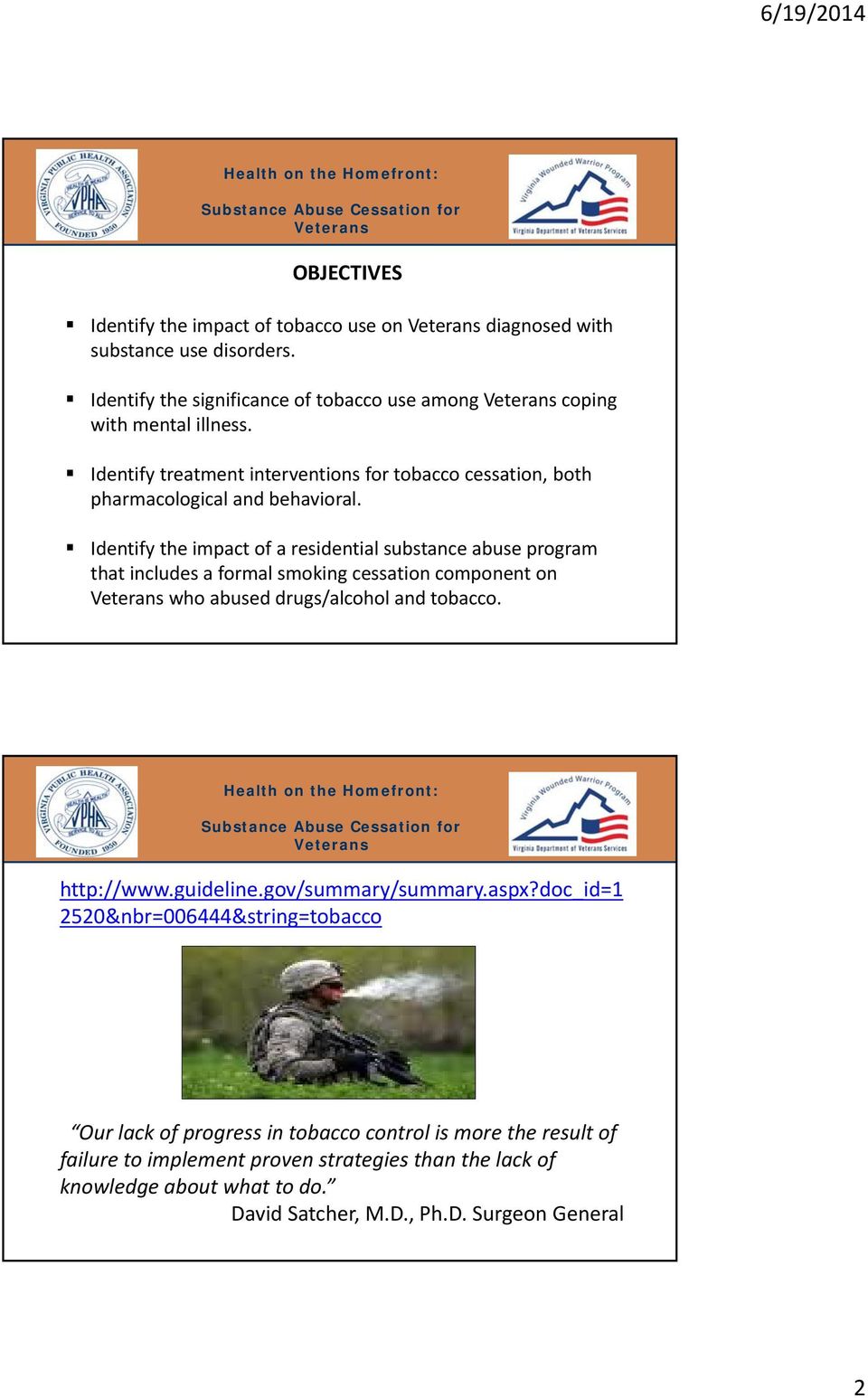
2 OBJECTIVES Identify the impact of tobacco use on diagnosed with substance use disorders. Identify the significance of tobacco use among coping with mental illness. Identify treatment interventions for tobacco cessation, both pharmacological and behavioral. Identify the impact of a residential substance abuse program that includes a formal smoking cessation component on who abused drugs/alcohol and tobacco &nbr=006444&string=tobacco Our lack of progress in tobacco control is more the result of failure to implement proven strategies than the lack of knowledge about what to do. David Satcher, M.D., Ph.D. Surgeon General 2
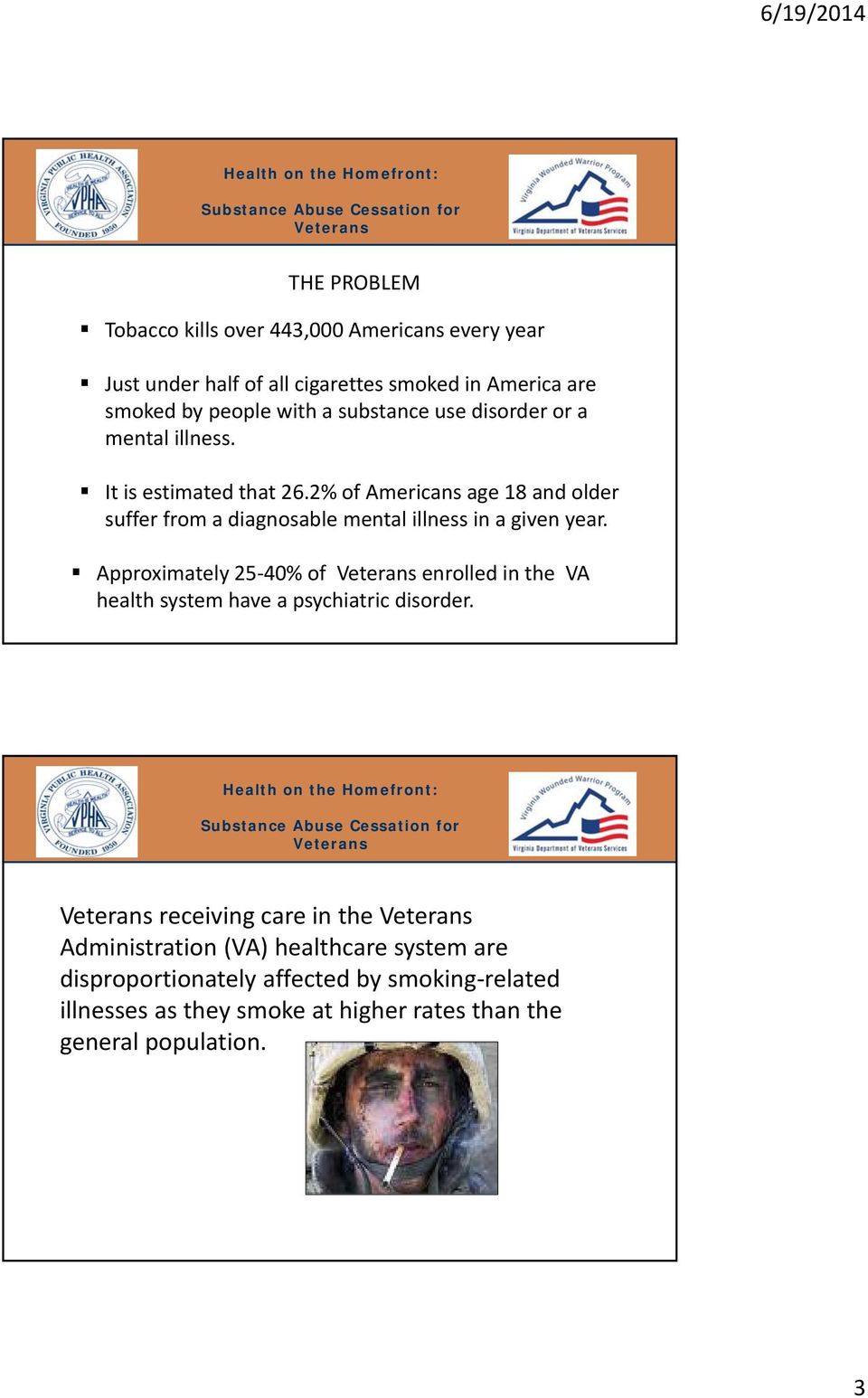
3 THE PROBLEM Tobacco kills over 443,000 Americans every year Just under half of all cigarettes smoked in America are smoked by people with a substance use disorder or a mental illness. It is estimated that 26.2% of Americans age 18 and older suffer from a diagnosable mental illness in a given year. Approximately 25 40% of enrolled in the VA health system have a psychiatric disorder. receiving care in the Administration (VA) healthcare system are disproportionately affected by smoking related illnesses as they smoke at higher rates than the general population. 3
4 Nationally, percent of clients in substance abuse treatment settings use tobacco, triple the national average. Among clients in substance abuse treatment, 51 percent died of tobacco related causes, double the national average. Lasser et al.,2000 While in substance abuse treatment, the emphasis is on illicit substances and alcohol. Tobacco dependence is the greatest contributor to disease and death in the substance use disorder population. Tobacco dependence causes more deaths than all deaths from HIV, illegal drug use, alcohol use, motor vehicle injuries, suicides and murders combined. 4

5 This program evaluation examined the impact of a residential substance abuse program that included a formal smoking cessation component on who abused drugs/alcohol and tobacco. REVIEW OF THE LITERATURE Smoking cessation counseling and treatment during substance abuse treatment does not adversely affect abstinence rates from alcohol and drugs of abuse. (Level of Evidence 1b) positively affects abstinence rates from alcohol and drugs of abuse. (Level of Evidence 1b) does not adversely affect smoking cessation rates. (Level of Evidence 1b) 5
6 RESEARCH SETTING AND SAMPLE of the United States Armed Forces are eligible for treatment Men and women ages 18 and older Admitted to the Salem Affairs Medical Center Substance Abuse Residential Rehabilitation Program (SARRTP) from May 1, 2012 through December 31, 2012 Reported tobacco use within one month prior to admission to the program Tobacco Cessation Program Topics Health benefits of tobacco cessation Personal reasons for tobacco cessation Coping with triggers Breathing techniques for stress management Strategies to reduce smoking Quit date preparation Identifying supportive people Weight management strategies, exercise tips Dealing with slips and relapse Medications for tobacco cessation 6
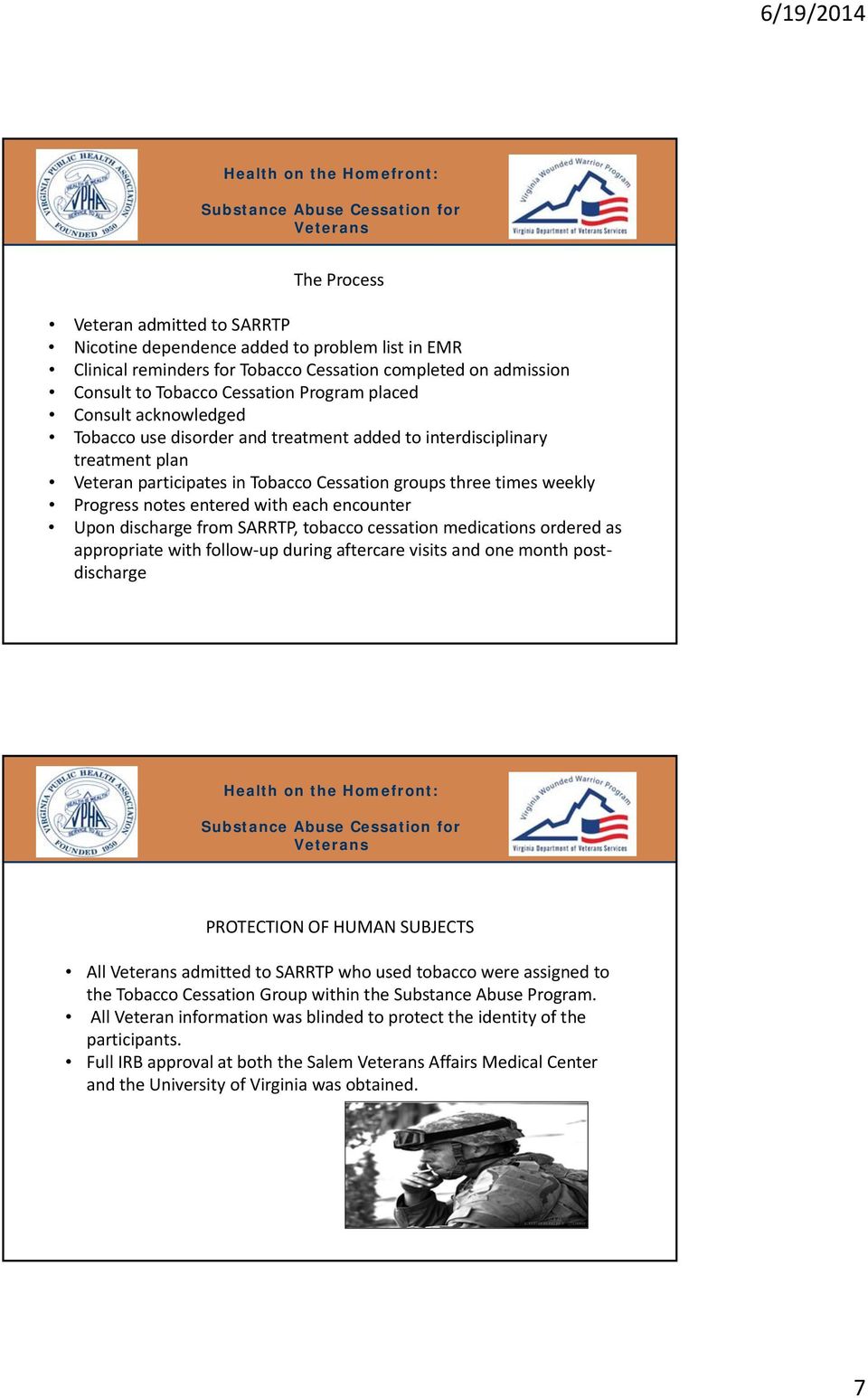
7 The Process Veteran admitted to SARRTP Nicotine dependence added to problem list in EMR Clinical reminders for Tobacco Cessation completed on admission Consult to Tobacco Cessation Program placed Consult acknowledged Tobacco use disorder and treatment added to interdisciplinary treatment plan Veteran participates in Tobacco Cessation groups three times weekly Progress notes entered with each encounter Upon discharge from SARRTP, tobacco cessation medications ordered as appropriate with follow up during aftercare visits and one month postdischarge PROTECTION OF HUMAN SUBJECTS All admitted to SARRTP who used tobacco were assigned to the Tobacco Cessation Group within the Substance Abuse Program. All Veteran information was blinded to protect the identity of the participants. Full IRB approval at both the Salem Affairs Medical Center and the University of Virginia was obtained. 7
8 RESEARCH PROCEDURES Diagnostic information for substance use and other mental health disorders was obtained from the electronic medical records of each Veteran admitted to SARRTP. were classified as having a substance use disorder with or without co occurring psychiatric disorders (yes/no). Socio demographic data was gathered from the SARRTP Screening Packet including age, race, gender, income, education and marital status. Tobacco use status and motivation to quit using tobacco was assessed during preadmission screening, on admission, and with each follow up. RESEARCH MEASURES Days of use for alcohol, other drugs, and tobacco Stages of change for tobacco cessation Pharmacotherapy prescribed Adherence to pharmacotherapy Biomarkers for substance use, including urine drug screens and breathalyzers along with self report of use Workbook progression Measurements taken at four points in time, on admission, two weeks following admission, at graduation, and at one month follow up 8
9 STATISTICAL ANALYSIS Statistical Package for the Social Sciences (SPSS) Descriptive analyses were conducted for all demographic data & complete abstinence rates. In order to examine changes in alcohol and other drug use, t tests were performed that compared the month prior to treatment to the month following treatment. An analysis of variance (ANOVA) with repeated measures was conducted to examine change in tobacco use over four points in time. VETERANS LOST TO FOLLOW UP Demographic and baseline descriptive variables were compared for those who completed the 1 month follow up (n = 97) to those who did not (n = 40). Chi squares analysis compared categorical variables and independent t tests examined continuous variables. No statistical significance was noted on any of the variables. 9

10 Characteristics N % Education 9 th grade or less Some high school High school graduate Some college/technical Bachelor s degree Master s degree Characteristics N % Gender Male Female Race African American Caucasian Hispanic Other Marital Status Never married Married Separated Divorced Widowed

11 Characteristic N % Psych Dx Yes No Drug Dx Yes No Alcohol Dx Yes No N Minimum Maximum Mean S.D. Age Monthly Income

12 STAGES OF CHANGE Pre contemplation not ready Contemplation maybe within 6 months Preparation probably within 30 days, taking steps towards behavior change Action actively changing the behavior Maintenance change has lasted 6 months Stage of Change Baseline N=137 Two weeks N=121 Graduation N=116 One month follow up N=97 Precontemplation 43 (31.4%) 14 (11.6%) 0 (0.0%) 24 (24.7%) Contemplation 42 (30.7%) 25 (20.7%) 19 (16.4%) 23 (23.7%) Preparation 47 (34.3%) 69 (50.4%) 70 (60.3%) 30 (30.9%) Action 5 (3.6%) 69 (50.4%) 14 (12.1%) 20 (20.6%) Maintenance 0 (0.0%) 0 (0.0%) 0 (0.0%) 0 (0.0%) 12

13 CO OCCURRING MENTAL ILLNESS No MH diagnosis 42% (n=57) PTSD 26% (n=35) Depression 20% (n=28) Schizophrenia 6% (n=8) Bipolar Disorder 4% (n=6) Anxiety 2% (n=3) Type of N = 137 % Substance Alcohol % Cocaine 53 19% Opiates 49 17% Cannabis 47 16% Polysubstance 29 10% Benzodiazapines 2 1% Amphetamines 1 <1% 13

14 BEHAVIORAL INTERVENTIONS Engage the Veteran. Present a clear, concise, and consistent QUIT message to your patients who use tobacco. Any type of clinician can be effective at delivering evidence based interventions to increase quit rates. Cessation counseling lasting just 4 minutes can double a patient s chance of abstinence. It is important to remember that brief counseling and medications provided as part of an ongoing therapeutic relationship can be as effective as a referral to a tobacco cessation program. The 5 Major Steps to Intervention Ask Identify and document tobacco use status for every patient at every visit. Advise In a clear, strong, and personalized manner, urge every tobacco user to quit. Assess Is the tobacco user willing to make a quit attempt at this time? Assist For the patient willing to make a quit attempt, use counseling and pharmacotherapy to help him or her quit. Arrange Schedule follow up contact, in person or by telephone, preferably within the first week after the quit date. 14

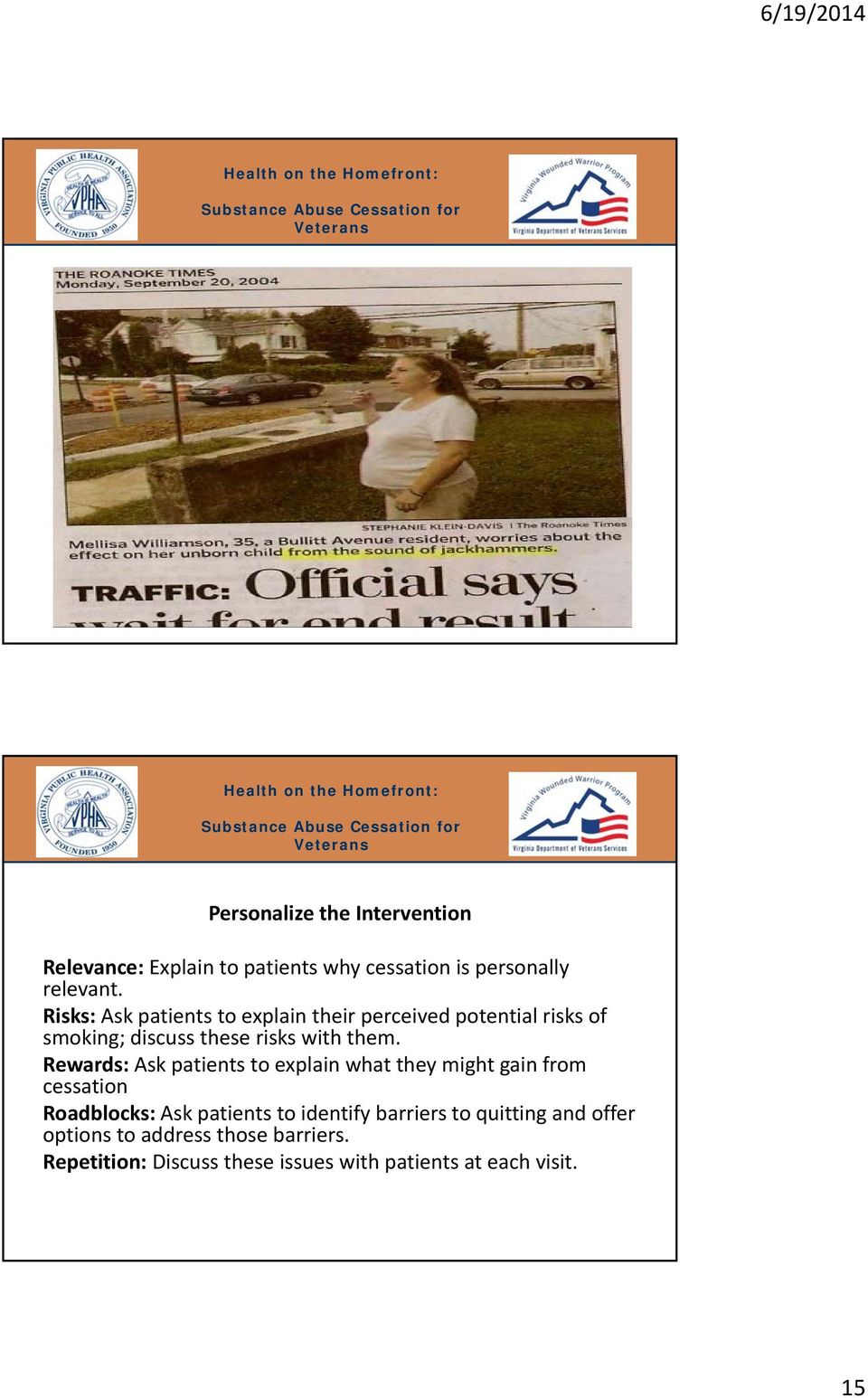
15 Personalize the Intervention Relevance: Explain to patients why cessation is personally relevant. Risks: Ask patients to explain their perceived potential risks of smoking; discuss these risks with them. Rewards: Ask patients to explain what they might gain from cessation Roadblocks: Ask patients to identify barriers to quitting and offer options to address those barriers. Repetition: Discuss these issues with patients at each visit. 15
16 Discuss the Benefits of Quitting 20 minutes after quitting, heart rate and blood pressure drop 12 hours after quitting, carbon monoxide levels drop to normal 2 weeks to 3 months after quitting, circulation and lung function improve 1 year after quitting, risk of coronary heart disease is cut in half 5 years after quitting, stroke risk is the same as for nonsmokers 10 years after quitting, lung cancer risk is cut in half 16
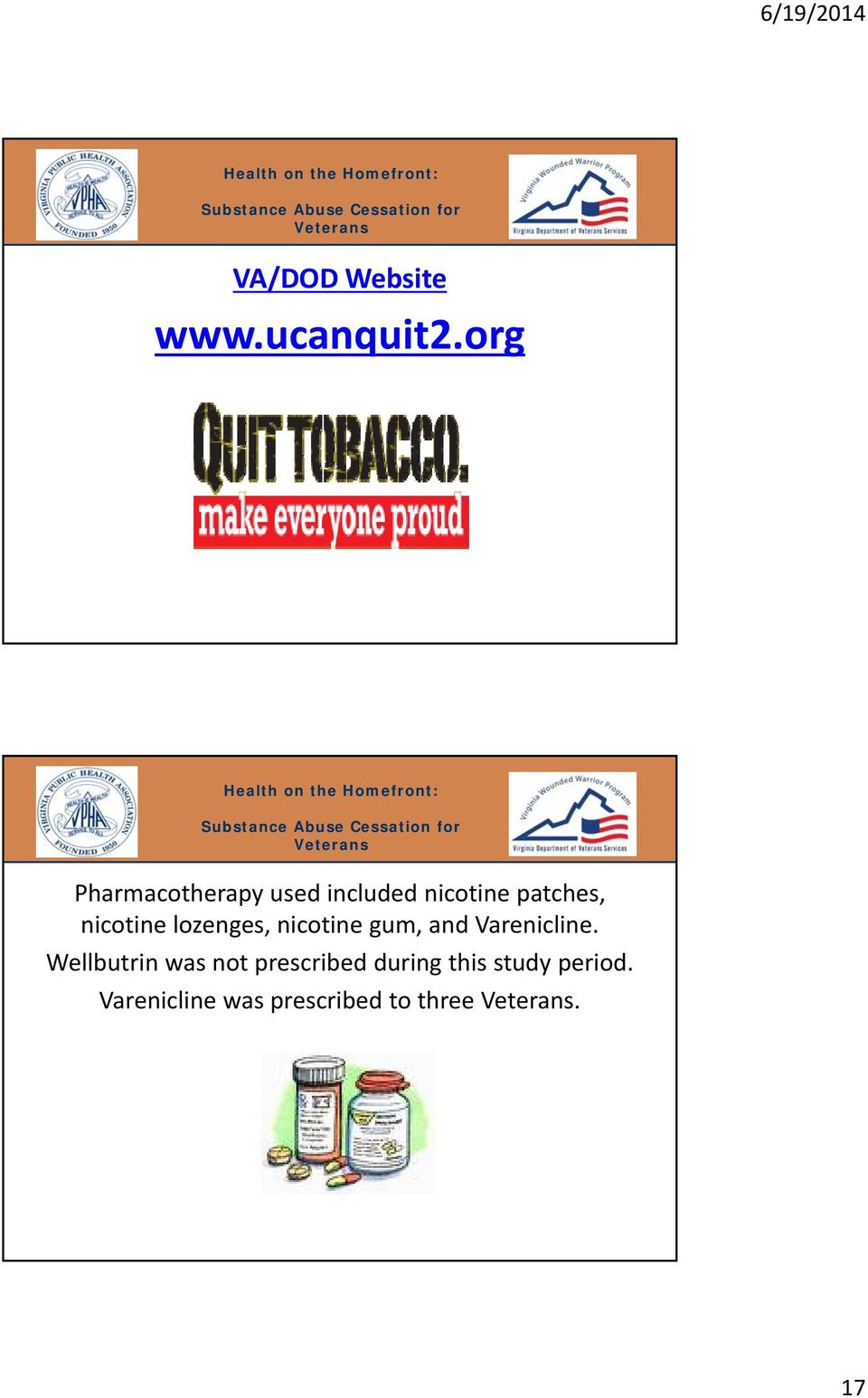
17 VA/DOD Website Pharmacotherapy used included nicotine patches, nicotine lozenges, nicotine gum, and Varenicline. Wellbutrin was not prescribed during this study period. Varenicline was prescribed to three. 17
18 Comparative Effectiveness of Pharmacotherapy for Tobacco Dependence at 6 months 2008 USPHS CPG Available at Frequency of Medications Prescribed for Tobacco Cessation Medications 0 18

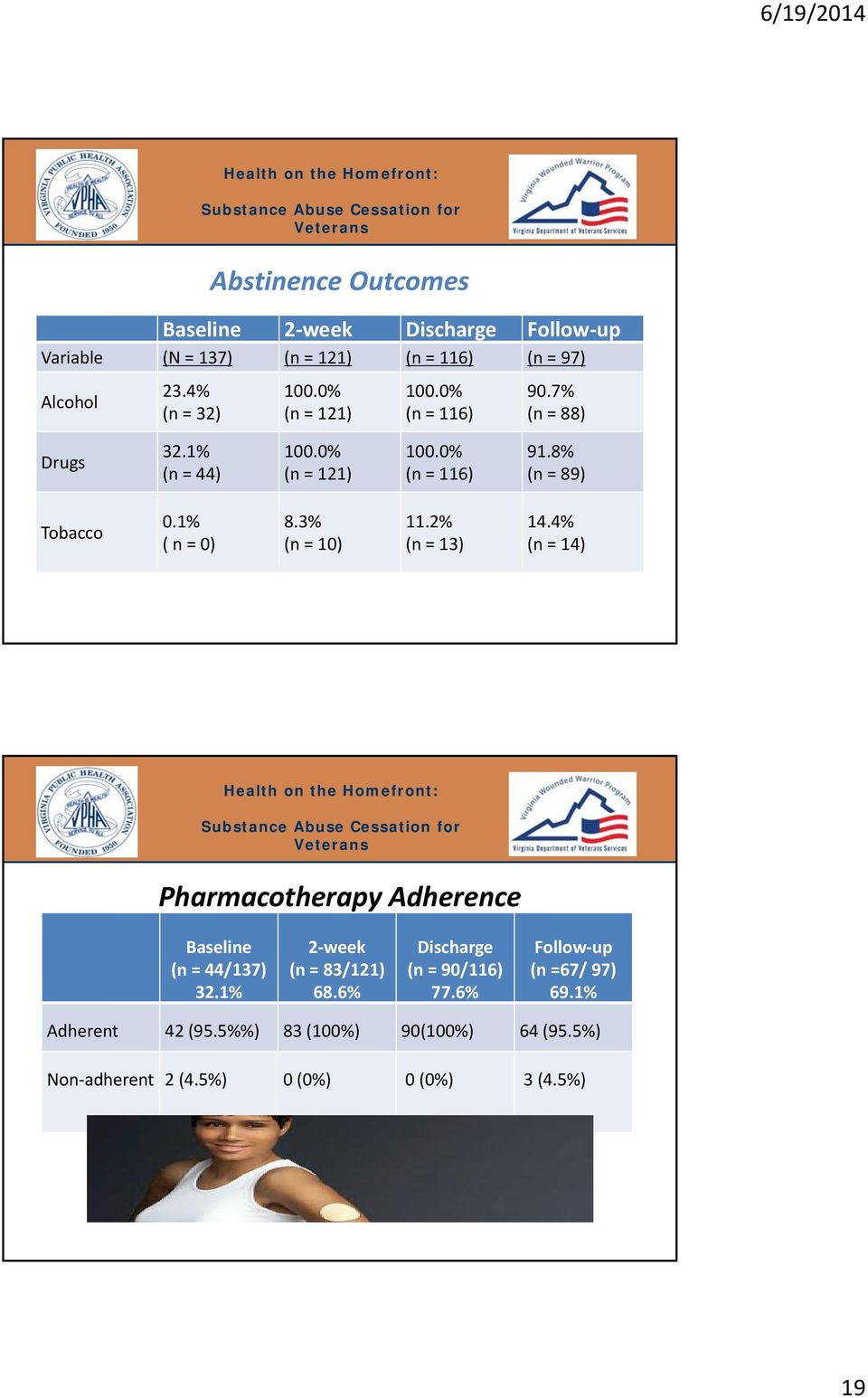
19 Baseline 2 week Discharge Follow up Variable (N = 137) (n = 121) (n = 116) (n = 97) Alcohol 23.4% (n = 32) Abstinence Outcomes 100.0% (n = 121) 100.0% (n = 116) 90.7% (n = 88) Drugs 32.1% (n = 44) 100.0% (n = 121) 100.0% (n = 116) 91.8% (n = 89) Tobacco 0.1% ( n = 0) 8.3% (n = 10) 11.2% (n = 13) 14.4% (n = 14) Pharmacotherapy Adherence Baseline (n = 44/137) 32.1% 2 week (n = 83/121) 68.6% Discharge (n = 90/116) 77.6% Follow up (n =67/ 97) 69.1% Adherent 42 (95.5%%) 83 (100%) 90(100%) 64 (95.5%) Non adherent 2 (4.5%) 0 (0%) 0 (0%) 3 (4.5%) 19
20 Biomarkers and Self Report at One Month Follow up (n=97) Variable Positive for Use Negative for Use Urine Drug Screen (n=54) 4 (7%) 50 (93%) Breathalyzer (n=54) 0 54 (100%) Self Report (n=43) 6 (6%) 91 (94%) Clinical Implications Tobacco use by Veteran populations coping with mental illness and/or substance use disorders is significant and must be addressed throughout mental health treatment. Addressing tobacco cessation should be a critical component of substance abuse treatment since such programs have a positive effect upon abstinence rates from alcohol and drugs of abuse. 20

21 Research Limitations Lack of randomization Compliance bias Social desirability bias Lack of biochemical verification of tobacco abstinence Research Strengths Large, diagnostically diverse sample Longitudinal data collection Findings could serve as a model for the development of integrated tobacco cessation programming during SARRTP programs throughout the VA 21
22 How Does the Research Relate to the Literature? Since there was no comparison condition, conclusions about causation cannot be drawn regarding alcohol, other drug, or tobacco use outcomes. However, findings appear consistent with previous research in that the intervention did not appear to adversely impact alcohol, other drug, or tobacco use outcomes. Future Research and Development Effective programs and tools must be developed, utilized, and evaluated in the treatment of tobacco use disorders in with mental illness and/or substance use disorders. Healthcare education must incorporate tobacco cessation education into the curriculum. We all need to have a greater role in tobacco cessation treatment. 22
23 References American Psychiatric Association. (2011). Diagnostic and Statistical Manual of Mental Disorders. 6 th Edition. Washington, DC: American Psychiatric Association. Baca, C. T., Yahne, C. E., (2009). Smoking cessation during substance abuse treatment: What you need to know. Journal of Substance Abuse Treatment, 36, Beckham, J., Roodman, A., Shipley, R., Hertzberg, M., Cunha, G., Kudler, H., Fairbank, J. A. (1995). Smoking in Vietnam combat veterans with post-traumatic stress disorder. Journal of Traumatic Stress, 8 (3), Burling, T., Burling, A., Litini, D. (2001). A controlled smoking cessation trial for substance-dependent inpatients. Journal of Consulting and Clinical Psychology, 69: Burling, T. A., Marshall, G. D., Seidner, A. L. (1991). Smoking cessation for substance abuse inpatients. Journal of Substance Abuse, 3(3), Cradock-O Leary, J., Young, A. S., Yano, E. M., Wang, M., Lee, M. L. (2002). Use of general medical services by VA patients with psychiatric disorders. Psychiatry Service, 53(1), Dalack, G., Meador-Woodruff, J. (1999). Acute feasibility and safety of a smoking reduction strategy for smokers with schizophrenia. Nicotine & Tobacco Research 1: Duffy, S. A., Essenmacher, C., Karvonen-Gutierrez, C., Ewing, L. A. (2010). Motivation to Quit Smoking among Diagnosed with Psychiatric and Substance Abuse Disorders. Journal of Addictions Nursing, 21(2&3),
24 References Evins, A.E., Cather, C., Deckersbach, T., Freudenreich,O.,Culhane,M.,Olm-Shipman, C.M., Rigotti, N.(2005) A double-blind placebo-controlled trial of bupropion sustained-release for smoking cessation in schizophrenia. Journal of Clinical Psychopharmacology, 25(3), Gariti, P., Alterman, A., Mulvaney, F., Mechanic, K., Dhopesh, V., Yu, E.,... Sacks, D. (2002). Nicotine intervention during detoxification and treatment for other substance use. The American Journal of Drug and Alcohol Abuse, 28(4), Grant, B.F., Hasin, D. S., Chou, P., Stinson, F. S., Dawson, D. A. (2004). Nicotine dependence and psychiatric disorders in the United States. Archives of General Psychiatry 61(11), Hayford, K. E., Patten, C. A., Rummans, T. A., Schroeder, D. R., Offord, K. P., Croghan, I. T., Hurt, R. D.(1999). Efficacy of bupropion for smoking cessation in smokers with a former history of major depression or alcoholism. British Journal of Psychiatry, 174(2), Hughes, J. (1993). Treatment of smoking cessation in smokers with past alcohol/drug problems. Journal of Substance Abuse Treatment, 10, Hurt, R. D., Offord, K. P., Croghan, I. T., Gomez-Dahl, L., Kottke, T. E., Morse, R. M., Melton, L. J. (1996). Mortality following inpatient addictions treatment. Journal of the American Medical Association, 275 (14), Kalman, D., Hayes, K., Colby, S. M., Eaton, C. A., Rohsenow, D. J., & Monti, P. M. (2001). Concurrent versus delayed smoking cessation treatment of persons in early alcohol recovery: A pilot study. Journal of Substance Abuse Treatment, 20, References Landolt, K., Ajdacic-Gross, V., Angst, J., Merikangas, K., Gamma, A., Rossler, W. et al. (2010). Smoking and psychiatric disorders: Have subthreshold disorders been overlooked? Nicotine & Tobacco Research 12(5): Lasser, K., Boyd, J. W., Woolhandler, S., Himmelstein, D. U., McCormick, D., Bor, D.H. (2000). Smoking and mental illness: A population-based prevalence study. Journal of the American Medical Association, 284(20), Martin, J. E., Calfas, K. J., Patten, C. A., Polarek, M., Hofstetter, C. R., Noto, J., Beach, D.(1997). Prospective evaluation of three smoking interventions in 205 recovering alcoholics: One-year results of Project SCRAP-Tobacco. Journal of Consulting and Clinical Psychology, 65, Reid, M. S., Fallon, B., Sonne, S., Flammino, F., Nunes, E. V., Jiang, H., Rotrosen, J. (2008). Smoking cessation treatment in community-based substance abuse rehabilitation programs. Journal of Substance Abuse Treatment, 35 (1), VA (Department of Affairs) VA in the Vanguard: Building on Success in Smoking Cessation. Edited by S. Isaacs, S. Schroeder and J. Simon. San Francisco, CA: Department of Affairs. Health Administration (2006). Integrating tobacco cessation treatment into mental health care: Conference Summary, May 4-5, Ziedonis, D. M., Kosten, T. R., Glazer, W. M., Frances. R. J. (1994). Nicotine dependence and schizophrenia. Hospital and Community Psychiatry, 45,
25 25
Healthy Lifestyle, Tobacco Free and Recovery Lesson for Group or Individual Sessions
 Healthy Lifestyle, Tobacco Free and Recovery Lesson for Group or Individual Sessions This lesson is part of an overall curriculum based program developed by the New York State Office of Alcoholism and
Molly Kodl, Ph.D.; Steven S. Fu, M.D., M.S.C.E.; and Anne M. Joseph, M.D., M.P.H.
 Tobacco Cessation Treatment for Alcohol-Dependent Smokers: When Is the Best Time? Molly Kodl, Ph.D.; Steven S. Fu, M.D., M.S.C.E.; and Anne M. Joseph, M.D., M.P.H. Cigarette smoking is highly prevalent
Delivery of Tobacco Dependence Treatment for Tobacco Users with Mental Illness and Substance Use Disorders (MISUD)
 Delivery of Tobacco Dependence Treatment for Tobacco Users with Mental Illness and Substance Use Disorders (MISUD) Learning Objectives Upon completion of this module, you should be able to: Describe how
"Starting today, every doctor, nurse, health plan, purchaser, and medical school in America should make treating tobacco dependence a top priority.
 Encouraging Tobacco Cessation Through the Five A s: Ask, Advise, Assess, Assist, Arrange Mary Clare Champion, Ph.D. Tennessee Primary Care Clinical Conference April 14-15, 2011 Franklin, TN "Starting today,
NEXT STEPS: TREATING TOBACCO AND CREATING HEALTHY MENTAL HEALTH/SUBSTANCE ABUSE TREATMENT FACILITY ENVIRONMENTS PART I
 NEXT STEPS: TREATING TOBACCO AND CREATING HEALTHY MENTAL HEALTH/SUBSTANCE ABUSE TREATMENT FACILITY ENVIRONMENTS PART I Stan Martin, MM Program Director CAI, TCTP Dr John R. Hughes February 19, 2014 Housekeeping
Smoking Cessation: Treatment Options for Nicotine Addiction
 Smoking Cessation: Treatment Options for Nicotine Addiction Hilary Nierenberg, NP, MPH Center for Interventional Vascular Therapy Columbia University Medical Center Disclosure Statement of Financial Interest
A STUDY OF A LACK OF DIFFUSION: THE CASE OF NICOTINE ANONYMOUS
 A STUDY OF A LACK OF DIFFUSION: THE CASE OF NICOTINE ANONYMOUS NHCHC CONFERENCE 2012 Presented by Irene Glasser, PhD, Research Associate, Center for Alcohol and Addiction Studies, Brown University Darlene
How To Make A Tobacco Free Facility
 Tobacco-Free Policies & Procedures for Facilities & Services in Wisconsin s Substance Abuse & Mental Health Treatment Programs Developed by WiNTiP sponsored by the Wisconsin Department of Health Services
Smoking Cessation Services in Addiction Treatment: Challenges for Organizations and the Counseling Workforce
 Knudsen, H.K. & White, W.L. (2012) Smoking cessation services in addiction treatment: Challenges for organizations and the counseling workforce. Counselor, 13(1), 10-14. Smoking Cessation Services in Addiction
Smoking Cessation in People with Severe Mental Illness. Lisa Dixon, M.D., MPH and Melanie Bennett, Ph.D. University of Maryland School of Medicine
 Smoking Cessation in People with Severe Mental Illness Lisa Dixon, M.D., MPH and Melanie Bennett, Ph.D. University of Maryland School of Medicine Smoking and Severe Mental Illness Smoking is a MAJOR problem
Veterans Health Administration (VHA): Mental Health Services. Briefing for Commission on Care October 19, 2015
 Veterans Health Administration (VHA): Mental Health Services Briefing for Commission on Care October 19, 2015 Uniform Mental Health Services VHA is committed to providing a uniform package of mental health
YOUNG ADULTS IN DUAL DIAGNOSIS TREATMENT: COMPARISON TO OLDER ADULTS AT INTAKE AND POST-TREATMENT
 YOUNG ADULTS IN DUAL DIAGNOSIS TREATMENT: COMPARISON TO OLDER ADULTS AT INTAKE AND POST-TREATMENT Siobhan A. Morse, MHSA, CRC, CAI, MAC Director of Fidelity and Research Foundations Recovery Network YOUNG
Psychology Externship Program
 Psychology Externship Program The Washington VA Medical Center (VAMC) is a state-of-the-art facility located in Washington, D.C., N.W., and is accredited by the Joint Commission on the Accreditation of
2014 Assessment of Smoking Policies and Practices in Residential and Outpatient Treatment Facilities in Sonoma County
 2014 Assessment of Smoking Policies and Practices in and Treatment Facilities in Sonoma County Terese Voge, Project Director Sonoma County Department of Health Services Health Policy Planning and Evaluation
Suicide, PTSD, and Substance Use Among OEF/OIF Veterans Using VA Health Care: Facts and Figures
 Suicide, PTSD, and Substance Use Among OEF/OIF Veterans Using VA Health Care: Facts and Figures Erin Bagalman Analyst in Health Policy July 18, 2011 Congressional Research Service CRS Report for Congress
1. To create a comprehensive Benchmark plan that will assure maximum tobacco cessation coverage to all populations in Rhode Island:
 POSTION STATEMENT Submitted to the Rhode Island Health Benefits Exchange Submitted By the Public Policy Workgroup of the Statewide Tobacco Cessation Committee on Tobacco Cessation Treatment Benchmarks
Fixing Mental Health Care in America
 Fixing Mental Health Care in America A National Call for Measurement Based Care in Behavioral Health and Primary Care An Issue Brief Released by The Kennedy Forum Prepared by: John Fortney PhD, Rebecca
INTRODUCTION. Tobacco Prevention & Cessation Program Substance Abuse and Tobacco Cessation Report - March 2011
 TPCP Tobacco Prevention & Cessation Program Substance Abuse and Tobacco Cessation Report Report Prepared by Antionne Dewayne Alcorn, BS, CPC, CIT Contributors Miriam N Karanja, MBA Ma rc h 2 0 1 1 INTRODUCTION
Smoking cessation programs in substance abuse treatment facilities: A closer look
 Smoking cessation programs in substance abuse treatment facilities: A closer look Jessica Legge Muilenburg, PhD The University of Georgia College of Public Health This study was supported by Award Number
 VAMC Durham Substance Abuse Overview: Greg Hughes, MSW, LICSW Chief, Social Work Services Population Served Approximately 50,000 unique patients served through Durham, Raleigh, Greenville and Morehead
Treatment of Prescription Opioid Dependence
 Treatment of Prescription Opioid Dependence Roger D. Weiss, MD Chief, Division of Alcohol and Drug Abuse McLean Hospital, Belmont, MA Professor of Psychiatry, Harvard Medical School, Boston, MA Prescription
Co-Occurring Substance Use and Mental Health Disorders. Joy Chudzynski, PsyD UCLA Integrated Substance Abuse Programs
 Co-Occurring Substance Use and Mental Health Disorders Joy Chudzynski, PsyD UCLA Integrated Substance Abuse Programs Introduction Overview of the evolving field of Co-Occurring Disorders Addiction and
Ass Professor Frances Kay-Lambkin. NHMRC Research Fellow, National Drug and Alcohol Research Centre UNSW
 Ass Professor Frances Kay-Lambkin NHMRC Research Fellow, National Drug and Alcohol Research Centre UNSW Frances Kay-Lambkin PhD National Health and Medical Research Council Research Fellow Substance Use
Smoking Cessation Program
 Smoking Cessation Program UHN Information for people who are ready to quit smoking Read this information to learn: why you should quit smoking how the Smoking Cessation Program works treatments to help
Grant ID 044360 Page 4 Medical University of South Carolina Implementation of TelASK Quit Connection IVR System in Charleston Area Hospitals
 1. Overall Aim & Objectives: The goal of this project is to implement an evidence-based Tobacco Cessation Management System in all hospitals in the Charleston, South Carolina region. The system should
treatment effectiveness and, in most instances, to result in successful treatment outcomes.
 Key Elements of Treatment Planning for Clients with Co Occurring Substance Abuse and Mental Health Disorders (COD) [Treatment Improvement Protocol, TIP 42: SAMHSA/CSAT] For purposes of this TIP, co occurring
North Bay Regional Health Centre
 Addictions and Mental Health Division Programs Central Intake Referral Form The Central Intake Referral Form is used in the District of Nipissing by the North Bay Regional Health Centre s Addictions and
- UNDERSTANDING - Dual Diagnosis
 - UNDERSTANDING - Dual Diagnosis TABLE OF CONTENTS Introduction 3 The Link Between Mental Illness and Substance Abuse 4 Characteristics of an Effective Dual Diagnosis Treatment Plan 6 Dual Diagnosis Treatment
American Society of Addiction Medicine
 American Society of Addiction Medicine Public Policy Statement on Treatment for Alcohol and Other Drug Addiction 1 I. General Definitions of Addiction Treatment Addiction Treatment is the use of any planned,
General Mental Health Issues: Mental Health Statistics
 Mental Health America of Franklin County 2323 W Fifth Ave Suite 160, Columbus, OH 43204 Telephone: (614) 221-1441 Fax: (614) 221-1491 info@mhafcorg wwwmhafcorg General Mental Health Issues: Mental Health
Recommendations and Guidelines for Policies & Procedures in. Tobacco-Free
 Recommendations and Guidelines for Policies & Procedures in Tobacco-Free Facilities & Services in Wisconsin s Substance Use & Mental Health Treatment Programs Developed by WiNTiP (Wisconsin Nicotine Treatment
Elderly males, especially white males, are the people at highest risk for suicide in America.
 Statement of Ira R. Katz, MD, PhD Professor of Psychiatry Director, Section of Geriatric Psychiatry University of Pennsylvania Director, Mental Illness Research Education and Clinical Center Philadelphia
Working with young people who have mental health and substance use issues. Samar Zakaria
 Working with young people who have mental health and substance use issues. Samar Zakaria Main points Challenges faced while treating young adults in a dual diagnosis rehab unit Define dual diagnosis in
MOVING TOWARD EVIDENCE-BASED PRACTICE FOR ADDICTION TREATMENT
 MOVING TOWARD EVIDENCE-BASED PRACTICE FOR ADDICTION TREATMENT June, 2014 Dean L. Babcock, LCAC, LCSW Associate Vice President Eskenazi Health Midtown Community Mental Health Centers Why is Evidence-Based
MASSACHUSETTS TOBACCO TREATMENT SPECIALIST TRAINING
 University of Massachusetts Medical School MASSACHUSETTS TOBACCO TREATMENT SPECIALIST TRAINING Course Description Goals and Learning Objectives 1 2012 55 Lake Avenue North, Worcester, MA 01655 www.umassmed.edu/tobacco
Improving smoking cessation in drug and alcohol treatment
 Improving smoking cessation in drug and alcohol treatment Interim briefing on Turning Point s PHE-supported smoking cessation pilots Tobacco smoking is prevalent among drug and alcohol users, and contributes
Integrating Health & Wellness & Peers in Clubhouse Programs
 Integrating Health & Wellness & Peers in Clubhouse Programs Colleen McKay, M.A., C.A.G.S. Program for Clubhouse Research Systems and Psychosocial Advances Research Center University of Massachusetts Medical
Association for the Treatment of Tobacco Use and Dependence -- ATTUD DISPARATE POPULATIONS COMMITTEE
 Association for the Treatment of Tobacco Use and Dependence -- ATTUD DISPARATE POPULATIONS COMMITTEE INTEGRATING TOBACCO TREATMENT WITHIN BEHAVIORAL HEALTH Preface Tobacco use affects each of us whether
VENTURA COUNTY ALCOHOL & DRUG PROGRAMS
 VENTURA COUNTY ALCOHOL & DRUG PROGRAMS women s services Helping women recover (805) 981-9200 1911 Williams Drive, Oxnard, CA 93036 www.venturacountylimits.org recovery VCBH ALCOHOL & DRUG PROGRAMS WOMEN
DRAFT Metropolitan Detention Center (MDC) DWI Addiction Treatment Programs (ATP) Outcome Study Final Report UPDATED
 DRAFT Metropolitan Detention Center (MDC) DWI Addiction Treatment Programs (ATP) Outcome Study Final Report UPDATED Prepared for: The DWI Addiction Treatment Programs (ATP) Metropolitan Detention Center
Outcomes for People on Allegheny County Community Treatment Teams
 Allegheny HealthChoices, Inc. Winter 2010 Outcomes for People on Allegheny County Community Treatment Teams Community Treatment Teams (CTTs) in Allegheny County work with people who have some of the most
Frequently Asked Questions (FAQ) Phoenix House New England
 About What is? Phoenix House is a nationally recognized and accredited behavioral healthcare provider, specializing in the treatment and prevention of substance use disorders and co-occurring substance
Drug Abuse and Addiction
 Drug Abuse and Addiction Introduction A drug is a chemical substance that can change how your body and mind work. People may abuse drugs to get high or change how they feel. Addiction is when a drug user
Identifying High and Low Risk Practice Areas and Drugs of Choice of Chemically Dependent Nurses
 Identifying High and Low Risk Practice Areas and Drugs of Choice of Chemically Dependent Nurses Jessica Furstenberg, Kawa Cheong, Ashley Brill, Angela M. McNelis, PhD, RN, Sara Horton-Deutsch, PhD, RN,
Metropolitan Detention Center (MDC) DWI Addiction Treatment Programs (ATP) Outcome Study for DWI Offenders
 Metropolitan Detention Center (MDC) DWI Addiction Treatment Programs (ATP) Outcome Study for DWI Offenders Prepared for: The DWI Addiction Treatment Programs (ATP) Metropolitan Detention Center Prepared
Colorado Substance Abuse Treatment Clients with Co-Occurring Disorders, FY05
 Colorado Substance Abuse Treatment Clients with Co-Occurring Disorders, FY05 Introduction Many clients who have chronic substance use disorders often simultaneously suffer from a serious mental disorder.
Treatment of Opioid Dependence: A Randomized Controlled Trial. Karen L. Sees, DO, Kevin L. Delucchi, PhD, Carmen Masson, PhD, Amy
 Category: Heroin Title: Methadone Maintenance vs 180-Day psychosocially Enriched Detoxification for Treatment of Opioid Dependence: A Randomized Controlled Trial Authors: Karen L. Sees, DO, Kevin L. Delucchi,
SEEKING DRUG ABUSE TREATMENT: KNOW WHAT TO ASK
 National Institute on Drug Abuse SEEKING DRUG ABUSE TREATMENT: KNOW WHAT TO ASK U.S. Department of Health and Human National Institutes of Health SEEKING DRUG ABUSE TREATMENT: KNOW WHAT TO ASK The goal
Performance Standards
 Performance Standards Co-Occurring Disorder Competency Performance Standards are intended to provide a foundation and serve as a tool to promote continuous quality improvement and progression toward best
MONROE COUNTY OFFICE OF MENTAL HEALTH, DEPARTMENT OF HUMAN SERVICES RECOVERY CONNECTION PROJECT PROGRAM EVALUATION DECEMBER 2010
 MONROE COUNTY OFFICE OF MENTAL HEALTH, DEPARTMENT OF HUMAN SERVICES RECOVERY CONNECTION PROJECT PROGRAM EVALUATION DECEMBER 2010 Prepared For: Kathleen Plum, RN, PhD Director, Monroe County Office of Mental
Patients are still addicted Buprenorphine is simply a substitute for heroin or
 BUPRENORPHINE TREATMENT: A Training For Multidisciplinary Addiction Professionals Module VI: Myths About the Use of Medication in Recovery Patients are still addicted Buprenorphine is simply a substitute
Clinical Trials Network
 National Drug Abuse Treatment Clinical Trials Network STOP SMOKING STUDY Should I Join? NATIONAL INSTITUTES OF HEALTH U.S. DEPARTMENT OF HEALTH AND HUMAN SERVICES Introduction Many people who abuse drugs
Smoking and Addiction Recovery II: For Addiction Professionals. William L. White
 White W. (2011). Smoking and addiction recovery: For addiction treatment professionals and administrators.. Posted at www.williamwhitepapers.org.. Smoking and Addiction Recovery II: For Addiction Professionals
SEEKING DRUG ABUSE TREATMENT: KNOW WHAT TO ASK
 National Institute on Drug Abuse SEEKING DRUG ABUSE TREATMENT: KNOW WHAT TO ASK U.S. Department of Health and Human National Institutes of Health SEEKING DRUG ABUSE TREATMENT: KNOW WHAT TO ASK The goal
Psychiatric Comorbidity in Methamphetamine-Dependent Patients
 Psychiatric Comorbidity in Methamphetamine-Dependent Patients Suzette Glasner-Edwards, Ph.D. UCLA Integrated Substance Abuse Programs August11 th, 2010 Overview Comorbidity in substance users Risk factors
HOPE HELP HEALING. A Place of Hope, Help and Healing Since 1910
 HOPE HELP HEALING A Place of Hope, Help and Healing Since 1910 For more than a century, Carrier Clinic has opened its hearts and its doors as a trusted, sought-after place of hope, help and healing for
HOPE HELP HEALING. A Place of Hope, Help and Healing Since 1910
 HOPE HELP HEALING A Place of Hope, Help and Healing Since 1910 For more than a century, Carrier Clinic has opened its hearts and its doors as a trusted, sought-after place of hope, help and healing for
CASE STUDY: SPECIAL HEALTH RESOURCES OF EAST TEXAS Longview, Texas
 CASE STUDY: SPECIAL HEALTH RESOURCES OF EAST TEXAS Longview, Texas This project was funded by a grant from the Health Resources and Services Administration, U.S. Department of Health and Human Services,
Developing Medications to Treat Addiction: Implications for Policy and Practice. Nora D. Volkow, M.D. Director National Institute on Drug Abuse
 Developing Medications to Treat Addiction: Implications for Policy and Practice Nora D. Volkow, M.D. Director National Institute on Drug Abuse Medications Currently Available For Nicotine Addiction Nicotine
Background & Significance
 The Impact Of A Structured Opioid Renewal Clinic On Aberrant Drug Behavior Outcomes At A Northeastern VA Medical Center Salimah H. Meghani, PhD, MBE, CRNP Assistant Professor, University of Pennsylvania
Clinical Perspective on Continuum of Care in Co-Occurring Addiction and Severe Mental Illness. Oleg D. Tarkovsky, MA, LCPC
 Clinical Perspective on Continuum of Care in Co-Occurring Addiction and Severe Mental Illness Oleg D. Tarkovsky, MA, LCPC SAMHSA Definition Co-occurring disorders may include any combination of two or
AMA from Detox Learning Collaborative
 January 25, 2013 BEACON HEALTH STRATEGIES beaconhealthstrategies.com February 22, 2013 1 Agenda 1. Introductions 2. Overview of the project 3. 2012 Western NY Medicaid Fee for Service (FFS) Data Analysis
Frequently Asked Questions (FAQ) Phoenix House New York
 About What is? Phoenix House is a nationally recognized and accredited behavioral healthcare provider, specializing in the treatment and prevention of substance use disorders and co-occurring substance
SUBSTANCE ABUSE OUTPATIENT SERVICES
 SUBSTANCE ABUSE OUTPATIENT SERVICES A. DEFINITION: Substance Abuse Outpatient is the provision of medical or other treatment and/or counseling to address substance abuse problems (i.e., alcohol and/or
HIGH SUCCESS RATE OF BUTTERY REHABILITATION PROGRAMS
 HIGH SUCCESS RATE OF BUTTERY REHABILITATION PROGRAMS By treating addiction and helping people live productive, fulfilling lives, The Buttery addresses a major social and economic problem facing our society.
Kentucky Needs Assessment Project Brief Report. IV Drug Use among Kentucky Adults
 Kentucky Needs Assessment Project Brief Report IV Drug Use among Kentucky Adults IN BRIEF More than 5% of Kentucky adults who have used intravenous drugs need treatment Approximately one-third of Kentucky
Addiction Psychiatry Fellowship Rotation Goals & Objectives
 Addiction Psychiatry Fellowship Rotation Goals & Objectives Table of Contents University Neuropsychiatric Institute (UNI) Training Site 2 Inpatient addiction psychiatry rotation.....2 Outpatient addiction
ADVANCED BEHAVIORAL HEALTH, INC. Clinical Level of Care Guidelines - 2015
 The Clinical Level of Care Guidelines contained on the following pages have been developed as a guide to assist care managers, physicians and providers in making medical necessity decisions about the least
Building on a century of compassionate care, shaping the future of behavioral health.
 Carrier Clinic has earned The Joint Commission s Gold Seal of Approval. Building on a century of compassionate care, shaping the future of behavioral health. For more than a century, Carrier Clinic has
UNDERSTANDING CO-OCCURRING DISORDERS. Frances A. Campbell MSN, PMH CNS-BC, CARN Michael Beatty, LCSW, NCGC-1 Bridge To Hope November 18, 2015
 UNDERSTANDING CO-OCCURRING DISORDERS Frances A. Campbell MSN, PMH CNS-BC, CARN Michael Beatty, LCSW, NCGC-1 Bridge To Hope November 18, 2015 CO-OCCURRING DISORDERS What does it really mean CO-OCCURRING
Substance Abuse and Mental Health Services Administration Reauthorization
 Substance Abuse and Mental Health Services Administration Reauthorization 111 th Congress Introduction The American Psychological Association (APA) is the largest scientific and professional organization
THE INTEGRATED DUAL DIAGNOSIS TREATMENT PROGRAM OF VENTURA COUNTY BEHAVIORAL HEALTH. Presented by Linda Gertson, Ph.D. Behavioral Health Manager
 THE INTEGRATED DUAL DIAGNOSIS TREATMENT PROGRAM OF VENTURA COUNTY BEHAVIORAL HEALTH Presented by Linda Gertson, Ph.D. Behavioral Health Manager The California Institute of Mental Health (CIMH) was awarded
Alcohol and Drug Abuse Treatment Centers
 Division of State Operated Healthcare Facilities Alcohol and Drug Abuse Treatment Centers Jenny Wood Interim ADATC Team Leader HHS LOC Mental Health Subcommittee February 24, 2014 ADATC Locations R.J.
Frequently Asked Questions (FAQs) of Drug Abuse Treatment for Criminal Justice Populations
 Frequently Asked Questions (FAQs) of Drug Abuse Treatment for Criminal Justice Populations From The National Institute on Drug Abuse (NIDA) 2. Why should drug abuse treatment be provided to offenders?
Pragmatic Evidence Based Review Substance Abuse in moderate to severe TBI
 Pragmatic Evidence Based Review Substance Abuse in moderate to severe TBI Reviewer Emma Scheib Date Report Completed November 2011 Important Note: This report is not intended to replace clinical judgement,
How To Treat A Drug Addiction
 1 About drugs Drugs are substances that change a person s physical or mental state. The vast majority of drugs are used to treat medical conditions, both physical and mental. Some, however, are used outside
Magistrates Court Diversion Program. Sue King Manager, Intervention Programs April 2011
 Magistrates Court Diversion Program Sue King Manager, Intervention Programs April 2011 Program Aims 1) Provide assistance to the court in the identification and management of defendants with mental impairment.
Treatment of Alcoholism
 Treatment of Alcoholism Why is it important Prevents further to body by getting people off alcohol. Can prevent death. Helps keep health insurance down. Provides assistance so alcoholics don t t have to
DrugFacts: Treatment Approaches for Drug Addiction
 DrugFacts: Treatment Approaches for Drug Addiction NOTE: This is a fact sheet covering research findings on effective treatment approaches for drug abuse and addiction. If you are seeking treatment, please
Pregnancy and Mental Health Care Among Military Veterans
 Pregnancy and Mental Health Care Among Women Veterans Returning from Iraq and Afghanistan Kristin M. Mattocks 12 1,2, Melissa Skanderson 12 1,2, Joseph Goulet 1,2, Sally Haskell 1,2, Elizabeth Yano 3,4,
Austen Riggs Center Patient Demographics
 Number of Patients Austen Riggs Center Patient Demographics Patient Gender Patient Age at Admission 80 75 70 66 Male 37% 60 50 56 58 48 41 40 Female 63% 30 20 10 18 to 20 21 to 24 25 to 30 31 to 40 41
Smoking Cessation for Persons with Mental Illnesses
 Smoking Cessation for Persons with Mental Illnesses A Toolkit for Mental Health Providers Updated January 2009 Table of Contents Overview 1 Why Address This Issue? 1 2 Alarming Statistics 2 3 About this
You Can Quit Smoking. U.S. Department of Health and Human Services Public Health Service
 You Can Quit Smoking C O N S U M E R G U I D E U.S. Department of Health and Human Services Public Health Service NICOTINE: A POWERFUL ADDICTION If you have tried to quit smoking, you know how hard it
FRN Research Report March 2011: Correlation between Patient Relapse and Mental Illness Post-Treatment
 FRN Research Report March 2011: Correlation between Patient Relapse and Mental Illness Post-Treatment Background Studies show that more than 50% of patients who have been diagnosed with substance abuse
The Impact of Alcohol
 Alcohol and Tobacco Smoking cigarettes and drinking alcohol are behaviors that often begin in adolescence. Although tobacco companies are prohibited from advertising, promoting, or marketing their products
In 2010, approximately 8 million Americans 18 years and older were dependent on alcohol.
 Vivitrol Pilot Study: SEMCA/Treatment Providers Collaborative Efforts with the treatment of Opioid Dependent Clients Hakeem Lumumba, PhD, CAADC SEMCA Scott Schadel, MSW, LMSW, CAADC HEGIRA PROGRAMS, INC.