
WORLEYPARSONS LIMITED (WOR) APPENDIX 4G AND CORPORATE GOVERNANCE STATEMENT
|
|
|
- Noreen McCormick
- 10 years ago
- Views:
Transcription
1 Level 12, 141 Walker Street North Sydney NSW 2060 Australia Telephone: Facsimile: worleyparsons.com WorleyParsons Limited ABN August 2015 Manager, Market Announcements Office ASX Limited Level 4, Exchange Centre 20 Bridge Street SYDNEY NSW 2000 Dear Sir/Madam WORLEYPARSONS LIMITED (WOR) APPENDIX 4G AND CORPORATE GOVERNANCE STATEMENT Please find attached the Appendix 4G and Corporate Governance Statement in accordance with Listing Rules and Yours faithfully WorleyParsons Peter Janu Company Secretary & General Counsel Corporate

2 Rules and Appendix 4G Key to Disclosures Corporate Governance Council Principles and Recommendations Name of entity: WorleyParsons Limited ABN / ARBN: Financial year ended: June 2015 Our corporate governance statement 2 for the above period above can be found at: 3 These pages of our annual report: This URL on our website: porategovernance.aspx The Corporate Governance Statement is accurate and up to date as at 26 August 2015 and has been approved by the board. The annexure includes a key to where our corporate governance disclosures can be located. Date: 26 August 2015 Name of Director or Secretary authorising lodgement: Peter Janu Company Secretary 1 Under Listing Rule 4.7.3, an entity must lodge with ASX a completed Appendix 4G at the same time as it lodges its annual report with ASX. Listing Rule requires an entity that is included in the official list as an ASX Listing to include in its annual report either a corporate governance statement that meets the requirements of that rule or the URL of the page on its website where such a statement is located. The corporate governance statement must disclose the extent to which the entity has followed the recommendations set by the ASX Corporate Governance Council during the reporting period. If the entity has not followed a recommendation for any part of the reporting period, its corporate governance statement must separately identify that recommendation and the period during which it was not followed and state its reasons for not following the recommendation and what (if any) alternative governance practices it adopted in lieu of the recommendation during that period. Under Listing Rule 4.7.4, if an entity chooses to include its corporate governance statement on its website rather than in its annual report, it must lodge a copy of the corporate governance statement with ASX at the same time as it lodges its annual report with ASX. The corporate governance statement must be current as at the effective date specified in that statement for the purposes of rule Corporate governance statement is defined in Listing Rule to mean the statement referred to in Listing Rule which discloses the extent to which an entity has followed the recommendations set by the ASX Corporate Governance Council during a particular reporting period. 3 Mark whichever option is correct and then complete the page number(s) of the annual report, or the URL of the web page, where the entity s corporate governance statement can be found. You can, if you wish, delete the option which is not applicable. Throughout this form, where you are given two or more options to select, you can, if you wish, delete any option which is not applicable and just retain the option that is applicable. If you select an option that includes OR at the end of the selection and you delete the other options, you can also, if you wish, delete the OR at the end of the selection. Page 1

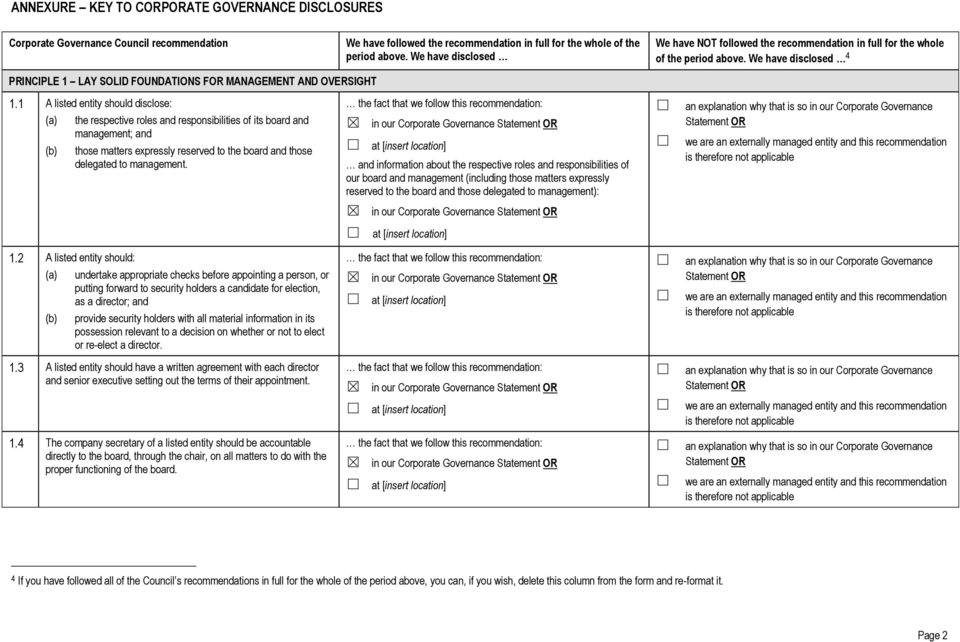
3 ANNEXURE KEY TO CORPORATE GOVERNANCE DISCLOSURES Corporate Governance Council recommendation We have followed the recommendation in full for the whole of the period above. We have disclosed We have NOT followed the recommendation in full for the whole of the period above. We have disclosed 4 PRINCIPLE 1 LAY SOLID FOUNDATIONS FOR MANAGEMENT AND OVERSIGHT 1.1 A listed entity should disclose: (a) the respective roles and responsibilities of its board and management; and those matters expressly reserved to the board and those delegated to management. the fact that we follow this recommendation: and information about the respective roles and responsibilities of our board and management (including those matters expressly reserved to the board and those delegated to management): we are an externally managed entity and this recommendation 1.2 A listed entity should: (a) undertake appropriate checks before appointing a person, or putting forward to security holders a candidate for election, as a director; and provide security holders with all material information in its possession relevant to a decision on whether or not to elect or re-elect a director. the fact that we follow this recommendation: we are an externally managed entity and this recommendation 1.3 A listed entity should have a written agreement with each director and senior executive setting out the terms of their appointment. the fact that we follow this recommendation: we are an externally managed entity and this recommendation 1.4 The company secretary of a listed entity should be accountable directly to the board, through the chair, on all matters to do with the proper functioning of the board. the fact that we follow this recommendation: we are an externally managed entity and this recommendation 4 If you have followed all of the Council s recommendations in full for the whole of the period above, you can, if you wish, delete this column from the form and re-format it. Page 2
4 Corporate Governance Council recommendation 1.5 A listed entity should: (a) have a diversity policy which includes requirements for the board or a relevant committee of the board to set measurable objectives for achieving gender diversity and to assess annually both the objectives and the entity s progress in achieving them; (c) disclose that policy or a summary of it; and disclose as at the end of each reporting period the measurable objectives for achieving gender diversity set by the board or a relevant committee of the board in accordance with the entity s diversity policy and its progress towards achieving them and either: (1) the respective proportions of men and women on the board, in senior executive positions and across the whole organisation (including how the entity has defined senior executive for these purposes); or (2) if the entity is a relevant employer under the Workplace Gender Equality Act, the entity s most recent Gender Equality Indicators, as defined in and published under that Act. 1.6 A listed entity should: (a) have and disclose a process for periodically evaluating the performance of the board, its committees and individual directors; and disclose, in relation to each reporting period, whether a performance evaluation was undertaken in the reporting period in accordance with that process. We have followed the recommendation in full for the whole of the period above. We have disclosed the fact that we have a diversity policy that complies with paragraph (a): and a copy of our diversity policy or a summary of it: at eresponsibility/pages/default.aspx and the measurable objectives for achieving gender diversity set by the board or a relevant committee of the board in accordance with our diversity policy and our progress towards achieving them: and the information referred to in paragraphs (c)(1) or (2): the evaluation process referred to in paragraph (a): and the information referred to in paragraph : We have NOT followed the recommendation in full for the whole of the period above. We have disclosed 4 we are an externally managed entity and this recommendation we are an externally managed entity and this recommendation Page 3

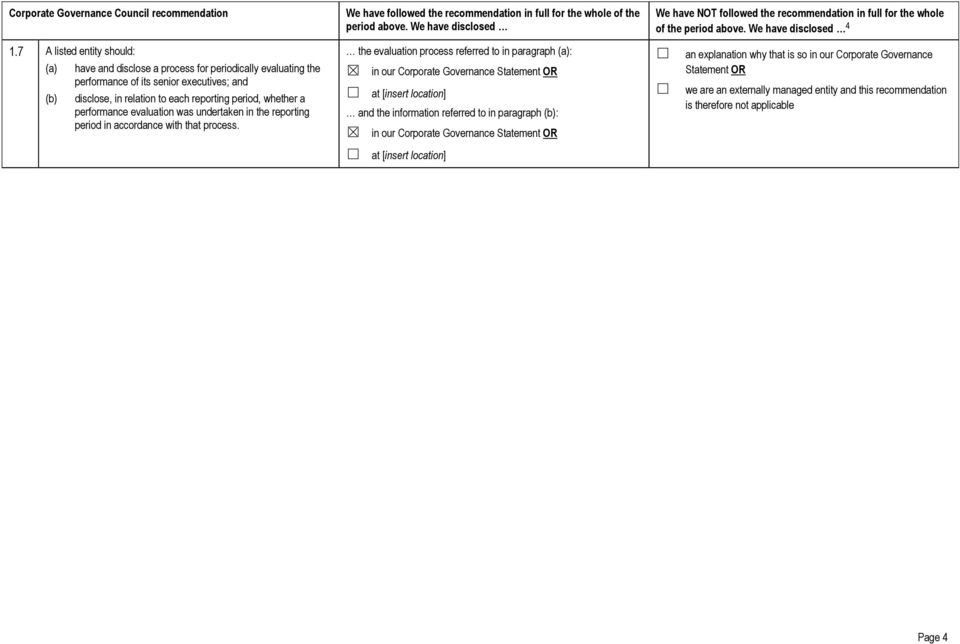
5 Corporate Governance Council recommendation 1.7 A listed entity should: (a) have and disclose a process for periodically evaluating the performance of its senior executives; and disclose, in relation to each reporting period, whether a performance evaluation was undertaken in the reporting period in accordance with that process. We have followed the recommendation in full for the whole of the period above. We have disclosed the evaluation process referred to in paragraph (a): and the information referred to in paragraph : We have NOT followed the recommendation in full for the whole of the period above. We have disclosed 4 we are an externally managed entity and this recommendation Page 4
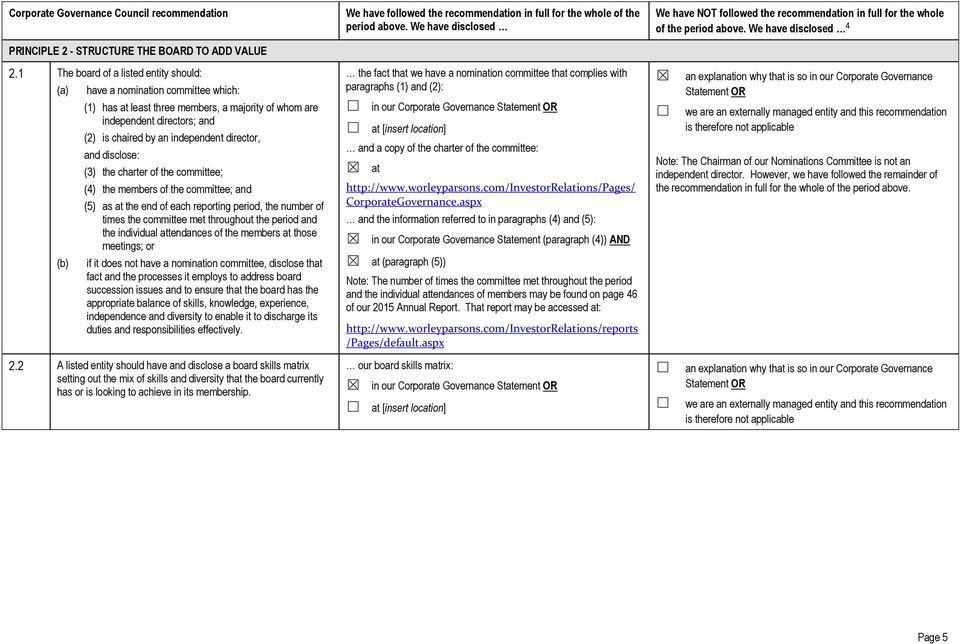
6 Corporate Governance Council recommendation PRINCIPLE 2 - STRUCTURE THE BOARD TO ADD VALUE 2.1 The board of a listed entity should: (a) have a nomination committee which: (1) has at least three members, a majority of whom are independent directors; and (2) is chaired by an independent director, and disclose: (3) the charter of the committee; (4) the members of the committee; and (5) as at the end of each reporting period, the number of times the committee met throughout the period and the individual attendances of the members at those meetings; or if it does not have a nomination committee, disclose that fact and the processes it employs to address board succession issues and to ensure that the board has the appropriate balance of skills, knowledge, experience, independence and diversity to enable it to discharge its duties and responsibilities effectively. We have followed the recommendation in full for the whole of the period above. We have disclosed the fact that we have a nomination committee that complies with paragraphs (1) and (2): and a copy of the charter of the committee: at CorporateGovernance.aspx and the information referred to in paragraphs (4) and (5): in our Corporate Governance Statement (paragraph (4)) AND at (paragraph (5)) Note: The number of times the committee met throughout the period and the individual attendances of members may be found on page 46 of our 2015 Annual Report. That report may be accessed at: /Pages/default.aspx We have NOT followed the recommendation in full for the whole of the period above. We have disclosed 4 we are an externally managed entity and this recommendation Note: The Chairman of our Nominations Committee is not an independent director. However, we have followed the remainder of the recommendation in full for the whole of the period above. 2.2 A listed entity should have and disclose a board skills matrix setting out the mix of skills and diversity that the board currently has or is looking to achieve in its membership. our board skills matrix: we are an externally managed entity and this recommendation Page 5
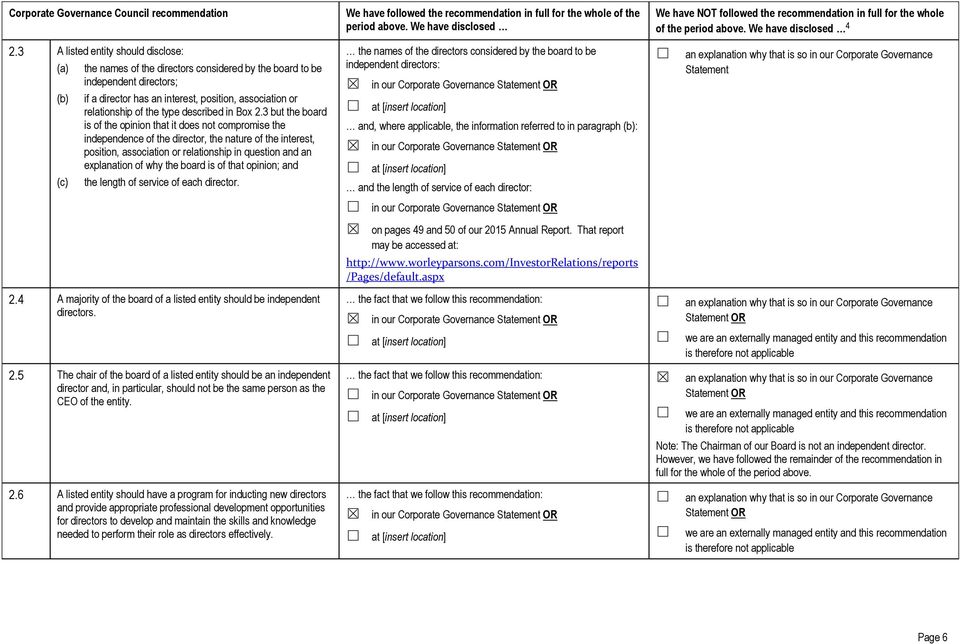
7 Corporate Governance Council recommendation 2.3 A listed entity should disclose: (a) the names of the directors considered by the board to be independent directors; (c) if a director has an interest, position, association or relationship of the type described in Box 2.3 but the board is of the opinion that it does not compromise the independence of the director, the nature of the interest, position, association or relationship in question and an explanation of why the board is of that opinion; and the length of service of each director. 2.4 A majority of the board of a listed entity should be independent directors. 2.5 The chair of the board of a listed entity should be an independent director and, in particular, should not be the same person as the CEO of the entity. 2.6 A listed entity should have a program for inducting new directors and provide appropriate professional development opportunities for directors to develop and maintain the skills and knowledge needed to perform their role as directors effectively. We have followed the recommendation in full for the whole of the period above. We have disclosed the names of the directors considered by the board to be independent directors: and, where applicable, the information referred to in paragraph : and the length of service of each director: on pages 49 and 50 of our 2015 Annual Report. That report may be accessed at: /Pages/default.aspx the fact that we follow this recommendation: the fact that we follow this recommendation: the fact that we follow this recommendation: We have NOT followed the recommendation in full for the whole of the period above. We have disclosed 4 Statement we are an externally managed entity and this recommendation we are an externally managed entity and this recommendation Note: The Chairman of our Board is not an independent director. However, we have followed the remainder of the recommendation in full for the whole of the period above. we are an externally managed entity and this recommendation Page 6
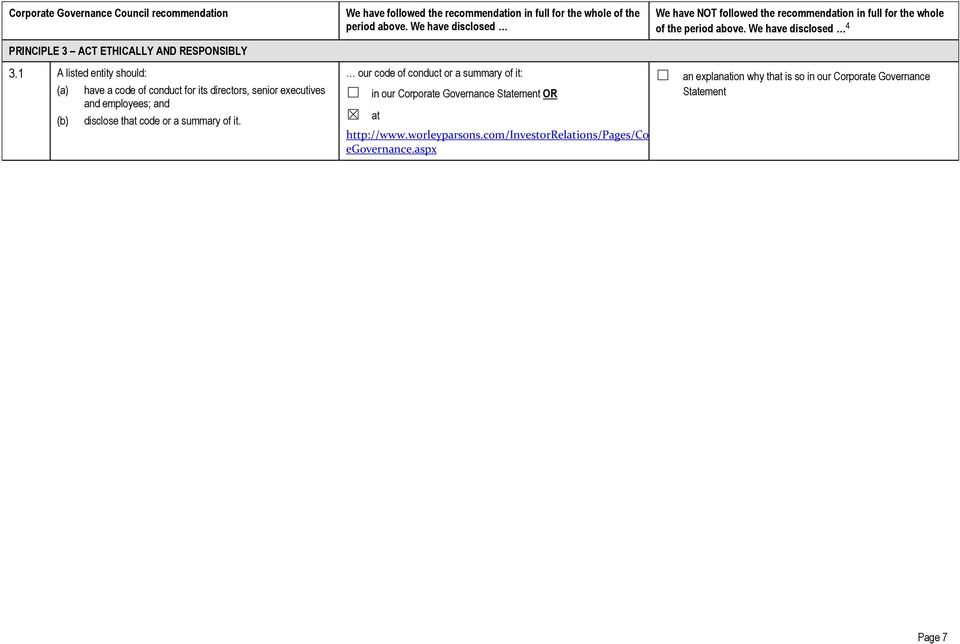
8 Corporate Governance Council recommendation PRINCIPLE 3 ACT ETHICALLY AND RESPONSIBLY 3.1 A listed entity should: (a) have a code of conduct for its directors, senior executives and employees; and disclose that code or a summary of it. We have followed the recommendation in full for the whole of the period above. We have disclosed our code of conduct or a summary of it: at egovernance.aspx We have NOT followed the recommendation in full for the whole of the period above. We have disclosed 4 Statement Page 7
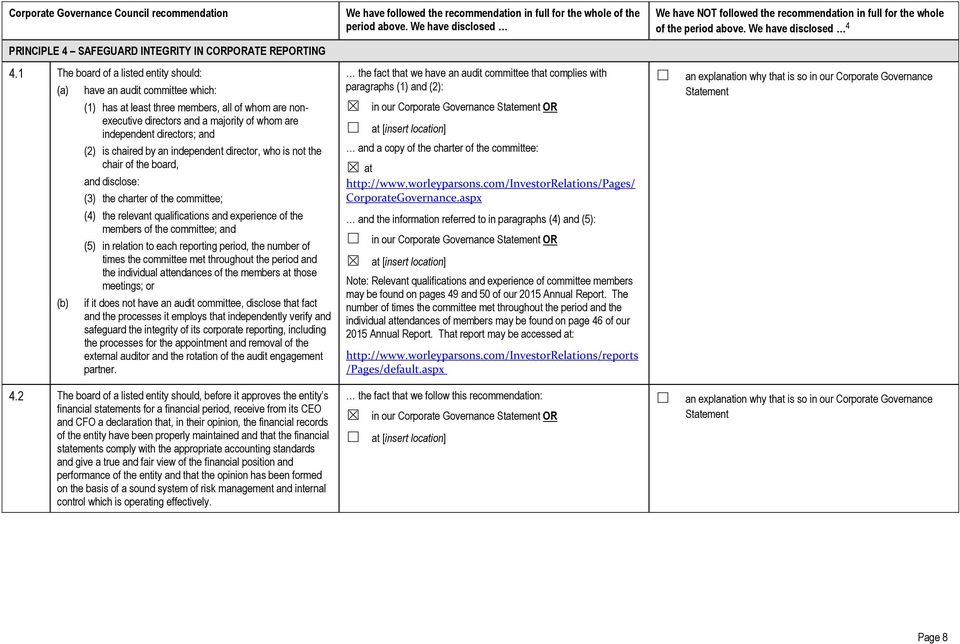
9 Corporate Governance Council recommendation PRINCIPLE 4 SAFEGUARD INTEGRITY IN CORPORATE REPORTING We have followed the recommendation in full for the whole of the period above. We have disclosed We have NOT followed the recommendation in full for the whole of the period above. We have disclosed The board of a listed entity should: (a) have an audit committee which: (1) has at least three members, all of whom are nonexecutive directors and a majority of whom are independent directors; and (2) is chaired by an independent director, who is not the chair of the board, and disclose: (3) the charter of the committee; the fact that we have an audit committee that complies with paragraphs (1) and (2): and a copy of the charter of the committee: at CorporateGovernance.aspx Statement (4) the relevant qualifications and experience of the members of the committee; and (5) in relation to each reporting period, the number of times the committee met throughout the period and the individual attendances of the members at those meetings; or if it does not have an audit committee, disclose that fact and the processes it employs that independently verify and safeguard the integrity of its corporate reporting, including the processes for the appointment and removal of the external auditor and the rotation of the audit engagement partner. and the information referred to in paragraphs (4) and (5): Note: Relevant qualifications and experience of committee members may be found on pages 49 and 50 of our 2015 Annual Report. The number of times the committee met throughout the period and the individual attendances of members may be found on page 46 of our 2015 Annual Report. That report may be accessed at: /Pages/default.aspx 4.2 The board of a listed entity should, before it approves the entity s financial statements for a financial period, receive from its CEO and CFO a declaration that, in their opinion, the financial records of the entity have been properly maintained and that the financial statements comply with the appropriate accounting standards and give a true and fair view of the financial position and performance of the entity and that the opinion has been formed on the basis of a sound system of risk management and internal control which is operating effectively. the fact that we follow this recommendation: Statement Page 8
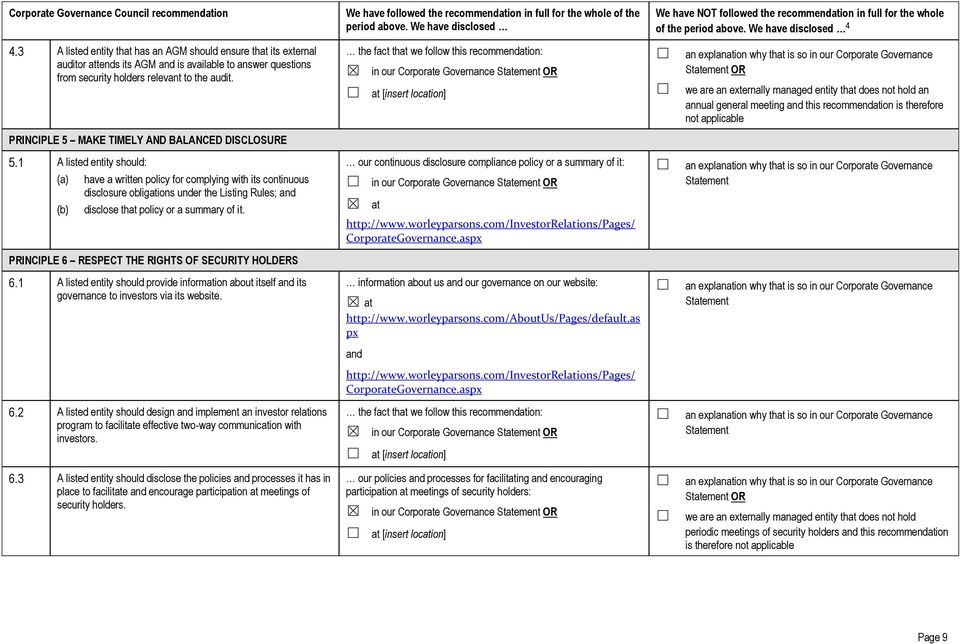
10 Corporate Governance Council recommendation 4.3 A listed entity that has an AGM should ensure that its external auditor attends its AGM and is available to answer questions from security holders relevant to the audit. PRINCIPLE 5 MAKE TIMELY AND BALANCED DISCLOSURE 5.1 A listed entity should: (a) have a written policy for complying with its continuous disclosure obligations under the Listing Rules; and disclose that policy or a summary of it. PRINCIPLE 6 RESPECT THE RIGHTS OF SECURITY HOLDERS We have followed the recommendation in full for the whole of the period above. We have disclosed the fact that we follow this recommendation: our continuous disclosure compliance policy or a summary of it: at CorporateGovernance.aspx We have NOT followed the recommendation in full for the whole of the period above. We have disclosed 4 we are an externally managed entity that does not hold an annual general meeting and this recommendation is therefore not applicable Statement 6.1 A listed entity should provide information about itself and its governance to investors via its website. information about us and our governance on our website: at px Statement and CorporateGovernance.aspx 6.2 A listed entity should design and implement an investor relations program to facilitate effective two-way communication with investors. the fact that we follow this recommendation: Statement 6.3 A listed entity should disclose the policies and processes it has in place to facilitate and encourage participation at meetings of security holders. our policies and processes for facilitating and encouraging participation at meetings of security holders: we are an externally managed entity that does not hold periodic meetings of security holders and this recommendation Page 9
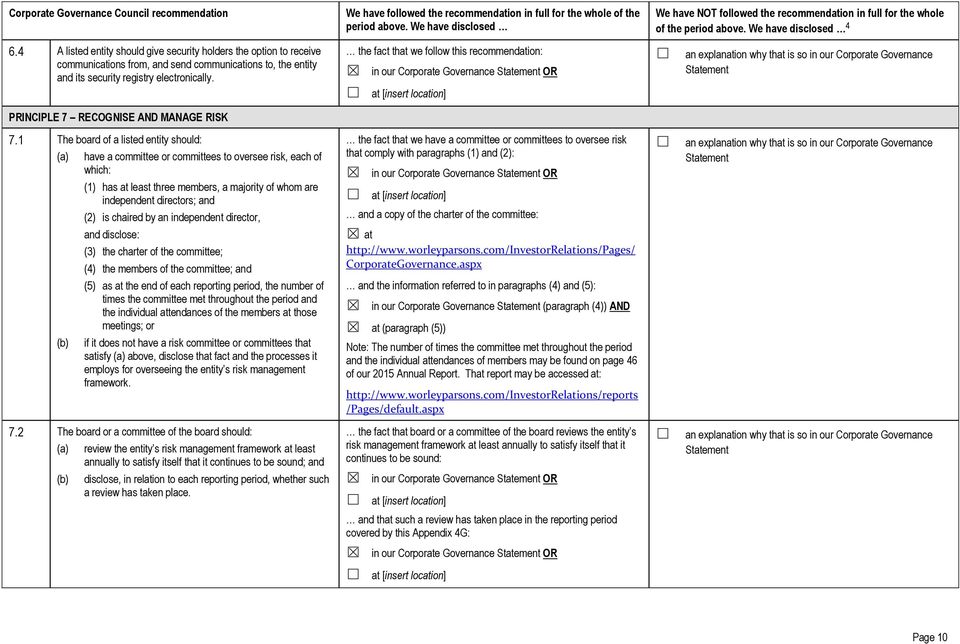
11 Corporate Governance Council recommendation 6.4 A listed entity should give security holders the option to receive communications from, and send communications to, the entity and its security registry electronically. PRINCIPLE 7 RECOGNISE AND MANAGE RISK We have followed the recommendation in full for the whole of the period above. We have disclosed the fact that we follow this recommendation: We have NOT followed the recommendation in full for the whole of the period above. We have disclosed 4 Statement 7.1 The board of a listed entity should: (a) have a committee or committees to oversee risk, each of which: (1) has at least three members, a majority of whom are independent directors; and (2) is chaired by an independent director, and disclose: (3) the charter of the committee; (4) the members of the committee; and (5) as at the end of each reporting period, the number of times the committee met throughout the period and the individual attendances of the members at those meetings; or if it does not have a risk committee or committees that satisfy (a) above, disclose that fact and the processes it employs for overseeing the entity s risk management framework. the fact that we have a committee or committees to oversee risk that comply with paragraphs (1) and (2): and a copy of the charter of the committee: at CorporateGovernance.aspx and the information referred to in paragraphs (4) and (5): in our Corporate Governance Statement (paragraph (4)) AND at (paragraph (5)) Note: The number of times the committee met throughout the period and the individual attendances of members may be found on page 46 of our 2015 Annual Report. That report may be accessed at: /Pages/default.aspx Statement 7.2 The board or a committee of the board should: (a) review the entity s risk management framework at least annually to satisfy itself that it continues to be sound; and disclose, in relation to each reporting period, whether such a review has taken place. the fact that board or a committee of the board reviews the entity s risk management framework at least annually to satisfy itself that it continues to be sound: and that such a review has taken place in the reporting period covered by this Appendix 4G: Statement Page 10
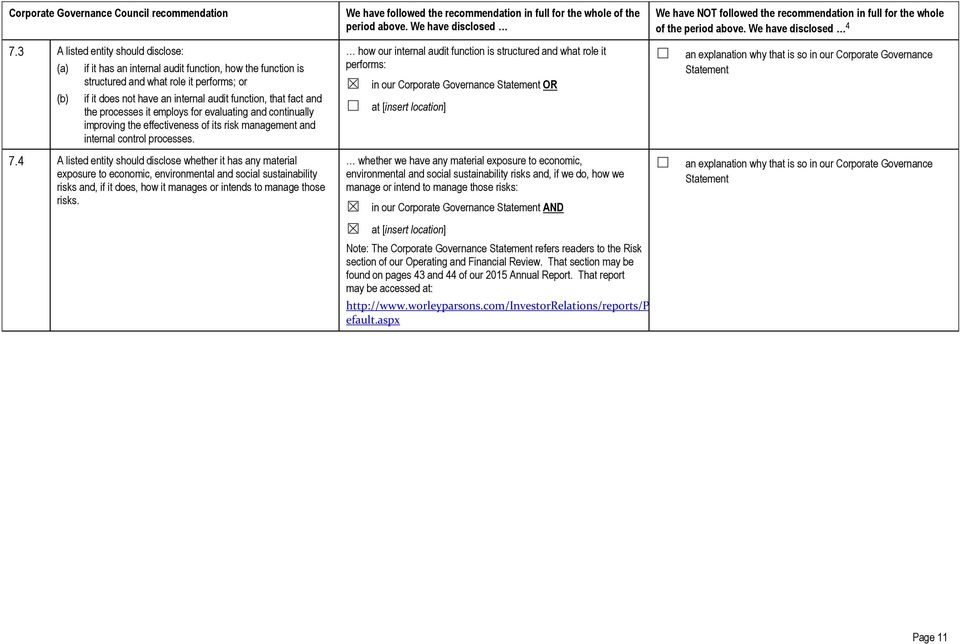
12 Corporate Governance Council recommendation 7.3 A listed entity should disclose: (a) if it has an internal audit function, how the function is structured and what role it performs; or if it does not have an internal audit function, that fact and the processes it employs for evaluating and continually improving the effectiveness of its risk management and internal control processes. 7.4 A listed entity should disclose whether it has any material exposure to economic, environmental and social sustainability risks and, if it does, how it manages or intends to manage those risks. We have followed the recommendation in full for the whole of the period above. We have disclosed how our internal audit function is structured and what role it performs: whether we have any material exposure to economic, environmental and social sustainability risks and, if we do, how we manage or intend to manage those risks: in our Corporate Governance Statement AND Note: The Corporate Governance Statement refers readers to the Risk section of our Operating and Financial Review. That section may be found on pages 43 and 44 of our 2015 Annual Report. That report may be accessed at: efault.aspx We have NOT followed the recommendation in full for the whole of the period above. We have disclosed 4 Statement Statement Page 11
13 Corporate Governance Council recommendation PRINCIPLE 8 REMUNERATE FAIRLY AND RESPONSIBLY We have followed the recommendation in full for the whole of the period above. We have disclosed We have NOT followed the recommendation in full for the whole of the period above. We have disclosed The board of a listed entity should: (a) have a remuneration committee which: (1) has at least three members, a majority of whom are independent directors; and (2) is chaired by an independent director, and disclose: (3) the charter of the committee; (4) the members of the committee; and (5) as at the end of each reporting period, the number of times the committee met throughout the period and the individual attendances of the members at those meetings; or if it does not have a remuneration committee, disclose that fact and the processes it employs for setting the level and composition of remuneration for directors and senior executives and ensuring that such remuneration is appropriate and not excessive. the fact that we have a remuneration committee that complies with paragraphs (1) and (2): and a copy of the charter of the committee: at CorporateGovernance.aspx and the information referred to in paragraphs (4) and (5): in our Corporate Governance Statement (paragraph (4)) AND Note: The number of times the committee met throughout the period and the individual attendances of members may be found on page 46 of our 2015 Annual Report. That report may be accessed at: /Pages/default.aspx we are an externally managed entity and this recommendation is therefore not applicable 8.2 A listed entity should separately disclose its policies and practices regarding the remuneration of non-executive directors and the remuneration of executive directors and other senior executives. separately our remuneration policies and practices regarding the remuneration of non-executive directors and the remuneration of executive directors and other senior executives: we are an externally managed entity and this recommendation Note: Those policies and practices are disclosed in the Remuneration Report set out on pages 51 to 66 of our 2015 Annual Report. That report may be accessed at: /Pages/default.aspx Page 12

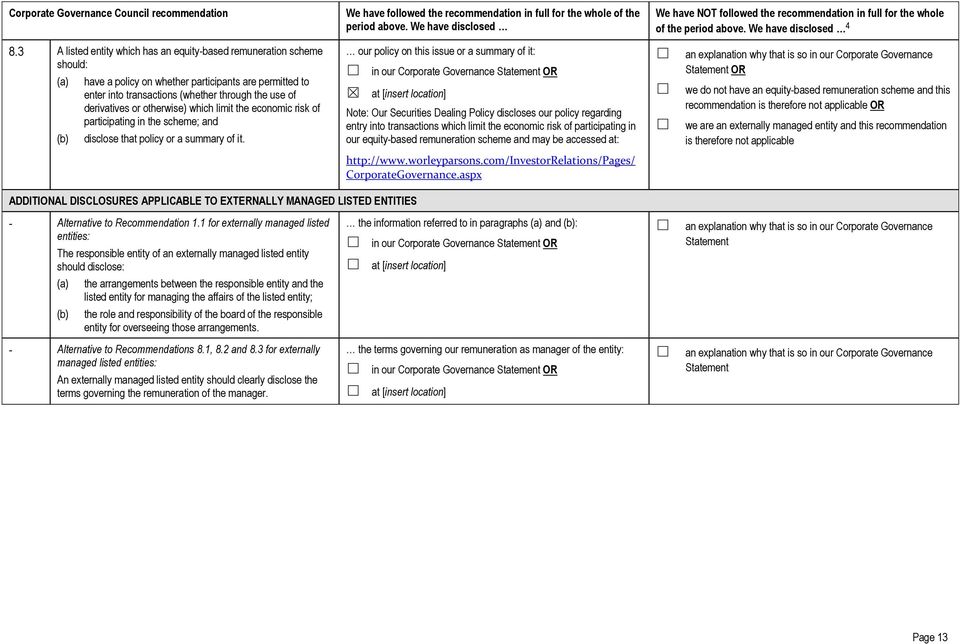
14 Corporate Governance Council recommendation We have followed the recommendation in full for the whole of the period above. We have disclosed We have NOT followed the recommendation in full for the whole of the period above. We have disclosed A listed entity which has an equity-based remuneration scheme should: (a) have a policy on whether participants are permitted to enter into transactions (whether through the use of derivatives or otherwise) which limit the economic risk of participating in the scheme; and disclose that policy or a summary of it. our policy on this issue or a summary of it: Note: Our Securities Dealing Policy discloses our policy regarding entry into transactions which limit the economic risk of participating in our equity-based remuneration scheme and may be accessed at: w e do not have an equity-based remuneration scheme and this recommendation OR we are an externally managed entity and this recommendation CorporateGovernance.aspx ADDITIONAL DISCLOSURES APPLICABLE TO EXTERNALLY MANAGED LISTED ENTITIES - Alternative to Recommendation 1.1 for externally managed listed entities: The responsible entity of an externally managed listed entity should disclose: the information referred to in paragraphs (a) and : Statement (a) the arrangements between the responsible entity and the listed entity for managing the affairs of the listed entity; the role and responsibility of the board of the responsible entity for overseeing those arrangements. - Alternative to Recommendations 8.1, 8.2 and 8.3 for externally managed listed entities: An externally managed listed entity should clearly disclose the terms governing the remuneration of the manager. the terms governing our remuneration as manager of the entity: Statement Page 13
15 Corporate Governance Statement

16 WorleyParsons Corporate Governance Statement 2015 CORPORATE GOVERNANCE STATEMENT INTRODUCTION The Board of Directors of WorleyParsons Limited (Board) strives to ensure that WorleyParsons Limited (Company) and the entities it controls (Group) meet high standards of safety, performance and governance. The Group recognizes that it has responsibilities to its shareholders, customers, employees and suppliers as well as to the communities in which it operates. The Board has ultimate authority over, and oversight of, the Group and regards corporate governance as a critical element in achieving the Group s objectives. Accordingly, the Board has adopted appropriate charters, codes and policies and established a number of committees (Committees or Board Committees) to discharge its duties. The Corporate Governance page in the Investor Relations section of the Group s website ( InvestorRelations/Pages/CorporateGovernance.aspx) contains most of the charters, codes and policies which are referred to in this statement (or a summary of them). These documents are periodically reviewed and enhanced to take account of changes in the law and governance practices. The Group s governance systems meet the requirements of the Corporations Act 2001 (Act) and the Listing Rules of the Australian Securities Exchange (ASX Listing Rules and ASX respectively). As required by the ASX Listing Rules, this statement discloses the extent to which the Company has followed the 3rd Edition of the ASX Corporate Governance Council s Corporate Governance Principles and Recommendations (ASX Recommendations) during the reporting period comprising the year ended 30 June 2015 (Reporting Period). Except where otherwise explained, the Company followed all of the ASX Recommendations during the Reporting Period. The following table indicates where specific ASX Recommendations are dealt with in this statement: PRINCIPLES AND RECOMMENDATIONS SECTION Principle 1: Lay solid foundations for management and oversight 1.1 A listed entity should disclose: a) the respective roles and responsibilities of its board and management; and b) those matters expressly reserved to the board and those delegated to management. 1.2 A listed entity should: a) undertake appropriate checks before appointing a person, or putting forward to security holders a candidate for election, as a director; and b) provide security holders with all material information in its possession relevant to a decision on whether or not to elect or re-elect a director. 1.3 A listed entity should have a written agreement with each director and senior executive setting out the terms of their appointment. 1.4 The company secretary of a listed entity should be accountable directly to the board, through the chair, on all matters to do with the proper functioning of the board. 1.5 A listed entity should: a) have a diversity policy which includes requirements for the board or a relevant committee of the board to set measurable objectives for achieving gender diversity and to assess annually both the objectives and the entity s progress in achieving them; b) disclose that policy or a summary of it; and c) disclose as at the end of each reporting period the measurable objectives for achieving gender diversity set by the board or a relevant committee of the board in accordance with the entity s diversity policy and its progress towards achieving them, and either: 1. the respective proportions of men and women on the board, in senior executive positions and across the whole organization (including how the entity has defined senior executive for these purposes); or 2. if the entity is a relevant employer under the Workplace Gender Equality Act, the entity s most recent Gender Equality Indicators, as defined in and published under that Act. 1.6 A listed entity should: a) have and disclose a process for periodically evaluating the performance of the board, its committees and individual directors; and b) disclose, in relation to each reporting period, whether a performance evaluation was undertaken in the reporting period in accordance with that process. 2.1 and and and

17 WorleyParsons Corporate Governance Statement 2015 PRINCIPLES AND RECOMMENDATIONS SECTION 1.7 A listed entity should: a) have and disclose a process for periodically evaluating the performance of its senior executives; and b) disclose, in relation to each reporting period, whether a performance evaluation was undertaken in the reporting period in accordance with that process. Principle 2: Structure the board to add value 2.1 The board of a listed entity should: a) have a nomination committee which: 1. has at least three members, a majority of whom are independent directors; and 2. is chaired by an independent director, and disclose: 3. the charter of the committee; 4. the members of the committee; and 5. as at the end of each reporting period, the number of times the committee met throughout the period and the individual attendances of the members at those meetings; or b) if it does not have a nomination committee, disclose that fact and the processes it employs to address board succession issues and to ensure that the board has the appropriate balance of skills, knowledge, experience, independence and diversity to enable it to discharge its duties and responsibilities effectively. 2.2 A listed entity should have and disclose a board skills matrix setting out the mix of skills and diversity that the board currently has or is looking to achieve in its membership. 2.3 A listed entity should disclose: a) the names of the directors considered by the board to be independent directors; b) if a director has an interest, position, association or relationship of the type described in Box 2.3 which appears on page 16 of the ASX Recommendations and is titled Factors relevant to assessing the independence of a director, but the board is of the opinion that it does not compromise the independence of the director, the nature of the interest, position, association or relationship in question and an explanation of why the board is of that opinion; and c) the length of service of each director. 2.4 A majority of the board of a listed entity should be independent directors The chair of the board of a listed entity should be an independent director and, in particular, should not be the same person as the chief executive officer of the entity. 2.6 A listed entity should have a program for inducting new directors and provide appropriate professional development opportunities for directors to develop and maintain the skills and knowledge needed to perform their role as directors effectively. Principle 3: Act ethically and responsibly 3.1 A listed entity should: a) have a code of conduct for its directors, senior executives and employees; and b) disclose that code or a summary of it. Principle 4: Safeguard integrity in corporate reporting 4.1 The board of a listed entity should: a) have an audit committee which: 1. has at least three members, all of whom are non-executive directors and a majority of whom are independent directors; and 2. is chaired by an independent director, who is not the chair of the board, and disclose: 3. the charter of the committee; 4. the relevant qualifications and experience of the members of the committee; and 5. in relation to each reporting period, the number of times the committee met throughout the period and the individual attendances of the members at those meetings; or b) if it does not have an audit committee, disclose that fact and the processes it employs that independently verify and safeguard the integrity of its corporate reporting, including the processes for the appointment and removal of the external auditor and the rotation of the audit engagement partner and

18 WorleyParsons Corporate Governance Statement 2015 PRINCIPLES AND RECOMMENDATIONS SECTION 4.2 The board of a listed entity should, before it approves the entity s financial statements for a financial period, receive from its chief executive officer and chief financial officer a declaration that, in their opinion, the financial records of the entity have been properly maintained and that the financial statements comply with the appropriate accounting standards and give a true and fair view of the financial position and performance of the entity and that the opinion has been formed on the basis of a sound system of risk management and internal control which is operating effectively A listed entity that has an annual general meeting should ensure that its external auditor attends its annual general meeting and is available to answer questions from security holders relevant to the audit. Principle 5: Make timely and balanced disclosure 5.1 A listed entity should: a) have a written policy for complying with its continuous disclosure obligations under the Listing Rules; and b) disclose that policy or a summary of it. Principle 6: Respect the rights of security holders 6.1 A listed entity should provide information about itself and its governance to investors via its website A listed entity should design and implement an investor relations program to facilitate effective two-way communication with investors. 6.3 A listed entity should disclose the policies and processes it has in place to facilitate and encourage participation at meetings of security holders. 6.4 A listed entity should give security holders the option to receive communications from, and send communications to, the entity and its security registry electronically. Principle 7: Recognize and manage risk 7.1 The board of a listed entity should: a) have a committee or committees to oversee risk, each of which: 1. has at least three members, a majority of whom are independent directors; and 2. is chaired by an independent director, and disclose: 3. the charter of the committee; 4. the members of the committee; and 5. as at the end of each reporting period, the number of times the committee met throughout the period and the individual attendances of the members at those meetings; or b) if it does not have a risk committee or committees that satisfy a) above, disclose that fact and the processes it employs for overseeing the entity s risk management framework. 7.2 The board or a committee of the board should: a) review the entity s risk management framework at least annually to satisfy itself that it continues to be sound; and b) disclose, in relation to each reporting period, whether such a review has taken place. 7.3 A listed entity should disclose: a) if it has an internal audit function, how the function is structured and what role it performs; and b) if it does not have an internal audit function, that fact and the processes it employs for evaluating and continually improving the effectiveness of its risk management and internal control processes. 7.4 A listed entity should disclose whether it has any material exposure to economic, environmental and social sustainability risks and, if it does, how it manages or intends to manage those risks

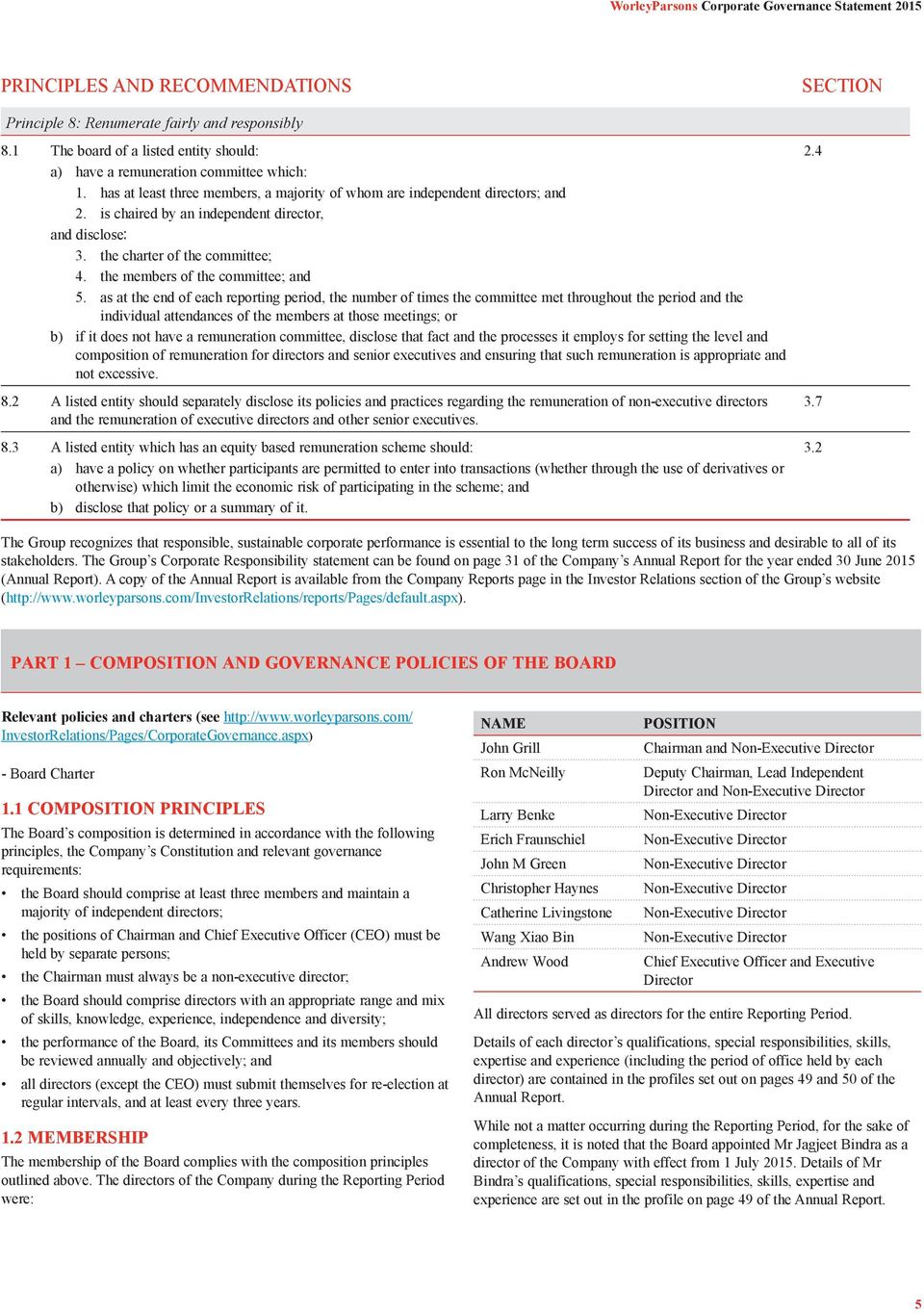
19 WorleyParsons Corporate Governance Statement 2015 PRINCIPLES AND RECOMMENDATIONS SECTION Principle 8: Renumerate fairly and responsibly 8.1 The board of a listed entity should: a) have a remuneration committee which: 1. has at least three members, a majority of whom are independent directors; and 2. is chaired by an independent director, and disclose: 3. the charter of the committee; 4. the members of the committee; and 5. as at the end of each reporting period, the number of times the committee met throughout the period and the individual attendances of the members at those meetings; or b) if it does not have a remuneration committee, disclose that fact and the processes it employs for setting the level and composition of remuneration for directors and senior executives and ensuring that such remuneration is appropriate and not excessive. 8.2 A listed entity should separately disclose its policies and practices regarding the remuneration of non-executive directors and the remuneration of executive directors and other senior executives. 8.3 A listed entity which has an equity based remuneration scheme should: a) have a policy on whether participants are permitted to enter into transactions (whether through the use of derivatives or otherwise) which limit the economic risk of participating in the scheme; and b) disclose that policy or a summary of it The Group recognizes that responsible, sustainable corporate performance is essential to the long term success of its business and desirable to all of its stakeholders. The Group s Corporate Responsibility statement can be found on page 31 of the Company s Annual Report for the year ended 30 June 2015 (Annual Report). A copy of the Annual Report is available from the Company Reports page in the Investor Relations section of the Group s website ( PART 1 COMPOSITION AND GOVERNANCE POLICIES OF THE BOARD Relevant policies and charters (see InvestorRelations/Pages/CorporateGovernance.aspx) - Board Charter 1.1 COMPOSITION PRINCIPLES The Board s composition is determined in accordance with the following principles, the Company s Constitution and relevant governance requirements: the Board should comprise at least three members and maintain a majority of independent directors; the positions of Chairman and Chief Executive Officer (CEO) must be held by separate persons; the Chairman must always be a non-executive director; the Board should comprise directors with an appropriate range and mix of skills, knowledge, experience, independence and diversity; the performance of the Board, its Committees and its members should be reviewed annually and objectively; and all directors (except the CEO) must submit themselves for re-election at regular intervals, and at least every three years. 1.2 MEMBERSHIP The membership of the Board complies with the composition principles outlined above. The directors of the Company during the Reporting Period were: NAME John Grill Ron McNeilly Larry Benke Erich Fraunschiel John M Green Christopher Haynes Catherine Livingstone Wang Xiao Bin Andrew Wood POSITION Chairman and Non-Executive Director Deputy Chairman, Lead Independent Director and Non-Executive Director Non-Executive Director Non-Executive Director Non-Executive Director Non-Executive Director Non-Executive Director Non-Executive Director Chief Executive Officer and Executive Director All directors served as directors for the entire Reporting Period. Details of each director s qualifications, special responsibilities, skills, expertise and experience (including the period of office held by each director) are contained in the profiles set out on pages 49 and 50 of the Annual Report. While not a matter occurring during the Reporting Period, for the sake of completeness, it is noted that the Board appointed Mr Jagjeet Bindra as a director of the Company with effect from 1 July Details of Mr Bindra s qualifications, special responsibilities, skills, expertise and experience are set out in the profile on page 49 of the Annual Report. 5
20 WorleyParsons Corporate Governance Statement APPOINTMENT, INDUCTION AND TRAINING The Board s Nominations Committee sets and reviews the criteria for new director appointments having regard to the overall composition of the Board. In considering the nominations and appointments of directors, the Board seeks to ensure that its membership is such that each director: is a person of integrity who will observe the Group s Code of Conduct; has sufficient abilities and time available to perform their role effectively; brings an independent and questioning mind to their role; enhances the breadth and depth of skills and knowledge of the Board as a whole; and enhances the experience, independence and diversity of the Board as a whole. While recognizing that each director will not necessarily have experience in each of the following areas, the Board seeks to ensure that its membership includes an appropriate mix of directors with experience in engineering, relevant industry sectors, general management and finance. SKILLS AND EXPERIENCE (OUT OF 9 DIRECTORS) Leadership and Governance Leadership 9 Corporate Governance 8 Strategy 9 Operations Health and Safety 5 Engineering 4 Project Delivery 5 Sector Experience Hydrocarbons 6 Minerals, Metals & Chemicals 5 Infrastructure 4 Geographic Experience Asia Pacific 7 Latin America 3 North America 7 Sub-Saharan Africa 2 Europe/Middle East/North Africa 8 Finance and Risk Accounting 5 Finance 8 Acquisitions 9 Risk Management 9 People Human Resources 7 Remuneration 7 Technology Technology 4 A summary of the directors skills and experience as relevant to the Group is set out below and graphs depicting the diversity of the directors are set out on the following page. Each non-executive director receives a letter which formalizes their appointment and outlines the key terms and conditions of their appointment. The executive director (CEO) has a written position description and a service contract. Director induction and professional development processes are incorporated into the Board program. Directors are encouraged, and are given the opportunity, to broaden their knowledge of the Group s business by visiting offices in different locations and to remain abreast of developments impacting the business. During the Reporting Period, most non-executive directors conducted a safety-awareness visit to at least one of the Group s project sites and in total, 13 such non-executive director visits took place during the Reporting Period. Non-executive directors visited project sites in Australia, Canada and China. In addition, the CEO visited a total of seven project sites in Australia, Canada, China, South Africa and the United States during the Reporting Period. 1.4 DIRECTOR INDEPENDENCE The Board recognizes that, while various principles and factors are relevant in determining independence, true independence is a matter of judgment having regard to the particular circumstances. Accordingly, when the Board exercises its judgment in determining independence, it has regard to relationships between a director and the Group or between a director and third parties that may compromise the director s independence. The Nominations Committee monitors and undertakes an annual assessment of each non-executive director s independence. This assessment applies the ASX Recommendations, the Act and current corporate governance practice and adopts the definition of independence set out in the ASX Recommendations. The Board has considered the positions and relationships of each of the eight persons who were non-executive directors for the Reporting Period and has formed the view that seven of those eight persons were independent. The Board is of the opinion that therefore a majority of the Board was independent of the Group s management and was free of any interest that have affected its free and unfettered judgment during the Reporting Period. Mr John Grill Mr Grill was appointed Chairman of the Board on 1 March Mr Grill was CEO of the entity that ultimately became WorleyParsons Limited from 1971 and held the position of CEO until 23 October Mr Grill is also a substantial shareholder of the Company. Accordingly, Mr Grill is not regarded as independent. While ASX Recommendation 2.5 provides that the Chairman should be independent, the Board carefully assessed Mr Grill s appointment as Chairman and considered that there were a number of unique circumstances that made Mr Grill s appointment appropriate. Almost every one of the Group s global industry peers is chaired by a former chief executive officer demonstrating the ongoing importance of strong industry and customer relationships in the industries in which the Group operates. The Board wished to retain the benefit of Mr Grill s close relationships with major global customers and his extensive industry experience. The Board also considered the fact that Mr Grill is a substantial shareholder, which aligns his interests with those of all other shareholders. 6

21 WorleyParsons Corporate Governance Statement 2015 DIVERSITY OF DIRECTORS TERTIARY QUALIFICATIONS INDUSTRY EXPERIENCE Engineering Engineering/Science Commerce/Accounting Law Other Oil and Gas Finance Science and Technology Mining Manufacturing RESIDENCY GENDER Power Legal Services Australia Canada China Men Women United Kingdom Consistent with the ASX Recommendations, on Mr Grill s appointment as Chairman, the Board created the role of Lead Independent Director. Appointing a Lead Independent Director seeks to ensure that the views of independent directors are effectively raised and considered by the Board. The Lead Independent Director provides leadership and support to the other independent directors in relation to matters that uniquely concern them as independent directors. The Lead Independent Director also, together with the Chairman, ensures that conflicts of interest on the Board (whether actual or potential) are identified and managed appropriately. The Lead Independent Director calls and chairs at least four meetings of independent directors each calendar year (at which neither the Chairman nor members of senior management are present) for the purposes of discussing matters relevant to the Board s business and responsibilities. Six such meetings were held during the Reporting Period. Dr Christopher Haynes and Mr Erich Fraunschiel Dr Haynes, the Chairman of the Company s Health, Safety and Environment Committee, is a non-executive director of Woodside Petroleum Limited (Woodside), which is a customer of the Group. Mr Fraunschiel, the Chairman of the Company s Audit and Risk Committee, was also a non-executive director of Woodside, until 28 February The Board considers each of Dr Haynes and Mr Fraunschiel to be independent after applying the principles stated above, given the percentage of total revenue and total gross margin the Group earned from Woodside was less than 5% during the Reporting Period. In the Board s opinion, the judgment of each of Dr Haynes and Mr Fraunschiel is not impaired or conflicted even though Dr Haynes is, and Mr Fraunschiel was, a non-executive director of Woodside. The Board also notes that as a practical matter, both of those directors exercise independent judgment in the best interests of the Company without direction from Woodside and neither of them receives or received any remuneration other than director s fees from either the Company or Woodside. Mr Larry Benke Mr Benke was appointed a non-executive director on the day after resigning as an executive of the Group on 30 June However, the Board determined that from 1 July 2013, Mr Benke should be regarded as independent on the basis of: his relatively short period of employment with the Group prior to his appointment to the Board; the Board s assessment of the extent to which Mr Benke s previous employment with the Group has impacted on, or could be perceived to impact on, his independence; and the time that has elapsed since he ceased employment with the Group. Mr Ron McNeilly, Mr Erich Fraunschiel and Mr John M Green Mr McNeilly, Mr Fraunschiel and Mr Green have each been non-executive directors of the Company for more than 12 years. In addition, Mr Green was a member of the Company s Advisory Board for nine years before the Company listed. During the Reporting Period, the Board reviewed the independence of each of these directors and concluded that each director was independent. The Board has determined that each of these directors is free of any interest, position, association or relationship that might influence, or reasonably be perceived to influence, in a material respect, their capacity to bring independent judgment to bear on issues before the Board and to act in the best interests of the Company and its shareholders generally. In particular, the Board is of the view that, despite the number of years each has been a non-executive director and, in Mr Green s case, a member of the Company s Advisory Board, none of these directors has become so close 7
22 WorleyParsons Corporate Governance Statement 2015 to management that they are unable to exercise independent judgment in the best interests of the Company and its shareholders generally. 1.5 NOTIFICATION OF INTERESTS AND TREATMENT OF CONFLICTS Directors are required to notify the Chairman of any contracts, offices (including other directorships) held, and interests in other companies or transactions which might involve a real or potential conflict and at each Board meeting directors declare any conflicts or changes to their independence. In the event of such a conflict, the Board acts appropriately and takes minutes of its actions. The Board Charter sets out the process that the Company applies if a conflict arises for one or more of its directors. In particular, a director who has a conflict with respect to a matter will not, without the Chairman s approval, receive relevant Board papers, or be present during any discussion or vote on that matter. In the event that the Chairman has a conflict, the Lead Independent Director s approval is required. 1.6 INDEPENDENT ADVICE Directors are entitled to take independent professional advice at the Company s expense, where the directors judge such advice to be necessary or appropriate. 1.7 COMPANY SECRETARY Under the Board Charter, the appointment, performance review and, where appropriate, the removal of the Company Secretary is a key responsibility of the Board. As a result, the Company Secretary is accountable directly to the Board, through the Chairman, including on all matters to do with the proper functioning of the Board. 1.8 PERFORMANCE REVIEW The Group encourages excellence from all its employees and the directors recognize that the performance of all its people, including its directors, is enhanced by a structured performance review process. Review of Board performance There is a review of Board, Committee and individual director performance every 12 months. The review of Board and Committee performance involves: a comparison of performance against agreed relevant criteria; and an examination of the Board s and the Committees overall effectiveness. The criteria against which the performance of the Board and its Committees is assessed include: strategy formulation; monitoring of business performance; monitoring of risk management; monitoring of regulatory compliance; and succession planning. The review of individual director performance involves a comparison of the director s performance against agreed relevant criteria, including: the level and relevance of the expertise the director brings to the Board and its Committees; the time commitment the director demonstrates via preparation for, and participation in, Board and Committee meetings; the extent to which the director brings an independent and questioning mind to the matters brought before the Board and its Committees; and the extent to which the director seeks, despite inevitable differences of opinion, to maintain a respectful and collegiate atmosphere at all times when dealing with other directors and the Company s employees. In addition, informal reviews are conducted as necessary and any director may suggest that the Board conduct an additional formal review earlier than the regular annual review. A Board, Committee and individual director evaluation took place during the Reporting Period in accordance with the process outlined above. In June 2015, all directors completed detailed surveys regarding the Board s and each Committee s performance. Each director provided ratings and comments regarding the Board s and each Committee s key activities, as well as comments regarding the Board s and each Committee s overall performance. The Company Secretary collated those ratings and comments, without attributing them to any director, and circulated them to the directors. Directors discussed the key themes arising from those ratings and comments at the Nominations Committee meeting in June and agreed actions to enhance Board and Committee performance. In addition, in June, the Chairman met with each other non-executive director to discuss that director s individual performance during the Reporting Period. The Deputy Chairman also met with the Chairman to discuss the Chairman s individual performance during the Reporting Period. At each meeting, succession of the relevant non-executive director was also discussed. The outcome of these discussions was shared with the other non-executive directors, as appropriate. In addition, the Nominations Committee evaluates the performance of individual non-executive directors as those directors become eligible for election and re-election, as part of its assessment of whether the Board should support the relevant election or re-election. During the Reporting Period, the Nominations Committee conducted a review of the directors standing for election or re-election at the Company s 2015 Annual General Meeting. Review of senior management performance The Board establishes performance criteria for the CEO and conducts a performance review of the CEO at least annually. The Board is advised on these matters by the Nominations Committee. In turn, the CEO conducts annual performance reviews of other senior executives and reports on their performance to the Remuneration Committee. Each senior executive, including the CEO, has a written position description and a service contract. The relevant criteria against which the performance of the CEO and the other senior executives is assessed include: financial criteria relevant to the individual s responsibilities and influence; and personal performance indicators referable to achieving the objectives of their role. The performance of the CEO and the other senior executives was reviewed in this manner during the Reporting Period. 8
23 WorleyParsons Corporate Governance Statement 2015 PART 2 OPERATION AND RESPONSIBILITIES OF THE BOARD AND BOARD COMMITTEES Relevant policies and charters (see InvestorRelations/Pages/CorporateGovernance.aspx) - Board Charter - Audit and Risk Committee Charter - Nominations Committee Charter - Remuneration Committee Charter - Health, Safety and Environment Committee Charter - Continuous Disclosure Policy 2.1 BOARD ROLE AND RESPONSIBILITIES AND MATTERS RESERVED FOR THE BOARD The Board s role is to set strategic direction and policy for the Group for the benefit of the Company s shareholders and other stakeholders. The Board is accountable to shareholders for the Group s performance. The Board s key responsibilities are set out in the Board Charter and include: approving the Group s strategic direction; setting goals for and monitoring Group performance; appointing the CEO; overseeing the implementation of the Group s risk management systems; authorising key Group policies; and approving the Group s interim and annual financial statements. Matters reserved for the Board are set out in the Board Charter, the Continuous Disclosure Policy and the CEO s Delegation of Authority and include: approving Group budgets and business plans; approving significant acquisitions and divestments; approving capital raisings, major borrowing and the giving of security over assets; determining what disclosure ought to be made regarding earnings guidance, acquisitions, divestments and capital raisings; and approving entry into contracts in excess of the authority limits set out in the CEO s Delegation of Authority. 2.2 SENIOR MANAGEMENT ROLE AND RESPONSIBILITIES AND MATTERS DELEGATED TO SENIOR MANAGEMENT The role of senior management is to deliver the strategic direction and goals determined by the Board. Senior management is responsible for matters including: undertaking the day-to-day management of the Group s operations and finances; reporting to the Board on matters including the Group s operations and financial performance; recommending Group strategy, budgets, plans, policies and risk management systems to the Board; and determining Group policies, other than those reserved for the Board. Matters delegated to senior management are set out in the Continuous Disclosure Policy and the Delegations of Authority given to the CEO and in turn to various members of senior management. Those matters include the following, up to certain limits of authority: approving entry into contracts under which the Group will provide services; settling legal claims; approving credit facilities; approving the procurement of equipment and IT hardware and software; approving entry into office leases; and determining the extent to which foreign exchange exposures ought to be hedged. 2.3 BOARD MEETINGS The Board meets in person at least six times a year, with additional meetings and briefings held as required, usually by telephone. Senior executives are invited to attend certain Board meetings, even if they are not Board members. This provides a direct line of communication between the directors and management. Non-executive directors also meet at least six times a year without management. Details of the Board and standing Board Committee meetings held during the Reporting Period and attendances at those meetings are set out on page 46 of the Annual Report. 2.4 BOARD COMMITTEES The Board has established four standing Committees to assist it in carrying out its responsibilities: the Audit and Risk Committee; the Nominations Committee; the Remuneration Committee; and the Health, Safety and Environment Committee. Each of the Committees has a formal charter in place. Each Committee is comprised of: a non-executive director as Chairman; only non-executive directors, the majority of whom are independent; and at least three members. Senior executives may attend Committee meetings upon invitation from the relevant Chairman. Audit and Risk Committee The Audit and Risk Committee assists the Board in overseeing the integrity of the Group s financial reporting, risk management framework and internal controls. The Committee has an important role in supervising and monitoring the progress of both the Internal Audit and Risk Management functions. In addition, it manages the Group s relationship with the external auditor, including: the auditor s appointment, evaluation and (if appropriate) removal; and approval of the auditor s engagement terms, fees and audit plan. The Audit and Risk Committee also reviews and makes recommendations on the strategic direction, objectives and effectiveness of the Group s financial and operational risk management processes. This includes considering the effectiveness of risk management processes, and compliance and internal control systems. The Chairman of the Committee is an independent director who is not the Chairman of the Board. The following directors were members of the Audit and Risk Committee during the Reporting Period: 9
24 WorleyParsons Corporate Governance Statement 2015 NAME Erich Fraunschiel (Chairman) Ron McNeilly Larry Benke Catherine Livingstone Wang Xiao Bin DURATION Details of the Audit and Risk Committee meetings held and attendances at those meetings are set out on page 46 of the Annual Report. Nominations Committee The Nominations Committee assists and advises the Board on matters relating to Board composition and performance, including director independence, and the CEO s appointment, performance review and remuneration. The Committee reviews, assesses and advises the Board in relation to the necessary and desirable competencies of directors. It also oversees director selection and appointment. All non-executive directors are members of the Nominations Committee. NAME John Grill (Chairman) Ron McNeilly Larry Benke Erich Fraunschiel John M Green Christopher Haynes Catherine Livingstone Wang Xiao Bin DURATION Details of the Nominations Committee meetings held and attendances at those meetings are set out on page 46 of the Annual Report. Although ASX Recommendation 2.1 recommends that the Chairman of the Nominations Committee should be an independent director, the Board considers that Mr Grill is the appropriate non-executive director for this role. In the Board s view, as Chairman of the Board, Mr Grill is also best placed to lead the Nominations Committee in performing its duties. Further, even though Mr Grill is not an independent director, his substantial shareholding aligns his interests with those of other shareholders. The Nominations Committee and the Board consider the composition of the Board at least twice annually: when assessing the Board s performance and when considering director election and re-election. In addition, the Nominations Committee also considers Board composition before appointing any new director and when a director retires. In considering whether the Board will support the election or re-election of incumbent directors, the Nominations Committee considers the skills, knowledge, experience, independence and diversity of that director, along with the contribution made to the Board by the director and the contribution that the director is likely to make if elected or re-elected. Following this assessment, the Nominations Committee will make a recommendation to the Board as to whether or not the Board should support the election or re-election of the director. All material information in the Group s possession that is relevant to the decision as to whether or not to elect or re-elect the director is provided to shareholders in the explanatory notes accompanying the notice of meeting for the annual general meeting at which the election or re-election is to be considered. When considering appointing new directors, the Nominations Committee assesses the range of skills, knowledge, experience, independence, diversity and other attributes from which the Board would benefit and the extent to which current directors possess such attributes. This assessment allows the Nominations Committee to provide the Board with a recommendation concerning the attributes for a new director, such that they balance those of existing directors. The Board considers the Nominations Committee s recommendation and determines the attributes for which it is searching. Candidates are assessed through interviews, meetings and background and reference checks (which may be conducted both by external consultants and by directors) as appropriate. Following this assessment, the Nominations Committee will make a recommendation to the Board concerning the proposed appointment. If the Board decides to continue the process, all directors will meet with the proposed director. The Board will then make its final decision with regard to the appointment. Remuneration Committee The Remuneration Committee assists and advises the Board on matters relating to Board remuneration, and the performance and remuneration of the Company s Group Leadership Team. The Committee is responsible for ensuring that the Group has and observes coherent remuneration policies and practices which enable it to: attract and retain executives, directors and other employees who will create value for shareholders; generate sustained business performance; and support the Group s objectives, goals and values. Further details on the operation of the Committee are set out in the Remuneration Report on page 51 of the Annual Report. The following directors were members of the Remuneration Committee during the Reporting Period: NAME John M Green (Chairman) John Grill Ron McNeilly DURATION Details of the Remuneration Committee meetings held and attendances at those meetings are set out on page 46 of the Annual Report. Health, Safety and Environment Committee The Health, Safety and Environment Committee assists the Board to fulfill its responsibility to oversee health, safety and environmental matters arising out of the Group s activities. It is responsible for making recommendations to the Board regarding: the effectiveness of the resources and processes that the Group uses to manage health, safety and environmental risks and to comply with health, safety and environmental laws; the Group s and management s respective performance with respect to health, safety and environment; and the identity of independent third parties to be appointed to verify the effectiveness of the Group s resources, process and performance with respect to health, safety and environment, along with the scope of their role and how frequently verification will be undertaken. The following directors were members of the Health, Safety and Environment Committee during the Reporting Period: 10
25 WorleyParsons Corporate Governance Statement 2015 NAME Christopher Haynes (Chairman) John Grill Ron McNeilly Larry Benke DURATION Details of the Health, Safety and Environment Committee meetings held and attendances at those meetings are set out on page 46 of the Annual Report. 2.5 DISCLOSURE COMMITTEE The Continuous Disclosure Policy establishes a Disclosure Committee. The Disclosure Committee s role is to consider matters which are potentially material and price sensitive and to determine whether those matters are required to be disclosed to the market. The Disclosure Committee comprises the CEO or the Chief Financial Officer (CFO), the Company Secretary and at least one non-executive director. The Board considers any major disclosure matters such as results, profit guidance and major acquisitions. PART 3 GOVERNANCE POLICIES APPLYING TO THE GROUP Relevant policies and charters (see InvestorRelations/Pages/CorporateGovernance.aspx) - Code of Conduct - Securities Dealing Policy - Continuous Disclosure Policy - Corporate Risk Management Policy - Corporate Responsibility statement - Diversity and Inclusion Policy 3.1 ETHICAL DECISION MAKING THE CODE OF CONDUCT The Board has published various policies and codes to promote the Group s approach to ethical and responsible decision making. The Group s Code of Conduct (Code) guides the Group s personnel, including directors, as to the standards of behavior expected of them. The Code has been translated into Arabic, Bahasa Indonesian, Bahasa Malay, Bulgarian, French, Hindi, Kazakh, Mandarin, Norwegian, Polish, Portuguese, Russian, Spanish, Tagalog, Thai and Vietnamese. While the Code seeks to prescribe standards of behavior for all Group personnel, including directors to observe, it does not, and understandably cannot, identify every ethical issue that an individual might face. The Code s objective is to provide a benchmark for professional and personal behavior throughout the Group, to safeguard the Group s reputation and to make clear the consequences of breaching the Code. The Code deals with many ethical issues, including the importance of: a safe and harassment-free workplace; good corporate citizenship and compliance with laws; professional integrity (including avoiding conflicts of interest); and protection of the Group s reputation, assets, resources, information and records. All Group employees: receive a copy of the Code and training in relation to it when they start with the Group and thereafter on an annual basis; and can access the Code from the Group s intranet or request a copy from their local human resources representative. 3.2 SECURITIES DEALING POLICY The Board has approved a Securities Dealing Policy that applies to all the Group s personnel, including directors. The policy is designed to: explain the type of conduct in relation to dealings in securities that is prohibited under the relevant law and by the Group, including insider trading; and establish a procedure for buying, selling or otherwise dealing in the Company s securities that prohibits dealing by personnel and their associates during specified closed periods without prior approval from the Chairman of the Audit and Risk Committee, Chairman of the Board, CEO or Company Secretary, as appropriate. Such approval will only be granted in exceptional circumstances. The Act prohibits members of the Group s key management personnel and their closely related parties from hedging any performance rights that they have been granted under the WorleyParsons Performance Rights Plan. Under the Securities Dealing Policy, all personnel and their associates are prohibited from hedging any performance rights that they hold and they are also prohibited from hedging any shares that they hold that are subject to transfer restrictions or any minimum holding requirements. Hedging includes entering into any transaction or arrangement in financial products which operates to limit the economic risk of a security holding in the Company, including equity swaps and contracts for difference. 3.3 MANAGEMENT OF MATERIAL BUSINESS RISKS The Group has a Corporate Risk Management Policy and Risk and Assurance framework. The Board requires management to design and implement risk management and internal control systems to identify, assess and manage the Group s material business risks and report to it on whether those risks are being managed effectively. The Risk and Assurance framework describes the objectives, strategies, resources and responsibilities for managing risk and how assurance is to be provided to the Board and management in relation to compliance and effectiveness. The Group s risk management approach is based on the International Standard ISO 31000:2009 Risk management Principles and guidelines. This approach adopts best practice in risk management insofar as it relates to the Group s requirements. The Group s Risk Management systems are mature and embedded throughout the operations via the Group s Enterprise Management System. The Group has processes to systematically identify, assess and report on both financial and non-financial material business risks. Part of this process requires the Group s Internal Audit function to report to the Board as to the effectiveness of the Group s management of its material business risks and internal controls. A strategic and operational Corporate Risk Report is prepared and analyzed by both management and the Board twice a year. The Board received reports from management on the effectiveness of the Group s management of material business risks during the Reporting Period. 11
26 WorleyParsons Corporate Governance Statement 2015 This process enables the Board to consider the effectiveness of the Group s management of its material business risks. During the Reporting Period, the Audit and Risk Committee reviewed the Group s risk management framework. As part of that review, the Audit and Risk Committee considered the findings of an internal assessment of: the Company s risk management practices; links between the Company s strategy, risk management and assurance; and the Company s application of risk management processes through the project lifecycle. In addition, management reported to the Committee regarding: the Group s risk management systems and processes; the extent to which those management systems and processes are being applied within the Group; and the quality and effectiveness of risk reporting and assurance within the Group. The Board also received, before it approved the Company s financial statements for the half-year and full-year financial periods, a written assurance from the CEO and the CFO that, in their opinion, the financial records of the entity have been properly maintained and that the financial statements comply with the appropriate accounting standards and give a true and fair view of the financial position and performance of the entity and that the opinion has been formed on the basis of a sound system of risk management and internal control which is operating effectively. The Group has material exposures to economic and social sustainability risks and seeks to mitigate those exposures as set out on pages 43 and 44 of the Annual Report. The table below identifies which of those exposures is considered to be an economic and/or social sustainability risk. The Group does not have any material exposures to environmental sustainability risks. RISK TYPE Economic sustainability risks Environmental sustainability risks Social sustainability risks 3.4 INTERNAL AUDIT IDENTIFIED RISK Reputation Health and safety Internal reporting Working capital and cash Legal and contractual Demand Strategy Project delivery Nil Reputation Health and safety Project delivery The Internal Audit function is independent of management and is overseen by the Audit and Risk Committee. It provides assurance that the Group s financial and operational risks are being managed appropriately and that its internal control framework is operating effectively. In addition to his ongoing audit reports, the Director of Internal Audit provides an annual assessment to the Audit and Risk Committee of the adequacy and effectiveness of the Group s control processes and risk management procedures in light of the nature, function and size of the Group s operations. 3.5 CONTINUOUS DISCLOSURE The Board is committed to ensuring that the Company complies with its continuous disclosure obligations and has approved a Continuous Disclosure Policy that applies to all Group personnel, including directors. The Board seeks to promote investor confidence by seeking to ensure that trading in the Company s shares takes place in an informed market. The Continuous Disclosure Policy seeks to ensure that: all Group personnel are aware of the Company s obligations; there is accountability at a senior executive level for timely disclosure of material information; and shareholders and the market in general are kept properly informed of price sensitive information affecting the Company. The Company discharges its obligations by releasing price sensitive information in ASX announcements and in other documents distributed to shareholders, such as the annual report. 3.6 COMMUNICATING WITH SHAREHOLDERS The Board aims to ensure that shareholders are informed of all material information relating to the Company by communicating to shareholders through: continuous disclosure reporting to the ASX; its annual reports; and media releases and other investor relations publications on the Group s website. The Board is also mindful of the importance of not only providing information, but also of enabling two-way communication between the Company and its shareholders. In addition, the Company provides other information about itself and its governance via its website (www. worleyparsons.com). Annual general meeting Traditionally, the key forum for two-way communication between the Company and its shareholders is its annual general meeting. The Board encourages shareholder participation at that meeting. Shareholders who are unable to attend are provided with a facility through which they may submit questions and comments before the meeting, to the Company or the auditor. At the meeting, the Chairman encourages questions and comments from shareholders and seeks to ensure that shareholders are given ample opportunity to participate. Further, the Company s external auditor attends the annual general meeting and is available to answer shareholder questions about the conduct of the audit and the preparation and content of the auditor s report. Other meetings and presentations In addition, from time to time, the Director of Investor Relations, the CFO and, occasionally the CEO and other senior executives, meet with shareholders and analysts. Presentations to be made to those persons are released to the market via the ASX and published in the Investor Relations section of the Group s website, if they contain information that may be price sensitive and is not already publicly available. Responding to queries Further, Investor Relations executives endeavor to respond to queries from shareholders and analysts for information in relation to the Group, provided the information requested is not price sensitive or is already publicly available. 12
27 WorleyParsons Corporate Governance Statement 2015 Further two-way communication During the Reporting Period, the Company s Investor Relations function provided two-way communication with shareholders via: telephone; webcasts; and face-to-face meetings. The Company s registry The Company also communicates with its shareholders via its share registry, Computershare. The registry provides shareholders with the option of receiving communications from, and sending communications to, it electronically, except in certain limited circumstances, for example, in which an original signature or document must be provided. 3.7 REMUNERATION OF DIRECTORS AND SENIOR EXECUTIVES The Group seeks to attract and retain directors and senior executives with the appropriate expertise and ability to create value for shareholders. The remuneration structure for the non-executive directors is not related to performance. Non-executive directors receive fees which reflect their skills, responsibilities and the time commitment required to discharge their duties. The Company does not pay retirement benefits to non-executive directors (other than superannuation contributions in accordance with its statutory superannuation obligations). The remuneration structure for senior executives reflects the Group s performance culture: there is a direct correlation between the executive s reward and individual and Group performance so as to seek to ensure that the Group s remuneration policy is aligned with its long term business objectives and the interests of shareholders and other stakeholders. Further details of the remuneration policies and practices of the Group and the remuneration paid to directors and senior executives are set out in the Remuneration Report on pages 51 to 66 of the Annual Report. 3.8 DIVERSITY AND INCLUSION The Group welcomes a diverse range of employees reflecting the range of countries, cultures and contexts spanned by the Group s operations. The Group considers this diversity to be one of its strengths. The diversity of the Group s employees includes factors such as race, ethnicity, gender, sexual orientation, socio-economic status, culture, age, physical ability, education, language, skill levels, family status, religious, political and other beliefs and work styles. The Group knows from experience that differences in ideas, backgrounds, patterns of thinking and approaches to work can generate value for the Group s stakeholders. The Group s Diversity and Inclusion Policy The Group s Diversity and Inclusion Policy is available from the Group s website. The policy includes requirements for the Board to establish measurable objectives for achieving diversity, including between genders, and to annually assess both those objectives and the Group s progress in achieving them. The Group s commitment to diversity and inclusion is supported by its Diversity and Inclusion Expectations which apply to all of the Group s employees regardless of the contracts or projects on which they are working. The Diversity and Inclusion Expectations are that: the Group s diverse and inclusive workplace is representative of the countries and communities in which it operates; the Group s recruitment and promotion practices are transparent, consistent and fair; the Group is committed to equal access to, and equivalent remuneration parameters for, roles of comparable value at all levels; the Group promotes flexible work practices to support the needs and responsibilities of its employees; all Group employees are accountable and engaged to create an inclusive work environment where individual difference is understood, respected and fully valued; and the Group is a diversity and inclusion leader in its industry and the communities in which it operates. The Diversity and Inclusion Expectations provide the framework for the Group s goal of developing and maintaining a diverse and inclusive workplace, and the implementation of all diversity-related initiatives and guidelines. Senior executives are responsible for monitoring the effectiveness of the Diversity and Inclusion Expectations and for providing visible leadership with respect to the Diversity and Inclusion Policy. The Group complies with all mandatory diversity reporting requirements. In accordance with the Australian Workplace Gender Equality Act 2012, relevant entities within the Group have submitted Workplace Gender Equality Reports for the Reporting Period. Those reports are available on the Group s website. Information regarding the Group s diversity-related activities is set out on page 32 of the Annual Report. The Group s measurable objective and current gender profile For the Reporting Period, the Group s measurable objective for increasing gender diversity was to increase the representation of women at all levels of its organization over time. The Group s progress towards achieving that objective, along with the proportion of women employees within the Group, women in senior executive positions and women non-executive directors as at the end of the Reporting Period, is set out in the table below: MEASURES Women employees 1 ~24% ~25% ~25% Women senior executives 2 ~18% ~18% ~15% Women non-executive ~25% ~25% ~22% directors 3 1. This includes both the Group s employees and contractors. 2. For the 2015 and 2014 reporting periods, senior executives means all members of the Group Leadership Team (including the CEO) and all executives reporting directly to a member of that team. For the 2013 reporting period, senior executives means all members of the Executive Committee (including the CEO) and all executives reporting directly to a member of that committee. 3. The Company has chosen to report the percentage of women nonexecutive directors rather than the percentage of women board members, because it has only one executive director, the CEO, who is counted as a senior executive. For future reporting periods, the Board has set the following measurable objectives for achieving gender diversity: MEASURES Women employees 1 Women senior executives 2 Women non-executive directors OBJECTIVES Increase the proportion of women employees to 30% by 2020 Increase the proportion of women senior executives to 25% by 2020 Increase the number of women nonexecutive directors to three by
28 WorleyParsons Corporate Governance Statement This includes both the Group s employees and contractors. 2. Senior executives comprise all employees at the CEO-1, CEO-2, CEO-3 and CEO-4 levels. Those new measurable objectives support the Diversity and Inclusion Expectations and provide meaningful benchmarks against which the Company s progress in achieving greater gender diversity may be measured. Approved by the Board of WorleyParsons Limited on 25 August
Key to Disclosures Corporate Governance Council Principles and Recommendations
 Rules 4.7.3 and 4.10.3 1 Appendix 4G Name of entity Key to Disclosures Corporate Governance Council Principles and Recommendations WHITE ROCK MINERALS LTD ABN/ARBN Financial year ended 64 142 809 970 30/06/2015
APPENDIX 4G CORPORATE GOVERNANCE
 25 August 2015 The Manager Company Announcements Office Australian Securities Exchange Exchange Plaza 2 The Esplanade PERTH WA 6000 By: e-lodgement (ASX code SBI) APPENDIX 4G CORPORATE GOVERNANCE Please
Corporate Governance Statement
 Corporate Governance Statement The Board of Directors of Sandon Capital Investments Limited (Sandon or the Company) is responsible for the corporate governance of the Company. The Board guides and monitors
Key to Disclosures Corporate Governance Council Principles and Recommendations
 Rules 4.7.3 and 4.10.3 1 Appendix 4G Key to Disclosures Corporate Governance Council Principles and Recommendations Name of entity: Gindalbie Metals Limited ABN / ARBN: Financial year ended: 24 060 857
Progen Pharmaceuticals Limited ABN 82 010 975 612
 Progen Pharmaceuticals Limited ABN 82 010 975 612 Corporate Governance - 2015 Progen Pharmaceuticals Limited (the Company or Progen ) is a dual listed Australian company. Our primary listing is on the
For personal use only
 Australian Securities Exchange Notice 19 February 2016 ILUKA RESOURCES LIMITED (ILU) APPENDIX 4G AND 2015 STATEMENT Please find attached the Appendix 4G and 2015 Corporate Governance Statement in accordance
Isentia Group Limited ACN 167 541 568 Corporate Governance Statement Year ended 30 June 2015
 The of Isentia Group Limited and its subsidiaries (referred to hereafter as the 'company' or Isentia ) was approved by the Board of Directors (the Board ) on 20 August 2015. 1. Principle 1 Lay solid foundations
Coventry Resources Inc. Corporate Governance Statement (current as at 30 June 2015)
 Coventry Resources Inc. Corporate Governance Statement (current as at 30 June 2015) The Board of Directors are responsible for the overall strategy, governance and performance of Coventry Resources Inc.
Corporate Governance Statement
 ASX and Media Release 2 October 2015 Black Oak Minerals Limited (ASX: BOK) releases its current as referenced in the Annual Report to Shareholders and Appendix 4G which were released to ASX on 29 September
Corporate Governance Statement
 Corporate Governance Statement The Board of Directors of APN Outdoor Group Limited (APO) is responsible for the overall corporate governance of APO, including establishing the corporate governance framework
Statement of Corporate Governance Practices 2015
 Statement of Corporate Governance Practices 2015 Introduction The Board of Directors of Coventry Group Ltd(CGL) is responsible for the corporate governance of the Company. The practices outlined in this
Corporate Governance Statement 21 October 2015
 Minotaur Exploration Limited (the Group) and its Board adheres to superior standards of corporate governance. The Board reviews the governance framework and practices to ensure they meet the interests
Key to Disclosures Corporate Governance Council Principles and Recommendations
 Rules 4.7.3 and 4.10.3 1 Appendix 4G Name of entity Key to Disclosures Corporate Governance Council Principles and Recommendations Evolution Mining Limited ABN/ARBN Financial year ended 74 084 669 036
The Company intends to follow the ASX CGC P&R in all respects other than as specifically provided below.
 Neptune Marine Services Limited Corporate Governance Statement ASX Corporate Governance Council s Corporate Governance Principles and Recommendations 3 rd edition As at 31 March 2016 and approved by the
Board means the Board of Directors of each of Scentre Group Limited, Scentre Management Limited, RE1 Limited and RE2 Limited.
 Board Charter SCENTRE GROUP LIMITED ABN 66 001 671 496 SCENTRE MANAGEMENT LIMITED ABN 41 001 670 579 AFS Licence No: 230329 as responsible entity of Scentre Group Trust 1 ABN 55 191 750 378 ARSN 090 849
CORPORATE GOVERNANCE STATEMENT 2013 14
 CORPORATE GOVERNANCE STATEMENT 2013 14 1 CORPORATE GOVERNANCE STATEMENT Corporate Governance Statement Aurizon Holdings Limited and the entities it controls (Aurizon Holdings or Company) believe corporate
Corporate Governance Statement
 Corporate Governance Statement Mesoblast Limited (the Company or Mesoblast) and its Board of Directors (the Board) are committed to implementing and achieving an effective corporate governance framework
For personal use only
 Statement of Corporate Governance for the Year Ended 30 June 2015 This Corporate Governance Statement is current as at 1 September 2015 and has been approved by the Board of Equus Mining Limited ( the
DataDot Technology Limited Corporate Governance Statement. Introduction. Recommendation 1.1. Recommendation 1.2
 DataDot Technology Limited Corporate Governance Statement Introduction This Corporate Governance Statement discloses the extent to which in 2015 DataDot Technology Limited adopted the 29 recommendations
Corporate Governance. Approach to Governance. Principle 1 Lay solid foundations for management and oversight. ASX Best Practice Recommendations
 Approach to Governance Tap is committed to conducting business in accordance with a high standard of corporate governance. This statement outlines the key principles and practices the Board has adopted
Corporate governance charter
 Corporate governance charter Corporate Travel Management Limited ACN 131 207 611 Adopted on 27 October 2015 Level 11 Central Plaza Two 66 Eagle Street Brisbane QLD 4000 GPO Box 1855 Brisbane QLD 4001 Australia
Corporate Governance Statement 2015. REA Group Corporate Governance Statement 2015 1
 Corporate Governance Statement 2015 REA Group Corporate Governance Statement 2015 1 2 REA Group Corporate Governance Statement 2015 Corporate Governance Statement 2015 Introduction REA Group is committed
CORPORATE GOVERNANCE STATEMENT
 CORPORATE GOVERNANCE STATEMENT CORPORATE GOVERNANCE PRINCIPLES AND RECOMMENDATIONS In determining what those standards should involve, Sundance has considered the 3 rd Edition of ASX Corporate Governance
1.2 The conduct of the Board is also governed by the Company's Constitution (Constitution).
 1. Purpose of the Charter 1.1 This Board Charter (Charter) sets out the role, composition and responsibilities of the Board of Directors of Atlantic Ltd (Atlantic or Company) within the governance structure
Corporate Governance Statement
 Corporate Governance Statement Magellan Flagship Fund Limited ACN 121 977 884 Magellan Flagship Fund Limited (the Company ) is a listed investment company whose shares are traded on the Australian Securities
A S X A N N O U N C E M E N T
 A S X A N N O U N C E M E N T DATE: 19 October 2015 2015 Corporate Governance Statement and Appendix 4G Please find attached in accordance with Listing Rules 4.7.3, 4.7.4 and 4.10.3, a copy of Pact Group
Ramsay Health Care Limited ACN 001 288 768 Board Charter. Charter
 Ramsay Health Care Limited ACN 001 288 768 Board Charter Charter Approved by the Board of Ramsay Health Care Limited on 23 October 2012 Ramsay Health Care Limited ABN 57 001 288 768 Board Charter Contents
Corporate Governance. Coca-cola amatil limited annual report 2009 7
 Corporate Governance At Coca-Cola Amatil (CCA), the Board of Directors is committed to achieving the highest standards in the areas of corporate governance and business conduct. This Corporate Governance
BOARD CHARTER. Its objectives are to: provide strategic guidance for the Company and effective oversight of management;
 BOARD CHARTER Objectives The Board is ultimately responsible for the oversight and review of the management, operations and overall corporate governance of the Company. Its objectives are to: provide strategic
BOARD CHARTER Link Administration Holdings Limited ("Company") ABN 27 120 964 098
 1. Role of the Board BOARD CHARTER Link Administration Holdings Limited ("Company") ABN 27 120 964 098 This Board Charter sets out the principles for the operation of the board of directors of the Company
CORPORATE GOVERNANCE STATEMENT
 CORPORATE GOVERNANCE STATEMENT EMECO HOLDINGS LIMITED (ACN 112 188 815) For the year ended 30 June 2015 Emeco Holdings Limited (Company or Emeco) has followed each of the principles and recommendations
corporategovernance twothousandfourteen
 corporategovernance twothousandfourteen 2014 1 Corporate governance This Corporate Governance Statement for IOOF Holdings Limited (IOOF) sets out as required by the ASX Listing Rules details of IOOF s
CORPORATE GOVERNANCE TREASURY WINE ESTATES ANNUAL REPORT FY2014 / 33
 CORPORATE GOVERNANCE This corporate governance statement outlines the corporate governance framework that has been established by Treasury Wine Estates Limited (the Company) and its group of companies
Nomination, Remuneration and Human Resources Committee Charter
 Nomination, Remuneration and Human Resources Committee Class Limited (ACN 116 802 054) As approved by the Board on 6 October 2015 1. Purpose of this The purpose of this is to specify the authority delegated
Corporate Governance Statement
 Corporate Governance Statement August 2015 Ethane Pipeline Income Fund comprises two registered investment schemes, Ethane Pipeline Income Trust and Ethane Pipeline Income Financing Trust (together the
Corporate Governance Principles and Recommendations
 ASX Corporate Governance Council Corporate Governance Principles and Recommendations 3rd Edition ASX Corporate Governance Council Disclaimer Although Council members and their related bodies corporate
WSP GLOBAL INC. AMENDED AND RESTATED CORPORATE GOVERNANCE GUIDELINES
 WSP GLOBAL INC. AMENDED AND RESTATED CORPORATE GOVERNANCE GUIDELINES MARCH 2015 TABLE OF CONTENTS 3 WSP GLOBAL INC. 3 INTRODUCTION 3 A.BOARD RESPONSIBILITIES 3 B. EXPECTATIONS OF DIRECTORS 4 C. BOARD ORGANIZATION
EQT HOLDINGS LIMITED BOARD CHARTER (ACN 004 031 298)
 EQT HOLDINGS LIMITED BOARD CHARTER (ACN 004 031 298) 1 April 2016 PURPOSE 1. This Board Charter sets out the role, responsibilities, structure and operation of the Board of EQT Holdings Limited ( the Company
Westfield Corporation Human Resources Committee Charter. Westfield Corporation Limited (ABN 12 166 995 197) (ABN 66 072 780 619)
 Westfield Corporation Human Resources Committee Charter Westfield Corporation Limited (ABN 12 166 995 197) WESTFIELD CORPORATION HUMAN RESOURCES Westfield America COMMITTEE Management CHARTER Page Limited
Rolls Royce s Corporate Governance ADOPTED BY RESOLUTION OF THE BOARD OF ROLLS ROYCE HOLDINGS PLC ON 16 JANUARY 2015
 Rolls Royce s Corporate Governance ADOPTED BY RESOLUTION OF THE BOARD OF ROLLS ROYCE HOLDINGS PLC ON 16 JANUARY 2015 Contents INTRODUCTION 2 THE BOARD 3 ROLE OF THE BOARD 5 TERMS OF REFERENCE OF THE NOMINATIONS
Issue date: 25 June 2015. Board of Directors Charter
 Issue date: 25 June 2015 Board of Directors Charter Board of Directors Charter Introduction This is the charter of the Board of Directors of the company specified in item 1 of the Schedule and each of
Appendix 14 CORPORATE GOVERNANCE CODE AND CORPORATE GOVERNANCE REPORT
 Appendix 14 CORPORATE GOVERNANCE CODE AND CORPORATE GOVERNANCE REPORT The Code This Code sets out the principles of good corporate governance, and two levels of recommendations: code provisions; and recommended
- - - - - - - - - - - - - - - - - - - - - - - - - - - - - - - - - - - - - - - - - - - - - - - - - - - - - - - - - - - - - - -
 . Board Charter - - - - - - - - - - - - - - - - - - - - - - - - - - - - - - - - - - - - - - - - - - - - - - - - - - - - - - - - - - - - - - - 1. Interpretation 1.1 In this Charter: Act means the Companies
CORPORATE GOVERNANCE STATEMENT
 CORPORATE GOVERNANCE STATEMENT Extracted from 30 June 2013 Annual Report The Directors of Gascoyne Resources Limited believe that effective corporate governance improves company performance, enhances corporate
PARMELIA RESOURCES LIMITED ABN 48 142 901 353 AND ITS CONTROLLED ENTITIES
 PARMELIA RESOURCES LIMITED AND ITS CONTROLLED ENTITIES ANNUAL REPORT 30 JUNE 2015 CONTENTS Corporate Directory 2 Corporate Governance Statement 3 Directors Report 12 Auditor s Independence Declaration
Hunter Hall International Limited
 Hunter Hall International Limited ABN 43 059 300 426 Board Charter 1. Purpose 1.1 Hunter Hall International Limited (Hunter Hall, HHL) is an ASX-listed investment management company. 1.2 This Board Charter
Corporate Governance Guidelines
 Corporate Governance Guidelines Teachers Federation Health Ltd ABN: 86 097 030 414 Original Endorsed: 25/06/2015 Version: December 2015 1. Corporate Governance Framework 1 2. Board of Directors 2 3. Performance
Principle 1: Lay solid foundations for management and oversight
 Amcor Limited ( Amcor or the Company ) is committed to achieving and demonstrating the highest standards of corporate governance. The Board continues to refine and improve the governance framework and
AUDIT AND RISK MANAGEMENT COMMITTEE CHARTER
 MASTERMYNE GROUP LIMITED AUDIT AND RISK MANAGEMENT COMMITTEE CHARTER Purpose of Charter 1. The Audit and Risk Management Committee Charter (Charter) governs the operations of the Audit and Risk Management
Shaping our Future QANTAS CORPORATE GOVERNANCE STATEMENT 2014 QANTAS AIRWAYS LIMITED ABN 16 009 661 901
 Shaping our Future QANTAS CORPORATE GOVERNANCE STATEMENT 2014 QANTAS AIRWAYS LIMITED ABN 16 009 661 901 CORPORATE GOVERNANCE STATEMENT FOR THE YEAR ENDED 30 JUNE 2014 As at 4 September 2014 OVERVIEW Corporate
Board Charter. May 2014
 May 2014 Document History and Version Control Document History Document Title: Board Charter Document Type: Charter Owner: Board [Company Secretary] Description of content: Corporate Governance practices
Infratil Limited - Board Charter. 1. Interpretation. 1.1 In this Charter:
 Infratil Limited - Board Charter 1. Interpretation 1.1 In this Charter: Act means the Companies Act 1993. Board means the Board of Directors of Infratil Limited. Business means the business of Infratil
CHARTER OF THE BOARD OF DIRECTORS
 SUN LIFE FINANCIAL INC. CHARTER OF THE BOARD OF DIRECTORS This Charter sets out: 1. The duties and responsibilities of the Board of Directors (the Board ); 2. The position description for Directors; 3.
Notion VTec Berhad (Company No. 637546-D) Board Charter
 1. Introduction In achieving the objectives of transparency, accountability and effective performance for Notion VTec Berhad ( Notion or the Company ) and its subsidiaries ( the Group ), the enhancement
Westpac Banking Corporation ABN 33 007 457 141. What s important to you is important to us. 2015 Westpac Group Corporate Governance Statement
 Westpac Banking Corporation ABN 33 007 457 141 What s important to you is important to us. 2015 Westpac Group Corporate Governance Statement Corporate Governance Introduction This Corporate Governance
Sydney Brisbane Perth Adelaide Melbourne
 CORPORATE GOVERNANCE CHARTER Pacific Environment Limited ABN: 42 122 919 948 Adpoted 13 March 2008 DOCUMENT CONTROL V1 - Adopted 13 March 2008 V2 - Adopted 16 February 2010 Sydney Brisbane Perth Adelaide
CITRIX SYSTEMS, INC. CORPORATE GOVERNANCE GUIDELINES
 CITRIX SYSTEMS, INC. CORPORATE GOVERNANCE GUIDELINES Set forth below are Citrix Systems, Inc. s corporate governance policies. These guidelines are subject to change from time to time at the direction
Corporate Governance Statement
 Corporate Governance Statement As at 30 August 2013 The Board of Directors of Geodynamics Limited is responsible for the corporate governance of the Company and is committed to achieving and demonstrating
Audit and Risk Committee Charter. Knosys Limited ACN 604 777 862 (Company)
 Audit and Risk Committee Charter Knosys Limited ACN 604 777 862 (Company) Audit and Risk Committee Charter 1. Introduction 1.1 The Audit and Risk Committee is a committee established by the board of directors
MAXIM INTEGRATED PRODUCTS, INC. CORPORATE GOVERNANCE GUIDELINES. (Adopted by the Board of Directors on April 6, 2007)
 MAXIM INTEGRATED PRODUCTS, INC. CORPORATE GOVERNANCE GUIDELINES (Adopted by the Board of Directors on April 6, 2007) The following guidelines have been approved by the Board of Directors (the Board ) of
TASSAL GROUP LIMITED ABN 15 106 067 270
 TASSAL GROUP LIMITED ABN 15 106 067 270 Communications Policy (Approved by the Board 28 April 2008) 1 CONTENTS 1. Introduction and Purpose 2. ASX Announcements and Continuous Disclosure 3. Communication
For personal use only
 16 th May 2016 To: ASX / POMSOX Market Announcement 2015 CORPORATE GOVERNANCE STATEMENT To supplement the Appendix 4G submitted to the exchanges on 31 st March 2016, Steamships hereby annex a copy of the
Guidelines for Corporate Governance
 The following Guidelines for Corporate Governance have been adopted by the Board of Directors ( Board ) of MAXIMUS, Inc. (the Company ) to serve as a guide for the exercise of the Board s responsibilities.
U & D COAL LIMITED A.C.N. 165 894 806 BOARD CHARTER
 U & D COAL LIMITED A.C.N. 165 894 806 BOARD CHARTER As at 31 March 2014 BOARD CHARTER Contents 1. Role of the Board... 4 2. Responsibilities of the Board... 4 2.1 Board responsibilities... 4 2.2 Executive
Corporate Governance Statement
 Statement Scentre Group was established on 30 June 2014 as part of the Restructure and Merger of Westfield Group and Westfield Retail Trust. Scentre Group is a stapled entity which operates as a single
CORPORATE GOVERNANCE GUIDELINES SYNACOR, INC. BOARD OF DIRECTORS GUIDELINES ON SIGNIFICANT CORPORATE GOVERNANCE ISSUES
 CORPORATE GOVERNANCE GUIDELINES SYNACOR, INC. BOARD OF DIRECTORS GUIDELINES ON SIGNIFICANT CORPORATE GOVERNANCE ISSUES A. BOARD COMPOSITION 1. Selection of Chairman and CEO It is the policy of the Board
Audit, Risk and Compliance Committee Charter
 1. Background Audit, Risk and Compliance Committee Charter The Audit, Risk and Compliance Committee is a Committee of the Board of Directors ( Board ) of Syrah Resources Limited (ACN 125 242 284) ( Syrah
CORPORATE GOVERNANCE. 1 Introduction. 2 Board composition and conduct
 CORPORATE GOVERNANCE 1 Introduction The club comprises members from the international shipping community and seeks to follow good governance principles that would be generally recognised throughout world
A Guide to Corporate Governance for QFC Authorised Firms
 A Guide to Corporate Governance for QFC Authorised Firms January 2012 Disclaimer The goal of the Qatar Financial Centre Regulatory Authority ( Regulatory Authority ) in producing this document is to provide
NOMINATION AND SUCCESSION PLANNING COMMITTEE CHARTER. Asciano Limited ABN 26 123 652 862
 NOMINATION AND SUCCESSION PLANNING COMMITTEE CHARTER Asciano Limited ABN 26 123 652 862 UPDATES 19 June 2007 Adopted by the Board 22 November Adopted by the Board 23 February 2010 Minor amendments made
GREAT PLAINS ENERGY INCORPORATED BOARD OF DIRECTORS CORPORATE GOVERNANCE GUIDELINES. Amended: December 9, 2014
 GREAT PLAINS ENERGY INCORPORATED BOARD OF DIRECTORS CORPORATE GOVERNANCE GUIDELINES Amended: December 9, 2014 Introduction The Board of Directors (the Board ) of Great Plains Energy Incorporated (the Company
Audit and Risk Committee Charter. 1. Membership of the Committee. 2. Administrative matters
 Audit and Risk Committee Charter The Audit and Risk Committee (the Committee ) is a Committee of the Board established with the specific powers delegated to it under Clause 8.15 of the Company s Constitution
Macquarie Group Limited Board Charter
 = Macquarie Group Limited Board Charter 1. ROLE AND RESPONSIBILITIES 1.1 The primary role of the Board of Voting Directors of Macquarie Group Limited ( the Board ) is to promote the long-term health and
AUDIT COMMITTEE TERMS OF REFERENCE
 AUDIT COMMITTEE TERMS OF REFERENCE 1. Purpose The Audit Committee will assist the Board of Directors (the "Board") in fulfilling its oversight responsibilities. The Audit Committee will review the financial
CORPORATE GOVERNANCE - BOARD CHARTER PART A DEFINING GOVERNANCE ROLES
 CORPORATE GOVERNANCE - BOARD CHARTER PART A DEFINING GOVERNANCE ROLES 1. ROLE OF THE BOARD 1.1 Function The Board of Directors of Exalt Resources Limited have approved the following charter formalising
Appendix 15 CORPORATE GOVERNANCE CODE AND CORPORATE GOVERNANCE REPORT
 Appendix 15 CORPORATE GOVERNANCE CODE AND CORPORATE GOVERNANCE REPORT The Code This Code sets out the principles of good corporate governance, and two levels of recommendations: code provisions; and recommended
Corporate Governance Guidelines
 Corporate Governance Guidelines A. Introduction The Board of Directors (the Board ) of (the Company ) has adopted these corporate governance guidelines to provide a framework within which the Board may
THE COMBINED CODE PRINCIPLES OF GOOD GOVERNANCE AND CODE OF BEST PRACTICE
 THE COMBINED CODE PRINCIPLES OF GOOD GOVERNANCE AND CODE OF BEST PRACTICE Derived by the Committee on Corporate Governance from the Committee s Final Report and from the Cadbury and Greenbury Reports.
NEW YORK LIFE INSURANCE COMPANY BOARD OF DIRECTORS CORPORATE GOVERNANCE GUIDELINES
 NEW YORK LIFE INSURANCE COMPANY BOARD OF DIRECTORS CORPORATE GOVERNANCE GUIDELINES The New York Life Insurance Company Board of Directors (the Board of Directors or Board ) recognizes its responsibility
Disclosure and Communication Policy 1
 Disclosure and Communication Policy 1 1. PURPOSE 1.1. Medibank s commitment to disclosure and communication Medibank is committed to the objective of promoting investor confidence and the rights of shareholders
Corporate governance statement
 Corporate governance statement Compliance with the UK Corporate Governance Code In the period to 30 March 2013, as detailed below and in the risk and risk management report and the remuneration report
Risk Management Committee Charter
 Ramsay Health Care Limited ACN 001 288 768 Risk Management Committee Charter Approved by the Board of Ramsay Health Care Limited on 29 September 2015 Ramsay Health Care Limited ABN 57 001 288 768 Risk
Board Charter. HCF Life Insurance Company Pty Ltd (ACN 001 831 250) (the Company )
 Board Charter HCF Life Insurance Company Pty Ltd (ACN 001 831 250) (the Company ) Board approval date: 27 October 2015 Contents 1. Introduction and Purpose of this Charter...1 2. Role of the Board...1
Board Risk & Compliance Committee Charter
 Board Risk & Compliance Charter 10 December 2015 PURPOSE 1) The purpose of the Westpac Banking Corporation (Westpac) Board Risk & Compliance () is to assist the Board of Westpac (Board) as the Board oversees
Explanation where the company has partially applied or not applied King III principles
 King Code of Corporate Governance for South Africa, 2009 (King III) checklist The Board of Directors (the Board) of Famous Brands Limited (Famous Brands or the company) is fully committed to business integrity,
KING III COMPLIANCE REGISTER 2015
 KING COMPLIANCE REGISTER 2015 Partially Not 1.1 The Board should provide effective leadership based on an ethical foundation. Mr Paul Jenkins is currently the executive chairman of MNY. He is a well respected
KING III CORPORATE GOVERNANCE COMPLIANCE REGISTER
 KING III CORPORATE GOVERNANCE REGISTER CHAPTER 1: ETHICAL LEADERSHIP AND CORPORATE CITIZENSHIP NON 1.1. The board should provide effective leadership based on an ethical foundation 1.2. The board should
ASX Corporate Governance Council
 ASX Corporate Governance Council Principles of Good Corporate Governance and Best Practice Recommendations March 2003 Foreword The ASX Corporate Governance Council was formed on 15 August 2002, bringing
CORPORATE GOVERNANCE GUIDELINES
 CORPORATE GOVERNANCE GUIDELINES The following guidelines have been approved by the Board of Directors and, along with the charters of the Board committees, provide the framework for the governance of Darden