
PARMELIA RESOURCES LIMITED ABN AND ITS CONTROLLED ENTITIES
|
|
|
- Alvin McCarthy
- 10 years ago
- Views:
Transcription
1 PARMELIA RESOURCES LIMITED AND ITS CONTROLLED ENTITIES ANNUAL REPORT 30 JUNE 2015

2 CONTENTS Corporate Directory 2 Corporate Governance Statement 3 Directors Report 12 Auditor s Independence Declaration 22 Consolidated Statement of Profit or Loss and other Comprehensive Income 23 Consolidated Statement of Financial Position 24 Consolidated Statement of Changes in Equity 25 Consolidated Statement of Cash Flows 26 Notes to the Consolidated Financial Statements 27 Directors Declaration 55 Independent Auditor s Report 56 Additional Shareholder Information 59 1
3 CORPORATE DIRECTORY Directors Nigel Gellard Peter Ellery Jay Stephenson Executive Chairman Non-Executive Director Non-Executive Director Company Secretary Jay Stephenson Registered Office Suite 12, Level 1 11 Ventnor Avenue West Perth Western Australia 6005 Telephone Facsimile Website: [email protected] Auditor Grant Thornton Audit Pty Ltd Level 1, 10 Kings Park Road West Perth Western Australia 6005 Telephone Facsimile Website: [email protected] Share Registry Computershare Investor Services Pty Ltd Level St Georges Terrace Perth Western Australia 6000 Telephone Telephone Outside Australia Facsimile [email protected] Home Exchange Australian Securities Exchange Limited Level 40, Central Park St Georges Terrace Perth WA 6000 ASX Code PML 2
4 CORPORATE GOVERNANCE STATEMENT The ASX Corporate Governance Council in its publication Corporate Governance Principles and Recommendations (3 rd Edition) (Recommendations). The Recommendations are not mandatory, however, the Recommendations that will not be followed have been identified and reasons have been provided for not following them. The Company s Corporate Governance Plan has been posted on the Company s website at PRINCIPLES AND RECOMMENDATIONS COMPLY (YES/NO) EXPLANATION Principle 1: Lay solid foundations for management and oversight Recommendation 1.1 A listed entity should have and disclose a charter which: (a) sets out the respective roles and responsibilities of the board, the chair and management; and (b) Includes a description of those matters expressly reserved to the board and those delegated to management. YES The Company has adopted a Board Charter. The Board Charter sets out the specific responsibilities of the Board, requirements as to the Boards composition, the roles and responsibilities of the Chairman and Company Secretary, the establishment, operation and management of Board Committees, Directors access to company records and information, details of the board s relationship with management, details of the Board s performance review and details of the Board s disclosure policy. A copy of the Company s Board Charter is stated in Schedule 1 of the Corporate Governance Plan which is available on the Company s website. Recommendation 1.2 A listed entity should: (a) undertake appropriate checks before appointing a person, or putting forward to security holders a candidate for election, as a director; and YES (a) The Company has detailed guidelines for the appointment and selection of the Board. The Company s Corporate Governance Plan requires the Board to undertake appropriate checks before appointing a person, or putting forward to security holders a candidate for election, as a Director. (b) provide security holders with all material information relevant to a decision on whether or not to elect or re-elect a Director. (b) Material information relevant to any decision on whether or not to elect or re-elect a Director will be provided to security holders in the notice of meeting holding the resolution to elect or reelect the director. Recommendation 1.3 A listed entity should have a written agreement with each Director and Senior Executive setting out the terms of their appointment. Recommendation 1.4 The Company Secretary of a listed entity should be accountable directly to the board, through the chair, on all matters to do with the proper functioning of the Board. YES YES The Company s Corporate Governance Plan requires the Board to ensure that each Director and senior executive is a party to a written agreement with the Company which sets out the terms of that director s or senior executive s appointment. The Board Charter outlines the roles, responsibility and accountability of the Company Secretary. The Company Secretary is accountable directly to the Board, through the chair, on all matters to do with the proper functioning of the Board. Recommendation 1.5 (a) The Company has adopted a Diversity Policy. A listed entity should: YES (i) The Diversity Policy provides a framework for the Company to achieve a list of 6 3

5 CORPORATE GOVERNANCE STATEMENT PRINCIPLES AND RECOMMENDATIONS (a) have a diversity policy which includes requirements for the board: (b) (c) (i) to set measurable objectives for achieving gender diversity; and (ii) to assess annually both the objectives and the entity s progress in achieving them; disclose that policy or a summary or it; and disclose as at the end of each reporting period: (i) the measurable objectives for achieving gender diversity set by the board in accordance with the entity s diversity policy and its progress towards achieving them; and (ii) either: (A) the respective proportions of men and women on the board, in senior executive positions and across the whole organisation (including how the entity has defined senior executive for these purposes); or (B) the entity s Gender Equality Indicators, as defined in the Workplace Gender Equality Act COMPLY (YES/NO) EXPLANATION (b) (c) (ii) measurable objectives that encompass gender equality. The Diversity Policy provides for the monitoring and evaluation of the scope and currency of the Diversity Policy. The company is responsible for implementing, monitoring and reporting on the measurable objectives. The Diversity Policy is stated in Schedule 9 of the Corporate Governance Plan which is available on the company website. (i) (ii) The measurable objectives set by the Board will be included in the annual key performance indicators for the CEO, MD and senior executives. In addition the Board will review progress against the objectives in its annual performance assessment. The Board will include in the annual report each year, the measurable objectives, progress against the objectives, and the proportion of male and female employees in the whole organisation, at senior management level and at Board Level. Recommendation 1.6 A listed entity should: (a) have and disclose a process for periodically evaluating the performance of the board, its committees and individual directors; and YES (a) The Board is responsible for evaluating the performance of the Board and individual directors on an annual basis. It may do so with the aid of an independent advisor. The process for this can be found in Schedule 6 of the Company s Corporate Governance Plan.. (b) disclose in relation to each reporting period, whether a performance evaluation was undertaken in the reporting period in accordance with that process. (b) The Company s Corporate Governance Plan requires the Board to disclosure whether or not performance evaluations were conducted during the relevant reporting period. Details of the performance evaluations conducted will be provided in the Company s Annual Reports. Recommendation 1.7 A listed entity should: (a) (b) have and disclose a process for periodically evaluating the performance of its senior executives; and Disclose in relation to each reporting period, whether a performance evaluation was undertaken in the reporting period in YES (a) (b) The Board is responsible for evaluating the performance of senior executives. The Board is to arrange an annual performance evaluation of the senior executives. The Company s Corporate Governance Plan requires the Board to conduct annual performance of the senior executives. Schedule 6 Performance Evaluation requires the Board to disclose whether or not performance 4

6 CORPORATE GOVERNANCE STATEMENT PRINCIPLES AND RECOMMENDATIONS accordance with that process. COMPLY (YES/NO) EXPLANATION evaluations were conducted during the relevant reporting period. Details of the performance evaluations conducted will be provided in the Company s Annual Report. Principle 2: Structure the board to add value Recommendation 2.1 The Board of a listed entity should: (a) (b) have a nomination committee which: (i) (ii) has at least three members, a majority of whom are independent Directors; and is chaired by an independent Director, and disclose: (iii) (iv) (v) the charter of the committee; the members of the committee; and as at the end of each reporting period, the number of times the committee met throughout the period and the individual attendances of the members at those meetings; or if it does not have a nomination committee, disclose that fact and the processes it employs to address Board succession issues and to ensure that the board has the appropriate balance of skills, experience, independence and knowledge of the entity to enable it to discharge its duties and responsibilities effectively. Recommendation 2.2 YES Due to the size and nature of the existing Board and the magnitude of the Company s operations the Company currently has no Nomination Committee. Pursuant to clause 4(h) of the Company s Board Charter, the full Board carries out the duties that would ordinarily be assigned to the Nomination Committee under the written terms of reference for that committee. The duties of the Nomination Committee are outlined in Schedule 5 of the Company s Corporate Governance Plan available online on the Company s website. The Board devotes time at board meetings to discuss board succession issues. All members of the Board are involved in the Company s nomination process, to the maximum extent permitted under the Corporations Act and ASX Listing Rules. The Board regularly updates the Company s board skills matrix (in accordance with recommendation 2.2) to assess the appropriate balance of skills, experience, independence and knowledge of the entity. A listed entity should have and disclose a board skill matrix setting out the mix of skills and diversity that the board currently has or is looking to achieve in its membership. YES Board Skills Matrix Number of Directors that Meet the Skill Executive & Non- Executive experience Industry experience & knowledge Leadership 3 Corporate governance & risk management Strategic thinking 3 Desired behavioural competencies Geographic experience
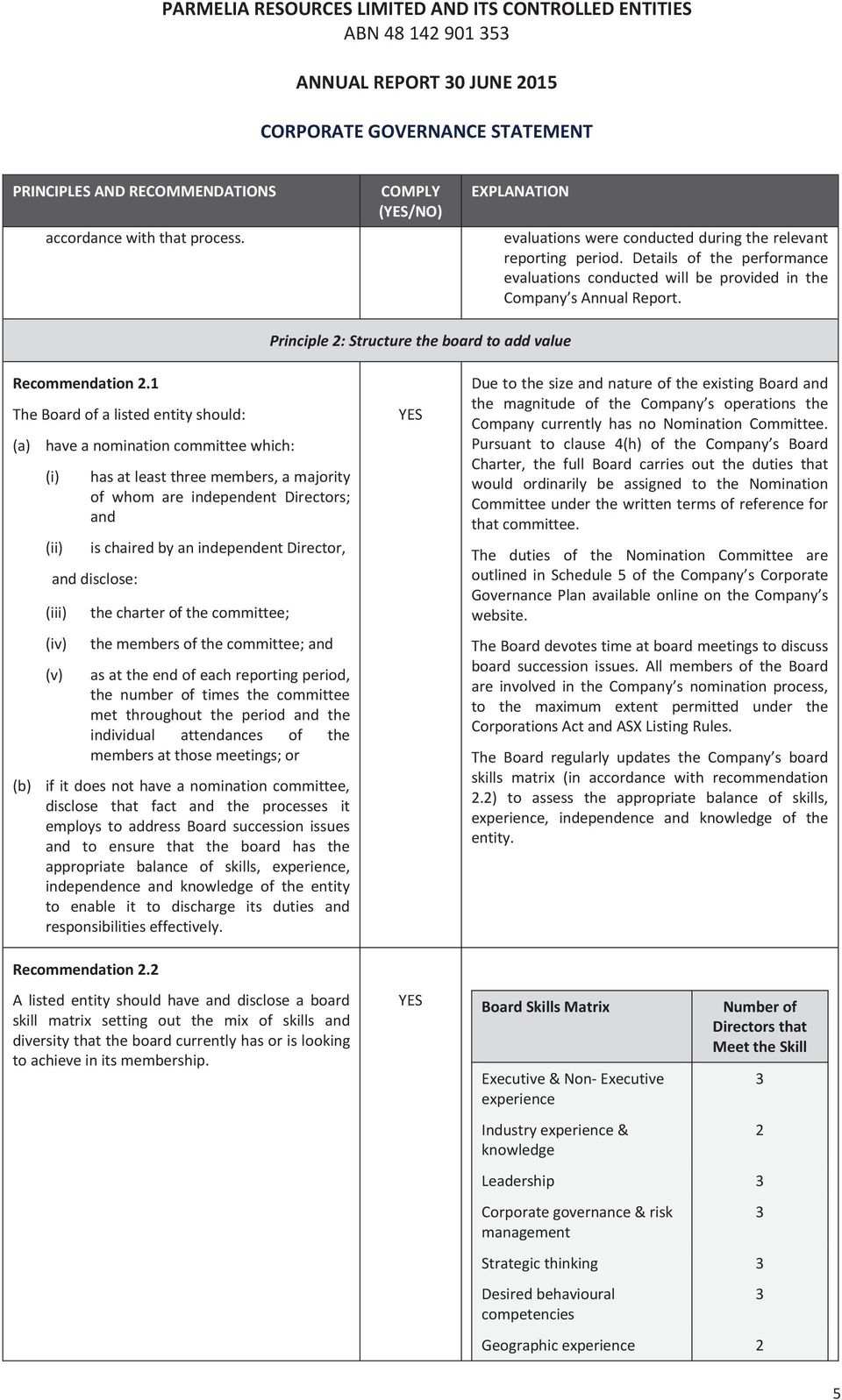
7 CORPORATE GOVERNANCE STATEMENT PRINCIPLES AND RECOMMENDATIONS COMPLY (YES/NO) EXPLANATION Capital Markets experience 3 Subject matter expertise: - accounting 2 - capital management 2 - corporate financing 3 - industry taxation risk management 3 - legal 3 - IT expertise 2 0 (1) Skill gap noticed however an external taxation firm is employed to maintain taxation requirements. (2) Skill gap noticed however an external IT firm is employed on an adhoc basis to maintain IT requirements. Recommendation 2.3 A listed entity should disclose: (a) (b) (c) the names of the Directors considered by the board to be independent directors; if a Director has an interest, position, association or relationship of the type described in Box 2.3 of the ASX Corporate Governance Principles and Recommendation (3rd Edition), but the Board is of the opinion that it does not compromise the independence of the Director, the nature of the interest, position, association or relationship in question and an explanation of why the Board is of that opinion; and the length of service of each Director Recommendation 2.4 A majority of the Board of a listed entity should be independent Directors. Recommendation 2.5 The chair of the Board of a listed entity should be an independent Director and, in particular, should not be the same person as the CEO of the entity. YES YES YES (a) (b) The Board Charter provides for the disclosure of the names of Directors considered by the Board to be independent. These details are provided in the Annual Reports and Company website. The Board Charter requires Directors to disclose their interest, positions, associations and relationships and requires that the independence of Directors is regularly assessed by the Board in light of the interests disclosed by Directors. Details of the Directors interests, positions associations and relationships are provided in the Annual Reports and Company website. (c) The Board Charter provides for the determination of the Directors terms and requires the length of service of each Director to be disclosed. The length of service of each Director is provided in the Annual Reports and Company website. The Board Charter requires that where practical the majority of the Board will be independent. Details of each Director s independence are provided in the Annual Reports and Company website. The Board Charter provides that where practical, the Chairman of the Board will be a non-executive director. If the Chairman ceases to be independent then the Board will consider appointing a lead independent Director. 6

8 CORPORATE GOVERNANCE STATEMENT PRINCIPLES AND RECOMMENDATIONS Recommendation 2.6 A listed entity should have a program for inducting new directors and providing appropriate professional development opportunities for continuing Directors to develop and maintain the skills and knowledge needed to perform their role as a Director effectively. COMPLY (YES/NO) YES EXPLANATION The Board Charter states that a specific responsibility of the Board is to procure appropriate professional development opportunities for Directors. The Board is responsible for the approval and review of induction and continuing professional development programs and procedures for Directors to ensure that they can effectively discharge their responsibilities. Principle 3: Act ethically and responsibly Recommendation 3.1 A listed entity should: (a) (b) have a code of conduct for its Directors, senior executives and employees; and Disclose that code or a summary of it. YES (a) (b) The Corporate Code of Conduct applies to the Company s Directors, senior executives and employees. The Company s Corporate Code of Conduct is in Schedule 2 of the Corporate Governance Plan which is on the Company s website. Principle 4: Safeguard integrity in Corporate reporting Recommendation 4.1 The board of a listed entity should: (a) (b) have an audit committee which: (i) (ii) has at least three members, all of whom are non-executive Directors and a majority of whom are independent Directors; and is chaired by an independent Director, who is not the chair of the Board, and disclose: (iii) the charter of the committee; (iv) the relevant qualifications and experience of the members of the committee; and (v) in relation to each reporting period, the number of times the committee met throughout the period and the individual attendances of the members at those meetings; or if it does not have an audit committee, disclose that fact and the processes it employs that independently verify and safeguard the integrity of its financial reporting, including the processes for the appointment and removal of the external auditor and the rotation of the audit engagement partner. Recommendation 4.2 YES Due to the size and nature of the existing Board and the magnitude of the Company s operations the Company currently has no Audit and Risk Committee. Pursuant to Clause 4(h) of the Company s Board Charter, the full Board carries out the duties that would ordinarily be assigned to the Audit and Risk Committee under the written terms of reference for that committee. The role and responsibilities of the Audit and Risk Committee are outlined in Schedule 3 of the Company s Corporate Governance Plan available online on the Company s website. The Board devote time at annual board meetings to fulfilling the roles and responsibilities associated with maintaining the Company s internal audit function and arrangements with external auditors. All members of the Board are involved in the Company s audit function to ensure the proper maintenance of the entity and the integrity of all financial reporting. The Company s Corporate Governance Plan states 7

9 CORPORATE GOVERNANCE STATEMENT PRINCIPLES AND RECOMMENDATIONS The Board of a listed entity should, before it approves the entity s financial statements for a financial period, receive from its CEO and CFO a declaration that the financial records of the entity have been properly maintained and that the financial statements comply with the appropriate accounting standards and give a true and fair view of the financial position and performance of the entity and that the opinion has been formed on the basis of a sound system of risk management and internal control which is operating effectively. Recommendation 4.3 A listed entity that has an AGM should ensure that its external auditor attends its AGM and is available to answer questions from security holders relevant to the audit. COMPLY (YES/NO) YES YES EXPLANATION that a duty and responsibility of the Board is to ensure that before approving the entity s financial statements for a financial period, the CEO and CFO have declared that in their opinion the financial records of the entity have been properly maintained and that the financial statements comply with the appropriate accounting standards and give a true and fair view of the financial position and performance of the entity and that the opinion has been formed on the basis of a sound system of risk management and internal control which is operating effectively. The Company s Corporate Governance Plan provides that the Board must ensure the Company s external auditor attends its AGM and is available to answer questions from security holders relevant to the audit. Principle 5: Make timely and balanced disclosure Recommendation 5.1 A listed entity should: (a) (b) have a written policy for complying with its continuous disclosure obligations under the Listing Rules; and disclose that policy or a summary of it. YES (a) (b) The Board Charter provides details of the Company s disclosure policy. In addition, Schedule 7 of the Corporate Governance Plan is entitled Disclosure Continuous Disclosure and details the Company s disclosure requirements as required by the ASX Listing Rules and other relevant legislation. The Board Charter and Schedule 7 of the Corporate Governance Plan are available on the Company website. Principle 6: Respect the rights of security holders Recommendation 6.1 A listed entity should provide information about itself and its governance to investors via its website. Recommendation 6.2 A listed entity should design and implement an investor relations program to facilitate effective two-way communication with investors. Recommendation 6.3 A listed entity should disclose the policies and processes it has in place to facilitate and encourage participation at meetings of security holders. YES YES YES Information about the Company and its governance is available in the Corporate Governance Plan which can be found on the Company website. The Company has adopted a Shareholder Communications Strategy which aims to promote and facilitate effective two-way communication with investors. The Shareholder Communications Strategy outlines a range of ways in which information is communicated to shareholders. The Shareholder Communications Strategy states that as a part of the Company s developing investor relations program, Shareholders can register with the Company Secretary to receive notifications of when an announcement is made by the Company to the ASX, including the release of the Annual Report, half yearly reports and quarterly reports. Links are made available to the Company s website 8
10 CORPORATE GOVERNANCE STATEMENT PRINCIPLES AND RECOMMENDATIONS Recommendation 6.4 A listed entity should give security holders the option to receive communications from, and send communications to, the entity and its security registry electronically. COMPLY (YES/NO) YES EXPLANATION on which all information provided to the ASX is immediately posted. Shareholders are encouraged to participate at all EGMs and AGMs of the Company. Upon the despatch of any notice of meeting to Shareholders, the Company Secretary shall send out material with that notice of meeting stating that all Shareholders are encouraged to participate at the meeting. Security holders can register with the Company to receive notifications when an announcement is made by the Company to the ASX. Shareholders queries should be referred to the Company Secretary at first instance. Principle 7: Recognise and manage risk Recommendation 7.1 (a) (b) The board of a listed entity should: have a committee or committees to oversee risk, each of which: (i) (ii) has at least three members, a majority of whom are independent Directors; and is chaired by an independent Director, and disclose: (iii) (iv) (v) the charter of the committee; the members of the committee; and as at the end of each reporting period, the number of times the committee met throughout the period and the individual attendances of the members at those meetings; or if it does not have a risk committee or committees that satisfy (a) above, disclose that fact and the process it employs for overseeing the entity s risk management framework. YES Due to the size and nature of the existing Board and the magnitude of the Company s operations the Company currently has no Audit and Risk Committee. Pursuant to Clause 4(h) of the Company s Board Charter, the full Board currently carries out the duties that would ordinarily be assigned to the Audit and Risk Committee under the written terms of reference for that committee. The role and responsibilities of the Audit and Risk Committee are outlined in Schedule 3 of the Company s Corporate Governance Plan available online on the Company s website. The Board devote time at annual board meeting to fulfilling the roles and responsibilities associated with overseeing risk and maintaining the entity s risk management framework and associated internal compliance and control procedures. Recommendation 7.2 The Board or a committee of the Board should: (a) review the entity s risk management framework with management at least annually to satisfy itself that it continues to be sound, to determine whether there have been any changes in the material business risks the entity faces and to ensure that they remain within the risk appetite set by the YES (a) The Company process for risk management and internal compliance includes a requirement to identify and measure risk, monitor the environment for emerging factors and trends that affect these risks, formulate risk management strategies and monitor the performance of risk management systems. Schedule 8 of the Corporate Governance Plan is entitled Disclosure Risk Management and details the Company s disclosure requirements with respect to the risk management review 9
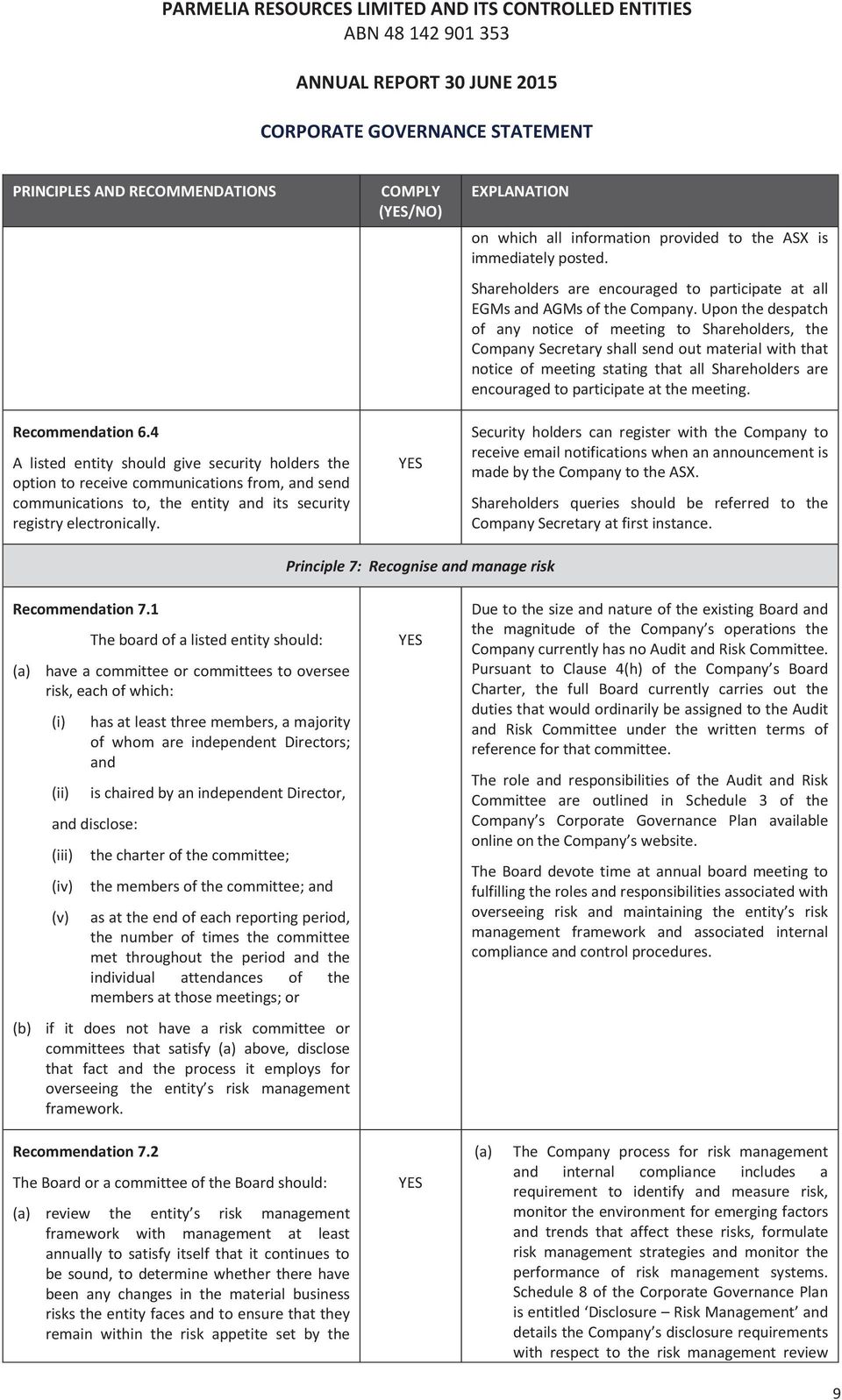
11 CORPORATE GOVERNANCE STATEMENT PRINCIPLES AND RECOMMENDATIONS (b) board; and disclose in relation to each reporting period, whether such a review has taken place. Recommendation 7.3 A listed entity should disclose: (a) (b) if it has an internal audit function, how the function is structured and what role it performs; or if it does not have an internal audit function, that fact and the processes it employs for evaluating and continually improving the effectiveness of its risk management and internal control processes. Recommendation 7.4 A listed entity should disclose whether, and if so how, it has regard to economic, environmental and social sustainability risks and, if it does, how it manages or intends to manage those risks. COMPLY (YES/NO) YES YES EXPLANATION (b) procedure and internal compliance and controls. The Board Charter requires the Board to disclose the number of times the Board met throughout the relevant reporting period, and the individual attendances of the members at those meetings. Details of the meetings will be provided in the Company s Annual Report. Schedule 3 of the Company s Corporate Plan provides for the internal audit function of the Company. The Board Charter outlines the monitoring, review and assessment of a range of internal audit functions and procedures. Schedule 3 of the Company s Corporate Plan details the Company s risk management systems which assist in identifying and managing potential or apparent business, economic, environmental and social sustainability risks (if appropriate). Review of the Company s risk management framework is conducted at least annually and reports are continually created by management on the efficiency and effectiveness of the Company s risk management framework and associated internal compliance and control procedures. Principle 8: Remunerate fairly and responsibly Recommendation 8.1 The Board of a listed entity should: (a) have a Remuneration Committee which: (i) (ii) (iii) (iv) (v) has at least three members, a majority of whom are independent Directors; and is chaired by an independent Director, and disclose: the charter of the committee; the members of the committee; and as at the end of each reporting period, the number of times the committee met throughout the period and the individual attendances of the YES Due to the size and nature of the existing board and the magnitude of the Company s operations the Company currently has no Remuneration Committee. Pursuant to clause 4(h) of the Company s Board Charter, the full Board currently carries out the duties that would ordinarily be assigned to the Remuneration Committee under the written terms of reference for that committee. The role and responsibilities of the Remuneration Committee are outlined in Schedule 4 of the Company s Corporate Governance Plan available online on the Company s website. The Board devote time at annual board meetings to fulfilling the roles and responsibilities associated with setting the level and composition of remuneration for Directors and senior executives and ensuring that such remuneration is appropriate and not excessive. 10
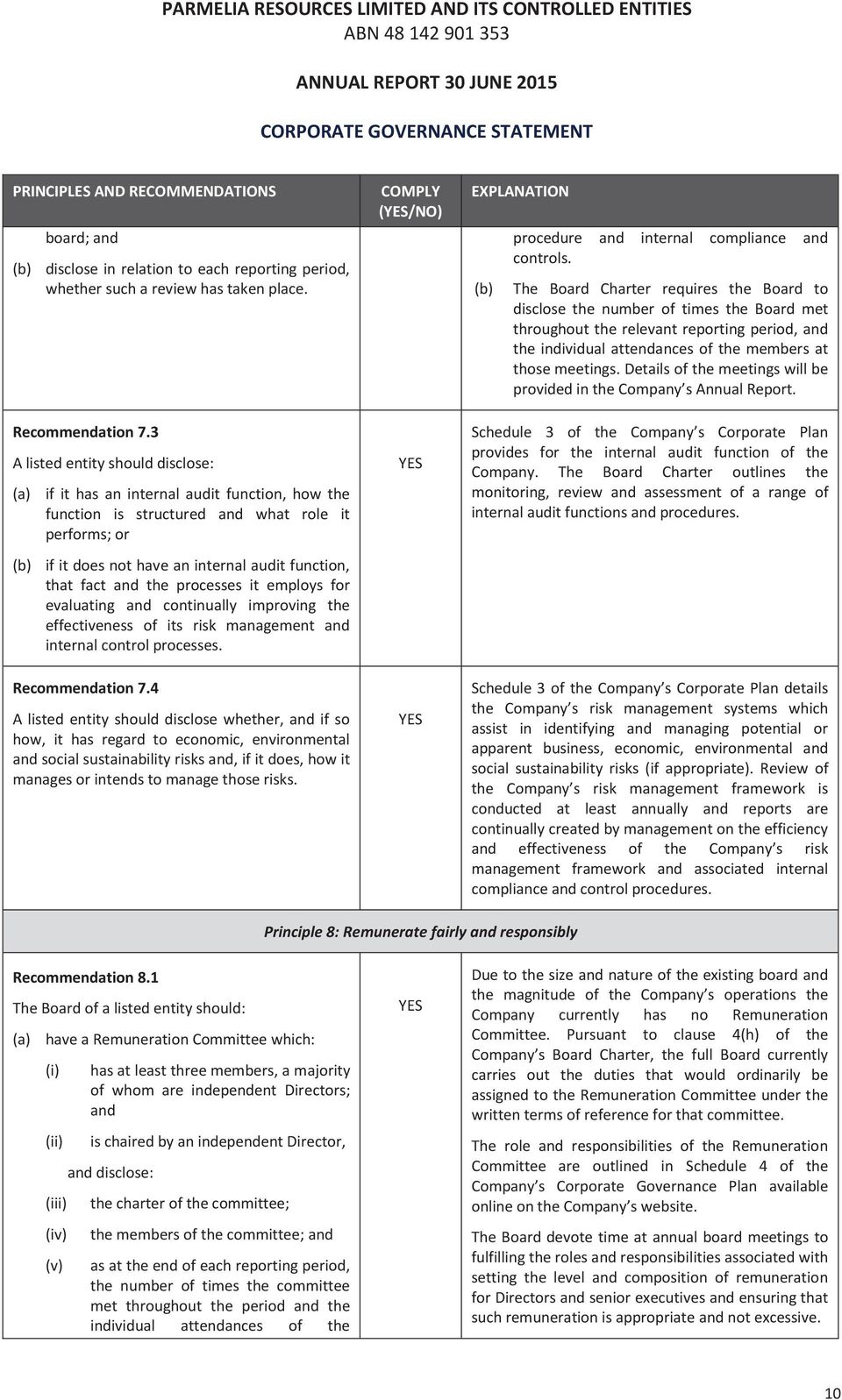
12 CORPORATE GOVERNANCE STATEMENT PRINCIPLES AND RECOMMENDATIONS members at those meetings; or (b) if it does not have a remuneration committee, disclose that fact and the processes it employs for setting the level and composition of remuneration for directors and senior executives and ensuring that such remuneration is appropriate and not excessive. Recommendation 8.2 A listed entity should separately disclose its policies and practices regarding the remuneration of non-executive Directors and the remuneration of executive Directors and other senior executives and ensure that the different roles and responsibilities of non-executive Directors compared to executive Directors and other senior executives are reflected in the level and composition of their remuneration. COMPLY (YES/NO) YES EXPLANATION The Company s Corporate Governance Plan requires the Board to disclose its policies and practices regarding the remuneration of non-executive, executive and other senior Directors. Recommendation 8.3 A listed entity which has an equity-based remuneration scheme should: (a) (b) have a policy on whether participants are permitted to enter into transactions (whether through the use of derivatives or otherwise) which limit the economic risk of participating in the scheme; and disclose that policy or a summary of it. YES (a) (b) Company s Corporate Governance Plan states that the Board is required to review, manage and disclose the policy (if any) on whether participants are permitted to enter into transactions (whether through the use of derivatives or otherwise) which limit the economic risk of participating in the scheme. The Board must review and approve any equity based plans. A copy of the Company s Corporate Governance Plan is available on the Company s website. 11

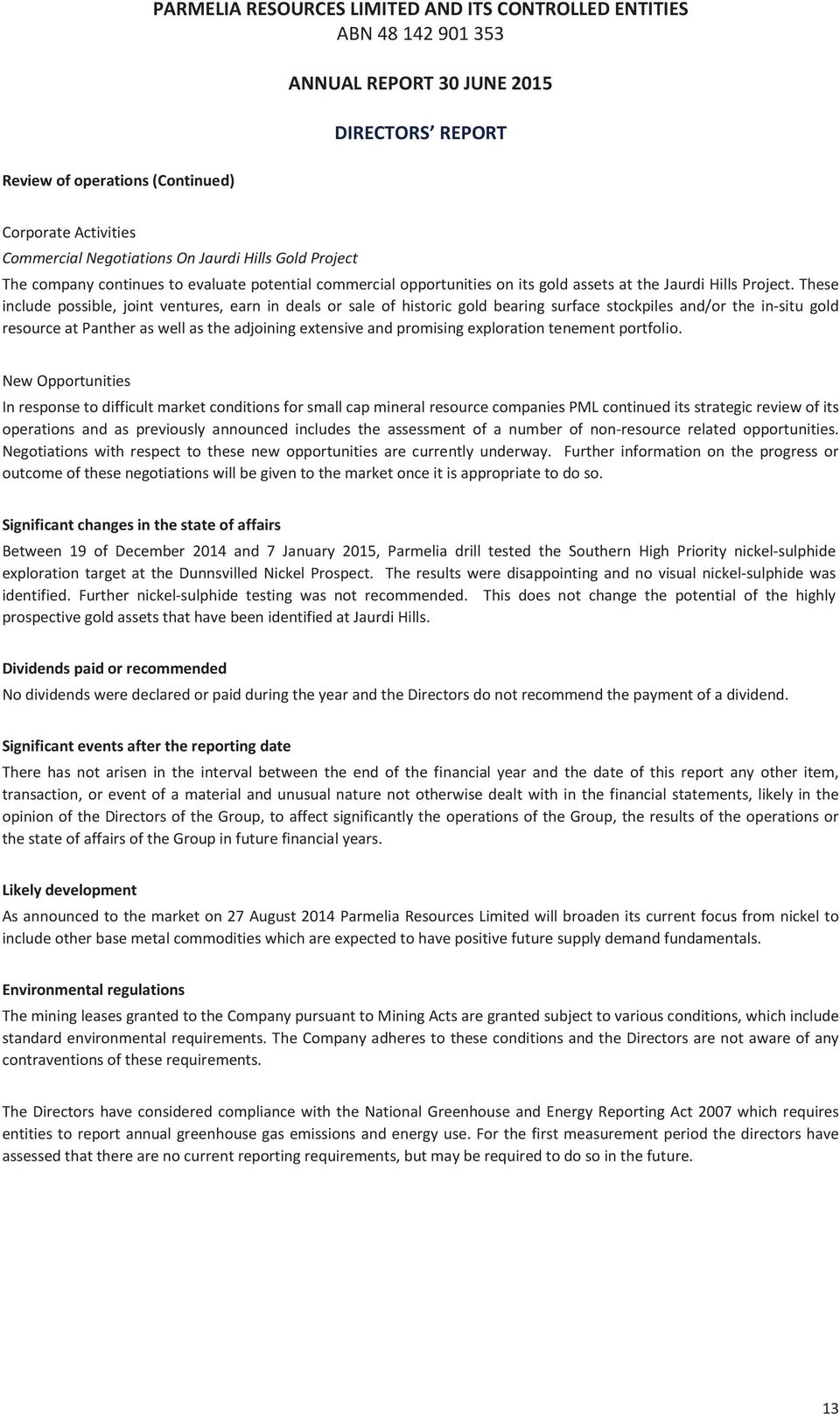
13 DIRECTORS REPORT The Directors of Parmelia Resources Limited present their report together with the financial statements of the consolidated entity being Parmelia Resources Limited ( the Company ) and its controlled entities ( the Group ) for the financial year ended 30 June Directors The following persons were Directors of the Company and were in office for the entire year, and up to the date of this report, unless otherwise stated: Mr Nigel Gellard Mr Peter Ellery Mr Jay Stephenson Executive Chairman Non-Executive Director Non-Executive Director Company secretary The following person held the position of Company Secretary at the end of the financial year: Mr Jay Stephenson - Chartered Secretary (FCIS), Master of Business Administration (MBA), Certified Management Accountant (CMA), Member of the Australian Institute of Company Directors (MAICD), Fellow of the Chartered Institute of Secretaries (ICSA), was appointed as Company Secretary for Parmelia Resources Limited on 17 December Principal activity The Company is primarily involved in the exploration of its Jaurdi Hills Project in Western Australia. Results of operations The loss of the Group for the year ended 30 June 2015 amounted to $1,694,143 (2014: $533,403 loss). Financial position The net assets of the Group at 30 June 2015 were $2,127,144 (2014: $2,549,519). Review of operations During the 2014/2015 financial year the Company continued its strategic review of existing operations. In addition to this, and as previously announced, the company is assessing a number of other opportunities outside the resources sector that have the potential to add significant value to the company. Negotiations with respect to a number of new opportunities are currently underway. Further information on the progress or outcome of these negotiations will be given to the market once it is appropriate to do so. Exploration Jaurdi Hills Project The company continues to evaluate potential commercial opportunities on its gold assets at the Jaurdi Hills Project. These include possible, joint ventures, earn in deals or sale of historic gold bearing surface stockpiles and/or the in-situ gold resource at Panther as well as the adjoining extensive and promising exploration tenement portfolio. Spa Go West Project Nickel-Sulphide Exploration On 17 June 2014, PML announced it had secured the exclusive right to farm into and earn an 80% interest in the Spa Go West Project comprising Exploration License Application E15/1410 located in the highly prospective Kambalda/ Widgiemooltha nickel province of Western Australia. Spar Go West is thought to be prospective for both nickel-sulphide and gold mineralisation. The Company s exploration plans for Spar Go West will be announced in due course once the outcome of the current strategic review is complete. 12
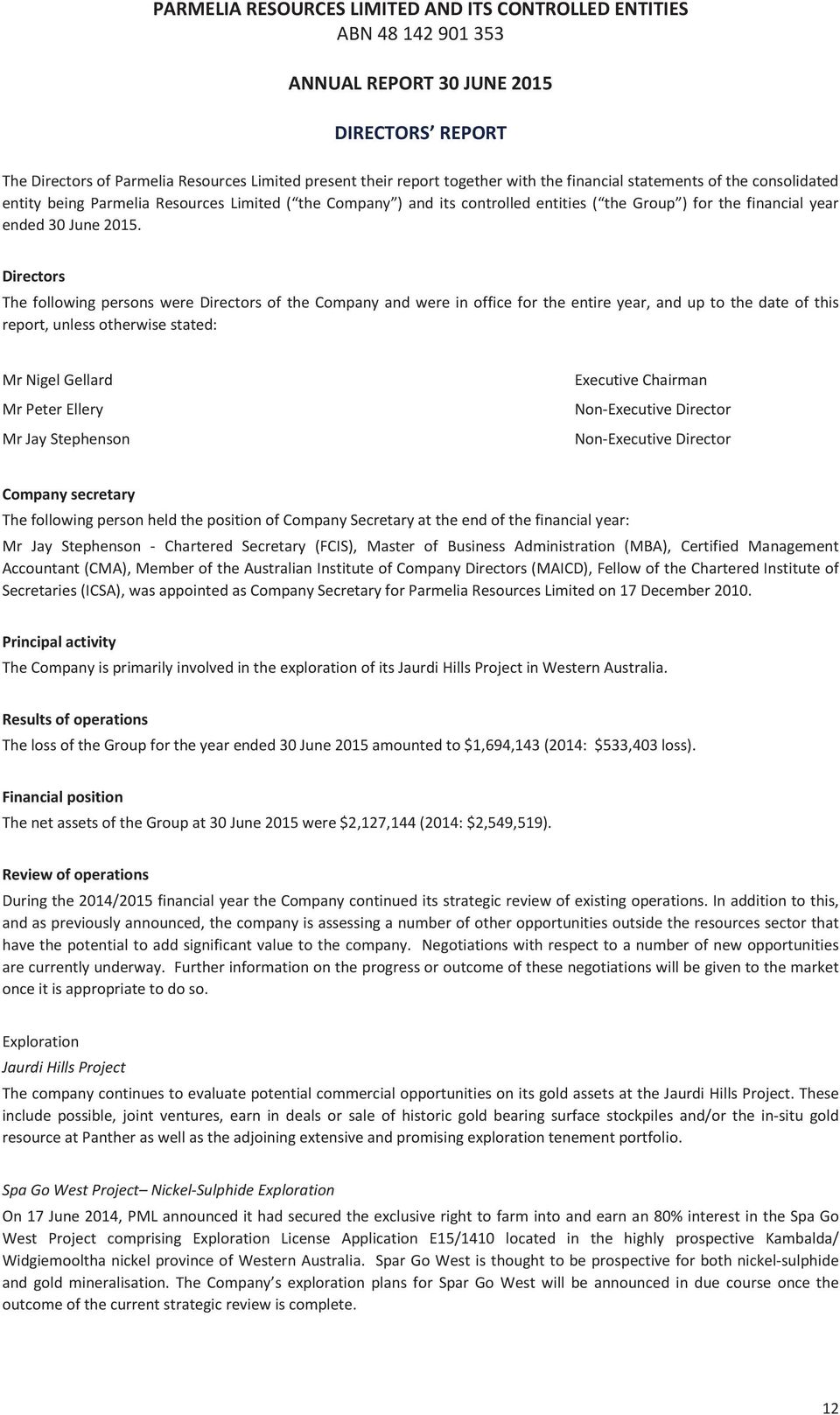
14 Review of operations (Continued) PARMELIA RESOURCES LIMITED AND ITS CONTROLLED ENTITIES DIRECTORS REPORT Corporate Activities Commercial Negotiations On Jaurdi Hills Gold Project The company continues to evaluate potential commercial opportunities on its gold assets at the Jaurdi Hills Project. These include possible, joint ventures, earn in deals or sale of historic gold bearing surface stockpiles and/or the in-situ gold resource at Panther as well as the adjoining extensive and promising exploration tenement portfolio. New Opportunities In response to difficult market conditions for small cap mineral resource companies PML continued its strategic review of its operations and as previously announced includes the assessment of a number of non-resource related opportunities. Negotiations with respect to these new opportunities are currently underway. Further information on the progress or outcome of these negotiations will be given to the market once it is appropriate to do so. Significant changes in the state of affairs Between 19 of December 2014 and 7 January 2015, Parmelia drill tested the Southern High Priority nickel-sulphide exploration target at the Dunnsvilled Nickel Prospect. The results were disappointing and no visual nickel-sulphide was identified. Further nickel-sulphide testing was not recommended. This does not change the potential of the highly prospective gold assets that have been identified at Jaurdi Hills. Dividends paid or recommended No dividends were declared or paid during the year and the Directors do not recommend the payment of a dividend. Significant events after the reporting date There has not arisen in the interval between the end of the financial year and the date of this report any other item, transaction, or event of a material and unusual nature not otherwise dealt with in the financial statements, likely in the opinion of the Directors of the Group, to affect significantly the operations of the Group, the results of the operations or the state of affairs of the Group in future financial years. Likely development As announced to the market on 27 August 2014 Parmelia Resources Limited will broaden its current focus from nickel to include other base metal commodities which are expected to have positive future supply demand fundamentals. Environmental regulations The mining leases granted to the Company pursuant to Mining Acts are granted subject to various conditions, which include standard environmental requirements. The Company adheres to these conditions and the Directors are not aware of any contraventions of these requirements. The Directors have considered compliance with the National Greenhouse and Energy Reporting Act 2007 which requires entities to report annual greenhouse gas emissions and energy use. For the first measurement period the directors have assessed that there are no current reporting requirements, but may be required to do so in the future. 13
15 DIRECTORS REPORT Information on Directors Nigel Gellard Executive Chairman Appointed 17 December 2010 Qualifications and Experience Interest in Shares and Options Special Responsibilities Directorships held in other listed entities Nigel has over 20 years experience in the resources, agricultural and financial services/funds management sectors. Previously, Nigel was co-founder and Executive Director of a privately owned boutique funds management firm. Prior to this Nigel spent five years dealing in the equities markets, most notably with Patersons Securities Limited. Prior to entering into the financial services and funds management industry, Nigel was Commercial Adviser to the Director of Exploration for Rio Tinto Plc, and based in London where he was responsible for advising on commercial matters relating to Rio Tinto's activities in Europe, Eastern Europe, South America and Africa. He was also responsible for the negotiation of commercial agreements and risk management. Nigel is a fellow of the Australian Institute of Company Directors. 1,544,444 ordinary shares and 6,222,219 options None Strata Minerals Inc (formerly JBZ Capital Inc) TSXV listed (April 2010 November 2012) Peter Ellery Non-Executive Director Appointed 22 November 2012 Qualifications and Experience Interest in Shares and Options Special Responsibilities Directorships held in other listed entities Peter has 40 years experience in the Western Australian resources sector. In 2006, he was appointed a Member of the Order of Australia in recognition of his services to the resources industry of Western Australia. He has served as Manager of Government and Public Affairs for Woodside Petroleum Ltd and CEO of the Chamber of Minerals and Energy of WA. He is also a Fellow of the Public Relations Institute of Australia. He has been a pivotal figure in the formulation of company, industry and Government policy to maximise economic benefits from the development of Western Australia s resource industries. Nil ordinary shares and 750,000 options None Strata Minerals Inc (formerly JBZ Capital Inc) TSXV listed Jay Stephenson Non-Executive Director Appointed 26 May 2014 Qualifications and Experience Interest in Shares and Options Special Responsibilities Fellow of Certified Practicing Accountants; Certified Management Accountant; Member Australian Institute of Company Directors; Master of Business Administration; Fellow of the Institute of Chartered Secretaries Australia. 190,000 ordinary shares and 250,000 options Company Secretary 14

16 DIRECTORS REPORT Information on Directors Directorships held in other listed entities Strategic Minerals Corporation NL (since July 2009) Doray Minerals Limited (since August 2009) Nickelore Limited (since July 2011) Yonder and Beyond Group limited (formerly Quintessential Resources Limited) (since February 2011) Drake Resources Limited (since 2004) Aura Energy Limited (August 2005 to July 2013) Bulletproof Group Limited (formerly Spencer Resources Limited) (July 2011 to January 2014) Ensurance Ltd (formerly Parker Resources Limited) (January 2011 to December 2012) Meetings of Directors The number of Directors meetings and meetings of Committees of Directors held in the period and the number of meetings attended by each of the Directors of the Company during the period are: Board of Directors Meetings Number attended Number eligible to attend Nigel Gellard 1 1 Peter Ellery 1 1 Jay Stephenson 1 1 Number of Circular Resolutions: 1 15

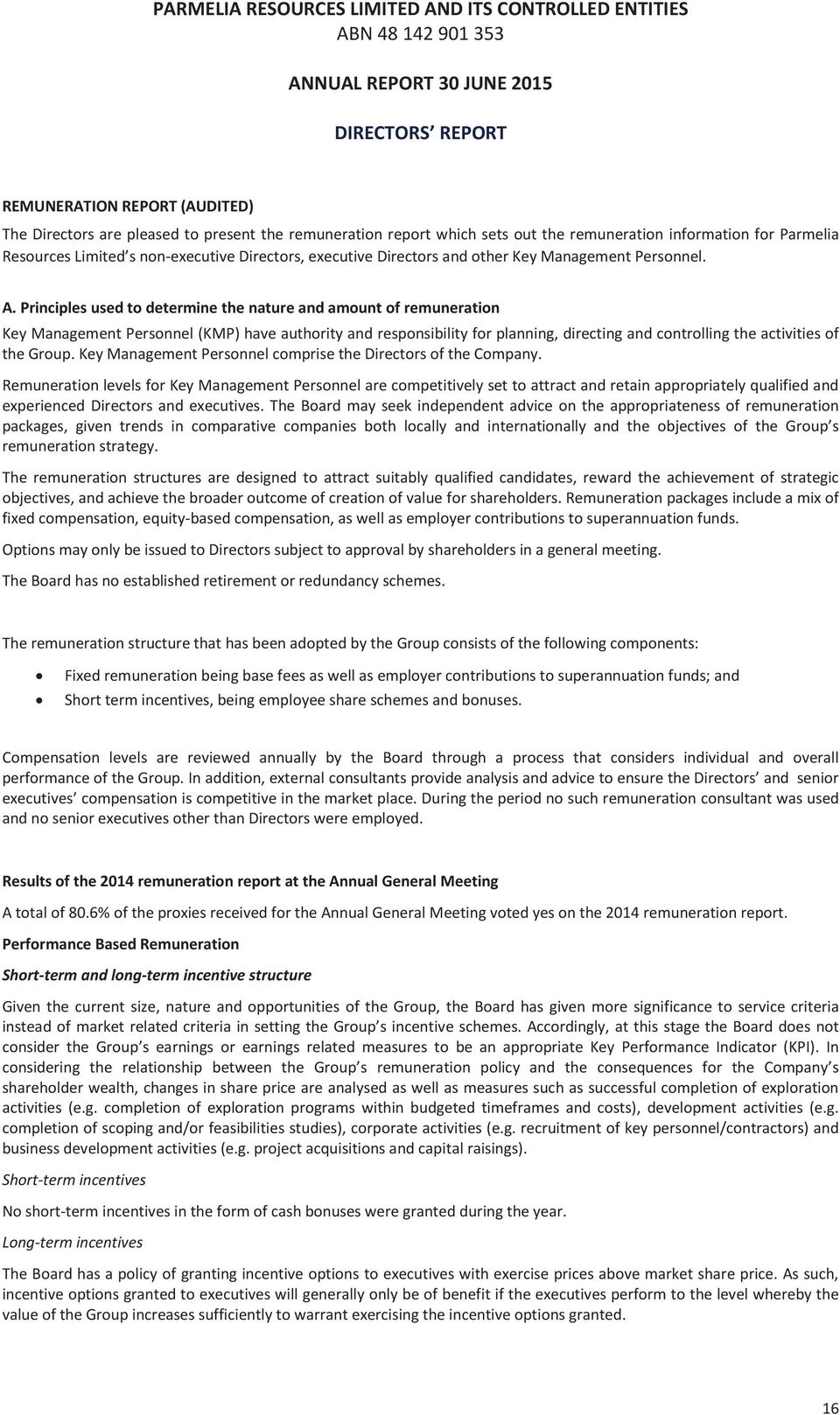
17 DIRECTORS REPORT REMUNERATION REPORT (AUDITED) The Directors are pleased to present the remuneration report which sets out the remuneration information for Parmelia Resources Limited s non-executive Directors, executive Directors and other Key Management Personnel. A. Principles used to determine the nature and amount of remuneration Key Management Personnel (KMP) have authority and responsibility for planning, directing and controlling the activities of the Group. Key Management Personnel comprise the Directors of the Company. Remuneration levels for Key Management Personnel are competitively set to attract and retain appropriately qualified and experienced Directors and executives. The Board may seek independent advice on the appropriateness of remuneration packages, given trends in comparative companies both locally and internationally and the objectives of the Group s remuneration strategy. The remuneration structures are designed to attract suitably qualified candidates, reward the achievement of strategic objectives, and achieve the broader outcome of creation of value for shareholders. Remuneration packages include a mix of fixed compensation, equity-based compensation, as well as employer contributions to superannuation funds. Options may only be issued to Directors subject to approval by shareholders in a general meeting. The Board has no established retirement or redundancy schemes. The remuneration structure that has been adopted by the Group consists of the following components: Fixed remuneration being base fees as well as employer contributions to superannuation funds; and Short term incentives, being employee share schemes and bonuses. Compensation levels are reviewed annually by the Board through a process that considers individual and overall performance of the Group. In addition, external consultants provide analysis and advice to ensure the Directors and senior executives compensation is competitive in the market place. During the period no such remuneration consultant was used and no senior executives other than Directors were employed. Results of the 2014 remuneration report at the Annual General Meeting A total of 80.6% of the proxies received for the Annual General Meeting voted yes on the 2014 remuneration report. Performance Based Remuneration Short-term and long-term incentive structure Given the current size, nature and opportunities of the Group, the Board has given more significance to service criteria instead of market related criteria in setting the Group s incentive schemes. Accordingly, at this stage the Board does not consider the Group s earnings or earnings related measures to be an appropriate Key Performance Indicator (KPI). In considering the relationship between the Group s remuneration policy and the consequences for the Company s shareholder wealth, changes in share price are analysed as well as measures such as successful completion of exploration activities (e.g. completion of exploration programs within budgeted timeframes and costs), development activities (e.g. completion of scoping and/or feasibilities studies), corporate activities (e.g. recruitment of key personnel/contractors) and business development activities (e.g. project acquisitions and capital raisings). Short-term incentives No short-term incentives in the form of cash bonuses were granted during the year. Long-term incentives The Board has a policy of granting incentive options to executives with exercise prices above market share price. As such, incentive options granted to executives will generally only be of benefit if the executives perform to the level whereby the value of the Group increases sufficiently to warrant exercising the incentive options granted. 16
18 REMUNERATION REPORT (AUDITED) PARMELIA RESOURCES LIMITED AND ITS CONTROLLED ENTITIES DIRECTORS REPORT 2015 B. Details of Remuneration Details of the nature and amount of each element of the emoluments of each of the KMP of the Group for the year ended 30 June 2015 and 2014 are set out in the following tables: Group Key Management Personnel Short-term benefits Salary, fees Profit share and leave and bonuses Nonmonetary Other 1 Postemployment benefits Super- annuation Long-term benefits Equity-settled sharebased payments Other Equity Options Directors: $ $ $ $ $ $ $ $ $ Total % of remuneration as options Nigel Gellard 30, ,480 2, , ,193 35% Peter Ellery 3, ,552 16,152 78% Jay Stephenson 30, ,000 2, , ,402 13% 63, ,480 5, , , Group Key Management Personnel Short-term benefits Salary, fees Profit share and leave and bonuses Nonmonetary Other 3 Postemployment benefits Super- annuation Long-term benefits Equity-settled sharebased payments Other Equity 4 Options Directors: $ $ $ $ $ $ $ $ $ Total % of remuneration as options Nigel Gellard 30, ,400 2,775-20,000 49, , % Peter Ellery 24, , ,979 33, % Jay Stephenson (appointed 26 May 2014) Leigh Junk (resigned 26 May 2014) , ,000-27, , ,855 64, % 82, ,327 5,319-20,000 89, ,459 C. Service agreements Mr Nigel Gellard Parmelia Resources Limited entered into a Contracting agreement with Mr Nigel Gellard to provide executive services for the Company. The contract commenced on 1 September 2013 and will conclude on earlier of termination of the agreement or the third anniversary of the commencement date. There were no other service agreements with Directors in place. 1 Refer to section F. Other Information, Other Transactions with Key Management Personnel, for a description of Other. 2 The holding amount of options for J Stephenson was 250,000, the remaining 250,000 were allocated to a non-related nominee of J Stephenson. The full expense of the 500,000 options are disclosed in the above table. 3 Refer to section F. Other Information, Other Transactions with Key Management Personnel, for a description of Other. 4 Chairman fees of $20,000 owed to Nigel Gellard was re-invested as equity through the share issue which occurred during the year. 17
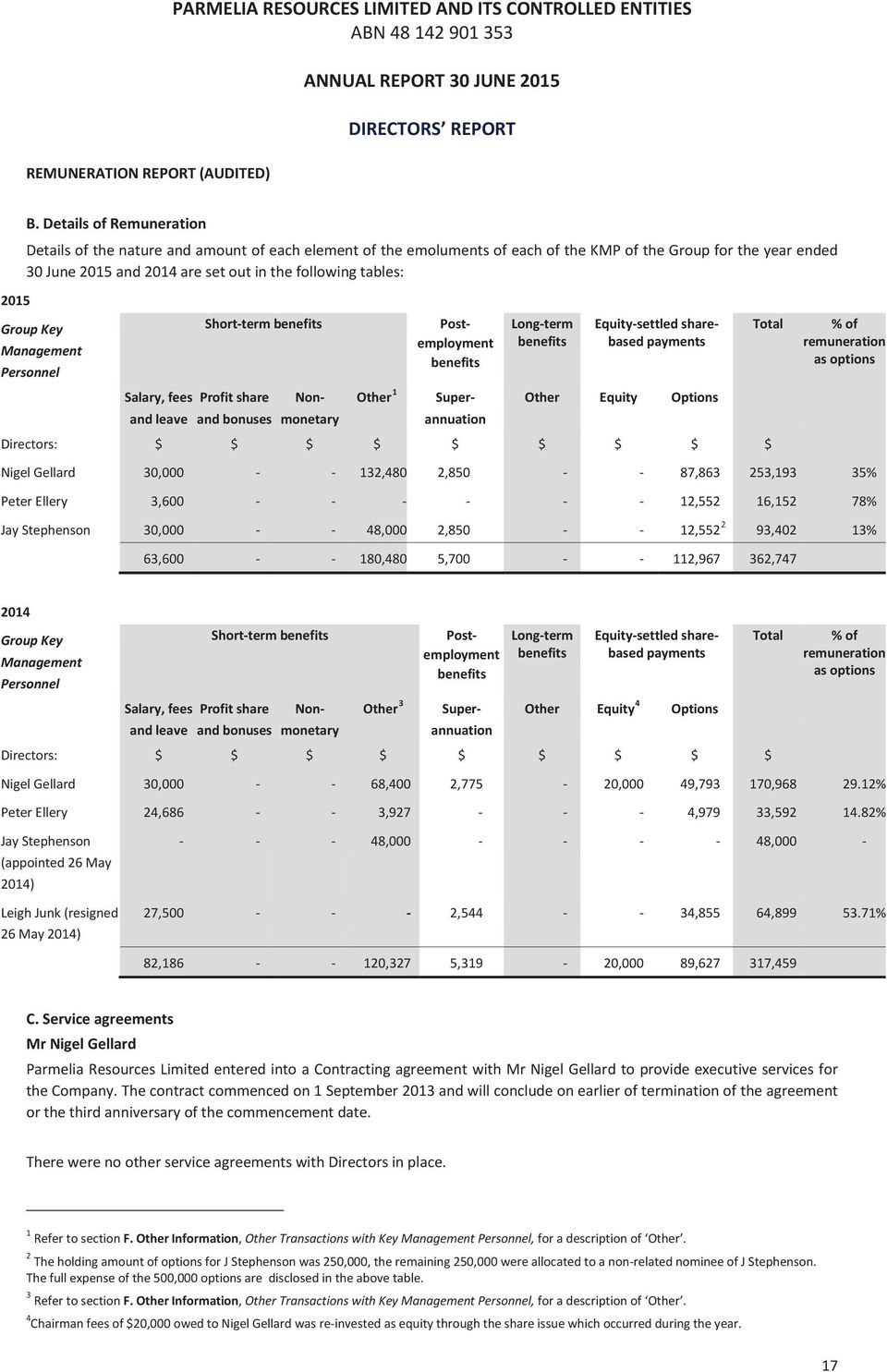
19 DIRECTORS REPORT REMUNERATION REPORT (AUDITED) D. Share-based remuneration Incentive Option Scheme Options are granted under the Company s Incentive Option Scheme. Eligible participants shall be full time or part time employees or consultants of the Company or an Associate Body Corporate. Options issued pursuant to the Scheme will be issued free of charge. The ability for the employee to exercise the options is restricted in accordance with the terms and conditions detailed in the Incentive Option Scheme. The exercise period may also be affected by other events as detailed in the terms and conditions in the Incentive Option Scheme. Each option entitles the holder to subscribe for and be allotted one share. Shares issued pursuant to the exercise of options including bonus issues and new issues rank equally and carry the same rights and entitlements as other shares on issue. Grant Date No. FV per option at grant date No. vested during the year % of grant vested % of grant forfeited Exercise Price Expiry date Directors: Nigel Gellard 14/11/2014 3,500,000 $ ,500, $ October 2017 Peter Ellery 14/11/ ,000 $ , $ October 2017 Jay Stephenson 14/11/ ,000 $ , $ October 2017 Nigel Gellard 28/11/2013 2,500,000 $ ,500, $ October 2016 Peter Ellery 28/11/ ,000 $ , $ October 2016 Leigh Junk (Resigned 26 May 2014) 28/11/2013 1,750,000 $ , $ October ,000,000 The options have been granted to Key Management Personnel (KMP) to provide a market-linked incentive package in their capacity as KMP and for future performance by them in their roles. The KMP options vested immediately after the issue date. The value of options granted as remuneration and as shown in the table above has been determined in accordance with applicable valuation models and accounting standards. The dollar value of the percentage vested during the period has been reflected in the Directors and executive officers remuneration tables. All options were issued by Parmelia Resources Limited and entitle the holder to one ordinary share in Parmelia Resource Limited for each option exercised. E. Equity instruments issued on exercise of remuneration options There were no equity instruments issued during the year to Directors or other KMP as a result of options exercised that had previously been granted as compensation. 18
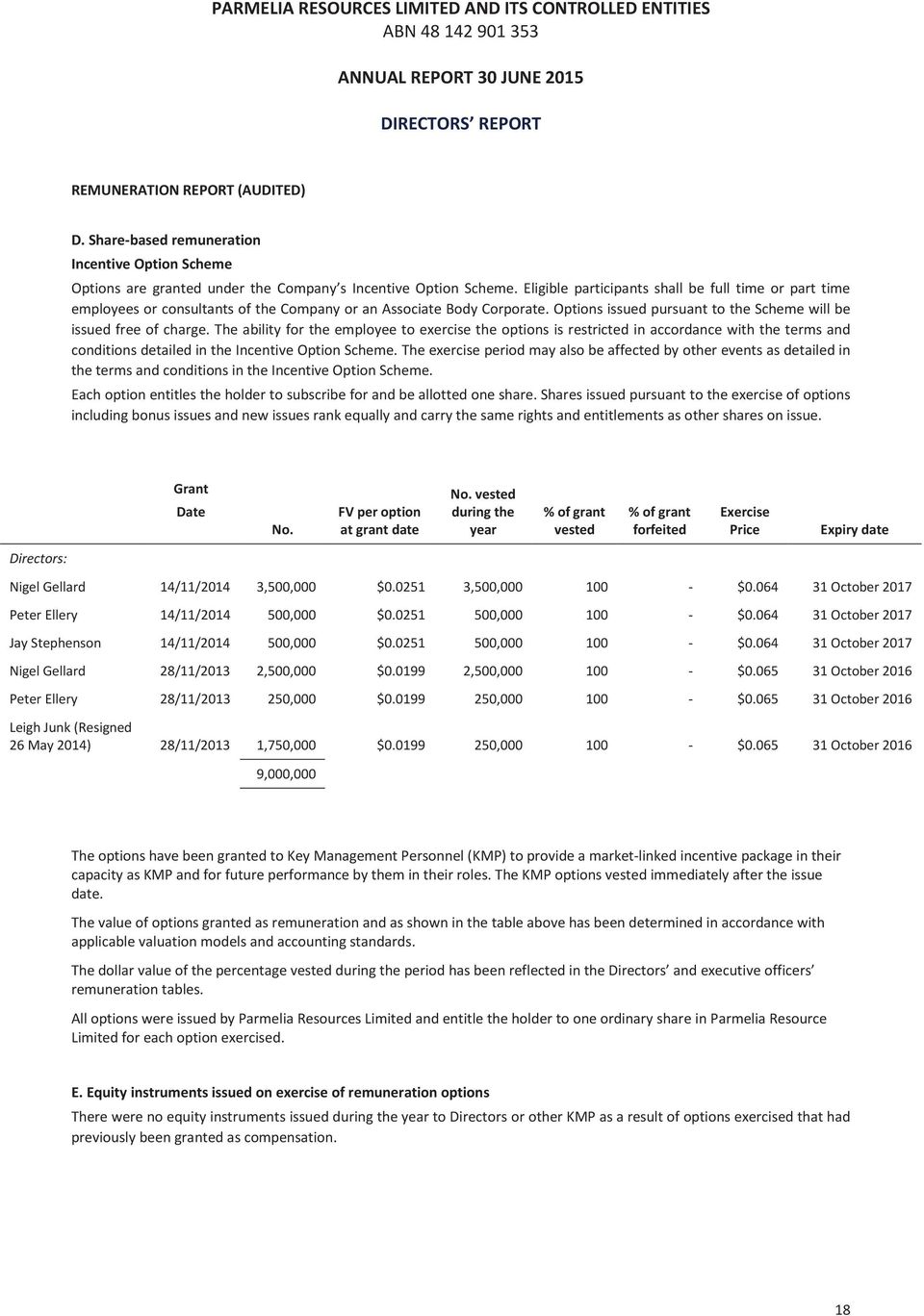
20 DIRECTORS REPORT REMUNERATION REPORT (AUDITED) F. Other Information Options held by Key Management Personnel The number of options to acquire shares in the Company held during the 2015 reporting period by each of the Key Management Personnel of the Group; including their related parties are set out below. 30 June 2015 Balance at the start of the year Granted as remuneration Exercised Other changes Balance at the end of the year Vested and exercisable Unvested Nigel Gellard 2,722,219 3,500, ,222,219 6,222,219 - Peter Ellery 250, , , ,000 - Jay Stephenson - 500,000 - (250,000) 250, ,000 - Total 2,972,219 4,500,000 - (250,000) 7,222,219 7,222,219 - Shares held by Key Management Personnel The number of ordinary shares in the Company during the 2015 reporting period held by each of the Key Management Personnel of the Group; including their related parties are set out below. 30 June 2015 the year Granted as Balance at the start of Remuneration during Issued on exercise of the year options during the year Other changes during the year Balance at end of Year Nigel Gellard 1,544, ,544,444 Peter Ellery Jay Stephenson 190, ,000 Total 1,734, ,734,444 None of the shares included in the table above are held nominally by Key Management Personnel. Loans to Key Management Personnel There were no loans to Key Management Personnel during the financial year. Other transactions with Key Management Personnel During 2015, the Group used the following services of the directors of the Company. Consulting services of Company Director (Nigel Gellard) and the Company which he controls. The amounts billed related to this consulting service amounted to $132,480 (2014: $68,400) based on normal market rates and the amount outstanding at reporting date was $58,291 (2014: $14,400) Consulting services of Company Director (Peter Ellery) and the Company which he controls. The amounts billed related to this consulting service amounted to nil (2014: $3,927) based on normal market rates and the amount outstanding at reporting date was Nil (2014: $Nil). Corporate Secretarial and Accounting service of Company Director (Jay Stephenson) and the firm over which he exercises significant influence. The amounts billed related to this Corporate Secretarial and Accounting service amounted to $48,000 (2014: $48,000) and the amount outstanding at reporting date was $4,000 (2014: $4,000). End of Audited Remuneration Report 19
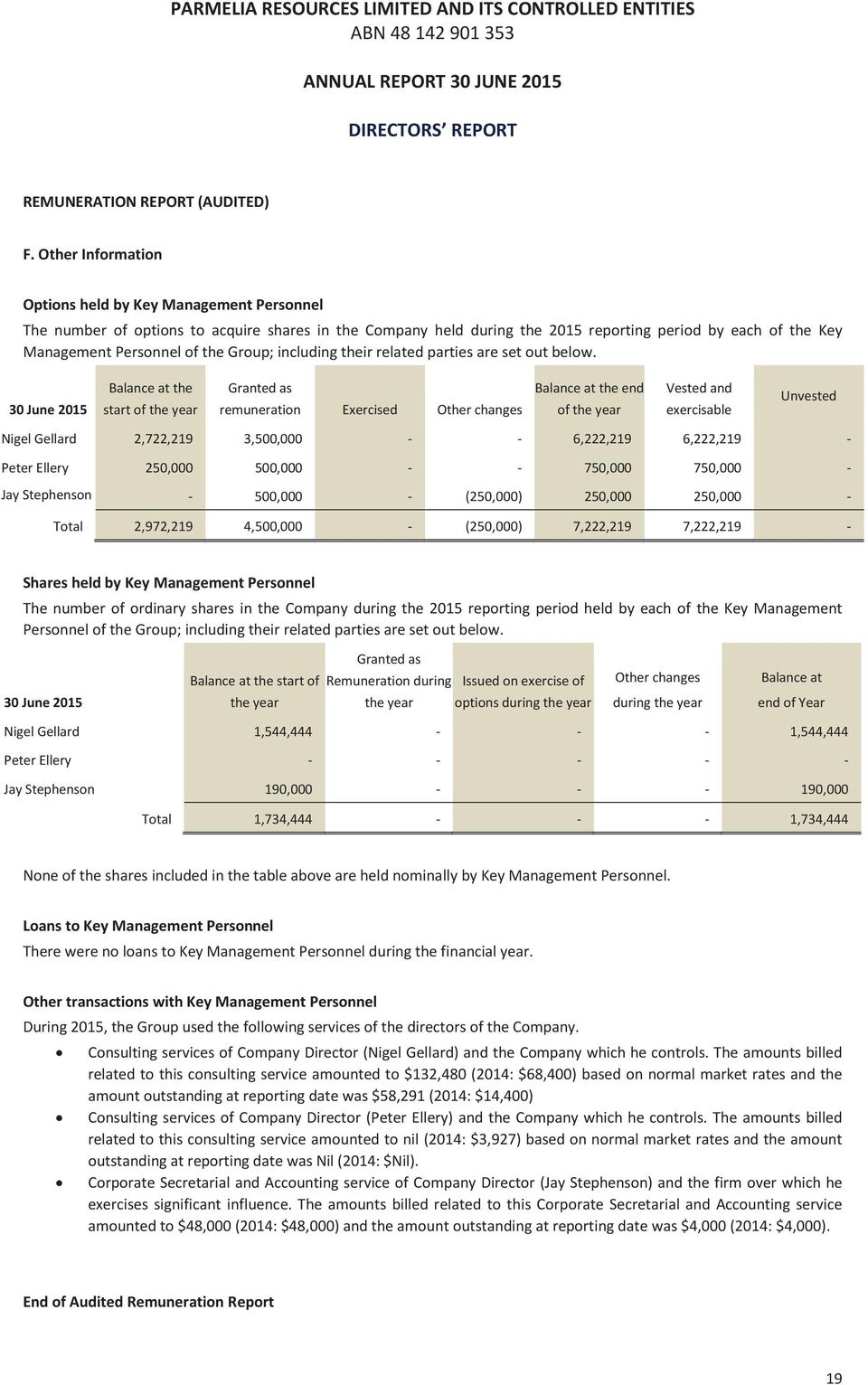
21 DIRECTORS REPORT Shares under option At the date of this report, the unissued ordinary shares of the Company under option are as follows: Grant Date Date of Expiry Exercise Price Number under Option 15 November November 2016 $ ,941, November October 2016 $ ,500,000 8 August May 2017 $ ,375, September May 2017 $0.05 2,836,000 3 December May 2017 $0.05 3,143, December October 2017 $ ,500, December May 2017 $0.05 4,000,000 69,296,176 No option holder has any right under the options to participate in any other share issue of the Company or of any other entity. Proceedings on behalf of the Company No person has applied for leave of Court to bring proceedings on behalf of the Company or intervene in any proceedings to which the Company is a party for the purpose of taking responsibility on behalf of the Company for all or any part of those proceedings. Indemnifying officers or auditor During or since the end of the financial period the Company has given an indemnity or entered into an agreement to indemnify, or paid or agreed to pay insurance premiums as follows: The Company has entered into agreements to indemnify all Directors and provide access to documents, against any liability arising from a claim brought by a third party against the Company. The agreement provides for the Company to pay all damages and costs which may be awarded against the Directors. The Company has paid premiums to insure each of the Directors against liabilities for costs and expenses incurred by them in defending any legal proceedings arising out of their conduct while acting in the capacity of Director of the Company, other than conduct involving a willful breach of duty in relation to the Company. Under the terms and conditions of the insurance contract, the nature of the liabilities insured against and the premium paid cannot be disclosed. No indemnity has been paid to auditors. Non-audit services The Board of Directors is satisfied that the provision of non-audit services during the period is compatible with the general standard of independence for auditors imposed by the Corporations Act Non-audit service fees related to the year amounted to $4,950 for taxation services for the year ended 30 June
22 DIRECTORS REPORT Auditor s independence declaration The lead auditor s independence declaration for the year ended 30 June 2015 has been received and can be found on page 22 of the Annual Report. This report of the Directors, incorporating the Remuneration Report, is signed in accordance with a resolution of the Board of Directors. Nigel Gellard Executive-Chairman 29 September
23 Level 1 10 Kings Park Road West Perth WA 6005 Correspondence to: PO Box 570 West Perth WA 6872 Auditor s Independence Declaration To the Directors of Parmelia Resources Limited T F E [email protected] W In accordance with the requirements of section 307C of the Corporations Act 2001, as lead auditor for the audit of Parmelia Resources Limited for the year ended 30 June 2015, I declare that, to the best of my knowledge and belief, there have been: a b no contraventions of the auditor independence requirements of the Corporations Act 2001 in relation to the audit; and no contraventions of any applicable code of professional conduct in relation to the audit. GRANT THORNTON AUDIT PTY LTD Chartered Accountants C A Becker Partner - Audit & Assurance Perth, 29 September 2015 Grant Thornton Audit Pty Ltd ACN a subsidiary or related entity of Grant Thornton Australia Ltd ABN Grant Thornton refers to the brand under which the Grant Thornton member firms provide assurance, tax and advisory services to their clients and/or refers to one or more member firms, as the context requires. Grant Thornton Australia Ltd is a member firm of Grant Thornton International Ltd (GTIL). GTIL and the member firms are not a worldwide partnership. GTIL and each member firm is a separate legal entity. Services are delivered by the member firms. GTIL does not provide services to clients. GTIL and its member firms are not agents of, and do not obligate one another and are not liable for one another s acts or omissions. In the Australian context only, the use of the term Grant Thornton may refer to Grant Thornton Australia Limited ABN and its Australian subsidiaries and related entities. GTIL is not an Australian related entity to Grant Thornton Australia Limited. Liability limited by a scheme approved under Professional Standards Legislation. Liability is limited in those States where a current scheme applies. 22
24 CONSOLIDATED STATEMENT OF PROFIT OR LOSS AND OTHER COMPREHENSIVE INCOME FOR THE YEAR ENDED 30 JUNE 2015 Note 30 June June 2014 $ $ Interest revenue 7,818 8,788 Other Income 156,033 - Accounting fees (72,531) (57,061) Audit fees (33,290) (30,592) Conferences (2,534) (1,773) Consulting fees (132,480) (72,327) Directors fees (69,300) (109,183) Due diligence expenses (5,789) (13,793) Impairment of exploration expenditure 12 (211,762) - Exploration expenditure written off 12 (133,744) (856) Legal fees (42,221) (24,277) Office rent expense (34,200) (34,200) Share-based payment expense (112,967) (89,627) Share registry and listing fees (36,000) (39,596) Travel and accommodation expenses (28,728) (7,102) Meals and entertainment (9,929) (6,352) Other administration expenses (55,599) (52,114) Loss before income tax (817,223) (530,065) Income tax expense Loss for the period from continuing operations (817,223) (530,065) Loss for the period from discontinued operations 26 (876,920) (3,338) Loss for the period (1,694,143) (533,403) Other comprehensive income Items that may be reclassified subsequently to profit or loss: exchange differences on translating foreign controlled entities 78,774 (78,774) Other comprehensive income for the period, net of tax 78,774 (78,774) Total comprehensive loss for the period attributable to members of the Company (1,615,369) (612,177) Basic/diluted loss per share (cents per share) 9 (2.16) (1.03) Loss from continuing operations (cents per share) 9 (1.04) (1.02) Loss from discontinued operations (cents per share) 9 (1.12) (0.01) Total The above statement should be read in conjunction with the accompanying notes. 23
25 CONSOLIDATED STATEMENT OF FINANCIAL POSITION AS AT 30 JUNE 2015 Note 2015 $ 2014 $ CURRENT ASSETS Cash and cash equivalents , ,043 Trade and other receivables ,029 5,309 Other assets 8,851 4, , ,957 Exploration and evaluation discontinued operations ,946 TOTAL CURRENT ASSETS 407, ,903 NON-CURRENT ASSETS Term deposit 10-48,300 Exploration and evaluation expenditure 12 1,877,262 1,763,833 TOTAL NON-CURRENT ASSETS 1,877,262 1,812,133 TOTAL ASSETS 2,285,232 2,714,036 CURRENT LIABILITIES Trade and other payables , ,117 TOTAL CURRENT LIABILITIES 158, ,117 NON-CURRENT LIABILITIES Long-term provisions 14-41,400 TOTAL NON-CURRENT LIABILITIES - 41,400 TOTAL LIABILITIES 158, ,517 NET ASSETS 2,127,144 2,549,519 EQUITY Issued capital 15 6,365,903 5,472,269 Reserves ,569 75,458 Accumulated losses (4,674,328) (2,998,208) TOTAL EQUITY 2,127,144 2,549,519 The above statement should be read in conjunction with the accompanying notes. 24
26 CONSOLIDATED STATEMENT OF CHANGES IN EQUITY FOR THE YEAR ENDED 30 JUNE 2015 Note Issued Capital Option Reserves Foreign Currency Translation Reserve Accumulated Losses $ $ $ $ Total Balance at 1 July ,227,886 18,023 - (2,464,805) 1,781,104 Loss attributable to members of the Company Other comprehensive income, net of tax (533,403) (533,403) - - (78,774) - (78,774) Total comprehensive loss for the year - - (78,774) (533,403) (612,177) Transactions with owners, recognised directly in equity Capital raising 1,164, ,164,750 Capital raising costs (129,867) (129,867) Share based payments , , ,709 Balance at 30 June ,472, ,232 (78,774) (2,998,208) 2,549,519 Balance at 1 July ,472, ,232 (78,774) (2,998,208) 2,549,519 Loss attributable to members of the Company (1,694,143) (1,694,143) Other comprehensive income, net of tax ,774-78,774 Total comprehensive loss for the year ,774 (1,694,143) (1,615,369) Transactions with owners, recognised directly in equity Capital raising 986, , ,153,433 Capital raising costs (92,922) (92,922) Share-based payments , ,483 Options expired - (18,023) - 18,023 - Balance at 30 June ,365, ,569 - (4,674,328) 2,127,144 The above statement should be read in conjunction with the accompanying notes. 25
27 CONSOLIDATED STATEMENT OF CASH FLOWS FOR THE YEAR ENDED 30 JUNE 2015 CASH FLOWS FROM OPERATING ACTIVITIES Note $ $ Payments to suppliers and employees (491,573) (380,853) Interest received 7,818 8,788 Net cash from continuing operations (483,755) (372,065) Net cash used in discontinued operations 26 (15,200) (3,338) Net cash used in operating activities 18 (498,955) (375,403) CASH FLOWS FROM INVESTING ACTIVITIES Payments for exploration and evaluation expenditure (501,324) (45,485) Payments for exploration and evaluation expenditure on discontinued operations 26 - (782,946) Net cash used in investing activities (501,324) (828,431) CASH FLOWS FROM FINANCING ACTIVITIES Proceeds from issue of shares 986,556 1,133,250 Proceeds from issue of options 166,876 - Payments for capital raising (73,406) (71,784) Net cash from financing activities 1,080,026 1,061,466 Net decrease in cash and cash equivalents 79,747 (142,368) Cash and cash equivalents at the beginning of the financial year 157, ,711 Effects of exchange rate changes on cash and cash equivalents - - Cash and cash equivalents at the end of the financial year , ,343 The above statement should be read in conjunction with the accompanying notes. 26
28 NOTES TO THE CONSOLIDATED FINANCIAL STATEMENTS FOR THE YEAR ENDED 30 JUNE 2015 NOTE 1: REPORTING ENTITY These consolidated financial statements and notes of Parmelia Resources Limited ( the Company ) and its controlled entities ( the Consolidated Group or the Group ). Parmelia Resources Limited is a listed public company, incorporated and domiciled in Australia. The address of the Company s registered office is Suite 12, Level 1/ 11 Ventnor Avenue, West Perth, Western Australia NOTE 2: BASIS OF PREPARATION (a) Statement of compliance The consolidated general purpose financial statements have been prepared in accordance with Australian Accounting Standards ( AASBs ) (including Australian interpretations) adopted by the Australian Accounting Standard Board ( AASB ) and the Corporations Act Parmelia Resources Limited is a for-profit entity for the purposes of preparing the financial report. The consolidated financial statements of the Group also complies with the International Financial Reporting Standards ( IFRSs ) and interpretations adopted by the International Accounting Standards Board ( IASB ). The financial statements were approved by the Board of Directors on 29 September Basis of measurement The financial report has been prepared on an accruals basis and is based on historical costs modified, where applicable, by the measurement at fair value of selected non-current assets, financial assets and financial liabilities. Going concern The consolidated group has incurred a net loss after tax for the year ended 30 June 2015 of $1,694,143 (2014: $533,403 loss) and incurred net cash outflows from operations of $498,955 (2014: $375,403 net cash outflow). As at 30 June 2015, the consolidated group had cash and cash equivalents of $237,090 (30 June 2014: $157,343) and net assets of $2,127,144 (30 June 2014: $2,549,519). In the forthcoming 12 months from the date of these financial statements, the Company and the consolidated group will be required to meet various commitments, which require funds that are above and beyond the working capital of the consolidated group at 30 June These commitments include evaluating a number of properties both existing properties and new proposals. The financial report has been prepared on the basis that the Company and consolidated group will continue to meet their commitments and can therefore continue normal business activities and the realisation of assets and settlement of liabilities in the ordinary course of business. In arriving at this position, the Directors are reviewing various funding alternatives to meet these commitments. These funding alternatives include future raising through various equity issues, sale of assets and scaling back of corporate costs if required. The Directors have concluded that the combination of these circumstances represent a material uncertainty that casts doubt upon the Company s and consolidated group s ability to continue as a going concern. Nevertheless after making enquiries, and considering the uncertainties described above, the Directors have a reasonable expectation that the Company and consolidated group have adequate resources to continue in operational existence for the foreseeable future. For these reasons, they continue to adopt the going concern basis in preparing the yearly report and accounts. Should the Company and consolidated group not achieve the matters set out above, there is significant uncertainty whether the Company and consolidated group will continue as a going concern and therefore whether they will realise their assets and extinguish their liabilities in the normal course of business and at the amounts stated in the financial report. The financial report does not include any adjustment relating to the recoverability or classification of recorded asset amounts nor the amounts or classification of liabilities that might be necessary should the Company and consolidated group not be able to continue as a going concern. 27
29 NOTES TO THE CONSOLIDATED FINANCIAL STATEMENTS FOR THE YEAR ENDED 30 JUNE 2015 NOTE 2: BASIS OF PREPARATION (CONTINUED) (b) Functional and presentation currency The financial report is presented in Australian dollars, which is the Group s functional currency. (c) Use of estimates and judgements The preparation of financial statements requires management to make judgements, estimates and assumptions that affect the application of policies and reported amounts of assets and liabilities, income and expenses. These estimates and associated assumptions are based on historical experience and various factors that are believed to be reasonable under the circumstances, the results of which form the basis of making the judgements about carrying values of assets and liabilities that are not readily apparent from other sources. Actual results may differ from these estimates. The estimates and underlying assumptions are reviewed on an ongoing basis. Revisions are recognised in the period in which the estimate is revised if it affects only that period or in the period of the revision and future periods if the revision affects both current and future periods. Share-based payment transactions: The Company measures the cost of equity-settled transactions with employees by reference to the fair value of the equity instruments at the date at which they are granted. The fair value is determined by an external valuer using a Black and Scholes model. Impairment of capitalised exploration and evaluation expenditure: The future recoverability of capitalised exploration and evaluation expenditure is dependent on a number of factors, including whether the Group decides to exploit the related lease itself or, if not, whether it successfully recovers the related exploration and evaluation asset through sale. Factors that could impact the future recoverability include the level of reserves and resources, future technological changes, which could impact the cost of mining, future legal changes (including changes to environmental restoration obligations) and changes to commodity prices. To the extent that capitalised exploration and evaluation expenditure is determined not to be recoverable in the future, profits and net assets will be reduced in the period in which this determination is made. Refer to Note 12, for details of Impairments against capitalised exploration. NOTE 3: SIGNIFICANT ACCOUNTING POLICIES The accounting policies set out below have been applied consistently to all periods presented in this financial report. (a) Basis of consolidation The Group financial statements consolidate those of the Parent Company and all of its subsidiaries as of 30 June The Parent controls a subsidiary if it is exposed, or has rights, to variable returns from its involvement with the subsidiary and has the ability to affect those returns through its power over the subsidiary. All subsidiaries have a reporting date of 30 June All transactions and balances between Group companies are eliminated on consolidation, including unrealised gains and losses on transactions between Group companies. Where unrealised losses on intra-group asset sales are reversed on consolidation, the underlying asset is also tested for impairment from a group perspective. Amounts reported in the financial statements of subsidiaries have been adjusted where necessary to ensure consistency with the accounting policies adopted by the Group. Profit or loss and other comprehensive income of subsidiaries acquired or disposed of during the year are recognised from the effective date of acquisition, or up to the effective date of disposal, as applicable. Non-controlling interests, presented as part of equity, represent the portion of a subsidiary s profit or loss and net assets that is not held by the Group. The Group attributes total comprehensive income or loss of subsidiaries between the owners of the parent and the non-controlling interests based on their respective ownership interests. A list of controlled entities is contained in Note 23 to the financial statements. 28
30 NOTES TO THE CONSOLIDATED FINANCIAL STATEMENTS FOR THE YEAR ENDED 30 JUNE 2015 NOTE 3: SIGNIFICANT ACCOUNTING POLICIES (CONTINUED) Business combinations Business combinations occur where an acquirer obtains control over one or more businesses and results in the consolidation of its assets and liabilities. A business combination is accounted for by applying the acquisition method, unless it is a combination involving entities or businesses under common control. The acquisition method requires that for each business combination one of the combining entities must be identified as the acquirer (ie parent entity). The business combination will be accounted for as at the acquisition date, which is the date that control over the acquiree is obtained by the parent entity. At this date, the parent shall recognise, in the consolidated accounts, and subject to certain limited exceptions, the fair value of the identifiable assets acquired and liabilities assumed. In addition, contingent liabilities of the acquiree will be recognised where a present obligation has been incurred and its fair value can be reliably measured. The acquisition may result in the recognition of goodwill or a gain from a bargain purchase. The method adopted for the measurement of goodwill will impact on the measurement of any non-controlling interest to be recognised in the acquiree where less than 100% ownership interest is held in the acquiree. The acquisition date fair value of the consideration transferred for a business combination plus the acquisition date fair value of any previously held equity interest shall form the cost of the investment in the separate financial statements. Consideration may comprise the sum of the assets transferred by the acquirer, liabilities incurred by the acquirer to the former owners of the acquiree and the equity interests issued by the acquirer. Fair value uplifts in the value of pre-existing equity holdings are taken to the Other Comprehensive Income. Where changes in the value of such equity holdings had previously been recognised in other comprehensive income, such amounts are recycled to profit or loss. Included in the measurement of consideration transferred is any asset or liability resulting from a contingent consideration arrangement. Any obligation incurred relating to contingent consideration is classified as either a financial liability or equity instrument, depending upon the nature of the arrangement. Rights to refunds of consideration previously paid are recognised as a receivable. Subsequent to initial recognition, contingent consideration classified as equity is not remeasured and its subsequent settlement is accounted for within equity. Contingent consideration classified as an asset or a liability is remeasured each reporting period to fair value through the profit or loss unless the change in value can be identified as existing at acquisition date. All transaction costs incurred in relation to the business combination are expensed to the profit or loss. (b) Income tax Current income tax expense charged to the profit or loss is the tax payable on taxable income calculated using applicable income tax rates enacted, or substantially enacted, as at reporting date. Current tax liabilities (assets) are therefore measured at the amounts expected to be paid to (recovered from) the relevant taxation authority. Deferred income tax expense reflects movements in deferred tax asset and deferred tax liability balances during the year as well unused tax losses. Current and deferred income tax expense (income) is charged or credited directly to equity instead of the profit or loss when the tax relates to items that are credited or charged directly to equity. Deferred tax assets and liabilities are ascertained based on temporary differences arising between the tax bases of assets and liabilities and their carrying amounts in the financial statements. Deferred tax assets also result where amounts have been fully expensed but future tax deductions are available. No deferred income tax will be recognised from the initial recognition of an asset or liability, excluding a business combination, where there is no effect on accounting or taxable profit or loss. Deferred tax assets and liabilities are calculated at the tax rates that are expected to apply to the period when the asset is realised or the liability is settled, based on tax rates enacted or substantively enacted at reporting date. Their measurement also reflects the manner in which management expects to recover or settle the carrying amount of the related asset or liability. 29
31 NOTES TO THE CONSOLIDATED FINANCIAL STATEMENTS FOR THE YEAR ENDED 30 JUNE 2015 NOTE 3: SIGNIFICANT ACCOUNTING POLICIES (CONTINUED) (b) Income tax (continued) Deferred tax assets relating to temporary differences and unused tax losses are recognised only to the extent that it is probable that future taxable profit will be available against which the benefits of the deferred tax asset can be utilised. Where temporary differences exist in relation to investments in subsidiaries, branches, associates, and joint ventures, deferred tax assets and liabilities are not recognised where the timing of the reversal of the temporary difference can be controlled and it is not probable that the reversal will occur in the foreseeable future. Current tax assets and liabilities are offset where a legally enforceable right of set-off exists and it is intended that net settlement or simultaneous realisation and settlement of the respective asset and liability will occur. Deferred tax assets and liabilities are offset where a legally enforceable right of set-off exists, the deferred tax assets and liabilities relate to income taxes levied by the same taxation authority on either the same taxable entity or different taxable entities where it is intended that net settlement or simultaneous realisation and settlement of the respective asset and liability will occur in future periods in which significant amounts of deferred tax assets or liabilities are expected to be recovered or settled. (c) Exploration and evaluation expenditure Exploration and evaluation costs, including costs of acquiring licenses, are capitalised as exploration and evaluation assets on an area of interest basis. Costs of acquiring licences which are pending the approval of the Department of Mines and Petroleum, as at the date of reporting are capitalised as exploration and evaluation cost if in the opinion of the Directors it is virtually certain the Company will be granted the licences. Exploration and evaluation assets are only recognised if the rights of tenure to the area of interest are current and either: i) The expenditures are expected to be recouped through successful development and exploitation of the area of interest, or ii) Activities in the area of interest have not at the reporting date, reached a stage which permits a reasonable assessment of the existence or otherwise of economically recoverable reserves and active and significant operations in, or in relation to, the area of interest are continuing. Exploration and evaluation assets are assessed for impairment when: i) Sufficient data exists to determine technical feasibility and commercial viability, and ii) Facts and circumstances suggest that the carrying amount exceeds the recoverable amount (see impairment accounting policy in Note 3(e). For the purposes of impairment testing, exploration and evaluation assets are allocated to cash-generating units to which exploration activity relates. The cash generating unit shall not be larger than the area of interest. Once the technical feasibility and commercial viability of the extraction of mineral resources in an area of interest are demonstrable, exploration and evaluation assets attributable to that area of interest are first tested for impairment and then reclassified from intangible assets to mining property and development assets within property, plant and equipment. (d) Financial instruments Initial recognition and measurement Financial assets and financial liabilities are recognised when the entity becomes a party to the contractual provisions to the instrument. For financial assets, this is equivalent to the date that the Company commits itself to either the purchase or sale of the asset (ie trade date accounting is adopted). Financial instruments are initially measured at fair value plus transaction costs, except where the instrument is classified at fair value through profit or loss, in which case transaction costs are expensed to profit or loss immediately. The Group does not designate any interests in subsidiaries, associates or joint venture entities as being subject to the requirements of accounting standards specifically applicable to financial instruments. 30
32 NOTES TO THE CONSOLIDATED FINANCIAL STATEMENTS FOR THE YEAR ENDED 30 JUNE 2015 NOTE 3: SIGNIFICANT ACCOUNTING POLICIES (CONTINUED) (d) Financial instruments (Continued) Loans and receivables Loans and receivables are non-derivative financial assets with fixed or determinable payments that are not quoted in an active market and are subsequently measured at amortised cost. Loans and receivables are included in current assets, except for those which are not expected to mature within 12 months after the end of the reporting period. (All other loans and receivables are classified as non-current assets). Financial liabilities Non-derivative financial liabilities (excluding financial guarantees) are subsequently measured at amortised cost. Fair value Fair value is determined based on current bid prices for all quoted investments. Valuation techniques are applied to determine the fair value for all unlisted securities, including recent arm s length transactions, reference to similar instruments and option pricing models. Impairment At each reporting date, the Group assesses whether there is objective evidence that a financial instrument has been impaired. In the case of available-for sale financial instruments, a significant and prolonged decline in the value of the instrument is considered to determine whether an impairment has arisen. Impairment losses are recognised in the profit or loss. Derecognition Financial assets are derecognised where the contractual rights to cash flow expires or the asset is transferred to another party whereby the entity no longer has any significant continuing involvement in the risks and benefits associated with the asset. Financial liabilities are derecognised where the related obligations are discharged, cancelled or expired. The difference between the carrying value of the financial liability extinguished or transferred to another party and the fair value of consideration paid, including the transfer of non-cash assets or liabilities assumed, is recognised in profit or loss. (e) Impairment Non-financial assets The carrying amounts of the Company s non-financial assets, other than deferred tax assets, are reviewed at each reporting date to determine whether there is any indication of impairment. If any such indication exists, then the asset s recoverable amount is estimated. The recoverable amount of an asset or cash-generating unit is the greater of its value in use and its fair value less costs to sell. In assessing value in use, the estimated future cash flows are discounted to their present value using a pre-tax discount rate that reflects current market assessments of the time value of money and the risks specific to the asset. For the purpose of impairment testing, assets that cannot be tested individually are grouped together into the smallest group of assets that generates cash inflows from continuing use that are largely independent of the cash inflows of other assets or groups of assets (the cash-generating unit or CGU ). Subject to an operating segment ceiling test, for the purposes of goodwill impairment testing, CGUs to which goodwill has been allocated are aggregated so that the level at which impairment is tested reflects the lowest level at which goodwill is monitored for internal reporting purposes. Goodwill acquired in a business combination is allocated to groups of CGUs that are expected to benefit from the synergies of the combination. The Company s corporate assets do not generate separate cash inflows. If there is an indication that a corporate asset may be impaired, then the recoverable amount is determined for the CGU to which the corporate asset belongs. An impairment loss is recognised if the carrying amount of an asset or its CGU exceeds its estimated recoverable amount. Impairment losses are recognised in profit or loss. Impairment losses recognised in respect of CGUs are allocated first to reduce the carrying amount of any goodwill allocated to the units, and then to reduce the carrying amounts of the other assets in the unit (group of units) on a pro rata basis. 31
33 NOTES TO THE CONSOLIDATED FINANCIAL STATEMENTS FOR THE YEAR ENDED 30 JUNE 2015 NOTE 3: SIGNIFICANT ACCOUNTING POLICIES (CONTINUED) (e) Impairment (Continued) Non-financial assets An impairment loss in respect of goodwill is not reversed. In respect of other assets, impairment losses recognised in prior periods are assessed at each reporting date for any indications that the loss has decreased or no longer exists. An impairment loss is reversed if there has been a change in the estimates used to determine the recoverable amount. An impairment loss is reversed only to the extent that the asset s carrying amount does not exceed the carrying amount that would have been determined, net of depreciation or amortisation, if no impairment loss had been recognised. Financial assets (including receivables) A financial asset not carried at fair value through profit or loss is assessed at each reporting date to determine whether there is objective evidence that it is impaired. A financial asset is impaired if objective evidence indicates that a loss event has occurred after the initial recognition of the asset, and that the loss event had a negative effect on the estimated future cash flows of that asset that can be estimated reliably. Objective evidence that financial assets (including equity securities) are impaired can include default or delinquency by a debtor, restructuring of an amount due to the Company on terms that the Company would not consider otherwise, indications that a debtor or issuer will enter bankruptcy, the disappearance of an active market for a security. In addition, for an investment in an equity security, a significant or prolonged decline in its fair value below its cost is objective evidence of impairment. The Company considers evidence of impairment for receivables at a specific asset level. All receivables are individually assessed for specific impairment. An impairment loss in respect of a financial asset measured at amortised cost is calculated as the difference between its carrying amount and the present value of the estimated future cash flows discounted at the asset s original effective interest rate. Losses are recognised in profit or loss and reflected in an allowance account against receivables. Interest on the impaired asset continues to be recognised through the unwinding of the discount. When a subsequent event causes the amount of impairment loss to decrease, the decrease in impairment loss is reversed through profit or loss. (f) Employee benefits Provision is made for the Group s liability for employee benefits arising from services rendered by employees to reporting date. Employee benefits that are expected to be settled within one year have been measured at the amounts expected to be paid when the liability is settled, plus related on-costs. Employee benefits payable later than one year have been measured at the present value of the estimated future cash outflows to be made for those benefits. Equity-settled compensation The Group operates an Incentive Option Scheme share-based compensation plan. The bonus element over the exercise price of the employee services rendered in exchange for the grant of shares and options is recognised as an expense in the profit or loss. The total amount to be expensed over the vesting period is determined by reference to the fair value of the shares of the options granted. (g) Provisions Provisions are recognised when the Group has a legal or constructive obligation, as a result of past events, for which it is probable that an outflow of economic benefits will results and that outflow can be reliably measured. (h) Cash and cash equivalents Cash and cash equivalents includes cash on hand, deposits held at call with banks, other short-term highly liquid investments that are readily convertible into known amounts of cash and which are subject to an insignificant risk of changes in value. 32
34 NOTES TO THE CONSOLIDATED FINANCIAL STATEMENTS FOR THE YEAR ENDED 30 JUNE 2015 NOTE 3: SIGNIFICANT ACCOUNTING POLICIES (CONTINUED) (i) Revenue and other income Interest revenue is recognised on a proportional basis taking into account the interest rates applicable to the financial assets. All revenue is stated net of the amount of goods and services tax (GST). (j) Trade and other payables Trade and other payables represent the liability outstanding at the end of the reporting period for goods and services received by the Group during the reporting period which remains unpaid. The balance is recognised as a current liability with the amount being normally paid within 30 days of recognition of the liability. (k) Borrowing costs Borrowing costs directly attributable to the acquisition, construction or production of assets that necessarily take a substantial period of time to prepare for their intended use or sale, are added to the cost of those assets, until such time as the assets are substantially ready for their intended use or sale. All other borrowing costs are recognised in the profit or loss in the period in which they are incurred. (l) Goods and services tax (GST) Revenues, expenses, and assets are recognised net of the amount of GST, except where the amount of GST incurred is not recoverable from the Australian Tax Office. In these circumstances the GST is recognised as part of the cost of acquisition of the asset or as part of an item of the expense. Receivables and payables in the Consolidated Statement of Financial Position are shown inclusive of GST. Cash flows are presented in the Consolidated Statement of Cash Flows on a gross basis, except for the GST component of financing and investing activities, which are disclosed as operating cash flow. (m) Earnings per share i. Basic earnings per share Basic earnings per share is determined by dividing the profit/(loss) attributable to equity holders of the Company, excluding any costs of service equity other than ordinary shares, by the weighted average number of ordinary shares outstanding during the financial year, adjusted for bonus elements in ordinary shares issued during the year. ii. Diluted earnings per share Diluted earnings per share adjusts the figure used in the determination of basic earnings per share to take into account the after income tax effect of interest and other financial costs associated with dilutive potential ordinary shares and the weighted average number of shares assumed to have been issued for no consideration in relation to dilutive potential ordinary shares. (n) Segment reporting An operating segment is a component of the Company that engages in business activities from which it may earn revenues and incur expenses, including revenues and expenses that relate to transactions with any of the Company s other components. All operating segments results are regularly reviewed by the Company s Directors to make decisions about resources to be allocated to the segment and assess its performance, and for which discrete financial information is available. (o) Government grants An unconditional government grant is recognised in profit or loss as other income when the grant becomes receivable. Grants that compensate the Group for expenses incurred are recognised in profit or loss as other income on a systematic basis in the same period in which the expenses are recognised. 33
35 NOTES TO THE CONSOLIDATED FINANCIAL STATEMENTS FOR THE YEAR ENDED 30 JUNE 2015 NOTE 3: SIGNIFICANT ACCOUNTING POLICIES (CONTINUED) (o) Government grants (Continued) Research and development tax incentives are recognised in the statement of profit or loss when received or when the amount to be received can be reliably estimated. (p) Adoption of new and revised accounting standards None of the new standards and amendments to standards that are mandatory for the first time for the financial year beginning 1 July 2014 affected any of the amounts recognised in the current period or any prior period, although it caused minor changes to the Group s disclosures. 34
36 NOTES TO THE CONSOLIDATED FINANCIAL STATEMENTS FOR THE YEAR ENDED 30 JUNE 2015 (q) Standards, amendments and interpretations to existing standards that are not yet effective and have not been adopted by the Group At the date of authorisation of these financial statements, certain new standards, amendments and interpretations to existing standards have been published but are not yet effective, and have not been adopted early by the Group. Management anticipates that all of the relevant pronouncements will be adopted in the Group s accounting policies for the first period beginning after the effective date of the pronouncement. Information on new standards, amendments and interpretations that are expected to be relevant to the Group s financial statements is provided below. Certain other new standards and interpretations have been issued but are not expected to have a material impact on the Group s financial statements. It is unlikely that the adoption of these amendments or standards will have a material impact on the Group. New/revised pronouncement Explanation of amendments Application Date of Standard AASB 9 Financial Instruments AASB 9 (December 2014) is a new standard which replaces AASB 139. This new version supersedes AASB 9 issued in December 2009 (as amended) and AASB 9 (issued in December 2010) and includes a model for classification and measurement, a single, forward-looking expected loss impairment model and a substantially- reformed approach to hedge accounting. AASB 9 is effective for annual periods beginning on or after 1 January However, the Standard is available for early adoption. The own credit changes can be early adopted in isolation without otherwise changing the accounting for financial instruments. Application Date of Group 1 January July 2018 Classification and measurement AASB 9 includes requirements for a simpler approach for classification and measurement of financial assets compared with the requirements of AASB 139. There are also some changes made in relation to financial liabilities. The main changes are described below. Financial assets a) Financial assets that are debt instruments will be classified based on (1) the objective of the entity's business model for managing the financial assets; (2) the characteristics of the contractual cash flows. b) Allows an irrevocable election on initial recognition to present gains 35
37 NOTES TO THE CONSOLIDATED FINANCIAL STATEMENTS FOR THE YEAR ENDED 30 JUNE 2015 (q) Standards, amendments and interpretations to existing standards that are not yet effective and have not been adopted by the Group (Continued) New/revised pronouncement Explanation of amendments Application Date of Standard and losses on investments in equity instruments that are not held for trading in other comprehensive income. Dividends in respect of these investments that are a return on investment can be recognised in profit or loss and there is no impairment or recycling on disposal of the instrument. c) Financial assets can be designated and measured at fair value through profit or loss at initial recognition if doing so eliminates or significantly reduces a measurement or recognition inconsistency that would arise from measuring assets or liabilities, or recognising the gains and losses on them, on different bases. Application Date of Group Financial liabilities Changes introduced by AASB 9 in respect of financial liabilities are limited to the measurement of liabilities designated at fair value through profit or loss (FVPL) using the fair value option. Where the fair value option is used for financial liabilities, the change in fair value is to be accounted for as follows: The change attributable to changes in credit risk are presented in other comprehensive income (OCI) The remaining change is presented in profit or loss AASB 9 also removes the volatility in profit or loss that was caused by changes in the credit risk of liabilities elected to be measured at fair value. This change in accounting means that gains or losses attributable to changes in the entity s own credit risk would be recognised in OCI. These amounts recognised in OCI are not recycled to profit or loss if the liability is ever repurchased at a discount. 36
38 NOTES TO THE CONSOLIDATED FINANCIAL STATEMENTS FOR THE YEAR ENDED 30 JUNE 2015 (q) Standards, amendments and interpretations to existing standards that are not yet effective and have not been adopted by the Group (Continued) New/revised pronouncement Explanation of amendments Application Date of Standard Impairment The final version of AASB 9 introduces a new expected-loss impairment model that will require more timely recognition of expected credit losses. Specifically, the new Standard requires entities to account for expected credit losses from when financial instruments are first recognised and to recognise full lifetime expected losses on a more timely basis. Application Date of Group AASB AASB 7 Financial Instruments: Disclosures: Applicability of the amendments to AASB 7 to condensed interim financial statements - clarify that the additional disclosure required by the amendments to AASB 7 Disclosure Offsetting Financial Assets and Financial Liabilities is not specifically required for all interim periods. However, the additional disclosure is required to be given in condensed interim financial statements that are prepared in accordance with AASB 134 Interim Financial Reporting when its inclusion would be required by the requirements of AASB January July 2016 AASB 134 Interim Financial Reporting: Disclosure of information elsewhere in the interim financial report - amends AASB 134 to clarify the meaning of disclosure of information elsewhere in the interim financial report and to require the inclusion of a crossreference from the interim financial statements to the location of this information. AASB Amendments to Australian Accounting Standards Disclosure Initiative: Amendments The Standard makes amendments to AASB 101 Presentation of Financial Statements arising from the IASB s Disclosure Initiative project. The amendments are designed to further encourage companies to apply professional judgment in determining what information to disclose in the financial statements. For example, the amendments 1 January July
39 NOTES TO THE CONSOLIDATED FINANCIAL STATEMENTS FOR THE YEAR ENDED 30 JUNE 2015 (q) Standards, amendments and interpretations to existing standards that are not yet effective and have not been adopted by the Group (Continued) New/revised pronouncement Explanation of amendments Application Date of Standard to AASB 101 make clear that materiality applies to the whole of financial statements and that the inclusion of immaterial information can inhibit the usefulness of financial disclosures. The amendments also clarify that companies should use professional judgment in determining where and in what order information is presented in the financial disclosures. Application Date of Group AASB Amendments to Australian Accounting Standards arising from the Withdrawal of AASB 1031 Materiality AASB Amendments to Australian Accounting Standards Equity Method in Separate Financial Statements The Standard completes the AASB s project to remove Australian guidance on materiality from Australian Accounting Standards. AASB amends AASB 127 Separate Financial Statements, and consequentially amends AASB 1 First-time Adoption of Australian Accounting Standards and AASB 128 Investments in Associates and Joint Ventures, to allow entities to use the equity method of accounting for investments in subsidiaries, joint ventures and associates in their separate financial statements. 1 July July January July 2016 AASB also makes editorial corrections to AASB
40 NOTES TO THE CONSOLIDATED FINANCIAL STATEMENTS FOR THE YEAR ENDED 30 JUNE 2015 NOTE 4: DETERMINATION OF FAIR VALUES A number of the Group s accounting policies and disclosures require the determination of fair value, for both financial and non-financial assets and liabilities. Fair values have been determined for measurement and / or disclosure purposes based on the following methods. When applicable, further information about the assumptions made in determining fair values is disclosed in the notes specific to that asset or liability. Trade and other receivables The fair value of trade and other receivables is estimated as the present value of future cash flows, discounted at the market rate of interest at the reporting date. This fair value is determined for disclosure purposes. Share-based payment transactions Share-based payment arrangements in which the Group receives goods or services as consideration for its own equity instruments are accounted for as equity-settled share-based payment transactions, regardless of how the equity instruments are obtained by the Group, based on the value of goods and services provided, unless the value of the goods and services cannot be determined an options price model is used to determine value. NOTE 5: LOSS BEORE INCOME TAX Loss before income tax includes the following specific expenses: 30 June June 2014 $ $ - Share-based payment expense 112,967 89,627 - Due diligence expenses 5,789 13,793 - Directors remuneration 69, ,183 NOTE 6: INCOME TAX Reconciliation between tax expense and pre-tax loss: Loss before income tax, including discontinued operations (1,694,143) (533,403) Income tax benefit using the domestic corporate tax rate of 30% (508,243) (160,020) Expenditure not allowed for income tax purposes 372,426 38,873 Deferred tax assets not brought to account 135, ,147 Income tax expense reported in the profit or loss - - Unused tax losses 3,474,775 3,600,749 Temporary differences profit and loss 14,287 7,138 Temporary differences - equity 308, ,580 3,797,226 3,897,467 Potential 30% 1,139,168 1,169,240 Tax benefits offset against deferred tax liability temporary differences (563,179) (552,782) Unrecognised tax benefit 575, ,458 Tax Consolidation Parmelia Resources Limited and its wholly owned Australian subsidiaries have formed an income tax consolidated group under the Tax Consolidation Regime. Each entity in the group recognises its own current and deferred tax liabilities, except for any deferred tax liabilities resulting from unused tax losses and tax credits, which are immediately assumed by the parent entity. The current tax liability of each group entity is then subsequently assumed by the parent entity. The Group nominated to become consolidated for taxation purposes on 28 October
41 NOTES TO THE CONSOLIDATED FINANCIAL STATEMENTS FOR THE YEAR ENDED 30 JUNE 2015 NOTE 6: INCOME TAX (CONTINUED) All unused tax losses were incurred in Australia. Potential deferred tax assets net of deferred tax liabilities attributable to tax losses have not been brought to account because the Directors do not believe it is appropriate to regard realisation of the future income tax benefits as probable as at the date of this report. The benefits of these tax losses will only be obtained if: (i) (ii) (iii) Future assessable income is derived of a nature and of an amount sufficient to enable the benefit to be realised; The conditions for deductibility imposed by tax legislation continue to be complied with; and No changes in tax legislation adversely affect the Group in realising the benefit. NOTE 7: KEY MANAGEMENT PERSONNEL DISCLOSURES Refer to the Remuneration Report contained in the Directors Report for details of the remuneration paid or payable to each member of the Group s Key Management Personnel (KMP) for the year ended 30 June The totals of remuneration paid to KMP during the year are as follows: Short-term benefits 63, ,513 Post employment benefits 5,700 5,319 Share based payment expense 112, ,627 Other long term benefits $ , ,459 $ Loans to Key Management Personnel There were no loans to Key Management Personnel during the financial year. Other transactions with Key Management Personnel During 2015, the Group used the following services of the directors of the Company. Consulting services of Company Director (Nigel Gellard) and the Company which he controls. The amounts billed related to this consulting service amounted to $132,480 (2014: $68,400) based on normal market rates and the amount outstanding at reporting date was $58,291 (2014: $14,400) Consulting services of Company Director (Peter Ellery) and the Company which he controls. The amounts billed related to this consulting service amounted to nil (2014: $3,927) based on normal market rates and the amount outstanding at reporting date was Nil (2014: $Nil). Corporate Secretarial and Accounting service of Company Director (Jay Stephenson) and the firm over which he exercises significant influence. The amounts billed related to this Corporate Secretarial and Accounting service amounted to $48,000 (2014: $48,000) and the amount outstanding at reporting date was $4,000 (2014: $4,000). 30 June June 2014 NOTE 8: AUDITOR S REMUNERATION $ $ Remuneration of the auditor of the Group for: Auditors Services Audit and review of financial reports 33,290 30,592 Taxation Services 4,950 6,500 The auditor of the Group is Grant Thornton Audit Pty Ltd. 38,240 37,092 40
42 NOTES TO THE CONSOLIDATED FINANCIAL STATEMENTS FOR THE YEAR ENDED 30 JUNE 2015 NOTE 9: BASIC AND DILUTED LOSS PER SHARE Basic loss per share (cents) Basic loss per share is calculated by dividing the profit/(loss) attributable to equity holders of the Company by the weighted average of ordinary shares outstanding during the year/period. a. Reconciliation of earnings to profit/(loss) Loss attributable to members of Parmelia Resources Limited (1,694,143) (533,403) Earnings used to calculate basic EPS (1,694,143) (533,403) 2015 $ 2014 $ b. Reconciliation of earnings to profit/(loss) from continuing operations Loss attributable to members of Parmelia Resources Limited (817,223) (530,065) Earnings used to calculate basic EPS from continuing operations (817,223) (530,065) c. Reconciliation of earnings to profit/(loss) from discontinued operations Loss attributable to members of Parmelia Resources Limited (876,920) (3,338) Earnings used to calculate basic EPS from discontinued operations (876,920) (3,338) d. Weighted average number of ordinary shares outstanding during the year/period used to calculate basic EPS Weighted average number of ordinary shares outstanding during the year/period used in calculating basic EPS 78,521,135 51,984,213 Potential shares as a result of options could potentially dilute basic earnings per share in the future, but were not included in the calculation of diluted earnings per share because they are anti-dilutive for the periods presented. There are no other dilutive instruments. NOTE 10: CASH AND CASH EQUIVALENTS CURRENT Cash at bank 237, ,043 NON-CURRENT 237, ,043 Cash at Bank - Term deposit - 48,300 Total cash and cash equivalents 237, ,343 Reconciliation of cash Cash at the end of the financial year/period as shown in the Consolidated Statement of Cash Flows is reconciled to items in the Consolidated Statement of Financial Position as follows: Cash and cash equivalents 237, ,043 Term deposit - 48, , ,343 The term deposit is rolled forward every three months and acts as a security for a rehabilitation bond set by the Department of Mines and Petroleum. 41
43 NOTES TO THE CONSOLIDATED FINANCIAL STATEMENTS FOR THE YEAR ENDED 30 JUNE 2015 NOTE 11: TRADE AND OTHER RECEIVABLES CURRENT $ $ Trade and other receivables 156, GST receivable 5,841 4, ,029 5,309 All amounts are short-term. The net carrying value of trade receivables is considered a reasonable approximation of fair value. The trade and other receivables balance do not contain impaired assets and are not past due. It is expected that these amounts will be received when due. NOTE 12: EXPLORATION AND EVALUATION ASSETS NON-CURRENT $ $ Exploration and evaluation phases at cost 1,877,262 1,763,833 Exploration and evaluation phases discontinued operations ,946 1,877,262 2,546,779 Exploration and evaluation Opening balance 2,546,779 1,602,381 Exploration expenditure 529, ,489 Asset acquisition ,682 Tenements acquired - 62,800 Exploration written off (133,744) (856) Exploration written off on discontinued operations 26 (782,946) - Impairment of exploration expenditure (211,762) - Foreign exchange on movement of asset - (78,717) Reversal of rehabilitation provision 14 (41,400) - Re-imbursements from the Department of Mines (28,950) - Closing balance 1,877,262 2,546,779 The Directors assessment of the carrying amount for the Group s exploration properties was after consideration of prevailing market conditions; previous expenditure for exploration work carried out on the tenements; and the potential for mineralisation based on the Group s independent geological reports. The ultimate value of these assets is dependent upon recoupment by commercial development or the sale of the whole or part of the Group s interests in these exploration properties for an amount at least equal to the carrying value. There may exist on the Group s exploration properties, areas subject to claim under Native Title or containing sacred sites or sites of significance to Aboriginal people. As a result, the Group s exploration properties or areas within the tenements may be subject to exploration and mining restrictions. Items written off during the period are in accordance with the Groups accounting policy 3(c). 42
44 NOTES TO THE CONSOLIDATED FINANCIAL STATEMENTS FOR THE YEAR ENDED 30 JUNE 2015 NOTE 13: TRADE AND OTHER PAYABLES CURRENT Trade and other payables 120,007 99,323 Accrued expenses 38,081 23, , ,117 All amounts are short-term. The carrying values of trade and other payables are considered to be a reasonable approximation of fair value. NOTE 14: PROVISIONS NON-CURRENT Rehabilitation provision 12-41,400 The rehabilitation provision was reversed on receipt of the bonds from Department of Mines and Petroleum. NOTE 15: ISSUED CAPITAL 2015 $ 2014 $ a) Ordinary shares 84,695,706 (2014: 66,758,331) fully paid ordinary shares 6,365,903 5,472,269 b) Movements in ordinary shares Note Date Number $ Balance at the beginning of the reporting period 1 July ,875,000 4,227,886 Placement 2 October ,216, ,725 Placement 7 November ,667, ,025 Acquisition of St Nicholas Mines Pty Ltd March ,500, ,500 Share based payment 18 June ,500,000 50,000 Capital raising costs - (129,867) Balance at the end of the reporting period 30 June ,758,331 5,472,269 Balance at the beginning of the reporting period 1 July ,758,331 5,472,269 Placement 30 September ,508, ,940 Placement 3 December ,429, ,616 Capital raising costs - (92,922) Balance at the end of the reporting period 30 June ,695,706 6,365,903 Ordinary shares participate in dividends and the proceeds on winding up of the Company in proportion to the number of shares held. At shareholders meetings each ordinary share is entitled to one vote when a poll is called, otherwise each shareholder has a vote on a show of hands. 43
45 NOTES TO THE CONSOLIDATED FINANCIAL STATEMENTS FOR THE YEAR ENDED 30 JUNE 2015 NOTE 15: ISSUED CAPITAL (CONTINUED) Capital risk management The Directors objectives when managing capital is to safeguard its ability to continue as a going concern, so that it may continue to provide returns for shareholders and benefits for other stakeholders. Due to the nature of the Group s activities, being mineral exploration, the Group does not have ready access to credit facilities, with the primary source of funding being equity raisings. Therefore, the focus of the Group s capital risk management is to maintain a sufficient current working capital position to meet the requirements of the Group s exploration programmes and corporate overheads. The Group s strategy is to ensure appropriate liquidity is maintained to meet anticipated operating requirements, with a view to initiating appropriate capital raisings as required. The working capital position of the Group are as follows: $ $ Cash and cash equivalents 237, ,343 Trade and other receivables 162,029 5,309 Trade and other payables (158,088) (123,117) Working capital position 241,031 39,535 NOTE 16: RESERVES a) Option reserve The option reserve records items recognised as expenses on valuation of employee share options. b) Foreign currency translation reserve The foreign currency reserve records exchange differences arising on translation of a foreign controlled subsidiary. NOTE 17: SHARE BASED PAYMENTS The following share-based payment arrangements existed at 30 June 2015: i. On 15 November 2013, 4,500,000 options were issued to Directors for nil consideration exercisable on or before 15 November 2016 at an exercise price of $0.065 per option. These options vested immediately and the related share-based payment of $89,627 was fully recognised to the Profit and Loss during the year ended 30 June ii. On 15 November 2013, 3,000,000 options were issued to Brokers for nil consideration exercisable on or before 15 November 2016 at an exercise price of $0.15 per option. These options vested immediately and the related sharebased payment of $46,582 was fully recognised as a cost of equity during the year ended 30 June iii. iv. On 8 August 2014, 1,000,000 options were issued to Brokers for nil consideration exercisable on or before 30 May 2017 at an exercise price of $0.05 per option. These options vested immediately and the related share-based payment of $19,516 was fully recognised as a cost of equity during the year ended 30 June On 14 November 2014, 4,500,000 options were issued to Directors for nil consideration. These options have an exercise price of $0.06 and expire on 31 October These options vested immediately and the related sharebased payment of $112,950 was fully recognised to the Profit and Loss during the year ended 30 June v. Options granted to Key Management Personnel are as follow: vi. Grant Date Number 15 November ,500, November ,500,000 Further details of these options are provided in the Directors Report. The options hold no voting of dividend rights and are unlisted. On 19 March 2014, 5,500,000 fully paid ordinary shares at a market value of $0.029 per share were issued to 44
46 NOTES TO THE CONSOLIDATED FINANCIAL STATEMENTS FOR THE YEAR ENDED 30 JUNE 2015 NOTE 17: SHARE BASED PAYMENTS (CONTINUED) vii. acquire St Nicholas Mines Pty Ltd. The fair value of this consideration was deemed to the market value at the date of the asset acquisition (see Note 18(c)). On 18 June 2014, 2,500,000 fully paid ordinary shares at a market value of $0.02 per share were issued to acquire an 80% interest in Spa Go West, E15/1410. The fair value of this consideration was deemed to the market value at the date of the asset acquisition (see Note 18(c)). A summary of the movements of all company options issued is as follows: Number Weighted Average Exercise Price Options outstanding as at 30 June ,264,372 $0.25 Granted 20,441,667 $0.007 Forfeited - - Exercised - - Expired (16,264,372) - Options outstanding as at 30 June ,441,667 $0.14 Granted 48,854,509 $0.05 Forfeited - - Exercised - - Expired (2,000,000) - Options outstanding as at 30 June ,296,176 $0.08 Options exercisable as at 30 June ,296,176 $0.08 Options exercisable as at 30 June ,441,667 $0.14 No options were exercised during the year. The weighted average remaining contractual life of options outstanding at year-end was 1.35 years. The exercise price of outstanding share options at the end of the reporting period was $0.08. The fair value of the options granted to employees is deemed to represent the value of the employee services received over the vesting period. The weighted average fair value of options granted during the year was $0.024 (2014: $0.0007). These values were Calculated using the Black-Scholes option pricing model applying the following inputs: Weighted average exercise price: $0.06 Weighted average life of the option: 2.26 years Expected share price volatility: 129% Risk-free interest rate: 2.54% Historical share price volatility has been the basis for determining expected share price volatility as it is assumed that this is indicative of future volatility. 45
47 NOTES TO THE CONSOLIDATED FINANCIAL STATEMENTS FOR THE YEAR ENDED 30 JUNE 2015 NOTE 18: CASH FLOW INFORMATION a) Reconciliation of cash flow from operating activities with the loss after tax $ $ Loss after income tax, including discontinued operations (1,694,143) (533,403) Share-based payment expense 112,967 89,627 Directors fees settled with shares - 20,000 Exploration written off or impairment of exploration 1,128, Recycling of foreign exchange through profit and loss 78,774 13,904 Changes in assets and liabilities (Increase)/decrease in receivables (156,720) 1,593 (Increase)/decrease in prepayment (4,243) (1,164) Increase/(decrease) in payables 35,958 33,184 Cash flow used in operating activities (498,955) (375,403) b) Credit standby facilities The Company had no credit standby facilities as at 30 June 2015 and c) Non-cash financing and investing activities For the current year ended 30 June 2015: On 8 August 2014, 1,000,000 options were issued to Brokers for brokerage services (see Note 17(iii)). The options were valued and the treated as a share-based payment of $19,516 this was fully recognised as a cost of equity during the year ended 30 June For the prior year ended 30 June 2014: On 19 March 2014, Parmelia Resources Limited acquired St Nicholas Pty Ltd (see Note 23). The consideration transferred included an equity payment of 5,500,000 at $0.029 per share totalling $159,500. The transaction is a non-cash transaction and excluded from the Statement of Cash Flows. On 18 June 2014, Parmelia Resources Limited acquired an 80% interest in Spa Go West E15/1410. The consideration transferred included an equity payment of 2,500,000 at $0.02 per share totalling $50,000. The transaction is a non-cash transaction and excluded from the Statement of Cash Flows. NOTE 19: RELATED PARTY TRANSACTIONS Transactions between related parties are on normal commercial terms and conditions no more favourable than those available to other parties unless otherwise stated. Other than transactions with Key Management Personnel and their related entities (refer Note 7), there were no other related party transactions during the year. 46
48 NOTES TO THE CONSOLIDATED FINANCIAL STATEMENTS FOR THE YEAR ENDED 30 JUNE 2015 NOTE 20: CAPITAL COMMITMENTS Capital expenditure commitments contracted for: 2015 $ 2014 $ Exploration tenement minimum expenditure requirements Amounts payable: - not later than 12 months 626, ,780 - between 12 months and 5 years greater than 5 years , ,780 Commitments relate to granted exploration and prospecting tenements. It is not possible to present commitments greater than 12 months as tenements are assessed on an annual basis and are based on the results of exploration during the period. NOTE 21: FINANCIAL RISK MANAGEMENT Overview The Group s financial instruments consist mainly of deposits with banks, local money market instruments, and accounts receivable and payable. The main purpose of non-derivative financial instruments is to raise finance for Group operations. The Group does not speculate in the trading of derivative instruments. A summary of the Group s financial assets and liabilities is shown below. 30 June 2015 Floating Interest Rate Financial assets Maturity within one year Non-interest bearing Total $ $ $ Cash and cash equivalents 237, ,090 Trade and other receivables - 162, ,029 Total financial assets 237, , ,119 Weighted average interest rate cash assets 1.93% Financial liabilities at amortised cost Trade and other payables - 158, ,088 Total financial liabilities - 158, ,088 Net financial assets 237,090 3, ,031 47
49 NOTES TO THE CONSOLIDATED FINANCIAL STATEMENTS FOR THE YEAR ENDED 30 JUNE 2015 NOTE 21: FINANCIAL RISK MANAGEMENT (CONTINUED) 30 June 2014 Floating Interest Rate Financial assets Maturity within one year Non-interest bearing Total $ $ $ Cash and cash equivalents 157, ,343 Trade and other receivables - 5,309 5,309 Total financial assets 157,343 5, ,652 Weighted average interest rate cash assets 2.21% Financial liabilities at amortised cost Trade and other payables - 123, ,117 Total financial liabilities - 123, ,117 Net financial assets 157,343 (117,808) 39,535 Specific Financial Risk Exposures and Management The main risk the Group is exposed to through its financial instruments are credit risk, liquidity risk and market risk consisting of interest rate, foreign currency risk and equity price risk. a) Credit risk Credit risk exposures Credit exposure represents the extent of credit related losses that the Group may be subject to on amounts to be received from financial assets. Credit risk arises principally from trade and other receivables including related party loans. The objective of the Group is to minimise the risk of loss from credit risk. Although revenue from operations is minimal, the Group trades only with creditworthy third parties. In addition, receivable balances are monitored on an ongoing basis with the result that the Group s exposure to bad debts is insignificant. The Company s maximum credit risk exposure is limited to the carrying value of its financial assets as indicated on the Consolidated Statement of Financial Position. Trade and other receivables are expected to be settled within 30 days. Credit risk related to balances with banks and other financial institutions is managed by the Group in accordance with approved Board policy. Such policy requires that surplus funds are only invested with counterparties with a Standard and Poor s rating of at least AA-. The following table provides information regarding the credit risk relating to cash and money market securities based on Standard and Poor s counterparty credit ratings. Note Cash and cash equivalents - AA Rated $ 2014 $ 237, ,343 b) Liquidity risk Liquidity risk arises from the possibility that the Group might encounter difficulty in settling its debts or otherwise meeting its obligations related to financial liabilities. The Group manages liquidity risk by continuously monitoring forecast and actual cash flows and ensuring sufficient cash and marketable securities are available to meet the current and future commitments of the Group. Due to the nature of the Group s activities, being mineral exploration, the Group does not have ready access to credit facilities, with the primary source of funding being equity raisings. The Board of Directors constantly monitor the state of equity markets in conjunction 48
50 NOTES TO THE CONSOLIDATED FINANCIAL STATEMENTS FOR THE YEAR ENDED 30 JUNE 2015 NOTE 21: FINANCIAL RISK MANAGEMENT (CONTINUED) with the Group s current and future funding requirements, with a view to initiating appropriate capital raisings as required. Any surplus funds are invested with major financial institutions. The financial liabilities of the Group are confined to trade and other payables as disclosed in the Consolidated Statement of Financial Position. All trade and other payables are non-interest bearing and due within 12 months of the reporting date. c) Market risk The Board meets on a regular basis to analyse currency and interest rate exposure and to evaluate treasury management strategies in the context of the most recent economic conditions and forecasts. Interest rate risk Exposure to interest rate risk arises on financial assets and financial liabilities recognised at the end of the reporting period whereby a future change in interest rates will affect future cash flows or the fair value of fixed rate financial instruments. The Group is also exposed to earnings volatility on floating rate instruments. Interest rate risk is managed by closely monitoring the interest rates at various financial institutions. The Company has no debt and as such the interest rate risk is limited to the Company s investments in term deposits and other interest bearing investments. Sensitivity Analysis The following table illustrates sensitivities to the Group s exposures to changes in interest rates. The table indicates the impact on how profit and equity values reported at reporting date would have been affected by changes in the relevant risk variable that management considers to be reasonably possible. These sensitivities assume that the movement in a particular variable is independent of other variables. Profit Equity Year ended 30 June 2015 $ $ +/-1% in interest rates +/- 4,060 +/- 4,060 Period ended 30 June /-1% in interest rates +/- 3,974 +/- 3,974 Fair Values Fair value estimation The fair values of financial assets and financial liabilities are presented in the following table and can be compared to their carrying values as presented in the Consolidated Statement of Financial Position. Fair value is the price that would be received to sell an asset or paid to transfer a liability in an orderly transaction between market participants at the measurement date. Other assets and other liabilities approximate their carrying value. 49
51 NOTES TO THE CONSOLIDATED FINANCIAL STATEMENTS FOR THE YEAR ENDED 30 JUNE 2015 NOTE 21: FINANCIAL RISK MANAGEMENT (CONTINUED) Aggregate fair values and carrying amounts of financial assets and financial liabilities at reporting date: Financial assets 2015 Carrying Amount $ 2015 Fair Value $ 2014 Carrying Amount $ 2014 Fair Value $ Cash and cash equivalents 237, , , ,343 Trade and other receivables 162, ,029 5,309 5,309 Total financial assets 399, , , ,652 Financial liabilities at amortised cost Trade and other payables 158, , , ,117 Total financial liabilities 158, , , ,117 Cash and cash equivalents, trade and other receivables, and trade and other payables are short-term in nature whose carrying value is equivalent to fair value. NOTE 22: PARENT ENTITY DISCLOSURES Information relating to Parmelia Resources Limited ( the Parent Entity ) $ 2014 $ Statement of financial position Current assets 406, ,885 Total assets 1,828,809 2,665,846 Current liabilities 128, ,327 Total liabilities 128, ,327 Net assets 1,700,222 2,549,519 Issued capital 6,365,903 5,472,269 Option Reserve 435, ,232 Accumulated losses (5,101,250) (3,076,982) Total equity 1,700,222 2,549,519 Statement of profit or loss and other comprehensive income Loss for the year (2,042,290) (671,365) Other comprehensive income - - Total comprehensive income (2,042,290) (671,365) The Parent Entity has granted exploration and prospecting commitments at 30 June 2015 of $91,000 (2014: $91,000). Refer to Note
52 NOTES TO THE CONSOLIDATED FINANCIAL STATEMENTS FOR THE YEAR ENDED 30 JUNE 2015 NOTE 23: INTERESTS IN SUBSIDIARIES Controlled entity Country of Incorporation Class of Shares Percentage Owned 30 June 2015 Percentage Owned 30 June 2014 Toro Mining Pty Ltd Australia Ordinary 100% 100% Sentosa Mining (Philippines) Inc. The Republic of the Philippines Ordinary 100% 100% St Nicholas Mines Pty Ltd Australia Ordinary 100% 100% Niquaero LLC Mongolia Ordinary 100% 100% Acquisition of St Nicholas Pty Ltd On 19 March 2014, the Company acquired St Nicholas Mines Pty Ltd ( St Nicholas ). St Nicholas holds equity in Mongolian incorporated entity Niquaero LLC. Niquaero LLC holds various granted mining tenements located in Mongolia. The consideration consisted of 5,500,000 ordinary shares at $0.029 per share. This acquisition has not been accounted for as a business combination under AASB 3: Business Combinations as the assets of St Nicholas were considered not to constitute a business. Accordingly, the St Nicholas acquisition has been accounted for as an acquisition of assets, at cost based on the fair value of shares issued on the transaction date. The purchase price has been allocated to the identifiable assets and liabilities of St Nicholas as of the date of acquisition as follows: Note $ Trade and other receivables 818 Exploration and evaluation assets ,682 Total value of assets acquired 159,500 Deduct liabilities assumed: - Net assets acquired 159,500 Acquisition date fair value of consideration: Shares issued 15b 159,500 NOTE 24: CONTINGENT LIABILITIES The Group had no contingent liabilities as at 30 June
53 NOTES TO THE CONSOLIDATED FINANCIAL STATEMENTS FOR THE YEAR ENDED 30 JUNE 2015 NOTE 25: OPERATING SEGMENTS Segment Information Identification of reportable segments The Group has identified its operating segments based on the internal reports that are reviewed and used by the Board of Directors (chief operating decision makers) in assessing performance and determining the allocation of resources. The information presented in the financial report is the same information that is reviewed by the Directors. The Group impaired all exploration and evaluation expenditure capitalised within its Mongolian Exploration segment after relinquishing all rights to tenement licenses. The Group is currently operative in Australia (predominately corporate and Exploration Related) (2014: Australia and Mongolia). Basis of accounting for purposes of reporting by operating segments Accounting policies adopted Unless stated otherwise, all amounts reported to the Board of Directors, being the chief decision maker with respect to operating segments, are determined in accordance with accounting policies that are consistent to those adopted in the annual financial statements of the Group. Inter-segment transactions Inter-segment loans payable and receivable are initially recognised at the consideration received or to be received net of transaction costs. If inter-segment loans receivable and payable are not on commercial terms, these are not adjusted to fair value based on market interest rates. Segment assets Where an asset is used across multiple segments, the asset is allocated to that segment that receives majority economic value from that asset. In the majority of instances, segment assets are clearly identifiable on the basis of their nature and physical location. Segment liabilities Liabilities are allocated to segments where there is a direct nexus between the incurrence of the liability and the operations of the segment. Borrowings and tax liabilities are generally considered to relate to the Group as a whole and are not allocated. Segment liabilities include trade and other payables. Unallocated items The following items of revenue, expenses, assets and liabilities are not allocated to operating segments as they are not considered part of the core operations of any segment: Income tax expense Deferred tax assets and liabilities Depreciation expense 52
54 NOTES TO THE CONSOLIDATED FINANCIAL STATEMENTS FOR THE YEAR ENDED 30 JUNE 2015 NOTE 25: OPERATING SEGMENTS (CONTINUED) 30 June 2015 REVENUE Australian Exploration $ Mongolian Exploration (Discontinued Operations) Reconciling Total $ $ $ Interest revenue - - 7,818 7,818 Total segment revenue - - 7,818 7,818 Reconciliation to net loss: (274,499) (876,920) (429,757) (1,581,176) Share based payment expense (112,967) Loss before income tax (1,694,143) As at 30 June 2015 Segment assets 1,877, ,968 2,285,232 Segment liabilities 42, , , June 2014 REVENUE Interest revenue - - 8,788 8,788 Total segment revenue - - 8,788 8,788 Reconciliation to net loss: (11,311) (3,338) (518,754) (533,403) Depreciation expense - Loss before income tax (533,403) As at 30 June 2014 Segment assets 1,812, , ,957 2,714,036 Segment liabilities 85,254-79, ,517 53
55 NOTES TO THE CONSOLIDATED FINANCIAL STATEMENTS FOR THE YEAR ENDED 30 JUNE 2015 NOTE 26: DISCONTINUED OPERATIONS At the end of 2015, management decided to discontinue its exploration activity in Mongolia. Consequently, all tenements were relinquished and the related assets were impaired. Revenue and expenses relating to the discontinuation of the subsidiaries performing operations in Mongolia, St. Nicholas Mines Pty Ltd and Niquaero LLC, have been eliminated from the profit or loss from the Group s continuing operations and are shown as a single line item on the face of the statement of profit or loss and other comprehensive income (see loss for the year from discontinued operations). Operating profit of the St. Nicholas Mines Pty Ltd and Niquaero LLC subsidiaries until the date of disposal is summarised as follows: Interest revenue - - Other income $ 2014 $ Recycling of FCTR via profit and loss (78,774) - Accounting fees (4,290) (1,878) Exploration expenditure written off (782,946) - Other administration expenses (10,910) (1,460) Loss for the year from discontinued operations (876,920) (3,338) The carrying amounts of assets and liabilities in the disposal group are summarised as follows: 2015 $ 2014 $ NON-CURRENT ASSETS Exploration and evaluation expenditure ,946 Assets classified as held for sale - 782,946 Cash flows expended by the St. Nicholas Pty Ltd and Niquaero LLC subsidiaries are as follows: 2015 $ 2014 $ Operating activities 15,200 3,338 Investing activities - 782,946 Cash flows from discontinued operations 15, ,284 Cash flows from investing activities relate solely to exploration and evaluation expenditures. NOTE 27: EVENTS SUBSEQUENT TO REPORTING DATE There has not arisen in the interval between the end of the financial year and the date of this report any other item, transaction, or event of a material and unusual nature not otherwise dealt with in the financial statements, likely in the opinion of the Directors of the Group, to affect significantly the operations of the Group, the results of the operations or the state of affairs of the Group in future financial years. 54
56 DIRECTORS DECLARATION The Directors of the Company declare that: 1. The financial statements and notes, as set out on pages 23 to 54, are in accordance with the Corporations Act 2001 and: (a) (b) (c) comply with Accounting Standards; and are in accordance with International Financial Reporting Standards issued by the International Accounting Standards Board, as stated in Note 2(a) to the financial statements; and give a true and fair view of the financial position as at 30 June 2015 and of the performance for the period ended on that date of the Group; 2. the Chief Executive Officer and Chief Finance Officer have each declared that: (a) (b) (c) the financial records of the Company for the financial period have been properly maintained in accordance with s 286 of the Corporations Act 2001; the financial statements and notes for the financial period comply with the Accounting Standards; and the financial statements and notes for the financial period give a true and fair view; 3. In the Directors opinion there are reasonable grounds to believe that the Company will be able to pay its debts as and when they become due and payable. This declaration is made in accordance with a resolution of the Board of Directors. Nigel Gellard Executive Chairman Perth 29 September
57 Level 1 10 Kings Park Road West Perth WA 6005 Correspondence to: PO Box 570 West Perth WA 6872 Independent Auditor s Report To the Members of Parmelia Resources Limited T F E [email protected] W Report on the financial report We have audited the accompanying financial report of Parmelia Resources Limited (the Company ), which comprises the consolidated statement of financial position as at 30 June 2015, the consolidated statement of profit or loss and other comprehensive income, consolidated statement of changes in equity and consolidated statement of cash flows for the year then ended, notes comprising a summary of significant accounting policies and other explanatory information and the directors declaration of the consolidated entity comprising the Company and the entities it controlled at the year s end or from time to time during the financial year. Directors responsibility for the financial report The Directors of the Company are responsible for the preparation of the financial report that gives a true and fair view in accordance with Australian Accounting Standards and the Corporations Act The Directors responsibility also includes such internal control as the Directors determine is necessary to enable the preparation of the financial report that gives a true and fair view and is free from material misstatement, whether due to fraud or error. The Directors also state, in the notes to the financial report, in accordance with Accounting Standard AASB 101 Presentation of Financial Statements, the financial statements comply with International Financial Reporting Standards. Auditor s responsibility Our responsibility is to express an opinion on the financial report based on our audit. We conducted our audit in accordance with Australian Auditing Standards. Those standards require us to comply with relevant ethical requirements relating to audit engagements and plan and perform the audit to obtain reasonable assurance whether the financial report is free from material misstatement. Grant Thornton Audit Pty Ltd ACN a subsidiary or related entity of Grant Thornton Australia Ltd ABN Grant Thornton refers to the brand under which the Grant Thornton member firms provide assurance, tax and advisory services to their clients and/or refers to one or more member firms, as the context requires. Grant Thornton Australia Ltd is a member firm of Grant Thornton International Ltd (GTIL). GTIL and the member firms are not a worldwide partnership. GTIL and each member firm is a separate legal entity. Services are delivered by the member firms. GTIL does not provide services to clients. GTIL and its member firms are not agents of, and do not obligate one another and are not liable for one another s acts or omissions. In the Australian context only, the use of the term Grant Thornton may refer to Grant Thornton Australia Limited ABN and its Australian subsidiaries and related entities. GTIL is not an Australian related entity to Grant Thornton Australia Limited. Liability limited by a scheme approved under Professional Standards Legislation. Liability is limited in those States where a current scheme applies. 56
58 An audit involves performing procedures to obtain audit evidence about the amounts and disclosures in the financial report. The procedures selected depend on the auditor s judgement, including the assessment of the risks of material misstatement of the financial report, whether due to fraud or error. In making those risk assessments, the auditor considers internal control relevant to the Company s preparation of the financial report that gives a true and fair view in order to design audit procedures that are appropriate in the circumstances, but not for the purpose of expressing an opinion on the effectiveness of the Company s internal control. An audit also includes evaluating the appropriateness of accounting policies used and the reasonableness of accounting estimates made by the Directors, as well as evaluating the overall presentation of the financial report. We believe that the audit evidence we have obtained is sufficient and appropriate to provide a basis for our audit opinion. Independence In conducting our audit, we have complied with the independence requirements of the Corporations Act Auditor s opinion In our opinion: a the financial report of Parmelia Resources Limited is in accordance with the Corporations Act 2001, including: i ii giving a true and fair view of the Company s and consolidated entity s financial position as at 30 June 2015 and of their performance for the year ended on that date; and complying with Australian Accounting Standards and the Corporations Regulations 2001; and b the financial report also complies with International Financial Reporting Standards as disclosed in the notes to the financial statements. Emphasis of matter Without qualifying our opinion, we draw attention to Note 1(a) in the financial report which indicates that the consolidated entity incurred a net loss of $1,694,143 during the year ended 30 June 2015 and cash outflows of $498,955 from operating activities. These conditions, along with other matters as set forth in Note 1(a), indicate the existence of a material uncertainty which may cast significant doubt about the consolidated entity s ability to continue as a going concern and therefore, the consolidated entity may be unable to realise its assets and discharge its liabilities in the normal course of business, and at the amounts stated in the financial report. 57
59 Report on the remuneration report We have audited the remuneration report included in pages 16 to 20 of the directors report for the year ended 30 June The Directors of the Company are responsible for the preparation and presentation of the remuneration report in accordance with section 300A of the Corporations Act Our responsibility is to express an opinion on the remuneration report, based on our audit conducted in accordance with Australian Auditing Standards. Auditor s opinion on the remuneration report In our opinion, the remuneration report of Parmelia Resources Limited for the year ended 30 June 2015, complies with section 300A of the Corporations Act GRANT THORNTON AUDIT PTY LTD Chartered Accountants C A Becker Partner - Audit & Assurance Perth, 29 September
60 ADDITIONAL INFORMATION FOR LISTED PUBLIC COMPANIES The following additional information is required by the Australian Securities Exchange Ltd in respect of listed public companies only. 1 Shareholding as at 24 September 2015 (a) Distribution of Shareholders Category (size of holding) Number of Shareholders 1 1, ,001 5, ,001 10, , , ,001 and over 132 (b) The number of shareholdings held in less than marketable parcels is (c) Voting Rights The voting rights attached to each class of equity security are as follows: Ordinary shares - Each ordinary share is entitled to one vote when a poll is called, otherwise each member present at a meeting or by proxy has one vote on a show of hands. (d) 20 Largest Shareholders Ordinary Shares as at 24 September 2015 Name Number of Ordinary Fully Paid % Held of Issued Shares Held Ordinary Capital 1. Everest Minerals Limited 4,000, Jolee Corporation Pty Ltd <Jolee Investment A/C> 3,100, Mr Sean Muffet 2,924, Mr Russell Neil Creagh 2,899, Mersound Pty Ltd 2,550, Maincoast Pty Ltd 2,500, Mr Andrew M Gregor 2,315, Mr Darren R Downs 1,911, Gellard Enterprises Pty Ltd 1,544, ALR Investments Pty Ltd <ALR Superannuation Fund A/C> 1,454, Redtown Enterprises Pty Ltd 1,410, Mr Terance E Bates 1,267, Mr Sean Muffet 1,244, Rosdarem Investments Pty Ltd <Mapleson Super Fund A/C> 1,180, Bewsher Super Pty Ltd <Bewsher Family S/F A/C> 1,180, Mr Stephen Paul Swatton 1,100, Mr John Williamson 1,100, Mr Sean R W Mager 1,000, Mr John E Robins 1,000, Mr Mark J Bahen + Mrs Margaret P Bahen <Superannuation Account> 969, ,653,
61 ADDITIONAL INFORMATION FOR LISTED PUBLIC COMPANIES 2 The name of the Company Secretary is Jay Richard Stephenson. 3 The address of the principal registered office in Australia is Suite 12, Level 1, 11 Ventnor Avenue, West Perth WA Telephone (08) Registers of securities are held at the following addresses Computershare Investor Services Limited Level 11, 172 St Georges Terrace Perth WA Western Australia Securities Exchange Listing Quotation has been granted for all the ordinary shares of the Company on all Member Exchanges of the Australian Securities Exchange Limited. 6 Unquoted Securities 4,500,000 Options, exercise price of 6.5 cents, expiring 31 October ,941,667 Options, exercise price of 15 cents, expiring 15 November ,500,000 Options, exercise price of 6.4 cents, expiring 31 October Use of Funds The Company has used its funds in accordance with its initial business objectives. TENEMENT SCHEDULE Project Area Jaurdi Hills (90% Toro Mining Pty Ltd, 10% JH Mining Pty Ltd) Mongolia Tenement Numbers E08/2606, E15/1410, E39/2946, P16/2411, P16/2412, P16/2413, P16/2414, P16/2433, P16/2434, P16/2435, P16/2438, P16/2439, P16/2440, P16/2441, P16/2442, P16/2443, P16/2444, P16/2460, P16/2627, P16/2653, P16/2657, P16/2678, M16/35, M16/113, M16/114, M16/193, M16/194, M16/201, M16/202, M16/203, M16/204, M16/205, M16/254, M16/255, M16/301, M16/365, M16/425, M16/462, E15/1061, P16/2672, P16/2673, P16/2674, P16/2675, P16/2678 Darvii Naruu Project 60
Key to Disclosures Corporate Governance Council Principles and Recommendations
 Rules 4.7.3 and 4.10.3 1 Appendix 4G Name of entity Key to Disclosures Corporate Governance Council Principles and Recommendations WHITE ROCK MINERALS LTD ABN/ARBN Financial year ended 64 142 809 970 30/06/2015
Corporate Governance Statement
 Corporate Governance Statement The Board of Directors of Sandon Capital Investments Limited (Sandon or the Company) is responsible for the corporate governance of the Company. The Board guides and monitors
Coventry Resources Inc. Corporate Governance Statement (current as at 30 June 2015)
 Coventry Resources Inc. Corporate Governance Statement (current as at 30 June 2015) The Board of Directors are responsible for the overall strategy, governance and performance of Coventry Resources Inc.
APPENDIX 4G CORPORATE GOVERNANCE
 25 August 2015 The Manager Company Announcements Office Australian Securities Exchange Exchange Plaza 2 The Esplanade PERTH WA 6000 By: e-lodgement (ASX code SBI) APPENDIX 4G CORPORATE GOVERNANCE Please
Progen Pharmaceuticals Limited ABN 82 010 975 612
 Progen Pharmaceuticals Limited ABN 82 010 975 612 Corporate Governance - 2015 Progen Pharmaceuticals Limited (the Company or Progen ) is a dual listed Australian company. Our primary listing is on the
For personal use only
 Australian Securities Exchange Notice 19 February 2016 ILUKA RESOURCES LIMITED (ILU) APPENDIX 4G AND 2015 STATEMENT Please find attached the Appendix 4G and 2015 Corporate Governance Statement in accordance
Corporate Governance Statement 21 October 2015
 Minotaur Exploration Limited (the Group) and its Board adheres to superior standards of corporate governance. The Board reviews the governance framework and practices to ensure they meet the interests
WORLEYPARSONS LIMITED (WOR) APPENDIX 4G AND CORPORATE GOVERNANCE STATEMENT
 Level 12, 141 Walker Street North Sydney NSW 2060 Australia Telephone: +61 2 8923 6866 Facsimile: +61 2 8923 6877 worleyparsons.com WorleyParsons Limited ABN 17 096 090 158 26 August 2015 Manager, Market
Isentia Group Limited ACN 167 541 568 Corporate Governance Statement Year ended 30 June 2015
 The of Isentia Group Limited and its subsidiaries (referred to hereafter as the 'company' or Isentia ) was approved by the Board of Directors (the Board ) on 20 August 2015. 1. Principle 1 Lay solid foundations
Key to Disclosures Corporate Governance Council Principles and Recommendations
 Rules 4.7.3 and 4.10.3 1 Appendix 4G Key to Disclosures Corporate Governance Council Principles and Recommendations Name of entity: Gindalbie Metals Limited ABN / ARBN: Financial year ended: 24 060 857
Corporate Governance Statement
 ASX and Media Release 2 October 2015 Black Oak Minerals Limited (ASX: BOK) releases its current as referenced in the Annual Report to Shareholders and Appendix 4G which were released to ASX on 29 September
CORPORATE GOVERNANCE STATEMENT 2013 14
 CORPORATE GOVERNANCE STATEMENT 2013 14 1 CORPORATE GOVERNANCE STATEMENT Corporate Governance Statement Aurizon Holdings Limited and the entities it controls (Aurizon Holdings or Company) believe corporate
Statement of Corporate Governance Practices 2015
 Statement of Corporate Governance Practices 2015 Introduction The Board of Directors of Coventry Group Ltd(CGL) is responsible for the corporate governance of the Company. The practices outlined in this
CORPORATE GOVERNANCE STATEMENT
 CORPORATE GOVERNANCE STATEMENT CORPORATE GOVERNANCE PRINCIPLES AND RECOMMENDATIONS In determining what those standards should involve, Sundance has considered the 3 rd Edition of ASX Corporate Governance
For personal use only
 Statement of Corporate Governance for the Year Ended 30 June 2015 This Corporate Governance Statement is current as at 1 September 2015 and has been approved by the Board of Equus Mining Limited ( the
Corporate Governance Statement 2015. REA Group Corporate Governance Statement 2015 1
 Corporate Governance Statement 2015 REA Group Corporate Governance Statement 2015 1 2 REA Group Corporate Governance Statement 2015 Corporate Governance Statement 2015 Introduction REA Group is committed
Corporate Governance Statement
 Corporate Governance Statement The Board of Directors of APN Outdoor Group Limited (APO) is responsible for the overall corporate governance of APO, including establishing the corporate governance framework
CORPORATE GOVERNANCE STATEMENT
 CORPORATE GOVERNANCE STATEMENT EMECO HOLDINGS LIMITED (ACN 112 188 815) For the year ended 30 June 2015 Emeco Holdings Limited (Company or Emeco) has followed each of the principles and recommendations
The Company intends to follow the ASX CGC P&R in all respects other than as specifically provided below.
 Neptune Marine Services Limited Corporate Governance Statement ASX Corporate Governance Council s Corporate Governance Principles and Recommendations 3 rd edition As at 31 March 2016 and approved by the
Corporate Governance Statement
 Corporate Governance Statement Mesoblast Limited (the Company or Mesoblast) and its Board of Directors (the Board) are committed to implementing and achieving an effective corporate governance framework
Nomination, Remuneration and Human Resources Committee Charter
 Nomination, Remuneration and Human Resources Committee Class Limited (ACN 116 802 054) As approved by the Board on 6 October 2015 1. Purpose of this The purpose of this is to specify the authority delegated
Corporate Governance. Approach to Governance. Principle 1 Lay solid foundations for management and oversight. ASX Best Practice Recommendations
 Approach to Governance Tap is committed to conducting business in accordance with a high standard of corporate governance. This statement outlines the key principles and practices the Board has adopted
corporategovernance twothousandfourteen
 corporategovernance twothousandfourteen 2014 1 Corporate governance This Corporate Governance Statement for IOOF Holdings Limited (IOOF) sets out as required by the ASX Listing Rules details of IOOF s
DataDot Technology Limited Corporate Governance Statement. Introduction. Recommendation 1.1. Recommendation 1.2
 DataDot Technology Limited Corporate Governance Statement Introduction This Corporate Governance Statement discloses the extent to which in 2015 DataDot Technology Limited adopted the 29 recommendations
Rolls Royce s Corporate Governance ADOPTED BY RESOLUTION OF THE BOARD OF ROLLS ROYCE HOLDINGS PLC ON 16 JANUARY 2015
 Rolls Royce s Corporate Governance ADOPTED BY RESOLUTION OF THE BOARD OF ROLLS ROYCE HOLDINGS PLC ON 16 JANUARY 2015 Contents INTRODUCTION 2 THE BOARD 3 ROLE OF THE BOARD 5 TERMS OF REFERENCE OF THE NOMINATIONS
Corporate Governance. Coca-cola amatil limited annual report 2009 7
 Corporate Governance At Coca-Cola Amatil (CCA), the Board of Directors is committed to achieving the highest standards in the areas of corporate governance and business conduct. This Corporate Governance
Annual Report for the Financial Year Ended 30 June 2015
 Annual Report for the Financial Year Ended 30 June 2015 CONTENTS Page Corporate Directory 1 Directors Report 2 Auditor s Independence Declaration 13 Corporate Governance Statement 14 Financial Statements
Corporate Governance Statement
 Corporate Governance Statement Magellan Flagship Fund Limited ACN 121 977 884 Magellan Flagship Fund Limited (the Company ) is a listed investment company whose shares are traded on the Australian Securities
1.2 The conduct of the Board is also governed by the Company's Constitution (Constitution).
 1. Purpose of the Charter 1.1 This Board Charter (Charter) sets out the role, composition and responsibilities of the Board of Directors of Atlantic Ltd (Atlantic or Company) within the governance structure
For personal use only
 Oz Brewing Limited ABN 24 118 159 881 Financial Statements for the Year Ended 30 June 2015 Page 1 CORPORATE DIRECTORY Board of Directors Mr David Wheeler Non-Executive Chairman Mr Joe Graziano Non-Executive
EQT HOLDINGS LIMITED BOARD CHARTER (ACN 004 031 298)
 EQT HOLDINGS LIMITED BOARD CHARTER (ACN 004 031 298) 1 April 2016 PURPOSE 1. This Board Charter sets out the role, responsibilities, structure and operation of the Board of EQT Holdings Limited ( the Company
Corporate Governance Statement
 Corporate Governance Statement August 2015 Ethane Pipeline Income Fund comprises two registered investment schemes, Ethane Pipeline Income Trust and Ethane Pipeline Income Financing Trust (together the
Board Charter. HCF Life Insurance Company Pty Ltd (ACN 001 831 250) (the Company )
 Board Charter HCF Life Insurance Company Pty Ltd (ACN 001 831 250) (the Company ) Board approval date: 27 October 2015 Contents 1. Introduction and Purpose of this Charter...1 2. Role of the Board...1
ASX ANNOUNCEMENT QUARTERLY ACTIVITIES REPORT FOR DECEMBER 2015
 ASX ANNOUNCEMENT 29 th January 2016 ASX: PML QUARTERLY ACTIVITIES REPORT FOR DECEMBER 2015 HIGHLIGHTS Parmelia Resources entered into conditional agreement to acquire Veriluma Pty Ltd. Parmelia and Veriluma
Key to Disclosures Corporate Governance Council Principles and Recommendations
 Rules 4.7.3 and 4.10.3 1 Appendix 4G Name of entity Key to Disclosures Corporate Governance Council Principles and Recommendations Evolution Mining Limited ABN/ARBN Financial year ended 74 084 669 036
Appendix 14 CORPORATE GOVERNANCE CODE AND CORPORATE GOVERNANCE REPORT
 Appendix 14 CORPORATE GOVERNANCE CODE AND CORPORATE GOVERNANCE REPORT The Code This Code sets out the principles of good corporate governance, and two levels of recommendations: code provisions; and recommended
Corporate governance charter
 Corporate governance charter Corporate Travel Management Limited ACN 131 207 611 Adopted on 27 October 2015 Level 11 Central Plaza Two 66 Eagle Street Brisbane QLD 4000 GPO Box 1855 Brisbane QLD 4001 Australia
Notice of Meetings 2013
 Notice of Meetings 2013 Ingenia Communities Group Annual General Meeting Tuesday 19 November 2013 Ingenia Communities Group (ASX: INA) Ingenia Communities Holdings Limited (ACN 154 444 925) Ingenia Communities
A B N 4 7 1 1 6 6 4 8 9 5 6 2015 NOTICE OF ANNUAL GENERAL MEETING, EXPLANATORY STATEMENT AND PROXY FORM
 A B N 4 7 1 1 6 6 4 8 9 5 6 2015 NOTICE OF ANNUAL GENERAL MEETING, EXPLANATORY STATEMENT AND PROXY FORM The Annual General Meeting of the Company will be held at the office of Chalice Gold Mines Limited,
CORPORATE GOVERNANCE TREASURY WINE ESTATES ANNUAL REPORT FY2014 / 33
 CORPORATE GOVERNANCE This corporate governance statement outlines the corporate governance framework that has been established by Treasury Wine Estates Limited (the Company) and its group of companies
Oceaneering International, Inc. Corporate Governance Guidelines
 Oceaneering International, Inc. Corporate Governance Guidelines 1. Director Qualifications The Company s Bylaws provide that the Board of Directors (the Board ) will not be less than three nor more than
Corporate Governance Statement
 Corporate Governance Statement As at 30 August 2013 The Board of Directors of Geodynamics Limited is responsible for the corporate governance of the Company and is committed to achieving and demonstrating
Ramsay Health Care Limited ACN 001 288 768 Board Charter. Charter
 Ramsay Health Care Limited ACN 001 288 768 Board Charter Charter Approved by the Board of Ramsay Health Care Limited on 23 October 2012 Ramsay Health Care Limited ABN 57 001 288 768 Board Charter Contents
A S X A N N O U N C E M E N T
 A S X A N N O U N C E M E N T DATE: 19 October 2015 2015 Corporate Governance Statement and Appendix 4G Please find attached in accordance with Listing Rules 4.7.3, 4.7.4 and 4.10.3, a copy of Pact Group
In accordance with Listing Rule 12.10, Computershare Limited attaches its updated Share Trading Policy.
 MARKET ANNOUNCEMENT Computershare Limited ABN 71 005 485 825 Yarra Falls, 452 Johnston Street Abbotsford Victoria 3067 Australia PO Box 103 Abbotsford Victoria 3067 Australia Telephone 61 3 9415 5000 Facsimile
Corporate Governance Report
 The Company is committed to maintaining a high standard of corporate governance to enhance shareholders interests and promote sustainable development. The Company emphasises a quality board of directors
BOARD CHARTER Link Administration Holdings Limited ("Company") ABN 27 120 964 098
 1. Role of the Board BOARD CHARTER Link Administration Holdings Limited ("Company") ABN 27 120 964 098 This Board Charter sets out the principles for the operation of the board of directors of the Company
Board means the Board of Directors of each of Scentre Group Limited, Scentre Management Limited, RE1 Limited and RE2 Limited.
 Board Charter SCENTRE GROUP LIMITED ABN 66 001 671 496 SCENTRE MANAGEMENT LIMITED ABN 41 001 670 579 AFS Licence No: 230329 as responsible entity of Scentre Group Trust 1 ABN 55 191 750 378 ARSN 090 849
Principle 1: Lay solid foundations for management and oversight
 Amcor Limited ( Amcor or the Company ) is committed to achieving and demonstrating the highest standards of corporate governance. The Board continues to refine and improve the governance framework and
Westfield Corporation Human Resources Committee Charter. Westfield Corporation Limited (ABN 12 166 995 197) (ABN 66 072 780 619)
 Westfield Corporation Human Resources Committee Charter Westfield Corporation Limited (ABN 12 166 995 197) WESTFIELD CORPORATION HUMAN RESOURCES Westfield America COMMITTEE Management CHARTER Page Limited
Issue date: 25 June 2015. Board of Directors Charter
 Issue date: 25 June 2015 Board of Directors Charter Board of Directors Charter Introduction This is the charter of the Board of Directors of the company specified in item 1 of the Schedule and each of
Shaping our Future QANTAS CORPORATE GOVERNANCE STATEMENT 2014 QANTAS AIRWAYS LIMITED ABN 16 009 661 901
 Shaping our Future QANTAS CORPORATE GOVERNANCE STATEMENT 2014 QANTAS AIRWAYS LIMITED ABN 16 009 661 901 CORPORATE GOVERNANCE STATEMENT FOR THE YEAR ENDED 30 JUNE 2014 As at 4 September 2014 OVERVIEW Corporate
THE COMBINED CODE PRINCIPLES OF GOOD GOVERNANCE AND CODE OF BEST PRACTICE
 THE COMBINED CODE PRINCIPLES OF GOOD GOVERNANCE AND CODE OF BEST PRACTICE Derived by the Committee on Corporate Governance from the Committee s Final Report and from the Cadbury and Greenbury Reports.
DRAFT TEMPLATE FOR DISCUSSION CORPORATE GOVERNANCE COMPLIANCE STATEMENT
 DRAFT TEMPLATE FOR DISCUSSION CORPORATE GOVERNANCE COMPLIANCE STATEMENT This template is designed for those companies wishing to report on their compliance with the Code of Corporate Governance of the
WSP GLOBAL INC. AMENDED AND RESTATED CORPORATE GOVERNANCE GUIDELINES
 WSP GLOBAL INC. AMENDED AND RESTATED CORPORATE GOVERNANCE GUIDELINES MARCH 2015 TABLE OF CONTENTS 3 WSP GLOBAL INC. 3 INTRODUCTION 3 A.BOARD RESPONSIBILITIES 3 B. EXPECTATIONS OF DIRECTORS 4 C. BOARD ORGANIZATION
Audit and Risk Committee Charter. Knosys Limited ACN 604 777 862 (Company)
 Audit and Risk Committee Charter Knosys Limited ACN 604 777 862 (Company) Audit and Risk Committee Charter 1. Introduction 1.1 The Audit and Risk Committee is a committee established by the board of directors
GREAT PLAINS ENERGY INCORPORATED BOARD OF DIRECTORS CORPORATE GOVERNANCE GUIDELINES. Amended: December 9, 2014
 GREAT PLAINS ENERGY INCORPORATED BOARD OF DIRECTORS CORPORATE GOVERNANCE GUIDELINES Amended: December 9, 2014 Introduction The Board of Directors (the Board ) of Great Plains Energy Incorporated (the Company
For personal use only. (formerly Emerald Oil and Gas NL)
 (formerly Emerald Oil and Gas NL) Interim Financial Report for the half year ended 31 December CORPORATE INFORMATION... 1 DIRECTORS REPORT... 2 AUDITOR'S INDEPENDENCE DECLARATION... 5 CONDENSED CONSOLIDATED
Board Charter. May 2014
 May 2014 Document History and Version Control Document History Document Title: Board Charter Document Type: Charter Owner: Board [Company Secretary] Description of content: Corporate Governance practices
Saudi Cable Company. The composition, responsibilities, and authority of the Committee are set out in this Charter.
 Saudi Cable Company CHARTER OF THE NOMINATION AND REMUNERATION COMMITTEE 1. GENERAL As required by the Capital Market Authority (CMA) the Board of Directors (the Board ) of Saudi Cable Company (the Company
2009 Annual Report 28 September 2009
 Companies Announcement office Australian Stock Exchange Limited 20 Bridge Street Sydney NSW 2000 2009 Annual Report 28 September 2009 The Company is pleased to conclude the 2009 Financial Year with a pleasing
CHESAPEAKE ENERGY CORPORATION CORPORATE GOVERNANCE PRINCIPLES. (Amended as of June 13, 2014)
 CHESAPEAKE ENERGY CORPORATION CORPORATE GOVERNANCE PRINCIPLES (Amended as of June 13, 2014) 1. The Role of the Board of Directors The Board of Directors is responsible for the oversight of the Corporation
ACTINOGEN LIMITED ACN 086 778 476 NOTICE OF ANNUAL GENERAL MEETING
 ACTINOGEN LIMITED ACN 086 778 476 NOTICE OF ANNUAL GENERAL MEETING The Annual General Meeting of the Company will be held at the boardroom of PKF, Level 8, 1 O Connell Street, Sydney, New South Wales on
How To Write A Book
 Consolidated financial statements For the Year Ended 30 June 2015 Contents for the year ended 30 June 2015 Consolidated Financial Statements Corporate governance statement 3 Director's report 12 Auditors
WAL-MART STORES, INC. CORPORATE GOVERNANCE GUIDELINES
 WAL-MART STORES, INC. CORPORATE GOVERNANCE GUIDELINES The following Corporate Governance Guidelines have been adopted by the Board of Directors (the Board ) of Wal-Mart Stores, Inc. (the Company ) to assist
Sydney Brisbane Perth Adelaide Melbourne
 CORPORATE GOVERNANCE CHARTER Pacific Environment Limited ABN: 42 122 919 948 Adpoted 13 March 2008 DOCUMENT CONTROL V1 - Adopted 13 March 2008 V2 - Adopted 16 February 2010 Sydney Brisbane Perth Adelaide
Hunter Hall International Limited
 Hunter Hall International Limited ABN 43 059 300 426 Board Charter 1. Purpose 1.1 Hunter Hall International Limited (Hunter Hall, HHL) is an ASX-listed investment management company. 1.2 This Board Charter
CITRIX SYSTEMS, INC. CORPORATE GOVERNANCE GUIDELINES
 CITRIX SYSTEMS, INC. CORPORATE GOVERNANCE GUIDELINES Set forth below are Citrix Systems, Inc. s corporate governance policies. These guidelines are subject to change from time to time at the direction
CORPORATE GOVERNANCE STATEMENT
 CORPORATE GOVERNANCE STATEMENT Extracted from 30 June 2013 Annual Report The Directors of Gascoyne Resources Limited believe that effective corporate governance improves company performance, enhances corporate
BOARD CHARTER. Its objectives are to: provide strategic guidance for the Company and effective oversight of management;
 BOARD CHARTER Objectives The Board is ultimately responsible for the oversight and review of the management, operations and overall corporate governance of the Company. Its objectives are to: provide strategic
The Rubicon Project, Inc. Corporate Governance Guidelines
 The Rubicon Project, Inc. Corporate Governance Guidelines These Corporate Governance Guidelines reflect the corporate governance practices established by the Board of Directors (the Board ) of The Rubicon
Corporate Governance Guidelines
 Board Composition and Selection Organization Corporate Governance Guidelines The Board shall consist of a minimum of 5 and a maximum of 20 directors, as determined from time to time by the directors following
Corporate Governance Principles and Recommendations
 ASX Corporate Governance Council Corporate Governance Principles and Recommendations 3rd Edition ASX Corporate Governance Council Disclaimer Although Council members and their related bodies corporate
ABBVIE INC. GOVERNANCE GUIDELINES. I. Director Independence and Qualifications... 1. II. Director Responsibilities... 2
 ABBVIE INC. GOVERNANCE GUIDELINES I. Director Independence and Qualifications... 1 II. Director Responsibilities... 2 III. Board and Committee Meetings... 3 IV. Board Committees... 3 V. Director Access
Corporate Governance Charter
 BHF Kleinwort Benson Group SA Public limited liability company Avenue Louise 326 1050 Brussels RLE n 0866.015.010 Corporate Governance Charter Last amended as of 24 March 2015 Contents 1 Board of Directors...
For personal use only
 Appendix 4E Preliminary Final Report Name of Entity: ABN: 82 009 027 178 Reporting Period - year ended: 30 June 2015 Previous corresponding period period ended 30 June 2014 Results for Announcement to
CORPORATE GOVERNANCE - BOARD CHARTER PART A DEFINING GOVERNANCE ROLES
 CORPORATE GOVERNANCE - BOARD CHARTER PART A DEFINING GOVERNANCE ROLES 1. ROLE OF THE BOARD 1.1 Function The Board of Directors of Exalt Resources Limited have approved the following charter formalising
HIGHFIELD RESOURCES LIMITED AUDIT, BUSINESS RISK & COMPLIANCE COMMITTEE CHARTER
 HIGHFIELD RESOURCES LIMITED AUDIT, BUSINESS RISK & COMPLIANCE COMMITTEE CHARTER HIGHFIELD RESOURCES LTD AUDIT, BUSINESS RISK & COMPLIANCE COMMITTEE CHARTER PART 1 - PRELIMINARY 1. Introduction 1.1 The
Fortescue Metals Group Ltd ABN 57 002 594 872
 Fortescue Metals Group Ltd ABN 57 002 594 872 NOTICE OF ANNUAL GENERAL MEETING EXPLANATORY STATEMENT Please read the Notice and Explanatory Memorandum carefully If you are not able to attend the Annual
July 2012. Objectives and key requirements of this Prudential Standard
 Prudential Standard CPS 510 Governance Objectives and key requirements of this Prudential Standard The ultimate responsibility for the sound and prudent management of an APRA-regulated institution rests
CORPORATE GOVERNANCE GUIDELINES
 CORPORATE GOVERNANCE GUIDELINES The term "Corporation" refers to Pembina Pipeline Corporation, the term "Pembina" refers collectively to the Corporation and all entities controlled by the Corporation,
ASX Corporate Governance Council
 ASX Corporate Governance Council Principles of Good Corporate Governance and Best Practice Recommendations March 2003 Foreword The ASX Corporate Governance Council was formed on 15 August 2002, bringing
Corporate governance statement
 Corporate governance statement Compliance with the UK Corporate Governance Code In the period to 30 March 2013, as detailed below and in the risk and risk management report and the remuneration report
CORPORATE GOVERNANCE FRAMEWORK
 CORPORATE GOVERNANCE FRAMEWORK January 2015 TABLE OF CONTENTS 1. INTRODUCTION... 3 2. CORPORATE GOVERNANCE PRINCIPLES... 4 3. GOVERNANCE STRUCTURE... 5 4. THE BOARD S ROLE... 5 5. COMMITTEES OF THE BOARD...
Notion VTec Berhad (Company No. 637546-D) Board Charter
 1. Introduction In achieving the objectives of transparency, accountability and effective performance for Notion VTec Berhad ( Notion or the Company ) and its subsidiaries ( the Group ), the enhancement