
When the Growing Gets Tough: How Retail Banks Can Thrive in a Disruptive, Mobile, Regulated World
|
|
|
- Austin Wilkerson
- 10 years ago
- Views:
Transcription


1 A publication of s Financial Services Institute (FSI) How Retail Banks Can Thrive in a Disruptive, Mobile, Regulated World

2 Contents Section Page 1. Point of view 2 2. Competitive intelligence A framework for response How can help Select qualifications 36

3 Section 1 Point of view

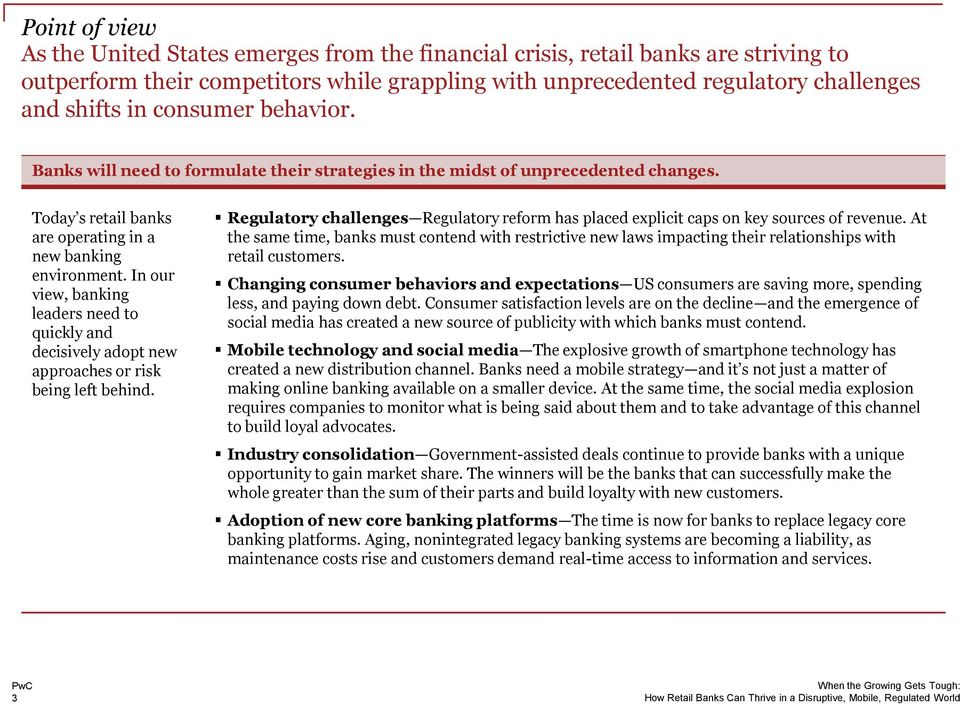
4 Point of view As the United States emerges from the financial crisis, retail banks are striving to outperform their competitors while grappling with unprecedented regulatory challenges and shifts in consumer behavior. Banks will need to formulate their strategies in the midst of unprecedented changes. Today s retail banks are operating in a new banking environment. In our view, banking leaders need to quickly and decisively adopt new approaches or risk being left behind. Regulatory challenges Regulatory reform has placed explicit caps on key sources of revenue. At the same time, banks must contend with restrictive new laws impacting their relationships with retail customers. Changing consumer behaviors and expectations US consumers are saving more, spending less, and paying down debt. Consumer satisfaction levels are on the decline and the emergence of social media has created a new source of publicity with which banks must contend. Mobile technology and social media The explosive growth of smartphone technology has created a new distribution channel. Banks need a mobile strategy and it s not just a matter of making online banking available on a smaller device. At the same time, the social media explosion requires companies to monitor what is being said about them and to take advantage of this channel to build loyal advocates. Industry consolidation Government-assisted deals continue to provide banks with a unique opportunity to gain market share. The winners will be the banks that can successfully make the whole greater than the sum of their parts and build loyalty with new customers. Adoption of new core banking platforms The time is now for banks to replace legacy core banking platforms. Aging, nonintegrated legacy banking systems are becoming a liability, as maintenance costs rise and customers demand real-time access to information and services. 3
5 Point of view The current regulatory environment will make it more challenging for banks to increase revenues and maintain profitability. US banking industry revenues are projected to grow 5% annually, but major regulatory changes will depress revenue growth and increase operational costs. 1 By 2015, revenue in the retail banking sector, which accounts for half of US banking industry revenues, could exceed $400 billion. 1 But regulatory changes made in the wake of the financial crisis will make it more difficult to capitalize on that growth potential. In a 2011 survey of CEOs worldwide, nearly 90% of leaders in the banking industry reported over-regulation as the biggest threat to their growth prospects. 2 The Dodd-Frank Wall Street Reform and Consumer Protection Act of 2010 (Dodd-Frank) is expected to have a fundamental impact on banks relationships with their retail customers. The regulation will restrict fees, strengthen consumer protection, increase compliance costs, and potentially further commoditize the banking business. By some estimates, Dodd- Frank will reduce profits by as much as 12% over the next five years, and will make it more difficult for banks to differentiate themselves. 3 In our view, banks need to re-evaluate their business models and understand how they will maintain profitability post-dodd-frank. The Credit Card Accountability, Responsibility, and Disclosure Act of 2009 (CARD Act) reduces the amount of interest and fee income that banks are able to collect from consumers. It also requires many banks to invest in technology to comply with new rules around billing practices. Some have estimated that the CARD Act will reduce the average annual income of large banks by $500 million to $1 billion and mid-tier banks by $50 million to $100 million. 4 Recent changes to Regulation E, which governs electronic fund transfers, are expected to reduce the fee income of the largest banks by up to $1 billion by some estimates. 4 FDIC insurance premium prepayments already have made an impact, reducing banking industry profits by 37.5% in 2009 according to some estimates. 5 In addition, changes to the FDIC s insurance premium assessment framework may reduce the profitability of certain banking activities. Basel III will more than triple banks capital requirements, increasing funding costs and leading to slower growth. 1 analysis based on IBISWorld data; IBISWorld, Commercial Banking in the US (November 2010), Savings Banks & Thrifts in the US (December 2010), Credit Unions in the US (November 2010). 2 s 14th Annual Global CEO Survey, Keeping Pace with Accelerating Change, Banking and Capital Markets, IBISWorld, Commercial Banking in the US (November 2010). 4 Diamond, From Surviving to Thriving: Maximizing Revenues and Profits in the New Banking Environment, IBISWorld, Commercial Banking in the US (November 2010). 4

6 Point of view US consumers are saving more, spending less, and paying down debt. Retail banks should address this fundamental shift in consumer behavior. 5 Financial uncertainty is driving up the personal savings rate and spurring a fundamental restructuring of the banking industry. In the wake of the worst recession since the Great Depression, US consumers went on a saving spree, driven by uncertainty over retirement income and by tighter restrictions on consumer lending. We expect the US personal savings rate to continue rising for a sustained period, potentially returning to levels not seen since the 1970s and 1980s. 1 In addition to building up savings, consumers are paying down debt accumulated during the era of easy credit that fueled the housing boom. The majority of consumers responding to a December 2009 survey noted that they had been actively paying off debt over the previous 12 months and planned to continue doing so over the next 12 months. 2 Retail banks can capitalize on consumers new focus on thrift and concern about retirement income by offering financial planning and related products. The winners will be those banks that reach customers and prospects through mobile technology and social media. More than 90% of adults in the United States have a mobile phone, making this a nearly ubiquitous channel for reaching customers and prospects. 3 The explosion of mobile technology, combined with a surge in the popularity of social media outlets such as Facebook, YouTube, and Twitter, gives retail banks a new way to connect with consumers 24/7 and a mandate to do so. Consumers are in the driver s seat, and they are demanding that services come to them when and where they want them and not the other way around. 1 FS Viewpoint, The New Rule of 10%, May Ibid North American Consumer Mobile Communications Outlook, Frost and Sullivan. 4 Personal Savings Rate. US Bureau of Economic Analysis and calculations. Percentage Savings and financial obligations as a percentage of personal disposable income (US households) Personal savingsrate Financial obligations ratio

7 Point of view To stay competitive, banks are embracing mobile technology and incorporating social media into their marketing strategies. Banks and their competitors are grappling with the implications and opportunities created by mobile phones and social media. Virtually the entire retail banking customer base is equipped to handle simple mobile financial services. The table below outlines how banks can leverage the popularity of mobile technology and social media and highlights the activities of non-traditional players who are jumping into the game. Mobile banking Mobile payments Social media What is it? Banks are investing in technology that allows their customers to complete transactions, manage their accounts, and perform banking research via their mobile devices. Examples of mobile banking services include remote deposit capture, two-way text banking, apps for locating branches and ATMs using GPS, and bill payment. Non-bank competitors have deployed numerous mobile payment technologies; no standard infrastructure has yet emerged. Payments can be made online and charged to a mobile phone account; completed via text message; initiated at retail outlets by scanning a bar code displayed on the mobile device; or made by waving a mobile device with an embedded contactless chip at a special point-of-sale device. With the advent of social media, customers are now sharing their experiences in real time. The social media explosion requires companies to monitor what is being said about them and to take advantage of this channel to build loyal advocates. Social media provides banks with a new way to improve brand recognition, expand customer reach, enhance the customer experience, and introduce new products. The players National, regional, and community banks Credit unions Amazon PayPal Starbucks AT&T Verizon Obopay Facebook Twitter YouTube Foursquare 6

8 Point of view Acquisitions can give banks a competitive edge, though they will need a well-executed strategy to more fully realize the benefits of the combined organization. With help from the federal government, many retail banks expanded rapidly during and after the financial crisis of Some winners are emerging in the newly consolidated environment. During the financial crisis and its immediate aftermath, many banks took advantage of government-assisted deals to acquire other banks at bargain prices. These acquisitions enabled banks to increase market share and profitability by consolidating redundant functions and implementing related cost-cutting initiatives. These organizations are now working to strengthen their newly acquired customer relationships and are taking advantage of new markets, products, and services. While most large national banks have slowed the pace of retail bank acquisitions because of regulatory limits, banks with access to capital continue to view acquisitions as a growth opportunity. Acquisitions can benefit banks by enabling them to: Reduce combined operational costs by eliminating redundant back-office functions Spread technology investments and regulatory compliance costs across a larger base Gain access to new markets and customers for cross-selling Increase the ability to invest in state-of-the-art technologies 7

9 Point of view A handful of institutions are beginning to implement customer-centric technology and operational platforms to support a coordinated channel strategy. Aging, nonintegrated legacy banking systems are becoming a liability, as maintenance costs rise and customers demand real-time access to information and services. Banks are weighing the costs and benefits of replacing legacy mainframe-based core banking systems with modern distributed applications. A customer-centric core banking system can help an organization increase revenues and flexibility and decrease costs and risks. Implementation challenges Implementation benefits 1 Build business case Obtain project sponsorship Analyze stakeholder needs and expectations Perform cost-benefit analysis Evaluate options Project execution Coordinate project management Develop target state Redesign front- and back-office banking processes Develop and roll out training Measure project impact and benefits Manage risk Integrate regulatory compliance needs Manage organizational changes Identify, escalate, and manage incidents Address global implementation risks 1 FS Viewpoint, Banking on Change: Technology and operations excellence in the post-financial crisis world, September Grow revenue Improve customer targeting Provide real-time transaction updates Enable consistent customer experience across channels Enable information-based services such as alerts, online banking, and mobile banking Reduce costs Reduce system maintenance costs Reduce overhead and processing costs Decrease dependence on mainframe IT personnel Decrease acquisition integration cost and complexity Increase flexibility Improve scalability of processes and systems Support increasing demand for global services Support optimized pricing strategies Reduce risks Avoid costly manual workarounds Limit manual handling of exceptions with straightthrough processing Enhance reporting to support growing compliance requirements 8

10 Point of view At the same time, banks must overcome organizational silos, disconnected channels, and nonintegrated systems. The typical retail bank faces three significant organizational and technological barriers to understanding customer needs and identifying products and services to meet those needs. Organizational silos Multiple channels Non-integrated legacy IT systems Operational units and product lines (e.g. deposits, mortgage and home equity, consumer lending, small business lending, credit card, wealth management) are not only managed and measured independently, but also are focused on their respective business units. The bank offers hundreds of products that are difficult for employees to remember and for customers to understand. Banking channels (e.g. Web, mobile, branch, call center, ATM, lending offices, wholesale/broker) are administered separately, and there is little understanding of how to manage the customer experience effectively from different channels. In our view, these channels should but currently do not view themselves as sales centers. Aging IT systems have been cobbled together from multiple acquisitions and product lines. System changes are expensive and time consuming, often requiring months of lead time. Disparate IT systems make it difficult to understand and analyze data with consistency or rigor. This lack of information makes it difficult for those who interact with customers to identify which products and services the customer currently uses and which products might help the customer to achieve his or her overall financial goals. Overcoming these barriers will strengthen the customer relationship and reduce operational costs, offsetting some of the lost revenues and increased costs resulting from new regulatory requirements. 9

11 Point of view Since the vast majority of US consumers already have a banking relationship, banks have limited options to grow their customer base and increase their share of wallet. Research indicates that 92% of US households have a checking or savings account with at least one financial institution. 1 This scenario makes it difficult for retail banks to grow their customer base and increase revenue. Banks are left with three potential growth strategies: Strategy Buy Take Build Activity Use acquisitions as a vehicle for growth Gain market share from competitors and fend off new entrants Persuade customers to buy additional products and services 1 FDIC National Survey on Unbanked and Underbanked Households, December 2009, 10

12 Point of view Banks that deliver excellent service can win market share from their competitors. Customer service is the foundation of a strong relationship. A 2010 survey by J.D. Power and Associates shows that customer loyalty has declined in the past few years. According to the survey, the percentage of customers saying they will definitely not switch [banks] in the next 12 months fell from 46% in 2007 to 34% in With easy access to a flood of information on banking products online, consumers can access a broad range of providers to meet their needs, expectations, and demands. With the popularity of social media, they also can share their experiences good and bad in real time. According to the survey, poor customer service is the leading reason consumers switched banks in Other research suggests that banks are struggling to gain a greater share of their customers wallets. A 2011 retail banking survey conducted by indicated that while the average consumer has 6.1 financial products, only about half of them are with the customers primary financial institution. According to the survey, there is significant opportunity for banks to service a greater share of their customers financial needs. 64 Percent of respondents have brokerage accounts held at a non-primary financial institution.² Percent of insurance-holders purchased it from a nonprimary financial institution. 3 Percent of respondents either do not use financial planning services, or obtain them from a non-primary financial institution. 4 ¹J.D. Power and Associates, 2010 Retail Banking Satisfaction Study, ² February 2011 Survey of Retail Banking. Calculations reflect respondents who indicated that they purchased this product from only a non-primary financial institution, as a percent of respondents who purchased this product. 3 Ibid. 4 February 2011 Survey of Retail Banking. Calculations reflect respondents who indicated that they purchased this product from only a non-primary financial institution or not at all, as a percent of respondents. 11
![According to the survey, the percentage of customers saying they will definitely not switch [banks] in the next 12 months fell from 46% in 2007 to 34% in 2010.](/docs-images/40/73868/images/page_12.jpg "1 With easy access to a flood of information on banking products online, consumers can access a broad range of providers to meet their needs, expectations, and demands.")
13 Point of view To capture a greater share of wallet, banks must evolve beyond pushing products to understanding and delivering on customers financial needs. Leading institutions are adopting a new customer-centric model to replace outdated product-centric models. Today, many banks focus on selling products rather than gaining a holistic view of the customer s financial situation. The traditional banking model is organization-centric and structured around internal product groups. In our view, banks should focus on gaining their customers trust by identifying and addressing customers overall financial goals, then deliver products and services to help achieve those goals. Each customer should be assigned an advocate within the bank whose job is to identify and manage the customer s long-term financial goals and guide the person to relevant products and services. For instance, financial planning might be the core product on which the relationship is built, particularly for the mass affluent market segment. In a customer-centric model, features are designed to improve the customer experience. The customer s information is integrated and can be accessed from any location. The customer is not required to complete redundant forms, which speeds processing and improves the customer experience. There is a single credit underwriting process, even for customers who have multiple loans with the bank. Loyalty programs, if in place, reward customers for activity across multiple product lines. 12

14 Point of view Banks that gain a deep understanding of their customers through life cycle segmentation can leverage their knowledge to offer the right products to the right customers at the right time. Banks that utilize life cycle segmentation can create more revenue-generating opportunities, increase cross-selling, build profitable long-term relationships, and discourage attrition. The relationship between investable assets and debt over a consumer s lifetime follows a predictable pattern. Consumer financial planning life cycle Life trigger points Initiate banking relationship (savings/ checking accounts) Enter college, workforce (payment vehicles credit/debit, auto loans) Marriage (joint checking accounts, 401K plans, CDs, money market) Birth of a child (IRA plans, new home mortgage, loans, insurance, 529 education plans) School-age children (home equity loans, 529 education plans, insurance) College-bound children (investments, education loans, second mortgages) Retirement (investments, reverse mortgage, estate planning, retirement plan distribution) Teenagers / students Single adults Childless couples Young families Established families Empty nesters Mature adults Investable assets Debt Questions to consider: How have we defined our customer segments? Who are our most profitable customers? What does it cost to serve them? Do we have an ongoing relationship management process? Do our front-line employees have the knowledge, training, and incentives to build customer relationships and sell customers the right products at the right time? 13

15 Point of view In conclusion, we see the leading retail banks establishing effective game plans to transform their businesses in a number of important respects. To be positioned for profitable growth, banks should execute well in six key areas: customer relationships, product design, pricing, expense management, distribution channels, and regulatory/risk management. Customer relationships Product design Pricing Expense management By gaining a deep understanding of their customers, banks can anticipate the customers needs and proactively offer the most relevant products and services and in the process, strengthen the customer relationship. Banks that develop a standard, repeatable process for dynamically customizing products without creating back-end complexity will be able to respond quickly to changing consumer preferences and needs. The pricing function is becoming a strategic tool for taking full advantage of potential profits. We see banks analyzing customer data to determine the maximum price each customer segment is willing to pay for a given product. Banks that take a customer-focused approach to managing expenses will be better equipped to reduce costs without sacrificing customer experience. Both front- and backoffice costs should be assessed for potential cost-reduction opportunities. Distribution channels By tailoring channels to a specific customer segment or purpose, banks can capitalize on the distinct and complementary role of each channel while managing costs. Regulatory/risk management There is a need to optimize the business strategy within the context of current regulatory, capital, and risk management considerations. 14

16 Section 2 Competitive intelligence

17 Competitive intelligence To maintain market share and strengthen customer loyalty, leading banks are implementing strategic pricing and delivering a better customer experience. Customer relationships To deliver the ultimate customer experience, banks are striving to connect with customers on a personal level. In a 2010 survey, an online bank received the highest customer satisfaction ratings, despite not offering the best rates. Its call centers strive to personalize the customer experience by aiming to answer all calls within 20 seconds. The bank also demonstrates confidence in its service with a money-back guarantee. A regional Midwestern bank used YouTube to spread brand awareness by producing a series of financial education videos aimed at college students. In 2010, a global financial services firm used Facebook for its philanthropic effort to promote its community giving campaign, gaining 2.5 million fans in the process. Product design Banks are using new technologies to provide products tailored to customers needs. A global financial services firm supports tap and pay mobile payments which allow customers to use their mobile phones like credit cards. In an effort to engage young adults, a credit card processing company offers customer reward points that can be redeemed for virtual goods on Facebook. In 2010, three major US banks simplified ATM deposits for customers by eliminating the deposit envelope and providing a scanned copy of deposited checks on the receipt. Though the ATMs are costly, a bank spokeswoman said that the new technology removes many of the anxieties people had about their accounts. Pricing In response to regulatory pressures that have trimmed profits, banks are looking for additional sources of revenue from their customers. One major US bank replaced free checking with a new account type that requires customers to make a monthly deposit over $250 or maintain a minimum balance to avoid a $5 monthly fee. College accounts now are assessed a $3 monthly fee unless the account holder maintains a $500 minimum balance. Another major US bank rolled out an ebanking program, which requires users to make deposits and withdrawals electronically or pay an $8.95 monthly fee. A global financial services firm offers a scaled-down checking account which requires customers to complete five transactions per month or pay an $8 monthly fee. 16

18 Competitive intelligence Forward-thinking banks are adopting unique solutions to manage expenses while reshaping their channel strategies to accommodate mobile technology. Expense management In an effort to manage expenses without impairing the customer experience, banks are collaborating with employees to identify unique cost-saving solutions. Several banks are managing personnel costs by not replacing vacated positions or by hiring part-timers to fill the gap. Banks also are reducing overtime costs by moving away from the standard 40-hour week and holding supervisors accountable for staffing based on workload from week to week. One regional bank has reduced training costs by increasing reliance on online training courses and encouraging employees to become more involved in local and state banking associations a low-cost way to stay current with industry trends. Banks with small geographic footprints are leveraging remote deposit capture as a means to reduce branch costs while appealing to new customers. Distribution Online and mobile channels are growing in importance and are complementing retail bank branches, which continue to play a critical role in attracting customers and building relationships. One regional bank is using the mobile phone as a sales channel by offering auto loans through an iphone app. Using the app, customers enter information about the model of car they wish to buy. If the bank has a relationship with the dealership, the app displays the price the bank has negotiated with the dealer and determines if the buyer is qualified to receive financing from the bank. A major US bank provides free online money management tools and financial education videos, and has deployed mobile applications written for the iphone, Android, BlackBerry, and Palm devices. An Oregon-based community bank is building smaller branches with less focus on transactions. Instead, the branches function more like community centers, with community displays and occasional live music. 17

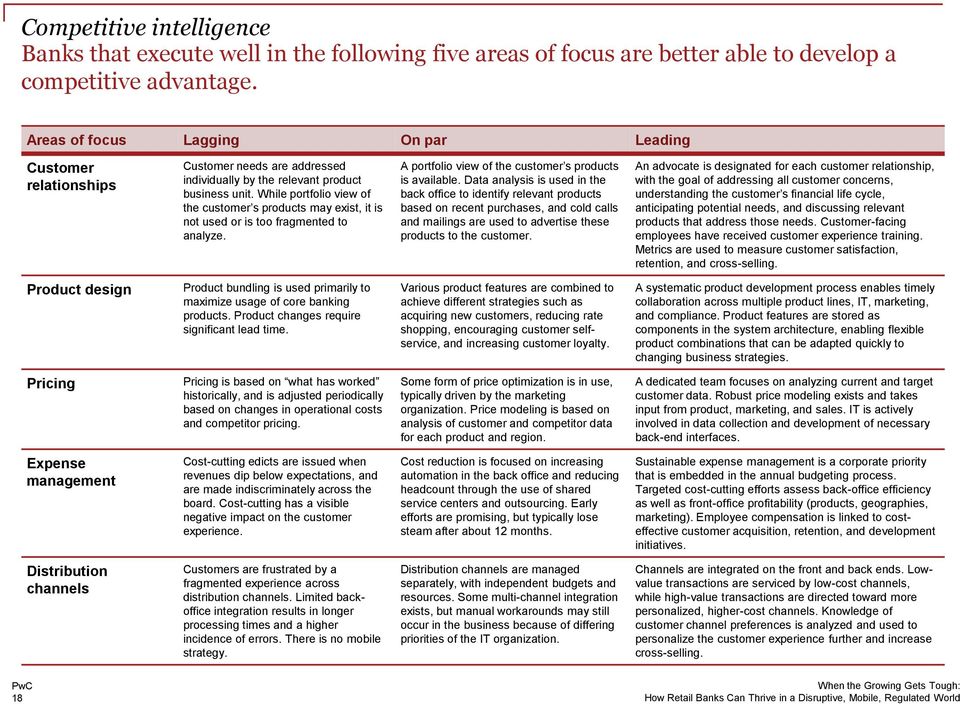
19 Competitive intelligence Banks that execute well in the following five areas of focus are better able to develop a competitive advantage. Areas of focus Lagging On par Leading Customer relationships Customer needs are addressed individually by the relevant product business unit. While portfolio view of the customer s products may exist, it is not used or is too fragmented to analyze. A portfolio view of the customer s products is available. Data analysis is used in the back office to identify relevant products based on recent purchases, and cold calls and mailings are used to advertise these products to the customer. An advocate is designated for each customer relationship, with the goal of addressing all customer concerns, understanding the customer s financial life cycle, anticipating potential needs, and discussing relevant products that address those needs. Customer-facing employees have received customer experience training. Metrics are used to measure customer satisfaction, retention, and cross-selling. Product design Product bundling is used primarily to maximize usage of core banking products. Product changes require significant lead time. Various product features are combined to achieve different strategies such as acquiring new customers, reducing rate shopping, encouraging customer selfservice, and increasing customer loyalty. A systematic product development process enables timely collaboration across multiple product lines, IT, marketing, and compliance. Product features are stored as components in the system architecture, enabling flexible product combinations that can be adapted quickly to changing business strategies. Pricing Pricing is based on what has worked historically, and is adjusted periodically based on changes in operational costs and competitor pricing. Some form of price optimization is in use, typically driven by the marketing organization. Price modeling is based on analysis of customer and competitor data for each product and region. A dedicated team focuses on analyzing current and target customer data. Robust price modeling exists and takes input from product, marketing, and sales. IT is actively involved in data collection and development of necessary back-end interfaces. Expense management Cost-cutting edicts are issued when revenues dip below expectations, and are made indiscriminately across the board. Cost-cutting has a visible negative impact on the customer experience. Cost reduction is focused on increasing automation in the back office and reducing headcount through the use of shared service centers and outsourcing. Early efforts are promising, but typically lose steam after about 12 months. Sustainable expense management is a corporate priority that is embedded in the annual budgeting process. Targeted cost-cutting efforts assess back-office efficiency as well as front-office profitability (products, geographies, marketing). Employee compensation is linked to costeffective customer acquisition, retention, and development initiatives. Distribution channels Customers are frustrated by a fragmented experience across distribution channels. Limited backoffice integration results in longer processing times and a higher incidence of errors. There is no mobile strategy. Distribution channels are managed separately, with independent budgets and resources. Some multi-channel integration exists, but manual workarounds may still occur in the business because of differing priorities of the IT organization. Channels are integrated on the front and back ends. Lowvalue transactions are serviced by low-cost channels, while high-value transactions are directed toward more personalized, higher-cost channels. Knowledge of customer channel preferences is analyzed and used to personalize the customer experience further and increase cross-selling. 18
20 Section 3 A framework for response

21 A framework for response By focusing on strategic initiatives and deploying enabling technology, retail banks can position themselves for profitable growth. Navigate regulatory risk Deepen customer relationships Manage expenses Cultivate customerfocused culture Improve cross-channel distribution Customize product design Differentiate pricing Implement technology roadmap Customer segmentation and analytics Core banking Mobile Foundation elements: People, Finance, Project management, Change management 20
22 A framework for response Understand customers life cycle needs, preferences, behaviors, and purchasing patterns. Understand the customer Objectives Identify customers/households that generate the greatest current and long-term value to the organization. Clearly identify the drivers of loyalty (or attrition) and crossselling. Break down silos Objectives Transition from an organizational/product view to a customercentric portfolio view. Align compensation with firm-wide value maximization versus rewarding individual business units on volume. Enhance the customer experience Objectives Ensure a consistent highquality experience across channels. Establish a formal process to obtain and positively react to customer feedback. Be proactive in addressing customer needs and wants. Key principles to deepening customer relationships: Develop strong links between service quality and corporate-wide strategy that includes measurable goals and incentive-driven compensation aligned to service quality Understand current pain points across customer segments and interaction channels Unify disparate systems that may be driving different levels of service quality across various touch points Activities Gather relevant customer data. Identify core and growth target customer segments, focusing on each customer s financial life cycle point. Analyze historical preferences and purchasing patterns. Assess potential lifetime profitability of each segment. Activities Analyze barriers to effective retention and cross-selling efforts. Implement robust retention and crossselling metrics. Enhance cross-training of best practices across business units to boost retention and crossselling. Make organizational/ structural changes to overcome barriers. Activities Create journey maps for critical processes/ moments of truth (e.g., customer disputes, loan closing). Design a voice of the customer program and pilot the program in a business unit. Create a customer satisfaction scorecard and define key performance indicators for key customer segments. Develop concrete returns on service quality initiatives to tie initiatives to measurable results Questions to consider: Do incentive policies reward customer-focused behavior? Does the bank have easy-to-understand products? Is the bank outperforming its peer group in critical customer satisfaction metrics (e.g. intent to repurchase, intent not to switch)? Is the bank reducing attrition with highly dissatisfied customers? Broadening relationships with the most satisfied customers? 21
23 A framework for response Roll out customized products to meet the demands of target customer segments. Banks should develop a standard, repeatable process for creating and dynamically bundling products without disrupting operations or increasing costs. Such an agile design approach involves breaking down products into a set of shared elements that can be combined in modular form to create customized bundles. Components of product design Branch Internet Mobile Call center Financial planning Credit lines Savings/checking Credit card Insurance Loans Rates Monthly fees Transaction-based Willingness to pay Branch reputation Life stage Banking needs Employing agile product bundling: Understand customer segments and product/channel preferences, profitability, and price sensitivity Overcome internal product silos Many customers are forced to manage multiple product silos to address their range of banking needs, often leaving them highly dissatisfied. Develop a modular, dynamic product development process By breaking down products into a set of shared product features, customized products can be delivered in a timely way without sacrificing quality or requiring compliance with multiple product lines, channels, and functions (e.g. IT, marketing, legal, other stakeholders). Bundle products Base groups on demands of the customer segment, the type of product/feature growth desired, and how well the products complement each other. Unify the technology infrastructure Enable integrated offerings and quick rollout of product bundles by creating a unified product repository that stores all product data and rules from legacy systems or product silos. Questions to consider: Can we quickly roll out customized product offerings to meet specific needs of customers? What are our customers product and channel preferences? Can our front-line employees articulate the value of our products to customers in language that is easy for them to understand? Do we have a standard, repeatable process for allocating revenue from product bundles across product lines? For monitoring the terms of conditions of each product bundle (e.g., minimum deposit balance)? 22
24 A framework for response Apply strategic pricing to balance revenue maximization with the risk of losing customers to competitors. What is each customer segment s willingness to pay? Product price Product profitability rises Market share decreases Market share The first step in developing a strategic pricing strategy is to determine the maximum price each customer segment is willing to pay for a given product. If product price is too low, banks lose potential profit from customers who would have been willing to pay more. If pricing is too high, banks risk losing customers to competitors and market share declines. The optimal price is the maximum that customers are willing to pay, and it yields the maximum profit the bank can earn for a given product and customer segment. Implementing new pricing strategies: Take a data-driven, analytical approach to setting and managing prices versus a marketing and sales approach to pricing. Pricing decisions should become a strategic priority shared by marketing, sales, and senior management rather than a tactical function within marketing or sales. Explore where customers might be more flexible about rates versus assuming that all customers are price sensitive. This involves gaining a holistic understanding of customer needs, preferences, behaviors, purchasing patterns and price sensitivity and understanding when a price shift may trigger a negative response. Assign clear ownership and responsibility for pricing outcomes. This is especially important given the inherently cross-functional nature of pricing across product, marketing, sales and operations groups. A pricing owner should be designated to ensure a coordinated approach to pricing that balances the needs of all of these groups. Adapt quickly to change Strategic pricing often requires change in the form of new pricing practices, data collection techniques, and implementation of interfaces between back-end applications. Banks must manage these changes effectively to understand fluctuations in customer pricing preferences. Questions to consider: Does the bank understand the maximum amount a customer is willing to pay for a given product? Are prices set accordingly, to maximize profit? Are pricing decisions a tactical function limited to one group or a strategic priority shared by marketing, sales, and senior management? Are ownership and responsibility for pricing outcomes clear? 23
25 A framework for response Ensure a consistent experience across all channels while directing customers to their channels of choice. Since most customers interact with their banks through multiple channels, banks must deliver a consistent and efficient experience across all channels, including mobile and Internet. Banks also should develop channel-specific strategies that capitalize on the distinct and complementary role of each channel: Low-cost Internet and mobile can become the primary channels for high-volume, routine transactions and servicing. Internet and mobile also can be effective lead generators, driving prospects to branches, where employees can establish new banking relationships and where higher-value activities are performed (e.g. dispensing financial advice on complex products, resolving disputes). Branch Call Center ATM Internet Mobile Cost per transaction 1 $1.34 $3.75 $0.60 $0.09 $0.14 Open account Obtain financial advice Implementing cross-channel distribution: Identify high-value and high-potential segments of current and potential customers likely to adopt the new channel (e.g. mobile banking) and the bank s products. Use analytics tools, customer segmentation, and knowledge of channel preferences. Test and learn what works when it comes to actively shaping customer behavior. Employ education, peer analysis, segmentation, channel integration, and process redesign. Implement key architectural changes Consider moving from legacy core banking platforms that rely on daily batch processing to modern platforms capable of processing real-time transactions. Change address Questions to consider: Resolve a dispute Have we developed customized strategies for customer Transfer funds segments based on each segment s channel preferences? Schedule bill payment Is information integrated across different channels, or does it Obtain cashier s check reside in silos (e.g., is the customer required to repeat account information provided to the interactive voice response system Receive account alerts when speaking with a customer service representative)? Locate ATMs What is our bank s mobile strategy? Are we delivering the right product bundle for the right Deposit checks customer at the right time, at the right price, and using the Some channels are better suited to certain activities than others. Banks right delivery channel? must balance offering this diversity against the cost of operating each channel. 1 TowerGroup, And the Customer Takes the Lead, Nicole Sturgill, Research Director, Delivery Channels, Reference # V63:01N, April 26,
26 A framework for response Target front-office and back-office processes when managing costs, being careful not to jeopardize customer relationships or undermine growth. To increase efficiency, banks need a strategic approach that balances customer expectations for greater simplicity, efficiency, and service quality with short-term operational cost reduction. Banks typically focus on increasing the efficiency of back-end operations; however, frontoffice efficiency often can be increased as well, by streamlining or eliminating processes that do not create value for customers. 25 Cost-cutting initiatives Front office Targeted cost cutting Eliminate geographies, products, and customers who are not core to the business. Reinvested savings Continue to implement process innovation to increase efficiency, and reinvest the savings in nextgeneration customer service initiatives. Marketing Analyze the effectiveness of spending on targeted customer segments. Sales Ensure that sales efforts support the bank s customer growth strategy. Back office Shared services Increase simplicity and efficiency by replacing costly, siloed internal processes with a shared service model. Quality and speed Quantify and examine operational errors, and target the root causes to reduce customer pain points. Risk management Examine the impact of risk processes (e.g., excessive documentation requirements) on customer experience, and streamline where possible. Technology Align IT projects with the business strategy. Implementing customer-focused expense management initiatives: Customer focus Ensure that the impact of expense line items on customer service can be traced. Robust approach Invest in a consistent methodology and include its execution as part of the annual budgeting process. Sustainable expense management maintains accountability at the grass-roots level. Enterprise-wide approach Be willing to change the operating model, organizational structure, and technology capabilities to support expense management objectives. Reward systems Tie cost-effective customer acquisition, retention, and development efforts to incentives. Metrics Establish key performance indicators and use metrics to assess the impact of expense management measures on customer satisfaction. Questions to consider: Has the bank eliminated processes and activities that do not create value for customers or the bank? Are quality and speed built into the process while minimizing the variability in service delivery? Is the bank rationalizing legacy technologies and streamlining IT service management? To what extent are manual tasks/processes automated? Has the bank assessed options for outsourcing non-core functions?
27 A framework for response Cultivate a customer-first culture throughout the bank. Banks that are more likely to succeed are the ones that can embed these initiatives into a customer-first culture that continuously reinforces every employee s goals and behaviors. Collaboration Banks will need to develop a culture of collaboration between traditionally separate product-centric units. Communication and reporting Leadership should have a communications strategy that reinforces the customer culture. In addition, reporting should facilitate timely, actionable information to improve the customer experience. Talent acquisition and development Establish hiring, onboarding, and training processes that support a customer-first mind-set. Rewards and incentives Make employees accountable for achieving customer-related goals by linking compensation and rewards with realization of those goals. There is no one-size-fits-all approach to fostering collaboration between business units. Collaboration can be encouraged through organizational changes, process updates, or investments in technology. For example, the customer experience can be improved when business units share financial data the customer has submitted for a mortgage to provide relevant home insurance products. Leadership s messaging about customer focus should be consistent, straightforward, and frequently heard by both front-line and back-office employees. Reporting systems, metrics, and dashboards should provide employees and management with a single view of the customer. Hiring should focus on specific skill sets that the bank needs to be successful in deepening customer relationships. For example, branch personnel who interact frequently with customers should have strong communication skills and sales experience. Onboarding and training activities should reinforce the bank s processes for understanding and addressing customer needs by recognizing customer life cycle triggers and suggesting products when they are relevant. Relationship managers may be responsible for achieving a certain rate of cross-selling for their customers. Loan operations staff may be rewarded for decreasing the error rate in the loan boarding process. 26
28 A framework for response Reexamine how customer segmentation and analytics are being used to understand and target customers. 27 Customer segmentation Customer segmentation is not a new concept in banking, but few banks have translated the theory into practice. To segment customers for marketing purposes, banks must have access to information about all of the products and services a customer has purchased across the organization. Many banks do not have this comprehensive information because they serve customers in separate business units and on different IT systems. Obtaining a top-down view of all of a customer s accounts across the bank does not necessarily require a complete systems overhaul. The view can be achieved with a universal client identifier a unique number assigned to every account that a customer has across the organization. Customer analytics With universal client identifiers added to all accounts, marketing personnel can mine the data to produce a comprehensive profile of each customer and assign the customers to the appropriate segment (e.g., their stage in the life cycle). Marketing efforts can then be targeted to each segment and tailored to each customer. For instance, if a customer in the young families segment does not yet have a mortgage, the bank might send a mortgage brochure to the customer and follow up with a call from a lending officer. Example of customer segmentation model to analyze customer likelihood to adopt distribution channels Customer segments Couples without dependents: Financial up-and-comers, strong users of technology Empty nesters: Wealthy, high touch, low interest in technology Established families: Growing assets, developing interest in technology Single adults: Young spenders, low savings, high interest in technology Expected Lifetime Value Mobile Adopt Branch Phone Online Very High Very High Moderate High Very High Moderate Low High High Very High Very High High High Very High Very High Low Very High Low Moderate High Implementing a successful customer segmentation program requires careful planning and strategic decision making. Questions to consider: Have we gathered data that will enable us to understand where customers are in the financial life cycle and to forecast their money management needs? What is the lifetime value (current and expected future profit) of each customer segment? What financial development objectives have we established for each customer segment, and how are we differentiating product, pricing, and communication strategies for each segment? Do we understand the drivers of customer loyalty and attrition for each segment?
29 A framework for response Develop a technology strategy and roadmap that integrate the core banking platform with emerging mobile channels. New core banking and mobile technologies can help banks strengthen their ability to effectively implement growth strategies while managing operational complexity and risks. Develop a service delivery strategy for the mobile wallet : Mobile banking: Offers the convenience of banking anytime, anywhere. Mobile payments: Enables customers to send money to any mobile phone number. Mobile payments contactless: Allows customers to save time with tap-and-go mobile payment service. Mobile marketing: Provides consumers with exclusive promotions, coupons, and alerts based on their current location. Developing a technology strategy and roadmap 1. Articulate the case for change 2. Define the target state 3. Select a business partner 4. Assess the need for front- and backoffice process redesign 5. Integrate risk and regulatory functions 6. Develop a communications and training program Develop a defensible, flexible cost-benefit analysis to build support among stakeholders and board members. Define a target IT model that is customer-centric. Consider the desired core banking functions (customer relationship management, products, delivery channels, servicing, business analytics, accounting, risk) as well as integration with the mobile wallet. When selecting a business partner for core banking and mobile technologies, assess the organization s ability to deliver scalable solutions, proactively address industry trends, offer easy access to real-time data, and provide a system architecture that integrates well with new technologies. Perform a gap analysis to determine the level of front- and back-office process redesign needed to fully realize the benefits of new systems and technologies. Ensure that the target operating model provides modular, user-defined capabilities for addressing emerging risks and regulatory requirements. Develop a robust communications and training program to facilitate employee adoption of new systems and processes and enable the organization to realize the full benefits of new technologies. 28
30 A framework for response Evaluate current compliance programs against new regulatory standards. As bank leaders consider strategic changes to increase competitive advantage and grow profits, recent regulatory changes should be evaluated to determine how they will impact customer relationships, products, operations, and distribution channels. Dodd-Frank Act 1 CARD Act 2 Regulation E Regulatory changes New regulatory agency A new agency, the Consumer Financial Protection Bureau (CFPB), will oversee consumer protection. State regulation State consumer financial laws will not be as easily preempted by federal laws. Mortgage origination New restrictions will limit how mortgage originators are compensated. Underwriting standards will become more stringent: consumers must demonstrate reasonable ability to repay loans, and financial documentation must be verified. Mortgage servicing Servicers will be required to comply with new reforms in many areas, including interest rate reset notices, escrows for taxes and insurance, and timely response to customer inquiries. Durbin Amendment This regulation restricts interchange fees charged to merchants for debit card usage. Impacts on billing practices Payments must be applied to balances with highest interest rate first Late fees cannot be applied to outstanding balances Elimination of two-cycle billing Cardholders must be given full benefit of promotional rates Payments within 60 days are considered current, thereby preventing new interest rates from being applied to old balances Revised overdraft rules Consumers must opt in to overdraft services before they can be charged overdraft fees for ATM or debit card transactions. Potential responses Structure compliance programs in a format similar to the CFPB s organization (e.g., consumer complaints, fair lending, financial literacy, and protection of older Americans). Ensure that compliance programs for state laws have the same level of rigor as federal programs. Identify and review all forms of compensation to mortgage originators. Review credit and underwriting procedures to determine what system, process, and control changes will be needed to support new underwriting standards, income verification, and pre-payment penalties. Consider simplifying mortgage products to limit regulatory risk. Review mortgage servicing procedures to determine what system, process, and control changes will be needed to support loan servicing reforms. Understand the cost drivers of the new operating environment. Adjust pricing practices to become compliant. Consider impacts on business model, operational functions, and relevant technology and applications. Understand the cost drivers of the new operating environment. Adjust pricing practices to become compliant. Assess the ability of current systems and processes to identify overdraft situations in real time. 1 s publication series A Closer Look, 2 FS Viewpoint, In the Cards: Preserving Profitability in the Post-CARD Act World, October
31 A framework for response Deploy the right planning and support functions to facilitate successful execution of initiatives. As with any major undertaking, having the necessary support structures in place will help organizations meet their strategic objectives on time and on budget. Project Management Office (PMO) People and 0rganization Change management Finance Definition of project scope Project planning Stakeholder facilitation Management of change request initiation, updates, and approvals Issue/risk management Project progress monitoring Reporting Appropriate senior project sponsorship Acquisition of and development of the right talent for strategic and operational initiatives Organizational structure that supports business strategies and collaboration Rewards and incentives aligned with business goals Internal and external communications Deployment planning Development of training materials, job aids, etc. Training courses Support desk Budget and actual tracking Finance system updates Revenue and cost impact analysis Procurement Financial analysis and forecasting 30
32 Section 4 How can help
33 How can help Core competencies Customer impact Business design and performance improvement Information advantage People and change management Regulatory risk management Create a well-designed, integrated, market-facing experience across key areas critical to drive demand: Customer experience design Product design and portfolio management Pricing strategy Channel strategy, including mobile and social media Voice of the customer program Evaluate and create the needed business and technology design to support your strategies, interface with your markets, and measure progress on and achieve improvement objectives: Organic growth strategy and mergers and acquisitions Strategic sourcing and shared services Front-office and back-office process redesign, service quality enhancement, and cross-channel distribution strategies Expense management assessment Build a core competency in advancing information architecture and analytical skills to improve management decision making and economic performance: Advanced customer analytics Core banking system selection and implementation Data management Build effective organizations by aligning your people with your business strategies: Organizational structure and design Messaging and communications strategy Compensation and rewards Project and change management Navigate regulatory complexity: Regulatory compliance programs Credit, market, liquidity, and counterparty risk management Governance, risk, and compliance frameworks 32
34 How can help Our Financial Services practice is an advisor to 44 of the world s top 50 banks and 46 of the world s top 50 insurance companies, and is the leading service provider to investment managers, pension funds, and hedge funds around the world. This diverse client base provides us with unique access to develop peer insights and to understand from experience what works in specific client circumstances. In the United States alone, we are able to call upon our 800-person Financial Services Advisory practice and more than 3,000 financial services professionals. Accountability and cost effectiveness Our thorough approach to serving clients provides them with a single point of accountability, which creates an efficient and effective day-to-day working arrangement and, most importantly, best positions our clients for success. We have significant experience in helping to drive complex programs and feel strongly that we can work successfully in a cost-effective manner to meet your organization s needs and objectives. Trusted brand We offer a truly independent view, without prejudice or favor regarding specific vendors, solutions, or approaches. We assess each situation and develop the most appropriate solutions depending upon the client s individual circumstances. Global footprint works in a globally integrated manner. This benefits clients in terms of consistent service delivery and quality because we are able to take advantage of the best ideas, resources and solutions from around the world. 33
35 How can help s Financial Services practice has helped banks address specific needs across their organization. 34 Client needs Supporting growth and profitability Delivering cost-effective technology and operations Producing actionable financial information Improving value from mergers and acquisitions Navigating risk and regulatory complexity Planning for and responding to a crisis Issues we help clients address Assisting with product rationalization and innovation Rethinking customer strategy in terms of customer needs and behaviors Growing the wealth management practice Improving analysis of customer information to identify opportunities for cross-selling and enhanced customer service Improving productivity in branch network operations and profitability per branch Rethinking and reexamining physical branch strategies in an environment of cost and operational pressures and alternative branches (e.g. mobile and online) Advancing consumer finance and mortgage business from servicing and pricing to operational and risk management strategies and programs Reshaping wealth management products and strategies and evaluating impacts on risk management, operations and regulatory compliance Investing in core banking systems to create competitive advantage by leveraging customer information, driving cost reduction, increasing flexibility, and strengthening risk management Delivering improved information that management needs to make enterprise decisions Developing data architectures, management and quality processes, and procedures to support a single view of customer information Providing more actionable customer information to drive revenue generation Improving existing technology infrastructure Performing due diligence for finance, tax, IT, operations, human resources, and risk management Structuring and negotiating asset purchase agreements, transition services agreements, and preferred provider agreements Retaining customers from acquired banks and improving cross-selling opportunities Integrating governance, risk, and compliance activities to reduce the cost of risk management while maintaining quality Interpreting complex regulatory requirements and understanding how to enhance compliance while reducing impact to the business Developing effective compliance training programs Organizing and preparing documentation to respond to regulatory investigations or sanctions Managing liquidity issues through a tight credit market Responding to litigation or other threats with clear communications, strategy, and roles and responsibilities
36 How can help For further information, please contact: Americas John Garvey Dan Jackett Anthony Klick David Hoffman Nate Fisher
37 Appendix Select qualifications
38 Select qualifications Customer relationships Large US retail bank Issues Approach Benefits The bank had faced minimal growth for several consecutive years, despite operating in a growing market. The bank was seeking insight on how it could change its strategy to identify key target segments and improve branding messages as part of a multi-year effort to drive double-digit revenue growth. analyzed publicly available bureau data together with the bank s customer data to identify four primary target segments that covered 65% of US households. Each segment s attributes were defined based on consumer needs, preferences, and current life stage. Using this information, we: Developed insights on each segment using both life stage and day-in-the-life analysis to refine product positioning and targeting messages. Identified several key focus areas to increase same-store sales, including customer acquisition, customer retention, and new products and services. Developed initiatives to improve the geographic footprint, including identification of target locations and strategies for leveraging partnership models, territory models, franchisee strategy, and franchisee acquisition. The team developed actionable roadmap segments covering the medium and long term for each initiative. After implementing the initiatives across multiple geographic footprints, existing branches, and products, the bank recognized an incremental revenue impact of $170 million over three years. 37
39 Select qualifications Product design and pricing Large US retail bank Issues Approach Benefits The bank wanted to increase product penetration for its small-to-medium business customer base. Traditionally, product penetration was driven by relationship managers in the branches, and was very low for most premium fee-generating services. The small-to-medium business customers often had products with both the small business division and the personal consumer division, making it difficult for bank employees to have a single view of the customer s portfolio. The bank was seeking product bundle recommendations to drive product penetration and revenue for this customer segment. analyzed the bank s small-to-medium business customer base and identified four key customer segments based on industry, product portfolio, and service usage pattern. The analysis also assessed price sensitivity across segments, identifying customer segments that were insensitive to price increases, segments that were highly sensitive (creating higher attrition rates), and segments that were sensitive to certain types of price increases (e.g., rate versus fee). Using customer analytics to further profile each segment, evaluated each segment s behaviors and needs for various product elements and premium services. We proposed a collection of product/service bundles targeted at each customer segment and estimated the US market size and projected revenue impact for the bank. The client was able to better understand the behaviors and needs of its small-to-medium business customer base and design more relevant products that had greater appeal to its customers. The projected revenue impact was more than $100 million across three years, based on increased adoption and more targeted pricing. 38
40 Select qualifications Product rationalization Super-regional bank Issues Approach Benefits A super-regional retail bank was having difficulty managing the infrastructure and go-to-market strategy for its large product portfolio. The product portfolio, especially the retail checking account, had grown significantly in recent years as a result of the bank s acquisitions. This complexity was directly impacting the bank s ability to offer a high-quality banking experience to its customers while managing back-office spend. was engaged to develop a strategy for rationalizing the bank s product portfolio while maintaining a strong customer focus. The retail bank s product portfolio was composed of 60 retail checking products. Furthermore, the bank used multiple data sources for customer and product information; as a result, there was no comprehensive view of the customer relationships across the bank. For more than 200,000 accounts, integrated data from multiple sources to create a thorough view. The team performed clustering analysis to create unique customer groups. To identify the best fit for each customer, these groups were mapped to the new product set based on a comparison of attributes such as relationship balance, checking account average balance, and interest earned. created an iterative model based on transaction history and new product fee definitions to estimate net revenue on a per-account basis. Based on the model, net revenue impact for the client was determined and customers were classified into better-off, neutral, and worse-off segments based on the magnitude of the fee change. The client had a phased migration strategy that supported its efforts in streamlining the product portfolio and reducing operational expenses. The migration strategy provided the client with options for migrating customers while limiting attrition risk and reducing the impact on revenue. 39
41 Select qualifications Expense management Regional retail bank Issues Approach Benefits The bank was spending a significant portion of its operating expenses on supporting the IT infrastructure, which included a large number of applications with overlapping functions. In addition, the project portfolio included a wide range of projects initiated by multiple business units. The projects also had overlapping objectives and were not consistently linked with the bank s business strategy. The bank was interested in improving its bottom line by rationalizing the applications it supported and the projects in the pipeline. The team recognized that one of the client s challenges was it did not have a thorough inventory of the applications supported by the IT infrastructure. First, we helped develop a single application inventory that identified the application and its function, users, and vendor support. We then collaborated with client management to identify areas of overlapping functionality and analyzed different vendors to determine which ones could support the bank s business needs. identified the applications and vendors that should be rationalized and those that should be maintained to support the client s needs while reducing operational support costs. In addition, the team reviewed the project portfolio and analyzed projects by classification, business purpose, and priority level. Working with management, we recommended changes to better align the project portfolio with the existing IT infrastructure and the bank s business strategy. also helped the bank enhance its program management process by developing a new framework for prioritizing projects using qualitative and quantitative analysis as well as scenario analysis. We also provided recommendations for enhancing the planning, executing, and monitoring components of the program management process. The bank received a roadmap that would support its efforts in reducing operational expenses through the rationalization of applications and projects. In addition, the roadmap included recommendations on how the bank could improve its program management process to better align future projects with bank objectives. 40
42 Select qualifications Mobile distribution strategy Retail bank Issues Approach Benefits The bank did not have a mobile strategy and, instead, was deploying mobile services in a reactive mode, initiating multiple projects to address individual business unit needs. Many bank executives were unclear about the value proposition of the mobile channel and how existing mobile services, which essentially mirrored the online banking channel, could be enhanced to strengthen the multichannel strategy. worked with the management team in the Internet and mobile channel group to develop an initial point of view for how the mobile channel could be used to improve the customer experience and provide economic value for the bank. The team collaborated with management to do the following: Assess the unique needs of each business unit with respect to mobile channel distribution. Analyze the value proposition, potential cost, and revenue drivers for each business unit s mobile offering. Provide an overview of the business and technical architecture needed to support various mobile functions. Discuss current industry offerings in the mobile space. Provide guiding principles for organizing and executing the mobile strategy. The initial point of view that developed provided the bank s Internet and mobile channel group with the tools necessary to educate and engage business unit executives in further dialogue about the mobile channel. The client was positioned to validate the needs of the business units and develop a formal business case for an overarching mobile strategy. 41
43 Select qualifications Core banking implementation International bank Issues Approach Benefits The client was transitioning from a multi-system legacy infrastructure supporting 10 countries to an integrated banking platform purchased from a vendor. In addition to addressing complex technology issues, this transition entailed significant organizational change, including the redesign and implementation of banking processes, training, transition of employees to the new solution, and management of the change of day-one activities to reduce impact on the customer. served as an advisor to the team of internal resources managing the transition to the integrated banking platform. Our guidance addressed change management and system implementation. In addition to our advisory role, : Conducted readiness reviews to determine if the business units were ready for day-one/go-live to help establish that customer impact risk was reduced. Performed application testing. Analyzed the program s change management capability. Provided insight on required changes to the business model, including operational workstreams. Performed post-implementation assessments on the effectiveness of the client's change management efforts. Supported by recommendations, the client was able to implement new change management practices to better manage risk and quality around platform development and handover. The recommendations included a rejection of the originally proposed delivery time frame because of excessive risks to the change management schedule, quality of the platform implemented, and end customer. We helped the client develop reusable components to support rollouts at additional locations. 42
44 Select qualifications Merger integration Regional bank Issues Approach Benefits As part of the merger of two large regional California banks, was engaged to run the integration management office for overall merger and integration activities. Working with the client project manager, performed the duties of the integration management office. Key activities included the following: Developing transition framework. Creating and communicating transition principles. Operating the on-site integration management office. Conducting transitional risk management. Identifying and tracking synergies. Conducting user acceptance testing. The client recognized the following benefits: Its internal resources remained focused on core business issues. The bank was provided with a vast library of tools such as methodologies, risk matrices, reporting samples, analytics, synergy tracking tools, and best practice benchmarks. It leveraged external, unbiased perspectives that appropriately challenged approaches and results. 43
45 Select qualifications Dodd-Frank project management office (PMO) assistance Large US retail bank Issues Approach Benefits was engaged by the bank to assist in assessing and managing the impact of Dodd-Frank on its business and operations. To date, has supported the bank s Dodd-Frank efforts through a wide range of services: Designing and implementing the PMO governance structure and organization Evaluating the Dodd-Frank impact assessment process and supporting the execution of the business level impact analysis Supporting and managing the ongoing PMO process and facilitating the efforts of business-level workstreams The client recognized the following benefits: An effective governance structure and process for understanding and managing the impact of Dodd-Frank throughout its business units. Prioritization of the strategic and operational impact of each component of the Act. 44
46 How Retail Banks Can Thrive in a Disruptive, Mobile, Regulated World, FS Viewpoint, March All rights reserved. "" and " US" refer to PricewaterhouseCoopers LLP, a Delaware limited liability partnership, which is a member firm of PricewaterhouseCoopers International Limited, each member firm of which is a separate legal entity. This document is for general information purposes only, and should not be used as a substitute for consultation with professional advisors.
An Oracle White Paper October 2010. Siebel Financial Services Customer Relationship Management for Banking
 An Oracle White Paper October 2010 Siebel Financial Services Customer Relationship Management for Banking Executive Overview Banks are in constant interaction with customers. A winning and proven strategy
Managing all your customer interactions Ambit CustomerConnect
 RETAIL BANKING Customer Management Human. PRODUCT SHEET Managing all your customer interactions Ambit CustomerConnect SunGard s Ambit CustomerConnect provides banks with an integrated, centralized solution
WITH AGILE TECHNOLOGY
 FUTURE-PROOF BANKING STRATEGIES Technology Transformation STARTS NOW Banks now better understand the strategic nature of their core systems and are ready to embark on critical technology projects to support
Management Update: The Eight Building Blocks of CRM
 IGG-06252003-01 S. Nelson Article 25 June 2003 Management Update: The Eight Building Blocks of CRM Customer relationship management (CRM) represents the key business strategy that will determine successful
How To Listen To Social Media
 WHITE PAPER Turning Insight Into Action The Journey to Social Media Intelligence Turning Insight Into Action The Journey to Social Media Intelligence From Data to Decisions Social media generates an enormous
A publication of PwC s Financial Services Institute (FSI) Getting to Know You: Building a Customer-Centric Business Model for Retail Banks
 A publication of s Financial Services Institute (FSI) Building a Customer-Centric Business Model for Retail Banks Contents Section Page 1. Point of view 2 2. Current situation 10 3. Competitive intelligence
Maximizing Customer Retention: A Blueprint for Successful Contact Centers
 Maximizing Customer Retention: A Blueprint for Successful Contact Centers Sponsored by Table of Contents Executive Summary...1 Creating Loyal Customers: A Critical Company Goal...1 Causes of Customer Attrition...2
A little bit about me:
 3/19/2015 BIG DATA, little data, Any Data A little bit about me: Jesse Boyer, CEO 20+ years of credit union experience 3 different credit unions 1st completely digital credit union 2 vendors/suppliers
Banking on Business Intelligence (BI)
 Banking on Business Intelligence (BI) Building a business case for the Kenyan Banking Sector The new banking environment in Kenya is all about differentiating banking products, increased choices, security
An Enterprise Resource Planning Solution (ERP) for Mining Companies Driving Operational Excellence and Sustainable Growth
 SAP for Mining Solutions An Enterprise Resource Planning Solution (ERP) for Mining Companies Driving Operational Excellence and Sustainable Growth 2013 SAP AG or an SAP affi iate company. All rights reserved.
CONTACT CENTER 09: Five Steps to a Lean, Customer-Centric Service Organization
 CONTACT CENTER 09: Five Steps to a Lean, Customer-Centric Service Organization 2009 RightNow Technologies. All rights reserved. RightNow and RightNow logo are trademarks of RightNow Technologies Inc. All
NOUS CREATING POSITIVE CUSTOMER EXPERIENCE IN BANKING INFOSYSTEMS LEVERAGING INTELLECT
 NOUS INFOSYSTEMS LEVERAGING INTELLECT CREATING POSITIVE CUSTOMER EXPERIENCE IN BANKING Abstract Understanding the customer experience is the key in today s highly competitive and changing banking industry.
Banking. Using collaborative customer knowledge to increase operational efficiency while retaining loyal, profitable customers
 Banking Using collaborative customer knowledge to increase operational efficiency while retaining loyal, profitable customers In today s challenging global economy, strengthening customer relationships
Insurance customer retention and growth
 IBM Software Group White Paper Insurance Insurance customer retention and growth Leveraging business analytics to retain existing customers and cross-sell and up-sell insurance policies 2 Insurance customer
Improving Financial Advisor Productivity through Automation
 Wealth Managment the way we see it Improving Financial Advisor Productivity through Automation How wealth management firms are embracing change by developing next generation advisor platforms Contents
Financial Services Practice. The Multichannel Imperative for Property and Casualty Carriers In Personal Lines
 Financial Services Practice The Multichannel Imperative for Property and Casualty Carriers In Personal Lines The Multichannel Imperative for Property and Casualty Carriers in Personal Lines 1 The Multichannel
Wealth management offerings for sustainable profitability and enhanced client centricity
 Wealth the way we do it Wealth management offerings for sustainable profitability and enhanced client centricity The wealth management business is transforming. To delight their clients, firms must adopt
Building the Digital HR Organization. Accenture and SuccessFactors on the changing nature of HR
 Building the Digital HR Organization Accenture and SuccessFactors on the changing nature of HR More than ever, HR has to contend with changing business demands and an evolving workforce. At the same time,
RetailSuite. The world s leading retail banking solution.
 The world s leading retail banking solution. We are set up now such that our sales agents have the capability and the discretion, within controllable limits, to set the terms and conditions of our products
Microsoft Dynamics CRM Solutions for Retail Banking
 Performance Microsoft Dynamics CRM Solutions for Retail Banking White Paper Setting new standards that enable retail banks to attract, retain, and service customers with superior speed, efficiency, and
10 Benefits of the Connected Financial Services Ecosystem
 April 2015 KEEPING UP WITH THE UPSTARTS 10 Benefits of the Connected Financial Services Ecosystem Let s face it we ve entered the Age of the Customer. Thanks to tech giants and their customer delight mantras,
Making the Business Case for Unifying Channels
 Whitepaper Making the Business Case for Unifying Channels in Financial Services Your Customer Experience Management Strategy is Only as Strong as Your Weakest Channel Table of Contents Today s Retail Banking
Why Business Intelligence is Mission Critical for Winning Against Your Competition. By Stan Cowan Senior Solutions Marketing Manager
 White Paper Business Intelligence Why Business Intelligence is Mission Critical for Winning Against Your Competition By Stan Cowan Senior Solutions Marketing Manager Why Business Intelligence is Mission
Continuous Customer Dialogues
 Continuous Customer Dialogues STRATEGIES FOR GROWTH AND LOYALTY IN MULTI-CHANNEL CUSTOMER-ORIENTED ORGANIZATIONS whitepaper TABLE OF CONTENTS: PAGE Overview...3 The Continuous Customer Dialogue Vision...4
Customer Segmentation and Profitability
 Customer Segmentation and Profitability Building Loyal, Profitable Customers S O L U T I O N P A P E R : FINANCIAL SERVICES SOLUTION PAPER: FINANCIAL SERVICES Customer Segmentation and Profitability Building
White Paper Preparing Your Contact Centers for the Customer Experience Tsunami. Transforming Passion into Excellence
 Preparing Your Contact Centers for the Customer Experience Tsunami Executive Summary Recently, Gartner surveyed 315 international companies with revenues of at least $500 million across the financial services,
Accenture Business Intelligence for Fashion and Luxury. Creating a Differentiated Customer Experience for Long-term Brand Loyalty
 Accenture Business Intelligence for Fashion and Luxury Creating a Differentiated Customer Experience for Long-term Brand Loyalty Fashion is inherently an ever-changing industry. Customer preferences fluctuate
US ONSHORING OFFERS SUPERIOR EFFECTIVENESS OVER OFFSHORE FOR CRM IMPLEMENTATIONS
 US ONSHORING OFFERS SUPERIOR EFFECTIVENESS OVER OFFSHORE FOR CRM IMPLEMENTATIONS Whitepaper Eagle Creek Software Services March 2015 Introduction CRM services are shifting from a focus on point solution
Capabilities overview. Retail Banking: A Transformational Model for Growth Using a Customer-Centric Approach
 Capabilities overview Retail Banking: A Transformational Model for Growth Using a Customer-Centric Approach Capabilities Overview It s a New World The retail banking industry is in the midst of a seismic
5 tips to engage your customers with event-based marketing
 IBM Software Thought Leadership White Paper IBM ExperienceOne 5 tips to engage your customers with event-based marketing Take advantage of moments that matter with in-depth insight into customer behavior
Navigating Uncertainty: Keys to Success in a Changing Environment
 Navigating Uncertainty: Keys to Success in a Changing Environment CAIB 37 Annual Conference Presentation November 2010 A new reality for banking: managing uncertainty Banks are facing a new environment
Exceptional Customer Experience AND Credit Risk Management: How to Achieve Both
 Exceptional Customer Experience AND Credit Risk Management: How to Achieve Both Lynn Brunner Experian and the marks used herein are service marks or registered trademarks of Experian Information Solutions,
Beyond Trust Build lasting relationships and brand loyalty by delivering superior client experiences
 Beyond Trust Build lasting relationships and brand loyalty by delivering superior client experiences Build lasting relationships and brand loyalty by delivering superior client experiences As the dust
How To Transform Customer Service With Business Analytics
 IBM Software Business Analytics Customer Service Transforming customer service with business analytics 2 Transforming customer service with business analytics Contents 2 Overview 2 Customer service is
BUSINESS CONSULTING SERVICES Comprehensive practice management solutions for independent investment advisors
 BUSINESS CONSULTING SERVICES Comprehensive practice management solutions for independent investment advisors Insights, tools and resources to help you Accelerate Your Growth, Scale Your Business and Elevate
Achieving customer loyalty with customer analytics
 IBM Software Business Analytics Customer Analytics Achieving customer loyalty with customer analytics 2 Achieving customer loyalty with customer analytics Contents 2 Overview 3 Using satisfaction to drive
Unlocking the opportunity with Decision Analytics
 Unlocking the opportunity with Decision Analytics Not so long ago, most companies could be successful by simply focusing on fundamentals: building a loyal customer base through superior products and services.
Industry models for insurance. The IBM Insurance Application Architecture: A blueprint for success
 Industry models for insurance The IBM Insurance Application Architecture: A blueprint for success Executive summary An ongoing transfer of financial responsibility to end customers has created a whole
Strategies to Improve Efficiency Without Breaking the Bank
 Strategies to Improve Efficiency Without Breaking the Bank An Executive Perspective Authored by Gerard Gibney 1 Financial Services EXEcutive Perspective Retail banks see real opportunities to optimize
Customer-centric default management Taking collections to the next level
 Experience the commitment ISSUE PAPER Customer-centric default management Taking collections to the next level This issue paper describes how customer-centric default management can generate both short-term
Taking A Proactive Approach To Loyalty & Retention
 THE STATE OF Customer Analytics Taking A Proactive Approach To Loyalty & Retention By Kerry Doyle An Exclusive Research Report UBM TechWeb research conducted an online study of 339 marketing professionals
How CRM Software Benefits Insurance Companies
 How CRM Software Benefits Insurance Companies Salesboom.com Currently, the Insurance Industry is in a state of change where today's insurance field is becoming extremely complex and more competitive. As
Industry models for financial markets. The IBM Financial Markets Industry Models: Greater insight for greater value
 Industry models for financial markets The IBM Financial Markets Industry Models: Greater insight for greater value Executive summary Changes in market mechanisms have led to a rapid increase in the number
5 Steps to Building a Customer Experience Driven Contact Center ebook
 5 Steps to Building a Customer Experience Driven Contact Center ebook WE VE ENTERED THE AGE OF THE CUSTOMER Empowered buyers demand a new level of customer obsession Technology has evolved through a set
THE 7 STEPS TO A SUCCESSFUL CRM IMPLEMENTATION DEPLOYING CRM IN THE NEW ERA OF CONNECTED CUSTOMERS
 THE NEW ERA OF ABOUT THE AUTHOR Paul Rogers is the Head of Customer Experience and CRM within HCL s Applications Division. Based in London, Paul is responsible for leading HCL s CRM consulting and technology
INSERT COMPANY LOGO HERE
 INSERT COMPANY LOGO HERE Frost & Sullivan 1 We Accelerate Growth Industry Challenges As cloud solutions and technologies evolve, enterprises continue to show interest in how the cloud can help them achieve
The Case for an External Digital Strategy For Payers
 The Case for an External Digital Strategy For Payers As consumers flock to payers that create a more consumercentric experience, the payers that invest early and heavily in external digital assets will
Do Low-Cost Bundled Banking Services Solutions Cost More in the Long Run?
 With over 20 billion credit card purchase transactions in the US in 2009 and a highly complex system for processing those transactions, it s not surprising that credit card information is a key target
Banking the way we see it. A Tale of Two Banks. Focused Customer Experience Management Provides Crucial Competitive Advantage
 A Tale of Two Banks Focused Customer Experience Management Provides Crucial Competitive Advantage Table of Contents 1 Overview...1 2 Loss of Faith...2 3 Customer Retention...3 4 Efficiency Ratio...4 5
Elevate Customer Experience and Engagement in the New Digital World
 Elevate Customer Experience and Engagement in the New Digital World John Chan CRM Solutions Lead, Microsoft Business Solutions Microsoft Asia Customer buying behavior has fundamentally changed therefore,
ANALYTIC KEYS TO SME CROSS-SELL
 As seen in the ANALYTIC KEYS TO SME CROSS-SELL BY TONY CORETTO By improving data, analytics and multi-channel targeting, banks can digitally identify and pursue opportunities that otherwise could not be
Transforming Your Core Banking and Lending Platform
 Transforming Your Core Banking and Lending Platform Dramatically improve your bank s core systems to increase operating agility, lower time to market, reduce costs and better manage risk and regulatory
Seven ways to boost customer loyalty and profitability through an empowered contact center
 Seven ways to boost customer loyalty and profitability through an empowered contact center Is your bank using today s communications technology to its full potential? The financial services industry as
Get Better Business Results
 Get Better Business Results From the Four Stages of Your Customer Lifecycle Stage 1 Acquisition A white paper from Identify Unique Needs and Opportunities at Each Lifecycle Stage It s a given that having
The Eight Dimensions of Customer Experience for Financial Services
 WHITE PAPER: FINANCIAL SERVICES The Eight Dimensions of Customer Experience for Financial Services OCTOBER 2007 Table of Contents Executive Summary SECTION 1 2 Financial Institutions Shift Their Focus
Executing on a customer engagement model
 White Paper Executing on a customer engagement model Relationship-building technologies can help financial services companies drive growth by expanding a base of high-value clients Table of contents 1
Delivering a Smarter Shopping Experience with Predictive Analytics:
 IBM Software Business Analytics Retail Delivering a Smarter Shopping Experience with Predictive Analytics: Innovative Retail Strategies Delivering a Smarter Shopping Experience with Predictive Analytics:
Managing the Next Best Activity Decision
 Managing the Next Best Activity Decision James Taylor CEO, Decision Management Solutions Treating customers right, every time More information at: www.decisionmanagementsolutions.com No matter what the
Personal and Commercial Client Group Canada
 Management s Discussion and Analysis Personal and Commercial Client Group Canada Robert W. Pearce President and Chief Executive Officer, Personal and Commercial Client Group Canada Group Description Personal
Analysis. Marketing Automation: Adding Science to the Art of Marketing. April 2011. Service Area. Business Development Strategies
 Analysis April 2011 Marketing Automation: Adding Science to the Art of Marketing Service Area Business Development Strategies Comments or Questions? Table of Contents Key Highlights... 2 Introduction...
10 Strategies for an Award-winning Onboarding Process
 10 Strategies for an Award-winning Onboarding Process WHITE PAPER MARKETING SERVICES In December 2011, Harland Clarke Marketing Services received the prestigious Gold Award for Marketing Strategies from
Integrated Communications in Insurance The road to new winning strategies
 Integrated Communications in Insurance The road to new winning strategies Table of Contents New Winning Strategies in Insurance 3 A Key Lever for Success Winning Across All Lines of Business Drivers of
Deposit and Loan Online Account Acquisition. Lynn Jordan, ebanking Product Line Manager Kris Frantzen, Lending Product Manager
 Deposit and Loan Online Account Acquisition Lynn Jordan, ebanking Product Line Manager Kris Frantzen, Lending Product Manager Agenda The market opportunity trends in online channel Product and marketing
Patient Relationship Management
 Solution in Detail Healthcare Executive Summary Contact Us Patient Relationship Management 2013 2014 SAP AG or an SAP affiliate company. Attract and Delight the Empowered Patient Engaged Consumers Information
Customer Lifecycle Management How Infogix Helps Enterprises Manage Opportunity and Risk throughout the Customer Lifecycle
 Customer Lifecycle Management How Infogix Helps Enterprises Manage Opportunity and Risk throughout the Customer Lifecycle Analytics can be a sustained competitive differentiator for any industry. Embedding
How To Use Social Media To Improve Your Business
 IBM Software Business Analytics Social Analytics Social Business Analytics Gaining business value from social media 2 Social Business Analytics Contents 2 Overview 3 Analytics as a competitive advantage
Explosive Growth Is No Accident: Driving Digital Transformation in the Insurance Industry
 Explosive Growth Is No Accident: Driving Digital Transformation in the Insurance Industry By Mike Sarantopoulos, SVP, Insurance Practice, NTT DATA, Inc. and David Liliedahl, VP, Life & Annuity Portfolio,
deeper Transformation in the contact center environment
 IBM Business Consulting Services Transformation in the contact center environment Balancing cost, the customer experience and revenue enhancement to truly differentiate the contact center. deeper Executive
DIGITALLY ENABLED TRANSFORMATION PROGRAMS MUST ALIGN WITH BUSINESS OUTCOMES
 CAN MORTGAGE LENDERS STAY COMPETITIVE WITH BETTER PROCESS AND TECHNOLOGY? A report from genpact.com/leandigital for MORTGAGE LENDING IS AT A CROSSROADS. CUSTOMER SATISFACTION DRIVES MARKET SHARE FOR MORTGAGE
The case for Centralized Customer Decisioning
 IBM Software Thought Leadership White Paper July 2011 The case for Centralized Customer Decisioning A white paper written by James Taylor, Decision Management Solutions. This paper was produced in part
Connecting the Dots on the Omnichannel Customer Journey
 A new e-book from TeleTech for sales, marketing, and customer care leaders. Connecting the Dots on the Omnichannel Customer Journey Everybody s talking about omnichannel these days. But what is omnichannel
How To Transform Insurance Through Digital Transformation
 Digital transformation can help you tame the perfect storm. The digital future for insurance. Following the 2008 financial crisis, the insurance sector has faced tighter regulation, which has made it harder
ATM Channel Management
 Hosted by: Presented by: ATM Channel Management Agenda Introduction Marketing at the ATM ATM Availability Management Software Deployment Future of Channel Management Q & A Introduction ATM Channel Management
Customer Centricity in Banking: Driving Revenue and Loyalty. Developing the 21st century workforce TM
 Customer Centricity in Banking: Driving Revenue and Loyalty Developing the 21st century workforce TM In today s hypercompetitive banking environment, most financial-services firms are overlooking the one
The multisourcing approach to IT consolidation
 Experience the commitment WHITE PAPER The multisourcing approach to IT consolidation The proven commercial practice of multisourcing services integration can help state and local governments achieve IT
Driving Customer Experience Excellence
 Driving Customer Experience Excellence with Your Contact Center Bucher + Suter AG www.bucher-suter.com [email protected] Bucher + Suter AG www.bucher-suter.com [email protected] 55 It s increasingly
Optum TM Consumer Acquisition Platform. A Next-Generation Approach to Acquire, Retain and Engage Members.
 Optum TM Consumer Acquisition Platform A Next-Generation Approach to Acquire, Retain and Engage Members. Challenge and opportunity have arrived at the same time for health plans. Millions of consumers
Regulation and compensation. Dodd-Frank white paper
 Introduction into compensation management This section will introduce some of the key challenges for the sector, and hint at a possible solution using technology 1 Compensation management in focus This
Measure the Value of Customer Experience Improvements
 WHITE PAPER Measure the Value of Customer Experience Improvements Customer Experience Value Analysis connects customer initiatives to tangible financial impact. A TeleTech Company Table of Contents Key
The Next Frontier in CRM Analytics Oracle Transactional Business Intelligence Enterprise for CRM Cloud Service
 BUSINESS ANALYTICS The Next Frontier in CRM Analytics Oracle Transactional Business Intelligence Enterprise for CRM Cloud Service Copyright 2014 Oracle Corporation. All Rights Reserved. The explosion of
Customer Service Analytics: A New Strategy for Customer-centric Enterprises. A Verint Systems White Paper
 Customer Service Analytics: A New Strategy for Customer-centric Enterprises A Verint Systems White Paper Table of Contents The Quest for Affordable, Superior Customer Service.....................................
fs viewpoint www.pwc.com/fsi
 fs viewpoint www.pwc.com/fsi June 2013 02 11 16 21 24 Point of view Competitive intelligence A framework for response How PwC can help Appendix It takes two to tango: Managing technology risk is now a
OPTIMIZE SALES, SERVICE AND SATISFACTION WITH ORACLE DEALER MANAGEMENT
 OPTIMIZE SALES, SERVICE AND SATISFACTION WITH ORACLE DEALER MANAGEMENT KEY FEATURES Manage leads, configure vehicles, prepare quotes, submit invoice and process orders Capture customer, vehicle and service
SAP CUSTOMER RELATIONSHIP MANAGEMENT. Solution Overview
 Solution Overview SAP CUSTOMER RELATIONSHIP MANAGEMENT CUSTOMER RELATIONSHIP MANAGEMENT AS A BUSINESS STRATEGY IS CHANGING 2 With SAP CRM, we optimized our sales resources, reduced administrative costs,
Home Equity Retention Strategies
 Home Equity Retention Strategies Brian King BenchMark Consulting International In today s highly competitive Home Equity Lending environment the ability to both attract and retain customers is critical.