
Glossary 2. About this chapter About fraud and corruption prevention and control 4
|
|
|
- Gervase Pitts
- 10 years ago
- Views:
Transcription
1 Contents Glossary 2 About this chapter About fraud and corruption prevention and control How to use this toolkit What is fraud and corruption? The Australian Standard AS 8001: What is fraud and corruption risk management? Who is responsible for fraud and corruption risk management? How to approach fraud and corruption risk management 8 Chapter 7 Fraud Prevention and Control 7.2 Elements of a fraud and corruption control framework 10 Prevention strategies Code of conduct and related fraud policies and standards Communication and training Fraud and corruption risk assessment Employee and third party due diligence Process-specific fraud risk controls 12 Detection strategies Hotline and whistleblower mechanisms Auditing and monitoring Proactive forensic data analysis 13 Response strategies Advising funding agencies Internal investigation protocols Enforcement, accountability and disclosure protocols Remedial action protocols Conclusion 17 References 18 Resources Resource 1: Fraud prevention and control checklist 19 Resource 2: Example structure for a fraud and corruption control policy and plan 25 Resource 3: Methods for raising fraud awareness among an organisation s personnel 27 Resource 4: Industry case study exercises 30 Resource 5: Fraud and corruption risk assessment tool 44 Resource 6: Fraud register template 67 It s Your Business. Ageing, Disability and Home Care, Department of Family and Community Services 1
2 Glossary Disclaimer: ADHC does not warrant that these definitions are correct. Directors should seek professional legal advice relevant to their issues. Corruption dishonest activity in which a person acts contrary to the interests of the organisation and abuses his/her position in order to achieve personal gain for themselves or for another party. Fraud dishonestly obtaining a benefit by deception or other means. Fraud and corruption control plan a document summarising an organisation s anti-fraud and anti-corruption strategies. Fraud and corruption risk assessment identifying, understanding and documenting any potential risk of fraud and corruption within an organisation. Organisation a company, firm, enterprise or association, or other legal organisation, whether incorporated or not, public or private, that has its own function(s) and administration. Board the governing body of a non-government organisation, made up of Directors or members of a management committee. Policy a general statement of a principle that guides decision making. Procedures specific statements that detail what steps or actions are to be taken in a particular situation. Risk the likelihood and consequence of something happening that will have an impact on objectives. Risk management the process of identifying, assessing and judging risks, assigning ownership, taking actions to mitigate or anticipate them and monitoring and reviewing progress. 2 It s Your Business. Ageing, Disability and Home Care, Department of Family and Community Services
3 About this chapter As a director, it is important to understand the fraud and corruption risks that your organisation could face. Fraud and corruption can undermine the viability of non-government organisations, compromise the delivery of services and breach the trust of stakeholders. This chapter explores what fraud and corruption control is and how your organisation can take steps to prevent, detect and respond effectively to incidents of fraud and corruption. Chapter 7 Fraud Prevention and Control The approach adopted in this chapter is based on the Australian Standard on Fraud and Corruption Control AS 8001:2008. Policy checklists and other resources are included at the end of the chapter. These tools can be used by your Board to develop your fraud and corruption control framework, and on an ongoing basis as required. It s Your Business. Ageing, Disability and Home Care, Department of Family and Community Services 3

4 7.1 About fraud and corruption prevention and control As a director of a non-government organisation, it is important to be aware of the reputational and other risks to the organisation and effectively manage these risks. We all like to think that fraud and corruption will not happen in our organisation. Unfortunately, the reality is that while most employees, volunteers and Directors do the right thing, fraud and corruption does occur, and often at a time least expected. The operational, financial, social and reputational impact on your organisation, and the people it supports, can be significant. Fraud and corruption can: undermine the viability of non-government organisations compromise the delivery of essential services for some of society s most marginalised and vulnerable citizens; and breach the trust of stakeholders, sometimes irreparably. It is for these reasons that Directors should take a zero tolerance approach to fraud and corruption in the non-government sector. It is important that Directors take steps to prevent fraud and corruption from happening. Prompt detection and follow-through are also essential. In the spirit of fostering collaborative working relationships, organisations that experience fraud or corruption are advised to notify their funding agency to ensure that there is no impact on the conditions of funding and to identify approaches to reduce risk. Disclosure allows the agencies to work with organisations to monitor and prevent the risk of these occurrences in the future. 4 It s Your Business. Ageing, Disability and Home Care, Department of Family and Community Services

5 7.1.1 How to use this toolkit This chapter is designed to help you better understand the risk of fraud and corruption, and the potential effects on your organisation. It is based on the same approach taken by Ageing, Disability and Home Care (ADHC), Department of Family and Community Services but with some basic amendments appropriate for ADHC funded non-government organisations. There are six practical tools provided with this chapter. A director or senior person from your organisation can use the tools (set out below) to put in place actions to manage the risk of fraud and corruption in your organisation. Chapter 7 Fraud Prevention and Control Resource Tool Use 1 Fraud prevention and control checklist 2 Example structure for a fraud and corruption control policy and plan 3 Methods for raising fraud awareness among an organisation s personnel This checklist can be used by the Board to identify the areas to consider in developing an approach to preventing, detecting and responding to fraud. This resource can be used as a starting point to help you develop your policy and plan. This checklist can be used by the Board to identify effective ways to educate staff and raise awareness. 4 Industry case study exercises This resource includes a series of case studies designed to stimulate discussion and raise awareness of fraud and corruption risks. Thirteen case studies are provided which are based on elements of real life frauds in the NGO sector. 5 Fraud risk assessment tool for service providers This risk assessment tool will help you undertake a fraud risk assessment across your organisation. The resource covers the fraud risks that often occur in a broad range of administrative support functions that most organisations carry out. 6 Fraud risk register template This resource can be used to help you keep a record of any allegations of fraud or corruption in your organisation. It s Your Business. Ageing, Disability and Home Care, Department of Family and Community Services 5
6 7.1.2 What is fraud and corruption? Fraud and corruption are forms of misconduct. The terms fraud and corruption go beyond standard criminal definitions and may also include inappropriate behaviour by internal or external parties that could impact on your organisation s ability to deliver its services. Fraud Fraud is dishonestly obtaining a benefit by deception or other means 1. Fraud is a type of corrupt conduct. Fraud can be perpetrated by staff (internal fraud) or by persons external to your organisation (external fraud). Examples of fraudulent conduct could include: theft of client funds or property; misappropriation of funding or other assets; false association with organisational brands; falsification of any records, account or document; and use of company property for personal benefit. Corruption Corruption is an act that includes: any dishonest or improper use of position or resources, including the misuse of information or material acquired in the course of official duties even where this misuse occurs when the person no longer undertakes those duties conduct by a person which might lead directly or indirectly to the dishonest or improper use of position by a person undertaking official duties conduct which might directly or indirectly interfere with the carrying out of responsibilities by a public official, including bribery or violence. 2 Corruption may involve fraud, blackmail, theft, embezzlement, tax evasion, illegal acts, forgery or obtaining financial benefit by vice. 1 Commonwealth Fraud Control Guidelines, Independent Commission Against Corruption Act, It s Your Business. Ageing, Disability and Home Care, Department of Family and Community Services

7 7.1.3 The Australian Standard AS 8001:2008 The Australian Standard AS 8001:2008 Fraud and Corruption Control is a better-practice standard that many organisations adopt voluntarily to develop a robust approach to fraud and corruption control. Chapter 7 Fraud Prevention and Control The implementation of fraud and corruption control program elements will differ among organisations, depending on their size, structure and the nature of their activities What is fraud and corruption risk management? Fraud and corruption risk management is about taking a proactive approach to mitigating the risks posed by fraud and corruption before they occur. Strategies and actions to successfully manage fraud and corruption are best thought of in three parts: a) Prevention proactive measures designed to help reduce the risk of fraud and corruption occurring in the first place b) Detection measures designed to uncover incidents of fraud and corruption when they occur c) Response measures designed to take corrective action and remedy the harm caused by fraud or corruption Who is responsible for fraud and corruption risk management? Board/audit committee oversight As a director, you have a responsibility to ensure that your organisation has programs and controls in place to address risk, including fraud and corruption risk, as well as ensuring that these controls are effective. An organisation s board of directors plays an important role in setting the right tone at the top and ensuring the oversight of controls to mitigate the risk of fraud and misconduct. The Board, together with management, has overall responsibility for setting ethical and responsible business practices. It s Your Business. Ageing, Disability and Home Care, Department of Family and Community Services 7
8 Other responsibilities include: reviewing and discussing issues raised during the organisation s annual fraud and misconduct risk assessment reviewing and discussing the quality of the organisation s anti-fraud programs and controls establishing procedures for the receipt and treatment of questions or concerns regarding questionable accounting or auditing matters. Senior management oversight Responsibility for the organisation s fraud and corruption risk management approach should be shared at senior levels. This critical oversight begins with prevention and must also be part of detection and response efforts. The Chief Executive Officer or General Manager is ideally positioned to influence employee actions through his or her executive leadership, specifically by setting the ethical tone of the organisation and playing a crucial role setting a culture of high ethics and integrity. Other key people such as heads of services and those people performing internal audit functions should also participate in anti-fraud and corruption responsibilities. These people oversee areas of daily operations in which risks arise. Your internal audit manager, or the person performing this function, should be actively involved in planning activities to prevent, detect and respond to actual and suspected fraud and corruption How to approach fraud and corruption risk management Effective fraud risk management provides an organisation with tools to manage risk in a manner consistent with regulatory requirements as well as the organisation s business needs, compliance and funding sector expectations. The model opposite is used by ADHC as an approach for managing fraud and corruption through the three pillars of prevention, detection and response. Sitting above the three pillars are the critical leadership and governance factors that impact the effectiveness of fraud and corruption control. 8 It s Your Business. Ageing, Disability and Home Care, Department of Family and Community Services
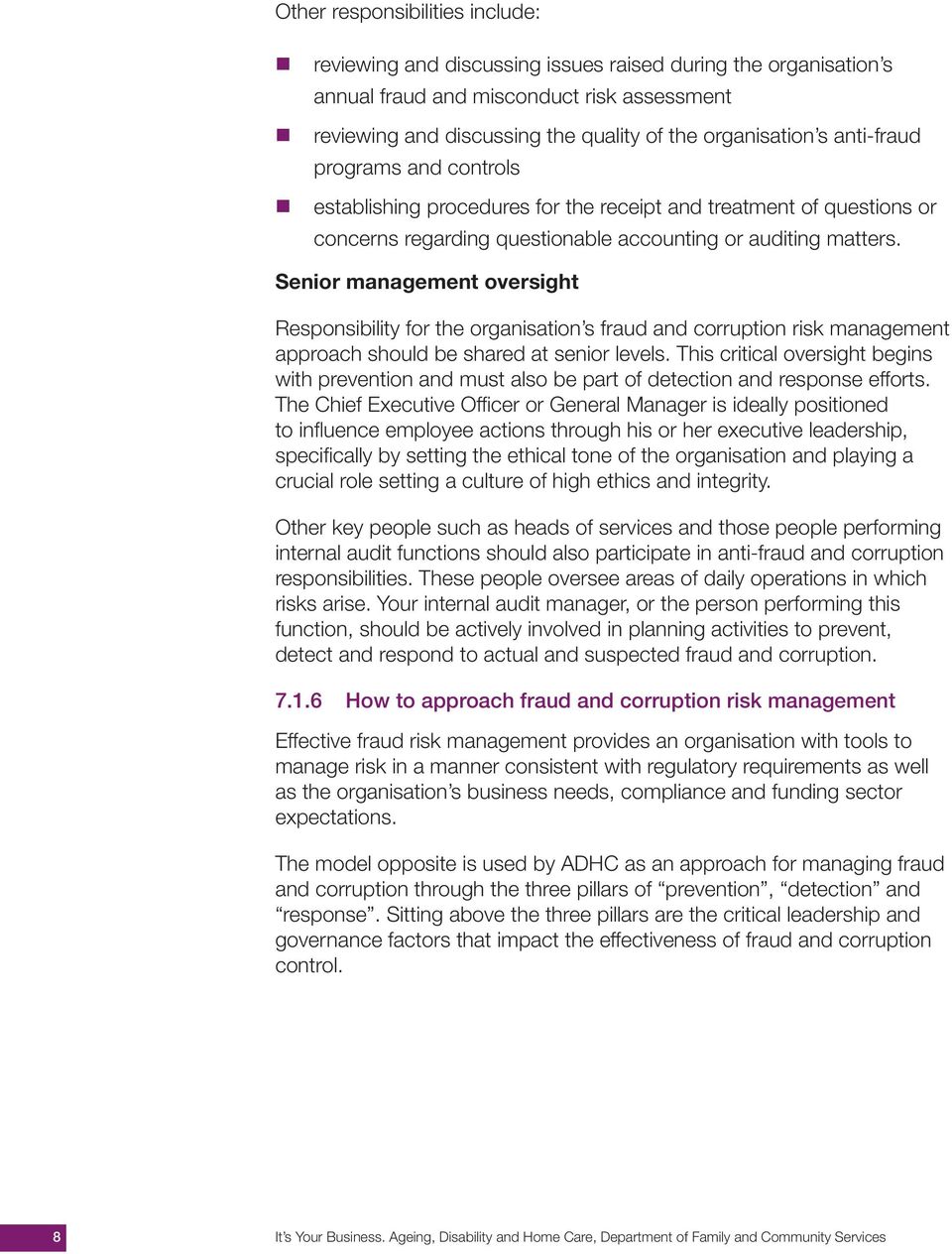
9 Prevention Detection Response Assessment > Design > Implementation > Evaluation Chapter 7 Fraud Prevention and Control Audit committee oversight Executive and line management functions Internal audit, compliance, and monitoring functions Fraud risk assessment Code of conduct and related fraud policies and standards Employee and third party due diligence Communication and training Process-specific fraud risk controls Hotlines and whistles-blower mechanism Auditing and monitoring Proactive forensic data analysis Internal investigation protocols Enforcement and accountability protocols Disclosure protocols Remedial action protocols Source: KPMG LLP (US), 2006 In the model, there are four phases to fraud risk management: Assess identify the current state of fraud risk management, set targets for improvement and define steps necessary to close the gap. Design develop a program that encompasses controls to prevent, detect and respond to incidents of fraud and misconduct. Implement implement the new controls throughout the organisation and assign responsibility. Evaluate assess the performance of the fraud and corruption risk management controls. At the end of this chapter, there is a fraud prevention and control checklist (Resource 1) that can be used to identify control measures to help your organisation manage the risk of fraud. It s Your Business. Ageing, Disability and Home Care, Department of Family and Community Services 9
10 7.2 Elements of a fraud and corruption control framework: prevention, detection, response Prevention strategies Code of conduct and related fraud policies and standards Code of conduct Organisations should have a code of conduct which clearly articulates the ethical standards that management and employees are required to follow. The code of conduct should be communicated across the organisation as well as to key stakeholders. Developing and implementing a fraud and corruption control policy and plan Organisations should develop and implement a fraud and corruption control policy and plan. A fraud and corruption control policy is a document that clearly articulates the organisation s stance on fraud and corruption. A fraud and corruption control plan documents the organisation s approach to controlling fraud and corruption risk. It should detail the organisation s action plan to implement and monitor the organisation s fraud and corruption prevention, detection and response programme. It is important that organisations view the fraud and corruption control plan as part of an overall risk management plan as fraud and corruption are business risks that can be controlled by the application of risk management principles (refer to Chapter 6). Accountability for the implementation and ongoing monitoring of the plan should be allocated to a person with appropriate seniority, skills and experience and sufficient time to oversee this. An example structure for a policy and plan is provided at the end of this chapter (Resource 2) Communication and training It is important that an organisation takes steps to raise the awareness of directors, staff and volunteers of fraud and corruption risks including early warning signs and how to respond if fraud or corruption is suspected. A significant proportion of fraud and corruption is not identified at an early stage because staff do not recognise the warning signs or are unsure how to report their suspicions. Annual training sessions are an effective way to raise awareness and also demonstrate the Board and senior management s commitment to fraud and corruption prevention. 10 It s Your Business. Ageing, Disability and Home Care, Department of Family and Community Services

11 Fraud and corruption awareness can also be promoted through regular meetings, staff newsletters or other internal publications. The following tools are provided at the end of this chapter to assist you with raising fraud and corruption awareness in your organisation: Chapter 7 Fraud Prevention and Control Resource 3: Approaches for raising awareness Resource 4: Industry case study tool Some of the suggestions in Resource 3 can also be used to raise fraud and corruption awareness in clients and the broader community Fraud and corruption risk assessment As a director, it is important to understand the fraud and corruption risks that your organisation could face. An effective way to do this is by undertaking a fraud and corruption risk assessment. A fraud and corruption risk assessment involves identifying key areas of exposure within your organisation and rating the likelihood and consequence of each risk, taking into consideration any mitigating internal controls. An important part of a fraud and corruption risk assessment is the identification of mitigating strategies to help in preventing or detecting the risks identified. Typically such an assessment should be conducted at least every two years and involve a cross-section of staff. Australian Standard AS 8001:2008 covers a seven stage process of risk assessment: a) communicate and consult; b) establish the context; c) identify risks; d) analyse risks; e) evaluate risks; f) treat risks; and g) monitor and review. This is consistent with the approach set out in Chapter 6: Risk Management. A fraud risk self-assessment tool is provided at the end of this chapter to assist with performing your fraud and corruption risk assessment (Resource 5). It s Your Business. Ageing, Disability and Home Care, Department of Family and Community Services 11
12 7.2.4 Employee and third party due diligence Employee and third party due diligence is considered to be an effective way of reducing an organisation s potential exposure to internally based fraud and corruption. The objective of the screening process is to reduce the risk of a potential security breach and to obtain assurance as to the integrity, identity and credentials of personnel and third parties dealt with by the organisation. Employment screening should be considered for all new employees joining the organisation (including contractors) and all personnel being transferred to a senior executive position or to a position considered by the organisation to be high-risk in terms of the potential exposure to fraud or corruption associated with those positions (for example, cash handling or procurement). A typical employment screening process may include: verification of personal identity (using at least two forms of identity document such as a passport, birth certificate, driver s licence); verification of formal qualifications (sighting diplomas and contacting the relevant institution for confirmation) police criminal history search; bankruptcy checks; and reference checks with the two most recent employers. It is also important to consider any gaps in the employment history of a potential candidate and the reasons for these gaps Process-specific fraud risk controls Internal controls play an important role in preventing and detecting fraud and corruption. Some recommended internal controls for common processes, such as purchasing, are set out in Resource It s Your Business. Ageing, Disability and Home Care, Department of Family and Community Services

13 Detection strategies Hotline and whistleblower mechanisms A fraud and corruption control program should have clearly communicated internal and external reporting mechanisms for staff to report suspected fraud or corruption. Internal reporting channels may include reporting through line management or directly to a nominated individual who has responsibility for fraud and corruption control. Chapter 7 Fraud Prevention and Control Sometimes staff do not feel comfortable reporting fraud internally for fear of reprisal so it is a good idea to have an external anonymous reporting hotline in place as an alternative choice for staff. Australian Standard AS 8004:2003 Whistleblower Protection Program for Entities recommends the implementation of a whistleblower protection policy that encourages staff to report suspected fraud and corruption matters detected and provide for the protection of whistleblowers. This policy should extend beyond staff to suppliers, contractors and clients. It is important that the policy is well communicated and understood. Organisations should consider providing external parties with an avenue to report suspected fraud or corruption. This can be achieved, for example, by extending the staff reporting hotline to external stakeholders Auditing and monitoring Auditing and monitoring processes can be effective in detecting transactions that are out of the ordinary. Auditing and monitoring is undertaken by an employee who is independent of the employee initiating transactions. Larger organisations have internal audit functions which perform this role. Technology is becoming increasingly useful in this area with the potential to use software tools to quickly scan large quantities of disparate information for anomalous transactions and suspicious trends. These types of processes can run alongside existing IT systems Proactive forensic data analysis An organisation s information systems are an important source of information on fraudulent and, to a lesser extent, corrupt conduct. By the application of software applications and techniques, a series of suspect transactions can be identified and then investigated to assist in the early detection of anomalous transactions. Transaction analysis can be undertaken using data analytics or manual review depending on an organisation s size and the sophistication of its systems. It s Your Business. Ageing, Disability and Home Care, Department of Family and Community Services 13

14 Response strategies Advising funding agencies In the spirit of fostering collaborative working relationships, organisations that experience fraud or corruption are advised to notify their funding agency to ensure that there is no impact on the conditions of funding and to identify approaches to reduce risk. Disclosure allows the agencies to work with organisations to monitor and prevent the risk of these occurrences in the future. In the future, human services agencies will seek to share relevant NGO performance information across agencies to reduce the compliance burden and multiple reporting requirements for organisations Internal investigation protocols An investigation into actual or suspected fraud and corruption should be conducted by appropriately skilled and experienced personnel who are independent of the area in which the alleged fraudulent or corrupt conduct occurred. Organisations can choose to use external specialists if they do not have appropriately skilled staff within the organisation. Investigations should be conducted in accordance with the following principles: a) Natural justice and procedural fairness (see Chapter 2 Legal Issues, page 19). b) Parties to an investigation should be required to enter into confidentiality agreements in relation to the information coming into their possession during the course of the investigation. c) Any investigation and resulting disciplinary proceedings should be conducted in an atmosphere of transparency, independence, fairness and objectivity at all times. d) An investigation should comply with all relevant legislation. e) Adequate records to be made and kept of all investigations. Any investigation should be subject to an appropriate level of supervision/ review by the Board or a responsible committee with regard to the seriousness of the matter under investigation. 14 It s Your Business. Ageing, Disability and Home Care, Department of Family and Community Services
15 Enforcement, accountability and disclosure protocols The investigator should submit a written report to the Board detailing the circumstances and, where appropriate, recommending appropriate remedial or disciplinary action. Chapter 7 Fraud Prevention and Control Once the Board receives a report alleging fraud or corruption, they consider how to respond. They may decide to: deal with the matter as an allegation of misconduct using the organisation s disciplinary process; take remedial action immediately; dismiss the allegation; or take general management action. Organisations should ensure that they have a policy on whether and how allegations of fraudulent and corrupt conduct should be reported to the police and other appropriate external parties such as a government body. The policy must comply with mandatory legal requirements which require certain matters to be reported to the police. Matters that must be reported to the relevant local authority include circumstances in which it appears there is evidence of fraud or corruption constituting a serious indictable offence. The Crimes Act (1900) NSW states that a serious indictable offence is any offence that has a maximum penalty of five years imprisonment or more, for example theft, obtaining benefit by deception, embezzlement or misappropriation of money and bribery. Organisations should have a formal disciplinary action policy. This can create a deterrent effect to employees by illustrating that all cases will be investigated and disciplinary action will be taken against those staff that do the wrong thing. Where suspected or actual fraud or corruption exists, the organisation should undertake a formal process to form a view as to whether the matter is one that ought to be reported to the relevant law enforcement agency for investigation and therefore, potentially, prosecution. The organisation s external reporting policy should be consistently applied so that there can be no suggestion of selective application. It s Your Business. Ageing, Disability and Home Care, Department of Family and Community Services 15
16 Should the matter be referred to an appropriate law enforcement agency, the organisation should give an undertaking to the law enforcement agency that it will do all that is reasonable in assisting the law enforcement agency to conduct a full and proper investigation. A senior person within the organisation should maintain a record of all allegations of fraud and corruption and outcomes. (Refer to Resource 6 for a sample fraud incident register. You may find this resource useful in deciding what style of register works best for your organisation.) Remedial action protocols Recovery of proceeds of fraudulent conduct Organisations should ensure that they have a policy requiring that recovery action be undertaken where there is clear evidence of fraud or corruption and where the likely benefits of such recovery will exceed the funds and resources invested in the recovery action. Organisations should consider taking out fidelity insurance to protect against funds misappropriated by staff and assist in the recovery of losses. Media management Organisations should have procedures to manage the media in the event of publication of fraud affecting the organisation. If the media are not handled appropriately, this can result in reputational damage to the organisation. Negative publicity can be particularly damaging to nongovernment organisations, many of which receive donations and funding from the public. Internal control review It is important to perform an internal control review in the area where the fraud occurred. This will help to ensure internal controls weaknesses and gaps are addressed to prevent the fraud from reoccurring. 16 It s Your Business. Ageing, Disability and Home Care, Department of Family and Community Services

17 7.3 Conclusion Effective fraud and corruption risk management is crucial to your organisation to enable you to deliver quality services to your clients and maintain the confidence of stakeholders. As a director, it is important to understand the fraud and corruption risks that your organisation could face and ensure that effective measures are in place to prevent, detect and respond to fraud and corruption. Chapter 7 Fraud Prevention and Control It s Your Business. Ageing, Disability and Home Care, Department of Family and Community Services 17
18 References Australian Standard AS 8001:2008 Fraud and Corruption Control Standards Australia Phone: (02) Fax: (02) Australian Standard AS 8004:2003 Whistleblower Protection Programs for Entities Standards Australia Phone: (02) Fax: (02) KPMG Fraud Risk Management White Paper Developing a Strategy for Prevention, Detection and Response KPMG 10 Shelley Street, Sydney NSW 2000 Phone: (02) Fax: (02) It s Your Business. Ageing, Disability and Home Care, Department of Family and Community Services

19 Resources Resource 1: Fraud prevention and control checklist DIRECTOR S NOTES This checklist can be used by the Board to identify the areas to be considered in developing an approach to preventing, detecting and responding to fraud. Tick Yes or No and utilise the actions column to take notes. Importance Yes No Comments/Actions Resources available Prevention Fraud and corruption control policy and plan We have established and implemented an overarching fraud and corruption control policy and plan. The fraud and corruption control policy communicates the organisation s commitment to fraud and corruption control. The fraud and corruption plan sets out management s approach to preventing, detecting and responding to fraud and corruption. Chapter 7, Section Resource 2 to this module Example structure for a fraud and corruption control policy and plan. Ethical framework We have a code of conduct or code of ethics which supports a zero tolerance of fraud and is communicated to all Directors, staff and volunteers. Establishing an ethical framework, sets the boundaries for which staff are to operate in. Chapter 7, Section Assign responsibilities We have assigned responsibility for fraud and corruption to senior management. If responsibilities are clearly established and assigned, this will assist accountability for fraud control. Chapter 7, Section Chapter 7 Fraud Prevention and Control It s Your Business. Ageing, Disability and Home Care, Department of Family and Community Services 19

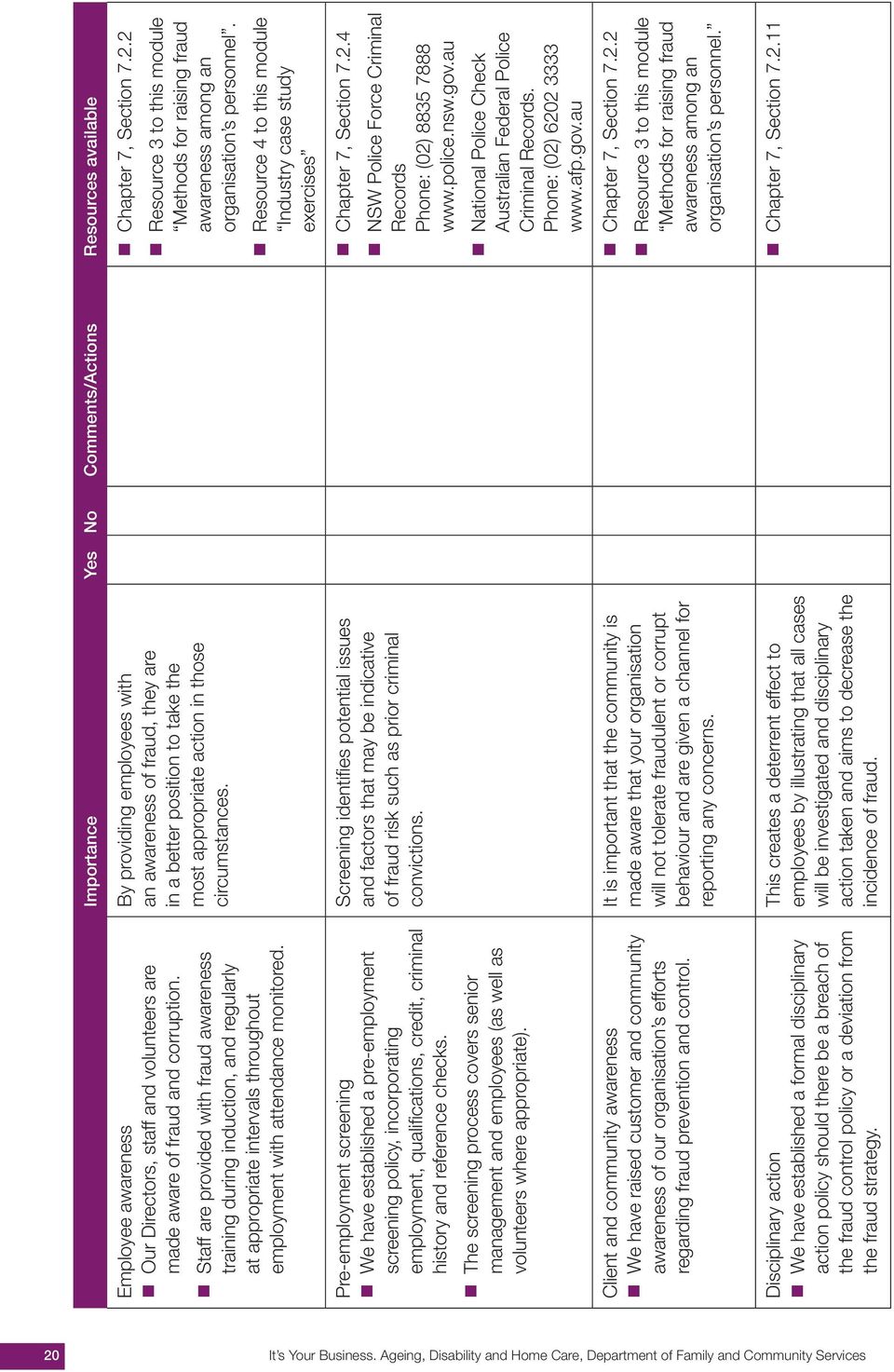
20 Employee awareness Our Directors, staff and volunteers are made aware of fraud and corruption. Staff are provided with fraud awareness training during induction, and regularly at appropriate intervals throughout employment with attendance monitored. Pre-employment screening We have established a pre-employment screening policy, incorporating employment, qualifications, credit, criminal history and reference checks. The screening process covers senior management and employees (as well as volunteers where appropriate). Client and community awareness We have raised customer and community awareness of our organisation s efforts regarding fraud prevention and control. Disciplinary action We have established a formal disciplinary action policy should there be a breach of the fraud control policy or a deviation from the fraud strategy. Importance Yes No Comments/Actions Resources available By providing employees with an awareness of fraud, they are in a better position to take the most appropriate action in those circumstances. Chapter 7, Section Resource 3 to this module Methods for raising fraud awareness among an organisation s personnel. Resource 4 to this module Industry case study exercises Screening identifies potential issues and factors that may be indicative of fraud risk such as prior criminal convictions. Chapter 7, Section NSW Police Force Criminal Records Phone: (02) National Police Check Australian Federal Police Criminal Records. Phone: (02) It is important that the community is made aware that your organisation will not tolerate fraudulent or corrupt behaviour and are given a channel for reporting any concerns. Chapter 7, Section Resource 3 to this module Methods for raising fraud awareness among an organisation s personnel. This creates a deterrent effect to employees by illustrating that all cases will be investigated and disciplinary action taken and aims to decrease the incidence of fraud. Chapter 7, Section It s Your Business. Ageing, Disability and Home Care, Department of Family and Community Services
21 Chapter 7 Fraud Prevention and Control Internal control framework We have established an adequate internal control framework, with well documented policies and procedures that are well communicated to staff to support the fraud and corruption control framework. Tone-at-the-top We provide regular communication to staff on matters such as responsibilities for fraud control, what constitutes fraudulent activity and fraud detection measures. Fraud risk assessments We conduct regular fraud risk assessments to identify specific areas of fraud risk and develop appropriate countermeasures and action plans to address these risks. Importance Yes No Comments/Actions Resources available A strong internal control framework will help to prevent and reduce the opportunities of fraudsters to commit fraud. Chapter 7, Section Resource 5 to this module Fraud risk assessment for service providers. The visibility of senior management s commitment to fraud and corruption control, will ensure staff and volunteers have respect for adhering to fraud and corruption policies. It is important that senior management drive the ethical framework, by leading by example. Chapter 7, Section Resource 3 to this module Methods for raising fraud awareness among an organisation s personnel. Regular fraud risk assessments assist in identifying new and emerging risks so that the appropriate control mechanisms can be put in place to prevent the fraud and corruption. Chapter 7, Section Resource 5 to this module Fraud risk assessment for service providers. It s Your Business. Ageing, Disability and Home Care, Department of Family and Community Services 21
22 Detection Communication We communicate our fraud detection initiatives to our employees. Policy We have a policy to investigate all reports of fraud. Responsibilities Our staff, volunteers and Directors know what to do if they suspect fraud or corruption. Reporting We have implemented fraud reporting channels which provide employees with both internal and external reporting options that encourage and enable staff to report suspected and known fraud. We have considered the establishment of a whistleblower hotline service to encourage anonymous reporting external to the organisation. Third party reporting My organisation encourages third parties to make reports (i.e. clients, suppliers, contractors, partners) by providing information about how to make such a report. Importance Yes No Comments/Actions Resources available Communication of fraud detection initiative can act as a deterrent to an employee contemplating fraud. Chapter 7, Section This aims to create a deterrent effect to employees. Resource 2 to this module Example structure for a fraud and corruption control policy and plan. Chapter 7, Section Chapter 7, Section Reporting avenues should be well known by all employees and reporting should be encouraged, to ensure that suspicions or incidences of fraud and/or corruption are reported to management in a timely manner. Chapter 7, Section In some instances, staff may not feel comfortable reporting matters internally due to fear of reprisal. An anonymous external hotline allows the organisation to capture those reports that may not otherwise be received. Chapter 7, Section Extending reporting avenues to third parties helps identify suspicions or incidences of frauds that may potentially be undetected by employees. Chapter 7, Section It s Your Business. Ageing, Disability and Home Care, Department of Family and Community Services
23 Chapter 7 Fraud Prevention and Control Disclosure protection My organisation makes a clear commitment to supporting and protecting all employees reporting suspected or actual incidences of fraud so far as is legally possible and should encourage employees to make disclosures. This policy extends beyond employees to suppliers, contractors or customers. Detection systems (if applicable) We have considered the use of detection systems such as employing the use of computer systems to detect fraud (data mining and real time transaction monitoring). Reporting to the Board We have a policy for reporting to the Board and funding agencies all instances of suspected fraud and corruption. Reviews conducted Management accounting reports are reviewed for signs of fraud and unusual trends. Post transactional review is performed for unusual transactions. Fraud register We maintain a register of all fraud reported and action taken. Importance Yes No Comments/Actions Resources available This will help to encourage the reporting of suspected or actual incidences of fraud so that appropriate action can be taken without fear of reprisal. Chapter 7, Section Such detection systems help to detect incidences of fraud on a timely basis so that the most appropriate action can be taken to reduce the severity of the fraud and help implement controls so as to prevent its reoccurrence. Chapter 7, Section Chapter 7, Section This helps to identify to those charged with governance incidences of fraud so any necessary changes can be implemented to prevent its reoccurrence. Chapter 7, Section Chapter 7, Section A review will help detect any fraudulent activity so any necessary action can be taken to prevent its reoccurrence and reduce the severity of the suspected fraudulent activity. Chapter 7, Section Chapter 7, Section This will help to keep track of an organisation s risk exposure and highlight areas where fraud has occurred so that appropriate action(s) can be taken in order to control these risks of fraud from occurring again. Resource 6 to this module Fraud register template It s Your Business. Ageing, Disability and Home Care, Department of Family and Community Services 23
24 Response Skilled investigators All investigations are conducted by wellqualified persons and outsourced where those skills do not exist in-house. Media procedures We have procedures to manage the press/media/shareholders/other stakeholders in the event of publication of fraud affecting the organisation. Internal control review My organisation performs an internal control review in the area where the fraud occurred. Fidelity and crime insurance My organisation has fidelity insurance to protect against funds misappropriated by senior management and employees (including volunteers) and crime insurance to protect against fraud by external parties. Importance Yes No Comments/Actions Resources available It is imperative that investigations are carried out methodically by experienced investigators to ensure that evidence is not compromised. Chapter 7, Section If the media are not handled appropriately, this can result in reputational damage to the organisation. Chapter 7, Section This will help to ensure internal control weaknesses and gaps are addressed to prevent the fraud from reoccurring. Chapter 7, Section Fidelity insurance can assist in the recovery of funds misappropriated by staff, including losses incurred and legal/investigative costs. Chapter 7, Section Speak to your local insurer to arrange a policy. 24 It s Your Business. Ageing, Disability and Home Care, Department of Family and Community Services
25 Resource 2: Example structures for a fraud and corruption control policy and plan Example structure for a fraud and corruption control policy Chapter 7 Fraud Prevention and Control A fraud and corruption control policy sets out the organisation s position in relation to managing the risks of fraud and corruption, including: stance on fraud and corruption; senior management commitment; expectations of employees and others to which the policy applies. 1. Policy statement This section gives a summary of the importance of a fraud and corruption policy to the organisation. 2. Purpose This section provides the overall aim of this policy. For example: This policy aims to assist in the prevention, detection and response to fraud and corruption. The policy provides a clear and transparent statement of the organisation s commitment to protecting its clients, employees and standing within the community by effectively preventing, detecting and responding to fraud and corruption. 3. Key terms and definitions Key terms and definitions used in the fraud and corruption policy are provided in this section. 4. Relationship with other organisational policies This section will list other organisational policies which should be read in conjunction with the fraud and corruption policy. 5. Applicability This section will set out those stakeholders that the fraud and corruption policy will apply to. It s Your Business. Ageing, Disability and Home Care, Department of Family and Community Services 25
26 6. Our commitment The organisation s commitment to minimising fraud and corruption is discussed in this section. This can include instilling a culture of: a zero tolerance position in respect of fraud and corruption; vigorously investigating all matters concerning suspected fraud and corruption; and seeking to recover losses sustained through acts of fraud or corruption through all available avenues. 7. Expectations Expectations of all staff and stakeholders are detailed in this section as well as setting a culture in the workplace to maintain high standards of integrity, probity and accountability. 8. Roles and responsibilities The responsibilities of fraud and corruption prevention are set out in this section. 9. Policy administration Policy administration matters such as policy review date, policy owner and contact officers are set out in this section. 26 It s Your Business. Ageing, Disability and Home Care, Department of Family and Community Services
27 Resource 3: Methods for raising fraud awareness among an organisation s personnel DIRECTOR S NOTES This resource is intended to assist directors raise fraud and corruption awareness in their organisations. The checklist can be used by the Board to identify effective ways to educate staff. Chapter 7 Fraud Prevention and Control Why is raising awareness among staff and volunteers important? Making employees aware of their obligations concerning fraud and misconduct control begins with practical communication and training. The effective communication to staff of fraud awareness will directly affect the effectiveness of the organisation s fraud and corruption control plan. Every staff member (management and non-management), including volunteers where appropriate, should have a general awareness of fraud and corruption so as to enable them to recognise the red flags of fraud and know how to escalate a potential issue. An organisation should regularly communicate to staff and volunteers the types of behaviour that may constitute fraudulent or corrupt practice, the fraud detection measures that are in place and an unequivocal statement that fraudulent and corrupt practices within the organisation will not be tolerated. No one communication strategy by itself can generally be effective in communicating the risks of fraud and corruption and, as such, entities generally use a combination of the following communication strategies (over page) to raise awareness among staff. Internally, regular communication is necessary to ensure management and staff are informed of fraud and corruption control issues including current best practice. It s Your Business. Ageing, Disability and Home Care, Department of Family and Community Services 27
28 Method Description Currently in place Written anti-fraud and corruption policies/code of conduct Regular formal fraud awareness training Intranet communication Discussion groups Instructional videos We have a written anti-fraud and corruption policy and a code of conduct. We take steps to ensure that all staff are aware of these documents We provide our employees with regular fraud awareness training appropriate to their level of responsibility, which includes the following as appropriate: Face to face training, including interactive case studies, facilitates increased learning of core concepts and is generally supplemented by appropriate e-learning modules and assessments to ensure and test knowledge gained. Ethics and code of conduct/policies should also be tested on a regular basis. Training sessions should also be embedded in induction training. We publish our fraud control related policies, news and bulletins and other information regarding promoting fraud awareness on our intranet site. Our staff attend discussion groups organised and run by a professional group leader. Employees may be more receptive to discussion amongst their peers in small informal groups. It is important that the group leader is properly equipped to ensure the appropriate issues are discussed and that the correct advice and information is given to those attending. We present our staff with instructional videos and include case scenarios that can be used at training, presentations and seminars in order to provide an interactive and fun learning environment for staff. Yes/No Supporting comments 28 It s Your Business. Ageing, Disability and Home Care, Department of Family and Community Services
29 Method Description Currently in place Fraud awareness publications Report investigations and disciplinary action against perpetrators Annual report We run fraud awareness segments in our internal publications. The act of bringing fraud awareness to the attention of employees through publication of material such as posters and newsletters can be an effective technique. Posters can be used demonstrating antifraud messages or depicting relevant situations. Newsletters can be used to raise employee awareness in the prevention and detection of fraud; for example by publishing statistics about how much fraud was reported and progress the agency has made to deal with it. Publications can also be used to inform employees of the latest developments in combating fraud and of a variety of best practice information. We report investigations and disciplinary action against perpetrators to our staff and volunteers. All frauds should be publicised, emphasising that all offenders will face action in order to act as a deterrent. This encourages employees and volunteers not to become involved in fraud and affirms confidence that perpetrators, if uncovered, will face sanctions. We have a statement regarding our commitment to ethical practices and fraud and corruption prevention in our annual report. This raises awareness within the community that fraud and corruption will not be tolerated by the organisation. Yes/No Supporting comments Chapter 7 Fraud Prevention and Control It s Your Business. Ageing, Disability and Home Care, Department of Family and Community Services 29
30 Resource 4: Industry case study exercises Developed by KPMG ( 2010 KPMG) Overview This exercise introduces a number of fraud and corruption scenarios which are based on elements of real life examples of fraud in the NGO sector. The case studies have been developed through consultation with a cross section of senior representatives from the NGO sector. The case studies are designed to promote fraud and corruption awareness among the NGO sector and learning points on how to prevent, detect and respond effectively to fraud and corruption within the workplace. How to use these case studies This exercise includes a series of case studies designed to stimulate discussion around fraud and corruption and raise awareness among staff. You may like to use the case studies: for discussion during team meetings; or as training exercises for staff to complete in small groups. There are 13 case studies provided. You can use all of the case studies or select those that are most relevant to your organisation. Questions are provided for each case study. These questions can be used to facilitate group discussion around each scenario. Consideration points are provided in respect of each case study to assist the facilitator in the debrief. 30 It s Your Business. Ageing, Disability and Home Care, Department of Family and Community Services
31 Case study 1: Payroll Who? Payroll operations supervisor What? Stole over $900,000 When? How? Why? What happened to the fraudster? 47 unauthorised transactions Over a five year period Transferred money into their personal account Coded payments to redundancy and superannuation within the accounting system Household renovations New car Gambling Two year jail sentence, criminal record None of the money recovered Chapter 7 Fraud Prevention and Control Points to consider How could this have been prevented? How could this have been detected sooner? Segregation of duties between staff that have access to bank details, those that prepare bank transfers and those that authorise bank transfers Two authorisers required to make a bank transfer Review of bank transfers by another individual It s Your Business. Ageing, Disability and Home Care, Department of Family and Community Services 31
32 Case study 2: Procurement Who? House coordinator What? Stole over $2,000 When? How? Why? What happened to the fraudster? Over a two year period Amended purchase order for house furniture by changing delivery to personal home address Order processed through accounts, outside the line of segregation of duties Later it was discovered that the house coordinator had done that same thing in their previous job Feeling undervalued Getting back at the company Employment terminated Fined and criminal record Points to consider How could this have been prevented? How could this have been detected sooner? Pre-employment screening including reference checks and criminal checks Fraud awareness training for procurement staff so that colleagues are well equipped to see the red flags of potential fraudulent behaviour and report it 32 It s Your Business. Ageing, Disability and Home Care, Department of Family and Community Services
33 Case study 3: Theft Who? Line manager What? Stole heaters valued at over $5,000 When? How? Why? What happened to the fraudster? Over a three month period Heaters stolen from store room and sold on ebay. The heaters were not registered on an asset register so the organisations were unable to easily track movements. Greed Employment terminated Fined and criminal record Chapter 7 Fraud Prevention and Control Points to consider How could this have been prevented? How could this have been detected sooner? Physical asset security such as locked storeroom of portable assets, with limited access Assign responsibility of high value assets to an individual Keep a register of where assets are located and perform regular stock counts to ensure all are accounted for It s Your Business. Ageing, Disability and Home Care, Department of Family and Community Services 33
34 Case study 4: Nepotism Who? What? When? 2009 How? Why? What happened to the fraudster? HR manager Favouritism of relative in recruitment process HR manager hired a relative for a management role. The relative did not have appropriate skills or experience for the role. A personal favour to the relative Relative was heavily in debt and needed a job HR manager cautioned Relative dismissed Points to consider How could this have been prevented? How could this have been detected sooner? Ensure staff are aware of their responsibility to disclose potential conflicts of interest Follow a proper recruitment process that involves more than one person in decision making CV and background checks reviewed by more than one person 34 It s Your Business. Ageing, Disability and Home Care, Department of Family and Community Services
35 Case study 5: Management of client funds Who? What? When? How? Why? What happened to the fraudster? Social care manager Stole approximately $10,000 of client funds Over a four year period The social care manager had full access to the personal bank accounts of the client and withdrew client funds from ATMs in small amounts over four years Opportunity Vulnerable client who would not notice Greed Employment terminated Prosecuted for stealing. Two year jail sentence given their position of trust Criminal record Chapter 7 Fraud Prevention and Control Points to consider How could this have been prevented? How could this have been detected sooner? Provide regular fraud awareness training and reaffirm the organisation s ethics policy on a regular basis Additional internal controls around client monies Reporting process for clients and their families It s Your Business. Ageing, Disability and Home Care, Department of Family and Community Services 35
36 Case study 6: Cheque payments Who? Line manager What? $15,000 When? How? Why? What happened to the fraudster? Over a two year period Line manager was making cheques payments to a ghost supplier. The ghost company was linked to a bank account which the line manager controlled. Cheques required two signatories, however senior authoriser pre-signed cheques, allowing the line manager to create cheques for any value and payable to where he specifies. Opportunity Gambling problem Employment terminated Prosecuted for fraud and fined with a criminal record Points to consider How could this have been prevented? How could this have been detected sooner? If cheques were not pre-signed, fraud may not have been possible Ensure segregation of duties of those who prepare the cheque, process and authorise Regular review of cheque payments by independent staff member 36 It s Your Business. Ageing, Disability and Home Care, Department of Family and Community Services
37 Case study 7: Gift vouchers Who? Senior member of management What? Theft of gift vouchers worth $1,500 When? How? Why? What happened to the fraudster? Over a three year period Gift vouchers were allocated to senior management for rewarding exceptional performance from staff. One senior manager pocketed the vouchers for personal use while reporting back that the vouchers were given to employees. This occurred annually over three years. Opportunity Greed Had to repay the $1,500 back to the organisation Employment terminated Chapter 7 Fraud Prevention and Control Points to consider How could this have been prevented? How could this have been detected sooner? Tighter internal controls around use of gift vouchers e.g. register of allocations Use of an anonymous whistleblower reporting hotline It s Your Business. Ageing, Disability and Home Care, Department of Family and Community Services 37
38 Case study 8: Gifts and benefits Who? What? $16,000 When? How? Why? What happened to the fraudster? Purchasing manager Over a two year period Purchasing manager purchased cars for the company from a car dealer at inflated rates Car dealership provided purchasing manager with kickbacks (holiday packages provided to his family each Christmas) Opportunity Greed Employment terminated Matter reported to police and prosecuted for fraud Matter was investigated and the manager was fined and now has a criminal record Points to consider How could this have been prevented? How could this have been detected sooner? Provide regular fraud awareness training and reaffirm the organisation s ethics policy on a regular basis Segregation of duties Annual review of market values by an independent party 38 It s Your Business. Ageing, Disability and Home Care, Department of Family and Community Services
39 Case study 9: IT procurement Who? IT manager What? Fraudulent purchase of IT stock worth $12,000 When? How? Why? What happened to the fraudster? Over a two year period IT manager purchased extra IT equipment through the company purchase process Sold the extra IT equipment on ebay for personal gain Opportunity Greed Employment terminated Prosecuted for stealing/fraud Criminal record and fined Chapter 7 Fraud Prevention and Control Points to consider How could this have been prevented? How could this have been detected sooner? Segregation of duties between those that order and those that receive the physical goods Regular analysis of IT expenditure may have detected upwards trend in spend or variance against budget It s Your Business. Ageing, Disability and Home Care, Department of Family and Community Services 39
40 Case study 10: Payroll entitlements Who? What? When? How? Why? What happened to the fraudster? Payroll manager $30,000 of staff superannuation monies misappropriated Over a two year period Payroll manager diverted staff superannuation entitlements to another account controlled by the payroll manager Opportunity many employees do not regularly check their superannuation contributions or balance Greed Employment terminated Prosecuted for fraud Criminal record and a jail sentence of two years Points to consider How could this have been prevented? How could this have been detected sooner? Segregation of duties Review of audit logs on payroll transactions/data sheets Staff members regularly reviewing their payslips and superannuation contribution statements 40 It s Your Business. Ageing, Disability and Home Care, Department of Family and Community Services
41 Case study 11: Credit cards Who? What? When? How? Why? What happened to the fraudster? CEO $28,000 of fraudulent credit card transactions Over a six year period Using the company credit card to purchase personal goods and services Lack of oversight the company had an external bookkeeper who did not have direct reporting to the Board Opportunity Greed Employment terminated Prosecuted for fraud Large fine and criminal record Chapter 7 Fraud Prevention and Control Points to consider How could this have been prevented? How could this have been detected sooner? Set limits on the credit cards to reduce exposure Fraud awareness training Review of expenditure items such as items coded to cost centres and having the manager of that cost centre review the expenditure Anonymous whistleblower reporting process It s Your Business. Ageing, Disability and Home Care, Department of Family and Community Services 41
42 Case study 12: Fuel theft Who? What? When? How? Why? What happened to the fraudster? Highly respected individual in the community who worked in business services $500 worth of fuel Over a two year period Stealing company diesel Company suspected theft of diesel so replaced the diesel in the fuel tank with water Fraudster s car stalled and identified himself as the fraudster Financial hardship due to gambling addiction Employment terminated Points to consider How could this have been prevented? How could this have been detected sooner? Restrict access to the fuel tank Surveillance security in area holding high-value portable assets Monitor fuel expenditure over time and identify unusual trends 42 It s Your Business. Ageing, Disability and Home Care, Department of Family and Community Services
43 Case study 13: Staff bonuses Who? What? When? 2009 How? Why? What happened to the fraudster? Supervisor $7,000 worth of bonuses Bonus allocation system required supervisors to allocate bonuses to their team based on performance of each staff member One supervisor made an arrangement with certain team members that he would allocate the highest discretionary bonus in return for a 50 percent split kickback Greed Opportunity Supervisor and team members received disciplinary action Employee contract terminated Chapter 7 Fraud Prevention and Control Points to consider How could this have been prevented? How could this have been detected sooner? Additional internal controls around the performance bonus system Fraud awareness training for staff Review of the expected bonuses by an independent person outside that of the business unit Anonymous whistleblower hotline process It s Your Business. Ageing, Disability and Home Care, Department of Family and Community Services 43
44 Resource 5: Fraud and corruption risk assessment tool Introduction This fraud and corruption risk assessment tool has been designed to assist you to address the risk of fraud and corruption in your organisation. While the incidence of fraud or corruption may not be very high in most of our service providers, fraud can occur when least expected. When it does occur, fraud can be disruptive to the daily activity and morale of the organisation that has been affected, and on occasions can be quite devastating. How to use the fraud and corruption risk assessment tool This section will explain how reading and completing the attached questionnaire will help you. It covers the fraud and corruption risks that often occur in a broad range of administrative support functions that most organisations carry out. Broadly, these functions can be summarised under the following categories: Administration; Finance; Human Resource Management; Information Technology; Procurement and Other. The assessment is a collection of (1) possible inherent fraud and corruption risks that might occur in a series of typical situations, and (2) recommended control measures that could be used to address them. The recommended control measures are a collection of good ideas that would apply to most situations most of the time. However, there is no one size fits all solution. Some recommended control measures may not suit your particular situation, especially if your organisation is rather small. 44 It s Your Business. Ageing, Disability and Home Care, Department of Family and Community Services
45 This is how we suggest you use the assessment: Focus on one fraud and corruption risk category at a time (one category per page e.g. Assets on page 47). Consider all inherent risks in the first column. Add any others you can think of. Chapter 7 Fraud Prevention and Control Consider each recommended control measure separately. Indicate in the third column yes or no as to whether or not that control is in place in your organisation. Indicate in the fourth column your risk assessment rating, from 1 to 9, where 1 means lowest possible risk and 9 means highest risk. This is your rating of the risk associated with the effectiveness of that particular control measure. Add any other useful control measures that may occur to you that have not been included in this document, and apply the same rating process. Determine and document a strategy to address all recommended control measures that you rated as 5 or more out of 9. Total the risk assessment rating column for each page, and determine and enter the average fraud and corruption risk (risk assessment rating) for each fraud and corruption risk category at the end of each page. Transfer the sum of risk assessment ratings for each page to the last page, to determine an overall risk rating for your organisation. This will give you a sense of the vulnerability to fraud of your organisation as a whole. Most importantly, implement your strategies. It s Your Business. Ageing, Disability and Home Care, Department of Family and Community Services 45
46 Risk assessment rating Rating Significance Definition Action Required 1 Very low Provides no apparent opportunity for fraudulent activity 3 Low Provides a low level of opportunity for fraudulent activity 5 Moderate Provides a moderate opportunity for fraudulent activity 7 High Provides a high opportunity for fraudulent activity 9 Very high Creates a very high exposure to fraud None None but be aware of any weak spots Strategy for improvement Immediate strategy for improvement Priority strategy for improvement (Intermediate ratings e.g. 2, 4, 6 and 8 may be used for gradation) For example, under Assets, on page 4, the second recommended control measure is Maintenance of a portable equipment register to keep track of laptops etc. Suppose you indicated No against Control measure in place. You would then consider how risky this situation is. If there are no laptops or any equipment of any significant value that staff take away from the office, you might rate the risk as only 1. On the other hand, if there are, and equipment has gone missing in the past, you might rate it 7. Similarly, on another recommended control measure you may have indicated that the control measure is in place. But you still need to determine the level of risk. For example, let us consider the first recommended control measure for Assets New equipment valued >$500 immediately given an asset number and placed in assets register etc. Although an asset register exists, it may not have been updated for some time, so you might rate it It s Your Business. Ageing, Disability and Home Care, Department of Family and Community Services
47 Administration Fraud and corruption risk category Assets Inherent risks what could go wrong Recommended control measures Control measure in place (yes/no) Risk assessment rating Chapter 7 Fraud Prevention and Control Theft of assets, particularly attractive or portable assets such as laptops or other computer equipment. Unapproved removal or disposal of assets e.g. because of alleged damage. Loss of control over assets by asset register not being maintained. Additional inherent risks: New equipment valued >$500 immediately given an asset number/ placed in assets register. Assets tagged with the asset number. Maintenance of a portable equipment register to keep track of laptops, etc. that are used by individual staff on a temporary basis. Annual reconciliation of assets on hand (stocktake) to those in the assets register, performed by officer/s independent of receiving or recording function. Asset disposal to be approved by management, and details documented and retained. Adequate physical security of assets and premises. Adequate insurance coverage of assets and premises. Alternative/additional control measures: Sum of risk assessment ratings Average fraud and corruption risk (a) (b) It s Your Business. Ageing, Disability and Home Care, Department of Family and Community Services 47
48 Administration Fraud and corruption risk category Assets Inherent risks what could go wrong Recommended control measures Control measure in place (yes/no) Risk assessment rating Unauthorised private use of motor vehicles. Theft of vehicles from parking areas or while garaged at home. Theft or exchange of accessories or tools. Policy to convey expectations to staff regarding careful and authorised use of the organisation s vehicles. Absences from workplace to be approved by supervisor. Regular reviews of vehicle log books. Use of petrol card for private vehicle or unauthorised purchases. Falsification of vehicle log. Additional inherent risks: Regular reviews of purchases on petrol cards. Clearly understood approval mechanism for taking cars. Alternative/additional control measures: Sum of risk assessment ratings Average fraud and corruption risk (a) (b) 48 It s Your Business. Ageing, Disability and Home Care, Department of Family and Community Services
49 Administration raud and corruption risk category Assets Inherent risks what could go wrong Recommended control measures Control measure in place (yes/no) Risk assessment rating Chapter 7 Fraud Prevention and Control Theft or loss of physical resources such as paper, stationery, tools, etc. Unauthorised use of taxi vouchers. Inappropriate use of telephones (including mobile phones), photocopiers and portable and attractive items. Fraudulent travel allowance claims. Organisation s code of conduct distributed to all staff. Internal policies made available to all staff. Monitoring of usage/expenditure rates on photocopying, taxis, mobile phones, etc. Retention of invoices for expenditure on above, and system to track expenditure and usage. All travel allowances are monitored for reasonableness, with any expenses supported with original receipts. Additional inherent risks: Alternative/additional control measures: Sum of risk assessment ratings Average fraud and corruption risk (a) (b) It s Your Business. Ageing, Disability and Home Care, Department of Family and Community Services 49
50 Finance Fraud and corruption risk category Accounts payable Inherent risks what could go wrong Recommended control measures Control measure in place (yes/no) Risk assessment rating False invoices accepted resulting in payment for goods not received. Invoice prices are validated by supporting documentation such as requisitions and purchase orders. Collusive practice between supplier and purchasing officer resulting in invoice price higher than approved on ordering. System is manipulated resulting in EFT payments to nonexistent supplier. False staff travel claims submitted. Additional inherent risks: Where possible, segregation of duties between purchasing officer and officer authorising payment. All staff travel claims approved by the supervisor. Two signatures on cheques and signatures registered with the bank. Blank cheques are not signed. Payments made on the basis of original invoices, and documentation stamped paid. Accounts payable ledger reconciled monthly to the general ledger. Bank reconciliations performed monthly, and reviewed and signed off by someone independent of the preparer. Internet payment or funds transfer requires the authorisation of two designated individuals. Alternative/additional control measures: Sum of risk assessment ratings Average fraud and corruption risk (a) (b) 50 It s Your Business. Ageing, Disability and Home Care, Department of Family and Community Services
51 Finance Fraud and corruption risk category Accounts payable Inherent risks what could go wrong Recommended control measures Control measure in place (yes/no) Risk assessment rating Chapter 7 Fraud Prevention and Control Revenue owing by clients for services provided may not be collected by the accounts receivable officer (particularly in regard to relatives or friends). Revenue collected from clients for services provided may be misappropriated by collecting officer. Reconciliation of clients fees receivable (based on clear records of services provided) to money actually received from clients, by a person independent of the collection process. Reconciliation of money received from clients to money actually banked, by a person independent of the banking process. Alternative/additional control measures: Additional inherent risks: Sum of risk assessment ratings Average fraud and corruption risk (a) (b) It s Your Business. Ageing, Disability and Home Care, Department of Family and Community Services 51
52 Finance Fraud and corruption risk category Petty cash and cash receipts Inherent risks what could go wrong Recommended control measures Control measure in place (yes/no) Risk assessment rating Use of petty cash for private purposes. Policy on what can be claimed through petty cash. Submission of bogus petty cash claims. Receipts not issued for money received. Under-banking or failure to bank cash receipts. Misappropriation of funds. Additional inherent risks: Paying officer should stamp claims and receipts as paid. Claims not to be paid without authorisation. Petty cash claims should contain details of the item purchased. Adequate physical security over cash holdings e.g. access to locked box or safe and combination limited, safe locked, etc. Procedure in place to enable regular reconciliation between documentation, cash receipts and petty cash claims. Alternative/additional control measures: Sum of risk assessment ratings Average fraud and corruption risk (a) (b) 52 It s Your Business. Ageing, Disability and Home Care, Department of Family and Community Services
53 Human resources management Fraud and corruption risk category Payroll Inherent risks what could go wrong Recommended control measures Control measure in place (yes/no) Risk assessment rating Chapter 7 Fraud Prevention and Control Unauthorised appointments. Unauthorised overtime worked. Timesheets altered to increase hours, allowances, etc. Payments above approved entitlements. Overpayment of employees. Fraudulent recording of attendance/time. Leave taken exceeds entitlement. Inappropriate rosters eg. favouritism, excessive staff. Additional inherent risks: Limited access to payroll. Supervisors approve staff timesheets or attendance variation forms to payroll. Appropriate delegations and procedures for appointment of staff. Monthly management reports (signed off) showing changes to payroll including new hires, resignations, promotions and rates. Process in place to ensure data entry and data review done by different staff. This applies to both regular payroll and changes such as new employees pay rates, deductions, etc. Regular management reviews of rosters. Regular management reviews/reports of major cost fluctuations, e.g. overtime worked and annual leave accumulation > set levels. Alternative/additional control measures: Sum of risk assessment ratings Average fraud and corruption risk (a) (b) It s Your Business. Ageing, Disability and Home Care, Department of Family and Community Services 53
54 Human resources management Fraud and corruption risk category Personnel Inherent risks what could go wrong Recommended control measures Control measure in place (yes/no) Risk assessment rating Applications for employment using false personal details. Collusion between staff to cover unauthorised absenteeism. Stealing time e.g. conducting personal business during working hours. Fraud committed through negligence as a result of manager/ supervisor not checking claims for payment. Policies for new staff, terminations and OH&S. Thorough reference checks carried out on new employees. Copies of original documentation required to verify personal details including qualifications. Suspicion of fraudulent worker s compensation claims reported and investigated. Regular checks of all management, staff (and volunteers where appropriate) through pre-employment screening such as criminal record checks. Fraudulent worker s compensation claims. Alternative/additional control measures: Additional inherent risks: Sum of risk assessment ratings Average fraud and corruption risk (a) (b) 54 It s Your Business. Ageing, Disability and Home Care, Department of Family and Community Services
55 Information technology Fraud and corruption risk category Information technology Inherent risks what could go wrong Recommended control measures Control measure in place (yes/no) Risk assessment rating Chapter 7 Fraud Prevention and Control Intruders or inappropriate staff gaining computer access. Exposure of confidential information. Tampering with administrative/financial records. Excessive internet browsing. Illegal (pirate) software installed. Computer users require unique passwords for access. No shared passwords. Passwords regularly reset. Restricted access to specific records e.g. payroll, general ledger. Physical security of computers at all times, particularly when office unattended. Computer users lock work stations when unattended for long periods e.g. lunchtime. Loss of data following accident, resulting in people taking unfair advantage of situation (e.g. stealing assets not recorded, demanding inappropriate payments, etc). Inappropriate internet funds transfer by unscrupulous employee. Confidential internet banking details stolen and misused by outsiders. Corruption of data by hackers. Additional inherent risks: Staff leaving the organisation have computer access deleted as soon as they have left. Rules conveyed around the use of the internet and regular checking of private internet usage, including reviews of monthly internet bills. Staff reminded not to install illegal (pirate) software. Rules conveyed around the installation of private software. Regular backup and proper labelling and off-site storage of important systems and data. Suspicion of any from someone unknown or untrustworthy deletion without opening of any suspicious s, particularly with attachments. Not opening, running, installing or using programs/files obtained from a person or organisation not known to be trustworthy. It s Your Business. Ageing, Disability and Home Care, Department of Family and Community Services 55
56 Information technology Fraud and corruption risk category Information technology Scanning of new programs/files for viruses before opening, running, installing or using them. Keeping computer up-to-date with anti-virus, firewall software and the latest patches. Installation of software that will filter spam or use of an Internet Service Provider (ISP) that will filter spam prior to delivery at your inbox (spam filters are often included in anti-virus software). For internet banking: Restriction of internet banking access to a limited number of authorised individuals, whose passwords are confidential to them and changed periodically and deletion of access when those people leave the organisation. Requirement for internet funds transfer to have the approval of two designated individuals. Not providing personal details including customer ID or passwords in response to any (a bank will never ask you for any private password and this important information should never be shared with anyone). Not clicking on a link or attachment in an which purportedly sends you to a bank s website. Access your bank s internet banking logon page only by typing the address into your browser. 56 It s Your Business. Ageing, Disability and Home Care, Department of Family and Community Services
57 Information technology Fraud and corruption risk category Information technology Use of passwords or PINs (Personal Identification Numbers) that are easy to remember but hard to guess. They should not be relevant to your personal or work situation. Passwords with telephone numbers, postcode, your name or the name of a close relative or work colleague, and dates of birth are simple for criminals to trace. Creation of passwords with letters and numbers that cannot be easily attributable to you or your organisation. Memorisation of your password or PIN and not writing it down or storing it on your computer, including in any system or on the programmable function keys. (You are responsible for keeping this information confidential, even from relatives and friends). Changing passwords regularly and not using the same password for other services such as your video store. Confirming that your data is encrypted between your computer and the bank by looking for the key or padlock symbol on the (usually bottom right hand) corner of the browser window. Always logging out from the internet banking menu when you finish all of your banking. Closing your internet browser after logging out at the end of each internet banking session. Being aware of any windows that pop up during an internet banking session and being very suspicious if it directs you to another website which then requests your customer identification or password. Avoiding using shared computers at public places, such as internet cafes, to conduct your Internet banking. Chapter 7 Fraud Prevention and Control It s Your Business. Ageing, Disability and Home Care, Department of Family and Community Services 57
58 Information technology Fraud and corruption risk category Information technology Looking after your account details if you save or print them after electronically accessing them from the bank s system. Keeping this information in a safe and secure place or destroying it once you have finished with it. Always checking your statements for any transactions that look suspicious. (If you see any transactions that you did not undertake, immediately report this to your bank). Being aware of phishing s that purport to be from a bank or another legitimate business, asking for confidential information. Most phishing s do not address you by your proper name because they are sent en masse to thousands of recipients. They sometimes contain typing errors and grammatical mistakes, even if they include the banks registered logos. If you have responded to a phishing or you have inadvertently entered your personal information on a ghost website, it is always best to seek guidance from your bank. Do not delay in contacting your bank as staff can assist with advice on your next steps. Keep the bank s customer helpline handy in the office. In addition, you should report the crime to your local police. The bank may need to do an investigation if there is any suspicion that a fraud has been committed. If the investigation proves that you are an innocent victim and have not contributed to the loss, the bank may refund the loss. 58 It s Your Business. Ageing, Disability and Home Care, Department of Family and Community Services
59 Information technology Fraud and corruption risk category Information technology Alternative/additional control measures: Chapter 7 Fraud Prevention and Control Sum of risk assessment ratings Average fraud and corruption risk (a) (b) It s Your Business. Ageing, Disability and Home Care, Department of Family and Community Services 59
60 Procurement Fraud and corruption risk category Inventory (stores) Inherent risks what could go wrong Recommended control measures Control measure in place (yes/no) Risk assessment rating Theft of goods. Goods taken for personal use. Unauthorised disposal of goods. Adequate physical security maintained at the stores. Regular reviews of the reasonableness of stores requisitions. Additional inherent risks: Regular stocktakes with results documented and reported to line management. Persons independent of the stores to be involved in stocktakes where possible. Line management approval required for disposal. Alternative/additional control measures: Sum of risk assessment ratings Average fraud and corruption risk (a) (b) 60 It s Your Business. Ageing, Disability and Home Care, Department of Family and Community Services
61 Procurement Fraud and corruption risk category Purchasing Inherent risks what could go wrong Recommended control measures Control measure in place (yes/no) Risk assessment rating Chapter 7 Fraud Prevention and Control Staff with a personal/ pecuniary interest in purchase or contract. Collusive practices between supplier and purchasing officer. Purchase of goods for private use. Officers with delegation for requisition/purchase orders also signing for goods delivery. Orders fraudulently changed. Kickbacks or spotting fees paid to staff for preferential selection. Purchasing through the internet via a fake website, resulting in theft and misuse of your credit card details. Personal and/or pecuniary interests are declared and registered including any interest in any firm with which your organisation conducts business. Wherever possible, all purchases to be made through a desirable purchasing individual or section, using purchase requests and orders signed by the appropriate person. Limited access to purchase requests and orders and (where IT systems exist) to input screens for purchase requests or orders. When purchasing through the internet: Dealing only with merchants in whom you have a degree of trust - for example, those with a reputable trading name or brand, or with whom you have previously purchased goods in the store or over the telephone. Additional inherent risks: Looking for the merchant s contact details on their website and calling them to help verify their authenticity. Asking friends and colleagues if they have successfully purchased from the merchant previously. Looking for the key or padlock symbol on the merchant s web browser. (This will indicate whether or not the merchant s site offers an encrypted line of communication to protect your details.) It s Your Business. Ageing, Disability and Home Care, Department of Family and Community Services 61
62 Procurement Fraud and corruption risk category Purchasing Not sending your credit card details via insecure means such as that is not encrypted. Alternative/additional control measures: Sum of risk assessment ratings Average fraud and corruption risk (a) (b) 62 It s Your Business. Ageing, Disability and Home Care, Department of Family and Community Services
63 Other Fraud and corruption risk category Client operations Inherent risks what could go wrong Recommended control measures Control measure in place (yes/no) Risk assessment rating Chapter 7 Fraud Prevention and Control Inappropriate secondary employment: e.g. staff provide additional services to client in return for cash. Secondary employment policy Gifts and benefits policy Gifts and benefits register Staff member accepts personal gift or benefit from client without declaring (includes bequests). Theft of client monies (e.g. cash or EFT). Staff member fraudulently uses client funds for an alternative purpose. Staff member uses their personal FlyBuys card to collect frequent flyer points for client transactions. Client funds policy Client awareness mechanisms Management oversight of client funds process Segregation of duties among staff dealing with client funds Alternative/additional control measures: Staff member seeks a gift or benefit from a client. Additional inherent risks: Sum of risk assessment ratings Average fraud and corruption risk (a) (b) It s Your Business. Ageing, Disability and Home Care, Department of Family and Community Services 63
64 Other Fraud and corruption risk category Other [You should use this section to set out other fraud and corruption risk areas that your organisation may be exposed to.] Inherent risks what could go wrong Recommended control measures Control measure in place (yes/no) Risk assessment rating Sum of risk assessment ratings Average fraud and corruption risk (a) (b) 64 It s Your Business. Ageing, Disability and Home Care, Department of Family and Community Services
65 Overall fraud and corruption risk assessment rating Fraud and corruption risk category Administration Assets Motor vehicles General resources Finance Accounts payable Accounts receivable (clients fees) Petty cash and cash receipts Human resource management Payroll Personnel Information technology (1) No. of control measures rated in each category (2) Transfer (a) from each fraud risk category Chapter 7 Fraud Prevention and Control Procurement Inventory (stores) Purchasing Other Client operations Other Total Overall fraud and corruption risk exposure Divide total of (2) by total of (1) It s Your Business. Ageing, Disability and Home Care, Department of Family and Community Services 65
66 Fraud and corruption risk action plan [This template is provided to assist your organisation in planning to better manage fraud and corruption risks. Initially, you should focus on those risks with the highest ratings.] Risk Proposed action Responsibility Due date Detail the relevant risk here. (e.g. staff member seeks a gift or benefit from a client) Identify an action that your organisation could use to better manage this risk (e.g. implement a gifts and benefits policy and communicate the policy to all staff at the next team meeting) Allocate a responsible person Determine a due date It s Your Business. Ageing, Disability and Home Care, Department of Family and Community Services
67 Resource 6: Fraud register template DIRECTOR S NOTES The purpose of this register is to record all reported allegations and/or identified instances of fraud and the response/actions taken by your organisation. It is a sample fraud incident register which you may find useful in deciding what style of register works best for your organisation. This register compliments other documentation to record the details of each allegation of fraud. Date of notification or identification of matter Nature and key details of the matter Estimated or actual value Detection method Response/ investigation strategy Delegated officer Escalation Investigation outcome/ response Explanatory notes Nature and key details of the matter: Include details of what happened, how it occurred and who was directly involved in the alleged incident (if known). Estimated or actual value: Identify both financial and other potential impacts, for example, reputation risk. Detection method: Include details of the specific internal control, individual or process (or combination thereof) responsible for identification of the alleged incident. Response/investigation strategy: Include details of the proposed investigative response (for example, internal or external investigation and escalation approach) and other actions taken to ensure that the alleged fraud or similar fraud will not reoccur. Delegated officer: Identify the officer responsible for the response/ investigation strategy. Escalation: Identify the key parties who may need to be informed (if any) including management, Audit Committee, ICAC, insurer, law enforcement, etc. Investigation outcome/response: Identify the final outcome and document proposed response, for example, disciplinary action, control enhancement, awareness raising. Chapter 7 Fraud Prevention and Control It s Your Business. Ageing, Disability and Home Care, Department of Family and Community Services 67
68 68 It s Your Business. Ageing, Disability and Home Care, Department of Family and Community Services
Policy-Standard heading. Fraud and Corruption Policy
 Policy-Standard heading Fraud and Corruption Policy September 2013 Table of contents Introduction 3 Purpose 3 Scope 3 Related Policies and Processes 3 Definition of Fraud and Corruption 4 Policy 4 Code
Fraud Risk Management Procedures
 Fraud Risk Management Procedures 1. Introduction KCE Electronics Public Company Limited ( KCE or the Company ) is committed to achieving the highest levels of business integrity, morals and transparency
Fraud risk management. Report to Parliament 9 : 2012-13
 Fraud risk management Report to Parliament 9 : 2012-13 Queensland Audit Office Location Level 14, 53 Albert Street, Brisbane Qld 4000 PO Box 15396, City East Qld 4002 Telephone (07) 3149 6000 Email Online
Fraud Prevention and Deterrence
 Fraud Prevention and Deterrence Fraud Risk Assessment 2016 Association of Certified Fraud Examiners, Inc. What Is Fraud Risk? The vulnerability that an organization faces from individuals capable of combining
Fraud Prevention Policy
 FRAUD PREVENTION POLICY 1. Purpose 1.1. This policy sets out the general principles and minimum requirements for managing fraud risks across the Amcor Group and all its member and affiliated companies
Audit and Performance Committee Report
 Audit and Performance Committee Report Date: 3 February 2016 Classification: Title: Wards Affected: Financial Summary: Report of: Author: General Release Maintaining High Ethical Standards at the City
Fraud and the Government Internal Auditor
 Fraud and the Government Internal Auditor January 2012 Fraud and the Government Internal Auditor January 2012 Official versions of this document are printed on 100% recycled paper. When you have finished
Compliance Management Framework. Managing Compliance at the University
 Compliance Management Framework Managing Compliance at the University Risk and Compliance Office Effective from 07-10-2014 Contents 1 Compliance Management Framework... 2 1.1 Purpose of the Compliance
COUNCIL TAX REDUCTION, DISCOUNT & EXEMPTION ANTI- FRAUD POLICY
 COUNCIL TAX REDUCTION, DISCOUNT & EXEMPTION ANTI- FRAUD POLICY December 2014 1 Contents Section Page Council Tax Reduction, Discount & Exemption Anti-Fraud Policy 1 Introduction 3 2 Definition of Council
BDO NORDIC. Investigation, fraud prevention and computer forensics. You can guess. You can assume. Or you can know. And knowing is always better.
 BDO NORDIC Investigation, fraud prevention and computer forensics You can guess. You can assume. Or you can know. And knowing is always better. CONTENT OUR SERVICES 3 Investigation - Identifying the facts
SPG 223 Fraud Risk Management. June 2015
 SPG 223 Fraud Risk Management June 2015 Disclaimer and copyright This prudential practice guide is not legal advice and users are encouraged to obtain professional advice about the application of any legislation
SCHOOLS FRAUD RESPONSE PLAN
 SCHOOLS FRAUD RESPONSE PLAN Author Jean Gleave, Chief Internal Auditor Date Last Agreed May 2012 Review Date May 2014 1 WARRINGTON BOROUGH COUNCIL SCHOOLS FRAUD RESPONSE PLAN Introduction The purpose of
MALAYSIAN TECHNOLOGY DEVELOPMENT CORPORATION SDN. BHD.
 MALAYSIAN TECHNOLOGY DEVELOPMENT CORPORATION SDN. BHD. WHISTLEBLOWING POLICY AND GUIDELINES 16 March 2012 Version 1.0 TABLE OF CONTENTS WHISTLEBLOWING POLICY Page WHISTLEBLOWING GUIDELINES B1 DEFINITION
SCOTTISH CHILDREN S REPORTER ADMINISTRATION
 Part 1 - Policy for Fraud Prevention, Detection and Investigation 1. Introduction 1.1 SCRA like other public bodies, has a duty to conduct its affairs in a responsible and transparent way and to take into
Fraud Prevention, Detection and Response. Dean Bunch, Ernst & Young Fraud Investigation & Dispute Services
 Fraud Prevention, Detection and Response. Dean Bunch, Ernst & Young Fraud Investigation & Dispute Services Agenda Fraud Overview Fraud Prevention Fraud Detection Fraud Response Questions Page 2 Fraud Overview
Northern Grampians Shire Council FRAUD CONTROL PLAN
 Northern Grampians Shire Council FRAUD CONTROL PLAN Northern Grampians Shire Council does not tolerate fraud or improper conduct by its employees, officers or members, nor the taking of reprisals against
15 December 2015. Crime Prevention and Anti-Fraud Policy
 15 December 2015 Crime Prevention and Anti-Fraud Policy Content 1. Purpose 3 2. Scope 3 3. Action Principles 3 4. Control, Evaluation, and Revision 4 Look after the Environment. Print in black and white,
For personal use only
 CONTENTS Introduction Objective Scope Standards of Behaviour Work Environment Community Engagement Financial Information and Integrity Company Property and Information Bribery and Corruption Breaches Approval
PostNL Group Policy. on Fraud Prevention. PostNL Group Policy. on Fraud Prevention Page 1 of 15
 on Fraud Prevention on Fraud Prevention Page 1 of 15 Contents 1 Objective of this group policy 3 2 Scope 4 3 Definitions 5 4 Policy provisions and responsibilities 7 4.1 Fraud Prevention controls 7 4.2
DRAFT. Anti-Bribery and Anti-Corruption Policy. Introduction. Scope. 1. Definitions
 DRAFT Change History: Anti-Bribery and Anti-Corruption Policy Control Risks Group Ltd Commercial in confidence Introduction This document defines Control Risks policy on the avoidance of bribery and corruption.
University of New England Compliance Management Framework and Procedures
 University of New England Compliance Management Framework and Procedures Document data: Document type: Administering entity: Framework and Procedures Audit and Risk Directorate Records management system
Independent Liquor & Gaming Authority Casino Compliance & Enforcement Policy
 Independent Liquor & Gaming Authority Casino Compliance & Enforcement Policy December 2014 Introduction The Independent Liquor & Gaming Control Authority [ILGA] is responsible for the regulation of gaming
HILLENBRAND, INC. AND SUBSIDIARIES. Global Anti-Corruption Policy Statement and Compliance Guide
 HILLENBRAND, INC. AND SUBSIDIARIES Global Anti-Corruption Policy Statement and Compliance Guide Hillenbrand, Inc., including all of its subsidiaries (referred to collectively as the Company ), maintains
Fraud Control in Australian Government Entities
 Fraud Control in Australian Government Entities Better Practice Guide March 2011 This Better Practice Guide was prepared by the Australian National Audit Office and KPMG. ISBN No. 0 642 81180 6 Commonwealth
Fiscal Policies and Procedures Fraud, Waste & Abuse
 DORCHESTER COUNTY, MARYLAND Fiscal Policies and Procedures Fraud, Waste & Abuse Adopted August 11, 2009 SECTION I - INTRODUCTION The County Council of Dorchester County, Maryland approved on August 11,
FCPA 10 Hallmarks Self- Assessment
 FCPA 10 Hallmarks Self- Assessment How exposed is your business to corruption risk? Take this assessment to find out if your systems are sufficiently robust to protect your business October 2014 Prepared
Information Governance Strategy & Policy
 Information Governance Strategy & Policy March 2014 CONTENT Page 1 Introduction 1 2 Strategic Aims 1 3 Policy 2 4 Responsibilities 3 5 Information Governance Reporting Structure 4 6 Managing Information
Standards of. Conduct. Important Phone Number for Reporting Violations
 Standards of Conduct It is the policy of Security Health Plan that all its business be conducted honestly, ethically, and with integrity. Security Health Plan s relationships with members, hospitals, clinics,
ASTRAZENECA GLOBAL POLICY SAFEGUARDING COMPANY ASSETS AND RESOURCES
 ASTRAZENECA GLOBAL POLICY SAFEGUARDING COMPANY ASSETS AND RESOURCES THIS POLICY SETS OUT THE REQUIREMENTS FOR SAFEGUARDING COMPANY ASSETS AND RESOURCES TO PROTECT PATIENTS, STAFF, PRODUCTS, PROPERTY AND
2014 Whistleblower Policy. Calibre Group Limited ABN 44 100 255 623. Version 1.5
 Version 1.5 Calibre Group Limited ABN 44 100 255 623 REVISION DATE AUTHOR APPROVED BY SIGNATURE 0 07-08-2014 M Silbert Chief Legal Counsel RELATED DOCUMENTS CHG-POL-CPL-05 Calibre Group Code of Conduct
GUIDANCE NOTE FOR DEPOSIT-TAKERS. Operational Risk Management. March 2012
 GUIDANCE NOTE FOR DEPOSIT-TAKERS Operational Risk Management March 2012 Version 1.0 Contents Page No 1 Introduction 2 2 Overview 3 Operational risk - fundamental principles and governance 3 Fundamental
INFORMATION TECHNOLOGY SECURITY STANDARDS
 INFORMATION TECHNOLOGY SECURITY STANDARDS Version 2.0 December 2013 Table of Contents 1 OVERVIEW 3 2 SCOPE 4 3 STRUCTURE 5 4 ASSET MANAGEMENT 6 5 HUMAN RESOURCES SECURITY 7 6 PHYSICAL AND ENVIRONMENTAL
Anti-bribery and Fraud Protection Policy
 Anti-bribery and Fraud Protection Policy Dear Colleagues and Partners, Carbo One Limited is one of the largest coal trading companies in the market and the nature of its business requires interaction with
Monetary Authority of Singapore INSURANCE BUSINESS - INSURANCE FRAUD RISK
 Monetary Authority of Singapore INSURANCE BUSINESS November 2007 GUIDELINES ON RISK MANAGEMENT PRACTICES FOR INSURANCE BUSINESS MONETARY AUTHORITY OF SINGAPORE TABLE OF CONTENTS 1 INTRODUCTION AND FUNDAMENTALS
Assessing anti-corruption policies of non-governmental organisations
 U4 Expert Answer www.transparency.org www.cmi.no Assessing anti-corruption policies of non-governmental organisations Query Can you provide some guidance on how we can assess the anti-corruption policies
Whistleblower Protection Policy
 Whistleblower Protection Policy TABLE OF CONTENTS EXECUTIVE SUMMARY... 3 Introduction... 3 Policy Objectives... 4 Policy Parameters... 4 OBLIGATION TO DISCLOSE REPORTABLE CONDUCT... 4 COMMITMENT TO WHISTLEBLOWER
GLOBAL PORTS INVESTMENTS PLC
 Adopted by the Directors of GLOBAL PORTS INVESTMENTS PLC Resolution of 14 July 2008 GLOBAL PORTS INVESTMENTS PLC (previously GLOBAL PORTS INVESTMENTS LTD) ANTI-FRAUD POLICY TABLE OF CONTENTS 1. INTRODUCTION.....
COMMONWEALTH FRAUD CONTROL FRAMEWORK 2014
 COMMONWEALTH FRAUD CONTROL FRAMEWORK 2014 ISBN:978-1-925118-36-0 Commonwealth of Australia 2014 This work is copyright. Apart from any use as permitted under the Copyright Act 1968, no part may be reproduced
Informing the audit risk assessment Enquiries to those charged with governance Calderdale Council. Year ended 31 March 2013
 Informing the audit risk assessment Enquiries to those charged with governance Calderdale Council This version of the report is a draft. Its contents and subject matter remain under review and its contents
1/17/2013 FRAUD RISK MANAGEMENT PROGRAM SESSION OBJECTIVE AND OUTLINE
 FRAUD RISK MANAGEMENT PROGRAM SHERYL VACCA SENIOR VICE PRESIDENT AND CHIEF COMPLIANCE AND AUDIT OFFICER MIKE JENSON UCR AUDIT DIRECTOR SESSION OBJECTIVE AND OUTLINE Assist campus managers in the development
Anti-Bribery and Corruption Policy
 Newcrest strictly prohibits bribery and other unlawful or improper payments made to any individual or entity, as outlined in this Anti-Bribery & Corruption Policy. Newcrest's Anti- Bribery & Corruption
Document 12. Open Awards Malpractice and Maladministration Policy and Procedures
 Open Awards Malpractice and Maladministration Policy and Procedures Page 1 of 14 Open Awards Malpractice and Maladministration Policy and Procedures Policy Statement Open Awards is committed to ensuring
Platform Specialty Products Corporation Foreign Corrupt Practices Act/Anti-Corruption Policy
 1. Introduction. Platform Specialty Products Corporation Foreign Corrupt Practices Act/Anti-Corruption Policy 1.1 Combating Corruption. Platform Specialty Products Corporation, including its subsidiaries,
STATEMENT FROM THE CHAIRMAN
 STATEMENT FROM THE CHAIRMAN In an ever-changing global marketplace, it is important for all of us to have an understanding of the responsibilities each of have in carrying out day-to-day business decisions
Programming period 2014-2020 GUIDANCE NOTE ON FRAUD RISK ASSESSMENT AND EFFECTIVE AND PROPORTIONATE ANTI-FRAUD MEASURES
 Ref. Ares(2013)3769073-19/12/2013 EUROPEAN COMMISSION DIRECTORATE-GENERAL REGIONAL AND URBAN POLICY Programming period 2014-2020 GUIDANCE NOTE ON FRAUD RISK ASSESSMENT AND EFFECTIVE AND PROPORTIONATE ANTI-FRAUD
APEC General Elements of Effective Voluntary Corporate Compliance Programs
 2014/CSOM/041 Agenda Item: 3 APEC General Elements of Effective Voluntary Corporate Compliance Programs Purpose: Consideration Submitted by: United States Concluding Senior Officials Meeting Beijing, China
Policy (Board Approved)
 Policy (Board Approved) Legal and Regulatory Compliance Policy Document Number GOV-POL-20 1.0 Policy Statement Stanwell is committed to and conducts its business activities lawfully and in a manner that
INFORMATION GOVERNANCE OPERATING POLICY & FRAMEWORK
 INFORMATION GOVERNANCE OPERATING POLICY & FRAMEWORK Log / Control Sheet Responsible Officer: Chief Finance Officer Clinical Lead: Dr J Parker, Caldicott Guardian Author: Associate IG Specialist, Yorkshire
Fraud Prevention DEFINITIONS
 AD 19 Fraud Prevention Classification: Responsible Authority: Director, Finance and Administrative Services Executive Sponsor: Approval Authority: President s Council Date First Approved: NEW Date Last
The best advice before you decide on what action to take is to seek the advice of one of the specialist Whistleblowing teams.
 Whistleblowing Policy (HR Schools) 1.0 Introduction Wainscott school is committed to tackling unlawful acts including fraud, corruption, unethical conduct and malpractice regardless of who commits them,
Whistleblowing Policy
 Whistleblowing Policy China Resources Power Holdings Company Limited Adopted By the Board: 19 March 2012 Room 2001-05, 20/F, China Resources Building 26 Harbour Road, Wanchai, Hong Kong www.cr-power.com
Whistleblower Protection Policy
 Whistleblower Protection Policy Contents Definitions... 3 1.0 Background... 5 2.0 Purpose of this Policy... 5 3.0 Policy commitment... 5 4.0 To whom does this Policy apply?... 5 5.0 Laws, regulations and
Housing Benefit & Council Tax Benefit. Fraud Prosecution Policy
 Housing Benefit & Council Tax Benefit Fraud Prosecution Policy Policy Updated March 2009 Contents Page Introduction... 1 Policy statement... 1 Procedures and Guidelines... 3 1. Introduction... 3 2. Background...
Whistleblowing Policy. Page 2 of 15. Copyright statement. United Gulf Bank B.S.C. 2011
 Copyright statement Page 2 of 15 United Gulf Bank B.S.C. 2011 Unless explicitly stated otherwise, all rights including those in copyright in the content of this document are owned by or controlled for
Commonwealth Fraud Control Guidelines Annual Reporting Questionnaire 2009-10
 Commonwealth Fraud Control Guidelines Annual Reporting Questionnaire 2009-10 Please read this first In accordance with the Commonwealth Fraud Control Guidelines (the Guidelines) issued under Regulation
CODE OF BUSINESS CONDUCT
 CODE OF BUSINESS CONDUCT POLICY OBJECTIVES 1. This policy constitutes the Code of Business Conduct of companies of the Volga Gas Group (hereinafter called Group companies ). The Code applies to all employees
ANTI-FRAUD POLICY Adopted August 13, 2015
 ANTI-FRAUD POLICY Adopted August 13, 2015 Introduction The Board of Commissioners of the Housing Authority of the City of Muskogee (MHA) has established an anti-fraud policy to enforce controls and to
COMPLIANCE PROGRAM GUIDANCE FOR MEDICARE FEE-FOR-SERVICE CONTRACTORS
 Department of Health and Human Services CENTERS FOR MEDICARE & MEDICAID SERVICES COMPLIANCE PROGRAM GUIDANCE FOR MEDICARE FEE-FOR-SERVICE CONTRACTORS March 2005 TABLE OF CONTENTS INTRODUCTION...3 ELEMENTS
Should an investigation be undertaken into your centre, the head of centre must:
 Malpractice and Maladministration Policy Introduction This policy is aimed at all customers, approved centres and learners who are delivering or registered on Crossfields Institute approved qualifications
BARRICK GOLD CORPORATION
 BARRICK GOLD CORPORATION Code of Business Conduct and Ethics Introduction Barrick s success is built on a foundation of personal and professional integrity and commitment to excellence. As a company and
NATIONAL COMPLIANCE AND ENFORCEMENT POLICY
 1. Introduction NATIONAL COMPLIANCE AND ENFORCEMENT POLICY The Commonwealth, state and territory governments have agreed to harmonised work health and safety laws to improve work health and safety, provide
HORIZON OIL LIMITED (ABN: 51 009 799 455)
 HORIZON OIL LIMITED (ABN: 51 009 799 455) CORPORATE CODE OF CONDUCT Corporate code of conduct Page 1 of 7 1 Introduction This is the corporate code of conduct ( Code ) for Horizon Oil Limited ( Horizon
Module 4. Risk assessment for your AML/CTF program
 Module 4 Risk assessment for your AML/CTF program AML/CTF Programs Risk assessment for your AML/CTF program Page 1 of 27 Module 4 Risk assessment for your AML/CTF program Risk assessment for your AML/CTF
Policy Document Control Page
 Policy Document Control Page Title Title: Information Governance Policy Version: 5 Reference Number: CO44 Keywords: Information Governance Supersedes Supersedes: Version 4 Description of Amendment(s):
Compliance Requirements for Healthcare Carriers
 INFORMATION DRIVES SOUND ANALYSIS, INSIGHT REGULATORY COMPLIANCE ADVISORY Compliance Requirements for Healthcare Carriers Introduction With the introduction of the new healthcare exchanges in January 2014
University of Sunderland Business Assurance Information Security Policy
 University of Sunderland Business Assurance Information Security Policy Document Classification: Public Policy Reference Central Register Policy Reference Faculty / Service IG 003 Policy Owner Assistant
INFORMATION GOVERNANCE POLICY & FRAMEWORK
 INFORMATION GOVERNANCE POLICY & FRAMEWORK Version 1.2 Committee Approved by Audit Committee Date Approved 5 March 2015 Author: Responsible Lead: Associate IG Specialist, YHCS Corporate & Governance Manger
Anti-Bribery & Corruption. FX Plus Policy & Code of Conduct, Issue 1
 Anti-Bribery & Corruption FX Plus Policy & Code of Conduct, Issue 1 (Approved by the Senior Executive Team, December 2011) FX Plus Bribery Policy & Code of Conduct Page 1 Table of Contents 1. Definition
WHISTLEBLOWER PROTECTION
 Category: Governance Classification: Public First Issued: 24/1/06 Review Frequency: 4 years Term of Council Legislation: Whistleblower Protection Act 1993 Relevant Policies: Related Procedures: Signed:
Securing safe, clean drinking water for all
 Securing safe, clean drinking water for all Enforcement policy Introduction The Drinking Water Inspectorate (DWI) is the independent regulator of drinking water in England and Wales set up in 1990 by Parliament
INFORMATION GOVERNANCE POLICY
 INFORMATION GOVERNANCE POLICY Primary Intranet Location Information Management & Governance Version Number Next Review Year Next Review Month 7.0 2018 January Current Author Phil Cottis Author s Job Title
Mental Health Resources, Inc. Mental Health Resources, Inc. Corporate Compliance Plan Corporate Compliance Plan
 Mental Health Resources, Inc. Mental Health Resources, Inc. Corporate Compliance Plan Corporate Compliance Plan Adopted: January 2, 2007 Revised by Board of Directors on September 4, 2007 Revised and Amended
BUSINESS CONDUCT POLICY
 BUSINESS CONDUCT POLICY Purpose The Greggs Values state that we will be enthusiastic and supportive in all we do, open, honest and appreciative, treating everyone with fairness, consideration and respect.
Standard 1. Governance for Safety and Quality in Health Service Organisations. Safety and Quality Improvement Guide
 Standard 1 Governance for Safety and Quality in Health Service Organisations Safety and Quality Improvement Guide 1 1 1October 1 2012 ISBN: Print: 978-1-921983-27-6 Electronic: 978-1-921983-28-3 Suggested
BUSINESS INTEGRITY MANAGEMENT GUIDELINES
 BUSINESS INTEGRITY MANAGEMENT GUIDELINES 1 POLICY STATEMENT ON BUSINESS INTEGRITY 2 BUSINESS INTEGRITY MANAGEMENT FRAMEWORK FOR MEMBERS OCTOBER 2009 1 1 Policy Statement on Business Integrity 1.1 Preamble
SKY S WAYS OF WORKING. Believe in better
 Believe in better Sky s Ways of Working - OUR COMMITMENT TO DOING THE RIGHT THING Sky is a valued part of everyday life in over 10 million homes. We entertain, excite and inspire customers with a great
Fraud Policy FEBRUARY 2014
 Fraud Policy FEBRUARY 2014 TABLE OF CONTENTS 1. Application of Policy... 2 2. Purpose of Policy... 2 3. Fraud Policy... 2 4. Definition of Fraud... 2 5. Duties and Responsibilities of an Employee or Contractor...
The University of British Columbia Board of Governors
 The University of British Columbia Board of Governors Policy No.: 111 Approval Date: June 2008 Last Revision: [2013] Responsible Executive: President Title: Internal Audit, Investigations, and Financial
Governance, Risk & Compliance Management. Julian Hunn, Operations Manager Professional Standards
 Governance, Risk & Compliance Management Julian Hunn, Operations Manager Professional Standards Session Plan GRC Governance, Risk & Compliance Management What is corporate governance? Directors duties
E Distribution: GENERAL POLICY ISSUES. Agenda item 4 WFP ANTI-FRAUD AND ANTI-CORRUPTION POLICY. For approval
 Executive Board Second Regular Session Rome, 8 11 November 2010 POLICY ISSUES Agenda item 4 For approval WFP ANTI-FRAUD AND ANTI-CORRUPTION POLICY E Distribution: GENERAL WFP/EB.2/2010/4-C/1 29 September
Deloitte Forensic Fraud Risk Management
 Deloitte Forensic Fraud Risk Management Introduction Organizations cannot afford to be unconcerned about the risk of fraud. Directors and management have a fiduciary obligation and a corporate responsibility
a. employees Company; or
 Code of Busines ss Conduct and Ethics 1. Introduction a. This Code of Business Conduct and Ethics (the Code ) applies to all directors, officers, employees and third parties employed or directly engaged
Closed Circuit Television (CCTV) code of practice. Based on the publication A Code of Practice for CCTV www.ico.gov.uk
 Closed Circuit Television (CCTV) code of practice Based on the publication A Code of Practice for CCTV www.ico.gov.uk Owner: Ian Heywood Last reviewed: July 2011 Contents 1.0 Introduction... 4 2.0 CCTV
RISK ASSESSMENT CHECKLIST
 RISK ASSESSMENT CHECKLIST Provided By The Office of the Georgia State Inspector General Produced In Cooperation With The Governor s Office of Texas Fraud Risk Assessment Checklist Performing an agency
Compliance Toolkit. Protecting Charities from Harm. Chapter 2: Due Diligence, Monitoring and Verification of End Use of Charitable Funds SUMMARY
 Compliance Compliance Toolkit Protecting Charities from Harm Chapter 2: Due Diligence, Monitoring and Verification of End Use of Charitable Funds SUMMARY The Charity Commission The Charity Commission is
ANTI-MONEY LANDERING & COUNTER TERRORISM FINANCING POLICY
 ANTI-MONEY LANDERING & COUNTER TERRORISM FINANCING POLICY Company: Union Standard International Group Pty Ltd Company trading as: USGFX ACN: 117 658 349 AFSL: 302792 Date Updated: 11 th November 2014 1
Independent Trustee (Corporate)
 Independent Trustee (Corporate) Your guide to applying for a market service licence In this guide 2 Introduction 5 Getting started 7 Fit and proper 9 Capability 11 Financial resources 12 Governance 13
Managing bribery and corruption risk in commercial insurance broking
 Financial Conduct Authority Thematic Review TR14/17 Managing bribery and corruption risk in commercial insurance broking Update November 2014 Managing bribery and corruption risk in commercial insurance
ICC Guidelines on Whistleblowing
 ICC Guidelines on Whistleblowing Prepared by the ICC Commission on Anti-Corruption A. Introduction 1. No abatement of corruption and economic fraud Fraud remains one of the most problematic issues for
Auditing data protection a guide to ICO data protection audits
 Auditing data protection a guide to ICO data protection audits Contents Executive summary 3 1. Audit programme development 5 Audit planning and risk assessment 2. Audit approach 6 Gathering evidence Audit
TITLE: Fraud Prevention and Detection Program IDENTIFIER: S-FW-LD-1008 APPROVED: Executive Cabinet (Pending)
 PAGE 1 of 5 TITLE: Fraud Prevention and Detection Program IDENTIFIER: S-FW-LD-1008 APPROVED: Executive Cabinet (Pending) ORIGINAL: 11/03 REVISED: 10/07, 09/10, 04/13 REVIEWED: EFFECTIVE DATE Acute Care