
OHIO HOSPITAL ASSOCIATION 2015 Annual Meeting. Accountable Care Organizations Comprehensive Integration Strategy
|
|
|
- Emil Scott
- 10 years ago
- Views:
Transcription
1 OHIO HOSPITAL ASSOCIATION 2015 Annual Meeting Accountable Care Organizations Comprehensive Integration Strategy

2 ACO Development Market Conditions Increasing Economic pressures Consumerism Regulatory scrutiny and demands Fee-for-value programs Consolidation Chronic disease rates Decreasing Reimbursement rates Fragmented care delivery approaches Fee-for-service only markets Typical physician employment/acquisition arrangements have to some extent simply been an economic burden shift, allowing physicians to avoid the changing reimbursement landscape. In addition to plans for partnership/affiliation, market conditions have primed providers to consider ACO s as a viable, long-term response. 2

3 Health System Southwestern nonprofit healthcare system Multiple hospitals; 3,000 employees Largely rural population 300 physicians on active medical staff employed and independent Highly successful independent physician practices in the area 3
4 What ACO Meant for System Urban health systems and ACOs were seeking to attract patients from service area. Without a network strategy, system risked having members of their medical staffs picked off by competitors who could deliver alternative third party contracts. It was difficult for system to negotiate and manage performance-based contracts with third parties unless it could demonstrate genuine physician buy-in. Physician integration had been given a high priority Employment: specialists and PCPs Independent Physician Alignment: the challenge 4
5 ACO: Independent Physician Drivers Alternative payment arrangements (P4P, bundled payments, shared savings, etc.) are difficult for physicians to manage. Physicians lack the capital, data and management expertise to succeed under these new arrangements. ACO participation presents a way for physicians to deliver better care and get paid for it. Fewer payors will be willing to contract individually if there are adequatelystaffed, fully functioning networks in the market. Physicians wanted opportunity for potentially higher reimbursement. 5

6 Foundation for Achieving Goals Joint contracting through ACO in order to align interests of system and physicians. Through joint contracting, system and physician goals would be aligned because both need to meet the requirements of payor contract in order to achieve better reimbursement alternatives (potential higher reimbursement, potential for shared savings). Providers who are not economically integrated (such as independent physicians) may not engage in single-signature third-party contracting unless they become clinically integrated. 6
7 Clinical Integration - Legal Definition Clinical Integration is an active and ongoing program to evaluate and modify practice patterns by the network s physician participants and create a high degree of interdependence and cooperation among the physicians to control costs and ensure quality. - Federal Trade Commission (FTC) 7
8 Clinical Integration: Creating Legal Compliance Joint negotiation of fees for services by competing healthcare providers could be justified either through (1) the sharing of significant financial risks among the providers or (2) the providers clinical integration. Key elements of clinical integration are: Development of evidence-based clinical practice guidelines, with high degree of physician involvement in development and implementation of guidelines. Selection of (and continued participation by) only those providers who are committed to compliance with the ACO s requirements, including practice guidelines. Measurement, evaluation and enforcement of provider performance and compliance with guidelines, including corrective action on noncompliance. Meaningful contributions by participating providers, including commitments of time, effort, data and money to ACO s development, implementation and enforcement of clinical guidelines. Dedicated electronic platform by which participating providers provide data relating to cost, utilization and quality of care, allowing efficient monitoring of performance. 8

9 Steering Committee Physician engagement in ACO is key Prior to investing heavily, Steering Committee formed to determine/validate physician interest Strategic Determination of Members: Community physician leaders PCPs: to confirm that PCP participation in ACO would be at a level to provide sufficient patient population Specialists: to confirm that prevalent high cost conditions could be treated Independent and employed: to begin collaboration process and assure that all felt represented Time commitment and efforts of Steering Committee members gave system comfort that ACO would have advocates in community when signing up physicians 9

10 Major Steering Committee and Work Group Decisions/Discussions Entity Structure Governance Clinical practice guidelines Participation Agreements IT/EMR Distribution Methodology Expectations for timeline and payor commitment MSSP vs. Commercial 10

11 Entity Structure Separate Legal Entity ACO to be separately organized LLC Formed as a wholly-owned subsidiary of System A membership organization Allows for multiple classes of members depending on participating providers Role of System The sponsor of the ACO; physicians did not want to make capital contributions System brings capital, HIT and administrative support In exchange, System will retain certain reserve powers (primarily tax exempt) but ACO will still be dominated by practicing physicians Reserve Powers include: Approval of major transactions (mergers, asset sales, etc.) Decisions related to actions which could affect tax-exempt status of System Many decisions will require System approval after Governing Board approval payor contracts, amendments to governing documents, budgets, strategic plans System must make sure ACO acts in accordance with mission of System to provide quality care and meet community needs 11

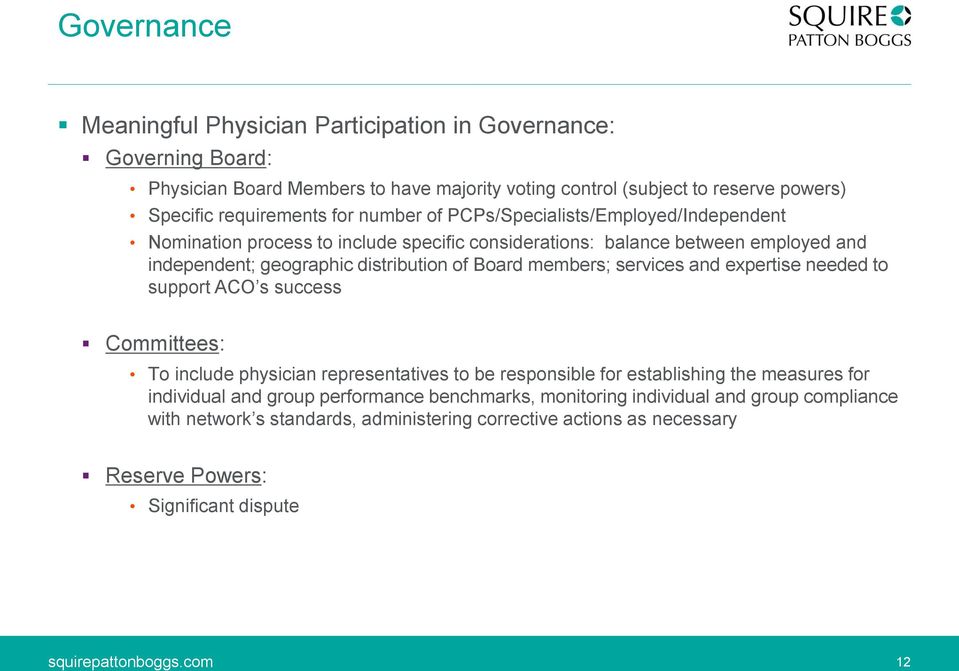
12 Governance Meaningful Physician Participation in Governance: Governing Board: Physician Board Members to have majority voting control (subject to reserve powers) Specific requirements for number of PCPs/Specialists/Employed/Independent Nomination process to include specific considerations: balance between employed and independent; geographic distribution of Board members; services and expertise needed to support ACO s success Committees: To include physician representatives to be responsible for establishing the measures for individual and group performance benchmarks, monitoring individual and group compliance with network s standards, administering corrective actions as necessary Reserve Powers: Significant dispute 12
13 Clinical Practice Guidelines Physician participation in selection of clinical practice guidelines and performance metrics Capitalize on physician expertise and experience Promote high degree of confidence among participating providers in the nature of the guidelines and confidence will promote adherence Selection guidelines based on an analysis of physician data to assess high-prevalence, high-cost and high-risk conditions that most affect the patient population Performance measures designed to minimize variation in care Initial performance and quality measures to focus on a limited set of metrics which evidence suggests actually enhance quality and improve efficiency such initial focus would allow providers to understand what is expected and ACO to determine whether progress has been made 13

14 Participation Agreements Providers to be chosen for inclusion in ACO on a selective basis, based in part on willingness and ability to participate in ACO and providers likely value to patient population and ACO goals (based on expertise and specialty) Each participating provider is required to enter into a Participating Provider Agreement with the ACO Terms: Contracting with physician groups, rather than individual physicians, is key best for continuity Nonexclusive: Participating provider is free to contract independent of ACO with any payor that chooses not to contract with the ACO; participating provider can participate in other networks as well but if a payor requires exclusivity as a term of contract with ACO, participating provider must adhere to that contract and not participate in another contract with that payor. Participating provider agrees to provide covered services to members in accordance with policies and procedures of payors and ACO including those relating to credentialing, quality, record keeping and reports, member grievances 14

15 Participating providers will seek to facilitate in-network referrals this will increase efficiencies of network and further goal of coordination of care Participating providers must participate in/adhere to the ACO s clinical integration program *Participating providers must participate in all payor agreements entered into by the ACO Participating providers will have no right to opt out of individual plan agreements based on fee schedule or otherwise Participating providers must agree to ongoing contributions of time and effort (e.g. service on committees) Participating providers must acquire and maintain necessary computer equipment and software to connect with ACO s electronic platform Participating providers must make data available for developing, monitoring and enforcing clinical guidelines 15

16 IT/EMR Information Sharing ACO must establish a dedicated system, preferably electronic, by which participating providers in the ACO exchange relevant patient medical information, such as clinical notes, test results and prescriptions Critical to care coordination helps providers use clinical care guidelines in evaluating and treating patients and facilitates physician-to-physician communication Provides transparency and visibility into the participating providers actual practice patterns and accomplishments Critical to evaluation of provider performance and compliance with ACO s clinical practice guidelines Necessary to facilitate data collection, outcomes measurement and performance reporting required by payors Electronic systems pose cost issues for physicians and other providers 16

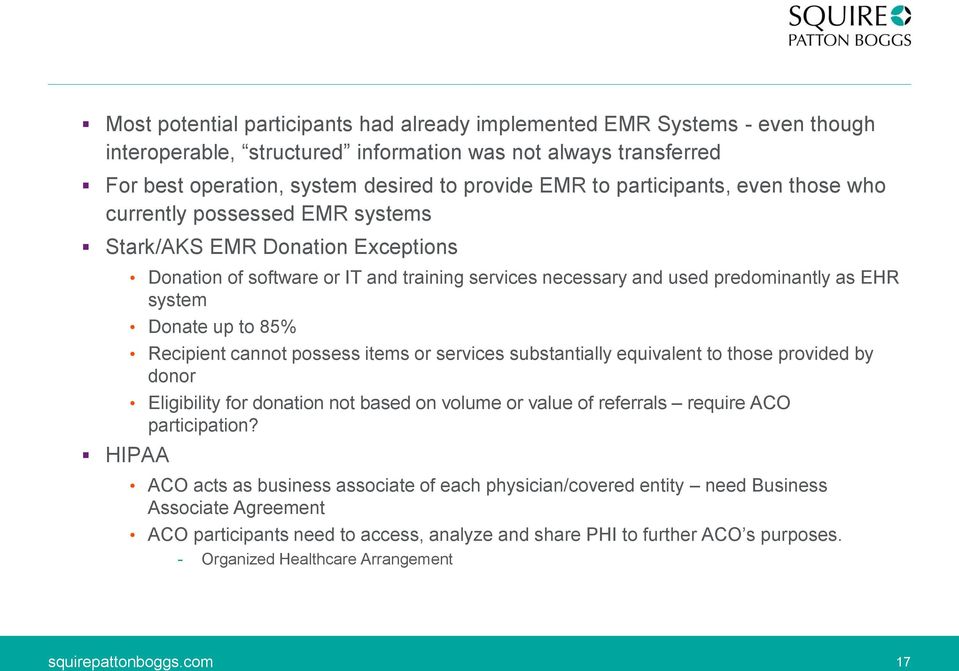
17 Most potential participants had already implemented EMR Systems - even though interoperable, structured information was not always transferred For best operation, system desired to provide EMR to participants, even those who currently possessed EMR systems Stark/AKS EMR Donation Exceptions HIPAA Donation of software or IT and training services necessary and used predominantly as EHR system Donate up to 85% Recipient cannot possess items or services substantially equivalent to those provided by donor Eligibility for donation not based on volume or value of referrals require ACO participation? ACO acts as business associate of each physician/covered entity need Business Associate Agreement ACO participants need to access, analyze and share PHI to further ACO s purposes. - Organized Healthcare Arrangement 17
18 Distribution Methodology Performance-based contracts with payors typically to involve payment directly to ACO, with distribution by ACO to providers Distribution % distributed to System as return on initial and ongoing investment in ACO(?) % retained by ACO for ongoing administrative expenses Remainder distributed to providers (including Hospital) Board must determine distribution methodology equal share, performance-based; ACO may also agree with payor on provider distribution methodology to further align incentives Distribution % among PCPs/Specialist point of contention 18

19 Expectations 19

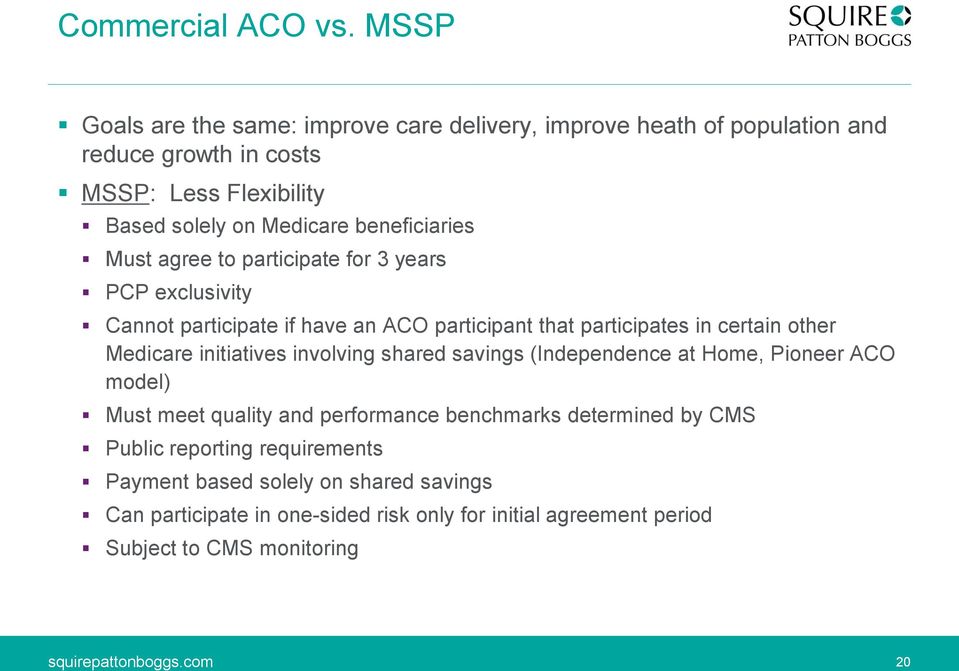
20 Commercial ACO vs. MSSP Goals are the same: improve care delivery, improve heath of population and reduce growth in costs MSSP: Less Flexibility Based solely on Medicare beneficiaries Must agree to participate for 3 years PCP exclusivity Cannot participate if have an ACO participant that participates in certain other Medicare initiatives involving shared savings (Independence at Home, Pioneer ACO model) Must meet quality and performance benchmarks determined by CMS Public reporting requirements Payment based solely on shared savings Can participate in one-sided risk only for initial agreement period Subject to CMS monitoring 20
21 Commercial ACO vs. MSSP Commercial: Flexibility Negotiate quality metrics with payor to meet unique skills and needs of providers and patient populations Focus on the most prevalent chronic conditions of patient population Flexibility in pay-for-performance arrangements 21
22 Fraud and Abuse Laws Premised on fee for service and the incentives to increase utilization Inhibit arrangements that are beneficial to incentivizing quality, care coordination, cost reduction Stark Law (42 U.S.C. 1395nn) Prohibits physicians from making referrals for certain designated health services payable by Federal Health Care Programs to an entity with which physician or immediate family member has financial relationship Penalties include denial of payment, refund of overpayments, exclusion, civil penalties ranging from $15,000 per each service to $100,000 per each circumvention scheme Enforcement authority in CMS and OIG 22
23 Anti-Kickback Statute (42 U.S.C. 1320a-7b) Prohibits remuneration paid purposefully to induce or reward referrals of items or services payable by Federal Health Care Programs Criminal penalties of maximum fine of $25,000, imprisonment up to 5 years, or both, and automatic exclusion and civil monetary penalties Enforcement authority in OIG Civil Monetary Penalties Law (42 U.S.C. 1320a-7a) Prohibits: payments to physicians to induce reduction or limitation of services; remuneration to beneficiary to influence provider selection Penalties include treble damages of amount improperly claimed and varying penalty amounts per violation (from $10,000 to $50,000) Enforcement authority in OIG 23
24 Stark Cannot be ignored simply because an ACO Potential indirect compensation arrangement between Hospital and physicians Hospital ACO Referrals Funds might be calculated or used in downstream arrangements which influence referrals of Federal program patients Physicians CMS has stated that many commercial shared savings arrangements can be structured to fit within Stark exceptions 24
25 Review all compensation arrangements between ACO and physicians Indirect Compensation Arrangement referring physician receives aggregate compensation from ACO that varies with, or takes into account, the volume or value of referrals (DHS) or other business generated by the physician for the Hospital Hospital is part of the ACO contracts with Hospital Employee Health Plan or other payors could include savings or incentives related to Hospital services based on referrals from physicians Aggregate compensation may vary based on volume/value Applicable Exceptions Employment Exception/Personal Services Exception/FMV Exception: Fair Market Value: Compensation received by Physician must be FMV for services provided by Physician Volume or Value : - Straightforward test that compensation arrangements should be at FMV for the work or service performed not inflated to compensate for the physician s ability to generate other revenues. (66 FR 856, 877) - Compensation must not be determined in any manner that takes into account the volume or value of referrals (DHS) or other business generated by Physician for Hospital 25
26 Indirect Compensation Arrangements Exception Exception looks at individual payments without aggregating them (72 FR 51012, 51029) relevant inquiry is whether the individual payments are FMV not taking into account the volume or value of referrals and do not change after inception fair market value and not inflated to compensate for the generation of business. (69 FR 16054, 16069) Similar analysis as direct compensation arrangements FMV/Volume-Value Can amount of individual payments vary from period to period? Shared Savings Example: Individual distribution requirements based on performance metric achievements and reviewed for FMV; potential cap on distribution amount Risk-Sharing Exception: Compensation pursuant to a risk-sharing arrangement (withholds, bonuses, risk pools) between an MCO and a physician (either directly or through a subcontractor) for services provided to enrollees of a health plan Exception intended to be very broad MCO not defined to create maximum flexibility Meant to cover all risk-sharing compensation paid to physicians by an entity that is downstream of any type of health plan or insurance company No quantification of financial risk required physician assumes some risk for the cost of services 26
27 Anti-Kickback Statute Although intent-based, implicated if even one purpose of a payment is to induce a prohibited referral - Purposes of most ACOs are legitimate - Careful in business documentation not to reference development of ACO in order to maintain physician base against competitors - Try to meet as many requirements of applicable safe harbors as possible Civil Monetary Penalties Statute Incentives must not induce a physician to reduce or limit items or services provided to Medicare or Medicaid beneficiaries. Difficult for physicians to understand goal of improved efficiency and costeffectiveness is more easily verifiable if the results of the efficiency (i.e. cost savings) are part of the metric. Potential cap on shared savings. Compensation related to specific actions and changes in behavior of physicians (e.g., implementation of procedures/guidelines) that result in and have been recognized as improving patient care. The focus of the metric should be on process, not outcome. E.g., the metric should not state: reduce number of procedures performed or reduce length of stay. 27
28 Annually review data related to the metrics to confirm that the incentive arrangement is not negatively impacting patient care. Physicians should retain ultimate discretion in care-related decision-making not limited in their ranges of treatment options or modalities as a result of the incentive arrangement. Other Issues Remuneration related to Hospital-provided resources for care coordination, clinical integration and practice transformation Hospital-provided capital to ACO (including funds and human capital) 28
29 MSSP Waivers The fact that CMS and OIG determined it necessary to establish waivers to carry out the Shared Savings Program highlights need to be careful with Commercial ACOs Pre-Participation Waiver (Stark, AKS and Gainsharing CMP) ACO-related start-up arrangements in anticipation of MSSP participation Participation Waiver (Stark, AKS and Gainsharing CMP) applies broadly to ACOrelated arrangements Shared Savings Distributions Waiver (Stark, AKS and Gainsharing CMP) applies to distributions and uses of shared savings payments earned under MSSP Patient Incentive Waiver (AKS, Beneficiary Inducements CMP) applies to medically related incentives offered by ACOs under MSSP to beneficiaries to encourage preventive care and compliance with treatment regimes 29
30 Key Element (Pre-Participation Waiver, Participation Waiver, Shared Savings Distributions Waiver, Stark Waiver): Reasonably Related to the Purposes of the Shared Savings Program one or more of: Promoting accountability for the quality, cost and overall care for a Medicare patient population Managing and coordinating care for Medicare fee-for-service beneficiaries through an ACO Encouraging investment in infrastructure and redesigned care processes for high quality and efficient service delivery for patients, including Medicare beneficiaries Purposes can involve promoting evidence-based medicine and patient engagement; coordinating care; meeting quality performance standards Arrangements that involve care for non-medicare patients as well as Medicare beneficiaries are eligible for the waiver 30
31 Pre-Participation Waiver Arrangement undertaken with good faith intent to form an MSSP ACO Applies to arrangements within the ACO (between or among ACO, ACO participants, ACO providers/suppliers) and ACO-related arrangements with outside providers and suppliers hospitals, specialists, post-acute care facilities (help coordinate and manage care) (some participation exclusions apply) Waiver period begins 1 year preceding an application due date and generally ends on start date of Participation Agreement Infrastructure creation; clinical management systems; hiring staff; EHR systems; consultant and professional support; incentives to attract PCPs; capital investments 31
32 Participation Waiver Applies to arrangements within the ACO (between or among ACO, ACO participants, ACO providers/suppliers) and ACO-related arrangements with outside providers and suppliers hospitals, specialists, post-acute care facilities (help coordinate and manage care) Includes start-up arrangements Begins on start date of Participation Agreement and generally ends 6 months after expiration/termination CMS has specifically stated that nothing precludes arrangements downstream from commercial plans from qualifying for the Waiver Waiver does not turn on source of the funds for the arrangement 32
33 Shared Savings Distributions Waiver Applies only to shared savings earned under MSSP not to commercial Payments of shared savings to a physician must not knowingly be made to induce the reduction or limitation of medically necessary items or services Can be used to pay parties outside ACO if payments are reasonably related to purposes of MSSP Applies to distributions/uses of shared savings even after expiration of Participation Agreement Shared Savings distributions can be structured to fit under other waivers 33
34 Waiver for Patient Incentives Limited to items or services provided by an ACO, its ACO participants or its ACO providers/suppliers to beneficiaries for free or below FMV Does not apply to items or services given by manufacturers or other vendors to beneficiaries or ACO Items or services must be: In-kind (not financial e.g. waiver of co-pay) Reasonably connected to medical care of beneficiaries; and Preventive care items or services or advance one or more of (i) adherence to a treatment regime, (ii) adherence to a drug regime; (iii) adherence to a follow-up care plan, (iv) management of a chronic disease or condition Blood pressure cuffs for hypersensitive patients, not beauty products or theatre tickets Begins on start date of Participation Agreement and generally ends on expiration/termination of Participation Agreement provided beneficiary may keep items received and receive remainder of any service initiated during waiver period 34
35 Commercial MSSP Must have enough PCPs who can participate exclusively in the System s MSSP ACO Commercial ACO Participation Agreements should include language either: Requiring participants to sign an Addendum in the event ACO (with Governing Board approval) determines to participate in MSSP (unless Participant is excluded due to participation in another MSSP ACO) Noting that ACO will give Participant the option to continue to participate solely in commercial activities or sign Addendum to participate in both commercial and MSSP Addendum would include any requirements of MSSP for MSSP participation (Operating Agreement may also need to be amended) MSSP Regulations contain specific language which must be included in Participation Agreements, most of which will likely not be objectionable In drafting initial ACO Operating Agreement and Participation Agreements, parties should seek to include as many MSSP provisions as possible to ease the transition process 35
36 Other Legal Considerations State fee splitting and fraud and abuse laws State insurance laws risk based contracts Risk Management impact on care Tax exemption Certain states have implemented ACO regulations which provide waivers 36
37 ACO development and relationships developed with physicians permeates future decisions and strategy Physician understanding of changing payor landscape and need to collaborate particularly for employed physicians with current compensation plans based on productivity more open to new compensation models going forward BPCI Ease of implementation (data sharing mechanisms and coordination plans already in place); physician understanding of need and purpose; physician desire to participate; utilize ACO as BPCI Entity for administration ASC No conversion to HOPD (goal of cost reduction); ACO facility selection criteria was considered (can t simply force Hospital-owned facility on ACO selection/participation committee) SNF Care Coordination Services utilize MSSP waiver for free services provided by SNF Cost-Savings Compensation Program run through ACO utilize MSSP waivers 37
38 Adam D. Colvin Squire Patton Boggs (US) LLP 221 E. Fourth Street Suite 2900 Cincinnati, Ohio Adam Colvin focuses his practice on regulatory and transactional matters in healthcare, including fraud and abuse issues, the Stark Law, ACOs, clinically integrated networks, hospital-physician alignment and integration, joint ventures, purchase and sale of physician practices, employment and recruitment agreements, establishment of ambulatory surgery centers, imaging center and other ancillary service providers, managed care contracting and general business matters. A member of the American Health Lawyers Association, Adam has been named one of the Best Lawyers in America in Healthcare and recognized as an Ohio Rising Star by Law & Politics. 38
ACOs: Fraud & Abuse Waivers and Analysis
 ACOs: Fraud & Abuse Waivers and Analysis Robert G. Homchick and Sarah Fallows Davis Wright Tremaine, LLP I. Introduction The Patient Protection and Affordable Care Act of 2010 (ACA) fosters the development
CLINICALLY INTEGRATED NETWORKS: BUSINESS AND LEGAL CONSIDERATIONS
 CLINICALLY INTEGRATED NETWORKS: BUSINESS AND LEGAL CONSIDERATIONS Claire Turcotte, Esquire, Bricker & Eckler LLP Jim Yanci, MS MT (ASCP), Dixon Hughes Goodman Agenda BUSINESS CONSIDERATIONS How Fast are
Fraud and Abuse Considerations for Accountable Care Organizations (ACOs)
 Fraud and Abuse Considerations for Accountable Care Organizations (ACOs) By: Chris Rossman, Foley & Lardner LLP, Detroit, Michigan 1. The Centers for Medicare and Medicaid Services ( CMS ) and the Office
Amy K. Fehn. I. Overview of Accountable Care Organizations and the Medicare Shared Savings Program
 IMPLEMENTING COMPLIANCE PROGRAMS FOR ACCOUNTABLE CARE ORGANIZATIONS Amy K. Fehn I. Overview of Accountable Care Organizations and the Medicare Shared Savings Program The Medicare Shared Savings Program
Fraud & Abuse Waivers Under the Medicare Shared Savings Program
 Fraud & Abuse Waivers Under the Medicare Shared Savings Program Robert G. Homchick Davis Wright Tremaine, LLP I. Introduction The Patient Protection and Affordable Care Act of 2010 (ACA) fosters the development
Fraud and Abuse Primer. Stark Law The Anti-Kickback Statute False Claims Act
 Fraud and Abuse Primer Stark Law The Anti-Kickback Statute False Claims Act Stark Act 42 U.S.C. 1395nn The Stark II Act prohibits a physician from making a Referral to an entity; for the furnishing of
NATIONAL ASSOCIATION OF COMMUNITY HEALTH CENTERS. Briefing Paper on the Proposed Medicare Shared Savings Program
 NATIONAL ASSOCIATION OF COMMUNITY HEALTH CENTERS Briefing Paper on the Proposed Medicare Shared Savings Program The Centers for Medicare and Medicaid Services (CMS) recently issued a proposed rule to implement
DETAILED SUMMARY--MEDCIARE SHARED SAVINGS/ACCOUNTABLE CARE ORGANIZATION (ACO) PROGRAM
 1 DETAILED SUMMARY--MEDCIARE SHARED SAVINGS/ACCOUNTABLE CARE ORGANIZATION (ACO) PROGRAM Definition of ACO General Concept An ACO refers to a group of physician and other healthcare providers and suppliers
AHLA. BB. Accountable Care Organizations and the Medicare Shared Savings Program. Troy Barsky Crowell & Moring LLP Washington, DC
 AHLA BB. Accountable Care Organizations and the Medicare Shared Savings Program Troy Barsky Crowell & Moring LLP Washington, DC Daniel F. Murphy Bradley Arant Boult Cummings LLP Birmingham, AL Terri L.
2010 MHA Governance Leadership Forum: Accountable Care Organizations. Chris Rossman, Esq. Foley & Lardner LLP Detroit, Michigan
 2010 MHA Governance Leadership Forum: Accountable Care Organizations Chris Rossman, Esq. Foley & Lardner LLP Detroit, Michigan Overview Major health care payment reform under the Affordable Care Act (
FRAUD AND ABUSE CONCERNS FOR ELECTRONIC PRESCRIBING AND ELECTRONIC HEALTH RECORDS
 FRAUD AND ABUSE CONCERNS FOR ELECTRONIC PRESCRIBING AND ELECTRONIC HEALTH RECORDS Presented by: Peter M Hoffman, Esq Garfunkel, Wild & Travis, PC (516) 393-2268 phoffman@gwtlawcom 1 THE FEDERAL ANTI-KICKBACK
Physician Integration Models: ACOs as the Latest and Greatest? David T. Lewis [email protected] LifePoint Hospitals, Inc.
 Physician Integration Models: ACOs as the Latest and Greatest? David T. Lewis [email protected] LifePoint Hospitals, Inc. Brentwood, TN Kim Harvey Looney [email protected] Waller Lansden Dortch
ACO Strategy and Organizational Structure
 ACO Strategy and Organizational Structure Health Care Group November 16, 2010 Tax & Benefits Group Daniel T. Roble Ropes & Gray [email protected] 617.951.7476 Lorry Spitzer Ropes & Gray [email protected]
Look Before You Leap: Legal and Practical Obstacles with ACOs
 Look Before You Leap: Legal and Practical Obstacles with ACOs Houston ACO Conference May 7, 2013 Edward Vishnevetsky, Esq. Coordinated Care and ACOs Coordinated Care Goal: ensure that healthcare providers
CHAPTER 114. AN ACT establishing a Medicaid Accountable Care Organization Demonstration Project and supplementing Title 30 of the Revised Statutes.
 CHAPTER 114 AN ACT establishing a Medicaid Accountable Care Organization Demonstration Project and supplementing Title 30 of the Revised Statutes. BE IT ENACTED by the Senate and General Assembly of the
Medicare ACO Road Map
 PYALeadership Briefing Medicare ACO Road Map January, 2013 Medicare ACO Road Map The Centers for Medicare & Medicaid Services ( CMS ) has announced 106 new accountable care organizations ( ACOs ) have
Why Worry? Fraud and Abuse Risks for Managed Care Organizations. Overview
 Why Worry? Fraud and Abuse Risks for Managed Care Organizations Stephen K. Warch Shareholder, Nilan Johnson Lewis Overview Risks Created by Incentives Offered by Health Plans and Providers o Prohibition
Additional Information About Accountable Care Organizations
 Additional Information About Accountable Care Organizations For more information, please contact: April 2011 On March 31st, the federal government outlined proposed actions relating to Accountable Care
See page 16. Thomas A. Vallas
 Compliance TODAY July 2014 a publication of the health care compliance association www.hcca-info.org What s the key to successfully merging two large hospital systems? an interview with Michael R. Holper
Medicare and Commercial Accountable Care Organizations: A Retrospective and Prospective View
 Medicare and Commercial Accountable Care Organizations: A Retrospective and Prospective View Troy Barsky, Esq. Jennifer Williams, Esq. Crowell & Moring Daniel Murphy, Esq. Bradley Arant Boult & Cummings
NATIONAL ASSOCIATION OF COMMUNITY HEALTH CENTERS. Briefing Paper on the Proposed Medicare Shared Savings Program
 NATIONAL ASSOCIATION OF COMMUNITY HEALTH CENTERS Briefing Paper on the Proposed Medicare Shared Savings Program The Centers for Medicare and Medicaid Services (CMS) recently issued a proposed rule to implement
Statement of the Association of American Medical Colleges on Legal Issues Related to Accountable Care Organizations and Healthcare Innovation Zones
 Statement of the Association of American Medical Colleges on Legal Issues Related to Accountable Care Organizations and Healthcare Innovation Zones Public Workshop hosted by the FTC, CMS, HHS OIG October
The true meaning of ACO is Awesome Consulting Opportunities. - The Weekly Standard, 04/12/11. Consultants
 Accountable Care Organizations: Proposed Regulations and the Local Landscape May 26, 2011 John Clark, MD, JD Isaac M. Willett Medical Director, Clinical i l Informatics Attorney Indiana University Health
G-2. Report. Compliance. An ambitious health reform subtitle, Transforming the Health
 G-2 Kimberly Scott, Managing Editor, [email protected] Carrie Valiant is a senior member of the health care and life sciences practice of the national law firm, EpsteinBeckerGreen, practicing in its Washington,
Pay For Performance and Medicare Compliance; The Irresistible Force Meets the Immovable Object
 APRIL 2007 Pay For Performance and Medicare Compliance; The Irresistible Force Meets the Immovable Object Mark R. Fitzgerald Powers Pyles Sutter & Verville PC, Washington, DC Since the Institute of Medicine
Accountable Care Organizations: The Final Rule
 Accountable Care Organizations: The Final Rule October 27, 2011 2011 Akin Gump Strauss Hauer & Feld LLP 10.27.11 101799002 v4 Overview Background Final Rule Highlights Structure and Formation of ACOs Quality
Providing Subsidized EHR to Physicians Under Stark and Anti-Kickback Statute. Charles B. Oppenheim, Esq.
 Providing Subsidized to Physicians Under Stark and Anti-Kickback Statute Presented by Charles B. Oppenheim, Esq. [email protected] (310) 551-8110 Subsidizing for Physicians: Why would I want to
Legal & Policy Issues Related to ACO Formation by Independent Physician Groups
 Legal & Policy Issues Related to ACO Formation by Independent Physician Groups Troy Barsky Arthur Lerner Crowell & Moring LLP America s Health Insurance Plans ACO Summit May 15, 2013 Background Government
HCCA 2013 COMPLIANCE INSTITUTE ANTI-KICKBACK STATUTE 101 SEATTLE, WASHINGTON
 UW MEDICINE HCAA 2013 Compliance Institute HCCA 2013 COMPLIANCE INSTITUTE ANTI-KICKBACK STATUTE 101 April 23, 2013 Robert S. Brown Senior Compliance Specialist UW Medicine Compliance SEATTLE, WASHINGTON
Accountable Care Organizations. Rick Shinto, MD Aveta Health Inc. July 20, 2010
 Accountable Care Organizations Rick Shinto, MD Aveta Health Inc. July 20, 2010 1 Health Care Reform- New Models of Care Patient Protection and Affordable care Act (PPACA 2010) controlling costs and improving
A Closer Look at the Final ACO Rule
 A Closer Look at the Final ACO Rule October 2011 For more information, please contact: On October 20th, the federal government released a final rule and other companion releases relating to Accountable
Compliance and Program Integrity Melanie Bicigo, CHC, CEBS [email protected] 906-225-7749
 Compliance and Program Integrity Melanie Bicigo, CHC, CEBS [email protected] 906-225-7749 Define compliance and compliance program requirements Communicate Upper Peninsula Health Plan (UPHP) compliance
Under section 1128A(a)(5) of the Social Security Act (the Act), enacted as part of
 OFFICE OF INSPECTOR GENERAL SPECIAL ADVISORY BULLETIN OFFERING GIFTS AND OTHER INDUCEMENTS TO BENEFICIARIES August 2002 Introduction Under section 1128A(a)(5) of the Social Security Act (the Act), enacted
group practice journal
 group practice journal P U B L I C A T I O N O F T H E A M E R I C A N M E D I C A L G R O U P A S S O C I A T I O N Reprinted from Electronic Health Record Offers: What s a Doctor to Do? BY ELLEN F. KESSLER,
The Evolution of Service Line Co-Management Relationships with Physicians - Key Observations on Relationships and Fair Market Value
 Healthcare and Life Sciences The Evolution of Service Line Co-Management Relationships with Physicians - Key Observations on Relationships and Fair Market Value Presented by: Scott Safriet, HealthCare
Application & Implementation of ACO Waivers and Ongoing Compliance Issues
 Application & Implementation of ACO Waivers and Ongoing Compliance Issues Presenter Todd A. Zigrang MBA, MHA, FACHE, ASA HEALTH CAPITAL CONSULTANTS Thursday, August 13, 2015 1:30 p.m. Hilton St. Louis,
Medicare Accountable Care Organizations: What it s about
 Medicare Accountable Care Organizations: What it s about Gail Albertson, MD Associate Professor of Medicine Chief Operating Officer, UPI Medicare Accountable Care Under the Medicare Shared Savings Program
Guidance Released on Accountable Care Organizations Participating in the Medicare Shared Savings Program
 M A Y 2 0 1 1 Guidance Released on Accountable Care Organizations Participating in the Medicare Shared Savings Program On March 31, 2011, the Centers for Medicare & Medicaid Services (CMS), the Department
Legal Issues to Consider When Creating a Health Care Business Model
 Legal Issues to Consider When Creating a Health Care Business Model Connie A. Raffa, J.D., LL.M. Business practices considered standard in other industries may in the health care industry be considered
Legal Issues for Accountable Care Organizations
 Legal Issues for Accountable Care Organizations Health Care Reform Strategies Bruce Merlin Fried, Esq. ACO Summit June 7, 2010 ACOs in PPACA The Basics Section 3022 of the Protection and Affordable Care
The Stark Law Opportunities to Address Barriers to Clinical Integration January 29, 2016
 The Stark Law Opportunities to Address Barriers to Clinical Integration There are several rules governing compensation relationships between hospitals, physicians and other caregivers, including the Anti-kickback
COMPENSATING EMPLOYED PHYSICIANS Tax Law, Stark and Anti-Kickback Implications. AHLA Tax Issues for Healthcare Organizations October 20-22, 2013
 AHLA B. Compensating Employed Physicians Tax Law, Stark, and Anti-Kickback Implications Linda Sauser Moroney Drinker Biddle & Reath LLP Milwaukee, WI Claire M. Turcotte Bricker & Eckler LLP West Chester,
Fraud, Waste, and Abuse
 These training materials are divided into three topics to meet the responsibilities stated on the previous pages: Fraud, Waste, Compliance Program Standards of Conduct Although the information contained
Adopting Electronic Medical Records: What Do the New Federal Incentives Mean to Your Individual Physician Practice?
 Adopting Electronic Medical Records: What Do the New Federal Incentives Mean to Your Individual Physician Practice? U John M. Neclerio, Esq.,* Kathleen Cheney, Esq., C. Mitchell Goldman, Esq., and Lisa
Strategy and Options for Alignment and Steps to Create an ACO
 White Paper Strategy and Options for Alignment and Steps to Create an ACO A Suggested Strategy James M. Daniel, Jr., JD, MBA Hancock, Daniel, Johnson & Nagle, P.C. (866) 967-9604 [email protected] www.hdjn.com
CMS-1345-NC2: Waiver Designs in Connection With the Medicare Shared Savings Program and the Innovation Center
 Submitted Electronically Donald Berwick, M.D., M.P.P. Administrator Centers for Medicare & Medicaid Services Department of Health and Human Services Room 445-G, Hubert H. Humphrey Building 200 Independence
Structuring Physician Recruitment Arrangements in Accordance with the Stark II/Phase II Interim Final Rule
 Structuring Physician Recruitment Arrangements in Accordance with the Stark II/Phase II Interim Final Rule Stacey A. Tovino [email protected] June 25, 2004 On March 26, 2004, the Centers for Medicare
CORPORATE COMPLIANCE PROGRAM
 CORPORATE COMPLIANCE PROGRAM BACKGROUND AND POLICY: The Oakwood Accountable Care Organization, LLC. ( ACO ) corporate policy relating to compliance with applicable laws and regulations is embodied in this
IU Health Quality Partners
 FREQUENTLY ASKED QUESTIONS 1) What is IU Health Quality Partners? It is a clinically integrated provider group; it is not a contracted health insurance plan network where physicians receive a set fee for
Presenting a live 90-minute webinar with interactive Q&A. Today s faculty features:
 Presenting a live 90-minute webinar with interactive Q&A Anti-Kickback Statute and Stark Law Compliance in Managed Care Contracts Navigating Safe Harbors and Physician Incentive Plan Rules, Limiting Civil
Crosswalk: CMS Shared Savings Rules & NCQA ACO Accreditation Standards 12/1/2011
 Crosswalk: CMS Shared Savings Rules & NCQA ACO Accreditation Standards 12/1/2011 The table below details areas where NCQA s ACO Accreditation standards overlap with the CMS Final Rule CMS Pioneer ACO CMS
Accountable Care Organizations The Future Integrated Health Care Delivery Model?
 Accountable Care Organizations The Future Integrated Health Care Delivery Model? Maria T. Currier Randy Fenninger Holland & Knight LLP Adventist Health System Annual Legal Retreat October 25, 2010 Orlando,
Accountable Care Organizations: Legal and Organizational Structures; Governance
 Accountable Care Organizations: Legal and Organizational Structures; Governance The National Accountable Care Organization Congress October 25-27, 2010 Los Angeles, CA Dennis S. Diaz, Esq. Davis Wright
The Regulations Are Out: Is An ACO Right For You? Moderator David Pursell 816.983.8190 [email protected]
 The Regulations Are Out: Is An ACO Right For You? Moderator David Pursell 816.983.8190 [email protected] Today s Discussion Overview of the ACO Regulations Alternatives to a Medicare ACO
BAKER DONELSON BAKER S DOZEN
 Thirteen Things Health Care Providers Should Know About Accountable Care Organizations and Health Reform Thomas E. Bartrum, 615.726.5641, [email protected] With passage of the Patient Protection
INTEGRATION STRATEGIES FOR A NEW HEALTH CARE ECONOMY
 INTEGRATION STRATEGIES FOR A NEW HEALTH CARE ECONOMY Thomas William Baker Baker Donelson Bearman Caldwell & Berkowitz, P.C. Atlanta, Georgia (404) 221-6510 [email protected] Prepared for East Georgia
Entities eligible for ACO participation
 On Oct. 20, 2011, the Centers for Medicare & Medicaid Services (CMS) finalized new rules under the Medicare Shared Savings Program (MSSP) to help doctors, hospitals, and other health care providers better
Medicare Advantage and Part D Fraud, Waste, and Abuse Training. October 2010
 Medicare Advantage and Part D Fraud, Waste, and Abuse Training October 2010 Introduction 2008: United States spent $2.3 trillion on health care. Federal fiscal year 2010: Medicare expected to cover an
Health Care. ACO Payment Arrangements
 Newsletter Health Care January 2014 North Carolina Accountable Care Organization Update This Bulletin provides an update on the development of Accountable Care Organizations (ACOs) in North Carolina through
PREVENTING FRAUD, ABUSE, & WASTE: A Primer for Physical Therapists
 PREVENTING FRAUD, ABUSE, & WASTE: A Primer for Physical Therapists Available at: http://www.apta.org/integrity 2014 American Physical Therapy Association. All rights reserved. All reproduction or redistribution
MEDICAID AND MEDICARE (PARTS C&D) FRAUD, WASTE AND ABUSE TRAINING
 MEDICAID AND MEDICARE (PARTS C&D) FRAUD, WASTE AND ABUSE TRAINING Why Do I Need Training/Where Do I Fit in? Why Do I Need Training? Every year millions of dollars are improperly spent because of fraud,
Using Partial Capitation as an Alternative to Shared Savings to Support Accountable Care Organizations in Medicare
 December 2010 Using Partial Capitation as an Alternative to Shared Savings to Support Accountable Care Organizations in Medicare CONTENTS Background... 2 Problems with the Shared Savings Model... 2 How
Fraud, Waste and Abuse Prevention Training
 Fraud, Waste and Abuse Prevention Training The Centers for Medicare & Medicaid Services (CMS) requires annual fraud, waste and abuse training for organizations providing health services to MA or Medicare
THE CHRIST HOSPITAL POLICY NO. 4.21.113 ADMINISTRATIVE POLICY PAGE 1 OF 6 COMPLIANCE WITH THE FEDERAL ANTI-KICKBACK STATUTE AND STARK LAW
 ADMINISTRATIVE POLICY PAGE 1 OF 6 POLICY TITLE: ORIGINATED BY: APPROVED BY: COMPLIANCE WITH THE FEDERAL ANTI-KICKBACK STATUTE AND STARK LAW COMPLIANCE OFFICER COMPLIANCE COMMITTEE REVIEWED/REVISED: 1/2011;
Stark, False Claims and Anti- Kickback Laws: Easy Ways to Stay Compliant with the Big Three in Healthcare
 Stark, False Claims and Anti- Kickback Laws: Easy Ways to Stay Compliant with the Big Three in Healthcare In health care, we are blessed with an abundance of rules, policies, standards and laws. In Health