
AMCP Dossier. EXPAREL (bupivacaine liposome injectable suspension)
|
|
|
- Clyde Thornton
- 10 years ago
- Views:
Transcription
1 AMCP Dossier EXPAREL (bupivacaine liposome injectable suspension)

2 Contents 1 Executive Summary Clinical Benefits Conclusions Product Information and Disease Description6 2.1 Product Description Generic Name, Brand Name, and Therapeutic Class Dosage Forms, Strengths, and Package Sizes NDC for all Formulations WAC Cost per Unit AHFS or Other Drug Classification FDA Approved Indications Pharmacology Pharmacokinetics/Pharmacodynamics Contraindications Warnings/Precautions/Adverse Effects Interactions Specific Populations/Disease Dosing and Administration Access Co Prescribed/Concomitant Therapies Comparison Products Place of the Product in Therapy Disease Description Approaches to Treatment Relevant Treatment Guidelines and Consensus Statements From National and/or International Bodies Supporting Clinical Evidence Summarizing Key Clinical Studies Published and Unpublished Data and Clinical Studies Supporting Labelled Indications Clinical Studies Supporting Off label Indications (Administration Other Than by Wound Infiltration) Clinical Evidence Summary Table Summarizing of Evidence from Secondary Sources Integrated Analysis of Efficacy and Safety Integrated Cardiac Safety Analysis Economic Value and Modelling Report Modelling Overview References EXPAREL Dossier Page 2

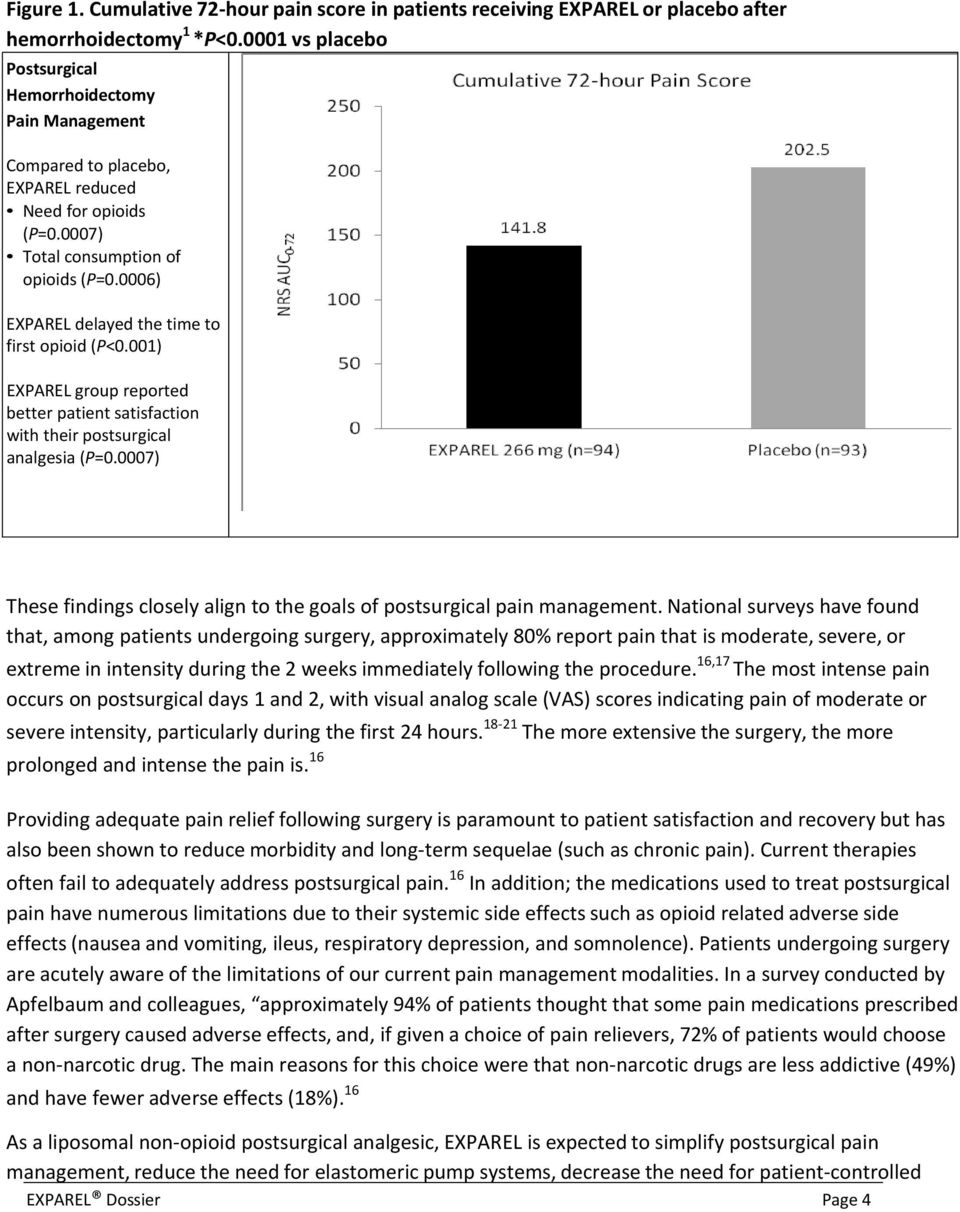
3 1 Executive Summary 1.1 Clinical Benefits EXPAREL is a liposome injection of bupivacaine, an amide type local anesthetic, indicated for single dose local administration into the surgical site to produce postsurgical analgesia. After injection of EXPAREL into soft tissue, bupivacaine is released from the multivesicular liposomes providing effective local analgesia for up to 72 hours. The efficacy and safety of EXPAREL as a treatment for postsurgical pain following single dose local administration was established in 2 multicenter, randomized, double blind, placebo controlled, pivotal Phase 3 clinical trials in subjects undergoing hemorrhoidectomy 1 or bunionectomy. 2 In the Phase 3 hemorrhoidectomy trial, EXPAREL achieved a statistically significant 30% reduction in pain, as measured by the area under the curve (AUC) of the numeric rating scale at rest (NRS R) pain scores, at 72 hours (primary endpoint) and all additional time points measured up to 72 hours. In addition, EXPAREL reduced the use of opioid rescue medication, including 45% less opioid usage compared with placebo at 72 hours (secondary endpoint). 1 In the Phase 3 bunionectomy trial, EXPAREL demonstrated a statistically significant reduction in pain at 24 hours (primary endpoint), and this reduction was also statistically significant at 36 hours (secondary endpoint). The trial also met other secondary endpoints related to pain measurement and the use of opioid rescue medication. 2 In addition; eight Phase 2 and 3 clinical trials comparing EXPAREL to unencapsulated bupivacaine HCl have been conducted. Medication was administered into the surgical site in subjects undergoing hemorrhoidectomy, 3 5 inguinal hernia repair, 6,7 breast augmentation, 8,9 bunionectomy, 10 and total knee arthroplasty (TKA) In total, 823 subjects have been studied with EXPAREL administration into the surgical site via infiltration in a variety of surgical settings providing a robust safety database. The most common treatment emergent adverse events (TEAEs) reported with EXPAREL were nausea, constipation, and vomiting. 14,15 The type and overall incidence of TEAEs are similar with EXPAREL and bupivacaine HCl (62% vs 75%, respectively). 14,15 Long term follow up safety assessments have been obtained in several studies, including orthopedic studies, which demonstrated no impact on malunion or non healing at up to 6 weeks after study drug administration, and breast augmentation surgery studies, which demonstrated no clinical sequelae regarding the patency of the implant at up to 21 months after study drug administration. No long term adverse effects were observed in these studies. The goals of postsurgical pain management are to improve patient comfort and satisfaction, facilitate rapid recovery and early ambulation, and reduce morbidity. Additionally, ideal postsurgical pain management should help shorten length of stay (LOS). As shown in Figure 1, EXPAREL provides effective pain control for 72 hours following a single administration while reducing the need for opioid therapy. 1 EXPAREL Dossier Page 3

4 Figure 1. Cumulative 72 hour pain score in patients receiving EXPAREL or placebo after hemorrhoidectomy 1 *P< vs placebo Postsurgical Hemorrhoidectomy Pain Management Compared to placebo, EXPAREL reduced Need for opioids (P=0.0007) Total consumption of opioids (P=0.0006) EXPAREL delayed the time to first opioid (P<0.001) EXPAREL group reported better patient satisfaction with their postsurgical analgesia (P=0.0007) These findings closely align to the goals of postsurgical pain management. National surveys have found that, among patients undergoing surgery, approximately 80% report pain that is moderate, severe, or extreme in intensity during the 2 weeks immediately following the procedure. 16,17 The most intense pain occurs on postsurgical days 1 and 2, with visual analog scale (VAS) scores indicating pain of moderate or severe intensity, particularly during the first 24 hours The more extensive the surgery, the more prolonged and intense the pain is. 16 Providing adequate pain relief following surgery is paramount to patient satisfaction and recovery but has also been shown to reduce morbidity and long term sequelae (such as chronic pain). Current therapies often fail to adequately address postsurgical pain. 16 In addition; the medications used to treat postsurgical pain have numerous limitations due to their systemic side effects such as opioid related adverse side effects (nausea and vomiting, ileus, respiratory depression, and somnolence). Patients undergoing surgery are acutely aware of the limitations of our current pain management modalities. In a survey conducted by Apfelbaum and colleagues, approximately 94% of patients thought that some pain medications prescribed after surgery caused adverse effects, and, if given a choice of pain relievers, 72% of patients would choose a non narcotic drug. The main reasons for this choice were that non narcotic drugs are less addictive (49%) and have fewer adverse effects (18%). 16 As a liposomal non opioid postsurgical analgesic, EXPAREL is expected to simplify postsurgical pain management, reduce the need for elastomeric pump systems, decrease the need for patient controlled EXPAREL Dossier Page 4
5 analgesia (PCA) devices (with their inherent potential for infection 22 and errors 23 ), minimize breakthrough pain episodes, reduce opioid related adverse effects (ORAEs) by reducing peak systemic levels, and minimize the need for supplemental opioid medications. Therefore, better postsurgical pain management may then potentially allow earlier ambulation, earlier discharge from the hospital, and a faster return to regular activity. 24 The clinical information available for EXPAREL provides robust evidence to support a potential economic advantage if EXPAREL is considered as part of a multimodal postsurgical pain management strategy. 1.2 Conclusions Postsurgical pain should be treated adequately in order to improve patient comfort, facilitate early recovery, and avoid postsurgical complications including the development of chronic pain. Although opioids are effective, it is known and accepted that a patient s opioid burden can contribute to their length of stay and hospital cost. When administered into the surgical site in a variety of surgical settings, EXPAREL is an effective non opioid analgesic agent that reduces the intensity of postsurgical pain for up to 72 hours and limits the use of postsurgical opioids, as demonstrated in Phase 3 placebo controlled pivotal trials. In the Phase 3 pivotal trials, the adverse event (AE) profile was similar to placebo. The efficacy and safety of EXPAREL was also demonstrated compared with bupivacaine HCl in multiple Phase 2 clinical trials. By expanding the duration of local analgesic therapy from under 12 hours to several days, EXPAREL may allow for decreased use of other pain control agents, including opioids, thereby filling an unmet medical need in the postsurgical pain management landscape. EXPAREL Dossier Page 5

6 2 Product Information and Disease Description 2.1 Product Description Generic Name, Brand Name, and Therapeutic Class Generic Name: bupivacaine liposome injectable suspension Brand Name: EXPAREL Therapeutic Class: anesthetics, anesthetics local, amides (ATC code: N01BB01) Dosage Forms, Strengths, and Package Sizes Supplied as single use vials for local administration: 10 ml vial, 1.3% (13.3 mg/ml) packaged in cartons of 10 not available at this time 20 ml vial, 1.3% (13.3 mg/ml) packaged in cartons of NDC for all Formulations Vials of 10 ml, 1.3%: NDC not available at this time Vials of 20 ml, 1.3%: NDC WAC Cost per Unit Vials of 10 ml, 1.3% not available at this time Vials of 20 ml, 1.3% WAC: $ per vial AHFS or Other Drug Classification Local Anesthetics FDA Approved Indications EXPAREL (bupivacaine liposome injectable suspension) is a liposomal formulation of bupivacaine, an amide type local anesthetic, indicated for administration into the surgical site to produce postsurgical analgesia. EXPAREL was approved by the U.S. Food and Drug Administration on October 28, Although bupivacaine is used for local anesthesia including nerve block, epidural, and intrathecal nerve block, EXPAREL is currently not indicated for this purpose. Studies are planned to assess the safety and efficacy of EXPAREL in a variety of indications, including peripheral nerve block administration and use in pediatric patient populations. EXPAREL Dossier Page 6

7 2.1.7 Pharmacology The pharmacology of local anesthetics such as bupivacaine is well documented. Briefly, local anesthetics block nerve impulses by binding to sodium channels on the neuronal cell wall, preventing sodium influx, and therefore, preventing cell depolarization. In general, the progression of anesthesia is related to the diameter, myelination, and conduction velocity of effected nerve fibers. Nerve conduction is more readily hindered by anesthetics in sensory nerve fibers because these fibers have longer action potentials, allowing more anesthetic to bind. This means that small, unmyelinated C fibers (which mediate pain) and small myelinated Aδ fibers (which mediate pain and temperature sensation) are blocked more readily than larger myelinated Aγ, Aβ, and Aα fibers (which mediate touch, pressure, muscle and postural sensations). 25 The potency of any given local anesthetic is governed by its lipid solubility. Agents that are highly lipid soluble are more able to penetrate connective tissue and cell membrane walls than those that are less soluble. The duration of action of local anesthetics is determined by the degree to which they bind proteins. Those with a high affinity for protein binding remain bound to nerve cells for longer, thus increasing their duration of action. Binding to serum proteins also reduces the potential for toxicity in primary organs by decreasing the drug availability in the blood. 26 Structurally, local anesthetics are characterized by a lipophilic aromatic ring and a hydrophilic molecule joined by a hydrocarbon chain. The molecule that links the aromatic ring to the hydrocarbon chain is what classifies local anesthetics as either ester ( CO ) or amide ( NHC ) anesthetics. Bupivacaine is an amidetype local anesthetic. It is a homologue of mepivacaine and is chemically related to lidocaine. Chemically, bupivacaine is 1 butyl N (2,6 dimethylphenyl) 2 piperidinecarboxamide and has a molecular weight of The structural formula for bupivacaine is shown in Figure 2. Figure 2. Structural formula of bupivacaine EXPAREL is a sterile, nonpyrogenic, preservative free aqueous suspension of multivesicular liposomes (DepoFoam drug delivery system) containing bupivacaine. Bupivacaine is present at a concentration of 13.3 mg/ml. Almost all of the bupivacaine in EXPAREL is encapsulated in the multivesicular liposomes, but a small amount (3%) is present as free bupivacaine. After injection of EXPAREL into soft tissue, the free bupivacaine is released immediately and the rest is released from the multivesicular liposomes over a period of time. EXPAREL Dossier Page 7

8 Bupivacaine HCl was first approved as an anesthetic/analgesic agent by the FDA in 1972 and DepoFoam (Figure 3) was first approved in 1999 as a component of the chemotherapeutic agent DepoCyt(e) (cytarabine liposome injection). Figure 3. DepoFoam multivesicular liposome Chamber filled with drug DepoFoam is a proven product delivery technology used in two other commercially available products (cytarabine liposome injection, DepoCyt(e) and morphine sulfate extended release liposome injection, DepoDur ). 27 The drug delivery system consists of microscopic, polyhedral, lipid based particles composed of a honeycomb like structure of numerous, nonconcentric, internal aqueous chambers containing the encapsulated drug. 27 Each chamber is separated from adjacent chambers by lipid membranes. In vivo, the DepoFoam particles release the drug over an extended period of time by erosion and/or reorganization of the particles lipid membranes. Release rates are determined by the choice and relative amounts of the lipids in the formulation. The lipids (i.e., phospholipids, cholesterol, and triglycerides) are naturally occurring or close analogues of endogenous lipids so they are well tolerated and cleared by normal metabolic pathways. Overall, the lipid content of DepoFoam is less than 3%. The DepoFoam particles are suspended in sodium chloride 0.9% weight/volume in water for injection and are 10 to 30 μm in diameter, which allows for simple injection through fine gauge needles Composition of EXPAREL The composition of EXPAREL is described in Table 1. EXPAREL Dossier Page 8

9 Table 1. Components of EXPAREL Component Nominal content per ml Nominal content per vial (10 ml) Nominal content per vial (20 ml) Molar ratio (lipid:drug substance) Weight ratio (lipid:drug substance) Bupivacaine 13.3 mg 133 mg 266 mg (1.00) (1.00) Dierucoylphosphatidylcholine (DEPC) Dipalmitoylphosphatidylglycerol (DPPG) 8.2 mg 82 mg 164 mg mg 9 mg 18 mg Cholesterol 4.7 mg 47 mg 94 mg Tricaprylin 2.0 mg 20 mg 40 mg Sodium Chloride 5.4 mg 54 mg 108 mg Phosphoric Acid (85%) qs qs qs Water for Injection qs to 1.0 ml qs to 10 ml qs to 20 ml Nitrogen, NF qs qs qs Lipid Formulation The median diameter of the liposome particles ranges from 24 to 31 μm. The liposomes are suspended in a 0.9% sodium chloride solution. Each vial contains bupivacaine at a nominal concentration of 13.3 mg/ml. Inactive ingredients and their nominal concentrations are: cholesterol, 4.7 mg/ml; 1, 2 dipalmitoyl sn glycero 3 phospho rac (1 glycerol) (DPPG), 0.9 mg/ml; tricaprylin, 2.0 mg/ml; and 1, 2 dierucoylphosphatidylcholine (DEPC), 8.2 mg/ml. The ph of EXPAREL is in the range of 5.8 to 7.4. Liposomal encapsulation or incorporation in a lipid complex can substantially affect a drug s functional properties relative to those of the unencapsulated or non lipid associated drug. In addition, different liposomal or lipid complexed products with a common active ingredient may vary from one another in the chemical composition and physical form of the lipid component. Such differences may affect functional properties of these drug products. Do not substitute. EXPAREL Dossier Page 9

10 2.1.8 Pharmacokinetics/Pharmacodynamics Pharmacodynamics Local administration of EXPAREL 40 mg was associated with a 2 minute time to onset of local anesthesia in a pain model undertaken in 128 healthy volunteers. 30 Pain was elicited by making a small incision with an automated, disposable, bleeding time device followed by immediate topical application of acetic acid to the wound. Subjects were then given EXPAREL, unencapsulated bupivacaine HCl, or saline and asked to rate their pain intensity on a 100 mm VAS. Pain scores for both formulations of bupivacaine were significantly lower than for saline (P<0.0001) at each time point assessed (2, 5, 15, and 30 min), and both achieved more than a 30% reduction in pain within 5 minutes of administration. 30 Initial Phase 1 trials undertaken in healthy volunteers showed that EXPAREL was effective for producing analgesic activity regardless of whether it was administered as a subcutaneous (SC) injection or an epidural Administered as a nerve block at a dose level of 155 mg, a single injection of EXPAREL sustained nerve blockade for longer than a single dose of unencapsulated bupivacaine HCl 75 mg in volunteers undergoing cold, warmth, and vibratory threshold nociceptive tests. 32 A dose finding study of epidural EXPAREL in 40 volunteers determined that sensory block was achieved at doses as low as 89 mg and that the effect increased in intensity and duration as doses were increased. 34 At a dose of 266 mg, EXPAREL demonstrated prolonged analgesic activity for a duration of up to 72 hours, whereas the sensory block observed with bupivacaine HCl 50 mg returned to baseline levels within 6 to 12 hours. 34 Importantly, EXPAREL did not cause any major motor block at doses up to 266 mg and where motor block did occur, its maximum duration was 4 hours compared to 12 hours in the unencapsulated drug group. 34 However, additional studies of sufficient sample size are necessary to fully address the occurrence and significance of motor blockade following epidural administration of EXPAREL. Of additional interest is that plasma levels of EXPAREL were significantly lower than those associated with systemic bupivacaine toxicity Pharmacokinetics Absorption The clinical pharmacokinetics (PK) of EXPAREL are consistent with a 2 compartment model: short term first order release followed by zero order kinetic release over a variable length of time depending on the surgical procedure (see Figure 4 below). In Phase 1/2 trials, the shape of the concentration time curve remained the same regardless of whether EXPAREL was administered via SC infiltration or via an epidural. 33,35 This profile reflects the nature of the liposomal formulation and the absorption characteristics of bupivacaine once it is released from the drug delivery system. EXPAREL is a suspension of bupivacaine containing DepoFoam particles in 0.9% sodium chloride solution along with a small amount of free (unencapsulated) bupivacaine. When EXPAREL is administered, the free bupivacaine in the solution is immediately available for absorption into the systemic circulation (first peak), while the bupivacaine in the DepoFoam particles is released more gradually over an extended period of time (second peak; Figure 4). Following its release from the DepoFoam particles, the rate of systemic absorption of bupivacaine is dependent upon the total dose of the drug EXPAREL Dossier Page 10
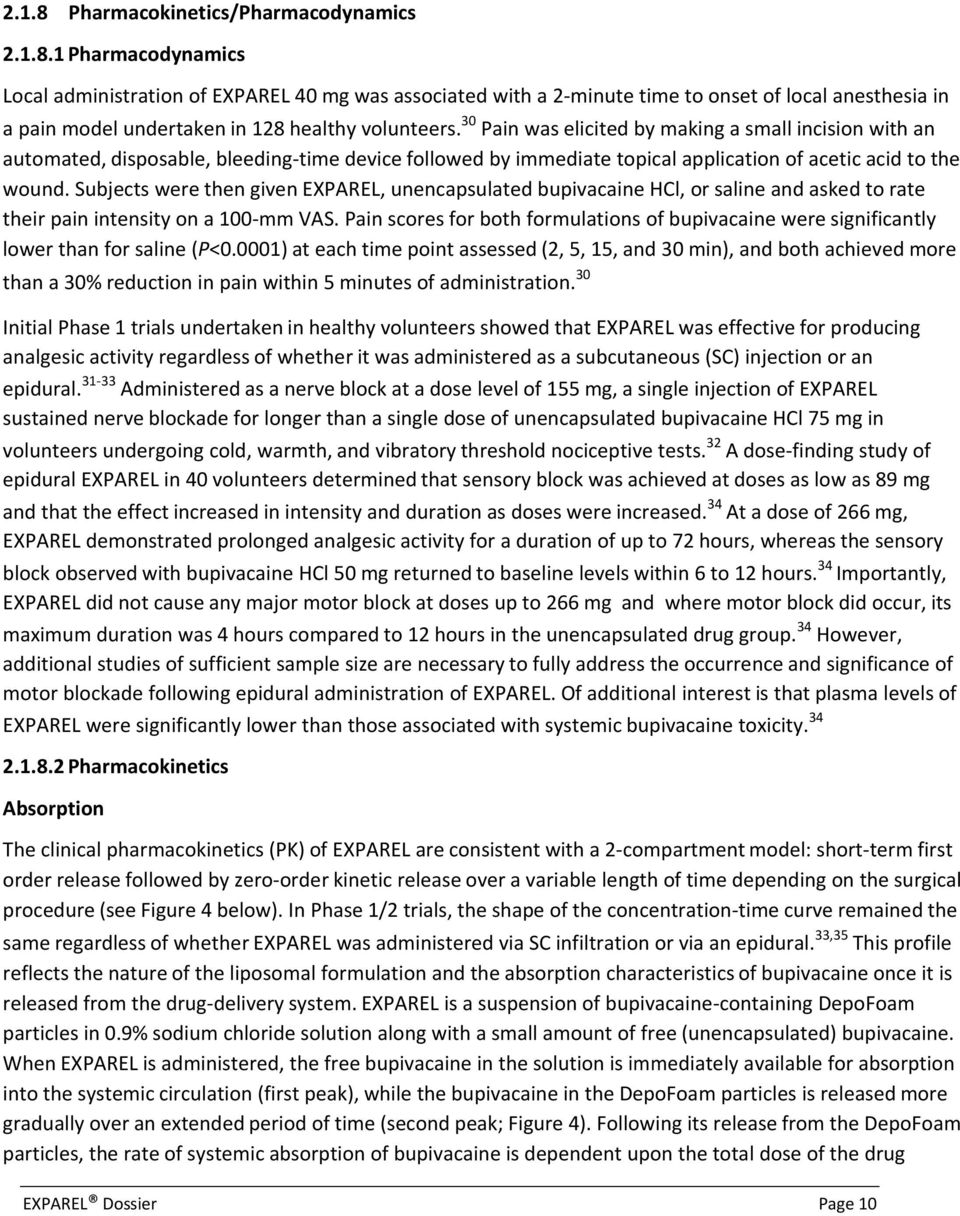
11 administered, the route of administration, and the vascularity of the administration site. 36 Figure 4. Absorption profile of EXPAREL vs bupivacaine HCl following local infiltration in men undergoing inguinal hernia repair 6 Because the kinetics of unencapsulated bupivacaine HCl differ in relation to the dose level, administration route, and vascularity of the administration site, 36 the PK parameters of EXPAREL after local administration were evaluated in several surgical procedures, including bunionectomy and hemorrhoidectomy (Table 2) EXPAREL Dossier Page 11

12 Table 2. Summary of pharmacokinetic parameters for bupivacaine after administration of single doses of EXPAREL and bupivacaine HCl 106 mg <3 cm Dose and Surgery/Incision Size 266 mg 3 cm 532 mg Major Orthopedic/ Reconstructive 100 mg 3 cm Parameter* [1] EXPAREL Bupivacaine HCl Inguinal Total Knee Inguinal Bunionectomy Hemorrhoidectomy Hernia Study Arthroplasty Hernia Study Study 317 Study 316 (N=25) 402 C 201 Study (N=26) (N=12) (N=16) (N=27) C max (ng/ml) 166 (92.7) 867 (353) 365 (128) 935 (371) 336 (156) T max (h) AUC (0 t) (h ng/ml) AUC (inf) (h ng/ml) 5864 (2038) 16,867 (7868) 7105 (2283) 18,289 (7569) 16,028 (5455) 16,758 (6288) 58,717 (24,218) 4360 (1559) 60,174 (25,117) 4372 (1560) t ½ (h) 34.1 (17.0) 23.8 (39.4) 14.6 (4.64) 16.9 (4.78) 8.47 (2.89) *Arithmetic mean (standard deviation), except T max (median). As shown in Table 2, there is a dose related increase in the mean maximum plasma concentration (C max ) of bupivacaine after EXPAREL doses of 106 mg, 266 mg, and 532 mg were administered into the surgical site in bunionectomy, hemorrhoidectomy or inguinal hernia repair, and major orthopedic/reconstructive surgical procedures (such as TKA wounds), respectively. Mean values for the area under the plasma concentration time curve (AUC 0 t ) were comparable for both 266 mg doses administered to large wounds, and the exposure was 2.3 fold greater than after administration of 106 mg doses to small wounds, consistent with the 2.5 fold difference in dose. There was a 3.6 fold increase in AUC 0 t between the 266 mg doses administered to large wounds and the 532 mg dose administered to major orthopedic/reconstructive wounds. This greater thandose proportional increase in exposure after administration by infiltration is consistent with the cross study analysis of the effect of dose on exposure. Distribution After bupivacaine has been released from EXPAREL and is absorbed systemically, bupivacaine distribution is expected to be the same as for any bupivacaine HCl solution formulation. Local anesthetics, including bupivacaine, are distributed to some extent to all body tissues, with high concentrations found in highly perfused organs such as the liver, lungs, heart, and brain. EXPAREL Dossier Page 12
![Orthopedic/ Reconstructive 100 mg 3 cm Parameter* [1] EXPAREL Bupivacaine HCl Inguinal Total Knee Inguinal Bunionectomy Hemorrhoidectomy Hernia Study Arthroplasty Hernia Study Study 317 Study 316](/docs-images/40/7254918/images/page_12.jpg "(N=25) 402 C 201 Study 208 201 (N=26) (N=12) (N=16) (N=27) C max (ng/ml) 166 (92.7) 867 (353) 365 (128) 935 (371) 336 (156) T max (h) 2 0.5 12 36 0.")
13 Local anesthetics, including bupivacaine, appear to cross the placenta by passive diffusion. The rate and degree of diffusion is governed by: The degree of plasma protein binding, The degree of ionization, and The degree of lipid solubility Fetal/maternal ratios of local anesthetics appear to be inversely related to the degree of plasma protein binding, because only the free, unbound drug is available for placental transfer. Bupivacaine with a high protein binding capacity (95%) has a low fetal/maternal ratio (0.2 to 0.4). The extent of placental transfer is also determined by the degree of ionization and lipid solubility of the drug. Lipid soluble, non ionized drugs such as bupivacaine readily enter the fetal blood from the maternal circulation. Metabolism Amide type local anesthetics, such as bupivacaine, are metabolized primarily in the liver via conjugation with glucuronic acid. Pipecolylxylidine (PPX) is the major metabolite of bupivacaine; approximately 5% of bupivacaine is converted to PPX. Elimination of drug depends largely upon the availability of plasma protein binding sites in the circulation to carry it to the liver where it is metabolized. Various PK parameters of the local anesthetics can be significantly altered by the presence of hepatic disease. Patients with hepatic disease, especially those with severe hepatic disease, may be more susceptible to the potential toxicities of the amide type local anesthetics. Excretion After bupivacaine has been released from EXPAREL and is absorbed systemically, bupivacaine excretion is expected to be the same as for other bupivacaine formulations. The kidney is the main excretory organ for most local anesthetics and their metabolites. Only 6% of bupivacaine is excreted unchanged in the urine. Urinary excretion is affected by urinary perfusion and factors affecting urinary ph. Acidifying the urine hastens the renal elimination of local anesthetics. Various PK parameters of the local anesthetics can be significantly altered by the presence of renal disease, factors affecting urinary ph, and renal blood flow Contraindications Warnings/Precautions/Adverse Effects Warnings and Precautions for Bupivacaine Containing Products See Package Insert. EXPAREL Dossier Page 13

14 Chondrolysis EXPAREL is not approved for intraarticular use. There have been a number of reports, dating back to in vitro work of Chvapil and colleagues in 1979, concerning the impact of bupivacaine and other local anesthetics on cartilage viability. Several cases of chondrolysis have been reported over the past decade in patients who were exposed to various intraarticular doses of bupivacaine, although the medical attribution of these is uncertain. Notably, these reports had been following bupivacaine infusion directly into the joint. There have been no cases reported of cartilage damage resulting from local, single dose administration of bupivacaine into a non joint surgical wound and no cases of chondrolysis observed with EXPAREL to date. Nonetheless, since EXPAREL contains bupivacaine, Pacira has done exploratory work in this area with EXPAREL. This includes preclinical studies, outcome studies in the orthopedic setting, and tissue distribution studies. The distribution of bupivacaine following wound infiltration of EXPAREL around the knee joint was examined in a Phase 2 TKA trial to assess how the joint concentrations of bupivacaine compared to a direct intraarticular infusion of doses of bupivacaine associated with chondrolysis. 11,40 A total of 138 patients were administered either EXPAREL (133 mg, 266 mg, 399 mg or 532 mg) or unencapsulated bupivacaine HCl (150 mg) by wound infiltration close to the intraarticular space. 11,40 Fluid was then collected from drainage tubes that had been placed into the intraarticular space for 12 hours post injection. The amount of bupivacaine recovered was similar, whether the injection was bupivacaine HCl or EXPAREL; the total was less than 6 mg. 40 For comparison, the amount of bupivacaine exposed to the intraarticular space in the case of bupivacaine based pain pump infusions (such as On Q, I Flow) is 150 mg over 12 hours. 41,42 Toxicology Studies Preclinical work has included two pivotal toxicology studies in which a total of 40 dogs and 40 rabbits underwent meniscectomy and osteochondral debridement (a standard intraarticular surgical model). The animals had been dosed with either EXPAREL (1.5 or 4.5 of 15 mg/ml or 7.5 mg/kg of 25 mg/ml), or bupivacaine HCl (7.5 mg/ml), or saline, and then sacrificed at Day 3 or Day 15. A longitudinal section through the femur and tibio femoral joint, slated to go through the osteochondral lesion site (approximately in the midline of the femur), was then examined. No effect on wound healing was present, and there was no effect on histopathology of the surgical sites other than the expected hemorrhage/acute inflammation on Day 3 and fibrosis/neovascularization on Day 15. In sum, there was no evidence of bupivacaine induced chondrocyte toxicity in the articular cartilage and meniscus in either the EXPAREL or bupivacaine animals. It must be emphasized, however, that bupivacaine induced chondrocyte toxicity is an infrequent event and therefore many toxicology studies with bupivacaine have not resulted in observation of chondrolysis. EXPAREL Dossier Page 14

15 EXPAREL Studied in Orthopedic Surgical Models The effect of EXPAREL on new bone formation was examined in a placebo controlled Phase 3 bunionectomy trial in 186 patients receiving either EXPAREL 106 mg or placebo (saline) by determining the incidence of mal union or non union. The potential for impact on bone healing following EXPAREL infiltration into the bunionectomy site was collected by a follow up physical exam and/or a foot radiograph at approximately 2 to 3 months postsurgery. No abnormal findings in the EXPAREL group were noted. An additional study of the area of numbness after SC injection provided indirect evidence that EXPAREL, when administered via wound infiltration, will largely remain in the infiltrated area. In a Phase 1 study, nine healthy volunteers were injected subcutaneously with EXPAREL or bupivacaine and the surface area of anesthesia at 24 hours was measured. This study demonstrated that the area of bupivacaine spread in the EXPAREL formulation, as determined by reduced sensitivity to pin prick sensation, was no greater than that of bupivacaine and suggests that local delivery of EXPAREL near a joint will not diffuse more readily into the intraarticular surface than bupivacaine. Summary of Findings In reviewing the totality of data, including the orthopedic literature, animal, volunteer, and patient studies, there does not appear to be an increased risk to chondrocytes or cartilage when EXPAREL is used via local administration to the surgical (non joint) wound, particularly in light of its single use administration compared to locally administered bupivacaine. EXPAREL or bupivacaine HCl, when administered by wound infiltration, exposes chondrocytes to comparable doses of bupivacaine and this is substantively less than when bupivacaine is given into a joint space by continuous infusion. However, the clinical trial database for EXPAREL is not of sufficient size to detect very low incidence events. EXPAREL is contraindicated in obstetrical paracervical block anesthesia. While EXPAREL has not been tested with this technique, the use of bupivacaine HCl with this technique has resulted in fetal bradycardia and death Adverse Effects A total of 823 human subjects undergoing various surgical procedures received EXPAREL by local administration into the surgical site in 10 randomized, double blind clinical studies. 15 There were adequate numbers in the 65 years of age category (171 subjects); in the 75 years of age category (47 subjects), and the ASA Class 3 4 category (135 subjects). These sample sizes are sufficient to allow a meaningful assessment of EXPAREL safety in these subgroups. Across all studies, doses ranged from 9 mg to 665 mg and were administered by various routes: local administration into the surgical wound, subcutaneous, perineural, and epidural. In the Phase 2 and Phase 3 studies, the highest dose of EXPAREL administered was 532 mg. 37 EXPAREL has been generally well tolerated. The most common adverse reactions associated with EXPAREL during controlled clinical trials of local administration into a surgical wound were nausea, constipation, and vomiting. 15 Across all study pools, EXPAREL Dossier Page 15

16 most of the TEAEs were assessed as mild or moderate in severity and unrelated to study drug. 15 In clinical studies with an active control, no clinically relevant differences between EXPAREL and bupivacaine HCl were observed regarding the frequency, severity, or relationship to study medication of TEAEs. 15 In the pooled analysis of Phase 2 and 3 studies, the percentage of patients who exhibited at least one TEAE for EXPAREL, bupivacaine HCl, and placebo were 62%, 75%, and 43%, respectively. 14,15 See package insert for listing of TEAEs. Cardiac Safety Pacira has examined the cardiac safety of EXPAREL from several different vantage points, including animal studies, which led to two International Conferences on Harmonisation (ICH) E14 compliant electrocardiogram (ECG) studies and a total of 21 clinical studies, including: One trial in which Holter monitoring was performed Seven trials in which ECGs were obtained at one or multiple timepoints Sixteen patients who, after local administration into the surgical wound, had a plasma bupivacaine C max greater than 1000 ng/ml. In this program, no cardiac signal of any kind has been detected. The safety of EXPAREL is emphasized given its single use administration, often in a monitored postsurgical setting. In animal studies, a repeat dose study in dogs was conducted with no qualitative or quantitative abnormalities on ECG measurements caused by EXPAREL noted at doses up to three times greater than the maximum human single dose used in clinical studies of 532 mg (10 mg/kg), on a body weight comparison. Impact of EXPAREL on QT Interval Pacira conducted two studies to obtain definitive cardiac safety data as recommended by the ICH E14 guidance. A single center, Phase 1, randomized, double blind, placebo and positive controlled, five way, crossover study in 49 healthy volunteers evaluated the effects of two dose levels of EXPAREL on the QT interval (including standard corrections for heart rate, termed either the QTc, QTcF, QTcB) when administered subcutaneously. This was extended to a second study to evaluate two additional higher doses (532 mg and 665 mg) in 16 of the same subjects to be certain that an adequate supratherapeutic dose was studied. 43 The results of the QTc analysis show that the largest corrected time matched mean difference from placebo was 7.67 milliseconds (ms) for EXPAREL 665 mg and 3.60 ms for EXPAREL 532 mg. These values (and their surrounding 90% confidence intervals) indicate that a single dose of EXPAREL 665 mg or 532 mg does not prolong QTc interval. Additionally, no subjects on EXPAREL 665 mg or EXPAREL 532 mg had increases from baseline in QTc corrected analyses which were >60 ms, or absolute values >500 ms. Together, the findings of these studies demonstrate that a single dose of EXPAREL at doses up to 665 mg does not prolong the QTc interval. The mean C max for the 532 mg dose and 665 mg dose in these healthy volunteers was ng/ml and ng/ml, respectively. EXPAREL Dossier Page 16

17 Impact of EXPAREL on ECG Parameters Another Phase 1 study was performed in 30 patients given doses up to 266 mg of EXPAREL epidurally. Holter monitoring was performed with ECG snapshots obtained at 4 hours postdose, time to maximum plasma concentration (T max ), and 24 hours postdose. There was no significant effect seen for treatment alone, assessment time alone, or treatment assessment time interaction indicating that none of these variables had a significant effect on the change in QTcF from baseline value. Regression analysis showed that there was no significant correlation between any of the ECG parameters (QTcB, QTcF, PR interval, and QRS complex) and C max. 44 A Phase 2 study examined ECG findings from 138 patients with doses up to 532 mg via wound infiltration in TKA. 44 Patients received 133 mg, 266 mg, 399 mg, or 532 mg of EXPAREL (n=28, 25, 26, and 25, respectively) or 150 mg bupivacaine (n=34). The mean change from baseline in mean heart rate (HR) across the entire time of observation after the single dose of EXPAREL was similar across all dose levels, in a range of beats per minute (bpm) compared to the 13 bpm change for the 150 mg dose of bupivacaine. The mean change from baseline in mean PR duration across the entire time of observation after the single dose of EXPAREL was similar across all dose levels in a range of 5 to 11 ms compared to the 6 ms change for the 150 mg dose of bupivacaine. The mean change from baseline in mean QTcF duration across the entire time of observation after the single dose of EXPAREL was similar across all dose levels in a range of 7 to 10 ms compared to the 6 ms change for the 150 mg dose of bupivacaine. These changes were similar, and are summarized in Table 3. Table 3. HR, and PR and QTcF duration changes with EXPAREL Change in HR Change in PR Duration Change in QTcF Duration EXPAREL bpm 5 to 11 ms 7 to 10 ms Bupivacaine 13 bpm 6 ms 6 ms Program wide Cardiac Safety Database 43 Throughout the entirety of the clinical program, 1307 patients/volunteers have been exposed to EXPAREL, including 823 in the wound infiltration setting. There have been no cardiac deaths. Analysis of the 823 patients for pre specified cardiac and cardiac related events revealed a similar AE rate in EXPAREL patients (1.7%) and in the 446 bupivacaine patients in the program (1.8%). The most common cardiac TEAEs were tachycardia (3.9% incidence) and bradycardia (1.6%). 15 Other cardiac TEAEs occurring at an incidence of <2% included syncope, hypertension, hypotension, palpitations, and supraventricular or ventricular extrasystoles. 37 Across the program, a total of 16 patients after administration of EXPAREL via wound infiltration reached a bupivacaine C max >1 mg/l (maximum plasma bupivacaine concentration 1.57 mg/l). The AE profile in these subjects was reviewed, and no consistent cardiac or CNS profile emerged. Three additional patients in the EXPAREL Dossier Page 17

18 Phase 2 TKA study were identified who had PK values consistent with inadvertent intravascular injection (maximum plasma bupivacaine concentration 34.3 mg/l). None of these patients had a clinically relevant change from baseline in any ECG interval, including HR, PR, RS, QT, and QTcB. 45 Furthermore, no relevant changes in QTcF were noted Interactions Drug/Drug Some physicochemical incompatibilities exist between EXPAREL and several other drugs. Direct contact of EXPAREL with these drugs results in a rapid increase in free (unencapsulated) bupivacaine, altering EXPAREL characteristics. Therefore, admixing EXPAREL with other drugs prior to administration is not recommended. EXPAREL is not to be admixed with any other product in the same syringe. Even with this caution, however, the potential may exist that EXPAREL could be used in combination with other drug products. Co administered drug products known to interact with EXPAREL, however, may potentially adversely affect the properties of EXPAREL and may lead patients to be exposed to potentially toxic levels of bupivacaine. Physicochemical interactions of EXPAREL with several types of drug products that could be coadministered were evaluated in several studies. It was found that some drug products could cause rapid release of bupivacaine from the multivesicular liposome, and as such, are not compatible with EXPAREL and should be avoided. The interaction potential of the more commonly locally administered drugs or antiseptics with EXPAREL are outlined below. In addition, the compatibility of EXPAREL with commonly employed surgical materials is also discussed: Lidocaine and Other Non Bupivacaine Based Local Anesthetics All non bupivacaine based local anesthetics (such as lidocaine, ropivacaine, mepivacaine) have a strong interaction with EXPAREL. If they are mixed with EXPAREL, there will be an immediate displacement of the bupivacaine from the DepoFoam matrix. This displacement is the result of lidocaine and similar nonbupivacaine based local agents having a higher affinity for DepoFoam than bupivacaine. As a result, the dose of free bupivacaine will be increased and will not be predictable, and patients may be exposed to potentially toxic levels of bupivacaine. Local administration of EXPAREL and lidocaine must be separated by at least 20 minutes to mitigate this displacement. EXPAREL can be administered in the same area at least 20 minutes after it was infiltrated with the other non bupivacaine based local anesthetics. Regarding lidocaine, Table 4 demonstrates the potential increase in the C max when clinically relevant doses of lidocaine and EXPAREL are given at specific times after one another. EXPAREL Dossier Page 18

19 Table 4. Impact of time between lidocaine and EXPAREL administration on C max Time between lidocaine and EXPAREL Plasma bupivacaine C max 5 Minutes 1000% Increase 10 Minutes 67% Increase 20 Minutes No Increase Therefore, if lidocaine is administered at the beginning of a case, and the case lasts for at least 20 minutes, EXPAREL can be infiltrated at the close of the procedure for postsurgical analgesia. Bupivacaine Bupivacaine HCl products, such as Marcaine and Sensorcaine, demonstrate only a minor interaction with EXPAREL. The higher the ratio of local anesthetic to EXPAREL during co administration, the more bupivacaine is rapidly released from EXPAREL. At a 2:1 or higher ratio of EXPAREL to bupivacaine HCl, less than 10% of encapsulated bupivacaine is released from EXPAREL. These drugs could be co administered in the same infiltration area when using that ratio or greater. Specifically, this means that if the plan is to use 266 mg (molar equivalent to 300 mg of bupivacaine HCl) of EXPAREL, up to 150 mg of bupivacaine HCl could be co administered in the same infiltration area without substantially impacting the bupivacaine release from EXPAREL. Topical Antiseptics Topical antiseptics, such as povidone iodine (Betadine ) or chlorhexidine (Hibiclens ), demonstrated a strong interaction with EXPAREL when the solutions are admixed. This is due to the surface active nature of antiseptics interacting with lipids. However, if topical antiseptics are applied to the skin surface and allowed to dry prior to local administration of EXPAREL, no interactions were demonstrated, and thus, this is not expected in normal clinical practice. Epinephrine Epinephrine (with and without stabilizers) demonstrated a minor interaction. This drug could be coadministered in the same infiltration area as EXPAREL. Corticosteroids Corticosteroids (such as Kenalog and DepoMedrol ) showed little to no interaction, particularly at clinically relevant doses. These drugs could be co administered in the same infiltration area as EXPAREL. Gentamicin, Bacitracin, and Cefazolin Antibiotics Antibiotics (such as gentamicin, bacitracin, and cefazolin) had no interaction with EXPAREL and could be co administered in the same infiltration area. EXPAREL Dossier Page 19

20 Ketorolac Non steroidal anti inflammatory drug (NSAID) pain medications (such as ketorolac) showed essentially no interaction and could be co administered in the same infiltration area as EXPAREL. Opioids Opioids (such as morphine sulfate) have essentially no interactions. Opioid medications and EXPAREL could be co administered in the same infiltration area. The degree of bupivacaine release from EXPAREL was cumulative of the individual drugs studied, and no synergistic effects were found. In other words, if EXPAREL were co administered in the same infiltration area as two other products, each of which is listed above, then the two products together would also have no interaction. Surgical Materials Additionally, the compatibility of EXPAREL with several materials frequently used in surgery including polypropylene, expanded polypropylene (PTFE) mesh, silicon shells from breast implants (both textured and smooth), stainless steel, and titanium alloys was studied. Results from clinically relevant exposure studies conducted between EXPAREL and these most common implantable materials (outlined above) demonstrated that none of these materials are affected by the presence of EXPAREL any more than they would be from saline (representing normal body fluids), and none of the materials have a significant adverse effect on key EXPAREL physical/chemical/release properties Drug/Food None Specific Populations/Disease Pregnancy Category C See package insert Pediatric use Safety and effectiveness in pediatric patients below the age of 18 have not been established. Geriatric use See package insert In general, similar responses in the AUC of NRS R scores across the age groups were seen for EXPAREL and placebo in the All Wound Infiltration Studies as in the combined data for the two pivotal studies, and the comparisons of EXPAREL to bupivacaine HCl across age groups did not appear to show any relationship of efficacy to age of the subjects. Furthermore, No overall differences in safety were observed between these patients and younger patients. EXPAREL Dossier Page 20

21 Hepatic Impairment Because amide type local anesthetics, such as bupivacaine, are metabolized by the liver, these drugs should be used cautiously in patients with hepatic disease. Patients with severe hepatic disease, because of their inability to metabolize local anesthetics normally, are at a greater risk of developing toxic plasma concentrations. The effects of decreased hepatic function on the PK of EXPAREL (following local infiltration) were studied by comparing volunteers with moderate hepatic impairment with age, gender, and weight matched normal controls. 52 Subjects were given a single dose of EXPAREL 266 mg and PK parameters were assessed for the next 21 days. Concentration time curves for bupivacaine were consistent with the drug s hepatic clearance route. Mean plasma concentrations were higher in subjects with moderate hepatic impairment than in the healthy control volunteers with approximately 1.5 and 1.6 fold increases in mean C max and AUC values, respectively (Table 5). 37 The ratio of free to total protein binding was also increased, being 50% higher in those with moderate hepatic impairment vs normal hepatic function. 53 However, these differences may not be clinically meaningful due to the dynamic equilibrium between the bound and free fractions of bupivacaine. Table 5. Influence of hepatic function on bupivacaine PK after EXPAREL administration 36,37 Mean (standard deviation) Moderate hepatic impairment Normal hepatic function (n=9) (n=9) C max (ng/ml) (42.6) (37.7) T max (h) 42.7 (28.2) 54.7 (28.8) AUC (0 last) (h ng/ml) 17,177.8 (2349.3) 10,682.7 (4392.6) AUC (0 ) (h ng/ml) 17,975.5 (2447.0) 11,050.7 (4498.8) Half life (h) 46.5 (26.3) 37.6 (9.8) Cl/F (L/h) 17.0 (2.2) 31.2 (11.5) Vd/F (L) (624.4) (861.9) Renal Impairment See package insert Dosing and Administration EXPAREL is a liposomal injection of bupivacaine which is administered as a single dose locally into surgical wounds to produce postsurgical analgesia. EXPAREL should be injected slowly, deep into soft tissue and the dosage level should be guided by the surgical site and the volume required to cover the area (Table 6). EXPAREL can be injected through needles as narrow as 25 gauge with no impact on particle integrity or drug encapsulation. 54 EXPAREL was studied in bunionectomy and hemorrhoidectomy surgeries in the two pivotal trials EXPAREL Dossier Page 21
22 submitted as the basis of efficacy for drug approval. Table 6. EXPAREL dosing used in pivotal trials Surgery Dose of EXPAREL Volume of EXPAREL Bunionectomy 106 mg 8 ml Hemorrhoidectomy 266 mg 20 ml Access There is no anticipated risk for drug shortages. There are no prescribing limitations Co Prescribed/Concomitant Therapies There are no co prescribed medications. EXPAREL may be used alone or as part of a multimodal approach to postsurgical pain control. EXPAREL may be diluted with 0.9% saline (up to 0.89 mg/ml; i.e., 1:14 dilution by volume). Lactated Ringer's solution has been used in place of saline to provide sufficient volume to cover the surgical area for infiltration. 55 EXPAREL has been tested along with various antibiotics commonly used in surgical procedures. Antibiotic Cocktail Three antibiotics; bacitracin, cefazolin, and gentamycin are commonly used during breast implant operations. A triple antibiotic cocktail was prepared according to Table 7 below. EXPAREL was manufactured at 40L scale and stored for approximately 5 months at 2 C to 8 C before initiation of the study; during manufacture it was concentrated to potency by decanting of the supernatant after initial bulk settling. 55 EXPAREL was mixed with 20 ml of the antibiotic cocktail and incubated at 37 C (1INC 26) for 1, 2, 4 and 24 hours. Controls, consisting of 15 ml of lot 07PD 002 mixed with 20 ml of 0.9% saline, were also incubated 37 C at the same intervals. Table 7. Triple antibiotic cocktail 55 Antibiotics Bacitracin Cefazolin Manufacturer Pharmacia & Upjohn Watson l. of diluent used 9.8 ml of 0.9% saline 2.5 ml of MilliQ water Vol. used to prepare cocktail (ml) Gentamycin Hospira Used as is 1.0 Total volume after dilution with 0.9% saline (ml) 250 For the antibiotic cocktail compatibility mixture, the percentage of free bupivacaine, ph, and PSD (d10, d50 and d90) showed very little change between the control and the sample over the 24 hour period. At the end of the 24 hour incubation, the % free bupivacaine increased from 4.7% to 5.4%, ph decreased from 6.5 to 6.3 and the median (d50) particle size increased from 27.9 µm to 29.4 µm. 55 EXPAREL Dossier Page 22
23 Comparison Products Different formulations of bupivacaine are not bioequivalent at the same milligram strengths, their bioavailability (rate and extent of availability) are not similar enough to the extent that their effects can be expected to be essentially the same. Therefore, it is not possible to convert dosing from other formulations to EXPAREL. 2.2 Place of the Product in Therapy Disease Description Surgical procedures can produce tissue damage and pain from 3 separate quarters: somatic tissue (bone, joint, muscle, skin or connective tissue), visceral (caused by damage to/manipulation of the viscera or chest cavity), and the nervous system. 56 Somatic or visceral pain is evoked when noxious thermal, mechanical, and/or chemical (e.g., release of potent inflammatory mediators) stimuli are detected by peripheral nerve fiber nociceptors. Nociceptors in visceral structures are highly sensitive to stretch, ischemia, and inflammatory mediators, while somatic tissue contains nociceptors of both deep (tendons, bones, blood vessels, muscles, etc.) and superficial (skin) origin. Neuropathic pain occurs when neurons are directly impaired or damaged as a result of the procedure. 56 The degree to which a patient experiences one or more of these types of pain is determined by the type and duration of the surgery they undergo. 56 Beyond the initial assault (surgery), pain also arises from ongoing stimuli during the recovery phase when inflammatory mediators released around the incision site sensitize nociceptors in the normally silent primary afferent neurons (Aδ and C fibers). 56,57 No single anesthetic/analgesic is able to target all 3 types of pain (e.g., local anesthetics target only somatic pain), prompting physicians to explore a multimodal approach that utilizes different combinations of agents in the pursuit of effective postsurgical pain relief. The majority of patients who undergo surgery of any kind experience pain that persists for at least several days, or longer if they have undergone more extensive surgery. 16,17,58 60 Appropriate postsurgical pain management is therefore important to improve healing, fast track patient mobilization, shorten hospital stays (in relation to extensive surgery), and reduce costs. 24,61, Disease Burden Epidemiology Approximately 100 million surgical procedures are performed every year in the United States. The most recent figures from the US Department of Health and Human Services state that 53.3 million surgical and nonsurgical procedures were performed during 34.7 million ambulatory surgery visits and 46.7 million inpatient procedures were undertaken in ,64 Other national surveys have found that, among patients undergoing surgery, approximately 80% report pain that is moderate, severe, or extreme in intensity during the 2 weeks immediately following the procedure. 16,17 The most intense pain occurs on days 1 and 2 postprocedure with VAS indicating pain of moderate (score of 4 6) or severe (7 10) intensity particularly during the first 24 hours The more extensive the surgery, the more prolonged and intense the pain. 16,17 Unrelieved acute pain not only causes unnecessary patient suffering, it can also lead to other health EXPAREL Dossier Page 23
24 problems, thus delaying recovery from surgery and hospital discharge, and resulting in higher healthcare costs. 65,66 Controlling acute postsurgical pain is also important because the intensity of acute pain is a predictor of ongoing chronic pain postsurgery. 59,67 The incidence and severity of postsurgical pain can vary significantly from patient to patient, but is primarily determined by the type and duration of the surgery and the type of pain relief given intra and postoperatively ,67,68 Approximately 25% to 40% of patients will experience moderate to severe pain within 24 hours of minor types of surgery (i.e., procedures that can be accomplished in the ambulatory setting), 18,19,21 while approximately 80% to 90% of inpatients experience moderate to extreme pain for up to 2 weeks following surgery. 16,17 After discharge, pain may continue to interfere with daily activities (e.g., sleep, work) for several days, 18,69 and the occurrence of severe pain at home may reflect inadequate pain control during the first few hours after surgery Societal, Humanistic, and/or Economic Burden The ASA states that undertreated postsurgical pain may increase the risk of thromboembolic and pulmonary complications, the length of hospital and/or intensive care stay and hospital readmission rates, impair health related quality of life, and increase the risk of developing chronic pain. 24 An analysis by the US Department of Health and Human Services Agency for Healthcare Research and Quality (AHRQ) of more than 7000 published studies found that pain relief is inadequate in >50% of patients given conventional therapy following surgery, 65 and that such patients continue to feel pain of moderate to severe intensity. 65,70 The AHRQ recommends that physicians establish pain control plans prior to surgery and ensure that patients are informed about what to expect because administering pain medication on an as needed basis can lead to long delays triggered by patient reluctance to ask for help. 65 Long delays may then be associated with adverse sequelae because once pain is established, it is more difficult to suppress. Aggressive prevention of pain is therefore better than treatment. 65 Furthermore, the economic consequences of under managed postsurgical pain are many and varied, and more aggressive management could reduce inpatient costs 61 as well as costs due to pain related readmissions among day surgery patients. 62 The main costs associated with inpatient postsurgical pain management are for the drugs and devices used, nursing care, and the daily charges for time spent in hospital. 71 The hospital LOS is the primary driver of cost and any surgical or analgesic related complications in the acute postsurgical period can lengthen LOS and increase costs. 71 Aggressive use of evidence based acute pain management practices in hospitals can lead to reductions in LOS, hospital service costs and daily total costs to produce savings of more than $1,500 per inpatient stay. 61 Opioids are a mainstay of postsurgical pain control, 72 but are associated with a variety of unwanted and potentially severe side effects such as respiratory depression, drowsiness and sedation, postsurgical nausea and vomiting, pruritus, urinary retention, and ileus. ORADEs tend to increase in frequency with higher dosages, 73 and significantly increase LOS and the cost of care in postsurgical patients Increased costs are often related to the greater nursing time and monitoring associated with the risk and/or EXPAREL Dossier Page 24
25 occurrence of delirium 77 or respiratory depression, 78 or the prolonged LOS caused by infection, 79 noninfectious complications (e.g., falls), 80 and delayed ambulation 80 associated with urinary catheterization. Opioids have been shown to be problematic in key patient populations, including: Elderly Comorbid airway disease (asthma, chronic obstructive pulmonary disease, obstructive sleep apnea) Chronic opioid users The recovery process following ambulatory surgery is also highly dependent on the effectiveness of pain management, with high pain scores predicting increased recovery time and delayed discharge. 66 In addition, there is a clear need for better and more prolonged pain relief after discharge for ambulatory patients. As many as 30% to 40% of day surgery patients experience moderate to severe pain following hospital discharge and as many as 25% experience breakthrough pain that requires subsequent contact with a healthcare provider. 18,62 Pain is a major factor contributing to unanticipated admissions or readmissions following prior day surgery, 62,81 83 and the inability to effectively control post discharge pain in ambulatory patients leads to excess healthcare resource utilization and increases the overall economic burden. One study estimated that the mean charge for a patient with an unanticipated admission/readmission due to pain was $1,869 per visit. Return visits to the emergency department due to pain were significantly more costly than returns not due to pain ($986 vs $729, respectively). In total, day surgery patients unexpectedly returning to the hospital because of pain within 30 days of their procedure cost the institution an extra $218,756 that year. 62 The indirect costs of poor pain management (e.g., lost productivity, caregiver time) have not been estimated for patients with acute postsurgical pain. However, it can be assumed that any prolongation of recovery time consequent to uncontrolled pain is likely to increase productivity losses, and if inadequate management of acute pain leads to the development of chronic pain, indirect costs may be further increased. 71 The indirect cost associated with time spent managing the AEs of pain medication should also be considered, but this has yet to be formally studied Approaches to Treatment Postsurgical pain management is challenging and complex, because the pathophysiology of postsurgical pain is multifaceted. The current approach to treatment is therefore to employ a multimodal or balanced treatment approach using a variety of analgesic modalities, preventing postsurgical pain by combining opioid and non opioid agents that act at different sites within the central and peripheral nervous systems to provide a broad spectrum of pain relief. While the main aim is to effectively reduce pain using all the pharmacological tools currently available, there is an increasing secondary drive toward minimizing opioid use and thus opioid related side effects (approximately 98% of patients currently receive opioids for postsurgical pain relief in the United States). 68,81 This in turn hastens the recovery EXPAREL Dossier Page 25
26 process, allows fast tracking of patient ambulation and return to normal activities, and so reduces hospital stays and their associated costs. Additionally, proactive multimodal pain management may have benefits in decreasing the wind up (central sensitization) and conversion to chronic, long term pain. There are 4 main classes of pharmacotherapy used for postsurgical analgesia. The regional anesthetic agents (amides such as bupivacaine and lidocaine, and esters such as procaine) act by binding to neuronal sodium channels and blocking nerve impulses. The opioids (e.g., morphine, fentanyl) agonize or antagonize endogenous opiate receptors, while the NSAIDs and acetaminophen mediate pain relief through antiinflammatory pathways, such as the cyclooxygenase enzyme. Glucocorticoids are also anti inflammatory agents, but their mechanism of action remains unclear. The choice of a particular agent or combination of agents, as well as the route of administration, is driven by a number of factors including: type of surgery, patient population (e.g., children, elderly), and the potential magnitude of the postsurgical pain intensity, as well as a thoughtful assessment of the risk and benefits of each modality for each individual patient. 24,56,72 Typically, surgeons initiate postsurgical pain relief intra operatively or at the end of surgery with the administration of local anesthetics/analgesics such as bupivacaine HCl at the surgical site. Local agents are very effective, but relatively short acting (bupivacaine HCl is one of the longest acting agents with a duration of approximately 7 hours). 36 Multimodal approaches that use local anesthetics/analgesics improve postsurgical pain scores and facilitate earlier hospital discharge as well as provide a means of reducing opioid use. 66 Some experts recommend that infiltration of local anesthetics into a surgical incision should be a component of all multimodal techniques used for superficial procedures (e.g., inguinal herniorrhaphy, breast, anorectal surgery, and knee/shoulder arthroscopy). 84 Even for more invasive surgical procedures, infiltration of local anesthetics has been shown to diminish intra and postsurgical opioid requirements and ORAEs. 84 Following the establishment of the initial local anesthetic/analgesic pain relief platform, most physicians initiate some form of opioid treatment in the immediate postsurgical period, often via epidural or intravenous PCA systems. As described earlier, monitoring for and managing ORAEs in patients who receive opioids is a significant contributor to the cost of care in postsurgical patients Elastomeric pumps are pressurized reservoir balls which administer a continuous flow of analgesic to the wound site via a catheter and allow these agents to be used for several days following cardiovascular, urologic, gynecologic, obstetric, orthopedic, and general surgical procedures. 85,86 However, after a decade of use, it is becoming clear that elastomeric pumps are associated with numerous drawbacks, including medication errors (filling with the wrong medication, use of nonstandard concentrations, inaccurate filling that affects infusion rates), deflation problems leading to insufficient analgesia, use of the pump for an inappropriately long time, and the need for intensive staff education on their use (and the pitfalls of inadequate training) Similarly, PCA systems present technical challenges during set up and require maintenance and monitoring, which impose a significant burden on staff. As with elastomeric pumps, medication errors are common during PCA (e.g., programming mistakes, EXPAREL Dossier Page 26
27 nomenclature errors, conversion mistakes, battery errors), and the use of a catheter increases the risk of infection and other catheter issues (e.g., migration, leakage, disconnection, incorrect placement), which can result in paresthesia or insufficient pain control Oversights that result in overdosing can be particularly problematic with subsequent oversedation, respiratory depression, and/or death. 90 Although the main goal of multimodal therapy is to maximize the analgesic effect, both national and international guidelines emphasize that this must be balanced against any undesirable side effects so the use of opioids should be minimized as much as possible. One way to reduce the need for opioids is to administer NSAIDs or acetaminophen intraoperatively in conjunction with local anesthetics/analgesics or postsurgically to boost the effect of stronger analgesics. NSAIDs and acetaminophen target different pain pathways than local anesthetics or opioids but are relatively weak analgesics on their own. Glucocorticoids may also be used as adjunctive agents for the short term prevention of postsurgical pain. These potent anti inflammatory drugs are usually administered following arthroscopic, lumbar disc, or other orthopedic surgery and oral surgery. According to the limited evidence available, glucocorticoids can significantly reduce the postsurgical need for other oral or injectable analgesics and can contribute to earlier patient mobilization, reduced convalescence time, and shorter hospital stays. 72 Multimodal strategies for pain relief have improved postsurgical analgesia, but considerable challenges remain. The introduction of elastomeric pumps and PCA devices has endeavored to provide more seamless and continuous pain management from surgery to discharge, but these devices are hindered by various shortcomings. Furthermore, the number and complexity of operations being performed on an outpatient basis is increasing, making conventional opioid based, IV, PCA, and central neuroaxial analgesia impractical and outmoded. 92 Bupivacaine HCl, the longest acting of the local anesthetics, only has a duration of action of approximately 7 hours. 36 A medical need still exists to extend the pain relief supplied by bupivacaine HCl, thereby delaying, decreasing, and/or eliminating the need for opioids and injectable NSAIDs. In clinical studies, EXPAREL has been shown to extend pain relief up to 72 hours. 11 The 3 day pain relief provided by EXPAREL should simplify postsurgical pain management, minimize breakthrough pain episodes, and reduce opioid specific side effects by reducing the need for supplemental opioid medications Relevant Treatment Guidelines and Consensus Statements From National and/or International Bodies The PROSPECT guidelines are the most recent postsurgical pain management guidelines to be developed. PROSPECT stands for PROcedure SPECific Postoperative Pain ManagemenT and was developed by the European Society of Regional Anaesthesia and Pain Therapy (ESRAPT). 93 PROSPECT differs somewhat from traditional guidelines in that it is a web based clinical decision support program developed and managed by anesthesiologists and surgeons. 94 Because both the type and duration of surgery have a direct impact on the incidence and severity of pain, the online tool ( provides evidence based recommendations specific to each of the following procedure types: abdominal EXPAREL Dossier Page 27
28 hysterectomy, colonic resection, hemorrhoid surgery, herniorrhaphy, laparoscopic cholecystectomy, noncosmetic breast surgery, thoracotomy, total hip arthroplasty, and TKA. 94 A summary of the intra and postoperative recommendations for the pharmacological management of pain in selected types of surgery are provided in Table 8 below. One of the most notable updates included in these guidelines is the recommended use of a long acting local anesthetic for hernia repair (long acting anesthetics were not available at the time of earlier guideline development). With respect to more traditional practice guidance, the ASA 24 and the Veterans Health Administration (part of the United States Department of Defense; VHA/DoD) 72 have both published guidelines for the management of postsurgical pain. The VHA/DoD is the more comprehensive of the 2 US guidelines, providing pre and postsurgical pain management algorithms and information about pain assessment, siteand surgery specific pain control, the pharmacological treatment choices available, and patient education. 72 The ASA takes a more generalized, evidence based approach, giving brief guidance on what institutional policies and procedures should be in place, the preoperative evaluation and preparation of the patient, perioperative and multimodal techniques for pain management, and approaches to special patient subpopulations. 24 Both guidelines recommend a multimodal approach to pain management that uses at least 2 agents that act via different mechanisms to achieve a superior analgesic effect without increasing AEs. Such multimodal approaches should be individualized according to the patient, operation, and any other relevant circumstances. EXPAREL Dossier Page 28
29 Table 8. PROSPECT: intra and postoperative local anesthetic pharmacological postsurgical pain management recommendations for selected surgeries 94 Type of surgery Recommendations Hemorrhoid surgery When used as an adjunct to anaesthesia, perianal LA infiltration is recommended for intra and postoperative analgesia (Grade A), based on procedure specific evidence for analgesic efficacy (LoE 1) Herniorrhaphy Local anaesthetic injection techniques (inguinal nerve block/field block/infiltration), administered pre operatively or intra operatively, or both, are recommended (Grade A) because they reduce early postoperative pain and supplementary analgesic use compared with placebo. The effect of pre operative administration is comparable to postincisional administration There are insufficient data to recommend (Grade D) one injection technique (inguinal nerve block/field block/infiltration), or combination, in preference to another Local anaesthetic instillation administered at closure cannot be recommended at this time, despite some evidence for its analgesic efficacy, because of limited data (grade D) Long acting local anaesthetics are recommended in preference to shortacting local anaesthetics (Grade D) Addition of dextran or corticosteroid to local anaesthetic solution is not recommended (Grade D) because of limited procedure specific evidence Abdominal Pre operative local anaesthetic infiltration at the proposed site of incision hysterectomy is not recommended for abdominal hysterectomy because of its lower benefit compared with post incisional infiltration for reducing postoperative pain in hysterectomy (Grade A). Post incisional wound infiltration is recommended (see Intra operative Wound Infiltration) Intra operative wound infiltration is recommended based on specific evidence that it reduces pain following hysterectomy at 8 h (Grade A). Although this outcome did not reach clinical significance, this method of Laparoscopic cholecystectomy LA=local anesthetic. analgesia is convenient and has a favourable safety profile Long acting LA wound infiltration is recommended (Grade A) for reducing wound pain (procedure specific evidence, LoE 1), but not for reducing shoulder pain (procedure specific evidence, LoE 1) There is evidence that pre operative administration is of no greater analgesic benefit than intra or postoperative administration (procedurespecific evidence, LoE 1) The choice of a particular agent or combination of agents, as well as the route of administration, is driven by a number of factors including: type of surgery, patient population (e.g., children, elderly), and the potential magnitude of the postsurgical pain intensity, as well as thoughtful assessment of the risks and benefits of each modality for each individual patient. The ASA recommends 3 main types of pain EXPAREL Dossier Page 29
30 technique in the immediate perioperative period: epidural or intrathecal opioid analgesia, PCA with systemic opioids, and regional analgesia (e.g., intercostal blocks, plexus blocks, local anesthesia/analgesia). 24 The society notes that, according to current literature, 2 routes of administration may be more effective for providing perioperative analgesia than a single route. For example: 1. Epidural or intrathecal opioid analgesia combined with intravenous, intramuscular, oral, transdermal or SC analgesics provide better analgesia than epidural opioids alone 2. Intravenous opioids combined with oral NSAIDs, COXIBs, or acetaminophen provide better analgesia than intravenous opioids alone. 24 Similarly, the VHA/DoD guidelines for the management of postsurgical pain also advocate a multimodal approach to pain management, stressing the importance of developing a collaborative plan in conjunction with patients. 72 They advocate different treatment approaches, depending on the type of surgery the patient is undergoing (summarized in Table 9). The VHA/DoD recommendations were last updated in EXPAREL Dossier Page 30
31 Table 9. VHA/DoD recommendations for postsurgical pain management based on surgical site 72 Pharmacologic Therapy (Route) Non Pharmacologic Type of surgery by body region PO IM IV Epidural Intrathecal IV PCA Regional Physical Cognitive Comments 1. Head and Neck Ophthalmic OP,NS OP,NS OP,NS LA C X If there is risk of or actual bleeding, avoid NS* Craniotomy OP,NS OP,NS OP,NS OP LA If there is risk of or actual bleeding, avoid NS* If there is renal hypoperfusion, avoid all NS Radial neck OP,NS OP,NS OP,NS OP LA X Oral maxillofacial OP,NS,CS OP,NS,CS OP,NS,CS OP LA C,I X 2. Thorax noncardiac Thoracotomy OP,NS OP,NS OP,NS OP,LA OP LA C,T X If there is risk of or actual bleeding, avoid NS* If there is renal hypoperfusion, avoid all NS Mastectomy OP,NS OP,NS OP,NS OP,LA OP,LA OP LA C,T X Thoracoscopy OP,NS OP,NS OP,NS OP,LA OP,LA OP LA C,T X 3. Thorax Cardiac CABG OP,NS OP,NS OP,NS Rarely OP OP Rarely If there is risk of or actual bleeding, avoid NS* If there is renal hypoperfusion, avoid all NS MID CAB OP,NS OP,NS OP,NS Rarely OP OP LA X If there is risk of or actual bleeding, avoid NS* If there is renal hypoperfusion, avoid all NS 4. Upper abdomen Laparotomy OP,NS OP,NS OP,NS OP,LA OP,LA OP LA E,T X Opioids may impair bowel function If there is risk of or actual bleeding, avoid NS* If there is renal hypoperfusion, avoid all NS Laparoscopic cholecystectomy OP,NS OP,NS OP,NS Rarely Rarely OP LA E,T X Opioids may cause biliary spasm Nephrectomy OP,NS OP,NS OP,NS OP, LA OP,LA OP LA E,T X 5. Lower abdomen/pelvis Hysterectomy OP,NS OP,NS OP,NS OP,LA OP,LA OP LA E X Opioids may impair bowel function Radical prostatectomy OP,NS OP,NS OP,NS OP,LA OP,LA OP E X Opioids may impair bowel function If there is risk of or actual bleeding, avoid NS* If there is renal hypoperfusion, avoid all NS Hernia OP,NS OP,NS OP,NS Rarely OP Rarely LA C X 6. Extremities Vascular OP,NS OP,NS OP,NS OP,LA OP,LA OP LA C,E X If there is risk of or actual bleeding, avoid NS* If there is renal hypoperfusion, avoid all NS Total hip replacement OP,NS OP,NS OP,NS OP,LA OP,LA OP LA C,E,T X Use of NS is controversial Total knee replacement OP,NS OP,NS OP,NS OP,LA OP,LA OP LA C,E,T X Use of NS is controversial Knee arthroscopy/ Arthroscopic OP,NS OP,NS OP,NS Rarely OP OP LA C,E,T X Amputation OP,NS OP,NS OP,NS OP,LA OP,LA OP LA C,E,T X Shoulder OP,NS OP,NS OP,NS OP LA C,E,I,T X 7. Back/Spinal Laminectomy OP,NS OP,NS OP,NS Rarely Rarely OP C,E X Spinal fusion OP OP OP Rarely Rarely OP E,I X Use of NS may be associated with nonunion OP=opioids; NS=NSAIDs; CS=corticosteroids; LA=local anesthetics; C=cold; E=exercise; I=immobilization; T=TENS; X=use of cognitive therapy is patient dependent rather than proceduredependent. Indications for Use: Bold/Shaded: Preferred based on evidence (QE=1; R=A); Bold/Italicized: Common usage based on consensus (QE=III); Plain Text: Possible Use; *=Bleeding is not contraindication for COX 2. EXPAREL Dossier Page 31
32 3 Supporting Clinical Evidence EXPAREL has been investigated in 6 randomized double blind Phase 2 studies, 3 7,10,95,96 one randomized open label Phase 2 study that was terminated early for administrative reasons, 97 and 5 randomized double blind parallel group Phase 3 studies. 1,2,8,9,13,98 The pivotal Phase 3 studies supporting the labelled indication for EXPAREL are studies 316 and ,2 These, and additional relevant studies, are summarized below. 3.1 Summarizing Key Clinical Studies Published and Unpublished Data and Clinical Studies Supporting Labelled Indications EXPAREL administered via wound infiltration has been examined in five Phase 2 and five Phase 3 studies. 1 10,13,96,98 All of these were randomized, double blind studies using either active comparators (bupivacaine HCl) or placebo. The pivotal Phase 3 studies were placebo controlled studies in subjects undergoing hemorrhoidectomy (316) and bunionectomy (317). 1,2 These studies shared many common characteristics in terms of the patient inclusion/exclusion criteria (Table 10), endpoints, and the way in which the data were analyzed. In order to avoid repetition in the individual clinical trial summaries, the common features are summarized below. Features specific to individual studies are described within each study summary. These studies used a number of validated instruments for efficacy assessments including: The NRS for pain intensity scores. This 11 point scale (from 0 to 10) has been widely used and validated in a number of pain settings. Specifically in a postsurgical setting, the NRS had the best psychometric profile (low error rate, high validity [face, convergent, divergent and criterion]) compared with 4 other pain intensity scales in 504 subjects undergoing general surgery and receiving PCA. 99 As well as individual NRS scores, the EXPAREL studies also included an assessment of the cumulative pain intensity, represented by the AUC of NRS scores over designated time periods. This measure was reviewed with the FDA as a means of assessing pain control throughout the postsurgical period, rather than at a single designated time point. A lower number indicates less cumulative pain. The EuroQol (EQ 5D) is a widely used and validated instrument for assessing quality of life (QOL) in a range of health conditions. 100,101 The Brief Pain Inventory (BPI) measures both the severity of pain and pain s interference with function. It has been validated in a number of languages and in different types of pain (cancer, chronic rheumatic pain, and postsurgical pain). 102,103 Subjects overall satisfaction with postsurgical pain relief was assessed in all the pivotal Phase 3 studies. EXPAREL Dossier Page 32
33 In addition, in a number of studies, an integrated rank analysis of pain intensity and opioid consumption was undertaken. This analysis, first published by Silverman et al in 1993, 104 combines the NRS scores and opioid usage to account for pain despite the presence of rescue medication. Statistical tests were performed against a 2 sided alternative hypothesis with a significance level of 5% (α=0.05), and all confidence intervals (CIs) calculated were 2 sided 95% CIs. All tests were declared to be statistically significant if the calculated P value was All studies were funded by Pacira Pharmaceuticals, Inc., San Diego, CA. The two pivotal studies have been published in peer reviewed literature 1,2 ; some data have been presented as oral presentations or posters at international meetings. 4 7,12,35, After completion of these studies, an integrated analysis was undertaken of NRS AUC 0 72 and NRS AUC 0 24 data from the 10 studies in which EXPAREL was administered by wound infiltration. 14 These data are presented in Section EXPAREL Dossier Page 33
34 Table 10. Key common inclusion/exclusion criteria (Pivotal Phase 3 studies are shaded in dark gray) Hemorrhoidectomy Bunionectomy Inguinal hernia repair Total knee arthroplasty Bilateral mammoplasty Inclusion criteria Age (years) ASA class or Female subjects postmenopausal, NA* surgically sterile, or using an effective Exclusion criteria Pregnant, nursing, or planning NA* to become pregnant Concurrent painful physical condition or concurrent surgery that may require analgesic treatment in postsurgical History of suspected or known addiction to or abuse of illicit drugs, prescriptions medicines, or alcohol History of hypersensitivity to amide type local Administration of an investigational drug or procedure during 30 days (or 5 elimination half lives) prior to study drug Uncontrolled anxiety, schizophrenia, or psychiatric disorder that may interfere with Significant medical conditions or laboratory results that may increase risk of EXPAREL Dossier Page 34
35 course or increase their vulnerability A clinically significant event or condition uncovered during ASA=American Society of Anesthesiology. *NA=not applicable; only males enrolled in this study. EXPAREL Dossier Page 35
36 Phase 3 Hemorrhoidectomy Study Study 316: A Phase 3, multicenter, randomized, double blind, parallel group, placebo controlled study to evaluate the safety and efficacy of local administration of EXPAREL for prolonged postoperative analgesia in subjects undergoing hemorrhoidectomy (NCT on 1,38,105,107 Gorfine SR, Onel E, Patou G, Krivokapic ZV. Bupivacaine Extended Release Liposome Injection for Prolonged Postsurgical Analgesia in Patients Undergoing Hemorrhoidectomy: A Multicenter, Randomized, Double blind, Placebo controlled Trial. Dis Colon Rectum 2011;54(12): This randomized, parallel group, placebo controlled double blind study was performed at 4 hospitals in the Republic of Georgia, 4 in Poland and 5 in Serbia between May 11, 2009 and August 18, The primary objective was to evaluate the magnitude and duration of the effect of a single intraoperative administration of 266 mg EXPAREL compared with placebo in the reduction of postsurgical pain in subjects undergoing hemorrhoidectomy under general anesthesia.1 Other efficacy measures included use of opioid medication, time to first opioid dose, BPI assessment at 24 hours, 72 hours, and day 30 after surgery, and the patient s rating of satisfaction with their postsurgical analgesia. Main eligibility criteria are outlined in Table 10. This pivotal Phase 3 study applied rigorous inclusion/exclusion criteria (i.e., subjects were included only if they were undergoing hemorrhoidectomy using the Milligan Morgan technique under general anesthesia, and were excluded if they were using NSAIDs [including selective COX 2 inhibitors], opioids, selective serotonin reuptake inhibitors, tricyclic antidepressants, gabapentin, or pregabalin within 3 days of surgery; using acetaminophen within 24 hours of surgery; and had a history of hepatitis [other than hepatitis A]). 1 Patients were randomized 1:1 to EXPAREL or placebo. 1 Once a patient was ready for surgery, the research designee randomized patients via a centralized Interactive Web Response System and prepared the medications. Finger cots were applied to syringes to ensure that the content of each syringe was completely concealed. 38 A total of 189 subjects were treated with study drug or placebo. 1 Mean age was 48 years (range 18 to 86), most subjects (n=130) were male, and all (n=189) were white. There were no significant differences between groups in demographic or surgical characteristics. 1 Of the 189 subjects randomized, one in each group was excluded from the FAS because they did not have sufficient data to compute the primary endpoint (at least 2 NRS at rest [NRS R] pain scores after surgery). Two additional subjects in the EXPAREL group and one in the placebo group were excluded from the per protocol (PP) population because of protocol violations in the EXPAREL group (taking prohibited medications; morphine in 1 patient and acetaminophen in the other), or because their diary was lost (placebo group). EXPAREL was compared with placebo using ANOVA with treatment and site as main effects. Comparisons of EXPAREL to placebo for the secondary efficacy endpoints were to use analysis of variance, Cochran Mantel EXPAREL Dossier Page 36
37 Haenszel tests, and log rank tests for continuous and categorical endpoints where appropriate. When postbaseline NRS R values were missing, results were imputed using a combination of the worst observation prior to use of rescue medication within a medication window and last observation carried forward (wwocf + LOCF). For calculation of rescue medication usage, the projected amounts through 24 hours were calculated. Treatment was with 30 ml of study drug containing either EXPAREL 266 mg or placebo (0.9% sodium chloride for injection) injected at the end of surgery in a fanlike fashion outside of the anal sphincter; 10 ml was injected on the left side, 10 ml on the right side, 5 ml anteriorly, and 5 ml posteriorly. There was a statistically significant reduction in pain over 72 hours in the group receiving EXPAREL vs placebo as measured by the AUC of the NRS R pain intensity scores through 72 hours (NRS R AUC 0 72 ; primary endpoint, Figure 5). 1 Mean NRS R AUC 0 72 was in the placebo group vs in the EXPAREL group (P<0.0001) in the FAS population and in each individual country. 1 Significantly lower cumulative pain scores (NRS AUC) were noted at all time points to 60 hours (secondary endpoints; Figure 5). A significantly higher proportion of EXPAREL than placebo recipients required no supplemental opioid medication through 12, 24, 36, 48, 60 and 72 hours (P ), and the median time to first supplemental opioid dose was 14 hours and 20 minutes with EXPAREL compared with 1 hour and 10 minutes with placebo (P<0.0001). Total opioid consumption was significantly reduced in the EXPAREL treated vs placebotreated group through 72 hours (P=0.0006). 2 Figure 5. Cumulative pain scores (NRS R AUC) through 72 hours Primary endpoint 200 *P< Cumulative Pain Score (AUC 0 XX ) * * * * 99 * 120 * Placebo Time (hr) EXPAREL 266 mg 2 EXPAREL Dossier Page 37
38 Placebo Time (hr) EXPAREL 266 mg Subjects satisfaction with their postsurgical analgesia significantly favored EXPAREL at 24 and 72 hours (P= in both cases). Overall, 95% of EXPAREL vs 73% of placebo recipients were extremely satisfied or satisfied. Similarly, BPI scores were significantly lower with EXPAREL (4.4) vs placebo (6.6; P<0.0001). 1 The study was undertaken in an exclusively white population and therefore the data cannot be extrapolated to other racial/ethnic groups. Nor can it be extrapolated to subjects undergoing other forms of surgery, including for 1 column hemorrhoids Phase 3 Bunionectomy Study Study 317. A Phase 3, multicenter, randomized, double blind, parallel group, placebo controlled study to evaluate the safety and efficacy of a single administration of EXPAREL for prolonged postoperative analgesia in subjects undergoing first metatarsal osteotomy (bunionectomy) [NCT on 2,39,106 Golf M, Daniels SE, Onel E. A Phase 3, randomized, placebo controlled trial of DepoFoam bupivacaine (extended release bupivacaine local analgesic) in bunionectomy. Adv Ther 2011;28(9): This parallel group, placebo controlled, randomized, double blind study was undertaken at 4 sites in the United States between April 27, and September 17, The primary objective was to evaluate the magnitude and duration of the effect of a single intraoperative administration of EXPAREL 106 mg, compared with placebo (0.9% sodium chloride for injection) in the reduction of postsurgical pain, with secondary objectives of assessing AUC of NRS scores through 36, 48, 60, and 72 hours; proportion of patients pain free at 24 hours and other time points (NRS 1); proportion of patients who received no rescue pain medication; total oxycodone/acetaminophen consumption (mg) through 24, 36, 48, 60, and 72 hours; and time to first use of oxycodone/acetaminophen. The study sample size was estimated to be 186 subjects (93 per group), based on a previous study with capsaicin in bunionectomy, 110 and assuming that EXPAREL would have an effect similar to capsaicin. At a 2 sided significance level of 0.05, 93 subjects per treatment group in the study would have 90% power to detect a difference of Adult subjects were included if they were scheduled to undergo primary unilateral first metatarsal osteotomy without hammertoe, able to receive Mayo block for intraoperative local analgesia and propofol and/or midazolam for intraoperative sedation, had clinical laboratory values less than or equal to twice the upper limit of normal or, if abnormal, deemed not clinically significant per the investigator. 2 Additional inclusion criteria are outlined in Table 10. In addition to the exclusion criteria outlined in Table 10, subjects with peripheral neuropathy, diabetes, a history of hepatitis or malignancy were excluded, as were subjects chronically or recently using analgesics (opioids, non opioids, NSAIDs, acetaminophen) or agents with analgesic potential (SSRIs, gabapentin, pregabalin, or duloxetine). 2 On Day 1, each subject underwent bunionectomy under midazolam and/or propofol sedation followed by a Mayo block using a maximum of 25 ml of 2% lidocaine without epinephrine. At least 30 minutes after the EXPAREL Dossier Page 38 2
39 lidocaine was injected, a single dose of EXPAREL 106 mg or saline placebo was administered intraoperatively by local infiltration. Postsurgical rescue analgesia consisted of 1 2 tablets of oxycodone/acetaminophen 5/325 mg every 4 to 6 hours, as needed, to a maximum of 12 tablets per day. Over the first 24 hours (i.e., prior to discharge), a second rescue consisting of a single IV dose of ketorolac 15 to 30 mg could be administered if the subject required it. No other analgesic agents were allowed during the 72 hour observation period. Subjects were discharged after their final scheduled (24 hour) inpatient assessment; after discharge, pain scores, rescue and other concomitant medications, and AEs were recorded in diaries. Staff called subjects at approximately 36, 48, 60, and 72 hours to remind them of the need to assess pain intensity at these time points and to record the use of any medications. Patients then attended a follow up visit at the study center 72+8 hours after surgery. 2 The primary efficacy endpoint for EXPAREL was compared to placebo using analysis of covariance (ANCOVA) with treatment and site as main effects and the baseline NRS score as a covariate. Secondary efficacy endpoints were compared using ANCOVA, ANOVA, CMH tests, and log rank tests for continuous and categorical endpoints where appropriate. Missing values were imputed using the worst observation prior to receiving rescue medication (wwocf) or LOCF. 2 Overall, 193 subjects were randomized; all had at least 2 postbaseline NRS scores, so comprised the safety and full analysis data set. Patients were aged (mean 43) years, 82% were female and 71.5% white. Demographic and surgical characteristics were similar in the 2 groups. 2 Pain intensity over the first 24 hours (the primary endpoint; AUC 0 24 of NRS scores) was significantly lower with EXPAREL (mean 124.9) than placebo (146.4; P=0.0005). NRS AUC 0 36 was also significantly lower in the EXPAREL than placebo group (196.9 vs 220.3; P=0.023), but NRS AUCs at other time points (48, 60 or 72 hours) were not significantly different. 2 The percentage of subjects who were pain free was significantly higher with EXPAREL than placebo at 2, 4, 8, and 48 hours (P<0.05), as was the proportion of patients who received no rescue pain medication through 8, 12, 16, 20 and 24 hours (Figure 6). 2 The total amount of oxycodone/acetaminophen consumed in the first 24 hours postsurgically was significantly lower in the EXPAREL than placebo group (3.8 vs 4.7 tablets, P=0.0077). 2 Median time to first oxycodone/acetaminophen was 7.25 hours in the EXPAREL group vs 4.3 hours in the placebo group (P<0.0001). 2 EXPAREL Dossier Page 39
40 Figure 6. Proportion of subjects receiving no rescue medication over time after infiltration of bunionectomy wounds with EXPAREL or placebo 2 *P vs placebo; P<0.05 vs placebo * 41.2 Subjects receiving no rescue medication Placebo (n=96) EXPAREL (n=97) Patients (%) * Hours Post dose There was no statistically significant difference between groups in the distribution of subjects across the assessment categories for any of the wound assessments (erythema, drainage, edema, and induration). Mean scores for overall satisfaction with wound healing were not statistically significantly different between groups. EXPAREL was well tolerated in subjects who received postsurgical treatment for pain following bunionectomy. No subjects demonstrated any evidence of malunion or nonunion on their routine podiatric follow up visits. 2 EXPAREL Dossier Page 40
41 Other Studies in Wound Infiltration In addition to the pivotal Phase 3 studies (316 and 317) described above, a number of other studies have been conducted that support the efficacy of EXPAREL in surgical wound infiltration Phase 3 Breast Augmentation Studies SIMPLE Breast Augmentation 315: A Phase 3, multicenter, randomized, double blind, parallel group, active control study to evaluate the safety and efficacy of local administration of EXPAREL for prolonged postoperative analgesia in subjects undergoing bilateral, cosmetic sub muscular breast augmentation (NCT on 8,109,111 Smoot JD, Bergese SD, Onel E, Williams HT, Hedden W. The efficacy and safety of DepoFoam bupivacaine in patients undergoing bilateral, cosmetic, submuscular augmentation mammoplasty: a randomized, doubleblind, active control study. Aesthet Surg J 2012; 32(1): This Phase 3 study was conducted at 11 plastic surgery sites in the United States between November 18, 2008, and February 25, This study was discontinued early, after results became available from 2 active controlled Phase 3 studies comparing EXPAREL with bupivacaine HCl in a multimodal surgical setting in which subjects received concomitant analgesics postsurgically. The primary objective was to demonstrate the superiority of EXPAREL compared with bupivacaine HCl with respect to the extent and duration of the analgesic effect achieved by local administration of the study drug into the implant pocket of each breast in subjects undergoing bilateral cosmetic, submuscular breast augmentation under general anesthesia. The primary outcome measure used to demonstrate this was the AUC of pain scores with activity using a standard NRS for pain with activity (NRS A) through 72 hours. 110 Approximately 240 subjects older than 18 years of age were to be randomized in a 1:1 ratio to either EXPAREL or bupivacaine HCl. The study was discontinued after randomization and treatment of 136 subjects aged 19 to 48 (mean age 31) years, 66 to EXPAREL and 70 to bupivacaine HCl. 111 Study drug (either EXPAREL 266 mg or bupivacaine HCl 100 mg) was administered locally into each breast implant pocket of each subject at the end of surgery (total dose per patient of EXPAREL 532 mg or bupivacaine HCl 200 mg per patient). After surgery, subjects received standard treatment with acetaminophen 1000 mg 3 times daily and rescue analgesia with oxycodone as needed, for breakthrough pain. 111 For the primary efficacy endpoint of AUC for NRS A scores through 72 hours, EXPAREL was compared to bupivacaine HCl using analysis of variance (ANOVA) with treatment and site as main effects. Sensitivity analyses of AUC of NRS A through 72 hours were to be performed in support of the primary efficacy analysis: wwocf+mwocf, wwocf on Completers, and LOCF (wwocf=windowed worst observation carried forward, mwocf=modified worst observation carried forward, and LOCF=last observation carried forward). Comparisons of EXPAREL to bupivacaine HCl for the secondary efficacy endpoints used ANOVA, analysis of covariance (ANCOVA), Cochran Mantel Haenszel (CMH) tests, and log rank tests. 109,111 EXPAREL Dossier Page 41
42 Of the 136 subjects randomized and treated (safety population), 122 made up the full analysis set of subjects who had sufficient postsurgical data to analyze the primary endpoint. 111 One hundred and thirteen were White (92.6%) and 14 were Hispanic or Latino (11.5%). Demographic and surgical characteristics were similar in the 2 groups. 111 The mean NRS A AUC 0 72 was similar in the 2 groups (441.0 with EXPAREL vs with bupivacaine HCl), and this was consistent in the sensitivity analyses of the wwocf completers and LOCF. Similarly, mean AUCs for NRS A and NRS R scores were similar at postdose assessments (12, 24, 36, 48, 60, 72, 84 and 96 hours postdose). Mean NRS A scores were significantly lower in the EXPAREL than bupivacaine HCl group at 8 (P=0.0016) and 12 hours (P=0.0143) postdose, and mean NRS R scores were significantly lower at 8 hours postdose (P=0.0027), but were not statistically significantly different at any other time point from first awakening to 96 hours. 109,111 Postsurgical opioid consumption (in morphine equivalents) was consistently lower in the EXPAREL than the bupivacaine HCl groups at 12, 24, 36, 48, 60, 72, 84, and 96 hours post dose, and the differences were statistically significant at 24 hours (6.1 vs 9.3 mg equianalgesic parenteral morphine equivalents; P=0.0211) and 48 hours (11.0 vs 16.4 mg; P=0.0459). 111 However, the proportion of subjects needing supplemental opioid analgesia was similar in the 2 groups at all time points, and there was no significant difference in the median time to first opioid use (2.9 vs 2.5 hours for EXPAREL vs bupivacaine HCl). 109 An integrated assessment of NRS A scores and opioid usage significantly favored EXPAREL at 12 hours (P=0.0039) and 48 hours (P=0.0434). 109 Similarly, an integrated assessment of cumulative pain intensity (NRS A AUC) and opioid usage significantly favored EXPAREL at all postsurgical assessments between 12 and 72 hours and at 96 hours (p ). 109 Integrated assessment of NRS R scores and opioid usage significantly favored EXPAREL at 12 hours (P=0.0235), 48 hours (P=0.0289), and 60 hours (P=0.0358). 111 In the integrated analysis of NRS R AUC and opioid usage, significant differences favoring EXPAREL were seen at 72 hours (P=0.0373) and 96 hours (P=0.0439). 109 Overall, 80% of subjects in the EXPAREL group vs 74.2% in the bupivacaine HCl group rated their satisfaction with postsurgical analgesia as extremely satisfied or satisfied (not significant). 111 Patients in the bupivacaine HCl group showed higher rates of discharge readiness at 1, 2 and 3 hours on the MPADSS scale, and the differences were significant at 1 hour (75.8% with bupivacaine HCl vs 60.0% with EXPAREL; P=0.498) and 3 hours (79.0% vs 61.7%; P=0.0305). 109 EXPAREL Dossier Page 42
43 On the BPI questionnaire, there were some statistically significant differences favoring EXPAREL (but none favoring bupivacaine HCl). These were: Question 3 worst pain in the last 24 hours; significant on Day 8 (P=0.0152) Question 4 least pain the last 24 hours; significant at 72 hours (P=0.0107), 96 hours (P=0.0039), and day 8 (P=0.0018) Question 5 average pain; significant at 24 hours (P=0.0432), 72 hours (P=0.0201), and 96 hours (P=0.0133) Question 6 pain right now; significant at 48 hours (P=0.0274), 72 hours (P=0.0032), and 96 hours (P=0.0109) Question 9b pain interferes with mood; significant at 72 hours (P=0.0456), and Day 8 (P=0.0427). 109 Because this study was terminated early, it was not powered to detect a difference between the groups in the primary endpoint. However, the data indicate that EXPAREL was generally at least as effective as, if not more effective than, bupivacaine HCl for postsurgical analgesia in the setting of cosmetic breast augmentation surgery. Study 318: An observational study to assess the long term follow up of subjects who had participated in breast augmentation studies 9,112 Minkowitz H, Onel E, Patronella C, Smoot JD. A 2 year observational study assessing the safety of DepoFoam bupivacaine after augmentation mammoplasty. Aesthet Surg J 2012; 32(1): This multicenter, observational study was conducted at 11 centers in the United States between February 2010 and March 30, The aim was to investigate the long term safety of EXPAREL administered during breast augmentation, defined as changes to the silicone shell of the implant after exposure to the study drug. Patients who had participated in study 210 and study 315 were eligible for inclusion. In prior studies, subjects had received either a total of 532 mg of EXPAREL or 200 mg of bupivacaine HCl divided equally into each breast pocket (in the study 315 subjects) or 75 mg bupivacaine HCl in one breast pocket/133 mg EXPAREL in the other or 75 mg bupivacaine HCl in one breast pocket/266 mg EXPAREL in the other (in the study 210 subjects). In the present follow up study (318), participating sites identified all subjects who had received study drug in a prior EXPAREL breast augmentation study (210 or 315). Both investigators and subjects remained blind to what treatment the subjects had received. 9,112 At the office visit (Day 0), subjects reviewed and signed the informed consent, if they agreed to participate. Within the next 21 days (day 0 to 21), subjects were asked to complete a questionnaire regarding their perception of how well they had healed since their implant surgery and, on that day, were expected to undergo a focused physical exam by a physician or designate (if possible, by the plastic surgeon who performed the surgery) assessing postsurgical healing and implant integrity. The questionnaire asked EXPAREL Dossier Page 43
44 specifically about breast pain, tenderness, tingling, numbness, burning, and changes in sensation, as well as relevant life events that may have had an impact on the implants (e.g., chest wall surgery at the augmentation scar). The focused physical exam assessed sequelae of implant rupture or deflation, including decreased breast size, hard knots, uneven appearance of the breasts, and swelling. The end of the study occurred when both the questionnaire and the focused physical exam had been completed. 9 All study centers participating in prior EXPAREL breast augmentation studies that had administered study drug to at least one subject were invited to participate. Four centers (with 27 subjects) declined to participate, so the maximum number of potential follow up subjects was 148. Of these, 94 consented to participate in the long term follow up, 63 (47%) from study 315, and 31 (78%) from study The subjects in the different treatment groups were similar with respect to age and race; there was a higher percentage of Hispanic or Latino subjects in study 210 than in study 315. Mean age was 31.5 years, and 87.2% of subjects were white. All subjects were in ASA class 1 (88.3%) or 2 (10.6%); ASA class data were missing for one subject (1.1%). Mean implant volume was 378 to 379 cc in each breast. Subjects were enrolled in the present study a mean of 15 months after treatment with EXPAREL or bupivacaine HCl in study 315 and a mean of 21 months after treatment in study 210 (overall mean of 17 months). 9 More than 90% of subjects in all groups had no change in breast size or shape or changes in skin or nipple (Table 11). When changes in breast size or shape were noted, they were most commonly attributed to scar contracture. There were no reports of palpable hard knots or swelling, and only one report of signs of irritation or implant leakage (in the 75 mg bupivacaine HCl group). 9 EXPAREL Dossier Page 44
45 Table 11. Abnormal findings on physical examination or subject questionnaire in study Sign, n (%) Study 315 Study 210 Physical examination findings EXPAREL 532 mg (n=31) Bupivacaine HCl 200 mg (n=32) Breast with EXPAREL 133 mg (n=17) Breast with EXPAREL 266 mg (n=14) Breast with bupivacaine HCl 75 mg (n=31) Changes in breast 3 (9.7%) 3 (9.4%) 0 1 (7.1%) 2 (6.5%) size/shape Uneven appearance of 5 (16.1%) 2 (6.3%) (3.2%) breasts Changes in skin or 1 (3.2%) 2 (6.3%) (3.2%) nipple Palpable hard knots Palpable swelling Signs of irritation or implant leakage Subject questionnaire (3.2%) Numbness 15 (48.4%) 15 (46.9%) 5 (29.4%) 4 (28.6%) 9 (29.0%) Breast pain 3 (9.7%) 3 (9.4%) 3 (17.6%) 2 (14.3%) 6 (19.4%) Tenderness 6 (19.4%) 6 (18.8%) 2 (11.8%) 1 (7.1%) 5 (16.1%) Tingling 7 (22.6%) 2 (6.3%) 0 3 (21.4%) 1 (3.2%) Burning 2 (6.5%) 3 (9.4%) 0 1 (7.1%) 2 (6.5%) Other changes in sensation* 3 (9.7%) 7 (21.9%) 0 3 (21.4%) 5 (16.1%) *Increased sensitivity (n=5), decreased sensitivity (n=7), vibration (n=1), nipple still not as before (n=1), unknown (n=1). Of 94 subjects, only one subject had an implant removed. This subject from study 315 had received bupivacaine HCl 200 mg in both breast pockets. She had her right implant removed when she underwent a mastectomy for breast cancer, 15 months after receiving the study drug. Grade 2 capsule contracture in the left breast was also noted. A safety committee reviewed the study data and determined that the malignancy was not related to study drug. Attempts to obtain a medical release from the subject, and therefore to obtain further information, were unsuccessful. 9 The majority of subjects reported no breast pain, tenderness, tingling, numbness, burning, other changes in sensation, chest wall surgery or trauma, or other life events impacting the implant. Numbness was the most commonly reported sensation in both groups, generally experienced in the EXPAREL Dossier Page 45
46 first few months after surgery. The incidence of numbness was similar in the EXPAREL and bupivacaine HCl groups. Overall, there was no clear signal that either bupivacaine HCl or EXPAREL was associated with changes in sensation or any other abnormal finding evaluated in this long term follow up study Cardiac Safety Analyses Study 105: Evaluation of the effects of therapeutic and supra therapeutic single doses of EXPAREL given as subcutaneous injection on the QT/QTc interval in young healthy volunteers. A prospective, randomized, placebo and positive controlled double blind, single center, crossover Phase I study 43,44,113 Study 107: Evaluation of the effects of single doses of EXPAREL 532 mg and EXPAREL 665 mg as subcutaneous injections on the QT/QTc interval in young healthy volunteers. A prospective, sequential dose, open label, single center, Phase I study 43,44,114 Naseem A, Harada T, Wang D et al. Bupivacaine extended release liposome injection does not prolong QTc interval in a thorough QT/QTc study in healthy volunteers. J Clin Pharmacol Bergese SD, Onel E, Morren M, Morganroth J. Bupivacaine extended release liposome injection exhibits a favorable cardiac safety profile. Reg Anesth Pain Med. 2012;37(1). In press. 43 Because bupivacaine HCl is capable of impacting the QT interval, an analysis was undertaken in 2 parts in healthy volunteers to examine the impact of EXPAREL on the QT interval. The study was performed in 2 parts: part 1 examined the effect of EXPAREL 266 mg and 399 mg SC on the QTc interval in healthy individuals compared to placebo. The maximum dose was set for safety reasons, taking into account the maximum recommended dose of 355 mg over 24 hours. However, an exploratory arm (part 2) was added to investigate higher doses of EXPAREL (532 and 655 mg SC) when plasma levels were found to be lower than anticipated in the lower doses. In part 1 only, 400 mg moxifloxacin was used as a positive control to confirm assay sensitivity. 44 The study population for part 1 consisted of 49 healthy, nonsmoking, male and female participants. Participants were excluded if they had a history or presence of clinically significant conditions (including cardiovascular disease, a clinically significant history or family history of congenital long QT syndrome) or had an abnormal electrocardiogram (ECG; PR consistently <120 or >230 ms, QRS consistently >120 ms, QTcB >430 ms for men and >450 ms for women) or were using concomitant medication. For part 2 of the study, 16 of the 49 participants were available. All participants provided written informed consent prior to any study specific procedures being undertaken. Measurement of the QT interval was performed automatically with subsequent manual on screen overreading using electronic calipers (MUSE CV Interval Editor; GE Healthcare). The effect on the QT/QTc interval was analyzed using the largest time matched mean difference between moxifloxacin/exparel and placebo. All on treatment values were corrected using time matched baseline values. Under blinded conditions, QTcI was determined to be the best correction formula. EXPAREL Dossier Page 46
47 A total of 49 participants were included in the first part of the study and randomized to a sequence of 4 treatments. Of the participants, 69.4% were men and 30.6% were women. The mean (SD) age was 26 (5) years, with body mass index (BMI) ranging from 19.1 to 29.0 kg/m 2. With the exception of participants who were on contraception, no concomitant medication was administered during the study. Three participants did not complete the study because of personal or family reasons. Sixteen of the 46 participants completing part 1 were available for inclusion in part 2; 62.5% were men and 37.5% were women, with a mean (SD) age of 27 (6) years and BMI values ranging from 20.3 to 27.1 kg/m 2. Two participants received concomitant medication during the study: 1 received paracetamol for fever and tonsillitis and the other ibuprofen for thrombophlebitis. All 16 participants completed the study. No prolongation of mean QTcI was observed in participants receiving EXPAREL 266 and 399 mg compared to placebo. Similarly, no prolongation of mean QTcI was observed in the 16 participants receiving EXPAREL 532 and 665 mg compared with placebo. In contrast, mean QTcI was prolonged in participants receiving moxifloxacin 400 mg compared with placebo (Figure 7). Figure 7. Mean QTcI change from baseline against time for moxifloxacin 400 mg, and EXPAREL 266 mg, 399 mg, 532 mg and 665 mg 44 EXPAREL 266mg EXPAREL 665mg EXPAREL 399mg Moxifloxacin 400mg EXPAREL 532mg EXPAREL Dossier Page 47
48 No participants receiving EXPAREL 266 mg or 399 mg in part 1 or EXPAREL 532 mg or 665 mg in part 2 had a maximum QTcI value greater than 500 msec during the study. No changes from baseline in QTcI were greater than 60 msec at any measured time point. 44 The changes in QTcI noted with moxifloxacin were consistent with those in previous studies, indicating that this was a valid assay for QT evaluation Phase 2 Hemorrhoidectomy Study Study 209: A multicenter, randomized, double blind, parallel group, active control, dose ranging study to evaluate the safety and efficacy of a single administration of EXPAREL for prolonged postoperative analgesia in subjects undergoing hemorrhoidectomy (NCT on 3 5,95 Haas E, Onel E, Miller H, Ragupathi M, White PF. A Double Blind, Randomized, Active Controlled Study for Post Hemorrhoidectomy Pain Management with DepoFoam Bupivacaine, a Liposomal Local Analgesic. American Surgeon 2012; 78(5): A randomized, parallel group, double blind study was carried out at 6 hospitals in the United States and 3 in the Republic of Georgia between July 2007 and January 2008 to evaluate three dose levels of EXPAREL compared with bupivacaine HCl, with respect to the extent and duration of the analgesic effect achieved by a single administration of the study drug via local infiltration in subjects undergoing hemorrhoidectomy. 3 Approximately 100 subjects were enrolled into 2 consecutive cohorts. 3 Forty five subjects in Cohort 1 received 66 or 199 mg EXPAREL or 75 mg bupivacaine HCl in a 1:1:1 ratio (15 subjects per treatment group). Randomization was centralized, with an Interactive Voice Response System used to generate unique subject identification numbers. Based on findings from Cohort 1, an unblinded committee selected a third EXPAREL dose level (266 mg) for evaluation in Cohort 2. In Cohort 2, 55 subjects were enrolled and randomized, as follows: 10 subjects to receive 75 mg bupivacaine HCl, 10 subjects to 66 mg EXPAREL, 10 subjects to 199 mg EXPAREL, and 25 subjects to 266 mg EXPAREL. 95 Treatments were prepared and administered by unblinded study personnel who took no part in the postsurgical blinded assessments. A total of 30 ml of the study drug containing either EXPAREL or bupivacaine HCl (Marcaine 0.25% with epinephrine 1:200,000) was injected at the end of surgery as described for study 316 (see section on page 38). All subjects received postsurgical analgesia with a single IV dose of 30 mg ketorolac, and then, when able to take oral medications, 1000 mg acetaminophen 3 times daily, for 96 hours after the study drug administration. Rescue analgesia consisted of 5 to 10 mg oxycodone orally every 4 to 6 hours, as needed (United States) or 2.5 to 5 mg injectable morphine, parenteral administration, every 4 to 6 hours, as needed (Republic of Georgia). 4 For analyses of efficacy and safety, the results from Cohort 1 and Cohort 2 at the same EXPAREL dose level were combined. All bupivacaine HCl subjects were also combined. Comparisons of EXPAREL doses to bupivacaine HCl for efficacy measures used analysis of variance (ANOVA), Cochran Mantel Haenszel (CMH) EXPAREL Dossier Page 48
49 tests, and log rank tests. One hundred subjects received study drug and had at least one postbaseline pain score, making up the Full Analysis Set (FAS). This included 25 subjects in the 199 mg and 266 mg EXPAREL groups, 24 in the 66 mg EXPAREL group and 26 in the 75 mg bupivacaine HCl group. 3 The mean age was 43 years (range 21 to 69), and 94% of the subjects were white. Demographic and surgical characteristics were similar in each group. 3 Pain intensity, as reflected by the mean cumulative pain scores (AUC of NRS R), was significantly lower in the EXPAREL 199 and 266 mg groups compared with the bupivacaine HCl group through 72 hours after administration of study medication. The greatest between group difference occurred in the EXPAREL 266 mg group compared with the bupivacaine HCl 75 mg group. Differences in cumulative pain scores remained statistically significant for the EXPAREL 199 and 266 mg groups compared with bupivacaine HCl through 96 hours (EXPAREL 66 mg, 95% CI for difference vs bupivacaine HCl, 302, 11, P=0.023; 199 mg, 95% CI for difference, 363, 52, P=0.001; 266 mg, 95% CI for difference, 373, 60, P<0.001 vs. bupivacaine HCl). Pain intensity scores at first BM (NRS BM) were significantly lower in the EXPAREL 199 mg (mean [SD], 4.5 [3.0], P=0.01) and 266 mg (mean [SD], 4.1 [2.1], P=0.003) groups compared with the bupivacaine HCl group (mean [SD], 6.7 [2.7]). Average NRS BM scores in the three EXPAREL groups were not statistically different than scores in the bupivacaine HCl group. The mean time to first bowel movement (BM) ranged from 55 to 64 hours across the four treatment groups with no significant differences observed. A smaller proportion of patients in each of the three EXPAREL groups required rescue opioid medication compared with the bupivacaine HCl group between the 8 72 hours following surgery. 3 In the EXPAREL 266 mg group, eight of 25 patients (32%) were opioid free through 72 hours postsurgery versus two of 25 (8%) in the bupivacaine HCl group (P=0.074). The median (range) time to first use of postsurgical rescue opioid medication was 8 ( ) hours in the bupivacaine HCl group compared with 9 ( ) hours in the EXPAREL 66 mg group, 11 ( ) hours in the 199 mg group, and 19 ( ) hours in the 266 mg group (P=0.005 for the 266 mg group vs. bupivacaine HCl). The differences in the total amount of rescue opioid medication used were statistically significant for the EXPAREL 266 mg group compared with bupivacaine HCl 75 mg through 48, 60, 72, 84, and 96 hours after surgery. The ratios of EXPAREL 266 mg to bupivacaine HCl at these time points were 0.39 (P=0.015), (P=0.011), 0.34 (P=0.007), 0.32 (P=0.004), and 0.31 (P=0.004). A post hoc analysis assessed the difference in opioid consumption from 0 to 12 hours postdose compared with 12 to 72 hours postdose. During the first 12 hours postdose, when both the EXPAREL and bupivacaine HCl formulations are presumed to be active, the total amount of rescue opioid medication used was not statistically different across the treatment groups, although the amount used was less in patients who had received EXPAREL. Between hours postinfiltration, when EXPAREL is presumed to be active but bupivacaine HCl is not, a statistically significantly lower total amount of opioids were used in the EXPAREL 266 mg group (3.7 vs 10.2 mg, P=0.019). Because this was a post hoc analysis, the Bonferroni correction was not applied. 3 EXPAREL Dossier Page 49
50 Mean (SD) scores for the blinded care provider s satisfaction with postsurgical analgesia assessment were 6 (2), 7 (2), and 7 (2) in the EXPAREL 66, 199, and 266 mg groups, respectively, compared with 6 (2) in the bupivacaine HCl group (P=0.03 for EXPAREL 266 mg vs. bupivacaine HCl). At baseline, the EQ 5D QOL mean (SD) assessment scores were 72 (18), 74 (18), 68 (18), and 67 (24) in the EXPAREL 66 mg, 199 mg, 266 mg, and bupivacaine HCl groups, respectively. Significant improvement was observed in the mean scores for the EXPAREL 266 mg group compared with the bupivacaine HCl group at 48 and 72 hours after administration of study medication (P=0.006 and < at 48 and 72, respectively). By the end of the study, 96% of patients treated with EXPAREL 266 mg had returned to work or normal daily activities compared with 83% of the bupivacaine HCl patients (P=0.19). There were no significant differences between the treatment groups in terms of the number of subjects who met the discharge criteria at 1, 2, and 3 hours after surgery. 3 Looking specifically at opioid related adverse events (ORAEs), a post hoc analysis was conducted in a blinded manner using a definition of ORAEs similar to one already agreed to by the FDA (nausea, vomiting, constipation, pruritis, somnolence, urinary retention, respiratory depression). When comparing the EXPAREL 266 mg to the bupivacaine HCl group, patients receiving EXPAREL had a decrease in ORAEs of 89% (P<0.05). In sum, when compared through 72 hours to patients who received bupivacaine HCl 75 mg, patients who received EXPAREL 266 mg had a decrease in cumulative pain score of 47%, a decrease in total opioids used of 66%, and a decrease in opioid related adverse events of 89% (P<0.05 for all three) Phase 2 Study in Total Knee Arthroplasty Study 208. A multicenter, randomized, double blind, parallel group, active control, dose ranging study to evaluate the safety, efficacy, and comparative systemic bioavailability of a single administration of EXPAREL via local infiltration for prolonged postoperative analgesia in subjects undergoing total knee arthroplasty (NCT on 11,12,40 Bramlett K, Onel E, Viscusi ER, Jones K. A Randomized, Double Blind, Dose Ranging Study Comparing Wound Infiltration of DepoFoam Bupivacaine, an Extended Release Liposomal Bupivacaine, to Bupivacaine HCl for Postsurgical Analgesia in Total Knee Arthroplasty. The Knee. Early On line January 27, This Phase 2 study was similar in design to study 209 in hemorrhoidectomy subjects described earlier (see page 48), except that there were 3 cohorts of subjects instead of 2. It was conducted at 10 centers in the United States and the Czech Republic between October 2007 and November In brief, 55 subjects were randomized 1:1:1 in cohort 1 to EXPAREL 133 or 266 mg or bupivacaine HCl, 65 were randomized in a 2:2:5:2 ratio in cohort 2 to EXPAREL 133, 266, 399 mg or bupivacaine HCl, and 44 subjects were randomized in a 5:2 ratio to EXPAREL 532 mg or bupivacaine HCl. A single dose of the study drug was administered intraoperatively via local infiltration on Day 1. All subjects received standard, around theclock perioperative treatment with acetaminophen and a single IV dose of 30 mg ketorolac (or equivalent NSAID) at the end of surgery. Postsurgical rescue analgesia initially consisted of parenteral opioid medication (i.e., morphine), generally via PCA pump, followed by oral opioid medication (i.e., immediate EXPAREL Dossier Page 50
51 release oxycodone), as needed. Overall, 138 subjects aged 42 to 75 (mean 62) years undergoing TKA under general anesthesia made up the full analysis set; 62% of the subjects were female and 92% were white. 11 The primary endpoint of NRS A (during knee flexion) AUC through day 4 showed similar reduction in pain intensity with all doses of EXPAREL and bupivacaine HCl. In addition, a similar proportion of subjects in each treatment group required no supplemental opioid medication postsurgically, and the total postsurgical opioid consumption did not differ between groups. 11 However, statistically significant differences were observed in the NRS R scores at the following time points: End of anesthesia in the 399 mg group (P=0.004) At first opioid in the 399 mg (P=0.0057) and 300 mg group (P=0.0148) At Day 1 in the 532 mg group (P=0.0271) On the morning of Day 5 in the 532 mg group (P=0.0397) In the evening of Day 5 in all EXPAREL groups, 133 mg (P=0.0023), 266 mg (P=0.0112),399 mg (P=0.0149), 532 mg (P=0.0023). Significant between group differences favoring EXPAREL 532mg over bupivacaine HCl were seen in the NRS at rest AUC through Day 2 (P=0.0013), Day 3 (P=0.0073), Day 4 (P=0.0125) and Day 5 (P=0.0143). 11 EXPAREL at doses of 266 mg or 399 mg significantly delayed the time to first opioid medication (P 0.005), as well as the time to first occurrence of PONV (P<0.05), relative to bupivacaine HCl. EXPAREL 532 mg received a higher mean score for the blinded care provider s satisfaction with analgesia compared with bupivacaine HCl (9.2 vs 8.3; P=0.04). Bupivacaine HCl was significantly more effective than EXPAREL 133 mg in the integrated analysis of NRS evaluations + supplemental opioid use (P<0.05), and this was the case when the NRS A or NRS R evaluations were used in the analysis. No significant between group differences were seen in other secondary endpoints: individual NRS A scores at any time point, QOL scores on EQ 5D, number of postsurgical antiemetic doses, clinically meaningful physical rehabilitation, and time from surgery to first bowel movement, or return to daily activities. 11 Overall, these results indicate that EXPAREL is at least as effective as bupivacaine HCl for postsurgical analgesia, and has a greater extent and duration of postsurgical pain relief than bupivacaine HCl at specific time points with higher doses Phase 3 Study in Total Knee Arthroplasty Study TKA 311: A Phase 3, multicenter, randomized, double blind, parallel group, active control study to evaluate the safety and efficacy of a single intraoperative administration of EXPAREL for prolonged postoperative analgesia in subjects undergoing total knee arthroplasty (TKA) [NCT on In this Phase 3 study, 245 subjects undergoing TKA under general or spinal anesthesia were randomized 1:1 EXPAREL Dossier Page 51
52 to receive EXPAREL 532 mg (n=122) or bupivacaine HCl 200 mg (n=123), infiltrated into the capsulotomy incision (15 ml) and deep tissues of the surgical field (55 ml) before prosthesis implantation and into the SC tissue around the skin incision (10 ml) before surgical closure using a moving needle technique. Exclusion criteria were consistent with the other Phase 2 and 3 studies in subjects undergoing surgical site infiltration, outlined in Table 10. Subjects received opioid rescue medication, as needed, to control postsurgical pain, as part of a multimodal analgesic regimen consisting of local infiltration with the study drug (EXPAREL or bupivacaine HCl), around the clock acetaminophen (1000 mg orally 3 times daily for 96 hours), and rescue opioid pain medication (morphine by PCA pump). 13 Overall, 245 subjects were treated (safety population) and 218 comprised the full analysis set (i.e., those who had sufficient data to calculate the primary endpoint of NRS A AUC 0 72 ). Patients were aged 34 to 86 (mean 66) years; 156 (64%) were female and 206 (84%) white. Mean NRS A AUC 0 72 scores were similar in subjects receiving EXPAREL 532 mg (mean 359.4) and bupivacaine HCl (mean 334.9; P=0.1266). With the exception of a higher mean NRS A score in the EXPAREL than bupivacaine HCl group at 48 hours (mean 5.9 vs 5.2; P=0.0363), no other statistically significant differences between treatment groups were seen in any of the other efficacy assessments: Postsurgical consumption of supplemental opioid medication Pain scores (NRS A or NRS R) AUC of pain scores QOL (EQ 5D) Time to first PONV occurrence/number of postsurgical antiemetic doses Time to physical recovery (adequate joint flexion/extension, walking and transferring in/out of bed independently) Bowel movements Return to daily activities Subject s overall satisfaction with postsurgical analgesia at 96 hours. The trial was not one of the pivotal trials to determine the efficacy of EXPAREL. In this trial there was an unexpectedly high comparator response. For this reason and sample size limitation, this study did not demonstrate a statistically significant difference from the comparator. This trial was a bupivacaine active control trial where all patients also received ketorolac and APAP with opioid rescue. The results of this study influenced some of the inclusion and exclusion criteria and protocol specified measures used in the pivotal Phase 3 clinical trials that led to the FDA approved indication for EXPAREL Phase 2 Study in Inguinal Hernia Repair Study 201: A Phase 2, multicenter, randomized, double blind, dose escalating/de escalating study to evaluate the safety, efficacy, and pharmacokinetics of a single dose of EXPAREL in the management of EXPAREL Dossier Page 52
53 postoperative pain in subjects undergoing inguinal hernia repair (NCT on 6,7,108 Langford RM, Chappell GM, Karrasch JA in abstract. A Single Administration of DepoBupivacaine Intraoperatively Results in Prolonged Detectable Plasma Bupivacaine and Analgesia in Patients Undergoing Inguinal Hernia Repair. Postgraduate Assembly in Anesthesia (PGA); New York; This study evaluated the safety, efficacy, and PK of EXPAREL compared with a 100 mg dose of bupivacaine HCl for the treatment of postsurgical pain in subjects undergoing unilateral inguinal hernia repair. Study drug was administered by surgical wound infiltration at the end of the hernia repair procedure. In the first cohort, subjects were randomized 1:1 to EXPAREL 155 mg or bupivacaine HCl. In all subsequent cohorts, randomization was approximately 4:1 to EXPAREL (200, 266 or 310 mg) or bupivacaine HCl administered in a dose escalating/de escalating fashion. The use of opioid pain medication was prohibited during the 7 day period preceding the administration of study drug; intraoperative morphine was prohibited and IV fentanyl was limited to no more than 250 μg. Seventy six subjects aged 19 to 85 years were randomized, 50 to the 4 EXPAREL dose groups and 26 to bupivacaine HCl; mean age was 55 years across the 3 EXPAREL cohorts and 51 years in the bupivacaine HCl cohort. All subjects were male and 71 (93%) were white. All subjects could be evaluated for safety and efficacy. Demographic and surgical characteristics were similar across the treatment groups. There were no statistically significant differences between any EXPAREL group and the bupivacaine HCl group in median time to first use of supplemental (opioid or non opioid) medication. The 155 mg EXPAREL group had the longest median time to first use of supplemental pain medication (13.75 hours), approximately 3 fold longer than the 200 mg EXPAREL (3.94 hours) and bupivacaine HCl groups (4.16 hours), and 2 fold longer than the EXPAREL 266 mg (5.23 hours) and 310 mg (5.48 hours) groups. The median time to first use of supplemental opioid medication was longer in the EXPAREL groups (96 hours in each group) than in the bupivacaine HCl group (65 hours), but the informative value of this endpoint is limited by the small number of subjects taking opioid medication (16.7% to 50% of subjects in each treatment group did not receive opioids). A cumulative analysis of subjects taking pain medication at the 12, 24, 36, 48, 60, 72, 84, and 96 hour assessments showed that 2 to 3 fold fewer subjects in the EXPAREL groups than the bupivacaine HCl group took supplemental opioid and non opioid pain medication (differences not statistically significant), and fewer subjects in the EXPAREL groups vs bupivacaine HCl group took supplemental opioid pain medication (differences not statistically significant). The quantity of opioid supplemental medication used postsurgically was 2 to 3 times lower in the EXPAREL groups (adjusted geometric mean dose 1.38 to 2.02 mg of morphine equivalents) compared with the bupivacaine HCl group (4.42 mg); these differences were statistically significant. The mean pain intensity scores at rest and with activity (VAS R and VAS A) were generally lower in the EXPAREL Dossier Page 53
54 EXPAREL groups than the bupivacaine HCl group. For VAS A, the differences between all the EXPAREL groups and the bupivacaine HCl group were more pronounced and statistically significant from 8 to 24 hours after the study drug administration. Overall, the mean integrated pain intensity and supplemental opioid pain medication use was lower (indicating a better response) in all EXPAREL groups compared with the bupivacaine HCl group, at rest and with activity, at all time points. The differences in scores with activity were statistically significant for each EXPAREL group, compared with bupivacaine HCl, during at least 2 postsurgical time points. Pain intensity scores with activity (CAT A) were statistically significantly lower in most of the EXPAREL groups compared with the bupivacaine HCl group from 4 to 24 hours after administration. Mostly, fewer subjects in the EXPAREL groups than the bupivacaine HCl group had moderate or severe pain with activity, and differences were statistically significant from 4 to 24 hours after study drug administration. Across all treatment groups, the adequacy of pain control was rated as good or very good by most subjects and most study personnel. The difference in the study personnel ratings of pain control between the 200 mg EXPAREL group and the bupivacaine HCl group was statistically significant at 24 hours; however, there were no other statistically significant differences in ratings between any EXPAREL group and the bupivacaine HCl group at any time point. No formal analysis was conducted for dose response; however, it appears from a review of the efficacy data that there was no dose response for most efficacy parameters evaluated Phase 2 Study in Breast Augmentation Study 210: A randomized, double blind, active control study to evaluate the safety and efficacy of a single local administration of EXPAREL for prolonged postoperative analgesia in subjects undergoing augmentation mammoplasty (NCT on 9,96 Minkowitz H, Onel E, Patronella C, Smoot JD. A 2 year observational study assessing the safety of DepoFoam bupivacaine after augmentation mammoplasty. Aesthet Surg J 2012; 32(2): This study was conducted at four US centers between March 20, 2008 and August 25, The primary objective of this study was to demonstrate the superiority of EXPAREL over commercially available bupivacaine HCl with respect to the duration of the analgesic effect achieved by a single local administration of the study drug. The secondary objectives were to evaluate additional dose response efficacy and safety, and to characterize the local safety of EXPAREL in comparison with bupivacaine HCl. In this study, 40 women age 18 to 40 years (mean of 29.6 years) undergoing bilateral, cosmetic, or submuscular augmentation mammoplasty were randomized 1:1 to receive: EXPAREL 133 mg in one side and bupivacaine HCl 75 mg in the contralateral side EXPAREL 266 mg in one side and bupivacaine HCl 75 mg in the contralateral side. EXPAREL Dossier Page 54
55 The study drugs were administered into the breast implant pocket at the end of surgery, and subjects received standard treatment with acetaminophen 1000 mg three times daily and rescue analgesia with immediate release oxycodone as needed for breakthrough pain. The statistical analyses were reported using summary tables, figures, and data listings. All statistical tests were 2 sided and based on a significance level of No adjustments of the significance levels were made. Paired t tests were used to compare EXPAREL (133 mg and 266 mg) with bupivacaine HCl, and 2 sample t tests were used to compare 133 mg EXPAREL with 266 mg EXPAREL at each assessment time point for NRS A and NRS R scores. Missing data for NRS scores were imputed using LOCF. Other missing scores were imputed using linear interpolation between the closest non missing score before and after the missing data point. The safety set included all randomized subjects who received the study drug (EXPAREL or bupivacaine HCl). The full analysis set included all subjects in the safety subset who had at least one postsurgery pain measurement for each breast at the same time point. All efficacy analyses were performed on the subjects in the FAS and all safety analyses were performed on the subjects in the safety subset. Postsurgical NRS scores were consistently lower with EXPAREL 133 or 266 mg compared with bupivacaine HCl at almost every time point, and some of the between group differences were statistically significant (Table 12). Cumulative pain intensity at rest (NRS R AUC) was significantly lower with EXPAREL 133 mg vs bupivacaine HCl at all assessments from 36 through 96 hours, and NRS A AUC was also significantly lower through 60 hours. There were no statistically significant differences between EXPAREL 133 and 266 mg. More opioid doses were required for pain in the breast that received bupivacaine HCl than the one that received EXPAREL (4 doses each for breasts receiving EXPAREL 133 mg or 266 mg vs 11 or 7 doses for the contralateral breasts receiving bupivacaine HCl). The number of subjects receiving no supplemental opioid pain medication postsurgically was consistently higher at every assessment for the 266 mg vs 133 mg EXPAREL group, but these differences were not statistically significant. Total opioid consumption (in morphine equivalents) also tended to be lower in the 266 mg group, with statistically significantly lower total opioid consumption through 48 to 84 hours (P<0.05) compared with EXPAREL 133 mg. No other between group differences were observed in the frequency of PONV, antiemetic consumption (except at 24 hours when more subjects required antiemetics in the EXPAREL 266 mg vs 133 mg group; P<0.05), discharge readiness, time to first bowel movement, blinded caregiver s satisfaction with postsurgical analgesia, time to return to work or daily activities. EXPAREL Dossier Page 55
56 Table 12. Postsurgical assessments of pain intensity during activity (NRS A) or at rest (NRS R). Bold font indicates a statistically significant difference vs bupivacaine HCl in the contralateral side 9 Mean NRS A score First opioid Postsurgical assessment time (h) Exp 133 mg * * Bupi Exp 266 mg Bupi Mean NRS A score Exp 133 mg * * Bupi Exp 266 mg Bupi Mean NRS A AUC (cumulative pain intensity) Exp 133 mg 57.6* * Bupi Exp 266 mg Bupi Mean NRS R AUC (cumulative pain intensity) Exp 133 mg * 178.9* 207.6* 229.6* 250.2* 267.7* Bupi Exp 266 mg Bupi Exp=EXPAREL; Bupi=bupivacaine HCl *P<0.05 vs bupivacaine HCl in the contralateral side. Blank cells indicate that no assessment was undertaken at this time. Although small, this study provided evidence that EXPAREL provides postsurgical analgesia at least as, or more, effective than bupivacaine HCl. Variability was limited by subjects acting as their own controls, but this prevented a comparison of opioid requirements between groups. Cumulative pain intensity at rest (NRS R AUC) was significantly lower with EXPAREL 133 mg vs bupivacaine HCl at all assessments from 36 through 96 hours, and NRS A AUC was also significantly lower through 60 hours. There were no statistically significant differences between EXPAREL 133 and 266 mg. EXPAREL Dossier Page 56
57 Phase 3 Study in Hemorrhoidectomy SIMPLE Hemorrhoidectomy Study 312: A Phase 3, multicenter, randomized, double blind, parallelgroup, active control study to evaluate the safety and efficacy of a single administration of EXPAREL for prolonged postoperative analgesia in subjects undergoing hemorrhoidectomy (NCT on This randomized, parallel group, double blind study was performed at 19 hospitals in the United States between July 28, 2008 and February 24, The objective was to demonstrate the superiority of a single dose of 266 mg EXPAREL compared with bupivacaine HCl in subjects undergoing hemorrhoidectomy under general or spinal anesthesia. Patients were eligible for inclusion if they met the inclusion criteria outlined in Table 10, were undergoing hemorrhoidectomy under general or spinal anesthetic using the Milligan Morgan or Ferguson type techniques (including modified approaches with specialized instruments, such as Ligasure or harmonic scalpel), and were in ASA physical class 1 4 (although no class 4 subjects were enrolled). In addition to the exclusion criteria in Table 10, subjects were excluded if they used a long acting opioid within 3 days prior to surgery or any opioid medication within 24 hours prior to surgery; had a history of hypersensitivity or idiosyncratic reactions to any ingredients in the active treatment (e.g., sulfites in Marcaine with epinephrine), or a contraindication to epinephrine or to any of the pain control agents planned for postsurgical use (acetaminophen, oxycodone, morphine, or NSAIDs); or if they had conditions where the exacerbation of tachycardia could prove fatal or a condition that may be aggravated by the effects of epinephrine. An unblinded research designee randomized subjects 1:1 to receive EXPAREL or bupivacaine HCl using a centralized randomization system to obtain a unique random subject identifier. Randomization was stratified by the study site and modality of anesthesia. EXPAREL and placebo are visually distinguishable, so an unblinded person prepared the study drugs and administered them. Staff members conducting studyspecific, postsurgical assessments and the subjects and caregivers remained blinded to treatment assignment throughout the study. At the end of surgery, subjects received a total of 40 ml of study drug containing either EXPAREL 266 mg or bupivacaine HCl 100 mg (Marcaine 0.25% with epinephrine 1:200,000) by injection as described earlier. At the end of surgery, all subjects received a single IV dose of ketorolac 30 mg (or appropriate substitute, such as ketoprofen or diclofenac). Beginning as soon as they could tolerate oral intake, subjects received standard treatment with acetaminophen 1000 mg 3 times daily for 96 hours after study drug administration. Rescue analgesia for breakthrough pain was provided with opioid analgesics, as needed. The sample size estimate was based on results of the Phase 2 hemorrhoidectomy study (Study 209) using the AUC of NRS R. Based on a 2 sided t test with a significance level of 0.05 and a combined SD of 235, with 100 subjects per treatment group, the study had 96% power to detect a difference of 100. A total of 220 subjects undergoing hemorrhoidectomy were randomized, but 16 (8 in each group) did not receive study drug. The mean age was 50 years (range 20 to 83 years); 106 subjects (52%) were EXPAREL Dossier Page 57
58 male. Demographic and surgical characteristics were similar in each group. Of the 220 subjects randomized, 204 received the study drug and made up the safety population. A further 6 subjects (2 from the EXPAREL and 4 from the bupivacaine HCl group) were excluded from the FAS because they did not have sufficient data to compute the primary endpoint (at least 4 NRS R pain scores after surgery). All subjects in the EXPAREL group (n=101) completed the study including the 30 day assessment, but 6 subjects in the bupivacaine HCl group did not complete the study because they were lost to follow up. Subjects were required to have at least 4 NRS R scores within 96 hours for calculation of the primary endpoint. Missing scores before the first non missing score were replaced by the median score at the missing time point from other subjects in the same treatment group. Missing scores after the last non missing score were replaced by the last non missing score (last observation carried forward [LOCF]). Linear interpolation was used to replace missing scores between 2 nonmissing scores. Pain intensity through 96 hours, as measured by NRS R AUC 0 96 (primary endpoint), was not statistically significantly different between the EXPAREL and bupivacaine HCl groups (mean vs 359.1; P=0.15). The mean pain intensity score was significantly higher with EXPAREL than bupivacaine HCl at 84 hours (4.3 vs 3.6; P=0.038), but there were no significant between group differences in NRS R scores at any other time points. Similarly, the mean integrated NRS R pain intensity scores and supplemental opioid pain medication consumption favored bupivacaine HCl at the 84 hour time point (P=0.0266). There were no statistically significant differences between the EXPAREL and bupivacaine HCl group in terms of individual or total postsurgical consumption of supplemental opioid medication, the proportion of subjects receiving no supplemental opioid medication, or the time to first use of opioid medication. There were no statistically significant differences between groups in the mean values for other secondary endpoints, such as pain with BM, PONV, discharge readiness, and time to return to work or normal daily activities. Mean values for QOL (measured by EQ 5D) and subject and caregiver s satisfaction with analgesia were not statistically significant between treatment groups. Although EXPAREL performed as expected and continued to demonstrate its safety and tolerability, due to the unexpectedly positive results in the control arm, this trial did not meet its primary endpoint. The results of this study influenced some of the inclusion and exclusion criteria and protocol specified measures used in the successful pivotal Phase 3 clinical trials described above Clinical Studies Supporting Off label Indications (Administration Other Than by Wound Infiltration) In addition to the studies supporting the efficacy of EXPAREL administered by surgical wound infiltration described above, a Phase 2 study has been conducted investigating EXPAREL administered as a nerve block for the management of pain after bunionectomy 10 and following epidural administration. 33,34 These two studies are briefly described below. Another Phase 2 study on intercostal injection of EXPAREL during thoracotomy was terminated early, and no efficacy results were analyzed Nerve Block/Epidural EXPAREL Dossier Page 58
59 Study 203: A Phase 2, multicenter, randomized, double blind, dose escalating/de escalating study to evaluate the safety, efficacy, and pharmacokinetics of EXPAREL (Depo Bupivacaine) administered as a nerve block in the management of postoperative pain in subjects undergoing bunionectomy (NCT on 10 Data on file. This sequential cohort designed study was performed at 11 sites in Europe and Australia between March 3, 2005, and March 9, The primary objective was to determine the appropriate dose of EXPAREL administered as a nerve block for the management of postsurgical pain after bunionectomy, and secondary objectives were to evaluate the efficacy and PK and safety of various doses of EXPAREL vs a 125 mg dose of bupivacaine HCl. Patients were randomized in 5 consecutive cohorts. In cohort 1, subjects were randomized in a 1:1 ratio to receive EXPAREL 155 mg or bupivacaine HCl 125 mg. Based on safety, PK, and efficacy data observed in the previous cohort, EXPAREL dose was increased or decreased in subsequent cohorts, where subjects were randomized in a 3:1 ratio to EXPAREL (planned doses 200, 244, 279 and 310 mg) or bupivacaine HCl 125 mg. Study drug was administered as an ankle block between 1 hour before the induction of general anesthesia and 20 minutes before the end of general anesthesia. The ankle block procedure consisted of five injections via three skin entries targeting the posterior tibial, sural, deep peroneal, superficial peroneal and saphenous nerves. Intravenous fentanyl ( 250 μg) was permitted during general anesthesia. Intraoperative use of morphine or infiltration of any local anesthetic/analgesic into the surgical wound was prohibited. Patients were eligible for inclusion if they were aged at least 18 years, scheduled to undergo a primary unilateral first metatarsal bunionectomy repair under general anesthesia, ASA Physical class 1 or 2, able to comply with all study visits and procedures, and provided informed consent. Procedures associated with minimal bone excision or limited to soft tissue repair were not eligible for the study. In addition to the inclusion/exclusion criteria outlined in Table 10, subjects were excluded if they had significant ECG abnormalities, alpha 1 acid glycoprotein levels below normal, coagulation disorders, BMI >30 kg/m 2, and had received opioid medication in the 7 day period before study drug administration. All statistical tests were performed against a 2 sided alternative hypothesis with a significance level of 5% (α=0.05), and all CIs calculated were 2 sided 95% CIs. With a sample size of 12 in each group, a 0.05 level 2 sided log rank test for equality of survival curves has a 78% power to detect the difference between a median time in the EXPAREL group of 48 hours and a median time in the bupivacaine HCl group of 12 hours (hazard ratio of 4) when subjects are followed for 96 hours. Fifty eight subjects were enrolled into three cohorts: 12 subjects received EXPAREL 155 mg, 12 received 200 mg and 14 received 310 mg, and, overall, 20 subjects received bupivacaine HCl 125 mg. A log rank test showed no statistically significant differences in the primary efficacy endpoint across the bupivacaine HCl cohorts, so these subjects were combined into one treatment group for all statistical analyses. The full EXPAREL Dossier Page 59
60 analysis set included all randomized subjects who underwent the planned surgical procedure, received the study drug, and for whom any data regarding the use of medication for the treatment of surgical pain was collected (58 subjects). Most subjects were white (>90%) and female (57 to 92%), with a mean age of 52 to 59 years. The primary efficacy endpoint (median time to first use of supplemental postsurgical opioid or non opioid pain medication for surgical pain) of 9.42 hours for bupivacaine HCl was not significantly different to EXPAREL 155 mg (1.94 hours) and 350 mg (2.43 hours), but was significantly longer than that for EXPAREL 200 mg (1.24 hours; P<0.001). Secondary endpoints assessed through 96 hours after study drug administration included median time to first supplemental postsurgical opioid medication for surgical pain, which was 96 hours for all treatment groups, except EXPAREL 200 mg (7.3 hours). Most subjects (>90%) used supplemental opioid or non opioid medication for postsurgical pain. The proportions of subjects who did not take supplemental opioid medication for the treatment of postsurgical pain through 96 hours after study drug administration were not significantly different between the EXPAREL and bupivacaine HCl groups (33.3% to 64.3% of subjects vs 55.0% of subjects, respectively). For subjects treated with EXPAREL 310 mg, the quantity of supplemental opioid medication used postsurgically was lower than for subjects treated with EXPAREL 175 or 225 mg, and similar to the bupivacaine HCl treatment group, with an adjusted mean ratio of 0.86 (95% CI 0.25, 3.00) for EXPAREL 350 mg vs bupivacaine HCl. Pain intensity was evaluated at rest (VAS R and CAT R) and when attempting to move the big toe (VAS A and CAT A). Compared with bupivacaine HCl, mean VAS A and VAS R scores were higher in all EXPAREL groups for the first 12 hours, but were often lower in the EXPAREL 350 mg group from 24 to 96 hours. Analysis of data as an integrated rank assessment using the VAS R and VAS A scores and total opioid usage to account for the effect of opioid medication use on pain intensity showed a lower therapeutic effect for EXPAREL 155 mg and 200 mg vs bupivacaine HCl throughout the 96 hour assessment period. According to the integrated assessment, EXPAREL 310 mg was inferior to bupivacaine HCl during the first 12 hours, but it performed better after this time point. Overall, based on the integrated assessment s AUC for the 96 hour study period, EXPAREL 310 mg was better (>4 fold greater AUC) than bupivacaine HCl at rest and slightly worse (25% lower AUC) with activity, but there were no statistically significant differences between the 2 treatment groups at any time point. Pain intensity using CAT scores also generally showed no significant differences between the bupivacaine HCL group and any of the EXPAREL treatment groups. Most subjects and study personnel rated pain control in all treatment groups as very good or good at 24 hours, 48 hours, 72 hours, and 96 hours. Compared with bupivacaine HCl, significantly more subjects treated with EXPAREL had good or very good pain control at 48 hours for the 310 mg dose as rated by study personnel (27.9% difference; 95% CI 3.0, 52.7), and at 72 hours for the 200 mg dose as rated by subjects (25.0% difference; 95% CI ), and study personnel (20.0% difference; 95% CI 2.5, 37.5). EXPAREL Dossier Page 60
61 Administration of ankle block involves precise placement of a needle at five nerves, misplacement of any of which would result in more intense postsurgical pain. Placement is potentially more critical for EXPAREL, which may not diffuse through tissue as easily as bupivacaine HCl. Overall, the results suggest that >70 mg of EXPAREL per nerve is required for sensory block at early time points and should be investigated in future nerve block studies. Study 103: Randomized, Double Blind, Dose Finding Study to Evaluate the Safety, Pharmacokinetic and Pharmacodynamic Profiles of EXPAREL Administered via a Single Epidural Injection to Healthy Volunteers 33,34 Viscusi ER, Candiotti K. Duration of motor vs sensory blockade of EXPAREL (bupivacaine extendedrelease liposome injection) and bupivacaine HCl in a phase 1 epidural study. Poster presented at: 36th Annual ASRA Regional Anesthesia Meeting; May 5 8, 2001; Las Vegas, NV. In 29 healthy volunteers, the PK characteristics of EXPAREL following epidural administration were similar to those observed in the surgical subjects receiving EXPAREL by infiltration. 33 Plasma bupivacaine concentrations peaked lower, later, and took longer to decline with EXPAREL compared to unencapsulated bupivacaine HCl. Importantly, doses of EXPAREL up to 266 mg administered in the epidural space resulted in plasma bupivacaine concentrations considerably lower than the levels associated with systemic toxicity and were safe and well tolerated by all recipients. In general, the PK of epidural EXPAREL appeared to be dose proportional (i.e., linear), as assessed by C max, AUC 0 tlast, and AUC 0 (Table 13). 33 Table 13. Bupivacaine PK following single, epidural doses of EXPAREL or unencapsulated bupivacaine HCl 30 EXPAREL Bupivacaine HCl 89 mg (n=8) 155 mg (n=8) 266 mg (n=7) 50 mg (n=6) Mean (SD) C max, ng/ml 120 (47) 133 (54) 250 (64) 300 (78) Mean t max, h 9 (7) 20 (8) 25 (12) 0.7 (0.2) Median t max, h Mean AUC 0 tlast, h ng/ml 4064 (1325) 6387 (1708) 13,198 (3996) 1960 (414) Mean AUC 0, h ng/ml 4151 (1312) 6565 (1679) 13,954 (4336) 1961 (414) Mean t ½, h 16 (6) 14 (5) 19 (8) 6 (1) Motor block: The incidence of motor block was considerably lower in the EXPAREL groups compared with the bupivacaine HCl group. There was a direct dose response in the incidence of motor block for the various doses of EXPAREL. The duration of motor block was lower in the EXPAREL group compared with bupivacaine HCl group. Motor block in all subjects had resolved by 4 hours, except for one subject in the bupivacaine HCl group for whom the motor block resolved by 12 hours. EXPAREL Dossier Page 61
62 Ability to ambulate freely: A smaller proportion of subjects in the combined EXPAREL group lost their ability to ambulate freely compared with those in the bupivacaine HCl group. Among the EXPAREL groups, the 89 mg group had the lowest number of subjects unable to ambulate freely (n=0) and the 155 mg group had the highest (n=7; 87.5%). When including all subjects in the analysis, whether or not they had ambulatory impairment, the median duration of ambulatory deficit was lower in the combined EXPAREL groups (0.00 hours), compared with the bupivacaine HCl group (1.53 hours), although this difference was not statistically significant. The median time to recovery of ability to ambulate freely for subjects who experienced ambulatory deficit was comparable in all treatment groups. Sensory Block: The onset of numbness to pinprick and cold was noted approximately 15 to 30 minutes after study drug administration in all groups, and the median time to onset of numbness to pinprick and cold was similar in all groups. The median duration of numbness to pinprick in the 266 mg EXPAREL group was 35.6 hours, which was approximately three times longer than the bupivacaine HCl group. Similarly, the median duration of numbness to cold in the 266 mg EXPAREL was greater than the bupivacaine HCl group, nearly six times longer (68.7 hours). When comparing the incidence of sensory blockade for cold in anatomical areas of interest for epidural analgesia (i.e., dermatomes S1=foot, L4=knee, L2=upper thigh, and T10 11=sub umbilical), the 266 mg EXPAREL dose provided a notable effect after 24 hours and up to 72 hours. Doses of EXPAREL up to 266 mg administered via the epidural route were safe and well tolerated. EXPAREL demonstrated a PK profile typical of an extended release formulation. Maximum observed plasma bupivacaine concentrations after EXPAREL administration were similar to or lower than those attained with 50 mg of bupivacaine HCl and significantly below levels associated with systemic bupivacaine toxicity. EXPAREL doses investigated in this study did not cause significant motor block. The extent and duration of sensory blockade was dose dependent. Based on the pharmacodynamic profile, the 266 mg dose demonstrated the potential to provide effective postsurgical pain relief for up to 72 hours. The effect of this dose on surgical pain models needs to be further investigated in future clinical trials. Other Dasta J, Ramamoorthy S, Patou G, Sinatra R. Bupivacaine extended release liposome injection (DepoFoam bupivacaine) vs. bupivacaine HCl: a meta analysis of multimodal trials of doses up to and including 300 mg. Poster 198 presented at the American College of Clinical Pharmacy Annual Meeting, Pittsburgh, PA, Oct 16 19, This analysis of pooled efficacy and safety data from 5 double blind, placebo or active (bupivacaine HCl) controlled multimodal analgesia studies of >700 patients was conducted to assess the comparative efficacy of liposome bupivacaine administered at doses up to 266 mg and bupivacaine HCl administered (both administered via infiltration at the end of the procedure) at doses up to 150 mg for postsurgical analgesia. Of the five studies, 3 different surgical procedures were represented including inguinal hernia repair (2), hemorrhoidectomy (2), total knee arthroplasty (1). EXPAREL Dossier Page 62
63 Outcome measures included area under the curve (AUC) of pain intensity scores assessed by a numeric rating scale (NRS) through 72 hours postsurgery, time to first use of rescue opioid medications, total amount (mg) of opioid medications used, and occurrence of opioid related adverse events (ORAEs). Incidence of overall adverse events was also assessed. The mean cumulative pain score (AUC of NRS scores through 72 hours) was statistically significantly lower with liposome bupivacaine (n=315) compared with bupivacaine HCl (n=427, p <0.0001). Median time from administration of study drug to first use of opioid rescue medication was significantly longer for liposome bupivacaine (10 hours vs. 3 hours, p < ). Liposome bupivacaine was associated with a significant reduction in opioid use (8 mg vs 16 mg; p < ), percentage of patients reporting 1 ORAE (24.6% vs 45.1%; p < ) and mean number of ORAEs per patient (.25 vs.46, p<0.0001) compared with bupivacaine HCl. In this analysis, the use of liposome bupivacaine 266mg or less (in a multimodal treatment regimen) was associated with a lower cumulative pain score at 72 hours, delayed use of opioids, less consumption of opioid medications, and fewer ORAEs than bupivacaine HCl. Reductions of approximately 50% in both opioid use and opioid related adverse events were noted. Bergese S, Ramamoorthy S, Patou G et al. Efficacy profile of liposome bupivacaine, a novel formulation of bupivacaine for postsurgical analgesia. J Pain Res 2012;5: This analysis examined pooled efficacy data as reflected in cumulative pain scores from 9 randomized, doubleblind liposome bupivacaine clinical studies (wound infiltration studies in patients undergoing hernia repair, total knee arthroplasty, hemorrhoidectomy, breast augmentation, or bunionectomy) in which the study drug was administered via local wound infiltration. In 823 patients liposome bupivacaine doses ranged from 66 mg to 532 mg in five surgical settings; 446 patients received bupivacaine HCl (dose: mg) and 190 received placebo. Pain intensity after surgery was measured using an 11 point numeric rating scale (NRS) where 0 = no pain and 10 = worst possible pain. The NRS was used in all studies except study 1, in which a 100 mm length visual analog scale (0 = no pain and 100 = most severe pain possible) was used to measure pain intensity. Pain intensity scores were collected through at least 72 hours after study drug administration. Cumulative pain score as reflected in the area under the curve (AUC) of NRS scores through the last timed assessment, and through other time points, were derived for each study. In the analysis of cumulative pain intensity scores through 72 hours, liposome bupivacaine was associated with lower pain scores than the comparator in 16 of 19 treatment arms assessed, achieving statistically significant differences compared with bupivacaine HCl (P<0.05) in five of 17 treatment arms. The median time to first postsurgical use of rescue opioid medication was significantly longer with liposome bupivacaine (9.3 hours) compared with bupivacaine HCl (6.4 hours; P=0.013) and placebo (3.6 hours; P<0.0001). The adverse event profile for liposome bupivacaine was similar to bupivacaine HCl. Overall, 62% (n=508/823) of patients treated with liposome bupivacaine reported at least one adverse event compared with 75% (n=334/446) for EXPAREL Dossier Page 63
64 bupivacaine HCl and 43% (n=82/190) for placebo. The most frequently reported adverse events for patients who received liposome bupivacaine and bupivacaine HCl were nausea, vomiting and constipation; these were frequently reported in patients receiving opioid medications. Treatment with liposome bupivacaine resulted in lower pain scores and decreased opioid consumption in the first 72 hours in several surgical models. Schmidt W, Patou G, Joshi G. Evaluating therapeutic benefit in postsurgical analgesia requires global assessment: an example from liposome bupivacaine in hemorrhoidectomy. Hosp Prac 2012;40(1): An analysis was conducted of the previously reported double blind placebo control study of adults undergoing excisional hemorrhoidectomy by Gorfine et al. 1 The study consisted of 189 randomized individuals of whom 95 received liposome bupivacaine 266mg and 94 received placebo. This analysis set to determine that in the context of a placebo controlled trial where all patients were offered rescue opioids, pain scores alone were inadequate to assess the full efficacy of a drug. Rather, combining pain scores, opioid use, quality of post surgical function and recovery and subject satisfaction could provide a more comprehensive assessment of the analgesic efficacy of a new therapeutic modality rather than these factors taken into consideration separately and alone. There was a statistically significant reduction in pain over 72 hours in the group receiving EXPAREL vs placebo as measured by the AUC of the NRS R pain intensity scores through 72 hours (NRS R AUC0 72; primary endpoint, Figure 5). 1 Mean NRS R AUC0 72 was in the placebo group vs in the EXPAREL group (P<0.0001) in the FAS population and in each individual country. 1 Significantly lower cumulative pain scores (NRS AUC) were noted at all time points to 60 hours (secondary endpoints; Figure 5). A significantly higher proportion of EXPAREL than placebo recipients required no supplemental opioid medication through 12, 24, 36, 48, 60 and 72 hours (P ), and the median time to first supplemental opioid dose was 14 hours and 20 minutes with EXPAREL compared with 1 hour and 10 minutes with placebo (P<0.0001). Total opioid consumption was significantly reduced in the EXPAREL treated vs placebo treated group through 72 hours (P=0.0006). 1 Liposome bupivacaine demonstrated 2 phases of therapeutic benefit; pain intensity scores were lower during the first 12 hours postsurgery and study subjects required less opioid use through 72 hours. Pain intensity scores showed progressive equalization over the first postoperative day. However, postsurgical opioid rescue medication use differences were statistically significant beginning at 12 hours and this difference was seen from 24 through 72 hours. This was supported by a persistent benefit recorded by individuals treated with liposome bupivacaine on the Brief Pain Inventory assessment at 24 and 72 hours postsurgery. Looking solely at pain intensity scores could cause individuals to incorrectly assume that the benefit of liposome bupivacaine lasts only for up to 24 hours. This more complete analysis demonstrated that combining pain intensity scores with additional outcome measures (including use of postsurgical opioids and EXPAREL Dossier Page 64
65 patient satisfaction scores) may lead to more meaningful assessment that the benefit of liposome bupivacaine lasts through 72 hours. EXPAREL Dossier Page 65
66 3.1.3 Clinical Evidence Summary Table Table 14. Clinical Evidence Summary Study no. Drug regimens N Time Demographics Design Endpoints/results/comments Pivotal Phase 3 studies wound infiltration Study 317 (Golf et al. 2011) 2 Study 316 (Gorfine et al. 2011) 1 EXPAREL 106 mg Placebo (saline) EXPAREL 266mg Placebo (saline) hours Adults (mean 43 y) undergoing primary unilateral first metatarsal osteotomy; 82% female, 71.5% white hours Adults (mean age 48 y) undergoing hemorrhoidectomy under general anesthesia; 69% male, 100% white MC, R, DB, PG MC, R, DB, PG Primary: Mean NRS R AUC 0 24 was in the EXPAREL group vs in the placebo group Secondary: Lower NRS R AUC Secondary: More EXPAREL recipients required no 0.05 rescue pain medication at 8, 12, 16, 20, and 24 h Secondary: Longer mean time to first rescue pain < medication with EXPAREL (7.15 vs 2.28 h) Primary: Mean NRS R AUC 0 72 was in the < placebo group vs in the EXPAREL group Secondary: Lower NRS R AUC at all time points to 60 < h Secondary: More EXPAREL recipients pain free (NRS <0.05 R of 0 or 1) at all time point to 24 h Secondary: More EXPAREL recipients required no supplemental opioids at 12, 24, 36, 48, and 60 h Secondary: Total opioid consumption lower with EXPAREL through 72 h Page 65
67 Other studies in wound infiltration Phase 3 studies in breast augmentation Study 315 (Smoot EXPAREL 266 mg in et al. 2012) 111 each side (total dose 532 mg) bupivacaine HCl 100 mg in each side (total dose 200 mg) hours Adults (mean 31 y) undergoing bilateral cosmetic, submuscular breast augmentation under general anesthesia MC, R, DB, PG Primary: NRS A AUC 0 72 similar (441.0 for EXPAREL and with bupivacaine HCl); study terminated early so not powered to detect a difference in primary endpoint Secondary: NRS A and NRS R AUCs similar among treatment groups at all post dose assessments (12, 24, 36, 48, 60, 72, 84, 96 h) Secondary: NRS A scores significantly lower for EXPAREL vs bupivacaine HCl at 8 h and 12 h, and NRS R significantly lower at 8 h Secondary: Postsurgical opioid consumption significantly lower for EXPAREL vs bupivacaine HCl at 24 h (9.73 vs mg morphine equivalents) and 48 h (18.44 vs mg) Secondary: No significant difference in median time to first opioid analgesia (2.9 vs 2.5 h for EXPAREL vs bupivacaine HCl) Secondary: Integrated assessment of NRS A scores and opioid usage significantly favored EXPAREL at 12 and 48 h, as did integrated assessment of NRS A AUC and opioid usage between 12 and 72 h and at 96 h Secondary: Integrated assessment of NRS R scores and opioid usage significantly favored EXPAREL at 12, 48, and 60 h, as did integrated assessment of NRS R AUC and opioid usage assessment at 72 and 96 h >0.05 >0.05 <0.05 <0.05 >0.05 <0.05 <0.05 Page 66
68 Study 318 (Minkowitz et al., 2012) 9 Study 210: EXPAREL 133 mg or 266 mg in one breast pocket Bupivacaine HCl 75 mg in the contralateral side Study 315: EXPAREL 266 mg in each side (total dose 532 mg) Bupivacaine HCl 100 mg in each side (total dose 200 mg Cardiac safety analyses Studies 105 and 107 (Naseem et al. 2011, Bergese et al. 2012) 43,44 Study 105: EXPAREL 266 or 355 mg SC Study 107: EXPAREL 532 or 655 mg SC 94 Mean 15 to 21 months 49 (in 105) 16 (in 107) Adults (mean 31.5 y) who underwent bilateral cosmetic, submuscular breast augmentation in previous studies (studies 201 and 315 summarized above); 87.2% white 96 hours Healthy adult volunteers (mean 26 y), 69.4% males MC, O R, DB, PC, CO (in 105) R, OL, Seq (in 107) Long term safety follow up: Most (>90%) subjects had no change in breast size or shape or changes in skin or nipple. When noted, such changes were most commonly attributed to scar contracture. In study 315, the incidence of uneven appearance of breasts was low (16.1% for EXPAREL and 6.3% for bupivacaine HCl; mean time to appearance 7.18 and months, respectively), and the difference between the groups was not likely to be clinically significant. In study 210, one bupivacaine HCl recipient had uneven appearance of breasts at approximately 12 months. There were no reports of palpable hard knots or swelling, and one report of signs of irritation or implant leakage. There was no clear evidence that either EXPAREL or bupivacaine HCl was associated with changes in sensation or any other abnormal finding. No significant prolongation of QTcI interval at any dose of EXPAREL mg vs placebo No maximum QTcI >500 msec at any dose of EXPAREL No change from baseline in QTcI of >60 msec with any dose of EXPAREL >0.05 Page 67
69 Phase 2 hemorrhoidectomy study Study 209 (Haas, EXPAREL 67 mg, 2012; Onel et al. 200 mg, or 266 mg 2010; Miller et al. bupivacaine HCl ) 3 5 mg hours Adults (mean 43 y) undergoing hemorrhoidectomy under general anesthesia; 94% white MC, R, DB, PG Primary endpoint: EXPAREL 266 mg contained greatest number of subjects receiving no supplemental opioid pain medication Secondary: Significantly less opioid pain medication consumed by subjects in the EXPAREL 266 mg at 24, 36, 48, 72, 84, and 96 h Secondary: AUC of NRS R scores significantly reduced in all EXPAREL treatment groups compared with bupivacaine HCl through 12, 24, 36 (75 mg group was not significant), 48 (75 mg group was not significant), 60 (75 mg group was not significant), 72, 84, and 96 h Secondary: Significant improvements in integrated analysis of AUC NRS R scores and supplemental opioid pain medication usage observed in the EXPAREL 200 mg and 266 mg groups over 12, 24, 36, 48, 60, 84 and 96 h, and in the EXPAREL 75 mg group over 72 and 96 h vs bupivacaine HCl Secondary: Significant improvements in subject QOL (VAS score) observed at 48 h in the 266 mg EXPAREL treatment group, at 72 h in the 67, 200, and 266 mg EXPAREL treatment groups, and at 96 h in the 266 mg EXPAREL treatment group, compared with bupivacaine HCl group Secondary: Over the first 3 postsurgical days, EXPAREL 266 mg significantly reduced pain intensity by 47%, opioid use by 66%, and opioid related side effects by 89%, relative to bupivacaine HCl 75 mg > <0.05 < <0.05 for all Page 68
70 Phase 2 study in total knee arthroplasty Study 208 EXPAREL 133 mg, (Bramlett et al. 266 mg, 399 mg, or 2012) mg bupivacaine HCl 150 mg Phase 3 study in total knee arthroplasty Study 311 EXPAREL 532 mg (Bergese et al., bupivacaine HCl 2012) mg days Adults (mean 62 y) undergoing TKA under general anesthesia, 62% female, 92% white hours Adults (mean 66 y) undergoing TKA under general or spinal anesthesia, 64% female, 84% white MC, R, DB, PG MC, R, DB, PG Primary: Comparable pain intensity during activity (NRS A AUC 0 4d ) in each group Secondary: Comparable proportion of subjects in each group required no supplemental opioid medication postsurgically, and the total postsurgical opioid consumption did not differ between groups Secondary: Significantly lower cumulative pain intensity at rest (AUC NRS R) with EXPAREL 532 mg vs bupivacaine HCl through Day 2, 3, 4 and 5 Secondary: Bupivacaine HCl more effective than EXPAREL 133 mg in integrated analysis of cumulative pain intensity during activity or rest + supplemental opioid use Secondary: EXPAREL 266 mg or 399 mg significantly delayed time to first opioid medication vs bupivacaine HCl Secondary: EXPAREL 266 mg or 399 mg significantly delayed time to first occurrence of PONV vs bupivacaine HCl Primary: Comparable pain intensity during activity (NRS A AUC 0 96 ) in each group Secondary: Higher mean NRS A score with EXPAREL vs bupivacaine HCl at 48 h Secondary: Comparable total postsurgical opioid consumption in both groups Secondary: Comparable pain scores (NRS 1 or NRS R) at all time points and AUCs of pain scores in both groups Secondary: Comparable QOL scores (EQ 5D) in both groups Secondary: Comparable time to physical recovery and return to daily activities in both groups >0.05 > < < >0.05 >0.05 >0.05 >0.05 Page 69
71 Phase 2 study in breast augmentation Study 210 EXPAREL 133 mg or (Minkowitz et al., 266 mg in breast 2012) 9 pocket bupivacaine HCl 75 mg in the contralateral side hours Adults (mean 29.6 y) undergoing bilateral cosmetic, submuscular breast augmentation mammoplasty MC, R, DB, PG Primary: Postsurgical NRS scores (NRS R and NRS A) consistently lower with EXPAREL 133 mg or 266 mg vs bupivacaine HCl Secondary: NRS R AUC significantly lower with EXPAREL 133 mg vs bupivacaine HCl at assessments from 36 through 96 hours, and NRS AUC significantly lower at 12 and 60 hours Secondary: More opioid doses required with bupivacaine HCl vs EXPAREL (4 doses each for EXPAREL 133 mg or 266 mg vs 11 or 7 doses for bupivacaine HCl) Secondary: Number of subjects receiving no supplemental postsurgical opioid pain medication consistently higher for EXPAREL 266 mg vs 133 mg Secondary: Total opioid consumption significantly lower for EXPAREL 266 mg vs 133 mg through 48 to 84 hours >0.05 at most assessments, including 96 hours <0.05 >0.05 <0.05 Phase 3 study in hemorrhoidectomy Study 312 (Bergese et al., 2012) 116 EXPAREL 266 mg bupivacaine HCl 100 mg hours Adults (mean age 50 y) undergoing hemorrhoidectomy under general or spinal anesthesia, 52% male MC, R, DB, PG Primary: Comparable NRS R AUC 0 96 with EXPAREL vs bupivacaine HCl (395.6 vs 359.1) Secondary: No difference in proportion of subjects requiring no supplemental opioid medication 0.15 >0.05 Secondary: No difference in total consumption of supplemental opioid medication >0.05 Secondary: No difference in time to first supplemental opioid medication >0.05 Page 70
72 Phase 2 study in inguinal hernia repair Study 201 (Langford R. 2008) 6,7,35 EXPAREL 155 mg, 200 mg, 266 mg, or 310 mg bupivacaine HCl 100 mg 76 5 days Adults (mean 51 to 55 y) undergoing inguinal hernia repair under general anesthesia, 100% male, 93% white MC, R, DB, PG Primary: No significant difference in median time to first supplemental (opioid or nonopioid) pain medication Secondary: Longer median time to first opioid pain medication with EXPAREL vs bupivacaine HCl (96 vs 65 h) >0.05 >0.05 Secondary: quantity of opioid supplemental medication used postsurgically was 2 to 3 fold lower in EXPAREL groups vs bupivacaine HCl group (adjusted geometric mean dose 1.38 to 2.02 mg vs 4.42 mg of morphine equivalents) <0.05 Secondary: Mean pain intensity scores at rest and with activity (VAS R and VAS A) generally lower in the EXPAREL groups than bupivacaine HCl group. For VAS A, the differences between all the EXPAREL groups and bupivacaine HCl group were more pronounced and were statistically significant from 8 to 24 h after study drug administration Secondary: mean integrated pain intensity and supplemental opioid pain medication use was lower in all EXPAREL groups compared with the bupivacaine HCl group, at rest and with activity, at all time points <0.05 <0.05 for at least 2 postop times in each EXPAREL group Secondary: fewer subjects in the EXPAREL groups had moderate or severe pain with activity compared with the bupivacaine HCl group <0.05 from 4 to 24 h after drug admin Page 71
73 Studies supporting off label indications Nerve block EXPAREL 155 mg, Study 203 (Data 200, 244, 279 mg on file) 10 or 310 mg or bupivacaine HCl 125 mg hours Adults (mean 52 to 59 years) undergoing a unilateral first metatarsal bunionectomy repair under general anesthesia, >90% white and 57% to 92% female MC, R, DB, PG Primary: Median time to first use of supplemental postsurgical pain medication (opioid or nonopioid) significantly longer for bupivacaine HCl vs EXPAREL 200 mg (9.42 vs 1.24 h); no significant difference vs EXPAREL 155 mg (1.94 h) and 310 mg (2.43 h) Secondary: Median time to first supplemental postsurgical opioid medication was 96 hours for all treatment groups except EXPAREL 200 mg (7.3 h) Secondary: 33.3% to 64.3% of EXPAREL recipients and 55% of bupivacaine HCl recipients did not take supplemental opioid medication Secondary: The quantity of supplemental opioid medication used postsurgically was similar for EXPAREL 310 mg vs bupivacaine HCl, with an adjusted mean ratio of 0.86 (95% CI 0.25, 3.00). Adjusted mean ratios for EXPAREL 155 mg and 200 mg vs bupivacaine HCl were 1.37 (95% CI 0.37, 5.37) and 2.56 (95% CI 0.69, 9.49), respectively. Secondary: VAS A and VAS R scores higher in all EXPAREL groups vs bupivacaine HCl for the first 12 h, but generally lower with EXPAREL 310 mg vs bupivacaine HCl from 24 to 96 h Secondary: Integrated assessment of VAS scores and total opioid usage showed a lower effect for EXPAREL 155 mg and 200 mg vs bupivacaine HCl throughout the 96 h assessment period, and a better effect for EXPAREL 310 mg vs bupivacaine HCl after 12 h; integrated assessment AUC 0 96 for EXPAREL 310 mg was better (> 4 fold greater) than bupivacaine HCl at rest and slightly worse (25% lower AUC) with activity, but no significant differences between the 2 treatment groups at any time point. <0.001; >0.05 >0.05 >0.05 >0.05 >0.05 Page 72
74 Epidural injection Study 103 Epidural injection (Viscusi et al. 2009) 33,34 Dose ranging Study assessing PK profile and onset and duration of sensory block hours Adults healthy volunteers EXPAREL epidural injection (89, 155, 266 mg) vs. 50 mg Bupivacaine Secondary: Significantly more subjects treated with EXPAREL vs bupivacaine HCl had good or very good pain control at 48 h for the 310 mg dose as rated by study personnel (27.9% difference; 95% CI 3.0, 52.7), and at 72 h for the 200 mg dose as rated by subjects (25.0% difference; 95% CI ), and study personnel (20.0% difference; 95% CI 2.5, 37.5). T 1/2 3x longer in EXPAREL group compared to Bupivacaine group 266 mg dose provided longer duration of sensory block Incidence and duration of motor block was less with EXPAREL group 266 mg dose of EXPAREL identified as likely dose for follow on epidural studies 95% CI did not include 0 MC=multicenter; R=randomized; DB=double blind; PC=placebo controlled; PG=parallel group; CO =crossover; NRS R=pain intensity score at rest; NRS A=pain intensity score during activity; NRS AUC=cumulative pain intensity score; QOL=quality of life; Seq=sequential; VAS=visual analog scale; h=hours. Page 73
75 3.1.4 Summarizing of Evidence from Secondary Sources Integrated Analysis of Efficacy and Safety An integrated analysis was undertaken of the 9 randomized, parallel group studies in which EXPAREL was administered by wound infiltration, 14,15,116 described in section 3, starting on page 33. Seven of these studies had a bupivacaine HCl control and the 2 pivotal Phase 3 studies had a placebo control. These studies were conducted in subjects undergoing 5 different surgical procedures: hemorrhoidectomy (3 studies), bunionectomy (1 study), TKA (2 studies), hernia repair (2 studies) and breast augmentation (1 study). Overall, 823 subjects were exposed to EXPAREL at doses of 66 to 532 mg, 446 subjects received bupivacaine HCl at doses of 75 to 200 mg, and 190 received placebo. In all studies, efficacy could be evaluated on the basis of the NRS AUC over time; the primary endpoints of the integrated analysis were NRS AUC 0 72 and NRS AUC Pivotal Phase 3 Studies The two Phase 3 pivotal trials were conducted to demonstrate the efficacy and safety of EXPAREL administered intraoperatively via local infiltration at the end of the procedure. Both trials were multicenter, randomized, double blind, parallel group, placebo controlled and met their respective primary efficacy endpoint of pain reduction as assessed by AUC of the NRS at rest (NRS R). In both trials (hemorrhoidectomy and bunionectomy), EXPAREL met its primary endpoint in demonstrating a statistically significant reduction in pain intensity as measured by AUC of NRS R compared to placebo (P ). In both trials, EXPAREL also demonstrated statistically significant reduction in opioid usage, specifically: Delay in the need for opioids Decrease in the amount of opioids required Increase in the number of subjects able to avoid opioids entirely Table 15 describes the statistical significance of the between group differences favoring EXPAREL for the primary and secondary endpoints in these studies. EXPAREL Dossier Page 74
76 Table 15. Statistical significance of between group differences favoring EXPAREL for primary and secondary endpoints in the pivotal Phase 3 studies (316 and 317) 15 Primary endpoint Hemorrhoidectomy (at 72 hours) Bunionectomy (at 24 hours) Reduction in pain P< P= Opioid related secondary endpoints Total avoidance of opioid rescue P= P= Reduced total consumption of opioid rescue P= P= Delayed use of opioid rescue P< P< Patient satisfaction secondary endpoint Improved patient satisfaction P= P= Phase 2 and 3 Clinical Trial Program There were 17 treatment arms comparing EXPAREL with bupivacaine HCl in active controlled trials. In the AUC 0 72 analysis for 5 of these groups, EXPAREL was statistically significantly superior to bupivacaine HCl (P<0.05), in 8 groups there was a trend favoring EXPAREL, 3 groups failed to show a difference, and one group demonstrated a trend favoring bupivacaine HCl (Figure 8). Similar results were seen in the AUC 0 24 analysis: 5 comparisons showed statistically significant superiority of EXPAREL over bupivacaine HCl (P<0.05), 8 showed a trend favoring EXPAREL, and 5 failed to show a difference (Figure 9). EXPAREL Dossier Page 75
77 Figure 8. Cumulative pain score (AUC 0 72 of NRS) 14,116 DB=DepoFoam bupivacaine; TKA=total knee arthroplasty. EXPAREL Dossier Page 76
78 Figure 9. Cumulative pain score (AUC 0 72 of NRS) 14,116 DB=DepoFoam bupivacaine; TKA=total knee arthroplasty. The combined safety analysis showed a rate of TEAEs of 62% with EXPAREL, 75% with bupivacaine HCl, and 43% with placebo. The common TEAEs with EXPAREL were nausea, constipation, and vomiting. 15 One death each occurred in the EXPAREL and bupivacaine HCl groups; neither was considered by the investigator to be related to the study drug. 14,116 The cumulative body of evidence from this analysis indicates the EXPAREL provides prolonged postsurgical analgesia for up to 72 hours after intraoperative administration in a range of surgical models Integrated Cardiac Safety Analysis Because bupivacaine HCl may cause cardiovascular changes at high doses, an analysis of QT and QTc changes from a Phase 2 study of EXPAREL in patients undergoing TKA was undertaken, as well as a thorough review of all potential cardiotoxicity related AEs with EXPAREL in the overall clinical trial program. 43 EXPAREL Dossier Page 77
79 The Phase 2 study in patients undergoing TKA has been previously described in this document (see section on page 51). Briefly, subjects undergoing TKA were randomized in 3 consecutive cohorts to receive either bupivacaine HCl 150 mg or EXPAREL at a dose level of 133, 266, 399, or 532 mg. Electrocardiograms (ECGs) were assessed at baseline and at 4, 8, 12, 24, 36, 48, 60, 72, 84, and 96 hrs postdose and before or 30 min after pain assessments, physical therapy, PK sampling, or other invasive procedure. The measured QT interval was corrected for heart rate (HR) using Bazett formula (QTcB): QTcB = QT/(RR) 1/2 and Fridericia formula (QTcF): QTcF = QT/(RR) 1/3. 43 The mean change from baseline in QTcF duration across EXPAREL dose levels ranged from 7 to 10 msec compared with 6 msec for bupivacaine HCl. QTc outlier analysis showed 1 patient met the new greater than 500 msec absolute QTcF duration criteria in the EXPAREL 266 mg group. One patient in the EXPAREL 266 mg group and 1 in the bupivacaine HCl group met the greater than 60 msec change in QTcF criteria. The proportion of patients meeting the nonspecific outlier criterion (a 30 to 60 msec change from baseline) ranged from 12% to 17% across the EXPAREL groups; 10% met the criterion in the bupivacaine HCl group. 43 Two patients experienced new atrial fibrillation (1 receiving EXPAREL 266 mg and 1 receiving 399 mg), 3 patients displayed right bundle branch block in the EXPAREL 266 mg group; and 1 patient displayed bifasicular block in the EXPAREL 532 mg group. These occurrences of atrial fibrillation and bundle branch block resolved spontaneously. Nonspecific ST T wave abnormalities were observed in 4% of patients in the EXPAREL 266 mg group and 9% in the bupivacaine HCl group. Nonspecific T wave abnormalities alone occurred in 32% to 52% of patients receiving EXPAREL and 31% of patients receiving bupivacaine HCl. There did not appear to be a dose related trend in QTc effect or morphology changes, although statistical analyses were not conducted; the small sample size limits interpretation of these data. 43 Among 93 healthy volunteers participating in 4 Phase 1 studies with EXPAREL, there were no clinically significant ECG changes or cardiac AEs. 43 In a Phase 2 dose ranging study of EXPAREL and bupivacaine HCl in 76 patients undergoing inguinal hernia repair, 3 patients treated with EXPAREL had abnormal ECGs both before and after the study drug was administered; no drug related cardiac AEs were reported during the study. 43 Among 823 patients receiving EXPAREL during the Phase 2 or 3 clinical trial program, 53 (6.4%) had a cardiac AE compared with 26/446 (5.8%) receiving bupivacaine HCl and none receiving placebo. Of the cardiac AEs in the EXPAREL groups, 7 patients experienced an event that was assessed by the investigators as related to study drug (5 patients experienced bradycardia, and 2 patients experienced tachycardia). There was no apparent relationship to the dose, and all of these AEs were mild or moderate in severity. None of the patients in the bupivacaine HCl or placebo groups experienced a cardiac AE that was deemed related to treatment by the investigators. 43 Adverse events of HR changes (both bradycardia and tachycardia) in patients participating in wound EXPAREL Dossier Page 78
80 infiltration studies that included PK assessments following EXPAREL doses of greater than 266 mg were analyzed. In total, 12 patients experienced bradycardia or tachycardia in these studies; 6 exhibited a C max of greater than 1000 ng/ml, and 6 exhibited a C max of less than 1000 ng/ml. Thus, there did not appear to be a relationship between C max levels and HR changes. In all but 1 of these cases, HR changes were considered to be associated with clinical events or conditions (e.g., fever or acute blood loss) that were not related to study drug. Adverse event profiles of all patients who exhibited a C max of greater than 1000 ng/ml were reviewed, and no consistent cardiac profile emerged. 43 Treatment emergent central nervous system disorders are often precursors to cardiac AEs. Across all wound infiltration studies, 2 EXPAREL treated patients (0.2%) reported syncope, compared with 4 patients (0.9%) receiving bupivacaine HCl and none receiving placebo. No patients in active treatment groups experienced loss of consciousness, compared with 1 patient (0.5%) receiving placebo. In a Phase 1 study, a healthy volunteer experienced a tonic clonic seizure after subcutaneous injections of EXPAREL 15 mg and bupivacaine HCl 2.5 mg in the right and left forearms, respectively, followed by a 5 mm incision on the right forearm. Immediately after the incision, the subject complained of nausea, appeared to have a vasovagal reaction, and had a tonic clonic seizure lasting approximately 15 seconds. The event resolved and was classified by the investigator as unlikely related to the study drug. 43 The limitations of these analyses are its retrospective nature and the possibility that the small size of the subject populations in these studies was not large enough to allow cardiac or central nervous system toxicities to be detected. In addition, no between group statistical comparisons were undertaken, which limited interpretation of the data. Nevertheless, no changes were detected in clinical profiles or ECG results that would raise a question of cardiac safety in the study populations that were assessed, and evaluation of the AE database did not uncover signs of clinically important cardiac AEs associated with the use of EXPAREL. 43 EXPAREL Dossier Page 79
81 4 Economic Value and Modeling Report Managing pain in postsurgical patients is challenging, and current approaches have limitations which contribute to the overall increases in cost of care. According to the practice Guidelines for Acute Pain Management in the Perioperative Setting, 24 adverse outcomes that may result from the under treatment of perioperative pain include, but are not limited to: thromboembolic and pulmonary complications, additional time spent in an intensive care unit or hospital, hospital readmission for further pain management, needless suffering, impairment of health related quality of life, and development of chronic pain. Adverse outcomes associated with the management of perioperative pain include (but are not limited to) respiratory depression, brain or other neurologic injury, sedation, circulatory depression, nausea, vomiting, pruritus, urinary retention, impairment of bowel function, and sleep disruption. Healthrelated quality of life includes (but is not limited to) physical, emotional, social, and spiritual well being. Patient satisfaction scores are becoming an increasingly important tool to measure hospital performance, and pain is a major contributing factor toward those scores. The Hospital Consumer Assessment of Healthcare Providers and Services survey, (HCAHPS) is randomly administered to a sample of patients across medical conditions between 48 hours to 6 weeks following hospital discharge. HCAHPS has become a major influence affecting hospital economics and scores will soon be used to calculate hospital incentive payments. 118 According to the Centers for Medicare and Medicaid Services, beginning in October 2012 HCAHPS will be among the measures used to calculate hospital value based incentive payments placing further emphasis on the adequate management of postsurgical pain in order to increase patient satisfaction and HCAHPS ratings. 118 This will serve as a major stimulus for hospitals to improve on their ability to provide improved analgesia. Despite a moderate amount of attention and significant effort at the national, state, hospital, and provider level, only a modest advance has been made in the last 20 years toward addressing the current public health issue of appropriately recognizing and treating acute pain in US hospitals. In fact, in a 2009 Journal of Pain publication, Gupta and colleagues reminded us that the treatment of pain, according to the Joint Commission on Accreditation of Healthcare Organizations (JCAHO), has become even more of a major public health concern today than it was in 1992 when the AHRQ published their first set of Clinical Practice Guidelines entitled Acute Pain Management in Operative or Medical Procedures and Trauma. 119 Treatment of Postsurgical Pain with Opioids Is Not Without Risk In order to better assess the burden associated with opioids used to treat postsurgical pain, two retrospective claims based studies were conducted. 68,120 The goals of these two studies were to determine the prevalence of postsurgical opioid use in the inpatient surgical setting, to ascertain the incidence and associated risk factors of administratively documented opioid related adverse drug events (ORADE) among opioid users, and to evaluate the impact of ORADEs on hospital length of stay (LOS), total hospitalization costs, readmission rates, and inpatient mortality. EXPAREL Dossier Page 81
82 The first study utilized data from 26 participating member hospitals in the Southeast region of the United States. The hospitals combined have over 9,000 inpatient beds with an average bed size of 351 and accounted for over 400,000 unique discharges over the two year study period (January 1, 2009 to December 31, 2010). The hospitals are located predominantly (88%) in urban settings and 23% are teaching hospitals. 68 Study design and sample selection Patients were eligible for inclusion in the study if they were aged 18 years or older with a primary inpatient surgery during the study period. The selection of these procedures was done in order to align with previous research and to represent common orthopedic and soft tissue surgeries performed in US hospitals. Patients were identified as opioid recipients if they received a charge for an opioid based pain regimen on the day of surgery or any day afterward up to discharge from the hospital. Opioid analgesics included in the study were morphine, oxycodone, hydrocodone, hydromorphone, fentanyl, meperidine, codeine, methadone, and propoxyphene. Oral opioid and acetaminophen combinations were also included (i.e. Percocet, Lortab, etc.). Over a two year period (1/1/2009 to 12/31/2010), patients 18 years of age who underwent a common surgical procedure were identified and evaluated for receipt of an opioid based pain regimen post surgery. Among opioid users, the rate of ORADEs was assessed along with identification of key risk factors associated with ORADEs. Outcomes were compared between patients experiencing and not experiencing an ORADE using propensity score matching based on age, race, gender, opioid use prior to surgery, Charlson Comorbidity Index (CCI), and presence of degenerative joint disease. Outcomes included length of stay (LOS), hospitalization costs, 30 day readmission rates, outlier status and inpatient mortality. LOS and cost rate ratios were generated using negative binomial regression and generalized linear models, respectively. Odds ratios for 30 day readmission, inpatient mortality and outlier status were generated using logistic regression. Results A total of 37,031 surgical patients were eligible to comprise the base study population. Of all the procedures evaluated, laparoscopic cholecystectomy, total hip replacement and total abdominal hysterectomy were the three most common procedures and accounted for approximately half (53%) of the study population. Of the surgical patients eligible, 98.6% received postsurgical opioids. The majority of patients received a combination of parenteral and oral medications (57.3%), while 41.9% received only parenteral and 0.8% received only oral medications. Figure 10 below depicts the incidence of ORADEs divided by system organ class. The overall incidence of ORADEs was 13.6%, with gastrointestinal adverse events being the most commonly reported. Patients with an ORADE had a higher occurrence of 30 day readmissions (odds ratio 1.36; 95% CI: 1.15, 1.61; p< 0.001) vs. patients with no ORADE. For inpatient mortality, the odds ratio was 3.39 (95% CI: 2.42, 4.74; p< 0.001) and for LOS and/or cost outlier the odds ratio was 4.08 (95% CI: 3.57, 4.65; p< 0.001) for patients EXPAREL Dossier Page 82
83 with an ORADE vs. patients with no ORADE (Figure 11). The Rate/Cost Ratio for LOS of ORADE vs. No ORADE was 1.55 (95% CI: 1.50, 1.60) and for cost was 1.47 (95% CI: 1.42, 1.52); in both endpoints, P< Figure 10. Incidence of opioid related adverse drug events for overall surgical population using opioids (N=36,529) % 6.0% 6.0% 5.0% 4.0% 4.2% 3.0% 2.0% 1.0% 1.1% 2.5% 1.9% 0.0% Respiratory GI CNS GU Other EXPAREL Dossier Page 83
84 Figure day readmissions, inpatient mortality, and outlier status by opioid related adverse drug events 68 P< % 28.5% 25% 20% 15% 10% 5% 0% P<0.001 P< % 7.5% 5.6% 3.4% 1.1% 30 day Readmission Rate Inpatient Mortality Cost/LOS Outlier Opiod ADE No Opioid ADE In a second retrospective cohort study, information was obtained from a National hospital administrative database, the Premier research database. 120 The database is a large, service level, all payer (including Medicaid, Medicare and commercial) comparative database, containing information on approximately five million annual hospital discharges (approximately one fifth of all acute care hospitalizations in the US) from primarily non profit, non governmental community,teaching hospitals and health systems. This database included discharges from more than 450 hospitals for the time period studied (2008 to 2010). 126 Study design and sample selection Similar methodologies were used as described in the previously discussed study. 68 Briefly, patients included in the study were adult inpatients within the Premier research database discharged between September 1, 2008 and August 31, 2010 having a billing record for one of the selected procedures. 119 Outcomes were compared between patients who experienced an ORADE versus those who did not. Multivariate regression was used to determine differences in hospital costs, LOS, odds of being an outlier in total cost, LOS, and having a thirty day all cause readmission. 120 Unadjusted outcomes of surgical patients with an ORADE vs. patients with no ORADE In the patient population there were a total of 319,898 surgeries performed during the study time period. The mean age for the study population was 59.0 years, the majority were female (67.5%) and white EXPAREL Dossier Page 84
85 (67.6%). Approximately 12% had an ORADE (defined via ICD 9 CM diagnosis codes). Patients with an ORADE were older (67 years vs. 58 years, P<0.0001) and less likely to be female (58% vs. 69%, P<0.0001). The mean total cost (US dollars; $22,871 vs. $12,835; P<0.0001), LOS (9.0 days vs. 4.2 days, P<0.0001) and 30 day all cause readmission rate (15.7% vs. 9.4%, P<0.0001) were significantly greater if patients experienced an ORADE compared to patients with no ORADE (Table 16). Likewise, the percent of outliers in the total cost (15.7% vs. 9.4%, P<0.0001), LOS (15.7% vs. 9.4%, P<0.0001), were higher in patients who experienced an ORADE. Table 16. Unadjusted outcomes in patients with vs without ORADEs after selected surgeries 119 ORADE n=39,116 no ORADE n=280,782 P value Total Cost (mean, SD), US Dollars 22,871 17,970 12,835 8,500 < * Median 17,695 11,179 Length of Stay (mean, SD), days < * Median Readmission (n, %) 6, % 26, % < * Total Cost Outlier (n, %) 4, % 8, % < * Length of Stay Outlier (n, %) 6, % 11, % < * # Hip Replacement, Lap Cholecystectomy, Lap Colectomy, Open Colectomy, Total Abdominal Hysterectomy *Significant at 0.05 level Model adjusted results The odds of being a total cost outlier were 2.8 times (95% CI ) higher in patients with an ORADE compared to patients with no ORADE. The odds of being a LOS outlier were 3.2 times higher for the same comparison (95% CI ) [Table 17]. The cost for an ORADE was $22,077 versus $17,197 (P<0.0001). The adjusted mean cost was approximately $5,000 greater for patients with an ORADE compared to patients with no ORADE (Table 18). EXPAREL Dossier Page 85
86 Table 17. Model adjusted* odds of being an outlier: ratios comparing ORADE to non ORADE surgical patients 120 OR 95% CI Total Cost Outlier Length of Stay Outlier day Readmission * Adjusted for race/ethnicity, urbanicity, teaching status of hospital, geographic location, use of other analgesics, various different co morbidities, opioids at some point during the visit Hip Replacement, Laparoscopic Cholecystectomy, Laparoscopic Colectomy, Open Colectomy, Total Abdominal Hysterectomy Table 18. Adjusted* estimated mean values for all surgical procedures 120 No ORADE ORADE Difference in Mean Value p value Total Visit Cost (US Dollars) $22,077 $17,370 $4,707 < Length of Stay (days) < *Adjusted for race, urban versus rural status, teaching status of hospital, geographic location, use of other analgesics, various different comorbidities Open Colectomy, Laparoscopic Colectomy, Laparoscopic Cholecystectomy, Total Abdominal Hysterectomy, Hip Replacement In summary, both recently conducted retrospective cohort studies demonstrate that the use of opioids may lead to side effects which in turn leads to increases in hospital cost (~$5,000) and hospital length of stay (increase LOS of ~ 3 days). 68,120 Patient Dissatisfaction: Can we do Better Using Opioid Sparing Pain Management Strategies? Since the AHQR Postoperative Pain Clinical Practice Guidelines (CPG) published in 1992, it has been well documented that patients continue to have postsurgical pain and remain dissatisfied with pain management in US hospitals A 1995 Warfield and Kahn special article in Anesthesiology called to light that 57% of patients with planned surgery reported the fear of postsurgical pain as their number 1 concern before surgery. 17 The legitimacy of this concern was validated by survey responses from 500 individuals who underwent surgical EXPAREL Dossier Page 86
87 procedures in U.S. hospitals. Seventy seven percent of patients reported experiencing postsurgical pain; 72% reported that pain was moderate to severe in intensity. 17 Although not specific to pain, a 1999 Institute of Medicine (IOM) report placed the issue of patient safety high on the nation s health care agenda, with its most salient finding being that preventable medical errors caused 44,000 to 98,000 deaths each year, with an associated cost of $17 to $29 billion. 127 One of the chief concerns for patient safety is the risks associated with the use of opioids. The dangers of postsurgical opioids were the focus of the Anesthesia Patient Safety Foundation symposium in 2006 and the consensus opinion was that opioid induced respiratory depression remains a significant and preventable threat to patient safety for which institutions must have zero tolerance. 128 It is estimated that 50% of in hospital resuscitations involve patients who have received opioid analgesia. 129 In addition to the inherent risks of opioid use, there are additional risks and costs associated with the concomitant medications used to treat opioid related adverse events such as nausea/vomiting, constipation, and ileus. In today s rapidly progressing practice of medicine, treatment of acute postsurgical pain is in need of advancement. Despite the fact that better pain management has been the objective of many quality improvement programs over the past two decades, these recent reports suggest that major changes in practice behaviors still need to occur. As an effective agent for treating postsurgical pain while reducing the need for opioids, EXPAREL has a significant opportunity to improve the treatment of postsurgical pain, patient satisfaction, and hospital economics through reduced opioid pain management protocols, particularly in select patient populations. EXPAREL is designed to be administered as a single postsurgical injection to provide significant local analgesia that is intended to replace the current use of elastomeric pump systems and to reduce the use of PCA systems. Additionally, by reducing the need for opioids, including the burden associated with documentation of use and management of side effects, EXPAREL may contribute to improved outcomes. The cost of EXPAREL is $285 per patient. When considering the cost of 3 days of postsurgical pain control, the average price per day of EXPAREL is roughly $95. The administration of EXPAREL does not require any additional staff time to maintain, document, and monitor its use beyond what is commonly considered when giving local aesthetic via wound infiltration. Post hoc analysis of ORADEs In a recently published study comparing the efficacy and tolerability of 3 dosages of EXPAREL with bupivacaine HCl administered intra operatively via wound infiltration in patients undergoing excisional EXPAREL Dossier Page 87
88 hemorrhoidectomy, EXPAREL was associated with a mean 47% relative reduction in cumulative pain score and 66% relative reduction in amount of opioid medication consumed. 3 A blinded post hoc analysis using a definition of ORADEs similar to one already agreed to by the FDA demonstrated an 89% reduction in ORADEs compared with bupivacaine HCl (P<0.05 for all comparisons). Figure 12. Relative reduction in cumulative pain score, postsurgical opioid consumption, and opioidrelated adverse events for EXPAREL compared to bupivacaine HCl 3 *P=0.002 vs bupivacaine HC; P=0.007 vs bupivacaine HCl; P=0.007 vs bupivacaine HCl. Pooled Data From Five EXPAREL Studies Confirm Effect on ORADEs An analysis of pooled efficacy and safety data from 5 double blind, placebo or active (bupivacaine HCl) controlled multimodal analgesia studies of >700 patients was conducted to assess the comparative efficacy of liposome bupivacaine administered at doses up to 266 mg and bupivacaine HCl administered (both administered via infiltration at the end of the procedure) at doses up to 150 mg for postsurgical analgesia. 115 Of the five studies, 3 different surgical procedures were represented including inguinal hernia repair (2), hemorrhoidectomy (2), total knee arthroplasty (1). Outcome measures included area under the curve (AUC) of pain intensity scores assessed by a numeric rating scale (NRS) through 72 hours postsurgery, time to first use of rescue opioid medications, total amount (mg) of opioid medications used, and occurrence of ORADEs Incidence of overall adverse events was also assessed. The mean cumulative pain score (AUC of NRS scores through 72 hours) was statistically significantly lower EXPAREL Dossier Page 88
89 with liposome bupivacaine (n=315) compared with bupivacaine HCl (n=427, P<0.0001). Median time from administration of study drug to first use of opioid rescue medication was significantly longer for liposome bupivacaine (10 hours vs. 3 hours, P<0.0001). Liposome bupivacaine was associated with a significant reduction in opioid use (8 mg vs 16 mg; P<0.0001), percentage of patients reporting 1 ORAE (24.6% vs 45.1%; P<0.0001) and mean number of ORADEs per patient (0.25 vs 0.46, P<0.0001) compared with bupivacaine HCl. In this analysis, the use of liposome bupivacaine 266mg or less (in a multimodal treatment regimen) was associated with a lower cumulative pain score at 72 hours, delayed use of opioids, less consumption of opioid medications, and fewer ORAEs than bupivacaine HCl. Reductions of approximately 50% in both opioid use and opioid related adverse events were noted. 115 Rationale for EXPAREL These analyses support the rationale for the use of a non opioid, locally administered analgesic agent that provides up to three days of analgesia as a means to achieve the goal of effective pain control with reduced reliance on opioids, which would logically reduce the risk for opioid related side effects. Furthermore, alterative treatment strategies other than a single injection of EXPAREL require additional staffing and equipment costs to administer them safely and efficiently over an extended period of time. Results from a survey showed that the average cost per patient stay for IV opioids by PCA is $616: $235 for the PCA pump, $179 for tubing and fittings, and $202 to fill the opioid order in the pharmacy (Table 19). 130 Additionally, opioids incur extra expenses for the hospital in terms of secure storage and tracking in the hospital. The average cost per patient stay for local anesthetic for continuous instillation is $646: $284 for the elastomeric pump, $166 for the tubing and fittings, and $196 to fill the order in the pharmacy. These substantial expenses are directs costs, but there are many indirect costs as well. Table 19. Estimated total cost of postsurgical pain control measures over 3 days for different analgesic modalities 130 PCA On Q Pump $235 $284 Fittings and tubing $179 $166 Pharmacy $202 $196 Staff time to maintain, document, and monitor 3.9 hrs 3.4 hrs Total cost $616 $646 Note: Costs for PCA and On Q provided from Frost & Sullivan s survey of medical/surgical nurse managers and directors. 130 By extending the duration of postsurgical analgesia up to 72 hours, EXPAREL could eliminate the need for EXPAREL Dossier Page 89
90 elastomeric pumps often used following cardiovascular, urologic, gynecologic, obstetric, orthopedic and general surgical procedures. 85,86 These consist of a pressurized ball containing a local analgesic connected to a catheter, which drips the analgesic directly into the wound for an extended period of time, typically for 2 3 days following major surgery. This effectively extends the duration of analgesia in the postsurgical site but also has significant shortcomings, particularly with regard to staff training and technical management issues (in addition to the patient inconvenience of having to wear a ball, catheter, and potentially wet bandage). Some of these shortcomings were highlighted by the Institute for Safe Medication Practices, which cited the following concerns 85,86 : A lack of staff education on the management of the pumps Lack of pharmacy involvement in preparing and dispensing the pumps that led to a lack of documentation and screening of medications used Devices are sometimes filled with medications other than local anesthetics Varying infusion rates due to inaccurate filling of the pump (other reports note that temperature changes may also lead to variations in the infusion rates 88 ) Use of non standard concentrations that can contribute to preparation and dosing errors In clinical studies, EXPAREL has been shown to reduce or delay the need for postsurgical opioids. 1,2,4,7,98 The delay in time to opioid rescue was delayed up to 14 hours in the pivotal soft tissue model. This could potentially lead to additional economic advantages: Reduce Reliance on PCA Devices The PCA process is complex and requires numerous steps before achieving the desired analgesic relief. 23 These steps include obtaining and maintaining pumps, replacing supplies, pump training, preparing pumps for patient use, patient training, and evaluating IV access. 23 In addition, patients require careful monitoring during PCA use to assess their opioid exposure. Involvement of numerous hospital departments (such as central supply, biomedical engineering, pharmacy and nursing) complicates use of IV PCA pumps and introduces high potential for error throughout the prescribing, dispensing and administration process. 14 PCA use is associated with a cost of equipment purchase, training and set up, as well as labor during set up and monitoring. In addition to these costs, the narrow therapeutic index of opioids and the potential for human error when programming PCA pumps can lead to safety concerns that increase treatment costs, limit use and compromise quality of care. 23 For example, PCA is associated with a 4 fold greater risk of surgical site infection compared with injected or oral analgesic/narcotic administration in patients undergoing colorectal surgery. 22 Furthermore, errors relating to IV PCA have been estimated to arise in approximately 4% of cases, with an estimated mean error related cost of $US733, translating into an estimated $US388 million in additional EXPAREL Dossier Page 90
91 healthcare expenditure per annum for patients in the United States. 23 Reduce the Incidence of Opioid Related Adverse Drug Events (ORADEs) In clinical studies, EXPAREL has demonstrated effects on reducing both opioid use, 1,2,4,7,98 and ORADEs. 4,40 In an analysis of costs relating to PCA errors, ORADEs were the most costly harmful device error ($US13,803 per error). 23 Other ORADEs do not reflect error but are inherent in the pharmacology of the drugs, 74 and guidelines recommend limiting opioid use to minimize the occurrence and severity of PONV. 131 Use of injectable opioid analgesics post surgically results in an almost 5 fold increase in the risk of developing PONV or constipation, and the need to treat these AEs significantly increases time in hospital (by 0.26 days) and per patient cost of care (by $756). 76 A pharmacoeconomic analysis of the cost of ORADEs in surgical patients reported that 2.7% of patients had an ORADE, resulting in significant increases in hospital LOS (0.53 days) and hospital costs (average median increase $US840) compared with patients without such AEs. 73 Consistent with this finding, another study in surgical subjects found that ORADEs significantly increased the median hospital LOS by 10.3% and increased median total hospital costs by 7.4%. 74 Adverse events occurred more frequently in subjects receiving higher doses of opioids. 7 Recent data from two retrospective cohort studies suggests that ORADE can increase hospital costs by $5,000 and hospital LOS by 3 days. 120 Reduce Hospital Stays Limiting the use of PCA and opioids can shorten the hospital stay for many patients. For example, patients on PCA who develop postsurgical infections had their stay in hospital increased by an average of 5.8 days, 22 and those who develop ORADEs also have extended hospital stays. 73,74,76 EXPAREL reduces opioid use without compromising pain relief, which is another important determinant of hospital stay. Unrelieved acute pain delays recovery from surgery and may result in increased LOS, increased hospital readmission rates, impaired health related QOL and higher healthcare costs. 24,65 Reimbursement for surgical procedures is typically capitated, or fixed, by third party payers based on the specific surgical procedure performed, regardless of the cost or amount of treatment provided. However, many subjects, including those who are elderly, obese, or suffer from sleep apnea, or are opioid tolerant, are likely to have a higher incidence of ORADEs, increasing the LOS and the cost relative to the capitated reimbursement. EXPAREL has demonstrated a reduction in opioid use and ORADEs, which may lower total resource consumption and reduce the LOS in hospital. 68,120 Reduce Readmissions Effective pain management is a key element to reducing unexpected patient readmissions. In a study in which 1.5% of subjects undergoing outpatient ambulatory surgery returned within 30 days because of problems directly related to the original procedure, pain was the most common reason for unanticipated admissions and readmissions. In fact, pain accounted for more than one third of return visits, peaking 2 days after surgery, and incurring mean charges of $1,869 per visit, which represents unnecessary, EXPAREL Dossier Page 91
92 avoidable cost and opportunity for improvement. 62 Hospitals face not only the problem of cost, but also of how to offer value, which includes costs as well as outcomes. Therefore, they should adopt treatments and technologies that have been proven effective with regard to variables such as patient satisfaction, in addition to LOS and readmission rates. 132 It is important to consider the subjects recovery experience and cost of AEs resulting from postsurgical opioid analgesia in the development of guidelines for optimal, cost effective patient postsurgical care. 73,74 It is also important to recognize that total costs extend beyond the cost of the drug, and that an analgesic agent with a relatively high cost but that produces relatively few AEs may be the most cost effective option. 74 EXPAREL has the potential to reduce the level of pain and the need for supplemental opioid medication over an extended postsurgical period, thereby reducing pain and ORADE related costs, as well as improving patient satisfaction with postsurgical care. Additionally, by providing pain management of adequate post discharge duration, EXPAREL may also have the potential to contribute to economically favorable outcomes in the ambulatory setting. 4.1 Modeling Overview There is a sound basis for an approach to postsurgical pain control that relies on a single perioperative administration of an agent that provides prolonged (up to 72 hours) non opioid local analgesia. The scientific literature is replete with information concerning the need to better manage postsurgical pain while minimizing the use of opioids due to their inherent limitations and safety concerns. The clinical information available for EXPAREL provides robust evidence to support a model that will demonstrate that the goals of therapy are better met when EXPAREL is considered as part of a multimodal postsurgical pain management strategy. EXPAREL Dossier Page 92
93 5 References 1. Gorfine SR, Onel E, Patou G, et al. Bupivacaine extended release liposome injection for prolonged postsurgical analgesia in patients undergoing hemorrhoidectomy: A multicenter, randomized, double blind, placebocontrolled trial. Dis Colon Rectum. Dec 2011;54(12): Golf M, Daniels SE, Onel E. A phase 3, randomized, placebo controlled trial of DepoFoam bupivacaine (extendedrelease bupivacaine local analgesic) in bunionectomy. Adv Ther. Sep 2011;28(9): Haas E, Onel E, Miller H, et al. A double blind, randomized, active controlled study for post hemorrhoidectomy pain management with DepoFoam bupivacaine, a liposomal local analgesic. American Surgeon 2012;78 (5): Onel E, Miller H, Patou G, et al. EXPAREL, a liposomal bupivacaine local analgesic, extends pain relief and decreases opioid use. Annual Meeting of the American Society of Anesthesiologists. San Diego, CA; Miller H, Terem T, Kheladze K, et al. A single administration of depobupivacaine intraoperatively provides threeday analgesia and reduction in use of rescue opioids in patients undergoing hemorrhoidectomy. Annual Meeting of the American Society of Colon and Rectal Surgeons. Hollywood, FL; Langford RM, Chappell GM, Karrasch JA. A single administration of depobupivacaine intraoperatively results in prolonged detectable plasma bupivacaine and analgesia in patients undergoing inguinal hernia repair. 62nd Postgraduate Assembly in Anesthesiology. New York, NY; White PF, Schooley G, Ardeleanu M. Analgesia following a single administration of depobupivacaine intraoperatively in patients undergoing inguinal herniorrhaphy: preliminary dose ranging studies. Annual Meeting of the International Anesthesia Research Society. San Diego, CA; Bergese S, Smoot JD, Williams HT. EXPAREL (bupivacaine extended release liposome injection), an investigational analgesic, provides postsurgical pain relief and decreased opioid use as demonstrated by integrated analysis. 26th Annual Meeting of the Society for Ambulatory Anesthesia. San Antonio, TX; Minkowitz H, Onel E, Patronella C, Smoot JD. A 2 year observational study assessing the safety of DepoFoam bupivacaine after augmentation mammoplasty. Aesthet Surg J 2012; 32: Pacira Pharmaceuticals Inc. Clinical trial no. SKY0402 C 203. A phase 2, multicenter, randomized, double blind, dose escalating/de escalating study to evaluate the safety, efficacy, and pharmacokinetics of sustained release encapsulated bupivacaine (SKY0402) administered as a nerve block in the management of postoperative pain in subjects undergoing bunionectomy. Data on file. 11. Bramlett K, Onel E, Viscusi ER, et al. A randomized, double blind, dose ranging study comparing wound infiltration of DepoFoam bupivacaine, an extended release liposomal bupivacaine, to bupivacaine HCl for postsurgical analgesia in total knee arthroplasty. The Knee. 2012; early online January 27, Bramlett KW, Jones RK, Pink M, et al. A single administration of depobupivacaine intraoperatively provides analgesia and reduction in use of rescue opiates compared with bupivacaine HCl in patients undergoing total knee arthroplasty. 36th Biennial World Congress of the International College of Surgeons. Vienna, Austria; Pacira Pharmaceuticals Inc. Clinical trial SIMPLE TKA 311. A phase 3, multicenter, randomized, double blind, parallel group, active control study to evaluate the safety and efficacy of a single intraoperative administration of SKY0402 for prolonged postoperative analgesia in subjects undergoing total knee arthroplasty (TKA). Data on file. 14. Bergese S, Candiotti K, Gorfine S. The efficacy of EXPAREL, a multivesicular liposomal extended release bupivacaine. International Anesthesia Research Society Annual Meeting. Vancouver, Canada; EXPAREL Dossier Page 89
94 15. Viscusi G, Sinatra R. The safety of EXPAREL, a multi vesicular liposomal extended release bupivacaine. International Anesthesia Research Society Annual Meeting. Vancouver, Canada; Apfelbaum JL, Chen C, Mehta SS, et al. Postoperative pain experience: results from a national survey suggest postoperative pain continues to be undermanaged. Anesth Analg. 2003;97: Warfield CA, Kahn CH. Acute pain management. Programs in U.S. hospitals and experiences and attitudes among U.S. adults. Anesthesiology. 1995;83: Beauregard L, Pomp A, Choiniere M. Severity and impact of pain after day surgery. Can J Anaesth. 1998;45: Gramke HF, de Rijke JM, van Kleef M, et al. The prevalence of postoperative pain in a cross sectional group of patients after day case surgery in a university hospital. Clin J Pain. 2007;23: Lynch EP, Lazor MA, Gellis JE, et al. Patient experience of pain after elective noncardiac surgery. Anesth Analg. 1997;85: McGrath B, Elgendy H, Chung F, et al. Thirty percent of patients have moderate to severe pain 24 hr after ambulatory surgery: a survey of 5,703 patients. Can J Anaesth. 2004;51: Horn SD, Wright HL, Couperus JJ, et al. Association between patient controlled analgesia pump use and postoperative surgical site infection in intestinal surgery patients. Surg Infect (Larchmt). Summer 2002;3: Meissner B, Nelson W, Hicks R, et al. The rate and costs attributable to intravenous patient controlled analgesia errors. Hospital Pharmacy. 2009;44: Ashburn MA, Caplan RA, Carr DB, et al. Practice guidelines for acute pain management in the perioperative setting: an updated report by the American Society of Anesthesiologists Task Force on Acute Pain Management. Anesthesiology. 2004;100: New York School of Regional Anesthesia. Local Anesthetics. March ; local_anesthetics.html. Accessed Sep 7, Buckenmaier CC, 3rd, Bleckner LL. Anaesthetic agents for advanced regional anaesthesia: a North American perspective. Drugs. 2005;65: Lambert WJ, Los K. DepoFoam multivesicular liposomes for the sustained release of macromolecules. In: Rathbone MJ, Hadgraft J, Roberts MS, Lane ME, eds. Modified release drug delivery technology. 2nd ed. New York: Informa Healthcare; Grant GJ, Barenholz Y, Bolotin EM, et al. A novel liposomal bupivacaine formulation to produce ultralong acting analgesia. Anesthesiology. 2004;101: Mantripragada S. A lipid based depot (DepoFoam technology) for sustained release drug delivery. Prog Lipid Res. 2002;41: Pacira Pharmaceuticals Inc. Clinical trial no. SKY0402 C 109. A randomized, single blind, sequential cohort, crossover study to evaluate the onset of action of SKY0402 following local infiltration in healthy volunteers Data on file. 31. Pacira Pharmaceuticals Inc. Clinical trial no. SKY0402 C 106. A randomized, single blind, crossover study to evaluate the safety and onset of action of SKY0402 following subcutaneous administration in healthy volunteers. Data on file. 32. SkyePharma Inc. Clinical trial no. SKY A phase I, single center, randomized, double blind, doseescalating study to evaluate the safety, efficacy and pharmacokinetics of sustained release encapsulated bupivacaine (SKY0402) administered as a nerve block in health male volunteers Data on file. EXPAREL Dossier Page 90
95 33. Viscusi ER, Candiotti K. Duration of motor vs sensory blockade of EXPAREL (bupivacaine extended release liposome injection) and bupivacaine HCl in a phase I epidural study. 36th Annual American Society of Regional Anesthesia and Pain Medicine Meeting. Las Vegas, NV; Pacira Pharmaceuticals Inc. Clinical trial no. SKY0402 C 103. A phase 1, randomized, double blind, dose finding study to evaluate the safety, pharmacokinetic and pharmacodynamic profiles of sustained release encapsulated bupivacaine (SKY0402) administered via a single epidural injection to healthy volunteers. Data on file. 35. White PF, Ardeleanu M, Schooley G, Burch RM. Pharmacokinetics of depobupivacaine following infiltration in patients undergoing two types of surgery and in normal volunteers. Annual Meeting of the International Anesthesia Research Society. San Diego, CA; Hospira. Marcaine (bupivacaine HCl) US Prescribing Information; Pacira Pharmaceuticals Inc. EXPAREL (Bupivacaine liposome injectable suspension) Prescribing Information; Pacira Pharmaceuticals Inc. Clinical trial no. SKY0402 C 316. A phase 3, multicenter, randomized, double blind, parallel group, placebo controlled study to evaluate the safety and efficacy of local administration of SKY0402 for prolonged postoperative analgesia in subjects undergoing hemorrhoidectomy. Data on file. 39. Pacira Pharmaceuticals Inc. Clinical trial no. SKY0402 C 317. A phase 3, multicenter, randomized, double blind, parallel group, placebo controlled study to evaluate the safety and efficacy of a single administration of SKY0402 for prolonged postoperative analgesia in subjects undergoing first metatarsal osteotomy (bunionectomy). Data on file. 40. Pacira Pharmaceuticals Inc. Clinical trial no. SKY0402 C 208. A multicenter, randomized, double blind, parallelgroup, active control, dose ranging study to evaluate the safety, efficacy, and comparative systemic bioavailability of a single administration of SKY0402 via local infiltration for prolonged postoperative analgesia in subjects undergoing total knee arthroplasty. Data on file. 41. Bailie DS, Ellenbecker TS. Severe chondrolysis after shoulder arthroscopy: a case series. J Shoulder Elbow Surg. 2009;18: Hansen BP, Beck CL, Beck EP, et al. Postarthroscopic glenohumeral chondrolysis. Am J Sports Med. 2007;35: Bergese S, Onel E, Morren M, et al. Bupivacaine extended release liposome injection exhibits a favorable cardiac safety profile. Regional Anesthesia and Pain Medicine. 2012;In press. 44. Naseem A, Harada T, Wang D, et al. Bupivacaine extended release liposome injection does not prolong QTc interval in a thorough QT/QTc study in healthy volunteers. J Clin Pharmacol Bazett HC. An analysis of the time relations of electrocardiograms. Heart. 1920;7: Fridericia LS. The duration of systole in the electrocardiogram of normal subjects and of patients with heart disease. Acta Medica Scandinavica. 1920;53: Milic M, Bao X, Rizos D, et al. Literature review and pilot studies of the effect of QT correction formulas on reported beta2 agonist induced QTc prolongation. Clin Ther. 2006;28: Morganroth J. Cardiac repolarization and the safety of new drugs defined by electrocardiography. Clin Pharmacol Ther. 2007;81: Sagie A, Larson MG, Goldberg RJ, et al. An improved method for adjusting the QT interval for heart rate (the Framingham Heart Study). Am J Cardiol. 1992;70: Salvi V, Karnad DR, Panicker GK, et al. Update on the evaluation of a new drug for effects on cardiac repolarization in humans: issues in early drug development. Br J Pharmacol. 2010;159: US Food and Drug Administration. International Conference on Harmonization (ICH) guidance documents: E14 EXPAREL Dossier Page 91
96 clinical evaluation of QT/QTc interval prolongation and proarrhythmic potential non antiarrhythmic drugs Onel E, Warnott K, Lambert W, et al. Pharmacokinetics of depobupivacaine (EXPAREL), a novel bupivacaine extended release liposomal injection, in volunteers with moderate hepatic impairment. Annual Meeting of the American Society for Clinical Pharmacology and Therapeutics. Dallas, TX; Pacira Pharmaceuticals Inc. Clinical trial no. SKY0402 C 110. An open label, phase I study to assess the pharmacokinetics and safety of SKY0402 in subjects with impaired hepatic function. Data on file. 54. Schrier JA, Los K, Zhu L. Syringe ability assessment of depofoam multivesicular liposomes with narrow gauge needles. Annual Meeting of the Parenteral Drug Association; Pacira Pharmaceuticals Inc. Data on file. 56. De Andres J, Fischer HBJ, Ivani G, et al. Postoperative pain management good clinical practice. General recommendations and principles for successful pain management. Sodertalje: European Society of Regional Anaesthesia and Pain Therapy. 57. Wu CL, Raja SN. Treatment of acute postoperative pain. Lancet. 2011;377: Macrae WA. Chronic pain after surgery. Br J Anaesth. 2001;87: Perkins FM, Kehlet H. Chronic pain as an outcome of surgery. A review of predictive factors. Anesthesiology. 2000;93: Taillefer MC, Carrier M, Belisle S, et al. Prevalence, characteristics, and predictors of chronic nonanginal postoperative pain after a cardiac operation: a cross sectional study. J Thorac Cardiovasc Surg. un 2006;131: Brooks JM, Titler MG, Ardery G, et al. Effect of evidence based acute pain management practices on inpatient costs. Health Serv Res. 2009;44: Coley KC, Williams BA, DaPos SV, et al. Retrospective evaluation of unanticipated admissions and readmissions after same day surgery and associated costs. J Clin Anesth. 2002;14: Cullen KA, Hall MJ, Golosinskiy A. Ambulatory surgery in the United States, Natl Health Stat Report. 2009(11): Hall MJ, DeFrances CJ, Williams SN, et al. National hospital discharge survey: 2007 summary. Natl Health Stat Report. 2010(29):1 20, Agency for Healthcare Research & Quality (AHRQ). Acute pain management: Operative or medical procedures and trauma. Accessed May 11, Pavlin DJ, Chen C, Penaloza DA, et al. Pain as a factor complicating recovery and discharge after ambulatory surgery. Anesth Analg. 2002;95: Gottschalk A, Ochroch EA. Clinical and demographic characteristics of patients with chronic pain after major thoracotomy. Clin J Pain. 2008;24: AmeriSourceBergen Consulting Services. Cost and quality implications of opioid based post surgical pain control in a large US integrated DeliVEry network: A study of cost outliers and opioid related adverse events (PROVE IT VHA) Watt Watson J, Chung F, Chan VW, et al. Pain management following discharge after ambulatory same day surgery. J Nurs Manag. 2004;12: VanDenKerkhof EG, Hopman WM, Towheed T, et al. Pain, health related quality of life and health care utilization after inpatient surgery: a pilot study. Pain Res Manag. 2006;11: Stephens J, Laskin B, Pashos C, et al. The burden of acute postoperative pain and the potential role of the COX 2 EXPAREL Dossier Page 92
97 specific inhibitors. Rheumatology (Oxford). 2003;42 Suppl 3:iii Veterans Health Administration. VHA/DoD clinical practice guideline for the management of postoperative pain. Washington, DC Oderda GM, Evans RS, Lloyd J, et al. Cost of opioid related adverse drug events in surgical patients. J Pain Symptom Manage. 2003;25: Oderda GM, Said Q, Evans RS, et al. Opioid related adverse drug events in surgical hospitalizations: impact on costs and length of stay. Ann Pharmacother. 2007;41: Simons R, Kim M, Chow W. Retrospective analysis of adverse events and economic costs [abstract]. Regional Anesthesia and Pain Medicine. 2009:PS3: Suh DC, Kim MS, Chow W, et al. Use of medications and resources for treatment of nausea, vomiting, or constipation in hospitalized patients treated with analgesics. Clin J Pain. 2011;27: Leslie DL, Marcantonio ER, Zhang Y, et al. One year health care costs associated with delirium in the elderly population. Arch Intern Med. 2008;168: Overdyk FJ. Postoperative respiratory depression and opioids. Initiatives in Safe Patient Care. 2009;1: Wald HL, Ma A, Bratzler DW, Kramer AM. Indwelling urinary catheter use in the postoperative period: analysis of the national surgical infection prevention project data. Arch Surg. 2008;143: Aaronson DS, Wu AK, Blaschko SD, et al. National incidence and impact of noninfectious urethral catheter related complications on the Surgical Care Improvement Project. J Urol. 2011;185: Awad IT, Moore M, Rushe C, et al. Unplanned hospital admission in children undergoing day case surgery. Eur J Anaesthesiol. 2004;21: Kellogg TA, Swan T, Leslie DA, et al. Patterns of readmission and reoperation within 90 days after Roux en Y gastric bypass. Surg Obes Relat Dis. 2009;5: Tewfik MA, Frenkiel S, Gasparrini R, et al. Factors affecting unanticipated hospital admission following otolaryngologic day surgery. J Otolaryngol. 2006;35: White PF, Kehlet H, Neal JM, et al. The role of the anesthesiologist in fast track surgery: from multimodal analgesia to perioperative medical care. Anesth Analg. 2007;104: ISMP. ISMP calls for safety improvements in use of elastomeric pain relief pumps. Horsham: Institute for Safe Medication Practices; ISMP. Process for handling elastomeric pain relief balls (ON Q PainBuster and others) requires safety improvements. ISMP Medication Safety Alert. Horsham: Institute for Safe Medication Practices; Remerand F, Vuitton AS, Palud M, et al. Elastomeric pump reliability in postoperative regional anesthesia: a survey of 430 consecutive devices. Anesth Analg. 2008;107: White PF. The changing role of non opioid analgesic techniques in the management of postoperative pain. Anesth Analg. 2005;101(5 Suppl):S Cohen MR, Weber RJ, Moss J. Patient controlled analgesia: making it safer for patients. A continuing education program for pharmacists and nurses. Huntingdon Valley: Institute for Safe Medication Practices; Palmer PP, Miller RD. Current and developing methods of patient controlled analgesia. Anesthesiol Clin. 2010;28: Popping DM, Zahn PK, Van Aken HK, et al. Effectiveness and safety of postoperative pain management: a survey of consecutive patients between 1998 and 2006 (2nd revision): a database analysis of prospectively raised data. Br J Anaesth. 2008;101: EXPAREL Dossier Page 93
98 92. White PF. Multimodal analgesia: its role in preventing postoperative pain. Curr Opin Investig Drugs. 2008;9: Kehlet H, Wilkinson RC, Fischer HB, et al. PROSPECT: evidence based, procedure specific postoperative pain management. Best Pract Res Clin Anaesthesiol. 2007;21: European Society of Regional Anaesthesia and Pain Therapy. PROSPECT: procedure specific postoperative pain management Pacira Pharmaceuticals Inc. Clinical trial no. SKY0402 C 209. A multicenter, randomized, double blind, parallelgroup, active control, dose ranging study to evaluate the safety and efficacy of a single administration of SKY0402 for prolonged postoperative analgesia in subjects undergoing hemorrhoidectomy. Data on file. 96. Pacira Pharmaceuticals Inc. Clinical trial no. SKY0402 C 210. A randomized, double blind, active control study to evaluate the safety and efficacy of a single local administration of SKY0402 for prolonged postoperative analgesia in subjects undergoing augmentation mammoplasty. Data on file. 97. Pacira Pharmaceuticals Inc. Clinical trial no. SKY0402 C 211. A phase 2, open label, parallel group, randomized, dose finding study to assess the efficacy and safety of intercostal SKY0402 in subjects undergoing posterolateral thoracotomy. Data on file. 98. Pacira Pharmaceuticals Inc. Clinical trial SIMPLE Hemorrhoidectomy 312. A phase 3, multicenter, randomized, double blind, parallel group, active control study to evaluate the safety and efficacy of a single administration of SKY0402 for prolonged postoperative analgesia in subjects undergoing hemorrhoidectomy. Data on file. 99. Gagliese L, Weizblit N, Ellis W, et al. The measurement of postoperative pain: a comparison of intensity scales in younger and older surgical patients. Pain. 2005;117: Luo N, Johnson JA, Shaw JW, et al. Relative efficiency of the EQ 5D, HUI2, and HUI3 index scores in measuring health burden of chronic medical conditions in a population health survey in the United States. Med Care. 2009;47: Rabin R, de Charro F. EQ 5D: a measure of health status from the EuroQol Group. Ann Med. 2001;33(5): Atkinson TM, Mendoza TR, Sit L, et al. The Brief Pain Inventory and its "pain at its worst in the last 24 hours" item: clinical trial endpoint considerations. Pain Med. Mar 2010;11(3): University of Texas MD Anderson Cancer Center. The Brief Pain Inventory (BPI). and research/departments programs and labs/departments anddivisions/symptom research/symptom assessment tools/brief pain inventory.html Accessed May Silverman DG, O'Connor TZ, Brull SJ. Integrated assessment of pain scores and rescue morphine use during studies of analgesic efficacy. Anesth Analg. 1993;77: Gorfine SR, Krivokapic ZV. Extended release multivesicular liposome bupivacaine (EXPAREL) is superior to placebo for post hemorrhoidectomy pain reduction. American Society of Colon and Rectal Surgeons Annual Meeting. Vancouver, Canada; Onel E, Daniels S, Gold M, et al. A phase 3 randomized, placebo controlled trial of Exparel, an extended release bupivacaine local analgesic, in bunionectomy. American Academy of Orthopaedic Surgeons. San Diego, CA; Onel E, Warnott K, Mosidze B, et al. EXPAREL, an investigational extended release liposome injection of bupivacaine, delays time to first opioid and reduces opioid requirements for three days after hemorrhoidectomy. VII Symposium of Coloproctology of Yugoslavia. Belgrade, Serbia; Pacira Pharmaceuticals Inc. Clinical trial no. SKY0402 C 201. A phase 2, multicenter, randomized, double blind, dose escalating/de escalating study to evaluate the safety, efficacy, and pharmacokinetics of sustained release encapsulated bupivacaine (SKY0402) in the management of postoperative pain in subjects undergoing inguinal EXPAREL Dossier Page 94
99 hernia repair. Data on file Pacira Pharmaceuticals Inc. Clinical trial SIMPLE Breast Augmentation 315. A phase 3, multicenter, randomized, double blind, parallel group, active control study to evaluate the safety and efficacy of local administration of SKY0402 for prolonged postoperative analgesia in subjects undergoing bilateral, cosmetic sub muscular breast augmentation. Data on file Aasvang EK, Hansen JB, Malmstrom J, et al. The effect of wound instillation of a novel purified capsaicin formulation on postherniotomy pain: a double blind, randomized, placebo controlled study. Anesth Analg. 2008;107: Smoot JD, Bergese SD, Onel E, et al. The efficacy and safety of DepoFoam bupivacaine in patients undergoing bilateral, cosmetic, submuscular augmentation mammaplasty: A randomized, double blind, active control study. Aesthet Surg J. 2012;32: Pacira Pharmaceuticals Inc. Clinical trial no. SKY0402 C 318. An observational study to assess the long term follow up of subjects who had participated in SKY0402 breast augmentation studies Data on file Pacira Pharmaceuticals Inc. Clinical trial no. SKY0402 C 105. Evaluation of the effects of therapeutic and supratherapeutic single doses of SKY0402 given as subcutaneous injection on the QT/QTc interval in young healthy volunteers. A prospective, randomised, placebo and positive controlled, double blind, single centre, crossover phase I study Data on file Pacira Pharmaceuticals Inc. Clinical trial no. SKY0402 C 107. Evaluation of the effects of single doses of SKY mg and SKY mg given as subcutaneous injections on the QT/QTc interval in young healthy volunteers. A prospective, sequential dose, open label, single centre, phase I study Data on file Dasta J, Ramamoorthy S, Patou G, Sinatra R. Bupivacaine extended release liposome injection (DepoFoam bupivacaine) vs. bupivacaine HCl: a meta analysis of multimodal trials of doses up to and including 300 mg. Poster 198 presented at the American College of Clinical Pharmacy Annual Meeting, Pittsburgh, PA, Oct 16 19, Bergese S, Ramamoorthy S, Patou G, et al. Efficacy profile of liposome bupivacaine, a novel formulation of bupivacaine for postsurgical analgesia. J Pain Res 2012;5: Schmidt W, Patou G, Joshi G. Evaluating therapeutic benefit in postsurgical analgesia requires global assessment: an example from liposome bupivacaine in hemorrhoidectomy. Hosp Prac 2012;40: Initiatives Patient Assessment Instruments/HospitalQualityInits/HospitalHCAHPS.html. Accessed June Gupta A, Daigle S, Mjoica J, et al. Patient perception of pain case in hospitals in the United States. J Pain Res 2009;13: Premier. Post surgical opioid outlier study (data on file) June Oderda GM, Gan T J, Robinson SB. Opioid related adverse events increase length of stay and drive up total cost of care in a national database of postsurgical patients. Presented at the 46th American Society of Health System Pharmacists Midyear Clinical Meeting. New Orleans, LA; December Barletta JF, Asgeirsson T, Senagore AJ. Influence of intravenous opioid dose on postoperative ileus. Ann Pharmacother 2011;45: Augestad KM, Delaney CP. Postoperative ileus: impact of pharmacological treatment, laparoscopic surgery and enhanced recovery pathways. World J Gastroenterol 2010;16: Asgeirsson T, El Badawi KI, Mahmood A, et al. Postoperative ileus: it costs more than you expect. J Am Coll Surg 2010;210: EXPAREL Dossier Page 95
100 125. Delaney CP. Outcome of discharge within 24 to 72 hours after laparoscopic surgery. Dis Colon Rectum 2008;51: safety/tools services/prs/index.jsp. Accessed February Institute of Medicine. To err is human: building a safer health system. November American Safety Patient Foundation Web site. newsletters/pdf/winter2007.pdf. Accessed January 24, Fecho K, Jackson F, Smith F, et al. In hospital resuscitation: Opioids and other risk factors influencing survival. Ther Clin Risk Manag 2009;5: New opportunities for hospitals to improve economic efficiency and patient outcomes: The case of Exparel, a long acting non opioid local analgesic. A Frost & Sullivan White Paper. Available at: Accessed June Gan TJ, Meyer T, Apfel CC, et al. Consensus guidelines for managing postoperative nausea and vomiting. Anesth Analg 2003;97: Whelan C. The New Economics of Healthcare: Evaluating medical technologies based on actual value as a growth strategy for healthcare providers. Silicon Valley: Frost & Sullivan. EXPAREL Dossier Page 96
025-00076.003 06/29/2012 #136678
 HIGHLIGHTS OF PRESCRIBING INFORMATION These highlights do not include all the information needed to use EXPAREL safely and effectively. See full prescribing information for EXPAREL. EXPAREL (Bupivacaine
Nursing 113. Pharmacology Principles
 Nursing 113 Pharmacology Principles 1. The study of how drugs enter the body, reach the site of action, and are removed from the body is called a. pharmacotherapeutics b. pharmacology c. pharmacodynamics
Influence of ph Most local anesthetics are weak bases.
 Local anesthetics The agent must depress nerve conduction. The agent must have both lipophilic and hydrophilic properties to be effective by parenteral injection. Structure-activity relationships The typical
PHENYLEPHRINE HYDROCHLORIDE INJECTION USP
 PRESCRIBING INFORMATION PHENYLEPHRINE HYDROCHLORIDE INJECTION USP 10 mg/ml Sandoz Canada Inc. Date of Preparation: September 1992 145 Jules-Léger Date of Revision : January 13, 2011 Boucherville, QC, Canada
2.0 Synopsis. Vicodin CR (ABT-712) M05-765 Clinical Study Report R&D/07/095. (For National Authority Use Only) to Part of Dossier: Volume:
 2.0 Synopsis Abbott Laboratories Name of Study Drug: Vicodin CR Name of Active Ingredient: Hydrocodone/Acetaminophen Extended Release (ABT-712) Individual Study Table Referring to Part of Dossier: Volume:
The Outpatient Knee Replacement Program at Orlando Orthopaedic Center. Jeffrey P. Rosen, MD
 The Outpatient Knee Replacement Program at Orlando Orthopaedic Center Jeffrey P. Rosen, MD Anesthesia Pain Management Post-Op / Discharge Protocols The Orlando Orthopaedic Center Joint Replacement Team
Application for a Marketing Authorisation: Requirements and Criteria for the Assessment of QT Prolonging Potential
 Application for a Marketing Authorisation: Requirements and Criteria for the Assessment of QT Prolonging Potential Bundesinstitut für Arzneimittel Dr. med. Clemens Mittmann Bundesinstitut für Arzneimittel
Teriflunomide is the active metabolite of Leflunomide, a drug employed since 1994 for the treatment of rheumatoid arthritis (Baselt, 2011).
 Page 1 of 10 ANALYTE NAME AND STRUCTURE TERIFLUNOMIDE Teriflunomide TRADE NAME Aubagio CATEGORY Antimetabolite TEST CODE PURPOSE Therapeutic Drug Monitoring GENERAL RELEVANCY BACKGROUND sclerosis. The
The Ideal Local Anesthetic. Pain and Anxiety. Percent Solution. Contents cont: Contents of a dental cartridge
 The Ideal Local Anesthetic Pain and Anxiety University of Minnesota Division of Oral and Maxillofacial Surgery Ma Ann C. Sabino, DDS PhD Water soluble/stable in solution Non-irritating to nerve Low systemic
Pain Management after Surgery Patient Information Booklet
 Pain Management after Surgery Patient Information Booklet PATS 509-15-05 Your Health Care Be Involved Be involved in your healthcare. Speak up if you have questions or concerns about your care. Tell a
developed in the 1930 s Amides had a faster onset and a longer half life so they lasted longer Amides quickly ikl replaced esters In dentistry today,
 Local Anesthetics History The first local anesthetics were cocaine and procaine (Novacain) developed in lt late 1800 s They were called esters because of their chemical composition Esters had a slow onset
A Phase 2 Study of HTX-011 in the Management of Post-Operative Pain Positive Top-Line Results
 A Phase 2 Study of HTX-011 in the Management of Post-Operative Pain Positive Top-Line Results September 22, 2015 Forward-Looking Statements This presentation contains "forward-looking statements" as defined
Absorption of Drugs. Transport of a drug from the GI tract
 Absorption of Drugs Absorption is the transfer of a drug from its site of administration to the bloodstream. The rate and efficiency of absorption depend on the route of administration. For IV delivery,
Bupivacaine liposomal injection was recently
 Hosp Pharm 214;49(6):539 543 214 Thomas Land Publishers, Inc. www.hospital-pharmacy.com doi: 1.131/hpj496-539 Original Article Bupivacaine Liposomal Versus Bupivacaine: Comparative Review John Noviasky,
QT analysis: A guide for statistical programmers. Prabhakar Munkampalli Statistical Analyst II Hyderabad, 7 th September 2012
 QT analysis: A guide for statistical programmers Prabhakar Munkampalli Statistical Analyst II Hyderabad, 7 th September 2012 Agenda ECG ICH E14 Thorough QT/QTc study Role of Statistical Programmer References
A Patient s Guide to PAIN MANAGEMENT. After Surgery
 A Patient s Guide to PAIN MANAGEMENT After Surgery C o m p a s s i o n a n d C o m m i t m e n t A Patient s Guide to Pain Management After Surgery If you re facing an upcoming surgery, it s natural to
A Peak at PK An Introduction to Pharmacokinetics
 Paper IS05 A Peak at PK An Introduction to Pharmacokinetics Hannah Twitchett, Roche Products Ltd, Welwyn Garden City, UK Paul Grimsey, Roche Products Ltd, Welwyn Garden City, UK ABSTRACT The aim of this
Clinical Algorithm & Preferred Medications to Treat Pain in Dialysis Patients
 Clinical Algorithm & Preferred Medications to Treat Pain in Dialysis Patients Developed by the Mid Atlantic Renal Coalition and the Kidney End of Life Coalition September 2009 This project was supported,
Common Regional Nerve Blocks Quick Guide developed by UWHC Acute Pain Service Jan 2011
 Common Regional Nerve Blocks Quick Guide developed by UWHC Acute Pain Service Jan 2011 A single shot nerve block is the injection of local anesthetic to block a specific nerve distribution. It can be placed
Clinical Study Synopsis for Public Disclosure
 abcd Clinical Study for Public Disclosure This clinical study synopsis is provided in line with s Policy on Transparency and Publication of Clinical Study Data. The synopsis - which is part of the clinical
Top-up for Cesarean section. Dr. Moira Baeriswyl, Prof. Christian Kern
 Top-up for Cesarean section Dr. Moira Baeriswyl, Prof. Christian Kern In which situations? 2 What exactly is a Top-up? 3 C-section, NOW!! Emergency C-section requires a rapid onset of sustained analgesia
ALLERGENIC EXTRACT. Prescription Set of Serial Dilutions (or Maintenance Vial (s)) INSTRUCTIONS FOR USE. U.S. Government License No.
 ALLERGENIC EXTRACT Prescription Set of Serial Dilutions (or Maintenance Vial (s)) INSTRUCTIONS FOR USE U.S. Government License No. 308 Revised 07/04 PO Box 800 Lenoir, NC 28645 USA DESCRIPTION This set
Review of Pharmacological Pain Management
 Review of Pharmacological Pain Management CHAMP Activities are possible with generous support from The Atlantic Philanthropies and The John A. Hartford Foundation The WHO Pain Ladder The World Health Organization
Making our pets comfortable. A modern approach to pain and analgesia.
 Making our pets comfortable. A modern approach to pain and analgesia. What is pain? Pain is an unpleasant sensory and emotional experience with awareness by an animal to damage or potential damage to its
GENERAL CONSIDERATIONS FOR CLINICAL TRIALS E8
 INTERNATIONAL CONFERENCE ON HARMONISATION OF TECHNICAL REQUIREMENTS FOR REGISTRATION OF PHARMACEUTICALS FOR HUMAN USE ICH HARMONISED TRIPARTITE GUIDELINE GENERAL CONSIDERATIONS FOR CLINICAL TRIALS E8 Current
Update and Review of Medication Assisted Treatments
 Update and Review of Medication Assisted Treatments for Opiate and Alcohol Use Disorders Richard N. Whitney, MD Medical Director Addiction Services Shepherd Hill Newark, Ohio Medication Assisted Treatment
ACLS PHARMACOLOGY 2011 Guidelines
 ACLS PHARMACOLOGY 2011 Guidelines ADENOSINE Narrow complex tachycardias or wide complex tachycardias that may be supraventricular in nature. It is effective in treating 90% of the reentry arrhythmias.
Epidural Continuous Infusion. Patient information Leaflet
 Epidural Continuous Infusion Patient information Leaflet April 2015 Introduction You may already know that epidural s are often used to treat pain during childbirth. This same technique can also used as
Ankle Block. Indications The ankle block is suitable for the following: Orthopedic and podiatry surgical procedures of the distal foot.
 Ankle Block The ankle block is a common peripheral nerve block. It is useful for procedures of the foot and toes, as long as a tourniquet is not required above the ankle. It is a safe and effective technique.
Acute Pain Management in the Opioid Dependent Patient. Maripat Welz-Bosna MSN, CRNP-BC
 Acute Pain Management in the Opioid Dependent Patient Maripat Welz-Bosna MSN, CRNP-BC Relieving Pain in America (IOM) More then 116 Million Americans have pain the persists for weeks to years $560-635
Introduction to Enteris BioPharma
 Introduction to Enteris BioPharma Enteris BioPharma Intelligent Solutions for Oral Drug Delivery Privately held, New Jersey based biotech company Owned solely by Victory Park Capital, a large Chicago based
Animalgeiscs for Mice & Rats, 3.0 ml Vial Label: Carton Label:
 Animalgeiscs for Mice & Rats, 3.0 ml Vial Label: Carton Label: Animalgesics for Mice & Rats, 1.6 ml Vial Label: Carton Label: Animalgesics for Mice & Rats (buprenorphine extended-release injectable suspension)
Non-Oral Routes of Drug Administration
 Non-Oral Routes of Drug Administration Reading: Ansel 9 th edition, p. 161-170 Routes of Drug Administration Over the next series of lectures, we will talk about the biopharmaceutics of several non-oral
Humulin (LY041001) Page 1 of 1
 (LY041001) These clinical study results are supplied for informational purposes only in the interests of scientific disclosure. They are not intended to substitute for the FDA-approved package insert or
REIMBURSEMENT GUIDE. 2015 Pacira Pharmaceuticals, Inc. Parsippany, NJ 07054 03/15
 REIMBURSEMENT GUIDE This Reimbursement Guide guide is made available by Pacira Pharmaceuticals, Inc. ( Pacira ) for educational purposes only. You should note that rules concerning International Classification
Pain Control Aims. General principles of pain control. Basic pharmacokinetics. Case history demo. Opioids renal failure John Welsh 8/4/2010
 Pain Control Aims General principles of pain control Basic pharmacokinetics Case history demo Opioids renal failure John Welsh 8/4/2010 Pain Control Morphine is gold standard treatment for moderate to
How To Treat Anesthetic With Local Anesthesia
 3. LOCAL ANESTHETICS INTRODUCTION Compared to general anesthesia with opioidbased perioperative pain management, regional anesthesia can provide benefits of superior pain control, improved patient satisfaction,
Acquired, Drug-Induced Long QT Syndrome
 Acquired, Drug-Induced Long QT Syndrome A Guide for Patients and Health Care Providers Sudden Arrhythmia Death Syndromes (SADS) Foundation 508 E. South Temple, Suite 202 Salt Lake City, Utah 84102 800-STOP
DEVELOPING MANUFACTURING SUPPLYING. Naltrexone Implants. Manufactured by NalPharm Ltd WWW.NALPHARM.COM
 DEVELOPING MANUFACTURING SUPPLYING Naltrexone Implants Background to Nalpharm NalPharm is a specialist pharmaceutical company supplying proprietary branded medications and generic drugs in the area of
Sign up to receive ATOTW weekly - email [email protected]
 PHARMACOLOGY FOR REGIONAL ANAESTHESIA ANAESTHESIA TUTORIAL OF THE WEEK 49 26 TH MARCH 2007 Dr J. Hyndman Questions 1) List the factors that determine the duration of a local anaesthetic nerve block. 2)
Naloxone Hydrochloride Injection PRODUCT INFORMATION
 Naloxone Hydrochloride Injection PRODUCT INFORMATION DESCRIPTION Naloxone hydrochloride is 17-allyl-4,5α-epoxy-3,14-dihydroxymorphinan-6-one hydrochloride; C 19 H 21 NO 4.HCl. It is an off-white powder
IV solutions may be given either as a bolus dose or infused slowly through a vein into the plasma at a constant or zero-order rate.
 د.شيماء Biopharmaceutics INTRAVENOUS INFUSION: IV solutions may be given either as a bolus dose or infused slowly through a vein into the plasma at a constant or zero-order rate. The main advantage for
The Efficacy of Continuous Bupivacaine Infiltration Following Anterior Cruciate Ligament Reconstruction
 The Efficacy of Continuous Bupivacaine Infiltration Following Anterior Cruciate Ligament Reconstruction Heinz R. Hoenecke, Jr., M.D., Pamela A. Pulido, R.N., B.S.N., Beverly A. Morris, R.N., C.N.P., and
VISTARIL (hydroxyzine pamoate) Capsules and Oral Suspension
 VISTARIL (hydroxyzine pamoate) Capsules and Oral Suspension DESCRIPTION Hydroxyzine pamoate is designated chemically as 1-(p-chlorobenzhydryl) 4- [2-(2-hydroxyethoxy) ethyl] diethylenediamine salt of 1,1
Package leaflet: Information for the patient. Naloxone Hydrochloride 20 micrograms / ml Solution for Injection Naloxone hydrochloride
 A leaflet will be included in each pack. The leaflet will consist of a Technical Information Leaflet and a Patient Information Leaflet. The two leaflets will be easily separatable. The text of the Technical
ICH Topic E 8 General Considerations for Clinical Trials. Step 5 NOTE FOR GUIDANCE ON GENERAL CONSIDERATIONS FOR CLINICAL TRIALS (CPMP/ICH/291/95)
 European Medicines Agency March 1998 CPMP/ICH/291/95 ICH Topic E 8 General Considerations for Clinical Trials Step 5 NOTE FOR GUIDANCE ON GENERAL CONSIDERATIONS FOR CLINICAL TRIALS (CPMP/ICH/291/95) TRANSMISSION
INSULIN PRODUCTS. Jack DeRuiter
 INSULIN PRODUCTS Jack DeRuiter The number and types of insulin preparations available in the United States is constantly changing, thus students should refer to recent drug resources for a current list
Local Anaesthetics. Local anesthetics (LA) Part 1: Basic facts Part 2: Clinical aspects. 1. Reversible. blockade of conduction in peripheral nerves
 Local Anaesthetics Part 1: Basic facts Part 2: Clinical aspects Local anesthetics (LA) 1. Reversible. blockade of conduction in peripheral nerves pain 2. Lowers myocardial excitability Treatment of arythmia
SUMMARY OF PRODUCT CHARACTERISTICS 1 NAME OF THE MEDICINAL PRODUCT 2 QUALITATIVE AND QUANTITATIVE COMPOSITION
 SUMMARY OF PRODUCT CHARACTERISTICS 1 NAME OF THE MEDICINAL PRODUCT Methadone 10mg/ml Injection / Physeptone 10mg/ml Injection 2 QUALITATIVE AND QUANTITATIVE COMPOSITION Contains: Methadone Hydrochloride
PHOSPHATE-SANDOZ Tablets (High dose phosphate supplement)
 1 PHOSPHATE-SANDOZ Tablets (High dose phosphate supplement) PHOSPHATE-SANDOZ PHOSPHATE-SANDOZ Tablets are a high dose phosphate supplement containing sodium phosphate monobasic. The CAS registry number
Passionate concerns about welfare and ethics have created an environment where discussions about
 M e d i c a t i o n s P A I N M A N A G E M E N T Lysa Pam Posner, DVM, Diplomate ACVA North Carolina State University Analgesia for Declaw Patients Onychectomy in cats is controversial both within and
Overview of Phase 1 Oncology Trials of Biologic Therapeutics
 Overview of Phase 1 Oncology Trials of Biologic Therapeutics Susan Jerian, MD ONCORD, Inc. February 28, 2008 February 28, 2008 Phase 1 1 Assumptions and Ground Rules The goal is regulatory approval of
Questions and Answers for Health Care Providers: Renal Dosing and Administration Recommendations for Peramivir IV
 Questions and Answers for Health Care Providers: Renal Dosing and Administration Recommendations for Peramivir IV The purpose of this document is to provide additional clarification to the existing information
Fexinidazole a new oral treatment for sleeping sickness update of development
 Fexinidazole a new oral treatment for sleeping sickness update of development SMe O 2 Me CH 2 O Antoine TARRAL Olaf Valverde Séverine Blesson Clélia Bardonneau Wilfried Mutumbo September 2011 Fexinidazole
Physiology and Pharmacology
 Pharmacokinetics Physiology and Pharmacology Pharmacokinetics of Local Anesthetics Uptake Oral Route Topical Route Injection Distribution Metabolism (Biotransformation) Excretion Uptake So what? Vasoactivity
BSc in Medical Sciences with PHARMACOLOGY
 BSc in Medical Sciences with PHARMACOLOGY Course Director Dr Christopher John Module Leaders Dr Robert Dickinson (Module 1) Dr Anabel Varela Carver (Module 2) Dr Sohag Saleh (Module 3) Course Administrator
Guidance for Industry
 Guidance for Industry Food-Effect Bioavailability and Fed Bioequivalence Studies U.S. Department of Health and Human Services Food and Drug Administration Center for Drug Evaluation and Research (CDER)
Guidance for Industry
 Guidance for Industry S9 Nonclinical Evaluation for Anticancer Pharmaceuticals U.S. Department of Health and Human Services Food and Drug Administration Center for Drug Evaluation and Research (CDER) Center
Bier Block (Intravenous Regional Anesthesia)
 Bier Block (Intravenous Regional Anesthesia) History August Bier introduced this block in 1908. Early methods included the use of two separate tourniquets and procaine was the local anesthetic of choice.
GT-020 Phase 1 Clinical Trial: Results of Second Cohort
 GT-020 Phase 1 Clinical Trial: Results of Second Cohort July 29, 2014 NASDAQ: GALT www.galectintherapeutics.com 2014 Galectin Therapeutics inc. Forward-Looking Statement This presentation contains, in
Adjunctive psychosocial intervention. Conditions requiring dose reduction. Immediate, peak plasma concentration is reached within 1 hour.
 Shared Care Guideline for Prescription and monitoring of Naltrexone Hydrochloride in alcohol dependence Author(s)/Originator(s): (please state author name and department) Dr Daly - Consultant Psychiatrist,
Post Surgical Care of Patella Luxation Repair
 Post Surgical Care of Patella Luxation Repair Home patient care after orthopedic surgery is critical to the success of the surgery. Allowing your pet too much activity may alter the anticipated outcome
Novartis Gilenya FDO Program Clinical Protocol and Highlights from Prescribing Information (PI)
 Novartis Gilenya FDO Program Clinical Protocol and Highlights from Prescribing Information (PI) Highlights from Prescribing Information - the link to the full text PI is as follows: http://www.pharma.us.novartis.com/product/pi/pdf/gilenya.pdf
Sponsor / Company: Sanofi Drug substance(s): HOE901 (insulin glargine)
 These results are supplied for informational purposes only. Prescribing decisions should be made based on the approved package insert in the country of prescription. Sponsor / Company: Sanofi Drug substance(s):
MATERIAL SAFETY DATA SHEET
 MATERIAL SAFETY DATA SHEET 1. PRODUCT AND COMPANY IDENTIFICATION Name: XYLOCAINE SOLUTIONS WITH EPINEPHRINE Address/Phone No.: DENTSPLY Pharmaceutical 3427 Concord Road York, PA 17402 Phone: 717-757-0200
LOCAL ANESTHETIC CONSIDERATIONS IN PODIATRIC SURGERY
 C H A P T E R 4 3 LOCAL ANESTHETIC CONSIDERATIONS IN PODIATRIC SURGERY Carl A. Kihm, DPM INTRODUCTION Local anesthetic (LA) infiltration, first introduced by Karl Schleich in 1892, has allowed surgeons
Epidural Anesthesia. Advantages of Epidural Anesthesia
 Epidural Anesthesia Epidural anesthesia involves the use of local anesthetics injected into the epidural space to produce a reversible loss of sensation and motor function. Epidural anesthesia requires
NONCLINICAL EVALUATION FOR ANTICANCER PHARMACEUTICALS
 INTERNATIONAL CONFERENCE ON HARMONISATION OF TECHNICAL REQUIREMENTS FOR REGISTRATION OF PHARMACEUTICALS FOR HUMAN USE ICH HARMONISED TRIPARTITE GUIDELINE NONCLINICAL EVALUATION FOR ANTICANCER PHARMACEUTICALS
Public Assessment Report Scientific discussion. Tenofovir disoproxil Teva (tenofovir disoproxil) SE/H/1432/01/DC
 Public Assessment Report Scientific discussion Tenofovir disoproxil Teva (tenofovir disoproxil) SE/H/1432/01/DC This module reflects the scientific discussion for the approval of Tenofovir disoproxil Teva.
Analytical Specifications RIVAROXABAN
 Page 1 of 9 ANALYTE NAME AND STRUCTURE - RIVAROXABAN SYNONYMS Xarelto CATEGORY Anticoagulant TEST CODE PURPOSE Therapeutic Drug Monitoring GENERAL RELEVANCY BACKGROUND Xarelto (rivaroxaban) is an orally
Overactive bladder is a common condition thought to. women, and is a serious condition that can lead to. significant lifestyle changes.
 Overactive bladder is a common condition thought to FADE UP TO WIDE SHOT OF FEMALE MODEL WITH TRANSPARENT SKIN. URINARY BLADDER VISIBLE IN PELVIC REGION affect over 16 percent of adults. It affects men
Public Assessment Report. Table of Contents
 Public Assessment Report Lidocaine Injection BP with preservative 1% Lidocaine Injection BP with preservative 2% PL 01502/0070 PL 01502/0071 Hameln Pharmaceuticals Limited Table of Contents Page Lay Summary
The Pharmacological Management of Cancer Pain in Adults. Clinical Audit Tool
 The Pharmacological Management of Cancer Pain in Adults Clinical Audit Tool 2015 This clinical audit tool accompanies the Pharmacological Management of Cancer Pain in Adults NCEC National Clinical Guideline
Nurses Self Paced Learning Module on Pain Management
 Nurses Self Paced Learning Module on Pain Management Dominican Santa Cruz Hospital Santa Cruz, California Developed by: Strategic Planning Committee Dominican Santa Cruz Hospital 1555 Soquel Drive Santa
GUIDELINES FOR DRUG PRESCRIBING AND MONITORING
 GUIDELINES FOR DRUG PRESCRIBING AND MONITORING B. THERAPEUTIC GUIDELINES 1. LOCAL ANAESTHETIC (LA) AGENTS - STRUCTURAL CLASS & ALLERGY: Local anaesthetics are grouped into two categories depending on their
HOWS AND WHYS OF CRI ANALGESIA IN SMALL ANIMALS Luisito S. Pablo, DVM, MS, Diplomate ACVA University of Florida, Gainesville, Florida
 HOWS AND WHYS OF CRI ANALGESIA IN SMALL ANIMALS Luisito S. Pablo, DVM, MS, Diplomate ACVA University of Florida, Gainesville, Florida Management of severe pain in small animals continues to be a challenge
Percutaneous Abscess Drainage
 Scan for mobile link. Percutaneous Abscess Drainage An abscess is an infected fluid collection within the body. Percutaneous abscess drainage uses imaging guidance to place a thin needle through the skin
RADIOPHARMACEUTICALS BASED ON MONOCLONAL ANTIBODIES
 RADIOPHARMACEUTICALS BASED ON MONOCLONAL ANTIBODIES Guideline Title Radiopharmaceuticals based on Monoclonal Antibodies Legislative basis Directives 65/65/EEC, 75/318/EEC as amended, Directive 89/343/EEC
Prior Authorization Guideline
 Prior Authorization Guideline Guideline: PDP IBT Inj - Vivitrol Therapeutic Class: Central Nervous System Agents Therapeutic Sub-Class: Opiate Antagonist Client: 2007 PDP IBT Inj Approval Date: 2/20/2007
Guidance for Industry Safety Testing of Drug Metabolites
 Guidance for Industry Safety Testing of Drug Metabolites U.S. Department of Health and Human Services Food and Drug Administration Center for Drug Evaluation and Research (CDER) February 2008 Pharmacology
Opioid Analgesics. Week 19
 Opioid Analgesics Week 19 Analgesic Vocabulary Analgesia Narcotic Opiate Opioid Agonist Antagonist Narcotic Analgesics Controlled substances Opioid analgesics derived from poppy Opiates include morphine,
3% Sodium Chloride Injection, USP 5% Sodium Chloride Injection, USP
 PRESCRIBING INFORMATION 3% Sodium Chloride Injection, USP 5% Sodium Chloride Injection, USP IV Fluid and Electrolyte Replenisher Baxter Corporation Mississauga, Ontario L5N 0C2 Canada Date of Revision:
POST-TEST Pain Resource Professional Training Program University of Wisconsin Hospital & Clinics
 POST-TEST University of Wisconsin Hospital & Clinics True/False/Don't Know - Circle the correct answer T F D 1. Changes in vital signs are reliable indicators of pain severity. T F D 2. Because of an underdeveloped
Intraosseous Vascular Access and Lidocaine
 Intraosseous Vascular Access and Lidocaine Intraosseous (IO) needles provide access to the medullary cavity of a bone. It is a technique primarily used in emergency situations to administer fluid and medication
How To Get A Tirf
 Transmucosal Immediate Release Fentanyl (TIRF) Products Risk Evaluation and Mitigation Strategy (REMS) Education Program for Prescribers and Pharmacists Products Covered Under This Program Abstral (fentanyl)
FAQ About Prostate Cancer Treatment and SpaceOAR System
 FAQ About Prostate Cancer Treatment and SpaceOAR System P. 4 Prostate Cancer Background SpaceOAR Frequently Asked Questions (FAQ) 1. What is prostate cancer? The vast majority of prostate cancers develop
RGN JOY LAUDE WATFORD GENERAL HOSPITAL, ENGLAND
 RGN JOY LAUDE WATFORD GENERAL HOSPITAL, ENGLAND Monitor patient on the ward to detect trends in vital signs and to manage accordingly To recognise deteriorating trends and request relevant medical/out
PROTOCOL SYNOPSIS Evaluation of long-term opioid efficacy for chronic pain
 P a g e 1 PROTOCOL SYNOPSIS Evaluation of long-term opioid efficacy for chronic pain Clinical Phase 4 Study Centers Study Period 25 U.S. sites identified and reviewed by the Steering Committee and Contract
The ASA defines anesthesiology as the practice of medicine dealing with but not limited to:
 1570 Midway Pl. Menasha, WI 54952 920-720-1300 Procedure 1205- Anesthesia Lines of Business: All Purpose: This guideline describes Network Health s reimbursement of anesthesia services. Procedure: Anesthesia
DVT/PE Management with Rivaroxaban (Xarelto)
 DVT/PE Management with Rivaroxaban (Xarelto) Rivaroxaban is FDA approved for the acute treatment of DVT and PE and reduction in risk of recurrence of DVT and PE. FDA approved indications: Non valvular
Clinical Study Synopsis
 Clinical Study Synopsis This Clinical Study Synopsis is provided for patients and healthcare professionals to increase the transparency of Bayer's clinical research. This document is not intended to replace
Results of all scientific investigations with the A.Vogel Sore Throat Spray. Issue 2 - June 2008
 Results of all scientific investigations with the A.Vogel Sore Issue 2 - June 2008 Antiviral Antibacterial Anti-inflammatory Analgetic Immunemodulatory Authors: Andy Suter, Medical Department Roland Schoop,
See 17 for PATIENT COUNSELING INFORMATION. Revised: 3/2016 FULL PRESCRIBING INFORMATION: CONTENTS* WARNING: ADRENAL CRISIS IN THE SETTING OF SHOCK OR
 HIGHLIGHTS OF PRESCRIBING INFORMATION These highlights do not include all the information needed to use LYSODREN safely and effectively. See full prescribing information for LYSODREN. LYSODREN (mitotane)
INTERSCALENE BLOCK AND OTHER ARTICLES ON ANESTHESIA FOR ARTHROSCOPIC SURGERY NOT QUALIFYING AS EVIDENCE
 INTERSCALENE BLOCK AND OTHER ARTICLES ON ANESTHESIA FOR ARTHROSCOPIC SURGERY NOT QUALIFYING AS EVIDENCE Hughes MS, Matava MJ, et al. Interscalene Brachial Plexus Block for Arthroscopic Shoulder Surgery.
Substance Abuse Treatment. Naltrexone for Extended-Release Injectable Suspension for Treatment of Alcohol Dependence
 Spring 2007 Volume 6 Issue 1 ADVISORY News for the Treatment Field Naltrexone for Extended-Release Injectable Suspension for Treatment of Alcohol Dependence What is naltrexone for extendedrelease injectable
1. What Xylocaine with adrenaline is and what it is used for
 Package leaflet: Information for the user Xylocaine 1% and 2% with adrenaline (epinephrine) 1:200,000 Solution for Injection lidocaine, adrenaline (epinephrine) Read all of this leaflet carefully before
This clinical study synopsis is provided in line with Boehringer Ingelheim s Policy on Transparency and Publication of Clinical Study Data.
 abcd Clinical Study for Public Disclosure This clinical study synopsis is provided in line with s Policy on Transparency and Publication of Clinical Study Data. The synopsis which is part of the clinical
INFUSE Bone Graft. Patient Information Brochure
 INFUSE Bone Graft Patient Information Brochure This Patient Guide is designed to help you decide whether or not to have surgery using INFUSE Bone Graft to treat your broken tibia (lower leg). There are
Sponsor Novartis. Generic Drug Name Secukinumab. Therapeutic Area of Trial Psoriasis. Approved Indication investigational
 Clinical Trial Results Database Page 2 Sponsor Novartis Generic Drug Name Secukinumab Therapeutic Area of Trial Psoriasis Approved Indication investigational Clinical Trial Results Database Page 3 Study