
Educational Leadership Studies
|
|
|
- Ginger Skinner
- 10 years ago
- Views:
Transcription
1 University of Kentucky Educational Leadership Studies Guidelines for the Doctoral (PhD/EdD) Prospectus, Qualifying Exams, Research Proposal and Dissertation Defense Spring 2014

2 Doctoral Prospectus and Qualifying Exam Guidelines Department of Educational Leadership Studies University of Kentucky There are four phases of the dissertation process each student will complete. These include: 1) the Prospectus Advisement Review; 2) the Qualifying Exams; 3) the Dissertation Proposal; and 4) the Dissertation Defense or Final Exam. This document provides an overview of the process and requirements for each of these phases. 1. Prospectus Advisement Review The purpose of the Prospectus Advisement Review is to present ideas for your dissertation research study and gain approval from your full committee to proceed toward the Qualifying Exams and to help generate potential questions for the QE. The steps in the Prospectus Advisement Review include the following. A. Work with your committee chair to identify your areas of interest, study topic, potential design, theoretical/conceptual framework, research questions and possible methodology. B. Prepare an abbreviated Research Prospectus that includes a brief paper that outlines your research interests, including the following: a. significance of and need for the study, b. potential theoretical/conceptual framework(s) undergirding the study topic c. potential research questions, and d. methodological options. C. Schedule a committee meeting with input from your chair. This meeting should occur during the second year of your program, generally after you have completed the first 24 to 30 hours of study (preferably before you are enrolled in EDL 792). D. During the Prospectus Advisement Review meeting, you will: a. prepare and present a brief summary of your research interests (15 to 20 minutes); b. gather input from your committee on potential study questions, frameworks and methodological approaches; c. review of course work to determine gaps based on research interests and potential methodology; and d. discuss format for the Qualifying Exam and potential timelines, including the time limits for the written component and timelines for the oral examination. 2. Qualifying Exams (QE) The Qualifying Exams (QE) are completed after you have finished your coursework. You must satisfactorily complete a minimum of 42 credits of approved doctoral coursework prior sitting for your official QE. The oral examination component of the QE must be scheduled through the UK Graduate 2
3 School at least two weeks prior to the exam date. Specific timelines for scheduling the QE are provided on the Graduate School website. Students who choose to enroll in EDL 767 the semester of their QE must complete the oral examination before the end of the semester or they will be withdrawn from the class. Written Examination The written component of the QE includes a set of 3 to 4 questions which are developed by the student s Dissertation Committee. The questions are designed to cover leadership theory and literature covered in the EDL program as it relates to the students topic of interest and/or specialization area. Questions are designed in such a way as to further support the student in development of a dissertation research proposal. Students are given a timeframe for which to respond to the questions (range from one to six weeks) as determined appropriate by the committee. The steps in the written portion of the QE include the following: A. The Dissertation Chair will work with committee members to craft the QE questions following the prospectus meeting. B. The final set of questions will be provided to the student, along with the timeframe for completion of the written responses to the questions. C. Written responses are provided to the committee at least two weeks prior to the oral portion of the QE. D. Work with your committee chair to schedule your oral component of the QE. For students who were accepted into the program as an EdD prior to 2012, the written component of the QE can be the Dissertation Research Proposal. The steps in the written portion of the QE for this option include: A. Work with your committee chair to more fully develop a Research Proposal based on the feedback from your committee s during the Prospectus Advisement Review. Prepare a Research Proposal that includes 1) an introduction, 2) a review of literature, and 3) research questions and/or hypotheses, methodology, and procedures (more specific detail in the next section). This is typically Chapters 1 through 3 of the dissertation. B. Work with your committee chair to schedule the oral portion of your QE. C. All members of your committee must receive your written Research Proposal at least two weeks prior to your Qualifying Exam. Oral Examination The oral component of the qualifying exam includes a brief presentation of the written work, followed by a discussion and questions by the student s committee members. The focus of the questions is on the written examination, however committee members may also ask questions from coursework that is related to your research topic and/or methodological approach. 3

4 E. During your oral portion of the QE you will: a. present a brief summary of your written work (15-20 minutes), and b. defend your written work. F. The committee will vote on whether you have successfully defended your written work. For students who submit the research proposal as their written examination, the committee will determine needed revisions to proceed with your dissertation research and will provide a timeframe within which you must correct your full study proposal. Your chair will approve the final revision with input from other committee members as needed. G. You must complete the IRB process prior to beginning your independent research. Research Proposal All students must have an approved written research proposal outlining the dissertation study. For students who participated in the traditional QE process, a separate meeting of the committee will be conducted to give the student an opportunity to present their research proposal and get feedback from the committee. This is not an official meeting through the Graduate School so will be scheduled internally with your committee. The recommended format and content for the research proposal are provided below. Chapter 1. Introduction The purpose of this chapter is to make a case for the significance of the problem to be addressed by your study, to contextualize your study, and provide a brief introduction to the study components. Sections include: Introduction VERY BRIEF introduction to the following purpose and focus of the study significance how you propose to conduct the study how the study will contribute to knowledge and practice in educational leadership Statement of the Problem Describe the issue or problem to be addressed within the broader educational context BRIEF summary of the literature to substantiate the study Purpose and Significance of the Study study purpose rationale for why the study is important how the study contributes to knowledge and practice in educational leadership Research Question and Design and presentation of hypothesis if appropriate state research questions brief overview of proposed methods, setting, sample potential limitations and/or weaknesses of the proposed study Segue - information on the organization of the proposal and brief summary of the contents of the remaining two chapters KEY POINT: BE BRIEF 4
5 Chapter 2. Literature review The purpose of this chapter is to present your proposed study within the context of previous research. This includes a synthesis of seminal and empirical (data-based) literature using your variables of interest. It is not a bibliography! You should make sure to justify how your study addresses specific gaps or inconsistencies in the literature. If appropriate and at the direction of your committee, you can also present your theoretical or conceptual framework for the study. Sections can include: Introduction briefly reintroduce proposed study provide an overview of the content, scope, and organization of the literature review describe the strategy you used to conduct your literature search Present the review of literature in an organized fashion to make sure it is: clearly connected to your problem statement, proposed research questions and/or hypotheses include recent primary sources of empirical studies from scholarly journals organize logically by theme, subtopic, or variable and/or move from broad to narrow in topic synthesize findings across studies - can include a comparison/contrast by research outcomes, perspectives, or methods denote specific gaps, debates or disagreements in the literature, as well as technical concerns with studies, etc. If appropriate, present theoretical/conceptual framework to be tested or used to frame/inform the study design Summary briefly summarize what you have said Segue present what will be discussed in the following chapter Chapter 3. Research methods This chapter presents the research methods you plan to undertake with sufficient detail so your committee can determine your level of understanding of the methods you propose to use. Sections can include: Introduction Briefly reintroduce your study Restate proposed research questions, hypotheses, and variables of interest (if relevant) Present the organization of chapter Research design: Describe research approach (quantitative, qualitative, mixed methods, etc.) and design you plan to use Present rationale for design/approach Cite appropriate methodological literature Research setting/context: Describe proposed research setting and provide rationale Research sample and data sources: Describe the proposed sample Describe how participants will be selected 5
6 o include population, sampling frame, and sampling procedures for quantitative or mixed methods designs Describe how the rights of participants will be protected Instruments and Procedures (instruments should be included in the Appendix): Quantitative and Mixed Methods: o Describe your proposed instrument(s) o Gives name/source of published instruments o Present instrument reliability and validity Qualitative: Describe instruments to be used (interview, focus group or observation protocols) Data collection Describe proposed data collection methods and procedures Data analysis Describe proposed methods and statistical tools (if applicable) Role of the Researcher Describe role of the researcher in planning and conducting the study Discuss researcher assumptions, beliefs, and biases (if applicable) Present a timeline for the study including: IRB submission Data collection period Data analysis period Proposed defense date BACK MATTER Appendices: Proposed Instruments Additional supportive tables and figures Resume, Curriculum Vita or Biographical Sketch References 6

7 3. Dissertation Defense The Dissertation Defense is completed after you have completed your independent research and is the final step in your doctoral program. The steps for your Dissertation Defense include the following. A. The committee chair (and individual committee members as appropriate) provides guidance while you are conducting your independent research. It is your responsibility to conduct the research and notify your chair and/or other committee members of your progress and areas of need. B. Work with your committee chair to determine when you are ready to schedule your Dissertation Defense. C. You must remain continuously enrolled in a 2-credit residency course (EDL 767) until you defend your dissertation. All students must complete a minimum of two semesters of residency. D. The Dissertation Defense must be scheduled through the UK Graduate School at least two weeks prior to the exam date. E. Work with your dissertation chair and the DGS to identify potential external examiners for your Dissertation Defense. F. All the members of your dissertation committee must receive your written Dissertation at least two weeks prior to your exam. G. During your Dissertation Defense you will: a. present a brief summary of your dissertation research study (15 to 20 minutes). b. defend your research and subsequent findings and implications. H. The committee will vote on whether you have successfully defended your research study. If the committee determines there are revisions needed, you will be given a timeframe (up to 60 days but before the end of semester deadline as posted by the UK Graduate School) to correct your written Dissertation. I. You must work directly with the UK Graduate School for final preparation of your Dissertation. Doctoral students and candidates should review the Graduate School Bulletin each year to remain informed about their responsibilities and time limits ( Information in the Bulletin is subject to change not knowing is not an acceptable response to missed deadlines. IMPORTANT: All degree requirements for the doctoral must be completed with five years following the semester or summer session in which the candidate successfully completes the qualifying examination (Graduate School Bulletin, 2011, p. 54). A complete set of guidelines for your Dissertation are provided in the next Section. 7

8 Doctoral Dissertation Guidelines Department of Educational Leadership Studies University of Kentucky Front Matter Specific requirements for the front matter of the dissertation can be found on the graduate school website. Chapter 1. Introduction The purpose of this chapter is to make a case for the significance of the problem addressed by your study, contextualize your study, and provide a brief introduction to the study components. Sections can include: Introduction briefly introduce purpose and focus of the study significance how study was conducted how it contributes to the knowledge and practice Statement of the Problem issue or problem to be addressed within the broader educational context brief summary of the literature to substantiate the study Purpose and Significance of the Study study purpose rationale for why study is important how the study contributes to knowledge and practice in educational leadership (i.e., significance) Research Question and Design and presentation of hypothesis is appropriate the research questions brief overview of the methods, setting, and sample potential weaknesses of the study Segue - information on the organization of the dissertation including brief summary of the contents of the remaining chapters KEY POINT: BE BRIEF Chapter 2. Literature review The purpose of this chapter is to present your study within the context of previous research. This includes a synthesis of empirical (data-based) literature using your variables of interest. It is not a bibliography! You should make sure to justify how your study addresses specific gaps or inconsistencies in the literature. If applicable and at the direction of your committee, you can also present your theoretical or conceptual framework for the study. Sections can include: Introduction 8
9 overview of the content, scope, and organization of the literature review the strategy you used to conduct your literature search Present the Review of Literature in an organized fashion to make sure to address the following clearly connect problem statement, research questions and/or hypotheses include seminal work in the area of study along with recent primary sources of empirical studies from scholarly journals historical perspective on the development of thought in the field as appropriate organize information logically by theme, subtopic, or variable and/or move from broad to narrow in topic (e.g., think funnel) synthesize findings from across studies (can include comparison/contrast by research outcomes, perspectives, or methods) denote specific gaps, debates or disagreements in the literature, as well as technical concerns with studies, etc. Present the theoretical/conceptual framework being tested or used to frame/inform the study design Summary of what you have said Segue - what will be discussed in the following chapters Chapter 3. Research methods This chapter presents the research methods you undertook in such a way that another person can replicate the study. Sections can include: Introduction - Brief reintroduce study restate research questions, hypotheses, and variables (if relevant) present the organization of chapter Research design research approach used in the study rationale for the design/approach cite appropriate methodological literature Research setting/context research setting and rationale background information on program, school, district, etc. Research sample and data sources type of sample used how participants were selected o include population, sampling frame, and sampling procedures for quantitative or mixed methods designs characteristics and size of sample (all) o quantitative/mixed methods how the rights of participants were protected (reference research ethics and the IRB) Instruments and Procedures (all instruments should be included in the Appendix) Quantitative* o type of instrument(s) o name/source of published instruments 9

10 o for self-developed measures, information on how it was developed and tested (e.g., cognitive testing, field testing) o concepts measured o calculation of scores/values o pilot or field test of study components and results o instrument reliability and validity Qualitative* instruments used (interview, focus group or observation protocols) how instruments were developed including the conceptual grounding for those instruments *Mixed Methods studies must include appropriate components listed within the Quantitative and Qualitative sections above Data collection data collection methods and procedures details related to how, when, where, and by whom details on reliability process if multiple data collectors are used Data analysis methods and statistical tools (if applicable) measures taken to address reliability and validity results of field test, if applicable Role of the Researcher role of the researcher in planning and conducting the study researcher assumptions, beliefs, and biases (if applicable) Summary of what you have said Segue - what will be discussed in the following chapters Chapter 4 1. Findings (In Qualitative Studies) or results (In Quantitative or Mixed Method Studies) This chapter presents a summarization and analysis of the data from the study. It includes the presentation of findings/results of statistical and/or narrative data. Sections can include: Introduction reintroduce your study restate research questions, hypotheses if appropriate summary of how data were analyzed, including appropriate rationale organization of chapter; the chapter should be organized in a way that matches research questions and hypothesis Quantitative measures, including reliability and validity results from simple (descriptive, non-parametric) to complex (parametric, regression models) tables and figures as appropriate 1 It is possible that results may be presented in more than one chapter, particularly if you have multiple components of a study. 10

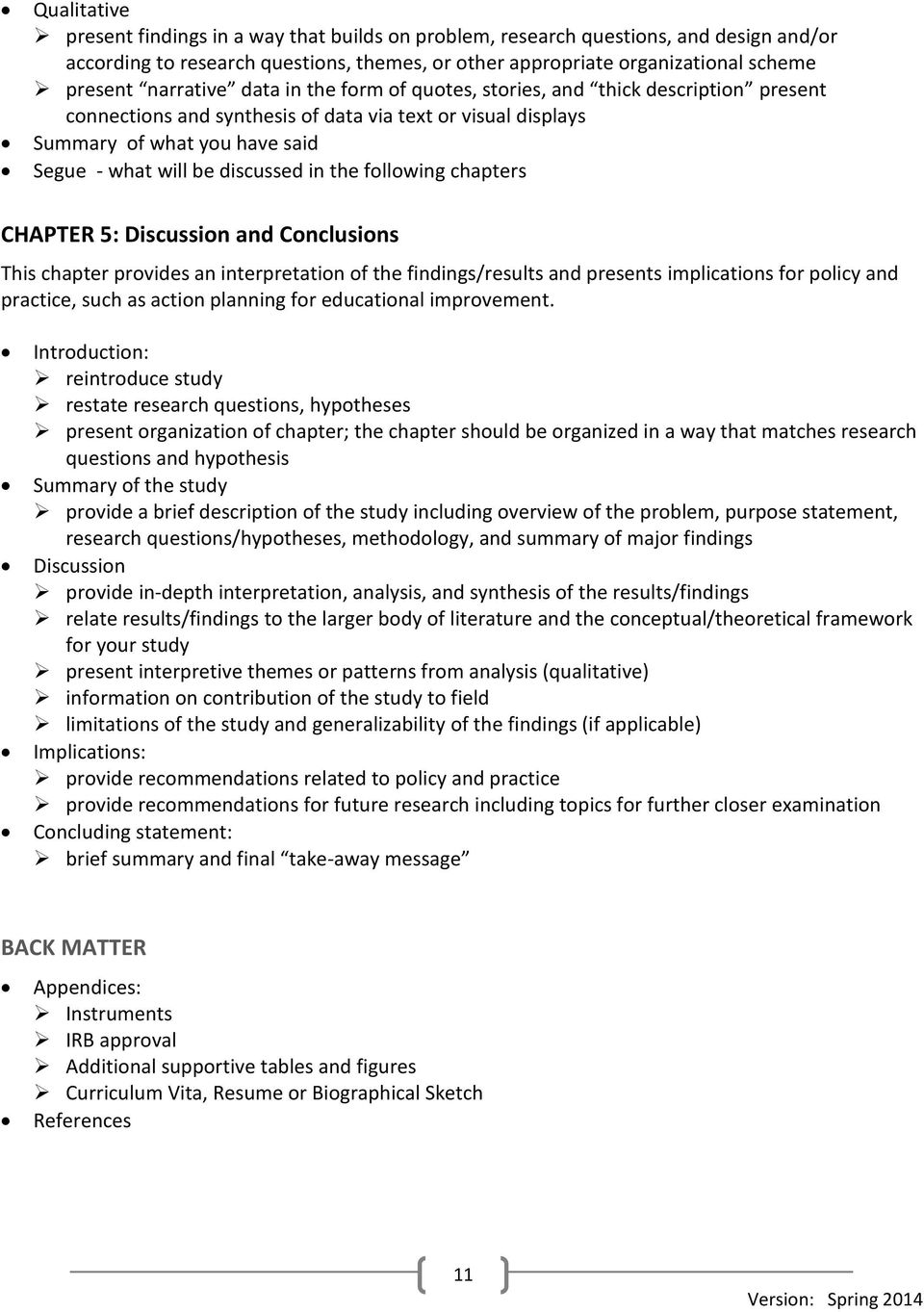
11 Qualitative present findings in a way that builds on problem, research questions, and design and/or according to research questions, themes, or other appropriate organizational scheme present narrative data in the form of quotes, stories, and thick description present connections and synthesis of data via text or visual displays Summary of what you have said Segue - what will be discussed in the following chapters CHAPTER 5: Discussion and Conclusions This chapter provides an interpretation of the findings/results and presents implications for policy and practice, such as action planning for educational improvement. Introduction: reintroduce study restate research questions, hypotheses present organization of chapter; the chapter should be organized in a way that matches research questions and hypothesis Summary of the study provide a brief description of the study including overview of the problem, purpose statement, research questions/hypotheses, methodology, and summary of major findings Discussion provide in-depth interpretation, analysis, and synthesis of the results/findings relate results/findings to the larger body of literature and the conceptual/theoretical framework for your study present interpretive themes or patterns from analysis (qualitative) information on contribution of the study to field limitations of the study and generalizability of the findings (if applicable) Implications: provide recommendations related to policy and practice provide recommendations for future research including topics for further closer examination Concluding statement: brief summary and final take-away message BACK MATTER Appendices: Instruments IRB approval Additional supportive tables and figures Curriculum Vita, Resume or Biographical Sketch References 11
HANDBOOK 2014-2015 Office of Doctoral Programs www.csun.edu/educ/doctorate
 Doctoral Program in Educational Leadership HANDBOOK 2014-2015 Office of Doctoral Programs www.csun.edu/educ/doctorate TABLE OF CONTENTS i Table of Contents 1. Program Goals... 1 Mission... 1 Vision...
Research Guidelines for the Master of Science in Nursing. Northern Michigan University College of Professional Studies Department of Nursing
 Research Guidelines for the Master of Science in Nursing Northern Michigan University College of Professional Studies Department of Nursing May 2007 Table of Contents Introduction.. 4 Project Options..
Delivered in an Online Format. Revised November 1, 2014. I. Perspectives
 1 Prospectus of the Ed.D. in Curriculum and Instruction Delivered in an Online Format Revised November 1, 2014 I. Perspectives The online Doctor of Education (Ed.D.) in Curriculum is a graduate degree
CULMINATING PROJECT GUIDELINES
 CULMINATING PROJECT GUIDELINES Department of Educational Leadership and Interdisciplinary Studies Western Illinois University Macomb, IL 61455 Table of Contents Introduction 3 Culminating Project Completion
PROCEDURES MANUAL FOR DOCTORAL STUDENTS. Ed.D. Human Resource & Workforce Development Education
 PROCEDURES MANUAL FOR DOCTORAL STUDENTS Ed.D. Human Resource & Workforce Development Education Department of Rehabilitation, Human Resources and Communication Disorders Graduate Studies The purpose of
College of Nursing. Masters of Nursing (MN) Professional Project Handbook 2015-2016
 College of Nursing Masters of Nursing (MN) Professional Project Handbook 2015-2016 Last Revised: June, 2015 Approved: Associate Dean for Research and Graduate Education Table of Contents Masters of Nursing
LLED Doctoral Program Requirements
 LLED Doctoral Program Requirements Students are responsible for information on the Graduate School website. See, especially the Graduate Bulletin and the Graduate School s Academic Regulations & Procedures
Scholarly Project and Thesis Guidelines. for the. MSON Graduate Nursing Programs
 Scholarly Project and Thesis Guidelines for the MSON Graduate Nursing Programs Table of Contents Introduction 3 Course Descriptions 3 Project Options: Thesis.3-4 Project Options: Scholarly Project..4-7
Doctoral Degree Programs in Special Education
 Doctoral Degree Programs in Special Education University of Florida College of Education School of Special Education, School Psychology, & Early Childhood Studies P.O. Box 117050 / 1403 Norman Hall Gainesville,
Master of Science in Nursing Program Thesis and Research Project Handbook 2014-2015
 Master of Science in Nursing Program Thesis and Research Project Handbook 2014-2015 Guideline for the Preparation of Master Thesis or Research Project Table of Contents Introduction...1 Thesis Option...1
Doctoral Comprehensive Examination
 Doctoral Comprehensive Examination WHAT'S PRESCRIBED BY THE GRADUATE SCHOOL Following is what the Graduate School Handbook says about the Doctoral Comprehensive exams. http://handbook.unc.edu/phd.html
COMPREHENSIVE EXAMINATION. Adopted May 31, 2005/Voted revisions in January, 2007, August, 2008, and November 2008 and adapted October, 2010
 COMPREHENSIVE EXAMINATION Adopted May 31, 2005/Voted revisions in January, 2007, August, 2008, and November 2008 and adapted October, 2010 All students are required to successfully complete the Comprehensive
School of Advanced Studies Doctor Of Education In Educational Leadership With A Specialization In Educational Technology. EDD/ET 003 Requirements
 School of Advanced Studies Doctor Of Education In Educational Leadership With A Specialization In Educational Technology The mission of the Doctor of Education in Educational Leadership degree program
FORMAT OF THE PROPOSAL FOR A THESIS Revised and adapted from Practical Guide to Research Methods by Lang and Heiss.
 THESIS PROPOSAL The proposal should describe what you propose to do for your research study. It should include: (a) your name; (b) date submitted; (c) a tentative title; (d) the problem; (e) the purpose
Programs in Higher & Postsecondary Education Ed.D. Program in Higher and Postsecondary Education The Ed.D. in Higher and Postsecondary Education
 Programs in Higher & Postsecondary Education Ed.D. Program in Higher and Postsecondary Education The Ed.D. in Higher and Postsecondary Education (HPSE) is designed to meet the increasing need for visionary
Graduate Handbook EDUCATIONAL PSYCHOLOGY
 Graduate Handbook EDUCATIONAL PSYCHOLOGY IFCE /Simpson Hall Phone 505-277-4535 MSC05 3040 Fax 505-277-8361 1 University of New Mexico E-Mail [email protected] Albuquerque, NM 87131-1246 Program Website: http://coe.unm.edu/departments/ifce/educational-psychology.html
College of Nursing. Doctor of Nursing Practice (DNP) Scholarly Project Handbook 2015-2016
 College of Nursing Doctor of Nursing Practice (DNP) Scholarly Project Handbook 2015-2016 Last Revised: June, 2015 NRSG 674 faculty: Jennifer K. Sofie, DNP, FNP-C, ANP-BC Approved: Associate Dean for Research
Developmental Psychology Program Graduate Degree Requirements: Outline Revised 10/21/14 REQUIRED DEVELOPMENTAL COURSEWORK
 1 Developmental Psychology Program Graduate Degree Requirements: Outline Revised 10/21/14 The doctoral program in developmental psychology is structured so that all requirements for the degree can be completed
UA SCHOOL OF JOURNALISM THESIS PROPOSAL GUIDELINES FOR THE MASTER S DEGREE PROGRAM*
 UA SCHOOL OF JOURNALISM THESIS PROPOSAL GUIDELINES FOR THE MASTER S DEGREE PROGRAM* According to the UA Graduate College, you should choose your thesis topic and select your committee by the end of your
Guidelines and Timeline for the MAP and Oral Exam
 MAP Guidelines 1 Guidelines and Timeline for the MAP and Oral Exam The Major Area Paper (MAP) and oral examination serves as the preliminary examination in the Department of Psychology & Neuroscience.
Appendices WERKLUND SCHOOL OF EDUCATION
 Appendices 1. Course Completion Checklist... 2 2. Field of Study Written Examination Timeline... 3 3. Field of Study Examination Criteria Option A: FoS Candidacy Portfolio... 4 4. Field of Study Examination
Section Three. Nursing: MSN Research Procedures. Page 25
 Section Three Nursing Research Procedures Page 25 Research Competency Nursing majors are expected to develop their research skills throughout the program and demonstrate this skill in the final research
DOCTOR OF PHILOSOPHY DEGREE. Educational Leadership Doctor of Philosophy Degree Major Course Requirements. EDU721 (3.
 DOCTOR OF PHILOSOPHY DEGREE Educational Leadership Doctor of Philosophy Degree Major Course Requirements EDU710 (3.0 credit hours) Ethical and Legal Issues in Education/Leadership This course is an intensive
Wichita State University Elliott School of Communication Master s Thesis Guidelines
 Wichita State University Elliott School of Communication Master s Thesis Guidelines By Patricia Dooley TABLE OF CONTENTS 1. What is the purpose of this set of guidelines? 2. What is a Master s thesis?
The current (2015-2016) Marketing Ph.D. Committee consists of Greg M. Allenby (Committee Chair), Xiaoyan Deng, Nino Hardt, and Rebecca Walker Reczek.
 Marketing Ph.D. Program Handbook 1. Marketing Ph.D. Program Structure and Committees Graduate Faculty and the Marketing Ph.D. As a doctoral student, you are enrolled in the Graduate School of the Ohio
REQUIREMENTS FOR THE MASTER THESIS IN INNOVATION AND TECHNOLOGY MANAGEMENT PROGRAM
 APPROVED BY Protocol No. 18-02-2016 Of 18 February 2016 of the Studies Commission meeting REQUIREMENTS FOR THE MASTER THESIS IN INNOVATION AND TECHNOLOGY MANAGEMENT PROGRAM Vilnius 2016-2017 1 P a g e
Ph.D. in Adult Education Graduate Handbook
 Ph.D. in Adult Education Graduate Handbook Department of Lifelong Education, Administration, and Policy College of Education 1 November 2010 University of Georgia, Athens, Georgia 1 TABLE OF CONTENTS Program
Texas State University. Sociology Department. Handbook. MA with a Major in Sociology. MS with a Major in Applied Sociology. 7 th Edition (2015)
 Texas State University Sociology Department Handbook MA with a Major in Sociology MS with a Major in Applied Sociology 7 th Edition (2015) Chair: Dr. Susan Day Director of Graduate Programs: Dr. Patti
FACULTY OF SOCIAL WORK
 FACULTY OF SOCIAL WORK MASTER OF SOCIAL WORK MSW THESIS MANUAL September 2015 TABLE OF CONTENTS Where to find required forms.. 3 Where to find completed theses... 3 Glossary of Terms. 5 INTRODUCTION...
University of South Florida Applied Behavior Analysis Master s Program. Program Description, Policies, and Procedures
 University of South Florida Applied Behavior Analysis Master s Program Program Description, Policies, and Procedures Revised August 2015 ABA Program Policies and Procedures 2 The USF Master s Degree Program
2015-2016. HESA M.A. Handbook. Student Personnel Assistantship Program Higher Education and Student Affairs 2015-2016
 Student Personnel Assistantship Program Higher Education and Student Affairs 2015-2016 HESA M.A. Handbook 2015-2016 This handbook is intended to be a resource for Master of Arts students in the Higher
School of Advanced Studies Doctor Of Management In Organizational Leadership/information Systems And Technology. DM/IST 004 Requirements
 School of Advanced Studies Doctor Of Management In Organizational Leadership/information Systems And Technology The mission of the Information Systems and Technology specialization of the Doctor of Management
ISPN Foundation Nursing Research Grants ISPN Mental Health and Wellness Research Grant
 ISPN Foundation Nursing Research Grants ISPN Mental Health and Wellness Research Grant Purpose The purpose of this research award is to support the development of nursing research capacity for a graduate
PROGRAM HANDBOOK Doctor of Education Higher Education Community College Administration
 PROGRAM HANDBOOK Doctor of Education Higher Education Community College Administration College of Education Graduate Education and Research Texas Tech University Box 41071 Lubbock, TX 79409-1071 (806)
VANDERBILT UNIVERSITY DEPARTMENT OF POLITICAL SCIENCE GRADUATE PROGRAM REQUIREMENTS Effective January 2014
 VANDERBILT UNIVERSITY DEPARTMENT OF POLITICAL SCIENCE GRADUATE PROGRAM REQUIREMENTS Effective January 2014 This document is designed to provide graduate students in Political Science with a concise list
Cognitive Area Program Requirements 10/4/12 1
 THE OHIO STATE UNIVERSITY, DEPARTMENT OF PSYCHOLOGY Cognitive Area Program The guiding principle in the Cognitive Area graduate training program is to involve students from their very first year in the
Administration and Supervision
 Educational Administration and Supervision Dickenson Hall, Room 419 (501) 569-3267 The Educational Administration and Supervision program at UALR includes three graduate degree programs (e.g., Master s,
Instructional Technology Capstone Project Standards and Guidelines
 Instructional Technology Capstone Project Standards and Guidelines The Committee recognizes the fact that each EdD program is likely to articulate some requirements that are unique. What follows are a
ME Ph.D. Program: Revised Rules and Requirements
 Graduate Handbook Supplement ME Ph.D. Program: Revised Rules and Requirements I. Introduction This document presents procedures and criteria for the Ph.D. degree in mechanical engineering at Texas Tech
Dissertation Handbook
 Dissertation Handbook Revised July 1, 2014 University of the Rockies 555 E. Pikes Peak Avenue Colorado Springs, Colorado 80903-3612 (719) 442-0505 www.rockies.edu QUICK GUIDE SYMBOLS AND ABBREVIATIONS
Ph.D. Education: Leadership in Education
 GRADUATE SCHOOL OF EDUCATION Ph.D. Education: Leadership in Education Faculty: Michaela Colombo, Ed.D. James Nehring, Ed.D. Stacy Szczesiul, Ed.D. Phitsamay Uy, Ed.D. Ph.D. Education: Leadership in Education
COLLEGE OF VISUAL ARTS AND DESIGN Department of Art Education and Art History DOCTORAL PROGRAM IN ART EDUCATION PROCEDURES MANUAL
 COLLEGE OF VISUAL ARTS AND DESIGN Department of Art Education and Art History DOCTORAL PROGRAM IN ART EDUCATION PROCEDURES MANUAL Revised 3/2008 HEJC MANUAL FOR DOCTORAL STUDENTS IN ART EDUCATION The information
Components of Handbook for Doctoral Students in Education with A Concentration in Special Education
 Components of Handbook for Doctoral Students in Education with A Concentration in Special Education 1. Introduction 2. Mission Statement 3. Program Outcomes/Student Competencies: Doctoral Plan of Action
School Psychology Doctoral Program Dissertation Outline 1 Final Version 6/2/2006
 School Psychology Doctoral Program Dissertation Outline 1 Final Version 6/2/2006 Instructions: Double Underline means the item should be a title or heading in your dissertation. Do not deviate from the
GUIDE TO THE DOCTORAL RESEARCH PROCESS. A Manual for Planning and Conducting Doctoral Research at Argosy University
 GUIDE TO THE DOCTORAL RESEARCH PROCESS A Manual for Planning and Conducting Doctoral Research at Argosy University College of Education College of Business College of Psychology and Behavioral Sciences
How To Get A Ph.D. In Sport Management At Trotson University
 Addendum 2014-2015 Graduate Catalog DOCTOR OF PHILOSOPHY (PH.D.) IN SPORT MANAGEMENT NOTE: All applicants to the inaugural class of August 2015 must meet the program requirements listed in the Addendum
TOWSON UNIVERSITY EXPERIMENTAL PSYCHOLOGY PROGRAM STUDENT GUIDE FOR COMPLETING A THESIS Last updated: October 22, 2012
 TOWSON UNIVERSITY EXPERIMENTAL PSYCHOLOGY PROGRAM STUDENT GUIDE FOR COMPLETING A THESIS Last updated: October 22, 2012 Purpose This guide is intended to supplement, but not replace, the Towson University
Ph.D. Program FINANCE
 Ph.D. Program In FINANCE DEPARTMENT OF FINANCE POLICIES AND PROCEDURES Ph.D. Program Fisher College of Business The Ohio State University 700 Fisher Hall 2100 Neil Avenue Columbus, OH 43210 (Revised July
Doctor of Education Program Handbook
 Doctor of Education Program Handbook Student Copy Revised Summer 2013 1 Introduction The Johns Hopkins University (JHU) School of Education (SOE) attracts the most innovative and progressive scholars without
School of Advanced Studies Doctor Of Management In Organizational Leadership. DM 004 Requirements
 School of Advanced Studies Doctor Of Management In Organizational Leadership The mission of the Doctor of Management in Organizational Leadership degree program is to develop the critical and creative
PSY.D. PROGRAM CLINICAL DISSERTATION HANDBOOK
 PSY.D. PROGRAM CLINICAL DISSERTATION HANDBOOK SEPTEMBER 2011 2 A clinical dissertation is a scholarly work WHAT IS A CLINICAL DISSERTATION? A Summary conducted independently by the student under the supervision
DOCTORAL DEGREE IN EDUCATION. Ed.D. Leadership in Schooling
 DOCTORAL DEGREE IN EDUCATION Ed.D. Leadership in Schooling ADMITTING FOR SUMMER 2016 ONWARDS Ed.D. Leadership in Schooling 42 credits 3-4 years Leadership in Schooling Faculty Michaela Colombo, Associate
Course Sequence Diagram Doctor of Business Administration
 Prerequisites Course Sequence Diagram Doctor of Business Administration SMU-MN DBA Appendix G Courses with a B or better in Managerial Finance Managerial Economics Two semesters of graduate statistics
THESIS & COMPREHENSIVE EXAM PROCEDURES SCHOOL OF NURSING THE UNIVERSITY OF NORTH CAROLINA AT GREENSBORO GREENSBORO, NORTH CAROLINA.
 THESIS & COMPREHENSIVE EXAM PROCEDURES SCHOOL OF NURSING THE UNIVERSITY OF NORTH CAROLINA AT GREENSBORO GREENSBORO, NORTH CAROLINA Revised 6/09 TABLE OF CONTENTS Page Thesis Procedures...2 Selection of
Joint Graduate Program in Communication and Culture A Partnership of Ryerson University and York University
 Thesis-Dissertation Regs, March 2009 1/7 Regulations for the Preparation of the MA THESIS And PhD DISSERTATION FACULTY/SCHOOL OF GRADUATE STUDIES REGULATIONS Thesis and dissertation proposal regulations
STUDENT THESIS PROPOSAL GUIDELINES
 STUDENT THESIS PROPOSAL GUIDELINES Thesis Proposal Students must work closely with their advisor to develop the proposal. Proposal Form The research proposal is expected to be completed during the normal
Student Handbook. Georgia State University
 Student Handbook The Doctoral Program in Educational Psychology Georgia State University Department of Educational Psychology and Special Education This document has been prepared as an overview for the
DOCTORAL PROGRAM IN HIGHER EDUCATION Community College Cognate University of North Texas
 DOCTORAL PROGRAM IN HIGHER EDUCATION Community College Cognate University of North Texas Contact: Patsy Fulton-Calkins, Ph.D. Director of the Bill J. Priest Center for Community College Education Don A.
THE UNIVERSITY OF AKRON DEPARTMENT OF SOCIOLOGY GRADUATE HANDBOOK FALL 2015
 THE UNIVERSITY OF AKRON DEPARTMENT OF SOCIOLOGY GRADUATE HANDBOOK FALL 2015 i TABLE OF CONTENTS Page Introduction 1 Program Requirements Coursework 2 Program Schedule 3 Graduate School Requirements 5 Completing
EAST TENNESSEE STATE UNIVERSITY COLLEGE OF NURSING STUDENT HANDBOOK DOCTOR OF PHILOSPHY IN NURSING
 EAST TENNESSEE STATE UNIVERSITY COLLEGE OF NURSING STUDENT HANDBOOK DOCTOR OF PHILOSPHY IN NURSING Approved by PhD Faculty (May 2008) Revised August 14, 2015 v.1.8.2015 College of Nursing Mission Statement...
THESIS MANUAL GRNS 391 DEPARTMENT OF NURSING GRADUATE PROGRAM
 THESIS MANUAL GRNS 391 DEPARTMENT OF NURSING GRADUATE PROGRAM COLLEGE OF NURSING AND HEALTH SCIENCES THE UNIVERSITY OF VERMONT Approved 12/98 Revised 6/01, 7/02, 11/03, 10/13, 1/2014 Contents Thesis Completion
Master of Science Education Capstone Experience Handbook Thesis/Project
 Master of Science Education Capstone Experience Handbook Thesis/Project Revised 11/6/2012 Contents INTRODUCTION: WHAT IS A CAPSTONE EXPERIENCE?... 3 Capstone Experience Options... 3 Which Option is Right
Master of Arts in Criminal Justice
 Master of Arts in Criminal Justice Planning Your Course of Study and Selecting an Exit Options: (Thesis, Professional Project, and Comprehensive Exam) The Master of Arts in Criminal Justice program offers
Ph.D. Applied Behavior Analysis Program Guidebook 2014-2015
 Ph.D. Applied Behavior Analysis Program Guidebook 2014-2015 NOTE: 1) This guidebook is subject to change. If it does, students will be notified via email and will be provided with the revised version.
APPENDIX T: GUIDELINES FOR A THESIS RESEARCH PROPOSAL. Masters of Science Clinical Laboratory Sciences Program
 APPENDIX T: GUIDELINES FOR A THESIS RESEARCH PROPOSAL Masters of Science Clinical Laboratory Sciences Program Name of Candidate:..... Name of Thesis Director:. Track :... I. Topic of research proposal
University of North Dakota Department of Electrical Engineering Graduate Program Assessment Plan
 Graduate Program Assessment Plan Mission: The mission of the master of science program is to promote critical thinking and creative skills based on the theory, principles, and techniques of electrical.
Doctorate in Educational Leadership Program Policies and Procedures
 Doctorate in Educational Leadership Program Policies and Procedures Admission Prospective students are urged to review and read the website for the Doctorate Program (Ed.D.), available through the Department
Academic Program: Doctoral Program in Clinical Psychology. Graduate or Undergraduate: Graduate Date: October 10, 2003
 Academic Program: Doctoral Program in Clinical Psychology Graduate or Undergraduate: Graduate Date: October 10, 2003 Coordinator of the Program: Kenneth W. Sewell Person completing this form: Kenneth W.
Department of Health Behavior. Doctoral Program Guidelines
 Department of Health Behavior Doctoral Program Guidelines 2014-2015 Table of Contents INTRODUCTION... 1 COMPETENCIES GUIDING DOCTORAL TRAINING... 1 PROTECTION OF HUMAN SUBJECTS... 2 THE HONOR CODE...
OVERVIEW AND ADMISSION REQUIREMENTS
 PH.D. PROGRAM IN SPECIAL EDUCATION EMPHASIS IN APPLIED BEHAVIOR ANALYSIS AND POSITIVE BEHAVIORAL SUPPORT (ABA/PBS; INCLUDING BCBA) (THIS IS A SPECIAL FEDERALLY FUNDED PROJECT) OVERVIEW AND ADMISSION REQUIREMENTS
DEPARTMENT OF. Health Promotion & Education. Graduate Student Handbook
 DEPARTMENT OF Health Promotion & Education Graduate Student Handbook 1 Table of Contents About Us What is Health Promotion and Education? 3 Mission 3 Location...3 Contact 3 Full Time Faculty...3 M.S. Program
Online Doctor of Education (Ed.D.) in Educational Leadership
 Overview: K-12 Leadership The Ed.D. degree is designed to provide in-depth knowledge and skills to educational leaders who seek to transform complex problems in education through practice in the educational
2015-2016 Program Guidebook. Ph.D. Applied Behavior Analysis (Post-Master s)
 2015-2016 Program Guidebook Ph.D. Applied Behavior Analysis (Post-Master s) NOTE: 1) This guidebook is subject to change. If it does, students will be notified via email and will be provided with the revised
Special Education Doctoral Student Handbook
 Special Education Doctoral Student Handbook Department of Teacher Education College of Professional Education This Doctoral Handbook does not constitute a contract between current or prospective students
DOCTOR of PHILOSOPHY STUDENT HANDBOOK 2014-2015
 DOCTOR of PHILOSOPHY STUDENT HANDBOOK 2014-2015 School of Criminology and Criminal Justice University of Nebraska Omaha 6001 Dodge Street CPACS Suite 218 Omaha, NE 68182-0149 (402) 554-2610 www.unomaha.edu/criminaljustice
DOCTORAL DEGREE PROGRAM
 DOCTORAL DEGREE PROGRAM Introduction The Department of Curriculum and Instruction offers the Doctor of Philosophy in Education degree with a Concentration in Curriculum and Instruction. This program is
PhD Handbook for Students. Department of Nutrition and Food Systems
 PhD Handbook for Students Department of Nutrition and Food Systems Revised May 2012 1.0 INTRODUCTION AND OVERVIEW. 1 2.0..ADMISSION... 3 2.1 ADMISSION REQUIREMENTS... 3 2.2 ADMISSION PROCEDURES... 4 2.2.1
M.S. in Career, Technical and Leadership Education
 M.S. in Career, Technical and Leadership Education Guidelines for Creative Component Projects INTRODUCTION The creative component project option is designed for students wishing to complete a practitioner-based
Ph.D. in Educational Psychology - Course Sequence
 1 Ph.D. in Educational Psychology - Course Sequence First Semester - Summer EDUC 700: Online Orientation (0 credits) EFND 705A: Residency (2 credits) UNIV LIB: Information, Research, and Resources (0 credits)
DOCTORATE IN in EDUCATIONAL LEADERSHIP
 1 DOCTORATE IN in EDUCATIONAL LEADERSHIP Cabrini College s Doctor of Education (Ed.D) in Educational Leadership program is a 60-credit post-master s program that continues Cabrini s dedication to academic