
LifeSize ClearSea Administrator Guide
|
|
|
- Alyson Townsend
- 10 years ago
- Views:
Transcription
1 LifeSize ClearSea Administrator Guide August 2012

2 LifeSize ClearSea Administrator Guide 2 LifeSize ClearSea Server LifeSize ClearSea is a client/server solution for desktop and mobile video collaboration. Users can connect from their desktops or mobile devices to H.323 or SIP devices, including video systems, MCUs, and gateways. This guide describes LifeSize ClearSea Server: Deployment Scenarios Initial Configuration User Call Flows Administrator Control Panel Provides an overview of common deployment scenarios, including the external firewall configuration. Guides you through the initial configuration after you have installed LifeSize ClearSea Server. Provides an overview of calling. Provides a detailed description of the administrator Control Panel. Related documentation is available from lifesize.com/support. Terminology for Users and Groups The following terms are used in this document to describe LifeSize ClearSea users and groups. These terms may differ from terms used with other LifeSize systems. Familiarize yourself with these terms to best understand the capabilities of your LifeSize ClearSea Server. server administrator - administrator role with full capabilities. user administrator - administrator role with a subset of management capabilities. user or end user - a user who connects to the VoIP network managed by LifeSize ClearSea. user account - a unique user account on the server side related to a LifeSize ClearSea Client user and/or SIP or H.323 video systems. Each user account includes a user ID and an extension. user ID - unique string representation of any user account. You can dial the string from a LifeSize ClearSea Client or select the string from the contact list to place a call. extension - unique numeric representation of any user account. You can dial the extension from any client by accessing the IVR flow. group or provisioning group - every user account belongs to one group. For each group, administrators can define how LifeSize ClearSea Client is configured. For example: enabling or disabling LifeSize ClearSea Client features, setting video and audio codecs, and limiting maximum bandwidth. contact and contact list - each LifeSize ClearSea Client user account can maintain a server side contact list.

3 LifeSize ClearSea Administrator Guide 3 Section 1: Deployment Scenarios Networking and Call Requirements LifeSize ClearSea Server is designed to work as a hub for enterprise visual communication. Users allowed to connect to LifeSize ClearSea Server can place and receive calls regardless of the physical network to which they are connected. For example, users connected to LifeSize ClearSea from the Internet can place video calls to users on the internal company LAN or external to the company LAN. LifeSize ClearSea Server manages call routing and allows users to communicate without knowing the physical location of the call recipient or which networking and VoIP protocols it supports. The LifeSize ClearSea Server must be able to connect to the master server for activation. Read more at Activation and Licensing. Either the caller or the call recipient must have a user account registered on the LifeSize ClearSea Server. Read more at User Call Flows and Accounts.

4 LifeSize ClearSea Administrator Guide 4 Standalone Deployments The following sections highlight common standalone deployments. Read about configuring standalone servers at Cluster Management. Scenario 1: Corporate LAN and Public IP LifeSize ClearSea Server integrates two Ethernet interfaces. A common deployment scenario is one interface connected to the corporate LAN, and another interface on an external network. The following diagram shows the LAN interface bound to the corporate network, while the WAN interface is assigned a public IP address that can be reached from anywhere over the Internet.
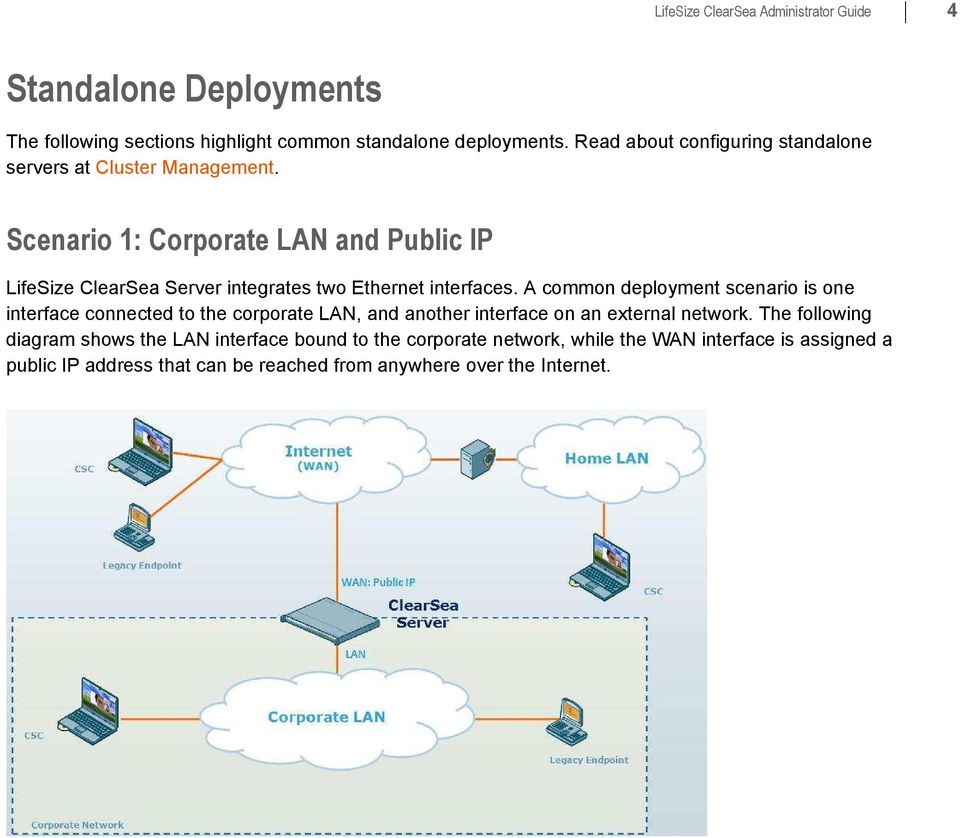
5 LifeSize ClearSea Administrator Guide 5 Internet Access without NAT In the following diagram, the LifeSize ClearSea Server is assigned a public IP address typically protected by a firewall. All LifeSize ClearSea Client users and video systems over the Internet are able to place and receive calls to and from the LifeSize ClearSea Server. Internet Access with 1-to-1 NAT This scenario is identical to the previous setup, but the WAN interface is assigned a private corporate address with a 1-1 NAT address from the Internet router. As in the previous example, a firewall system might enforce access control. In the diagram, the WAN interface is assigned the private IP that is mapped to an Internet public IP address by the router NAT.

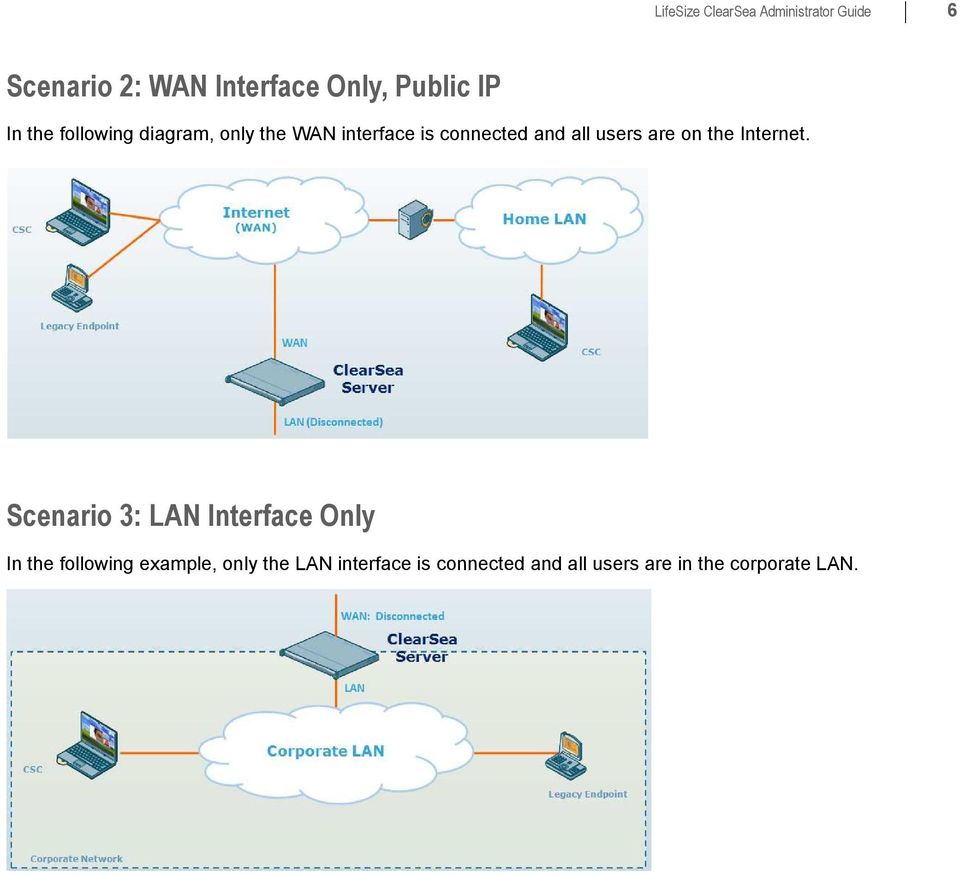
6 LifeSize ClearSea Administrator Guide 6 Scenario 2: WAN Interface Only, Public IP In the following diagram, only the WAN interface is connected and all users are on the Internet. Scenario 3: LAN Interface Only In the following example, only the LAN interface is connected and all users are in the corporate LAN.
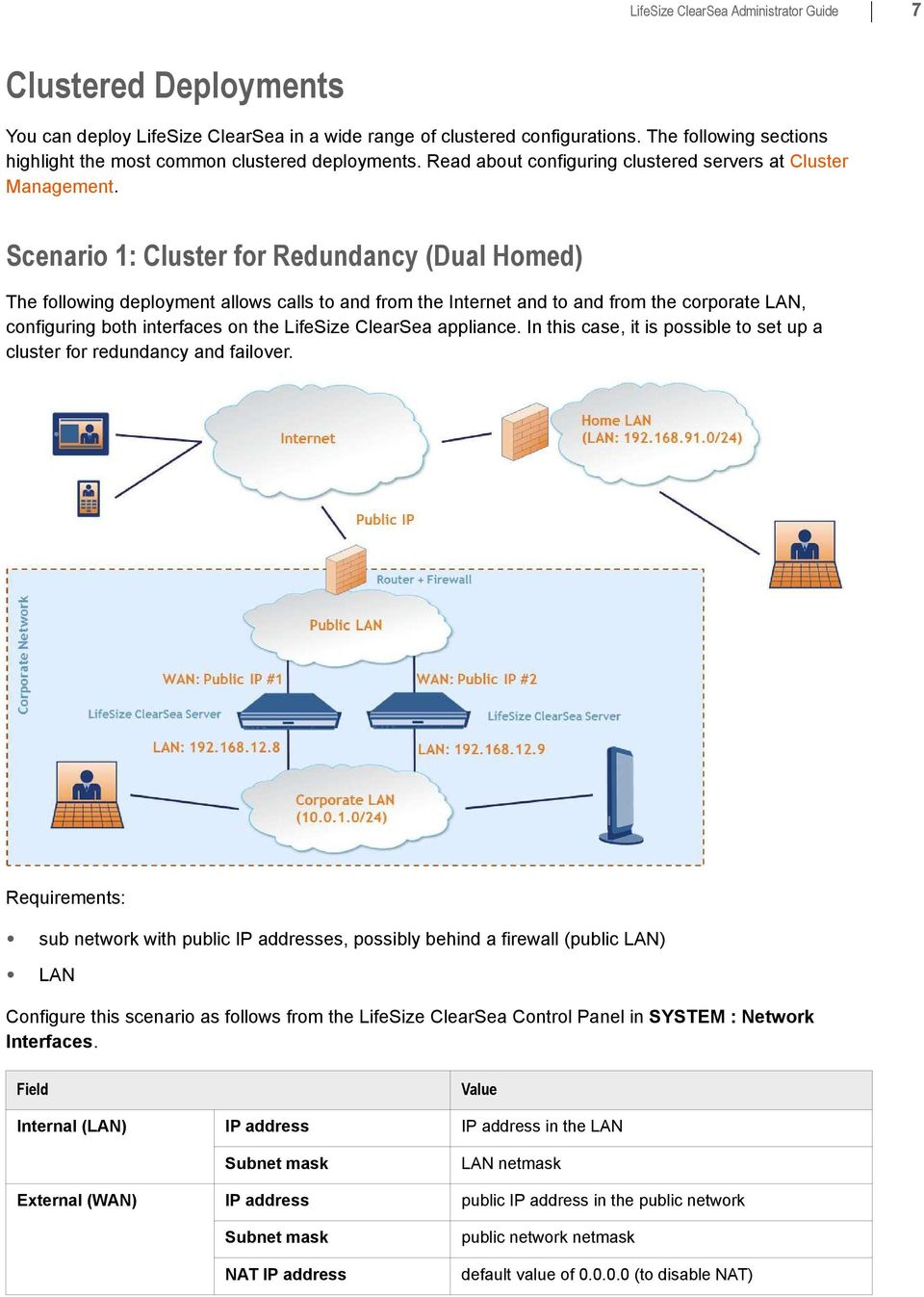
7 LifeSize ClearSea Administrator Guide 7 Clustered Deployments You can deploy LifeSize ClearSea in a wide range of clustered configurations. The following sections highlight the most common clustered deployments. Read about configuring clustered servers at Cluster Management. Scenario 1: Cluster for Redundancy (Dual Homed) The following deployment allows calls to and from the Internet and to and from the corporate LAN, configuring both interfaces on the LifeSize ClearSea appliance. In this case, it is possible to set up a cluster for redundancy and failover. Requirements: sub network with public IP addresses, possibly behind a firewall (public LAN) LAN Configure this scenario as follows from the LifeSize ClearSea Control Panel in SYSTEM : Network Interfaces. Field Value Internal (LAN) IP address IP address in the LAN Subnet mask LAN netmask External (WAN) IP address public IP address in the public network Subnet mask NAT IP address public network netmask default value of (to disable NAT)
8 LifeSize ClearSea Administrator Guide 8 Field Value Global Configuration DNS (primary/secondary) DNS IP address Default Gateway default gateway (if applicable) of the public network NOTE: Instead of configuring a default gateway, you can also set a proper routing rule in Control Panel : SYSTEM : Static Routes. You must open the following ports on the firewall between the Internet and the public LAN: * For the cluster setup, copy all rules for each CSS IP address. ** In this scenario it is highly recommended that you create the cluster on the corporate LAN.

9 LifeSize ClearSea Administrator Guide 9 Scenario 2: Cluster for Security (DMZ with Public IP) This deployment allows calls to and from the Internet and to and from the corporate LAN, configuring a single interface on the LifeSize ClearSea appliance. You must set up a cluster to grant security on the corporate LAN. Requirements: controlled network with public IP addresses (DMZ) LAN On each LifeSize ClearSea appliance, plug in the first interface only (LAN) on the related network. Configure the following preferences from the LifeSize ClearSea Control Panel in SYSTEM : Network Interfaces: Field Value Internal (LAN) IP address IP address in the DMZ/LAN Subnet mask DMZ/LAN netmask Global Configuration DNS (primary/secondary) DNS IP address Default Gateway default gateway (if applicable) of the public network NOTE: Instead of configuring a default gateway, you can also set a proper routing rule in Control Panel : SYSTEM : Static Routes.

10 LifeSize ClearSea Administrator Guide 10 After creating a cluster, add the following node rule on each node from the LifeSize ClearSea Control Panel in SYSTEM : Cluster Management: 1. Click the LOCAL Node Type entry and Edit Node Routes. 2. Configure the Default Destination Node with the system ID of the node in the DMZ. 3. Add a Node Route, setting the IP/Mask (CIDR notation) for the LAN and the system ID of the node in the LAN as the Destination Node. On the Internet interface, you must open the following ports on the firewall between the Internet and the DMZ: On the DMZ interface, you must open the following ports on the firewall between the LAN and the DMZ:

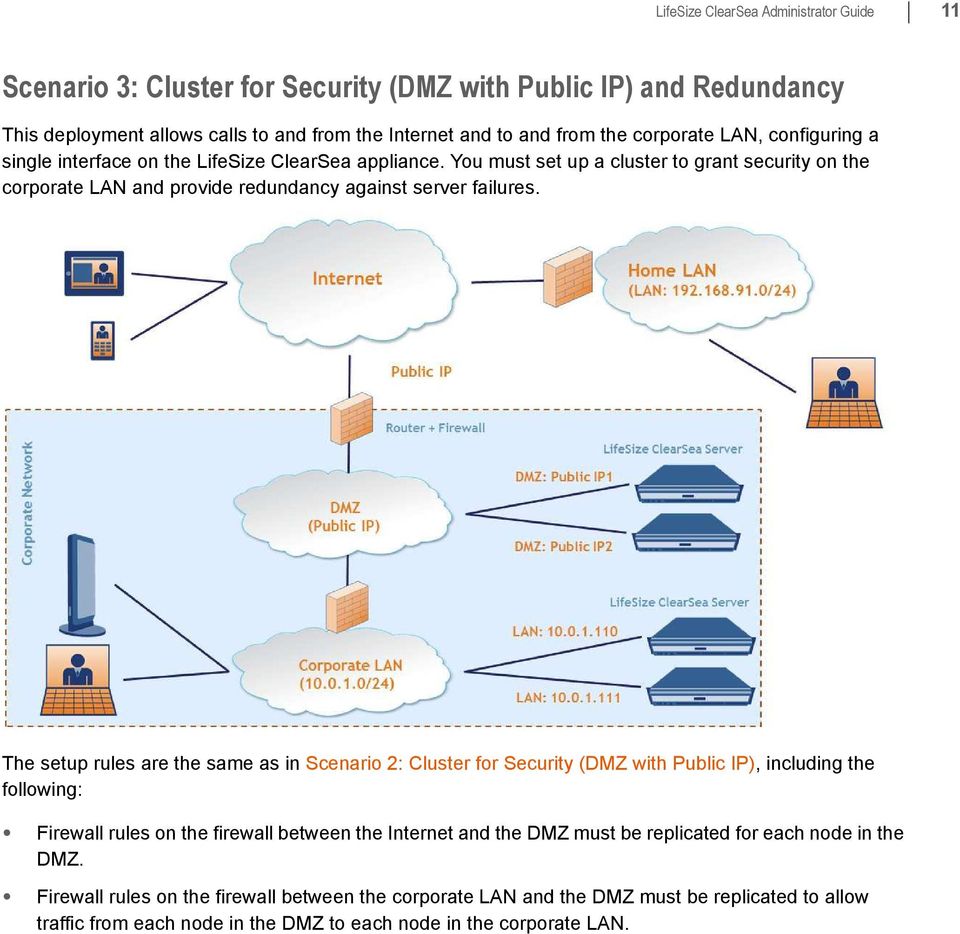
11 LifeSize ClearSea Administrator Guide 11 Scenario 3: Cluster for Security (DMZ with Public IP) and Redundancy This deployment allows calls to and from the Internet and to and from the corporate LAN, configuring a single interface on the LifeSize ClearSea appliance. You must set up a cluster to grant security on the corporate LAN and provide redundancy against server failures. The setup rules are the same as in Scenario 2: Cluster for Security (DMZ with Public IP), including the following: Firewall rules on the firewall between the Internet and the DMZ must be replicated for each node in the DMZ. Firewall rules on the firewall between the corporate LAN and the DMZ must be replicated to allow traffic from each node in the DMZ to each node in the corporate LAN.
12 LifeSize ClearSea Administrator Guide 12 Scenario 4: Cluster for Security (LAN and DMZ with 1:1 NAT) This deployment allows calls to and from the Internet and to and from the corporate LAN, configuring a single interface on the LifeSize ClearSea appliance. You must set up a cluster to grant security on the corporate LAN. Requirements: controlled network (DMZ) public IP LAN On the LifeSize ClearSea appliance in the DMZ, plug in the second interface only (WAN). Configure the following preferences from the LifeSize ClearSea Control Panel in SYSTEM : Network Interfaces: Field Value External (WAN) IP address IP address in the DMZ Subnet mask NAT IP address DMZ netmask public IP address for 1:1 NAT Global Configuration DNS (primary/secondary) DNS IP address Default Gateway default gateway (if applicable) of the public network NOTE: Instead of configuring a default gateway, you can also set a proper routing rule in Control Panel : SYSTEM : Static Routes.

13 LifeSize ClearSea Administrator Guide 13 On the LifeSize ClearSea appliance in the corporate LAN plug in the first interface only (LAN). From the LifeSize ClearSea Control Panel, configure the following preferences in SYSTEM : Network Interfaces: Field Value Internal (LAN) IP address IP address in the LAN Subnet mask LAN netmask Global Configuration DNS (primary/secondary) DNS IP address Default Gateway default gateway (if applicable) of the public network NOTE: Instead of configuring a default gateway, you can also set a proper routing rule in Control Panel : SYSTEM : Static Routes. After creating a cluster, add the following node rule on each node from the LifeSize ClearSea Control Panel in SYSTEM : Cluster Management. 1. Click the LOCAL Node Type entry and Edit Node Routes. 2. Configure the Default Destination Node with the system ID of the node in the DMZ. 3. Add a Node Route, setting the IP/Mask (CIDR notation) for the LAN and the system ID of the node in the LAN as the Destination Node. On the Internet interface, you must open the following ports on the firewall between the Internet and the DMZ: On the DMZ interface, you must open the following ports on the firewall between the LAN and the DMZ:
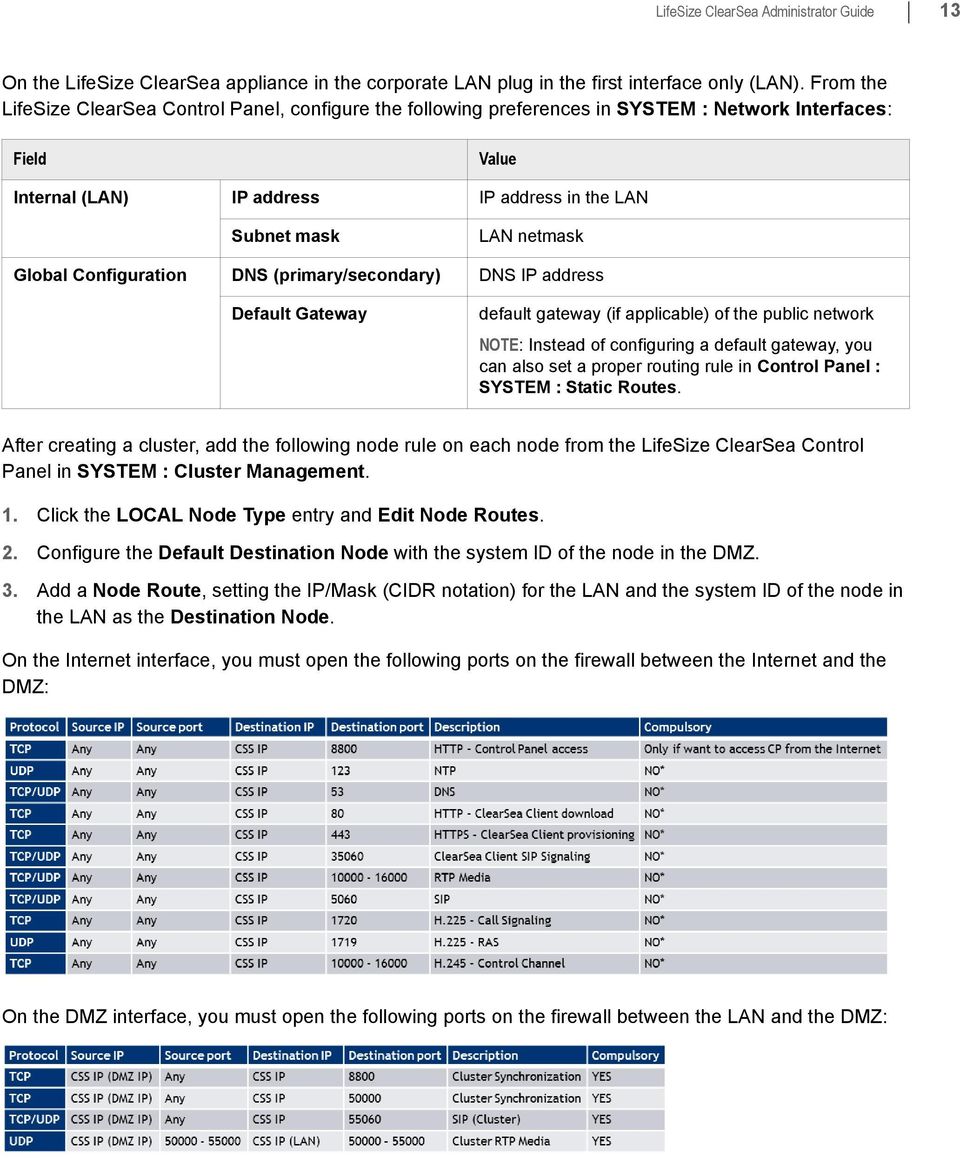
14 LifeSize ClearSea Administrator Guide 14 Scenario 5: Cluster for Geographical Load Balancing and Redundancy This deployment allows calls to and from the Internet and to and from the corporate LAN of each of the company office headquarters, balancing by geographical location and providing redundancy against server failures. The setup rules are the same as in Scenario 1: Cluster for Redundancy (Dual Homed), including the following: The two nodes are installed on the public network on the two geographical sites. The cluster is created, binding on the public IP addresses. The DNS must resolve the LifeSize ClearSea domain with the public IP addresses from both nodes. Sizing Limits Standalone Maximum number of accounts on a single LifeSize ClearSea unit: 10,000 Maximum number of concurrent registrations: 2,500 Cluster Maximum number of nodes in a LifeSize ClearSea cluster: 4 Maximum number of accounts in a LifeSize ClearSea cluster: 40,000 Maximum number of concurrent registrations in a LifeSize ClearSea cluster: 10,000
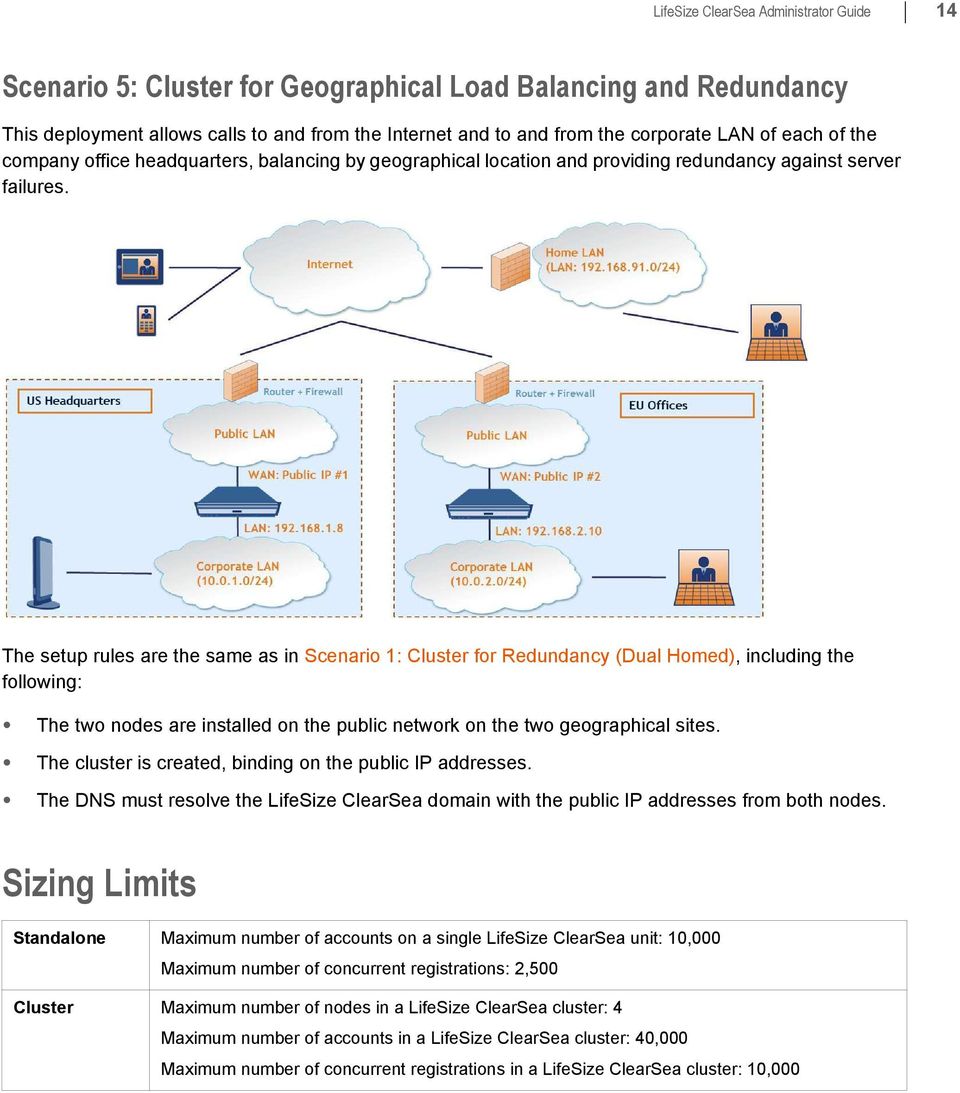
15 LifeSize ClearSea Administrator Guide 15 External Firewall Configuration This section lists the ports LifeSize ClearSea Server requires when placed behind a firewall. For LifeSize ClearSea to function properly and to be properly maintained, set the following rules on an external firewall:

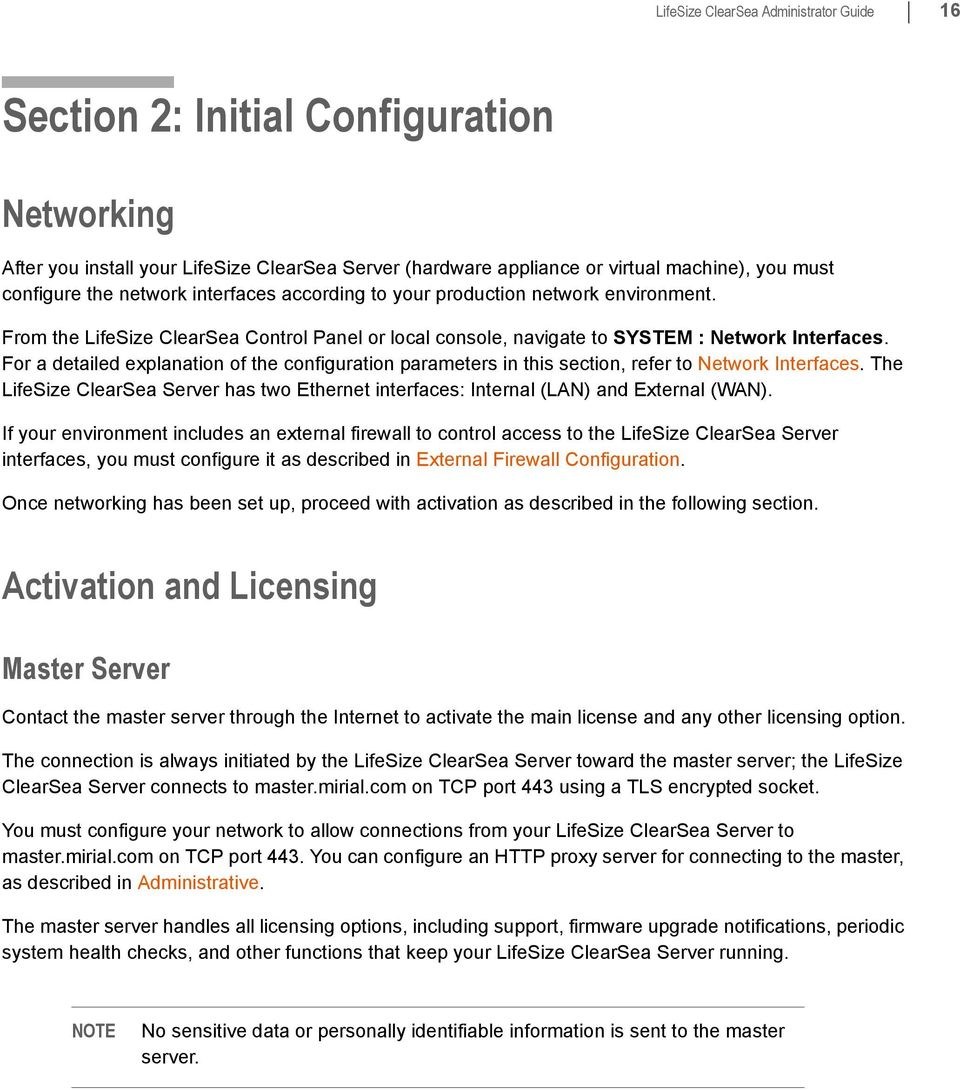
16 LifeSize ClearSea Administrator Guide 16 Section 2: Initial Configuration Networking After you install your LifeSize ClearSea Server (hardware appliance or virtual machine), you must configure the network interfaces according to your production network environment. From the LifeSize ClearSea Control Panel or local console, navigate to SYSTEM : Network Interfaces. For a detailed explanation of the configuration parameters in this section, refer to Network Interfaces. The LifeSize ClearSea Server has two Ethernet interfaces: Internal (LAN) and External (WAN). If your environment includes an external firewall to control access to the LifeSize ClearSea Server interfaces, you must configure it as described in External Firewall Configuration. Once networking has been set up, proceed with activation as described in the following section. Activation and Licensing Master Server Contact the master server through the Internet to activate the main license and any other licensing option. The connection is always initiated by the LifeSize ClearSea Server toward the master server; the LifeSize ClearSea Server connects to master.mirial.com on TCP port 443 using a TLS encrypted socket. You must configure your network to allow connections from your LifeSize ClearSea Server to master.mirial.com on TCP port 443. You can configure an HTTP proxy server for connecting to the master, as described in Administrative. The master server handles all licensing options, including support, firmware upgrade notifications, periodic system health checks, and other functions that keep your LifeSize ClearSea Server running. NOTE No sensitive data or personally identifiable information is sent to the master server.
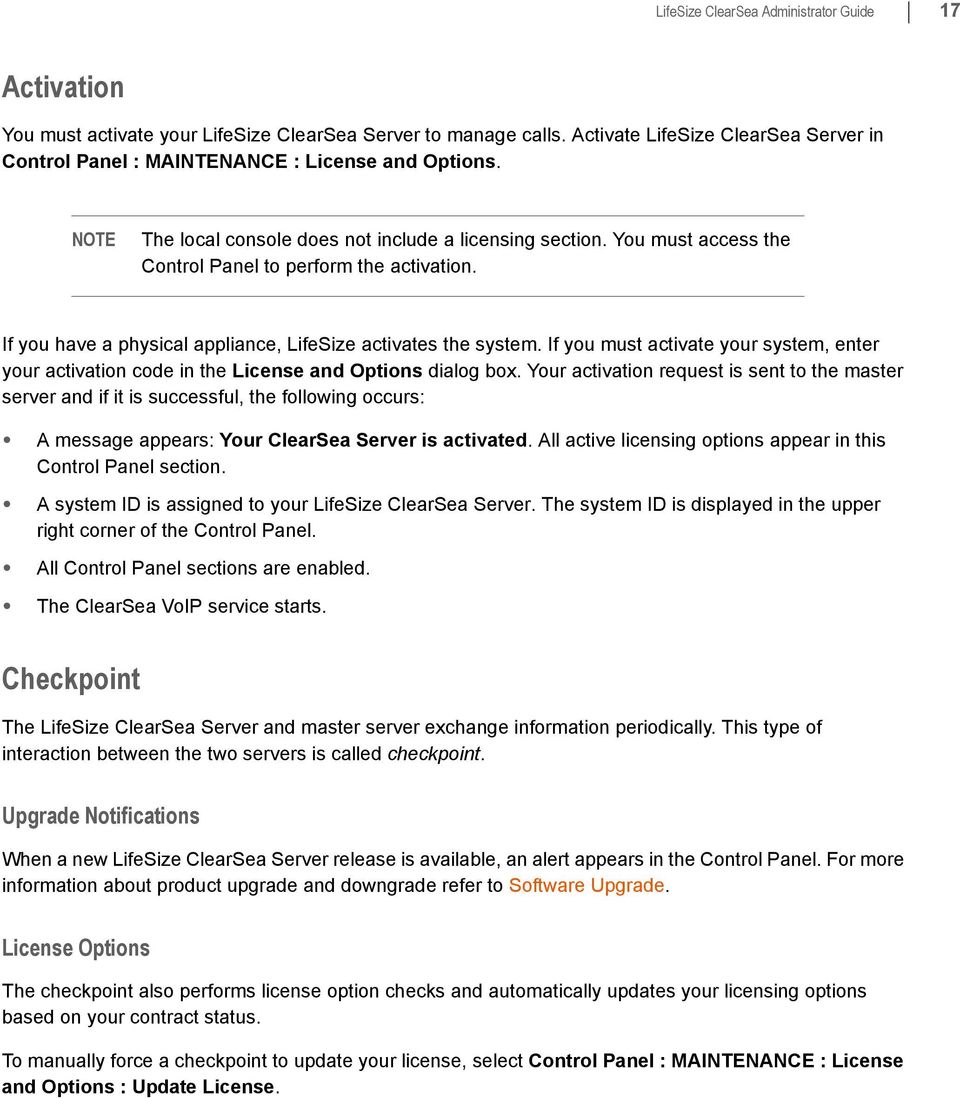
17 LifeSize ClearSea Administrator Guide 17 Activation You must activate your LifeSize ClearSea Server to manage calls. Activate LifeSize ClearSea Server in Control Panel : MAINTENANCE : License and Options. NOTE The local console does not include a licensing section. You must access the Control Panel to perform the activation. If you have a physical appliance, LifeSize activates the system. If you must activate your system, enter your activation code in the License and Options dialog box. Your activation request is sent to the master server and if it is successful, the following occurs: A message appears: Your ClearSea Server is activated. All active licensing options appear in this Control Panel section. A system ID is assigned to your LifeSize ClearSea Server. The system ID is displayed in the upper right corner of the Control Panel. All Control Panel sections are enabled. The ClearSea VoIP service starts. Checkpoint The LifeSize ClearSea Server and master server exchange information periodically. This type of interaction between the two servers is called checkpoint. Upgrade Notifications When a new LifeSize ClearSea Server release is available, an alert appears in the Control Panel. For more information about product upgrade and downgrade refer to Software Upgrade. License Options The checkpoint also performs license option checks and automatically updates your licensing options based on your contract status. To manually force a checkpoint to update your license, select Control Panel : MAINTENANCE : License and Options : Update License.
18 LifeSize ClearSea Administrator Guide 18 Configuring the LifeSize ClearSea Service After the system has been activated, the administrator must configure basic service parameters to test service functionality. Configure the LifeSize ClearSea Domain Domain Name in Control Panel : SERVICE : General is one of the following values: Either the LAN or WAN interface IP address. This does not require setting up the DNS and is recommended for simple network scenarios. A fully qualified domain name such as sea.mycompany.com. The DNS of the client video systems must resolve the domain name to the IP address of the target LifeSize ClearSea network interface (LAN or WAN). Configure One or More Users To complete basic setup and be able to place a call, you must add at least one user in Control Panel : SERVICE : Accounts. Click Add Account to enter the user s information. LifeSize ClearSea Client LifeSize ClearSea Client is a software-only video phone used with LifeSize ClearSea Server. LifeSize ClearSea Client is available for both Windows and Mac OS X operating systems and for ios or Android devices. Downloading the LifeSize ClearSea Desktop Client Users can download the LifeSize ClearSea desktop client with a web browser from where <address> is one of the IP addresses or DNS names assigned to the unit. For example: clearsea.mycompany.com. Users select either the Windows or Mac OS X installation package. NOTE Download mobile clients for ios and Android devices from the Apple AppStore and the Android Market. Installing the LifeSize ClearSea Client 1. Launch the installation package you downloaded. 2. Log in with the example user and example password you created in Configure One or More Users.

19 LifeSize ClearSea Administrator Guide 19 The ClearSea Server field is set to the same address (hostname or IP address) you used to download the client. The LifeSize ClearSea Client displays the address of the last server to which it was connected; however, you can change this server address. All user data, such as contacts and history, is stored independently on each LifeSize ClearSea Server. Multiple LifeSize ClearSea Clients using the same user account may be simultaneously connected to the same LifeSize ClearSea Server (example: one at the office and one at home). The first to answer an incoming call establishes the connection. With a connection established, LifeSize ClearSea Server ignores the call on another client. For a detailed description of how to install, run, and configure the LifeSize ClearSea Client, refer to the LifeSize ClearSea User Guide.

20 LifeSize ClearSea Administrator Guide 20 Section 3: User Call Flows Test Calls Placing a test call provides feedback about VoIP functionality and call quality at the far end. LifeSize ClearSea records the caller s audio and video and plays the recording for the user to preview. To place a test call, from the LifeSize ClearSea Client, click ClearSea Test Call in the list of contacts. You can also enter testcall in the search box. Any SIP or H.323 video system that can signal to the LifeSize ClearSea Server an alphanumeric alias as the dialed party name can call testcall. The test call procedure is timed and requires approximately one minute. IVR The interactive voice response (IVR) allows callers to dial the numeric extension of a specific user. This is particularly useful when the caller is not capable of dialing alphanumeric aliases such as name@domain. Every LifeSize ClearSea user account is assigned an extension that is a unique number used to reach the user account via a guided IVR flow. To activate the IVR, a user dials the LifeSize ClearSea Server IP address or hostname (for example: sea.mydomain.com) without specifying any user account alias or number. The IVR allows the caller to dial the desired extension by using DTMF tones (keypad buttons). Once the extension is dialed and confirmed with the # key, the LifeSize ClearSea Server attempts to contact the called user account. When trying to connect to the dialed extension, one of the following cases can occur: The called user account answers the call. The called user account rejects the call (busy signal). The called user account does not answer the call (timeout). The dialed extension is not available (wrong extension number or the user account is not currently available). Direct Two-Way Calls The LifeSize ClearSea Server processes calls to and from the following devices: LifeSize ClearSea Client: The software client for Windows, Mac OS X and ios or Android devices. Video system associated with a LifeSize ClearSea user account: SIP or H.323 equipment specified in the Endpoint List of a user account.

21 LifeSize ClearSea Administrator Guide 21 SIP video system registered to the LifeSize ClearSea Server using credentials from a user account. H.323 video system using LifeSize ClearSea Server as a gateway, authenticated using credentials from a user account. Video system not associated with a LifeSize ClearSea user account: SIP or H.323 equipment whose IP address is not configured in the Endpoint List of a user account. NOTE Either the caller or call recipient must have a LifeSize ClearSea user account for the call to be successful. LifeSize ClearSea connects users on different networks: Both the caller and call recipient are in the company LAN. The caller is in the LAN, and the call recipient is in the WAN (or vice-versa). Both the caller and call recipient are in the WAN. Additionally, if callers are not using the same communications protocol (SIP or H.323), LifeSize ClearSea performs protocol conversion to connect the callers. Read more at Standalone Deployments and Clustered Deployments. User Account with Multiple LifeSize ClearSea Clients or Registered Video Systems Any LifeSize ClearSea user account can have multiple instances of the LifeSize ClearSea Client running on separate Windows, Mac OS X, ios, or Android devices; or registered SIP or authenticated H.323 video systems, all simultaneously connected to the same LifeSize ClearSea Server. With multiple LifeSize ClearSea Clients, when a call is received, it rings on all LifeSize ClearSea Clients and registered SIP and authenticated H.323 video systems. You can answer the call on any system. Once the call is answered (or ignored), all other clients and video systems stop ringing. MCU The LifeSize ClearSea Server offers the following MCU capabilities: Conferences hosted by the MCU embedded in LifeSize ClearSea Server or an external MCU. Read more at MCU Management. Multiway conferencing with configured Conference Rooms.
22 LifeSize ClearSea Administrator Guide 22 Section 4: Administrator Control Panel The LifeSize ClearSea administrator manages LifeSize ClearSea Server from the Control Panel. User Roles Two administrator users can access the following areas of the Control Panel: The server administrator has full access to all Control Panel sections. The user administrator has access only to Control Panel sections related to user management. - Alerts - STATUS : Active Calls - STATUS : Registered ClearSea Clients - SERVICE : Groups - SERVICE : Accounts Logging In The integrated web server manages the Control Panel. Access the Control Panel as follows: 1. Open a web browser and enter the following URL for plain text access: Enter the following URL for encrypted access: Where <address> refers to one of the IP addresses assigned to the unit. 2. Enter your username and password. Default credentials: User Username Password Server administrator admin admin User administrator uadmin uadmin NOTE Login credentials are case-sensitive. Modify these passwords in the SYSTEM : Administrative section of the Control Panel or the local console.
23 LifeSize ClearSea Administrator Guide 23 Alerts Alerts that are created either locally by LifeSize ClearSea or remotely by the master server appear in the Alerts section of the Control Panel. Each alert contains the following information: ID Level Time Text Incremental alert unique identifier. Possible values: FATAL, ERROR, WARN, INFO. Date and time the event occurred. of the event that generated the alert. Remove an alert from the list by clicking Dismiss selected. To remove all alert messages, click Dismiss All. NOTE If you do not dismiss an alert, it appears each time you log in.
24 LifeSize ClearSea Administrator Guide 24 STATUS View the status of your LifeSize ClearSea Server from the Control Panel in STATUS. System Active calls Active conference rooms Active MCUs Registered users Read more at System Status. Read more at Active Calls. Shows the number of participants and duration of active conference rooms. Learn how to add a conference room in Conference Rooms. Shows details of active MCUs, including IP address, resolution, maximum and active ports, initialization date, and duration. Learn how to configure MCUs in MCU Management. Read more at Registered Users. System Status View system status and shut down or reboot the server in Control Panel : STATUS : System Status. The following fields are available: Field Service Status Version Build Number Ports (current/max) Provisioned Users (current/max) Registered Users Server Shutdown Server Reboot Core service status. Normal status is RUNNING. You must activate the LifeSize ClearSea Server for this button to be functional. LifeSize ClearSea product version in the form major.minor.patch LifeSize ClearSea build number. Current used ports and maximum licensed ports. If the maximum number of used ports is reached, new calls fail. Ports are related to the call legs: a call between user A and user B includes two call legs and uses two ports. Ports used for test calls are not accounted for in this field. Number of provisioned (created) user accounts and maximum supported user accounts. Number of users with LifeSize ClearSea Client logged in to the LifeSize ClearSea Server. Shuts down the hardware appliance. Reboots the hardware appliance. Active Calls View active calls on the LifeSize ClearSea Server in Control Panel : STATUS : Active Calls. For each call, the following fields appear: Field Caller ID Caller IP Caller ID from signaling. Caller signaling IP.
25 LifeSize ClearSea Administrator Guide 25 Field Caller Endpoint Caller Status Dial String Called ID Called IP Called Endpoint Duration Details Drop Caller vendor ID and product ID. Caller's call status. Dialed alias, number, or address. Called ID from signaling. Called signaling IP. Called vendor ID and product ID. Call duration (time since call connection). Shows additional details about the call. Allows you to end the call. The table is updated automatically in real time. To disable or enable auto updates, click the three circles in the lower left corner of the grid. The search text field in the top right corner filters the table to show only rows containing the searched text in any field. Registered Users View the list of LifeSize ClearSea Clients currently logged in and registered to the LifeSize ClearSea Server in Control Panel : STATUS : Registered Users. For each client, the following fields appear: Field User ID User IP Status User Endpoint OS Info System ID Duration Unregister LifeSize ClearSea Client user ID. IP address from which the LifeSize ClearSea user account is logged in. LAN or WAN appears, depending on the server interface to which the user is connected. The SIP registration status. Vendor ID and product ID. Information about the operating system of the LifeSize ClearSea Client, if available. The system ID of the cluster node to which the user is connected. Elapsed time since the user logged in. Allows you to manually unregister the user. If the user is in a call, the call is ended as soon as the registration check is performed on the LifeSize ClearSea Client. NOTE: In a clustered deployment, this action is available only on the cluster node to which the user is connected.
26 LifeSize ClearSea Administrator Guide 26 SYSTEM This section allows you to configure the local LifeSize ClearSea system. Network Interfaces CAUTION Ensure that you check the embedded firewall settings before changing network parameters. If the embedded firewall is enabled, incorrect network settings might prevent the administrator from accessing the system from the service adapter. Refer also to Firewall. Access network information in Control Panel : SYSTEM : Network Interfaces. This page shows details for each Ethernet interface. NOTE Modifying field values marked with a red * (asterisk) might require you to restart the LifeSize ClearSea service. Restarting the LifeSize ClearSea service ends all active calls and causes all client registrations to be lost. Parameter Status MAC address Enable DHCP IP Address Subnet Mask Ethernet cable connection/disconnection status. Hardware MAC address of the Ethernet interface. This master switch enables or disables DHCP. If DHCP is enabled, you cannot manually configure the IP address or the Subnet Mask parameter. The IP address assigned to the network interface. The IP subnet mask assigned to the network interface. NAT IP Address (WAN only) Enable external H.323 conferencing H.323 Endpoint bandwidth (kbps) Enable external SIP conferencing SIP Endpoint bandwidth (kbps) When the LifeSize ClearSea Server is located behind a router or a firewall in a 1-to- 1 NAT configuration, this field must contain the public IP address. This master switch enables or disables calls to and from external H.323 video systems (if licensed). This does not affect LifeSize ClearSea Clients. Maximum bit rate allowed for the H.323 video systems (if licensed). This does not affect LifeSize ClearSea Clients. The default depends on licensing options. This master switch enables or disables calls to and from external SIP video systems. This does not affect LifeSize ClearSea Clients. Maximum bit rate allowed for the SIP video systems (if licensed). This does not affect LifeSize ClearSea Clients. The default depends on licensing options.
27 LifeSize ClearSea Administrator Guide 27 Parameter Enable Control Panel access Enable Media Encryption This master switch enables or disables access to the Control Panel. NOTE: You must enable Control Panel access to at least one interface. If you disable access on both interfaces, the system automatically re-enables it on the LAN interface. This master switch enables or disables the media encryption on the specified network interface. By disabling this feature, all the calls through the specified network interface do not use media encryption, overriding the LifeSize ClearSea Client and user group media encryption settings. Read more at Group Properties. NOTE: If media encryption is not licensed, this feature is not enabled and this master switch is locked. The Global Configurations section lists network settings that are applied globally: primary DNS secondary DNS default gateway Firewall Access firewall information in Control Panel : SYSTEM : Firewall. LifeSize ClearSea embeds a simple firewall to restrict administrative access to specified hosts or subnets. The firewall filters access to the administrative Control Panel and to other management services. Include IP addresses or subnets in CIDR format. CAUTION Ensure that you include the IP address or subnet from which you access the Control Panel before enabling the firewall and saving the settings. If you cannot access the Control Panel, you can disable the firewall from the local console. Date and Time Configure the system date and time in Control Panel : SYSTEM : Date and Time. Field Current Date and Time Enable automatic synchronization with NTP NTP Server Time Zone This read-only field displays the current date and time in YYYY-MM-DD HH:mm:ss format. Master NTP server switch. LifeSize strongly recommends that all production systems are synchronized with the same NTP server. The NTP server IP or hostname. System time zone.
28 LifeSize ClearSea Administrator Guide 28 Field Automatically adjust clock for daylight saving changes Change settings manually New date New time Depending on the time zone, this setting automatically adjusts the clock for daylight saving changes depending on your time zone. Select this option if you want to change the system date and time manually. NOTE: If the NTP server is enabled, this option is disabled. When changing the system clock manually, enter the date in YYYY-MM-DD format. When changing the system clock manually, enter the time in HH:mm:ss format. Hosts Edit host file entries to override the DNS resolution in Control Panel : SYSTEM : Hosts. For each hostname or domain name, include the IP address to which the hostname or domain name resolves. Static Routes Manage IP static routes in Control Panel : SYSTEM : Static Routes. For each configured static route, the following fields are available. Field IP/Mask The destination IP address or subnet in CIDR format. For example: /16 Gateway The gateway to the specified destination. Administrative Modify access criteria to the administrative Control Panel in Control Panel : SYSTEM : Administrative. Passwords Encryption SNMP HTTP proxy Modify passwords for the server and user administrators in Server Administrator Password and User Administrator Password. Passwords must meet these criteria: The password cannot be empty. The maximum length is 15 characters. Allowed characters are alphanumeric (a-z, A-Z, 0-9), underscore (_), dot (.), and dash (-). Read more at Encrypted Access. Use the SNMP Configuration section to enable or disable SNMP functionality. The exposed MIBs are those implemented by Microsoft Windows XP machines. Refer to support.microsoft.com/kb/237295/en-us?fr=1. In Master Server Access, configure an HTTP proxy for contacting the master server. When enabled, all communication with the master server is performed using the specified HTTP proxy server. Specify the hostname or IP address and port of the proxy. If you use proxy server authentication, include the username and password for authentication. LifeSize ClearSea Server must be able to contact the master server to perform activation and checkpoints.
29 LifeSize ClearSea Administrator Guide 29 Encrypted Access Configure encrypted access in HTTPS Control Panel Access (Port 8801): By default, an internally generated self-signed certificate is used. Setting SSL Certificate to CUSTOM allows you to set a custom certificate/private key pair. The following fields are available: Field Always Redirect HTTP to HTTPS SSL Certificate Certificate Private Key When enabled, every attempt to access the Control Panel at port 8800 is redirected to the encrypted Control Panel at port Allows you to change the certificate used for encryption. Visible only when you choose CUSTOM from SSL Certificate. Paste the contents of a signed certificate in X.509 PEM format in the box. Visible only when you choose CUSTOM from SSL Certificate. Paste the contents of an RSA private key in PKCS#8 PEM format in the box. To restore the default certificate, choose INTERNAL and click Save.
30 LifeSize ClearSea Administrator Guide 30 Cluster Management Clustered configuration provides service scalability and fault tolerance. All systems in a cluster share the same SERVICE settings. SYSTEM : Cluster Management shows the current clustering status of the server. The most important status parameter is Clustering Mode, which can be Standalone (not part of a cluster), Candidate (waiting for the cluster join request to be accepted), or Replicated (part of a cluster). Depending on the current clustering mode, you can do the following: Create a new cluster Request to join this system to an existing cluster Accept or reject another system s request to joint the cluster Remove the local system from the cluster Remove a remote system from the cluster This option is available only if the current clustering mode is Standalone. In Create Cluster, select the local Bind Address for cluster interconnection and click Create new Cluster. After the new cluster is created, the system is ready to accept join requests from other systems. The clustering mode of this server is now Replicated. This option is available only if the current clustering mode is Standalone. In Join Cluster, select the local Bind Address for cluster interconnection and enter the IP address of another LifeSize ClearSea system that is already part of the cluster in IP address of a node in the cluster. Click Join Cluster to send the join request to the other LifeSize ClearSea system. If the clock of the local system is not synchronized with the cluster, the join request is rejected. To avoid this issue, use the same NTP server for all systems in the cluster. The clustering mode is set to Candidate until the request is accepted by the administrator on the remote node to which the request has been sent. CAUTION: This procedure replaces all SERVICE settings on the candidate node with the settings from the cluster. This option is available only if the current clustering mode is Replicated and one or more remote systems requested to join the cluster and are waiting as cluster candidates. Cluster Nodes contains a row for every remote server that requested to join the cluster. Click Add all candidates to accept all join requests or Reject all candidates to reject all join requests. This option is available only if the current clustering mode is Candidate or Replicated. Click Revert to standalone to revert the system to Standalone mode. This option is available only if the current clustering mode is Replicated. In SYSTEM : Cluster Management, select the remote system and click Remove Node: this removes the selected remote systems from the cluster and reverts to Standalone. CAUTION: This procedure resets all SERVICE settings on the removed node you remove from the cluster.
31 LifeSize ClearSea Administrator Guide 31 Editing Node Routes NOTE This option is available only if the current clustering mode is Replicated. In SYSTEM : Cluster Management, select the system and click Edit Node Routes to open Routes for node<systemid>. Use this window to define specific call routes for given subnets. You can also add, edit, or delete node routes. When you add a node route, define the following parameters. Field IP/Mask Destination Node Defines the subnet IP interval to match the called IP address. Defines the destination node to place the call if the route matches. Node routes are evaluated after local call routing. Refer to Call Routing for details on configuring local call routing rules. Node routes are evaluated as a classic routing table, choosing the first more specific subnet. If no node route matches (or no node route is defined), the Default Destination Node is used to place the call (it acts as a default gateway). NOTE If a node route matches and the call fails on the matched node, no fallback is performed and the call fails. Node routes are applied only to external unregistered video systems; registered video systems are always called through the node to which they are registered.
32 LifeSize ClearSea Administrator Guide 32 SERVICE Configure LifeSize ClearSea service settings in Control Panel : SERVICE. Domain Configuration and Authentication Configure LifeSize ClearSea Client authentication and optional HTTP redirects in Control Panel : SERVICE : General. The following fields are available: Field Domain Name Call Setup Timeout Clients Authentication Mode LDAP Version LDAP Host LDAP Port LDAP over SSL enabled (LDAPS) The LifeSize ClearSea domain. This field is required for proper LifeSize ClearSea SIP functionality. Set to the fully qualified domain name or one of the IP addresses of the LifeSize ClearSea Server. Examples: mcs.company.com or The timeout in seconds that applies to all outbound calls. The LifeSize ClearSea Server ends the call as Unanswered if the far end does not answer within the configured timeout. The default value is 30 seconds. NOTE: Editing the value of Call Setup Timeout might affect call routing rules. Specifies whether LifeSize ClearSea Client authentication is handled internally or by an external LDAP server: INTERNAL authentication requires a user ID and password associated with the user account. Accounts without local credentials are not allowed to log in or register with SIP and H.323 video systems. Read more at Local credentials. LDAP bind authentication uses LDAP credentials. LifeSize ClearSea Server sends an LDAP bind request to an external LDAP server. If this bind succeeds, the user is authenticated. LDAP search authentication performs an LDAP search on an external LDAP server. A user is authenticated only if the LDAP search returns at least one account and an LDAP bind using the retrieved account succeeds. Use this authentication method to authorize a subset of the LDAP users. If you use LDAP authentication, note the following distinction between client types: LifeSize ClearSea Client users can log in with either their LDAP or local credentials. Users registering with other SIP or H.323 video systems must log in with their local credentials. Specifies the protocol version of the external LDAP server. The external LDAP server host or IP address. Example: ldap.mycompany.com The external LDAP server port. The LDAP default port is 389, or 636 if SSL is enabled. Specifies if communication with the LDAP server is protected with SSL on the configured port (LDAPS). No validation is performed on the SSL certificate provided by the server.
33 LifeSize ClearSea Administrator Guide 33 Field LDAP bind DN LDAP bind password LDAP search DN LDAP search filter LDAP search scope Automatic Import of LDAP Accounts Imported Accounts Default Group LDAP Attribute for "Group" LDAP Attribute for "Extension" DN when authenticating (using LDAP bind) on the external LDAP server. This string may contain one or more of the following wildcards: <U> is replaced with the username of the LifeSize ClearSea Client user who is authenticating. <P> is replaced with the plain text password of the authenticating user. <P-MD5> is replaced with the MD5 hash of the user's password, in LDAP userpassword format: {MD5} followed by base64 encoding of the hash. <P-SHA> is replaced with the SHA-1 hash of the user's password, in LDAP userpassword format: {SHA} followed by base64 encoding of the hash. This option is available only when Clients Authentication Mode is set to LDAP bind or LDAP search. Password for authenticating (using LDAP bind) on the external LDAP server when performing an LDAP search request. This option is available only when Clients Authentication Mode is set to LDAP search. DN for performing an LDAP search on the external LDAP server. This string can contain the same wildcards as LDAP bind DN. This option is available only when Clients Authentication Mode is set to LDAP search. Search filter for performing an LDAP search on the external LDAP server. This string can contain the same wildcards as LDAP bind DN. This option is available only when Clients Authentication Mode is set to LDAP search. The starting point of an LDAP search and the depth of the search from the base DN. If enabled, new user accounts are automatically created for users that do not have a user account but who provide correct credentials for the LDAP domain. All parameters configured in the Imported LDAP Accounts are applied to user accounts after each successful login. This option is available only when LDAP integration is enabled. Specifies the user group to configure for user accounts that log in successfully on the LDAP server and do not specify an attribute for Group. This option is available only when Automatic Import of LDAP Accounts is enabled. Specifies an LDAP Attribute to retrieve through the LDAP search. This attribute configures a user account's Group after each successful login. This option is available only when Automatic Import of LDAP Accounts is enabled and Clients Authentication Mode is set to LDAP search. This option can be left empty. Specifies an LDAP Attribute to retrieve through the LDAP search. This attribute configures a user account's Extension after each successful login. This option is available only when Automatic Import of LDAP Accounts is enabled and Clients Authentication Mode is set to LDAP search. This option can be left empty.
34 LifeSize ClearSea Administrator Guide 34 Field LDAP Attribute for "Display Name" LDAP Attribute for " address" LDAP Attribute for "" Enable Redirect Redirect URL Specifies an LDAP Attribute to retrieve through the LDAP search. This attribute configures a user account's Display Name after each successful login. This option is available only when Automatic Import of LDAP Accounts is enabled and Clients Authentication Mode is set to LDAP search. This option can be left empty. Specifies an LDAP Attribute to be retrieved through the LDAP search. This attribute is used to configure a user account's address after each successful login. This option can be left empty. Specifies an LDAP Attribute to be retrieved through the LDAP search. This attribute configures a user account's after each successful login. This option is available only when Automatic Import of LDAP Accounts is enabled and Clients Authentication Mode is set to LDAP search. This option can be left empty. If enabled, all HTTP requests to the root of the public web server (port 80) are redirected to the external web server specified in Redirect URL. NOTE: If LifeSize ClearSea Server is behind a firewall with a NAT configuration, you must redirect HTTP requests to Redirect URL. URL of an external web server to which HTTP requests are redirected. If the authentication mode is set to LDAP bind or LDAP search, the LDAP connection is checked as soon as the settings are applied; if the LDAP connection is not functional, an alert appears. Example 1: Configuration of LDAP Authentication The following example shows authentication managed by Microsoft Active Directory, allowing all users to log in to LifeSize ClearSea with their Active Directory credentials. Clients Authentication Mode LDAP Version LDAP Host LDAP bind LDAPv2 mydomain LDAP Port 389 LDAP over SSL enabled (LDAPS) LDAP bind DN Automatic Import of LDAP Accounts LDAP Accounts Group Disabled <U>@mydomain Enabled Default
35 LifeSize ClearSea Administrator Guide 35 Example 2: Configuration of LDAP Authentication The following example shows authentication managed by Microsoft Active Directory through LDAP search. In this example, the server has SSL enabled (LDAPS) and access is granted only to members of a group named CN=ClearSea Users,CN=Users,DC=MyDomain. When a user logs in, LifeSize ClearSea binds on the LDAP server using a configured administrator s account credentials. An LDAP search request is performed, and if the search request returns at least one account, LifeSize ClearSea Server binds again using the retrieved account and the password entered by the user. The user login succeeds only if all steps are completed successfully and the final bind succeeds. Clients Authentication Mode LDAP Version LDAP search LDAPv3 LDAP Host LDAP Port 636 LDAP over SSL enabled (LDAPS) LDAP bind DN Enabled admin@mydomain LDAP bind password ****** LDAP search DN LDAP search filter LDAP search scope Automatic Import of LDAP Accounts Imported Accounts Default Group LDAP Attribute for "Group" LDAP Attribute for "Extension" LDAP Attribute for "Display Name" LDAP Attribute for " address" LDAP Attribute for "" CN=Users,DC=MyDomain (&(samaccountname=<u>)(&(objectclass=organizationalperson) (memberof= CN=ClearSea Users,CN=Users,DC=MyDomain))) Subtree Enabled Default group extension displayname mail description
36 LifeSize ClearSea Administrator Guide 36 Groups Each user account belongs to only one group. Create and manage groups and group contacts from the Control Panel in SERVICE : Groups.The following options are available: Add a group and edit group settings. Read more at Group Properties. Edit the group s contact list. Each group has its own contacts. User accounts belonging to this group inherit these contacts in their LifeSize ClearSea Client address book. Read more at Group Contact List. Delete a group (after confirmation). The Default group cannot be deleted. Group Properties Click Edit Group to customize the settings for a selected group. Depending on the licensing options, some codecs, resolutions, or settings might not be available. Edit the following fields in General: Field Name Enable Allow client to save user password locally Chat Call recording Group name used in the Control Panel. The group name does not appear to LifeSize ClearSea Client users. Enables or disables the group. NOTE: The Default group is always present and cannot be disabled. Enabled by default. Clear the checkbox to require users to enter a password each time they log in to LifeSize ClearSea Client Enables or disables chat functionality between provisioned LifeSize ClearSea Clients for this group. Enables or disables call recording (and the recorder window) for LifeSize ClearSea Clients in the group. By default, enabled. Manage the provisioned banner images in Banners for both desktops (Banner (8.x desktop client)) and mobile devices (Banner (8.x mobile client)): Field Image file Uploads the image that is displayed on the LifeSize ClearSea Client for this group. Valid formats are.gif,.jpg,.jpeg,.png,.bmp. Size constraints: maximum height 90 pixels for the desktop LifeSize ClearSea Client banner, maximum height 140 pixels for the mobile LifeSize ClearSea Client banner. Larger images are not allowed. After you upload the image, an image preview appears with Alignment, Background color and Remove banner image controls. PNG images can optionally include the alpha channel; GIF images can include optional transparency and can be animated on the desktop LifeSize ClearSea Client only. LifeSize recommends that you use PNG images, but avoid using animated GIF images. NOTE: Only JPEG files support the RGB color space. The CMYK color space is not supported.
37 LifeSize ClearSea Administrator Guide 37 Field Alignment Background color Remove banner image Aligns the banner image in the LifeSize ClearSea Client banner space. This setting is available only when a valid banner image is loaded. Sets the background color for the banner image in the LifeSize ClearSea Client banner space. Valid values are HTML color codes in hexadecimal notation. For example: #FF0000. This setting is available only when a valid banner image is loaded. This option is available only when a valid banner image is loaded. In Contacts, configure which user accounts are added to the contact list of LifeSize ClearSea Clients in this group: Field Remove ClearSea Test Call entry All accounts from server All accounts from selected groups None Allows you to provision user accounts in this group without the ClearSea Test Call Contact. By default, this option is not selected. NOTE: When registered to a LifeSize ClearSea Server, all users can dial testcall to ensure that LifeSize ClearSea Client is configured correctly. Adds all active user accounts on the server to the contact list of LifeSize ClearSea Clients in this group. NOTE: Because large contact lists increase loading times on LifeSize ClearSea Client, especially for mobile devices, use this option with caution. When selected, shows a list of all server user groups. Selecting a group adds all active user accounts in that group to the contact list of LifeSize ClearSea Clients in this group. NOTE: Because large contact lists increase loading times on LifeSize ClearSea Client, especially for mobile devices, use this option with caution. This is the default setting for newly created user groups. Adds no user accounts to the contact list of LifeSize ClearSea Clients in this group. NOTE To enhance client performance and reduce network traffic, LifeSize ClearSea Server sends no more than 1000 contacts to a LifeSize ClearSea Client at login. The number of call history entries for a LifeSize ClearSea Client is limited to 20. Both values cannot be changed. Notifications of the status of a contact s presence might be unreliable if more than 200 contacts are online at the same time for a specific group. Avoid this condition by reducing the number of total contacts configured in Contacts and leveraging the server search feature configurable in Search, enabling the user to find anyone on demand on the server or in specific groups.
38 LifeSize ClearSea Administrator Guide 38 In Search, configure which user accounts are searchable by LifeSize ClearSea Clients in this group: Field All accounts from server All accounts from selected groups None Specifies that all active user accounts on the server are searchable by LifeSize ClearSea Clients in this group. This is the default setting for newly created user groups. When selected, shows a list of all server user groups. Selecting a group makes all active user accounts in that group searchable by LifeSize ClearSea Clients in this group. Specifies that no user account is searchable by LifeSize ClearSea Clients in this group. In Codecs, configure the following media codecs for the selected group. For each codec on the client, click Allow to enable (or disable) it. For each enabled codec, click Default to specify whether the codec is selected (or deselected) on the client by default. G.711 A-law G.711 u-law G G.722.1C H.263 H.264 H.224 H.239 In Video formats, configure the following video formats for the selected group. For each video resolution on the client, click Allow to enable (or disable) it. For each resolution, click Default to specify whether the video resolution is selected (or deselected) on the client by default. SQCIF (128x96) QCIF (176x144) CIF (352x288) 4CIF (704x576) 720p (1280x720) 1080p (1920x1080)
39 LifeSize ClearSea Administrator Guide 39 In Endpoint, you can configure video system specific settings: Field Max BitRate DL (Kbps) Max BitRate UL (Kbps) Maximum download (receive) bit rate for the LifeSize ClearSea Client. The default value is 512 kb/s. Maximum upload (transmit) bit rate for the LifeSize ClearSea Client. The default value is 512 kb/s. RTP Port Range (LOW) Lowest port available for RTP. The default value is RTP Port Range (HIGH) Highest port available for RTP. The default value is Media Encryption default Allow users to change media encryption Defines the default setting for media encryption in incoming and outgoing calls in LifeSize ClearSea Client. Available values are: DISABLED - media encryption is never used. ENABLED - media encryption is used when possible. REQUIRED - media encryption is always used. NOTE: Disabling Enable Media Encryption in SYSTEM : Network Interfaces overrides the group media encryption settings. If checked, allows users to change the media encryption setting in the LifeSize ClearSea Client configurations panel, Network & Protocols tab. NOTE: Disabling Enable Media Encryption in SYSTEM : Network Interfaces overrides the group media encryption settings. NOTE RTP Port Range must contain at least 10 ports. A higher number is strongly recommended to avoid possible conflicts with other applications running on the LifeSize ClearSea Client system. Group Contact List Each group has an associated list of contacts. All users who belong to the group inherit all of the group s contacts. Select a group and click Edit Contact List to manage the group. For each contact in the group, define the display name, address (IP address, alias, number, or URI string), and optional description.
40 LifeSize ClearSea Administrator Guide 40 Accounts The term user account identifies system users. You can optionally associate each user account with a list of video systems. Each entry in this list can be a standard H.323 or SIP video system, videophone, MCU, and gateway. The LifeSize ClearSea administrator creates user accounts. Each user account includes call history and a contact list; the user can access this information through the LifeSize ClearSea Client. In Accounts, you can perform the following operations. Grid Button Add Account Edit Account Edit Associated Endpoints Edit Contact List Call History Delete Account Import from CSV Creates a new account. Edits the account. Edits the video systems associated with the account. Edits the personal contacts of the account. Opens the call history window of the account. Deletes the account. Imports all accounts from an existing CSV file. Importing a CSV file allows you to configure a large number of user accounts. UTF-8 character encoding is autodetected from BOM; otherwise ISO is used as a default. Before uploading the CSV file, you can select the field separator. Existing accounts are updated, and import results appear when the process is complete. Fields included are: User ID Extension Enable (true or false) Expiry date (in yyyy-mm-dd +zzzz format. For example: ) Group Display name address Has local credentials (true or false) Password
41 LifeSize ClearSea Administrator Guide 41 Grid Button Export All to CSV Exports all accounts as a UTF-8 CSV file. Fields included are: User ID Extension Enable (true or false) Expiry date (in yyyy-mm-dd +zzzz format. For example: ) Group Display name address Has local credentials (true or false) Password (for security, in the export file * SECRET * replaces the password of any account with local credentials) When you export a CSV file from the Control Panel, * SECRET * replaces the actual password for any account with local credentials. If you re-import the file, LifeSize ClearSea Server processes account records with the * SECRET * password as follows: If the user account already exists, no updates are made to the account s password. If the user account does not exist, the import creates a new user account with local credentials disabled and no password set. This means that the user will be unable to log in until you reactivate the account and create a valid password. After you import a CSV file, a dialog box shows the number of users created with disabled local credentials. Review also the transactions log in Control Panel : LOGs and CDRs for failures and warnings. The authentication method configured for your LifeSize ClearSea Server determines whether user accounts have local credentials. Read more at Domain Configuration and Authentication and Local credentials. NOTE To copy accounts from one server to another, use the backup and restore functionality instead. Read more at Backup and Restore. When you add or edit an account, a new window opens with the following fields: Account field User ID Unique LifeSize ClearSea account identifier. VoIP video systems can use this string to contact the user as follows: LifeSize ClearSea Clients can dial only the user ID with or without the LifeSize ClearSea hostname or IP. For example: alice, [email protected], alice@ H.323 video systems can specify the user ID as an H.323 alias. SIP video systems can specify the user ID as a SIP URI user part. For example: [email protected]
42 LifeSize ClearSea Administrator Guide 42 Account field Extension Enable Expiry date Group Display Name address Local credentials Password / Change Password Confirm Password Unique extension number associated with the user. Typically, you use the extension to contact the user through the IVR, but you can also use the extension to contact the user directly: LifeSize ClearSea Clients can dial only the extension with or without the LifeSize ClearSea hostname or IP. For example: 1000, [email protected], 1000@ , mycompany.com##1000, mycompany.com**1000 H.323 video systems can specify the extension as an H.323 alias or E.164 number. SIP video systems can specify the extension as a SIP URI user part. For example: [email protected], mycompany.com##1000, mycompany.com**1000 Enables or disables the user account. A disabled user account cannot log in to the LifeSize ClearSea Server and is not considered a potential destination for a call. The expiration date of the account. If empty, the account is always valid. Each user account must belong to a group. Display name that appears in the contact list. The address associated with the account. Verbose description of the user. If enabled, associates a password with the account and stores the password on the LifeSize ClearSea Server. Depending on the Clients Authentication Mode, a user without local credentials might not be allowed to log in through LifeSize ClearSea Client or register SIP or H.323 video systems. Read more at Domain Configuration and Authentication. When Local credentials is enabled, you must configure a password for a user account to authenticate with the LifeSize ClearSea Client. An empty password is valid. Click Edit Contact List to edit the contact list of the selected user account. This process is functionally identical to editing the group contact list, except that the user account s contact list is unique to that user account and does not appear to other users. User accounts can edit personal contacts within their LifeSize ClearSea Client. Click Edit Associated Endpoints to edit the list of external SIP and H.323 video systems. Video systems added to this list are associated with the selected account. Endpoint List field Dial String The dial string used to contact the associated video system; if the call protocol is specified as a prefix (sip: h323:), calls to this video system use the specified protocol. Otherwise, an internal heuristic attempts to call the video system using the first working protocol.
43 LifeSize ClearSea Administrator Guide 43 For each call initiated or received by a user account, an entry is added to Call History. Access the call history by clicking Call History. Each entry includes the following information: date and time the call started date and time the call ended call duration in seconds remote party type of call: Incoming, Outgoing, or Missed You cannot edit or delete an entry in the call history from the Control Panel. Conference Rooms Manage conference rooms in Control Panel : SERVICE : Conference Rooms. When you add or edit a conference room, you must provide the following information: Edit Conference Room field Room ID Extension Enable Requires PIN PIN Max participants Unique conference room identifier. Unique extension number associated with the room. The extension is typically used to contact the user via the IVR (refer to IVR), but can also be used to contact the user directly: LifeSize ClearSea Clients can dial only the extension with or without the LifeSize ClearSea hostname or IP. For example: 1000, [email protected], 1000@ , mycompany.com##1000, mycompany.com**1000 H.323 video systems can specify the extension as an H.323 alias, or E.164 number. SIP video systems can specify the extension as a SIP URI user part. For example: [email protected], mycompany.com##1000, mycompany.com**1000 Enables or disables the conference room. A disabled conference room cannot be joined by any caller. If selected, a new participant is required to enter a PIN. If a PIN is required, the PIN for conference room access. The maximum number of calls allowed to participate in a call at a given time. The value 0 signifies an unlimited number of participants. LifeSize ClearSea can detect who is speaking during a conference. The system displays only the far end video of the participant who is currently speaking; audio of all participants is available to everyone. Both LifeSize ClearSea Client and other video systems can access a conference either by calling the ID of a conference room or by accessing the IVR and entering the associated extension. If required, a caller is prompted to enter a PIN and # when joining a conference.
44 LifeSize ClearSea Administrator Guide 44 Call Routing Configure call routing in Control Panel : SERVICE : Call Routing. The Call Routing page allows you to route calls to specific destinations based on rules you configure. You can configure multiple routing rules, each one with a different match order. For incoming calls, the call routing engine checks each rule in match order until it finds a rule that matches the required call parameters. The call routing engine finally executes the action configured in the matching rule. If no matching rule is detected, the call is forwarded to its intended destination by default. All routing rules are listed in Control Panel : SERVICE : Call Routing. For each rule, the following fields appear: Field Match order Name Action The order in which the rules will be evaluated by the call routing engine. The rule name. A brief description of a rule's associated action. Adding, duplicating, or editing a rule opens the Edit Rule window. The following fields appear: Field Name Conditions Action The rule name. One or more match conditions to be matched against the incoming VoIP call parameters. All conditions must be valid for the rule to be matched. You must specify the Field to check, the Operator, and the Value to use for the check. Refer also to Match Condition Field Types for a detailed description of the condition s Field types. You can add, edit, or delete conditions from the condition list. Defines the action to trigger for the incoming call if the rule is matched. The action Type can be Forward, Redirect, or Drop. Refer to the following rows of this table for a description of the actions parameters and configurations.
45 LifeSize ClearSea Administrator Guide 45 Field Type > Destinations Type > Concurrent Calls Type > Limit Call Bitrate (Kbps) Type > Request Timeout (sec) Type > Enable Caller Transformation Type > Enable Called Transformation Caller Transformation > Display String Enabled only if Action is Forward or Redirect. Forward: this field is a list of destination URIs, each destination on a new line. Destination URIs may be a User ID, an extension, a SIP or H.323 URI, or a request to a ENUM server. Refer to Allowed Destinations and Transformations Syntax for additional information about the accepted syntax. Refer to Resolving a Forward Destination Against an ENUM Server for details on how to add a destination resolved by a server with ENUM support. Redirect: this field accepts a single destination. The server redirects the request to the provided address. Refer to Allowed Destinations and Transformations Syntax for the accepted destination syntax. Enabled only if Action is Forward. If selected, instructs the call routing engine to call configured forward destinations concurrently: all destinations are called, and the first destination to answer forces all the other calls to be disconnected. If not selected, the configured destination is called in the configured order until one destination answers. By default, this option is not selected. Enabled only if Action is Forward. Set to empty to leave the call bit rate unlimited. The value must be greater than or equal to 64 kb/s. By default, this field is empty: no explicit limit applies. Enabled only if Action is Forward. Defines the maximum time in seconds to wait for a final response from the video system to which the call has been successfully forwarded by the rule. The Request Timeout (sec) timer is started immediately when the call request has been sent to the forwarding destination. If the Request Timeout (sec) time elapses, the server acts as if a 408 RULE REQUEST TIMEOUT response had been received from the forwarding destination, and will proceed evaluating the remaining rules of type Call Answer Timeout. By default, this field is empty. Enabled only if Action is Forward. If selected, enables the caller details transformation, activating the Caller Transformation configuration tab. NOTE: These transformations are applied at a signaling level. By default, this option is not selected. Enabled only if Action is Forward. If selected, enables the called details transformation, activating the Called Transformation configuration tab. NOTE: These transformations are applied at a signaling level. By default, this option is not selected. Defines how the caller display string is transformed. Refer to Allowed Destinations and Transformations Syntax for the accepted transformation syntax. By default, this field is empty: if the caller transformation is enabled, the result of the transformation is an empty string.
46 LifeSize ClearSea Administrator Guide 46 Field Caller Transformation > SIP URI Caller Transformation > H.323 Aliases Called Transformation > Display String Called Transformation > SIP URI Defines how the caller SIP URI is transformed if the resulting forwarding call is a SIP call. Refer to Allowed Destinations and Transformations Syntax for the accepted transformation syntax. By default, this field is empty: if the caller transformation is enabled, the result of the transformation is an empty string. Defines how the caller H.323 aliases are transformed if the resulting forwarding call is an H.323 call. The H.323 aliases list can contain zero or more aliases. Each alias must define a Type among: E164 H323ID ENDPOINTID GATEKEEPERID URLID ID TRANSPORTADDRESS PARTYNUMBER Each alias must define Value. Refer to Allowed Destinations and Transformations Syntax for the accepted value syntax. By default, this field is empty: if the caller transformation is enabled, the result of the transformation is an empty list. Defines how the called display string is transformed. Refer to Allowed Destinations and Transformations Syntax for the accepted transformation syntax. By default, this field is empty: if the called transformation is enabled, the result of the transformation is an empty string. Defines how the called SIP URI is transformed if the resulting forwarding call is a SIP call. Refer to Allowed Destinations and Transformations Syntax for the accepted transformation syntax. By default, this field is empty: if the called transformation is enabled, the result of the transformation will be an empty string.
47 LifeSize ClearSea Administrator Guide 47 Field Called Transformation > H.323 Aliases Defines how the called H.323 aliases are transformed if the resulting forwarding call is an H.323 call. The H.323 aliases list can contain zero or more aliases. Each alias must define a Type among: E164 H323ID ENDPOINTID GATEKEEPERID URLID ID TRANSPORTADDRESS PARTYNUMBER Each alias must define Value. Refer to Allowed Destinations and Transformations Syntax for the accepted value syntax. By default, this field is empty: if the called transformation is enabled, the result of the transformation is an empty list. Allowed Destinations and Transformations Syntax You can configure each destination (for the Forward and Redirect action types) and caller or called transformation field using special tags that are computed at runtime, enabling you to build specific behavior based on the call-specific parameters. The following tags are available: Tag <dialstring> <calleruserid> <callerextension> <caller > <callerdisplayname> <calleruriuser> <calleraliassipuri> <calleraliase164> <calleraliash323id> <calleraliasendpointid> The complete dial string as dialed by the caller. The configured user ID of the caller if the caller is identified as an enabled user account, empty otherwise. The configured user extension of the caller if the caller is identified as an enabled user account. Otherwise, this field is empty. The configured user of the caller if the caller is identified as an enabled user account. Otherwise, this field is empty. The configured user display name of the caller if the caller is identified as an enabled user account, the signaling display string otherwise. The configured user ID name of the caller if the caller is identified as an enabled user account; the signaling equivalent URI otherwise (this is the best URI used to call the caller back in a protocol-agnostic flavor). The first SIP URI alias of the caller; empty if not present. The first E.164 alias of the caller; empty if not present. The first H.323 ID alias of the caller; empty if not present. The first video system ID alias of the caller; empty if not present.
48 LifeSize ClearSea Administrator Guide 48 Tag <calleraliasgatekeeperid> <calleraliasurlid> <calleralias id> <calleraliastransportaddress> <calleraliaspartynumber> <calleduserid> <calledextension> <called > <calleddisplayname> <calleduriuser> <calledurihost> <calledaliassipuri> <calledaliase164> <calledaliash323id> <calledaliasendpointid> <calledaliasgatekeeperid> <calledaliasurlid> <calledalias id> <calledaliastransportaddress> <calledaliaspartynumber> The first gatekeeper ID alias of the caller; empty if not present. The first URL ID alias of the caller; empty if not present. The first ID alias of the caller; empty if not present. The first transport address alias of the caller; empty if not present. The first party number alias of the caller; empty if not present. The configured user ID of the call recipient if the call recipient is identified as an enabled user account. Otherwise, this field is empty. The configured user extension of the call recipient if the call recipient is identified as an enabled user account. Otherwise, this field is empty. The configured user of the call recipient if the call recipient is identified as an enabled user account. Otherwise, this field is empty. The configured user display name of the call recipient if the call recipient is identified as an enabled user account, the signaling display string otherwise. The configured user ID of the call recipient if the call recipient is an enabled user account. Otherwise, the signaling equivalent URI, which is the best URI to retry the call without regard to protocol. The host of the call recipient, as extrapolated from call details. The first SIP URI alias of the called; empty if not present. The first E.164 alias of the called; empty if not present. The first H.323 ID alias of the called; empty if not present. The first video system ID alias of the called; empty if not present. The first gatekeeper ID alias of the called; empty if not present. The first URL ID alias of the called; empty if not present. The first ID alias of the called; empty if not present. The first transport address alias of the called; empty if not present. The first party number alias of the called; empty if not present. Each tag is translated in a resulting string depending on the incoming call. You can trim the resulting string using numbers at the start and at the end of each tag. For example, using the following tag: <3dialString5> The resulting string for this tag of an incoming call with my_fancy_dialstring_1234 as the dial string results in the following string: fancy_dialstring
49 LifeSize ClearSea Administrator Guide 49 Resolving a Forward Destination Against an ENUM Server Each destination specified for a Forward action can be resolved against an ENUM server. To create the destination, use the following syntax: enum:[<e164>][<e164domain>][<dnsip>][<requesttimeoutmilliseconds>] s for the syntax parameters are as follows: Parameter <e164> <e164domain> <dnsip> The complete E.164 number with the + prefix. For example: The complete E.164 number domain. For example: e164.org The DNS IP against which the E.164 number must be resolved. For example: <requesttimeoutmilliseconds> The request timeout in milliseconds. For example: 5000 For example, to resolve the E.164 number of the e164.org domain using Google s DNS servers ( ), waiting at most 10 seconds for a reply, add the following string as a destination: enum:[ ][e164.org][ ][10000] Match Condition Field Types Each match condition in a routing rule can be checked on a different field; each field has specific operators depending on the type of the field. The following field types are available: Field Type Call Status Dial String Caller: User ID Caller: Extension Caller: Determines the call status that triggers the evaluation of this rule. Values include the following: New Call: matches new calls received by the server. Busy: matches calls rejected by a busy destination. Answer Timeout: matches calls that reached the answer timeout. Unauthorized: matches failed calls due to authorization problems. Rejected: matches calls explicitly rejected by the destination. Unreachable: matches calls whose intended destination is unreachable. Unknown: matches calls in an undefined state. Timeout: matches the calls that have timed out. String that matches the dialed string. Use operators to perform complex matching. String that is matched against the caller's configured user ID if the caller is identified as a user account. Use operators to perform complex matching. String that is matched against the caller's configured extension if the caller is identified as a user account. Use operators to perform complex matching. String that is matched against the caller's configured if the caller is identified as a user account. Use operators to perform complex matching.
50 LifeSize ClearSea Administrator Guide 50 Field Type Caller: Display Name Caller: Group Caller: Provisioned Caller: Registered Caller: URI User Caller: Protocol Caller: IP/Subnet Caller: Network Interface Caller: Alias SIPURI Caller: Alias E164 Caller: Alias H323ID Caller: Alias ENDPOINTID Caller: Alias GATEKEEPERID Caller: Alias URLID Caller: Alias ID Caller: Alias TRANSPORTADDRESS Caller: Alias PARTYNUMBER Called: User ID Called: Extension String that is matched against the caller's configured display name if the caller is identified as a user account or to the display string. Use operators to perform complex matching. String that is matched against the caller's group if the caller is identified as a user account. Use operators to perform complex matching. Determines if the caller points to a provisioned user. Determines if the caller points to a registered client. String that is matched against the caller's configured user ID if the caller is identified as a user account or the original caller URI. Use operators to perform complex matching. Determine the caller protocol that triggers the evaluation of this rule. Values include the following: SIP: matches incoming SIP calls. H.323: matches incoming H.323 calls. Single IP or subnet that is matched against the caller IP. Use operators to perform complex matching. Determine the network interface of the incoming call that triggers the evaluation of this rule. Values include the following: LAN: matches incoming calls from the LAN network interface. WAN: matches incoming calls from the WAN network interface. String that is matched against the first SIP URI alias of the caller video system. String that is matched against the first E.164 alias of the caller video system. String that is matched against the first H.323 ID alias of the caller video system. String that is matched against the first video system ID alias of the caller video system. String that is matched against the first gatekeeper ID alias of the caller video system. String that is matched against the first URL ID alias of the caller video system. String that is matched against the first ID alias of the caller video system. String that is matched against the first transport address alias of the caller video system. String that is matched against the first party number alias of the caller video system. String that is matched against the call recipient s configured user ID if the call recipient is identified as a user account. Use operators to perform complex matching. String that is matched against the call recipient s configured extension if the call recipient is identified as a user account. Use operators to perform complex matching.
51 LifeSize ClearSea Administrator Guide 51 Field Type Called: Called: Display Name Called: Provisioned Called: Registered Called: Group Called: URI User Called: URI Host/Domain Called: Alias SIPURI Called: Alias E164 Called: Alias H323ID Called: Alias ENDPOINTID Called: Alias GATEKEEPERID Called: Alias URLID Called: Alias ID Called: Alias TRANSPORTADDRESS Called: Alias PARTYNUMBER Last Call Routing Rule Time Date Days of the Week String that is matched against the call recipient s configured if the call recipient is identified as a user account. Use operators to perform complex matching. String that is matched against the call recipient s configured display name if the call recipient is identified as a user account or to the display string. Use operators to perform complex matching. Determines if the call recipient points to a provisioned user. Determines if the call recipient points to a registered client. String that is matched against the call recipient s group if the call recipient is identified as a user account. Use operators to perform complex matching. String that is matched against the original called URI. String that is matched against the original called domain. String that is matched against the first SIP URI alias of the called video system. String that is matched against the first E.164 alias of the called video system. String that is matched against the first H.323 ID alias of the called video system. String that is matched against the first video system ID alias of the called video system. String that is matched against the first gatekeeper ID alias of the called video system. String that is matched against the first URL ID alias of the called video system. String that is matched against the first ID alias of the called video system. String that is matched against the first transport address alias of the called video system. String that is matched against the first party number alias of the called video system. String that is matched against the last call routing rule matched. String that is matched against the call setup time (hh:mm). String that is matched against the call setup date (yyyy/mm/dd). String that is matched against the day of the week the call is received.
52 LifeSize ClearSea Administrator Guide 52 Call Routing Test This section allows you to test the call routing engine and the priority of the call routing rules defined in Control Panel : SERVICE: Call Routing. Refer to Call Routing. The goal is to simulate the behavior of an incoming call, determining which rule, if any, matches the provided values. NOTE The call routing test does not place a call; no ongoing calls are affected by the test. You can test how the call routing is performed for different call parameters at different times of the week and day. To run a test, enter information in Call Routing Test and click Test. If a rule is matched, its name and conditions and associated action appear in Matched Rule. If no rule is matched, No match in call routing rules: applying default action appears. NOTE Consider running the test after you create, edit, or delete a rule; or after changes to the priority list.
53 LifeSize ClearSea Administrator Guide 53 The following call routing test fields are available: Field Day of the week Day (yyyy/mm/dd) Time (HH:mm) Call status Last matched rule Caller Details > Type Caller Details > Account User ID Caller Details > Caller Display String Caller Details > Caller ID Caller Details > IP Caller Details > Network Interface Caller Details > Protocol Called Details > Dialstring Simulates the day of the week the call is received. Simulates the call setup date. Simulates the call setup time. Simulates the call status. Available values are: New Call: simulates new calls received by the server. Busy: simulates calls rejected by a busy destination. Answer Timeout: simulates calls that reached the answer timeout. Unauthorized: simulates failed calls due to authorization problems. Rejected: simulates calls explicitly rejected by the destination. Unreachable: simulates calls whose intended destination is unreachable. Unknown: simulates calls in an undefined state. Timeout: simulates timed out calls. Simulates the last matched rule name. Simulates the caller type. Available values are: Registered client: simulates a registered softphone client. Registered endpoint: simulates a registered video system. External endpoint: simulates an external, unregistered video system. Available only for Registered client and Registered endpoint caller types. Simulates the registered user account ID. Available only for Registered endpoint and External endpoint caller types. Simulates the display string exposed by the endpoint when performing a call. Available only for Registered endpoint and External endpoint caller types. Simulates the ID exposed by the endpoint when performing a call. Available for all caller types. Simulates the caller IP. Available for all caller types. Simulates the network interface of the incoming call. Available values are: LAN: simulates an incoming call in the LAN network interface. WAN: simulates an incoming call in the WAN network interface. Available only for External endpoint caller type. Simulates the protocol of the incoming call. Available values are: SIP: simulates an incoming SIP call. H.323: simulates an incoming H.323 call. Simulates the provided dial string.
54 LifeSize ClearSea Administrator Guide 54 MCU Management LifeSize ClearSea Server supports multiway calls through LifeSize ClearSea Client. The LifeSize ClearSea Client initiates a single call and adds one or multiple callers to the call. Configure the MCU that a LifeSize ClearSea Client uses for multiway calls in Control Panel : SERVICE: MCU Management: Embedded Server MCU (in LifeSize ClearSea Server) shows the video image from the participant who is currently speaking. If the near end is the active speaker, video from the last speaker appears on the near end. Audio from all participants is available. The number of participants allowed in a call is limited by the number of ports licensed to LifeSize ClearSea Server. External MCU shows up to 16 participants on screen simultaneously. Video composited from the external MCU appears on each participant s display. This option requires LifeSize UVC Multipoint. To add an external MCU, click Add and configure the following parameters: Type Resolution Maximum ports Address API User API Password LifeSize UVC Multipoint. Video resolution. All multiway calls use up to the specified resolution. Maximum number of available ports on the external MCU. The number of available ports depends on the call resolution; the higher the resolution, the fewer number of available ports. Refer to the LifeSize UVC Multipoint Deployment Guide for details. IP address of the external MCU. Administrative username for accessing the external MCU. Administrative password for accessing the external MCU. Cluster configurations: The method of multiway conferencing (embedded server MCU or external MCU) applies to the entire cluster, however, you must configure the external MCU on each node of the cluster. NOTE View active MCUs in Control Panel : STATUS : Active MCUs.
55 LifeSize ClearSea Administrator Guide 55 Logs and CDRs View and download system logs and call detail records (CDRs) in Control Panel : LOGs and CDRs. Use CDRs for troubleshooting, service analysis, and billing. Manage Logs A list of log files, one for each day, appears in Manage Logs. Log files are generated daily, using the following filename convention: [log type].[yyyymmdd].log Manage CDRs A list of CDRs, one for each day, appears in Manage CDRs. CDRs are generated daily, using the following filename convention: cdr.[system-id].[yyyymmdd].log Each line in a CDR file contains one record for each call leg in a conference. In a two-way call between two video systems, each video system has its own call leg, resulting in two call legs, one for the caller-to-server leg and the other for server-to-called leg. Because each record is written in the CDR file when the related call ends, a call spanning two or more days is written to the CDR file on the day in which it ended. CDR Records Each field in a CDR record is separated by a pipe character ( ), and any blank fields are designated by a pipe character. Fields are ordered, from left to right, as follows: Field Name Version The CDR file structure version. This field is provided for future extensions to the file format. Syntax is CSS-x.y, where CSS represents the LifeSize ClearSea Server and x and y are the major and minor version numbers of the CDR format. This specification is for the CSS-1.1 version.
56 LifeSize ClearSea Administrator Guide 56 Field Name SystemID Conference ID Call ID Remote Endpoint ID Direction Stack Call Setup Result Termination Reason Verbose termination details Caller user ID Caller ID Caller IP and port Caller product and version Called user ID Called ID Called IP and port Called product and version Setup Timestamp Connected Timestamp Disconnected Timestamp The system ID of the LifeSize ClearSea Server that generated this record. The identifier string that uniquely identifies the conference. Use this field to access more information about the conference in the log files. Syntax is [System-ID]_C_YYYYMMDDHHmmssnnnxxx, where nnn is the number of milliseconds and xxx is used to enforce uniqueness. A call identifier string that uniquely identifies the call leg. Use this field to access more information about the call leg by examining the log files. Syntax is [System-ID]_YYYYMMDDHHmmssnnnxxx, where nnn is the number of milliseconds and xxx is used to enforce uniqueness. A unique identifier for the registered remote video system of the call. Can be either IB (INBOUND) or OB (OUTBOUND). The name of the protocol stack in use: SIP, H.323 or SEA. Status of the call setup: CONNECTED or NOT_CONNECTED. CONNECTED means that the call setup was successful and the call status was fully connected before being terminated. NOT_CONNECTED means that the call did not reach a fully connected status. The call termination reason. Read more at Call Termination. A verbose string providing additional details about call termination. This field is intended for debug purposes only and may change without notice. The user ID of the caller, or empty string if the caller is not a user account. The caller identifier, an AliasAddress for H.323 or the URI for SIP/SEA calls. The caller signaling IP address, port, and transport. For example: :5060_UDP The product and version of the caller s video system (extracted from the signaling). The user ID of the call recipient, or empty string if the call recipient is not a user account. The called party identifier, an AliasAddress for H.323 or the URI for SIP/SEA calls. The called signaling IP address, port, and transport. For example: :5060_TCP The product and version of the call recipient s video system (extracted from the signaling). The time when the call setup is received (or sent, for outbound calls) by the PSE Media Server. Format: YYYYMMDD HH:mm:ss z The time when the call is connected. This field is left blank if the call never connected. Format: YYYYMMDD HH:mm:ss z The time when the call is terminated. Format: YYYYMMDD HH:mm:ss z
57 LifeSize ClearSea Administrator Guide 57 Field Name Connection Duration Call Type Encryption The duration of the connection in milliseconds. This field is calculated as follows: Connection Duration = (Disconnected Timestamp - Connected Timestamp) The value is 0 if the call never connected. The value does not include call setup time and preconnect/early media time. Can be AUDIO or VIDEO or an empty string if the call was dropped before its type could be determined. A call is VIDEO if at least a video packet has been sent or received by the server. Encryption status: ENCRYPTED or UNENCRYPTED. A call is ENCRYPTED if all media in the call was encrypted. Call Termination Call termination causes related to LifeSize ClearSea Server are as follows: Value HANGUP BUSY REJECTED UNREACHABLE NO_ANSWER NEGOTIATION_FAILED MEDIA_TIMEOUT SIGNALING_TIMEOUT LICENSED_PORTS_SATURATION INSUFFICIENT_RESOURCES MAX_CALL_DURATION FORK_ABORT SERVER_DEACTIVATED SERVER_SHUTDOWN The call is normally terminated by the far end video system. The called video system is busy. The called video system actively rejected the call (not with a busy signal). The called video system is offline or the contacted URI does not exist in the network or could not be reached. Timeout waiting for the called video system to answer. Caller and called parties could not agree on the communication protocols, codecs, or bit rates. Media channels from the far end video system did not output data (no RTP packet received) for an excessive amount of time. The remote party is not replying to signaling keepalive requests and is probably no longer available. The call is rejected because no free licensed port is available to handle the call. The system is running low on hardware resources. NOTE: This indicates an abnormal situation and should be reported, possibly accompanied with a problem reporting trace, to an authorized support contact. A maximum call duration limit was present and has been enforced. The leg was terminated because the call was connected at another destination call leg. The call was disconnected because the server was deactivated. The call was disconnected because the server is shutting down.
58 LifeSize ClearSea Administrator Guide 58 Settings Change the log levels in Control Panel : LOGs and CDRs : Settings. Logging verbosity does not affect CDR logging. NOTE Set log verbosity to NORMAL for LifeSize ClearSea Server operating in production environments.
59 LifeSize ClearSea Administrator Guide 59 MAINTENANCE Navigate to Control Panel : MAINTENANCE to perform system maintenance tasks, including software updates, system backups, problem reporting, and licensing. Software Upgrade Upgrade system software in Control Panel : MAINTENANCE : Software Upgrade. The system software package file is provided by LifeSize as a single file with the.dip extension. CAUTION Carefully read the release notes for information about the firmware upgrade. Do not open or modify your system software package file to avoid corrupting it. Once the system software package is uploaded to the LifeSize ClearSea Server, the update procedure is automatic and does not require any further action. The procedure includes an integrity check on the.dip file you uploaded to the LifeSize ClearSea Server. The LifeSize ClearSea Server is rebooted to finalize the firmware update. License And Options Manage licenses in Control Panel : MAINTENANCE : License and Options. This section shows your current license status and details, such as the maximum number of ports, all licensed options, and expiration dates. The following information appears: License Field Activation status Main Full HD Encryption Android Platform iphone Platform ipad Platform The activation status can be activated, not activated, or deactivated. You must activate LifeSize ClearSea Server by entering the activation code. LifeSize ClearSea Server must be able to contact the master server to perform activation. If your LifeSize ClearSea Server license has been revoked, a Reactivate Server option is available. Contact your LifeSize Partner or LifeSize Technical Services. Status of the main license available from the master server. Status of the Full HD capabilities license available from the master server. Status of the media encryption capability license available from the master server. Status of the Android platform license available from the master server. Status of the iphone platform license available from the master server. Status of the ipad platform license available from the master server.
60 LifeSize ClearSea Administrator Guide 60 License Field Maximum User Accounts Maximum Ports Multiconference Ports Maximum number of user accounts supported by the server and the cluster, if configured. Refer to Ports in System Status. Maximum number of ports used during a multiconference. Backup and Restore LifeSize ClearSea Server allows you to back up and restore server settings in Control Panel : MAINTENANCE : Backup and Restore. The backup procedure archives data from LifeSize ClearSea Server, including internal database information, configuration files, and other relevant data into a single.mbk file that you can download and save after the backup procedure is completed. NOTE Local system settings, the LifeSize ClearSea Client installer package, logs, and CDRs are not included in the backup. The restore procedure replaces the database set with the database from the uploaded.mbk file. CAUTION All changes performed after the last backup are lost when performing a Restore operation. Do not shut down the unit while a Restore operation is in progress. The Restore operation is completely automatic, and it requires no physical interaction with the device. When you restore the backup, ensure that the following conditions are met: No calls are active. No users are registered. This operation might take several minutes to complete, depending on the size and the complexity of the backup. An alert appears in the Control Panel when the process is completed. CAUTION If your database is corrupted, you can revert to an empty database in Control Panel : MAINTENANCE : Restore Defaults. Perform this operation only under the direction of LifeSize Technical Services.
61 LifeSize ClearSea Administrator Guide 61 Problem Reporting Follow the onscreen prompts in Control Panel : MAINTENANCE : Problem Reporting to replicate a problem and send a problem reporting package in.zip format to Technical Services. Network Trace Navigate to Control Panel : MAINTENANCE : Network Trace to perform a network trace (optionally driven by specific filters) to collect the network traffic files. NOTE The network trace file size cannot be greater than 2048 MB. You cannot simultaneously run the network trace and the problem reporting procedures.
62 LifeSize ClearSea Administrator Guide 62 Troubleshooting Ports Status If the value for Ports (current/max) in the Control Panel in STATUS : System Status is 0, LifeSize ClearSea Server is not activated. Control Panel Access If the Control Panel is not accessible at the last known IP address and there is a DHCP server in your environment, the IP address might have been changed by your DHCP server. Ask your server administrator for the IP address newly assigned to LifeSize ClearSea Server. If the IP address is correct but you cannot connect to the Control Panel URL, check Ethernet connections. If the Ethernet connections are correct, another device on your network might be using the same IP address of the LifeSize ClearSea (IP conflict). If no IP conflicts are present on the network, then current firewall settings might prevent access from your IP address/subnet. LifeSize ClearSea Client Download Page Inaccessible If you cannot reach the download page for LifeSize ClearSea Client, ensure that port 80 is not blocked by the firewall. No Contacts for LifeSize ClearSea Client If contacts do not load at LifeSize ClearSea Client login and the status icon is grey, ensure that port is not blocked by the firewall.
63 Copyright Notice 2012 Logitech, and its licensors. All rights reserved. LifeSize, a division of Logitech, has made every effort to ensure that the information contained in this document is accurate and reliable, but assumes no responsibility for errors or omissions. Information in this document is subject to change without notice. Companies, names, and data used in examples herein are fictitious unless noted. This document contains copyrighted and proprietary information which is protected by United States copyright laws and international treaty provisions. No part of the document may be reproduced or transmitted, in any form or by any means, electronic or mechanical, for any purpose, without the express written permission from LifeSize Communications. Trademark Acknowledgments LifeSize, the LifeSize logo and other LifeSize marks, are registered trademarks or trademarks of Logitech. All other trademarks are the property of their respective owners. Patent Notice For patents covering LifeSize products, refer to lifesize.com/support/legal. Contacting Technical Services LifeSize Communications welcomes your comments regarding our products and services. If you have feedback about this or any LifeSize product, please send it to [email protected]. Refer to lifesize.com/support for additional ways to contact LifeSize Technical Services.
LifeSize Transit Deployment Guide June 2011
 LifeSize Transit Deployment Guide June 2011 LifeSize Tranist Server LifeSize Transit Client LifeSize Transit Deployment Guide 2 Firewall and NAT Traversal with LifeSize Transit Firewalls and Network Address
LifeSize UVC Access Deployment Guide
 LifeSize UVC Access Deployment Guide November 2013 LifeSize UVC Access Deployment Guide 2 LifeSize UVC Access LifeSize UVC Access is a standalone H.323 gatekeeper that provides services such as address
F-Secure Messaging Security Gateway. Deployment Guide
 F-Secure Messaging Security Gateway Deployment Guide TOC F-Secure Messaging Security Gateway Contents Chapter 1: Deploying F-Secure Messaging Security Gateway...3 1.1 The typical product deployment model...4
LifeSize UVC Manager TM Deployment Guide
 LifeSize UVC Manager TM Deployment Guide May 2014 LifeSize UVC Manager Deployment Guide 2 LifeSize UVC Manager Network administrators who use UVC Manager to manage video and voice communications systems
LifeSize UVC Multipoint Deployment Guide
 LifeSize UVC Multipoint Deployment Guide May 2014 LifeSize UVC Multipoint Deployment Guide 2 LifeSize UVC Multipoint LifeSize UVC Multipoint is a software MCU optimized for conferences that mix high definition
LifeSize UVC Video Center Deployment Guide
 LifeSize UVC Video Center Deployment Guide November 2013 LifeSize UVC Video Center Deployment Guide 2 LifeSize UVC Video Center LifeSize UVC Video Center records and streams video sent by LifeSize video
Cisco TelePresence Video Communication Server Basic Configuration (Control with Expressway)
 Cisco TelePresence Video Communication Server Basic Configuration (Control with Expressway) Deployment Guide Cisco VCS X8.1 D14651.08 August 2014 Contents Introduction 4 Example network deployment 5 Network
Chapter 8 Router and Network Management
 Chapter 8 Router and Network Management This chapter describes how to use the network management features of your ProSafe Dual WAN Gigabit Firewall with SSL & IPsec VPN. These features can be found by
LifeSize Video Communications Systems Administrator Guide
 LifeSize Video Communications Systems Administrator Guide November 2009 Copyright Notice 2005-2009 LifeSize Communications Inc, and its licensors. All rights reserved. LifeSize Communications has made
Installing and Configuring vcloud Connector
 Installing and Configuring vcloud Connector vcloud Connector 2.7.0 This document supports the version of each product listed and supports all subsequent versions until the document is replaced by a new
Lifesize Icon Table of Contents
 Table of Contents Let's get started Configuration overview System access and passwords System name, date, and time Language and dual displays System options Using your system Placing a call Joining a meeting
Broadband Phone Gateway BPG510 Technical Users Guide
 Broadband Phone Gateway BPG510 Technical Users Guide (Firmware version 0.14.1 and later) Revision 1.0 2006, 8x8 Inc. Table of Contents About your Broadband Phone Gateway (BPG510)... 4 Opening the BPG510's
Chapter 2 Connecting the FVX538 to the Internet
 Chapter 2 Connecting the FVX538 to the Internet Typically, six steps are required to complete the basic connection of your firewall. Setting up VPN tunnels are covered in Chapter 5, Virtual Private Networking.
Quick Installation Guide
 Quick Installation Guide PRI Gateway Version 2.4 Table of Contents Hardware Setup... 1 Accessing the WEB GUI... 2 Notification LEDs (On the Front Panel of the Gateway)... 3 Creating SIP Trunks... 4 Creating
Installing and Using the vnios Trial
 Installing and Using the vnios Trial The vnios Trial is a software package designed for efficient evaluation of the Infoblox vnios appliance platform. Providing the complete suite of DNS, DHCP and IPAM
SSL-VPN 200 Getting Started Guide
 Secure Remote Access Solutions APPLIANCES SonicWALL SSL-VPN Series SSL-VPN 200 Getting Started Guide SonicWALL SSL-VPN 200 Appliance Getting Started Guide Thank you for your purchase of the SonicWALL SSL-VPN
6.40A AudioCodes Mediant 800 MSBG
 AudioCodes Mediant 800 MSBG Page 1 of 66 6.40A AudioCodes Mediant 800 MSBG 1. Important Notes Check the SIP 3 rd Party Validation Website for current validation status. The SIP 3 rd party Validation Website
IP PBX. SD Card Slot. FXO Ports. PBX WAN port. FXO Ports LED, RED means online
 1 IP PBX SD Card Slot FXO Ports PBX LAN port PBX WAN port FXO Ports LED, RED means online 2 Connect the IP PBX to Your LAN Internet PSTN Router Ethernet Switch FXO Ports 3 Access the PBX s WEB GUI The
LifeSize Passport TM User and Administrator Guide
 LifeSize Passport TM User and Administrator Guide February 2011 LifeSize Passport User and Administrator Guide 2 LifeSize Passport This guide explains how to use and configure LifeSize Passport. For information
VOIP-211RS/210RS/220RS/440S. SIP VoIP Router. User s Guide
 VOIP-211RS/210RS/220RS/440S SIP VoIP Router User s Guide Trademarks Contents are subject to revise without prior notice. All trademarks belong to their respective owners. FCC Warning This equipment has
LifeSize Icon 600 Video System Guide
 LifeSize Icon 600 Video System Guide January 2013 LifeSize Icon Video System Guide 2 LifeSize Icon Video Systems This guide explains how to use and configure LifeSize Icon video systems. For installation
Multi-Homing Security Gateway
 Multi-Homing Security Gateway MH-5000 Quick Installation Guide 1 Before You Begin It s best to use a computer with an Ethernet adapter for configuring the MH-5000. The default IP address for the MH-5000
NetComm V90 VoIP Phone Quick Start Guide Draft Release 0.1
 NetComm V90 VoIP Phone Quick Start Guide Draft Release 0.1 Copyright NetComm Ltd Overview NetComm V90 SIP VoIP Phone User Guide Table of Contents Overview... 3 V90 VoIP Phone Specification...4 Shipping
Kerio Operator. Administrator s Guide. Kerio Technologies
 Kerio Operator Administrator s Guide Kerio Technologies 2015 Kerio Technologies s.r.o. Contents Installing Kerio Operator...................................................... 13 Product Editions.........................................................
P160S SIP Phone Quick User Guide
 P160S SIP Phone Quick User Guide Version 2.2 TABLE OF CONTENTS 1.0 INTRODUCTION... 1 2.0 PACKAGE CONTENT... 1 3.0 LIST OF FIGURES... 2 4.0 SUMMARY OF KEY FUNCTIONS... 3 5.0 CONNECTING THE IP PHONE... 4
MN-700 Base Station Configuration Guide
 MN-700 Base Station Configuration Guide Contents pen the Base Station Management Tool...3 Log ff the Base Station Management Tool...3 Navigate the Base Station Management Tool...4 Current Base Station
UIP1868P User Interface Guide
 UIP1868P User Interface Guide (Firmware version 0.13.4 and later) V1.1 Monday, July 8, 2005 Table of Contents Opening the UIP1868P's Configuration Utility... 3 Connecting to Your Broadband Modem... 4 Setting
LifeSize Video Center Administrator Guide March 2011
 LifeSize Video Center Administrator Guide March 2011 LifeSize Video Center 2200 LifeSize Video Center Adminstrator Guide 2 Administering LifeSize Video Center LifeSize Video Center is a network server
LifeSize Bridge 2200 Deployment Guide
 LifeSize Bridge 2200 Deployment Guide August 2013 LifeSize Bridge 2200 Deployment Guide 2 LifeSize Bridge 2200 LifeSize Bridge 2200 is a fixed capacity multipoint control unit (MCU) optimized for HD conferences
Dominion KX II-101-V2
 Dominion KX II-101-V2 Quick Setup Guide Thank you for your purchase of the Dominion KX II-101-V2, the economical, full-featured, single-port digital KVM-over-IP device. For details on using the KX II-101-V2,
District of Columbia Courts Attachment 1 Video Conference Bridge Infrastructure Equipment Performance Specification
 1.1 Multipoint Control Unit (MCU) A. The MCU shall be capable of supporting (20) continuous presence HD Video Ports at 720P/30Hz resolution and (40) continuous presence ports at 480P/30Hz resolution. B.
Gigabyte Content Management System Console User s Guide. Version: 0.1
 Gigabyte Content Management System Console User s Guide Version: 0.1 Table of Contents Using Your Gigabyte Content Management System Console... 2 Gigabyte Content Management System Key Features and Functions...
IP Power Stone 4000 User Manual
 IP Power Stone 4000 User Manual Two Outlet Remote AC Power Controller Multi Link, Inc. 122 Dewey Drive Nicholasville, KY 40356 USA Sales and Tech Support 800.535.4651 FAX 859.885.6619 techsupport@multi
A Guide to New Features in Propalms OneGate 4.0
 A Guide to New Features in Propalms OneGate 4.0 Propalms Ltd. Published April 2013 Overview This document covers the new features, enhancements and changes introduced in Propalms OneGate 4.0 Server (previously
Barracuda Link Balancer Administrator s Guide
 Barracuda Link Balancer Administrator s Guide Version 1.0 Barracuda Networks Inc. 3175 S. Winchester Blvd. Campbell, CA 95008 http://www.barracuda.com Copyright Notice Copyright 2008, Barracuda Networks
NEFSIS DEDICATED SERVER
 NEFSIS TRAINING SERIES Nefsis Dedicated Server version 5.2.0.XXX (DRAFT Document) Requirements and Implementation Guide (Rev5-113009) REQUIREMENTS AND INSTALLATION OF THE NEFSIS DEDICATED SERVER Nefsis
LifeSize Networker Installation Guide
 LifeSize Networker Installation Guide November 2008 Copyright Notice 2006-2008 LifeSize Communications Inc, and its licensors. All rights reserved. LifeSize Communications has made every effort to ensure
1 You will need the following items to get started:
 QUICKSTART GUIDE 1 Getting Started You will need the following items to get started: A desktop or laptop computer Two ethernet cables (one ethernet cable is shipped with the _ Blocker, and you must provide
Architecture and Data Flow Overview. BlackBerry Enterprise Service 10 721-08877-123 Version: 10.2. Quick Reference
 Architecture and Data Flow Overview BlackBerry Enterprise Service 10 721-08877-123 Version: Quick Reference Published: 2013-11-28 SWD-20131128130321045 Contents Key components of BlackBerry Enterprise
VMware Identity Manager Connector Installation and Configuration
 VMware Identity Manager Connector Installation and Configuration VMware Identity Manager This document supports the version of each product listed and supports all subsequent versions until the document
GlobalSCAPE DMZ Gateway, v1. User Guide
 GlobalSCAPE DMZ Gateway, v1 User Guide GlobalSCAPE, Inc. (GSB) Address: 4500 Lockhill-Selma Road, Suite 150 San Antonio, TX (USA) 78249 Sales: (210) 308-8267 Sales (Toll Free): (800) 290-5054 Technical
LifeSize Passport Connect TM User and Administrator Guide
 LifeSize Passport Connect TM User and Administrator Guide September 2011 LifeSize Passport Connect User and Administrator Guide 2 LifeSize Passport Connect This guide explains how to use and configure
Steps for Basic Configuration
 1. This guide describes how to use the Unified Threat Management appliance (UTM) Basic Setup Wizard to configure the UTM for connection to your network. It also describes how to register the UTM with NETGEAR.
Cisco Expressway Basic Configuration
 Cisco Expressway Basic Configuration Deployment Guide Cisco Expressway X8.1 D15060.03 August 2014 Contents Introduction 4 Example network deployment 5 Network elements 6 Internal network elements 6 DMZ
QUICK START GUIDE. Cisco S170 Web Security Appliance. Web Security Appliance
 1 0 0 0 1 1 QUICK START GUIDE Web Security Appliance Web Security Appliance Cisco S170 303417 Cisco S170 Web Security Appliance 1 Welcome 2 Before You Begin 3 Document Network Settings 4 Plan the Installation
VoIPon www.voipon.co.uk [email protected] Tel: +44 (0)1245 808195 Fax: +44 (0)1245 808299
 VoiceGear/3CX Integration Guide Ver.0.1 Page 2 1. OVERVIEW... 3 1.1 SETTING UP 3CX PBX...4 1.2 SETTING UP VOICEGEAR GATEWAY...5 2. VOICEGEAR-3CX SIP INTEGRATION... 6 2.1 3CX CONFIGURATION...7 2.2 VOICEGEAR
LifeSize Gateway User Guide
 LifeSize Gateway User Guide March 2008 Copyright Notice 2008 LifeSize Communications Inc, and its licensors. All rights reserved. LifeSize Communications has made every effort to ensure that the information
Vantage RADIUS 50. Quick Start Guide Version 1.0 3/2005
 Vantage RADIUS 50 Quick Start Guide Version 1.0 3/2005 1 Introducing Vantage RADIUS 50 The Vantage RADIUS (Remote Authentication Dial-In User Service) 50 (referred to in this guide as Vantage RADIUS)
Using Advanced Phone Features
 Using Advanced Phone Features This chapter describes how to configure advanced features on your IP Phone. It contains the following sections: Configuring Privacy and Security, page 9 Enabling and Using
SuperLumin Nemesis. Administration Guide. February 2011
 SuperLumin Nemesis Administration Guide February 2011 SuperLumin Nemesis Legal Notices Information contained in this document is believed to be accurate and reliable. However, SuperLumin assumes no responsibility
NetSpective Global Proxy Configuration Guide
 NetSpective Global Proxy Configuration Guide Table of Contents NetSpective Global Proxy Deployment... 3 Configuring NetSpective for Global Proxy... 5 Restrict Admin Access... 5 Networking... 6 Apply a
IM and Presence Service Network Setup
 Configuration changes and service restart notifications, page 1 DNS Domain Configuration, page 2 IM and Presence Service Default Domain Configuration, page 6 IM Address Configuration, page 7 Domain Management
Cisco S380 and Cisco S680 Web Security Appliance
 QUICK START GUIDE Cisco S380 and Cisco S680 Web Security Appliance 1 Welcome 2 Before You Begin 3 Document Network Settings 4 Plan the Installation 5 Install the Appliance in a Rack 6 Plug In the Appliance
USER GUIDE WEB-BASED SYSTEM CONTROL APPLICATION. www.pesa.com August 2014 Phone: 256.726.9200. Publication: 81-9059-0703-0, Rev. C
 USER GUIDE WEB-BASED SYSTEM CONTROL APPLICATION Publication: 81-9059-0703-0, Rev. C www.pesa.com Phone: 256.726.9200 Thank You for Choosing PESA!! We appreciate your confidence in our products. PESA produces
Thank for choosing the Dominion KX III, the industry's highest performance enterprise-class, secure, digital KVM (Keyboard, Video, Mouse) switch.
 QS Rule Dominion KX III Quick Setup Guide Thank for choosing the Dominion KX III, the industry's highest performance enterprise-class, secure, digital KVM (Keyboard, Video, Mouse) switch. This Quick Setup
Kerio Operator. Getting Started Guide
 Kerio Operator Getting Started Guide 2011 Kerio Technologies. All rights reserved. 1 About Kerio Operator Kerio Operator is a PBX software for small and medium business customers. Kerio Operator is based
Wifi Pan/Tilt IP Camera User Manual
 Wifi Pan/Tilt IP Camera User Manual Rev. 3.0 Software Version 3.00 May. 25 th.2009 Table of Contents 1. PRODUCT VIEWS...3 1.1. PRONT PANEL...3 1.2. BACK PANEL...3 1.3. ACCESSORIES...4 2. SETUP AND STARTUP...5
Polycom RealPresence Resource Manager System Getting Started Guide
 [Type the document title] Polycom RealPresence Resource Manager System Getting Started Guide 8.0 August 2013 3725-72102-001B Polycom Document Title 1 Trademark Information POLYCOM and the names and marks
GRAVITYZONE HERE. Deployment Guide VLE Environment
 GRAVITYZONE HERE Deployment Guide VLE Environment LEGAL NOTICE All rights reserved. No part of this document may be reproduced or transmitted in any form or by any means, electronic or mechanical, including
This chapter describes how to set up and manage VPN service in Mac OS X Server.
 6 Working with VPN Service 6 This chapter describes how to set up and manage VPN service in Mac OS X Server. By configuring a Virtual Private Network (VPN) on your server you can give users a more secure
LifeSize Video Communications Systems User and Administrator Guide February 2011
 LifeSize Video Communications Systems User and Administrator Guide February 2011 LifeSize Room 220 LifeSize Team 220 LifeSize Express 220 LifeSize Video Communications Systems User and Administrator Guide
Installing and Configuring vcloud Connector
 Installing and Configuring vcloud Connector vcloud Connector 2.0.0 This document supports the version of each product listed and supports all subsequent versions until the document is replaced by a new
Setup Guide Access Manager 3.2 SP3
 Setup Guide Access Manager 3.2 SP3 August 2014 www.netiq.com/documentation Legal Notice THIS DOCUMENT AND THE SOFTWARE DESCRIBED IN THIS DOCUMENT ARE FURNISHED UNDER AND ARE SUBJECT TO THE TERMS OF A LICENSE
User's Guide. Product Version: 2.5.0 Publication Date: 7/25/2011
 User's Guide Product Version: 2.5.0 Publication Date: 7/25/2011 Copyright 2009-2011, LINOMA SOFTWARE LINOMA SOFTWARE is a division of LINOMA GROUP, Inc. Contents GoAnywhere Services Welcome 6 Getting Started
Application Note. IP8000 Conference Phone Configuration Guide. Table of Contents. Overview. Requirements. ST-10010 October 25, 2007
 Application Note ST-10010 October 25, 2007 IP8000 Conference Phone Configuration Guide This application note provides the details on adding the IP8000 conference phone to the ShoreTel IP phone system.
User Manual. Onsight Management Suite Version 5.1. Another Innovation by Librestream
 User Manual Onsight Management Suite Version 5.1 Another Innovation by Librestream Doc #: 400075-06 May 2012 Information in this document is subject to change without notice. Reproduction in any manner
DPH-140S SIP Phone Quick User Guide
 DPH-140S SIP Phone Quick User Guide Version 1.0 TABLE OF CONTENTS 1.0 INTRODUCTION... 1 2.0 PACKAGE CONTENT... 1 3.0 LIST OF FIGURES... 2 4.0 SUMMARY OF KEY FUNCTIONS... 3 5.0 CONNECTING THE IP PHONE...
Broadband Router ESG-103. User s Guide
 Broadband Router ESG-103 User s Guide FCC Warning This equipment has been tested and found to comply with the limits for Class A & Class B digital device, pursuant to Part 15 of the FCC rules. These limits
WEB CONFIGURATION. Configuring and monitoring your VIP-101T from web browser. PLANET VIP-101T Web Configuration Guide
 WEB CONFIGURATION Configuring and monitoring your VIP-101T from web browser The VIP-101T integrates a web-based graphical user interface that can cover most configurations and machine status monitoring.
Installation of the On Site Server (OSS)
 Installation of the On Site Server (OSS) rev 1.1 Step #1 - Initial Connection to the OSS Having plugged in power and an ethernet cable in the eth0 interface (see diagram below) you can connect to the unit
Mediatrix 4404 Step by Step Configuration Guide June 22, 2011
 Mediatrix 4404 Step by Step Configuration Guide June 22, 2011 Proprietary 2011 Media5 Corporation Table of Contents First Steps... 3 Identifying your MAC Address... 3 Identifying your Dynamic IP Address...
Configuration Guide. BES12 Cloud
 Configuration Guide BES12 Cloud Published: 2016-04-08 SWD-20160408113328879 Contents About this guide... 6 Getting started... 7 Configuring BES12 for the first time...7 Administrator permissions you need
SIP Proxy Server. Administrator Installation and Configuration Guide. V2.31b. 09SIPXM.SY2.31b.EN3
 SIP Proxy Server Administrator Installation and Configuration Guide V2.31b 09SIPXM.SY2.31b.EN3 DSG, DSG logo, InterPBX, InterServer, Blaze Series, VG5000, VG7000, IP590, IP580, IP500, IP510, InterConsole,
V310 Support Note Version 1.0 November, 2011
 1 V310 Support Note Version 1.0 November, 2011 2 Index How to Register V310 to Your SIP server... 3 Register Your V310 through Auto-Provision... 4 Phone Book and Firmware Upgrade... 5 Auto Upgrade... 6
How To Check If Your Router Is Working Properly On A Nr854T Router (Wnr854) On A Pc Or Mac) On Your Computer Or Ipad (Netbook) On An Ipad Or Ipa (Networking
 Chapter 7 Using Network Monitoring Tools This chapter describes how to use the maintenance features of your RangeMax NEXT Wireless Router WNR854T. These features can be found by clicking on the Maintenance
Wireless VoIP Phone User s Manual
 Wireless VoIP Phone User s Manual Table of Contents Chapter 1 Overview of the WiFi phone... 5 1.1 Front Panel and Keypad...5 1.2 Removing and Installing the Battery...7 1.3 Charging the WIFI PHONE...8
Chapter 6 Using Network Monitoring Tools
 Chapter 6 Using Network Monitoring Tools This chapter describes how to use the maintenance features of your Wireless-G Router Model WGR614v9. You can access these features by selecting the items under
Personal Telepresence. Place the VidyoPortal/VidyoRouter on a public Static IP address
 NAT Introduction: Vidyo Conferencing in Firewall and NAT Deployments Vidyo Technical Note Section 1 The VidyoConferencing platform utilizes reflexive addressing to assist in setup of Vidyo calls. Reflexive
Deploy Remote Desktop Gateway on the AWS Cloud
 Deploy Remote Desktop Gateway on the AWS Cloud Mike Pfeiffer April 2014 Last updated: May 2015 (revisions) Table of Contents Abstract... 3 Before You Get Started... 3 Three Ways to Use this Guide... 4
V101 SIP VoIP Telephone Adaptor User Manual V1.1m
 V101 SIP VoIP Telephone Adaptor User Manual V1.1m Quick Guide Step 1: Broadband (ADSL/Cable Modem) Connections for V101 A. Connect V101 LAN port to ADSL NAT Router as the following connection. B. Connect
Configuration Guide BES12. Version 12.3
 Configuration Guide BES12 Version 12.3 Published: 2016-01-19 SWD-20160119132230232 Contents About this guide... 7 Getting started... 8 Configuring BES12 for the first time...8 Configuration tasks for managing
Deployment Guide: Transparent Mode
 Deployment Guide: Transparent Mode March 15, 2007 Deployment and Task Overview Description Follow the tasks in this guide to deploy the appliance as a transparent-firewall device on your network. This
Configuration Guide. BlackBerry Enterprise Service 12. Version 12.0
 Configuration Guide BlackBerry Enterprise Service 12 Version 12.0 Published: 2014-12-19 SWD-20141219132902639 Contents Introduction... 7 About this guide...7 What is BES12?...7 Key features of BES12...
Polycom RealPresence Resource Manager System Getting Started Guide
 [Type the document title] Polycom RealPresence Resource Manager System Getting Started Guide 7.1.0 December 2012 3725-72102-001B Polycom Document Title 1 Trademark Information POLYCOM and the names and
IP Telephony. User Guide. System SPA9000. Model No. Voice
 IP Telephony System User Guide Voice Model No. SPA9000 Copyright and Trademarks Specifications are subject to change without notice. Linksys is a registered trademark or trademark of Cisco Systems, Inc.
CPEi 800/825 Series. User Manual. * Please see the Introduction Section
 CPEi 800/825 Series User Manual * Please see the Introduction Section Contents Introduction...iii Chapter 1: CPEi 800/825 User Guide Overview... 1-1 Powerful Features in a Single Unit... 1-2 Front of the
Barracuda IM Firewall Administrator s Guide
 Barracuda IM Firewall Administrator s Guide Version 3.0 Barracuda Networks Inc. 3175 S. Winchester Blvd Campbell, CA 95008 http://www.barracuda.com Copyright Notice Copyright 2007, Barracuda Networks www.barracuda.com
Setting Up an AudioCodes MP-114
 Setting Up an AudioCodes MP-114 Gateway to Work With Comrex STAC VIP The setup of Gateway devices for use with IP devices such as STAC VIP is not for the meek. Here is a list of the settings required to
How To Set Up An Ipa Ez On A Pc Or Mac Or Macbook Or Ipa Or Ipamorade
 Iomega EZ Media and Backup Center User Guide Table of Contents Setting up Your Device... 1 Setup Overview... 1 Set up My Iomega StorCenter If It's Not Discovered... 2 Discovering with Iomega Storage Manager...
LifeSize Phone User Guide
 LifeSize Phone User Guide April 2008 Copyright Notice 2005-2008 LifeSize Communications Inc, and its licensors. All rights reserved. LifeSize Communications has made every effort to ensure that the information
Chapter 6 Using Network Monitoring Tools
 Chapter 6 Using Network Monitoring Tools This chapter describes how to use the maintenance features of your RangeMax Wireless-N Gigabit Router WNR3500. You can access these features by selecting the items
Hosting more than one FortiOS instance on. VLANs. 1. Network topology
 Hosting more than one FortiOS instance on a single FortiGate unit using VDOMs and VLANs 1. Network topology Use Virtual domains (VDOMs) to divide the FortiGate unit into two or more virtual instances of
Application Note Configuring the Synapse SB67070 SIP Gateway for Broadvox GO! SIP Trunking
 Configuring the Synapse SB67070 SIP Gateway for Broadvox GO! SIP Trunking 2012 Advanced American Telephones. All Rights Reserved. AT&T and the AT&T logo are trademarks of AT&T Intellectual Property licensed
Hands-on MESH Network Exercise Workbook
 Hands-on MESH Network Exercise Workbook Santa Clara County RACES Date: 18 March 2015 Version: 1.0 scco_wifi_intro_exonly_v150318.docx 1 Table of Contents HANDS ON! Exercise #1: Looking at your Network
OnCommand Performance Manager 1.1
 OnCommand Performance Manager 1.1 Installation and Setup Guide For Red Hat Enterprise Linux NetApp, Inc. 495 East Java Drive Sunnyvale, CA 94089 U.S. Telephone: +1 (408) 822-6000 Fax: +1 (408) 822-4501
SOHO 6 Wireless Installation Procedure Windows 95/98/ME with Internet Explorer 5.x & 6.0
 SOHO 6 Wireless Installation Procedure Windows 95/98/ME with Internet Explorer 5.x & 6.0 Before You Begin Before you install the SOHO 6 Wireless, you must have: A computer with a 10/100BaseT Ethernet card
Barracuda Link Balancer
 Barracuda Networks Technical Documentation Barracuda Link Balancer Administrator s Guide Version 2.2 RECLAIM YOUR NETWORK Copyright Notice Copyright 2004-2011, Barracuda Networks www.barracuda.com v2.2-110503-01-0503
Multi-Homing Gateway. User s Manual
 Multi-Homing Gateway User s Manual Contents System 5 Admin Setting Date/Time Multiple Subnet Hack Alert Route Table DHCP DNS Proxy Dynamic DNS Language Permitted IPs Logout Software Update 8 12 21 22 33
Kaseya 2. User Guide. Version R8. English
 Kaseya 2 Discovery User Guide Version R8 English September 19, 2014 Agreement The purchase and use of all Software and Services is subject to the Agreement as defined in Kaseya s Click-Accept EULATOS as
DEPLOYMENT GUIDE Version 1.1. Deploying F5 with IBM WebSphere 7
 DEPLOYMENT GUIDE Version 1.1 Deploying F5 with IBM WebSphere 7 Table of Contents Table of Contents Deploying the BIG-IP LTM system and IBM WebSphere Servers Prerequisites and configuration notes...1-1